автордың кітабын онлайн тегін оқу The Child Wife
The Project Gutenberg EBook of The Child Wife, by Mayne Reid
This eBook is for the use of anyone anywhere at no cost and with
almost no restrictions whatsoever. You may copy it, give it away or
re-use it under the terms of the Project Gutenberg License included
with this eBook or online at www.gutenberg.org
Title: The Child Wife
Author: Mayne Reid
Release Date: April 19, 2011 [EBook #35913]
Language: English
*** START OF THIS PROJECT GUTENBERG EBOOK THE CHILD WIFE ***
Produced by Nick Hodson of London, England
Captain Mayne Reid
"The Child Wife"
Chapter One.
The Isle of Peace.
Aquidnec—“Isle of Peace!”
Oh, Coddington, and ye Assistants of the General Court! what craze possessed you to change this fair title of the red aboriginal for the petty appellation of “Rhodes?”
Out upon your taste—your classic affectation! Out upon your ignorance—to mistake the “Roodt” of the old Dutch navigator for that name appertaining to the country of the Colossus!
In the title bestowed by Block there was at least appropriateness—even something of poetry. Sailing around Sachuest Point, he beheld the grand woods, red in the golden sun-glow of autumn. Flashed upon his delighted eyes the crimson masses of tree foliage, and the festoonery of scarlet creepers. Before his face were bright ochreous rocks cropping out from the cliff. Down in his log-book went the “Red Island!”
Oh, worthy Coddington, why did you reject the appellation of the Indian? Or why decree such clumsy transformation to that of the daring Dutchman?
I shall cling to the old title—“Isle of Peace”; though in later times less apt than when the Warapanoag bathed his bronzed limbs in the tranquil waters of the Narraganset, and paddled his light canoe around its rock-girt shores.
Since then, Aquidnec! too often hast thou felt the sore scathing of war. Where now thy virgin woods that rejoiced the eyes of Verrazano, fresh from Tuscan scenes? Where thy grand oaks elms, and maples? Thy green pines and red cedars? Thy birches that gave bark, thy chestnuts affording food; thy sassafras laurel, restorer of health and life?
Gone—all gone! Swept away by the torch and axe of the ruthless soldier-destroyer.
Despite thy despoliation, Aquidnec, thou art still a fair spot. Once more the Isle of Peace, the abode of Love—its very Agapemone; every inch of thy turf trodden by lovers’ feet—every ledge of thy cliffs listening to the old, old story.
Newport, in the year of our Lord 18—, in the “height of the season.”
An apartment in that most hospitable of American hostelries, the Ocean House, with a window looking westward.
On the troisième étage, commanding a continuous balcony, with a view of the Atlantic, spreading broad and blue, beyond the range of the telescope. Sachuest Point on the left, with the spray, like snowflakes, breaking over the Cormorant Rock; on the right, Beaver Tail, with its beacon; between them a fleet of fishing-craft, dipping for striped-bass and tautog; in the far offing the spread sails of a full-rigged ship, and the plume-like smoke soaring up from a steamer—both broadside to the beholder, on their way between the two great seaports of Shawmut and Manhattan.
A noble view is this opening of the great estuary of Narraganset—one upon which beautiful eyes have often rested.
Never more beautiful than those of Julia Girdwood, the occupant of the apartment above mentioned.
She is not its sole occupant. There is another young lady beside her, her cousin, Cornelia Inskip. She has also pretty eyes, of a bluish tint; but they are scarce observed after looking into those orbs of dark bistre, that seem to burn with an everlasting love-light.
In the language of the romance writer, Julia would be termed a brunette, Cornelia a blonde. Their figures are as different as their complexion: the former tall and of full womanly development, the latter of low stature, slighter, and to all appearance more youthful.
Equally unlike their dispositions. She of the dark complexion appears darker in thought, with greater solemnity of movement; while, judging by her speech, the gay, sprightly Cornelia thinks but little of the past, and still less about the future.
Robed in loose morning-wrappers, with tiny slippers poised upon their toes, they are seated in rocking-chairs, just inside the window. The eyes of both, sweeping the blue sea, have just descried the steamer coming from beyond the distant Point Judith, and heading in a north-easterly direction.
It was a fine sight, this huge black monster beating its way through the blue water, and leaving a white seething track behind it.
Cornelia sprang out into the balcony to get a better view of it.
“I wonder what boat it is?” she said. “One of the great ocean steamers, I suppose—a Cunarder!”
“I think not, Neel. I wish it was one, and I aboard of it. Thank Heaven! I shall be, before many weeks.”
“What! tired of Newport already? We’ll find no pleasanter place in Europe. I’m sure we shan’t.”
“We’ll find pleasanter people, at all events.”
“Why, what have you got against them?”
“What have they got against us? I don’t mean the natives here. They’re well enough, in their way. I speak of their summer visitors, like ourselves. You ask what they’ve got against us. A strange question!”
“I haven’t noticed anything.”
“But I have. Because our fathers were retail storekeepers, these J.’s and L.’s and B.’s affect to look down upon us! You know they do.”
Miss Inskip could not deny that something of this had been observed by her. But she was one of those contented spirits who set but little store upon aristocratic acquaintances, and are therefore insensible to its slights.
With the proud Julia it was different. If not absolutely slighting, the “society” encountered in this fashionable watering-place had in some way spited her—that section of it described as the J.’s and the L.’s and the B.’s.
“And for what reason?” she continued, with increasing indignation. “If our fathers were retail storekeepers, their grandfathers were the same. Where’s the difference, I should like to know?”
Miss Inskip could see none, and said so.
But this did not tranquillise the chafed spirit of her cousin, and perceiving it, she tried to soothe her on another tack.
“Well, Julia, if the Miss J.’s, and Miss L.’s, and Miss B.’s, look down on us, their brothers don’t. On you, I’m sure they don’t.”
“Bother their brothers! A fig for their condescension. Do you take me for a stupid, Neel? A million dollars left by my father’s will, and which must come to me at mother’s death, will account for it. Besides, unless the quicksilver in my looking-glass tells a terrible lie, I’m not such a fright.”
She might well talk thus. Than Julia Girdwood, anything less like a fright never stood in front of a mirror. Full-grown, and of perfect form, this storekeeper’s daughter had all the grand air of a duchess. The face was perfect as the figure. You could not look upon it without thoughts of love; though strangely, and somewhat unpleasantly, commingled with an idea of danger. It was an aspect that suggested Cleopatra, Lucrezia Borgia, or the beautiful murderess of Darnley.
In her air there was no awkwardness—not the slightest sign of humble origin, or the gaucherie that usually springs from it. Something of this might have been detected in the country cousin, Cornelia. But Julia Girdwood had been stepping too long on the flags of the Fifth Avenue, to be externally distinguished from the proudest damsels of that aristocratic street. Her mother’s house was in it.
“It is true, Julia,” assented her cousin; “you are both rich and beautiful. I wish I could say the same.”
“Come, little flatterer! if not the first, you are certainly the last; though neither counts for much here.”
“Why did we come here?”
“I had nothing to do with it. Mamma is answerable for that. For my part I prefer Saratoga, where there’s less pretensions about pedigree, and where a shopkeeper’s daughter is as good as his granddaughter. I wanted to go there this season. Mother objected. Nothing would satisfy her but Newport, Newport, Newport! And here we are. Thank Heaven! it won’t be for long.”
“Well, since we are here, let us at least enjoy what everybody comes for—the bathing.”
“Pretends to come for, you mean! Dipping their skins in salt water, the Miss J.’s, and L.’s, and B.’s—much has that to do with their presence at Newport! A good thing for them if it had! It might improve their complexions a little. Heaven knows they need it; and Heaven be thanked I don’t.”
“But you’ll bathe to-day?”
“I shan’t!”
“Consider, cousin! It’s such a delightful sensation.”
“I hate it!”
“You’re jesting, Julia?”
“Well, I don’t mean that I dislike bathing—only in that crowd.”
“But there’s no exclusiveness on the beach.”
“I don’t care. I won’t go among them any more—on the beach, or elsewhere. If I could only bathe out yonder, in the deep blue water, or amid those white breakers we see! Ah! that would be a delightful sensation! I wonder if there’s any place where we could take a dip by ourselves?”
“There is; I know the very spot I discovered it the other day, when I was out with Keziah gathering shells. It’s down under the cliffs. There’s a sweet little cave, a perfect grotto, with a deepish pool in front, and smooth sandy bottom, white as silver. The cliff quite overhangs it. I’m sure no one could see us from above; especially if we go when the people are bathing. Then everybody would be at the beach, and we’d have the cliff shore to ourselves. For that matter, we can undress in the cave, without the chance of a creature seeing us. Keziah could keep watch outside. Say you’ll go, Julia?”
“Well, I don’t mind. But what about mamma? She’s such a terrible stickler for the proprieties. She may object.”
“We needn’t let her know anything about it. She don’t intend bathing to-day; she’s just told me so. We two can start in the usual style, as if going to the beach. Once outside, we can go our own way. I know of a path across the fields that’ll take us almost direct to the place. You’ll go?”
“Oh, I’m agreed.”
“It’s time for us to set out, then. You hear that tramping along the corridor? It’s the bathers about to start. Let us call Keziah, and be off.”
As Julia made no objection, her sprightly cousin tripped out into the corridor; and, stopping before the door of an adjoining apartment, called “Keziah!”
The room was Mrs Girdwood’s; Keziah, her servant—a sable-skinned damsel, who played lady’s maid for all three.
“What is it, child?” asked a voice evidently not Keziah’s.
“We’re going to bathe, aunt,” said the young lady, half-opening the door, and looking in. “We want Keziah to get ready the dresses.”
“Yes, yes,” rejoined the same voice, which was that of Mrs Girdwood herself. “You hear, Keziah? And hark ye, girls!” she added, addressing herself to the two young ladies, now both standing in the doorway, “see that you take a swimming lesson. Remember we are going over the great seas, where there’s many a chance of getting drowned.”
“Oh, ma! you make one shiver.”
“Well, well, I hope swimming may never be needed by you. For all that, there’s no harm in being able to keep your head above water, and that in more senses than one. Be quick, girl, with the dresses! The people are all gone; you’ll be late. Now, then, off with you!”
Keziah soon made her appearance in the corridor, carrying a bundle.
A stout, healthy-looking negress—her woolly head “toqued” in New Orleans style, with a checkered bandanna—she was an appanage of the defunct storekeeper’s family; specially designed to give to it an air Southern, and of course aristocratic. At this time Mrs Girdwood was not the only Northern lady who selected her servants with an eye to such effect.
Slippers were soon kicked off, and kid boots pulled on in their places. Hats were set coquettishly on the head, and shawls—for the day was rather cool—were thrown loosely over shoulders.
“Come on!” and at the word the cousins glided along the gallery, descended the great stair, tripped across the piazza outside, and then turned off in the direction of the Bath Road.
Once out of sight of the hotel, they changed their course, striking into a path that led more directly toward the cliff.
In less than twenty minutes after, they might have been seen descending it, through one of those sloping ravines that here and there interrupt the continuity of the precipice—Cornelia going first, Julia close after, the turbaned negress, bearing her bundle, in the rear.
Chapter Two.
A Brace of Naiads.
They were seen.
A solitary gentleman sauntering along the cliff, saw the girls go down.
He was coming from the direction of Ochre Point, but too far off to tell more than that they were two young ladies, followed by a black servant.
He thought it a little strange at that hour. It was bathing-time upon the beach. He could see the boxes discharging their gay groups in costumes of green and blue, crimson and scarlet—in the distance looking like parti-coloured Lilliputians.
“Why are these two ladies not along with them?” was his reflection. “Shell-gatherers, I suppose,” was the conjecture that followed. “Searchers after strange seaweeds. From Boston, no doubt. And I’d bet high that the nose of each is bridged with a pair of blue spectacles.”
The gentleman smiled at the conceit, but suddenly changed it. The sable complexion of the servant suggested a different conclusion.
“More like they are Southerners?” was the muttered remark.
After making it he ceased to think of them. He had a gun in his hand, and was endeavouring to get a shot at some of the large seabirds now and then sweeping along the escarpment of the cliff.
As the tide was still only commencing to return from its ebb, these flew low, picking up their food from the stranded algae that, like a fringe, followed the outlines of the shore.
The sportsman, observing this, became convinced he would have a better chance below; and down went he through one of the gaps—the first that presented itself!
Keeping on towards the Forty Steps, he progressed only slowly. Here and there rough ledges required scaling; the yielding sand also delayed him.
But he was in no hurry. The chances of a shot were as good at one place as another. Hours must elapse ere the Ocean House gong would summon its scattered guests to their grand dinner. He was one of them. Until that time he had no reason for returning to the hotel.
The gentleman thus leisurely strolling, is worthy a word or two by way of description.
That he was only an amateur sportsman, his style of dress plainly proclaimed. More plainly did it bespeak the soldier. A forage cap, that had evidently seen service, half shadowed a face whose deep sun-tan told of that service being done in a tropical clime; while the tint, still fresh and warm, was evidence of recent return. A plain frock-coat, of civilian cut, close buttoned; a pair of dark-blue pantaloons, with well-made boots below them, completed his semi-military costume. Added: that these garments were fitted upon a figure calculated to display them to the utmost advantage.
The face was in keeping with the figure. Not oval, but of that rotund shape, ten times more indicative of daring, as of determination. Handsome, too, surmounted as it was by a profusion of dark hair, and adorned by a well-defined moustache. These advantages had the young man in question, who, despite the appearance of much travel, and some military service, was still under thirty.
Slowly sauntering onward, his boots scranching among the pebbles, he heard but the sound of his own footsteps.
It was only on stopping to await the passage of a gull, and while calculating the carry of his gun, that other sounds arrested his attention.
These were so sweet, that the gull was at once forgotten. It flew past without his attempting to pull trigger—although so close to the muzzle of his gun he might have “murdered” it!
“Nymphs! Naiads! Mermaids! Which of the three? Proserpine upon a rock superintending their aquatic sports! Ye gods and goddesses! what an attractive tableau?”
These words escaped him, as he stood crouching behind a point of rock that abutted far out from the line of the cliff. Beyond it was the cove in which the young ladies were bathing—the negress keeping but careless watch as she sat upon one of the ledges.
“Chaste Dian!” exclaimed the sportsman; “pardon me for this intrusion. Quite inadvertent, I assure you. I must track back,” he continued, “to save myself from being transformed into a stag. Provoking, too! I wanted to go that way to explore a cave I’ve heard spoken of. I came out with this intention. How awkward to be thus interrupted!”
There was something like a lie outlined upon his features as he muttered the last reflection. In his actions too; for he still loitered behind the rock—still kept looking over it.
Plunging in pellucid water not waist-deep—their lower extremities only concealed by the saturated skirts that clung like cerements around them—their feet showing clear as coral—the two young creatures continued to disport themselves. Only Joseph himself could have retreated from the sight!
And then their long hair in full dishevelment—of two colour, black and gold—sprinkled by the pearly spray, as the girls, with tiny rose-tipped fingers, dashed the water in each other’s faces—all the time making the rocks ring with the music of their merry voices—ah! from such a picture who could comfortably withdraw his eyes?
It cost the sportsman an effort; of which he was capable—only by thinking of his sister.
And thinking of her, he loitered no longer, but drew back behind the rock.
“Deuced awkward!” he again muttered to himself—perhaps this time with more sincerity. “I wished particularly to go that way. The cave cannot be much farther on, and now to trudge all the way back! I must either do that, or wait till they’ve got through their game of aquatics.”
For a moment he stood reflecting. It was a considerable distance to the place where he had descended the cliff. Moreover, the track was toilsome, as he had proved by experience.
He decided to stay where he was till the “coast should be clear.”
He sat down upon a stone, took out a cigar, and commenced smoking.
He was scarce twenty paces from the pool in which the pretty dears were enjoying themselves. He could hear the plashing of their palms, like young cygnets beating the water with their wings. He could hear them exchange speeches, mingled with peals of clear-ringing laughter. There could be no harm in listening to these sounds, since the sough of the sea hindered him from making out what was said. Only now and then did he distinguish an interjection, proclaiming the delight in which the two Naiads were indulging, or one, the sharper voice of the negress, to warn then against straying too far out, as the tide had commenced rising.
From these signs he knew he had not been observed while standing exposed by the projection of rock.
A full half-hour elapsed, and still continued the plunging and the peals of laughter.
“Very mermaids they must be—to stay so long in the water! Surely they’ve had enough of it!”
As shown by this reflection, the sportsman was becoming impatient.
Shortly after, the plashing ceased, and along with it the laughter. He could still hear the voices of the two girls engaged in conversation—at intervals intermingled with that of the negress.
“They are out now, and dressing,” he joyfully conjectured. “I wonder how long they’ll be about that. Not another hour, I hope.”
He took out a fresh cigar. It was his third.
“By the time I’ve finished this,” reflected he, “they’ll be gone. At all events, they ought to be dressed; and, without rudeness, I may take the liberty of slipping past them.”
He lit the cigar, smoked, and listened.
The conversation was now carried on in an uninterrupted strain, but in quieter tones, and no longer interspersed with laughter.
The cigar became shortened to a stump, and still those silvery voices were heard mingling with the hoarse symphony of the sea—the latter, each moment growing louder as the tide continued to rise. A fresh breeze had sprung up, which, brought shoreward by the tidal billow, increased the noise; until the voices of the girls appeared like some distant metallic murmur, and the listener at length doubted whether he heard them or not.
“Their time’s up,” he said, springing to his feet, and flinging away the stump of the cigar. “They’ve had enough to make their toilet twice over, at all events. I can give no more grace; so here goes to continue my exploration!”
He turned towards the projection of the cliff. A single step forward, and he came to a stand—his countenance suddenly becoming clouded with an unpleasant expression! The tide had stolen up to the rocks, and the point of the promontory was now full three feet under water; while the swelling waves, at intervals, surged still higher!
There was neither beach below, nor ledge above; no way but by taking to the water.
The explorer saw that it would be impossible to proceed in the direction intended, without wading up to his waist. The object he had in view was not worth such a saturation; and with an exclamation of disappointment—chagrin, too, for the lost time—he turned upon his heel, and commenced retracing his steps along the base of the bluffs.
He no longer went strolling or sauntering. An apprehension had arisen in his mind that stimulated him to the quickest pace in his power. What if his retreat should be cut off by the same obstacle that had interrupted his advance?
The thought was sufficiently alarming; and hastily scrambling over the ledges, and skimming across the stretches of quicksand—now transformed into pools—he only breathed freely when once more in the gorge by which he had descended.
Chapter Three.
The Two Poetasters.
The sportsman was under a mistake about the girls being gone. They were still within the cove; only no longer conversing.
Their dialogue had ended along with their dressing; and they had betaken themselves to two separate occupations—both of which called for silence. Miss Girdwood had commenced reading a book that appeared to be a volume of poems; while her cousin, who had come provided with drawing materials, was making a sketch of the grotto that had served them for a robing-room.
On their emerging from the water, Keziah had plunged into the same pool—now disturbed by the incoming tide, and deep enough to conceal her dusky charms from the eyes of any one straying along the cliff.
After spluttering about for a matter of ten minutes, the negress returned to the shore; once more drew the gingham gown over her head; squeezed the salt spray out of her kinky curls; readjusted the bandanna; and, giving way to the languor produced by the saline immersion, lay down upon the dry shingle—almost instantly falling asleep.
In this way had the trio become disposed, as the explorer, after discovering the obstruction to his progress, turned back along the strand—their silence leading him to believe they had taken departure.
For some time this silence continued, Cornelia taking great pains with her drawing. It was a scene well worthy of her pencil, and with the three figures introduced, just as they were, could not fail to make an interesting picture. She intended it as the record of a rare and somewhat original scene: for, although young ladies occasionally took a sly dip in such solitary places, it required a certain degree of daring.
Seated upon a stone, as far out as the tide would allow her, she sketched her cousin, leaning studiously against the cliff, and the sable-skinned maid-servant, with turbaned head, lying stretched along the shingle. The scarped precipice, with the grotto underneath; the dark rocks here overhanging, there seamed by a gorge that sloped steeply upward—the sides of the latter trellised with convolvuli and clumps of fantastic shrubbery,—all these were to appear in the picture.
She was making fair progress, when interrupted by an exclamation from her cousin.
The latter had been for some time turning over the leaves of her book with a rapidity that denoted either impatience or dire disappointment in its contents.
At intervals she would stop, read a few lines, and then sweep onward—as if in search of something better.
This exercise ended, at length, by her dashing the volume down upon the shingle, and exclaiming:
“Stuff!”
“Who?”
“Tennyson.”
“Surely you’re jesting? The divine Tennyson—the pet poet of the age?”
“Poet of the age! There’s no such person!”
“What! not Longfellow?”
“Another of the same. The American edition, diluted, if such a thing were possible. Poets indeed! Rhymesters of quaint conceits—spinners of small sentiments in long hexameters—not soul enough in all the scribblings of both to stir up the millionth part of an emotion?”
“You are severe, cousin. How do you account for their world-wide popularity? Is that not a proof of their being poets?”
“Was it a proof in the case of Southey? Poor, conceited Southey, who believed himself superior to Byron! And the world shared his belief—at least one-half of it, while he lived! In these days such a dabbler in verse would scarce obtain the privilege of print.”
“But Longfellow and Tennyson have obtained it.”
“True; and along with, as you say, a world-wide reputation. All that is easily explained.”
“How?”
“By the accident of their coming after Byron—immediately after him.”
“I don’t comprehend you, cousin.”
“Nothing can be clearer. Byron made the world drunk with a divine intoxication. His superb verse was to the soul what wine is to the body; producing a grand and glorious thrill—a very carousal of intellectual enjoyment. Like all such excesses, it was followed by that nervous debility that requires a blue pill and black draught. It called for its absinthe and camomile bitters; and these have been supplied by Alfred Tennyson, Poet Laureate to the Queen of England, and Henry Wadsworth Longfellow, pet of the sentimental and spectacled young ladies of Boston. It was a poetic tempest, to be followed by a prosaic calm, that has now lasted over forty years, unbroken save by the piping of this pair of poetasters!”
“Peter Piper picked a peck of pickled peppers!” repeated Cornelia, with a good-natured laugh.
“Yes!” cried Julia, rather irritated by her cousin’s indifference. “By just such a paltry play upon words, by the imagination of small sentimentalities, and sickly conceits, plucked out of barren brains, and then machined into set stanzas, have these same poetasters obtained the world-wide reputation you speak of. Out upon such pretenders! And this is how I would serve them.”
She raised her little foot, and, with a spiteful stamp, brought her heel down upon poor Tennyson, sinking him deep into the spongy sand!
“Oh, Julia, you’ve spoilt the book?”
“There’s nothing in it to spoil. Waste print and paper. There’s more poetry in one of these pretty seaweeds that lie neglected on the sand—far more than in a myriad of such worthless volumes. Let it lie!”
The last words were addressed to Keziah, who, startled from her slumber, had stooped to pick up the trampled volume.
“Let it lie, till the waves sweep over it and bear it into oblivion; as the waves of Time will wash out the memory of its author. Oh, for one true—one real poet!”
At this moment Cornelia started to her feet; not from anything said by her cousin, but simply because the waves of the Atlantic were already stealing around her skirts. As she stood erect, the water was dripping from them.
The sketcher regretted this interruption of her task; the picture was but half completed; and it would spoil it to change the point of view.
“No matter,” she muttered, closing her sketch-book, “we can come again to-morrow. You will, won’t you, Julia, to oblige me?”
“And myself miss. It’s the very thing, this little plunge sans façon. I haven’t enjoyed anything like it since landing on the island of—of—Aquidnec. That, I believe, is the ancient appellation. Come, then, let us be off! To-day, for a novelty, I shall dine with something resembling an appetite.”
Keziah having wrung out the bathing-dresses and tied them in a bundle, the three prepared to depart.
Tennyson still lay crushed upon the sand; and his spiteful critic would not allow him to be taken up!
They started to return to the hotel—intending to go up the cliff by the same ravine through which they had come down. They knew of no other way.
On reaching the jutting rock that formed the flanking of the cove, all three were brought suddenly to a stand.
There was no path by which they could proceed; they had stayed too long in the cove, and the tide had cut off their retreat.
The water was only a few feet in depth; and, had it been still, they might have waded it. But the flow was coming in with a surge strong enough to sweep them off their feet.
They saw this, but without feeling anything like fear. They regarded it only as an unpleasant interruption.
“We must go in the opposite direction,” said Julia, turning back into the cove, and leading the way around it.
But here again was their path obstructed, just as on the opposite side.
The same depth of water, the same danger to be dreaded from the lashing of the surge!
As they stood regarding it, it appeared to grow deeper and more dangerous!
Back to the place just left.
There, too, had the depth been increasing. The tide seemed to have risen more than a foot since they left it. It was but the breeze still freshening over the sea.
To have waded around either point seemed no longer possible; and none of the three could swim!
The cousins uttered a simultaneous cry. It was the first open acknowledgment of a fear both secretly felt.
The cry was echoed by their dark-skinned attendant, far more frightened than they.
Back again to the other side—once more back and forward—and their panic was complete.
They were no longer in doubt about their situation. On both sides the path was obstructed. Clearly was their retreat cut off! Up the precipice went their eyes, to see whether it could be climbed. It needed but a glance to tell them “No!” There was the gorge running up the cliff; but it looked as if only a cat could have scaled it!
They turned from it in despair.
There was but one hope remaining. The tide might not mount above their heads; and might they not stay where they were till it ebbed again?
With quick glances they interrogated the waves, the grotto, the rocks overhead. Unaccustomed to the sea, they knew but little of its ways. They knew that the waves rose and fell; but how far? They could see nothing to tell them; nothing to confirm their fears, or assure them of their safety!
This suspense was even worse to endure than the certainty of danger.
Oppressed by it, the two girls clasped each other by the hand, raising their united voices in a cry for deliverance: “Help! Help!”
Chapter Four.
“Help! Help!”
Their cry of distress ascended to the summit of the cliff.
It was heard; and by one who had lately listened to the same voices, speaking in tones of the sweetest contentment.
It was he who carried the gun.
After scrambling up the gorge, he had faced northward in the direction of Easton’s Beach; for the reason only that this was his nearest way to the hotel.
He was reflecting upon the incident that had caused him such a toilsome détour; though his thoughts were dwelling less upon this than upon the face of one of the two naiads seen playing in the pool.
It was the one of darker complexion.
Her figure, too, was recalled. In that transitory glance he had perceived above the water-line, and continued in the translucency beneath, an outline not easily forgotten. He so well remembered it, as almost to repent the spasm of delicacy that had caused him to retreat behind the rock.
This repentance had something to do with the direction he was now taking.
He had hopes of encountering the bathers as they came up to the summit of the cliff.
Much time, however, had passed. He could see that the beach was deserted—the few dark forms appearing upon it being evidently those solitary creatures of bachelor kind, who become Neptune’s guests only at the second table.
Of course the two mermaids having exchanged their loose aquatic costume for the more constrained dress of the street, had long since gone home to the hotel. This was his conjecture.
A cry came to contradict it; close followed by another, and another!
He ran out to the edge of the cliff and looked downward. He could remember nothing of the landmarks. The tide, now well in, had changed the look of everything below. The ledges were covered—their position only to be told by the surf breaking over them.
Once more came up the cry!
Dropping on his knees, he crept closer and closer to the escarped edge—out to its very brink. Still nothing to be seen below! Neither woman nor human being. Not a spot on which one might find footing. No beach above water—no shoal, rock, or ledge, projecting from the precipice—no standing-place of any kind. Only the dark angry waves, roaring like enraged lions, and embracing the abutment as though they would drag it back with them into the abysm of the ocean!
Amidst the crashing and seething, once more ascended the cry! Again, and again, till it became a continuous chant!
He could not mistake its meaning. The bathers were still below. Beyond doubt they were in danger.
How could he assist them?
He started to his feet. He looked all round—along the cliff-path, and across the fields stretching back from the shore.
No house was near—no chance of obtaining a rope.
He turned toward Easton’s Beach. There might be a boat there. But could it be brought in time?
It was doubtful. The cries continuing told him that the peril was imminent. Those imperilled might be already struggling with the tide!
At this moment he remembered a sloping gorge. It could not be far off. It was the same by which the young ladies had gone down. He was a strong swimmer, and knew it. By swimming round into the cove, he might be able to effect their rescue.
Giving a shout, to assure them that their situation was known, he started at full speed along the crest of the cliff.
On reaching the ravine, he flung himself into it, and soon reached the sea-level below.
Without pausing, he turned along the shore, rushing over sand and shingle, over sharp ledges, and making his way among boulders slippery with seaweed.
He reached the abutment that flanked one side of the cove, from which he could now again hear the cries of distress, mingled with the hoarse shrieking of the sea.
To wade round the point was plainly impossible. The water was neck-deep, seething and swelling.
Kicking off his boots, and throwing his gun, cap, and coat upon a ledge, he plunged in, and commenced a struggle with the billows.
It cost him one—his life nearly. Twice was his body borne against the rock with fearful violence—each time receiving injury in the shock.
He succeeded in rounding the point and reaching the cove beyond, where the swell broke more smoothly upon a sloping bed.
He now swam with ease; and soon stood in the presence of the bathers, who, at sight of him, had ceased their cries, believing their danger at an end.
All were within the grotto, to which they had retreated, as offering the highest ground. For all this, they were up to the ankles in water!
At his approach they rushed out, wading knee-deep to meet him.
“Oh, sir!” cried the eldest of the young ladies, “you see how we are situated: can you assist us?”
The swimmer had risen erect. He looked right and left, before making rejoinder.
“Can you swim?” he asked.
“Not one of us.”
“It is bad,” he muttered to himself. “Either way, it is doubtful whether I could carry them through it. It’s been as much as I could do for myself. We’d be almost certain of being crushed. What, in heaven’s name, can be done for them?”
They were thoughts rather than words, and the girls could not know them. But they saw the stranger’s brow clouded with apprehension; and with eyes straining into his, they stood trembling.
He turned suddenly, and glanced up the cliff. He remembered the seam he had observed from above. He could now survey it from base to summit.
A gleam of hope flashed over his face. It could be scaled!
“Surely you can climb up there?” he asked, encouragingly.
“No, no! I’m sure we could never go up that way. I could not.”
“Nor I.”
“You might sustain yourselves by taking hold of the bushes. It is not so difficult as it appears. Those tufts of grass would help you; and there are points where you might place your feet. I could climb it easily myself; but, unfortunately, it would be impossible for me to assist you. There is not room for two to go up together.”
“I am sure I should fall before I was halfway to the top!”
This was said by Cornelia. Julia signified the same. The negress had no voice. With lips ashy pale, she seemed too much terrified to speak.
“Then there is no alternative but to try swimming,” said the stranger, once more facing seaward, and again scrutinising the surf. “No!” he added, apparently recoiling from the design, “by swimming I might save myself, though it is no longer certain. The swell has increased since I came in here. There’s been wind on the sea outside. I’m a fair swimmer; but to take one of you with me is, I fear, beyond my strength.”
“But, sir!” appealed she of the dark eyes, “is it certain we could not stay here till the tide falls again?”
“Impossible! Look there!” answered he, pointing to the cliff.
There could be no mistaking what he meant. That line trending horizontally along the façade of the precipice, here and there ragged with sea-wrack, was the high-water mark of the tide. It was far overhead!
The girls uttered a simultaneous scream as they stood regarding it. It was, in truth, the first time they had felt a full sense of their danger. Hitherto they had been sustained by a hope that the tide would not mount so high as to submerge them. But there was the tell-tale track, beyond reach even of their hands!
“Courage!” cried the stranger, his voice all at once assuming a cheerful tone, as if some bright thought had occurred to him. “You have shawls, both of you. Let me have them.”
Without questioning his purpose, both raised the cashmeres from their shoulders, and held them out to him.
“A plan has occurred to me,” said he, taking out his knife, and cutting the costly fabric into strips. “I did not think of it before. By the help of these I may get you up the cliff.”
The shawls were soon separated into several bands. These he knotted together so as to form a long, narrow festoonery.
With eager hands the young ladies assisted him in the operation.
“Now?” he said, as soon as the junction was completed; “by this I can draw you up, one by one. Who first?”
“Go, cousin!” said she of the dark eyes; “you are lightest. It will be easier for him in the trial.”
As there was no time for either ceremony or dispute, Cornelia accepted the suggestion. The stranger could have no choice.
The shawl-rope was carefully adjusted around her waist, then with equal care fastened to his. Thus linked, they commenced climbing the cliff.
Though difficult for both, the scaling proved successful; and the young girl stood unharmed upon the summit.
She made no demonstration of joy. Her cousin was still below—still in danger!
Once again down the gorge by which he had before descended. Once more around the rock, battling with the breakers—and again safe in the shelter of the cove.
The shawl-rope flung down from above had been caught by those below; and was for the second time put into requisition.
In like manner was Julia rescued from the danger of drowning!
But the efforts of the rescuer did not end here. His was a gallantry that had nought to do with the colour of the skin.
For the third time his life was imperilled, and the negress stood safe upon the summit of the cliff—to unite with the young ladies in the expression of their gratitude.
“We can never sufficiently thank you,” said she of the bistre-coloured eyes.
“Oh, never!” exclaimed her companion with the irides of azure.
“Another favour, sir,” said the first speaker. “It seems quite a shame to ask it. But we shall be so laughed at if this become known. Would it be too much to request, that nothing be said of our very unpleasant adventure?”
“There shall be nothing said by me,” responded the rescuer. “Of that, ladies, you may rest assured.”
“Thanks!—a thousand thanks! Indeed, we are greatly indebted to you. Good-day, sir!”
With a bow, dark eyes turned away from the cliff along the path leading to the Ocean House. A somewhat deeper sentiment was observed in the orbs of blue; though their owner took leave without giving it expression.
The confusion arising from their late alarm might perhaps plead their excuse.
None was needed by the negress.
“God bress you, brave massa! God bress you!” were her parting words—the only ones that appeared to be spoken in true gratitude.
Chapter Five.
The Scathed Retriever.
Filled with astonishment, and not without a slight feeling of chagrin, the sportsman stood looking after the trio he had delivered from almost certain death.
“A thousand thanks! Indeed we are greatly indebted to you?”
He repeated these words, imitating the tone in which they had been spoken.
“By my faith?” he continued, with an emphasis on each word, “if that isn’t a little of the coolest! What the dickens have I been doing for these dames? In the country of my christening I’d have had as much for helping them over a stile, or picking up a dropped glove. ‘Good-day, sir!’ Name neither asked nor given! Not a hint about ‘calling again’!
“Well, I suppose I shall have another opportunity of seeing them. They are going straight towards the Ocean House. No doubt a brace of birds from that extensive aviary. Birds of paradise, too—judging by their fine feathers! Ah! the dark one. Step like a race-horse—eye like a she-eagle!
“Strange how the heart declares its preference! Strange I should think most of her who appeared least grateful! Nay, she spoke almost superciliously. I wonder if likes were ever mutual.
“I could love that girl—I’m sure of it. Would it be a true, honest passion? Not so sure of that. She’s not exactly the kind I’d like to call wife. I feel convinced she’d aspire to wear the—
“Talking of inexpressibles makes me think of my coat, hat, and boots. Suppose, now, the tide has swept them off? What a figure I’d cut sneaking back to the hotel in my shirt-sleeves! Hatless and shoeless to boot! It’s just possible such exposé is in store for me. My God!” The exclamation was uttered with an accent quite different from the speeches that preceded it. These had been muttered jocosely, with a smile upon his lips. Along with the “My God!” came a cloud, covering his whole countenance.
The change was explained by what quickly came after.
“My pocket-book! A thousand dollars in it! All the money I have in the world! If that’s lost I’ll cut a still sorrier figure at the hotel. A long bill owing! My papers, too! Some of them of great importance to me—deeds and documents! God help me, if they’re gone!”
Once more along the cliff; once more descending the slope, with as much haste as if still another damsel with “she-eagle” eyes was screaming for help below!
He had reached the sea-level, and was turning along the strand, when he saw a dark object upon the water—about a cable’s length out from the shore. It was a small row-boat; with two men in it.
It was headed toward Easton Beach; but the rowers had stopped pulling, and were sitting with oars unshipped. They were nearly opposite the cove out of which he had so lately climbed.
“What a pity!” was his reflection. “Had these fellows shown themselves but twenty minutes sooner, they’d have saved me a set of sore bones, and the young ladies a couple of shawls that must have cost them a good round price—no doubt five hundred dollars apiece! The boat must have been coming up shore all the time. How stupid of me not to have seen it!
“What are they stopped for now? Ah! my coat and cap! They see them, and so do I. Thank heaven, my pocket-book and papers are safe!”
He was hastening on to make them still more secure, for the tide was close threatening his scattered garments—when all at once a dark monster-like form was seen approaching from the sea, surging toward the same point. As it got into shallow water, its body rose above the surface discovering a huge Newfoundland dog!
The animal had evidently come from the boat—had been sent from it. But for what purpose did not strike the sportsman till he saw the shaggy creature spring upward to the ledge, seize hold of his coat in its teeth, and then turning with it plunge back into the water!
A Broadway frock of best broadcloth; a thousand dollars in the pockets; papers worth ten times the amount!
“Heigh! heigh!” cried the owner, rushing on toward the spot where the rape was being committed, “down with it, you brute! down with it! drop it!”
“Fetch it?” came a voice from the boat; “come on, good Bruno! Fetch it!”
The words were followed by a peal of laughter that rang scornfully along the cliffs. The voices of both the boatmen took part in it.
Blacker than the rocks behind him became the face of the sportsman, who had paused in silent surprise.
Up to that moment he had supposed that the two men had not seen him, and that the dog had been sent to pick up what might appear “unclaimed property.” But the command given to the animal, with the scornful laugh, at once cured him of his delusion, and he turned toward them with a scowl that might have terrified bolder spirits than theirs.
It did not check his rising wrath to perceive that they were a brace of young “bloods” out on a pleasuring excursion. Perhaps all the more did he feel sensible of the insult.
He who had wandered far and wide; who had tracked Comanches on the war-path; had struck his sword against a chevaux-de-frise of Mexican bayonets, to be mocked after such fantastic fashion, and by such fellows!
“Command the dog back!” he shouted, in a voice that made the rocks re-echo. “Back with him; or, by heaven, you shall both rue it!”
“Come on, Bruno?” cried they, reckless, now they had committed themselves. “Good dog! Fetch it! fetch it!”
He in the shirt-sleeves stood for a moment irresolute, because feeling himself helpless. The animal had got out of his reach. It would be impossible to overtake it. Equally so to swim out to the boat, and wreak his wrath upon the rowers, whose speech continued to torture him.
Though seeming to him an age, his inaction was scarce of a second’s continuance. On looking around to see what might be done, his eye rested upon the gun, still lying upon the ledge where he had left it.
With an exulting shout he sprang toward the piece, and again held it in his grasp. It was loaded with large shot; for he had been sporting for water-fowl.
He did not wait to give warning. The scurvy behaviour of the fellows had released him from all ceremony; and hastily raising the piece, sent a shower of shot around the shoulders of the Newfoundland.
The dog dropped the coat, gave out a hideous growling, and swam, crippled-like, toward the boat.
Laughter no longer ran along the cliffs. It had ceased at sight of the gun.
“It’s a double one,” said he who grasped it, speaking loud enough for them to hear him. “If you’ll bring your boat a little nearer, I may treat you to the second barrel?”
The bloods thought better than to accept the invitation. Their joke had come to a disagreeable termination; and with rueful faces they pulled poor Bruno aboard, and continued the row so regretfully interrupted.
Fortunately for the sportsman, the tide was still “running,” so that his coat came ashore—dollars and documents along with it.
He spent some time in wringing out his saturated habiliments, and making himself presentable for the hotel. By good luck, there were no streets to pass through—the Ocean House being at this time separated only by farm fields from the rocky shore that had been the scene of his achievements.
“Adventures enough for one day!” he muttered to himself, as he approached the grand caravanserai swarming with its happy hundreds.
He did not know that still another was in store for him. As he stepped into the long piazza, two gentlemen were seen entering at the opposite end. They were followed by a large dog, that sadly needed helping over a stile.
The recognition was mutual; though only acknowledged by a reciprocal frown, so dark as not to be dispelled by the cheerful gong at that moment sounding the summons to dinner.
Chapter Six.
A Loving Couple.
“Married for love! Hach! fool that I’ve been!”
The man who muttered these words was seated with elbows resting upon a table, and hands thrust distractedly through his hair.
“Fool that I’ve been, and for a similar reason!” The rejoinder, in a female voice, came from an inner apartment. At the same instant the door, already ajar, was spitefully pushed open, disclosing the speaker to view: a woman of splendid form and features, not the less so that both were quivering with indignation.
The man started, and looked up with an air of embarrassment. “You heard me, Frances?” he said, in a tone half-surly, half-ashamed.
“I heard you, Richard,” answered the woman, sweeping majestically into the room. “A pretty speech for a man scarce twelve months married—for you! Villain!”
“That name is welcome!” doggedly retorted the man. “It’s enough to make one a villain?”
“What’s enough, sir?”
“To think that but for you I might have had my thousands a year, with a titled lady for my wife!”
“Not worse than to think that but for you I might have had my tens of thousands, with a lord for my husband! ay, a coronet on my crown, where you are barely able to stick a bonnet?”
“Bah! I wish you had your lord.”
“And bah to you! I wish you had your lady.” The dissatisfied benedict, finding himself more than matched in the game of recrimination, dropped back into his chair, replanted his elbows on the table, and resumed the torturing of his hair.
Back and forth over the floor of the apartment paced the outraged wife, like a tigress chafed, but triumphant.
Man and wife, they were a remarkable couple. By nature both were highly endowed; the man handsome as Apollo, the woman beautiful as Venus. Adorned with moral grace, they might have challenged comparison with anything on earth. In the scene described, it was more like Lucifer talking to Juno enraged.
The conversation was in the English tongue, the accent was English, the speakers apparently belonging to that country—both of them. This impression was confirmed by some articles of travelling gear, trunks and portmanteaus of English manufacture, scattered over the floor. But the apartment was in the second storey of a second-class boarding-house in the city of New York.
The explanation is easy enough. The amiable couple had but lately landed from an Atlantic steamer. The “O.K.” of the Custom House chalk was still legible on their luggage.
Looking upon the pair of strange travellers—more especially after listening to what they have said—one skilled in the physiognomy of English life would have made the following reflections:—
The man has evidently been born “a gentleman,” and as evidently brought up in a bad school. He has been in the British army. About this there can be no mistake; no more than that he is now out of it. He still carries its whisker, though not its commission. The latter he has lost by selling out; but not until after receiving a hint from his colonel, or a “round robin” from his brother officers, requesting him to “resign.” If ever rich, he has long since squandered his wealth; perhaps even the money obtained for his commission. He is now poor. His looks proclaim him an adventurer.
Those of the woman carry to a like conclusion, as regards herself. Her air and action, the showy style of her dress, a certain recklessness observable in the cast of her countenance, bring the beholder, who has once stood alongside “Rotten Row,” back to the border of that world-renowned ride. In the fair Fan he sees the type of the “pretty horse-breaker”—the “Anonyma” of the season.
It is an oft-repeated experience. A handsome man, a beautiful woman, both equally heart-wicked, inspiring one another with a transient passion, that lasts long enough to make man and wife of them, but rarely outlives the honeymoon. Such was the story of the couple in question.
The stormy scene described was far from being the first. It was but one of the squalls almost daily occurring between them.
The calm succeeding such a violent gust could not be continuous. A cloud so dark could not be dissipated without a further discharge of electricity.
It came; the last speaker, as if least satisfied, resuming the discourse.
“And supposing you had married your lady—I know whom you mean—that old scratch, Lady C—, what a nice time the two of you would have had of it! She could only have kissed you at the risk of losing her front teeth, or swallowing them. Ha! ha! ha!”
“Lady C— be hanged! I could have had half a score of titled ladies; some of them as young, and just as good-looking, is you!”
“Boasting braggart! ’Tis false, and you know it! Good-looking as me! How you’ve changed your tune! You know I was called the ‘Belle of Brompton!’ Thank heaven, I don’t need you to satisfy me of my good looks. Men of ten times your taste have pronounced upon them; and may yet!”
The last speech was delivered in front of a cheval glass, before which the speaker had stopped, as if to admire her person.
Certainly the glass gave out an image that did not contradict what she had said.
“May yet!” echoed the satiated rake in a drawl, that betokened either indifference, or its assumption. “I wish some of them would!”
“Indeed! Then some of them shall!”
“Oh! I’m agreeable. Nothing would give me greater pleasure. Thank God! we’ve got into a country whose people take a common-sense view of these questions, and where divorce can be obtained, not only on the quiet, but cheaper than the licence itself! So far from standing in your way, madam, I’ll do all I can to assist you. I think we can honestly plead ‘incompatibility of temper’?”
“She’d be an angel that couldn’t plead that with you.”
“There’s no danger, then, of your being denied the plea, unless fallen angels be excepted.”
“Mean insulter! Oh, mercy! to think I’ve thrown myself away on this worthless man?”
“Thrown yourself away? Ha! ha! ha! What were you when I found you? A waif, if not worse. The darkest day of my life was that on which I picked you up!”
“Scoundrel!”
The term “scoundrel” is the sure and close precursor of a climax. When passed between two gentlemen, it not unfrequently leads to a mutual pulling of noses. From a lady to a gentleman the result is of course different, though in any case it conducts to a serious turn in the conversation. Its effect in the present instance was to end it altogether.
With only an exclamation for rejoinder, the husband sprang to his feet, and commenced pacing up and down one side of the room. The wife, already engaged in like perambulation, had possession of the other.
In silence they crossed and recrossed; at intervals exchanging angry glances, like a tiger and tigress, making the tour of their cage.
For ten minutes or more was this mute, unsocial promenade continued.
The man was the first to tire of it, and once more resuming his seat, he took a “regalia” from his case, set fire to the weed, and commenced smoking.
The woman, as if determined not to be outdone in the way of indifference, produced her cigar-case, selected from it a tiny “queen,” and, sinking down into a rocking-chair, sent forth a cloud of smoke that soon rendered her almost as invisible as Juno in her nimbus.
There was no longer an exchange of glances—it was scarce possible—and for ten minutes more not any of speech. The wife was silently nursing her wrath, while the husband appeared to be engaged on some abstruse problem that occupied all his intellect. At length an exclamation, escaping involuntarily from his lips, seemed to declare its solution; while the cheerful cast of his countenance, just perceptible through the smoke, told of his having reached a conclusion that was satisfactory to him.
Taking the regalia from between his teeth, and puffing away the cloud that intervened, he leant toward his wife, at the same time pronouncing her name in diminutive—
“Fan!”
The form, with the accent in which it was uttered, seemed to say that on his side the storm had blown over. His chafed spirit had become tranquillised under the influence of the nicotine.
The wife, as if similarly affected, removed the “queen” from her lips; and in a tone that smacked of forgiveness, gave out the rejoinder:
“Dick!”
“An idea has occurred to me,” said he, resuming the conversation in a shape entirely new. “A grand idea!”
“Of its grandeur I have my doubts. I shall be better able to judge when you’ve imparted it. You intend doing that, I perceive.”
“I do,” he answered, without taking notice of the sarcasm.
“Let’s hear it, then.”
“Well, Fan, if there’s anything in this world clearer than another, it’s that by getting married we’ve both made a mucker of it.”
“That’s clear as daylight—to me at least.”
“Then you can’t be offended if I take a similar view of the question. We married one another for love. There we did a stupid thing, since neither of us could afford it.”
“I suppose I know all that. Tell me something new.”
“More than stupid,” pursued the worthless husband; “it was an act of absolute madness!”
“Most certainly, on my part.”
“On the part of both of us. Mind you, I don’t say I repent making you my wife. Only in one way, and that is because I’ve spoiled your chances in life. I am aware you could have married richer men.”
“Oh, you admit that, do you?”
“I do. And you must admit I could have married richer women.”
“Lady Scratch, for example.”
“No matter. Lady Scratch could have kept me from this hard scratch for a living, which promises to be still harder. You know there’s no resource left me but the little skill I’ve acquired in manipulating pasteboard. I’ve come over here under the pleasant hallucination I should find plenty of pigeons, and that the hawks only existed on our side of the Atlantic. Well, I’ve been round with my introductions, and what’s the result? To discover that the dullest flat in New York would be a sharp in the saloons of London. I’ve dropped a hundred pounds already, and don’t see much chance of taking them up again.”
“And what do you see, Dick? What’s this grand idea?”
“Are you prepared to listen to a proposal?”
“How condescending of you to ask me! Let me hear it. Whether I may feel inclined to agree to it is another thing.”
“Well, my dear Fan, your own words have suggested it, so you can’t reproach me for originating it.”
“If it be an idea, you needn’t fear that. What words, may I ask?”
“You said you wished I had married my lady.”
“I did. What is there in that?”
“More than you think for. A whole world of meaning.”
“I meant what I said.”
“In spite only, Fan.”
“In earnest.”
“Ha, ha! I know you too well for that.”
“Do you? You flatter yourself, I think. Perhaps you may some day find your mistake.”
“Not a bit of it. You love me too well. Fan, as I do you. It is just for that I am going to make the proposal.”
“Out with it! I shan’t like you any the better for thus tantalising me. Come, Dick; you want me to grant something? What is it?”
“Give me your permission to—”
“To do what?”
“To get married again!”
The wife of twelve months started, as if struck by a shot. In her glance there was anger and surprise, only subdued by interrogation.
“Are you in earnest, Dick?”
The inquiry was mechanical. She saw that he was.
“Wait till you’ve heard me out,” he rejoined, proceeding to the explanation.
She waited.
“What I propose, then, is this: You leave me free to get married again. More than that, give me your help to accomplish it—for our mutual benefit. It’s the very country for such a scheme; and I flatter myself I’m the very man who may bring it to a satisfactory conclusion. These Yankees have been growing rich. There are now scores—hundreds of heiresses among them. Strange if I can’t pick one of them up! They must either be daintier than you, Fan, or else I’ve lost my attractions.”
The appeal to her vanity, skilful though it was, failed to elicit a rejoinder. She remained silent, permitting her husband to continue his explanation. He continued:
“It’s no use shutting our eyes to the situation. We’ve both been speaking the truth. We’ve made fools of ourselves. Your beauty has been the means of spoiling my chances in life; and my—well, good looks, if I must say it—have done the same for you. It’s been a mutual love, and a reciprocal ruin—in short, a sell on both sides.”
“True enough. Go on?”
“The prospect before us! I, the son of a poor prebend; you—well, it’s no use to talk of family affairs. We came over here in hopes of bettering our condition. The land of milk and honey turns out to be but gall and bitterness. We’ve but one hundred pounds left. When that’s gone, what next, Fan?”
Fan could not tell.
“We may expect but slight consideration for gentility here,” continued the adventurer. “Our cash once spent, what can I do—or what you? I know of nothing, except to take hold of the delicate ribbons of a street hack; while you must attune your musical ear to the tinkle of a sewing-machine, or the creaking of a mangle. By heaven! there’ll be no help for it?”
The ci-devant belle of Brompton, appalled by the prospect, started up from the rocking-chair, and once more commenced pacing the room.
Suddenly she stopped, and, turning to her husband, inquired:
“Do you intend to be true to me, Dick?”
The question was put in an eager, earnest tone.
Equally earnest was the answer:
“Of course I do. How can you doubt me, Fan? We’re both alike interested in the speculation. You may trust me as steel!”
“I agree to it, then, Dick. But dread steel if you betray me!”
Dick answered the threat with a light laugh; at the same time imprinting a Judas kiss on the lips that had pronounced it!
Chapter Seven.
A Dutiful Daughter.
“An officer just returned from Mexico—a captain, or something of the sort, in one of the regiments raised for the war. Of course, a nobody!”
It was the storekeeper’s relict who spoke.
“Did you hear his name, mamma?” murmured Julia.
“Certainly, my dear. The clerk pointed it out on the hotel register—Maynard.”
“Maynard! If it be the Captain Maynard spoken of in the papers, he’s not such a nobody. At least the despatches do not say so. Why, it was he who led the forlorn hope at C—, besides being first over the bridge at some other place with an unpronounceable name?”
“Stuff about forlorn hopes and bridges! That won’t help him, now that he is out of the service, and his regiment disbanded. Of course he’ll be without either pension or pay, besides a soupçon of his having empty pockets. I got so much out of the servant who waits upon him.”
“He is to be pitied for that.”
“Pity him as much as you like, my dear; but don’t let it go any further. Heroes are all very well in their way, when they’ve got the dollars to back ’em up. Without these they don’t count for much now-a-days; and rich girls don’t go marrying them any more.”
“Ha! ha! ha! Who thinks of marrying him?” Daughter and niece simultaneously asked the question.
“No flirtations neither,” gravely rejoined Mrs Girdwood. “I won’t allow them—certainly not with him.”
“And why not with him, as much as any one else, most honoured mother?”
“Many reasons. We don’t know who or what he may be. He don’t appear to have the slightest acquaintance with any one in the place; and no one is acquainted with him. He’s a stranger in this country, and believed to be Irish.”
“Oh, aunt! I should not think any the worse of him for that. My own father was Irish.”
“Whatever he may be, he’s a brave man, and a gallant one,” quietly rejoined Julia.
“And a handsome one, too!” added Cornelia, with a sly glance towards her cousin.
“I should think,” pursued Julia, “that he who has climbed a scaling-ladder—to say nothing about the bridge—and who afterward, at the risk of his life, pulls two not very light young ladies up the face of a perpendicular precipice, might dispense with any farther introduction to society; even to the J.’s, the L.’s, and the B.’s—the ‘cream,’ as they call themselves.”
“Pff!” scornfully exclaimed the mother. “Any gentleman would have done the same; and would have done it for any lady. Why, he made no difference between you and Keziah, who is almost as heavy as both of you in a bundle!”
The remark caused the two young ladies to break forth into a fit of laughter; for they remembered at the time they had been saved from their peril the ludicrous look of the negress as she was drawn up to the crest of the cliff. Had she not been the last in the ascent, their remembrance of it might have been less vivid.
“Well, girls; I’m glad to see that you enjoy it. You may laugh as much as you like; but I’m in earnest. There must be no marrying in such a quarter as that, nor flirting either. I don’t want either of you talked about. As for you, Corneel, I don’t pretend to exercise any control over you. Of course you can act as you please.”
“And I cannot?” quickly inquired the imperious Julia.
“Yes you can, my dear. Marry Captain Maynard, or any other man who suits your fancy. But if you do so without my consent, you may make up your mind to be contented with your pin-money. Remember that the million left by your father is mine for life.”
“Indeed!”
“Ay! And if you act against my wishes, I shall live thirty years longer, to spite you—fifty if I can!”
“Well, mamma; I can’t say but that you’re candid. A charming prospect, should it please me to disobey you?”
“But you won’t, Julia?” said Mrs Girdwood, coaxingly, “you won’t. You know better than that: else your dear mother’s teaching has been so much waste time and trouble. But talking of time,” continued the “dear mother,” as she drew a jewelled watch from her belt, “in two hours the ball will begin. Go to your room, and get dressed.”
Cornelia, obedient to the command, tripped out into the corridor, and, gliding along it, turned into the apartment occupied by herself and cousin.
Julia, on the contrary, walked on to the balcony outside.
“Plague take the ball!” said she, raising her arms in a yawn. “I’d a thousand times rather go to bed?”
“And why, you silly child?” inquired her mother, who had followed her out.
“Mother, you know why! It will be just the same as at the last one—all alone among those impertinent people. I hate them! How I should like to humiliate them!”
“To-night you shall do that, my dear.”
“How, mamma?”
“By wearing my diamond head-dress. The last present your dear father gave me. It cost him a twenty thousand dollar cheque! If we could only ticket the price upon the diamonds, how they would glitter in their envious eyes. Never mind; I should think they’ll be sharp enough to guess it. Now, my girl, that will humiliate them!”
“Not much.”
“Not much! Twenty thousand dollars worth of diamonds! There isn’t such a tiara in the States. There won’t be anything like it at the ball. As diamonds are in full fashion now, it will give you no end of a triumph; at all events, enough to satisfy you for the present. Perhaps when we come back here again, we may have the diamonds set in a still more attractive shape.”
“How?”
“In a coronet!” replied the mother, whispering the words in her daughter’s ear.
Julia Girdwood started, as if the speech had been an interpretation of her own thought. Brought up amid boundless wealth, she had been indulged in every luxury for which gold may be exchanged; but there was one which even gold could not purchase—an entrée into that mystic circle called “society”—a mingling with the crême de la crême.
Even in the free-and-easy atmosphere of a watering-place, she felt that she was excluded. She had discovered, as had also her mother, that Newport was too fashionable for the family of a New York retail storekeeper, however successful he may have been in disposing of his commodities. What her mother had just said was like the realisation of a vague vision already floating in her fancy; and the word “coronet” had more effect in spoiling the chances of Captain Maynard, than would have been the longest maternal lecture on any other text.
The mother well knew this. She had not trained her dear Julia to romantic disobedience. But at that moment it occurred to her that the nail wanted clinching; and she proceeded to hammer it home.
“A coronet, my love; and why not? There are lords in England, and counts in France, scores of them, glad to grasp at such expectations as yours. A million of dollars, and beauty besides—you needn’t blush, daughter—two things not often tacked together, nor to be picked up every day in the streets—either of London or Paris. A prize for a prince! And now, Julia, one word more. I shall be candid, and tell you the truth. It is for this purpose, and this only, I intend taking you to Europe. Promise to keep your heart free, and give your hand to the man I select for you, and on your wedding-day I shall make over one-half of the estate left by your late father!”
The girl hesitated. Perhaps she was thinking of her late rescuer? But if Maynard was in her mind, the interest he had gained there could only have been slight—certainly not strong enough to hold its place against the tempting terms thus held out to her. Besides, Maynard might not care for her. She had no reason to suppose that he did. And under this doubt, she had less difficulty in shaping her reply.
“I am serious upon this matter,” urged the ambitious mother. “Quite as much as you am I disgusted with the position we hold here. To think that the most worthless descendants of one of ‘the old signers’ should deem it a condescension to marry my daughter! Ach! not one of them shall—with my consent.”
“Without that, mother, I shall not marry.”
“Good girl! you shall have the wedding gift I promised you. And to-night you shall not only wear my diamonds, but I make you free to call them your own. Go in—get them on?”
Chapter Eight.
A Nobleman Incog.
The strange dialogue thus terminated took place in front of the window of Mrs Girdwood’s apartment. It was in the night; a night starless and calm, and of course favourable to the eavesdroppers.
There was one.
In the room right above was a gentleman who had that day taken possession.
He had come by the night-boat from New York, and entered his name on the register as “Swinton,” with the modest prefix of Mr Attached were the words “and servant”—the latter represented by a dark-haired, dark-complexioned youth, dressed after the fashion of a footman, or valet du voyage.
To Newport, Mr Swinton appeared to be a stranger; and had spent most of that day in exploring the little city founded by Coddington, and full of historic recollections.
Though conversing with nearly everybody he met, he evidently knew no one; and as evidently no one knew him.
Want of politeness to a stranger would not comport with the character of Newport people; especially when that stranger had all the appearance of an accomplished gentleman, followed at respectful distance by a well-dressed and obsequious servant.
Those with whom he came in contact had but one thought:
“A distinguished visitor.”
There was nothing in the appearance of Mr Swinton to contradict the supposition. He was a man who had seen some thirty summers, with no signs to show that they had been unpleasantly spent. Amidst his glossy curls of dark auburn colour, the eye could not detect a single strand of grey; and if the crow had set its claw upon his face, the track could not be observed. Under a well-cultivated whisker uniting to the moustache upon his lips—in short the facial tonsure which distinguishes the habitué of the Horse Guards. There could be no mistaking him for any other than a “Britisher”; and as such was he set down, both by the citizens of the town, and the guests at the hotel.
The meal called “tea-supper” being over, and the stranger, having nothing better to do, was leaning out of the window of his sleeping room, on the fourth storey—tranquilly smoking a cigar.
A conversation that occurred between himself and his servant—exhibiting on the one side condescension, on the other a strange familiarity—need not be repeated. It had ended; and the servant had thrown himself, sans façon, on a sofa; while the master, with arms resting on the window-sill, continued to inspire the perfume of the nicotian weed, along with the iodised air that came up from the algae of the ocean.
The tranquil scene was favourable to reflection, and thus Mr Swinton reflected:
“Deuced nice place! Devilish pretty girls! Hope I’ll find one of them who’s got money, and command of it as well. Sure to be some old hag here with a well-filled stocking, though it may take time to discover it. Let me get a glance at her cornucopia, and if I don’t turn the small end upward, then—then I shall believe what I have heard of these Yankee dames: that they hold their purse-strings tighter than do their simple cousins of England. Several heiresses about, I’ve heard. One or two with something like a million a piece—dollars, of course. Five dollars to the pound. Let me see! A million of dollars makes two hundred thousand pounds. Well! that would do, or even the half of it. I wonder if that good-looking girl, with the maternal parent attached to her, has got any blunt? A little love mixed with the play would make my game all the more agreeable. Ah! What’s below? The shadows of women from an open window, the occupants of the apartment underneath. Talking they are. If they would only come out on the balcony, there would be some chance of my hearing them. I’m just in the humour for listening to a little scandal; and if they’re anything like their sex on the other side of the Atlantic, that’s sure to be the theme. By Jove! they’re coming out! Just to oblige me.”
It was just at this moment that Cornelia retired to her room, and Mrs Girdwood, following her daughter, took stand upon the balcony to continue the conversation which had been carried on inside.
Favoured by the calm night, and the natural law of acoustics, Mr Swinton heard every word that was said—even to the softest whisper.
In order to secure himself against being seen, he had withdrawn behind the Venetian shutter of his own window, and stood with his ear against the open lath-work, listening with all the intentness of a spy.
When the dialogue came to an end, he craned out, and saw that the young lady had gone inside, but that the mother still remained standing in the balcony.
Once more quietly drawing back, and summoning the valet to his side, he talked for some minutes in a low, hurried tone—as if giving the servant some instructions of an important nature.
Then putting on his hat, and throwing a light surtout over his shoulders, he hastened out of the room.
The servant followed; but not until an interval had elapsed.
In a few seconds after, the Englishman might have been seen sauntering out upon the balcony with a careless air, and taking his stand within a few feet of where the rich widow stood leaning over the rail.
He made no attempt to address her. Without introduction, there would have been a certain rudeness in it. Nor was his face toward her, but to the sea, as if he had stopped to contemplate the light upon the Cormorant Rock, gleaming all the more brilliantly from the contrasted darkness of the night.
At that moment a figure of short stature appeared behind him, giving a slight cough, as if to attract his attention. It was the servant.
“My lord,” said the latter, speaking in a low tone—though loud enough to be heard by Mrs Girdwood.
“Aw—Fwank—what is it?”
“What dress will your lordship wear at the ball?”
“Aw—aw—plain bwack, of cawse. A white chawker.”
“What gloves, your lordship? White or straw?”
“Stwaw—stwaw.”
The servant, touching his hat, retired.
“His lordship,” as Mr Swinton appeared to be, returned to his tranquil contemplation of the light upon Cormorant Rock.
There was no longer tranquillity for the relict of the retail storekeeper. Those magic words, “my lord,” had set her soul in a flutter. A live lord within six feet of her. Gracious me!
It is the lady’s privilege to speak first, as also to break through the boundaries of reserve. And of this Mrs Girdwood was not slow to avail herself.
“You are a stranger, sir, I presume—to our country, as well as to Newport?”
“Aw—yes, madam—indeed, yes. I came to yaw beautiful country by the last steemaw. I arrived at Noopawt this morning, by bawt from Nooyawk.”
“I hope your lordship will like Newport. It is our most fashionable watering-place.”
“Aw; sawtingly I shall—sawtingly. But, madam, you adwess me as yaw ludship. May I ask why I have the honaw to be so entitled?”
“Oh, sir; how could I avoid giving you the title, after hearing your servant so address you?”
“Aw, Fwank, stoopid fellaw! doose take him! Pawdon me, madam, faw seeming woodness. I vewy much wegwet the occurrence. I am twavelling incognito. You, madam, will understand what a baw it is—especially in yaw fwee land of libawty, to have one’s self pawpetwally pointed out? A howed baw, I assure yaw?”
“No doubt it is. I can easily understand that, my lord.”
“Thanks, madam! I am vewy much indebted to yaw intelligence. But I must ask a still greater fayvaw at your hands. By the stoopidity of my fellaw, I am completely in yaw power. I pwesume I am talking to a lady. In fact I am shaw of it.”
“I hope so, my lord.”
“Then, madam, the fayvaw I would ask is, that yaw keep this little secwet abawt ma title. Pway am I asking too much?”
“Not at all, sir; not at all.”
“Yaw pwomise me?”
“I promise you, my lord.”
“How vewy kind! A hundwed thousand thanks, madam! I shall be fawever gwateful. P’waps yaw are going to the bawl to-night?”
“I intend so, my lord. I go with my daughter and niece.”
“Aw—aw. I hope I shall have the plesyaw of seeing yaw. As I am a stwanger here, of cawse I know naw one. I go out of meaw quyuosity, or rather I should say, to observe yaw national cawactewistics.”
“Oh, sir; you need be no stranger. If you wish to dance, and will accept as partners my niece and daughter, I can promise that both will be most happy.”
“Madam, yaw ovawwhelm me with yaw genewosity.”
The dialogue here came to an end. It was time to dress for the ball; and, with a low bow on the part of the lord, and an obsequious courtesy on the side of the lady, they separated—expecting to come together again under the sheen of the chandeliers.
Chapter Nine.
Avant le Bal.
Terpsichore, at a fashionable watering-place in the New World, affects pretty much the same airs as in the Old.
In a ball-room, where all are not supposed to be best people, the solitary gentlemen-stranger finds but little opportunity of taking exercise—especially in the “square-dances.” As the coteries make the sets, and monopolise the choicest portions of the floor, when the room is crowded and everybody determined to dance, the unlucky wight, without acquaintances, finds himself sadly overlooked. The stewards are usually too much occupied with themselves, to remember those honorary duties represented by rosette or ribbon in the buttonhole.
When it comes to the “round,” the stranger stands a better chance. It is only a matter of mutual consent between two individuals; and he must be a very insignificant personage, indeed, who cannot then find some neglected wallflower willing to accommodate him.
Something of this frigidity might have been felt in the atmosphere of a Newport ball-room; even in those days, ante bellum, when shoddy was a thing unheard-of, and “ile” lay “unstruck” in the dark underground.
Something of it was felt by the young officer lately returned from Mexico, and who was in fact a greater stranger to the “society” of the country for which he had been fighting, than to that against which he had fought!
In both he was but a traveller—half-wandering waif, half-adventurer—guided in his peregrinations less by interest than inclination.
To go dancing among unknown people is about the dullest occupation to which a traveller can betake himself; unless the dance be one of the free kind, where introductions are easy—morris, masque, or fandango.
Maynard knew, or conjectured, this to be true of Newport, as elsewhere. But for all that, he had determined on going to the ball.
It was partly out of curiosity; partly to kill time; and perhaps not a little for the chance of again meeting the two girls with whom he had been so romantically made acquainted.
He had seen them several times since—at the dinner-table, and elsewhere; but only at a distance, and without claiming the privilege of his outré introduction.
He was too proud to throw himself in their way. Besides, it was for them to make the advance, and say whether the acquaintance was to be kept up.
They did not! Two days had passed, and they did not—either by speech, epistle, bow, or courtesy!
“What am I to make of these people?” soliloquised he.
“They must be the veriest—” He was going to say “snobs,” when checked by the thought that they were ladies.
Besides, such an epithet to Julia Girdwood! (He had taken pains to make himself acquainted with her name.) Not more inappropriate than if applied to a countess or a queen!
With all his gallantry he could not help some spasms of chagrin; the keener, that, go where he would, Julia Girdwood seemed to go along with him. Her splendid face and figure appeared ever before him.
To what was he to attribute this indifference—it might be called ingratitude on her part?
Could it be explained by the promise exacted from him upon the cliff?
This might make it in some way excusable. He had since seen the girls only with their maternal guardian—a dame of severe aspect. Had the secret to be kept from her! And was this the reason why they were preserving distance?
It was probable. He had some pleasure in thinking so; but more, when once or twice, he detected Julia’s dark eyes strangely gazing upon him, and instantly withdrawn, as his became turned upon her.
“The play’s the thing, wherewith to touch the conscience of the king,” Hamlet declared.
The ball! It promised a clearing up of this little mystery, with perhaps some others. He would be sure to meet them there—mother, daughter, niece—all three! It would be strange if he could not introduce himself; but if not, he must trust to the stewards.
And to the ball he went; dressed with as much taste as the laws of fashion would allow—in those days liberal enough to permit of a white waistcoat.
With only an occasional interval—transient as the scintillation of a meteor—it has been black ever since!
The ball-room was declared open.
Carriages were setting down by the piazza of the Ocean House, and silks rustling along the corridors of that most select of caravanserais.
From the grand dining-saloon, cleared for the occasion (and when cleared, making a dancing-room worthy of Terpsichore herself), came those not very harmonious sounds that tell of the tuning of fiddles, and clearing out the throats of trombones.
The Girdwood party entered with considerable éclat—the mother dressed like a grand-duchess, though without her diamonds. These blazed upon the brow of Julia, and sparkled on her snow white bosom—for the set comprised a necklace with pendants.
She was otherwise splendidly attired; and, in truth, looked superb. The cousin of more modest grace and means, though pretty, seemed as nothing beside her.
Mrs Girdwood had made a mistake—in coming in too early. It is true there were fashionable people already in the room. But these were the “organisers” of the entertainment; who, backed by a sort of semi-official authority, had gathered in little groups over the floor, scanning across fans, or through eye-glasses, the dancers as they came in.
Through these the Girdwoods had to run the gauntlet—as they made their way to the upper end of the room.
They did so with success, though not without being aware of some supercilious glances, accompanied by whispered words that, if heard, might have somewhat disconcerted them.
It was the second Newport ball—“hops” count for nothing—at which Mrs Girdwood and her girls had shown themselves.
The first had not given great satisfaction—more especially to Julia.
But there was a better prospect now. Mrs Girdwood had entered, with a confidence based on the conversation she had just held with the distinguished incognito, Mr Swinton.
She had seen this gentleman during the day: for, as already known, he had not shut himself up in his room. She was sufficiently discerning to see that he was possessed of a fine face and figure. His hair, too—of the most aristocratic kind! How could it be otherwise? She alone knew the reason—she and her daughter; to whom she had, of course, communicated the secret of her discovery. A bit of broken promise that need not be severely criticised.
She knew of my lord’s late arrival—from Canada he had told her—though he had paid a flying visit to New York.
She hoped no one in the ball-room would recognise him—at least not till after she had paraded him with her own party, and could assume the seeming of his introducer.
She had still stronger reason for this. Storekeeper’s widow, as she was, she possessed the true tact of the match-making mother. It belongs to no clime exclusively; no country. It can be as well acquired in New York as in London, Vienna, or Paris. She was a believer in first impressions—with the “compromises” that often spring from them; and in this theory—with the view of putting it into practice—she had instructed her dear Julia while dressing her for the ball.
The daughter had promised compliance. Who wouldn’t, with the prospect of earning twenty thousand dollars’ worth of diamonds?
Chapter Ten.
A Previous Engagement.
In all the gradations of the thermal line, is there any atmosphere more unbearable than that of a ball-room before the dancing commences?
It is the very essence of discomfort.
What a relief when the baton of the conductor is seen elevated over his acolytes, and those strains, proverbially soothing to the savage, resound through the glittering saloon!
It was a relief to Mrs Girdwood and her girls. They had begun to fancy themselves too much observed. At least Julia had, half suspecting herself of being the subject of a cynical criticism, which she did not think of attributing to her diamonds.
She was burning with an ill-repressed spleen, by no means diminished as the sets commenced forming, and no one came forward to claim either herself or her cousin.
At that moment appeared a man whose presence changed the current of her thoughts. It was Maynard.
In spite of her mother’s precautionary counsels, Miss Girdwood could not look upon this gentleman with indifference. To say nothing of what had passed between them, a glance satisfied her that there was no handsomer man in the room, or likely to come into it.
He was approaching from the entrance, apparently making his way toward the Girdwood group.
Julia wondered whether he was going to join them. She hoped that he would.
“I suppose I may dance with him, mother—that is, if he asks me?”
“Not yet, my dear, not yet. Wait a little longer. His lordship—Mr Swinton—may come in at any moment. You must have the first with him. I wonder why he’s not here,” pursued the impatient parent, for the tenth time raising her eye-glass and taking a survey of the saloon. “I suppose it’s not fashionable for men of rank to come in early. No matter, Julia; you must reserve yourself till the last moment.”
But the last moment had now arrived. The introductory piece had been played and was succeeded by the hum of half-whispered voices, and the rustling of silk dresses—by that movement which precedes the taking of places—gentlemen gliding in short stages across the slippery floor, formally bending in front of expanded skirts, and mincing out the well-known speech, “May I have the pleasure?” Then a momentary show of irresolution on the part of the lady, perhaps the consulting of a slip of cardboard, an inclination of the head so slight as to be scarce observable, a rising to the feet, with the greatest apparent reluctance, and lastly the acceptance of the offered arm, as if conferring the supremest of favours!
Neither of the young ladies under Mrs Girdwood’s care had been yet called upon to take part in this pantomime. Certainly the stewards were not doing their duty. There were no finer-looking girls in the room, and there were scores of gentlemen who would have been delighted to dance with them. Their standing neglected could be only an accidental oversight.
The storekeeper’s widow began to find it disagreeable. She felt inclined to be less exacting about the description of partners. As there was no lord in sight, the ex-officer would not be much longer objected to.
“Does he intend coming at all?” she reflected, thinking of Swinton.
“Does he intend coming to us?” was the reflection of Julia, her thoughts dwelling upon Maynard.
Her eyes, too, were on him. He was still approaching, though slowly. He was hindered by the hurrying couples as they took position on the floor. But she could see that he was looking toward them—herself and cousin—where they stood.
He evidently approached with an air of indecision, his glance appearing to interrogate them.
It must have been met by one of encouragement, for his demeanour became suddenly changed and stepping up to the two young ladies, he saluted them with a bow.
By both the salutation was returned, perhaps more cordially than he had been expecting.
Both appeared to be still unengaged. To which ought he to offer himself? He knew which he would have chosen, but there was a question of etiquette.
As it turned out, there was no question of choice.
“Julia, my dear,” said Mrs Girdwood, presenting a very stylishly-dressed individual, who had just been given in charge to her by one of the stewards. “I hope you have not engaged yourself for the quadrille? I’ve promised you to this gentleman. Mr Smithson—my daughter.”
Julia glanced at Smithson, and then looked as if she wished him far enough.
But she had not engaged herself, and was therefore compelled to accept.
Lest a second Mr Smithson should be trotted up, Maynard hastened to secure Cornelia, and led her off to form “opposite couple.”
Seemingly satisfied with the disposal thus made, Mrs Girdwood retired to a seat.
Her contentment was of short continuance. She had scarce touched the cushion, when she saw coming towards her a gentleman of distinguished appearance, in straw kids. It was his lordship incog.
She started back to her feet, and glanced across the room toward the square that contained her girls. She looked interrogatively, then despairingly. It was too late. The quadrille had commenced. Mr Smithson was doing “right and left” with her daughter. Confound Mr Smithson!
“Aw, madam! How’d do, again? Ball begun, I pawceive; and I’m cut out of the kadwille.”
“It is true, Mr Swinton; you’ve come in a little late, sir.”
“What a baw! I pwesume yaw young ladies are disposed of?”
“Yes; they are dancing over yonder.”
Mrs Girdwood pointed them out. Adjusting his eye-glass, Mr Swinton looked across the room. His eye wandered in search of Mrs Girdwood’s daughter. He did not think of the niece. And his inquiry was directed more to Julia’s partner than herself.
A single look seemed to satisfy him. Mr Smithson was not the man to make him uneasy.
“I hope, madam,” he said, turning to the mother, “I hope Miss Girdwood has not filled up her cawd for the evening?”
“Oh, certainly not, sir!”
“Pewaps for the next—I pawceive by the pawgwam a valz—pwaps I might have the honour of valzing with her? May I bespeak yaw influence in my behalf; that is, if there be no pwevious engagement?”
“I know there is none. I can promise you that, sir; my daughter will no doubt be most happy to waltz with you.”
“Thanks, madam! A thousand thanks?”
And, this point settled, the amiable nobleman continued to talk to the relict of the retail storekeeper with as much amiability as if she had been his equal in rank.
Mrs Girdwood was delighted with him. How much superior this sprig of true British nobility to the upstart bloods of New York or Boston! Neither the Old Dominion, nor South Carolina itself, could produce such a charming creature! What a rare stroke of good fortune to have chanced so timeously across him! Blessings upon the head of that “Stoopid fellaw, Fwank!” as his lordship had styled the little valet.
Frank was entitled to a present, which some day Mrs Girdwood had mentally determined upon giving him.
Julia engaged for the next! Certainly not! Nor the next, nor the next. She should dance with him all night long if he desired it. And if it were to be so, how she would like to be released from that promise, and let all Newport know that Mr Swinton was—a lord!
So ran Mrs Girdwood’s thoughts—kept, of course, to herself.
In a quadrille, the opportunities of the vis-à-vis are only inferior to those of the partner. Maynard had improved his by engaging Julia Girdwood for the waltz! With this understanding they had separated upon the floor.
In less than ten minutes after a group might have, been observed on one side of the ball-room, consisting of two ladies and two gentlemen, who seemed to have some crooked question between them—a scene.
The ladies were Mrs Girdwood and her daughter; the gentlemen, Messrs Maynard and Swinton.
All four had just come together; the two last without exchanging speech or bow, but exhibiting in the exchanged glances sufficient sign of mutual recognition—sign, too, of some old antipathy.
In the confusion of the moment, Mrs Girdwood did not observe this. Her daughter did.
What was the trouble among them?
The conversation will explain it.
“Julia, my dear”—it was Mrs Girdwood who spoke—“I’ve engaged you for the first waltz—to Mr Swinton here. Mr Swinton—my daughter.”
The introduction had just ended as Maynard, coming forward to claim his promised partner, formed the fourth corner in the quartette. The music was commencing.
The hostile “stare” exchanged between the two gentlemen lasted only a second, when the young officer, recomposing his countenance, turned toward Miss Girdwood, at the same time offering his arm.
Yielding obedience to an authoritative look from her mother the lady appeared to hesitate about accepting it.
“You will excuse my daughter, sir,” said Mrs Girdwood, “she is already engaged.”
“Indeed!” exclaimed the ex-captain, looking grandly astonished at the mother, and turning to the daughter for an explanation.
“I think not, mamma?” answered Julia, with an air of indecision.
“But you have, my child! You know I had promised you to Mr Swinton here, before the ball began. It is very awkward! I hope, sir, you will excuse her?”
The last speech was addressed to Maynard.
He glanced once more toward Julia. She seemed still undecided. But her look might be translated, “Excuse me.”
So interpreting it, he said:
“If it be Miss Girdwood’s wish, I release her.”
Again he fixed his eyes upon her face, watching for the movement of her lips.
There was none!
Silence appeared to give consent. Forcibly the old adage came before Maynard’s mind—so forcibly, that with a bow, which comprehended the trio, he turned upon his heel, and disappeared among the dancers.
In six seconds after, Julia Girdwood was whirling around the room, her flushed cheek resting upon the shoulder of a man known to nobody, but whose dancing everybody admired.
“Who is the distinguished stranger?” was the inquiry on every lip. It was even put—lispingly of course—by the J.’s and the L.’s and the B.’s.
Mrs Girdwood would have given a thousand dollars to have satisfied their curiosity—to have spited them with the knowledge that her daughter was dancing with a lord!
Chapter Eleven.
Ball-Room Emotions.
In addition to the “bar” at which you settle your hotel account, the Ocean House has another, exclusively devoted to drinking.
It is a snug, shady affair, partially subterranean, and reached by a stairway, trodden only by the worshippers of Bacchus.
Beyond this limited circle its locality is scarcely known.
In this underground region the talk of gentlemen, who have waxed warm over their cups, may be carried on ever so rudely, without danger of its reaching the delicate ears of those fair sylphs skimming through the corridors above.
This is as it should be; befitting a genteel establishment, such as the Ocean House undoubtedly is; adapted also to the ascetic atmosphere of New England.
The Puritan prefers taking his drink “on the quiet.”
On ball nights, the bar-room in question is more especially patronised, not only by the guests of the House, but outsiders from other hotels, and “the cottages.”
Terpsichore is a thirsty creature—one of the best customers of Bacchus; and, after dancing, usually sends a crowd of worshippers to the shrine of the jolly god.
At the Ocean House balls, drink can be had upstairs, champagne and other light wines, with jellies and ices; but only underground are you permitted to do your imbibing to the accompaniment of a cigar.
For this reason many of the gentlemen dancers, at intervals, descended the stairway that led to the drinking-saloon.
Among others was Maynard, smarting under his discomfiture.
“A brandy smash!” he demanded, pausing in front of the bar.
“Of all men, Dick Swinton!” soliloquised he while waiting for the mixture. “It’s true, then, that he’s been turned out of his regiment. No more than he deserved, and I expected. Confound the scamp! I wonder what’s brought him out here? Some card-sharping expedition, I suppose—a razzia on the pigeon-roosts of America! Apparently under the patronage of Girdwood mère, and evidently in pursuit of Girdwood fille. How has he got introduced to them? I’d bet high they don’t know much about him.”
“Brandy smash, mister?”
“Well!” he continued, as if tranquillised by a pull at the iced mixture and the narcotic smell of the mint. “It’s no business of mine; and after what’s passed, I don’t intend making it. They can have him at their own price. Caveat emptor. For this little contretemps I needn’t blame him, though I’d give twenty dollars to have an excuse for tweaking his nose!”
Captain Maynard was anything but a quarrelsome man. He only thought in this strain, smarting under his humiliation.
“It must have been the doing of the mother, who for a son-in-law prefers Mr Swinton to me. Ha! ha! ha! If she only knew him as I do?”
Another gulp out of the glass.
“But the girl was a consenting party. Clearly so; else why should she have hung fire about giving me an answer? Cut out by Dick Swinton! The devil?”
A third pull at the brandy smash.
“Hang it! It won’t do to declare myself defeated. They’d think so, if I didn’t go back to the ball-room! And what am I to do there? I don’t know a single feminine in the room and to wander about like some forlorn and forsaken spirit would but give them a chance for sneering at me. The ungrateful wretches! Perhaps I shouldn’t be so severe on the little blonde I might dance with her? But, no! I shall not go near them. I must trust to the stewards to provide me with something in the shape of a partner.”
He once more raised the glass to his lips, this time to be emptied.
Then, ascending the stairs, he sauntered back to the hall-room.
He was lucky in his intercession with the gentlemen in rosettes. He chanced upon one to whom his name was not unknown; and through the intercession of this gentleman found partners in plenty.
He had one for every dance—waltz, quadrille, polka, and schottishe—some of the “sweetest creatures” on the floor.
In such companionship he should have forgotten Julia Girdwood.
And yet he did not.
Strange she should continue to attract him! There were others fair as she—perhaps fairer; but throughout the kaleidoscopic changes of that glittering throng, his eyes were continually searching for the woman who had given him only chagrin. He saw her dancing with a man he had good reason to despise—all night long dancing with him, observed by everybody, and by many admired.
In secret unpleasantness Maynard watched this splendid woman; but it was the acmé of bitterness when he saw her give ear to the whisperings of Richard Swinton, and lean her cheek upon his shoulder as they whirled around the room, keeping time to the voluptuous strains of the Cellarius.
Again occurred to him the same thought: “I’d give twenty dollars to have an excuse for tweaking his nose!”
He did not know that, at less cost, and without seeking it, he was near to the opportunity.
Perhaps he would have sought it, but for a circumstance that turned up just in time to tranquillise him.
He was standing by the entrance, close to a set screen. The Girdwoods were retiring from the room, Julia leaning on the arm of Swinton. As she approached the spot he saw that her eyes were upon him. He endeavoured to read their expression. Was it scornful? Or tender?
He could not tell. Julia Girdwood was a girl who had rare command of her countenance.
Suddenly, as if impressed by some bold thought, or perhaps a pang of repentance, she let go the arm of her partner, dropping behind, and leaving him to proceed with the others. Then swerving a little, so as to pass close to where Maynard stood, she said, in a hurried half-whisper:
“Very unkind of you to desert us!”
“Indeed!”
“You should have come back for an explanation,” added she, reproachfully. “I could not help it.”
Before he could make reply she was gone; but the accent of reproach left tingling in his ear was anything but disagreeable.
“A strange girl this!” muttered he, in astonished soliloquy. “Most certainly an original! After all, perhaps, not so ungrateful. It may have been due to the mother.”
Chapter Twelve.
“Après le Bal.”
The ball was almost over; the flagged and flagging dancers rapidly retiring. The belles were already gone, and among them Julia Girdwood. Only the wallflowers, yet comparatively fresh, were stirring upon the floor. To them it was the time of true enjoyment; for it is they who “dance all night till broad daylight.”
Maynard had no motive for remaining after Miss Girdwood was gone. It was, in truth, she who had retained him. But with a spirit now stirred by conflicting emotions, there would be little chance of sleep; and he resolved, before retiring to his couch, to make one more sacrifice at the shrine of Bacchus.
With this intent, he again descended the stairway leading to the cellar saloon.
On reaching the basement, he saw that he had been preceded by a score of gentlemen, who, like himself, had come down from the ball-room.
They were standing in knots—drinking, smoking, conversing.
Scarce giving any of them a glance, he stepped up to the bar, and pronounced the name of his drink—this time plain brandy and water.
While waiting to be served a voice arrested his attention. It came from one of three individuals, who, like himself, had taken stand before the counter, on which were their glasses.
The speaker’s back was toward him, though sufficient of his whisker could be seen for Maynard to identify Dick Swinton.
His companions were also recognisable as the excursionists of the row-boat, whose dog he had peppered with duck-shot.
To Mr Swinton they were evidently recent acquaintances, picked up perhaps during the course of the evening; and they appeared to have taken as kindly to him as if they, too, had learnt, or suspected him to be a lord!
He was holding forth to them in that grand style of intonation, supposed to be peculiar to the English nobleman; though in reality but the conceit of the stage caricaturist and Bohemian scribbler, who only know “my lord” through the medium of their imaginations.
Maynard thought it a little strange. But it was many years since he had last seen the man now near him; and as time produces some queer changes, Mr Swinton’s style of talking need not be an exception.
From the manner in which he and his two listeners were fraternising, it was evident they had been some time before the bar. At all events they were sufficiently obfuscated not to notice new-comers, and thus he had escaped their attention.
He would have left them equally unnoticed, but for some words striking on his ear that evidently bore reference to himself.
“By-the-way, sir,” said one of the strangers, addressing Swinton, “if it’s not making too free, may I ask you for an explanation of that little affair that happened in the ball-room?”
“Aw—aw; of what affair do yaw speak, Mr Lucas?”
“Something queer—just before the first waltz. There was a dark-haired girl with a diamond head-dress—the same you danced a good deal with—Miss Girdwood I believe her name is—and a fellow with moustache and imperial. The old lady, too, seemed to have a hand in it. My friend and I chanced to be standing close by, and saw there was some sort of a scene among you. Wasn’t it so?”
“Scene—naw—naw. Only the fellaw wanted to have a spin with the divine queetyaw, and the lady preferred dancing with yaw humble servant. That was all, gentlemen, I ashaw yaw.”
“We thought there had been a difficulty between him and you. It looked devilish like it.”
“Not with me. I believe there was a misunderstanding between him and the young lady. The twuth is, she pweaded a pwevious engagement, which she didn’t seem to have upon her cawd. For my part I had nothing to do with the fellaw—absolutely nothing—did not even speak to him.”
“You looked at him, though, and he at you. I thought you were going to have it out between you, there and then!”
“Aw—aw; he understands me bettaw—that same individual.”
“You knew him before, then?”
“Slightly, vewy slightly—a long time agaw.”
“In your own country, perhaps? He appears to be an Englishman.”
“Naw—not a bit of it. He’s a demmed Iwishman.”
Maynard’s ears were becoming rapidly hot.
“What was he on your side?” inquired the junior of Swinton’s new acquaintances, who appeared quite as curious as the older one.
“What was he! Aw—aw, faw that matter nothing—nothing.”
“No calling, or profession?”
“Wah, yas; when I knew the fellaw he was an ensign in an infantry wegiment. Not one of the cwack corps, yaw knaw. We should not have weceived him in ours.”
Maynard’s fingers began to twitch.
“Of course not,” continued the “swell.”
“I have the honaw, gentlemen, to bewong to the Gawds—Her Majesty’s Dwagoon Gawds.”
“He has been in our service—in one of the regiments raised for the Mexican war. Do you know why he left yours?”
“Well, gentlemen, it’s not for me to speak too fweely of a fellaw’s antecedents. I am usually cautious about such matters—vewy cautious, indeed.”
“Oh, certainly; right enough,” rejoined the rebuked inquirer; “I only asked because it seems a little odd that an officer of your army should have left it to take service in ours.”
“If I knew anything to the fellaw’s qwedit,” continued the Guardsman, “I should be most happy to communicate it. Unfawtunately, I don’t. Quite the contwawy!”
Maynard’s muscles—especially those of his dexter arm—were becoming fearfully contracted. It wanted but little to draw him into the conversation. One more such remark would be sufficient; and unfortunately for himself, Mr Swinton made it.
“The twuth is, gentlemen,” said he, the drink perhaps having deprived him of his customary caution—“the twuth is, that Mr Ensign Maynard—or Captain Maynard, as I believe he now styles himself—was kicked out of the Bwitish service. Such was the report, though I won’t be wesponsible for its twuth.”

“It’s a lie!” cried Maynard, suddenly pulling off his kid glove, and drawing it sharply across his traducer’s cheek. “A lie, Dick Swinton! And if not responsible for originating it, as you say you shall be for giving it circulation. There never was such a report, and you know it, scoundrel!”
Swinton’s cheek turned white as the glove that had smitten it; but it was the pallor of fear rather than anger.
“Aw—indeed! you there, Mr Maynard! Well—well; I’m sure—you say it’s not twue. And you’ve called me a scoundwell! And yaw stwuck me with yaw glove?”
“I shall repeat the word and the blow. I shall spit in your face, if you don’t retract!”
“Wetwact!”
“Bah! there’s been enough pass between us. I leave you time to reflect. My room is 209, on the fourth storey. I hope you’ll find a friend who won’t be above climbing to it. My card, sir!”
Swinton took the card, and with fingers that showed trembling gave his own in exchange. While with a scornful glance, that comprehended both him and his acolytes, the other faced back to the bar, coolly completed his potation, and, without saying another word, reascended the stairway.
“You’ll meet him, won’t you?” asked the older of Swinton’s drinking companions.
It was not a very correct interrogatory; but, perhaps, judging by what had passed, the man who put it may have deemed delicacy superfluous.
“Of cawse—of cawse,” replied he of Her Majesty’s Horse Guards, without taking note of the rudeness. “Demmed awkward, too!” he continued, reflectingly. “I am here a stwanger—no fwend—”
“Oh, for that matter,” interrupted Lucas, the owner of the Newfoundland dog, “there need be no difficulty. I shall be most happy to act as your second.”
The man who thus readily volunteered his services was as arrant a poltroon as could have been found about the fashionable hostelry in which the conversation was taking place—not excepting Swinton himself. He, too, had good cause for playing principal in a duel with Captain Maynard. But it was safer to be second; and no man knew this better than Louis Lucas.
It would not be the first time for him to act in this capacity. Twice before had he done so, obtaining by it a sort of borrowed éclat that was mistaken for bravery. For all this he was in reality a coward; and though smarting under the remembrance of his encounter with Maynard, he had allowed the thing to linger without taking further steps. The quarrel with Swinton was therefore in good time, and to his hand.
“Either I, or my friend here,” he added.
“With pleasure,” assented the other.
“Thanks, gentlemen; thanks, both! Exceedingly kind of you! But,” continued Swinton in a hesitating manner, “I should be sowy to bwing either of you into my scwape. There are some of my old comwades in Canada, sarving with their wegiments. I shall telegwaph to them. And this fellaw must wait. Now, dem it! let’s dwop the subject, and take anothaw dwink.”
All this was said with an air of assumed coolness, of which not even the drinks already taken could cover the pretence. It was, in truth, but a subterfuge to gain time, and reflect upon some plan to escape without calling Maynard out.
There might be a chance, if left to himself; but once in the hands of another, there would be no alternative but to stand up.
These were the thoughts rapidly coursing through Mr Swinton’s mind, while the fresh drinks were being prepared.
As the glass again touched his lips, they were white and dry; and the after-conversation between him and his picked-up acquaintances was continued on his part with an air of abstraction that told of a terrible uneasiness.
It was only when oblivious with more drink that he assumed his swagger; but an hour afterward, as he staggered upstairs, even the alcoholic “buzzing” in his brain did not hinder him from having a clear recollection of the encounter with the “demmed Iwishman!”
Once inside his own apartment, the air of the nobleman a as suddenly abandoned. So, too, the supposed resemblance in speech. His talk was now that of a commoner—intoxicated. It was addressed to his valet, still sitting up to receive him.
A small ante-chamber on one side was supposed to be the sleeping-place of this confidential servant. Judging by the dialogue that ensued, he might be well called confidential. A stranger to the situation would have been surprised it listening to it.
“A pretty night you’ve made of it!” said the valet, speaking more in the tone of a master.
“Fact—fac—hic’p! you speak th’ truth, Frank! No—not pretty night. The very reverse—a d-damned ugly night.”
“What do you mean, you sot?”
“Mean—mee-an! I mean the g-gig-game’s up. ’Tis, by Jingo! Splend’d chance. Never have such ’nother. Million dollars! All spoiled—th’ infernal fella!”
“What fellow?”
“Who d’ye ’spose I’ve seen—met him in the ball—ball—bar-room—down below. Let’s have another drink! Drinks all round—who’s g-gig-goin’ drink?”
“Try and talk a little straighter! What’s this about?”
“Whas’t ’bout? What sh’d be about? Him—hic’p! ’bout him.”
“Him! who?”
“Who—who—who—why, Maynard. Of course you know Maynard? B’long to the Thirty—Thirty—Don’t reclect the number of regiment. No matter for that. He’s here—the c-c-confounded cur.”
“Maynard here!” exclaimed the valet, in a tone strange for a servant.
“B’shure he is! Straight as a trivet, curse him! Safe to spoil everything—make a reg’lar mucker of it.”
“Are you sure it was he?”
“Sure—sure! I sh’d think so. He’s give me good reason, c-curse ’im!”
“Did you speak to him?”
“Yes—yes.”
“What did he say to you?”
“Not much said—not much. It’s what he’s—what he’s done.”
“What?”
“Devil of a lot—yes—yes. Never mind now. Let’s go to bed, Frank. Tell you all ’bout in the morning. Game’s up. ’Tis by J-Jupiter!”
As if incapable of continuing the dialogue—much less of undressing himself—Mr Swinton staggered across to the bed; and, sinking down upon it, was soon snoring and asleep.
It might seem strange that the servant should lie down beside him, which he did. Not after knowing that the little valet was his wife! It was the amiable “Fan” who thus shared the couch of her inebriate husband.
Chapter Thirteen.
Challenging the Challenger.
“In faith, I’ve done a very foolish thing,” reflected the young Irishman, as he entered his dormitory, and flung himself into a chair. “Still there was no help for it. Such talk as that, even from a stranger like Dick Swinton, would play the deuce with me. Of course they don’t know him here; and he appears to be playing a great part among them; no doubt plucking such half-fledged pigeons as those with him below.
“Very likely he said something of the same to the girl’s mother—to herself? Perhaps that’s why I’ve been treated so uncourteously! Well, I have him on the hip now; and shall make him repent his incautious speeches. Kicked out of the British service! Lying cur, to have said it! To have thought of such a thing! And from what I’ve heard it’s but a leaf from his own history! This may have suggested it. I don’t believe he’s any longer in the Guards: else what should he be doing out here? Guardsmen don’t leave London and its delights without strong, and generally disagreeable, reasons. I’d lay all I’ve got he’s been disgraced. He was on the edge of it when I last heard of him.
“He’ll fight of course? He wouldn’t if he could help it—I know the sweep well enough for that. But I’ve given him no chance to get out of it. A kid glove across the face, to say nothing of a threat to spit in it—with a score of strange gentlemen looking on and listening! If ten times the poltroon he is, he dare not show the white feather now.
“Of course he’ll call me out; and what am I to do for a second? The three or four fellows I’ve scraped companionship with here are not the men—one of them. Besides, none of them might care to oblige me on such short acquaintance?
“What the deuce am I to do? Telegraph to the Count?” he continued, after a pause spent in reflecting. “He’s in New York, I know; and know he would come on at once. It’s just the sort of thing would delight the vieux sabreur, now that the Mexican affair is ended, and he’s once more compelled to sheathe his revolutionary sword. Come in! Who the deuce knocks at a gentleman’s door at this unceremonious hour?”
It was not yet 5 a.m. Outside the hotel could be heard carriage wheels rolling off with late roisterers, who had outstayed the ball.
“Surely it’s too soon for an emissary from Swinton? Come in!”
The door opening at the summons, discovered the night-porter of the hotel.
“Well! what want you, my man?”
“A gentleman wants you, sir.”
“Show him up!”
“He told me, sir, to give you his apologies for disturbing you at so early an hour. It’s because his business is very important.”
“Bosh! Why need he have said that?” Dick Swinton’s friend must be a more delicate gentleman than himself!
The last speech was in soliloquy, and not to the porter.
“He said, sir,” continued the latter, “that having come by the boat—”
“By the boat?”
“Yes, sir, the New York boat. She’s just in.”
“Yes—yes; I heard the whistle. Well?”
“That having come by the boat, he thought—he thought—”
“Confound it! my good fellow; don’t stay to tell me his thoughts secondhand. Where is he? Show him up here, and let him speak them for himself.”
“From New York?” continued Maynard, after the porter had disappeared. “Who of the Knickerbockers can it be? And what business of such importance as to startle a fellow from his sleep at half-past four in the morning—supposing me to have been asleep—which luckily I’m not Is the Empire city ablaze, and Fernando Wood, like a second Nero, fiddling in ruthless glee over its ruins? Ha! Roseveldt?”
“Maynard!”
The tone of the exchanged salutation told of a meeting unexpected, and after a period of separation. It was followed by a mutual embrace. Theirs was a friendship too fervent to be satisfied with the shaking of hands. Fellow campaigners—as friends—they had stood side by side under the hissing hailstorm of battle. Side by side had they charged up the difficult steep of Chapultepec, in the face of howitzers belching forth their deadly shower of shot—side by side fallen on the crest of the counterscarp, their blood streaming unitedly into the ditch.
They had not seen each other since. No wonder they should meet with emotions corresponding to the scenes through which they had passed.
Some minutes passed before either could find coherent speech. They only exchanged ejaculations. Maynard was the first to become calm.
“God bless you, my dear Count?” he said; “my grand instructor in the science of war. How glad I am to see you!”
“Not more than I to see you, cher camarade!”
“But say, why are you here? I did not expect you; though strange enough I was this moment thinking of you!”
“I’m here to see you—specially you!”
“Ah! For what, my dear Roseveldt?”
“You’ve said that I instructed you in the science of war. Be it so. But the pupil now excels his teacher—has gone far beyond him in fame. That’s why I’m here.”
“Explain yourself, Count!”
“Read this. It will save speech. You see it is addressed to yourself.”
Maynard took the sealed letter handed to him. It bore the superscription:
“Captain Maynard.”
Breaking it open, he read:
“The committee of German refugees in New York, in view of the late news from Europe, have hopes that freedom is not yet extinguished in their ancient fatherland. They have determined upon once more returning to it, and taking part in the struggle again begun in Baden and the Palatinate. Impressed by the gallantry displayed by you in the late Mexican war, with your protective kindness to their countrymen who served under you—and above all, your well-known devotion to the cause of liberty—they have unanimously resolved to offer you the leadership in this enterprise. While aware of its perils—as also of your courage to encounter them—they can promise you no reward save that of glory and a nation’s gratitude. To achieve this, they offer you a nation’s trust. Say, sir, are you prepared to accept it?”
Some half-dozen names were appended, at which Maynard simply glanced. He knew the men, and had heard of the movement.
“I accept,” he said, after a few seconds spent in reflection. “You can carry that answer back to the committee.”
“Carry back an answer! My dear Maynard, I come to carry you back.”
“Must I go directly?”
“This very day. The rising in Baden has begun, and you know revolutions won’t wait for any one. Every hour is important. You are expected back by the next boat. I hope there’s nothing to prevent it? What! There is something?”
“There is; something rather awkward.”
“Not a woman? No—no! You’re too much of a soldier for that.”
“No; not a woman.”
As Maynard said this a strange expression came over his countenance, as if he was struggling against the truth.
“No—no!” he continued, with a forced smile. “Not a woman. It’s only a man; indeed only a thing in the shape of one.”
“Explain, captain! Who, or what is he?”
“Well, it’s simply an affair. About an hour ago I slapped a fellow in the face.”
“Ha!”
“There’s been a ball to-night—in the hotel, here.”
“I know it. I met some of the people going away. Well?”
“There was a young lady—”
“I might have known that, too. Who ever heard of an affair without a lady, young or old, at the bottom of it? But excuse me for interrupting you.”
“After all,” said Maynard, apparently changing his tack, “I needn’t stay to tell you about the lady. She had little or nothing to do with it. It occurred in the bar-room after the ball was over, and she in her bed, I suppose.”
“Leave her to one side then, and let her sleep.”
“I had gone into this bar-room to take a drink, by way of night-cap, and was standing by the counter, when I heard some one making rather free use of my name. Three men were close beside me, talking in a very fast style, and, as I soon discovered, about myself. They had been imbibing a good deal, and did not chance to see me.
“One of the three I had known in England, when we were both in the British service.
“The other two—Americans I suppose them—I had only seen for the first time some two days ago. Indeed, I had then a little difficulty with them, which I needn’t stay to trouble you about now; though I more than half expected to have had a challenge for that. It didn’t come, however; and you may guess what sort they are.
“It was my quondam acquaintance of the English army who was taking liberties with my character, in answer to inquiries the other two were putting to him.”
“What was he telling them?”
“No end of lies; the worst of them being that I had been kicked out of the British service! Of course it was also his last. After that—”
“After that you kicked him out of the bar-room. I fancy I can see you engaged in that little bit of foot practice!”
“I was not quite so rude as that. I only slashed him across the cheek with my glove, and then handed him my card.
“In truth, when you were announced I thought it was his friend, and not mine: though, knowing the man as I do, the idea of his sending a messenger so early rather surprised me.
“I’m glad you’ve come, Count. I was in a devil of a dilemma—being acquainted with nobody here who could have served me for a second. I suppose I can reckon upon you?”
“Oh, that of course,” answered the Count, with as much insouciance as if he had been only asked for a cigar. “But,” he added, “is there no way by which this meeting may be avoided?”
It was not any craven thought that dictated the interrogatory. A glance at Count Roseveldt would have satisfied any one of this.
Full forty years of age, with moustache and whisker just beginning to show steel-grey, of true martial bearing, he at once impressed you as a man who had seen much practice in the terrible trade of the duello. At the same time there was about him no air either of the bully or bravado. On the contrary, his features were marked by an expression of mildness—on occasions only changing to stern.
One of these changes came over them, as Maynard emphatically made answer: “No.”
“Sacré!” he said, hissing out a French exclamation. “How provoking! To think such an important matter—the liberty of all Europe—should suffer from such a paltry mischance! It has been well said that woman is the curse of mankind!
“Have you any idea,” he continued, after this ungallant speech, “when the fellow is likely to send in?”
“Not any. Some time during the day, I take it. There can be no cause for delay that I can think of. Heaven knows, we’re near enough each other, since both are stopping in the same hotel.”
“Challenge some time during the day. Shooting, or whatever it may be, to-morrow morning. No railway from here, and boat only once a day. Leaves Newport at 7 p.m. A clear twenty-four hours lost! Sac-r-ré!”
These calculations were in soliloquy; Count Roseveldt, as he made them, torturing his great moustache, and looking at some imaginary object between his feet Maynard remained silent.
The Count continued his sotto voce speeches, now and then breaking into ejaculations delivered in a louder tone, and indifferently in French, English, Spanish, and German.
“By heavens, I have it?” he at length exclaimed, at the same time starting to his feet. “I have it, Maynard! I have it?”
“What has occurred to you, my dear Count?”
“A plan to save time. We’ll go back to New York by the evening’s boat!”
“Not before fighting! I presume you include that in your calculations?”
“Of course I do. We’ll fight, and be in time all the same.”
If Maynard had been a man of delicate susceptibilities he might have reflected on the uncertainty of such a programme.
He merely asked for its explanation.
“Perfectly simple,” responded the Count. “You are to be the challenged party, and, of course, have your choice both of time and weapons. No matter about the weapons. It’s the time that concerns us so.”
“You’d bring off the affair to-day?”
“Would, and will.”
“How if the challenge arrive too late—in the evening say?”
“Carrambo!—to use our old Mexican shibboleth—I’ve thought of that—of everything. The challenge shall come early—must come, if your adversary be a gentleman. I’ve hit upon a plan to force it out of him in good time.”
“Your plan?”
“You’ll write to him—that is, I shall—to say you are compelled to leave Newport to-night; that a matter of grand importance has suddenly summoned you away. Appeal to him, as a man of honour, to send in his invitation at once, so that you may arrange a meeting. If he don’t do so, by all the laws of honour you will be free to go, at any hour you may name.”
“That will be challenging the challenger. Will it be correct?”
“Of course it will. I’ll be answerable. It’s altogether en règle—strictly according to the code.”
“I agree to it, then.”
“Enough! I must set about composing the letter. Being a little out of the common, it will require some thought. Where are your pens and ink?”
Maynard pointed to a table, on which were the writing materials.
Drawing up a chair, Roseveldt seated himself beside it.
Then, taking hold of a pen, and spreading a sheet of “cream laid” before him, he proceeded to write the premonitory epistle, scarce consulting the man most interested in what it might contain. Thinking of the revolution in Baden, he was most anxious to set free his friend from the provoking compromise, so that both might bear the flag of freedom through his beloved fatherland.
The note was soon written; a copy carefully taken, folded up, and shoved into an envelope. Maynard scarce allowed the opportunity of reading it!
It had to be addressed by his directions, and was sent to Mr Richard Swinton, just as the great gong, screaming through the corridors of the Ocean House, proclaimed to its guests the hour for déjeuner à la fourchette.
Chapter Fourteen.
A Request for a Quick Fight.
The first shriek of the gong startled Mr Swinton from his slumber.
Springing out of his couch, he commenced pacing the floor with an unsteady stride.
He was in the dress he had worn at the ball, the straw kids excepted.
But he was not thinking either of dress or toilet. His mind was in an agony of excitement that precluded all thoughts about personal appearance. Despite the ringing in his brain, it was clear enough for him to recall the occurrences of the night. Too well did he remember to what he had committed himself.
His apprehensions were of a varied character. Maynard knew him of old; and was perhaps acquainted with his later, and less creditable, history. His character would be made known; and his grand scheme frustrated.
But this was nothing compared with the other matter upon his mind—the stain upon his cheek—that could only be wiped out at the risk of losing his life.
He shivered, as he went staggering around the room. His discomposure was too plain to escape the notice of his wife. In his troubled look she read some terrible tale.
“What is it, Dick?” she asked, laying her hand upon his shoulder. “There’s been something unpleasant. Tell me all about it.”
There was a touch of tenderness in the tone. Even the scarred heart of the “pretty horse-breaker” had still left in it some vestige of woman’s divine nature.
“You’ve had a quarrel with Maynard?” she continued. “Is that it?”
“Yes!” hoarsely responded the husband. “All sorts of a quarrel.”
“How did it arise?”
In speech not very coherent—for the alcoholic tremor was upon him—he answered the question, by giving an account of what had passed—not even concealing his own discreditable conduct in the affair.
There was a time when Richard Swinton would not have so freely confessed himself to Frances Wilder. It had passed, having scarce survived their honeymoon. The close companionship of matrimony had cured both of the mutual hallucination that had made them man and wife. The romance of an unhallowed love had died out; and along with it what little respect they might have had for one another’s character. On his side so effectually, that he had lost respect for himself, and he took but little pains to cover the uneasiness he felt—in the eyes of his wedded wife—almost confessing himself a coward.
It would have been idle for him to attempt concealing it. She had long since discovered this idiosyncracy in his character—perhaps more than all else causing her to repent the day when she stood beside him at the altar. The tie that bound her to him now was but that of a common danger, and the necessity of self-preservation.
“You expect him to send you a challenge?” said she, a woman, and of course ignorant of the etiquette of the duel.
“No,” he replied, correcting her. “That must come from me—as the party insulted. If it had only been otherwise—” he went on muttering to himself. “What a mistake not to pitch into him on the spot! If I’d only done that, the thing might have ended there; or at all events left me a corner to creep out of.”
This last was not spoken aloud. The ex-guardsman was not yet so grandly degraded as to make such a humiliating confession to his wife. She might see, but not hear it.
“No chance now,” he continued to reflect. “Those two fellows present. Besides a score of others, witnesses to all that passed; heard every word; saw the blow given; and the cards exchanged. It will be the talk of the hotel! I must fight, or be for ever disgraced!”
Another turn across the room, and an alternative presented itself. It was flight!
“I might pack up, and clear out of the place,” pursued he, giving way to the cowardly suggestion. “What could it matter? No one here knows me as yet; and my face might not be remembered. But my name? They’ll get that. He’ll be sure to make it known, and the truth will meet me everywhere! To think, too, of the chance I should lose—a fortune! I feel sure I could have made it all night with this girl. The mother on my side already! Half a million of dollars—the whole one in time! Worth a life of plotting to obtain—worth the risk of a life; ay, of one’s soul! It’s lost if I go; can be won if I only stay! Curse upon my tongue for bringing me into this scrape! Better I’d been born dumb?”
He continued to pace the floor, now endeavouring to fortify his courage to the point of fighting, and now giving way to the cowardly instincts of his nature.
While thus debating with himself, he was startled by a tapping at the door.
“See who it is, Fan,” he said in a hurried whisper. “Step outside; and whoever it is, don’t let them look in.”
Fan, still in her disguise of valet, glided to the door, opened it, and looked out.
“A waiter, I suppose, bringing my boots or shaving-water?”
This was Mr Swinton’s reflection.
It was a waiter, but not with either of the articles named. Instead, he was the bearer of an epistle.
It was delivered to Fan, who stood in the passage, keeping the door closed behind her. She saw that it was addressed to her husband. It bore no postmark, and appeared but recently written.
“Who sent it?” was her inquiry, couched in a careless tone.
“What’s that to you, cock-sparrow?” was the rejoinder of the hotel-servant; inclined toward chaffing the servitor of the English gentleman—in his American eyes, tainted with flunkeyism.
“Oh, nothing!” modestly answered Frank.
“If you must know,” said the other, apparently mollified, “it’s from a gentleman who came by this morning’s boat—a big, black fellow, six feet high, with moustaches at least six inches long. I guess your master will know all about him. Anyhow, that’s all I know.”
Without more words, the waiter handed over the letter, and took himself off to the performance of other dudes.
Fan re-entered the room, and handed the epistle to her husband.
“By the morning boat?” said Swinton. “From New York? Of course, there’s no other. Who can have come thence, that’s got any business with me?”
It just flashed across his mind that acceptances given in England could be transmitted to America. It was only a question of transfer, the drawer becoming endorser. And Richard Swinton knew that there were lawyers of the tribe of Levi, who had transactions in this kind of stamped paper, corresponding with each other across the Atlantic.
Was it one of his London bills forwarded to the American correspondent, ten days before the day of dishonour?
Such was the suspicion that came into his mind while listening to the dialogue outside. And it remained there, till he had torn open the envelope, and commenced reading.
He read as follows:
“Sir,—As the friend of Captain Maynard, and referring to what occurred between him and you last night, I address you.
“Circumstances of an important—indeed, peremptory—character require his presence elsewhere, necessitating him to leave Newport by the boat which takes departure at 8 p.m. Between this and then there are twelve hours of daylight, enough to settle the trifling dispute between you. Captain Maynard appeals to you, as a gentleman, to accept his offer for quick satisfaction. Should you decline it, I, speaking as his friend, and believing myself tolerably well acquainted with the code of honour, shall feel justified in absolving him from any further action relating to the affair, and shall be prepared to defend him against any aspersions that may arise from it.
“Until 7:30 p.m.—allowing half an hour to reach the boat—your friend will find me in Captain Maynard’s room.
“Yours obediently,—
“Rupert Roseveldt.
“Count of the Austrian Empire.”
Twice, without stopping, did Swinton peruse this singular epistle.
Its contents, instead of adding to the excitement of his spirit, seemed to have the effect of tranquillising it.
Something like a smile of satisfaction stole over his countenance, white engaged in the second reading.
“Fan?” he said, slipping the letter into his pocket, and turning hastily toward his wife, “ring the bell, and order brandy and soda—some cigars, too. And, hark ye, girl: for your life, don’t let the waiter put his nose inside the room, or see into it. Take the tray from him, as he comes to the door. Say to him, besides, that I won’t be able to go down to breakfast—that I’ve been indulging last night, and am so-so this morning. You may add that I’m in bed. All this in a confidential way, so that he may believe it. I have my reasons—good reasons. So have a care, and don’t make a mull of it.”
Silently obedient, she rang the bell, which was soon answered by a knock at the door.
Instead of calling “Come in?” Fan, standing ready inside the room, stepped out—closing the door after her, and retaining the knob in her hand.
He who answered was the same jocular fellow who had called her a cock-sparrow.
“Some brandy and soda, James. Ice, of course. And stay—what else? Oh! some cigars. You may bring half a dozen. My master,” she added, before the waiter could turn away, “don’t intend going down to breakfast.”
This with a significant smile, that secured James for a parley.
It came off; and before leaving to execute the order, he was made acquainted with the helpless condition of the English gent who occupied Number 149.
In this there was nothing to surprise him. Mr Swinton was not the only guest under his charge, who on that particular morning required brandy and soda. James rather rejoiced at it, as giving him claim for an increased perquisite.
The drink was brought up, along with the cigars, and taken in as directed; the gentleman’s servant giving the waiter no opportunity to gratify curiosity by a sight of his suffering master. Even had the door been left open, and James admitted to the room, he would not have gone out of it one whit the wiser. He could only have told that Frank’s master was still abed, his face buried under the bedclothes!
To make sure against surprise, Mr Swinton had assumed this interesting attitude; and for reasons unknown even to his own valet. On the rebolting of the door, he flung off the coverlet, and once more commenced treading the carpet.
“Was it the same waiter?” he asked; “he that brought the letter?”
“It was—James—you know?”
“So much the better. Out with that cork, Fan! I want something to settle my nerves, and make me fit for a good think?”
While the wire was being twisted from the soda bottle, he took hold of a cigar, bit off the end, lit, and commenced smoking it.
He drank the brandy and soda at a single draught; in ten minutes after ordering another dose, and soon again a third.
Several times he re-read Roseveldt’s letter—each time returning it to his pocket, and keeping its contents from Fan.
At intervals he threw himself upon the bed, back downward, the cigar held between his teeth; again to get up and stride around the room with the impatience of a man waiting for some important crisis—doubtful whether it may come.
And thus did Mr Swinton pass the day, eleven long hours of it, inside his sleeping apartment!
Why this manoeuvring, seemingly so eccentric?
He alone knew the reason. He had not communicated it to his wife—no more the contents of the lately received letter—leaving her to indulge in conjectures not very flattering to her lord and master.
Six brandies and sodas were ordered, and taken in with the same caution as the first. They were all consumed, and as many cigars smoked by him during the day. Only a plate of soup and a crust for his dinner—the dish that follows a night of dissipation. With Mr Swinton it was a day of dissipation, that did not end till 7:30 p.m.
At that hour an event occurred that caused a sudden change in his tactics—transforming him from an eccentric to a sane, if not sober, man!
Chapter Fifteen.
A Parting Glance.
Any one acquainted with the topography of the Ocean House and its adjuncts, knows that its livery-stable lies eastward—approached by a wide way passing round the southern end.
On that same evening, exactly at half-past seven o’clock, a carriage, issuing from the stable-yard, came rolling along toward the hotel. By the absence of livery coat, and the badgeless hat of the driver, the “hack” was proclaimed; while the hour told its errand. The steamer’s whistle, heard upon the far-off wharf, was summoning its passengers aboard; and the carriage was on its way to the piazza of the hotel to take up “departures.”
Instead of going round to the front, it stopped by the southern end—where there is also a set of steps and a double door of exit.
Two ladies, standing on the balcony above, saw the carriage draw up, but without giving it thought. They were engaged in a conversation more interesting than the sight of an empty hack, or even the speculation as to who was about to be taken by it to the boat. The ladies were Julia Girdwood and Cornelia Inskip; the subject of their converse the “difficulty” that had occurred between Captain Maynard and Mr Swinton, which, having been all day the talk of the hotel, had, of course, penetrated to their apartment.
Cornelia was sorry it had occurred. And, in a way, so also was Julia.
But in another way she was not. Secretly she took credit to herself for being the cause, and for this reason secretly felt gratification. It proved to her, so ran her surmises, that both these men must have had her in their mind as they quarrelled over their cups; though she cared less for the thoughts of Swinton than of Maynard.
As yet she was not so interested in either as to be profoundly anxious about the affair. Julia Girdwood’s was not a heart to be lost, or won, within the hour.
“Do you think they will have a duel?” asked the timid Cornelia, trembling as she put the inquiry.
“Of course they will,” responded the more daring Julia. “They cannot well get out of it—that is, Mr Swinton cannot.”
“And suppose one of them should kill the other?”
“And suppose they do—both of them—kill one another? It’s no business of ours.”
“Oh, Julia! Do you think it is not?”
“I’m sure it isn’t. What have we got to do with it? I should be sorry, of course, about them, as about any other foolish gentlemen who see fit to take too much drink. I suppose that’s what did it.”
She only pretended to suppose this, as also her expressed indifference about the result.
Though not absolutely anxious, she was yet far from indifferent. It was only when she reflected on Maynard’s coolness to her at the close of the ball, that she endeavoured to feel careless about the consequences.
“Who’s going off in this carriage?” she asked, her attention once more drawn to it by the baggage being brought out.
The cousins, leaning over the balustrade, looked below. Lettered upon a leathern trunk, that had seen much service, they made out the name, “CAPTAIN MAYNARD,” and underneath the well-known initials, “U.S.A.”
Was it possible? Or were they mistaken? The lettering was dim, and at a distance. Surely they were mistaken?
Julia remained with eyes fixed upon the portmanteau. Cornelia ran to her room to fetch a lorgnette. But before she returned with it, the instrument was no longer needed.
Miss Girdwood, still gazing down, saw Captain Maynard descend the steps of the hotel, cross over to the carriage, and take his seat inside it.
There was a man along with him, but she only gave this man a glance. Her eyes were upon the ex-officer of Mexican celebrity, her rescuer from the perils of the sea.
Where was he going? His baggage and the boat-signal answered this question.
And why? For this it was not so easy to shape a response.
Would he look up?
He did; on the instant of taking his seat within the hack.
Their eyes met in a mutual glance, half tender, half reproachful—on both sides interrogatory.
There was no time for either to become satisfied about the thoughts of the other. The carriage whirling away, parted two strange individuals who had come oddly together, and almost as oddly separated—parted them, perhaps for ever!
There was another who witnessed that departure with perhaps as much interest as did Julia Girdwood, though with less bitterness. To him it was joy: for it is Swinton of whom we speak.
Kneeling at the window of his room, on the fourth storey—looking down through the slanted laths of the Venetians—he saw the hack drive up, and with eager eyes watched till it was occupied. He saw also the two ladies below; but at that moment he had no thoughts for them.
It was like removing a millstone from his breast—the relief from some long-endured agony—when Maynard entered the carriage; the last spasm of his pain passing, as the whip cracked, and the wheels went whirling away.
Little did he care for that distraught look given by Julia Girdwood; nor did he stay to listen whether it was accompanied by a sigh.
The moment the carriage commenced moving, he sprang to his feet, turned his back upon the window, and called out:
“Fan!”
“Well, what now?” was the response from his pretended servant.
“About this matter with Maynard. It’s time for me to call him out. I’ve been thinking all day of how I can find a second.”
It was a subterfuge not very skilfully conceived—a weak, spasmodic effort against absolute humiliation in the eyes of his wife.
“You’ve thought of one, have you?” interrogated she, in a tone almost indifferent.
“I have.”
“And who, pray?”
“One of the two fellows I scraped acquaintance with yesterday at dinner. I met them again last night. Here’s his name—Louis Lucas.”
As he said this he handed her a card.
“What do you want me to do with it?”
“Find out the number of his room. The clerk will tell you by your showing the card. That’s all I want now. Stay! You may ask, also, if he’s in.”
Without saying a word she took the card, and departed on her errand. She made no show of alacrity, acting as if she were an automaton.
As soon as she had passed outside, Swinton drew a chair to the table, and, spreading out a sheet of paper, scribbled some lines upon it.
Then hastily folding the sheet, he thrust it inside an envelope, upon which he wrote the superscription:
“Louis Lucas, Esq.”
By this time his messenger had returned, and announced the accomplishment of her errand. Mr Lucas’s room was Number 90, and he was “in.”
“Number 90. It’s below, on the second floor. Find it, Fan, and deliver this note to him. Make sure you give it into his own hands, and wait till he reads it. He will either come himself, or send an answer. If he returns with you, do you remain outside, and don’t show yourself till you see him go out again.”
For the second time Fan went forth as a messenger.
“I fancy I’ve got this crooked job straight,” soliloquised Swinton, as soon as she was out of hearing. “Even straighter than it was before. Instead of spoiling my game, it’s likely to prove the trump card. What a lucky fluke it is! By the way, I wonder where Maynard can be gone, or what’s carried him off in such a devil of a hurry? Ha! I think I know now. It must be something about this that’s in the New York papers. These German revolutionists, chased out of Europe in ’48, who are getting up an expedition to go back. Now I remember, there was a count’s name mixed up with the affair. Yes—it was Roseveldt! This must be the man. And Maynard? Going along with them, no doubt. He was a rabid Radical in England. That’s his game, is it? Ha! ha! Splendid, by Jove! Playing right into my hands, as if I had the pulling of the strings! Well, Fan! Have you delivered the note?”
“I have.”
“What answer? Is he coming?”
“He is.”
“But when?”
“He said directly. I suppose that’s his step in the passage?”
“Slip out then. Quick—quick!”
Without protest the disguised wife did as directed, though not without some feeling of humiliation at the part she had consented to play.
Chapter Sixteen.
A Safe Challenge.
From the time of the hack’s departure, till the moment when the valet was so hastily sent out of the room, Mr Swinton had been acting as a man in full possession of his senses. The drink taken during the day had but restored his intellect to its usual strength; and with a clear brain he had written the note inviting Mr Louis Lucas to an interview. He had solicited this interview in his own apartment—accompanying the request with an apology for not going to that of Mr Lucas. The excuse was that he was “laid up.”
All this he could have done in a steady hand, and with choice diction; for Richard Swinton was neither dunce nor ignoramus.
Instead, the note was written in scribble, and with a chaotic confusion of phraseology—apparently the production of one suffering from the “trembles.”
In this there was a design; as also, in the behaviour of Mr Swinton, when he heard the footfall of his expected visitor coming along the corridor in the direction of his room. His action was of the most eccentric kind—as much so as any of his movements during the day.
It might have been expected that the ci-devant habitué of the Horse Guards, in conformity with past habits, would have made some attempt to arrange his toilet for the reception of a stranger. Instead, he took the opposite course; and while the footsteps of Mr Lucas were resounding through the gallery, the hands of Mr Swinton were busy in making himself as unpresentable as possible.
Whipping off the dress-coat he had worn at the ball, and which in his distraction he had all day carried on his shoulders; flinging the waistcoat after, and then slipping his arms out of the braces; in shirt-sleeves and with hair dishevelled, he stood to await the incoming of his visitor. His look was that of one just awakened from the slumber of intoxication.
And this character—which had been no counterfeit in the morning—he sustained during the whole time that the stranger remained in his room.
Mr Lucas had no suspicion that the Englishman was acting. He was himself in just that condition to believe in its reality; feeling, and as he confessed, “seedy as the devil.” This was his speech, in return to the salutations of Swinton.
“Yas, ba Jawve! I suppose yaw do. I feel just the same way. Aw—aw—I must have been asleep for a week?”
“Well, you’ve missed three meals at least, and I two of them. I was only able to show myself at the supper-table.”
“Suppaw! Yaw don’t mean to say it’s so late as that?”
“I do indeed. Supper we call it in this country; though I believe in England it’s the hour at which you dine. It’s after eight o’clock.”
“Ba heavins! This is bad. I wemembaw something that occurred last night. Yaw were with me, were you not?”
“Certainly I was. I gave you my card.”
“Yas—yas. I have it. A fellaw insulted me—a Mr Maynard. If I wemembaw awight, he stwuck me in the face.”
“That’s true; he did.”
“Am I wight too in my wecollection that yaw, sir, were so vewy obliging as to say yaw would act for me as—as—a fwend?”
“Quite right,” replied the willing Lucas, delighted with the prospect of obtaining satisfaction for his own little private wrong, and without danger to himself. “Quite right. I’m ready to do as I said, sir.”
“Thanks, Mr Lucas! a world of thanks! And now there’s no time left faw fawther talking. By Jawve! I’ve slept so long as to be in danger of having committed myself! Shall I wite out the challenge, or would yaw pwefer to do it yawself? Yaw know all that passed, and may word it as yaw wish.”
“There need be no difficulty about the wording of it,” said the chosen second, who, from having acted in like capacity before, was fairly acquainted with the “code.”
“In your case, the thing’s exceedingly simple. This Mr or Captain Maynard, as he’s called, insulted you very grossly. I hear it’s the talk of the hotel. You must call upon him to go out, or apologise.”
“Aw, sawtingly. I shall do that. Wite faw me, and I shall sign.”
“Hadn’t you better write yourself? The challenge should be in your own hand. I am only the bearer of it.”
“Twue—twue! Confound this dwink. It makes one obwivious of everything. Of cawse I should wite it.”
Sitting down before the table, with a hand that showed no trembling, Mr Swinton wrote:
“Sir—Referring to our interview of last night, I demand from you the satisfaction due to a gentleman, whose honour you have outraged. That satisfaction must be either a meeting, or an ample apology. I leave you to take your choice. My friend, Mr Louis Lucas, will await your answer.
“Richard Swinton.”
“Will that do, think you?” asked the ex-guardsman, handing the sheet to his second.
“The very thing! Short, if not sweet. I like it all the better without the ‘obedient servant.’ It reads more defiant, and will be more likely to extract the apology. Where am I to take it? You have his card, if I mistake not. Does it tell the number of his room?”
“Twue—twue! I have his cawd. We shall see.”
Taking up his coat from the floor, where he had flung it; Swinton fished out the card. There was no number, only the name.
“No matter,” said the second, clutching at the bit of pasteboard. “Trust me to discover him. I’ll be back with his answer before you’ve smoked out that cigar.”
With this promise, Mr Lucas left the room.
As Mr Swinton sat smoking the cigar, and reflecting upon it, there was an expression upon his face that no man save himself could have interpreted. It was a sardonic smile worthy of Machiavelli.
The cigar was about half burned out, when Mr Lucas was heard hurrying back along the corridor.
In an instant after he burst into the room, his face showing him to be the bearer of some strange intelligence.
“Well?” inquired Swinton, in a tone of affected coolness. “What says our fellaw?”
“What says he? Nothing.”
“He has pwomised to send the answer by a fwend, I pwesume?”
“He has promised me nothing: for the simple reason that I haven’t seen him!”
“Haven’t seen him?”
“No—nor ain’t likely neither. The coward has ‘swartouted.’”
“Swawtuated?”
“Yes; G.T.T.—gone to Texas!”
“Ba Jawve! Mr Lucas; I don’t compwehend yaw?”
“You will, when I tell you that your antagonist has left Newport. Gone off by the evening boat.”
“Honaw bwight, Mr Lucas?” cried the Englishman, in feigned astonishment. “Shawley you must be jawking.”
“Not in the least, I assure you. The clerk tells me he paid his hotel bill, and was taken off in one of their hacks. Besides, I’ve seen the driver who took him, and who’s just returned. He says that he set Mr Maynard down, and helped to carry his baggage aboard the boat. There was another man, some foreign-looking fellow, along with him. Be sure, sir, he’s gone.”
“And left no message, no addwess, as to where I may find him?”
“Not a word, that I can hear of.”
“Ba Gawd?”
The man who had called forth this impassioned speech was at that moment upon the deck of the steamer, fast cleaving her track towards the ocean. He was standing by the after-guards, looking back upon the lights of Newport, that struggled against the twilight.
His eyes had become fixed on one that glimmered high up on the summit of the hill, and which he knew to proceed from a window in the southern end of the Ocean House.
He had little thought of the free use that was just then being made of his name in that swarming hive of beauty and fashion—else he might have repented the unceremonious haste of his departure.
Nor was he thinking of that which was carrying him away. His regrets were of a more tender kind: for he had such. Regrets that even his ardour in the sacred cause of Liberty did not prevent him from feeling.
Roseveldt, standing by his side, and observing the shadow on his face, easily divined its character.
“Come, Maynard!” said he, in a tone of banter, “I hope you won’t blame me for bringing you with me. I see that you’ve left something behind you!”
“Left something behind me!” returned Maynard, in astonishment, though half-conscious of what was meant.
“Of course you have,” jocularly rejoined the Count. “Where did you ever stay six days without leaving a sweetheart behind you? It’s true, you scapegrace!”
“You wrong me, Count. I assure you I have none—”
“Well, well,” interrupted the revolutionist, “even if you have, banish the remembrance, and be a man! Let your sword now be your sweetheart. Think of the splendid prospect before you. The moment your foot touches European soil, you are to take command of the whole student army. The Directory have so decided. Fine fellows, I assure you, these German students: true sons of Liberty—à la Schiller, if you like. You may do what you please with them, so long as you lead them against despotism. I only wish I had your opportunity.”
As he listened to these stirring words, Maynard’s eyes were gradually turned away from Newport—his thoughts from Julia Girdwood.
“It may be all for the best,” reflected he, as he gazed down upon the phosphoric track. “Even could I have won her, which is doubtful, she’s not the sort for a wife; and that’s what I’m now wanting. Certain, I shall never see her again. Perhaps the old adage will still prove true,” he continued, as if the situation had suggested it: “‘Good fish in the sea as ever were caught.’ Scintillations ahead, yet unseen, brilliant as those we are leaving behind us!”
Chapter Seventeen.
“The Coward!”
The steamer that carried Captain Maynard and his fortunes out of the Narraganset Bay, had not rounded Point Judith before his name in the mouths of many became a scorned word. The gross insult he had put upon the English stranger had been witnessed by a score of gentlemen, and extensively canvassed by all who had heard of it. Of course there would be a “call out,” and some shooting. Nothing less could be expected after such an affront.
It was a surprise, when the discovery came, that the insulter had stolen off; for this was the interpretation put upon it.
To many it was a chagrin. Not much was known of Captain Maynard, beyond that public repute the newspapers had given to his name, in connection with the Mexican war.
This, however, proved him to have carried a commission in the American army; and as it soon became understood that his adversary was an officer in that of England, it was but natural there should be some national feeling called forth by the affair. “After all,” said they, “Maynard is not an American!” It was some palliation of his supposed poltroonery that he had stayed all day at the hotel, and that his adversary had not sent the challenge till after he was gone.
But the explanation of this appeared satisfactory enough; and Swinton had not been slow in making it known. Notwithstanding some shame to himself, he had taken pains to give it a thorough circulation; supposing that no one knew aught of the communication he had received from Roseveldt.
And as no one did appear to know of it, the universal verdict was, that the hero of C—, as some of the newspapers pronounced him, had fled from a field where fighting honours might be less ostentatiously obtained.
There were many, however, who did not attribute his departure to cowardice, and who believed or suspected that there must have been some other motive—though they could not conceive what.
It was altogether an inexplicable affair; and had he left Newport in the morning, instead of the evening, he would have been called by much harder names than those that were being bestowed upon him. His stay at the hotel for what might be considered a reasonable time, in part protected him from vituperation.
Still had he left the field to Mr Swinton, who was elevated into a sort of half-hero by his adversary’s disgraceful retreat.
The lord incognito carried his honours meekly as might be. He was not without apprehension that Maynard might return, or be met again in some other corner of the world—in either case to call him to account for any triumphant swaggering. Of this he made only a modest display, answering when questioned:
“Confound the fellaw! He’s given me the slip, and I don’t knaw where to find him! It’s a demmed baw!”
The story, as thus told, soon circulated through the hotel, and of course reached that part of it occupied by the Girdwood family. Julia had been among the first who knew of Maynard’s departure—having herself been an astonished eye-witness of it.
Mrs Girdwood, only too glad to hear he had gone, cared but little about the cause. Enough to know that her daughter was safe from his solicitations.
Far different were the reflections of this daughter. It was only now that she began to feel that secret longing to possess the thing that is not to be obtained. An eagle had stooped at her feet—as she thought, submitting itself to be caressed by her. It was only for a moment. She had withheld her hand; and now the proud bird had soared resentfully away, never more to return to her taming!
She listened to the talk of Maynard’s cowardice without giving credence to it. She knew there must be some other cause for that abrupt departure; and she treated the slander with disdainful silence.
For all this, she could not help feeling something like anger toward him, mingled with her own chagrin.
Gone without speaking to her—without any response to that humiliating confession she had made to him before leaving the ball-room! On her knees to him, and not one word of acknowledgment!
Clearly he cared not for her.
The twilight had deepened down as she returned into the balcony, and took her stand there, with eyes bent upon the bay. Silent and alone, she saw the signal-light of the steamer moving like an ignis fatuus along the empurpled bosom of the water—at length suddenly disappearing behind the battlements of the Fort.
“He is gone?” she murmured to herself, heaving a deep sigh. “Perhaps never more to be met by me. Oh, I must try to forget him!”
Chapter Eighteen.
Down with the Despots!
Time was—and that not “long, long ago”—when the arrival of a European steamer at New York was an event, as was also the departure. There were only “Cunarders” that came and went once a fortnight; at a later period making the trip hebdomadally.
Any one who has crossed the Atlantic by the Cunard steamers need not be told that, in New York, their point of landing and leaving is upon the Jersey shore.
In the days when such things were “sensations,” a crowd used to collect at the Cunard wharf, attracted thither by the presence of the vast leviathan.
Now and then were occasions when the motive was different or rather the attraction—when, instead of the steamer, it was some distinguished individual aboard of her: prince, patriot, singer, or courtesan. Gay, unreflecting Gotham stays not to make distinction, honouring all kinds of notoriety alike; or at all events giving them an equal distribution of its curiosity.
One of these occasions was peculiar. It was a departure; the boat being the Cambria, one of the slowest, at the same time most comfortable, steamers on the “line.”
She has been long since withdrawn from it; her keel, if I mistake not, now ploughing the more tranquil waters of the Indian Ocean.
And her captain, the brave, amiable Shannon! He, too, has been transferred to another service, where the cares of steam navigation and the storms of the Atlantic shall vex him no more.
He is not forgotten. Reading these words, many hearts will be stirred up to remember him—true hearts—still beating in New York, still holding in record that crowd on the Jersey shore alongside the departing steamer.
Though assembled upon American soil, but few of the individuals composing it were American. The physiognomy was European, chiefly of the Teutonic type, though with an intermingling of the Latinic. Alongside the North German, with light-coloured skin and huge tawny moustache, stood his darker cousin of the Danube; and beside both the still swarthier son of Italy, with gleaming dark eyes, and thick chevelure of shining black. Here could be noted, too, a large admixture of Frenchmen, some of them still wearing the blouse brought over from their native land; most of them of that brave ouvrier class, who but the year before, and two years after, might have been seen resolutely defending the barricades of Paris.
Only here and there could be distinguished an American face, or a word spoken in the English language—the speaker being only a spectator who had chanced upon the spot.
The main body of the assemblage was composed of other elements—men who had come there out of motives quite apart from mere curiosity. There were women, too—young girls with flaxen hair and deep blue eyes, recalling their native Rhineland, with others of darker skin, but equally pretty faces, from the country of Corinne.
Most of the cabin-passengers—there are no others in a Cunarder—had ascended to the upper deck, as is usual at the departure of a steamer. It was but a natural desire of all to witness the withdrawal of the stage-plank—the severance of that last link binding them to a land they were leaving with varied emotions.
Despite their private thoughts, whether of joy or sorrow, they could not help scanning with curiosity that sea of faces spread out before them upon the wharf.
Standing in family parties over the deck, or in rows leaning against the rail, they interrogated one another as to the cause of the grand gathering, as also the people who composed it.
It was evident to all that the crowd was not American; and equally so, that not any of them were about to embark upon the steamer. There was no appearance of baggage, though that might have been aboard. But most of them were of a class not likely to be carried by a Cunarder. Besides, there were no signs of leave-taking—no embracing or hand-shaking, such as may be seen when friends are about to be separated by the sea. For this they were on the wrong side of the Atlantic.
They stood in groups, close touching; the men smoking cigars, many of them grand meerschaum pipes, talking gravely to one another, or more jocosely to the girls—a crowd earnest, yet cheerful.
It was plain, too, the steamer was not their attraction. Most of them faced from her, casting interrogative glances along the wharf, as if looking for something expected to appear to them in this direction.
“Who are they?” was the question passed round among the passengers.
A gentleman who appeared specially informed—there is always one such in an assemblage—vouchsafed the desired information.
“They’re the refugees,” he said. “French, Germans, Poles, and what not, driven over here by the late revolutions in Europe.”
“Are they going back again?” inquired one who wanted further information.
“Some of them are, I believe,” answered the first speaker. “Though not by the steamer,” he added. “The poor devils can’t afford that.”
“Then why are they here?”
“They have some leaders who are going. One of them, a man named Maynard, who made some figure in the late Mexican war.”
“Oh, Captain Maynard! But he’s not one of them! He isn’t a foreigner.”
“No. But the men he commanded in Mexico were, most of them! That’s why they have chosen him for their leader.”
“Captain Maynard must be a fool,” interposed a third speaker. “The rising reported in Europe has no chance of success. He’ll only get his neck into a halter. Are there any Americans taking part in the movement?”
He of supposed special information guessed not.
He guessed correctly, though it was a truth not over creditable to his country—which, by his speech, could be no other than the “States.”
At that crisis, when filibustering might have been of some service to the cause of European freedom, the only American who volunteered for it was Maynard; and he was an American-Irishman! Still, to this great country—to a residence among its people, and a study of its free institutions—was he indebted for the inspiration that had made him what he was—a lover of Liberty.
Among those listening to the conversation was a group of three individuals: a man of more than fifty years of age, a girl of less than fourteen, and a woman whose summers and winters might number about midway between.
The man was tall, with an aspect of the kind usually termed aristocratic. It was not stern; but of that mild type verging upon the venerable—an expression strengthened by hair nearly white, seen under the selvedge of his travelling-cap.
The girl was an interesting creature. She was still but a mere child and wearing the dress of one—a gown sleeveless, and with short skirt—the hair hanging loose over her shoulders.
But under the skirt were limbs of a tournure that told of approaching puberty; while her profuse locks, precious on account of their rich colour, appeared to call for pins and a comb.
Despite the difficulty of comparing the features of a man of fifty and a child of fourteen, there was enough resemblance between these two to give the idea of father and daughter. It was confirmed by the relative position in which they stood; he holding her paternally by the hand.
Between them and the woman the relationship was of quite a different nature, and needed only a glance to make it known. The buff complexion of the latter, with the “white turban” upon her head, told her to be a servant.
She stood a little behind them.
The man alone appeared to heed what was being said; the girl and servant were more interested in the movements of the people upon the wharf.
The brief conversation ended, he approached the original speaker with the half-whispered question:
“You say there are no Americans in this movement. Is Captain Maynard not one?”
“I guess not,” was the reply. “He’s been in the American army; but I’ve heard say he’s Irish. Nothing against him for that.”
“Of course not,” answered the aristocratic-looking gentleman. “I merely asked out of curiosity.”
It must have been a strong curiosity that caused him, after retiring a little, to take out his note-book, and enter in it a memorandum, evidently referring to the revolutionary leader.
Furthermore, the information thus received appeared to have increased his interest in the crowd below.
Dropping the hand of his daughter, and pressing forward to the rail, he watched its evolutions with eagerness.
By this time the assemblage had warmed into a more feverish state of excitement. Men were talking in a louder strain, with more rapid gesticulations—some pulling out their watches, and looking impatiently at the time. It was close upon twelve o’clock—the hour of the steamer’s starting. She had already sounded the signal to get aboard.
All at once the loud talk ceased, the gesticulation was suspended, and the crowd stood silent, or spoke only in whispers. A spark of intelligence had drifted mysteriously amongst them.
It was explained by a shout heard afar off, on the outer edge of the assemblage.
“He is coming?”
The shout was taken up in a hundred repetitions, and carried on to the centre of the mass, and still on to the steamer.
It was succeeded by a grand huzza, and the cries: “Nieder mit dem tyrannen!” ”À bas les tyrants! Vive la République!”
Who was coming? Whose advent had drawn forth that heart-inspiring hail—had elicited those sentiments of patriotism simultaneously spoken in almost every language of Europe?
A carriage came forward upon the wharf. It was only a common street hack that had crossed in the ferryboat. But men gave way for it with as much alacrity as if it had been a grand gilded chariot carrying a king!
And those men far more. Ten, twenty times quicker, and a thousand times more cheerfully, did they spring out of its way. Had there been a king inside it, there would have been none to cry, “God bless His Majesty!” and few to have said, “God help him!”
A king in that carriage would have stood but slight chance of reaching the steamer in safety.
There were two inside it—a man of nigh thirty, and one of maturer age. They were Maynard and Roseveldt.
It was upon the former all eyes were fixed, towards whom all hearts were inclining. It was his approach had called forth that cry: “He is coming?”
And now that he had come, a shout was sent from the Jersey shore, that echoed along the hills of Hoboken, and was heard in the streets of the great Empire City.
Why this wonderful enthusiasm for one who belonged neither to their race nor their country? On the contrary, he was sprung from a people to them banefully hostile!
It had not much to do with the man. Only that he was the representative of a principle—a cause for which most of them had fought and bled, and many intended fighting, and, if need be, bleeding again. He was their chosen chief, advancing toward the van, flinging himself forward into the post of peril—for man’s and liberty’s sake, risking the chain and the halter. For this was he the recipient of such honours.
The carriage, slowly working its way through the thick crowd, was almost lifted from its wheels. In their enthusiastic excitement those who surrounded it looked as if they would have raised it on their shoulders and carried it, horses included, up the staging of the steamer.
They did this much for Maynard. Strong-bearded men threw their arms around him, kissing him as if he had been a beautiful girl, while beautiful girls clasped him by the hand, or with their kerchiefs waved him an affectionate farewell.
A colossus, lifting him from his feet, transported him to the deck of the steamer, amidst the cheers of the assembled multitude.
And amidst its cheers, still continued, the steamer swung out from the wharf.
“It is worth while to be true to the people,” said Maynard, his breast glowing with proud triumph, as he heard his name rise above the parting hurrah.
He repeated the words as the boat passed the Battery, and he saw the German Artillery Corps—those brave scientific soldiers who had done so much for their adopted land—drawn up on the esplanade of Castle Garden.
And once again, as he listened to their farewell salvo, drowning the distant cheers sent after him across the widening water.
Chapter Nineteen.
Blanche and Sabina.
On parting from the pier most of the passengers forsook the upper deck, and went scattering to their state-rooms.
A few remained lingering above; among them the gentleman to whom belonged the golden-haired girl, and the servant with skin of kindred colour.
He did not stay, as one who takes a leaving look at his native land. It was evidently not his. In his own features, and those of the child held in his hand, there was an unmistakable expression of “Englishism,” as seen in its nobler type.
The coloured domestic, more like America, was still not of the “States.” Smaller and more delicate features, with a peculiar sparkle of the eye, told of a West Indian origin—a negress for her mother, with a white man, perhaps Frenchman or Spaniard, for her father.
Any doubts about the gentleman’s nationality would have been dispelled by listening to a brief dialogue that soon after occurred between him and a fourth personage who appeared upon the scene.
This last was a young fellow in dark coat and trousers, the coat having flap-pockets outside. The style betokened him a servant—made further manifest by the black leathern cockade upon his hat.
He had just come from below.
Stepping up to the gentleman, and giving the unmistakable salute, he pronounced his master’s name:
“Sir George!”
“What is it, Freeman?”
“They are stowing the luggage between decks, Sir George; and want to know what pieces your excellency wishes to be kept for the state-rooms. I’ve put aside the black bag and the yellow portmanteau, and the large one with Miss Blanche’s things. The bullock trunk? Is it to go below, Sir George?”
“Why, yes—no. Stay! What a bother! I must go down myself. Sabina! keep close by the child. Here, Blanche! you can sit upon this cane seat; and Sabina will hold the umbrella over you. Don’t move away from here till I come back.”
Sir George’s assiduous care may be understood, by saying that Blanche was his daughter—his only child.
Laying hold of the brass baluster-rail, and sliding his hand along it; he descended the stair, followed by Freeman.
Blanche sat down as directed; the mulatto opening a light silk umbrella and holding it over her head. It was not raining; only to protect her from the sun.
Looking at Blanche, one could not wonder at Sir George being so particular. She was a thing to be shielded. Not that she appeared of delicate health, or in any way fragile. On the contrary, her form showed strength and rotundity unusual for a girl of thirteen. She was but little over it.
Perhaps it was her complexion he was thinking of. It certainly appeared too precious to be exposed to the sun.
And yet the sun had somewhere played upon, without spoiling it. Rather was it improved by the slight embrowning, as the bloom enriches the skin of the apricot. He seemed to have left some of his rays amidst the tresses of her hair, causing them to shine like his own glorious beams.
She remained upon the seat where her father had left her. The position gave her a fine view of the bay and its beautiful shores, of Staten Island and its villas, picturesquely placed amidst groves of emerald green.
But she saw, without observing them. The ships, too, swept past unobserved by her; everything, even the objects immediately around her upon the deck of the steamer. Her eyes only turned toward one point—the stairway—where people were ascending, and where her father had gone down.
And looking that way, she sat silent, though not abstracted. She was apparently watching for some one to come up.
“Miss Blanche,” said the mulatto, observing this, “you no need look, you fader not back for long time yet. Doan you ’member in dat Wes’ Indy steamer how much trouble dem baggages be? It take de governor great while sort ’em.”
“I’m not looking for father,” responded the child, still keeping her eyes sternward.
“Who den? You ben tinkin’ ’bout somebody.”
“Yes, Sabby, I’m thinking of him. I want to see how he looks when near. Surely he will come up here?”
“Him! Who you ’peak’ ’bout, Miss Blanche? De cap’in ob the ship?”
“Captain of the ship! Oh, no, no! That’s the captain up there. Papa told me so. Who cares to look at an old fellow like that?”
While speaking, she had pointed to Skipper Shannon, seen pacing upon the “bridge.”
“Den who you mean?” asked the perplexed Sabina.
“Oh, Sabby! sure you might know.”
“’Deed Sabby doan know.”
“Well, that gentleman the people cheered so. A man told papa they were all there to take leave of him. Didn’t they take leave of him in an odd way? Why, the men in big beards actually kissed him. I saw them kiss him. And the young girls! you saw what they did, Sabby. Those girls appear to be very forward.”
“Dey war’ nothin’ but trash—dem white gals.”
“But the gentleman? I wonder who he is? Do you think it’s a prince?”
The interrogatory was suggested by a remembrance. Only once in her life before had the child witnessed a similar scene. Looking out of a window in London, she had been spectator to the passage of a prince. She had heard the hurrahs, and seen the waving of hats and handkerchiefs. Alike, though with perhaps a little less passion—less true enthusiasm. Since then, living a tranquil life in one of the Lesser Antilles—of which her father was governor—she had seen little of crowds, and less of such excited assemblages as that just left behind. It was not strange she should recall the procession of the prince.
And yet how diametrically opposite were the sentiments that actuated the two scenes of which she had been spectator! So much that even the West Indian woman—the child of a slave—knew the difference.
“Prince!” responded Sabina, with a disdainful toss of the head, that proclaimed her a loyal “Badian.” “Prince in dis ’Merica country! Dere’s no sich ting. Dat fella dey make so much muss ’bout, he only a ’publican.”
“A publican?”
“Yes, missy. You dem hear shout, ‘Vive de publique!’ Dey all ’publicans in dis Unite States.”
The governor’s daughter was nonplussed; she knew what publicans were. She had lived in London where there is at least one in every street—inhabiting its most conspicuous house. But a whole nation of them?
“All publicans!” she exclaimed, in surprise. “Come, Sabby, you’re telling me a story.”
“’Deed no, Miss Blanche. Sabby tell you de truth. True as gospels, ebbery one of dese ’Merican people are ’publicans.”
“Who drinks it then?”
“Drink what?”
“Why, what they sell! The wine, and the beer, and the gin. In London they don’t have anything else—the publicans don’t.”
“Oh! now I comprehend you, missy. I see you no me unerstan’, chile. I no mean dat sort as sell de drink. Totally different aldegidder. Dere am republicans as doan believe in kings and kweens—not even in our good Victorie. Dey believe only in de common people dat’s bad and wicked.”
“Stuff, Sabby! I’m sure you must be mistaken. That young man isn’t wicked. At least he doesn’t look so; and they believe in him. You saw how they all honoured him; and though it does seem bold for those girls to have kissed him, I think I would have done so myself. He looked so proud, so beautiful, so good! He’s ten times prettier than the prince I saw in London. That he is!”
“Hush up, chile! Doan let your fader, de royal gov’nor, hear you talk dat way. He boun’ be angry. I know he doan favour dem ’publicans, and woan like you praise ’em. He hate ’em like pisen snake.”
Blanche made no rejoinder. She had not even listened to the sage caution. Her ears had become closed to the speeches of Sabina at sight of a man who was at that moment ascending the stair.
It was he about whom they had been conversing.
Once upon the deck he took his stand close to the spot where the child was seated, looking back up the bay.
As his face was slightly turned from her, she had a fair chance of scrutinising him, without being detected.
And she made this scrutiny with the ardent curiosity of a child.
He was not alone. By his side was the man she had seen along with him in the carriage.
But she had no eyes for the middle-aged gentleman with huge grizzly moustachios. Only for him, whose hand those girls had been so eager to clasp and kiss.
And she sat scanning him, with strange, wondering eyes, as the Zenaida dove looks upon the shining constrictor. Scanning him from head to foot, heedless of the speeches of Sabina, whose West Indian experience must have made her acquainted with the fascination of the serpent.
It was but the wonder of a child for something that has crossed its track—something new and abnormal—grander than a toy—brighter, even, than a fancy called up by the tales of Aladdin.
Chapter Twenty.
“The Wondering Eyes.”
Once more Maynard stood upon the deck of a sea-going vessel, his eyes bent upon the white seethy track lengthening out behind him.
In its sea-view the Empire City is unfortunate, presenting scarce a point worthy of being remembered. There is no salient feature like the great dome of Saint Paul’s, in London, the Arc de Triomphe, of Paris, or even the Saint Charles Hotel, as you sweep round the English Turn, in sight of New Orleans. In approaching New York City, your eye rests on two or three sharp spires, more befitting the architecture of a village church, and a mean-looking cupola, that may be the roof either of a circus or gasworks! The most striking object is the curious circular Castle with its garden behind it; but this requires a distant view to hide its neglected condition; and, lying low, it becomes only prominent when too near to stand scrutiny.
In the improvement of this point, New York has a splendid opportunity to redeem the shabbiness of its seaward aspect. It is still city property, I believe; and if it had Haussmart, instead of Hoffman, for its mayor, the city of Manhattan would soon present to its bay a front worthy of this noble estuary.
To return from our digression upon themes civic, economic, and architectural, to the Cambria steamer fast forging on toward the ocean.
The revolutionary leader had no such thoughts as he stood upon her deck, taking the last look at the city of New York. His reflections were different; one of them being, whether it was indeed to be his last!
He was leaving a land he had long lived in, and loved: its people and its institutions. He was proceeding upon an enterprise of great peril; not as the legalised soldier, who has no fear before him save death on the battle-field, or a period of imprisonment; but as a revolutionist and rebel, who, if defeated, need expect no mercy—only a halter and a tombless grave.
It was at a time, however, when the word rebel was synonymous with patriot; before it became disgraced by that great rebellion—the first in all history sinful and without just cause—the first that can be called inglorious.
Then the term was a title to be proud of—the thing itself a sacred duty; and inspired by these thoughts, he looked before him without fear, and behind with less regret.
It would not be true to say, that he was altogether indifferent to the scenes receding from his view. Many bonds of true friendship had been broken; many hands warmly shaken, perhaps never to be grasped again!
And there was one severance, where a still tenderer tie had been torn asunder.
But the spasm had passed some time ago—more keenly felt by him on the deck of that steamer leaving the harbour of Newport.
A week had elapsed since then—a week spent amidst exciting scenes and in the companionship of kindred spirits—in the enrolling-room surrounded by courageous filibusters—in the Bairisch beer-saloons with exiled republican patriots—amidst the clinking of glasses, filled out of long-necked Rhine wine bottles, and quaffed to the songs of Schiller, and the dear German fatherland.
It was fortunate for Maynard that this stormy life had succeeded the tranquillity of the Newport Hotel. It enabled him to think less about Julia Girdwood. Still was she in his mind, as the steamer left Staten Island in her wake, and was clearing her way through the Narrows.
But before Sandy Hook was out of sight, the proud girl had gone away from his thoughts, and with the suddenness of thought itself!
This quick forgetfulness calls for explanation.
The last look at a land, where a sweetheart has been left behind, will not restore the sighing heart to its tranquillity. It was not this that had produced such an abrupt change in the spirit of the lover.
No more was it the talk of Roseveldt, standing by his side, and pouring into his ear those revolutionary ideas, for which the Count had so much suffered.
The change came from a cause altogether different, perhaps the only one capable of effecting such a transformation.
“Un clavo saca otro clavo,” say the Spaniards, of all people the most knowing in proverbial lore. “One nail drives out another.” A fair face can only be forgotten by looking upon one that is fairer.
Thus came relief to Captain Maynard.
Turning to go below, he saw a face so wonderfully fair, so strange withal, that almost mechanically he stayed his intention, and remained lingering on the deck.
In less than ten minutes after, he was in love with a child!
There are those who will deem this an improbability; perhaps pronounce it unnatural.
Nevertheless it was true; for we are recording an actual experience.
As Maynard faced towards the few passengers that remained upon the upper deck, most of them with eyes fixed upon the land they were leaving, he noticed one pair that were turned upon himself. At first he read in them only an expression of simple curiosity; and his own thought was the same as he returned the glance.
He saw a child with grand golden hair—challenging a second look. And this he gave, as one who regards something pretty and superior of its kind.
But passing from the hair to the eyes, he beheld in them a strange, wondering gaze, like that given by the gazelle or the fawn of the fallow-deer, to the saunterer in a zoological garden, who has tempted it to the edge of its enclosure.
Had the glance been only transitory, Maynard might have passed on, though not without remembering it.
But it was not. The child continued to gaze upon him, regardless of all else around.
And so on till a man of graceful mien—grey-haired and of paternal aspect—came alongside, caught her gently by the hand, and led her away, with the intention of taking her below.
On reaching the head of the stairway she glanced back, still with that same wildering look; and again, as the bright face with its golden glories sweeping down behind it, disappeared below the level of the deck.
“What’s the matter with you, Maynard?” asked the Count, seeing that his comrade had become suddenly thoughtful. “By the way you stand looking after that little sprout, one might suppose her to be your own!”
“My dear Count,” rejoined Maynard, in an earnest, appealing tone, “I beg you won’t jest with me—at all events, don’t laugh, when I tell you how near you have hit upon my wish.”
“What wish?”
“That she were my own.”
“As how?”
“As my wife.”
“Wife! A child not fourteen years of age! Cher capitaine! you are turning Turk! Such ideas are not becoming to a revolutionary leader. Besides, you promised to have no other sweetheart than your sword! Ha—ha—ha! How soon you’ve forgotten the naiad of Newport!”
“I admit it. I’m glad I have been able to do so. It was altogether different. It was not true love, but only—never mind what. But now I feel—don’t laugh at me, Roseveldt. I assure you I am sincere. That child has impressed me with a feeling I never had before. Her strange look has done it. I know not why or wherefore she looked so. I feel as if she had sounded the bottom of my soul! It may be fate, destiny—whatever you choose to call it—but as I live, Roseveldt, I have a presentiment—she will yet be my wife!”
“If such be her and your destiny,” responded Roseveldt, “don’t suppose I shall do anything to obstruct its fulfilment. She appears to be the daughter of a gentleman, though I must confess I don’t much like his looks. He reminds me of the class we are going to contend against. No matter for that. The girl’s only an infant; and before she can be ready to marry you, all Europe may be Republican, and you a Présidant! Now, cher capitaine! let us below, else the steward may have our fine Havanas stowed away under hatches; and then such weeds as we’d have to smoke during the voyage!” From sentiment to cigars was an abrupt change. But Maynard was no romantic dreamer; and complying with his fellow-traveller’s request, he descended to the state-room to look after the disposal of their portmanteaus.
Chapter Twenty One.
A Short-Lived Triumph.
While the hero of C— was thus starting to seek fresh fame on a foreign shore, he came very near having his escutcheon stained in the land he was leaving behind him!
At the time that his name was a shout of triumph in noisy New York, it was being pronounced in the quiet circles of Newport with an accent of scorn.
By many it was coupled with the word “coward.”
Mr Swinton enjoyed his day of jubilee.
It did not last long; though long enough to enable this accomplished card-player to make a coup.
From the repute obtained by the sham challenge, aided by the alliance of Louis Lucas, he was not long in discovering some of those pigeons for whose especial plucking he had made the crossing of the Atlantic.
They were not so well feathered as he had expected to find them. Still did he obtain enough to save him from the necessity of taking to a hack, or the fair Frances to a mangle.
For the cashiered guardsman—now transformed into a swindler—it promised to be a golden time. But the promise was too bright to be of long continuance, and his transient glory soon became clouded with suspicion; while that of his late adversary was released from the stigma that for a time had attached to it.
A few days after Maynard had taken his departure from New York, it became known why he had left so abruptly. The New York newspapers contained an explanation of this. He had been elected to the leadership of what was by them termed the “German expedition”; and had responded to the call.
Honourable as this seemed to some, it did not quite justify him in the eyes of others, acquainted with his conduct in the affair with Swinton. His insult to the Englishman had been gross in the extreme, and above all considerations he should have stayed to give him satisfaction.
But the papers now told of his being in New York. Why did Mr Swinton not follow him there? This, of course, was but a reflection on the opposite side, and both now appeared far from spotless.
So far as regarded Maynard, the spots were at length removed; and before he had passed out of sight of Sandy Hook, his reputation as a “gentleman and man of honour” was completely restored.
An explanation is required. In a few words it shall be given.
Shortly after Maynard had left, it became known in the Ocean House that on the morning after the ball, and at an early hour a strange gentleman arriving by the New York boat had made his way to Maynard’s room, staying with him throughout the day.
Furthermore, that a letter had been sent addressed to Mr Swinton, and delivered to his valet. The waiter to whom it had been intrusted was the authority for these statements.
What could that letter contain?
Mr Lucas should know, and Mr Lucas was asked.
But he did not know. So far from being acquainted with the contents of the letter in question, he was not even aware that an epistle had been sent.
On being told of it, he felt something like a suspicion of being compromised, and at once determined on demanding from Swinton an explanation.
With this resolve he sought the Englishman in his room.
He found him there, and with some surprise discovered him in familiar discourse with his servant.
“What’s this I’ve heard, Mr Swinton?” he asked upon entering.
“Aw—aw; what, my deaw Lucas?”
“This letter they’re talking about.”
“Lettaw—lettaw! I confess supweme ignowance of what you mean, my deaw Lucas.”
“Oh, nonsense! Didn’t you receive a letter from Maynard—the morning after the ball?”
Swinton turned white, looking in all directions except into the eyes of Lucas. He was hesitating to gain time—not with the intention of denying it. He knew that he dare not.
“Oh! yas—yas!” he replied at length. “There was a lettaw—a very queaw epistle indeed. I did not get it that day till after yaw had gone. My valet Fwank, stoopid fellow! had thrown it into a cawner. I only wed it on the following mawning.”
“You have it still, I suppose?”
“No, indeed I lit my cigaw with the absawd epistle.”
“But what was it about?”
“Well—well; it was a sort of apology on the part of Mr Maynard—to say he was compelled to leave Newport by the evening bawt. It was signed by his fwend Wupert Woseveldt, calling himself a Count of the Austwian Empire. After weading it, and knowing that the writer was gone, I didn’t think it wawth while to twouble you any fawther about the disagweeable business.”
“By Gad! Mr Swinton, that letter’s likely to get us both into a scrape!”
“But why, my deaw fellow?”
“Why? Because everybody wants to know what it was about. You say you’ve destroyed it?”
“Tore it into taypaws, I ashaw you.”
“More’s the pity. It’s well-known that a letter was sent and delivered to your servant. Of course every one supposes that it came to your hands. We’re bound to give some explanation.”
“Twue—twue. What daw you suggest, Mr Lucas?”
“Why, the best way will be to tell the truth about it. You got the letter too late to make answer to it. It’s already known why, so that, so far as you are concerned, the thing can’t be any worse. It lets Maynard out of the scrape—that’s all.”
“Yaw think we’d better make a clean bweast of it?”
“I’m sure of it. We must.”
“Well, Mr Lucas, I shall agwee to anything yaw may think pwopaw. I am so much indebted to yaw.”
“My dear sir,” rejoined Lucas, “it’s no longer a question of what’s proper. It is a necessity that this communication passed between Mr Maynard and yourself should be explained. I am free, I suppose, to give the explanation?”
“Oh, pawfectly free. Of cawse—of cawse.”
Lucas left the room, determined to clear himself from all imputation.
The outside world was soon after acquainted with the spirit, if not the contents of that mysterious epistle; which re-established the character of the man who wrote, while damaging that of him who received it.
From that hour Swinton ceased to be an eagle in the estimation of the Newport society. He was not even any longer a successful hawk—the pigeons becoming shy. But his eyes were still bent upon that bird of splendid plumage—far above all others—worth the swooping of a life!
Chapter Twenty Two.
The Conspiracy of Crowns.
The revolutionary throe that shook the thrones of Europe in 1848 was but one of those periodical upheavings occurring about every half-century, when oppression has reached that point to be no longer endurable.
Its predecessor of 1790, after some fitful flashes of success, alternating with intervals of gloom, had been finally struck down upon the field of Waterloo, and there buried by its grim executioner, Wellington.
But the grave once more gave up its dead; and before this cold-blooded janissary of despotism sank into his, he saw the ghost of that Liberty he had murdered start into fresh life, and threaten the crowned tyrants he had so faithfully served.
Not only were they threatened, but many of them dethroned. The imbecile Emperor of Austria had to flee from his capital, as also the bureaucratic King of France. Weak William of Prussia was called to account by his long-suffering subjects, and compelled, upon bended knees, to grant them a Constitution.
A score of little kinglets had to follow the example; while the Pope, secret supporter of them all, was forced to forsake the Vatican—that focus and hotbed of political and religious infamy—driven out by the eloquent tongue of Mazzini and the conquering blade of Garibaldi.
Even England, secure in a profound indifference to freedom and reform, trembled at the cheers of the Chartists.
Every crowned head in Europe had its “scare” or discomfiture; and, for a time, it was thought that liberty was at length achieved.
Alas! it was but a dream of the people—short-lived and evanescent—to be succeeded by another long sleeps under an incubus, heavier and more horrid than that they had cast off.
While congratulating one another on their slight spasmodic success, their broken fetters were being repaired, and new chains fabricated, to bind them faster than ever. The royal blacksmiths were at work, and in secret, like Vulcan at his subterranean forge.
And they were working with a will, their object and interests being the same. Their common danger had driven them to a united action, and it was determined that their private quarrels should henceforth be set aside—to be resuscitated only as shams, when any of them required such fillip to stimulate the loyalty of his subjects.
This was the new programme agreed upon. But, before it could be carried out, it was necessary that certain of them should be assisted to recover that ascendency over their people, lost in the late revolution.
Sweeping like a tornado over Europe, it had taken one and all of them by surprise. Steeped in luxurious indulgence—in the exercise of petty spites and Sardanapalian excesses—confident in the vigilance of their trusted sentinel, Wellington—they had not perceived the storm till it came tearing over them. For the jailor of Europe’s liberty was also asleep! Old age, with its weakened intellect, had stolen upon him, and he still dotingly believed in “Brown Bess,” while Colt’s revolver and the needle-gun were reverberating in his ears.
Yes, the victor of Waterloo was too old to aid the sons of those tyrant sires he had re-established on their thrones.
And they had no other military leader—not one. Among them there was not a soldier, while on the side of the people were the Berns and Dembinskys, Garibaldi, Damjanich, Klapka, and Anglo-Hungarian Guyon—a constellation of flaming swords! As statesmen and patriots they had none to compete with Kossuth, Manin, and Mazzini.
In the field of fair fight—either military or diplomatic—the despots stood no chance. They saw it, and determined upon treachery.
For this they knew themselves provided with tools a plenty; but two that promised to prove specially effective—seemingly created for the occasion. One was an English nobleman—an Irishman by birth—born on the outside edge of the aristocracy; who, by ingenious political jugglery, had succeeded in making himself not only a very noted character, but one of the most powerful diplomatists in Europe.
And this without any extraordinary genius. On the contrary, his intellect was of the humblest—never rising above that of the trickster. As a member of the British Parliament his speeches were of a thoroughly commonplace kind, usually marked by some attempted smartness that but showed the puerility and poverty of his brain. He would often amuse the House by pulling off half-a-dozen pairs of white kid gloves during the delivery of one of his long written-out orations. It gave him an air of aristocracy—no small advantage in the eyes of an English audience.
For all this, he had attained to a grand degree of popularity, partly from the pretence of being on the Liberal side, but more from paltering to that fiend of false patriotism—national prejudice.
Had his popularity been confined to his countrymen, less damage might have accrued from it.
Unfortunately it was not. By a professed leaning toward the interests of the peoples, he had gained the confidence of the revolutionary leaders all over Europe; and herein lay his power to do evil.
It was by no mere accident this confidence had been obtained. It had been brought about with a fixed design, and with heads higher than his for its contrivers. In short, he was the appointed political spy of the united despots—the decoy set by them for the destruction of their common and now dreaded enemy—the Republic.
And yet that man’s name is still honoured in England, the country where, for two hundred years, respect has been paid to the traducers of Cromwell!
The second individual on whom the frightened despots had fixed their hopeful eyes was a man of a different race, though not so different in character.
He, too, had crept into the confidence of the revolutionary party by a series of deceptions, equally well contrived, and by the same contrivers who had put forward the diplomatist.
It is true, the leaders of the people were not unsuspicious of him. The hero of the Boulogne expedition, with the tamed eagle perched upon his shoulder, was not likely to prove a soldier of Freedom, nor yet its apostle; and in spite of his revolutionary professions, they looked upon him with distrust.
Had they seen him, as he set forth from England to assume the Presidency of France, loaded with bags of gold—the contributions of the crowned heads to secure it—they might have been sure of the part he was about to play.
He had been employed as a dernier ressort—a last political necessity of the despots. Twelve months before they would have scorned such a scurvy instrument, and did.
But times had suddenly changed. Orleans and Bourbon were no longer available. Both dynasties were defunct, or existing without influence. There was but one power that could be used to crush republicanism in France—the prestige of that great name, Napoleon, once more in the full sunlight of glory, with its sins forgiven and forgotten.
He who now represented it was the very man for the work, for his employers knew it was a task congenial to him.
With coin in his purse, and an imperial crown promised for his reward, he went forth, dagger in hand, sworn to stab Liberty to the heart!
History records how faithfully he has kept his oath!
Chapter Twenty Three.
The Programme of the Great Powers.
In a chamber of the Tuileries five men were seated around a table.
Before them were decanters and glasses, wine bottles of varied shapes, an épergne filled with choice flowers, silver trays loaded with luscious fruits, nuts, olives—in short, all the materials of a magnificent dessert.
A certain odour of roast meats, passing off under the bouquet of the freshly-decanted wines, told of a dinner just eaten, the dishes having been carried away.
The gentlemen had taken to cigars, and the perfume of finest Havana tobacco was mingling with the aroma of the fruit and flowers. Smoking, sipping, and chatting with light nonchalance, at times even flippantly, one could ill have guessed the subject of their conversation.
And yet it was of so grave and secret a nature, that the butler and waiters had been ordered not to re-enter the room—the double door having been close-shut on their dismissal—while in the corridor outside a guard was kept by two soldiers in grenadier uniform.
The five men, thus cautious against being overheard, were the representatives of the Five Great Powers of Europe—England, Austria, Russia, Prussia, and France.
They were not the ordinary ambassadors who meet to arrange some trivial diplomatic dispute, but plenipotentiaries with full power to shape the destinies of a continent.
And it was this that had brought together that five-cornered conclave, consisting of an English Lord, an Austrian Field-Marshal, a Russian Grand Duke, a distinguished Prussian diplomatist, and the President of France—host of the other four.
They were sitting in conspiracy against the peoples of Europe, set free by the late revolutions—with the design to plot their re-enslavement.
Their scheme of infamy had been maturely considered, and perfected before adjourning to the dinner-table.
There had been scarce any discussion; since, upon its main points, there was mutual accord.
Their after-dinner conversation was but a résumé of what had been resolved upon—hence, perhaps, the absence of that gravity befitting such weighty matter, and which had characterised their conference at an earlier hour.
They were now resting over their cigars and wines, jocularly agreeable, as a band of burglars, who have arranged all the preliminaries for the “cracking of a crib.”
The English lord seemed especially in good humour with himself and all the others. Distinguished throughout his life for what some called an amiable levity, but others thought to be an unamiable heartlessness, he was in the element to delight him. Of origin not very noble, he had attained to the plenitude of power, and now saw himself one of five men entrusted with the affairs of the Great European Aristocracy, against the European people. He had been one of the principal plotters—suggesting many points of the plan that had been agreed upon; and from this, as also the greatness of the nation he represented, was acknowledged as having a sort of tacit chairmanship over his fellow-conspirators.
The real presidency, however, was in the Prince-President—partly out of regard to his high position, and partly that he was the host.
After an hour or so passed in desultory conversation, the “man of a mission,” standing with his back to the fire, with hands parting his coat tails—the habitual attitude of the Third Napoleon—took the cigar from between his teeth, and made résumé as follows:—
“Understood, then, that you, Prussia, send a force into Baden, sufficient to crush those pot-valiant German collegians, mad, no doubt, from drinking your villainous Rhine wine!”
“Mercy on Metternich, cher Président. Think of Johanisberger!”
It was the facetious Englishman who was answerable for this.
“Ya, mein Prinz, ya,” was the more serious response of the Prussian diplomatist. “Give ’em grape, instead of grapes,” put in the punster. “And you, Highness, bind Russia to do the same for these hog-drovers of the Hungarian Puszta?”
“Two hundred thousand men are ready to march down upon them,” responded the Grand Duke.
“Take care you don’t catch a Tartar, mon cher altesse!” cautioned the punning plenipotentiary.
“You’re quite sure of Geörgei, Marshal?” went on the President, addressing himself to the Austrian.
“Quite. He hates this Kossuth as the devil himself; and perhaps a little worse. He’d see him and his Honveds at the bottom of the Danube; and I’ve no doubt will hand them over, neck and crop, as soon as our Russian allies show themselves over the frontier.”
“And a crop of necks you intend gathering, I presume?” said the heartless wit.
“Très bien!” continued the President, without noticing the sallies of his old friend, the lord. “I, on my part, will take care of Italy. I think I can trust superstition to assist me in restoring poor old Pio Nono.”
“Your own piety will be sufficient excuse for that, mon Prince. ’Tis a holy crusade, and who more fitted than you to undertake it? With Garibaldi for your Saladin, you will be called Louis of the Lion-heart!”
The gay viscount laughed at his own conceit; the others joining him in the cachinnation.
“Come, my lord!” jokingly rejoined the Prince-President, “it’s not meet for you to be merry. John Bull has an easy part to play in this grand game!”
“Easy, you call it? He’s got to provide the stakes—the monisch. And, after all, what does he gain by it?”
“What does he gain by it? Pardieu! You talk that way in memory of your late scare by the Chartists? Foi d’honnête homme! if I hadn’t played special constable for him, you, cher vicomte, instead of being here as a plenipotentiary, might have been this day enjoying my hospitality as an exile!”
“Ha—ha—ha! Ha—ha—ha!”
Grave Sclave, and graver Teuton—Russia, Prussia, and Austria—took part in the laugh; all three delighted with this joke at the Englishman’s expense.
But their débonnaire fellow-conspirator felt no spite at his discomfiture; else he might have retorted by saying:
“But for John Bull, my dear Louis Napoleon, and that service you pretend to make light of, even the purple cloak of your great uncle, descending as if from the skies, and flouted in the eyes of France, might not have lifted you into the proud position you now hold—the chair of a President, perhaps to be yet transformed into the throne of an Emperor!”
But the Englishman said naught of this. He was too much interested in the hoped-for transformation to make light of it just then; and instead of giving rejoinder, he laughed loud as any of them.
A few more glasses of Moët and Madeira, with a “tip” of Tokay to accommodate the Austrian Field-Marshal, another regalia smoked amidst more of the same kind of persiflage, and the party separated.
Two only remained—Napoleon and his English guest.
It is possible—and rather more than probable—that two greater chicanes never sat together in the same room!
I anticipate the start which this statement will call forth—am prepared for the supercilious sneer. It needs experience, such as revolutionary leaders sometimes obtain, to credit the scoundrelism of conspiring crowns; though ten minutes spent in listening to the conversation that followed would make converts of the most incredulous.
There was no lack of confidence between the two men. On the contrary, theirs was the thickness of thieves; and much in this light did they look upon one another.
But they were thieves on a grand scale, who had stolen from France one-half of its liberty, and were now plotting to deprive it of the other.
Touching glasses, they resumed discourse, the Prince speaking first:
“About this purple robe? What step should be taken? Until I’ve got that on my shoulders, I feel weak as a cat. The Assembly must be consulted about everything. Even this paltry affair of restoring the Pope will cost me a herculean effort.”
The English plenipotentiary did not make immediate reply. Tearing a kid glove between his fingers, he sat reflecting—his very common face contorted with an expression that told of his being engaged in some perplexing calculation.
“You must make the Assembly more tractable,” he at length replied, in a tone that showed the joking humour had gone out of him.
“True. But how is that to be done?”
“By weeding it.”
“Weeding it?”
“Yes. You must get rid of the Blancs, Rollins, Barbes, and all that canaille.”
“Eh bien! But how?”
“By disfranchising their sans culottes constituency—the blouses.”
“Mon cher vicomte! You are surely jesting?”
“No, mon cher prince. I’m in earnest.”
“Sacré! Such a bill brought before the Assembly would cause the members to be dragged from their seats. Disfranchise the blouse voters! Why, there are two millions of them?”
“All the more reason for your getting rid of them. And it can be done. You think there’s a majority of the deputies who would be in favour of it?”
“I’m sure there is. As you know, we’ve got the Assembly packed with the representatives of the old régime. The fear would be from the outside rabble. A crowd would be certain to gather, if such an act was in contemplation, and you know what a Parisian crowd is, when the question is political?”
“But I’ve thought of a way of scattering your crowd, or rather hindering it from coming together.”
“What way, mon cher!”
“We must get up the comb of the Gallic cock—set his feathers on end.”
“I don’t comprehend you.”
“It’s very simple. On our side we’ll insult your ambassador, De Morny—some trifling affront that can be afterward explained and apologised for. I’ll manage that. You then recall him in great anger, and let the two nations be roused to an attitude of hostility. An exchange of diplomatic notes, with sufficient and spiteful wording, some sharp articles in the columns of your Paris press—I’ll see to the same on our side—the marching hither and thither of a half-dozen regiments, a little extra activity in the dockyards and arsenals, and the thing’s done. While the Gallic cock is crowing on one side of the Channel, and the British bull-dog barking on the other, your Assembly may pass the disfranchising act without fear of being disturbed by the blouses. Take my word it can be done.”
“My lord! you’re a genius!”
“There’s not much genius in it. It’s simple as a game of dominoes.”
“It shall be done. You promise to kick De Morny out of your court. Knowing the reason, no man will like it better than he!”
“I promise it.”
The promise was kept. De Morny was “kicked out” with a silken slipper, and the rest of the programme was carried through—even to the disfranchising of the blouses.
It was just as the English diplomat had predicted. The French people, indignant at the supposed slight to their ambassador, in their mad hostility to England, lost tight of themselves; and while in this rabid condition, another grand slice was quietly cut from their fast attenuating freedom.
And the programme of that more extensive, and still more sanguinary, conspiracy was also carried out to the letter.
Before the year had ended, the perjured King of Prussia had marched his myrmidons into South Germany, trampling out the revived flame of Badish and Bavarian revolution; the ruffian soldiers of the Third Napoleon had forced back upon the Roman people their detested hierarch; while a grand Cossack army of two hundred thousand men was advancing iron-heeled over the plain of the Puszta to tread out the last spark of liberty in the East.
This is not romance: it is history!
Chapter Twenty Four.
A Treacherous Staging.
Men make the crossing of the Atlantic in a Cunard steamer, sit side by side, or vis-à-vis, at the same table, three and sometimes four times a day, without ever a word passing between them, beyond the formulary “May I trouble you for the castors?” or “The salt, please?”
They are usually men who have a very beautiful wife, a rich marriageable daughter, or a social position of which they are proud.
No doubt these vulnerable individuals lead a very unhappy life of it on board ship; especially when the cabin is crowded, and the company not over select.
This occurs on a Cunarder only when the Canadian shopkeepers are flocking for England, to make their fall purchases in the Manchester market. Then, indeed, the crossing of the Atlantic is a severe trial to a gentleman, whether he be English or American.
The Cambria was full of them; and their company might have tried Sir George Vernon, who was one of the assailable sort described. But as these loyal transatlantic subjects of England had heard that he was Sir George Vernon, late governor of B—, it was hands off with them, and the ex-governor was left to his exclusiveness.
For the very opposite reason was their company less tolerable to the Austrian Count; who, republican as he was, could not bear the sight of them. Their loyalty stank in his nostrils; and he seemed to long for an opportunity of pitching one of them overboard.
Indeed there was once he came near, and perhaps would have done so, but for the mediation of Maynard, who, although younger than the Count, was of less irascible temperament.
Roseveldt was not without reason, as every American who has crossed in a Cunard ship in those earlier days may remember. The super-loyal Canadians were usually in the ascendant, and with their claqueries and whisperings made it very uncomfortable for their republican fellow-passengers—especially such republicans as the scene upon the Jersey shore had shown Maynard and Roseveldt to be. It was before the establishment of the more liberal Inman line; whose splendid ships are a home for all nationalities, hoisting the starry flag of America as high as the royal standard of England.
Returning to our text; that men may cross the Atlantic in the same cabin, and dine at the same table, without speaking to one another, there was an instance on board the Cambria. The individuals in question were Sir George Vernon and Captain Maynard.
At every meal their elbows almost touched; for the steward, no doubt by chance, had ticketed them to seats side by side.
At the very first dinner they had ever eaten together a coldness had sprung up between them that forbade all further communication. Some remark Maynard had made, intended to be civil, had been received with a hauteur that stung the young soldier; and from that moment a silent reserve was established.
Either would have gone without the salt, rather than ask it of the other!
It was unfortunate for Maynard, and he felt it. He longed to converse with that strangely interesting child; and this was no longer possible. Delicacy hindered him from speaking to her apart; though he could scarce have found opportunity, as her father rarely permitted her to stray from his side.
And by his side she sat at the table; on that other side where Maynard could not see her, except in the mirror!
That mirror lined the length of the saloon, and the three sat opposite to it when at table.
For twelve days he gazed into it, during the eating of every meal; furtively at the face of Sir George, his glance changing as it fell on that other face reflected from the polished plate in hues of rose and gold. How often did he inwardly anathematise a Canadian Scotchman, who sat opposite, and whose huge shaggy “pow” interposed between him and the beautiful reflection!
Was the child aware of this secondhand surveillance? Was she, too, at times vexed by the exuberant chevelure of the Caledonian, that hindered her from the sight of eyes gazing affectionately, almost tenderly, upon her?
It is difficult to say. Young girls of thirteen have sometimes strange fancies. And it is true, though strange, that, with them, the man of thirty has more chance of securing their attention than when they are ten years older! Then their young heart, unsuspicious of deception, yields easier to the instincts of Nature’s innocency, receiving like soft plastic wax the impress of that it admires. It is only later that experience of the world’s wickedness trains it to reticence and suspicion.
During those twelve days Maynard had many a thought about that child’s face seen in the glass—many a surmise as to whether, and what, she might be thinking of him.
But Cape Clear came in sight, and he was no nearer to a knowledge of her inclinings than when he first saw her, on parting from Sandy Hook! Nor was there any change in his. As he stood upon the steamer’s deck, coasting along the southern shore of his native land, with the Austrian by his side, he made the same remark he had done within sight of Staten Island.
“I have a presentiment that child will yet be my wife!”
And again he repeated it, in the midst of the Mersey’s flood, when the tender became attached to the great ocean steamer, and the passengers were being taken off—among them Sir George Vernon and his daughter—soon to disappear from his sight—perhaps never to be seen more.
What could be the meaning of this presentiment, so seemingly absurd? Sprung from the gaze given him on the deck, where he had first seen her; continued by many a glance exchanged in the cabin mirror; left by her last look as she ascended the steps leading to the stage-plank of the tender—what could be its meaning?
Even he who felt it could not answer the question. He could only repeat to himself the very unsatisfactory rejoinder he had often heard among the Mexicans, “Quien sabe?”
He little thought how near that presentiment was of being strengthened.

One of those trivial occurrences, that come so close to becoming an accident, chanced, as the passengers were being transferred from the steamer to the “tug.”
The aristocratic ex-governor, shy of being hustled by a crowd, had waited to the last, his luggage having been passed before him. Only Maynard, Roseveldt, and a few others still stood upon the gangway, politely giving him place.
Sir George had stepped out upon the staging, his daughter close following; the mulatto, bag in hand, with some space intervening, behind.
A rough breeze was on the Mersey, with a strong quick current; and by some mischance the hawser, holding the two boats together, suddenly gave way. The anchored ship held her ground, while the tug drifted rapidly sternward. The stage-plank became slewed, its outer end slipping from the paddle-box just as Sir George set foot upon the tender. With a crash it went down upon the deck below.
The servant, close parting from the bulwarks, was easily dragged back again; but the child, halfway along the staging, was in imminent danger of being projected into the water. The spectators saw it simultaneously, and a cry from both ships proclaimed the peril. She had caught the hand-rope, and was hanging on, the slanted plank affording her but slight support.
And in another instant it would part from the tender, still driving rapidly astern. It did part, dropping with a plash upon the seething waves below; but not before a man, gliding down the slope, had thrown his arm around the imperilled girl, and carried her safely back over the bulwarks of the steamer!
There was no longer a coldness between Sir George Vernon and Captain Maynard; for it was the latter who had rescued the child.
As they parted on the Liverpool landing, hands were shaken, and cards exchanged—that of the English baronet accompanied with an invitation for the revolutionary leader to visit him at his country-seat; the address given upon the card, “Vernon Park, Sevenoaks, Kent.”
It is scarce necessary to say that Maynard promised to honour the invitation, and made careful registry of the address.
And now, more than ever, did he feel that strange forecast, as he saw the girlish face, with its deep blue eyes, looking gratefully from the carriage-window, in which Sir George, with his belongings, was whirled away from the wharf.
His gaze followed that thing of roseate hue; and long after it was out of sight he stood thinking of it.
It was far from agreeable to be aroused from his dreamy reverie—even by a voice friendly as that of Roseveldt!
The Count was by his side; holding in his hand a newspaper.
It was the Times of London, containing news to them of painful import.
It did not come as a shock. The journals brought aboard by the pilot—as usual, three days old—had prepared them for a tale of disaster. What they now read was only its confirmation.
“It’s true!” said Roseveldt, pointing to the conspicuous capitals:
THE PRUSSIAN TROOPS HAVE TAKEN RASTADT!
THE BAVARIAN REVOLUTION AT AN END!
As he pointed to this significant heading, a wild oath, worthy of one of Schiller’s student robbers, burst from his lips, while he struck his heel down upon the floating wharf as though he would have crushed the plank beneath him.
“A curse!” he cried, “an eternal curse upon the perjured King of Prussia! And those stupid North Germans! I knew he would never keep his oath to them?”
Maynard, though sad, was less excited. It is possible that he bore the disappointment better by thinking of that golden-haired girl. She would still be in England; where he must needs now stay.
This was his first reflection. It was not a resolve; only a transient thought.
It passed almost on the instant, at an exclamation from Roseveldt once more reading from the paper:
“Kossuth still holds out in Hungary; though the Russian army is reported as closing around Arad!”
“Thank God?” cried Roseveldt; “we may yet be in time for that!”
“Should we not wait for our men? I fear we two could be of slight service without them.”
The remembrance of that angelic child was making an angel of Maynard!
“Slight service! A sword like yours, and mine! Pardonnes moi! Who knows, cher capitaine, that I may not yet sheathe it in the black heart of a Hapsburg? Let us on to Hungary! It is the same cause as ours.”
“I agree, Roseveldt. I only hesitated, thinking of your danger if taken upon Austrian soil.”
“Let them hang me if they will. But they won’t, if we can only reach Kossuth and his brave companions, Aulich, Perezel, Dembinsky, Nagy, Sandor, and Damjanich. Maynard, I know them all. Once among these, there is no danger of the rope. If we die, it will be sword in hand, and among heroes. Let us on, then, to Kossuth!”
“To Kossuth!” echoed Maynard, and the golden-haired girl was forgotten!
Chapter Twenty Five.
The Fifth Avenue House.
The Newport season was over. Mrs Girdwood had returned to her splendid mansion in the Fifth Avenue, soon to receive a visitor, such as even Fifth Avenue houses do not often entertain—an English lord—Mr Swinton, the nobleman incog., had accepted her invitation to dinner.
It was to be a quiet family affair. Mrs Girdwood could not well have it otherwise, as the circle of her acquaintance fit to meet such a distinguished guest was limited. She had not been long in the Fifth Avenue house—only since a little before the death of her late husband, the deceased storekeeper, who had taken the place at her earnest solicitations.
In fact it was whispered that the grand mansion had caused his death. It was too splendid for comfort—it required a complete change in his habits; and perhaps he was troubled about the expense, which was wholesale, while he had been all his life accustomed to the retail.
From whatever cause, his spirits sank under its lofty ceilings, and after wandering for three months through the spacious apartments, listening to his own lonely tread, he lay down upon one of its luxurious couches and died!
It was more cheerful after his demise; but as yet unvisited by the élite. Mr Swinton was the first of this class who was to stretch his limbs under the Girdwood mahogany; but then he was at the head of it. A good beginning, reflected widow Girdwood.
“We shall have no one to meet you, my lord. We are too busy in preparing for our voyage to Europe. Only the girls and myself. I hope you won’t mind that.”
“Pway madam, don’t mention it. Yaw own intewesting family; just the sort of thing I take pleasyaw in. Nothing baws me more than one of those gweat pawties—gwand kwushes, as we call them in England.”
“I’m glad of it, my lord. We shall expect you then on next Tuesday. Remember, we dine at seven.”
This brief dialogue occurred in the Ocean House at Newport, just as Mrs Girdwood was getting into the hack to be taken to the New York boat.
Tuesday came, and along with it Mr Swinton, entering the Fifth Avenue mansion at 7 p.m., punctual to his appointment. The house was lit up brilliantly, and in the same style was the guest got up, having dressed himself with the greatest care. So, too, the hostess, her daughter, and niece.
But the dining party was not yet complete; two others were expected, who soon came in.
They were Mr Lucas and his acolyte, also returned to New York, and who, having made Mrs Girdwood’s acquaintance at Newport, through the medium of Mr Swinton, were also included in the invitation.
It made the party compact and in proportion; three ladies, with the same number of gentlemen—the set of six—though perhaps in the eyes of the latter their hostess was de trop. Lucas had conceived thoughts about Julia, while his friend saw stars in the blue eyes of Cornelia. All sorted together well enough; Mr Swinton being of course the lion of the evening. This from his being a stranger—an accomplished Englishman. It was but natural courtesy. Again, Mrs Girdwood longed to make known how great a lion he was. But Mr Swinton had sworn her to secrecy.
Over the dinner-table the conversation was carried on without restraint. People of different nations, who speak the same language, have no difficulty in finding a topic. Their respective countries supply them with this. America was talked of; but more England. Mrs Girdwood was going there by the next steamer—state-rooms already engaged. It was but natural she should make inquiries.
“About your hotels in London, Mr Swinton. Of course we’ll have to stop at an hotel. Which do you consider the best?”
“Clawndon, of cawse. Clawndon, in Bond Stweet. Ba all means go there, madam.”
“The Clarendon,” said Mrs Girdwood, taking out her card-case, and pencilling the name upon a card. “Bond Street, you say?”
“Bond Stweet. It’s our fashionable pwomenade, or rather the stweet where our best twadesmen have their shops.”
“We shall go there,” said Mrs Girdwood, registering the address, and returning the card-case to her reticule.
It is not necessary to detail the conversation that followed. It is usually insipid over a dinner-table where the guests are strange to one another; and Mrs Girdwood’s guests came under this category.
For all that, everything went well and even cheerfully, Julia alone at times looking a little abstracted, and so causing some slight chagrin both to Lucas and Swinton.
Now and then, however, each had a glance from those bistre-coloured eyes, that flattered them with hopes for the future.
They were dread, dangerous eyes, those of Julia Girdwood. Their glances had come near disturbing the peace of mind of a man as little susceptible as either Louis Lucas or Richard Swinton.
The dinner-party was over; the trio of gentlemen guests were taking their departure.
“When may we expect you in England, my lord?” asked the hostess, speaking to Mr Swinton apart.
“By the next steamaw, madam. I wegwet I shall not have the pleasyaw of being your fellaw passengaw. I am detained in this countwy by a twifle of business, in connection with the Bwitish Government. A gweat baw it is, but I cannot escape it.”
“I am sorry,” answered Mrs Girdwood. “It would have been so pleasant for us to have had your company on the voyage. And my girls too, I’m sure they would have liked it exceedingly. But I hope we’ll see you on the other side.”
“Undoubtedly, madam. Indeed, I should be vewy misewable to think we were not to meet again. You go diwect to London, of cawse. How long do you pwopose wemaining there?”
“Oh, a long time—perhaps all the winter. After that we will go up the Rhine—to Vienna, Paris, Italy. We intend making the usual tour.”
“You say you will stop at the Clawndon?”
“We intend so, since you recommend it. We shall be there as long as we remain in London.”
“I shall take the libawty of pwesenting my wespects to you, as soon as I weach England.”
“My lord! we shall look for you.”
The drawing-room door was closed, the ladies remaining inside. The three gentlemen guests were in the entrance hall, footman and butler helping them to hat and surtout. Though they had not come in, all three went out together.
“Where now?” asked Lucas, as they stood upon the flags of the Fifth Avenue. “It’s too early to go to bed.”
“A vewy sensible obsawvation, fwiend Lucas!” said Swinton, inspired by a free potation of the widow’s choice wines. “Where do yaw say?”
“Well, I say, let’s have some sport. Have you got any money upon you, Mr Swinton?”
Mr Lucas was still ignorant that his companion was a lord.
“Oh, yas—yas. A thousand of your demmed dollars, I believe.”
“Excuse me for putting the question. I only asked in case you might require a stake. If you do, my little pile’s at your service.”
“Thanks—thanks! I’m weady for spawt—stake all pawvided.”
Lucas led the way, from the Fifth Avenue to Broadway, and down Broadway to a “hell;” one of those snug little establishments in an off-street, with supper set out, to be eaten only by the initiated.
Swinton became one of them. Lucas had reasons for introducing him. His reflections were:
“This Englishman appears to have money—more than he knows what to do with. But he didn’t drop any of it in Newport. On the contrary, he must have increased his capital by the plucking of certain pigeons to whom I introduced him. I’m curious to see how he’ll get along with the hawks. He’s among them now.”
The introducer of Swinton had an additional reflection suggested by the remembrance of Julia Girdwood.
“I hope they’ll get his dollars—clear him out, the cur—and serve him right too. I believe he’s a devilish schemer.” The wish had jealousy for its basis.
Before the gambler proclaimed his bank closed for the night, the false friend saw the realisation of his hopes.
Despite his customary astuteness, the ex-guardsman was not cunning in his cups. The free supper, with its cheap champagne, had reduced him to a condition of innocence resembling the pigeons he was so fain to pluck, and he left the hawks’ nest without a dollar in his pocket!
Lucas lent him one to pay for the hack that carried him to his hotel; and thus the two parted!
Chapter Twenty Six.
Eljen Kossuth!
An autumn sun was just rising over the plains of the yellow Theiss, when two travellers, issuing from the gates of the old fortified city of Arad, took their way toward the village of Vilagos, some twenty miles distant.
It is scarce necessary to say they were on horseback. Men do not journey afoot on the plains of the “Puszta.”
Their military costume was in keeping with the scene around. Not as it would have been in its normal and usual state, with the ihaz quietly attending his swine drove, and the csiko galloping after his half-wild colts and cattle. For Arad was now the headquarters of the Hungarian army, and the roads around it hourly echoed the tread of the Honved, and hoofstroke of the hussar.
The patriot force of less than thirty thousand men had moved upon Vilagos, there to meet the Austro-Russian advance, of just four times their number; Geörgei the commanding general on one side, and Rüdiger on the other.
The two horsemen had reached Arad but the night before, coming from the West. They had arrived too late to go out with the patriot troops, and seemed now hurrying on to overtake them.
Though in uniform, as we have already said, it was not that belonging to any branch of the Hungarian service. No more did it resemble any one of the varied military costumes worn by the allied enemy. Both were habited very much alike; in simple undress frocks of dark-blue cloth, with gold-lace pantaloons of brighter blue, and banded forage-caps.
With Colt’s revolver pistols—then an arm scarce known—worn in a holstered waistbelt, steel sabres hanging handy against their thighs, and short Jäger rifles slung, en bandolier; behind them, the dress looked warlike enough; and, on whatever side, it was evident the two travellers intended fighting.
This was further manifest from their anxious glances cast ahead, and the way they pressed their horses forward, as if fearing to be too late for the field.
They were of different ages; one over forty, the other about twenty-five.
“I don’t like the look of things about Arad,” said the elder, as they checked up for a time, to breathe their horses.
“Why, Count?” asked his companion.
“There seems to be a bad electricity in the air—a sort of general distrust.”
“In what, or whom?”
“In Geörgei. I could see that the people have lost confidence in him. They even suspect that he’s playing traitor, and has thoughts of surrendering to the enemy.”
“What! Geörgei—their favourite general! Is he not so?”
“Of the old army, yes. But not of the new levies or the people. In my opinion, the worst thing that could have happened to them is his having become so. It’s the old story of regulars versus volunteers. He hates the Honveds, and Kossuth for creating them, just as in our little Mexican skirmish, there was a jealousy between West Pointers and the newly-raised regiments.
“There are thousands of donkeys in Hungary, as in the United States, who believe that to be a soldier a man must go through some sort of a routine training—forgetting all about Cromwell of England, Jackson of America, and a score of the like that might be quoted. Well, these common minds, running in the usual groove, believe that Geörgei, because he was once an officer in the Austrian regular army, should be the trusted man of the time; and they’ve taken him up, and trusted him without further questioning. I know him well. We were at the military school together. A cool, scheming fellow, with the head of a chemist and the heart of an alchemist. Of himself he has accomplished nothing yet. The brilliant victories gained on the Hungarian side—and brilliant have they been—have all been due to the romantic enthusiasm of these fiery Magyars, and the dash of such generals as Nagy Sandor, Damjanich, and Guyon. There can be no doubt that, after the successes on the Upper Danube, the patriot army could have marched unmolested into Vienna, and there dictated terms to the Austrian Empire. The emperor’s panic-stricken troops were absolutely evacuating the place, when, instead of a pursuing enemy, news came after them that the victorious general had turned back with his whole army, to lay siege to the fortress of Ofen! To capture an insignificant garrison of less than six thousand men! Six weeks were spent in this absurd side movement, contrary to the counsels of Kossuth, who had never ceased to urge the advance on Vienna. Geörgei did just what the Austrians wanted him to do—giving their northern allies time to come down; and down they have come.”
“But Kossuth was Governor—Dictator! Could he not command the advance you speak of?”
“He commanded it all he could, but was not obeyed. Geörgei had already sapped his influence, by poisoning the minds of the military leaders against him—that is, the factious who adhered to himself, the old regulars, whom he had set against the new levies and Honveds. ‘Kossuth is not a soldier, only a lawyer,’ said they; and this was sufficient. For all their talk, Kossuth has given more proofs of soldiership and true generalship than Geörgei and his whole clique. He has put an army of two hundred thousand men in the field; armed and equipped it. And he created it absolutely out of nothing! The patriots had only two hundred pounds weight of gunpowder, and scarce such a thing as a gun, when this rising commenced. And the saltpetre was dug out of the mine, and the iron smelted, and the cannon cast. Ay, in three months there was a force in the field such as Napoleon would have been proud of. My dear captain, there is more proof of military genius in this, than in the winning of a dozen battles. It was due to Kossuth alone. Alone he accomplished it all—every detail of it. Louis Kossuth not a general, indeed! In the true sense of the word, there has been none such since Napoleon. Even in this last affair of Ofen, it is now acknowledged, he was right; and that they should have listened to his cry, ‘On to Vienna!’”
“Clearly it has been a sad blunder.”
“Not so clearly, Captain; not so clearly. I wish it were. There is reason to fear it is worse.”
“What mean you, Count?”
“I mean, treason.”
“Ha!”
“The turning back for that useless siege looks confoundedly like it. And this constantly retreating down the right bank of the Theiss, without crossing over and forming a junction with Sandor. Every day the army melting away, becoming reduced by thousands! Sacré! if it be so, we’ve had our long journey for nothing; and poor liberty will soon see her last hopeless struggle on the plains of the Puszta, perhaps her last in all Europe! Ach!”
The Count, as he made this exclamation, drove the spur hard against the ribs of his horse, and broke off into a gallop, as if determined to take part in that struggle, however hopeless.
The younger man, seemingly inspired by the same impulse, rode rapidly after.
Then gallop was kept up until the spire of Vilagos came in sight, shooting up over the groves of olive and acacia embowering the Puszta village.
Outside on the skirts of the far-spreading town they could see tents pitched upon the plain, with standards floating over them—cavalry moving about in squadrons—infantry standing in serried ranks—here and there horsemen in hussar uniforms hurrying from point to point, their loose dolmans trailing behind them. They could hear the rolling of drums, the braying of bugles, and, away far beyond, the booming of great guns.
“Who goes there?” came the abrupt hail of a sentry speaking in the Magyar tongue, while a soldier in Honved dress showed himself in the door of a shepherd’s hut. He was the spokesman of a picket-guard concealed within the house.
“Friends!” answered the Austrian Count, in the same language in which the hail had been given. “Friends to the cause: Eljen Kossuth!”
At the magic words the soldier lowered his carbine, while his half-dozen comrades came crowding out from their concealment.
A pass to headquarters, obtained by the Count in Arad, made the parley short, and the two travellers continued their journey amidst cries of “Eljen Kossuth!”
Chapter Twenty Seven.
The Broken Swords.
In half an hour afterwards, Count Roseveldt and Captain Maynard—for it was they who were thus rapidly travelling—reached Vilagos, and passed on to the camp of the Hungarian army.
They halted near its centre, in front of the marquee occupied by its commander-in-chief. They had arrived just in time to witness a remarkable scene—none more so on military record.
Around them were officers of all ranks, and of every conceivable arm of service. They were standing in groups talking excitedly, now and then an individual crossing hastily from one to the other.
There was all the evidence of warlike preparation, but as if under some mysterious restraint. This could be read in scowling looks and mutinous mutterings.
In the distance was heard the continuous roaring of artillery.
They knew whence it came, and what was causing it. They knew it was from Temesvar, where Nagy Sandor, with his attenuated corps of heroes, was holding the large army of Rüdiger in check.
Yes, their brilliant and beloved comrade; Nagy Sandor, that splendid cavalry officer—before whom even the beau sabreur of France sinks into a second place—was fighting an unequal fight!
It was the thought of this that was causing the dark looks and angry mutterings.
Going up to a group of officers, the Count asked for an explanation. They were in hussar uniforms, and appeared to be more excited than the others.
One of them sprang forward, and grasped him by the hand, exclaiming:
“Roseveldt!”
It was an old comrade, who had recognised him.
“There’s some trouble among you?” said the Count, scarce staying to return the salutation. “What is it, my dear friend?”
“You hear those guns?”
“Of course I do.”
“It’s the brave Sandor fighting against no end of odds. And this scheming chemist won’t give us the order to go to his assistance. He stays inside his tent like some Oracle of Delphi. Dumb, too, for he don’t make a response. Would you believe it, Roseveldt; we suspect him of treason?”
“If you do,” responded the Count, “you’re great fools to wait for his bringing it to maturity. You should advance without his orders. For my part, and I can speak, too, for my comrade here, I shan’t stay here, while there’s fighting farther on. Our cause is the same as yours; and we’ve come several thousand miles to draw swords in it. We were too late for the Baden affair; and by staying here with you we may again get disappointed. Come, Maynard! We have no business at Vilagos. Let us go on to Temesvar!”
Saying this, the Count strode brusquely back toward his horse, still under the saddle, the captain keeping pace with him. Before they could mount, there arose a scene that caused them to stand by their stirrups, holding their bridles in hand.
The hussar officers, among whom were several of high rank, generals and colonels, had overheard the speeches of Roseveldt. The Count’s friend had made them acquainted with his name.
It needed not for them to know his title, to give influence to what he had said. His words were like red-hot cinders pitched into a barrel of gunpowder, and almost as instantaneous was the effect.
“Geörgei must give the order?” cried one, “or we shall advance without it. What say you, comrades?”
“We’re all agreed!” responded a score of voices, the speakers clutching at their sword-hilts, and facing toward the marquee of the commander-in-chief.
“Listen?” said their leader, an old general, with steel-grey moustaches sweeping back to his ears. “You hear that? Those are the guns of Rüdiger. Too well do I know their accursed tongues. Poor Sandor’s ammunition is all spent. He must be in retreat?”
“We shall stop it!” simultaneously exclaimed a dozen. “Let us demand the order to advance! To his tent, comrades! to his tent!”
There could be no mistaking which tent; for, with the cry still continuing, the hussar officers rushed toward the marquee—the other groups pouring in, and closing around it, after them.
Several rushed inside; their entrance succeeded by loud words, in tones of expostulation.
They came out again, Geörgei close following. He looked pale, half-affrighted, though it was perhaps less fear than the consciousness of a guilty intent.
He had still sufficient presence of mind to conceal it.
“Comrades!” he said, with an appealing look at the faces before him, “my children! Surely you can trust to me? Have I not risked my life for your sake—for the sake of our beloved Hungary? I tell you it would be of no use to advance. It would be madness, ruin. We are here in an advantageous position. We must stay and defend it! Believe me, ’tis our only hope.”
The speech so earnest—so apparently sincere—caused the mutineers to waver. Who could doubt the man, so compromised with Austria?
The old officer, who led them, did.
“Thus, then!” he cried, perceiving their defection. “Thus shall I defend it!”
Saying this, he whipped his sabre from its sheath; and grasping it hilt and blade, he broke the weapon across his knee—flinging the fragments to the earth!
It was the friend of Roseveldt who did this.
The example was followed by several others, amidst curses and tears. Yes; strong men, old soldiers, heroes, on that day, at Vilagos, were seen to weep.
The Count was again getting into his stirrup, when a shout, coming from the outer edge of the encampment, once more caused him to keep still. All eyes were turned toward the sentry who had shouted, seeking the explanation. It was given not by the sentinel, but something beyond.
Far off, men mounted and afoot were seen approaching over the plain. They came on in scattered groups, in long straggling line, their banners borne low and trailing. They were the débris of that devoted band, who had so heroically held Temesvar. Their gallant leader was along with them, in the rear-guard—still contesting the ground by inches, against the pursuing cavalry of Rüdiger!
The old soldier had scarce time to regret having broken his sword, when the van swept into the streets of Vilagos, and soon after the last link of the retreating line.
It was the final scene in the struggle for Hungarian independence!
No; not the last! We chronicle without thought. There was another—one other to be remembered to all time, and, as long as there be hearts to feel, with a sad, painful bitterness.
I am not writing a history of the Hungarian war—that heroic struggle for national independence—in valour and devotedness perhaps never equalled upon the earth. Doing so, I should have to detail the tricks and subterfuges to which the traitor Geörgei had to resort before he could deceive his betrayed followers, and, with safety to himself, deliver them over to the infamous enemy. I speak only of that dread morn—the 6th day of October—when thirteen general officers, every one of them the victor in some sternly contested field, were strung up by the neck, as though they had been pirates or murderers!
And among them was the brave Damjanich, strung up in spite of his shattered leg; the silent, serious Perezel; the noble Aulich; and, perhaps most regretted of all, the brilliant Nagy Sandor! It was in truth a terrible taking of vengeance—a wholesale hanging of heroes, such as the world never saw before! What a contrast between this fiendish outpouring of monarchical spite against revolutionists in a good cause, and the mercy lately shown by republican conquerors to the chiefs of a rebellion without cause at all!
Maynard and Roseveldt did not stay to be spectators of this tragical finale. To the Count there was danger upon Hungarian soil—once more become Austrian—and with despondent hearts the two revolutionary leaders turned their faces towards the West, sad to think that their swords must remain unsheathed, without tasting the blood of either traitor or tyrant!
Chapter Twenty Eight.
A Tour in Search of a Title.
“I’m sick of England—I am!”
“Why, cousin, you said the same of America!”
“No; only of Newport. And if I did, what matter? I wish I were back in it. Anywhere but here, among these bulls and bull-dogs. Give me New York over all cities in the world.”
“Oh! I agree with you there—that do I—both State and city, if you like.”
It was Julia Girdwood that spoke first, and Cornelia Inskip who replied.
They were seated in a handsome apartment—one of a suite in the Clarendon Hotel, London.
“Yes,” pursued the first speaker; “there one has at least some society; if not the élite, still sufficiently polished for companionship. Here there is none—absolutely none—outside the circle of the aristocracy. Those merchants’ wives and daughters we’ve been compelled to associate with, rich as they are, and grand as they deem themselves, are to me simply insufferable. They can think of nothing but their Queen.”
“That’s true.”
“And I tell you, Cornelia, if a peeress, or the most obscure thing with ‘Lady’ tacked to her name, but bows to one of them, it is remembered throughout their life, and talked of every day among their connections. Only think of that old banker where mamma took us to dine the other day. He had one of the Queen’s slippers framed in a glass case, and placed conspicuously upon his drawing-room mantelshelf. And with what gusto the old snob descanted upon it! How he came to get possession of it; the price he paid; and his exquisite self-gratulation at being able to leave it as a valued heirloom to his children—snobbish as himself! Faugh! ’Tis a flunkeyism intolerable. Among American merchants, one is at least spared such experience as that. Even our humblest shopkeepers would scorn so to exhibit themselves!”
“True, true!” assented Cornelia; who remembered her own father, an humble shopkeeper in Poughkeepsie, and knew that he would have scorned it.
“Yes,” continued Julia, returning to her original theme, “of all cities in the world, give me New York. I can say of it, as Byron did of England, ‘With all thy faults, I love thee still!’ though I suspect when the great poet penned that much-quoted line, he must have been very tired of Italy and the stupid Countess Guiccioli.”
“Ha—ha—ha!” laughed the Poughkeepsian cousin, “what a girl you are, Julia! Well, I’m glad you like our dear native New York.”
“Who wouldn’t, with its gay, pleasant people, and their cheerful give and take? Many faults it has, I admit; bad municipal management—wholesale political corruption. These are but spots on the outward skin of its social life, and will one day be cured. Its great, generous heart, sprung from Hibernia, is still uncontaminated.”
“Hurrah! hurrah!” cried Cornelia, springing up from her seat and clapping her little hands. “I’m glad, cousin, to hear you speak thus of the Irish!”
It will be remembered that she was the daughter of one.
“Yes,” said Julia, for the third time; “New York, of all places, for me! I’m now convinced it’s the finest city in the world!”
“Don’t be so quick in your conclusions, my love! Wait till you’ve seen Paris! Perhaps you may change your mind!”
It was Mrs Girdwood who made these remarks, entering the room at the conclusion of her daughter’s rhapsody.
“I’m sure I won’t mother. Nor you neither. We’ll find Paris just as we’ve found London; the same selfishness, the same social distinctions, the same flunkeyism. I’ve no doubt all monarchical countries are alike.”
“What are you talking about, child? France is now a republic.”
“A nice republic, with an Emperor’s nephew for its President—or rather its Dictator! Every day, as the papers tell us, robbing the people of their rights!”
“Well, my daughter, with that we’ve got nothing to do. No doubt these revolutionary hot-heads need taming down a little, and a Napoleon should be the man to do it. I’m sure we’ll find Paris a very pleasant place. The old titled families, so far from being swept off by the late revolution, are once more holding up their heads. ’Tis said the new ruler encourages them. We can’t fail to get acquainted with some of them. It’s altogether different from the cold-blooded aristocracy of England.”
The last remark was made in a tone of bitterness. Mrs Girdwood had been now several months in London; and though stopping at the Clarendon Hotel—the caravanserai of aristocratic travellers—she had failed to get introduction to the titled of the land.
The American Embassy had been polite to her, both Minister and Secretary—the latter, noted for his urbanity to all, but especially to his own countrymen, or countrywomen, without distinction of class. The Embassy had done all that could be one for an American lady travelling without introductions. But, however rich and accomplished, however beautiful the two girls in her train, Mrs Girdwood could not be presented at Court, her antecedents not being known.
It is true a point might have been strained in her favour; but the American ambassador of that day was as true a toad-eater to England’s aristocracy as could have been found in England itself, and equally fearful of becoming compromised by his introductions. We need not give his name. The reader skilful in diplomatic records can no doubt guess it.
Under these circumstances, the ambitious widow had to submit to a disappointment.
She found little difficulty in obtaining introductions to England’s commonalty. Her riches secured this. But the gentry! these were even less accessible than the exclusives of Newport—the J.’s, and the L.’s, and the B.’s. Titled or untitled, they were all the same. She discovered that a simple country squire was as unapproachable as a peer of the realm—earl, marquis, or duke!
“Never mind, my girls!” was her consolatory speech, to daughter and niece, when the scales first fell from her eyes. “His lordship will soon be here, and then it will be all right.”
His lordship meant Mr Swinton, who had promised to follow them in the “next steamaw.”
But the next steamer came with no such name as Swinton on its passenger list, nor any one bearing the title of “lord.”
And the next, and the next, and some half-dozen others, and still no Swinton, either reported by the papers, or calling at the Clarendon Hotel!
Could an accident have happened to the nobleman, travelling incognito? Or, what caused more chagrin to Mrs Girdwood to conjecture, had he forgotten his promise?
In either case he ought to have written. A gentleman would have done so—unless dead.
But no such death had been chronicled in the newspapers. It could not have escaped the notice of the retail storekeeper’s widow, who each day read the London Times, and with care its list of arrivals.
She became at length convinced, that the accomplished nobleman accidentally picked up in Newport, and afterwards entertained by her in her Fifth Avenue house in New York, was either no nobleman at all, or if one, had returned to his own country under another travelling name, and was there fighting shy of her acquaintance.
It was but poor comfort that many of her countrymen—travellers like themselves—every day called upon them; among others Messrs Lucas and Spiller—such was the cognomen of Mr Lucas’s friend, who, also on a tour of travel, had lately arrived in England.
But neither of them had brought any intelligence, such as Mrs Girdwood sought. Neither knew anything of the whereabouts of Mr Swinton.
They had not seen him since the occasion of that dinner in the Fifth Avenue house; nor had they heard of him again.
It was pretty clear then he had come to England, and was “cutting” them—that is, Mrs Girdwood and her girls.
This was the mother’s reflection.
The thought was enough to drive her out of the country; and out of it she determined to go, partly in search of that title for her daughter she had come to Europe to obtain; and partly to complete, what some of her countrymen are pleased to call, the “Ewropean tower.”
To this the daughter was indifferent, while the niece of coarse made no objection.
They proceeded upon their travels.
Chapter Twenty Nine.
The Lost Lord.
Ten days after Mrs Girdwood had taken her departure from the Clarendon Hotel, a gentleman presented himself to the door-porter of that select hostelry, and put the following inquiry:
“Is there a family stopping here, by name Girdwood—a middle-aged lady, with two younger—her daughter and niece; a negro woman for their servant?”
“There was such a fambly—about two weeks ago. They’ve paid their bill, and gone away.”
The janitor laid emphasis on the paying of the bill. It was his best evidence of the respectability of the departed guests.
“Do you know where they’ve gone?”
“Haven’t an idea, sir. They left no address. They ’pear to be Yankees—’Mericans, I mean,” said the man, correcting himself, in fear of giving offence. “Very respectable people—ladies, indeed—’specially the young ’uns. I dare say they’ve gone back to the States. That’s what I’ve heerd them call their country.”
“To the States! Surely not?” said the stranger, half questioning himself. “How long since they left the hotel?”
“About a fortnight ago—there or thereabout. I can look at the book and tell you?”
“Pray do!”
The Cerberus of the Clarendon—to an humble applicant for admission into that aristocratic establishment not much milder than he of the seven heads—turned into his box, and commenced examining the register of departures.
He was influenced to this civility by the aspect of the individual who made the request. To all appearance a “reg’lar gentleman,” was the reflection he had indulged in.
“Departures on the 25th,” spoke he, reading from the register: “Lord S— and Lady S—; the Hon. Augustus Stanton; the Duchess of P—; Mrs Girdwood and fambly—that’s them. They left on the 25th, sir.”
“The 25th. At what hour?”
“Well, that I can’t remember. You see, there’s so many goin’ and comin’. From their name being high up on the list, I d’say they went by a mornin’ train.”
“You’re sure they left no note for any one?”
“I can ask inside. What name?”
“Swinton—Mr Richard Swinton.”
“Seems to me they inquired for that name, several times. Yes, the old lady did—the mother of the young ladies, I mean. I’ll see if there’s a note.”
The man slippered off towards the office, in the interior of the hotel; leaving Mr Swinton, for it was he, upon the door-mat.
The countenance of the ex-guardsman, that had turned suddenly blank, again brightened up. It was at least gratifying to know that he had been inquired for. It was to be hoped there was a note, that would put him on their trace of travel.
“No, not any,” was the chilling response that came out from the official oracle. “None whatever.”
“You say they made inquiries for a Mr Swinton. Was it from yourself, may I ask?” The question was put seductively, accompanied by the holding out of a cigar-case.
“Thank you, sir,” said the flattered official, accepting the offered weed. “The inquiries were sent down to me from their rooms. It was to ask if a Mr Swinton had called, or left any card. They also asked about a lord. They didn’t give his name. There wasn’t any lord—leastwise not for them.”
“Were there any gentlemen in the habit of visiting them? You’ll find that cigar a good one—I’ve just brought them across the Atlantic. Take another? Such weeds are rather scarce here in London.”
“You’re very kind, sir. Thank you!” and the official helped himself to a second.
“Oh, yes; there were several gentlemen used to come to see them. I don’t think any of them were lords, though. They might be. The ladies ’peared to be very respectable people. I d’say highly respectable.”
“Do you know the address of any of these gentlemen? I ask the question because the ladies are relatives of mine, and I might perhaps find out from some of them where they are gone.”
“They were all strangers to me; and to the hotel. I’ve been at this door for ten years, and never saw one of them before.”
“Can you recollect how any of them looked?”
“Yes; there was one who came often, and used to go out with the ladies. A thick-set gent with lightish hair, and round full face. Sometimes there was a thin-faced man along with him, a younger gent. They used to take the two young ladies a-ridin’—to Rotten Row; and I think to the Opera.”
“Did you learn their names?”
“No, sir. They used to go and come without giving a card; only the first time, and I didn’t notice what name was on it. They would ask if Mrs Girdwood was in, and then go upstairs to the suite of rooms occupied by the fambly. They ’peared to be intimate friends.”
Swinton saw he had got all the information the man was capable of imparting. He turned to go out, the hall-keeper obsequiously holding the door.
Another question occurred to him.
“Did Mrs Girdwood say anything about coming back here—to the hotel I mean?”
“I don’t know, sir. If you stop a minute I’ll ask.”
Another journey to the oracle inside; another negative response.
“This is cursed luck!” hissed Swinton through his teeth, as he descended the hotel steps and stood upon the flags below. “Cursed luck!” he repeated, as with despondent look and slow, irresolute tread he turned up the street of “our best shopkeepers.”
“Lucas with them to a certainty, and that other squirt! I might have known it, from their leaving New York without telling me where they were going. They must have followed by the very next steamer; and, hang me, if I don’t begin to think that that visit to the gambling-house was a trap—a preconceived plan to deprive me of the chance of getting over after her. By the living G— it has succeeded! Here I am, after months spent in struggling to make up the paltry passage money! And here they are not; and God knows where they are! Curse upon the crooked luck!”
Mr Swinton’s reflections will explain why he had not sooner reported himself at the Bond Street hotel, and show the mistake Mrs Girdwood had made, in supposing he had “cut” them.
The thousand dollars deposited in the New York faro bank was all the money he had in the world; and after taking stock of what might be raised upon his wife’s jewellery, most of which was already under the collateral mortgage of the three golden globes, it was found it would only pay ocean passage for one.
As Fan was determined not to be left behind—Broadway having proved less congenial than Regent Street—the two had to stay in America, till the price of two cabin tickets could be obtained.
With all Mr Swinton’s talent in the “manipulation of pasteboard,” it cost him months to obtain them.
His friend Lucas gone away, he found no more pigeons in America—only hawks!
The land of liberty was not the land for him. Its bird of freedom, type of the falcon tribe, seemed too truly emblematic of its people—certainly of those with whom he had come in contact—and as soon as he could get together enough to pay for a pair of Cunard tickets—second-class at that—he took departure for a clime more congenial, both to himself and his beloved.
They had arrived in London with little more than the clothes they stood in; and taken lodgings in that cheap, semi-genteel neighbourhood where almost every street, square, park, place, and terrace, has got Westbourne for its name.
Toward this quarter Mr Swinton turned his face, after reaching the head of Bond Street; and taking a twopenny “bus,” he was soon after set down at the Royal Oak, at no great distance from his suburban domicile.
“They’re gone!” he exclaimed, stepping inside the late taken apartments, and addressing himself to a beautiful woman, their sole occupant.
It was “Fan,” in a silk gown, somewhat chafed and stained, but once more a woman’s dress! Fan, with her splendid hair almost grown again—Fan no longer disguised as a valet, but restored to the dignity of a wife!
“Gone! From London, do you mean? Or only the hotel?” The question told of her being still in her husband’s confidence. “From both.”
“But you know where, don’t you?”
“I don’t.”
“Do you think they’ve left England?”
“I don’t know what to think. They’ve left the Clarendon on the 25th of last month—ten days ago. And who do you suppose has been there—back and forward to see them?”
“I don’t know.”
“Guess!”
“I can’t.”
She could have given a guess. She had a thought, but she kept it in her own heart, as about the same man she had kept other thoughts before. Had she spoken it, she would have said, “Maynard.”
She said nothing, leaving her husband to explain. He did so, at once undeceiving her.
“Well, it was Lucas. That thick-skulled brute we met in Newport, and afterwards in New York.”
“Ay; better you had never seen him in either place. He proved a useless companion, Dick.”
“I know all that. Perhaps I shall get square with him yet.”
“So they’ve gone; and that, I suppose, will be the end of it. Well, let it be; I don’t care. I’m contented enough to be once more in dear old England!”
“In cheap lodgings like this?”
“In anything. A hovel here is preferable to a palace in America! I’d rather live in a London garret, in these mean lodgings, if you like, than be mistress of that Fifth Avenue house you were so delighted to dine in. I hate their republican country?”
The sentiment was appropriate to the woman who uttered it.
“I’ll be the owner of it yet,” said Swinton, referring not to the country, but the Fifth Avenue house. “I’ll own it, if I have to spend ten years in carrying out the speculation.”
“You still intend going on with it then?”
“Of course I do. Why should I give it up?”
“Perhaps you’ve lost the chance. This Mr Lucas may have got into the lady’s good graces?”
“Bah! I’ve nothing to fear from him—the common-looking brute! He’s after her, no doubt. What of that? I take it he’s not the style to make much way with Miss Julia Girdwood. Besides, I’ve reason to know the mother won’t have it. If I’ve lost the chance in any other way, I may thank you for it, madam.”
“Me! And how, I should like to know?”
“But for you I might have been here months ago; in good time to have taken steps against their departure; or, still better, found some excuse for going along with them. That’s what I could have done. It’s the time we have lost—in getting together the cash to buy tickets for two.”
“Indeed! And I’m answerable for that, I suppose? I think I made up my share. You seem to forget the selling of my gold watch, my rings and bracelets—even to my poor pencil-case?”
“Who gave them to you?”
“Indeed! it’s like you to remember it! I wish I had never accepted them.”
“And I that I had never given them.”
“Wretch!”
“Oh! you’re very good at calling names—ugly ones, too.”
“I’ll call you an uglier still, coward!”
This stung him. Perhaps the only epithet that would; for he not only felt that it was true, but that his wife knew it.
“What do you mean?” he asked, turning suddenly red.
“What I say; that you’re a coward—you know you are. You can safely insult a woman; but when a man stands up you daren’t—no, you daren’t say boo to a goose. Remember Maynard?”
It was the first time the taunt had been openly pronounced; though on more than one occasion since the scenes in Newport, she had thrown out hints of a knowledge of that scheme by which he had avoided meeting the man named. He supposed she had only suspicions, and could know nothing of that letter delivered too late. He had taken great pains to conceal the circumstances. From what she now said, it was evident she knew all.
And she did; for James, the waiter, and other servants, had imparted to her the gossip of the hotel; and this, joined to her own observation of what had transpired, gave the whole story. The suspicion that she knew it had troubled Swinton—the certainty maddened him.
“Say that again!” he cried, springing to his feet; “say it again, and by G—, I’ll smash in your skull?”
With the threat he had raised one of the cane chairs, and held it over her head.
Throughout their oft-repeated quarrels, it had never before come to this—the crisis of a threatened blow.
She was neither large nor strong—only beautiful—while the bully was both. But she did not believe he intended to strike; and she felt that to quail would be to acknowledge herself conquered. Even to fail replying to the defiance.
She did so, with additional acerbity.
“Say what again? Remember Maynard? I needn’t say it; you’re not likely to forget him!”
The words had scarce passed from her lips before she regretted them. At least she had reason: for with a crash, the chair came down upon her head, and she was struck prostrate upon the floor!
Chapter Thirty.
Inside the Tuileries.
There is a day in the annals of Paris, that to the limits of all time will be remembered with shame, sorrow, and indignation.
And not only by the people of Paris, but of France—who on that day ceased to be free.
To the Parisians, more especially, was it a day of lamentation; and its anniversary can never pass over the French capital without tears in every house, and trembling in every heart.
It was the Second of December, 1851.
On the morning of that day five men were met within a chamber of the Tuileries. It was the same chamber in which we have described a conspiracy as having been hatched some months before.
The present meeting was for a similar purpose; but, notwithstanding a coincidence in the number of the conspirators, only one of them was the same. This was the president of the former conclave—the President of France!
And there was another coincidence equally strange—in their titles; for there was a count, a field-marshal, a diplomatist, and a duke, the only difference being that they were now all of one nation—all Frenchmen.
They were the Count de M., the Marshal Saint A., the Diplomatist La G., and the Duke of C.
Although, as said, their purpose was very similar, there was a great difference in the men and their mode of discussing it. The former five have been assimilated to a gang of burglars who had settled the preliminaries for “cracking a crib.” Better might this description apply to the conspirators now in session; and at a still later period, when the housebreakers are about entering on the “job.”
Those had conspired with a more comprehensive design—the destruction of Liberty throughout all Europe. These were assembled with similar aim, though it was confined to the liberties of France.
In the former case, the development seemed distant, and would be brought about by brave soldiers fighting on the battle-field. In the latter the action was near, and was entrusted to cowardly assassins in the streets, already prepared for the purpose.
The mode by which this had been done will be made manifest, by giving an account of the scenes that were passing in the chambers occupied by the conspirators.
There was no persiflage of speech, or exchange of light drolleries, as in that conclave enlivened by the conversation of the English viscount. The time was too serious for joking; the occasion for the contemplated murder too near.
Nor was there the same tranquillity in the chamber. Men came and went; officers armed and in full uniform. Generals, colonels, and captains were admitted into the room, as if by some sign of freemasonry, but only to make reports or receive orders, and then out again.
And he who gave these orders was not the President of France, commander-in-chief of its armies, but another man of the five in that room, and for the time greater than he!
It was the Count de M.
But for him, perhaps, that conspiracy might never have been carried to a success, and France might still have been free!
It was a strange, terrible crisis, and the “man of a mission,” standing back to the fire, with split coat tails, was partially appalled by it. Despite repeated drinks, and the constant smoking of a cigar, he could not conceal the tremor that was upon him.
De M— saw it, and so did the murderer of Algerine Arabs, once strolling-player, now field-marshal of France.
“Come!” cried the sinful but courageous Count, “there must be no half measures—no weak backslidings! We’ve resolved upon this thing, and we must go through with it! Which of you is afraid?”
“Not I,” answered Saint A.
“Nor I,” said La G—, ci-devant billiard-sharper of Leicester Square, London.
“I’m not afraid,” said the Duke. “But do you think it is right?”
His grace was the only man of the five who had a spark of humanity in his heart. A poor weak man, he was only allied with the others in the intimacy of a fast friendship.
“Right?” echoed La G—. “What’s wrong in it? Would it be right to let this canaille of demagogues rule Paris—France? That’s what it’ll come to if we don’t act. Now, or never, say I!”
“And I!”
“And all of us?”
“We must do more than say,” said De M—, glancing toward the tamer of the Boulogne eagle, who still stood against the fire-place, looking scared and irresolute. “We must swear it!”
“Come, Louis!” he continued, familiarly addressing himself to the Prince-President. “We’re all in the same boat here. It’s a case of life or death, and we must stand true to one another. I propose that we swear it!”
“I have no objection,” said the nephew of Napoleon, led on by a man whom his great uncle would have commanded. “I’ll make any oath you like.”
“Enough!” cried De M—, taking a brace of duelling pistols from the mantelshelf and placing them crosswise on the table, one on top of the other. “There, gentlemen! There’s the true Christian symbol, and over it let us make oath, that in this day’s work we live or die together?”
“We swear it on the Cross!”
“On the Cross, and by the Virgin!”
“On the Cross, and by the Virgin!”
The oath had scarce died on their lips when the door was once more opened, introducing one of those uniformed couriers who were constantly coming and going.
They were all officers of high rank, and all men with fearless but sinister faces.
“Well, Colonel Gardotte!” asked De M—, without waiting for the President to speak; “how are things going on in the Boulevard de Bastille?”
“Charmingly,” replied the Colonel. “Another round of champagne, and my fellows will be in the right spirit—ready for anything!”
“Give it them! Twice if it be needed. Here’s the equivalent for the keepers of the cabarets. If there’s not enough, take their trash on a promise to pay. Say that it’s on account of—Ha! Lorrillard!”
Colonel Gardotte, in brilliant Zouave uniform, was forgotten, or at all events set aside, for a big, bearded man in dirty blouse, at that moment admitted into the room.
“What is it, mon brave?”
“I come to know at what hour we are to commence firing from the barricade? It’s built now, and we’re waiting for the signal?”
Lorrillard spoke half aside, and in a hoarse, hurried whisper.
“Be patient, good Lorrillard?” was the reply. “Give your fellows another glass, and wait till you hear a cannon fired in front of the Madeleine. Take care you don’t get so drunk as to be incapable of hearing it. Also, take care you don’t shoot any of the soldiers who are to attack you, or let them shoot you!”
“I’ll take special care about the last, your countship. A cannon, you say, will be fired by the Madeleine?”
“Yes; discharged twice to make sure—but you needn’t wait for the second report. At the first, blaze away with your blank cartridges, and don’t hurt our dear Zouaves. Here’s something for yourself, Lorrillard! Only an earnest of what you may expect when this little skirmish is over.”
The sham-barricader accepted the gold coins passed into his palm; and with a salute such as might have been given by the boatswain of a buccaneer, he slouched back through the half-opened doorway, and disappeared.
Other couriers continued to come and go, most in military costumes, delivering their divers reports—some of them in open speech, others in mysterious undertone—not a few of them under the influence of drink!
On that day the army of Paris was in a state of intoxication—ready not alone for the suppression of a riot they had been told to prepare for; but for anything—even to the slaughter of the whole Parisian people!
At 3 p.m. they were quite prepared for this. The champagne and sausages were all consumed. They were again hungry and thirsty, but it was the hunger of the hell-hound, and the thirst of the bloodhound.
“The time has come!” said De M— to his fellow-conspirators. “We may now release them from their leash! Let the gun be fired?”
Chapter Thirty One.
In the Hotel de Louvre.
“Come, girls! It’s time for you to be dressing. The gentlemen are due in half an hour.”
The speech was made in a handsome apartment of the Hotel de Louvre, and addressed to two young ladies, in elegant dishabille, one of them seated in an easy chair, the other lying full length upon a sofa.
A negress, with chequered toque, was standing near the door, summoned in to assist the young ladies in their toilet.
The reader may recognise Mrs Girdwood, daughter, niece, and servant.
It is months since we have met them. They have done the European tour up the Rhine, over the Alps, into Italy. They are returning by way of Paris, into which capital they have but lately entered; and are still engaged in its exploration.
“See Paris last,” was the advice given them by a Parisian gentleman, whose acquaintance they had made; and when Mrs Girdwood, who smattered a little French, asked, Pourquoi? she was told that by seeing it first she would care for nothing beyond.
She had taken the Frenchman’s hint, and was now completing the programme.
Though she had met German barons and Italian counts by the score, her girls were still unengaged. Nothing suitable had offered itself in the shape of a title. It remained to be seen what Paris would produce.
The gentlemen “due in half an hour” were old acquaintances; two of them her countrymen, who, making the same tour, had turned up repeatedly on the route, sometimes travelling in her company. They were Messrs Lucas and Spiller.
She thought nothing of these. But there was a third expected, and looked for with more interest; one who had only called upon them the day before, and whom they had not seen since the occasion of his having dined with them in their Fifth Avenue house in New York.
It was the lost lord.
On his visit of yesterday everything had been explained; how he had been detained in the States on diplomatic business; how he had arrived in London after their departure for the Continent, with apologies for not writing to them—ignorant of their whereabouts.
On Mr Swinton’s part this last was a lie, as well as the first. In the chronicles of the time he had full knowledge of where they might have been found. He had studiously consulted the American newspaper published in London, which registered the arrivals and departures of transatlantic tourists, and knew to an hour when Mrs Girdwood and her girls left Cologne, crossed the Alps, stood upon the Bridge of Sighs, or climbed to the burning crater of Vesuvius.
And he had sighed and burned to be along with them, but could not. There was something needed for the accomplishment of his wishes—cash.
It was only when he saw recorded the Girdwood arrival in Paris, that he was at length enabled to scrape together sufficient for the expenses of a passage to, and short sojourn in, the French capital; and this only after a propitious adventure in which he had been assisted by the smiles of the goddess Fortune, and the beauty of his beloved Fan. Fan had been left behind in the London lodging. And by her own consent. She was satisfied to stay, even with the slender stipend her husband could afford to leave for her maintenance. In London the pretty horse-breaker would be at home.
“You have only half an hour, my dears!” counselled Mrs Girdwood, to stimulate the girls towards getting ready.
Cornelia, who occupied the chair, rose to her feet, laying aside the crochet on which she had been engaged, and going off to be dressed by Keziah.
Julia, on the sofa, simply yawned.
Only at a third admonition from her mother, she flung the French novel she had been reading upon the floor, and sat up.
“Bother the gentlemen?” she exclaimed, repeating the yawn with arms upraised. “I wish, ma, you hadn’t asked them to come. I’d rather have stayed in all day, and finished that beautiful story I’ve got into. Heaven bless that dear Georges Sand! Woman that she is, she should have been a man. She knows them as if she were one; their pretensions and treachery. Oh, mother! when you were determined on having a child, why did you make it a daughter? I’d give the world to have been your son!”
“Fie, fie, Jule! Don’t let any one hear you talk in that silly way!”
“I don’t care whether they do or not. I don’t care if all Paris, all France, all the world knows it. I want to be a man, and to have a man’s power.”
“Pff, child! A man’s power! There’s no such thing in existence, only in outward show. It has never been exerted, without a woman’s will at the back of it. That is the source of all power.”
The storekeeper’s relict was reasoning from experience. She knew whose will had made her the mistress of a house in the Fifth Avenue; and given her scores, hundreds, of other advantages, she had never credited to the sagacity of her husband.
“To be a woman,” she continued, “one who knows man and how to manage him, that is enough for me. Ah! Jule, if I’d only had your opportunities, I might this day have been anything.”
“Opportunities! What are they?”
“Your beauty for one.”
“Oh, ma! you had that. You still show it.”
To Mrs Girdwood the reply was not unpleasant. She had not lost conceit in that personal appearance that had subdued the heart of the rich retailer; and, but for a disinheriting clause in his will, might have thought of submitting her charms to a second market. But although this restrained her from speculating on matrimony, she was still good for flattery and flirtation.
“Well,” she said, “if I had good looks, what mattered they without money? You have both, my child.”
“And both don’t appear to help me to a husband—such as you want me to have, mamma.”
“It will be your own fault if they don’t. His lordship would never have renewed his acquaintance with us if he didn’t mean something. From what he hinted to me yesterday, I’m sure he has come to Paris on our account. He almost said as much. It is you, Julia, it is you.”
Julia came very near expressing a wish that his lordship was at the bottom of the sea; but knowing how it would annoy her mother, she kept the sentiment to herself. She had just time to get enrobed for the street; as the gentleman was announced. He was still plain Mr Swinton, still travelling incognito, on “seqwet diplomatic business for the Bwitish Government.” So had he stated in confidence to Mrs Girdwood.
Shortly after, Messrs Lucas and Spiller made their appearance, and the party was complete.
It was only to be a promenade on the Boulevards, to end in a little dinner in the Café Riche, Royale, or the Maison Doré.
And with this simple programme, the six sallied forth from the Hotel de Louvre.
Chapter Thirty Two.
On the Boulevards.
On the afternoon of that same Second of December, a man, sauntering along the Boulevards, said to himself:
“There’s trouble hanging over this gay city of Paris. I can smell mischief in its atmosphere.”
The man who made this remark was Captain Maynard. He was walking out alone, having arrived in Paris only the day before.
His presence in the French metropolis may be explained by stating, that he had read in an English newspaper a paragraph announcing the arrival of Sir George Vernon at Paris. The paragraph further said, that Sir George had returned thither after visiting the various courts of Europe on some secret and confidential mission to the different British ambassadors.
Something of this Maynard knew already. He had not slighted the invitation given him by the English baronet on the landing-wharf at Liverpool. Returning from his Hungarian expedition, he had gone down to Sevenoaks, Kent. Too late, and again to suffer disappointment. Sir George had just started for a tour of travel on the Continent, taking his daughter along with him. He might be gone for a year, or maybe more. This was all his steward could or would tell.
Not much more of the missing baronet could Maynard learn in London. Only the on dit in political circles that he had been entrusted with some sort of secret circular mission to the European courts, or those of them known as the Great Powers.
Its secrecy must have been deemed important for Sir George to travel incognito. And so must he have travelled; else Maynard, diligently consulting the chronicles of the times, should have discovered his whereabouts.
This he had daily done, making inquiries elsewhere, and without success; until, months after, his eye fell upon the paragraph in question.
Had he still faith in that presentiment, several times so confidently expressed?
If so, it did not hinder him from passing over to Paris, and taking steps to help in the desired destiny.
Certain it was still desired. The anxiety he had shown to get upon the track of Sir George’s travel, the haste made on discovering it, and the diligence he was now showing to find the English baronet’s address in the French capital, were proofs that he was not altogether a fatalist.
During the twenty-four hours since his arrival in Paris, he had made inquiries at every hotel where such a guest was likely to make stay. But no Sir George Vernon—no English baronet could be found.
He had at length determined to try at the English Embassy. But that was left for the next day; and, like all strangers, he went out to take a stroll along the Boulevards.
He had reached that of Montmartre as the thought, chronicled above, occurred to him.
It could scarce have been suggested by anything he there saw. Passing and meeting him were the Parisian people—citizens of a free republic, with a president of their own choice. The bluff bourgeois, with sa femme linked on his left arm, and sa fille, perhaps a pretty child, hand-led, on his right. Behind him it might be a brace of gaily-dressed grisettes, close followed by a couple of the young dorés, exchanging stealthy glance or bold repartee.
Here and there a party of students, released from the studies of the day, a group of promenaders of both sexes, ladies and gentlemen, who had sallied out to enjoy the fine weather, and the walk upon the broad, smooth banquette of the Boulevard, all chatting in tranquil strain, unsuspicious of danger, as if they had been sauntering along a rural road, or the strand of some quiet watering-place.
A sky over them serene as that which may have canopied the garden of Eden; an atmosphere around so mild that the doors of the cafés had been thrown open, and inside could be seen the true Parisian flaneur—artists or authors—seated by the marble-topped table, sipping his eau sucré, slipping the spare sugar lumps into his pocket for home use in his six francs-a-week garret, and dividing his admiration between the patent-leather shoes on his feet and the silken-dressed damsels who passed and repassed along the flagged pavement in front.
It was not from observation of these Parisian peculiarities that Maynard had been led to make the remark we have recorded, but from a scene to which he had been witness on the preceding night.
Straying through the Palais Royal, then called “National,” he had entered the Café de Mille Colonnes, the noted resort of the Algerine officers. With the recklessness of one who seeks adventure for its own sake, and who has been accustomed to having it without stint, he soon found himself amidst men unaccustomed to introductions. Paying freely for their drinks—to which, truth compels me to say, as far as in their purses they corresponded—he was soon clinking cups with them, and listening to their sentiments. He could not help remarking the recurrence of that toast which has since brought humiliation to France.
“Vive l’Empereur!”
At least a dozen times was it drunk during the evening—each time with an enthusiasm that sounded ominous in the ears of the republican soldier. There was a unanimity, too, that rendered it the more impressive. He knew that the French President was aiming at Empire; but up to that hour he could not believe in the possibility of his achieving it.
As he drank with the Chasseurs d’Afrique in the Café de Mille Colonnes, he saw it was not only possible but proximate; and that ere long Louis Napoleon would either wrap his shoulders in the Imperial purple or in a shroud.
The thought stung him to the quick. Even in that company he could not conceal his chagrin. He gave expression to it in a phrase, half in soliloquy, half meant for the ear of a man who appeared the most moderate among the enthusiasts around him.
“Pauvre France!” was the reflection.
“Pauvre France!” cried a fierce-looking but diminutive sous-lieutenant of Zouaves, catching up the phrase, and turning toward the man who had given utterance to it.
“Pauvre France! Pourquoi, monsieur?”
“I pity France,” said Maynard, “if you intend making an Empire of it.”
“What’s that to you?” angrily rejoined the Zouave lieutenant, whose beard and moustache, meeting over his mouth, gave a hissing utterance to his speech. “What does it concern you, monsieur?”
“Not so fast, Virocq!” interposed the officer to whom Maynard had more particularly addressed himself. “This gentleman is a soldier like ourselves. But he is an American, and of coarse believes in the republic. We have all our political inclinings. That’s no reason why we should not be friends socially—as we are here!”
Virocq, after making a survey of Maynard, who did not quail before his scrutiny, seemed contented with the explanation. At all events, he satisfied his wounded patriotism by once more turning to the clique of his comrades, tossing his glass on high, and once more vociferating “Vive l’Empereur!”
It was the remembrance of this scene of last night that led Maynard to reflect, when passing along the Boulevard, there was mischief in the atmosphere of Paris.
He became more convinced of it as he walked on toward the Boulevard de Bastille. There the stream of promenaders showed groups of a different aspect: for he had gone beyond the point where the genteel bourgeoisie takes its turn; where patent-leather boots and eau sucré give place to a coarser chassure and stronger beverage. Blouses were intermingled with the throng; while the casernes on both sides of the street were filled with soldiers, drinking without stint, and what seemed stranger still, with their officers along with them!
With all his republican experience—even in the campaign of Mexico even under the exigencies of the relaxed discipline brought about by the proximity of death upon the battle-field, the revolutionary leader could not help astonishment at this. He was still more surprised to see the French people along the street—even the blouses submitting to repeated insults put upon them by those things in uniform; the former stout, stalwart fellows; the latter, most of them, diminutive ruffians, despite their big breeches and swaggering gait, looking more like monkeys than men.
From such a scene, back toward Montmartre he turned with disgust.
While retracing his steps, he reflected:
“If the French people allow themselves to be bullied by such bavards as these, it’s no business of mine. They don’t deserve to be free.”
He was on the Boulevard des Italiens as he made this reflection, heading on for the widening way of the Rue de la Paix. He had already noticed a change in the aspect of the promenaders.
Troops were passing along the pavement; and taking station at the corners of the streets. Detachments occupied the casernes and cafés, not in serious, soldier-like sobriety, but calling imperiously for refreshments, and drinking without thought or pretence of payment. The bar-keeper refusing them was threatened with a blow, or the thrust of a sabre!
The promenaders on the pave were rudely accosted. Some of them pushed aside by half-intoxicated squads, that passed them on the double-quick, as if bent on some exigent duty.
Seeing this, some parties had taken to the side streets to regain their houses. Others, supposing it only a soldierly freak—the return from a Presidential review—were disposed to take it in good part; and thinking the thing would soon be over, still stayed upon the Boulevard.
Maynard was among those who remained.
Interrupted by the passing of a company of Zouaves, he had taken stand upon the steps of a house, near the embouchure of the Rue de Vivienne. With a soldier’s eye he was scrutinising these military vagabonds, supposed to be of Arab race, but whom he knew to be the scourings of the Parisian streets, disguised under the turbans of the Mohammed. He did not think in after years such types of military would be imitated in the land he had left behind, with such pride in its chivalry.
He saw that they were already half-intoxicated, staggering after their leader in careless file, little regarding the commands called back to them. Out of the ranks they were dropping off in twos and threes, entering the cafés, or accosting whatever citizen chanced to challenge their attention.
In the doorway where Maynard had drawn up, a young girl had also taken refuge. She was a pretty creature and somewhat elegantly dressed; withal of modest appearance. She may have been “grisette” or “cocotte.” It mattered not to Maynard, who had not been regarding her.
But her fair proportions had caught the eye of one of the passing Zouaves; who, parting from the ranks of his comrades, rushed up the steps and insisted upon kissing her!
The girl appealed to Maynard, who, without giving an instant to reflection, seized the Zouave by the collar, and with a kick sent him staggering from the steps.
A shout of “Secours!” traversed along the line, and the whole troop halted, as if surprised by a sudden assault of Arabs. The officer leading them came running back, and stood confronting the stranger.
“Sacré!” he cried. “It’s you, monsieur! you who go against the Empire!”
Maynard recognised the ruffian, who on the night before had disputed with him in the Café de Mille Colonnes.
“Bon!” cried Virocq, before Maynard could make either protest or reply. “Lay hold upon him, comrades! Take him back to the guard-house in the Champs Elysées. You’ll repent your interference, monsieur, in a country that calls for the Empire and order. Vive l’Empereur!”
Half a dozen crimson-breeched ruffians springing from the ranks threw themselves around Maynard, and commenced dragging him along the Boulevard.
It required this number to conquer and carry him away.
At the corner of the Rue de la Paix a strange tableau was presented to his eyes. Three ladies, accompanied by three gentlemen, were spectators of his humiliation. Promenading upon the pavement, they had drawn up on one side to give passage to the soldiers who had him in charge.
Notwithstanding the haste in which he was carried past them, he saw who they were: Mrs Girdwood and her girls—Richard Swinton, Louis Lucas, and his acolyte, attending upon them!
There was no time to think of them, or why they were there. Dragged along by the Zouaves, occasionally cursed and cuffed by them, absorbed in his own wild rage, Maynard only occupied himself with thoughts of vengeance. It was to him an hour of agony—the agony of an impotent anger!
Chapter Thirty Three.
A Nation’s Murder.
“By Jawve!” exclaimed Swinton. “It’s that fellaw, Maynard. You remember him, ladies? The fellaw who, at Newpawt, wan away after gwosely insulting me, without giving me the oppawtunity of obtaining the satisfaction of a gentleman?”
“Come, come, Mr Swinton,” said Lucas, interposing. “I don’t wish to contradict you; but you’ll excuse me for saying that he didn’t exactly run away. I think I ought to know.”
The animus of Lucas’s speech is easily explained. He had grown rather hostile to Swinton. And no wonder. After pursuing the Fifth Avenue heiress all through the Continental tour, and as he supposed with fair prospect of success, he was once more in danger of being outdone by his English rival, freshly returned to the field.
“My deaw Mr Lucas,” responded Swinton, “that’s all vewy twue. The fellaw, as you say, wote me a lettaw, which did not weach me in proper time. But that was no weason why he should have stolen away and left no addwess faw me to find him.”
“He didn’t steal away,” quietly rejoined Lucas.
“Well,” said Swinton, “I won’t argue the question. Not with you, my deaw fwend, at all events—”
“What can it mean?” interposed Mrs Girdwood, noticing the ill feeling between the suitors of Julia, and with the design of turning it off. “Why have they arrested him? Can any one tell?”
“Pawhaps he has committed some kwime?” suggested Swinton.
“That’s not likely, sir,” sharply asserted Cornelia.
“Aw—aw. Well, Miss Inskip, I may be wong in calling it kwime. It’s a question of fwaseology; but I’ve been told that this Mr Maynard is one of those wed wepublicans who would destwoy society, weligion, in shawt, evewything. No doubt, he has been meddling heaw in Fwance, and that’s the cause of his being a pwisoner. At least I suppose so.”
Julia had as yet said nothing. She was gazing after the arrested man, who had ceased struggling against his captors, and was being hurried off out of sight.
In the mind of the proud girl there was a thought Maynard might have felt proud of inspiring. In that moment of his humiliation he knew not that the most beautiful woman on the Boulevard had him in her heart with a deep interest, and a sympathy for his misfortune—whatever it might be. “Can nothing be done, mamma?”
“For what, Julia?”
“For him,” and she pointed after Maynard. “Certainly not, my child. Not by us. It is no affair of ours. He has got himself into some trouble with the soldiers. Perhaps, as Mr Swinton says, political. Let him get out of it as he can. I suppose he has his friends. Whether or not, we can do nothing for him. Not even if we tried. How could we—strangers like us?”
“Our Minister, mamma. You remember Captain Maynard has fought under the American flag. He would be entitled to its protection. Shall we go the Embassy?”
“We’ll do nothing of the kind, silly girl. I tell you it’s no affair of ours. We shan’t make or meddle with it. Come! let us return to the hotel. These soldiers seem to be behaving strangely. We’d better get out of their way. Look yonder! There are fresh troops of them pouring into the streets, and talking angrily to the people?”
It was as Mrs Girdwood had said. From the side streets armed bands were issuing, one after the other; while along the open Boulevard came rolling artillery carriages, followed by their caissons, the horses urged to furious speed by drivers who appeared drunk!
Here and there one dropped off, throwing itself into battery and unlimbering as if for action. Before, or alongside them, galloped squadrons of cavalry, lancers, cuirassiers, and conspicuously the Chasseurs d’Afrique—fit tools selected for the task that was before them.
All wore an air of angry excitement as men under the influence of spirits taken to prepare them for some sanguinary purpose. It was proclaimed by a string of watchwords passing occasionally between them, “Vive l’Empereur! Vive l’armée! À bas les canailles de députés et philosophes!”
Each moment the turmoil increased, the crowd also augmenting from streams pouring in by the side streets. Citizens became mingled with the soldiery, and here and there could be heard angry shouts and speeches of remonstrance.
All at once, and as if by a preconcerted signal, came the crisis. It was preconcerted, and by a signal only entrusted to the leaders.
A shot fired in the direction of the Madeleine from a gun of largest calibre, boomed along the Boulevards, and went reverberating over all Paris. It was distinctly heard in the distant Bastille, where the sham barricades had been thrown up, and the sham-barricaders were listening for it. It was quickly followed by another, heard in like manner. Answering to it rose the shout, “Vive l’République—Rouge et Démocratique!”
But it was not heard for long. Almost instantaneously was it drowned by the roar of cannon, and the rattling of musketry, mingled with the imprecations of ruffians in uniform rushing along the street.
The fusillade commencing at the Bastille did not long stay there. It was not intended that it should; nor was it to be confined to the sans culottes and ouvriers. Like a stream of fire—the ignited train of a mine—it swept along the Boulevards, blazing and crackling as it went, striking down before it man and woman blouse and bourgeoise, student and shopkeeper, in short all who had gone forth for a promenade on that awful afternoon. The sober husband with wife on one arm and child on the other, the gay grisette with her student protector, the unsuspicious stranger, lady or gentleman, were alike prostrated under that leaden shower of death. People rushed screaming towards the doorways, or attempted to escape through side streets. But here, too, they were met by men in uniform. Chasseurs and Zouaves, who with foaming lips and cheeks black from the biting of cartridges, drove them back before sabre and bayonet, impaling them by scores, amidst hoarse shouts and fiendish cachinnation, as of maniacs let forth to indulge in a wild saturnalia of death!
And it continued till the pave was heaped with dead bodies, and the gutters ran blood; till there was nothing more to kill, and cruelty stayed its stroke for want of a victim!
A dread episode was that massacre of the Second of December striking terror to the heart, not only of Paris, but France.
Chapter Thirty Four.
“I’ll Come to you!”
In the balconied window of a handsome house fronting on the Tuileries Gardens were two female figures, neither of which had anything to pronounce them Parisian. One was a young girl with an English face, bright roseate complexion, and sunny hair; the other was a tawny-skinned mulatto.
The reader will recognise Blanche Vernon and her attendant, Sabina.
It was not strange that Maynard could not find Sir George at any of the hotels. The English baronet was quartered as above, having preferred the privacy of a maison meublée.
Sir George was not at home; and his daughter, with Sabina by her side, had stepped out upon the balcony to observe the ever-changing panorama upon the street below.
The call of a cavalry bugle, with the braying of a military band, had made them aware that soldiers were passing—a sight attractive to women, whether young or old, dark or fair.
On looking over the parapet, they saw that the street was filled with them: soldiers of all arms—infantry, cavalry, artillery—some halted, some marching past; while officers in brilliant uniforms, mounted on fine horses, were galloping to and fro, vociferating orders to the various squadrons they commanded.
For some time the young English girl and her attendant looked down upon the glittering array, without exchanging speech.
It was Sabina who at length broke silence.
“Dey ain’t nowha longside ow British officas, for all dat gildin’ an’ red trowsas. Dey minds me ob a monkey I once see in ’Badoes dress’ up soja fashion—jes’ like dat monkey some o’ ’em look?”
“Come, Sabby! you are severe in your criticism. These French officers have the name of being very brave and gallant.”
The daughter of Sir George Vernon was a year older than when last seen by us. She had travelled a great deal of late. Though still but a child, it was not strange she should talk with the sageness of a woman.
“Doan blieve it,” was the curt answer of the attendant. “Dar only brave when dey drink wine, an’ gallant when de womans am good-looking. Dat’s what dese French be. Affer all dey’s only ’publicans, jess de same as in dem ’Meriky States.”
The remark seemed to produce a sudden change in the attitude of the young girl. A remembrance came over her; and instead of continuing to gaze at the soldiers below, she stood abstracted and thoughtful.
Sabina noticed her abstraction, and had some suspicion of what was causing it. Though her young mistress had long since ceased to be a communicative child, the shrewd attendant could guess what was passing through her thoughts.
The words “Republic” and “America,” though spoken in Badian patois, had recalled incidents, by Blanche never to be forgotten.
Despite her late reticence on the subject of these past scenes, Sabina knew that she still fondly remembered them. Her silence but showed it the more.
“’Deed yes, Missy Blanche,” continued the mulatto, “dem fellas down dar hab no respeck for politeness. Jess see de way dey’s swaggerin’! Look how dey push dem poor people ’bout!”
She referred to an incident transpiring on the street below. A small troop of Zouaves, marching rapidly along the sidewalk, had closed suddenly upon a crowd of civilian spectators. Instead of giving fair time for the latter to make way, the officer at the head of the troop not only vented vociferations upon them, but threatened them with drawn sword; while the red-breeched ruffians at his back seemed equally ready to make use of their bayonets!
Some of the people treated it as a joke, and laughed loudly; others gave back angry words or jeers; while the majority appeared awed and trembling.
“Dem’s de sojas ob de ’public—de officas, too!” exultingly pursued the loyal Badian. “You nebba see officas ob de Queen of England do dat way. Nebba!”
“No, nor all republican officers, Sabby. I know one who would not, and so do you.”
“Ah! Missy Blanche; me guess who you peakin’ of. Dat young genlum save you from de ’tagin’ ob de steama. Berry true. He was brave, gallant offica—Sabby say dat.”
“But he was a republican!”
“Well, maybe he wa. Dey said so. But he wan’t none ob de ’Meriky ’publicans, nor ob dese French neida. Me hear you fadda say he blong to de country ob England.”
“To Ireland.”
“Shoo, Missy Blanche, dat all de same! Tho’ he no like dem Irish we see out in de Wes’ Indy. Dar’s plenty ob dem in ’Badoes.”
“You’re speaking of the Irish labourers, whom you’ve seen doing the hard work. Captain Maynard—that’s his name, Sabby—is a gentleman. Of course that makes the difference.”
“Ob course. A berry great diff’rence. He no like dem nohow. But Missy Blanche, wonda wha he now am! ’Trange we no mo’ hear ob him! You tink he gone back to de ’Meriky States?”
The question touched a chord in the bosom of the young girl that thrilled unpleasantly. It was the same that for more than twelve months she had been putting to herself, in daily repetitions. She could no more answer it than the mulatto.
“I’m sure I cannot tell, Sabby.”
She said this with an air of calmness which her quick-witted attendant knew to be unreal.
“Berry trange he no come to meet you fadda in de big house at Seven Oak. Me see de gubnor gib um de ’dress on one ob dem card. Me hear your fadder say he muss come, and hear de young genlum make promise. Wonda wha for he no keep it?”
Blanche wondered too, though without declaring it. Many an hour had she spent conjecturing the cause of his failing to keep that promise. She would have been glad to see him again; to thank him once more, and in less hurried fashion, for that act of gallantly, which, it might be, was the saving of her life.
She had been told then that he intended to take part in some of the revolutions. But she knew that all these were over; and he could not be now engaged in them. He must have stayed in England or Ireland. Or had he returned to the United States? In any case, why had he not come down to Sevenoaks, Kent? It was but an hour’s ride from London!
Perhaps in the midst of his exalted associations—military and political—he had forgotten the simple child he had plucked from peril? It might be but one of the ordinary incidents of his adventurous life, and was scarce retained in his memory?
But she remembered it; with a deep sense of indebtedness—a romantic gratitude, that grew stronger as she became more capable of appreciating the disinterestedness of the act.
Perhaps all the more, that the benefactor had not returned to claim his reward. She was old enough to know her father’s position and power. A mere adventurer would have availed himself of such a chance to benefit by them. Captain Maynard could not be this.
It made her happy to reflect that he was a gentleman; but sad to think she should never see him again.
Often had these alternations of thought passed through the mind of this fair young creature. They were passing through it that moment, as she stood looking out upon the Tuileries, regardless of the stirring incidents that were passing upon the pavement below.
Her thoughts were of the past: of a scene on the other side of the Atlantic; of many a little episode on board the Cunard steamer; of one yet more vividly remembered, when she was hanging by a rope above angry hungering waves, till she felt a strong arm thrown around her, that lifted her beyond their rage! She was startled from her reverie by the voice of her attendant, uttered in a tone of unusual excitement.
“Look! Lookee yonder, Missy Blanche! Dem Arab fellas hab take a man prisoner! See! dey fotch im this way—right under de winda. Poor fella! Wonda what he been an’ done?” Blanche Vernon bent over the balcony, and scanned the street below. Her eye soon rested on the group pointed out by Sabina.
Half a dozen Zouaves, hurrying along with loud talk and excited gesticulation, conducted a man in their midst. He was in civilian dress, of a style that bespoke the gentleman, notwithstanding its disorder.
“Some political offender!” thought the daughter of the diplomatist, not wholly unacquainted with the proceedings of the times.
It was a conjecture that passed, quick as it had come; but only into a certainty. Despite the disordered dress and humiliating position of the man the young girl recognised her rescuer—he who, but the moment before, was occupying her thoughts!
And he saw her! Walking with head erect, and eyes upturned to the heaven he feared not to face, his glance fell upon a dark-skinned woman with a white toque on her head, and beside her a young girl shining like a Virgin of the Sun!
He had no time to salute them. No chance either, for his hands were in manacles!
In another instant he was beneath the balcony, forced forward by the chattering apes who were guarding him.
But he heard a voice above his head—above their curses and their clamour—a soft, sweet voice, crying out: “I’ll come to you! I will come!”
Chapter Thirty Five.
To the Prison.
“I’ll come to you! I will come!”
True to the intention thus proclaimed, Blanche Vernon glided back into the room; and, hastily laying hold of hat and cloak, was making for the stair.
“You mad, missa!” cried the mulatto, throwing herself into the doorway with the design of intercepting her. “What will you fadda say? Dat’s danger outside ’mong dem noisy sojas. For lub ob de good Jesus, Missy Blanche, doan tink ob goin’ down to de ’treet?”
“There’s no danger. I don’t care if there is. Stand out of the way, Sabby, or I’ll be too late. Stand aside, I tell you!”
“Oh, Mass Freeman!” appealed Sabina to the footman, who had come out of his ante-chamber on hearing the excited dialogue, “you see what you young misress agoin’ to do?”
“What be it, Miss Blanche?”
“Nothing, Freeman; nothing for Sabby to make so much of. I’m only going to find papa. Don’t either of you hinder me!”
The command was spoken in that tone which the servants of England’s aristocracy are habituated to respect; and Blanche Vernon, though still only a child, was accustomed to their obedience.
Before Freeman could make reply, she had passed out of the room, and commenced descending the escalier.
Sabina rushed after, no longer with the design of intercepting but to accompany her. Sabby needed no bonnet. Her white toque was her constant coiffure, outdoors as in. Freeman, laying hold of his hat, followed them down the stair. On reaching the street, the young girl did not pause for an instant; but turned along the footway in the direction in which the prisoner had been conducted. Soldiers were still passing in troops, and citizens hurrying excitedly by, some going one way, some another. Dragoons were galloping along the wide causeway, and through the Tuileries Gardens; while the court inside the iron railing was alive with uniformed men.
Loud shouting was heard near at hand, with the rolling of drums and the sharp calling of trumpets.
Further off, in the direction of the Boulevards, there was a constant rattling, which she knew to be the fire of musketry, mingled with the louder booming of cannon!
She had no knowledge of what it could all mean. There were always soldiers in the streets of Paris and around the Tuileries. The marching of troops with beating drums, screaming bugles, and firing of guns, were things of every day occurrence; for almost every day there were reviews and military exercises.
This only differed from the rest in the more excited appearance of the soldiery, their ruder behaviour toward the pedestrians who chanced in their way, and the terrified appearance of the latter, as they rushed quickly out of it. Several were seen hastening, as if for concealment or refuge. The young girl noticed this, but paid no regard to it. She only hurried on, Sabina by her side, Freeman close following.
Her eyes were directed along the sidewalk, as if searching for some one who should appear at a distance before her. She was scanning the motley crowd to make out the Zouave dresses.
An exclamation at length told that she had discovered them. A group in Oriental garb could be distinguished about a hundred yards ahead of her. In their midst was a man in civilian costume, plainly their prisoner. It was he who had tempted her forth on that perilous promenade.
Whilst her eyes were still on them, they turned suddenly from the street, conducting their captive through a gateway that was guarded by sentinels and surrounded by a crowd of soldiers—Zouaves like themselves.
“Monsieur!” said she, on arriving in front of the entrance, and addressing herself to one of the soldiers, “why has that gentleman been taken prisoner?”
As she spoke in his own tongue the soldier had no difficulty in understanding her.
“Ho—ho!” he said, making her a mock salute, and bending down till his hairy face almost touched her soft rose-coloured cheek, “My pretty white dove with the chevelure d’or, what gentleman are you inquiring about?”
“He who has just been taken in there.”
She pointed to the gateway now closed.
“Parbleu! my little love! that’s no description. A score have been taken in there within the last half-hour—all gentlemen, I have no doubt. At least there were no ladies among them.”
“I mean the one who went in last. There have been none since.”
“The last—the last—let me see! Oh, I suppose he’s been shut up for the same reason as the others.”
“What is it, monsieur?”
“Par dieu! I can’t tell, my pretty sunbeam! Why are you so interested in him? You are not his sister, are you? No; I see you’re not,” continued the soldier, glancing at Sabina and Freeman, becoming also more respectful at the sight of the liveried attendant. “You must be une Anglaise?”
“Yes, I am,” was the reply.
“If you’ll stay here a moment,” said the Zouave, “I’ll step inside and inquire for you.”
“Pray, do, monsieur!”
Drawing a little to one side, with Sabina and Freeman to protect her from being jostled, Blanche waited for the man’s return.
True to his promise he came back; but without bringing the required information.
He could only tell them that “the young man had been made prisoner for some political offence—for having interfered with the soldiers when upon their duty.”
“Perhaps,” added he, in a whisper, “monsieur has been incautious. He may have called out, ‘Vive la République!’ when the parole for to-day is ‘Vive l’Empereur!’ He appears to be an Anglais. Is he a relative of yours, mam’selle?”
“Oh, no!” answered the young girl, turning hastily away, and without even saying “merci” to the man who had taken such trouble to serve her.
“Come, Sabina, let us go back to the house. And you, Freeman, run to the English Embassy! If you don’t find papa there, go in search of him. All over Paris if need be. Tell him he is wanted—that I want him. Bring him along with you. Dear Freeman! promise me you will not lose a moment’s time. It’s the same gentleman who saved my life at Liverpool! You remember it. If harm should come to him in this horrid city—go quick, sir! Take this! You may need a coach. Tell papa—tell Lord C—. You know what to say. Quick! quick!”
The handful of five-franc pieces poured into his palm would of itself have been sufficient to stimulate the footman; and, without protest, he started off in the direction of the English Embassy.
His young mistress, with her attendant, returned to the maison meublée—there to await the coming of her father.
Chapter Thirty Six.
To the Embassy.
“Corneel! are you the woman to go with me?”
The question was from Julia Girdwood to her cousin, after their return to the Hotel de Louvre. They were alone in their chambre de coucher, still shawled and bonneted, as they had come in from their promenade:
Mrs Girdwood, yet engaged with the trio of gentlemen, was in a reception-room below. “Where?” asked Cornelia.
“Where! I’m astonished you should ask! Of course after him!”
“Dear Jule! I know what you mean. I was thinking of it myself. But what will aunt say, if we so expose ourselves? There’s danger in the streets. I believe they were firing upon the people—I’m sure they were! You hear the shooting now? Isn’t that the roaring of cannon? It sounds like it!”
“Don’t be a coward, cousin! You remember a roaring loud as that against the rocky cliffs of Newport! Did he hold back when we were in danger of our lives? Perhaps we may save his!”
“Julia! I did not think of holding back. I’m ready to go with you, if we can do anything for him. What do you propose?”
“First, find out to where they have taken him. I’ll know that soon. You saw me speak to a commissaire!”
“I did. You put something into his hand?”
“A five-franc piece for him to follow the Zouaves, and see where they took their prisoner. I promised him twice as much to come back and make report. I warrant he’ll soon be here.”
“And what then, Julia? What can we do?”
“Of ourselves, nothing. I don’t know any more than yourself why Captain Maynard has got into trouble with these Parisian soldiers. No doubt it’s on account of his republican belief. We’ve heard about that; and God bless the man for so believing!”
“Dear Julia! you know how I agree with you in the sentiment!”
“Well—no matter what he’s done. It’s our duty to do what we can for him.”
“I know it is, cousin. I only ask you what can we do?”
“We shall see. We have a Minister here. Not the man he should be: for it’s the misfortune of America to send to European Governments the very men who are not true representatives of our nation. The very opposite are chosen. The third-rate intellects, with a pretended social polish, supposed to make them acceptable at kingly courts—as if the great Republic of America required to be propped up with pretension and diplomacy. Corneel! we’re losing time. The man, to whom we perhaps both owe our lives, may be at this moment in danger of losing his! Who knows where they’ve taken him? It is our duty to go and see.”
“Will you tell aunt?”
“No. She’d be sure to object to our going out. Perhaps take steps to hinder us. Let us steal downstairs, and get off without telling her. We needn’t be long absent. She’ll not know anything about it till we’re back again.”
“But where do you propose going, Julia?”
“First, down to the front of the hotel. There we shall await the commissaire. I told him the Hotel de Louvre; and I wish to meet him outside. He may be there now. Come, Corneel!”
Still in their promenade dresses, there was no need of delay; and the two ladies, gliding down the stone stairway of the Louvre Hotel stood in the entrance below. They had no waiting to do. The commissaire met them on the steps, and communicated the result of his errand.
His account was simple. Accustomed only to speculate upon what he was paid for, he had observed only to the limits of the stipulation. The Zouaves had carried their prisoner to a guardroom fronting the Tuileries Gardens, and there shut him up. So the commissary supposed.
He had made memorandum of the number, and handed it over to the lady who commissioned him, receiving in return a golden coin, for which no change was required.
“That will do,” muttered Julia to her cousin, as they sallied forth upon the street, and took their way toward the unpretentious building that over the door showed the lettering, “U.S. LEGATION.”
There, as everywhere else, they found excitement—even terror. They had to pass through a crowd mostly composed of their own countrymen.
But these, proverbially gallant towards women, readily gave way to them. Who would not to women such as they?
A Secretary came forth to receive them. He regretted that the Minister was engaged.
But the proud Julia Girdwood would take no denial. It was a matter of moment—perhaps of life and death. She must see the representative of her country, and on the instant!
There is no influence stronger than woman’s beauty. Perhaps none so strong. The Secretary of Legation succumbed to it; and, disregarding the orders he had received, opened a side door, and admitted the intercessors to an interview with the Ambassador.
Their story was soon told. A man who had borne the banner of the Stars and Stripes through the hailstorm of more than one battle—who had carried it up the steep of Chapultepec, till it fell from his arm paralysed by the enemy’s shot—that man was now in Paris—prisoner to drunken Zouave soldiers—in peril of his life!
Such was the appeal made to the American Minister.
It needed not such beautiful appellants. Above the conservatism of the man—after all only social—rose the purer pride of his country’s honour.
Yielding to its dictates, he sallied forth, determined upon doing his duty.
Chapter Thirty Seven.
Death upon the Drum-Head.
“I’ll come to you! I will come!”
Proud was the heart of the prisoner, as he heard that cheering speech, and saw whence it had come. It repaid him for the insults he was enduring.
It was still ringing sweetly in his ears, as he was forced through a doorway, and on into a paved court enclosed by gloomy walls.
At the bottom of this, an apartment resembling a prison-cell opened to receive him.
He was thrust into it, like a refractory bullock brought back to its pen, one of his guards giving him a kick as he stepped over the threshold.
He had no chance to retaliate the brutality. The door closed upon him with a clash and a curse—followed by the shooting of a bolt outside.
Inside the cell all was darkness; and for a moment he remained standing where the propulsion had left him.
But he was not silent. His heart was full of indignation; and his lips mechanically gave utterance to it in a wild anathema against all forms and shapes of despotism.
More than ever did his heart thrill for the Republic; for he knew they were not its soldiers who surrounded him.
It was the first time he had experienced in his own person the bitterness of that irresponsible rule confined to the one-man power; and better than ever he now comprehended the heart-hatred of Roseveldt for priests, princes, and kings!
“It’s plain the Republic’s at an end here?” he muttered to himself after venting that anathema upon its enemies.
“C’est vrai, monsieur,” said a voice, speaking from the interior of the cell. “C’est fini! It ends this day!”
Maynard started. He had believed himself alone.
“You French speak?” continued the voice. “Vous êtes Anglais?”
“To your first question,” answered Maynard, “Yes! To your second, No! Je suis Irlandais!”
“Irlandais! For what have they brought you here? Pardonnez-moi, monsieur! I take the liberties of a fellow-prisoner.” Maynard frankly gave the explanation.
“Ah! my friend,” said the Frenchman, on hearing it, “you have nothing to fear then. With me it is different.” A sigh could be heard closing the speech. “What do you mean, monsieur?” mechanically inquired Maynard. “You have not committed a crime?”
“Yes! A great crime—that of patriotism! I have been true to my country—to freedom. I am one of the compromised. My name is L—.”
“L—!” cried the Irish-American, recognising a name well-known to the friends of freedom. “Is it possible? Is it you! My name is Maynard.”
“Mon Dieu!” exclaimed his French fellow-prisoner. “I’ve heard of it! I know you, sir!”
Amidst the darkness the two met in mutual embrace, mutually murmuring those cherished words, “Vive la république!”
L— added, “Rouge et démocratique!”
Maynard, though he did not go thus far, said nothing in dissent. It was not time to split upon delicate distinctions!
“But what do you mean by speaking of your danger?” asked Maynard. “Surely it has not come to this?”
“Do you hear those sounds?” The two stood listening.
“Yes. There is shouting outside—shots, too. That is the rattle of musketry. More distant, I hear guns—cannon. One might fancy an engagement!”
“It is!” gravely responded the Red Republican. “An engagement that will end in the annihilation of our freedom. You are listening to its death-knell—mine, too, I make no doubt of it.”
Touched by the serious words of his fellow-captive, Maynard was turning to him for an explanation, when the door was suddenly thrown open, discovering a group outside it. They were officers in various uniforms—chiefly Zouaves and Chasseurs d’Afrique.
“He is in here,” cried one of them, whom Maynard recognised as the ruffian Virocq.
“Bring him out, then!” commanded one with the strap of a colonel upon his shoulders. “Let his trial proceed at once!”
Maynard supposed it to be himself. He was mistaken. It was the man more noted than he—more dangerous to the aspirations of the Empire. It was L—.
A large drum stood in the open courtyard, with half a dozen chairs around it. On its head was an inkstand, pens, and paper. They were the symbols of a court-martial.
They were only used as shams. The paper was not stained with the record of that foul proceeding. The pen was not even dipped in the ink. President and members, judge, advocate, and recorder, were all half-intoxicated. All demanded blood, and had determined on shedding it.
Of the trial, informal as it was, Maynard was not a spectator. The door had been re-closed upon him; and he stood listening behind it.
Not for long. Before ten minutes had elapsed, there came through the keyhole a simple word that told him his fellow-prisoner was condemned. It was the word “Coupable!”
It was quick followed by a fearful phrase: “Tires au moment!” There were some words of remonstrance which Maynard could hear spoken by his late fellow-prisoner; among them the phrase, “C’est un assassinat!”
They were followed by a shuffling sound—the tread as of a troop hurrying into line. There was an interval of silence, like a lull in the resting storm. It was short—only for a few seconds.
It was broken by a shout that filled the whole court, though proceeding only from a single voice! It was that shout that had more than once driven a king from his throne; but was now to be the pretext for establishing an Empire!
“Vive la république rouge!” were the last words of the heroic L—, as he bared his breast to the bullets of his assassins!
“Tirez!” cried a voice, which Maynard recognised as that of the sous-lieutenant Virocq; its echo around the walls overtaken and drowned by the deadly rattle it had invoked!
It was a strange time for exultation over such a dastardly deed. But that courtyard was filled with strange men. More like fiends were they as they waved their shakoes in air, answering the defiance of the fallen man with a cry that betokened the fall of France! “Vive l’Empereur!”
Chapter Thirty Eight.
The Two Flags.
Listening inside his cell, hearing little of what was said, but comprehending all, Maynard had become half frantic.
The man he had so lately embraced—whose name he had long known and honoured—to be thus hurried out of the world like a condemned dog!
He began to believe himself dreaming!
But he had heard the protesting cry, “C’est un assassinat!”
He had repeated it himself striking his heels against the door in hopes of effecting a diversion or delay.
He kept repeating it, with other speeches, till his voice became drowned in the detonation of that death-dealing volley.
And once again he gave utterance to it after the echoes had ceased, and the courtyard became quiet. It was heard by the members of the court-martial outside.
“You’ve got a madman there!” said the presiding officer. “Who bit, Virocq?”
“One of the same,” answered the sous-lieutenant of Zouaves. “A fellow as full of sedition as the one just disposed of.”
“Do you know his name?”
“No, Colonel. He’s a stranger—a foreigner.”
“Of what country?”
“Anglais—Américain. He’s been brought in from the Boulevards. My men took him up, and by my orders.”
“For what?”
“Interfering with their duty. That isn’t all. I chanced to see him last night in the Café de Mille Colonnes. He was there speaking against the government, and expressing pity for poor France.”
“Indeed!”
“I should have answered him upon the spot, mon Colonel, but some of ours interfered to shield him, on the excuse of his being a stranger.”
“That’s no reason why he should be suffered to talk sedition here.”
“I know it, Colonel.”
“Are you ready to swear he has done so?”
“I am ready. A score of people were present. You hear how he talks now?”
“True—true!” answered the President of the court. “Bring him before us! His being a stranger shan’t shield him. It’s not a time to be nice about nationalities. English or American, such a tongue must be made silent. Comrades!” continued he in a low tone to the other members, “this fellow has been witness to—you understand? He must be tried; and if Virocq’s charges are sufficient, should be silenced. You understand?”
A grim assent was given by the others, who knew they were but mocking justice. For that they had been specially selected—above all, their president, who was the notorious Colonel Gardotte.
Inside his cell Maynard could hear but little of what was said. The turbulence was still continued in the streets outside—the fusillade, and the firing of cannon. Other prisoners were being brought into the courtyard, that echoed the tread of troops and the clanking of steel scabbards. There was noise everywhere.
Withal, a word or two coming through the keyhole sounded ominous in his ears. He had seen the ruffian Virocq, and knew that beside such a man there must be danger.
Still he had no dread of being submitted to any very severe punishment—much less a trial for his life. He supposed he would be kept in prison till the émeute had passed over, and then examined for an act he was prepared to justify, and for which military men could not otherwise than acquit him. He was only chafing at the outrage he had endured, and the detention he was enduring. He little knew the nature of that émeute, nor its design.
In his experience of honest soldiery, he was incapable of comprehending the character of the Franco-Algerine brigands into whose hands he had fallen.
He had been startled by the assassination—for he could call it by no other name—of his fellow-prisoner. Still the latter had stood in a certain relationship to the men who had murdered him that could not apply to himself. Moreover, he was a stranger, and not answerable to them for his political leanings. He should appeal to his own country’s flag for protection.
It did not occur to him that, in the midst of a revolution, and among such reckless executioners, no flag might be regarded.
He had but little time to reflect thus. While he was yet burning with indignation at the atrocious tragedy just enacted, the door of his cell was once more flung open, and he was dragged out into the presence of the court.
“Your name?” haughtily demanded the President Maynard made answer by giving it. “Of what country?”
“An Irishman—a British subject, if you prefer it.”
“It matters not, monsieur! All are alike here; more especially in times like these. We can make no distinction among those who sow sedition. What is your accusation, Lieutenant Virocq?” With a tissue of falsehoods, such as might have brought blushes to the cheek of a harlot, the Zouave officer told his story.
Maynard was almost amazed with its lying ingenuity. He disdained to contradict it.
“What’s the use, messieurs?” he said, addressing himself to the court. “I do not acknowledge your right to try me—least of all by a drum-head court-martial. I call upon you to suspend these proceedings. I appeal to the Embassy of my country!”
“We have no time for application to Embassies, monsieur. You may acknowledge our right or not—just as it pleases you. We hold and intend exercising it. And notably on your noble self.”
The ruffian was even satirical.
“Gentlemen,” he continued, addressing himself to the other members, “you’ve heard the charge and the defence. Is the accused guilty, or not?”
The vote was taken, beginning with a scurvy-looking sous-lieutenant, the junior of the court. This creature, knowing what was expected of him, pronounced:
“Coupable!”
The terrible word went round the drum, without a dissentient voice, and was quick followed by the still more terrible phrase, pronounced by the President:
“Condamné à mort!”
Maynard started, as if a shot had been fired at him. Once more did he mutter to himself:
“Am I dreaming?”
But no, the bleeding corpse of his late fellow-prisoner, seen in a corner of the yard, was too real. So, too, the serious, scowling faces before him, with the platoon of uniformed executioners standing a little apart, and making ready to carry out the murderous decree!
Everything around told him it was no dream—no jest, but a dread appalling reality!
No wonder it appalled him. No wonder that in this hour of peril he should recall those words late heard, “I’ll come to you! I will come!” No wonder his glance turned anxiously towards the entrance door.
But she who had spoken them came not. Even if she had, what could she have done? A young girl, an innocent child, what would her intercession avail with those merciless men who had made up their minds to his execution?
She could not know where they had taken him. In the crowded, turbulent street, or while descending to it, she must have lost sight of him, and her inquiries would be answered too late!
He had no hopes of her coming there. None of ever again seeing her, on this side the grave!
The thought was agony itself. It caused him to turn like a tiger upon judge and accuser, and give tongue to the wrath swelling within his bosom.
His speeches were met only with jeers and laughter.
And soon they were unheeded. Fresh prisoners were being brought in—fresh victims like himself, to be condemned over the drum!
The court no longer claimed his attendance.
He was left to Virocq and his uniformed executioners.
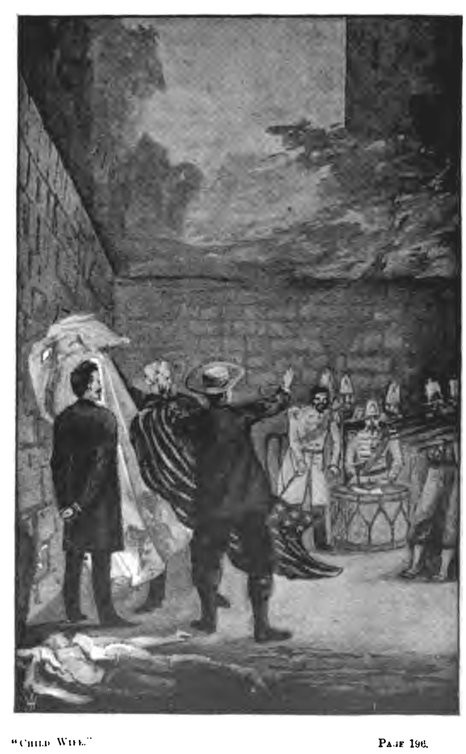
Two of these laying hold, forced him up against the wall, close to the corpse of the Red Republican.
He was manacled, and could make no resistance. None would have availed him.
The soldiers stood waiting for the command “Tirez!”
In another instant it would have been heard, for it was forming on the lips of the Zouave lieutenant.
Fate willed it otherwise. Before it could be given, the outer door opened, admitting a man whose presence caused a sudden suspension of the proceedings.
Hurrying across the courtyard, he threw himself between the soldiers and their victim, at the same time drawing a flag from beneath his coat, and spreading it over the condemned man.
Even the drunken Zouaves dared not fire through that flag. It was the Royal Standard of England!
But there was a double protection for the prisoner. Almost at the same instant another man stepped hastily across the courtyard and flouted a second flag in the eyes of the disappointed executioners!
It claimed equal respect, for it was the banner of the Stars and Stripes—the emblem of the only true Republic on earth.
Maynard had served under both flags, and for a moment he felt his affections divided.
He knew not to whom he was indebted for the last; but when he reflected who had sent the first—for it was Sir George Vernon who bore it—his heart trembled with a joy far sweeter than could have been experienced by the mere thought of delivery from death!
Chapter Thirty Nine.
Once More in Westbourne.
Once more in the British metropolis, Mr Swinton was seated in his room.
It was the same set of “furnished apartments,” containing that cane chair with which he had struck his ill-starred wife.
She was there, too, though not seated upon the chair.
Reclined along a common horse-hair sofa, with squab and cushions hard and scuffed, she was reading one of De Kock’s novels, in translation. Fan was not master of the French tongue, though skilled in many of those accomplishments for which France has obtained special notoriety.
It was after breakfast time, though the cups and saucers were still upon the table.
A common white-metal teapot, the heel of a half-quartern loaf, the head and tail of a herring, seen upon a blue willow pattern plate, told that the meal had not been epicurean.
Swinton was smoking “bird’s-eye” in a briar-root pipe. It would have been a cigar, had his exchequer allowed it.
Never in his life had this been so low. He had spent his last shilling in pursuit of the Girdwoods—in keeping their company in Paris, from which they, as he himself, had just returned to London.
As yet success had not crowned his scheme, but appeared distant as ever. The storekeeper’s widow, notwithstanding her aspirations after a titled alliance, was from a country whose people are proverbially “cute.” She was, at all events, showing herself prudent, as Mr Swinton discovered in a conversation held with her on the eve of their departure from Paris.
It was on a subject of no slight importance, originating in a proposal on his part to become her son in-law. It was introductory to an offer he intended making to the young lady herself.
But the offer was not made, Mrs Girdwood having given reasons for its postponement.
They seemed somewhat unsubstantial, leaving him to suppose he might still hope.
The true reason was not made known to him, which was, that the American mother had become suspicious about his patent of nobility. After all, he might not be a lord. And this, notwithstanding his perfect playing of the part, which the quondam guardsman, having jostled a good deal against lords, was enabled to do.
She liked the man much—he flattered her sufficiently to deserve it—and used every endeavour to make her daughter like him. But she had determined, before things should go any further, to know something of his family. There was something strange in his still travelling incognito. The reasons he assigned for it were not satisfactory. Upon this point she must get thoroughly assured. England was the place to make the inquiry, and thither had she transported herself and her belongings—as before, putting up at the aristocratic Clarendon.
To England Swinton had followed, allowing only a day to elapse.
By staying longer in Paris, he would have been in pawn. He had just sufficient cash to clear himself from the obscure hotel where he had stopped, pay for a Boulogne boat, and a “bus” from London Bridge to his lodgings in far Westbourne, where he found his Fan not a shilling richer than himself. Hence that herring for breakfast, eaten on the day after his return.
He was poor in spirits as in purse. Although Mrs Girdwood had not stated the true reason for postponing her daughter’s reception of his marriage proposal, he could conjecture it. He felt pretty sure that the widow had come to England to make inquiries about him.
And what must they result in? Exposure! How could it be otherwise? His name was known in certain circles of London. So also his character. If she should get into these, his marriage scheme would be frustrated at once and for ever.
And he had become sufficiently acquainted with her shrewdness to know she would never accept him for a son-in-law, without being certain about the title—which in her eyes alone rendered him eligible.
If his game was not yet up, the cards left in his hand were poor. More than ever did they require skilful playing.
What should be his next move?
It was about this his brain was busy, as he sat pulling away at his pipe.
“Any one called since I’ve been gone?” he asked of his wife without turning toward her.
Had he done so, he might have observed a slight start caused by the inquiry. She answered, hesitatingly:
“Oh! no—yes—now I think of it I had a visitor—one.”
“Who?”
“Sir Robert Cottrell. You remember our meeting him at Brighton?”
“Of course I remember it. Not likely to forget the name of the puppy. How came he to call?”
“He expected to see you.”
“Indeed, did he! How did he know where we were living?”
“Oh, that! I met him one day as I was passing through Kensington Gardens, near the end of the Long Walk. He asked me where we were staying. At first I didn’t intend telling him. But he said he wanted particularly to see you; and so I gave him your address.”
“I wasn’t at home!”
“I told him that; but said I expected you every day. He came to inquire if you had come back.”
“Did he? What a wonderful deal he cared about my coming back. In the Long Walk you met him? I suppose you have been showing yourself in the Row every day?”
“No I haven’t, Richard. I’ve only been there once or twice—You can’t blame me for that? I’d like to know who could stay everlastingly here, in these paltry apartments, with that shrewish landlady constantly popping out and in, as if to see whether I’d carried off the contents of our trunks. Heaven knows, it’s a wretched existence at best; but absolutely hideous inside these lodgings!”
Glancing around the cheaply-furnished parlour, seeing the head and tail of the herring, with the other scraps of their poor repast, Swinton could not be otherwise than impressed with the truth of his wife’s words.
Their tone, too, had a satisfying effect. It was no longer that of imperious contradiction, such as he had been accustomed to for twelve months after marriage. This had ceased on that day when the leg of a chair coming in contact with his beloved’s crown had left a slight cicatrice upon her left temple—like a stain in statuary marble. From that hour the partner of his bosom had shown herself a changed woman—at least toward himself. Notwithstanding the many quarrels, and recriminative bickerings, that had preceded it, it was the first time he had resorted to personal violence. And it had produced its effect. Coward as she knew him to be, he had proved himself brave enough to bully her. She had feared him ever since. Hence her trepidation as she made answer to his inquiry as to whether any one had called.
There was a time when Frances Wilder would not have trembled at such a question, nor stammered in her reply.
She started again, and again showed signs of confusion, as the shuffling of feet on the flags outside was followed by a knock at the door.
It was a double one; not the violent repeat of the postman, but the rat-tat-tat given either by a gentleman or lady—from its gentleness more like the latter.
“Who can it be?” asked Swinton, taking the pipe from between his teeth. “Nobody for us, I hope.”
In London, Mr Swinton did not long for unexpected visitors. He had too many “kites” abroad, to relish the ring of the doorbell, or the more startling summons of the knocker.
“Can’t be for us,” said his wife, in a tone of mock confidence. “There’s no one likely to be calling; unless some of your old friends have seen you as you came home. Did you meet any one on the way?”
“No, nobody saw me,” gruffly returned the husband.
“There’s a family upstairs—in the drawing-rooms. I suppose it’s for them, or the people of the house.”
The supposition was contradicted by a dialogue heard outside in the hall. It was as follows:
“Mrs Swinton at home?”
The inquiry was in a man’s voice, who appeared to have passed in from the steps.
“Yis, sirr!” was the reply of the Irish janitress, who had answered the knock.
“Give my card; and ask the lady if I can see her.”
“By Jove! that’s Cottrell!” muttered the ex-guardsman, recognising the voice.
“Sir Robert Cottrell” was upon the card brought in by the maid-of-all-work.
“Show him in?” whispered Swinton to the servant, without waiting to ask permission from Fan; who, expressing surprise at the unexpected visit, sprang to her feet, and glided back into the bedroom.
There was a strangeness in the fashion of his wife’s retreat, which the husband could scarce help perceiving. He took no notice of it, however, his mind at the moment busied with a useful idea that had suddenly suggested itself.
Little as he liked Sir Robert Cottrell, or much as he may have had imaginings about the object of his visit, Swinton at that moment felt inclined to receive him. The odour of the salt herring was in his nostrils; and he was in a mood to prefer the perfume that exhales from the cambric handkerchief of a débonnaire baronet—such as he knew Sir Robert to be.
It was with no thought of calling his quondam Brighton acquaintance to account that he directed the servant to show him in.
And in he was shown.
Chapter Forty.
A Cautious Baronet.
The baronet looked a little blank, as the open parlour door discovered inside a “party” he had no intention of calling upon.
Accustomed to such surprises, however, he was not disconcerted. He had some knowledge of the ex-guardsman’s character. He knew he was in ill-luck; and that under such circumstances he would not be exactingly inquisitive.
“Aw, Swinton, my dear fellaw,” he exclaimed, holding out his kid-gloved hand. “Delighted to see you again. Madam told me she expected you home. I just dropped in, hoping to find you returned. Been to Paris, I hear?”
“I have,” said Swinton, taking the hand with a show of cordiality.
“Terrible times over there. Wonder you came off with a whole skin?”
“By Jove, it’s about all I brought off with me.”
“Aw, indeed! What mean you by that?”
“Well; I went over to get some money that’s been long owing me. Instead of getting it, I lost what little I carried across.”
“How did you do that, my dear fellaw?”
“Well, the truth is, I was tempted into card-playing with some French officers I chanced to meet at the Mille Colonnes. It was their cursed écarté. They knew the game better than I; and very soon cleared me out. I had barely enough to bring me back again. I thank God I’m here once more; though how I’m going to weather it this winter, heaven only knows! You’ll excuse me, Sir Robert, for troubling you with this confession of my private affairs. I’m in such a state of mind, I scarce know what I’m saying. Confound France and Frenchmen! I don’t go among them again; not if I know it.”
Sir Robert Cottrell, though supposed to be rich, was not accustomed to squandering money—upon men. With women he was less penurious; though with these only a spendthrift, when their smiles could not be otherwise obtained. He was one of those gallants who prefer making conquests at the cheapest possible rates; and, when made, rarely spend money to secure them. Like the butterfly, he liked flitting from flower to flower.
That he had not dropped in hoping to find Mr Swinton, but had come on purpose to visit his wife, the craven husband knew just as well as if he had openly avowed it. And the motive, too; all the more from such a shallow excuse.
It was upon the strength of this knowledge that the ex-guardsman was so communicative about his financial affairs. It was a delicate way of making it known, that he would not be offended by the offer of a trifling loan.
Sir Robert was in a dilemma. A month earlier he would have much less minded it. But during that month he had met Mrs Swinton several times, in the Long Walk, as elsewhere. He had been fancying his conquest achieved, and did not feel disposed to pay for a triumph already obtained.
For this reason he was slow to perceive the hint so delicately thrown out to him.
Swinton reflected on a way to make it more understandable. The débris of the frugal déjeuner came to his assistance.
“Look!” said he, pointing to the picked bones of the herring with an affectation of gaiety, “look there, Sir Robert! You might fancy it to be Friday. That fine fish was purchased with the last penny in my pocket. To-morrow is Friday; and I suppose I shall have to keep Lent still more austerely. Ha! ha! ha!”
There was no resisting such an appeal as this. The close-fisted aristocrat felt himself fairly driven into a corner.
“My dear fellaw!” said he, “don’t talk in that fashion. If a fiver will be of any service to you, I hope you will do me the favour to accept it. I know you won’t mind it from me?”
“Sir Robert, it is too kind. I—I—”
“Don’t mention it. I shouldn’t think of offering you such a paltry trifle; but just now my affairs are a little queerish. I dropped a lot upon the last Derby; and my lawyer is trying to raise a further mortgage on my Devonshire estate. If that can be effected, things will, of course, be different. Meanwhile, take this. It may pass you over your present difficulty, till something turns up.”
“Sir Robert, I—”
“No apology, Swinton! It is I who owe it, for the shabby sum.”
The ex-guardsman ceased to resist; and the five-pound note, pressed into his palm was permitted to remain there.
“By the bye, Swinton,” said the baronet, as if to terminate the awkward scene by obliging the borrower in a more business-like way, “why don’t you try to get something from the Government? Excuse a fellaw for taking the liberty; but it seems to me, a man of your accomplishments ought to stand a chance.”
“Not the slightest, Sir Robert! I have no interest; and if I had, there’s that ugly affair that got me out of the Guards. You know the story; and therefore I needn’t tell it you. That would be sure to come up if I made any application.”
“All stuff, my dear fellaw! Don’t let that stand in your way. It might, if you wanted to get into the Household, or be made a bishop. You don’t aspire to either, I presume?”
The ex-guardsman gave a lugubrious laugh.
“No!” he said. “I’d be contented with something less. Just now my ambition don’t soar extravagantly high.”
“Suppose you try Lord —, who has Government influence? In these troublous times there’s no end of employment, and for men whose misfortunes don’t need to be called to remembrance. Yours won’t stand in the way. I know his lordship personally. He’s not at all exacting.”
“You know him, Sir Robert?”
“Intimately. And if I’m not mistaken, he’s just the man to serve you; that is, by getting you some appointment? The diplomatic service has grown wonderfully, since the breaking out of these revolutions. More especially the secret branch of it. I’ve reason to know that enormous sums are now spent upon it. Then, why shouldn’t you try to get a pull out of the secret service chest?”
Swinton relit his pipe, and sat cogitating.
“A pipe don’t become a guardsman,” jokingly remarked his guest. “The favourites of the Foreign Office smoke only regalias.”
Swinton received this sally with a smile, that showed the dawning of a new hope.
“Take one?” continued the baronet, presenting his gold-clasped case.
Swinton pitched the briar-root aside, and set fire to the cigar.
“You are right, Sir Robert,” he said; “I ought to try for something. It’s very good of you to give me the advice. But how am I to follow it? I have no acquaintance with the nobleman you speak of; nor have any of my friends.”
“Then you don’t count me as one of them?”
“Dear Cottrell! Don’t talk that way! After what’s passed between us, I should be an ungrateful fellow if I didn’t esteem you as the first of them—perhaps the only friend I have left.”
“Well, I’ve spoken plainly. Haven’t I said that I know Lord — well enough to give you a letter of introduction to him? I won’t say it will serve any purpose; you must take your chances of that. I can only promise that he will receive you; and if you’re not too particular as to the nature of the employment, I think he may get you something. You understand me, Swinton?”
“I particular! Not likely, Sir Robert, living in this mean room, with the remembrance of that luxurious breakfast I’ve just eaten—myself and my poor wife!”
“Aw—by the way, I owe madam an apology for having so long neglected to ask after her. I hope she is well?”
“Thank you! Well as the dear child can be expected, with such trouble upon us.”
“Shall I not have the pleasure of seeing her?”
The visitor asked the question without any pretence of indifference. He felt it—just then, not desiring to encounter her in such company.
“I shall see, Sir Robert,” replied the husband, rising from his chair, and going toward the bedroom. “I rather suspect Fan’s en dishabille at this hour.”
Sir Robert secretly hoped that she was. Under the circumstances, an interview with her could only be awkward.
His wish was realised. She was not only en dishabille, but in bed—with a sick headache! She begged that the baronet would excuse her from making appearance!
This was the report brought back from the bedroom by her go-between of a husband. It remained only for the visitor to make good his promise about the letter of introduction.
He drew up to the table, and wrote it out, currente calamo.
He did not follow the usual fashion, by leaving the envelope open. There was a clause or two in the letter he did not desire the ex-guardsman to become acquainted with. It concluded with the words: “Mr Swinton is a gentleman who would suit for any service your lordship may be pleased to obtain for him. He is a disappointed man...”
Wetting the gum with the tip of his aristocratic tongue, he closed the envelope, and handed the epistle to his host.
“I know,” said he, “Lord A— will be glad to serve you. You might see him at the Foreign Office; but don’t go there. There are too many fellaws hanging about, who had better not know what you’re after. Take it to his lordship’s private residence in Park Lane. In a case like yours, I know he’d prefer receiving you there. You had better go at once. There are so many chances of your being forestalled—a host of applicants hungering for something of the same. His lordship is likely to be at home about three in the afternoon. I’ll call here soon after to learn how you’ve prospered. Bye, my dear fellaw! good-bye!”
Re-gloving his slender aristocratic fingers, the baronet withdrew—leaving the ex-guardsman in possession of an epistle that might have much influence on his future fate.
Chapter Forty One.
A Scene in Park Lane.
In Park Lane, as all know, fronting upon Hyde Park, are some of the finest residences in London. They are mansions, mostly inhabited by England’s aristocracy; many of them by the proudest of its nobility.
On that same day on which Sir Robert Cottrell had paid his unintentional visit to Mr Richard Swinton, at the calling hour of the afternoon an open park phaeton, drawn by a pair of stylish ponies, with “flowing manes and tails,” might have been seen driving along Park Lane, and drawing up in front of one of its splendid mansions, well-known to be that of a nobleman of considerable distinction among his class.
The ribbons were held by a gentleman who appeared capable of manipulating them; by his side a lady equally suitable to the equipage; while an appropriate boy in top-boots and buttons occupied the back seat.
Though the gentleman was young and handsome, the lady young and beautiful, and the groom carefully got up, an eye, skilled in livery decoration, could have told the turn-out to be one hired for the occasion.
It was hired, and by Richard Swinton; for it was he who wielded the whip, and his wife who gave grace to the equipage.
The ponies were guided with such skill that when checked up in front of the nobleman’s residence, the phaeton stood right under the drawing-room windows.
In this there was a design.
The groom, skipping like a grasshopper from his perch, glided up the steps, rang the bell, and made the usual inquiry.
His lordship was “at home.”
“You take the reins, Fan,” said Swinton, stepping out of the phaeton. “Keep a tight hold on them, and don’t let the ponies move from the spot they’re in—not so much as an inch!”
Without comprehending the object of this exact order, Fan promised to obey it.
The remembrance of mare than one scene, in which she had succumbed to her husband’s violence, secured compliance with his request.
Having made it, the ex-guardsman ascended the steps, presented his card, and was shown into the drawing-room.
Chapter Forty Two.
The Power of a Pretty Face.
It was the front room of a suite into which Mr Swinton had been conducted—a large apartment furnished in splendid style.
For a time he was left alone, the footman, who officiated, having gone off with his card.
Around him were costly decorations—objects of vertu and luxe—duplicated in plate-glass mirrors over the mantel, and along the sides of the room, extending from floor to ceiling.
But Mr Swinton looked not at the luxurious chattels, nor into the mirrors that reflected them.
On the moment of his being left to himself, he glided toward one of the windows, and directed his glance into the street.
“It will do,” he muttered to himself, with a satisfied air. “Just in the right spot, and Fan—isn’t she the thing for it? By Jove! she shows well. Never saw her look better in her life. If his lordship be the sort he’s got the name of being, I ought to get an appointment out of him. Sweet Fan! I’ve made five pounds out of you this morning. You’re worth your weight in gold, or its equivalent. Hold up your head, my chick! and show that pretty face of yours to the window! You’re about to be examined, and as I’ve heard, by a connoisseur. Ha! ha! ha!” The apostrophe was soliloquised, Fan was too far off to hear him.
The chuckling laugh that followed was interrupted by the re-entrance of the footman, who announced in ceremonial strain: “His lordship will see you in the library.” The announcement produced on his lordship’s visitor the effect of a cold-water douche. His gaiety forsook him with the suddenness of a “shot.”
Nor did it return when he discovered the library to be a somewhat sombre apartment, its walls bedecked with books, and the windows looking into a courtyard at the back. He had anticipated an interview in the drawing-room that commanded a view of the street.
It was a disappointment to be regretted, and, combined with the quiet gloom of the chamber into which he had been ushered, argued ill for the success of his application.
“Your business, sir?” demanded the august personage into whose presence he had penetrated. The demand was not made in a tone of either rudeness or austerity. Lord — was noted for a suavity of manners, that, in the eyes of the uninitiated, gave him a character for benevolence! In answer to it, the ex-guardsman presented his letter of introduction. He could do no more, and stood awaiting the result.
But he reflected how different this might be if the interview had been taking place in the drawing-room, instead of that dismal repository of books.
“I am sorry, Mr Swinton,” said his lordship, after reading Sir Robert’s letter, “sorry, indeed, that I can do nothing to serve you. I don’t know of a post that isn’t filled. I have applicants coming to me every day, thinking I can do something for them. I should have been most happy to serve any friend of Sir Robert Cottrell, had it been in my power. I assure you it isn’t.”
Richard Swinton was disconcerted—the more so that he had spent thirty shillings in chartering the pony phaeton with its attendant groom. It was part of the five pounds borrowed from the obliging baronet. It would be so much cash thrown away—the sprat lost without catching the salmon.
He stood without knowing what to say. The interview seemed at an end—his lordship appearing wearied of his presence, and wishing him to be gone.
At this crisis an accident came to his aid. A squadron of “Coldstreams” was passing along the Park drive. Their bugle, sounding the “double-quick,” was heard in the interior of the dwelling. His lordship, to ascertain the cause of the military movement, sprang up from the huge leathern chair, in which he had been seated, and passed suddenly into the drawing-room, leaving Mr Swinton outside in the hall. Through the window Lord — saw the dragoons filing past. But his glance dwelt, not long upon them. Underneath, and close in to the curb-stone, was an object to his eyes a hundred times more attractive than the bright uniforms of the Guards. It was a young and beautiful lady, seated in an open phaeton, and holding the reins—as if waiting for some one who had gone into a house.
It was in front of his own house; and the party absent from the phaeton must be inside. It should be Mr Swinton, the very good-looking fellow who was soliciting him for an appointment!
In a trice the applicant, already half dismissed, was recalled into his presence—this time into the drawing-room.
“By the way, Mr Swinton,” said he, “you may as well leave me your address. I’m anxious to oblige my friend, Sir Robert; and although I can speak of nothing now, who knows—Ha! that lady in the carriage below. Is she of your belonging?”
“My wife, your lordship.”
“What a pity to have kept her waiting outside! You should have brought her in with you.”
“My lord, I could not take the liberty of intruding.”
“Oh, nonsense! my dear sir! A lady can never intrude. Well, leave your address; and if anything should turn up, be sure I shall remember you. I am most anxious to serve Cottrell.”
Swinton left the address; and with an obsequious salute, parted from the dispenser of situations.
As he drove back along the pavement of Piccadilly, he reflected to himself that the pony equipage had not been chartered in vain.
He now knew the character of the man to whom he had addressed his solicitation.
Chapter Forty Three.
To the Country.
There is but one country in the world where country-life is thoroughly understood, and truly enjoyable. It is England!
True, this enjoyment is confined to the few—to England’s gentry. Her farmer knows nought of it; her labourer still less.
But the life of an English country gentleman leaves little to be desired!
In the morning he has the chase, or the shooting party, complete in their kind, and both varied according to the character of the game. In the evening he sits down to a dinner, as Lucullian as French cooks can make it, in the company of men and women the most accomplished upon earth.
In the summer there are excursions, picnics, “garden parties”; and of late years the grand croquet and tennis gatherings—all ending in the same desirable dinner, with sometimes a dance in the drawing-room, to the family music of the piano; on rarer occasions, to the more inspiriting strains of a military band, brought from the nearest barracks, or the headquarters of volunteers, yeomanry, or militia.
In all this there is neither noise nor confusion; but the most perfect quiet and decorum. It could not be otherwise in a society composed of the flower of England’s people—its nobility and squirearchy—equal in the social scale—alike spending their life in the cultivation of its graces.
It was not strange that Captain Maynard—a man with but few great friends, and lost to some of these through his republican proclivities—should feel slightly elated on receiving an imitation to a dinner as described.
A further clause in the note told him, he would be expected to stay a few days at the house of his host, and take part in the partridge-shooting that had but lately commenced.
The invitation was all the more acceptable coming from Sir George Vernon, of Vernon Hall, near Sevenoaks, Kent.
Maynard had not seen the British baronet since that day when the British flag, flung around his shoulders, saved him from being shot. By the conditions required to get him clear of his Parisian scrape, he had to return instanter to England, in the metropolis of which he had ever since been residing.
Not in idleness. Revolutions at an end, he had flung aside his sword, and taken to the pen. During the summer he had produced a romance, and placed it in the hands of a publisher. He was expecting it soon to appear.
He had lately written to Sir George—on hearing that the latter had got back to his own country—a letter expressing grateful thanks for the protection that had been extended to him.
But he longed also to thank the baronet in person. The tables were now turned. His own service had been amply repaid; and he hesitated to take advantage of the old invitation—in fear of being deemed an intruder. Under these circumstances the new one was something more than welcome.
Sevenoaks is no great distance from London. For all that, it is surrounded by scenery as retired and rural as can be found in the shires of England—the charming scenery of Kent.
It is only of late years that the railway-whistle has waked the echoes of those deep secluded dales stretching around Sevenoaks.
With a heart attuned to happiness, and throbbing with anticipated pleasure, did the late revolutionary leader ride along its roads. Not on horseback, but in a “fly” chartered at the railway station, to take him to the family mansion of the Vernons, which was to be found at about four miles’ distance from the town.
The carriage was an open one, the day clear and fine, the country looking its best—the swedes showing green, the stubble yellow, the woods and copses clad in the ochre-coloured livery of autumn. The corn had been all cut. The partridges, in full covey, and still comparatively tame, were seen straying through the “stubs”; while the pheasants, already thinned off by shot, kept more shy along the selvedge of the cover. He might think what fine sport was promised him!
He was thinking not of this. The anticipated pleasure of shooting parties had no place in his thoughts. They were all occupied by the image of that fair child, first seen on the storm-deck of an Atlantic steamer, and last in a balcony overlooking the garden of the Tuileries; for he had not seen Blanche Vernon since.
But he had often thought of her. Often! Every day, every hour!
And his soul was now absorbed by the same contemplation—in recalling the souvenirs of every scene or incident in which she had figured—his first view of her, followed by that strange foreshadowing—her face reflected in the cabin mirror—the episode in the Mersey, that had brought him still nearer—her backward look, as they parted on the landing-stage at Liverpool—and, last of all, that brief glance he had been enabled to obtain, as, borne along by brutal force, he beheld her in the balcony above him.
From this remembrance did he derive his sweetest reflection. Not from the sight of her there; but the thought that through her interference he had been rescued from an ignominious death, and a fate perhaps never to be recorded! He at least knew, that he owed his life to her father’s influence.
And now was he to be brought face to face with this fair young creature—within the sacred precincts of the family circle, and under the sanction of parental rule—to be allowed every opportunity of studying her character—perhaps moulding it to his own secret desires!
No wonder that, in the contemplation of such a prospect, he took no heed of the partridges straying through the stubble, or the pheasants skulking along the edge of their cover!
It was nigh two years since he had first looked upon her. She would now be fifteen, or near to it. In that quick, constrained glance given to the balcony above, he saw that she had grown taller and bigger.
So much the better, thought he, as bringing nearer the time when he should be able to test the truth of his presentiment.
Though sanguine, he was not confident. How could he? A nameless, almost homeless adventurer, a wide gulf lay between him and this daughter of an English baronet, noted in name as for riches, What hope had he of being able to bridge it?
None, save that springing from hope itself: perhaps only the wish father to the thought.
It might be all an illusion. In addition to the one great obstacle of unequal wealth—the rank he had no reason to consider—there might be many others.
Blanche Vernon was an only child, too precious to be lightly bestowed—too beautiful to go long before having her heart besieged. Already it may have been stormed and taken.
And by one nearer her own age—perhaps some one her father had designed for the assault.
While thus cogitating, the cloud that flung its shadow over Maynard’s face told how slight was his faith in fatalism.
It commenced clearing away, as the fly was driven up to the entrance of Vernon Park, and the gates were flung open to receive him.
It was quite gone when the proprietor of that park, meeting him in the vestibule of the mansion, bade him warm welcome to its hospitality.
Chapter Forty Four.
At the Meet.
There is perhaps no more superb sight than the “meet” of an English hunting-field—whether it be staghounds or fox. Even the grand panoply of war, with its serried ranks and braying band, is not more exciting than the tableau of scarlet coats grouped over the green, the hounds bounding impatiently around the gold-laced huntsman; here and there a horse rearing madly, as if determined on dismounting his rider; and at intervals the mellow horn, and sharply-cracked whip keeping the dogs in check.
The picture is not complete without its string of barouches and pony phaetons, filled with their fair occupants, a grand “drag” driven by the duke, and carrying the duchess; beside it the farmer in his market cart; and outside of all the pedestrian circle of smock-frocks, “Hob, Dick, and Hick, with clubs and clouted shoon,” their dim attire contrasting with the scarlet, though each—if it be a stag-hunt—with bright hopes of winning the bounty money by being in at the death of the deer.
At such a meet was Captain Maynard, mounted upon a steed from the stables of Sir George Vernon. Beside him was the baronet himself and near by his daughter, seated in an open barouche, with Sabina for her sole carriage companion.
The tawny-skinned and turbaned attendant—more like what might have been seen at an Oriental tiger hunt—nevertheless added to the picturesqueness of the tableau.
It was a grouping not unknown in those districts of England, where the returned East Indian “nabobs” have settled down to spend the evening of their days.
In such places even a Hindoo prince, in the costume of Tippoo Sahib, not unfrequently makes appearance.
The day was as it should be for a hunt. There was a clear sky, an atmosphere favourable to the scent, and cool enough for for putting a horse to his speed. Moreover, the hounds had been well rested.
The gentlemen were jocund, the ladies wreathed in smiles, the smock-frocks staring at them with a pleased expression upon their stolid faces.
All appeared happy, as they waited for the huntsman’s horn to signal the array.
There was one in that gathering who shared not its gaiety; a man mounted upon a chestnut hunter, and halted alongside the barouche that carried Blanche Vernon.
This man was Maynard.
Why did he not participate in the general joy?
The reason might have been discovered on the opposite side of the barouche, in the shape of an individual on horseback also, who called Blanche Vernon his cousin.
Like Maynard too, he was staying at Vernon Park—a guest admitted to a still closer intimacy than himself.
By name Scudamore—Frank Scudamore—he was a youth still boyish and beardless. All the more, on this account, was the man of mature age uneasy at his presence.
But he was handsome besides; fair-haired and of florid hue, a sort of Saxon Endymion or Adonis.
And she of kindred race and complexion—of nearly equal age—how could she do other than admire him?
There could be no mistaking his admiration of her. Maynard had discovered it—in an instant—on the day when the three had been first brought together.
And often afterward had he observed it; but never more than now, as the youth, leaning over in his saddle, endeavoured to engross the attention of his cousin.
And he appeared to succeed. She had neither look nor word for any one else. She heeded not the howling of the hounds; she was not thinking of the fox; she was listening only to the pretty speeches of young Scudamore.
All this Maynard saw with bitter chagrin. Its bitterness was only tempered by reflecting how little right he had to expect it otherwise.
True he had done Blanche Vernon a service. He believed it to have been repaid; for it must have been through her intercession he had been rescued from the Zouaves. But the act on her part was one of simple reciprocity—the responsive gratitude of a child!
How much more would he have liked being the recipient of those sentiments, seemingly lavished on young Scudamore, and spoken in half-whisper into his ear.
As the ex-captain sate chafing in his saddle, the reflection passed through his mind:
“There is too much hair upon my face. She prefers the cheek that is beardless.”
The jealous thought must have descended to his heels; since, striking them against the flanks of his horse, he rode wide away from the carriage!
And it must have continued to excite him throughout the chase, for, plying the spur, he kept close to the pack; and was first in at the death.
That day a steed was returned to the stables of Sir George Vernon with panting reins and bleeding ribs.
A guest sat down to his dinner-table—a stranger among the scarlet-coated hunters around him, who had won their respect by having ridden well up to the hounds.
Chapter Forty Five.
In the Cover.
The day after the hunt it was pheasant-shooting.
The morning was one of the finest known to the climate of England: a bright blue sky, with a warm October sun.
“The ladies are going to accompany us to the cover,” said Sir George, making glad the hearts of his sportsmen guests. “So, gentlemen,” he added, “you must have a care how you shoot.”
The expedition was not a distant one. The pheasant preserves of Vernon Park lay contiguous to the house, between the pleasure grounds and the “home farm.” They consisted of a scrub wood, with here and there a large tree overshadowing the undergrowth of hazel, holly, white birch, gone, dogwood, and briar. They extended over a square mile of hilly land, interspersed with deep dells and soft shaded vales, through which meandered many a crystal rivulet.
It was a noted cover for woodcock; but too early for these, and pheasant-killing was to be the pastime of the day.
After breakfast the shooting party set forth. The ladies were, many of them, staying at the house; the wives, sisters, and daughters of Sir George’s gentlemen guests. But there were others invited to the sport—the élite of the neighbourhood.
All went out together—guided by the head gamekeeper, and followed by spaniels and retrievers.
Once clear of the grounds, the business of the day began; and the banging of double-barrelled guns soon put a period to the conversation that had continued in a general way up to the edge of the woodland.
Once inside the cover, the shooting party soon became dismembered. Small groups, each consisting of two or three ladies and the same number of gentlemen, strayed off through the thicket, as chance, the ground, or the gamekeepers, conducted them.
With one of these went Maynard, though not the one he would have elected to accompany. A stranger, he had no choice, but was thrown along with the first set that offered—a couple of country squires, who cared far more for the pheasants than the fair creatures who had come to see them slaughtered.
With this trio of shooters there was not a single lady. One or two had started along with them. But the squires, being keen sportsmen, soon left their long-skirted companions following in the distance; and Maynard was compelled either to keep up with them and their dogs, or abandon the shooting altogether.
Treading on with the sportsmen he soon lost sight of the ladies, who fell far behind. He had no great regret at their defection. None of them chanced to be either very young or very attractive, and they were luckily attended by a servant. He had bidden adieu to them by exhibiting a pretended zeal in pheasant-shooting far from being felt, and which he would scarce have done had Sir George Vernon’s daughter been one of their number.
He was far from feeling cheerful as he strode through the preserves. He was troubled with an unpleasant reflection—arising from an incident observed. He had seen the baronet’s daughter pair off with the party in which shot young Scudamore. As she had done so unsolicited, she must have preferred this party to any other.
The ex-officer was not so expert in his shooting as he had shown himself at the hunt.
Several times he missed altogether; and once or twice the strong-winged gallinaceae rose whirring before him, without his attempting to pull trigger or even elevate his gun!
The squires, who on the day before had witnessed his dexterity in the saddle, rather wondered at his being such a poor shot.
They little dreamt of what was disqualifying him. They only observed that he was abstracted, but guessed not the cause.
After a time he and they became separated; they thinking only of the pheasants, he of that far brighter bird, in some distant quarter of the cover, gleaming amidst the foliage, and radiating delight all around.
Perhaps alone, in some silent dell, with young Scudamore by her side—authorised to keep apart through their cousinly relationship—he, perhaps, pouring into her ear the soft, confident whisperings of a cousin’s love!
The thought rendered Maynard sad.
It might hive excited him to anger; but he knew he had no pretext. Between him and the daughter of Sir George Vernon, as yet, only a few speeches had been exchanged; these only commonplace expressions of civility, amidst a surrounding of people, her friends and relatives. He had not even found opportunity to talk over those incidents that had led to the present relationship between them.
He longed for, and yet dreaded it! That presentiment, at first so confidently felt, had proved a deception.
The very opposite was the impression now upon him as he stood alone in the silent thicket, with the words falling mechanically from his lips:
“She can never be mine!”
“You will, Blanche? You will?” were other words not spoken by himself, but heard by him, as he stood within a holly copse, screened by its evergreen frondage.
It was young Scudamore who was talking, and in a tone of appealing tenderness.
There was no reply, and the same words, with a slight addition, were repeated: “You will promise it, Blanche? You will?”
Stilling his breath, and the wild beating of his heart, Maynard listened for the answer. From the tone of the questioner’s voice he knew it to be a dialogue, and that the cousins were alone.
He soon saw that they were. Walking side by side along a wood-road, they came opposite to the spot where he was standing.
They stopped. He could not see them. Their persons were concealed by the prickly fascicles of the holly hanging low. These did not hinder him from hearing every word exchanged between the two.
How sweet to his ears was the answer given by the girl.
“I won’t, Frank! I won’t!”
He knew not its full significance, nor the nature of the promise appealed for.
But the éclaircissement was near, and this gave him a still greater gratification.
“Indeed,” said Scudamore, reproachfully, “I know why you won’t promise me. Yes, I know it.”
“What do you know, Frank?”
“Only, what everybody can see: that you’ve taken a liking to this Captain Maynard, who’s old enough to be your father, or grandfather! Ah! and if your father finds it out—well, I shan’t say what—”
“And if it were so,” daringly retorted the daughter of the baronet, “who could blame me? You forget that the gentleman saved my life! I’m sure I’d have been drowned but for his noble behaviour. Courageous, too. You should have seen the big waves wanting to swallow me. And there wasn’t any one else to run the risk of stretching forth a hand to me! He did save my life. Is it any wonder I should feel grateful to him?”
“You’re more than grateful, Blanche! You’re in love with him!”
“In love with him! Ha! ha! ha! What do you mean by that, cousin?”
“Oh! you needn’t make light of it. You know well enough!”
“I know that you’re very disagreeable, Frank; you’ve been so all the morning.”
“Have I? I shan’t be so any longer—in your company. Since you don’t seem to care for mine, no doubt you’ll be pleased at my taking leave of you. I presume you can find the way home without me? You’ve only to keep up this wood-road. It’ll bring you to the park-gate.”
“You needn’t concern yourself about me,” haughtily rejoined the daughter of Sir George. “I fancy I can find my way home without any assistance from my gallant cousin Scudamore.”
The provoking irony of this last speech brought the dialogue to an end.
Irritated by it, the young sportsman turned his back upon his pretty partner, and whistling to his spaniel, broke abruptly away, soon disappearing behind a clump of copse wood.
Chapter Forty Six.
A Recreant Sportsman.
“I owe you an apology, Miss Vernon,” said Maynard, coming out from under the hollies.
“For what?” asked the young girl, startled by his sudden appearance, but in an instant becoming calm.
“For having overheard the closing of a conversation between you and your cousin.”
She stood without making rejoinder, as if recalling what had been said.
“It was quite unintentional, I assure you,” added the intruder. “I should have disclosed myself sooner, but I—I can scarce tell what hindered me. The truth is, I—”
“Oh?” interrupted she, as if to relieve him from his evident embarrassment, “it doesn’t in the least signify. Frank was talking some nonsense—that’s all.”
“I’m glad you’re not angry with me. Though I’ve reason to be ashamed of my conduct, I must be candid and tell you, that I scarce deem it a misfortune having overheard you. It is so pleasant to listen to one’s own praises.”
“But who was praising you?”
The question was asked with an air of naïveté that might have been mistaken for coquetry.
Perhaps she had forgotten what she had said.
“Not your cousin,” replied Maynard, with a smile—“he who thinks me old enough to be your grandfather.”
“Ha! ha!” laughed Miss Vernon. “You mustn’t mind what Frank says. He’s always offending somebody.”
“I do not mind it. I couldn’t, after hearing how he was contradicted. A thousand thanks to my generous defender!”
“Oh! what I said of you was not meant for praise. I was but speaking the truth. But for you I should have been drowned. I am sure of it.”
“And but for you I should have been shot. Is not that also the truth?”
She did not make immediate reply. There was a blush on her cheek, strangely contrasting with a shadow that came over her face.
“I do not like the thought of any one being in my debt—not even you, Miss Vernon! Confess that we are quits, then. It will give me a contentment you do not dream of.”
“I do not quite understand you, Captain Maynard.”
“I shall be plain, then. Was it not you who sent your father to save me?”
It was a superfluous question, and he knew it. How could he be ignorant of her action under the remembrance of those sweet words, “I’ll come to you! I will come!”
She had not come, as he supposed; but she had done better. She had deputed one who had proved able to protect him.
“It is true,” replied she. “I told papa of your trouble. It wasn’t much for me. I had no danger; and must have shown myself very ungrateful had I not done so. You would have been saved without that. Your other friends would have been in time.”
“My other friends?”
“Surely you know?”
“Oh, you mean the American Minister.”
“And the two American ladies who went with him to your prison.”
“Two ladies! I saw no ladies. I never heard of them. The American Minister came; but he might have been too late. It is to your father—to you—I am indebted for my deliverance. I wish, Miss Vernon, you could understand how truly grateful I feel to you. I shall never be able to show it!”
Maynard spoke with a fervour he was unable to control.
It was not checked by any thought of the two ladies who had accompanied the American Minister to his Parisian prison. He had his surmises as to who they were; and there was a time when it would have gratified him. Now he was only glad to think that their friendly intent had been anticipated!
Standing in that wood, beside a bright creature worthy of being one of its nymphs, he was more contented to believe that she had been the preserver of his life—as he of hers.
It would have turned his contentment to supreme happiness could he have believed her gratitude resembled his own—in kind.
Her soft young heart—how he yearned to read to probe it to its profoundest depths!
It was a task delicate and dangerous; too delicate for a gentleman; too dangerous for one whose own heart was in doubt.
He feared to seek further.
“Miss Vernon,” he said, resuming the ordinary tone of discourse, “your cousin appears to have left you somewhat abruptly. May I have the pleasure of conducting you to the house? I think I can find the way after hearing Master Scudamore’s very particular directions.”
Master Scudamore! Had this young gentleman been present, he might have felt inclined to repudiate the juvenile appellation.
“Oh, no!” said the baronet’s daughter, scarce longer to be called a child. “I know the way well enough. You mustn’t leave your shooting, Captain Maynard?”
“I cannot continue it; I have no dogs. The very zealous pair of sportsmen to whom I was allotted soon outstripped me, leaving me alone, as you see. If I am not permitted to accompany you, I must—I suppose—I must remain so.”
“Oh, if you’re not going to shoot, you may as well go with me. It may be very lonely for you at the house; but I suppose we’ll find some of the others who have returned.”
“Not lonely,” replied the recreant sportsmen. “Not lonely for me, if you, Miss Vernon, will condescend to give me your company.”
Correctly interpreted, it was a bold speech; and the moment it was made, Maynard regretted it.
He was glad to perceive that it was taken only in the sense of politeness; and, the young girl consenting, he walked with her along the wood-road in the direction of the dwelling.
They were alone, but not unwatched.
Skulking behind them, with gun in hand, and spaniel at his heels, went young Scudamore. He did not attempt to overtake, but only watched them through the wood and along the park path, till they had joined a group of returned ladies, who chanced to be strolling through the lawn.