автордың кітабын онлайн тегін оқу Modern Painters, Volume IV (of V)
Project Gutenberg's Modern Painters, Volume IV (of V), by John Ruskin
This eBook is for the use of anyone anywhere at no cost and with
almost no restrictions whatsoever. You may copy it, give it away or
re-use it under the terms of the Project Gutenberg License included
with this eBook or online at www.gutenberg.org
Title: Modern Painters, Volume IV (of V)
Author: John Ruskin
Release Date: March 13, 2010 [EBook #31623]
Language: English
*** START OF THIS PROJECT GUTENBERG EBOOK MODERN PAINTERS, VOLUME IV (OF V) ***
Produced by Marius Masi, Juliet Sutherland and the Online
Distributed Proofreading Team at http://www.pgdp.net
Transcriber's note:
A few typographical errors have been corrected. They appear in the text
like this, and the explanation will appear when the mouse pointer is moved over the marked passage. Sections in Greek will yield a transliteration when the pointer is moved over them, and words using diacritic characters in the Latin Extended Additional block, which may not display in some fonts or browsers, will display an unaccented version.
THE KAPELLBRÜCKE, LUCERNE.
FROM A DRAWING BYRUSKIN.
Library Edition
THE COMPLETE WORKS
OF
JOHN RUSKIN
MODERN PAINTERS
Volume IV—OF MOUNTAIN BEAUTY
Volume V{
OF LEAF BEAUTY
OF CLOUD BEAUTY
OF IDEAS OF RELATION
NATIONAL LIBRARY ASSOCIATION
NEW YORK
CHICAGO
MODERN PAINTERS.
VOLUME IV.,
CONTAINING
PART V.,
OF MOUNTAIN BEAUTY.
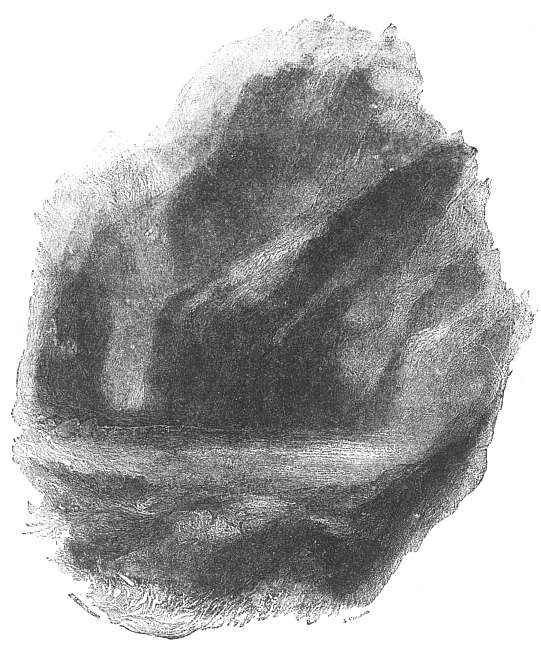
The Gates of the Hills.
PREFACE.
I was in hopes that this volume might have gone its way without preface; but as I look over the sheets, I find in them various fallings short of old purposes which require a word of explanation.
Of which shortcomings, the chief is the want of reference to the landscape of the Poussins and Salvator; my original intention having been to give various examples of their mountain-drawing, that it might be compared with Turner's. But the ten years intervening between the commencement of this work and its continuation have taught me, among other things, that Life is shorter and less availably divisible than I had supposed: and I think now that its hours may be better employed than in making facsimiles of bad work. It would have required the greatest care, and prolonged labor, to give uncaricatured representations of Salvator's painting, or of any other work depending on the free dashes of the brush, so as neither to mend nor mar it. Perhaps in the next volume I may give one or two examples associated with vegetation; but in general, I shall be content with directing the reader's attention to the facts in nature, and in Turner; leaving him to carry out for himself whatever comparisons he may judge expedient.
I am afraid, also, that disappointment may be felt at not finding plates of more complete subject illustrating these chapters on mountain beauty. But the analysis into which I had to enter required the dissection of drawings, rather than their complete presentation; while, also, on the scale of any readable page, no effective presentation of large drawings could be given. Even my vignette, the frontispiece to the third volume, is partly spoiled by having too little white paper about it; and the fiftieth plate, from Turner's Goldau, necessarily omits, owing to its reduction, half the refinements of the foreground. It is quite waste of time and cost to reduce Turner's drawings at all; and I therefore consider these volumes only as Guides to them, hoping hereafter to illustrate some of the best on their own scale.
Several of the plates appear, in their present position, nearly unnecessary; 14 and 15, for instance, in Vol. III. These are illustrations of the chapters on the Firmament in the fifth volume; but I should have had the plates disproportionately crowded at last, if I had put all that it needed in that volume; and as these two bear somewhat on various matters spoken of in the third, I placed them where they are first alluded to. The frontispiece has chief reference to the same chapters; but seemed, in its three divisions, properly introductory to our whole subject. It is a simple sketch from nature, taken at sunset from the hills near Como, some two miles up the eastern side of the lake and about a thousand feet above it, looking towards Lugano. The sky is a little too heavy for the advantage of the landscape below; but I am not answerable for the sky. It was there.A
In the multitudinous letterings and references of this volume there may possibly be one or two awkward errata; but not so many as to make it necessary to delay the volume while I look it over again in search of them. The reader will perhaps be kind enough to note at once that in page 182, at the first line of the text, the words "general truth" refer to the angle-measurements, not to the diagrams; which latter are given merely for reference, and might cause some embarrassment if the statement of measured accuracy were supposed to refer to them.
One or two graver misapprehensions I had it in my mind to warn the reader against; but on the whole, as I have honestly tried to make the book intelligible, I believe it will be found intelligible by any one who thinks it worth a careful reading; and every day convinces me more and more that no warnings can preserve from misunderstanding those who have no desire to understand.
Denmark Hill, March, 1856.
A Persons unacquainted with hill scenery are apt to forget that the sky of the mountains is often close to the spectator. A black thundercloud may literally be dashing itself in his face, while the blue hills seen through its rents maybe thirty miles away. Generally speaking, we do not enough understand the nearness of many clouds, even in level countries, as compared with the land horizon. See also the close of § 12 in Chap. III of this volume.
TABLE OF CONTENTS.
PART V.
OF MOUNTAIN BEAUTY.
page Chapter
I.—
Of the Turnerian Picturesque
1"
II.—
Of Turnerian Topography
16"
III.—
Of Turnerian Light
34"
IV.—
Of Turnerian Mystery: First, as Essential
56"
V.—
Of Turnerian Mystery: Secondly, Wilful
68"
VI.—
The Firmament
82"
VII.—
The Dry Land
89"
VIII.—
Of the Materials of Mountains: First, Compact Crystallines
99"
IX.—
Of the Materials of Mountains: Secondly, Slaty Crystallines
113"
X.—
Of the Materials of Mountains: Thirdly, Slaty Coherents
122"
XI.—
Of the Materials of Mountains: Fourthly, Compact Coherents
127"
XII.—
Of the Sculpture of Mountains: First, the Lateral Ranges
137"
XIII.—
Of the Sculpture of Mountains: Secondly, the Central Peaks
157"
XIV.—
Resulting Forms: First, Aiguilles
173"
XV.—
Resulting Forms: Second, Crests
195"
XVI.—
Resulting Forms: Third, Precipices
228"
XVII.—
Resulting Forms: Fourthly, Banks
262"
XVIII.—
Resulting Forms: Fifthly, Stones
301"
XIX.—
The Mountain Gloom
317"
XX.—
The Mountain Glory
344APPENDIX.
I.
Modern Grotesque
385II.
Rock Cleavage
391III.
Logical Education
399
LIST OF PLATES TO VOL. IV.
Drawn by
Engraved by
Frontispiece. The Gates of the Hills
J. M. W. Turner
J. Cousen
Plate
Facing page
18.
The Transition from Ghirlandajo to Claude
Ghirlandajo and Claude
J. H. Le Keux 119.
The Picturesque of Windmills
Stanfield and Turner
J. H. Le Keux 720.
The Pass of Faïdo. 1. Simple Topography
The Author
The Author 2221.
The Pass of Faïdo 2. Turnerian Topography
J. M. W. Turner
The Author 2422.
Turner's Earliest Nottingham
J. M. W. Turner
T. Boys 2923.
Turner's Latest Nottingham
J. M. W. Turner
T. Boys 3024.
The Towers of Fribourg
The Author
J. C. Armytage 3225.
Things in General
The Author
J. H. Le Keux 3226.
The Law of Evanescence
The Author
R. P. Cuff 7127.
The Aspen under Idealization
Turner, etc.
J. Cousen 7628.
The Aspen Unidealized
The Author
J. C. Armytage 7729.
Aiguille Structure
The Author
J. C. Armytage 16030.
The Ideal of Aiguilles
The Author, etc.
R. P. Cuff 17731.
The Aiguille Blaitière
The Author
J. C. Armytage 18532.
Aiguille-drawing
Turner, etc.
J. H. Le Keux 19133.
Contours of Aiguille Bouchard
The Author
R. P. Cuff 20434.
Cleavage of Aiguille Bouchard
The Author
The Author 21135.
Crests of La Côte and Taconay
The Author
The Author 21236.
Crest of La Côte
The Author
T. Lupton 21337.
Crests of the Slaty Crystallines
J. M. W. Turner
The Author 22238.
The Cervin, from the East and North-east
The Author
J. C. Armytage 23339.
The Cervin from the North-west
The Author
J. C. Armytage 23840.
The Mountains of Villeneuve
The Author
J. H. Le Keux 24612.
A. The Shores of Wharfe
J. M. W. Turner
Thos. Lupton 25141.
The Rocks of Arona
The Author
J. H. Le Keux 25542.
Leaf Curvature Magnolia and Laburnum
The Author
R. P. Cuff 26943.
Leaf Curvature Dead Laurel
The Author
R. P. Cuff 26944.
Leaf Curvature Young Ivy
The Author
R. P. Cuff 26945.
Débris Curvature
The Author
R. P. Cuff 28546.
The Buttresses of an Alp
The Author
J. H. Le Keux 28647.
The Quarry of Carrara
The Author
J. H. Le Keux 29948.
Bank of Slaty Crystallines
Daguerreotype
J. C. Armytage 30449.
Truth and Untruth of Stones
Turner and Claude
Thos. Lupton 30850.
Goldau
J. M. W. Turner
J. Cousen 312
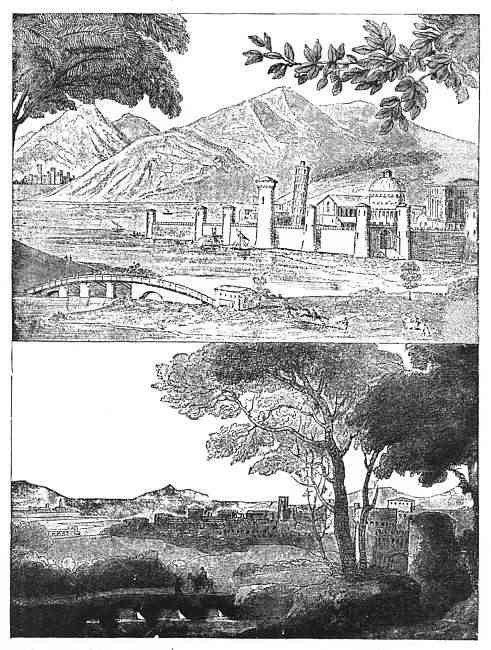
18. The Transition from Ghirlandajo to Claude.
PART V.
OF MOUNTAIN BEAUTY.
CHAPTER I.
OF THE TURNERIAN PICTURESQUE.
§ 1. The work which we proposed to ourselves, towards the close of the last volume, as first to be undertaken in this, was the examination of those peculiarities of system in which Turner either stood alone, even in the modern school, or was a distinguished representative of modern, as opposed to ancient practice.
And the most interesting of these subjects of inquiry, with which, therefore, it may be best to begin, is the precise form under which he has admitted into his work the modern feeling of the picturesque, which, so far as it consists in a delight in ruin, is perhaps the most suspicious and questionable of all the characters distinctively belonging to our temper, and art.
It is especially so, because it never appears, even in the slightest measure, until the days of the decline of art in the seventeenth century. The love of neatness and precision, as opposed to all disorder, maintains itself down to Raphael's childhood without the slightest interference of any other feeling; and it is not until Claude's time, and owing in great part to his influence, that the new feeling distinctly establishes itself.
Plate 18 shows the kind of modification which Claude used to make on the towers and backgrounds of Ghirlandajo; the old Florentine giving his idea of Pisa, with its leaning tower, with the utmost neatness and precision, and handsome youth riding over neat bridges on beautiful horses; Claude reducing the delicate towers and walls to unintelligible ruin, the well built bridge to a rugged stone one, the handsome rider to a weary traveller, and the perfectly drawn leafage to confusion of copse-wood or forest.1
How far he was right in doing this; or how far the moderns are right in carrying the principle to greater excess, and seeking always for poverty-stricken rusticity or pensive ruin, we must now endeavor to ascertain.
The essence of picturesque character has been already defined2 to be a sublimity not inherent in the nature of the thing, but caused by something external to it; as the ruggedness of a cottage roof possesses something of a mountain aspect, not belonging to the cottage as such. And this sublimity may be either in mere external ruggedness, and other visible character, or it may lie deeper, in an expression of sorrow and old age, attributes which are both sublime; not a dominant expression, but one mingled with such familiar and common characters as prevent the object from becoming perfectly pathetic in its sorrow, or perfectly venerable in its age.
§ 2. For instance, I cannot find words to express the intense pleasure I have always in first finding myself, after some prolonged stay in England, at the foot of the old tower of Calais church. The large neglect, the noble unsightliness of it; the record of its years written so visibly, yet without sign of weakness or decay; its stern wasteness and gloom, eaten away by the Channel winds, and overgrown with the bitter sea grasses; its slates and tiles all shaken and rent, and yet not falling; its desert of brickwork full of bolts, and holes, and ugly fissures, and yet strong, like a bare brown rock; its carelessness of what any one thinks or feels about it, putting forth no claim, having no beauty nor desirableness, pride nor grace; yet neither asking for pity; not, as ruins are, useless and piteous, feebly or fondly garrulous of better days; but useful still, going through its own daily work,—as some old fisherman beaten grey by storm, yet drawing his daily nets: so it stands, with no complaint about its past youth, in blanched and meagre massiveness and serviceableness, gathering human souls together underneath it; the sound of its bells for prayer still rolling through its rents; and the grey peak of it seen far across the sea, principal of the three that rise above the waste of surfy sand and hillocked shore,—the lighthouse for life, and the belfry for labor, and this for patience and praise.
§ 3. I cannot tell the half of the strange pleasures and thoughts that come about me at the sight of that old tower; for, in some sort, it is the epitome of all that makes the Continent of Europe interesting, as opposed to new countries; and, above all, it completely expresses that agedness in the midst of active life which binds the old and the new into harmony. We, in England, have our new street, our new inn, our green shaven lawn, and our piece of ruin emergent from it,—a mere specimen of the middle ages put on a bit of velvet carpet to be shown, which, but for its size, might as well be on the museum shelf at once, under cover. But, on the Continent, the links are unbroken between the past and present, and in such use as they can serve for, the grey-headed wrecks are suffered to stay with men; while, in unbroken line, the generations of spared buildings are seen succeeding each in its place. And thus in its largeness, in its permitted evidence of slow decline, in its poverty, in its absence of all pretence, of all show and care for outside aspect, that Calais tower has an infinite of symbolism in it, all the more striking because usually seen in contrast with English scenes expressive of feelings the exact reverse of these.
§ 4. And I am sorry to say that the opposition is most distinct in that noble carelessness as to what people think of it. Once, on coming from the Continent, almost the first inscription I saw in my native English was this:
"To Let, a Genteel House, up this road."
And it struck me forcibly, for I had not come across the idea of gentility, among the upper limestones of the Alps, for seven months; nor do I think that the Continental nations in general have the idea. They would have advertised a "pretty" house or a "large" one, or a "convenient" one; but they could not, by any use of the terms afforded by their several languages, have got at the English "genteel." Consider, a little, all the meanness that there is in that epithet, and then see, when next you cross the Channel, how scornful of it that Calais spire will look.
§ 5. Of which spire the largeness and age are also opposed exactly to the chief appearances of modern England, as one feels them on first returning to it; that marvellous smallness both of houses and scenery, so that a ploughman in the valley has his head on a level with the tops of all the hills in the neighborhood; and a house is organized into complete establishment,—parlor, kitchen, and all, with a knocker to its door, and a garret window to its roof, and a bow to its second story,3 on a scale of twelve feet wide by fifteen high, so that three such at least would go into the granary of an ordinary Swiss cottage: and also our serenity of perfection, our peace of conceit, everything being done that vulgar minds can conceive as wanting to be done; the spirit of well-principled housemaids everywhere, exerting itself for perpetual propriety and renovation, so that nothing is old, but only "old-fashioned," and contemporary, as it were, in date and impressiveness only with last year's bonnets. Abroad, a building of the eighth or tenth century stands ruinous in the open street; the children play round it, the peasants heap their corn in it, the buildings of yesterday nestle about it, and fit their new stones into its rents, and tremble in sympathy as it trembles. No one wonders at it, or thinks of it as separate, and of another time; we feel the ancient world to be a real thing, and one with the new: antiquity is no dream; it is rather the children playing about the old stones that are the dream. But all is continuous; and the words, "from generation to generation," understandable there. Whereas here we have a living present, consisting merely of what is "fashionable" and "old-fashioned;" and a past, of which there are no vestiges; a past which peasant or citizen can no more conceive; all equally far away; Queen Elizabeth as old as Queen Boadicea, and both incredible. At Verona we look out of Can Grande's window to his tomb; and if he does not stand beside us, we feel only that he is in the grave instead of the chamber,—not that he is old, but that he might have been beside us last night. But in England the dead are dead to purpose. One cannot believe they ever were alive, or anything else than what they are now—names in school-books.
§ 6. Then that spirit of trimness. The smooth paving-stones; the scraped, hard, even, rutless roads; the neat gates and plates, and essence of border and order, and spikiness and spruceness. Abroad, a country-house has some confession of human weakness and human fates about it. There are the old grand gates still, which the mob pressed sore against at the Revolution, and the strained hinges have never gone so well since; and the broken greyhound on the pillar—still broken—better so; but the long avenue is gracefully pale with fresh green, and the courtyard bright with orange-trees; the garden is a little run to waste—since Mademoiselle was married nobody cares much about it; and one range of apartments is shut up—nobody goes into them since Madame died. But with us, let who will be married or die, we neglect nothing. All is polished and precise again next morning; and whether people are happy or miserable, poor or prosperous, still we sweep the stairs of a Saturday.4
§ 7. Now, I have insisted long on this English character, because I want the reader to understand thoroughly the opposite element of the noble picturesque; its expression, namely, of suffering, of poverty, or decay, nobly endured by unpretending strength of heart. Nor only unpretending, but unconscious. If there be visible pensiveness in the building, as in a ruined abbey, it becomes, or claims to become, beautiful; but the picturesqueness is in the unconscious suffering,—the look that an old laborer has, not knowing that there is anything pathetic in his grey hair, and withered arms, and sunburnt breast; and thus there are the two extremes, the consciousness of pathos in the confessed ruin, which may or may not be beautiful, according to the kind of it; and the entire denial of all human calamity and care, in the swept proprieties and neatness of English modernism: and, between these, there is the unconscious confession of the facts of distress and decay, in by-words; the world's hard work being gone through all the while, and no pity asked for, nor contempt feared. And this is the expression of that Calais spire, and of all picturesque things, in so far as they have mental or human expression at all.
§ 8. I say, in so far as they have mental expression, because their merely outward delightfulness—that which makes them pleasant in painting, or, in the literal sense, picturesque—is their actual variety of color and form. A broken stone has necessarily more various forms in it than a whole one; a bent roof has more various curves in it than a straight one; every excrescence or cleft involves some additional complexity of light and shade, and every stain of moss on eaves or wall adds to the delightfulness of color. Hence, in a completely picturesque object, as an old cottage or mill, there are introduced, by various circumstances not essential to it, but, on the whole, generally somewhat detrimental to it as cottage or mill, such elements of sublimity—complex light and shade, varied color, undulatory form, and so on—as can generally be found only in noble natural objects, woods, rocks, or mountains. This sublimity, belonging in a parasitical manner to the building, renders it, in the usual sense of the word, "picturesque."
§ 9. Now, if this outward sublimity be sought for by the painter, without any regard for the real nature of the thing, and without any comprehension of the pathos of character hidden beneath, it forms the low school of the surface-picturesque; that which fills ordinary drawing-books and scrap-books, and employs, perhaps, the most popular living landscape painters of France, England, and Germany. But if these same outward characters be sought for in subordination to the inner character of the object, every source of pleasurableness being refused which is incompatible with that, while perfect sympathy is felt at the same time with the object as to all that it tells of itself in those sorrowful by-words, we have the school of true or noble picturesque; still distinguished from the school of pure beauty and sublimity, because, in its subjects, the pathos and sublimity are all by the way, as in Calais old spire,—not inherent, as in a lovely tree or mountain; while it is distinguished still more from the schools of the lower picturesque by its tender sympathy, and its refusal of all sources of pleasure inconsistent with the perfect nature of the thing to be studied.
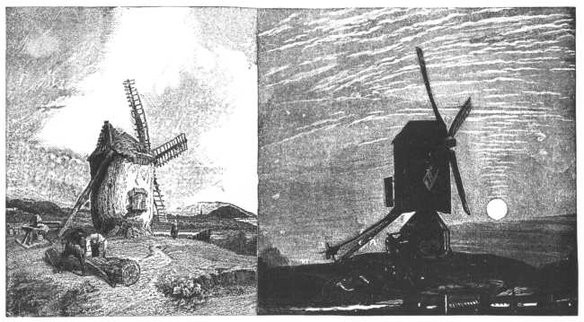
19. The Picturesque of Windmills.
1. Pure Modern.
2. Turnerian.§ 10. The reader will only be convinced of the broad scope of this law by careful thought, and comparison of picture with picture; but a single example will make the principle of it clear to him.
On the whole, the first master of the lower picturesque, among our living artists, is Clarkson Stanfield; his range of art being, indeed, limited by his pursuit of this character. I take, therefore, a windmill, forming the principal subject in his drawing of Brittany, near Dol (engraved in the Coast Scenery), Fig. 1, Plate 19, and beside it I place a windmill, which forms also the principal subject in Turner's study of the Lock, in the Liber Studiorum. At first sight I dare say the reader may like Stanfield's best; and there is, indeed, a great deal more in it to attract liking. Its roof is nearly as interesting in its ruggedness as a piece of the stony peak of a mountain, with a châlet built on its side; and it is exquisitely varied in swell and curve. Turner's roof, on the contrary, is a plain, ugly gable,—a windmill roof, and nothing more. Stanfield's sails are twisted into most effective wrecks, as beautiful as pine bridges over Alpine streams; only they do not look as if they had ever been serviceable windmill sails; they are bent about in cross and awkward ways, as if they were warped or cramped; and their timbers look heavier than necessary. Turner's sails have no beauty about them like that of Alpine bridges; but they have the exact switchy sway of the sail that is always straining against the wind; and the timbers form clearly the lightest possible framework for the canvas,—thus showing the essence of windmill sail. Then the clay wall of Stanfield's mill is as beautiful as a piece of chalk cliff, all worn into furrows by the rain, coated with mosses, and rooted to the ground by a heap of crumbled stone, embroidered with grass and creeping plants. But this is not a serviceable state for a windmill to be in. The essence of a windmill, as distinguished from all other mills, is, that it should turn round, and be a spinning thing, ready always to face the wind; as light, therefore, as possible, and as vibratory; so that it is in no wise good for it to approximate itself to the nature of chalk cliffs.
Now observe how completely Turner has chosen his mill so as to mark this great fact of windmill nature; how high he has set it; how slenderly he has supported it; how he has built it all of wood; how he has bent the lower planks so as to give the idea of the building lapping over the pivot on which it rests inside; and how, finally, he has insisted on the great leverage of the beam behind it, while Stanfield's lever looks more like a prop than a thing to turn the roof with. And he has done all this fearlessly, though none of these elements of form are pleasant ones in themselves, but tend, on the whole, to give a somewhat mean and spider-like look to the principal feature in his picture; and then, finally, because he could not get the windmill dissected, and show us the real heart and centre of the whole, behold, he has put a pair of old millstones, lying outside, at the bottom of it. These—the first cause and motive of all the fabric—laid at its foundation; and beside them the cart which is to fulfil the end of the fabric's being, and take home the sacks of flour.
§ 11. So far of what each painter chooses to draw. But do not fail also to consider the spirit in which it is drawn. Observe, that though all this ruin has befallen Stanfield's mill, Stanfield is not in the least sorry for it. On the contrary, he is delighted, and evidently thinks it the most fortunate thing possible. The owner is ruined, doubtless, or dead; but his mill forms an admirable object in our view of Brittany. So far from being grieved about it, we will make it our principal light;—if it were a fruit-tree in spring-blossom, instead of a desolate mill, we could not make it whiter or brighter; we illume our whole picture with it, and exult over its every rent as a special treasure and possession.
Not so Turner. His mill is still serviceable; but, for all that, he feels somewhat pensive about it. It is a poor property, and evidently the owner of it has enough to do to get his own bread out from between its stones. Moreover, there is a dim type of all melancholy human labor in it,—catching the free winds, and setting them to turn grindstones. It is poor work for the winds; better, indeed, than drowning sailors or tearing down forests, but not their proper work of marshalling the clouds, and bearing the wholesome rains to the place where they are ordered to fall, and fanning the flowers and leaves when they are faint with heat. Turning round a couple of stones, for the mere pulverization of human food, is not noble work for the winds. So, also, of all low labor to which one sets human souls. It is better than no labor; and, in a still higher degree, better than destructive wandering of imagination; but yet, that grinding in the darkness, for mere food's sake, must be melancholy work enough for many a living creature. All men have felt it so; and this grinding at the mill, whether it be breeze or soul that is set to it, we cannot much rejoice in. Turner has no joy of his mill. It shall be dark against the sky, yet proud, and on the hill-top; not ashamed of its labor, and brightened from beyond, the golden clouds stooping over it, and the calm summer sun going down behind, far away, to his rest.
§ 12. Now in all this observe how the higher condition of art (for I suppose the reader will feel, with me, that Turner's is the highest) depends upon largeness of sympathy. It is mainly because the one painter has communion of heart with his subject, and the other only casts his eyes upon it feelinglessly, that the work of the one is greater than that of the other. And, as we think farther over the matter, we shall see that this is indeed the eminent cause of the difference between the lower picturesque and the higher. For, in a certain sense, the lower picturesque ideal is eminently a heartless one: the lover of it seems to go forth into the world in a temper as merciless as its rocks. All other men feel some regret at the sight of disorder and ruin. He alone delights in both; it matters not of what. Fallen cottage—desolate villa—deserted village—blasted heath—mouldering castle—to him, so that they do but show jagged angles of stone and timber, all are sights equally joyful. Poverty, and darkness, and guilt, bring in their several contributions to his treasury of pleasant thoughts. The shattered window, opening into black and ghastly rents of wall, the foul rag or straw wisp stopping them, the dangerous roof, decrepit floor and stair, ragged misery or wasting age of the inhabitants,—all these conduce, each in due measure, to the fulness of his satisfaction. What is it to him that the old man has passed his seventy years in helpless darkness and untaught waste of soul? The old man has at last accomplished his destiny, and filled the corner of a sketch, where something of an unshapely nature was wanting. What is it to him that the people fester in that feverish misery in the low quarter of the town, by the river? Nay, it is much to him. What else were they made for? what could they have done better? The black timbers, and the green water, and the soaking wrecks of boats, and the torn remnants of clothes hung out to dry in the sun;—truly the fever-struck creatures, whose lives have been given for the production of these materials of effect, have not died in vain.5
§ 13. Yet, for all this, I do not say the lover of the lower picturesque is a monster in human form. He is by no means this, though truly we might at first think so, if we came across him unawares, and had not met with any such sort of person before. Generally speaking, he is kind-hearted, innocent of evil, but not broad in thought; somewhat selfish, and incapable of acute sympathy with others; gifted at the same time with strong artistic instincts and capacities for the enjoyment of varied form, and light, and shade, in pursuit of which enjoyment his life is passed, as the lives of other men are, for the most part, in the pursuit of what they also like,—be it honor, or money, or indolent pleasure,—very irrespective of the poor people living by the stagnant canal. And, in some sort, the hunter of the picturesque is better than many of these; inasmuch as he is simple-minded and capable of unostentatious and economical delights, which, if not very helpful to other people, are at all events utterly uninjurious, even to the victims or subjects of his picturesque fancies; while to many others his work is entertaining and useful. And, more than all this, even that delight which he seems to take in misery is not altogether unvirtuous. Through all his enjoyment there runs a certain under current of tragical passion,—a real vein of human sympathy;—it lies at the root of all those strange morbid hauntings of his; a sad excitement, such as other people feel at a tragedy, only less in degree, just enough, indeed, to give a deeper tone to his pleasure, and to make him choose for his subject the broken stones of a cottage wall, rather than of a roadside bank, the picturesque beauty of form in each being supposed precisely the same: and, together with this slight tragical feeling, there is also a humble and romantic sympathy; a vague desire, in his own mind, to live in cottages rather than in palaces; a joy in humble things, a contentment and delight in makeshifts, a secret persuasion (in many respects a true one) that there is in these ruined cottages a happiness often quite as great as in kings' palaces, and a virtue and nearness to God infinitely greater and holier than can commonly be found in any other kind of place; so that the misery in which he exults is not, as he sees it, misery, but nobleness,—"poor, and sick in body, and beloved by the Gods."6 And thus, being nowise sure that these things can be mended at all, and very sure that he knows not how to mend them, and also that the strange pleasure he feels in them must have some good reason in the nature of things, he yields to his destiny, enjoys his dark canal without scruple, and mourns over every improvement in the town, and every movement made by its sanitary commissioners, as a miser would over a planned robbery of his chest; in all this being not only innocent, but even respectable and admirable, compared with the kind of person who has no pleasure in sights of this kind, but only in fair façades, trim gardens, and park palings, and who would thrust all poverty and misery out of his way, collecting it into back alleys, or sweeping it finally out of the world, so that the street might give wider play for his chariot wheels, and the breeze less offence to his nobility.
§ 14. Therefore, even the love for the lower picturesque ought to be cultivated with care, wherever it exists; not with any special view to artistic, but to merely humane, education. It will never really or seriously interfere with practical benevolence; on the contrary, it will constantly lead, if associated with other benevolent principles, to a truer sympathy with the poor, and better understanding of the right ways of helping them; and, in the present stage of civilization, it is the most important element of character, not directly moral, which can be cultivated in youth; since it is mainly for the want of this feeling that we destroy so many ancient monuments, in order to erect "handsome" streets and shops instead, which might just as well have been erected elsewhere, and whose effect on our minds, so far as they have any, is to increase every disposition to frivolity, expense, and display.
These, and such other considerations not directly connected with our subject, I shall, perhaps, be able to press farther at the close of my work; meantime, we turn to the immediate question, of the distinction between the lower and higher picturesque, and the artists who pursue them.
§ 15. It is evident, from what has been advanced, that there is no definite bar of separation between the two; but that the dignity of the picturesque increases from lower to higher, in exact proportion to the sympathy of the artist with his subject. And in like manner his own greatness depends (other things being equal) on the extent of this sympathy. If he rests content with narrow enjoyment of outward forms, and light sensations of luxurious tragedy, and so goes on multiplying his sketches of mere picturesque material, he necessarily settles down into the ordinary "clever" artist, very good and respectable, maintaining himself by his sketching and painting in an honorable way, as by any other daily business, and in due time passing away from the world without having, on the whole, done much for it. Such has been the necessary, not very lamentable, destiny of a large number of men in these days, whose gifts urged them to the practice of art, but who possessing no breadth of mind, nor having met with masters capable of concentrating what gifts they had towards nobler use, almost perforce remained in their small picturesque circle; getting more and more narrowed in range of sympathy as they fell more and more into the habit of contemplating the one particular class of subjects that pleased them, and recomposing them by rules of art.
I need not give instances of this class, we have very few painters who belong to any other; I only pause for a moment to except from it a man too often confounded with the draughtsmen of the lower picturesque;—a very great man, who, though partly by chance, and partly by choice, limited in range of subject, possessed for that subject the profoundest and noblest sympathy—Samuel Prout. His renderings of the character of old buildings, such as that spire of Calais, are as perfect and as heartfelt as I can conceive possible; nor do I suppose that any one else will ever hereafter equal them.7 His early works show that he possessed a grasp of mind which could have entered into almost any kind of landscape subject; that it was only chance—I do not know if altogether evil chance—which fettered him to stones; and that in reality he is to be numbered among the true masters of the nobler picturesque.
§ 16. Of these, also, the ranks rise in worthiness, according to their sympathy. In the noblest of them, that sympathy seems quite unlimited; they enter with their whole heart into all nature; their love of grace and beauty keeps them from delighting too much in shattered stones and stunted trees, their kindness and compassion from dwelling by choice on any kind of misery, their perfect humility from avoiding simplicity of subject when it comes in their way, and their grasp of the highest thoughts from seeking a lower sublimity in cottage walls and penthouse roofs. And, whether it be home of English village thatched with straw and walled with clay, or of Italian city vaulted with gold and roofed with marble; whether it be stagnant stream under ragged willow, or glancing fountain between arcades of laurel, all to them will bring equal power of happiness, and equal field for thought.
§ 17. Turner is the only artist who hitherto has furnished the entire type of this perfection. The attainment of it in all respects is, of course, impossible to man; but the complete type of such a mind has once been seen in him, and, I think, existed also in Tintoret; though, as far as I know, Tintoret has not left any work which indicates sympathy with the humor of the world. Paul Veronese, on the other hand, had sympathy with its humor, but not with its deepest tragedy or horror. Rubens wants the feeling for grace and mystery. And so, as we pass through the list of great painters, we shall find in each of them some local narrowness. Now, I do not, of course, mean to say that Turner has accomplished all to which his sympathy prompted him; necessarily, the very breadth of effort involved, in some directions, manifest failure; but he has shown, in casual incidents, and by-ways, a range of feeling which no other painter, as far as I know, can equal. He cannot, for instance, draw children at play as well as Mulready; but just glean out of his works the evidence of his sympathy with children;—look at the girl putting her bonnet on the dog, in the foreground of the Richmond, Yorkshire; the juvenile tricks and "marine dabblers" of the Liber Studiorum; the boys scrambling after their kites in the woods of the Greta and Buckfastleigh; and the notable and most pathetic drawing of the Kirkby Lonsdale churchyard, with the schoolboys making a fortress of their larger books on the tombstone, to bombard with the more projectile volumes; and passing from these to the intense horror and pathos of the Rizpah, consider for yourself whether there was ever any other painter who could strike such an octave. Whether there has been or not, in other walks of art, this power of sympathy is unquestionably in landscape unrivalled; and it will be one of our pleasantest future tasks to analyze in his various drawing the character it always gives; a character, indeed, more or less marked in all good work whatever, but to which, being preeminent in him, I shall always hereafter give the name of the "Turnerian Picturesque."
J. Ruskin.
J. H. Le Keux.
47. The Quarries of Carrara.
48. Bank of Slaty Crystallines.
49. Truth and Untruth of Stones.
38. The Cervin, from the East and North-east.
J. Ruskin.
J. C. Armytage.
39. The Cervin, from the North-West.
1 Ghirlandajo is seen to the greatest possible disadvantage in this place, as I have been forced again to copy from Lasinio, who leaves out all the light and shade, and vulgarizes every form; but the points requiring notice here are sufficiently shown, and I will do Ghirlandajo more justice hereafter.
2 Seven Lamps of Architecture, chap. vi. § 12.
J. M. W. Turner.
J. Cousen.
50. Goldau.
3 The principal street of Canterbury has some curious examples of this tininess.
12. The Shores of Wharfe.
you, not them. Those lies of thine will "hurt a man as thou art," assuredly they will hurt thyself; but that clay, or the delivered soul of it, in no wise. Ajacean shield, seven-folded, never stayed lance-thrust as that turf will, with daisies pied. What you say of those quiet ones is wholly and utterly the world's affair and yours. The lie will, indeed, cost its proper price and work its appointed work; you may ruin living myriads by it,—you may stop the progress of centuries by it,—you may have to pay your own soul for it,—but as for ruffling one corner of the folded shroud by it, think it not. The dead have none to defend them! Nay, they have two defenders, strong enough for the need—God, and the worm.
4 This, however, is of course true only of insignificant duties, necessary for appearance' sake. Serious duties, necessary for kindness' sake, must be permitted in any domestic affliction, under pain of shocking the English public.
J. Ruskin.
J. H. Le Keux.
40. The Mountains of Villeneuve.
5 I extract from my private diary a passage bearing somewhat on the matter in hand:—
J. Ruskin.
R. P. Cuff.
33. Leading Contours of Aiguille Bouchard.
6 Epitaph on Epictetus.
34. Cleavages of Aiguille Bouchard.
7 I believe when a thing is once well done in this world, it never can be done over again.
35. Crests of La Côte and Taconay.
36. Crest of La Côte.
J. Ruskin.
J. H. Le Keux.
41. The Rocks of Arona.
20. Pass of Faïdo.
(1st. Simple Topography.)J. M. W. Turner.
J. Ruskin.
37. Crests of the Slaty Crystallines.
42. Leaf Curvature. Magnolia and Laburnum.
21. Pass of Faïdo.
(2d. Turnerian Topography.)43. Leaf Curvature. Dead Laurel.
Turner.
T. Boys.
22. Turner's Earliest "Nottingham."
find that all those thick beams of rock are actually sawn into vertical timbers by other cleavage, sometimes so fine as to look almost slaty, directed straight S.E., against the aiguille, as if, continued, it would saw it through and through; finally, cross the spur and go down to the glacier below, between it and the Aiguille du Plan, and the bottom of the spur will be found presenting the most splendid mossy surfaces, through which the true gneissitic cleavage is faintly traceable, dipping at right angles to the beds in Fig. 3, or under the Aiguille Blaitière, thus concurring with the beds of La Côte.
44. Leaf Curvature. Young Ivy.
Turner.
T. Boys.
23. Turner's Latest "Nottingham."
R. P. Cuff
45. Débris Curvature.
J. Ruskin.
J. C. Armytage.
24. The Towers of Fribourg.
J. Ruskin.
J. H. Le Keux.
46. The Buttresses of an Alp.
J. Ruskin.
J. H. Le Keux
25. Things in general.
30. The Aiguille Charmoz.
J. Ruskin.
J. C. Armytage.
31. The Aiguille Blaitière.
18. The Transition from Ghirlandajo to Claude.
32. Aiguille Drawing.
1. Old Ideal.
2. Turnerian.
19. The Picturesque of Windmills.
1. Pure Modern.
2. Turnerian.A Persons unacquainted with hill scenery are apt to forget that the sky of the mountains is often close to the spectator. A black thundercloud may literally be dashing itself in his face, while the blue hills seen through its rents maybe thirty miles away. Generally speaking, we do not enough understand the nearness of many clouds, even in level countries, as compared with the land horizon. See also the close of § 12 in Chap. III of this volume.
J. Ruskin.
1
2
3
4
R. P. Cuff
26. The Law of Evanescence.
1. Ancient, or Giottesque.
4. Modern or Blottesque.
2. Purist.
5. Constablesque.
3. Turneresque.
6. Hardingesque.
27. The Aspen, under Idealization.
28. Aspen, Unidealized.
J. Ruskin.
J.C. Armytage.
29. Aiguille Structure.
1 Ghirlandajo is seen to the greatest possible disadvantage in this place, as I have been forced again to copy from Lasinio, who leaves out all the light and shade, and vulgarizes every form; but the points requiring notice here are sufficiently shown, and I will do Ghirlandajo more justice hereafter.
2 Seven Lamps of Architecture, chap. vi. § 12.
3 The principal street of Canterbury has some curious examples of this tininess.
4 This, however, is of course true only of insignificant duties, necessary for appearance' sake. Serious duties, necessary for kindness' sake, must be permitted in any domestic affliction, under pain of shocking the English public.
5 I extract from my private diary a passage bearing somewhat on the matter in hand:—
"Amiens, 11th May, 18—. I had a happy walk here this afternoon, down among the branching currents of the Somme; it divides into five or six,—shallow, green, and not over-wholesome; some quite narrow and foul, running beneath clusters of fearful houses, reeling masses of rotten timber; and a few mere stumps of pollard willow sticking out of the banks of soft mud, only retained in shape of bank by being shored up with timbers; and boats like paper boats, nearly as thin at least, for the costermongers to paddle about in among the weeds, the water soaking through the lath bottoms, and floating the dead leaves from the vegetable-baskets with which they were loaded. Miserable little back yards, opening to the water, with steep stone steps down to it, and little platforms for the ducks; and separate duck staircases, composed of a sloping board with cross bits of wood leading to the ducks' doors, and sometimes a flower-pot or two on them, or even a flower,—one group, of wallflowers and geraniums, curiously vivid, being seen against the darkness of a dyer's back yard, who had been dyeing black all day, and all was black in his yard but the flowers, and they fiery and pure; the water by no means so, but still working its way steadily over the weeds, until it narrowed into a current strong enough to turn two or three mill-wheels, one working against the side of an old flamboyant Gothic church, whose richly traceried buttresses sloped into the filthy stream;—all exquisitely picturesque, and no less miserable. We delight in seeing the figures in these boats pushing them about the bits of blue water, in Prout's drawings; but as I looked to-day at the unhealthy face and melancholy mien of the man in the boat pushing his load of peats along the ditch, and of the people, men as well as women, who sat spinning gloomily at the cottage doors, I could not help feeling how many suffering persons must pay for my picturesque subject and happy walk."
6 Epitaph on Epictetus.
7 I believe when a thing is once well done in this world, it never can be done over again.
CHAPTER II.
OF TURNERIAN TOPOGRAPHY.
§ 1. We saw, in the course of the last chapter, with what kind of feeling an artist ought to regard the character of every object he undertakes to paint. The next question is, what objects he ought to undertake to paint; how far he should be influenced by his feelings in the choice of subjects; and how far he should permit himself to alter, or, in the usual art language, improve, nature. For it has already been stated (Vol. III. Chap. III. § 21.), that all great art must be inventive; that is to say, its subject must be produced by the imagination. If so, then great landscape art cannot be a mere copy of any given scene; and we have now to inquire what else than this it may be.
§ 2. If the reader will glance over that twenty-first, and the following three paragraphs of the same chapter, he will see that we there divided art generally into "historical" and "poetical," or the art of relating facts simply, and facts imaginatively. Now, with respect to landscape, the historical art is simple topography, and the imaginative art is what I have in the heading of the present chapter called Turnerian topography, and must in the course of it endeavor to explain.
Observe, however, at the outset, that, touching the duty or fitness of altering nature at all, the quarrels which have so wofully divided the world of art are caused only by want of understanding this simplest of all canons,—"It is always wrong to draw what you don't see." This law is inviolable. But then, some people see only things that exist, and others see things that do not exist, or do not exist apparently. And if they really see these non-apparent things, they are quite right to draw them; the only harm is when people try to draw non-apparent things, who don't see them, but think they can calculate or compose into existence what is to them for evermore invisible. If some people really see angels where others see only empty space, let them paint the angels; only let not anybody else think they can paint an angel, too, on any calculated principles of the angelic.
§ 3. If, therefore, when we go to a place, we see nothing else than is there, we are to paint nothing else, and to remain pure topographical or historical landscape painters. If, going to the place, we see something quite different from what is there, then we are to paint that—nay, we must paint that, whether we will or not; it being, for us, the only reality we can get at. But let us beware of pretending to see this unreality if we do not.
The simple observance of this rule would put an end to nearly all disputes, and keep a large number of men in healthy work, who now totally waste their lives; so that the most important question that an artist can possibly have to determine for himself, is whether he has invention or not. And this he can ascertain with ease. If visions of unreal things present themselves to him with or without his own will, praying to be painted, quite ungovernable in their coming or going,—neither to be summoned if they do not choose to come, nor banished if they do,—he has invention. If, on the contrary, he only sees the commonly visible facts; and, should he not like them, and want to alter them, finds that he must think of a rule whereby to do so, he has no invention. All the rules in the world will do him no good; and if he tries to draw anything else than those materially visible facts, he will pass his whole life in uselessness, and produce nothing but scientific absurdities.
§ 4. Let him take his part at once, boldly, and be content. Pure history and pure topography are most precious things; in many cases more useful to the human race than high imaginative work; and assuredly it is intended that a large majority of all who are employed in art should never aim at anything higher. It is only vanity, never love, nor any other noble feeling, which prompts men to desert their allegiance to the simple truth, in vain pursuit of the imaginative truth which has been appointed to be for evermore sealed to them.
Nor let it be supposed that artists who possess minor degrees of imaginative gift need be embarrassed by the doubtful sense of their own powers. In general, when the imagination is at all noble, it is irresistible, and therefore those who can at all resist it ought to resist it. Be a plain topographer if you possibly can; if Nature meant you to be anything else, she will force you to it; but never try to be a prophet; go on quietly with your hard camp-work, and the spirit will come to you in the camp, as it did to Eldad and Medad, if you are appointed to have it; but try above all things to be quickly perceptive of the noble spirit in others, and to discern in an instant between its true utterance and the diseased mimicries of it. In a general way, remember it is a far better thing to find out other great men, than to become one yourself: for you can but become one at best, but you may bring others to light in numbers.
§ 5. We have, therefore, to inquire what kind of changes these are, which must be wrought by the imaginative painter on landscape, and by whom they have been thus nobly wrought. First, for the better comfort of the non-imaginative painter, be it observed, that it is not possible to find a landscape, which, if painted precisely as it is, will not make an impressive picture. No one knows, till he has tried, what strange beauty and subtle composition is prepared to his hand by Nature, wherever she is left to herself; and what deep feeling may be found in many of the most homely scenes, even where man has interfered with those wild ways of hers. But, beyond this, let him note that though historical topography forbids alteration, it neither forbids sentiment nor choice. So far from doing this, the proper choice of subject8 is an absolute duty to the topographical painter: he should first take care that it is a subject intensely pleasing to himself, else he will never paint it well; and then also, that it shall be one in some sort pleasurable to the general public, else it is not worth painting at all; and lastly, take care that it be instructive, as well as pleasurable to the public, else it is not worth painting with care. I should particularly insist at present on this careful choice of subject, because the Pre-Raphaelites, taken as a body, have been culpably negligent in this respect, not in humble honor of Nature, but in morbid indulgence of their own impressions. They happen to find their fancies caught by a bit of an oak hedge, or the weeds at the sides of a duck-pond, because, perhaps, they remind them of a stanza of Tennyson; and forthwith they sit down to sacrifice the most consummate skill, two or three months of the best summer time available for out-door work (equivalent to some seventieth or sixtieth of all their lives), and nearly all their credit with the public, to this duck-pond delineation. Now it is indeed quite right that they should see much to be loved in the hedge, nor less in the ditch; but it is utterly and inexcusably wrong that they should neglect the nobler scenery which is full of majestic interest, or enchanted by historical association; so that, as things go at present, we have all the commonalty that may be seen whenever we choose, painted properly; but all of lovely and wonderful, which we cannot see but at rare intervals, painted vilely: the castles of the Rhine and Rhone made vignettes of for the annuals; and the nettles and mushrooms, which were prepared by Nature eminently for nettle porridge and fish sauce, immortalized by art as reverently as if we were Egyptians, and they deities.
§ 6. Generally speaking, therefore, the duty of every painter at present, who has not much invention, is to take subjects of which the portraiture will be precious in after times; views of our abbeys and cathedrals; distant views of cities, if possible chosen from some spot in itself notable by association; perfect studies of the battle-fields of Europe, of all houses of celebrated men, and places they loved, and, of course, of the most lovely natural scenery. And, in doing all this, it should be understood, primarily, whether the picture is topographical or not: if topographical, then not a line is to be altered, not a stick nor stone removed, not a color deepened, not a form improved; the picture is to be, as far as possible, the reflection of the place in a mirror; and the artist to consider himself only as a sensitive and skilful reflector, taking care that no false impression is conveyed by any error on his part which he might have avoided; so that it may be for ever afterwards in the power of all men to lean on his work with absolute trust, and to say: "So it was:—on such a day of June or July of such a year, such a place looked like this; these weeds were growing there, so tall and no taller; those stones were lying there, so many and no more; that tower so rose against the sky, and that shadow so slept upon the street."
§ 7. Nor let it be supposed that the doing of this would ever become mechanical, or be found too easy, or exclude sentiment. As for its being easy, those only think so who never tried it; composition being, in fact, infinitely easier to a man who can compose, than imitation of this high kind to even the most able imitator; nor would it exclude sentiment, for, however sincerely we may try to paint all we see, this cannot, as often aforesaid, be ever done: all that is possible is a certain selection, and more or less wilful assertion, of one fact in preference to another; which selection ought always to be made under the influence of sentiment. Nor will such topography involve an entire submission to ugly accidents interfering with the impressiveness of the scene. I hope, as art is better understood, that our painters will get into the habit of accompanying all their works with a written statement of their own reasons for painting them, and the circumstances under which they were done; and, if in this written document they state the omissions they have made, they may make as many as they think proper. For instance, it is not possible now to obtain a view of the head of the Lake of Geneva without including the "Hôtel Biron"—an establishment looking like a large cotton factory—just above the Castle of Chillon. This building ought always to be omitted, and the reason for the omission stated. So the beauty of the whole town of Lucerne, as seen from the lake, is destroyed by the large new hotel for the English, which ought, in like manner, to be ignored, and the houses behind it drawn as if it were transparent.
§ 8. But if a painter has inventive power he is to treat his subject in a totally different way; giving not the actual facts of it, but the impression it made on his mind.
And now, once for all, let it be clearly understood that an "impression on the mind" does not mean a piece of manufacture. The way in which most artists proceed to "invent," as they call it, a picture, is this: they choose their subject, for the most part, well, with a sufficient quantity of towers, mountains, ruined cottages, and other materials, to be generally interesting; then they fix on some object for a principal light; behind this they put a dark cloud, or, in front of it, a dark piece of foreground; then they repeat this light somewhere else in a less degree, and connect the two lights together by some intermediate ones. If they find any part of the foreground uninteresting they put a group of figures into it; if any part of the distance, they put something there from some other sketch; and proceed to inferior detail in the same manner, taking care always to put white stones near black ones, and purple colors near yellow ones, and angular forms near round ones;—all being as simply a matter of recipe and practice as cookery; like that, not by any means a thing easily done well, but still having no reference whatever to "impressions on the mind."
§ 9. But the artist who has real invention sets to work in a totally different way. First, he receives a true impression from the place itself, and takes care to keep hold of that as his chief good; indeed, he needs no care in the matter, for the distinction of his mind from that of others consists in his instantly receiving such sensations strongly, and being unable to lose them; and then he sets himself as far as possible to reproduce that impression on the mind of the spectator of his picture.
Now, observe, this impression on the mind never results from the mere piece of scenery which can be included within the limits of the picture. It depends on the temper into which the mind has been brought, both by all the landscape round, and by what has been seen previously in the course of the day; so that no particular spot upon which the painter's glance may at any moment fall, is then to him what, if seen by itself, it will be to the spectator far away; nor is it what it would be, even to that spectator, if he had come to the reality through the steps which Nature has appointed to be the preparation for it, instead of seeing it isolated on an exhibition wall. For instance, on the descent of the St. Gothard, towards Italy, just after passing through the narrow gorge above Faïdo, the road emerges into a little breadth of valley, which is entirely filled by fallen stones and débris, partly disgorged by the Ticino as it leaps out of the narrower chasm, and partly brought down by winter avalanches from a loose and decomposing mass of mountain on the left. Beyond this first promontory is seen a considerably higher range, but not an imposing one, which rises above the village of Faïdo. The etching, Plate 20, is a topographical outline of the scene, with the actual blocks of rock which happened to be lying in the bed of the Ticino at the spot from which I chose to draw it. The masses of loose débris (which, for any permanent purpose, I had no need to draw, as their arrangement changes at every flood) I have not drawn, but only those features of the landscape which happen to be of some continual importance. Of which note, first, that the little three-windowed building on the left is the remnant of a gallery built to protect the road, which once went on that side, from the avalanches and stones that come down the "couloir"9 in the rock above. It is only a ruin, the greater part having been by said avalanches swept away, and the old road, of which a remnant is also seen on the extreme left, abandoned, and carried now along the hillside on the right, partly sustained on rough stone arches, and winding down, as seen in the sketch, to a weak wooden bridge, which enables it to recover its old track past the gallery. It seems formerly (but since the destruction of the gallery) to have gone about a mile farther down the river on the right bank, and then to have been carried across by a longer wooden bridge, of which only the two abutments are seen in the sketch, the rest having been swept away by the Ticino, and the new bridge erected near the spectator.
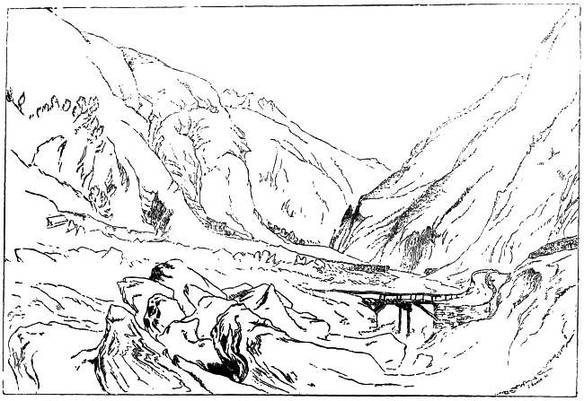
20. Pass of Faïdo.
(1st. Simple Topography.)§ 10. There is nothing in this scene, taken by itself, particularly interesting or impressive. The mountains are not elevated, nor particularly fine in form, and the heaps of stones which encumber the Ticino present nothing notable to the ordinary eye. But, in reality, the place is approached through one of the narrowest and most sublime ravines in the Alps, and after the traveller during the early part of the day has been familiarized with the aspect of the highest peaks of the Mont St. Gothard. Hence it speaks quite another language to him from that in which it would address itself to an unprepared spectator: the confused stones, which by themselves would be almost without any claim upon his thoughts, become exponents of the fury of the river by which he has journeyed all day long; the defile beyond, not in itself narrow or terrible, is regarded nevertheless with awe, because it is imagined to resemble the gorge that has just been traversed above; and, although no very elevated mountains immediately overhang it, the scene is felt to belong to, and arise in its essential characters out of, the strength of those mightier mountains in the unseen north.
§ 11. Any topographical delineation of the facts, therefore, must be wholly incapable of arousing in the mind of the beholder those sensations which would be caused by the facts themselves, seen in their natural relations to others. And the aim of the great inventive landscape painter must be to give the far higher and deeper truth of mental vision, rather than that of the physical facts, and to reach a representation which, though it may be totally useless to engineers or geographers, and, when tried by rule and measure, totally unlike the place, shall yet be capable of producing on the far-away beholder's mind precisely the impression which the reality would have produced, and putting his heart into the same state in which it would have been, had he verily descended into the valley from the gorges of Airolo.
§ 12. Now observe; if in his attempt to do this the artist does not understand the sacredness of the truth of Impression, and supposes that, once quitting hold of his first thought, he may by Philosophy compose something prettier than he saw, and mightier than he felt, it is all over with him. Every such attempt at composition will be utterly abortive, and end in something that is neither true nor fanciful; something geographically useless, and intellectually absurd.
But if, holding fast his first thought, he finds other ideas insensibly gathering to it, and, whether he will or not, modifying it into something which is not so much the image of the place itself, as the spirit of the place, let him yield to such fancies, and follow them wherever they lead. For, though error on this side is very rare among us in these days, it is possible to check these finer thoughts by mathematical accuracies, so as materially to impair the imaginative faculty. I shall be able to explain this better after we have traced the actual operation of Turner's mind on the scene under discussion.
§ 13. Turner was always from his youth fond of stones (we shall see presently why). Whether large or small, loose or embedded, hewn into cubes or worn into boulders, he loved them as much as William Hunt loves pineapples and plums. So that this great litter of fallen stones, which to any one else would have been simply disagreeable, was to Turner much the same as if the whole valley had been filled with plums and pineapples, and delighted him exceedingly, much more than even the gorge of Dazio Grande just above. But that gorge had its effect upon him also, and was still not well out of his head when the diligence stopped at the bottom of the hill, just at that turn of the road on the right of the bridge; which favorable opportunity Turner seized to make what he called a "memorandum" of the place, composed of a few pencil scratches on a bit of thin paper, that would roll up with others of the sort and go into his pocket afterwards. These pencil scratches he put a few blots of color upon (I suppose at Bellinzona the same evening, certainly not upon the spot), and showed me this blotted sketch when he came home. I asked him to make me a drawing of it, which he did, and casually told me afterwards (a rare thing for him to do) that he liked the drawing he had made. Of this drawing I have etched a reduced outline in Plate 21.
§ 14. In which, primarily, observe that the whole place is altered in scale, and brought up to the general majesty of the higher forms of the Alps. It will be seen that, in my topographical sketch, there are a few trees rooted in the rock on this side of the gallery, showing by comparison, that it is not above four or five hundred feet high. These trees Turner cuts away, and gives the rock a height of about a thousand feet, so as to imply more power and danger in the avalanche coming down the couloir.
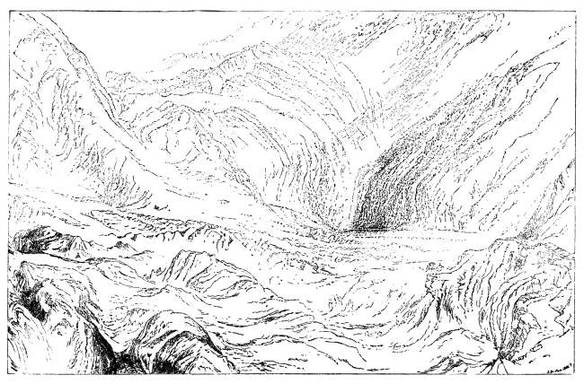
21. Pass of Faïdo.
(2d. Turnerian Topography.)Next, he raises, in a still greater degree, all the mountains beyond, putting three or four ranges instead of one, but uniting them into a single massy bank at their base, which he makes overhang the valley, and thus reduces it nearly to such a chasm as that which he had just passed through above, so as to unite the expression of this ravine with that of the stony valley. A few trees, in the hollow of the glen, he feels to be contrary in spirit to the stones, and fells them, as he did the others; so also he feels the bridge in the foreground, by its slenderness, to contradict the aspect of violence in the torrent; he thinks the torrent and avalanches should have it all their own way hereabouts; so he strikes down the nearer bridge, and restores the one farther off, where the force of the stream may be supposed less. Next, the bit of road on the right, above the bank, is not built on a wall, nor on arches high enough to give the idea of an Alpine road in general; so he makes the arches taller, and the bank steeper, introducing, as we shall see presently, a reminiscence from the upper part of the pass.
§ 15. I say he "thinks" this, and "introduces" that. But, strictly speaking, he does not think at all. If he thought, he would instantly go wrong; it is only the clumsy and uninventive artist who thinks. All these changes come into his head involuntarily; an entirely imperative dream, crying, "thus it must be," has taken possession of him; he can see, and do, no otherwise than as the dream directs.
This is especially to be remembered with respect to the next incident—the introduction of figures. Most persons to whom I have shown the drawing, and who feel its general character, regret that there is any living thing in it; they say it destroys the majesty of its desolation. But the dream said not so to Turner. The dream insisted particularly upon the great fact of its having come by the road. The torrent was wild, the stones were wonderful; but the most wonderful thing of all was how we ourselves, the dream and I, ever got here. By our feet we could not—by the clouds we could not—by any ivory gates we could not—in no other wise could we have come than by the coach road. One of the great elements of sensation, all the day long, has been that extraordinary road, and its goings on, and gettings about; here, under avalanches of stones, and among insanities of torrents, and overhangings of precipices, much tormented and driven to all manner of makeshifts and coils to this side and the other, still the marvellous road persists in going on, and that so smoothly and safely, that it is not merely great diligences, going in a caravanish manner, with whole teams of horses, that can traverse it, but little postchaises with small postboys, and a pair of ponies. And the dream declared that the full essence and soul of the scene, and consummation of all the wonderfulness of the torrents and Alps, lay in a postchaise, with small ponies and postboy, which accordingly it insisted upon Turner's inserting, whether he liked it or not, at the turn of the road.
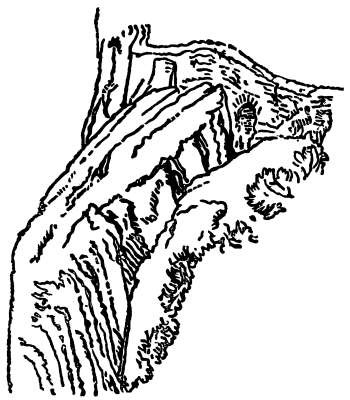
§ 16. Now, it will be observed by any one familiar with ordinary principles of arrangement of form (on which principles I shall insist at length in another place), that while the dream introduces these changes bearing on the expression of the scene, it is also introducing other changes, which appear to be made more or less in compliance with received rules of composition,10 rendering the masses broader, the lines more continuous, and the curves more graceful. But the curious part of the business is, that these changes seem not so much to be wrought by imagining an entirely new condition of any feature, as by remembering something which will fit better in that place. For instance, Turner felt the bank on the right ought to be made more solid and rocky, in order to suggest firmer resistance to the stream, and he turns it, as will be seen by comparing the etchings, into a kind of rock buttress, to the wall, instead of a mere bank. Now, the buttress into which he turns it is very nearly a facsimile of one which he had drawn on that very St. Gothard road, far above, at the Devil's Bridge, at least thirty years before, and which he had himself etched and engraved, for the Liber Studiorum, although the plate was never published. Fig. 1 is a copy of the bit of the etching in question. Note how the wall winds over it, and observe especially the peculiar depression in the middle of its surface, and compare it in those parts generally with the features introduced in the later composition. Of course, this might be set down as a mere chance coincidence, but for the frequency of the cases in which Turner can be shown to have done the same thing, and to have introduced, after a lapse of many years, memories of something which, however apparently small or unimportant, had struck him in his earlier studies. These instances, when I can detect them, I shall point out as I go on engraving his works; and I think they are numerous enough to induce a doubt whether Turner's composition was not universally an arrangement of remembrances, summoned just as they were wanted, and set each in its fittest place. It is this very character which appears to me to mark it as so distinctly an act of dream-vision; for in a dream there is just this kind of confused remembrance of the forms of things which we have seen long ago, associated by new and strange laws. That common dreams are grotesque and disorderly, and Turner's dream natural and orderly, does not, to my thinking, involve any necessary difference in the real species of act of mind. I think I shall be able to show, in the course of the following pages, or elsewhere, that whenever Turner really tried to compose, and made modifications of his subjects on principle, he did wrong, and spoiled them; and that he only did right in a kind of passive obedience to his first vision, that vision being composed primarily of the strong memory of the place itself which he had to draw; and secondarily, of memories of other places (whether recognized as such by himself or not I cannot tell), associated, in a harmonious and helpful way, with the new central thought.
§ 17. The kind of mental chemistry by which the dream summons and associates its materials, I have already endeavored, not to explain, for it is utterly inexplicable, but to illustrate, by a well-ascertained though equally inexplicable fact in common chemistry. That illustration (§ 8. of chapter on Imaginative Association, Vol. II.) I see more and more ground to think correct. How far I could show that it held with all great inventors, I know not, but with all those whom I have carefully studied (Dante, Scott, Turner, and Tintoret) it seems to me to hold absolutely; their imagination consisting, not in a voluntary production of new images, but an involuntary remembrance, exactly at the right moment, of something they had actually seen.
Imagine all that any of these men had seen or heard in the whole course of their lives, laid up accurately in their memories as in vast storehouses, extending, with the poets, even to the slightest intonations of syllables heard in the beginning of their lives, and, with the painters, down to the minute folds of drapery, and shapes of loaves or stones; and over all this unindexed and immeasurable mass of treasure, the imagination brooding and wandering, but dream-gifted, so as to summon at any moment exactly such groups of ideas as shall justly fit each other: this I conceive to be the real nature of the imaginative mind, and this, I believe, it would be oftener explained to us as being, by the men themselves who possess it, but that they have no idea what the state of other persons' minds is in comparison; they suppose every one remembers all that he has seen in the same way, and do not understand how it happens that they alone can produce good drawings or great thoughts.
Turner.
T. Boys.
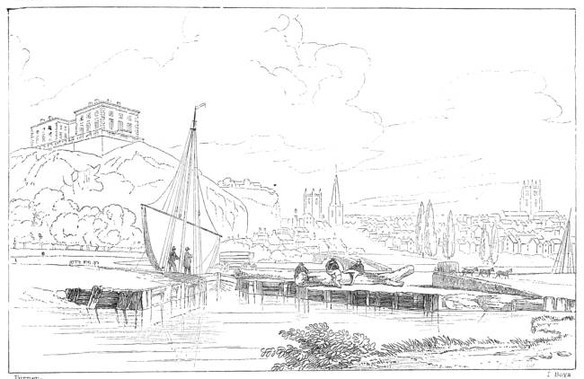
22. Turner's Earliest "Nottingham."
§ 18. Whether this be the case with all inventors or not, it was assuredly the case with Turner to such an extent that he seems never to have lost, or cared to disturb, the impression made upon him by any scene,—even in his earliest youth. He never seems to have gone back to a place to look at it again, but, as he gained power, to have painted and repainted it as first seen, associating with it certain new thoughts or new knowledge, but never shaking the central pillar of the old image. Several instances of this have been already given in my pamphlet on Pre-Raphaelitism; others will be noted in the course of our investigation of his works; one, merely for the sake of illustration, I will give here.
§ 19. Plate 22 is an outline of a drawing of the town and castle of Nottingham, made by Turner for Walker's Itinerant, and engraved in that work. The engraving (from which this outline was made, as I could not discover the drawing itself) was published on the 28th of February, 1795, a period at which Turner was still working in a very childish way; and the whole design of this plate is curiously stiff and commonplace. Note, especially, the two formal little figures under the sail.
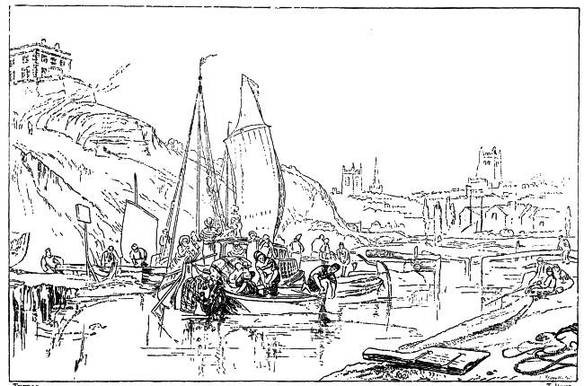
In the year 1833, an engraving of Nottingham, from a drawing by Turner, was published by Moon, Boys, and Graves, in the England and Wales series. Turner certainly made none of the drawings for that series long before they were wanted; and if, therefore, we suppose the drawing to have been made so much as three years before the publication of the plate, it will be setting the date of it as far back as is in the slightest degree probable. We may assume therefore (and the conclusion is sufficiently established, also, by the style of the execution), that there was an interval of at least thirty-five years between the making of those two drawings,—thirty-five years, in the course of which Turner had become, from an unpractised and feeble draughtsman, the most accomplished artist of his age, and had entirely changed his methods of work and his habits of feeling.
§ 20. On the page opposite to the etching of the first, I have given an etching of the last Nottingham. The one will be found to be merely the amplification and adornment of the other. Every incident is preserved; even the men employed about the log of wood are there, only now removed far away (beyond the lock on the right, between it and the town), and so lost in mist that, though made out by color in the drawing, they cannot be made clear in the outline etching. The canal bridge and even the stiff mast are both retained; only another boat is added, and the sail dropped upon the higher mast is hoisted on the lower one; and the castle, to get rid of its formality, is moved a little to the left, so as to hide one side. But, evidently, no new sketch has been made. The painter has returned affectionately to his boyish impression, and worked it out with his manly power.
Turner.
T. Boys.
23. Turner's Latest "Nottingham."
§ 21. How far this manly power itself acted merely in the accumulation of memories, remains, as I said, a question undetermined; but at all events, Turner's mind is not more, in my estimation, distinguished above others by its demonstrably arranging and ruling faculties, than by its demonstrably retentive and submissive faculties; and the longer I investigate it, the more this tenderness of perception and grasp of memory seem to me the root of its greatness. So that I am more and more convinced of what I had to state respecting the imagination, now many years ago, viz., that its true force lies in its marvellous insight and foresight—that it is, instead of a false and deceptive faculty, exactly the most accurate and truth-telling faculty which the human mind possesses; and all the more truth-telling, because, in its work, the vanity and individualism of the man himself are crushed, and he becomes a mere instrument or mirror, used by a higher power for the reflection to others of a truth which no effort of his could ever have ascertained; so that all mathematical, and arithmetical, and generally scientific truth, is, in comparison, truth of the husk and surface, hard and shallow; and only the imaginative truth is precious. Hence, whenever we want to know what are the chief facts of any case, it is better not to go to political economists, nor to mathematicians, but to the great poets; for I find they always see more of the matter than any one else: and in like manner those who want to know the real facts of the world's outside aspect, will find that they cannot trust maps, nor charts, nor any manner of mensuration; the most important facts being always quite immeasurable, and that (with only some occasional and trifling inconvenience, if they form too definite anticipations as to the position of a bridge here, or a road there) the Turnerian topography is the only one to be trusted.
§ 22. One or two important corollaries may be drawn from these principles, respecting the kind of fidelity which is to be exacted from men who have no imaginative power. It has been stated, over and over again, that it is not possible to draw the whole of nature, as in a mirror. Certain omissions must be made, and certain conventionalities admitted, in all art. Now it ought to be the instinctive affection of each painter which guides him to the omissions he is to make, or signs he is to use; and his choice of this or the other fact for representation, his insistence upon this or the other character in his subject, as that which to him is impressive, constitutes, when it is earnest and simple, part of the value of his work. This is the only inspiration he is capable of, but it is a kind of inspiration still; and although he may not have the memory or the associative power which would enable him to compose a subject in the Turnerian manner, he may have certain affections, perfectly expressible in his work, and of which he ought to allow the influence to be seen.11
§ 23. And this may especially be permitted in rapid sketching of effects or scenes which, either in their speedy passing away, or for want of time, it is impossible to draw faithfully. Generally, if leisure permit, the detailed drawing of the object will be grander than any "impression on the mind" of an unimaginative person; but if leisure do not permit, a rapid sketch, marking forcibly the points that strike him, may often have considerable interest in its way. The other day I sketched the towers of the Swiss Fribourg hastily from the Hôtel de Zahringen. It was a misty morning with broken sunshine, and the towers were seen by flickering light through broken clouds,—dark blue mist filling the hollow of the valley behind them. I have engraved the sketch on the opposite page, adding a few details, and exaggerating the exaggerations; for in drawing from nature, even at speed, I am not in the habit of exaggerating enough to illustrate what I mean. The next day, on a clear and calm forenoon, I daguerreotyped the towers, with the result given on the next plate (25 Fig. 2); and this unexaggerated statement, with its details properly painted, would not only be the more right, but infinitely the grander of the two. But the first sketch nevertheless conveys, in some respects, a truer idea of Fribourg than any other, and has, therefore, a certain use. For instance, the wall going up behind the main tower is seen in my drawing to bend very distinctly, following the different slopes of the hill. In the daguerreotype this bend is hardly perceptible. And yet the notablest thing in the town of Fribourg is, that all its walls have got flexible spines, and creep up and down the precipices more in the manner of cats than walls; and there is a general sense of height, strength and grace, about its belts of tower and rampart, which clings even to every separate and less graceful piece of them when seen on the spot; so that the hasty sketch, expressing this, has a certain veracity wanting altogether in the daguerreotype.
Nay, sometimes, even in the most accurate and finished topography, a slight exaggeration may be permitted; for many of the most important facts in nature are so subtle, that they must be slightly exaggerated, in order to be made noticeable when they are translated into the comparatively clumsy lines of even the best drawing,12 and removed from the associating circumstances which enhanced their influence, or directed attention to them, in nature.
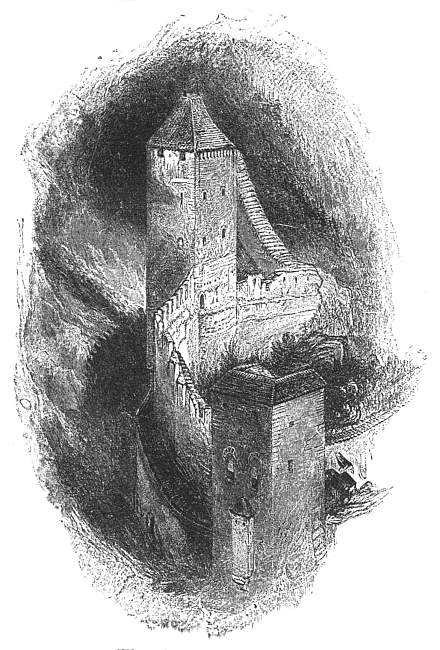
J. Ruskin.
J. C. Armytage.
24. The Towers of Fribourg.
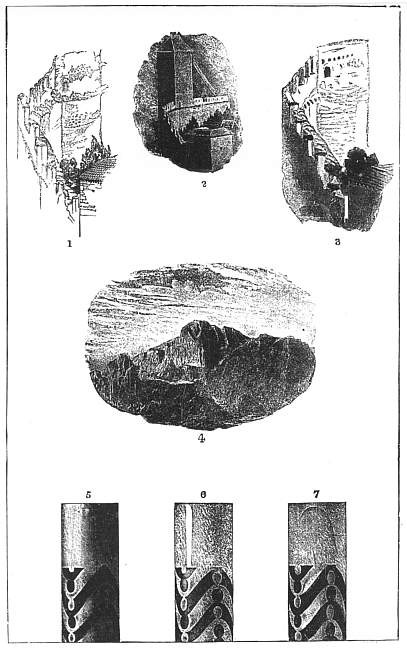
J. Ruskin.
J. H. Le Keux
25. Things in general.
§ 24. Still, in all these cases, the more unconscious the draughtsman is of the changes he is making, the better. Love will then do its own proper work; and the only true test of good or bad is, ultimately, strength of affection. For it does not matter with what wise purposes, or on what wise principles, the thing is drawn; if it be not drawn for love of it, it will never be right; and if it be drawn for love of it, it will never be wrong—love's misrepresentation being truer than the most mathematical presentation. And although all the reasonings about right and wrong, through which we have been led in this chapter, could never be brought to bear on the work at the moment of doing it, yet this test of right holds always;—if the artist is in any wise modifying or methodizing to exhibit himself and his dexterity, his work will, in that precise degree, be abortive; and if he is working with hearty love of the place, earnest desire to be faithful to it, and yet an open heart for every fancy that Heaven sends him, in that precise degree his work will be great and good.
8 Observe, what was said in the second volume respecting the spirit of choice as evil, refers only to young students, and to that choice which assumes that any common subject is not good enough, nor interesting enough, to be studied. But, though all is good for study, and all is beautiful, some is better than the rest for the help and pleasure of others; and this it is our duty always to choose, if we have opportunity, being quite happy with what is within our reach, if we have not.
9 "Couloir" is a good untranslateable Savoyard word, for a place down which stones and water fall in storms; it is perhaps deserving of naturalization.
10 I have just said, § 12, that if, quitting hold of this original impression, the artist tries to compose something prettier than he saw, it is all over with him; but, retaining the first impression, he will, nevertheless, if he has invention, instinctively modify many lines and parts of it—possibly all parts of it—for the better; sometimes making them individually more pictorial, sometimes preventing them from interfering with each other's beauty. For almost all natural landscapes are redundant treasures of more or less confused beauty, out of which the human instinct of invention can by just choice arrange, not a better treasure, but one more fitted to human sight and emotion, infinitely narrower, infinitely less lovely in detail, but having this great virtue, that there shall be absolutely nothing which does not contribute to the effect of the whole; whereas in the natural landscape there is a redundancy which impresses only as redundance, and often an occurrence of marring features; not of ugliness only, but of ugliness in the wrong place. Ugliness has its proper virtue and use; but ugliness occurring at the wrong time (as if the negro servant, instead of standing behind the king, in Tintoret's picture, were to thrust his head in front of the noble features of his master) is justly to be disliked and withdrawn.
"Why, this," exclaims the idealist, "is what I have always been saying, and you have always been denying." No; I never denied this. But I denied that painters in general, when they spoke of improving Nature, knew what Nature was. Observe: before they dare as much as to dream of arranging her, they must be able to paint her as she is; nor will the most skilful arrangement ever atone for the slightest wilful failure in truth of representation; and I am continually declaiming against arrangement, not because arrangement is wrong, but because our present painters have for the most part nothing to arrange. They cannot so much as paint a weed or a post accurately; and yet they pretend to improve the forests and mountains.
11 For instance, even in my topographical etching, Plate 20, I have given only a few lines of the thousands which existed in the scene. Those lines are what I considered the leading ones. Another person might have thought other lines the leading ones, and his representation might be equally true as far as it went; but which of our representations went furthest would depend on our relative degrees of knowledge and feeling about hills.
12 Or the best photograph. The question of the exact relation of value between photography and good topographical drawing, I hope to examine in another place.
10 I have just said, § 12, that if, quitting hold of this original impression, the artist tries to compose something prettier than he saw, it is all over with him; but, retaining the first impression, he will, nevertheless, if he has invention, instinctively modify many lines and parts of it—possibly all parts of it—for the better; sometimes making them individually more pictorial, sometimes preventing them from interfering with each other's beauty. For almost all natural landscapes are redundant treasures of more or less confused beauty, out of which the human instinct of invention can by just choice arrange, not a better treasure, but one more fitted to human sight and emotion, infinitely narrower, infinitely less lovely in detail, but having this great virtue, that there shall be absolutely nothing which does not contribute to the effect of the whole; whereas in the natural landscape there is a redundancy which impresses only as redundance, and often an occurrence of marring features; not of ugliness only, but of ugliness in the wrong place. Ugliness has its proper virtue and use; but ugliness occurring at the wrong time (as if the negro servant, instead of standing behind the king, in Tintoret's picture, were to thrust his head in front of the noble features of his master) is justly to be disliked and withdrawn.
11 For instance, even in my topographical etching, Plate 20, I have given only a few lines of the thousands which existed in the scene. Those lines are what I considered the leading ones. Another person might have thought other lines the leading ones, and his representation might be equally true as far as it went; but which of our representations went furthest would depend on our relative degrees of knowledge and feeling about hills.
12 Or the best photograph. The question of the exact relation of value between photography and good topographical drawing, I hope to examine in another place.
8 Observe, what was said in the second volume respecting the spirit of choice as evil, refers only to young students, and to that choice which assumes that any common subject is not good enough, nor interesting enough, to be studied. But, though all is good for study, and all is beautiful, some is better than the rest for the help and pleasure of others; and this it is our duty always to choose, if we have opportunity, being quite happy with what is within our reach, if we have not.
9 "Couloir" is a good untranslateable Savoyard word, for a place down which stones and water fall in storms; it is perhaps deserving of naturalization.
J. Ruskin.
J. H. Le Keux
25. Things in general.
CHAPTER III.
OF TURNERIAN LIGHT.
§ 1. Having in the preceding chapter seen the grounds on which to explain and justify Turner's choice of facts, we proceed to examine finally those modes of representing them introduced by him;—modes so utterly at variance with the received doctrines on the subject of art, as to cause his works to be regarded with contempt, or severe blame, by all reputed judges, at the period of their first appearance. And, chiefly, I must confirm and farther illustrate the general statements made respecting light and shade in the chapters on Truth of Tone,13 and on Infinity,14 deduced from the great fact (§ 5. chapter on Truth of Tone) that "nature surpasses us in power of obtaining light as much as the sun surpasses white paper." I found that this part of the book was not well understood, because people in general have no idea how much the sun does surpass white paper. In order to know this practically, let the reader take a piece of pure white drawing-paper, and place it in the position in which a drawing is usually seen. This is, properly, upright (all drawings being supposed to be made on vertical planes), as a picture is seen on a room wall. Also, the usual place in which paintings or drawings are seen is at some distance from a window, with a gentle side light falling upon them, front lights being unfavorable to nearly all drawing. Therefore the highest light an artist can ordinarily command for his work is that of white paint, or paper, under a gentle side light.15 But if we wished to get as much light as possible, and to place the artist under the most favorable circumstances, we should take the drawing near the window. Put therefore your white paper upright, and take it to the window. Let ac, cd, be two sides of your room, with a window at bb. Under ordinary circumstances your picture would be hung at e, or in some such position on the wall cd. First, therefore, put your paper upright at e, and then bring it gradually to the window, in the successive positions f, g, and (opening the window) finally at p. You will notice that as you come nearer the window the light gradually increases on the paper; so that in the position at p it is far better lighted than it was at e. If, however, the sun actually falls upon it at p, the experiment is unfair, for the picture is not meant to be seen in sunshine, and your object is to compare pure white paper, as ordinarily used, with sunshine. So either take a time when the sun does not shine at all, or does not shine in the window where the experiment is to be tried; or else keep the paper so far within the window that the sun may not touch it. Then the experiment is perfectly fair, and you will find that you have the paper at p in full, serene, pictorial light, of the best kind, and highest attainable power.
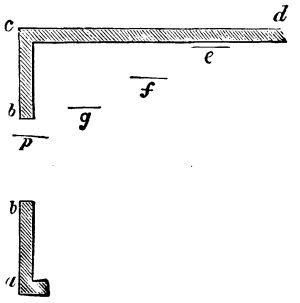
§ 2. Now, leaning a little over the window sill, bring the edge of the paper at p against the sky, rather low down on the horizon (I suppose you choose a fine day for the experiment, that the sun is high, and the sky clear blue, down to the horizon). The moment you bring your white paper against the sky you will be startled to find this bright white paper suddenly appear in shade. You will draw it back, thinking you have changed its position. But no; the paper is not in shade. It is as bright as ever it was; brighter than under ordinary circumstances it ever can be. But, behold, the blue sky of the horizon is far brighter. The one is indeed blue, and the other white, but the white is darkest,16 and by a great deal. And you will, though perhaps not for the first time in your life, perceive that though black is not easily proved to be white, white, may, under certain circumstances, be very nearly proved black, or at all events brown.
§ 3. When this fact is first show to them, the general feeling with most people is, that, by being brought against the sky, the white paper is somehow or other brought "into shade." But this is not so; the paper remains exactly as it was; it is only compared with an actually brighter hue, and looks darker by comparison. The circumstances are precisely like those which affect our sensations of heat and cold. If, when by chance we have one hand warm, and another cold, we feel, with each hand, water warmed to an intermediate degree, we shall first declare the water to be cold, and then to be warm; but the water has a definite heat wholly independent of our sensations, and accurately ascertainable by a thermometer. So it is with light and shade. Looking from the bright sky to the white paper, we affirm the white paper to be "in shade,"—that is, it produces on us a sensation of darkness, by comparison. But the hue of the paper, and that of the sky, are just as fixed as temperatures are; and the sky is actually a brighter thing than white paper, by a certain number of degrees of light, scientifically determinable. In the same way, every other color, or force of color, is a fixed thing, not dependent on sensation, but numerically representable with as much exactitude as a degree of heat by a thermometer. And of these hues, that of open sky is one not producible by human art. The sky is not blue color merely,—it is blue fire, and cannot be painted.
§ 4. Next, observe, this blue fire has in it white fire; that is, it has white clouds, as much brighter than itself as it is brighter than the white paper. So, then, above this azure light, we have another equally exalted step of white light. Supposing the value of the light of the pure white paper represented by the number 10, then that of the blue sky will be (approximately) about 20, and of the white clouds 30.
But look at the white clouds carefully, and it will be seen they are not all of the same white; parts of them are quite grey compared with other parts, and they are as full of passages of light and shade as if they were of solid earth. Nevertheless, their most deeply shaded part is that already so much lighter than the blue sky, which has brought us up to our number 30, and all these high lights of white are some 10 degrees above that, or, to white paper, as 40 to 10. And now if you look from the blue sky and white clouds towards the sun, you will find that this cloud white, which is four times as white as white paper, is quite dark and lightless compared with those silver clouds that burn nearer the sun itself, which you cannot gaze upon,—an infinite of brightness. How will you estimate that?
And yet to express all this, we have but our poor white paper after all. We must not talk too proudly of our "truths" of art; I am afraid we shall have to let a good deal of black fallacy into it, at the best.
§ 5. Well, of the sun, and of the silver clouds, we will not talk for the present. But this principal fact we have learned by our experiment with the white paper, that, taken all in all, the calm sky, with such light and shade as are in it, is brighter than the earth; brighter than the whitest thing on earth which has not, at the moment of comparison, heaven's own direct light on it. Which fact it is generally one of the first objects of noble painters to render. I have already marked one part of their aim in doing so, namely, the expression of infinity; but the opposing of heavenly light to earth-darkness is another most important one; and of all ways of rendering a picture generally impressive (see especially § 12. of the chapter just referred to), this is the simplest and surest. Make the sky calm and luminous, and raise against it dark trees, mountains, or towers, or any other substantial and terrestrial thing, in bold outline, and the mind accepts the assertion of this great and solemn truth with thankfulness.
§ 6. But this may be done either nobly or basely, as any other solemn truth may be asserted. It may be spoken with true feeling of all that it means; or it may be declared, as a Turk declares that "God is great," when he means only that he himself is lazy. The "heaven is bright," of many vulgar painters, has precisely the same amount of signification; it means that they know nothing—will do nothing—are without thought—without care—without passion. They will not walk the earth, nor watch the ways of it, nor gather the flowers of it. They will sit in the shade, and only assert that very perceptible, long-ascertained fact, "heaven is bright." And as it may be asserted basely, so it may be accepted basely. Many of our capacities for receiving noblest emotion are abused, in mere idleness, for pleasure's sake, and people take the excitement of a solemn sensation as they do that of a strong drink. Thus the abandoned court of Louis XIV. had on fast days its sacred concerts, doubtless entering in some degree into the religious expression of the music, and thus idle and frivolous women at the present day will weep at an oratorio. So the sublimest effects of landscape may be sought through mere indolence; and even those who are not ignorant, or dull, judge often erroneously of such effects of art, because their very openness to all pleasant and sacred association instantly colors whatever they see, so that, give them but the feeblest shadow of a thing they love, they are instantly touched by it to the heart, and mistake their own pleasurable feeling for the result of the painter's power. Thus when, by spotting and splashing, such a painter as Constable reminds them somewhat of wet grass and green leaves, forthwith they fancy themselves in all the happiness of a meadow walk; and when Gaspar Poussin throws out his yellow horizon with black hills, forthwith they are touched as by the solemnity of a real Italian twilight, altogether forgetting that wet grass and twilight do not constitute the universe; and prevented by their joy at being pleasantly cool, or gravely warm, from seeking any of those more precious truths which cannot be caught by momentary sensation, but must be thoughtfully pursued.
§ 7. I say "more precious," for the simple fact that the sky is brighter than the earth is not a precious truth unless the earth itself be first understood. Despise the earth, or slander it; fix your eyes on its gloom, and forget its loveliness; and we do not thank you for your languid or despairing perception of brightness in heaven. But rise up actively on the earth,—learn what there is in it, know its color and form, and the full measure and make of it, and if after that you can say "heaven is bright," it will be a precious truth, but not till then. Giovanni Bellini knows the earth well, paints it to the full, and to the smallest fig-leaf and falling flower,—blue hill and white-walled city,—glittering robe and golden hair; to each he will give its lustre and loveliness; and then, so far as with his poor human lips he may declare it, far beyond all these, he proclaims that "heaven is bright." But Gaspar, and such other landscapists, painting all Nature's flowery ground as one barrenness, and all her fair foliage as one blackness, and all her exquisite forms as one bluntness; when, in this sluggard gloom and sullen treachery of heart, they mutter their miserable attestation to what others had long ago discerned for them,—the sky's brightness,—we do not thank them; or thank them only in so far as, even in uttering this last remnant of truth, they are more commendable than those who have sunk from apathy to atheism, and declare, in their dark and hopeless backgrounds, that heaven is NOT bright.
§ 8. Let us next ascertain what are the colors of the earth itself.
A mountain five or six miles off, in a sunny summer morning in Switzerland, will commonly present itself in some such pitch of dark force, as related to the sky, as that shown in Fig. 4. Plate 25, while the sky itself will still, if there are white clouds in it, tell as a clear dark, throwing out those white clouds in vigorous relief of light; yet, conduct the experiment of the white paper as already described, and you will, in all probability, find that the darkest part of the mountain—its most vigorous nook of almost black-looking shadow—is whiter than the paper.
The figure given represents the apparent color17 of the top of the Aiguille Bouchard (the mountain which is seen from the village of Chamouni, on the other side of the Glacier des Bois), distant, by Forbes's map, a furlong or two less than four miles in a direct line from the point of observation. The observation was made on a warm sunny morning, about eleven o'clock, the sky clear blue; the mountain seen against it, its shadows grey purple, and its sunlit parts greenish. Then the darkest part of the mountain was lighter than pure white paper, held upright in full light at the window, parallel to the direction in which the light entered. And it will thus generally be found impossible to represent, in any of its true colors, scenery distant more than two or three miles, in full daylight. The deepest shadows are whiter than white paper.
§ 9. As, however, we pass to nearer objects, true representation gradually becomes possible;—to what degree is always of course ascertainable accurately by the same mode of experiment. Bring the edge of the paper against the thing to be drawn, and on that edge—as precisely as a lady would match the colors of two pieces of a dress—match the color of the landscape (with a little opaque white mixed in the tints you use, so as to render it easy to lighten or darken them). Take care not to imitate the tint as you believe it to be, but accurately as it is; so that the colored edge of the paper shall not be discernible from the color of the landscape. You will then find (if before inexperienced) that shadows of trees, which you thought were dark green or black, are pale violets and purples; that lights, which you thought were green, are intensely yellow, brown, or golden, and most of them far too bright to be matched at all. When you have got all the imitable hues truly matched, sketch the masses of the landscape out completely in those true and ascertained colors; and you will find, to your amazement, that you have painted it in the colors of Turner,—in those very colors which perhaps you have been laughing at all your life,—the fact being that he, and he alone, of all men, ever painted Nature in her own colors.
§ 10. "Well, but," you will answer, impatiently, "how is it, if they are the true colors, that they look so unnatural?"
Because they are not shown in true contrast to the sky, and to other high lights. Nature paints her shadows in pale purple, and then raises her lights of heaven and sunshine to such height that the pale purple becomes, by comparison, a vigorous dark. But poor Turner has no sun at his command to oppose his pale colors. He follows Nature submissively as far as he can; puts pale purple where she does, bright gold where she does; and then when, on the summit of the slope of light, she opens her wings and quits the earth altogether, burning into ineffable sunshine, what can he do but sit helpless, stretching his hands towards her in calm consent, as she leaves him and mocks at him!
§ 11. "Well," but you will farther ask, "is this right or wise? ought not the contrast between the masses be given, rather than the actual hues of a few parts of them, when the others are inimitable?"
Yes, if this were possible, it ought to be done; but the true contrasts can NEVER be given. The whole question is simply whether you will be false at one side of the scale or at the other,—that is, whether you will lose yourself in light or in darkness. This necessity is easily expressible in numbers. Suppose the utmost light you wish to imitate is that of serene, feebly lighted, clouds in ordinary sky (not sun or stars, which it is, of course, impossible deceptively to imitate in painting by any artifice). Then, suppose the degrees of shadow between those clouds and Nature's utmost darkness accurately measured, and divided into a hundred degrees (darkness being zero). Next we measure our own scale, calling our utmost possible black, zero;18 and we shall be able to keep parallel with Nature, perhaps up to as far as her 40 degrees; all above that being whiter than our white paper. Well, with our power of contrast between zero and 40, we have to imitate her contrasts between zero and 100. Now, if we want true contrasts, we can first set our 40 to represent her 100, our 20 for her 80, and our zero for her 60; everything below her 60 being lost in blackness. This is, with certain modifications, Rembrandt's system. Or, secondly, we can put zero for her zero, 20 for her 20, and 40 for her 40; everything above 40 being lost in whiteness. This is, with certain modifications, Paul Veronese's system. Or, finally, we can put our zero for her zero, and our 40 for her 100; our 20 for her 50, our 30 for her 75, and our ten for her 25, proportioning the intermediate contrasts accordingly. This is, with certain modifications, Turner's system;19 the modifications, in each case, being the adoption, to a certain extent, of either of the other systems. Thus, Turner inclines to Paul Veronese; liking, as far as possible, to get his hues perfectly true up to a certain point,—that is to say, to let his zero stand for Nature's zero, and his 10 for her 10, and his 20 for her 20, and then to expand towards the light by quick but cunning steps, putting 27 for 50, 30 for 70, and reserving some force still for the last 90 to 100. So Rembrandt modifies his system on the other side, putting his 40 for 100, his 30 for 90, his 20 for 80; then going subtly downwards, 10 for 50, 5 for 30; nearly everything between 30 and zero being lost in gloom, yet so as still to reserve his zero for zero. The systems expressed in tabular form will stand thus:—
Nature.
Rembrandt.
Turner.
Veronese.
0
0
0
0
10
1
10
10
20
3
20
20
30
5
24
30
40
7
26
32
50
10
27
34
60
13
28
36
70
17
30
37
80
20
32
38
90
30
36
39
100
40
40
40
§ 12. Now it is evident that in Rembrandt's system, while the contrasts are not more right than with Veronese, the colors are all wrong, from beginning to end. With Turner and Veronese, Nature's 10 is their 10, and Nature's 20 their 20; enabling them to give pure truth up to a certain point. But with Rembrandt not one color is absolutely true, from one side of the scale to the other; only the contrasts are true at the top of the scale. Of course, this supposes Rembrandt's system applied to a subject which shall try it to the utmost, such as landscape. Rembrandt generally chose subjects in which the real colors were very nearly imitable,—as single heads with dark backgrounds, in which Nature's highest light was little above his own; her 40 being then truly representable by his 40, his picture became nearly an absolute truth. But his system is only right when applied to such subjects: clearly, when we have the full scale of natural light to deal with, Turner's and Veronese's convey the greatest sum of truth. But not the most complete deception, for people are so much more easily and instinctively impressed by force of light than truth of color, that they instantly miss the relative power of the sky, and the upper tones; and all the true local coloring looks strange to them, separated from its adjuncts of high light; whereas, give them the true contrast of light, and they will not observe the false local color. Thus all Gaspar Poussin's and Salvator's pictures, and all effects obtained by leaving high lights in the midst of exaggerated darkness, catch the eye, and are received for true, while the pure truth of Veronese and Turner is rejected as unnatural; only not so much in Veronese's case as in Turner's, because Veronese confines himself to more imitable things, as draperies, figures, and architecture, in which his exquisite truth at the bottom of the scale tells on the eye at once; but Turner works a good deal also (see the table) at the top of the natural scale, dealing with effects of sunlight and other phases of the upper colors, more or less inimitable, and betraying therefore, more or less, the artifices used to express them. It will be observed, also, that in order to reserve some force for the top of his scale, Turner is obliged to miss his gradations chiefly in middle tints (see the table), where the feebleness is sure to be felt. His principal point for missing the midmost gradations is almost always between the earth and sky; he draws the earth truly as far as he can, to the horizon; then the sky as far as he can, with his 30 to 40 part of the scale. They run together at the horizon; and the spectator complains that there is no distinction between earth and sky, or that the earth does not look solid enough.
§ 13. In the upper portions of the three pillars 5, 6, 7, Plate 25, are typically represented these three conditions of light and shade, characteristic, 5, of Rembrandt, 6, of Turner, and 7, of Veronese. The pillar to be drawn is supposed, in all the three cases, white; Rembrandt represents it as white on its highest light; and, getting the true gradations between this highest light and extreme dark, is reduced to his zero, or black, for the dark side of the white object. This first pillar also represents the system of Leonardo da Vinci. In the room of the Louvre appropriated to Italian drawings is a study of a piece of drapery by Leonardo. Its lights are touched with the finest white chalk, and its shadows wrought, through exquisite gradations, to utter blackness. The pillar 6 is drawn on the system of Turner; the high point of light is still distinct: but even the darkest part of the shaft is kept pale, and the gradations which give the roundness are wrought out with the utmost possible delicacy. The third shaft is drawn on Veronese's system. The light, though still focused, is more diffused than with Turner; and a slight flatness results from the determination that the fact of the shaft's being white shall be discerned more clearly even than that it is round; and that its darkest part shall still be capable of brilliant relief, as a white mass, from other objects round it.
§ 14. This resolution, on Veronese's part, is owing to the profound respect for the colors of objects which necessarily influenced him, as the colorist at once the most brilliant and the most tender of all painters of the elder schools; and it is necessary for us briefly to note the way in which this greater or less respect for local color influences the system of the three painters in light and shade.
Take the whitest piece of note-paper you can find, put a blot of ink upon it, carry it into the sunshine, and hold it fully fronting the sunshine, so as to make the paper look as dazzling as possible, but not to let the wet blot of ink shine. You will then find the ink look intensely black,—blacker, in fact, than any where else, owing to its vigorous contrast with the dazzling paper.
Remove the paper from the sunshine. The ink will not look so black. Carry the paper gradually into the darkest part of the room, and the contrast will as gradually appear to diminish; and, of course, in darkness, the distinction between the black and the white vanishes. Wet ink is as perfect a representative as is by any means attainable of a perfectly dark color; that is, of one which absorbs all the light that falls on it; and the nature of such a color is best understood by considering it as a piece of portable night. Now, of course, the higher you raise the daylight about this bit of night, the more vigorous is the contrast between the two. And, therefore, as a general rule, the higher you raise the light on any object with a pattern or stain upon it, the more distinctly that pattern or stain is seen. But observe: the distinction between the full black of ink, and full white of paper, is the utmost reach of light and dark possible to art. Therefore, if this contrast is to be represented truly, no deeper black can ever be given in any shadow than that offered at once; as local color, in a full black pattern, on the highest light. And, where color is the principal object of the picture, that color must, at all events, be as right as possible where it is best seen, i.e. in the lights. Hence the principle of Paul Veronese, and of all the great Venetian colorists, is to use full black for full black in high light, letting the shadow shift for itself as best it may; and sometimes even putting the local black a little darker in light than shadow, in order to give the more vigorous contrast noted above. Let the pillars in Plate 25 be supposed to have a black mosaic pattern on the lower part of their shafts. Paul Veronese's general practice will be, as at 7, having marked the rounding of the shaft as well as he can in the white parts, to paint the pattern with one even black over all, reinforcing it, if at all, a little in the light.
§ 15. Repeat the experiment on the note-paper with a red spot of carmine instead of ink. You will now find that the contrast in the sunshine appears about the same as in the shade—the red and white rising and falling together, and dying away together into the darkness. The fact, however, is, that the contrast does actually for some time increase towards the light; for in utter darkness the distinction is not visible—the red cannot be distinguished from the white; admit a little light, and the contrast is feebly discernible; admit more, it is distinctly discernible. But you cannot increase the contrast beyond a certain point. From that point the red and white for some time rise very nearly equally in light, or fall together very nearly equally in shade; but the contrast will begin to diminish in very high lights, for strong sunlight has a tendency to exhibit particles of dust, or any sparkling texture in the local color, and then to diminish its power; so that in order to see local color well, a certain degree of shadow is necessary: for instance, a very delicate complexion is not well seen in the sun; and the veins of a marble pillar, or the colors of a picture, can only be properly seen in comparative shade.
§ 16. I will not entangle the reader in the very subtle and curious variations of the laws in this matter. The simple fact which is necessary for him to observe is, that the paler and purer the color, the more the great Venetian colorists will reinforce it in the shadow, and allow it to fall or rise in sympathy with the light; and those especially whose object it is to represent sunshine, nearly always reinforce their local colors somewhat in the shadows, and keep them both fainter and feebler in the light, so that they thus approach a condition of universal glow, the full color being used for the shadow, and a delicate and somewhat subdued hue of it for the light. And this to the eye is the loveliest possible condition of color. Perhaps few people have ever asked themselves why they admire a rose so much more than all other flowers. If they consider, they will find, first, that red is, in a delicately gradated state, the loveliest of all pure colors; and secondly, that in the rose there is no shadow, except what is composed of color. All its shadows are fuller in color than its lights, owing to the translucency and reflective power of its leaves.
The second shaft, 6, in which the local color is paler towards the light, and reinforced in the shadow, will therefore represent the Venetian system with respect to paler colors, and the system, for the most part, even with respect to darker colors, of painters who attempt to render effects of strong sunlight. Generally, therefore, it represents the practice of Turner. The first shaft, 5, exhibits the disadvantage of the practice of Rembrandt and Leonardo, in that they cannot show the local color on the dark side, since, however energetic, it must at last sink into their exaggerated darkness.
§ 17. Now, from all the preceding inquiry, the reader must perceive more and more distinctly the great truth, that all forms of right art consist in a certain choice made between various classes of truths, a few only being represented, and others necessarily excluded; and that the excellence of each style depends first on its consistency with itself,—the perfect fidelity, as far as possible, to the truths it has chosen; and secondly, on the breadth of its harmony, or number of truths it has been able to reconcile, and the consciousness with which the truths refused are acknowledged, even though they may not be represented. A great artist is just like a wise and hospitable man with a small house: the large companies of truths, like guests, are waiting his invitation; he wisely chooses from among this crowd the guests who will be happiest with each other, making those whom he receives thoroughly comfortable, and kindly remembering even those whom he excludes; while the foolish host, trying to receive all, leaves a large part of his company on the staircase, without even knowing who is there, and destroys, by inconsistent fellowship, the pleasure of those who gain entrance.
§ 18. But even those hosts who choose well will be farther distinguished from each other by their choice of nobler or inferior companies; and we find the greatest artists mainly divided into two groups,—those who paint principally with respect to local color, headed by Paul Veronese, Titian, and Turner; and those who paint principally with reference to light and shade irrespective of color, headed by Leonardo da Vinci, Rembrandt, and Raphael. The noblest members of each of these classes introduce the element proper to the other class, in a subordinate way. Paul Veronese introduces a subordinate light and shade, and Leonardo introduces a subordinate local color. The main difference is, that with Leonardo, Rembrandt, and Raphael, vast masses of the picture are lost in comparatively colorless (dark, grey, or brown) shadow; these painters beginning with the lights, and going down to blackness; but with Veronese, Titian, and Turner, the whole picture is like the rose,—glowing with color in the shadows, and rising into paler and more delicate hues, or masses of whiteness, in the lights; they having begun with the shadows, and gone up to whiteness.
§ 19. The colorists have in this respect one disadvantage, and three advantages. The disadvantage is, that between their less violent hues, it is not possible to draw all the forms which can be represented by the exaggerated shadow of the chiaroscurists, and therefore a slight tendency to flatness is always characteristic of the greater colorists, as opposed to Leonardo or Rembrandt. When the form of some single object is to be given, and its subtleties are to be rendered to the utmost, the Leonardesque manner of drawing is often very noble. It is generally adopted by Albert Durer in his engravings, and is very useful, when employed by a thorough master, in many kinds of engraving;20 but it is an utterly false method of study, as we shall see presently.
§ 20. Of the three advantages possessed by the colorists over the chiaroscurists, the first is, that they have in the greater portions of their pictures absolute truth, as shown above, § 12, while the chiaroscurists have no absolute truth anywhere. With the colorists the shadows are right; the lights untrue: but with the chiaroscurists lights and shadows are both untrue. The second advantage is, that also the relations of color are broader and vaster with the colorists than the chiaroscurists. Take, for example, that piece of drapery studied by Leonardo, in the Louvre, with white lights and black shadows. Ask yourself, first, whether the real drapery was black or white. If white, then its high lights are rightly white; but its folds being black, it could not as a mass be distinguished from the black or dark objects in its neighborhood. But the fact is, that a white cloth or handkerchief always is distinguished in daylight, as a whole white thing, from all that is colored about it: we see at once that there is a white piece of stuff, and a red, or green, or grey one near it, as the case may be: and this relation of the white object to other objects not white, Leonardo has wholly deprived himself of the power of expressing; while, if the cloth were black or dark, much more has he erred by making its lights white. In either case, he has missed the large relation of mass to mass, for the sake of the small one of fold to fold. And this is more or less the case with all chiaroscurists; with all painters, that is to say, who endeavor in their studies of objects to get rid of the idea of color, and give the abstract shade. They invariably exaggerate the shadows, not with respect to the thing itself, but with respect to all around it; and they exaggerate the lights also, by leaving pure white for the high light of what in reality is grey, rose-colored, or, in some way, not white.
§ 21. This method of study, being peculiarly characteristic of the Roman and Florentine schools, and associated with very accurate knowledge of form and expression, has gradually got to be thought by a large body of artists the grand way of study; an idea which has been fostered all the more because it was an unnatural way, and therefore thought to be a philosophical one. Almost the first idea of a child, or of a simple person looking at anything, is, that it is a red, or a black, or a green, or a white thing. Nay, say the artists; that is an unphilosophical and barbarous view of the matter. Red and white are mere vulgar appearances; look farther into the matter, and you will see such and such wonderful other appearances. Abstract those, they are the heroic, epic, historic, and generally eligible appearances. And acting on this grand principle, they draw flesh white, leaves white, ground white, everything white in the light, and everything black in the shade—and think themselves wise. But, the longer I live, the more ground I see to hold in high honor a certain sort of childishness or innocent susceptibility. Generally speaking, I find that when we first look at a subject, we get a glimpse of some of the greatest truths about it: as we look longer, our vanity, and false reasoning, and half-knowledge, lead us into various wrong opinions; but as we look longer still, we gradually return to our first impressions, only with a full understanding of their mystical and innermost reasons; and of much beyond and beside them, not then known to us, now added (partly as a foundation, partly as a corollary) to what at first we felt or saw. It is thus eminently in this matter of color. Lay your hand over the page of this book,—any child or simple person looking at the hand and book, would perceive, as the main fact of the matter, that a brownish pink thing was laid over a white one. The grand artist comes and tells you that your hand is not pink, and your paper is not white. He shades your fingers and shades your book, and makes you see all manner of starting veins, and projecting muscles, and black hollows, where before you saw nothing but paper and fingers. But go a little farther, and you will get more innocent again; you will find that, when "science has done its worst, two and two still make four;" and that the main and most important facts about your hand, so seen, are, after all, that it has four fingers and a thumb—showing as brownish pink things on white paper.
§ 22. I have also been more and more convinced, the more I think of it, that in general pride is at the bottom of all great mistakes. All the other passions do occasional good, but whenever pride puts in its word, everything goes wrong, and what it might really be desirable to do, quietly and innocently, it is mortally dangerous to do, proudly. Thus, while it is very often good for the artist to make studies of things, for the sake of knowing their forms, with their high lights all white, the moment he does this in a haughty way, and thinks himself drawing in the great style, because he leaves high lights white, it is all over with him; and half the degradation of art in modern times has been owing to endeavors, much fostered by the metaphysical Germans, to see things without color, as if color were a vulgar thing, the result being, in most students, that they end by not being able to see anything at all; whereas the true and perfect way of studying any object is simply to look what its color is in high light, and put that safely down, if possible; or, if you are making a chiaroscuro study, to take the grey answering to that color, and cover the whole object at once with that grey, firmly resolving that no part of it shall be brighter than that; then look for the darkest part of it, and if, as is probable, its darkest part be still a great deal lighter than black, or than other things about it, assume a given shade, as dark as, with due reference to other things, you can have it, but no darker. Mark that for your extreme dark on the object, and between those limits get as much drawing as you can, by subtlety of gradation. That will tax your powers of drawing indeed; and you will find this, which seems a childish and simple way of going to work, requires verily a thousandfold more power to carry out than all the pseudo-scientific abstractions that ever were invented.
§ 23. Nor can it long be doubted that it is also the most impressive way to others; for the third great advantage possessed by the colorists is, that the delightfulness of their picture, its sacredness, and general nobleness, are increased exactly in proportion to the quantity of light and of lovely color they can introduce in the shadows, as opposed to the black and grey of the chiaroscurists. I have already, in the Stones of Venice, vol. ii. chap. v., insisted upon the fact of the sacredness of color, and its necessary connection with all pure and noble feeling. What we have seen of the use of color by the poets will help to confirm this truth; but perhaps I have not yet enough insisted on the simplest and readiest to hand of all proofs,—the way, namely, in which God has employed color in His creation as the unvarying accompaniment of all that is purest, most innocent, and most precious; while for things precious only in material uses, or dangerous, common colors are reserved. Consider for a little while what sort of a world it would be if all flowers were grey, all leaves black, and the sky brown. Imagine that, as completely as may be, and consider whether you would think the world any whit more sacred for being thus transfigured into the hues of the shadows in Raphael's Transfiguration. Then observe how constantly innocent things are bright in color; look at a dove's neck, and compare it with the grey back of a viper; I have often heard talk of brilliantly colored serpents; and I suppose there are such,—as there are gay poisons, like the foxglove and kalmia—types of deceit; but all the venomous serpents I have really seen are grey, brick-red, or brown, variously mottled; and the most awful serpent I have seen, the Egyptian asp, is precisely of the color of gravel, or only a little greyer. So, again, the crocodile and alligator are grey, but the innocent lizard green and beautiful. I do not mean that the rule is invariable, otherwise it would be more convincing than the lessons of the natural universe are intended ever to be; there are beautiful colors on the leopard and tiger, and in the berries of the night-shade; and there is nothing very notable in brilliancy of color either in sheep or cattle (though, by the way, the velvet of a brown bull's hide in the sun, or the tawny white of the Italian oxen, is, to my mind, lovelier than any leopard's or tiger's skin); but take a wider view of nature, and compare generally rainbows, sunrises, roses, violets, butterflies, birds, gold-fish, rubies, opals, and corals, with alligators, hippopotami, lions, wolves, bears, swine, sharks, slugs, bones, fungi,21 frogs, and corrupting, stinging, destroying things in general, and you will feel then how the question stands between the colorists and chiaroscurists,—which of them have nature and life on their side, and which have sin and death.
§ 24. Finally: the ascertainment of the sanctity of color is not left to human sagacity. It is distinctly stated in Scripture. I have before alluded to the sacred chord of color (blue, purple, and scarlet, with white and gold) as appointed in the Tabernacle; this chord is the fixed base of all coloring with the workmen of every great age; the purple and scarlet will be found constantly employed by noble painters, in various unison, to the exclusion in general of pure crimson;—it is the harmony described by Herodotus as used in the battlements of Ecbatana, and the invariable base of all beautiful missal-painting; the mistake continually made by modern restorers, in supposing the purple to be a faded crimson, and substituting full crimson for it, being instantly fatal to the whole work, as, indeed, the slightest modification of any hue in a perfect color-harmony must always be.22 In this chord the scarlet is the powerful color, and is on the whole the most perfect representation of abstract color which exists; blue being in a certain degree associated with shade, yellow with light, and scarlet, as absolute color, standing alone. Accordingly, we find it used, together with cedar wood, hyssop, and running water, as an emblem of purification, in Leviticus xiv. 4, and other places, and so used not merely as the representative of the color of blood, since it was also to be dipped in the actual blood of a living bird. So that the cedar wood for its perfume, the hyssop for its searchingness, the water for its cleansing, and the scarlet for its kindling or enlightening, are all used as tokens of sanctification;23 and it cannot be with any force alleged, in opposition to this definite appointment, that scarlet is used incidentally to illustrate the stain of sin,—"though thy sins be as scarlet,"—any more than it could be received as a diminution of the authority for using snow-whiteness as a type of purity, that Gehazi's leprosy is described as being as "white as snow." An incidental image has no authoritative meaning, but a stated ceremonial appointment has; besides, we have the reversed image given distinctly in Prov. xxxi.: "She is not afraid of the snow for her household, for all her household are clothed with scarlet." And, again: "Ye daughters of Israel, weep over Saul, who clothed you in scarlet, with other delights." So, also, the arraying of the mystic Babylon in purple and scarlet may be interpreted exactly as we choose; either, by those who think color sensual, as an image of earthly pomp and guilt, or, by those who think it sacred, as an image of assumed or pretended sanctity. It is possible the two meanings may be blended, and the idea may be that the purple and fine linen of Dives are worn in hypocritical semblance of the purple and fine linen of the high priest, being, nevertheless, themselves, in all cases typical of all beauty and purity. I hope, however, to be able some day to enter farther into these questions with respect to the art of illumination; meantime, the facts bearing on our immediate subject may be briefly recapitulated. All men, completely organized and justly tempered, enjoy color; it is meant for the perpetual comfort and delight of the human heart; it is richly bestowed on the highest works of creation, and the eminent sign and seal of perfection in them; being associated with life in the human body, with light in the sky, with purity and hardness in the earth,—death, night, and pollution of all kinds being colorless. And although if form and color be brought into complete opposition,24 so that it should be put to us as a matter of stern choice whether we should have a work of art all of form, without color (as an Albert Durer's engraving), or all of color, without form (as an imitation of mother-of-pearl), form is beyond all comparison the more precious of the two; and in explaining the essence of objects, form is essential, and color more or less accidental (compare Chap. v. of the first section of Vol. I.); yet if color be introduced at all, it is necessary that, whatever else may be wrong, that should be right; just as, though the music of a song may not be so essential to its influence as the meaning of the words, yet if the music be given at all, it must be right, or its discord will spoil the words; and it would be better, of the two, that the words should be indistinct, than the notes false. Hence, as I have said elsewhere, the business of a painter is to paint. If he can color, he is a painter, though he can do nothing else; if he cannot color, he is no painter, though he may do everything else. But it is, in fact, impossible, if he can color, but that he should be able to do more; for a faithful study of color will always give power over form, though the most intense study of form will give no power over color. The man who can see all the greys, and reds, and purples in a peach, will paint the peach rightly round, and rightly altogether; but the man who has only studied its roundness, may not see its purples and greys, and if he does not, will never get it to look like a peach; so that great power over color is always a sign of large general art-intellect. Expression of the most subtle kind can be often reached by the slight studies of caricaturists;25 sometimes elaborated by the toil of the dull, and sometimes by the sentiment of the feeble, but to color well requires real talent and earnest study, and to color perfectly is the rarest and most precious power an artist can possess. Every other gift may be erroneously cultivated, but this will guide to all healthy, natural, and forcible truth; the student may be led into folly by philosophers, and into falsehood by purists; but he is always safe if he holds the hand of a colorist.
16 For which reason, I said in the Appendix to the third volume, that the expression "finite realization of infinity" was a considerably less rational one than "black realization of white."
17 The color, but not the form. I wanted the contour of the top of the Breven for reference in another place, and have therefore given it instead of that of the Bouchard, but in the proper depth of tint.
18 Even here we shall be defeated by Nature, her utmost darkness being deeper than ours. See Part II. Sec. II. Chap. I. § 4-7. etc.
19 When the clouds are brilliantly lighted, it may rather be, as stated in § 4. above, in the proportion of 160 to 40. I take the number 100 as more calculable.
20 It is often extremely difficult to distinguish properly between the Leonardesque manner, in which local color is denied altogether, and the Turneresque, in which local color at its highest point in the picture is merged in whiteness. Thus, Albert Durer's noble "Melancholia" is entirely Leonardesque; the leaves on her head, her flesh, her wings, her dress, the wolf, the wooden ball, and the rainbow, being all equally white on the high lights. But my drawing of leaves, facing page 120, Vol. III., is Turneresque; because, though I leave pure white to represent the pale green of leaves and grass in high light, I give definite increase of darkness to four of the bramble leaves, which, in reality, were purple, and leave a dark withered stalk nearly black, though it is in light, where it crosses the leaf in the centre. These distinctions could only be properly explained by a lengthy series of examples; which I hope to give some day or other, but have not space for here.
21 It is notable, however, that nearly all the poisonous agarics are scarlet or speckled, and wholesome ones brown or gray, as if to show us that things rising out of darkness and decay are always most deadly when they are well drest.
22 Hence the intense absurdity of endeavoring to "restore" the color of ancient buildings by the hands of ignorant colorists, as at the Crystal Palace.
23 The redeemed Rahab bound for a sign a scarlet thread in the window. Compare Canticles iv. 3.
24 The inconsistency between perfections of color and form, which I have had to insist upon in other places, is exactly like that between articulation and harmony. We cannot have the richest harmony with the sharpest and most audible articulation of words: yet good singers will articulate clearly: and the perfect study of the science of music will conduct to a fine articulation; but the study of pronunciation will not conduct to, nor involve, that of harmony. So, also, though, as said farther on, subtle expression can be got without color, perfect expression never can; for the color of the face is a part of its expression. How often has that scene between Francesca di Rimini and her lover been vainly attempted by sculptors, simply because they did not observe that the main note of expression in it was in the fair sheet-lightning—fading and flaming through the cloud of passion!
25 See Appendix 1. Modern Grotesque.
13 Part II. Sec. II. Chap I.
14 Part III. Sec. I. Chap. V.
15 Light from above is the same thing with reference to our present inquiry.
13 Part II. Sec. II. Chap I.
14 Part III. Sec. I. Chap. V.
15 Light from above is the same thing with reference to our present inquiry.
16 For which reason, I said in the Appendix to the third volume, that the expression "finite realization of infinity" was a considerably less rational one than "black realization of white."
17 The color, but not the form. I wanted the contour of the top of the Breven for reference in another place, and have therefore given it instead of that of the Bouchard, but in the proper depth of tint.
18 Even here we shall be defeated by Nature, her utmost darkness being deeper than ours. See Part II. Sec. II. Chap. I. § 4-7. etc.
19 When the clouds are brilliantly lighted, it may rather be, as stated in § 4. above, in the proportion of 160 to 40. I take the number 100 as more calculable.
20 It is often extremely difficult to distinguish properly between the Leonardesque manner, in which local color is denied altogether, and the Turneresque, in which local color at its highest point in the picture is merged in whiteness. Thus, Albert Durer's noble "Melancholia" is entirely Leonardesque; the leaves on her head, her flesh, her wings, her dress, the wolf, the wooden ball, and the rainbow, being all equally white on the high lights. But my drawing of leaves, facing page 120, Vol. III., is Turneresque; because, though I leave pure white to represent the pale green of leaves and grass in high light, I give definite increase of darkness to four of the bramble leaves, which, in reality, were purple, and leave a dark withered stalk nearly black, though it is in light, where it crosses the leaf in the centre. These distinctions could only be properly explained by a lengthy series of examples; which I hope to give some day or other, but have not space for here.
21 It is notable, however, that nearly all the poisonous agarics are scarlet or speckled, and wholesome ones brown or gray, as if to show us that things rising out of darkness and decay are always most deadly when they are well drest.
22 Hence the intense absurdity of endeavoring to "restore" the color of ancient buildings by the hands of ignorant colorists, as at the Crystal Palace.
23 The redeemed Rahab bound for a sign a scarlet thread in the window. Compare Canticles iv. 3.
24 The inconsistency between perfections of color and form, which I have had to insist upon in other places, is exactly like that between articulation and harmony. We cannot have the richest harmony with the sharpest and most audible articulation of words: yet good singers will articulate clearly: and the perfect study of the science of music will conduct to a fine articulation; but the study of pronunciation will not conduct to, nor involve, that of harmony. So, also, though, as said farther on, subtle expression can be got without color, perfect expression never can; for the color of the face is a part of its expression. How often has that scene between Francesca di Rimini and her lover been vainly attempted by sculptors, simply because they did not observe that the main note of expression in it was in the fair sheet-lightning—fading and flaming through the cloud of passion!
Per più flate gli occhi ci sospinse
Quella lettura, e scolorocci il viso.
And, of course, in landscape, color is the principal source of expression. Take one melancholy chord from the close of Crabbe's Patron:
"Cold grew the foggy morn; the day was brief,
Loose on the cherry hung the crimson leaf.
The dew dwelt ever on the herb; the woods
Roared with strong blasts; with mighty showers, the floods
All green was vanished, save of pine and yew
That still displayed their melancholy hue;
Save the green holly, with its berries red
And the green moss that o'er the gravel spread."
25 See Appendix 1. Modern Grotesque.
CHAPTER IV.
OF TURNERIAN MYSTERY:—FIRST, AS ESSENTIAL.
§ 1. In the preceding chapters we have shown the nature of Turner's art; first, as respected sympathy with his subject; next, as respected fidelity in local detail; and thirdly, as respected principles of color. We have now finally to confirm what in various places has been said respecting his principles of delineation, or that mysterious and apparently uncertain execution by which he is distinguished from most other painters.
In Chap. III. § 17 of the preceding volume we concluded generally that all great drawing was distinct drawing; but with reference, nevertheless, to a certain sort of indistinctness, necessary to the highest art, and afterwards to be explained. And the inquiry into this seeming contradiction has, I trust, been made somewhat more interesting by what we saw respecting modern art in the fourth paragraph of Chap. XVI., namely, that it was distinguished from old art eminently by indistinctness, and by its idle omission of details for the sake of general effect. Perhaps also, of all modern artists, Turner is the one to whom most people would first look as the great representative of this nineteenth century cloudiness, and "ingenious speaking concerning smoke;" every one of his compositions being evidently dictated by a delight in seeing only a part of things rather than the whole, and in casting clouds and mist around them rather than unveiling them.
§ 2. And as the head of modern mystery, all the ranks of the best ancient, and of even a very important and notable division of modern authority, seem to be arrayed against him. As we saw in preceding chapters, every great man was definite until the seventeenth century. John Bellini, Leonardo, Angelico, Durer, Perugino, Raphael,—all of them hated fog, and repudiated indignantly all manner of concealment. Clear, calm, placid, perpetual vision, far and near; endless perspicuity of space; unfatigued veracity of eternal light; perfectly accurate delineation of every leaf on the trees, every flower in the fields, every golden thread in the dresses of the figures, up to the highest point of calm brilliancy which was penetrable to the eye, or possible to the pencil,—these were their glory. On the other—the entirely mysterious—side, we have only sullen and sombre Rembrandt; desperate Salvator; filmy, futile Claude; occasionally some countenance from Correggio and Titian, and a careless condescension or two from Tintoret,26—not by any means a balanced weight of authority. Then, even in modern times, putting Turner (who is at present the prisoner at the bar) out of the question, we have, in landscape, Stanfield and Harding as definers, against Copley Fielding and Robson on the side of the clouds;27 Mulready and Wilkie against Etty,—even Etty being not so much misty in conception as vague in execution, and not, therefore, quite legitimately to be claimed on the foggy side; while, finally, the whole body of the Pre-Raphaelites—certainly the greatest men, taken as a class, whom modern Europe has produced in concernment with the arts—entirely agree with the elder religious painters, and do, to their utmost, dwell in an element of light and declaration, in antagonism to all mist and deception. Truly, the clouds seem to be getting much the worst of it; and I feel, for the moment, as if nothing could be said for them. However, having been myself long a cloud-worshipper, and passed many hours of life in the pursuit of them from crag to crag, I must consider what can possibly be submitted in their defence, and in Turner's.
§ 3. The first and principal thing to be submitted is, that the clouds are there. Whether we like them or not, it is a fact that by far the largest spaces of the habitable world are full of them. That is Nature's will in the matter; and whatever we may theoretically determine to be expedient or beautiful, she has long ago determined what shall be. We may declare that clear horizons and blue skies form the most exalted scenery; but for all that, the bed of the river in the morning will still be traced by its line of white mist, and the mountain peaks will be seen at evening only in the rents between their blue fragments of towering cloud. Thus it is, and that so constantly, that it is impossible to become a faithful landscape painter without continually getting involved in effects of this kind. We may, indeed, avoid them systematically, but shall become narrow mannerists if we do.
§ 4. But not only is there a partial and variable mystery thus caused by clouds and vapors throughout great spaces of landscape; there is a continual mystery caused throughout all spaces, caused by the absolute infinity of things. We never see anything clearly. I stated this fact partly in the chapter on Truth of Space, in the first volume, but not with sufficient illustration, so that the reader might by that chapter have been led to infer that the mystery spoken of belonged to some special distance of the landscape, whereas the fact is, that everything we look at, be it large or small, near or distant, has an equal quantity of mystery in it; and the only question is, not how much mystery there is, but at what part of the object mystification begins. We suppose we see the ground under our feet clearly, but if we try to number its grains of dust, we shall find that it is as full of confusion and doubtful form as anything else; so that there is literally no point of clear sight, and there never can be. What we call seeing a thing clearly, is only seeing enough of it to make out what it is; this point of intelligibility varying in distance for different magnitudes and kinds of things, while the appointed quantity of mystery remains nearly the same for all. Thus: throwing an open book and an embroidered handkerchief on a lawn, at a distance of half a mile we cannot tell which is which; that is the point of mystery for the whole of those things. They are then merely white spots of indistinct shape. We approach them, and perceive that one is a book, the other a handkerchief, but cannot read the one, nor trace the embroidery of the other. The mystery has ceased to be in the whole things, and has gone into their details. We go nearer, and can now read the text and trace the embroidery, but cannot see the fibres of the paper, nor the threads of the stuff. The mystery has gone into a third place. We take both up and look closely at them; we see the watermark and the threads, but not the hills and dales in the paper's surface, nor the fine fibres which shoot off from every thread. The mystery has gone into a fourth place, where it must stay, till we take a microscope, which will send it into a fifth, sixth, hundredth, or thousandth place, according to the power we use. When, therefore, we say, we see the book clearly, we mean only that we know it is a book. When we say that we see the letters clearly, we mean that we know what letters they are; and artists feel that they are drawing objects at a convenient distance when they are so near them as to know, and to be able in painting to show that they know, what the objects are, in a tolerably complete manner; but this power does not depend on any definite distance of the object, but on its size, kind, and distance, together; so that a small thing in the foreground may be precisely in the same phase or place of mystery as a large thing far away.
§ 5. The other day, as I was lying down to rest on the side of the hill round which the Rhone sweeps in its main angle, opposite Martigny, and looking carefully across the valley to the ridge of the hill which rises above Martigny itself, then distant about four miles, a plantain seed-vessel about an inch long, and a withered head of a scabious half an inch broad, happened to be seen rising up, out of the grass near me, across the outline of the distant hill, so as seemingly to set themselves closely beside the large pines and chestnuts which fringed that distant ridge. The plantain was eight yards from me, and the scabious seven; and to my sight, at these distances, the plantain and the far away pines were equally clear (it being a clear day, and the sun stooping to the west). The pines, four miles off, showed their branches, but I could not count them; and two or three young and old Spanish chestnuts beside them showed their broken masses distinctly; but I could not count those masses, only I knew the trees to be chestnuts by their general look. The plantain and scabious in like manner I knew to be a plantain and scabious by their general look. I saw the plantain seed-vessel to be, somehow, rough, and that there were two little projections at the bottom of the scabious head which I knew to mean the leaves of the calyx; but I could no more count distinctly the seeds of the plantain, or the group of leaves forming the calyx of the scabious, than I could count the branches of the far-away pines.
§ 6. Under these circumstances, it is quite evident that neither the pine nor plantain could have been rightly represented by a single dot or stroke of color. Still less could they be represented by a definite drawing, on a small scale, of a pine with all its branches clear, or of a plantain with all its seeds clear. The round dot or long stroke would represent nothing, and the clear delineation too much. They were not mere dots of color which I saw on the hill, but something full of essence of pine; out of which I could gather which were young and which were old, and discern the distorted and crabbed pines from the symmetrical and healthy pines; and feel how the evening sun was sending its searching threads among their dark leaves;—assuredly they were more than dots of color. And yet not one of their boughs or outlines could be distinctly made out, or distinctly drawn. Therefore, if I had drawn either a definite pine, or a dot, I should have been equally wrong, the right lying in an inexplicable, almost inimitable, confusion between the two.
§ 7. "But is this only the case with pines four miles away, and with plantains eight yards?"
Not so. Everything in the field of sight is equally puzzling, and can only be drawn rightly on the same difficult conditions. Try it fairly. Take the commonest, closest, most familiar thing, and strive to draw it verily as you see it. Be sure of this last fact, for otherwise you will find yourself continually drawing, not what you see, but what you know. The best practice to begin with is, sitting about three yards, from a bookcase (not your own, so that you may know none of the titles of the books), to try to draw the books accurately, with the titles on the backs, and patterns on the bindings, as you see them. You are not to stir from your place to look what they are, but to draw them simply as they appear, giving the perfect look of neat lettering; which, nevertheless, must be (as you find it on most of the books) absolutely illegible. Next try to draw a piece of patterned muslin or lace (of which you do not know the pattern), a little way off, and rather in the shade; and be sure you get all the grace and look of the pattern without going a step nearer to see what it is. Then try to draw a bank of grass, with all its blades; or a bush, with all its leaves; and you will soon begin to understand under what a universal law of obscurity we live, and perceive that all distinct drawing must be bad drawing, and that nothing can be right, till it is unintelligible.
§ 8. "How! and Pre-Raphaelitism and Durerism, and all that you have been talking to us about for these five hundred pages!"
Well, it is all right; Pre-Raphaelitism is quite as unintelligible as need be (I will answer for Durerism farther on). Examine your Pre-Raphaelite painting well, and you will find it is the precise fulfilment of these laws. You can make out your plantain head and your pine, and see entirely what they are; but yet they are full of mystery, and suggest more than you can see. So also with Turner, the true head of Pre-Raphaelitism. You shall see the spots of the trout lying dead on the rock in his foreground, but not count them. It is only the Germans and the so-called masters of drawing and defining that are wrong, not the Pre-Raphaelites.28
Not, that is to say, so far as it is possible to be right. No human skill can get the absolute truth in this matter; but a drawing by Turner of a large scene, and by Holman Hunt of a small one, are as close to truth as human eyes and hands can reach.
§ 9. "Well, but how of Veronese and all the firm, fearless draughtsmen of days gone by?"
They are indeed firm and fearless, but they are all mysterious. Not one great man of them, but he will puzzle you, if you look close, to know what he means. Distinct enough, as to his general intent, indeed, just as Nature is distinct in her general intent; but examine his touches, and you will find in Veronese, in Titian, in Tintoret, in Correggio, and in all the great painters, properly so called, a peculiar melting and mystery about the pencilling, sometimes called softness, sometimes freedom, sometimes breadth; but in reality a most subtle confusion of colors and forms, obtained either by the apparently careless stroke of the brush, or by careful retouching with tenderest labor; but always obtained in one way or another: so that though, when compared with work that has no meaning, all great work is distinct,—compared with work that has narrow and stubborn meaning, all great work is indistinct; and if we find, on examining any picture closely, that it is all clearly to be made out, it cannot be, as painting, first-rate. There is no exception to this rule. Excellence of the highest kind, without obscurity, cannot exist.
§ 10. "But you said that all authority was against Turner,—Titian's and Veronese's, as well as that of the older painters."
Yes, as regards his choice of misty or foggy subject, it is so; but in this matter of mere execution, all the great painters are with him, though at first he seems to differ from them, on account of that choice of foggy subject; and because, instead of painting things under circumstances when their general character is to be discerned at once (as Veronese paints human figures close to us and the size of life), he is always painting things twenty and thirty miles away, reduced to unintelligible and eccentric shades.
§ 11. "But how, then, of this foggy choice; can that be right in itself?"
That we will discuss in the next chapter: let us keep at present to the question of execution.
"Keeping to that question, why is it that a photograph always looks clear and sharp,—not at all like a Turner?"
Photographs never look entirely clear and sharp; but because clearness is supposed a merit in them, they are usually taken from very clearly marked and un-Turnerian subjects; and such results as are misty and faint, though often precisely those which contain the most subtle renderings of nature, are thrown away, and the clear ones only are preserved. Those clear ones depend for much of their force on the faults of the process. Photography either exaggerates shadows, or loses detail in the lights, and, in many ways which I do not here pause to explain, misses certain of the utmost subtleties of natural effect (which are often the things that Turner has chiefly aimed at,) while it renders subtleties of form which no human hand could achieve. But a delicately taken photograph of a truly Turnerian subject, is far more like Turner in the drawing than it is to the work of any other artist; though, in the system of chiaroscuro, being entirely and necessarily Rembrandtesque, the subtle mystery of the touch (Turnerism carried to an infinitely wrought refinement) is not usually perceived.
§ 12. "But how of Van Eyck, and Albert Durer, and all the clear early men?"
So far as they are quite clear, they are imperfect, and knowingly imperfect, if considered as painters of real appearances; but by means of this very imperfection or conventionalism, they often give certain facts which are more necessary to their purpose than these outward appearances. For instance, in Fig. 2 of Plate 25, facing page 32, I requested Mr. Le Keux to facsimile, as far as might be, the look of the daguerreotype; and he has admirably done so. But if Albert Durer had drawn the wall between those towers, he would have represented it with all its facts distinctly revealed, as in Fig. 1; and in many respects this clear statement is precious, though, so far as regards ocular truth, it is not natural. A modern sketcher of the "bold" school would represent the tower as in Fig. 3; that is to say, in a manner just as trenchant and firm, and therefore ocularly false, as Durer's; but, in all probability, which involved entireness of fallacy or ignorance as to the wall facts; rendering the work nearly valueless; or valuable only in color or composition; not as draughtsmanship.
Of this we shall have more to say presently, here we may rest satisfied with the conclusion that to a perfectly great manner of painting, or to entirely finished work, a certain degree of indistinctness is indispensable. As all subjects have a mystery in them, so all drawing must have a mystery in it; and from the nearest object to the most distant, if we can quite make out what the artist would be at, there is something wrong. The strokes of paint, examined closely, must be confused, odd, incomprehensible; having neither beginning nor end,—melting into each other, or straggling over each other, or going wrong and coming right again, or fading away altogether; and if we can make anything of them quite out, that part of the drawing is wrong, or incomplete.
§ 13. Only, observe, the method by which the confusion is obtained may vary considerably according to the distance and scale of the picture itself; for very curious effects are produced upon all paintings by the distance of the eye from them. One of these is the giving a certain softness to all colors, so that hues which would look coarse or bald if seen near, may sometimes safely be left, and are left, by the great workmen in their large works, to be corrected by the kind of bloom which the distance of thirty or forty feet sheds over them. I say, "sometimes," because this optical effect is a very subtle one, and seems to take place chiefly on certain colors, dead fresco colors especially; also the practice of the great workmen is very different, and seems much to be regulated by the time at their disposal. Tintoret's picture of Paradise, with 500 figures in it, adapted to a supposed distance of from fifty to a hundred feet, is yet colored so tenderly that the nearer it is approached the better it looks; nor is it at all certain that the color which is wrong near, will look right a little way off, or even a great way off: I have never seen any of our Academy portraits made to look like Titians by being hung above the line: still, distance does produce a definite effect on pictorial color, and in general an improving one. It also deepens the relative power of all strokes and shadows. A touch of shade which, seen near, is all but invisible, and, as far as effect on the picture is concerned, quite powerless, will be found, a little way off, to tell as a definite shadow, and to have a notable result on all that is near it; and so markedly is this the case, that in all fine and first-rate drawing there are many passages in which if we see the touches we are putting on, we are doing too much; they must be put on by the feeling of the hand only, and have their effect on the eye when seen in unison, a little way off. This seems strange; but I believe the reason of it is, that, seen at some distance, the parts of the touch or touches are gathered together, and their relations truly shown; while, seen near, they are scattered and confused. On a large scale, and in common things, the phenomenon is of constant occurrence; the "dirt bands" on a glacier, for instance, are not to be counted on the glacier itself, and yet their appearance is truly stated by Professor Forbes to be "one of great importance, though from the two circumstances of being best seen at a distance, or considerable height, and in a feeble or slanting light, it had very naturally been overlooked both by myself and others, like what are called blind paths over moors, visible at a distance, but lost when we stand upon them."29
§ 14. Not only, however, does this take place in a picture very notably, so that a group of touches will tell as a compact and intelligible mass, a little way off, though confused when seen near; but also a dark touch gains at a little distance in apparent darkness, a light touch in apparent light, and a colored touch in apparent color, to a degree inconceivable by an unpractised person; so that literally, a good painter is obliged, working near his picture, to do in everything only about half of what he wants, the rest being done by the distance. And if the effect, at such distance, is to be of confusion, then sometimes seen near, the work must be a confusion worse confounded, almost utterly unintelligible; hence the amazement and blank wonder of the public at some of the finest passages of Turner, which look like a mere meaningless and disorderly work of chance; but, rightly understood, are preparations for a given result, like the most subtle moves of a game of chess, of which no bystander can for a long time see the intention, but which are, in dim, underhand, wonderful way, bringing out their foreseen and inevitable result.
§ 15. And, be it observed, no other means would have brought out that result. Every distance and size of picture has its own proper method of work; the artist will necessarily vary that method somewhat according to circumstances and expectations: he may sometimes finish in a way fitted for close observation, to please his patron, or catch the public eye; and sometimes be tempted into such finish by his zeal, or betrayed into it by forgetfulness, as I think Tintoret has been, slightly, in his Paradise, above mentioned. But there never yet was a picture thoroughly effective at a distance, which did not look more or less unintelligible near. Things which in distant effect are folds of dress, seen near are only two or three grains of golden color set there apparently by chance; what far off is a solid limb; near is a grey shade with a misty outline, so broken that it is not easy to find its boundary; and what far off may perhaps be a man's face, near, is only a piece of thin brown color, enclosed by a single flowing wave of a brush loaded with white, while three brown touches across one edge of it, ten feet away, become a mouth and eyes. The more subtle the power of the artist, the more curious the difference will be between the apparent means and the effect produced; and one of the most sublime feelings connected with art consists in the perception of this very strangeness, and in a sympathy with the foreseeing and foreordaining power of the artist. In Turner, Tintoret, and Paul Veronese, the intenseness of perception, first, as to what is to be done, and then, of the means of doing it, is so colossal, that I always feel in the presence of their pictures just as other people would in that of a supernatural being. Common talkers use the word "magic" of a great painter's power without knowing what they mean by it. They mean a great truth. That power is magical; so magical, that, well understood, no enchanter's work could be more miraculous or more appalling; and though I am not often kept from saying things by timidity, I should be afraid of offending the reader, if I were to define to him accurately the kind and the degree of awe, with which I have stood before Tintoret's Adoration of the Magi, at Venice, and Veronese's Marriage in Cana, in the Louvre.
§ 16. It will now, I hope, be understood how easy it is for dull artists to mistake the mystery of great masters for carelessness, and their subtle concealment of intention for want of intention. For one person who can perceive the delicacy, invention, and veracity of Tintoret or Reynolds30 there are thousands who can perceive the dash of the brush and the confusion of the color. They suppose that the merit consists in dash and confusion, and that they may easily rival Reynolds by being unintelligible, and Tintoret by being impetuous. But I assure them, very seriously, that obscurity is not always admirable, nor impetuosity always right; that disorder does not necessarily imply discretion, nor haste, security. It is sometimes difficult to understand the words of a deep thinker; but it is equally difficult to understand an idiot; and young students will find it, on the whole, the best thing they can do to strive to be clear;31 not affectedly clear, but manfully and firmly. Mean something, and say something, whenever you touch canvas; yield neither to the affectation of precision nor of speed, and trust to time, and your honest labor, to invest your work gradually, in such measure and kind as your genius can reach, with the tenderness that comes of love, and the mystery that comes of power.
26 In the clouds around Mount Sinai, in the picture of the Golden Calf; the smoke turning into angels, in the Cenacolo in San Giorgio Maggiore; and several other such instances.
27 Stanfield I call a definer, as opposed to Copley Fielding, because, though, like all other moderns, he paints cloud and storm, he will generally paint all the masts and yards of a ship, rather than merely her black bows glooming through the foam; and all the rocks on a hill side, rather than the blue outline of the hill through the mist.
28 Compare, if at hand, my letter in the Times of the 5th of May, 1854, on Hunt's Light of the World. I extract the passage bearing chiefly on the point in question.
"As far as regards the technical qualities of Mr. Hunt's painting, I would only ask the spectator to observe this difference between true Pre-Raphaelite work and its imitations. The true work represents all objects exactly as they would appear in nature, in the position and at the distances which the arrangement of the picture supposes. The false work represents them with all their details, as if seen through a microscope. Examine closely the ivy on the door in Mr. Hunt's picture, and there will not be found in it a single clear outline. All is the most exquisite mystery of color; becoming reality at its due distance. In like manner, examine the small gems on the robe of the figure. Not one will be made out in form, and yet there is not one of all those minute points of green color, but it has two or three distinctly varied shades of green in it, giving its mysterious value and lustre. The spurious imitations of Pre-Raphaelite work represent the most minute leaves and other objects with sharp outlines, but with no variety of color, and with none of the concealment, none of the infinity of nature."
29 Travels through the Alps, chap. viii.
30 Reynolds is usually admired for his dash and speed. His true merit is in an ineffable subtlety combined with his speed. The tenderness of some of Reynolds' touches is quite beyond telling.
31 Especially in distinction of species of things. It may be doubtful whether in a great picture we are to represent the bloom upon a grape, but never doubtful that we are to paint a grape so as to be known from a cherry.
CHAPTER V.
OF TURNERIAN MYSTERY:—SECONDLY, WILFUL.
§ 1. In the preceding chapter we were concerned only with the mystery necessary in all great art. We have yet to inquire into the nature of that more special love of concealment in which Turner is the leading representative of modern cloud-worship; causing Dr. Waagen sapiently to remark that "he" had here succeeded in combining "a crude painted medley with a general foggy appearance."32
As, for defence of his universal indistinctness, my appeal was in the last chapter to universal fact, so, for defence of this special indistinctness, my first appeal is in this chapter to special fact. An English painter justifiably loves fog, because he is born in a foggy country; as an Italian painter justifiably loves clearness, because he is born in a comparatively clear country. I have heard a traveller familiar with the East complain of the effect in a picture of Copley Fielding's, that "it was such very bad weather." But it ought not to be bad weather to the English. Our green country depends for its life on those kindly rains and floating swirls of cloud; we ought, therefore, to love them and to paint them.
§ 2. But there is no need to rest my defence on this narrow English ground. The fact is, that though the climates of the South and East may be comparatively clear, they are no more absolutely clear than our own northern air; and that wherever a landscape-painter is placed, if he paints faithfully, he will have continually to paint effects of mist. Intense clearness, whether in the North after or before rain, or in some moments of twilight in the South, is always, as far as I am acquainted with natural phenomena, a notable thing. Mist of some sort, or mirage, or confusion of light, or of cloud, are the general facts; the distance may vary in different climates at which the effects of mist begin, but they are always present; and therefore, in all probability it is meant that we should enjoy them.
§ 3. Nor does it seem to me in any wise difficult to understand why they should be thus appointed for enjoyment. In former parts of this work we were able to trace a certain delightfulness in every visible feature of natural things which was typical of any great spiritual truth; surely, therefore, we need not wonder now, that mist and all its phenomena have been made delightful to us, since our happiness as thinking beings must depend on our being content to accept only partial knowledge, even in those matters which chiefly concern us. If we insist upon perfect intelligibility and complete declaration in every moral subject, we shall instantly fall into misery of unbelief. Our whole happiness and power of energetic action depend upon our being able to breathe and live in the cloud; content to see it opening here and closing there; rejoicing to catch, through the thinnest films of it, glimpses of stable and substantial things; but yet perceiving a nobleness even in the concealment, and rejoicing that the kindly veil is spread where the untempered light might have scorched us, or the infinite clearness wearied.
§ 4. And I believe that the resentment of this interference of the mist is one of the forms of proud error which are too easily mistaken for virtues. To be content in utter darkness and ignorance is indeed unmanly, and therefore we think that to love light and seek knowledge must always be right. Yet (as in all matters before observed,) wherever pride has any share in the work, even knowledge and light may be ill pursued. Knowledge is good, and light is good, yet man perished in seeking knowledge, and moths perished in seeking light; and if we, who are crushed before the moth, will not accept such mystery as is needful for us, we shall perish in like manner. But, accepted in humbleness, it instantly becomes an element of pleasure; and I think that every rightly constituted mind ought to rejoice, not so much in knowing anything clearly, as in feeling that there is infinitely more which it cannot know. None but proud or weak men would mourn over this, for we may always know more if we choose, by working on; but the pleasure is, I think, to humble people, in knowing that the journey is endless, the treasure inexhaustible,—watching the cloud still march before them with its summitless pillar, and being sure that, to the end of time and to the length of eternity, the mysteries of its infinity will still open farther and farther, their dimness being the sign and necessary adjunct of their inexhaustibleness. I know there are an evil mystery and a deathful dimness,—the mystery of the great Babylon—the dimness of the sealed eye and soul; but do not let us confuse these with the glorious mystery of the things which the angels "desire to look into," or with the dimness which, even before the clear eye and open soul, still rests on sealed pages of the eternal volume.
§ 5. And going down from this great truth to the lower truths which are types of it in smaller matters, we shall find, that as soon as people try honestly to see all they can of anything, they come to a point where a noble dimness begins. They see more than others; but the consequence of their seeing more is, that they feel they cannot see all; and the more intense their perception, the more the crowd of things which they partly see will multiply upon them; and their delight may at last principally consist in dwelling on this cloudy part of their prospect, somewhat casting away or aside what to them has become comparatively common, but is perhaps the sum and substance of all that other people see in the thing, for the utmost subtleties and shadows and glancings of it cannot be caught but by the most practised vision. And as a delicate ear rejoices in the slighter and more modulated passages of sound which to a blunt ear are utterly monotonous in their quietness, or unintelligible in their complication, so, when the eye is exquisitely keen and clear, it is fain to rest on grey films of shade, and wandering rays of light, and intricacies of tender form, passing over hastily, as unworthy or commonplace, what to a less educated sense appears the whole of the subject.33 In painting, this progress of the eye is marked always by one consistent sign—its sensibility, namely, to effects of gradation in light and color, and habit of looking for them, rather even than for the signs of the essence of the subject. It will, indeed, see more of that essence than is seen by other eyes; and its choice of the points to be seized upon will be always regulated by that special sympathy which we have above examined as the motive of the Turnerian picturesque; but yet, the more it is cultivated, the more of light and color it will perceive, the less of substance.
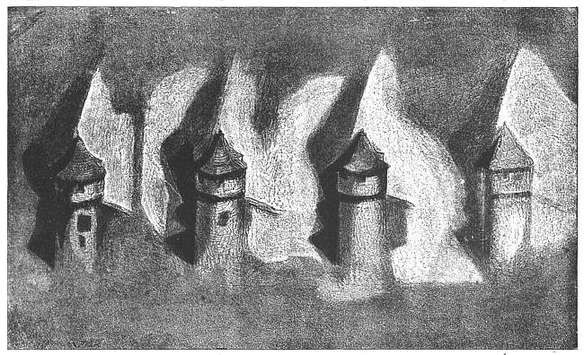
J. Ruskin.
1
2
3
4
R. P. Cuff
26. The Law of Evanescence.
§ 6. Thus, when the eye is quite uncultivated, it sees that a man is a man, and a face is a face, but has no idea what shadows or lights fall upon the form or features. Cultivate it to some degree of artistic power, and it will then see shadows distinctly, but only the more vigorous of them. Cultivate it still farther, and it will see light within light, and shadow within shadow, and will continually refuse to rest in what it had already discovered, that it may pursue what is more removed and more subtle, until at last it comes to give its chief attention and display its chief power on gradations which to an untrained faculty are partly matters of indifference, and partly imperceptible. That these subtle gradations have indeed become matters of primal importance to it, may be ascertained by observing that they are the things it will last part with, as the object retires into distance; and that, though this distance may become so great as to render the real nature of the object quite undiscernible, the gradations of light upon it will not be lost.
§ 7. For instance, Fig. 1, on the opposite page, Plate 26, is a tolerably faithful rendering of the look of a wall tower of a Swiss town as it would be seen within some hundred yards of it. Fig. 2 is (as nearly as I can render it) a facsimile of Turner's actual drawing of this tower, at a presumed distance of about half a mile. It has far less of intelligible delineation, either of windows, cornices, or tiles; but intense care has still been given to get the pearly roundness of the side, and the exact relations of all the tones of shade. And now, if Turner wants to remove the tower still farther back, he will gradually let the windows and stones all disappear together, before he will quit his shadows and delicately centralized rays. At Fig. 3 the tower is nearly gone, but the pearly roundness of it and principal lights of it are there still. At Fig. 4 (Turner's ultimate condition in distance) the essence of the thing is quite unintelligible; we cannot answer for its being a tower at all. But the gradations of light are still there, and as much pains have been taken to get them as in any of the other instances. A vulgar artist would have kept something of the form of the tower, expressing it by a few touches; and people would call it a clever drawing. Turner lets the tower melt into air, but still he works half an hour or so over those delicate last gradations, which perhaps not many people in England besides himself can fully see, as not many people can understand the final work of a great mathematician. I assume, of course, in this example, that the tower, as it grows less and less distinct, becomes part of the subject of a larger picture. Fig. 1 represents nearly what Turner's treatment of it would be if it were the principal subject of a vignette; and Fig. 4 his treatment of it as an object in the extreme distance of a large oil picture. If at the same supposed distance it entered into a smaller drawing, so as to be much smaller in size, he might get the gradations with less trouble, sometimes even by a single sweep of the brush; but some gradation would assuredly be retained, though the tower were diminished to the height of one of the long letters of this type.
§ 8. "But is Turner right in doing this?"
Yes. The truth is indeed so. If you watch any object as it fades in distance, it will lose gradually its force, its intelligibility, its anatomy, its whole comprehensible being; but it will never lose its gradation of light. Up to the last moment, what light is seen on it, feebly glimmering and narrowed almost to a point or a line, is still full of change. One part is brighter than another, and brighter with as lovely and tender increase as it was when nearest to us; and at last, though a white house ten miles away will be seen only as a small square spot of light, its windows, doors, or roof, being as utterly invisible as if they were not in existence, the gradation of its light will not be lost; one part of the spot will be seen to be brighter than another.
§ 9. Is there not a deep meaning in this? We, in our daily looking at the thing, think that its own make is the most important part of it. Windows and porticos, eaves and cornices, how interesting and how useful are they! Surely, the chief importance of the thing is in these. No; not in these; but in the play of the light of heaven upon it. There is a place and time when all those windows and porticos will be lost sight of; when the only question becomes, "what light had it?" How much of heaven was looking upon it? What were the broad relations of it, in light and darkness, to the sky and earth, and all things around it? It might have strange humors and ways of its own—many a rent in its wall, and many a roughness on its roof; or it might have many attractivenesses and noblenesses of its own—fair mouldings and gay ornaments; but the time comes when all these are vain, and when the slight, wandering warmth of heaven's sunshine which the building itself felt not, and not one eye in a thousand saw, becomes all in all. I leave the reader to follow out the analogies of this.
§ 10. "Well, but," it is still objected, "if this be so, why is it necessary to insist, as you do always, upon the most minute and careful renderings of form?"
Because, though these gradations of light are indeed, as an object dies in distance, the only things it can retain, yet as it lives its active life near us, those very gradations can only be seen properly by the effect they have on its character. You can only show how the light affects the object, by knowing thoroughly what the object is; and noble mystery differs from ignoble, in being a veil thrown between us and something definite, known, and substantial; but the ignoble mystery is a veil cast before chaos, the studious concealment of Nothing.
§ 11. There is even a way in which the very definiteness of Turner's knowledge adds to the mystery of his pictures. In the course of the first volume I had several times occasion to insist on the singular importance of cast shadows, and the chances of their sometimes gaining supremacy in visibility over even the things that cast them. Now a cast shadow is a much more curious thing than we usually suppose. The strange shapes it gets into—the manner in which it stumbles over everything that comes in its way, and frets itself into all manner of fantastic schism, taking neither the shape of the thing that casts it, nor of that it is cast upon, but an extraordinary, stretched, flattened, fractured, ill-jointed anatomy of its own—cannot be imagined until one is actually engaged in shadow-hunting. If any of these wayward umbræ are faithfully remembered and set down by the painter, they nearly always have an unaccountable look, quite different from anything one would have invented or philosophically conjectured for a shadow; and it constantly happens, in Turner's distances, that such strange pieces of broken shade, accurately remembered, or accurately invented, as the case may be, cause a condition of unintelligibility, quaint and embarrassing almost in exact proportion to the amount of truth it contains.
§ 12. I believe the reader must now sufficiently perceive that the right of being obscure is not one to be lightly claimed; it can only be founded on long effort to be intelligible, and on the present power of being intelligible to the exact degree which the nature of the thing admits. Nor shall we, I hope, any more have difficulty in understanding how the noble mystery and the ignoble, though direct opposites, are yet continually mistaken for each other—the last aping the first; and the most wretched artists taking pride in work which is simply slurred, slovenly, ignorant, empty, and insolent, as if it were nobly mysterious (just as a drunkard who cannot articulate supposes himself oracular); whereas the noble art-mystery, as all noble language-mystery, is reached only by intense labor. Striving to speak with uttermost truth of expression, weighing word against word, and wasting none, the great speaker, or writer, toils first into perfect intelligibleness, then, as he reaches to higher subject, and still more concentrated and wonderful utterance, he becomes ambiguous—as Dante is ambiguous,—half a dozen different meanings lightening out in separate rays from every word, and, here and there, giving rise to much contention of critics as to what the intended meaning actually was. But it is no drunkard's babble for all that, and the men who think it so, at the third hour of the day, do not highly honor themselves in the thought.
§ 13. And now observe how perfectly the conclusions arrived at here consist with those of the third chapter, and how easily we may understand the meaning of that vast weight of authority which we found at first ranged against the clouds, and strong in arms on the side of intelligibility. Nearly all great men must, for the reasons above given, be intelligible. Even, if they are to be the greatest, still they must struggle through intelligibility to obscurity; if of the second class, then the best thing they can do, all their lives through, is to be intelligible. Therefore the enormous majority of all good and true men will be clear men; and the drunkards, sophists, and sensualists will, for the most part, sink back into the fog-bank, and remain wrapt in darkness, unintelligibility, and futility. Yet, here and there, once in a couple of centuries, one man will rise past clearness, and become dark with excess of light.
§ 14. "Well, then, you mean to say that the tendency of this age to general cloudiness, as opposed to the old religious clearness of painting, is one of degradation; but that Turner is this one man who has risen past clearness?"
Yes. With some modifications of the saying, I mean that; but those modifications will take us a little time to express accurately.
For, first, it will not do to condemn every minor painter utterly, the moment we see he is foggy. Copley Fielding, for instance, was a minor painter; but his love of obscurity in rain clouds, and dew-mist on downs, was genuine love, full of sweetness and happy aspiration; and, in this way, a little of the light of the higher mystery is often caught by the simplest men when they keep their hearts open.
§ 15. Neither will it be right to set down every painter for a great man, the moment we find he is clear; for there is a hard and vulgar intelligibility of nothingness, just as there is an ambiguity of nothingness. And as often, in conversation, a man who speaks but badly and indistinctly has, nevertheless, got much to say; and a man who speaks boldly and plainly may yet say what is little worth hearing; so, in painting, there are men who can express themselves but blunderingly, and yet have much in them to express; and there are others who talk with great precision, whose works are yet very impertinent and untrustworthy assertions. Sir Joshua Reynolds is full of fogginess and shortcomings as compared with either of the Caraccis; but yet one Sir Joshua is worth all the Caraccis in Europe; and so, in our modern water-color societies, there are many men who define clearly enough, all whose works, put together, are not worth a careless blot by Cox or Barrett.
§ 16. Let me give one illustration more, which will be also of some historical usefulness in marking the relations of the clear and obscure schools.
We have seen, in our investigation of Greek landscape, Homer's intense love of the aspen poplar. For once, in honor of Homer and the Greeks, I will take an aspen for the subject of comparison, and glance at the different modes in which it would have been, or was, represented from the earliest to the present stage of landscape art.

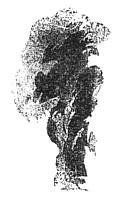
1. Ancient, or Giottesque.
4. Modern or Blottesque.
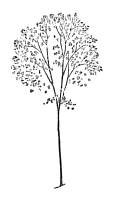

2. Purist.
5. Constablesque.
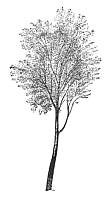
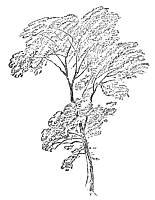
3. Turneresque.
6. Hardingesque.
27. The Aspen, under Idealization.
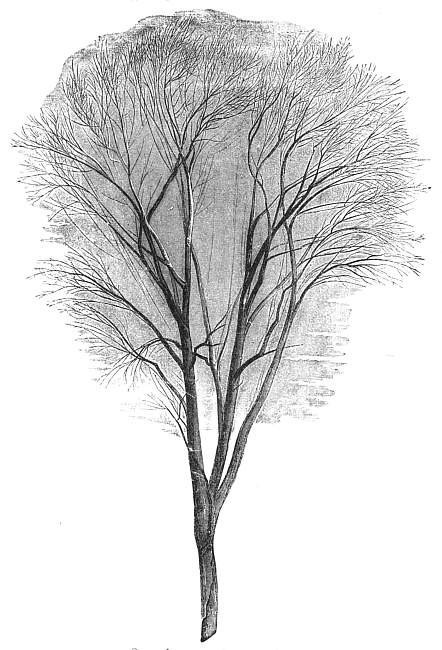
28. Aspen, Unidealized.
The earliest manner which comes within our field of examination is that of the thirteenth century. Fig. 1. Plate 27 is an aspen out of the wood in which Absalom is slain, from a Psalter in my own possession, executed, certainly, after the year 1250, and before 1272; the other trees in the wood being, first, of course, the oak in which Absalom is caught, and a sycamore. All these trees are somewhat more conventional than is even usual at the period; though, for this reason, the more characteristic as examples of earliest work. There is no great botanical accuracy until some forty years later (at least in painting); so that I cannot be quite sure, the leaf not being flat enough at the base, that this tree is meant for an aspen: but it is so in all probability; and, whether it be or not, serves well enough to mark the definiteness and symmetry of the old art,—a symmetry which, be it always observed, is NEVER formal or unbroken. This tree, though it looks formal enough, branches unequally at the top of the stem. But the lowest figure in Plate 7, Vol. III. is a better example from the MS. Sloane, 1975, Brit. Mus. Every plant in that herbarium is drawn with some approach to accuracy, in leaf, root, and flower; while yet all are subjected to the sternest conventional arrangement; colored in almost any way that pleases the draughtsman, and set on quaint grounds of barred color, like bearings on shields;34 one side of the plant always balancing the other, but never without some transgression or escape from the law of likeness, as in the heads of the cyclamen flower, and several other parts of this design. It might seem at first, that the root was more carelessly drawn than the rest, and uglier in color; but this is in pure conscientiousness. The workman knew that a root was ugly and earthy; he would not make it ornamental and delicate. He would sacrifice his pleasant colors and graceful lines at once for the radical fact; and rather spoil his page than flatter a fibre.
§ 17. Here, then, we have the first mediæval condition of art, consisting in a fenced, but varied, symmetry; a perfect definiteness; and a love of nature, more or less interfered with by conventionalism and imperfect knowledge. Fig. 2 in Plate 27 represents the next condition of mediæval art, in which the effort at imitation is contending with the conventional type. This aspen is from the MS. Cotton, Augustus, A. 5, from which I have already taken an example of rocks to compare with Leonardo's. There can be no doubt here about the species of the tree intended, as throughout the MS. its illuminator has carefully distinguished the oak, the willow, and the aspen; and this example, though so small (it is engraved of the actual size), is very characteristic of the aspen ramification; and in one point, of ramification in general, namely, the division of the tree into two masses, each branching outwards, not across each other. Whenever a tree divides at first into two or three nearly equal main branches, the secondary branches always spring from the outside of the divided ones, just as, when a tree grows under a rock or wall, it shoots away from it, never towards it. The beautiful results of this arrangement we shall trace in the next volume; meantime, in the next Plate (28) I have drawn the main35 ramifications of a real aspen, growing freely, but in a sheltered place, as far as may be necessary to illustrate the point in question.
§ 18. This example, Fig. 2 in Plate 27 is sufficiently characteristic of the purist mediæval landscape, though there is somewhat more leaning to naturalism than is usual at the period. The next example, Fig. 3, is from Turner's vignette of St. Anne's Hill (Rogers's Poems, p. 214). Turner almost always groups his trees, so that I have had difficulty in finding one on a small scale and isolated, which would be characteristic of him; nor is this one completely so, for I had no access to the original vignette, it being, I believe, among the drawings that have been kept from the public, now these four years, because the Chancery lawyers do not choose to determine the meaning of Turner's perfectly intelligible, though informal, will; and Mr. Goodall's engraving, which I have copied, though right in many respects, is not representative of the dotted touch by which Turner expressed the aspen foliage. I have not, however, ventured to alter it, except only by adding the extremities where they were hidden in the vignette by the trelliswork above.
The principal difference between the Turnerian aspen and the purist aspen is, it will be seen, in the expression of lightness and confusion of foliage, and roundness of the tree as a mass; while the purist tree, like the thirteenth century one, is still flat. All attempt at the expression of individual leaves is now gone, the tree being too far off to justify their delineation; but the direction of the light, and its gradations, are carefully studied.
§ 19. Fig. 6 is a tolerable facsimile36 of a little chalk sketch of Harding's; quite inimitable in the quantity of life and truth obtained by about a quarter of a minute's work; but beginning to show the faulty vagueness and carelessness of modernism. The stems, though beautifully free, are not thoroughly drawn or rounded; and in the mass of the tree, though well formed, the tremulousness and transparency of leafage are lost. Nor is it possible, by Harding's manner of drawing, to express such ultimate truths; his execution, which, in its way, no one can at all equal (the best chalk drawing of Calame and other foreign masters being quite childish and feeble in comparison), is yet sternly limited in its reach, being originally based on the assumption that nothing is to be delicately drawn, and that the method is only good which insures specious incompletion.
It will be observed, also, that there is a leaning first to one side, then to the other, in Harding's aspen, which marks the wild picturesqueness of modernism as opposed to the quiet but stiff dignity of the purist (Fig. 2); Turner occupying exactly the intermediate place.
The next example (Fig. 5) is an aspen of Constable's, on the left in the frontispiece to Mr. Leslie's life of him. Here we have arrived at the point of total worthlessness, the tree being as flat as the old purist one, but, besides, wholly false in ramification, idle, and undefined in every respect; it being, however, just possible still to discern what the tree is meant for, and therefore, the type of the worst modernism not being completely established.
§ 20. Fig. 4 establishes this type, being the ordinary condition of tree treatment in our blotted water-color drawings; the nature of the tree being entirely lost sight of, and no accurate knowledge, of any kind, possessed or communicated.
Thus, from the extreme of definiteness and light, in the thirteenth century (the middle of the Dark Ages!), we pass to the extreme of uncertainty and darkness, in the middle of the nineteenth century.
As, however, the definite mediæval work has some faults, so the indefinite modern work has some virtues, its very uncertainty enabling it to appeal pleasantly to the imagination (though in an inky manner, as described above, Vol. III. Chap. x. § 10), and sometimes securing qualities of color which could no otherwise be obtained. It ought, however, if we would determine its true standing, to be compared, not with the somewhat forced and narrow decision of the thirteenth century, but with the perfect and well-informed decision of Albert Durer and his fellow-workmen. For the proper representation of these there was no room in this plate; so, in Plate 25, above, on each side of the daguerreotyped towers of Fribourg, I have given, Fig. 1, a Dureresque, and Fig. 3, a Blottesque, version of the intermediate wall. The latter version may, perhaps, be felt to have some pleasantness in its apparent ease; and it has a practical advantage, in its capability of being executed in a quarter of a minute, while the Dureresque statement cannot be made in less than a quarter of an hour. But the latter embraces not only as much as is worth the extra time, but even an infinite of contents, beyond and above the other, for the other is in no single place clear in its assertion of anything; whereas the Dureresque work, asserting clearly many most interesting facts about the grass on the ledges, the bricks of the windows, and the growth of the foliage, is forever a useful and trustworthy record; the other forever an empty dream. If it is a beautiful dream, full of lovely color and good composition, we will not quarrel with it; but it can never be so, unless it is founded first on the Dureresque knowledge, and suggestive of it, through all its own mystery or incompletion. So that by all students the Dureresque is the manner to be first adopted, and calmly continued as long as possible; and if their inventive instincts do not, in after life, force them to swifter or more cloudy execution,—if at any time it becomes a matter of doubt with them how far to surrender their gift of accuracy,—let them be assured that it is best always to err on the side of clearness; to live in the illumination of the thirteenth century rather than the mysticism of the nineteenth, and vow themselves to the cloister rather than to lose themselves in the desert.
§ 21. I am afraid the reader must be tired of this matter; and yet there is one question more which I must for a moment touch upon, in conclusion, namely, the mystery of clearness itself. In an Italian twilight, when, sixty or eighty miles away, the ridge of the Western Alps rises in its dark and serrated blue against the crystalline vermilion, there is still unsearchableness, but an unsearchableness without cloud or concealment,—an infinite unknown, but no sense of any veil or interference between us and it: we are separated from it not by any anger or storm, not by any vain and fading vapor, but only by the deep infinity of the thing itself. I find that the great religious painters rejoiced in that kind of unknowableness, and in that only; and I feel that even if they had had all the power to do so, still they would not have put rosy mists and blue shadows behind their sacred figures, but only the far-away sky and cloudless mountains. Probably the right conclusion is that the clear and cloudy mysteries are alike noble; but that the beauty of the wreaths of frost mist, folded over banks of greensward deep in dew, and of the purple clouds of evening, and the wreaths of fitful vapor gliding through groves of pine, and irised around the pillars of waterfalls, is more or less typical of the kind of joy which we should take in the imperfect knowledge granted to the earthly life, while the serene and cloudless mysteries set forth that belonging to the redeemed life. But of one thing I am well assured, that so far as the clouds are regarded, not as concealing the truth of other things, but as themselves true and separate creations, they are not usually beheld by us with enough honor; we have too great veneration for cloudlessness. My reasons for thinking this I will give in the next chapter; here we have, I believe, examined as far as necessary, the general principles on which Turner worked, and justified his adoption of them so far as they contradicted preceding practice.
It remains for us to trace, with more observant patience, the ground which was marked out in the first volume; and, whereas in that volume we hastily compared the truth of Turner with that of preceding landscapists, we shall now, as closely as possible, examine the range of what he himself has done and felt, and the way in which it is likely to influence the future acts and thoughts of men.
§ 22. And I shall attempt to do this, first, by examining what the real effect of the things painted—clouds, or mountains, or whatever else they may be—is, or ought to be, in general, on men's minds, showing the grounds of their beauty or impressiveness as best I can; and then examining how far Turner seems to have understood these reasons of beauty, and how far his work interprets, or can take the place of nature. But in doing this, I shall, for the sake of convenience, alter the arrangement which I followed in the first volume; and instead of examining the sky first, treat of it last; because, in many illustrations which I must give of other things, I shall have to introduce pieces of sky background which will all be useful for reference when I can turn back to them from the end of the book, but which I could not refer to in advance without anticipating all my other illustrations. Nevertheless, some points which I have to note respecting the meaning of the sky are so intimately connected with the subjects we have just been examining, that I cannot properly defer their consideration to another place; and I shall state them, therefore, in the next chapter, afterwards proceeding, in the order I adopted in the first volume, to examine the beauty of mountains, water, and vegetation.
34 Compare Vol. III. Chap. XIV. § 13. Touching the exact degree in which ignorance or incapacity is mingled with wilful conventionalism in this drawing, we shall inquire in the chapters on Vegetation.
33 And yet, all these intricacies will produce for it another whole; as simple and natural as the child's first conception of the thing; only more comprehensive. See above, Chap. III., § 21.
36 It is quite impossible to facsimile good free work. Both Turner and Harding suffer grievously in this plate.
32 Art and Artists in England, vol. ii., p. 151. The other characteristics which Dr. Waagen discovers in Turner are, "such a looseness of treatment, such a total want of truth, as I never before met with."
31 Especially in distinction of species of things. It may be doubtful whether in a great picture we are to represent the bloom upon a grape, but never doubtful that we are to paint a grape so as to be known from a cherry.
26 In the clouds around Mount Sinai, in the picture of the Golden Calf; the smoke turning into angels, in the Cenacolo in San Giorgio Maggiore; and several other such instances.
29 Travels through the Alps, chap. viii.
27 Stanfield I call a definer, as opposed to Copley Fielding, because, though, like all other moderns, he paints cloud and storm, he will generally paint all the masts and yards of a ship, rather than merely her black bows glooming through the foam; and all the rocks on a hill side, rather than the blue outline of the hill through the mist.
35 Only the main lines: the outer sprays have had no pains taken with them, as I am going to put some leaves on them in next volume.
30 Reynolds is usually admired for his dash and speed. His true merit is in an ineffable subtlety combined with his speed. The tenderness of some of Reynolds' touches is quite beyond telling.
28. Aspen, Unidealized.
28 Compare, if at hand, my letter in the Times of the 5th of May, 1854, on Hunt's Light of the World. I extract the passage bearing chiefly on the point in question.
32 Art and Artists in England, vol. ii., p. 151. The other characteristics which Dr. Waagen discovers in Turner are, "such a looseness of treatment, such a total want of truth, as I never before met with."
33 And yet, all these intricacies will produce for it another whole; as simple and natural as the child's first conception of the thing; only more comprehensive. See above, Chap. III., § 21.
34 Compare Vol. III. Chap. XIV. § 13. Touching the exact degree in which ignorance or incapacity is mingled with wilful conventionalism in this drawing, we shall inquire in the chapters on Vegetation.
35 Only the main lines: the outer sprays have had no pains taken with them, as I am going to put some leaves on them in next volume.
36 It is quite impossible to facsimile good free work. Both Turner and Harding suffer grievously in this plate.
CHAPTER VI.
THE FIRMAMENT.
§ 1. The task which we now enter upon, as explained in the close of the preceding chapter, is the ascertaining as far as possible what the proper effect of the natural beauty of different objects ought to be on the human mind, and the degree in which this nature of theirs, and true influence, have been understood and transmitted by Turner.
I mean to begin with the mountains, for the sake of convenience in illustration; but, in the proper order of thought, the clouds ought to be considered first; and I think it will be well, in this intermediate chapter, to bring to a close that line of reasoning by which we have gradually, as I hope, strengthened the defences around the love of mystery which distinguishes our modern art; and to show, on final and conclusive authority, what noble things these clouds are, and with what feeling it seems to be intended by their Creator that we should contemplate them.
§ 2. The account given of the stages of Creation in the first chapter of Genesis, is in every respect clear and intelligible to the simplest reader, except in the statement of the work of the second day. I suppose that this statement is passed over by careless readers without an endeavor to understand it; and contemplated by simple and faithful readers as a sublime mystery, which was not intended to be understood. But there is no mystery in any other part of the chapter, and it seems to me unjust to conclude that any was intended here.
And the passage ought to be peculiarly interesting to us, as being the first in the Bible in which the heavens are named, and the only one in which the word "Heaven," all important as that word is to our understanding of the most precious promises of Scripture, receives a definite explanation.
Let us, therefore, see whether, by a little careful comparison of the verse with other passages in which the word occurs, we may not be able to arrive at as clear an understanding of this portion of the chapter as of the rest.
§ 3. In the first place, the English word "Firmament" itself is obscure and useless; because we never employ it but as a synonym of heaven; it conveys no other distinct idea to us; and the verse, though from our familiarity with it we imagine that it possesses meaning, has in reality no more point or value than if it were written, "God said let there be a something in the midst of the waters, and God called the something Heaven."
But the marginal reading, "Expansion," has definite value; and the statement that "God said, let there be an expansion in the midst of the waters, and God called the expansion Heaven," has an apprehensible meaning.
§ 4. Accepting this expression as the one intended, we have next to ask what expansion there is, between two waters, describable by the term Heaven. Milton adopts the term "expanse;"37 but he understands it of the whole volume of the air which surrounds the earth. Whereas, so far as we can tell, there is no water beyond the air, in the fields of space; and the whole expression of division of waters from waters is thus rendered valueless.
§ 5. Now, with respect to this whole chapter, we must remember always that it is intended for the instruction of all mankind, not for the learned reader only; and that, therefore, the most simple and natural interpretation is the likeliest in general to be the true one. An unscientific reader knows little about the manner in which the volume of the atmosphere surrounds the earth; but I imagine that he could hardly glance at the sky when rain was falling in the distance, and see the level line of the bases of the clouds from which the shower descended, without being able to attach an instant and easy meaning to the words "Expansion in the midst of the waters." And if, having once seized this idea, he proceeded to examine it more accurately, he would perceive at once, if he had ever noticed anything of the nature of clouds, that the level line of their bases did indeed most severely and stringently divide "waters from waters," that is to say, divide water in its collective and tangible state, from water in its divided and aerial state; or the waters which fall and flow, from those which rise and float. Next, if we try this interpretation in the theological sense of the word Heaven, and examine whether the clouds are spoken of as God's dwelling place, we find God going before the Israelites in a pillar of cloud; revealing Himself in a cloud on Sinai; appearing in a cloud on the mercy seat, filling the Temple of Solomon with the cloud when its dedication is accepted; appearing in a great cloud to Ezekiel; ascending into a cloud before the eyes of the disciples on Mount Olivet; and in like manner returning to Judgment. "Behold, he cometh with clouds, and every eye shall see him." "Then shall they see the son of man coming in the clouds of heaven, with power and great glory."38 While farther, the "clouds" and "heavens" are used as interchangeable words in those Psalms which most distinctly set forth the power of God: "He bowed the heavens also, and came down; he made darkness pavilions round about him, dark waters, and thick clouds of the skies." And, again: "Thy mercy, oh Lord, is in the heavens, and thy faithfulness reacheth unto the clouds." And, again: "His excellency is over Israel, and his strength is in the clouds." Again: "The clouds poured out water, the skies sent out a sound, the voice of thy thunder was in the heaven." Again: "Clouds and darkness are round about him, righteousness and judgment are the habitation of his throne; the heavens declare his righteousness, and all the people see his glory."
§ 6. In all these passages the meaning is unmistakable, if they possess definite meaning at all. We are too apt to take them merely for sublime and vague imagery, and therefore gradually to lose the apprehension of their life and power. The expression, "He bowed the Heavens," for instance, is, I suppose, received by most readers as a magnificent hyperbole, having reference to some peculiar and fearful manifestation of God's power to the writer of the Psalm in which the words occur. But the expression either has plain meaning, or it has no meaning. Understand by the term "Heavens" the compass of infinite space around the earth, and the expression, "bowed the Heavens," however sublime, is wholly without meaning; infinite space cannot be bent or bowed. But understand by the "Heavens" the veil of clouds above the earth, and the expression is neither hyperbolical nor obscure; it is pure, plain, and accurate truth, and it describes God, not as revealing Himself in any peculiar way to David, but doing what he is still doing before our own eyes day by day. By accepting the words in their simple sense, we are thus led to apprehend the immediate presence of the Deity, and His purpose of manifesting Himself as near us whenever the storm-cloud stoops upon its course; while by our vague and inaccurate acceptance of the words we remove the idea of His presence far from us, into a region which we can neither see nor know; and gradually, from the close realization of a living God who "maketh the clouds his chariot," we refine and explain ourselves into dim and distant suspicion of an inactive God, inhabiting inconceivable places, and fading into the multitudinous formalisms of the laws of Nature.
§ 7. All errors of this kind—and in the present day we are in constant and grievous danger of falling into them—arise from the originally mistaken idea that man can, "by searching, find out God—find out the Almighty to perfection;" that is to say by help of courses of reasoning and accumulations of science, apprehend the nature of the Deity in a more exalted and more accurate manner than in a state of comparative ignorance; whereas it is clearly necessary, from the beginning to the end of time, that God's way of revealing Himself to His creatures should be a simple way, which all those creatures may understand. Whether taught or untaught, whether of mean capacity or enlarged, it is necessary that communion with their Creator should be possible to all; and the admission to such communion must be rested, not on their having a knowledge of astronomy, but on their having a human soul. In order to render this communion possible, the Deity has stooped from His throne, and has not only, in the person of the Son, taken upon Him the veil of our human flesh, but, in the person of the Father, taken upon Him the veil of our human thoughts, and permitted us, by His own spoken authority, to conceive Him simply and clearly as a loving Father and Friend;—a being to be walked with and reasoned with; to be moved by our entreaties, angered by our rebellion, alienated by our coldness, pleased by our love, and glorified by our labor; and, finally, to be beheld in immediate and active presence in all the powers and changes of creation. This conception of God, which is the child's, is evidently the only one which can be universal, and therefore the only one which for us can be true. The moment that, in our pride of heart, we refuse to accept the condescension of the Almighty, and desire Him, instead of stooping to hold our hands, to rise up before us into His glory,—we hoping that by standing on a grain of dust or two of human knowledge higher than our fellows, we may behold the Creator as He rises,—God takes us at our word; He rises, into His own invisible and inconceivable majesty; He goes forth upon the ways which are not our ways, and retires into the thoughts which are not our thoughts; and we are left alone. And presently we say in our vain hearts, "There is no God."
§ 8. I would desire, therefore, to receive God's account of His own creation as under the ordinary limits of human knowledge and imagination it would be received by a simply minded man; and finding that the "heavens and the earth" are spoken of always as having something like equal relation to each other ("thus the heavens and the earth were finished, and all the host of them"), I reject at once all idea of the term "Heavens" being intended to signify the infinity of space inhabited by countless worlds; for between those infinite heavens and the particle of sand, which not the earth only, but the sun itself, with all the solar system, is in relation to them, no relation of equality or comparison could be inferred. But I suppose the heavens to mean that part of creation which holds equal companionship with our globe; I understand the "rolling of those heavens together as a scroll" to be an equal and relative destruction with the "melting of the elements in fervent heat;"39 and I understand the making the firmament to signify that, so far as man is concerned, most magnificent ordinance of the clouds;—the ordinance, that as the great plain of waters was formed on the face of the earth, so also a plain of waters should be stretched along the height of air, and the face of the cloud answer the face of the ocean; and that this upper and heavenly plain should be of waters, as it were, glorified in their nature, no longer quenching the fire, but now bearing fire in their own bosoms; no longer murmuring only when the winds raise them or rocks divide, but answering each other with their own voices from pole to pole; no longer restrained by established shores, and guided through unchanging channels, but going forth at their pleasure like the armies of the angels, and choosing their encampments upon the heights of the hills; no longer hurried downwards forever, moving but to fall, nor lost in the lightless accumulation of the abyss, but covering the east and west with the waving of their wings, and robing the gloom of the farther infinite with a vesture of divers colors, of which the threads are purple and scarlet, and the embroideries flame.
§ 9. This, I believe, is the ordinance of the firmament; and it seems to me that in the midst of the material nearness of these heavens God means us to acknowledge His own immediate presence as visiting, judging, and blessing us. "The earth shook, the heavens also dropped, at the presence of God." "He doth set His bow in the cloud," and thus renews, in the sound of every drooping swathe of rain, his promises of everlasting love. "In them hath he set a tabernacle for the sun;" whose burning ball, which without the firmament would be seen as an intolerable and scorching circle in the blackness of vacuity, is by that firmament surrounded with gorgeous service, and tempered by mediatorial ministries; by the firmament of clouds the golden pavement is spread for his chariot wheels at morning; by the firmament of clouds the temple is built for his presence to fill with light at noon; by the firmament of clouds the purple veil is closed at evening round the sanctuary of his rest; by the mists of the firmament his implacable light is divided, and its separated fierceness appeased into the soft blue that fills the depth of distance with its bloom, and the flush with which the mountains burn as they drink the overflowing of the dayspring. And in this tabernacling of the unendurable sun with men, through the shadows of the firmament, God would seem to set forth the stooping of His own majesty to men, upon the throne of the firmament. As the Creator of all the worlds, and the Inhabiter of eternity, we cannot behold Him; but, as the Judge of the earth and the Preserver of men, those heavens are indeed His dwelling-place. "Swear not, neither by heaven, for it is God's throne; nor by the earth, for it is his footstool." And all those passings to and fro of fruitful shower and grateful shade, and all those visions of silver palaces built about the horizon, and voices of moaning winds and threatening thunders, and glories of colored robe and cloven ray, are but to deepen in our hearts the acceptance, and distinctness, and dearness of the simple words, "Our Father which art in heaven."
37
"God made The firmament, expanse of liquid, pure,
Transparent, elemental air, diffused
In circuit to the uttermost convex
Of this great round."
Paradise Lost, book vii.
38 The reader may refer to the following texts, which it is needless to quote: Exod. xiii. 21, xvi. 10, xix. 9, xxiv. 16, xxxiv. 5, Levit. xvi. 2, Num. x. 34, Judges v. 4, 1 Kings viii. 10, Ezek. i. 4, Dan. vii. 13, Matt. xxiv. 30, 1 Thess. iv. 17, Rev. i. 7.
39 Compare also Job, xxxvi. 29, "The spreading of the clouds, and the noise of his tabernacle;" and xxxviii. 33, "Knowest thou the ordinances of heaven? canst thou set the dominion thereof in the earth? canst thou lift up thy voice to the clouds?"
Observe that in the passage of Addison's well known hymn—
"The spacious firmament on high,
With all the blue ethereal sky,
And spangled heavens, a shining frame,
Their great Original proclaim"—
the writer has clearly the true distinctions in his mind; he does not use his words, as we too often accept them, in vain tautology. By the spacious firmament he means the clouds, using the word spacious to mark the true meaning of the Hebrew term: the blue ethereal sky is the real air or ether, blue above the clouds; the heavens are the starry space, for which he uses this word, less accurately, indeed, than the others, but as the only one available for this meaning.
CHAPTER VII.
THE DRY LAND.
§ 1. Having thus arrived at some apprehension of the true meaning and noble offices of the clouds, we leave farther inquiry into their aspects to another time, and follow the fixed arrangement of our subject; first, to the crests of the mountains. Of these also, having seen in our review of ancient and modern landscape various strange differences in the way men looked upon them, it will be well in the outset to ascertain, as far as may be, the true meaning and office.
The words which marked for us the purpose of the clouds are followed immediately by those notable ones:—
"And God said, Let the waters which are under the heaven be gathered together unto one place, and let the dry land appear."
We do not, perhaps, often enough consider the deep significance of this sentence. We are too apt to receive it as the description of an event vaster only in its extent, not in its nature, than the compelling the Red Sea to draw back, that Israel might pass by. We imagine the Deity in like manner rolling the waves of the greater ocean together on a heap, and setting bars and doors to them eternally.
But there is a far deeper meaning than this in the solemn words of Genesis, and in the correspondent verse of the Psalm, "His hands prepared the dry land." Up to that moment the earth had been void, for it had been without form. The command that the waters should be gathered was the command that the earth should be sculptured. The sea was not driven to his place in suddenly restrained rebellion, but withdrawn to his place in perfect and patient obedience. The dry land appeared, not in level sands, forsaken by the surges, which those surges might again claim for their own; but in range beyond range of swelling hill and iron rock, for ever to claim kindred with the firmament, and be companioned by the clouds of heaven.
§ 2. What space of time was in reality occupied by the "day" of Genesis, is not, at present, of any importance for us to consider. By what furnaces of fire the adamant was melted, and by what wheels of earthquake it was torn, and by what teeth of glacier and weight of sea-waves it was engraven and finished into its perfect form, we may perhaps hereafter endeavor to conjecture; but here, as in few words the work is summed by the historian, so in few broad thoughts it should be comprehended by us; and as we read the mighty sentence, "Let the dry land appear," we should try to follow the finger of God, as it engraved upon the stone tables of the earth the letters and the law of its everlasting form; as, gulf by gulf, the channels of the deep were ploughed; and cape by cape, the lines were traced, with Divine foreknowledge, of the shores that were to limit the nations; and chain by chain, the mountain walls were lengthened forth, and their foundations fastened for ever; and the compass was set upon the face of the depth, and the fields, and the highest part of the dust of the world were made; and the right hand of Christ first strewed the snow on Lebanon, and smoothed the slopes of Calvary.
§ 3. It is not, I repeat, always needful, in many respects it is not possible, to conjecture the manner, or the time, in which this work was done; but it is deeply necessary for all men to consider the magnificence of the accomplished purpose, and the depth of the wisdom and love which are manifested in the ordinances of the hills. For observe, in order to bring the world into the form which it now bears, it was not mere sculpture that was needed; the mountains could not stand for a day unless they were formed of materials altogether different from those which constitute the lower hills, and the surfaces of the valleys. A harder substance had to be prepared for every mountain chain; yet not so hard but that it might be capable of crumbling down into earth fit to nourish the alpine forest and the alpine flower; not so hard but that, in the midst of the utmost majesty of its enthroned strength, there should be seen on it the seal of death, and the writing of the same sentence that had gone forth against the human frame, "Dust thou art, and unto dust thou shalt return."40 And with this perishable substance the most majestic forms were to be framed that were consistent with the safety of man; and the peak was to be lifted, and the cliff rent, as high and as steeply as was possible, in order yet to permit the shepherd to feed his flocks upon the slope, and the cottage to nestle beneath their shadow.
§ 4. And observe, two distinct ends were to be accomplished in the doing this. It was, indeed, absolutely necessary that such eminences should be created, in order to fit the earth in any wise for human habitation; for without mountains the air could not be purified, nor the flowing of the rivers sustained, and the earth must have become for the most part desert plain, or stagnant marsh. But the feeding of the rivers and the purifying of the winds are the least of the services appointed to the hills. To fill the thirst of the human heart for the beauty of God's working,—to startle its lethargy with the deep and pure agitation of astonishment,—are their higher missions. They are as a great and noble architecture; first giving shelter, comfort, and rest; and covered also with mighty sculpture and painted legend. It is impossible to examine in their connected system the features of even the most ordinary mountain scenery, without concluding that it has been prepared in order to unite as far as possible, and in the closest compass, every means of delighting and sanctifying the heart of man. "As far as possible;" that is, as far as is consistent with the fulfilment of the sentence of condemnation on the whole earth. Death must be upon the hills; and the cruelty of the tempests smite them, and the briar and thorn spring up upon them: but they so smite, as to bring their rocks into the fairest forms; and so spring, as to make the very desert blossom as the rose. Even among our own hills of Scotland and Cumberland, though often too barren to be perfectly beautiful, and always too low to be perfectly sublime, it is strange how many deep sources of delight are gathered into the compass of their glens and vales; and how, down to the most secret cluster of their far-away flowers, and the idlest leap of their straying streamlets, the whole heart of Nature seems thirsting to give, and still to give, shedding forth her everlasting beneficence with a profusion so patient, so passionate, that our utmost observance and thankfulness are but, at last, neglect of her nobleness, and apathy to her love. But among the true mountains of the greater orders the Divine purpose of appeal at once to all the faculties of the human spirit becomes still more manifest. Inferior hills ordinarily interrupt, in some degree, the richness of the valleys at their feet; the grey downs of Southern England, and treeless coteaux of Central France, and grey swells of Scottish moor, whatever peculiar charm they may possess in themselves, are at least destitute of those which belong to the woods and fields of the lowlands. But the great mountains lift the lowlands on their sides. Let the reader imagine, first, the appearance of the most varied plain of some richly cultivated country; let him imagine it dark with graceful woods, and soft with deepest pastures; let him fill the space of it, to the utmost horizon, with innumerable and changeful incidents of scenery and life; leading pleasant streamlets through its meadows, strewing clusters of cottages beside their banks, tracing sweet footpaths through its avenues, and animating its fields with happy flocks, and slow wandering spots of cattle; and when he has wearied himself with endless imagining, and left no space without some loveliness of its own, let him conceive all this great plain, with its infinite treasures of natural beauty and happy human life, gathered up in God's hands from one edge of the horizon to the other like a woven garment; and shaken into deep, falling folds, as the robes droop from a king's shoulders; all its bright rivers leaping into cataracts along the hollows of its fall, and all its forests rearing themselves aslant against its slopes, as a rider rears himself back when his horse plunges; and all its villages nestling themselves into the new windings of its glens; and all its pastures thrown into steep waves of greensward, dashed with dew along the edges of their folds, and sweeping down into endless slopes, with a cloud here and there lying quietly, half on the grass, half in the air; and he will have as yet, in all this lifted world, only the foundation of one of the great Alps. And whatever is lovely in the lowland scenery becomes lovelier in this change: the trees which grew heavily and stiffly from the level line of plain assume strange curves of strength and grace as they bend themselves against the mountain side; they breathe more freely, and toss their branches more carelessly as each climbs higher, looking to the clear light above the topmost leaves of its brother tree: the flowers which on the arable plain fell before the plough, now find out for themselves unapproachable places, where year by year they gather into happier fellowship, and fear no evil; and the streams which in the level land crept in dark eddies by unwholesome banks, now move in showers of silver, and are clothed with rainbows, and bring health and life wherever the glance of their waves can reach.
§ 5. And although this beauty seems at first, in its wildness, inconsistent with the service of man, it is, in fact, more necessary to his happy existence than all the level and easily subdued land which he rejoices to possess. It seems almost an insult to the reader's intelligence to ask him to dwell (as if they could be doubted) on the uses of the hills; and yet so little, until lately, have those uses been understood, that, in the seventeenth century, one of the most enlightened of the religious men of his day (Fleming), himself a native of a mountain country, casting about for some reason to explain to himself the existence of mountains, and prove their harmony with the general perfectness of the providential government of creation, can light upon this reason only, "They are inhabited by the beasts."
§ 6. It may not, therefore, even at this day, be altogether profitless or unnecessary to review briefly the nature of the three great offices which mountain ranges are appointed to fulfil, in order First use of mountains. To give motion to water. to preserve the health and increase the happiness of mankind. Their first use is of course to give motion to water. Every fountain and river, from the inch-deep streamlet that crosses the village lane in trembling clearness, to the massy and silent march of the everlasting multitude of waters in Amazon or Ganges, owe their play, and purity, and power, to the ordained elevations of the earth. Gentle or steep, extended or abrupt, some determined slope of the earth's surface is of course necessary, before any wave can so much as overtake one sedge in its pilgrimage; and how seldom do we enough consider, as we walk beside the margins of our pleasant brooks, how beautiful and wonderful is that ordinance, of which every blade of grass that waves in their clear water is a perpetual sign; that the dew and rain fallen on the face of the earth shall find no resting-place; shall find, on the contrary, fixed channels traced for them, from the ravines of the central crests down which they roar in sudden ranks of foam, to the dark hollows beneath the banks of lowland pasture, round which they must circle slowly among the stems and beneath the leaves of the lilies; paths prepared for them, by which, at some appointed rate of journey, they must evermore descend, sometimes slow and sometimes swift, but never pausing; the daily portion of the earth they have to glide over marked for them at each successive sunrise, the place which has known them knowing them no more, and the gateways of guarding mountains opened for them in cleft and chasm, none letting them in their pilgrimage; and, from far off, the great heart of the sea calling them to itself! Deep calleth unto deep. I know not which of the two is the more wonderful,—that calm, gradated, invisible slope of the champaign land, which gives motion to the stream; or that passage cloven for it through the ranks of hill, which, necessary for the health of the land immediately around them, would yet, unless so supernaturally divided, have fatally intercepted the flow of the waters from far-off countries. When did the great spirit of the river first knock at those adamantine gates? When did the porter open to it, and cast his keys away for ever, lapped in whirling sand? I am not satisfied—no one should be satisfied—with that vague answer,—the river cut its way. Not so. The river found its way. I do not see that rivers, in their own strength, can do much in cutting their way; they are nearly as apt to choke their channels up, as to carve them out. Only give a river some little sudden power in a valley, and see how it will use it. Cut itself a bed? Not so, by any means, but fill up its bed, and look for another, in a wild, dissatisfied, inconsistent manner. Any way, rather than the old one, will better please it; and even if it is banked up and forced to keep to the old one, it will not deepen, but do all it can to raise it, and leap out of it. And although, wherever water has a steep fail, it will swiftly cut itself a bed deep into the rock or ground, it will not, when the rock is hard, cut a wider channel than it actually needs; so that if the existing river beds, through ranges of mountain, had in reality been cut by the streams, they would be found, wherever the rocks are hard, only in the form of narrow and profound ravines,—like the well-known channel of the Niagara, below the fall; not in that of extended valleys. And the actual work of true mountain rivers, though often much greater in proportion to their body of water than that of the Niagara, is quite insignificant when compared with the area and depth of the valleys through which they flow; so that, although in many cases it appears that those larger valleys have been excavated at earlier periods by more powerful streams, or by the existing stream in a more powerful condition, still the great fact remains always equally plain, and equally admirable, that, whatever the nature and duration of the agencies employed, the earth was so shaped at first as to direct the currents of its rivers in the manner most healthy and convenient for man. The valley of the Rhone may, though it is not likely, have been in great part excavated in early time by torrents a thousand times larger than the Rhone; but it could not have been excavated at all, unless the mountains had been thrown at first into two chains, between which the torrents were set to work in a given direction. And it is easy to conceive how, under any less beneficent dispositions of their masses of hill, the continents of the earth might either have been covered with enormous lakes, as parts of North America actually are covered; or have become wildernesses of pestiferous marsh; or lifeless plains, upon which the water would have dried as it fell, leaving them for great part of the year desert. Such districts do exist, and exist in vastness: the whole earth is not prepared for the habitation of man; only certain small portions are prepared for him,—the houses, as it were, of the human race, from which they are to look abroad upon the rest of the world, not to wonder or complain that it is not all house, but to be grateful for the kindness of the admirable building, in the house itself, as compared with the rest. It would be as absurd to think it an evil that all the world is not fit for us to inhabit, as to think it an evil that the globe is no larger than it is. As much as we shall ever need is evidently assigned to us for our dwelling-place; the rest, covered with rolling waves or drifting sands, fretted with ice or crested with fire, is set before us for contemplation in an uninhabitable magnificence; and that part which we are enabled to inhabit owes its fitness for human life chiefly to its mountain ranges, which, throwing the superfluous rain off as it falls, collect it in streams or lakes, and guide it into given places, and in given directions; so that men can build their cities in the midst of fields which they know will be always fertile, and establish the lines of their commerce upon streams which will not fail.
§ 7. Nor is this giving of motion to water to be considered as confined only to the surface of the earth. A no less important function of the hills is in directing the flow of the fountains and springs, from subterranean reservoirs. There is no miraculous springing up of water out of the ground at our feet; but every fountain and well is supplied from a reservoir among the hills, so placed as to involve some slight fall or pressure, enough to secure the constant flowing of the stream. And the incalculable blessing of the power given to us in most valleys, of reaching by excavation some point whence the water will rise to the surface of the ground in perennial flow, is entirely owing to the concave disposition of the beds of clay or rock raised from beneath the bosom of the valley into ranks of enclosing hills.
§ 8. The second great use of mountains is to maintain a constant change in the currents and nature of the air. Such change would, of course, have been partly caused by differences in soils and vegetation, even if the earth had been level; but to Second use. To give motion to air. a far less extent than it is now by the chains of hills, which exposing on one side their masses of rock to the full heat of the sun (increased by the angle at which the rays strike on the slope), and on the other casting a soft shadow for leagues over the plains at their feet, divide the earth not only into districts, but into climates, and cause perpetual currents of air to traverse their passes, and ascend or descend their ravines, altering both the temperature and nature of the air as it passes, in a thousand different ways; moistening it with the spray of their waterfalls, sucking it down and beating it hither and thither in the pools of their torrents, closing it within clefts and caves, where the sunbeams never reach, till it is as cold as November mists, then sending it forth again to breathe softly across the slopes of velvet fields, or to be scorched among sunburnt shales and grassless crags; then drawing it back in moaning swirls through clefts of ice, and up into dewy wreaths above the snow-fields; then piercing it with strange electric darts and flashes of mountain fire, and tossing it high in fantastic storm-cloud, as the dried grass is tossed by the mower, only suffering it to depart at last, when chastened and pure, to refresh the faded air of the far-off plains.
§ 9. The third great use of mountains is to cause perpetual change in the soils of the earth. Without such provisions the ground under cultivation would in a series of years become exhausted Third use. To give change to the ground. and require to be upturned laboriously by the hand of man. But the elevations of the earth's surface provide for it a perpetual renovation. The higher mountains suffer their summits to be broken into fragments and to be cast down in sheets of massy rock, full, as we shall see presently, of every substance necessary for the nourishment of plants: these fallen fragments are again broken by frost, and ground by torrents, into various conditions of sand and clay—materials which are distributed perpetually by the streams farther and farther from the mountain's base. Every shower which swells the rivulets enables their waters to carry certain portions of earth into new positions, and exposes new banks of ground to be mined in their turn. That turbid foaming of the angry water,—that tearing down of bank and rock along the flanks of its fury,—are no disturbances of the kind course of nature; they are beneficent operations of laws necessary to the existence of man and to the beauty of the earth. The process is continued more gently, but not less effectively, over all the surface of the lower undulating country; and each filtering thread of summer rain which trickles through the short turf of the uplands is bearing its own appointed burden of earth to be thrown down on some new natural garden in the dingles below.
And it is not, in reality, a degrading, but a true, large, and ennobling view of the mountain ranges of the world, if we compare them to heaps of fertile and fresh earth, laid up by a prudent gardener beside his garden beds, whence, at intervals, he casts on them some scattering of new and virgin ground. That which we so often lament as convulsion or destruction is nothing else than the momentary shaking of the dust from the spade. The winter floods, which inflict a temporary devastation, bear with them the elements of succeeding fertility; the fruitful field is covered with sand and shingle in momentary judgment, but in enduring mercy; and the great river, which chokes its mouth with marsh, and tosses terror along its shore, is but scattering the seeds of the harvests of futurity, and preparing the seats of unborn generations.
§ 10. I have not spoken of the local and peculiar utilities of mountains: I do not count the benefit of the supply of summer streams from the moors of the higher ranges,—of the various medicinal plants which are nested among their rocks,—of the delicate pasturage which they furnish for cattle,41—of the forests in which they bear timber for shipping,—the stones they supply for building, or the ores of metal which they collect into spots open to discovery, and easy for working. All these benefits are of a secondary or a limited nature. But the three great functions which I have just described,—those of giving motion and change to water, air, and earth,—are indispensable to human existence; they are operations to be regarded with as full a depth of gratitude as the laws which bid the tree bear fruit, or the seed multiply itself in the earth. And thus those desolate and threatening ranges of dark mountain, which, in nearly all ages of the world, men have looked upon with aversion or with terror, and shrunk back from as if they were haunted by perpetual images of death, are, in reality, sources of life and happiness far fuller and more beneficent than all the bright fruitfulness of the plain. The valleys only feed; the mountains feed, and guard, and strengthen us. We take our idea of fearfulness and sublimity alternately from the mountains and the sea; but we associate them unjustly. The sea wave, with all its beneficence, is yet devouring and terrible; but the silent wave of the blue mountain is lifted towards heaven in a stillness of perpetual mercy; and the one surge, unfathomable in its darkness, the other, unshaken in its faithfulness, for ever bear the seal of their appointed symbol:
"Thy righteousness is like the great mountains:
Thy judgments are a great deep."
40 "Surely the mountain falling cometh to nought, and the rock is removed out of his place. The waters wear the stones: thou washest away the things which grow out of the dust of the earth; and thou destroyest the hope of man."—Job, xiv. 18, 19.
41 The highest pasturages (at least so say the Savoyards) being always the best and richest.
CHAPTER VIII.
OF THE MATERIALS OF MOUNTAINS:—FIRST, COMPACT CRYSTALLINES.
§ 1. In the early days of geological science, the substances which composed the crust of the earth, as far as it could be examined, were supposed to be referable to three distinct classes: the first consisting of rocks which not only supported all the rest, but from which all the rest were derived, therefore called "Primary;" the second class consisting of rocks formed of the broken fragments or altered substance of the primary ones, therefore called "Secondary;" and, thirdly, rocks or earthy deposits formed by the ruins and detritus of both primary and secondary rocks, called, therefore, "Tertiary." This classification was always, in some degree, uncertain; and has been lately superseded by more complicated systems, founded on the character of the fossils contained in the various deposits, and on the circumstances of position, by which their relative ages are more accurately ascertainable. But the original rude classification, though of little, if any, use for scientific purposes, was based on certain broad and conspicuous phenomena, which it brought clearly before the popular mind. In this way it may still be serviceable, and ought, I think, to be permitted to retain its place, as an introduction to systems more defined and authoritative.
§ 2. For the fact is, that in approaching any large mountain range, the ground over which the spectator passes, if he examine it with any intelligence, will almost always arrange itself in his mind under three great heads. There will be, first, the ground of the plains or valleys he is about to quit, composed of sand, clay, gravel, rolled stones, and variously mingled soils; which, if he has any opportunity,—at the banks of a stream, or the sides of a railway cutting,—to examine to any depth, he will find arranged in beds exactly resembling those of modern sand-banks or sea-beaches, and appearing to have been formed under such natural laws as are in operation daily around us. At the outskirts of the hill district, he may, perhaps, find considerable eminences, formed of these beds of loose gravel and sand; but, as he enters into it farther, he will soon discover the hills to be composed of some harder substance, properly deserving the name of rock, sustaining itself in picturesque forms, and appearing, at first, to owe both its hardness and its outlines to the action of laws such as do not hold at the present day. He can easily explain the nature, and account for the distribution, of the banks which overhang the lowland road, or of the dark earthy deposits which enrich the lowland pasture; but he cannot so distinctly imagine how the limestone hills of Derbyshire and Yorkshire were hardened into their stubborn whiteness, or raised into their cavernous cliffs. Still, if he carefully examines the substance of these more noble rocks, he will, in nine cases out of ten, discover them to be composed of fine calcareous dust, or closely united particles of sand; and will be ready to accept as possible, or even probable, the suggestion of their having been formed, by slow deposit, at the bottom of deep lakes and ancient seas, under such laws of Nature as are still in operation.
§ 3. But, as he advances yet farther into the hill district, he finds the rocks around him assuming a gloomier and more majestic condition. Their tint darkens; their outlines become wild and irregular; and whereas before they had only appeared at the roadside in narrow ledges among the turf, or glanced out from among the thickets above the brooks in white walls and fantastic towers, they now rear themselves up in solemn and shattered masses far and near; softened, indeed, with strange harmony of clouded colors, but possessing the whole scene with their iron spirit; and rising, in all probability, into eminences as much prouder in actual elevation than those of the intermediate rocks, as more powerful in their influence over every minor feature of the landscape.
§ 4. And when the traveller proceeds to observe closely the materials of which these noble ranges are composed, he finds also a complete change in their internal structure. They are no longer formed of delicate sand or dust—each particle of that dust the same as every other, and the whole mass depending for its hardness merely on their closely cemented unity; but they are now formed of several distinct substances, visibly unlike each other; and not pressed but crystallized into one mass,—crystallized into a unity far more perfect than that of the dusty limestone, but yet without the least mingling of their several natures with each other. Such a rock, freshly broken, has a spotty, granulated, and, in almost all instances, sparkling, appearance; it requires a much harder blow to break it than the limestone or sandstone; but, when once thoroughly shattered, it is easy to separate from each other the various substances of which it is composed, and to examine them in their individual grains or crystals; of which each variety will be found to have a different degree of hardness, a different shade of color, and a different character of form.
But this examination will not enable the observer to comprehend the method either of their formation or aggregation, at least by any process such as he now sees taking place around him; he will at once be driven to admit that some strange and powerful operation has taken place upon these rocks, different from any of which he is at present cognizant; and farther inquiry will probably induce him to admit, as more than probable, the supposition that their structure is in great part owing to the action of enormous heat prolonged for indefinite periods.
§ 5. Now, although these three great groups of rocks do indeed often pass into each other by imperceptible gradations, and although their peculiar aspect is never a severe indication of their relative ages, yet their characters are for the most part so defined as to make a strong impression on the mind of an ordinary observer, and their age is also for the most part approximately indicated by their degrees of hardness, and crystalline aspect. It does, indeed, sometimes happen that a soft and slimy clay will pass into a rock like Aberdeen granite by transitions so subtle that no point of separation can be determined; and it very often happens that rocks like Aberdeen granite are of more recent formation than certain beds of sandstone and limestone. But, in spite of all these uncertainties and exceptions, I believe that unless actual pains be taken to efface from the mind its natural impressions, the idea of three great classes of rocks and earth will maintain its ground in the thoughts of the general observer; that whether he desire it or not, he will find himself throwing the soft and loose clays and sands together under one head; placing the hard rocks, of a dull, compact, homogeneous substance, under another head; and the hardest rocks, of a crystalline, glittering, and various substance, under a third head; and having done this, he will also find that, with certain easily admissible exceptions, these three classes of rocks are, in every district which he examines, of three different ages; that the softest are the youngest, the hard and homogeneous ones are older, and the crystalline are the oldest; and he will, perhaps, in the end, find it a somewhat inconvenient piece of respect to the complexity and accuracy of modern geological science, if he refuse to the three classes, thus defined in his imagination, their ancient title of Tertiary, Secondary, and Primary.
§ 6. But however this may be, there is one lesson evidently intended to be taught by the different characters of these rocks, which we must not allow to escape us. We have to observe, first, the state of perfect powerlessness, and loss of all beauty, exhibited in those beds of earth in which the separated pieces or particles are entirely independent of each other, more especially in the gravel whose pebbles have all been rolled into one shape: secondly, the greater degree of permanence, power, and beauty possessed by the rocks whose component atoms have some affection and attraction for each other, though all of one kind; and lastly, the utmost form and highest beauty of the rocks in which the several atoms have all different shapes, characters, and offices; but are inseparably united by some fiery process which has purified them all.
It can hardly be necessary to point out how these natural ordinances seem intended to teach us the great truths which are the basis of all political science; how the polishing friction which separates, the affection which binds, and the affliction that fuses and confirms, are accurately symbolized by the processes to which the several ranks of hills appear to owe their present aspect; and how, even if the knowledge of those processes be denied to us, that present aspect may in itself seem no imperfect image of the various states of mankind: first, that which is powerless through total disorganization; secondly, that which, though united, and in some degree powerful, is yet incapable of great effort or result, owing to the too great similarity and confusion of offices, both in ranks and individuals; and finally, the perfect state of brotherhood and strength in which each character is clearly distinguished, separately perfected, and employed in its proper place and office.
§ 7. I shall not, however, so oppose myself to the views of our leading geologists as to retain here the names of Primary, Secondary, and Tertiary rocks. But as I wish the reader to keep the ideas of the three classes clearly in his mind, I will ask his leave to give them names which involve no theory, and can be liable, therefore, to no great objections. We will call the hard, and (generally) central, masses Crystalline Rocks, because they almost always present an appearance of crystallization. The less hard substances, which appear compact and homogeneous, we will call Coherent Rocks, and for the scattered débris we will use the general term Diluvium.
§ 8. All these substances agree in one character, that of being more or less soft and destructible. One material, indeed, which enters largely into the composition of most of them, flint, is harder than iron; but even this, their chief source of strength, is easily broken by a sudden blow; and it is so combined in the large rocks with softer substances, that time and the violence of the weather invariably produce certain destructive effects on their masses. Some of them become soft, and moulder away; others break, little by little, into angular fragments or slaty sheets; but all yield in some way or other; and the problem to be solved in every mountain range appears to be, that under these conditions of decay, the cliffs and peaks may be raised as high, and thrown into as noble forms, as is possible, consistently with an effective, though not perfect permanence, and a general, though not absolute security.
§ 9. Perfect permanence and absolute security were evidently in nowise intended.42 It would have been as easy for the Creator to have made mountains of steel as of granite, of adamant as of lime; but this was clearly no part of the Divine counsels: mountains were to be destructible and frail; to melt under the soft lambency of the streamlet; to shiver before the subtle wedge of the frost; to wither with untraceable decay in their own substance; and yet, under all these conditions of destruction, to be maintained in magnificent eminence before the eyes of men.
Nor is it in any wise difficult for us to perceive the beneficent reasons for this appointed frailness of the mountains. They appear to be threefold: the first, and the most important, that successive soils might be supplied to the plains, in the manner explained in the last chapter, and that men might be furnished with a material for their works of architecture and sculpture, at once soft enough to be subdued, and hard enough to be preserved; the second, that some sense of danger might always be connected with the most precipitous forms, and thus increase their sublimity; and the third, that a subject of perpetual interest might be opened to the human mind in observing the changes of form brought about by time on these monuments of creation.
In order, therefore, to understand the method in which these various substances break, so as to produce the forms which are of chief importance in landscape, as well as the exquisite adaptation of all their qualities to the service of men, it will be well that I should take some note of them in their order; not with any mineralogical accuracy, but with care enough to enable me hereafter to explain, without obscurity, any phenomena dependent upon such peculiarities of substance.
§ 10. 1st. Crystalline Rocks.—In saying, above, that 1. Crystalline Rocks. the hardest rocks generally presented an appearance of "crystallization," I meant a glittering or granulated look, somewhat like that of a coarse piece of freshly broken loaf sugar.
But this appearance may also exist in rocks of uniform and softer substance, such as statuary marble, of which freshly broken pieces, put into a sugar-basin, cannot be distinguished by Are always Compound. the eye from the real sugar. Such rocks are truly crystalline in structure; but the group to which I wish to limit the term "crystalline," is not only thus granulated and glittering, but is always composed of at least two, usually three or four, substances, intimately mingled with each other in the form of small grains or crystals, and giving the rock a more or less speckled or mottled look, according to the size of the crystals and their variety of color. It is a law of nature, that whenever rocks are to be employed on hard service, and for great purposes, they shall be thus composed. And there appear to be two distinct providential reasons for this.
§ 11. The first, that these crystalline rocks being, as we saw above, generally the oldest and highest, it is from them that other soils of various kinds must be derived; and they were therefore made a kind of storehouse, from which, wherever they were found, all kinds of treasures could be developed necessary for the service of man and other living creatures. Thus the granite of Mont Blanc is a crystalline rock composed of four substances; and in these four substances are contained the elements of nearly all kinds of sandstone and clay, together with potash, magnesia, and the metals of iron and manganese. Wherever the smallest portion of this rock occurs, a certain quantity of each of these substances may be derived from it, and the plants and animals which require them sustained in health.
The second reason appears to be that rocks composed in this manner are capable of more interesting variety in form than any others; and as they were continually to be exposed to sight in the high ranges, they were so prepared as to be always as interesting and beautiful as possible.
§ 12. These crystalline or spotted rocks we must again separate into two great classes, according to the arrangement, in them, of the particles of a substance called mica. It is not And divisible into two classes, Compact Crystallines and Slaty Crystallines. present in all of them; but when it occurs, it is usually in large quantities, and a notable source of character. It varies in color, occurring white, brown, green, red, and black; and in aspect, from shining plates to small dark grains, even these grains being seen, under a magnifier, to be composed of little plates, like pieces of exceedingly thin glass; but with this great difference from glass, that, whether large or small, the plates will not easily break across, but are elastic, and capable of being bent into a considerable curve; only if pressed with a knife upon the edge, they will separate into any number of thinner plates, more and more elastic and flexible according to their thinness, and these again into others still finer; there seeming to be no limit to the possible subdivision but the coarseness of the instrument employed.
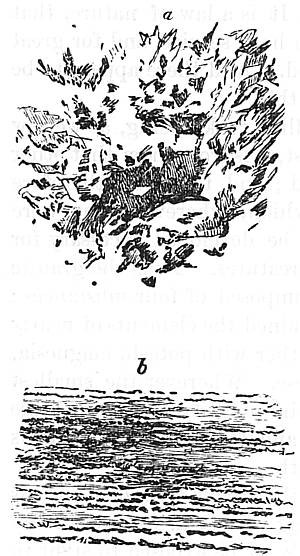
§ 13. Now, when these crystals or grains, represented by the black spots and lines in Fig. 3, lie as they do at a in that figure, in all directions, cast hither and thither among the other materials of the stone,—sometimes on their faces, sometimes on their sides, sometimes on their edges,—they give the rock an irregularly granulated appearance and structure, so that it will break with equal ease in any direction; but if these crystals lie all one way, with their sides parallel, as at b, they give the rock a striped or slaty look, and it will most readily break in the direction in which they lie, separating itself into folia or plates, more or less distinctly according to the quantity of mica in its mass. In the example Fig. 4, a piece of rock from the top of Mont Breven, there are very few of them, and the material with which they are surrounded is so hard and compact that the whole mass breaks irregularly, like a solid flint, beneath the hammer; but the plates of mica nevertheless influence the fracture on a large scale, and occasion, as we shall see hereafter, the peculiar form of the precipice at the summit of the mountain.43
The rocks which are destitute of mica, or in which the mica lies irregularly, or in which it is altogether absent, I shall call Compact Crystallines. The rocks in which the mica lies regularly I shall call Slaty Crystallines.
§ 14. 1st. Compact Crystallines.—Under this head are embraced Compact Crystallines. the large group of the granites, syenites, and porphyries,—rocks which all agree in the following particulars:—
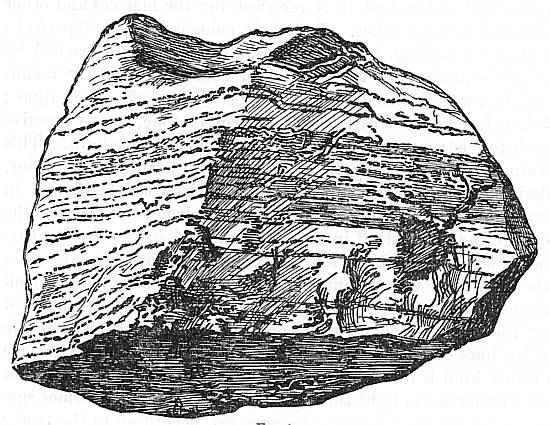
A. Variety of color.—The method of their composition out of different substances necessitates their being all more or less spotted or dashed with various colors; there being generally a Their first characteristic. Speckledness. prevalent ground color, with other subordinate hues broken over it, forming, for the most part, tones of silver grey, of warm but subdued red, or purple. Now, there is in this a very marvellous provision for the beauty of the central ranges. Other rocks, placed lower among the hills, receive color upon their surfaces from all kinds of minute vegetation; but these higher and more exposed rocks are liable to be in many parts barren; and the wild forms into which they are thrown necessitate their being often freshly broken, so as to bring their pure color, untempered in anywise, frankly into sight. Hence it is appointed that this color shall not be raw or monotonous, but composed—as all beautiful color must be composed—by mingling of many hues in one. Not that there is any aim at attractive beauty in these rocks; they are intended to constitute solemn and desolate scenes; and there is nothing delicately or variously disposed in their colors. Such beauty would have been inconsistent with their expression of power and terror, and it is reserved for the marbles and other rocks of inferior office. But their color is grave and perfect; closely resembling, in many cases, the sort of hue reached by cross-chequering in the ground of fourteenth-century manuscripts, and peculiarly calculated for distant effects of light; being, for the most part, slightly warm in tone, so as to receive with full advantage the red and orange rays of sunlight. This warmth is almost always farther aided by a glowing orange color, derived from the decomposition of the iron which, though in small quantity, usually is an essential element in them: the orange hue forms itself in unequal veins and spots upon the surfaces which have been long exposed, more or less darkening them; and a very minute black lichen,—so minute as to look almost like spots of dark paint,—a little opposed and warmed by the golden Lichen geographicus, still farther subdues the paler hues of the highest granite rocks. Now, when a surface of this kind is removed to a distance of four or five miles, and seen under warm light through soft air, the orange becomes russet, more or less inclining to pure red, according to the power of the rays: but the black of the lichen becomes pure dark blue; and the result of their combination is that peculiar reddish purple which is so strikingly the characteristic of the rocks of the higher Alps. Most of the travellers who have seen the Valley of Chamouni carry away a strong impression that its upper precipices are of red rock. But they are, without exception, of a whitish grey, toned and raised by this united operation of the iron, the lichen, and the light.
§ 15. I have never had an opportunity of studying the effects of these tones upon rocks of porphyry; but the beautiful color of that rock in its interior substance has rendered it one of the favorite materials of the architects of all ages, in their most costly work. Not that all porphyry is purple; there are green and white porphyries, as there are yellow and white roses; but the first idea of a porphyry rock is that it shall be purple,—just as the first idea of a rose is that it shall be red. The purple inclines always towards russet44 rather than blue, and is subdued by small spots of grey or white. This speckled character, common to all the crystalline rocks, fits them, in art, for large and majestic work; it unfits them for delicate sculpture; and their second universal characteristic is altogether in harmony with this consequence of their first.
§ 16. This second characteristic is a tough hardness, not a brittle hardness, like that of glass or flint, which will splinter violently at a blow in the most unexpected directions; but a Their second characteristic. Toughness. grave hardness, which will bear many blows before it yields, and when it is forced to yield at last, will do so, as it were, in a serious and thoughtful way; not spitefully, nor uselessly, nor irregularly, but in the direction in which it is wanted, and where the force of the blow is directed—there, and there only. A flint which receives a shock stronger than it can bear, gives up everything at once, and flies into a quantity of pieces, each piece full of flaws. But a piece of granite seems to say to itself, very solemnly: "If these people are resolved to split me into two pieces, that is no reason why I should split myself into three. I will keep together as well as I can, and as long as I can; and if I must fall to dust at last, it shall be slowly and honorably; not in a fit of fury." The importance of this character, in fitting the rock for human uses, cannot be exaggerated: it is essential to such uses that it should be hard, for otherwise it could not bear enormous weights without being crushed; and if, in addition to this hardness, it had been brittle, like glass, it could not have been employed except in the rudest way, as flints are in Kentish walls. But now it is possible to cut a block of granite out of its quarry to exactly the size we want; and that with perfect ease, without gunpowder, or any help but that of a few small iron wedges, a chisel, and a heavy hammer. A single workman can detach a mass fifteen or twenty feet long, by merely drilling a row of holes, a couple of inches deep, and three or four inches apart, along the surface, in the direction in which he wishes to split the rock, and then inserting wedges into each of these holes, and striking them, consecutively, with small, light, repeated blows along the whole row. The granite rends, at last, along the line, quite evenly, requiring very little chiselling afterwards to give the block a smooth face.
§ 17. This after-chiselling, however, is necessarily tedious work, and therefore that condition of speckled color, which is beautiful if exhibited in broad masses, but offensive in delicate forms, exactly falls in with the conditions of possible sculpture. Not only is it more laborious to carve granite delicately, than a softer rock; but it is physically impossible to bring it into certain refinements of form. It cannot be scraped and touched into contours, as marble can; it must be struck hard, or it will not yield at all; and to strike a delicate and detached form hard, is to break it. The detached fingers of a delicate hand, for instance, cannot, as far as I know, be cut in granite. The smallest portion could not be removed from them without a strength of blow which would break off the finger. Hence the sculptor of granite is forced to confine himself to, and to seek for, certain types of form capable of expression in his material; he is naturally driven to make his figures simple in surface, and colossal in size, that they may bear his blows; and this simplicity and magnitude are exactly the characters necessary to show the granitic or porphyritic color to the best advantage. And thus we are guided, almost forced, by the laws of nature, to do right in art. Had granite been white, and marble speckled (and why should this not have been, but by the definite Divine appointment for the good of man?), the huge figures of the Egyptian would have been as oppressive to the sight as cliffs of snow, and the Venus de Medicis would have looked like some exquisitely graceful species of frog.
§ 18. The third universal characteristic of these rocks is their decomposition into the purest sand and clay. Some of them decompose spontaneously, though slowly, on exposure to Their third characteristic. Purity in decomposition. weather; the greater number only after being mechanically pulverized; but the sand and clay to which by one or the other process they are reducible, are both remarkable for their purity. The clay is the finest and best that can be found for porcelain; the sand often of the purest white, always lustrous and bright in its particles. The result of this law is a peculiar aspect of purity in the landscape composed of such rocks. It cannot become muddy, or foul, or unwholesome. The streams which descend through it may indeed be opaque, and as white as cream with the churned substance of the granite; but their water, after this substance has been thrown down, is good and pure, and their shores are not slimy or treacherous, but of pebbles, or of firm and sparkling sand. The quiet streams, springs, and lakes are always of exquisite clearness, and the sea which washes a granite coast is as unsullied as a flawless emerald. It is remarkable to what extent this intense purity in the country seems to influence the character of its inhabitants. It is almost impossible to make a cottage built in a granite country look absolutely miserable. Rough it may be,—neglected, cold, full of aspect of hardship,—but it never can look foul; no matter how carelessly, how indolently, its inhabitants may live, the water at their doors will not stagnate, the soil beneath their feet will not allow itself to be trodden into slime, the timbers of their fences will not rot, they cannot so much as dirty their faces or hands if they try; do the worst they can, there will still be a feeling of firm ground under them, and pure air about them, and an inherent wholesomeness in their abodes which it will need the misery of years to conquer. And, as far as I remember, the inhabitants of granite countries have always a force and healthiness of character, more or less abated or modified, of course, according to the other circumstances of their life, but still definitely belonging to them, as distinguished from the inhabitants of the less pure districts of the hills.
These, then, are the principal characters of the compact crystallines, regarded in their minor or detached masses. Of the peculiar forms which they assume we shall have to speak presently; meantime, retaining these general ideas touching their nature and substance, let us proceed to examine, in the same point of view, the neighboring group of slaty crystallines.
42 I am well aware that to the minds of many persons nothing bears a greater appearance of presumption than any attempt at reasoning respecting the purposes of the Divine Being; and that in many cases it would be thought more consistent with the modesty of humanity to limit its endeavor to the ascertaining of physical causes than to form conjectures respecting Divine intentions. But I believe this feeling to be false and dangerous. Wisdom can only be demonstrated in its ends, and goodness only perceived in its motives. He who in a morbid modesty supposes that he is incapable of apprehending any of the purposes of God, renders himself also incapable of witnessing his wisdom; and he who supposes that favors may be bestowed without intention, will soon learn to receive them without gratitude.
41 The highest pasturages (at least so say the Savoyards) being always the best and richest.
39 Compare also Job, xxxvi. 29, "The spreading of the clouds, and the noise of his tabernacle;" and xxxviii. 33, "Knowest thou the ordinances of heaven? canst thou set the dominion thereof in the earth? canst thou lift up thy voice to the clouds?"
40 "Surely the mountain falling cometh to nought, and the rock is removed out of his place. The waters wear the stones: thou washest away the things which grow out of the dust of the earth; and thou destroyest the hope of man."—Job, xiv. 18, 19.
44 As we had to complain of Dante for not enough noticing the colors of rocks in wild nature, let us do him the justice to refer to his noble symbolic use of their colors when seen in the hewn block.
43 See Appendix 2. Slaty Cleavage.
37
"God made The firmament, expanse of liquid, pure,
Transparent, elemental air, diffused
In circuit to the uttermost convex
Of this great round."
Paradise Lost, book vii.
38 The reader may refer to the following texts, which it is needless to quote: Exod. xiii. 21, xvi. 10, xix. 9, xxiv. 16, xxxiv. 5, Levit. xvi. 2, Num. x. 34, Judges v. 4, 1 Kings viii. 10, Ezek. i. 4, Dan. vii. 13, Matt. xxiv. 30, 1 Thess. iv. 17, Rev. i. 7.
39 Compare also Job, xxxvi. 29, "The spreading of the clouds, and the noise of his tabernacle;" and xxxviii. 33, "Knowest thou the ordinances of heaven? canst thou set the dominion thereof in the earth? canst thou lift up thy voice to the clouds?"
Observe that in the passage of Addison's well known hymn—
"The spacious firmament on high,
With all the blue ethereal sky,
And spangled heavens, a shining frame,
Their great Original proclaim"—
the writer has clearly the true distinctions in his mind; he does not use his words, as we too often accept them, in vain tautology. By the spacious firmament he means the clouds, using the word spacious to mark the true meaning of the Hebrew term: the blue ethereal sky is the real air or ether, blue above the clouds; the heavens are the starry space, for which he uses this word, less accurately, indeed, than the others, but as the only one available for this meaning.
38 The reader may refer to the following texts, which it is needless to quote: Exod. xiii. 21, xvi. 10, xix. 9, xxiv. 16, xxxiv. 5, Levit. xvi. 2, Num. x. 34, Judges v. 4, 1 Kings viii. 10, Ezek. i. 4, Dan. vii. 13, Matt. xxiv. 30, 1 Thess. iv. 17, Rev. i. 7.
42 I am well aware that to the minds of many persons nothing bears a greater appearance of presumption than any attempt at reasoning respecting the purposes of the Divine Being; and that in many cases it would be thought more consistent with the modesty of humanity to limit its endeavor to the ascertaining of physical causes than to form conjectures respecting Divine intentions. But I believe this feeling to be false and dangerous. Wisdom can only be demonstrated in its ends, and goodness only perceived in its motives. He who in a morbid modesty supposes that he is incapable of apprehending any of the purposes of God, renders himself also incapable of witnessing his wisdom; and he who supposes that favors may be bestowed without intention, will soon learn to receive them without gratitude.
43 See Appendix 2. Slaty Cleavage.
44 As we had to complain of Dante for not enough noticing the colors of rocks in wild nature, let us do him the justice to refer to his noble symbolic use of their colors when seen in the hewn block.
"The lowest stair was marble white, so smooth
And polished that therein my mirrored form
Distinct I saw. The next of hue more dark
Than sablest grain, a rough and singed block,
Cracked lengthwise and across. The third, that lay
Massy above, seemed porphyry, that flamed
Red as the life-blood spouting from a vein."
This stair is at the gate of Purgatory. The white step means sincerity of conscience; the black, contrition; the purple (I believe), pardon by the Atonement.
CHAPTER IX.
OF THE MATERIALS OF MOUNTAINS:—SECONDLY, SLATY CRYSTALLINES.
§ 1. It will be remembered that we said in the last chapter (§ 4) that one of the notable characters of the whole group of the crystallines was the incomprehensibility of the processes which have brought them to their actual state. This however is more peculiarly true of the slaty crystallines. It is perfectly possible, by many processes of chemistry, to produce masses of irregular crystals which, though not of the substance of granite, are very like it in their mode of arrangement. But, as far as I am aware, it is impossible to produce artificially anything resembling the structure of the slaty crystallines. And the more I have examined the rocks themselves, the more I have felt at once the difficulty of explaining the method of their formation, and the growing interest of inquiries respecting that method. The facts (and I can venture to give nothing more than facts) are briefly these:—
§ 2. The mineral called mica, described in the course of the last chapter, is closely connected with another, differing from it in containing a considerable quantity of magnesia. This associated mineral, called chlorite, is of a dull greenish color, and opaque, while the mica is, in thin plates, more or less translucent; and the chlorite is apt to occur more in the form of a green earth, or green dust, than of finely divided plates. The original quantity of magnesia in the rock determines how far the mica shall give place to chlorite; and in the intermediate conditions of rock we find a black and nearly opaque mica, containing a good deal of magnesia, together with a chlorite, which at first seems mixed with small plates of true mica, or is itself formed of minute plates or spangles, and then, as the quantity of magnesia increases, assumes its proper form of a dark green earth.
§ 3. By this appointment there is obtained a series of materials by which the appearance of the rock may be varied to almost any extent. From plates of brilliant white mica half a foot broad, flashing in the sun like panes of glass, to a minute film of dark green dust hardly traceable by the eye, an infinite range of conditions is found in the different groups of rocks; but always under this general law, that, for the most part, the compact crystallines present the purest and boldest plates of mica; and the tendency to pass into slaty crystallines is commonly accompanied by the change of the whiteness of the mica to a dark or black color, indicating (I believe) the presence of magnesia, and by the gradual intermingling with it of chloritic earth; or else of a cognate mineral (differing from chlorite in containing a quantity of lime) called hornblende.
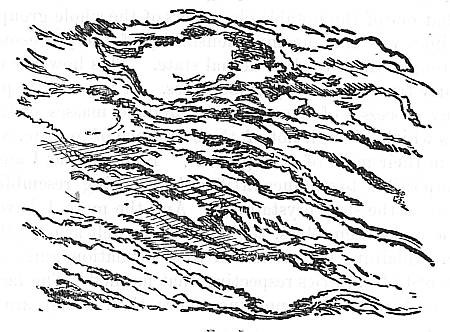
Such, at least, is eminently the case in the Alps; and in the account I have to give of their slaty crystallines, it must be understood that in using the word "mica" generally, I mean the more obscure conditions of the mineral, associated with chlorite and hornblende.
§ 4. Now it is quite easy to understand how, in the compact crystallines, the various elements of the rock, separating from each other as they congealed from their fluid state, whether of watery solution or fiery fusion, might arrange themselves in irregular grains as at a in Fig. 3, p. 106. Such an arrangement constantly takes place before our eyes in volcanic rocks as they cool. But it is not at all easy to understand how the white, hard, and comparatively heavy substances should throw themselves into knots and bands in one definite direction, and the delicate films of mica should undulate about and between them, as in Fig. 5 on page 114, like rivers among islands, pursuing, however, on the whole, a straight course across the mass of rock. If it could be shown that such pieces of stone had been formed in the horizontal position in which I have drawn the one in the figure, the structure would be somewhat intelligible as the result of settlement. But, on the contrary, the lines of such foliated rocks hardly ever are horizontal; neither can distinct evidence be found of their at any time having been so. The evidence, on the contrary, is often strongly in favor of their having been formed in the highly inclined directions in which they now occur, such as that of the piece in Fig. 7, p. 117.45
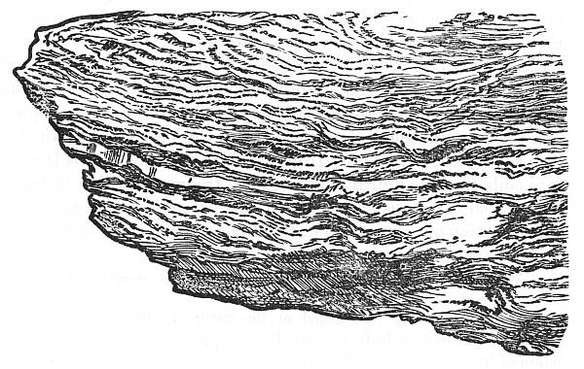
§ 5. Such, however, is the simple fact, that when the compact pact crystallines are about to pass into slaty crystallines, their mica throws itself into these bands and zones, undulating around knots of the other substances which compose the rock. Gradually the knots diminish in size, the mica becomes more abundant and more definite in direction, and at last the mass, when broken across the beds, assumes the appearance of Fig. 6 on the last page.46 Now it will be noticed that, in the lines of that figure, no less than in Fig. 5, though more delicately, there is a subdued, but continual expression of undulation. This character belongs, more or less, to nearly the whole mass of slaty crystalline rocks; it is one of exquisite beauty, and of the highest importance to their picturesque forms. It is also one of as great mysteriousness as beauty. For these two figures are selected from crystallines whose beds are remarkably straight; in the greater number the undulation becomes far more violent, and, in many, passes into absolute contortion. Fig. 7 is a piece of a slaty crystalline, rich in mica, from the Valley of St. Nicolas, below Zermatt. The rock from which it was broken was thrown into coils three or four feet across: the fragment, which is drawn of the real size, was at one of the turns, and came away like a thick portion of a crumpled quire of paper from the other sheets.47
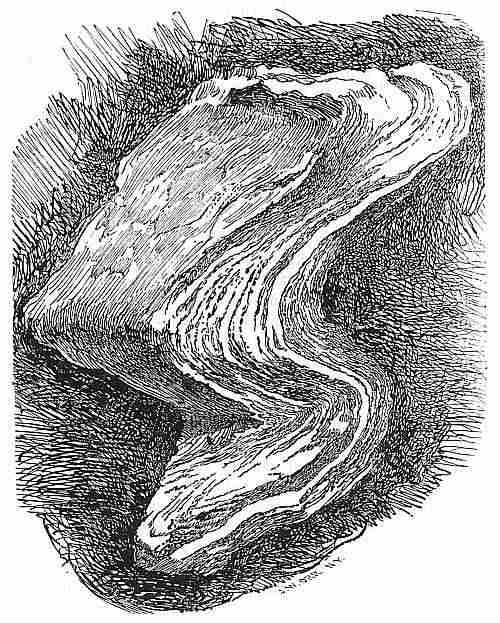
§ 6. I might devote half a volume to a description of the fantastic and incomprehensible arrangement of these rocks and their veins; but all that is necessary for the general reader to Typical character of Slaty Crystallines. know or remember, is this broad fact of the undulation of their whole substance. For there is something, it seems to me, inexpressibly marvellous in this phenomenon, largely looked at. It is to be remembered that these are the rocks which, on the average, will be oftenest observed, and with the greatest interest, by the human race. The central granites are too far removed, the lower rocks too common, to be carefully studied; these slaty crystallines form the noblest hills that are easily accessible, and seem to be thus calculated especially to attract observation, and reward it. Well, we begin to examine them; and first, we find a notable hardness in them, and a thorough boldness of general character, which make us regard them as very types of perfect rocks. They have nothing of the look of dried earth about them, nothing petty or limited in the display of their bulk. Where they are, they seem to form the world; no mere bank of a river here, or of a lane there, peeping out among the hedges or forests: but from the lowest valley to the highest clouds, all is theirs—one adamantine dominion and rigid authority of rock. We yield ourselves to the impression of their eternal, unconquerable stubbornness of strength; their mass seems the least yielding, least to be softened, or in anywise dealt with by external force, of all earthly substance. And, behold, as we look farther into it, it is all touched and troubled, like waves by a summer breeze; rippled, far more delicately than seas or lakes are rippled; they only undulate along their surfaces—this rock trembles through its every fibre, like the chords of an Eolian harp—like the stillest air of spring with the echoes of a child's voice. Into the heart of all those great mountains, through every tossing of their boundless crests, and deep beneath all their unfathomable defiles, flows that strange quivering of their substance. Other and weaker things seem to express their subjection to an Infinite power only by momentary terrors: as the weeds bow down before the feverish wind, and the sound of the going in the tops of the taller trees passes on before the clouds, and the fitful opening of pale spaces on the dark water as if some invisible hand were casting dust abroad upon it, gives warning of the anger that is to come, we may well imagine that there is indeed a fear passing upon the grass, and leaves, and waters, at the presence of some great spirit commissioned to let the tempest loose; but the terror passes, and their sweet rest is perpetually restored to the pastures and the waves. Not so to the mountains. They, which at first seem strengthened beyond the dread of any violence or change, are yet also ordained to bear upon them the symbol of a perpetual Fear: the tremor which fades from the soft lake and gliding river is sealed, to all eternity, upon the rock; and while things that pass visibly from birth to death may sometimes forget their feebleness, the mountains are made to possess a perpetual memorial of their infancy,—that infancy which the prophet saw in his vision: "I beheld the earth, and lo, it was without form and void, and the heavens, and they had no light. I beheld the mountains, and lo, they trembled; and all the hills moved lightly."
§ 7. Thus far may we trace the apparent typical signification of the structure of those noble rocks. The material uses of this structure are not less important. These substances of the Serviceable characters of the Slaty Crystallines. 1. Fitness for building with. higher mountains, it is always to be remembered, were to be so hard as to enable them to be raised into, and remain in, the most magnificent forms; and this hardness renders it a matter of great difficulty for the peasant to break them into such masses as are required for his daily purposes. He is compelled in general to gather the fragments which are to form the walls of his house or his garden from the ruins into which the mountain suffers its ridges to be naturally broken; and if these pieces were absolutely irregular in shape, it would be a matter of much labor and skill to build securely with them. But the flattened arrangement of the layers of mica always causes the rock to break into flattish fragments, requiring hardly any pains in the placing them so as to lie securely in a wall, and furnishing light, broad, and unflawed pieces to serve for slates upon the roof; for fences, when set edgeways into the ground; or for pavements, when laid flat.
§ 8. Farther: whenever rocks break into utterly irregular fragments, the masses of débris which they form are not only excessively difficult to walk over, but the pieces touch each other in 2. Stability in débris. so few points, and suffer the water to run so easily and so far through their cavities, that it takes a long series of years to enable them either to settle themselves firmly, or receive the smallest covering of vegetation. Where the substance of the stone is soft, it may soon be worn down, so that the irregular form is of less consequence. But in the hard crystallines, unless they had a tendency to break into flattish fragments, their ruin would remain for centuries in impassable desolation. The flat shape of the separate pieces prevents this; it permits—almost necessitates—their fitting into and over each other in a tolerably close mass, and thus they become comparatively easy to the foot, less permeable to water, and therefore retentive both of surface moisture and of the seeds of vegetation.
§ 9. There is another result of nearly equal importance as far as regards the habitableness of the hills. When stones are thrown together in rounded or massy blocks, like a heap of hazel 3. Security on declivities. nuts, small force will sometimes disturb their balance; and when once set in motion, a square-built and heavy fragment will thunder down even a slightly sloping declivity, with an impetus as unlikely to be arrested as fatal in its increase. But when stones lie flatly, as dead leaves lie, it is not easy to tilt any one of them upon its edge, so as to set it in motion; and when once moved, it will nearly always slide, not roll, and be stopped by the first obstacle it encounters, catching against it by the edge, or striking into the turf where first it falls, like a hatchet. Were it not for the merciful ordinance that the slaty crystallines should break into thin and flattish fragments, the frequent falls of stones from the hill sides would render many spots among the greater mountain chains utterly uninhabitable, which are now comparatively secure.
§ 10. Of the picturesque aspects which this mode of cleavage produces in the mountains, and in the stones of the foreground, we shall have to speak presently; with regard to the uses of the 4. Tendency to form the loveliest scenery. materials it is only necessary to note farther that these slaty rocks are of course, by their wilful way of breaking, rendered unfit for sculpture, and for nearly all purposes of art; the properties which render them convenient for the peasant in building his cottage, making them unavailable for the architecture of more elaborate edifices. One very great advantage is thus secured for the scenery they compose, namely, that it is rarely broken by quarries. A single quarry will often spoil a whole Alpine landscape; the effect of the lovely bay of the Lago Maggiore, for instance, in which lie the Borromean Islands, is, in great part, destroyed by the scar caused by a quarry of pink granite on its western shore; and the valley of Chamouni itself has lost some of its loveliest rock scenery in consequence of the unfortunate discovery that the boulders which had fallen from its higher pinnacles, and were lying in massy heaps among its pines, were available for stone lintels and door-posts in the building of its new inns. But the slaty crystallines, though sometimes containing valuable mines, are hardly ever quarried for stone; and the scenes they compose retain, in general, little disturbed by man, their aspect of melancholy power, or simple and noble peace. The color of their own mass, when freshly broken, is nearly the same as that of the compact crystallines; but it is far more varied by veins and zones of included minerals, and contains usually more iron, which gives a rich brown or golden color to their exposed sides, so that the coloring of these rocks is the most glowing to be found in the mountain world. They form also soil for vegetation more quickly, and of a more fruitful kind than the granites, and appear, on the whole, intended to unite every character of grandeur and of beauty, and to constitute the loveliest as well as the noblest scenes which the earth ever unfolds to the eyes of men.
45 See again Appendix 2. Slaty Cleavage.
46 This is a piece of the gneiss of the Montanvert, near the Châlets of Blaitière dessous.
47 "Some idea may be formed of the nature of these incurvations by supposing the gneiss beds to have been in a plastic state, either from the action of heat or of some other unknown cause, and, while in this state, to have been subjected to pressure at the two extremities, or in some other parts, according to the nature of the curvatures. But even this hypothesis (though the best that has been thought of) will scarcely enable us to explain all the contortions which not merely the beds of gneiss, but likewise of mica slate and clay slate, and even greywacke slate, exhibit. There is a bed of clay slate near the ferry to Kerrera, a few miles south of Oban, in Argyleshire. This bed has been partly wasted away by the sea, and its structure exposed to view. It contains a central cylindrical nucleus of unknown length (but certainly considerable), round which six beds of clay slate are wrapt, the one within the other, so as to form six concentric cylinders. Now, however plastic the clay slate may have been, there is no kind of pressure which will account for this structure; the central cylinder would have required to have been rolled six times in succession (allowing an interval for solidification between each) in the plastic clay slate."—Outlines of Mineralogy, Geology, &c., by Thomas Thomson, M.D.
CHAPTER X.
OF THE MATERIALS OF MOUNTAINS:—THIRDLY, SLATY COHERENTS.
§ 1. It will be remembered that we resolved to give generally the term "coherent" to those rocks which appeared to be composed of one compact substance, not of several materials. But, as in all the arrangements of Nature we find that her several classes pass into each other by imperceptible gradations, and that there is no ruling of red lines between one and the other, we need not suppose that we shall find any plainly distinguishable limit between the crystalline and coherent rocks. Sometimes, indeed, a very distinctly marked crystalline will be joined by a coherent rock so sharply and neatly that it is possible to break off specimens, no larger than a walnut, containing portions of each; but far more frequently the transition from one to the other is effected gradually; or, if not, there exist, at any rate, in other places intervening, a series of rocks which possess an imperfectly crystalline character, passing down into that of simple coherence. This transition is usually effected through the different kinds of slate; the slaty crystallines becoming more and more fine in texture, until at last they appear composed of nothing but very fine mica or chlorite; and this mass of micaceous substance becomes more and more compact and silky in texture, losing its magnesia, and containing more of the earth which forms the substance of clay, until at last it assumes the familiar appearance of roofing-slate, the noblest example of the coherent rocks. I call it the noblest, as being the nearest to the crystallines, and possessing much in common with them. Connected with this well-known substance are enormous masses of other rocks, more or less resembling it in character, of which the following are universal characteristics.
§ 2. First. They nearly always, as just said, contain more of the earth, which is the basis of clay, than the crystalline rocks; and they can be scratched or crushed with much greater facility. Characteristics of Slaty Coherents. 1. Softness of texture. The point of a knife will trace a continuous powdery streak upon most of the coherent rocks; while it will be quite powerless against a large portion of the granular knots in the crystallines. Besides this actual softness of substance, the slaty coherents are 2. Lamination of structure. capable of very fine division into flakes, not irregularly and contortedly, like the crystallines, but straightly, so as to leave a silky lustre on the sides of the fragments, as in roofing slate; and separating with great ease, yielding to a slight pressure against the edge. Consequently, although the slaty coherents are capable of forming large and bold mountains, they are liable to all kinds of destruction and decay in a far greater degree than the crystallines; giving way in large masses under frost, and crumbling into heaps of flaky rubbish, which in its turn dissolves or is ground down into impalpable dust or mud, and carried to great distances by the mountain streams. These characters render the slaty coherents peculiarly adapted for the support of vegetation; and as, though apparently homogeneous, they usually contain as many chemical elements as the crystallines, they constitute (as far as regards the immediate nourishment of soils) the most important part of mountain ranges.
§ 3. I have already often had occasion to allude to the apparent connexion of brilliancy of color with vigor of life, or purity of substance. This is preeminently the case in the mineral 3. Darkness and blueness in color. kingdom. The perfection with which the particles of any substance unite in crystallization corresponds, in that kingdom, to the vital power in organic nature; and it is a universal law, that according to the purity of any substance, and according to the energy of its crystallization, is its beauty or brightness. Pure earths are without exception white when in powder; and the same earths which are the constituents of clay and sand, form, when crystallized, the emerald, ruby, sapphire, amethyst, and opal. Darkness and dulness of color are the universal signs of dissolution, or disorderly mingling of elements.48
§ 4. Accordingly, these slaty coherents, being usually composed of many elements imperfectly united, are also for the most part grey, black, or dull purple; those which are purest and hardest verging most upon purple, and some of them in certain lights displaying, on their smooth sides, very beautiful zones and changeful spaces of grey, russet, and obscure blue. But even this beauty is strictly connected with their preservation of such firmness of form as properly belongs to them; it is seen chiefly on their even and silky surfaces; less, in comparison, upon their broken edges, and is lost altogether when they are reduced to powder. They then form a dull grey dust, or, with moisture, a black slime, of great value as a vegetative earth, but of intense ugliness when it occurs in extended spaces in mountain scenery. And thus the slaty coherents are often employed to form those landscapes of which the purpose appears to be to impress us with a sense of horror and pain, as a foil to neighboring scenes of extreme beauty. There are many spots among the inferior ridges of the Alps, such as the Col de Ferret, the Col d'Anterne, and the associated ranges of the Buet, which, though commanding prospects of great nobleness, are themselves very nearly types of all that is most painful to the human mind. Vast wastes of mountain ground, covered here and there with dull grey grass, or moss, but breaking continually into black banks of shattered slate, all glistening and sodden with slow tricklings of clogged, incapable streams; the snow water oozing through them in a cold sweat, and spreading itself in creeping stains among their dust; ever and anon a shaking here and there, and a handful or two of their particles or flakes trembling down, one sees not why, into more total dissolution, leaving a few jagged teeth, like the edges of knives eaten away by vinegar, projecting through the half-dislodged mass from the inner rock, keen enough to cut the hand or foot that rests on them, yet crumbling as they wound, and soon sinking again into the smooth, slippery, glutinous heap, looking like a beach of black scales of dead fish, cast ashore from a poisonous sea, and sloping away into foul ravines, branched down immeasurable slopes of barrenness, where the winds howl and wander continually, and the snow lies in wasted and sorrowful fields, covered with sooty dust, that collects in streaks and stains at the bottom of all its thawing ripples. I know no other scenes so appalling as these in storm, or so woful in sunshine.
§ 5. Where, however, these same rocks exist in more favorable positions, that is to say, in gentler banks and at lower elevations, they form a ground for the most luxuriant vegetation; 4. Great power of supporting vegetation. and the valleys of Savoy owe to them some of their loveliest solitudes,—exquisitely rich pastures, interspersed with arable and orchard land, and shaded by groves of walnut and cherry. Scenes of this kind, and of that just described, so singularly opposed, and apparently brought together as foils to each other, are, however, peculiar to certain beds of the slaty coherents, which are both vast in elevation, and easy of destruction. In Wales and Scotland, the same groups of rocks possess far greater hardness, while they attain less elevation; and the result is a totally different aspect of scenery. The severity of the climate, and the comparative durableness of the rock, forbid the rich vegetation; but the exposed summits, though barren, are not subject to laws of destruction so rapid and fearful as in Switzerland; and the natural color of the rock is oftener developed in the purples and greys which, mingled with the heather, form the principal elements of the deep and beautiful distant blue of the British hills. Their gentler mountain streams also permit the beds of rock to remain in firm, though fantastic, forms along their banks, and the gradual action of the cascades and eddies upon the slaty cleavage produces many pieces of foreground scenery to which higher hills can present no parallel. Of these peculiar conditions we shall have to speak at length in another place.
§ 6. As far as regards ministry to the purposes of man, the slaty coherents are of somewhat more value than the slaty crystallines. Most of them can be used in the same way for rough 5. Adaptation to architecture and the fine arts. buildings, while they furnish finer plates or sheets for roofing. It would be difficult, perhaps, to estimate the exact importance of their educational influence in the form of drawing-slate. For sculpture they are, of course, altogether unfit, but I believe certain finer conditions of them are employed for a dark ground in Florentine mosaic.
§ 7. It remains only to be noticed, that the direction of the lamination (or separation into small folio) is, in these rocks, not always, nor even often indicative of the true direction of their larger beds. It is not, however, necessary for the reader to enter into questions of such complicated nature as those which belong to the study of slaty cleavage; and only a few points, which I could not pass over, are noted in the Appendix; but it is necessary to observe here, that all rocks, however constituted, or however disposed, have certain ways of breaking in one direction rather than another, and separating themselves into blocks by means of smooth cracks or fissures, technically called joints, which often influence their forms more than either the position of their beds, or their slaty lamination; and always are conspicuous in their weathered masses. Of these, however, as it would be wearisome to enter into more detail at present, I rather choose to speak incidentally, as we meet with examples of their results in the scenery we have to study more particularly.
48 Compare the close of § 11, Chap. III. Vol. III., and, here, Chap. III. § 23.
CHAPTER XI.
OF THE MATERIALS OF MOUNTAINS:—FOURTHLY, COMPACT COHERENTS.
§ 1. This group of rocks, the last we have to examine, is, as far as respects geographical extent and usefulness to the human race, more important than any of the preceding ones. It forms the greater part of all low hills and uplands throughout the world, and supplies the most valuable materials for building and sculpture, being distinguished from the group of the slaty coherents by its incapability of being separated into thin sheets. All the rocks belonging to the group break irregularly, like loaf sugar or dried clay. Some of them are composed of hardened calcareous matter, and are known as limestone; others are merely hardened sand, and are called freestone or sandstone; and others, appearing to consist of dry mud or clay, are of less general importance, and receive different names in different localities.
§ 2. Among these rocks, the foremost position is, of course, occupied by the great group of the marbles, of which the substance appears to have been prepared expressly in order to afford to human art a perfect means of carrying out its purposes. They are of exactly the necessary hardness,—neither so soft as to be incapable of maintaining themselves in delicate forms, nor so hard as always to require a blow to give effect to the sculptor's touch; the mere pressure of his chisel produces a certain, effect upon them. The color of the white varieties is of exquisite delicacy, owing to the partial translucency of the pure rock; and it has always appeared to me a most wonderful ordinance,—one of the most marked pieces of purpose in the creation,—that all the variegated kinds should be comparatively opaque, so as to set off the color on the surface, while the white, which if it had been opaque would have looked somewhat coarse (as, for instance, common chalk does), is rendered just translucent enough to give an impression of extreme purity, but not so translucent as to interfere in the least with the distinctness of any forms into which it is wrought. The colors of variegated marbles are also for the most part very beautiful, especially those composed of purple, amber, and green, with white; and there seems to be something notably attractive to the human mind in the vague and veined labyrinths of their arrangements. They are farther marked as the prepared material for human work by the dependence of their beauty on smoothness of surface; for their veins are usually seen but dimly in the native rock; and the colors they assume under the action of weather are inferior to those of the crystallines: it is not until wrought and polished by man that they show their character. Finally, they do not decompose. The exterior surface is sometimes destroyed by a sort of mechanical disruption of its outer flakes, but rarely to the extent in which such action takes place in other rocks; and the most delicate sculptures, if executed in good marble, will remain for ages undeteriorated.
§ 3. Quarries of marble are, however, rare, and we owe the greatest part of the good architecture of this world to the more ordinary limestones and sandstones, easily obtainable in blocks of considerable size, and capable of being broken, sawn, or sculptured with ease; the color, generally grey, or warm red (the yellow and white varieties becoming grey with age), being exactly that which will distinguish buildings by an agreeable contrast from the vegetation by which they may be surrounded.
To these inferior conditions of the compact coherence we owe also the greater part of the pretty scenery of the inhabited globe. The sweet winding valleys, with peeping cliffs on either side; the light, irregular wanderings of broken streamlets; the knolls and slopes covered with rounded woods; the narrow ravines, carpeted with greensward, and haunted by traditions of fairy or gnome; the jutting crags, crowned by the castle or watch-tower; the white sea-cliff and sheep-fed down; the long succession of coteau, sunburnt, and bristling with vines,—all these owe whatever they have of simple beauty to the peculiar nature of the group of rocks of which we are speaking; a group which, though occasionally found in mountain masses of magnificent form and size, is on the whole characterized by a comparative smallness of scale, and a tendency to display itself less in true mountains than in elevated downs or plains, through which winding valleys, more or less deep, are cut by the action of the streams.
§ 4. It has been said that this group of rocks is distinguished by its incapability of being separated into sheets. This is only true of it in small portions, for it is usually deposited in beds or layers of irregular thickness, which are easily separable from each other; and when, as not unfrequently happens, some of these beds are only half an inch or a quarter of an inch thick, the rock appears to break into flat plates like a slaty coherent. But this appearance is deceptive. However thin the bed may be, it will be found that it is in its own substance compact, and not separable into two other beds; but the true slaty coherents possess a delicate slatiness of structure, carried into their most minute portions, so that however thin a piece of them may be, it is usually possible, if we have instruments fine enough, to separate it into two still thinner flakes. As, however, the slaty and compact crystallines, so also the slaty and compact coherents pass into each other by subtle gradations, and present many intermediate conditions, very obscure and indefinable.
§ 5. I said just now that the colors of the compact coherents were usually such as would pleasantly distinguish buildings from vegetation. They are so; but considered as abstract hues, are yet far less agreeable than those of the nobler and older rocks. And it is to be noticed, that as these inferior rocks are the materials with which we usually build, they form the ground of the idea suggested to most men's minds by the word "stone," and therefore the general term "stone-color" is used in common parlance as expressive of the hue to which the compact coherents for the most part approximate. By stone-color I suppose we all understand a sort of tawny grey, with too much yellow in it to be called cold, and too little to be called warm. And it is quite true that over enormous districts of Europe, composed of what are technically known as "Jura" and "mountain" limestones, and various pale sandstones, such is generally the color of any freshly broken rock which peeps out along the sides of their gentler hills. It becomes a little greyer as it is colored by time, but never reaches anything like the noble hues of the gneiss and slate; the very lichens which grow upon it are poorer and paler; and although the deep wood mosses will sometimes bury it altogether in golden cushions, the minor mosses, whose office is to decorate and chequer the rocks without concealing them, are always more meagrely set on these limestones than on the crystallines.
§ 6. I never have had time to examine and throw into classes the varieties of the mosses which grow on the two kinds of rock, nor have I been able to ascertain whether there are really numerous differences between the species, or whether they only grow more luxuriantly on the crystallines than on the coherents. But this is certain, that on the broken rocks of the foreground in the crystalline groups the mosses seem to set themselves consentfully and deliberately to the task of producing the most exquisite harmonies of color in their power. They will not conceal the form of the rock, but will gather over it in little brown bosses, like small cushions of velvet made of mixed threads of dark ruby silk and gold, rounded over more subdued films of white and grey, with lightly crisped and curled edges like hoar frost on fallen leaves, and minute clusters of upright orange stalks with pointed caps, and fibres of deep green, and gold, and faint purple passing into black, all woven together, and following with unimaginable fineness of gentle growth the undulation of the stone they cherish, until it is charged with color so that it can receive no more; and instead of looking rugged, or cold, or stern, as anything that a rock is held to be at heart, it seems to be clothed with a soft, dark leopard skin, embroidered with arabesque of purple and silver. But in the lower ranges this is not so. The mosses grow in more independent spots, not in such a clinging and tender way over the whole surface; the lichens are far poorer and fewer; and the color of the stone itself is seen more frequently; altered, if at all, only into a little chiller grey than when it is freshly broken. So that a limestone landscape is apt to be dull, and cold in general tone, with some aspect even of barrenness. The sandstones are much richer in vegetation: there are, perhaps, no scenes in our own island more interesting than the wooded dingles which traverse them, the red rocks growing out on either side, and shelving down into the pools of their deep brown rivers, as at Jedburgh and Langholme; the steep oak copses climbing the banks, the paler plumes of birch shaking themselves free into the light of the sky above, and the few arches of the monastery where the fields in the glen are greenest, or the stones of the border tower where its cliffs are steepest, rendering both field and cliff a thousandfold more dear to the heart and sight. But deprived of associations, and compared in their mere natural beauty with the ravines of the central ranges, there can be no question but that even the loveliest passages of such scenery are imperfect and poor in foreground color. And at first there would seem to be an unfairness in this, unlike the usual system of compensation which so often manifests itself throughout nature. The higher mountains have their scenes of power and vastness, their blue precipices and cloud-like snows: why should they also have the best and fairest colors given to their foreground rocks, and overburden the human mind with wonder; while the less majestic scenery, tempting us to the observance of details for which amidst the higher mountains we had no admiration left, is yet, in the beauty of those very details, as inferior as it is in scale of magnitude?
§ 7. I believe the answer must be, simply, that it is not good for man to live among what is most beautiful;—that he is a creature incapable of satisfaction by anything upon earth; and that to allow him habitually to possess, in any kind whatsoever, the utmost that earth can give, is the surest way to cast him into lassitude or discontent.
If the most exquisite orchestral music could be continued without a pause for a series of years, and children were brought up and educated in the room in which it was perpetually resounding, I believe their enjoyment of music, or understanding of it, would be very small. And an accurately parallel effect seems to be produced upon the powers of contemplation, by the redundant and ceaseless loveliness of the high mountain districts. The faculties are paralyzed by the abundance, and cease, as we before noticed of the imagination, to be capable of excitement, except by other subjects of interest than those which present themselves to the eye. So that it is, in reality, better for mankind that the forms of their common landscape should offer no violent stimulus to the emotions,—that the gentle upland, browned by the bending furrows of the plough, and the fresh sweep of the chalk down, and the narrow winding of the copse-clad dingle, should be more frequent scenes of human life than the Arcadias of cloud-capped mountain or luxuriant vale; and that, while humbler (though always infinite) sources of interest are given to each of us around the homes to which we are restrained for the greater part of our lives, these mightier and stranger glories should become the objects of adventure,—at once the cynosures of the fancies of childhood, and themes of the happy memory, and the winter's tale of age.
§ 8. Nor is it always that the inferiority is felt. For, so natural is it to the human heart to fix itself in hope rather than in present possession, and so subtle is the charm which the imagination casts over what is distant or denied, that there is often a more touching power in the scenes which contain far-away promise of something greater than themselves, than in those which exhaust the treasures and powers of Nature in an unconquerable and excellent glory, leaving nothing more to be by the fancy pictured, or pursued.
I do not know that there is a district in the world more calculated to illustrate this power of the expectant imagination, than that which surrounds the city of Fribourg in Switzerland, extending from it towards Berne. It is of grey sandstone, considerably elevated, but presenting no object of striking interest to the passing traveller; so that, as it is generally seen in the course of a hasty journey from the Bernese Alps to those of Savoy, it is rarely regarded with any other sensation than that of weariness, all the more painful because accompanied with reaction from the high excitement caused by the splendor of the Bernese Oberland. The traveller, footsore, feverish, and satiated with glacier and precipice, lies back in the corner of the diligence, perceiving little more than that the road is winding and hilly, and the country through which it passes cultivated and tame. Let him, however, only do this tame country the justice of staying in it a few days, until his mind has recovered its tone, and take one or two long walks through its fields, and he will have other thoughts of it. It is, as I said, an undulating district of grey sandstone, never attaining any considerable height, but having enough of the mountain spirit to throw itself into continual succession of bold slope and dale; elevated, also, just far enough above the sea to render the pine a frequent forest tree along its irregular ridges. Through this elevated tract the river cuts its way in a ravine some five or six hundred feet in depth, which winds for leagues between the gentle hills, unthought of, until its edge is approached; and then suddenly, through the boughs of the firs, the eye perceives, beneath, the green and gliding stream, and the broad walls of sandstone cliff that form its banks; hollowed out where the river leans against them, at its turns, into perilous overhanging, and, on the other shore, at the same spots, leaving little breadths of meadow between them and the water, half-overgrown with thicket, deserted in their sweetness, inaccessible from above, and rarely visited by any curious wanderers along the hardly traceable footpath which struggles for existence beneath the rocks. And there the river ripples, and eddies, and murmurs in an utter solitude. It is passing through the midst of a thickly peopled country; but never was a stream so lonely. The feeblest and most far-away torrent among the high hills has its companions: the goats browse beside it; and the traveller drinks from it, and passes over it with his staff; and the peasant traces a new channel for it down to his mill-wheel. But this stream has no companions: it flows on in an infinite seclusion, not secret nor threatening, but a quietness of sweet daylight and open air,—a broad space of tender and deep desolateness, drooped into repose out of the midst of human labor and life; the waves plashing lowly, with none to hear them; and the wild birds building in the boughs, with none to fray them away; and the soft, fragrant herbs rising, and breathing, and fading, with no hand to gather them;—and yet all bright and bare to the clouds above, and to the fresh fall of the passing sunshine and pure rain.
§ 9. But above the brows of those scarped cliffs, all is in an instant changed. A few steps only beyond the firs that stretch their branches, angular, and wild, and white, like forks of lightning, into the air of the ravine, and we are in an arable country of the most perfect richness; the swathes of its corn glowing and burning from field to field; its pretty hamlets all vivid with fruitful orchards and flowery gardens, and goodly with steep-roofed storehouse and barn; its well-kept, hard, park-like roads rising and falling from hillside to hillside, or disappearing among brown banks of moss, and thickets of the wild raspberry and rose; or gleaming through lines of tall trees, half glade, half avenue, where the gate opens, or the gateless path turns trustedly aside, unhindered, into the garden of some statelier house, surrounded in rural pride with its golden hives, and carved granaries, and irregular domain of latticed and espaliered cottages, gladdening to look upon in their delicate homeliness—delicate, yet, in some sort, rude; not like our English homes—trim, laborious, formal, irreproachable in comfort; but with a peculiar carelessness and largeness in all their detail, harmonizing with the outlawed loveliness of their country. For there is an untamed strength even in all that soft and habitable land. It is, indeed, gilded with corn and fragrant with deep grass, but it is not subdued to the plough or to the scythe. It gives at its own free will,—it seems to have nothing wrested from it nor conquered in it. It is not redeemed from desertness, but unrestrained in fruitfulness,—a generous land, bright with capricious plenty, and laughing from vale to vale in fitful fulness, kind and wild; nor this without some sterner element mingled in the heart of it. For along all its ridges stand the dark masses of innumerable pines, taking no part in its gladness, asserting themselves for ever as fixed shadows, not to be pierced or banished, even in the intensest sunlight; fallen flakes and fragments of the night, stayed in their solemn squares in the midst of all the rosy bendings of the orchard boughs, and yellow effulgence of the harvest, and tracing themselves in black network and motionless fringes against the blanched blue of the horizon in its saintly clearness. And yet they do not sadden the landscape, but seem to have been set there chiefly to show how bright everything else is round them; and all the clouds look of purer silver, and all the air seems filled with a whiter and more living sunshine, where they are pierced by the sable points of the pines; and all the pastures look of more glowing green, where they run up between the purple trunks: and the sweet field footpaths skirt the edges of the forest for the sake of its shade, sloping up and down about the slippery roots, and losing themselves every now and then hopelessly among the violets, and ground ivy, and brown sheddings of the fibrous leaves; and, at last, plunging into some open aisle where the light through the distant stems shows that there is a chance of coming out again on the other side; and coming out, indeed, in a little while, from the scented darkness, into the dazzling air and marvellous landscape, that stretches still farther and farther in new wilfulness of grove and garden, until, at last, the craggy mountains of the Simmenthal rise out of it, sharp into the rolling of the southern clouds.
§ 10. I believe, for general development of human intelligence and sensibility, country of this kind is about the most perfect that exists. A richer landscape, as that of Italy, enervates, or causes wantonness; a poorer contracts the conceptions, and hardens the temperament of both mind and body; and one more curiously or prominently beautiful deadens the sense of beauty. Even what is here of attractiveness,—far exceeding, as it does that of most of the thickly peopled districts of the temperate zone,—seems to act harmfully on the poetical character of the Swiss; but take its inhabitants all in all, as with deep love and stern penetration they are painted in the works of their principal writer, Gotthelf, and I believe we shall not easily find a peasantry which would completely sustain comparison with them.
§ 11. But be this as it may, it is certain that the compact coherent rocks are appointed to form the greatest part of the earth's surface, and by their utility, and easily changed and governed qualities, to tempt man to dwell among them; being, however, in countries not definitely mountainous, usually covered to a certain depth by those beds of loose gravel and sand to which we agreed to give the name of diluvium. There is nothing which will require to be noted respecting these last, except the forms into which they are brought by the action of water; and the account of these belongs properly to the branch of inquiry which follows next in the order we proposed to ourselves, namely, that touching the sculpture of mountains, to which it will be best to devote some separate chapters; this only being noted in conclusion respecting the various rocks whose nature we have been describing, that out of the entire series of them we may obtain almost every color pleasant to human sight, not the less so for being generally a little softened or saddened. Thus we have beautiful subdued reds, reaching tones of deep purple, in the porphyries, and of pale rose color, in the granites; every kind of silvery and leaden grey, passing into purple, in the slates; deep green, and every hue of greenish grey, in the volcanic rocks and serpentines; rich orange, and golden brown, in the gneiss; black, in the lias limestones; and all these, together with pure white, in the marbles. One color only we hardly ever get in an exposed rock—that dull brown which we noticed above, in speaking of color generally, as the most repulsive of all hues; every approximation to it is softened by nature, when exposed to the atmosphere, into a purple grey. All this can hardly be otherwise interpreted, than as prepared for the delight and recreation of man; and I trust that the time may soon come when these beneficent and beautiful gifts of color may be rightly felt and wisely employed, and when the variegated fronts of our houses may render the term "stone-color" as little definite in the mind of the architect as that of "flower-color" would be to the horticulturist.
48 Compare the close of § 11, Chap. III. Vol. III., and, here, Chap. III. § 23.
46 This is a piece of the gneiss of the Montanvert, near the Châlets of Blaitière dessous.
47 "Some idea may be formed of the nature of these incurvations by supposing the gneiss beds to have been in a plastic state, either from the action of heat or of some other unknown cause, and, while in this state, to have been subjected to pressure at the two extremities, or in some other parts, according to the nature of the curvatures. But even this hypothesis (though the best that has been thought of) will scarcely enable us to explain all the contortions which not merely the beds of gneiss, but likewise of mica slate and clay slate, and even greywacke slate, exhibit. There is a bed of clay slate near the ferry to Kerrera, a few miles south of Oban, in Argyleshire. This bed has been partly wasted away by the sea, and its structure exposed to view. It contains a central cylindrical nucleus of unknown length (but certainly considerable), round which six beds of clay slate are wrapt, the one within the other, so as to form six concentric cylinders. Now, however plastic the clay slate may have been, there is no kind of pressure which will account for this structure; the central cylinder would have required to have been rolled six times in succession (allowing an interval for solidification between each) in the plastic clay slate."—Outlines of Mineralogy, Geology, &c., by Thomas Thomson, M.D.
45 See again Appendix 2. Slaty Cleavage.
CHAPTER XII.
ON THE SCULPTURE OF MOUNTAINS:—FIRST, THE LATERAL RANGES.
§ 1. Close beside the path by which travellers ascend the Montanvert from the valley of Chamouni, on the right hand, where it first begins to rise among the pines, there descends a small stream from the foot of the granite peak known to the guides as the Aiguille Charmoz. It is concealed from the traveller by a thicket of alder, and its murmur is hardly heard, for it is one of the weakest streams of the valley. But it is a constant stream; fed by a permanent though small glacier, and continuing to flow even to the close of the summer, when more copious torrents, depending only on the melting of the lower snows, have left their beds "stony channels in the sun."
I suppose that my readers must be generally aware that glaciers are masses of ice in slow motion, at the rate of from ten to twenty inches a day, and that the stones which are caught between them and the rocks over which they pass, or which are embedded in the ice and dragged along by it over those rocks, are of course subjected to a crushing and grinding power altogether unparalleled by any other force in constant action. The dust to which these stones are reduced by the friction is carried down by the streams which flow from the melting glacier, so that the water which in the morning may be pure, owing what little strength it has chiefly to the rock springs, is in the afternoon not only increased in volume, but whitened with dissolved dust of granite, in proportion to the heat of the preceding hours of the day, and to the power and size of the glacier which feeds it.
§ 2. The long drought which took place in the autumn of the year 1854, sealing every source of waters except these perpetual ones, left the torrent of which I am speaking, and such others, in a state peculiarly favorable to observance of their least action on the mountains from which they descend. They were entirely limited to their own ice fountains, and the quantity of powdered rock which they brought down was, of course, at its minimum, being nearly unmingled with any earth derived from the dissolution of softer soil, or vegetable mould, by rains.
At three in the afternoon, on a warm day in September, when the torrent had reached its average maximum strength for the day, I filled an ordinary Bordeaux wine-flask with the water where it was least turbid. From this quart of water I obtained twenty-four grains of sand and sediment, more or less fine. I cannot estimate the quantity of water in the stream; but the runlet of it at which I filled the flask was giving about two hundred bottles a minute, or rather more, carrying down therefore about three quarters of a pound of powdered granite every minute. This would be forty-five pounds an hour; but allowing for the inferior power of the stream in the cooler periods of the day, and taking into consideration, on the other side, its increased power in rain, we may, I think, estimate its average hour's work at twenty-eight or thirty pounds, or a hundred weight every four hours. By this insignificant runlet, therefore, some four inches wide and four inches deep, rather more than two tons of the substance of the Mont Blanc are displaced, and carried down a certain distance every week; and as it is only for three or four months that the flow of the stream is checked by frost, we may certainly allow eighty tons for the mass which it annually moves.
§ 3. It is not worth while to enter into any calculation of the relation borne by this runlet to the great torrents which descend from the chain of Mont Blanc into the valley of Chamouni. To call it the thousandth part of the glacier waters, would give a ludicrous under-estimate of their total power; but even so calling it, we should find for result that eighty thousand tons of mountain must be yearly transformed into drifted sand, and carried down a certain distance.49 How much greater than this is the actual quantity so transformed I cannot tell; but take this quantity as certain, and consider that this represents merely the results of the labor of the constant summer streams, utterly irrespective of all sudden falls of stones and of masses of mountain (a single thunderbolt will sometimes leave a scar on the flank of a soft rock, looking like a trench for a railroad); and we shall then begin to apprehend something of the operation of the great laws of change, which are the conditions of all material existence, however apparently enduring. The hills, which, as compared with living beings, seem "everlasting," are, in truth, as perishing as they: its veins of flowing fountain weary the mountain heart, as the crimson pulse does ours; the natural force of the iron crag is abated in its appointed time, like the strength of the sinews in a human old age; and it is but the lapse of the longer years of decay which, in the sight of its Creator, distinguishes the mountain range from the moth and the worm.
§ 4. And hence two questions arise of the deepest interest. From what first created forms were the mountains brought into their present condition? into what forms will they change in the course of ages? Was the world anciently in a more or less perfect state than it is now? was it less or more fitted for the habitation of the human race? and are the changes which it is now undergoing favorable to that race or not? The present conformation of the earth appears dictated, as has been shown in the preceding chapters, by supreme wisdom and kindness. And yet its former state must have been different from what it is now; as its present one from that which it must assume hereafter. Is this, therefore, the earth's prime into which we are born; or is it, with all its beauty, only the wreck of Paradise?
I cannot entangle the reader in the intricacy of the inquiries necessary for anything like a satisfactory solution of these questions. But, were he to engage in such inquiries, their result would be his strong conviction of the earth's having been brought from a state in which it was utterly uninhabitable into one fitted for man;—of its having been, when first inhabitable, more beautiful than it is now; and of its gradually tending to still greater inferiority of aspect, and unfitness for abode.
It has, indeed, been the endeavor of some geologists to prove that destruction and renovation are continually proceeding simultaneously in mountains as well as in organic creatures; that while existing eminences are being slowly lowered, others, in order to supply their place, are being slowly elevated; and that what is lost in beauty or healthiness in one spot is gained in another. But I cannot assent to such a conclusion. Evidence altogether incontrovertible points to a state of the earth in which it could be tenanted only by lower animals, fitted for the circumstances under which they lived by peculiar organizations. From this state it is admitted gradually to have been brought into that in which we now see it; and the circumstances of the existing dispensation, whatever may be the date of its endurance, seem to me to point not less clearly to an end than to an origin; to a creation, when "the earth was without form and void," and to a close, when it must either be renovated or destroyed.
§ 5. In one sense, and in one only, the idea of a continuous order of things is admissible, in so far as the phenomena which introduced, and those which are to terminate, the existing dispensation, may have been, and may in future be, nothing more than a gigantic development of agencies which are in continual operation around us. The experience we possess of volcanic agency is not yet large enough to enable us to set limits to its force; and as we see the rarity of subterraneous action generally proportioned to its violence, there may be appointed, in the natural order of things, convulsions to take place after certain epochs, on a scale which the human race has not yet lived long enough to witness. The soft silver cloud which writhes innocently on the crest of Vesuvius, rests there without intermission; but the fury which lays cities in sepulchres of lava bursts forth only after intervals of centuries; and the still fiercer indignation of the greater volcanoes, which make half the globe vibrate with earthquake, and shrivels up whole kingdoms with flame, is recorded only in dim distances of history: so that it is not irrational to admit that there may yet be powers dormant, not destroyed, beneath the apparently calm surface of the earth, whose date of rest is the endurance of the human race, and whose date of action must be that of its doom. But whether such colossal agencies are indeed in the existing order of things or not, still the effective truth, for us, is one and the same. The earth, as a tormented and trembling ball, may have rolled in space for myriads of ages before humanity was formed from its dust; and as a devastated ruin it may continue to roll, when all that dust shall again have been mingled with ashes that never were warmed by life, or polluted by sin. But for us the intelligible and substantial fact is that the earth has been brought, by forces we know not of, into a form fitted for our habitation: on that form a gradual, but destructive, change is continually taking place, and the course of that change points clearly to a period when it will no more be fitted for the dwelling-place of men.
§ 6. It is, therefore, not so much what these forms of the earth actually are, as what they are continually becoming, that we have to observe; nor is it possible thus to observe them without an instinctive reference to the first state out of which they have been brought. The existing torrent has dug its bed a thousand feet deep. But in what form was the mountain originally raised which gave that torrent its track and power? The existing precipice is wrought into towers and bastions by the perpetual fall of its fragments. In what form did it stand before a single fragment fell?
Yet to such questions, continually suggesting themselves, it is never possible to give a complete answer. For a certain distance, the past work of existing forces can be traced; but there gradually the mist gathers, and the footsteps of more gigantic agencies are traceable in the darkness; and still, as we endeavor to penetrate farther and farther into departed time, the thunder of the Almighty power sounds louder and louder; and the clouds gather broader and more fearfully, until at last the Sinai of the world is seen altogether upon a smoke, and the fence of its foot is reached, which none can break through.
§ 7. If, therefore, we venture to advance towards the spot where the cloud first comes down, it is rather with the purpose of fully pointing out that there is a cloud, than of entering into it. It is well to have been fully convinced of the existence of the mystery, in an age far too apt to suppose that everything which is visible is explicable, and everything that is present, eternal. But besides ascertaining the existence of this mystery, we shall perhaps be able to form some new conjectures respecting the facts of mountain aspects in the past ages. Not respecting the processes or powers to which the hills owe their origin, but respecting the aspect they first assumed.
§ 8. For it is evident that, through all their ruin, some traces must still exist of the original contours. The directions in which the mass gives way must have been dictated by the disposition of its ancient sides; and the currents of the streams that wear its flanks must still, in great part, follow the course of the primal valleys. So that, in the actual form of any mountain peak, there must usually be traceable the shadow or skeleton of its former self; like the obscure indications of the first frame of a war-worn tower, preserved, in some places, under the heap of its ruins, in others to be restored in imagination from the thin remnants of its tottering shell; while here and there, in some sheltered spot, a few unfallen stones retain their Gothic sculpture, and a few touches of the chisel, or stains of color, inform us of the whole mind and perfect skill of the old designer. With this great difference, nevertheless, that in the human architecture the builder did not calculate upon ruin, nor appoint the course of impendent desolation; but that in the hand of the great Architect of the mountains, time and decay are as much the instruments of His purpose as the forces by which He first led forth the troops of hills in leaping flocks:—the lightning and the torrent, and the wasting and weariness of innumerable ages, all bear their part in the working out of one consistent plan; and the Builder of the temple for ever stands beside His work, appointing the stone that is to fall, and the pillar that is to be abased, and guiding all the seeming wildness of chance and change, into ordained splendors and foreseen harmonies.
§ 9. Mountain masses, then, considered with respect to their first raising and first sculpture, may be conveniently divided into two great groups; namely, those made up of beds or layers, commonly called stratified; and those made of more or less united substance, called unstratified. The former are nearly always composed of coherent rocks, the latter of crystallines; and the former almost always occupy the outside, the latter the centre of mountain chains. It signifies, therefore, very little whether we distinguish the groups by calling one stratified and the other unstratified, or one "coherent" and the other "crystalline," or one "lateral" and the other "central." But as this last distinction in position seems to have more influence on their forms than either of the others, it is, perhaps, best, when we are examining them in connection with art, that this should be thoroughly kept in mind; and therefore we will consider the first group under the title of "lateral ranges," and the second under that of "central peaks."
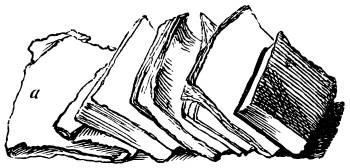
§ 10. The lateral ranges, which we are first to examine, are, for the most part, broad tabular masses of sandstone, limestone, or whatever their material may be,—tilted slightly up over large spaces (several or many miles square), and forming precipices with their exposed edges, as a book resting obliquely on another book forms miniature precipices with its back and sides. The book is a tolerably accurate representation of the mountain in substance, as well as in external aspect; nearly all these tabular masses of rock being composed of a multitude of thinner beds or layers, as the thickness of the book is made up of its leaves; while every one of the mountain leaves is usually written over, though in dim characters, like those of a faded manuscript, with history of departed ages.
"How were these mountain volumes raised, and how are they supported?" are the natural questions following such a statement.
And the only answer is: "Behold the cloud."
No eye has ever seen one of these raised on a large scale; no investigation has brought completely to light the conditions under which the materials which support them were prepared. This only is the simple fact, that they are raised into such sloping positions; generally several resting one upon another, like a row of books fallen down (Fig. 8); the last book being usually propped by a piece of formless compact crystalline rock, represented by the piece of crumpled paper at a.

§ 11. It is another simple fact that this arrangement is not effected in an orderly and serene manner; but that the books, if they were ever neatly bound, have been fearfully torn to pieces and dog's-eared in the course of their elevation; sometimes torn leaf from leaf, but more commonly rent across, as if the paper had been wet and soft: or, to leave the book similitude, which is becoming inconvenient, the beds seem to have been in the consistence of a paste, more or less dry; in some places brittle, and breaking, like a cake, fairly across; in others moist and tough, and tearing like dough, or bending like hot iron; and, in others, crushed and shivering into dust, like unannealed glass. And in these various states they are either bent or broken, or shivered, as the case may be, into fragments of various shapes, which are usually tossed one on top of another, as above described; but, of course, under such circumstances, presenting, not the uniform edges of the books, but jagged edges, as in Fig. 9.
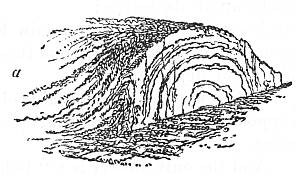
§ 12. Do not let it be said that I am passing my prescribed limits, and that I have tried to enter the clouds, and am describing operations which have never been witnessed. I describe facts or semblances, not operations. I say "seem to have been," not "have been." I say "are bent;" I do not say "have been bent." Most travellers must remember the entrance to the valley of Cluse, from the plain of Bonneville, on the road from Geneva to Chamouni. They remember that immediately after entering it they find a great precipice on their left, not less than two thousand feet in perpendicular height. That precipice is formed by beds of limestone bent like a rainbow, as in Fig. 10. Their edges constitute the cliff; the flat arch which they form with their backs is covered with pine forests and meadows, extending for three or four leagues in the direction of Sixt. Whether the whole mountain was called out of nothing into the form it possesses, or created first in the form of a level mass, and then actually bent and broken by external force, is quite irrelevant to our present purpose; but it is impossible to describe its form without appearing to imply the latter alternative; and all the distinct evidence which can be obtained upon the subject points to such a conclusion, although there are certain features in such mountains which, up to the present time, have rendered all positive conclusion impossible, not because they contradict the theories in question, but because they are utterly inexplicable on any theory whatever.
§ 13. We return then to our Fig. 9, representing beds which appear to have been broken short off at the edges. "If they ever were actually broken," the reader asks, "what could have become of the bits?" Sometimes they seem to have been lost, carried away no one knows where. Sometimes they are really found in scattered fragments or dust in the neighborhood. Sometimes the mountain is simply broken in two, and the pieces correspond to each other, only leaving a valley between; but more frequently one half slips down, or the other is pushed up. In such cases, the coincidence of part with part is sometimes so exact, that half of a broken pebble has been found on one side, and the other half five or six hundred feet below, on the other.
§ 14. The beds, however, which are to form mountains of any eminence are seldom divided in this gentle way. If brittle, one would think they had been broken as a captain's biscuit breaks, leaving sharp and ragged edges; and if tough, they appear to have been torn asunder very much like a piece of new cheese.
The beds which present the most definite appearances of abrupt fracture, are those of that grey or black limestone above described (Chap. x. § 4), formed into a number of thin layers or leaves, commonly separated by filmy spreadings of calcareous sand, hard when dry, but easily softened by moisture; the whole, considered as a mass, easily friable, though particular beds may be very thick and hard. Imagine a layer of such substance, three or four thousand feet thick, broken with a sharp crash through the middle, and one piece of it thrown up as in Fig. 11. It is evident that the first result of such a shock would be a complete shattering of the consistence of the broken edges, and that these would fall, some on the instant, and others tottering and crumbling away from time to time, until the cliff had got in some degree settled into a tenable form. The fallen fragments would lie in a confused heap at the bottom, hiding perhaps one half of its height, as in Fig. 12; the top of it, wrought into somewhat less ragged shape, would thenceforth submit itself only to the gradual influences of time and storm.
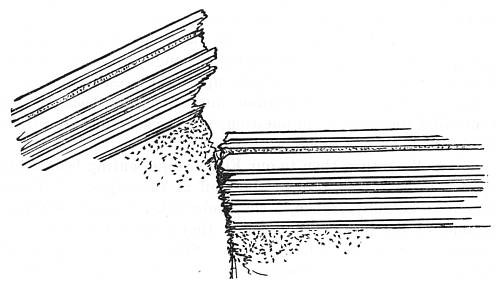
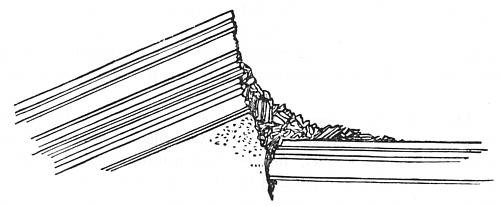
I do not say that this operation has actually taken place. I merely say that such cliffs do in multitudes exist in the form shown at Fig. 12, or, more properly speaking, in that form modified by agencies in visible operation, whose work can be traced upon them, touch by touch. But the condition at Fig. 12 is the first rough blocking out of their form, the primal state in which they demonstrably were, some thousands of years ago, but beyond which no human reason can trace them without danger of error. The cloud fastens upon them there.
§ 15. It is rare, however, that such a cliff as that represented in Fig. 12 can maintain itself long in such a contour. Usually it moulders gradually away into a steep mound or bank; and the larger number of bold cliffs are composed of far more solid rock, which in its general make is quite unshattered and flawless; apparently unaffected, as far as its coherence is concerned, by any shock it may have suffered in being raised to its position, or hewn into its form. Beds occur in the Alps composed of solid coherent limestone (such as that familiar to the English traveller in the cliffs of Matlock and Bristol), 3000 or 4000 feet thick, and broken short off throughout a great part of this thickness, forming nearly50 sheer precipices not less than 1500 or 2000 feet in height, after all deduction has been made for slopes of débris at the bottom, and for rounded diminution at the top.
§ 16. The geologist plunges into vague suppositions and fantastic theories in order to account for these cliffs; but, after all that can be dreamed or discovered, they remain in great part inexplicable. If they were interiorly shattered, it would be easy to understand that, in their hardened condition, they had been broken violently asunder; but it is not easy to conceive a firm cliff of limestone broken through a thickness of 2000 feet without showing a crack in any other part of it. If they were divided in a soft state, like that of paste, it is still less easy to understand how any such soft material could maintain itself, till it dried, in the form of a cliff so enormous and so ponderous: it must have flowed down from the top, or squeezed itself out in bulging protuberance at the base. But it has done neither; and we are left to choose between the suppositions that the mountain was created in a form approximating to that which it now wears, or that the shock which produced it was so violent and irresistible, as to do its work neatly in an instant, and cause no flaws to the rock except in the actual line of fracture. The force must have been analogous either to the light and sharp blow of the hammer with which one breaks a stone into two pieces as it lies in the hand, or the parting caused by settlement under great weight, like the cracks through the brickwork of a modern ill-built house. And yet the very beds which seem at the time they were broken to have possessed this firmness of consistency, are also bent throughout their whole body into waves, apparently following the action of the force that fractured them, like waves of sea under the wind. Truly the cloud lies darkly upon us here!
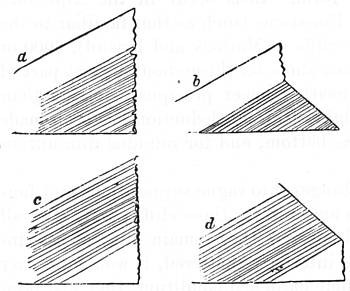
§ 17. And it renders these precipices more remarkable that there is in them no principle of compensation against destructive influences. They are not cloven back continually into new cliffs, as our chalk shores are by the sea; otherwise, one might attribute their first existence to the force of streams. But, on the contrary, the action of years upon them is now always one of deterioration. The increasing heap of fallen fragments conceals more and more of their base, and the wearing of the rain lowers the height and softens the sternness of their brows, so that a great part of their terror has evidently been subdued by time; and the farther we endeavor to penetrate their history, the more mysterious are the forms we are required to explain.
§ 18. Hitherto, however, for the sake of clearness, we have spoken of hills as if they were composed of a single mass or The three great representative forms of stratified mountains. volume of rock. It is very seldom that they are so. Two or three layers are usually raised at once, with certain general results on mountain form, which it is next necessary to examine.
1st. Suppose a series of beds raised in the condition a, Fig. 13, the lowest soft, the uppermost compact; it is evident that the lower beds would rapidly crumble away, and the compact 1. Wall above slope. mass above break for want of support, until the rocks beneath had reached a slope at which they could securely sustain themselves, as well as the weight of wall above, thus bringing the hill into the outline b.
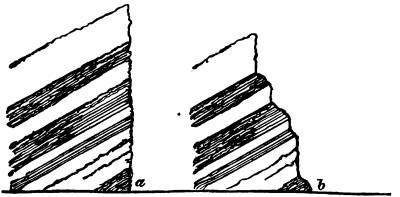
2d. If, on the other hand, the hill were originally raised as at c, the softest beds being at the top, these would crumble into their smooth slope without affecting the outline of the mass below, 2. Slope above wall. and the hill would assume the form d, large masses of débris being in either of these two cases accumulated at the foot of the slope, or of the cliff. These first ruins might, by subsequent changes, be variously engulfed, carried away, or covered over, so as to leave nothing visible, or at least nothing notable, but the great cliff with its slope above or below it. Without insisting on the evidences or probabilities of such construction, it is sufficient to state that mountains of the two types, b and d, are exceedingly common in all parts of the world; and though of course confused with others, and themselves always more or less imperfectly developed, yet they are, on the whole, singularly definite as classes of hills, examples of which can hardly but remain clearly impressed on the mind of every traveller. Of the first, b, Salisbury Crags, near Edinburgh, is a nearly perfect instance, though on a diminutive scale. The cliffs of Lauterbrunnen, in the Oberland, are almost without exception formed on the type d.
3d. When the elevated mass, instead of consisting merely of two great divisions, includes alternately hard and soft beds, as at a, Fig. 14, the vertical cliffs and inclined banks alternate with 3. Slope and wall alternately. each other, and the mountain rises on a series of steps, with receding slopes of turf or débris on the ledge of each, as at b. At the head of the valley of Sixt, in Savoy, huge masses of mountain connected with the Buet are thus constructed: their slopes are quite smooth, and composed of good pasture land, and the cliffs in many places literally vertical. In the summer the peasants make hay on the inclined pastures; and the hay is "carried" by merely binding the haycocks tight and rolling them down the slope and over the cliff, when I have heard them fall to the bank below, a height of from five to eight hundred feet, with a sound like the distant report of a heavy piece of artillery.
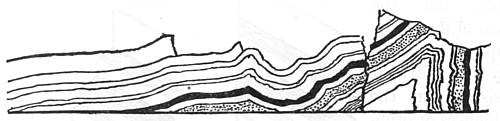
§ 19. The next point of importance in these beds is the curvature, to which, as well as to fracture, they seem to have been subjected. This curvature is not to be confounded with that rippling or undulating character of every portion of the slaty crystalline rocks above described. I am now speaking of all kinds of rocks indifferently;—not of their appearance in small pieces, but of their great contours in masses, thousands of feet thick. And it is almost universally true of these masses that they do not merely lie in flat superposition one over another, as the books in Fig. 8; but they lie in waves, more or less vast and sweeping according to the scale of the country, as in Fig. 15, where the distance from one side of the figure to the other is supposed to be four or five leagues.
§ 20. Now, observe, if the precipices which we have just been describing had been broken when their substance was in a hard state, there appears no reason why any connexion should be apparent between the energy of undulation and these broken rocks. If the continuous waves were caused by convulsive movements of the earth's surface while its substance was pliable, and were left in repose for so long a period as to become perfectly hard before they were broken into cliffs, there seems no reason why the second series of shocks should so closely have confined itself to the locality which had suffered the first, that the most abrupt precipices should always be associated with the wildest waves. We might have expected that sometimes we should have had noble cliffs raised where the waves had been slight; and sometimes low and slight fractures where the waves had been violent. But this is not so. The contortions and fractures bear always such relation to each other as appears positively to imply contemporaneous formation. Through all the lowland districts of the world the average contour of the waves of rock is somewhat as represented in Fig. 16 a, and the little cliffs or hills formed at the edges of the beds (whether by fracture, or, as oftener happens in such countries, by gradual washing away under the surge of ancient seas) are no higher, in proportion to the extent of surface, than the little steps seen in the centre of the figure. Such is the nature, and such the scale, of the ranges of hills which form our own downs and wolds, and the French coteaux beside their winding rivers. But as we approach the hill countries, the undulation becomes more marked, and the crags more bold; so that almost any portion of such mountain ranges as the Jura or the Vosges will present itself under conditions such as those at b, the precipices at the edges being bolder in exact proportion to the violence of wave. And, finally, in the central and noblest chains the undulation becomes literally contortion; the beds occur in such positions as those at c, and the precipices are bold and terrific in exact proportion to this exaggerated and tremendous contortion.
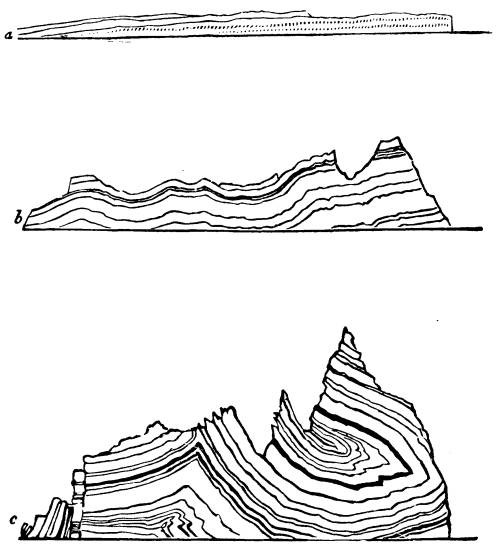
§ 21. These facts appear to be just as contrary to the supposition of the mountains having been formed while the rocks were hard, as the considerations adduced in § 15 are to that of their being formed while they were soft. And I believe the more the reader revolves the subject in his thoughts, and the more opportunities he has of examining the existing facts, the less explicable those facts will become to him, and the more reverent will be his acknowledgment of the presence of the cloud.
For, as he examines more clearly the structure of the great mountain ranges, he will find that though invariably the boldest forms are associated with the most violent contortions, they sometimes follow the contortions, and sometimes appear entirely independent of them. For instance, in crossing the pass of the Tête Noire, if the traveller defers his journey till near the afternoon, so that from the top of the pass he may see the great limestone mountain in the Valais, called the Dent de Morcles, under the full evening light, he will observe that its peaks are hewn out of a group of contorted beds, as shown in Fig. 4, Plate 29. The wild and irregular zigzag of the beds, which traverse the face of the cliff with the irregularity of a flash of lightning, has apparently not the slightest influence on the outline of the peak. It has been carved out of the mass, with no reference whatever to the interior structure. In like manner, as we shall see hereafter, the most wonderful peak in the whole range of the Alps seems to have been cut out of a series of nearly horizontal beds, as a square pillar of hay is cut out of a half-consumed haystack. And yet, on the other hand, we meet perpetually with instances in which the curves of the beds have in great part directed the shape of the whole mass of mountain. The gorge which leads from the village of Ardon, in the Valais, up to the root of the Diablerets, runs between two ranges of limestone hills, of which the rude contour is given in Fig. 17, page 154. The great slope seen on the left, rising about seven thousand feet above the ravine, is nothing but the back of one sheet of limestone, whose broken edge forms the first cliff at the top, a height of about six hundred feet, the second cliff being the edge of another bed emergent beneath it, and the slope beyond, the surface of a third. These beds of limestone all descend at a uniform inclination into the gorge, where they are snapped short off, the torrent cutting its way along the cleft, while the beds rise on the other side in a huge contorted wave, forming the ridge of mountains on the right,—a chain about seven miles in length, and from five thousand to six thousand feet in height. The actual order of the beds is seen in Fig. 18, and it is one of the boldest and clearest examples of the form of mountains being correspondent to the curves of beds which I have ever seen; it also exhibits a condition of the summits which is of constant occurrence in stratified hills, and peculiarly important as giving rise to the serrated structure, rendered classical by the Spaniards in their universal term for mountain ridges, Sierra, and obtaining for one of the most important members of the Comasque chain of Alps its well known Italian name—Il Resegone. Such mountains are not merely successions of irregular peaks, more or less resembling the edge of a much-hacked sword; they are orderly successions of teeth set in one direction, closely resembling those of a somewhat overworn saw, and nearly always produced by successive beds emerging one from beneath the other.
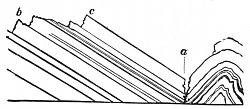
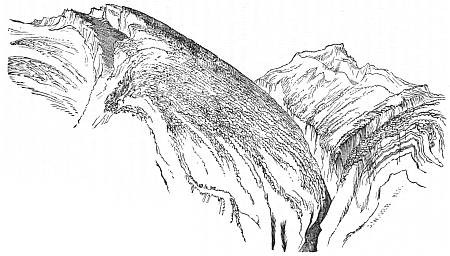
§ 22. In all such cases there is an infinitely greater difficulty in accounting for the forms than in explaining the fracture of a single bed. How, and when, and where, were the other portions carried away? Was each bed once continuous over a much larger space from the point where its edge is now broken off, or have such beds slipped back into some gulf behind them? It is very easy for geologists to speak generally of elevation and convulsion, but very difficult to explain what sort of convulsion it could be which passed forward from the edge of one bed to the edge of another, and broke the required portion off each without disturbing the rest. Try the experiment in the simplest way: put half a dozen of hard captain's biscuits in a sloping position on a table, and then try, as they lie, to break the edge of each, one by one, without disturbing the rest. At least, you will have to raise the edge before you can break it; to put your hand underneath, between it and the next biscuit, before you can get any purchase on it. What force was it that put its fingers between one bed of limestone 600 feet thick and the next beneath? If you try to break the biscuits by a blow from above, observe the necessary force of your blow, and then conceive, if you can, the sort of hammer that was required to break the 600 feet of rock through in the same way. But, also, you will, ten to one, break two biscuits at the same time. Now, in these serrated formations, two biscuits are never broken at the same time. There is no appearance of the slightest jar having taken place affecting the bed beneath. If there be, a huge cliff or gorge is formed at that spot, not a sierra. Thus, in Fig. 18, the beds are affected throughout their united body by the shock which formed the ravine at a; but they are broken, one by one, into the cliffs at b and c. Sometimes one is tempted to think that they must have been slipped back, one from off the other; but there is never any appearance of friction having taken place on their exposed surfaces; in the plurality of instances their continuance or rise from their roots in waves (see Fig. 16 above) renders the thing utterly impossible; and in the few instances which have been known of such action actually taking place (which have always been on a small scale), the sliding bed has been torn into a thousand fragments almost as soon as it began to move.51
§ 23. And, finally, supposing a force found capable of breaking these beds in the manner required, what force was it that carried the fragments away? How were the gigantic fields of shattered marble conveyed from the ledges which were to remain exposed? No signs of violence are found on these ledges; what marks there are, the rain and natural decay have softly traced through a long series of years. Those very time-marks may have indeed effaced mere superficial appearances of convulsion; but could they have effaced all evidence of the action of such floods as would have been necessary to carry bodily away the whole ruin of a block of marble leagues in length and breadth, and a quarter of a mile thick? Ponder over the intense marvellousness of this. The bed at c (Fig. 18) must first be broken through the midst of it into a sharp precipice, without at all disturbing it elsewhere; and then all of it beyond c is to be broken up, and carried perfectly away, without disturbing or wearing down the face of the cliff at c.
And yet no trace of the means by which all this was effected is left. The rock stands forth in its white and rugged mystery, as if its peak had been born out of the blue sky. The strength that raised it, and the sea that wrought upon it, have passed away, and left no sign; and we have no words wherein to describe their departure, no thoughts to form about their action, than those of the perpetual and unsatisfied interrogation,—
"What ailed thee, O thou sea, that thou fleddest?
And ye mountains, that ye skipped like lambs?"
49 How far, is another question. The sand which the stream brings from the bottom of one eddy in its course, it throws down in the next; all that is proved by the above trial is, that so many tons of material are annually carried down by it a certain number of feet.
50 Nearly; that is to say, not quite vertical. Of the degree of steepness, we shall have more to say hereafter.
51 The Rossberg fall, compared to the convulsions which seem to have taken place in the higher Alps, is like the slip of a paving stone compared to the fall of a tower.
CHAPTER XIII.
OF THE SCULPTURE OF MOUNTAINS:—SECONDLY, THE CENTRAL PEAKS.
§ 1. In the 20th paragraph of the last chapter, it was noticed that ordinarily the most irregular contortions or fractures of beds of rock were found in the districts of most elevated hills, the contortion or fracture thus appearing to be produced at the moment of elevation. It has also previously been stated that the hardness and crystalline structure of the material increased with the mountainous character of the ground; so that we find as almost invariably correlative, the hardness of the rock, its distortion, and its height; and, in like manner its softness, regularity of position, and lowness. Thus, the line of beds in an English range of down, composed of soft chalk which crumbles beneath the fingers, will be as low and continuous as in a of Fig. 16 (p. 151); the beds in the Jura mountains, composed of firm limestone, which needs a heavy hammer stroke to break it, will be as high and wavy as at b; and the ranges of Alps, composed of slaty crystallines, yielding only to steel wedges or to gunpowder, will be as lofty and as wild in structure as at c. Without this beneficent connection of hardness of material with height, mountain ranges either could not have existed, or would not have been habitable. In their present magnificent form, they could not have existed; and whatever their forms, the frequent falls and crumblings away, which are of little consequence in the low crags of Hastings, Dover, or Lyme, would have been fatal to the population of the valleys beneath, when they took place from heights of eight or ten thousand feet.
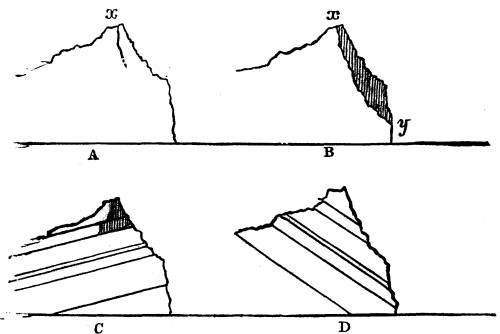
§ 2. But this hardening of the material would not have been sufficient, by itself, to secure the safety of the inhabitants. Unless the reader has been already familiarized with geological facts, he must surely have been struck by the prominence of the bedded structure in all the instances of mountain form given in the preceding chapter; and must have asked himself, Why are mountains always built in this masonry-like way, rather than in compact masses? Now, it is true that according to present geological theories, the bedded structure was a necessary consequence of the mode in which the materials were accumulated; but it is not less true that this bedded structure is now the principal means of securing the stability of the mass, and is to be regarded as a beneficent appointment, with such special view. That structure compels each mountain to assume the safest contour of which under the given circumstances of upheaval it is capable. If it were all composed of an amorphous mass of stone as at A, Fig. 19, a crack beginning from the top, as at x in A, might gradually extend downwards in the direction x y in B, until the whole mass, indicated by the shade, separated itself and fell. But when the whole mountain is arranged in beds, as at C, the crack beginning at the top stops in the uppermost bed, or, if it extends to the next, it will be in a different place, and the detached blocks, marked by the shaded portions, are of course still as secure in their positions as before the crack took place. If, indeed, the beds sloped towards the precipice, as at D, the danger would be greater; but if the reader looks to any of the examples of mountain form hitherto given, he will find that the universal tendency of the modes of elevation is to cause the beds to slope away from the precipice, and to build the whole mountain in the form C, which affords the utmost possible degree of security. Nearly all the mountains which rise immediately above thickly peopled districts, though they may appear to be thrown into isolated peaks, are in reality nothing more than flattish ranks of rock, terminated by walls of cliff, of this perfectly safe kind; and it will be part of our task in the succeeding chapter to examine at some length the modes in which sublime and threatening forms are almost deceptively assumed by arrangements of mountain which are in themselves thus simple and secure.
§ 3. It, however, fell within the purpose of the Great Builder to give, in the highest peaks of mountains, examples of form more strange and majestic than any which could be attained by structures so beneficently adapted to the welfare of the human race. And the admission of other modes of elevation, more terrific and less secure, takes place exactly in proportion to the increasing presence of such conditions in the locality as shall render it on other grounds unlikely to be inhabited, or incapable of being so. Where the soil is rich and the climate soft, the hills are low and safe;52 as the ground becomes poorer and the air keener, they rise into forms of more peril and pride; and their utmost terror is shown only where their fragments fall on trackless ice, and the thunder of their ruin can be heard but by the ibex and the eagle.
§ 4. The safety of the lower mountains depends, as has just been observed, on their tendency to divide themselves into beds. But it will easily be understood that, together with security, such a structure involves some monotony of aspect; and that the possibility of a rent like that indicated in the last figure, extending itself without a check, so as to detach some vast portion of the mountain at once, would be a means of obtaining accidental forms of far greater awfulness. We find, accordingly, that the bedded structure is departed from in the central peaks; that they are in reality gifted with this power, or, if we choose so to regard it, affected with this weakness, of rending downwards throughout into vertical sheets; and that to this end they are usually composed of that structureless and massive rock which we have characterized by the term "compact crystalline."
§ 5. This, indeed, is not universal. It happens sometimes that toward the centre of great hill ranges ordinary stratified rocks of the coherent groups are hardened into more compact strength than is usual with them; and out of the hardened mass a peak, or range of peaks, is cut as if out of a single block. Thus the well known Dent du Midi of Bex, a mountain of peculiar interest to the English travellers who crowd the various inns and pensions which now glitter along the shores of the Lake of Geneva at Vevay, Clarens, and Montreux, is cut out of horizontal beds of rock which are traceable in the evening light by their dark and light lines along its sides, like courses of masonry; the real form of the mountain being that of the ridge of a steep house-roof, jagged and broken at the top, so that, seen from near St. Maurice, the extremity of the ridge appears a sharp pyramid. The Dent de Morcles, opposite the Dent du Midi, has been already noticed, and is figured in Plate 29, Fig. 4. In like manner, the Matterhorn is cut out of a block of nearly horizontal beds of gneiss. But in all these cases the materials are so hardened and knit together that to all intents and purposes they form one solid mass, and when the forms are to be of the boldest character possible, this solid mass is unstratified, and of compact crystalline rock.
§ 6. In looking from Geneva in the morning light, when Mont Blanc and its companion hills are seen dark against the dawn, almost every traveller must have been struck by the notable range of jagged peaks which bound the horizon immediately to the north-east of Mont Blanc. In ordinary weather they appear a single chain, but if any clouds or mists happen to float into the heart of the group, it divides itself into two ranges, lower and higher, as in Fig. 1, Plate 29, of which the uppermost and more distant chain is the real crest of the Alps, and the lower and darker line is composed of subordinate peaks which form the south side of the valley of Chamouni, and are therefore ordinarily known as the "Aiguilles of Chamouni."
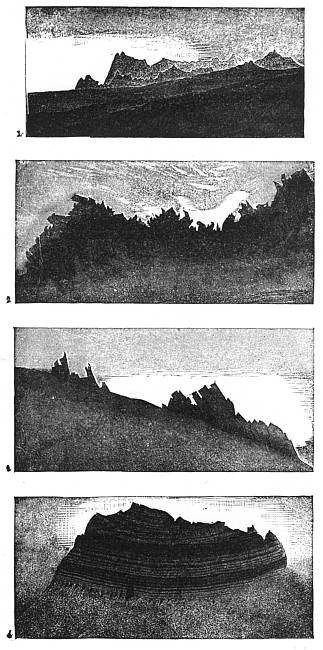
J. Ruskin.
J.C. Armytage.
29. Aiguille Structure.
Though separated by some eight or nine miles of actual distance, the two ranges are part of one and the same system of rock. They are both of them most notable examples of the structure of the compact crystalline peaks, and their jagged and spiry outlines are rendered still more remarkable in any view obtained of them in the immediate neighborhood of Geneva, by their rising, as in the figure, over two long slopes of comparatively flattish mountain. The highest of these is the back of a stratified limestone range, distant about twenty-five miles, whose precipitous extremity, nodding over the little village of St. Martin's, is well known under the name of the Aiguille de Varens. The nearer line is the edge of another limestone mountain, called the Petit Salève, within five miles of Geneva. And thus we have two ranges of the crystalline rocks opposed to two ranges of the coherents, both having their distinctive characters, the one of vertical fracture, the other of level continuousness, developed on an enormous scale. I am aware of no other view in Europe where the essential characteristics of the two formations are so closely and graphically displayed.
§ 7. Nor can I imagine any person thoughtfully regarding the more distant range, without feeling his curiosity strongly excited as to the method of its first sculpture. That long banks and fields of rock should be raised aslope, and break at their edges into cliffs, however mysterious the details of the operation may be, is yet conceivable in the main circumstances without any great effort of imagination. But the carving of those great obelisks and spires out of an infinitely harder rock; the sculpture of all the fretted pinnacles on the inaccessible and calm elevation of that great cathedral,—how and when was this wrought? It is necessary, before the extent and difficulty of such a question can be felt, to explain more fully the scale and character of the peaks under consideration.
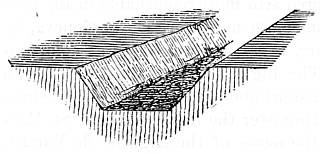
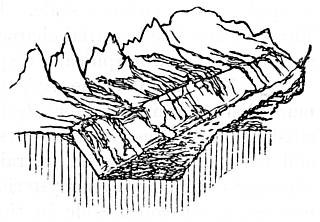
§ 8. The valley of Chamouni, largely viewed, and irrespectively of minor ravines and irregularities, is nothing more than a deep trench, dug between two ranges of nearly continuous mountains,—dug with a straightness and evenness which render its scenery, in some respects, more monotonous than that of any other Alpine valley. On each side it is bordered by banks of turf, darkened with pine forest, rising at an even slope to a height of about 3000 feet, so that it may best be imagined as a kind of dry moat, which, if cut across, would be of the form typically shown in Fig. 20; the sloping bank on each side being about 3000 feet high, or the moat about three fifths of a mile in vertical depth. Then, on the top of the bank, on each side, and a little way back from the edge of the moat, rise the ranges of the great mountains, in the form of shattered crests and pyramids of barren rock sprinkled with snow. Those on the south side of the valley rise another 3000 feet above the bank on which they stand, so that each of the masses superadded in Fig. 21 may best be described as a sort of Egyptian pyramid,53 of the height of Snowden or Ben Lomond, hewn out of solid rock, and set on the shoulder of the great bank which borders the valley. Then the Mont Blanc, a higher and heavier cluster of such summits, loaded with deep snow, terminates the range. Glaciers of greater or less extent descend between the pyramids of rock; and one, supplied from their largest recesses, even runs down the bank into the valley. Fig. 2254 rudely represents the real contours of the mountains, including Mont Blanc itself, on its south side. The range of peaks, b, p, m, is that already spoken of, known as the "Aiguilles of Chamouni." They form but a very small portion of a great crowd of similar, and, for the most part, larger peaks which constitute the chain of Mont Blanc, and which receive from the Savoyards the name of Aiguilles, or needles, in consequence of their peculiarly sharp summits. The forms of these Aiguilles, wonderful enough in themselves, are, nevertheless, perpetually exaggerated both by the imagination of the traveller, and by the artists whose delineations of them find most frank acceptance. Fig. 1 in Plate 30 is faithfully copied from the representation given of one of these mountains in a plate lately published at Geneva. Fig. 2 in the same plate is a true outline of the mountain itself. Of the exaggerations in the other I shall have more to say presently; meantime, I refer to it merely as a proof that I am not myself exaggerating, in giving Fig. 22 as showing the general characters of these peaks.
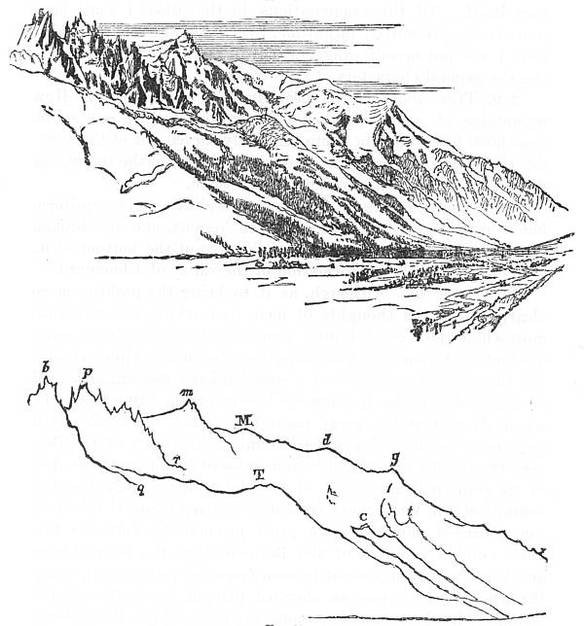
§ 9. This, then, is the problem to be considered,—How mountains of such rugged and precipitous outline, and at the least 3000 feet in height, were originally carved out of the hardest rocks, and set in their present position on the top of the green and sloping bank which sustains them.
"By mere accident," the reader replies. "The uniform bank might as easily have been the highest, and the broken granite peaks have risen from its sides, or at the bottom of it. It is merely the chance formation of the valley of Chamouni."
Nay; not so. Although, as if to bring the problem more clearly before the thoughts of men, by marking the structure most where the scenery is most attractive, the formation is more distinct at Chamouni than anywhere else in the Alpine chain; yet the general condition of a rounded bank sustaining jagged or pyramidal peaks is more or less traceable throughout the whole district of the great mountains. The most celebrated spot, next to the valley of Chamouni, is the centre of the Bernese Oberland; and it will be remembered by all travellers that in its principal valley, that of Grindelwald, not only does the summit of the Wetterhorn consist of a sharp pyramid raised on the advanced shoulder of a great promontory, but the two most notable summits of the Bernese Alps, the Schreckhorn and Finsteraarhorn, cannot be seen from the valley at all, being thrown far back upon an elevated plateau, of which only the advanced head or shoulder, under the name of the Mettenberg, can be seen from the village. The real summits, consisting in each case of a ridge starting steeply from this elevated plateau, as if by a new impulse of angry or ambitious mountain temper, can only be seen by ascending a considerable height upon the flank of the opposite mass of the Faulhorn.
§ 10. And this is, if possible, still more notably and provokingly the case with the great peaks of the chain of Alps between Monte Rosa and Mont Blanc. It will be seen, by a glance at any map of Switzerland, that the district which forms the canton Valais is, in reality, nothing but a ravine sixty miles long, between that central chain and the Alps of the cantons Fribourg and Berne. This ravine is also, in its general structure, merely a deeper and wider moat than that already described as forming the valley of Chamouni. It lies, in the same manner, between two banks of mountain; and the principal peaks are precisely in the same manner set back upon the tops of these banks; and so provokingly far back, that throughout the whole length of the valley not one of the summits of the chief chain can be seen from it. That usually pointed out to travellers as Monte Rosa is a subordinate, though still very colossal mass, called the Montagne de Saas; and this is the only peak of great size discoverable from the valley throughout its extent; one or two glimpses of the snows, not at any eminent point, being caught through the entrances of the lateral valleys of Evolena, &c.
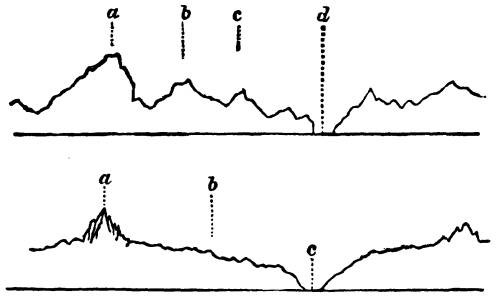
§ 11. Nor is this merely the consequence of the great distance of the central ridge. It would be intelligible enough that the mountains should rise gradually higher and higher towards the middle of the chain, so that the summit at a in the upper diagram of Fig. 23 should be concealed by the intermediate eminences b, c, from the valley at d. But this is not, by any means, the manner in which the concealment is effected. The great peaks stand, as at a in the lower diagram, jagged, sharp, and suddenly starting out of a comparatively tame mass of elevated land, through which the trench of the valley of the Rhone is cut, as at c. The subdivision of the bank at b by thousands of ravines, and its rise, here and there, into more or less notable summits, conceal the real fact of the structure from a casual observer. But the longer I stayed among the Alps, and the more closely I examined them, the more I was struck by the one broad fact of their being a vast Alpine plateau, or mass of elevated land, upon which nearly all the highest peaks stood like children set upon a table, removed, in most cases, far back from the edge of the plateau, as if for fear of their falling. And the most majestic scenes in the Alps are produced, not so much by any violation of this law, as by one of the great peaks having apparently walked to the edge of the table to look over, and thus showing itself suddenly above the valley in its full height. This is the case with the Wetterhorn and Eiger at Grindelwald, and with the Grande Jorasse, above the Col de Ferret. But the raised bank or table is always intelligibly in existence, even in these apparently exceptional cases; and, for the most part, the great peaks are not allowed to come to the edge of it, but remain like the keeps of castles far withdrawn, surrounded, league beyond league, by comparatively level fields of mountain, over which the lapping sheets of glacier writhe and flow, foaming about the feet of the dark central crests like the surf of an enormous sea-breaker hurled over a rounded rock, and islanding some fragment of it in the midst. And the result of this arrangement is a kind of division of the whole of Switzerland into an upper and lower mountain-world; the lower world consisting of rich valleys bordered by steep, but easily accessible, wooded banks of mountain, more or less divided by ravines, through which glimpses are caught of the higher Alps; the upper world, reached after the first steep banks, of 3000 or 4000 feet in height, have been surmounted, consisting of comparatively level but most desolate tracts of moor and rock, half covered by glacier, and stretching to the feet of the true pinnacles of the chain.
§ 12. It can hardly be necessary to point out the perfect wisdom and kindness of this arrangement, as a provision for the safety of the inhabitants of the high mountain regions. If the great peaks rose at once from the deepest valleys, every stone which was struck from their pinnacles, and every snow-wreath which slipped from their ledges, would descend at once upon the inhabitable ground, over which no year could pass without recording some calamity of earth-slip or avalanche; while, in the course of their fall, both the stones and the snow would strip the woods from the hill sides, leaving only naked channels of destruction where there are now the sloping meadow and the chestnut glade. Besides this, the masses of snow, cast down at once into the warmer air, would all melt rapidly in the spring, causing furious inundation of every great river for a month or six weeks. The snow being then all thawed, except what lay upon the highest peaks in regions of nearly perpetual frost, the rivers would be supplied, during the summer, only by fountains, and the feeble tricklings on sunny days from the high snows. The Rhone under such circumstances would hardly be larger at Lyons than the Severn at Shrewsbury, and many Swiss valleys would be left almost without moisture. All these calamities are prevented by the peculiar Alpine structure which has been described. The broken rocks and the sliding snow of the high peaks, instead of being dashed at once to the vales, are caught upon the desolate shelves or shoulders which everywhere surround the central crests. The soft banks which terminate these shelves, traversed by no falling fragments, clothe themselves with richest wood; while the masses of snow heaped upon the ledge above them, in a climate neither so warm as to thaw them quickly in the spring, nor so cold as to protect them from all the power of the summer sun, either form themselves into glaciers, or remain in slowly wasting fields even to the close of the year,—in either case supplying constant, abundant, and regular streams to the villages and pastures beneath, and, to the rest of Europe, noble and navigable rivers.
§ 13. Now, that such a structure is the best and wisest possible, is, indeed, sufficient reason for its existence; and to many people it may seem useless to question farther respecting its origin. But I can hardly conceive any one standing face to face with one of these towers of central rock, and yet not also asking himself, Is this indeed the actual first work of the Divine Master on which I gaze? Was the great precipice shaped by His finger, as Adam was shaped out of the dust? Were its clefts and ledges carved upon it by its Creator, as the letters were on the Tables of the Law, and was it thus left to bear its eternal testimony to His beneficence among these clouds of heaven? Or is it the descendant of a long race of mountains, existing under appointed laws of birth and endurance, death and decrepitude?
§ 14. There can be no doubt as to the answer. The rock itself answers audibly by the murmur of some falling stone or rending pinnacle. It is not as it was once. Those waste leagues around its feet are loaded with the wrecks of what it was. On these, perhaps, of all mountains, the characters of decay are written most clearly; around these are spread most gloomily the memorials of their pride, and the signs of their humiliation.
"What then were they once?"
The only answer is yet again,—"Behold the cloud."
Their form, as far as human vision can trace it, is one of eternal decay. No retrospection can raise them out of their ruins, or withdraw them beyond the law of their perpetual fate. Existing science may be challenged to form, with the faintest color of probability, any conception of the original aspect of a crystalline mountain; it cannot be followed in its elevation, nor traced in its connection with its fellows. No eyes ever "saw its substance, yet being imperfect;" its history is a monotone of endurance and destruction: all that we can certainly know of it, is that it was once greater than it is now, and it only gathers vastness, and still gathers, as it fades into the abyss of the unknown.
§ 15. Yet this one piece of certain evidence ought not to be altogether unpursued; and while, with all humility, we shrink from endeavoring to theorize respecting processes which are concealed, we ought not to refuse to follow, as far as it will lead us, the course of thought which seems marked out by conspicuous and consistent phenomena. Exactly as the form of the lower mountains seems to have been produced by certain raisings and bendings of their formerly level beds, so the form of these higher mountains seems to have been produced by certain breakings away from their former elevated mass. If the process appears in either case doubtful, it is less so with respect to the higher hills. We may not easily believe that the steep limestone cliffs on one side of a valley, now apparently secure and steadfast, ever were united with the cliffs on the other side; but we cannot hesitate to admit that the peak which we see shedding its flakes of granite, on all sides of it, as a fading rose lets fall its leaves, was once larger than it is, and owes the present characters of its forms chiefly to the modes of its diminution.
§ 16. Holding fast this clue, we have next to take into consideration another fact of not less importance,—that over the whole of the rounded banks of lower mountain, wherever they have been in anywise protected from the injuries of time, there are yet visible the tracks of ancient glaciers. I will not here enter into detail respecting the mode in which traces of glaciers are distinguishable. It is enough to state that the footmark, so to speak, of a glacier is just as easily recognizable as the trail of any well-known animal; and that with as much confidence as we should feel in asserting that a horse had passed along a soft road which yet retained the prints of its shoes, it may be concluded that the glaciers of the Alps had once triple or quadruple the extent that they have now; so that not only the banks of inferior mountains were once covered with sheets of ice, but even the great valley of the Rhone itself was the bed of an enormous "Mer de Glace," which extended beyond the Lake of Geneva to the slopes of Jura.55
§ 17. From what has already been noted of glacier action, the reader cannot but be aware that its universal effect is to round and soften the contours of the mountains subjected to it; so that a glacier may be considered as a vast instrument of friction, a white sand-paper, applied slowly but irresistibly to all the roughnesses of the hill which it covers. And this effect is of course greatest when the ice flows fastest, and contains more embedded stones; that is to say, greater towards the lower part of a mountain than near its summit.
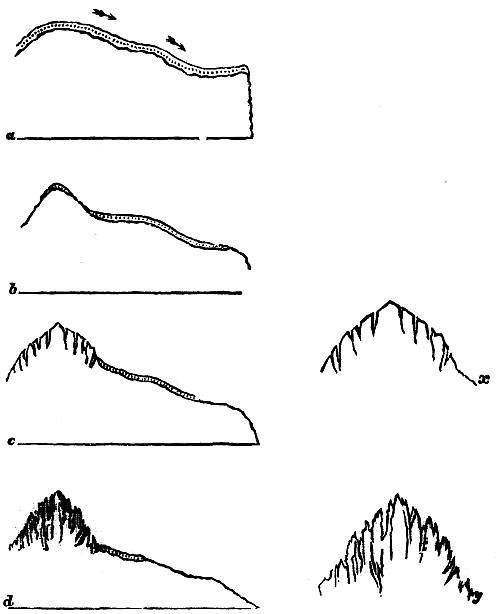
Suppose now a chain of mountains raised in any accidental form, only of course highest where the force was greatest,—that is to say, at the centre of the chain,—and presenting any profile such as a, Fig. 24; terminated, perhaps, by a broken secondary cliff, and the whole covered with a thick bed of glacier, indicated by the spotted space, and moving in the direction of the arrows. As it wears away the mountain, not at all at the top, but always more and more as it descends, it would in process of time reduce the contour of the flank of the hill to the form at b. But at this point the snow would begin to slide from the central peak, and to leave its rocks exposed to the action of the atmosphere. Supposing those rocks disposed to break into vertical sheets, the summit would soon cleave itself into such a form as that at x; and the flakes again subdividing and falling, we should have conditions such as at y. Meanwhile the glacier is still doing its work uninterruptedly on the lower bank, bringing the mountain successively into the outlines c and d, in which the forms x and y are substituted consecutively for the original summit. But the level of the whole flank of the mountain being now so much reduced, the glacier has brought itself by its own work into warmer climate, and has wrought out its own destruction. It would gradually be thinned away, and in many places at last vanish, leaving only the barren rounded mountains, and the tongues of ice still supplied from the peaks above.
53 I use the terms "pyramid" and "peak" at present, in order to give a rough general idea of the aspect of these hills. Both terms, as we shall see in the next chapter, are to be accepted under limitation.
52 It may be thought I should have reversed these sentences, and written where the hills are low and safe, the climate is soft, &c. But it is not so. No antecedent reason can be shown why the Mont Cervin or Finsteraarhorn should not have risen sharp out of the plains of Lombardy, instead of out of glaciers.
51 The Rossberg fall, compared to the convulsions which seem to have taken place in the higher Alps, is like the slip of a paving stone compared to the fall of a tower.
50 Nearly; that is to say, not quite vertical. Of the degree of steepness, we shall have more to say hereafter.
55 The glacier tracks on the gneiss of the great angle opposite Martigny are the most magnificent I ever saw in the Alps; those above the channel of the Trient, between Valorsine and the valley of the Rhone, the most interesting.
49 How far, is another question. The sand which the stream brings from the bottom of one eddy in its course, it throws down in the next; all that is proved by the above trial is, that so many tons of material are annually carried down by it a certain number of feet.
54 This coarse sketch is merely given for reference, as I shall often have to speak of the particular masses of mountain, indicated by the letters in the outline below it; namely—
§ 18. Such is the actual condition of the Alps at this moment. I do not say that they have in reality undergone any such process. But I think it right to put the supposition before the reader, more with a view of explaining what the appearance of things actually is, than with any wish that he should adopt either this or any other theory on the subject. It facilitates a description of the Brèche de Roland to say, that it looks as if the peer had indeed cut it open with a swordstroke; but it would be unfair to conclude that the describer gravely wished the supposition to be adopted as explanatory of the origin of the ravine. In like manner, the reader who has followed the steps of the theory I have just offered, will have a clearer conception of the real look and anatomy of the Alps than I could give him by any other means. But he is welcome to accept in seriousness just as much or as little of the theory as he likes.56 Only I am well persuaded that the more familiar any one becomes with the chain of the Alps, the more, whether voluntarily or not, the idea will force itself upon him of their being mere remnants of large masses,—splinters and fragments, as of a stranded wreck, the greater part of which has been removed by the waves; and the more he will be convinced of the existence of two distinct regions, one, as it were, below the ice, another above it,—one of subjected, the other of emergent rock; the lower worn away by the action of the glaciers and rains, the higher splintering and falling to pieces by natural disintegration.
§ 19. I press, however, neither conjecture nor inquiry farther; having already stated all that is necessary to give the reader a complete idea of the different divisions of mountain form. I proceed now to examine the points of pictorial interest in greater detail; and in order to do so more conveniently, I shall adopt the order, in description, which Nature seems to have adopted in formation; beginning with the mysterious hardness of the central crystallines, and descending to the softer and lower rocks which we see in some degree modified by the slight forces still in operation. We will therefore examine: 1. the pictorial phenomena of the central peaks; 2. those of the summits of the lower mountains round them, to which we shall find it convenient to give the distinguishing name of crests; 3. the formation of Precipices, properly so called; then, the general aspect of the Banks and Slopes, produced by the action of water or of falling débris, on the sides or at the bases of mountains; and finally, remove, if it may be, a few of the undeserved scorns thrown upon our most familiar servants, Stones. To each of these subjects we shall find it necessary to devote a distinct chapter.
52 It may be thought I should have reversed these sentences, and written where the hills are low and safe, the climate is soft, &c. But it is not so. No antecedent reason can be shown why the Mont Cervin or Finsteraarhorn should not have risen sharp out of the plains of Lombardy, instead of out of glaciers.
53 I use the terms "pyramid" and "peak" at present, in order to give a rough general idea of the aspect of these hills. Both terms, as we shall see in the next chapter, are to be accepted under limitation.
54 This coarse sketch is merely given for reference, as I shall often have to speak of the particular masses of mountain, indicated by the letters in the outline below it; namely—
b.Aiguille Blaitière.
M.Mont Blanc (summit).
T.Tapia.
p.Aiguille du Plan.
d.Dôme du Gouté.
C.Montagne de la Côte.
m.Aiguille du Midi.
g.Aiguille du Gouté.
t.Montagne de Taconay.
q
and
rindicate stations only.
55 The glacier tracks on the gneiss of the great angle opposite Martigny are the most magnificent I ever saw in the Alps; those above the channel of the Trient, between Valorsine and the valley of the Rhone, the most interesting.
56 For farther information respecting the glaciers and their probable action, the reader should consult the works of Professor Forbes. I believe this theory of the formation of the upper peaks has been proposed by him, and recently opposed by Mr. Sharpe, who believes that the great bank spoken of in the text was originally a sea-bottom. But I have simply stated in this chapter the results of my own watchings of the Alps; for being without hope of getting time for available examination of the voluminous works on these subjects, I thought it best to read nothing (except Forbes's most important essay on the glaciers, several times quoted in the text), and therefore to give, at all events, the force of independent witness to such impressions as I received from the actual facts; De Saussure, always a faithful recorder of those facts, and my first master in geology, being referred to, occasionally, for information respecting localities I had not been able to examine.
CHAPTER XIV.
RESULTING FORMS:—FIRST, AIGUILLES.
§ 1. I have endeavored in the preceding chapters always to keep the glance of the reader on the broad aspect of things, and to separate for him the mountain masses into the most distinctly comprehensible forms. We must now consent to take more pains, and observe more closely.
§ 2. I begin with the Aiguilles. In Fig. 24, p. 170, at a, it was assumed that the mass was raised highest merely where the elevating force was greatest, being of one substance with the bank or cliff below. But it hardly ever is of the same substance. Almost always it is of compact crystallines, and the bank of slaty crystallines; or if it be of slaty crystallines the bank is of slaty coherents. The bank is almost always the softer of the two.57
Is not this very marvellous? Is it not exactly as if the substance had been prepared soft or hard with a sculpturesque view to what had to be done with it; soft, for the glacier to mould, and the torrent to divide; hard, to stand for ever, central in mountain majesty.
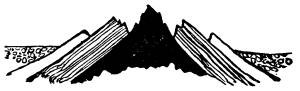
§ 3. Next, then, comes the question, How do these compact crystallines and slaty crystallines join each other? It has long been a well recognized fact in the science of geology, that the most important mountain ranges lift up and sustain upon their sides the beds of rock which form the inferior groups of hills around them in the manner roughly shown in the section Fig. 25, where the dark mass stands for the hard rock of the great mountains (crystallines), and the lighter lines at the side of it indicate the prevalent direction of the beds in the neighboring hills (coherents), while the spotted portions represent the gravel and sand of which the great plains are usually composed. But it has not been so universally recognized, though long ago pointed out by De Saussure, that the great central groups are often themselves composed of beds lying in a precisely opposite direction; so that if we analyze carefully the structure of the dark mass in the centre of Fig. 25, we shall find it arranged in lines which slope downwards to the centre; the flanks of it being of slaty crystalline rock, and the summit of compact crystallines, as at a, Fig. 26.
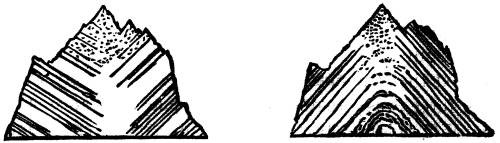
In speaking of the sculpture of the central peaks in the last chapter, I made no reference to the nature of the rocks in the banks on which they stood. The diagram at a, Fig. 27, as representative of the original condition, and b, of the resultant condition will, compared with Fig. 24, p. 170, more completely illustrate the change.58
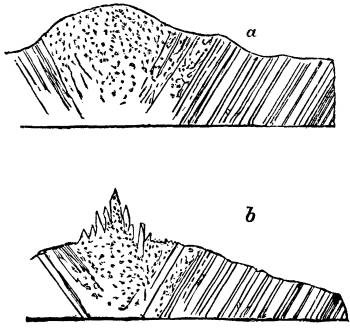
§ 4. By what secondary laws this structure may ultimately be discovered to have been produced is of no consequence to us at present; all that it is needful for us to note is the beneficence which appointed it for the mountains destined to assume the boldest forms. For into whatever outline they may be sculptured by violence or time, it is evident at a glance that their stability and security must always be the greatest possible under the given circumstances. Suppose, for instance, that the peak is in such a form as a in Fig. 26, then, however steep the slope may be on either side, there is still no chance of one piece of rock sliding off another; but if the same outline were given to beds disposed as at b, the unsupported masses might slide off those beneath them at any moment, unless prevented by the inequalities of the surfaces. Farther, in the minor divisions of the outline, the tendency of the peak at a will be always to assume contours like those at a in Fig. 28, which are, of course, perfectly safe; but the tendency of the beds at b in Fig. 27 will be to break into contours such as at b here, which are all perilous, not only in the chance of each several portion giving way, but in the manner in which they would deliver, from one to the other, the fragments which fell. A stone detached from any portion of the peak at a would be caught and stopped on the ledge beneath it; but a fragment loosened from b would not stay till it reached the valley by a series of accelerating bounds.
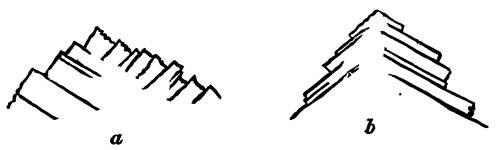
§ 5. While, however, the secure and noble form represented at a in Figs. 26 and 28 is for the most part ordained to be that of the highest mountains, the contours at b, in each figure, are of perpetual occurrence among the secondary ranges, in which, on a smaller scale, they produce some of the most terrific and fantastic forms of precipice; not altogether without danger, as has been fearfully demonstrated by many a "bergfall" among the limestone groups of the Alps; but with far less danger than would have resulted from the permission of such forms among the higher hills; and with collateral advantages which we shall have presently to consider. In the meantime, we return to the examination of the superior groups.
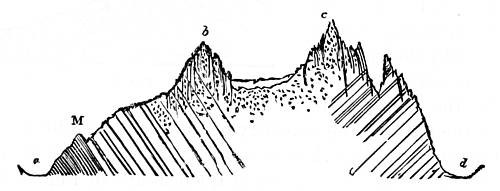
§ 6. The reader is, no doubt, already aware that the chain of the Mont Blanc is bordered by two great valleys, running parallel to each other, and seemingly excavated on purpose that travellers might be able to pass, foot by foot, along each side of the Mont Blanc and its aiguilles, and thus examine every peak in succession. One of these valleys is that of Chamouni, the other that of which one half is called the Allée Blanche, and the other the Val Ferret, the town of Cormayeur being near its centre, where it opens to the Val d'Aosta. Now, cutting the chain of Mont Blanc right across, from valley to valley, through the double range of aiguilles, the section would be59 as Fig. 29 here, in which a is the valley of Chamouni, b the range of aiguilles of Chamouni, c the range of the Géant, d the valley of Cormayeur.
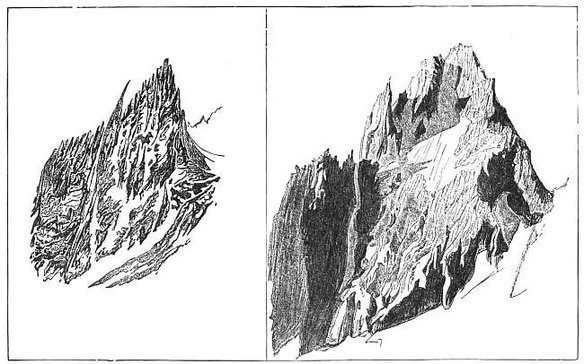
30. The Aiguille Charmoz.
The little projection under M is intended to mark approximately the position of the so well-known "Montanvert." It is a great weakness, not to say worse than weakness, on the part of travellers, to extol always chiefly what they think fewest people have seen or can see. I have climbed much, and wandered much, in the heart of the high Alps, but I have never yet seen anything which equalled the view from the cabin of the Montanvert; and as the spot is visited every year by increasing numbers of tourists, I have thought it best to take the mountains which surround it for the principal subjects of our inquiry.
§ 7. The little eminence left under M truly marks the height of the Montanvert on the flanks of the Aiguilles, but not accurately its position, which is somewhat behind the mass of mountain supposed to be cut through by the section. But the top of the Montanvert is actually formed, as shown at M, by the crests of the oblique beds of slaty crystallines. Every traveller must remember the steep and smooth beds of rock like sloping walls, down which, and over the ledges of which, the path descends from the cabin to the edge of the glacier. These sloping walls are formed by the inner sides of the crystalline beds,60 as exposed in the notch behind the letter M.
§ 8. To these beds we shall return presently, our object just now being to examine the aiguille, which, on the Montanvert, forms the most conspicuous mass of mountain on the right of the spectator. It is known in Chamouni as the Aiguille des Charmoz, and is distinguished by a very sharp horn or projection on its side, which usually attracts the traveller's attention as one of the most singular minor features in the view from the Montanvert. The larger masses of the whole aiguille, and true contour of this horn, are carefully given in plate 30, Fig. 2, as they are seen in morning sunshine. The impression which travellers usually carry away with them is, I presume, to be gathered from Fig. 1, a fac simile of one of the lithographs purchased with avidity by English travellers, in the shops of Chamouni and Geneva, as giving a faithful representation of this aiguille seen from the Montanvert. It is worth while to perpetuate this example of the ideal landscape of the nineteenth century, popular at the time when the works of Turner were declared by the public to be extravagant and unnatural.
§ 9. This example of the common ideal of aiguilles is, however, useful in another respect. It shows the strong impression which these Chamouni mountains leave, of their being above all others sharp-peaked and splintery, dividing more or less into arrowy spires; and it marks the sense of another and very curious character in them, that these spires are apt to be somewhat bent or curved.
Both these impressions are partially true, and need to be insisted upon, and cleared of their indistinctness, or exaggeration.
First, then, this strong impression of their peakedness and spiry separateness is always produced with the least possible danger to the travelling and admiring public; for if in reality these granite mountains were ever separated into true spires or points, in the least resembling this popular ideal in Plate 30, the Montanvert and Mer de Glace would be as inaccessible, except at the risk of life, as the trenches of a besieged city; and the continual fall of the splintering fragments would turn even the valley of Chamouni itself into a stony desolation.
§ 10. Perhaps in describing mountains with any effort to give some idea of their sublime forms, no expression comes oftener to the lips than the word "peak." And yet it is curious how rarely, even among the grandest ranges, an instance can be found of a mountain ascertainably peaked in the true sense of the word,—pointed at the top, and sloping steeply on all sides; perhaps not more than five summits in the chain of the Alps, the Finster-Aarhorn, Wetterhorn, Bietschhorn, Weisshorn, and Monte Viso presenting approximations to such a structure. Even in the case of not very steep pyramids, presenting themselves in the distance under some such outline as that at the top of Fig. 30, it almost invariably happens, when we approach and examine them, that they do not slope equally on all their sides, but are nothing more than steep ends of ridges, supported by far-extended masses of comparatively level rock, which, seen in perspective, give the impression of a steep slope, though in reality disposed in a horizonal, or nearly horizontal, line.
§ 11. Supposing the central diagram in Fig. 30 to be the apparent contour of a distant mountain, then its slopes may indeed, by singular chance, be as steep as they appear; but, in all probability, several of them are perspective descents of its retiring lines; and supposing it were formed as the gable roof of the old French house below, and seen under the same angle, it is evident that the part of the outline a b (in lettered reference line below) would be perfectly horizontal; b c an angle slope, in retiring perspective, much less steep than it appears; c d, perfectly, horizontal; d e, an advancing or foreshortened angle slope, less steep than it appears; and e f, perfectly horizontal.
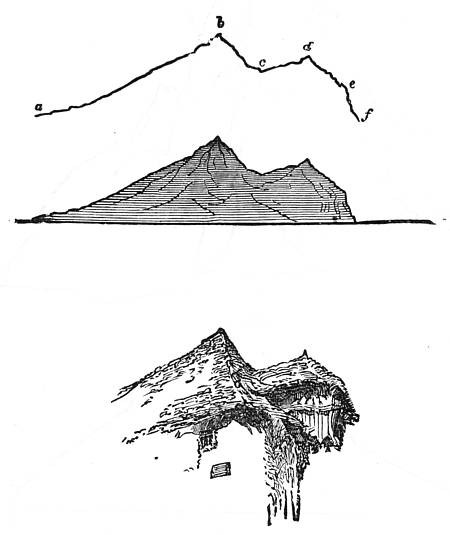
But if the pyramid presents itself under a more formidable aspect, and with steeper sides than those of the central diagram, then it may be assumed (as far as I know mountains) for next to a certainty, that it is not a pointed obelisk, but the end of a ridge more or less prolonged, of which we see the narrow edge or section turned towards us.
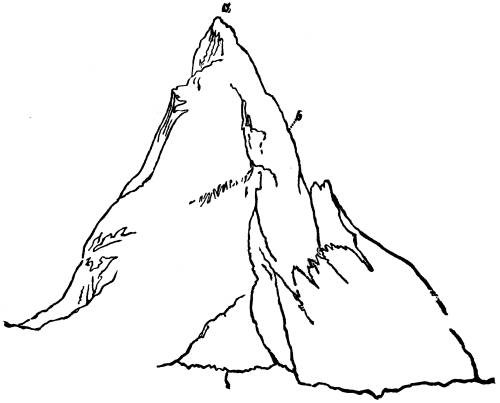
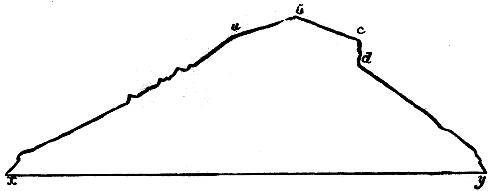
Angles with the horizon
x y.
Of the line
a b
17°
"
b c
20½
"
d y
(general slope, exclusive of inequalities)
35¾
"
a x
(ditto, ditto, to point of cliff above
x)
23½
For instance, no mountain in the Alps produces a more vigorous impression of peakedness than the Matterhorn. In Professor Forbes's work on the Alps, it is spoken of as an "obelisk" of rock, and represented with little exaggeration in his seventh plate under the outline Fig. 31. Naturally, in glancing, whether at the plate or the mountain, we assume the mass to be a peak, and suppose the line a b to be the steep slope of its side. But that line is a perspective line. It is in reality perfectly horizontal, corresponding to e f in the penthouse roof, Fig. 30.
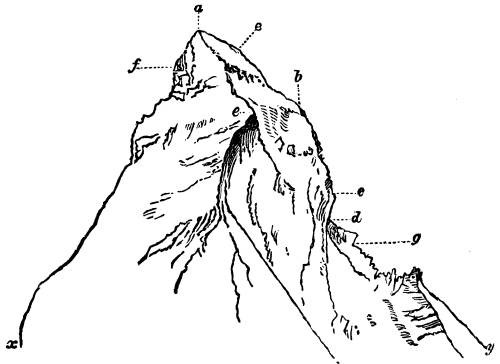
Angles with the horizon
x y.
a f
56°
a e
12¾
e b
(from point to point)
44½
b c
( ditto, ditto )
67¼
c d
(overhanging)
79°
a x
(irrespective of irregularities)
56
a y
38¾
§ 12. I say "perfectly horizontal," meaning, of course, in general tendency. It is more or less irregular and broken, but so nearly horizontal that, after some prolonged examination of the data I have collected about the Matterhorn, I am at this moment in doubt which is its top. For as, in order to examine the beds on its flanks, I walked up the Zmutt glacier, I saw that the line a b in Fig. 31 gradually lost its steepness; and about half-way up the glacier, the conjectural summit a then bearing nearly S. E. (forty degrees east of south), I found the contour was as in Fig. 32. In Fig. 33, I have given the contour as seen from Zermatt; and in all three, the same letters indicate the same points. In the Figures 32 and 33 I measured the angles with the greatest care,61 from the base lines x y, which are accurately horizontal; and their general truth, irrespective of mere ruggedness, may be depended upon. Now in this flank view, Fig. 32, what was the summit at Zermatt, a, becomes quite subordinate, and the point b, far down the flank in Forbes's view taken from the Riffelhorn, is here the apparent summit. I was for some time in considerable doubt which of the appearances was most trustworthy; and believe now that they are both deceptive; for I found, on ascending the flank of the hills on the other side of the Valais, to a height of about five thousand feet above Brieg, between the Aletsch glacier and Bietsch-horn; being thus high enough to get a view of the Matterhorn on something like distant terms of equality, up the St. Nicholas valley, it presented itself under the outline Fig. 34, which seems to be conclusive for the supremacy of the point e, between a and b in Fig. 33. But the impossibility of determining, at the foot of it, without a trigonometrical observation, which is the top of such an apparent peak as the Matterhorn, may serve to show the reader how little the eye is to be trusted for the verification of peaked outline.
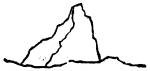
§ 13. In like manner, the aiguilles of Chamouni, which present themselves to the traveller, as he looks up to them from the village, under an outline approximating to that rudely indicated at C in the next figure, are in reality buttresses projecting from an intermediate ridge. Let A be supposed to be a castle wall, with slightly elevated masses of square-built buttresses at intervals. Then, by a process of dilapidation, these buttresses might easily be brought to assume in their perspective of ruin the forms indicated at B, which, with certain modifications, is the actual shape of the Chamouni aiguilles. The top of the Aiguille Charmoz is not the point under d, but that under e. The deception is much increased by the elevation of the whole castle wall on the green bank before spoken of, which raises its foundation several thousand feet above the eye, and thus, giving amazing steepness to all the perspective lines, produces an impression of the utmost possible isolation of peaks, where, in reality, there is a well-supported, and more or less continuous, though sharply jagged, pile of solid walls.
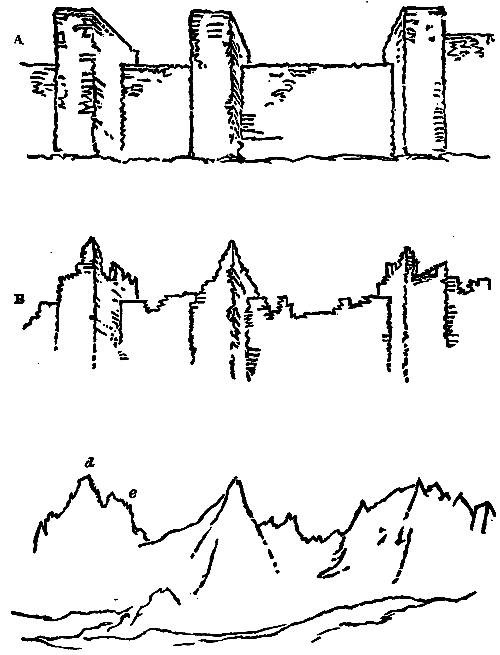
§ 14. There is, however, this great difference between the castle wall and aiguilles, that the dilapidation in the one would take place by the fall of horizontal bricks or stones; in the aiguilles it takes place in quite an opposite manner by the flaking away of nearly vertical ones.
This is the next point of great interest respecting them. Observe, the object of their construction appears to be the attainment of the utmost possible peakedness in aspect, with the least possible danger to the inhabitants of the valleys. As, therefore, they are first thrown into transverse ridges, which take, in perspective, a more or less peaked outline, so, in their dilapidation, they split into narrow flakes, which, if seen edgeways, look as sharp as a lance-point, but are nevertheless still strong; being each of them, in reality, not a lance-point or needle, but a hatchet edge.
§ 15. And since if these sharp flakes broke straight across the masses of mountain, when once the fissure took place, all hold would be lost between flake and flake, it is ordered (and herein is the most notable thing in the whole matter) that they shall not break straight, but in curves, round the body of the aiguilles, somewhat in the manner of the coats of an onion; so that, even after fissure has taken place, the detached film or flake clings to and leans upon the central mass, and will not fall from it till centuries of piercing frost have wedged it utterly from its hold; and, even then, will not fall all at once, but drop to pieces slowly, and flake by flake. Consider a little the beneficence of this ordinance;62 supposing the cliffs had been built like the castle wall, the mouldering away of a few bricks, more or less, at the bottom would have brought down huge masses above, as it constantly does in ruins, and in the mouldering cliffs of the slaty coherents; while yet the top of the mountain would have been always blunt and rounded, as at a, Fig. 36, when seen against the sky. But the aiguille being built in these nearly vertical curved flakes, the worst that the frost can do to it is to push its undermost rocks asunder into forms such as at b, of which, when many of the edges have fallen, the lower ones are more or less supported by the very débris accumulated at their feet; and yet all the while the tops sustain themselves in the most fantastic and incredible fineness of peak against the sky.
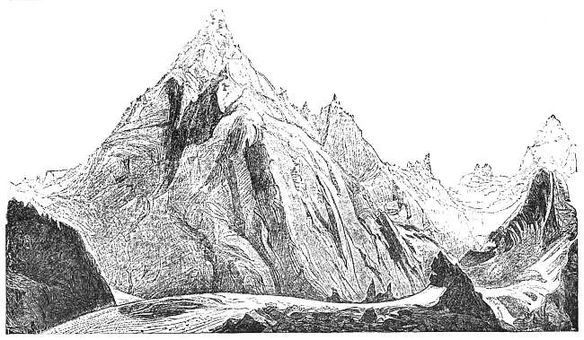
J. Ruskin.
J. C. Armytage.
31. The Aiguille Blaitière.
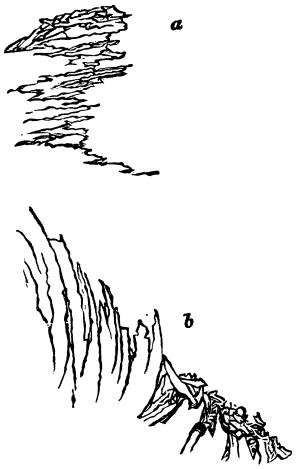
§ 16. I have drawn the flakes in Fig. 36, for illustration's sake, under a caricatured form. Their real aspect will be understood in a moment by a glance at the opposite plate, 31, which represents the central aiguille in the woodcut outline Fig. 35 (Aiguille Blaitière, called by Forbes Greppond), as seen from within about half a mile of its actual base. The white shell-like mass beneath it is a small glacier, which in its beautifully curved outline63 appears to sympathize with the sweep of the rocks beneath, rising and breaking like a wave at the feet of the remarkable horn or spur which supports it on the right. The base of the aiguille itself is, as it were, washed by this glacier, or by the snow which covers it, till late in the season, as a cliff is by the sea; except that a narrow chasm, of some twenty or thirty feet in depth and two or three feet wide, usually separates the rock from the ice, which is melted away by the heat reflected from the southern face of the aiguille. The rock all along this base line is of the most magnificent compactness and hardness, and rings under the hammer like a bell; yet, when regarded from a little distance, it is seen to be distinctly inclined to separate into grand curved flakes or sheets, of which the dark edges are well marked in the plate. The pyramidal form of the aiguille, as seen from this point, is, however, entirely deceptive; the square rock which forms its apparent summit is not the real top, but much in advance of it, and the slope on the right against the sky is a perspective line; while, on the other hand, the precipice in light, above the three small horns at the narrowest part of the glacier, is considerably steeper than it appears to be, the cleavage of the flakes crossing it somewhat obliquely. But I show the aiguille from this spot that the reader may more distinctly note the fellowship between its curved precipice and the little dark horn or spur which bounds the glacier; a spur the more remarkable because there is just such another, jutting in like manner from the corresponding angle of the next aiguille (Charmoz), both of them looking like remnants or foundations of the vaster ancient pyramids, of which the greater part has been by ages carried away.
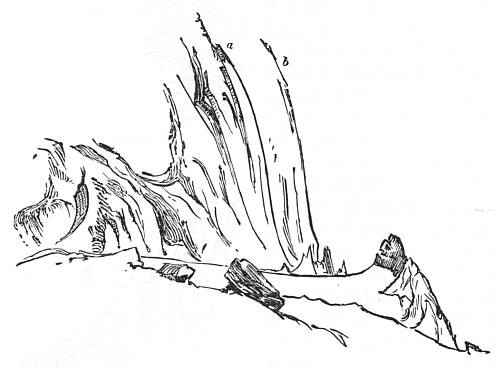
§ 17. The more I examined the range of the aiguilles the more I was struck by this curved cleavage as their principal character. It is quite true that they have other straighter cleavages (noticed in the Appendix, as the investigation of them would be tiresome to the general reader); but it is this to which they owe the whole picturesqueness of their contours; curved as it is, not simply, but often into the most strange shell-like undulations, as will be understood by a glance at Fig. 37, which shows the mere governing lines at the base of this Aiguille Blaitière, seen, with its spur, from a station some quarter of a mile nearer it, and more to the east than that chosen in Plate 31. These leading lines are rarely well shown in fine weather, the important contour from a downwards being hardly relieved clearly from the precipice beyond (b), unless a cloud intervenes, as it did when I made this memorandum; while, again, the leading lines of the Aiguille du Plan, as seen from the foot of it, close to the rocks, are as at Fig. 38, the generally pyramidal outline being nearly similar to that of Blaitière, and a spur being thrown out to the right, under a, composed in exactly the same manner of curved folia of rock laid one against the other. The hollow in the heart of the aiguille is as smooth and sweeping in curve as the cavity of a vast bivalve shell.
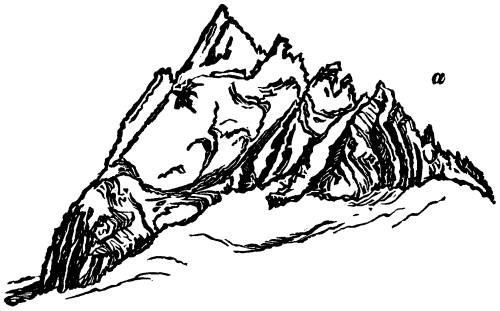
§ 18. I call these the governing or leading lines, not because they are the first which strike the eye, but because, like those of the grain of the wood in a tree-trunk, they rule the swell and fall and change of all the mass. In Nature, or in a photograph, a careless observer will by no means be struck by them, any more than he would by the curves of the tree; and an ordinary artist would draw rather the cragginess and granulation of the surfaces, just as he would rather draw the bark and moss of the trunk. Nor can any one be more steadfastly adverse than I to every substitution of anatomical knowledge for outward and apparent fact; but so it is, that as an artist increases in acuteness of perception, the facts which become outward and apparent to him are those which bear upon the growth or make of the thing. And, just as in looking at any woodcut of trees after Titian or Albert Durer, as compared with a modern water-color sketch, we shall always be struck by the writhing and rounding of the tree trunks in the one, and the stiffness, and merely blotted or granulated surfaces of the other; so, in looking at these rocks, the keenness of the artist's eye may almost precisely be tested by the degree in which he perceives the curves that give them their strength and grace, and in harmony with which the flakes of granite are bound together, like the bones of the jaw of a saurian. Thus the ten years of study which I have given to these mountains since I described them in the first volume as "traversed sometimes by graceful curvilinear fissures, sometimes by straight fissures," have enabled me to ascertain, and now generally at a glance to see, that the curvilinear ones are dominant, and that even the fissures or edges which appear perfectly straight have almost always some delicate sympathy with the curves. Occasionally, however, as in the separate beds which form the spur or horn of the Aiguille Blaitière, seen in true profile in Plate 29, Fig. 3, the straightness is so accurate that, not having brought a rule with me up the glacier, I was obliged to write under my sketch, "Not possible to draw it straight enough." Compare also the lines sloping to the left in Fig. 38.
§ 19. "But why not give everything just as it is; without caring what is dominant and what subordinate?"
You cannot. Of all the various impossibilities which torment and humiliate the painter, none are more vexatious than that of drawing a mountain form. It is indeed impossible enough to draw, by resolute care, the foam on a wave, or the outline of the foliage of a large tree; but in these cases, when care is at fault, carelessness will help, and the dash of the brush will in some measure give wildness to the churning of the foam, and infinitude to the shaking of the leaves. But chance will not help us with the mountain. Its fine and faintly organized edge seems to be definitely traced against the sky; yet let us set ourselves honestly to follow it, and we find, on the instant, it has disappeared: and that for two reasons. The first, that if the mountain be lofty, and in light, it is so faint in color that the eye literally cannot trace its separation from the hues next to it. The other day I wanted the contour of a limestone mountain in the Valais, distant about seven miles, and as many thousand feet above me; it was barren limestone; the morning sun fell upon it, so as to make it almost vermilion color, and the sky behind it a bluish green. Two tints could hardly have been more opposed, but both were so subtle, that I found it impossible to see accurately the line that separated the vermilion from the green. The second, that if the contour be observed from a nearer point, or looked at when it is dark against the sky, it will be found composed of millions of minor angles, crags, points, and fissures, which no human sight or hand can draw finely enough, and yet all of which have effect upon the mind.
§ 20. The outline shown as dark against the sky in Plate 29, Fig. 2 is about a hundred, or a hundred and twenty, yards of the top of the ridge of Charmoz, running from the base of the aiguille down to the Montanvert, and seen from the moraine of the Charmoz glacier, a quarter of a mile distant to the south-west.64 It is formed of decomposing granite, thrown down in blocks entirely detached, but wedged together, so as to stand continually in these seemingly perilous contours (being a portion of such a base of aiguille as that in b, Fig. 36, p. 185).65 The block forming the summit on the left is fifteen or eighteen feet long; and the upper edge of it, which is the dominant point of the Charmoz ridge, is the best spot in the Chamouni district for giving a thorough command of the relations of the aiguilles on each side of the Mer de Glace. Now put the book, with that page open, upright, at three yards distance from you, and try to draw this contour, which I have made as dark and distinct as it ever could be in reality, and you will immediately understand why it is impossible to draw mountain outlines rightly.
§ 21. And if not outlines, a fortiori not details of mass, which have all the complexity of the outline multiplied a thousand fold, and drawn in fainter colors. Nothing is more curious than the state of embarrassment into which the unfortunate artist must soon be cast when he endeavors honestly to draw the face of the simplest mountain cliff—say a thousand feet high, and two or three miles distant. It is full of exquisite details, all seemingly decisive and clear; but when he tries to arrest one of them, he cannot see it,—cannot find where it begins or ends,—and presently it runs into another; and then he tries to draw that, but that will not be drawn, neither, until it has conducted him to a third, which, somehow or another, made part of the first; presently he finds that, instead of three, there are in reality four, and then he loses his place altogether. He tries to draw clear lines, to make his work look craggy, but finds that then it is too hard; he tries to draw soft lines, and it is immediately too soft; he draws a curved line, and instantly sees it should have been straight; a straight one, and finds when he looks up again, that it has got curved while he was drawing it. There is nothing for him but despair, or some sort of abstraction and shorthand for cliff. Then the only question is, what is the wisest abstraction; and out of the multitude of lines that cannot altogether be interpreted, which are the really dominant ones; so that if we cannot give the whole, we may at least give what will convey the most important facts about the cliff.
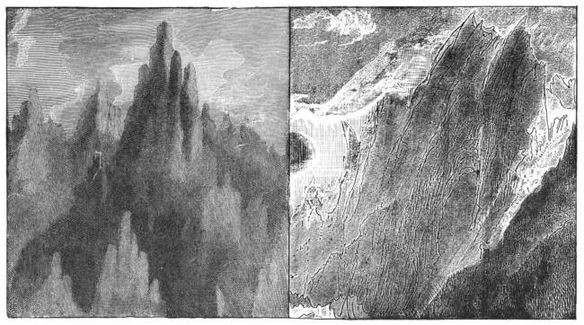
32. Aiguille Drawing.
1. Old Ideal.
2. Turnerian.
§ 22. Recurring then to our "public opinion" of the Aiguille Charmoz, we find the greatest exaggeration of, and therefore I suppose the greatest interest in, the narrow and spiry point on its left side. That is in reality a point at all but a hatchet edge; a flake of rock, which is enabled to maintain itself in this sharp-edged state by its writhing folds of sinewy granite. Its structure, on a larger scale, and seen "edge on," is shown in Fig. 41. The whole aiguille is composed of a series of such flakes, liable, indeed, to all kinds of fissure in other directions, but holding, by their modes of vertical association, the strongest authority over the form of the whole mountain. It is not in all lights that they are seen plainly: for instance, in the morning effect in Plate 30 they are hardly traceable: but the longer we watch, the more they are perceived; and their power of sustaining themselves vertically is so great, that at the foot of the aiguille on the right a few of them form a detached mass, known as the Petit Charmoz, between E and c in Fig. 60, p. 210, of which the height of the uttermost flake, between c and d, is about five hundred feet.
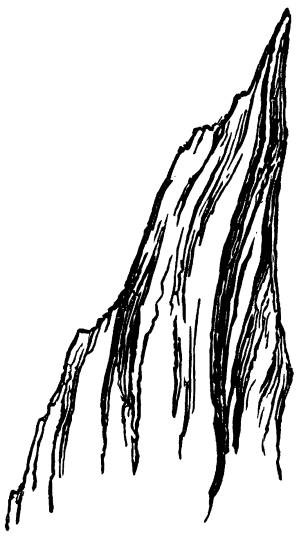
Important, however, as this curved cleavage is, it is so confused among others, that it has taken me, as I said, ten years of almost successive labor to develope, in any degree of completeness, its relations among the aiguilles of Chamouni; and even of professed geologists, the only person who has described it properly is De Saussure, whose continual sojourn among the Alps enabled him justly to discern the constant from the inconstant phenomena. And yet, in his very first journey to Savoy, Turner saw it at a glance, and fastened on it as the main thing to be expressed in those mountains.
In the opposite Plate (32), the darkest division, on the right, is a tolerably accurate copy of Turner's rendering of the Aiguille Charmoz (etched and engraved by himself), in the plate called the "Mer de Glace," in the Liber Studiorum. Its outline is in local respects inaccurate enough, being modified by Turnerian topography; but the flaky character is so definite, that it looks as if it had been prepared for an illustrative diagram of the points at present under discussion.
§ 23. And do not let it be supposed that this was by chance, or that the modes of mountain drawing at the period would in any wise have helped Turner to discover these lines. The aiguilles had been drawn before this time, and the figure on the left in Plate 32 will show how. It is a facsimile of a piece of an engraving of the Mer de Glace, by Woollett, after William Pars, published in 1783, and founded on the general Wilsonian and Claudesque principles of landscape common at the time. There are, in the rest of the plate, some good arrangements of shadow and true aerial perspective; and the piece I have copied, which is an attempt to represent the Aiguille Dru, opposite the Charmoz, will serve, not unfairly, to show how totally inadequate the draughtsmen of the time were to perceive the character of mountains, and, also, how unable the human mind is by itself to conceive anything like the variety of natural form. The workman had not looked at the thing,—trusted to his "Ideal," supposed that broken and rugged rocks might be shaped better out of his own head than by Nature's laws,—and we see what comes of it.
§ 24. And now, lastly, observe, in the laws by which this strange curvilinear structure is given to the aiguilles, how the provision for beauty of form is made in the first landscape materials we have to study. We have permitted ourselves, according to that unsystematic mode of proceeding pleaded for in the opening of our present task, to wander hither and thither as this or that question rose before us, and demanded, or tempted, our pursuit. But the reader must yet remember that our special business in this section of the work is the observance of the nature of beauty, and of the degrees in which the aspect of any object fulfils the laws of beauty stated in the second volume. Now in the fifteenth paragraph of the chapter on infinity, it was stated that curvature was essential to all beauty, and that what we should "need more especially to prove, was the constancy of curvature in all natural forms whatsoever." And these aiguilles, which are the first objects we have had definitely to consider, appeared as little likely to fulfil the condition as anything we could have come upon. I am well assured that the majority of spectators see no curves in them at all, but an intensely upright, stern, spiry ruggedness and angularity. And we might even beforehand have been led to expect, and to be contented in expecting, nothing else from them than this; for since, as we have said often, they are part of the earth's skeleton, being created to sustain and strengthen everything else, and yet differ from a skeleton in this, that the earth is not only supported by their strength, but fed by their ruin; so that they are first composed of the hardest and least tractable substance, and then exposed to such storm and violence as shall beat large parts of them to powder;—under these desperate conditions of being, I say, we might have anticipated some correspondent ruggedness and terribleness of aspect, some such refusal to comply with ordinary laws of beauty, as we often see in other things and creatures put to hard work, and sustaining distress or violence.
§ 25. And truly, at first sight, there is such refusal in their look, and their shattered walls and crests seem to rise in a gloomy contrast with the soft waves of bank and wood beneath; nor do I mean to press the mere fact, that, as we look longer at them, other lines become perceptible, because it might be thought no proof of their beauty that they needed long attention in order to be discerned. But I think this much at least is deserving of our notice, as confirmatory of foregone conclusions, that the forms which in other things are produced by slow increase, or gradual abrasion of surface, are here produced by rough fracture, when rough fracture is to be the law of existence. A rose is rounded by its own soft ways of growth, a reed is bowed into tender curvature by the pressure of the breeze; but we could not, from these, have proved any resolved preference, by Nature, of curved lines to others, inasmuch as it might always have been answered that the curves were produced, not for beauty's sake, but infallibly, by the laws of vegetable existence; and, looking at broken flints or rugged banks afterwards, we might have thought that we only liked the curved lines because associated with life and organism, and disliked the angular ones, because associated with inaction and disorder. But Nature gives us in these mountains a more clear demonstration of her will. She is here driven to make fracture the law of being. She cannot tuft the rock-edges with moss, or round them by water, or hide them with leaves and roots. She is bound to produce a form, admirable to human beings, by continual breaking away of substance. And behold—so soon as she is compelled to do this—she changes the law of fracture itself. "Growth," she seems to say, "is not essential to my work, nor concealment, nor softness; but curvature is: and if I must produce my forms by breaking them, the fracture itself shall be in curves. If, instead of dew and sunshine, the only instruments I am to use are the lightning and the frost, then their forked tongues and crystal wedges shall still work out my laws of tender line. Devastation instead of nurture may be the task of all my elements, and age after age may only prolong the unrenovated ruin; but the appointments of typical beauty which have been made over all creatures shall not therefore be abandoned; and the rocks shall be ruled, in their perpetual perishing, by the same ordinances that direct the bending of the reed and the blush of the rose."
32. Aiguille Drawing.
1. Old Ideal.
2. Turnerian.
59 That is to say, as it appears to me. There are some points of the following statements which are disputed among geologists; the reader will find them hereafter discussed at greater length.
65 The summits of the aiguilles are often more fantastically rent still. Fig. 39 is the profile of a portion of the upper edge of the Aiguille du Moine, seen from the crest of Charmoz; Fig. 40 shows the three lateral fragments, drawn to a larger scale. The height of each of the upright masses must be from twenty to twenty-five feet. I do not know if their rude resemblance to two figures, on opposite sides of a table or altar, has had anything to do with the name of the aiguille.
61 It was often of great importance to me to ascertain these apparent slopes with some degree of correctness. In order to do so without the trouble of carrying any instrument (except my compass and spirit-level), I had my Alpine pole made as even as a round rule for about a foot in the middle of its length. Taking the bearing of the mountain, placing the pole at right angles to the bearing, and adjusting it by the spirit-level, I brought the edge of a piece of finely cut pasteboard parallel, in a vertical plane (plumbed), with the apparent slope of the hillside. A pencil line drawn by the pole then gave me a horizon, with which the angle could be easily measured at home. The measurements thus obtained are given under the figures.
57 See, for explanatory statements, Appendix 2.
56 For farther information respecting the glaciers and their probable action, the reader should consult the works of Professor Forbes. I believe this theory of the formation of the upper peaks has been proposed by him, and recently opposed by Mr. Sharpe, who believes that the great bank spoken of in the text was originally a sea-bottom. But I have simply stated in this chapter the results of my own watchings of the Alps; for being without hope of getting time for available examination of the voluminous works on these subjects, I thought it best to read nothing (except Forbes's most important essay on the glaciers, several times quoted in the text), and therefore to give, at all events, the force of independent witness to such impressions as I received from the actual facts; De Saussure, always a faithful recorder of those facts, and my first master in geology, being referred to, occasionally, for information respecting localities I had not been able to examine.
64 The top of the aiguille of the Little Charmoz bearing, from the point whence this sketch was made, about six degrees east of north.
60 Running, at that point very nearly, N. E. and S. W., and dipping under the ice at an angle of about seventy degrees.
58 I have been able to examine these conditions with much care in the chain of Mont Blanc only, which I chose for the subject of investigation both as being the most interesting to the general traveller, and as being the only range of the central mountains which had been much painted by Turner. But I believe the singular arrangements of beds which take place in this chain have been found by the German geologists to prevail also in the highest peaks of the Western Alps; and there are a peculiar beauty and providence in them which induce me to expect that farther inquiries may justify our attributing them to some very extensive law of the earth's structure. See the notes from De Saussure in Appendix 2.
62 That is to say, in a cliff intended to owe its outline to dilapidation. Where no dilapidation is to be permitted, the bedded structure, well knit, is always used. Of this we shall see various examples in the 16th chapter.
63 Given already as an example of curvature in the Stones of Venice, vol. 1, plate 7.
J. Ruskin.
J. C. Armytage.
31. The Aiguille Blaitière.
57 See, for explanatory statements, Appendix 2.
58 I have been able to examine these conditions with much care in the chain of Mont Blanc only, which I chose for the subject of investigation both as being the most interesting to the general traveller, and as being the only range of the central mountains which had been much painted by Turner. But I believe the singular arrangements of beds which take place in this chain have been found by the German geologists to prevail also in the highest peaks of the Western Alps; and there are a peculiar beauty and providence in them which induce me to expect that farther inquiries may justify our attributing them to some very extensive law of the earth's structure. See the notes from De Saussure in Appendix 2.
59 That is to say, as it appears to me. There are some points of the following statements which are disputed among geologists; the reader will find them hereafter discussed at greater length.
60 Running, at that point very nearly, N. E. and S. W., and dipping under the ice at an angle of about seventy degrees.
61 It was often of great importance to me to ascertain these apparent slopes with some degree of correctness. In order to do so without the trouble of carrying any instrument (except my compass and spirit-level), I had my Alpine pole made as even as a round rule for about a foot in the middle of its length. Taking the bearing of the mountain, placing the pole at right angles to the bearing, and adjusting it by the spirit-level, I brought the edge of a piece of finely cut pasteboard parallel, in a vertical plane (plumbed), with the apparent slope of the hillside. A pencil line drawn by the pole then gave me a horizon, with which the angle could be easily measured at home. The measurements thus obtained are given under the figures.
62 That is to say, in a cliff intended to owe its outline to dilapidation. Where no dilapidation is to be permitted, the bedded structure, well knit, is always used. Of this we shall see various examples in the 16th chapter.
63 Given already as an example of curvature in the Stones of Venice, vol. 1, plate 7.
64 The top of the aiguille of the Little Charmoz bearing, from the point whence this sketch was made, about six degrees east of north.
65 The summits of the aiguilles are often more fantastically rent still. Fig. 39 is the profile of a portion of the upper edge of the Aiguille du Moine, seen from the crest of Charmoz; Fig. 40 shows the three lateral fragments, drawn to a larger scale. The height of each of the upright masses must be from twenty to twenty-five feet. I do not know if their rude resemblance to two figures, on opposite sides of a table or altar, has had anything to do with the name of the aiguille.

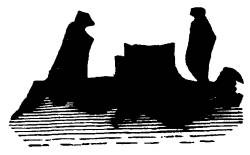
CHAPTER XV.
RESULTING FORMS:—SECONDLY, CRESTS.
§ 1. Between the aiguilles, or other conditions of central peak, and the hills which are clearly formed, as explained in Chap. XII. § 11, by the mere breaking of the edges of solid beds of coherent rock, there occurs almost always a condition of mountain summit, intermediate in aspect, as in position. The aiguille may generally be represented by the type a, Fig. 42; the solid and simple beds of rock by the type c. The condition b, clearly intermediate between the two, is, on the whole, the most graceful and perfect in which mountain masses occur. It seems to have attracted more of the attention of the poets than either of the others; and the ordinary word, crest, which we carelessly use in speaking of mountain summits, as if it meant little more than "edge" or "ridge," has a peculiar force and propriety when applied to ranges of cliff whose contours correspond thus closely to the principal lines of the crest of a Greek helmet.
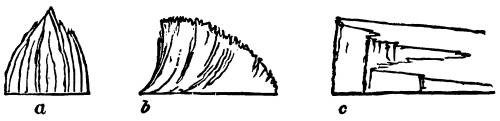
§ 2. There is another resemblance which they can hardly fail to suggest when at all irregular in form,—that of a wave about to break. Byron uses the image definitely of Soracte; and, in a less clear way, it seems to present itself occasionally to all minds, there being a general tendency to give or accept accounts of mountain form under the image of waves; and to speak of a hilly country, seen from above, as looking like a "sea of mountains."
Such expressions, vaguely used, do not, I think, generally imply much more than that the ground is waved or undulated into bold masses. But if we give prolonged attention to the mountains of the group b we shall gradually begin to feel that more profound truth is couched under this mode of speaking, and that there is indeed an appearance of action and united movement in these crested masses, nearly resembling that of sea waves; that they seem not to be heaped up, but to leap or toss themselves up; and in doing so, to wreathe and twist their summits into the most fantastic, yet harmonious, curves, governed by some grand under-sweep like that of a tide, running through the whole body of the mountain chain.
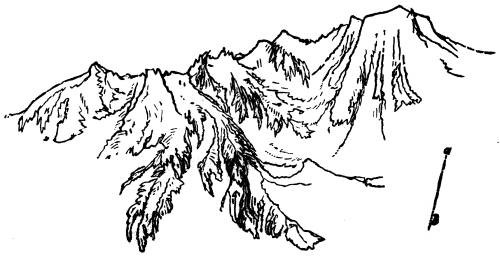
For instance, in Fig. 43, which gives, rudely, the leading lines of the junction of the "Aiguille pourri"66 (Chamouni) with the Aiguilles Rouges, the reader cannot, I think, but feel that there is something which binds the mountains together—some common influence at their heart which they cannot resist: and that, however they may be broken or disordered, there is as true unity among them as in the sweep of a wild wave, governed, through all its foaming ridges, by constant laws of weight and motion.
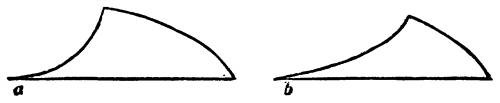
§ 3. How far this apparent unity is the result of elevatory force in mountain, and how far of the sculptural force of water upon the mountain, is the question we have mainly to deal with in the present chapter.
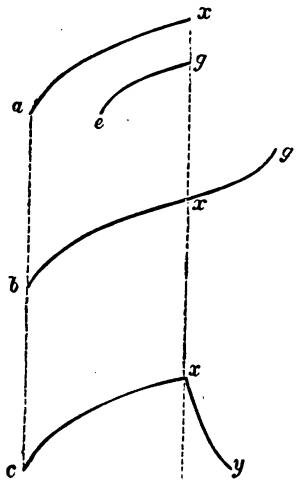
But first look back to Fig. 7, of Plate 8, Vol. III., there given as the typical representation of the ruling forces of growth in a leaf. Take away the extreme portion of the curve on the left, and any segment of the leaf remaining, terminated by one of its ribs, as a or b, Fig. 44, will be equally a typical contour of a common crested mountain. If the reader will merely turn Plate 8 so as to look at the figure upright, with its stalk downwards, he will see that it is also the base of the honeysuckle ornament of the Greeks. I may anticipate what we shall have to note with respect to vegetation so far as to tell him that it is also the base of form in all timber trees.
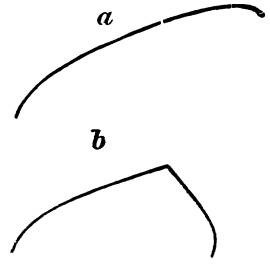
§ 4. There seems something, therefore, in this contour which makes its production one of the principal aims of Nature in all her compositions. The cause of this appears to be, that as the cinqfoil is the simplest expression of proportion, this is the simplest expression of opposition, in unequal curved lines. If we take any lines, a x and e g, Fig. 45, both of varied curvature (not segments of circles), and one shorter than the other, and join them together so as to form one line, as b x, x g, we shall have one of the common lines of beauty; if we join them at an angle, as c x, x y, we shall have the common crest, which is in fact merely a jointed line of beauty. If we join them as at a, Fig. 46, they form a line at once monotonous and cramped, and the jointed condition of this same line, b, is hardly less so. It is easily proved, therefore, that the junction of lines c x, x y, is the simplest and most graceful mode of opposition; and easily observed that in branches of trees, wings of birds, and other more or less regular organizations, such groups of line are continually made to govern the contours. But it is not so easily seen why or how this form should be impressed upon irregular heaps of mountain.
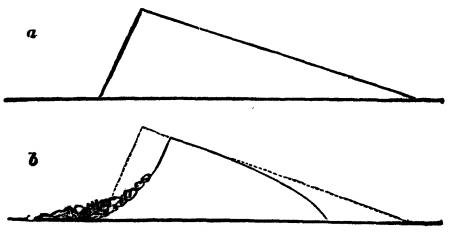
§ 5. If a bed of coherent rock be raised, in the manner described in Chap. XIII., so as to form a broken precipice with its edge, and a long slope with its surface, as at a, Fig. 47 (and in this way nearly all hills are raised), the top of the precipice has usually a tendency to crumble down, and, in process of time, to form a heap of advanced ruins at its foot. On the other side, the back or slope of the hill does not crumble down, but is gradually worn away by the streams; and as these are always more considerable, both in velocity and weight, at the bottom of the slope than the top, the ground is faster worn away at the bottom, and the straight slope is cut to a curve of continually increasing steepness. Fig. 47 b represents the contour to which the hill a would thus be brought in process of time; the dotted line indicating its original form. The result, it will be seen, is a crest.67
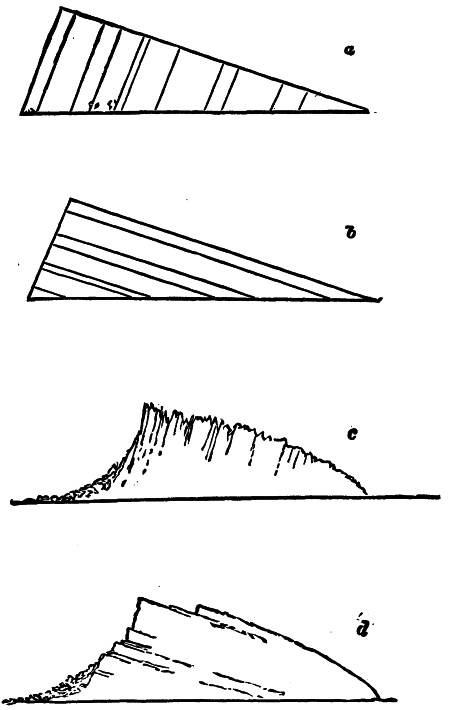
§ 6. But crests of this uniform substance and continuous outline occur only among hills composed of the softest coherent rocks, and seldom attain any elevation such as to make them important or impressive. The notable crests are composed of the hard coherents or slaty crystallines, and then the contour of the crests depends mainly on the question whether in the original mass of it, the beds lie as at a or as at b, Fig. 48. If they lie as at a, then the resultant crest will have the general appearance seen at c; the edges of the beds getting separated and serrated by the weather. If the beds lie as at b, the resultant crest will be of such a contour as that at d.
The crests of the contour d are formed usually by the harder coherent rocks, and are notable chiefly for their bold precipices in front, and regular slopes, or sweeping curves, at the back. We shall examine them under the special head of precipices. But the crests of the form at c belong usually to the slaty crystallines, and are those properly called crests, their edges looking, especially when covered with pines, like separated plumes. These it is our chief business to examine in the present chapter.
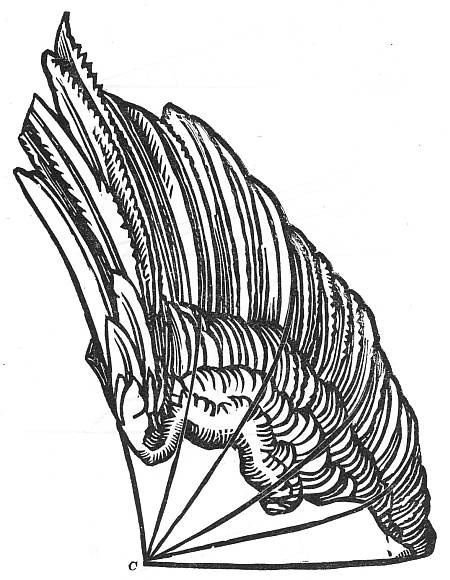
§ 7. In order to obtain this kind of crest, we first require to have our mountain beds thrown up in the form a, Fig. 48. This is not easily done on a large scale, except among the slaty crystallines forming the flanks of the great chains, as in Fig. 29, p. 176. In that figure it will be seen that the beds forming each side of the chain of Mont Blanc are thrown into the required steepness, and therefore, whenever they are broken towards the central mountain, they naturally form the front of a crest, while the torrents and glaciers falling over their longer slopes, carve them into rounded banks towards the valley.
§ 8. But the beauty of a crest or bird's wing consists, in nature, not merely in its curved terminal outline, but in the radiation of the plumes, so that while each assumes a different curve, every curve shall show a certain harmony of direction with all the others.
We shall have to enter into the examination of this subject at greater length in the 17th chapter; meanwhile, it is sufficient to observe the law in a single example, such as Fig. 49, which is a wing of one of the angels in Durer's woodcut of the Fall of Lucifer.68 At first sight, the plumes seem disposed with much irregularity, but there is a sense of power and motion in the whole which the reader would find was at once lost by a careless copyist; for it depends on the fact that if we take the principal curves at any points of the wing, and continue them in the lines which they are pursuing at the moment they terminate, these continued lines will all meet in a single point, C. It is this law which gives unity to the wing.
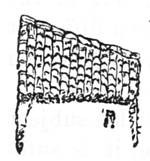
All groups of curves set beside each other depend for their beauty upon the observance of this law;69 and if, therefore, the mountain crests are to be perfectly beautiful, Nature must contrive to get this element of radiant curvature into them in one way or another. Nor does it, at first sight, appear easy for her to get, I do not say radiant curves, but curves at all: for in the aiguilles, she actually bent their beds; but in these slaty crystallines it seems not always convenient to her to bend the beds; and when they are to remain straight, she must obtain the curvature in some other way.
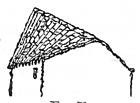
§ 9. One way in which she gets it is curiously simple in itself, but somewhat difficult to explain, unless the reader will be at the pains of making a little model for himself out of paste or clay. Hitherto, observe, we have spoken of these crests as seen at their sides, as a Greek helmet is seen from the side of the wearer. By means presently to be examined, these mountain crests are so shaped that, seen in front, or from behind (as a helmet crest is seen in front of or behind the wearer), they present the contour of a sharp ridge, or house gable. Now if the breadth of this ridge at its base remains the same, while its height gradually diminishes from the front of it to the back (as from the top of the crest to the back of the helmet), it necessarily assumes the form of such a quaint gable roof as that shown in profile in Fig. 50, and in perspective70 in Fig. 51, in which the gable is steep at the end farthest off, but depressed at the end nearest us; and the rows of tiles, in consequence, though in reality quite straight, appear to radiate as they retire, owing to their different slopes. When a mountain crest is thus formed, and the concave curve of its front is carried into its flanks, each edge of bed assuming this concave curve, and radiating, like the rows of tiles, in perspective at the same time, the whole crest is thrown into the form Fig. 52, which is that of the radiating plume required.
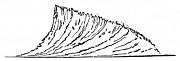
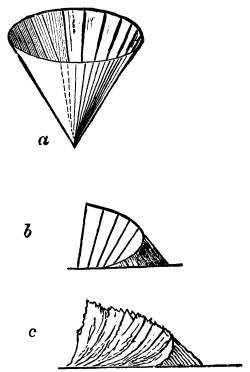
§ 10. It often happens, however, that Nature does not choose to keep the ridge broad at the lower extremity, so as to diminish its steepness. But when this is not so, and the base is narrowed so that the slope of side shall be nearly equal everywhere, she almost always obtains her varied curvature of the plume in another way, by merely turning the crest a little round as it descends. I will not confuse the reader by examining the complicated results of such turning on the inclined lines of the strata; but he can understand, in a moment, its effect on another series of lines, those caused by rivulets of water down the sides of the crest. These lines are, of course, always, in general tendency, perpendicular. Let a, Fig. 53, be a circular funnel, painted inside with a pattern of vertical lines meeting at the bottom. Suppose these lines to represent the ravines traced by the water. Cut off a portion of the lip of the funnel, as at b, to represent the crest side. Cut the edge so as to slope down towards you, and add a slope on the other side. Then give each inner line the concave sweep, and you have your ridge c, of the required form, with radiant curvature.
§ 11. A greater space of such a crest is always seen on its concave than on its convex side (the outside of the funnel); of this other perspective I shall have to speak hereafter; meantime, we had better continue the examination of the proper crest, the c of Fig. 48, in some special instance.
The form is obtained usually in the greatest perfection among the high ridges near the central chain, where the beds of the slaty crystallines are steep and hard. Perhaps the most interesting example I can choose for close examination will be that of a mountain in Chamouni, called the Aiguille Bouchard, now familiar to the eye of every traveller, being the ridge which rises, exactly opposite the Montanvert, beyond the Mer de Glace. The structure of this crest is best seen from near the foot of the Montanvert, on the road to the source of the Arveiron, whence the top of it, a, presents itself under the outline given rudely in the opposite plate (33), in which it will be seen that, while the main energy of the mountain mass tosses itself against the central chain of Mont Blanc (which is on the right hand), it is met by a group of counter-crests, like the recoil of a broken wave cast against it from the other side; and yet, as the recoiling water has a sympathy with the under swell of the very wave against which it clashes, the whole mass writhes together in strange unity of mountain passion; so that it is almost impossible to persuade oneself, after long looking at it, that the crests have not indeed been once fused and tossed into the air by a tempest which had mastery over them, as the winds have over ocean.
§ 12. And yet, if we examine the crest structure closely, we shall find that nearly all these curvatures are obtained by Nature's skilful handling of perfectly straight beds,—only the meeting of those two waves of crest is indeed indicative of the meeting of two masses of different rocks; it marks that junction of the slaty with the compact crystallines, which has before been noticed as the principal mystery of rock structure. To this junction my attention was chiefly directed during my stay at Chamouni, as I found it was always at that point that Nature produced the loveliest mountain forms. Perhaps the time I gave to the study of it may have exaggerated its interest in my eyes; and the reader who does not care for these geological questions, except in their direct bearing upon art, may, without much harm, miss the next seven paragraphs, and go on at the twenty-first. Yet there is one point, in a Turner drawing presently to be examined, which I cannot explain without inflicting the tediousness even of these seven upon him.
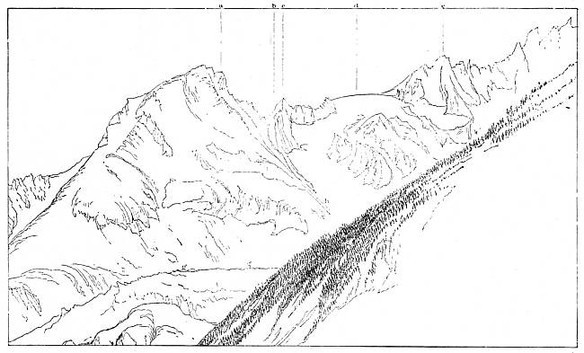
J. Ruskin.
R. P. Cuff.
33. Leading Contours of Aiguille Bouchard.
§ 13. First, then, the right of the Aiguille Bouchard to be called a crest at all depends, not on the slope from a to b, Plate 33, but on that from a to h. The slope from a to b is a perspective deception; b is much the highest point of the two. Seen from the village of Chamouni, the range presents itself under the outline Fig. 54, the same points in each figure being indicated by the same letters. From the end of the valley the supremacy of the mass b c is still more notable. It is altogether with mountains as with human spirits, you never know which is greatest till they are far away.
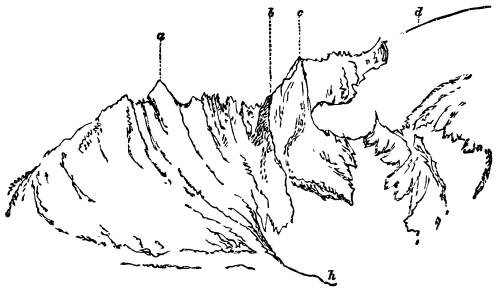
§ 14. It will be observed also, that the beauty of the crest, in both Plate 33 and Fig. 54, depends on the gradually increasing steepness of the lines of slope between a and b. This is in great part deceptive, being obtained by the receding of the crest into a great mountain crater, or basin, as explained in § 11. But this very recession is a matter of interest, for it takes place exactly on the line above spoken of, where the slaty crystallines of the crest join the compact crystallines of the aiguilles; at which junction a correspondent chasm or recession, of some kind or another, takes place along the whole front of Mont Blanc.
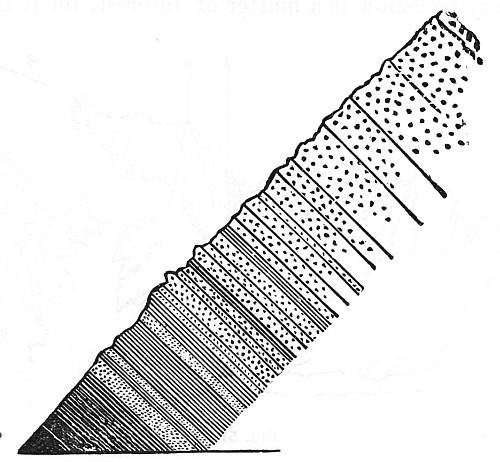
§ 15. In the third paragraph of the last chapter we had occasion to refer to the junction of the slaty and compact crystallines at the roots of the aiguilles. It will be seen in the figure there given, that this change is not sudden, but gradated. The rocks to be joined are of the two types represented in Fig. 3, p. 106 (for convenience' sake I shall in the rest of this chapter call the slaty rock gneiss, and the compact rock protogine, its usual French name). Fig. 55 shows the general manner of junction, beds of gneiss occurring in the middle of the protogine, and of protogine in the gneiss; sometimes one touching the other so closely, that a hammer-stroke breaks off a piece of both; sometimes one passing into the other by a gradual change, like the zones of a rainbow; the only general phenomenon being this, that the higher up the hill the gneiss is, the harder it is (so that while it often yields to the pressure of the finger down in the valley, on the Montanvert it is nearly as hard as protogine); and, on the other hand, the lower down the hill, or the nearer the gneiss, the protogine is, the finer it is in grain. But still the actual transition from one to the other is usually within a few fathoms; and it is that transition, and the preparation for it, which causes the great step, or jag, on the flank of the chain, and forms the tops of the Aiguille Bouchard, Charmoz ridges, Tapia, Montagne de la Côte, Montagne de Taconay, and Aiguille du Gouté.
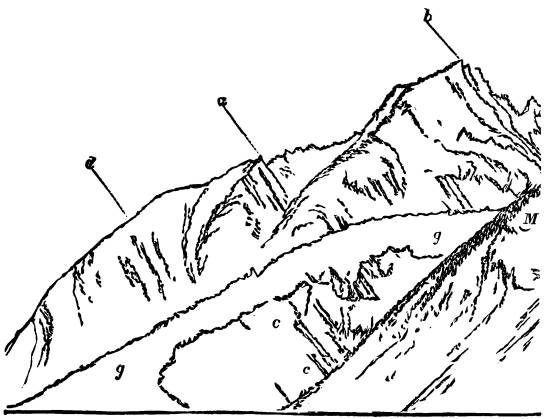
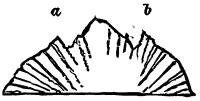
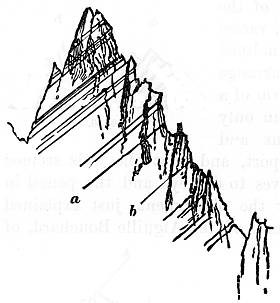
§ 16. But what most puzzled me was the intense straightness of the lines of the gneiss beds, dipping, as it seemed, under the Mont Blanc. For it has been a chief theory with geologists that these central protogine rocks have once been in fusion, and have risen up in molten fury, overturning and altering all the rocks around. But every day, as I looked at the crested flanks of the Mont Blanc, I saw more plainly the exquisite regularity of the slopes of the beds, ruled, it seemed, with an architect's rule, along the edge of their every flake from the summits to the valley. And this surprised me the more because I had always heard it stated that the beds of the lateral crests, a and b, Fig. 56, varied in slope, getting less and less inclined as they descended, so as to arrange themselves somewhat in the form of a fan. It may be so; but I can only say that all my observations and drawings give an opposite report, and that the beds seemed invariably to present themselves to the eye and the pencil in parallelism, modified only by the phenomena just explained (§§ 9, 10). Thus the entire mass of the Aiguille Bouchard, of which only the top is represented in Plate 33, appeared to me in profile, as in Fig. 57, dependent for all its effect and character on the descent of the beds in the directions of the dotted lines, a, b, d. The interrupting space, g g, is the Glacier des Bois; M is the Montanvert; c, c, the rocks under the glacier, much worn by the fall of avalanches, but, for all that, showing the steep lines still with the greatest distinctness. Again, looking down the valley instead of up, so as to put the Mont Blanc on the left hand, the principal crests which support it, Taconay and La Côte, always appeared to me constructed as in Plate 35 (p. 212), they also depending for all their effect on the descent of the beds in diagonal lines towards the left. Nay, half-way up the Breven, whence the structure of the Mont Blanc is commanded, as far as these lower buttresses are concerned, better than from the top of the Breven, I drew carefully the cleavages of the beds, as high as the edge of the Aiguille de Gouté, and found them exquisitely parallel throughout; and again on the Cormayeur side, though less steep, the beds a, b, Fig. 58, traversing the vertical irregular fissures of the great aiguille of the Allée Blanche, as seen over the Lac de Combal, still appeared to me perfectly regular and parallel.71 I have not had time to trace them round, through the Aiguille de Bionassay, and above the Col de Bonhomme, though I know the relations of the beds of limestone to the gneiss on the latter col are most notable and interesting. But, as far as was required for any artistical purposes, I perfectly ascertained the fact that, whatever their real structure might be, these beds did appear, through the softer contours of the hill, as straight and parallel; that they continued to appear so until near the tops of the crests; and that those tops seemed, in some mysterious way, dependent on the junction of the gneissitic beds with, or their transition into, the harder protogine of the aiguilles.
Look back to Plate 33. The peak of the Bouchard, a, is of gneiss, and its beds run down in lines originally straight, but more or less hollowed by weathering, to the point h, where they plunge under débris. But the point b is, I believe, of protogine; and all the opposed writhing of the waves of rock to the right appears to be in consequence of the junction.
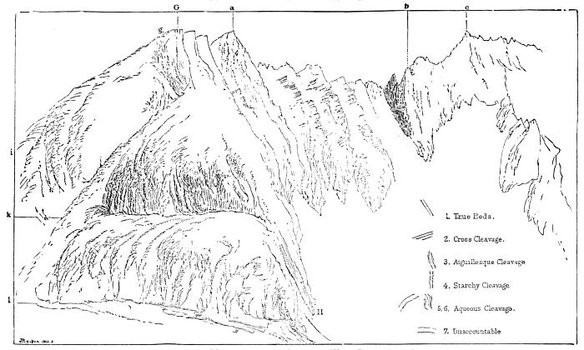
34. Cleavages of Aiguille Bouchard.
§ 17. The way in which these curves are produced cannot, however, be guessed at until we examine the junction more closely. Ascending about five hundred feet above the cabin of the Montanvert, the opposite crest of the Bouchard, from a to c, Plate 33, is seen more in front, expanded into the jagged line, a to c, Plate 34, and the beds, with their fractures, are now seen clearly throughout the mass, namely:
1st. (See references on plate). The true gneiss beds dipping down in the direction G H, the point H being the same as h in Plate 33. These are the beds so notable for their accurate straightness and parallelism.
2nd. The smooth fractures which in the middle of the etching seem to divide the column of rock into a kind of brickwork. They are very neat and sharp, running nearly at right angles with the true beds.72
3rd. The curved fractures of the aiguilles (seen first under the letter b, and seeming to push outwards against the gneiss beds73) continuing through c and the spur below.
4th. An irregular cleavage, something like that of starch, showing itself in broken vertical lines.
5th. Writhing lines, cut by water. These have the greatest possible influence on the aspect of the precipice: they are not merely caused by torrents, but by falls of winter snow, and stones from the glacier moraines, so that the cliff being continually worn away at the foot of it, is wrought into a great amphitheatre, of which the receding sweep continually varies the apparent steepness of the crest, as already explained. I believe in ancient times the great Glacier des Bois itself used to fill this amphitheatre, and break right up against the base of the Bouchard.
6th. Curvatures worn by water over the back of the crest towards the valley, in the direction g i.
7th. A tendency (which I do not understand) to form horizontal masses at the levels k and l.74
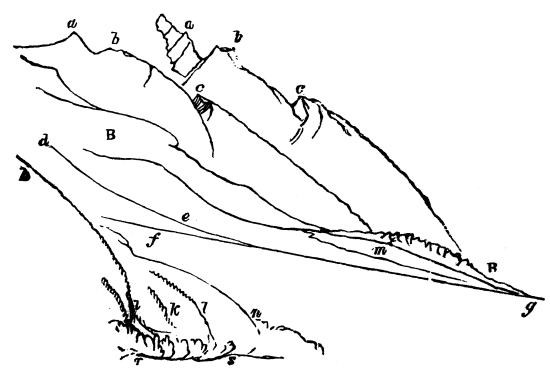
§ 18. The reader may imagine what strange harmonies and changes of line must result throughout the mass of the mountain from the varied prevalence of one or other of these secret inclinations of its rocks (modified, also, as they are by perpetual deceptions of perspective), and how completely the rigidity or parallelism of any one of them is conquered by the fitful urgencies of the rest,—a sevenfold action seeming to run through every atom of crag. For the sake of clearness, I have shown in this plate merely leading lines; the next (Plate 35, opposite) will give some idea of the complete aspect of two of the principal crests on the Mont Blanc flanks, known as the Montagne de la Côte, and Montagne de Taconay, c and t in Fig. 22, at page 163. In which note, first, that the eminences marked a a, b b, c c, here, in the reference figure (61), are in each of the mountains correspondent, and indicate certain changes in the conditions of their beds at those points. I have no doubt the two mountains were once one mass, and that they have been sawn asunder by the great glacier of Taconay, which descends between them; and similarly the Montagne de la Côte sawn from the Tapia by the glacier des Bossons, B B in reference figure.
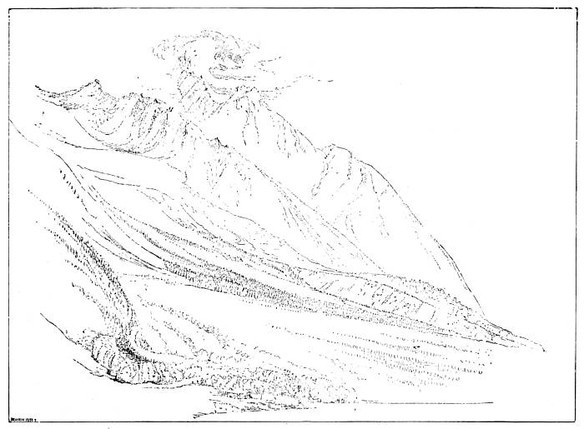
35. Crests of La Côte and Taconay.
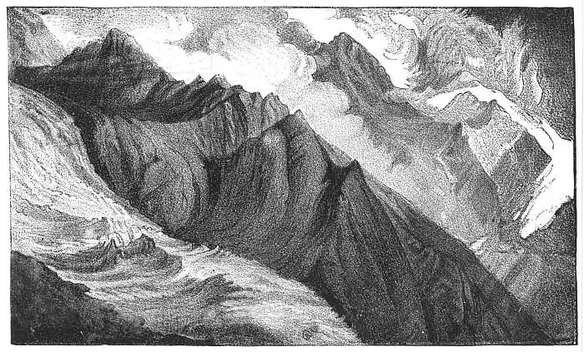
36. Crest of La Côte.
§ 19. Note, secondly, the general tendency in each mountain to throw itself into concave curves towards the Mont Blanc, and descend in rounded slopes to the valley; more or less interrupted by the direct manifestation of the straight beds, which are indeed, in this view of Taconay, the principal features of it. They necessarily become, however, more prominent in the outline etching than in the scene itself, because in reality the delicate cleavages are lost in distance or in mist, and the effects of light bring out the rounded forms of the larger masses; and wherever the clouds fill the hollows between, as they are apt to do, (the glaciers causing a chillness in the ravines, while the wind, blowing up the larger valleys, clears the edges of the crests,) the summits show themselves as in Plate 36, dividing, with their dark frontlets, the perpetual sweep of the glaciers and the clouds.75
§ 20. Of the aqueous curvatures of this crest, we shall have more to say presently; meantime let us especially observe how the providential laws of beauty, acting with reversed data, arrive at similar results in the aiguilles and crests. In the aiguilles, which are of such hard rock that the fall of snow and trickling of streams do not affect them, the inner structure is so disposed as to bring out the curvatures by the mere fracture. In the crests and lower hills, which are of softer rock, and largely influenced by external violence, the inner structure is straight, and the necessary curvatures are produced by perspective, by external modulation, and by the balancing of adverse influences of cleavage. But, as the accuracy of an artist's eye is usually shown by his perceiving the inner anatomy which regulates growth and form, and as in the aiguilles, while we watch them, we are continually discovering new curves, so in the crests, while we watch them, we are continually discovering new straightnesses; and nothing more distinguishes good mountain-drawing, or mountain-seeing, from careless and inefficient mountain-drawing, than the observance of the marvellous parallelisms which exist among the beds of the crests.
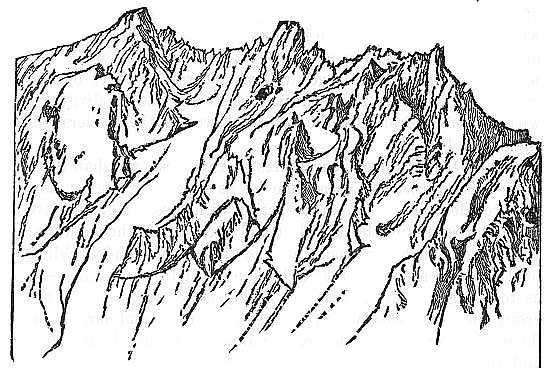
§ 21. It indeed happens, not unfrequently, that in hills composed of somewhat soft rock, the aqueous contours will so prevail over the straight cleavage as to leave nothing manifest at the first glance but sweeping lines like those of waves. Fig. 43, p. 196, is the crest of a mountain on the north of the valley of Chamouni, known, from the rapid decay and fall of its crags, as the Aiguille Pourri; and at first there indeed seems little distinction between its contours and those of the summit of a sea wave. Yet I think also, if it were a wave, we should immediately suppose the tide was running towards the right hand; and if we examined the reason for this supposition, we should perceive that along the ridge the steepest falls of crag were always on the right-hand side; indicating a tendency in them to break rather in the direction of the line a b than any other. If we go half-way down the Montanvert, and examine the left side of the crest somewhat more closely, we shall find this tendency still more definitely visible, as in Fig. 62.
§ 22. But what, then, has given rise to all those coiled plungings of the crest hither and thither, yet with such strange unity of motion?
Yes. There is the cloud. How the top of the hill was first shaped so as to let the currents of water act upon it in so varied a way we know not, but I think that the appearance of interior force of elevation is for the most part deceptive. The series of beds would be found, if examined in section, very uniform in their arrangement, only a little harder in one place, and more delicate in another. A stream receives a slight impulse this way or that, at the top of the hill, but increases in energy and sweep as it descends, gathering into itself others from its sides, and uniting their power with its own. A single knot of quartz occurring in a flake of slate at the crest of the ridge may alter the entire destinies of the mountain form. It may turn the little rivulet of water to the right or left, and that little turn will be to the future direction of the gathering stream what the touch of a finger on the barrel of a rifle would be to the direction of the bullet. Each succeeding year increases the importance of every determined form, and arranges in masses yet more and more harmonious, the promontories shaped by the sweeping of the eternal waterfalls.
§ 23. The importance of the results thus obtained by the slightest change of direction in the infant streamlets, furnishes an interesting type of the formation of human characters by habit. Every one of those notable ravines and crags is the expression, not of any sudden violence done to the mountain, but of its little habits, persisted in continually. It was created with one ruling instinct; but its destiny depended nevertheless, for effective result, on the direction of the small and all but invisible tricklings of water, in which the first shower of rain found its way down its sides. The feeblest, most insensible oozings of the drops of dew among its dust were in reality arbiters of its eternal form; commissioned, with a touch more tender than that of a child's finger,—as silent and slight as the fall of a half-checked tear on a maiden's cheek,—to fix for ever the forms of peak and precipice, and hew those leagues of lifted granite into the shapes that were to divide the earth and its kingdoms. Once the little stone evaded,—once the dim furrow traced,—and the peak was for ever invested with its majesty, the ravine for ever doomed to its degradation. Thenceforward, day by day, the subtle habit gained in power; the evaded stone was left with wider basement; the chosen furrow deepened with swifter-sliding wave; repentance and arrest were alike impossible, and hour after hour saw written in larger and rockier characters upon the sky, the history of the choice that had been directed by a drop of rain, and of the balance that had been turned by a grain of sand.
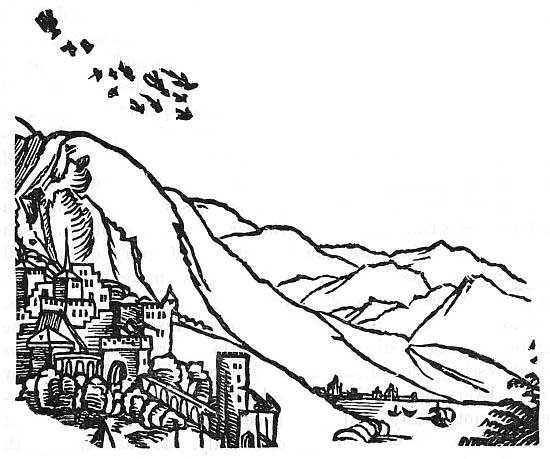
§ 24. Such are the principal laws, relating to the crested mountains, for the expression of which we are to look to art; and we shall accordingly find good and intelligent mountain-drawing distinguished from bad mountain-drawing, by an indication, first, of the artist's recognition of some great harmony among the summits, and of their tendency to throw themselves into tidal waves, closely resembling those of the sea itself; sometimes in free tossing towards the sky, but more frequently still in the form of breakers, concave and steep on one side, convex and less steep on the other; secondly, by his indication of straight beds or fractures, continually stiffening themselves through the curves in some given direction.
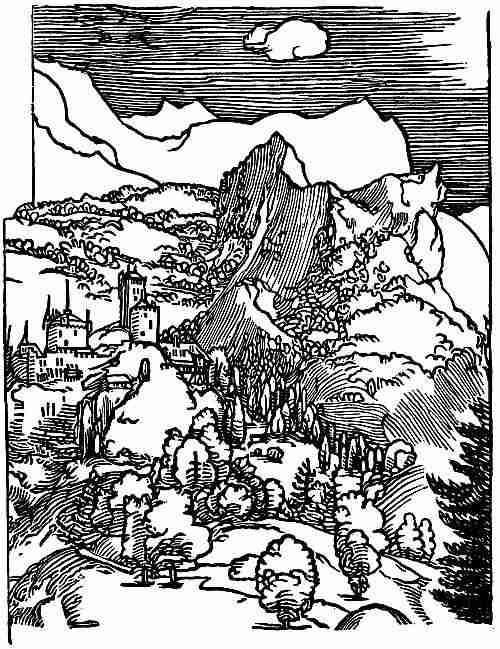
§ 25. Fig. 63 is a facsimile of a piece of the background in Albert Durer's woodcut of the binding of the great Dragon in the Apocalypse. It is one of his most careless and rudest pieces of drawing; yet, observe in it how notably the impulse of the breaking wave is indicated; and note farther, how different a thing good drawing may be from delicate drawing on the one hand, and how different it must be from ignorant drawing on the other. Woodcutting, in Durer's days, had reached no delicacy capable of expressing subtle detail or aerial perspective. But all the subtlety and aerial perspective of modern days are useless, and even barbarous, if they fail in the expression of the essential mountain facts.
§ 26. It will be noticed, however, that in this example of Durer's, the recognition of straightness of line does not exist, and that for this reason the hills look soft and earthy, not rocky.
So, also, in the next example, Fig. 64, the crest in the middle distance is exceedingly fine in its expression of mountain force; the two ridges of it being thrown up like the two edges of a return wave that has just been beaten back from a rock. It is still, however, somewhat wanting in the expression of straightness, and therefore slightly unnatural. It was not people's way in the Middle Ages to look at mountains carefully enough to discover the most subtle elements of their structure. Yet in the next example, Fig. 65, the parallelism and rigidity are definitely indicated, the crest outline being, however, less definite.
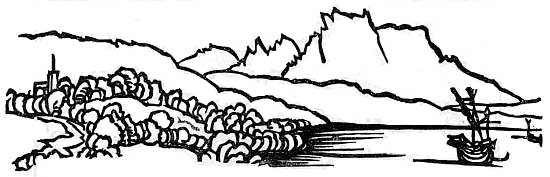
Note, also (in passing), the entire equality of the lines in all these examples, whether turned to dark or light. All good outline drawing, as noticed in the chapter on finish, agrees in this character.
§ 27. The next figure (66) is interesting because it furnishes one of the few instances in which Titian definitely took a suggestion from the Alps, as he saw them from his house at Venice. It is from an old print of a shepherd with a flock of sheep by the sea-side, in which he has introduced a sea distance, with the Venetian church of St. Helena, some subordinate buildings resembling those of Murano, and this piece of cloud and mountain. The peak represented is one of the greater Tyrolese Alps, which shows itself from Venice behind an opening in the chain, and is their culminating point. In reality the mass is of the shape given in Fig. 67. Titian has modified it into an energetic crest, showing his feeling for the form, but I have no doubt that the woodcut reverses Titian's original work (whatever it was), and that he gave the crest the true inclination to the right, or east, which it has in nature.
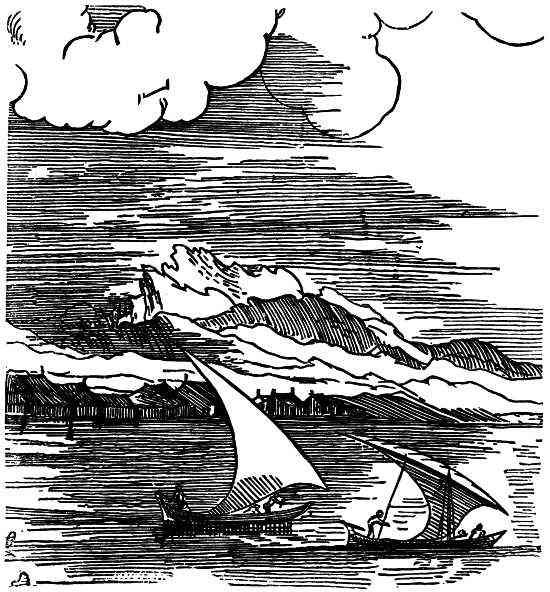
§ 28. Now, it not unfrequently happens that in Claude's distances he introduces actual outlines of Capri, Ischia, Monte St. Angelo, the Alban Mount, and other chains about Rome and Naples, more or less faithfully copied from nature. When he does so, confining himself to mere outline, the grey contours seen against the distance are often satisfactory enough; but as soon as he brings one of them nearer, so as to require any drawing within its mass, it is quite curious to see the state of paralysis into which he is thrown for want of any perception of the mountain anatomy. Fig. 68 is one of the largest hills I can find in the Liber Veritatis (No. 86), and it will be seen that there are only a few lines inserted towards the edges, drawn in the direction of the sides of the heap, or cone, wholly without consciousness of any interior structure.
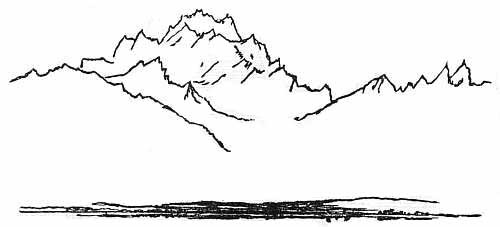
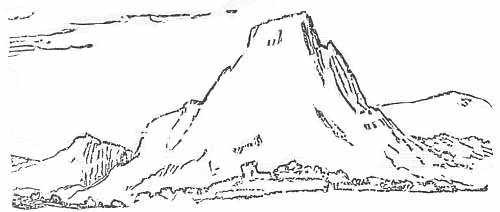
§ 29. I put below it, outlined also in the rudest way (for as I take the shade away from the Liber Veritatis, I am bound also to take it away from Turner), Fig. 69, a bit of the crags in the drawing of Loch Coriskin, partly described already in § 5 of the chapter on the Inferior Mountains in Vol. I. The crest form is, indeed, here accidentally prominent, and developed to a degree rare even with Turner; but note, besides this, the way in which Turner leans on the centre and body of the hill, not on its edge; marking its strata stone by stone, just as a good figure painter, drawing a limb, marks the fall and rise of the joint, letting the outline sink back softened; and compare the exactly opposite method of Claude, holding for life to his outline, as a Greek navigator holds to the shore.76
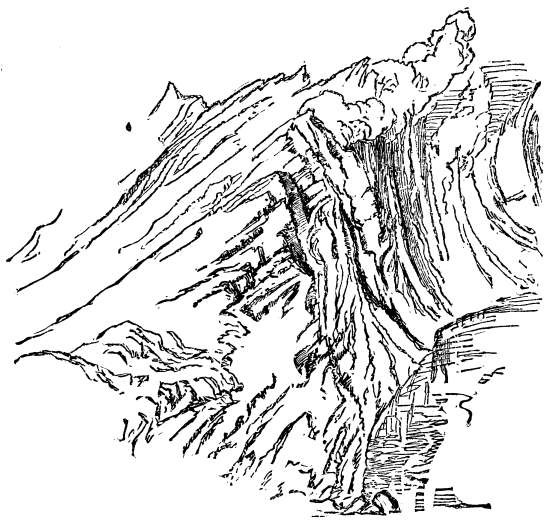
§ 30. Lest, however, it should be thought that I have unfairly chosen my examples, let me take an instance at once less singular and more elaborate.
We saw in our account of Turnerian topography, Chap. II., § 14, that it had been necessary for the painter, in his modification of the view in the ravine of Faïdo, to introduce a passage from among the higher peaks; which, being thus intended expressly to convey the general impression of their character, must sufficiently illustrate what Turner felt that character to be. Observe: it could not be taken from the great central aiguilles, for none such exist at all near Faïdo; it could only be an expression of what Turner considered the noblest attributes of the hills next to these in elevation,—that is to say, those which we are now examining.
I have etched the portion of the picture which includes this passage, on page 221, on its own scale, including the whole couloir above the gallery, and the gallery itself, with the rocks beside it.77 And now, if the reader will look back to Plate 20, which is the outline of the real scene, he will have a perfect example, in comparing the two, of the operation of invention of the highest order on a given subject. I should recommend him to put a piece of tracing paper over the etching, Plate 37, and with his pen to follow some of the lines of it as carefully as he can, until he feels their complexity, and the redundance of the imaginative power which amplified the simple theme, furnished by the natural scene, with such detail; and then let him observe what great mountain laws Turner has been striving to express in all these additions.
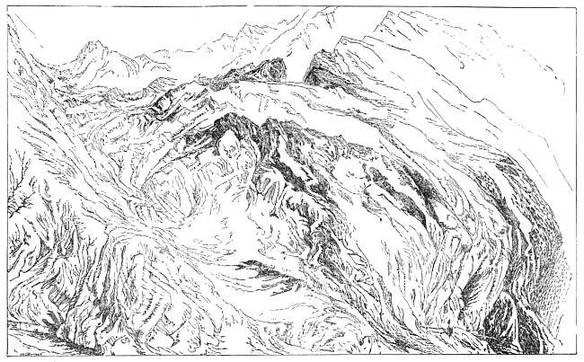
J. M. W. Turner.
J. Ruskin.
37. Crests of the Slaty Crystallines.
§ 31. The cleavages which govern the whole are precisely the same as those of the Aiguille Bouchard, only wrought into grander combinations. That the reader may the better distinguish them, I give the leading lines coarsely for reference in Fig. 70, opposite. The cleavages and lines of force are the following.
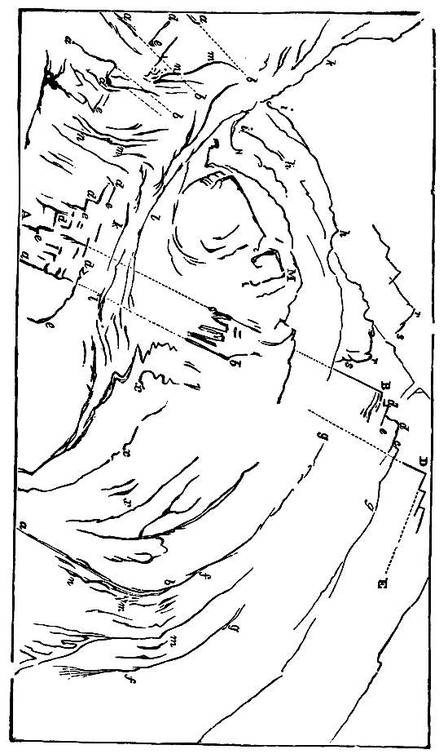
1. A B and associated lines a b, a b, &c., over the whole plate. True beds or cleavage beds (g h in Aiguille Bouchard, Plate 34); here, observe, closing in retiring perspective with exquisite subtlety, and giving the great unity of radiation to the whole mass.
2. D E and associated lines d e, d e, over all the plate. Cross cleavage, the second in Aiguille Bouchard; straight and sharp. Forming here the series of crests at B and D.
3. r s, r s. Counter-crests, closely corresponding to counter-fracture, the third in Aiguille Bouchard.
4. m n, m n, &c., over the whole. Writhing aqueous lines falling gradually into the cleavages. Fifth group in Aiguille Bouchard. The starchy cleavage is not seen here, it being not generally characteristic of the crests, and present in the Bouchard only accidentally.
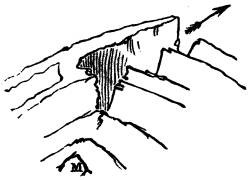
5. x x x. Sinuous lines worn by the water, indicative of some softness or flaws in the rock; these probably the occasion or consequence of the formation of the great precipice or brow on the right. We shall have more to say of them in Chap. XVII.
6. g f, g f, &c. Broad aqueous or glacial curvatures. The sixth group in Aiguille Bouchard.
7. k l, k l. Concave curves wrought by the descending avalanche; peculiar, of course, to this spot.
8. i h, i h. Secondary convex curves, glacial or aqueous, corresponding to g f, but wrought into the minor secondary ravine. This secondary ravine is associated with the opponent aiguillesque masses r s; and the cause of the break or gap between these and the crests B D is indicated by the elbow or joint of nearer rock, M, where the distortion of the beds or change in their nature first takes place. Turner's idea of the structure of the whole mass has evidently been that in section it was as in Fig. 71, snapped asunder by elevation, with a nucleus at M, which, allowing for perspective, is precisely on the line of the chasm running in the direction of the arrow; but he gives more of the curved aiguillesque fracture to these upper crests, which are greater in elevation (and we saw, sometime ago, that the higher the rock the harder). And that nucleus of change at M, the hinge, as it were, on which all these promontories of upper crest revolve, is the first or nearest of the evaded stones, which have determined the course of streams and nod of cliffs throughout the chain.
§ 32. I can well believe that the reader will doubt the possibility of all this being intended by Turner: and intended, in the ordinary sense, it was not. It was simply seen and instinctively painted, according to the command of the imaginative dream, as the true Griffin was, and as all noble things are. But if the reader fancies that the apparent truth came by mere chance, or that I am imagining purpose and arrangement where they do not exist, let him be once for all assured that no man goes through the kind of work which, by this time, he must be beginning to perceive I have gone through, either for the sake of deceiving others, or with any great likelihood of deceiving himself. He who desires to deceive the picture-purchasing public may do so cheaply; and it is easy to bring almost any kind of art into notice without climbing Alps or measuring cleavages. But any one, on the other hand, who desires to ascertain facts, and will refer all art directly to nature for many laborious years, will not at last find himself an easy prey to groundless enthusiasms, or erroneous fancies. Foolish people are fond of repeating a story which has gone the full round of the artistical world,—that Turner, some day, somewhere, said to somebody (time, place, or person never being ascertainable), that I discovered in his pictures things which he did himself not know were there. Turner was not a person apt to say things of this kind; being generally, respecting all the movements of his own mind, as silent as a granite crest; and if he ever did say it, was probably laughing at the person to whom he was speaking. But he might have said it in the most perfect sincerity; nay, I am quite sure that, to a certain extent, the case really was as he is reported to have declared, and that he neither was aware of the value of the truths he had seized nor understood the nature of the instinct that combined them. And yet the truth was assuredly apprehended, and the instinct assuredly present and imperative; and any artists who try to imitate the smallest portion of his work will find that no happy chances will, for them, gather together the resemblances of fact, nor, for them, mimic the majesty of invention.78
§ 33. No happy chance—nay, no happy thought—no perfect knowledge—will ever take the place of that mighty unconsciousness. I have often had to repeat that Turner, in the ordinary sense of the words, neither knew nor thought so much as other men. Whenever his perception failed—that is to say, with respect to scientific truths which produce no results palpable to the eye—he fell into the frankest errors. For instance, in such a thing as the relation of position between a rainbow and the sun, there is not any definitely visible connection between them; it needs attention and calculation to discover that the centre of the rainbow is the shadow of the spectator's head.79 And attention or calculation of this abstract kind Turner appears to have been utterly incapable of; but if he drew a piece of drapery, in which every line of the folds has a visible relation to the points of suspension, not a merely calculable one, this relation he will see to the last thread; and thus he traces the order of the mountain crests to their last stone, not because he knows anything of geology, but because he instinctively seizes the last and finest traces of any visible law.
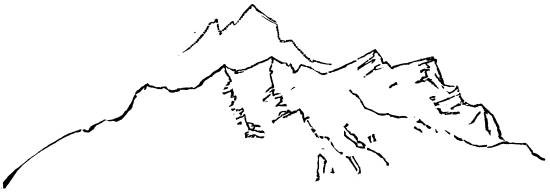
§ 34. He was, however, especially obedient to these laws of the crests, because he heartily loved them. We saw in the early part of this chapter how the crest outlines harmonized with nearly every other beautiful form of natural objects, especially in the continuity of their external curves. This continuity was so grateful to Turner's heart that he would often go great lengths to serve it. For instance, in one of his drawings of the town of Lucerne he has first outlined the Mont Pilate in pencil, with a central peak, as indicated by the dotted line in Fig. 72. This is nearly true to the local fact; but being inconsistent with the general look of crests, and contrary to Turner's instincts, he strikes off the refractory summit, and, leaving his pencil outline still in the sky, touches with color only the contour shown by the continuous line in the figure, thus treating it just as we saw Titian did the great Alp of the Tyrol. He probably, however, would not have done this with so important a feature of the scene as the Mont Pilate, had not the continuous line been absolutely necessary to his composition, in order to oppose the peaked towers of the town, which were his principal subject; the form of the Pilate being seen only as a rosy shadow in the far off sky. We cannot, however, yet estimate the importance, in his mind, of this continuity of descending curve, until we come to the examination of the lower hill flanks, hitherto having been concerned only with their rocky summits; and before we leave those summits, or rather the harder rocks which compose them, there is yet another condition of those rocks to be examined; and that the condition which is commonly the most interesting, namely, the Precipice. To this inquiry, however, we had better devote a separate chapter.
67 The materials removed from the slope are spread over the plain or valley below. A nearly equal quantity is supposed to be removed from the other side; but besides this removed mass, the materials crumble heavily from above, and form the concave curve.
72 Many geologists think they are the true beds. They run across the gneissitic folia, and I hold with De Saussure, and consider them a cleavage.
66 So called from the mouldering nature of its rocks. They are slaty crystallines, but unusually fragile.
73 I tried in vain to get along the ridge of the Bouchard to this junction, the edge of the precipice between a and b (Plate 33) being too broken; but the point corresponds so closely to that of the junction of the gneiss and protogine on the Charmoz ridge, that, adding the evidence of the distant contour, I have no doubt as to the general relations of the rocks.
75 The aqueous curves and roundings on the nearer crest (La Côte) are peculiarly tender, because the gneiss of which it is composed is softer in grain than that of the Bouchard, and remains so even to the very top of the peak, a, in Fig. 61, where I found it mixed with a yellowish and somewhat sandy quartz rock, and generally much less protogenic than is usual at such elevations on other parts of the chain.
74 De Saussure often refers to these as "assaissements." They occur, here and there, in the aiguilles themselves.
78 An anecdote is related, more to our present purpose, and better authenticated, inasmuch as the name of the artist to whom Turner was speaking at the time is commonly stated, though I do not give it here, not having asked his permission. The story runs that this artist (one of our leading landscape painters) was complaining to Turner that, after going to Domo d'Ossola, to find the site of a particular view which had struck him several years before, he had entirely failed in doing so; "it looked different when he went back again." "What," replied Turner, "do you not know yet, at your age, that you ought to paint your impressions?"
76 It is worth while noting here, in comparing Fig. 66 and Fig. 68, how entirely our judgment of some kinds of art depends upon knowledge, not on feeling. Any person unacquainted with hills would think Claude's right and Titian's ridiculous: but, after inquiring a little farther into the matter, we find Titian's a careless and intense expression of true knowledge, and Claude's a slow and plausible expression of total ignorance.
J. Ruskin.
R. P. Cuff.
33. Leading Contours of Aiguille Bouchard.
68 The lines are a little too straight in their continuations, the engraver having cut some of the curvature out of their thickness, thinking I had drawn them too coarsely. But I have chosen this coarsely lined example, and others like it, following, because I wish to accustom the reader to distinguish between the mere fineness of instrument in the artist's hand, and the precision of the line he draws. Give Titian a blunt pen, and still Titian's line will be a noble one: a tyro, with a pen well mended, may draw more neatly; but his lines ought to be discerned from Titian's, if we understand drawing. Every line in this woodcut of Durer's is refined; and that in the noblest sense. Whether broad or fine does not matter, the lines are right; and the most delicate false line is evermore to be despised, in presence of the coarsest faithful one.
79 So, in the exact length or shape of shadows in general, he will often be found quite inaccurate; because the irregularity caused in shadows by the shape of what they fall on, as well as what they fall from, renders the law of connection untraceable by the eye or the instinct. The chief visible thing about a shadow is, that it is always of some form which nobody would have thought of; and this visible principle Turner always seizes, sometimes wrongly in calculated fact, but always so rightly as to give more the look of a real shadow than any one else.
70 "Out of perspective," I should have said: but it will show what I mean.
69 Not absolutely on the meeting of the curves in one point, but on their radiating with some harmonious succession of difference in direction. The difference between lines which are in true harmony of radiation, and lines which are not, can, in complicated masses, only be detected by a trained eye; yet it is often the chief difference between good and bad drawing. A cluster of six or seven black plumes forming the wing of one of the cherubs in Titian's Assumption, at Venice, has a freedom and force about it in the painting which no copyist or engraver has ever yet rendered, though it depends merely on the subtlety of the curves, not on the color.
77 This etching, like that of the Bolton rocks, is prepared for future mezzo-tint, and looks harsh in its present state; but will mark all the more clearly several points of structure in question. The diamond-shaped rock, however, (M, in the reference figure,) is not so conspicuous here as it will be when the plate is finished, being relieved in light from the mass behind, as also the faint distant crests in dark from the sky.
71 Nor did any nearer observations ever induce me to form any contrary opinion. It is not easy to get any consistent series of measurements of the slope of these gneiss beds; for, although parallel on the great scale, they admit many varieties of dip in minor projections. But all my notes unite, whether at the bottom or top of the great slope of the Montanvert and La Côte, in giving an angle of from 60° to 80° with the horizon; the consistent angle being about 75°. I cannot be mistaken in the measurements themselves, however inconclusive observations on minor portions of rock may be; for I never mark an angle unless enough of the upper or lower surface of the beds be smoothly exposed to admit of my pole being adjusted to it by the spirit-level. The pole then indicates the strike of the beds, and a quadrant with a plumb-line their dip; to all intents and purposes accurately. There is a curious distortion of the beds in the ravine between the Glacier des Bois and foot of the Montanvert, near the ice, about a thousand feet above the valley; the beds there seem to bend suddenly back under the glacier, and in some places to be quite vertical. On the opposite side of the glacier, below the Chapeau, the dip of the limestone under the gneiss, with the intermediate bed, seven or eight feet thick, of the grey porous rock which the French call cargneule, is highly interesting; but it is so concealed by débris and the soil of the pine forests, as to be difficult to examine to any extent. On the whole, the best position for getting the angle of the beds accurately, is the top of the Tapia, a little below the junction there of the granite and gneiss (see notice of this junction in Appendix 2); a point from which the summit of the Aiguille du Gouté bears 11° south of west, and that of the Aiguille Bouchard 17° north of east, the Aiguille Dru 5-½° or 6° north of east, the peak of it appearing behind the Petit Charmoz. The beds of gneiss emerging from the turf under the spectator's feet may be brought parallel by the eye with the slopes of the Aiguille du Gouté on one side, and the Bouchard (and base of Aiguille d'Argentière) on the other; striking as nearly as possible from summit to summit through that on which the spectator stands, or from about 10° north of east to 10° south of west, and dipping with exquisite uniformity at an angle of 74 degrees with the horizon. But what struck me as still more strange was, that from this point I could distinctly see traces of the same straight structure running through the Petit Charmoz, and the roots of the aiguilles themselves, as in Fig. 59; nor could I ever, in the course of countless observations, fairly determine any point where this slaty structure altogether had ceased. It seemed only to get less and less traceable towards the centre of the mass of Mont Blanc; and, from the ridge of the Aiguille Bouchard itself, at the point a in Plate 33, whence, looking south-west, the aiguilles can be seen in the most accurate profile obtainable throughout the valley of Chamouni, I noticed a very singular parallelism even on the south-east side of the Charmoz, x y (Fig. 60), as if the continued influence of this cleavage were carried on from the Little Charmoz, c, d (in which, seen on the opposite side, I had traced it as in Fig. 59), through the central mass of rock r. In this profile, M is the Mont Blanc itself; m, the Aiguille du Midi; P, Aiguille du Plan; b, Aiguille Blaitière; C, Great Charmoz; c, Petit Charmoz; E, passage called de l'Etala.
66 So called from the mouldering nature of its rocks. They are slaty crystallines, but unusually fragile.
67 The materials removed from the slope are spread over the plain or valley below. A nearly equal quantity is supposed to be removed from the other side; but besides this removed mass, the materials crumble heavily from above, and form the concave curve.
68 The lines are a little too straight in their continuations, the engraver having cut some of the curvature out of their thickness, thinking I had drawn them too coarsely. But I have chosen this coarsely lined example, and others like it, following, because I wish to accustom the reader to distinguish between the mere fineness of instrument in the artist's hand, and the precision of the line he draws. Give Titian a blunt pen, and still Titian's line will be a noble one: a tyro, with a pen well mended, may draw more neatly; but his lines ought to be discerned from Titian's, if we understand drawing. Every line in this woodcut of Durer's is refined; and that in the noblest sense. Whether broad or fine does not matter, the lines are right; and the most delicate false line is evermore to be despised, in presence of the coarsest faithful one.
69 Not absolutely on the meeting of the curves in one point, but on their radiating with some harmonious succession of difference in direction. The difference between lines which are in true harmony of radiation, and lines which are not, can, in complicated masses, only be detected by a trained eye; yet it is often the chief difference between good and bad drawing. A cluster of six or seven black plumes forming the wing of one of the cherubs in Titian's Assumption, at Venice, has a freedom and force about it in the painting which no copyist or engraver has ever yet rendered, though it depends merely on the subtlety of the curves, not on the color.
70 "Out of perspective," I should have said: but it will show what I mean.
71 Nor did any nearer observations ever induce me to form any contrary opinion. It is not easy to get any consistent series of measurements of the slope of these gneiss beds; for, although parallel on the great scale, they admit many varieties of dip in minor projections. But all my notes unite, whether at the bottom or top of the great slope of the Montanvert and La Côte, in giving an angle of from 60° to 80° with the horizon; the consistent angle being about 75°. I cannot be mistaken in the measurements themselves, however inconclusive observations on minor portions of rock may be; for I never mark an angle unless enough of the upper or lower surface of the beds be smoothly exposed to admit of my pole being adjusted to it by the spirit-level. The pole then indicates the strike of the beds, and a quadrant with a plumb-line their dip; to all intents and purposes accurately. There is a curious distortion of the beds in the ravine between the Glacier des Bois and foot of the Montanvert, near the ice, about a thousand feet above the valley; the beds there seem to bend suddenly back under the glacier, and in some places to be quite vertical. On the opposite side of the glacier, below the Chapeau, the dip of the limestone under the gneiss, with the intermediate bed, seven or eight feet thick, of the grey porous rock which the French call cargneule, is highly interesting; but it is so concealed by débris and the soil of the pine forests, as to be difficult to examine to any extent. On the whole, the best position for getting the angle of the beds accurately, is the top of the Tapia, a little below the junction there of the granite and gneiss (see notice of this junction in Appendix 2); a point from which the summit of the Aiguille du Gouté bears 11° south of west, and that of the Aiguille Bouchard 17° north of east, the Aiguille Dru 5-½° or 6° north of east, the peak of it appearing behind the Petit Charmoz. The beds of gneiss emerging from the turf under the spectator's feet may be brought parallel by the eye with the slopes of the Aiguille du Gouté on one side, and the Bouchard (and base of Aiguille d'Argentière) on the other; striking as nearly as possible from summit to summit through that on which the spectator stands, or from about 10° north of east to 10° south of west, and dipping with exquisite uniformity at an angle of 74 degrees with the horizon. But what struck me as still more strange was, that from this point I could distinctly see traces of the same straight structure running through the Petit Charmoz, and the roots of the aiguilles themselves, as in Fig. 59; nor could I ever, in the course of countless observations, fairly determine any point where this slaty structure altogether had ceased. It seemed only to get less and less traceable towards the centre of the mass of Mont Blanc; and, from the ridge of the Aiguille Bouchard itself, at the point a in Plate 33, whence, looking south-west, the aiguilles can be seen in the most accurate profile obtainable throughout the valley of Chamouni, I noticed a very singular parallelism even on the south-east side of the Charmoz, x y (Fig. 60), as if the continued influence of this cleavage were carried on from the Little Charmoz, c, d (in which, seen on the opposite side, I had traced it as in Fig. 59), through the central mass of rock r. In this profile, M is the Mont Blanc itself; m, the Aiguille du Midi; P, Aiguille du Plan; b, Aiguille Blaitière; C, Great Charmoz; c, Petit Charmoz; E, passage called de l'Etala.
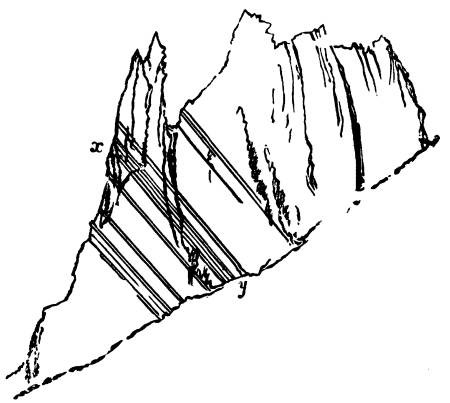
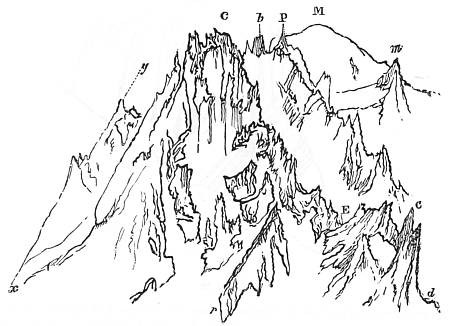
72 Many geologists think they are the true beds. They run across the gneissitic folia, and I hold with De Saussure, and consider them a cleavage.
73 I tried in vain to get along the ridge of the Bouchard to this junction, the edge of the precipice between a and b (Plate 33) being too broken; but the point corresponds so closely to that of the junction of the gneiss and protogine on the Charmoz ridge, that, adding the evidence of the distant contour, I have no doubt as to the general relations of the rocks.
74 De Saussure often refers to these as "assaissements." They occur, here and there, in the aiguilles themselves.
75 The aqueous curves and roundings on the nearer crest (La Côte) are peculiarly tender, because the gneiss of which it is composed is softer in grain than that of the Bouchard, and remains so even to the very top of the peak, a, in Fig. 61, where I found it mixed with a yellowish and somewhat sandy quartz rock, and generally much less protogenic than is usual at such elevations on other parts of the chain.
76 It is worth while noting here, in comparing Fig. 66 and Fig. 68, how entirely our judgment of some kinds of art depends upon knowledge, not on feeling. Any person unacquainted with hills would think Claude's right and Titian's ridiculous: but, after inquiring a little farther into the matter, we find Titian's a careless and intense expression of true knowledge, and Claude's a slow and plausible expression of total ignorance.
It will be observed that Fig. 69 is one of the second order of crests, d, Fig. 48. The next instance given is of the first order of crests, c, in the same figure
77 This etching, like that of the Bolton rocks, is prepared for future mezzo-tint, and looks harsh in its present state; but will mark all the more clearly several points of structure in question. The diamond-shaped rock, however, (M, in the reference figure,) is not so conspicuous here as it will be when the plate is finished, being relieved in light from the mass behind, as also the faint distant crests in dark from the sky.
78 An anecdote is related, more to our present purpose, and better authenticated, inasmuch as the name of the artist to whom Turner was speaking at the time is commonly stated, though I do not give it here, not having asked his permission. The story runs that this artist (one of our leading landscape painters) was complaining to Turner that, after going to Domo d'Ossola, to find the site of a particular view which had struck him several years before, he had entirely failed in doing so; "it looked different when he went back again." "What," replied Turner, "do you not know yet, at your age, that you ought to paint your impressions?"
79 So, in the exact length or shape of shadows in general, he will often be found quite inaccurate; because the irregularity caused in shadows by the shape of what they fall on, as well as what they fall from, renders the law of connection untraceable by the eye or the instinct. The chief visible thing about a shadow is, that it is always of some form which nobody would have thought of; and this visible principle Turner always seizes, sometimes wrongly in calculated fact, but always so rightly as to give more the look of a real shadow than any one else.
CHAPTER XVI
RESULTING FORMS:—THIRDLY, PRECIPICES.
§ 1. The reader was, perhaps, surprised by the smallness of the number to which our foregoing analysis reduced Alpine summits bearing an ascertainedly peaked or pyramidal form. He might not be less so if I were to number the very few occasions on which I have seen a true precipice of any considerable height. I mean by a true precipice, one by which a plumb-line will swing clear, or without touching the face of it, if suspended from a point a foot or two beyond the brow. Not only are perfect precipices of this kind very rare, but even imperfect precipices, which often produce upon the eye as majestic an impression as if they were vertical, are nearly always curiously low in proportion to the general mass of the hills to which they belong. They are for the most part small steps or rents in large surfaces of mountain, and mingled by Nature among her softer forms, as cautiously and sparingly as the utmost exertion of his voice is, by a great speaker, with his tones of gentleness.
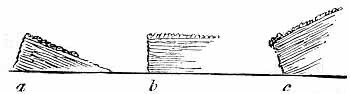
§ 2. Precipices, in the large plurality of cases, consist of the edge of a bed of rock, sharply fractured, in the manner already explained in Chap. XII., and are represented, in their connection with aiguilles and crests, by c, in Fig. 42, p. 195. When the bed of rock slopes backwards from the edge, as a, Fig. 73, a condition of precipice is obtained more or less peaked, very safe, and very grand.80 When the beds are horizontal, b, the precipice is steeper, more dangerous, but much less impressive. When the beds slope towards the precipice, the front of it overhangs, and the noblest effect is obtained which is possible in mountain forms of this kind.
§ 3. Singularly enough, the type b is in actual nature nearly always the most dangerous of the three, and c the safest, for horizontal beds are usually of the softest rocks, and their cliffs are caused by some violent agency in constant operation, as chalk cliffs by the wearing power of the sea, so that such rocks are continually falling, in one place or another. The form a may also be assumed by very soft rocks. But c cannot exist at all on the large scale, unless it is built of good materials, and it will then frequently stay in its fixed frown for ages.
§ 4. It occasionally happens that a precipice is formed among the higher crests by the sides of vertical beds of slaty crystallines. Such rocks are rare, and never very high, but always beautiful in their smoothness of surface and general trenchant and firm expression. One of the most interesting I know is that of the summit of the Breven, on the north of the valley of Chamouni. The mountain is formed by vertical sheets of slaty crystallines, rather soft at the bottom, and getting harder and harder towards the top, until at the very summit it is hard and compact as the granite of Waterloo Bridge, though much finer in the grain, and breaking into perpendicular faces of rock so perfectly cut as to feel smooth to the hand. Fig. 4, p. 107, represents, of the real size, a bit which I broke from the edge of the cliff, the shaded part underneath being the surface which forms the precipice. The plumb-line from the brow of this cliff hangs clear 124 English feet; it is then caught by a ledge about three feet wide, from which another precipice falls to about twice the height of the first; but I had not line enough to measure it with from the top, and could not get down to the ledge. When I say the line hangs clear, I mean when once it is off the actual brow of the cliff, which is a little rounded for about fourteen or fifteen feet, from a to b, in the section, Fig. 75. Then the rock recedes in an almost unbroken concave sweep, detaching itself from the plumb-line about two feet at the point c (the lateral dimensions are exaggerated to show the curve), and approaching it again at the ledge d, which is 124 feet below a. The plumb-line, fortunately, can be seen throughout its whole extent from a sharp bastion of the precipice farther on, for the face of the cliff runs, in horizontal plan, very nearly to the magnetic north and south, as shown in Fig. 74, the plumb-line swinging at a, and seen from the advanced point P. It would give a similar result at any other part of the cliff face, but may be most conveniently cast from the point a, a little below, and to the north of the summit.
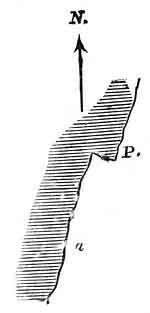

§ 5. But although the other divisions of this precipice, below the ledge which stops the plummet, give it altogether a height of about five hundred feet,81 the whole looks a mere step on the huge slope of the Breven; and it only deserves mention among Alpine cliffs as one of singular beauty and decision, yet perfectly approachable and examinable even by the worst climbers; which is very rarely the case with cliffs of the same boldness. I suppose that this is the reason for its having been often stated in scientific works that no cliff could be found in the Alps from which a plumb-line would swing two hundred feet. This can possibly be true (and even with this limitation I doubt it) of cliffs conveniently approachable by experimental philosophers. For, indeed, one way or another, it is curious how Nature fences out, as it were, the brows of her boldest precipices. Wherever a plumb-line will swing, the precipice is, almost without exception, of the type c, in Fig. 73, the brow of it rounding towards the edge for, perhaps, fifty or a hundred yards above, rendering it unsafe in the highest degree for any inexperienced person to attempt approach. But it is often possible to ascertain from a distance, if the cliff can be got relieved against the sky, the approximate degree of its precipitousness.
§ 6. It may, I think, be assumed, almost with certainty, that whenever a precipice is very bold and very high, it is formed by beds more or less approaching horizontally, out of which it has been cut, like the side of a haystack from which part has been removed. The wonderfulness of this operation I have before insisted upon; here we have to examine the best examples of it.
As, in forms of central rock, the Aiguilles of Chamouni, so in notableness of lateral precipice, the Matterhorn, or Mont Cervin, stands, on the whole, unrivalled among the Alps, being terminated, on two of its sides, by precipices which produce on the imagination nearly the effect of verticality. There is, however, only one point at which they reach anything approaching such a condition; and that point is wholly inaccessible either from below or above, but sufficiently measurable by a series of observations.
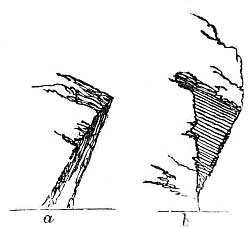
§ 7. From the slope of the hill above, and to the west of, the village of Zermatt, the Matterhorn presents itself under the figure shown on the right hand in the opposite plate (38). The whole height of the mass, from the glacier out of which it rises, is about 4000 feet; and although, as before noticed, the first slope from the top towards the right is merely a perspective line, the part of the contour c d, Fig. 33, p. 181, which literally overhangs,82 cannot be. An apparent slope, however steep, so that it does not overpass the vertical, may be a horizontal line; but the moment it can be shown literally to overhang, it must be one of two things,—either an actually pendant face of rock, as at a, Fig. 77, or the under edge of an overhanging cornice of rock, b. Of course the latter condition, on such a scale as this of the Matterhorn, would be the more wonderful of the two; but I was anxious to determine which of these it really was.
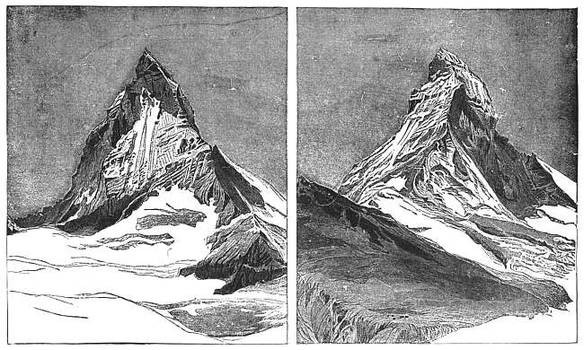
38. The Cervin, from the East and North-east.
§ 8. My first object was to reach some spot commanding, as nearly as might be, the lateral profile of the Mont Cervin. The most available point for this purpose was the top of the Riffelhorn; which, however, first attempting to climb by its deceitful western side, and being stopped, for the moment, by the singular moat and wall which defend its Malakhoff-like summit, fearing that I might not be able ultimately to reach the top, I made the drawing of the Cervin, on the left hand in Plate 38, from the edge of the moat; and found afterwards the difference in aspect, as it was seen from the true summit, so slight as not to necessitate the trouble of making another drawing.83
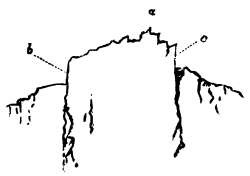
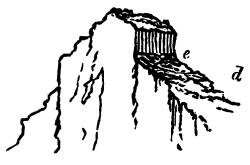
§ 9. It may be noted in passing, that this wall which with its regular fosse defends the Riffelhorn on its western side, and a similar one on its eastern side, though neither of them of any considerable height, are curious instances of trenchant precipice, formed, I suppose, by slight slips or faults of the serpentine rock. The summit of the horn, a, Fig. 78, seems to have been pushed up in a mass beyond the rest of the ridge, or else the rest of the ridge to have dropped from it on each side, at b c, leaving the two troublesome faces of cliff right across the crag, hard, green as a sea wave, and polished like the inside of a seashell, where the weather has not effaced the surface produced by the slip. It is only by getting past the eastern cliff that the summit can be reached at all, for on its two lateral escarpments the mountain seems quite inaccessible, being in its whole mass nothing else than the top of a narrow wall with a raised battlement, as rudely shown in perspective at e d; the flanks of the wall falling towards the glacier on one side, and to the lower Riffel on the other, four or five hundred feet, not, indeed, in unbroken precipice, but in a form quite incapable of being scaled.84
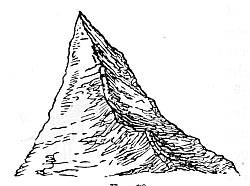
§ 10. To return to the Cervin. The view of it given on the left hand in Plate 38 shows the ridge in about its narrowest profile; and shows also that this ridge is composed of beds of rock shelving across it, apparently horizontal, or nearly so, at the top, and sloping considerably southwards (to the spectator's left), at the bottom. How far this slope is a consequence of the advance of the nearest angle giving a steep perspective to the beds, I cannot say; my own belief would have been that a great deal of it is thus deceptive, the beds lying as the tiles do in the somewhat anomalous, but perfectly conceivable house-roof, Fig. 79. Saussure, however, attributes to the beds themselves a very considerable slope. But be this as it may, the main facts of the thinness of the beds, their comparative horizontality, and the daring swordsweep by which the whole mountain has been hewn out of them, are from this spot comprehensible at a glance. Visible, I should have said; but eternally, and to the uttermost, incomprehensible. Every geologist who speaks of this mountain seems to be struck by the wonderfulness of its calm sculpture—the absence of all aspect of convulsion, and yet the stern chiselling of so vast a mass into its precipitous isolation leaving no ruin nor débris near it. "Quelle force n'a-t-il pas fallu," exclaims M. Saussure, "pour rompre, et pour balayer tout ce qui manque à cette pyramide!" "What an overturn of all ancient ideas in Geology," says Professor Forbes, "to find a pinnacle of 15,000 feet high [above the sea] sharp as a pyramid, and with perpendicular precipices of thousands of feet on every hand, to be a representative of the older chalk formation; and what a difficulty to conceive the nature of a convulsion (even with unlimited power), which could produce a configuration like the Mont Cervin rising from the glacier of Zmutt!"
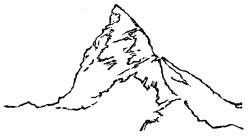
§ 11. The term "perpendicular" is of course applied by the Professor in the "poetical" temper of Reynolds,—that is to say, in one "inattentive to minute exactness in details;" but the effect of this strange Matterhorn upon the imagination is indeed so great, that even the gravest philosophers cannot resist it; and Professor Forbes's drawing of the peak, outlined at page 180, has evidently been made under the influence of considerable excitement. For fear of being deceived by enthusiasm also, I daguerreotyped the Cervin from the edge of the little lake under the crag of the Riffelhorn, with the somewhat amazing result shown in Fig. 80. So cautious is Nature, even in her boldest work, so broadly does she extend the foundations, and strengthen the buttresses, of masses which produce so striking an impression as to be described, even by the most careful writers, as perpendicular.
§ 12. The only portion of the Matterhorn which approaches such a condition is the shoulder, before alluded to, forming a step of about one twelfth the height of the whole peak, shown by light on its snowy side, or upper surface, in the right-hand figure of Plate 38. Allowing 4000 feet for the height of the peak, this step or shoulder will be between 300 and 400 feet in absolute height; and as it is not only perpendicular, but assuredly overhangs, both at this snow-lighted angle and at the other corner of the mountain (seen against the sky in the same figure), I have not the slightest doubt that a plumb-line would swing from the brow of either of these bastions, between 600 and 800 feet, without touching rock. The intermediate portion of the cliff which joins them is, however, not more than vertical. I was therefore anxious chiefly to observe the structure of the two angles, and, to that end, to see the mountain close on that side, from the Zmutt glacier.
§ 13. I am afraid my dislike to the nomenclatures invented by the German philosophers has been unreasonably, though involuntarily, complicated with that which, crossing out of Italy, one necessarily feels for those invented by the German peasantry. As travellers now every day more frequently visit the neighborhood of the Monte Rosa, it would surely be a permissible, because convenient, poetical license, to invent some other name for this noble glacier, whose present title, certainly not euphonious, has the additional disadvantage of being easily confounded with that of the Zermatt glacier, properly so called. I mean myself, henceforward, to call it the Red glacier, because, for two or three miles above its lower extremity, the whole surface of it is covered with blocks of reddish gneiss, or other slaty crystalline rocks,—some fallen from the Cervin, some from the Weisshorn, some brought from the Stockhi and Dent d'Erin, but little rolled or ground down in the transit, and covering the ice, often four or five feet deep, with a species of macadamization on a large scale (each stone being usually some foot or foot and a half in diameter), anything but convenient to a traveller in haste. Higher up, the ice opens into broad white fields and furrows, hard and dry, scarcely fissured at all, except just under the Cervin, and forming a silent and solemn causeway, paved, as it seems, with white marble from side to side; broad enough for the march of an army in line of battle, but quiet as a street of tombs in a buried city, and bordered on each hand by ghostly cliffs of that faint granite purple which seems, in its far-away height, as unsubstantial as the dark blue that bounds it;—the whole scene so changeless and soundless; so removed, not merely from the presence of men, but even from their thoughts; so destitute of all life of tree or herb, and so immeasurable in its lonely brightness of majestic death, that it looks like a world from which not only the human, but the spiritual, presences had perished, and the last of its archangels, building the great mountains for their monuments, had laid themselves down in the sunlight to an eternal rest, each in his white shroud.
§ 14. The first point from which the Matterhorn precipices, which I came to examine, show their structure distinctly, is about half-way up the valley, before reaching the glacier. The most convenient path, and access to the ice, are on the south; but it is best, in order to watch the changes of the Matterhorn, to keep on the north side of the valley; and, at the point just named, the shoulder marked e in Fig. 33, p. 181, is seen, in the morning sunlight, to be composed of zigzag beds, apparently of eddied sand.
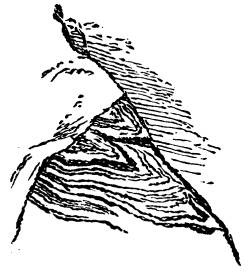
I have no doubt they once were eddied sand; that is to say, sea or torrent drift, hardened by fire into crystalline rock; but whether they ever were or not, the certain fact is, that here we have a precipice, trenchant, overhanging, and 500 feet in height, cut across the thin beds which compose it as smoothly as a piece of fine-grained wood is cut with a chisel.
§ 15. From this point, also, the nature of the corresponding bastion, c d, Fig 33, is also discernible. It is the edge of a great concave precipice, cut out of the mountain, as the smooth hollows are out of the rocks at the foot of a waterfall, and across which the variously colored beds, thrown by perspective into corresponding curvatures, run exactly like the seams of canvas in a Venetian felucca's sail.
Seen from this spot, it seems impossible that the mountain should long support itself in such a form, but the impression is only caused by the concealment of the vast proportions of the mass behind, whose poise is quite unaffected by this hollowing at one point. Thenceforward, as we ascend the glacier, the Matterhorn every moment expands in apparent width; and having reached the foot of the Stockhi (about a four hours' walk from Zermatt), and getting the Cervin summit to bear S. 11-½° E., I made the drawing of it engraved opposite, which gives a true idea of the relations between it and the masses of its foundation. The bearing stated is that of the apparent summit only, as from this point the true summit is not visible; the rocks which seem to form the greatest part of the mountain being in reality nothing but its foundations, while the little white jagged peak, relieved against the dark hollow just below the seeming summit, is the rock marked g in Fig. 33. But the structure of the mass, and the long ranges of horizontal, or nearly horizontal, beds which form its crest, showing in black points like arrow-heads through the snow, where their ridges are left projecting by the avalanche channels, are better seen than at any other point I reached, together with the sweeping and thin zones of sandy gneiss below, bending apparently like a coach-spring; and the notable point about the whole is, that this under-bed, of seemingly the most delicate substance, is that prepared by Nature to build her boldest precipice with, it being this bed which emerges at the two bastions or shoulders before noticed, and which by that projection causes the strange oblique distortion of the whole mountain mass, as it is seen from Zermatt.
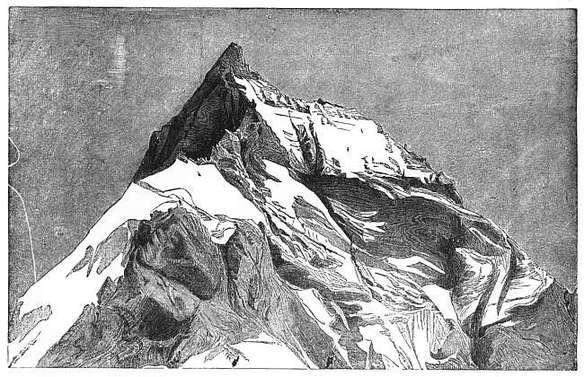
J. Ruskin.
J. C. Armytage.
39. The Cervin, from the North-West.
§ 16. And our surprise will still be increased as we farther examine the materials of which the whole mountain is composed. In many places its crystalline slates, where their horizontal surfaces are exposed along the projecting beds of their foundations, break into ruin so total that the foot dashes through their loose red flakes as through heaps of autumn leaves; and yet, just where their structure seems most delicate, just where they seem to have been swept before the eddies of the streams that first accumulated them, in the most passive whirls, there the after ages have knit them into the most massive strength, and there have hewn out of them those firm grey bastions of the Cervin,—overhanging, smooth, flawless, unconquerable! For, unlike the Chamouni aiguilles, there is no aspect of destruction about the Matterhorn cliffs. They are not torn remnants of separating spires, yielding flake by flake, and band by band, to the continual process of decay. They are, on the contrary, an unaltered monument, seemingly sculptured long ago, the huge walls retaining yet the forms into which they were first engraven, and standing like an Egyptian temple,—delicate-fronted, softly colored, the suns of uncounted ages rising and falling upon it continually, but still casting the same line of shadows from east to west, still, century after century, touching the same purple stains on the lotus pillars; while the desert sand ebbs and flows about their feet, as those autumn leaves of rock lie heaped and weak about the base of the Cervin.
§ 17. Is not this a strange type, in the very heart and height of these mysterious Alps—these wrinkled hills in their snowy, cold, grey-haired old age, at first so silent, then, as we keep quiet at their feet, muttering and whispering to us garrulously, in broken and dreaming fits, as it were, about their childhood—is it not a strange type of the things which "out of weakness are made strong?" If one of those little flakes of mica-sand, hurried in tremulous spangling along the bottom of the ancient river, too light to sink, too faint to float, almost too small for sight, could have had a mind given to it as it was at last borne down with its kindred dust into the abysses of the stream, and laid, (would it not have thought?) for a hopeless eternity, in the dark ooze, the most despised, forgotten, and feeble of all earth's atoms; incapable of any use or change; not fit, down there in the diluvial darkness, so much as to help an earth-wasp to build its nest, or feed the first fibre of a lichen;—what would it have thought, had it been told that one day, knitted into a strength as of imperishable iron, rustless by the air, infusible by the flame, out of the substance of it, with its fellows, the axe of God should hew that Alpine tower; that against it—poor, helpless, mica flake!—the wild north winds should rage in vain; beneath it—low-fallen mica flake!—the snowy hills should lie bowed like flocks of sheep, and the kingdoms of the earth fade away in unregarded blue; and around it—weak, wave-drifted mica flake!—the great war of the firmament should burst in thunder, and yet stir it not; and the fiery arrows and angry meteors of the night fall blunted back from it into the air; and all the stars in the clear heaven should light, one by one as they rose, new cressets upon the points of snow that fringed its abiding-place on the imperishable spire?
§ 18. I have thought it worth while, for the sake of these lessons, and the other interests connected with them, to lead the reader thus far into the examination of the principal precipices among the Alps, although, so far as our immediate purposes are concerned, the inquiry cannot be very fruitful or helpful to us. For rocks of this kind, being found only in the midst of the higher snow fields, are not only out of the general track of the landscape painter, but are for the most part quite beyond his power—even beyond Turner's. The waves of snow, when it becomes a principal element in mountain form, are at once so subtle in tone, and so complicated in curve and fold, that no skill will express them, so as to keep the whole luminous mass in anything like a true relation to the rock darkness. For the distant rocks of the upper peaks are themselves, when in light, paler than white paper, and their true size and relation to near objects cannot be exhibited unless they are painted in the palest tones. Yet, as compared with their snow, they are so dark that a daguerreotype taken for the proper number of seconds to draw the snow shadows rightly, will always represent the rocks as coal-black. In order, therefore, to paint a snowy mountain properly, we should need a light as much brighter than white paper as white paper is brighter than charcoal. So that although it is possible, with deep blue sky, and purple rocks, and blue shadows, to obtain a very interesting resemblance of snow effect, and a true one up to a certain point (as in the best examples of the body-color drawings sold so extensively in Switzerland) it is not possible to obtain any of those refinements of form and gradation which a great artist's eye requires. Turner felt that, among these highest hills, no serious or perfect work could be done; and although in one or two of his vignettes (already referred to in the first volume) he showed his knowledge of them, his practice, in larger works, was always to treat the snowy mountains merely as a far-away white cloud, concentrating the interest of his picture on nearer and more tractable objects.
§ 19. One circumstance, however, bearing upon art, we may note before leaving these upper precipices, namely, the way in which they illustrate the favorite expression of Homer and Dante—cut rocks. However little satisfied we had reason to be with the degree of affection shown towards mountain scenery by either poet, we may now perceive, with some respect and surprise, that they had got at one character which was in the essence of the noblest rocks, just as the early illuminators got at the principles which lie at the heart of vegetation. As distinguished from all other natural forms,—from fibres which are torn, crystals which are broken, stones which are rounded or worn, animal and vegetable forms which are grown or moulded,—the true hard rock or precipice is notably a thing cut, its inner grain or structure seeming to have less to do with its form than is seen in any other object or substance whatsoever; and the aspect of subjection to some external sculpturing instrument being distinct in almost exact proportion to the size and stability of the mass.
§ 20. It is not so, however, with the next groups of mountain which we have to examine—those formed by the softer slaty coherents, when their perishable and frail substance has been raised into cliffs in the manner illustrated by Fig. 12 at p. 146,—cliffs whose front every frost disorganizes into filmy shale, and of which every thunder-shower dissolves tons in the swoln blackness of torrents. If this takes place from the top downwards, the cliff is gradually effaced, and a more or less rounded eminence is soon all that remains of it; but if the lower beds only decompose, or if the whole structure is strengthened here and there by courses of harder rock, the precipice is undermined, and remains hanging in perilous ledges and projections until, the process having reached the limit of its strength, vast portions of it fall at once, leaving new fronts of equal ruggedness, to be ruined and cast down in their turn.
The whole district of the northern inferior Alps, from the mountains of the Réposoir to the Gemmi, is full of precipices of this kind; the well known crests of the Mont Doron, and of the Aiguille de Varens, above Sallenches, being connected by the great cliffs of the valley of Sixt, the dark mass of the Buet, the Dent du Midi de Bex, and the Diablerets, with the great amphitheatre of rock in whose securest recess the path of the Gemmi hides its winding. But the most frightful and most characteristic cliff in the whole group is the range of the Rochers des Fys, above the Col d'Anterne. It happens to have a bed of harder limestone at the top than in any other part of its mass; and this bed, protecting its summit, enables it to form itself into the most ghastly ranges of pinnacle which I know among mountains. In one spot the upper edge of limestone has formed a complete cornice, or rather bracket—for it is not extended enough to constitute a cornice, which projects far into the air over the wall of ashy rock, and is seen against the clouds, when they pass into the chasm beyond, like the nodding coping-stone of a castle—only the wall below is not less than 2500 feet in height,—not vertical, but steep enough to seem so to the imagination.
§ 21. Such precipices are among the most impressive as well as the most really dangerous of mountain ranges; in many spots inaccessible with safety either from below or from above; dark in color, robed with everlasting mourning, for ever tottering like a great fortress shaken by war, fearful as much in their weakness as in their strength, and yet gathered after every fall into darker frowns and unhumiliated threatening; for ever incapable of comfort or of healing from herb or flower, nourishing no root in their crevices, touched by no hue of life on buttress or ledge, but, to the utmost, desolate; knowing no shaking of leaves in the wind, nor of grass beside the stream,—no motion but their own mortal shivering, the deathful crumbling of atom from atom in their corrupting stones; knowing no sound of living voice or living tread, cheered neither by the kid's bleat nor the marmot's cry; haunted only by uninterrupted echoes from far off, wandering hither and thither among their walls, unable to escape, and by the hiss of angry torrents, and sometimes the shriek of a bird that flits near the face of them, and sweeps frightened back from under their shadow into the gulf of air: and, sometimes, when the echo has fainted, and the wind has carried the sound of the torrent away, and the bird has vanished; and the mouldering stones are still for a little time,—a brown moth, opening and shutting its wings upon a grain of dust, may be the only thing that moves, or feels, in all the waste of weary precipice, darkening five thousand feet of the blue depth of heaven.
§ 22. It will not be thought that there is nothing in a scene such as this deserving our contemplation, or capable of conveying useful lessons, if it were fitly rendered by art. I cannot myself conceive any picture more impressive than a faithful rendering of such a cliff would be, supposing the aim of the artist to be the utmost tone of sad sublime. I am, nevertheless, aware of no instance in which the slightest attempt has been made to express their character; the reason being, partly, the extreme difficulty of the task, partly the want of temptation in specious color or form. For the majesty of this kind of cliff depends entirely on its size: a low range of such rock is as uninteresting as it is ugly; and it is only by making the spectator understand the enormous scale of their desolation, and the space which the shadow of their danger oppresses, that any impression can be made upon his mind. And this scale cannot be expressed by any artifice; the mountain cannot be made to look large by painting it blue or faint, otherwise it loses all its ghastliness. It must be painted in its own near and solemn colors, black and ashen grey; and its size must be expressed by thorough drawing of its innumerable details—pure quantity,—with certain points of comparison explanatory of the whole. This is no light task; and, attempted by any man of ordinary genius, would need steady and careful painting for three or four months; while, to such a man, there would appear to be nothing worth his toil in the gloom of the subject, unrelieved as it is even by variety of form; for the soft rock of which these cliffs are composed rarely breaks into bold masses; and the gloom of their effect partly depends on its not doing so.
§ 23. Yet, while painters thus reject the natural, and large sublime, which is ready to their hand, how strangely do they seek after a false and small sublime. It is not that they reprobate gloom, but they will only have a gloom of their own making; just as half the world will not see the terrible and sad truths which the universe is full of, but surrounds itself with little clouds of sulky and unnecessary fog for its own special breathing. A portrait is not thought grand unless it has a thundercloud behind it (as if a hero could not be brave in sunshine); a ruin is not melancholy enough till it is seen by moonlight or twilight; and every condition of theatrical pensiveness or of the theatrical terrific is exhausted in setting forth scenes or persons which in themselves are, perhaps, very quiet scenes and homely persons; while that which, without any accessories at all, is everlastingly melancholy and terrific, we refuse to paint,—nay, we refuse even to observe it in its reality, while we seek for the excitement of the very feelings it was meant to address, in every conceivable form of our false ideal.
For instance: there have been few pictures more praised for their sublimity than the "Deluge" of Nicolas Poussin; of which, nevertheless, the sublimity, such as it is, consists wholly in the painting of everything grey or brown,—not the grey and brown of great painters, full of mysterious and unconfessed colors, dim blue, and shadowy purple, and veiled gold,—but the stony grey and dismal brown of the conventionalist. Madame de Genlis, whose general criticisms on painting are full of good sense—singularly so, considering the age in which she lived85—has the following passage on this picture:—
"'I remember to have seen the painting you mention; but I own I found nothing in it very beautiful.'
"'You have seen it rain often enough?'
"'Certainly.'
"'Have you ever at such times observed the color of the clouds attentively?—how the dusky atmosphere obscures all objects, makes them, if distant, disappear, or be seen with difficulty? Had you paid a proper attention to these effects of rain, you would have been amazed by the exactitude with which they are painted by Poussin.'"86
§ 24. Madame de Genlis is just in her appeal to nature, but had not herself looked carefully enough to make her appeal accurate. She had noticed one of the principal effects of rain, but not the other. It is true that the dusky atmosphere "obscures all objects," but it is also true that Nature, never intending the eye of man to be without delight, has provided a rich compensation for this shading of the tints with darkness, in their brightening by moisture. Every color, wet, is twice as brilliant as it is when dry; and when distances are obscured by mist, and bright colors vanish from the sky, and gleams of sunshine from the earth, the foreground assumes all its loveliest hues, the grass and foliage revive into their perfect green, and every sunburnt rock glows into an agate. The colors of mountain foregrounds can never be seen in perfection unless they are wet; nor can moisture be entirely expressed except by fulness of color. So that Poussin, in search of a false sublimity, painting every object in his picture, vegetation and all, of one dull grey and brown, has actually rendered it impossible for an educated eye to conceive it as representing rain at all; it is a dry, volcanic darkness. It may be said that had he painted the effect of rain truly, the picture, composed of the objects he has introduced, would have become too pretty for his purpose. But his error, and the error of landscapists in general, is in seeking to express terror by false treatment, instead of going to Nature herself to ask her what she has appointed to be everlastingly terrible. The greatest genius would be shown by taking the scene in its plainest and most probable facts; not seeking to change pity into fear, by denying the beauty of the world that was passing away. But if it were determined to excite fear, and fear only, it ought to have been done by imagining the true ghastliness of the tottering cliffs of Ararat or Caucasus, as the heavy waves first smote against the promontories that until then had only known the thin fanning of the upper air of heaven;—not by painting leaves and grass slate-grey. And a new world of sublimity might be opened to us, if any painter of power and feeling would devote himself, for a few months, to these solemn cliffs of the dark limestone Alps, and would only paint one of them, as it truly stands, not in rain nor storm, but in its own eternal sadness: perhaps best on some fair summer evening, when its fearful veil of immeasurable rock is breathed upon by warm air, and touched with fading rays of purple; and all that it has of the melancholy of ruin, mingled with the might of endurance, and the foreboding of danger, rises in its grey gloom against the gentle sky; the soft wreaths of the evening clouds expiring along its ridges one by one, and leaving it, at last, with no light but that of its own cascades, standing like white pillars here and there along its sides, motionless and soundless in their distance.
§ 25. Here, however, we must leave these more formidable examples of the Alpine precipice, to examine those which, by Turner or by artists in general, have been regarded as properly within the sphere of their art.
Turner had in this respect some peculiar views induced by early association. It has already been noticed, in my pamphlet on Pre-Raphaelitism, that his first conceptions of mountain scenery seem to have been taken from Yorkshire; and its rounded hills, far winding rivers, and broken limestone scars, to have formed a type in his mind to which he sought, as far as might be, to obtain some correspondent imagery in all other landscape. Hence, he almost always preferred to have a precipice low down on the hillside, rather than near the top; liked an extent of rounded slope above, and the vertical cliff to the water or valley, better than the slope at the bottom and wall at the top (compare Fig. 13, p. 148); and had his attention early directed to those horizontal, or comparatively horizontal, beds of rock which usually form the faces of precipices in the Yorkshire dales; not, as in the Matterhorn, merely indicated by veined coloring on the surface of the smooth cliff, but projecting, or mouldering away, in definite successions of ledges, cornices, or steps.
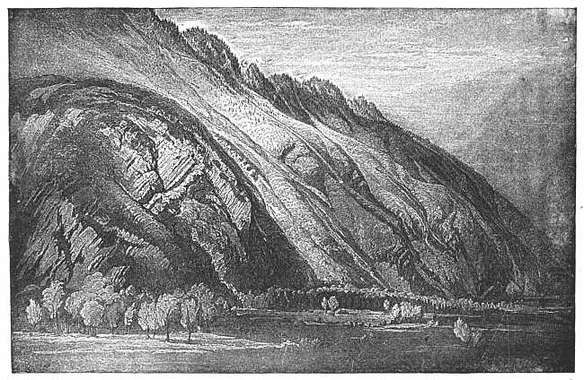
J. Ruskin.
J. H. Le Keux.
40. The Mountains of Villeneuve.
§ 26. This decided love of the slope, or bank above the wall, rather than below it, is one of Turner's most marked idiosyncrasies, and gives a character to his composition, as distinguished from that of other men, perhaps more marked than any which are traceable in other features of it (except, perhaps, in his pear-shaped ideal of trees, of which more hereafter). For when mountains are striking to the general eye, they almost always have the high crest or wall of cliff on the top of their slopes, rising from the plain first in mounds of meadow-land, and bosses of rock, and studded softness of forest; the brown cottages peeping through grove above grove, until just where the deep shade of the pines becomes blue or purple in the haze of height, a red wall of upper precipice rises from the pasture land, and frets the sky with glowing serration. Plate 40, opposite, represents a mass of mountain just above Villeneuve, at the head of the Lake of Geneva, in which the type of the structure is shown with singular clearness. Much of the scenery of western Switzerland, and characteristically the whole of that of Savoy, is composed of mountains of this kind; the isolated group between Chambery and Grenoble, which holds the Grande Chartreuse in the heart of it, is constructed entirely of such masses; and the Montagne de Vergi, which in like manner encloses the narrow meadows and traceried cloisters of the Convent of the Réposoir, forms the most striking feature among all the mountains that border the valley of the Arve between Cluse and Geneva; while ranges of cliffs presenting precisely the same typical characters frown above the bridge and fortress of Mont-Meillan, and enclose, in light blue calm, the waters of the Lake of Annecy.
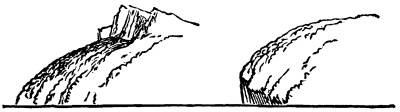
§ 27. Now, although in many of his drawings Turner acknowledges this structure, it seems always to be with some degree of reluctance; whereas he seizes with instant eagerness, and every appearance of contentment, on forms of mountain which are rounded into banks above, and cut into precipices below, as is the case in most elevated table-lands; in the chalk coteaux of the Seine, the basalt borders of the Rhine, and the lower gorges of the Alps; so that while the most striking pieces of natural mountain scenery usually rise from the plain under some such outline as that at a, Fig. 82, Turner always formed his composition, if possible, on such an arrangement as that at b.
One reason for this is clearly the greater simplicity of the line. The simpler a line is, so that it be cunningly varied within its simplicities, the grander it is; and Turner likes to enclose all his broken crags by such a line as that at b, just as we saw the classical composer, in our first plate, enclose the griffin's beak with breadth of wing. Nevertheless, I cannot but attribute his somewhat wilful and marked rejection of what sublimity there is in the other form, to the influence of early affections; and sincerely regret that the fascination exercised over him by memory should have led him to pass so much of his life in putting a sublimity not properly belonging to them into the coteaux of Clairmont and Meauves, and the vine terraces of Bingen and Oberwesel; leaving almost unrecorded the natural sublimity, which he could never have exaggerated, of the pine-fringed mountains of the Iscre, and the cloudy diadem of the Mont Vergi.
§ 28. In all cases of this kind, it is difficult to say how far harm and how far good have resulted from what unquestionably has in it something of both. It is to be regretted that Turner's studies should have been warped, by early affection, from the Alps to the Rhine; but the fact of his feeling this early affection, and being thus strongly influenced by it through his life, is indicative of that sensibility which was at the root of all his greatness. Other artists are led away by foreign sublimities and distant interests; delighting always in that which is most markedly strange, and quaintly contrary to the scenery of their homes. But Turner evidently felt that the claims upon his regard possessed by those places which first had opened to him the joy, and the labor, of his life, could never be superseded; no Alpine cloud could efface, no Italian sunbeam outshine, the memory of the pleasant dales and days of Rokeby and Bolton; and many a simple promontory, dim with southern olive,—many a low cliff that stooped unnoticed over some alien wave, was recorded by him with a love, and delicate care, that were the shadows of old thoughts and long-lost delights, whose charm yet hung like morning mist above the chanting waves of Wharfe and Greta.
§ 29. The first instance, therefore, of Turner's mountain drawing which I endeavored to give accurately, in this book, was from those shores of Wharfe which, I believe, he never could revisit without tears; nay, which for all the latter part of his life, he never could even speak of, but his voice faltered. We will now examine this instance with greater care.
It is first to be remembered that in every one of his English or French drawings, Turner's mind was, in two great instincts, at variance with itself. The affections of it clung, as we have just seen, to humble scenery, and gentle wildness of pastoral life. But the admiration of it was, more than any other artist's whatsoever, fastened on largeness of scale. With all his heart, he was attached to the narrow meadows and rounded knolls of England; by all his imagination he was urged to the reverence of endless vales and measureless hills; nor could any scene be too contracted for his love, or too vast for his ambition. Hence, when he returned to English scenery after his first studies in Savoy and Dauphiné, he was continually endeavoring to reconcile old fondnesses with new sublimities; and, as in Switzerland he chose rounded Alps for the love of Yorkshire, so in Yorkshire he exaggerated scale, in memory of Switzerland, and gave to Ingleborough, seen from Hornby Castle, in great part the expression of cloudy majesty and height which he had seen in the Alps from Grenoble. We must continually remember these two opposite instincts as we examine the Turnerian topography of his subject of Bolton Abbey.
§ 30. The Abbey is placed, as most lovers of our English scenery know well, on a little promontory of level park land, enclosed by one of the sweeps of the Wharfe. On the other side of the river, the flank of the dale rises in a pretty wooded brow, which the river, leaning against, has cut into two or three somewhat bold masses of rock, steep to the water's edge, but feathered above with copse of ash and oak. Above these rocks, the hills are rounded softly upwards to the moorland; the entire height of the brow towards the river being perhaps two hundred feet, and the rocky parts of it not above forty or fifty, so that the general impression upon the eye is that the hill is little more than twice the height of the ruins, or of the groups of noble ash trees which encircle them. One of these groups is conspicuous above the rest, growing on the very shore of the tongue of land which projects into the river, whose clear brown water, stealing first in mere threads between the separate pebbles of shingle, and eddying in soft golden lines towards its central currents, flows out of amber into ebony, and glides calm and deep below the rock on the opposite shore.
§ 31. Except in this stony bed of the stream, the scene possesses very little more aspect of mountain character than belongs to some of the park and meadow land under the chalk hills near Henley and Maidenhead; and if it were faithfully drawn in all points, and on its true scale, would hardly more affect the imagination of the spectator, unless he traced, with such care as is never from any spectator to be hoped, the evidence of nobler character in the pebbled shore and unconspicuous rock. But the scene in reality does affect the imagination strongly, and in a way wholly different from lowland hill scenery. A little farther up the valley the limestone summits rise, and that steeply, to a height of twelve hundred feet above the river, which foams between them in the narrow and dangerous channel of the Strid. Noble moorlands extend above, purple with heath, and broken into scars and glens, and around every soft tuft of wood, and gentle extent of meadow, throughout the dale, there floats a feeling of this mountain power, and an instinctive apprehension of the strength and greatness of the wild northern land.
§ 32. It is to the association of this power and border sternness with the sweet peace and tender decay of Bolton Priory, that the scene owes its distinctive charm. The feelings excited by both characters are definitely connected by the melancholy tradition of the circumstances to which the Abbey owes its origin; and yet farther darkened by the nearer memory of the death, in the same spot which betrayed the boy of Egremont, of another, as young, as thoughtless, and as beloved.
"The stately priory was reared,
And Wharfe, as he moved along, To matins joined a mournful voice,
Nor failed at evensong."
All this association of various awe, and noble mingling of mountain strength with religious fear, Turner had to suggest, or he would not have drawn Bolton Abbey. He goes down to the shingly shore; for the Abbey is but the child of the Wharfe;—it is the river, the great cause of the Abbey, which shall be his main subject; only the extremity of the ruin itself is seen between the stems of the ash tree; but the waves of the Wharfe are studied with a care which renders this drawing unique among Turner's works, for its expression of the eddies of a slow mountain stream, and of their pausing in treacherous depth beneath the hollowed rocks.
On the opposite shore is a singular jutting angle of the shales, forming the principal feature of the low cliffs at the water's edge. Turner fastens on it as the only available mass; draws it with notable care, and then magnifies it, by diminishing the trees on its top to one fifth of their real size, so that what would else have been little more than a stony bank becomes a true precipice, on a scale completely suggestive of the heights behind. The hill beyond is in like manner lifted into a more rounded, but still precipitous, eminence, reaching the utmost admissible elevation of ten or twelve hundred feet (measurable by the trees upon it). I have engraved this entire portion of the drawing of the real size, on the opposite page; the engraving of the whole drawing, published in the England Series, is also easily accessible.
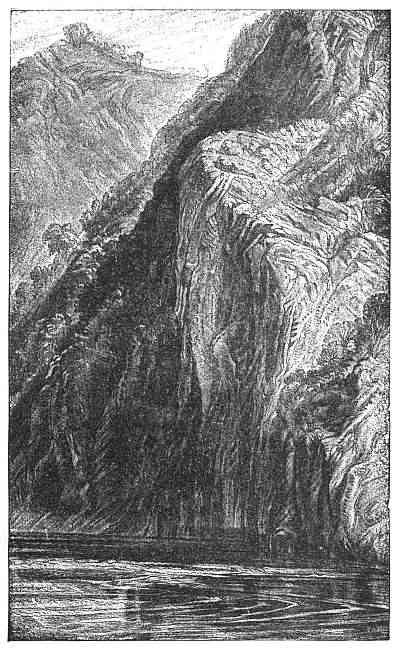
12. The Shores of Wharfe.
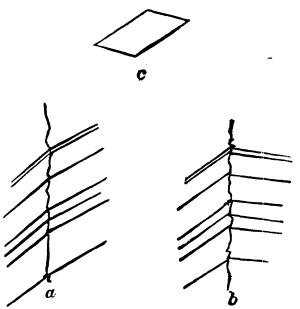
§ 33. Not knowing accurately to what group of the Yorkshire limestones the rocks opposite the Abbey belonged, or their relation to the sandstones at the Strid, I wrote to ask my kind friend Professor Phillips, who instantly sent me a little geological sketch of the position of these "Yoredale Shales," adding this interesting note: "The black shales opposite the Abbey are curiously tinted at the surface, and are contorted. Most artists give them the appearance of solid massive rocks; nor is this altogether wrong, especially when the natural joints of the shale appear prominent after particular accidents; they should, however, never be made to resemble [i.e. in solidity] limestone or gritstone."
Now the Yoredale shales are members of the group of rocks which I have called slaty coherents, and correspond very closely to those portions of the Alpine slates described in Chap. X. § 4; their main character is continual separation into fine flakes, more or less of Dante's "iron-colored grain;" which, however, on a large scale, form those somewhat solid-looking masses to which Mr. Phillips alludes in his letter, and which he describes, in his recently published Geology, in the following general terms: "The shales of this tract are usually dark, close, and fissile, and traversed by extremely long straight joints, dividing the rock into rhomboidal prisms" (i.e. prisms of the shape c, Fig. 83, in the section).
§ 34. Turner had, therefore, these four things to show:—1. Flaky division horizontally; 2. Division by rhomboidal joints; 3. Massy appearance occasionally, somewhat concealing the structure; 4. Local contortion of the beds. (See passage quoted of Mr. Phillips's letter).
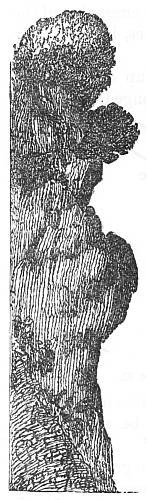
Examine, then, the plate just given (12 A). The cleavage of the shales runs diagonally up from left to right; note especially how delicately it runs up through the foreground rock, and is insisted upon, just at the brow of it, in the angular step-like fragments; compare also the etching in the first volume. Then note the upright pillars in the distance, marked especially as rhomboidal by being drawn with the cleavage still sloping up on the returning side, as at a, Fig. 83, not as at b, which would be their aspect if they were square; and then the indication of interruption in the structure at the brow of the main cliff, where, as well as on the nearer mass, exposure to the weather has rounded away the cleavages.
This projection, as before mentioned, does exist at the spot; and I believe is partly an indication of the contortion in the beds alluded to by Mr. Phillips; but no one but Turner would have fastened on it, as in anywise deserving special attention.
For the rest, no words are of any use to explain the subtle fidelity with which the minor roundings and cleavages have been expressed by him. Fidelity of this kind can only be estimated by workers: if the reader can himself draw a bit of natural precipice in Yoredale shale, and then copy a bit of the etching, he will find some measure of the difference between Turner's work and other people's, and not otherwise; although, without any such labor, he may at once perceive that there is a difference, and a wide one,—so wide, that I have literally nothing to compare the Turnerian work with in previous art. Here, however, Fig. 84, is a rock of Claude's (Liber Veritatis, No. 91, on the left hand), which is something of the shape of Turner's, and professes to be crested in like manner with copse-wood. The reader may "compare" as much as he likes, or can, of it.
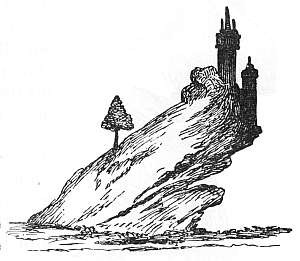
§ 35. In fact, as I said some time ago, the whole landscape of Claude was nothing but a more or less softened continuance of the old traditions of missal-painting, of which I gave examples in the previous volume. The general notion of rock which may be traced in the earliest work, as Figs. 1 and 2 in Plate 10 Vol. III. is of an upright mass cut out with an adze; as art advances, the painters begin to perceive horizontal stratification, and, as in all the four other examples of that plate, show something like true rendering of the fracture of rocks in vertical joints with superimposed projecting masses. They insist on this type, thinking it frowning or picturesque, and usually exhibit it to more advantage by putting a convent, hermitage, or castle on the projection of the crag. In the blue backgrounds of the missals the projection is often wildly extravagant; for instance, the MS. Additional, 11,696 Brit. Mus., has all its backgrounds composed of blue rocks with towers upon them, of which Fig. 85 is a characteristic example (magnified in scale about one-third; but, I think, rather diminished in extravagance of projection). It is infinitely better drawn than Claude's rocks ever are, in the expression of cleavage; but certainly somewhat too bold in standing. Then, in more elaborate work, we get conditions of precipice like Fig. 3 in Plate 10, which, indeed, is not ill-drawn in many respects; and the book from which it is taken shows other evidences of a love of nature sufficiently rare at the period, though joined quaintly with love of the grotesque: for instance, the writer, giving an account of the natural productions of Saxony, illustrates his chapter with a view of the salt mines; he represents the brine-spring, conducted by a wooden trough from the rock into an evaporating-house where it is received in a pan, under which he has painted scarlet flames of fire with singular skill; and the rock out of which the brine flows is in its general cleavages the best I ever saw drawn by mediæval art. But it is carefully wrought to the resemblance of a grotesque human head.
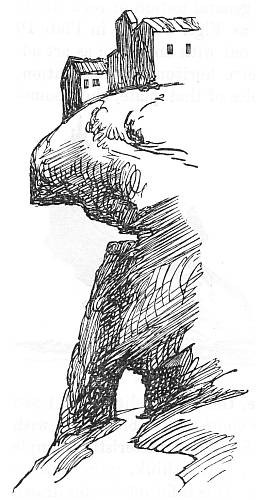
82 At an angle of 79° with the horizon. See the Table of angles, p. 181. The line a e in Fig. 33, is too steep, as well as in the plate here; but the other slopes are approximately accurate. I would have made them quite so, but did not like to alter the sketch made on the spot.
86 Veillées du Château, vol. ii.
83 Professor Forbes gives the bearing of the Cervin from the top of the Riffelhorn as 351°, or N. 9° W., supposing local attraction to have caused an error of 65° to the northward, which would make the true bearing N. 74° W. From the point just under the Riffelhorn summit, e, in Fig. 78, at which my drawing was made, I found the Cervin bear N. 79° W. without any allowance for attraction; the disturbing influence would seem therefore confined, or nearly so, to the summit a. I did not know at the time that there was any such influence traceable, and took no bearing from the summit. For the rest, I cannot vouch for bearings as I can for angles, as their accuracy was of no importance to my work, and I merely noted them with a common pocket compass and in the sailor's way (S. by W. and ½ W. & C.), which involves the probability of error of from two to three degrees on either side of the true bearing. The other drawing in Plate 38 was made from a point only a degree or two to the westward of the village of Zermatt. I have no note of the bearing; but it must be about S. 60° or 65° W.
38. The Cervin, from the East and North-east.
84 Independent travellers may perhaps be glad to know the way to the top of the Riffelhorn. I believe there is only one path; which ascends (from the ridge of the Riffel) on its eastern slope, until, near the summit, the low but perfectly smooth cliff, extending from side to side of the ridge, seems, as on the western slope, to bar all farther advance. This cliff may, however, by a good climber, be mastered even at the southern extremity; but it is dangerous there: at the opposite or northern side of it, just at its base, is a little cornice, about a foot broad, which does not look promising at first, but widens presently; and when once it is past, there is no more difficulty in reaching the summit.
81 The contour of the whole cliff, seen from near its foot as it rises above the shoulder of the Breven, is as at Fig. 76 opposite. The part measured is a d; but the precipice recedes to the summit b, on which a human figure is discernible to the naked eye merely as a point. The bank from which the cliff rises, c, recedes as it falls to the left; so that five hundred feet may perhaps be an under-estimate of the height below the summit. The straight sloping lines are cleavages, across the beds. Finally, Fig. 4, Plate 25, gives the look of the whole summit as seen from the village of Chamouni beneath it, at a distance of about two miles, and some four or five thousand feet above the spectator. It appears, then, like a not very formidable projection of crag overhanging the great slopes of the mountain's foundation.
85 I ought before to have mentioned Madame de Genlis as one of the few writers whose influence was always exerted to restore to truthful feelings, and persuade to simple enjoyments and pursuits, the persons accessible to reason in the frivolous world of her times.
80 Distinguished from a crest by being the face of a large contiguous bed of rock, not the end of a ridge.