


автордың кітабын онлайн тегін оқу Английский язык для юристов
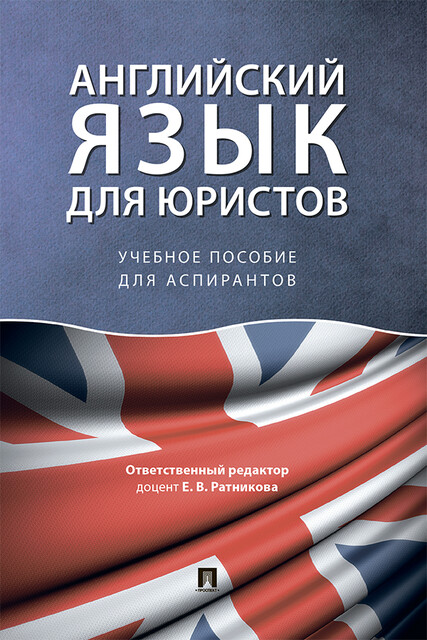
Английский язык для юристов
Учебное пособие для аспирантов
Ответственный редактор
доцент Е. В. Ратникова

Информация о книге
УДК 811.111(075.8)
ББК 81.2Англ-923
А64
Авторы:
Аганина Т. А. — главы II, IV;
Ильина Н. Ю. — главы IX, X;
Киселева Л. А. — главы III, VIII;
Ратникова Е. В. — главы V, VI;
Ченцова Н. Б. — главы I, VII;
Щербакова Т. Н. — глава XI.
Ответственный редактор доцент кафедры английского языка № 2 Е. В. Ратникова.
Учебное пособие предназначено для аспирантов юридических специальностей всех форм обучения по направлению подготовки 40.06.01 «Юриспруденция» (уровень подготовки кадров высшей квалификации) в рамках программы дисциплины «Иностранный язык», разработанной на основании ФГОС ВО.
Цель книги — совершенствование профессионально-ориентированной иноязычной компетенции аспирантов юридического профиля в сфере научно-исследовательской и педагогической деятельности.
УДК 811.111(075.8)
ББК 81.2Англ-923
© Коллектив авторов, 2019
© ООО «Проспект», 2019
Предисловие
Настоящее учебное пособие предназначено для аспирантов юридического профиля очной и заочной форм обучения, изучающих учебную дисциплину «Иностранный язык». Учебное пособие подготовлено профессорско-преподавательским коллективом кафедры английского языка № 2 Московского государственного юридического университета имени О. Е. Кутафина (МГЮА) в соответствии с рабочей программой дисциплины «Иностранный язык» и ФГОС ВО по направлению подготовки 40.06.01 «Юриспруденция» (уровень подготовки кадров высшей квалификации).
Цель данного учебного пособия — совершенствование навыков и умений письменного и устного общения аспирантов юридического профиля в сфере профессиональной, педагогической и научно-исследовательской деятельности. Для достижения этой цели необходимо формировать у аспирантов универсальные компетенции, которые выражаются в способности и готовности участвовать в работе российских и международных исследовательских коллективов по решению научных и научно-образовательных задач, а также в готовности использовать современные методы и технологии научной коммуникации на иностранном языке.
Для реализации указанной цели необходимо обеспечить решение следующих задач обучения: освоение аспирантами профессионально ориентированного языкового материала, направленного на совершенствование лингвистических, социолингвистических, культурологических, дискурсивных знаний, а также дальнейшее расширение словарного запаса за счет общегуманитарной, общенаучной, правовой и терминологической лексики; совершенствование полученных на предыдущих образовательных уровнях навыков просмотрового, ознакомительного, поискового и изучающего видов чтения для работы с оригинальной монографической и периодической литературой на иностранном языке по тематике узкой специальности аспирантов; формирование навыков монологической и диалогической речи, а также навыков аудирования, направленных на понимание информации и выражение различных коммуникативных намерений, характерных для научно-исследовательской и педагогической деятельности аспиранта; формирование высокоорганизованных навыков трансформации профессионально ориентированной научной информации на иностранном языке в различные виды документации посредством реферирования и аннотирования; совершенствование навыков письма на иностранном языке в целях эффективного ведения научной переписки профессионального характера, написания научных статей, изложения прочитанного в форме резюме, написания доклада на иностранном языке по тематике научного исследования аспиранта; формирование навыков перевода с иностранного языка на русский, направленных на достижение смысловой эквивалентности и лингвистической адекватности при получении информации научного и профессионального характера.
Данное учебное пособие нацелено на эффективное изучение дисциплины «Иностранный язык», которая рассматривается как обязательный компонент профессиональной подготовки аспиранта. Учебное пособие состоит из 11 тематических разделов, содержание которых охватывает основные аспекты деятельности юриста в сфере профессиональной коммуникации. Для обеспечения единства образовательного пространства тематика унифицирована для всех форм обучения аспирантов.
Каждый тематический раздел учебного пособия включает профессионально ориентированные аутентичные материалы на иностранном языке по специальности и направленности диссертационного исследования, которые, в зависимости от коммуникативной задачи, способствуют совершенствованию уверенных навыков в основных видах чтения, письма, говорения, аудирования и перевода с иностранного языка на русский, формируют умение вычленять опорные смысловые блоки в читаемом и определять в прочитанном тексте структурно-семантическое ядро. В каждом тематическом разделе содержатся лексико-грамматические комментарии и упражнения, способствующие дальнейшему совершенствованию навыков устной и письменной коммуникации. Представленные упражнения помогают овладеть основными переводческими приемами, трансформациями, приемами компрессии, генерализации и дескриптивной передачи смыслов.
Представленные в учебном пособии лексико-грамматические задания направлены на выполнение перевода на русский язык аутентичного текстового материала профессиональной направленности, на реферирование и аннотирование научной информации на иностранном языке по тематике диссертационного исследования, на составление двуязычного глоссария по тематике научного исследования, на подготовку устных сообщений в реферативном формате. Перечисленные задания учебного пособия способствуют выработке у аспирантов уверенных навыков для осуществления иноязычной речевой деятельности в научной профессионально ориентированной коммуникативной сфере общения с учетом отраслевой специализации юриспруденции.
Авторы учебного пособия руководствовались нормами орфографии и пунктуации, зафиксированными в современных лексикографических источниках британского и американского вариантов английского языка.
Авторы выражают благодарность старшему преподавателю кафедры английского языка № 2 О. А. Миненко за обеспечение технической подготовки учебного пособия к изданию.
UNIT 1. Constitutional Law
Forms of Government. Democracy
Democracy derives its superiority from two sources.
Firstly, a democratic regime is legitimate. In a real democracy, the form of the regime is, by definition, sought after by the people. It is logical that such a regime can rely on more internal support than a dictator.
Secondly, a democracy is more productive. In an authoritarian regime, the ideas of the majority of citizens have little opportunity to influence decision-making. In a democracy, there is a much broader base of ideas.
Moreover, the selection of ideas is more efficient in a democracy. Democracy is nothing more than the social processing of individual ideas. New ideas always originate with individuals, because only individuals can think. But the individual ideas have to be considered, weighed against each other and adapted to the conditions in society. People need each other to correct the imperfections in each other’s ideas. The heart of democracy is actually this process of the social shaping of perceptions, in which the idea or proposal of a single person, often already accepted by a smaller group (a political party, action group or pressure group), has its pros and cons weighed up by society as a whole. This perception-forming process leads to a choice. But the choice always has to be examined in historical context; today’s minority can be tomorrow’s majority. The actual decisions in relation to the stream of image forming are like the timpani beats within an entire symphony.
In the medium to long term, democratic decisions will be socially superior to dictatorial decisions. Morally dubious goals, which do not serve the communal interest, will by their very nature seek their way via concealed channels that are shielded from the light of open, democratic decision-making. Under democratic conditions, the best ideas will be filtered out, so to speak, because we are better at recognizing others’ weaknesses than our own. The process of selection that occurs along the path of democracy can feed into society that which is beneficial to it. This does not mean that the presence of democratic instruments necessarily guarantees the quality of the moral initiatives of individual members of society. We can only trust that such initiatives will emerge. But it does mean that morally worthy aspirations cannot materialize without democracy. Politics can never prescribe morality. But politics can create democratic instruments that allow the moral potential that is dormant in individuals to be freed and put to work for the benefit of society.
Evolving democracy
Democracy is never complete. The rise of democracy should be seen as an organic process. Democracy cannot stop developing and deepening, just as a person cannot stop breathing. A democratic system that remains static and unchanged will degenerate and become undemocratic. It is just such a process of ossification that causes society’s current malaise. We have to face up to the fact that democracy in our societies is in dire straights.
Our current, purely representative democracy is in fact the response to the aspirations of more than a century ago. This system was suited to that time, because the majority of people could find their political views and ideals reflected in a small number of clear-cut human and social beliefs, which were embodied in and represented by Christian, socialist or liberal groups, for example. That time is long past. People’s ideas and judgements have become more individualized.
The appropriate democratic form in this context is a parliamentary system complemented with the binding citizens’ initiative referendum (direct democracy), because such a system provides a direct link between individuals and the legislative and executive organs. The greater the degree to which citizens incline towards individual judgements, and political parties lose their monopoly as ideological rallying points, the higher will be the demand for tools of direct-democratic decision-making.
Indeed, a majority of people in Western countries want the referendum to be introduced. This fact alone should be decisive in also actually implementing it. Democracy literally means: ‘government by the people’ (Oxford English Dictionary). The first step towards authentic government by the people necessarily involves people, being able to determine themselves how this government by the people is designed and put into practice.
Nevertheless, we see that the majority of politicians argue against the referendum. It is striking that the higher the level of effective power they possess, the more vigorously do many politicians resist the referendum. In doing so, they actually adopt the same arguments that were previously used to oppose the workers’ and women’s right to vote. It can also be shown that these arguments have very little merit.
In fact, however, a glance at direct democracy in practice is sufficient to see that the objections are groundless. In Switzerland in particular, a very interesting — albeit by no means perfect — example of direct democracy has existed for more than a century. The Swiss can launch citizens’ legislative initiatives at all administrative levels. In certain instances, it is clear that the citizens are directly opposed to the preferences of the political and economic elite. In referendums on constitutional amendments and transferring sovereignty to international organisations, which are obligatory in Switzerland, the voters reject a quarter of the parliament’s proposals; when a citizens’ group collects signatures to force a referendum on ordinary laws, as many as half the legislative proposals are rejected. But the people have not used their democratic rights to turn Switzerland into an inhuman or authoritarian state! There is no death penalty in Switzerland and human rights are not threatened in that country. Moreover, Swiss citizens have no plans to surrender their superior democratic system. (The Swiss people’s dislike of the European Union is also associated with the Union’s undemocratic character.)
But direct democracy must not be idealized. It provides no solutions in itself. Direct democracy does however make available the essential mechanism for producing useful and useable solutions to modern problems. The introduction of direct democracy should not happen out of a mood of sudden euphoria, but in a spirit of ‘active and conscious readiness to wait’.
Moreover, one should not underestimate the invigorating impact that will immediately result from a radical choice for the restoration and deepening of democracy. The decision for more democracy is always also a decision for the right of the other to have a voice. It is a declaration of faith in the moral forces and capacities that are latent in one’s fellow citizens. In our societies, which are poisoned by mutual distrust, there is almost nothing else imaginable that can have such a healing effect. The commitment to more direct democracy is by definition a commitment to the other persons, to their freedom of speech, to their intrinsic dignity. People who are only interested in achieving their own goals have nothing to gain from democracy. They would do better to put all their energy into proclaiming and propagating their own individual point of view. Real democrats are interested in the individual points of view of others, because they know that people need each other to hone and sharpen their ideas and intuitions, to improve them and elaborate them. This social process of the forming, and shaping of opinions constitutes the real core of democratic life. The closer people are brought into contact with each other in a kind of federalism, the more easily and effectively can shared perceptions emerge. Direct democracy and federalism reinforce each other. Together they form a ‘strong democracy’ (Barber 1984) or ‘integrated democracy’.
Notes:
1. It is just such a process ... that causes … — именно такой процесс вызывает ...
2. The greater the degree ... the higher will be the demand — чем выше степень …, тем выше запрос на...
3. But it does mean … — но это точно означает …
Grammar points
Перевод эмфатических конструкций
Эмфатические конструкции выделяют тот или иной член предложения.
К ним относятся:
1. Усилительные слова или словосочетания:
as much (many) as …
The unemployment rate reached as much as 15 percent at the time.
Уровень безработицы в то время поднялся на целых 15%.
as such — как таковой
Democracy as such … — Демократия как таковая …
as early as
as early as in the end of WWII … — уже в конце Второй мировой войны …
alone
This fact alone … — Сам (по себе) этот факт …
very (перед существительным) — самый, тот самый
The very fact that … — Сам факт, что …
much
much later — гораздо (намного) позже
do
The problem does exist. Проблема все-таки существует.
2. It is … that (who) — усилительная конструкция
It is these characteristics that are important to us.
Для нас представляют важность именно эти характеристики.
3. Артикль (a, the)
It is just an option, not the option we should accept.
Это лишь один из вариантов, а вовсе не тот единственный, который нам следует принять.
The sooner you do it, the better.
Чем скорее вы сделаете это, тем лучше.
4. Обратный порядок слов после ряда наречий и союзов:
| hardly …. when no sooner … than |
едва … как … не успел … как … |
| not only … but … | не только … но и … |
| Only | только |
| never | никогда |
| neither nor |
и не; а также не |
| so | а также; и |
| Nowhere can this phenomenon be observed better than in this area of social life. | Нигде нельзя лучше наблюдать это явление, чем в этой сфере общественной жизни. |
5. Двойное отрицание
The first progress was not made until the end of the year.
Первые успехи были достигнуты лишь в конце года.
Exercise 1. Translate the sentences paying attention to emphatic words, word combinations and constructions.
1. Direct democracy does however make available the essential mechanism for producing useful and usable solutions to modern problems.
2. It’s the citizens who are directly opposed to the preferences of the political and economic elite.
3. Only in 1870, after the Civil War, were people of color granted the constitutional right to vote.
4. But it does mean that morally worthy aspirations cannot materialize without democracy.
5. The closer people are brought into contact with each other in a kind of federalism, the more easily and effectively can shared perceptions emerge.
6. In a democracy, there is a much broader base of ideas.
7. It’s striking that the higher the level of effective power they possess, the more vigorously do many politicians resist the referendum.
8. Congress does have its own institutional rules, but they apply only to its members and committees.
9. These people do employ executive orders and directives in the course of their management responsibilities, but rarely, if ever, do they write rules of the type considered in the book.
10. The greater the degree to which citizens incline towards individual judgments, and political parties lose their monopoly as ideological rallying points, the higher will be the demand for tools of direct-democratic decision-making.
11. It’s just such a process of ossification that causes society’s current malaise.
12. It was not until mid — 90ies that some progress was observed.
13. Nor should there be distortion in social policies of the local governments.
14. This option is not improbable in the present situation.
15. No sooner the committee started operating than the first positive results could be seen.
16. Never was greater a surplus of the U.S. budget than in 1999.
17. When a citizens’ group collects signatures to force a referendum on ordinary laws, as many as half legislative proposals are rejected.
18. Democracy as such can longer be recognized in the Netherlands.
19. Morally dubious goals, which do not serve the communal interest, will by their very nature seek their way via concealed channels that are shielded from the light of open, democratic decision-making.
20. This fact alone should be decisive in also actually implementing it.
Essential vocabulary
Псевдоинтернациональные слова — это слова,
1) которые имеют сходные написание и произношение, но совершенно другое значение по сравнению с английским языком, например:
| actual | действительный, фактический (а не актуальный) |
| accurate | точный (а не аккуратный) |
| data | данные (а не дата) |