


Mathematics of the market. Problem book
Қосымшада ыңғайлырақҚосымшаны жүктеуге арналған QRRuStore · Samsung Galaxy Store
Huawei AppGallery · Xiaomi GetApps

автордың кітабын онлайн тегін оқу  Mathematics of the market. Problem book

Alexander Berlin

Mathematics of the market

Problem book


Contents

  1. Mathematics of the market
  2. Acronyms
  3. Introduction
  4. Chapter 1. The initial concept
    1. 1.1. A mathematical model of the market
    2. 1.2. Relative consumption. The unit of measure of supply and demand
  5. Chapter 2. The market as a system with obvious losses. Basic concepts
    1. 2.1. A mathematical model of the market as a system with obvious losses
    2. 2.2. The first Erlang formula for the calculation of market indicators
  6. Chapter 3. Examples of application of the first formula of erlang for solving problems of the market
    1. 3.1. Define the initial data
    2. 3.1.1 Example 1. Determination of the intensity of consumption
    3. 3.1. 2. Example 2. Determination of the intensity of the incoming proposals
    4. 3.2. Example 3. The calculation the market of oil
    5. 3.3. Example 4. The influence of the size of the group of consumers to a change in the AMOUNT of the proposal
    6. 3.4. Example 5. Separation market of consumption in case of overload
    7. 3.5. Example 6. Calculation the volume of sales of women’s shoes
    8. 3.7.Example 7. The distribution of the number of groups of consumption in time (e.g., seasonal)
    9. 3.8. Example 8. Change the number of groups of consumption to save the value of losses
    10. 3.9. Example 9. Change of the number of groups’ consumption the result of competition
  7. Chapter 4. The market as a system with with waiting
    1. 4.1. The market model as the system with waiting
  8. Chapter 5. The application of the second formula Erlang for calculation of the indicators of the market
    1. 5.1. Example 1. The calculation of the basic characteristics in the systems with the waiting
    2. 5.2. Example 2. The calculation of the market of oil with the storage of unsold goods
  9. Chapter 6. Service of group consumers with full accessibility of the group with a limited number of batches of goods. (formula Engset)
    1. 6.1. Statement of the problem
  10. Chapter 7. Examples application formula Engset to meet the challenges of the market
    1. Problem 1
    2. Problem 2
    3. GLOSSARY
  11. References
  12. Annex — 1
  13. Annex — 2

Acronyms

Relative- relative consumption.

Areal real consumption.

Amax-maximum possible consumption.

serv (t1, 2) = serviced supply of batch n in the interval of

time (t1, t2)

Aincoming. (t1,t2)  incoming supply goods for a period of time (t1, t2)

Alost (t1, t2— losses of demand on market during

time interval (t1, t2)

a — specific weight relative consumption

a (Engset formula) — mathematical expectation and intensity of the

batches of goods from a single source

ci — average volume of one purchase (units) in one moment of time.

Cdelay- average queue length (average number of detained batch of goods)

Closs — losses requests;

Crequest- received requests.


E1,n (A) — value of loss for the consumer system, numerical table values for the first Erlang formula.

E2, n (A) — value of loss for the consumer system, numerical table values for the second Erlang formula.


request, — losses in the number of requests received for supply of goods,


goods — the losses in volume of the goods,

Pt. — the losses the time of realization

p (γ> 0) — probability that the waiting time is greater than zero


p (γ> t) — probability that the waiting time of incoming batch of goods anymore t.

Pqueue — probability of having a queue of at least one consignment, the probability of the queue n

p (R> r) — probability that a length of a queue is greater of given value r

tconsum-average duration of consumption for consumers

TGD. The time of greatest demand

α- parameter of the flow of batches of goods in a free state

β — duration of product consumption

γ‘- average waiting time for batch of goods incoming on the market.

γ ̅delay  average waiting time of batch of goods the queue.

λ s (t) -а parameter primitive flows

Introduction

This book supplements the theoretical principles already published in books [1.1].

It studies the issues that arise at various stages of functioning of the market and offers their solutions by using methods of the mass service theory. The application of the proposed mathematical methods enables rigorous calculations of the desired parameters.

At the initial stage of introduction of goods in the market arise questions.

1. The value of the demand for this product

2. Possible revenues.

3. The reliability of the repayment of the loan (in the case of receipt).

At the stage supply of batch of goods need consider the competition.

1. How affect, the behavior of market competitors (the increase of the supply of goods or their reduction).

2. The effect on the demand the appearance on the market of new competitors.

3. As the influence of external factors (disasters, weather, etc.).

4. The pricing policy. Interest rates, money supply.

5. Different properties of the market.

We are considering the properties of the market.


1 Number suppliers.


2. The uniformity of the delivered goods.


3. The dependence of demand on moment of time.


4. The discipline of service of goods — no accumulation of unsold goods or saving their in warehouses

5. Strategy of providers in case of overproduction

The solution of these questions we will consider in the following order.

1. First, we will analyze the proposed mathematical model, which will congestion, determination of the necessary number of buyers

2. We will define what is a product and enter the basic unit of measure that will allow us to analyze any goods.

3. Consider formulas that allow you to determine the characteristics of supply and demand for a given network.

4. Consider examples of solving problems for specific markets (for example, the calculation of the oil market, the prevention of market overload, determining the required number of buyers for a given percentage of losses).

Chapter 1. The initial concept

1.1. A mathematical model of the market
Definitions


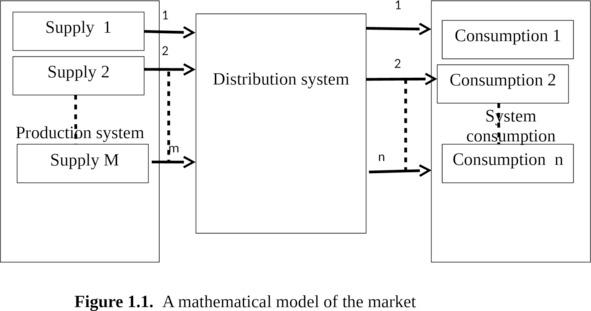
For the mathematical evaluation of processes in the economy it is necessary to create a model that would reflect them in mathematical form. In conjunction with the definition of units of measure of supply and demand — relative consumption, this model allows to obtain and to provide a quantitative calculation, analysis and assessment of possible market behavior. The proposed model is shown in Fig.1.1.

The market contains subsystems that perform the following tasks

Production system — generates random flows of goods (in general case different from each other). Under the goods refers to any product or service offered for sale, in which there is a need (in the following we will show how to define the demand in numerical form). These can be food items, for example, as milk and other food products, cars, homes, cleaning services house, stocks, a construction company offering services in construction of houses, etc.

Flows enter the distribution system.

The distribution system can the request handle immediately or with some delay. The refusal can be of two types:

— the refusal to accept the goods because of lack of demand;

— or installation on waiting of implementation (accumulation of goods)

There are two types of distribution systems.

First type performs the task as quickly as possible to sell the goods without any additional conditions. In queuing theory, such a system mass service is called “full accessibility system” because it provides equal access to the system of consumption, and this system can be not taking into account for calculation of behavior of the market.

Systems of the second type, distribute the goods, given the specified priorities and limitations for individual consumers or consumption. For example, the sale of tobacco, alcohol, weapons… systems of this type are called with not full access.

If the order is accepted, the distribution system is trying to give its to consumers to the consumer network

In our model we have included in the distribution system is an important point, which consists in the ability to influence the demand by setting prices (commonly given with the consideration the price of 

...