


автордың кітабын онлайн тегін оқу A Guide to the Study of Fishes, Volume 2 (of 2)
Transcriber's Note:
The cover image was created by the transcriber and is placed in the public domain.
GUIDE TO THE STUDY OF FISHES

VARIATIONS IN THE COLOR OF FISHES
The Oniokose or Demon Stinger, Inimicus japonicus (Cuv. and Val.), from Wakanoura, Japan. From nature by Kako Morita.
Surface coloration about lava rocks.
Coloration of specimens living among red algæ.
Coloration in deep water; Inimicus aurantiacus (Schlegel).
A GUIDE
TO
THE STUDY OF FISHES
BY
DAVID STARR JORDAN
President of Leland Stanford Junior University
With Colored Frontispieces and 507 Illustrations
IN TWO VOLUMES
Vol II.
"I am the wiser in respect to all knowledge
and the better qualified for all fortunes
for knowing that there is a minnow in that
brook."—Thoreau
NEW YORK
HENRY HOLT AND COMPANY
1905
Copyright, 1905
BY
HENRY HOLT AND COMPANY
Published March, 1905
CONTENTS
VOL. II.
CHAPTER I.
THE GANOIDS.
PAGE
Subclass Actinopteri.—The Series Ganoidei.—Are the Ganoids a Natural Group?—Systematic Position of Lepidosteus.—Gill on the Ganoids as a Natural Group.
1CHAPTER II.
THE GANOIDS (
Continued).
Classification of Ganoids.—Order Lysopteri.—The Palæoniscidæ.—The Platysomidæ.—The Dorypteridæ.—The Dictyopygidæ.—Order Chondrostei.—Order Selachostomi: the Paddle-fishes.—Order Pycnodonti.—Order Lepidostei.—Family Lepisosteidæ.—Embryology of the Garpike.—Fossil Garpikes.—Order Halecomorphi.—Pachycormidæ.—The Bowfins: Amiidæ.—The Oligopleuridæ.
13CHAPTER III.
ISOSPONDYLI.
The Subclass Teleostei, or Bony Fishes.—Order Isospondyli.—The Classification of the Bony Fishes.—Relationships of Isospondyli.—The Clupeoidea.—The Leptolepidæ.—The Elopidæ.—The Albulidæ.—The Chanidæ.—The Hiodontidæ.—The Pterothrissidæ.—The Ctenothrissidæ.—The Notopteridæ.—The Clupeidæ.—The Dorosomatidæ.—The Engraulididæ.—Gonorhynchidæ.—The Osteoglossidæ.—The Pantodontidæ.
37CHAPTER IV.
SALMONIDÆ.
The Salmon Family.—Coregonus, the Whitefish.—Argyrosomus, the Lake Herring.—Brachymystax and Stenodus, the Inconnus.—Oncorhynchus, the Quinnat Salmon.—The Parent-stream Theory.—The Jadgeska Hatchery.—Salmon-packing.
61CHAPTER V.
SALMONIDÆ (
Continued).
Salmo, the Trout and Atlantic Salmon.—The Atlantic Salmon.—The Ouananiche.—The Black-spotted Trout.—The Trout of Western America.—Cutthroat or Red-throated Trout.—Hucho, the Huchen.—Salvelinus, the Charr.—Cristivomer, the Great Lake Trout.—The Ayu, or Sweetfish.—Cormorant-fishing.—Fossil Salmonidæ.
89CHAPTER VI.
THE GRAYLING AND THE SMELT.
The Grayling, or Thymallidæ.—The Argentinidæ.—The Microstomidæ.—The Salangidæ, or Icefishes.—The Haplochitonidæ.—Stomiatidæ.—Suborder Iniomi, the Lantern-fishes.—Aulopidæ.—The Lizard-fishes.—Ipnopidæ.—Rondeletiidæ.—Myctophidæ.—Chirothricidæ.—Maurolicidæ.—The Lancet-fishes.—The Sternoptychidæ.—Order Lyopomi.
120CHAPTER VII.
THE APODES, OR EEL-LIKE FISHES.
The Eels.—Order Symbranchia.—Order Apodes, or True Eels.—Suborder Archencheli.—Suborder Enchelycephali.—Family Anguillidæ.—Reproduction of the Eel.—Food of the Eel.—Larva of the Eel.—Species of Eels.—Pug-nosed Eels.—Conger-eels.—The Snake-eels.—Suborder Colocephali, or Morays.—Family Moringuidæ.—Order Carencheli, the Long-necked Eels.—Order Lyomeri or Gulpers.—Order Heteromi.
139CHAPTER VIII.
SERIES OSTARIOPHYSI.
Ostariophysi.—The Heterognathi.—The Eventognathi.—The Cyprinidæ.—Species of Dace and Shiner.—Chubs of the Pacific Slope.—The Carp and Goldfish.—The Catostomidæ.—Fossil Cyprinidæ.—The Loaches.
159CHAPTER IX.
THE NEMATOGNATHI, OR CATFISHES.
The Nematognathi.—Families of Nematognathi.—The Siluridæ.—The Sea Catfish.—The Channel Cats.—Horned Pout.—The Mad-toms.—The Old World Catfishes.—The Sisoridæ.—The Plotosidæ.—The Chlariidæ.—The Hypophthalmidæ or Pygidiidæ.—The Loricariidæ.—The Callichthyidæ.—Fossil Catfishes.—Order Gymnonoti.
177CHAPTER X.
THE SCYPHOPHORI, HAPLOMI, AND XENOMI.
Order Scyphophori.—The Mormyridæ.—The Haplomi.—The Pikes.—The Mud minnows.—The Killifishes.—Amblyopsidæ.—Kneriidæ, etc.—The Galaxiidæ.—Order Xenomi.
188CHAPTER XI.
ACANTHOPTERYGII; SYNENTOGNATHI.
Order Acanthopterygii, the Spiny-rayed Fishes.—Suborder Synentognathi.—The Garfishes: Belonidæ.—The Flying-fishes: Exocœtidæ.
208CHAPTER XII.
PERCESOCES AND RHEGNOPTERI.
Suborder Percesoces.—The Silversides: Atherinidæ.—The Mullets: Mugilidæ.—The Barracudas: Sphyrænidæ.—Stephanoberycidæ.—Crossognathidæ.—Cobitopsidæ.—Suborder Rhegnopteri.
215CHAPTER XIII.
PHTHINOBRANCHII: HEMIBRANCHII, LOPHOBRANCHII, AND
HYPOSTOMIDES.
Suborder Hemibranchii.—The Sticklebacks: Gasterosteidæ.—The Aulorhynchidæ.—Cornet-fishes: Fistulariidæ.—The Trumpet-fishes: Aulostomidæ.—The Snipefishes: Macrorhamphosidæ.—The Shrimp-fishes: Centriscidæ.—The Lophobranchs.—The Solenostomidæ.—The Pipefishes: Syngnathidæ.—The Sea-horses: Hippocampus.—Suborder Hypostomides, the Sea-moths: Pegasidæ.
227CHAPTER XIV.
SALMOPERCÆ AND OTHER TRANSITIONAL GROUPS.
Suborder Salmopercæ, the Trout-perches: Percopsidæ.—Erismatopteridæ.—Suborder Selenichthyes, the Opahs: Lamprididæ.—Suborder Zeoidea.—Amphistiidæ.—The John Dories: Zeidæ.—Grammicolepidæ.
241CHAPTER XV.
BERYCOIDEI.
The Berycoid Fishes.—The Alfonsinos: Berycidæ.—The Soldier-fishes: Holocentridæ.—The Polymixiidæ.—The Pine-cone Fishes: Monocentridæ.
250CHAPTER XVI.
PERCOMORPHI.
Suborder Percomorphi, the Mackerels and Perches.—The Mackerel Tribe: Scombroidea.—The True Mackerels: Scombridæ.—The Escolars: Gempylidæ.—Scabbard and Cutlass-fishes: Lepidopidæ and Trichiuridæ.—The Palæorhynchidæ.—The Sailfishes: Istiophoridæ.—The Swordfishes: Xiphiidæ.
258CHAPTER XVII.
CAVALLAS AND PAMPANOS.
The Pampanos: Carangidæ.—The Papagallos: Nematistiidæ.—The Bluefishes: Cheilodipteridæ.—The Sergeant-fishes: Rachycentridæ.—The Butter-fishes: Stromateidæ.—The Rag-fishes: Icosteidæ.—The Pomfrets: Bramidæ.—The Dolphins: Coryphænidæ.—The Menidæ.—The Pempheridæ.—Luvaridæ.—The Square-tails: Tetragonuridæ.—The Crested Bandfishes: Lophotidæ.
272CHAPTER XVIII.
PERCOIDEA, OR PERCH-LIKE FISHES.
Percoid Fishes.—The Pirate-perches: Aphredoderidæ.—The Pigmy Sunfishes: Elassomidæ.—The Sunfishes: Centrarchidæ.—Crappies and Rock Bass.—The Black Bass.—The Saleles: Kuhliidæ.—The True Perches: Percidæ.—Relations of Darters to Perches.—The Perches.—The Darters: Etheostominæ.
293CHAPTER XIX.
THE BASS AND THEIR RELATIVES.
The Cardinal-fishes: Apogonidæ.—The Anomalopidæ.—The Asineopidæ—The Robalos: Oxylabracidæ.—The Sea-bass: Serranidæ.—The Jewfishes.—The Groupers.—The Serranos.—The Flashers: Lobotidæ.—The Big eyes: Priacanthidæ.—The Pentacerotidæ.—The Snappers: Lutianidæ.—The Grunts: Hæmulidæ.—The Porgies: Sparidæ.—The Picarels: Mænidæ.—The Mojarras: Gerridæ.—The Rudder-fishes: Kyphosidæ.
316CHAPTER XX.
THE SURMULLETS, THE CROAKERS AND THEIR RELATIVES.
The Surmullets, or Goatfishes: Mullidæ.—The Croakers: Sciænidæ.—The Sillaginidæ, etc.—The Jawfishes: Opisthognathidæ, etc.—The Stone-wall Perch: Oplegnathidæ.—The Swallowers: Chiasmodontidæ.—The Malacanthidæ.—The Blanquillos: Latilidæ.—The Bandfishes: Cepolidæ.—The Cirrhitidæ.—The Sandfishes: Trichodontidæ.
351CHAPTER XXI.
LABYRINTHICI AND HOLCONOTI.
The Labyrinthine Fishes.—The Climbing-perches: Anabantidæ.—The Gouramis: Osphromenidæ.—The Snake-head Mullets: Ophicephalidæ.—Suborder Holconoti, the Surf-fishes.—The Embiotocidæ.
365CHAPTER XXII.
CHROMIDES AND PHARYNGOGNATHI.
Suborder Chromides.—The Cichlidæ.—The Damsel-fishes: Pomacentridæ.—Suborder Pharyngognathi.—The Wrasse Fishes: Labridæ.—The Parrot-fishes: Scaridæ.
380CHAPTER XXIII.
THE SQUAMIPINNES.
The Squamipinnes.—The Scorpididæ.—The Boarfishes: Antigoniidæ.—The Arches: Toxotidæ.—The Ephippidæ.—The Spadefishes: Ilarchidæ.—The Platacidæ.—The Butterfly-fishes: Chætodontidæ.—The Pygæidæ.—The Moorish Idols: Zanclidæ.—The Tangs: Acanthuridæ.—Suborder Amphacanthi, the Siganidæ.
397CHAPTER XXIV.
SERIES PLECTOGNATHI.
The Plectognaths.—The Scleroderms.—The Trigger-fishes: Balistidæ.—The File-fishes: Monacanthidæ.—The Spinacanthidæ.—The Trunkfishes: Ostraciidæ.—The Gymnodontes.—The Triodontidæ.—The Globefishes: Tetraodontidæ.—The Porcupine-fishes: Diodontidæ.—The Head-fishes: Molidæ.
411CHAPTER XXV.
PAREIOPLITÆ, OR MAILED-CHEEK FISHES.
The Mailed-cheek Fishes.—The Scorpion-fishes: Scorpænidæ.—The Skilfishes: Anoplopomidæ.—The Greenlings: Hexagrammidæ.—The Flatheads or Kochi: Platycephalidæ.—The Sculpins: Cottidæ.—The Sea-poachers: Agonidæ.—The Lump-suckers: Cyclopteridæ.—The Sea-snails: Liparididæ.—The Baikal Cods: Comephoridæ.—Suborder Craniomi: the Gurnards, Triglidæ.—The Peristediidæ.—The Flying Gurnards: Cephalacanthidæ.
426CHAPTER XXVI.
GOBIOIDEI, DISCOCEPHALI, AND TÆNIOSOMI.
Suborder Gobioidei, the Gobies: Gobiidæ.—Suborder Discocephali, the Shark-suckers: Echeneididæ.—Suborder Tæniosomi, the Ribbon-fishes.—The Oarfishes: Regalecidæ.—The Dealfishes: Trachypteridæ.
459CHAPTER XXVII.
SUBORDER HETEROSOMATA.
The Flatfishes.—Optic Nerves of Flounders.—Ancestry of Flounders.—The Flounders: Pleuronectidæ.—The Turbot Tribe: Bothinæ.—The Halibut Tribe: Hippoglossinæ.—The Plaice Tribe: Pleuronectinæ.—The Soles: Soleidæ.—The Broad Soles: Achirinæ.—The European Soles (Soleinæ).—The Tongue-fishes: Cynoglossinæ.
481CHAPTER XXVIII.
SUBORDER JUGULARES.
The Jugular-fishes.—The Weevers: Trachinidæ.—The Nototheniidæ.—The Leptoscopidæ.—The Star-gazers: Uranoscopidæ.—The Dragonets: Callionymidæ.—The Dactyloscopidæ.
499CHAPTER XXIX.
THE BLENNIES: BLENNIIDÆ.
The Northern Blennies: Xiphidiinæ, Stichæiniæ, etc.—The Quillfishes: Ptilichthyidæ.—The Blochiidæ.—The Patæcidæ, etc.—The Gadopsidæ, etc.—The Wolf-fishes: Anarhichadidæ.—The Eel-pouts: Zoarcidæ.—The Cusk-eels: Ophidiidæ.—Sand-lances: Ammodytidæ.—The Pearlfishes: Fierasferidæ.—The Brotulidæ.—Ateleopodidæ.—Suborder Haplodoci.—Suborder Xenopterygii.
507CHAPTER XXX.
OPISTHOMI AND ANACANTHINI.
Order Opisthomi.—Order Anacanthini.—The Codfishes: Gadidæ.—The Hakes: Merluciidæ.—The Grenadiers: Macrouridæ.
532CHAPTER XXXI.
ORDER PEDICULATI: THE ANGLERS.
The Angler-fishes.—The Fishing-frogs: Lophiidæ.—The Sea-devils: Ceratiidæ.—The Frogfishes: Antennariidæ.—The Batfishes: Ogcocephalidæ.
542CHAPTER I
THE GANOIDS
CHAPTER II
THE GANOIDS—Continued
CHAPTER III
ISOSPONDYLI
CHAPTER IV
SALMONIDÆ
CHAPTER V
SALMONIDÆ—(Continued)
CHAPTER VI
THE GRAYLING AND THE SMELT
CHAPTER VII
THE APODES, OR EEL-LIKE FISHES
CHAPTER VIII
SERIES OSTARIOPHYSI
CHAPTER IX
THE NEMATOGNATHI, OR CATFISHES
CHAPTER X
THE SCYPHOPHORI, HAPLOMI, AND XENOMI
CHAPTER XI
ACANTHOPTERYGII; SYNENTOGNATHI
CHAPTER XII
PERCESOCES AND RHEGNOPTERI
CHAPTER XIII
PHTHINOBRANCHII: HEMIBRANCHII, LOPHOBRANCHII,
AND HYPOSTOMIDES
CHAPTER XIV
SALMOPERCÆ AND OTHER TRANSITIONAL
GROUPS
CHAPTER XV
BERYCOIDEI
CHAPTER XVI
PERCOMORPHI
CHAPTER XVII
CAVALLAS AND PAMPANOS
CHAPTER XVIII
PERCOIDEA, OR PERCH-LIKE FISHES
CHAPTER XIX
THE BASS AND THEIR RELATIVES
CHAPTER XX
THE SURMULLETS, THE CROAKERS AND THEIR
RELATIVES
CHAPTER XXI
LABYRINTHICI AND HOLCONOTI
CHAPTER XXII
CHROMIDES AND PHARYNGOGNATHI
CHAPTER XXIII
THE SQUAMIPINNES
CHAPTER XXIV
SERIES PLECTOGNATHI
CHAPTER XXV
PAREIOPLITÆ, OR MAILED-CHEEK FISHES
CHAPTER XXVI
GOBIOIDEI, DISCOCEPHALI, AND TÆNIOSOMI
CHAPTER XXVII
SUBORDER HETEROSOMATA
CHAPTER XXVIII
SUBORDER JUGULARES
CHAPTER XXIX
THE BLENNIES: BLENNIIDÆ
CHAPTER XXX
OPISTHOMI AND ANACANTHINI
CHAPTER XXXI
ORDER PEDICULATI: THE ANGLERS
LIST OF ILLUSTRATIONS
VOL. II.
PAGE
Shoulder-girdle of a Flounder,
Paralichthys californicus 2 Palæoniscum frieslebenense 14 Eurynotus crenatus 15 Dorypterus hoffmani 16 Chondrosteus acipenseroides 18 Acipenser sturio, Common Sturgeon
19 Acipenser rubicundus, Lake Sturgeon
20 Scaphirhynchus platyrhynchus, Shovel-nosed Sturgeon
20 Polyodon spathula, Paddle-fish, side-view
21 Polyodon spathula, Paddle-fish, view from below
21 Psephurus gladius 21 Gyrodus hexagonus 22 Mesturus verrucosus 23 Semionotus kapffi 24 Dapedium politum 25 Tetragonolepis semicinctus 26 Isopholis orthostomus 27 Lepisosteus osseus, Long-nosed Garpike
27 Caturus elongatus 28 Notagogus pentlandi 28 Ptycholepis curtus 28 Pholidophorus crenulatus 29 Lepisosteus tristœchus, Alligator-gar
31Lower Jaw of
Amia calva, showing the gular plate
33 Amia calva, Bowfin (female)
35 Megalurus elegantissimus 36 Leptolepis dubius 41 Elops saurus, Ten-pounder
42 Holcolepis lewesiensis 42 Tarpon atlanticus, Tarpon or Grand Écaille
43 Albula vulpes, Lady-fish
44 Chanos chanos, Milkfish
45 Hiodon tergisus, Mooneye
45 Istieus grandis 46 Chirothrix libanicus 46Skeleton of
Portheus molossus 47 Ctenothrissa vexillifera 48 Clupea harengus, Herring
49 Pomolobus pseudoharengus, Alewife
50 Brevoortia tyrannus, Menhaden
51 Diplomystus humilis 52 Dorosoma cepedianum, Hickory-shad
53 Anchovia perthecata, Silver Anchovy
54 Notogoneus osculus 55 Phareodus testis 57Deposits of Green River Shales, bearing
Phareodus, at Fossil, Wyoming
58A Day's Catch of fossil-fishes, Green River Eocene Shales
59 Alepocephalus agassizii 60 Coregonus williamsoni, Rocky Mountain Whitefish
63 Coregonus clupeiformis, Whitefish
64 Argyrosomus nigripinnis, Bluefin Cisco
66 Stenodus mackenziei, Inconnu
67 Oncorhynchus tschawytscha, Quinnat Salmon (female)
69 Oncorhynchus tschawytscha, King-salmon (grilse)
70 Oncorhynchus nerka, Male Red Salmon
70 Oncorhynchus gorbuscha, Humpback Salmon (female)
72 Oncorhynchus masou, Masu
72 Oncorhynchus nerka, Red Salmon (mutilated dwarf male after spawning)
76 Oncorhynchus tschawytscha, Quinnat Salmon (dying after spawning)
77 Oncorhynchus tschawytscha, Quinnat Salmon
79 Salmo irideus shasta, Rainbow Trout (male)
98 Salmo irideus shasta, Rainbow Trout (female)
99 Salmo rivularis, Steelhead Trout
101Head of Adult Trout-worm,
Dibothrium cordiceps. From intestine of white pelican
103Median segments of
Dibothrium cordiceps 103 Salmo henshawi, Tahoe Trout
104 Salmo stomias, Green-back Trout
105 Salmo macdonaldi, Yellow-fin Trout of Twin Lakes
105 Salmo clarkii spilurus, Rio Grande Trout
106 Salmo clarkii pleuriticus, Colorado River Trout
106 Hucho blackistoni, Ito
107 Salvelinus oquassa, Rangeley Trout
108 Salvelinus aureolus, Sunapee Trout
109 Salvelinus fontinalis, Speckled Trout (male)
110 Salvelinus fontinalis, Speckled Trout
111 Salvelinus malma, Malma Trout
113 Salvelinus malma, Dolly Varden Trout
114 Cristivomer namaycush, Great Lake Trout
114 Plecoglossus altivelis, Ayu, or Japanese Samlet
116 Thymallus signifer, Alaska Grayling
120 Thymallus tricolor, Michigan Grayling
122 Osmerus mordax, Smelt
123 Thaleichthys pretiosus, Eulachon or Ulchen
124Page of William Clark's Handwriting with Sketch of the Eulachon (
Thaleichthys pacificus)
125 Mallotus villosus, Capelin
126 Salanx hyalocranius, Icefish
128 Stomias ferox 128 Chauliodus sloanei 129 Synodus fætens, Lizard-fish
130 Ipnops murrayi 131 Cetomimus gillii 132 Diaphus lucidus, Headlight-fish
132 Myctophum opalinum, Lantern-fish
133 Ceratoscopelus madeirensis, Lantern-fish
133 Rhinellus furcatus 134 Plagyodus ferox, Lancet-fish
135 Eurypholis sulcidens 136 Eurypholis freyeri 137 Argyropelecus olfersi 137 Aldrovandia gracilis 138 Anguilla chrisypa, Common Eel
143 Anguilla chrisypa, Larva of Common Eel
148 Simenchelys parasiticus, Pug-nosed Eel
149 Synaphobranchus pinnatus 149 Leptocephalus conger, Conger-eel
150Larva of Conger-eel,
Leptocephalus conger 150 Xyrias revulsus 151 Myrichthys pantostigmius 151 Ophichthus ocellatus 151 Nemichthys avocetta, Thread-eel
152Jaws of
Nemichthys avocetta 152 Muræna retifera 153 Gymnothorax berndti 154 Gymnothorax jordani 155 Gymnothorax moringa, Moray
155 Derichthys serpentinus 156 Gastrostomus bairdi, Gulper-eel
156 Notacanthus phasganorus 158Inner view of shoulder-girdle of Buffalo-fish (
Ictiobus bubalus), showing the mesocoracoid
160Weberian apparatus and air-bladder of Carp
160 Brycon dentex 162Pharyngeal bones and teeth of European Chub,
Leuciscus cephalus 163 Rhinichthys dulcis, Black-nosed Dace
164 Notropis hudsonius, White Chub
165 Ericymba buccata, Silver-jaw Minnow
165 Notropis whipplei, Silverfin
166 Campostoma anomalum, Stone-roller
167Head of Day-chub,
Exoglossum maxillingua 167 Semotilus atromaculatus, Horned Dace
168 Abramis chrysoleucus, Shiner
168 Ptychocheilus grandis, Squawfish
169 Leuciscus lineatus, Chub of the Great Basin
169Lower Pharyngeal of
Placopharynx duquesnii 171 Erimyzon sucetta, Creekfish or Chub-sucker
172 Ictiobus cyprinella, Buffalo-fish
173 Carpiodes cyprinus, Carp-sucker
173 Catostomus commersoni, Common Sucker
174 Catostomus occidentalis, California Sucker
174Pharyngeal teeth of Oregon Sucker,
Catostomus macrocheilus 175 Xyrauchen cypho, Razor-back Sucker
175 Felichthys felis, Gaff-topsail Cat
179 Galeichthys milberti, Sea Catfish
179 Ictalurus punctatus, Channel Catfish
180 Ameiurus nebulosus, Horned Pout
181 Schilbeodes furiosus, Mad-tom. Showing the poisoned pectoral spine
182 Torpedo electricus, Electric Catfish
183 Chlarias breviceps, African Catfish
185 Loricaria aurea, Mailed Catfish from Venezuela
186 Gnathonemus curvirostris 189 Esox lucius, Pike
191 Esox masquinongy, Muskallunge
192 Umbra pygmæa, Mud-minnow
193 Anableps dovii, Four-eyed Fish
195 Cyprinodon variegatus, Round Minnow
196 Jordanella floridæ, Everglade Minnow
197 Fundulis majalis, Mayfish (male)
198 Fundulis majalis, Mayfish (female)
198 Zygonectes notatus, Top-minnow
198 Empetrichthys merriami, Death Valley Fish
199 Xiphophorus helleri, Sword-tail Minnow (male)
199 Goodea luitpoldi, a Viviparous Fish
200 Chologaster cornutus, Dismal Swamp Fish
201 Typhlichthys subterraneus, Blind Cave-fish
202 Amblyopsis spelæus, Blindfish of the Mammoth Cave
203 Dallia pectoralis, Alaska Blackfish
206 Tylosurus acus, Needle-fish
210 Scombresox saurus, Saury
212 Hyporhamphus unifasciatus, Halfbeak
212 Fodiator acutus, Sharp-nosed Flying-fish
213 Cypselurus californicus, Catalina Flying-fish
214 Chirostoma humboldtianum, Pescado blanco
217 Kirtlandia vagrans, Silverside or Brit
217 Atherinopsis californiensis, Blue Smelt or Pez del Rey
218 Iso flos-maris, Flower of the Waves
218 Mugil cephalus, Striped Mullet
221 Joturus pichardi, Joturo or Bobo
222 Sphyræna barracuda, Barracuda
223 Cobitopsis acuta 224Shoulder-girdle of a Threadfin,
Polydactylus approximans 225 Polydactylus octonemus, Threadfin
225Shoulder-girdle of a Stickleback,
Gasterosteus aculeatus 227Shoulder-girdle of
Fistularia petimba, showing greatly extended interclavicle, the surface ossified
227 Gasterosteus aculeatus, Three-spined Stickleback
232 Apeltes quadracus, Four-spined Stickleback
232 Aulostomus chinensis, Trumpet-fish
234 Macrorhamphosus sagifue, Japanese Snipefish
234 Æoliscus strigatus, Shrimp-fish
235 Æoliscus heinrichi 235 Solenostomus cyanopterus 237 Hippocampus hudsonius, Sea-horse
238 Zalises umitengu, Sea-moth
240 Percopsis guttatus, Sand-roller
241 Erismatopterus endlicheri 242 Columbia transmontana, Oregon Trout-perch
242Shoulder-girdle of the Opah,
Lampris guttatus(
Brünnich), showing the enlarged infraclavicle
243Ligatures
Semiophorus velifer 246 Amphistium paradoxum 247 Zeus faber, John Dory
248Skull of a Berycoidfish,
Beryx splendens, showing the orbitosphenoid
250 Beryx splendens 251 Hoplopteryx lewesiensis 252 Paratrachichthys prosthemius 253 Holocentrus ascenscionis, Soldier-fish
254 Holocentrus ittodai 254 Ostichthys japonicus 255 Monocentris japonicus, Pine-cone Fish
256 Scomber scombrus, Mackerel
260 Germo alalunga, Long-fin Albacore
263 Scomberomorus maculatus, Spanish Mackerel
264 Trichiurus lepturus, Cutlass-fish
268 Palæorhynchus glarisianus 268 Xiphias gladius, Young Swordfish
269 Xiphias gladius, Swordfish
270 Naucrates ductor, Pilot-fish
273 Seriola lalandi, Amber-fish
273 Trachurus trachurus, Saurel
274 Carangus chrysos, Yellow Mackerel
275 Trachinotus carolinus, the Pampano
277 Cheilodipterus saltatrix, Bluefish
279 Rachycentron canadum, Sergeant-fish
282 Peprilus paru, Harvest-fish
284 Gobiomorus gronovii, Portuguese Man-of-War Fish
285 Coryphæna hippurus, Dolphin or Dorado
287 Mene maculata 288 Gasteronemus rhombeus 289 Pempheris mulleri, Catalufa de lo Alto
289 Pempheris nyctereutes 290 Luvarus imperialis, Louvar
290 Aphredoderus sayanus, Pirate Perch
295 Elassoma evergladei, Everglade Pigmy Perch
295Skull of the Rock Bass,
Ambloplites rupestris 296 Pomoxis annularis, Crappie
297 Pomoxis annularis, Crappie (from life)
298 Ambloplites rupestris, Rock Bass
299 Mesogonistius chætodon, Banded Sunfish
299 Lepomis pallidus, Blue-gill
300 Lepomis megalotis, Long-eared Sunfish
300 Eupomotis gibbosus, Common Sunfish
301 Micropterus dolomieu, Small Mouth Black Bass
303 Micropterus salmoides, Large Mouth Black Bass
305 Perca flavescens, Yellow perch
308 Stizostedion canadense, Sauger
309 Aspro asper, Aspron
309 Zingel zingel, Zingel
310 Percina caprodes, Log-perch
311 Hadropterus aspro, Black-sided Darter
311 Diplesion blennioides, Green-sided Darter
312 Boleosoma olmstedi, Tessellated Darter
312 Crystallaria asprella, Crystal Darter
313 Ammocrypta clara, Sand-darter
313 Etheostoma jordani 314 Etheostoma camurum, Blue-breasted Darter
314 Apogon retrosella, Cardinal-fish
316 Telescopias gilberti, Kuromutsu
318 Apogon semilineatus 319 Oxylabrax undecimalis, Robalo
319 Morone americana, White Perch
322 Promicrops itaiara, Florida Jewfish
323 Epinephelus striatus, Nassau Grouper:
Cherna criolla 324 Epinephelus drummond-hayi, John Paw or Speckled Hind
325 Epinephelus morio, Red Grouper
325 Epinephelus adscensionis, Red Hind
326 Mycteroperca venenosa, Yellow-fin Grouper
327 Hypoplectrus unicolor nigricans 328 Epinephelus niveatus, Snowy Grouper
329 Rypticus bistrispinus, Soapfish
330 Lobotes surinamensis, Flasher
331 Priacanthus arenatus, Catalufa
331 Pseudopriacanthus altus, Bigeye
332 Lutianus griseus, Gray Snapper
334 Lutianus apodus, Schoolmaster
335 Hoplopagrus guntheri 336 Lutianus synagris, Lane Snapper or Biajaiba
336 Ocyurus chrysurus, Yellow-tail Snapper
337 Etelis oculatus, Cachucho
337 Xenocys jessiæ 338 Aphareus furcatus 339 Hæmulon plumieri, Grunt
340 Anisotremus virginicus, Porkfish
341 Pagrus major, Red Tai of Japan
342 Ebisu, the Fish-god of Japan, bearing a Red Tai
343 Stenotomus chrysops, Scup
344 Calamus bajonado, Jolt-head Porgy
345 Calamus proridens, Little-head Porgy
345 Diplodus holbrooki 346 Archosargus unimaculatus, Salema, Striped Sheepshead
347 Xystæma cinereum, Mojarra
348 Gerres olisthostomus, Irish Pampano
349 Kyphosus sectatrix, Chopa or Rudder-fish
349 Apomotis cyanellus, Blue-green Sunfish
350 Pseudupeneus maculatus, Red Goatfish or Salmonete
351 Mullus auratus, Golden Surmullet
352 Cynoscion nebulosus, Spotted Weakfish
353 Bairdiella chrysura, Mademoiselle
355 Sciænops ocellata, Red Drum
356 Umbrina sinaloæ, Yellow-fin Roncador
357 Menticirrhus americanus, Kingfish
357 Pogonias chromis, Drum
358 Gnathypops evermanni 359 Opisthognathus macrognathus, Jawfish
359 Opisthognathus nigromarginatus 360 Chiasmodon niger, Black Swallower
360 Cirrhitus rivulatus 364 Trichodon trichodon, Sandfish
364 Anabas scandens, Climbing Perch
366 Channa formosana 371 Ophicephalus barca, Snake-headed China-fish
371 Cymatogaster aggregatus, White Surf-fish
372 Hysterocarpus traski, Fresh-water Viviparous Perch
373 Hypsurus caryi 373 Damalichthys argyrosomus, White Surf-fish
374 Rhacochilus toxotes, Thick-lipped Surf-fish
374 Hypocritichthys analis, Silver Surf-fish, Viviparous
375 Hysterocarpus traski, Viviparous Perch (male)
379 Hypsypops rubicunda, Garibaldi
382 Pomacentrus leucostictus, Damsel-fish
382 Glyphisodon marginatus, Cockeye Pilot
383 Microspathodon dorsalis, Indigo Damsel-fish
384 Tautoga onitis, Tautog
384 Tautoga onitis, Tautog
386 Lachnolaimus falcatus, Capitaine or Hogfish
387 Xyrichthys psittacus, Razor-fish
388 Pimelometopon pulcher, Redfish (male)
389 Lepidaplois perditio 389Pharyngeals of Italian Parrot-fish,
Sparisoma cretense.
a, Upper;
b, Lower
391Jaws of Parrot-fish,
Calotomus xenodon 391 Cryptotomus beryllinus 391 Sparisoma hoplomystax 392 Sparisoma abildgaardi, Red Parrot-fish
392Jaws of Blue Parrot-fish,
Scarus cæruleus 393Upper pharyngeals of a Parrot-fish,
Scarus strongylocephalus 393Lower pharyngeals of a Parrot-fish,
Scarus strongylocephalus 393 Scarus emblematicus 394 Scarus cæruleus, Blue Parrot-fish
394 Scarus vetula, Parrot-fish
395 Halichæres bivittatus, Slippery Dick or Doncella, a fish of the coral-reefs
399 Monodactylus argenteus 397 Psettus sebæ 399 Chætodipterus faber, Spadefish
401 Chætodon capistratus, Butterfly-fish
402 Pomacanthus arcuatus, Black Angel-fish
403 Holacanthus ciliaris, Angel-fish or Isabelita
404 Holacanthus tricolor, Rock Beauty
405 Zanclus canescens, Moorish Idol
406 Teuthis cæruleus, Blue Tang
407 Teuthis bahianus, Brown Tang
408 Balistes carolinensis, Trigger-fish
412 Osbeckia lævis, File-fish
414Subclass Actinopteri.—In our glance over the taxonomy of the earlier Chordates, or fish-like vertebrates, we have detached from the main stem one after another a long series of archaic or primitive types. We have first set off those with rudimentary notochord, then those with retrogressive development who lose the notochord, then those without skull or brain, then those without limbs or lower jaw. The residue assume the fish-like form of body, but still show great differences among themselves. We have then detached those without membrane-bones, or trace of lung or air-bladder. We next part company with those having the air-bladder a veritable lung, and those with an ancient type of paired fins, a jointed axis fringed with rays, and those having the palate still forming the upper jaw. We have finally left only those having fish-jaws, fish-fins, and in general the structure of the modern fish. For all these in all their variety, as a class or subclass, the name Actinopteri, or Actinopterygii, suggested by Professor Cope, is now generally adopted. The shorter form, Actinopteri, being equally correct is certainly preferable. This term (ακτίς, ray; πτερόν or πτερύξ, fin) refers to the structure of the paired fins. In all these fishes the bones supporting the fin-rays are highly specialized and at the same time concealed by the general integument of the body. In general two bones connect the pectoral fin with the shoulder-girdle. The hypercoracoid is a flat square bone, usually perforated by a foramen. Lying below it and parallel with it is the irregularly formed hypocoracoid. Attached to them is a row of bones, the actinosts, or pterygials, short, often hour-glass-shaped, which actually support the fin-rays. In the more specialized forms, or Teleosts, the actinosts are few (four to six) in number, but in the more primitive types, or Ganoids, they may remain numerous, a reminiscence of the condition seen in the Crossopterygians, and especially in Polypterus. Other variations may occur; the two coracoids sometimes are imperfect or specially modified, the upper sometimes without a foramen, and the actinosts may be distorted in form or position.
The Palæoniscidæ.—The numerous genera of this order are referred to three families, the Palæoniscidæ, Platysomidæ, and Dictyopygidæ; a fourth family, Dorypteridæ, of uncertain relations, being also tentatively recognized. The family of Palæoniscidæ is the most primitive, ranging from the Devonian to the Lias, and some of them seem to have entered fresh waters in the time of the coal-measures. These fishes have the body elongate and provided with one short dorsal fin. The tail is heterocercal and the body covered with rhombic plates. Fulcra or rudimentary spine-like scales are developed on the upper edge of the caudal fin in most recent Ganoids, and often the back has a median row of undeveloped scales. A multitude of species and genera are recorded. A typical form is the genus Palæoniscum,[5] with many species represented in the rocks of various parts of the world. The longest known species is Palæoniscum frieslebenense from the Permian of Germany and England. Palæoniscum magnum, sixteen inches long, occurs in the Permian of Germany. From Canobius, the most primitive genus, to Coccolepis, the most modern, is a continuous series, the suspensorium of the lower jaw becoming more oblique, the basal bones of the dorsal fewer, the dorsal extending farther forward, and the scales more completely imbricate. Other prominent genera are Amblypterus, Eurylepis, Cheirolepis, Rhadinichthys, Pygopterus, Elonichthys, Ærolepis, Gyrolepis, Myriolepis, Oxygnathus, Centrolepis, and Holurus.
The Platysomidæ.—The Platysomidæ are different in form, the body being deep and compressed, often diamond-shaped, with very long dorsal and anal fins. In other respects they are very similar to the Palæoniscidæ, the osteology being the same. The Palæoniscidæ were rapacious fishes with sharp teeth, the Platysomidæ less active, and, from the blunter teeth, probably feeding on small animals, as crabs and snails.
The Dorypteridæ.—Dorypterus hoffmani, the type of the singular Palæozoic family of Dorypteridæ, with thoracic or sub-jugular many-rayed ventrals, is Stromateus-like to all appearance, with distinct resemblances to certain Scombroid forms, but with a heterocercal tail like a ganoid, imperfectly ossified back-bone, and other very archaic characters. The body is apparently scaleless, unlike the true Platysomidæ, in which the scales are highly developed. A second species, Dorypterus althausi, also from the German copper shales, has been described. This species has lower fins than Dorypterus hoffmani, but may be the adult of the same type. Dorypterus is regarded by Woodward as a specialized offshoot from the Platysomidæ. The many-rayed ventrals and the general form of the body and fins suggest affinity with the Lampridæ.
The family of Chondrosteidæ includes the Triassic precursors of the sturgeons. The general form is that of the sturgeon, but the body is scaleless except on the upper caudal lobe, and there are no plates on the median line of the skull. The opercle and subopercle are present, the jaws are toothless, and there are a few well-developed caudal rays. The caudal has large fulcra. The single well-known species of this group, Chondrosteus acipenseroides, is found in the Triassic rocks of England and reaches a length of about three feet. It much resembles a modern sturgeon, though differing in several technical respects. Chondrosteus pachyurus is based on the tail of a species of much larger size and Gyrosteus mirabilis, also of the English Triassic, is known from fragments of fishes which must have been 18 to 20 feet in length.
The sturgeons constitute the recent family of Acipenseridæ, characterized by the prolonged snout and toothless jaws and the presence of four barbels below the snout. In the Acipenseridæ there are no branchiostegals and a median series of plates is present on the head. The body is armed with five rows of large bony bucklers,—each often with a hooked spine, sharpest in the young. Besides these, rhombic plates are developed on the tail, besides large fulcra. The sturgeons are the youngest of the Ganoids, not occurring before the Lower Eocene, one species, Acipenser toliapicus occurring in the London clay. About thirty living species of sturgeon are known, referred to three genera: Acipenser, found throughout the Northern Hemisphere, Scaphirhynchus, in the Mississippi Valley, and Kessleria (later called Pseudoscaphirhynchus), in Central Asia alone. Most of the species belong to the genus Acipenser, which abounds in all the rivers and seas in which salmon are found. Some of the smaller species spend their lives in the rivers, ascending smaller streams to spawn. Other sturgeons are marine, ascending fresh waters only for a moderate distance in the spawning season. They range in length from 2½ to 30 feet.
The sturgeons are sluggish, clumsy, bottom-feeding fish. The mouth, underneath the long snout, is very protractile, sucker-like, and without teeth. Before it on the under side of the snout are four long feelers. Ordinarily the sturgeon feeds on mud and snails with other small creatures, but I have seen large numbers of Eulachon (Thaleichthys) in the stomach of the Columbia River sturgeon (Acipenser transmontanus). This fish and the Eulachon run in the Columbia at the same time, and the sucker-mouth of a large sturgeon will draw into it numbers of small fishes who may be unsuspiciously engaged in depositing their spawn. In the spawning season in June these clumsy fishes will often leap wholly out of the water in their play. The sturgeons have a rough skin besides five series of bony plates which change much with age and which in very old examples are sometimes lost or absorbed in the skin. The common sturgeon of the Atlantic on both shores is Acipenser sturio. Acipenser huso and numerous other species are found in Russia and Siberia. The great sturgeon of the Columbia is Acipenser transmontanus, and the great sturgeon of Japan Acipenser kikuchii. Smaller species are found farther south, as in the Mediterranean and along the Carolina coast. Other small species abound in rivers and lakes. Acipenser rubicundus is found throughout the Great Lake region and the Mississippi Valley, never entering the sea. It is four to six feet long, and at Sandusky, Ohio, in one season 14,000 sturgeons were taken in the pound nets. A similar species, Acipenser mikadoi, is abundant and valuable in the streams of northern Japan.
Order Selachostomi: the Paddle-fishes.—Another type of Ganoids, allied to the sturgeons, perhaps still further degenerate, is that of the paddle-fishes, called by Cope Selachostomi (σέλαχος, shark; στόμα, mouth). This group consists of a single family, Polyodontidæ, having apparently little in common with the other Ganoids, and in appearance still more suggestive of the sharks. The common name of paddle-fishes is derived from the long flat blade in which the snout terminates. This extends far beyond the mouth, is more or less sensitive, and is used to stir up the mud in which are found the minute organisms on which the fish feeds. Under the paddle are four very minute barbels corresponding to those of the sturgeons. The vernacular names of spoonbill, duckbill cat, and shovel-fish are also derived from the form of the snout. The skin is nearly smooth, the tail is heterocercal, the teeth are very small, and a long fleshy flap covers the gill-opening. The very long and slender gill-rakers serve to strain the food (worms, leeches, water-beetles, crustaceans, and algæ) from the muddy waters from which they are taken. The most important part of this diet consists of Entomostracans. The single American species, Polyodon spathula, abounds through the Mississippi Valley in all the larger streams. It reaches a length of three or four feet. It is often taken in the nets, but the coarse tough flesh, like that of our inferior catfish, is not much esteemed. In the great rivers of China, the Yangtse and the Hoang Ho, is a second species, Psephurus gladius, with narrower snout, fewer gill-rakers, and much coarser fulcra on the tail. The habits, so far as known, are much the same.
Crossopholis magnicaudatus of the Green River Eocene shales is a primitive member of the Polyodontidæ. Its rostral blade is shorter than that of Polyodon, and the body is covered with small thin scales, each in the form of a small grooved disk with several posterior denticulations, arranged in oblique series but not in contact. The scales are quadrate in form, and more widely separated anteriorly than posteriorly. As in Polyodon, the teeth are minute and there are no branchiostegals. The squamation of this fish shows that Polyodon as well as Acipenser may have sprung from a type having rhombic scales. The tail of a Cretaceous fish, Pholidurus disjectus from the Cretaceous of Europe, has been referred with doubt to this family of Polyodontidæ.
Woodward places these fishes with the Semionotidæ and Halecomorphi in his suborder of Protospondyli. It seems preferable, however, to consider them as forming a distinct order.
For the group here called Lepidostei numerous other names have been used corresponding wholly or in part. Rhomboganoidea of Gill covers nearly the same groups; Holostei of Müller and Hyoganoidea of Gill include the Halecomorphi also; Ginglymodi of Cope includes the garpikes only, while Ætheospondyli of Woodward includes the Aspidorhynchidæ and the garpikes.
Fig. 15.—Dapedium politum Leach, restored. Family Semionotidæ. (After Woodward.)
The Isopholidæ (Eugnathidæ) differ from the families last named in the large pike-like mouth with strong teeth. The mandibular suspensorium is inclined backwards. The body is elongate, the vertebræ forming incomplete rings; the dorsal fin is short with large fulcra.
Fig. 17.—Isopholis orthostomus (Agassiz). Lias. (After Woodward.)
Intermediate between the allies of the gars and the modern herrings is the large extinct family of Pholidophoridæ, referred by Woodward to the Isospondyli, and by Eastman to the Lepidostei. These are small fishes, fusiform in shape, chiefly of the Triassic and Jurassic. The fins are fringed with fulcra, the scales are ganoid and rhombic, and the vertebræ reduced to rings. The mouth is large, with small teeth, and formed as in the Isospondyli. The caudal is scarcely heterocercal.
Of Pholidophorus, with scales joined by peg-and-socket joints and uniform in size, there are many species. Pholidophorus latiusculus and many others are found in the Triassic of England and the Continent. Pholidophorus americanus occurs in the Jurassic of South Dakota. Pleuropholis, with the scales on the lateral line, which runs very low, excessively deepened, is also widely distributed. I have before me a new species from the Cretaceous rocks near Los Angeles. The Archæomænidæ differ from Pholidophoridæ in having cycloid scales. In both families the vertebræ are reduced to rings about the notochord. From fishes allied to the Pholidophoridæ the earliest Isospondyli are probably descended.
The short-nosed garpike, Lepisosteus platystomus, is generally common throughout the Mississippi Valley. It has a short broad snout like the alligator-gar, but seldom exceeds three feet in length. In size, color, and habits it agrees closely with the common gar, differing only in the form of the snout. The form is subject to much variation, and it is possible that two or more species have been confounded.
Another fossil species is Lepisosteus fimbriatus, from the Upper Eocene of England. Scales and other fragments of garpikes are found in Germany, Belgium, and France, in Eocene and Miocene rocks. On some of these the nominal genera Naisia, Trichiurides, and Pneumatosteus are founded. Clastes, regarded by Eastman as fully identical with Lepisosteus, is said to have the "mandibular ramus without or with a reduced fissure of the dental foramen, and without the groove continuous with it in Lepisosteus. One series of large teeth, with small ones external to them on the dentary bone." Most of the fossil forms belong to Clastes, but the genus shows no difference of importance which will distinguish it from the ordinary garpike.
The family of Amiidæ contains a single recent species, Amia calva, the only living member of the order Halecomorphi. The bowfin, or grindle, is a remarkable fish abounding in the lakes and swamps of the Mississippi Valley, the Great Lake region, and southward to Virginia, where it is known by the imposing but unexplained title of John A. Grindle. In the Great Lakes it is usually called "dogfish," because even the dogs will not eat it, and "lawyer," because, according to Dr. Kirtland, "it will bite at anything and is good for nothing when caught."
Woodward unites the extinct genera called Cyclurus, Notæus, Amiopsis, Protamia, Hypamia, and Pappichthys with Amia. Pappichthys (corsoni, etc.), from the Wyoming Eocene, is doubtless a valid genus, having but one row of teeth in each jaw, and Amiopsis is also recognized by Hay. Woodward refers to Amia the following extinct species: Amia valenciennesi, from the Miocene of France; Amia macrocephala, from the Miocene of Bohemia; and Amia ignota, from the Eocene of Paris. Other species of Amia are known from fragments. Several of these are from the Eocene of Wyoming and Colorado. Some of them have a much shorter dorsal fin than that of Amia calva and may be generically different.
Relationships of Isospondyli.—For our purposes we may divide the physostomous fishes as understood by Müller into several orders, the most primitive, the most generalized, and economically the most important being the order of Isospondyli. This order contains those bony fishes which have the anterior vertebræ unaltered (as distinguished from the Ostariophysi), the skull relatively complete, or at least not eel-like, the mesocoracoid typically developed, but atrophied in deep-sea forms and finally lost, the orbitosphenoid present. In all the species the ventral fins are abdominal and normally composed of more than six rays; the air-duct is developed. The scales are chiefly cycloid and the fins are without true spines. In many ways the order is more primitive than Nematognathi, Plectospondyli, or Apodes. It is certain that it began earlier in geological time than any of these. On the other hand, the Isospondyli are closely connected through the Berycoidei with the highly specialized fishes. The continuity of the natural series is therefore interrupted by the interposition of the side branches of Ostariophysans and eels before considering the Haplomi and the other transitional forms. The forms called Iniomi, which lack the mesocoracoid and the orbitosphenoid, have been lately transferred to the Haplomi by Boulenger. This arrangement is probably a step in advance.
The Leptolepidæ.—Most primitive of the Isospondyli is the extinct family of Leptolepidæ, closely allied to the Ganoid families of Pholidophoridæ and Oligopleuridæ. It is composed of graceful, herring-like fishes, with the bones of the head thin but covered with enamel, and the scales thin but firm and enameled on their free portion. There are no fulcra and there is no lateral line. The vertebræ are well developed, but always pierced by the notochord. The genera are Lycoptera, Leptolepis, Æthalion, and Thrissops. In Lycoptera of the Jurassic of China the vertebral centra are feebly developed, and the dorsal fin short and posterior. In Leptolepis the anal is short and placed behind the dorsal. There are many species, mostly from the Triassic and lithographic shales of Europe, one being found in the Cretaceous. Leptolepis coryphænoides and Leptolepis dubius are among the more common species. Æthalion (knorri) differs in the form of the jaws. In Thrissops the anal fin is long and opposite the dorsal. Thrissops salmonea is found in the lithographic stone; Thrissops exigua in the Cretaceous. In all these early forms there is a hard casque over the brain-cavity, as in the living types, Amia and Osteoglossum.
The Elopidæ.—The family of Elopidæ contains large fishes herring-like in form and structure, but having a flat membrane-bone or gular plate between the branches of the lower jaw, as in the Ganoid genus Amia. The living species are few, abounding in the tropical seas, important for their size and numbers, though not valued as food-fishes save to those who, like the Hawaiians and Japanese, eat fishes raw. These people prefer for that purpose the white-meated or soft-fleshed forms like Elops or Scarus to those which yield a better flavor when cooked.
In all these the large parietals meet along the median line of the skull. In the closely related family of Spaniodontidæ the parietals are small and do not meet. All the species of this group, united by Woodward with the Elopidæ, are extinct. These fishes preceded the Elopidæ in the Cretaceous period. Leading genera are Thrissopater and Spaniodon, the latter armed with large teeth. Spaniodon blondeli is from the Cretaceous of Mount Lebanon. Many other species are found in the European and American Cretaceous rocks, but are known from imperfect specimens only.
The Chanidæ.—The Chanidæ, or milkfishes, constitute another small archaic type, found in the tropical Pacific. They are large, brilliantly silvery, toothless fishes, looking like enormous dace, swift in the water, and very abundant in the Gulf of California, Polynesia, and India. The single living species is the Awa, or milkfish, Chanos chanos, largely used as food in Hawaii. Species of Prochanos and Chanos occur in the Cretaceous, Eocene, and Miocene. Allied to Chanos is the Cretaceous genus Ancylostylos (gibbus), probably the type of a distinct family, toothless and with many-rayed dorsal.
The Hiodontidæ.—The Hiodontidæ, or mooneyes, inhabit the rivers of the central portion of the United States and Canada. They are shad-like fishes with brilliantly silvery scales and very strong sharp teeth, those on the tongue especially long. They are very handsome fishes and take the hook with spirit, but the flesh is rather tasteless and full of small bones, much like that of the milkfish. The commonest species is Hiodon tergisus. No fossil Hiodontidæ are known.
Fig. 36.—Gigantic skeleton of Portheus molossus Cope. (Photograph by Charles H. Sternberg.)
The Ctenothrissidæ.—A related family, Ctenothrissidæ, is represented solely by extinct Cretaceous species. In this group the body is robust with large scales, ctenoid in Ctenothrissa, cycloid in Aulolepis. The fins are large, the belly not serrated, and the teeth feeble. Ctenothrissa vexillifera is from Mount Lebanon. Other species occur in the European chalk. In the small family of Phractolæmidæ the interopercle, according to Boulenger, is enormously developed.
The Notopteridæ.—The Notopteridæ is another small family in the rivers of Africa and the East Indies. The body ends in a long and tapering fin, and, as usual in fishes which swim by body undulations, the ventral fins are lost. The belly is doubly serrate. The air-bladder is highly complex in structure, being divided into several compartments and terminating in two horns anteriorly and posteriorly, the anterior horns being in direct communication with the auditory organ. A fossil Notopterus, N. primævus, is found in the same region.
The genus Clupea, of northern distribution, has the vertebræ in increased number (56), and there are weak teeth on the vomer. Several other genera are very closely related, but ranging farther south they have, with other characters, fewer (46 to 50) vertebræ. The alewife, or branch-herring (Pomolobus pseudoharengus), ascends the rivers to spawn and has become landlocked in the lakes of New York. The skipjack of the Gulf of Mexico, Pomolobus chrysochloris, becomes very fat in the sea. The species becomes landlocked in the Ohio River, where it thrives as to numbers, but remains lean and almost useless as food. The glut-herring, Pomolobus æstivalis, and the sprat, Pomolobus sprattus, of Europe are related forms.
The genus Sardinella includes species of rich flesh and feeble skeleton, excellent when broiled, when they may be eaten bones and all. This condition favors their preservation in oil as "sardines." All the species are alike excellent for this purpose. The sardine of Europe is the Sardinella pilchardus, known in England as the pilchard. The "Sardina de España" of Cuba is Sardinella pseudohispanica, the sardine of California, Sardinella cærulea. Sardinella sagax abounds in Chile, and Sardinella melanosticta is the valued sardine of Japan.
Numerous other herring-like forms, usually with compressed bodies, dry and bony flesh, and serrated bellies, abound in the tropics and are largely salted and dried by the Chinese. Among these are Ilisha elongata of the Chinese coast. Related forms occur in Mexico and Brazil.
Fossil herring are plentiful and exist in considerable variety, even among the Clupeidæ as at present restricted. Histiothrissa of the Cretaceous seems to be allied to Dussumieria and Stolephorus. Another genus, from the Cretaceous of Palestine, Pseudoberyx (syriacus, etc.), having pectinated scales, should perhaps constitute a distinct subfamily, but the general structure is like that of the herring. More evidently herring-like is Scombroclupea (macrophthalma). The genus Diplomystus, with enlarged scales along the back, is abundantly represented in the Eocene shales of Green River, Wyoming. Species of similar appearance, usually but wrongly referred to the same genus, occur on the coasts of Peru, Chile, and New South Wales. A specimen of Diplomystus humilis from Green River is here figured. Numerous herring, referred to Clupea, but belonging rather to Pomolobus, or other non-Arctic genera, have been described from the Eocene and later rocks.
The Dorosomatidæ.—The gizzard-shad, Dorosomatidæ, are closely related to the Clupeidæ, differing in the small contracted toothless mouth and reduced maxillary. The species are deep-bodied, shad-like fishes of the rivers and estuaries of eastern America and eastern Asia. They feed on mud, and the stomach is thickened and muscular like that of a fowl. As the stomach has the size and form of a hickory-nut, the common American species is often called hickory-shad. The gizzard-shad are all very poor food-fish, bony and little valued, the flesh full of small bones. The belly is always serrated. In three of the four genera of Dorosomatidæ the last dorsal ray is much produced and whip-like. The long and slender gill-rakers serve as strainers for the mud in which these fishes find their vegetable and animal food. Dorosoma cepedianum, the common hickory-shad or gizzard-shad, is found in brackish river-mouths and ponds from Long Island to Texas, and throughout the Mississippi Valley in all the large rivers. Through the canals it has entered Lake Michigan. The Konoshiro, Clupanodon thrissa, is equally common in China and Japan.
Fig. 44.—Notogoneus osculus Cope. Green River Eocene. Family Gonorhynchidæ.
Other species are Phareodus acutus, known from the jaws; P. encaustus is known from a mass of thick scales with reticulate or mosaic-like surface, much as in Osteoglossum, and P. æquipennis from a small example, perhaps immature. Phareodus testis is frequently found well preserved in the shales at Fossil Station, to the northwestward of Green River. Whether all these species possess the peculiar structure of the scales, and whether all belong to one genus, is uncertain.
Fig. 46.—Deposits of Green River Shales, bearing Phareodus, at Fossil, Wyoming. (Photograph by Wilbur C. Knight.)
Fig. 47.—A day's catch of Fossil fishes, Phareodus, Diplomystus, etc. Green River Eocene Shales, Fossil, Wyoming. (Photograph by Prof. Wilbur C. Knight.)
The Pantodontidæ.—The bony casque of Osteoglossum is found again in the Pantodontidæ, consisting of one species, Pantodon buchholzi, a small fish of the brooks of West Africa. As in the Osteoglossidæ and in the Siluridæ, the subopercle is wanting in Pantodon.
Coregonus, the Whitefish.—The genus Coregonus, which includes the various species known in America as lake whitefish, is distinguishable in general by the small size of its mouth, the weakness of its teeth, and the large size of its scales. The teeth, especially, are either reduced to slight asperities, or else are altogether wanting. The species reach a length of one to three feet. With scarcely an exception they inhabit clear lakes, and rarely enter streams except to spawn. In far northern regions they often descend to the sea; but in the latitude of the United States this is never possible for them, as they are unable to endure warm or impure water. They seldom take the hook, and rarely feed on other fishes. Numerous local varieties characterize the lakes of Scandinavia, Scotland, and Arctic Asia and America. Largest and most desirable of all these as a food-fish is the common whitefish of the Great Lakes (Coregonus clupeiformis), with its allies or variants in the Mackenzie and Yukon.
Closely allied to Coregonus williamsoni is the pilot-fish, shad-waiter, roundfish, or Menomonee whitefish (Coregonus quadrilateralis). This species is found in the Great Lakes, the Adirondack region, the lakes of New Hampshire, and thence northwestward to the Yukon, abounding in cold deep waters, its range apparently nowhere coinciding with that of Coregonus williamsoni.
The lake herring, or cisco (Argyrosomus artedi), is, next to the whitefish, the most important of the American species. It is more elongate than the others, and has a comparatively large mouth, with projecting under-jaw. It is correspondingly more voracious, and often takes the hook. During the spawning season of the whitefish the lake herring feeds on the ova of the latter, thereby doing a great amount of mischief. As food this species is fair, but much inferior to the whitefish. Its geographical distribution is essentially the same, but to a greater degree it frequents shoal waters. In the small lakes around Lake Michigan, in Indiana and Wisconsin (Tippecanoe, Geneva, Oconomowoc, etc.), the cisco has long been established; and in these waters its habits have undergone some change, as has also its external appearance. It has been recorded as a distinct species, Argyrosomus sisco, and its excellence as a game-fish has been long appreciated by the angler. These lake ciscoes remain for most of the year in the depths of the lake, coming to the surface only in search of certain insects, and to shallow water only in the spawning season. This periodical disappearance of the cisco has led to much foolish discussion as to the probability of their returning by an underground passage to Lake Michigan during the periods of their absence. One author, confounding "cisco" with "siscowet," has assumed that this underground passage leads to Lake Superior, and that the cisco is identical with the fat lake trout which bears the latter name. The name "lake herring" alludes to the superficial resemblance which this species possesses to the marine herring, a fish of quite a different family.
Closely allied to the lake herring is the bluefin of Lake Michigan and of certain lakes in New York (Argyrosomus nigripinnis), a fine large species inhabiting deep waters, and recognizable by the blue-black color of its lower fins. In the lakes of central New York are found two other species, the so-called lake smelt (Argyrosomus osmeriformis) and the long-jaw (Argyrosomus prognathus). Argyrosomus lucidus is abundant in Great Bear Lake. In Alaska and Siberia are still other species of the cisco type (Argyrosomus laurettæ, A. pusillus, A. alascanus); and in Europe very similar species are the Scotch vendace (Argyrosomus vandesius) and the Scandinavian Lok-Sild (lake herring), as well as others less perfectly known.
There are five species of salmon (Oncorhynchus) in the waters of the North Pacific, all found on both sides, besides one other which is known only from the waters of Japan. These species may be called: (1) the quinnat, or king-salmon, (2) the blue-back salmon, or redfish, (3) the silver salmon, (4) the dog-salmon, (5) the humpback salmon, and (6) the masu; or (1) Oncorhynchus tschawytscha, (2) Oncorhynchus nerka, (3) Oncorhynchus milktschitsch, (4) Oncorhynchus keta, (5) Oncorhynchus gorbuscha, (6) Oncorhynchus masou. All these species save the last are now known to occur in the waters of Kamchatka, as well as in those of Alaska and Oregon. These species, in all their varied conditions, may usually be distinguished by the characters given below. Other differences of form, color, and appearance are absolutely valueless for distinction, unless specimens of the same age, sex, and condition are compared.
Fig. 54.—King-salmon grilse, Oncorhynchus tschawytscha (Walbaum). (Photograph by Cloudsley Rutter.)
The humpback salmon, or pink salmon (Oncorhynchus gorbuscha), is the smallest of the American species, weighing from 3 to 5 pounds. It has usually 15 anal rays, 12 branchiostegals, 28 (13 + 15) gill-rakers, and about 180 pyloric cœca. Its scales are much smaller than in any other salmon, there being 180 to 240 in the lateral line. In color it is bluish above, silvery below, the posterior and upper parts with many round black spots, the caudal fin always having a few large black spots oblong in form. The males in fall are dirty red, and are more extravagantly distorted than in any other of the Salmonidæ. The flesh is softer than in the other species; it is pale in color, and, while of fair flavor when fresh, is distinctly inferior when canned.
Those fish which enter the rivers in the spring continue their ascent till death or the spawning season overtakes them. Doubtless not one of them ever returns to the ocean, and a large proportion fail to spawn. They are known to ascend the Sacramento to its extreme head-waters, about four hundred miles. In the Columbia they ascend as far as the Bitter Root and Sawtooth mountains of Idaho, and their extreme limit is not known. This is a distance of nearly a thousand miles. In the Yukon a few ascend to Caribou Crossing and Lake Bennett, 2250 miles. At these great distances, when the fish have reached the spawning grounds, besides the usual changes of the breeding season their bodies are covered with bruises, on which patches of white fungus (Saprolegnia) develop. The fins become mutilated, their eyes are often injured or destroyed, parasitic worms gather in their gills, they become extremely emaciated, their flesh becomes white from the loss of oil; and as soon as the spawning act is accomplished, and sometimes before, all of them die. The ascent of the Cascades and the Dalles of the Columbia causes the injury or death of a great many salmon.
Fig. 59.—Young Male Quinnat Salmon, Oncorhynchus tschawytscha, dying after spawning. Sacramento River. (Photograph by Cloudsley Rutter.)
Fig. 60.—Quinnat Salmon, Oncorhynchus tschawytscha (Walbaum). Monterey Bay. (Photograph by C. Rutter.)
Fig. 61.—Rainbow Trout (male), Salmo irideus shasta Jordan. (Photograph by Cloudsley Rutter.)
Of the American species the rainbow trout of California (Salmo irideus) most nearly approaches the European Salmo fario. It has the scales comparatively large, although rather smaller than in Salmo fario, the usual number in a longitudinal series being about 135. The mouth is smaller than in other American trout; the maxillary, except in old males, rarely extending beyond the eye. The caudal fin is well forked, becoming in very old fishes more nearly truncate. The head is relatively large, about four times in the total length. The size of the head forms the best distinctive character. The color, as in all the other species, is bluish, the sides silvery in the males, with a red lateral band, and reddish and dusky blotches. The head, back, and upper fins are sprinkled with round black spots, which are very variable in number, those on the dorsal usually in about nine rows. In specimens taken in the sea this species, like most other trout in similar conditions, is bright silvery, and sometimes immaculate. This species is especially characteristic of the waters of California. It abounds in every clear brook, from the Mexican line northward to Mount Shasta, or beyond, the species passing in the Columbia region by degrees into the species or form known as Salmo masoni, the Oregon rainbow trout, a small rainbow trout common in the forest streams of Oregon, with smaller mouth and fewer spots on the dorsal. No true rainbow trout have been anywhere obtained to the eastward of the Cascade Range or of the Sierra Nevada, except as artificially planted in the Truckee River. The species varies much in size; specimens from northern California often reach a weight of six pounds, while in the streams above Tia Juana in Lower California the southernmost locality from which I have obtained trout, they seldom exceed a length of six inches. Although not usually an anadromous species, the rainbow trout frequently moves about in the rivers, and it often enters the sea, large sea-run specimens being often taken for steelheads. Several attempts have been made to introduce it in Eastern streams, but it appears to seek the sea when it is lost. It is apparently more hardy and less greedy than the American charr, or brook-trout (Salvelinus fontinalis). On the other hand, it is distinctly inferior to the latter in beauty and in gaminess.
The steelhead (Salmo rivularis) is a large trout, reaching twelve to twenty pounds in weight, found abundantly in river estuaries and sometimes in lakes from Lynn Canal to Santa Barbara. The spent fish abound in the rivers in spring at the time of the salmon-run. The species is rarely canned, but is valued for shipment in cold storage. Its bones are much more firm than those of the salmon—a trait unfavorable for canning purposes. The flesh when not spent after spawning is excellent. The steelhead does not die after spawning, as all the Pacific salmon do.
Those species or individuals dwelling in lakes of considerable size, where the water is of such temperature and depth as insures an ample food-supply, will reach a large size, while those in a restricted environment, where both the water and food are limited, will be small directly in proportion to these environing restrictions. The trout of the Klamath Lakes, for example, reach a weight of at least 17 pounds, while in Fish Lake in Idaho mature trout do not exceed 8 to 9¼ inches in total length or one-fourth pound in weight. In small creeks in the Sawtooth Mountains and elsewhere they reach maturity at a length of 5 or 6 inches, and are often spoken of as brook-trout and with the impression that they are a species different from the larger ones found in the lakes and larger streams. But as all sorts and gradations between these extreme forms may be found in the intervening and connecting waters, the differences are not even of sub-specific significance.
Dr. Evermann observes: "The various forms of cutthroat-trout vary greatly in game qualities; even the same subspecies in different waters, in different parts of its habitat, or at different seasons, will vary greatly in this regard. In general, however, it is perhaps a fair statement to say that the cutthroat-trout are regarded by anglers as being inferior in gaminess to the Eastern brook-trout. But while this is true, it must not by any means be inferred that it is without game qualities, for it is really a fish which possesses those qualities in a very high degree. Its vigor and voraciousness are determined largely, of course, by the character of the stream or lake in which it lives. The individuals which dwell in cold streams about cascades and seething rapids will show marvelous strength and will make a fight which is rarely equaled by its Eastern cousin; while in warmer and larger streams and lakes they may be very sluggish and show but little fight. Yet this is by no means always true. In the Klamath Lakes, where the trout grow very large and where they are often very logy, one is occasionally hooked which tries to the utmost the skill of the angler to prevent his tackle from being smashed and at the same time save the fish."
In the head-waters of the Platte and Arkansas rivers is the small green-back trout, green or brown, with red throat-patch and large black spots. This is Salmo clarkii stomias, and it is especially fine in St. Vrain's River and the streams of Estes Park. In Twin Lakes, a pair of glacial lakes tributary of the Arkansas near Leadville, is found Salmo clarkii macdonaldi, the yellow-finned trout, a large and very handsome species living in deep water, and with the fins golden yellow. This approaches the Colorado trout, Salmo clarkii pleuriticus, and it may be derived from the latter, although it occurs in the same waters as the very different green-back trout, or Salmo clarkii stomias.
Fig. 69.—Rio Grande Trout, Salmo clarkii spilurus Cope. Del Norte, Colo.
Hucho, the Huchen.—The genus Hucho has been framed for the Huchen or Rothfisch (Hucho hucho) of the Danube, a very large trout, differing from the genus Salmo in having no teeth on the shaft of the vomer, and from the Salvelini at least in form and coloration. The huchen is a long and slender, somewhat pike-like fish, with depressed snout and strong teeth. The color is silvery, sprinkled with small black dots. It reaches a size little inferior to that of the salmon, and it is said to be an excellent food-fish. In northern Japan is a similar species, Hucho blackistoni, locally known as Ito, a large and handsome trout with very slender body, reaching a length of 2½ feet. It is well worthy of introduction into American and European waters.
In color all the charrs differ from the salmon and trout. The body in all is covered with round spots which are paler than the ground color, and crimson or gray. The lower fins are usually edged with bright colors. The sexual differences are not great. The scales, in general, are smaller than in other Salmonidæ, and they are imbedded in the skin to such a degree as to escape the notice of casual observers and even of most anglers.
The only really well-authenticated species of charr in European waters is the red charr, sälbling, or ombre chevalier (Salvelinus alpinus). This species is found in cold, clear streams in Switzerland, Germany, and throughout Scandinavia and the British Islands. Compared with the American charr or brook-trout, it is a slenderer fish, with smaller mouth, longer fins, and smaller red spots, which are confined to the sides of the body. It is a "gregarious and deep-swimming fish, shy of taking the bait and feeding largely at night-time. It appears to require very pure and mostly deep water for its residence." It is less tenacious of life than the trout. It reaches a weight of from one to five pounds, probably rarely exceeding the latter in size. The various charr described from Siberia are far too little known to be enumerated here.
In Arctic regions another species, called Salvelinus naresi, is very close to Salvelinus oquassa and may be the same.
Fig. 75.—Brook Trout, Salvelinus fontinalis (Mitchill), natural size. (From life by Dr. R. W. Shufeldt.)
The trout are rapidly disappearing from our streams through the agency of the manufacturer and the summer boarder. In the words of an excellent angler, the late Myron W. Reed of Denver: "This is the last generation of trout-fishers. The children will not be able to find any. Already there are well-trodden paths by every stream in Maine, in New York, and in Michigan. I know of but one river in North America by the side of which you will find no paper collar or other evidence of civilization. It is the Nameless River. Not that trout will cease to be. They will be hatched by machinery and raised in ponds, and fattened on chopped liver, and grow flabby and lose their spots. The trout of the restaurant will not cease to be. He is no more like the trout of the wild river than the fat and songless reedbird is like the bobolink. Gross feeding and easy pond-life enervate and deprave him. The trout that the children will know only by legend is the gold-sprinkled, living arrow of the white water; able to zigzag up the cataract; able to loiter in the rapids; whose dainty meat is the glancing butterfly."
The "Dolly Varden" trout, or malma (Salvelinus malma), is very similar to the brook-trout, closely resembling it in size, form, color, and habits. It is found always to the westward of the Rocky Mountains, in the streams of northern California, Oregon, Washington, and British Columbia, Alaska, and Kamchatka, as far as the Kurile Islands. It abounds in the sea in the northward, and specimens of ten to twelve pounds weight are not uncommon in Puget Sound and especially in Alaska. The Dolly Varden trout is, in general, slenderer and less compressed than the Eastern brook-trout. The red spots are found on the back of the fish as well as on the sides, and the back and upper fins are without the blackish marblings and blotches seen in Salvelinus fontinalis. In value as food, in beauty, and in gaminess Salvelinus malma is very similar to its Eastern cousin.
The Ayu, or Sweetfish.—The ayu, or sweetfish, of Japan, Plecoglossus altivelis, resembles a small trout in form, habits, and scaling. Its teeth are, however, totally different, being arranged on serrated plates on the sides of the jaws, and the tongue marked with similar folds. The ayu abounds in all clear streams of Japan and Formosa. It runs up from the sea like a salmon. It reaches the length of about a foot. The flesh is very fine and delicate, scarcely surpassed by that of any other fish whatsoever. It should be introduced into clear short streams throughout the temperate zones.
CHAPTER VI
THE GRAYLING AND THE SMELT
The American grayling (Thymallus signifer) is widely distributed in British America and Alaska. In the Yukon it is very abundant, rising readily to the fly. In several streams in northern Michigan, Au Sable River, and Jordan River in the southern peninsula, and Otter Creek near Keweenaw in the northern peninsula, occurs a dwarfish variety or species with shorter and lower dorsal fins, known to anglers as the Michigan grayling (Thymallus tricolor). This form has a longer head, rather smaller scales, and the dorsal fin rather lower than in the northern form (signifer); but the constancy of these characters in specimens from intermediate localities is yet to be proved. Another very similar form, called Thymallus montanus, occurs in the Gallatin, Madison, and other rivers of Western Montana tributary to the Missouri. It is locally still abundant and one of the finest of game-fishes. It is probable that the grayling once had a wider range to the southward than now, and that so far as the waters of the United States are concerned it is tending toward extinction. This tendency is, of course, being accelerated in Michigan by lumbermen and anglers. The colonies of grayling in Michigan and Montana are probably remains of a post-glacial fauna.
Fig. 82.—Smelt, Osmerus mordux (Mitchill). Wood's Hole, Mass.
The best-known genus, Osmerus, includes the smelt, or spirling (éperlan), of Europe, and its relatives, all excellent food-fishes, although quickly spoiling in warm weather. Osmerus eperlanus is the European species; Osmerus mordax of our eastern coast is very much like it, as is also the rainbow-smelt, Osmerus dentex of Japan and Alaska. A larger smelt, Osmerus albatrossis, occurs on the coast of Alaska, and a small and feeble one, Osmerus thaleichthys, mixed with other small or delicate fishes, is the whitebait of the San Francisco restaurants. The whitebait of the London epicure is made up of the young of herrings and sprats of different species. The still more delicate whitebait of the Hong Kong hotels is the icefish, Salanx chinensis. Retropinna retropinna, so called from the backward insertion of its dorsal, is the excellent smelt of the rivers of New Zealand. All the other species belong to northern waters. Mesopus, the surf-smelt, has a smaller mouth than Osmerus and inhabits the North Pacific. The California species, Mesopus pretiosus, of Neah Bay has, according to James G. Swan, "the belly covered with a coating of yellow fat which imparts an oily appearance to the water where the fish has been cleansed or washed and makes them the very perfection of pan-fish." This species spawns in late summer along the surf-line. According to Mr. Swan the water seems to be filled with them. "They come in with the flood-tide, and when a wave breaks upon the beach they crowd up into the very foam, and as the surf recedes many will be seen flapping on the sand and shingle, but invariably returning with the undertow to deeper water." The Quilliute Indians of Washington believe that "the first surf-smelts that appear must not be sold or given away to be taken to another place, nor must they be cut transversely, but split open with a mussel-shell."
Fig. 84.—Page of William Clark's handwriting with sketch of the Eulachon (Thaleichthys pacificus), the first notice of the species. Columbia River, 1805. (Expedition of Lewis & Clark.) (Reproduced from the original in the possession of his granddaughter Mrs. Julia Clark Voorhis, through the courtesy of Messrs. Dodd, Mead & Company, publishers of the "Original Journals of the Lewis and Clark Expedition.")
The capelin (Mallotus villosus) closely resembles the eulachon, differing mainly in its broader pectorals and in the peculiar scales of the males. In the male fish a band of scales above the lateral line and along each side of the belly become elongate, closely imbricated, with the free points projecting, giving the body a villous appearance. It is very abundant on the coasts of Arctic America, both in the Atlantic and the Pacific, and is an important source of food for the natives of those regions.
The Salangidæ, or Icefishes.—Still more feeble and insignificant are the species of Salangidæ, icefishes, or Chinese whitebait, which may be described as Salmonidæ reduced to the lowest terms. The body is long and slender, perfectly translucent, almost naked, and with the skeleton scarcely ossified. The fins are like those of the salmon, the head is depressed, the jaws long and broad, somewhat like the bill of a duck, and within there are a few disproportionately strong canine teeth, those of the lower jaw somewhat piercing the upper. The alimentary canal is straight for its whole length, without pyloric cæca. These little fishes, two to five inches long, live in the sea in enormous numbers and ascend the rivers of eastern Asia for the purpose of spawning. It is thought by some that they are annual fishes, all dying in the fall after reproduction, the species living through the winter only within its eggs. But this is only suspected, not proved, and the species will repay the careful study which some of the excellent naturalists of Japan are sure before long to give to it. The species of Salanx are known as whitebait, in Japan as Shiro-uwo, which means exactly the same thing. They are also sometimes called icefish (Hingio), which, being used for no other fish, may be adopted as a group name for Salanx.
The Malacosteidæ is a related group with extremely distensible mouth, the species capable of swallowing fishes much larger than themselves.
Suborder Iniomi, the Lantern-fishes.—The suborder Iniomi (ἰνίον, nape; ὤμος, shoulder) comprises soft-rayed fishes, in which the shoulder-girdle has more or less lost its completeness of structure as part of the degradation consequent on life in the abysses of the sea. These features distinguish these forms from the true Isospondyli, but only in a very few of the species have these characters been verified by actual examination of the skeleton. The mesocoracoid arch is wanting or atrophied in all of the species examined, and the orbitosphenoid is lacking, so far as known. The group thus agrees in most technical characters with the Haplomi, in which group they are placed by Dr. Boulenger. On the other hand the relationships to the Isospondyli are very close, and the Iniomi have many traits suggesting degenerate Isospondyli. The post-temporal has lost its usual hold on the skull and may touch the occiput on the sides of the cranium. Nearly all the species are soft in body, black or silvery over black in color, and all that live in the deep sea are provided with luminous spots or glands giving light in the abysmal depths. These spots are wanting in the few shore species, as also in those which approach most nearly to the Salmonidæ, these being presumably the most primitive of the group. In these also the post-temporal touches the back of the cranium near the side. In the majority of the Iniomi the adipose fin of the Salmonidæ is retained. From the phosphorescent spots is derived the general name of lantern-fishes applied of late years to many of the species. Most of these are of recent discovery, results of the remarkable work in deep-sea dredging begun by the Albatross and the Challenger. All of the species are carnivorous, and some, in spite of their feeble muscles, are exceedingly voracious, the mouth being armed with veritable daggers and spears.
The Lizard-fishes.—The Synodontidæ, or lizard-fishes, have lizard-like heads with very large mouth. The head is scaly, a character rare among the soft-rayed fishes. The slender maxillary is grown fast to the premaxillary, and the color is not black. Most of the species are shore-fishes and some are brightly colored. Synodus fætens is the common lizard-fish, or galliwasp, of our Atlantic coast. Synodus varius of the Pacific is brightly colored, olive-green and orange-red types of coloration existing at different depths. Most of the species lie close to the bottom and are mottled gray like coral sand. A few occur in oceanic depths. The "Bombay duck" of the fishermen of India is a species of Harpodon, H. nehereus, with large mouth and arrow-shaped teeth. The dried fish is used as a relish.
The existence of well-developed eyes among fishes destined to live in the dark abysses of the ocean seems at first contradictory, but we must remember that these singular forms are descendants of immigrants from the shore and from the surface. "In some cases the eyes have not been specially modified, but in others there have been modifications of a luminous mucous membrane leading on the one hand to phosphorescent organs more or less specialized, or on the other to such remarkable structures as the eyes of Ipnops, intermediate between true eyes and phosphorescent plates. In fishes which cannot see, and which retain for their guidance only the general sensibility of the integuments and the lateral line, these parts soon acquire a very great delicacy. The same is the case with tactile organs (as in Bathypterois and Benthosaurus), and experiments show that barbels may become organs of touch adapted to aquatic life, sensitive to the faintest movements or the slightest displacement, with power to give the blinded fishes full cognizance of the medium in which they live."
Myctophidæ.—The large family of Myctophidæ, or lantern-fishes, is made up of small fishes allied to the Aulopidæ, but with the body covered with luminous dots, highly specialized and symmetrically arranged. Most of them belong to the deep sea, but others come to the surface in the night or during storms when the sunlight is absent. Through this habit they are often thrown by the waves on the decks of small vessels. Largely from Danish merchant-vessels, Dr. Lütken has obtained the unrivaled collection of these sea-waifs preserved in the Museum of the University of Copenhagen. The species are all small in size and feeble in structure, the prey of the larger fishes of the depths, from which their lantern-like spots and large eyes help them to escape. The numerous species are now ranged in about fifteen genera, although earlier writers placed them all in a single genus Myctophum (Scopelus).
Chirothricidæ.—The remarkable extinct family of Chirothricidæ may be related to the Synodontidæ, or Myctophidæ. In this group the teeth are feeble, the paired fins much enlarged, and the ventrals are well forward. The dorsal fin, inserted well forward, has stout basal bones. Chirothrix libanicus of the Cretaceous of Mt. Lebanon is remarkable for its excessively large ventral fins. Telepholis is a related genus. Exocœtoides with rounded caudal fin is probably the type of a distinct family, Exocœtoididæ, the caudal fin being strongly forked in Chirothrix. The small extinct group of Rhinellidæ is usually placed near the Myctophidæ. They are distinguished by the very long gar-like jaws; whether they possessed adipose fins or luminous spots cannot be determined. Rhinellus furcatus and other species occur in the Cretaceous of Europe and Asia. Fossil forms more or less distinctly related to the Myctophidæ are numerous. Osmeroides monasterii (wrongly called Sardinioides), from the German Cretaceous, seems allied to Myctophum, although, of course, luminous spots leave no trace among fossils. Acrognathus boops is remarkable for the large size of the eyes.
Every part of the body is so fragile that perfect specimens are rare. The dorsal fin is readily torn, the bones are very feebly ossified, and the ligaments connecting the vertebræ are very loose and extensible, so that the body can be considerably stretched. "This loose connection of the parts of the body is found in numerous deep-sea fishes, and is merely the consequence of their withdrawal from the pressure of the water to which they are exposed in the depths inhabited by them. When within the limits of their natural haunts, the osseous, muscular, and fibrous parts of the body will have that solidity which is required for the rapid and powerful movements of a predatory fish. That the fishes of this genus (Plagyodus) belong to the most ferocious of the class is proved by their dentition and the contents of their stomach." (Günther.) Dr. Günther elsewhere observes: "From the stomach of one example have been taken several octopods, crustaceans, ascidians, a young Brama, twelve young boarfishes (Capros), a horse-mackerel, and one young of its own species."
The Evermannellidæ is a small family of small deep-sea fishes with large teeth, distensible muscles, and an extraordinary power of swallowing other fishes, scarcely surpassed by Chiasmodon or Saccopharynx. Evermannella (Odontostomus, the latter name preoccupied) and Omosudis are the principal genera.
Remotely allied to these groups is the extinct family of Dercetidæ from the Cretaceous of Germany and Syria. These are elongate fishes, the scales small or wanting, but with two or more series of bony scutes along the flanks. In Dercetis scutatus the scutes are large and the dorsal fin is very long. Other genera are Leptotrachelus and Pelargorhynchus. Dr. Boulenger places the Dercetidæ in the order Heteromi. This is an expression of the fact that their relations are still unknown. Probably related to the Dercetidæ is the American family of Stratodontidæ with its two genera, Stradodus and Empo from the Cretaceous (Niobrara) deposits of Kansas. Empo nepaholica is one of the best-known species.
The Sternoptychidæ.—The Sternoptychidæ differ materially from all these forms in the short, compressed, deep body and distorted form. The teeth are small, the body bright silvery, with luminous spots. The species live in the deep seas, rising in dark or stormy weather. Sternoptyx diaphana is found in almost all seas, and species of Argyropelecus are almost as widely distributed. After the earthquakes in 1896, which engulfed the fishing villages of Rikuzen, in northern Japan, numerous specimens of this species were found dead, floating on the water, by the steamer Albatross.
Family Anguillidæ.—The most primitive existing family is that of the typical eels, Anguillidæ, which have rudimentary scales oblong in form, and set separately in groups at right angles with one another. These fishes are found in the fresh and brackish waters of all parts of the world, excepting the Pacific coast of North America and the islands of the Pacific. In the upper Great Lakes and the upper Mississippi they are also absent unless introduced. The species usually spawn in the sea and ascend the rivers to feed. But some individuals certainly spawn in fresh water, and none go far into the sea, or where the water is entirely salt. The young eels sometimes ascend the brooks near the sea in incredible numbers, constituting what is known in England as "eel-fairs." They will pass through wet grass to surmount ordinary obstacles. Niagara Falls they cannot pass, and according to Professor Baird "in the spring and summer the visitor who enters under the sheet of water at the foot of the falls will be astonished at the enormous numbers of young eels crawling over the slippery rocks and squirming in the seething whirlpools. An estimate of hundreds of wagon-loads, as seen in the course of the perilous journey referred to, would hardly be considered excessive by those who have visited the spot at a suitable season of the year." "At other times large eels may be seen on their way down-stream, although naturally they are not as conspicuous then as are the hosts of the young on their way upstream. Nevertheless it is now a well-assured fact that the eels are catadromous, that is, that the old descend the watercourses to the salt water to spawn, and the young, at least of the female sex, ascend them to enjoy life in the fresh water."
Larva of the Eel.—The translucent band-shaped larva of the common eel has been very recently identified and described by Dr. Eigenmann. It is probable that all true eels, Enchelycephali, pass through a band-shaped or leptocephalous stage, as is the case with Albula and other Isospondyli. In the continued growth the body becomes firmer, and at the same time much shorter and thicker, gradually assuming the normal form of the species in question.
Pug-nosed Eels.—Allied to the true eel is the pug-nosed eel, Simenchelys parasiticus, constituting the family of Simenchelyidæ. This species is scaled like a true eel, has a short, blunt nose, and burrows its way into the bodies of halibut and other large fishes. It has been found in Newfoundland and Madeira. Another family possessing rudimentary scales is that of the Synaphobranchidæ, slender eels of the ocean depths, widely distributed. In these forms the gill-openings are confluent. Synaphobranchus pinnatus is the best-known species.
These eggs hatch out into transparent band-like larva, with very small heads formerly known as Leptocephalus, an ancient name which is now taken for the genus of congers, having been first used for the larva of the common conger-eel. The loose watery tissues of these "ghost-fishes" grow more and more compact and they are finally transformed into young congers.
Callechelys melanotænia
Allied to the Congers is the small family of duck-billed eels (Nettastomidæ) inhabiting moderate depths of the sea. Nettastoma bolcense occurs in the Eocene of Monte Bolca. The produced snout forms a transition to the really extraordinary type of thread-eels or snipe-eels (Nemichthyidæ), of which numerous genera and species live in the oceanic depths. In Nemichthys the long, very slender, needle-like jaws are each curved backward so that the mouth cannot by any possibility be shut. The body is excessively slender and the fish swims with swift undulations, often near the surface, and when seen is usually taken for a snake. The best-known species is Nemichthys scolopaceus of the Atlantic and Pacific. Nemichthys avocetta, very much like it, has been twice taken in Puget Sound.
In many of the morays the jaws are so curved and the mouth so filled with knife-like teeth that the jaws cannot be closed. This fact, however, renders no assistance to their prey, as the teeth are adapted for holding as well as for cutting.
Fig. 113.—Gymnothorax berndti Snyder. Hawaii. Family Murænidæ.
Fig. 114.—Gymnothorax jordani (Evermann & Marsh). Family Murænidæ. Puerto Rico.
Fig. 116.—Derichthys serpentinus Gill. Gulf Stream.
The Lipogenyidæ have a round, sucker-like mouth, with imperfect lower jaw, but are otherwise similar. Lipogenys gilli was dredged in the Gulf Stream.
Many of the species have an armature much like that of the sturgeon, but here the resemblance ends, the bony plates in the two cases being without doubt independently evolved. According to Cope, the affinities of the catfishes to the sturgeon are "seen in the absence of symplectic, the rudimentary maxillary bone, and, as observed by Parker, in the interclavicles. There is also a superficial resemblance in the dermal bones." But it is not likely that any real affinity exists.
"Their voracity, fearlessness and number render them a perfect pest in many rivers of tropical America. In all the teeth are strong, short, sharp, sometimes lobed incisors, arranged in one or more series; by means of them they cut off a mouthful of flesh as with a pair of scissors; and any animal falling into the water where these fish abound is immediately attacked and cut to pieces in an incredibly short time. They assail persons entering the water, inflicting dangerous wounds before the victims are able to make their escape. In some localities it is scarcely possible to catch fishes with the hook and line, as the fish hooked is immediately attacked by the 'caribe' (as these fish are called), and torn to pieces before it can be withdrawn from the water. The caribes themselves are rarely hooked, as they snap the hook or cut the line. The smell of blood is said to attract at once thousands of these fishes to the spot."
The Eventognathi.—The Eventognathi (ἔυ, well; ἔν, within; γνάθος, jaw) are characterized by the absence of teeth in the jaws and by the high degree of specialization of the lower pharyngeals, which are scythe-shaped and in typical forms are armed with a relatively small number of highly specialized teeth of peculiar shape and arranged in one, two, or three rows. In all the species the gill-openings are restricted to the sides; there is no adipose fin, and the broad, flat branchiostegals are but three in number. In all the species the scales, if present, are cycloid, and the ventral fins, of course, abdominal. The modification of the four anterior vertebræ and their connection with the air bladder are essentially as seen in the catfishes.
The Cyprinidæ.—The chief family of the Eventognathi and the largest of all the families of fishes is that of Cyprinidæ, comprising 200 genera and over 2000 species, found throughout the north temperate zone but not extending to the Arctic Circle on the north, nor much beyond the Tropic of Cancer on the south. In this family belong all the fishes known as carp, dace, chub, roach, bleak, minnow, bream, and shiner. The essential character of the family lies in the presence of one, two, or three rows of highly specialized teeth on the lower pharyngeals, the main row containing 4, 5, 6, or 7 teeth, the others 1 to 3. The teeth of the main row differ in form according to the food of the fish. They may be coarse and blunt, molar-like in those which feed on shells; they may be hooked at tip in those which eat smaller fishes; they may be serrated or not; they may have an excavated "grinding surface," which is most developed in the species which feed on mud and have long intestines. In the Cyprinidæ, or carp family, the barbels are small or wanting, the head is naked, the caudal fin forked, the mouth is toothless and without sucking lips, and the premaxillaries form its entire margin. With a few exceptions the Cyprinidæ are small and feeble fishes. They form most of the food of the predatory river fishes, and their great abundance in competition with these is due to their fecundity and their insignificance. They spawn profusely and find everywhere an abundance of food. Often they check the increase of predatory fish by the destruction of their eggs.
The Cyprinidæ are little valued as food-fishes. The carp, largely domesticated in small ponds for food, is coarse and tasteless. Most of the others are flavorless and full of small bones. One species, Opsariichthys uncirostris, of Japan is an exception in this regard, being a fish of very delicate flavor.
In America 225 species of Cyprinidæ are known. One hundred of these are now usually held to form the single genus Notropis. This includes the smaller and weaker species, from two to seven inches in length, characterized by the loss, mostly through degeneration, of special peculiarities of mouth, fins, and teeth. These have no barbels and never more than four teeth in the main row. Few, if any, Asiatic species have so small a number, and in most of these the maxillary still retains its rudimentary barbel. But one American genus (Orthodon) has more than five teeth in the main row and none have more than two rows or more than two teeth in the lower row. By these and other peculiarities it would seem that the American species are at once less primitive and less complex than the Old World forms. There is some evidence that the group is derived from Asia through western America, the Pacific Coast forms being much nearer the Old World types than the forms inhabiting the Mississippi Valley. Not many Cyprinidæ are found in Mexico, none in Cuba, South America, Australia, Africa, or the islands to the eastward of Borneo. Many species are very widely distributed, many others extremely local. In the genus Notropis, each river basin in the Southern States has its series of different and mostly highly colored species. The presence of Notropis niveus in the Neuse, Notropis pyrrhomelas in the Santee, Notropis zonistius in the Chattahoochee, Notropis callistius, trichroistius, and stigmaturus in the Alabama, Notropis whipplei in the Mississippi, Notropis galacturus in the Tennessee, and Notropis cercostigma in the Sabine forms an instructive series in this regard. These fishes and the darters (Etheostominæ) are, among American fishes, the groups best suited for the study of local problems in distribution.
Campostoma anomalum, the stone-roller, has the very long intestines six times the length of its body, arranged in fifteen coils around the air-bladder. This species feeds on mud and spawns in little brooks, swarming in early spring throughout the Mississippi Valley, and is notable for its nuptial tubercles and the black and orange fins.
The fallfish, Semotilus corporalis, is the largest chub of the Eastern rivers, 18 inches long, living in swift, clear rivers. It is a soft fish, and according to Thoreau "it tastes like brown paper salted" when it is cooked. Close to this is the horned dace, Semotilus atromaculatus, and the horny head, Hybopsis kentuckiensis, both among the most widely distributed of our river fishes. These are all allied to the gudgeon (Gobio gobio), a common boys' fish of the rivers of Europe, and much sought by anglers who can get nothing better. The bream, Abramis, represented by numerous species in Europe, has a deep compressed body and a very long anal fin. It is also well represented in America, the golden shiner, common in Eastern and Southern streams, being Abramis chrysoleucus. The bleak of Europe (Alburnus alburnus) is a "shiner" close to some of our species of Notropis, while the minnow of Europe, Phoxinus phoxinus, resembles our gorgeously colored Chrosomus erythrogaster. Other European forms are the roach (Rutilus rutilus), the chub (Leuciscus cephalus), the dace (Leuciscus leuciscus), the id (Idus idus), the redeye (Scardinius erythropthalmus), and the tench (Tinca tinca). The tench is the largest of the European species, and its virtues with those of its more or less insignificant allies are set forth in the pages of Izaak Walton. All of these receive more attention from anglers in England than their relatives receive in America. All the American Cyprinidæ are ranked as "boys' fish," and those who seek the trout or black bass or even the perch or crappie will not notice them. Thoreau speaks of the boy who treasures the yellow perch as a real fish: "So many unquestionable fish he counts, then so many chubs which he counts, then throws away."
Fig. 131.—The Squawfish, Ptychocheilus grandis Agassiz. (Photograph by Cloudsley Rutter.)
The carp, either native or in domestication, has many enemies. In America, catfish, sunfish, and pike prey upon its eggs or its young, as well as water-snakes, turtles, kingfishes, crayfishes, and many other creatures which live about our ponds and in sluggish streams. In domestication numerous varieties of carp have been formed, the "leather-carp" (Lederkarpfen) being scaleless, others, "mirror-carp" (Spiegelkarpfen), having rows of large scales only along the lateral line or the bases of the fins.
About sixty species of suckers are known, all of them found in the rivers of North America except two, which have been recorded on rather uncertain authority from Siberia and China. Only two or three of the species extend their range south of the Tropic of Cancer into Mexico or Central America, and none occur in Cuba nor in any of the neighboring islands. The majority of the genera are restricted to the region east of the Rocky Mountains, although species of Catostomus, Chasmistes, Deltistes, Xyrauchen, and Pantosteus are found in abundance in the Great Basin and the Pacific slope.
Fig. 135.—Buffalo-fish, Ictiobus cyprinella (Cuv. & Val.). Normal, Ill.
The buffalo-fishes and carp-suckers, constituting the genera Ictiobus and Carpiodes, are the largest of the Catostomidæ, and bear a considerable resemblance to the carp. They have the dorsal fin many rayed and the scales large and coarse. They abound in the large rivers and lakes between the Rocky Mountains and the Alleghanies, one species being found in Central America and a species of a closely related genus (Myxocyprinus asiaticus) being reported from eastern Asia. They rarely ascend the smaller rivers except for the purpose of spawning. Although so abundant in the Mississippi Valley as to be of importance commercially, they are very inferior as food-fishes, being coarse and bony. The genus Cycleptus contains the black-horse, or Missouri sucker, a peculiar species with a small head, elongate body, and jet-black coloration, which comes up the smaller rivers tributary to the Mississippi and Ohio in large numbers in the spring. Most of the other suckers belong to the genera Catostomus and Moxostoma, the latter with the large-toothed Placopharynx being known, from the red color of the fins, as red-horse, the former as sucker. Some of the species are very widely distributed, two of them (Catostomus commersoni, Erimyzon sucetta) being found in almost every stream east of the Rocky Mountains and Catostomus catostomus throughout Canada to the Arctic Sea. The most peculiar of the suckers in appearance is the harelip sucker (Quassilabia lacera) of the Western rivers. Very singular in form is the humpback or razor-back sucker of the Colorado, Xyrauchen cypho.
Fossil Cyprinidæ.—Fossil Cyprinidæ, closely related to existing forms, are found in abundance in fresh-water deposits of the Tertiary, but rarely if ever earlier than the Miocene. Cyprinus priscus occurs in the Miocene of Germany, perhaps showing that Germany was the original home of the so-called "German carp," afterwards actually imported to Germany from China. Some specimens referred to Barbus, Tinca, Rhodeus, Aspius, and Gobio are found in regions now inhabited by these genera, and many species are referred to the great genus Leuciscus, Leuciscus œningensis from the Miocene of Germany being perhaps the best known. Several species of Leuciscus or related genera are found in the Rocky Mountain region. Among these is the recently described Leuciscus turneri.
The Sea Catfish.—In the tropical seas are numerous species of catfishes belonging to Tachysurus, Arius, Galeichthys, Felichthys, and other related genera. These are sleek, silvery fishes covered with smooth skin, the head usually with a coat of mail, pierced by a central fontanelle. Some of them reach a considerable size, swarming in sandy bays. None are valued as food, being always tough and coarsely flavored. Sea birds, as the pelican, which devour these catfishes are often destroyed by the sudden erection of the pectoral spines. None of these are found in Europe or in Japan. Of the very many American species the gaff-topsail catfish (Felichthys felis), noted for its very high spines, extends farthest north and is one of the very largest species. This genus has two barbels at the chin. Most others have four. The commonest sea catfish of the Carolina coast is Galeichthys milberti. In Tachysurus the teeth on the palate are rounded, in most of the others they are in villiform bands.
The Channel Cats.—In all the rivers of North America east of the Rocky Mountains are found catfishes in great variety. The channel cats, Ictalurus, known most readily by the forked tails, are the largest in size and most valued as food. The technical character of the genus is the backward continuation of the supraoccipital, forming a bony bridge to the base of the dorsal. The great blue cat, Ictalurus furcatus, abounds throughout the large rivers of the Southern States and reaches a weight of 150 pounds or more. It is an excellent food and its firm flesh is readily cut into steaks. In the Great Lakes and northward is a very similar species, also of large size, which has been called Ictalurus lacustris. Another similar species is the willow cat, Ictalurus anguilla. The white channel-cat, Ictalurus punctatus, reaches a much smaller size and abounds on the ripples in clear swift streams of the Southwest, such as the Cumberland, the Alabama, and the Gasconade. It is a very delicate food-fish, with tender white flesh of excellent flavor.
Horned Pout.—The genus Ameiurus includes the smaller brown catfish, horned pout, or bullhead. The body is more plump and the caudal fin is usually but not always rounded. The many species are widely diffused, abounding in brooks, lakes, and ponds. Ameiurus nebulosus is the best-known species, ranging from New England to Texas, known in the East as horned pout. It has been successfully introduced into the Sacramento, where it abounds, as well as its congener, Ameiurus catus (see Fig. 229, Vol. I), the white bullhead, brought with it from the Potomac. The latter species has a broader head and concave or notched tail. All the species are good food-fishes. All are extremely tenacious of life, and all are alike valued by the urchin, for they will bite vigorously at any sort of bait. All must be handled with care, for the sharp pectoral spines make an ugly cut, a species of wound from which few boys' hands in the catfish region are often free.
A few species are found in Mexico, one of them, Ictalurus meridionalis, as far south as Rio Usamacinta on the boundary of Guatemala.
The Old World Catfishes.—In the catfishes of the Old World and their relatives, the adipose fin is rudimentary or wanting. The chief species found in Europe is the huge sheatfish, or wels, Silurus glanis. This, next to the sturgeon, is the largest river fish in Europe, weighing 300 to 400 pounds. It is not found in England, France, or Italy, but abounds in the Danube. It is a lazy fish, hiding in the mud and thus escaping from nets. It is very voracious, and many stories are told of the contents of its stomach. A small child swallowed whole is recorded from Thorn, and there are still more remarkable stories, but not properly vouched for. The sheatfish is brown in color, naked, sleek, and much like an American Ameiurus save that its tail is much longer and more eel-like. Another large catfish, known to the ancients, but only recently rediscovered by Agassiz and Garman, is Parasilurus aristotelis of the rivers of Greece. In China and Japan is the very similar Namazu, or Japanese catfish, Parasilurus asotus, often found in ponds and used as food. Numerous smaller related catfishes, Porcus (Bagrus), Pseudobagrus, and related genera swarm in the brooks and ponds of the Orient.
The Chlariidæ.—The Chlariidæ are eel-like, with a soft skeleton and a peculiar accessory gill. These abound in the swamps and muddy streams of India, where some species reach a length of six feet. One species, Chlarias magur, has been brought by the Chinese to Hawaii, where it flourishes in the same waters as Ameiurus nebulosus, brought from the Potomac and by Chinese carried from San Francisco.
The Callichthyidæ.—The Callichthyidæ are also small fishes armed with a bony interlocking coat of mail. They are closely allied to the Pygidiidæ. The body is more robust than in the Callichthyidæ and the coat of mail is differently formed. The species swarm in the rivers of northern South America, where with the mailed Loricariidæ they form a conspicuous part of the fish fauna.
The best-known genus of Scyphophori is Mormyrus. Species of this genus found in the Nile were worshiped as sacred by the ancient Egyptians and pictures of Mormyrus are often seen among the emblematic inscriptions. The Egyptians did not eat the Mormyrus because with two other fishes it was accused of having devoured a limb from the body of Osiris, so that Isis was unable to recover it when she gathered the scattered remains of her husband.
Fig. 150.—The Pike, Esox-lucius L. (From life by R. W. Shufeldt.)
As food-fishes, all the Esocidæ rank high. Their flesh is white, fine-grained, disposed in flakes, and of excellent flavor.
The pike (Esox lucius) is smaller than the muskallunge, and is technically best distinguished by the fact that the opercles are naked below, while the cheeks are entirely scaly. The spots and cross-bars in the pike are whitish or yellowish, and always paler than the olive-gray ground color. It is the most widely distributed of all fresh-water fishes, being found from the upper Mississippi Valley, the Great Lakes, and New England to Alaska and throughout northern Asia and Europe. It reaches a weight of ten to twenty pounds or more, being a large strong fish in its way, inferior only to the muskallunge. In England Esox lucius is known as the pike, while its young are called by the diminutive term pickerel. In America the name pickerel is usually given to the smaller species, and sometimes even to Esox lucius itself, the word being with us a synonym for pike, not a diminutive.
The Killifishes.—Most of the recent Haplomi belong to the family of Pœciliidæ (killifishes, or Cyprinodonts). In this group the small mouth is extremely protractile, its margin formed by the premaxillaries alone much as in the spiny-rayed fishes. The teeth are small and of various forms according to the food. In most of the herbivorous forms they are incisor-like, serrate, and loosely inserted in the lips. In the species that eat insects or worms they are more firmly fixed. The head is scaly, the stomach without cæca, and the intestines are long in the plant-eating species and short in the others. There are nearly 200 species, very abundant from New England and California southward to Argentina, and in Asia and Africa also. In regions where rice is produced, they swarm in the rice swamps and ditches. Some of them enter the sea, but none of them go far from shore. Some are brilliantly colored, and in many species the males are quite unlike the females, being smaller and more showy. The largest species (Fundulus, Anableps) rarely reach the length of a foot, while Heterandria formosa, a diminutive inhabitant of the Florida rivers, scarcely reaches an inch. Some species are oviparous, but in most of the herbivorous forms, and some of the others, the eggs are hatched within the body, and the anal in the male is modified into a long sword-shaped intromittent organ, placed farther forward than the anal in the female. The young when born closely resemble the parent. Most of the insectivorous species swim at the surface, moving slowly with the eyes partly out of water. This habit in the genus Anableps (four-eyed fish, or Cuatro ojos) is associated with an extraordinary structure of the eye. This organ is prominent and is divided by a horizontal partition into two parts, the upper, less convex, adopted for sight in the air, the lower in the water. The few species of Anableps are found in tropical America. The species of some genera swim near the bottom, but always in very shallow waters. All are very tenacious of life, and none have any commercial value although the flesh is good.
"The eye is crossed by a bar, like the diameter of a circle, and parallel with the length of the body. This bar is darker than the other external portions of the eyeball and has its edges darker still. Dividing the external aspect of the eye equally, it has its lower edge on the same level as the back of the fish, which is flat and straight from snout to dorsal, or nearly the whole length of the fish; so that when the body of the fish is just submerged the level of the water reaches to this bar, and the lower half of the eye is in water, the upper half in the air. Upon dissecting the eyeball from the orbit, it appears nearly round. A membranous sheath covers the external part and invests most of the ball. It may be peeled off, when the dark bar on the external portion of the eye is seen to be upon this membrane, which may correspond to the conjunctiva. The back portion of the eyeball being cut off, one lens is found. The lining of the ball consists, in front, of one black layer, evidently choroid. Behind there is a retinal layer. The choroid layer turns up anteriorly, making a free edge comparable to an iris. The free edge is chiefly evident in the lower part of the eye. A large pupil is left, but is divided by two flaps, continuations of the choroid coat, projecting from either side and overlapping. There are properly then two pupils, an upper and lower, separated by a band consisting of the two flaps, which may probably, by moving upward and downward, increase or diminish the size of either pupil; an upward motion of the flaps increasing the lower pupil at the expense of the other, and vice versa."
According to Mr. E. W. Nelson, "the individuals of this species swim always at the surface and in little schools arranged in platoons or abreast. They always swim headed upstream against the current, and feed upon floating matter which the current brings them. A platoon may be seen in regular formation breasting the current, either making slight headway upstream or merely maintaining their station, and on the qui vive for any suitable food the current may bring. Now and then one may be seen to dart forward, seize a floating food particle, and then resume its place in the platoon. And thus they may be observed feeding for long periods. They are almost invariably found in running water well out in the stream, or at least where the current is strongest and where floating matter is most abundant, for it is upon floating matter that they seem chiefly to depend. They are not known to jump out of the water to catch insects flying in the air or resting upon vegetation above the water surface, nor do they seem to feed to any extent upon all small crustaceans or other portions of the plankton beneath the surface.
Fig. 155.—Mayfish, Fundulus majalis (L.) (male). Wood's Hole.
Fig. 158.—Death Valley Fish, Empetrichthys merriami Gilbert. Amargosa Desert, Cal. Family Pœciliidæ. (After Gilbert.)
Fig. 160.—Goodea luitpoldi (Steindachner). A viviparous fish from Lake Patzcuaro, Mexico. Family Pœciliidæ. (After Meek.)
In Lake Titicaca in the high Andes is a peculiar genus (Orestias) without ventral fins. Still more peculiar is Empetrichthys merriami of the desert springs of the hot and rainless Death Valley in California, similar to Orestias, but with enormously enlarged pharyngeals and pharyngeal teeth, an adaptation to some unknown purpose. Fossil Cyprinodonts are not rare from the Miocene in southern Europe. The numerous species are allied to Lebias and Cyprinodon, and are referred to Prolebias and Pachylebias. None are American, although two American extinct genera, Gephyrura and Proballostomus, are probably allied to this group.
In the primitive genus Chologaster, the fish of the Dismal Swamp, the eyes are small but normally developed. Chologaster cornutus abounds in the black waters of the Dismal Swamp of Virginia, thence southward through swamps and rice-fields to Okefinokee Swamp in northern Florida. It is a small fish, less than two inches long, striped with black, and with the habit of a top-minnow. Other species of Chologaster, possessing eyes and color, but provided also with tactile papillæ, are found in cave springs in Tennessee and southern Illinois.
From Chologaster is directly descended the small blindfish Typhlichthys subterraneus of the caves of the Subcarboniferous limestone rocks of southern Indiana and southward to northern Alabama. As in Chologaster, the ventral fins are wanting. The eyes, present in the young, become defective and useless in the adult, when they are almost hidden by other tissues. The different parts of the eye are all more or less incomplete, being without function. The structure of the eye has been described in much detail in several papers by Dr. Carl H. Eigenmann. As to the cause of the loss of eyesight two chief theories exist—the Lamarckian theory of the inheritance in the species of the results of disuse in the individual and the Weissmannian doctrine that the loss of sight is a result of panmixia or cessation of selection. This may be extended to cover reversal of selection, as in the depths of the great caves the fish without eyes would be at some slight advantage. Dr. Eigenmann inclines to the Lamarckian doctrine, but the evidence brought forward fails to convince the present writer that results of individual use or disuse ever become hereditary or that they are ever incorporated in the characters of a species. In the caves of southern Missouri is an independent case of similar degradation. Troglichthys rosæ, the blindfish of this region, has the eye in a different phase of degeneration. It is thought to be separately descended from some other species of Chologaster. Of this species Mr. Garman and Mr. Eigenmann have given detailed accounts from somewhat different points of view.
As intimated on p. 253, Vol. I, this distribution of Galaxias with similar anomalies in other groups could not if unsupported by geological evidence be held to prove the former extension of the Antarctic continent. Dr. Boulenger[12] has recently shown that Galaxias lives freely in salt water, a fact sufficient to account for its wide distribution in the rivers of the southern hemisphere.
Suborder Synentognathi.—Among the transitional forms between the soft-rayed and the spiny-rayed fishes, one of the most important groups is that known as Synentognathi (σύν, together; ἔν, within; γνάθος, jaw). These have, in brief, the fins and shoulder-girdle of Haplomi, the ventral fins abdominal, the dorsal and anal without spines. At the same time, as in the spiny-rayed fishes, the air-bladder is without duct and the pectoral fins are inserted high on the side of the body. With these traits are two others which characterize the group as a suborder. The lower pharyngeal bones are solidly united into one bone and the lateral line forms a raised ridge along the lower side of the body. These forms are structurally allied to the pikes (Haplomi), on the one hand, and to the mullets (Percesoces), on the other, and this relationship accords with their general appearance. In this group as in all the remaining families of fishes, there is no mesocoracoid, and in very nearly all of these families the duct to the air-bladder disappears at an early stage of development.
The skippers (Scombresox) have slender bodies, pointed jaws, and, like the mackerel, a number of detached finlets behind dorsal and anal, although in other respects they show no affinity to the mackerel. The common skipper, or saury (Scombresox saurus), is found on both shores of the North Atlantic swimming in large schools at the surface of the water, frequently leaping for a little distance like the flying-fish. They are pursued by the mackerel-like fishes, as the tunny or bonito, and sometimes by porpoises. According to Mr. Couch, the skippers, when pursued, "mount to the surface in multitudes and crowd on each other as they press forward. When still more closely pursued, they spring to the height of several feet, leap over each other in singular confusion, and again sink beneath. Still further urged, they mount again and rush along the surface, by repeated starts, for more than one hundred feet, without once dipping beneath or scarcely seeming to touch the water. At last the pursuer springs after them, usually across their course, and again they all disappear together. Amidst such multitudes—for more than twenty thousand have been judged to be out of the water together—some must fall a prey to the enemy; but so many hunting in company, it must be long before the pursuers abandon. From inspection we could scarcely judge the fish to be capable of such flights, for the fins, though numerous, are small, and the pectoral far from large, though the angle of their articulation is well adapted to raise the fish by the direction of their motions to the surface."
Another group between the gars and the flying-fishes is that of the halfbeaks, or balaos, Hemirhamphus, etc. These are also vegetable feeders, but with much smaller teeth, and the lower jaw with a spear-like prolongation to which a bright-red membrane is usually attached. Of the halfbeaks there are several genera, all of the species swimming near the surface in schools and sometimes very swiftly. Some of them leap into the air and sail for a short distance like flying-fishes, with which group the halfbeaks are connected by easy gradations. The commonest species along our Atlantic coast is Hyporhamphus unifasciatus; a larger species, Hemirhamphus brasiliensis, abounds about the Florida Keys. Euleptorhamphus longirostris, a ribbon-shaped elongate fish, with long jaw and long pectorals, is taken in the open sea, both in the Atlantic and Pacific, being common in Hawaii. The Asiatic genus Zenarchopterus is viviparous, having the anal fin much modified in the male, forming an intromittent organ, as in the Pœciliidæ. One species occurs in the river mouths in Samoa.
In the genus Exonautes the base of anal fin is long, as long as that of the dorsal. The species of this group, also strong in flight, are widely distributed. Most of the European flying-fishes, as Exonautes rondeleti, Exonautes speculiger, and Exonautes vinciguerræ, belong to this group, while those of Cypselurus mostly inhabit the Pacific. The large Australian species Exonautes unicolor, Fig. 226, Vol. I, belongs to this group. In the restricted genus Exocœtus the ventral fins are short and not used in flight. Exocœtus volitans (evolans) is a small flying-fish, with short ventral fins not used for flight. It is perhaps the most widely distributed of all, ranging through almost all warm seas. Parexocœtus brachypterus, still smaller, and with shorter, grasshopper-like wings, is also very widely distributed. An excellent account of the flying-fishes of the world has been given by Dr. C. F. Lütken (1876), the University of Copenhagen, which institution has received a remarkably fine series from trading-ships returning to that port. Later accounts have been given by Jordan and Meek, and by Jordan and Evermann.
The Silversides: Atherinidæ.—The most primitive of living Percesoces constitute the large family of silversides (Atherinidæ), known as "fishes of the King," Pescados del Rey, Pesce Rey, or Peixe Re, wherever the Spanish or Portuguese languages are spoken. The species are, in general, small and slender fishes of dry and delicate flesh, feeding on small animals. The mouth is small, with feeble teeth. There is no lateral line, the color is translucent green, with usually a broad lateral band of silver. Sometimes this is wanting, and sometimes it is replaced by burnished black. Some of the species live in lakes or rivers, others in bays or arms of the sea, but never at a distance from the shore or in water of more than a few feet in depth. The larger species are much valued as food, the smaller ones, equally delicate, are fried in numbers as "whitebait," but the bones are firmer and more troublesome than in the smelts and young herring. The species of the genus Atherina, known as "friars," or "brit," are chiefly European, although some occur in almost all warm or temperate seas. These are small fishes, with the mouth relatively large and oblique and the scales rather large and firm. Atherina hepsetus and A. presbyter are common in Europe, Atherina stipes in the West Indies, Atherina bleekeri in Japan, and Atherina insularum and A. lacunosa in Polynesia. The genus Chirostoma contains larger species, with projecting lower jaw, abounding in the lakes of Mexico. Chirostoma humboldtianum is very abundant about Mexico City. Like all the other species of this genus it is remarkably excellent as food, the different species constituting the famous "Pescados Blancos" of the great lakes of Chapala and Patzcuaro of the western slope of Mexico. A very unusual circumstance is this: that numerous very closely related species occupy the same waters and are taken in the same nets. In zoology, generally, it is an almost universal rule that very closely related species occupy different geographical areas, their separation being due to barriers which prevent interbreeding. But in the lake of Chapala, near Guadalajara, Prof. John O. Snyder and the present writer, and subsequently Dr. S. E. Meek, found ten distinct species of Chirostoma, all living together, taken in the same nets and scarcely distinguishable except on careful examination. Most of these species are very abundant throughout the lake, and all reach a length of twelve to fifteen inches. These species are Chirostoma estor, Ch. lucius, Ch. sphyræna, Ch. ocotlane, Ch. lermæ, Ch. chapalæ, Ch. grandocule, Ch. labarcæ, Ch. promelas, and Ch. bartoni. A similar assemblage of species nearly all different from these was obtained by Dr. Seth E. Meek in the lake of Patzcuaro, farther south. In this lake were found Ch. attenuatum, Ch. patzcuaro, Ch. humboldtianum, Ch. grandocule, and Ch. estor. The lake of Zirahuen, near Chapala, contains Ch. estor and Ch. zirahuen.
Still another species, Ch. jordani, is found about the city of Mexico, where it is sold baked in corn-husks. Along the coasts of Peru, Chile, and Argentina is found still another assemblage of fishes of the king, with very small scales, constituting the genera Basilichthys and Gastropterus (Pisciregia). Basilichthys microlepidotus is the common Pesca del Rey of Chile. The small silversides, or "brit," of our Atlantic coast belong to numerous species of Menidia, Menidia notata to the northward and Menidia menidia to the southward being most abundant. Kirtlandia laciniata, with ragged scales, is common along the Virginia coast, and K. vagrans farther south. Another small species, very slender and very graceful, is the brook silverside Labidesthes sicculus, which swarms in clear streams from Lake Ontario to Texas. This species, three to four inches long, has the snout produced and a very bright silvery stripe along the side. Large and small species of silversides occur in the sea along the California coast, where they are known familiarly as "blue smelt" or "Peixe Re." The most important of these and the largest member of the family, reaching a length of eighteen inches, is Atherinopsis californiensis, an important food-fish throughout California, everywhere wrongly known as smelt. Atherinops affinis is much like it, but has Y-shaped teeth. Iso flos-maris, called Nami-no-hana, or flower of the surf, is a shining little fish with belly shape like that of a herring. It lives in the surf on the coast of Japan. Melanotænia nigrans of Australia (family Melanotæniidæ) has the lateral band jet-black, as has also Melaniris balsanus of the rivers of southern Mexico. Atherinosoma vorax of Australia has strong teeth like those of a barracuda.
The young mullet feed in schools and often swim with the head at the surface of the water.
The white or unstriped mullets are generally smaller, but otherwise differ little. Mugil curema is the white mullet of tropical America, ranging occasionally northward, and several other species occur in the West Indies and the Mediterranean. The genus Mugil has the eye covered by thick transparent tissue called the adipose eyelid. In Liza the adipose eyelid is wanting. Liza capito, the big-headed mullet of the Mediterranean, is a well-known species. Most of the mullets of the south seas belong to the genus Liza. Liza melinoptera and Liza cæruleomaculata are common in Samoa. The genus Querimana includes dwarf-mullets, two or three inches long, known as whirligig-mullets. These little fishes gather in small schools and swim round and round on the surface like the whirligig-beetles, or Gyrinidæ, their habits being like those of the young mullets; some young mullets having been, in fact, described as species of Querimana. The genus Agonostomus includes fresh-water mullets of the mountain rivers of the East and West Indies and Mexico, locally known as trucha, or trout. Agonostomus nasutus of Mexico is the best-known species.
The Barracudas: Sphyrænidæ.—The Sphyrænidæ, or barracudas, differ from the mullets in the presence of very strong teeth in the bones of the large mouth. The lateral line is also developed, there is no gizzard, and there are numerous minor modifications connected with the food and habits. The species are long, slender swift fishes, powerful in swimming and voracious to the last degree. Some of the species reach a length of six feet or more, and these are almost as dangerous to bathers as sharks would be. The long, knife-like teeth render them very destructive to nets. The numerous species are placed in the single genus Sphyræna, and some of them are found in all warm seas, where they feed freely on all smaller fishes, their habits in the sea being much like those of the pike in the lakes. The flesh is firm, delicate, and excellent in flavor. In the larger species, especially in the West Indies, it may be difficult of digestion and sometimes causes serious illness, or "ichthyosism."
Stephanoberycidæ.—We may append to the Percesoces, for want of a better place, a small family of the deep sea, its affinities at present unknown. The Stephanoberycidæ have the ventrals I, 5, subabdominal, a single dorsal without spine, and the scales cycloid, scarcely imbricated, each with one or two central spines. The mouth is large, with small teeth, the skull cavernous, as in the berycoids, from which group the normally formed ventrals abdominal in position would seem to exclude it. Stephanoberyx monæ and S. gilli are found at the depth of a mile and a half below the Gulf Stream. Boulenger first placed them with the Percesoces, but more recently suggests their relationship with the Haplomi. Perhaps, as supposed by Gill, they may prove to be degenerate berycoids in which the ventral fins have lost their normal connection.
Fig. 178.—Shoulder-girdle of a Threadfin, Polydactylus approximans (Lay & Bennett).
CHAPTER XIII
PHTHINOBRANCHII: HEMIBRANCHII, LOPHOBRANCHII,
AND HYPOSTOMIDES
In Pygosteus pungitius, a type of almost equally wide range, there are nine or ten dorsal spines and the body is more slender. All kinds of waters of the north on both continents may yield this species or its allies and variations, mailed or naked. The naked, Apeltes quadracus, is found in the sea only, along the New England coast.
The Trumpet-fishes: Aulostomidæ.—The Aulostomidæ, or trumpet-fishes are in structure entirely similar to the Fistulariidæ, but the body is band-shaped, compressed, and scaly, the long snout bearing the feeble jaws at the end. There are numerous dorsal spines and no filament on the tail. Aulostomus chinensis (maculatus) is common in the West Indies, Aulostomus valentini abounds in Polynesia and Asia, where it is a food-fish of moderate importance. A species of Aulostomus (bolcensis) is found in the Italian Eocene. Allied to it is the extinct family Urosphenidæ, scaleless, but otherwise similar. Urosphen dubia occurs in the Eocene at Monte Bolca. Urosphen is perhaps the most primitive genus of the whole suborder of Hemibranchii.
The Shrimp-fishes: Centriscidæ.—One of the most extraordinary types of fishes is the small family of Centriscidæ, found in the East Indies. The back is covered by a transparent bony cuirass which extends far beyond the short tail, on which the two dorsal fins are crowded. Anteriorly this cuirass is composed of plates which are soldered to the ribs. The small toothless mouth is at the end of a long snout.
Fig. 188.—Solenostomus cyanopterus Bleeker. Misaki, Japan.
Fig. 189.—Sea-horse, Hippocampus hudsonius Dekay. Virginia.
Fig 190.—Sea-moth, Zalises umitengu Jordan & Snyder. Misaki, Japan. (View from below.)
CHAPTER XIV
SALMOPERCÆ AND OTHER TRANSITIONAL
GROUPS
Percopsis guttata, the trout-perch or sand-roller of the Great Lakes, is a pale translucent fish with dark spots, reaching a length of six inches. It abounds in the Great Lakes and their tributaries and is occasionally found in the Delaware, Ohio, Kansas, and other rivers and northwestward as far as Medicine Hat on the Saskatchewan. It is easily taken with a hook from the piers at Chicago.
Erismatopteridæ.—Here should perhaps be placed the family of Erismatopteridæ, represented by Erismatopterus levatus and other species of the Green River Eocene shales. In Erismatopterus the short dorsal has two or three spines, there are two or three spines in the anal, and the abdominal ventrals are opposite the dorsal. Allied to Erismatopterus is Amphiplaga of the same deposits.
Fig. 195.—Semiophorus velifer Volta. Eocene. (After Agassiz, per Zittel.)
We may, however, regard the Zeoidea on the one hand and the Heterosomata on the other as distinct suborders. This is certain, that the flounders are descended from spiny-rayed forms and that they have no affinities with the codfishes.
Fig. 197.—The John Dory, Zeus faber. Linnæus. Devon, England.
CHAPTER XV
BERYCOIDEI
These fishes, most primitive of the thoracic types, were more abundant in Cretaceous and Eocene times than now. The possession of an increased number of soft rays in the ventral fins is archaic, although in one family, the Monocentridæ, the number is reduced to three. Most of the living Berycoidei retain through life the archaic duct to the air-bladder characteristic of most abdominal or soft-rayed fishes. In some however, the duct is lost. For the first time in the fish series the number of twenty-four vertebræ appears. In most spiny-rayed fishes of the tropics, of whatever family, this number is retained.
Numerous species of Beryx and closely allied genera are found in all rocks since Cretaceous times; Beryx dalmaticus, from the Cretaceous of Dalmatia, is perhaps the earliest. Beryx insculptus is found in New Jersey, but no other Berycoids are yet known as fossils from North America. Sphenocephalus, with four anal spines, is found in the chalk, as are also species of Acrogaster and Pycnosterinx, these being the earliest of fishes with distinctly spiny fins.
We may also refer to the Trachichthyidæ certain species of still deeper waters, black in color and still softer in texture, with smaller scales which are often peculiar in form. These constitute the genera Caulolepis, Anoplogaster, Melamphaës, and Plectromus. In Caulolepis the jaws are armed with very strong canines.
Fig. 202.—Soldier-fish, Holocentrus ascenscionis (Osbeck).
Holocentrus diadema
In Myripristis the preopercular spine is wanting and the air-bladder is divided into two parts, the anterior extending to the ear. Myripristis jacobus is the brilliantly colored candil, or "Frère Jacques," of the West Indies. Species of Myripristis are known in Hawaii as u-u. A curious method of catching Myripristis murdjan is pursued on the Island of Hawaii. A living fish is suspended by a cord in front of a reef inhabited by this species. It remains with scarlet fins spread and glistening red scales. Its presence is a challenge to other individuals, who rush out to attack it. These are then drawn out by a concealed scoop-net, and a fresh specimen is taken as a decoy. Myripristis pralinius, M. multiradiatus, and other species occur in Polynesia. Ostichthys is allied to Myripristis but with very large rough scales. Ostichthys japonicus is a large and showy fish of the waters of Japan. Ostichthys pillwaxi occurs at Honolulu. Holotrachys lima is a small, brick-red fish with small very rough scales found throughout Polynesia.
In the genus of true mackerels, Scomber, the dorsal fins are well separated, the first being rather short, and the scales of the shoulders are not modified to form a corselet. There are numerous species, two of them of general interest. The common mackerel, Scomber scombrus, is one of the best known of food-fishes. It is probably confined to the Atlantic, where on both shores it runs in vast schools, the movements varying greatly from season to season, the preference being for cool waters. The female mackerel produces about 500,000 eggs each year, according to Professor Goode. These are very minute and each is provided with an oil-globule, which causes it to float on the surface. About 400,000 barrels of mackerel are salted yearly by the mackerel fleet of Massachusetts. Single schools of mackerel, estimated to contain a million barrels, have been recorded. Captain Harding describes such a school as "a windrow of fish half a mile wide and twenty miles long."
Very similar to the tuna, but much smaller, is the Albacore (Germo alalonga). This reaches a weight of fifteen to thirty pounds, and is known by its very long, almost ribbon-like pectoral fins. This species is common in the Mediterranean, and about the Santa Barbara Islands, where it runs in great schools in March. The flesh of the albacore is of little value, unless, as in Japan, it is eaten raw. The Japanese shibi (Germo germo) is another large albacore, having the finlets bright yellow. It is found also at Hawaii.
"One of these fishes is a marvel of beauty and strength. Every line in its contour is suggestive of swift motion. The head is shaped like a minie bullet, the jaws fit together so tightly that a knife-edge could scarcely pass between, the eyes are hard, smooth, their surfaces on a perfect level with the adjoining surfaces. The shoulders are heavy and strong, the contours of the powerful masses of muscle gently and evenly merging into the straighter lines in which the contour of the body slopes back to the tail. The dorsal fin is placed in a groove into which it is received, like the blade of a clasp-knife in its handle. The pectoral and ventral fins also fit into depressions in the sides of the fish. Above and below, on the posterior third of the body, are placed the little finlets, each a little rudder with independent motions of its own, by which the course of the fish may be readily steered. The tail itself is a crescent-shaped oar, without flesh, almost without scales, composed of bundles of rays flexible, yet almost as hard as ivory. A single sweep of this powerful oar doubtless suffices to propel the bonito a hundred yards, for the polished surfaces of its body can offer little resistance to the water. I have seen a common dolphin swimming round and round a steamship, advancing at the rate of twelve knots an hour, the effort being hardly perceptible. The wild duck is said to fly seventy miles in an hour. Who can calculate the speed of the bonito? It might be done by the aid of the electrical contrivances by which is calculated the initial velocity of a projectile. The bonitoes in our sounds to-day may have been passing Cape Colony or the Land of Fire day before yesterday."
Still more degenerate are the Trichiuridæ, or cutlass-fishes, in which the caudal fin is wanting, the tail ending in a hair-like filament. The species are bright silvery in color, very slender, and very voracious, reaching a length of three to five feet. Trichiurus lepturus is rather common on our Atlantic coast. The names hairfish and silver-eel, among others, are often given to it. Trichiurus japonicas, a very similar species, is common in Japan, and other species inhabit the tropical seas. Trichiurichthys, a fossil genus with well-developed scales, precedes Trichiurus in the Miocene.
The Sailfishes: Istiophoridæ.—Remotely allied to the cutlass-fishes and still nearer to the Palæorhynchidæ is the family of sailfishes, Istiophoridæ, having the upper jaw prolonged into a sword made of consolidated bones. The teeth are very feeble and the ventral fins reduced to two or three rays. The species are few in number, of large size, and very brilliant metallic coloration, inhabiting the warm seas, moving northward in summer. They are excellent as food, similar to the swordfish in this as in many other respects. The species are not well known, being too large for museum purposes, and no one having critically studied them in the field. Istiophorus has the dorsal fin very high, like a great sail, and undivided; Istiophorus nigricans is rather common about the Florida Keys, where it reaches a length of six feet. Its great sail, blue with black spots, is a very striking object. Closely related to this is Istiophorus orientalis of Japan and other less known species of the East Indies.
The swordfish follows the schools of mackerel to the New England coasts. "Where you see swordfish, you may know that mackerel are about," Goode quotes from an old fisherman. The swordfish swims near the surface, allowing its dorsal fin to appear, as also the upper lobe of the caudal. It often leaps out of the water, and none of all the fishes of the sea can swim more swiftly.
The amber-fishes, forming the genus Seriola, are rather robust fishes, with the anal fin much shorter than the soft dorsal. The sides of the tail have a low, smooth keel. From a yellow streak obliquely across the head in some species they receive their Spanish name of coronado. The species are numerous, found in all warm seas, of fair quality as food, and range in length from two to six feet.
Seriola dorsalis is the noted yellow-tail of California, valued by anglers for its game qualities. It comes to the Santa Barbara Islands in early summer. Seriola zonata is the rudder-fish, or shark's pilot, common on our New England coast. The banded young, abundant off Cape Cod, lose their marks with age. Seriola hippos is the "samson-fish" of Australia. Seriola lalandi is the great amber-fish of the West Indies, occasionally venturing farther northward, and Seriola dumerili the amber-jack, or coronado, of the Mediterranean. The deep-bodied medregal (Seriola fasciata) is also taken in the West Indies, as is also the high-finned Seriola rivoliana. Species very similar to these occur in Hawaii and Japan, where they are known as Ao, or bluefishes. Seriola lata is fossil in the mountains of Tuscany.
Trachurus trachurus common in Europe, extends to Japan where it is the abundant maaji. Trachurus mediterraneus is common in southern Europe and Trachurus symmetricus in California. Trachurus picturatus of Madeira is much the same as the last named, and there is much question as to the right names and proper limits of all these species.
The true pampano, Trachinotus carolinus, is one of the finest of all food-fishes, ranking with the Spanish mackerel and to be cooked in the same way, only by broiling. The flesh is white, firm, and flaky, with a moderate amount of delicate oil. It has no especial interest to the angler and it is not abundant enough to be of great commercial importance, yet few fish bring or deserve to bring higher prices in the markets of the epicures. The species is most common along our Gulf coast, ranging northward along the Carolinas as far as Cape Cod.
The Bluefishes: Cheilodipteridæ.—Allied to the Carangidæ is the family of bluefishes (Cheilodipteridæ, or Pomatomidæ). The single species Cheilodipterus saltatrix, or Pomatomus saltatrix, known as the bluefish, is a large, swift, extremely voracious fish, common throughout most of the warmer parts of the Atlantic, but very irregularly distributed on the various coasts. Its distribution is doubtless related to its food. It is more abundant on our Eastern coast than anywhere else, and its chief food here is the menhaden. The bluefish differs from the Carangidæ mainly in its larger scales, and in a slight serration of the bones of the head. Its flesh is tender and easily torn. As a food-fish, rich, juicy, and delicate, it has few superiors. Its maximum weight is from twelve to twenty pounds, but most of those taken are much smaller. It is one of the most voracious of all fish. Concerning this, Professor Baird observes:
"As already explained, the relationship of these fish to the other inhabitants of the sea is that of an unmitigated butcher; and it is able to contend successfully with any other species not superior to itself in size. It is not known whether an entire school ever unite in an attack upon a particular object of prey, as is said to be the case with the ferocious fishes of the South American rivers; should they do so, no animal, however large, could withstand their onslaught.
Stromateus fiatola, the fiatola of the Italian fishermen, is an excellent food-fish of the Mediterranean. Poronotus triacanthus, the harvest-fish, or dollar-fish, of our Atlantic coast, is a common little silvery fish six to ten inches, as bright and almost as round as a dollar. Its tender oily flesh has an excellent flavor. Very similar to it is the poppy-fish (Palometa simillima) of the sandy shores of California, miscalled the "California pampano," valued by the San Francisco epicure, who pays large prices for it supposing it to be pampano, although admitting that the pampano in New Orleans has firmer flesh and better flavor. The harvest-fish, Peprilus paru, frequently taken on our Atlantic coast, is known by its very high fins. Stromateoides argenteus, a much larger fish than any of these, is a very important species on the coasts of China.
Allied to the Stromateidæ are numerous fossil forms. Omosoma sachelalmæ and other species occur in the Cretaceous at Mount Lebanon. Platycormus germanus, with ctenoid scales resembling a berycoid, but with the ventral rays I, 5, occurs in the Upper Cretaceous. Closely related to this is Berycopsis elegans, with smoother scales, from the English Chalk.
The Dolphins: Coryphænidæ.—The dolphins, or dorados (Coryphænidæ), are large, swift sea-fishes, with elongate, compressed bodies, elevated heads, sharp like the cut-water of a boat, and with the caudal fin very strong. The long dorsal fin, elevated like a crest on the head, is without spines. The high forehead characteristic of the dolphin is developed only in the adult male. The flesh of the dolphin is valued as food. Its colors, golden-blue with deep-blue spots, fade rapidly at death, though the extent of this change has been much exaggerated. Similar changes of color occur at death in most bright-colored fishes, especially in those with thin scales. The common dolphin, or dorado (Coryphæna hippurus), is found in all warm seas swimming near the surface, as usual in predatory fishes, and reaches a length of about six feet. The small dolphin, Coryphæna equisetis, rarely exceeds 2½ feet, and is much more rare than the preceding, from which the smaller number of dorsal rays (53 instead of 60) best distinguishes it. Young dolphins of both species are elongate in form, the crest of the head not elevated, the physiognomy thus appearing very different from that of the adult. Goniognathus coryphænoides is an extinct dolphin of the Eocene.
The Kurtidæ are small, short-bodied fishes of the Indian seas, with some of the ribs immovably fixed between rings formed by the ossified cover of the air-bladder and with the hypocoracoid obsolete. Kurtus indicus is the principal species.
The Pempheridæ.—The Pempheridæ, "deep-water catalufas," or "magifi," are rather small deep-bodied fishes, reddish in color, with very short dorsal, containing a few graduated spines, and with a very long anal fin. These inhabit tropical seas at moderate depths. Pempheris bears a superficial resemblance to Beryx, but, according to Starks, this resemblance is not borne out by the anatomy. Pempheris mulleri and P. poeyi are found in the West Indies. Pempheris otaitensis and P. mangula range through Polynesia.
Fig. 226.—Pempheris nyctereutes Jordan & Evermann. Giran, Formosa.
The Pirate-perches: Aphredoderidæ.—Among the most remarkable of the living percoid fishes and probably the most primitive of all, showing affinities with the Salmopercæ, is the pirate-perch, Aphredoderus sayanus, a little fish of the lowland streams of the Mississippi Valley. The family of Aphredoderidæ agrees with the berycoid fishes in scales and structure of the fins, and Boulenger places it with the Berycidæ. Starks has shown, however, that it lacks the orbitosphenoid, and the general osteology is that of the perch-like fishes. The dorsal and anal have a few spines. The thoracic ventrals have one spine and eight rays. There is no adipose fin and probably no duct to the air-bladder. A singular trait is found in the position of the vent. In the adult this is in front of the ventral fins, at the throat. In the young it is behind the ventral fins as in ordinary fishes. With age it moves forward by the prolongation of the horizontal part of the intestine or rectum. The same peculiar position of the vent is found in the berycoid genus Paratrachichthys.
In the family Aphredoderidæ but one species is known, Aphredoderus sayanus, the pirate-perch. It reaches a length of five inches and lives in sluggish lowland streams with muddy bottom from New Jersey and Minnesota to Louisiana. It is dull green in color and feeds on insects and worms. It has no economic value, although extremely interesting in its anatomy and relationship.
The Pigmy Sunfishes: Elassomidæ.—One of the most primitive groups is that of Elassomidæ, or pigmy sunfishes. These are very small fishes, less than two inches long, living in the swamps of the South, resembling the sunfishes, but with the number of dorsal spines reduced to from three to five. Elassoma zonatum occurs from southern Illinois to Louisiana. Elassoma evergladei abounds in the Everglades of Florida. In both the body is oblong and compressed, the color is dull green crossed by black bars or blotches.
Fig. 232.—Crappie, Pomoxis annularis (Raf.). (From life by Dr. R. W. Shufeldt.)
Fig. 233.—Rock Bass, Ambloplites rupestris (Rafinesque.) Ecorse, Mich.
Crappies and Rock Bass.—Pomoxis annularis, the crappie, and Pomoxis sparoides, the calico-bass, are handsome fishes, valued by the angler. These are perhaps the most primitive of the family, and in these species the anal fin is larger than the dorsal. The flier, or round bass, Centrarchus macropterus, with eight anal spines, is abundant in swamps and lowland ponds of the Southern States. It is a pretty fish, attractive in the aquarium. Acantharchus pomotis is the mud-bass of the Delaware, and Archoplites interruptus, the "perch" of the Sacramento. The latter is a large and gamy fish, valued as food and interesting as being the only fresh-water fish of the nature of perch or bass native to the west of the Rocky Mountains. The numbers of this species, according to Mr. Will S. Green of Colusa, California, have been greatly reduced by the introduction of the catfish (Ameiurus nebulosus) into the Sacramento. The perch eats the young catfish, and its stomach is torn by their sharp pectoral spines. Another species of this type is the warmouth (Chænobryttus gulosus) of the ponds of the South, and still more familiar rock-bass or redeye (Ambloplites rupestris) of the more northern lakes and rivers valued as a game-and food-fish. A very pretty aquarium fish is the black-banded sunfish, Mesogonistius chætodon, of the Delaware, as also the nine-spined sunfish, Enneacanthus gloriosus, of the coast streams southward. Apomotis cyanellus, the blue-green sunfish or little redeye, is very widely distributed from Ohio westward, living in every brook. The dissection of this species is given on page 26, Vol. I. To Lepomis belong numerous species having the opercle prolonged in a long flap which is always black in color, often with a border of scarlet or blue. The yellowbelly of the South (Lepomis auritus), ear-like the showily colored long-eared sunfish (Lepomis megalotis) of the southwest, figured on page 2, Vol. I, the bluegill (Lepomis pallidus), abundant everywhere south and west of New York, are members of this genus. The genus Eupomotis differs in its larger pharyngeals, which are armed with blunt teeth. The common sunfish, or pumpkinseed, Eupomotis gibbosus, is the most familiar representative of the family, abounding everywhere from Minnesota to New England, then south to Carolina on the east slope of the Alleghanies, breeding everywhere in ponds and in the eddies of the clear brooks.
Fig. 237.—Common Sunfish, Eupomotis gibbosus (Linnæus). Root River, Wis.
"No doubt, when every one of the older states shall become as densely settled as Great Britain itself, and all the rural aspects of the crowded domain resemble the suburban surroundings of our Boston; when every feature of the pastoral landscape shall wear the finished appearance of European lands, and every verdant field be closely cropped by lawn-mowers and guarded by hedges, and every purling stream which meanders through it has its water-bailiff, we shall still have speckled trout from which the radiant spots have faded, and tasteless fish, to catch at a dollar a pound (as we already have on Long Island), and all the appurtenances and appointments of a genuine English trouting privilege and a genuine English 'outing.'
Fig. 239.—Large-mouthed Black Bass, Micropterus salmoides (Lac.). (From life by Dr. R. W. Shufeldt.)
The perch of Europe is a common game-fish of the rivers. The yellow perch of America (Perca flavescens) is very much like it, a little brighter in color, olive and golden with dusky cross-bands. It frequents quiet streams and ponds from Minnesota eastward, then southward east of the Alleghanies. "As a still-pond fish," says Dr. Charles Conrad Abbott, "if there is a fair supply of spring-water, they thrive excellently; but the largest specimens come either from the river or from the inflowing creeks. Deep water of the temperature of ordinary spring-water, with some current and the bed of the stream at least partly covered with vegetation, best suits this fish." The perch is a food-fish of moderate quality. In spite of its beauty and gaminess, it is little sought for by our anglers, and is much less valued with us than is the European perch in England. But Dr. Goode ventures to prophesy that "before many years the perch will have as many followers as the black bass among those who fish for pleasure" in the region it inhabits. "A fish for the people it is, we will grant, and it is the anglers from among the people who have neither time nor patience for long trips nor complicated tackle who will prove its steadfast friends." The boy values it, according to Thoreau. When he returns from the mill-pond, he numbers his perch as "real fishes." "So many unquestionable fish he counts, and so many chubs, which he counts, then throws away."
Allied to the perch, but long, slender, big-mouthed, and voracious, is the group of pike perches, found in eastern America and Europe. The wall-eye, or glass-eye (Stizostedion vitreum), is the largest of this tribe, reaching a weight of ten to twenty pounds. It is found throughout the region east of the Missouri in the large streams and ponds, an excellent food-fish, with white, flaky flesh and in the north a game fish of high rank. The common names refer to the large glassy eye, concerning which Dr. Goode quotes from some "ardent admirer" these words: "Look at this beautiful fish, as symmetrical in form as the salmon. Not a fault in his make-up, not a scale disturbed, every fin perfect, tail clean-cut, and his great, big wall-eyes stand out with that life-like glare so characteristic of the fish."
The pike-perch, or zander, of central Europe, Centropomus (or Sandrus) lucioperca, is an excellent game-fish, similar to the sauger, but larger, characterized technically by having the ventral fins closer together. Another species, Centropomus volgensis, in Russia, looks more like a perch than the other species do. Sandroserrus, a fossil pike-perch, occurs in the Pliocene. Another European fish related to the perch is the river ruff, or pope, Acerina cernua, which is a small fish with the form of a perch and with conspicuous mucous cavities in the skull. It is common throughout the north of Europe and especially abundant at the confluence of rivers. Gymnocephalus schrætzer of the Danube has the head still more cavernous. Percarina demidoffi of southern Russia is another dainty little fish of the general type of the perch. A fossil genus of this type called Smerdis is numerously represented in the Miocene and later rocks. The aspron, Aspro asper, is a species like a darter found lying on the bottoms of swift rivers, especially the Rhone. The body is elongate, with the paired fins highly developed. Zingel zingel is found in the Danube, as is also a third species called Aspro streber. In form and coloration these species greatly resemble the American darters, and the genus Zingel is, perhaps, the ancestor of the entire group. Zingel differs from Percina mainly in having seven instead of six branchiostegals and the pseudobranchiæ better developed. The differences in these and other regards which distinguish the darters are features of degradation, and they are also no doubt of relatively recent acquisition. To this fact we may ascribe the difficulty in finding good generic characters within the group. Sharply defined genera occur where the intervening types are lost. The darter is one of the very latest products in the evolution of fishes.
First among the darters because largest in size, most perch-like in structure, and least degenerate, we place the king darter, Percina rex of the Roanoke River in Virginia. This species reaches a length of six inches, is handsomely colored, and looks like a young wall-eye.
Hadropterus evides of the Ohio region is still more brilliant, with alternate bands of dark blue-green and orange-red, most exquisite in their arrangement. In the South, Hadropterus nigrofasciatus, the crawl-a-bottom of the Georgia rivers, is a heavily built darter, which Vaillant has considered the ancestral species of the group. Still more swift in movement and bright in color are the species of Hypohomus, which flash their showy hues in the sparkling brooks of the Ozark and the Great Smoky Mountains. Hypohomus aurantiacus is the best-known species.
The tessellated darters, Boleosoma, are the most plainly colored of the group and among the smallest; yet in the delicacy, wariness, and quaintness of motion they are among the most interesting, especially in the aquarium. Boleosoma nigrum, the Johnny darter in the West, and Boleosoma olmstedi in the East are among the commonest species, found half hidden in the weeds of small brooks, and showing no bright colors, although the male in the spring has the head, and often the whole body, jet black.
To Etheostoma nearly half of the species belong, and they form indeed a royal series of little fishes. Only a few can be noticed here, but all of them are described in detail and many are figured by Jordan and Evermann ("Fishes of North and Middle America," Vol. I).
CHAPTER XIX
THE BASS AND THEIR RELATIVES
Fig. 253.—Kuromutsu, Telescopias gilberti Jordan & Snyder. Misaki, Japan.
Fig. 254.—Apogon semilineatus Schlegel. Misaki, Japan.
Fig. 256.—White Perch, Morone americana Gmelin. (From life by Dr. R. W. Shufeldt; one half natural size.)
Fig. 257.—Florida Jewfish, Promicrops itaiara (Lichtenstein). St. John's River, Fla.
Fig. 258.—Epinephelus striatus (Bloch), Nassau Grouper: Cherna criolla. Family Serranidæ.
Fig. 259.—John Paw or Speckled Hind, Epinephelus drummond-hayi Goode Pensacola.
Fig. 261.—Red Hind, Epinephelus adscensionis (Osbeck). Puerto Rico. (After Evermann.)
Fig. 262.—Yellow-fin Grouper, Mycteroperca venenosa (Linnæus). Havana.
Fig. 263.—Hypoplectrus unicolor nigricans (Poey). Tortugas, Fla.
Fig. 264.—Snowy Grouper, Epinephelus niveatus (Cuv. & Val.). Natural size: young. (Photograph by Dr. R. W. Shufeldt.)
Fig. 265.—Soapfish, Rypticus bistrispinus (Mitchill). Virginia.
Fig. 266.—Flasher, Lobotes surinamensis (Bloch). Virginia.
Fig. 268.—Bigeye, Pseudopriacanthus altus Gill. Young specimen. (From life by Dr. R. W. Shufeldt.)
Fig. 269.—Gray Snapper, Lutianus griseus L. Puerto Rico. (After Evermann.)
To the great genus Lutianus most of the species belong. These are the snappers of our markets and the pargos of the Spanish-speaking fishermen. The shore species are green in color, mostly banded, spotted, or streaked. In deeper water bright-red species are found. One of these, Lutianus aya, the red snapper or pargo guachinango of the Gulf of Mexico, is, economically speaking, the most important of all these fishes in the United States. It is a large, rather coarse fish, bright red in color, and it is taken on long lines on rocky reefs chiefly about Pensacola and Tampa in Florida, although similar fisheries exist on the shores of Yucatan and Brazil.
Fig. 271.—Hoplopagrus guntheri Gill. Mazatlan.
A related species is the Lutianus analis, the mutton snapper or pargo criollo of the West Indies. This is one of the staple fishes of the Havana market, always in demand for banquets and festivals, because its flesh is never unwholesome. The mangrove snapper, or gray-snapper, Lutianus griseus, called in Cuba, Caballerote, is the commonest species on our coasts. The common name arises from the fact that the young hide in the mangrove bushes of Florida and Cuba, whence they sally out in pursuit of sardines and other small fishes. It is a very wary fish, to be sought with care, hence the name "lawyer," sometimes heard in Florida. The cubero (Lutianus cyanopterus) is a very large snapper, often rejected as unwholesome, being said to cause the disease known as ciguatera. Certain snappers in Polynesia have a similar reputation. The large red mumea, Lutianus bohar, is regarded as always poisonous in Samoa—the most dangerous fish of the islands. L. leioglossus is also held under suspicion on Tutuila, though other fishes of this type are regarded as always safe. Other common snappers of Florida and Cuba are the dog snapper or jocu (Lutianus jocu), the schoolmaster or cají (Lutianus apodus), the black-fin snapper or sese de lo alto (Lutianus buccanella), the silk snapper or pargo de lo alto (Lutianus vivanus), the abundant lane snapper or biajaiba (Lutianus synagris), and the mahogany snapper or ojanco (Lutianus mahogani). Numerous other species occur on both coasts of tropical America, and a vastly larger assemblage is found in the East Indies, some of them ranging northward to Japan.
Hoplopagrus guntheri is a large snapper of the west coast of Mexico, having very large molar teeth in its jaws besides slit-like nostrils and other notable peculiarities. From the standpoint of structure this species, with its eccentric characters—is especially interesting. The yellow-tail snapper or rabirubia (Ocyurus chrysurus) is a handsome and common fish of the West Indies, with long, deeply forked tail, which makes it a swifter fish than the others. Another red species is the diamond snapper or cagon de lo alto, Rhomboplites aurorubens. All these true snappers have the soft fins more or less scaly. In certain species that swim more freely in deep waters, these fins are naked. Among them is the Arnillo, Apsilus dentatus, a pretty brown fish of the West Indies, and its analogue in Hawaii, Apsilus brighami, red, with golden cross-bands. Aprion virescens, the Uku of Hawaii, is a large fish of a greenish color and elongate body, widely diffused throughout Polynesia and one of the best of food-fishes. A related species is the red voraz (Aprion macrophthalmus) of the West Indies.
Fig. 276.—Aphareus furcatus (Lacépède). Odawara, Japan. Family Lutianidæ.
Fig. 277.—Grunt, Hæmulon plumieri (Bloch). Charleston, S. C.
The Grunts: Hæmulidæ.—The large family of Hæmulidæ, known in America as grunters or roncos, is represented with the snappers in all tropical seas. The common names (Spanish, roncar, to grunt or snore) refer to the noise made either with their large pharyngeal teeth or with the complex air-bladder. These fishes differ from the Lutianidæ mainly in the feebler detention, there being no canines and no teeth on the vomer. Most of the American species belong to the genus Hæmulon or red-mouth grunts, so called from the dash of scarlet at the corner of the mouth. Hæmulon plumieri, the common grunt, or ronco arará, is the most abundant species, known by the narrow blue stripes across the head. In the yellow grunt, ronco amarillo (Hæmulon sciurus), these stripes cross the whole body. In the margate-fish, or Jallao (Hæmulon album), the largest of the grunts, there are no stripes at all. Another common grunt is the black spotted sailor's choice, Ronco prieto (Hæmulon parra), very abundant from Florida southward. Numerous other grunts and "Tom Tates" are found on both shores of Mexico, all the species of Hæmulon being confined to America. Anisotremus includes numerous deep-bodied species with smaller mouth, also all American. Anisotremus surinamensis, the pompon, abundant from Louisiana southward is the commonest species. Anisotremus virginicus, the porkfish or Catalineta, beautifully striped with black and golden, is very common in the West Indies. Plectorhynchus of Polynesia and the coasts of Asia contains numerous large species closely resembling Anisotremus, but lacking the groove at the chin characteristic of Anisotremus and Hæmulon. Some of these are striped or spotted with black in very gaudy fashion. Pomadasis, a genus equally abundant in Asia and America, contains silvery species of the sandy shores, with the body more elongate and the spines generally stronger. Pomadasis crocro is the commonest West Indian species, Pomadasis hasta the best known of the Asiatic forms. Gnathodentex aurolineatus with golden stripes is common in Polynesia.
The pigfishes, Orthopristis, have the spines feebler and the anal fin more elongate. Of the many species, American and Mediterranean, Orthopristis chrysopterus is most familiar, ranging northward to Long Island, and excellent as a pan fish. Parapristipoma trilineatum, the Isaki of Japan, is equally abundant and very similar to it. Many related species belong to the Asiatic genera, Terapon, Scolopsis, Cæsio, etc., sometimes placed in a distinct family as Teraponidæ. Terapon servus enters the streams of Polynesia, and is a very common fish of the river mouths, taken in Samoa by the boys. Terapon theraps is found throughout the East Indies. Terapon richardsoni is the Australian silver perch. Cæsio contains numerous small species, elongate and brightly colored, largely blue and golden. Scolopsis, having a spine on the preorbital, contains numerous species in the East Indies and Polynesia. These are often handsomely colored. Among them is the taiva, Scolopsis trilineatus of Samoa, gray with white streaks and markings of delicate pattern. A fossil species in the Italian Eocene related to Pomadasis is Pomadasis furcatus. Another, perhaps allied to Terapon, is called Pelates quindecimalis.
The Porgies: Sparidæ.—The great family of Sparidæ or porgies is also closely related to the Hæmulidæ. The most tangible difference rests in the teeth, which are stronger, and some of those along the side of the jaw are transformed into large blunt molars, fitted for grinding small crabs and shells. The name porgy, in Spanish pargo, comes from the Latin Pagrus and Greek πάγρος, the name from time immemorial of the red porgy of the Mediterranean, Pagrus pagrus. In this species the front teeth are canine-like, the side teeth molar. It is a fine food-fish, very handsome, being crimson with blue spots, and in the Mediterranean it is much esteemed. It also breeds sparingly on our south Atlantic and Gulf coasts.
Fig. 281.—Scup, Stenotomus chrysops (Linnæus). Wood's Hole, Mass.
Fig. 282.—Calamus bajonado (Bloch & Schneider), Jolt-head Porgy. Pez de Pluma. Family Sparidæ.
Very similar to the porgy is the famous red tai or akadai of Japan (Pagrus major), a fish so highly esteemed as to be, with the rising sun and the chrysanthemum, a sort of national emblem. In all prints and images the fish-god Ebisu (Fig. 280), beloved of the Japanese people, appears with a red tai under his arm. This species, everywhere abundant, is crimson in color, and the flesh is always tender and excellent. A similar species is the well-known and abundant "schnapper" of Australia, Pagrus unicolor. Another but smaller tai or porgy, crimson, sprinkled with blue spots, Pagrus cardinalis, occurs in Japan in great abundance, as also two species similar in character but without red, known as Kurodai or black tai. These are Sparus latus and Sparus berda. The gilt-head of the Mediterranean, Sparus aurata, is very similar to these Japanese species. Sparus sarba in Australia is the tarwhine, and Sparus australis the black bream. The numerous species of Pagellus abound in the Mediterranean. These are smaller in size than the species of Pagrus, red in color and with feebler teeth. Monotaxis grandoculis, known as the "mu," is a widely diffused and valuable food-fish of the Pacific islands, greenish in color, with pale cross-bands. Very closely related is also the American scup or fair maid (Stenotomus chrysops), one of our commonest pan fishes. In this genus and in Calamus the second interhæmal spine is very greatly enlarged, its concave end formed like a quill-pen and including the posterior end of the large air-bladder. This arrangement presumably assists in hearing. Of the penfishes, or pez de pluma, numerous species abound in tropical America, where they are valued as food. Of these the bajonado or jolt-head porgy (Calamus bajonado) is largest, most common and dullest in color. Calamus calamus is the saucer-eye porgy, and Calamus proridens, the little-head porgy. Calamus leucosteus is called white-bone porgy, and the small Calamus arctifrons the grass-porgy.
The sheepshead, Archosargus probatocephalus, is much the most valuable fish of this group. The broad body is crossed by about seven black cross-bands. It is common from Cape Cod to Texas in sandy bays, reaching rarely a weight of fifteen pounds. Its flesh is most excellent, rich and tender. The sheepshead is a quiet bottom-fish, but takes the hook readily and with some spirit. Close to the sheepshead is a smaller species known as Salema (Archosargus unimaculatus), with blue and golden stripes and a black spot at the shoulder. It abounds in the West Indies.
Fig. 286.—Mojarra, Xystæma cinereum (Walbaum). Key West.
The Mojarras: Gerridæ.—The Gerridæ, or Mojarras, have the mouth equally protractile, but the form of the body is different, being broad, compressed, and covered with large silvery scales. In some species the dorsal spines and the third anal spine are very strong, and in some the second interhæmal is quill-shaped, including the end of the air-bladder, as in Calamus. Most of the species, including all the peculiar ones, are American. The smallest, Eucinostomus, have the quill-shaped interhæmal and the dorsal and anal spines are very weak. The commonest species is the silver jenny, or mojarra de Ley, Eucinostomus gula, which ranges from Cape Cod to Rio Janeiro, in the surf along sandy shores. Equally common is Eucinostomus californiensis of the Pacific Coast of Mexico, while Eucinostomus harengulus of the West Indies is also very abundant. Ulæma lefroyi has but two anal spines and the interhæmal very small. It is common through the West Indies. Xystæma, with the interhæmal spear-shaped and normally formed, is found in Asia and Polynesia more abundantly than in America, although one species, Xystæma cinereum, the broad shad, or Mojarra blanca, is common on both shores of tropical America. Xystæma gigas is found in Polynesia, X. oyena in Japan, and X. filamentosum in Formosa and India. Xystæma massalongoi is also fossil in the Miocene of Austria. The species of Gerres have very strong dorsal and anal spines and the back much elevated. Gerres plumieri, the striped mojarra, Gerres brasiliensis, the patao, Gerres olisthostomus, the Irish pampano, and Gerres rhombeus are some of the numerous species found on the Florida coast and in the West Indies. The family of Leiognathidæ, already noticed (page 287), should stand next to the Gerridæ.
Boops boops and Boops salpa, known as boga and salpa, are elongate fishes common in the Mediterranean. Other Mediterranean forms are Spondyliosoma cantharus, Oblata melanura, etc. Girella nigricans is the greenfish of California, everywhere abundant about rocks to the south of San Francisco, and of considerable value as food. Almost exactly like it is the Mejinadai (Girella punctata) of Japan. The best-known members of this group belong to the genus Kyphosus. Kyphosus sectatrix is the rudder-fish, or Chopa blanca, common in the West Indies and following ships to the northward even as far as Cape Cod, once even taken at Palermo. It is supposed that it is enticed by the waste thrown overboard. Kyphosus elegans is found on the west coast of Mexico, Kyphosus tahmel in the East Indies and Polynesia, and numerous other species occur in tropical America and along the coasts of southern Asia. Sectator ocyurus is a more elongate form of rudder-fish, striped with bright blue and yellow, found in the Pacific. Medialuna californiensis is the half-moon fish, or medialuna, of southern California, an excellent food-fish frequently taken on rocky shores. Numerous related species occur in the Indian seas.
CHAPTER XX
THE SURMULLETS, THE CROAKERS AND THEIR
RELATIVES
The Surmullets, or Goatfishes: Mullidæ.—The Mullidæ (Surmullets) are shore-fishes of the warm seas, of moderate size, with small mouth, large scales, and possessing the notable character of two long, unbranched barbels of firm substance at the chin. The dorsal fins are short, well separated, the first of six to eight firm spines. There are two anal spines and the ventral fins, thoracic, are formed of one spine and five rays. The flesh is white and tender, often of very superior flavor. The species are carnivorous, feeding chiefly on small animals. They are not voracious, and predaceous fishes feed freely on them. The coloration is generally bright, largely red or golden, in nearly all cases with an under layer, below the scales, of red, which appears when the fish is scaled or placed in alcohol. The barbels are often bright yellow, and when the fish swims along the bottom these are carried in advance, feeling the way. Testing the bottom with their feelers, these fishes creep over the floor of shallow waters, seeking their food.
Pseudupeneus martinicus
Plagioscion squamosissimus and numerous species of Plagioscion and other genera live in the rivers of South America. A single species, the river-drum, gaspergou, river sheepshead, or thunder-pumper (Aplodinotus grunniens), is found in streams in North America. This is a large fish reaching a length of nearly three feet. It is very widely distributed, from the Great Lakes to Rio Usumacinta in Guatemala, whence it has been lately received by Dr. Evermann. This species abounds in lakes and sluggish rivers. The flesh is coarse, and in the Great Lakes it is rarely eaten, having a rank odor. In Louisiana and Texas it is, however, regarded as a good food-fish. In this species the lower pharyngeals are very large and firmly united, while, as in all other Sciænidæ, except the genus Pogonias, these bones are separated. In all members of the family the ear-bones or otoliths are largely developed, often finely sculptured. The otoliths of the river-drum are known to Wisconsin boys as "lucky-stones," each having a rude impress of the letter L. The names roncador, drum, thunder-pumper, croaker, and the like refer to the grunting noise made by most Sciænidæ in the water, a noise at least connected with the large and divided air-bladder.
Pseudosciæna aquila, the maigre of southern Europe, is another large fish, similar in value to the red drum. Pseudosciæna antarctica is the kingfish of Australia. To Sciæna belong many species, largely Asiatic, with the mouth inferior, without barbels, the teeth small, and the convex snout marked with mucous pores. Sciæna umbra, the ombre, is the common European species, Sciæna saturna, the black roncador of California, is much like it. Sciæna deliciosa is one of the most valued food-fishes of Peru, and Sciæna argentata is valued in Japan. Species of Sciæna are especially numerous on the coasts of India.
In Umbrina the chin has a short thick barbel. The species abound in the tropics, Umbrina cirrosa in the Mediterranean; Umbrina coroides in California, and the handsome Umbrina roncador, the yellow-tailed roncador, in southern California. The kingfish, Menticirrhus, differs in lacking the air-bladder, and lying on the bottom in shallow water the lower fins are enlarged much as in the darters or gobies. All the species are American. All are dull-colored and all excellent as food. Menticirrhus saxatilis is the common kingfish or sea-mink, abundant from Cape Ann southward, Menticirrhus americanus is the equally common sand-whiting of Carolina, and Menticirrhus littoralis the surf-whiting. The California whiting or sand-sucker is Menticirrhus undulatus.
Several fossil fragments have been doubtfully referred to Sciæna, Umbrina, Pogonias, and other genera. Otoliths or ear-bones not clearly identifiable are found from the Miocene on. These structures are more highly specialized in this group than in any other.
The Jawfishes: Opisthognathidæ, etc.—The Pseudochromipidæ are marine-fishes of the tropics with the lateral line interrupted, and with a single dorsal. They bear some resemblance to Plesiops and other aberrant Serranidæ.
The Stone-wall Perch: Oplegnathidæ.—A singular group evidently allied to the Hæmulidæ is the family of Oplegnathidæ. In these fishes the teeth are grown together to form a bony beak like the jaw of a turtle. Except for this character, the species are very similar to ordinary grunts. While the mouth resembles that of the parrot-fish, it is structurally different and must have been independently developed. Oplegnathus punctatus, the "stonewall perch" (ishigakidai), is common in Japan, as is also the banded Oplegnathus fasciatus. Other species are found in Australia and Chile.
Another small family showing the same peculiar structure of the pectoral fin is that of the Aplodactylidæ. The species of Aplodactylus live on the coasts of Chile and Australia. They are herbivorous fishes, with flat, tricuspid teeth, and except for their pectoral fins are very similar to the Kyphosidæ.
"The upper elements of one of the pairs of gill-bearing arches are peculiarly modified. The elements in question (called branchihyal) of each side, instead of being straight and solid, as in most fishes, are excessively developed and provided with several thin plates or folds, erect from the surface of the bones and the roof of the skull, to which the bones are attached. These plates, by their intersection, form chambers, and are lined with a vascular membrane, which is supplied with large blood-vessels. It was formerly supposed that the chambers referred to had the office of receiving and retaining supplies of water which should trickle down and keep the gills moist; such was supposed to be an adaptation for the sustentation of life out of the water. The experiments of Surgeon Day, however, throw doubt upon this alleged function, and tend to show: (1) that these fishes died when deprived of access to atmospheric air, not from any deleterious properties either in the water or in the apparatus used, but from being unable to subsist on air obtained solely from the water, aerial respiration being indispensable; (2) that they can live in moisture out of the water for lengthened periods, and for a short, but variable period in water only; and (3) that the cavity or receptacle does not contain water, but has a moist secreting surface, in which air is retained for the purpose of respiration. It seems probable that the air, after having been supplied for aerial respiration, is ejected by the mouth, and not swallowed to be discharged per anum. In fine, the two respiratory factors of the branchial apparatus have independent functions: (1) the labyrinthiform, or branchihyal portion, being a special modification for the respiration of atmospheric air, and (2) the gill filaments discharging their normal function. If, however, the fish is kept in water and prevented from coming to the surface to swallow the atmospheric air, the labyrinthiform apparatus becomes filled with water which cannot be discharged, owing to its almost non-contractile powers. There is thus no means of emptying it, and the water probably becomes carbonized and unfit for oxygenizing the blood, so that the whole of the respiration is thus thrown on the branchiæ. This will account for the fact that when the fish is in a state of quiescence, it lives much longer than when excited, whilst the sluggishness sometimes evinced may be due to poisoned or carbonized blood."
The Snake-head Mullets: Ophicephalidæ.—The family of Ophicephalidæ, snake-head mullets, or China-fishes, placed among the Percesoces by Cope and Boulenger, seems to us nearer the Labyrinthine fishes, of which it is perhaps a degenerate descendant. The body is long, cylindrical, covered with firm scales which on the head are often larger and shield-like. The mouth is large, the head pike-like, and the habit carnivorous and voracious. There are no spines in any of the fins, but the thoracic position of the ventrals indicates affinity with perch-like forms and the absence of ventral spines seems rather a feature of degradation, the more so as in one genus (Channa) the ventrals are wanting altogether. The numerous species are found in the rivers of southern China and India, crossing to Formosa and to Africa. They are extremely tenacious of life, and are carried alive by the Chinese to San Francisco and to Hawaii, where they are now naturalized, being known as "China-fishes."
These fishes have no special organ for holding water on the gills, but the gill space may be partly closed by a membrane. According to Dr. Günther, these fishes are "able to survive drought living in semi-fluid mud or lying in a torpid state below the hard-baked crusts of the bottom of a tank from which every drop of water has disappeared. Respiration is probably entirely suspended during the state of torpidity, but whilst the mud is still soft enough to allow them to come to the surface, they rise at intervals to take in a quantity of air, by means of which their blood is oxygenized. This habit has been observed in some species to continue also to the period of the year in which the fish lives in normal water, and individuals which are kept in a basin and prevented from coming to the surface and renewing the air for respiratory purposes are suffocated. The particular manner in which the accessory branchial cavity participates in respiratory functions is not known. It is a simple cavity, without an accessory branchial organ, the opening of which is partly closed by a fold of the mucous membrane."
Fig. 307.—Fresh-water Viviparous Perch, Hysterocarpus traski Gibbons. Sacramento River.
The Embiotocidæ.—The group contains a single family, the Embiotocidæ, or surf-fishes. All but two of the species are confined to California, these two living in Japan. The species are relatively small fishes, from five inches to eighteen inches in length, with rather large, usually silvery scales, small mouths and small teeth. They feed mainly on crustaceans, two or three species being herbivorous. With two exceptions, they inhabit the shallow waters on sandy beaches, where they bring forth their young. They can be readily taken in nets in the surf. As food-fishes they are rather inferior, the flesh being somewhat watery and with little flavor. Many are dried by the Chinese. The two exceptions in distribution are Hysterocarpus traski, which lives exclusively in fresh waters, being confined to the lowlands of the Sacramento Basin, and Zalembius rosaceus, which descends to considerable depths in the sea. In Hysterocarpus the spinous dorsal is very greatly developed, seventeen stout spines being present, the others having but eight to eleven and these very slender.
Fig. 311.—Silver Surf-fish (viviparous), Hypocritichthys analis (Agassiz). Monterey.
"The female genital apparatus in the state of pregnancy consists of a large bag the appearance of which in the living animal has been described by Mr. Jackson. Upon the surface of it large vascular ramifications are seen, and it is subdivided internally into a number of distinct pouches, opening by wide slits into the lower part of the sac. This sac seems to be nothing but the widened lower end of the ovary, and the pouches within it to be formed by the folds of the ovary itself. In each of these pouches a young is wrapped up as in a sheet, and all are packed in the most economical manner as far as saving space is concerned, some having their head turned forwards and others backwards. This is, therefore, a normal ovarian gestation. The external genital opening is situated behind the anus, upon the summit and in the center of a conical protuberance formed by a powerful sphincter, kept in its place by two strong transverse muscles attached to the abdominal walls. The number of young contained in this sac seems to vary. Mr. Jackson counted nineteen; I have seen only eight or nine in the specimens sent by Mr. Cary, but since these were open when received it is possible that some had been taken out. However, their size is most remarkable in proportion to the mother. In a specimen of Emb. jacksoni 10½ inches long and 4½ high the young were nearly 3 inches long and 1 inch high; and in an Emb. caryi 8 inches long and 3¼ high the young were 2¾ inches long and ⅞ of an inch high. Judging from their size, I suspected for some time that the young could move in and out of this sac like young opossums, but on carefully examining the position of the young in the pouches, and also the contracted condition of the sphincter at the external orifice of the sexual organs, I remained satisfied that this could not be the case, and that the young which Mr. Jackson found so lively after putting them in a bucket of salt water had then for the first time come into free contact with the element in which they were soon to live; but at the same time it can hardly be doubted that the water penetrates into the marsupial sac, since these young have fully developed gills. The size of the young compared with that of the mother is very remarkable, being full one-third its length in the one, and nearly so in the other species. Indeed these young Embiotocæ, not yet hatched, are three or four times larger than the young of a Pomotis (of the same size) a full year old. In this respect these fishes differ from all the other viviparous species known to us. There is another feature about them of considerable interest, that while the two adults differ markedly in coloration, the young have the same dress, light yellowish olive with deeper and brighter transverse bands, something like the young trout and salmon in their parr dress."
Fig. 313.—Garibaldi (scarlet in color), Hypsypops rubicunda (Girard). La Jolla, San Diego, Cal.
The Damsel-fishes: Pomacentridæ.—The Pomacentridæ, called rock-pilots or damsel-fishes, are exclusively marine and have in all cases but two anal spines. The species are often very brilliantly colored, lustrous metallic blue and orange or scarlet being the prevailing shades among the bright-colored species. Their habits in the reef pools correspond very closely with those of the Chætodontidæ. With the rock-pilots, as with the butterfly-fishes, the exceeding alertness and quickness of movement make up for lack of protective colors. With both groups the choice of rocky basins, crevices in the coral, and holes in coral reefs preserves them from attacks of enemies large enough to destroy them. In Samoa the interstices in masses of living coral are often filled with these gorgeous little fishes. The Pomacentridæ are chiefly confined to the coral reefs, few ranging to the northward of the Tropic of Cancer. Sometimes the young are colored differently from the adult, having sky-blue spots and often ocelli on the fins, which disappear with age. But one species Chromis chromis, is found in the Mediterranean. Chromis punctipinnis, the blacksmith, is found in southern California, and Chromis notatus is the common dogoro of Japan. One of the largest species, reaching the length of a foot, is the Garibaldi, Hypsypops rubicundus, of the rocky shores of southern California. This fish, when full grown, is of a pure bright scarlet. The young are greenish, marked with blue spots. Species of Pomacentrus, locally known as pescado azul, abound in the West Indies and on the west coast of Mexico. Pomacentrus fuscus is the commonest West Indian species, and Pomacentrus rectifrenum the most abundant on the west coast of Mexico, the young, of an exquisite sky-blue, crowding the rock pools. Pomacentrus of many species, blue, scarlet, black, and golden, abound in Polynesia, and no rock pool in the East Indies is without several forms of this type. The type reaches its greatest development in the south seas. About forty different species of Pomacentrus and Glyphisodon occur in the corals of the harbor of Apia in Samoa.
The many species of Amphiprion are always brilliant, red or orange, usually marked by one or two cross-bands of creamy blue. Amphiprion melanopus abounds in the south seas. Azurina hirundo is a slender species of lower California of a brilliant metallic blue. All these species are carnivorous, feeding on shrimps, worms, and the like.
Fig. 318.—Tautog, Tautoga onitis (L.). (From life by Dr. R. W. Shufeldt.)
The northern forms of Labridæ are known as wrasse on the coasts of England. Among these are Labrus bergylta, the ballan wrasse; Labrus viridis, the green wrasse; Labrus ossiphagus, the red wrasse; and Labrus merula, the black wrasse. Acantholabrus palloni and Centrolabrus exoletus have more than three anal spines. The latter species, known as rock cook, is abundant in western Norway, as far north as Throndhjem, its range extending to the northward beyond that of any other Labroid. Allied to these, on the American coast, is the tautog or blackfish, Tautoga onitis, a common food-fish, dusky in color with excellent white flesh, especially abundant on the coast of New England. With this, and still more abundant, is the cunner or chogset, Tautogolabrus adspersus, greenish-blue in color, the flesh being also more or less blue. This fish is too small to have much value as food, but it readily takes the hook set for better fishes.
Of the many West Indian species we may notice the Capitaine or hogfish, Lachnolaimus maximus, a great fish, crimson in color, with its fin spines ending in long streamers; Bodianus rufus, the Spanish ladyfish or pudiano, half crimson, half golden. Halichæres radiatus, the pudding-wife (a mysterious word derived from "oldwife" and the Portuguese name, pudiano), a blue fish handsomely mottled and streaked. Of the smaller species, Clepticus parræ, the janissary, with very small teeth, Halichœres bivittatus, the slippery-dick, ranging northward to Cape Hatteras, and Doratonotus megalepis, of an intense grass-green color, are among the most notable. The razor-fish, Xyrichthys psittacus, red, with the forehead compressed to a sharp edge, is found in the Mediterranean as well as throughout the West Indies, where several other species of razor-fish also occur.
Fig. 321.—Redfish (male), Pimelometopon pulcher (Ayres). San Diego.
The species are dull in color, reddish or greenish. Calotomus japonicus is the Budai or Igami of Japan. Calotomus sandwichensis and Calotomus irradians are found in Hawaii, and Calotomus xenodon on the off-shore islands of Mexico. In Calotomus the dorsal spines are slender. In Scaridea (balia) of the Hawaiian Islands the first dorsal is formed of pungent spines as in Sparisoma.
Fig. 326.—Sparisoma hoplomystax (Cope). Key West.
Of the numerous species the dull-colored Sparisoma flavescens is most abundant in the West Indies and ranges farther north than any other. Sparisoma cretense, the Scarus of the ancients, is found in the Mediterranean, being the only member of the family known in Europe and the only Sparisoma known from outside the West Indian fauna.
Fig. 331.—Scarus emblematicus Jordan & Rutter. Jamaica.
Fig. 333.—Scarus vetula Bloch & Schneider, Parrot-fish. Family Scaridæ.
Fig. 336.—Psettus sebæ Cuv. & Val. East Indies.
CHAPTER XXIII
THE SQUAMIPINNES
In the American genus, Chætodipterus, the scales are quite small. The spadefish (Chætodipterus faber), sometimes called also moonfish or angel-fish, is a large, deep-bodied fish, reaching a length of two feet. It is rather common from Cape Cod to Cuba, and is an excellent pan fish, with finely flavored white flesh. The young are marked by black cross-bands which disappear with age, and in the adult the supraoccipital crest is greatly thickened and the skull otherwise modified. A very similar species, Chætodipterus zonatus, occurs on the west coast of Mexico. Species allied to Chætodipterus are fossil in the Italian Eocene. The Drepanidæ of the East Indies are close to the Ilarchidæ. Drepane punctata is a large, deep-bodied fish resembling the spadefish but with larger scales.
The Platacidæ.—Closely related to the Ilarchidæ is also the East Indian family of Platacidæ, remarkable for the very great depth and compression of the body, which is much deeper than long, and the highly elevated dorsal and anal still further emphasize this peculiarity of form. In this group the few dorsal spines are closely attached to the soft rays and the general color is dusky. In the young the body is deeper than in the adult and the ventral fins much more produced. The best-known species is the tsuzume or batfish (Platax orbicularis), which ranges from India through the warm current to northern Japan. Platax teira, farther south, is very similar. Platax altissimus, with a very high dorsal, is a fossil in the Eocene of Monte Bolca.
The Butterfly-fishes: Chætodontidæ.—The central family of Squamipinnes is that of the butterfly-fishes or Chætodontidæ. In this group the teeth are distinctly brush-like, the mouth small, the dorsal fin continuous and closely scaly, and the ventral fins with one spine and five rays. The species are mostly of small size and brilliant and varied coloration, yellow and black being the leading colors. They vary considerably with age, the young having the posterior free edges of the bones of the head produced, forming a sort of collar. These forms have received the name of Tholichthys, but that supposed genus is merely the young of Chætodon. The species of Chætodontidæ abound in rock pools and about coral reefs in clear water. They are among the most characteristic forms of these waters and their excessive quickness of movement compensates for their conspicuous coloration. In these confined localities they have, however, few enemies. The broad bodies and spinous fins make them rather difficult for a large fish to swallow. They feed on small crustaceans, worms, and the like. The analogy to the butterfly is a striking one, giving rise to the English name, butterfly-fish, the Spanish mariposa, and the Japanese chochouwo, all having the same meaning. Fossil chætodonts are rather few, Chætodon pseudorhombus of the Pliocene of France, Holocanthus microcephalus and Pomacanthus subarcuatus of the Eocene, being the only species recorded by Zittel.
In the principal genus, Chætodon, the colors are especially bright. There is almost always a black bar across the eye, and often black ocelli adorn the fins. This genus is wanting in Europe. Chætodon capistratus, striatus, and numerous other species are found in the West Indies; Chætodon humeralis and nigrirostris are common on the coast of Mexico. The center of their distribution is in Polynesia and the East Indian Archipelago. Chætodon reticulatus, lineolatus, ulietensis, ornatissimus, ephippion, setifer, and auriga are among the most showy species. Numerous closely related genera are described. In some of these the snout is prolonged into a long tube, bearing the jaws at its end. Of this type are Chelmo in India, Forcipiger in Polynesia, and Prognathodes in the West Indies. Heniochus (macrolepidotus) has one dorsal spine greatly elongated. Microcanthus strigatus, one of the most widely distributed species, is known by its small scales. Megaprotodon (triangularis) has four anal spines instead of three as in the others.
The species of Holacanthus, known as angel-fishes, are larger in size, and their colors are still more showy, being often scarlet or blue. In this genus the preopercle is armed with a strong spine, and there are fourteen or more strong spines in the dorsal. This genus has also its center of distribution in the East Indies, whence two species (septentrionalis and ronin) with concentric stripes of blue range northward to Japan. Holacanthus tibicen, jet-black with one yellow cross-band, is found from the Riu Kiu Islands southward. The angel-fish or isabelita (Holacanthus ciliaris), orange-red, sky-blue, and golden, as though gaudily painted, is the best-known species. The vaqueta de dos colores or rock beauty (Holacanthus bicolor), half jet-black, half golden, is scarcely less remarkable. Both are excellent food-fishes of the West Indies. Holacanthus passer is a showy inhabitant of the west coast of Mexico. Holacanthus diacanthus, orange, barred with blue, is one of the gaudiest inhabitants of the coral reefs of Polynesia. Holacanthus flavissimus, golden with some deep-blue markings, and Holacanthus nicobariensis, blackish with white circles, are found with other species in the same waters.
The Pygæidæ.—Between the Chætodontidæ and the Acanthuridæ we would place the extinct family of Pygæidæ, of the Eocene. In Pygæus gigas and other species the dorsal spines are strong and numerous; there are 5 to 8 species in the anal fin, the scales are shagreen-like, and the teeth seem coarser than in the Chætodontidæ. The tail is apparently unarmed, and the soft dorsal, as in Chætodon, is much shorter than the spinous. To this family the Eocene genera, Aulorhamphus (bolceusis), with produced snout, and Apostasis (croaticus), with long spinous dorsal, probably belong.
The Moorish Idols: Zanclidæ.—The family of Zanclidæ includes a single species, the Moorish idol or kihi kihi, Zanclus canescens. In this family the scales are reduced to a fine shagreen, and in the adult two bony horns grow out over the eye. The dorsal spines are prolonged in filaments and the color is yellow crossed by bars of black. Zanclus canescens is a very handsome fish with the general appearance and habit of a Chætodon, but the form is more exaggerated. It is found throughout Polynesia, from Japan to the off-shore islands of Mexico, and is generally common, though rarely entering rock pools.
The principal genus is Teuthis, characterized by the presence on each side of the tail of a sharp, knife-like, movable spine with the point turned forwards and dropping into a sheath. This spine gives these fishes their name of surgeon-fish, doctor-fish, lancet-fish, tang, barbero, etc., and it forms a very effective weapon against fish or man who would seize one of these creatures by the tail. The species have the center of distribution in the East Indies and have not reached Europe. Three species are found in the West Indies. The blue tang (Teuthis cœruleus) is chiefly bright blue. The common tang, Teuthis chirurgus, is brown with bluish streaks, while a third species, Teuthis bahianus, has a forked caudal fin. Very close to this species is Teuthis crestonis, of the west coast of Mexico, and both are closely related to Teuthis matoides, found from India to Hawaii.
The three suborders of plectognathous are easily recognized by external characters. In the Sclerodermi (σκλερός, hard; δέρμα, skin) the spinous dorsal is present and the body is more or less distinctly scaly. The teeth are separate and incisor-like and the form is compressed. In the Ostracodermi (ὀστράκος, a box; δέρμα, skin) there is no spinous dorsal, the teeth are slender, and the body is inclosed in an immovable, bony box. In the Gymnodontes (γυμνός, naked; ὀδούς, tooth) the teeth are fused into a beak like that of a turtle, either continuous or divided by a median suture in each jaw, the spinous dorsal is lost, and the body is covered with thorns or prickles or else is naked.
Fig. 346.—File-fish, Osbeckia lævis (scripta). Wood's Hole, Mass.
, Needle-bearing File-fish
414 Stephanolepis hispidus, Common File-fish
415 Lactophrys tricornis, Horned Trunkfish, Cowfish, or Cuckold
416 Ostracion cornutum, Horned Trunkfish
416 Lactophrys bicaudalis, Spotted Trunkfish
416 Lactophrys bicaudalis, Spotted Trunkfish (face view)
417 Lactophrys triqueter, Spineless Trunkfish
417 Lactophrys trigonus, Hornless Trunkfish
418Skeleton of the Cowfish,
Lactophrys tricornis 418 Lagocephalus lævigatus, Silvery Puffer
419 Spheroides spengleri, Puffer, Inflated
420 Spheroides maculatus, Puffer
420 Tetraodon meleagris 421 Tetraodon setosus, Bristly Globefish
422 Diodon hystrix, Porcupine-fish
422 Chilomycterus schœpfi, Rabbit-fish
423 Mola mola, Headfish (adult)
424 Ranzania makua, King of the Mackerel, from Honolulu
425 Sebastes marinus, Rosefish
427Skull of
Scorpænichthys marmoratus 427 Sebastolobus altivelis 428 Sebastodes mystinus, Priest-fish
430 Sebastichthys serriceps 431 Sebastichthys nigrocinctus, Banded Rockfish
432 Scorpæna grandicornis, Lion-fish
433 Scorpæna mystes, Sea-scorpion
434 Pterois volitans, Lion-fish or Sausolele
435 Emmydrichthys vulcanus, Black Nohu or Poison-fish
436 Snyderina yamanokami 437 Trachicephalus uranoscopus 438 Anoplopoma fimbria, Skilfish
438 Pleurogrammus monopterygius, Atka-fish
439 Hexagrammos decagrammus, Greenling
440 Ophiodon elongatus, Cultus Cod
440 Jordania zonope 442 Astrolytes notospilotus 442 Hemilepidotus jordani, Irish Lord
443 Triglops pingeli 443 Enophrys bison, Buffalo Sculpin
443 Ceratocottus diceraus 444 Elanura forficata 444 Cottus punctulatus, Yellowstone Miller's Thumb
444 Uranidea tenuis, Miller's Thumb
445 Cottus evermanni 445 Cottus gulosus, California Miller's Thumb
446 Myxocephalus niger, Pribilof Sculpin
446 Myxocephalus octodecimspinosus, 18-spined Sculpin
447 Oncocottus quadricornis 447 Blepsias cirrhosus 448 Hemitripterus americanus, Sea-raven
448 Oligocottus maculosus 449 Ereunias grallator 450 Psychrolutes paradoxus, Sleek Sculpin
451 Gilbertidia sigolutes 451 Rhamphocottus richardsoni, Richardson's Sculpin
451 Stelgis vulsus 451 Draciscus sachi 452 Pallasina barbata, Agonoid-fish
453 Aspidophoroides monopterygius 453 Cyclopterus lumpus, Lumpfish
454 Crystallias matsushimæ, Liparid
454 Neoliparis mucosus, Snailfish
455 Prionotus evolans, Sea-robin
456 Cephalacanthus volitans, Flying Gurnard
457 Peristedion miniatum 457 Philypnus dormitor, Guavina de Rio
460 Eleotris pisonis, Dormeur
460 Dormitator maculatus, Guavina mapo
461 Vireosa hanæ 461 Gobionellus oceanicus, Esmeralda de Mar
461 Pterogobius daimio 462 Aboma etheostoma, Darter Goby
462 Gillichthys mirabilis, Long-jawed Goby
463 Boleophthalmus chinensis, Pond-skipper
466 Periophthalmus barbarus, Mud-skippy
466 Eutæniichthys gillii 467 Leptecheneis naucrates, Sucking-fish or Pegador
468 Rhombochirus osteochir 469 Regalecus russelli, Glesnæs Oarfish
476 Trachypterus rex-salmonorum, Dealfish or King of the Salmon
478Young Flounder just hatched
482 Pseudopleuronectes americanus, Larval Flounder
483Larval Stages of
Platophrys podas, a Flounder
484 Platophrys lunatus, Peacock Flounder
485Heterocercal Tail of Young Trout,
Salmo fario 486Homocercal Tail of a Flounder,
Paralichthys californicus 486 Lophopsetta maculata, Window-pane
487 Syacium papillosum, Wide-eyed Flounder
488 Etropus crossotus 489 Hippoglossus hippoglossus, Halibut
492 Paralichthys dentatus, Wide-mouthed Flounder
493 Liopsetta putnami, Eel-back Flounder
494 Platichthys stellatus, Starry Flounder
495 Achirus lineatus, Hog-choker Sole
496 Symphurus plagiusa 498 Pteropsaron evolans 502 Bathymaster signatus 503 Ariscopus iburius 504 Astroscopus guttatus, Star-gazer
505 Neoclinus satiricus, Sarcastic Blenny
507 Gibbonsia evides, Kelp Blenny
508 Blennius cristatus 508 Alticus atlanticus, Rock-skipper
509 Alticus saliens, Lizard-skipper
509 Emblemaria atlantica 510 Scartichthys enosimæ, Fish of the rock-pools of the sacred island of Enoshima, Japan
510 Zacalles bryope 511 Bryostemma tarsodes 511 Exerpes asper 511 Pholis gunnellus, Gunnel
512 Xiphistes chirus 512 Ozorthe dictyogramma 513 Stichæus punctatus 513 Bryostemma otohime 514 Ptilichthys goodei, Quillfish
514 Blochius longirostris 514 Xiphasia setifera 515 Cryptacanthodes maculatus, Wrymouth
516 Anarhichas lupus, Wolf-fish
517Skull of
Anarrhichthys ocellatus 517 Zoarces anguillaris, Eel-pout
518 Lycodes reticulatus, Eel-pout
519 Lycenchelys verrilli 519 Scytalina cerdale 519 Rissola marginata, Cusk-eel
520 Lycodapus dermatinus 520 Ammodytes americanus, Sand-lance
521 Embolichthys mitsukurii 521 Fierasfer dubius, Pearlfish, Embedded in Pearl
522 Fierasfer acus, Pearlfish
523 Brotula barbata 524 Lucifuga subterranea, Blind Brotula
524 Opsanus pardus, Leopard Toadfish
525 Porichthys porosissimus, Singing Fish (with Many Lateral Lines)
526 Aspasma ciconiæ 530 Caularchus mæandricus, Clingfish
531 Mastacembelus ellipsifer 532 Gadus callarias, Codfish
533Skull of Haddock,
Melanogrammus æglifinus 536 Melanogrammus æglifinus, Haddock
536 Theragra chalcogramma, Pollock
537 Microgadus tomcod, Tomcod
538 Lota maculosa, Burbot
539 Enchelyopus cimbrius, Four-bearded Rockling
539 Merluccius productus, California Hake
540 Coryphænoides carapinus, showing leptocercal tail
540 Cælorhynchus carminatus, Grenadier
541 Steindachnerella argentea 541 Lophius litulon, Anko or Fishing-frog
545 Cryptopsaras couesi 547 Ceratias holbolli, Deep-sea Angler
548 Caulophryne jordani 548 Pterophryne tumida, Sargassum-fish, one of the Anglers
549 Antennarius nox, Fishing-frog
550Shoulder-girdle of a Batfish,
Ogcocephalus radiatus 551 Antennarius scaber, Frogfish
551 Ogcocephalus vespertilio 552 Ogcocephalus vespertilio, Batfish
553 Ogcocephalus vespertilio, Batfish
553Fig. 346.—File-fish, Osbeckia lævis (scripta). Wood's Hole, Mass.
Pseudomonacanthus modestus
The Trunkfishes: Ostraciidæ.—The group Ostracodermi contains the single family of Ostraciidæ, the trunkfishes or cuckolds. In this group, the body is enveloped in a bony box, made of six-sided scutes connected by sutures, leaving only the jaws, fins and tail free. The spinous dorsal fin is wholly wanting. There are no ventral fins, and the outer fins are short and small. The trunkfishes live in shallow water in the tropical seas. They are slow of motion, though often brightly colored.
Fig. 352.—Spotted Trunkfish (face view), Lactophrys bicaudalis (Linnæus).
Against most of their enemies they are protected by the bony case. The species range from four inches to a foot in length, so far as known. They are not poisonous, and are often baked in the shell. Three genera are recognized: Lactophrys with the carapace, three-angled; Ostracion with four angles; and Aracana, resembling Ostracion, but with the carapace not closed behind the anal fin. In each of these genera there is considerable minor variation due to the presence or absence of spines on the bony shell. In some species, called cuckolds, or cowfishes, long horns are developed over the eye. Others have spines on some other part of the shield and some have no spines at all. No species are found in Europe, and none on the Pacific coast of America. The three-angled species, called Lactophrys, are native chiefly to the West Indies, sometimes carried by currents to Guinea, and one is described from Australia. Lactophrys tricornis of the West Indies has long horns over the eye; Lactophrys trigonus has spines on the lower parts only. Lactophrys triqueter is without spines, and the fourth American species, Lactophrys bicaudalis, is marked by large black spots. The species of Ostracion radiate from the East Indies. One of them, Ostracion gibbosum, has a turret-like spine on the middle of the back, causing the carapace to appear five-angled; Ostracion diaphanum has short horns over the eye, and Ostracion cornutum very long ones; Ostracion immaculatus, the common species of Japan, is without spines; Ostracion sebæ of Hawaii and Samoa is deep, rich blue with spots of golden. Aracana is also of East Indian origin; Aracana aculeata, with numerous species, is common in Japan. A fossil species of Ostracion (O. micrurum) is known from the Eocene of Monte Bolca.
The Triodontidæ.—The most generalized family is that of the Triodontidæ. These fishes approach the Balistidæ in several regards, having the body compressed and covered with rough scales. The teeth form a single plate in the lower jaw, but are divided on the median line above. The compressed, fan-like, ventral flap is greatly distensible. Triodon bursarius, of the East Indies and northward to Japan, is the sole species of the family.
The Globefishes: Tetraodontidæ.—In the Tetraodontidæ (globefishes, or puffers), each jaw is divided by a median suture. The dorsal and anal are short, and the ventrals are reduced in number, usually fifteen to twenty (7 + 13 to 7 + 9). The walls of the belly are capable of extraordinary distension, so that when inflated, the fish appears like a globe with a beak and a short tail attached. The principal genus Spheroides contains a great variety of forms, forming a closely intergrading series. In some of these the body is smooth, in others more or less covered with prickles, usually three-rooted. In some the form is elongate, the color silvery, and the side of the belly with a conspicuous fold of skin. In these species, the caudal is lunate and the other fins falcate, and with numerous rays. But these forms (called Lagocephalus) pass by degrees into the short-bodied forms with small rounded fins, and no clear line has yet been drawn separating the group into genera. In these species each nostril has a double opening. Lagocephalus lagocephalus, large and silvery, is found in Europe. Lagocephalus lævigatus replaces it on the Atlantic Coast of North America. In Japan are numerous forms of this type, the venomous Lagocephalus sceleratus being one of the best known. Numerous other Japanese species, Spheroides xanthopterus, rubripes, pardalis, ocellatus, vermiculatus, chrysops, etc., mark the transition to typical Spheroides. Spheroides maculatus is common on our Atlantic coast, the puffer, or swell-toad of the coastwise boys who tease it to cause it to swell. Spheroides spengleri and S. testudineus abound in the West Indies. Spheroides politus on the west coast of Mexico.
In Tetraodon the nasal tentacle is without distinct opening, its tip being merely spongy. The species of this genus are even more inflatable and are often strikingly colored, the young sometimes having the belly marked by concentric stripes of black which disappear with age. Tetraodon hispidus abounds in estuaries and shallow bays from Hawaii to India. In Hawaii, it is regarded as the most poisonous of all fishes (muki-muki) and it is said that its gall was once used to poison arrows. Tetraodon fahaka is a related species, the first known of the family. It is found in the Nile. Tetraodon lacrymatus, black with white spots, is common in Polynesia. Tetraodon aërostaticus, with black spots, is frequently taken in Japan, and Tetraodon setosus is frequent on the west coast of Mexico. This species is subject to peculiar changes of color. Normally dark brown, with paler spots, it is sometimes deep blue, sometimes lemon-yellow and sometimes of mixed shades. Specimens showing these traits were obtained about Clarion Island of the Revillagigedos. No Tetraodon occurs in the West Indies. Colomesus psittacus, a river fish of the northern part of South America, resembles Spheroides, but shows considerable difference in the skull.
The little family of Tropidichthyidæ is composed of small globefishes, with a sharply-keeled back, and the nostrils almost, or quite, wanting. The teeth are as in the Tetraodontidæ. The skeleton differs considerably from that of Spheroides, apparently justifying their separation as a family. The species are all very small, three to six inches in length, and prettily colored. In the West Indies Tropidichthys rostratus is found. Tropidichthys solandri abounds in the South Seas, dull orange with blue spots. Tropidichthys rivulatus is common in Japan and several ether species are found in Hawaii.
The Porcupine-fishes: Diodontidæ.—In the remaining families of Gymnodontes, there is no suture in either jaw, the teeth forming an undivided beak. The Diodontidæ, or porcupine-fishes, have the body spherical or squarish, and armed with sharp thorns, the bases of which are so broad as to form a continuous coat of mail. In some of them, part of the spines are movable, these being usually two-rooted; in others, all are immovable and three-rooted. All are reputed poisonous, especially in the equatorial seas.
The Head-fishes: Molidæ.—The headfishes, or Molidæ, also called sunfishes, have the body abbreviated behind so that the dorsal, anal, and caudal fins seem to be attached to the posterior outline of the head. This feature, constituting the so-called gephyrocercal tail is a trait of specialized degradation.
Mola mola, the common head-fish or sunfish, is found occasionally in all tropical and temperate seas. Its form is almost circular, having been compared by Linnæus to a mill-wheel (mola), and its surface is covered with a rough, leathery skin. It swims very lazily at the surface of the water, its high dorsal often rising above the surface. It is rarely used as food, though not known to be poisonous. The largest example known to the writer was taken at Redondo Beach, California, by Mr. Thomas Shooter, of Los Angeles. This specimen was 8 feet 2 inches in length, and weighed 1200 pounds. Another, almost as large, was taken at San Diego, in April, 1904. No difference has been noticed among specimens from California, Cape Cod, Japan, and the Mediterranean. The young, however, differ considerably from the adult, as might be expected in a fish of such great size and extraordinary form. (See Figs. 109 and 110, Vol. I.)
Fig. 365.—Rosefish, Sebastes marinus Linnæus. Cape Cod.
The Scorpion-fishes: Scorpænidæ.—The vast family of Scorpænidæ, or scorpion-fishes, comprises such a variety of forms as almost to defy diagnosis. The more primitive types are percoid in almost all respects, save in the presence of the subocular stay. Their scales are ctenoid and well developed. The dorsal spines are numerous and strong. The ventral fins are complete and normally attached; the anal has three strong spines. The cranium shows only a trace of spiny ridges, and the five spines on the preoperculum are not very different from those seen in some species of bass. The gill-arches are, however, different, there being but 3½ gills and no slit behind the last. Otherwise the mouth and pharanx show no unusual characters. In the extremes of the group, however, great changes take place, the head becomes greatly distorted with ridges and grooves, the anal spines are lost, and the dorsal spines variously modified. The scales may be lost or replaced by warts or prickles and the ventral fins may be greatly reduced. Still the changes are very gradual, and it is not easy to divide the group into smaller families.
Fig. 368.—Priest-fish, Sebastodes mystinus Jordan & Gilbert. Monterey, Cal.
The various species are known in California as rockfish, or rock-cod, in Japan as Soi and Mebaru. In both regions they form a large part of the bulk of food-fishes, the flesh being rather coarse and of moderate flavor. All the species so far as known are ovoviviparous, the young being brought forth in summer in very great number, born at the length of about ¼ of an inch. The species living close to shore are brown, black, or green. Those living in deeper waters are bright red, and in still deeper waters often creamy or gray, with the lining of the mouth and the peritoneum black. The largest species reach a length of two or three feet, the smallest eight or ten inches. None are found between Lower California and Peru and none south of Nagasaki in Japan. Of the California species the following are of most note: Sebastodes paucispinis, the Bocaccio of the fishermen, from its large mouth, is an elongate fish, dull red in color, and reaching a very large size. In deeper waters are Sebastodes jordani and Sebastodes goodei, the former elongate and red, the latter more robust and of a very bright crimson color. Sebastodes ovalis, the viuva, and Sebastodes entomelas are grayish in hue, and the related Sebastodes proriger is red. The green rockfish Sebastodes flavidus is common along the shore, as also the black rockfish, known as pêche prêtre or priestfish, Sebastodes mystinus. Less common is Sebastodes melanops. Similar to this but more orange in color is the large Sebastodes miniatus. Somewhat rougher-headed is the small grass rockfish, Sebastodes atrovirens. On the large red rockfish, Sebastichthys ruberrimus, the spinous ridges are all large and rough serrate. On the equally large Sebastichthys levis these ridges are smooth. Both these species are bright red in color. Sebastichthys rubrovinctus, called the Spanish-flag, is covered with broad alternating bands of deep crimson and creamy pink. It is the most handsomely colored of our marine fishes and is often taken in southern California. Sebastichthys elongatus is a red species with very large mouth. Several other species small in size are red, with three or four spots of bright pink. The commonest of these is the corsair, Sebastichthys rosaceus, plain red and golden. Another species is the green and red flyfish, Sebastichthys rhodochloris. Sebastichthys constellatus is spotted with pink and Sebastichthys chlorostictus with green. To this group with pink spots the South American and African species belong, but none of the Japanese. Sebastodes aleutianus is a large red species common in Alaska and Sebastodes ciliatus a green one. About the wharves in California and northward the brown species called Sebastichthys auriculatus is abundant. In the remaining species the spinous ridges are progressively higher, though not so sharp as in some of those already named. Sebastichthys maliger has very high dorsal spines and a golden blotch on the back. In Sebastichthys caurinus and especially Sebastichthys vexillaris the spines are very high, but the coloration is different, being reddish brown. Sebastichthys nebulosus is blue-black with golden spots. Sebastichthys chrysomelas is mottled black and yellow. Sebastichthys carnatus is flesh-color and green. Sebastichthys rastrelliger is a small, blackish-green species looking like Sebastodes atrovirens, but with short gill-rakers. Sebastichthys hopkinsi and Sebastichthys gilberti are small species allied to it. The treefish, Sebastichthys serriceps, has very high spines on the head, and the olive body is crowned by broad black bands. Still more striking is the black-banded rockfish, Sebastichthys nigrofasciatus, with very rough head and bright red body with broad cross-bands of black.
Of the Japanese species the commonest, Sebastodes inermis, the Mebaru, much resembles Sebastodes flavidus. Sebastodes fuscescens looks like Sebastodes melanops, as does also Sebastodes taczanowskii. Sebastodes matsubaræ and S. flammeus and S. iracundus, bright-red off-shore species, run close to Sebastodes aleutianus. Sebastichthys pachycephalus suggests Sebastichthys chrysomelas. Sebastodes steindachneri and S. itinus are brighter-colored allies of Sebastodes ovalis and Sebastodes scythropus and Sebastodes joyneri represent Sebastodes proriger. Sebastichthys trivittatus, green, striped with bright golden, bears some resemblance to Sebastichthys maliger. Sebastichthys elegans, Sebastichthys oblongus, and Sebastichthys mitsukurii, dwarf species, profusely spotted, have no analogues among the American forms. Sebastodes glaucus of the Kurile Islands has 14 dorsal spines and is not closely related to any other. Fourteen dorsal spines are occasionally present in Sebastichthys elegans. All the other species show constantly 13.
Neosebastes is much like Sebastodes, but the suborbital stay bears strong spines and the dorsal is very high. Neosebastes panda is found in Australia, and N. entaxis in Japan. Setarches is distinguished by the cavernous bones of its head. Species are found in both the Atlantic and Pacific in deep water. Several other peculiar or transitional genera are found in different parts of the Pacific.
In the islands of the Pacific are numerous dwarf species less than three inches long, which have been set apart as a separate genus, Sebastapistes. The longest known of these is Sebastapistes strongensis, named from Strong Island, abundant in crevices in the corals throughout Polynesia, and much disliked by fishermen.
Fig. 373.—Lion-fish or Sausolele (the dorsal spines envenomed), Pterois volitans (Linnæus). Family Scorpænidæ. (From a specimen from Samoa.)
Still more monstrous are the species of Synanceia, short, thick-set, irregularly formed fishes, in which the poisoned spines reach a high degree of venom. The flesh in all these species is wholesome, and when the dorsal spines are cut off the fishes sell readily in the markets. These fishes lie hidden in cavities of the reefs, being scarcely distinguishable from the rock itself. (See Fig. 168, Vol. I.)
Fig. 375.—Snyderina yamanokami Jordan & Starks. Family Scorpænidæ. Satsuma, Japan.
But few fossil Scorpænidæ are recorded. Scorpænopterus siluridens, a mailed fish from the Vienna Miocene, with a warty head, seems to belong to this group, and Ampheristus toliapicus, with a broad, depressed head, is found in the London Eocene, and various Miocene species have been referred to Scorpæna. Sebastodes rosæ is based on a fragment, probably Pleistocene, from Port Harford, California.
The Skilfishes: Anoplopomidæ.—The small family of skilfishes or Anoplopomidæ consists of two species found on the coast of California and northward. These resemble the Scorpænidæ, having the usual form of nostrils, and the suborbital stay well developed. The skull is, however, free from spines, the scales are small and close-set, and the sleek, dark-colored body has suggested resemblance to the mackerel or hake. Anoplopoma fimbria, known as skilfish, beshow, or coalfish, is rather common from Unalaska to Monterey, reaching a length of two feet or more. In the north it becomes very fat and is much valued as food. About San Francisco it is dry and tasteless.
Hexagrammos decagrammus is common on the coast of California, where it is known by the incorrect name of rock-trout. It is a well-known food-fish, reaching a length of eighteen inches. The sexes are quite unlike in color, the males anteriorly with blue spots, the females speckled with red or brown.
Of the multitude of genera of Cottidæ we notice a few of the most prominent. Jordania zonope, a pretty little fish of Puget Sound, is the most primitive in its characters, being closely allied to the Hexagrammidæ.
Fig. 383.—Irish Lord, Hemilepidotus jordani Bean. Unalaska.
To Icelinus, Artedius, Hemilepidotus, Astrolytes, and related genera belong many species with the body partly scaled. These are characteristic of the North Pacific, in which they drop to a considerable depth. Icelus, Triglops, and Artediellus are found also in the North Atlantic, the Arctic fauna of which is derived almost entirely from Pacific sources. The genus Hemilepidotus contains coarse species, with bands of scales. The "Irish lord," Hemilepidotus jordani, a familiar and fantastic inhabitant of Bering Sea, is much valued by the Aleuts as a food-fish, although the flesh is rather tough and without much flavor. Almost equally common in Bering Sea is the red sculpin, Hemilepidotus hemilepidotus, and the still rougher Ceratocottus diceraus. The stone-sculpin, or buffalo-sculpin, Enophrys bison, with bony plates on the side and rough horns on the preopercle, is found about Puget Sound and southward. In all these large rough species from the North Pacific the preopercle is armed with long spines which are erected when the fish is disturbed. This makes it almost impossible for any larger fish to swallow them.
The genera Cottus and Uranidea include the miller's thumbs, also called in America, blob and muffle-jaws, of the Northern rivers. These little fishes are found in Europe, Asia, and America wherever trout are found. They lurk under weeds and stones, moving with the greatest swiftness when disturbed. They are found in every cold stream of the region north of Virginia, and they vie with the sticklebacks in their destruction of the eggs and fry of salmon and trout. Cottus gobio is the commonest species of Europe. Cottus ictalops is the most abundant of the several species of the eastern United States, and Cottus asper in streams of the Pacific Coast, though very many other species exist in each of these regions. The genus Uranidea is found in America. It is composed of smaller species with fewer teeth and fin-rays, the ventrals I, 3. Uranidea gracilis is the commonest of these, the miller's thumb of New England. Rheopresbe fujiyamæ is a large river sculpin in Japan.
Fig. 391.—California Miller's Thumb, Cottus gulosus Girard. McCloud River, Cal. (Photograph by Cloudsley Rutter.)
The little sculpin, or grubby, of the New England coast is Myoxocephalus æneus, and the larger eighteen-spined sculpin is Myoxocephalus octodecimspinosus. Still more numerous and varied are the sculpins of the North Pacific, Myoxocephalus polyacanthocephalus being the best known and most widely diffused. Oncocottus quadricornis is the long-horned sculpin of the Arctic Europe, entering the lakes of Russia and British America. Triglopsis thompsoni of the depths in our own Great Lakes seems to be a dwarfed and degenerate descendant of Oncocottus.
The genus Zesticelus contains small soft-bodied sculpins from the depths of the North Pacific. Zesticelus profundorum was taken in 664 fathoms off Bogoslof Island and Zesticelus bathybius off Japan. In this genus the body is very soft and the skeleton feeble, the result of deep-sea life. Another deep-water genus less degraded is Cottunculus, from which by gradual loss of fins the still more degraded Psychrolutes (paradoxus) and Gilbertidia (sigolutes) are perhaps descended. In sculpins of this type the liparids, or sea-snails, may have had their origin. Among the remaining genera Gymnocanthus (tricuspis, etc.) has no vomerine teeth. Leptocottus (armatus) and Clinocottus (analis) abound on the coast of California, and Pseudoblennius (percoides) is found everywhere along the shores of Japan. Vellitor centropomus of Japan is remarkable among sculpins for its compressed body and long snout. Dialarchus snyderi of the California rock-pools is perhaps the smallest species of sculpin, Blepsias (cirrhosus), Nautichthys (oculofasciatus), and Hemitripterus (americanus), the sea-raven, among the most fantastic. In the last-named genus the spinous dorsal is many-rayed, as in Scorpænidæ, a fact which has led to its separation by Dr. Gill as a distinct family. But the dorsal spines are equally numerous in Jordania, which stands at the opposite extreme of the cottoid series.
Fig. 397.—Oligocottus maculosus Girard. Sitka.
Fig. 398.—Ereunias grallator Jordan & Snyder. Misaki, Japan.
Fig. 399.—Sleek Sculpin, Psychrolutes paradoxus (Günther). Puget Sound.
Fig. 403.—Draciscus sachi Jordan & Snyder. Family Agonidæ. Aomori, Japan.
Fig. 404.—Agonoid-fish, Pallasina barbata (Steindachner). Port Mulgrave, Alaska.
The Lump-suckers: Cyclopteridæ.—The lump-suckers, Cyclopteridæ, are structurally very similar to the Cottidæ, but of very different habit, the body being clumsy and the movements very slow. The ventral fins are united to form a sucking disk by which these sluggish fishes hold fast to rocks. The skeleton is feebly ossified, the spinous dorsal fin wholly or partly lost, the skin smooth or covered with bony warts. The slender suborbital stay indicates the relation of these fishes with the Cottidæ. The species are chiefly Arctic, the common lumpfish or "cock and hen paddle," Cyclopterus lumpus, abounding on both shores of the North Atlantic. It reaches a length of twenty inches, spawning in eel-grass where the male is left to watch the eggs. Cyclopterichthys ventricosus is a large species with smooth skin from the North Pacific.
The Sea-snails: Liparididæ.—The sea-snails, Liparididæ are closely related to the lumpfishes, but the body is more elongate, tadpole shaped, covered with very lax skin, like the "wrinkled skin on scalded milk." In structure the liparids are still more degenerate than the lumpfishes. Even the characteristic ventral disk is lost in some species (Paraliparis; Amitra) and in numerous others the tail is drawn out into a point (leptocercal), a character almost always a result of degradation. The dorsal spines are wanting or imbedded in the loose skin, and all trace of spines on the head is lost, but the characteristic suborbital stay is well developed. The numerous species are all small, three to twelve inches in length. They live in Arctic waters, often descending to great depths, in which case the body is very soft. One genus, Enantioliparis, is found in the Antarctic. In the principal genus, Liparis, the ventral disk is well developed, and the spinous dorsal obsolete. Liparis liparis is found on both shores of the North Atlantic, and is subject to large variations in color. Liparis agassizi is abundant in Japan and northward, and Liparis pulchellus in California. In the most primitive genus, Neoliparis, a notch in the fin indicates the separation of the spinous dorsal. Neoliparis montagui is common in Europe, replaced in New England by Neoliparis atlanticus. Careproctus, with numerous elongate species, inhabits depths of the North Pacific. In Paraliparis (or Hilgendorfia) ulochir, the ventral disk is gone and the lowest stage of degradation of the Loricate or Scorpæna-Cottus type of fishes is reached. No fossil lump-suckers or liparids are recorded, although remains of Cyclopterus lumpus are found in nodules of glacial clay in Canada.
Suborder Craniomi: the Gurnards, Triglidæ.—A remarkable offshoot from the Pareioplitæ is the suborder of gurnards, known as Craniomi (κράνιον, skull; ὤμος, shoulder). In these fishes the suborbital stay is highly developed, much as in the Agonidæ, bony externally and covering the cheeks. The shoulder-girdle is distorted, the post-temporal being solidly united to the cranium, while the postero-temporal is crowded out of place by the side of the proscapula. In other regards these fishes resemble the other mail-cheek forms, their affinities being perhaps closest with the Agonidæ or certain aberrant Cottidæ as Ereunias.
Lepidotrigla alata
The largest species, Philypnus dormitor, the guavina de rio, is found in the rivers of Mexico and the West Indies. It reaches a length of nearly two feet and is valued as food. Unlike most of the others, in this species there are teeth on the vomer. Other related forms of the subfamily of Eleotrinæ, having the ventral fins separate, are Eleotris pisonis, a common river-fish everywhere in tropical America; Eleotris fusca, a river-fish abounding from Tahiti and Samoa to Hindostan; Dormitator maculatus, the stout-bodied guavina-mapo of the West Indian regions, with the form of a small carp. Guavina guavina of Cuba is another species of this type, and numerous other species having separate ventrals are found in the East Indies, the West Indies, and in the islands of Polynesia. Some species, as Valenciennesia strigata of the East Indies and Vireosa hanæ of Japan, are very gracefully colored. One genus, Eviota, is composed of numerous species, all minute, less than an inch in length. These abound in the crevices in coral-heads. Eviota epiphanes is found in Hawaii, the others farther south. Hypseleotris guntheri, of the rivers and springs of Polynesia, swims freely in the water, like a minnow, never hugging the bottom as usual among gobies.
Fig. 414.—Guavina mapo, Dormitator maculatus (Schneider). Puerto Rico.
Of the typical gobies having the ventrals united we can mention but a few of the myriad forms, different species being abundant alike in fresh and salt waters in all warm regions. In Europe Gobius jozo, Gobius ophiocephalus, and many others are common species. The typical genus Gobius is known by its united ventrals, and by the presence of silken free rays on the upper part of the pectoral fin. Mapo soporator swarms about coral reefs in both Indies. Gobionellus oceanicus, the esmeralda or emerald-fish, is notable for its slender body and the green spot over its tongue. Gobiosoma alepidotum and other species are scaleless. Barbulifer ceuthœcus lives in the cavities of sponges. Coryphopterus similis, a small goby, swarms in almost every brook of Japan. The species of Pterogobius are beautifully colored, banded with white or black, or striped with red or blue. Pterogobius virgo and Pterogobius daimio of Japan are the most attractive species. Species of Cryptocentrus are also very prettily colored.
"I call it the long-jawed goby, as its chief peculiarity consists in its tremendous length of jaw. A garpike has a long jaw, and so has an alligator, and it is not unlikely that the title will call up in the minds of some who read this the idea of a terrible mouth, armed with a bristling row of teeth. This would be a great mistake, for our little fish has no teeth worth bragging about, and does not open his mouth any wider than a well-behaved fish should do. The great difference between his long jaws and those of a garpike is that the latter's project forward, while those of our goby are prolonged backward immensely.
Of the Asiatic genera, Periophthalmus and Boleophthalmus are especially notable. In these mud-skippers the eyes are raised on a short stalk, the fins are strong, and the animal has the power of skipping along over the wet sands and mud, even skimming with great speed over the surface of the water. It chases its insect prey among rocks, leaves, and weeds, and out of the water is as agile as a lizard. Several species of these mud-skippers are known on the coasts of Asia and Polynesia, Periophthalmus barbarus and Boleophthalmus chinensis being the best known. Awaous crassilabris is the common oopu, or river goby, of the Hawaiian streams, and Lentipes stimpsoni is the mountain oopu, capable of clinging to the rocks in the rush of torrents. Paragobiodon echinocephalus is a short thick-set goby with very large head, found in crevices of coral reefs of Polynesia.
In numerous interesting species the first dorsal fin is wanting or much reduced. The crystal goby, Crystallogobius nilssoni, of Europe is one of this type, with the body translucent. Equally translucent is the little Japanese shiro-uwo, or whitefish, Leucopsarion petersi. Mistichthys luzonius of the Philippine Islands, another diaphanous goby, is said to be the smallest of all vertebrates, being mature at half an inch in length. This minute fish is so very abundant as to become an important article of food in Luzon. The rank of "smallest-known vertebrate" has been claimed in turn for the lancelet (Asymmetron lucayanum), the top minnow, Heterandria formosa, and the dwarf sunfish (Elassoma zonatum). Mistichthys luzonius is smaller than any of these, but the diminutive gobies, called Eviota, found in interstices of coral rocks are equally small, and there are several brilliant but minute forms in the reefs of Samoa. The snake-like Eutæniichthys gilli of Japanese rivers is scarcely larger, though over an inch long. Typhlogobius californiensis, "the blindfish of Point Loma," is a small goby, colorless and blind, found clinging in dark crevices of rock about Point Loma and Dead Man's Island in southern California.
The family of Oxudercidæ contains one species, Oxuderces dentatus, a small goby-like fish from China. It is an elongate fish, without ventral fins, and with very short dorsal and anal.
The commonest species, Leptecheneis naucrates, called pegapega or pegador in Cuba, reaches a length of about two feet and is almost cosmopolitan in its range, being found exclusively on the larger sharks, notably on Carcharias lamia. It has 20 to 22 plates in its disk, and the sides are marked by a dusky lateral band.
Fig. 425.—Oarfish, Regalecus russelli, on the beach at Newport, Orange Co., Cal. (Photograph by C. P. Remsberg.)
Fig. 426.—Dealfish, or King of the Salmon, Trachypterus rex-salmonorum Jordan & Gilbert. Family Trachypteridæ. (From a specimen taken off the Farallones.)
In some or all of the soles it is perhaps true that the eye turns over and pierces the cranium instead of passing across it. This opinion needs verification, and the process should be studied in detail in as many species as possible. The present writer has seen it in species of Platophrys only, the same genus in which it was carefully studied by Dr. Carlo F. Emery of Bologna. In the halibut, and in the more primitive flounders generally, the process takes place at an earlier stage than in Platophrys.
Among the soles this uniformity or monomorphism no longer obtains. In 49 individuals of four species of dextral soles, the left nerve is uppermost in 24, the right nerve in 25. Among sinistral soles, or tongue-fishes, in 18 individuals of two species, the left nerve is uppermost in 13, the right nerve in 5.
A very curious feature among the flounders is the possession in nine of the California-Alaskan species of an accessory half-lateral line. This is found in two different groups, while near relatives in other waters lack the character. One species in Japan has this trait, which is not found in any Atlantic species, or in any other flounders outside the fauna of northern California, Oregon, and Alaska.
It is fairly certain that the Heterosomata have diverged from the early spiny-rayed forms, Zeoidei, Berycoidei, or Scombroidei of the Jurassic or Cretaceous, and that their origin is prior to the development of the great perch stock.
The Flounders: Pleuronectidæ.—In the flounders, or Pleuronectidæ, the membrane-bones of the head are distinct, the eyes large and well separated, the mouth not greatly contracted, and the jaws always provided with teeth. Among the 500 species of flounders is found the greatest variation in size, ranging in weight from an ounce to 500 pounds. The species found in arctic regions are most degenerate and these have the largest number of vertebræ and of fin-rays. The halibut has 50 vertebræ (16 + 34), the craig-flounder 58, while in Etropus and other tropical forms the number is but 34 (10 + 24). The common flounders of intermediate geographical range (Paralichthys dentatus, etc.) show intermediate numbers as 40 (10 + 30). The apparent significance of this peculiar series of fact is given on page 212, Vol. I. It is, perhaps, related to the greater pressure of natural selection in the tropics, showing itself in the better differentiation of the bones and consequently smaller number of the vertebræ.
On the testimony of fossils alone the genus Bothus, or one of its allies, would be the most primitive of the group. If it be so, the simpler structure of the halibut and its relatives is due to degeneration, which is probable, although their structure has the suggestion of primitive simplicity, especially in the greater approach to symmetry in the head and the symmetry in the insertion of the ventral fins.
Perhaps the most primitive genus is Bothus, species of which genus are found in Italian Miocene. The European brill, Bothus rhombus, is a common fish of southern Europe, deep-bodied and covered with smooth scales.
In the wide-eyed or peacock flounders, Platophrys podas in Europe, Platophrys lunatus, etc., in America, Platophrys mancus in Polynesia, the eyes in the old males are very far apart, and the changes due to age and sex are greater than in any other genera. The species of this group are highly variegated and lie on the sand in the tropical seas. Numerous small species allied to these abound in the West Indies, known in a general way as whiffs. The most widely distributed of these are Citharichthys spilopterus of the West Indies, Citharichthys gilberti and Azevia panamensis of Panama, Orthopsetta sordida of California, and especially the common small-mouthed Etropus crossotus found throughout tropical America. Numerous other genera and species of the turbot tribe are found on the coasts of tropical Asia and Africa, most of them of small size and weak structure.
Eopsetta jordani is a smaller halibut-like fish, common on the coast of California, an excellent food-fish, with firm white flesh, sold in San Francisco restaurants under the very erroneous name of "English sole." Large numbers are dried by the Chinese for export to China. A similar species, Hippoglossoides platessoides, known as the "sand-dab," is common on both shores of the North Atlantic, and several related species are found in the North Pacific. Verasper variegatus of Japan is notable for its bright coloration, the lower side being largely orange-red.
The Plaice Tribe: Pleuronectinæ.—The plaice tribe pass gradually into the halibut tribe, from which they differ in the small mouth, in which the blunt teeth are mostly on the blind side. The eyes are on the right side, the vertebræ are numerous, and the species live only in the cold seas, none being found in the tropics. In most of the Pacific species the lateral line has an accessory branch along the dorsal fin. The genus Pleuronichthys, or frog-flounders, has the teeth in bands. Pleuronichthys cornutus is common in Japan and three species, Pleuronichthys cœnosus being the most abundant, are found on the coast of California. Closely related to these is the diamond-flounder, Hypsopsetta guttulata of California. Parophrys vetulus is a small flounder of California, so abundant as to have considerable economic value. Lepidopsetta bilineata, larger and rougher, is almost equally common. It is similar to the mud-dab (Limanda limanda) of northern Europe and the rusty-dab (Limanda ferruginea) of New England.
The plaice, Pleuronectes platessa, is the best known of the European species of this type, being common in most parts of Europe and valued as food. Closely related to the plaice is a second species of southern Europe also of small size, Flesus flesus, to which the name flounder is in England especially applied. The common winter flounder of New England, Pseudopleuronectes americanus, is also very much like the plaice, but with more uniform scales. It is an important food-fish, the most abundant of the family about Cape Cod. The eel-back flounder, Liopsetta putnami, also of New England, is frequently seen in the markets. The males of this species have scattered rough scales, while the females are smooth. The great starry flounder of Alaska, Platichthys stellatus, is the largest of the small-mouthed flounders and in its region the most abundant. On the Pacific coast from Monterey to Alaska and across to northern Japan it constitutes half the catch of flounders. The body is covered with rough scattered scales, the fins are barred with black. It reaches a weight of twenty pounds. Living in shallow waters, it ascends all the larger rivers.
The Soles: Soleidæ.—The soles (Soleidæ) are degraded flounders, the typical forms bearing a close relation to the plaice tribe, from which they may be derived. There are three very different groups or tribes of soles, and some writers have thought that these are independently derived from different groups of flounders. This fact has been urged as an argument against the recognition of the Soleidæ as a family separate from the flounders. If clearly proved, the soles should either be joined with the flounders in one family or else they should be divided into two or three, according to their supposed origin.
The Broad Soles: Achirinæ.—The American soles (Achirinæ), or broad soles, resemble the smaller members of the turbot tribe of flounders, having the ventral fin of the eyed side extended along the ridge of the abdomen. The eyes and color are, however, on the right side. The eyes are separated by a narrow interorbital ridge. In most of these forms the body is broad and covered with rough scales. The species are mostly less than six inches long, and nearly all are confined to the warmer parts of America, many of them ascending the rivers. A very few (Aseraggodes, Pardachirus) are found in Japan and China. Some are scaleless and some have but a single small gill-opening on the blind side. The principal genus is Achirus. Achirus fasciatus, the common American sole, or hog-choker, is abundant from Boston to Galveston. Achirus lineatus and other species are found in the West Indies and on the west coast of Mexico. Almost all the species of Achirus are banded with black and the pectorals are very small or wanting altogether. All these species are practically useless as food from their very small size.
"The markets are generally supplied by the trawl. The principal English trawling-ground lies from Dover to Devonshire. They may be taken by spillers, but are not commonly captured with hooks; it is suggested that one reason may be that spillers are mostly used by day, whereas the sole is a night feeder. They are sometimes angled for with the hook, baited with crabs, worms, or mollusks; the most favorable time for fishing is at night, after a blow, when the water is thick, while a land breeze answers better than a sea breeze."
The Harpagiferidæ, naked, with the opercle armed with spines, and resemble sculpins even more closely than do the Nototheniidæ. Harpagifer is found in Antarctic seas, and the three species of Draconetta in the deeper waters of the North Atlantic and Pacific. These little fishes resemble Callionymus, but the opercle, instead of the preopercle, bears spines. The Bovichthyidæ of New Zealand are also sculpin-like and perhaps belong to the same family. Dr. Boulenger places all these Antarctic forms with the foramen outside the hypercoracoid in one family, Nototheniidæ. Several deep-sea fishes of this type have been lately described by Dr. Louis Dollo and others from the Patagonian region. One of these forms, Macrias amissus, lately named by Gill and Townsend, is five feet long, perhaps the largest deep-sea fish known. The family of Percophidæ, from Chile, is also closely allied to these forms, the single species differing in slight respects of osteology.
Closely related to the family of Nototheniidæ and perhaps scarcely distinct from it is the small family of Pteropsaridæ, which differs in having but one lateral line and the foramen just above the lower edge of the hypercoracoid. The numerous species inhabit the middle Pacific, and are prettily colored fishes, looking like gobies. Pteropsaron is a Japanese genus, with high dorsal and anal fins; Parapercis is more widely diffused. Osurus schauinslandi is one of the neatest of the small fishes of Hawaii. Several species of Parapercis and Neopercis occur in Japan and numerous others in the waters of Polynesia. Pseudeleginus majori of the Italian Miocene must belong near Parapercis.
The species inhabit warm seas, and the larger ones are food-fishes of some importance. One species, Uranoscopus scaber, abounds in the Mediterranean. Uranoscopus japonicus and other species are found in Japan. Astroscopus y-græcum is the commonest species on our Atlantic coast. The bare spaces on the top of the head in this species yield vigorous electric shocks. Another American species is Astroscopus guttatus. In Japan and the East Indies the forms are more numerous and varied. Ichthyscopus lebeck, with a single dorsal, is a fantastic inhabitant of the seas of Japan, and Anema monopterygium in New Zealand.
Fig. 446.—Star-gazer, Astroscopus guttatus Abbott. (From life by Dr. R. W. Shufeldt.)
CHAPTER XXIX
THE BLENNIES: BLENNIIDÆ
The great family of blennies, Blenniidæ, contains a vast number of species with elongate body, numerous dorsal spines, without suborbital stay or sucking-disk, and the ventrals jugular, where present, and of one spine and less than five soft rays. Most of them are of small size, living about rocks on the sea-shores of all regions. In general they are active fishes, of handsome but dark coloration, and in the different parts of the group is found great variety of structure. The tropical forms differ from those of arctic regions in the much shorter bodies and fewer vertebræ. These forms are most like ordinary fishes in appearance and structure and are doubtless the most primitive. Of the five hundred known species of blennies, we can note only a few of the most prominent. To Clinus and related genera belong many species of the warm seas, scaly and ovoviviparous, at least for the most part. The largest of these is the great kelpfish of the coast of California, Heterostichus rostratus, a food-fish of importance, reaching the length of two feet. Others of this type scarcely exceed two inches. Neoclinus satiricus, also of California, is remarkable for the great length of the upper jaw, which is formed as in Opisthognathus. Its membranes are brightly colored, being edged with bright yellow. Gibbonsia elegans is the pretty "señorita" of the coralline-lined rock-pools of California. Lepisoma nuchipinne, with a fringe of filaments at the nape, is very abundant in rock-pools of the West Indies. The species of Auchenopterus abound in the rock-pools of tropical America. These are very small neatly colored fishes with but one soft ray in the long dorsal fin. Species of Tripterygion, Myxodes, Cristiceps, and other genera abound in the South Pacific.
In Blennius and its relatives the body is scaleless and the slender teeth are arranged like the teeth of a comb. In most species long, fang-like posterior canines are developed in the jaws. Blennius is represented in Europe by many species, Blennius galerita, ocellaris, and basiliscus being among the most common. Certain species inhabit Italian lakes, having assumed a fresh-water habit. The numerous American species mostly belong to other related genera, Chasmodes bosquianus being most common. Blennius yatabei abounds in Japan. In Petroscirtes and its allies the gill-openings are much restricted. The species are mainly Asiatic and Polynesian and are very prettily colored. Petroscirtes elegans and P. trossulus adorn the Japanese rock-pools and others, often deep blue in color, abound in the coral reefs of Polynesia.
Fig. 452.—Emblemaria atlantica Jordan. Pensacola, Fla.
Erpichthys atlanticus is found in abundance on both coasts of tropical America. Many species abound in Polynesia and in both Indies. Salarias enosimæ lives in the clefts of lava rocks on the shores of Japan. Ophioblennius (webbi) is remarkable for its strong teeth, Emblemaria (nivipes, Atlantica) for its very high dorsal. Many other genera allied to Blennius, Clinus, and Salarias abound in the warm seas.
Fig. 457.—Gunnel, Pholis gunnellus (L.). Gloucester, Mass.
Chirolophis (ascanii) of north Europe is remarkable for the tufted filaments on the head. These are still more developed in Bryostemma of the North Pacific, Bryostemma polyactocephalum and several other species being common from Puget Sound to Japan. Apodichthys (flavidus) of California is remarkable for a large quill-shaped anal spine and for the great variation in color, the hue being yellow, grass-green, or crimson, according to the color of the algæ about it. There is no evidence, however, that the individual fish can change its color, and these color forms seem to be distinct races within the species. Xererpes fucorum of California lies quiescent in the seaweed (Fucus) after the tide recedes, its form, color, and substance seeming to correspond exactly with those of the stems of algæ. Pholis gunnellus is the common gunnel (gunwale), or butter-fish, of both shores of the North Atlantic, with numerous allies in the North Pacific. Of these, Enedrias nebulosus, the ginpo, or silver-tail, is especially common in Japan. Xiphidion and Xiphistes of the California coast, and Dictyosoma of Japan, among others, are remarkable for the great number of lateral lines, these extending crosswise as well as lengthwise. Cebedichthys violaceus, a large blenny of California, has the posterior half of the dorsal made of soft rays. Opisthocentrus of Siberia and north Japan has the dorsal spines flexible, only the posterior ones being short and stiff. The snake-blennies (Lumpenus), numerous in the far North, are extremely slender, with well-developed pectorals and ventrals. Lumpenus lampetræformis is found on both shores of the Atlantic. In Stichæus a lateral line is present. There is none in Lumpenus, and in Ernogrammus and Ozorthe there are three. All these are elongate fishes, of some value as food and especially characteristic of the Northern seas. Fossil blennies are almost unknown. Pterygocephalus paradoxus of the Eocene resembles the living Cristiceps, a genus which differs from Clinus in having the first few dorsal spines detached, inserted on the head. The first spine alone in Pterygocephalus is detached and is very strong. A species called Clinus gracilis is described from the Miocene near Vienna, Blennius fossilis from the Miocene of Croatia, and an uncertain Oncolepis isseli from Monte Bolca. The family is certainly one of the most recent in geologic times. The family of Blenniidæ, as here recognized, includes a very great variety of forms and should perhaps be subdivided into several families, as Dr. Gill has suggested. At present there is, however, no satisfactory basis of division known.
The Quillfishes: Ptilichthyidæ.—The Ptilichthyidæ, or quillfishes, are small and slender blennies of the North Pacific, with very numerous fin-rays. Ptilichthys goodei has 90 dorsal spines and 145 soft rays. Another group of very slender naked blennies is the small family of Xiphasiidæ from the South Pacific. The jaws have excessively long canines; there are no ventral fins. The dorsal fin is very high and the caudal ends in a long thread.
Fig. 464.—Xiphasia setifera Swainson. India. (After Day.)
The Patæcidæ etc.—The Patæcidæ are blenny-like fishes of Australia, having the form of Congriopus, the spinous dorsal being very high and inserted before the eyes, forming a crest. Patæcus fronto is not rare in South Australia. The Gnathanacanthidæ is another small group of peculiar blennies from the Pacific. The Acanthoclinidæ are small blennies of New Zealand with numerous spines in the anal fin. Acanthoclinus littoreus is the only known species.
The wrymouths, or Cryptacanthodidæ, are large blennies of the northern seas, with the mouth almost vertical and the head cuboid. The wrymouth or ghostfish, Cryptacanthodes maculatus, is frequently taken from Long Island northward. It is usually dusky in color, but sometimes pure white. Other genera are found in the north Pacific.
In the wolf-eel (Anarrhichthys ocellatus) of the coast of California, the head is formed as in Anarhichas but the body is band-shaped, being drawn out into a very long and tapering tail. This species, which is often supposed to be a "sea-serpent," sometimes reaches a length of eight feet. It is used for food. It feeds on sea-urchins and sand-dollars (Echinarachinius) which it readily crushes with its tremendous teeth.
The Zoarcidæ, or eel-pouts, have the body elongate, naked, or covered with small scales, the dorsal and anal of many soft rays and the gill-openings confined to the side. Most of the species live in rather deep water in the Arctic and Antarctic regions. Zoarces viviparus, the "mother of eels," is a common fish of the coasts of northern Europe. In the genus Zoarces, the last rays of the dorsal are short and stiff, like spines. The species are viviparous; the young being eel-like in form, the name "mother of eels" has naturally arisen in popular language. The American eel-pout, sometimes called mutton-fish, Zoarces anguillaris, is rather common north of Cape Cod, and a similar species, Zoarces elongatus, is found in northern Japan. Lycodopsis pacifica, without spines in the dorsal, replaces Zoarces in California. The species of Lycodes, without spines in the dorsal, and with teeth on the vomer and palatines, are very abundant in the northern seas, extending into deep waters farther south. Lycodes reticulatus is the most abundant of these fishes, which are valued chiefly by the Esquimaux and other Arctic races of people. Numerous related genera are recorded from deep-sea explorations, and several others occur about Tierra del Fuego. Gymnelis, small, naked species brightly colored, is represented by Gymnelis viridis in the Arctic and by Gymnelis pictus about Cape Horn.
To the family of Congrogadidæ belong several species of eel-shaped blennies with soft rays only, found on the coasts of Asia. Another small family, Derepodichthyidæ, is represented by one species, a scaleless little fish from the shores of British Columbia.
Sand-lances: Ammodytidæ.—Near the Ophidiidæ are placed the small family of sand-lances (Ammodytidæ). This family comprises small, slender, silvery fishes, of both Arctic and tropical seas, living along shore and having the habit of burying themselves in the sand under the surf in shallow water. The jaws are toothless, the body scarcely scaly and crossed by many cross-folds of skin, the many-rayed dorsal fin is without spines, and the ventral fins when present are jugular. The species of the family are very much alike. From their great abundance they have sometimes much value as food, more perhaps as bait, still more as food for salmon and other fishes, from which they escape by plunging into the sand. Sometimes a falling tide leaves a sandy beach fairly covered with living "lants" looking like a moving foam of silver. Ammodytes tobianus is the sand-lance or lant of northern Europe. Ammodytes americanus, scarcely distinguishable, replaces it in America; and Ammodytes personatus in California, Alaska, and Japan. This is a most excellent pan fish, and the Japanese, who regard little things, value it highly.
In the genus Hyperoplus there is a large tooth on the vomer. In the tropical genera there is a much smaller number of vertebræ and the body is covered with ordinary scales instead of delicate, oblique cross-folds of skin. These tropical species must probably be detached from the Ammodytidæ to form a distinct family, Bleekeriidæ. Bleekeria kallolepis is found in India, Bleekeria gilli is from an unknown locality, and the most primitive species of sand-lance, Embolichthys mitsukurii, occurs in Formosa. In this species, alone of the sand-lances, the ventral fins are retained. These are jugular in position, as in the Zoarcidæ, and the rays are I, 3. The discovery of this species makes it necessary to separate the Ammodytidæ and Bleekeriidæ widely from the Percesoces, and especially from the extinct families of Crossognathidæ and Cobitopsidæ with which its structure in other regards has led Woodward, Boulenger, and the present writer to associate it.
The Pearlfishes: Fierasferidæ.—In the little group of pearlfishes, called Fierasferidæ or Carapidæ, the body is eel-shaped with a rather large head, and the vent is at the throat. Numerous species of Fierasfer (Carapus) are found in the warm seas. These little fishes enter the cavities of sea-cucumbers (Holothurians) and other animals which offer shelter, being frequently taken from the pearl-oyster. In the Museum of Comparative Zoology, according to Professor Putnam, is "one valve of a pearl-oyster in which a specimen of Fierasfer dubius is beautifully inclosed in a pearly covering deposited on it by the oyster." A photograph of a similar specimen is given above. The species found in Holothurians are transparent in texture, with a bright pearly luster. Species living among lava rocks, as Jordanicus umbratilis of the south seas, are mottled black. Since this was written a specimen of this black species has been obtained from a Holothurian in Hilo, Hawaii, by Mr. H. W. Henshaw.
The Brotulidæ.—The Brotulidæ constitute a large family of fishes, resembling codfishes, but differing in the character of the hypercoracoid, as well as in the form of the tail. The resemblance between the two groups is largely superficial. We may look upon the Brotulidæ as degraded blennies, but the Gadidæ have an earlier and different origin which has not yet been clearly made out. Most of the Brotulidæ live in deep water and are without common name or economic relations. Two species have been landlocked in cave streams in Cuba, where they have, like other cavefishes, lost their sight, a phenomenon which richly deserves careful study, and which has been recently investigated by Dr. C. H. Eigenmann. These blind Brotulids, called Pez Ciego in Cuba, are found in different caves in the county of San Antonio, where they reach a length of about five inches. As in other blindfishes, the body is translucent and colorless. These species are known as Lucifuga subterranea and Stygicola dentata. They are descended from allies of the genera called Brotula and Dinematichthys. Brotula barbata is a cusk-like fish, occasionally found in the markets of Havana. Similar species, Brotula multibarbata and Sirembo inermis, are common in Japan, and Brosmophycis marginatus, beautifully red in color, is occasionally seen on the coast of California. Many other genera and species abound in the depths of the sea and in crevices of coral reefs, showing much variety in form and structure.
Ateleopodidæ.—The small family of Ateleopodidæ includes long-bodied, deep-water fishes of the Pacific, resembling Macrourus, but with smooth scales. The group has the coracoids as in Brotulidæ, and the actinosts are united in an undivided plate. Ateleopus japonicus is the species taken in Japan.
Opsanus tau, the common toadfish, or oyster-fish, of our Atlantic coast, is very common in rocky places, the young clinging to stones by a sucking-disk on the belly, a structure which is early lost. It reaches a length of about fifteen inches. Opsanus pardus, the leopard toadfish, or sapo, of the Gulf coast, lives in deeper water and is prettily marked with dark-brown spots on a light yellowish ground.
"The whole disk is exceedingly large, subcircular, longer than broad, its length being (often) one-third of the whole length of the fish. The central portion is formed merely by skin, which is separated from the pelvic or pubic bones by several layers of muscles. The peripheric portion is divided into an anterior and posterior part by a deep notch behind the ventrals. The anterior peripheric portion is formed by the ventral rays, the membrane between them and a broad fringe which extends anteriorly from one ventral to the other. This fringe is a fold of the skin, containing on one side the rudimentary ventral spine, but no cartilage. The posterior peripheric portion is suspended on each side on the coracoid, the upper bone of which is exceedingly broad, becoming a free, movable plate behind the pectoral. The lower bone of the coracoid is of a triangular form, and supports a very broad fold of the skin, extending from one side to the other, and containing a cartilage which runs through the whole of that fold. Fine processes of the cartilage are continued into the soft striated margin, in which the disk terminates posteriorly. The face of the disk is coated with a thick epidermis, like the sole of the foot in higher animals. The epidermis is divided into many polygonal plates. There are no such plates between the roots of the ventral fins."
Several species of Lepadogaster and Mirbelia are found in the Mediterranean. Lepadogaster gouani is the best-known European species. Aspasma ciconiæ and minima occur about the rocks in the bays of Japan.
CHAPTER XXX
OPISTHOMI AND ANACANTHINI
Order Anacanthini.—We may separate from the other jugular fishes the great group of codfishes and their allies, retaining the name Anacanthini (ἄνακανθος, without spine) suggested by Johannes Müller. In this group the hypercoracoid is without foramen, the fenestra lying between this bone and the hypocoracoid below it. The tail is isocercal, the vertebræ in a right line and progressively smaller backward, sometimes degenerate or whip-like (leptocercal) at tip. Other characters are shown in the structure of the skull. There are no spines in any of the fins; the ventrals are jugular, the scales generally small, and the coloration dull or brownish. The numerous species live chiefly in the northern seas, some of them descending to great depths. The resemblance of these fishes to some of the Blennioid group is very strongly marked, but these likenesses seem analogical only and not indicative of true affinity. The codfishes probably represent an early offshoot from the ancestors of the spiny-rayed fishes, and their line of evolution is unknown, possibly from Ganoid types. Among recent fishes there is nothing structurally nearer than the Nototheniidæ and Brotulidæ, but the line of descent must branch off much farther back than either of these. For the present, therefore, we may regard the codfishes and their allies (Anacanthini) as a distinct order.
The Alaska cod, Gadus macrocephalus, is equally abundant with the Atlantic species, from which it differs very slightly, the air-bladder or sounds being smaller, according to the fishermen, and the head being somewhat larger. This species is found from Cape Flattery to Hakodate in Japan, and is very abundant about the Aleutian Islands and especially in the Okhotsk Sea. With equal markets it would be as important commercially as the Atlantic cod. In the codfish (Gadus) and related genera there are three dorsal and two anal fins. In the codfish the lateral line is pale and the lower jaw shorter than the upper.
The haddock (Melanogrammus æglifinus) closely resembles the cod and is of similar quality as food. It is known at sight by the black lateral line. It is found on both shores of the Atlantic and when smoked is the "finnan haddie" of commerce.
Fig. 489.—Tomcod, Microgadus tomcod (Walbaum). Wood's Hole, Mass.
The American burbot, or lawyer (Lota maculosa), is very much like the European species. It is found from New England throughout the Great Lakes to the Yukon. It reaches a length of usually two or three feet and is little valued as food in the United States, but rises much in esteem farther north. The liver and roe are said to be delicious. In Siberia its skin is used instead of glass for windows. In Alaska, according to Dr. Dall, it reaches a length of six feet and a weight of sixty pounds.
Gill separates the "three-forked hake" (Raniceps trifurcus) of northern Europe as a distinct family, Ranicipitidæ. In this species the head is very large, broad and depressed, differing in this regard from the codlings and hakes, which have also two dorsal fins. The deep-water genus, Bathyonus, is also regarded as a distinct family, Bathyonidæ.
The Grenadiers: Macrouridæ.—The large family of grenadiers, or rat-tails, Macrouridæ, is confined entirely to the oceanic depths, especially of the north Atlantic and Pacific. The head is formed much as in the codfishes, with usually a barbel at the chin. There are two dorsals, the second like the anal being low, but the leptocercal tail is very long and tapering, ending in a filament without caudal fin. The scales are usually rough and spinous. The species are usually large in size, and dull gray or black in color.
It was, in the first place, observed by Mr. Kent "that the fish while quietly reclining upon the bottom of its tank presented a most astonishing resemblance to a piece of inert rock, the rugose prominences in the neighborhood of the head lending additional strength to this likeness. This resemblance being recognized, it was next found, on a little closer inspection, that the fish constituted, in connection with its color, ornamentations, and manifold organs and appendages, the most perfect facsimile of a submerged rock, with that natural clothing of sedentary animal and vegetable growths common to boulders lying beneath the water in what is known as the laminarian zone. In this manner the numerous simple or lobulated membranous structures dependent from the lower jaw and developed as a fringe along the lateral line of the body imitate with great fidelity the little flat calcareous sponges (Grantia), small compound ascidians, and other low organized zoophytic growths that hang in profusion from favorably situated submarine stones. That famous structure known as the angler's 'rod and bait' finds its precise counterpart in the early growing phase of certain sea-plants, such as the oarweed (Laminaria), while the more posterior dorsal fin-rays, having short lateral branchlets, counterfeit in a like manner the plant-like hydroid zoophytes known as Sertulariæ. One of the most extraordinary mimetic adaptations was, however, found in connection with the eyes, structures which, however perfectly the surrounding details may be concealed, serve, as a rule, to betray the animal's presence to a close observer. In the case of the angler, the eyes during life are raised on conical elevations the sides of which are separated by darker longitudinal stripes into symmetrical regions, the structure, as a whole, with its truncated summit upon which the pupil opens, reproducing with the most wonderful minuteness the multivalve shell of a rook barnacle (Balanus). To complete the simile the entire exposed surface of the body of the fish is mapped out by darker punctated lines into irregular polygonal areas, whose pattern is at once recognized by the student of marine zoology as corresponding with that of the flat, cushion-like expansions of the compound tunicate Botryllus violaceus. Thus disguised at every point, the angler has merely to lie prone, as is its wont, among the stones and débris at the bottom of the sea and to wait for the advent of its unsuspecting prey, which, approaching to browse from what it takes to be a flat rock—differing in no respect from that off which it obtained the last appetizing morsel of weed or worm—finds itself suddenly engulfed beyond recall within the merciless jaws of this marine impostor."
Aristotle gives, according to Professor Horace A. Hoffman, this account of the angler: "'Inasmuch as the flat, front part is not fleshy, nature has compensated for this by adding to the rear and the tail as much fleshy substance as has been subtracted from the front.' The βάτραχος is called the angler. He fishes with the hair-like filaments hung before his eyes. On the end of each filament is a little knob, just as if it had been placed there for a bait. He makes a disturbance in sandy or muddy places, hides himself and raises these filaments. When the little fish strikes at them he leads them down with the filaments until he brings them to his mouth. The βάτραχος is one of the σελάχη. All the σελάχη are viviparous or ovoviviparous except the βάτραχος. The other flat σελάχη have their gills uncovered and underneath them, but the βάτραχος has its gills on the side and covered with skinny opercula, not with horny opercula like the fish which are not σελαχώδη. Some fishes have the gall-bladder upon the liver, others have it upon the intestine, more or less remote from the liver and attached to it by a duct. Such are βάτραχος, ἔλλοψ, συνάγρίς, σμύραινα, and ξιφίας. The βάτραχος is the only one of the σελάχη which is oviparous. This is on account of the nature of its body, for it has a head many times as large as the rest of its body, and spiny and very rough. For this same reason it does not afterwards admit its young into itself. The size and roughness of the head prevent them both from coming out (i.e., being born alive) and from going in (being taken into the mouth of the parent). The βάτραχος is the most prolific of the σελάχη, but it is scarce because the eggs are easily destroyed, for it lays them in a bunch near the shore."
Fig. 498.—Deep-sea Angler, Ceratias holbolli Kröyer. Greenland.
"The bathybial sea-devils are degraded forms of Lophius; they descend to the greatest depths of the ocean. Their bones are of an extremely light and thin texture, and frequently other parts of their organization, their integuments, muscles, and intestines are equally loose in texture when the specimens are brought to the surface. In their habits they probably do not differ in any degree from their surface representative, Lophius. The number of the dorsal spines is always reduced, and at the end of the series of these species only one spine remains, with a simple, very small lamella at the extremity (Melanocetus johnsonii, Melanocetus murrayi). In other forms sometimes a second cephalic spine, sometimes a spine on the back of the trunk, is preserved. The first cephalic spine always retains the original function of a lure for other marine creatures, but to render it more effective a special luminous organ is sometimes developed in connection with the filaments with which its extremity is provided (Ceratias bispinosus, Oneirodes eschrichtii). So far as known at present these complicated tentacles attain to the highest degree of development in Himantolophus and Ægæonichthys. In other species very peculiar dermal appendages are developed, either accompanying the spine on the back or replacing it. They may be paired or form a group of three, are pear-shaped, covered with common skin, and perforated at the top, a delicate tentacle sometimes issuing from the foramen."
The Frogfishes: Antennariidæ.—The frogfishes, Antennariidæ, belong to the tropical seas and rarely descend far below the surface. Most of them abound about sand-banks or coral reefs, especially along the shores of the East and West Indies, where they creep along the rocks like toads. Some are pelagic, drifting about in floating masses of seaweed. All are fantastic in form and color, usually closely imitating the objects about them. The body is compressed, the mouth nearly vertical, and the skin either prickly or provided with fleshy slips.
On the Pacific coast of Mexico the commonest species is Antennarius strigatus. In Japan, Antennarius tridens abounds everywhere on the muddy bottoms of the bays. Antennarius nox is a jet-black species of the Japanese reefs, and Antennarius sanguifluus is spotted with blood-red in imitation of coralline patches. Many other species abound in the East Indies and in Polynesia. The genus Chaunax is represented by several deep-water species of the West Indies, Japan, etc.
The Batfishes: Ogcocephalidæ.—The batfishes, Ogcocephalidæ, are anglers with the body depressed and covered with hard bony warts. The mouth is small and the bony bases of the pectoral and ventral fins are longer than in any other of the anglers. The species live in the warm seas, some in very shallow water, others descending to great depths, the deep-sea forms being small and more or less degenerate. These walk along like toads on the sea-bottoms; the ventrals, being jugular, act as fore legs and the pectorals extend behind them as hind legs.
And with these dainty freaks of the sea, the results of centuries on centuries of specialization, degeneration, and adaptation, we close the long roll-call of the fishes, living and dead. And in their long genealogy is enfolded the genealogy of men and beasts and birds and reptiles and of all other back-boned animals of whom the fish-like forms are at once the ancestors, the cousins, and the younger brothers. When the fishes of the Devonian age came out upon the land, the potentiality of the higher methods of life first became manifest. With the new conditions, more varied and more exacting, higher and more varied specialization was demanded, and, in response to these new conditions, from a fish-like stock have arisen all the birds and beasts and men that have dwelt upon the earth.
ERRATA[1]
Vol. II
Page
xviii,
line
7,
for
Ophicæphalusread
Ophicephalus xviii,
"
37,
for
Mononactylusread
Monodactylus xix,
"
33,
for
Trachicephalesread
Trachicephalus xx,
"
37,
for
Regaleaus glesneacsaniusread
Regalecus russelli xxi,
"
2,
for
Etopusread
Etropus xxi,
"
35,
for
Zoacresread
Zoarces 1,
"
7,
forjaws
readjaw
14,
"
9,
forhetercoercal
readheterocercal
136,
"
3,
for
Evermannellusread
Evermannella 170,
"
11,
forthe fin
readthe dorsal fin
171,
"
10,
forhave
readhas
303,
legend,
forLacepède
readLacépède
307,
line
14,
forvertebrate
readvertebral
311,
"
12,
not clearly stated. The air-bladder is least developed in those species which cling closest to the bottom of the stream
350,
legend,
for
Apomotesread
Apomotis 355,
line
18,
forours
readour
357,
"
14,
forchætodon
readChætodon
358,
"
17,
for
Scriænidæread
Sciænidæ 360,
"
14,
for
Percesocesread
Percesoces 409,
"
16,
for
naseusread
Naseus 419,
"
23,
forof the generic of this group
readseparating the group into genera
440,
"
17,
forChinnook
readChinook
459,
"
24,
forbut the most
readbut most
459,
"
25,
forthme
readthem
467,
"
14,
for
Typhogobiusread
Typhlogobius 472,
lines
34, 35,
omit"but never in the United States". Specimens of
Regalecushave been taken at Anclote Key, Florida, and at the Tortugas.
580,
col.
3,
line 17,
for165
read105
The adoption of the Code of the International Congress of Zoology necessitates a few changes in generic names used in this book.
Thus
Amia(ganoid)
becomes
Amiatus Apogonbecomes
Amia Scarusbecomes
Callyodon Teuthisbecomes
Hepatus Acanthurusbecomes
Monoceros Paramiabecomes
Cheilodipterus Centropomus(
Oxylabrax)
remains
Centropomus Lucioperca(
Centropomus)
becomes
Sander Pomatomus(
Cheilodipterus)
remains
Pomatomus Nomeus(
Gobiomorus)
remains
Nomeus Galeus(
Galeorhinus)
remains
Galeus Carcharias(
Carcharhinus)
remains
Carcharias1. For most of this list of errata I am indebted to the kindly interest of Dr. B. W. Evermann.
1. For most of this list of errata I am indebted to the kindly interest of Dr. B. W. Evermann.
CHAPTER I
THE GANOIDS
The Palæoniscidæ.—The numerous genera of this order are referred to three families, the Palæoniscidæ, Platysomidæ, and Dictyopygidæ; a fourth family, Dorypteridæ, of uncertain relations, being also tentatively recognized. The family of Palæoniscidæ is the most primitive, ranging from the Devonian to the Lias, and some of them seem to have entered fresh waters in the time of the coal-measures. These fishes have the body elongate and provided with one short dorsal fin. The tail is heterocercal and the body covered with rhombic plates. Fulcra or rudimentary spine-like scales are developed on the upper edge of the caudal fin in most recent Ganoids, and often the back has a median row of undeveloped scales. A multitude of species and genera are recorded. A typical form is the genus Palæoniscum,[5] with many species represented in the rocks of various parts of the world. The longest known species is Palæoniscum frieslebenense from the Permian of Germany and England. Palæoniscum magnum, sixteen inches long, occurs in the Permian of Germany. From Canobius, the most primitive genus, to Coccolepis, the most modern, is a continuous series, the suspensorium of the lower jaw becoming more oblique, the basal bones of the dorsal fewer, the dorsal extending farther forward, and the scales more completely imbricate. Other prominent genera are Amblypterus, Eurylepis, Cheirolepis, Rhadinichthys, Pygopterus, Elonichthys, Ærolepis, Gyrolepis, Myriolepis, Oxygnathus, Centrolepis, and Holurus.
The Evermannellidæ is a small family of small deep-sea fishes with large teeth, distensible muscles, and an extraordinary power of swallowing other fishes, scarcely surpassed by Chiasmodon or Saccopharynx. Evermannella (Odontostomus, the latter name preoccupied) and Omosudis are the principal genera.
In the chisel-mouth, Acrocheilus alutaceus, of the Columbia the lips have a hard cutting edge. In Meda, very small fishes of the Colorado Basin, the dorsal has a compound spine of peculiar structure. Many of the species of Western waters belong to the genus Leuciscus, which includes also many species of Asia and Europe. The common Japanese dace (Leuciscus hakuensis) is often found out in the sea, but, in general, Cyprinidæ are only found in fresh waters. The genus of barbels (Barbus) contains many large species in Europe and Asia. In these the barbel is better developed than in most other genera, a character which seems to indicate a primitive organization. Barbus mosal of the mountains of India is said to reach a length of more than six feet and to have "scales as large as the palm of the hand."
The carp, either native or in domestication, has many enemies. In America, catfish, sunfish, and pike prey upon its eggs or its young, as well as water-snakes, turtles, kingfishes, crayfishes, and many other creatures which live about our ponds and in sluggish streams. In domestication numerous varieties of carp have been formed, the "leather-carp" (Lederkarpfen) being scaleless, others, "mirror-carp" (Spiegelkarpfen), having rows of large scales only along the lateral line or the bases of the fins.
"No doubt, when every one of the older states shall become as densely settled as Great Britain itself, and all the rural aspects of the crowded domain resemble the suburban surroundings of our Boston; when every feature of the pastoral landscape shall wear the finished appearance of European lands, and every verdant field be closely cropped by lawn-mowers and guarded by hedges, and every purling stream which meanders through it has its water-bailiff, we shall still have speckled trout from which the radiant spots have faded, and tasteless fish, to catch at a dollar a pound (as we already have on Long Island), and all the appurtenances and appointments of a genuine English trouting privilege and a genuine English 'outing.'
Relations of Darters to Perches.—The colors of the Etheostominæ, or darters, are usually very brilliant, species of Etheostoma especially being among the most brilliantly colored fishes known; the sexual differences are often great, the females being, as a rule, dull in color and more speckled or barred than the males. Most of them prefer clear running water, where they lie on the bottom concealed under stones, darting, when frightened or hungry, with great velocity for a short distance, by a powerful movement of the fan-shaped pectorals, then stopping as suddenly. They rarely use the caudal fin in swimming, and they are seldom seen floating or moving freely in the water like most fishes. When at rest they support themselves on their expanded ventrals and anal fin. All of them can turn the head from side to side, and they frequently lie with the head in a curved position or partly on one side of the body. The species of Ammocrypta, and perhaps some of the others, prefer a sandy bottom, where, by a sudden plunge, the fish buries itself in the sand, and remains quiescent for hours at a time with only its eyes and snout visible. The others lurk in stony places, under rocks and weeds. Although more than usually tenacious of vitality, the darters, from their bottom life, are the first to be disturbed by impurities in the water. All the darters are carnivorous, feeding chiefly on the larvæ of Diptera, and in their way voracious. All are of small size; the largest (Percina rex) reaches a length of ten inches, while the smallest (Microperca punctulata) is, one of the smallest spiny-rayed fishes known, barely attaining the length of an inch and a half. In Europe no Etheostominæ are found, their place being filled by the genera Zingel and Aspro, which bear a strong resemblance to the American forms, a resemblance which may be a clue to the origin of the latter.
First among the darters because largest in size, most perch-like in structure, and least degenerate, we place the king darter, Percina rex of the Roanoke River in Virginia. This species reaches a length of six inches, is handsomely colored, and looks like a young wall-eye.
Boops boops and Boops salpa, known as boga and salpa, are elongate fishes common in the Mediterranean. Other Mediterranean forms are Spondyliosoma cantharus, Oblata melanura, etc. Girella nigricans is the greenfish of California, everywhere abundant about rocks to the south of San Francisco, and of considerable value as food. Almost exactly like it is the Mejinadai (Girella punctata) of Japan. The best-known members of this group belong to the genus Kyphosus. Kyphosus sectatrix is the rudder-fish, or Chopa blanca, common in the West Indies and following ships to the northward even as far as Cape Cod, once even taken at Palermo. It is supposed that it is enticed by the waste thrown overboard. Kyphosus elegans is found on the west coast of Mexico, Kyphosus tahmel in the East Indies and Polynesia, and numerous other species occur in tropical America and along the coasts of southern Asia. Sectator ocyurus is a more elongate form of rudder-fish, striped with bright blue and yellow, found in the Pacific. Medialuna californiensis is the half-moon fish, or medialuna, of southern California, an excellent food-fish frequently taken on rocky shores. Numerous related species occur in the Indian seas.
Plagioscion squamosissimus and numerous species of Plagioscion and other genera live in the rivers of South America. A single species, the river-drum, gaspergou, river sheepshead, or thunder-pumper (Aplodinotus grunniens), is found in streams in North America. This is a large fish reaching a length of nearly three feet. It is very widely distributed, from the Great Lakes to Rio Usumacinta in Guatemala, whence it has been lately received by Dr. Evermann. This species abounds in lakes and sluggish rivers. The flesh is coarse, and in the Great Lakes it is rarely eaten, having a rank odor. In Louisiana and Texas it is, however, regarded as a good food-fish. In this species the lower pharyngeals are very large and firmly united, while, as in all other Sciænidæ, except the genus Pogonias, these bones are separated. In all members of the family the ear-bones or otoliths are largely developed, often finely sculptured. The otoliths of the river-drum are known to Wisconsin boys as "lucky-stones," each having a rude impress of the letter L. The names roncador, drum, thunder-pumper, croaker, and the like refer to the grunting noise made by most Sciænidæ in the water, a noise at least connected with the large and divided air-bladder.
In Umbrina the chin has a short thick barbel. The species abound in the tropics, Umbrina cirrosa in the Mediterranean; Umbrina coroides in California, and the handsome Umbrina roncador, the yellow-tailed roncador, in southern California. The kingfish, Menticirrhus, differs in lacking the air-bladder, and lying on the bottom in shallow water the lower fins are enlarged much as in the darters or gobies. All the species are American. All are dull-colored and all excellent as food. Menticirrhus saxatilis is the common kingfish or sea-mink, abundant from Cape Ann southward, Menticirrhus americanus is the equally common sand-whiting of Carolina, and Menticirrhus littoralis the surf-whiting. The California whiting or sand-sucker is Menticirrhus undulatus.
Several fossil fragments have been doubtfully referred to Sciæna, Umbrina, Pogonias, and other genera. Otoliths or ear-bones not clearly identifiable are found from the Miocene on. These structures are more highly specialized in this group than in any other.
The Stone-wall Perch: Oplegnathidæ.—A singular group evidently allied to the Hæmulidæ is the family of Oplegnathidæ. In these fishes the teeth are grown together to form a bony beak like the jaw of a turtle. Except for this character, the species are very similar to ordinary grunts. While the mouth resembles that of the parrot-fish, it is structurally different and must have been independently developed. Oplegnathus punctatus, the "stonewall perch" (ishigakidai), is common in Japan, as is also the banded Oplegnathus fasciatus. Other species are found in Australia and Chile.
Zebrasoma differs from Teuthis in having but 4 or 5 dorsal spines instead of 10 or 11. In this genus the soft dorsal fin is very high. Zebrasoma flavescens, sometimes brown, sometimes bright yellow, is common in Polynesia; Zebrasoma veliferum, cross-barred with black, is also common.
The Triodontidæ.—The most generalized family is that of the Triodontidæ. These fishes approach the Balistidæ in several regards, having the body compressed and covered with rough scales. The teeth form a single plate in the lower jaw, but are divided on the median line above. The compressed, fan-like, ventral flap is greatly distensible. Triodon bursarius, of the East Indies and northward to Japan, is the sole species of the family.
Hexagrammos decagrammus is common on the coast of California, where it is known by the incorrect name of rock-trout. It is a well-known food-fish, reaching a length of eighteen inches. The sexes are quite unlike in color, the males anteriorly with blue spots, the females speckled with red or brown.
CHAPTER XXVI
GOBIOIDEI, DISCOCEPHALI, AND TÆNIOSOMI
In numerous interesting species the first dorsal fin is wanting or much reduced. The crystal goby, Crystallogobius nilssoni, of Europe is one of this type, with the body translucent. Equally translucent is the little Japanese shiro-uwo, or whitefish, Leucopsarion petersi. Mistichthys luzonius of the Philippine Islands, another diaphanous goby, is said to be the smallest of all vertebrates, being mature at half an inch in length. This minute fish is so very abundant as to become an important article of food in Luzon. The rank of "smallest-known vertebrate" has been claimed in turn for the lancelet (Asymmetron lucayanum), the top minnow, Heterandria formosa, and the dwarf sunfish (Elassoma zonatum). Mistichthys luzonius is smaller than any of these, but the diminutive gobies, called Eviota, found in interstices of coral rocks are equally small, and there are several brilliant but minute forms in the reefs of Samoa. The snake-like Eutæniichthys gilli of Japanese rivers is scarcely larger, though over an inch long. Typhlogobius californiensis, "the blindfish of Point Loma," is a small goby, colorless and blind, found clinging in dark crevices of rock about Point Loma and Dead Man's Island in southern California.
Suborder Tæniosomi, the Ribbon-fishes.—The suborder Tæniosomi (ταινία, ribbon; σῶμα, body), or ribbon-fishes, is made up of strange inhabitants of the open seas, perhaps aberrant derivatives of the mackerel stock. The body is greatly elongate, much compressed, extremely fragile, covered with shining silvery skin. The ribbon-fishes live in the open sea, probably at no very great depth, but are almost never taken by collectors except when thrown on shore in storms or when attacked by other fishes and dragged above or below their depth. When found they are usually reported as sea-serpents, and although perfectly harmless, they are usually at once destroyed by their ignorant captors. The whole body is exceedingly fragile; the bones are porous, thin, and light, containing scarcely any calcareous matter. In the Tæniosomi the ventral fins are thoracic, formed of one or a few soft rays. More remarkable is the character of the caudal fin, which is always distorted and usually not in line with the rest of the body. The teeth are small. The general structure is not very different from that of the cutlass-fishes, Trichiuridæ, and other degraded offshoots from the scombroid group. The species are few and, from the nature of things, very imperfectly known. Scarcely any specimens are perfectly preserved. When dried the body almost disappears, both flesh and bones being composed chiefly of water.
Lyman,
- on the museum at Paris, i, 401
ERRATA[1]
Vol. II
CHAPTER I
THE GANOIDS
Subclass Actinopteri.—In our glance over the taxonomy of the earlier Chordates, or fish-like vertebrates, we have detached from the main stem one after another a long series of archaic or primitive types. We have first set off those with rudimentary notochord, then those with retrogressive development who lose the notochord, then those without skull or brain, then those without limbs or lower jaw. The residue assume the fish-like form of body, but still show great differences among themselves. We have then detached those without membrane-bones, or trace of lung or air-bladder. We next part company with those having the air-bladder a veritable lung, and those with an ancient type of paired fins, a jointed axis fringed with rays, and those having the palate still forming the upper jaw. We have finally left only those having fish-jaws, fish-fins, and in general the structure of the modern fish. For all these in all their variety, as a class or subclass, the name Actinopteri, or Actinopterygii, suggested by Professor Cope, is now generally adopted. The shorter form, Actinopteri, being equally correct is certainly preferable. This term (ακτίς, ray; πτερόν or πτερύξ, fin) refers to the structure of the paired fins. In all these fishes the bones supporting the fin-rays are highly specialized and at the same time concealed by the general integument of the body. In general two bones connect the pectoral fin with the shoulder-girdle. The hypercoracoid is a flat square bone, usually perforated by a foramen. Lying below it and parallel with it is the irregularly formed hypocoracoid. Attached to them is a row of bones, the actinosts, or pterygials, short, often hour-glass-shaped, which actually support the fin-rays. In the more specialized forms, or Teleosts, the actinosts are few (four to six) in number, but in the more primitive types, or Ganoids, they may remain numerous, a reminiscence of the condition seen in the Crossopterygians, and especially in Polypterus. Other variations may occur; the two coracoids sometimes are imperfect or specially modified, the upper sometimes without a foramen, and the actinosts may be distorted in form or position.

Fig. 1.—Shoulder-girdle of a Flounder, Paralichthys californicus (Ayres).
The Series Ganoidei.—Among the lower Actinopteri many archaic traits still persist, and in its earlier representatives the group approaches closely to the Crossopterygii, although no forms actually intermediate are known either living or fossil. The great group of Actinopteri may be divided into two series or subclasses, the Ganoidei, or Chrondrostei, containing those forms, mostly extinct, which retain archaic traits of one sort or another, and the Teleostei, or bony fishes, in which most of the primitive characters have disappeared. Doubtless all of the Teleostei are descended from a ganoid ancestry.
Even among the Ganoidei, as the term is here restricted, there remains a very great variety of form and structure. The fossil and existing forms do not form continuous series, but represent the tips and remains of many diverging branches perhaps from some Crossopterygian central stock. The group constitutes at least three distinct orders and, as a whole, does not admit of perfect definition. In most but not all of the species the tail is distinctly and obviously heterocercal, the lack of symmetry of the tail in some Teleosts being confined to the bones and not evident without dissection. Most of the Ganoids have the skeleton still cartilaginous, and in some it remains in a very primitive condition. Usually the Ganoids have an armature of bony plates, diamond-shaped, with an enamel like that developed on the teeth. In all of them the pectoral fin has numerous basal bones or actinosts. All of them have the air-bladder highly developed, usually cellular and functional as a lung, but connecting with the dorsal side of the gullet, not with the ventral side as in the Dipnoans. In all living forms there is a more or less perfect optic chiasma. These ancient forms retain also the many valves of the arterial bulb and the spiral valve of the intestines found in the more archaic types of fishes. But traces of some or all of these structures are found in some bony fishes, and their presence in the Ganoids by no means justifies the union of the Ganoids with the sharks, Dipnoans, and Crossopterygians to form a great primary class, Palæichthyes, as proposed by Dr. Günther. Almost every form of body may be found among the Ganoids. In the Mesozoic seas these fishes were scarcely less varied and perhaps scarcely less abundant than the Teleosts in the seas of to-day. They far exceed the Crossopterygians in number and variety of forms. Transitional forms connecting the two groups are thus far not recognized. So far as fossils show, the characteristic actinopterous fin with its reduced and altered basal bones appeared at once without intervening gradations.
The name Ganoidei (γάνος, brightness; εἶδος, resemblance), alluding to the enameled plates, was first given by Agassiz to those forms, mostly extinct, which were covered with bony scales or hard plates of one sort or another. As the term was originally defined, mailed catfishes, sea-horses, Agonidæ, Arthrodires, Ostracophores, and other wholly unrelated types were included with the garpikes and sturgeons as Ganoids. Most of these intruding forms among living fishes were eliminated by Johannes Müller, who recognized the various archaic characters common to the existing forms after the removal of the mailed Teleosts. Still later Huxley separated the Crossopterygians as a distinct group, while others have shown that the Ostracophori and Arthrodira should be placed far from the garpike in systematic classification. Cope, Woodward, Hay, and others have dropped the name Ganoid altogether as productive of confusion through the many meanings attached to it. Others have kept it as a convenient group name for the orders of archaic Actinopteri. For these varied and more or less divergent forms it seems convenient to retain it. As an adjective "ganoid" is sometimes used as descriptive of bony plates or enameled scales, some-in the sense of archaic, as applied to fishes.
Are the Ganoids a Natural Group?—Several writers have urged that the Ganoidei, even as thus restricted, should not be considered as a natural group, whether subclass, order, or group of orders. The reasons for this view in brief are the following:
1. The group is heterogeneous. The Amiidæ differ more from the other Ganoids than they do from the herring-like Teleosts. The garpikes, sturgeons, paddle-fishes likewise diverge widely from each other and from the Palæoniscidæ and the Platysomidæ. Each of the living families represents the residue or culmination of a long series, in some cases advancing, as in the case of the bowfin, sometimes perhaps degenerating, as in the case of the sturgeons.
2. Of the traits possessed in common by these forms, several (the cellular air-bladder, the many valves in the heart, the spiral valve in the intestine, the heterocercal tail) are all possessed in greater or less degree by certain Isospondyli or allies of the herring. All these characters are still better developed in Crossoptergyii and Dipneusti, and each one disappears by degrees. Of the characters drawn from the soft parts we can know nothing so far as the extinct Ganoids are concerned.
3. The optic chiasma, thus far characteristic of Ganoids as distinct from Teleosts, may have no great value. It is urged that in closely related species of lizards some have the optic chiasma and others do not. This, however, proves nothing as to the value of the same character among fishes.
4. The transition from Ganoids to Teleosts is of much the same character as the transition from spiny-rayed to soft-rayed fishes, or that from fishes with a duct to the air-bladder to those without such duct.
Admitting all this, it is nevertheless natural and convenient to retain the Ganoidei (or Chrondrostei if the older name be discarded on account of the many meanings attached to it) as a group equivalent to that of Teleostei within the class or subclass of Actinopteri. It comprises the transitional forms between the Crossopterygii and the bony fishes, and its members are especially characteristic of the Mesozoic age, ranging from the Devonian to the present era.
Of the extensive discussion relating to this important question we may quote two arguments for the retention of the subclass of Ganoids, the first by Francis M. Balfour and William Kitchen Parker, the second from the pen of Theodore Gill.
Balfour and Parker ("Structure and Development of Lepidosteus," pp. 430-433) thus discuss the
Systematic Position of Lepidosteus.—"Alexander Agassiz concludes his memoir on the development of Lepidosteus by pointing out that in spite of certain affinities in other directions this form is 'not so far removed from the bony fishes as has been supposed.' Our own observations go far to confirm Agassiz's opinion.
"Apart from the complete segmentation, the general development of Lepidosteus is strikingly Teleostean. In addition to the general Teleostean features of the embryo and larva, which can only be appreciated by those who have had an opportunity of practically working at the subject, we may point to the following developmental features[2] as indicative of Teleostean affinities:
"(1) The formation of the nervous system as a solid keel of the epiblast.
"(2) The division of the epiblast into a nervous and epidermic stratum.
"(3) The mode of development of the gut.
"(4) The mode of development of the pronephros; though the pronephros of Lepidosteus has primitive characters not retained by Teleostei.
"(5) The early stages in the development of the vertebral column.
2. The features enumerated above are not in all cases confined to Lepidosteus and Teleostei, but are always eminently characteristic of the latter.
"In addition to these, so to speak, purely embryonic characters there are not a few important adult characters:
"(1) The continuity of the oviducts with the genital glands.
"(2) The small size of the pancreas, and the presence of numerous so-called pancreatic cæca.
"(3) The somewhat coiled small intestine.
"(4) Certain characters of the brain, e.g., the large size of the cerebellum; the presence of the so-called lobi inferiores on the infundibulum, and of tori semi-circulares in the mid-brain.
"In spite of the undoubtedly important list of features to which we have just called attention, a list containing not less important characters, both embryological and adult, separating Lepidosteus from the Teleostei, can be drawn up:
"(1) The character of the truncus arteriosus.
"(2) The fact of the genital ducts joining the ureters.
"(3) The presence of vasa efferentia in the male carrying the semen from the testes to the kidney, and through the tubules of the latter into the kidney-duct.
"(4) The presence of a well-developed opercular gill.
"(5) The presence of a spiral valve; though this character may possibly break down with the extension of our knowledge.
"(6) The typical Ganoid characters of the thalamencephalon and the cerebral hemispheres.
"(7) The chiasma of the optic nerves.
"(8) The absence of a pecten, and presence of a vascular membrane between the vitreous humor and the retina.
"(9) The opisthocœlous form of the vertebræ.
"(10) The articulation of the ventral parts of the hæmal arches of the tail with the processes of the vertebral column.
"(11) The absence of a division of the muscles into dorso-lateral and ventro-lateral divisions.
"(12) The complete segmentation of the ovum.
"The list just given appears to us sufficient to demonstrate that Lepidosteus cannot be classed with the Teleostei; and we hold that Müller's view is correct, according to which Lepidosteus is a true Ganoid.
"The existence of the Ganoids as a distinct group has, however, recently been challenged by so distinguished an ichthyologist as Günther, and it may therefore be well to consider how far the group as defined by Müller is a natural one for living forms, and how far recent researches enable us to improve upon Müller's definitions. In his classical memoir the characters of the Ganoids are thus shortly stated:
"'These fishes are either provided with plate-like angular or rounded cement-covered scales, or they bear osseous plates, or are quite naked. The fins are often, but not always, beset with a double or single row of spinous plates or splints. The caudal fin embraces occasionally in its upper lobe the end of the vertebral column, which may be prolonged to the end of the upper lobe. Their double nasal openings resemble those of Teleostei. The gills are free, and lie in a branchial cavity under an operculum, like those of Teleostei. Many of them have an accessory organ of respiration, in the form of an opercular gill, which is distinct from the pseudobranch, and can be present together with the latter; many also have spiracles like Elasmobranchii. They have many valves in the stem of the aorta like the latter, also a muscular coat in the stem of the aorta. Their ova are transported from the abdominal cavity by oviducts. Their optic nerves do not cross each other. The intestine is often provided with a spiral valve, like Elasmobranchii. They have a swimming-bladder with a duct, like many Teleostei. Their pelvic fins are abdominal.
"'If we include in a definition only those characters which are invariable, the Ganoids may be shortly defined as being those fish with numerous valves to the stem of the aorta, which is also provided with a muscular coat, with free gills, and an operculum, and with abdominal pelvic fins.'
"To these distinctive characters he adds, in an appendix to his paper, the presence of the spiral valve, and the absence of a processus falciformis and a choroid gland.
"To the distinctive set of characters given by Müller we may probably add the following:
"(1) Oviducts and urinary ducts always unite, and open by a common urogenital aperture behind the anus.
"(2) Skull hyostylic.
"(3) Segmentation complete in the types so far investigated, though perhaps Amia may be found to resemble the Teleostei in this particular.
"(4) A pronephros of the Teleostean type present in the larva.
"(5) Thalamencephalon very large and well developed.
"(6) The ventricle in the posterior part of the cerebrum is not divided behind into lateral halves, the roof of the undivided part being extremely thin.
"(7) Abdominal pores always present.
"The great number of characters just given are amply sufficient to differentiate the Ganoids as a group; but, curiously enough, the only characters, amongst the whole series which have been given, which can be regarded as peculiar to the Ganoids are (1) the characters of the brain, and (2) the fact of the oviducts and kidney-ducts uniting together and opening by a common pore to the exterior.
"This absence of characters peculiar to the Ganoids is an indication of how widely separated in organization are the different members of this great group.
"At the same time, the only group with which existing Ganoids have close affinities is the Teleostei. The points they have in common with the Elasmobranchii are merely such as are due to the fact that both retain numerous primitive vertebrate characters,[3] and the gulf which really separates them is very wide.
3. As instances of this we may cite (1) the spiral valve; (2) the frequent presence of a spiracle; (3) the frequent presence of a communication between the pericardium and the body-cavity; (4) the heterocercal tail.
"There is again no indication of any close affinity between the Dipnoans and, at any rate, existing Ganoids.
"Like the Ganoids, the Dipnoans are no doubt remnants of a very primitive stock; but in the conversion of the air-bladder into a true lung, the highly specialized character of their limbs,[4] their peculiar autostylic skulls, the fact of their ventral nasal openings leading directly into the mouth, their multi-segmented bars (interspinous bars) directly prolonged from the neural and hæmal and supporting the fin-rays of the unpaired dorsal and ventral fins, and their well-developed cerebral hemispheres, very unlike those of Ganoids and approaching the Amphibian type, they form a very well-defined group and one very distinctly separated from the Ganoids.
4. Vide F. M. Balfour, "On the Development of the Skeleton of the Paired Fins of Elasmobranchs," Proc. Zool. Soc., 1881.
"No doubt the Chondrostean Ganoids are nearly as far removed from the Teleostei as from the Dipnoans, but the links uniting these Ganoids with the Teleostei have been so fully preserved in the existing fauna of the globe that the two groups almost run into each other. If, in fact, we were anxious to make any radical change in the ordinary classification of fishes, it would be by uniting the Teleostei and Ganoids, or rather constituting the Teleostei into one of the subgroups of the Ganoids, equivalent to the Chondrostei. We do not recommend such an arrangement, which in view of the great preponderance of the Teleostei amongst living fishes would be highly inconvenient, but the step from Amia to the Teleostei is certainly not so great as that from the Chondrostei to Amia, and is undoubtedly less than that from the Selachii to the Holocephali."
Gill on the Ganoids as a Natural Group.—Dr. Gill observes ("Families of Fishes," 1872): "The name Ganoides (or Ganiolepedoti) was originally framed by Prof. Agassiz as an ordinal term for fishes having the scales (when present) angular and covered with enamel; and in the group so characterized were combined the Ganoids of subsequent authors as well as the Teleostean orders Plectognathi, Lophobranchii, and Nematognathi, and (subsequently) the genus Sudis (Arapaima), the last being regarded as a Cœlacanth. The group has not been accepted with these limits or characters.
"But the researches of Prof. Johannes Müller on the anatomy and classification of the fishes culminated at length in his celebrated memoirs on those fishes for which he retained the ordinal name Ganoidei; those memoirs have left an impression on ichthyology perhaps more decided than made by any other contributions to science, and that published in extenso will ever be classical; numerous as have been the modifications since introduced into the system, no forms except those recognized by Müller (unless it be Dipnoi) have been interjected since among the Ganoids.
"It has been objected that the Ganoids do not constitute a natural group, and that the characters (i.e., chiasma of optic nerves and multivalvular bulbus arteriosus) alleged by Müller to be peculiar to the teleostomous forms combined therein are problematical, and only inferentially supposed to be common to the extinct Ganoids so called, and, finally, such objections couched in too strong language have culminated in the assertion that the characters in question are actually shared by other physostome fishes.
"No demonstration, however, has been presented as yet that any physostome fishes do really have the optic chiasma and multivalvular bulbus arteriosus, and the statement to the contrary seems to have been the result of a venial misapprehension of Prof. Kner's statements, or the offspring of impressions left on the memory by his assertions, in forgetfulness of his exact words.
"But Prof. Kner, in respect to the anatomical characters referred to, merely objects: (1) that they are problematical, are not confirmable for the extinct types, and were probably not existent in certain forms that have been referred to the Ganoids; (2) the difference in number of the valves of the bulbus arteriosus among recent Ganoids is so great as to show the unreliability of the character; (3) a spiral valve is developed in the intestine of several osseous fishes ('genera of the so-called intermediate clupeoid groups'), as well as in Ganoids; and (4) the chiasma of the optic nerves in no wise furnishes a positive character for the Ganoids.
"It will be noticed that all these objections (save in the case of the intestinal spiral valve) are hypothetical and vague. The failure of the intestinal spiral valve, as a diagnostic character, has long been conceded, and in this case only have the forms that prove the failure been referred to; in the other cases, where it would be especially desirable to have indicated the actual types falsifying the universality or exclusiveness of the characters, they have not been referred to, and the objections must be met as if they were not known to exist.
"(1) The characters in question are, in the sense used, problematical, inasmuch as no examination can be made of the soft parts of extinct forms, but with equal force may it be urged that any characters that have not been or cannot be directly confirmed are problematical in the case of all other groups (e.g., mammals), and it can only be replied that the coordination of parts has been so invariably verified that all probabilities are in favor of similar coordination in any given case.
"(2) There is doubtless considerable difference in the number of valves of the bulbus arteriosus among the various Ganoids, and even among the species of a single family (e.g., Lepidosteidæ), but the character of Ganoids lies not in the number, more or less, but in the greater number and relations (in contradistinction to the opposite pair of the Teleosts) in conjunction with the development of a bulbus arteriosus. In no other forms of Teleostomes have similar relations and structures been yet demonstrated.
"(3) The failure of the spiral intestinal valve has already been conceded, and no great stress has ever been laid on the character.
"(4) The chiasma of the optic nerves is so common to all the known Ganoids, and has not been found in those forms (e.g., Arapaima, Osteoglossum, and Clupeiform types) agreeing with typical physostome Teleosts in the skeleton, heart, etc., but which at the same time simulate most certain Ganoids (e.g., Amia) in form.
"Therefore, in view of the evidence hitherto obtained, the arguments against the validity of title, to natural association, of the Ganoids, have to meet the positive evidence of the coordinations noted; the value of such characteristics and coordinations can only be affected or destroyed by the demonstration that in all other respects there is (1) very close agreement of certain of the constituents of the subclass with other forms, and (2) inversely proportionate dissimilarity of those forms from any (not all) other of the Ganoids, and consequently evidence ubi plurima nitent against the taxonomic value of the characters employed for distinction.
"And it is true that there is a greater superficial resemblance between the Hyoganoids (Lepisosteus, Amia, etc.) and ordinary physostome Teleosts than between the former and the other orders of Ganoids, but it is equally true that they agree in other respects than in the brain and heart with the more generalized Ganoids. They all have, for example, (1) the paraglenal elements undivided (not disintegrated into hypercoracoid, hypocoracoid, and mesocoracoid); (2) a humerus (simple or divided, that is, differentiated into metapterygium and mesopterygium); and (3) those with ossified skeletons agree in the greater number of elements in the lower jaw. Therefore, until these coordinates fail, it seems advisable to recognize the Ganoids as constituents of a natural series; and especially on account of the superior taxonomic value of modifications of the brain and heart in other classes of vertebrates, for the same reason, and to keep prominently before the mind the characters in question, it appears also advisable to designate the series, until further discovery, as a subclass.
"But it is quite possible that among some of the generalized Teleosts at least traces of some of the characters now considered to be peculiar to the Ganoids may be discovered. In anticipation of such a possibility, the author had at first discarded the subclass, recognizing the group only as one of the 'superorders' of the Teleostomes, but reconsideration convinces him of the propriety of classification representing known facts and legitimate inferences rather than too much anticipation.
"It is remembered that all characters are liable to fail with increasing knowledge, and the distinctness of groups are but little more than the expressions of our want of knowledge of the intermediate forms; it may in truth be said that ability to segregate a class into well-defined groups is in ratio to our ignorance of all the terms."
2. The features enumerated above are not in all cases confined to Lepidosteus and Teleostei, but are always eminently characteristic of the latter.
"Apart from the complete segmentation, the general development of Lepidosteus is strikingly Teleostean. In addition to the general Teleostean features of the embryo and larva, which can only be appreciated by those who have had an opportunity of practically working at the subject, we may point to the following developmental features[2] as indicative of Teleostean affinities:
3. As instances of this we may cite (1) the spiral valve; (2) the frequent presence of a spiracle; (3) the frequent presence of a communication between the pericardium and the body-cavity; (4) the heterocercal tail.
"At the same time, the only group with which existing Ganoids have close affinities is the Teleostei. The points they have in common with the Elasmobranchii are merely such as are due to the fact that both retain numerous primitive vertebrate characters,[3] and the gulf which really separates them is very wide.
4. Vide F. M. Balfour, "On the Development of the Skeleton of the Paired Fins of Elasmobranchs," Proc. Zool. Soc., 1881.
"Like the Ganoids, the Dipnoans are no doubt remnants of a very primitive stock; but in the conversion of the air-bladder into a true lung, the highly specialized character of their limbs,[4] their peculiar autostylic skulls, the fact of their ventral nasal openings leading directly into the mouth, their multi-segmented bars (interspinous bars) directly prolonged from the neural and hæmal and supporting the fin-rays of the unpaired dorsal and ventral fins, and their well-developed cerebral hemispheres, very unlike those of Ganoids and approaching the Amphibian type, they form a very well-defined group and one very distinctly separated from the Ganoids.
CHAPTER II
THE GANOIDS—Continued

Classification of Ganoids.—The subdivision of the series of Ganoidei into orders offers great difficulty from the fact of the varying relationships of the members of the group and the fact that the great majority of the species are known only from broken skeletons preserved in the rocks. It is apparently easy to separate those with cartilaginous skeletons from those with these bones more or less ossified. It is also easy to separate those with bony scales or plates from those having the scales cycloid. But the one type of skeleton grades into the other, and there is a bony basis even to the thinnest of scales found in this group. Among the multitude of names and divisions proposed we may recognize six orders, for which the names Lysopteri, Chondrostei, Selachostomi, Pycnodonti, Lepidostei, and Halecomorphi are not inappropriate. Each of these seems to represent a distinct offshoot from the first primitive group.
Order Lysopteri.—In the most primitive order, called Lysopteri (λυσός, loose; πτερόν, fin) by Cope, Heterocerci by Zittel and Eastman, and the "ascending series of Chondrostei" by Woodward, we find the nearest approach to the Chondropterygians. In this order the arches of the vertebræ are more or less ossified, the body is more or less short and deep, covered with bony dermal plates. The opercular apparatus is well developed, with numerous branchiostegals. Infraclavicles are present, and the fins provided with fulcra. Dorsal and anal fins are present, with rays more numerous than their supports; ventral fin with basal supports which are imperfectly ossified; caudal fin mostly heterocercal, the scales mostly rhombic in form. All the members of this group are now extinct.
The Palæoniscidæ.—The numerous genera of this order are referred to three families, the Palæoniscidæ, Platysomidæ, and Dictyopygidæ; a fourth family, Dorypteridæ, of uncertain relations, being also tentatively recognized. The family of Palæoniscidæ is the most primitive, ranging from the Devonian to the Lias, and some of them seem to have entered fresh waters in the time of the coal-measures. These fishes have the body elongate and provided with one short dorsal fin. The tail is heterocercal and the body covered with rhombic plates. Fulcra or rudimentary spine-like scales are developed on the upper edge of the caudal fin in most recent Ganoids, and often the back has a median row of undeveloped scales. A multitude of species and genera are recorded. A typical form is the genus Palæoniscum,[5] with many species represented in the rocks of various parts of the world. The longest known species is Palæoniscum frieslebenense from the Permian of Germany and England. Palæoniscum magnum, sixteen inches long, occurs in the Permian of Germany. From Canobius, the most primitive genus, to Coccolepis, the most modern, is a continuous series, the suspensorium of the lower jaw becoming more oblique, the basal bones of the dorsal fewer, the dorsal extending farther forward, and the scales more completely imbricate. Other prominent genera are Amblypterus, Eurylepis, Cheirolepis, Rhadinichthys, Pygopterus, Elonichthys, Ærolepis, Gyrolepis, Myriolepis, Oxygnathus, Centrolepis, and Holurus.
5. This word is usually written Palæoniscus, but Blainville, its author (1818), chose the neuter form.
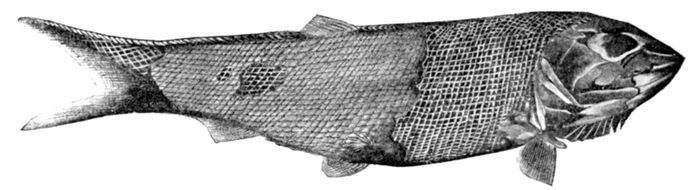
Fig. 2.—Palæoniscum frieslebenense Blainville. Family Palæoniscidæ. (After Zittel.)
The Platysomidæ.—The Platysomidæ are different in form, the body being deep and compressed, often diamond-shaped, with very long dorsal and anal fins. In other respects they are very similar to the Palæoniscidæ, the osteology being the same. The Palæoniscidæ were rapacious fishes with sharp teeth, the Platysomidæ less active, and, from the blunter teeth, probably feeding on small animals, as crabs and snails.
The rhombic enameled scales are highly specialized and held together as a coat of mail by peg-and-socket joints. The most extreme form is Platysomus, with the body very deep. Platysomus gibbosus and other species occur in the Permian rocks of Germany. Cheirodus is similar to Platysomus, but without ventral fins. Eurynotus, the most primitive genus, is remarkable for its large pectoral fins. Eurynotus crenatus occurs in the Subcarboniferous of Scotland. Other genera are Mesolepis, Globulodus, Wardichthys, and Cheirodopsis.
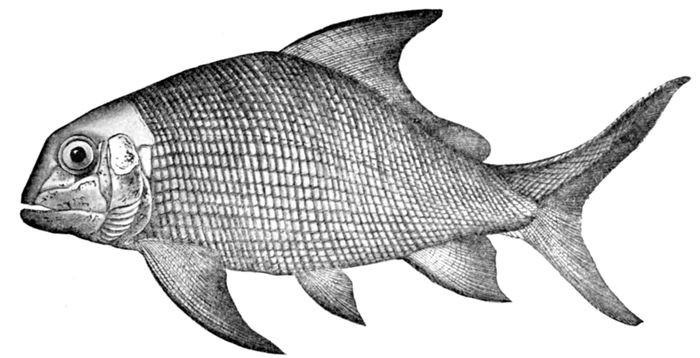
Fig. 3.—Eurynotus crenatus Agassiz, restored. Carboniferous. Family Platysomidæ. (After Traquair.)
Some of the Platysomidæ have the interneural spines projecting through the skin before the dorsal fin. This condition is found also in certain bony fishes allied to the Carangidæ.
The Dorypteridæ.—Dorypterus hoffmani, the type of the singular Palæozoic family of Dorypteridæ, with thoracic or sub-jugular many-rayed ventrals, is Stromateus-like to all appearance, with distinct resemblances to certain Scombroid forms, but with a heterocercal tail like a ganoid, imperfectly ossified back-bone, and other very archaic characters. The body is apparently scaleless, unlike the true Platysomidæ, in which the scales are highly developed. A second species, Dorypterus althausi, also from the German copper shales, has been described. This species has lower fins than Dorypterus hoffmani, but may be the adult of the same type. Dorypterus is regarded by Woodward as a specialized offshoot from the Platysomidæ. The many-rayed ventrals and the general form of the body and fins suggest affinity with the Lampridæ.
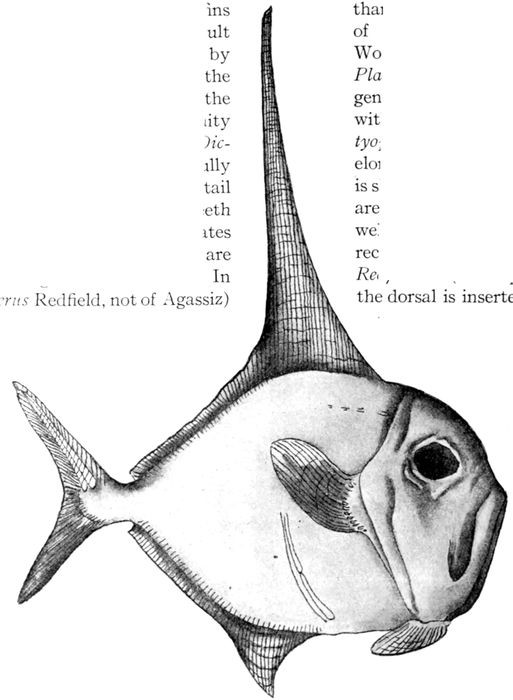
Fig. 4.—Dorypterus hoffmani Germar, restored. (After Hancock and Howse.)
Dictyopygidæ.—In the Dictyopygidæ (Catopteridæ), the body is gracefully elongate, less compressed, the heterocercal tail is short and abruptly turned upwards, the teeth are sharp and usually hooked, and the bony plates well developed. Of this group two genera are recognized, each containing numerous species. In Redfieldius (= Catopterus Redfield, not of Agassiz) the dorsal is inserted behind the anal, while in Dictyopyge this is not the case. Redfieldius gracilis and other species are found in the Triassic of the Connecticut River. Dictyopyge macrura is found in the same region, and Dictyopyge catoptera and other species in Europe.
Order Chondrostei.—The order Chondrostei (χόνδρος, cartilage; ὀστέον, bone), as accepted by Woodward, is characterized by the persistence of the notochord in greater or less degree, the endoskeleton remaining cartilaginous. In all, the axonosts and baseosts of the median fins are arranged in simple regular series and the rays are more numerous than the supporting elements. The shoulder-girdle has a pair of infraclavicular plates. The pelvic fins have well-developed baseosts. The branchiostegals are few or wanting. In the living forms, and probably in all others, a matter which can never be ascertained, the optic nerves are not decussating, but form an optic chiasma, and the intestine is provided with a spiral valve. In all the species there is one dorsal and one anal fin, separate from the caudal. The teeth are small or wanting, the body naked or covered with bony plates; the caudal fin is usually heterocercal, and on the tail are rhombic plates. To this order, as thus defined, about half of the extinct Ganoids belong, as well as the modern degenerate forms known as sturgeons and perhaps the paddle-fishes, which are apparently derived from fishes with rhombic enameled scales. The species extend from the Upper Carboniferous to the present time, being most numerous in the Triassic.
At this point in Woodward's system diverges a descending series, characterized as a whole by imperfect squamation and elongate form, this leading through the synthetic type of Chondrosteidæ to the modern sturgeon and paddle-fish, which are regarded as degenerate types.
The family of Saurorhynchidæ contains pike-like forms, with long jaws, and long conical teeth set wide apart. The tail is not heterocercal, but short-diphycercal; the bones of the head are covered with enamel, and those of the roof of the skull form a continuous shield. The opercular apparatus is much reduced, and there are no branchiostegals. The fins are all small, without fulcra, and the skin has isolated longitudinal series of bony scutes, but is not covered with continuous scales. The principal genus is Saurorhynchus (= Belonorhynchus; the former being the earlier name) from the Triassic. Saurorhynchus acutus from the English Triassic is the best known species.
The family of Chondrosteidæ includes the Triassic precursors of the sturgeons. The general form is that of the sturgeon, but the body is scaleless except on the upper caudal lobe, and there are no plates on the median line of the skull. The opercle and subopercle are present, the jaws are toothless, and there are a few well-developed caudal rays. The caudal has large fulcra. The single well-known species of this group, Chondrosteus acipenseroides, is found in the Triassic rocks of England and reaches a length of about three feet. It much resembles a modern sturgeon, though differing in several technical respects. Chondrosteus pachyurus is based on the tail of a species of much larger size and Gyrosteus mirabilis, also of the English Triassic, is known from fragments of fishes which must have been 18 to 20 feet in length.

Fig. 5.—Chondrosteus acipenseroides Egerton. Family Chondrosteidæ. (After Woodward.)
The sturgeons constitute the recent family of Acipenseridæ, characterized by the prolonged snout and toothless jaws and the presence of four barbels below the snout. In the Acipenseridæ there are no branchiostegals and a median series of plates is present on the head. The body is armed with five rows of large bony bucklers,—each often with a hooked spine, sharpest in the young. Besides these, rhombic plates are developed on the tail, besides large fulcra. The sturgeons are the youngest of the Ganoids, not occurring before the Lower Eocene, one species, Acipenser toliapicus occurring in the London clay. About thirty living species of sturgeon are known, referred to three genera: Acipenser, found throughout the Northern Hemisphere, Scaphirhynchus, in the Mississippi Valley, and Kessleria (later called Pseudoscaphirhynchus), in Central Asia alone. Most of the species belong to the genus Acipenser, which abounds in all the rivers and seas in which salmon are found. Some of the smaller species spend their lives in the rivers, ascending smaller streams to spawn. Other sturgeons are marine, ascending fresh waters only for a moderate distance in the spawning season. They range in length from 2½ to 30 feet.
All are used as food, although the flesh is rather coarse and beefy. From their large size and abundance they possess great economic value. The eggs of some species are prepared as caviar.

Fig. 6.—Common Sturgeon, Acipenser sturio Mitchill. Potomac River.
The sturgeons are sluggish, clumsy, bottom-feeding fish. The mouth, underneath the long snout, is very protractile, sucker-like, and without teeth. Before it on the under side of the snout are four long feelers. Ordinarily the sturgeon feeds on mud and snails with other small creatures, but I have seen large numbers of Eulachon (Thaleichthys) in the stomach of the Columbia River sturgeon (Acipenser transmontanus). This fish and the Eulachon run in the Columbia at the same time, and the sucker-mouth of a large sturgeon will draw into it numbers of small fishes who may be unsuspiciously engaged in depositing their spawn. In the spawning season in June these clumsy fishes will often leap wholly out of the water in their play. The sturgeons have a rough skin besides five series of bony plates which change much with age and which in very old examples are sometimes lost or absorbed in the skin. The common sturgeon of the Atlantic on both shores is Acipenser sturio. Acipenser huso and numerous other species are found in Russia and Siberia. The great sturgeon of the Columbia is Acipenser transmontanus, and the great sturgeon of Japan Acipenser kikuchii. Smaller species are found farther south, as in the Mediterranean and along the Carolina coast. Other small species abound in rivers and lakes. Acipenser rubicundus is found throughout the Great Lake region and the Mississippi Valley, never entering the sea. It is four to six feet long, and at Sandusky, Ohio, in one season 14,000 sturgeons were taken in the pound nets. A similar species, Acipenser mikadoi, is abundant and valuable in the streams of northern Japan.
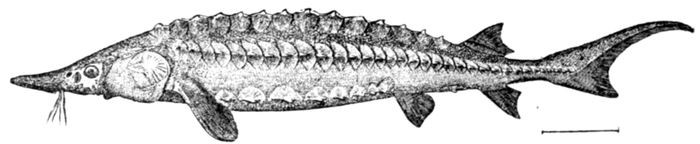
Fig. 7.—Lake Sturgeon, Acipenser rubicundus Le Sueur. Ecorse, Mich.
In the genus Acipenser the snout is sharp and conical, and the shark-like spiracle is still retained.

Fig. 8.—Shovel-nosed Sturgeon. Scaphirhynchus platyrhynchus (Rafinesque). Ohio River.
The shovel-nosed sturgeon (Scaphirhynchus platyrhynchus) has lost the spiracles, the tail is more slender, its surface wholly bony, and the snout is broad and shaped like a shovel. The single species of Scaphirhynchus abounds in the Mississippi Valley, a fish more interesting to the naturalist than to the fisherman. It is the smallest of our sturgeons, often taken in the nets in large numbers.
In Scaphirhynchus the tail is covered by a continuous coat of mail. In Kessleria[6] fedtschenkoi, rossikowi, and other Asiatic species the tail is not mailed.
6. These species have also been named Pseudoscaphirhynchus. Kessleria is the earlier name, left undefined by its describer, although the type was indicated.
Order Selachostomi: the Paddle-fishes.—Another type of Ganoids, allied to the sturgeons, perhaps still further degenerate, is that of the paddle-fishes, called by Cope Selachostomi (σέλαχος, shark; στόμα, mouth). This group consists of a single family, Polyodontidæ, having apparently little in common with the other Ganoids, and in appearance still more suggestive of the sharks. The common name of paddle-fishes is derived from the long flat blade in which the snout terminates. This extends far beyond the mouth, is more or less sensitive, and is used to stir up the mud in which are found the minute organisms on which the fish feeds. Under the paddle are four very minute barbels corresponding to those of the sturgeons. The vernacular names of spoonbill, duckbill cat, and shovel-fish are also derived from the form of the snout. The skin is nearly smooth, the tail is heterocercal, the teeth are very small, and a long fleshy flap covers the gill-opening. The very long and slender gill-rakers serve to strain the food (worms, leeches, water-beetles, crustaceans, and algæ) from the muddy waters from which they are taken. The most important part of this diet consists of Entomostracans. The single American species, Polyodon spathula, abounds through the Mississippi Valley in all the larger streams. It reaches a length of three or four feet. It is often taken in the nets, but the coarse tough flesh, like that of our inferior catfish, is not much esteemed. In the great rivers of China, the Yangtse and the Hoang Ho, is a second species, Psephurus gladius, with narrower snout, fewer gill-rakers, and much coarser fulcra on the tail. The habits, so far as known, are much the same.
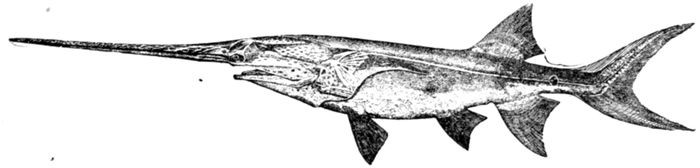
Fig. 9.—Paddle-fish, Polyodon spathula (Walbaum). Ohio River.

Fig. 10.—Paddle-fish. Polyodon Spathula (Walbaum). Ohio River.

Fig. 11.—Psephurus gladius Günther. Yangtse River. (After Günther.)
Crossopholis magnicaudatus of the Green River Eocene shales is a primitive member of the Polyodontidæ. Its rostral blade is shorter than that of Polyodon, and the body is covered with small thin scales, each in the form of a small grooved disk with several posterior denticulations, arranged in oblique series but not in contact. The scales are quadrate in form, and more widely separated anteriorly than posteriorly. As in Polyodon, the teeth are minute and there are no branchiostegals. The squamation of this fish shows that Polyodon as well as Acipenser may have sprung from a type having rhombic scales. The tail of a Cretaceous fish, Pholidurus disjectus from the Cretaceous of Europe, has been referred with doubt to this family of Polyodontidæ.
Order Pycnodonti.—In the extinct order Pycnodonti, as recognized by Dr. O. P. Hay, the notochord is persistent and without ossification, the body is very deep, the teeth are always blunt, the opercular apparatus is reduced, the dorsal fin many-rayed, and the fins without fulcra. The scales are rhombic, but are sometimes wanting, at least on the tail. Many genera and species of Pycnodontidæ are described, mostly from Triassic and Jurassic rocks of Europe. Leading European genera are Pycnodus, Typodus (Mesodon), Gyrodus, and Palæobalistum. The numerous American species belong to Typodus, Cœlodus, Pycnodus, Hadrodus, and Uranoplosus. These forms have no affinity with Balistes, although there is some resemblance in appearance, which has suggested the name of Palæobalistum.

Fig. 12.—Gyrodus hexagonus Agassiz. Family Pycnodontidæ. Lithographic Shales.
Woodward places these fishes with the Semionotidæ and Halecomorphi in his suborder of Protospondyli. It seems preferable, however, to consider them as forming a distinct order.
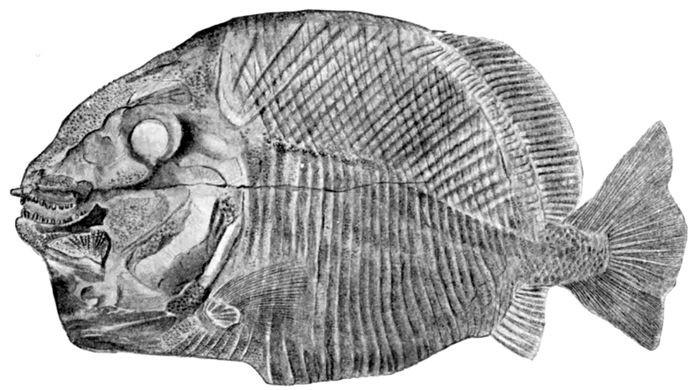
Fig. 13.—Mesturus verrucosus Wagner. Family Pycnodontidæ. (After Woodward.)
Order Lepidostei.—We may place, following Eastman's edition of Zittel, the allies and predecessors of the garpike in a single order, for which Huxley's name Lepidostei may well be used. In this group the notochord is persistent, and the vertebræ are in various degrees of ossification and of different forms. The opercles are usually complete, the branchiostegals present, and there is often a gular plate. There is no infraclavicle and the jaws have sharp teeth. The fins have fulcra, and the supports of the fins agree in number with the rays. The tail is more or less heterocercal. The scales are rhombic, arranged in oblique series, which are often united above and below with peg-and-socket articulations. This group contains among recent fishes only the garpikes (Lepisosteus). They are closely allied to the Palæoniscidæ, but the skeleton is more highly ossified. On the other hand they approach very closely to the ancestors of the bowfin, Amia. One genus, Acentrophorus, appears in the Permian; the others are scattered through Mesozoic and Tertiary rocks, the isolated group of gars still persisting. In the gars the vertebræ are concavo-convex, with ball-and-socket joints. In the others the vertebræ are incomplete or else double-concave, as in fishes generally.
For the group here called Lepidostei numerous other names have been used corresponding wholly or in part. Rhomboganoidea of Gill covers nearly the same groups; Holostei of Müller and Hyoganoidea of Gill include the Halecomorphi also; Ginglymodi of Cope includes the garpikes only, while Ætheospondyli of Woodward includes the Aspidorhynchidæ and the garpikes.

Fig. 14.—Semionotus kapffi Fraas, restored. Family Semionotidæ. (After Fraas, per Nicholson.)
The Semionotidæ (Stylodontidæ) are robust-bodied Ganoids, having the vertebræ developed as rings, the jaws with several rows of teeth, those of the outer row styliform.
Semionotus bergeri is a well-known species, with the body moderately elongate. Semionotus agassizi and many other species occur in the Triassic of the Connecticut valley and in New Jersey. The body is very deep in the related genus Dapedium, and the head is covered with strong bony plates. Dapedium politum is a well-known species of the English Triassic. Tetragonolepis (Pleurolepis) is a similar form, very deep and compressed, with strong, firm scales.
In the extinct family of Lepidotidæ the teeth are conical or chisel-shaped, while blunt or molar teeth are on the inside of the mouth, which is small, and the suspensorium of the mandible is vertical or inclined forward. The body is robust-fusiform, covered with rhomboid scales; the vertebræ form rings about the notochord; the teeth are either sharp or blunt. The dorsal fin is short, with large fulcra.
The best known of the numerous genera are Lepidotes, rather elongate in body, with large, blunt teeth. Of the many species of Lepidotes, Lepidotes elvensis abounds in the English and German Triassic, and Lepidotes minor in the English Triassic. Another well-known European species is Lepidotes mantelli.
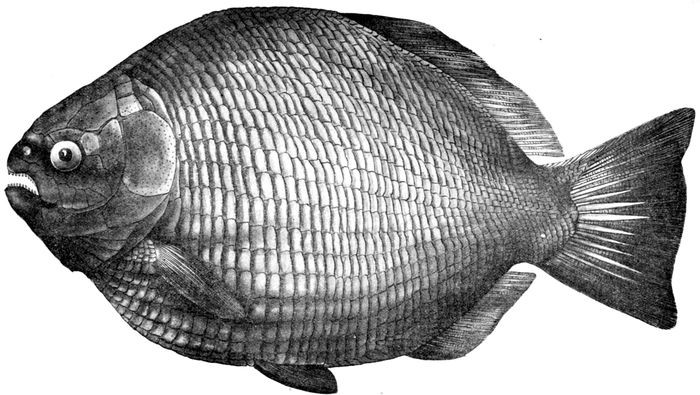
Fig. 15.—Dapedium politum Leach, restored. Family Semionotidæ. (After Woodward.)
The Isopholidæ (Eugnathidæ) differ from the families last named in the large pike-like mouth with strong teeth. The mandibular suspensorium is inclined backwards. The body is elongate, the vertebræ forming incomplete rings; the dorsal fin is short with large fulcra.
Isopholis dentosus is found with numerous other species in the British Triassic. Caturus furcatus is especially characteristic of Triassic rocks in Germany. Ptycholepis marshi occurs in the Connecticut valley.

Fig. 16.—Tetragonolepis semicinctus Brown. Lias. Family Semionotidæ. (After Woodward.)
The Macrosemiidæ are elongate fishes with long dorsal fin, the numerous species being found in the Triassic, Jurassic, and Cretaceous of Europe. Macrosemius rostratus has a very high, continuous dorsal. Macropistius arenatus is found in the Cretaceous of Texas, the only American species known. Prominent European genera are Notagogus, Ophiopsis, and Petalopteryx.

Fig. 17.—Isopholis orthostomus (Agassiz). Lias. (After Woodward.)
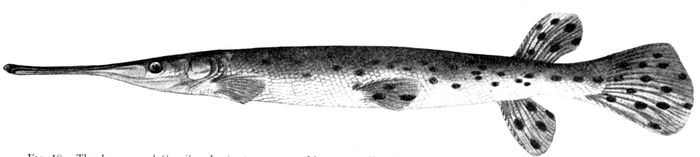
Fig. 18.—The Long-nosed Garpike, Lepisosteus osseus (Linnæus). Fox River, Wisconsin. (From nature; D. S. Jordan and M. L. McDonald, 1874.)
Intermediate between the allies of the gars and the modern herrings is the large extinct family of Pholidophoridæ, referred by Woodward to the Isospondyli, and by Eastman to the Lepidostei. These are small fishes, fusiform in shape, chiefly of the Triassic and Jurassic. The fins are fringed with fulcra, the scales are ganoid and rhombic, and the vertebræ reduced to rings. The mouth is large, with small teeth, and formed as in the Isospondyli. The caudal is scarcely heterocercal.

Fig. 19.—Caturus elongatus Agassiz. Jurassic. Family Isopholidæ. (After Zittel.)

Fig. 20.—Notagogus pentlandi Agassiz. Jurassic. Family Macrosemiidæ. (After Woodward.)

Fig. 21.—Ptycholepis curtus Egerton. Lias. Family Isopholidæ. (After Woodward.)
Of Pholidophorus, with scales joined by peg-and-socket joints and uniform in size, there are many species. Pholidophorus latiusculus and many others are found in the Triassic of England and the Continent. Pholidophorus americanus occurs in the Jurassic of South Dakota. Pleuropholis, with the scales on the lateral line, which runs very low, excessively deepened, is also widely distributed. I have before me a new species from the Cretaceous rocks near Los Angeles. The Archæomænidæ differ from Pholidophoridæ in having cycloid scales. In both families the vertebræ are reduced to rings about the notochord. From fishes allied to the Pholidophoridæ the earliest Isospondyli are probably descended.

Fig. 22.—Pholidophorus crenulatus Egerton. Lias. (After Woodward.)
In the Aspidorhynchidæ the snout is more or less produced, the mandible has a distinct presymphysial bone, the vertebræ are double-concave or ring-like, and the fins are without fulcra. This family constitutes the suborder Ætheospondyli. In form these fishes resemble Albula and other modern types, but have mailed heads and an ancient type of scales. Two genera are well known, Aspidorhynchus and Belonostomus. Aspidorhynchus acutirostris reaches a length of three feet, and is found in the Triassic lithographic stone of Bavaria. Other species occur in rocks of Germany and England.
Belonostomus has the snout scarcely produced. Belonostomus sphyrænoides is the best known of the numerous species, all of the Triassic, Jurassic, and Cretaceous.
Family Lepisosteidæ.—The family of Lepisosteidæ, constituting the suborder Ginglymodi (γιγγλυμός, hinge), is characterized especially by the form of the vertebræ.
These are opisthocœlian, convex in front and concave behind, as in reptiles, being connected by ball-and-socket joints. The tail is moderately heterocercal, less so than in the Halecomorphi, and the body is covered with very hard, diamond-shaped, enameled scales in structure similar to that of the teeth. A number of peculiar characters are shown by these fishes, some of them having often been regarded as reptilian traits. Notable features are the elongate, crocodile-like jaws, the upper the longer, and both armed with strong teeth. The mandible is without presymphysial bone. The fins are small with large fulcra, and the scales are nearly uniform in size.
All the species belong to a single family, Lepisosteidæ, which includes the modern garpikes and their immediate relatives, some of which occur in the early Tertiary. These voracious fishes are characterized by long and slender cylindrical bodies, with enameled scales and mailed heads and heterocercal tail. The teeth are sharp and unequal. The skeleton is well ossified, and the animal itself is extremely voracious. The vertebræ, reptile-like, are opisthocœlian, that is, convex in front, concave behind, forming ball-and-socket joints. In almost all other fishes they are amphicœlian or double-concave, the interspace filled with gelatinous substance. The recent species, and perhaps all the extinct species also, belong to the single genus Lepisosteus (more correctly, but also more recently, spelled Lepidosteus). Of existing forms there are not many species, three to five at the most, and they swarm in the lakes, bayous, and sluggish streams from Lake Champlain to Cuba and along the coast to Central America. The best known of the species is the long-nosed garpike, Lepisosteus osseus, which is found throughout most of the Great Lake region and the Mississippi Valley, and in which the long and slender jaws are much longer than the rest of the head. The garpike frequents quiet waters and is apparently of sleepy habit. It often lies quiet for a long time, carried around and around by the eddies. It does not readily take the hook and seldom feeds in the aquarium. It feeds on crayfishes and small fishes, to which it is exceedingly destructive, as its bad reputation indicates. Fishermen everywhere destroy it without mercy. Its flesh is rank and tough and unfit even for dogs.
In the young garpike the caudal fin appears as a second dorsal and anal, the filamentous tip of the tail passing through and beyond it.
The short-nosed garpike, Lepisosteus platystomus, is generally common throughout the Mississippi Valley. It has a short broad snout like the alligator-gar, but seldom exceeds three feet in length. In size, color, and habits it agrees closely with the common gar, differing only in the form of the snout. The form is subject to much variation, and it is possible that two or more species have been confounded.

Fig. 23.—Alligator-gar, Lepisosteus tristœchus (Bloch). Cuba.
The great alligator-gar, Lepisosteus tristœchus, reaches a length of twenty feet or more, and is a notable inhabitant of the streams about the Gulf of Mexico. Its snout is broad and relatively wide, and its teeth are very strong. It is very destructive to all sorts of food-fishes. Its flesh is worthless, and its enameled scales resist a spear or sometimes even shot. It breathes air to a certain extent by its lungs, but soon dies in foul water, not having the tenacity of life seen in Amia.
Embryology of the Garpike.—Mr. Alexander Agassiz has given an account of the embryology of the garpike, of which the following is an abstract:
"The garpike comes up the St. Lawrence in May, lays its eggs about the 20th, and then disappears. The eggs are large, viscous, stick fast in an isolated way to whatever they fall upon, and look much like those of toads, having a large outer membrane and a small yolk. Artificial fecundation failed, but about 500 naturally-laid eggs were secured, of which all but 30 perished through mold. The young began to hatch in six days. Out of 30 young hatched, 27 lived until the 15th of July. Connection with the sharks appears in the similarity of the branchial arches and by the presence of the lateral fold in which the pectoral fins are formed; the way the tail is developed is very like that of the bony fishes. Among the Ganoids it appears, as well as in ordinary fishes, the dorsal cord is straight at first, then assumes a slightly upward curve at the extremity, when finally there appears the beginning of a lobe underneath, pointing to a complete heterocercal tail. All this is as in the bony fishes, but this is the permanent condition of the garpike, while in the bony fishes the extremity of the dorsal cord becomes extinct. The mode of development of the pectoral lobe (very large in this species) furnishes another resemblance. In the brain, and in the mode of formation of the gills, a likeness to the sharks is noticeable. The young garpikes move very slowly, and seem to float quietly, save an exceedingly rapid vibration of the pectorals and the tip of the tail. They do not swim about much, but attach themselves to fixed objects by an extraordinary horseshoe-shaped ring of sucker-appendages about the mouth. These appendages remain even after the snout has become so extended that the ultimate shape is hinted at; and furthermore, it is a remnant of this feature that forms the fleshy bulb at the end of the snout in the adult. The investigations thus far show that the young garpike has many characteristics in common with the sharks and skates, but it is not so different from the bony fishes as has been supposed."
Fossil Garpikes.—A number of fossil garpikes, referred by Cope to the genus Clastes and by Eastman and Woodward to Lepidosteus, are found in the Eocene of Europe and America. The most perfect of these remains is called Lepisosteus atrox, upward of four feet long, as large as an alligator-gar, which the species much resembles. Although found in the Eocene, Dr. C. R. Eastman declares that "it has no positively archaic features. If we inquire into the more remote or pre-Eocene history of Lepidosteids, palæontology gives no answer. They blossom forth suddenly and fully differentiated at the dawn of the Tertiary, without the least clue to their ancestry, unheralded and unaccompanied by any intermediate forms, and they have remained essentially unchanged ever since."
Another fossil species is Lepisosteus fimbriatus, from the Upper Eocene of England. Scales and other fragments of garpikes are found in Germany, Belgium, and France, in Eocene and Miocene rocks. On some of these the nominal genera Naisia, Trichiurides, and Pneumatosteus are founded. Clastes, regarded by Eastman as fully identical with Lepisosteus, is said to have the "mandibular ramus without or with a reduced fissure of the dental foramen, and without the groove continuous with it in Lepisosteus. One series of large teeth, with small ones external to them on the dentary bone." Most of the fossil forms belong to Clastes, but the genus shows no difference of importance which will distinguish it from the ordinary garpike.

Fig. 24.—Lower jaw of Amia calva Linnæus, showing the gular plate.
Order Halecomorphi.—To this order belong the allies, living or extinct, of the bowfin (Amia), having for the most part cycloid scales and vertebræ approaching those of ordinary fishes. The resemblance to the Isospondyli, or herring group, is indicated in the name (Halec, a herring; μορφή, form). The notochord is persistent, the vertebræ variously ossified. The opercles are always complete. The branchiostegals are broad and there is always a gular plate. The teeth are pointed, usually strong. There is no infraclavicle. Fulcra are present or absent. The supports of the dorsal and anal are equal in number to the rays. Tail heterocercal. Scales thin, mostly cycloid, but bony at base, not jointed with each other. Mandible complex, with well-developed splenial rising into a coronoid process, which is completed by a distinct coronoid bone. Pectoral fin with more than five actinosts; scales ganoid or cycloid. In the living forms the air-bladder is connected with the œsophagus through life; optic chiasma present; intestine with a spiral valve. This group corresponds to the Amioidei of Lütken and essentially to the Cycloganoidei of Gill. The Protospondyli (προτός, before; σπόνδυλος, vertebra) of Woodward contains essentially the same elements.
Pachycormidæ.—In the family of Pachycormidæ the notochord is persistent, the ethmoids and vomer fused and projecting between the maxillaries to form the prominent snout, the teeth large, the body fusiform, the dorsal short, with slender rays and few fulcra or none, and the scales are thin and rhombic. The numerous species are characteristic of the Triassic, Jurassic, and Cretaceous. In Sauropsis (longimana) the body is elongate, and the pectoral fins are large and sickle-shaped. Euthynotus has small fulcra. In Pachycormus (macropterus, esocinus, etc.) the form is robust and the ventral fins are wanting. In Hypsycormus ventrals are present, and the caudal deeply forked.
In the American family of Protosphyrænidæ the jaws are armed with very strong teeth, as in the Barracuda, which, however, the species do not resemble in other respects. Protosphyræna nitida, perniciosa, and numerous other extinct forms, some of them of large size, were voracious inhabitants of the Cretaceous seas, and are found fossil, especially in North Carolina and Kansas. Numerous species called Erisichthe and Pelecopterus are all referred by Hay to Protosphyræna. In this family the scapula and coracoids are ossified, and perhaps the vertebræ also, and, as Dr. Hay has recently suggested, the Protosphyrænidæ may really belong to the Isospondyli. In any event, they stand on the border-line between the most fish-like of the Ganoids and the most archaic of the bony fishes.
The Liodesmidæ (genus Liodesmus) are much like Amia, but the notochord is persistent, its sheath without ossification. Liodesmus gracilis and L. sprattiformis occur in the lithographic stones of Bavaria. Woodward places Liodesmus with Megalurus among the Amiidæ.
The Bowfins: Amiidæ.—The Amiidæ have the vertebræ more complete. The dorsal fin is many-rayed and is without distinct fulcra. The diamond-shaped enameled scales disappear, giving place to cycloid scales, which gradually become thin and membranous in structure. A median gular plate is developed between the branchiostegals. The tail is moderately heterocercal, and the head covered with a bony coat of mail.
The family of Amiidæ contains a single recent species, Amia calva, the only living member of the order Halecomorphi. The bowfin, or grindle, is a remarkable fish abounding in the lakes and swamps of the Mississippi Valley, the Great Lake region, and southward to Virginia, where it is known by the imposing but unexplained title of John A. Grindle. In the Great Lakes it is usually called "dogfish," because even the dogs will not eat it, and "lawyer," because, according to Dr. Kirtland, "it will bite at anything and is good for nothing when caught."
The bowfin reaches a length of two and one half feet, the male being smaller than the female and marked by an ocellated black spot on the tail. Both sexes are dark mottled green in color. The flesh of the species is very watery, pasty, much of the substance evaporating when exposed to the air. It is ill-flavored, and is not often used as food. The species is very voracious and extremely tenacious of life. Its well-developed lung enables it to breathe even when out of the water, and it will live in the air longer than any other fish of American waters, longer even than the horned pout (Ameiurus) or the mud-minnow (Umbra). As a game fish the grindle is one of the very best, if the angler does not care for the flesh of what he catches, it being one of the hardest fighters that ever took the hook.
5. This word is usually written Palæoniscus, but Blainville, its author (1818), chose the neuter form.
The Palæoniscidæ.—The numerous genera of this order are referred to three families, the Palæoniscidæ, Platysomidæ, and Dictyopygidæ; a fourth family, Dorypteridæ, of uncertain relations, being also tentatively recognized. The family of Palæoniscidæ is the most primitive, ranging from the Devonian to the Lias, and some of them seem to have entered fresh waters in the time of the coal-measures. These fishes have the body elongate and provided with one short dorsal fin. The tail is heterocercal and the body covered with rhombic plates. Fulcra or rudimentary spine-like scales are developed on the upper edge of the caudal fin in most recent Ganoids, and often the back has a median row of undeveloped scales. A multitude of species and genera are recorded. A typical form is the genus Palæoniscum,[5] with many species represented in the rocks of various parts of the world. The longest known species is Palæoniscum frieslebenense from the Permian of Germany and England. Palæoniscum magnum, sixteen inches long, occurs in the Permian of Germany. From Canobius, the most primitive genus, to Coccolepis, the most modern, is a continuous series, the suspensorium of the lower jaw becoming more oblique, the basal bones of the dorsal fewer, the dorsal extending farther forward, and the scales more completely imbricate. Other prominent genera are Amblypterus, Eurylepis, Cheirolepis, Rhadinichthys, Pygopterus, Elonichthys, Ærolepis, Gyrolepis, Myriolepis, Oxygnathus, Centrolepis, and Holurus.
6. These species have also been named Pseudoscaphirhynchus. Kessleria is the earlier name, left undefined by its describer, although the type was indicated.
Kessleria[6] fedtschenkoi
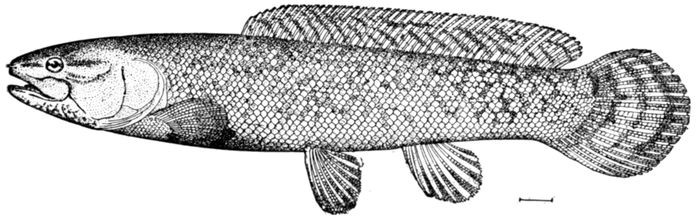
Fig. 25.—Bowfin (female), Amia calva Linnæus. Lake Michigan.
The Amiidæ retain many of the Ganoid characters, though approaching more nearly than any other of the Ganoids to the modern herring tribe. For this reason the name Halecomorphi (shad-formed) was given to this order by Professor Cope. The gular plate found in Amia and other Ganoids reappears in the herring-like family of Elopidæ, which includes the tarpon and the ten-pounder.
Woodward unites the extinct genera called Cyclurus, Notæus, Amiopsis, Protamia, Hypamia, and Pappichthys with Amia. Pappichthys (corsoni, etc.), from the Wyoming Eocene, is doubtless a valid genus, having but one row of teeth in each jaw, and Amiopsis is also recognized by Hay. Woodward refers to Amia the following extinct species: Amia valenciennesi, from the Miocene of France; Amia macrocephala, from the Miocene of Bohemia; and Amia ignota, from the Eocene of Paris. Other species of Amia are known from fragments. Several of these are from the Eocene of Wyoming and Colorado. Some of them have a much shorter dorsal fin than that of Amia calva and may be generically different.

Fig. 26.—Megalurus elegantissimus Wagner. Family Amiidæ. (After Zittel.)
The genus Megalurus differs from Amia in the still shorter dorsal fin, less than one-third the length of the back. The body is elongate and much depressed. Megalurus lepidotus and several other species are found in the lithographic stones of Bavaria and elsewhere.
The Oligopleuridæ.—In the extinct family Oligopleuridæ the scales are cycloid, the bones of the head scarcely enameled, and the vertebræ well ossified. Fulcra are present, and the mouth is large, with small teeth. The genera are Oligopleurus, Ionoscopus, and Spathiurus, the species not very numerous and chiefly of the Cretaceous. Ionoscopus cyprinoides of the lithographic shales of Bavaria is a characteristic species.
From the three families last named, with the Pholidophoridæ, there is an almost perfect transition from the Ganoid fishes to teleosteans of the order of Isospondyli, the primitive order from which all other bony fishes are perhaps descended. The family of Leptolepidæ, differing from Oligopleuridæ in the absence of fulcra, is here placed with the Isospondyli, but it might about as well be regarded as Ganoid.