автордың кітабын онлайн тегін оқу The Library. Illustrated. Greek mythology
Apollodor
Pseudo-Apollodorus
The Library
Illustrated
Greek mythology
Bibliotheca of Pseudo-Apollodorus, is a compendium of Greek myths and heroic legends, arranged in three books, generally dated to the first or second century AD.
The Bibliotheca has been called "the most valuable mythographical work that has come down from ancient times."
An epigram recorded by the important intellectual Patriarch Photius I of Constantinople expressed its purpose: “Draw your knowledge of the past from me and read the ancient tales of learned lore. Look neither at the page of Homer, nor of elegy, nor tragic muse, nor epic strain. Seek not the vaunted verse of the cycle; but look in me and you will find in me all that the world contains”.
The Translation
THE LIBRARY
Translated by Sir James George Frazer
BOOK I.
1. Sky was the first who ruled over the whole world.1 And having wedded Earth, he begat first the Hundred-handed, as they are named: Briareus, Gyes, Cottus, who were unsurpassed in size and might, each of them having a hundred hands and fifty heads.2 [2] After these, Earth bore him the Cyclopes, to wit, Arges, Steropes, Brontes,3 of whom each had one eye on his forehead. But them Sky bound and cast into Tartarus, a gloomy place in Hades as far distant from earth as earth is distant from the sky.4 [3] And again he begat children by Earth, to wit, the Titans as they are named: Ocean, Coeus, Hyperion, Crius, Iapetus, and, youngest of all, Cronus; also daughters, the Titanides as they are called: Tethys, Rhea, Themis, Mnemosyne, Phoebe, Dione, Thia.5
[4] But Earth, grieved at the destruction of her children, who had been cast into Tartarus, persuaded the Titans to attack their father and gave Cronus an adamantine sickle. And they, all but Ocean, attacked him, and Cronus cut off his father’s genitals and threw them into the sea; and from the drops of the flowing blood were born Furies, to wit, Alecto, Tisiphone, and Megaera.6 And, having dethroned their father, they brought up their brethren who had been hurled down to Tartarus, and committed the sovereignty to Cronus.
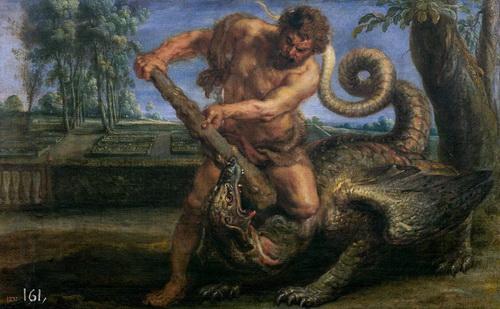
[5] But he again bound and shut them up in Tartarus, and wedded his sister Rhea; and since both Earth and Sky foretold him that he would be dethroned by his own son, he used to swallow his offspring at birth. His firstborn Hestia he swallowed, then Demeter and Hera, and after them Pluto and Poseidon.7 [6] Enraged at this, Rhea repaired to Crete, when she was big with Zeus, and brought him forth in a cave of Dicte.8 She gave him to the Curetes and to the nymphs Adrastia and Ida, daughters of Melisseus, to nurse. [7] So these nymphs fed the child on the milk of Amalthea;9 and the Curetes in arms guarded the babe in the cave, clashing their spears on their shields in order that Cronus might not hear the child’s voice.10 But Rhea wrapped a stone in swaddling clothes and gave it to Cronus to swallow, as if it were the newborn child.11 2.
But when Zeus was full-grown, he took Metis, daughter of Ocean, to help him, and she gave Cronus a drug to swallow, which forced him to disgorge first the stone and then the children whom he had swallowed,12 and with their aid Zeus waged the war against Cronus and the Titans.13 They fought for ten years, and Earth prophesied victory14 to Zeus if he should have as allies those who had been hurled down to Tartarus. So he slew their jailoress Campe, and loosed their bonds. And the Cyclopes then gave Zeus thunder and lightning and a thunderbolt,15 and on Pluto they bestowed a helmet and on Poseidon a trident. Armed with these weapons the gods overcame the Titans, shut them up in Tartarus, and appointed the Hundred-handers their guards;16 but they themselves cast lots for the sovereignty, and to Zeus was allotted the dominion of the sky, to Poseidon the dominion of the sea, and to Pluto the dominion in Hades.17
[2] Now to the Titans were born offspring: to Ocean and Tethys were born Oceanids, to wit, Asia, Styx, Electra, Doris, Eurynome, Amphitrite, and Metis;18 to Coeus and Phoebe were born Asteria and Latona;19 to Hyperion and Thia were born Dawn, Sun, and Moon;20 to Crius and Eurybia, daughter of Sea (Pontus), were born Astraeus, Pallas, and Perses;21 [3] to Iapetus and Asia was born Atlas, who has the sky on his shoulders, and Prometheus, and Epimetheus, and Menoetius, he whom Zeus in the battle with the Titans smote with a thunderbolt and hurled down to Tartarus.22 [4] And to Cronus and Philyra was born Chiron, a centaur of double form;23 and to Dawn and Astraeus were born winds and stars;24 to Perses and Asteria was born Hecate;25 and to Pallas and Styx were born Victory, Dominion, Emulation, and Violence.26 [5] But Zeus caused oaths to be sworn by the water of Styx, which flows from a rock in Hades, bestowing this honor on her because she and her children had fought on his side against the Titans.27
[6] And to Sea ( Pontus) and Earth were born Phorcus, Thaumas, Nereus, Eurybia, and Ceto.28 Now to Thaumas and Electra were born Iris and the Harpies, Aello and Ocypete;29 and to Phorcus and Ceto were born the Phorcides and Gorgons,30 of whom we shall speak when we treat of Perseus. [7] To Nereus and Doris were born the Nereids,31 whose names are Cymothoe, Spio, Glauconome, Nausithoe, Halie, Erato, Sao, Amphitrite, Eunice, Thetis, Eulimene, Agave, Eudore, Doto, Pherusa, Galatea, Actaea, Pontomedusa, Hippothoe, Lysianassa, Cymo, Eione, Halimede, Plexaure, Eucrante, Proto, Calypso, Panope, Cranto, Neomeris, Hipponoe, Ianira, Polynome, Autonoe, Melite, Dione, Nesaea, Dero, Evagore, Psamathe, Eumolpe, Ione, Dynamene, Ceto, and Limnoria. 3.
Now Zeus wedded Hera and begat Hebe, Ilithyia, and Ares,32 but he had intercourse with many women, both mortals and immortals. By Themis, daughter of Sky, he had daughters, the Seasons, to wit, Peace, Order, and Justice; also the Fates, to wit, Clotho, Lachesis, and Atropus;33 by Dione he had Aphrodite;34 by Eurynome, daughter of Ocean, he had the Graces, to wit, Aglaia, Euphrosyne, and Thalia;35 by Styx he had Persephone;36 and by Memory ( Mnemosyne) he had the Muses, first Calliope, then Clio, Melpomene, Euterpe, Erato, Terpsichore, Urania, Thalia, and Polymnia.37
[2] Now Calliope bore to Oeagrus or, nominally, to Apollo, a son Linus,38 whom Hercules slew; and another son, Orpheus,39 who practised minstrelsy and by his songs moved stones and trees. And when his wife Eurydice died, bitten by a snake, he went down to Hades, being fain to bring her up,40 and he persuaded Pluto to send her up. The god promised to do so, if on the way Orpheus would not turn round until he should be come to his own house. But he disobeyed and turning round beheld his wife; so she turned back. Orpheus also invented the mysteries of Dionysus,41 and having been torn in pieces by the Maenads42 he is buried in Pieria. [3] Clio fell in love with Pierus, son of Magnes, in consequence of the wrath of Aphrodite, whom she had twitted with her love of Adonis; and having met him she bore him a son Hyacinth, for whom Thamyris, the son of Philammon and a nymph Argiope, conceived a passion, he being the first to become enamored of males. But afterwards Apollo loved Hyacinth and killed him involuntarily by the cast of a quoit.43 And Thamyris, who excelled in beauty and in minstrelsy, engaged in a musical contest with the Muses, the agreement being that, if he won, he should enjoy them all, but that if he should be vanquished he should be bereft of what they would. So the Muses got the better of him and bereft him both of his eyes and of his minstrelsy.44 [4] Euterpe had by the river Strymon a son Rhesus, whom Diomedes slew at Troy;45 but some say his mother was Calliope. Thalia had by Apollo the Corybantes;46 and Melpomene had by Achelous the Sirens, of whom we shall speak in treating of Ulysses.47
[5] Hera gave birth to Hephaestus without intercourse with the other sex,48 but according to Homer he was one of her children by Zeus.49 Him Zeus cast out of heaven, because he came to the rescue of Hera in her bonds.50 For when Hercules had taken Troy and was at sea, Hera sent a storm after him; so Zeus hung her from Olympus.51 Hephaestus fell on Lemnos and was lamed of his legs,52 but Thetis saved him.53
[6] Zeus had intercourse with Metis, who turned into many shapes in order to avoid his embraces. When she was with child, Zeus, taking time by the forelock, swallowed her, because Earth said that, after giving birth to the maiden who was then in her womb, Metis would bear a son who should be the lord of heaven. From fear of that Zeus swallowed her.54 And when the time came for the birth to take place, Prometheus or, as others say, Hephaestus, smote the head of Zeus with an axe, and Athena, fully armed, leaped up from the top of his head at the river Triton.55 4.
Of the daughters of Coeus, Asteria in the likeness of a quail flung herself into the sea in order to escape the amorous advances of Zeus, and a city was formerly called after her Asteria, but afterwards it was named Delos.56 But Latona for her intrigue with Zeus was hunted by Hera over the whole earth, till she came to Delos and brought forth first Artemis, by the help of whose midwifery she afterwards gave birth to Apollo.57
Now Artemis devoted herself to the chase and remained a maid; but Apollo learned the art of prophecy from Pan, the son of Zeus and Hybris,58 and came to Delphi, where Themis at that time used to deliver oracles;59 and when the snake Python, which guarded the oracle, would have hindered him from approaching the chasm,60 he killed it and took over the oracle.61 Not long afterwards he slew also Tityus, who was a son of Zeus and Elare, daughter of Orchomenus; for her, after he had debauched her, Zeus hid under the earth for fear of Hera, and brought forth to the light the son Tityus, of monstrous size, whom she had borne in her womb.62 When Latona came to Pytho, Tityus beheld her, and overpowered by lust drew her to him. But she called her children to her aid, and they shot him down with their arrows. And he is punished even after death; for vultures eat his heart in Hades.63
[2] Apollo also slew Marsyas, the son of Olympus. For Marsyas, having found the pipes which Athena had thrown away because they disfigured her face,64 engaged in a musical contest with Apollo. They agreed that the victor should work his will on the vanquished, and when the trial took place Apollo turned his lyre upside down in the competition and bade Marsyas do the same. But Marsyas could not, so Apollo was judged the victor and despatched Marsyas by hanging him on a tall pine tree and stripping off his skin.65
[3] And Artemis slew Orion in Delos.66 They say that he was of gigantic stature and born of the earth; but Pherecydes says that he was a son of Poseidon and Euryale.67 Poseidon bestowed on him the power of striding across the sea.68 He first married Side,69 whom Hera cast into Hades because she rivalled herself in beauty. Afterwards he went to Chios and wooed Merope, daughter of Oenopion. But Oenopion made him drunk, put out his eyes as he slept, and cast him on the beach. But he went to the smithy of Hephaestus, and snatching up a lad set him on his shoulders and bade him lead him to the sunrise. Being come thither he was healed by the sun’s rays, and having recovered his sight he hastened with all speed against Oenopion. [4] But for him Poseidon had made ready a house under the earth constructed by Hephaestus.70 And Dawn fell in love with Orion and carried him off and brought him to Delos; for Aphrodite caused Dawn to be perpetually in love, because she had bedded with Ares. [5] But Orion was killed, as some say, for challenging Artemis to a match at quoits, but some say he was shot by Artemis for offering violence to Opis, one of the maidens who had come from the Hyperboreans.71
Poseidon wedded Amphitrite, daughter of Ocean, and there were born to him Triton72 and Rhode, who was married to the Sun.73 5.
Pluto fell in love with Persephone and with the help of Zeus carried her off secretly.74 But Demeter went about seeking her all over the earth with torches by night and day, and learning from the people of Hermion that Pluto had carried her off,75 she was wroth with the gods and quitted heaven, and came in the likeness of a woman to Eleusis. And first she sat down on the rock which has been named Laughless after her, beside what is called the Well of the Fair Dances76; thereupon she made her way to Celeus, who at that time reigned over the Eleusinians. Some women were in the house, and when they bade her sit down beside them, a certain old crone, Iambe, joked the goddess and made her smile.77 For that reason they say that the women break jests at the Thesmophoria.78
But Metanira, wife of Celeus, had a child and Demeter received it to nurse, and wishing to make it immortal she set the babe of nights on the fire and stripped off its mortal flesh. But as Demophon — for that was the child’s name — grew marvelously by day, Praxithea watched, and discovering him buried in the fire she cried out; wherefore the babe was consumed by the fire and the goddess revealed herself.79 [2] But for Triptolemus, the elder of Metanira’s children, she made a chariot of winged dragons, and gave him wheat, with which, wafted through the sky, he sowed the whole inhabited earth.80 But Panyasis affirms that Triptolemus was a son of Eleusis, for he says that Demeter came to him. Pherecydes, however, says that he was a son of Ocean and Earth.81
[3] But when Zeus ordered Pluto to send up the Maid, Pluto gave her a seed of a pomegranate to eat, in order that she might not tarry long with her mother.82 Not foreseeing the consequence, she swallowed it; and because Ascalaphus, son of Acheron and Gorgyra, bore witness against her, Demeter laid a heavy rock on him in Hades.83 But Persephone was compelled to remain a third of every year with Pluto and the rest of the time with the gods.84 6.
Such is the legend of Demeter. But Earth, vexed on account of the Titans, brought forth the giants, whom she had by Sky.85 These were matchless in the bulk of their bodies and invincible in their might; terrible of aspect did they appear, with long locks drooping from their head and chin, and with the scales of dragons for feet.86 They were born, as some say, in Phlegrae, but according to others in Pallene.87 And they darted rocks and burning oaks at the sky. Surpassing all the rest were Porphyrion and Alcyoneus, who was even immortal so long as he fought in the land of his birth. He also drove away the cows of the Sun from Erythia. Now the gods had an oracle that none of the giants could perish at the hand of gods, but that with the help of a mortal they would be made an end of. Learning of this, Earth sought for a simple to prevent the giants from being destroyed even by a mortal. But Zeus forbade the Dawn and the Moon and the Sun to shine, and then, before anybody else could get it, he culled the simple himself, and by means of Athena summoned Hercules to his help. Hercules first shot Alcyoneus with an arrow, but when the giant fell on the ground he somewhat revived. However, at Athena’s advice Hercules dragged him outside Pallene, and so the giant died.88 [2] But in the battle Porphyrion attacked Hercules and Hera. Nevertheless Zeus inspired him with lust for Hera, and when he tore her robes and would have forced her, she called for help, and Zeus smote him with a thunderbolt, and Hercules shot him dead with an arrow.89 As for the other giants, Ephialtes was shot by Apollo with an arrow in his left eye and by Hercules in his right; Eurytus was killed by Dionysus with a thyrsus, and Clytius by Hecate with torches, and Mimas by Hephaestus with missiles of red-hot metal.90 Enceladus fled, but Athena threw on him in his flight the island of Sicily91; and she flayed Pallas and used his skin to shield her own body in the fight.92 Polybotes was chased through the sea by Poseidon and came to Cos; and Poseidon, breaking off that piece of the island which is called Nisyrum, threw it on him.93 And Hermes, wearing the helmet of Hades,94 slew Hippolytus in the fight, and Artemis slew Gration. And the Fates, fighting with brazer clubs, killed Agrius and Thoas. The other giants Zeus smote and destroyed with thunderbolts and all of them Hercules shot with arrows as they were dying.
[3] When the gods had overcome the giants, Earth, still more enraged, had intercourse with Tartarus and brought forth Typhon in Cilicia,95 a hybrid between man and beast. In size and strength he surpassed all the offspring of Earth. As far as the thighs he was of human shape and of such prodigious bulk that he out-topped all the mountains, and his head often brushed the stars. One of his hands reached out to the west and the other to the east, and from them projected a hundred dragons’ heads. From the thighs downward he had huge coils of vipers, which when drawn out, reached to his very head and emitted a loud hissing. His body was all winged96:unkempt hair streamed on the wind from his head and cheeks; and fire flashed from his eyes. Such and so great was Typhon when, hurling kindled rocks, he made for the very heaven with hissings and shouts, spouting a great jet of fire from his mouth. But when the gods saw him rushing at heaven, they made for Egypt in flight, and being pursued they changed their forms into those of animals.97 However Zeus pelted Typhon at a distance with thunderbolts, and at close quarters struck him down with an adamantine sickle, and as he fled pursued him closely as far as Mount Casius, which overhangs Syria. There, seeing the monster sore wounded, he grappled with him. But Typhon twined about him and gripped him in his coils, and wresting the sickle from him severed the sinews of his hands and feet, and lifting him on his shoulders carried him through the sea to Cilicia and deposited him on arrival in the Corycian cave. Likewise he put away the sinews there also, hidden in a bearskin, and he set to guard them the she-dragon Delphyne, who was a half-bestial maiden. But Hermes and Aegipan stole the sinews and fitted them unobserved to Zeus.98 And having recovered his strength Zeus suddenly from heaven, riding in a chariot of winged horses, pelted Typhon with thunderbolts and pursued him to the mountain called Nysa, where the Fates beguiled the fugitive; for he tasted of the ephemeral fruits in the persuasion that he would be strengthened thereby.99 So being again pursued he came to Thrace, and in fighting at Mount Haemus he heaved whole mountains. But when these recoiled on him through the force of the thunderbolt, a stream of blood gushed out on the mountain, and they say that from that circumstance the mountain was called Haemus.100 And when he started to flee through the Sicilian sea, Zeus cast Mount Etna in Sicily upon him. That is a huge mountain, from which down to this day they say that blasts of fire issue from the thunderbolts that were thrown.101 So much for that subject. 7.
Prometheus moulded men out of water and earth102 and gave them also fire, which, unknown to Zeus, he had hidden in a stalk of fennel.103 But when Zeus learned of it, he ordered Hephaestus to nail his body to Mount Caucasus, which is a Scythian mountain. On it Prometheus was nailed and kept bound for many years. Every day an eagle swooped on him and devoured the lobes of his liver, which grew by night. That was the penalty that Prometheus paid for the theft of fire until Hercules afterwards released him, as we shall show in dealing with Hercules.104
[2] And Prometheus had a son Deucalion.105 He reigning in the regions about Phthia, married Pyrrha, the daughter of Epimetheus and Pandora, the first woman fashioned by the gods.106 And when Zeus would destroy the men of the Bronze Age, Deucalion by the advice of Prometheus constructed a chest,107 and having stored it with provisions he embarked in it with Pyrrha. But Zeus by pouring heavy rain from heaven flooded the greater part of Greece, so that all men were destroyed, except a few who fled to the high mountains in the neighborhood. It was then that the mountains in Thessaly parted, and that all the world outside the Isthmus and Peloponnese was overwhelmed. But Deucalion, floating in the chest over the sea for nine days and as many nights, drifted to Parnassus, and there, when the rain ceased, he landed and sacrificed to Zeus, the god of Escape. And Zeus sent Hermes to him and allowed him to choose what he would, and he chose to get men. And at the bidding of Zeus he took up stones and threw them over his head, and the stones which Deucalion threw became men, and the stones which Pyrrha threw became women. Hence people were called metaphorically people ( laos) from laas, “ a stone. “108 And Deucalion had children by Pyrrha, first Hellen, whose father some say was Zeus, and second Amphictyon, who reigned over Attica after Cranaus; and third a daughter Protogenia, who became the mother of Aethlius by Zeus.109 [3] Hellen had Dorus, Xuthus, and Aeolus110 by a nymph Orseis. Those who were called Greeks he named Hellenes after himself,111 and divided the country among his sons. Xuthus received Peloponnese and begat Achaeus and Ion by Creusa, daughter of Erechtheus, and from Achaeus and Ion the Achaeans and Ionians derive their names. Dorus received the country over against Peloponnese and called the settlers Dorians after himself.112 Aeolus reigned over the regions about Thessaly and named the inhabitants Aeolians.113 He married Enarete, daughter of Deimachus, and begat seven sons, Cretheus, Sisyphus, Athamas, Salmoneus, Deion, Magnes, Perieres, and five daughters, Canace, Alcyone, Pisidice, Calyce, Perimede.114
Perimede had Hippodamas and Orestes by Achelous; and Pisidice had Antiphus and Actor by Myrmidon. [4] Alcyone was married by Ceyx, son of Lucifer.115 These perished by reason of their pride; for he said that his wife was Hera, and she said that her husband was Zeus.116 But Zeus turned them into birds; her he made a kingfisher ( alcyon) and him a gannet ( ceyx).117
Canace had by Poseidon Hopleus and Nireus and Epopeus and Aloeus and Triops. Aloeus wedded Iphimedia, daughter of Triops; but she fell in love with Poseidon, and often going to the sea she would draw up the waves with her hands and pour them into her lap. Poseidon met her and begat two sons, Otus and Ephialtes, who are called the Aloads.118 These grew every year a cubit in breadth and a fathom in height; and when they were nine years old,119 being nine cubits broad and nine fathoms high, they resolved to fight against the gods, and they set Ossa on Olympus, and having set Pelion on Ossa they threatened by means of these mountains to ascend up to heaven, and they said that by filling up the sea with the mountains they would make it dry land, and the land they would make sea. And Ephialtes wooed Hera, and Otus wooed Artemis; moreover they put Ares in bonds.120 However, Hermes rescued Ares by stealth, and Artemis killed the Aloads in Naxos by a ruse. For she changed herself into a deer and leaped between them, and in their eagerness to hit the quarry they threw their darts at each other.121
[5] Calyce and Aethlius had a son Endymion who led Aeolians from Thessaly and founded Elis. But some say that he was a son of Zeus. As he was of surpassing beauty, the Moon fell in love with him, and Zeus allowed him to choose what he would, and he chose to sleep for ever, remaining deathless and ageless.122
[6] Endymion had by a Naiad nymph or, as some say, by Iphianassa, a son Aetolus, who slew Apis, son of Phoroneus, and fled to the Curetian country. There he killed his hosts, Dorus and Laodocus and Polypoetes, the sons of Phthia and Apollo, and called the country Aetolia after himself.123
[7] Aetolus and Pronoe, daughter of Phorbus, had sons, Pleuron and Calydon, after whom the cities in Aetolia were named. Pleuron wedded Xanthippe, daughter of Dorus, and begat a son Agenor, and daughters, Sterope and Stratonice and Laophonte. Calydon and Aeolia, daughter of Amythaon, had daughters, Epicaste and Protogenia, who had Oxylus by Ares. And Agenor, son of Pleuron, married Epicaste, daughter of Calydon, and begat Porthaon and Demonice, who had Evenus, Molus, Pylus, and Thestius by Ares.
[8] Evenus begat Marpessa, who was wooed by Apollo, but Idas, son of Aphareus, carried her off in a winged chariot which he received from Poseidon.124 Pursuing him in a chariot, Evenus came to the river Lycormas, but when he could not catch him he slaughtered his horses and threw himself into the river, and the river is called Evenus after him. [9] But Idas came to Messene, and Apollo, falling in with him, would have robbed him of the damsel. As they fought for the girl’s hand, Zeus parted them and allowed the maiden herself to choose which of the two she would marry; and she, because she feared that Apollo might desert her in her old age, chose Idas for her husband.125
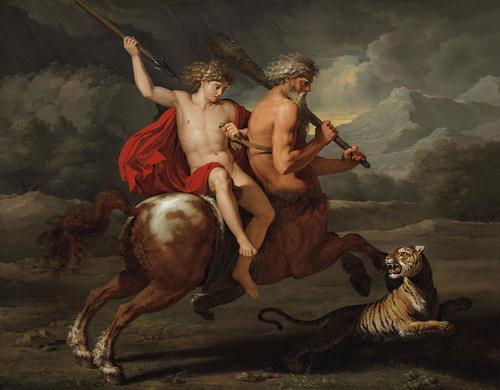
[10] Thestius had daughters and sons by Eurythemis, daughter of Cleoboea: the daughters were Althaea, Leda,126 Hypermnestra, and the males were Iphiclus, Evippus, Plexippus, and Eurypylus.
Porthaon and Euryte, daughter of Hippodamas, had sons, Oeneus, Agrius, Alcathous, Melas, Leucopeus, and a daughter Sterope, who is said to have been the mother of the Sirens by Achelous. 8.
Reigning over Calydon, Oeneus was the first who received a vine-plant from Dionysus.127 He married Althaea, daughter of Thestius, and begat Toxeus, whom he slew with his own hand because he leaped over the ditch.128 And besides Toxeus he had Thyreus and Clymenus, and a daughter Gorge, whom Andraemon married, and another daughter Deianira, who is said to have been begotten on Althaea by Dionysus. This Deianira drove a chariot and practised the art of war, and Hercules wrestled for her hand with Achelous.129 [2] Althaea had also a son Meleager,130 by Oeneus, though they say that he was begotten by Ares. It is said that, when he was seven days old, the Fates came and declared that Meleager should die when the brand burning on the hearth was burnt out. On hearing that, Althaea snatched up the brand and deposited it in a chest.131 Meleager grew up to be an invulnerable and gallant man, but came by his end in the following way. In sacrificing the first fruits of the annual crops of the country to all the gods Oeneus forgot Artemis alone. But she in her wrath sent a boar of extraordinary size and strength, which prevented the land from being sown and destroyed the cattle and the people that fell in with it. To attack this boar Oeneus called together all the noblest men of Greece, and promised that to him who should kill the beast he would give the skin as a prize. Now the men who assembled to hunt the boar were these132: — Meleager, son of Oeneus; Dryas, son of Ares; these came from Calydon; Idas and Lynceus, sons of Aphareus, from Messene; Castor and Pollux, sons of Zeus and Leda, from Lacedaemon; Theseus, son of Aegeus, from Athens; Admetus, son of Pheres, from Pherae; Ancaeus and Cepheus, sons of Lycurgus, from Arcadia; Jason, son of Aeson, from Iolcus; Iphicles, son of Amphitryon, from Thebes; Pirithous, son of Ixion, from Larissa; Peleus, son of Aeacus, from Phthia; Telamon, son of Aeacus, from Salamis; Eurytion, son of Actor, from Phthia; Atalanta, daughter of Schoeneus, from Arcadia; Amphiaraus, son of Oicles, from Argos. With them came also the sons of Thestius. And when they were assembled, Oeneus entertained them for nine days; but on the tenth, when Cepheus and Ancaeus and some others disdained to go hunting with a woman, Meleager compelled them to follow the chase with her, for he desired to have a child also by Atalanta, though he had to wife Cleopatra, daughter of Idas and Marpessa. When they surrounded the boar, Hyleus and Ancaeus were killed by the brute, and Peleus struck down Eurytion undesignedly with a javelin. But Atalanta was the first to shoot the boar in the back with an arrow, and Amphiaraus was the next to shoot it in the eye; but Meleager killed it by a stab in the flank, and on receiving the skin gave it to Atalanta. Nevertheless the sons of Thestius, thinking scorn that a woman should get the prize in the face of men, took the skin from her, alleging that it belonged to them by right of birth if Meleager did not choose to take it. [3] But Meleager in a rage slew the sons of Thestius and gave the skin to Atalanta. However, from grief at the slaughter of her brothers Althaea kindled the brand, and Meleager immediately expired.
But some say that Meleager did not die in that way,133 but that when the sons of Thestius claimed the skin on the ground that Iphiclus had been the first to hit the boar, war broke out between the Curetes and the Calydonians; and when Meleager had sallied out134 and slain some of the sons of Thestius, Althaea cursed him, and he in a rage remained at home; however, when the enemy approached the walls, and the citizens supplicated him to come to the rescue, he yielded reluctantly to his wife and sallied forth, and having killed the rest of the sons of Thestius, he himself fell fighting. After the death of Meleager, Althaea and Cleopatra hanged themselves, and the women who mourned the dead man were turned into birds.135
[4] After Althaea’s death Oeneus married Periboea, daughter of Hipponous. The author of the Thebaid says that when Olenus was sacked, Oeneus received Periboea as a gift of honor; but Hesiod says that she was seduced by Hippostratus, son of Amarynceus, and that her father Hipponous sent her away from Olenus in Achaia to Oeneus, because he dwelt far from Greece, with an injunction to put her to death.136 [5] However, some say that Hipponous discovered that his daughter had been debauched by Oeneus, and therefore he sent her away to him when she was with child. By her Oeneus begat Tydeus. But Pisander says that the mother of Tydeus was Gorge, for Zeus willed it that Oeneus should fall in love with his own daughter.137
When Tydeus had grown to be a gallant man he was banished for killing, as some say, Alcathous, brother of Oeneus; but according to the author of the Alcmaeonidhis victims were the sons of Melas who had plotted against Oeneus, their names being Pheneus, Euryalus, Hyperlaus, Antiochus, Eumedes, Sternops, Xanthippus, Sthenelaus; but as Pherecydes will have it, he murdered his own brother Olenias.138 Being arraigned by Agrius, he fled to Argos and came to Adrastus, whose daughter Deipyle he married and begat Diomedes.
Tydeus marched against Thebes with Adrastus,139 and died of a wound which he received at the hand of Melanippus. [6] But the sons of Agrius, to wit, Thersites, Onchestus, Prothous, Celeutor, Lycopeus, Melanippus, wrested the kingdom from Oeneus and gave it to their father, and more than that they imprisoned Oeneus in his lifetime and tormented him.140 Nevertheless Diomedes afterwards came secretly with Alcmaeon from Argos and put to death all the sons of Agrius, except Onchestus and Thersites, who had fled betimes to Peloponnese; and as Oeneus was old, Diomedes gave the kingdom to Andraemon who had married the daughter of Oeneus, but Oeneus himself he took with him to Peloponnese. Howbeit, the sons of Agrius, who had made their escape, lay in wait for the old man at the hearth of Telephus in Arcadia, and killed him. But Diomedes conveyed the corpse to Argos and buried him in the place where now a city is called Oenoe after him.141 And having married Aegialia, daughter of Adrastus or, as some say, of Aegialeus, he went to the wars against Thebes and Troy. 9.
Of the sons of Aeolus, Athamas ruled over Boeotia and begat a son Phrixus and a daughter Helle by Nephele.142 And he married a second wife, Ino, by whom he had Learchus and Melicertes. But Ino plotted against the children of Nephele and persuaded the women to parch the wheat; and having got the wheat they did so without the knowledge of the men. But the earth, being sown with parched wheat, did not yield its annual crops; so Athamas sent to Delphi to inquire how he might be delivered from the dearth. Now Ino persuaded the messengers to say it was foretold that the infertility would cease if Phrixus were sacrificed to Zeus. When Athamas heard that, he was forced by the inhabitants of the land to bring Phrixus to the altar. But Nephele caught him and her daughter up and gave them a ram with a golden fleece, which she had received from Hermes, and borne through the sky by the ram they crossed land and sea. But when they were over the sea which lies betwixt Sigeum and the Chersonese, Helle slipped into the deep and was drowned, and the sea was called Hellespont after her. But Phrixus came to the Colchians, whose king was Aeetes, son of the Sun and of Perseis, and brother of Circe and Pasiphae, whom Minos married. He received Phrixus and gave him one of his daughters, Chalciope. And Phrixus sacrificed the ram with the golden fleece to Zeus the god of Escape, and the fleece he gave to Aeetes, who nailed it to an oak in a grove of Ares. And Phrixus had children by Chalciope, to wit, Argus, Melas, Phrontis, and Cytisorus.
[2] But afterwards Athamas was bereft also of the children of Ino through the wrath of Hera; for he went mad and shot Learchus with an arrow, and Ino cast herself and Melicertes into the sea.143 Being banished from Boeotia, Athamas inquired of the god where he should dwell, and on receiving an oracle that he should dwell in whatever place he should be entertained by wild beasts, he traversed a great extent of country till he fell in with wolves that were devouring pieces of sheep; but when they saw him they abandoned their prey and fled. So Athamas settled in that country and named it Athamantia after himself;144 and he married Themisto, daughter of Hypseus, and begat Leucon, Erythrius, Schoeneus, and Ptous.
[3] And Sisyphus, son of Aeolus, founded Ephyra, which is now called Corinth,145 and married Merope, daughter of Atlas. They had a son Glaucus, who had by Eurymede a son Bellerophon, who slew the fire breathing Chimera.146 But Sisyphus is punished in Hades by rolling a stone with his hands and head in the effort to heave it over the top; but push it as he will, it rebounds backward.147 This punishment he endures for the sake of Aegina, daughter of Asopus; for when Zeus had secretly carried her off, Sisyphus is said to have betrayed the secret to Asopus, who was looking for her.
[4] Deion reigned over Phocis and married Diomede, daughter of Xuthus; and there were born to him a daughter, Asterodia, and sons, Aenetus, Actor, Phylacus, and Cephalus, who married Procris, daughter of Erechtheus.148 But afterwards Dawn fell in love with him and carried him off.
[5] Perieres took possession of Messene and married Gorgophone, daughter of Perseus, by whom he had sons, to wit, Aphareus and Leucippus,149 and Tyndareus, and also Icarius. But many say that Perieres was not the son of Aeolus but of Cynortas, son of Amyclas;150 so we shall narrate the history of the descendants of Perieres in dealing with the family of Atlas.
[6] Magnes married a Naiad nymph, and sons were born to him, Polydectes and Dictys; these colonized Seriphus.
[7] Salmoneus at first dwelt in Thessaly, but afterwards he came to Elis and there founded a city.151 And being arrogant and wishful to put himself on an equality with Zeus, he was punished for his impiety; for he said that he was himself Zeus, and he took away the sacrifices of the god and ordered them to be offered to himself; and by dragging dried hides, with bronze kettles, at his chariot, he said that he thundered, and by flinging lighted torches at the sky he said that he lightened. But Zeus struck him with a thunderbolt, and wiped out the city he had founded with all its inhabitants.152
[8] Now Tyro, daughter of Salmoneus and Alcidice, was brought up by Cretheus, brother of Salmoneus, and conceived a passion for the river Enipeus, and often would she hie to its running waters and utter her plaint to them. But Poseidon in the likeness of Enipeus lay with her,153 and she secretly gave birth to twin sons, whom she exposed. As the babes lay forlorn, a mare, belonging to some passing horsekeepers, kicked with its hoof one of the two infants and left a livid mark on its face. The horsekeeper took up both the children and reared them; and the one with the livid (pelion) mark he called Pelias, and the other Neleus.154 When they were grown up, they discovered their mother and killed their stepmother Sidero. For knowing that their mother was ill-used by her, they attacked her, but before they could catch her she had taken refuge in the precinct of Hera.155 However, Pelias cut her down on the very altars, and ever after he continued to treat Hera with contumely. [9] But afterwards the brothers fell out, and Neleus, being banished, came to Messene, and founded Pylus, and married Chloris,156 daughter of Amphion, by whom he had a daughter, Pero, and sons, to wit, Taurus, Asterius, Pylaon, Deimachus, Eurybius, Epilaus, Phrasius, Eurymenes, Evagoras, Alastor, Nestor and Periclymenus, whom Poseidon granted the power of changing his shape. And when Hercules was ravaging Pylus, in the fight Periclymenus turned himself into a lion, a snake, and a bee, but was slain by Hercules with the other sons of Neleus. Nestor alone was saved, because he was brought up among the Gerenians.157 He married Anaxibia, daughter of Cratieus,158 and begat daughters, Pisidice and Polycaste, and sons, Perseus, Stratichus, Aretus, Echephron, Pisistratus, Antilochus, and Thrasymedes.
[10] But Pelias dwelt in Thessaly and married Anaxibia, daughter of Bias, but according to some his wife was Phylomache, daughter of Amphion; and he begat a son, Acastus, and daughters, Pisidice, Pelopia, Hippothoe, and Alcestis.159
[11] Cretheus founded Iolcus and married Tyro, daughter of Salmoneus, by whom he had sons, Aeson, Amythaon, and Pheres.160 Amythaon dwelt in Pylus and married Idomene, daughter of Pheres, and there were born to him two sons, Bias and Melampus. The latter lived in the country, and before his house there was an oak, in which there was a lair of snakes. His servants killed the snakes, but Melampus gathered wood and burnt the reptiles, and reared the young ones. And when the young were full grown, they stood beside him at each of his shoulders as he slept, and they purged his ears with their tongues. He started up in a great fright, but understood the voices of the birds flying overhead, and from what he learned from them he foretold to men what should come to pass.161 He acquired besides the art of taking the auspices, and having fallen in with Apollo at the Alpheus he was ever after an excellent soothsayer.
[12] Bias wooed Pero, daughter of Neleus.162 But as there were many suitors for his daughter’s hand, Neleus said that he would give her to him who should bring him the kine of Phylacus. These were in Phylace, and they were guarded by a dog which neither man nor beast could come near. Unable to steal these kine, Bias invited his brother to help him. Melampus promised to do so, and foretold that he should be detected in the act of stealing them, and that he should get the kine after being kept in bondage for a year. After making this promise he repaired to Phylace and, just as he had foretold, he was detected in the theft and kept a prisoner in a cell. When the year was nearly up, he heard the worms in the hidden part of the roof, one of them asking how much of the beam had been already gnawed through, and others answering that very little of it was left. At once he bade them transfer him to another cell, and not long after that had been done the cell fell in. Phylacus marvelled, and perceiving that he was an excellent soothsayer, he released him and invited him to say how his son Iphiclus might get children. Melampus promised to tell him, provided he got the kine. And having sacrificed two bulls and cut them in pieces he summoned the birds; and when a vulture came, he learned from it that once, when Phylacus was gelding rams, he laid down the knife, still bloody, beside Iphiclus, and that when the child was frightened and ran away, he stuck the knife on the sacred oak,163 and the bark encompassed the knife and hid it. He said, therefore, that if the knife were found, and he scraped off the rust, and gave it to Iphiclus to drink for ten days, he would beget a son. Having learned these things from the vulture, Melampus found the knife, scraped the rust, and gave it to Iphiclus for ten days to drink, and a son Podarces was born to him.164 But he drove the kine to Pylus, and having received the daughter of Neleus he gave her to his brother. For a time he continued to dwell in Messene, but when Dionysus drove the women of Argos mad, he healed them on condition of receiving part of the kingdom, and settled down there with Bias.165
[13] Bias and Pero had a son Talaus, who married Lysimache, daughter of Abas, son of Melampus, and had by her Adrastus, Parthenopaeus, Pronax, Mecisteus, Aristomachus, and Eriphyle, whom Amphiaraus married. Parthenopaeus had a son Promachus, who marched with the Epigoni against Thebes;166 and Mecisteus had a son Euryalus, who went to Troy.167 Pronax had a son Lycurgus; and Adrastus had by Amphithea, daughter of Pronax, three daughters, Argia, Deipyle, and Aegialia, and two sons, Aegialeus and Cyanippus.
[14] Pheres, son of Cretheus, founded Pherae in Thessaly and begat Admetus and Lycurgus. Lycurgus took up his abode at Nemea, and having married Eurydice, or, as some say, Amphithea, he begat Opheltes, afterwards called Archemorus.168 [15] When Admetus reigned over Pherae, Apollo served him as his thrall,169 while Admetus wooed Alcestis, daughter of Pelias. Now Pelias had promised to give his daughter to him who should yoke a lion and a boar to a car, and Apollo yoked and gave them to Admetus, who brought them to Pelias and so obtained Alcestis.170 But in offering a sacrifice at his marriage, he forgot to sacrifice to Artemis; therefore when he opened the marriage chamber he found it full of coiled snakes. Apollo bade him appease the goddess and obtained as a favour of the Fates that, when Admetus should be about to die, he might be released from death if someone should choose voluntarily to die for him. And when the day of his death came neither his father nor his mother would die for him, but Alcestis died in his stead. But the Maiden171 sent her up again, or, as some say, Hercules fought with Hades and brought her up to him.172
[16] Aeson, son of Cretheus, had a son Jason by Polymede, daughter of Autolycus. Now Jason dwelt in Iolcus, of which Pelias was king after Cretheus.173 But when Pelias consulted the oracle concerning the kingdom, the god warned him to beware of the man with a single sandal. At first the king understood not the oracle, but afterwards he apprehended it. For when he was offering a sacrifice at the sea to Poseidon, he sent for Jason, among many others, to participate in it. Now Jason loved husbandry and therefore abode in the country, but he hastened to the sacrifice, and in crossing the river Anaurus he lost a sandal in the stream and landed with only one. When Pelias saw him, he bethought him of the oracle, and going up to Jason asked him what, supposing he had the power, he would do if he had received an oracle that he should be murdered by one of the citizens. Jason answered, whether at haphazard or instigated by the angry Hera in order that Medea should prove a curse to Pelias, who did not honor Hera, “ I would command him,” said he, “ to bring the Golden Fleece. “ No sooner did Pelias hear that than he bade him go in quest of the fleece. Now it was at Colchis in a grove of Ares, hanging on an oak and guarded by a sleepless dragon.174
Sent to fetch the fleece, Jason called in the help of Argus, son of Phrixus; and Argus, by Athena’s advice, built a ship of fifty oars named Argo after its builder; and at the prow Athena fitted in a speaking timber from the oak of Dodona.175 When the ship was built, and he inquired of the oracle, the god gave him leave to assemble the nobles of Greece and sail away. And those who assembled were as follows:176 Tiphys, son of Hagnias, who steered the ship; Orpheus, son of Oeagrus; Zetes and Calais, sons of Boreas; Castor and Pollux, sons of Zeus; Telamon and Peleus, sons of Aeacus; Hercules, son of Zeus; Theseus, son of Aegeus; Idas and Lynceus, sons of Aphareus; Amphiaraus, son of Oicles; Caeneus, son of Coronus; Palaemon, son of Hephaestus or of Aetolus; Cepheus, son of Aleus; Laertes son of Arcisius; Autolycus, son of Hermes; Atalanta, daughter of Schoeneus; Menoetius, son of Actor; Actor, son of Hippasus; Admetus, son of Pheres; Acastus, son of Pelias; Eurytus, son of Hermes; Meleager, son of Oeneus; Ancaeus, son of Lycurgus; Euphemus, son of Poseidon; Poeas, son of Thaumacus; Butes, son of Teleon; Phanus and Staphylus, sons of Dionysus; Erginus, son of Poseidon; Periclymenus, son of Neleus; Augeas, son of the Sun; Iphiclus, son of Thestius; Argus, son of Phrixus; Euryalus, son of Mecisteus; Peneleos, son of Hippalmus; Leitus, son of Alector; Iphitus, son of Naubolus; Ascalaphus and Ialmenus, sons of Ares; Asterius, son of Cometes; Polyphemus, son of Elatus.
[17] These with Jason as admiral put to sea and touched at Lemnos.177 At that time it chanced that Lemnos was bereft of men and ruled over by a queen, Hypsipyle, daughter of Thoas, the reason of which was as follows. The Lemnian women did not honor Aphrodite, and she visited them with a noisome smell; therefore their spouses took captive women from the neighboring country of Thrace and bedded with them. Thus dishonored, the Lemnian women murdered their fathers and husbands, but Hypsipyle alone saved her father Thoas by hiding him. So having put in to Lemnos, at that time ruled by women, the Argonauts had intercourse with the women, and Hypsipyle bedded with Jason and bore sons, Euneus and Nebrophonus.
[18] And after Lemnos they landed among the Doliones, of whom Cyzicus was king.178 He received them kindly. But having put to sea from there by night and met with contrary winds, they lost their bearings and landed again among the Doliones. However, the Doliones, taking them for a Pelasgian army ( for they were constantly harassed by the Pelasgians), joined battle with them by night in mutual ignorance of each other. The Argonauts slew many and among the rest Cyzicus; but by day, when they knew what they had done, they mourned and cut off their hair and gave Cyzicus a costly burial;179 and after the burial they sailed away and touched at Mysia.180
[19] There they left Hercules and Polyphemus. For Hylas, son of Thiodamas, a minion of Hercules, had been sent to draw water and was ravished away by nymphs on account of his beauty.181 But Polyphemus heard him cry out, and drawing his sword gave chase in the belief that he was being carried off by robbers. Falling in with Hercules, he told him; and while the two were seeking for Hylas, the ship put to sea. So Polyphemus founded a city Cius in Mysia and reigned as king;182 but Hercules returned to Argos. However Herodorus says that Hercules did not sail at all at that time, but served as a slave at the court of Omphale. But Pherecydes says that he was left behind at Aphetae in Thessaly, the Argo having declared with human voice that she could not bear his weight. Nevertheless Demaratus has recorded that Hercules sailed to Colchis; for Dionysius even affirms that he was the leader of the Argonauts.183
[20] From Mysia they departed to the land of the Bebryces, which was ruled by King Amycus, son of Poseidon and a Bithynian nymph.184 Being a doughty man he compelled the strangers that landed to box and in that way made an end of them. So going to the Argo as usual, he challenged the best man of the crew to a boxing match. Pollux undertook to box against him and killed him with a blow on the elbow. When the Bebryces made a rush at him, the chiefs snatched up their arms and put them to flight with great slaughter.
[21] Thence they put to sea and came to land at Salmydessus in Thrace, where dwelt Phineus, a seer who had lost the sight of both eyes.185 Some say he was a son of Agenor,186 but others that he was a son of Poseidon, and he is variously alleged to have been blinded by the gods for foretelling men the future; or by Boreas and the Argonauts because he blinded his own sons at the instigation of their stepmother;187 or by Poseidon, because he revealed to the children of Phrixus how they could sail from Colchis to Greece. The gods also sent the Harpies to him. These were winged female creatures, and when a table was laid for Phineus, they flew down from the sky and snatched up most of the victuals, and what little they left stank so that nobody could touch it. When the Argonauts would have consulted him about the voyage, he said that he would advise them about it if they would rid him of the Harpies. So the Argonauts laid a table of viands beside him, and the Harpies with a shriek suddenly pounced down and snatched away the food. When Zetes and Calais, the sons of Boreas, saw that, they drew their swords and, being winged, pursued them through the air. Now it was fated that the Harpies should perish by the sons of Boreas, and that the sons of Boreas should die when they could not catch up a fugitive. So the Harpies were pursued and one of them fell into the river Tigres in Peloponnese, the river that is now called Harpys after her; some call her Nicothoe, but others Aellopus. But the other, named Ocypete or, according to others, Ocythoe ( but Hesiod calls her Ocypode)188 fled by the Propontis till she came to the Echinadian Islands, which are now called Strophades after her; for when she came to them she turned (estraphe) and being at the shore fell for very weariness with her pursuer. But Apollonius in the Argonautica says that the Harpies were pursued to the Strophades Islands and suffered no harm, having sworn an oath that they would wrong Phineus no more.189
[22] Being rid of the Harpies, Phineus revealed to the Argonauts the course of their voyage, and advised them about the Clashing Rocks190 in the sea. These were huge cliffs, which, dashed together by the force of the winds, closed the sea passage. Thick was the mist that swept over them, and loud the crash, and it was impossible for even the birds to pass between them. So he told them to let fly a dove between the rocks, and, if they saw it pass safe through, to thread the narrows with an easy mind, but if they saw it perish, then not to force a passage. When they heard that, they put to sea, and on nearing the rocks let fly a dove from the prow, and as she flew the clash of the rocks nipped off the tip of her tail. So, waiting till the rocks had recoiled, with hard rowing and the help of Hera, they passed through, the extremity of the ship’s ornamented poop being shorn away right round. Henceforth the Clashing Rocks stood still; for it was fated that, so soon as a ship had made the passage, they should come to rest completely.
[23] The Argonauts now arrived among the Mariandynians, and there King Lycus received them kindly.191 There died Idmon the seer of a wound inflicted by a boar;192 and there too died Tiphys, and Ancaeus undertook to steer the ship.193
And having sailed past the Thermodon and the Caucasus they came to the river Phasis, which is in the Colchian land.194 When the ship was brought into port, Jason repaired to Aeetes, and setting forth the charge laid on him by Pelias invited him to give him the fleece. The other promised to give it if single-handed he would yoke the brazen-footed bulls. These were two wild bulls that he had, of enormous size, a gift of Hephaestus; they had brazen feet and puffed fire from their mouths. These creatures Aeetes ordered him to yoke and to sow dragon’s teeth; for he had got from Athena half of the dragon’s teeth which Cadmus sowed in Thebes.195 While Jason puzzled how he could yoke the bulls, Medea conceived a passion for him; now she was a witch, daughter of Aeetes and Idyia, daughter of Ocean. And fearing lest he might be destroyed by the bulls, she, keeping the thing from her father, promised to help him to yoke the bulls and to deliver to him the fleece, if he would swear to have her to wife and would take her with him on the voyage to Greece. When Jason swore to do so, she gave him a drug with which she bade him anoint his shield, spear, and body when he was about to yoke the bulls; for she said that, anointed with it, he could for a single day be harmed neither by fire nor by iron. And she signified to him that, when the teeth were sown, armed men would spring up from the ground against him; and when he saw a knot of them he was to throw stones into their midst from a distance, and when they fought each other about that, he was taken to kill them.196 On hearing that, Jason anointed himself with the drug,197 and being come to the grove of the temple he sought the bulls, and though they charged him with a flame of fire, he yoked them.198 And when he had sowed the teeth, there rose armed men from the ground; and where he saw several together, he pelted them unseen with stones, and when they fought each other he drew near and slew them.199 But though the bulls were yoked, Aeetes did not give the fleece; for he wished to burn down the Argo and kill the crew. But before he could do so, Medea brought Jason by night to the fleece, and having lulled to sleep by her drugs the dragon that guarded it, she possessed herself of the fleece and in Jason’s company came to the Argo.200 She was attended, too, by her brother Apsyrtus.201 And with them the Argonauts put to sea by night.
[24] When Aeetes discovered the daring deeds done by Medea, he started off in pursuit of the ship; but when she saw him near, Medea murdered her brother and cutting him limb from limb threw the pieces into the deep. Gathering the child’s limbs, Aeetes fell behind in the pursuit; wherefore he turned back, and, having buried the rescued limbs of his child, he called the place Tomi. But he sent out many of the Colchians to search for the Argo, threatening that, if they did not bring Medea to him, they should suffer the punishment due to her; so they separated and pursued the search in divers places.
When the Argonauts were already sailing past the Eridanus river, Zeus sent a furious storm upon them, and drove them out of their course, because he was angry at the murder of Apsyrtus. And as they were sailing past the Apsyrtides Islands, the ship spoke, saying that the wrath of Zeus would not cease unless they journeyed to Ausonia and were purified by Circe for the murder of Apsyrtus.202 So when they had sailed past the Ligurian and Celtic nations and had voyaged through the Sardinian Sea, they skirted Tyrrhenia and came to Aeaea, where they supplicated Circe and were purified.203
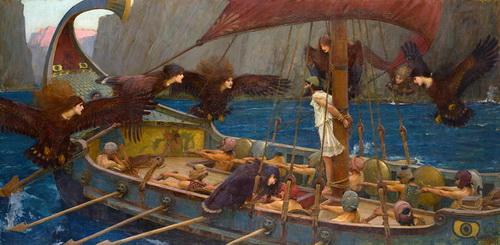
[25] And as they sailed past the Sirens,204 Orpheus restrained the Argonauts by chanting a counter-melody. Butes alone swam off to the Sirens, but Aphrodite carried him away and settled him in Lilybaeum.
After the Sirens, the ship encountered Charybdis and Scylla and the Wandering Rocks,205 above which a great flame and smoke were seen rising. But Thetis with the Nereids steered the ship through them at the summons of Hera.
Having passed by the Island of Thrinacia, where are the kine of the Sun,206 they came to Corcyra, the island of the Phaeacians, of which Alcinous was king.207 But when the Colchians could not find the ship, some of them settled at the Ceraunian mountains, and some journeyed to Illyria and colonized the Apsyrtides Islands. But some came to the Phaeacians, and finding the Argo there, they demanded of Alcinous that he should give up Medea. He answered, that if she already knew Jason, he would give her to him, but that if she were still a maid he would send her away to her father.208 However, Arete, wife of Alcinous, anticipated matters by marrying Medea to Jason;209 hence the Colchians settled down among the Phaeacians210 and the Argonauts put to sea with Medea.
[26] Sailing by night they encountered a violent storm, and Apollo, taking his stand on the Melantian ridges, flashed lightning down, shooting a shaft into the sea. Then they perceived an island close at hand, and anchoring there they named it Anaphe, because it had loomed up (anaphanenai) unexpectedly. So they founded an altar of Radiant Apollo, and having offered sacrifice they betook them to feasting; and twelve handmaids, whom Arete had given to Medea, jested merrily with the chiefs; whence it is still customary for the women to jest at the sacrifice211.
Putting to sea from there, they were hindered from touching at Crete by Talos.212 Some say that he was a man of the Brazen Race, others that he was given to Minos by Hephaestus; he was a brazen man, but some say that he was a bull. He had a single vein extending from his neck to his ankles, and a bronze nail was rammed home at the end of the vein. This Talos kept guard, running round the island thrice every day; wherefore, when he saw the Argo standing inshore, he pelted it as usual with stones. His death was brought about by the wiles of Medea, whether, as some say, she drove him mad by drugs, or, as others say, she promised to make him immortal and then drew out the nail, so that all the ichor gushed out and he died. But some say that Poeas shot him dead in the ankle.
After tarrying a single night there they put in to Aegina to draw water, and a contest arose among them concerning the drawing of the water.213 Thence they sailed betwixt Euboea and Locris and came to Iolcus, having completed the whole voyage in four months.
[27] Now Pelias, despairing of the return of the Argonauts, would have killed Aeson; but he requested to be allowed to take his own life, and in offering a sacrifice drank freely of the bull’s blood and died.214 And Jason’s mother cursed Pelias and hanged herself,215 leaving behind an infant son Promachus; but Pelias slew even the son whom she had left behind.216 On his return Jason surrendered the fleece, but though he longed to avenge his wrongs he bided his time. At that time he sailed with the chiefs to the Isthmus and dedicated the ship to Poseidon, but afterwards he exhorted Medea to devise how he could punish Pelias. So she repaired to the palace of Pelias and persuaded his daughters to make mince meat of their father and boil him, promising to make him young again by her drugs; and to win their confidence she cut up a ram and made it into a lamb by boiling it. So they believed her, made mince meat of their father and boiled him.217 But Acastus buried his father with the help of the inhabitants of Iolcus, and he expelled Jason and Medea from Iolcus.
[28] They went to Corinth, and lived there happily for ten years, till Creon, king of Corinth, betrothed his daughter Glauce to Jason, who married her and divorced Medea. But she invoked the gods by whom Jason had sworn, and after often upbraiding him with his ingratitude she sent the bride a robe steeped in poison, which when Glauce had put on, she was consumed with fierce fire along with her father, who went to her rescue.218 But Mermerus and Pheres, the children whom Medea had by Jason, she killed, and having got from the Sun a car drawn by winged dragons she fled on it to Athens.219 Another tradition is that on her flight she left behind her children, who were still infants, setting them as suppliants on the altar of Hera of the Height; but the Corinthians removed them and wounded them to death.220
Medea came to Athens, and being there married to Aegeus bore him a son Medus. Afterwards, however, plotting against Theseus, she was driven a fugitive from Athens with her son.221 But he conquered many barbarians and called the whole country under him Media,222 and marching against the Indians he met his death. And Medea came unknown to Colchis, and finding that Aeetes had been deposed by his brother Perses, she killed Perses and restored the kingdom to her father.223
FOOTNOTES TO BOOK I.
1 According to Hesiod (Hes. Th. 126ff.), Sky (Uranus) was a son of Earth (Gaia), but afterwards lay with his own mother and had by her Cronus, the giants, the Cyclopes, and so forth. As to the marriage of Sky and Earth, see the fragment of Eur. Chrys., quoted by Sextus Empiricus, Bekker (Nauck TGF(2), , Leipsig, 1889); Lucretius i.250ff., ii.991ff.; Verg. G. 2.325ff. The myth of such a marriage is widespread among the lower races. See E. B. Tylor, Primitive Culture (London, 1873), i.321ff., ii.370ff. For example, the Ewe people of Togo-land, in West Africa, think that the Earth is the wife of the Sky, and that their marriage takes place in the rainy season, when the rain causes the seeds to sprout and bear fruit. These fruits they regard as the children of Mother Earth, who in their opinion is the mother also of men and of gods, see J. Spieth, Die Ewe-Stämme (Berlin, 1906), p, 548. In the regions of the Senegal and the Niger it is believed that the Sky-god and the Earth-goddess are the parents of the principal spirits who dispense life and death, weal and woe, among mankind. See Maurice Delafosse, Haut-Sénégal-Niger (Paris, 1912), iii.173ff. Similarly the Manggerai, a people of West Flores, in the Indian Archipelago, personify Sky and Earth as husband and wife; the consummation of their marriage is manifested in the rain, which fertilizes Mother Earth, so that she gives birth to her children, the produce of the fields and the fruits of the trees. The sky is called langīt; it is the male power: the earth is called alang; it is the female power. Together they form a divine couple, called Moerī Kraèng. See H. B. Stapel, “Het Manggeraische Volk (West Flores),” Tijdschrift voor Indische Taal-Landen Volkenkunde, lvi. (Batavia and the Hague, 1914), .
2 Compare Hes. Th. 147ff. Instead of Gyes, some MSS. of Hesiod read Gyges, and this form of the name is supported by the Scholiast on Plat. Laws 7, 795c. Compare Ovid, Fasti iv.593; Hor. Carm. 2.17.14, iii.4.69, with the commentators.
3 Compare Hes. Th. 139ff.
4 Compare Hes. Th. 617ff. and for the description of Tartarus, Hes. Th. 717ff. According to Hesiod, a brazen anvil would take nine days and nights to fall from heaven to earth, and nine days and nights to fall from earth to Tartarus.
5 Compare Hes. Th. 132ff. who agrees in describing Cronus as the youngest of the brood. As Zeus, who succeeded his father Cronus on the heavenly throne, was likewise the youngest of his family (Hes. Th. 453ff.), we may conjecture that among the ancient Greeks or their ancestors inheritance was at one time regulated by the custom of ultimogeniture or the succession of the youngest, as to which see Folk-Lore in the Old Testament, i.429ff. In the secluded highlands of Arcadia, where ancient customs and traditions lingered long, King Lycaon is said to have been succeeded by his youngest son. See Apollod. 3.8.1.
6 Compare Hes. Th. 156-190. Here Apollodorus follows Hesiod, according to whom the Furies sprang, not from the genitals of Sky which were thrown into the sea, but from the drops of his blood which fell on Earth and impregnated her. The sickle with which Cronus did the deed is said to have been flung by him into the sea at Cape Drepanum in Achaia (Paus. 7.23.4). The barbarous story of the mutilation of the divine father by his divine son shocked the moral sense of later ages. See Plat. Re, 377e-378a; Plat. Euthyph. 5e-6a; Cicero, De natura deorum ii.24.63ff. Andrew Lang interpreted the story with some probability as one of a worldwide class of myths intended to explain the separation of Earth and Sky. See Andrew Lang, Custom and Myth (London, 1884), pff., and as to myths of the forcible separation of Sky and Earth, see E. B. Tylor, Primitive Culture, i.322ff.
7 Compare Hes. Th. 453-467ff.
8 According to Hesiod, Rhea gave birth to Zeus in Crete, and the infant god was hidden in a cave of Mount Aegeum (Hes. Th. 468-480). Diod. 5.70 mentions the legend that Zeus was born at Dicte in Crete, and that the god afterwards founded a city on the site. But according to Diodorus, or his authorities, the child was brought up in a cave on Mount Ida. The ancients were not agreed as to whether the infant god had been reared on Mount Ida or Mount Dicte. Apollodorus declares for Dicte, and he is supported by Verg. G. 4.153, Serv. Verg. A. 3.104, and the Vatican Mythographers (Scriptores rerum mythicarum Latini, ed. Bode, i. p, 79, First Vatican Mythographer 104; Second Vatican Mythographer 16). On the other hand the claim of Mount Ida is favoured by Callimachus, Hymn i.51; Ovid Fasti 4.207; and Lactantius Placidus on Statius, Theb. iv.784. The wavering of tradition on this point is indicated by Apollodorus, who, while he calls the mountain Dicte, names one of the god’s nurses Ida.
9 As to the nurture of Zeus by the nymphs, see Callimachus, Hymn 1.46ff.; Diod. 5.70.2ff.; Ovid, Fasti v.111ff.; Hyginus, Fab. 139; Hyginus, Ast. ii.13; Serv. Verg. A. 3.104; Lactantius Placidus on Statius, Theb. iv.784; Scriptores rerum mythicarum Latini, ed. Bode, i. p, 79 (First Vatican Mythographer 104; Second Vatican Mythographer 16). According to Callimachus, Amalthea was a goat. Aratus also reported, if he did not believe, the story that the supreme god had been suckled by a goat (Strab. 8.7.5), and this would seem to have been the common opinion (Diod. 5.70.3; Hyginus, Ast. ii.13; Second Vatican Mythographer 16). According to one account, his nurse Amalthea hung him in his cradle on a tree “in order that he might be found neither in heaven nor on earth nor in the sea” (Hyginus, Fab. 139). Melisseus, the father of his nurses Adrastia and Ida, is said to have been a Cretan king (Hyginus, Ast. ii.13); but his name is probably due to an attempt to rationalize the story that the infant Zeus was fed by bees. See Virgil, Geo. 1.149ff. with the note of Serv. Verg. G. 1.153; First Vatican Mythographer 104; Second Vatican Mythographer 16.
10 As to the Curetes in their capacity of guardians of the infant Zeus, see Callimachus, Hymn i.52ff.; Strab. 10.3.11; Diod. 5.70, 2-4; Lucretius ii.633-639; Verg. G. 3.150ff.; Ovid, Fasti iv.207ff.; Hyginus, Fab. 139; Serv. Verg. A. 3.104; Lactantius Placidus on Statius, Theb. iv.784; Scriptores rerum mythicarum Latini, ed. Bode, i. p, 79 (First Vatican Mythographer 104; Second Vatican Mythographer 16). The story of the way in which they protected the divine infant from his inhuman parent by clashing their weapons may reflect a real custom, by the observance of which human parents endeavoured to guard their infants against the assaults of demons. See Folk-Lore in the Old Testament, iii.472ff.
11 As to the trick by which Rhea saved Zeus from the maw of his father Cronus, see Hes. Th. 485ff.; Paus. 8.36.3; 9.2.7; 9.41.6; 10.24.6; Ovid, Fasti iv.199-206; Hyginus, Fab. 139; Serv. Verg. A. 3.104; Lactantius Placidus on Statius, Theb. iv.784; Scriptores rerum mythicarum Latini, ed. Bode, i. p, 79 (First Vatican Mythographer 104; Second Vatican Mythographer 16). The very stone which Cronus swallowed and afterwards spewed out was shown at Delphi down to the second century of our era; oil was daily poured on it, and on festival days unspun wool was laid on it (Paus. 10.24.6). We read that, on the birth of Zeus’s elder brother Poseidon, his mother Rhea saved the baby in like manner by giving his father Cronus a foal to swallow, which the deity seems to have found more digestible than the stone, for he is not said to have spat it out again (Paus. 8.8.2). Phalaris, the notorious tyrant of Agrigentum, dedicated in the sanctuary of Lindian Athena in Rhodes a bowl which was enriched with a relief representing Cronus in the act of receiving his children at the hand of Rhea and swallowing them. An inscription on the bowl set forth that it was a present from the famous artist Daedalus to the Sicilian king Cocalus. These things we learn from a long inscription which was found in recent years at Lindus: it contains an inventory of the treasures preserved in the temple of Athena, together with historical notes upon them. See Chr. Blinkenberg, La Chronique du temple Lindien (Copenhagen, 1912), (Académie Royale des Sciences et des Lettres de Danemark, Extrait du Bulletin de l’annèe 1912, No. 5-6).
12 As to the disgorging of his offspring by Cronus, see Hes. Th. 493ff., who, however, says nothing about the agency of Metis in administering an emetic, but attributes the stratagem to Earth (Gaia).
13 As to the war of Zeus on the Titans, see Hes. Th. 617ff.; Hor. Carm. 3.4.42ff.; Hyginus, Fab. 118.
14 The most ancient oracle at Delphi was said to be that of Earth; in her office of prophetess the goddess was there succeeded by Themis, who was afterwards displaced by Apollo. See Aesch. Eum. 1ff.; Paus. 10.5.5ff. It is said that of old there was an oracle of Earth at Olympia, but it no longer existed in the second century of our era. See Paus. 5.14.10. At Aegira in Achaia the oracles of Earth were delivered in a subterranean cave by a priestess, who had previously drunk bull’s blood as a means of inspiration. See Pliny, Nat. Hist. xxviii.147; compare Paus. 7.25.13. In the later days of antiquity the oracle of Earth at Delphi was explained by some philosophers on rationalistic principles: they supposed that the priestess was thrown into the prophetic trance by natural exhalations from the ground, and they explained the decadence of the oracle in their own time by the gradual cessation of the exhalations. The theory is scouted by Cicero. See Plut. De defectu oraculorum 40ff.; Cicero, De divinatione i.19.38, i.36.79, ii.57.117. A similar theory is still held by wizards in Loango, on the west coast of Africa; hence in order to receive the inspiration they descend into an artificial pit or natural hollow and remain there for some time, absorbing the blessed influence, just as the Greek priestesses for a similar purpose descended into the oracular caverns at Aegira and Delphi. See Die Loango Expedition, iii.2, von Dr. E. Pechuel Loesche (Stuttgart, 1907), . As to the oracular cavern at Delphi and the inspiring exhalations which were supposed to emanate from it, see Diod. 16.26; Strabo 9.3.5; Paus. 10.5.7; Justin xxiv.6.6-9. That the Pythian priestess descended into the cavern to give the oracles appears from an expression of Plutarch (De defectu oraculorum, 51, κατέβη μὲν εἰς τὸ μαντεῖον). As to the oracles of Earth in antiquity, see A. Bouche-Leclercq, Histoire de la Divination dans l’Antiquité, ii.251ff.; L. R. Farnell, The Cults of the Greek States, iii.8ff.
15 Compare Hes. Th. 501-506ff.
16 Compare Hes. Th. 717ff.
17 Compare Hom. Il. 15.187ff.; Plat. Gorg. 523a.
18 Compare Hes. Th. 346-366, who mentions all the Oceanids named by Apollodorus except Amphitrite, who was a Nereid. See Apollod. 1.2.7; Hes. Th. 243.
19 As to the offspring of Coeus and Phoebe, see Hes. Th. 404ff.
20 As to the offspring of Hyperion and Thia, see Hes. Th. 371ff.
21 As to the offspring of Crius and Eurybia, see Hes. Th. 375ff.
22 As to the offspring of Iapetus and Asia, see Hes. Th. 507-520ff.
23 It is said that Cronus assumed the shape of a horse when he consorted with Philyra, and that, we are told, was why Chiron was born a centaur, half-man, half-horse. See Scholiast on Ap. Rhod., Argon. i.554.
24 As to the offspring of Dawn and Astraeus, see Hes. Th. 378ff.
25 As to this parentage of Hecate, see Hes. Th. 409ff. But the ancients were not agreed on the subject. See the Scholiast on Ap. Rhod., Argon. iii.467. He tells us that according to the Orphic hymns, Hecate was a daughter of Deo; according to Bacchylides, a daughter of Night; according to Musaeus, a daughter of Zeus and Asteria; and according to Pherecydes, a daughter of Aristaeus.
26 For this brood of abstractions, the offspring of Styx and Pallas, see Hes. Th. 383ff.; Hyginus, Fab. , ed. Bunte.
27 Compare Hes. Th. 389-403ff. As to the oath by the water of Styx, see further Hes. Th. 775ff.; compare Hom. Il. 15.37ff., Hom. Od. 5.186; HH Apoll. 86ff.
28 As to the offspring of Sea ( Pontus, conceived as masculine) and Earth (conceived as feminine), see Hes. Th. 233ff.; Hyginus, Fab. , ed. Bunte.
29 As to the offspring of Thaumas and Electra, see Hes. Th. 265ff.
30 As to the parentage of the Phorcides and Gorgons, see Hes. Th. 270ff.; Hyginus, Fab. , ed. Bunte. As to the monsters themselves, see Apollod. 2.4.2ff.
31 For lists of Nereids, see Hom. Il. 18.38-49; Hes. Th. 240-264ff.; HH Dem. 417-423; Verg. G. 4.334-344; Hyginus, Fab. pff., ed. Bunte.
32 As to the offspring of Zeus and Hera, see Hom. Il. 5.889ff. (Ares), Hom. Il. 11.270ff. (Ilithyia), Hom. Od. 11.603ff. (Hebe); Hes. Th. 921ff. According to Hesiod, Hera was the last consort whom Zeus took to himself; his first wife was Metis, and his second Themis (Hes. Th. 886; Hes. Th. 901; Hes. Th. 921).
33 For the daughters of Zeus and Themis, see Hes. Th. 901ff.
34 As to Dione, mother of Aphrodite, see Hom. Il. 5.370ff.; Eur. Hel. 1098; Hyginus, Fab. , ed. Bunte. Hesiod represents Aphrodite as born of the sea-foam which gathered round the severed genitals of Sky (Uranus). See Hes. Th. 188ff.
35 As to the parentage of the Graces, see Hes. Th. 907ff.; Paus. 9.35.5; Hyginus, Fab. , ed. Bunte.
36 According to the usual account, the mother of Persephone was not Styx but Demeter. See Hes. Th. 912ff.; HH Dem. 1ff.; Paus. 8.37.9; Hyginus, Fab. , ed. Bunte.
37 As to the names and parentage of the Muses, see Hes. Th. 915ff.
38 Accounts differ as to the parentage of Linus. According to one, he was a son of Apollo by the Muse Urania (Hyginus, Fab. 161); according to another, he was a son of Apollo by Psamathe, daughter of Crotopus (Paus. 2.19.8); according to another, he was a son of Apollo by Aethusa, daughter of Poseidon (Contest 314 according to another, he was a son of Magnes by the Muse Clio (Tzetzes, Scholiast on Lycophron 831).
39 That Orpheus was a son of Oeagrus by the Muse Calliope is affirmed also by Ap. Rhod., Argon. i.23ff.; Conon 45; Tzetzes, Scholiast on Lycophron 831; the author of Contest 314; Hyginus, Fab. 14; and Scriptores rerum mythicarum Latini. ed. G. H. Bode, i. p, 90 (First and Second Vatican Mythographers). The same view was held by Asclepiades, but some said that his mother was the Muse Polymnia (Scholiast on Ap. Rhod., Argon. i.23). Pausanias roundly denied that the musician’s mother was the Muse Calliope (Paus. 9.30.4). That his father was Oeagrus is mentioned also by Plat. Sym.179d, Diod. 4.25.2, and Clement of Alexandria, Protrept. 7, , ed. Potter. As to the power of Orpheus to move stones and trees by his singing, see Eur. Ba. 561ff.; Ap. Rhod., Argon. i.26ff.; Diod. 4.25.2; Eratosthenes, Cat. 24; Conon 45; Hor. Carm. 1.12.7ff.; Seneca, Herakles Oetaeus 1036ff.; Seneca, Herakles Furens 572ff.
40 As to the descent of Orpheus to hell to fetch up Eurydice, compare Paus. 9.30.6; Conon 45; Verg. G. 4.454ff.; Ov. Met. 10.8ff.; Hyginus, Fab. 164; Seneca, Herakles Furens 569ff.; Seneca, Herakles Oetaeus 1061ff.; Lactantius Placidus on Statius, Theb. viii.59, 60; Scriptores rerum mythicarum Latini, ed. Bode, i. pff. 90 (First Vatican Mythographer 76; Second Vatican Mythographer 44). That Eurydice was killed by the bite of a snake on which she had accidentally trodden is mentioned by Virgil, Ovid, Hyginus, and the Vatican Mythographers.
41 On Orpheus as a founder of mysteries, compare Eur. Rh. 943ff.; Arist. Frogs 1032; Plat. Prot. 369d; Plat. Re.365e-366a; Dem. 25.11; Diod. 1.23, Diod. 1.96.2-6, Diod. 3.65.6, Diod. 4.25.3, Diod. 5.77.3; Paus. 2.30.2, Paus. 9.30.4, Paus. 10.7.2; Plut. Frag. 84 (Plutarch, Didot ed., v. ). According to Diod. 1.23, the mysteries of Dionysus which Orpheus instituted in Greece were copied by him from the Egyptian mysteries of Osiris. The view that the mysteries of Dionysus were based on those of Osiris has been maintained in recent years by the very able and learned French scholar, Monsieur Paul Foucart. See his treatise, Le culte de Dionysos en Attique (Paris, 1904), pff.; Foucart, Les mystères d’ Eleusis (Paris, 1914), pff., 445ff.
42 As to the death of Orpheus at the hands of the Maenads or the Thracian women, see Paus. 9.30.5; Conon 45; Eratosthenes, Cat. 24; Verg. G. 4.520ff.; Ov. Met. 11.1ff. Usually the women are said to have been offended by the widower’s constancy to the memory of his late wife, and by his indifference to their charms and endearments. But Eratosthenes, or rather the writer who took that name, puts a different complexion on the story. He says that Orpheus did not honour Dionysus, but esteemed the sun the greatest of the gods, and used to rise very early every day in order to see the sunrise from the top of Mount Pangaeum. This angered Dionysus, and he stirred up the Bassarids or Bacchanals to rend the bard limb from limb. Aeschylus wrote a tragedy on the subject called the Bassarids or Bassarae. See TGF (Nauck 2nd ed.), (Leipsig, 1889), pff.
43 As to the death of Hyacinth, killed by the cast of Apollo’s quoit, see Nicander, Ther. 901ff.; Paus. 3.19.4ff.; Lucian, Dial. Deorum xiv.; Philostratus, Im. i.23(24); Palaephatus, De incredib. 47; Ov. Met. 10.162ff.; Serv. Verg. Ecl. 3.63; Lactantius Placidus on Statius, Theb. iv.223; Scriptores rerum mythicarum Latini, ed. Bode, i. p, 135ff. ( First Vatican Mythographer 117; Second Vatican Mythographer 181). The usual story ran that Apollo and the West Wind, or, according to others, the North Wind, were rivals for the affection of Hyacinth; that Hyacinth preferred Apollo, and that the jealous West Wind took his revenge by blowing a blast which diverted the quoit thrown by Apollo, so that it struck Hyacinth on the head and killed him. From the blood of the slain youth sprang the hyacinth, inscribed with letters which commemorated his tragic death; though the ancients were not at one in the reading of them. Some, like Ovid, read in them the exclamation AI AI, that is, “Alas, alas!” Others, like the Second Vatican Mythographer, fancied that they could detect in the dark lines of the flower the first Greek letter (Υ) of Hyacinth’s name.
44 This account of Thamyris and his contest with the Muses is repeated almost verbally by Zenobius, Cent. iv.27, and by a Scholiast on Hom. Il. 2.595. As to the bard’s rivalry with the Muses, and the blindness they inflicted on him, see Hom. Il. 2.594-600; compare Eur. Rh. 915ff.; Scriptores rerum mythicarum Latini, ed. Bode, i. (First Vatican Mythographer 197). The story of the punishment of Thamyris in hell was told in the epic poem The Minyad, attributed to Prodicus the Phocaean (Paus. 4.33.7). In the great picture of the underworld painted by Polygnotus at Delphi, the blind musician was portrayed sitting with long flowing locks and a broken lyre at his feet (Paus. 10.30.8).
45 As to the death of Rhesus, see Hom. Il. 10.474ff.; compare Conon 4. It is the subject of Euripides’s tragedy Rhesus; see particularly verses Eur. Rh. 756ff. Euripides represents Rhesus as a son of the river Strymon by one of the Muses ( Eur. Rh. 279, Eur. Rh. 915ff.), but he does not name the particular Muse who bore him.
46 Very discrepant accounts were given of the parentage of the Corybantes. Some said that they were sons of the Sun by Athena; others that their parents were Zeus and the Muse Calliope; others that their father was Cronus. See Strab. 10.3.19. According to another account, their mother was the Mother of the Gods, who settled them in Samothrace, or the Holy Isle, as the name Samothrace was believed to signify. The name of the father of the Corybantes was kept a secret from the profane vulgar, but was revealed to the initiated at the Samothracian mysteries. See Diod. 3.55.8ff.
47 As to the Sirens, see Apollod. E.7.18ff. Elsewhere (Apollod. 1.7.10) Apollodorus mentions the view that the mother of the Sirens was Sterope.
48 Compare Hes. Th. 927ff.; Lucian, De sacrificiis 6. So Juno is said to have conceived Mars by the help of the goddess Flora and without intercourse with Jupiter (Ovid, Fasti v.229ff.). The belief in the possible impregnation of women without sexual intercourse appears to have been common, if not universal, among men at a certain stage of social evolution, and it is still held by many savages. See Adonis, Attis, Osiris, 3rd ed. i.92ff.; Folk-Lore in the Old Testament, ii.204, notes; A. et G. Grandidier, Ethnographie de Madagascar, ii. (Paris, 1914), pff. The subject is fully discussed by Mr. E. S. Hartland in his Primitive Paternity (London, 1909-1910).
49 Compare Hom. Il. 1.571ff., Hom. Il. 1.577ff. In these lines Hephaestus plainly recognizes Hera as his mother, but it is not equally clear that he recognizes Zeus as his father; the epithet “father” which he applies to him may refer to the god’s general paternity in relation to gods and men.
50 See Hom. Il. 1.590ff.
51 See Hom. Il. 15.18ff., where Zeus is said to have tied two anvils to the feet of Hera when he hung her out of heaven. Compare Apollod. 2.7.1; Nonnus, in Westermann’s Mythographi Graeci (Brunswick, 1843), Appendix Narrationum, xxix, 1, pff.
52 The significance of lameness in myth and ritual is obscure. The Yorubas of West Africa say that Shankpanna, the god of smallpox, is lame and limps along with the aid of a stick, one of his legs being withered. See A. B. Ellis, The Yoruba-speaking peoples of the Slave Coast of West Africa (London, 1894), . The Ekoi of Southern Nigeria relate how the first fire on earth was stolen from heaven by a boy, whom the Creator (Obassi Osaw) punished with lameness for the theft. See P. Amaury Talbot, In the Shadow of the Bush (London, 1912), pff. This lame boy seems to play the part of a good fairy in Ekoi tales, and he is occasionally represented in a “stilt play” by an actor who has a short stilt bound round his right leg and limps like a cripple. See P. Amaury Talbot, op. cit. p, 285. Among the Edo of Benin “custom enjoined that once a year a lame man should be dragged around the city, and then as far as a place on the Enyai road, called Adaneha. This was probably a ceremony of purification.” See W. N. Thomas, Anthropological Report on the speaking peoples of Nigeria, Part 1. (London, 1910), . In a race called “the King’s Race,” which used to be run by lads on Good Friday or Easter Saturday in some parts of the Mark of Brandenburg, the winner was called “the King,” and the last to come in was called “the Lame Carpenter.” One of the Carpenter’s legs was bandaged with splints as if it were broken, and he had to hobble along on a crutch. Thus he was led from house to house by his comrades, who collected eggs to bake a cake. See A. Kuhn, Märkische Sagen und Marchen (Berlin, 1843), pff.
53 As to the fall of Hephaestus on Lemnos, see Hom. Il. 1.590ff.; Lucian, De sacrificiis 6. The association of the fire-god with Lemnos is supposed to have been suggested by a volcano called Moschylus, which has disappeared — perhaps submerged in the sea. See H. F. Tozer, The Islands of the Aegean, pff.; Jebb on Soph. Ph. 800, with the Appendix, p-245. According to another account, Hephaestus fell, not on Lemnos, but into the sea, where he was saved by Thetis. See Hom. Il. 18.394ff.
54 See Hes. Th. 886-900, Hes. Th. 929g-929p; Scholiast on Plat. Tim. 23d. Hesiod says that Zeus acted on the advice or warning of Earth and Sky. The Scholiast on Hesiod, quoted by Goettling and Paley in their commentaries, says that Metis had the power of turning herself into any shape she pleased.
55 Compare the Scholiast on Hom. Il. 1.195, who cites the first book of Apollodorus as his authority. According to the usual account, followed by the vase-painters, it was Hephaestus who cleft the head of Zeus with an axe and so delivered Athena. See Pind. O. 7.35(65); Scholiast on Plat. Tim. 23d. According to Euripides (Eur. Ion 454ff.), the delivery was effected by Prometheus; but according to others it was Palamaon or Hermes who split the head of the supreme god and so allowed Athena to leap forth. See the Scholiast on Pind. O. 7.35(65).
56 Compare Callimachus, Hymn to Delos 36ff.; Tzetzes, Scholiast on Lycophron 401; Hyginus, Fab. 53; Serv. Verg. A. 3.73; Lactantius Placidus on Statius, Theb. iv.795; Scriptores rerum mythicarum Latini, ed. Bode, i. p, 79ff.; (First Vatican Mythographer 37; Second Vatican Mythographer 17).
57 As to the birth of Apollo and Artemis, see the HH Apoll. 14ff.; Pind. On Delos, , ed. Sandys; Hyginus, Fab. 140; and the writers cited in the preceding note. The usual tradition was that Latona gave birth both to Artemis and to Apollo in Delos, which formerly had been called Asteria or Ortygia. But the author of the Homeric Hymn to Apollo distinguishes Ortygia from Delos, and says that, while Apollo was born in Delos, Artemis was born in Ortygia. Thus distinguished from Delos, the island of Ortygia is probably to be identified, as Strabo thought, with Rhenia, an uninhabited island a little way from Delos, where were the graves of the Delians; for no dead body might be buried or burnt in Delos (Strab. 10.5.5). Not only so, but it was not even lawful either to be born or to die in Delos; expectant mothers and dying folk were ferried across to Rhenia, there to give birth or to die. However, Rhenia is so near the sacred isle that when Polycrates, tyrant of Samos, dedicated it to the Delian Apollo, he connected the two islands by a chain. See Thuc. 3.104; Diod. 12.58.1; Paus. 2.27.1. The notion that either a birth or a death would defile the holy island is illustrated by an inscription found on the acropolis of Athens, which declares it to be the custom that no one should be born or die within any sacred precinct. See Ἐφημερὶς Ἀρχαιολογική, Athens, 1884, pff. The desolate and ruinous remains of the ancient necropolis, overgrown by asphodel, may still be seen on the bare treeless slopes of Rhenia, which looks across the strait to Delos. See H. F. Tozer, The Islands of the Aegean (Oxford, 1890), pff. The quaint legend, recorded by Apollodorus, that immediately after her birth Artemis helped her younger twin brother Apollo to be born into the world, is mentioned also by Serv. Verg. A. 3.73 and the Vatican Mythographers (see the reference in the last note). The legend, these writers inform us, was told to explain why the maiden goddess Artemis was invoked by women in child-bed.
58 Pan, son of Zeus and Thymbreus (Thymbris? Hybris?), is mentioned by a Scholiast on Pindar, who distinguishes him from Pan, the son of Hermes and Penelope. See the Argument to the Pythians, , ed. Boeckh.
59 As to the oracle of Themis at Delphi, see Aesch. Eum. 1ff.; Eur. IT 1259ff.; Paus. 10.5.6; Scholiast on Pind. Argument to the Pythians, , ed. Boeckh. According to Ov. Met. 1.367ff., it was Themis, and not Apollo, whom Deucalion consulted at Delphi about the best means of repeopling the earth after the great flood.
60 The reference is to the oracular chasm at which the priestess, under the supposed influence of its divine exhalations, delivered her prophecies. See Diod. 16.26; Strab. 9.3.5; Justin xxiv.6.9.
61 As to Apollo’s slaughter of the Python, the dragon that guarded the oracle at Delphi, see Plut. Quaest. Graec. 12; Plut. De defectu oraculorum 15; Ael., Var. Hist. iii.1; Paus. 2.7.7, Paus. 2.30.3, Paus. 10.6.5ff.; Ov. Met. 1.437ff.; Hyginus, Fab. 140. From Plutarch and Aelian we learn that Apollo had to go to Tempe to be purified for the slaughter of the dragon, and that both the slaughter of the dragon and the purification of the god were represented every eighth year in a solemn festival at Delphi. See Frazer, on Paus. 2.7.7 (Paus. vol 3. pff.). The Pythian games at Delphi were instituted in honour of the dead dragon (Ovid and Hyginus, Fab. 140; compare Clement of Alexandria, Protrept. 2, , ed. Potter), probably to soothe his natural anger at being slain.
62 Compare Scholiast on Hom. Od. 7.324; Eustathius on Hom. Od. 7.324, ; Ap. Rhod., Argon. i.761ff., with the Scholiast on 761. The curious story how Zeus hid his light o’ love under the earth to save her from the jealous rage of Hera was told by the early mythologist and antiquarian Pherecydes of Athens, as we learn from the Scholiast on Ap. Rhod., (l.c.). Pherecydes was a contemporary of Herodotus and Hellanicus, and wrote in the first half of the fifth century B.C. Apollodorus often refers to him, and appears to have made much use of his writings, as I shall have occasion to observe in the course of these notes. With regard to Elare or Elara, the mother of Tityus, some people thought that she was a daughter of Minyas, not of Orchomenus (Scholiast on Hom. and Eustathius on Hom. Od. vii.324, ). Because Tityus was brought up under the earth, he was said to be earth-born (γηγενής, Scholiast on Ap. Rhod., Argon. i.761). Homer calls him simply a son of Earth (Hom. Od. 11.576), and in this he is followed by Verg. A. 6.595.
63 As to the crime and punishment of Tityus, see Hom. Od. 11.576-581; Pind. P. 4.90(160)ff., with the Scholiast on Pind. P. 4.90(160); Lucretius iii.984ff.; Verg. A. 6.595ff.; Hor. Carm. 2.14.8ff., iii.4.77ff., iii.11.21ff., iv.6.2ff.; Hyginus, Fab. 55; Scriptores rerum mythicarum Latini, ed. Bode, i. p, 110 (First Vatican Mythographer 13; Second Vatican Mythographer 104). The tomb of Tityus was shown at Panopeus in Phocis; it was a mound or barrow about a third of a furlong in circumference. See Paus. 10.4.5. In Euboea there was shown a cave called Elarium after the mother of Tityus, and Tityus himself had a shrine where he was worshipped as a hero (Strab. 9.3.14). The death of Tityus at the hands of Apollo and Artemis was represented on the throne of Apollo at Amyclae (Paus. 3.18.15), and it was the subject of a group of statuary dedicated by the Cnidians at Delphi (Paus. 10.11.1). His sufferings in hell were painted by Polygnotus in his famous picture of the underworld at Delphi. The great artist represented the sinner worn to a shadow, but no longer racked by the vultures gnawing at his liver (Paus. 10.29.3).
64 As she played on the pipes, she is said to have seen her puffed and swollen cheeks reflected in water. See Plut. De cohibenda ira 6; Athenaeus xiv.7, ef; Prop. iii.22(29). 16ff.; Ovid, Fasti vi.697ff.; Ovid, Ars Am. iii.505ff.; Hyginus, Fab. 165; Fulgentius, Mytholog. iii.9; Scriptores rerum mythicarum Latini, ed. G.H.Bode, i. p, 114 (First Vatican Mythographer 125; Second Vatican Mythographer 115). On the acropolis at Athens there was a group of statuary representing Athena smiting Marsyas because he had picked up the flutes which she had thrown away (Paus. 1.24.1). The subject was a favourite theme in ancient art. See Frazer, note on Paus. 10.29.3 (vol. ii. pff.).
65 As to the musical contest between Marsyas and Apollo, and the punishment of the vanquished Marsyas, see Diod. 3.59; Paus. 2.22.9; Ov. Met. 6.382ff.; Ovid, Fasti vi.703ff.; Hyginus, Fab. 165; Scriptores rerum mythicarum Latini, ed. Bode, i. p, 114 (First Vatican Mythographer 125; Second Vatican Mythographer 115). There has been some doubt as to the interpretation of the words τὴν κιθάραν στρέψας; but that they mean simply “turned the lyre upside down,” as Heyne correctly explained them, is shown by a comparison with the parallel passages in Hyginus (”citharam versabat”) and the Second Vatican Mythographer (”invertit citharam, et canere coepit. Inversis autem tibiis, quum se Marsya Apollini aequiparare nequiret,” etc.). That the tree on which Marsyas was hanged was a pine is affirmed by many ancient writers besides Apollodorus. See Nicander, Alex. 301ff., with the Scholiast’s note; Lucian, Tragodopodagra 314ff.; Archias Mitylenaeus in Anth. Pal. vii.696; Philostratus Junior, Im. i.3; Longus, Pastor. iv.8; Zenobius, Cent. iv.81; Tzetzes, Chiliades i.353ff. Pliny alone describes the tree as a plane, which in his time was still shown at Aulocrene on the way from Apamea to Phrygia (Pliny, Nat. Hist. xvi.240). The skin of the flayed Marsyas was exhibited at Celaenae within historical times. See Hdt. 7.26; Xen. Ana. 1.2.8; Livy xxxviii.13.6; Quintus Curtius iii.1.1-5; Pliny, Nat. Hist. v.106.
66 See Hom. Od. 5.121-124; Hor. Carm. 3.4.70ff.
67 The same account of Orion’s parentage was given by Hesiod, whom Pherecydes probably followed. See Eratosthenes, Cat. 32; Hyginus, Ast. ii.34.
68 Some thought that Orion waded through the sea (so Verg. A. 10.763ff.), others that he walked on the top of it (so Eratosthenes, Cat. 32; Scholiast on Nicander, Ther. 15; Hyginus, Ast. ii.34).
69 As Side means “pomegranate” in Greek, it has been supposed that the marriage of Orion to Side is a mythical expression for the ripening of the pomegranate at the season when the constellation Orion is visible in the nightly sky. See W. Pape, Worterbuch der griechischen Eigennamen (Brunswick, 1884), ii.1383.
70 This quaint story of Orion and Oenopion is told also by Eratosthenes, Cat. 32; the Old Scholiast on Aratus, Phaenomena 322, quoted in Epicorum Graecorum Fragmenta, ed. G. Kinkel, ; the Scholiast on Nicander, Ther. 15; Hyginus, Ast. ii.34; Serv. Verg. A. 10.763; and the Scriptores rerum mythicarum Latini, ed. Bode, i. (First Vatican Mythographer 33), except that this last writer substitutes Minos, king of Crete, for Oenopion. The name of the guide whom Orion took on his back to guide him to the sunrise was Cedalion (Lucian, De domo 28; Eratosthenes, Cat.; and Hyginus, Ast. ii.34.). Sophocles made the story the theme of a satyric drama called Cedalion, of which a few fragments have come down to us. See TGF (Nauck 2nd ed.), pff.; The Fragments of Sophocles, ed. A. C. Pearson, vol. ii. pff. Euripides represents the blinded Polymestor praying to the Sun to restore his sight (Eur. Hec. 1067ff.).
71 Compare Scholiast on Hom. Od. 5.121, who calls the maiden Upis. According to another, and more generally received, account, Orion died of the bite of a scorpion, which Artemis sent against him because he had attempted her chastity. For this service the scorpion was raised to the rank of a constellation in the sky, and Orion attained to a like dignity. That is why the constellation Orion flies for ever from the constellation Scorpion round the sky. See Aratus, Phaenomena 634ff.; Nicander, Ther. 13ff.; Eratosthenes, Cat. 32; Scholiast on Hom. Il. xviii.486; Scholiast on Hom. Od. v.121; Lactantius Placidus on Statius, Theb. iii.27; Scholiast on Caesar Germanicus, Aratea, , ed. Eyssenhardt, in his edition of Martianus Capella. The Scholiast on Hom. Il. xviii.486, cites as his authority Euphorion, a grammarian and poet of the fourth century B.C.
72 Compare Hes. Th. 930ff.
73 Rhode, more commonly in the form Rhodos, is a personification of the island of Rhodes, which Pindar calls the Bride of the Sun (Pind. O. 7.14), because it was the great seat of the worship of the Sun in ancient Greece. A Rhodian inscription of about 220 B.C. records public prayers offered by the priests “to the Sun and Rhodos and all the other gods and goddesses and founders and heroes who have the city and the land of the Rhodians in their keeping.” See P. Cauer, Delectus Inscriptionum Graecarum, , No. 181; Ch. Michel, Recueil d’Inscriptions Grecques, , No. 21; H. Collitz and F. Bechtel, Sammlung der griechischen Dialekt Inschriften, vol. iii. , No. 3749. Every year the Rhodians threw into the sea a chariot and four horses for the use of the Sun, apparently supposing that after riding a whole year across the sky his old chariot and horses must be quite worn out. See Festus, s.v. “October equus,” , ed. C. O. Muller.
74 This account of the rape of Persephone and Demeter’s quest of her is based on the Homeric Hymn to Demeter. The opening passage, including the explanation of the Laughless Stone, is quoted verbally by Zenobius, (Cent. i.7) and the Scholiast on Aristoph. Kn. 785, but without mention of their authority. For other accounts of the rape of Persephone and Demeter’s quest of her, see Diod. 5.4.1-3, Diod. 5.68.2; Cicero, In Verrem, Act. 2. lib. 4, ca; Ovid, Fasti iv.419ff.; Ov. Met. 5.346ff.; Hyginus, Fab. 146; Lactantius Placidus on Statius, v.347; Scriptores rerum mythicarum Latini, ed. Bode, i. p-108 (Second Vatican Mythographer 93-100). All these writers agree in mentioning Sicily as the scene of the rape of Persephone; Cicero and Ovid identify the place with Enna (Henna), of which Cicero gives a vivid description. The author of the Homeric Hymn to Demeter says (HH Dem. 16ff.) that the earth yawned “in the Nysian plain,” but whether this was a real or a mythical place is doubtful. See T. W. Allen and E. E. Sikes, The Homeric Hymns, (on Hymn i.8). It was probably the luxuriant fertility of Sicily, and particularly the abundance of its corn, which led later writers to place the scene of the rape in that island. In Ovid’s version of the visit of Demeter to Eleusis (Ovid, Fasti iv.507ff.), Celeus is not the king of the place but a poor old peasant, who receives the disguised goddess in his humble cottage.
75 This visit paid by the mourning Demeter to Hermion, when she was searching for the lost Persephone, is not mentioned by the author of the Homeric Hymn to Demeter, nor, so far as I know, by any other ancient writer except Zenobius, Cent. i.7 and the Scholiast on Aristoph. Kn. 785, both of whom, however, merely copied Apollodorus without naming him. But compare Paus. 2.35.4-8, who mentions the sanctuary of Subterranean Demeter at Hermion, and describes the curious sacrificial ritual observed at it. At Hermion there was a chasm which was supposed to communicate with the infernal regions, and through which Herakles was said to have dragged up Cerberus (Paus. 2.35.10). The statement of Apollodorus in the present passage suggests that according to local tradition Pluto dragged down his bride to hell through the same chasm. So convinced were the good people of Hermion that they possessed a private entrance to the nether regions that they very thriftily abstained from the usual Greek practice of placing money in the mouths of their dead (Strab. 9.6.12). Apparently they thought that it would be a waste of money to pay Charon for ferrying them across to hell when they could get there for nothing from their own backdoor.
76 Compare HH Dem. 98ff., who says that Demeter, sad at heart, sat down by the wayside at the Maiden’s Well, under the shadow of an olive tree. Later in the poem (HH. Dem. 270ff. Demeter directs the people of Eleusis to build her a temple and altar “above Callichorum” — that is, the Well of the Fair Dances. Apollodorus identifies the well beside which Demeter sat down with the Well of the Fair Dances. But from Paus. 1.38.6 we learn that the two wells were different and situated at some distance from each other, the Well of the Fair Dances being close to the Sanctuary of Demeter, and the Maiden’s Well, or the Flowery Well, as Pausanias calls it, being outside Eleusis, on the road to Megara. In the course of the modern excavation of the sanctuary at Eleusis, the Well of the Fair Dances was discovered just outside the portal of the sacred precinct. It is carefully built of polygonal stones, and the mouth is surrounded by concentric circles, round which the women of Eleusis probably tripped in the dance. See Πρακτικὰ τῆς Ἀρχαιολογικῆς Ἑταιρίας, Athens, 1892, pff. In antiquity solemn oaths were sworn by the water of the well (Alciphron iii.69).
77 As to the jesting of the old woman with Demeter, see HH Dem. 194-206; Scholiast on Nicander, Alex. 130, who calls Demeter’s host Hippothoon, son of Poseidon.
78 The jests seem to have been obscene in form (Diod. 5.4.6), but they were probably serious in intention; for at the Thesmophoria rites were performed to ensure the fertility of the fields, and the lewd words of the women may have been thought to quicken the seed by sympathetic magic. See Scholia in Lucianum, ed. H. Rabe (Leipsig, 1906), pff.; Spirits of the Corn and of the Wild, i.62ff., 116, ii.17ff.
79 See Frazer’s Appendix to Apollodorus, “Putting Children on the Fire.”
80 Compare Cornutus, Theologiae Graecae Compendium 28, pff. ed. C. Lang; Ovid, Fasti iv.559ff.; Ovid, Tristia iii.8. (9) 1ff.; Hyginus, Fab. 147; Hyginus, Ast. ii.14; Serv. Verg. G. 1.19, 163; Lactantius Placidus on Statius, Theb. ii.382; Scriptores rerum mythicarum Latini, ed. Bode, i. p, 107 (First Vatican Mythographer 8; Second Vatican Mythographer 97). The dragon-car of Triptolemus was mentioned by Sophocles in his lost tragedy Triptolemus. See TGF (Nauck 2nd ed.), , frag. 539; The Fragments of Sophocles, ed. A. C. Pearson, ii.243, frag. 596. In Greek vase-paintings Triptolemus is often represented in his dragon-car. As to the representations of the car in ancient art, see Stephani, in Compte Rendu (St. Petersburg) for 1859, pff.; Frazer, note on Paus. vii.18.3 (vol. iv. pff.); and especially A. B. Cook, Zeus, i. (Cambridge, 1914), pff., who shows that on the earlier monuments Triptolemus is represented sitting on a simple wheel, which probably represents the sun. Apparently he was a mythical embodiment of the first sower. See Spirits of the Corn and of the Wild, i.72ff.
81 The accounts given of the parentage of Triptolemus were very various (Paus. 1.14.2ff.), which we need not wonder at when we remember that he was probably a purely mythical personage. As to Eleusis, the equally mythical hero who is said to have given his name to Eleusis, see Paus. 8.38.7. He is called Eleusinus by Hyginus, Fab. 147 and Serv. Verg. G. 1.19.
82 The Maid (Kore) is Persephone. As to her eating a seed or seeds of a pomegranate, see HH Dem. 371ff., HH Dem. 411ff.; Ov. Met. 5.333ff.; Ovid, Fasti iv.601ff.; Serv. Verg. G. 1.39 and Serv. Aen. 4.462; Lactantius Placidus on Statius, Theb. iii.511; Scriptores rerum mythicarum Latini, ed. Bode, i. p, 108 ((First Vatican Mythographer 7; Second Vatican Mythographer 100). There is a widespread belief that if a living person visits the world of the dead and there partakes of food, he cannot return to the land of the living. T