


автордың кітабын онлайн тегін оқу The Plattner Story
H. G. Wells
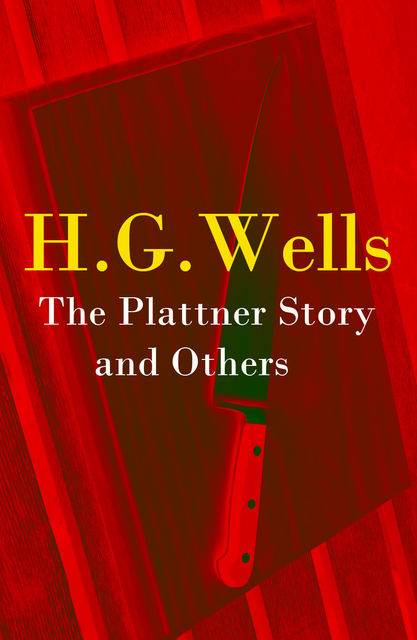
The Plattner Story and Others (The original 1897 edition of 17 fantasy and science fiction short stories)
© e-artnow, 2013
ISBN 978-80-7484-871-1
Cover:
Donovan Govan, a wooden chopping board with a chef's knife, 2005
Editorial note:
This eBook is an exact transcription of the original text.
Table of Contents
The Plattner Story
The Argonauts of the Air
The Story of the Late Mr. Elvesham
In the Abyss
The Apple
Under the Knife
The Sea Raiders
Pollock and the Porroh Man
The Red Room
The Cone
The Purple Pileus
The Jilting of Jane
In the Modern Vein: An Unsympathetic Love Story
A Catastrophe
The Lost Inheritance
The Sad Story of a Dramatic Critic
A Slip Under the Microscope
The Plattner Story
Table of Contents
Whether the story of Gottfried Plattner is to be credited or not, is a pretty question in the value of evidence. On the one hand, we have seven witnesses — to be perfectly exact, we have six and a half pairs of eyes, and one undeniable fact; and on the other we have — what is it —? Prejudice, common sense, the inertia of opinion. Never were there seven more honest-seeming witnesses; never was there a more undeniable fact than the inversion of Gottfried Plattner’s anatomical structure, and — never was there a more preposterous story than the one they have to tell! The most preposterous part of the story is the worthy Gottfried’s contribution (for I count him as one of the seven). Heaven forbid that I should be led into giving countenance to superstition by a passion for impartiality, and so come to share the fate of Eusapia’s patrons! Frankly, I believe there is something crooked about this business of Gottfried Plattner; but what that crooked factor is, I will admit as frankly, I do not know. I have been surprised at the credit accorded to the story in the most unexpected and authoritative quarters. The fairest way to the reader, however will be for me to tell it without further comment.
Gottfried Plattner is, in spite of his name, a free-born Englishman. His father was an Alsatian who came to England in the Sixties, married a respectable English girl of unexceptionable antecedents, and died, after a wholesome and uneventful life (devoted, I understand, chiefly to the laying of parquet flooring), in 1887. Gottfried’s age is seven-and-twenty. He is, by virtue of his heritage of three languages, Modern Languages Master in a small private school in the South of England. To the casual observer he is singularly like any other Modern Languages Master in any other small private school. His costume is neither very costly nor very fashionable, but on the other hand it is not markedly cheap or shabby; his complexion, like his height and his bearing, is inconspicuous. You would notice, perhaps that, like the majority of people, his face was not absolutely symmetrical, his right eye a little larger than the left, and his jaw a trifle heavier on the right side. If you, as an ordinary careless person, were to bare his chest and feel his heart beating, you would probably find it quite like the heart of any one else. But here you and the trained observer would part company. If you found his heart quite ordinary, the trained observer would find it quite otherwise. And once the thing was pointed out to you, you too would perceive the peculiarity easily enough. It is that Gottfried’s heart beats on the right side of his body.
Now, that is not the only singularity of Gottfried’s structure, although it is the only one that would appeal to the untrained mind. Careful sounding of Gottfried’s internal arrangements, by a well-known surgeon, seems to point to the fact that all the other unsymmetrical parts of his body are similarly misplaced. The right lobe of his liver is on the left side, the left on his right; while his lungs too, are similarly contraposed. What is still more singular, unless Gottfried is a consummate actor, we must believe that his right hand has recently become his left. Since the occurrences we are about to consider (as impartially as possible), he has found the utmost difficulty in writing, except from right to left across the paper with his left hand. He cannot throw with his right hand, he is perplexed at meal times between knife and fork, and his ideas of the rule of the road — he is a cyclist — are still a dangerous confusion. And there is not a scrap of evidence to show that before these occurrences Gottfried was at all left-handed. There is yet another wonderful fact in this preposterous business. Gottfried produces three photographs of himself. You have him at the age of five or six, thrusting fat legs at you from under a plaid frock, and scowling. In that photograph his left eye is a little larger than his right, and his jaw is a trifle heavier on the left side. This is the reverse of his present living conditions: The photograph of Gottfried at fourteen seems to contradict these facts, but that is because it is one of those cheap “Gem” photographs that were then in vogue, taken direct upon metal, and therefore reversing things just as a looking-glass would. A third photograph represents him at one-and-twenty and confirms the record of the others. There seems here evidence of the strongest confirmatory character that Gottfried has exchanged his left side for his right. Yet how a human being can be so changed, short of a fantastic and pointless miracle, it is exceedingly hard to suggest.
In one way, of course, these facts might be explicable on the supposition that Plattner has undertaken an elaborate mystification, on the strength of his heart’s displacement. Photographs may be fudged, and left-handedness imitated. But the character of the man does not lend itself to any such theory. He is quiet, practical, unobtrusive and thoroughly sane, from the Nordau standpoint. He likes beer, and smokes moderately, takes walking exercise daily, and has a healthily high estimate of the value of his teaching. He has a good but untrained tenor voice, and takes a pleasure in singing airs of a popular and cheerful character. He is fond, but not morbidly fond, of reading —, chiefly fiction pervaded with a vaguely pious optimism —, sleeps well, and rarely dreams. He is in fact, the very last person to evolve a fantastic fable. Indeed, so far from forcing this story upon the world, he has been singularly reticent on the matter. He meets enquirers with a certain engaging — bashfulness is almost the word, that disarms the most suspicious. He seems genuinely ashamed that anything so unusual has occurred to him.
It is to be regretted that Plattner’s aversion to the idea of post-mortem dissection may postpone, perhaps for ever, the positive proof that his entire body has had its left and right sides transposed. Upon that fact mainly the credibility of his story hangs. There is no way of taking a man and moving him about in space, as ordinary people understand space, that will result in our changing his sides. Whatever you do, his right is still his right, his left his left. You can do that with a perfectly thin and flat thing, of course. If you were to cut a figure out of paper, any figure with a right and left side, you could change its sides simply by lifting it up and turning it over. But with a solid it is different. Mathematical theorists tell us that the only way in which the right and left sides of a solid body can be changed is by taking that body clean out of space as we know it —, taking it out of ordinary existence, that is, and turning it somewhere outside space. This is a little abstruse, no doubt, but any one with any knowledge of mathematical theory will assure the reader of its truth. To put the thing in technical language, the curious inversion of Plattner’s right and left sides is proof that he has moved out of our space into what is called the Fourth Dimension, and that he has returned again to our world. Unless we choose to consider ourselves the victims of an elaborate and motiveless fabrication, we are almost bound to believe that this has occurred.
So much for the tangible facts. We come now to the account of the phenomena that attended his temporary disappearance from the world. It appears that in the Sussexville Proprietary School Plattner not only discharged the duties of Modern Languages Master, but also taught chemistry, commercial geography, book-keeping, shorthand, drawing, and any other additional subject to which the changing fancies of the boys’ parents might direct attention. He knew little or nothing of these various subjects, but in secondary as distinguished from Board or elementary schools, knowledge in the teacher is, very properly, by no means so necessary as high moral character and gentlemanly tone. In chemistry he was particularly deficient, knowing he says, nothing beyond the Three Gases (whatever the three gases may be). As however, his pupils began by knowing nothing, and derived all their information from him, this caused him (or any one) but little inconvenience for several terms. Then a little boy named Whibble joined the school, who had been educated (it seems) by some mischievous relative into an enquiring habit of mind. This little boy followed Plattner’s lessons with marked and sustained interest, and in order to exhibit his zeal on the subject, brought at various times, substances for Plattner to analyse. Plattner, flattered by this evidence of his power of awakening interest, and trusting to the boy’s ignorance, analysed these, and even made general statements as to their composition. Indeed he was so far stimulated by his pupil as to obtain a work upon analytical chemistry and study it during his supervision of the evening’s preparation. He was surprised to find chemistry quite an interesting subject.
So far the story is absolutely commonplace. But now the greenish powder comes upon the scene. The source of that greenish powder seems, unfortunately lost. Master Whibble tells a tortuous story of finding it done up in a packet in a disused limekiln near the Downs. It would have been an excellent thing for Plattner, and possibly for Master Whibble’s family, if a match could have been applied to that powder there and then. The young gentleman certainly did not bring it to school in a packet, but in a common eight-ounce graduated medicine bottle, plugged with masticated newspaper. He gave it to Plattner at the end of the afternoon school. Four boys had been detained after school prayers in order to complete some neglected tasks, and Plattner was supervising these in the small classroom in which the chemical teaching was conducted. The appliances for the practical teaching of chemistry in the Sussexville Proprietary School, as in most small schools in this country, are characterised by a severe simplicity. They are kept in a small cupboard standing in a recess, and having about the same capacity as a common travelling trunk. Plattner, being bored with his passive superintendence, seems to have welcomed the intervention of Whibble with his green powder as an agreeable diversion, and unlocking this cupboard, proceeded at once with his analytical experiments. Whibble sat, luckily for himself, at a safe distance, regarding him. The four malefactors, feigning a profound absorption in their work, watched him furtively with the keenest interest. For even within the limits of the Three Gases, Plattner’s practical chemistry was, I understand, temerarious.
They are practically unanimous in their account of Plattner’s proceedings. He poured a little of the green powder into a test-tube, and tried the substance with water, hydrochloric acid, nitric acid, and sulphuric acid in succession. Getting no result, he emptied out a little heap — nearly half the bottleful, in fact — upon a slate and tried a match. He held the medicine bottle in his left hand. The stuff began to smoke and melt, and then — exploded with deafening violence and a blinding flash.
The five boys, seeing the flash and being prepared for catastrophes, ducked below their desks, and were none of them seriously hurt. The window was blown out into the playground, and the blackboard on its easel was upset. The slate was smashed to atoms. Some plaster fell from the ceiling. No other damage was done to the school edifice or appliances, and the boys at first, seeing nothing of Plattner, fancied he was knocked down and lying out of their sight below the desks. They jumped out of their places to go to his assistance, and were amazed to find the space empty. Being still confused by the sudden violence of the report, they hurried to the open door, under the impression that he must have been hurt, and have rushed out of the room. But Carson, the foremost, nearly collided in the doorway with the principal, Mr. Lidgett.
Mr. Lidgett is a corpulent, excitable man with one eye. The boys describe him as stumbling into the room mouthing some of those tempered expletives irritable schoolmasters accustom themselves to use — lest worse befall. “Wretched mumchancer!” he said. “Where’s Mr. Plattner?” The boys are agreed on the very words. (“Wobbler,” “snivelling puppy,” and “mumchancer” are, it seems, among the ordinary small change of Mr. Lidgett’s scholastic commerce.)
Where’s Mr. Plattner? That was a question that was to be repeated many times in the next few days. It really seemed as though that frantic hyperbole, “blown to atoms,” had for once realise itself. There was not a visible particle of Plattner to be seen; not a drop of blood nor a stitch of clothing to be found. Apparently he had been blown clean out of existence and left not a wrack behind. Not so much as would cover a sixpenny piece, to quote a proverbial expression! The evidence of his absolute disappearance, as a consequence of that explosion, is indubitable.
It is not necessary to enlarge here upon the commotion excited in the Sussexville Proprietary School, and in Sussexville and elsewhere, by this event. It is quite possible indeed, that some of the readers of these pages may recall the hearing of some remote and dying version of that excitement during the last summer holidays. Lidgett, it would seem, did everything in his power to suppress and minimise the story. He instituted a penalty of twenty-five lines for any mention of Plattner’s name among the boys, and stated in the schoolroom that he was clearly aware of his assistant’s whereabouts. He was afraid, he explains, that the possibility of an explosion happening, in spite of the elaborate precautions taken to minimise the practical teaching of chemistry, might injure the reputation of the school; and so might any mysterious quality in Plattner’s departure. Indeed, he did everything in his power to make the occurrence seem as ordinary as possible. In particular, he cross-examined the five eye-witnesses of the occurrence so searchingly that they began to doubt the plain evidence of their senses. But in spite of these efforts, the tale, in a magnified and distorted state, made a nine days’ wonder in the district, and several parents withdrew their sons on colourable pretexts. Not the least remarkable point in the matter is the fact that a large number of people in the neighbourhood dreamed singularly vivid dreams of Plattner during the period of excitement before his return, and that these dreams had a curious uniformity. In almost all of them Plattner was seen, sometimes singly, sometimes in company, wandering about through a coruscating iridescence. In all cases his face was pale and distressed, and in some he gesticulated towards the dreamer. One or two of the boys, evidently under the influence of nightmare, fancied that Plattner approached them with remarkable swiftness, and seemed to look closely into their very eyes. Others fled with Plattner from the pursuit of vague and extraordinary creatures of a globular shape. But all these fancies were forgotten in enquiries and speculations when, on the Wednesday next, but one after the Monday of the explosion, Plattner returned.
The circumstances of his return were as singular as those of his departure. So far as Mr. Lidgett’s somewhat choleric outline can be filled in from Plattner’s hesitating statements, it would appear that on Wednesday evening, towards the hour of sunset, the former gentleman, having dismissed evening preparation, was engaged in his garden, picking and eating strawberries, a fruit of which he is inordinately fond. It is a large old-fashioned garden, secured from observation fortunately, by a high and ivy-covered red-brick wall. Just as he was stooping over a particularly prolific plant, there was a flash in the air and a heavy thud, and before he could look round, some heavy body struck him violently from behind. He was pitched forward, crushing the strawberries he held in his hand, and that so roughly, that his silk hat — Mr. Lidgett adheres to the older ideas of scholastic costume — was driven violently down upon his forehead, and almost over one eye. This heavy missile, which slid over him sideways and collapsed into a sitting posture among the strawberry plants, proved to be our long-lost Mr. Gottfried Plattner, in an extremely dishevelled condition. He was collarless and hatless, his linen was dirty, and there was blood upon his hands. Mr. Lidgett was so indignant and surprised that he remained on all-fours, and with his hat jammed down on his eye, while he expostulated vehemently with Plattner for his disrespectful and unaccountable conduct.
This scarcely idyllic scene completes what I may call the exterior version of the Plattner story — its exoteric aspect. It is quite unnecessary to enter here into all the details of his dismissal by Mr. Lidgett. Such details, with the full names and dates and references, will be found in the larger report of these occurrences that was laid before the Society for the Investigation of Abnormal Phenomena. The singular transposition of Plattner’s right and left sides was scarcely observed for the first day or so, and then first in connection with his disposition to write from right to left across the blackboard. He concealed rather than ostended this curious confirmatory circumstance, as he considered it would unfavourably affect his prospects in a new situation. The displacement of his heart was discovered some months after, when he was having a tooth extracted under anaesthetics. He then, very unwillingly, allowed a cursory surgical examination to be made of himself, with a view to a brief account in the “Journal of Anatomy.” That exhausts the statement of the material facts; and we may now go on to consider Plattner’s account of the matter.
But first let us clearly differentiate between the preceding portion of this story and what is to follow. All I have told thus far is established by such evidence as even a criminal lawyer would approve. Every one of the witnesses is still alive; the reader, if he have the leisure, may hunt the lads out tomorrow, or even brave the terrors of the redoubtable Lidgett, and cross-examine and trap and test to his heart’s content; Gottfried Plattner himself, and his twisted heart and his three photographs are producible. It may be taken as proved that he did disappear for nine days as the consequence of an explosion; that he returned almost as violently, under circumstances in their nature annoying to Mr. Lidgett, whatever the details of those circumstances may be; and that he returned inverted, just as a reflection returns from a mirror. From the last fact, as I have already stated, it follows almost inevitably that Plattner, during those nine days, must have been in some state of existence altogether out of space. The evidence to these statements is indeed, far stronger than that upon which most murderers are hanged. But for his own particular account of where he had been, with its confused explanations and well-nigh self-contradictory details, we have only Mr. Gottfried Plattner’s word. I do not wish to discredit that, but I must point out — what so many writers upon obscure psychic phenomena fail to do — that we are passing here from the practically undeniable to that kind of matter which any reasonable man is entitled to believe or reject as he thinks proper. The previous statements render it plausible; its discordance with common experience tilts it towards the incredible. I would prefer not to sway the beam of the reader’s judgment either way, but simply to tell the story as Plattner told it me. He gave me his narrative, I may state, at my house at Chislehurst, and so soon as he had left me that evening, I went into my study and wrote down everything as I remembered it. Subsequently he was good enough to read over a type-written copy, so that its substantial correctness is undeniable.
He states that at the moment of the explosion he distinctly thought he was killed. He felt lifted off his feet and driven forcibly backward. It is a curious fact for psychologists that he thought clearly during his backward flight, and wondered whether he should hit the chemistry cupboard or the blackboard easel. His heels struck ground, and he staggered and fell heavily into a sitting position on something soft and firm. For a moment the concussion stunned him. He became aware at once of a vivid scent of singed hair, and he seemed to hear the voice of Lidgett asking for him. You will understand that for a time his mind was greatly confused.
At first he was distinctly under the impression that he was still in the classroom. He perceived quite distinctly the surprise of the boys and the entry of Mr. Lidgett. He is quite positive upon that score. He did not hear their remarks; but that he ascribed to the deafening effect of the experiment. Things about him seemed curiously dark and faint, but his mind explained that on the obvious but mistaken idea that the explosion had engendered a huge volume of dark smoke.
Through the dimness the figures of Lidgett and the boys moved, as faint and silent as ghosts Plattner’s face still tingled with the stinging heat of the flash. He was, he says, “all muddled.” His first definite thoughts seem to have been of his personal safety. He thought he was perhaps blinded and deafened. He felt his limbs and face in a gingerly manner. Then his perceptions grew clearer, and he was astonished to miss the old familiar desks and other schoolroom furniture about him. Only dim, uncertain, grey shapes stood in the place of these. Then came a thing that made him shout aloud, and awoke his stunned faculties to instant activity. Two of the boys, gesticulating, walked one after the other clean through him! Neither manifested the slightest consciousness of his presence. It is difficult to imagine the sensation he felt. They came against him, he says, with no more force than a wisp of mist.
Plattner’s first thought after that was that he was dead. Having been brought up with thoroughly sound views in these matters, however he was a little surprised to find his body still about him. His second conclusion was that he was not dead, but that the others were: that the explosion had destroyed the Sussexville Proprietary School and every soul in it except himself. But that too, was scarcely satisfactory. He was thrown back upon astonished observation.
Everything about him was extraordinarily dark: at first it seemed to have an altogether ebony blackness. Overhead was a black firmament. The only touch of light in the scene was a faint greenish glow at the edge of the sky in one direction, which threw into prominence a horizon of undulating black hills. This I say, was his impression at first. As his eye grew accustomed to the darkness, he began to distinguish a faint quality of differentiating greenish colour in the circumambient night. Against this background the furniture and occupants of the classroom, it seems, stood out like phosphorescent spectres, faint and impalpable. He extended his hand, and thrust it without an effort through the wall of the room by the fireplace.
He describes himself as making a strenuous effort to attract attention. He shouted to Lidgett, and tried to seize the boys as they went to and fro. He only desisted from these attempts when Mrs. Lidgett, whom he (as an Assistant Master) naturally disliked, entered the room. He says the sensation of being in the world, and yet not a part of it, was an extraordinarily disagreeable one. He compared his feelings, not inaptly, to those of a cat watching a mouse through a window. Whenever he made a motion to communicate with the dim, familiar world about him, he found an invisible, incomprehensible barrier preventing intercourse. He then turned his attention to his solid environment. He found the medicine bottle still unbroken in his hand, with the remainder of the green powder therein. He put this in his pocket, and began to feel about him. Apparently, he was sitting on a boulder of rock covered with a velvety moss. The dark country about him, he was unable to see, the faint, misty picture of the schoolroom blotting it out, but he had a feeling (due perhaps to a cold wind) that he was near the crest of a hill, and that a steep valley fell away beneath his feet. The green glow along the edge of the sky seemed to be growing in extent and intensity. He stood up, rubbing his eyes.
It would seem that he made a few steps, going steeply downhill, and then stumbled, nearly fell, and sat down again upon a jagged mass of rock to watch the dawn. He became aware that the world about him was absolutely silent. It was as still as it was dark, and though there was a cold wind blowing up the hill-face, the rustle of grass, the soughing of the boughs that should have accompanied it, were absent. He could hear, therefore, if he could not see, that the hillside upon which he stood was rocky and desolate. The green grew brighter every moment, and as it did so, a faint, transparent blood-red mingled with, but did not mitigate, the blackness of the sky overhead and the rocky desolations about him. Having regard to what follows, I am inclined to think that, that redness may have been an optical effect due to contrast. Something black fluttered momentarily against the livid yellow-green of the lower sky, and then the thin and penetrating voice of a bell rose out of the black gulf below him. An oppressive expectation grew with the growing light.
It is probable that an hour or more elapsed while he sat there, the strange green light growing brighter every moment, and spreading slowly, in flamboyant fingers, upward towards the zenith. As it grew, the spectral vision of our world became relatively or absolutely fainter. Probably both, for the time must have been about that of our earthly sunset. So far as his vision of our world went, Plattner, by his few steps downhill, had passed through the floor of the classroom, and was now, it seemed, sitting in mid-air in the larger schoolroom downstairs. He saw the boarders distinctly, but much more faintly than he had seen Lidgett. They were preparing their evening tasks, and he noticed with interest that several were cheating with their Euclid riders by means of a crib, a compilation whose existence he had hitherto never suspected. As the time passed, they faded steadily, as steadily as the light of the green dawn increased.
Looking down into the valley, he saw that the light had crept far down its rocky sides, and that the profound blackness of the abyss was now broken by a minute green glow, like the light of a glow-worm. And almost immediately the limb of a huge heavenly body of blazing green rose over the basaltic undulations of the distant hills, and the monstrous hill-masses about him came out gaunt and desolate, in green light and deep, ruddy black shadows. He became aware of a vast number of ball-shaped objects drifting as thistledown drifts over the high ground. There were none of these nearer to him than the opposite side of the gorge. The bell below twanged quicker and quicker, with something like impatient insistence, and several lights moved hither and thither. The boys at work at their desks were now almost imperceptibly faint.
This extinction of our world, when the green sun of this other universe rose, is a curious point upon which Plattner insists. During the Other–World night, it is difficult to move about, on account of the vividness with which the things of this world are visible. It becomes a riddle to explain why, if this is the case, we in this world catch no glimpse of the Other–World. It is due, perhaps, to the comparatively vivid illumination of this world of ours. Plattner describes the midday of the Other–World, at its brightest as not being nearly so bright as this world at full moon, while its night is profoundly black. Consequently, the amount of light, even in an ordinary dark room, is sufficient to render the things of the Other–World invisible, on the same principle that faint phosphorescence is only visible in the profoundest darkness. I have tried, since he told me his story, to see something of the Other–World by sitting for a long space in a photographer’s dark room at night. I have certainly seen indistinctly the form of greenish slopes and rocks, but only, I must admit, very indistinctly indeed. The reader may possibly be more successful. Plattner tells me that since his return he has dreamt and seen and recognised places in the Other–World, but this is probably due to his memory of these scenes. It seems quite possible that people with unusually keen eyesight may occasionally catch a glimpse of this strange Other–World about us.
However, this is a digression. As the green sun rose, a long street of black buildings became perceptible, though only darkly and indistinctly, in the gorge, and after some hesitation, Plattner began to clamber down the precipitous descent towards them. The descent was long and exceedingly tedious, being so not only by the extraordinary steepness, but also by reason of the looseness of the boulders with which the whole face of the hill was strewn. The noise of his descent — now and then his heels struck fire from the rocks — seemed now the only sound in the universe, for the beating of the bell had ceased. As he drew nearer, he perceived that the various edifices had a singular resemblance to tombs and mausoleums and monuments, saving only that they were all uniformly black instead of being white, as most sepulchres are. And then he saw, crowding out of the largest building, very much as people disperse from church, a number of pallid, rounded, pale-green figures. These dispersed in several directions about the broad street of the place, some going through side alleys and reappearing upon the steepness of the hill, others entering some of the small black buildings which lined the way.
At the sight of these things drifting up towards him, Plattner stopped staring. They were not walking, they were indeed limbless, and they had the appearance of human heads, beneath which a tadpole-like body swung. He was too astonished at their strangeness, too full, indeed of strangeness, to be seriously alarmed by them. They drove towards him, in front of the chill wind that was blowing uphill, much as soap-bubbles drive before a draught. And as he looked at the nearest of those approaching, he saw it was indeed a human head, albeit with singularly large eyes, and wearing such an expression of distress and anguish as he had never seen before upon mortal countenance. He was surprised to find that it did not turn to regard him, but seemed to be watching and following some unseen moving thing. For a moment he was puzzled, and then it occurred to him that this creature was watching with its enormous eyes something that was happening in the world he had just left. Nearer it came, and nearer, and he was too astonished to cry out. It made a very faint fretting sound as it came close to him. Then it struck his face with a gentle pat —, its touch was very cold —, and drove past him, and upward towards the crest of the hill.
An extraordinary conviction flashed across Plattner’s mind that this head had a strong likeness to Lidgett. Then he turned his attention to the other heads that were now swarming thickly up the hillside. None made the slightest sign of recognition. One or two, indeed, came close to his head and almost followed the example of the first, but he dodged convulsively out of the way. Upon most of them he saw the same expression of unavailing regret he had seen upon the first, and heard the same faint sounds of wretchedness from them. One or two wept, and one rolling swiftly uphill wore an expression of diabolical rage. But others were cold, and several had a look of gratified interest in their eyes. One at least, was almost in an ecstasy of happiness. Plattner does not remember that he recognised any more likenesses in those he saw at this time.
For several hours, perhaps Plattner watched these strange things dispersing themselves over the hills, and not till long after they had ceased to issue from the clustering black buildings in the gorge, did he resume his downward climb. The darkness about him increased so much that he had a difficulty in stepping true. Overhead the sky was now a bright, pale green. He felt neither hunger nor thirst. Later, when he did, he found a chilly stream running down the centre of the gorge, and the rare moss upon the boulders, when he tried it at last in desperation, was good to eat.
He groped about among the tombs that ran down the gorge, seeking vaguely for some clue to these inexplicable things. After a long time he came to the entrance of the big mausoleum-like building from which the heads had issued. In this he found a group of green lights burning upon a kind of basaltic altar, and a bell-rope from a belfry overhead hanging down into the centre of the place. Round the wall ran a lettering of fire in a character unknown to him. While he was still wondering at the purport of these things, he heard the receding tramp of heavy feet echoing far down the street. He ran out into the darkness again, but he could see nothing. He had a mind to pull the bell-rope, and finally decided to follow the footsteps. But, although he ran far, he never overtook them; and his shouting was of no avail. The gorge seemed to extend an interminable distance. It was as dark as earthly starlight throughout its length, while the ghastly green day lay along the upper edge of its precipices. There were none of the heads, now, below. They were all, it seemed, busily occupied along the upper slopes. Looking up, he saw them drifting hither and thither, some hovering stationary, some flying swiftly through the air. It reminded him, he said, of “big snowflakes”; only these were black and pale green.
In pursuing the firm, undeviating footsteps that he never overtook, in groping into new regions of this endless devil’s dyke, in clambering up and down the pitiless heights, in wandering about the summits, and in watching the drifting faces, Plattner states that he spent the better part of seven or eight days. He did not keep count, he says. Though once or twice he found eyes watching him, he had word with no living soul. He slept among the rocks on the hillside. In the gorge things earthly were invisible, because from the earthly standpoint, it was far underground. On the altitudes, so soon as the earthly day began, the world became visible to him. He found himself sometimes stumbling over the dark green rocks, or arresting himself on a precipitous brink, while all about him the green branches of the Sussexville lanes were swaying; or again, he seemed to be walking through the Sussexville streets, or watching unseen the private business of some household. And then it was he discovered, that to almost every human being in our world there pertained some of these drifting heads: that every one in the world is watched intermittently by these helpless disembodiments.
What are they — these Watchers of the Living? Plattner never learned. But two, that presently found and followed him, were like his childhood’s memory of his father and mother. Now and then other faces turned their eyes upon him: eyes like those of dead people who had swayed him, or injured him, or helped him in his youth and manhood. Whenever they looked at him, Plattner was overcome with a strange sense of responsibility. To his mother he ventured to speak; but she made no answer. She looked sadly, steadfastly, and tenderly — a little reproachfully too, it seemed — into his eyes.
He simply tells this story: he does not endeavour to explain. We are left to surmise who these Watchers of the Living may be, or if they are indeed the Dead, why they should so closely and passionately watch a world they have left for ever. It may be — indeed to my mind it seems just — that, when our life has closed, when evil or good is no longer a choice for us, we may still have to witness the working out of the train of consequences we have laid. If human souls continue after death, then surely human interests continue after death. But that is merely my own guess at the meaning of the things seen. Plattner offers no interpretation, for none was given him. It is well the reader should understand this clearly. Day after day, with his head reeling, he wandered about this green-lit world outside the world, weary and, towards the end, weak and hungry. By day — by our earthly day, that is — the ghostly vision of the old familiar scenery of Sussexville, all about him, irked and worried him. He could not see where to put his feet, and ever and again with a chilly touch one of these Watching Souls would come against his face. And after dark the multitude of these Watchers about him, and their intent distress, confused his mind beyond describing. A great longing to return to the earthly life that was so near and yet so remote consume him. The unearthliness of things about him produced a positively painful mental distress. He was worried beyond describing by his own particular followers. He would shout at them to desist from staring at him, scold at them, hurry away from them. They were always mute and intent. Run as he might over the uneven ground, they followed his destinies.
On the ninth day, towards evening, Plattner heard the invisible footsteps approaching, far away down the gorge. He was then wandering over the broad crest of the same hill upon which he had fallen in his entry into this strange Other–World of his. He turned to hurry down into the gorge, feeling his way hastily, and was arrested by the sight of the thing that was happening in a room in a back street near the school. Both of the people in the room he knew by sight. The windows were open, the blinds up, and the setting sun shone clearly into it, so that it came out quite brightly at first, a vivid oblong of room, lying like a magic-lantern picture upon the black landscape and the livid green dawn. In addition to the sunlight, a candle had just been lit in the room.
On the bed lay a lank man, his ghastly white face terrible upon the tumbled pillow. His clenched hands were raised above his head. A little table beside the bed carried a few medicine bottles, some toast and water, and an empty glass. Every now and then the lank man’s lips fell apart, to indicate a word he could not articulate. But the woman did not notice that he wanted anything, because she was busy turning out papers from an old-fashioned bureau in the opposite corner of the room. At first the picture was very vivid indeed, but as the green dawn behind it grew brighter and brighter, so it became fainter and more and more transparent.
As the echoing footsteps paced nearer and nearer, those footsteps that sound so loud in that Other–World and come so silently in this, Plattner perceived about him a great multitude of dim faces gathering together out of the darkness and watching the two people in the room. Never before had he seen so many of the Watchers of the Living. A multitude had eyes only for the sufferer in the room, another multitude, in infinite anguish, watched the woman as she hunted with greedy eyes for something she could not find. They crowded about Plattner, they came across his sight and buffeted his face, the noise of their unavailing regrets was all about him. He saw clearly only now and then. At other times the picture quivered dimly, through the veil of green reflections upon their movements. In the room it must have been very still, and Plattner says the candle flame streamed up into a perfectly vertical line of smoke, but in his ears each footfall and its echoes beat like a clap of thunder. And the faces! Two, more particularly near the woman’s: one a woman’s also, white and clear-featured, a face which might have once been cold and hard, but which was now softened by the touch of a wisdom strange to earth. The other might have been the woman’s father. Both were evidently absorbed in the contemplation of some act of hateful meanness, so it seemed, which they could no longer guard against and prevent. Behind were others, teachers, it may be, who had taught ill, friends whose influence had failed. And over the man, too — a multitude, but none that seemed to be parents or teachers! Faces that might once have been coarse, now purged to strength by sorrow! And in the forefront one face, a girlish one, neither angry nor remorseful, but merely patient and weary, and as it seemed to Plattner, waiting for relief. His powers of description fail him at the memory of this multitude of ghastly countenances. They gathered on the stroke of the bell He saw them all in the space of a second. It would seem that he was so worked on by his excitement that, quite involuntarily, his restless fingers took the bottle of green powder out of his pocket and held it before him. But he does not remember that.
Abruptly the footsteps ceased. He waited for the next, and there was silence, and then suddenly cutting through the unexpected stillness like a keen, thin blade, came the first stroke of the bell. At that the multitudinous faces swayed to and fro and a louder crying began all about him. The woman did not hear; she was burning something now in the candle flame. At the second stroke everything grew dim, and a breath of wind, icy cold, blew through the host of watchers. They swirled about him like an eddy of dead leaves in the spring, and at the third stroke something was extended through them to the bed. You have heard of a beam of light. This was like a beam of darkness, and looking again at it, Plattner saw that it was a shadowy arm and hand.
The green sun was now topping the black desolations of the horizon, and the vision of the room was very faint. Plattner could see that the white of the bed struggled, and was convulsed; and that the woman looked round over her shoulder at it, startled.
The cloud of watchers lifted high like a puff of green dust before the wind, and swept swiftly downward towards the temple in the gorge. Then suddenly Plattner understood the meaning of the shadowy black arm that stretched across his shoulder and clutched its prey. He did not dare turn his head to see the Shadow behind the arm. With a violent effort, and covering his eyes, he set himself to run, made perhaps twenty strides, then slipped on a boulder, and fell. He fell forward on his hands; and the bottle smashed and exploded as he touched the ground.
In another moment he found himself, stunned and bleeding, sitting face to face with Lidgett in the old walled garden behind the school.
There the story of Plattner’s experiences ends. I have resisted, I believe successfully, the natural disposition of a writer of fiction to dress up incidents of this sort. I have told the thing as far as possible in the order in which Plattner told it to me. I have carefully avoided any attempt at style, effect, or construction. It would have been easy, for instance, to have worked the scene of the death-bed into a kind of plot in which Plattner might have been involved. But, quite apart from the objectionableness of falsifying a most extraordinary true story, any such trite devices would spoil to my mind, the peculiar effect of this dark world, with its livid green illumination and its drifting Watchers of the Living, which, unseen and unapproachable to us, is yet lying all about us.
It remains to add, that a death did actually occur in Vincent Terrace, just beyond the school garden, and so far as can be proved, at the moment of Plattner’s return. Deceased was a rate-collector and insurance agent. His widow, who was much younger than himself, married last month a Mr. Whymper, a veterinary surgeon of Allbeeding. As the portion of this story given here has in various forms circulated orally in Sussexville, she has consented to my use of her name, on condition that I make it distinctly known that she emphatically contradicts every detail of Plattner’s account of her husband’s last moments. She burnt no will, she says, although Plattner never accused her of doing so; her husband made but one will, and that just after their marriage. Certainly, from a man who had never seen it, Plattner’s account of the furniture of the room was curiously accurate.
One other thing, even at the risk of an irksome repetition, I must insist upon, lest I seem to favour the credulous, superstitious view. Plattner’s absence from the world for nine days is, I think, proved. But that does not prove his story. It is quite conceivable that even outside space hallucinations may be possible. That at least, the reader must bear distinctly in mind.
The Argonauts of the Air
Table of Contents
One saw Monson’s Flying Machine from the windows of the trains passing either along the South–Western main line or along the line between Wimbledon and Worcester Park —, to be more exact, one saw the huge scaffolding which limited the flight of the apparatus. They rose over the tree-tops, a massive alley of interlacing iron and timber, and an enormous web of ropes and tackle, extending the best part of two miles. From the Leatherhead branch this alley was foreshortened and in part hidden by hill with villas; but from the main line one had it in profile, a complex tangle of girders and curving bars, very impressive to the excursionists from Portsmouth and Southampton and the West. Monson had taken up the work where Maxim had left it, had gone on at first with an utter contempt for the journalistic wit and ignorance that had irritated and hampered his predecessor, and had spent (it was said) rather more than half his immense fortune upon his experiments. The results, to an impatient generation, seemed inconsiderable. When some five years had passed after the growth of the colossal iron groves at Worcester Park, and Monson still failed to put in a fluttering appearance over Trafalgar Square, even the Isle of Wight trippers felt their liberty to smile. And such intelligent people as did not consider Monson a fool stricken with the mania for invention, denounced him as being (for no particular reason) a self-advertising quack.
Yet now and again a morning trainload of season-ticket holders would see a white monster rush headlong through the airy tracery of guides and bars, and hear the further stays, nettings and buffers snap, creak, and groan with the impact of the blow. Then there would be an efflorescence of black-set white-rimmed faces along the sides of the train, and the morning papers would be neglected for a vigorous discussion of the possibility of flying (in which nothing new was ever said by any chance), until the train reached Waterloo, and its cargo of season-ticket holders dispersed themselves over London. Or the fathers and mothers in some multitudinous train of weary excursionists returning exhausted from a day of rest by the sea, would find the dark fabric, standing out against the evening sky, useful in diverting some bilious child from its introspection, and be suddenly startled by the swift transit of a huge black flapping shape that strained upward against the guides. It was a great and forcible thing beyond dispute, and excellent for conversation; yet all the same, it was but flying in leading-strings, and most of those who witnessed it scarcely counted its flight as flying. More of a switchback it seemed to the run of the folk.
Monson, I say, did not trouble himself very keenly about the opinions of the press at first. But possibly he, even had formed but a poor idea of the time it would take before the tactics of flying were mastered, the swift assured adjustment of the big soaring shape to every gust and chance movement of the air; nor had he clearly reckoned the money this prolonged struggle against gravitation would cost him. And he was not so pachydermatous as he seemed. Secretly he had his periodical bundles of cuttings sent him by Romeike, he had his periodical reminders from his banker; and if he did not mind the initial ridicule and scepticism, he felt the growing neglect as the months went by and the money dribbled away. Time was when Monson had sent the enterprising journalist, keen after readable matter, empty from his gates. But when the enterprising journalist ceased from troubling, Monson was anything but satisfied in his heart of hearts. Still day by day the work went on, and the multitudinous subtle difficulties of steering diminished in number. Day by day, too the money trickled away, until his balance was no longer a matter of hundreds of thousands, but of tens. And at last came an anniversary.
Monson, sitting in the little drawing-shed, suddenly noticed the date on Woodhouse’s calendar.
“It was five years ago today that we began,” he said to Woodhouse suddenly.
“Is it?” said Woodhouse.
“It’s the alterations play the devil with us,” said Monson, biting a paper-fastener.
The drawings for the new vans to the hinder screw lay on the table before him as he spoke. He pitched the mutilated brass paper-fastener into the waste-paper basket and drummed with his fingers. “These alterations! Will the mathematicians ever be clever enough to save us all this patching and experimenting? Five years — learning by rule of thumb, when one might think that it was possible to calculate the whole thing out beforehand. The cost of it! I might have hired three senior wranglers for life. But they’d only have developed some beautifully useless theorems in pneumatics. What a time it has been, Woodhouse!”
“These mouldings will take three weeks,” said Woodhouse. “At special prices.”
“Three weeks!” said Monson, and sat drumming.
“Three weeks certain,” said Woodhouse, an excellent engineer, but no good as a comforter. He drew the sheets towards him and began shading a bar.
Monson stopped drumming, and began to bite his finger-nails, staring the while at Woodhouse’s head.
“How long have they been calling this Monson’s Folly?” he said suddenly.
“Oh! Year or so,” said Woodhouse carelessly, without looking up.
Monson sucked the air in between his teeth, and went to the window. The stout iron columns carrying the elevated rails upon which the start of the machine was made rose up close by, and the machine was hidden by the upper edge of the window. Through the grove of iron pillars, red painted and ornate with rows of bolts, one had a glimpse of the pretty scenery towards Esher. A train went gliding noiselessly across the middle distance, its rattle drowned by the hammering of the workmen overhead. Monson could imagine the grinning faces at the windows of the carriages. He swore savagely under his breath, and dabbed viciously at a blowfly that suddenly became noisy on the window-pane.
“What’s up?” said Woodhouse, staring in surprise at his employer.
“I’m about sick of this.”
Woodhouse scratched his cheek. “Oh!” he said, after an assimilating pause. He pushed the drawing away from him.
“Here these fools … I’m trying to conquer a new element — trying to do a thing that will revolutionise life. And instead of taking an intelligent interest, they grin and make their stupid jokes, and call me and my appliances names.”
“Asses!” said Woodhouse, letting his eye fall again on the drawing.
The epithet, curiously enough, made Monson wince. “I’m about sick of it, Woodhouse, anyhow,” he said, after a pause.
Woodhouse shrugged his shoulders.
“There’s nothing for it but patience, I suppose,” said Monson, sticking his hands in his pockets. “I’ve started. I’ve made my bed, and I’ve got to lie on it. I can’t go back. I’ll see it through, and spend every penny I have and every penny I can borrow. But I tell you, Woodhouse, I’m infernally sick of it, all the same. If I’d paid a tenth part of the money towards some political greaser’s expenses — I’d have been a baronet before this.”
Monson paused. Woodhouse stared in front of him with a blank expression he always employed to indicate sympathy, and tapped his pencil-case on the table. Monson stared at him for a minute.
“Oh, damn!” said Monson suddenly, and abruptly rushed out of the room.
Woodhouse continued his sympathetic rigour for perhaps half a minute. Then he sighed and resumed the shading of the drawings. Something had evidently upset Monson. Nice chap, and generous, but difficult to get on with. It was the way with every amateur who had anything to do with engineering — wanted everything finished at once. But Monson had usually the patience of the expert. Odd he was so irritable. Nice and round that aluminium rod did look now! Woodhouse threw back his head, and put it, first this side and then that, to appreciate his bit of shading better.
“Mr. Woodhouse,” said Hooper, the foreman of the labourers, putting his head in at the door.
“Hullo!” said Woodhouse, without turning round.
“Nothing happened, sir?” said Hooper.
“Happened?” said Woodhouse.
“The governor just been up the rails swearing like a tornader.”
“Oh!” said Woodhouse.
“It ain’t like him, sir.”
“No?”
“And I was thinking perhaps —”
“Don’t think,” said Woodhouse, still admiring the drawings.
Hooper knew Woodhouse, and shut the door suddenly with a vicious slam. Woodhouse stared stonily before him for some further minutes, and then made an ineffectual effort to pick his teeth with his pencil. Abruptly he desisted, pitched that old, tried, and stumpy servitor across the room, got up, stretched himself, and followed Hooper.
He looked ruffled — it was visible to every workman he met. When a millionaire who has been spending thousands on experiments that employ quite a little army of people suddenly indicates that he is sick of the undertaking, there is almost invariably a certain amount of mental friction in the ranks of the little army he employs. And even before he indicates his intentions there are speculations and murmurs, a watching of faces and a study of straws. Hundreds of people knew before the day was out that Monson was ruffled, Woodhouse ruffled, Hooper ruffled. A workman’s wife, for instance (whom Monson had never seen), decided to keep her money in the savings-bank instead of buying a velveteen dress. So far-reaching are even the casual curses of a millionaire.
Monson found a certain satisfaction in going on the works and behaving disagreeably to as many people as possible. After a time even that palled upon him, and he rode off the grounds, to every one’s relief there, and through the lanes south-eastward, to the infinite tribulation of his house steward at Cheam.
And the immediate cause of it all, the little grain of annoyance that had suddenly precipitated all this discontent with his life-work was — these trivial things that direct all our great decisions —! Half a dozen ill-considered remarks made by a pretty girl, prettily dressed, with a beautiful voice and something more than prettiness in her soft grey eyes. And of these half-dozen remarks, two words especially —“Monson’s Folly.” She had felt she was behaving charmingly to Monson; she reflected the next day how exceptionally effective she had been, and no one would have been more amazed than she, had she learned the effect she had left on Monson’s mind. I hope, considering everything, that she never knew.
“How are you getting on with your flying-machine?” she asked. (“I wonder if I shall ever meet any one with the sense not to ask that,” thought Monson.) “It will be very dangerous at first, will it not?” (“Thinks I’m afraid.”) “Jorgon is going to play presently; have you heard him before?” (“My mania being attended to, we turn to rational conversation.”) Gush about Jorgon; gradual decline of conversation, ending with —“You must let me know when your flying-machine is finished, Mr. Monson, and then I will consider the advisability of taking a ticket.” (“One would think I was still playing inventions in the nursery.”) But the bitterest thing she said was not meant for Monson’s ears. To Phlox, the novelist, she was always conscientiously brilliant. “I have been talking to Mr. Monson, and he can think of nothing, positively nothing, but that flying-machine of his. Do you know, all his workmen call that place of his ‘Monson’s Folly’? He is quite impossible. It is really very, very sad. I always regard him myself in the light of sunken treasure — the Lost Millionaire, you know.”
She was pretty and well educated —, indeed, she had written an epigrammatic novelette; but the bitterness was that she was typical. She summarised what the world thought of the man who was working sanely, steadily, and surely towards a more tremendous revolution in the appliances of civilisation, a more far-reaching alteration in the ways of humanity than has ever been effected since history began. They did not even take his seriously. In a little while he would be proverbial. “I must fly now,” he said on his way home, smarting with a sense of absolute social failure. “I must fly soon. If it doesn’t come off soon, by God! I shall run amuck.”
He said that before he had gone through his pass-book and his litter of papers. Inadequate as the cause seems, it was that girl’s voice and the expression of her eyes that precipitated his discontent. But certainly the discovery that he had no longer even one hundred thousand pounds’ worth of realisable property behind him was the poison that made the wound deadly.
It was the next day after this that he exploded upon Woodhouse and his workmen, and thereafter his bearing was consistently grim for three weeks, and anxiety dwelt in Cheam and Ewell, Maldon, Morden, and Worcester Park, places that had thriven mightily on his experiments.
Four weeks after that first swearing of his, he stood with Woodhouse by the reconstructed machine as it lay across the elevated railway, by means of which it gained its initial impetus. The new propeller glittered a brighter white than the rest of the machine, and a gilder, obedient to a whim of Monson’s was picking out the aluminium bars with gold. And looking down the long avenue between the ropes (gilded now with the sunset), one saw red signals, and two miles away an ant-hill of workmen busy altering the last falls of the run into a rising slope.
“I’ll come,” said Woodhouse. “I’ll come right enough. But I tell you it’s infernally foolhardy. If only you would give another year —”
“I tell you I won’t. I tell you the thing works. I’ve given years enough —”
“It’s not that,” said Woodhouse. “We’re all right with the machine. But it’s the steering —”
“Haven’t I been rushing, night and morning, backwards and forwards, through the squirrel’s cage? If the thing steers true here, it will steer true all across England. It’s just funk, I tell you, Woodhouse. We could have gone a year ago. And besides —”
“Well?” said Woodhouse.
“The money!” snapped Monson over his shoulder.
“Hang it! I never thought of the money,” said Woodhouse, and then, speaking now in a very different tone to that with which he said the words before, he repeated, “I’ll come. Trust me.”
Monson turned suddenly, and saw all that Woodhouse had not the dexterity to say, shining on his sunset-lit face. He looked for a moment, then impulsively extended his hand. “Thanks,” he said.
“All right,” said Woodhouse, gripping the hand, and with a queer softening of his features. “Trust me.”
Then both men turned to the big apparatus that lay with its flat wings extended upon the carrier, and stared at it meditatively. Monson, guided perhaps by a photographic study of flight of birds, and by Lilienthal’s methods, had gradually drifted from Maxim’s shapes towards the bird form again. The thing, however, was driven by a huge screw behind in the place of the tail; and so hovering, which needs an almost vertical adjustment of a flat tail, was rendered impossible. The body of the machine was small, almost cylindrical, and pointed. Forward and aft on the pointed ends were two small petroleum engines for the screw, and the navigators sat deep in a canoe-like recess, the foremost one steering, and being protected by a low screen, with two plate-glass windows, from the blinding rush of air. On either side a monstrous flat framework with a curved front border could be adjusted so as either to lie horizontally, or to be tilted upward or down. These wings worked rigidly together, or by releasing a pin, one could be tilted through a small angle independently of its fellow. The front edge of either wing could also be shifted back so as to diminish the wing-area about one-sixth. The machine was not only not designed to hover, but it was also incapable of fluttering. Monson’s idea was to get into the air with the initial rush of the apparatus, and then to skim, much as a playing-card may be skimmed, keeping up the rush by means of the screw at the stern. Rooks and gulls fly enormous distances in that way with scarcely a perceptible movement of the wings. The bird really drives along on an aerial switchback. It glides slanting downward for a space, until it has gained considerable momentum, and then altering the inclination of its wings, glides up again almost to its original altitude. Even a Londoner who has watched the birds in the aviary in Regent’s Park knows that.
But the bird is practising this art from the moment it leaves its nest. It has not only the perfect apparatus, but the perfect instinct to use it. A man off his feet has the poorest skill in balancing. Even the simple trick of the bicycle costs him some hours of labour. The instantaneous adjustments of the wings, the quick response to a passing breeze, the swift recovery of equilibrium, the giddy, eddying movements that require such absolute precision — all that he must learn, learn with infinite labour and infinite danger, if ever he is to conquer flying. The flying-machine that will start off some fine day, driven by neat “little levers,” with a nice open deck like a liner, and all loaded up with bombshells and guns, is the easy dreaming of a literary man. In lives and in treasure the cost of the conquest of the empire of air may even exceed all that has been spent in man’s great conquest of the sea. Certainly it will be costlier than the greatest war that has ever devastated the world.
No one knew these things better than these two practical men. And they knew they were in the front rank of the coming army. Yet there is hope even in a forlorn hope. Men are killed outright in the reserves sometimes, while others who have been left for dead in the thickest corner crawl out and survive.
“If we miss these meadows —” said Woodhouse presently in his slow way.
“My dear chap,” said Monson, whose spirits had been rising fitfully during the last few days, “we mustn’t miss these meadows. There’s a quarter of a square mile for us to hit, fences removed, ditches levelled. We shall come down all right — rest assured. And if we don’t —”
“Ah!” said Woodhouse. “If we don’t!”
Before the day of the start, the newspaper people got wind of the alterations at northward end of the framework, and Monson was cheered by a decided change in the comments Romeike forwarded him. “He will be off some day,” said the papers. “He will be off some day,” said the South–Western season-ticket holders one to another; the seaside excursionists, the Saturday-to-Monday trippers from Sussex and Hampshire and Dorset and Devon, the eminent literary people from Haslemere, all remarked eagerly one to another, “He will be off some day,” as the familiar scaffolding came in sight. And actually, one bright morning, in full view of the ten-past-ten train from Basingstoke, Monson’s flying-machine started on its journey.
They saw the carrier running swiftly along its rail, and the white and gold screw spinning in the air. They heard the rapid rumble of wheels, and thud as the carrier reached the buffers at the end of its run. Then a whirr as the Flying–Machine was shot forward into the networks. All that the majority of them had seen and heard before. The thing went with a dropping flight through the framework and rose again, and then every beholder shouted, or screamed, or yelled, or shrieked after his kind. For instead of the customary concussion and stoppage, the Flying–Machine flew out of its five years’ cage like a bolt from a crossbow, and drove slantingly upward into the air, curved round a little, so as to cross the line, and soared in the direction of Wimbledon Common.
It seemed to hang momentarily in the air and grow smaller, then it ducked and vanished over the clustering blue tree-tops to the east of Coombe Hill, and no one stopped staring and gasping until long after it had disappeared.
That was what the people in the train from Basingstoke saw. If you had drawn a line down the middle of that train, from engine to guard’s van, you would not have found a living soul on the opposite side to the flying-machine. It was a mad rush from window to window as the thing crossed the line. And the engine-driver and stoker never took their eyes off the low hills about Wimbledon, and never noticed that they had run clean through Coombe and Malden and Raynes Park, until with returning animation, they found themselves pelting, at the most indecent pace, into Wimbledon station.
From the moment when Monson had started the carrier with a “Now!” neither he nor Woodhouse said a word. Both men sat with clenched teeth. Monson had crossed the line with a curve that was too sharp, and Woodhouse had opened and shut his white lips; but neither spoke. Woodhouse simply gripped his seat, and breathed sharply through his teeth, watching the blue country to the west rushing past, and down, and away from him. Monson knelt at his post forward, and his hands trembled on the spoked wheel that moved the wings. He could see nothing before him but a mass of white clouds in the sky.
The machine went slanting upward, travelling with an enormous speed still, but losing momentum every moment. The land ran away underneath with diminishing speed.
“Now!” said Woodhouse at last, and with a violent effort Monson wrenched over the wheel and altered the angle of the wings. The machine seemed to hang for half a minute motionless in mid-air, and then he saw the hazy blue house-covered hills of Kilburn and Hampstead jump up before his eyes and rise steadily, until the little sunlit dome of the Albert Hall appeared through his windows. For a moment he scarcely understood the meaning of this upward rush of the horizon, but as the nearer and nearer houses came into view, he realised what he had done. He had turned the wings over too far, and they were swooping steeply downward towards the Thames.
The thought, the question, the realisation were all the business of a second of time. “Too much!” gasped Woodhouse. Monson brought the wheel halfway back with a jerk, and forthwith the Kilburn and Hampstead ridge dropped again to the lower edge of his windows. They had been a thousand feet above Coombe and Malden station; fifty seconds after they whizzed, at a frightful pace, not eighty feet above the East Putney station, on the Metropolitan District line, to the screaming astonishment of a platformful of people. Monson flung up the vans against the air, and over Fulham they rushed up their atmospheric switchback again, steeply — too steeply. The ‘buses went floundering across the Fulham Road, the people yelled.
Then down again, too steeply still, and the distant trees and houses about Primrose Hill leapt up across Monson’s window, and then suddenly he saw straight before him the greenery of Kensington Gardens and the towers of the Imperial Institute. They were driving straight down upon South Kensington. The pinnacles of the Natural History Museum rushed up into view. There came one fatal second of swift thought, a moment of hesitation. Should he try and clear the towers, or swerve eastward?
He made a hesitating attempt to release the right wing, left the catch half released, and gave a frantic clutch at the wheel.
The nose of the machine seemed to leap up before him. The wheel pressed his hand with irresistible force, and jerked itself out of his control.
Woodhouse, sitting crouched together, gave a hoarse cry, and sprang up towards Monson. “Too far!” he cried, and then he was clinging to the gunwale for dear life, and Monson had been jerked clean overhead, and was falling backwards upon him.
So swiftly had the thing happened that barely a quarter of the people going to and fro in Hyde Park, and Brompton Road, and the Exhibition Road saw anything of the aerial catastrophe. A distant winged shape had appeared above the clustering houses to the south, had fallen and risen, growing larger as it did so; had swooped swiftly down towards the Imperial Institute, a broad spread of flying wings, had swept round in a quarter circle, dashed eastward, and then suddenly sprang vertically into the air. A black object shot out of it, and came spinning downward. A man! Two men clutching each other! They came whirling down, separated as they struck the roof of Students’ Club, and bounded off into the green bushes on its southward side.
For perhaps half a minute, the pointed stem of the big machine still pierced vertically upward, the screw spinning desperately. For one brief instant, that yet seemed an age to all who watched, it had hung motionless in mid-air. Then a spout of yellow flame licked up its length from the stern engine, and swift, swifter, swifter, and flaring like a rocket, it rushed down upon the solid mass of masonry which was formerly the Royal College of Science. The big screw of white and gold touched the parapet, and crumpled up like wet linen. Then the blazing spindle-shaped body smashed and splintered, smashing and splintering in its fall, upon the north-westward angle of the building.
But the crash, the flame of blazing paraffin that shot heavenward from the shattered engines of the machine, the crushed horrors that were found in the garden beyond the Students’ Club, the masses of yellow parapet and red brick that fell headlong into the roadway, the running to and fro of people like ants in a broken ant-hill, the galloping of fire-engines, the gathering of crowds — all these things do not belong to this story, which was written only to tell how the first of all successful flying-machines was launched and flew. Though he failed, and failed disastrously, the record of Monson’s work remains a sufficient monument — to guide the next of that band of gallant experimentalists who will sooner or later master this great problem of flying. And between Worcester Park and Malden there still stands that portentous avenue of iron-work, rusting now, and dangerous here and there, to witness to the first desperate struggle for man’s right of way through the air.
The Story of the Late Mr. Elvesham
Table of Contents
I set this story down, not expecting it will be believed, but if possible, to prepare a way of escape for the next victim. He perhaps, may profit by my misfortune. My own case, I know is hopeless, and I am now in some measure prepared to meet my fate.
My name is Edward George Eden. I was born at Trentham, in Staffordshire, my father being employed in the gardens there. I lost my mother when I was three years old, and my father when I was five, my uncle, George Eden, then adopting me as his own son. He was a single man, self-educated, and well-known in Birmingham as an enterprising journalist; he educated me generously, fired my ambition to succeed in the world, and at his death, which happened four years ago, left me his entire fortune, a matter of about five hundred pounds after all outgoing charges were paid. I was then eighteen. He advised me in his will to expend the money in completing my education. I had already chosen the profession of medicine, and through his posthumous generosity and my good fortune in a scholarship competition, I became a medical student at University College, London. At the time of the beginning of my story I lodged at 11A University Street in a little upper room, very shabbily furnished and draughty, overlooking the back of Shoolbred’s premises. I used this little room both to live in and sleep in, because I was anxious to eke out my means to the very last shillingsworth.
I was taking a pair of shoes to be mended at a shop in the Tottenham Court Road when I first encountered the little old man with the yellow face, with whom my life has now become so inextricably entangled. He was standing on the kerb, and staring at the number on the door in a doubtful way, as I opened it. His eyes — they were dull grey eyes, and reddish under the rims — fell to my face, and his countenance immediately assumed an expression of corrugated amiability.
“You come,” he said, “apt to the moment. I had forgotten the number of your house. How do you do, Mr. Eden?”
I was a little astonished at his familiar address, for I had never set eyes on the man before. I was a little annoyed too, at his catching me with my boots under my arm. He noticed my lack of cordiality.
“Wonder who the deuce I am, eh? A friend, let me assure you. I have seen you before, though you haven’t seen me. Is there anywhere where I can talk to you?”
I hesitated. The shabbiness of my room upstairs was not a matter for every stranger. “Perhaps,” said I, “we might walk down the street. I’m unfortunately prevented —” My gesture explained the sentence before I had spoken it.
“The very thing,” he said, and faced this way, and then that. “The street? Which way shall we go?” I slipped my boots down in the passage. “Look here!” he said abruptly; “this business of mine is a rigmarole. Come and lunch with me, Mr. Eden. I’m an old man, a very old man, and not good at explanations, and what with my piping voice and the clatter of the traffic —”
He laid a persuasive skinny hand that trembled a little upon my arm.
I was not so old that an old man might not treat me to a lunch. Yet at the same time I was not altogether pleased by this abrupt invitation. “I had rather —” I began. “But I had rather,” he said, catching me up, “and a certain civility is surely due to my grey hairs.”
And so I consented, and went with him.
He took me to Blavitiski’s; I had to walk slowly to accommodate myself to his paces; and over such a lunch as I had never tasted before, he fended off my leading question, and I took a better note of his appearance. His clean-shaven face was lean and wrinkled, his shrivelled, lips fell over a set of false teeth, and his white hair was thin and rather long; he seemed small to me — though, indeed, most people seemed small to me — and his shoulders were rounded and bent. And watching him, I could not help but observe that he too was taking note of me, running his eyes, with a curious touch of greed in them, over me, from my broad shoulders to my sun-tanned hands, and up to my freckled face again. “And now,” said he, as we lit our cigarettes, “I must tell you of the business in hand.
“I must tell you then, that I am an old man, a very old man.” He paused momentarily. “And it happens that I have money that I must presently be leaving, and never a child have I to leave it to.” I thought of the confidence trick, and resolved I would be on the alert for the vestiges of my five hundred pounds. He proceeded to enlarge on his loneliness, and the trouble he had to find a proper disposition of his money. “I have weighed this plan and that plan, charities, institutions, and scholarships, and libraries, and I have come to this conclusion at last —,” he fixed his eyes on my face —, “that I will find some young fellow, ambitious, pure-minded, and poor, healthy in body and healthy in mind, and in short, make him my heir, give him all that I have.” He repeated, “Give him all that I have. So that he will suddenly be lifted out of all the trouble and struggle in which his sympathies have been educated, to freedom and influence.”
I tried to seem disinterested. With a transparent hypocrisy I said, “And you want my help, my professional services maybe, to find that person.”
He smiled, and looked at me over his cigarette, and I laughed at his quiet exposure of my modest pretence.
“What a career such a man might have!” he said. “It fills me with envy to think how I have accumulated that another man may spend —
“But there are conditions, of course, burdens to be imposed. He must, for instance, take my name. You cannot expect everything without some return. And I must go into all the circumstances of his life before I can accept him. He must be sound. I must know his heredity, how his parents and grandparents died, have the strictest inquiries made into his private morals —”
This modified my secret congratulations a little.
“And do I understand,” said I, “that I—?”
“Yes,” he said, almost fiercely. “You. You.”
I answered never a word. My imagination was dancing wildly, my innate scepticism was useless to modify its transports. There was not a particle of gratitude in my mind — I did not know what to say nor how to say it. “But why me in particular?” I said at last.
He had chanced to hear of me from Professor Haslar, he said, as a typically sound and sane young man, and he wished, as far as possible, to leave his money where health and integrity were assured.
That was my first meeting with the little old man. He was mysterious about himself; he would not give his name yet, he said, and after I had answered some questions of his, he left me at the Blavitski portal. I noticed that he drew a handful of gold coins from his pocket when it came to paying for the lunch. His insistence upon bodily health was curious. In accordance with an arrangement we had made I applied that day for a life policy in the Loyal Insurance Company for a large sum, and I was exhaustively overhauled by the medical advisers of that company in the subsequent week. Even that did not satisfy him, and he insisted I must be re-examined by the great Doctor Henderson. It was Friday in Whitsun week before he came to a decision. He called me down, quite late in the evening —, nearly nine it was —, from cramming chemical equations for my Preliminary Scientific examination. He was standing in the passage under the feeble gas-lamp, and his face was a grotesque interplay of shadows. He seemed more bowed than when I had first seen him, and his cheeks had sunk in a little.
His voice shook with emotion. “Everything is satisfactory, Mr. Eden,” he said. “Everything is quite, quite satisfactory. And this night of all nights, you must dine with me and celebrate your — accession.” He was interrupted by a cough. “You won’t have long to wait, either,” he said, wiping his handkerchief across his lips, and gripping my hand with his long bony claw that was disengaged. “Certainly not very long to wait.”
We went into the street and called a cab. I remember every incident of that drive vividly, the swift, easy motion, the vivid contrast of gas and oil and electric light, the crowds of people in the streets, the place in Regent Street to which we went, and the sumptuous dinner we were served with there. I was disconcerted at first by the well-dressed waiter’s glances at my rough clothes, bothered by the stones of the olives, but as the champagne warmed my blood, my confidence revived. At first the old man talked of himself. He had already told me his name in the cab; he was Egbert Elvesham, the great philosopher, whose name I had known since I was a lad at school. It seemed incredible to me that this man, whose intelligence had so early dominated mine, this great abstraction, should suddenly realise itself as this decrepit, familiar figure. I dare say every young fellow who has suddenly fallen among celebrities has felt something of my disappointment. He told me now of the future that the feeble streams of his life would presently leave dry for me, houses, copyrights, investments; I had never suspected that philosophers were so rich. He watched me drink and eat with a touch of envy. “What a capacity for living you have!” he said; and then with a sigh, a sigh of relief I could have thought it, “It will not be long.”
“Ay,” said I, my head swimming now with champagne; “I have a future perhaps — of a fairly agreeable sort, thanks to you. I shall now have the honour of your name. But you have a past. Such a past as is worth all my future.”
He shook his head and smiled, as I thought, with half-sad appreciation of my flattering admiration. “That future,” he said, “would you in truth change it?” The waiter came with liqueurs. “You will not perhaps mind taking my name, taking my position, but would you indeed — willingly — take my years?”
“With your achievements,” said I gallantly.
He smiled again. “Kummel — both,” he said to the waiter, and turned his attention to a little paper packet he had taken from his pocket. “This hour,” said he, “this after-dinner hour is the hour of small things. Here is a scrap of my unpublished wisdom.” He opened the packet with his shaking yellow fingers, and showed a little pinkish powder on the paper. “This,” said he —“well, you must guess what it is. But Kummel — put but a dash of this powder in it — is Himmel.” His large greyish eyes watched mine with an inscrutable expression.
It was a bit of a shock to me to find this great teacher gave his mind to the flavour of liqueurs. However, I feigned an interest in his weakness, for I was drunk enough for such small sycophancy.
He parted the powder between the little glasses, and rising suddenly, with a strange unexpected dignity, held out his hand towards me. I imitated his action, and the glasses rang. “To a quick succession,” said he, and raised his glass towards his lips.
“Not that,” I said hastily. “Not that.”
He paused with the liqueur at the level of his chin, and his eyes blazing into mine.
“To a long life,” said I.
He hesitated. “To a long life,” said he, with a sudden bark of laughter, and with eyes fixed on one another we tilted the little glasses. His eyes looked straight into mine, and as I drained the stuff off, I felt a curiously intense sensation. The first touch of it set my brain in a furious tumult; I seemed to feel an actual physical stirring in my skull, and a seething humming filled my ears. I did not notice the flavour in my mouth, the aroma that filled my throat; I saw only the grey intensity of his gaze that burnt into mine. The draught, the mental confusion, the noise and stirring in my head, seemed to last an interminable time. Curious vague impressions of half-forgotten things danced and vanished on the edge of my consciousness. At last he broke the spell. With a sudden explosive sigh he put down his glass.
“Well?” he said.
“It’s glorious,” said I, though I had not tasted the stuff.
My head was spinning. I sat down. My brain was chaos. Then my perception grew clear and minute as though I saw things in a concave mirror. His manner seemed to have changed into something nervous and hasty. He pulled out his watch and grimaced at it. “Eleven-seven! And to-night I must — Seven-twenty-five. Waterloo! I must go at once.” He called for the bill, and struggled with his coat. Officious waiters came to our assistance. In another moment I was wishing him good-bye, over the apron of a cab, and still with an absurd feeling of minute distinctness, as though — how can I express it —? I not only saw but felt through an inverted opera-glass.
“That stuff,” he said. He put his hand to his forehead. “I ought not to have given it to you. It will make your head split tomorrow. Wait a minute. Here.” He handed me out a little flat thing like a seidlitz-powder. “Take that in water as you are going to bed. The other thing was a drug. Not till you’re ready to go to bed, mind. It will clear your head. That’s all. One more shake — Futurus!”
I gripped his shrivelled claw. “Good-bye,” he said, and by the droop of his eyelids I judged he too was a little under the influence of that brain-twisting cordial.
He recollected something else with a start, felt in his breast-pocket, and produced another packet, this time a cylinder the size and shape of a shaving-stick. “Here,” said he. “I’d almost forgotten. Don’t open this until I come tomorrow — but take it now.”
It was so heavy that I well-nigh dropped it. “All ri’!” said I, and he grinned at me through the cab window as the cabman flicked his horse into wakefulness. It was a white packet he had given me, with red seals at either end and along its edge. “If this isn’t money,” said I, “it’s platinum or lead.”
I stuck it with elaborate care into my pocket, and with a whirling brain walked home through the Regent Street loiterers and the dark back streets beyond Portland Road. I remember the sensations of that walk very vividly, strange as they were. I was still so far myself that I could notice my strange mental state, and wonder whether this stuff I had, had was opium — a drug beyond my experience. It is hard now to describe the peculiarity of my mental strangeness — mental doubling vaguely expresses it. As I was walking up Regent Street I found in my mind a queer persuasion that it was Waterloo Station, and had an odd impulse to get into the Polytechnic as a man might get into a train. I put a knuckle in my eye, and it was Regent Street. How can I express it? You see a skilful actor looking quietly at you, he pulls a grimace, and lo —! Another person. Is it too extravagant if I tell you that it seemed to me as if Regent Street had, for the moment, done that? Then, being persuaded it was Regent Street again, I was oddly muddled about some fantastic reminiscences that cropped up. “Thirty years ago,” thought I, “it was here that I quarrelled with my brother.” Then I burst out laughing, to the astonishment and encouragement of a group of night prowlers. Thirty years ago I did not exist, and never in my life had I boasted a brother. The stuff was surely liquid folly, for the poignant regret for that lost brother still clung to me. Along Portland Road the madness took another turn. I began to recall vanished shops, and to compare the street with what it used to be. Confused, troubled thinking is comprehensible enough after the drink I had taken, but what puzzled me were these curiously vivid phantasm memories that had crept into my mind, and not only the memories that had crept in, but also the memories that had slipped out. I stopped opposite Stevens’, the natural history dealer’s, and cudgelled my brains to think what he had to do with me. A ‘bus went by, and sounded exactly like the rumbling of a train. I seemed to be dipping into some dark, remote pit for the recollection. “Of course,” said I, at last, “he has promised me three frogs tomorrow. Odd I should have forgotten.”
Do they still show children dissolving views? In those I remember one view would begin like a faint ghost, and grow and oust another. In just that way it seemed to me that a ghostly set of new sensations was struggling with those of my ordinary self.
I went on through Euston Road to Tottenham Court Road, puzzled, and a little frightened, and scarcely noticed the unusual way I was taking, for commonly I used to cut through the intervening network of back streets. I turned into University Street, to discover that I had forgotten my number. Only by a strong effort did I recall 11A, and even then it seemed to me that it was a thing some forgotten person had told me. I tried to steady my mind by recalling the incidents of the dinner, and for the life of me I could conjure up no picture of my host’s face; I saw him only as a shadowy outline, as one might see oneself reflected in a window through which one was looking. In his place however, I had a curious exterior vision of myself, sitting at a table, flushed, bright-eyed, and talkative.
“I must take this other powder,” said I. “This is getting impossible.”
I tried the wrong side of the hall for my candle and the matches, and had a doubt of which landing my room might be on. “I’m drunk,” I said, “that’s certain,” and blundered needlessly on the staircase to sustain the proposition.
At the first glance my room seemed unfamiliar. “What rot!” I said, and stared about me. I seemed to bring myself back by the effort, and the odd phantasmal quality passed into the concrete familiar. There was the old looking-glass, with my notes on the albumens stuck in the corner of the frame, my old everyday suit of clothes pitched about the floor. And yet it was not so real after all. I felt an idiotic persuasion trying to creep into my mind, as it were, that I was in a railway carriage in a train just stopping, that I was peering out of the window at some unknown station. I gripped the bed-rail firmly to reassure myself. “It’s clairvoyance, perhaps,” I said. “I must write to the Psychical Research Society.”
I put the rouleau on my dressing-table, sat on my bed, and began to take off my boots. It was as if the picture of my present sensations was painted over some other picture that was trying to show through. “Curse it!” Said I; “My wits are going, or am I in two places at once?” Half-undressed, I tossed the powder into a glass and drank it off. It effervesced, and became a fluorescent amber colour. Before I was in bed my mind was already tranquillised. I felt the pillow at my cheek, and thereupon I must have fallen asleep.
I awoke abruptly out of a dream of strange beasts, and found myself lying on my back. Probably every one knows that dismal, emotional dream from which one escapes, awake indeed, but strangely cowed. There was a curious taste in my mouth, a tired feeling in my limbs, a sense of cutaneous discomfort. I lay with my head motionless on my pillow, expecting that my feeling of strangeness and terror would pass away, and that I should then doze off again to sleep. But instead of that, my uncanny sensations increased. At first I could perceive nothing wrong about me. There was a faint light in the room, so faint that it was the very next thing to darkness, and the furniture stood out in it as vague blots of absolute darkness. I stared with my eyes just over the bedclothes.
It came into my mind that some one had entered the room to rob me of my rouleau of money, but after lying for some moments, breathing regularly to simulate sleep, I realised this was mere fancy. Nevertheless, the uneasy assurance of something wrong kept fast hold of me. With an effort I raised my head from the pillow, and peered about me at the dark. What it was I could not conceive. I looked at the dim shapes around me, the greater and lesser darknesses that indicated curtains, table, fireplace, bookshelves, and so forth. Then I began to perceive something unfamiliar in the forms of the darkness. Had the bed turned round? Yonder should be the bookshelves, and something shrouded and pallid rose there, something that would not answer to the bookshelves, however I looked at it. It was far too big to be my shirt thrown on a chair.
Overcoming a childish terror, I threw back the bedclothes and thrust my leg out of bed. Instead of coming out of my truckle-bed upon the floor, I found my foot scarcely reached the edge of the mattress. I made another step, as it were, and sat up on the edge of the bed. By the side of my bed should be the candle, and the matches upon the broken chair. I put out my hand and touched — nothing. I waved my hand in the darkness, and it came against some heavy hanging, soft and thick in texture, which gave a rustling noise at my touch. I grasped this and pulled it; it appeared to be a curtain suspended over the head of my bed.
I was now thoroughly awake, and beginning to realise that I was in a strange room. I was puzzled. I tried to recall the overnight circumstances, and I found them now, curiously enough, vivid in my memory: the supper, my reception of the little packages, my wonder whether I was intoxicated, my slow undressing, the coolness to my flushed face of my pillow. I felt a sudden distrust. Was that last night, or the night before? At any rate, this room was strange to me, and I could not imagine how I had got into it. The dim, pallid outline was growing paler, and I perceived it was a window, with the dark shape of an oval toilet-glass against the weak intimation of the dawn that filtered through the blind. I stood up, and was surprised by a curious feeling of weakness and unsteadiness. With trembling hands outstretched, I walked slowly towards the window, getting, nevertheless, a bruise on the knee from a chair by the way. I fumbled round the glass, which was large, with handsome brass sconces, to find the blind-cord. I could not find any. By chance I took hold of the tassel, and with the click of a spring the blind ran up.
I found myself looking out upon a scene that was altogether strange to me. The night was overcast, and through the flocculent grey of the heaped clouds there filtered a faint half-light of dawn. Just at the edge of the sky the cloud-canopy had a blood-red rim. Below everything was dark and indistinct, dim hills in the distance, a vague mass of buildings running up into pinnacles, trees like spilt ink, and below the window a tracery of black bushes and pale grey paths. It was so unfamiliar that for the moment I thought myself still dreaming. I felt the toilet-table; it appeared to be made of some polished wood, and was rather elaborately furnished — there were little cut-glass bottles and a brush upon it. There was also a queer little object, horse-shoe-shaped it felt, with smooth, hard projections, lying in a saucer. I could find no matches nor candlestick.
I turned my eyes to the room again. Now the blind was up, faint spectres of its furnishing came out of the darkness. There was a huge curtained bed, and the fireplace at its foot had a large white mantel with something of the shimmer of marble.
I leant against the toilet-table, shut my eyes and opened them again, and tried to think. The whole thing was far too real for dreaming. I was inclined to imagine there was still some hiatus in my memory, as a consequence of my draught of that strange liqueur; that I had come into my inheritance perhaps, and suddenly lost my recollection of everything since my good fortune had been announced. Perhaps if I waited a little, things would be clearer to me again. Yet my dinner with old Elvesham was now singularly vivid and recent. The champagne, the observant waiters, the powder, and the liqueurs — I could have staked my soul it all happened a few hours ago.
And then occurred a thing so trivial and yet so terrible to me that I shiver now to think of that moment. I spoke aloud. I said, “How the devil did I get here …?” And the voice was not my own.
It was not my own, it was thin, the articulation was slurred, the resonance of my facial bones was different. Then to reassure myself, I ran one hand over the other, and felt loose folds of skin, the bony laxity of age. “Surely,” I said, in that horrible voice that had somehow established itself in my throat, “surely this thing is a dream!” Almost as quickly as if I did it involuntarily, I thrust my fingers into my mouth. My teeth had gone. My finger-tips ran on the flaccid surface of an even row of shrivelled gums. I was sick with dismay and disgust.
I felt then a passionate desire to see myself, to realise at once in its full horror the ghastly change that had come upon me. I tottered to the mantel, and felt along it for matches. As I did so, a barking cough sprang up in my throat, and I clutched the thick flannel nightdress I found about me. There were no matches there, and I suddenly realised that my extremities were cold. Sniffing and coughing, whimpering a little, perhaps, I fumbled back to bed. “It is surely a dream,” I whispered to myself as I clambered back, “surely a dream.” It was a senile repetition. I pulled the bedclothes over my shoulders, over my ears, I thrust my withered hand under the pillow, and determined to compose myself to sleep. Of course it was a dream. In the morning the dream would be over, and I should wake up strong and vigorous again to my youth and studies. I shut my eyes, breathed regularly, and finding myself wakeful, began to count slowly through the powers of three.
But the thing I desired would not come. I could not get to sleep. And the persuasion of the inexorable reality of the change that had happened to me grew steadily. Presently I found myself with my eyes wide open, the powers of three forgotten, and my skinny fingers upon my shrivelled gums, I was indeed, suddenly and abruptly, an old man. I had in some unaccountable manner fallen through my life and come to old age, in some way I had been cheated of all the best of my life, of love, of struggle, of strength, and hope. I grovelled into the pillow and tried to persuade myself that such hallucination was possible. Imperceptibly, steadily, the dawn grew clearer.
At last, despairing of further sleep, I sat up in bed and looked about me. A chill twilight rendered the whole chamber visible. It was spacious and well-furnished, better furnished than any room I had ever slept in before. A candle and matches became dimly visible upon a little pedestal in a recess. I threw back the bedclothes, and shivering with the rawness of the early morning, albeit it was summer-time, I got out and lit the candle. Then trembling horribly, so that the extinguisher rattled on its spike, I tottered to the glass and saw — Elvesham’s face! It was none the less horrible because I had already dimly feared as much. He had already seemed physically weak and pitiful to me, but seen now, dressed only in a coarse flannel nightdress, that fell apart and showed the stringy neck, seen now as my own body, I cannot describe its desolate decrepitude. The hollow cheeks, the straggling tail of dirty grey hair, the rheumy bleared eyes, the quivering, shrivelled lips, the lower displaying a gleam of the pink interior lining, and those horrible dark gums showing. You who are mind and body together, at your natural years, cannot imagine what this fiendish imprisonment meant to me. To be young and full of the desire and energy of youth, and to be caught, and presently to be crushed in this tottering ruin of a body …
But I wander from the course of my story. For some time I must have been stunned at this change that had come upon me. It was daylight when I did so far gather myself together as to think. In some inexplicable way I had been changed, though how short of magic, the thing had been done, I could not say. And as I thought, the diabolical ingenuity of Elvesham came home to me. It seemed plain to me that as I found myself in his, so he must be in possession of my body, of my strength, that is, and my future. But how to prove it? Then, as I thought, the thing became so incredible, even to me, that my mind reeled, and I had to pinch myself, to feel my toothless gums, to see myself in the glass, and touch the things about me, before I could steady myself to face the facts again. Was all life hallucination? Was I indeed Elvesham, and he me? Had I been dreaming of Eden overnight? Was there any Eden? But if I was Elvesham, I should remember where I was on the previous morning, the name of the town in which I lived, what happened before the dream began. I struggled with my thoughts. I recalled the queer doubleness of my memories overnight. But now my mind was clear. Not the ghost of any memories but those proper to Eden could I raise.
“This way lies insanity!” I cried in my piping voice. I staggered to my feet, dragged my feeble, heavy limbs to the washhand-stand, and plunged my grey head into a basin of cold water. Then, towelling myself, I tried again. It was no good. I felt beyond all question that I was indeed Eden, not Elvesham. But Eden in Elvesham’s body!
Had I been a man of any other age, I might have given myself up to my fate as one enchanted. But in these sceptical days miracles do not pass current. Here was some trick of psychology. What a drug and a steady stare could do, a drug and a steady stare, or some similar treatment, could surely undo. Men have lost their memories before. But to exchange memories as one does umbrellas! I laughed. Alas! Not a healthy laugh, but a wheezing, senile titter. I could have fancied old Elvesham laughing at my plight, and a gust of petulant anger, unusual to me, swept across my feelings. I began dressing eagerly in the clothes I found lying about on the floor, and only realised when I was dressed that it was an evening suit I had assumed. I opened the wardrobe and found some more ordinary clothes, a pair of plaid trousers, and an old-fashioned dressing-gown. I put a venerable smoking-cap on my venerable head, and coughing a little from my exertions, tottered out upon the landing.
It was then, perhaps a quarter to six, and the blinds were closely drawn and the house quite silent. The landing was a spacious one, a broad, richly-carpeted staircase went down into the darkness of the hall below, and before me a door ajar showed me a writing-desk, a revolving bookcase, the back of a study chair, and a fine array of bound books, shelf upon shelf.
“My study,” I mumbled, and walked across the landing. Then at the sound of my voice a thought struck me, and I went back to the bedroom and put in the set of false teeth. They slipped in with the ease of old, habit. “That’s better,” said I, gnashing them, and so returned to the study.
The drawers of the writing-desk were locked. Its revolving top was also locked. I could see no indications of the keys, and there were none in the pockets of my trousers. I shuffled back at once to the bedroom, and went through the dress suit, and afterwards the pockets of all the garments I could find. I was very eager, and one might have imagined that burglars had been at work, to see my room when I had done. Not only were there no keys to be found, but not a coin, nor a scrap of paper — save only the receipted bill of the overnight dinner.
A curious weariness asserted itself. I sat down and stared at the garments flung here and there, their pockets turned inside out. My first frenzy had already flickered out. Every moment I was beginning to realise the immense intelligence of the plans of my enemy, to see more and more clearly the hopelessness of my position. With an effort I rose and hurried hobbling into the study again. On the staircase was a housemaid pulling up the blinds. She stared, I think, at the expression of my face. I shut the door of the study behind me, and seizing a poker, began an attack upon the desk. That is how they found me. The cover of the desk was split, the lock smashed, the letters torn out of the pigeon-holes, and tossed about the room. In my senile rage I had flung about the pens and other such light stationery, and overturned the ink. Moreover, a large vase upon the mantel had got broken — I do not know how. I could find no cheque-book, no money, no indications of the slightest use for the recovery of my body. I was battering madly at the drawers, when the butler, backed by two women-servants, intruded upon me.
That simply is the story of my change. No one will believe my frantic assertions. I am treated as one demented, and even at this moment I am under restraint. But I am sane, absolutely sane, and to prove it I have sat down to write this story minutely as the things happened to me. I appeal to the reader, whether there is any trace of insanity in the style or method, of the story he has been reading. I am a young man locked away in an old man’s body. But the clear fact is incredible to everyone. Naturally I appear demented to those who will not believe this, naturally I do not know the names of my secretaries, of the doctors who come to see me, of my servants and neighbours, of this town (wherever it is) where I find myself. Naturally I lose myself in my own house, and suffer inconveniences of every sort. Naturally I ask the oddest questions. Naturally I weep and cry out, and have paroxysms of despair. I have no money and no cheque-book. The bank will not recognise my signature, for I suppose that, allowing for the feeble muscles I now have, my handwriting is still Eden’s. These people about me will not let me go to the bank personally. It seems, indeed, that there is no bank in this town, and that I have an account in some part of London. It seems that Elvesham kept the name of his solicitor secret from all his household — I can ascertain nothing. Elvesham was, of course, a profound student of mental science, and all my declarations of the facts of the case merely confirm the theory that my insanity is the outcome of overmuch brooding upon psychology. Dreams of the personal identity indeed! Two days ago I was a healthy youngster, with all life before me; now I am a furious old man, unkempt, and desperate, and miserable, prowling about a great, luxurious, strange house, watched, feared, and avoided as a lunatic by everyone about me. And in London, there is Elvesham beginning life again in a vigorous body, and with all the accumulated knowledge and wisdom of threescore and ten. He has stolen my life.
What has happened I do not clearly know. In the study are volumes of manuscript notes referring chiefly to the psychology of memory, and parts of what may be either calculations or ciphers in symbols absolutely strange to me. In some passages there are indications that he was also occupied with the philosophy of mathematics. I take it he has transferred the whole of his memories, the accumulation that makes up his personality, from this old withered brain of his to mine, and similarly, that he has transferred mine to his discarded tenement. Practically, that is, he has changed bodies. But how such a change may be possible is without the range of my philosophy. I have been a materialist for all my thinking life, but here suddenly, is a clear case of man’s detachability from matter.
One desperate experiment I am about to try. I sit writing here before putting the matter to issue. This morning, with the help of a table-knife that I had secreted at breakfast, I succeeded in breaking open a fairly obvious secret drawer in this wrecked writing-desk. I discovered nothing save a little green glass phial containing a white powder. Round the neck of the phial was a label, and thereon was written this one word, “Release.” This may be — is most probably, poison. I can understand Elvesham placing poison in my way, and I should be sure that it was his intention so to get rid of the only living witness against him, were it not for this careful concealment. The man has practically solved the problem of immortality. Save for the spite of chance, he will live in my body until it has aged, and then, again throwing that aside, he will assume some other victim’s youth and strength. When one remembers his heartlessness, it is terrible to think of the ever-growing experience that … How long has he been leaping from body to body …? But I tire of writing. The powder appears to be soluble in water. The taste is not unpleasant.
There the narrative found upon Mr. Elvesham’s desk ends. His dead body lay between the desk and the chair. The latter had been pushed back, probably by his last convulsions. The story was written in pencil and in a crazy hand, quite unlike his usual minute characters. There remain only two curious facts to record. Indisputably there was some connection between Eden and Elvesham, since the whole of Elvesham’s property was bequeathed to the young man. But he never inherited. When Elvesham committed suicide, Eden was, strangely enough, already dead. Twenty-four hours before, he had been knocked down by a cab and killed instantly, at the crowded crossing at the intersection of Gower Street and Euston Road. So that the only human being who could have thrown light upon this fantastic narrative is beyond the reach of questions.
In the Abyss
Table of Contents
The lieutenant stood in front of the steel sphere and gnawed a piece of pine splinter. “What do you think of it, Steevens?” he said.
“It’s an idea,” said Steevens, in the tone of one who keeps an open mind.
“I believe it will smash — flat,” said the lieutenant.
“He seems to have calculated it all out pretty well,” said Steevens, still impartial.
“But think of the pressure,” said the lieutenant. “At the surface of the water it’s fourteen pounds to the inch, thirty feet down it’s double that; sixty, treble; ninety, four times; nine hundred, forty times; five thousand, three hundred — that’s a mile — it’s two hundred and forty times fourteen pounds; that’s — let’s see — thirty hundredweight — a ton and a half, Steevens; a ton and a half to the square inch. And the ocean where he’s going is five miles deep. That’s seven and a half —”
“Sounds a lot,” said Steevens, “but it’s jolly thick steel.”
The lieutenant made no answer, but resumed his pine splinter. The object of their conversation was a huge ball of steel, having an exterior diameter of perhaps nine feet. It looked like the shot for some Titanic piece of artillery. It was elaborately nested in a monstrous scaffolding built into the framework of the vessel, and the gigantic spars that were presently to sling it overboard gave the stern of the ship an appearance that had raised the curiosity of every decent sailor who had sighted it, from the Pool of London to the Tropic of Capricorn. In two places, one above the other, the steel gave place to a couple of circular windows of enormously thick glass, and one of these, set in steel frame of great solidity, was now partially unscrewed. Both the men had seen the interior of this globe for the first time that morning. It was elaborately padded with air cushions, with little studs sunk between bulging pillows to work the simple mechanism of the affair. Everything was elaborately padded, even the Myers apparatus which was to absorb carbonic acid and replace the oxygen inspired by its tenant, when he had crept in by the glass manhole, and had been screwed in. It was so elaborately padded that a man might have been fired from a gun in it with perfect safety. And it had need to be, for presently a man was to crawl in through that glass manhole, to be screwed up tightly, and to be flung overboard, and to sink down — down — down, for five miles, even as the lieutenant said. It had taken the strongest hold of his imagination; it made him a bore at mess; and he found Steevens the new arrival aboard, a godsend to talk to about it, over and over again.
“It’s my opinion,” said the lieutenant, “that, that glass will simply bend in and bulge and smash, under a pressure of that sort. Daubree has made rocks run like water under big pressures — and you mark my words —”
“If the glass did break in,” said Steevens, “what then?”
“The water would shoot in like a jet of iron. Have you ever felt a straight jet of high pressure water? It would hit as hard as a bullet. It would simply smash him and flatten him. It would tear down his throat, and into his lungs; it would blow in his ears —”
“What a detailed imagination you have!” protested Steevens, who saw things vividly.
“It’s a simple statement of the inevitable,” said the lieutenant.
“And the globe?”
“Would just give out a few little bubbles, and it would settle down comfortably against the Day of Judgment, among the oozes and the bottom clay — with poor Elstead spread over his own smashed cushions like butter over bread.”
He repeated this sentence as though he liked it very much. “Like butter over bread,” he said.
“Having a look at the jigger?” said a voice, and Elstead stood behind them, spick and span in white, with a cigarette between his teeth, and his eyes smiling out of the shadow of his ample hat-brim. “What’s that about bread and butter, Weybridge? Grumbling as usual about the insufficient pay of naval officers? It won’t be more than a day now before I start. We are to get the slings ready today. This clean sky and gentle swell is just the kind of thing for swinging off a dozen tons of lead and iron, isn’t it?”
“It won’t affect you much,” said Weybridge.
“No. Seventy or eighty feet down, and I shall be there in a dozen seconds, there’s not a particle moving, though the wind shriek itself hoarse up above, and the water lifts halfway to the clouds. No. Down there —” He moved to the side of the ship and the other two followed him. All three leant forward on their elbows and stared down into the yellow-green water.
“Peace,” said Elstead, finishing his thought aloud.
“Are you dead certain that clockwork will act?” asked Weybridge presently.
“It has worked thirty-five times,” said Elstead. “It’s bound to work.”
“But if it doesn’t?”
“Why shouldn’t it?”
“I wouldn’t go down in that confounded thing,” said Weybridge, “for twenty thousand pounds.”
“Cheerful chap you are,” said Elstead, and spat sociably at a bubble below.
“I don’t understand yet how you mean to work the thing,” said Steevens.
“In the first place, I’m screwed into the sphere,” said Elstead, “and when I’ve turned the electric light off on three times to show I’m cheerful, I’m swung out over the stern by that crane, with all those big lead sinkers slung below me. The top lead weight has a roller carrying a hundred fathoms of strong cord rolled up, and that’s all that joins the sinkers to the sphere, except the slings that will be cut when the affair is dropped. We use cord rather than wire rope because it’s easier to cut and more buoyant — necessary points, as you will see.
“Through each of these lead weights you notice there is a hole, and an iron rod will be run through that and will project six feet on the lower side. If that rod is rammed up from below, it knocks up a lever and sets the clockwork in motion at the side of the cylinder on which the cord winds.
“Very well. The whole affair is lowered gently into the water, and the slings are cut. The sphere floats —, with the air in it, it’s lighter than water —, but the lead weights go down straight and the cord runs out. When the cord is all paid out, the sphere will go down too, pulled down by the cord.”
“But why the cord?” asked Steevens. “Why not fasten the weights directly to the sphere?”
“Because of the smash down below. The whole affair will go rushing down, mile after mile, at a headlong pace at last. It would be knocked to pieces on the bottom if it wasn’t for that cord. But the weights will hit the bottom, and directly they do, the buoyancy of the sphere will come into play. It will go on sinking slower and slower; come to stop at last, and then begin to float upward again.
“That’s where the clockwork comes in. Directly the weights smash against the sea bottom, the rod will be knocked through and will kick up the clockwork, and the cord will be rewound on the reel. I shall be lugged down to the sea bottom. There I shall stay for half an hour, with the electric light on, looking about me. Then the clockwork will release a spring knife, the cord will be cut, and up I shall rush again, like a soda-water bubble. The cord itself will help the flotation.”
“And if you should chance to hit a ship?” said Weybridge.
“I should come up at such a pace, I should go clean through it,” said Elstead, “like a cannon ball. You needn’t worry about that.”
“And suppose some nimble crustacean should wriggle into your clockwork —”
“It would be a pressing sort of invitation for me to stop,” said Elstead, turning his back on the water and staring at the sphere.
They had swung Elstead overboard by eleven o’clock. The day was serenely bright and calm, with the horizon lost in haze. The electric glare in the little upper compartment beamed cheerfully three times. Then they let him down slowly to the surface of the water, and a sailor in the stern chains hung ready to cut the tackle that held the lead weights and the sphere together. The globe, which had looked so large on deck, looked the smallest thing conceivable under the stern of the ship. It rolled a little, and its two dark windows, which floated uppermost, seemed like eyes turned up in round wonderment at the people who crowded the rail. A voice wondered how Elstead liked the rolling. “Are you ready?” sang out the commander. “Ay, ay, sir!” “Then let her go!”
The rope of the tackle tightened against the blade and was cut, and an eddy rolled over the globe in a grotesquely helpless fashion. Someone waved a handkerchief, someone else tried an ineffectual cheer, a middy was counting slowly, “Eight, nine, ten!” Another roll, then a jerk and a splash the thing righted itself.
It seemed to be stationary for a moment, to grow rapidly smaller, and then the water closed over it, and it became visible, enlarged by refraction and dimmer, below the surface. Before one could count three it had disappeared. There was a flicker of white light far down in the water, that diminished to a speck and vanished. Then there was nothing but a depth of water going down into blackness, through which a shark was swimming.
Then suddenly the screw of the cruiser began to rotate, the water was crickled, the shark disappeared in a wrinkled confusion, and a torrent of foam rushed across the crystalline clearness that had swallowed up Elstead. “What’s the idea?” said one A.B. to another.
“We’re going to lay off about a couple of miles, ‘fear he should hit us when he comes up,” said his mate.
The ship steamed slowly to her new position. Aboard her almost everyone who was unoccupied remained watching the breathing swell into which the sphere had sunk. For the next half-hour it is doubtful if a word was spoken that did not bear directly or indirectly on Elstead. The December sun was now high in the sky, and the heat very considerable.
“He’ll be cold enough down there,” said Weybridge. “They say that below a certain depth sea water’s always just about freezing.”
“Where’ll he come up?” asked Steevens. “I’ve lost my bearings.”
“That’s the spot,” said the commander, who prided himself on his omniscience. He extended a precise finger south-eastward. “And this, I reckon, is pretty nearly the moment,” he said. “He’s been thirty-five minutes.”
“How long does it take to reach the bottom of the ocean?” asked Steevens.
“For a depth of five miles, and reckoning — as we did — an acceleration of two feet per second, both ways, is just about three-quarters of a minute.”
“Then he’s overdue,” said Weybridge.
“Pretty nearly,” said the commander. “I suppose it takes a few minutes for that cord of his to wind in.”
“I forgot that,” said Weybridge, evidently relieved.
And then began the suspense. A minute slowly dragged itself out, and no sphere shot out of the water. Another followed, and nothing broke the low oily swell. The sailors explained to one another that little point about the winding-in of the cord. The rigging was dotted with expectant faces. “Come up, Elstead!” called one hairy-chested salt impatiently, and the others caught it up, and shouted as though they were waiting for the curtain of a theatre to rise.
The commander glanced irritably at them.
“Of course, if the acceleration’s less than two,” he said, “he’ll be all the longer. We aren’t absolutely certain that was the proper figure. I’m no slavish believer in calculations.”
Steevens agreed concisely. No one on the quarter-deck spoke for a couple of minutes. Then Steevens’ watchcase clicked.
When, twenty-one minutes after the sun reached the zenith, they were still waiting for the globe to reappear, and not a man aboard had dared to whisper that hope was dead. It was Weybridge who first gave expression to that realisation. He spoke while the sound of eight bells still hung in the air. “I always distrusted that window,” he said quite suddenly to Steevens.
“Good God!” said Steevens; “you don’t think —?”
“Well!” said Weybridge, and left the rest to his imagination.
“I’m no great believer in calculations myself,” said the commander dubiously, “so that I’m not altogether hopeless yet.” And at midnight the gunboat was steaming slowly in a spiral round the spot where the globe had sunk, and the white beam of the electric light fled and halted and swept discontentedly onward again over the waste of phosphorescent waters under the little stars.
“If his window hasn’t burst and smashed him,” said Weybridge, “then it’s a cursed sight worse, for his clockwork has gone wrong, and he’s alive now, five miles under our feet, down there in the cold and dark, anchored in that little bubble of his, where never a ray of light has shone or a human being lived, since the waters were gathered together. He’s there without food, feeling hungry and thirsty and scared, wondering whether he’ll starve or stifle. Which will it be? The Myers apparatus is running out, I suppose. How long do they last?”
“Good heavens!” he exclaimed; “What little things we are! What daring little devils! Down there, miles and miles of water — all water, and all this empty water about us and this sky. Gulfs!” He threw his hands out, and as he did so, a little white streak swept noiselessly up the sky, travelled more slowly, stopped, became a motionless dot, as though a new star had fallen up into the sky. Then it went sliding back again and lost itself amidst the reflections of the stars and the white haze of the sea’s phosphorescence.
At the sight he stopped, arm extended and mouth open. He shut his mouth, opened it again, and waved his arms with an impatient gesture. Then he turned, shouted “Elstead ahoy!” to the first watch, and went at a run to Lindley and the search-light. “I saw him,” he said “Starboard there! His light’s on, and he’s just shot out of the water. Bring the light round. We ought to see him drifting, when he lifts on the swell.”
But they never picked up the explorer until dawn. Then they almost ran him down. The crane was swung out and a boat’s crew hooked the chain to the sphere. When they had shipped the sphere, they unscrewed the manhole and peered into the darkness of the interior (for the electric light chamber was intended to illuminate the water about the sphere, and was shut off entirely from its general cavity).
The air was very hot within the cavity, and the indiarubber at the lip of the manhole was soft. There was no answer to their eager questions and no sound of movement within. Elstead seemed to be lying motionless, crumpled in the bottom of the globe. The ship’s doctor crawled in and lifted him out to the men outside. For a moment or so they did not know whether Elstead was alive or dead. His face, in the yellow light of the ship’s lamps, glistened with perspiration. They carried him down to his own cabin.
He was not dead, they found, but in a state of absolute nervous collapse, and besides cruelly bruised. For some days he had to lie perfectly still. It was a week before he could tell his experiences.
Almost his first words were that he was going down again. The sphere would have to be altered, he said, in order to allow him to throw off the cord if need be, and that was all. He had, had the most marvellous experience. “You thought I should find nothing but ooze,” he said. “You laughed at my explorations, and I’ve discovered a new world!” He told his story in disconnected fragments, and chiefly from the wrong end, so that it is impossible to re-tell it in his words. But what follows is the narrative of his experience.
It began atrociously, he said. Before the cord ran out, the thing kept rolling over. He felt like a frog in a football. He could see nothing but the crane and the sky overhead, with an occasional glimpse of people on the ships rail. He couldn’t tell a bit which way the thing would roll next. Suddenly he would find his footing going up, and try to step, and over he went rolling, head over heels, and just anyhow, on the padding. Any other shape would have been more comfortable, but no other shape was to be relied upon under the huge pressure of the nethermost abyss.
Suddenly the swaying ceased; the globe righted, and when he had picked himself up, he saw the water all about him greeny-blue, with an attenuated light filtering down from above, and a shoal of little floating things went rushing up past him, as it seemed to him, towards the light. And even as he looked, it grew darker and darker, until the water above was as dark as the midnight sky, albeit of greener shade, and the water below black. And little transparent things in the water developed a faint glint of luminosity, and shot past him in faint greenish streaks.
And the feeling of falling! It was just like the start of a lift, he said, only it kept on. One has to imagine what that means, that keeping on. It was then of all times that Elstead repented of his adventure. He saw the chances against him in an altogether new light. He thought of the big cuttle-fish people knew to exist in the middle waters, the kind of things they find half digested in whales at times, or floating dead and rotten and half eaten by fish. Suppose one caught hold and wouldn’t let go. And had the clockwork really been sufficiently tested? But whether he wanted to go on or go back mattered not the slightest now.
In fifty seconds everything was as black as night outside, except where the beam from his light struck through the waters, and picked out every now and then some fish or scrap of sinking matter. They flashed by too fast for him to see what they were. Once he thinks he passed a shark. And then the sphere began to get hot by friction against the water. They had underestimated this, it seems.
The first thing he noticed was that he was perspiring, and then he heard a hissing growing louder under his feet, and saw a lot of little bubbles — very little bubbles they were — rushing upward like a fan through the water outside. Steam! He felt the window, and it was hot. He turned on the minute glow-lamp that lit his own cavity, looked at the padded watch by the studs, and saw he had been travelling now for two minutes. It came into his head that the window would crack through the conflict of temperatures, for he knew the bottom water is very near freezing.
Then suddenly the floor of the sphere seemed to press against his feet, the rush of bubbles outside grew slower and slower, and the hissing diminished. The sphere rolled a little. The window had not cracked, nothing had given, and he knew that the dangers of sinking, at any rate, were over.
In another minute or so he would be on the floor of the abyss. He thought, he said, of Steevens and Weybridge and the rest of them five miles overhead, higher to him than the highest clouds that ever floated over land are to us, steaming slowly and staring down and wondering what had happened to him.
He peered out of the window. There were no more bubbles now, and the hissing had stopped. Outside there was a heavy blackness — as black as black velvet — except where the electric light pierced the empty water and showed the colour of it — a yellow-green. Then three things like shapes of fire swam into sight, following each other through the water. Whether they were little and near or big and far off he could not tell.
Each was outlined in a bluish light almost as bright as the lights of a fishing smack, a light which seemed to be smoking greatly, and all along the sides of them were specks of this, like the lighter portholes of a ship. Their phosphorescence seemed to go out as they came into the radiance of his lamp, and he saw then that they were little fish of some strange sort, with huge heads, vast eyes, and dwindling bodies and tails. Their eyes were turned towards him, and he judged they were following him down. He supposed they were attracted by his glare.
Presently others of the same sort joined them. As he went on down, he noticed that the water became of a pallid colour, and that little specks twinkled in his ray like motes in a sunbeam. This was probably due to the clouds of ooze and mud that the impact of his leaden sinkers had disturbed.
By the time he was drawn down to the lead weights he was in a dense fog of white that his electric light failed altogether to pierce for more than a few yards, and many minutes elapsed before the hanging sheets of sediment subsided to any extent. Then, lit by his light and by the transient phosphorescence of a distant shoal of fishes, he was able to see under the huge blackness of the super-incumbent water an undulating expanse of greyish-white ooze, broken here and there by tangled thickets of a growth of sea lilies, waving hungry tentacles in the air.
Farther away were the graceful, translucent outlines of a group of gigantic sponges. About this floor there were scattered a number of bristling flattish tufts of rich purple and black, which he decided must be some sort of sea-urchin, and small, large-eyed or blind things having a curious resemblance, some to woodlice, and others to lobsters, crawled sluggishly across the track of the light and vanished into the obscurity again, leaving furrowed trails behind them.
Then suddenly the hovering swarm of little fishes veered about and came towards him as a flight of starlings might do. They passed over him like a phosphorescent snow, and then he saw behind them some larger creature advancing towards the sphere.
At first he could see it only dimly, a faintly moving figure remotely suggestive of a walking man, and then it came into the spray of light that the lamp shot out. As the glare struck it, it shut its eyes, dazzled. He stared in rigid astonishment.
It was a strange vertebrated animal. Its dark purple head was dimly suggestive of a chameleon, but it had such a high forehead and such a braincase as no reptile ever displayed before; the vertical pitch of its face gave it a most extraordinary resemblance to a human being.
Two large and protruding eyes projected from sockets in chameleon fashion, and it had a broad reptilian mouth with horny lips beneath its little nostrils. In the position of the ears were two huge gill-covers, and out of these floated a branching tree of coralline filaments, almost like the tree-like gills that very young rays and sharks possess.
But the humanity of the face was not the most extraordinary thing about the creature. It was a biped; its almost globular body was poised on a tripod of two frog-like legs and a long thick tail, and its fore limbs, which grotesquely caricatured the human hand, much as a frog’s do, carried a long shaft of bone, tipped with copper. The colour of the creature was variegated; its head, hands and legs were purple; but its skin, which hung loosely upon it, even as clothes might do, was a phosphorescent grey. And it stood there blinded by the light.
At last this unknown creature of the abyss blinked its eyes open, and shading them with its disengaged hand, opened its mouth and gave vent to a shouting noise, articulate almost as speech might be, that penetrated even the steel case and padded jacket of the sphere. How a shouting may be accomplished without lungs Elstead does not profess to explain. It then moved sideways out of the glare into the mystery of shadow that bordered it on either side, and Elstead felt rather than saw that it was coming towards him. Fancying the light had attracted it, he turned the switch that cut off the current. In another moment something soft dabbed upon the steel, and the globe swayed.
Then the shouting was repeated, and it seemed to him that a distant echo answered it. The dabbing recurred, and the whole globe swayed and ground against the spindle over which the wire was rolled. He stood in the blackness and peered out into the everlasting night of the abyss. And presently he saw, very faint and remote, other phosphorescent quasi-human forms hurrying towards him.
Hardly knowing what he did, he felt about in his swaying prison for the stud of the exterior electric light, and came by accident against his own small glow-lamp in its padded recess. The sphere twisted, and then threw him down; he heard shouts like shouts of surprise, and when he rose to his feet, he saw two pairs of stalked eyes peering into the lower window and reflecting his light.
In another moment hands were dabbing vigorously at his steel casing, and there was a sound, horrible enough in his position, of the metal protection of the clockwork being vigorously hammered. That indeed sent his heart into his mouth, for if these strange creatures succeeded in stopping that, his release would never occur. Scarcely had he thought as much when he felt the sphere sway violently, and the floor of it press hard against his feet. He turned off the small glow-lamp that lit the interior, and sent the ray of the large light in the separate compartment, out into the water. The sea-floor and the man-like creatures had disappeared, and a couple of fish chasing each other dropped suddenly by the window.
He thought at once that these strange denizens of the deep sea had broke the rope, and that he had escaped. He drove up faster and faster, and then stopped with a jerk that sent him flying against the padded roof of his prison. For half a minute perhaps, he was too astonished to think.
Then he felt that the sphere was spinning slowly, and rocking, and it seemed to him that it was also being drawn through the water. By crouching close to the window, he managed to make his weight effective and roll that part of the sphere downward, but he could see nothing save the pale ray of his light striking down ineffectively into the darkness. It occurred to him that he would see more if he turned the lamp off, and allowed his eyes to grow accustomed to the profound obscurity.
In this he was wise. After some minutes the velvety blackness became a translucent blackness, and then, far away, and as faint as zodiacal light of an English summer evening, he saw shapes moving below. He judged these creatures had detached his cable, and were towing him along the sea bottom.
And then he saw something faint and remote across the undulations of the submarine plain, a broad horizon of pale luminosity that extended this way and that way as far as the range of his little window permitted him to see. To this he was being towed, as a balloon might be towed by men out of the open country into a town. He approached it very slowly, and very slowly the dim irradiation was gathered together into more definite shapes.
It was nearly five o’clock before he came over this luminous area, and by that time he could make out an arrangement suggestive of streets and houses grouped about a vast roofless erection that was grotesquely suggestive of a ruined abbey. It was spread out like a map below him. The houses were all roofless enclosures of walls, and their substance being, as he afterwards saw, of phosphorescent bones, gave the place an appearance as if it were built of drowned moonshine.
Among the inner caves of the place waving trees of crinoid stretched their tentacles, and tall, slender, glassy sponges shot like shining minarets and lilies of filmy light out of the general glow of the city. In the open spaces of the place he could see a stirring movement as of crowds of people, but he was too many fathoms above them to distinguish the individuals in those crowds.
Then slowly they pulled him down, and as they did so, the details of the place crept slowly upon his apprehension. He saw that the courses of the cloudy buildings were marked out with beaded lines of round objects, and then he perceived that at several points below him, in broad open spaces, were forms like the encrusted shapes of ships.
Slowly and surely he was drawn down, and the forms below him became brighter, clearer, more distinct. He was being pulled down, he perceived, towards the large building in the centre of the town, and he could catch a glimpse ever and again of the multitudinous forms that were lugging at his cord. He was astonished to see that the rigging of one of the ships, which formed such a prominent feature of the place, was crowded with a host of gesticulating figures regarding him, and then the walls of the great building rose about him silently, and hid the city from his eyes.
And such walls they were, of water-logged wood, and twisted wire-rope, and iron spars, and copper, and the bones and skulls of dead men. The skulls ran in zigzag lines and spirals and fantastic curves over the building; and in and out of their eye-sockets, and over the whole surface of the place, lurked and played a multitude of silvery little fishes.
Suddenly his ears were filled with a low shouting and a noise like the violent blowing of horns, and this gave place to a fantastic chant. Down the sphere sank, past the huge pointed windows, through which he saw vaguely a great number of these strange, ghostlike people regarding him, and at last he came to rest, as it seemed, on a kind of altar that stood in the centre of the place.
And now he was at such a level that he could see these strange people of the abyss plainly once more. To his astonishment, he perceived that they were prostrating themselves before him, all save one, dressed as it seemed in a robe of placoid scales, and crowned with a luminous diadem, who stood with his reptilian mouth opening and shutting, as though he led the chanting of the worshippers.
A curious impulse made Elstead turn on his small glow-lamp again, so that he became visible to these creatures of the abyss, albeit the glare made them disappear forthwith into night. At this sudden sight of him, the chanting gave place to a tumult of exultant shouts; and Elstead, being anxious to watch them, turned his light off again, and vanished from before their eyes. But for a time he was too blind to make out what they were doing, and when at last he could distinguish them, they were kneeling again. And thus they continued worshipping him, without rest or intermission, for a space of three hours.
Most circumstantial was Elstead’s account of this astounding city and its people, these people of perpetual night, who have never seen sun or moon or stars, green vegetation, nor any living, air-breathing creatures, who know nothing of fire, nor any light but the phosphorescent light of living things.
Startling as is his story, it is yet more startling to find that scientific men, of such eminence as Adams and Jenkins, find nothing incredible in it. They tell me they see no reason why intelligent, water-breathing, vertebrated creatures, inured to a low temperature and enormous pressure, and of such a heavy structure, that neither alive nor dead would they float, might not live upon the bottom of the deep sea, and quite unsuspected by us, descendants like ourselves of the great Theriomorpha of the New Red Sandstone age.
We should be known to them however, as strange, meteoric creatures, wont to fall catastrophically dead out of the mysterious blackness of their watery sky. And not only we ourselves, but our ships, our metals, our appliances, would come raining down out of the night. Sometimes sinking things would smite down and crush them, as if it were the judgment of some unseen power above, and sometimes would come things of utmost rarity or utility, or shapes of inspiring suggestion. One can understand, perhaps, something of their behaviour at the descent of a living man, if one thinks what a barbaric people might do, to whom an enhaloed, shining creature came suddenly out of the sky.
At one time or another Elstead probably told the officers of the ‘Ptarmigan’ every detail of his strange twelve hours in the abyss. That he also intended to write them down is certain, but he never did, and so unhappily we have to piece together the discrepant fragments of his story from the reminiscences of Commander Simmons, Weybridge, Steevens, Lindley, and the others.
We see the thing darkly in fragmentary glimpses — the huge ghostly building, the bowing, chanting people, with their dark chameleon-like heads and faintly luminous clothing, and Elstead, with his light turned on again, vainly trying to convey to their minds that the cord by which the sphere was held was to be severed. Minute after minute slipped away, and Elstead, looking at his watch, was horrified to find that he had oxygen only for four hours more. But the chant in his honour kept on as remorselessly as if it was the marching song of his approaching death.
The manner of his release he does not understand, but to judge by the end of cord that hung from the sphere, it had been cut through by rubbing against the edge of the altar. Abruptly the sphere rolled over, and he swept up, out of their world, as an ethereal creature clothed in a vacuum would sweep through our own atmosphere back to its native ether again. He must have torn out of their sight as a hydrogen bubble hastens upwards from our air. A strange ascension it must have seemed to them.
The sphere rushed up with even greater velocity than, when weighted with the lead sinkers, it had rushed down. It became exceedingly hot. It drove up with the windows uppermost, and he remembers the torrent of bubbles frothing against the glass. Every moment he expected this to fly. Then suddenly something like a huge wheel seemed to be released in his head, the padded compartment began spinning about him, and he fainted. His next recollection was of his cabin, and of the doctor’s voice.
But that is the substance of the extraordinary story that Elstead related in fragments to the officers of the ‘Ptarmigan’. He promised to write it all down at a later date. His mind was chiefly occupied with the improvement of his apparatus, which was effected at Rio.
It remains only to tell that on February 2, 1896, he made his second descent into the ocean abyss, with the improvements his first experience suggested. What happened we shall probably never knew. He never returned. The ‘Ptarmigan’ beat about over the point of his submersion, seeking him in vain for thirteen days. Then she returned to Rio, and the news was telegraphed to his friends. So the matter remains for the present. But it is hardly probable that no further attempt will be made to verify his strange story of these hitherto unsuspected cities of the deep sea.
The Apple
Table of Contents
“I must get rid of it,” said the man in the corner of the carriage, abruptly breaking the silence.
Mr. Hinchcliff looked up, hearing imperfectly. He had been lost in the rapt contemplation of the college cap tied by a string to his portmanteau handles — the outward and visible sign of his newly-gained pedagogic position — in the rapt appreciation of the college cap and the pleasant anticipations it excited. For Mr. Hinchcliff had just matriculated at London University, and was going to be junior assistant at the Holmwood Grammar School — a very enviable position. He stared across the carriage at his fellow-traveller.
“Why not give it away?” said this person. “Give it away! Why not?”
He was a tall, dark sunburnt man with a pale face. His arms were folded tightly, and his feet were on the seat in front of him. He was pulling at a lank black moustache. He stared hard at his toes.
“Why not?” he said.
Mr. Hinchcliff coughed.
The stranger lifted his eyes — they were curious, dark-grey eyes — and stared blankly at Mr. Hinchcliff for the best part of a minute, perhaps. His expression grew to interest.
“Yes,” he said slowly. “Why not? And end it.”
“I don’t quite follow you, I’m afraid,” said Mr. Hinchcliff, with another cough.
“You don’t quite follow me?” said the stranger quite mechanically, his singular eyes wandering from Mr. Hinchcliff to the bag with its ostentatiously displayed cap, and back to Mr. Hinchcliff’s downy face.
“You’re so abrupt, you know,” apologised Mr. Hinchcliff.
“Why shouldn’t I?” said the stranger, following his thoughts. “You are a student?” he said, addressing Mr. Hinchcliff.
“I am — by Correspondence — of the London University,” said Mr. Hinchcliff, with irrepressible pride, and feeling nervously at his tie.
“In pursuit of knowledge,” said the stranger, and suddenly took his feet off the seat, put his fist on his knees, and stared at Mr. Hinchcliff as though he had never seen a student before. “Yes,” he said, and flung out an index finger. Then he rose, took a bag from the hat-rack, and unlocked it. Quite silently he drew out something round and wrapped in a quantity of silver-paper, and unfolded this carefully. He held it out towards Mr. Hinchcliff — a small, very smooth, golden-yellow fruit.
Mr. Hinchcliff’s eyes and mouth were open. He did not offer to take this object — if he was intended to take it.
“That,” said this fantastic stranger, speaking very slowly, “is the Apple of the Tree of Knowledge. Look at it — small, and bright, and wonderful — Knowledge — and I am going to give it to you.”
Mr. Hinchcliff’s mind worked painfully for a minute, and then the sufficient explanation, “Mad!” flashed across his brain, and illuminated the whole situation. One humoured madmen. He put his head a little on one side.
“The Apple of the Tree of Knowledge, eigh!” said Mr. Hinchcliff, regarding it with a finely assumed air of interest, and then looking at the interlocutor. “But don’t you want to eat it yourself? And besides — how did you come by it?”
“It never fades. I have had it now for three months. And it is ever bright and smooth and ripe and desirable, as you see it.” He laid his hand on his knee and regarded the fruit musingly. Then he began to wrap it again in the papers, as though he had abandoned his intention of giving it away.
“But how did you come by it?” said Mr. Hinchcliff, who had his argumentative side. “And how do you know that it is the Fruit of the Tree?”
“I bought this fruit,” said the stranger, “three months ago — for a drink of water and a crust of bread. The man who gave it to me — because I kept the life in him — was an Armenian. Armenia! That wonderful country, the first of all countries, where the ark of the Flood remains to this day, buried in the glaciers of Mount Ararat. This man I say, fleeing with others from Kurds who had come upon them, went up into desolate places among the mountains — places beyond the common knowledge of men. And fleeing from imminent pursuit, they came to a slope, high among the mountain-peaks, green with a grass like knife-blades, that cut and slashed most pitilessly at anyone who went into it. The Kurds were close behind, and there was nothing for it but to plunge in, and the worst of it was that the paths they made through it, at the price of their blood, served for the Kurds to follow. Every one of the fugitives was killed save this Armenian and another. He heard the screams and cries of his friends, and the swish of the grass about those who were pursuing them — it was tall grass rising overhead. And then a shouting and answers, and when presently he paused, everything was still. He pushed out again, not understanding, cut and bleeding, until he came out on a steep slope of rocks below a precipice, and then he saw the grass was all on fire, and the smoke of it rose like a veil between him and his enemies.”
The stranger paused. “Yes?” said Mr. Hinchcliff. “Yes?”
“There he was, all torn and bloody from the knife-blades of the grass, the rocks blazing under the afternoon sun — the sky molten brass — and the smoke of the fire driving towards him. He dared not stay there. Death he did not mind, but torture! Far away beyond the smoke he heard shouts and cries. Women screaming. So he went clambering up a gorge in the rocks — everywhere were bushes with dry branches that stuck like thorns among the leaves — until he clambered over the brow of a ridge that hid him. And then he met his companion, a shepherd, who had also escaped. And counting cold and famine and thirst as nothing against the Kurds, they went on into the heights, and among the snow and ice. They wandered three whole days.
“The third day came the vision. I suppose hungry men often do see visions, but then there is this fruit.” He lifted the wrapped globe in his hand. “And I have heard it too, from other mountaineers who have known something of the legend. It was in the evening time, when the stars were increasing, that they came down a slope of polished rock into a huge dark valley all set about with strange, contorted trees and in these hung little globes like glow-worm spheres, strange round yellow lights.
“Suddenly this valley was lit far away, many miles away, far down it, with a golden flame marching slowly athwart it, that made the stunted trees against it black as night, and turned the slopes all about them and their figures to the likeness of fiery gold. And at the vision they, knowing the legends of mountains, instantly knew that it was Eden they saw, or the sentinel of Eden, and they fell upon their faces like men struck dead.
“When they dared to look again the valley was dark for a space, and then the light came again — returning, a burning amber.
“At that the shepherd sprang to his feet, and with a shout began to run down towards the light, but the other man was too fearful to follow him. He stood stunned, amazed, and terrified, watching his companion recede towards the marching glare. And hardly had the shepherd set out when there came a noise like thunder, the beating of invisible wings hurrying up the valley, and a great and terrible fear; and at that the man who gave me the fruit turned — if he might still escape. And hurrying headlong up the slope again, with that tumult sweeping after him, he stumbled against one of these stunted bushes, and a ripe fruit came off it into his hand. This fruit. Forthwith, the wings and thunder rolled all about him. He fell and fainted, and when he came to his senses, he was back among the blackened ruins of his own village, and I and the others were attending to the wounded. A vision? But the golden fruit of the tree was still clutched in his hand. There were others there who knew the legend, knew what that strange fruit might be.” He paused. “And this is it,” he said.
It was a most extraordinary story to be told in a third-class carriage on a Sussex railway. It was as if the real was a mere veil to the fantastic, and here was the fantastic poking through. “Is it?” was all Mr. Hinchcliff could say.
“The legend,” said the stranger, “tells that those thickets of dwarfed trees growing about the garden sprang from the apple that Adam carried in his hand when he and Eve were driven forth. He felt something in his hand, saw the half-eaten apple, and flung it petulantly aside. And there they grow, in that desolate valley, girdled round with the everlasting snows, and there the fiery swords keep ward against the Judgment Day.”
“But I thought these things were —” Mr Hinchcliff paused —“fables — parables rather. Do you mean to tell me that there in Armenia —”
The stranger answered the unfinished question with the fruit in his open hand.
“But you don’t know,” said Mr. Hinchcliff, “that, that is the fruit of the Tree of Knowledge. The man may have had — a sort of mirage, say. Suppose —”
“Look at it,” said the stranger.
It was certainly a strange-looking globe, not really an apple, Mr. Hinchcliff saw and a curious glowing golden colour, almost as though light itself was wrought into its substance. As he looked at it, he began to see more vividly the desolate valley among the mountains, the guarding swords of fire, the strange antiquities of the story he had just heard. He rubbed a knuckle into his eye. “But —” said he.
“It has kept like that, smooth and full, three months. Longer than that it is now by some days. No drying, withering, no decay.”
“And you yourself,” said Mr. Hinchcliff, “really believe that —”
“Is the Forbidden Fruit.”
There was no mistaking the earnestness of the man’s manner and his perfect sanity. “The Fruit of Knowledge,” he said.
“Suppose it was?” said Mr. Hinchcliff, after a pause, still staring at it. “But after all,” said Mr. Hinchcliff, “it’s not my kind of knowledge — not the sort of knowledge. I mean, Adam and Eve have eaten it already.”
“We inherit their sins — not their knowledge,” said the stranger. “That would make it clear and bright again. We should see into everything, through everything, into the deepest meaning of everything —”
“Why don’t you eat it then?” said Mr. Hinchcliff, with an inspiration.
“I took it intending to eat it,” said the stranger. “Man has fallen. Merely to eat again could scarcely —”
“Knowledge is power,” said Mr. Hinchcliff.
“But is it happiness? I am older than you — more than twice as old. Time after time I have held this in my hand, and my heart has failed me at the thought of all that one might know, that terrible lucidity — Suppose suddenly all the world became pitilessly clear?”
“That, I think, would be a great advantage,” said Mr. Hinchcliff, “on the whole.”
“Suppose you saw into the hearts and minds of everyone about you, into their most secret recesses — people you loved, whose love you valued?”
“You’d soon find out the humbugs,” said Mr. Hinchcliff, greatly struck by the idea.
“And worse — to know yourself, bare of your most intimate illusions. To see yourself in your place. All that your lusts and weaknesses prevented your doing. No merciful perspective.”
“That might be an excellent thing too. ‘Know thyself,’ you know.”
“You are young,” said the stranger.
“If you don’t care to eat it, and it bothers you, why don’t you throw it away?”
“There again, perhaps, you will not understand me. To me, how could one throw away a thing like that, glowing, wonderful? Once one has it, one is bound. But, on the other hand, to give it away! To give it away to someone who thirsted after knowledge, who found no terror in the thought of that clear perception —”
“Of course,” said Mr. Hinchcliff thoughtfully, “it might be sort of poisonous fruit.”
And then his eye caught something motionless, the end of a white board black-lettered outside the carriage window. “— mwood,” he saw. He started convulsively. “Gracious!” said Mr. Hinchcliff. “Holmwood —!” And the practical present blotted out the mystic realisations that had been stealing upon him.
In another moment he was opening the carriage-door, portmanteau in hand. The guard was already fluttering his green flag. Mr. Hinchcliff jumped out. “Here!” said a voice behind him, and he saw the dark eyes of the stranger shining and the golden fruit, bright and bare, held out of the open carriage-door. He took it instinctively, the train was already moving.
“No!” shouted the stranger, and made a snatch at it as if to take it back.
“Stand away,” cried a country porter, thrusting forward to close the door. The stranger shouted something Mr. Hinchcliff did not catch, head and arm thrust excitedly out of the window, and then the shadow of the bridge fell on him, and in a trice he was hidden. Mr. Hinchcliff stood astonished, staring at the end of the last waggon receding round the bend, and with the wonderful fruit in his hand. For the fraction of a minute his mind was confused, and then he became aware that two or three people on the platform were regarding him with interest. Was he not the new Grammar School master making his debut? It occurred to him that, so far as they could tell, the fruit might very well be the naive refreshment of an orange. He flushed at the thought, and thrust the fruit into his side pocket, where it bulged undesirably. But there was no help for it, so he went towards them, awkwardly concealing his sense of awkwardness, to ask the way to the Grammar School, and the means of getting his portmanteau and the two tin boxes which lay up the platform thither. Of all the odd and fantastic yarns to tell a fellow!
His luggage could be taken on a truck for sixpence, he found, and he could precede it on foot. He fancied an ironical note in the voices. He was painfully aware of his contour.
The curious earnestness of the man in the train, and the glamour of the story he told, had for a time, diverted the current of Mr. Hinchcliff’s thoughts. It drove like a mist before his immediate concerns. Fires that went to and fro! But the preoccupation of his new position, and the impression he was to produce upon Holmwood generally, and the school people in particular, returned upon him with reinvigorating power before he left the station and cleared his mental atmosphere. But it is extraordinary what an inconvenient thing the addition of a soft and rather brightly-golden fruit, not three inches in diameter, may prove to a sensitive youth on his best appearance. In the pocket of his black jacket it bulged dreadfully, spoilt the lines altogether. He passed a little old lady in black, and he felt her eye drop upon the excrescence at once. He was wearing one glove and carrying the other, together with his stick, so that to bear the fruit openly was impossible. In one place, were the road into the town seemed suitably secluded, he took his encumbrance out of his pocket and tried it in his hat. It was just too large, the hat wobbled ludicrously, and just as he was taking it out again, a butcher’s boy came driving round the corner.
“Confound it!” said Mr. Hinchcliff.
He would have eaten the thing, and attained omniscience there and then, but it would seem so silly to go into town sucking a juicy fruit — and it certainly felt juicy. If one of the boys should come by, it might do him a serious injury with his discipline so to be seen. And the juice might make his face sticky and get upon his cuffs — or it might be an acid juice as potent as lemon, and take all the colour out of his clothes.
Then round a bend in the lane came two pleasant sunlit girlish figures. They were walking slowly towards the town and chattering — at any moment they might look round and see a hot-faced young man behind them carrying a kind of phosphorescent yellow tomato! They would be sure to laugh.
“Hang!” said Mr. Hinchcliff, and with a swift jerk sent the encumbrance flying over the stone wall of an orchard that there abutted on the road. As it vanished, he felt a faint twinge of loss that lasted scarcely a moment. He adjusted the stick and glove in his hand, and walked on, erect and self-conscious, to pass the girls.
But in the darkness of the night Mr. Hinchcliff had a dream, and saw the valley, and the flaming swords, and the contorted trees, and knew that it really was the Apple of the Tree of Knowledge that he had thrown regardlessly away. And he awoke very unhappy.
In the morning his regret had passed, but afterwards it returned and troubled him; never however when he was happy or busily occupied. At last, one moonlight night about eleven, when all Holmwood was quiet, his regrets returned with redoubled force, and therewith an impulse to adventure. He slipped out of the house and over the playground wall, went through the silent town to Station Lane, and climbed into the orchard where he had thrown the fruit. But nothing was to be found of it there among the dewy grass and the faint intangible globes of dandelion down.
Under the Knife
Table of Contents
“What if I die under it?” The thought recurred again and again, as I walked home from Haddon’s. It was a purely personal question. I was spared the deep anxieties of a married man, and I knew there were few of my intimate friends but would find my death troublesome chiefly on account of their duty of regret. I was surprised indeed, and perhaps a little humiliated, as I turned the matter over, to think how few could possibly exceed the conventional requirement. Things came before me stripped of glamour, in a clear dry light, during that walk from Haddon’s house over Primrose Hill. There were the friends of my youth: I perceived now that our affection was a tradition, which we foregathered rather laboriously to maintain. There were the rivals and helpers of my later career: I suppose I had been cold-blooded or undemonstrative — one perhaps implies the other. It may be that even the capacity for friendship is a question of physique. There had been a time in my own life when I had grieved bitterly enough at the loss of a friend; but as I walked home that afternoon the emotional side of my imagination was dormant. I could not pity myself, nor feel sorry for my friends, nor conceive of them as grieving for me.
I was interested in this deadness of my emotional nature — no doubt a concomitant of my stagnating physiology; and my thoughts wandered off along the line it suggested. Once before, in my hot youth, I had suffered a sudden loss of blood, and had been within an ace of death. I remembered now that my affections as well as my passions had drained out of me, leaving scarce anything but a tranquil resignation, a dreg of self-pity. It had been weeks before the old ambitions and tendernesses, and all the complex moral interplay of a man had reasserted themselves. It occurred to me that the real meaning of this numbness might be a gradual slipping away from the pleasure-pain guidance of the animal man. It has been proven, I take it, as thoroughly as anything can be proven in this world, that the higher emotions, the moral feelings, even the subtle unselfishness of love, are evolved from the elemental desires and fears of the simple animal: they are the harness in which man’s mental freedom goes. And it may be that as death overshadows us, as our possibility of acting diminishes, this complex growth of balanced impulse, propensity and aversion, whose interplay inspires our acts, goes with it. Leaving what?
I was suddenly brought back to reality by an imminent collision with the butcher-boy’s tray. I found that I was crossing the bridge over the Regent’s Park Canal, which runs parallel with that in the Zoological Gardens. The boy in blue had been looking over his shoulder at a black barge advancing slowly, towed by a gaunt white horse. In the Gardens a nurse was leading three happy little children over the bridge. The trees were bright green; the spring hopefulness was still unstained by the dusts of summer; the sky in the water was bright and clear, but broken by long waves, by quivering bands of black, as the barge drove through. The breeze was stirring; but it did not stir me as the spring breeze used to do.
Was this dulness of feeling in itself an anticipation? It was curious that I could reason and follow out a network of suggestion as clearly as ever: so at least, it seemed to me. It was calmness rather than dulness that was coming upon me. Was there any ground for the relief in the presentiment of death? Did a man near to death begin instinctively to withdraw himself from the meshes of matter and sense, even before the cold hand was laid upon his? I felt strangely isolated — isolated without regret — from the life and existence about me. The children playing in the sun and gathering strength and experience for the business of life, the park-keeper gossiping with a nursemaid, the nursing mother, the young couple intent upon each other as they passed me, the trees by the wayside spreading new pleading leaves to the sunlight, the stir in their branches — I had been part of it all, but I had nearly done with it now.
Some way down the Broad Walk I perceived that I was tired, and that my feet were heavy. It was hot that afternoon, and I turned aside and sat down on one of the green chairs that line the way. In a minute I had dozed into a dream, and the tide of my thoughts washed up a vision of the resurrection. I was still sitting in the chair, but I thought myself actually dead, withered, tattered, dried, one eye (I saw) pecked out by birds. “Awake!” cried a voice; and incontinently the dust of the path and the mould under the grass became insurgent. I had never before thought of Regent’s Park as a cemetery, but now, through the trees, stretching as far as eye could see, I beheld a flat plain of writhing graves and heeling tombstones. There seemed to be some trouble: the rising dead appeared to stifle as they struggled upward, they bled in their struggles, the red flesh was torn away from the white bones. “Awake!” cried a voice; but I determined I would not rise to such horrors. “Awake!” They would not let me alone. “Wake up!” said an angry voice. A cockney angel! The man who sells the tickets was shaking me, demanding my penny.
I paid my penny, pocketed my ticket, yawned, stretched my legs, and feeling now rather less torpid, got up and walked on towards Langham Place. I speedily lost myself again in a shifting maze of thoughts about death. Going across Marylebone Road into that crescent at the end of Langham Place, I had the narrowest escape from the shaft of a cab, and went on my way with a palpitating heart and a bruised shoulder. It struck me that it would have been curious if my meditations on my death on the morrow had led to my death that day.
But I will not weary you with more of my experiences that day and the next. I knew more and more certainly that I should die under the operation; at times I think I was inclined to pose to myself. At home I found everything prepared; my room cleared of needless objects and hung with white sheets; a nurse installed and already at loggerheads with my housekeeper. They wanted me to go to bed early, and after a little resistance I obeyed.
In the morning I was very indolent, and though I read my newspapers and the letters that came by the first post, I did not find them very interesting. There was a friendly note from Addison, my old school friend, calling my attention to two discrepancies and a printer’s error in my new book, with one from Langridge venting some vexation over Minton. The rest were business communications. I breakfasted in bed. The glow of pain at my side seemed more massive. I knew it was pain, and yet, if you can understand, I did not find it very painful. I had been awake and hot and thirsty in the night, but in the morning bed felt comfortable. In the night-time I had lain thinking of things that were past; in the morning I dozed over the question of immortality. Haddon came, punctual to the minute, with a neat black bag; and Mowbray soon followed. Their arrival stirred me up a little. I began to take a more personal interest in the proceedings. Haddon moved the little octagonal table close to the bedside, and with his broad back to me, began taking things out of his bag. I heard the light click of steel upon steel. My imagination, I found, was not altogether stagnant. “Will you hurt me much?” I said in an off-hand tone.
“Not a bit,” Haddon answered over his shoulder. “We shall chloroform you. Your heart’s as sound as a bell.” And as he spoke, I had a whiff of the pungent sweetness of the anaesthetic.
They stretched me out, with a convenient exposure of my side, and, almost before I realised what was happening, the chloroform was being administered. It stings the nostrils, and there is a suffocating sensation at first. I knew I should die — that this was the end of consciousness for me. And suddenly I felt that I was not prepared for death: I had a vague sense of a duty overlooked — I knew not what. What was it I had not done? I could think of nothing more to do, nothing desirable left in life; and yet I had the strangest disinclination to death. And the physical sensation was painfully oppressive. Of course the doctors did not know they were going to kill me. Possibly I struggled. Then I fell motionless, and a great silence, a monstrous silence, and an impenetrable blackness came upon me.
There must have been an interval of absolute unconsciousness, seconds or minutes. Then with a chilly, unemotional clearness, I perceived that I was not yet dead. I was still in my body; but all the multitudinous sensations that come sweeping from it to make up the background of consciousness had gone, leaving me free of it all. No, not free of it all; for as yet something still held me to the poor stark flesh upon the bed — held me, yet not so closely that I did not feel myself external to it, independent of it, straining away from it. I do not think I saw, I do not think I heard; but I perceived all that was going on, and it was as if I both heard and saw. Haddon was bending over me, Mowbray behind me; the scalpel — it was a large scalpel — was cutting my flesh at the side under the flying ribs. It was interesting to see myself cut like cheese, without a pang, without even a qualm. The interest was much of a quality with that one might feel in a game of chess between strangers. Haddon’s face was firm and his hand steady; but I was surprised to perceive (how I know not) that he was feeling the gravest doubt as to his own wisdom in the conduct of the operation.
Mowbray’s thoughts too, I could see. He was thinking that Haddon’s manner showed too much of the specialist. New suggestions came up like bubbles through a stream of frothing meditation, and burst one after another in the little bright spot of his consciousness. He could not help noticing and admiring Haddon’s swift dexterity, in spite of his envious quality and his disposition to detract. I saw my liver exposed. I was puzzled at my own condition. I did not feel that I was dead, but I was different in some way from my living self. The grey depression, that had weighed on me for a year or more and coloured all my thoughts, was gone. I perceived and thought without any emotional tint at all. I wondered if everyone perceived things in this way under chloroform, and forgot it again when he came out of it. It would be inconvenient to look into some heads, and not forget.
Although I did not think that I was dead, I still perceived quite clearly that I was soon to die. This brought me back to the consideration of Haddon’s proceedings. I looked into his mind, and saw that he was afraid of cutting a branch of the portal vein. My attention was distracted from details by the curious changes going on in his mind. His consciousness was like the quivering little spot of light which is thrown by the mirror of a galvanometer. His thoughts ran under it like a stream, some through the focus bright and distinct, some shadowy in the half-light of the edge. Just now the little glow was steady; but the least movement on Mowbray’s part, the slightest sound from outside, even a faint difference in the slow movement of the living flesh he was cutting, set the light-spot shivering and spinning. A new sense-impression came rushing up through the flow of thoughts; and lo! The light-spot jerked away towards it, swifter than a frightened fish. It was wonderful to think that upon that unstable, fitful thing depended all the complex motions of the man; that for the next five minutes, therefore, my life hung upon its movements. And he was growing more and more nervous in his work. It was as if a little picture of a cut vein grew brighter, and struggled to oust from his brain another picture of a cut falling short of the mark. He was afraid: his dread of cutting too little was battling with his dread of cutting too far.
Then, suddenly, like an escape of water from under a lock-gate, a great uprush of horrible realisation set all his thoughts swirling, and simultaneously I perceived that the vein was cut. He started back with a hoarse exclamation, and I saw the brown-purple blood gather in a swift bead, and run trickling. He was horrified. He pitched the red-stained scalpel on to the octagonal table; and instantly both doctors flung themselves upon me, making hasty and ill-conceived efforts to remedy the disaster. “Ice!” said Mowbray, gasping. But I knew that I was killed, though my body still clung to me.
I will not describe their belated endeavours to save me, though I perceived every detail. My perceptions were sharper and swifter than they had ever been in life; my thoughts rushed through my mind with incredible swiftness, but with perfect definition. I can only compare their crowded clarity to the effects of a reasonable dose of opium. In a moment it would all be over, and I should be free. I knew I was immortal, but what would happen I did not know. Should I drift off presently, like a puff of smoke from a gun, in some kind of half-material body, an attenuated version of my material self? Should I find myself suddenly among the innumerable hosts of the dead, and know the world about me for the phantasmagoria it had always seemed? Should I drift to some spiritualistic seance, and there make foolish, incomprehensible attempts to affect a purblind medium? It was a state of unemotional curiosity, of colourless expectation. And then I realised a growing stress upon me, a feeling as though some huge human magnet was drawing me upward out of my body. The stress grew and grew. I seemed an atom for which monstrous forces were fighting. For one brief, terrible moment sensation came back to me. That feeling of falling headlong which comes in nightmares, that feeling a thousand times intensified, that and a black horror swept across my thoughts in a torrent. Then the two doctors, the naked body with its cut side, the little room, swept away from under me and vanished, as a speck of foam vanishes down an eddy.
I was in mid-air. Far below was the West End of London, receding rapidly —, for I seemed to be flying swiftly upward —, and as it receded, passing westward like a panorama. I could see, through the faint haze of smoke, the innumerable roofs chimney-set, the narrow roadways, stippled with people and conveyances, the little specks of squares, and the church steeples like thorns sticking out of the fabric. But it spun away as the earth rotated on its axis, and in a few seconds (as it seemed) I was over the scattered clumps of town about Ealing, the little Thames a thread of blue to the south, and the Chiltern Hills and the North Downs coming up like the rim of a basin, far away and faint with haze. Up I rushed. And at first I had not the faintest conception what this headlong rush upward could mean.
Every moment the circle of scenery beneath me grew wider and wider, and the details of town and field, of hill and valley, got more and more hazy and pale and indistinct, a luminous grey was mingled more and more with the blue of the hills and the green of the open meadows; and a little patch of cloud, low and far to the west, shone ever more dazzlingly white. Above, as the veil of atmosphere between myself and outer space grew thinner, the sky, which had been a fair springtime blue at first, grew deeper and richer in colour, passing steadily through the intervening shades, until presently it was as dark as the blue sky of midnight, and presently as black as the blackness of a frosty starlight, and at last as black as no blackness I had ever beheld. And first one star, and then many, and at last an innumerable host broke out upon the sky: more stars than anyone has ever seen from the face of the earth. For the blueness of the sky in the light of the sun and stars sifted and spread abroad blindingly: there is diffused light even in the darkest skies of winter, and we do not see the stars by day only because of the dazzling irradiation of the sun. But now I saw things — I know not how; assuredly with no mortal eyes — and that defect of bedazzlement blinded me no longer. The sun was incredibly strange and wonderful. The body of it was a disc of blinding white light: not yellowish, as it seems to those who live upon the earth, but livid white, all streaked with scarlet streaks and rimmed about with a fringe of writhing tongues of red fire. And shooting halfway across the heavens from either side of it and brighter than the Milky Way, were two pinions of silver-white, making it look more like those winged globes I have seen in Egyptian sculpture than anything else I can remember upon earth. These I knew for the solar corona, though I had never seen anything of it but a picture during the days of my earthly life.
When my attention came back to the earth again, I saw that it had fallen very far away from me. Field and town were long since indistinguishable, and all the varied hues of the country were merging into a uniform bright grey, broken only by the brilliant white of the clouds that lay scattered in flocculent masses over Ireland and the west of England. For now I could see the outlines of the north of France and Ireland, and all this Island of Britain, save where Scotland passed over the horizon to the north, or where the coast was blurred or obliterated by cloud. The sea was a dull grey, and darker than the land; and the whole panorama was rotating slowly towards the east.
All this had happened so swiftly that until I was some thousand miles or so from the earth I had no thought for myself. But now I perceived I had neither hands nor feet, neither parts nor organs, and that I felt neither alarm nor pain. All about me I perceived that the vacancy (for I had already left the air behind) was cold beyond the imagination of man; but it troubled me not. The sun’s rays shot through the void, powerless to light or heat until they should strike on matter in their course. I saw things with a serene self-forgetfulness, even as if I were God. And down below there, rushing away from me —, countless miles in a second —, where a little dark spot on the grey marked the position of London, two doctors were struggling to restore life to the poor hacked and outworn shell I had abandoned. I felt then such release, such serenity as I can compare to no mortal delight I have ever known.
It was only after I had perceived all these things that the meaning of that headlong rush of the earth grew into comprehension. Yet it was so simple, so obvious, that I was amazed at my never anticipating the thing that was happening to me. I had suddenly been cut adrift from matter: all that was material of me was there upon earth, whirling away through space, held to the earth by gravitation, partaking of the earth’s inertia, moving in its wreath of epicycles round the sun, and with the sun and the planets on their vast march through space. But the immaterial has no inertia, feels nothing of the pull of matter for matter: where it parts from its garment of flesh, there it remains (so far as space concerns it any longer) immovable in space. I was not leaving the earth: the earth was leaving me, and not only the earth but the whole solar system was streaming past. And about me in space, invisible to me, scattered in the wake of the earth upon its journey, there must be an innumerable multitude of souls, stripped like myself of the material, stripped like myself of the passions of the individual and the generous emotions of the gregarious brute, naked intelligences, things of newborn wonder and thought, marvelling at the strange release that had suddenly come on them!
As I receded faster and faster from the strange white sun in the black heavens, and from the broad and shining earth upon which my being had begun, I seemed to grow in some incredible manner vast: vast as regards this world I had left, vast as regards the moments and periods of a human life. Very soon I saw the full circle of the earth, slightly gibbous, like the moon when she nears her full, but very large; and the silvery shape of America was now in the noonday blaze wherein (as it seemed) little England had been basking but a few minutes ago. At first the earth was large, and shone in the heavens, filling a great part of them; but every moment she grew smaller and more distant. As she shrank, the broad moon in its third quarter crept into view over the rim of her disc. I looked for the constellations. Only that part of Aries directly behind the sun and the Lion, which the earth covered, were hidden. I recognised the tortuous, tattered band of the Milky Way with Vega very bright between sun and earth; and Sirius and Orion shone splendid against the unfathomable blackness in the opposite quarter of the heavens. The Pole Star was overhead, and the Great Bear hung over the circle of the earth. And away beneath and beyond the shining corona of the sun were strange groupings of stars I had never seen in my life — notably a dagger-shaped group that I knew for the Southern Cross. All these were no larger than when they had shone on earth, but the little stars that one scarce sees shone now against the setting of black vacancy as brightly as the first-magnitudes had done, while the larger worlds were points of indescribable glory and colour. Aldebaran was a spot of blood-red fire, and Sirius condensed to one point the light of innumerable sapphires. And they shone steadily: they did not scintillate, they were calmly glorious. My impressions had an adamantine hardness and brightness: there was no blurring softness, no atmosphere, nothing but infinite darkness set with the myriads of these acute and brilliant points and specks of light. Presently, when I looked again, the little earth seemed no bigger than the sun, and it dwindled and turned as I looked, until in a second’s space (as it seemed to me), it was halved; and so it went on swiftly dwindling. Far away in the opposite direction, a little pinkish pin’s head of light, shining steadily, was the planet Mars. I swam motionless in vacancy, and without a trace of terror or astonishment, watched the speck of cosmic dust, we call the world fall away from me.
Presently it dawned upon me that my sense of duration had changed; that my mind was moving not faster but infinitely slower, that between each separate impression there was a period of many days. The moon spun once round the earth as I noted this; and I perceived clearly the motion of Mars in his orbit. Moreover, it appeared as if the time between thought and thought grew steadily greater, until at last a thousand years was but a moment in my perception.
At first the constellations had shone motionless against the black background of infinite space; but presently it seemed as though the group of stars about Hercules and the Scorpion was contracting, while Orion and Aldebaran and their neighbours were scattering apart. Flashing suddenly out of the darkness there came a flying multitude of particles of rock, glittering like dust-specks in a sunbeam, and encompassed in a faintly luminous cloud. They swirled all about me, and vanished again in a twinkling far behind. And then I saw that a bright spot of light, that shone a little to one side of my path, was growing very rapidly larger, and perceived that it was the planet Saturn rushing towards me. Larger and larger it grew, swallowing up the heavens behind it, and hiding every moment a fresh multitude of stars. I perceived its flattened, whirling body, its disc-like belt, and seven of its little satellites. It grew and grew, till it towered enormous; and then I plunged amid a streaming multitude of clashing stones and dancing dust-particles and gas-eddies, and saw for a moment the mighty triple belt like three concentric arches of moonlight above me, its shadow black on the boiling tumult below. These things happened in one-tenth of the time it takes to tell them. The planet went by like a flash of lightning; for a few seconds it blotted out the sun, and there and then became a mere black, dwindling, winged patch against the light. The earth, the mother mote of my being, I could no longer see.
So with a stately swiftness, in the profoundest silence, the solar system fell from me as it had been a garment, until the sun was a mere star amid the multitude of stars, with its eddy of planet-specks lost in the confused glittering of the remoter light. I was no longer a denizen of the solar system: I had come to the outer Universe, I seemed to grasp and comprehend the whole world of matter. Ever more swiftly the stars closed in about the spot where Antares and Vega had vanished in a phosphorescent haze, until that part of the sky had the semblance of a whirling mass of nebulae, and ever before me yawned vaster gaps of vacant blackness, and the stars shone fewer and fewer. It seemed as if I moved towards a point between Orion’s belt and sword; and the void about that region opened vaster and vaster every second, an incredible gulf of nothingness into which I was falling. Faster and ever faster the universe rushed by, a hurry of whirling motes at last, speeding silently into the void. Stars glowing brighter and brighter, with their circling planets catching the light in a ghostly fashion as I neared them, shone out and vanished again into inexistence; faint comets, clusters of meteorites, winking specks of matter, eddying light-points, whizzed past, some perhaps a hundred millions of miles or so from me at most, few nearer, travelling with unimaginable rapidity, shooting constellations, momentary darts of fire, through that black, enormous night. More than anything else it was like a dusty draught, sunbeam-lit. Broader and wider and deeper grew the starless space, the vacant Beyond, into which I was being drawn. At last a quarter of the heavens was black and blank, and the whole headlong rush of stellar universe closed in behind me like a veil of light that is gathered together. It drove away from me like a monstrous jack-o’-lantern driven by the wind. I had come out into the wilderness of space. Ever the vacant blackness grew broader, until the hosts of the stars seemed only like a swarm of fiery specks hurrying away from me, inconceivably remote, and the darkness, the nothingness and emptiness, was about me on every side. Soon the little universe of matter, the cage of points in which I had begun to be, was dwindling, now to a whirling disc of luminous glittering, and now to one minute disc of hazy light. In a little while it would shrink to a point, and at last would vanish altogether.
Suddenly feeling came back to me — feeling in the shape of overwhelming terror; such a dread of those dark vastitudes as no words can describe, a passionate resurgence of sympathy and social desire. Were there other souls, invisible to me as I to them, about me in the blackness? Or was I indeed, even as I felt, alone? Had I passed out of being into something that was neither being nor not-being? The covering of the body, the covering of matter, had been torn from me, and the hallucinations of companionship and security. Everything was black and silent. I had ceased to be. I was nothing. There was nothing, save only that infinitesimal dot of light that dwindled in the gulf. I strained myself to hear and see, and for a while there was naught but infinite silence, intolerable darkness, horror, and despair.
Then I saw that about the spot of light into which the whole world of matter had shrunk there was a faint glow. And in a band on either side of that the darkness was not absolute. I watched it for ages, as it seemed to me, and through the long waiting the haze grew imperceptibly more distinct. And then about the band appeared an irregular cloud of the faintest, palest brown. I felt a passionate impatience; but the things grew brighter so slowly that they scarce seemed to change. What was unfolding itself? What was this strange reddish dawn in the interminable night of space?
The cloud’s shape was grotesque. It seemed to be looped along its lower side into four projecting masses, and above, it ended in a straight line. What phantom was it? I felt assured I had seen that figure before; but I could not think what, nor where, nor when it was. Then the realisation rushed upon me. It was a clenched Hand. I was alone in space, alone with this huge, shadowy Hand, upon which the whole Universe of Matter lay like an unconsidered speck of dust. It seemed as though I watched it through vast periods of time. On the forefinger glittered a ring; and the universe from which I had come was but a spot of light upon the ring’s curvature. And the thing that the hand gripped had the likeness of a black rod. Through a long eternity I watched this Hand, with the ring and the rod, marvelling and fearing and waiting helplessly on what might follow. It seemed as though nothing could follow: that I should watch for ever, seeing only the Hand and the thing it held, and understanding nothing of its import. Was the whole universe but a refracting speck upon some greater Being? Were our worlds but the atoms of another universe, and those again of another, and so on through an endless progression? And what was I? Was I indeed immaterial? A vague persuasion of a body gathering about me came into my suspense. The abysmal darkness about the Hand filled with impalpable suggestions, with uncertain, fluctuating shapes.
Came a sound, like the sound of a tolling bell: faint, as if infinitely far; muffled, as though heard through thick swathings of darkness: a deep, vibrating resonance, with vast gulfs of silence between each stroke. And the Hand appeared to tighten on the rod. And I saw far above the Hand, towards the apex of the darkness, a circle of dim phosphorescence, a ghostly sphere whence these sounds came throbbing; and at the last stroke the Hand vanished, for the hour had come, and I heard a noise of many waters. But the black rod remained as a great band across the sky. And then a voice, which seemed to run to the uttermost parts of space, spoke, saying, “There will be no more pain.”
At that an almost intolerable gladness and radiance rushed in upon me, and I saw the circle shining white and bright, and the rod black and shining, and many things else distinct and clear. And the circle was the face of the clock, and the rod the rail of my bed. Haddon was standing at the foot, against the rail, with a small pair of scissors on his fingers; and the hands of my clock on the mantel over his shoulder were clasped together over the hour of twelve. Mowbray was washing something in a basin at the octagonal table, and at my side I felt a subdued feeling that could scarce be spoken of as pain.
The operation had not killed me. And I perceived, suddenly, that the dull melancholy of half a year was lifted from my mind.
The Sea Raiders
Table of Contents
1.
2.
3.
1.
Until the extraordinary affair at Sidmouth, the peculiar species Haploteuthis ferox was known to science only generically, on the strength of a half-digested tentacle obtained near the Azores, and a decaying body pecked by birds and nibbled by fish, found early in 1896 by Mr. Jennings, near Land’s End.
In no department of zoological science, indeed are we quite so much in the dark as with regard to the deep-sea cephalopods. A mere accident, for instance, it was that led to the Prince of Monaco’s discovery of nearly a dozen new forms in the summer of 1895, a discovery in which the before-mentioned tentacle was included. It chanced that a cachalot was killed off Terceira by some sperm whalers, and in its last struggles charged almost to the Prince’s yacht, missed it, rolled under, and died within twenty yards of his rudder. And in its agony it threw up a number of large objects, which the Prince, dimly perceiving they were strange and important, was by a happy expedient, able to secure before they sank. He set his screws in motion, and kept them circling in the vortices thus created until a boat could be lowered. And these specimens were whole cephalopods and fragments of cephalopods, some of gigantic proportions, and almost all of them unknown to science!
It would seem, indeed, that these large and agile creatures, living in the middle depths of the sea, must to a large extent, for ever remain unknown to us, since under water they are too nimble for nets, and it is only by such rare, unlooked-for accidents that specimens can be obtained. In the case of Haploteuthis ferox, for instance, we are still altogether ignorant of its habitat, as ignorant as we are of the breeding-ground of the herring or the sea-ways of the salmon. And zoologists are altogether at a loss to account for its sudden appearance on our coast. Possibly it was the stress of a hunger migration that drove it hither out of the deep. But it will be, perhaps, better to avoid necessarily inconclusive discussion, and to proceed at once with our narrative.
The first human being to set eyes upon a living Haploteuthis — the first human being to survive, that is, for there can be little doubt now that the wave of bathing fatalities and boating accidents that travelled along the coast of Cornwall and Devon in early May was due to this cause — was a retired tea-dealer of the name of Fison, who was stopping at a Sidmouth boarding-house. It was in the afternoon, and he was walking along the cliff path between Sidmouth and Ladram Bay. The cliffs in this direction are very high, but down the red face of them in one place a kind of ladder staircase has been made. He was near this when his attention was attracted by what at first he thought to be a cluster of birds struggling over a fragment of food that caught the sunlight, and glistened pinkish-white. The tide was right out, and this object was not only far below him, but remote across a broad waste of rock reefs covered with dark seaweed and interspersed with silvery shining tidal pools. And he was, moreover dazzled by the brightness of the further water.
In a minute, regarding this again, he perceived that his judgment was in fault, for over this struggle circled a number of birds, jackdaws and gulls for the most part, the latter gleaming blindingly when the sunlight smote their wings, and they seemed minute in comparison with it. And his curiosity was, perhaps aroused all the more strongly because of his first insufficient explanations.
As he had nothing better to do than amuse himself, he decided to make this object, whatever it was, the goal of his afternoon walk, instead of Ladram Bay, conceiving it might perhaps be a great fish of some sort, stranded by some chance, and flapping about in its distress. And so he hurried down the long steep ladder, stopping at intervals of thirty feet or so to take breath and scan the mysterious movement.
At the foot of the cliff he was, of course, nearer his object than he had been; but, on the other hand, it now came up against the incandescent sky, beneath the sun, so as to seem dark and indistinct. Whatever was pinkish of it was now hidden by a skerry of weedy boulders. But he perceived that it was made up of seven rounded bodies distinct or connected, and that the birds kept up a constant croaking and screaming, but seemed afraid to approach it too closely.
Mr. Fison, torn by curiosity, began picking his way across the wave-worn rocks, and finding the wet seaweed that covered them thickly rendered them extremely slippery, he stopped, removed his shoes and socks, and rolled his trousers above his knees. His object was, of course, merely to avoid stumbling into the rocky pools about him, and perhaps he was rather glad, as all men are, of an excuse to resume, even for a moment, the sensations of his boyhood. At any rate, it is to this, no doubt, that he owes his life.
He approached his mark with all the assurance which the absolute security of this country against all forms of animal life gives its inhabitants. The round bodies moved to and fro, but it was only when he surmounted the skerry of boulders, I have mentioned, that he realised the horrible nature of the discovery. It came upon him with some suddenness.
The rounded bodies fell apart as he came into sight over the ridge, and displayed the pinkish object to be the partially devoured body of a human being, but whether of a man or woman he was unable to say. And the rounded bodies were new and ghastly-looking creatures, in shape somewhat resembling an octopus, with huge and very long and flexible tentacles, coiled copiously on the ground. The skin had a glistening texture, unpleasant to see, like shiny leather. The downward bend of the tentacle-surrounded mouth, the curious excrescence at the bend, the tentacles, and the large intelligent eyes, gave the creatures a grotesque suggestion of a face. They were the size of a fair-sized swine about the body, and the tentacles seemed to him to be many feet in length. There were, he thinks, seven or eight at least of the creatures. Twenty yards beyond them, amid the surf of the now returning tide, two others were emerging from the sea.
Their bodies lay flatly on the rocks, and their eyes regarded him with evil interest; but it does not appear that Mr. Fison was afraid, or that he realised that he was in any danger. Possibly his confidence is to be ascribed to the limpness of their attitudes. But he was horrified, of course, and intensely excited and indignant, at such revolting creatures preying upon human flesh. He thought they had chanced upon a drowned body. He shouted to them, with the idea of driving them off, and finding they did not budge, cast about him, picked up a big rounded lump of rock, and flung it at one.
And then, slowly uncoiling their tentacles, they all began moving towards him — creeping at first deliberately, and making a soft purring sound to each other.
In a moment Mr. Fison realised that he was in danger. He shouted again, threw both his boots, and started off, with a leap, forthwith. Twenty yards off he stopped and faced about, judging them slow, and behold! The tentacles of their leader were already pouring over the rocky ridge on which he had just been standing!
At that he shouted again, but this time not threatening, but a cry of dismay, and began jumping, striding, slipping, wading across the uneven expanse between him and the beach. The tall red cliffs seemed suddenly at a vast distance, and he saw, as though they were creatures in another world, two minute workmen engaged in the repair of the ladder-way, and little suspecting the race for life that was beginning below them. At one time he could hear the creatures splashing in the pools not a dozen feet behind him, and once he slipped and almost fell.
They chased him to the very foot of the cliffs, and desisted only when he had been joined by the workmen at the foot of the ladder-way up the cliff. All three of the men pelted them with stones for a time, and then hurried to the cliff top and along the path towards Sidmouth, to secure assistance and a boat, and to rescue the desecrated body from the clutches of these abominable creatures.
2.
And as if he had not already been in sufficient peril that day, Mr. Fison went with the boat to point out the exact spot of his adventure.
As the tide was down, it required a considerable detour to reach the spot, and when at last they came off the ladder-way, the mangled body had disappeared. The water was now running in, submerging first one slab of slimy rock and then another, and the four men in the boat — the workmen, that is, the boatman, and Mr. Fison — now turned their attention from the bearings off shore to the water beneath the keel.
At first they could see little below them, save a dark jungle of laminaria, with an occasional darting fish. Their minds were set on adventure, and they expressed their disappointment freely. But presently they saw one of the monsters swimming through the water seaward, with a curious rolling motion that suggested to Mr. Fison the spinning roll of a captive balloon. Almost immediately after, the waving streamers of laminaria were extraordinarily perturbed, parted for a moment, and three of these beasts became darkly visible, struggling for what was probably some fragment of the drowned man. In a moment the copious olive-green ribbons had poured again over this writhing group.
At that all four men, greatly excited, began beating the water with oars and shouting, and immediately they saw a tumultuous movement among the weeds. They desisted to see more clearly, and as soon as the water was smooth, they saw, as it seemed to them, the whole sea bottom among the weeds set with eyes.
“Ugly swine!” cried one of the men. “Why, there’s dozens!”
And forthwith the things began to rise through the water about them. Mr. Fison has since described to the writer this startling eruption out of the waving laminaria meadows. To him it seemed to occupy a considerable time, but it is probable that really it was an affair of a few seconds only. For a time nothing but eyes, and then he speaks of tentacles streaming out and parting the weed fronds this way and that. Then these things, growing larger, until at last the bottom was hidden by their intercoiling forms, and the tips of tentacles rose darkly here and there into the air above the swell of the waters.
One came up boldly to the side of the boat, and clinging to this with three of its sucker-set tentacles, threw four others over the gunwale, as if with an intention either of oversetting the boat or of clambering into it. Mr. Fison at once caught up the boathook, and jabbing furiously at the soft tentacles, forced it to desist. He was struck in the back and almost pitched overboard by the boatman, who was using his oar to resist a similar attack on the other side of the boat. But the tentacles on either side at once relaxed their hold, slid out of sight, and splashed into the water.
“We’d better get out of this,” said Mr. Fison, who was trembling violently. He went to the tiller, while the boatman and one of the workmen seated themselves and began rowing. The other workman stood up in the fore part of the boat, with the boathook, ready to strike any more tentacles that might appear. Nothing else seems to have been said. Mr. Fison had expressed the common feeling beyond amendment. In a hushed, scared mood, with faces white and drawn, they set about escaping from the position into which they had so recklessly blundered.
But the oars had scarcely dropped into the water before dark, tapering, serpentine ropes had bound them, and were about the rudder; and creeping up the sides of the boat with a looping motion came the suckers again. The men gripped their oars and pulled, but it was like trying to move a boat in a floating raft of weeds. “Help here!” cried the boatman, and Mr. Fison and the second workman rushed to help lug at the oar.
Then the man with the boathook — his name was Ewan, or Ewen — sprang up with a curse and began striking downward over the side, as far as he could reach, at the bank of tentacles that now clustered along the boat’s bottom. And, at the same time, the two rowers stood up to get a better purchase for the recovery of their oars. The boatman handed his to Mr. Fison, who lugged desperately, and meanwhile, the boatman opened a big clasp-knife, and leaning over the side of the boat, began hacking at the spiralling arms upon the oar shaft.
Mr. Fison, staggering with the quivering rocking of the boat, his teeth set, his breath coming short, and the veins starting on his hands as he pulled at his oar, suddenly cast his eyes seaward. And there, not fifty yards off, across the long rollers of the incoming tide, was a large boat standing in towards them, with three women and a little child in it. A boatman was rowing, and a little man in a pink-ribboned straw hat and whites stood in the stern hailing them. For a moment, of course, Mr. Fison thought of help, and then he thought of the child. He abandoned his oar forthwith, threw up his arms in a frantic gesture, and screamed to the party in the boat to keep away “for God’s sake!” It says much for the modesty and courage of Mr. Fison that he does not seem to be aware that there was any quality of heroism in his action at this juncture. The oar he had abandoned was at once drawn under, and presently reappeared floating about twenty yards away.
At the same moment Mr. Fison felt the boat under him lurch violently, and a hoarse scream, a prolonged cry of terror from Hill, the boatman, caused him to forget the party of excursionists altogether. He turned, and saw Hill crouching by the forward rowlock, his face convulsed with terror, and his right arm over the side and drawn tightly down. He gave now a succession of short, sharp cries, “Oh! Oh! Oh —! Oh!” Mr. Fison believes that he must have been hacking at the tentacles below the water-line, and have been grasped by them, but of course, it is quite impossible to say now certainly what had happened. The boat was heeling over, so that the gunwale was within ten inches of the water, and both Ewan and the other labourer were striking down into the water, with oar and boathook, on either side of Hill’s arm. Mr. Fison instinctively placed himself to counterpoise them.
Then Hill, who was a burly, powerful man, made a strenuous effort, and rose almost to a standing position. He lifted his arm, indeed, clean out of the water. Hanging to it was a complicated tangle of brown ropes, and the eyes of one of the brutes that had hold of him, glaring straight and resolute, showed momentarily above the surface. The boat heeled more and more, and the green-brown water came pouring in a cascade over the side. Then Hill slipped and fell with his ribs across the side, and his arm and the mass of tentacles about it splashed back into the water. He rolled over; his boot kicked Mr. Fison’s knee as that gentleman rushed forward to seize him, and in another moment fresh tentacles had whipped about his waist and neck, and after a brief, convulsive struggle, in which the boat was nearly capsized, Hill was lugged overboard. The boat righted with a violent jerk that all but sent Mr. Fison over the other side, and hid the struggle in the water from his eyes.
He stood staggering to recover his balance for a moment, and as he did so he became aware that the struggle and the inflowing tide had carried them close upon the weedy rocks again. Not four yards off a table of rock still rose in rhythmic movements above the inwash of the tide. In a moment Mr. Fison seized the oar from Ewan, gave one vigorous stroke, then dropping it, ran to the bows and leapt. He felt his feet slide over the rock, and by a frantic effort, leapt again towards a further mass. He stumbled over this, came to his knees, and rose again.
“Look out!” cried someone, and a large drab body struck him. He was knocked flat into a tidal pool by one of the workmen, and as he went down he heard smothered, choking cries, that he believed at the time came from Hill. Then he found himself marvelling at the shrillness and variety of Hill’s voice. Someone jumped over him, and a curving rush of foamy water poured over him, and passed. He scrambled to his feet dripping, and without looking seaward, ran as fast as his terror would let him shoreward. Before him, over the flat space of scattered rocks, stumbled the two workmen — one a dozen yards in front of the other.
He looked over his shoulder at last, and seeing that he was not pursued, faced about. He was astonished. From the moment of the rising of the cephalopods out of the water he had been acting too swiftly to fully comprehend his actions. Now it seemed to him as if he had suddenly jumped out of an evil dream.
For there were the sky, cloudless and blazing with the afternoon sun, the sea weltering under its pitiless brightness, the soft creamy foam of the breaking water, and the low, long, dark ridges of rock. The righted boat floated, rising and falling gently on the swell about a dozen yards from shore. Hill and the monsters, all the stress and tumult of that fierce fight for life, had vanished as though they had never been.
Mr. Fison’s heart was beating violently; he was throbbing to the finger-tips, and his breath came deep.
There was something missing. For some seconds he could not think clearly enough what this might be. Sun, sky, sea, rocks — what was it? Then he remembered the boatload of excursionists. It had vanished. He wondered whether he had imagined it. He turned, and saw the two workmen standing side by side under the projecting masses of the tall pink cliffs. He hesitated whether he should make one last attempt to save the man Hill. His physical excitement seemed to desert him suddenly, and leave him aimless and helpless. He turned shoreward, stumbling and wading towards his two companions.
He looked back again, and there were now two boats floating, and the one farthest out at sea pitched clumsily, bottom upward.
3.
So it was Haploteuthis ferox made its appearance upon the Devonshire coast. So far, this has been its most serious aggression. Mr. Fison’s account, taken together with the wave of boating and bathing casualties to which I have already alluded, and the absence of fish from the Cornish coasts that year, points clearly to a shoal of these voracious deep-sea monsters prowling slowly along the sub-tidal coastline. Hunger migration has, I know, been suggested as the force that drove them hither; but, for my own part, I prefer to believe the alternative theory of Hemsley. Hemsley holds that a pack or shoal of these creatures may have become enamoured of human flesh by the accident of a foundered ship sinking among them, and have wandered in search of it out of their accustomed zone; first way-laying and following ships, and so coming to our shores in the wake of the Atlantic traffic. But to discuss Hemsley’s cogent and admirably-stated arguments would be out of place here.
It would seem that the appetites of the shoal were satisfied by the catch of eleven people — for, so far as can be ascertained, there were ten people in the second boat, and certainly these creatures gave no further signs of their presence off Sidmouth that day. The coast between Seaton and Budleigh Salterton was patrolled all that evening and night by four Preventive Service boats, the men in which were armed with harpoons and cutlasses, and as the evening advanced, a number of more or less similarly equipped expeditions, organised by private individuals, joined them. Mr. Fison took no part in any of these expeditions.
About midnight excited hails were heard from a boat about a couple of miles out at sea to the south-east of Sidmouth, and a lantern was seen waving in a strange manner to and fro and up and down. The nearer boats at once hurried towards the alarm. The venturesome occupants of the boat, a seaman, a curate, and two schoolboys, had actually seen the monsters passing under their boat. The creatures, it seems, like most deep-sea organisms, were phosphorescent, and they had been floating, five fathoms deep or so, like creatures of moonshine through the blackness of the water, their tentacles retracted and as if asleep, rolling over and over, and moving slowly in a wedge-like formation towards the south-east.
These people told their story in gesticulated fragments, as first one boat drew alongside and then another. At last there was a little fleet of eight or nine boats collected together, and from them a tumult, like the chatter of a marketplace, rose into the stillness of the night. There was little or no disposition to pursue the shoal, the people had neither weapons nor experience for such a dubious chase, and presently — even with a certain relief, it may be — the boats turned shoreward.
And now to tell what is perhaps the most astonishing fact in this whole astonishing raid. We have not the slightest knowledge of the subsequent movements of the shoal, although the whole south-west coast was now alert for it. But it may, perhaps, be significant that a cachalot was stranded off Sark on June 3. Two weeks and three days after this Sidmouth affair, a living Haploteuthis came ashore on Calais sands. It was alive, because several witnesses saw its tentacles moving in a convulsive way. But it is probable that it was dying. A gentleman named Pouchet obtained a rifle and shot it.
That was the last appearance of a living Haploteuthis. No others were seen on the French coast. On the 15th of June a dead carcass, almost complete, was washed ashore near Torquay, and a few days later a boat from the Marine Biological station, engaged in dredging off Plymouth, picked up a rotting specimen, slashed deeply with a cutlass wound. How the former had come by its death it is impossible to say. And on the last day of June, Mr. Egbert Caine, an artist, bathing near Newlyn, threw up his arms, shrieked, and was drawn under. A friend bathing with him made no attempt to save him, but swam at once for the shore. This is the last fact to tell of this extraordinary raid from the deeper sea. Whether it is really the last of these horrible creatures it is, as yet, premature to say. But it is believed, and certainly it is to be hoped, that they have returned now, and returned for good, to the sunless depths of the middle seas, out of which they have so strangely and so mysteriously arisen.
Pollock and the Porroh Man
Table of Contents
It was in a swampy village on the lagoon river behind the Turner Peninsula that Pollock’s first encounter with the Porroh man occurred. The women of that country are famous for their good looks — they are Gallinas with a dash of European blood that dates from the days of Vasco da Gama and the English slave-traders, and the Porroh man too, was possibly inspired by a faint Caucasian taint in his composition. (It’s a curious thing to think that some of us may have distant cousins eating men on Sherboro Island or raiding with the Sofas.) At anyrate, the Porroh man stabbed the woman to the heart as though he had been a mere low-class Italian, and very narrowly missed Pollock. But Pollock, using his revolver to parry the lightning stab which was aimed at his deltoid muscle, sent the iron dagger flying, and firing, hit the man in the hand.
He fired again and missed, knocking a sudden window out of the wall of the hut. The Porroh man stooped in the doorway, glancing under his arm at Pollock. Pollock caught a glimpse of his inverted face in the sunlight, and then the Englishman was alone, sick and trembling with the excitement of the affair, in the twilight of the place. It had all happened in less time than it takes to read about it.
The woman was quite dead, and having ascertained this, Pollock went to the entrance of the hut and looked out. Things outside were dazzling bright. Half a dozen of the porters of the expedition were standing up in a group near the green huts they occupied, and staring towards him, wondering what the shots might signify. Behind the little group of men was the broad stretch of black fetid mud by the river, a green carpet of rafts of papyrus and water-grass, and then the leaden water. The mangroves beyond the stream loomed indistinctly through the blue haze. There were no signs of excitement in the squat village, whose fence was just visible above the cane-grass.
Pollock came out of the hut cautiously and walked towards the river, looking over his shoulder at intervals. But the Porroh man had vanished Pollock clutched his revolver nervously in his hand.
One of his men came to meet him, and as he came, pointed to the bushes behind the hut in which the Porroh man had disappeared. Pollock had an irritating persuasion of having made an absolute fool of himself; he felt bitter, savage, at the turn things had taken. At the same time, he would have to tell Waterhouse — the moral, exemplary, cautious Waterhouse — who would inevitably take the matter seriously. Pollock cursed bitterly at his luck, at Waterhouse, and especially at the West Coast of Africa. He felt consummately sick of the expedition. And in the back of his mind all the time was a speculative doubt where precisely within the visible horizon the Porroh man might be.
It is perhaps rather shocking, but he was not at all upset by the murder that had just happened. He had seen so much brutality during the last three months, so many dead women, burnt huts, drying skeletons, up the Kittam River in the wake of the Sofa cavalry, that his senses were blunted. What disturbed him was the persuasion that this business was only beginning.
He swore savagely at the black, who ventured to ask a question, and went on into the tent under the orange-trees where Waterhouse was lying, feeling exasperatingly like a boy going into the headmaster’s study.
Waterhouse was still sleeping off the effects of his last dose of chlorodyne, and Pollock sat down on a packing-case beside him, and lighting his pipe, waited for him to awake. About him were scattered the pots and weapons Waterhouse had collected from the Mendi people, and which he had been repacking for the canoe voyage to Sulyma.
Presently Waterhouse woke up, and after judicial stretching, decided he was all right again. Pollock got him some tea. Over the tea, the incidents of the afternoon were described by Pollock, after some preliminary beating about the bush. Waterhouse took the matter even more seriously than Pollock had anticipated. He did not simply disapprove, he scolded, he insulted.
“You’re one of those infernal fools who think a black man isn’t a human being,” he said. “I can’t be ill a day without you must get into some dirty scrape or other. This is the third time in a month that you have come crossways-on with a native, and this time you’re in for it with a vengance. Porroh, too! They’re down upon you enough as it is, about that idol you wrote your silly name on. And they’re the most vindictive devils on earth! You make a man ashamed of civilisation. To think you come of a decent family! If ever I cumber myself up with a vicious, stupid young lout like you again —”
“Steady on, now,” snarled Pollock, in the tone that always exasperated Waterhouse; “steady on.”
At that Waterhouse became speechless. He jumped to his feet.
“Look here, Pollock,” he said, after a struggle to control his breath. “You must go home. I won’t have you any longer. I’m ill enough as it is, through you —”
“Keep your hair on,” said Pollock, staring in front of him. “I’m ready enough to go.”
Waterhouse became calmer again. He sat down on the camp-stool. “Very well,” he said. “I don’t want a row, Pollock you know, but it’s confoundedly annoying to have one’s plans put out by this kind of thing. I’ll come to Sulyma with you, and see you safe aboard —”
“You needn’t,” said Pollock. “I can go alone. From here.”
“Not far,” said Waterhouse. “You don’t understand this Porroh business.”
“How should I know she belonged to a Porroh man?” said Pollock bitterly.
“Well, she did,” said Waterhouse; “and you can’t undo the thing. Go alone, indeed! I wonder what they’d do to you. You don’t seem to understand that this Porroh hokey-pokey rules this country, is its law, religion, constitution, medicine, magic … They appoint the chiefs. The Inquisition, at its best, couldn’t hold a candle to these chaps. He will probably set Awajale, the chief here, on to us. It’s lucky our porters are Mendis. We shall have to shift this little settlement of ours … Confound you, Pollock! And, of course, you must go and miss him.”
He thought, and his thoughts seemed disagreeable. Presently he stood up and took his rifle. “I’d keep close for a bit, if I were you,” he said, over his shoulder, as he went out. “I’m going out to see what I can find out about it.”
Pollock remained sitting in the tent, meditating. “I was meant for a civilised life,” he said to himself, regretfully, as he filled his pipe. “The sooner I get back to London or Paris the better for me.”
His eye fell on the sealed case in which Waterhouse had put the featherless poisoned arrows they had bought in the Mendi country. “I wish I had hit the beggar somewhere vital,” said Pollock viciously.
Waterhouse came back after a long interval. He was not communicative, though Pollock asked him questions enough. The Porroh man, it seems was a prominent member of that mystical society. The village was interested, but not threatening. No doubt the witch-doctor had gone into the bush. He was a great witch-doctor. “Of course, he’s up to something,” said Waterhouse, and became silent.
“But what can he do?” asked Pollock, unheeded.
“I must get you out of this. There’s something brewing, or things would not be so quiet,” said Waterhouse, after a gap of silence. Pollock wanted to know what the brew might be. “Dancing in a circle of skulls”, said Waterhouse; “brewing a stink in a copper pot.” Pollock wanted particulars. Waterhouse was vague, Pollock pressing. At last Waterhouse lost his temper. “How the devil should I know?” he said to Pollock’s twentieth inquiry what the Porroh man would do. “He tried to kill you off-hand in the hut. Now, I fancy he will try something more elaborate. But you’ll see fast enough. I don’t want to help unnerve you. It’s probably all nonsense.”
That night, as they were sitting at their fire, Pollock again tried to draw Waterhouse out on the subject of Porroh methods. “Better get to sleep,” said Waterhouse, when Pollock’s bent became apparent; “we start early tomorrow. You may want all your nerve about you.”
“But what line will he take?”
“Can’t say. They’re versatile people. They know a lot of rum dodges. You’d better get that copper-devil, Shakespear, to talk.”
There was a flash and a heavy bang, out of the darkness behind the huts, and a clay bullet came whistling close to Pollock’s head. This, at least, was crude enough. The blacks and half-breeds sitting and yarning round their own fire jumped up, and someone fired into the dark.
“Better go into one of the huts,” said Waterhouse quietly, still sitting unmoved.
Pollock stood up by the fire and drew his revolver. Fighting, at least, he was not afraid of. But a man in the dark is in the best of armour. Realising the wisdom of Waterhouse’s advice, Pollock went into the tent and lay down there.
What little sleep he had was disturbed by dreams, variegated dreams, but chiefly of the Porroh man’s face, upside down, as he went out of the hut, and looked up under his arm. It was odd that this transitory impression should have stuck so firmly in Pollock’s memory. Moreover, he was troubled by queer pains in his limbs.
In the white haze of the early morning, as they were loading the canoes, a barbed arrow suddenly appeared quivering in the ground close to Pollock’s foot. The boys made a perfunctory effort to clear out the thicket, but it led to no capture.
After these two occurrences, there was a disposition on the part of the expedition to leave Pollock to himself, and Pollock became, for the first time in his life, anxious to mingle with blacks. Waterhouse took one canoe, and Pollock, in spite of a friendly desire to chat with Waterhouse, had to take the other. He was left all alone in the front part of the canoe, and he had the greatest trouble to make the men — who did not love him — keep to the middle of the river, a clear hundred yards or more from either shore. However, he made Shakespear, the Freetown half-breed, come up to his own end of the canoe and tell him about Porroh, which Shakespear, failing in his attempts to leave Pollock alone, presently did with considerable freedom and gusto.
The day passed. The canoe glided swiftly along the ribbon of lagoon water, between the drift of water-figs, fallen trees, papyrus, and palm-wine palms, and with the dark mangrove swamp to the left, through which one could hear now and then the roar of the Atlantic surf. Shakespear told in his soft, blurred English of how the Porroh could cast spells; how men withered up under their malice; how they could send dreams and devils; how they tormented and killed the sons of Ijibu; how they kidnapped a white trader from Sulyma who had maltreated one of the sect, and how his body looked when it was found. And Pollock after each narrative cursed under his breath at the want of missionary enterprise that allowed such things to be, and at the inert British Government that ruled over this dark heathendom of Sierra Leone. In the evening they came to the Kasi Lake, and sent a score of crocodiles lumbering off the island on which the expedition camped for the night.
The next day they reached Sulyma, and smelt the sea breeze, but Pollock had to put up there for five days before he could get on to Freetown. Waterhouse, considering him to be comparatively safe here, and within the pale of Freetown influence, left him and went back with the expedition to Gbemma, and Pollock became very friendly with Perera, the only resident white trader at Sulyma — so friendly, indeed, that he went about with him everywhere. Perera was a little Portuguese Jew, who had lived in England, and he appreciated the Englishman’s friendliness as a great compliment.
For two days nothing happened out of the ordinary; for the most part Pollock and Perera played Nap — the only game they had in common — and Pollock got into debt. Then, on the second evening, Pollock had a disagreeable intimation of the arrival of the Porroh man in Sulyma by getting a flesh-wound in the shoulder from a lump of filed iron. It was a long shot, and the missile had nearly spent its force when it hit him. Still it conveyed its message plainly enough. Pollock sat up in his hammock, revolver in hand, all that night, and next morning confided, to some extent, in the Anglo–Portuguese.
Perera took the matter seriously. He knew the local customs pretty thoroughly. “It is a personal question, you must know. It is revenge. And of course he is hurried by your leaving de country. None of de natives or half-breeds will interfere wid him very much — unless you make it wort deir while. If you come upon him suddenly, you might shoot him. But den he might shoot you.
“Den dere’s dis-infernal magic,” said Perera. “Of course, I don’t believe in it — superstition — but still it’s not nice to tink dat wherever you are, dere is a black man, who spends a moonlight night now and den a-dancing about a fire to send you bad dreams … Had any bad dreams?”
“Rather,” said Pollock. “I keep on seeing the beggar’s head upside down grinning at me and showing all his teeth as he did in the hut, and coming close up to me, and then going ever so far off, and coming back. It’s nothing to be afraid of, but somehow it simply paralyses me with terror in my sleep. Queer things — dreams. I know it’s a dream all the time, and I can’t wake up from it.”
“It’s probably only fancy,” said Perera. “Den my niggers say Porroh men can send snakes. Seen any snakes lately?”
“Only one. I killed him this morning, on the floor near my hammock. Almost trod on him as I got up.”
“Ah!” said Perera, and then, reassuringly, “Of course it is a — coincidence. Still I would keep my eyes open. Den dere’s pains in de bones.”
“I thought they were due to miasma,” said Pollock.
“Probably dey are. When did dey begin?”
Then Pollock remembered that he first noticed them the night after the fight in the hut. “It’s my opinion he don’t want to kill you,” said Perera —“at least not yet. I’ve heard deir idea is to scare and worry a man wid deir spells, and narrow misses, and rheumatic pains, and bad dreams, and all dat, until he’s sick of life. Of course, it’s all talk, you know. You mustn’t worry about it … But I wonder what he’ll be up to next.”
“I shall have to be up to something first,” said Pollock, staring gloomily at the greasy cards that Perera was putting on the table. “It don’t suit my dignity to be followed about, and shot at, and blighted in this way. I wonder if Porroh hokey-pokey upsets your luck at cards.”
He looked at Perera suspiciously.
“Very likely it does,” said Perera warmly, shuffling. “Dey are wonderful people.”
That afternoon Pollock killed two snakes in his hammock, and there was also an extraordinary increase in the number of red ants that swarmed over the place; and these annoyances put him in a fit temper to talk over business with a certain Mendi rough he had interviewed before. The Mendi rough showed Pollock a little iron dagger, and demonstrated where one struck in the neck, in a way that made Pollock shiver, and in return for certain considerations Pollock promised him a double-barrelled gun with an ornamental lock.
In the evening, as Pollock and Perera were playing cards, the Mendi rough came in through the doorway, carrying something in a blood-soaked piece of native cloth.
“Not here!” said Pollock very hurriedly. “Not here!”
But he was not quick enough to prevent the man, who was anxious to get to Pollock’s side of the bargain, from opening the cloth and throwing the head of the Porroh man upon the table. It bounded from there on to the floor, leaving a red trail on the cards, and rolled into the corner, where it came to rest upside down, but glaring hard at Pollock.
Perera jumped up as the thing fell among the cards, and began in his excitement to gabble in Portuguese. The Mendi was bowing, with the red cloth in his hand. “De gun!” he cried. Pollock stared back at the head in the corner. It bore exactly the expression it had in his dreams. Something seemed to snap in his own brain as he looked at it.
Then Perera found his English again.
“You got him killed?” he said. “You did not kill him yourself?”
“Why should I?” said Pollock.
“But he will not be able to take it off now!”
“Take what off?” said Pollock.
“And all dese cards are spoiled!”
“What do you mean by taking off?” said Pollock.
“You must send me a new pack from Freetown. You can buy dem dere.
“But —‘take it off’?”
“It is only superstition. I forgot. De niggers say dat if de witches — he was a witch — But it is rubbish … You must make de Porroh man take it off, or kill him yourself … It is very silly.”
Pollock swore under his breath, still staring hard at the head in the corner.
“I can’t stand that glare,” he said. Then suddenly he rushed at the thing and kicked it. It rolled some yards or so, and came to rest in the same position as before, upside down, and looking at him.
“He is ugly,” said the Anglo–Portuguese. “Very ugly. Dey do it on deir faces with little knives.”
Pollock would have kicked the head again, but the Mendi man touched him on the arm. “De gun?” he said, looking nervously at the head.
“Two — if you will take that beastly thing away,” said Pollock.
The Mendi shook his head, and intimated that he only wanted one gun now due to him, and for which he would be obliged. Pollock found neither cajolery nor bullying any good with him. Perera had a gun to sell (at a profit of three hundred per cent), and with that the man presently departed. Then Pollock’s eyes, against his will, were recalled to the thing on the floor.
“It is funny dat his head keeps upside down,” said Perera, with an uneasy laugh. “His brains must be heavy, like de weight in de little images one sees dat keep always upright wid lead in dem. You will take him wiv you when you go presently. You might take him now. De cards are all spoilt. Dere is a man sell dem in Freetown. De room is in a filthy mess as it is. You should have killed him yourself.”
Pollock pulled himself together, and went and picked up the head. He would hang it up by the lamp-hook in the middle of the ceiling of his room, and dig a grave for it at once. He was under the impression that he hung it up by the hair, but that must have been wrong, for when he returned for it, it was hanging by the neck upside down.
He buried it before sunset on the north side of the shed he occupied, so that he should not have to pass the grave after dark when he was returning from Perera’s. He killed two snakes before he went to sleep. In the darkest part of the night he awoke with a start, and heard a pattering sound and something scraping on the floor. He sat up noiselessly, and felt under his pillow for his revolver. A mumbling growl followed, and Pollock fired at the sound. There was a yelp, and something dark passed for a moment across the hazy blue of the doorway. “A dog!” said Pollock, lying down again.
In the early dawn he awoke again with a peculiar sense of unrest. The vague pain in his bones had returned. For some time he lay watching the red ants that were swarming over the ceiling, and then, as the light grew brighter, he looked over the edge of his hammock and saw something dark on the floor. He gave such a violent start that the hammock overset and flung him out.
He found himself lying, perhaps, a yard away from the head of the Porroh man. It had been disinterred by the dog, and the nose was grievously battered. Ants and flies swarmed over it. By an odd coincidence, it was still upside down, and with the same diabolical expression in the inverted eyes.
Pollock sat paralysed, and stared at the horror for some time. Then he got up and walked round it — giving it a wide berth — and out of the shed. The clear light of the sunrise, the living stir of vegetation before the breath of the dying land-breeze, and the empty grave with the marks of the dog’s paws, lightened the weight upon his mind a little.
He told Perera of the business as though it was a jest — a jest to be told with white lips. “You should not have frighten de dog,” said Perera, with poorly simulated hilarity.
The next two days, until the steamer came, were spent by Pollock in making a more effectual disposition of his possession. Overcoming his aversion to handling the thing, he went down to the river mouth and threw it into the sea-water, but by some miracle it escaped the crocodiles, and was cast up by the tide on the mud a little way up the river, to be found by an intelligent Arab half-breed, and offered for sale to Pollock and Perera as a curiosity, just on the edge of night. The native hung about in the brief twilight, making lower and lower offers, and at last, getting scared in some way by the evident dread these wise white men had for the thing, went off, and passing Pollock’s shed, threw his burden in there for Pollock to discover in the morning.
At this Pollock got into a kind of frenzy. He would burn the thing. He went out straightway into the dawn, and had constructed a big pyre of brushwood before the heat of the day. He was interrupted by the hooter of the little paddle steamer from Monrovia to Bathurst, which was coming through the gap in the bar. “Thank Heaven!” said Pollock, with infinite piety, when the meaning of the sound dawned upon him. With trembling hands he lit his pile of wood hastily, threw the head upon it, and went away to pack his portmanteau and make his adieux to Perera.
That afternoon, with a sense of infinite relief, Pollock watched the flat swampy foreshore of Sulyma grow small in the distance. The gap in the long line of white surge became narrower and narrower. It seemed to be closing in and cutting him off from his trouble. The feeling of dread and worry began to slip from him bit by bit. At Sulyma belief in Porroh malignity and Porroh magic had been in the air, his sense of Porroh had been vast, pervading, threatening, dreadful. Now manifestly the domain of Porroh was only a little place, a little black band between the sea and the blue cloudy Mendi uplands.
“Good-bye, Porroh!” said Pollock. “Good-bye — certainly not au revoir.”
The captain of the steamer came and leant over the rail beside him, and wished him good-evening, and spat at the froth of the wake in token of friendly ease.
“I picked up a rummy curio on the beach this go,” said the captain. “It’s a thing I never saw done this side of Indy before.”
“What might that be?” said Pollock.
“Pickled ‘ed,” said the captain.
“What!” said Pollock.
“‘Ed — smoked. ‘Ed of one of those Porroh chaps, all ornamented with knife-cuts. Why! What’s up? Nothing? I shouldn’t have took you for a nervous chap. Green in the face. By gosh! You’re a bad sailor. All right, eh? Lord, how funny you went …! Well, this ‘ed I was telling you of is a bit rum in a way. I’ve got it, along with some snakes, in a jar of spirit in my cabin what I keeps for such curios, and I’m hanged if it don’t float upsy down. Hullo!”
Pollock had given an incoherent cry, and had his hands in his hair. He ran towards the paddle-boxes with a half-formed idea of jumping into the sea, and then he realised his position and turned back towards the captain.
“Here!” said the captain. “Jack Philips, just keep him off me! Stand off! No nearer, mister! What’s the matter with you? Are you mad?”
Pollock put his hand to his head. It was no good explaining. “I believe I am pretty nearly mad at times,” he said. “It’s a pain I have here. Comes suddenly. You’ll excuse me, I hope.”
He was white and in a perspiration. He saw suddenly very clearly all the danger he ran of having his sanity doubted. He forced himself to restore the captain’s confidence, by answering his sympathetic inquiries, noting his suggestions, even trying a spoonful of neat brandy in his cheek, and that matter settled, asking a number of questions about the captain’s private trade in curiosities. The captain described the head in detail. All the while Pollock was struggling to keep under a preposterous persuasion that the ship was as transparent as glass, and that he could distinctly see the inverted face looking at him from the cabin beneath his feet.
Pollock had a worse time almost on the steamer than he had at Sulyma. All day he had to control himself in spite of his intense perception of the imminent presence of that horrible head that was overshadowing his mind. At night his old nightmare returned, until, with a violent effort, he would force himself awake, rigid with the horror of it, and with the ghost of a hoarse scream in his throat.
He left the actual head behind at Bathurst, where he changed ship for Teneriffe, but not his dreams nor the dull ache in his bones. At Teneriffe, Pollock transferred to a Cape liner, but the head followed him. He gambled, he tried chess, he even read books, but he knew the danger of drink. Yet whenever a round black shadow, a round black object came into his range, there he looked for the head, and — saw it. He knew clearly enough that his imagination was growing traitor to him, and yet at times it seemed the ship he sailed in, his fellow-passengers, the sailors, the wide sea, was all part of a filmy phantasmagoria that hung, scarcely veiling it, between him and a horrible real world. Then the Porroh man, thrusting his diabolical face through that curtain, was the one real and undeniable thing. At that he would get up and touch things, taste something, gnaw something, burn his hand with a match, or run a needle into himself.
So, struggling grimly and silently with his excited imagination, Pollock reached England. He landed at Southampton, and went on straight from Waterloo to his banker’s in Cornhill in a cab. There he transacted some business with the manager in a private room, and all the while the head hung like an ornament under the black marble mantel and dripped upon the fender. He could hear the drops fall, and see the red on the fender.
“A pretty fern,” said the manager, following his eyes. “But it makes the fender rusty.”
“Very,” said Pollock; “a very pretty fern. And that reminds me. Can you recommend me a physician for mind troubles? I’ve got a little — what is it —? Hallucination.”
The head laughed savagely, wildly. Pollock was surprised the manager did not notice it. But the manager only stared at his face.
With the address of a doctor, Pollock presently emerged in Cornhill. There was no cab in sight, and so he went on down to the western end of the street, and essayed the crossing opposite the Mansion House. The crossing is hardly easy even for the expert Londoner; cabs, vans, carriages, mail-carts, omnibuses go by in one incessant stream; to anyone fresh from the malarious solitudes of Sierra Leone it is a boiling, maddening confusion. But when an inverted head suddenly comes bouncing, like an indiarubber ball, between your legs, leaving distinct smears of blood every time it touches the ground, you can scarcely hope to avoid an accident. Pollock lifted his feet convulsively to avoid it, and then kicked at the thing furiously. Then something hit him violently in the back, and a hot pain ran up his arm.
He had been hit by the pole of an omnibus, and three of the fingers of his left hand smashed by the hoof of one of the horses — the very fingers, as it happened, that he shot from the Porroh man. They pulled him out from between the horse’s legs, and found the address of the physician, in his crushed hand.
For a couple of days Pollock’s sensations were full of the sweet, pungent smell of chloroform, of painful operations that caused him no pain, of lying still and being given food and drink. Then he had a slight fever, and was very thirsty, and his old nightmare came back. It was only when it returned that he noticed it had left him for a day.
“If my skull had been smashed instead of my fingers, it might have gone altogether,” said Pollock, staring thoughtfully at the dark cushion that had taken on for the time the shape of the head.
Pollock at the first opportunity told the physician of his mind trouble. He knew clearly that he must go mad unless something should intervene to save him. He explained that he had witnessed a decapitation in Dahomey, and was haunted by one of the heads. Naturally, he did not care to state the actual facts. The physician looked grave.
Presently he spoke hesitatingly. “As a child, did you get very much religious training?”
“Very little,” said Pollock.
A shade passed over the physician’s face. “I don’t know if you have heard of the miraculous cures — it may be, of course, they are not miraculous — at Lourdes.”
“Faith-healing will hardly suit me, I am afraid,” said Pollock, with his eye on the dark cushion.
The head distorted its scarred features in an abominable grimace. The physician went upon a new track. “It’s all imagination,” he said, speaking with sudden briskness. “A fair case for faith-healing, anyhow. Your nervous system has run down, you’re in that twilight state of health when the bogles come easiest. The strong impression was too much for you. I must make you up a little mixture that will strengthen your nervous system — especially your brain. And you must take exercise.”
“I’m no good for faith-healing,” said Pollock.
“And therefore we must restore tone. Go in search of stimulating air — Scotland, Norway, the Alps —”
“Jericho, if you like,” said Pollock —“where Naaman went.”
However, so soon as his fingers would let him, Pollock made a gallant attempt to follow out the doctor’s suggestion. It was now November. He tried football, but to Pollock the game consisted in kicking a furious inverted head about a field. He was no good at the game. He kicked blindly, with a kind of horror, and when they put him back into goal, and the ball came swooping down upon him, he suddenly yelled and got out of its way. The discreditable stories that had driven him from England to wander in the tropics shut him off from any but men’s society, and now his increasingly strange behaviour made even his man friends avoid him. The thing was no longer a thing of the eye merely; it gibbered at him, spoke to him. A horrible fear came upon him that presently, when he took hold of the apparition, it would no longer become some mere article of furniture, but would feel like a real dissevered head. Alone, he would curse at the thing, defy it, entreat it; once or twice, in spite of his grim self-control, he addressed it in the presence of others. He felt the growing suspicion in the eyes of the people that watched him — his landlady, the servant, his man.
One day early in December his cousin Arnold — his next of kin — came to see him and draw him out, and watch his sunken yellow face with narrow eager eyes. And it seemed to Pollock that the hat his cousin carried in his hand was no hat at all, but a Gorgon head that glared at him upside down, and fought with its eyes against his reason. However, he was still resolute to see the matter out. He got a bicycle, and, riding over the frosty road from Wandsworth to Kingston, found the thing rolling along at his side, and leaving a dark trail behind it. He set his teeth and rode faster. Then suddenly, as he came down the hill towards Richmond Park, the apparition rolled in front of him and under his wheel, so quickly that he had no time for thought, and, turning quickly to avoid it, was flung violently against a heap of stones and broke his left wrist.
The end came on Christmas morning. All night he had been in a fever, the bandages encircling his wrist like a band of fire, his dreams more vivid and terrible than ever. In the cold, colourless, uncertain light that came before the sunrise, he sat up in his bed, and saw the head upon the bracket in the place of the bronze jar that had stood there overnight.
“I know that is a bronze jar,” he said, with a chill doubt at his heart. Presently the doubt was irresistible. He got out of bed slowly, shivering, and advanced to the jar with his hand raised. Surely he would see now his imagination had deceived him, recognise the distinctive sheen of bronze. At last, after an age of hesitation, his fingers came down on the patterned cheek of the head. He withdrew them spasmodically. The last stage was reached. His sense of touch had betrayed him.
Trembling, stumbling against the bed, kicking against his shoes with his bare feet, a dark confusion eddying round him, he groped his way to the dressing-table, took his razor from the drawer, and sat down on the bed with this in his hand. In the looking-glass he saw his own face, colourless, haggard, full of the ultimate bitterness of despair.
He beheld in swift succession the incidents in the brief tale of his experience. His wretched home, his still more wretched schooldays, the years of vicious life he had led since then, one act of selfish dishonour leading to another; it was all clear and pitiless now, all its squalid folly, in the cold light of the dawn. He came to the hut, to the fight with the Porroh man, to the retreat down the river to Sulyma, to the Mendi assassin and his red parcel, to his frantic endeavours to destroy the head, to the growth of his hallucination. It was a hallucination! He knew it was. A hallucination merely. For a moment he snatched at hope. He looked away from the glass, and on the bracket, the inverted head grinned and grimaced at him … With the stiff fingers of his bandaged hand he felt at his neck for the throb of his arteries. The morning was very cold, the steel blade felt like ice.