


автордың кітабын онлайн тегін оқу Humphry Davy Poet and Philosopher
Transcriber’s Note
Cover created by Transcriber and placed in the Public Domain.
THE CENTURY SCIENCE SERIES
Edited by SIR HENRY E. ROSCOE, D.C.L., LL.D., F.R.S.
HUMPHRY DAVY
POET AND PHILOSOPHER
The Century Science Series.
EDITED BY
SIR HENRY E. ROSCOE, D.C.L., F.R.S.
John Dalton and the Rise of Modern Chemistry.
By Sir Henry E. Roscoe, F.R.S.
Major Rennell, F.R.S., and the Rise of English Geography.
By Sir Clements R. Markham, C. B., F.R.S., President of the Royal Geographical Society.
Justus von Liebig: his Life and Work (1803–1873).
By W. A. Shenstone, F.I.C., Lecturer on Chemistry in Clifton College.
The Herschels and Modern Astronomy.
By Agnes M. Clerke, Author of “A Popular History of Astronomy during the 19th Century,” &c.
Charles Lyell and Modern Geology.
By Rev. Professor T. G. Bonney, F.R.S.
James Clerk Maxwell and Modern Physics.
By R. T. Glazebrook, F.R.S., Fellow of Trinity College, Cambridge.
Humphry Davy, Poet and Philosopher. By T. E. Thorpe, LL.D., F.R.S., Principal Chemist of the Government Laboratories.
In Preparation.
Michael Faraday: his Life and Work.
By Professor Silvanus P. Thompson, F.R.S.
Pasteur: his Life and Work.
By M. Armand Ruffer, M.D., Director of the British Institute of Preventive Medicine.
Charles Darwin and the Origin of Species.
By Edward B. Poulton, M.A., F.R.S., Hope Professor of Zoology in the University of Oxford.
Hermann von Helmholtz.
By A. W. Rücker, F.R.S., Professor of Physics in the Royal College of Science, London.
MACMILLAN & CO., Limited, New York.
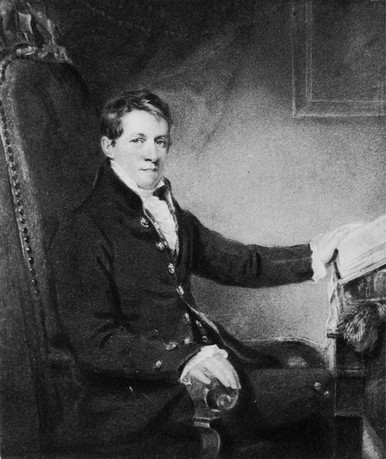
HUMPHRY DAVY.
ÆTAT 45.
(From a painting by Jackson)
THE CENTURY SCIENCE SERIES
Humphry Davy
POET AND PHILOSOPHER
BY
T. E. THORPE, LL.D., F.R.S.
New York
MACMILLAN & CO., Limited
1896
PREFACE
For the details of Sir Humphry Davy’s personal history, as set forth in this little book, I am mainly indebted to the well-known memoirs by Dr. Paris and Dr. John Davy. As biographies, these works are of very unequal value. To begin with, Dr. Paris is not unfrequently inaccurate in his statements as to matters of fact, and disingenuous in his inferences as to matters of conduct and opinion. The very extravagance of his laudation suggests a doubt of his judgment or of his sincerity, and this is strengthened by the too evident relish with which he dwells upon the foibles and frailties of his subject. The insincerity is reflected in the literary style of the narrative, which is inflated and over-wrought. Sir Walter Scott, who knew Davy well and who admired his genius and his many social gifts, characterised the book as “ungentlemanly” in tone; and there is no doubt that it gave pain to many of Davy’s friends who, like Scott, believed that justice had not been done to his character.
Dr. Davy’s book, on the other hand, whilst perhaps too partial at times—as might be expected from one who writes of a brother to whom he was under great obligations, and for whom, it is evident, he had the highest respect and affection—is written with candour, and a sobriety of tone and a directness and simplicity of statement far more effective than the stilted euphuistic periods of Dr. Paris, even when he seeks to be most forcible. When, therefore, I have had to deal with conflicting or inconsistent statements in the two works on matters of fact, I have generally preferred to accept the version of Dr. Davy, on the ground that he had access to sources of information not available to Dr. Paris.
Davy played such a considerable part in the social and intellectual world of London during the first quarter of the century that, as might be expected, his name frequently occurs in the personal memoirs and biographical literature of his time; and a number of journals and diaries, such as those of Horner, Ticknor, Henry Crabb Robinson, Lockhart, Maria Edgeworth, and others that might be mentioned, make reference to him and his work, and indicate what his contemporaries thought of his character and achievements. Some of these references will be found in the following pages. It will surprise many Londoners to know that they owe the Zoological Gardens, in large measure, to a Professor of Chemistry in Albemarle Street, and that the magnificent establishment in the Cromwell Road, South Kensington, is the outcome of the representations, unsuccessful for a time, which he made to his brother trustees of the British Museum as to the place of natural history in the national collections. Davy had a leading share also in the foundation of the Athenæum Club, and was one of its first trustees.
I am further under very special obligations to Dr. Humphry D. Rolleston, the grand-nephew of Sir Humphry Davy, for much valuable material, procured through the kind co-operation of Miss Davy, the granddaughter of Dr. John Davy. This consisted of letters from Priestley, Kirwan, Southey, Coleridge, Maria Edgeworth, Mrs. Beddoes (Anna Edgeworth), Sir Joseph Banks, Gregory Watt, and others; and, what is of especial interest to his biographer, a large number of Davy’s own letters to his wife. In addition were papers relating to the invention of the Safety Lamp. Some of the letters have already been published by Dr. John Davy, but others now appear in print for the first time. I am also indebted to Dr. Rolleston for the loan of the portrait representing Davy in Court dress and in the presidential chair of the Royal Society, which, reproduced in photogravure, forms the frontispiece to this book. The original is a small highly-finished work by Jackson, and was painted about 1823. The picture originally belonged to Lady Davy, who refers to it in the letter to Davies Gilbert (quoted by Weld in his “History of the Royal Society”), in which she offers Lawrence’s well-known portrait to the Society, and which, by the way, the Society nearly lost through the subsequent action of the painter.
For the references to the early history of the Royal Institution I am mainly indebted to Dr. Bence Jones’s book. I have, moreover, to thank the Managers of the Institution for their kindness in giving me permission to see the minutes of the early meetings, and also for allowing me to consult the manuscripts and laboratory journals in their possession. These include the original records of Davy’s work, and also the notes taken by Faraday of his lectures. The Managers have also allowed me to reproduce Miss Harriet Moore’s sketch—first brought to my notice by Professor Dewar—of the chemical laboratory of the Institution as it appeared in the time of Davy and Faraday, and I have to thank them for the loan of Gillray’s characteristic drawing of the Lecture Theatre, from which the illustration on p. 70 has been prepared.
I have necessarily had to refer to the relations of Davy to Faraday, and I trust I have said enough on that subject. Indeed, in my opinion, more than enough has been said already. It is not necessary to belittle Davy in order to exalt Faraday; and writers who, like Dr. Paris, unmindful of George Herbert’s injunction, are prone to adopt an antithetical style in biographical narrative have, I am convinced, done Davy’s memory much harm.
I regret that the space at my command has not allowed me to go into greater detail into the question of George Stephenson’s relations to the invention of the safety lamp. I have had ample material placed at my disposal for a discussion of the question, and I am specially indebted to Mr. John Pattinson and the Council of the Literary and Philosophical Society of Newcastle-upon-Tyne for their kindness in lending me a rare, if not unique, collection of pamphlets and reprints of newspaper articles which made their appearance when the idea of offering Davy some proof of the value which the coal owners entertained of his invention was first promulgated. George Stephenson’s claims are not to be dismissed summarily as pretensions. Indeed, his behaviour throughout the whole of the controversy increases one’s respect for him as a man of integrity and rectitude, conscious of what he thought due to himself, and showing only a proper assurance in his own vindication. I venture to think, however, that the conclusion to which I have arrived, and which, from the exigencies of space, is, I fear, somewhat baldly stated, as to the apportionment of the merit of this memorable invention, is just and can be well established. Stephenson might possibly have hit upon a safety lamp if he had been allowed to work out his own ideas independently and by the purely empirical methods he adopted, and it is conceivable that his lamp might have assumed its present form without the intervention of Davy; but it is difficult to imagine that an unlettered man, absolutely without knowledge of physical science, could have discovered the philosophical principle upon which the security of the lamp depends.
T. E. T.
May, 1896.
PNEUMATIC EXPERIMENT AT THE ROYAL INSTITUTION. (After Gillray.)
CONTENTS
CHAPTER
PAGE
I.—
Penzance: 1778–1798
9II.—
The Pneumatic Institution, Bristol: 1798–1801
26III.—
The Pneumatic Institution, Bristol: 1798–1801 (
continued)
54IV.—
The Royal Institution 66V.—
The Chemical Laboratory of the Royal Institution 90VI.—
The Isolation of the Metals of the Alkalis 110VII.—
Chlorine 134VIII.—
Marriage—Knighthood—“Elements of Chemical Philosophy”—Nitrogen Trichloride—Fluorine 155IX.—
Davy and Faraday—Iodine 173X.—
The Safety Lamp 192XI.—
Davy and the Royal Society—His Last Days 213CHAPTER I.
PENZANCE: 1778–1798.
CHAPTER II.
THE PNEUMATIC INSTITUTION, BRISTOL, 1798–1801.
CHAPTER III.
THE PNEUMATIC INSTITUTION, BRISTOL, 1798–1801 (continued).
CHAPTER IV.
THE ROYAL INSTITUTION.
CHAPTER V.
THE CHEMICAL LABORATORY OF THE ROYAL INSTITUTION.
CHAPTER VI.
THE ISOLATION OF THE METALS OF THE ALKALIS.
CHAPTER VII.
CHLORINE.
CHAPTER VIII.
MARRIAGE—KNIGHTHOOD—ELEMENTS OF CHEMICAL PHILOSOPHY—NITROGEN TRICHLORIDE—FLUORINE.
CHAPTER IX.
DAVY AND FARADAY—IODINE.
CHAPTER X.
THE SAFETY LAMP.
CHAPTER XI.
DAVY AND THE ROYAL SOCIETY—HIS LAST DAYS.
Humphry Davy, POET AND PHILOSOPHER.
CHAPTER I.
PENZANCE: 1778–1798.
Humphry Davy, the eldest son of “Carver” Robert Davy and his wife Grace Millett, was born on the 17th December, 1778.A His biographers are not wholly agreed as to the exact place of his birth. In the “Lives of Philosophers of the Time of George III.” Lord Brougham states that the great chemist was born at Varfell, a homestead or “town-place” in the parish of Ludgvan, in the Mount’s Bay, where, as the registers and tombstones of Ludgvan Church attest, the family had been settled for more than two hundred years.
A In some biographical notices—e.g. in the Gentleman’s Magazine, xcix. pt. ii. 9—the year is given as 1779.
Mr. Tregellas, in his “Cornish Worthies” (vol. i., p. 247), also leaves the place uncertain, hesitating, apparently, to decide between Varfell and Penzance.
According to Dr. John Davy, his brother Humphry was born in Market Jew Street, Penzance, in a house now pulled down, but which was not far from the statue of him that stands in front of the Market House of this town. Dr. Davy further states that Humphry’s parents removed to Varfell some years after his birth, when he himself was taken charge of by a Mr. Tonkin.
The Davys originally belonged to Norfolk. The first member of the family that settled in Cornwall was believed to have acted as steward to the Duke of Bolton, who in the time of Elizabeth had a considerable property in the Mount’s Bay. They were, as a class, respectable yeomen in fairly comfortable circumstances, who for generations back had received a lettered education. They took to themselves wives from the Eusticks, Adamses, Milletts, and other old Cornish families, and, if we may credit the testimony of the tombstones, had many virtues, were not overgiven to smuggling or wrecking, and, for the most part, died in their own beds.
The grandfather of Humphry, Edmund Davy, was a builder of repute in the west of Cornwall, who married well and left his eldest son Robert, the father of the chemist, in possession of the small copyhold property of Varfell, to which reference has already been made. Robert, although a person of some capacity, seems to have been shiftless, thriftless, and lax in habits. In his youth he had been taught wood-carving, and specimens of his skill are still to be seen in and about Penzance. But he practised his art in an irregular fashion, his energies being mainly spent in field sports, in unsuccessful experiments in farming, and in hazardous, and for the most part fruitless, ventures in mining. At his death, which occurred when he was forty-eight, his affairs were found to be sadly embarrassed; his widow and five children were left in very straitened circumstances, and Varfell had to be given up.
Fortunately for the children, the mother possessed the qualities which the father lacked. Casting about for the means of bringing up and educating her family, she opened a milliner’s shop in the town, in partnership with a French lady who had fled to England during the Revolution.
By prudence, good management, and the forbearance of creditors, she not only succeeded in rearing and educating her children, but gradually liquidated the whole of her husband’s debts. Some years later, by an unexpected stroke of fortune, she was able to relinquish her business. She lived to a good old age, cheerful and serene, happy in the respect and affection of her children and in the esteem and regard of her townspeople. Such a woman could not fail to exercise a strong and lasting influence for good on her children. That it powerfully affected the character of her son Humphry, he would have been the first to admit. Nothing in him was more remarkable or more beautiful than his strong and abiding love for his mother. No matter how immersed he was in his own affairs, he could always find time amidst the whirl and excitement of his London life, amidst the worry and anxiety of official cares—or, when abroad, among the peaks of the Noric Alps or the ruins of Italian cities—to think of his far-away Cornish home and of her round whom it was centred. To the last he opened out his heart to her as he did to none other; she shared in all his aspirations, and lived with him through his triumphs; and by her death, just a year before his own, she was happily spared the knowledge of his physical decay and approaching end.
* * * * *
Davy was about sixteen years of age when his father died. At that time he was a bright, curly-haired, hazel-eyed lad, somewhat narrow-chested and undergrown, awkward in manner and gait, but keenly fond of out-door sport, and more distinguished for a love of mischief than of learning.
Dr. Cardew, of the Truro Grammar School, where, by the kindness of the Tonkins, he spent the year preceding his father’s death, wrote of him that he did not at that time discover any extraordinary abilities, or, so far as could be observed, any propensity to those scientific pursuits which raised him to such eminence. “His best exercises were translations from the classics into English verse.” He had previously spent nine years in the Penzance Grammar School under the tyranny of the Rev. Mr. Coryton, a man of irregular habits and as deficient in good method as in scholarship. As Davy used to come up for the customary castigation, the worthy follower of Orbilius was wont to repeat—
“Now, Master Davy, Now, sir! I have ’ee No one shall save ’ee— Good Master Davy!”
He had, too, an unpleasant habit of pulling the boys’ ears, on the supposition, apparently, that their receptivity for oral instruction was thereby stimulated. It is recorded that on one occasion Davy appeared before him with a large plaster on each ear, explaining, with a very grave face, that he had “put the plasters on to prevent mortification.” Whence it may be inferred that, in spite of all the caning and the ear-pulling, there was still much of the unregenerate Adam left in “good Master Davy.”
Mr. Coryton’s method of inculcating knowledge and the love of learning, happily, had no permanent ill-effect on the boy. Years afterwards, when reflecting on his school-life, he wrote, in a letter to his mother—
“After all, the way in which we are taught Latin and Greek does not much influence the important structure of our minds. I consider it fortunate that I was left much to myself when a child, and put upon no particular plan of study, and that I enjoyed much idleness at Mr. Coryton’s school. I perhaps owe to these circumstances the little talents that I have and their peculiar application.”
If Davy’s abilities were not perceived by his masters, they seemed to have been fully recognised by his school-fellows—to judge from the frequency with which they sought his aid in their Latin compositions, and from the fact that half the love-sick youths of Penzance employed him to write their valentines and letters. His lively imagination, strong dramatic power, and retentive memory combined to make him a good story-teller, and many an evening was spent by his comrades beneath the balcony of the Star Inn, in Market Jew Street, listening to his tales of wonder or horror, gathered from the “Arabian Nights” or from his grandmother Davy, a woman of fervid mind stored with traditions and ancient legends, from whom he seems to have derived much of his poetic instinct.
Those who would search in environment for the conditions which determine mental aptitudes, will find it very difficult to ascertain what there was in Davy’s boyish life in Penzance to mould him into a natural philosopher. At school he seems to have acquired nothing beyond a smattering of elementary mathematics and a certain facility in turning Latin into English verse. Most of what he obtained in the way of general knowledge he picked up for himself, from such books as he found in the library of his benefactor, Mr. John Tonkin. Dr. John Davy has left us a sketch of the state of society in the Mount’s Bay during the latter part of the eighteenth century, which serves to show how unfavourable was the soil for the stimulation and development of intellectual power. Cornwall at that time had but little commerce; and beyond the tidings carried by pedlars or ship-masters, or contained in the Sherborne Mercury—the only newspaper which then circulated in the west of England—it knew little or nothing of what was going on in the outer world. Its roads were mostly mere bridle-paths, and a carriage was as little known in Penzance as a camel. There was only one carpet in the town, the floors of the rooms being, as a rule, sprinkled with sea-sand:—
“All classes were very superstitious; even the belief in witches maintained its ground, and there was an almost unbounded credulity respecting the supernatural and monstrous.... Amongst the middle and higher classes there was little taste for literature and still less for science, and their pursuits were rarely of a dignified or intellectual kind. Hunting, shooting, wrestling, cock-fighting, generally ending in drunkenness, were what they most delighted in. Smuggling was carried on to a great extent, and drunkenness and a low scale of morals were naturally associated with it.”
Davy, an ardent, impulsive youth of strong social instincts, fond of excitement, and not over studious, seems, now that he was released from the restraint of school-life, to have come under the influence of such surroundings. For nearly a year he was restless and unsettled, spending much of his time like his father in rambling about the country and in fishing and shooting, and passing from desultory study to occasional dissipation. The death of his father, however, made a profound impression on his mind, and suddenly changed the whole course of his conduct. As the eldest son, and approaching manhood, he seems at once to have realised what was due to his mother and to himself. The circumstances of the family supplied the stimulus to exertion, and he dried his mother’s tears with the assurance that he would do all in his power for his brothers and sisters. A few weeks after the decease of his father he was apprenticed to Mr. Bingham Borlase, an apothecary and surgeon practising in Penzance, and at once marked out for himself a course of study and self-tuition almost unparalleled in the annals of biography, and to which he adhered with a strength of mind and tenacity of purpose altogether unlooked for in one of his years and of his gay and careless disposition. That it was sufficiently ambitious will be evident from the following transcript from the opening pages of his earliest note-book—a small quarto, with parchment covers, dated 1795:—
1. Theology,
or Religion, } { taught by Nature;
Ethics or Moral virtues } { by Revelation.
2. Geography.
3. My Profession.
1. Botany.
2. Pharmacy.
3. Nosology.
4. Anatomy.
5. Surgery.
6. Chemistry.
4. Logic.
5. Languages.
1. English.
2. French.
3. Latin.
4. Greek.
5. Italian.
6. Spanish.
7. Hebrew.
6. Physics.
1. The doctrines and properties of natural bodies.
2. Of the operations of nature.
3. Of the doctrines of fluids.
4. Of the properties of organised matter.
5. Of the organisation of matter.
6. Simple astronomy.
7. Mechanics.
8. Rhetoric and Oratory.
9. History and Chronology.
10. Mathematics.
The note-book opens with “Hints Towards the Investigation of Truth in Religious and Political Opinions, composed as they occurred, to be placed in a more regular manner hereafter.” Then follow essays “On the Immortality and Immateriality of the Soul”; “Body, Organised Matter”; on “Governments”; on “The Credulity of Mortals”; “An Essay to Prove that the Thinking Powers depend on the Organisation of the Body”; “A Defence of Materialism”; “An Essay on the Ultimate End of Being”; “On Happiness”; “On Moral Obligation.”
These early essays display the workings of an original mind, intent, it may be, on problems beyond its immature powers, but striving in all sincerity to work out its own thoughts and to arrive at its own conclusions. Of course, the daring youth of sixteen who enters upon an inquiry into the most difficult problems of theology and metaphysics, with, what he is pleased to call, unprejudiced reason as his sole guide, quickly passes into a cold fit of materialism. His mind was too impressionable, however, to have reached the stage of settled convictions; and in the same note-book we subsequently find the heads of a train of argument in favour of a rational religious belief founded on immaterialism.
Metaphysical inquiries seem, indeed, to have occupied the greater part of his time at this period; and his note-books show that he made himself acquainted with the writings of Locke, Hartley, Bishop Berkeley, Hume, Helvetius, Condorcet, and Reid, and that he had some knowledge of the doctrines of Kant and the Transcendentalists.
That he thought for himself, and was not unduly swayed by authority, is evident from the general tenour of his notes, and from the critical remarks and comments by which they are accompanied. Some of these are worth quoting:—
“Science or knowledge is the association of a number of ideas, with some idea or term capable of recalling them to the mind in a certain order.”
“By examining the phenomena of Nature, a certain similarity of effects is discovered. The business of science is to discover these effects, and to refer them to some common cause; that is to generalise ideas.”
As his impulsive, ingenuous disposition led him, even to the last, to speak freely of what was uppermost in his mind at the moment, we may be sure that his elders, the Rev. Dr. Tonkin, his good friend John Tonkin, and his grandmother Davy, with whom he was a great favourite, as he was with most old people, must have been considerably exercised at times with the metaphysical disquisitions to which they were treated; and we can well imagine that their patience was occasionally as greatly tried as that of the worthy member of the Society of Friends who wound up an argument with the remark, “I tell thee what, Humphry, thou art the most quibbling hand at a dispute I ever met with in my life.” Whether it was in revenge for this sally that the young disputant composed the “Letter on the Pretended Inspiration of the Quakers” which is to be found in one of his early note-books, does not appear.
We easily trace in these early essays the evidences of that facility and charm of expression which a few years later astonished and delighted his audiences at the Royal Institution, and which remained the characteristic features of his literary style. These qualities were in no small degree strengthened by his frequent exercises in poetry. For Davy had early tasted of the Pierian spring, and, like Pope, may be said to have lisped in numbers. At five he was an improvisatore, reciting his rhymes at some Christmas gambols, attired in a fanciful dress prepared by a playful girl who was related to him. That he had the divine gift was acknowledged by no less an authority than Coleridge, who said that “if Davy had not been the first Chemist, he would have been the first Poet of his age.” Southey also, who knew him well, said after his death, “Davy was a most extraordinary man; he would have excelled in any department of art or science to which he had directed the powers of his mind. He had all the elements of a poet; he only wanted the art. I have read some beautiful verses of his. When I went to Portugal, I left Davy to revise and publish my poem of ‘Thalaba.’”
Throughout his life he was wont, when deeply moved, to express his feelings in verse; and at times even his prose was so suffused with the glow of poetry that to some it seemed altiloquent and inflated. Some of his first efforts appeared in the “Annual Anthology,” a work printed in Bristol in 1799, and edited by Southey and Tobin, and interesting to the book-hunter as one of the first of the literary “Annuals” which subsequently became so fashionable.
Davy had an intense love of Nature, and nothing stirred the poetic fire within him more than the sight of some sublime natural object such as a storm-beaten cliff, a mighty mountain, a resistless torrent, or some spectacle which recalled the power and majesty of the sea. Not that he was insensible to the simpler charms of pastoral beauty, or incapable of sympathy with Nature in her softest, tenderest moods. But these things never seemed to move him as did some scene of grandeur, or some manifestation of stupendous natural energy.
The following lines, written on Fair Head during the summer of 1806, may serve as an example of how scenery when associated in his mind with the sentiments of dignity or strength affected him:—
“Majestic Cliff! Thou birth of unknown time, Long had the billows beat thee, long the waves Rush’d o’er thy hollow’d rocks, ere life adorn’d Thy broken surface, ere the yellow moss Had tinted thee, or the wild dews of heaven Clothed thee with verdure, or the eagles made Thy caves their aëry. So in after time Long shalt thou rest unalter’d mid the wreck Of all the mightiness of human works; For not the lightning, nor the whirlwind’s force, Nor all the waves of ocean, shall prevail Against thy giant strength, and thou shalt stand Till the Almighty voice which bade thee rise Shall bid thee fall.”
In spite of a love-passage which seems to have provoked a succession of sonnets, his devotions to Calliope were by no means so unremitting as to prevent him from following the plan of study he had marked out for himself. His note-books show that in the early part of 1796 he attacked the mathematics, and with such ardour that in little more than a year he had worked through a course of what he called “Mathematical Rudiments,” in which he included “fractions, vulgar and decimal; extraction of roots; algebra (as far as quadratic equations); Euclid’s elements of geometry; trigonometry; logarithms; sines and tangents; tables; application of algebra to geometry, etc.”
In 1797 he began the study of natural philosophy, and towards the end of this year, when he was close on nineteen, he turned his attention to chemistry, merely, however, at the outset as a branch of his professional education, and with no other idea than to acquaint himself with its general principles. His good fortune led him to select Lavoisier’s “Elements”—probably Kerr’s translation, published in 1796—as his text-book. No choice could have been happier. The book is well suited to a mind like Davy’s, and he could not fail to be impressed by the boldness and comprehensiveness of its theory, its admirable logic, and the clearness and precision of its statements.
From reading and speculation he soon passed to experiment. But at this time he had never seen a chemical operation performed, and had little or no acquaintance with even as much as the forms of chemical apparatus. Phials, wine-glasses, tea-cups, and tobacco-pipes, with an occasional earthen crucible, were all the paraphernalia he could command; the common mineral acids, the alkalis, and a few drugs from the surgery constituted his stock of chemicals. Of the nature of these early trials we know little. It is, however, almost certain that the experiments with sea-weed, described in his two essays “On Heat, Light and the Combinations of Light” and “On the Generation of Phosoxygen and the Causes of the Colours of Organic Beings” (see p. 30), were made at this time, and it is highly probable that the experiments on land-plants, which are directly related to those on the Fuci and are described in connection with them, were made at the same period. That he pursued his experiments with characteristic ardour is borne out by the testimony of members of his family, particularly by that of his sister, who sometimes acted as his assistant, and whose dress too frequently suffered from the corrosive action of his chemicals. The good Mr. Tonkin and his worthy brother, the Reverend Doctor, were also from time to time abruptly and unexpectedly made aware of his zeal. “This boy Humphry is incorrigible! He will blow us all into the air!” were occasional exclamations heard to follow the alarming noises which now and then proceeded from the laboratory. The well-known anecdote of the syringe which had formed part of a case of instruments of a shipwrecked French surgeon, and which Davy had ingeniously converted into an air-pump, although related by Dr. Paris “with a minuteness and vivacity worthy of Defoe,” is, in all probability, apocryphal. Nor has Lord Brougham’s story, that his devotion to chemical experiments and “his dislike to the shop” resulted in a disagreement with his master, and that “he went to another in the same place,” where “he continued in the same course,” any surer foundation in fact.
Two or three circumstances conduced to develop Davy’s taste for scientific pursuits, and to extend his opportunities for observation and experiment. One was his acquaintance with Mr. Gregory Watt; another was his introduction to Mr. Davies Gilbert (then Mr. Davies Giddy), a Cornish gentleman of wealth and position, who lived to succeed him in the presidential chair of the Royal Society.
Gregory Watt, the son of James Watt, the engineer, by his second marriage, was a young man of singular promise who, had he lived, would—if we may judge from his paper in the Philosophical Transactions—have almost certainly acquired a distinguished position in science. Of a weakly, consumptive habit, he was ordered to spend the winter of 1797 in Penzance, where he lodged with Mrs. Davy, boarding with the family. Young Watt was about two years older than Davy, and had just left the University of Glasgow, “his mind enriched beyond his age with science and literature, with a spirit above the little vanities and distinctions of the world, devoted to the acquisition of knowledge.” He remained in Penzance until the following spring, and by his example, and by the generous friendship which he extended towards him, he developed and strengthened Davy’s resolve to devote himself to science. Davy’s introduction to Mr. Gilbert, “a man older than himself, with considerable knowledge of science generally, and with the advantages of a University education,” was also a most timely and propitious circumstance. According to Dr. Paris—
“Mr. Gilbert’s attention was attracted to the future philosopher, as he was carelessly swinging over the hatch, or half-gate, of Mr. Borlase’s house, by the humorous contortions into which he threw his features. Davy it may be remarked, when a boy, possessed a countenance which even in its natural state was very far from comely; while his round shoulders, inharmonious voice and insignificant manner, were calculated to produce anything rather than a favourable impression: in riper years, he was what might be called ‘good-looking,’ although as a wit of the day observed, his aspect was certainly of the ‘bucolic’ character. The change which his person underwent, after his promotion to the Royal Institution, was so rapid that in the days of Herodotus, it would have been attributed to nothing less than the miraculous interposition of the Priestesses of Helen. A person, who happened to be walking with Mr. Gilbert upon the occasion alluded to, observed that the extraordinary looking boy in question was young Davy, the carver’s son, who, he added, was said to be fond of making chemical experiments.”
Mr. Gilbert was thus led to interest himself in the boy, whom he invited to his house at Tredrea, offering him the use of his library, and such other assistance in his studies as he could render. On one occasion he was taken over to the Hayle Copper-House, and had the opportunity of seeing a well-appointed laboratory:
“The tumultuous delight which Davy expressed on seeing, for the first time, a quantity of chemical apparatus, hitherto only known to him through the medium of engravings, is described by Mr. Gilbert as surpassing all description. The air-pump more especially fixed his attention, and he worked its piston, exhausted the receiver, and opened its valves, with the simplicity and joy of a child engaged in the examination of a new and favourite toy.”
It has already been stated that in the outset Davy attacked science as he did metaphysics, approaching it from the purely theoretical side. As might be surmised, his love of speculation quickly found exercise for itself, and within four months of his introduction to the study of science he had conceived and elaborated a new hypothesis on the nature of heat and light, which he communicated to Dr. Beddoes.
Dr. Thomas Beddoes was by training a medical man, who in various ways had striven to make a name for himself in science. He is known to the chemical bibliographer as the translator of the Chemical Essays of Scheele, and at one time occupied the Chair of Chemistry at Oxford. The geological world at the end of the eighteenth century regarded him as a zealous and uncompromising Plutonist. His character was thus described by Davy, who in the last year of his life jotted down, in the form of brief notes, his reminiscences of some of the more remarkable men of his acquaintance:—
“Beddoes was reserved in manner and almost dry; but his countenance was very agreeable. He was cold in conversation, and apparently much occupied with his own peculiar views and theories. Nothing could be a stronger contrast to his apparent coldness in discussion than his wild and active imagination, which was as poetical as Darwin’s.... On his deathbed he wrote me a most affecting letter, regretting his scientific aberrations.”
One of Dr. Beddoes’s “scientific aberrations” was the inception and establishment of the Pneumatic Institution, which he founded with a view of studying the medicinal effects of the different gases, in the sanguine hope that powerful remedies might be found amongst them. The Institution, which was supported wholly by subscription, was to be provided with all the means likely to promote its objects—a hospital for patients, a laboratory for experimental research, and a theatre for lecturing.
In seeking for a person to take charge of the laboratory, Dr. Beddoes bethought him of Davy, who had been recommended to him by Mr. Gilbert. In a letter dated July 4th, 1798, Dr. Beddoes thus writes to Mr. Gilbert:—
“I am glad that Mr. Davy has impressed you as he has me. I have long wished to write to you about him, for I think I can open a more fruitful field of investigation than any body else. Is it not also his most direct road to fortune? Should he not bring out a favourable result he may still exhibit talents for investigation, and entitle himself to public confidence more effectually than by any other mode. He must be maintained, but the fund will not furnish a salary from which a man can lay up anything. He must also devote his time for two or three years to the investigation. I wish you would converse with him upon the subject.... I am sorry I cannot at this moment specify a yearly sum, nor can I say with certainty whether all the subscribers will accede to my plan; most of them will, I doubt not. I have written to the principal ones, and will lose no time in sounding them all.”
A fortnight later, Dr. Beddoes again wrote to Mr. Gilbert:—
“I have received a letter from Mr. Davy since I wrote to you. He has oftener than once mentioned a genteel maintenance, as a preliminary to his being employed to superintend the Pneumatic Hospital. I fear the funds will not allow an ample salary; he must however be maintained. I can attach no idea to the epithet genteel, but perhaps all difficulties would vanish in conversation; at least I think your conversing with Mr. Davy will be a more likely way of smoothing difficulties than our correspondence. It appears to me, that this appointment will bear to be considered as a part of Mr. Davy’s medical education, and that it will be a great saving of expense to him. It may also be the foundation of a lucrative reputation; and certainly nothing on my part shall be wanting to secure to him the credit he may deserve. He does not undertake to discover cures for this or that disease; he may acquire just applause by bringing out clear, though negative results. During my journeys into the country I have picked up a variety of important and curious facts from different practitioners. This has suggested to me the idea of collecting and publishing such facts as this part of the country will from time to time afford. If I could procure chemical experiments that bore any relation to organised nature, I would insert them. If Mr. Davy does not dislike this method of publishing his experiments I would gladly place them at the head of my first volume, but I wish not that he should make any sacrifice of judgment or inclination.”
Thanks to Mr. Gilbert, the negotiation was brought to a successful issue. Mrs. Davy yielded to her son’s wishes, and Mr. Borlase surrendered his indenture, on the back of which he wrote that he released him from “all engagements whatever on account of his excellent behaviour”; adding, “because being a youth of great promise, I would not obstruct his present pursuits, which are likely to promote his fortune and his fame.” The only one of his friends who disapproved of the scheme was his old benefactor, Mr. John Tonkin, who had hoped to have established Davy in his native town as a surgeon. Mr. Tonkin was so irritated at the failure of his plans that he altered his will, and revoked the legacy of his house, which he had bequeathed to him.
A In some biographical notices—e.g. in the Gentleman’s Magazine, xcix. pt. ii. 9—the year is given as 1779.
“We are printing in Bristol the first volume of the ‘West Country Collection,’ which will, I suppose, be out in the beginning of January.
CHAPTER II.
THE PNEUMATIC INSTITUTION, BRISTOL, 1798–1801.
On October 2nd, 1798, Davy set out for Clifton with such books and apparatus as he possessed, and the MSS. of his essays on Heat and Light safely stowed away among his baggage. He was in the highest spirits, and full of confidence in the future. On his way through Okehampton he met the London coach decked with laurels and ribbons, and bringing the news of Nelson’s victory of the Nile, which he interpreted as a happy omen. A few days after his arrival, he thus wrote to his mother:—
“October 11th, 1798. Clifton.
“My dear Mother,—I have now a little leisure time, and I am about to employ it in the pleasing occupation of communicating to you an account of all the new and wonderful events that have happened to me since my departure.
“I suppose you received my letter, written in a great hurry last Sunday, informing you of my safe arrival and kind reception. I must now give you a more particular account of Clifton, the place of my residence, and of my new friends Dr. and Mrs. Beddoes and their family.
“Clifton is situated on the top of a hill, commanding a view of Bristol and its neighbourhood, conveniently elevated above the dirt and noise of the city. Here are houses, rocks, woods, town and country in one small spot; and beneath us, the sweetly-flowing Avon, so celebrated by the poets. Indeed there can hardly be a more beautiful spot; it almost rivals Penzance and the beauties of Mount’s Bay.
“Our house is capacious and handsome; my rooms are very large, nice and convenient; and, above all, I have an excellent laboratory. Now for the inhabitants, and, first, Dr. Beddoes, who, between you and me, is one of the most original men I ever saw—uncommonly short and fat, with little elegance of manners, and nothing characteristic externally of genius or science; extremely silent, and in a few words, a very bad companion. His behaviour to me, however, has been particularly handsome. He has paid me the highest compliments on my discoveries, and has, in fact, become a convert to my theory, which I little expected. He has given up to me the whole of the business of the Pneumatic Hospital, and has sent to the editor of the Monthly Magazine a letter, to be published in November, in which I have the honour to be mentioned in the highest terms. Mrs. Beddoes is the reverse of Dr. Beddoes—extremely cheerful, gay and witty; she is one of the most pleasing women I have ever met with. With a cultivated understanding and an excellent heart, she combines an uncommon simplicity of manners. We are already very great friends. She has taken me to see all the fine scenery about Clifton; for the Doctor, from his occupations and his bulk, is unable to walk much. In the house are two sons and a daughter of Mr. Lambton, very fine children, from five to thirteen years of age.
“I have visited Mr. Hare, one of the principal subscribers to the Pneumatic Hospital, who treated me with great politeness. I am now very much engaged in considering of the erection of the Pneumatic Hospital, and the mode of conducting it. I shall go down to Birmingham to see Mr. Watt and Mr. Keir in about a fortnight, where I shall probably remain a week or ten days; but before then you will again hear from me. We are just going to print at Cottle’s; in Bristol, so that my time will be much taken up the ensuing fortnight in preparations for the press. The theatre for lecturing is not yet open; but, if I can get a large room in Bristol, and subscribers, I intend to give a course of chemical lectures, as Dr. Beddoes seems much to wish it.
“My journey up was uncommonly pleasant; I had the good fortune to travel all the way with acquaintances. I came into Exeter in a most joyful time, the celebration of Nelson’s victory. The town was beautifully illuminated, and the inhabitants loyal and happy....
“It will give you pleasure when I inform you that all my expectations are answered and that my situation is just what I could wish. But, for all this, I very often think of Penzance and my friends, with a wish to be there; however that time will come. We are some time before we become accustomed to new modes of living and new acquaintances.
“Believe me, your affectionate son,
“Humphry Davy.”
Mrs. Beddoes, of whom Davy speaks in such appreciative terms, was one of the many sisters of Maria Edgeworth. She seems to have possessed much of the intelligence, wit, vivacity, and sunny humour of the accomplished authoress of “Castle Rackrent”; and, by her charm of manner and her many social gifts, to have made her husband’s house the centre of the literary and intellectual life of Clifton. Thanks to her influence, Davy had the good fortune to be brought into contact, at the very outset of his career, with Southey, Coleridge, the Tobins, Miss Edgeworth, and other notable literary men and women of his time, with many of whom he established firm and enduring friendships. He had always a sincere admiration for his fair patroness, and a grateful memory of her many acts of kindness to him at this period of his life. That she in turn had an esteem amounting to affection for the gifted youth is evident from the language of tender feeling and warm regard in which her letters to him are expressed. The sonnets accompanying these letters are couched in terms which admit of no doubt of the strength of her sentiments of sympathy and admiration, and some of the best efforts of his muse were addressed to her in return.
His work and prospects at the Pneumatic Institution are sufficiently indicated in the following letter to his friend and patron, Mr. Davies Gilbert, written five weeks after his arrival at Clifton:—
“Clifton, November 12, 1798.
“Dear Sir,—I have purposely delayed writing until I could communicate to you some intelligence of importance concerning the Pneumatic Institution. The speedy execution of the plan will, I think, interest you both as a subscriber and a friend to science and mankind. The present subscription is, we suppose nearly adequate to the purpose of investigating the medicinal powers of factitious airs; it still continues to increase, and we may hope for the ability of pursuing the investigation to its full extent. We are negotiating for a house in Dowrie Square, the proximity of which to Bristol, and its general situation and advantages, render it very suitable to the purpose. The funds will, I suppose, enable us to provide for eight or ten patients in the hospital, and for as many out of it as we can procure.
“We shall try the gases in every possible way. They may be condensed by pressure and rarefied by heat. Quere,—Would not a powerful injecting syringe furnished with two valves, one opening into an air-holder and the other into the breathing chamber, answer the purpose of compression better than any other apparatus? Can you not, from your extensive stores of philosophy, furnish us with some hints on this subject? May not the non-respirable gases furnish a class of different stimuli? of which the oxymuriatic acid gas [chlorine] would stand the highest, if we may judge from its effects on the lungs; then, probably, gaseous oxyd of azote [nitrous oxide?] and hydrocarbonate [the gases obtained by passing steam over red-hot charcoal].
“I suppose you have not heard of the discovery of the native sulphate of strontian in England. I shall perhaps surprise you by stating that we have it in large quantities here. It had long been mistaken for sulphate of barytes, till our friend Clayfield, on endeavouring to procure the muriate of barytes from it by decomposition, detected the strontian. We opened a fine vein of it about a fortnight ago at the Old Passage near the mouth of the Severn.B...
“We are printing in Bristol the first volume of the ‘West Country Collection,’ which will, I suppose, be out in the beginning of January.
“Mrs. Beddoes ... is as good, amiable, and elegant as when you saw her.
“Believe me, dear Sir, with affection and respect, truly yours,
“Humphry Davy.”
B Cf. An account of several veins of Sulphate of Strontites, found in the neighbourhood of Bristol, with an Analysis of the different varieties. By W. Clayfield. “Nicholson’s Journ.,” III., 1800, pp. 36–41.
The work alluded to in this letter made its appearance in the early part of 1799, under the title of “Contributions to Physical and Medical Knowledge, principally from the West of England; collected by Thomas Beddoes, M.D.” The first half of the volume, in accordance with the editor’s promise, is occupied by two essays from Davy: the first “On Heat, Light, and the Combinations of Light, with a new Theory of Respiration”; the second “On the Generation of Phosoxygen (Oxygen Gas), and on the Causes of the Colours of Organic Beings.”
To the student these essays have no other interest than is due to the fact that they are Davy’s first contribution to the literature of science. No beginning could be more inauspicious. It is the first step that costs, and Davy’s first step had well nigh cost him all that he lived for. As additions to knowledge they are worthless; indeed, a stern critic might with justice characterise them in much stronger language. Nowadays such writings would hopelessly damn the reputation of any young aspirant for scientific fame, for it is indeed difficult to believe, as we read paragraph after paragraph, that their author had any real conception of science, or that he was capable of understanding the need or appreciating the value of scientific evidence.
The essays are partly experimental, partly speculative, and the author apparently would have us believe that the speculations are entirely subservient to and dependent on the experiments. Precisely the opposite is the case. Davy’s work had its origin in Lavoisier’s “Traité Elémentaire,” almost the only text-book of chemistry he possessed. Lavoisier taught, in conformity with the doctrine of his time, that heat was a material substance, and that oxygen was essentially a compound body, composed of a simple substance associated with the matter of heat, or caloric. The young novitiate puts on his metaphysical shield and buckler; and with the same jaunty self-confidence that he assailed Locke and criticised Berkeley, enters the lists against this doctrine, determined, as he told Gregory Watt, “to demolish the French theory in half an hour.”
After a few high-sounding but somewhat disconnected introductory sentences, and a complimentary allusion to “the theories of a celebrated medical philosopher, Dr. Beddoes,” he proceeds to put Lavoisier’s question, “La lumière, est-elle une modification du calorique, ou bien le calorique est-il une modification de la lumière?” to the test of experiment. This he does by repeating Hawksbee’s old experiment of snapping a gunlock “armed with an excellent flint” in an exhausted receiver. The experiment fails in his hands; such phenomena as he observes he misinterprets, and he at once concludes that light and heat have nothing essentially in common. “Nor can light be as some philosophers suppose, a vibration of the imaginary fluid ether. For even granting the existence of this fluid it must be present in the exhausted receiver as well as in atmospheric air; and if light is a vibration of this fluid, generated by collision between flint and steel in atmospheric air, it should likewise be produced in the exhausted receiver, where a greater quantity of ether is present, which is not the case.” Since, then, it is neither an effect of caloric nor of an ethereal fluid, and “as the impulse of a material body on the organ of vision is essential to the generation of a sensation, light is consequently matter of a peculiar kind, capable when moving through space with the greatest velocity, of becoming the source of a numerous class of our sensations.”
By experiments, faultless in principle but wholly imperfect in execution, he next seeks to show that caloric, or the matter of heat, has no existence. His reasoning is clear, and his conceptions have the merit of ingenuity, but any real acquaintance with the conditions under which the experiments were made would have convinced him that the results were untrustworthy and equivocal; and yet, in spite of the dubious character of his observations, he arrived at a theory of the essential nature of heat which is in accord with our present convictions, and which he states in the following terms:—
“Heat, or that power which prevents the actual contact of the corpuscles of bodies, and which is the cause of our peculiar sensations of heat and cold, may be defined a peculiar motion, probably a vibration, of the corpuscles of bodies, tending to separate them.”
This conception of the nature of heat did not, of course, originate with him, and it was a question with his contemporaries how far he was influenced by Rumford’s work and teaching. On this point Dr. Beddoes’s testimony is direct and emphatic. He says:—
“The author [Davy] derived no assistance whatever from the Count’s ingenious labours. My first knowledge of him arose from a letter written in April 1798, containing an account of his researches on heat and light; and his first knowledge of Count Rumford’s paper was conveyed by my answer. The two Essays contain proofs enough of an original mind to make it credible that the simple and decisive experiments on heat were independently conceived. Nor is it necessary, in excuse or in praise of his system, to add, that, at the time it was formed, the author was under twenty years of age, pupil to a surgeon-apothecary, in the most remote town of Cornwall, with little access to philosophical books, and none at all to philosophical men.”
Having thus, with Beddoes, expunged caloric from his chemical system, Davy proceeds to elevate the matter of light into its place. According to Lavoisier oxygen gas was a compound of a simple substance and caloric; Davy seeks to show that it is a compound of a simple substance and light. He objects to the use of the word “gas,” since, according to French doctrine, it is to be taken as implying not merely a state of aggregation but a combination of caloric with another substance, and suggests therefore that what was called oxygen gas should henceforth be known as phosoxygen. His “proofs” that oxygen is really a compound of a simple substance with “matter in a peculiar state of existence” are perhaps the most futile that could be imagined. Charcoal, phosphorus, sulphur, hydrogen, and zinc were caused to burn in oxygen; light was evolved, oxides were formed, and a deficiency of weight was in each case observed. He regrets, however, that he “possessed no balance sufficiently accurate to determine exactly the deficiency of weight from the light liberated in different combustive processes.”
“From these experiments, it appears that in the chemical process of the formation of many oxyds and acids, light is liberated, the phosoxygen and combustible base consumed, and a new body formed.... Since light is liberated in these processes, it is evident that it must be liberated either from the phosoxygen or from the combustible body.... If the light liberated in combustion be supposed (according to Macquer’s and Hutton’s theories) to arise from the combustible body, then phosoxygen must be considered as a simple substance; and it follows on this supposition, that whenever phosoxygen combines with combustible bodies, either directly or by attraction from any of its combinations, light must be liberated, which is not the case, as carbon, iron and many other substances, may be oxydated by the decomposition of water without the liberation of light.”
Davy is here on the horns of a dilemma, but he ignores the difficulty, and, with characteristic “flexibility of adaptation,” proceeds to offer synthetical proofs “that the presence of light is absolutely essential to the production of phosoxygen.” The character of the “proofs” is sufficiently indicated by the following extracts:—
“When pure oxyd of lead is heated as much as possible, included from light, it remains unaltered; but when exposed to the light of a burning-glass, or even of a candle, phosoxygen is generated and the metal revivified.”
“Oxygenated muriatic acid [chlorine] is a compound of muriatic acid, oxygen and light, as will be hereafter proved. The combined light is not sufficient to attract the oxygen from the base [muriatic acid] to form phosoxygen; but its attraction for oxygen renders the [oxygenated muriatic] acid decomposable. If this acid be heated in a close vessel and light excluded no phosoxygen is formed; but if it be exposed to the solar light, phosoxygen is formed; the acid loses its oxygen and light and becomes muriatic acid.”
“A plant of Arenaria Tenuifolia planted in a pot filled with very dry earth, was inserted in carbonic acid, under mercury. The apparatus was exposed to the solar light, for four days successively, in the month of July. By this time the mercury had ascended considerably. The gas in the vessel was now measured. There was a deficiency of one-sixth of the whole quantity. After the carbonic acid was taken up by potash, the remaining quantity, equal to one-seventh of the whole, was phosoxygen almost pure. From this experiment, it is evident that carbonic acid is decomposed by two attractions; that of the vegetable for carbon and of light for oxygen: the carbon combines with the plant, and the light and oxygen combined are liberated in the form of phosoxygen.”
The accounts which Davy gives of his experiments, as well as of the phenomena which he professes to have observed, may awaken an uneasy doubt as to his absolute integrity; for, it is hardly necessary to point out, he could not possibly have obtained the results which he describes. The presence or absence of light in no wise affects the decomposition by heat of minium; chlorine, as he himself subsequently established, contains no oxygen; and a plant is incapable of decomposing pure undiluted carbonic acid, even in the brightest sunshine. But the work of a youth of nineteen, imaginative, sanguine, and impetuous, with no training as an experimentalist, and with only a limited access to scientific memoirs, cannot be judged by too severe a canon. The faculty of self-deception, even in the largest and most receptive minds, often in those of matured power and ripened experience, is boundless. Davy himself affords an exemplification of the truth of his own words, written years afterwards: “The human mind is always governed not by what it knows, but by what it believes; not by what it is capable of attaining, but by what it desires.”
It is not necessary to show how the presumptuous youth drove his hobby with all the reckless daring of a Phæton. Phlogiston and oxygen had in turn been the central conceptions of theories of chemistry; phosoxygen was to supplant them. It was to explain everything—the blue colour of the sky, the electric fluid, the Aurora Borealis, the phenomena of fiery meteors, the green of the leaf, the red of the rose, and the sable hue of the Ethiopian; perception, thought, and happiness; and why women are fairer than men. But Jupiter, in the shape of a Reviewer, soon hurled the adventurous boy from the giddy heights to which he had soared. The “West Country Collection” received scant sympathy from the critics, and the phosoxygen theory was either mercilessly ridiculed, or treated with contempt.
There is no doubt that Davy keenly felt the position in which he now stood. His pride was humbled, and the humiliation was as gall and wormwood. The vision of fame which his ardour had conjured up on the top of the Bristol coach—was it all a baseless fabric, and its train of honours and emoluments an insubstantial pageant? All he could plead was that his critics had not understood that these experiments were made when he had studied chemistry only four months, when he had never seen a single experiment executed, and when all his information was derived from Nicholson’s “Chemistry” and Lavoisier’s “Elements.” But his good sense quickly came to his rescue. After the first feelings of anger and mortification had passed, he recognised the justice of his punishment, much as he might resent the mode in which it was inflicted. How keen was the smart will appear from the following reflection, written in the August of the year in which the essays were published:—
“When I consider the variety of theories that may be formed on the slender foundation of one or two facts, I am convinced that it is the business of the true philosopher to avoid them altogether. It is more laborious to accumulate facts than to reason concerning them; but one good experiment is of more value than the ingenuity of a brain like Newton’s.”
About the same time he wrote:—
“I was perhaps wrong in publishing, with such haste, a new theory of chemistry. My mind was ardent and enthusiastic. I believed that I had discovered the truth. Since that time my knowledge of facts is increased—since that time I have become more sceptical.”
In the October of the same year he wrote:—
“Convinced as I am that chemical science is in its infancy, that an infinite variety of new facts must be accumulated before our powers of reasoning will be sufficiently extensive, I renounce my own particular theory as being a complete arrangement of facts: it appears to me now only as the most probable arrangement.”
By the end of the year the repentance was complete, and recantation followed. In a letter which appeared in Nicholson’s Journal in February, 1800, he corrects some of the errors into which he had fallen, and says, “I beg to be considered as a sceptic with regard to my own particular theory of the combinations of light, and theories of light in general.” To the end of his days Davy never forgot the lesson which his earliest effort had taught him; and there is no question that the memory of it acted as a salutary check on the exuberance of his fancy and the flight of his imagination. The wound to his self-love was, however, never wholly healed. Nothing annoyed him more than any reference to Beddoes’s book, and he declared to Dr. Hope that he would joyfully relinquish any little glory or reputation he might have acquired by his later researches were it possible to withdraw his share in that work and to remove the impression he feared it was likely to produce.
And yet, in spite of the unqualified censure with which they were received, and of the severe condemnation of them by their own author, we are disposed to agree with Dr. Davy that posterity will not suffer these essays to be wholly blotted out from the records of science. That the experimental part was for the most part radically bad, that the generalisation was hasty and presumptuous, and the reasoning imperfect, cannot be gainsaid. But, withal, the essays display some of Davy’s best and happiest characteristics. There is dignity of treatment and a sense of the nobility of the theme on which he is engaged; the literary quality is admirable; there is clearness of perception and perspicuity of statement; the facts as he knew them—or as he thought he knew them—are marshalled with ingenuity and with a logical precision worthy of his model and teacher Lavoisier; his style is sonorous and copious, even to redundancy—some of the periods indeed glow with all the fervour and richness of his Royal Institution lectures. However wild and visionary his speculations may seem, minds like those of Coleridge and Southey were not insensible to the intrinsic beauty of some of his ideas. His theory of respiration might not be true, but it had at least the merit of poetic charm in its consequence that the power and perspicacity of a thinker had some relation to the amount of light secreted by his brain. Even good old Dr. Priestley, whose Pegasus could never be stirred beyond the gentlest of ambles, tells us in the Appendix to his “Doctrine of Phlogiston Established” that Mr. H. Davy’s essays had impressed him with a high opinion of the philosophical acumen of their author. “His ideas were to me new and very striking; but,” he adds, with a caution that was not habitual, “they are of too great consequence to be decided upon hastily.”
Among the letters entrusted to me is one from Priestley, which must have been particularly gratifying to the young man. It is as follows:—
“Northumberland, Oct. 31, 1801.
“Sir,—I have read with admiration your excellent publications, and have received much instruction from them. It gives me peculiar satisfaction that, as I am far advanced in life, and cannot expect to do much more, I shall leave so able a fellow-labourer of my own country in the great fields of experimental philosophy. As old an experimenter as I am, I was near forty before I made any experiments on the subject of Air, and then without, in a manner, any previous knowledge of chemistry. This I picked up as I could, and as I found occasion for it, from books. I was also without apparatus, and laboured under many other disadvantages. But my unexpected success induced the friends of science to assist me, and then I wanted for nothing. I rejoice that you are so young a man; and perceiving the ardour with which you begin your career, I have no doubt of your success.
“My son, for whom you express a friendship, and which he warmly returns, encourages me to think that it may not be disagreeable to you to give me information occasionally of what is passing in the philosophical world, now that I am at so great a distance from it, and interested, as you may suppose, in what passes in it. Indeed, I shall take it as a great favour. But you must not expect anything in return. I am here perfectly insulated, and this country furnishes but few fellow-labourers, and these are so scattered, that we can have but little communication with each other, and they are equally in want of information with myself. Unfortunately, too, correspondence with England is very slow and uncertain, and with France we have not as yet any intercourse at all, tho we hope to have it soon....
“I thank you for the favourable mention you so frequently make of my experiments, and have only to remark that in Mr. Nicholson’s Journal you say that the conducting power of charcoal was first observed by those who made experiments on the pile of Volta; whereas it was one of the earliest that I made, and gave an account of in my History of Electricity, and in the Philosophical Transactions. And in your treatise on the Nitrous Oxide p. 55 you say, and justly, that I concluded this air to be lighter than that of the atmosphere. This, however, was an error in the printing that I cannot account for. It should have been alkaline air, as you will see the experiment necessarily requires.
“With the greatest esteem, I am Sir, yours sincerely
“J. Priestley.”
In Davy’s next contribution, “On the Silex composing the Epidermis, or External Bark, and contained in other parts of certain Vegetables,” published in Nicholson’s Journal in the early part of 1800, we find the evidence of a chastened and contrite spirit. The theme is humble enough, and the language as sober and sedate as that of Mr. Cavendish. The chance observation of a child that two bonnet-canes rubbed together in the dark produced a luminous appearance, led him to investigate the cause, which he found to reside in the crystallised silica present in the epidermis. Reeds and grasses, and the straw of cereals, were also found to be rich in silica, from which he concludes that “the flint entering into the composition of these hollow vegetables may be considered as analogous to the bones of animals; it gives to them stability and form, and by being situated in the epidermis more effectively preserves their vessels from external injury.” It is doubtful, however, whether the rigidity of the stems of cereals is wholly due to the silica they contain.
From a letter to Mr. Davies Gilbert, dated April 10th, 1799, we learn that he had now begun to investigate the effects of gases in respiration. In the early part of the year he had removed to a house in Dowry Square, Clifton, where he had fitted up a laboratory. After thanking his friend for his critical remarks on his recently published essays, he says:
“Your excellent and truly philosophic observations will induce me to pay greater attention to all my positions.... I made a discovery yesterday which proves how necessary it is to repeat experiments. The gaseous oxide of azote is perfectly respirable when pure. It is never deleterious but when it contains nitrous gas. I have found a mode of obtaining it pure, and I breathed to-day, in the presence of Dr. Beddoes and some others, sixteen quarts of it for near seven minutes. It appears to support life longer than even oxygen gas, and absolutely intoxicated me. Pure oxygen gas produced no alteration in my pulse, nor any other material effect; whereas this gas raised my pulse upwards of twenty strokes, made me dance about the laboratory as a madman, and has kept my spirits in a glow ever since. Is not this a proof of the truth of my theory of respiration? for this gas contains more light in proportion to its oxygen than any other, and I hope will prove a most valuable medicine.
“We have upwards of eighty out-patients in the Pneumatic Institution, and are going on wonderfully well.”
This observation of the respirability of nitrous oxide, and of the effects of its inhalation, was quickly confirmed. Southey, Coleridge, Tobin (the dramatist), Joseph Priestley, the son of the chemist, the two Wedgwoods, and a dozen other people of lesser note were induced to breathe the gas and to record their sensations. The discovery was soon noised abroad; Dr. Beddoes dispatched a short note to Nicholson’s Journal, and the fame of the Pneumatic Institution went up by leaps and bounds.
Maria Edgeworth, who was at the time on a visit to her sister, thus writes:—
“A young man, a Mr. Davy, at Dr. Beddoes’, who has applied himself much to chemistry, has made some discoveries of importance, and enthusiastically expects wonders will be performed by the use of certain gases, which inebriate in the most delightful manner, having the oblivious effects of Lethe, and at the same time giving the rapturous sensations of the Nectar of the Gods! Pleasure even to madness is the consequence of this draught. But faith, great faith, is I believe necessary to produce any effect upon the drinkers, and I have seen some of the adventurous philosophers who sought in vain for satisfaction in the bag of Gaseous Oxyd, and found nothing but a sick stomach and a giddy head.”
Laughing-gas, indeed threatened to become, like Priestley’s dephlogisticated air, “a fashionable article in luxury.” Monsieur Fiévée, in his “Lettres sur l’Angleterre, 1802,” names it in the catalogue of follies to which the English were addicted, and says the practice of breathing it amounted to a national vice!
Davy had no sooner discovered that the gas might be respired, than he proceeded to attack the whole subject of the chemistry of the oxides of nitrogen, and of nitrous oxide in particular, and after ten months of incessant labour he put together the results of his observations in an octavo volume, entitled, “Researches, Chemical and Philosophical, chiefly concerning Nitrous Oxide, or Dephlogisticated Nitrous Air, and its Respiration. By Humphry Davy, Superintendent of the Medical Institution.” The book appeared in the summer of 1800, and immediately re-established its author’s character as an experimentalist. Thomson, in his “History of Chemistry,” says of it: “This work gave him at once a high reputation as a chemist, and was really a wonderful performance, when the circumstances under which it was produced are taken into consideration.” In spite, however, of the eulogies with which it was welcomed, its sale was never very extensive, and a second edition was not required. In fact, the work as a whole was hardly calculated to attract the general public, whose only concern with laughing-gas was in its powers as an exhilarant. Indeed, this aspect of the question is not wholly lost on Davy himself, who is careful to point out that “if the pleasurable effects or medical properties of the nitrous oxide should ever make it an article of general request, it may be procured with much less time, labour, and expense than most of the luxuries, or even necessaries, of life”; and in a footnote he adds. “A pound of nitrate of ammonia costs 5s. 10d. (its present price is 9d.!). This pound, properly decomposed, produces rather more than 34 moderate doses of the air, so that the expense of a dose is about 2d. What fluid stimulus can be procured at so cheap a rate?”
To the chemical student the book had, and still has, many features of interest. It contains a number of important facts, based on original and fairly accurate observation. In the arrangement of these facts “I have been guided as much as possible,” says their author, “by obvious and simple analogies only. Hence, I have seldom entered into theoretical discussions, particularly concerning light, heat, and other agents, which are known only by isolated effects. Early experience has taught me the folly of hasty generalisation.” The work is divided into four main sections. The first chiefly relates to the production of nitrous oxide, and the analysis of nitrous gas and nitrous acid. He minutely studies the mode of decomposition of ammonium nitrate (first observed by Berthollet), and shows that it is an endothermic phenomenon, varying in character with the temperature and manner of heating. He is thus led to offer the following Speculations on the Decompositions of Nitrate of Ammonia:—
“All the phenomena of chemistry concur in proving that the affinity of one body, A, for another, B, is not destroyed by its combination with a third, C, but only modified; either by condensation or expansion, or by the attraction of C for B. On this principle the attraction of compound bodies for each other must be resolved into the reciprocal attractions of their constituents, and consequently the changes produced in them by variations of temperature explained from the alterations produced in the attractions of those constituents.”
The singular property possessed by ammonium nitrate of decomposing in several distinct modes according to the rapidity of heating and the temperature to which the substance is raised, first indicated by Davy, has been minutely studied by M. Berthelot, who has shown that this comparatively simple salt may be decomposed in as many as six different ways. It may be (1) dissociated into gaseous nitric acid and ammonia; (2) decomposed into nitrous oxide and water; (3) resolved into nitrogen, oxygen, and water, (4) or into nitric oxide, nitrogen, and water, (5) or into nitrogen, nitrogen peroxide, and water; or lastly (6), under the influence of spongy platinum, it may be resolved into gaseous nitric acid, nitrogen, and aqueous vapour. These different modes of decomposition may be distinct or simultaneous; or, more exactly, the predominance of any one of them depends on relative rapidity and on the temperature at which decomposition is produced. This temperature is not fixed, but is itself subordinate to the rapidity of heating (cf. Berthelot’s “Explosives and Their Power,” translated by Hake and Macnab). The assertion of De la Metherie, that the gas produced by the solution of platinum in nitromuriatic acid was identical with the dephlogisticated nitrous air of Priestley (nitrous oxide), led Davy to examine the gaseous products of this reaction more particularly. He had no difficulty in disproving the statement of the French chemist; but his observations, although accurate, led him to no definite conclusion. “It remains doubtful,” he says, “whether the gas consists simply of highly oxigenated muriatic acid and nitrogen, produced by the decomposition of nitric acid from the coalescing affinities of platina and muriatic acid for oxygen; or whether it is composed of a peculiar gas, analogous to oxigenated muriatic acid and nitrogen, generated from some unknown affinities.” The real nature of the gas, which has also been considered by Lavoisier as a particular species, not hitherto described, was first established by Gay Lussac, when Davy had himself proved that “oxigenated muriatic acid” was a simple substance.
In the second section the combinations and composition of nitrous oxide are investigated, and an account is given of its decomposition by combustible bodies, and a series of experiments are described which are now among the stock illustrations of the chemical lecture-room. As to its composition, he says, “taking the mean estimations from the most accurate experiments, we may conclude that 100 grains of the known ponderable matter of nitrous oxide consist of about 36·7 oxygen and 63·3 nitrogen”—no very great disparity from modern numbers, viz. 36·4 oxygen and 63·6 nitrogen. He concludes this section with a short review of the characteristic properties of the combinations of oxygen and nitrogen, among which he is led to class atmospheric air.
“That the oxygen and nitrogen of atmospheric air exist in chemical union, appears almost demonstrable from the following evidences.
“1st. The equable diffusion of oxygen and nitrogen through every part of the atmosphere, which can hardly be supposed to depend on any other cause than an affinity between these principles.
“2dly. The difference between the specific gravity of atmospheric air, and a mixture of 27 parts oxygen and 73 nitrogen, as found by calculation; a difference apparently owing to expansion in consequence of combination.”
These “evidences” had already been adduced by others, as stated by Davy; the first was subsequently disproved by Dalton, the second was based on inaccurate analyses of air.
To these Davy added two other “proofs” which originated with him:—
“3dly. The conversion of nitrous oxide into nitrous acid, and a gas analogous to common air, by ignition.
“4thly. The solubility of atmospheric air undecompounded.”
Of these it may be stated that the first is invalid, and the second not true. Nitrous oxide may, under certain circumstances, give rise to a mixture of oxygen and nitrogen, but not necessarily in the same proportion as in common air; and the air boiled out from water has not the same composition as atmospheric air.
Davy a few years afterwards obtained much clearer views as to the real nature of the atmosphere, and was, in fact, one of the earliest to recognise that it is merely a mixture of oxygen and nitrogen.
The third section consists of an account of observations on the action of nitrous oxide upon animals, and an investigation of the changes effected in it by respiration; whilst the fourth and last gives a history of the respirability and of the extraordinary effects of nitrous oxide, with details of experiments on its powers made by different individuals.
The last portion of the inquiry—in time of execution the first—is particularly interesting to the biographer of Davy, not only because the work in it was originated and carried out by him, but also from the light it incidentally throws on his character and genius:—
“A short time,” he says, “after I began the study of chemistry, in March 1798, my attention was directed to the dephlogisticated nitrous gas of Priestley, by Dr. Mitchell’s Theory of Contagion.” “Dr. Mitchell,” he tells us in a foot-note, “attempted to prove from some phenomenon connected with contagious diseases, that dephlogisticated nitrous gas which he called oxide of septon, was the principle of contagion, and capable of producing the most terrible effects when respired by animals in the minutest quantities, or even when applied to the skin or muscular fibre.” “The fallacy of this theory,” he continues, “was soon demonstrated by a few coarse experiments made on small quantities of the gas procured from zinc and diluted nitrous [nitric] acid. Wounds were exposed to its action, the bodies of animals were immersed in it without injury; and I breathed it mingled in small quantities with common air, without remarkable effects. An inability to procure it in sufficient quantities prevented me at this time from pursuing the experiments to any greater extent. I communicated an account of them to Dr. Beddoes.”
In the early part of April, 1799, he obtained nitrous oxide in a state of purity, and, as already stated, made the attempt to respire it.
“I was aware,” he says, “of the danger of this experiment. It certainly would never have been made if the hypothesis of Dr. Mitchell had in the least influenced my mind. I thought that the effects might be possibly depressing and painful, but there were many reasons which induced me to believe that a single inspiration of a gas apparently possessing no immediate action on the irritable fibre, could neither destroy nor immediately injure the powers of life.”
The experiment was made: the gas passed into the bronchia without stimulating the glottis, and produced no uneasy feeling in the lungs. There was a sense of fulness in the head accompanied with loss of distinct sensation and voluntary power—a feeling analogous to that produced in the first stage of intoxication, but unattended by pleasurable sensation. In company with Dr. Beddoes the experiment was repeated, with the following results:—
“Having previously closed my nostrils and exhausted my lungs, I breathed four quarts of nitrous oxide from and in to a silk bag. The first feelings were similar to those produced in the last experiment; but in less than half a minute, the respiration being continued, they diminished gradually, and were succeeded by a sensation analogous to gentle pressure on all the muscles attended by a highly pleasurable thrilling, particularly in the chest and the extremities. The objects around me became dazzling, and my hearing more acute. Towards the last inspirations, the thrilling increased, the sense of muscular power became greater, and at last an irresistible propensity to action was indulged in; I recollect but indistinctly what followed; I know that my motions were various and violent. These effects very soon ceased after respiration. In ten minutes I had recovered my natural state of mind. The thrilling in the extremities continued longer than the other sensations. This experiment was made in the morning; no langour or exhaustion was consequent, my feelings throughout the day were as usual, and I passed the night in undisturbed repose. The next morning the recollections of the effects of the gas were very indistinct, and had not remarks written immediately after the experiment recalled them to my mind I should have even doubted of their reality. I was willing indeed to attribute some of the strong emotion to the enthusiasm, which I supposed must have been necessarily connected with the perception of agreeable feelings, when I was prepared to experience painful sensations. Two experiments, however, made in the course of this day, with scepticism, convinced me that the effects were solely owing to the specific operation of the gas.”
Having thus ascertained the powers of the gas, he made many experiments to ascertain the length of time it might be breathed with safety, its action on the pulse, and its general effects on the health when often respired.
After a number of experiments made to determine its effect in allaying fatigue, in inducing sleep, or in alleviating the after-effects of vinous intoxication, he resolved
“to breathe the gas for such a time and in such quantities as to produce excitement equal in duration and superior in intensity to that occasioned by high intoxication from opium or alcohol.”
For this purpose he was enclosed in an air-tight or box-chamber, into which from time to time, by the help of Dr. Kinglake, successive quantities of twenty quarts of nitrous oxide were introduced. As he breathed the gas, he found that his temperature and pulse gradually increased. He experienced a generally diffused warmth without the slightest moisture of the skin, a sense of exhilaration similar to that produced by a small dose of wine, and disposition to muscular motion and to merriment. Luminous points seemed frequently to pass before his eyes, his hearing became more acute, and he felt a pleasant lightness and power of exertion in the muscles; and, on account of the great desire of action, rest was painful. After having been in the box for an hour and a quarter he began to respire twenty quarts of unmingled nitrous oxide. What followed is best described in his own words:—
“A thrilling, extending from the chest to the extremities, was almost immediately produced. I felt a sense of tangible extension highly pleasurable in every limb; my visible impressions were dazzling, and apparently magnified, I heard distinctly every sound in the room, and was perfectly aware of my situation. By degrees, as the pleasurable sensations increased, I lost all connection with external things; trains of vivid visible images rapidly passed through my mind, and were connected with words in such a manner, as to produce perceptions perfectly novel. I existed in a world of newly connected and newly modified ideas: I theorised, I imagined that I made discoveries. When I was awakened from this semi delirious trance by Dr. Kinglake, who took the bag from my mouth, indignation and pride were the first feelings produced by the sight of the persons about me. My emotions were enthusiastic and sublime, and for a minute I walked round the room perfectly regardless of what was said to me. As I recovered my former state of mind I felt an inclination to communicate the discoveries I had made during the experiment. I endeavoured to recall the ideas: they were feeble and indistinct; one collection of terms however presented itself; and with a most intense belief and prophetic manner, I exclaimed to Dr. Kinglake, ‘Nothing exists but thoughts! The universe is composed of impressions, ideas, pleasures and pains!’”
As might be anticipated, the friend of Coleridge and Southey, himself a youth of sensibility and poetic feeling, was curious to learn whether this wonderful gas would increase his stock of the divine afflatus. He walked amidst the scenery of the Avon, “rendered exquisitely beautiful by bright moonshine,” and, with a mind filled with pleasurable feelings, he breathed the gas, and we have as a consequence the following effusion:—
B Cf. An account of several veins of Sulphate of Strontites, found in the neighbourhood of Bristol, with an Analysis of the different varieties. By W. Clayfield. “Nicholson’s Journ.,” III., 1800, pp. 36–41.
“Not in the ideal dreams of wild desire Have I beheld a rapture-wakening form: My bosom burns with no unhallow’d fire, Yet is my cheek with rosy blushes warm; Yet are my eyes with sparkling lustre fill’d; Yet is my mouth replete with murmuring sound; Yet are my limbs with inward transports fill’d, And clad with new-born mightiness around.”
Whether, as the result of this effort, Davy ever again essayed to tempt the muse when under the influence of nitrous oxide is doubtful. Nowadays the gas is too frequently associated with unhappy memories of the dentist’s chair to call up pleasurable associations in a poet’s mind.
Davy concludes his memoir with some cautious speculations as to the mode of action of nitrous oxide. That it acts on the blood he was well aware, but it has been left for subsequent research to determine in what manner. He points out that “as nitrous oxide in its extensive operation appears capable of destroying physical pain, it may probably be used with advantage during surgical operations in which no great effusion of blood takes place.” As is well known, nitrous oxide is now one of the commonest anæsthetic agents.
As regards the general question how far the gases are likely to subserve the interests of medicine, he is very guarded.
“Pneumatic chemistry,” he says, “in its application to medicine is an art in infancy, weak, almost useless, but apparently possessed of capabilities of improvement. To be rendered strong and mature, she must be nourished by facts, strengthened by exercise, and cautiously directed in the application of her powers by rational scepticism.”
Davy’s success with nitrous oxide led him to attempt to respire other gases—such as hydrogen, nitric oxide, carbonic acid—with in one or two cases almost fatal consequences. On one occasion he tried to breathe water-gas, made by passing steam over charcoal, and was with difficulty brought to life again. These deleterious experiments, carried on with all the ardour and impetuosity of his nature, and at the expense of much nervous energy, reacted prejudicially on his health, and he was obliged to seek relaxation and quiet in the pure atmosphere of his native place.
With the approach of winter he was back again in Bristol, with health restored and vigour renewed. The following letter to Mr. Davies Gilbert is interesting as fixing the time at which he entered on the path of inquiry which was to lead him to his greatest triumphs:—
“Pneumatic Institution, Oct. 20, 1800.
“In pursuing experiments on galvanism, during the last two months, I have met with unexpected and unhoped-for success. Some of the new facts on this subject promise to afford instruments capable of destroying the mysterious veil which Nature has thrown over the operations and properties of ethereal fluids.
“Galvanism I have found, by numerous experiments, to be a process purely chemical, and to depend wholly on the oxidation of metallic surfaces, having different degrees of electric conducting power.
“Zinc is incapable of decomposing pure water; and if the zinc plates be kept moist with pure water, the galvanic pile does not act; but zinc is capable of oxidating itself when placed in contact with water, holding in solution either oxygen, atmospheric air, or nitrous or muriatic acid, &c.; and under such circumstances the galvanic phenomena are produced, and their intensity is in proportion to the rapidity with which the zinc is oxidated.
“The galvanic pile only acts for a few minutes, when introduced into hydrogen, nitrogen, or hydrocarbonate [the gas obtained by the action of steam on charcoal]; that is, only as long as the water between its plates holds some oxygen in solution; immerse it for a few moments in water containing air, and it acts again.
“It acts very vividly in oxygen gas, and less so in the atmosphere. When its plates are moistened by marine acid, its action is very powerful, but infinitely more so when nitrous [nitric] acid is employed. Five plates with nitrous [nitric] acid gave sparks equal to those of the common pile. From twenty plates the shock was insupportable.
“I had almost forgotten to mention, that charcoal is a good galvanic exciter, and decomposes water, like the metals, in the pile; but I must stop, without being able to expatiate on the connection which is now obvious between galvanism and some of the phenomena of organic motion....
“I remain with sincere respect and affection, yours
“Humphry Davy.”
To his mother he writes:—
“Hotwells, November 19, 1800.
“My dear Mother,—Had I believed that my silence of six weeks would have given you a moment’s uneasiness, I should have written long ago. But I have been engaged in my favourite pursuit of experimenting, and in endeavouring to amuse two of my friends who have spent some days at the Institute. One of them is your quondam lodger, Gregory Watt, who desired to be kindly remembered to you and the family....
“Accept my affectionate thanks for your presents. I have received them all, and I have made a good use of them all. Several times has a supper on the excellent marinaded pilchards made me recollect former times, when I sat opposite to you, my dear mother, in the little parlour, round the little table eating of the same delicious food, and talking of future unknown things. Little did I then think of my present situation, or of the mode in which I am, and am to be, connected with the world. Little did I then think that I should ever be so long absent from the place of my birth as to feel longings so powerful as those I now feel for visiting it again....
“I shall see with heartfelt pleasure the time approaching when I shall again behold my first home—when I shall endeavour to repay some of the debts of gratitude I owe to you, to the Doctor [Tonkin], and to my aunts. My next visit shall not be so short a one as the last. I will stay with you at least two or three months. You have let half your house. Have you a bed-room reserved for me, and a little room for a laboratory? Which part have you let? When I come to Penzance we will settle all about John; till then I should like for him to learn French and Latin with Mr. Dugart. The expense of this or any other part of his education I will be glad to defray. Do not by any means put him with Mr. Coryton.... I will write to Kitty in the course of next month. I am glad to hear Grace is better....
“All in the way of progress goes on nobly. My health was never better than it has been since I left Cornwall last. I shall be very glad to hear from you soon. You have a hundred objects to write about interesting to me. I can only write of myself.... Love to Kitty, Grace, Betsy and John.
“Farewell, my dear mother. I am your affectionate son
“H. Davy.”
The following letter is to his old friend and benefactor, Mr. John Tonkin:—
“Dowry Square, Clifton, Jan. 12, 1801.
“Respected Sir, ... Natural philosophy has lately been enriched with many curious discoveries, amongst which galvanism, a phenomenon that promises to unfold to us some of the laws of our nature is one of the most important. In medicine, the inoculation for the cow-pox is becoming general, not in England alone, but over the whole of Europe; and taking circumstances as they now stand, it promises gradually to annihilate small-pox. My discoveries relating to the nitrous oxide, the pleasure-producing air, are beginning to make some noise; the experiments have been repeated, with the greatest success, by the professors of the University of Edinburgh, who have taken up the subject with great ardour; and I have received letters of thanks and of praises for my labours from some of the most respectable of the English philosophers. I am sorry to be so much of an egotist; yet I cannot speak of the Pneumatic Institution and its success without speaking of myself. Our patients are becoming daily more numerous, and our Institution, in spite of the political odium attached to its founder, is respected, even in the trading city of Bristol.... I am at this moment very healthy and very happy; I have had great success in my experiments and I gain a competence by my pursuits, at the same time that I am (in hopes at least) doing something towards promoting the public good. If I feel any anxiety, it is that of being removed so far from you, my mother, and my relations and friends. If I was nearer, I would endeavour to be useful to you: I would endeavour to pay some of the debts of gratitude, I owe to you, my first protector and earliest friend. As it is, I must look forward to a futurity that will enable me to do this; but, believe me, wherever I am, and whatever may be my situation, I shall never lose the remembrance of obligations conferred on me, or the sense of gratitude which ought to accompany them.
“I remain, respected Sir, with unfeigned duty and affection, yours
“H. Davy.”
CHAPTER III.
THE PNEUMATIC INSTITUTION, BRISTOL, 1798–1801 (continued).
Perhaps at no time of his life was Davy more keenly sensible of the joy of living than at this period—“in the flower and freshness of his youth,” as Southey says. That he was eager, active, buoyant, happy, is obvious from his letters. He had the sweet consciousness of success, and all the sweeter that it had so quickly followed the bitterness of disappointment. He had been able to measure himself against some of the ablest minds of the time—of men who were making the intellectual history of the early part of this century—and the comparison, we may be sure, was not altogether unpleasing to him.
The love of fame—“the honourable meed of the applause of enlightened men,” as he called it—was his ruling passion and the motive principle of his life. As his experience and the range of his knowledge widened, he felt a growing conviction that with health and strength he need set no bounds to the limits of his ambition.
Of the impression he made on others, and of the influence and power he exerted on minds far more matured than his own, we have abundant evidence in the letters of his contemporaries. Miss Edgeworth’s good-humoured patronage quickly passed into amazement and ended in awe. Writing to William Taylor of Norwich, Southey calls Davy “a miraculous young man, whose talents I can only wonder at.” Amos Cottle, poet and publisher, to whom he was introduced shortly after his arrival at Bristol, says of him in the “Reminiscences of Coleridge and Southey”:—
“I was much struck with the intellectual character of his face. His eye was piercing, and when not engaged in converse, was remarkably introverted, amounting to absence, as though his mind had been pursuing some severe train of thought scarcely to be interrupted by external objects; and, from the first interview also, his ingenuousness impressed me as much as his mental superiority.”
Cottle on one occasion said to Coleridge, “During your stay in London you doubtless saw a great many of what are called the cleverest men—how do you estimate Davy in comparison with these?” Mr. Coleridge’s reply was strong but expressive: “Why, Davy can eat them all! There is an energy, an elasticity, in his mind which enables him to seize on and analyse all questions, pushing them to their legitimate consequences. Every subject in Davy’s mind has the principle of vitality. Living thoughts spring up like turf under his feet.” It can hardly be doubted that Davy’s connection with that remarkable literary coterie which made its headquarters in the neighbourhood of Bristol in the last year of the eighteenth century, strongly stimulated his intellectual activity. In one of his poems written at this period he speaks of having
“felt the warmth, The gentle influence of congenial souls, Whose kindred hopes have cheer’d me”
That these “congenial souls” in turn felt his influence no less strongly will be apparent from the following letters—the first from Southey, who then resided at Westbury, the others from Coleridge, who had just removed to the Lake country:—
“Thursday, May 4th, 1799.
“Your ‘Mount’s Bay,’ my dear Davy, disappointed me in its length. I expected more, and wished more, because what there is is good; there is a certain swell, an elevation in the flow of the blank verse, which, I do not know how, produces an effect like the fulness of an organ-swell upon the feeling. I have felt it from the rhythm of Milton, and sometimes of Akenside, a pleasure wholly independent from that derived from the soul of the poetry, arising from the beauty of the body only. I believe a man who did not understand a word of it would feel pleasure and emotion at hearing such lines read with the tone of a poet....
“I must not press the subject of poetry upon you, only do not lose the feeling and the habit of seeing all things with a poet’s eye; at Bristol you have a good society, but not a man who knows anything of poetry. Dr. Beddoes’ taste is very pessimism. Cottle only likes what his friends and himself write. Every person fancies himself competent to pronounce upon the merits of a poem, and yet no trade requires so long an apprenticeship, or involves the necessity of such multifarious knowledge....
“At Lymouth I saw Tobin’s friend Williams who opened upon me with an account of the gaseous oxide. I had the advantage of him, having felt what he it seems had only seen. Lymouth where he is fixed is certainly the most beautiful place I have seen in England, so beautiful that all the after-scenes come flat and uninteresting. The Valley of Stones is about half a mile distant, a strange and magnificent place, which ought to have filled the whole neighbourhood with traditions of giants, devils, and magicians, but I could find none, not even a lie preserved. I know too little of natural history to hypothesize upon the cause of this valley; it appeared to me that nothing but water could have so defleshed and laid bare the bones of the earth—that any inundation which could have overtopped these heights must have deluged the kingdom; but the opposite hills are clothed with vegetable soil and verdure, therefore the cause must have been partial—a waterspout might have occasioned it perhaps—and there my conjectures rested, or rather took a new direction to the pre-Adamite kings, the fiends who married Diocletian’s fifty daughters—their giant progeny, old Merlin and the builders of the Giant’s Causeway.
“For the next Anthology I project a poem on our Clifton rocks; the scenery is fresh in my sight, and these kind of poems derive a more interesting cast as recollections than as immediate pictures. Farewell. Yours truly,
“Robert Southey.”
* * * * *
“Keswick, Friday Evening, July 25, 1800.
“My dear Davy,—Work hard, and if success do not dance up like the bubbles in the salt (with the spirit lamp under itC) may the Devil and his dam take success! My dear fellow! from the window before me there is a great camp of mountains. Giants seem to have pitched their tents there. Each mountain is a giant’s tent, and how the light streams from them! Davy! I ache for you to be with us.
“W. Wordsworth is such a lazy fellow, that I bemire myself by making promises for him: the moment I received your letter, I wrote to him. He will, I hope, write immediately to Biggs and Cottle. At all events, these poems must not as yet be delivered up to them, because that beautiful poem, ‘The Brothers,’ which I read to you in Paul Street, I neglected to deliver to you, and that must begin the volume. I trust, however, that I have invoked the sleeping bard with a spell so potent, that he will awake and deliver up that Sword of Argantyr, which is to rive the enchanter Gaudyverse from his crown to his feet.
“What did you think of that case I translated for you from the German? That I was a well-meaning sutor who had ultra-crepidated with more zeal than wisdom!! I give myself credit for that word ‘ultra-crepidated,’ it started up in my brain like a creation....
“We drank tea the night before I left Grasmere, on the island in that lovely lake; our kettle swung over the fire, hanging from the branch of a fir-tree, and I lay and saw the woods, and mountains, and lake all trembling, and as it were idealized through the subtle smoke, which rose up from the clear red embers of the fir-apples which we had collected; afterwards we made a glorious bonfire on the margin, by some elder bushes, whose twigs heaved and sobbed in the uprushing column of smoke, and the image of the bonfire, and of us that danced round it, ruddy, laughing faces in the twilight; the image of this in a lake, smooth as that sea, to whose waves the Son of God had said, Peace! May God, and all his sons, love you as I do.
“S. T. Coleridge.
“Sara desires her kind remembrances. Hartley is a spirit that dances on an aspen leaf: the air that yonder sallow-faced and yawning tourist is breathing, is to my babe a perpetual nitrous oxide....”
C Doubtless an allusion to the decomposition of ammonium nitrate, which Coleridge had frequently seen Davy effect.
* * * * *
“Thursday night, Oct. 9, 1800.
“My dear Davy,—I was right glad, glad with a stagger of the heart, to see your writing again. Many a moment have I had all my France and England curiosity suspended and lost, looking in the advertisement front column of the Morning Post Gazetteer, for Mr. Davy’s Galvanic habitudes of charcoal. Upon my soul, I believe there is not a letter in those words round which a world of imagery does not circumvolve; your room, the garden, the cold bath, the moonlit rocks ... and dreams of wonderful things attached to your name.... I pray you do write to me immediately, and tell me what you mean by the possibility of your assuming a new occupation; have you been successful to the extent of your expectations in your late chemical inquiries?...
“As to myself, I am doing little worthy the relation. I write for Stuart in the Morning Post, and I am compelled by the god Pecunia, which was one name of the supreme Jupiter, to give a volume of letters from Germany, which will be a decent lounge book, and not an atom more. The Christabel was running up to 1,300 lines, and was so much admired by Wordsworth, that he thought it indelicate to print two volumes with his name, in which so much of another man’s was included.... We mean to publish the Christabel, therefore, with a long blank-verse of Wordsworth’s, entitled The Pedlar [afterwards changed to ‘The Excursion’]. I assure you I think very differently of Christabel. I would rather have written Ruth and Nature’s Lady, than a million such poems. But why do I calumniate my own spirit by saying I would rather? God knows it is as delightful to me that they are written....
“Wordsworth is fearful you have been much teazed by the printers on his account, but you can sympathise with him....
“When you write, and do write soon, tell me how I can get your Essay on the Nitrous Oxide.... Are your galvanic discoveries important? What do they lead to? All this is ultra-crepidation, but would to heaven I had as much knowledge as I have sympathy!...
“God bless you! Your most affectionate
“S. T. Coleridge.”
* * * * *
“Greta Hall, Tuesday night, Dec. 2, 1800.
“My dear Davy,—By an accident I did not receive your letter till this evening. I would that you had added to the account of your indisposition the probable causes of it. It has left me anxious whether or no you have not exposed yourself to unwholesome influences in your chemical pursuits. There are few beings both of hope and performance, but few who combine the ‘are’ and the ‘will be.’ For God’s sake, therefore, my dear fellow, do not rip open the bird that lays the golden eggs....
“At times, indeed, I would fain be somewhat of a more tangible utility than I am; but so I suppose it is with all of us—one while cheerful, stirring, feeling in resistance nothing but a joy and a stimulus; another while drowsy, self-distrusting, prone to rest, loathing our own self-promises, withering our own hopes—our hopes, the vitality and cohesion of our being?
“I purpose to have Christabel published by itself—this I publish with confidence—but my travels in Germany come from me now with mortal pangs.
“Wordsworth has nearly finished the concluding poem. It is of a mild, unimposing character, but full of beauties to those short-necked men who have their hearts sufficiently near their heads—the relative distance of which (according to citizen Tourder, the French translator of Spallanzani) determines the sagacity or stupidity of all bipeds and quadrupeds....
“God love you!
“S. T. Coleridge.”
“No man ever had genius who did not aim to execute more than he was able.” So wrote Davy in one of his early note-books; and of no man was this more true than of Davy himself. Busy as he was with experimental research at this time, his mind was by no means wholly occupied with it. Change of mental occupation was, indeed, a necessity to him. At no period of his life could he exercise that power of sustained and concentrated thought which so strikingly characterised Newton or Dalton or Faraday. The following scheme of intellectual work which he marked out for himself shortly after his arrival in Bristol, is characteristic of the restless, changeful activity of his mind:—
“Resolution: To work two hours with pen before breakfast on the ‘Lover of Nature’; and ‘The Feelings of Eldon’ from six till eight; from nine till two in experiments; from four to six, reading; seven till ten, metaphysical reading (i.e. ‘System of the Universe’).” The “Lover of Nature” and “The Feelings of Eldon” were two among the half-dozen romances he projected at one time or other, and of which fragments were found amongst his papers, and by means of which he intended to inculcate his own metaphysical and philosophical ideas and his views on education and the development of character. Dr. John Davy tells us that his note-books at this period were not less characteristic; “they contain, mixed together, without the least regard to order, schemes and minutes of experiments, passing thoughts of various kinds, lines of poetry (but these are in small proportion), fragments of stories and romances, metaphysical fragments, and sketches of philosophical essays.”
Many of these jottings and reflections are evidently based on his own experience, and hence serve to illustrate his temperament and the workings of his mind. In an essay on “Genius,” written at this time, he says:—
“Great powers have never been exerted independent of strong feelings. The rapid arrangements of ideas, from their various analogies to the equally rapid comparisons of these analogies, with facts uniformly occurring during the progress of discovery, have existed only in those minds where the agency of strong and various motives is perceived—of motives modifying each other, mingling with each other, and producing that fever of emotion, which is the joy of existence and the consciousness of life.”
The following extracts relate to science and philosophy:—
“Philosophy is simple and intelligible. We owe confused systems to men of vague and obscure ideas.”
“We ought to reason from effects alone. False philosophy has uniformly depended upon making use of words which signify no definite ideas.”
“Experimental science hardly ever affords us more than approximations to truth; and whenever many agents are concerned we are in great danger of being mistaken.”
“Scepticism in regard to theory is what we ought most rigorously to adhere to.”
“The feeling generally connected with new facts enables us to reason more rapidly upon them, and is peculiarly active in calling up analogies.”
“Probabilities are the most we can hope for in our generalisation, and whenever we can trace the connection of a series of facts, without being obliged to imagine certain relations, we may esteem ourselves fortunate in our approximations.”
“One use of physical science is, that it gives definite ideas.”
To the same period belongs the sketch or plan of a poem, in blank verse, in six books, on the deliverance of the Israelites from Egypt, which either Southey or Coleridge had proposed to him as a joint-work, fragments of which are to be found amongst the note-books.
Towards the end of 1800 Davy’s visions of future greatness began to take more definite shape. This is hinted at in the letter from Coleridge of October 9th, 1800, already given, and also in one to his mother, dated September 27th, 1800, in which he says, “My future prospects are of a very brilliant nature, and they have become more brilliant since I last wrote to you; but wherever there is uncertainty I shall refrain from anticipating.”
In a few months the uncertainty was practically at an end.
He had been drawn into the great vortex called London, “full,” as he says in a letter to Hope, “of the expectation of scientific discovery from the action of mind upon mind in this great hot-bed, of human power.” He thus informs his mother:—
“31st January, 1801.
“My dear Mother,—During the last three weeks I have been very much occupied by business of a very serious nature. This has prevented me from writing to you, to my aunt, and to Kitty. I now catch a few moments only of leisure to inform you that I am exceedingly well, and that I have had proposals of a very flattering nature to induce me to leave the Pneumatic Institution for a permanent establishment in London.
“You have perhaps heard of the Royal Philosophical Institution, established by Count Rumford, and others of the aristocracy. It is a very splendid establishment, and wants only a combination of talents to render it eminently useful.
“Count Rumford has made proposals to me to settle myself there, with the present appointment of assistant lecturer on chemistry, and experimenter to the Institute; but this only to prepare the way for my being in a short time sole professor of chemistry, &c.; an appointment as honourable as any scientific appointment in the kingdom, with an income of at least 500l a year.
“I write to-day to get the specific terms of the present appointment, when I shall determine whether I shall accept of it or not. Dr. Beddoes has honourably absolved me from all engagements at the Pneumatic Institution, provided I choose to quit it. However, I have views here which I am loath to leave, unless for very great advantages.
“You will all, I dare say, be glad to see me getting amongst the Royalists, but I will accept of no appointment except upon the sacred terms of independence....
“I am your most affectionate son
“H. Davy.”
In the middle of February he was in London negotiating with Rumford. He wrote to his mother, “His proposals have not been unfair, and I have nearly settled the business.” How the business was actually settled appears from the following extract from the Minute Book of the Royal Institution of a resolution adopted at a Meeting of the Managers on February 16th, 1801:—
“Resolved—That Mr. Humphry Davy be engaged in the service of the Royal Institution, in the capacities of Assistant Lecturer in Chemistry, Director of the Laboratory, and Assistant Editor of the Journals of the Institution, and that he be allowed to occupy a room in the house, and be furnished with coals and candles; and that he be paid a salary of one hundred guineas per annum.”
He returned to Bristol to hand over his charge of the Pneumatic Institution, and to take leave of his many friends in that city. The following letter to Mr. Davies Gilbert is interesting and characteristic:—
“Hotwells, March 8th, 1801.
“I cannot think of quitting the Pneumatic Institution, without giving you intimation of it in a letter; indeed, I believe I should have done this some time ago, had not the hurry of business, and the fever of emotion produced by the prospect of novel changes in futurity, destroyed to a certain extent my powers of consistent action.
“You, my dear Sir, have behaved to me with great kindness, and the little ability I possess you have very much contributed to develope; I should therefore accuse myself of ingratitude were I to neglect to ask your approbation of the measures I have adopted with regard to the change of my situation, and the enlargement of my views in life.
“In consequence of an invitation from Count Rumford, given to me with some proposals relative to the Royal Institution, I visited London in the middle of February, where, after several conferences with that gentleman, I was invited by the Managers of the Royal Institution to become the Director of their laboratory, and their Assistant Professor of Chemistry; at the same time I was assured that, within the space of two or three seasons, I should be made sole Professor of Chemistry, still continuing Director of the laboratory.
“The immediate emolument offered was sufficient for my wants; and the sole and uncontrolled use of the apparatus of the Institution, for private experiments, was to be granted me. The behaviour of Count Rumford, Sir Joseph Banks, Mr. Cavendish, and the other principal managers, was liberal and polite; and they promised me any apparatus that I might need for new experiments.
“The time required to be devoted to the services of the Institution was but short, being limited chiefly to the winter and spring. The emoluments to be attached to the office of sole Professor of Chemistry are great; and, above all, the situation is permanent, and held very honourable.
“These motives, joined to the approbation of Dr. Beddoes, who with great liberality has absolved me from my engagements at the Pneumatic Institution, and the strong wishes of most of my friends in London and Bristol, determined my conduct.
“Thus I am quickly to be transferred to London, whilst my sphere of action is considerably enlarged, and as much power as I could reasonably expect, or even wish for at my time of life, secured to me without the obligation of labouring at a profession.
“The Royal Institution will, I hope, be of some utility to Society. It has undoubtedly the capability of becoming a great instrument of moral and intellectual improvement. Its funds are very great. It has attached to it the feelings of a great number of people of fashion and property, and consequently may be the means of employing, to useful purposes, money which would otherwise be squandered in luxury, and in the production of unnecessary labour. Count Rumford professes that it will be kept distinct from party politics; I sincerely wish that such may be the case, though I fear it. As for myself, I shall become attached to it full of hope, with the resolution of employing all my feeble powers towards promoting its true interests.
“So much of my paper has been given to pure egotism, that I have but little room left to say anything concerning the state of science....
“Here, at the Pneumatic Institution, the nitrous oxide has evidently been of use. Dr. Beddoes is proceeding in the execution of his great popular physiological work, which, if it equals the plan he holds out, ought to supersede every work of the kind.
“I have been pursuing Galvanism with labour, and some success. I have been able to produce galvanic power from simple plates, by effecting on them different oxidating and de-oxidating processes; but on this point I cannot enlarge in the small remaining space of paper....
“It will give me sincere pleasure to hear from you, when you are at leisure. After the 11th I shall be in town—my direction, Royal Institution, Albemarle Street. I am, my dear friend, with respect and affection,
“Yours,
“Humphry Davy.”
With Davy’s departure we, too, may take our leave of the Pneumatic Institution. Like most of Dr. Beddoes’s performances, it—to use Davy’s words—failed to equal the plan its projector held out. It struggled on for awhile, living on such success as Davy had brought it, and ultimately died of inanition. Its founder ended his days a disappointed man, and on his deathbed wrote to his former assistant, in connection with whom his memory mainly lives, “like one who has scattered abroad the Avena fatua of knowledge, from which neither branch, nor blossom, nor fruit, has resulted, I require the consolations of a friend.”
C Doubtless an allusion to the decomposition of ammonium nitrate, which Coleridge had frequently seen Davy effect.
CHAPTER IV.
THE ROYAL INSTITUTION.
The Royal Institution, as originally conceived, was an establishment for the benefit of the poor. It was founded at the close of the last century by Benjamin Thomson, a Royalist American in the service of the Elector Palatine of Bavaria, by whom he was created a Count of the Holy Roman Empire. Count Rumford, as he is commonly called, was a practical philanthropist and a man of science, best known to this age by his association with the present-day doctrine of the nature of heat; and to his contemporaries, by his constant efforts to apply science to domestic economy. In 1796 Rumford put forth a “proposal for forming in London by private subscription an establishment for feeding the poor, and giving them useful employment, and also for furnishing food at a cheap rate to others who may stand in need of such assistance, connected with an institution for introducing and bringing forward into general use new inventions and improvements, particularly such as relate to the management of heat and the saving of fuel, and to various other mechanical contrivances by which domestic comfort and economy may be promoted.” Rumford, as he says in one of his letters to Thomas Bernard—another practical philanthropist, and one of his earliest associates in the undertaking here referred to—was “deeply impressed with the necessity of rendering it fashionable to care for the poor and indigent.” The immediate result was the foundation of the Society for Bettering the Condition of the Poor; but as regards the associated Institution, it was eventually considered that it would be “too conspicuous, and too interesting and important, to be made an appendix to any other existing establishment, and consequently it must stand alone, and on its own proper basis.”
In 1799, Rumford conferred with the Committee of the Society for Bettering the Condition of the Poor as to the steps to be taken to found, “by private subscription, a public institution for diffusing the knowledge and facilitating the general and speedy introduction of new and useful mechanical inventions and improvements; and also for teaching, by regular courses of philosophical lectures and experiments, the applications of the new discoveries in science to the improvement of arts and manufactures, and in facilitating the means of procuring the comforts and conveniences of life.” The Institution was duly launched in March, 1799, with Sir Joseph Banks as Chairman of Managers, Count Rumford as Secretary, and Mr. Thomas Bernard, the promoter of the Institution for the Protection and Instruction of Climbing Boys, and of the Society for the Relief of Poor Neighbours in Distress, as Treasurer. The second volume of the “Reports of the Society for Bettering the Condition of the Poor” contains a long account of the Institution, “so far as it may be expected to affect the poor,” from the pen of Mr. Bernard, concerning which Dr. Bence Jones, a former Secretary of the Institution, drily remarks, “It is difficult to believe that the Royal Institution of the present day was ever intended to resemble the picture given of it in this Report.”
Rumford, from the outset, threw himself with great zeal and ardour into the work of organising and starting the Institution, and it was mainly by his energy and administrative ability that so speedy a beginning was made. Mr. Mellish’s house in Albemarle Street was bought, and its apartments were quickly transformed into lecture rooms, model rooms, library, offices, etc. In May “a good cook was engaged for the improvement of culinary advancement—one object, and not the least important—for the Royal Institution.” Rumford was requested by the Managers to live in the house, to superintend the servants, to preserve order and decorum, and to control the expenses of housekeeping.
Towards the end of 1799 Dr. Garnett was secured as Lecturer and Scientific Secretary. Thomas Garnett, a physician, who at one time practised at Harrogate, and who is known to chemists for his researches into the composition of the Harrogate mineral waters, was at the time Professor of Chemistry and Experimental Philosophy at Anderson’s Institution in Glasgow. He had a considerable reputation as a lecturer, on the strength of which he was invited by Rumford to come to London. Garnett’s lectures began in March, 1800, in what is now the upper Library of the Institution, and which had been fitted up to accommodate the greatest possible number of auditors “with a greater deference to their curiosity than to their convenience.”
Although not altogether unsuccessful at the Institution, Garnett—in spite of “the Northern accent which he still retained in a slight degree, and which rendered his voice somewhat inharmonious to a London audience”—was hardly the type of man required for such a place, and differences soon arose between him and Rumford. To add to his difficulties he had, just prior to his removal from Glasgow, lost his wife, and the event seems to have wholly unnerved him. He grew listless and melancholy; and eventually, in 1801, he was called upon to resign. After leaving the Institution, he struggled on for a time, giving courses of scientific lectures in his own house, and at Tom’s Coffee-House in the City, and seeking for practice as a physician. Sick in mind and weak in body, he soon broke down, and died in 1802, at the age of thirty-six, leaving his children penniless. The Managers so far bettered the condition of the poor as to subscribe, on behalf of the Institution, £50 towards the publication of his posthumous work on the “Laws of Animal Life,” and to allow the book to be dedicated to them.
The accompanying illustration (p. 70), from a drawing by Gillray, entitled “Pneumatic Experiments at the Royal Institution,” shows the theatre during a lecture by Garnett, with Davy acting as assistant. Sir John Hippesley is represented as breathing the “pleasure-giving air.” The standing figure near the door is Rumford, and among the audience are Isaac Disraeli, Lord Stanhope, Earl Pomfret, and Sir H. Englefield.
Accounts differ as to the precise means by which Davy was brought to the notice of Count Rumford, nor is it very important to know whether it was through the intervention of Davies Gilbert, or Dr. Hope, or Mr. Underwood, or, as was most probably the case, of all three.
In a letter to Hope now before me Davy writes:—
“I believe it is in a great measure owing to your kind mention of me to Count Rumford, that I occupy my present situation in the Royal Institution. I ought to be very thankful to you; for most of my wishes through life are accomplished, as I am enabled to pursue my favourite study, and at the same time to be of some little utility to Society.”
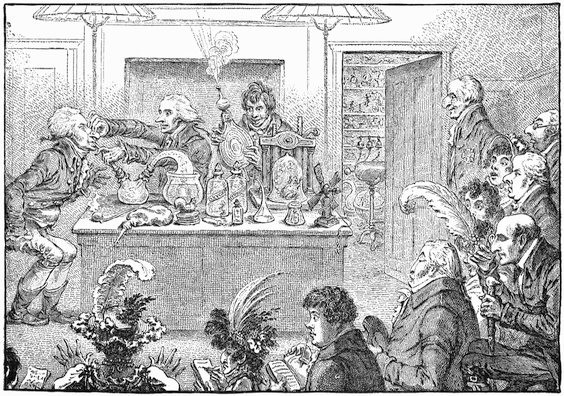
PNEUMATIC EXPERIMENT AT THE ROYAL INSTITUTION. (After Gillray.)
This much, at least, is certain: there was an absolute agreement among those who had the best means of judging that no better appointment was possible. And yet, if we are to credit Dr. Paris, the first impression produced on Rumford by Davy’s personal appearance was highly unfavourable, and the Count would not allow him to lecture in the theatre until he had given a specimen of his abilities in the smaller lecture-room, which old habitués of the Royal Institution well remember. Dr. Paris adds that his first lecture entirely removed every prejudice, and at its conclusion Rumford exclaimed, “Let him command any arrangements which the Institution can afford.” And he was accordingly on the next day promoted to the theatre.
Six weeks after his arrival, he gave his first public lecture. How he acquitted himself, may be gleaned from the following account, given under the heading of the “Royal Institution of Great Britain” in the Philosophical Magazine, vol. x., p. 281 (1801):—
“It must give pleasure to our readers to learn that this new and useful institution, the object of which is the application of science to the common purposes of life, may be now considered as settled on a firm basis....
“We have also to notice a course of lectures, just commenced at the institution, on a new branch of philosophy—we mean the Galvanic Phenomena. On this interesting branch Mr. Davy (late of Bristol) gave the first lecture on the 25th of April. He began with the history of Galvanism, detailed the successive discoveries, and described the different methods of accumulating galvanic influence.... He showed the effects of galvanism on the legs of frogs, and exhibited some interesting experiments on the galvanic effects on the solutions of metals in acids....
“Sir Joseph Banks, Count Rumford, and other distinguished philosophers were present. The audience were highly gratified, and testified their satisfaction by general applause. Mr. Davy, who appears to be very young, acquitted himself admirably well; from the sparkling intelligence of his eye, his animated manner, and the tout ensemble, we have no doubt of his attaining a distinguished eminence.”
The Managers were so far satisfied, that at a meeting held on June 1st they passed the following resolutions:—
“Resolved—That Mr. Humphry Davy, Director of the Chemical Laboratory, and Assistant Lecturer in Chemistry, has, since he has been employed at the Institution, given satisfactory proofs of his talents as a Lecturer.”
“Resolved—That he be appointed, and in future denominated, Lecturer in Chemistry at the Royal Institution, instead of continuing to occupy the place of Assistant Lecturer, which he has hitherto filled.”
In the following July, Dr. Young (“Phenomenon Young,” as he was called at Cambridge), the great exponent of the Undulatory Theory of Light, was engaged as Professor of Natural Philosophy, Editor of the Journals, and General Superintendent of the House.D
D Young’s connection with the Royal Institution was comparatively brief. On July 4th, 1803, it was resolved “That Dr. Young be paid the balance of two years’ complete salary, and that his engagement with the Institution terminate from this time.”
At a meeting held in the same month, the Managers
“Resolved—That a Course of Lectures on the Chemical Principles of the Art of Tanning be given by Mr. Davy. To commence the second of November next; and that respectable persons of the trade, who shall be recommended by Proprietors of the Institution, be admitted to these lectures gratis.”
To order a young man of twenty-two, who had probably never seen the inside of tannery, to give an account of the art and mystery of leather-making, would seem to savour somewhat of what Coleridge would style “ultra-crepidation,” and accordingly the Managers further
“Resolved—That Mr. Davy have permission to absent himself—during the months of July, August, and September for the purpose of making himself more particularly acquainted with the practical part of the business of tanning, in order to prepare himself for giving the above-mentioned course of lectures.”
Lectures on “The Chemical Principles of the Process of Tanning Leather, and of the objects that must particularly be had in view in attempts to improve that most useful art” are mentioned in Rumford’s first prospectus, and the foregoing resolutions were probably passed in consequence. Davy did a considerable amount of experimental work in connection with these lectures, and the Journal of the Royal Institution contains several short communications from him on the chemistry of the subject, but the main facts he discovered are contained in a memoir read to the Royal Society on February 24th, 1803, and published in the Philosophical Transactions of that year, under the title of an “Account of Some Experiments and Observations on the constituent Parts of certain astringent Vegetables; and on their Operation in Tanning.”
Although Davy, by his earnestness, his knowledge, his felicity of expression, and by a certain dignity of treatment which seemed to invest even the homeliest subjects with unlooked-for importance, could interest an audience on almost any subject he brought before them, we may be sure that his soul soon sighed for a loftier theme than leather. He found it on the occasion of his lecture of January 21st, 1802, when he delivered the introductory discourse of that session. The date, indeed, is a red-letter day not only in Davy’s history but also in that of the Royal Institution. From that time the position of the Institution in the scientific and social world of London would seem to be assured.
Its affairs up to this time had been gradually going from bad to worse. The enthusiasm with which it was started a couple of years back had apparently spent itself, and Rumford, by his hauteur and high-handed management, had alienated many powerful friends. The subscriptions, which in 1800 had reached £11,047, had fallen in 1802 to £2,999, whilst the expenses were annually increasing. The outlook was gloomy in the extreme, and everything seemed to portend that the latest scheme for the amelioration of humanity was about to share the too common fate of such projects. The young man of twenty-three, however, changed all this as if by the stroke of a magician’s wand. No Prince Fortunatus could have done more.
His theme was not too ambitious; it would be considered even trite and commonplace to-day, and the man would be very bold or very simple who would now attempt to deal with it in the theatre of the Royal Institution; for this introductory lecture was nothing more than an exordium on the worth of science as an agent in the improvement of society. It was, and was felt to be, however, an apologia for the very existence of the Institution. Rumford and his fellow managers would seem to have staked everything on a single throw. Davy’s power as a lecturer had been noised abroad, and we may be sure that Coleridge and his other friends did not keep their tongues still. Coleridge, indeed, told the literary world that he assiduously attended Davy’s lectures, to increase his stock of metaphors. The youth who had discovered “the pleasure-producing air” was talked about in fashionable circles; and Mr. Bernard and the Count used their persuasiveness, and Sir Joseph Banks his social power, to secure for him the most cultured audience in London. If we may credit Dr. Paris, other influences, too, were at work. Davy’s association with Beddoes had probably gained for him the goodwill of the Tepidarians, even if it did not actually give him the entrée to the Society; and these Red Republicans, whose “pious orgies” at Old Slaughter’s Coffee-House in St. Martin’s Lane consisted mainly in libations of tea, vied with the Royalists in their efforts to pave his triumphal way. His success was instant and complete. In a series of lofty and impassioned periods he traced the services of science to humanity; he dwelt upon its dignity and nobility as a pursuit, upon its value as a moral and educational force. The small, spare youth, with his earnestness, his eloquence, his unaffected manner, the play of his mobile features, his speaking eyes—“eyes which,” as one of his fair auditors was heard to remark, “were made for something besides poring over crucibles”—held his hearers spellbound as he declaimed such sentences as these:—
“Individuals influenced by interested motives or false views may check for a time the progress of knowledge;—moral causes may produce a momentary slumber of the public spirit;—the adoption of wild and dangerous theories, by ambitious or deluded men, may throw a temporary opprobrium on literature; but the influence of true philosophy will never be despised; the germs of improvement are sown in minds, even where they are not perceived; and sooner or later the springtime of their growth must arrive. In reasoning concerning the future hopes of the human species, we may look forward with confidence to a state of society, in which the different orders and classes of men will contribute more effectually to the support of each other than they have hitherto done. This state, indeed, seems to be approaching fast; for, in consequence of the multiplication of the means of instruction the man of science and the manufacturer are daily becoming more assimilated to each other. The artist, who formerly affected to despise scientific principles, because he was incapable of perceiving the advantages of them, is now so far enlightened as to favour the adoption of new processes in his art, whenever they are evidently connected with the diminution of labour; and the increase of projectors, even to too great an extent, demonstrates the enthusiasm of the public mind in its search after improvement....
“The unequal division of property and of labour, the differences of rank and condition amongst mankind, are the sources of power in civilised life—its moving causes, and even its very soul. In considering and hoping that the human species is capable of becoming more enlightened and more happy, we can only expect that the different parts of the great whole of society should be intimately united together, by means of knowledge and the useful arts; that they should act as the children of one great parent, with one determinate end, so that no power may be rendered useless—no exertions thrown away.
“In this view, we do not look to distant ages, or amuse ourselves with brilliant though delusive dreams, concerning the infinite improveability of man, the annihilation of labour, disease, and even death, but we reason by analogy from simple facts, we consider only a state of human progression arising out of its present condition,—we look for a time that we may reasonably expect—FOR A BRIGHT DAY, OF WHICH WE ALREADY BEHOLD THE DAWN.”
Those who may read these sentences will either smile at their seeming archaism, or wonder at the antiquity of their argument; for the lesson which Davy inculcated at the beginning of the century is still at its close dinned into our ears, and practically all the stock reasons urged by latter-day writers and platform speakers on technical education and the abstract value of science are to be found in his lectures. But the circumstances of 1802 were widely different from those of 1896. The birth of the century was a singularly auspicious time for science; and many cultured men who knew nothing of science, yet felt in a dim sort of way that it was destined to be a mighty factor in civilisation. Davy’s words struck a sympathetic chord; they served to formulate and define ideas of which all who lived in the spirit of the times and shared in its movement must have been conscious. Speaking to willing and receptive ears, and with every attribute of manner, speech, and interest in his favour, he saw his chance: and with a practical sagacity beyond his years, he seized it.
Davy’s triumph is recorded in many contemporary notices, and it lives as one of the traditions of the Royal Institution.
Francis Horner thus records his impressions in his journal, under date March 31st, 1802:—
“I have been once to the Royal Institution and heard Davy lecture to a mixed and large assembly of both sexes, to the number perhaps of three hundred or more. It is a curious scene; the reflections it excites are of an ambiguous nature, for the prospect of possible good is mingled with the observation of much actual folly. The audience is assembled by the influence of fashion merely; and fashion and chemistry form a very incongruous union....
“Davy’s style of lecturing is much in favour of himself, though not, perhaps, entirely suited to the place; it has rather a little awkwardness, but it is that air which bespeaks real modesty and good sense; he is only awkward because he cannot condescend to assume that theatrical quackery of manner which might have a more imposing effect. This was my impression from his lecture. I have since (April 2nd) met Davy in company, and was much pleased with him; a great softness and propriety of manner, which might be cultivated into elegance; his physiognomy struck me as being superior to what the science of chemistry, on its present plan, can afford exercise for; I fancied to discover in it the lineaments of poetical feeling.” (“Memoirs of Horner,” vol. i., p. 182.)
Davy’s friend Purkis has left us the following still more glowing account:—
“The sensation created by his first [second] course of Lectures at the Institution, and the enthusiastic admiration which they obtained, is at this period scarcely to be imagined. Men of the first rank and talent,—the literary and the scientific, the practical and the theoretical, blue stockings, and women of fashion, the old and the young, all crowded—eagerly crowded the lecture-room. His youth, his simplicity, his natural eloquence, his chemical knowledge, his happy illustrations, and well-conducted experiments, excited universal attention and unbounded applause. Compliments, invitations, and presents were showered upon him in abundance from all quarters; his society was courted by all, and all appeared proud of his acquaintance.... A talented lady, since well-known in the literary world, addressed him anonymously in a poem of considerable length, replete with delicate panegyric and genuine feeling.... It was accompanied with a handsome ornamental appendage for the watch, which he was requested to wear when he delivered his next lecture, as a token of having received the poem and pardoned the freedom of the writer.”
The anonymous poem “replete with delicate panegyric and genuine feeling” is before me as I write. It is signed “Fidelissima,” and is one of several which the same talented lady addressed to him at different times, and which were found among his papers at his death. Some of them, as sonnets, are of considerable merit, and, had space permitted, are well worthy of reproduction.
The Tepidarians—again on the authority of Dr. Paris—were delighted. Sanguine in the success of their child—for so they considered Davy—they purposely appointed their anniversary festival on the day of his anticipated triumph. Their dinner was marked by every demonstration of hilarity, and the day was ended by a masquerade at Ranelagh.
Dr. John Davy, it should be said, rather sniffs at the Tepidarians and their “ultra-principles,” and doubts if his brother ever belonged to their society. Be this as it may, it is certain that the “Royalists” and the fashionable world into which he was drawn soon influenced Davy’s social and political views. Dr. Davy, whilst willing enough to appreciate at their proper value his brother’s natural and intellectual advantages as contributing to his success, points out that other circumstances connected with the Institution and the period conspired to help him:—
“The Royal Institution was a new experiment. Novelty in itself is delightful, especially to people of rank and fortune, who at that time in consequence of the Continent being closed, and owing to the war, must have been delighted to have had opened to them a new and unexpected source of interest, fitted to amuse those who were suffering from ennui, and to instruct those who were anxious for instruction. The Royal Institution, moreover, was the creation of a large number of influential persons, both in the higher ranks of society and of science. This alone might have sufficed to render it fashionable, and, if fashionable, popular. The period, morally and politically considered, aided the effect; a time of great political excitement had just terminated; a time of gloom and despondency was then commencing. Whatever diverted the public mind and afforded new objects of contemplation, pure and independent sources of amusement and gratification, must have been very welcome to all reflecting persons, even without taking into account the possible and probable good which might be conferred by the Institution on society, in accordance with the intentions with which it was first established.”
Davy thus expressed his own feeling of satisfaction to his mother:—
“London.
“My dear Mother,—I have been very busy in the preparation for my lectures; and for this reason I have not written to you. I delivered my second lecture to-day, and was very much flattered to find the theatre overflowing at this, as well as at the first. I am almost surprised at the interest taken by so many people of rank, in the progress of chemical philosophy; and I hope I am doing a great deal of good, in being the means of producing and directing the taste for it.
“I have been perfectly well since I visited Cornwall; and I enter upon my campaign in high health and spirits. After four months of hard but pleasant labour, I shall again be free!
“I hope you are all well. I very often reflect upon the times that are past; and my mind is always filled with gratitude to the Supreme Being, who has made us all happy; and that, in placing us in distant parts, and in different circles, neither our feelings or affections have been disturbed....
“I shall be very glad to see you again. I intend in June to pass through Scotland and to visit the Western Isles; but I hope I shall spend a part of the autumn with you.
“Pray write to me and give me a little news. Beg Kitty and Grace and Betsy and John to recollect me.
“I am, my dear mother, your very affectionate son
“H. Davy.”
The interest and spirit of enthusiasm thus roused was sedulously cultivated by Davy, and turned to the purposes of the Institution which he served. Rumford was no longer its moving and controlling spirit: his duty to the Elector of Bavaria, and his ill-starred devotion to Madame Lavoisier, had gradually drawn him away from London, and in 1803 he ceased to take any active part in the fortunes of his offspring. Shortly afterwards Sir Joseph Banks also withdrew. In a letter written April, 1804, he tells Rumford that his continued absence from England is a great detriment to the Institution:—
“It is now entirely in the hands of the profane. I have declared my dissatisfaction at the mode in which it is carried on, and my resolution not to attend in future. Had my health and spirits not failed me, I could have kept matters in their proper level, but sick, alone, and unsupported, I have given up what cannot now easily be recovered.”
Sir John Hippesley, who became treasurer, strove to make the Institution above all things fashionable. He had a project for placing private boxes in the theatre, and was concerned about its want of a proper coat-of-arms. Mr. Bernard still continued to hope that Sydney Smith’s lectures on Moral Philosophy might somehow better the condition of the poor. They would, at least, said Horner, “make the real blue-stockings a little more disagreeable than ever, and sensible women a little more sensible.” But the real directing power was Davy, and he gradually stamped upon the place the character it now possesses. How he felt his power and used it, may be gleaned from the following extract from a lecture in 1809, in reference to a fund which had been raised to supply him with a great voltaic battery:—
“In a great country like this, it was to be expected that a fund could not long be wanting for pursuing or perfecting any great scientific object. But the promptitude with which the subscription filled was so great, as to leave no opportunity to many zealous patrons of science for showing their liberality. The munificence of a few individuals has afforded means more ample and magnificent than those furnished by the Government of a rival nation; and I believe we have preceded them in the application of the means. In this kind of emulation, our superiority, I trust, will never be lost; and I trust that the activity belonging to our sciences will always flow from the voluntary efforts of individuals, from whom the support will be an honour—to whom it will be honourable....
“Without facilities for pursuing his object, the greatest genius in experimental research may live and die useless and unknown. Talents of this kind cannot, like talents for literature and the fine arts, call forth attention and respect. They can neither give popularity to the names of patrons, nor ornament their houses. They are limited in their effects, which are directed towards the immutable interests of society. They cannot be made subservient to fashion or caprice; they must forever be attached to truth, and belong to nature. If we merely consider instruction in physical science, this even requires an expensive apparatus to be efficient; for without proper ocular demonstrations, all lectures must be unavailing,—things rather than words should be made the objects of study. A certain knowledge of the beings and substances surrounding us must be felt as a want by every cultivated mind. It is a want which no activity of thought, no books, no course of reading or conversation, can supply. That a spirit for promoting experimental science is not wanting in the country, is proved by the statement which I have just made, by the foundation in which I have the honour of addressing you, and by the number of institutions rising in different parts of the metropolis and in the provinces. But it is clear that this laudable spirit may produce little effect from want of just direction. To divide and to separate the sources of scientific interest, is to destroy all their just effect. To attempt, with insufficient means, to support philosophy, is merely to humiliate her and render her an object of dirision. Those who establish foundations for teaching the sciences ought, at least, to understand their dignity. To connect pecuniary speculation, or commercial advantages, with schemes for promoting the progress of knowledge, is to take crops without employing manure; is to create sterility, and to destroy improvement. A scientific institution ought no more to be made an object of profit than an hospitable, or a charitable establishment. Intellectual wants are at least as worthy of support as corporeal wants, and they ought to be provided for with the same feeling of nobleness and liberality. The language expected by the members of a scientific body from the directors ought not to be, ‘We have increased your property, we have raised the value of your shares.’ It ought rather to be, ‘We have endeavoured to apply your funds to useful purposes, to promote the diffusion of science, to encourage discovery, and to exalt the scientific glory of your country.’
“What this institution has done, it would ill become a person in my place to detail; but that it has tended to the progress of knowledge and invention, will not, I believe, be questioned. Compare the expenditure with the advantages. It would not support the least of your public amusements; and the income of an establishment, which, in its effects, may be said to be national, is derived from annual subscriptions scarcely greater than those which a learned professor of Edinburgh obtains from a single class....
“The progression of physical science is much more connected with your prosperity than is usually imagined. You owe to experimental philosophy some of the most important and peculiar of your advantages. It is not by foreign conquests chiefly that you are become great, but by a conquest of nature in your own country. It is not so much by colonization that you have attained your preeminence or wealth, but by the cultivation of the riches of your own soil. Why, at this moment, are you able to supply the world with a thousand articles of iron and steel necessary for the purposes of life? It is by arts derived from chemistry and mechanics, and founded purely upon experiments. Why is the steam engine now carrying on operations which formerly employed, in painful and humiliating labour, thousands of our robust peasantry, who are now more nobly or more usefully serving their country either with the sword or with the plough? It was in consequence of experiments upon the nature of heat and pure physical investigations.
“In every part of the world manufactures made from the mere clay and pebbles of your soil may be found; and to what is this owing? To chemical arts and experiments. You have excelled all other people in the products of industry. But why? Because you have assisted industry by science. Do not regard as indifferent what is your true and greatest glory. Except in these respects, and in the light of a pure system of faith, in what are you superior to Athens or to Rome? Do you carry away from them the palm in literature and the fine arts? Do you not rather glory, and justly too, in being, in these respects, their imitators? Is it not demonstrated by the nature of your system of public education, and by your popular amusements? In what, then, are you their superiors? In every thing connected with physical science; with the experimental arts. These are your characteristics. Do not neglect them. You have a Newton, who is the glory, not only of your own country, but of the human race. You have a Bacon, whose precepts may still be attended to with advantage. Shall Englishmen slumber in that path which these great men have opened, and be overtaken by their neighbours? Say, rather, that all assistance shall be given to their efforts; that they shall be attended to, encouraged, and supported.”
On a subsequent occasion, when the subjugation of Europe was threatened by the restless military spirit of France, he thus dilated upon the influence of experimental philosophy in strengthening the desire for rational freedom:—
“The scientific glory of a country may be considered, in some measure, as an indication of its innate strength. The exaltation of reason must necessarily be connected with the exaltation of the other noble faculties of the mind; and there is one spirit of enterprise, vigour, and conquest, in science, arts, and arms.
“Science for its progression requires patronage,—but it must be a patronage bestowed, a patronage received, with dignity. It must be preserved independent. It can bear no fetters, not even fetters of gold, and least of all those fetters in which ignorance or selfishness may attempt to shackle it.
“And there is no country which ought so much to glory in its progress, which is so much interested in its success, as this happy island. Science has been a prime cause of creating for us the inexhaustible wealth of manufactures, and it is by science that it must be preserved and extended. We are interested as a commercial people,—we are interested as a free people. The age of glory of a nation is likewise the age of its security. The same dignified feeling, which urges men to endeavour to gain a dominion over nature, will preserve them from the humiliation of slavery. Natural, and moral, and religious knowledge, are of one family; and happy is that country, and great its strength, where they dwell together in union.”
It was, of course, to be expected that amidst the general chorus of approval some discordant notes should be heard. People who preferred the severe and formal manner of his colleague, Dr. Young, who, in spite of his profound knowledge, could never keep an audience together, said that Davy’s style was too florid and imaginative; that his imagery was inappropriate, and his conceits violent; that he was affected and swayed by a mawkish sensibility. Dr. Paris would have us believe there was some show of justice in this accusation, but he thinks that “the style which cannot be tolerated in a philosophical essay may under peculiar circumstances be not only admissible but even expedient in a popular lecture.” The “peculiar circumstance” in Davy’s case was, in Dr. Paris’s opinion, the Royal Institution audience.
“Let us consider for a moment,” he says, “the class of persons to whom Davy addressed himself. Were they students prepared to toil with systematic precision, in order to obtain knowledge as a matter of necessity?—No—they were composed of the gay and the idle, who could only be tempted to admit instruction by the prospect of receiving pleasure,—they were children, who could only be induced to swallow the salutary draught by the honey around the rim of the cup.”
That Davy himself was not wholly unconscious of this fact may be gathered from a letter which he wrote to Mr. Davies Gilbert at about this time. He says:—
“My labours in the Theatre of the Royal Institution have been more successful than I could have hoped from the nature of them. In lectures, the effect produced upon the mind is generally transitory; for the most part, they amuse rather than instruct, and stimulate to enquiry rather than give information. My audience has often amounted to four and five hundred, and upwards; and amongst them some promise to become permanently attached to chemistry. This science is much the fashion of the day.”
Whatever may be urged against Davy’s style of lecturing, his purely scientific memoirs are unquestionably models of their kind. His language is so simple, and his mode of expression so uniformly clear, and so free from technicality, that even an ordinary reader can follow them with delight. In this respect he was consistently faithful to the direction he gives in his “Last Days”:—
“In detailing the results of experiments, and in giving them to the world, the chemical philosopher should adopt the simplest style and manner; he will avoid all ornaments, as something injurious to his subject, and should bear in mind the saying of the first King of Great Britain, respecting a sermon which was excellent in doctrine, but overcharged with poetical allusions and figurative language,—‘that the tropes and metaphors of the speaker were like the brilliant wild flowers in a field of corn, very pretty, but which did very much hurt the corn.’”
Dr. Paris’s remarks concerning Davy’s personal manner and his style of lecturing were warmly controverted at the time of their publication by several of Davy’s friends. Dr. John Davy’s account is so clear and explicit, and so obviously based upon personal observation, for which he had ample opportunities, that, even after making every allowance for brotherly bias, we prefer to regard it as giving a more just impression of Davy’s bearing in the lecture-theatre, and of the care and pains he took to ensure success.
“He was,” says Dr. Davy, “always in earnest; and when he amused most, amusement appeared most foreign to his object. His great and first object was to instruct, and, in conjunction with this, maintain the importance and dignity of science; indeed the latter, and the kindling a taste for scientific pursuits, might rather be considered his main object, and the conveying instruction a secondary one.”
His lecture was almost invariably written expressly for the occasion, and usually on the day before he delivered it.
“On this day he generally dined in his own room, and made a light meal on fish. He was always master of his subject; and composed with great rapidity, and with a security of his powers never failing him.... It was almost an invariable rule with him, the evening before, to rehearse his lecture in the presence of his assistants, the preparations having been made and everything in readiness for the experiments; and this he did, not only with a view to the success of the experiments, and the dexterity of his assistants, but also in regard to his own discourse, the effect of which, he knew, depended upon the manner in which it was delivered. He used, I remember, at this recital, to mark the words which required emphasis and study the effect of intonation; often repeating a passage two or three different times, to witness the difference of effect of variations in the voice. His manner was perfectly natural, animated and energetic, but not in the least theatrical. In speaking, he never seemed to consider himself as an object of attention; he spoke as if devoted to his subject, and as if his audience were equally devoted to it and their interest concentrated in it. The impressiveness of his oratory was one of its great charms ... and his eloquence,—the declamation, as it might be called by some, in which he indulged on the beauty and order of Nature ... was so well received because it was not affected; merely his own strong impressions and feelings embodied in words, and delivered with an earnestness which marked their sincerity.”
It must, however, be admitted that this extraordinary success was not without its evil influence on Davy’s moral qualities. Considering his age, and his temperament, his ambition and love of applause, he would have been something more than human if he could have remained wholly unaffected by the conditions in which he was placed. “The bloom of his simplicity was dulled by the breath of adulation.” He assumed the garb and the airs of a man of fashion, and courted the society of the rich and the aristocratic. Time which would have been more profitably spent in the study, or in the society of his intellectual fellows, was frittered away in the frivolities of London society, or in the salons, or at the soirées of leaders of the “smart” people of the period. The peculiar circumstances of the Royal Institution, and the necessity for the continued adhesion to it of persons of rank and wealth, may to some extent have led him away from the quieter and serener joys of the philosophic life.
“In the morning,” says Paris, “he was the sage interpreter of Nature’s laws; in the evening, he sparkled in the galaxy of fashion; and not the least extraordinary point in the character of this great man, was the facility with which he could cast aside the cares of study, and enter into the trifling amusements of society.—‘Ne otium quidem otiosum,’ was the exclamation of Cicero; and it will generally apply to the leisure of men actively engaged in the pursuits of science; but Davy, in closing the door of his laboratory, opened the temple of pleasure.... In ordinary cases, the genius of evening dissipation is an arrant Penelope; but Davy, on returning to his morning labours, never found that the thread had been unspun during the interruption.”
The following letter from Coleridge will serve to show how this change was foreseen and deplored by his truest friends:—
“Nether Stowey, Feby. 17, 1803.
“My dear Purkis, ... I have been here nearly a fortnight; and in better health than usual. Tranquillity, warm rooms and a dear old friend, are specifics for my complaints. Poole is indeed a very, very good man. I like even his incorrigibility in small faults and deficiencies; it looks like a wise determination of Nature to let well alone; and is a consequence, a necessary one perhaps, of his immutability in his important good qualities....
“I rejoice in Davy’s progress. There are three suns recorded in Scripture:—Joshua’s, that stood still; Hezekiah’s, that went backward; and David’s that went forth, and hastened on his course, like a bridegroom from his chamber. May our friend’s prove the latter! It is a melancholy thing to see a man, like the Sun in the close of the Lapland summer, meridional in his horizon; or like wheat in a rainy season, that shoots up well in the stalk, but does not kern. As I have hoped, and do hope, more proudly of Davy than of any other man; and as he has been endeared to me more than any other man, by the being a Thing of Hope to me (more, far more than my self to my own self in my most genial moments,)—so of course my disappointment would be proportionally severe. It were falsehood, if I said that I think his present situation most calculated, of all others, to foster either his genius, or the clearness and incorruptness of his opinions and moral feelings. I see two Serpents at the cradle of his genius: Dissipation with a perpetual increase of acquaintances, and the constant presence of Inferiors and Devotees, with that too great facility of attaining admiration which degrades Ambition into Vanity—but the Hercules will strangle both the reptile monsters. I have thought it possible to exert talents with perseverance, and to attain true greatness wholly pure, even from the impulses; but on this subject Davy and I always differed.... Yours sincerely
“S. T. Coleridge.”
It would seem that Coleridge’s doubts and fears were shared also by his host, and were communicated by him to the object of them. This, at least, may be inferred from the following extract from a letter from Davy to Poole:—
“London, May 1, 1803.
“My dear Poole, ... Be not alarmed, my dear friend, as to the effect of worldly society on my mind. The age of danger has passed away. There are in the intellectual being of all men, permanent elements, certain habits and passions that cannot change. I am a lover of Nature, with an ungratified imagination. I shall continue to search for untasted charms—for hidden beauties.
“My real, my waking existence is amongst the objects of scientific research: common amusements and enjoyments are necessary to me only as dreams, to interrupt the flow of thoughts too nearly analogous to enlighten and to vivify.
“Coleridge has left London for Keswick; during his stay in town, I saw him seldomer than usual; when I did see him, it was generally in the midst of large companies, where he is the image of power and activity. His eloquence is unimpaired; perhaps it is softer and stronger. His will is probably less than ever commensurate with his ability. Brilliant images of greatness float upon his mind: like the images of the morning clouds upon the waters, their forms are changed by the motion of the waves, they are agitated by every breeze, and modified by every sunbeam. He talked in the course of one hour, of beginning three works, and he recited the poem of Christabel unfinished, and as I had before heard it. What talent does he not waste in forming visions, sublime, but unconnected with the real world! I have looked to his efforts, as to the efforts of a creating being; but as yet, he has not even laid the foundation for the new world of intellectual form....
“Your affectionate friend
“Humphry Davy.”
Space will not permit of any more detailed account of Davy’s career as a lecturer at the Royal Institution. During the twelve years he occupied its Chair of Chemistry he held undisputed sway as the greatest living expositor of chemical doctrine, and session after session saw the theatre crowded with eager and expectant audiences.
This continued and increasing success was due not merely to his art and skill as a speaker, but to the remarkable and astonishing character of what he had to tell—of work which made the laboratory of the Royal Institution even more famous than its lecture-rooms.
PNEUMATIC EXPERIMENT AT THE ROYAL INSTITUTION. (After Gillray.)
D Young’s connection with the Royal Institution was comparatively brief. On July 4th, 1803, it was resolved “That Dr. Young be paid the balance of two years’ complete salary, and that his engagement with the Institution terminate from this time.”
CHAPTER V.
THE CHEMICAL LABORATORY OF THE ROYAL INSTITUTION.
The chemical laboratory of the Royal Institution, as the scene of Davy’s greatest discoveries—discoveries which mark epochs in the development of natural knowledge—will for ever be hallowed ground to the philosopher. The votaries of Hermes have raised far more stately temples: to-day they follow their pursuit in edifices which in architectural elegance and in equipment are palaces compared with the subterranean structure which lies behind the Corinthian façade in Albemarle Street. But to the chemist this spot is what the Ka’ba at Mecca is to the follower of Mohammed, or what Iona was to Dr. Johnson: and, if we may venture to adapt the language of the English moralist, that student has little to be envied whose enthusiasm would not grow warmer or whose devotion would not gain force within the place made sacred by the genius and labours of Davy and Faraday.
And yet, were these great men to revisit the scene of their triumphs, they would hardly recognise it, so completely altered is it by adaptations and rearrangements rendered necessary by their discoveries. How it appeared in their own time may be seen from the illustration on page 91, taken from a water-colour drawing by Miss Harriet Moore, in the possession of the Managers of the Royal Institution.
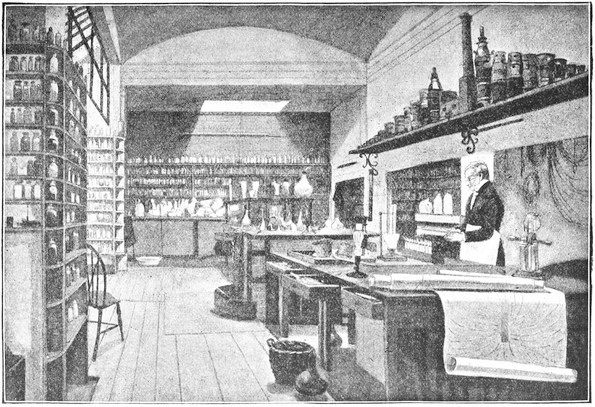
CHEMICAL LABORATORY OF THE ROYAL INSTITUTION IN DAVY’S TIME.
The first year of the century is memorable for the invention of the voltaic pile, and for the discovery, by Nicholson and Carlisle, on April 30th, 1800, of the electrolytic decomposition of water. As Davy said, “the voltaic battery was an alarm-bell to experimenters in every part of Europe; and it served no less for demonstrating new properties in electricity, and for establishing the laws of this science, than as an instrument of discovery in other branches of knowledge; exhibiting relations between subjects before apparently without connection, and serving as a bond of unity between chemical and physical philosophy.” The capital discovery of Volta was made known in England at the earliest possible moment through the mediation of Sir Joseph Banks, and the study of voltaic electricity, its effects and applications, was immediately afterwards entered upon by many Englishmen of science with great zeal and ardour. Davy at this time had just completed his work on Nitrous Oxide; and, powerfully impressed with the significance of Nicholson and Carlisle’s observation, he at once turned his attention to the subject, and even before leaving Bristol he had sent a number of short papers on what was then usually termed the galvanic electricity to Nicholson’s Journal. He showed that oxygen and hydrogen were evolved from separate portions of water, though vegetable and even animal substances intervened; and conceiving that all decomposition might be polar, he “electrised” different compounds at the different extremities, and found that sulphur and metallic substances appeared at the negative pole, and oxygen and nitrogen at the positive pole, though the bodies furnishing them were separate from each other. The papers, however, are mainly remarkable for the fact that they served to establish the intimate connection between the electrical effects and the chemical changes going on in the pile, and for the conclusion drawn concerning their mutual dependence. Within a few days after his removal to the Royal Institution he resumed his inquiries, publishing his results in a series of notices in the short-lived Journal of the Royal Institution.
In 1801 he sent his first communication to the Royal Society, on “An Account of some Galvanic Combinations, formed by the Arrangement of single metallic Plates and Fluids, analogous to the new Galvanic Apparatus of Mr. Volta.”
But at this period, and for some time afterwards, Davy was not altogether free to develop his own ideas, as the work of the laboratory was controlled by a committee which met, from time to time, to deliberate and settle upon the researches which were to be undertaken by their Professor. As we have seen, he was requested, in the first place, to turn his attention to tanning, and to investigate the astringent principles employed in the manufacture of leather. Afterwards, when the Managers determined to form a mineralogical collection, and to institute an assay office for the improvement of mineralogy and metallurgy, he was ordered to make analyses of rocks and minerals. And lastly, in consequence of an arrangement between the Managers and the Board of Agriculture, effected by Arthur Young, he was required to take up the subject of Agricultural Chemistry. To a man of Thomas Young’s temperament the fussy activity of committees, directed by such people as Bernard and Hippesley, would have been resented as an irksome, if not intolerable, interference; but Davy invariably acted as if he considered that their decisions promoted the true interests of the Institution, and entered with ardour into each new scheme. There was no irksomeness to him in being called upon to change the current of his ideas, for he delighted in the opportunity of exhibiting his versatility; and, confident in his powers, he had the ambition to touch everything in turn, and to adorn it. That he should have succeeded so well under such conditions is perhaps the strongest evidence that could be adduced of the strength and elasticity of his eager, active mind, and of his astonishing power of rapid, well-directed work.
We have already dealt with his researches in connection with tanning. The efforts of the Managers towards the improvement of mineralogy and metallurgy, in spite of the generous assistance of Mr. Greville, Sir J. St. Aubin, and Sir A. Hume, and the “activity and intelligence of Mr. Davy,” proved abortive.
One outcome of Davy’s association with the matter may be seen in his paper, published by the Royal Society in 1805, on “An Account of some analytical Experiments on a mineral Production from Devonshire, consisting principally of Alumine and Water.” The mineral referred to was discovered by Dr. Wavel in an argillaceous slate near Barnstaple, and hence was termed wavellite. Davy failed to recognise its true nature, which was first correctly ascertained by Berzelius. A few weeks later, he sent to the Royal Society a second paper “On a Method of Analyzing Stones containing fixed Alkali, by Means of the Boracic Acid.” The method, however, is of comparatively limited application, and is seldom, if ever, now used in analysis. Determinative chemistry was never one of Davy’s strong points, and few of his analytical processes are now employed. Patient manipulation, and minute and sustained attention to detail, were altogether foreign to his disposition and habits, although he had the highest appreciation of these qualities in men like Cavendish and Wollaston.
The lectures on agriculture however, were a great success, and brought increased fame and no small profit to the lecturer. His association with the Board of Agriculture developed into a permanent appointment; for ten successive years he continued to lecture on the subject before its members, and in 1813 he put together the results of his labours in his well-known “Elements of Agricultural Chemistry.” In simplicity and absence of ornament the style of these lectures is in marked contrast to that which he usually employed at the Royal Institution. Dealing with men to whom the matter was of paramount importance, he had no need to stimulate their interest by the arts he employed in the theatre in Albemarle Street. The very nature of the subject, perhaps, served to remind him that tropes and metaphors were here as much out of place as “the brilliant wild flowers in the field of corn—very pretty, but which did very much hurt the corn.”
It would be impossible in the space at our disposal to attempt to give a minute analysis of Davy’s work in connection with agriculture. Its interest now is, for the most part, historical; what is of permanent importance in the way of fact has long since been woven into the common web of knowledge. Its greatest value was not in the novelty or the abundance of its facts, but rather as a closely-reasoned exposition of the relation of agriculture to science, and of the necessity for applying the principles and methods of science to the art. The philosophic breadth of his views, supported, on occasion, by apt example and striking analogy, might be illustrated by many extracts. This, for example, is how he speaks of the value of the scientific method, and of chemistry, to husbandry:—
“Nothing is more wanting in agriculture than experiments, in which all the circumstances are minutely and scientifically detailed. This art will advance with rapidity in proportion as it becomes exact in its methods. As in physical researches all the causes should be considered; a difference in the results may be produced, even by the fall of a half an inch of rain more or less in the course of a season, or a few degrees of temperature, or even by a slight difference in the subsoil, or in the inclination of the land.
“Information collected, after views of distinct inquiry, would necessarily be more accurate, and more capable of being connected with the general principles of science; and a few histories of the results of truly philosophical experiments in agricultural chemistry would be of more value in enlightening and benefitting the farmer, than the greatest possible accumulation of imperfect trials conducted merely in the empirical spirit. It is no unusual occurrence, for persons who argue in favour of practice and experience, to condemn generally all attempts to improve agriculture by philosophical inquiries and chemical methods. That much vague speculation may be found in the works of those who have lightly taken up agricultural chemistry, it is impossible to deny. It is not uncommon to find a number of changes rung upon a string of technical terms, such as oxygen, hydrogen, carbon, and azote, as if the science depended upon words rather than upon things. But this is, in fact, an argument for the necessity of the establishment of just principles of chemistry on the subject. Whoever reasons upon agriculture, is obliged to recur to this science. He feels that it is scarcely possible to advance a step without it; and if he is satisfied with insufficient views, it is not because he prefers them to accurate knowledge, but, generally, because they are more current.... It has been said, and undoubtedly with great truth, that a philosophical chemist would most probably make a very unprofitable business of farming; and this certainly would be the case, if he were a mere philosophical chemist; and unless he had served his apprenticeship to the practice of the art, as well as to the theory. But there is reason to believe that he would be a more successful agriculturist than a person equally uninitiated in farming, but ignorant of chemistry altogether; his science, as far as it went, would be useful to him. But chemistry is not the only kind of knowledge required: it forms a part of the philosophical basis of agriculture; but it is an important part, and whenever applied in a proper manner must produce advantages.”
How highly these lectures were appreciated will be evident from the terms in which they were referred to by Sir John Sinclair in his address of 1806 to the Board. He says:—
“In the year 1802, when my Lord Carrington was in the chair, the Board resolved to direct the attention of a celebrated lecturer, Mr. Davy, to agricultural subjects; and in the following year, during the presidency of Lord Sheffield, he first delivered to the members of this Institution, a course of lectures on the Chemistry of Agriculture. The plan has succeeded to the extent which might have been expected from the abilities of the gentleman engaged to carry it into effect. The lectures have hitherto been exclusively addressed to the members of the Board; but to such a degree of perfection have they arrived, that it is well worthy of consideration, whether they ought not to be given to a larger audience.”
The “degree of perfection” was in no small degree due to the amount of experimental and observational work which Davy introduced into his lectures. Mr. Bernard allotted him a considerable piece of ground on his property at Roehampton for experimental purposes, and the Duke of Bedford carried out trials for him at Woburn. He studied from time to time all the operations of practical farming, examined a great variety of soils, and investigated the nature and action of manures. He was thus brought into contact with some of the largest landowners and agriculturists of his time, and was an honoured guest in the houses of men like Lord Sheffield, Lord Thanet, Mr. Coke of Holkham, and others.E In the practical interest he thus displayed in the most useful of all the arts he sought to emulate the example of his illustrious prototype Lavoisier, and his work constitutes the foundation of every treatise on the subject since the appearance, in 1840, of Liebig’s well-known book.
E In the print of the “Woburn Sheep-Shearing,” Davy is represented as one of a group comprising Mr. Coke, Sir Joseph Banks, Sir John Sinclair, and Mr. Arthur Young.
Professor Warington, than whom no one is more fitted to express an opinion, has favoured me with the following critical estimate of the value of Davy’s work:—
“The lectures profess to be exhaustive and thus present all that Davy had been able to collect on the subject of the relations of chemistry to agriculture during a period of at least 10 years. He appears to have made a careful study of the problems of agriculture for many years, and to be acquainted with English practice, and English experiments. There is but little reference to foreign practice, or foreign opinion, save where the work done has been purely chemical, as e.g. that of Gay Lussac, or Vauquelin. He approaches his subject in a thoroughly scientific manner, taking an independent view of each question, bringing all the knowledge at his disposal to bear upon it, and not hesitating to come to conclusions different from those usually received. The great step taken in these lectures is the assertion that Agriculture must look to Natural Science, and especially to Chemistry, for the explanation of its problems and the improvement of its practice. Davy seems to have been the first, at least in this country, who boldly claimed for ‘Agricultural Chemistry’ the position of a distinct branch of science. He was probably the earliest example of a first-class chemist, who seriously and continuously devoted his best attention to the subject of agriculture.
“The lectures, looked at from a modern standpoint, are of unequal value. The method of food-analysis is very poor, and it is somewhat surprising that the accurate mode of determining nitrogen employed by Gay Lussac is not made use of in Davy’s analyses. Nevertheless he manages to ascertain that spring sown wheat is richer in gluten than autumn sown, and the wheat of hot countries richer than the wheat of temperate regions, statements which are quite correct.
“Lecture VI. is decidedly poor. Davy believes that plants feed on carbonaceous matter by their roots, and this mistaken theory leads him to assign an undue value to organic substances as manures. It seems curious nowadays to find the whole subject of manures treated with hardly any reference to their contents in nitrogen, phosphoric acid, or potash.
“Lecture IV. is one of his best lectures, full of keen observation and suggestive experiment.
“The references to his own agricultural experiments are very numerous; he seems to have made experiments on every subject of inquiry that came before him. There is however no attempt at an extended and thorough investigation of any subject, and for want of this the truth is sometimes missed. Thus in his trials of various ammonium salts as manures he finds the carbonate to be effective, the chloride to be of little value, and the sulphate of no good at all, whereas the last-named salt is now generally chosen as a manure.
“There are some paragraphs that read like the inspirations of genius, though it is now of course difficult to tell to what extent his statements and opinions were warranted by the facts then known. He gives a wonderfully correct idea of the action of peas or beans in rotation, even including the statement that they obtain their nitrogen from the atmosphere.”
Although his time and energy were necessarily largely absorbed by the demands of the Managers, Davy never lost sight of the subject of voltaic electricity, and at intervals he was able to resume his inquiries upon it. What specially impressed him was the power of the voltaic pile as an analytic agent; and his laboratory journals, preserved at the Royal Institution, record the results of numerous trials on the behaviour of compound substances under its influence. In spite of innumerable distractions and constant interruptions, due mainly to the precarious position of the Institution, Davy gradually succeeded in unravelling the fundamental laws of electro-chemistry, and in thus importing a new order of conceptions, altogether unlooked for and undreamt of, into science. This really constitutes his greatest claim as a philosopher to our admiration and gratitude. The isolation of the metals of the alkalis, and the proof of the compound nature of the alkaline earths, were unquestionably achievements of the highest brilliancy, and as such appeal strongly to the popular imagination. But they were only the necessary and consequential links in a chain of discovery which, had Davy neglected to make them, would have been immediately forged by others. It is significant that almost immediately after the capital discovery of Nicholson and Carlisle, Dr. Henry of Manchester, the well-known friend and collaborator of Dalton, should have made the attempt to separate the presumed metallic principle of potash by the agency of voltaic electricity.
* * * * *
Davy communicated the results of his inquiries made prior to the summer of 1806 in a paper to the Royal Society, which was made the Bakerian lecture of the year.F It is entitled “On some chemical Agencies of Electricity,” and is divided in nine sections and an introduction. In the first section, “On the Changes produced by Electricity in Water,” he set at rest the disputed question as to the origin of the acid and alkaline matter which had been observed to form during the electrolysis of this liquid. By some these substances were supposed to be generated from pure water by the action of electricity; and M. Brugnatelli had even attempted to prove the existence of a body sui generis which he termed the electric acid. By a series of convincing experiments Davy showed that the substances were due to the presence of saline matter in the water, derived either from faulty purification, or from the solvent action of the water on the vessels, etc., with which it was in contact. Cruickshank had found that in some cases the acid was nitric acid and the alkali ammonia: these substances were shown by Davy to be due to the presence of dissolved air. When pure water, contained in vessels on which it exerted no solvent action, was “electrised” in vacuo, not a trace of either acid or alkali was produced.
F This lecture, which is one of the events of each session of the Royal Society, owes its origin to Mr. Henry Baker, F.R.S., a learned antiquary and naturalist, who, by his will of July, 1763, bequeathed the sum of £100 to the Society, the interest of which was to be applied “for an oration or discourse to be spoken or read yearly by someone of the Fellows of that Society, on such part of Natural History or Experimental Philosophy, at such time, and in such manner, as the President and Council of the said Society for the time being, shall please to order and appoint.” Baker died in 1774, and the bequest came into operation during the presidency of Sir John Pringle; and Peter Woulfe—one of the last of the English alchemists—was appointed to deliver the lecture, which he did for three successive years.
In the second section, “On the Agencies of Electricity in the Decomposition of various Compounds,” he begins by pointing out that in all the experiments recorded in the preceding section—that is, in all changes in which acid and alkaline matter had been present—the acid matter collected in the water round the positive pole, and the alkaline matter round the negative pole. This he shows to be true even of such sparingly soluble substances as gypsum, the sulphates of strontium and barium, and fluorspar. By connecting together cups or vessels made of the substances under investigation by a thread of well-washed asbestos, as suggested by Wollaston, he found that in all cases the acid element collected round the positive, and the earthy base round the negative pole. Basalt from Antrim, a zeolite from the Giant’s Causeway, vitreous lava from Etna, and even glass, in like manner yielded alkaline matter to water when subjected to the action of voltaic electricity. Soluble salts, such as the sulphates of sodium, potassium, and ammonium, the nitrates of potassium and barium, the succinate, oxalate and benzoate of ammonium, were similarly decomposed: the acids in a certain time collected in the tube containing the positive wire, and the alkalis and earths in that containing the negative wire. When metallic solutions, such as those of iron, zinc, and tin were employed, metallic crystals or depositions were formed on the negative wire, and oxide was likewise deposited round it; and a great excess of acid was soon found in the opposite cup.
In the next section, “On the Transfer of Certain of the Constituent Parts of Bodies by the Action of Electricity,” he points out that the observations of Gautherot and of Hisinger and Berzelius rendered it probable that the saline elements evolved in decompositions by electricity were capable of being transferred from one electrified surface to another, according to their usual order of arrangement, but that exact observations on this point were wanting. He connected a cup of gypsum with one of agate by means of asbestos, and filling each with purified water, he inserted the negative wire of the battery in the agate cup, and the positive wire in that of the sulphate of lime. In about four hours he found a strong solution of lime in the agate cup, and sulphuric acid in that of gypsum. By reversing the order, and carrying on the process for a similar length of time, the sulphuric acid appeared in the agate cup, and the solution of lime on the opposite side. Many trials were made with other saline substances with analogous results.
The time required for these transmissions (the quantity and intensity of the electricity, and other circumstances remaining the same) seemed to be related to the length of the intermediate column of water.
To ascertain whether the contact of the saline solution with a metallic surface was necessary for the decomposition and transference, he introduced purified water into two glass tubes; a vessel containing solution of potassium chloride was connected with each of the tubes by means of asbestos; on introducing the wires into the tubes alkaline matter soon appeared in one tube, and acid matter in the other; and in the course of a few hours moderately strong solutions of potash and of hydrochloric acid were formed.
Two tubes, one containing distilled water, the other a solution of potassium sulphate, were each connected by asbestos threads with a vessel containing a dilute solution of litmus; the saline matter was negatively electrified; and as it was natural to suppose that the sulphuric acid in passing through the water to the positive side would redden the litmus in its course, some slips of litmus paper were placed above and below the pieces of asbestos, directly in the circuit: it was found that the acid and alkali passed through the litmus solution without effecting any change in colour.
“As acid and alkaline substances during the time of their electrical transfer passed through water containing vegetable colours without affecting them, or apparently combining with them, it immediately became an object of inquiry whether they would not likewise pass through chemical menstrua having stronger attractions for them; and it seemed reasonable to suppose that the same power which destroyed elective affinity in the vicinity of the metallic points would likewise destroy it, or suspend its operation, throughout the whole of the circuit.”
To test this supposition, solution of potassium sulphate was placed in contact with the negative wire, and pure water in contact with the positive wire and a weak solution of ammonia was made the middle link of the conducting chain, so that no sulphuric acid could pass to the positive pole in the distilled water without passing through the solution of ammonia.
In less than five minutes it was found that acid was collecting round the positive pole, and in half an hour the water was sour to the taste, and gave a precipitate with barium nitrate. Hydrochloric acid from common salt, and nitric acid from nitre were transmitted through concentrated alkaline menstrua under similar circumstances. Strontia and baryta readily passed, like the other alkaline substances, through hydrochloric and nitric acids; and vice versâ these acids passed with facility through aqueous solution of baryta and strontia; but it was impossible to pass sulphuric acid through baryta or strontia, or to pass baryta and strontia through sulphuric acid, as precipitates of insoluble barium and strontium sulphate were formed.
* * * * *
In the next section, “On Some General Observations on these Phenomena, and on the Mode of Decomposition and Transition,” he summarises the foregoing results:—
“It will be a general expression of the facts that have been detailed, relating to the changes and transitions by electricity, in common philosophical language, to say that hydrogen, the alkaline substances, the metals, and certain metallic oxides, are attracted by negatively electrified metallic surfaces, and repelled by positively electrified metallic surfaces; and contrariwise, that oxygen and acid substances are attracted by positively electrified metallic surfaces, and repelled by negatively electrified metallic surfaces; and these attractive and repulsive forces are sufficiently energetic to destroy or suspend the usual operation of elective affinity.
“It is very natural to suppose, that the repellent and attractive energies are communicated from one particle to another particle of the same kind, so as to establish a conducting chain in the fluid; and that the locomotion takes place in consequence; and that this is really the case seems to be shown by many facts. Thus, in all the instances in which I examined alkaline solutions through which acids had been transmitted, I always found acid in them whenever any acid matter remained at the original source....
“In the cases of the separation of the constituents of water, and of solutions of neutral salts forming the whole of the chain, there may possibly be a succession of decompositions, and recompositions throughout the fluid. And this idea is strengthened by the experiments on the attempt to pass barytes through sulphuric acid, and muriatic acid through solution of sulphate of silver, in which as insoluble compounds are formed and carried out of the sphere of the electrical action, the power of transfer is destroyed.”
In the next section, “On the General Principles of the Chemical Changes produced by Electricity,” he points out that it had been already shown by Bennet that many bodies brought into contact and afterwards separated exhibited opposite states of electricity; and that this observation had been confirmed and extended by Volta, who had supposed that it also takes place with regard to metals and fluids. In his paper in the Philosophical Transactions of 1801, the first he sent to the Royal Society, Davy had shown that when alternations of single metallic plates and acid and alkaline solutions were employed in the construction of voltaic combinations, the alkaline solutions always received the electricity from the metal, and the acid always transmitted it to the metal.
In the simplest case of electrical action, the alkali which receives electricity from the metal would necessarily, on being separated from it, appear positive, whilst the acid under similar circumstances would be negative; and these bodies, having respectively with regard to the metals that which may be called a positive and a negative electrical energy, in their repellent and attractive functions seem to be governed by laws the same as the common laws of electrical attraction and repulsion.
The seventh section treats of “The Relations between the Electrical Energies of Bodies and their Chemical Affinities”:—
“As the chemical attraction between two bodies seems to be destroyed by giving one of them an electrical state different from that which it naturally possesses; that is, by bringing it artificially into a state similar to the other, so it may be increased by exalting its natural energy. Thus, whilst zinc, one of the most oxidable of the metals, is incapable of combining with oxygen when negatively electrified in the circuit, even by a feeble power; silver, one of the least oxidable, easily unites to it when positively electrified; and the same thing might be said of other metals. Amongst the substances that combine chemically, all those, the electrical energies of which are well known, exhibit opposite states; thus copper and zinc, gold and quicksilver, sulphur and the metals, the acid and alkaline substances, afford opposite instances; and supposing perfect freedom of motion in their particles or elementary matter, they ought according to the principles laid down, to attract each other in consequence of their electrical powers. In the present state of our knowledge it would be useless to attempt to speculate on the remote cause of the electrical energy, or the reason why different bodies, after being brought into contact should be found differently electrified; its relation to chemical affinity is however, sufficiently evident. May it not be identical with it, and an essential property of matter?”
How Davy sought to elaborate a theory of chemical affinity on these facts will be sufficiently obvious from the following extracts:—
“Supposing two bodies, the particles of which are in different electrical states, and those states sufficiently exalted to give them an attractive force superior to the power of aggregation, a combination would take place which would be more or less intense according as the energies were more or less perfectly balanced; and the change of properties would be correspondently proportional.”
“When two bodies repellent of each other act upon the same body with different degrees of the same electrical attracting energy, the combination would be determined by the degree; and the substance possessing the weakest energy would be repelled; and this principle would afford an expression of the causes of elective affinity and the decompositions produced in consequence.”
“Or where the bodies having different degrees of the same energy, with regard to the third body, had likewise different energies with regard to each other, there might be such a balance of attractive and repellent powers as to produce a triple compound; and by the extension of this reasoning, complicated chemical union may be easily explained.”
As the combined effect of many particles possessing a feeble electrical energy may be conceived equal or even superior to the effect of a few particles possessing a strong electrical energy, the same principle may explain the influence of mass action, as elucidated by Berthollet.
He conceives also that it may be possible to obtain a measure of chemical affinity founded upon the energy of the voltaic apparatus required to destroy the chemical equilibrium. He points out that, as light and heat are the common consequences of the restoration of the equilibrium between bodies in a high state of opposite electricities, so it is perhaps an additional circumstance in favour of his theory to state that heat and light are likewise the result of all intense chemical action. And as in certain forms of the voltaic battery when large quantities of electricity of low intensity act, heat is produced without light; so in slow combinations there is an increase of temperature without luminous appearance. The effect of heat in producing combination may, he assumes, be also explained according to these ideas. It not only gives more freedom of motion to the particles, but in a number of cases—e.g. tourmaline, sulphur, etc.—it seems to exalt the electrical energies of bodies.
In the eighth section he seeks to apply these principles to the mode of action of the voltaic pile, and to explain the nature of the changes which occur between the plates and the exciting fluid, and he points out that the theory in some measure reconciles the hypothetical principles of the action of the pile adopted by its inventor with the opinions concerning the chemical origin of galvanism held by the majority of British men of science at that period. At the same time, Davy argues that the facts are in contradiction to the assumption that chemical changes are the primary causes of the phenomena of galvanism. Moreover, in mere cases of chemical change—as in iron burning in oxygen, the deflagration of nitre with charcoal, the combination of potash with sulphuric acid, the amalgamation of zinc,—electricity is never exhibited.
In the concluding section he trusts that many applications of the general facts and principles thus indicated to the processes of chemistry, both in art and in nature, may suggest themselves to the philosophical inquirer. It is not improbable, he thinks, that the electric decomposition of the neutral salts in different cases may admit of economical uses. He is induced to hope that the new mode of analysis may lead to the discovery of the true elements of bodies:—
“For if chemical union be of the nature which I have ventured to suppose, however strong the natural electrical energies of the elements of bodies may be, yet there is every probability of a limit to their strength: whereas the powers of our artificial instruments seem capable of indefinite increase.”
Phenomena similar to those occurring in the voltaic cell must be produced in various parts of the interior strata of our globe, and it is very probable that many mineral formations have been materially influenced, or even occasioned, by such action. The electrical power of transference may serve to explain some of the principal and most mysterious facts in geology.
“Natural electricity has hitherto been little investigated, except in the case of its evident and powerful concentration in the atmosphere. Its slow and silent operations in every part of the surface will probably be found more immediately and importantly connected with the order and economy of nature; and investigations on this subject can hardly fail to enlighten our philosophical systems of the earth, and may possibly place new powers within our reach.”
The publication of this paper exercised a profound sensation, both at home and abroad. Berzelius, years afterwards, spoke of it as one of the most remarkable memoirs that had ever enriched the theory of chemistry—and the praise is the more significant when it is remembered that Davy had thereby seemed to have taken possession of a field of inquiry which the Swedish chemist, who was only a year younger than Davy, had been among the first to enter. Still more significant was the action of the French Institute. Bonaparte, when First Consul, had announced to the Institute his intention of founding a medal “for the best experiment which should be made in the course of each year on the galvanic fluid,” and had further expressed his desire to give the sum of sixty thousand francs “à celui qui, par ses expériences et ses découvertes fera à faire à l’electricité et au galvanisme un pas comparable à celui qu’ont fait faire à ces sciences Franklin et Volta.” A committee of the Institute, consisting of La Place, Halle, Coulomb, Hauy and Biot, was appointed to consider the best means of accomplishing the wishes of the First Consul, and twelve months after the publication of the Bakerian lecture they awarded its author the medal. Whether the Institute had the means of awarding the sixty thousand francs as well is more than doubtful, for it does not appear that the sum named by Bonaparte ever went beyond the promise of it. All that the Institute got for themselves was, as Maria Edgeworth said, “a rating all round in imperial Billingsgate.” The two countries at this period were at war, and the feeling of animosity was most bitter. Of course, there were persons who said that patriotism should forbid the acceptance of the award. Davy’s own view was more sensible and politic. “Some people,” he said to his friend Poole, “say I ought not to accept this prize; and there have been foolish paragraphs in the papers to that effect; but if the two countries or governments are at war, the men of science are not. That would, indeed, be a civil war of the worst description: we should rather, through the instrumentality of men of science, soften the asperities of national hostility.”
CHEMICAL LABORATORY OF THE ROYAL INSTITUTION IN DAVY’S TIME.
E In the print of the “Woburn Sheep-Shearing,” Davy is represented as one of a group comprising Mr. Coke, Sir Joseph Banks, Sir John Sinclair, and Mr. Arthur Young.
F This lecture, which is one of the events of each session of the Royal Society, owes its origin to Mr. Henry Baker, F.R.S., a learned antiquary and naturalist, who, by his will of July, 1763, bequeathed the sum of £100 to the Society, the interest of which was to be applied “for an oration or discourse to be spoken or read yearly by someone of the Fellows of that Society, on such part of Natural History or Experimental Philosophy, at such time, and in such manner, as the President and Council of the said Society for the time being, shall please to order and appoint.” Baker died in 1774, and the bequest came into operation during the presidency of Sir John Pringle; and Peter Woulfe—one of the last of the English alchemists—was appointed to deliver the lecture, which he did for three successive years.