автордың кітабын онлайн тегін оқу Buddhism
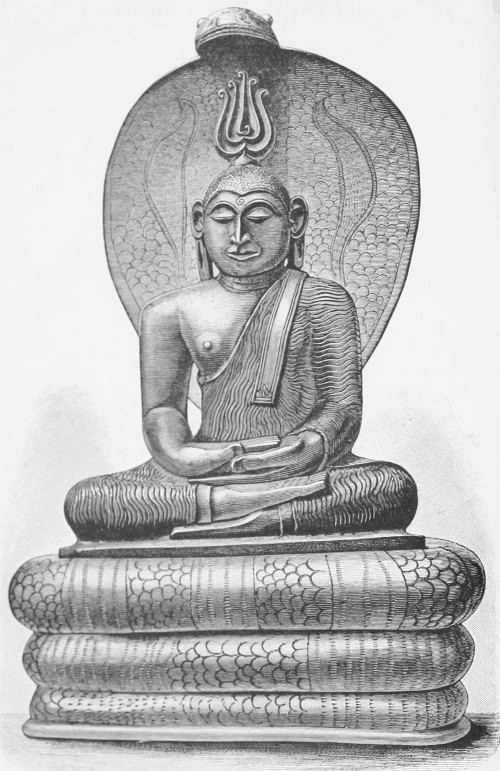
BRASS IMAGE OF GAUTAMA BUDDHA FROM CEYLON.
He is seated on the Mućalinda Serpent (see p. 480), in an attitude of profound meditation, with eyes half closed, and five rays of light emerging from the crown of his head. [Frontispiece.
BUDDHISM,
IN ITS CONNEXION WITH BRĀHMANISM AND HINDŪISM, AND IN ITS CONTRAST WITH CHRISTIANITY,
BY
SIR MONIER MONIER-WILLIAMS, K.C.I.E.,
M.A., HON. D.C.L. OF THE UNIVERSITY OF OXFORD, HON. LL.D. OF THE UNIVERSITY OF CALCUTTA, HON. PH.D. OF THE UNIVERSITY OF GÖTTINGEN, HON. MEMBER OF THE ASIATIC SOCIETIES OF BENGAL AND BOMBAY, AND OF THE ORIENTAL AND PHILOSOPHICAL SOCIETIES OF AMERICA, BODEN PROFESSOR OF SANSKṚIT, AND LATE FELLOW OF BALLIOL COLLEGE, OXFORD, ETC.
NEW YORK:
MACMILLAN AND CO.
1889.
[All rights reserved.]
PREFACE.
The ‘Duff Lectures’ for 1888 were delivered by me at Edinburgh in the month of March. In introducing my subject, I spoke to the following effect:—
‘I wish to express my deep sense of the responsibility which the writing of these Lectures has laid upon me, and my earnest desire that they may, by their usefulness, prove in some degree worthy of the great missionary whose name they bear.
‘Dr. Duff was a man of power, who left his own foot-print so deeply impressed on the soil of Bengal, that its traces are never likely to be effaced, and still serve to encourage less ardent spirits, who are striving to imitate his example in the same field of labour.
‘But not only is the impress of his vigorous personality still fresh in Bengal. He has earned an enduring reputation throughout India and the United Kingdom, as the prince of educational missionaries. He was in all that he undertook an enthusiastic and indefatigable workman, of whom, if of any human being, it might be truly said, that, when called upon to quit the sphere of his labours, “he needed not to be ashamed.” No one can have travelled much in India without having observed how wonderfully the results of his indomitable energy and fervid eloquence in the cause of Truth wait on the memory of his work everywhere. Monuments may be erected and lectureships founded to perpetuate his name and testify to his victories over difficulties which few other men could have overcome, but better than these will be the living testimony of successive generations of Hindū men and women, whose growth and progress in true enlightenment will be due to the seed which he planted, and to which God has given the increase.’
I said a few more words expressive of my hope that the ‘Life of Dr. Duff’[1] would be read and pondered by every student destined for work of any kind in our Indian empire, and to that biography I refer all who are unacquainted with the particulars of the labours of a man to whom Scotland has assigned a place in the foremost rank of her most eminent Evangelists.
I now proceed to explain the process by which these Lectures have gradually outgrown the limits required by the Duff Trustees.
When I addressed myself to the carrying out of their wishes—communicated to me by Mr. W. Pirie Duff—I had no intention of undertaking more than a concise account of a subject which I had been studying for many years. I conceived it possible to compress into six Lectures a scholarly sketch of what may be called true Buddhism,—that is, the Buddhism of the Piṭakas or Pāli texts which are now being edited by the Pāli Text Society, and some of which have been translated in the ‘Sacred Books of the East.’ It soon, however, became apparent to me that to write an account of Buddhism which would be worthy of the great Indian missionary, I ought to exhibit it in its connexion with Brāhmanism and Hindūism and even with Jainism, and in its contrast with Christianity. Then, as I proceeded, I began to feel that to do justice to my subject I should be compelled to enlarge the range of my researches, so as to embrace some of the later phases and modern developments of Buddhism. This led me to undertake a more careful study of Koeppen’s Lamaismus than I had before thought necessary. Furthermore, I felt it my duty to study attentively numerous treatises on Northern Buddhism, which I had before read in a cursory manner. I even thought it incumbent on me to look a little into the Tibetan language, of which I was before wholly ignorant.
I need scarcely explain further the process of expansion through which the present work has passed. A conviction took possession of my mind, that any endeavour to give even an outline of the whole subject of Buddhism in six Lectures, would be rather like the effort of a foolish man trying to paint a panorama of London on a sheet of note-paper. Hence the expansion of six Lectures into eighteen, and it will be seen at once that many of these eighteen are far too long to have been delivered in extenso. In point of fact, by an arrangement with the Trustees, only a certain portion of any Lecture was delivered orally. The present work is rather a treatise on Buddhism printed and published in memory of Dr. Duff.
I need not encumber the Preface with a re-statement of the reasons which have made the elucidation of an intricate subject almost hopelessly difficult. They have been stated in the Introductory Lecture (pp. 13, 14).
Moreover the plan of the present volume has been there set forth (see p. 17).
I may possibly be asked by weary readers why I have ventured to add another tributary to the too swollen stream of treatises on Buddhism? or some may employ another metaphor and inquire why I have troubled myself to toil and plod over a path already well travelled over and trodden down? My reply is that I think I can claim for my own work an individuality which separates it from that of others—an individuality which may probably commend it to thoughtful students of Buddhism as helping to clear a thorny road, and introduce some little order and coherence into the chaotic confusion of Buddhistic ideas.
At any rate I request permission to draw attention to the following points, which, I think, may invest my researches with a distinctive character of their own.
In the first place I have been able to avail myself of the latest publications of the Pāli Text Society, and to consult many recent works which previous writers on Buddhism have not had at their command.
Secondly, I have striven to combine scientific accuracy with a popular exposition sufficiently readable to satisfy the wants of the cultured English-speaking world—a world crowded with intelligent readers who take an increasing interest in Buddhism, and yet know nothing of Sanskṛit, Pāli, and Tibetan.
Thirdly, I have aimed at effecting what no other English Orientalist has, to my knowledge, ever accomplished. I have endeavoured to deal with a complex subject as a whole, and to present in one volume a comprehensive survey of the entire range of Buddhism, from its earliest origin in India to its latest modern developments in other Asiatic countries.
Fourthly, I have brought to the study of Buddhism and its sacred language Pāli, a life-long preparatory study of Brāhmanism and its sacred language Sanskṛit.
Fifthly, I have on three occasions travelled through the sacred land of Buddhism (p. 21), and have carried on my investigations personally in the place of its origin, as well as in Ceylon and on the borders of Tibet.
Lastly, I have depicted Buddhism from the standpoint of a believer in Christianity, who has shown, by his other works on Eastern religions, an earnest desire to give them credit for all the good they contain.
In regard to this last point, I shall probably be told by some enthusiastic admirers of Buddhism, that my prepossessions and predilections—inherited with my Christianity—have, in spite of my desire to be just, distorted my view of a system with which I have no sympathy. To this I can only reply, that my consciousness of my own prepossessions has made me the more sensitively anxious to exhibit Buddhism under its best aspects, as well as under its worst. An attentive perusal of my last Lecture (see p. 537) will, I hope, make it evident that I have at least done everything in my power to dismiss all prejudice from my mind, and to assume and maintain the attitude of an impartial judge. And to this end I have taken nothing on trust, or at second hand. I have studied Pāli, as I have the other Indian Prākṛits, on my own account, and independently. I have not accepted unreservedly any man’s interpretation of the original Buddhist texts, and have endeavoured to verify for myself all doubtful statements and translations which occur in existing treatises. Of course I owe much to modern Pāli scholars, and writers on Buddhism, and to the translators of the ‘Sacred Books of the East;’ but I have frequently felt compelled to form an independent opinion of my own.
The translations given in the ‘Sacred Books of the East’—good as they generally are—have seemed to me occasionally misleading. I may mention as an instance the constant employment by the translators of the word ‘Ordination’ for the ceremonies of admission to the Buddhist monkhood (see pp. 76-80 of the present volume). I have ventured in such instances to give what has appeared to me a more suitable equivalent for the Pāli. On the same principle I have avoided all needless employment of Christian terminology and Bible-language to express Buddhist ideas.
For example, I have in most cases excluded such words as ‘sin,’ ‘holiness,’ ‘faith’, ‘trinity,’ ‘priest’ from my explanations of the Buddhist creed, as wholly unsuitable.
I regret that want of space has compelled me to curtail my observations on Jainism—the present representative of Buddhistic doctrines in India (see p. 529.) I hope to enter more fully on this subject hereafter.
The names of authors to whom students of Buddhism are indebted are given in my first Lecture (pp. 14, 15). We all owe much to Childers. My own thanks are specially due to General Sir Alexander Cunningham, to Professor E. B. Cowell of Cambridge, Professor Rhys Davids, Dr. Oldenberg, Dr. Rost, Dr. Morris, Dr. Wenzel, who have aided me with their opinions, whenever I have thought it right to consult them. Dr. Rost, C.I.E., of the India Office, is also entitled to my warmest acknowledgments for having placed at my disposal various subsidiary works bearing on Buddhism, some of which belong to his own Library.
My obligations to Mr. Hoey’s translation of Dr. Oldenberg’s ‘Buddha,’ to the translations of the travels of the Chinese pilgrims by Professor Legge, Mr. Beal, M. Abel Rémusat, and M. Stanislas Julien, to M. Huc’s travels, and to Mr. Scott’s ‘Burman,’ will be evident, and have been generally acknowledged in my notes. I am particularly grateful to Mr. Sarat Chandra Dās, C.I.E., for the information contained in his Report and for the instruction which I received from him personally while prosecuting my inquiries at Dārjīling.
I have felt compelled to abbreviate nearly all my quotations, and therefore occasionally to alter the phraseology. Hence I have thought it right to mark them by a different type without inverted commas.
With regard to transliteration I must refer the student to the rules for pronunciation given at p. xxxi. They conform to the rules given in my Sanskṛit Grammar and Dictionary. Like Dr. Oldenberg, I have preferred to substitute Sanskṛit terminations in a for the Pāli o. In Tibetan I have constantly consulted Jäschke, but have not followed his system of transliteration.
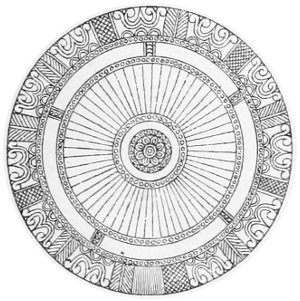
In conclusion, I may fitly draw attention to the engravings of objects, some of which were brought by myself from Buddhist countries. They are described in the list of illustrations (see p. xxix), and will, I trust, give value to the present volume. It has seemed to me a duty to make use of every available appliance for throwing light on the obscurities of a difficult subject; and, as these Lectures embrace the whole range of Buddhism, I have adopted as a frontispiece a portrait of Buddha which exhibits Buddhism in its receptivity and in its readiness to adopt serpent-worship, or any other superstition of the races which it strove to convert. On the other hand, the Wheel, with the Tri-ratna and the Lotus (pp. 521, 522), is engraved on the title-page as the best representative symbol of early Buddhism. It is taken from a Buddhist sculpture at Amarāvatī engraved for Mr. Fergusson’s ‘Tree and Serpent-worship’ (p. 237).
The portrait which faces page 74 is well worthy of attention as illustrating the connexion[2] between Buddhism and Brāhmanism. It is from a recently-taken photograph of Mr. Gaurī-Ṡaṅkar Uday-Ṡaṅkar, C.S.I.—a well-known and distinguished Brāhman of Bhaunagar—who (with Mr. Percival) administered the State during the minority of the present enlightened Mahā-rāja. Like the Buddha of old, he has renounced the world—that is, he has become a Sannyāsī, and is chiefly engaged in meditation. He has consequently dropped the title C.S.I., and taken the religious title—Svāmī Ṡrī Saććidānanda-Sarasvatī. His son, Mr. Vijay-Ṡaṅkar Gaurī-Ṡaṅkar, kindly sent me the photograph, and with his permission I have had it engraved.
It will be easily understood that, as a great portion of the following pages had to be delivered in the form of Lectures, occasional repetitions and recapitulations were unavoidable, but I trust I shall not be amenable to the charge of repeating anything for the sake of ‘padding.’ I shall, with more justice, be accused of ‘cramming,’ in the sense of attempting to force too much information into a single volume.
January 1, 1889.
POSTSCRIPT.
Since writing the foregoing prefatory remarks, I have observed with much concern that a prevalent error, in regard to Buddhism, is still persistently propagated. It is categorically stated in a newspaper report of a quite recent lecture, that out of the world’s population of about 1500 millions at least 500 millions are Buddhists, and that Buddhism numbers more adherents than any other religion on the surface of the globe.
Almost every European writer on Buddhism, of late years, has assisted in giving currency to this utterly erroneous calculation, and it is high time that an attempt should be made to dissipate a serious misconception.
It is forgotten that mere sympathizers with Buddhism, who occasionally conform to Buddhistic practices, are not true Buddhists. In China the great majority are first of all Confucianists and then either Tāoists or Buddhists or both. In Japan Confucianism and Shintoism co-exist with Buddhism. In some other Buddhist countries a kind of Shamanism is practically dominant. The best authorities (including the Oxford Professor of Chinese, as stated in the Introduction to his excellent work ‘The Travels of Fā-hien’) are of opinion that there are not more than 100 millions of real Buddhists in the world, and that Christianity with its 430 to 450 millions of adherents has now the numerical preponderance over all other religions. I am entirely of the same opinion. I hold that the Buddhism, described in the following pages, contained within itself, from the earliest times, the germs of disease, decay, and death (see p. 557), and that its present condition is one of rapidly increasing disintegration and decline.
We must not forget that Buddhism has disappeared from India proper, although it dominates in Ceylon and Burma, and although a few Buddhist travellers find their way back to the land of its origin and sojourn there.
Indeed, if I were called upon to give a rough comparative numerical estimate of the six chief religious systems of the world, I should be inclined, on the whole, to regard Confucianism as constituting, next to Christianity, the most numerically prevalent creed. We have to bear in mind the immense populations, both in China and Japan, whose chief creed is Confucianism.
Professor Legge informs me that Dr. Happer—an American Presbyterian Missionary of about 45 years standing, who has gone carefully into the statistics of Buddhism—reckons only 20 millions of Buddhists in China, and not more than 72½ millions in the whole of Asia. Dr. Happer states that, if the Chinese were required to class themselves as Confucianists or Buddhists or Tāoists, 19/20ths, if not 99/100ths, of them would, in his opinion, claim to be designated as Confucianists.
In all probability his estimate of the number of Buddhists in China is too low, but the Chinese ambassador Liū, with whom Professor Legge once had a conversation on this subject, ridiculed the view that they were as numerous as the Confucianists.
Undeniably, as it seems to me, the next place after Christianity and Confucianism should be given to Brāhmanism and Hindūism, which are not really two systems but practically one; the latter being merely an expansion of the former, modified by contact with Buddhism.
Brāhmanism, as I have elsewhere shown, is nothing but spiritual Pantheism; that is, a belief in the universal diffusion of an impersonal Spirit (called Brăhmăn or Brăhmă)—as the only really existing Essence—and in its manifesting itself in Mind and in countless material forces and forms, including gods, demons, men, and animals, which, after fulfilling their course, must ultimately be re-absorbed into the one impersonal Essence and be again evolved in endless evolution and dissolution.
Hindūism, with its worship of Vishṇu and Ṡiva, is based on this pantheistic doctrine, but the majority of the Hindūs are merely observers of Brāhmanical institutions with their accompanying Hindū caste usages. If, however, we employ the term Hindū in its widest acceptation (omitting only all Islāmized Hindūs) we may safely affirm that the adherents of Hindūism have reached an aggregate of nearly 200 millions. In the opinion of Sir William Wilson Hunter, they are still rapidly increasing, both by excess of births over deaths and by accretions from more backward systems of belief.
Probably Buddhism has a right to the fourth place in the scale of numerical comparison. At any rate the number of Buddhists can scarcely be calculated at less than 100 millions.
In regard to Muhammadanism, this creed should not, I think, be placed higher than fifth in the enumeration. In its purest form it ought to be called Islām, and in that form it is a mere distorted copy of Judaism.
The Empress of India, as is well known, rules over more Muhammadans than any other potentate in the world. Probably the Musalmān population of the whole of India now numbers 55 millions.
As to the number of Muhammadans in the Turkish empire, there are no very trustworthy data to guide us, but the aggregate is believed to be about 14 millions; while Africa can scarcely reckon more than that number, even if Egypt be included.
The sixth system, Tāoism (the system of Lāo-tsze), according to Professor Legge, should rank numerically after both Muhammadanism and Buddhism.
Of course Jainism (p. 529) and Zoroastrianism (the religion of the Pārsīs) are too numerically insignificant to occupy places in the above comparison.
It is possible that a careful census might result in a more favourable estimate of the number of Buddhists in the world, than I have here submitted; but at all events it may safely be alleged that, even as a form of popular religion, Buddhism is gradually losing its vitality—gradually loosening its hold on the vast populations once loyal to its rule; nay, that the time is rapidly approaching when its capacity for resistance must give way before the mighty forces which are destined in the end to sweep it from the earth.
M. M.-W.
88 Onslow Gardens, London.
January 15, 1889.
CONTENTS.
PAGE
Preface v
Postscript on the common error in regard to the comparative prevalence of Buddhism in the world xiv
List of Illustrations xxix
Rules for Pronunciation xxxi
Pronunciation of Buddha, etc. Addenda and Corrigenda xxxii
LECTURE I.
Introductory Observations.
Buddhism in its relation to Brāhmanism. Various sects in Brāhmanism. Creed of the ordinary Hindū. Rise of scepticism and infidelity. Materialistic school of thought. Origin of Buddhism and Jainism. Manysidedness of Buddhism. Its complexity. Labours of various scholars. Divisions of the subject. The Buddha, his Law, his Order of Monks. Northern Buddhism 1-17
LECTURE II.
The Buddha as a Personal Teacher.
The Buddha’s biography. Date of his birth and death. His names, epithets, and titles. Story of the four visions. Birth of the Buddha’s son. The Buddha leaves his home. His life at Rāja-gṛiha. His study of Brāhmanical philosophy. His sexennial fast. His temptation by Māra. He attains perfect enlightenment. The Bodhi-tree. Buddha and Muhammad compared. The Buddha’s proceedings after his enlightenment. His first teaching at Benares. First sermon. Effect of first teaching. His first sixty missionaries. His fire-sermon. His eighty great disciples. His two chief and sixteen leading disciples. His forty-five years of preaching and itineration. His death and last words. Character of the Buddha’s teaching. His method illustrated by an epitome of one of his parables 18-52
LECTURE III.
The Dharma or Law and Scriptures of Buddhism.
Origin of the Buddhist Law (Dharma). Buddhist scriptures not like the Veda. First council at Rāja-gṛiha. Kāṡyapa chosen as leader. Recitation of the Buddha’s precepts. Second council at Vaiṡālī. Ćandra-gupta. Third council at Patnā. Composition of southern canon. Tri-piṭaka or three collections. Rules of discipline, moral precepts, philosophical precepts. Commentaries. Buddha-ghosha. Aṡoka’s inscriptions. His edicts and proclamations. Fourth council at Jālandhara. Kanishka. The northern canon. The nine Nepālese canonical scriptures. The Tibetan canonical scriptures (Kanjur) 53-70
LECTURE IV.
The Saṅgha or Buddhist Order of Monks.
Nature of the Buddhist brotherhood. Not a priesthood, not a hierarchy. Names given to the monks. Method of admission to the monkhood. Admission of novices. Three-refuge formula. Admission of full monks. Four resources. Four prohibitions. Offences and penances. Eight practices. The monk’s daily life. His three garments. Confession. Definition of the Saṅgha or community of monks. Order of Nuns. Lay-brothers and lay-sisters. Relation of the laity to the monkhood. Duties of the laity. Later hierarchical Buddhism. Character of monks of the present day in various countries 71-92
LECTURE V.
The Philosophical Doctrines of Buddhism.
The philosophy of Buddhism founded on that of Brāhmanism. Three ways of salvation in Brāhmanism. The Buddha’s one way of salvation. All life is misery. Indian pessimistic philosophy. Twelve-linked chain of causation. Celebrated Buddhist formula. The Buddha’s attitude towards the Sāṅkhya and Vedānta philosophy of the Brāhmans. The Buddha’s negation of spirit and of a Supreme Being. Brāhmanical theory of metempsychosis. The Buddhist Skandhas. The Buddhist theory of transmigration. Only six forms of existence. The Buddha’s previous births. Examples given of stories of two of his previous births. Destiny of man dependent on his own acts. Re-creative force of acts. Act-force creating worlds. No knowledge of the first act. Cycles of the Universe. Interminable succession of existences like rotation of a wheel. Buddhist Kalpas or ages. Thirty-one abodes of six classes of beings rising one above the other in successive tiers of lower worlds and three sets of heavens 93-122
LECTURE VI.
The Morality of Buddhism and its chief aim—Arhatship or Nirvāṇa.
Inconsistency of a life of morality in Buddhism. Division of the moral code. First five and then ten chief rules of moral conduct. Positive injunctions. The ten fetters binding a man to existence. Seven jewels of the Law. Six (or ten) transcendent virtues. Examples of moral precepts from the Dharma-pada and other works. Moral merit easily acquired. Aim of Buddhist morality. External and internal morality. Inner condition of heart. Four paths or stages leading to Arhatship or moral perfection. Three grades of Arhats. Series of Buddhas. Gautama the fourth Buddha of the present age, and last of twenty-five Buddhas. The future Buddha. Explanation of Nirvāṇa and Pari-nirvāṇa as the true aim of Buddhist morality. Buddhist and Christian morality contrasted 123-146
LECTURE VII.
Changes in Buddhism and its disappearance from India.
Tendency of all religious movements to deterioration and disintegration. The corruptions of Buddhism are the result of its own fundamental doctrines. Re-statement of Buddha’s early teaching. Recoil to the opposite extreme. Sects and divisions in Buddhism. The first four principal sects, followed by eighteen, thirty-two, and ninety-six. Mahā-yāna or Great Method (vehicle). Hīna-yāna or Little Method. The Chinese Buddhist travellers, Fā-hien and Hiouen Thsang. Reasons for the disappearance of Buddhism from India. Gradual amalgamation with surrounding systems. Interaction between Buddhism, Vaishṇavism, and Ṡaivism. Ultimate merging of Buddhism in Brāhmanism and Hindūism 147-171
LECTURE VIII.
Rise of Theistic and Polytheistic Buddhism.
Development of the Mahā-yāna or Great Method. Gradual deification of saints, sages, and great men. Tendency to group in triads. First triad of the Buddha, the Law, and the Order. Buddhist triad no trinity. The Buddha to be succeeded by Maitreya. Maitreya’s heaven longed for. Constitution and gradations of the Buddhist brotherhood. Headship and government of the Buddhist monasteries. The first Arhats. Progress of the Mahā-yāna doctrine. The first Bodhi-sattva Maitreya associated with numerous other Bodhi-sattvas. Deification of Maitreya and elevation of Gautama’s great pupils to Bodhi-sattvaship. Partial deification of great teachers. Nāgārjuna, Gorakh-nāth. Barlaam and Josaphat 172-194
LECTURE IX.
Theistic and Polytheistic Buddhism.
Second Buddhist triad, Mañju-ṡrī, Avalokiteṡvara or Padma-pāṇi and Vajra-pāṇi. Description of each. Theory of five human Buddhas, five Dhyāni-Buddhas ‘of meditation,’ and five Dhyāni-Bodhi-sattvas. Five triads formed by grouping together one from each. Theory of Ādi-Buddha. Worship of the Dhyāni-Buddha Amitābha. Tiers of heavens connected with the four Dhyānas or stages of meditation. Account of the later Buddhist theory of lower worlds and three groups of heavens. Synopsis of the twenty-six heavens and their inhabitants. Hindū gods and demons adopted by Buddhism. Hindū and Buddhist mythology 195-222
LECTURE X.
Mystical Buddhism in its connexion with the Yoga Philosophy.
Growth of esoteric and mystical Buddhism. Dhyāni-Buddhas. Yoga philosophy. Svāmī Dayānanda-Sarasvatī. Twofold Yoga system. Bodily tortures of Yogīs. Fasting. Complete absorption in thought. Progressive stages of meditation. Samādhi. Six transcendent faculties. The Buddha no spiritualist. Nature of Buddha’s enlightenment. Attainment of miraculous powers. Development of Buddha’s early doctrine. Eight requisites of Yoga. Six-syllabled sentence. Mystical syllables. Cramping of limbs. Suppression and imprisonment of breath. Suspended animation. Self-concentration. Eight supernatural powers. Three bodies of every Buddha. Ethereal souls and gross bodies. Buddhist Mahātmas. Astral bodies. Modern spiritualism. Modern esoteric Buddhism and Asiatic occultism 223-252
LECTURE XI.
Hierarchical Buddhism, especially as developed in Tibet and Mongolia.
The Saṅgha. Development of Hierarchical gradations in Ceylon and in Burma. Tibetan Buddhism. Northern Buddhism connected with Shamanism. Lāmism and the Lāmistic Hierarchy. Gradations of monkhood. Avatāra Lāmas. Vagabond Lāmas. Female Hierarchy. Two Lāmistic sects. Explanation of Avatāra theory. History of Tibet. Early history of Tibetan Buddhism. Thumi Sambhoṭa’s invention of the Tibetan alphabet. Indian Buddhists sent for to Tibet. Tibetan canon. Tibetan kings. Founding of monasteries. Buddhism adopted in Mongolia. Hierarchical Buddhism in Mongolia. Invention of Mongolian alphabet. Birth of the Buddhist reformer Tsong Khapa. The Red and Yellow Cap schools. Monasteries of Galdan, Brepung, and Sera. Character of Tsong Khapa’s reformation. Resemblance of the Roman Catholic and Lāmistic systems. Death and canonization of Tsong Khapa. Development of the Avatāra theory. The two Grand Lāmas, Dalai Lāma and Panchen Lāma. Election of Dalai Lāma. Election of the Grand Lāmas of Mongolia. List of Dalai Lāmas. Discovery of present Dalai Lāma. The Lāma or Khanpo of Galdan, of Kurun or Kuren, of Kuku khotun. Lāmism in Ladāk, Tangut, Nepāl, Bhutān, Sikkim. In China and Japan. Divisions in Japanese Buddhism. Buddhism in Russian territory 253-302
LECTURE XII.
Ceremonial and Ritualistic Buddhism.
Opposition of early Buddhism to sacerdotalism and ceremonialism. Reaction. Religious superstition in Tibet and Mongolia. Accounts by Koeppen, Schlagintweit, Markham, Huc, Sarat Chandra Dās. Admission-ceremony of a novice in Burma and Ceylon. Boy-pupils. Daily life in Burmese monasteries, according to Shway Yoe. Observances during Vassa. Pirit ceremony. Mahā-baṇa Pirit. Admission-ceremonies in Tibet and Mongolia. Dress and equipment of a Lāmistic monk. Dorje. Prayer-bell. Use of Tibetan language in the Ritual. A. Csoma de Körös’ life and labours. Form and character of the Lāmistic Ritual. Huc’s description of a particular Ritual. Holy water, consecrated grain, tea-drinking. Ceremonies in Sikkim and Ladāk. Ceremony at Sarat Chandra Dās’ presentation to the Dalai Lāma. Ceremony at translation of a chief Lāma’s soul. Other ceremonies. Uposatha and fast-days. Circumambulation. Comparison with Roman Catholic Ritual 303-339
LECTURE XIII.
Festivals, Domestic Rites, and Formularies of Prayers.
New Year’s Festivals in Burma and Tibet. Festivals of Buddha’s birth and death. Festival of lamps. Local Festivals. Chase of the spirit-kings. Religious masquerades and dances. Religious dramas in Burma and Tibet. Weapons used against evil spirits. Dorje. Phurbu. Tattooing in Burma. Domestic rites and usages. Birth-ceremonies in Ceylon and Burma. Name-giving ceremonies. Horoscopes. Baptism in Tibet and Mongolia. Amulets. Marriage-ceremonies. Freedom of women in Buddhist countries. Usages in sickness. Merit gained by saving animal-life. Usages at death. Cremation. Funeral-ceremonies in Sikkim, Japan, Ceylon, Burma, Tibet, and Mongolia. Exposure of corpses in Tibet and Mongolia. Prayer-formularies. Monlam. Maṇi-padme or ‘jewel-lotus’ formulary. Prayer-wheels, praying-cylinders and method of using them. Formularies on rocks, etc. Man Dangs. Prayer-flags. Mystic formularies. Rosaries. ḍamaru. Manual of daily prayers 340-386
LECTURE XIV.
Sacred Places.
The sacred land of Buddhism. Kapila-vastu, the Buddha’s birth-place. The arrow-fountain. Buddha-Gayā. Ancient Temple. Sacred tree. Restoration of Temple. Votive Stūpas. Mixture of Buddhism and Hindūism. Hiouen Thsang’s description of Buddha-Gayā. Sārnāth near Benares. Ruined Stūpa. Sculpture illustrating four events in the Buddha’s career. Rāja-gṛiha. Scene of incidents in the Buddha’s life. Deva-datta’s plots. Satta-paṇṇi cave. Ṡrāvastī. Residence in Jeta-vana monastery. Sandal-wood image. Miracles. Vaiṡālī, place of second council. Description by Hiouen Thsang and Fā-hien. Kauṡāmbī. Great monolith. Nālanda monastery. Hiouen Thsang’s description. Saṅkāṡya, place of Buddha’s descent from heaven. Account of the triple ladder. Sāketa or Ayodhyā. Miraculous tree. Kanyā-kubja. Ṡilāditya. Pāṭali-putra. Aṡoka’s palace. Founding of hospitals. First Stūpa. Kesarīya. Ruined mound. Stūpa. Kuṡi-nagara, the place of the Buddha’s death and Pari-nirvāṇa 387-425
LECTURE XV.
Monasteries and Temples.
Five kinds of dwellings permissible for monks. Institution of monasteries. Cave-monasteries. Monasteries in Ceylon, Burma, and British Sikkim. Monastery at Kīlang in Lahūl; at Kunbum; at Kuku khotun; at Kuren; at Lhāssa. Palace-monastery of Potala. Residence of Dalai Lāma, and Mr. Manning’s interview with him. Monasteries of Lā brang, Ramoćhe, Moru, Gar Ma Khian. Three mother-monasteries of the Yellow Sect, Galdan, Sera, and Dapung. Tashi Lunpo and the Tashi Lāma. Mr. Bogle’s interview with the Tashi Lāma. Turner’s interview with the Grand Lāma of the Terpaling monastery. Sarat Chandra Dās’ description of the Tashi Lunpo monastery. Monasteries of the Red Sect, Sam ye and Sakya. Monastery libraries. Temples. Cave-temples or Ćaityas. The Elorā Ćaitya. The Kārle Ćaitya. Village temples. Temples in Ceylon. Temple at Kelani. Tooth-temple at Kandy. Burmese temples. Rangoon pagoda. Temples in Sikkim, Mongolia, and Tibet. Great temple at Lhāssa; at Ramoćhe; at Tashi Lunpo 426-464
LECTURE XVI.
Images and Idols.
Introduction of idolatry into India. Ancient image of Buddha. Gradual growth of objective Buddhism. Development of image-worship. Self-produced images. Hiouen Thsang’s account of the sandal-wood image. Form, character, and general characteristics of images. Outgrowth of Buddha’s skull. Nimbus. Size, height, and different attitudes of Buddha’s images. ‘Meditative,’ ‘Witness,’ ‘Serpent-canopied,’ ‘Argumentative’ or ‘Teaching,’ ‘Preaching,’ ‘Benedictive,’ ‘Mendicant,’ and ‘Recumbent’ Attitudes. Representations of Buddha’s birth. Images of other Buddhas and Bodhi-sattvas. Images of Amitābha, of Maitreya, of Mañju-ṡrī, of Avalokiteṡvara, of Kwan-yin and Vajra-pāṇi. Images of other Bodhi-sattvas, gods and goddesses 465-492
LECTURE XVII.
Sacred Objects.
Sung-Yun’s description of objects of worship. Three classes of Buddhist sacred objects 493-495
Relics. Hindū ideas of impurity connected with death. Hindū and Buddhist methods of honouring ancestors compared. Worship of the Buddha’s relics. The Buddha’s hair and nails. Eight portions of his relics. Adventures of one of the Buddha’s teeth. Tooth-temple at Kandy. Celestial light emitted by relics. Exhibition of relics. Form and character of Buddhist relic-receptacles. Ćaityas, Stūpas, Dāgabas, and their development into elaborate structures. Votive Stūpas 495-506
Worship of foot-prints. Probable origin of the worship of foot-prints. Alleged foot-prints of Christ. Vishṇu-pad at Gayā. Jaina pilgrims at Mount Pārasnāth. Adam’s Peak. Foot-prints in various countries. Mr. Alabaster’s description of the foot-print in Siam. Marks on the soles of the Buddha’s feet 506-514
Sacred trees. General prevalence of tree-worship. Belief that spirits inhabit trees. Offerings hung on trees. Trees of the seven principal Buddhas. The Aṡvattha or Pippala is of all trees the most revered. Other sacred trees. The Kalpa-tree. Wishing-tree. Kabīr Var tree 514-520
Sacred symbols. The Tri-ratna symbol. The Ćakra or Wheel symbol. The Lotus-flower. The Svastika symbol. The Throne symbol. The Umbrella. The Ṡaṅkha or Conch-shell 520-523
Sacred animals. Worship of animals due to doctrine of metempsychosis. Elephants. Deer. Pigs. Fish 524-526
Miscellaneous objects. Bells. Seven precious substances. Seven treasures belonging to every universal monarch 526-528
Supplementary Remarks on the Connexion of Buddhism with Jainism.
Difference between the Buddhist and Jaina methods of obtaining liberation. Nigaṇṭhas. Two Jaina sects. Dig-ambaras and Ṡvetāmbaras. The three chief points of difference between them. Their sacred books. Characteristics of both sects as distinguished from Buddhism. Belief in existence of souls. Moral code. Three-jewels. Five moral prohibitions. Prayer-formula. Temples erected for acquisition of merit 529-536
LECTURE XVIII.
Buddhism contrasted with Christianity.
True Buddhism is no religion. Definition of the word ‘religion.’ Four characteristics constitute a religion. Gautama’s claim to be called ‘the Light of Asia’ examined. The Buddha’s and Christ’s first call to their disciples. The Christian’s reverence for the body contrasted with the Buddhist’s contempt for the body. Doctrine of storing up merit illustrated, and shown to be common to Buddhism, Brāhmanism, Hindūism, Confucianism, Zoroastrianism, and Muhammadanism. Doctrine of Karma or Act-force. Buddhist and Christian doctrine of deliverance compared. Buddhist and Christian moral precepts compared. The many benefits conferred upon Asia by Buddhism admitted. Religious feelings among Buddhists. Buddhist toleration of other religions.
Historic life of the Christ contrasted with legendary biography of the Buddha. Christ God-sent. The Buddha self-sent. Miracles recorded in the Bible and in the Tri-piṭaka contrasted. Buddhist and Christian self-sacrifice compared. Character and style of the Buddhist Tri-piṭaka contrasted with those of the Christian Bible. Various Buddhist and Christian doctrines contrasted. Which doctrines are to be preferred by rational and thoughtful men in the nineteenth century? 537-563
OBSERVE.
The prevalent error in regard to the number of Buddhists at present existing in the world is pointed out in the Postscript at the end of the Preface (p. xiv).
LIST OF ILLUSTRATIONS
WITH DESCRIPTIONS.
PAGE
1. Brass Image of Gautama Buddha obtained by the Author from Ceylon Frontispiece
He is seated on the Mućalinda Serpent (see p. 480), in an attitude of profound meditation, with eyes half closed, and five rays of light emerging from the crown of his head.
2. Vignette, representing the Ćakra or ‘Wheel’ Symbol with Tri-ratna symbols in the outer circle and Lotus symbol in the centre (see pp. 521-522) On Title-page
Copied from the engraving of a Wheel supported on a column at Amarāvatī (date about 250 A.D.) in Mr. Fergusson’s ‘Tree and Serpent Worship.’
3. Map illustrative of the Sacred Land of Buddhism To face 21
4. Portrait of Mr. Gaurī-Ṡaṅkar Uday-Ṡaṅkar, C.S.I., now Svāmī Ṡrī Saććidānanda-Sarasvatī To face 74
See the explanation at p. xiii. of the Preface.
5. Magical Dorje or thunderbolt used by Northern Buddhists 323
6. Prayer-bell used in worship 324
7. Magical weapon called Phur-pa, for defence against evil spirits 352
Used by Northern Buddhists. Brought from Dārjīling in 1884.
8. Amulet worn by a Tibetan woman at Dārjīling in 1884 358
Purchased at Dārjīling and given to the Author by Mr. Sarat Chandra Dās.
9. Hand Prayer-wheel brought by the Author from Dārjīling 375
10. ḍamaru, or sacred drum, used by vagabond Buddhist monks 385
11. Ancient Buddhist temple at Buddha-Gayā, as it appeared in 1880 To face 391
Erected about the middle of the 2nd century on the ruins of Aṡoka’s temple, at the spot where Gautama attained Buddhahood.
From a photograph by Mr. Beglar enlarged by Mr. G. W. Austen.
12. The same temple at Buddha-Gayā, as restored in 1884 To face 393
From a photograph by Mr. Beglar enlarged by Mr. G. W. Austen.
13. Bronze model dug up at Moulmein, representing triple ladder by which Buddha is supposed to have descended from heaven (from original in South Kensington Museum) 418
14. Remains of a colossal statue of Buddha To face 467
Probably in ‘argumentative’ or ‘teaching’ attitude (see p. 481). It was found by General Sir A. Cunningham close to the south side of the Buddha-Gayā temple. The date (Samvat 64 = A.D. 142) is inscribed on the pedestal.
15. Terra-cotta image of Buddha dug up at Buddha-Gayā 477
Half the size of the original sculpture. Buddha is in the attitude of meditation under the tree, with a halo or aureola round his head. Probable date, not earlier than 9th century.
16. Sculpture found by General Sir A. Cunningham at Sārnāth, near Benares To face 477
Illustrative of the four principal events in Gautama Buddha’s life—namely, his birth, his attainment of Buddhahood under the tree, his teaching at Benares, and his passing away in complete Nirvāṇa (see p. 387). Date about 400 A.D.
17. Sculpture of Buddha in ‘Witness-attitude’ on attaining Buddhahood, under the tree (an umbrella is above) 478
Found at Buddha-Gayā. Date about the 9th century. The original is remarkable for its smiling features and for the circular mark on the forehead. The drawing is from a photograph belonging to Sir A. Cunningham.
18. Sculpture of Buddha in ‘Witness-attitude’ on attaining Buddhahood under the tree 480
From a niche high up on the western side of the Buddha-Gayā temple. It has the ‘Ye dharmā’ formula (p. 104) inscribed on each side. It is half the size of the original sculpture. Probable date about the 11th century.
19. Sculpture found at Buddha-Gayā representing the earliest Triad, viz. Buddha, Dharma, and Saṅgha 485
The drawing is from a photograph belonging to Sir A. Cunningham, described at p. 484.
20. Votive Stūpa found at Buddha-Gayā To face 505
Probable date about 9th or 10th century of our era.
21. Clay model of a small votive Stūpa 506
Selected from several which the author saw in the act of being made by a monk outside a monastery in British Sikkim in 1884. This model probably contains the ‘Ye dharmā’ or some other formula on a seal inside. The engraving is exactly the size of the original.
RULES FOR PRONUNCIATION.
VOWELS.
A, a, pronounced as in rural, or the last a in America; Ā, ā, as in tar, father; I, i, as in fill; Ī, ī, as in police; U, u, as in bull; Ū, ū, as in rude; Ṛi, ṛi, as in merrily; Ṛī, ṛī, as in marine; E, e, as in prey; Ai, ai, as in aisle; O, o, as in go; Au, au, as in Haus (pronounced as in German).
CONSONANTS.
K, k, pronounced as in kill, seek; Kh, kh, as in inkhorn; G, g, as in gun, dog; Gh, gh, as in loghut; Ṅ, ṅ, as ng in sing (siṅ).
Ć, ć, as in dolce (in music), = English ch in church, lurch (lurć); Ćh, ćh, as in churchhill (ćurćhill); J, j, as in jet; Jh, jh, as in hedgehog (hejhog); Ñ, ñ, as in singe (siñj).
Ṭ, ṭ, as in true (ṭru); Ṭh, ṭh, as in anthill (anṭhill); ḍ, ḍ, as in drum (ḍrum); ḍh, ḍh, as in redhaired (reḍhaired); Ṇ, ṇ, as in none (ṇuṇ).
T, t, as in water (as pronounced in Ireland); Th, th, as nut-hook (but more dental); D, d, as in dice (more like th in this); Dh, dh, as in adhere (more dental); N, n, as in not, in.
P, p, as in put, sip; Ph, ph, as in uphill; B, b, as in bear, rub; Bh, bh, as in abhor; M, m, as in map, jam.
Y, y, as in yet; R, r, as in red, year; L, l, as in lie; V, v, as in vie (but like w after consonants, as in twice).
Ṡ, ṡ, as in sure, session; Sh, sh, as in shun, hush; S, s, as in sir, hiss. H, h, as in hit.
In Tibetan the vowels, including even e and o, have generally the short sound, but accentuated vowels are comparatively long. I have marked such words as Lāma with a long mark to denote this, but Koeppen and Jäschke write Lama. Jäschke says that the Tibetan alphabet was adapted from the Lañćha form of the Indian letters by Thumi (Thonmi) Sambhoṭa (see p. 270) about the year 632.
OBSERVE.
It is common to hear English-speakers mispronounce the words Buddha and Buddhism. But any one who studies the rules on the preceding page will see that the u in Buddha, must not be pronounced like the u in the English word ‘bud,’ but like the u in bull.
Indeed, for the sake of the general reader, it might be better to write Booddha and Booddhism, provided the oo be pronounced as in the words ‘wood,’ ‘good.’
ADDENDA and CORRIGENDA.
It is feared that the long-mark over the letter A may have been omitted in one or two cases or may have broken off in printing.
[In this electronic edition, corrections were incorporated in the text; additions were inserted as new footnotes and tagged—Corr.]
[1]‘Life of Alexander Duff, D.D., LL.D., by George Smith, C.I.E., LL.D.’ London: Hodder and Stoughton; published first in 1879, and a popular edition in 1881.
Certainly Buddhism continues to be little understood by the great majority of educated persons. Nor can any misunderstanding on such a subject be matter of surprise, when writers of high character colour their descriptions of it from an examination of one part of the system only, without due regard to its other phases, and in this way either exalt it to a far higher position than it deserves, or depreciate it unfairly.
And Buddhism is a subject which must continue for a long time to present the student with a boundless field of investigation. No one can bring a proper capacity of mind to such a study, much less write about it clearly, who has not studied the original documents both in Pāli and in Sanskṛit, after a long course of preparation in the study of Vedism, Brāhmanism, and Hindūism. It is a system which resembles these other forms of Indian religious thought in the great variety of its aspects. Starting from a very simple proposition, which can only be described as an exaggerated truism—the truism, I mean, that all life involves sorrow, and that all sorrow results from indulging desires which ought to be suppressed—it has branched out into a vast number of complicated and self-contradictory propositions and allegations. Its teaching has become both negative and positive, agnostic and gnostic. It passes from apparent atheism and materialism to theism, polytheism, and spiritualism. It is under one aspect mere pessimism; under another pure philanthropy; under another monastic communism; under another high morality; under another a variety of materialistic philosophy; under another simple demonology; under another a mere farrago of superstitions, including necromancy, witchcraft, idolatry, and fetishism. In some form or other it may be held with almost any religion, and embraces something from almost every creed. It is founded on philosophical Brāhmanism, has much in common with Sāṅkhya and Vedānta ideas, is closely connected with Vaishṇavism, and in some of its phases with both Ṡaivism and Ṡāktism, and yet is, properly speaking, opposed to every one of these systems. It has in its moral code much common ground with Christianity, and in its mediæval and modern developments presents examples of forms, ceremonies, litanies, monastic communities, and hierarchical organizations, scarcely distinguishable from those of Roman Catholicism; and yet a greater contrast than that presented by the essential doctrines of Buddhism and of Christianity can scarcely be imagined. Strangest of all, Buddhism—with no God higher than the perfect man—has no pretensions to be called a religion in the true sense of the word, and is wholly destitute of the vivifying forces necessary to give vitality to the dry bones of its own morality; and yet it once existed as a real power over at least a third of the human race, and even at the present moment claims a vast number of adherents in Asia, and not a few sympathisers in Europe and America.
As to the name Ṡramaṇa (from root Ṡram, ‘to toil’), bear in mind that, although Buddhism has acquired the credit of being the easiest religious system in the world, and its monks are among the idlest of men—as having no laborious ceremonies and no work to do for a livelihood—yet in reality the carrying out of the great object of extinguishing lusts, and so getting rid of the burden of repeated existences, was no sinecure if earnestly undertaken. Nor was it possible for men to lead sedentary lives, whose only mode of avoiding starvation was by house to house itinerancy.
Some of the sacred objects already described may be regarded as symbols. Of those which are more strictly symbols the Tri-ratna ‘three-jewel’ emblem comes first. It is three-pointed, and the three points are simply emblematical of the Buddha, the Law, and the Monastic Order. It is often used as an ornament. Good examples may be seen in some of the Bharhut sculptures (see Sir A. Cunningham’s work). The central point is often the least elevated.
Next to the Tri-ratna comes the Ćakra or wheel. This symbolizes the Buddhist doctrine that the origin of life and of the universe (p. 119) are unknowable—the doctrine of a circle of causes and effects without beginning and without end. The wheel also typifies the rolling of this doctrine over the whole surface of the world (pp. 410, 423). It is perhaps one of the most important symbols of Buddhist philosophy. It is often represented as either supporting the Tri-ratna or supported by it, or the latter may be inserted in it.
[2]A reference to pages 74, 226, 232 of the following Lectures will make the connexion which I wish to illustrate clearer. In many images of the Buddha the robe is drawn over both shoulders, as in the portrait of the living Sannyāsī. Then mark other particulars in the portrait:—e.g. the Rudrāksha rosary round the neck (see ‘Brāhmanism and Hindūism,’ p. 67). Then in front of the raised seat of the Sannyāsī are certain ceremonial implements. First, observe the Kamaṇḍalu, or water-gourd, near the right hand corner of the seat. Next, in front of the seat, on the right hand of the figure, is the Upa-pātra—a subsidiary vessel to be used with the Kamaṇḍalu. Then, in the middle, is the Tāmra-pātra or copper vessel, and on the left the Pañća-pātra with the Āćamanī (see ‘Brāhmanism and Hindūism,’ pp. 401, 402). Near the left hand corner of the seat are the wooden clogs. Finally, there is the Daṇḍa or staff held in the left hand, and used by a Sannyāsī as a defence against evil spirits, much as the Dorje (or Vajra) is used by Northern Buddhist monks (see p. 323 of the present volume). This mystical staff is a bambu with six knots, possibly symbolical of six ways (Gati) or states of life, through which it is believed that every being may have to migrate—a belief common to both Brāhmanism and Buddhism (see p. 122 of this volume). The staff is called Su-darṡana (a name for Vishṇu’s Ćakra), and is daily worshipped for the preservation of its mysterious powers. The mystic white roll which begins just above the left hand and ends before the left knot is called the Lakshmī-vastra, or auspicious covering. The projecting piece of cloth folded in the form of an axe (Paraṡu) represents the weapon of Paraṡu-Rāma, one of the incarnations of Vishṇu (see pp. 110, 270 of ‘Brāhmanism and Hindūism’) with which he subdued the enemies of the Brāhmans. With this so-called axe may be contrasted the Buddhist weapon for keeping off the powers of evil (engraved at p. 352).
SCULPTURE FOUND BY SIR A. CUNNINGHAM AT SĀRNĀTH, NEAR BENARES,
BUDDHISM.
LECTURE I.
Introductory. Buddhism in relation to Brāhmanism.
In my recent work[3] on Brāhmanism I have traced the progress of Indian religious thought through three successive stages—called by me Vedism, Brāhmanism, and Hindūism—the last including the three subdivisions of Ṡaivism, Vaishṇavism, and Ṡāktism. Furthermore I have attempted to prove that these systems are not really separated by sharp lines, but that each almost imperceptibly shades off into the other.
I have striven also to show that a true Hindū of the orthodox school is able quite conscientiously to accept all these developments of religious belief. He holds that they have their authoritative exponents in the successive bibles of the Hindū religion, namely, (1) the four Vedas—Ṛig-veda, Yajur-veda, Sāma-veda, Atharva-veda—and the Brāhmaṇas; (2) the Upanishads; (3) the Law-books—especially that of Manu; (4) the Bhakti-ṡāstras, including the Rāmāyaṇa, the Mahā-bhārata, the Purāṇas—especially the Bhāgavata-purāṇa—and the Bhagavad-gītā; (5) the Tantras.
The chief works under these five heads represent the principal periods of religious development through which the Hindū mind has passed.
Thus, in the first place, the hymns of the Vedas and the ritualism of the Brāhmaṇas represent physiolatry or the worship of the personified forces of nature—a form of religion which ultimately became saturated with sacrificial ideas and with ceremonialism and asceticism. Secondly, the Upanishads represent the pantheistic conceptions which terminated in philosophical Brāhmanism. Thirdly, the Law-books represent caste-rules and domestic usages. Fourthly, the Rāmāyaṇa, Mahā-bhārata, and Purāṇas represent the principle of personal devotion to the personal gods, Ṡiva, Vishṇu, and their manifestations; and fifthly, the Tantras represent the perversion of the principle of love to polluting and degrading practices disguised under the name of religious rites. Of these five phases of the Hindū religion probably the first three only prevailed when Buddhism arose; but I shall try to make clear hereafter that Buddhism, as it developed, accommodated itself to the fourth and even ultimately to the fifth phase, admitting the Hindū gods into its own creed, while Hindūism also received ideas from Buddhism.
At any rate it is clear that the so-called orthodox Brāhman admits all five series of works as progressive exponents of the Hindū system—although he scarcely likes to confess openly to any adoption of the fifth. Hence his opinions are of necessity Protean and multiform.
The root ideas of his creed are of course Pantheistic, in the sense of being grounded on the identification of the whole external world—which he believes to be a mere illusory appearance—with one eternal, impersonal, spiritual Essence; but his religion is capable of presenting so many phases, according to the stand-point from which it is viewed, that its pantheism appears to be continually sliding into forms of monotheism and polytheism, and even into the lowest types of animism and fetishism.
We must not, moreover, forget—as I have pointed out in my recent work—that a large body of the Hindūs are unorthodox in respect of their interpretation of the leading doctrine of true Brāhmanism.
Such unorthodox persons may be described as sectarians or dissenters. That is to say, they dissent from the orthodox pantheistic doctrine that all gods and men, all divine and human souls, and all material appearances are mere illusory manifestations of one impersonal spiritual Entity—called Ātman or Purusha or Brahman—and they believe in one supreme personal god—either Ṡiva or Vishṇu or Kṛishṇa or Rāma—who is not liable (as orthodox Brāhmans say he is) to lose his personality by subjection to the universal law of dissolution and re-absorption into the one eternal impersonal Essence, but exists in a heaven of his own, to the bliss of which his worshippers are admitted[4].
And it must be borne in mind that these sectarians are very far from resting their belief on the Vedas, the Brāhmaṇas, and Upanishads.
Their creed is based entirely on the Bhakti-ṡāstras—that is, on the Rāmāyaṇa, Mahā-bhārata, and Purāṇas (especially on the Bhāgavata-purāṇa) and the Bhagavad-gītā, to the exclusion of the other scriptures of Hindūism.
Then again it must always be borne in mind that the terms ‘orthodox’ and ‘unorthodox’ have really little or no application to the great majority of the inhabitants of India, who in truth are wholly innocent of any theological opinions at all, and are far too apathetic to trouble themselves about any form of religion other than that which has belonged for centuries to their families and to the localities in which they live, and far too ignorant and dull of intellect to be capable of inquiring for themselves whether that religion is likely to be true or false.
To classify the masses under any one definite denomination, either as Pantheists or Polytheists or Monotheists, or as simple idol-worshippers, or fetish-worshippers, would be wholly misleading.
Their faculties are so enfeebled by the debilitating effect of early marriages, and so deadened by the drudgery of daily toil and the dire necessity of keeping body and soul together, that they can scarcely be said to be capable of holding any definite theological creed at all.
It would be nearer the truth to say that the religion of an ordinary Hindū consists in observing caste-customs, local usages, and family observances, in holding what may be called the Folk-legends of his neighbourhood, in propitiating evil spirits and in worshipping the image and superscription of the Empress of India, impressed on the current coin of the country.
As a rule such a man gives himself no uneasiness whatever about his prospects of happiness or misery in the world to come.
He is quite content to commit his interests in a future life to the care and custody of the Brāhmans; while, if he thinks about the nature of a Supreme Being at all, he assumes His benevolence and expects His good will as a matter of course.
What he really troubles himself about is the necessity for securing the present favour of the inhabitants of the unseen world, supposed to occupy the atmosphere everywhere around him—of the good and evil demons and spirits of the soil—generally represented by rude and grotesque images, and artfully identified by village priests and Brāhmans with alleged forms of Vishṇu or Ṡiva.
It follows that the mind of the ordinary Hindū, though indifferent about all definite dogmatic religion, is steeped in the kind of religiousness best expressed by the word δεισιδαιμονία. He lives in perpetual dread of invisible beings who are thought to be exerting their mysterious influences above, below, around, in the immediate vicinity of his own dwelling. The very winds which sweep across his homestead are believed to swarm with spirits, who unless duly propitiated will blight the produce of his fields, or bring down upon him injury, disease, and death.
Then again, besides the orthodox and besides the sectarian Hindū and besides the great demon-worshipping, idolatrous, and superstitious majority, another class of the Indian community must also be taken into account—the class of rationalists and free-thinkers. These have been common in India from the earliest times.
First came a class of conscientious doubters, who strove to solve the riddle of life by microscopic self-introspection and sincere searchings after truth, and these did their best not to break with the Veda, Vedic revelation, and the authority of the Brāhmans.
Earnestly and reverently such men applied themselves to the difficult task of trying to answer such questions as—What am I? Whence have I come? Whither am I going? How can I explain my consciousness of personal existence? Have I an immaterial spirit distinct from, and independent of, my material frame? Of what nature is the world in which I find myself? Did an all-powerful Being create it out of nothing? or did it evolve itself out of an eternal protoplasmic germ? or did it come together by the combination of eternal atoms? or is it a mere illusion? If created by a Being of infinite wisdom and love, how can I account for the co-existence in it of good and evil, happiness and misery? Has the Creator form, or is He formless? Has He qualities and affections, or has He none?
It was in the effort to solve such insoluble enigmas by their own unaided intuitions and in a manner not too subversive of traditional dogma, that the systems of philosophy founded on the Upanishads originated.
These have been described in my book on Brāhmanism. They were gradually excogitated by independent thinkers, who claimed to be Brāhmans or twice-born men, and nominally accepted the Veda with its Brāhmaṇas, while they covertly attacked it, or at least abstained from denouncing it as absolutely untrue. Such men tacitly submitted to sacerdotal authority, though they really propounded a way of salvation based entirely on self-evolved knowledge, and quite independent of all Vedic sacrifices and sacrificing priests. The most noteworthy and orthodox of the systems propounded by them was the Vedānta[5], which, as I have shown, was simply spiritual Pantheism, and asserted that the one Spirit was the only real Being in the Universe.
But the origin of the more unorthodox systems, which denied the authority of both the Veda and the Brāhmans, must also be traced to the influence of the Upanishads. For it is undeniable that a spirit of atheistic infidelity grew up in India almost pari passu with dogmatic Brāhmanism, and has always been prevalent there. In fact it would be easy to show that periodical outbursts of unbelief and agnosticism have taken place in India very much in the same way as in Europe; but the tendency to run into extremes has always been greater on Indian soil and beneath the glow and glamour of Eastern skies. On the one side, a far more unthinking respect than in any other country has been paid to the authority of priests, who have declared their supernatural revelation to be the very breath of God, sacrificial rites to be the sole instruments of salvation, and themselves the sole mediators between earth and heaven; on the other, far greater latitude than in any other country has been conceded to infidels and atheists who have poured contempt on all sacerdotal dogmas, have denied all supernatural revelation, have made no secret of their disbelief in a personal God, and have maintained that even if a Supreme Being and a spiritual world exist they are unknowable by man and beyond the cognizance of his faculties.
We learn indeed from certain passages of the Veda (Ṛig-veda II. 12. 5; VIII. 100. 3, 4) that even in the Vedic age some denied the existence of the god Indra.
We know, too, that Yāska, the well-known Vedic commentator, who is believed to have lived before the grammarian Pāṇini (probably in the fourth century B.C.), found himself obliged to refute the sceptical arguments of Kautsa and others who pronounced the Veda a tissue of nonsense (Nirukta I. 15, 16).
Again, Manu—whose law-book, according to Dr. Bühler, was composed between the second century B.C. and the second A.D., and, in my opinion, possibly earlier—has the following remark directed against sceptics:—
‘The twice-born man who depending on rationalistic treatises (hetu-ṡāstra) contemns the two roots of law (ṡruti and smṛiti), is to be excommunicated (vahish-kāryaḥ) by the righteous as an atheist (nāstika) and despiser of the Veda’ (Manu II. 11).
Furthermore, the Mahā-bhārata, a poem which contains many ancient legends quite as ancient as those of early Buddhism, relates (Ṡānti-parvan 1410, etc.) the story of the infidel Ćārvāka, who in the disguise of a mendicant Brāhman uttered sentiments dangerously heretical.
This Ćārvāka was the supposed founder of a materialistic school of thought called Lokāyata. Rejecting all instruments of knowledge (pramāṇa) except perception by the senses (pratyaksha), he affirmed that the soul did not exist separately from the body, and that all the phenomena of the world were spontaneously produced.
The following abbreviation of a passage in the Sarva-darṡana-saṅgraha[6] will give some idea of this school’s infidel doctrines, the very name of which (Lokāyata, ‘generally current in the world’) is an evidence of the popularity they enjoyed:—
No heaven exists, no final liberation,
No soul, no other world, no rites of caste,
No recompense for acts; let life be spent,
In merriment[7]; let a man borrow money
And live at ease and feast on melted butter.
How can this body when reduced to dust
Revisit earth? and if a ghost can pass
To other worlds, why does not strong affection
For those he leaves behind attract him back?
Oblations, funeral rites, and sacrifices
Are a mere means of livelihood devised
By sacerdotal cunning—nothing more.
The three composers of the triple Veda
Were rogues, or evil spirits, or buffoons.
The recitation of mysterious words
And jabber of the priests is simple nonsense.
Then again, the continued prevalence of sceptical opinions may be shown by extracts from other portions of the later literature. For example, in the Rāmāyaṇa (II. 108) the infidel Brāhman Jāvāli gives utterance to similar sentiments thus:—
‘The books composed by theologians, in which men are enjoined to worship, give gifts, offer sacrifice, practise austerities, abandon the world, are mere artifices to draw forth donations. Make up your mind that no one exists hereafter. Have regard only to what is visible and perceptible by the senses (pratyaksham). Cast everything beyond this behind your back.’
Furthermore, in a parallel passage from the Vishṇu-purāṇa, it is declared that the great Deceiver, practising illusion, beguiled other demon-like beings to embrace many sorts of heresy; some reviling the Vedas, others the gods, others the ceremonial of sacrifice, and others the Brāhmans[8]. These were called Nāstikas.
Such extracts prove that the worst forms of scepticism prevailed in both early and mediæval times. But all phases and varieties of heretical thought were not equally offensive, and it would certainly be unfair and misleading to place Buddhism and Jainism on the same level with the reckless Pyrrhonism of the Ćārvākas who had no code of morality.
And indeed it was for this very reason, that when Buddhism and Jainism began to make their presence felt in the fifth century B.C. they became far more formidable than any other phase of scepticism.
Whether, however, Buddhism or Jainism be entitled to chronological precedence is still an open question, about which opinions may reasonably differ. Some hold that they were always quite distinct from each other, and were the products of inquiry originated by two independent thinkers, and many scholars now consider that the weight of evidence is in favour of Jainism being a little antecedent to Buddhism. Possibly the two systems resulted from the splitting up of one sect into two divisions, just as the two Brāhma-Samājes of Calcutta are the product of the Ādi-Samāj.
One point at least is certain, that notwithstanding much community of thought between Buddhism and Jainism, Buddhism ended in gaining for itself by far the more important position of the two. For although Jainism has shown more tenacity of life in India, and has lingered on there till the present day, it never gained any hold on the masses of the population, whereas its rival, Buddhism, radiating from a central point in Hindūstān, spread itself first over the whole of India and then over nearly all Eastern Asia, and has played—as even its most hostile critics must admit—an important rôle in the history of the world.
To Buddhism, therefore, we have now to direct our attention, and at the very threshold of our inquiries we are confronted with this difficulty, that its great popularity and its wide diffusion among many peoples have made it most difficult to answer the question:—What is Buddhism? If it were possible to reply to the inquiry in one word, one might perhaps say that true Buddhism, theoretically stated, is Humanitarianism, meaning by that term something very like the gospel of humanity preached by the Positivist, whose doctrine is the elevation of man through man—that is, through human intellect, human intuitions, human teaching, human experiences, and accumulated human efforts—to the highest ideal of perfection; and yet something very different. For the Buddhist ideal differs toto cælo from the Positivist’s, and consists in the renunciation of all personal existence, even to the extinction of humanity itself. The Buddhist’s perfection is destruction (p. 123).
But such a reply would have only reference to the truest and earliest form of Buddhism. It would cover a very minute portion of the vast area of a subject which, as it grew, became multiform, multilateral, and almost infinite in its ramifications.
Innumerable writers, indeed, during the past thirty years have been attracted by the great interest of the inquiry, and have vied with each other in their efforts to give a satisfactory account of a system whose developments have varied in every country; while lecturers, essayists, and the authors of magazine articles are constantly adding their contributions to the mass of floating ideas, and too often propagate crude and erroneous conceptions on a subject, the depths of which they have never thoroughly fathomed.
It is to be hoped that the annexation of Upper Burma, while giving an impulse to Pāli and Buddhistic studies, may help to throw light on some obscure points.
Certainly Buddhism continues to be little understood by the great majority of educated persons. Nor can any misunderstanding on such a subject be matter of surprise, when writers of high character colour their descriptions of it from an examination of one part of the system only, without due regard to its other phases, and in this way either exalt it to a far higher position than it deserves, or depreciate it unfairly.
And Buddhism is a subject which must continue for a long time to present the student with a boundless field of investigation. No one can bring a proper capacity of mind to such a study, much less write about it clearly, who has not studied the original documents both in Pāli and in Sanskṛit, after a long course of preparation in the study of Vedism, Brāhmanism, and Hindūism. It is a system which resembles these other forms of Indian religious thought in the great variety of its aspects. Starting from a very simple proposition, which can only be described as an exaggerated truism—the truism, I mean, that all life involves sorrow, and that all sorrow results from indulging desires which ought to be suppressed—it has branched out into a vast number of complicated and self-contradictory propositions and allegations. Its teaching has become both negative and positive, agnostic and gnostic. It passes from apparent atheism and materialism to theism, polytheism, and spiritualism. It is under one aspect mere pessimism; under another pure philanthropy; under another monastic communism; under another high morality; under another a variety of materialistic philosophy; under another simple demonology; under another a mere farrago of superstitions, including necromancy, witchcraft, idolatry, and fetishism. In some form or other it may be held with almost any religion, and embraces something from almost every creed. It is founded on philosophical Brāhmanism, has much in common with Sāṅkhya and Vedānta ideas, is closely connected with Vaishṇavism, and in some of its phases with both Ṡaivism and Ṡāktism, and yet is, properly speaking, opposed to every one of these systems. It has in its moral code much common ground with Christianity, and in its mediæval and modern developments presents examples of forms, ceremonies, litanies, monastic communities, and hierarchical organizations, scarcely distinguishable from those of Roman Catholicism; and yet a greater contrast than that presented by the essential doctrines of Buddhism and of Christianity can scarcely be imagined. Strangest of all, Buddhism—with no God higher than the perfect man—has no pretensions to be called a religion in the true sense of the word, and is wholly destitute of the vivifying forces necessary to give vitality to the dry bones of its own morality; and yet it once existed as a real power over at least a third of the human race, and even at the present moment claims a vast number of adherents in Asia, and not a few sympathisers in Europe and America.
Evidently, then, any Orientalist who undertakes to give a clear and concise account of Buddhism in the compass of a few lectures, must find himself engaged in a very venturesome and difficult task.
Happily we are gaining acquaintance with the Southern or purest form of Buddhism through editions and translations of the texts of the Pāli Canon by Fausböll, Childers, Rhys Davids, Oldenberg, Morris, Trenckner, L. Feer, etc. We owe much, too, to the works of Turnour, Hardy, Clough, Gogerly, D’Alwis, Burnouf, Lassen, Spiegel, Weber, Koeppen, Minayeff, Bigandet, Max Müller, Kern, Ed. Müller, E. Kuhn, Pischel, and others. These enable us to form a fair estimate of what Buddhism was in its early days.
But the case is different when we turn to the Northern Buddhist Scriptures, written generally in tolerably correct Sanskṛit (with Tibetan translations). These continue to be little studied, notwithstanding the materials placed at our command and the good work done, first by the distinguished ‘founder of the study of Buddhism,’ Brian Hodgson, and by Burnouf, Wassiljew, Cowell, Senart, Kern, Beal, Foucaux, and others. In fact, the moment we pass from the Buddhism of India, Ceylon, Burma, and Siam, to that of Nepāl, Kashmīr, Tibet, Bhutān, Sikkim, China, Mongolia, Manchuria, Corea, and Japan, we seem to have entered a labyrinth, the clue of which is continually slipping from our hands.
Nor is it possible to classify the varying and often conflicting systems in these latter countries, under the one general title of Northern Buddhism.
For indeed the changes which religious systems undergo, even in countries adjacent to each other, not unfrequently amount to an entire reversal of their whole character. We may illustrate these changes by the variations of words derived from one and the same root in neighbouring countries. Take, for example, the German words selig, ‘blessed,’ and knabe, ‘a boy,’ which in England are represented by ‘silly’ and ‘knave.’
A similar law appears to hold good in the case of religious ideas. Their whole character seems to change by a change of latitude and longitude. This is even true of Christianity. Can it be maintained, for instance, that the Christianity of modern Greece and Rome has much in common with early Christianity, and would any casual observer believe that the inhabitants of St. Petersburg, Berlin, Edinburgh, London, and Paris were followers of the same religion?
It cannot therefore surprise us if Buddhism developed into apparently contradictory systems in different countries and under varying climatic conditions. In no two countries did it preserve the same features. Even in India, the land of its birth, it had greatly changed during the first ten centuries of its prevalence. So much so that had it been possible for its founder to reappear upon earth in the fifth century after Christ, he would have failed to recognize his own child, and would have found that his own teaching had not escaped the operation of a law which experience proves to be universal and inevitable.
It is easy, therefore, to understand how difficult it will be to give any semblance of unity to my present subject. It will be impossible for me to treat as a consistent whole a system having a perpetually varying front and no settled form. I can only give a series of somewhat rough, though, I hope, trustworthy outlines, as far as possible in methodical succession.
And in the carrying out of such a design, the three objects that will at first naturally present themselves for delineation will be three which constitute the well-known triad of early Buddhism—that is to say, the Buddha himself, His Law and His Order of Monks.
Hence my aim will be, in the first place, to give such a historical account of the Buddha and of his earliest teaching as may be gathered from his legendary biography, and from the most trustworthy parts of the Buddhist canonical scriptures. Secondly, I shall give a brief description of the origin and composition of those scriptures as containing the Buddha’s ‘Law’ (Dharma); and thirdly, I shall endeavour to explain the early constitution of the Buddha’s Order of Monks (Saṅgha). After treating of these three preliminary topics, I shall next describe the Law itself; that is, the philosophical doctrines of Buddhism, its code of morality and theory of perfection, terminating in Nirvāṇa. Lastly, I shall attempt to trace out the confused outlines of theistic, mystical, and hierarchical Buddhism, as developed in Northern countries, adding an account of sacred objects and places, and contrasting the chief doctrines of Christianity. In regard to the Buddhism of Tibet, I shall chiefly base my explanations on Koeppen’s great work—a work never translated into English and now out of print—as well as on my own researches during my travels through the parts of India bordering on that country.
And here I ought to state that my explanations and descriptions will, I fear, be wholly deficient in picturesqueness. My simple aim will be to convey clear and correct information in unembellished language; and in doing this, I shall often be compelled to expose myself to the reproach contained in the expressions, ćarvita-ćarvaṇam, ‘chewing the chewed,’ and pishṭa-peshaṇam, ‘grinding the ground.’ I shall constantly be obliged to tread on ground already well trodden.
To begin, then, with the Buddha himself.
LECTURE II.
The Buddha as a personal Teacher.
It is much to be regretted that among all the sacred books that constitute the Canon of the Southern Buddhists (see p. 61)—the only true Canon of Buddhism—there is no trustworthy biography of its Founder.
For Buddhism is nothing without Buddha, just as Zoroastrianism is nothing without Zoroaster, Confucianism nothing without Confucius, Muhammadanism nothing without Muhammad, and I may add with all reverence, Christianity nothing without Christ.
Indeed, no religion or religious system which has not emanated from some one heroic central personality, or in other words, which has not had a founder whose strongly marked personal character constituted the very life and soul of his teaching and the chief factor in its effectiveness, has ever had any chance of achieving world-wide acceptance, or ever spread far beyond the place of its origin.
Hence the barest outline of primitive Buddhism must be incomplete without some sketch of the life and character of Gautama Buddha himself. Yet it is difficult to find any sure basis of fact on which we may construct a fairly credible biography.
In all likelihood legendary histories of the Founder of Buddhism were current in Nepāl and Tibet in the early centuries of our era; but unhappily his too enthusiastic and imaginative admirers have thought it right to testify their admiration by interweaving with the probable facts of Gautama Buddha’s life, fables so extravagant that some modern critical scholars have despaired of attempting to sift truth from fiction, and have even gone to the extreme of doubting that Gautama Buddha ever lived at all.
To believe nothing that has been recorded about him, is as unreasonable as to accept with unquestioning faith all the miraculous circumstances which are made to encircle him as with a halo of divine glory.
We must bear in mind that when Gautama Buddha lived—about the fifth century B.C.—the art of writing was not common in India[9]. We may point out, too, that in all countries, European as well as Asiatic—notably in Greece (witness, for example, the familiar instance of Socrates)—men have thought more of preserving the sayings of their teachers than of recording the facts of their lives.
And we must not forget that in India—where the imaginative faculties have always been too active, and anything like real history is unknown—any plain matter-of-fact biography of the most heroic personage would have few charms for any one, and little chance of gaining acceptance anywhere.
Hence it has happened that the ballads (gāthā) and legends current about Gautama among Northern Buddhists, bristle with the wildest fancies and the most absurd exaggerations.
Yet it is not impossible to detect a few scattered historical facts beneath stories, however childish, and legends, however extravagant. We shall not at least be far wrong, if, in attempting an outline of the Buddha’s life, we begin by asserting that intense individuality, fervid earnestness, and severe simplicity of character, combined with singular beauty of countenance, calm dignity of bearing, and above all, almost superhuman persuasiveness of speech, were conspicuous in the great Teacher.
The earliest authorities, however, never claim for him anything extraordinary or superhuman in regard to external form. It was only in later times that Buddhist writers pandered to the superstitions of the people, by describing the Buddha as possessed of various miraculous characteristics of mind and body. He is said to have been of immense stature—according to some, eighteen feet high—and to have had on his body thirty-two chief auspicious marks (mahā-vyañjana), regarded as indications of a Supreme Lord and Universal Ruler, eighty secondary marks (anu-vyañjana), besides one hundred and eight symbols on the sole of each foot, and a halo extending for six feet round his person.
All that can be said with any degree of probability about his personal appearance is, that he was endowed with certain qualities, which acted like a spell, or with a kind of irresistible magnetism, on his hearers. These must have formed, so to speak, the foundation-stone on which the superstructure of his vast influence rested.
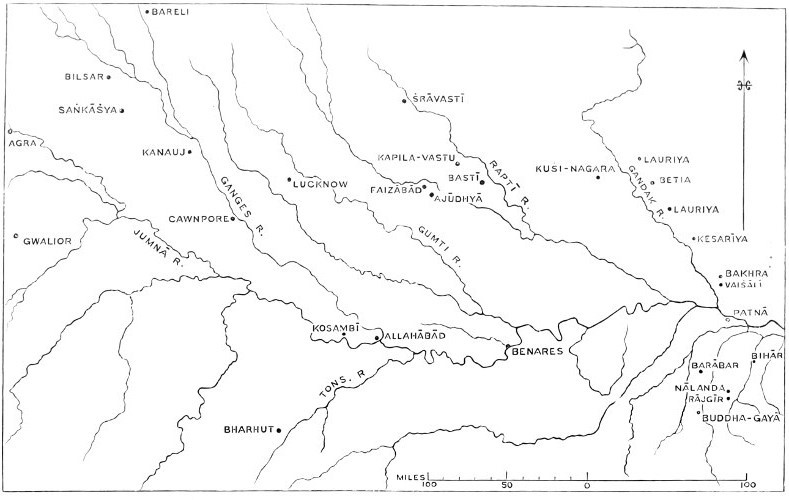
SACRED LAND OF BUDDHISM, AND SCENE OF THE BUDDHA’S ITINERATION AND PREACHING FOR FORTY-FIVE YEARS.
Unhappily, no authoritative Buddhist scripture gives any trustworthy clue to the exact year of the Buddha’s birth. The traditions which refer back his death to a date corresponding to 543 B.C. are now rejected by modern European scholars. Nor can we as yet accept as infallible the results of the latest researches, which making use of various other data, such as the inscriptions on coins, rocks, and columns, place his death more than a century later. We shall not, however, be far wrong if we assert that he was born about the year 500 B.C. at Kapila-vastu (now Bhūila)—a town situated about half-way between Bastī and Ajūdhyā (Ayodhyā) in the territory of Kosala (the modern Oudh, see pp. 29, 48), about sixty miles from its capital city Ṡrāvasti (a favourite residence of Gautama), and about one hundred miles[10] north-west of Benares, and near the borders of the kingdom of Magadha (now Behār).
His father, named Ṡuddhodana, was a land-owner of the tribe of the Ṡākyas (a name possibly connected with the Sanskṛit root Ṡak, ‘to be powerful’), whose territory in the Gorakh-pur district extended from the lower Nepalese mountains to the river Raptī in Oudh. It has been conjectured that the Ṡākyas may have been originally a non-Āryan tribe, connected perhaps with certain nomad immigrants from Tibet or Northern Asia, who may have immigrated into India at various periods; but even if this could be proved, it would have to be admitted that the Ṡākyas had become Āryanized. It is said that the chief families claimed to be Rājputs, tracing back their origin to Ikshvāku, the first of the Solar race. It appears, too, that though belonging to the Kshatriya caste, they were agriculturists, and mainly engaged in the cultivation of rice. It is also asserted that Ṡākya families were in the habit of taking the name of the family of the Brāhmans who were their spiritual guides and performed religious offices for them, and that the family of Ṡuddhodana took the name Gautama, that is, descendant of the sage Gotama. It does not, however, seem necessary to account for the name in this manner. It was an auspicious name, which in ancient times might have been given to the child of any great land-owner as a proof of orthodoxy, or with the view, perhaps, of pleasing the Brāhmans and securing their prayers and good wishes on its behalf.
The father of the Founder of Buddhism was simply a chief of the Ṡākya tribe—certainly not a king in our sense of the term—but rather a great Zamīndār or landlord, whose territory was not so large in area as Yorkshire. His name Ṡuddhodana, ‘one possessed of pure rice,’ probably indicated the occupation and ordinary food of the peasantry inhabiting the district belonging to him and subject to his authority. Those who have travelled much in India must often have met great land-owners of the Ṡuddhodana type—men to whom the title Mahā-rāja is given much as ‘Lord’ is to our aristocracy. For example, the Mahā-rāja of Darbhanga is probably a more important personage than Gautama’s father ever was, and his territory larger than that of Ṡuddhodana ever was.
The name Gautama (in Pāli spelt Gotama) was the personal name corresponding to that given to all children at the name-giving ceremony. It was not till his supposed attainment of perfect wisdom that Gautama assumed the title of Buddha, or ‘the enlightened one.’ But from that time forward this became his recognized title. Every other name besides Gautama (or Gotama), and every other title except Buddha (or together, Gautama Buddha), are simply epithets; for example, Ṡākya-muni, ‘sage of the tribe of the Ṡākyas;’ Ṡākya-siṉha, ‘lion of the Ṡākyas;’ Ṡramaṇa (Samano), ‘the ascetic;’ Siddhārtha, ‘one who has fulfilled the object (of his coming);’ Sugata, ‘whose coming is auspicious;’ Tathāgata, ‘who comes and goes as his predecessors;’ Bhagavān (Bhagavā), ‘the blessed lord;’ Ṡāstā (Satthā), ‘the Teacher;’ Aṡaraṇa-ṡaraṇa, ‘Refuge of the refugeless;’ Āditya-bandhu, ‘Kinsman of the Sun;’ Jina, ‘conqueror;’ Mahā-vīra, ‘great hero;’ Mahā-purusha, ‘great man;’ Ćakravartī, ‘universal monarch.’ Devout Buddhists call him ‘Lord of the World,’ ‘the Lord,’ ‘World-honoured One,’ ‘King of the Law,’ ‘the Jewel,’ etc.; and prefer to use the titles rather than the personal name Gautama, which is thought too familiar.
The names of previous Buddhas, supposed to have existed in previous ages, are given at p. 136.
Little of the story of the miraculous birth of Buddha is worthy of repetition. Since, however, a white elephant is reckoned among the sacred objects of Buddhism, as something rare and precious, it is worth while mentioning the fable, that when the time came for the Bodhi-sattva to leave the Tushita heaven (p. 120) and be born on earth as Gautama Buddha, he descended into the womb of his mother in the form of a white elephant. He was born under a Ṡāl tree and the god Brahmā received him from his mother’s side. His mother, Māyā, died seven days afterwards, and the infant was committed to her sister (Mahā-prajāpatī), a second wife of Ṡuddhodana.
It is not related of Gautama that, as he grew up, any efforts were made to imbue him with sacred learning; though, as a Kshatriya, he was privileged to receive instruction in certain portions of the Veda.
Nor are we told of him that as a Kshatriya he was trained to the profession of a soldier. It is more probable, that his love of contemplation developed itself very early, and that from a desire to humour this not uncommon Oriental propensity, he was allowed to pass most of his time in the open air.
There is a well-known legend, which relates how Gautama’s relations came in a body to his father and complained that the youth’s deficiency in martial and athletic exercises would incapacitate him, on reaching manhood, from taking part in warlike expeditions. This might be reckoned among the few trustworthy historical incidents, were the story not marred by the legendary addition, that on a day of trial being fixed, the youth, without any previous practice, and of course to the surprise of all present, proved his superiority in archery and in ‘the twelve arts.’
One statement may certainly be accepted without much qualification. It is said that Gautama was made to marry early, according to the universal custom throughout India in the present day. No son of any respectable person in modern times could remain unmarried at the age of sixteen or seventeen, without, so to speak, tarnishing the family escutcheon, and exposing the youth himself to a serious social stigma, likely to cling to him in after-life. In ancient times marriage was equally universal, and there is no reason to suppose that among Kshatriyas it was delayed to a much later period of life.
No doubt, therefore, the future Buddha had at least one wife (whose name was Yaṡodharā, though often called Rāhula-mātā, ‘Rāhula’s mother’), and probably at least one son, named Rāhula. It is said that this son was not born till his father was twenty-nine years of age, or not till the time when a sense of the vanity of all human aims, and a resolution to abandon all worldly ties, and a longing to enter upon a monastic life had begun to take possession of his father’s mind.
The story of the four visions, which led to his final renunciation of the world, is profusely overlaid with fanciful hyperbole, but, however slight the basis of fact on which it may reasonably be held to rest, it is too picturesque and interesting to be passed over without notice. I therefore here abridge the account given in Mr. Beal’s translation of the Chinese version of the Abhi-nishkramaṇa-sūtra, varying (for the sake of brevity) the phraseology, but retaining the expression ‘prince’:—
One day the prince Gautama resolved to visit the gardens in the neighbourhood of his father’s city, desiring to examine the beautiful trees and flowers.
Then there appeared before his eyes in one of the streets the form of a decrepid[**decrepit] old man, his skin shrivelled, his head bald, his teeth gone, his body infirm and bent. A staff supported his tottering limbs, as he stood right across the path of the prince’s advancing chariot.
Seeing this aged person, Siddhārtha inquired of his charioteer:—‘What human form is this, so miserable and so distressing, the like of which I have never seen before?’
The charioteer replied:—‘This is what is called an old man.’
The prince again inquired:—‘And what is the exact meaning of this expression “old”?’
The charioteer answered:—‘Old age implies the loss of bodily power, decay of the vital functions, and failure of mind and memory. This poor man before you is old and approaching his end.’
Then asked the prince:—‘Is this law universal?’
‘Yes,’ he replied, ‘this is the common lot of all living creatures. All that is born must die.’
Soon afterwards another strange sight presented itself—a sick man, worn by disease and suffering, pale and miserable, scarcely able to draw his breath, was seen tottering on the road.
Then the prince inquired of his charioteer:—‘Who is this unhappy being?’
The charioteer replied:—‘This is a sick man, and such sickness is common to all.’
Soon afterwards there passed before them a corpse, borne on a bier.
Then asked the prince:—‘Who is this borne onwards on his bed, covered with strangely-coloured garments, surrounded by people weeping and lamenting?’
‘This,’ replied the charioteer, ‘is called a dead body; he has ended his life; he has no further beauty of form, and no desires of any kind; he is one with the stones and the felled tree; he is like a ruined wall, or fallen leaf; no more shall he see his father or mother, brother or sister, or other relatives; his body is dead, and your body also must come to this.’
Next day on his going out by a different gate there appeared advancing with measured steps a man with a shaven crown, and monk’s robe—his right shoulder bare, a religious staff in his right hand, and a mendicant’s alms-bowl in his left.
‘Who is this,’ the prince inquired, ‘proceeding with slow and dignified steps, looking neither to the right hand nor to the left, absorbed in thought, with shaven head and garments of reddish colour?’
‘This man,’ said the charioteer, ‘devotes himself to charity, and restrains his appetites and his bodily desires. He hurts nobody, but does good to all, and is full of sympathy for all.’
Then the prince asked the man himself to give an account of his own condition.
He answered:—‘I am called a homeless ascetic; I have forsaken the world, relatives, and friends; I seek deliverance for myself and desire the salvation of all creatures, and I do harm to none.’
After hearing these words, the prince went to his father and said, ‘I wish to become a wandering ascetic (parivrājika) and to seek Nirvāna; all worldly things, O king! are changeable and transitory.’
Such is an epitome of the legendary story of the ‘four visionary appearances,’ so called because they are supposed to have been divine visions or appearances, miraculously produced. The remainder of the legendary life of Gautama Buddha is interesting and here and there not without some historical value, and portions of it I now add in an abridged form.
Very shortly after the occurrences just described, Gautama receives intelligence of the birth of his son Rāhula. This is the first momentous crisis of his life, and Gautama remains for a long time lost in profound thought. He sees in his child the strongest of all fetters, binding him to family and home. But his mind is made up. He must fly at once, or be for ever held in bondage. Around him gather the beautiful women of his father’s household, striving by their blandishments to divert him from his purpose; but in vain. He seeks the chamber of his wife, and finds her asleep with her hand on the head of his infant son. He longs for a last embrace; but fearing to arouse her suspicions hurries away. Outside, his favourite horse is waiting to aid his flight. He accomplishes the first stage of what Buddhists call with pride the Mahābhinishkramaṇa, ‘the great going forth from home;’ but not without overcoming other still more formidable trials. For Māra, the evil deity who tempts men to indulge their passions (see p. 120), makes himself visible, and promises the prince all the glories of empire if he will return to the pleasures of worldly life.
Finding all his allurements disregarded, Māra alters his method of attack; he fills the air with mighty thunderings, and creates on the road before the youthful fugitive’s eyes apparitions of torrents, lofty mountains, and blazing conflagrations. But nothing alarms or deters him. ‘I would rather,’ he exclaims, ‘be torn to pieces limb by limb, or be burnt in a fiery furnace, or be ground to pieces by a falling mountain than forego my fixed purpose for one single instant.’
Arrived at a safe distance from his father’s territory, he exchanges garments with a passing beggar, cuts off his own hair with a sword, and assumes the outward aspect and character of a wandering ascetic. The hair does not fall to the ground but is taken up to the Trayastriṉṡas heaven (p. 120), and worshipped by the gods.
His first halting-place is Rāja-gṛiha (now Rāj-gīr), the chief city of Magadha, which, with Kosala (Oudh, pp. 21, 48), afterwards became the holy land of Buddhism. There he attaches himself as a disciple to two Brāhmans named Āḷāra (in Sanskṛit Ārāḍa, with epithet Kālāpa or Kālāma) and Uddaka (Udraka, also written Rudraka, and called Rāma-putta, Mahā-vagga I. 6. 3), who imbue him with their own philosophical tenets and theory of salvation. Sufficient evidence exists to warrant a belief in this part of the story.
No place in India abounds in more interesting Buddhistic remains than Rāja-gṛiha (about 40 miles south-east of Patnā), proving that it was one of the most sacred places of Buddhism, consecrated by some of its most cherished associations. Its Pāli name is Rāja-gaha. It may be conjectured that the connexion between the metaphysics of Buddhism and those of Brāhmanism was due to Gautama’s intercourse with the Brāhmans of this district, and to the ideas he thus imbibed at the earliest stage of his career.
But to resume our story. Gautama fails to find in Brāhmanical philosophy that rest and peace for which his soul was craving when he left his home.
Still there was another way of emancipation and union with the Universal Soul, taught by the Brāhmans. This was the way of Tapas[11], or self-inflicted bodily pain and austerity.
From the earliest times a favourite doctrine of Brāhmanism has been, that self-inflicted bodily suffering is before all things efficacious for the accumulation of religious merit, for the acquirement of supernatural powers, and for the spirit’s release from the bondage of transmigration and its re-absorption into the One Universal Spirit.
Among other forms of self-inflicted pain, religious devotees (Tapasvīs) sometimes went through the process of sitting all day long unmoved during the hottest months on a prepared platform or plot of ground, surrounded by five fires, or by four blazing fires, with the burning sun above their heads as a fifth[12]. Even gods (and notably Ṡiva) are described as mortifying themselves by bodily austerities (tapas), so as not to be outdone by men; for according to the theory of Hindūism, the gods themselves might be supplanted and even ousted from their rank and position as divinities by the omnipotence acquirable by human devotees through a protracted endurance of severe bodily suffering.
Hence we are not surprised to find it recorded of Gautama Buddha, that seeking in vain for rest in the teaching of Brāhmanical philosophy, and eager to try the effect of a course of self-mortification, he wandered forth from Rāja-gṛiha to a wood in the district of Gayā, called Uruvilvā (or Uruvelā).
There, in company with five other ascetics, he began his celebrated sexennial fast. Sitting down with his legs folded under him on a raised seat in a place unsheltered from sun, wind, rain, dew, and cold, he gradually reduced his daily allowance of food to a single grain of rice. Then holding his breath, he harassed and macerated his body, but all in vain. No peace of mind came, and no divine enlightenment. He became convinced of his own folly in resorting to bodily austerity as a means of attaining supreme enlightenment, and delivering himself from the evils and sufferings of life.
Rousing himself, as if from a troubled dream, he took food and nourishment in a natural way, thereby incurring the temporary disapproval of his five companions in self-mortification. Then, when sufficiently refreshed, he moved away to another spot in the same district. There, under the shelter of a sacred fig-tree (Aṡvattha, Ficus religiosa, known as the Pippala or Pīpal), in a village, afterwards called Buddha-Gayā, he gave himself up to higher and higher forms of meditation (Jhāna = Dhyāna). In this he merely conformed to the Hindū Yoga,—a method of attaining mystic union with the Deity, which although not then formulated into a system, was already in vogue among the Brāhmans. There can be little doubt that the Dhāraṇā, Dhyāna (see p. 209), and Samādhi of the Yoga were resorted to, even in Gautama’s time, as a means for the attainment of perfect spiritual illumination, as well as of final absorption in the Deity.
In Manu VI. 72 it is said:—‘Let him purge himself from all taints (doshān) by suppression of breath, from sin by restraints of thought (dhāraṇābhiḥ), from sensual attachments by control, and from unspiritual qualities by meditation (dhyānena).’
In the later work called Bhagavad-gītā (see p. 95 of this volume) it is declared:—‘holding his body, head, and neck quite immovable, seated on a firm seat in a pure spot with Kuṡa grass around, the devotee (Yogī) should look only at the tip of his nose, and should meditate on the Supreme Being’ (VI. 11, 12). Further on he is directed to meditate so profoundly as to think about nothing whatever (VI. 25).
The very Gāyatrī or ancient Vedic prayer (Ṛig-veda III. 62. 10, see p. 78 of this volume)—which is to Hindūs what the Lord’s Prayer is to Christians, and is still repeated by millions of our Indian fellow-subjects at their daily devotions—was originally an act of meditation, performed with the very object Gautama had in view—supreme enlightenment of mind:—‘Let us meditate (Dhīmahi, root dhyai) on the excellent glory of the divine vivifying Sun, may he enlighten our understandings.’ Even the selection of a seat under an Aṡvattha tree was in keeping with Brāhmanical ideas (see ‘Brāhmanism and Hindūism,’ p. 335).
The first result, however, of his engaging in abstract meditation, was that he seemed to himself to be as far as ever from the emancipation which was the one aim of his great renunciation. Why not then return to the world? Why not indulge again in the pleasures of sense? Why not go back to home, wife, and child? Thoughts of this kind passed through his mind, while all his old affections and feelings seemed to revive with tenfold intensity. Then on one particular night, during this mental struggle, Māra, the Destroyer and personification of carnal desire, seized his opportunity. The spirit of evil had bided his time; had waited to assail the sage at the right moment, when protracted self-mortification had done its work—when with exhausted strength he had little power of resistance.
It is certainly remarkable that a great struggle between good and evil, right and wrong, truth and error, knowledge and ignorance, light and darkness, is recognized in all religious systems, however false. (See a notable allusion to this in Ṡaṅkara’s Commentary to Ćhāndogya Upanishad, p. 26, ll. 2-8.)
The legendary description of the Buddha’s temptation, and of the assault made upon him by Māra (the deadly spirit of sensuous desire[13]), and by all his troop of attendants, is so interesting and curious, notwithstanding its extravagance, that I here abridge it:—
Fiends and demons swarmed about him in the form of awful monsters, furies, vampires, hobgoblins, armed to the teeth with every implement of destruction. Their million faces were frightful to behold, their limbs encircled by myriads of serpents, their heads enveloped in a blaze of fire. They surrounded the saint and assailed him in a thousand different ways. Missiles of all kinds were hurled against him; poison and fire were showered over him—but the poison changed into flowers, the fire formed a halo round his head.
The baffled evil one now shifted his ground. He summoned his sixteen enchanting daughters, and sent them to display their charms in the presence of the youthful saint. But the resolute young ascetic was not to be lured by their wiles. He remained calm and impassive, and with a stern face rebuked the maidens for their boldness, forcing them to retire discomfited and disgraced.
Other forms of temptation followed, and the debilitated ascetic’s strength seemed to be giving way. But this was merely the crisis. After rising to higher and higher stages of abstract meditation at the end of a long night he shook off his foe. The victory was won, and the light of true knowledge broke upon his mind. A legend relates that in the first night-watch he gained a knowledge of all his previous existences; in the second—of all present states of being; in the third—of the chain of causes and effects (p. 102); and at the dawn of day he knew all things.
The dawn on which this remarkable struggle terminated was the birthday of Buddhism. Gautama was at that time about thirty-five years of age. It was then, and not till then, that his Bodhi-sattvaship (see p. 135) ended and he gained a right to the title Buddha, ‘the Enlightened.’ No wonder that the tree under which he sat became celebrated as ‘the tree of knowledge and enlightenment.’ It is remarkable, too, that just as the night on which the Buddha attained perfect enlightenment is the most sacred night with Buddhists, so the Bodhi-tree (in familiar language, Bo-tree) is their most sacred symbol—a symbol as dear to Buddhists as the Cross is to Christians.
And what was this true knowledge, evolved out of a mind sublimated by intense meditation?
This is, perhaps, the strangest point of all in this strange story. It was after all a mere partial one-sided truth—the outcome of a single line of thought, dwelt upon with morbid intensity, to the exclusion of every other line of thought which might have modified and balanced it. It was an ultra-pessimistic view of the miseries of life, and a determination to ignore all its counterbalancing joys. It was the doctrine that this present life is only one link in a chain of countless transmigrations—that existence of all kinds involves suffering, and that such suffering can only be got rid of by self-restraint and the extinction of desires, especially of the desire for continuity of personal existence.
For let it be made clear at the outset, that whatever may be said of the Christian-like self-renunciation enjoined by the Buddhist code of morality, the only self it aims at renouncing is the self of personality, and the chief self-love it deprecates is the self-love which consists in craving for continuous individual life.
To those who have never travelled or resided much in the East, indulgence in such a morbid form of pessimism, under glowing skies and amid bright surroundings, may seem almost an impossibility. But those who know India by personal experience are aware that its climate is not conducive to optimistic views of life, and that even in the present day men of the Buddha type, who seek in various ways to impress their pessimistic theories of existence on their fellow-men, are not uncommon.
In the course of my travels I frequently met ascetics who had given up family and friends, and were leading a life of morose seclusion, and pretended meditation, undergoing long courses of bodily mortification. Nay, I have even seen men who, to prove their utter contempt for the pleasures of worldly existence, and to render themselves fit for the extinction of all personality by absorption into the Universal Soul, have sat in one posture, or held up one arm for years, or allowed themselves no bed but a bed of spikes, no shelter but the foliage of trees[14]. Gautama’s course of protracted cogitation therefore had in it nothing peculiar or original.
Nor need we doubt that certain historical facts underlie the legendary narrative. We cannot admit with the learned Senart and Kern that the life of Gautama was based on a mere solar myth. To us it is more difficult not to believe than to believe that there lived in the fifth century B.C. the youthful son of a petty Rāja or land-owner in Oudh, distinguished from ordinary men by many remarkable qualities of mind and body—notably by a thoughtful and contemplative disposition; that he became impressed with a sense of the vanity of all earthly aims, and of the suffering caused by disease and death; that he often said to himself, ‘Life is but a troubled dream, an incubus, a nightmare,’ or, like the Jewish sage of old, ‘All the days of man are sorrow,’ ‘Man walketh in a vain shadow and disquieteth himself in vain;’ and that like many other of the world’s philosophers, instead of acquiescing in the state of things around him, and striving to make the best of them, or to improve them, he took refuge from the troubles of life in abandoning all its ties, renouncing all its joys, and suppressing all its affections and desires.
And again, it is more difficult not to believe than to believe that in such a man introspection and abstinence, protracted for many years, induced a condition of mind favourable to ecstatic visions, which were easily mistaken for flashes of inner enlightenment.
We know, indeed, that eleven centuries later another great thinker arose among the Semitic races in Western Asia, who went through the same kind of mental struggle, and that Muhammad, like Gautama, having by his long fasts and austerities brought himself into a highly wrought condition of the nervous system, became a fanatical believer in the reality of his own delusions and in his own divine commission as a teacher.
But the parallel between the Buddha and Muhammad cannot be carried on much further. And indeed, in point of fact, no two characters could be more different. For the Buddha never claimed to be the channel of a supernatural revelation; never represented the knowledge that burst on his mind as springing from any but an internal source; never taught that a divine force operating from without compelled him to communicate that knowledge to mankind; never dreamed of propagating that knowledge to others by compulsion, much less by the sword. On the contrary, he always maintained that the only revelation he had received was an illumination from within—due entirety to his own intuitions, assisted by his reasoning powers and by severe purgatorial discipline protracted through countless previous births in every variety of bodily form.
But how did this internal self-enlightenment[15]—the great distinguishing feature of Buddhism—first find expression? It is said that the first words uttered by the Buddha at the momentous crisis when true knowledge burst upon him, were to the following effect:—
‘Through countless births have I wandered, seeking but not discovering (anibbisan) the maker of this my mortal dwelling-house (gaha-kāraka), and still again and again have birth and life and pain returned. But now at length art thou discovered, thou builder of this house (of flesh). No longer shalt thou rear a house for me. Rafters and beams are shattered and with destruction of Desire (Taṉhā) deliverance from repeated life is gained at last’ (Dhamma-pada 153, 154, Sumaṅgala 46).
Contrast with these first utterances of Gautama Buddha the first words of Jesus Christ:—
‘Wist ye not that I must be about My Father’s business?’ (St. Luke ii. 49.)
The Buddha’s first exclamations, as well as the account of his subsequent sayings and doings, are the more worthy of credit as taken from the Southern Canon.
The Mahā-vagga (I. 1) tells us that after attaining complete intelligence, the Buddha sat cross-legged on the ground under the Bodhi-tree for seven days, absorbed in meditation and enjoying the bliss of enlightenment. At the end of that period, during the first three watches of the night, he fixed his mind on the causes of existence. Then having thought out the law of causation (p. 102), he exclaimed: ‘When the laws of being become manifest to the earnest thinker, his doubts vanish, and, like the Sun, he dispels the hosts of Māra.’
Next he meditated for another seven days under a banyan tree, called the tree of goat-herds (aja-pāla). It was there that a haughty Brāhman accosted him with the question, ‘Who is a true Brāhman?’ and was told, ‘One free from evil and pride; self-restrained, learned, and pure.’
Then he meditated under another tree for a third period of seven days. There the serpent (Nāga) Mućalinda (or Mućilinda) coiled his body round the Buddha, and formed a canopy to protect him from the raging of a storm—this being one of the trials he had to go through. When it was over the Buddha exclaimed, ‘Happy is the seclusion of the satisfied man (tushṭa) who has learned and seen the truth.’
A fourth period of meditation was passed under the tree Rājāyatana, making four times seven days. May not these symbolize the four stages of meditation (p. 209)? Later legends, however, reckon seven times seven days.
During the whole of the interval between the first acquisition of knowledge and the setting forth to proclaim it, the Buddha fasted, being too elated to seek food, and only once receiving it from two merchants, named Tapussa (Trapusha) and Bhallika. These became his first lay-reverers (p. 89) by repeating the double formula of reverence for the Buddha and for his doctrine (the Saṅgha not being then instituted, Mahā-v° I. 4. 5). A later legend relates that they received in return eight of his hairs which they preserved as relics.
In connexion with the legend of a forty-nine days’ fast, I may mention that an ancient carving of Gautama was pointed out to me at Buddha-Gayā, which represents him as holding a bowl of rice-milk divided into forty-nine portions, one for each day.
With these legends we may contrast the simple Gospel narrative of Christ’s forty days’ fast in the wilderness.
The Buddha’s first resolution to come forth from his seclusion and proclaim his gospel to mankind is of course a great epoch with all Buddhists.
And here it should be observed, that, strictly, according to Gautama’s own teaching he ought to have ceased from all action on arriving at perfect enlightenment. For had he not attained the great object of his ambition—the end of all his struggles—the goal of all his efforts—carried on through hundreds of existences? He had, therefore, no more lives to lead, no more misery to undergo. In short he had achieved the summum bonum of all true Buddhists—the extinction of the fires of passions and desires—and had only to enjoy the well-earned peace (nirvṛiti) of complete Nirvāṇa. Yet the love of his fellow-men impelled him to action (pravṛitti). In fact it was characteristic of a supreme Buddha that he should belie, by his own activity and compassionate feelings, the utter apathy and indifference to which his own doctrines logically led (p. 128).
But he did not carry out his benevolent design without going through another course of temptation (which it is usual to compare with the temptation of Christ). Evil thoughts arose in his mind, and these were suggested, according to later legends, by Māra (p. 33), thus:—‘With great pains, blessed one, hast thou acquired this doctrine (dharma). Why proclaim it? Beings lost in desires and lusts will not understand it. Remain in quietude. Enjoy Nirvāṇa’ (Mahā-v° I. 5. 3).
[3]‘Brāhmanism and Hindūism.’ Third Edition. John Murray, Albemarle Street.
[4]The heaven of Ṡiva is Kailāsa, of Vishṇu is Vaikuṇṭha, of Kṛishṇa is Goloka.
[5]The Sāṅkhya system, as I have shown, was closely connected with the Vedānta, though it recognized the separate existence of countless individual Purushas or spirits instead of the one (called Ātman). Both had much in common with Buddhism, though the latter substituted Ṡūnya ‘a void’ for Purusha and Ātman.
[6]Freely translated by me in Indian Wisdom, p. 133, and literally translated by Prof. E. B. Cowell.
[7]‘Let us eat and drink for to-morrow we die.’ 1 Cor. xv. 32.
[8]See Dr. John Muir’s Article on Indian Materialists, Journal of Royal Asiatic Society, N. S. xix, p. 302.
[9]It is difficult to accept the theory of those who maintain that writing had not been invented.
Finding all his allurements disregarded, Māra alters his method of attack; he fills the air with mighty thunderings, and creates on the road before the youthful fugitive’s eyes apparitions of torrents, lofty mountains, and blazing conflagrations. But nothing alarms or deters him. ‘I would rather,’ he exclaims, ‘be torn to pieces limb by limb, or be burnt in a fiery furnace, or be ground to pieces by a falling mountain than forego my fixed purpose for one single instant.’
The Buddha and his followers next proceeded to Rāja-gṛiha. Among them were two, afterwards called ‘chief disciples’ (Agra-ṡrāvakas), Sāriputta and Moggallāna (or Maudgalyāyana), who died before the Buddha, and sixteen leaders among the so-called eighty ‘great disciples’ (Mahā-ṡrāvakas); the chief of these being Kāṡyapa (or Mahā-kāṡyapa), Upāli, and Ānanda (a cousin), besides Anuruddha (another cousin), and Kātyāyana. Of course among the eighty are reckoned the five original Benares converts. At a later time two chief female disciples (Agra-ṡrāvikās) named Khemā and Uppala-vaṇṇā (Utpala-varṇā) were added (see p. 86). Each leading disciple was afterwards called Sthavira, ‘an elder,’ or Mahā-sthavira, ‘great elder’ (Pāli Thera, Mahāthera; fem. Therī). Mark, too, that Bimbi-sāra, king of Magadha, and Prasenajit (Pasenadi), king of Kosala, were Gautama’s lay-disciples and constant patrons.
[10]One hundred is given as a round number. The actual distance is about one hundred and twenty miles.—Corr.
[11]Tapas is a Sanskṛit word, derived from the root tap, ‘to burn, torment.’ It is connected with Lat. tepeo, Greek Θάπτω, which last originally denoted ‘to burn,’ not ‘to bury’ dead bodies. Tapas ought not to be translated by ‘penance,’ unless that word is restricted to the sense poena, ‘pain.’
[12]Such men are called Pañća-tapās (Manu VI. 23). A good representation of this form of Tapas may be seen in the Museum of the Indian Institute, Oxford.
[13]According to Dr. Oldenberg, the Mṛityu of the Kaṭhopanishad.
[14]In the same way the Cistercian monks of Fountain’s Abbey lived under certain trees while the Abbey was building.
[15]The Bhagavad-gītā (V. 28) asserts:—‘The sage (Yogī) who is internally happy, internally at peace, and internally illumined, attains extinction in Brahma.’ This is pure Buddhism if we substitute Cessation of individual existence for Brahma.
To counteract these malevolent suggestions, the god Brahmā Sahāmpati (Pāli Sahămpati, p. 210) presented himself and exclaimed:—‘Arise, O spotless one, open the gate of Nirvāṇa. Arise, look down on the world lost in suffering. Arise, wander forth, preach the doctrine.’
First the Buddha thought of his two teachers, Āḷāra and Uddaka (p. 29), but found they were dead. Next he thought of the five ascetics whom he had offended by his abandonment of the method of gaining true knowledge through painful austerities. They were at that time prosecuting their bodily mortifications at Benares in the Deer-park called Isipatana. It was only natural that the Buddha should think of wending his way in the first instance to Benares, even if special considerations had not drawn him there; for that city was the great centre of Eastern thought and life, the Indian Athens, where all peculiar doctrines were most likely to gain a hearing.
On his way thither, Upaka, a member of the Ājīvaka sect of naked ascetics, met him and inquired why his countenance was so bright (pariṡuddha)? He replied, ‘I am the all-subduer, the all-wise, the stainless, the highest teacher, the conqueror (p. 135); I go to Benares to dissipate the world’s darkness’ (Mahā-vagga I. 6. 7).
The five ascetics (Kauṇḍinya = Koṇḍañño, Aṡvajit = Assaji, Vāshpa, Mahānāma, and Bhadrika) were soon converted by his words, and by merely repeating the triple formula were admitted at once to his Order of monks. They constituted, with Gautama, the first six members of the Saṅgha, or fraternity of men seeking release from the misery of existence by cœnobitic monasticism.
And of what nature were Gautama Buddha’s first didactic utterances? His first sermon, delivered in the Deer-park at Benares, is held in as much reverence by Buddhists as the first words of Christ are by Christians. It is called Dhamma-ćakka-ppavattana-sutta, or in Sanskṛit Dharma-ćakra-pravartana-sūtra, ‘the discourse which set in motion the wheel of the law,’ or ‘of the universal dominance of the true belief.’
The following is the substance of it, as given in the Mahā-vagga (I. 6. 17). It is important to note that the Buddha spoke in the vernacular of Magadha (now called Pāli), and not to men generally, but to the first five would-be members of his Order of monks:—
‘There are two extremes (antā), O monks (Bhikkhus), to be avoided by one who has given up the world—a life devoted to sensual pleasures (kāma), which is degrading, common, vulgar, ignoble, profitless; and a life given to self-mortification (ātma-klamatha)—painful, ignoble, profitless. There is a middle path, avoiding both extremes—the noble eightfold path discovered by the Buddha (Tathāgata)—which leads to insight, to wisdom, to quietude (upaṡama), to knowledge, to perfect enlightenment (sambodhi), to final extinction of desire and suffering (Nirvāṇa).’
So far there is nothing very explicit in the discourse. Doubtless such precepts as ‘virtue is a mean’ and that ‘medio tutissimus ibis’ are useful, though trite, truths; but the difficulty is to prove that the Buddha’s eightfold path is really a middle course of the kind described; for the most fanatical enthusiasts will always regard their own creed, however extravagant, as moderate.
The Buddha, therefore, goes on to propound what he calls the four noble truths (ariya-saććāni = ārya-satyāni), which are the key to his whole doctrine. They may be stated thus:—
1. All existence—that is, existence in any form, whether on earth or in heavenly spheres—necessarily involves pain and suffering (dukkha). 2. All suffering is caused by lust (rāga) or craving or desire (taṉhā = trishṇā, ‘thirst’) of three kinds—for sensual pleasure (kāma), for wealth (vibhava), and for existence (bhava). 3. Cessation of suffering is simultaneous with extinction of lust, craving, and desire (p. 139). 4. Extinction of lust, craving, and desire, and cessation of suffering are accomplished by perseverance in the noble eightfold path (ariyo aṭṭhangiko maggo), viz. right belief or views (sammā diṭṭhi), right resolve (saṅkappo), right speech, right work (kammanto), right livelihood (ājīvo), right exercise or training (vāyāmo = vyāyāma), right mindfulness (sati, p. 50), right mental concentration (samādhi).
And how is all life mere suffering (I.6.19)?—
‘Birth is suffering. Decay is suffering. Illness is suffering. Death is suffering. Association with (samprayogo) objects we hate is suffering. Separation from objects we love is suffering. Not to obtain what we desire is suffering. Clinging (upādāna) to the five elements (p. 109) of existence is suffering. Complete cessation of thirst (taṇhā) and desires is cessation of suffering. This is the noble truth of suffering.’
This sermon (called in Ceylon the first Baṇa = Bhāṇa, ‘recitation,’ p. 70) was addressed to monks, and however unfavourably it must compare with that of Christ (St. Luke iv. 18), addressed not to monks but to suffering sinners—and however obvious may be the idea that pain must result from giving way to lust and the desire for life through countless existences—is of great interest because it embodies the first teaching of one, who, if not worthy to be called ‘the Light of Asia,’ and certainly unworthy of comparison with the ‘Light of the World,’ was at least one of the world’s most successful teachers.
Bear in mind that, as the result of his earliest meditation (pp. 39, 56, 102), the Buddha made ignorance precede lust as the primary cause of life’s misery.
Of course the real significance of the whole sermon depends on the interpretation of the word ‘right’ (sammā = samyak) in describing the eightfold path, and the plain explanation is that ‘right belief’ means believing in the Buddha and his doctrine; ‘right resolve’ means abandoning one’s wife and family as the best method of extinguishing the fires of the passions; right speech is recitation of the Buddha’s doctrine; right work (Karmānta) is that of a monk; right livelihood is living by alms as a monk does; right exercise is suppression of the individual self; right mindfulness (Smṛiti) is keeping in mind the impurities and impermanence of the body; right mental concentration is trance-like quietude.
Mark, too, that in describing the misery of life, association with loved objects is not mentioned as compensating for the pain of connexion with hateful objects.
The Buddha’s early disciples were not poor men; for the sixth to be admitted to the Saṅgha was a high-born youth named Yasa. Then this youth’s father, a rich merchant, became the first lay-disciple by repeating the triple formula (pp. 40, 78), and his mother and wife became the first lay-sisters. Next, four high-born friends of Yasa, and subsequently fifty more became monks. Thus, not long after the first sermon, Gautama had sixty enrolled monks; all from the upper classes.
In sending forth these sixty monks to proclaim his own gospel of deliverance, he addressed them thus:—
‘I am delivered from all fetters (p. 127), human and divine. You too, O monks, are freed from the same fetters. Go forth and wander everywhere, out of compassion for the world and for the welfare of gods and men. Go forth, one by one, in different directions. Preach the doctrine (Dharmam), salutary (kalyāṇa) in its beginning, middle, and end, in its spirit (artha) and in its letter (vyañjana). Proclaim a life of perfect restraint, chastity, and celibacy (brahmaćariyam). I will go also to preach this doctrine’ (Mahā-vagga I. 11. 1).
When his monk-missionaries had departed, Gautama himself followed, though not till Māra (p. 41) had again tempted him. Quitting Benares he journeyed back to Uruvelā, near Gayā. There he first converted thirty rich young men and then one thousand orthodox Brāhmans, led by Kāṡyapa and his two brothers, who maintained a sacred fire (‘Brāhmanism,’ p. 364). The fire-chamber was haunted by a fiery snake-demon; so Buddha asked to occupy the room for a night, fought the serpent and confined him in his own alms-bowl. Next he worked other miracles (said to have been 3500 in number), such as causing water to recede, fire-wood to split, fire-vessels to appear at his word. Then Kāṡyapa and his brothers, convinced of his miraculous powers, were admitted with the other Brāhmans to the Saṅgha. Thus Buddha gathered round him about a thousand monks.
To them on a hill Gayāsīsa (Brahma-yoni), near Gayā, he preached his ‘burning’ fire-sermon (Mahā-v° I. 21): ‘Everything, O monks, is burning (ādittam = ādīptam). The eye is burning; visible things are burning. The sensation produced by contact with visible things is burning—burning with the fire of lust (desire), enmity and delusion (rāgagginā dosagginā mohagginā), with birth, decay (jarayā), death, grief, lamentation, pain, dejection (domanassehi), and despair (upāyāsehi). The ear is burning, sounds are burning; the nose is burning, odours are burning; the tongue is burning, tastes are burning; the body is burning, objects of sense are burning. The mind is burning, thoughts are burning. All are burning with the fire of passions and lusts. Observing this, O monks, a wise and noble disciple becomes weary of (or disgusted with) the eye, weary of visible things, weary of the ear, weary of sounds, weary of odours, weary of tastes, weary of the body, weary of the mind. Becoming weary, he frees himself from passions and lusts. When free, he realizes that his object is accomplished, that he has lived a life of restraint and chastity (brahma-ćariyam), that re-birth is ended.’
It is said that this fire-sermon—which is a key to the meaning of Nirvāṇa—was suggested by the sight of a conflagration. It was Gautama’s custom to impress ideas on his hearers by pointing to visible objects. He compares all life to a flame; and the gist of the discourse is the duty of extinguishing the fire of lusts, and with it the fire of all existence, and the importance of monkhood and celibacy for the attainment of this end.
Contrast in Christ’s Sermon on the Mount the words addressed to the multitude (not to monks), ‘Blessed are the pure in heart, for they shall see God.’
The Buddha and his followers next proceeded to Rāja-gṛiha. Among them were two, afterwards called ‘chief disciples’ (Agra-ṡrāvakas), Sāriputta and Moggallāna (or Maudgalyāyana), who died before the Buddha, and sixteen leaders among the so-called eighty ‘great disciples’ (Mahā-ṡrāvakas); the chief of these being Kāṡyapa (or Mahā-kāṡyapa), Upāli, and Ānanda (a cousin), besides Anuruddha (another cousin), and Kātyāyana. Of course among the eighty are reckoned the five original Benares converts. At a later time two chief female disciples (Agra-ṡrāvikās) named Khemā and Uppala-vaṇṇā (Utpala-varṇā) were added (see p. 86). Each leading disciple was afterwards called Sthavira, ‘an elder,’ or Mahā-sthavira, ‘great elder’ (Pāli Thera, Mahāthera; fem. Therī). Mark, too, that Bimbi-sāra, king of Magadha, and Prasenajit (Pasenadi), king of Kosala, were Gautama’s lay-disciples and constant patrons.
It was not long before the Buddha’s followers were more formally incorporated into a monastic Order (Saṅgha), and rules of discipline drawn up (see pp. 61, 72, 73, 83). And doubtless the success of Buddhism was due to the carrying out of this idea of establishing a brotherhood offering a haven of rest to all.
About forty-five years elapsed between Gautama’s attainment of Buddhahood and his death. During that period he continued teaching and itinerating with his disciples; only going ‘into retreat’ during the rains. A list of 45 places of residence is given. He seems to have resided oftenest at Ṡrāvastī (p. 21) in the monastery Jetavana given by Anātha-piṇḍika; but the whole region between Ṡrāvastī and Rāja-gṛiha (p. 29), for nearly 300 miles, was the scene of his itineration. Favourite resorts near Rāja-gṛiha were the ‘Vulture-peak’ and Bambu-grove (Veḷu-vana); but continual itineration was one chief means of propagating Buddhism.
It is said that his death occurred at Kuṡi-nagara[16] (Kusinārā), a town about eighty miles east of Kapila-vastu—the place of his birth—when he was eighty years of age, and probably about the year 420 B.C.[17]
The story is that Gautama died from eating too much pork (or dried boar’s flesh[18]). As this is somewhat derogatory to his dignity it is not likely to have been fabricated. A fabrication, too, would scarcely make him guilty of the inconsistency of saying ‘Kill no living thing,’ and yet setting an example of eating flesh-meat.
These were his words when he felt his end near:—
‘O Ānanda, I am now grown old, and full of years, and my journey is drawing to its close; I have reached eighty years—my sum of days—and just as a worn-out cart can only with much care be made to move along, so my body can only be kept going with difficulty. It is only when I become plunged in meditation that my body is at ease. In future be ye to yourselves your own light, your own refuge; seek no other refuge. Hold fast to the truth as your lamp. Hold fast to the truth as your refuge; look not to any one but yourselves as a refuge’ (Mahā-parinibbāna-sutta II. 32, 33).
Afterwards he gave a summary of every monk’s duties, thus:—‘Which then, O monks, are the truths (=the seven jewels, p. 127) it behoves you to spread abroad, out of pity for the world, for the good of gods and men? They are: 1. the four earnest reflections (Smṛiti, Sati-paṭṭhāna, on the impurities of the body, on the impermanence of the sensations, of the thoughts, of the conditions of existence, p. 127); 2. the four right exertions (Sammappadhāna, viz. to prevent demerit from arising, get rid of it when arisen, produce merit, increase it); 3. the four paths to supernatural power (Iddhi-pāda, viz. will, effort, thought, intense thought); 4. the five forces (Pañća-bala, viz. faith, energy, recollection, self-concentration, reason); 5. the proper use of the five organs of sense; 6. the seven ‘limbs’ of knowledge (Bodhy-aṅga, viz. recollection, investigation, energy, joy, serenity, concentration of mind, equanimity); 7. the noble ‘eightfold path’ (p. 44). See Mahā-parinibbāna III. 65.
Then shortly before his decease, he said, ‘It may be, Ānanda, that in some of you the thought may arise:—The words of our Teacher are ended; we have lost our Master. But it is not thus. The truths and the rules of the Order, which I have taught and preached, let these be your teacher, when I am gone’ (VI. 1).
‘Behold now, O monks, I exhort you:—Everything that cometh into being passeth away; work out your own perfection with diligence’ (III. 66).
Not long after his last utterances the Buddha, who had before through intense meditation attained Nirvāṇa or extinction of the fire of desires, passed through the four stages of meditation (p. 209) till the moment came for his Pari-nirvāṇa, whereby the fire of life also was extinguished. A couch had been placed for him between two Ṡāl trees (p. 23), with the head towards the north. In sculptures he is represented as lying on his right side at the moment of death, and images of him in this position are highly venerated.
The chief men of Kuṡi-nagara burnt his body with the ceremonies usual at the death of a Ćakravartin or Universal Ruler, which the Buddha claimed to be.
Then his ashes were distributed among eight princes, who built Stūpas over them (Buddha-vaṉsa 28).
A legend states that when the Buddha died there was an earthquake. Then the gods Brahmā and Indra appeared and the latter exclaimed: ‘Transient are all the elements of being; birth and decay are their nature; they are born and dissolved; then only is happiness when they have ceased to be’ (Mahā-p° VI. 16).
Contrast with Buddha’s last words the last words of Christ: ‘Father, into Thy hands I commend my Spirit.’
A greater contrast than that presented by the account of the Buddha’s death and the Gospel narrative of the death of Christ can scarcely be imagined.
Of course as a result of discourses during forty-five years, a large number were gathered into Gautama’s monastic Order. His first aim was the founding of this Order, and his chief sermons were to his monks; but he accepted all men and ultimately multitudes attached themselves to him as lay-brethren (p. 87).
In fact Gautama’s doctrine of a universal brotherhood, open to all, constituted the corner-stone of his popularity. He spoke to them in their own provincial dialect, which could not have differed much from the Pāli of the texts—and he enforced his words by dialogues, parables, fables, reiterations, and repetitions. Probably he was the first introducer of real preaching into India, and by his practical method he seemed to bring down knowledge from the clouds to every man’s door.
The following parable is an example: ‘As the peasant sows the seed but cannot say: the grain shall swell to-day, to-morrow germinate, so also it is with the disciple; he must obey the precepts, practise meditation, study the doctrine; he cannot say to-day or to-morrow, I shall be delivered. Again: as when a herd of deer lives in a forest a man comes who opens for them a false path and the deer suffer hurt; and another comes who opens a safe path and the deer thrive; so when men live among pleasures the evil one comes and opens the false eightfold path. Then comes the perfect one and opens the safe eightfold path of right belief, etc.’ (p. 44, Oldenberg, 191, 192).
Six rival heretical teachers are alluded to. His chief opponent was his cousin Devadatta, who set up a school of his own, and is said to have plotted against the Buddha’s life. His efforts failed (Ćulla-vagga VII), and he himself came to an untimely end. Possibly he may have belonged to the rival Jaina sect (Nigaṇṭha) of naked ascetics, of which the great leader was Vardhamāna Mahāvīra Nāta-putta (=Jñāti-putra).
Gautama’s teaching gained the day. It claimed universality, and was aptly symbolized by a wheel rolling among all alike. Yet at first it had no attractions for the poor and the child-like.
By degrees, a fuller system, adapted in an ascending scale to laymen, novices, monks, nuns, and Arhats, was developed—a system which had its abstruse doctrines suited to men of philosophical minds, as well as its plain practical side. This constituted the Buddhist Dharma, which was ultimately collected in certain sacred books to be next described.
LECTURE III.
The Law (Dharma) and Sacred Scriptures of Buddhism.
Probably most educated persons are aware that Buddhists have their own sacred scriptures, like Hindūs, Pārsīs, Confucianists, Muhammadans, Jews, and Christians. It is not, however, so generally known that in one important particular these Buddhist scriptures, constituting the Tri-piṭaka (p. 61), differ wholly from other sacred books. They lay no claim to supernatural inspiration. Whatever doctrine is found in them was believed to be purely human—that is, was held to be the product of man’s own natural faculties working naturally.
The Tri-piṭaka was never like the Veda of the Brāhmans, believed to be the very ‘breath of God’[19]; the same care, therefore, was not taken to preserve every sound; and when at last it was written down the result was a more scholastic production than the Veda.
Moreover, it was not composed in the Sanskṛit of the Veda and Ṡāstras—in the sacred language, the very grammar and alphabet of which were supposed to come from heaven—but in the vernacular of the part of India in which Buddhism flourished. Indeed, it is a significant fact that while the great sages of Sanskṛit literature and philosophy, such as Vyāsa, Kumārila, and Ṡaṅkara, in all probability spoke and taught in Sanskṛit[20], the Founder of Buddhism preferred to communicate his precepts to the people in their own vernacular, afterwards called Pāli. Nevertheless, he never composed a single book of his own. In all probability he never wrote down any of his own precepts; for if writing was then invented, it was little practised, through the absence of suitable materials. This is the more remarkable as Buddhism ultimately became an instrument for introducing literary culture among uncivilized races.
All that Gautama did was to preach his Dharma, ‘Law,’ during forty-five years of itineration, and oral teaching. It was not till some time after his death that his sayings were collected (p. 97), and still longer before they were written down. Itineration, recitation of the Law, and preaching were the chief instruments for the propagation of Buddhism.
At present the Buddhist Canon is about as extensive as the Brāhmanical[21], and in both cases we are left in doubt as to the date when the books were composed. How, then, did their composition take place?
All that can be said is that at three successive epochs after the Buddha’s death, three gatherings of his followers were held for the purpose of collecting his sayings and settling the true Canon, and that a fourth assembly took place much later in the North.
The first of these assemblages can scarcely with any fitness be called a Council. Nor can the fact of its meeting together in any formal manner be established on any trustworthy historical basis. It is said that a number of monks (about five hundred, called Mahā-sthavirāḥ, ‘the great elders,’ Pāli Mahā-therā) assembled in a cave called Sattapaṇṇi, near the then capital city of Magadha—Rāja-gṛiha, now Rāj-gīr—under the sanction of king Ajāta-ṡatru, during the rainy season immediately succeeding the death of Gautama, to think over, put together, and arrange the sayings of their Master, but not, so far as we know, to write them down.
There, in all likelihood, they made the first step towards a methodical arrangement. But even then it is doubtful whether any systematic collections were composed. The assembled monks chose Kāṡyapa (or Mahā-kāṡyapa, p. 47), the most esteemed of all the Buddha’s surviving disciples, as their leader, and chanted the Thera-vāda (Sthavira-v°), ‘words of the elders,’ or precepts of their Founder preserved in the memory of the older men; the rules of discipline (Vinaya) being recited by Upāli[22], and the ethical precepts (Sūtra), which constituted at first the principal Dharma[23] (par excellence, in contradistinction to the Vinaya), being imparted by Gautama’s favorite Ānanda (p. 47); while the philosophical doctrines—then undeveloped—were communicated by the president, Kāṡyapa. If any arrangement was then made it was probably in two collections—the Vinaya and Dharma (say about 400 B.C.)
In regard to the Dharma, two main lines were, in all likelihood, laid down as the basis of all early teaching. The first consisted of the four sublime verities, as they are called—that is, of the four fundamental truths originally taught by the Founder of Buddhism, namely, the inevitable inherence of suffering in every form of life, the connexion of all suffering with indulgence of desires, especially with craving for continuity of existence, the possibility of the cessation of suffering by restraining lusts and desires, and the eightfold course leading to that cessation (see p. 44).
The second line of doctrine probably consisted of an outline of the twelve-linked chain of causality (nidāna), which traced back all suffering to a still deeper origin than mere lusts and desires—namely, to ignorance (p. 103).
It is not, however, at all likely that any philosophical or metaphysical doctrines were clearly and methodically formulated at the earliest assembly which took place soon after Gautama’s death. It is far more probable that the first outcome of the gathering together of the Buddha’s disciples was simply the enforcing of some strict rules of discipline for the Order of monks, and this may have taken place soon after 400 B.C.
After a time, certain relaxations of these rules or unauthorized departures from them (ten in number, such as reception of money-gifts, eating a second meal in the afternoon, drinking stimulating beverages, if pure as water in appearance[24]), began to be common. The question as to whether liberty should be allowed in these points, especially in the first, shook the very foundations of the community. In fact the whole society became split up into two contending parties, the strict and the lax, and a second Council became necessary for the restoration of order. All ten points were discussed at this Council, said to have consisted of 700 monks and held at Vaiṡālī (Vesālī, now Besārh), 27 miles north of Patnā, about 380 B.C.[25] The discussions were protracted for eight months, and all the ten unlawful relaxations were finally prohibited.
It has been observed that this second Council stands in a relation to Buddhism very similar to that which the Council of Nicæa bears to Christianity.
The exact date, however, of either the first or second assemblies cannot be determined with precision.
Not long afterwards occurred the political revolution caused by the well-known Ćandra-gupta (= Sandra-kottus)—sometimes called the first Aṡoka (or disparagingly, Kālāṡoka). This man, who was a low-born Ṡūdra, usurped the throne and founded the Maurya dynasty, after killing king Nanda and taking possession of Pāṭaliputra (or Palibothra, now Patnā, the then metropolis of Magadha or Behār), about 315 B.C. He extended the kingdom of Magadha over all Hindūstān, and became so powerful that when Alexander’s successor, Seleukos Nikator (whose reign commenced about 312 B.C.), invaded India from his kingdom of Bactria, so effectual was the resistance offered by Ćandra-gupta, that the Greek thought it politic to form an alliance with the Hindū king, and sent his own countryman, Megasthenes, as an ambassador to reside at his court.
To this circumstance we owe the earliest authentic account of Indian customs and usages, by an intelligent observer who was not a native; and Megasthenes’ narrative, preserved by Strabo, furnishes a basis on which a fair inference may be founded that Brāhmanism and Buddhism existed side by side in India on amicable terms in the fourth and third centuries B.C. There is even ground for believing that king Ćandra-gupta himself favoured the Buddhists, though outwardly he never renounced his faith in Brāhmanism.
Ćandra-gupta’s reign is thought to have lasted until 291 B.C., and that of his son and successor, Vindusāra, from 291 to (say) about 260 B.C. Then came Ćandra-gupta’s grandson, the celebrated Aṡoka (sometimes called Dharmāṡoka), who, though of Ṡūdra origin, was perhaps the greatest Hindū monarch of India.
It was about this period that Gautama Buddha’s followers began to develope his doctrines, and to make additions to them in such a way that the Abhi-dharma or ‘further Dharma’ had to be added to the Ṡūtra which constituted the original Dharma (p. 56). Even in Gautama’s time there were great dissensions. Afterwards differences of opinion increased, so that before long eighteen schools of schismatic thought (p. 158) were established. The resulting controversies were very disturbing, and a third Council became necessary. It consisted of a thousand oldest members of the Order, and was held in the 16th or 17th year of Aṡoka’s reign at Patnā (Pāṭali-putra), about 244-242 B.C.
This third Council was, perhaps, the most important; for through its deliberations the decision was arrived at to propagate Buddhism by missions. Hence missionaries, supported by king Aṡoka (see p. 66), were sent in all directions; the first being Mahinda (Mahendra), the king’s son, who carried the doctrine into Ceylon.
Dr. Oldenberg has shown that in a part of the Tri-piṭaka now extant, the first and second Councils are mentioned but not the third. The plain inference is that the portion of the Buddhist Canon in which the second Council is described cannot be older than that Council. Yet in all likelihood a great part of the Vinaya (including the Pātimokkha and the Khandhaka, p. 62) was composed before the second Council—possibly as early as about 400 B.C.—and the rest of the Canon during the succeeding century and a half before the third Council—that is, from 400 to 250 B.C. It was composed in the then vernacular language of Magadha (Māgadhī), where all three Councils were held.
It seems, however, probable that in each district to which Buddhism spread the doctrine of its founder was taught in the peculiar dialect understood by the inhabitants. It even appears likely that when Gautama himself lived in Kosala (Oudh) he preached in the dialect of that province just as he taught in Māgadhī when he resided in Magadha. The Ćulla-vagga (V. 33. I) makes him direct that his precepts should be learnt by every convert in the provincial dialect, which doubtless varied slightly everywhere. In time it became necessary to give fixity to the sacred texts, and the form they finally assumed may have represented the prevalent dialect of the time, and not necessarily the original Māgadhī Prākṛit[26]. This final form of the language was called Pāli[27] (or Tanti), and no doubt differs from the earlier Aṡoka inscription dialect, and from Māgadhī Prākṛit as now known.
Some think that the Pāli resulted from an artificial infusion of Sanskṛit. It is said that nearly two-fifths of the Pāli vocabulary consists of unmodified Sanskṛit.
At any rate, it was in this language that the Buddhist Law was carried (probably by Mahendra) into Ceylon, and the whole Canon is thought by some to have been handed down orally till it was written down there about 85 B.C. Oral transmission, we know, was common in India, but if edicts were written by Aṡoka (p. 67), why should not the Law have been written down also?
As, however, Pāli was not spoken in Ceylon, the Pāli commentaries brought by Mahendra were translated by him into Sinhalese, and the Pāli originals being lost, were not retranslated into Pāli till about the beginning of the fifth century of our era.
Turning next to the final arrangement of the Pāli Canon, we find that it resolved itself into three collections (called Tri-piṭaka, Pāli Tipiṭaka, ‘Three baskets,’ the word piṭaka, however, not occurring in the early texts), namely: 1. Yinaya, ‘discipline’ for the Order; 2. Sūtra-(Pāli Sutta), ‘precepts,’ which at first constituted the principal Dharma, or moral Law (p. 56); 3. Abhi-dharma (Abhi-dhamma), ‘further Dharma,’ or additional precepts relative to the law and philosophy.
This division was not logical, as each collection may treat of the subjects belonging to the others.
Taking, then, in the first place, the Vinaya or discipline portion of the Buddhist bible, we ought to observe that a portion of it (the Pātimokkha) is not only the oldest, but also the most important in its bearing on the whole theory of Buddhism. For, as we shall point out more fully hereafter, the Buddha’s paramount aim was to convince others that to get rid of ignorance, gain knowledge, practise morality, and obtain deliverance, it was incumbent on a wise man to renounce married life and become a member of a monastic Order.
Pure Buddhism, in fact, was pure monachism—implying celibacy, poverty, and mendicancy—and this could not be maintained without rules for discipline and outward conduct, which, as adopted by the Buddha, were simply a modification of the rules for the two religious orders of the Brahma-ćārī and Sannyāsī, already existing in Brāhmanism.
With regard to the classification of the Vinaya rules, they were divided into three sets: a. the Khandhaka, in two collections called Mahā-vagga (Mahā-varga), ‘great section,’ and Ćulla-vagga, ‘minor section’ (vagga = varga); b. the Vibhaṅga (including the two works called Pārājika and Pāćittiya), or a systematic arrangement and explanation of certain ancient ‘release-precepts’ (pratimoksha-sūtra, Pāli Pātimokkha) for setting free, through penances, any who had offended against the Order; c. Parivāra-pāṭha, or a comparatively modern summary of the above two divisions.
Mark, however, that the Vinaya abounds in details of the life and teaching of Gautama.
The second Piṭaka, called Sutta (Sūtra), ‘precepts,’ contains the ethical doctrines which at first constituted the whole Buddhist Law. It consists of five Nikāyas, or collections, viz. a. the Dīgha, or collection of 34 long suttas, among which is the Mahā-parinibbāna-sutta (one of the oldest parts of the Canon after the Pātimokkha); b. the Majjhima, or collection of 152 suttas of middling length; c. the Saṃyutta, or collection of 55 groups of joined suttas, some of them very short; d. the Aṅguttara, or miscellaneous suttas in divisions, which go on increasing by one (aṅga); e. the Khuddaka, or minor collection, consisting of fifteen works.
According to one school, this fifth Nikāya is more correctly referred to the Abhi-dhamma Piṭaka. In character, however, it conforms more to the Sutta. Of its fifteen works, perhaps the most important are the following six:—
The Khuddaka-pāṭha, ‘short readings;’ the Dhamma-pada, ‘precepts of the Law’ (or ‘verses of the Law,’ or ‘footsteps of the Law’); the Jātaka (with their commentaries), a series of stories relating to about 550[28] previous births of the Buddha (p. 111), which have formed the basis of many stories in the Pañća-tantra, fables of Æsop, etc.; the Sutta-nipāta, ‘collection of discourses;’ the Thera-gāthā ( = Sthavira-g°), ‘verses or stanzas by elder monks;’ Therī-gāthā, ‘verses by elder nuns.’
The other nine are the Udāna, containing 82 short suttas and joyous utterances of the Buddha at crises of his life; the Itivuttaka, ‘thus it was said’ ( = ity ukta), 110 sayings of the Buddha; the Vimāna-vatthu, on the mansions of the gods (which move about at will and sometimes descend on earth); the Peta-vatthu ( = Preta-vastu, Peta standing for Preta and Pitṛi), on departed spirits; the Niddesa, a commentary on the Sutta-nipāta; the Paṭi-sambhidā, on the supernatural knowledge of Arhats; the Apadāna (Sanskṛit Avadāna), ‘stories about the achievements’ of Arhats; the Buddha-vaṉsa, or history of the 24 preceding Buddhas (the Dīgha mentions only six) and of Gautama; the Ćariyā-piṭaka, ‘treasury of acts,’ giving stories based on the Jātakas, describing Gautama’s acquisition of the ten transcendent virtues (p. 128) in former births.
The works included in this Sutta-piṭaka frequently take the form of conversations on doctrine and morality, between Gautama, or one of his chief disciples, and some inquirer. As constituting the ethical Dharma, they are the most interesting portion of the Canon.
With regard to the third Piṭaka, called Abhi-dhamma (Abbhi-dharma, ‘further dharma’), which is held by modern scholars to be of later origin and supplementary to the Sutta (p. 62), it contains seven prose works[29]. Moreover, it was once thought to relate entirely to metaphysics and philosophy; but this is now held to be an error, for all seven works treat of a great variety of subjects, including discipline and ethics. Metaphysical discussions occur, but it is probable that originally Buddha kept clear of metaphysics (see p. 98).
Besides the numerous works we have thus described as constituting the Tri-piṭaka or three collections of works of the Southern Buddhists, there are the Pāli commentaries called Aṭṭha-kathā (Artha-kathā, ‘telling of meanings[30]’), which were translated into Sinhalese, according to tradition, by Mahendra himself. Afterwards the original Pāli text was lost and some of the commentaries were retranslated into Pāli by Buddha-ghosha, ‘he who had the very voice of Buddha,’ at the end of the fourth and beginning of the fifth century of our era.
The Mahā-vaṉṡa or ‘history of the great families of Ceylon,’ a well-known work (written in Pāli by a monk named Mahā-nāma in the fifth century and translated by Turnour), gives an account of this writer[31]. It says that a Brāhman youth, born near Buddha-Gayā in Magadha, had achieved great celebrity as a disputant in Brāhmanical philosophy. This youth was converted by a Buddhist sage in India, and induced to enter the Buddhist monastic Order. He soon became renowned for his eloquence, and was on that account called Buddha-ghosha. He wrote a commentary, called Aṭṭha-sālinī, on the Dhamma-saṅgani, a work belonging to the Abhi-dharma. He also wrote a most valuable Pāli compendium of Buddhist doctrine called Visuddhi-magga, ‘path of purity,’ and a commentary on the Dharma-pada containing many parables. He went to Ceylon about A.D. 430 for the purpose of retranslating the Sinhalese commentaries into Pāli. His literary reputation stands very high in that island, and he was instrumental in spreading Buddhism throughout Burma.
It may be noted that the two important Pāli works, Mahā-vaṉṡa and Dīpa-vaṉṡa (Dvīpa-vaṉṡa), perhaps the oldest extant histories of Ceylon, are also fairly authentic sources for Buddhistic history before Christ.
Turn we now to the Mahāyāna or ‘Great Vehicle.’ This cannot be said to possess any true Canon distinct from the Tri-piṭaka, though certain Nepalese Sanskṛit works, composed in later times, are held to be canonical by Northern Buddhists.
To understand this part of the subject we must revert to the great king Aṡoka. It is usual to call this second and more celebrated Aṡoka the Constantine of Buddhism. Being of Ṡūdra origin he was the more inclined to favour the popular teaching of Gautama, and, as he was the first king who adopted Buddhism openly (about 257 B.C.) he doubtless did for Buddhism very much what Constantine did for Christianity.
The Buddhist system then spread over the whole kingdom of Aṡoka, and thence over other portions of India, and even to some outlying countries. For gradually during this period most of the petty princes of India, from Peshāwar and Kashmīr to the river Kistna, and from Surat to Bengal and Orissa, if not actually brought under subjection to the king of Magadha, were compelled to acknowledge his paramount authority.
This is proved by Aṡoka’s edicts, which are inscribed on rocks and stone pillars[32] (the earliest dating from about 251 B.C.), and are found in frontier districts separated from each other by enormous distances.
These inscriptions are of the greatest interest and value, as furnishing the first authentic records of Indian history. They are written in a more ancient language than the Pāli of Ceylon, and in at least three different dialects. Ten of the most important are found on six rocks and five pillars (Lāṭs), though numerous other monuments are scattered over Northern India, from the Indian Ocean to the Bay of Bengal, from the Vindhya range on the south to the Khaibar Pass on the north[33].
In these proclamations and edicts (one of which was addressed to the third Buddhist Council), king Aṡoka, who calls himself Priya-darṡī (Pāli Piya-dassī), issues various orders. He prohibits the slaughter of animals for food or sacrifice, gives directions for what may be called the first hospitals, i. e. for treating men and even animals medically, appoints missionaries for the propagation of Buddhist doctrines, inculcates peace and mercy, charity and toleration, morality and self-denial, and what is still more remarkable, enjoins quinquennial periods of national humiliation and confession of sins by all classes, accompanied by a re-proclamation of the Buddha’s precepts. Aṡoka, in fact, became so zealous a friend of Buddhism, that he is said to have maintained 64,000 Buddhist monks in and around the country of Magadha, which was on that account called the land of monasteries (Vihāra = the modern Bihār or Behār).
No doubt it was Aṡoka’s propagation of Buddhism by missions in various countries—where it came in contact with and partly adopted various already existing indigenous faiths and superstitions—that led to the ultimate separation of the Buddhist system into the two great divisions of Southern and Northern.
Indeed, the formation of a Northern School, as distinct from a Southern, became inevitable after the conversion of Kanishka, the Indo-Scythian king of Kashmīr, who came from the North, and became a zealous Buddhist. He probably reigned in the second half of the first century (A.D.), and extended his dominions as far as Gujarāt, Sindh, and even Mathurā (see p. 167, note 2).
It was during Kanishka’s reign that a fourth Council[34] was held at Jālandhara in Kashmīr, under Pārṡva and Vasu-mitra. It consisted of 500 monks, who composed three Sanskṛit works of the nature of commentaries (Upadeṡa, Vinaya-vibhāshā, Abhidharma-vibhāshā) on the three Pāli Piṭakas. These were the earliest books of the Mahā-yāna or Northern School, which afterwards formulated its more developed doctrines on the Indus, while the Pāli Canon of the South represented the true doctrine promulgated on the Ganges.
Kashmīr was a centre of Sanskṛit learning, and Kanishka, who was a patron of it, became to Northern Buddhism what Aṡoka had been to Southern. Hence in process of time other Northern Buddhist books were written in Sanskṛit, with occasional Gāthās or stanzas in an irregular dialect, half Sanskṛit, half Prākṛit.
It is usual to enumerate nine Nepalese canonical scriptures (Dharmas):—1.Prajñā pāramitā, ‘transcendent knowledge,’ or an abstract of metaphysical and mystic philosophy; 2. Gaṇḍa-vyūha; 3. Daṡa-bhūmīṡ-vara (describing the ten stages leading to Buddhahood); 4. Samādhi-rāja; 5. Laṅkāvatāra; 6. Saddharma-puṇḍarīka, ‘Lotus of the True Law;’ 7. Tathāgaṭa-guhyaka (containing the secret Tantric doctrines); 8. Lalita-vistara (giving a legendary life of Buddha); 9. Suvarṇa-prabhāsa. The eighth is probably as old as the 2nd century of our era, and next comes the sixth. Tibetan translations were made of all of them. These extend to 100 volumes and are collectively called Ka’gyur or Kan’gyur (Kanjur). We owe our knowledge of these to the indefatigable Hungarian traveller, Alexander Csoma de Körös.
Copies of the Sanskrit works were brought to England by Mr. B. H. Hodgson. The sixth has been translated by Burnouf and recently by H. Kern. Dr. Rājendralāla-mitra has edited the eighth. As to the non-canonical works M. Senart has edited part of the Mahā-vastu, and Professor E. B. Cowell and Mr. R. A. Neil, the Divyāvadāna. They contain interesting old legends—some about the achievements of Aṡoka, some about Buddha himself, some perhaps from lost Vinaya books.
As to the Pāli written character, it is a question whether that current in the holy land of Buddhism, or in Ceylon, or in Siam (Kambodia), or in Burma—that is, Devanāgarī, Sinhalese, Kambodian, or Burmese—should be used. Many think Burmese most suited to it, and in Europe the Roman character is preferred.
It should be added that the recitation (Bhāṇa, Sanskṛit root Bhaṇ, ‘to speak;’ in Sinhalese spelt Baṇa) of the Law is one of the principal duties of monks, the reciter being called Bhāṇaka. A peculiar mode of intoning is called Sara-bhañña (sara = svara). The Buddha, they say, is not extinct, for he lives in the Dharma and in the Saṅgha, in the Law and in the monks who recite it. Hence the importance of recitation in the Buddhist system (p. 84).
LECTURE IV.
The Saṅgha or Buddhist Order of Monks.
Perhaps the first point made clear by the study of the Buddhist Scriptures is, that the Buddha never seriously thought of founding a new system in direct opposition to Brāhmanism and caste. Even his Order or fraternity of Monks, which attained a world-wide celebrity and spread through a great part of Asia, was a mere imitation of an institution already established in India. He himself was a Hindū of the Hindūs, and he remained a Hindū to the end. His very name, Gautama, connected him with one of the most celebrated Hindū sages, and was significant of his original connexion with orthodox Brāhmanism. It is true he was a determined opponent of all Brāhmanical sacerdotalism and ceremonialism, and of all theories about the supernatural character of the Vedas (see p. 53); but, being himself a Hindū, he never required his adherents to make any formal renunciation of Hindūism, as if they had been converted to an entirely new faith; just as, if I may say so with all reverence, the Founder of the Christian Church, being Himself a Jew, never required His followers to give up every Jewish usage.
Nor had the Buddha any idea of courting popularity as a champion of social equality and denouncer of all distinctions of rank and ancient traditions—a kind of Tribune of the people, whose mission was to protect them from the tyranny of the upper classes.
There was, no doubt, at one time a prevalent opinion among scholars that Gautama aimed at becoming a great social reformer. It was generally supposed that he began by posing before his fellow-countrymen in a somewhat ad captandum manner as a popular leader and liberator, whose mission was to deliver them from the tyranny of caste. But such an opinion is now known to be based on mistaken assumptions. What ought rather to be claimed for him is that he was the first to establish a universal brotherhood (Saṅgha) of cœnobite monks, open to all persons of all ranks. In other words, he was the first founder of what may be called a kind of universal monastic communism (for Buddhist monks never, as a rule, lived alone), and the first to affirm that true enlightenment—the knowledge of the highest path leading to saintship—was not confined to the Brāhmans, but open to all the members of all castes. This was the only sense in which he abolished caste. His true followers, however, constituted a caste of their own, distinguished from the laity. From the want of a more suitable term we are forced to call them ‘monks[35].’
And this Order of monks was not a hierarchy. It had no ecclesiastical organization under any centralized authority. Its first Head, Gautama, appointed no successor. It was not the depository of theological learning. Nor was it a mediatorial caste of priests, claiming to mediate between earth and heaven. It ought not to be called a Church, and it had no rite of ordination in the true sense. It was a brotherhood, in which all were under certain obligations of celibacy, moral restraint, fasting, poverty, itineration and confession to each other—all were dominated by one idea, and pledged to the propagation of the one doctrine, that all life was in itself misery, and to be got rid of by a long course of discipline, as not worth living, whether on earth or in heaven, whether in present or future bodies. The founding of a monastic brotherhood of this kind which made personal extinction its final aim, and might be co-extensive with the whole world, was the Buddha’s principal object.
In point of fact, the so-called enlightenment of mind which entitled him to Buddhahood, led him at the early stage of his career into no abstruse or transcendental region of thought, but took a very practical direction. It led him to see that an association of monks offering equality of condition to high and low, rich and poor, and a haven of refuge to all oppressed by the troubles of life, would soon become popular. His Order started with first ten, then fifty, then sixty original members (see p. 45), but its growth soon surpassed all anticipations, and its ramifications extended to distant countries, where, like the branches of the Indian fig-tree, they sent down roots to form vigorous independent plants, even after the decay of the parent stem. On this account it was called the fraternity of the four quarters (Ćātuddisa, Mahā-vagga VIII. 27. 5) of the globe.
In brief, a carefully regulated monastic brotherhood, which opened its arms to all comers of all ranks, and enforced on its members the duty of extending its boundaries by itinerancy, and by constantly rolling onward the wheel of the true doctrine (Law), constituted in its earliest days the very essence, the very backbone of Buddhism, without which it could never have been propagated, nor even have held its own.
But we repeat that in this, his main design, Gautama was after all no innovator; no introducer of novel ideas.
Monachism had always been a favourite adjunct of the Brāhminanical system, and respect for monastic life had taken deep root among the people. Thus we find it laid down in its most authoritative exponent, Manu’s Law-book (Book VI), that every twice-born man was bound to be first an unmarried student (Brahma-ćārī), next a married householder, and then at the end of a long life he was to abandon wife and family and become a Sannyāsī, ‘ascetic,’ or Bhikshu, ‘mendicant,’ wandering from door to door. In fact, it was through these very states of life that Gautama himself, as a Kshatriya, was theoretically bound to have passed.
Hindū monks, therefore, were numerous before Buddhism. They belonged to various sects, and took various vows of self-torture, of silence, of fasting, of poverty, of mendicancy, of celibacy, of abandoning caste, rank, wife and family. Accordingly they had various names. The Brāhman was called a Sannyāsī, ‘one who gives up the world.’ Others were called Vairāgī, ‘free from affections;’ Yogī, ‘seeking mystic union with the Deity;’ Dig-ambara, ‘sky-clothed,’ ‘naked;’ Tapasvī, ‘practising austerities;’ Yati, ‘restraining desires;’ Jitendriya, ‘conquering passions;’ Ṡramaṇa, ‘undergoing discipline;’ Bhikshu, ‘living by alms;’ Nirgrantha, ‘without ties.’ Such names prove that asceticism was an ancient institution. The peculiarity about Gautama’s teaching in regard to monachism was that he discouraged[36] solitary asceticism, severe austerities, and irrevocable vows, though he enjoined moral restraint in celibate fraternities, conformity to rules of discipline, upright conduct, and confession to each other.
There, in all likelihood, they made the first step towards a methodical arrangement. But even then it is doubtful whether any systematic collections were composed. The assembled monks chose Kāṡyapa (or Mahā-kāṡyapa, p. 47), the most esteemed of all the Buddha’s surviving disciples, as their leader, and chanted the Thera-vāda (Sthavira-v°), ‘words of the elders,’ or precepts of their Founder preserved in the memory of the older men; the rules of discipline (Vinaya) being recited by Upāli[22], and the ethical precepts (Sūtra), which constituted at first the principal Dharma[23] (par excellence, in contradistinction to the Vinaya), being imparted by Gautama’s favorite Ānanda (p. 47); while the philosophical doctrines—then undeveloped—were communicated by the president, Kāṡyapa. If any arrangement was then made it was probably in two collections—the Vinaya and Dharma (say about 400 B.C.)
The Sāṅkhya (I. 1) defines the chief aim of man to be deliverance from the pain incident to bodily life and energy; or according to the Nyāya (I. 2), from the pain resulting from birth, actions, and false knowledge; while the Vedānta considers that ignorance alone fetters the soul of man to a body, and the Yoga defines the divine Purusha (= the perfect man of Buddhism) as a being unaffected by pain (kleṡa), acts, consequences of acts, and impressions derived from acts done in previous births (āṡaya = saṉṡkāra).
The admission ceremony of a novice was extremely simple, and confined to certain acts and words on the part of the candidate, witnessed by any competent monk. The Saṅgha, as a body, took no part in it. The novice first cut off his hair, put on three yellow ragged garments (tri-ćīvara), adjusted the upper robe so as to leave the right shoulder bare, and then before a monk repeated three times the three-refuge formula:
It seems, however, probable that in each district to which Buddhism spread the doctrine of its founder was taught in the peculiar dialect understood by the inhabitants. It even appears likely that when Gautama himself lived in Kosala (Oudh) he preached in the dialect of that province just as he taught in Māgadhī when he resided in Magadha. The Ćulla-vagga (V. 33. I) makes him direct that his precepts should be learnt by every convert in the provincial dialect, which doubtless varied slightly everywhere. In time it became necessary to give fixity to the sacred texts, and the form they finally assumed may have represented the prevalent dialect of the time, and not necessarily the original Māgadhī Prākṛit[26]. This final form of the language was called Pāli[27] (or Tanti), and no doubt differs from the earlier Aṡoka inscription dialect, and from Māgadhī Prākṛit as now known.
Nor had the Buddha any idea of courting popularity as a champion of social equality and denouncer of all distinctions of rank and ancient traditions—a kind of Tribune of the people, whose mission was to protect them from the tyranny of the upper classes.
And this Order of monks was not a hierarchy. It had no ecclesiastical organization under any centralized authority. Its first Head, Gautama, appointed no successor. It was not the depository of theological learning. Nor was it a mediatorial caste of priests, claiming to mediate between earth and heaven. It ought not to be called a Church, and it had no rite of ordination in the true sense. It was a brotherhood, in which all were under certain obligations of celibacy, moral restraint, fasting, poverty, itineration and confession to each other—all were dominated by one idea, and pledged to the propagation of the one doctrine, that all life was in itself misery, and to be got rid of by a long course of discipline, as not worth living, whether on earth or in heaven, whether in present or future bodies. The founding of a monastic brotherhood of this kind which made personal extinction its final aim, and might be co-extensive with the whole world, was the Buddha’s principal object.
(1) The wearing vestments given by laymen (not purchased) and consisting of three lengths of yellow-coloured rags; or, if entire lengths of cotton cloths were given, the saleable value had to be destroyed by tearing them into at least three pieces, and then sewing them together; (2) The owning no possessions except the three cloths, a girdle, bowl, razor, needle, and water-strainer to prevent the swallowing of animalculæ; (3) The living only on food collected in a wooden bowl by daily going from house to house, but without ever asking for it; (4) The eating at mid-day the one meal so collected and at no other time; (5) The fasting on four prescribed days; (6) The abiding in one spot for three or four months during Vassa, ‘the rains’ (from middle of June to middle of October), when itineration would involve trampling on vegetable and insect life; (7) The refraining from a recumbent posture under all circumstances; (8) The visiting cremation-grounds for meditation on the corruption of the body.
[16]Or Kuṡa-nagara, identified by Gen. Sir A. Cunningham with Kasia, 35 miles east of Gorakh-pore on an old channel of the Chota Gandak.
[17]I give 420 as a round number. Rhys Davids has good reasons for fixing the date of Gautama’s death about B.C. 412, Oldenberg about 480, Cunningham 478, Kern 388. The old date is 543.
[18]See Book of the great Decease, translated by Rhys Davids, p. 72.
[19]The Ṡatapatha-brāhmaṇa (p. 1064) and the Bṛihad-āraṇyaka Upanishad (p. 455) affirm that the Ṛig- Yajur- Sāma- and Atharva-veda, the Upanishads, Itihāsas, and Purāṇas were all the breath (niḥṡvasitāni) of the Supreme Being. And Sāyaṇa, the well-known Indian Commentator on the Ṛig-veda, speaking of the Supreme Being in his Introduction, says, Yasya niḥṡvasitaṃ Vedāḥ, ‘whose breath the Vedas were.’
[20]How else can we account for Pāṇini’s applying the term Bhāshā to colloquial Sanskṛit? Professor E. B. Cowell holds that Pāṇini’s standard is the Brāhmaṇa language as opposed to the Saṃhitā of the Veda and to Loka or ordinary usage.
[21]According to Professor Rhys Davids, the Pāli text of the whole Tri-piṭaka, or true Canon of Buddhist Scripture, contains about twice as many words as our Bible; but he calculates that an English translation, if all repetitions were given, would be about four times as long. I should state here that in this chapter Koeppen, Childers, Rhys Davids, and Oldenberg have all been referred to, though I have not failed to examine the original Pāli documents myself.
[22]Upāli is said to have been originally the family barber of the Ṡākyas. Professor Oldenberg rightly remarks that this did not make him a man of low position, though he was probably the lowest in rank of all the early disciples of Gautama.
[23]Professor Oldenberg, in his preface to his edition of the Mahā-vagga, shows that in early times there were only two divisions of the Piṭaka, one called Vinaya and the other Dharma (Dhamma), which were often contrasted.
[24]The ten usually enumerated are the three above-named and seven others, viz. power of admitting to the Order and confession in private houses, the use of comfortable seats, relaxation of monastic rules in remote country places, power of obtaining a dispensation from the Order after the infringement of a rule, drinking whey, putting salt aside for future use, power of citing the example of others as a valid excuse for relaxing discipline.
[25]According to Professor Oldenberg’s calculation. The date is doubtful. A round number (say 350 B.C.) might be given.
[26]Professor Oldenberg places the locality of the Pāli on the eastern coast of Southern India in the northern part of Kaliṅga (Purī in Orissa), and would therefore make it an old form of Uriya. That country he thinks had most frequent communications with Ceylon.
[27]Professor Childers thought that Pāli merely meant the language of the line or series of texts, the word pāli like tanti meaning ‘line.’ Pāli differs from the Prākṛit of the Inscriptions, and from that of the dramas, and from that of the Jainas (which is still later and called Ardha-māgadhī), by its retention of some consonants and infusion of Sanskṛit. The Gāthā dialect of the northern books is again different.
[28]550 is a round number. The text of the Jātakas has been edited by Fausböll and translated by Rhys Davids and others. See a specimen at p. 112.
[29]The seven are called: 1. Dhamma-saṅgaṇi, ‘enumeration of conditions of existence,’ edited by Dr. E. Müller; 2. Vibhaṅga, ‘explanations;’ 3. Kathā-vatthu, ‘discussions on one thousand controverted points;’ 4. Puggala-paññatti, ‘explanation of personality;’ 5. Dhātu-kathā, ‘account of elements;’ 6. Yamaka, ‘pairs;’ 7. Paṭṭhāna, ‘causes.’
[30]A list of these is given in Childers’ Dictionary.
[31]See Introduction to Buddha-ghosha’s Parables, by Professor Max Müller; Turnour’s Mahā-vaṉṡa, pp. 250-253.
[32]They are in two quite distinct kinds of writing. That at Kapurda-garhi—sometimes called Northern Aṡoka or Ariano-Pāli—is clearly Semitic, and traceable to a Phœnician source, being written from right to left. That at Girnār, commonly called Southern Aṡoka or Indo-Pāli, is read from left to right, and is not so clearly traceable. If it came from the west it probably came through a Pahlavī channel, and gave rise to Devanāgarī. General Cunningham and others believe this latter character to have originated independently in India. James Prinsep was the first to decipher the inscription character.
[33]See Dr. R. N. Cust’s article in the ‘Journal of the National Indian Association’ for June, 1879, and one of his Selected Essays, and General Sir A. Cunningham’s great work, ‘The Corpus Inscriptionum Indicarum.’ The General reckons thirteen rock inscriptions, seventeen cave inscriptions, and six inscribed pillars.
The eight most important rock inscriptions are those on (1) the Rock of Kapurda-garhi (at Shāhbāz-garhi), in British Afghānistān, forty miles east-north-east of Peshāwar—this is in the Ariano-Pāli character; (2) the Rock of Khālsi, situated on the bank of the river Jumnā, just where it leaves the Himālaya mountains, fifteen miles west of the hill-station of Mussourie; (3) the Rock of Girnār, half-a-mile to the east of the city of Junagurh, in Kāthiāwār; (4) the Rock of Dhauli, in Kuttack (properly Kaṭak), twenty miles north of Jagan-nāth; (5) the Rock of Jaugada, in a large old fort eighteen miles west-north-west of Ganjam in Madras; (6) Bairāt; (7) Rūpnāth, at the foot of the Kaimur range; (8) Sahasarām, at the north-east end of the Kaimur. The second Bairāt inscription is most important as the only one which mentions Buddha by name.
The five most important pillars are: (1) the Pillar at Delhi known as Firoz Shāh’s Lāṭ; (2) another Pillar at Delhi, which was removed to Calcutta, but has recently been restored; (3) the Pillar at Allahābād, a single shaft without capital, of polished sandstone, thirty-five feet in height; (4) the Pillar at Lauriya, near Bettiah, in Bengal; (5) the Pillar at another Lauriya, seventy-seven miles north-west of Patnā.
[67]Translated from the Chinese by the Rev. S. Beal and more recently by Professor Legge.
[34]Hiouen Thsang states that the three commentaries were engraved on sheets of copper and buried in a Stūpa. Beal, I. 152-156.
[35]Our word monk (derived from μοναχός, ‘one who lives alone,’) is not quite suitable unless it be taken to mean ‘one who withdraws from worldly life.’ See p. 75.
[36]Although he discouraged, he did not prohibit monks from living solitary lives. See p. 132 as to the Pratyeka-Buddha, and note, p. 72.
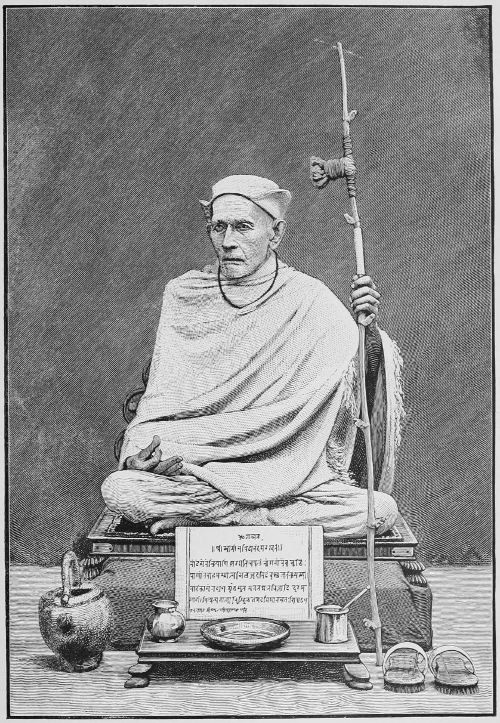
PORTRAIT OF MR. GAURĪ-ṠAṄKAR UDAY-ṠAṄKAR, C.S.I., NOW SVĀMĪ ṠRĪ SAĆĆIDĀNANDA-SARASVATĪ.
Seated, as a Brāhman Sannyāsī, in meditation (described at p. xiii of the Preface).
His usual mode of designating his monks was by the old term Bhikshu (Pāli Bhikkhu), ‘living by alms,’ to indicate their poverty. They were also called Ṡrāmaṇera and Ṡramaṇa (Pāli Sāmaṇera, Samaṇa), as subject to monastic discipline[37]. Those who entered the stream leading to Arhatship (p. 132) were called Ārya.
The term Ṡrāvaka, ‘hearers,’ seems to have been used in the Hīna-yāna system to denote great disciples only, and especially those ‘great disciples’ (p. 47) of Gautama who heard the Law from his own lips, and were afterwards called Sthaviras and became Arhats (p. 133). They had also the title Āyushmat, ‘possessing life.’
We perceive again the close connexion between Brāhmanism and Buddhism; for clearly the Brahma-ćārī and Sannyāsī of the one became the Ṡrāmaṇera or junior monk, and Ṡramaṇa or senior monk of the other.
As to the name Ṡramaṇa (from root Ṡram, ‘to toil’), bear in mind that, although Buddhism has acquired the credit of being the easiest religious system in the world, and its monks are among the idlest of men—as having no laborious ceremonies and no work to do for a livelihood—yet in reality the carrying out of the great object of extinguishing lusts, and so getting rid of the burden of repeated existences, was no sinecure if earnestly undertaken. Nor was it possible for men to lead sedentary lives, whose only mode of avoiding starvation was by house to house itinerancy.
As to the form of admission, there was no great strictness in early times, when all applicants were admitted without inquiry. It was only when the Order increased that murderers, robbers, debtors, soldiers and others in the King’s service, lepers, cripples, blind, one-eyed, deaf and dumb, and consumptive persons, and all subject to fits were rejected[38].
Originally it was enough for the Buddha to have said, ‘Come (ehi), follow me.’ This alone conferred discipleship. In time, however, he commissioned those he had himself admitted to admit others. Then the form of admission to the brotherhood was divided into two stages, marked by two ceremonies, which have been very unsuitably compared to our ordination services for deacon and priest. At any rate the term ‘ordination’ is wholly misleading, if any idea of a priestly commission or gift of spiritual powers be implied.
The youthful layman who desired admission to the first degree, or that of a novice, had to be at least fifteen years old[39] (Mahā-v° I. 50); and such novices had to be at least twenty (from conception) before the second rite or admission to the full monkhood.
The first rite was called pravrajyā (pabbajjā), ‘going forth from home’ (Mahā-v° I. 12). Persons admitted to this first degree of monkhood were called Ṡrāmaṇera (Sāmanera), ‘novices,’ though they were also called ‘new’ or ‘junior monks’ (Navako Bhikkhu). They might be admitted by a senior monk without appearing before any formal conclave; but not without the consent of their parents, and not without attaching themselves to a religious teacher (upādhyāya) after their admission. It is said that Gautama was urged by his father Ṡuddhodana to require the sanction of parents, in rather touching and remarkable words, to the following effect:—
‘The love for a son cuts into the cuticle (ćhavi); having cut into the cuticle, it cuts into the inner skin (ćamma); having cut into the inner skin, it cuts into the flesh; having cut into the flesh, it cuts into the tendons (nhāru or nahāru); having cut into the tendons, it cuts into the bones; having cut into the bones, it reaches the marrow (aṭṭhi-miṅjā), and abides in the marrow. Let not Pabbajjā, therefore, be performed on a son without his father’s and mother’s permission’ (Mahā-vagga I. 54).
The admission ceremony of a novice was extremely simple, and confined to certain acts and words on the part of the candidate, witnessed by any competent monk. The Saṅgha, as a body, took no part in it. The novice first cut off his hair, put on three yellow ragged garments (tri-ćīvara), adjusted the upper robe so as to leave the right shoulder bare, and then before a monk repeated three times the three-refuge formula:
‘I go for refuge to the Buddha (Buddhaṃ ṡaraṇaṃ gaććhāmi).’
‘I go for refuge to the Law (Dharmaṃ ṡaraṇaṃ gaććhāmi).’
‘I go for refuge to the Order (Saṅghaṃ ṡaraṇaṃ gaććhāmi).’
Very remarkably, this, the only prayer of true Buddhism, resembled the Gāyatrī or sacred prayer of the Veda (repeated by the Brahma-ćārī) in consisting of three times eight syllables. But if the Buddhist novice had a right to the Brahma-ćārī’s sacred cord (upavīta), this was probably abandoned on admission. He was then instructed in the Ten Precepts (Dasa-sīla or sikkhā-pada), which were really ten prohibitions (Mahā-vagga I. 56), requiring ten abstinences (veramaṇī):—
1. from destroying life (pāṇātipato = prāṇātipāta); 2. from taking anything not given (adinnādāna); 3. from unchastity (abrahmaćariyā); 4. from speaking falsely (musā-vāda = mṛishā-vāda); 5. from drinking strong drinks (surā); 6. from eating at forbidden times (vikāla-bhojana); 7. from dancing, singing, music, and worldly spectacles (visūka); 8. from garlands, scents, unguents or ornaments; 9. from the use of a high or broad bed; 10. from receiving gold or silver. The prohibition not to receive money, even in return for religious teaching or any supposed spiritual benefits conferred, was held to be most important, and was for a long time obeyed, though in the end monasteries became owners of large property and landed estates.
Of course the Upasampadā, or admission to full monkhood (described Mahā-vagga I. 76), was a more formal ceremony. A conclave (Saṅgha) of at least ten monks was required. The candidate had to appear before them, but was first instructed by some competent and learned monk as to the nature of the rite and the questions he would have to answer. This instructor also directed him to choose some other monk competent to act as his Upādhyāya (upajjhāya) or teacher for five years after his admission, and made him provide himself with an alms-bowl and with the usual yellow monkish vestments. Then his first instructor presented himself before the conclave and informed them that the candidate was ready to be admitted. Thereupon the novice came forward, adjusted his upper garment so as to cover the left shoulder, bowed down before the feet of the assembled monks, seated himself on the ground, and, raising his joined hands, asked three times for admission to the full monkhood, thus:—‘I entreat the Saṅgha for full monkhood (Upasampadā), have compassion on me and uproot me (ullumpatu mām) from the world,’ repeated thrice.
Thereupon he was questioned [not, as in our Ordination Service: ‘Are you inwardly moved by the Holy Spirit to take upon you this office?’ Not: ‘Will you apply all your diligence to frame and fashion your own life and that of your family so as to be wholesome examples?’ but] thus:—Are you free from leprosy, boils, consumption, fits, etc. Are you a male? Are you a free man and not in the royal service? Are you free from debts? Have you the consent of your parents? Are you full twenty years old? Have you an alms-bowl and vestments? What is your name? What is your teacher’s name?
If the answers were satisfactory the candidate was admitted. After admission no prayer was pronounced [such as in our Ordination Service: ‘We beseech Thee, merciful Father, send on Thy servant Thy heavenly blessing that he may be clothed with righteousness’[40]]; but he was informed that he was to trust to only four Resources (nissaya), and to abstain from four chief forbidden acts (akaraṇīyāni). These four Resources and four Prohibitions were then communicated to him thus:—
First the four Resources as follow:—(1) Broken morsels given in alms for food; (2) Rags from a dust-heap for clothes; (3) Roots of trees for an abode; (4) Liquid putrefying excreta of cows for medicine. Note, however, that, in practice, indulgences (atirekha-lābha) were in all four cases allowed; such as, better food when it happened to be given, or when invited to dinner by rich laymen; linen, cotton, or woollen garments, if dyed yellow and in three pieces (but only one change was allowed); houses, huts, or caves to dwell in, when not itinerating; ghee, honey, or molasses when out of health (Mahā-v° I. 30. 4).
Next the four chief Prohibitions (compare the Ten Prohibitions, p. 78), viz.:—(1) Unchastity and sexual acts of any kind; (2) Taking anything not given, even a blade of grass; (3) Killing any living thing, even an ant, or worm, or plant; (4) Falsely claiming the extraordinary powers of a perfected saint (uttarimanussa-dhamma. Mahā-v° I. 78. 2).
Clearly there were great temptations to gain celebrity by claiming such powers, or else this fourth prohibition would not have terminated the ceremony.
So soon as a man was admitted to full monkhood, he went through a five years’ course of instruction in the entire doctrine and discipline, under the preceptor (Upādhyāya, Āćārya) who had been previously chosen and was required to be of at least ten years’ standing.
This was a modification of the Brāhmanical rule that a student (Brahma-ćārī) should study under his preceptor for thirty-six years, or less, until he knew the Veda.
The full Buddhist monk had in theory to dwell under trees or in huts formed of leaves (pāṇ-sālā = paṇṇa-sāla = parṇa-ṡālā); but practically he resided in collections of simple mud or brick tenements, in cells, or in rows of caves hewn out of rocky hills. At any rate, collections of monastic dwellings, called Vihāras[41], were his usual abode during Vassa (or the rainy season, see p. 82); and at such times he had fellow-monks (saddhivihārika) living in companies around him, or in the same monastery.
Strict discipline was supposed to be enforced, and yet there was no central authority, no Chief Hierarch, no Archbishop whom he was bound ‘reverently to obey.’
Offences against the four forbidden acts were called Pārājikā āpatti, ‘offences meriting expulsion from the community of monks (Saṅgha).’
Then there were thirteen Saṅghādisesā āpatti, as well as certain Dukkata or less serious offences, requiring only confession before the Saṅgha, and dealt with by a Saṅgha-kamma, or act of a conclave of monks imposing some penance. There were penances (Prāyaṡ-ćitta) for lying, prevarication, abusive language, destroying vegetable or animal life, etc. (see Pātimokkha, Pāćittiyā dhammā, and pp. 62, 84). The following practices were also incumbent on all monks:—
(1) The wearing vestments given by laymen (not purchased) and consisting of three lengths of yellow-coloured rags; or, if entire lengths of cotton cloths were given, the saleable value had to be destroyed by tearing them into at least three pieces, and then sewing them together; (2) The owning no possessions except the three cloths, a girdle, bowl, razor, needle, and water-strainer to prevent the swallowing of animalculæ; (3) The living only on food collected in a wooden bowl by daily going from house to house, but without ever asking for it; (4) The eating at mid-day the one meal so collected and at no other time; (5) The fasting on four prescribed days; (6) The abiding in one spot for three or four months during Vassa, ‘the rains’ (from middle of June to middle of October), when itineration would involve trampling on vegetable and insect life; (7) The refraining from a recumbent posture under all circumstances; (8) The visiting cremation-grounds for meditation on the corruption of the body.
In truth it might almost be said that in every movement and action, in waking and sleeping, in dressing and undressing, in standing and sitting, in going out and coming in, in fasting and eating, in speaking and not speaking, the Buddhist monk had to submit to the most stringent regulations.
It was a noteworthy feature in Buddhist monachism that monks were never allowed to appear in public in a state of even semi-nudity. ‘Properly clad,’ says the Sekhiyā dhammā (4), ‘must the monk itinerate.’ ‘Not nakedness,’ says the Dhamma-pada (141), ‘can purify a mortal who has not overcome desires.’ The monk’s three garments (tićīvara = tri-ćīvara) were an inner one (antara-vāsaka), another wound about the thighs (saṅghāṭī) and an upper robe (uttarāsaṅga) worn loosely and brought round over the left shoulder. This constituted an important distinction between the Buddhist monks and the Jaina and other naked ascetics whose want of decency the Buddha condemned.
The Buddhist monk’s daily life probably began by meditation and by his reciting or intoning (Bhāṇa, Sarabhañña) portions of the Law, or by hearing it recited, followed perhaps by lessons in doctrine, or by discussions or by confessions. Next came itineration for food, followed by the one noon-day meal. Then came rest and further meditation and recitation, while possibly the senior monks preached to laymen. Such preaching took place especially during Vassa. In later times the daily duties included offering flowers, etc., at sacred shrines, and repeating so-called prayers, which were merely forms of words used as charms.
To illustrate the immensely meritorious efficacy of constant recitation of the Law, a story is told of five hundred bats that lived in a cave where two monks daily recited the Dharma. These bats gained such merit by simply hearing the sound that when they died they were all re-born as men and ultimately as gods.
Doubtless quarrels and faults of omission and commission occurred among the monks, especially during their residence together in Vassa (miscalled the Buddhist Lent). We read of six monks named Ćhabbaggiya who were constantly committing offences. Hence a day called Pavāraṇā (Pravāraṇā), ‘invitation,’ was kept at the end of Vassa, when all were invited to assemble for confession and for felicitation, if harmony had been preserved.
An important part of every monk’s duties was confession on Uposatha (Upavasatha) or fast-days (miscalled the Buddhist sabbaths)—which were kept at first on two days in each month, at full and new moon (corresponding to the Darṡa and Paurṇamāsa days of Brāhmanism), and afterwards also at the intermediate days of quarter-moon. On these four Uposatha days the Pātimokkha or general confession (p. 62) was recited. The confession was by monks to each other, not by laymen to monks, though the four days were also observed by laymen, and we know that Aṡoka enjoined periodical ceremonies, and expression of sorrow for sins on the part of all his subjects. Such confession did not cause remission of sin or absolution in our sense, but only release from evil consequences by penances (p. 62).
We have learnt, then, that Buddhist monks were not under irrevocable vows. They undertook to obey rules of discipline, but took no actual vows—not even of obedience to a superior. Buddhist monkhood was purely voluntary, so that all were free to come and go. It had nothing hereditary about it like the rank of a Brāhman.
We have also learnt, that the term ‘priest’ is not suitably applied to Buddhist monks. For true Buddhism has no ecclesiastical hierarchy, no clergy, no priestly ordination; no divine revelation, no ceremonial rites, no prayer, no worship in the proper sense of these terms. Each man was a priest to himself in so far as he depended on himself alone for internal sanctification.
Evidently, too, all Buddhist monks were integral parts of one organic whole. It is true that in the end they were collected in various monasteries, each of which practically became an independent Saṅgha (each under one Head). But in theory all were parts of one and the same brotherhood, which was republican and communistic in its constitution. And this word Saṅgha cannot be correctly rendered by ‘church,’ if by that term is meant an ecclesiastical body with legislative functions, embracing clergy and laity united in a common faith and under one Head; for as founded by the Buddha, it was not this. It was simply a vast fraternity intended to embrace all monks of the four quarters (ćaturdiṡa) of the world, from the Buddha himself and the perfected Arhat (p. 133), to every monk of the lowest degree, but not a single layman. Indeed in its highest sense the Saṅgha comprised only true Nirvāṇa-seeking monks who had entered the paths of true sanctification (p. 132).
And here observe that, notwithstanding the stigma attached to unmarried women in India, Gautama in the end permitted an Order of Nuns (Pāli Bhikkhunī) and female novices (Sāmaṇerī, p. 47). The Ćulla-vagga (X. I. 3) relates how women were indebted to the intercession of a monk, Gautama’s cousin Ānanda, for permission to form an Order, and how Mahā-prajāpatī, the Buddha’s nurse (p. 24), became the first nun; yet when Ānanda first asked: ‘How are we monks to behave when we see women?’ Gautama replied: ‘Don’t see them.’ ‘But if we should see them, what are we to do?’ ‘Don’t speak to them.’ ‘But if they speak to us, what then?’ ‘Let your thoughts be fixed in deep meditation’ (Sati upaṭṭhāpetabbā. Mahā-parin° V. 23).
Clearly the Buddha was originally a misogynist as well as a misogamist, and wished his followers to be misogynists also. Even when he had been induced to admit the justice of the plea for women’s rights, he placed his nuns under the direction of monks. They could only be admitted by monks, and were subject to the male Order in all matters of discipline. They were under eight special obligations, one of which was to rise up in the presence of a monk, even if a novice.
The Buddha’s exhortation to the first nun is noteworthy:—‘Whatsoever, O Gotamī (Mahā-prajāpatī), conduces to absence of passion, to absence of pride, to wishing for little and not for much, to seclusion and not to love of society, to earnest effort and not to indolence, to contentment and not to querulousness, verily that is the true doctrine’ (Ćulla-v° X. 5).
It was certainly a great gain for a woman when she was permitted to become a nun (or a Therī); for, as a nun, she could even attain Arhatship. This is clearly laid down in Ćulla-vagga X. 1. 3. 4. No woman, however, could attain to Buddhahood without being born as a man, so that it could scarcely be said that in Buddha there is ‘neither male nor female.’
Such, then, was the monachism which constituted the very pith and marrow of Buddhism. All truly enlightened disciples of Buddha were monks or nuns.
Let us not forget, however, that in practice Buddhism admitted lay-brothers, lay-sisters, married householders and working-men, as necessary adjuncts.
Yet they were only appendages. Of course the Buddha knew very well that it was not possible to enforce celibacy on all his followers. He knew that having prohibited his monks from making or taking money or holding property, they would have to depend on lay-associates and householders for food, clothing, and habitation, and that, if every layman were to become a monk, there would be no work done, no food produced, no children born, and in time no humanity—nay, no Buddhism—left.
Universal monkhood, in short, might have been a consummation to be aimed at in some Utopia; but was practically unattainable. In fact Gautama had to take the world as he found it, and the very idea of a world perpetuating itself—according to his own theory of a constant succession of birth, decay, and reproduction—implied that a youth, on reaching manhood, married, had children, worked and earned a livelihood for their support. He could not impose this burden on others.
Besides, the generality of people were in Gautama’s day what they are in India now-a-days—bent on early marriage, and resolute in working hard for a livelihood. Even Manu only enjoined celibacy on young religious students and on old men, though there were occasional cases of perpetual (naishṭhika) Brahma-ćārins.
Without doubt, celibacy in instances of extraordinary sanctity has always commanded respect in India; but in no country of the world has married life been so universally honoured. It is not very likely, then, that the following sentiments, enunciated by the Buddha, could have met with general approval:—
‘A wise man should avoid married life (abrahma-ćariyam) as if it were a burning pit of live coals’ (Dhammika-Sutta 21).
‘Full of hindrances is married life, defiled by passion. How can one who dwells at home live the higher life in all its purity?’ (Tevijja-Sutta 47).
And in reality Buddha’s anti-matrimonial doctrines did excite opposition. The people murmured and said, ‘He is come to bring childlessness among us, and widowhood, and destruction of family-life.’ Indeed, the two facts—first, that the foundations of Buddhism were not laid (as those of Christianity notably are), on the hallowed hearth of home and on the sacred rock of family-life with its daily round of honest work; and—secondly, that the precept enjoining monkhood and abstinence from marriage was not combined with any organized ecclesiastical hierarchy under a central government, are sufficient to account for the circumstance that Buddhism never gained any real stability in India.
No doubt lay-brethren were always welcomed; but they were bound to Buddhism by very slender ties in regard to dogma, and were only expected to conform to the simplest possible code of morality.
Probably the only form of admission for a layman was the repetition of the 24 syllables of the three-refuge (tri-ṡaraṇa) formula:—‘I go for refuge to the Buddha, his Law and his Order’ (p. 78). It was of course understood that he was to abstain from the five gross sins (p. 126), but he was already bound to do so by the rules of Hindū caste and family-religion. The chief test of his Buddhism was his readiness to serve the monks. It was for this reason, I think, that lay-adherents were not called, as might have been expected, Ṡrāvakas, ‘Hearers,’ but simply Upāsakas, ‘Servers,’ and in the case of women Upāsikās. They could not be called disciples of Buddha in the truest sense, unless they entered his monastic Order.
Of course the majority of Buddhist householders never cared to do this. Their chief religion consisted in giving food and clothing, earned by daily toil, to the monks[42]. If they failed in this, there was only one punishment. They were forbidden the privilege of giving at all, and so of accumulating a store of merit. No monk was allowed to ask them for a single thing. Of course, too, the majority of Buddhist householders were worldly-minded; they were no believers in ultra-pessimistic views of life. They looked for a life in some heaven, not Nirvāṇa. Yet in theory all laymen might enter the paths of sanctification (p. 132), and thousands of earnest men are said to have done so[43].
A layman’s progress, however, towards Arhatship, except through monkhood and abandoning the world, was almost hopelessly barred. At page 264 of the Milinda-pañha it is implied that an earnest layman might become an Arhat, even while still a layman, but he had either to enter monkhood or else to pass away in Pari-nirvāṇa (p. 140) at the moment of becoming so.
The best proof of the truth of this view of the matter is, that after a layman had attached himself to the Buddha, the Law, and the Order, he was not required to undergo any initiatory ceremony, like baptism, or to receive any stamp of membership, or to assume a peculiar dress, or to give up all belief in his family religion, or caste-customs. In short, he did not as a lay-brother break entirely with Hindūism.
That universal tolerance was of the very essence of Buddhism is indicated by Aṡoka’s twelfth edict:—‘The beloved of the gods honours all forms of religious faith—there ought to be reverence for one’s own faith and no reviling of that of others.’ Compare p. 126.
Nor did Gautama himself ever set an example of intolerance. He never railed at the Brāhmans. He treated them with respect, and taught others to do so; and even adopted the title Brāhmaṇa for his own saints and Arhats (Dhamma-pada 383-423).
What he opposed was priestcraft and superstition, not Brāhmanism; as indeed other reformers had done before him. Probably the great receptivity of Buddhism was one of the causes that led to its decay in India.
Yet Gautama’s victory over one of the most inveterate propensities in human nature—the tendency to seek salvation through a mediatorial caste of priests—was a wonderful achievement. This is proved by the fact that his followers in other countries became re-entangled in a network of priestcraft, even more enslaving than that out of which he had rescued them.
Koeppen, Rhys Davids, and other writers have well shown that the Buddhism of Tibet, with its Pope-like grand Lāmas—its cardinals and abbots, monks and mendicant friars, nuns and novices, canonized saints and angelic hosts, temples and costly shrines, monasteries and nunneries, images and pictures, altars and relics, robes and mitres, rosaries and consecrated water, litanies and chants, processions and pilgrimages, confessions and penances, bell-ringing and incense—is in everything, except doctrine, almost a counterpart of the Romish system. How little could the Buddha have foreseen such a development of his brotherhood of monks, whose chief duties were meditation and itineration!
And what is to be said of the present condition of the Buddhist monkhood? Do we see anywhere evidences of that enlightenment of mind which Buddhism claims as its chief characteristic?
When I was travelling in Ceylon, I met a few learned monks, but the majority seemed to me idle, ignorant, and indifferent.
In Burma the monks are called Pungīs (Phongies), and are a little more active. Every youth in Burma is supposed for a time to inhabit a monastery.
In Tibet the monks are called Lāmas (a lower title being Gelong) and constitute a large proportion of the population. They are slaves to gross superstitions. Some are mere devil-charmers, a belief in the power of evil spirits being the chief religion of the people.
In China the monks are called Ho-shang (or Ho-sang). They constitute the only section of the population who have a right to be called Buddhists, though, after all, they are mere pseudo-Buddhists. Professor Legge informs me that he has known a few learned men among them, and learned works have been written by them. But the general testimony of Europeans in China is that the mass of the monks there are simply drones, or aimless dreamers, who go through their repetitions by rote. Almost all are conspicuous for apathy, inertness, and a vacant idiotic expression of countenance.
Clearly we have in their condition an example of the fact that even moral restraint, if carried to the extreme of extinguishing all the natural affections and desires, must inevitably be followed by a Nemesis. Surely we have in these monkish fraternities an illustration of the truth that any transgression of the laws of nature, common-sense, and reason—any suppression of the primary instincts of humanity, must in the end incur the penalty attached to every violation of the eternal ordinances of God.
LECTURE V.
The Philosophical Doctrines of Buddhism.
One of the most noteworthy points in the early history of Buddhistic thought is that while Gautama Buddha denied the existence of Brahmā as a personal Creator, and repudiated the Veda and all Vedic sacrifices and ceremonial observances, he at the same time made the philosophical teaching of the Brāhmans the point of departure for his own peculiar philosophical teaching.
Another noteworthy point is that while Buddhism was undoubtedly a modification of philosophical Brāhmanism, the latter was also modified by an interchange with Buddhistic ideas.
It may certainly be questioned whether Gautama himself, in the early stages of his career, ever caused much offence to the most orthodox Brāhmans by the free expression of his opinions. He did not spare either his criticism or sarcasm, but it is well known that the Brāhmans were not only tolerant of criticism; they were equally critical themselves, and delighted in controversial discussions, as they do to this day.
In the Tevijja-Sutta an account is given of a discussion in which, though Gautama expressed himself strongly, he does not seem to have excited any wrath in his opponent—a Brāhman named Vāsettha.
The argument attributed to the Buddha is so remarkable that a portion of it may be given here:—
‘Then you say, Vāsettha, that not one of the Brāhmans, or of their teachers, or of their pupils, even up to the seventh generation, has ever seen Brahman (the God of the Brāhmans) face to face. And that even the Ṛishis of old, the utterers of the ancient verses, which the Brāhmans of to-day so carefully intone and recite precisely as they have been handed down—even they did not pretend to know or to have seen where or whence or whither Brahman is. So that the Brāhmans versed in the three Vedas have forsooth said thus: “To a state of union with that which we know not and have not seen, we can show the way and can say: ‘This is the straight path, this is the direct way which leads him who acts according to it, into a state of union with Brahman[44].’”
‘Now what think you, Vāsettha? Does it not follow, this being so, that the talk of the Brāhmans, versed though they be in the three Vedas, is foolish talk?
‘Verily, Vāsettha, that Brāhmans versed in the three Vedas should be able to show the way to a state of union with that which they do not know, neither have seen—such a condition of things has no existence.
‘As when a string of blind men are clinging one to the other, neither can the foremost see, nor can the middle one see, nor can the hindmost see, just so is the talk of the Brāhmans versed in the three Vedas[44].’
These no doubt were trenchant words, but it might easily be shown that the Brāhmans themselves did not scruple to use almost as strong language against their own revelation. For instance, the Ćhāndogya Upanishad (p. 473) speaks of the Veda as ‘mere name’ (nāma eva). The Bṛihadāraṇyaka Upanishad declares that when a man is in a condition of knowledge, ‘the gods are no gods to him, and the Veda no Veda;’ and the Muṇḍaka describes the sacrificial Veda as inferior to Brahma-vidyā.
And in truth every Hindū was allowed to choose one of three ways of securing his own salvation.
The first was ‘the way of works’ (Karma-mārga), that is to say, of sacrifices (Yajña), of ceremonial rites, of lustral washings, penances and pilgrimages, as enjoined in the Mantra and Brāhmaṇa portion of the Veda, in Manu, the Law-books and parts of the Purāṇas.
The second was ‘the way of faith’ (bhakti), meaning by that term devotion to one or other of certain commonly worshipped personal deities,—a way leading in later times to the worship of Ṡiva and Vishṇu (unfolded in the Purāṇas), and involving merely heart-devotion, without sacrificial or ceremonial acts.
The third was ‘the way of knowledge’ (Jñāna), as set forth in the Upanishads.
The mediæval Brāhman Kumārila—a really historical teacher—advocated the first way; another teacher of less note, Ṡāṇḍilya, advocated the second; another celebrated historical teacher, Ṡaṅkara, advocated the third.
Even in Gautama’s time any one of these ways or all three together might be chosen, so long as the authority of the Brāhmans was not impugned.
This, at least, is the general teaching of the Bhagavad-gītā—an eclectic work which is the most popular exponent of the Hindū creed[45].
Yet even the Author of the Bhagavad-gītā had a preference for the way of knowledge. In one passage (II. 42) he describes the Veda as ‘mere flowery doctrine’ (pushpitā vāć), and is careful to point out that works must be performed as acts of devotion leading to absorption into the Supreme (Brahma-nirvāṇam).
Indeed there can be no doubt that it was generally held by the Brāhmans of Buddha’s time that the way of knowledge was the highest way. But this way was not open to all. It was reserved for the privileged few—for the more intellectual and philosophically-minded Brāhmans. The generality of men had to content themselves with the first and second ways.
What the Buddha then did was this:—First he stretched out the right hand of brotherhood to all mankind by inviting all without exception to join his fraternity of celibate monks, which he wished to be co-extensive with the world itself. Then he abolished the first and second ways of salvation (p. 95), that is, Yajña, ‘sacrifices,’ and Bhakti, ‘devotion to personal gods,’ and substituted for these meditation and moral conduct as the only road to true knowledge and emancipation. And then, lastly, he threw open this highest way of true knowledge to all who wished to enter it, of whatever rank or caste or mental calibre they might be, not excepting the most degraded.
Without doubt the distinguishing feature in the Buddha’s gospel was that no living being, not even the lowest, was to be shut out from true enlightenment.
And here it will be necessary to inquire more closely into the nature of that knowledge which the Buddha thus made accessible to every creature in the universe.
Was it some deep mystery? Some occult doctrine of physical or metaphysical science? Some startling revelation of a law of nature never before imparted to the world? Was the Buddha’s open way very different from the old, well-fenced-off Brāhmanical way?
Of one point we may be certain. He was too sensible to cast aside all ancient traditions. Nor was he a mere enthusiast claiming to be the sole possessor of a new secret for regenerating society.
Unhappily, however, we are here met by a difficulty. The Buddha never, like Muhammad, wrote a book, or, so far as we know, a line. He was the Socrates of India, and we are obliged to trust to the record of his sayings (see p. 38). Still we have no reason to doubt the genuineness of what was for some time handed down orally in regard to the doctrines he taught, and we are struck with the fact that Gautama called his own knowledge Bodhi (from budh, ‘to understand’), and not Veda (from vid, ‘to know’). Probably by doing so he wished to imply that his own knowledge was attainable by all through their own intuitions, inner consciousness, and self-enlightening intellect, and was to be distinguished from Veda or knowledge obtainable through the Brāhmans alone, and by them through supernatural revelation only. Hence, too, he gave to every being destined to become a Buddha the title Bodhi-sattva (Bodhi-satta), ‘one having knowledge derived from self-enlightening intellect for his essence.’
But it should be noted, that even in the choice of a name derived from the Sanskrit root budh, the Buddha only adopted the phraseology of the Sāṅkhya philosophy and of the Brāhmaṇas. The Sāṅkhya system made Buddhi, ‘intellect,’ its great principle (Mahat), and the Ṡatapatha-brāhmaṇa called a man who had attained to perfect knowledge of Self prati-buddha[46]. It may be pointed out, too, that Manu (IV. 204) uses the same root when he calls his wise man Budha.
Moreover, the doctrines which grew out of his own special knowledge Gautama still called Dharma (Dhamma), ‘law,’ using the very same term employed by the Brāhmans—a term expressive of law in its most comprehensive sense, as comprising under it the physical laws of the Universe, as well as moral and social duties.
In what, then, did the Buddha’s Dharma differ from that of the Brāhmans? One great distinction certainly was that it contained no esoteric (rahasya) and metaphysical doctrines in regard to matter and spirit, reserved for the privileged few; yet some of its root-ideas were after all mere modifications of the Sāṅkhya, Yoga, and Vedānta systems of philosophy. His way of knowledge, though it developed into many paths, had the same point of departure. It was a knowledge of the truth, that all life was merely one link in a series of successive existences, and inseparably bound up with misery. Moreover as there were two causes of that misery—lust and ignorance—so there were two cures.
The first cure was the suppression of lust and desire, especially of all desire for continuity of existence.
The second cure was the removal of ignorance. Indeed Ignorance was, according to Gautama, the first factor in the misery of life, and stands first in his chain of causation (p. 102). Not, however, the Vedāntist’s ignorance—not ignorance of the fact that man and the universe are identical with God, but ignorance of the four truths of Buddhism (p. 43):—ignorance that all life is misery, and that the misery of life is caused by indulging lusts, and will cease by suppressing them.
It would be easy to show how all Indian philosophy was a mere scheme for getting rid of the bugbear of metempsychosis, and how common was the doctrine that everything is for the worst in the worst of all possible worlds. This was taught by the Brāhmans five centuries B.C., and continued to be a thoroughly Hindū idea long after the disappearance of Buddhism. Witness the following from the Maitrāyaṇi Upanishad:—
[37]Some prefer to derive the Pāli Ṡamaṇo from the Sanskṛit root Ṡam, ‘to be quiet.’ Ṡmāṡānika, ‘frequenting burning grounds,’ is a later name, life being to monks a kind of graveyard.
[38]We may note that in the ‘Clay-Cart,’ a Sanskṛit drama written in an early century of our era, a gambler becomes a Buddhist monk.
[39]I hear from Dr. Oldenberg that the mention in his ‘Buddha’ of twelve years as the minimum is a mistake. The age of eight mentioned by Prof. Rhys Davids as the minimum, must be a modern rule peculiar to Ceylon, if it be admissible at all.
[40]I give these quotations to show the unsuitableness of the term ‘Ordination’ applied to Pabbajjā and Upasampadā in the S. B. E.
[41]In Mahā-vagga I. 30. 4, five kinds of dwellings are named besides trees, viz. Vihāras, Aḍḍhayogas (a kind of house shaped like Garuḍa), storied dwellings (prāsāda), mansions (harmya), and caves (guhā).
Taking, then, in the first place, the Vinaya or discipline portion of the Buddhist bible, we ought to observe that a portion of it (the Pātimokkha) is not only the oldest, but also the most important in its bearing on the whole theory of Buddhism. For, as we shall point out more fully hereafter, the Buddha’s paramount aim was to convince others that to get rid of ignorance, gain knowledge, practise morality, and obtain deliverance, it was incumbent on a wise man to renounce married life and become a member of a monastic Order.
The Buddhist monk’s daily life probably began by meditation and by his reciting or intoning (Bhāṇa, Sarabhañña) portions of the Law, or by hearing it recited, followed perhaps by lessons in doctrine, or by discussions or by confessions. Next came itineration for food, followed by the one noon-day meal. Then came rest and further meditation and recitation, while possibly the senior monks preached to laymen. Such preaching took place especially during Vassa. In later times the daily duties included offering flowers, etc., at sacred shrines, and repeating so-called prayers, which were merely forms of words used as charms.
[42]Comparing Western with Eastern Monachism, I may remark that the chief duty of the lay-brethren attached to the Cistercian monastery at Fountain’s Abbey was to wait upon the monks, procure food and cook it for them; and we learn from the Times of December 24, 1885, that the same duty devolved on the Carthusian lay-brothers.
[43]The Chronicles of Ceylon state that 80,000 laymen entered the paths in Kashmīr. Compare Divyāvadāna, p. 166, line 12; p. 271, 12.
[44]See Tevijja-Sutta, S. B. E. §§ 14, 15.
[45]The venerable Svāmī Ṡrī Saććidānanda Sarasvatī, in sending me a copy of the Bhagavad-gītā with a metrical commentary, says, ‘It is the best of all books on the Hindū religion, and contains the essence of all kinds of religious philosophy.’ I find in the Madras Times for October 29, 1886, the following: ‘At a meeting of the “Society for the Propagation of True Religion,” at 6 p.m. to-day, the Bhagavad-gītā will be read and explained.’
[46]XIV. 7. 2. 17. This was first pointed out by Professor A. Weber.
In this weak body, ever liable
To wrath, ambition, avarice, illusion,
To fear, grief, envy, hatred, separation
From those we hold most dear, association
With those we hate; continually exposed
To hunger, thirst, disease, decrepitude,
Emaciation, growth, decline and death,
What relish can there be for true enjoyment?
Also the following, from Manu (VI. 77):—
This body, like a house composed of the (five) elements, with bones for its rafters, tendons for its connecting links, flesh and blood for its mortar, skin for its covering; this house filled with impurities, infested by sorrow and old age, the seat of disease, full of pain and passion, and not lasting—a man ought certainly to abandon.
Also Bhartṛi-hari (Vairāgya-ṡataka III. 32. 50):—
Enjoyments are alloyed by fear of sickness,
High rank may have a fall, abundant wealth
Is subject to exactions, dignity
Encounters risk of insult, strength is ever
In danger of enfeeblement by foes,
A handsome form is jeoparded by women,
Scripture is open to assaults of critics,
Merit incurs the spite of wicked men,
The body lives in constant dread of death—
One course alone is proof against alarm,
Renounce the world, and safety may be won.
One hundred years[47] is the appointed span
Of human life, one half of this goes by
In sleep and night; one half the other half
In childhood and old age; the rest is passed
In sickness, separation, pain, and service—
How can a human being find delight
In such a life, vain as a watery bubble?
No doubt this kind of pessimism has always found advocates in all ages, and among all nations in Europe as well as in Asia. It was a favourite idea with the Stoics, and it has found favour with Schopenhauer, Von Hartmann, and other modern philosophers; and Shakespeare makes Hamlet give expression to it.
Happily the general tone of European philosophical thought is in another key, and the admirers of Aristotle still constitute a majority in Europe. The great Stagirite described God as ‘Energy,’ and in dealing with Solon’s dictum that ‘no man can be called happy while he lives,’ gave expression to a different belief. A good man’s virtuous energies, he asserted, are in this present life a genuine source of happiness to him; misfortunes cannot shake his well-balanced character; he surmounts the worst sufferings by generous magnanimity[48].
Even in the East a greater than Aristotle and no less an Authority than the true ‘Light of the world’—bade men rejoice and leap for joy under the most trying circumstances of life, and prize His gift of Eternal Life as their highest good.
In India, on the contrary, the Upanishads and systems of philosophy which followed on them, all harped on the same string. They all dwelt on the same minor key-note. Their real object was not to investigate truth, but to devise a scheme for removing the misery believed to result from repeated bodily existence and from all action, good or bad, in the present, previous, and future births.
The Sāṅkhya (I. 1) defines the chief aim of man to be deliverance from the pain incident to bodily life and energy; or according to the Nyāya (I. 2), from the pain resulting from birth, actions, and false knowledge; while the Vedānta considers that ignorance alone fetters the soul of man to a body, and the Yoga defines the divine Purusha (= the perfect man of Buddhism) as a being unaffected by pain (kleṡa), acts, consequences of acts, and impressions derived from acts done in previous births (āṡaya = saṉṡkāra).
Gautama’s sympathy with these ideas is shown by the twelve-linked chain of causation, put forth by him as an accompaniment to his four fundamental truths (p. 43), and thus expressed (Mahā-vagga I. 1. 2):—
From Ignorance comes the combination of formations or tendencies (instincts derived from former births[49]); from such formations comes consciousness (vijñāna); from consciousness, individual being (nāma-rūpa, name and form); from individual being, the six organs of sense (including mind); from the six organs, contact (with objects of sense); from contact, sensation (vedanā); from sensation, desire (lust, thirst, taṉhā = tṛishṇā); from desire, clinging to life (upādāna); from clinging to life, continuity of becoming (bhava); from continuity of becoming, birth; from birth, decay and death; from decay and death, suffering.
It is difficult to discover a strictly logical sequence in this curious twelve-linked chain. The first link is a cause, the ten following are both causes and effects, while the last is an effect only. The second (saṃkhārā) is presented to us afterwards as one of the Skandhas (p. 109), and we have the whole inverted in a kind of circular chain in the form of question and answer, thus:—
What is the cause of misery and suffering? Answer—Old age and death. What is the cause of old age and death? Answer—Birth. Of birth? Answer—Continuity of becoming. Of continuity of becoming? Answer—Clinging to life. Of clinging to life? Answer—Desire. Of desire? Answer—Sensation or perception. Of sensation? Answer—Contact with the objects of sense. Of contact with objects? Answer—The organs of sense. Of the organs? Answer—Name and form, or individual being. Of individual being? Answer—Consciousness (viññāṇa = vijñāna). Of consciousness? Answer—Combination of formations or tendencies (or those material and mental predispositions derived from previous births which tend to form character, compare p. 109). Of such formations? Answer—Ignorance.
In making Ignorance (Avidyā) the first cause of the misery of life, Gautama agreed with the Vedānta (though he explained Ignorance differently, see p. 99), while in the remaining chain of causes (Nidāna) we detect his sympathy with the Sāṅkhya theory of a chain of producers and products.
His own scheme of causation (often called Paṭićća-samuppādo) occupies an important place in Buddhistic philosophy, as supplementary to, and complementary of, the four truths (p. 43). It was thought out before them (see p. 39) and is equally revered.
It is on this account that the following celebrated formula is constantly repeated like a short creed, and is found carved on numerous Buddhist monuments:—
‘Conditions (or laws) of existence which proceed from a cause, the cause of these hath the Buddha explained, as also the cessation (or destruction) of these. Of such truths is the Great Ṡramaṇa the teacher[50].’
This was the formula repeated by Assaji to Sāriputta and Moggallāna (p. 47), when they wished to join the Buddha and asked for a summary of the spirit (artha), not the letter (vyañjana), of his doctrine (Mahā-v° I. 23. 5). Certainly the sorites-like form of statement in the scheme of causation had charms for Oriental thinkers.
Moreover the Buddha’s method of clothing old truths in a new dress, or—to adopt another metaphor—his plan of putting new wine into old bottles, had in it something very attractive to all Indian minds.
Of what kind, then, was the new dress in which Gautama clothed the great central doctrine of Indian philosophy—the doctrine of metempsychosis, involving the perpetuation of the misery of life?
The Buddha, like all Indians, was by nature a metaphysician. He had great sympathy with the philosophy of the Upanishads. How was it that he disbelieved in the existence of Spirit as distinct from bodily organism? A little consideration will perhaps make clear how he was brought to his own peculiar agnostic view.
Probably before his so-called enlightenment and attainment of true knowledge, he was as firm a believer in the real existence of one Universal Spirit as the most orthodox Brāhman. He had become imbued with Brāhmanical philosophy while sitting at the feet of his two teachers Āḷāra and Uddaka (p. 29). At that time there were no definite or formulated philosophical systems, separated from each other by sharp lines. But the Sāṅkhya, Yoga, and Vedānta systems were assuming shape, and the doctrines they embodied had been foreshadowed in the Upanishads, and were orally current.
In short, it had been repeatedly stated in the Upanishads, that nothing really existed but the one universally present impersonal Spirit, and that the whole visible world was really to be identified with that Spirit.
Then it followed as an article of faith that man’s spirit, deluded into a temporary false idea of separate independent personal existence by the illusion of ignorance, was also identical with that One Spirit, and ultimately to be re-absorbed into it.
Further, it followed that man’s spirit, while so deluded and so separated for a time from the One Spirit, was compelled to migrate through innumerable bodily forms, and that such migration entailed misery, from which there was no escape except by a process of disillusionment, that is, by dissipating the illusion of separate individuality, through the acquisition of perfect knowledge leading to re-union with the One Spirit, as the river blends with the ocean. And such knowledge was best gained by suppression of the passions, abandonment of all worldly connexions, and abstinence from all action. Finally, it was held, with apparent inconsistency, that the storing up of merit by good works assisted in effecting this object by raising a man, not yet fit for union with the supreme Spirit, to forms of existence in which such union might be accomplished.
Now it is obvious that to believe in the ultimate merging of man’s personal spirit in One impersonal Spirit, is virtually to deny the ultimate existence of any human spirit at all. Nay more—it is virtually to deny the existence of a supreme universal Spirit also.
For how can a merely abstract universal Spirit, which is unconscious of personality, be regarded as possessing any real existence worth being called true life?
To assert that such a Spirit is pure abstract Entity or (according to Vedānta phraseology) pure Existence (without anything to exist for), pure Thought or even pure Consciousness (without anything to think about, or be conscious about), pure Joy (without anything to rejoice about), is practically to reduce it to pure non-entity.
All that Gautama did, therefore, was to purge Brāhmanism of a dogma which appeared to him to be a mere sham (Brahma-jāla I. 26).
He simply eliminated as incapable of proof the doctrine of a purely abstract, incorporeal spirit or self, whether human or divine. The assertion that any soul or self or Ego really existed (Atta-vādo) was an error. It formed one of the constituents of Upādāna (p. 109), and was the first of the ten fetters (Sakkāya-diṭṭhi, p. 127).
And with the rejection of this dogma, as incapable of demonstration, he found himself compelled to reject also, as beyond the range of man’s cognizance, the doctrine of any Supreme Being higher than the perfectly enlightened man. Like Kapila in the Sāṅkhya aphorisms (I. 92, V. 10) he felt bound to admit: ‘It is not proved that there is a God.’
This, indeed, is the chief foundation on which rests the assertion that Buddhism is a mere system of atheistic negations. And there can be no doubt that from one point of view its statements are steeped in negations, or rather perhaps in evasions. Its morality has been described as more negative than positive; but this is scarcely correct, and it would be fairer to say that it delights in telling men to abstain from doing evil, rather than in urging them to active exertions for the good of others. It has many positive precepts.
But if there was no probability of a soul existing separately from a body after death, how could there be any soul-transmigration? How could there be any agreement between the teaching of the Buddha and that of the Brāhmans, in regard to this important central dogma? The real fact was that the divergence of the Buddhist doctrine from the Brāhmanical, as stated in the Upanishads, was not greater than was to be expected from the difference of belief between the two systems in regard to the existence of soul.
Plato, we know, held that souls ‘found their prisons in the same natures’ at death, so that an effeminate man might be re-born as a woman, a tyrannical man as a wolf, and so on. In Manu’s Law-book is set forth a triple order of soul-transmigration through lower, middle, and higher planes of existence, resulting from good, middling, and bad acts, words, and thoughts. Thus—to instance only the lower—the soul of a man who spoke ill of his teacher was destined to pass into an ass or a dog (II. 201), the soul of a thief might occupy a mouse (XII. 62), the soul of one who neglected his caste-duties might pass into a demon (XII. 71, 72); and greater crimes might lead to the soul’s being condemned to occupy plants, stones, and minerals. Then there was also an intermediate condition of the soul. According to one idea it went to the moon; according to another it became a hungry ghost which required food to be offered to it at the Ṡrāddha ceremonies.
This theory of transmigration, according to the Hindūs, explained the origin of evil. Evil must proceed from antecedent evil, and the resulting penalty must be borne by the evil-doer in succeeding existences. This was the terrible incubus which it was the great object of Indian philosophers to remove. It was equally Gautama’s object, but how could he accept soul-transmigration, denying as he did the existence of any spirit, as distinct from material organization? He therefore put forth a view of his own, thus:—Every being is composed of five constituent elements called Skandhas (Pāli Khandha), which have their source in Upādāna (p. 103) and are continually combining, dissolving, and recombining, viz. 1. Form (rūpa), i. e. the organized body. 2. Sensation (vedanā) of pain or pleasure, or of neither, arising from contact of eye, ear, nose, tongue, skin, and mind with external objects. 3. Perception (sañña = sañjñā) of ideas through the same sixfold contact. 4. Aggregate of formations (saṃkhāra = saṉskāra, i.e. combination of properties or faculties or mental tendencies, fifty-two in number, forming individual character and derived from previous existences; compare the similar saṃkhārā pl. at p. 102). 5. Consciousness (viññāṇa = vijñāna) or thought[51]. This fifth is the most important. It is the only soul recognized by Buddhists. Theoretically it perishes with the other Skandhas, but practically is continued, since its exact counterpart is reproduced in a new body.
For although, when a man dies, all the five constituents of existence are dissolved, yet by the force resulting from his actions (karma), combined with Upādāna, ‘clinging to existence’ (one form of the fetters at p. 127), a new set of five, of which consciousness is still the dominant faculty, starts into being. The process of the new creation is so instantaneous that it is equivalent to the continuance of the same personality, pervaded by the same consciousness; though each personality is only really connected with the previous by the force of acts done and character formed in each—such force operating through Upādāna. In short, to speak of transmigration of souls in Buddhism gives a wrong idea. Metempsychosis with Buddhists resolves itself into continuous metamorphosis or Palingenesis. For no true Buddhist believes in the passing of a soul from one body to another, but rather in the passing on of what may be called act-force, or of the merit and demerit resulting from a man’s acts, so as to cause a continuous succession of transformations—a succession which may be compared to the rolling on of a wheel through different scenes and over every variety of ground; or to the burning on, through day and night, of a flame which is not the same flame at the beginning of the day and end of the night, and yet is not different. It is this act-force (Karma), combined with Upādāna, ‘clinging to existence’ (=abhi-niveṡa in the Yoga II. 9), which is the connecting link between each man’s past, present, and future bodies.
In its subtle and irresistible operation it may be compared to stored-up chemical or electric energy. It is a force which continually creates and re-creates the whole man, and perpetuates his personal identity through separate forms, whether it compels him to ascend or descend in the scale of being.
Yet to say that personality is transmitted, when there is no consciousness of any continuity of identity, amounts, after all, to denial of continuous existence.
Be it observed, too, that the scale of existence is limited in Buddhism to six classes of beings—gods, men, demons, animals, ghosts, and dwellers in hell (p. 121). Transmigration is not extended, as in the Brāhmanical system, to plants, stocks, and stones; though a man could be born as a tree-god (p. 112).
Gautama Buddha himself was merely the last link in a long chain of corporeal forms, and he had been preceded by twenty-four Buddhas, who were to previous ages of the world what he was to the present. Every one of these Buddhas was gifted with the faculty of recollecting his previous personalities, and Gautama often gave an account of his own former existences. The stories of about five hundred and fifty of his births (Jātakas) are even now daily repeated to eager listeners in every Buddhist country, and are believed to convey important lessons, though full of puerilities.
The interchange of ideas between Brāhmanism and Buddhism is well exemplified not only by the twenty-five Buddhas, who correspond to the fourteen Manus, or representative men, in each world-period (Antara), but also by the birth-stories, many of which are mere modifications of old fables long current in India, while others have been imported from Buddhism into Sanskṛit literature. They constantly remind one of similar stories in the Pañća-tantra, Hitopadeṡa, Rāmāyaṇa, and Mahā-bhārata. The noteworthy point about the repeated births of Gautama Buddha is, that there appears to have been no Darwinian rise from lower to higher forms; but a mere jumble of metamorphoses. Thus we find him born four times as Mahā-brahmā, twenty times as Indra, once as a hare, eighty-three times as an ascetic, fifty-eight as a king, twenty-four as a Brāhman, once as a gamester, eighteen times as a monkey, six as an elephant, eleven as a deer, once as a dog, four times as a serpent, six as a snipe, once as a frog, twice as a fish, forty-three times as a tree-god, twice as a pig, ten times as a lion, four as a cock, twice as a thief, once as a devil-dancer, and so on. He was never born as a woman, nor as an insect, nor as a Preta, nor an inhabitant of hell (p. 119), and in all his births he was a Bodhi-sattva (pp. 98, 135). And in all he suffered and sacrificed himself for the good of the world.
Here is the substance of an account of Gautama’s birth as a hare, given by himself (Ćariyā-Piṭaka I. 10, translated by Dr. Oldenberg):—
‘In one of my lives I was a hare living in a forest. I ate grass and did no one any harm. An ape, a jackal, and an otter dwelt with me. I used to teach them their duties and tell them to abstain from evil and give alms on the four fast-days in every month. They did as I told them, and gave beans, corn, and rice. Then I said to myself:—Suppose a worthy object of charity passes by, what can I give him? I live on grass only; I cannot offer a starving man grass; I must give him myself. Thereupon the god Ṡakra, wishing to test my sincerity, came in a Brāhman’s form and asked me for food. When I saw him I said joyfully:—“A noble gift will I give thee, O Brāhman; thou observest the precepts; thou painest no creature; thou wilt not kill me for food. But go, collect wood, place it in a heap, and kindle a fire. Then I will roast myself, and thou may’st eat me.”
‘He said:—“So be it,” and went and gathered wood and kindled a fire.
‘When the wood began to send forth flame, I leaped into the midst of the blazing fire.
‘As water quenches heat, so the flames quelled all the sufferings of life. Cuticle and skin, flesh and sinews, bones, ligaments, and heart—my whole body with all its limbs—I gave to the Brāhman.’
Perhaps the best and most often recited Jātaka is the last birth but one, in which he was born as prince Vessantara (Vaiṡyāntara). This is called the Mahā-jātaka, ‘great birth.’ It may be summarized thus:—
‘Vessantara (afterwards Buddha) was so liberal that he gave to every one who asked. Among his possessions was a white elephant, which had the power of bringing down rain whenever it was needed. At last he gave away this also to a neighbouring country suffering from drought. This so incensed his own people that they persuaded the king his father to banish him with his wife and two children to the forest. They set out in a chariot drawn by horses. First he gave away the horses and next the chariot to Brāhmans who begged for them. Then when another Brāhman asked for the children, Vessantara gave them up too, saying: “May I for this act become a Buddha!” In short his sufferings and theirs in banishment, and his generosity to every one, led to his recall with great rejoicings. When he died he was born again in the Tushita heaven, whence he descended as a white elephant into the womb of Māyā, and was born as Gautama’ (p. 23).
Another wise man of the East, who lived long before Gautama, spoke of ‘the path of the just shining more and more unto the perfect day.’ Of this kind of progressive advance towards higher planes of perfection, the Indian sage knew nothing. Nor to the Buddha, of course, would the Christian idea of ‘original sin,’ or of imputed Perfection have conveyed any meaning whatever. With Gautama, righteousness and unrighteousness, holiness and sin, were the product of a man’s own acts. They were produced by no one but himself, and they were merely troublesome forces (see p. 124) causing, in the one case, a man’s re-birth either in one of the heavens or in higher earthly corporeal forms, and, in the other, his re-birth in one of the hells or in lower corporeal forms. ‘Not in the heavens,’ says the Dhamma-pada (127), ‘not in the midst of the sea, not if thou hidest thyself in the clefts of the mountains, wilt thou find a place where thou canst escape the force resulting from thy evil actions.’
Here also is the substance of a passage in the Deva-dūta-sutta (translated by Dr. Oldenberg):—
‘Do not relatives and friends welcome a man who has been long travelling, when he returns safely to his home? Even so, a righteous man, when he passes from this world to another, is welcomed by his good works, as by friends.
‘Through the six states of transmigration does the power of our actions lead us. A life in the heavens awaits the good. The wardens of hell drag the wicked before the king of hell, Yama, who says to them:—“Did you not, when on earth, see the five divine messengers, sent to warn you—the child, the old man, the sick, the criminal suffering punishment, and the dead corpse?”
‘And the wicked man answers:—“I did see them.”
‘And didst thou not think within thyself:—“I also am subject to birth, old age, death. Let me be careful to do good works?”
‘And the wicked man answers:—“I did not, sire; I neglected in my folly to think of these things.”
‘Then king Yama pronounces his doom:—“These thy evil deeds are not the work of thy mother, father, relations, friends, advisers. Thou alone hast done them all; thou alone must gather the fruit.” And the warders of hell drag him to the place of torment, rivet him to red-hot iron, plunge him in glowing seas of blood, torture him on heaps of burning coal; and he dies not, till the last residue of his guilt has been expiated.’
And this Buddhist theory of every man’s destiny being dependent on his own acts is quite in keeping with Brāhmanical ideas. ‘In that (new body) he is united with the knowledge gained in the former body, and then again goes on working for perfection; for even against his will he is forced on (from one body to another) by his former works’ (Bhagavad-gītā VI. 43, 44). And again:—‘The act committed in a former birth (pūrva-janma-kṛitaṃ karma), that is called one’s destiny;’ and again, ‘As from a lump of clay a workman makes what he pleases, even so a man obtains whatever destiny he has wrought out for himself’ (Hitopadeṡa, Introduction). In Brāhmanism the influence of Karma or ‘act’ in determining every being’s form at the time of his own re-birth is universal.
Thus also the Nyāya of Gautama (III. 132) affirms that the new body (after death) is produced through the irresistible force of actions done in the previous body (pūrva-kṛita-phalānubandhāt tad-utpattiḥ). The cosmogony of the same philosophy (Vaiṡeshika branch), taught that the concurrence of eternal atoms to form the world was the result of Adṛishṭa or the ‘unseen force’ derived from the acts of a previous world.
We are reminded, too, of our poet’s own sentiment: ‘Our deeds still travel with us from afar, And what we have been makes us what we are;’ and of Don Quixote’s saying, ‘Every man is the son of his own works;’ and of Wordsworth’s, ‘The child is father of the man;’ and of Longfellow’s, ‘Lives of great men all remind us, we can make ourselves sublime.’
In short, we are the outcome of ourselves. Nor can ceremonies avail aught, nor can devotion to personal gods avail aught, nor can anything whatever possess the slightest efficacy to save a man from his own acts.
It is said that Buddhism leaves the will unfettered; but surely fatalism is taught when the force of one’s own deeds in previous births is held to be irresistible.
The only creator, then, recognized by true Buddhists is Act-force. ‘My action is the womb that bears me,’ says the Aṅguttara Nikāya. It is this Act-force that creates worlds. It is this Act-force, in conjunction with Upādāna (p. 109), that creates all beings in any of the six classes into which they are divided—gods, men, demons, animals, ghosts, and the dwellers in hell. We often talk of the force of a dead man’s acts—of his being dead and yet speaking. It is this force which in Buddhism resists death; for no force can ever be lost.
And what does the modern Positivist philosopher assert? He maintains that both body and mind are resolved into their elements at death. The only immortal part of us consists in the good deeds, words, thoughts, and influences we leave behind us, to be made use of by our descendants and improved on for the elevation of humanity. And the aggregate of these, combined with the force of will, constitute, according to the Buddhist, a power strong enough to re-create not only human beings but the whole material world.
It was thus that the force of Gautama’s own acts had constantly re-created him through a long chain of successive personalities, terminating in the perfect Buddha, who has no further births to undergo.
Turn we now to that division of the Buddhist system which concerns itself with the external universe, and seeks to explain its constitution, form, and the various divisions of which it consists.
And here we must be careful to note the peculiar views of Buddhism, notwithstanding the large admixture of Brāhmanical ideas.
For Buddhism has no cosmogony like the Sāṅkhya, Vedānta, and Vaiṡeshika. Nor does it explain the creation of the universe, in our sense. It only concerns itself with cosmology, and it dissents from Brāhmanical cosmology in declining to admit the eternity of anything whatever, except change or revolution or a succession of revolutions. Buddhism has no Creator, no creation, no original germ of all things, no soul of the world, no personal, no impersonal, no supramundane, no antemundane principle.
It might indeed have been supposed that since Gautama denied the eternal existence of either a personal God or of Spirit, he would at least have given eternal existence to matter.
But no; the only eternal things are the Causality of Act-force and the succession of cause and effect—the eternity of ‘Becoming,’ not of ‘Being.’
The Universe around us, with all its visible phenomena, must be recognized as an existing entity, for we see before our eyes evidence of its actual existence. But it is an entity produced out of nonentity, and destined to lapse again into nonentity when its time is fulfilled.
For out of nothingness it came, and into nothingness must it return—to re-appear again, it is true, but as a new Universe brought into being by the accumulated force of its predecessor’s acts, and not evolved out of any eternally existing spiritual or material germ of any kind.
It is thus that Universe after Universe is like a succession of countless bubbles for ever forming, expanding, drifting onwards, bursting and re-forming, each bubble owing its re-formation to the force generated by its vanished predecessor. The poet Shelley might have been called a Buddhist when he wrote:
Worlds on worlds are rolling ever
From creation to decay;
Like the bubbles on a river,
Sparkling, bursting, borne away. (Hellas.)
Or like lotuses, for ever unfolding and then decaying, each decay containing the germ of a new plant; or like an interminable succession of wheels for ever coming into view, for ever rolling onwards, disappearing and reappearing; for ever passing from being to non-being, and again from non-being to being. It was this ceaseless rotation that led to the wheel being adopted as the favourite symbol in Buddhism (p. 122).
Christianity recognizes in a very different way this ‘law of circularity’ in the physical world, as the Rev. Hugh Macmillan has ably pointed out.
As to the question from whom? or whence? or how? came the original force or impetus that started the first movement, the Buddha hazarded no opinion. He held this to be an inexplicable mystery—an insoluble riddle. He confessed himself to be a thorough Agnostic. He saw nothing but countless cycles of causes and effects, and never undertook to explain the first cause which set the first wheel in motion. It was not, then, without a deep significance that Gautama placed Ignorance first in his chain of Causation (p. 102. Note, however, the explanation given at p. 99).
After all, these Buddhistic speculations amount to little else than Brāhmanism stripped of some of its transcendental mysticism. We know, for example, that the true Vedānta philosophy makes the Universe proceed out of an eternal Illusion, or Ignorance associated with the impersonal Spirit Brahman, into which it is again absorbed.
Can it be affirmed, then, a Buddhist might say, that either this pure impersonal Spirit (or Ignorance) is virtually very different from pure nothingness?
What says the author of Ṛig-veda X. 120?—
In the beginning there was neither naught nor aught,
Then there was neither sky nor atmosphere above.
Then first came darkness hid in darkness, gloom in gloom;
Next all was water, all a chaos indiscreet,
In which the One lay void, shrouded in nothingness.
Then as to the vast periods called Kalpas or ages, during which (as in Brāhmanism) constant Universes are supposed to appear, disappear, and re-appear:—
Let it be supposed, say Buddhist writers, that a solid rock forming a vast cube sixteen miles high, and the same in length and breadth, were lightly rubbed once in a hundred years with a piece of the finest cloth, and by this slight friction reduced in countless ages to the size of a mango-seed; that would still give you no idea of the immense duration of a Buddhist Kalpa.
And what, in conclusion, is the existing Universe? Buddhist writers make it consist of an infinite number of Ćakkavālas (Ćakra-vālas) or vast circular planes, which for convenience may be called spheres. Each sphere has thirty-one Satta-lokas (Sattva-lokas) or dwelling-places of six classes of living beings, rising one above the other and distributed under three world-systems, built up in successive tiers through infinite space, below, upon, and above Mount Meru (or Sumeru)—the ideal central point of the whole. This gigantic mythical mountain forms the mighty base or pivot of the sphere.
First comes Hell with 136 divisions, to receive 136 varieties of offenders, all in tiers one above the other, and lying deep under the earth in the lower regions of the Ćakra-vāla. To be re-born in Hell (Naraka) is the worst of all the six kinds of existence, reserved for the worst evil-doers, and although the punishment is not eternal, its shortest duration is for five hundred years of Hell, each day equalling fifty years of Earth. In Brāhmanism there are twenty-one hells (Manu IV. 88-90). Buddhism originally had only eight. The most terrific (Avīći) is for revilers of Buddha and his Law.
Above the subdivisions of Hell come the other sensuous worlds (Kāma-lokas), thus:—(2) the world of animals; (3) that of Pretas or ghosts; (4) that of Asuras or demons; (5) the earth, or world of men, with concentric circles of seven seas.
Having distributed all possible places of habitation for migrating beings under the three heads of Hell, four lower worlds, and twenty-six heavens (described at p. 206), Buddhism holds that there are only six forms or ways (gati) of existence through which living beings can pass, and under which every thing that has life must be classed, and of these the first two ways are good, the last four bad, thus:—1. Gods; 2. Men; 3. Asuras, or demons, inhabiting spaces under the earth; 4. Animals; 5. Pretas, or ghosts, recently inhabitants of earth, and ever consumed with hunger and thirst; 6. Beings undergoing torment in the hells.
As to the gods, bear in mind that Buddhism recognized most of the deities of Hindūism. See p. 206.
Such gods existed in subtle corporeal forms, and, though not omnipotent, were capable of working benefit or harm. They were subject to the universal law of dissolution, and after death were succeeded by others, so that there was not one Brahmā or one Ṡakra, but many successive deities so named, and many classes of deities under them. They had no power of effecting any person’s salvation. On the contrary, they had to see to their own, and were inferior to the perfected man.
Moreover, to be born in the world of the gods seems not to have implied any vast accumulation of merit, for we read of a certain frog that from simply listening to the Buddha’s voice, while reciting the Law, was born as a god in the Trayastriṉṡa heaven (Hardy, p. 392).
In short, the constant revolving of the wheel of life in one eternal circle, according to fixed and immutable laws, is perhaps after all the sum and substance of the philosophy of Buddhism. And this eternal wheel or circle has, so to speak, six spokes representing six forms of existence.
When any one of the six classes of beings dies, he must be born again in some one of these same six classes, for there are no other possible ways (gati) of life, and he cannot pass into plants, stones, and inorganic matter, as in the Brāhmanical system (see p. 108). If he be born again in one of the hells he is not thereby debarred from seeking salvation, and even if he be born in heaven as a god, he must at some time or other leave it and seek after a higher state still—that of the perfect man who has gained Nirvāṇa and is soon to achieve the one consummation worth living for, the one crown worth striving for—extinction of personal existence in Pari-nirvāṇa (see pp. 138-142).
LECTURE VI.
The Morality of Buddhism and its chief aim—Arhatship or Nirvāṇa.
The first questions suggested by the subject of this lecture will probably be:—
How could a life of morality be inculcated by one who made all life proceed from ignorance, and even virtuous conduct in one sense a mistake, as leading to continuity of life, and therefore of suffering? How could the Buddha’s first commandment be, ‘Destroy not,’ when his ideal of perfection was destruction? How could he say, ‘be active,’ when his theory of Karma (pp. 110, 114) made action conduce to misery?
The inconsistency is evident, but it is no less true that, notwithstanding the doctrine that all existence entails misery, and that all action, good or bad, leads to future births, Gautama taught that the life of a man in higher bodily forms, or in one of the heavens, was better than a life in lower forms, or in one of the hells, and that neither a higher form of life nor the great aim of Nirvāṇa could be attained without righteous action, meditation, and true knowledge.
Buddhism, indeed, as we have seen, could not hold forth as an incentive to good behaviour any belief in a Creator rewarding and punishing his creatures according to their works, or pardoning their sins. It could not inculcate piety; for in true Buddhism piety was impossible; yet like Manu (II. 6) it made morality (ṡīla) the basis of Law (Dharma); it stimulated good conduct by its doctrine of repeated births, and by pictures of its numerous heavens, and it deterred men from unrighteous acts by its terrible places of torment.
Let it then be made clear from the first that Buddhism, in inculcating morality, used no word expressive of morality, as founded on the love and fear of God, or of sin as an offence against God.
In Buddhism the words kleṡa (kileso), ‘pain,’ and akuṡala, ‘demerit,’ take the place of ‘sin,’ and its perfect saint is said to be ‘free from pain’ (nishkleṡa) and from demerit, not from sin in our sense. By an unrighteous act it meant an act producing suffering and demerit of some kind (p. 113), and it bade every man act righteously in order to escape suffering and to accumulate merit (kuṡala), and thus work out his own perfection—that is to say, his own self-extinction.
Doubtless Buddhism deserves credit for laying stress on right belief, right words, right work, instead of on ceremonial rites; and on the worship of Hindū gods; but it had its own idea of right. It urged householders to abandon the world, or else to be diligent in serving its monks for the working out of their own salvation; and while making morality, meditation, and enlightenment its indispensable factors in securing perfection, it made perfection consist in freedom from the delusion that ‘I am;’ and in deliverance from an individual existence inseparably bound up with misery.
Mark, too, another contradiction. It inculcated entire self-dependence in working out this kind of perfection, and yet it set before its disciples three guides; namely, the Buddha’s own example, the Law (Dharma), and the example of the whole body of monks and perfected saints (Saṅgha).
We now turn to its fuller moral system, keeping this distinct from its philosophy and metaphysics, and freely admitting that there are in Buddhist morality many things, true, honourable, just, pure, lovely, and of good report.
It is fair to point out at the outset that Buddhist morality was not a purely external matter. It divided men into the outwardly correct and internally sincere. The mere outwardly correct Buddhists might include monks as well as laymen, though a higher standard of profession was expected of monks. The internally sincere were the really earnest seekers after perfection (monks and laymen), and were divided into four classes, representing four conditions of the inner life, lower, higher, still higher, and highest, culminating in perfect Saintship, Arhatship, and Nirvāṇa (p. 132).
At the same time there was not much hope of saintship except through celibacy and monkhood; for in true Buddhism the notion of holy family-life was almost a contradiction in terms.
Of course the Buddhist moral code soon passed beyond the eightfold path propounded by Gautama in his first sermon (see p. 44), and Dr. Oldenberg has shown that in the absence of a systematically arranged code, we may still trace out amid a confusion of precepts the three leading duties of external moral conduct (ṡīla), of internal mental concentration (samādhi), and of acquiring true wisdom (paññā = prajñā). Compare Dr. Wenzel’s ‘Friendly Epistle,’ 53.
The five fundamental rules of moral conduct (ṡīla), or rather, prohibitions, were promulgated very early:—
1. Kill not any living thing. 2. Steal not. 3. Commit not adultery. 4. Lie not. 5. Drink not strong drink. These five, having reference chiefly to one’s neighbour, were called the fivefold law for all classes, including laymen. They were taken from Brāhmanism, but in the vows of the Sannyāsī the fifth was not included. It was Buddhism probably that first interdicted strong drink. It prohibited too what the Brāhmans allowed—killing for sacrificial purposes.
Five others of a more trivial character for monks (often given in a different order, p. 78) were added:—
6. Eat no food, except at stated times. 7. Use no wreaths, ornaments, or perfumes. 8. Use no high or broad bed, but only a mat on the ground. 9. Abstain from dancing, singing, music, and worldly spectacles. 10. Own no gold, or silver of any kind, and accept none (Mahā-vagga I. 56). [This Buddhist Decalogue may be contrasted with the Mosaic Decalogue.]
All ten were binding on monks only, and for the third was then substituted ‘be absolutely chaste.’
Sometimes not only the first five but the first eight were held to be binding on laymen.
Another was added in later times:—Never think or say that your own religion is the best. Never denounce the religion of others (see p. 90).
Then, although only the first half of the eightfold path (p. 44) was said to be necessary for lay-brethren, the whole was for monks, who also had to observe the special practices already described (p. 76).
All gambling and games of chance were prohibited (Tevijja-Sutta II). Compare Manu IX. 221-228.
Sometimes five renunciations are named:—of wife, of children, of money, of life, of craving for existence in future births.
Then sometimes three (sometimes four) corrupting influences (āsava = āsrava) are enumerated—of lust (kāma), of life, of ignorance, (of delusion.)
Most important to be got rid of are the ten fetters (saṃyojana, p. 45) binding a man to existence:—
1. Belief in the existence of a personal self or Ego (sakkāya-diṭṭhi); 2. Doubt (vićikitsā); 3. Ceremonial practices (sīlabbata = ṡīla-vrata); 4. Lust or sensuality (kāma); 5. Anger (paṭigha); 6. Craving for life in a material form (rūpa-rāga) either on earth or in heaven; 7. Longing for immaterial life (arūpa-rāga) in the higher heavens; 8. Pride (māna); 9. Self-exaltation (auddhatya); 10. Ignorance. Of these, 1, 3, and 4, with diṭṭhi, ‘wrong belief,’ are the four constituents of Upādāna, ‘clinging to existence’ (p. 109).
The seven jewels of the law (p. 49) are—1. the five contemplations or reflections; 2. the four right exertions (p. 50); 3. the four paths to supernatural power (p. 50); 4. the five moral forces (p. 50); 5. the right use of the five organs of sense; 6. the seven limbs of knowledge (p. 50); 7. the eightfold path (p. 44).
The five above-named reflections are—1. on the thirty-two impurities of the body; 2. on the duty of displaying love (Maitrī) towards all beings; 3. on compassion for all who suffer; 4. on rejoicing with all who rejoice; 5. on absolute indifference (upekshā) to joy or sorrow. These contemplations (bhāvanā) in Buddhism take the place of prayer. The last is the highest. The first is also a Sati-paṭṭhāna (p. 49). They must not be confused with the meditations (Dhyānas, p. 209).
Then come six (or ten) transcendent virtues called Pāramitās, ‘leading to the further shore,’ for Arhats. These, too, every Bodhi-sattva had to practise before he could attain Buddhahood. They were:—1. Generosity or giving (Dāna) to all who ask, even the sacrificing of limbs or life for others; this is most important; 2. Virtue or moral conduct (Ṡīla); 3. Patience or tolerance (Kshānti); 4. Fortitude or energy (Vīrya); 5. Suppression of desire (Nekkhamma = naishkāmya), or, according to some, profound contemplation; 6. Transcendental wisdom (Pañña = Prajñā). To which are added—7. Truth (Satya); 8. Steadfast resolution (Adhishṭhāna); 9. Good-will or kindness (Maitra); 10. Absolute indifference or imperturbability or apathy (Upekshā), resulting in a kind of ecstatic quietude.
This kind of memorial tabulation in lists of 4, 5, 7, 8, 10, etc., is of course a product of later Buddhism.
I now give examples from the Dharma-pada:—
‘By oneself is evil done; by oneself is one injured; by oneself is evil left undone; by oneself is one purified; no one purifies another.’ (Compare Manu IV. 240.)
‘Better than dominion over the earth, better than going to Heaven, or having sovereignty over the worlds, is the attainment of the first step in sanctification.’
‘Not to commit evil, to accumulate merit by good deeds (kusalassa upasampadā), to purify the heart, this is the doctrine of the Enlightened’ (165, 178, 183).
‘As a frontier town is guarded[52] within and without, so guard thyself.’ (Dh. 315.)
‘He who holds back rising anger like a rolling chariot, him I call a real driver; any other merely holds the reins.’ (Dh. 222. Compare Manu II. 88.)
‘Let a man overcome anger by gentleness, let him overcome the evil by good; the parsimonious by liberality, the liar by truth.’ (Dh. 223. Manu VI. 47, 48.)
‘The fully enlightened finds no satisfaction even in heavenly pleasures; but only in suppression of desires.’
‘One by one, little by little, moment by moment, a wise man frees himself from personal impurities as a refiner blows away the dross of silver.’ (Dh. 187, 239.)
‘There is a treasure laid up in the heart, a treasure of charity, purity, temperance, soberness. A treasure, secure, impregnable, that no thief can steal; a treasure that follows after death. (Compare Manu IV. 241.) Universal science, all the perfections, supernatural knowledge, supreme Buddhaship itself this treasure can procure.’ (Childers’ Nidhi-kāṇḍa.)
The following are some of the blessed states described in the Mahāmaṅgala-sutta. They prove that Gautama required married men to discharge their duties faithfully.
‘The succouring of mother and father, the cherishing of child and wife, and the following of a peaceful calling, this is the greatest blessing’ (maṅgalam uttamam).
‘The giving alms, a religious life, aid rendered to relations, blameless acts, this is the greatest blessing.’
‘Reverence and humility, contentment and gratefulness, the hearing of the Law at the right time, this is the greatest blessing.’
‘Patience and lowly speech, association with religious men, recitation of the Law at the right time, this is the greatest blessing.’
‘Self-mortification and chastity, discernment of the noble truths, perception of Nirvāṇa, this is the greatest blessing.’
In the Aṅguttara (II. iv. 2) it is said that no adequate return can be made by children to parents ‘even by menial service.’ With Gautama, to honour father and mother was better than to worship the gods of heaven.
Many other examples might be given. Not only was a man forbidden to kill, he was never to injure.
Then in the Rājovāda Jātaka we have the story of the one king ‘who overcomes the strong by strength, the soft by softness, the good by goodness, and the wicked by wickedness;’ and of the other king ‘who conquers anger by calmness, the wicked by goodness, the stingy by gifts, the liar (alika-vādinam) by truth.’
Other precepts require a man to exercise charity and respect towards all aged persons, teachers, servants, and animals. He was to set an example of self-sacrifice.
It is recorded of Gautama Buddha that on one occasion he plucked out his own eyes, and that on another he cut off his own head, and that on a third he cut his own body to pieces to redeem a dove from a hawk.
Yet we repeat that with all this apparently sublime morality no true idea of sin, as displeasing to a Holy God, was connected with the infraction of the moral code. Nor did a Buddhist always avoid harming others from any true reverence for life. He was to cherish the life of others, but his chief motive was the fear that by not doing so he would entail the misery of continuous life on himself; and his chief motive for avoiding anger was that it was incompatible with that equanimity, which ought to characterize every wise man who aimed at the extinction of his own personality.
The ease with which charitable acts might be performed is amusingly illustrated by a story told in Huc’s travels in Tibet. A certain zealous fellow-traveller (who considered that it was quite possible to be at the same time a good Buddhist and a good Christian) invited the French missionaries to co-operate with him in performing charitable acts to commemorate the termination of a fatiguing journey, especially by providing worn-out travellers, like themselves, with horses. The missionaries pleaded their own poverty, but to their surprise were told that they were only required to draw horses on paper, which were taken to the edge of a precipice, thrown up into the air, and, certain formularies being recited, were carried away by the wind and changed into real horses by the power of Buddha.
Let us by no means, however, shut our eyes to the praiseworthy feature of the Buddhist system mentioned at page 125—its recognition of the need of inner purity and sanctification—an inner Buddhism of the heart, without which even a monk was no true Buddhist. Of course the Law could be observed superficially without any real heart-belief or heart-purity.
When the inner heart-condition of a Buddhist is described, he is said to be walking on one of four paths (ćattāro Maggā), and is then called Ariyo (= Ārya), ‘worthy of reverence’ (distinguished from Pṛithag-jana, ‘an ordinary professing Buddhist’). To avoid confounding these paths with the eightfold path (p. 44) it would be better to speak of them as four stages of inner sanctification. Dhyāna, ‘meditation,’ of four kinds, is the chief means of entering and passing through these stages (p. 32), which once entered can never be abandoned.
The first stage is that of the man—be he monk or layman—who is just converted, by an inner awakening, to true heart-Buddhism. This man has freed himself from the first three fetters—namely, delusion of self, doubts about the Buddha’s doctrine, and dependence on external rites (p. 127). He is called Sotāpanno, ‘one who has entered the stream’ (Srota-āpanna), inevitably carrying him onwards—though not necessarily in the same body—to the calm ocean of Nirvāṇa, and his state is called Sotāpatti. He can only be re-born as a god or man, but not in the four lower births (p. 121).
Mark that the doctrine of ‘perseverance’ is a remarkable feature in this phase of the Buddhist system.
The second stage is that of the man who has nearly freed himself from the first five fetters, but has a sufficient number left to cause one more birth on the earth. He is called Sakad-āgāmī (Sakṛid-āg°).
The third stage is that of the man who is quite free from the first five fetters. Such a man can only be re-born in a Brahmā heaven, from which he reaches Nirvāṇa. He is therefore called An-āgāmī, ‘one who will not come back to earth.’
The fourth stage is that of the completely freed man who attains Arhatship (Arahattaṃ) in this life, and will at death experience no re-birth. There is, of course, a difference between one who has only just entered each stage of the journey and one who has reached the terminus. And this Arhatship is open to all (even to women), though only likely to be attained by true monks or true nuns. The name Arhat (Pāli Arahā, in Ceylon Rahat), ‘most deserving’ (root arh), is significant of the highest merit; for the Arhat is perfect, freed from all pain (nishkleṡa), from all the ten fetters, from all attachment to existence (upādāna) whether on earth or in heaven, and from all re-creative Act-force. He has already entered Nirvāṇa, and while still living he is dead to the world. He is the Jīvan-mukta, ‘emancipated living man,’ of the Yoga. By the force of the fourth Dhyāna, he has gained the Abhijñās (Abhiññā), or ‘transcendent faculties of knowledge,’ the inner eye, inner ear, knowledge of all thoughts, and recollection of previous existences, and the extraordinary powers over matter called Iddhi (= Ṛiddhi). In short he is Asekha, ‘one who has nothing to learn.’
Although, theoretically, a layman and even beings existing in other spheres, might enter the stream leading to Arhatship (see p. 90) without becoming monks, yet it is evident that as a rule it was only likely to be entered by persons who renounced the world and led a celibate monastic life.
But of Arhats there are three grades:—
First, the simple Arhat (described above), who has attained perfection through his own efforts and the doctrine and example of a supreme Buddha, but is not himself such a Buddha, and cannot teach others how to attain Arhatship, though he associates with others.
Secondly, and second in rank, but far above the simple Arhat, the Pratyeka-Buddha or Solitary Saint, who has attained perfection for himself and by himself alone, and not as a member of any monastic Order, nor through the teaching of any supreme Buddha (except in some former birth). This solitary hermit-like Arhat—a kind of concentration of isolated or selfish sanctity—is symbolized by a rhinoceros. He does not appear on earth at the same time with a supreme Buddha, and has not the same epithets (p. 23) applied to him.
Thirdly, the supreme Buddha or Buddha par excellence (once a Bodhi-sattva), who, having by his own self-enlightening insight attained perfect knowledge (sambodhi), and having, by the practice of the transcendent virtues (p. 128) and through extinction of the passions and of all desire for life, become entitled to that complete extinction of bodily existence (pari-nirvāṇa), in which the perfection of all Arhatship must end, has yet delayed this consummation that he may become the Saviour of a suffering world—not in the same manner as the God-sent Saviour of Christianity, but by teaching men how to save themselves. This is the supreme Buddha, the founder of the whole monastic Order, immeasurably superior both to Pratyeka-Buddhas and to all mere Arhats.
He said of himself (Mahā-vagga I. 6, 8),—‘I am the all-subduer (sabbābhibhū); the all-wise; I have no stains; through myself I possess knowledge; I have no rival (paṭipuggalo); I am the chief Arhat—the highest teacher; I alone am the absolutely wise (Sambuddha); I am the Conqueror (Jina); all the fires of desire are quenched (sītibhūto) in me; I have Nirvāṇa (nibbuto).’ See p. 42 of this volume.
This seems a marvellous assumption on the part of one who never claimed to be other than a man; yet he had taken the idea from Brāhmanism, which held that its saints could surpass all gods (Brahmă only excepted).
Such supreme Buddhas, who are perfect knowers, and also perfect teachers of the truth, are only manifested on the earth at long intervals of time.
Gautama is the fourth Buddha of the present age (Bhadra-Kalpa). He was a Kshatriya; his three mythical predecessors—Kraku-ććhanda, Kanaka-muni, and Kāṡyapa—having been sons of Brāhmans. He is to be followed by the fifth Buddha, Maitreya (a name meaning ‘full of love towards all beings’), but not until the doctrine of Gautama has passed out of men’s memory after five thousand years (p. 181). In their previous existences Gautama and his predecessors were, (see pp. 98, 112,) Bodhi-sattvas[53], ‘beings who have knowledge (derived from intellect) for their essence,’ a name borne by all destined to become supreme Buddhas as well as by the first of Gautama’s successors, Maitreya.
This coming Buddha is, as we shall see hereafter, an object of universal reverence among later Buddhists of all sects as a kind of expected Messiah or Saviour. Often, indeed, he is more honoured than Gautama himself, because he is interested in the present order of things, as well as in the future, while Gautama Buddha and all his predecessors have passed away into non-being.
Twenty-four mythical Buddhas (the first being Dīpaṃkara, ‘Light-causer’) are held to have appeared[54] before Gautama in preceding cycles of time. Many particulars about them are given, including their birth-places, the length of their lives and their statures. Gautama himself is said to have met some of them during his transmigrations. Even the trees under which they achieved supreme wisdom are enumerated.
Sometimes the last six of the twenty-four are reckoned with Gautama Buddha as constituting seven principal Buddhas[55], who seem to have been grouped together to correspond with the Brāhmanical seven Manus of the present Kalpa. Usually, however, Gautama is held to be the last of twenty-five Buddhas.
[47]Centenarians (Ṡatāyus, Ṡata-varsha) seem to have been rather common in India in ancient times, if we may judge by the allusions to them in Manu and other works. See Manu III. 186; II. 135, 137.
[48]I here merely give the substance of what may be found fully stated in Aristotle’s Ethics, I. 1 and IV. 3.
[49]That is, Saṃkhārā = Sanskṛit Saṉskārāḥ pl. (see p. 109), ‘qualities forming character.’ In the Vaiṡeshika system Saṉskāra is one of the twenty-four qualities, the self-reproductive quality. In the Yoga system Saṉskāra = Äṡaya, ‘impressions derived from actions done in previous births.’ According to Childers, Saṃkāro is practically = Karma, ‘act.’ It may also stand for ‘matter,’ and for a quality, or mode of being; e.g. not only for a plant but for its greenness.
[50]The Pāli in Mahā-v° I. 23. 5, is:—Ye dhammā hetuppabhavā tesaṃ hetuṃ Tathāgato āha tesaṃ ća yo nirodho evamvādī Mahā-samaṇo. The form Tathāgato is also common in Sanskṛit versions. The metrical form of the sentence has become broken.
Professor Cowell informs me that the Sanksṛit given in an old MS. at Cambridge is:—‘Ye dharmā hetu-prabhavā hetuṃ teshāṃ Tathāgataḥ | Hy avadat teshāṃ ća yo nirodha evaṃ-vādī Mahā-Ṡramaṇaḥ.’ Burnouf gives a slightly different version, thus:—Ye dharmā hetu-prabhavās teshāṃ hetuṃ Tathāgata uvāća teshāṃ ća etc. Sometimes both avadat and uvāća are omitted.
[51]Sometimes a human being is said to be made up of the five elements—ether, air, fire, water, earth—with a sixth called Vijñāna.
Unhappily, however, we are here met by a difficulty. The Buddha never, like Muhammad, wrote a book, or, so far as we know, a line. He was the Socrates of India, and we are obliged to trust to the record of his sayings (see p. 38). Still we have no reason to doubt the genuineness of what was for some time handed down orally in regard to the doctrines he taught, and we are struck with the fact that Gautama called his own knowledge Bodhi (from budh, ‘to understand’), and not Veda (from vid, ‘to know’). Probably by doing so he wished to imply that his own knowledge was attainable by all through their own intuitions, inner consciousness, and self-enlightening intellect, and was to be distinguished from Veda or knowledge obtainable through the Brāhmans alone, and by them through supernatural revelation only. Hence, too, he gave to every being destined to become a Buddha the title Bodhi-sattva (Bodhi-satta), ‘one having knowledge derived from self-enlightening intellect for his essence.’
He said of himself (Mahā-vagga I. 6, 8),—‘I am the all-subduer (sabbābhibhū); the all-wise; I have no stains; through myself I possess knowledge; I have no rival (paṭipuggalo); I am the chief Arhat—the highest teacher; I alone am the absolutely wise (Sambuddha); I am the Conqueror (Jina); all the fires of desire are quenched (sītibhūto) in me; I have Nirvāṇa (nibbuto).’ See p. 42 of this volume.
‘“Just as a man who has fallen into a heap of filth, if he beholds afar off a great pond covered with lotuses of five colours, ought to seek that pond, saying, ‘By what way shall I arrive there?’ but if he does not seek it, the fault is not that of the pond; even so where there is the lake of the great deathless Nirvāṇa.”’
For although, when a man dies, all the five constituents of existence are dissolved, yet by the force resulting from his actions (karma), combined with Upādāna, ‘clinging to existence’ (one form of the fetters at p. 127), a new set of five, of which consciousness is still the dominant faculty, starts into being. The process of the new creation is so instantaneous that it is equivalent to the continuance of the same personality, pervaded by the same consciousness; though each personality is only really connected with the previous by the force of acts done and character formed in each—such force operating through Upādāna. In short, to speak of transmigration of souls in Buddhism gives a wrong idea. Metempsychosis with Buddhists resolves itself into continuous metamorphosis or Palingenesis. For no true Buddhist believes in the passing of a soul from one body to another, but rather in the passing on of what may be called act-force, or of the merit and demerit resulting from a man’s acts, so as to cause a continuous succession of transformations—a succession which may be compared to the rolling on of a wheel through different scenes and over every variety of ground; or to the burning on, through day and night, of a flame which is not the same flame at the beginning of the day and end of the night, and yet is not different. It is this act-force (Karma), combined with Upādāna, ‘clinging to existence’ (=abhi-niveṡa in the Yoga II. 9), which is the connecting link between each man’s past, present, and future bodies.
Another wise man of the East, who lived long before Gautama, spoke of ‘the path of the just shining more and more unto the perfect day.’ Of this kind of progressive advance towards higher planes of perfection, the Indian sage knew nothing. Nor to the Buddha, of course, would the Christian idea of ‘original sin,’ or of imputed Perfection have conveyed any meaning whatever. With Gautama, righteousness and unrighteousness, holiness and sin, were the product of a man’s own acts. They were produced by no one but himself, and they were merely troublesome forces (see p. 124) causing, in the one case, a man’s re-birth either in one of the heavens or in higher earthly corporeal forms, and, in the other, his re-birth in one of the hells or in lower corporeal forms. ‘Not in the heavens,’ says the Dhamma-pada (127), ‘not in the midst of the sea, not if thou hidest thyself in the clefts of the mountains, wilt thou find a place where thou canst escape the force resulting from thy evil actions.’
[52]The body is often compared to a city with nine gates or apertures, which have to be guarded (viz. two eyes, ears, nostrils, etc.).
Mark, too, another contradiction. It inculcated entire self-dependence in working out this kind of perfection, and yet it set before its disciples three guides; namely, the Buddha’s own example, the Law (Dharma), and the example of the whole body of monks and perfected saints (Saṅgha).
[53]In fact Gautama remained a Bodhi-sattva until he was thirty-four or thirty-five, when he attained perfect enlightenment and Buddhahood.
[54]Their names are Dīpaṃkara, Kauṇḍinya, Maṅgala, Sumanas, Raivata, Ṡobhita, Anavama-darṡin, Padma, Nārada, Padmottara, Sumedhas, Sujāta, Priya-darṡin, Artha-darṡin, Dharma-darṡin, Siddhārtha, Tishya, Pushya, Vipaṡyin, Ṡikhin, Viṡva-bhū, Krakućanda, Kanaka-muni (or Koṇāgamana), Kāṡyapa.
[55]Beginning with Vipaṡyin. These are the only Buddhas mentioned in the Dīgha-nikāya. If the coming Buddha Maitreya is reckoned, then Vipaṡyin must be omitted.
Clearly, then, the principal lines of Buddhist moral teaching all converge to one focus—to the perfected Arhat or rather to a still brighter point of light in the perfect Buddha waiting for his reward—the nectar of the eternal state of complete Nirvāṇa.
And this compels us to attempt some explanation of Nirvāṇa. In the first place forty-six synonyms of it are given in the Abhidhānappadīpikā, e.g. Mokkha or Mutti, ‘deliverance,’ Nirodha, ‘cessation,’ Taṉhakkhaya (tṛishṇā-kshaya), ‘destruction of lust,’ Arūpa, Khema, Kevala, Apavagga, ‘emancipation,’ Nibbuti (= nirvṛiti), ‘quietude,’ Amata (Amṛita), ‘deathless nectar.’
The following is from Rhys Davids’ Jātaka (p. 4): ‘One day the wise Sumedhā fell a-thinking, thus:—“Grievous is re-birth in a new existence, and the dissolution of the body in each successive place where we are re-born. I am subject to birth, to decay, to disease, to death. It is right, being such, that I should strive to attain the great deathless Nirvāṇa, which is tranquil, and free from birth, decay, sickness, grief, and joy.
‘“For as in this world there is pleasure—the opposite of pain—so where there is existence there must be its opposite, the cessation of existence; and as where there is heat there is also cold which neutralizes it, so there must be a Nirvāṇa that extinguishes (the fires of) lust and the other passions; and as in opposition to a bad and evil condition there is a good and blameless one, so where there is evil Birth there must also be Nirvāṇa, called the Birthless, because it puts an end to all re-birth.
‘“Just as a man who has fallen into a heap of filth, if he beholds afar off a great pond covered with lotuses of five colours, ought to seek that pond, saying, ‘By what way shall I arrive there?’ but if he does not seek it, the fault is not that of the pond; even so where there is the lake of the great deathless Nirvāṇa.”’
What, then, is the proper definition of Nirvāṇa (Pāli Nibbāna)? In venturing on an explanation of so controverted a term, I feel rather like a foolhardy person walking barefoot over thorny ground. Nevertheless I may fearlessly assert two things about it.
The first is, that the term Nirvāṇa was not originated by Gautama. It was an expression common to both Brāhmanism and Buddhism, and most of its synonyms such as moksha, apavarga, and nirvṛiti are still common to both. It was current in Gautama’s time, and certainly occurs in the Mahā-bhārata, parts of which are of great antiquity.
In the celebrated episode of that poem called Bhagavad-gītā[56], V. 24, we find the following:—
‘That Yogī who is internally happy, internally satisfied and internally illumined, attains extinction in the Supreme Being, and becomes that Being’ (Yo ’ntaḥsukho ‘ntarārāmas tathāntarjyotir eva yaḥ, | Sa Yogī Brahma-nirvāṇaṃ[57] Brahma-bhūto ’dhigaććhati).
The second point is that it would be about as unreasonable to expect that Nirvāṇa should always be explained in one way as to restrict Brāhmanism and Buddhism—two most elastic, comprehensive, and Protean systems, which have constantly changed their front to suit changing circumstances and varying national peculiarities at different epochs and in different countries—to one hard and fast outline.
It is certainly singular that although the term Nibbāna (Sanskṛit Nirvāṇa)—like some of the crucial theological terms of Christianity—has led to endless discussions, it does not occur often in the Pāli texts. The word Arahattam, ‘Arhatship,’ is more common.
Nirvāṇa, of course, originally means ‘the state of a blown-out flame.’ Hence its first meaning is properly restricted to the complete extinction of the three chief fires[58] of lust, ill-will, and delusion, and a total cessation of all evil passions and desires[59], especially of the desire for individual existence (name and form).
Following on this is the state of release from all pain and from all ignorance, accompanied by a sense of profound rest—a state achieved by all Arhats while still living in the world[60], and notably by the Buddha at the moment when he attained Buddhahood, forty-five years before his final Pari-nirvāṇa. Nirvāṇa then is not necessarily the annihilation of all existence. It is the absence of kleṡa (p. 124), as in the Yoga system, and corresponds very much to the Brāhmanical Apavarga, described in the Nyāya, and defined by a commentator, Vātsyāyana, to be Sarva-duḥkha-ćheda (‘the cutting off of all pain’). In short, it is Arhatship.
But besides Nirvāṇa we have the expression Pari-nirvāṇa. This is not merely the blowing out of the fires of the passions but also the entire cessation of re-births, with extinction of all the elements or seeds of bodily existence. This took place when the Buddha died or ‘passed away’ after innumerable previous deaths. Practically, however, in Buddhism the death of every ordinary being amounts to this kind of Nirvāṇa; for, if there is no recollection of any former state of existence in the new being created by Karma, what is every death but utter personal extinction?
Now with regard to the Nirvāṇa of Arhatship, no one can have come in contact with the natives of India in their own country, without observing that for a genuine aristocratic Brāhman to allow others to see him give way to any passion, to exhibit any emotion or enthusiasm, is regarded as a proof of weakness.
We can easily understand, therefore, that when the Buddha exhorted his followers to strive after a wholly impassive condition, he addressed a sympathetic audience.
Long before his exhortations were heard in India, his fellow-countrymen held persons in the highest respect who claimed to have entirely suppressed their passions. The only peculiarity in Gautama’s teaching was that he made this object incumbent on all true Buddhists alike, without exception. And this state of absolute imperturbability is well indicated to the eye by the usual attitude of the images which, after Gautama’s death, were carved to represent him—an attitude of passionless composure, and dignified calm.
In the interesting Pāli work Milinda-praṡna (Milinda-pañho), containing a conversation on the subject of Nirvāṇa between King Milinda (Menander) and the monk Nāgasena (supposed to have lived about 140 B.C.), the latter compares it to the pure water which quenches fire, and to the fathomless Ocean freed from trouble and impurities, which no river, however vast, can fill to overflowing; and to the Air, which cannot be seen or explained, though it enters our bodies and fills us with life; and to Space, which is eternal and infinite, and beyond the power of man to conceive.
I trust I shall not shock my Indian friends if I illustrate this condition by a comparison of my own drawn from the animal creation. In crossing the Indian Ocean, when unruffled by the slightest breeze, I have sometimes observed a jelly-fish floating on the surface of the transparent water, apparently lifeless. The creature is evidently neither asleep nor awake. It certainly is not thinking about anything, and its consciousness is doubtful. All that can be affirmed about it is that it seems to be drinking in the warm fluid in a state of lazy blissful repose.
No Buddhist, at least, could look at such a sight without being reminded of this idea of Nirvāṇa—the idea of, so to speak, floating in perfect repose and peace and cessation from all pain, and all work, and even all thought, on a kind of ocean of half conscious, half unconscious beatitude. It is not consciousness, neither is it unconsciousness. It is symbolized by a full-blown, perfectly formed lotus—a frequent emblem of perfection—reposing on a calm mirror-like lake.
With regard to Pari-nirvāṇa[61]—the complete termination of migrations and passing away of all the elements of bodily existence—if this is to be distinguished from the Brāhmanical idea of absorption into an impersonal spirit—whereby the Ego of personal identity is destroyed—it is a distinction without much difference.
Strictly, however, in Buddhism the dissolution of the body leaves no surviving personality or individuality, and consequently Pari-nirvāṇa is not properly described either as absorption into a void (ṡūnya) or as annihilation. It is simply the absolute termination of a series of conscious bodily organizations. The Buddha himself evaded dogmatic definitions, and would probably have said:—it is not life, neither is it non-life; it may be compared to infinite space (ṡūnya) which is not to be comprehended or explained.
We should also bear in mind that although Nirvāṇa and Pari-nirvāṇa constitute the ultimate goal to which all the morality of a true Buddhist tends, they have no place either in the aims or thoughts of the ordinary adherents of Buddhism at the present day.
The apex of all the desires, the culminating point of all the ambition of the most religiously-minded Buddhists of modern times, points to a life in one of the heavens, while the great mass of the people aim only at escaping one of the hells, and elevating themselves to a higher condition of bodily existence in their next birth on this earth, and perhaps on that very part of this earth which is the scene of their present toils, joys, and sorrows.
It only remains for me to caution those who may be impressed with the beauty of some of the precepts of the moral code and its theory of perfection, as ending in Pari-nirvāṇa, against deducing therefrom too optimistic an estimate of the Buddhist system. Buddhist morality is like a showy edifice built on the sand. It is a thoroughly fair-weather structure, incapable of standing against flood, storm, and tempest.
It may be summed up in a few words as a scheme for the establishing of a paradox—for the perfecting of one’s self by accumulating merit with the ultimate view of annihilating all consciousness of self—a system which teaches the greatest respect for the life of others, with the ultimate view of extinguishing one’s own.
It must, in short, be clearly understood that if any comparison be instituted between Buddhism and Christianity in regard to the self-abnegation, or self-sacrifice which each claims to inculcate, the self to be got rid of in Buddhism is not the selfishness condemned by Christianity, but rather the self of individuality—the self of individual life, and personal identity.
To be righteous in a Christian sense a man must be God-like, and to be righteous in a Buddhistic sense a man must be Buddha-like; but the righteousness of the Buddhist is not the perfection of holiness by the extinction of sin committed against God, but the perfection of merit-making, with the view of earning happiness for himself in a higher state hereafter.
For every Buddhist is like a trader who keeps a ledger, with a regular debtor and creditor account, and a daily entry of profit and loss.
He must not take, make, or hoard money. He is forbidden to store up a money-balance in a worldly bank, but he is urged to be constantly accumulating a merit-balance in the bank of Karma.
In conclusion, let the Buddha enforce his own moral teaching in his own way, by allegory and illustration drawn from real life:—When asked by a Brāhman ‘why he did not plough and sow and earn his own bread?’ he replied to the following effect: ‘I do plough and sow and eat immortal fruit (Amata = Amṛita); my plough is wisdom (paṇṇā); my shaft is modesty; my draught-ox, exertion; my goad, earnest meditation (sati); my mind, the rein. Faith (saddhā) in the doctrine is the seed I sow; cleaving to life is the weed I root up; truth is the destroyer of the weed; Nirvāṇa and deliverance from misery are my harvest.’ (Kasi-bhāradvāja-sutta of the Sutta-nipāta.)
This may be compared with St. Luke viii. 11-15; but have we not here a contrast rather than a comparison?
Perhaps some may think that the contrast is not unfavourable to Buddhism. Nay, possibly some may complain that I have not enlarged sufficiently on the remarkable resemblance between certain moral precepts in the Buddhist code and in the Christian. I admit this resemblance—I admit that both tell us:—not to love the world; not to love money; not to show enmity towards our enemies; not to do unrighteous or impure acts—to overcome evil by good, and to do to others as we would be done by.
Nay, I admit even more:—I allow that some Buddhist precepts go beyond the corresponding Christian injunctions. For Buddhism prohibits all killing—even of animals and noxious insects. It demands total abstinence from stimulating drinks—disallowing even moderation in their use. It excludes all who aim at perfect sanctity from the holy estate of matrimony. It bids a man, if he strives after perfection, abandon the world and lead a life of monkhood. In fine, its morality is essentially a monkhood-morality. It enjoins total abstinence, because it dares not trust human beings to be temperate. How indeed could it trust them when it promises them no help, no divine grace, no restraining power?
The glory of Christianity is that having freely given that grace and that power to man, it trusts him to make use of the gift. It seems to speak to him thus:—Thy Creator wills to trust thee and to be trusted by thee; He has endowed thee with freedom of choice, and therefore respects thy liberty of action. He imposes no rule of total abstinence in regard to natural desires; He simply bids thee keep them within bounds, so that thy moderation may be known unto all men; He places thee in the world amid trials and temptations and says to thee, ‘My grace is sufficient for thee’ and by its aid thou mayest overcome them all.
Yes, the grand difference between the morality of Buddhism and the morality of Christianity is not in the letter of the precepts, but in the principle and motive power brought to bear on their application.
Buddhism says:—Be righteous by yourselves, and through yourselves, and for the getting rid of all life in yourselves. Christianity says:—Be righteous through the power of God’s gift of eternal life in His Son. In a word, Buddhism founds its morality on self. Christianity founds its morality on Christ.
The Buddha said to his followers:—Take nothing from me, trust to no one but to yourselves.
Christ said, and says to us still:—Take all from me; take this free gift. Put on this spotless robe. Eat this Bread of Life. Drink this Living Water.
Think you that any one who receives a priceless gift, is likely willingly to insult the Giver of it? Think you that any one who accepts a snow-white robe is likely willingly to soil it by impure acts? Think you that any one who tastes life-giving Bread is likely to relish husks? or that any one who draws deep draughts at a living Well is likely to prefer the polluted water of a stagnant pool?
Beware, then, of judging by the mere letter; or, should you insist on so judging, bear in mind that everywhere the Buddha’s Law is a dead letter, because the Buddha is dead; just as the Sermon on the Mount would be a dead letter, if Christ were dead.
Finally, let me say to the admirers of Buddhism:—
If you insist on placing its moral code on the same level with that of Christianity, ask yourselves one plain question—Who would be the more likely to lead a godly, righteous, and sober life, a life of moderation and temperance, a life of holiness and happiness—the man who has learnt his morality from the dead, the extinct Buddha, or the man who draws his morality and his holiness from the living, the eternal, the life-giving Christ?
LECTURE VII.
Changes in Buddhism and its disappearance from India.
In the preceding Lectures I have confined myself chiefly to the consideration of what may be called true Buddhism as taught by its Founder and developed by his immediate followers and disciples during the first two or three centuries of its existence in the land of its birth, India.
To attempt an explanation of all the subsequent phases of Buddhism would, as I have before stated, require the command of unlimited time. All I can hope to accomplish in the concluding Lectures is to give a very general idea of the nature of the changes Buddhism underwent before it died out in India, and of its corruptions in some of the countries bordering on India and in North-eastern Asia.
And I may add that those who desire correct views on this subject, ought not to trust to mere inferences and theories founded on a critical perusal of the so-called Sacred Books of the Buddhists. For it is certain that without any practical experience of what Buddhism has become in modern times—I mean such an experience as can only be gained by residing or travelling in countries where Buddhism now prevails—the mere study of its ancient scriptures is likely to be misleading.
At the same time book-knowledge is indispensable, and it is essential to bring to the study of later Buddhism a scholarlike acquaintance with Sanskṛit and Pāli. Even a knowledge of Tibetan ought to be added. Nor ought the inquirer to be ignorant of the science of comparative religion, seeing that the principles of that science may throw light on many difficult questions.
For example, a student of comparative religion will be prepared to expect that all religious systems will diverge more or less from their original type in the hands of enthusiastic disciples, who are ever inclined to amplify their master’s teaching and to explain it differently according to each man’s peculiar temperament and mental bias, until in the end the original deposit of simple doctrine becomes overlaid with layer upon layer of adventitious matter.
Nor will he be surprised to find that the tendency of every religious movement is towards deterioration and disintegration. Nor will it appear strange to him that the chief conservative force is antagonism. As time goes on disagreements among the followers of any great leader seem to be inevitable, and always lead to sectarian divisions and subdivisions. Yet it is this opposition of religious parties that usually operates to mitigate the worst extremes of corruption, and tends to bring about re-forming movements.
Even the progress of Christianity—as history shows too well—furnishes illustrations of the law of deterioration, disintegration, and re-formation. At all events, it is certain that no study of the New Testament is likely to give a true idea of the varying condition of the Christian religion as exhibited at the present day in different parts of the world.
But here it is important to caution the student of religions against forcing a comparison between two systems of doctrine like Christianity and Buddhism, which are radically and essentially opposed to each other.
The unchristianlike incrustations and divisions which have marred the original teaching of the Head of our religion exist in spite of Christianity. They are not the result of any development of its first principles; whereas, on the contrary, the corruptions and schisms of Buddhism are the natural and inevitable outcome of its own root-ideas and fundamental doctrines.
In proof of this let us revert for a moment to the insight we have gained into the origin of Buddhism.
It will be seen that the most remarkable feature of the Buddha’s teaching, so far as it has been stated in the preceding Lectures, was that he altogether ignored the existence in human nature of any spiritual aspirations, affections, or instincts higher than or distinct from the natural aspirations, affections, and instincts of humanity; and of any force outside of human nature capable of aiding a man’s own efforts in his struggle for salvation. Not that he reviled, or poured contempt on the religion prevalent among his fellow-countrymen, but that he found no place in his system for an external Ruler and Controller of the Universe, and would have stultified his own teaching had he acknowledged a Supreme Creator, guiding and upholding all things by His will, and always at hand to co-operate with His creatures and listen to their supplications.
If it were possible, in short, to condense into a categorical statement the scattered utterances of a man whose teaching was rarely dogmatic, we might affirm that it was to the effect that for any man to depend on a Being higher than himself, or to centre the noblest affections of his nature on a merciful, just, and holy God, whose presence he yearned for, whose aid he prayed for, and to whose image he longed to be assimilated—was a mere delusion, though perhaps a harmless one. He therefore set aside every supposed supernatural revelation as useless and incapable of proof. He prescribed no prayer, he enjoined no form of worship, he established no real church, and instead of a priesthood or clergy, ordained to aid men in their progress heavenwards or to console them in the trials of life, he founded an Order of Monks pledged to denounce human life as not worth living, and bound to abstain from all participation in human affairs.
It is true that he deserves commendation for having substituted moral conduct for useless superstitious rites, but his moral code had no other aim than the suppression of lusts and desires (p. 139, note 2), and his peculiar stoical philosophy had no other object than the removal of the ignorance which obstructed the path to true knowledge—the knowledge that all life is fraught with pain and misery, and not worth perpetuating.
It is admitted, too, that its moral precepts were of a high order; but it promised man no divine aid in observing them, it supplied him with no motive power except the selfish hope of benefiting himself in future states of corporeal existence, and it provided no remedy in case his attempts to obey its injunctions ended in failure. How, indeed, could it do any of these things when its only idea of sin was not the infraction of God’s law, but the commission of an act fraught with evil consequences to the doer?
Furthermore, it was guilty of the inconsistency of bidding a man cherish a fellow-feeling for others and diligently engage in all good works, while it made his true salvation depend on his giving up all love for wife and children, and setting before himself, as his final goal, a condition of absolute indifference and inactivity.
What, therefore, I am at present concerned to point out is that, if the essential doctrines of primitive Buddhism were of the character thus summarized, a rebound from one extreme to another became inevitable, and that such a reaction was due to the very nature of the original teaching of its Founder. In point of fact it was not a development that took place, but a recoil—like the recoil of a spring held down for a time by a powerful hand and then released. And this resulted from the simple working of the eternal instincts of humanity, which insisted on making themselves felt notwithstanding the unnatural restraint to which the Buddha had subjected them; so that every doctrine he taught developed by a kind of irony of fate into a complete contradiction of itself.
Let us take a few examples:—
Buddhism, we know, started with the doctrine that all idea of marriage, or of happy home-life, was to be abandoned by wise men—by all who aimed at becoming true Buddhists (in direct contradistinction, we may note, to the primary Christian truth that it is not good for created man to be alone, and that therefore his Creator created a help meet for him—a truth confirmed in a remarkable manner by the Founder of the Christian Church when He gave the first sign of His divine commission at a marriage ceremony).
What, then, followed on the Buddha’s original unnatural teaching in regard to marriage?
Of course an immediate result was that, although according to the Buddha’s ordinance any one who aimed at perfect sanctity was bound to lead a celibate life, the rule against marriage was admitted to be inapplicable to the majority of human beings living in the world. The mass of the people, in short, were necessarily offenders against the primary law of Buddhism. Though called lay-Buddhists, they were not ‘wise men’ in the Buddhist sense of the term (pp. 86, 88). There is even evidence that among certain monkish communities in Northern countries the law against marriage was soon relaxed. It is well known that at the present day Lamaseries in Sikkim and Tibet swarm with the children of monks, though called their nephews and nieces[62]. And far worse than this, Buddhism ultimately allied itself with Tāntrism or the worship of the female principle (ṡakti), and under its sanction encouraged the grossest violations of decency and the worst forms of profligacy.
It was the same in regard to the unnatural vow of poverty. Monasteries and Lamaseries now possess immense revenues, and monks are often wealthy men.
Then again, what resulted from the Buddha’s ignoring the existence of a God, and telling his disciples to abstain from depending on any Being higher than what man himself could become? Of course this was opposed to every man’s innermost sense of his own needs and of his own nature. For man is so constituted that he cannot be happy without loving and trusting a Being higher than himself—a Being who takes the initiative in loving His creatures and is the proper object of their loftiest affections. Nor can man in his secret heart regard either himself or any one of his fellow-men as a being worthy of his highest adoration. Nor can he set his affections on a blank or an abstraction. And so, in spite of the Buddha’s teaching, his followers would act on their own convictions. They would believe in beings higher than themselves, and in a personal Creator knowable and lovable by themselves, and knowing and loving His creatures. Nay, they ultimately converted the Buddha himself into the very God he denied, calling him ‘The chief god of all the gods’ (Devātideva).
Again, what was the effect of the Buddha’s leading men to believe that all supernatural revelation was unneeded—that all enlightenment came from within, and that every man was competent to think out true knowledge for himself by the exercise of his own reasoning powers, in the way that the Buddha himself had done?
Of course the result was that the generality of men who shrank from the effort of thinking out truth for themselves, and were wholly destitute of any faculty for doing so, insisted on believing in a revelation from an external power, and ended in attributing infallibility to the Buddha’s own teaching, and worshipping the Law of Buddhism—as a visible embodiment of their deceased teacher—with all the ardour of enthusiastic bibliolatrists.
Furthermore, what followed on the Buddha’s denying that any prayer, however earnest, could have any power to modify the operation of natural laws?
Of course men longed for some form of supplication to a higher power, and so the Buddha’s disciples not only composed prayer-formularies, but invested the mere letters and syllables of such forms with an efficacy which no other body of religionists has ever thought of attributing to prayer of any kind.
They not only repeated mystical sentences, which were called prayers, though really mere charms, believing that an occult virtue was inherent in the words, but invented a method of manufacturing such sentences (Dhāraṇī) like marketable commodities.
They fabricated prayers, in fact, by machinery, inscribing them on wheels or on rolls inserted in cylinders, which in the present day are made to revolve by hand or by the force of water and wind, and will possibly, with the spread of science, be impelled by steam-power, so that each revolution may count for an infinite number of repetitions, and be set down to the credit of the owner or manager of the mechanism.
Yet again, what was the inevitable consequence of the Buddha’s rejection of the doctrine that any benefit could accrue to human beings from religious services conducted by regularly ordained priests, and of his instituting in their stead an Order of Monks, who were little better than a community of drones, contributing nothing to the wealth of the world, doing nothing of any utility to any one, and taught to regard inaction as the path of true wisdom?
Naturally, men craved for spiritual helpers, guides, and intercessors, and so by degrees these very monks conducted elaborate religious services, and a complicated hierarchy was organized in Tibet, even more intricate and far-reaching in its ramifications than that of the modern Romish Church.
And once more, what resulted from the Buddha’s objection to provide visible images and material objects of worship, with a view to stimulate devotion or aid meditation?
Of course concrete and objective Buddhism of some kind became a necessity. It became essential to make concessions to the weakness and infirmity of human nature, which required external aids, and declined to be devoted to an ideal void, or to meditate on a pure abstraction. Even the Founder of Buddhism himself seems to have felt, as we shall see, that his hold on the memory of his followers would depend on their venerating certain objects and symbols after his death. Unhappily for the purity of Buddhism, but quite in conformity with the inveterate tendencies of humanity, the Buddha’s disciples pushed veneration of external objects to an extreme. They were not contented with mere reverence shown to the relics of the Buddha’s burnt body and the shrines containing them. They worshipped the tree under which he attained Buddhahood, the seat on which he sat, the prints of his feet, his shadow supposed to be impressed on rocks, the utensils he used, the books containing the Law, the wheel which symbolized both the propagation and the character of his doctrine, and finally bowed down before carved representations of his body and images of all kinds. It is remarkable that in Buddhist countries idols are far more numerous than among any other idolatrous people in the world.
Lastly, what resulted from the Buddha’s teaching that the ultimate end to which men’s efforts ought to be directed was Nirvāṇa—that is, the total extinction of all individual existence and personal identity?
Of course men instinctively recoiled from utter self-annihilation, and so the Buddha’s followers ended in changing the true idea of Nirvāṇa and converting it from a condition of non-existence into a state of hazy beatitude in celestial regions, while they encouraged all men—whether monks or laymen—to make a sense of dreamy bliss in heaven, and not total extinction of life, the end of all their efforts.
But it was not only this natural and inevitable recoil to the opposite extreme that ultimately brought about an entire change in primitive Buddhism. Another cause must also be taken into account.
We have already explained the nature of the tie which bound Buddhism to Brāhmanism, from the first day on which Gautama sat as a disciple at the feet of the Brāhman philosophers Udraka and Āḷāra (p. 29). Now, although this tie was soon loosened, and although the Buddha struck out a line of his own, and a separation took place, yet the two systems stood on so much common ground that they were always ready to draw together again.
At all events, it is probable that one system never expelled the other, and that the constant attrition and contact which took place between Brāhmanism and Buddhism, led to a considerable splitting up of the original fabric of Buddhism, involving, of course, many divisions and subdivisions of Buddhistic thought, some of which were closely allied to the later developments of Brāhmanical philosophy.
In the Sarva-darṡana-saṅgraha four principal sects of Buddhism are enumerated, which must have taken root early on Indian soil.
These four were the Vaibhāshika, Sautrāntika, Mādhyamika, and Yogāćāra. Of these the first two with their subdivisions[63] were realistic, and were established—though not perhaps thoroughly formulated and systematized—in very early times, long before the council of Kanishka; while the two later schools are described as idealistic, the Mādhyamika being a Buddhistic form of the Vedānta philosophy, and the Yogāćāra agreeing generally with the Yoga system.
Indeed there is good evidence that Buddhism developed in India a greater number of schools and phases of thought than Brāhmanism itself. Some authorities enumerate eighteen divisions (corresponding perhaps to the eighteen original disciples, pp. 47-73) which existed in king Kanishka’s time—that is, in the first century of our era, while others specify thirty-two; and in the fourth century we find the Chinese traveller Fā-hien (p. 160) making allusion to as many as ninety-six (Dr. Legge’s translation, p. 62).
We cannot wonder then that the author of the Sarva-darṡana-saṅgraha expressed himself in rather strong language to the following effect:—
‘Though the venerated Buddha be the only one teacher, his disciples are manifold; just as when the sun has set, the thief and other evil doers, the theological student and others understand that it is time to set about their occupations, according to their several inclinations.’
Yet, after all, it was chiefly in the North, and in consequence of the council held by Kanishka, India’s greatest Buddhist king after Aṡoka[64] (see p. 69), that the original features of Buddhism underwent the greatest change and became overlaid with coating after coating of extraneous matter. It was there, in Northern regions, in the valley of the Indus, that the Protean system called Mahā-yāna arose, and grew, by the operation of the usual laws of accretion, conglomeration, disintegration, and reintegration, into a congeries of heterogeneous doctrines, including the worship of Bodhi-sattvas, deified saints, and personal gods.
Naturally the adherents of this wider method spoke disparagingly of the simpler system prevalent in the South, whose sacred books were the Tri-piṭaka of Ceylon written in the ancient vernacular (Pāli). That system they designated Hīna-yāna, ‘the defective method,’ not denying however that their own enlarged system grew out of and included the simpler one.
There arose, too, a third method, or ‘vehicle’ of salvation, called ‘the middle method’ (Madhyama-yāna). This, however, is not so well known, and, being a compromise between the other two, never gained many adherents, though it is still recognized in Tibet—the Tibetans often speaking of Tri-yāna, or ‘the three vehicles.’
At all events, it is only necessary for practical purposes to recognize the distinction of the Great and Little Vehicle—the Mahā-yāna[65] and the Hīna-yāna. And it may be stated generally that the inhabitants of Nepāl, Tibet, China, Manchuria, Mongolia, and Japan have always shown a preference for the Mahā-yāna, or ‘Great Vehicle,’ while the people of Ceylon, Burma, and Siam have always preferred the ‘Little Vehicle.’
At the same time, it is important to note that while the Buddhists of Northern countries are supposed to be disciples of the Mahā-yāna or Great Way of Salvation, the Buddhism of each Northern country differs greatly from that of the other, and that the countries nearest to India have still further complicated the Mahā-yāna system by adopting mystical doctrines, and introducing magic and other practices supposed to aid in the acquisition of supernatural powers.
It must also be borne in mind that, although the Mahā-yāna or Great Method originated on the Indus, and the Hīna-yāna or Little Method, on the Ganges, the two streams of teaching were not always confined to these two areas, even on Indian soil.
In point of fact they were often intermixed, and the changes thus brought about in Buddhism will become more evident by referring to the narratives of three well-known Buddhist travellers from China.
Buddhism was introduced into China between 58 and 75 of our era[66], but it was not till much later that Chinese pilgrims visited India—the holy land of Buddhism.
The first traveller of whom we have any record was a certain Chinese Buddhist monk named Fā-hien, who set out on a pilgrimage to India about the year 399 of our era, with the definite object of searching for and carrying back to China complete copies of the Vinaya or Rules of discipline for the Order. He wrote a very simple and straightforward account of his travels[67]—which lasted for fourteen years—and of his visits to all the spots in India held most sacred by Buddhists. He was followed by a Chinese traveller of less mark, named Sang Yun, who started about 518 A.D., and seems to have ended his journey at Peshawar, or at least not to have penetrated much further South. Peshawar, we know, was a great Buddhist centre, and there was a fine Stūpa there, containing the alms-bowl of Buddha. Then after another interval a much more celebrated Chinese pilgrim named Hiouen Thsang[68] started for India (A.D. 629-644). The narrative of his travels for about fifteen years is perhaps the best known and most commonly quoted of the three. In Chang Yueh’s preface[69] to these travels Hiouen Thsang is described as ‘a Doctor of the three Piṭakas, and is said to have translated 657 works from the original Sanskṛit. In all the districts through which he journeyed he learnt the dialects and investigated the deep secrets of religion.’
All three travellers give information in regard to the prevalence of Buddhism in India up to the seventh century of our era, and the narratives of two—Fā-hien and Hiouen Thsang—are invaluable for the light they throw on the changes which Buddhism underwent in the interval of their travels. Here and there the pilgrims exaggerate, especially when they venture on numerical statistics or write from hearsay; but on the whole their accounts may be accepted, and we learn that Hiouen Thsang found some monasteries in ruins which were flourishing in Fā-hien’s time, and that the Mahā-yāna had supplanted the earlier form of Buddhism, or rather co-existed with it in many parts of the South as well as of the North, and was to be found even in Ceylon[70].
And this brings us face to face with the greatest change of all—the total dying out of Buddhism in the place of its origin. How is it to be accounted for that no adherents of either the greater or lesser Buddhist systems—of either the Mahā-yāna or Hīna-yāna—are to be found in India at the present moment?
The problem is difficult of solution, and I can only offer a few suggestions for its elucidation.
In the first place, I think it may be confidently asserted that the disappearance of Buddhism from India was a very gradual process, and unattended by any serious or violent religious revolution.
We have already alluded to the tolerant, liberal, and eclectic spirit which has characterized Buddhism ever since the period of its first promulgation at Benares.
Such toleration of the doctrines and ideas of co-existing systems had its advantages, especially in the early stages of the Buddhistic movement. It certainly had a prophylactic effect in warding off violent attacks, and helped to promote the diffusion of Buddhism throughout the numerous countries to which it ultimately spread. In India itself, as we have already seen, Buddhism was never aggressive or combative. Its motto everywhere was persuasion and conciliation. Composure, tranquillity, and absence of acrimony were stamped on all its features. The very foundation on which it was reared—the very establishment of a celibate monastic Order, by means of which true knowledge was to be propagated—had in it something altogether agreeable to the spirit and usages of Brāhmanism.
We have seen, too, that the Buddha took care to show his respect for Brāhmanical traditions, even while promulgating a philosophical theory and preaching doctrines opposed to all sacerdotalism, priestly privileges, supernatural revelation, and Vedic ceremonial.
It does not, of course, follow that the great teacher, to whom the majority of Asiatic races have for centuries looked as their chosen example, had not the courage of his opinions, and was not competent to fill the rôle of a religious reformer.
The real fact was that he was too wise to enter upon any open crusade against inveterate customs and ideas. The peculiar calm of an Indian atmosphere, though occasionally disturbed by political storms sweeping from distant regions, has rarely been stirred by violent religious antagonisms. The various currents of Hindū religious life have flowed peacefully side by side, and reformers have generally done their work quietly. As for Gautama, there can be little doubt that his whole career was stamped with the impress of his early surroundings, and that he imbibed his tolerant ideas from the Brāhmanism in which he had been trained.
It has been usual to blame the Brāhmans for their arrogant exclusiveness, but their arrogance has been rather shown in magnifying their own caste-privileges and carrying them to an extravagant pitch, than in preventing any discussion of their own dogmas, or in resenting any dissent from them.
The very essence of Brāhmanism was tolerance. Every form of opinion was admissible under a system which made every person and every object in existence manifestations of the one Being, Brahmă.
The only delicate ground, on which it was dangerous for any reformer to tread, was caste. The only unpardonable sin was infringement of caste-rules. Nor was any one tempted to adopt the rôle of a violent agitator, when all were free to express any opinion they liked without hindrance, provided they took care to abstain from any act of interference with caste-privileges.
It does not appear, in short, that the preachers of either Buddhism, or Vaishṇavism, or Ṡaivism, or Ṡāktism, or of any form of these sectarian systems, ever incurred the special animosity of the Brāhmans or of each other, or ever indulged in very violent denunciations of each other’s religious doctrines.
In real truth, these systems of doctrine were all evolved out of Brāhmanism. They were, therefore, not only tolerated by Brāhmanism, but accepted as the inevitable outcome of its own pantheistic creed.
No doubt each received at first a strong stamp of individuality from its founder, marking it off from other systems, but with the lapse of years the deeper shades of difference grew fainter. Then it became a question which should become merged in the other. In such a competition between rival systems Buddhism had less chance of holding its own than either Vaishṇavism or Ṡaivism; for its root-ideas—as we have seen—were not rooted in the eternal instincts of human nature.
Buddhism, in fact, could never have maintained itself in India till the twelfth or thirteenth century of our era, had it not gradually, and to a great extent through interaction with Vaishṇavism and Ṡaivism, dropped its unnatural pessimistic theory of life and its unpopular atheistic character, and accommodated itself to those systems.
But Buddhism in parting with its ultra-pessimism and its atheistic and agnostic ideas, lost its chief elements of individuality and its chief independent stand-point.
Vaishṇavism, on the other hand, was quite alive to its own interests, and had an eye to the spread of its own doctrines. It took care to adopt all the popular features of Buddhism. It vied with Buddhism in inculcating universal love, toleration, liberality, benevolence, and abstinence from injury. It preached equality, fraternity, and even in some cases the abolition of caste distinctions. It taught a succession of incarnations or rather descents (Avatāra[71]) of divine beings upon earth (as Buddhism taught a succession of Buddhas), and it even adopted the Buddha himself as one of the incarnations of Vishṇu.
This, indeed, is the best explanation of what has happened at Purī in Orissa, where a temple once dedicated to Gautama Buddha, and supposed to contain a relic of his burnt body, was afterwards dedicated to the Jagannāth form of Kṛishṇa and supposed to enshrine one of his bones, and where low-caste and high-caste both eat together the food cooked in the house of that popular god.
The same may be said of the interaction which took place between Buddhism and Ṡaivism; for Ṡaivism, of course, was quite as bent on the propagation of its own creed as other systems were. It vied with Buddhism in encouraging abstract meditation, and although it had less sympathy than Vaishṇavism had with that system, it approached in some respects so closely to its rival, that when Buddhism disappeared from India, images of Gautama were converted into representations of Ṡiva seated in profound contemplation.
Ultimately, the interaction between the three systems proceeded to such a point that each was influenced and modified by the other; each learnt something, or adopted some practice from the other.
It was thus, too, that Ṡāktism, i. e. the worship of energy or force (Ṡakti), identified with Ṡiva’s consort, was imported into Buddhism; its doctrine of the self-evolution of all things from Prakṛiti having much that harmonized with the Buddhist theory of the origin of the Universe. Thus, too, even Tāntrism in its worst forms became intermixed with Buddhistic practice.
Enough, then, has been said to justify the assertion that Buddhism was not forcibly expelled from India by the Brāhmans. It simply in the end—possibly as late as the thirteenth century of our era—became blended with the systems which surrounded it, though the process of blending was gradual.
It would certainly be easy to prove from the records of the three Chinese travellers, that Buddhism and Brāhmanism existed together in Northern and Central India as quite distinct systems till at least the seventh century of our era, if not always quite amicably, yet without any violent internecine conflict. Bitter controversies between the two rival creeds are without doubt clearly alluded to, and Fā-hien in one passage states that ‘the Brāhmans with their contrary doctrine became full of hatred and envy in their hearts[72].’ Yet, on the other hand, we find that at a Council held by the great Buddhist king Ṡilāditya (Harsha-vardhana), whose meritorious acts are fully described by Hiouen Thsang (ch. v), and who had his capital at Kanouj, in the year 634 of our era[73], controversial points relating to both Buddhism and Brāhmanism were discussed in a tolerant spirit, though it is said that in discussing questions between the Northern and Southern Buddhists, the ‘Little Vehicle’ was condemned.
Again, the Buddhist drama called Nāgānanda, ‘joy of the snake world[74],’ throws great light on the amicable relations existing between the various sectarians and religionists in the days of king Ṡilāditya. It is the only Sanskṛit play in which the Nāndī or opening prayer invokes the power of Buddha, thus:—
‘“On whom dost thou meditate, putting on a pretence of religious abstraction, yet opening thine eyes? See, saviour that thou art, thou dost not pity us sick with the shafts of Love. Falsely art thou compassionate. Who is more cruel than thou?” May Buddha, the conqueror, who was thus jealously addressed by the Apsarasas (daughters) of Māra (p. 34), protect you!’
Professor E. B. Cowell has shown in his valuable Preface that both this play and the sister Hindū play called Ratnāvali were probably put forth or at least patronised by Harsha-vardhana (Ṡilāditya), and that both were probably acted at the same period, the king being as much a Hindū as a Buddhist. Hiouen Thsang praises Harsha-vardhana for his support of Buddhism, but in his description of the two Convocations held by that king, states that both Buddhists and Brāhmans were equally honoured by him, and intimates that half his subjects held one doctrine and half the other. In the second Convocation which took place at Prayāga (now Allahābād) eighteen kings were present and 500,000 monks and laymen. On the first day the statue of Buddha was installed; on the second day that of the Sun, and on the third that of Ṡiva. Alms were distributed to Brāhmans and Buddhists alike, and even to the Nirgranthas or Jaina naked heretics.
Again the well-known play called Mālatī-Mādhava (by Bhava-bhūti, who lived at Kanauj in the beginning of the eighth century) has an opening prayer addressed to Ṡiva, and yet a female Buddhist ascetic and her attendant constitute two of the principal dramatis personæ, proving that an intermixture of the two creeds prevailed everywhere.
It was also during the reign of Ṡilāditya that the immense monastery at Nālanda near Rāja-gṛiha formed a seat of learning, which might suggest a comparison with the learned monkish communities and even with the universities of mediæval Europe[75]. In that monastery might be seen several thousand novices and monks of the eighteen Buddhist schools—all of them supported by royal grants, and thus enabled both to perform their religious duties, and to prosecute the study of philosophy, law, and science in literary ease. It is probable that if disputes and disagreements upon burning questions occurred, they rarely led to serious conflicts, and were not general throughout India, but confined to particular localities; and I think it may be safely affirmed that if Buddhism was ever anywhere persecuted, it never anywhere persecuted in return.
I myself was much struck in a visit I paid to Ellora in the Nizām’s territory by the evidence I there saw of the friendly tolerance which must have prevailed between Brāhmans, Buddhists, and Jains. Brāhmanical, Buddhist, and Jaina caves are there seen side by side, and their inmates no doubt lived on terms of fairly friendly tolerance, much as the members of the Anglican, Roman Catholic, and Wesleyan communions live in Europe at the present day.
Even at Benares, the stronghold of Brāhmanism, I witnessed similar proofs of amicable mutual intercourse, and at Nāsik—the Benares of Western India—the proximity of the Buddhist caves and ruined monasteries which I visited, made it abundantly clear that Brāhmans and Buddhists agreed to differ and to avoid serious quarrels.
It must nevertheless be admitted, that in the extreme South of India, and perhaps eventually at Benares and a few other strongholds of Brāhmanism, the difference between the systems became so accentuated as to lead to grievous conflicts. Whether blood was shed it is impossible to prove; but it is alleged, with some degree of probability, that violent crusades against Buddhism were instituted by Kumārila and Ṡaṅkara—two well-known Southern Brāhmans noted for their bigotry—in the seventh and eighth centuries of our era. It does not appear, however, that they were very successful either in the conversion or extermination of Buddhists.
It may, I think, be confidently affirmed that what ultimately happened in most parts of India was, that Vaishṇavas and Ṡaivas crept up softly to their rival and drew the vitality out of its body by close and friendly embraces, and that instead of the Buddhists being expelled from India, Buddhism gradually and quietly lost itself in Vaishṇavism and Ṡaivism. In fact, by the beginning of the thirteenth century very little Buddhism remained on Indian soil. In a philosophical drama, called ‘the Rise of the Moon of Knowledge’ (Prabodha-ćandrodaya), written probably about the twelfth century, the approaching triumph of Brāhmanism over Buddhism is clearly indicated; for the Buddhist and other heretical sects are represented as belonging to the losing side.
Yet, after all, it is scarcely correct to say that Buddhism ever wholly died away in India. Its name indeed perished there, but its spirit survived, and its sacred places remain to this day. Its ruined temples, monasteries, monuments, and idols are scattered everywhere, while some of these have been perpetuated and adopted by those later phases of Hindūism which its own toleration helped to bring into existence.
At all events it may be safely affirmed that the passing away of the Buddhistic system in India was on the whole like the peaceful passing away of a moribund man surrounded by his relatives, and was at least unattended with any agonizing pangs[76].
LECTURE VIII.
Rise of Theistic and Polytheistic Buddhism.
In the preceding Lecture we have endeavoured to show generally how Buddhism was evolved out of Brāhmanism, how it flourished side by side with Brāhmanism, and how after a chequered career and protracted senility in the land of its birth—lasting for at least fifteen centuries[77]—it ultimately merged its individuality in Vaishṇavism and Ṡaivism, or, in other words, disappeared and became lost in a composite system called Hindūism.
We have now to trace more closely the gradual sliding of a simple agnostic and atheistic creed, into a variety of theistic and polytheistic conceptions.
We have already seen how the expansion of the Hīna-yāna into the Mahā-yāna became an inevitable result of the Buddha’s own teaching—in other words, how a rebound from atheism to theism was as unavoidable as the return swing of a heavy pendulum. We need only repeat here that it could not have been otherwise, when a teacher, who never claimed to be more than a man, attempted to indoctrinate his human followers with principles opposed to the inextinguishable instincts and eternal intuitions of humanity.
In fact the teachers of the Mahā-yāna school were not slow to perceive that, if Buddhism was to gain any hold over the masses, it was essential that it should adapt itself to their human needs. It became imperatively necessary, as a simple preservative measure, to convert a cold philosophical creed, based on an ultra-pessimistic theory of existence, into some sort of belief in the value of human life as worth living. And if life was not to be an invariable current of misery it followed that there must also be some sort of faith in a superintending God controlling that life, and interesting Himself in Man’s welfare.
Unfortunately, having once advanced beyond definite limits, the more progressive teachers found it impossible to draw the line at any given point.
No doubt the theistic movement began by simple saint-worship—that is, by veneration for the extinct Buddha as for a perfect saint. This was accompanied by homage offered to his relics and to various memorials of his person.
Then mere veneration and homage led to actual worship, and the Buddha, who from first to last made his own perfect humanity an essential principle of his teaching, became elevated to a pinnacle far above humanity and converted into a veritable god.
Next, it is easy to see that a further development of the theistic movement became inevitable.
For indeed it was only natural that in process of time some of the more eminent of the Buddha’s followers should become almost equally revered with himself. It was not, however, till some time after their death that they received any homage resembling that accorded to their Master.
It was then that, instead of being thought of as extinct, according to the orthodox Buddhist doctrine, they were continually elevated in the imagination of their admirers to heavenly regions of beatitude.
Of course this constant increase of saint-worship tended to land men by degrees in a mass of theistic and polytheistic conceptions.
And polytheism could not prevail in Eastern countries without its usual reverse side—polydemonism; and polydemonism could not prevail without its usual adjuncts of mysticism and magic. And all of these again entailed idolatry, relic-worship, fetish-worship, and various other gross superstitions.
Such was the natural termination of the process of degeneration. Let us now trace it more in detail.
And in the first place it must not be forgotten that Gautama himself seems to have foreseen this result.
He seems to have been quite aware of the ineradicable tendency inherent in the nature of human beings, impelling them to elevate their saints and heroes to the position of gods. He therefore took pains to make his beloved disciple and cousin Ānanda understand that the truth embodied in the Dharma or Law which he had taught, was all that ought to take his place and represent him when he was gone.
Accordingly we learn from ancient inscriptions that for many years afterwards the only allowable object of veneration among primitive Buddhists was the Law—that is, the precepts, rules, and ordinances propounded by Gautama himself—many of which may have been committed to writing in early times, though oral transmission was at first the usual rule, as it was among Brāhmans.
In time, however, the interconnexion between Brāhmanism and Buddhism, and the tendency to group sacred objects in triads[78], which showed itself very early in Hindū religious thought and mythology, seems to have led to the idea of a corresponding triple arrangement of venerated objects among Buddhists. Hence three precious things—sometimes called the three jewels (tri-ratna), or the ‘three Holies[79]’—came first to be held in honour and then actually worshipped; a kind of personality being accorded to all three, very similar to that supposed to belong to the three chief gods of the Hindū Pantheon.
This triad of personalities consisted of (1) the Buddha himself, that is to say, Gautama Buddha, or the Buddha of the present age of the world; (2) his Dharma or Law, that is, the word and doctrine of the Buddha personified, or so to speak incarnated and manifested in a visible form after his Pari-nirvāṇa; and (3) his Saṅgha or Order of monks, also in a manner personified—that is, embodied in a kind of ideal impersonation or collective unity of his true disciples.
This last word, Saṅgha, which means in Sanskṛit ‘a collection’ or ‘assemblage,’ is sometimes, as we have already seen (p. 85), very unsuitably rendered by the expression ‘Buddhist Church.’ It simply denotes ‘the collective body of Buddhist monks;’ that is to say, the entire monastic fraternity, comprising in its widest sense the whole assemblage of monks, Arhats, Pratyeka-Buddhas, Bodhi-sattvas, perfected Buddhas and not yet perfected saints of all classes, whether on the earth or in any other division of the Universe; but not including—be it carefully borne in mind—the still vaster community of living persons constituting the whole body of the Buddhist laity.
These three, then,—the Buddha, his Law, and his Order of Monks,—passed into the first three divine personifications of early theistic Buddhism, commonly known as the first Buddhist Triad.
Hence we find that the Khuddaka-pāṭha or ‘lesser readings[80]’ of the fifteen divisions of the Khuddaka-nikāya (p. 63) begins thus:—
‘I put my trust in the Buddha, in the Law, in the Order’ (repeated three times).
‘Ye beings (Bhūtāni) here assembled of earth and air, let us bow, let us bow before the Buddha, revered by gods and men. May there be prosperity!
‘Ye beings of earth and air, let us bow before the Law.
‘Ye beings of earth and air, let us bow before the Order of Monks.’
When Fā-hien was on his return home and in great peril at sea, he committed his life to the protection of the Saṅgha, saying:—‘I have travelled far in search of the Law, let me, by your dread and supernatural power, return from my wanderings and reach my resting-place.’
And again, on ending his travels, he gratefully acknowledged that he had been guarded in his perils by the dread power of the ‘three honoured ones’ or ‘three precious ones’ or ‘three Holies’—thus acknowledging the personality of the Law as well as of the Buddha himself and of the Saṅgha or collective body of Monks[81].
But it must be borne in mind that this did not necessarily imply any worship of images. It is certain that for a long time even Buddha himself was not represented visibly. This is proved by the sculptures on the Bharhut Stūpa. Even in the present day the simple expression of trust in the three revered ones constitutes the only formula of worship current in Ceylon. It is true that images of the Buddha are now common in that country, and while travelling there I saw numbers of persons offering homage and flowers to these images. But no prayer was addressed to them, and I noticed no visible representations of the personified Law or Saṅgha[82].
Nor, when I was at the Buddhist monastery near Darjīling, did I see any image of the Law side by side with that of Gautama, though every book examined by me in the temple-library began with the words:—Namo Buddhāya, ‘reverence to the Buddha;’ namo Dharmāya, ‘reverence to the Law;’ namo Saṅghāya, ‘reverence to the Order.’ The only visible symbol of the three so-called ‘Holies’ was a long staff with three prongs, like the Indian Tri-ṡūla.
It seems clear, therefore, that while, in process of time, images of Gautama Buddha were multiplied everywhere—and, as we shall see, in various attitudes and shapes—images of the personified Law and Saṅgha were never common, and indeed rarely found, except among Northern Buddhists. Those images of the Law which I have examined are in the form of a man[83] with four arms and hands, two of which are folded in worship, while one holds a book (or sometimes a lotus) and the other a rosary[84].
Sometimes, however, the representation of a book alone is held to be a sufficient symbol of the Law.
[56]It must not be inferred that the episode of the Bhagavad-gītā is of great antiquity. This point I have made clear in ‘Brāhmanism and Hindūism’ (p. 63) as well as in ‘Indian Wisdom.’ My object at p. 138 is simply to show that Nirvāṇa is an expression common to Buddhism, Brāhmanism, and Hindūism.—Corr.
[57]The expression Brahma-nirvāṇa is repeated several times afterwards. Mark, too, that one of the god Ṡiva’s names in the Mahā-bhārata is Nirvāṇam.
[58]Rāga, dvesha, moha. Eleven fires are sometimes enumerated.
[59]Dr. Rhys Davids holds that the Buddha only advocated the suppression of good desires; Fausböll says ‘desire in all its forms.’ I agree with the latter.
[60]When I was on the confines of Tibet, this was described to me by a Tibetan scholar as the unchangeable state of conscious beatitude.
[61]Or Anupādi-ṡesha, that is, Nirvāṇa without remains or remnants of the elements of existence. See Childers’ Pāli Dictionary, s. v.
[62]This was remarked by Hooker when travelling in Sikkim. Sir Richard Temple in his Journals (II. 216) asserts that he often found married monks in Sikkim, and they make no secret of it. They are free to resign the monastic character when they choose.
[63]The Vaibhāshika was divided into Sarvāstivāda (assertion of the real existence of all things), Mahāsaṅghika, Sammatīya (said to have been founded by Upāli), and Sthavira; the Sautrāntika had also its own subdivisions.
To them on a hill Gayāsīsa (Brahma-yoni), near Gayā, he preached his ‘burning’ fire-sermon (Mahā-v° I. 21): ‘Everything, O monks, is burning (ādittam = ādīptam). The eye is burning; visible things are burning. The sensation produced by contact with visible things is burning—burning with the fire of lust (desire), enmity and delusion (rāgagginā dosagginā mohagginā), with birth, decay (jarayā), death, grief, lamentation, pain, dejection (domanassehi), and despair (upāyāsehi). The ear is burning, sounds are burning; the nose is burning, odours are burning; the tongue is burning, tastes are burning; the body is burning, objects of sense are burning. The mind is burning, thoughts are burning. All are burning with the fire of passions and lusts. Observing this, O monks, a wise and noble disciple becomes weary of (or disgusted with) the eye, weary of visible things, weary of the ear, weary of sounds, weary of odours, weary of tastes, weary of the body, weary of the mind. Becoming weary, he frees himself from passions and lusts. When free, he realizes that his object is accomplished, that he has lived a life of restraint and chastity (brahma-ćariyam), that re-birth is ended.’
[64]Another great king was the celebrated Harsha-vardhana or Silāditya of Kanauj, who flourished about A.D. 610-650, and who is said to have founded an era formerly much used in Northern India. He ruled from the Indus to the Ganges, and his doings are described by Hiouen Thsang (Beal’s Records, I. 210-221.)
[65]The Mahā-yāna is said to be connected with the Mādhyamika and Yogāćāra Schools, and the Hīna-yāna with the Vaibhāshika and Sautrāntika.
[66]Professor Legge’s Travels of Fā-hien, p. 28.
[67]Translated from the Chinese by the Rev. S. Beal and more recently by Professor Legge.
[68]According to Dr. Legge’s orthography this name should be written Hsüen Chwang.
[69]See Beal’s ‘Records of the Western World,’ which gives a translation of these travels in two volumes.
[70]Hiouen Thsang describes the Sthavira form of the Mahā-yāna as existing as far south as Ceylon. He found many monks studying both the Great and Little Vehicles in Central India. Beal’s Records, ii. 247, 254, 257.
[71]As I have shown in ‘Brāhmanism and Hindūism,’ the term incarnation is not strictly expressive of the Hindū idea of Avatāra, which means ‘a descent’ of a god (or a portion of his essence) in various forms upon earth.
[72]Professor Legge’s translation, p. 56.
[73]There are four great Buddhist kings of India who may be called historical, the dates of whose reigns may be fixed with fair certainty:—1. Ćandra-gupta, who was at any rate a sympathiser with Buddhism, B.C. 315-291. 2. Aṡoka, a decided Buddhist, B.C. 259-222. 3. Kanishka (see p. 69). 4. Ṡilāditya, above. Some consider Kanishka to have founded the Ṡaka era, dating from A.D. 78.
[74]Translated in 1872 by Mr. Palmer Boyd, and published with an interesting introduction by Professor Cowell.
[75]See Beal’s Records, ii. 167-172; a long account of this monastery visited by Hiouen Thsang is there given.
[76]No doubt there are places in the South of India where there is evidence of some violent persecution. I may instance among the places I visited Tanjore and Madura. When I concluded the reading of a paper on this subject at the meeting of the Royal Asiatic Society on February 15, 1886, the then President, Colonel Yule, justly remarked that the members of two religious communions who hold very similar doctrines, often on that account hate and oppose each other all the more; but my point was that the ultra-tolerance which was of the very essence of both Brāhmanism and Buddhism must have prevented actual persecution, except under special circumstances. Brāhmanism was much more likely to have adopted Buddhism as part of its system, than to have persecuted and expelled it. In point of fact, the Brāhmans, as is well known, are ready to regard any great teacher as one of Vishṇu’s incarnations, and in this way are even willing to pay homage to the Head of Christianity.
[77]Buddhism began to lose ground in India about the fourth or fifth century after Christ, but it maintained a chequered career for several succeeding centuries even after Hiouen Thsang’s time. See p. 161.
[78]First, the Vedic triad of gods, Agni, ‘Fire,’ Indra, ‘wielder of the thunderbolt,’ and Sūrya, ‘the Sun,’ followed by the Tri-mūrti or Brahmā, Ṡiva, and Vishṇu. Then the three Guṇas or constituents of the material Universe, Sattva, Rajas, and Tamas, and lastly the triple name of Brahmă, Sać-ćid-ānanda.
[79]Sarat Chandra Dās, in his interesting Tibetan journal, describes them as the ‘three Holies.’
[80]Edited by Childers. See Journal R. A. S., N. S. iv. 318, and Kern’s Buddhismus, ii. 156.
[81]Legge’s Fā-hien, pp. 112-116.
[82]Capt. Temple states that the Saṅgha is personified in Sikkim under the form of a man holding a lotus in his left hand, the right hand being on the right knee.
[83]Probably all the images of Dharma are meant to be female, as described in the note on the same page, and at p. 485.—Corr.
[84]According to Capt. Temple, Dharma, ‘the law,’ is personified in Sikkim as a white woman with four arms, two raised in prayer, the third holding a garland (or rosary), the fourth a lotus.
The Saṅgha, on the other hand, is generally symbolized by the image of a man with two arms and hands, one of which, as in the images of Buddha, rests on the knees and the other holds a lotus.
And it may be observed here that of the three images of the Buddha, the Law, and the Order, sometimes one occupies the central position and sometimes the other. This circumstance has led scholars to speak of what it is the fashion to term a Buddhist trinity; but in real fact neither Buddhism nor Brāhmanism has any trinity in the true meaning of the term, for although Buddhists claim a kind of tri-unity for their triad, and say that the first contains the second, and that the third proceeds from the first two and contains them, yet the first is clearly never regarded as either the Father or Creator of the world, in the Christian sense.
It appears, in fact, that the earliest Buddhist worship was exactly what might have been expected to follow on the death of a religious Reformer and author of a new system. It was merely the natural expression of deep reverence for the founder of Buddhism, his doctrine, and the collective body of his disciples.
So simple a form of worship, however, did not long satisfy the devotional aspirations of the Buddha’s followers, even in the sacred land of pure Buddhism.
The mere offering of homage, either to a system of Law, or to a community of living monks or to departed human saints—even though their memory was kept alive by visible representations, and stimulated by meditation and repetition of prayer-formularies—had in it nothing calculated to support or comfort men in seasons of sickness, bereavement, or calamity. This kind of simple Buddhism might have satisfied the needs of men in times of peace and prosperity. Under other conditions it broke down. It could offer no shelter and give no help amid the storms and tempests of life. Hence the development of the later phases of the Mahā-yāna system, the chief feature of which was a marked change in the meaning attached to the term ‘Bodhi-sattva.’
This change will be better understood if we go back to what has already been mentioned (at p. 98). We have before explained that, according to the original theory of Buddhism, a Bodhi-sattva is one who has knowledge (derived from self-enlightening intellect) for his essence; that is, he is a being who through all his bodily existences is destined in some final existence to become a Buddha, or self-enlightened man. Until his final birth, however, a Bodhi-sattva is a being in whom true knowledge is rather latent and undeveloped than perfected. Gautama had been a Bodhi-sattva of this character (see p. 134), the merit of whose actions (Karma) in each of his countless previous existences (see p. 109) had been transmitted to succeeding corporeal forms, till in the state immediately preceding his last birth on earth he existed as a Bodhi-sattva in the Tushita heaven (see p. 120). There he continued until the time came for him to be born on earth as the Buddha of the present age, when he entered the right side of his mother in the form of a white elephant (p. 23)[85].
And it may be repeated here that the white elephant, as something rare and beautiful of its kind, was simply symbolical of the perfect Arhatship which he was destined to achieve in the ensuing birth.
Born, then, at last as the child Gautama, son of Ṡuddhodana, and purified by a long observance of the six transcendent virtues (p. 128), he ultimately attained to perfect knowledge and Arhatship under the Bodhi-tree, and in so attaining passed from the condition of a Bodhi-sattva to that of the highest of all Arhats—a supreme Buddha. Then, after about forty-five years of diligent discharge of his self-imposed task as a teacher of the right way of salvation, he ultimately passed away in Pari-nirvāṇa, or absolute non-existence.
It is important, however, to remember, that at the moment of his attaining Buddhahood he had transferred the Bodhi-sattvaship to Maitreya, ‘the loving and compassionate one,’ who became the Buddha-elect, dwelling and presiding as his predecessor had done in the heaven of contented beings (Tushita; see p. 120). There he watches over and promotes the interests of the Buddhist faith, while awaiting the time when he is to appear on earth as Maitreya, or the fifth Buddha of the present age. His advent will not take place till the lapse of five thousand years after the Nirvāṇa of Gautama, when the world will have become so corrupt that the Buddhist Law will be no more obeyed, nor even remembered.
No wonder then that this Maitreya—whose very name implies love and tenderness towards mankind, and who was destined to become, like Gautama, a Saviour of the world by teaching its inhabitants how to save themselves—became a favourite object of personal worship after Gautama Buddha’s death. Even when the worship of other Bodhi-sattvas was introduced, Maitreya retained the distinction of being the only Bodhi-sattva worshipped by all Buddhist countries, whether in the South or in the North. Not that Gautama’s memory was neglected. He was, of course, held to be superior to Maitreya, who was still a mere Bodhi-sattva or Buddha-designate. But the feeling towards Gautama Buddha, after his Nirvāṇa and death, became different, and the object of bringing flowers and offerings to his shrines was simply to honour the memory of a departed, not an existing saint. It was a mere mechanical act, fraught with beneficial consequences, but not supplying any real religious need. On the other hand actual prayers were addressed to Maitreya, as to a living merciful being, whose favour it was all-important to secure, and whose heaven was believed to be a region of perfect love and contentment, to which all his worshippers were admitted.
In Hiouen Thsang’s Travels a heavenly Ṛishi is represented as saying:—‘No words can describe the personal beauty of Maitreya. He declares a law not different from ours. His exquisite voice is soft and pure. Those who hear it can never tire; those who listen are never satiated[86].’
In fact, the aspirations of few pious Buddhists in early times ever led them to soar higher than the happiness of living with Maitreya and listening to his voice in his own Tushita heaven.
It is true that afterwards when the worship of the Dhyāni-Buddha Amitābha came into vogue in Northern countries this Buddha’s heaven, called Sukhāvatī, fabled to be somewhere in the Western sky, seems to have taken the place of the heaven of Maitreya. But this belongs to a later phase of Buddhism, to be explained when we speak of the Dhyāni-Buddhas (p. 203).
It was for Maitreya’s Tushita heaven that Hiouen Thsang, and other devout men of his day, prayed on their death-beds, and the one Chinese inscription found at Buddha-Gayā is full of expressions indicative of the same longing[87].
If then, we are able to enter into the feelings of Buddhists everywhere in depending on the living, loving, and energizing Maitreya, rather than on the extinct Buddha who existed only in their memories, we shall find it less difficult to understand how it came to pass that the idea of, so to speak, canonizing every great saint or popular head of a monastic community, and elevating him at death to the position of a Bodhi-sattva like Maitreya, living in permanent regions of bliss, and able to help his votaries to the same position, came into vogue.
It may make the course of development of Theistic Buddhism clearer if we here revert to the early constitution of the Buddhist monastic brotherhood, and endeavour to show how the homage paid to eminent and saint-like men led, first to the multiplication of Bodhi-sattvas, and then to polytheism and every form of polytheistic superstition.
A full explanation of the early monastic system is given in the learned work of Koeppen[88]. It is clear that as long as Gautama was alive he was the sole Head of the brotherhood of monks. After his death the Headship (as in the Christian brotherhood after the death of Christ) was not assigned to any one leader. The Buddha himself forbade this. The term Saṇgha at that time merely denoted a republican fraternity of monks, bound by no irrevocable vows and subject to no hierarchical Superior, but all intent on following the example, and propagating the doctrines of their departed leader. Soon, however, the formation of separate centres of union and teaching became inevitable, and the term Saṇgha was then applied to each separate society, and sometimes even to a separate Conclave of each society, as well as to the whole body. It seems at least certain that each monastic association had the right to admit monks, to hear confession, and to excommunicate. Naturally, too, in course of time it became necessary for each society to have some sort of governing body and choose a kind of president, and this presiding officer was originally the senior monk, and accordingly had the simple title of Sthavira (Thera), ‘Elder.’ This title appears to have been introduced immediately after Gautama’s death.
It is believed that ever since the time of the great Aṡoka, Sthaviras or Elders who became actual superintendents of monasteries, exercised administrative powers, like those of Abbots; each over his own monastic community. This was the first kind of Headship recognized. It was simply a superiority of age.
As to any still higher form of authority corresponding to that of Pope, Archbishop, or Bishop, and extending over several monasteries, this did not belong to early Buddhism or to its earliest developments. Lists of uninterrupted series of pretended Buddhist Hierarchs exist, but are mere fanciful fabrications. Nevertheless, it is certainly a historical fact that along with the superiority of mere age, seniority, and experience, there rapidly grew up pari passu a superiority of knowledge, learning, and sanctity, which were generally, though not invariably, combined in the person of the presiding Elder.
Any one, in fact, who was distinguished for the practice of the highest degree of meditation, for complete acquaintance with the Law, for special purity of conduct, and perfect fulfilment of the precepts, was naturally elevated above the class of ordinary Bhikshus. Such a monk was from the earliest times dignified by the title Arhat, ‘very reverend,’ i. e. more worthy of honour than the generality. Arhat, in short, was from the first a name for the higher grade of saint-like Bhikshu. Such a man, too, before long, was raised to a still higher level in the estimation of his fellow-monks. He was believed to have delivered himself from all the consequences of acts, whether bad or good—from all the fetters (see p. 127) of life, and therefore from all re-birth. He was even elevated to a still loftier pinnacle. He was believed by his superstitious admirers to possess unlimited dominion over nature, space, time, and matter; to be all-seeing, all-powerful, and capable of working every kind of miracle. Then, of course, at death he passed away in Pari-nirvāṇa and was, so to speak, canonized. Be it noted, however, that such canonization was never accorded to an Arhat till after his departure from the world.
Probably the immediate disciples of Gautama Buddha—that is, his so-called ‘great pupils’ (see p. 47), were all considered perfect Arhats. And these perfect Arhats were probably the only saints of the earliest period of Buddhism. Yet there was one who surpassed them all by an immeasurable interval, and that one was Gautama Buddha himself. It was the distinguishing mark of a supreme Buddha that he was infinitely greater than all other Arhats, because he had not only gained perfect knowledge himself, but had become the Saviour of the whole world by imparting to men the knowledge of how they were to save themselves.
It seems, therefore, only natural that the followers of Buddha, and probably the Buddha himself, before his decease, should have thought it desirable to establish a more systematic gradation of saintship by filling up the immense gap between ordinary Arhats and the supreme Buddha. It was this that led to the idea of Pratyeka-Buddhas, that is, self-dependent solitary Buddhas[89] (see p. 134), as well as to the notion of a still higher being called a Bodhi-sattva, who, as the Buddha-designate and future successor of Gautama, occupied a still more exalted intermediate position than a Pratyeka-Buddha.
Of course it became difficult to fix on any living man, or any recently deceased saint worthy of the highest stage of Bodhi, to which a being about to become a perfect Buddha was supposed to attain.
The first to be so elevated (though apparently not by Gautama himself) was, as frequently mentioned before, the mythical individual Maitreya. He was, we repeat, for a long time the only Bodhi-sattva recognized by all Buddhists alike, whether adherents of the Hīna-yāna or Mahā-yāna. But he was not a historical personage, like Gautama or his immediate disciples. He was a mere mythological personification of that spirit of love—of that kindly and friendly disposition towards all living beings by force of which Buddhism hoped one day to conquer the world, and win it over to itself.
And in conformity with his mythical character, and probably to prevent the rivalry of pretenders among future ambitious heads of monasteries, he was not to appear for five thousand years, till the teaching of Gautama had lost its power.
Indeed, it was only to be expected that this rank should at first have been accorded to one person alone—just as in worldly affairs there could be only one Heir-apparent to the throne.
Such was the more simple doctrine of early Buddhism in regard to the relative position of the members of the Buddhist community.
How then did the teachers of the Mahā-yāna proceed to amplify this doctrine?
They taught that there were two methods of salvation or, so to speak, two ways or two vehicles—the Great and the Little (Mahā-yāna and Hīna-yāna)—and indeed two Bodhis or forms of true knowledge which these vehicles had to convey[90]. The former was for ordinary persons, the latter for beings of larger talents and higher spiritual powers. The ‘Little Way’ was the simple doctrine, which had many Arhats but only one Bodhi-sattva; the ‘Great Way,’ on the other hand, was the wider and broader, which had many Bodhi-sattvas as well as many Arhats. He who satisfied the usual requirements of Saintship received the rank of an Arhat in both systems. But in the wider system every one who aimed at unusual sanctity on the one hand, and knowledge (Bodhi) on the other, might walk on the Great road leading to Bodhi-sattvaship, and receive the title Bodhi-sattva.
We have seen (p. 136) that the Hīna-yāna, or ‘Little system,’ taught that there were only twenty-four Buddhas who had preceded Gautama. Three of these (viz. Kraku-ććhanda, Kanaka-muni, and Kāṡyapa), with Gautama as a fourth, had appeared in the present age, and only one Bodhi-sattva (Maitreya) was to come.
But according to the ‘Great System,’ it was a mistake to limit the acquisition of the highest Saintship in this manner. It maintained that there would be numberless supreme Buddhas (and, in addition to them, self-taught, solitary Buddhas, called Pratyeka-Buddhas), as well as numberless Bodhi-sattvas, even in the present age of the world. In other words, it propounded the doctrine that the practice of the six (or ten) transcendent virtues (p. 128), and especially the acquisition of transcendent wisdom (prajñā pāramitā), might qualify many saints for the attainment of Bodhi-sattvaship and Buddhaship. According to one theory, there were to be at least a thousand Bodhi-sattvas, followed by a thousand Buddhas, while, according to others, Buddhas and Bodhi-sattvas were to be reckoned by myriads.
But this theory of numberless Bodhi-sattvas involved an entirely new view of their nature and of the meaning of the term.
In fact, the Bodhi-sattvas of the more developed Mahā-yāna school were not Bodhi-sattvas at all, according to the strict sense of the term. It is true they resembled the genuine Bodhi-sattva in having gone through a long series of existences leading them at last to perfect saintship and to a heaven of their own, but they were under no obligation to give up their Bodhi-sattvaship, quit their celestial abodes, or descend ultimately as human Buddhas upon earth.
Furthermore, they never appeared to aim at Pari-nirvāṇa like their earthly counterparts. Their most obvious raison d’être seems to have been to supply the need of personal objects of worship, and though in Tibet they were believed to have their own secondary corporeal emanations—sometimes called their ‘incarnations,’ but more properly described as descents (avatāra) of portions of their essence in a constant succession of human saints,—they never really left their own permanent stations in the heavenly regions. Indeed, it is probable that the chief cause of their popularity, as personal objects of adoration, was that they were able to help their worshippers to attain to the same permanent and unchangeable regions of bliss.
It was thus that the ‘Great Vehicle’ took up an attitude which raised it not only above the simple effort to suppress the passions and desires, but also above the hopeless Nihilism of early Buddhism; for it soon became the fashion for the most devoted and pious of Buddhist monks to aspire to the title and actual blessedness of Bodhi-sattvaship rather than to the doubtful blessedness of utter personal annihilation involved in Buddhahood. At any rate the numerous Bodhi-sattvas of the ‘Great Method’ appear to have remained quite contented with their condition, so long as it involved perpetual residence in the heavens, and quite willing to put off all desire for Buddhahood and Pari-nirvāṇa.
Without doubt, this more amplified system was the result of a reaction of Brāhmanism on Buddhism. It was at first a mere plan for creating a close Hierarchy like that of the Brāhman caste—that is to say, a privileged class of men possessed of higher knowledge and sanctity and superior to the majority of Bhikshus of the common stamp. Then it soon developed into a scheme for satisfying the craving of the masses for divinities of some kind to whom they might appeal for help in time of need.
In all probability the first to receive the title of Bodhi-sattva, next to Maitreya, were the most celebrated Arhats before mentioned, who were immediate disciples of Gautama, not however till death had separated them from their human frames, when, as a matter of course, they received a kind of worship like that accorded to all leaders of men, just as the earliest saints, heroes, and teachers of Brāhmanism did.
To specify all the Arhats who were elevated to the rank of Bodhi-sattva and became objects of veneration in later times would be a difficult and unprofitable task.
We may also dismiss, as unworthy of note, statements such as that in the Lalita-vistara, in which it is declared that 32,000 Bodhi-sattvas joined the Buddha’s assembly in the Jetavana garden. But we may notice the quasi-deification of a few historical personages mentioned by the two Chinese travellers, whose account of the state of Buddhism in India from the fourth to the seventh centuries has been so often quoted.
First of all came the immediate followers and so-called ‘great pupils’ (see p. 47) of Gautama, namely, his two chief disciples, Ṡāri-puttra and Moggallāna (Maudgalyāyana = Modgala-puttra)[91], both of whom are believed to have died before him. Then came the three great leaders at the first Council: 1. Kāṡyapa (pp. 46, 55); 2. Gautama’s cousin and beloved pupil Ānanda; 3. Upāli (note, p. 56).
Next to these perhaps the most celebrated teacher elevated to Bodhi-sattvaship was Nāgārjuna[92]—noticed before as the alleged founder of the Mahā-yāna system and its introducer into Tibet. According to one account he was the son of a Brāhman of Vidarbha, and taught Buddhism in the south of India. He had a celebrated disciple named Deva (or Ārya-deva)[93]. Nāgārjuna was at any rate a great teacher and developer of the Mahā-yāna. A legend relates that he was skilled in magic, and was able thereby to prolong his own and a Southern Indian king’s life indefinitely. This caused great grief to the mother of the Heir-apparent, who instigated her son to ask Nāgārjuna for his own head. Nāgārjuna complied with the request, and cut his own head off with a blade of Kuṡa grass, nothing else having the power to injure him. He is said by Hiouen Thsang to have lived in Southern Koṡala about 400 years after the death of Gautama, and is worshipped under different epithets in Tibet, China, Mongolia, and even Ceylon. Probably he lived in the first or second century—Beal places him between A.D. 166 and 200. Wassiljew considers him a wholly mythical personage. The additions he made to Buddhist doctrines were undoubtedly great. When he died Stūpas were erected to his memory, and in some places he was even worshipped as Buddha.
Among other deified, or partially deified Bodhi-sattvas, whose images and Stūpas (p. 161) the Chinese pilgrims found scattered in various parts of India, may be mentioned, those of the mythical Buddhas who preceded Gautama, especially Kāṡyapa[94]. Then we have Rāhula (son of Gautama), the patron of all novices, and founder of the realistic school called Vaibhāshika[95]; Dharma-pāla, Vasu-mitra (or Vasu-bandhu), Aṡva-ghosha, Guṇamati, Sthiramati, and others. In this practice of deifying their saints, Buddhists merely followed the example of the adherents of Hindūism. And we may add that this tendency is constantly repeating itself in the religious history of all nations.
There is even a tendency to press the saints of other countries into the service. This is remarkably exemplified in the history of Barlaam and Josaphat, current in Europe in the Middle Ages. The zealous Roman Catholics of those days thought that they could not exclude so noble a monk as Buddha from the catalogue of their own saints, and so they registered him in their list as St. Josaphat (Josaphat being a corruption of Bodhisat). Colonel Yule, in his Marco Polo, states that a church in Palermo is dedicated to this saint.
And here mention may be made of a modern deified Hindū teacher or sage, named Gorakh-nāth, who is said to have gone from India into Nepāl, and is worshipped there as well as at Gorakh-pur and throughout the Panjāb. Very little is known about him, and he belongs more to Hindūism than to Buddhism. Some say that he was a contemporary of Kabīr (1488-1512), and, according to a Janamsākhī, he once had an interview with Nānak, the founder of the Sikh sect. Such legendary accounts as are current are wrapped in much mystery. One legend describes him as born from a lotus.
Others describe him as the third or fourth in a series of Ṡaiva teachers, and the founder of the Kānphāṭā sect of Yogīs. The remarkable thing about him is that he succeeded in achieving an extraordinary degree of popularity among Northern Hindūs and among some adherents of Buddhism in Nepāl. His tomb is in the Panjāb, and he is to this day adored as a kind of god by immense numbers of the inhabitants of North Western India under the hills.
But the canonization of such historical teachers in India and their elevation to semi-divine rank did not satisfy the craving of the uneducated masses, either among Buddhists or Hindūs, for personal deities, possessed of powers over human affairs far greater than any departed human beings, however eminent. In Buddhism the supposed existence of the more god-like Bodhi-sattva Maitreya—venerated by both the Mahā-yāna and the Hīna-yāna schools—was not sufficient to satisfy this craving.
Hence the ‘Great Vehicle’ soon began to teach the existence of numerous mythological Bodhi-sattvas, other than Maitreya, to whom no historical character belonged, but whose functions were more divine.
LECTURE IX.
Theistic and Polytheistic Buddhism.
In the preceding Lecture I have endeavoured to sketch the rise of theistic and polytheistic Buddhism.
We have now to turn our attention to its development, especially in regard to the worship of mythical Bodhi-sattvas, and of the Hindū gods and other mythological beings.
Some of the Bodhi-sattvas of the Mahā-yāna or Great System were merely quasi-deifications of eminent saints and teachers. Others were impersonations of certain qualities or forces; and just as in early Buddhism we have the simple triad of the Buddha, his Law, and his Order, so in Northern Buddhism the worship of mythical Bodhi-sattvas—other than Maitreya—was originally confined to a triad, namely (1) Mañju-ṡrī, ‘he of beautiful glory;’ (2) Avalokiteṡvara, ‘the looking-down lord,’ often called Padma-pāṇi, ‘the lotus-handed;’ (3) Vajra-pāṇi or Vajra-dhara, ‘the thunderbolt-handed.’
These three mythical Bodhi-sattvas were not known to early Buddhists, nor to the Buddhists of Ceylon. They are not even found in the oldest books of the Northern School (such as the Lalita-vistara), though they occur conspicuously in the Saddharma-puṇḍarīka.
All we can say with certainty is, that when Fā-hien visited Mathurā on the Jumnā 400 years after Christ, their cult certainly existed there at that time.
We shall not be far wrong if we assert that it was adopted in about the third century of our era.
As already indicated (see p. 175), the idea of the first Buddhist triad—the Buddha, the Law, and the Monastic Order—accepted by the adherents of both Vehicles—was probably derived from the earliest Brāhmanical triad. (See also Brāhmanism and Hindūism, pp. 9, 44. 74.)
In the same way the second Buddhist triad introduced by the advanced teachers of the ‘Great Vehicle,’ viz. Mañju-ṡrī, Avalokiteṡvara (= Padma-pāṇi), and Vajra-pāṇi, corresponded to the later Hindū triad (tri-mūrti) of deities, Brahmā, Vishṇu, and Ṡiva.
I have explained in ‘Brāhmanism and Hindūism’ (pp. 54, 73) how the gods Vishṇu and Ṡiva gradually usurped the position of the god Brahmā, whom they dispossessed of his co-equality with themselves, and how the whole mythology of the Hindūs, which was originally complicated by a large admixture of pre-Āryan and Vedic elements, ultimately became more simplified by arranging itself under the two heads of Vaishṇavism and Ṡaivism, all other mythological personages being regarded as forms of either Vishṇu or Ṡiva.
In contradistinction to this, we find that each member of the two Buddhist triads holds its own, and we are led on to a system which bewilders us by ever increasing complications—a system which preserves the individuality of its own triads and deified saints, and yet recognizes almost all the gods, demigods, demons, and supernatural beings of Hindūism.
I propose now to offer some account of the development of the Buddhist Pantheon, beginning with the mythical conceptions peculiar to Buddhism, and passing on to those held in common with Hindūism.
And first as to the second Buddhist triad above-named, it may be noted, as a proof of the very gradual growth of Buddhistic mythology, that in the earlier developments of Buddhism the three Bodhi-sattvas constituting that triad have very restricted functions.
When I visited the Buddhist caves at Ellora, I noticed that in the ancient sculptures there, Padma-pāṇi and Vajra-pāṇi (but not Mañju-ṡrī) are represented as attendants of the human Buddha.
Of course it is easy to understand that the duty of guarding the Buddha ultimately expanded into that of watching over and protecting the whole Buddhist world, though it is difficult to determine which of the three mythical Bodhi-sattvas became first celebrated for the effective discharge of this duty, or to which of the three chronological precedence ought to be assigned.
Without taking the order already given, we may begin with Padma-pāṇi as the most popular, and may note that he has a name, Avalokiteṡvara, composed of the two Sanskṛit words avalokita, ‘looking down[96],’ and Īṡvara, ‘lord,’ the latter being the Brāhmanical name for the Supreme God—a name wholly unrecognized by early Buddhism, but assigned by the Hindūs to the three personal gods, Brahmā, Vishṇu, and Ṡiva, especially to the latter.
In the duty of watching over and protecting the whole Buddhist world, Avalokiteṡvara (= Padma-pāṇi), that is, ‘the lord who looks down with pity on all men,’ certainly takes the lead, and his name was in keeping with the reputation for answering prayer which he soon achieved.
In the Lāmism of Tibet, he is, as we shall see hereafter, a kind of divine Pope, existing eternally in the heavens as Vicar of one of the Buddhas of the present age, but delegating his functions to a succession of earthly Popes in whom he is perpetually incarnated and re-incarnated, while at the same time preserving his own personality in his own heaven.
Indeed, the popularity of his worship is one of the chief characteristics of the Mahā-yāna system, and is not confined to Tibet, though he is believed to be the special patron of that country. It is he who during the continuance of the present age of the world presides over the whole cycle of soul-migration. In a word, the temporal welfare of all living beings, and of all who have to wander through the worlds of the gods, men, demons, ghosts, animals, and livers in hell, is especially assigned to him.
People, therefore, pray to him more frequently than to any other Bodhi-sattva, and not only for release from the misery of future re-births, but in all cases of present bodily danger and domestic affliction. Hence he has numerous other names or epithets, such as ‘God of mercy,’ ‘Ocean of pity’ (Karuṇārṇava), ‘Deliverer from fear’ (Abhayaṃ-da), ‘Lord of the world’ (Lokeṡ-vara), ‘World-protector’ (Loka-pāla), ‘Protector of the Āryas’ (Ārya-pāla); and the Chinese traveller Fā-hien says of himself, that he prayed in his heart for the aid of Avalokiteṡvara when in great peril during a storm at sea.
That his worship was very prevalent among Buddhists of the Mahā-yāna School all over India, as well as in Tibet, from the fourth to the seventh century, is attested also by Hiouen Thsang. Both travellers tell us that they frequently met with his images, which were often placed on the tops of mountains. Possibly this fact may account for the name he acquired of the ‘Looking-down lord.’ Or, on the other hand, it is possible that his name may have led to the selection of high situations for his temples and images.
And it may be observed here that although Avalokiteṡvara bears a close resemblance in character to Vishṇu, yet his images often conform to the Brahmā type, and sometimes to that of Ṡiva[97]. He has generally several faces—sometimes even eleven or twelve—and usually four or eight arms. These faces are placed one above the other in the form of a pyramid, in three tiers, and probably indicate that he looks down on all three worlds, namely, the worlds of desire, of true form, and of no form (pp. 213, 214), from all points of the horizon.
Note, however, that two of his hands are generally folded, as if adoring the Buddha, while his two other hands hold such emblems as the lotus and wheel (especially the lotus). This distinguishes the images of the mere Bodhi-sattva Avalokiteṡvara from those of the god Vishṇu, who, although he has four arms, is never represented in an attitude of adoration. Note, too, that the many-headed images of Avalokiteṡvara probably belong to the later phase of the Mahā-yāna, when he was regarded as an emanation or spiritual son of the Dhyāni-Buddha Amitābha, whose head forms the eleventh above his own ten. There are descriptions of earlier idols, which make it probable that Avalokiteṡvara was originally represented in ordinary human shape.
When his worship was introduced into China the name he received was Kwan-she-yin or Kwan-yin (in Japan Kwan-non)—a name denoting (according to Professor Legge) ‘one who looks down on the sounds of the world, and listens to the voices of men.’
We know that each of the chief Hindū gods had his female counterpart or Ṡakti, who is often more worshipped than the male. Similarly the female counterpart of the male Avalokiteṡvara is the form of the god chiefly worshipped in China and Japan[98]. In those countries he is only known in the feminine character of ‘goddess of mercy,’ and in this form is represented with two arms, but oftener with four or more, and even with a thousand eyes.
The connexion of Avalokiteṡvara with Ṡiva, as well as with Vishṇu, is proved by the fact that in some characteristics Kwan-yin corresponds to the Durgā form of Ṡiva’s wife, and in others to the form called Pārvatī, who, as dwelling on mountains, may be supposed to look down with compassion on the world.
As to Vajra-pāṇi (or Vajra-dhara), ‘the thunderbolt-handed,’ this Bodhi-sattva corresponds in some respects to Indra. He is the fiercest and most awe-inspiring of all the Bodhi-sattvas, and was, in time, converted into a kind of Buddhistic form of Ṡiva, resembling that god in his character of controller of the demon-host and destroyer of evil spirits. Hiouen Thsang describes how eight Vajra-pāṇis surrounded the Buddha as an escort, when he journeyed to visit his father Ṡuddhodana. Vajra-pāṇi is of course a popular object of veneration in all Northern Buddhist countries, where a dread of malignant spirits is so prevalent that the waving to and fro of an implement symbolizing a thunderbolt (Vajra, or in Tibetan Dorje) is practised as a method of keeping them at bay and averting their malice.
Nevertheless, Vajra-pāṇi is not so popular as the third Bodhi-sattva, Mañju-ṡrī, ‘he of glorious beauty,’ also called Mañju-ghosha, ‘having a beautiful voice,’ and Vāgīṡvara, ‘lord of speech.’ This Bodhi-sattva, as ‘wisdom personified,’ and as ‘lord of harmony,’ may be regarded as a counterpart of the Brāhmanical Brahmā or Viṡva-Karman, the supposed creator of the universe. Brahmā, however, in his character of chief god, needed no Buddhistic substitute, having been incorporated by name into Buddhism. Mañju-ṡrī, as ‘lord of speech,’ seems also to be a counterpart of Brahmā’s consort Sarasvatī.
According to some, a learned and eloquent Brāhman teacher, named Mañju-ṡrī, introduced Buddhism from India into Nepāl about 250 years after the Nirvāṇa of Buddha, and the mythical Mañju-ṡrī may have been a development of the historical personage. His worship is mentioned by both Fā-hien and Hiouen Thsang[99], and seems to have been very popular.
A personification of Prajñā pāramitā, ‘transcendent wisdom,’ is also named. And indeed it seems natural that so soon as the Buddhists began to personify qualities and invest them with divine attributes, learning should have been among the first selected for deification, as it was by the Hindūs in early times.
Mark, however, that the popular Mañju-ṡrī has no place assigned to him in the Dhyāni-Buddha theory.
This mystical theory was a later development. It may be explained thus:—The term Dhyāna (Jhāna) is a general expression for the four gradations of mystic meditation which have ethereal spaces or worlds corresponding to them (p. 209), and a Dhyāni-Buddha is a Buddha who is supposed to exist as a kind of spiritual essence in these higher regions of abstract thought.
That is to say, every Buddha who appears on earth in a temporary human body—with the object of teaching men how to gain Nirvāṇa—exists also in an ideal counterpart, or ethereal representation of himself, in the formless worlds of meditation (p. 213). These ideal Buddhas are as numerous as the Buddhas, but as there are only five chief human Buddhas in the present age—Kraku-ććhanda, Kanaka-muni, Kāṡyapa, Gautama, and the future Buddha Maitreya—so there are only five corresponding Dhyāni-Buddhas:—Vairoćana, Akshobhya, Ratna-sambhava, Amitābha, and Amogha-siddha (sometimes represented in images as possessing a third eye). But this is not all; each of these produces by a process of evolution a kind of emanation from himself called a Dhyāni-Bodhi-sattva, to act as the practical head and guardian of the Buddhist community between the interval of the death of each human Buddha and the advent of his successor. Hence there are five Bodhi-sattvas—Samanta-bhadra, Vajra-pāṇi, Ratna-pāṇi, Padma-pāṇi (= Avalokiteṡvara), and Viṡva-pāṇi—corresponding to the five Dhyāni-Buddhas and to the five earthly Buddhas respectively. In Nepāl five corresponding female Ṡaktis or Tārā-devīs are named (see p. 216).
It is remarkable that the Chinese pilgrims from the fifth to the seventh centuries, while often mentioning the Bodhi-sattvas, make no allusion to any of the Dhyāni-Buddhas—whence we may gather that Amitābha, though adopted into Indian Buddhism, was not actually worshipped in India at least as a personal god.
In point of fact, it was only the Buddhism of the North which was not satisfied with the original triad of the Buddha, the Law, and the Monkhood. It, therefore, invented in addition five triads, each consisting of a Dhyāni-Buddha, a Dhyāni-Bodhi-sattva, and an earthly Buddha, though of these triads only one was of importance, namely, that consisting of Amitābha, Avalokiteṡvara, and the human Buddha, Gautama. But the Lalita-vistara does not mention this theory.
It should be observed, too, that an important addition to the Mahā-yāna doctrine was made in certain Northern countries about the tenth century of our era.
A particular sect of Buddhists in Nepāl, calling themselves Aiṡvarikas, propounded a theory of a Supreme Being (Īṡvara), to whom they gave the name of a ‘primordial Buddha’ (Ādi-Buddha), and who was declared to be the source and originator of all things, and the original Evolver of the Dhyāni-Buddhas, or Buddhas of contemplation, while they again were supposed to evolve their corresponding Dhyāni-Bodhi-sattvas.
It is clear, of course, that this addition was a mere adaptation of Buddhism to Brāhmanism, and that the Ādi-Buddha was invented to serve as a counterpart of the One Universal Spirit Brahmă—the one eternally existing spiritual Essence, from which all existing things are mere emanations.
Sometimes, however, this Ādi-Buddha is said to have produced all things through union with Prajñā (mentioned before, p. 202), in which case he is rather to be identified with the personal Creator Brahmā.
Observe, moreover, that even in early times one of the Dhyāni-Buddhas—the one called Amitābha, ‘diffusing infinite light,’—lost his purely abstract character, and was worshipped by Northern Buddhists as a personal God. He is in the present day held by them to be an eternal Being, the ideal of all that is beautiful and good, who receives his worshippers into a heaven called Sukhāvati, ‘paradise of pleasures’ (see p. 183).
But it must also be noted that neither Ādi-Buddha nor Amitābha, when regarded as personal gods, were held to be Creators of the World in the Christian sense. They were merely Supreme rulers outside and above it; for Northern Buddhists agree with Southern in thinking that the world exists of itself, and that its only Creator is the force of its own acts.
We pass on now to consider how far and with what modifications the mythology of Brāhmanism and Hindūism was incorporated into Buddhism.
I have already pointed out that although the Buddha changed the character of much of the existing mythology, he never prohibited his lay-followers from continuing their old forms of worship, or bowing down before the deities honoured by their fathers and grandfathers.
Apart indeed from the shrewd policy of not assuming an attitude of hostility to popular creeds and usages, the tolerant tendency and universality of the Buddha’s teaching obliged him, in common consistency, to recognize, and as far as possible appropriate, the various religious elements existing around him, and to subordinate them to his own purposes.
In fact, according to the theory of true Buddhism, as has been well pointed out by other writers, there was only one system of doctrine and only one Law—that Law (Dharma) which Gautama Buddha came to renovate for the benefit of the world in the present age.
Hence all the apparently conflicting creeds, dogmas, forms, ceremonies, and usages of all nations, tribes, and races, were in reality mere outcomes, or dim recollections, or corruptions, of that one and the same universal Dharma which countless Buddhas had preached to mankind, in countless ages before the time of Gautama, and would continue to preach in ages to come.
Hindūism, therefore, like all other creeds, was contained in the Dharma of Buddhism, and the great object of Gautama’s advent was not to uproot the old religion, but to purify it from error and restore it.
It was on this account that he regarded the Hindū gods as occupying a place in his own system, though not without some modification of the nature of their supposed position, offices, and functions.
And here it will be necessary to give an account of the later Buddhist theory of twenty-six successive tiers of heavens, one rising above the other (p. 120).
In the centre of the world-system stands, as we have seen, the vast mass of the mythical mountain Meru. On the upper portion of this stupendous axis of the universe and above the eight chief hells and the worlds of animals, ghosts, demons, and men, is situated the lowest heaven of the gods, where abide the four Mahā-rājas, ‘great champions,’ or guardians of the earth and the heavens against the demons, who are ever engaged in assailing them from their world below. These four are represented in full armour, with drawn swords; one quarter of the heavens being assigned to the guardianship of each; viz. the East to Dhṛita-rāshṭra, king of the Gandharvas; the South to Virūḍhaka, king of the Kumbhāṇḍas; the West to Virūpāksha, king of the Nāgas; the North to Kuvera (Vaiṡravaṇa), king of the Yakshas. The inhabitants of this heaven are called Ćatur-mahārāja-kāyikas, or simply Mahārājika-devāhḥ. Above this lowest heaven, and on the highest summit of the world’s axis, Meru, is enthroned the god Ṡakra (Indra), known in the Veda as god of the atmosphere. He is lord of a heaven of his own, and no god is more popular among Buddhists or oftener named in their legends; yet he is inferior to Mahā-brahmā and to Māra (p. 208). Buddha himself was Indra in some of his births (p. 111). To this heaven he ascended to preach the Law to his mother.
Hence we may infer that in the early days of Buddhism, Indra, who was perhaps the chief god of the Ṛig-veda, was still the favourite god of the people.
His heaven forms the second tier, reckoning from the lowest upwards (see p. 120), and is called Trayastriṉṡa (Tāvatiṉsa), that of the thirty-three divinities—as recognized in the Vedic hymns—consisting of the three groups of eleven Rudras, eight Vasus, and twelve Ādityas, together with personifications of Heaven and Earth.
The remaining heavens of the gods, which rise in succession above the lowest and above Indra’s and therefore in the sky above Mount Meru, are the third, fourth, fifth, and sixth. These are not illuminated by the sun and moon, since the gods who live in them give out a sufficient light from their own persons. The first of them, or third of the heavens, is inhabited by beings called Yāmas. They were known to the Brāhmans and probably presided over the periods of the day. They are called ‘strifeless,’ because they have not to take part in the war constantly being waged by the gods of the two lower heavens against the demons (Asuras), who are unable to advance into the regions above Meru.
The fourth heaven is that of the Tushitas or ‘perfectly contented beings.’ It is a peculiarly sacred region, as it is the home of all the Bodhi-sattvas destined to become Buddhas. Gautama Buddha once dwelt there, and Maitreya now presides in it.
The fifth heaven is inhabited by the Nirmāṇa-rati-devāḥ, that is, ‘beings who constantly enjoy pleasures provided by themselves.’
The sixth heaven, and the highest of the Deva-lokas, is the abode of the Para-nirmita-vaṡa-varti-devāḥ, ‘beings who constantly enjoy pleasures provided for them by others.’ These beings are also called Māras, and are ‘lords of sensuous desires.’ When the theory of races of gods was invented, it led to the figment of millions of Māras ruled over by a chief Māra, who tempts men to indulge their passions (pp. 28, 33, 41), and is always on the watch to enter the citadel of the body by the gates of eye, ear, etc. (see note, p. 129). One of Māra’s names is Kāma, ‘desire.’ He is superior to all the gods of the worlds of sense, even to Ṡakra or Indra. In every Ćakravāla or Universe of worlds there is a Māra. He is sometimes called the Buddhist Satan, but this is misleading. He is rather a superior god, whose power consists in exciting sensual or carnal desires.
So far, then, the heavens are all worlds of sense,—like the earth and the lower regions,—and are spheres inhabited by beings who have sexual feelings and live active lives. But at this point in the ascent upwards all sensuality ceases, and we are introduced to beings who enjoy a higher condition of existence in which there is no distinction of sex, and all sensuous desires and objects have lost their hold over the frame—a condition supposed to be induced by the exercise of mystical abstract meditation (Dhyāna, Pāli Jhāna).
The importance of Dhyāna or intense abstract meditation in the Buddhist system has been pointed out before (p. 32). It is the chief religious exercise in which a true follower of Buddha can engage, and although it is divided into four stages, the man who exercises himself perfectly in any one of the four, becomes so sublimated and refined that he cannot be re-born in any of the sensuous heavens, or in any region lower than the Brahmā worlds.
The first stage of Dhyāna consists in fixing (Dhāraṇā) the mind and at the same time exercising the thinking faculties on some object, in such a way that a state of ecstatic joy and serenity is attained.
The second consists in concentrating the mind or soul so intensely on itself that the thinking faculties cease to act and only ecstatic joy and serenity remain.
In the third, nothing remains but perfect serenity.
The fourth is a trance-like condition of utter indifference and torpor, in which there is neither any exercise of thought, nor any conscious joy or serenity, but the whole being is released from the fetters of sense and soars to a transcendental condition, characterized by latent energy and a power of working miracles (p. 133).
These four stages of abstract meditation must not be confused with the four earnest reflections and the five contemplations (pp. 49, 127), which are not so abstract and require more earthly objects on which to be exercised.
The fourth and last Dhyāna is also called Samādhi, and properly means such a perfect concentration of the soul’s faculties, that the soul becomes merged in itself. It is often used to denote an ecstatic condition, scarcely to be distinguished from trance or hypnotism or catalepsy. Those devotees in India who practise it are buried, not burnt, and their tombs are called Samādhs.
To return now to Buddhist Cosmology, the theory of later Buddhism is that he who has practised the first Dhyāna will rise at death to one of the three tiers of heavens connected with that first Dhyāna, i.e. to the first and lowest of the four groups of worlds of true form (rūpa), in which all sexual distinctions are obliterated.
This first or lowest group consists of the worlds of the Brahmās, a high order of gods divided into three classes with three tiers of abodes.
The first class of Brahmā gods, inhabiting the first or lowest of the tiers of the Brahmā abodes, consists of the Brahma-parisajjā devāḥ, or beings who constitute the retinue of the god Mahā-brahmā—the chief of all the Buddhist gods.
The second class of Brahmā gods, inhabiting the second tier, consists of the Brahma-purohitā devāḥ, ‘beings who are the ministers of Mahā-brahmā.’
The third class of Brahmā gods, inhabiting the highest of the three tiers, consists of the Mahā-brahmās, ‘great Brahmās,’ of whom Mahā-brahmā is the chief.
The inhabitants of these three worlds are sometimes called the Brahma-kāyikā devāḥ, ‘gods having a Brahmā form.’
It is important, however, to note that Brahmā or Mahā-brahmā, sometimes called Brahmā Sahām-pati, ‘lord of those who have to suffer[100],’ is the king of all the higher heavens (p. 214), ruling there, as Mara and Indra do in the lower worlds and heavens of sense and desire. Out of deference to Brāhmanism he has been adopted as the chief god of the Buddhist Pantheon, and yet he is far inferior to the Buddha.
Furthermore, it is to be observed that every Ćakra-vāla or ‘system of worlds’ (see p. 120) has its own Mahā-brahmā ruling over its own higher heavens, and that as there are countless Ćakra-vāla, so there are countless Mahā-brahmās. Nor is any of these chief gods eternal. Each has to pass into some other form of existence at the end of vast periods of time, and is then succeeded by another. Gautama Buddha himself was born four times as Mahā-brahmā (see p. 111).
The second group of worlds of true form has also three tiers of heavens like the first, and is assigned as an abode to those who have risen to the second degree of contemplation.
The characteristic of these three heavens is that they are regions of true light—not of the sun’s light, but of mental enlightenment, and each of the three is inhabited by beings who have raised themselves to different heights of knowledge and intelligence.
In the first are the Parīttābhā (Parĭttābhā) devāḥ, ‘beings of circumscribed or limited enlightenment;’ in the second are the Apramāṇābhā (Appamāṇābhā) devāḥ, ‘beings of infinite light;’ in the third are the Ābhāsvarā (Ābhassarā) devāḥ, ‘beings of the clearest light.’
The third group of worlds of true form has again three tiers of heavens, which are assigned to those who have raised themselves to the third stage of contemplation.
The peculiarity of these three seems to be that they are regions of the greatest purity, and that each of the three is the abode of beings distinguished by higher and higher degrees of purity. In the first are the Parītta-ṡubhā (Parītta-subhā) devāḥ, ‘gods or beings of limited purity;’ in the second are the Apramāṇa-ṡubhā (Appamāna-subhā) devāḥ, ‘beings of unlimited purity;’ in the third are the Ṡubha-kṛitsnā (Subha-kiṇṇā) devāḥ, ‘beings of absolute purity.’
The fourth group of worlds of true form has seven tiers of heavens, occupied by those beings who have risen to the fourth or highest grade of abstract meditation (Dhyāna), which is really a state of meditating on nothing and of complete indifference to all concrete objects. These beings are the emancipated Arhats who have delivered themselves from the cycle (Saṃsāra) of constant re-birth (p. 134).
In the first tier are the Vṛihat-phalā (Vehapphalā) devāḥ, ‘beings enjoying great reward;’ in the second are the Asañjñi-sattvā (Asañña-sattā) devāḥ, ‘beings lost in total unconsciousness;’ in the third are the Avṛihā (Avihā) devāḥ, ‘beings who make no efforts;’ in the fourth are the Atapā (Atappā) devāḥ, ‘beings who never endure any pain;’ in the fifth are the Sudarṡā (Sudassā) devāḥ, ‘beings who see clearly;’ in the sixth are the Sudarṡino (Sudassī) devāḥ, ‘beings of beautiful appearance;’ in the seventh are the Akanishṭhā (Akaniṭṭhā) devāḥ, ‘highest of all beings.’ In this last must be included all Arhats and Pratyeka-Buddhas.
High above the worlds of true form and above the abode of pure contemplative beings, rise the four heavens of formless entities—beings who have no material frames, even of the subtlest kind, but are mere abstractions, such as the Dhyāni-Buddhas (pp. 202, 203).
In the first of these formless heavens (Arūpa-loka) are the Ākāṡānantyāyatanā devāḥ, ‘beings who are capable of conceiving the idea of infinite space;’ in the second are the Vijñānānantyāyatanā devāḥ, ‘beings who are capable of conceiving the idea of infinite intelligence;’ in the third are the Akiñćanyāyatanā devāḥ, ‘beings who can conceive the idea of absolute nonentity,’ or, in other words, that nothing whatever exists anywhere; in the fourth and highest of all are the Naivasañjñānāsañjñāyatanā devāḥ (Nevasaññānāsaññāyå-), ‘beings who abide in neither consciousness nor unconsciousness.’ This is the most sublime of all conditions, but these heavens belong to mystical Buddhism.
Subjoined is a synopsis of all the heavens and their inhabitants explained above (see Koeppen i. 260).
A.
Heavens of beings liable to sensuous desires.
(1) Heaven of the four Mahā-rājas.
(2) Heaven of the Trayastriṉṡas.
(3) Heaven of the Yāmas.
(4) Heaven of the Tushitas.
(5) Heaven of the Nirmāṇa-rati-devāḥ.
(6) Heaven of the Para-nirmita-vaṡa-vartins.
B.
Heavens of beings possessing true forms.
First Dhyāna.
(7) Heaven of the Brahma-parisajjā devāḥ.
(8) Heaven of the Brahma-purohitā devāḥ.
(9) Heaven of the Mahā-brahmā devāḥ.
Second Dhyāna.
(10) Heaven of the Parīttābhā devāḥ.
(11) Heaven of the Apramāṇābhā devāḥ.
(12) Heaven of the Ābhāsvarā devāḥ.
Third Dhyāna.
(13) Heaven of the Parītta-ṡubhā devāḥ.
(14) Heaven of the Apramāṇa-ṡubhā devāḥ.
(15) Heaven of the Ṡubha-kṛitsnā devāḥ.
Fourth Dhyāna.
(16) Heaven of the Vṛihat-phalā devāḥ.
(17) Heaven of the Asañjñi-sattvā devāḥ.
(18) Heaven of the Avṛihā devāḥ.
(19) Heaven of the Atapā devāḥ.
(20) Heaven of the Sudarṡā devāḥ.
(21) Heaven of the Sudarṡino devāḥ.
(22) Heaven of the Akanishṭhā devāḥ.
C.
Heavens of formless entities.
(23) Heaven of the Ākāṡānantyāyatanā devāḥ.
(24) Heaven of the Vijñānānantyāyatanā devāḥ.
(25) Heaven of the Akiñćanyāyatanā devāḥ.
(26) Heaven of the Naiva-sañjñānāsañjñāyatanā devāḥ.
This elaborate description of higher and higher conditions of future existence may be contrasted with the reticence of the Bible and its simple allusion to a new heaven and a new earth, wherein dwelleth righteousness.
The description, however, belongs to later Buddhism. It enables us to understand the true position of the Buddhist gods. They merely constitute one of the six classes of beings, and, as they have to go through other forms of life, are inferior to Arhats and Buddhas.
Mahā-brahmā is often named, whereas Vishṇu, the popular god of the Hindūs, is neglected. In point of fact he was, as we have seen, represented by Padma-pāṇi (Avalokiteṡvara, p. 198), who seems to have taken his place in later Buddhism.
At all events the more modern form of Vishṇu called Kṛishṇa, who is generally worshipped by the lower orders of Hindūs as the most popular god of mediæval Hindūism, has not been adopted by the inhabitants of Buddhist countries.
When I was at Kandy in Ceylon I found one solitary shrine (Devālī) dedicated, not to Kṛishṇa, but to Mahā-Vishṇu. It was near the well-known Tooth-temple and appeared almost deserted. The shrine was at the end of a bare room, and contained a small silver-gilt image of Mahā-Vishṇu (as Vishṇu is called when worshipped by Buddhists, just as the chief of the Brahmā gods is called Mahā-Brahmā) about half a foot high. In the hands of the image was a thin metal bar with a kind of locket or amulet suspended from it, while round its neck was a long rosary and in front of the body a large plate for offerings. The folding doors of the sanctuary had representations of the sun and moon.
Turning to the god Ṡiva, we may note that he was adopted by later Buddhism in his character of Yogī, or Mahā-yogī (see ‘Brāhmanism and Hindūism,’ p. 83). Then, as the Buddhism of the North very soon became corrupted with Ṡaivism and its accompaniments, Ṡāktism, Tāntrism, and Magic, so in Northern countries various forms of Ṡiva—such as Mahā-Kāla, Bhairava, Bhīma—and of his wife (Pārvatī, Durgā, etc.), are honoured, and their images are found in temples. Sometimes bloody sacrifices are offered to them.
Among the female deities forms of Tārā are chiefly worshipped, and regarded as Ṡaktis of the Buddhas.
It is even held by the disciples of the more advanced Mahā-yāna—especially in Nepāl—that there are five Ṡaktis or female Energies (corresponding to the five human Buddhas), whose names are given in corresponding order thus:—Vajra-dhātrī, Loćanā, Māmakī, Pāṇḍarā, and Tārā or Tārā-devī (the latter being the Tārā par excellence)[101].
[85]One legend says:—‘Thus, O monks, Buddha was born, and the right side of his mother was not pierced, was not wounded. It remained as before.’ Foucaux, p. 97. Hiouen Thsang relates that there is a Vihāra at Kapila-vastu indicating the spot ‘where the Bodhi-sattva descended spiritually into the womb of his mother,’ and that there is a representation of this scene drawn in the Vihāra. I have myself seen many representations of it in Buddhist sculptures.
[86]Beal’s Records, i. 228.
[87]Beal’s Records, i. 134, note.
[88]This work, ‘Die Religion des Buddha,’ by Carl Friederich Koeppen, has been long out of print, and has unfortunately never been translated into English. The German is often difficult, but I have endeavoured to give a correct idea of Koeppen’s statements in the instances in which I have made use of them. It is now somewhat out of date.
[89]It is obvious to remark that in the same way those who are intellectually self-dependent and self-raised among ourselves generally rise to a higher level of popular esteem than those taught by other men.
[90]There was also a ‘middle way,’ see p. 159.
[91]See pp. 47, 104. Koeppen compares them to St. Peter and St. Paul.
‘I am delivered from all fetters (p. 127), human and divine. You too, O monks, are freed from the same fetters. Go forth and wander everywhere, out of compassion for the world and for the welfare of gods and men. Go forth, one by one, in different directions. Preach the doctrine (Dharmam), salutary (kalyāṇa) in its beginning, middle, and end, in its spirit (artha) and in its letter (vyañjana). Proclaim a life of perfect restraint, chastity, and celibacy (brahmaćariyam). I will go also to preach this doctrine’ (Mahā-vagga I. 11. 1).
At present the Buddhist Canon is about as extensive as the Brāhmanical[21], and in both cases we are left in doubt as to the date when the books were composed. How, then, did their composition take place?
[23]Professor Oldenberg, in his preface to his edition of the Mahā-vagga, shows that in early times there were only two divisions of the Piṭaka, one called Vinaya and the other Dharma (Dhamma), which were often contrasted.
[92]The Rev. S. Beal (Ind. Antiquary for Dec., 1886) shows that Nāgārjuna and Nāgasena are two different persons. Sir A. Cunningham is of the same opinion. It may be noted that Padma-sambhava is credited with introducing the more corrupt form of Buddhism along with magic into Tibet at a later date, probably in the eighth century.
[93]For the account of Nāgārjuna’s disciple Deva, mentioned by Hiouen Thsang, see Beal’s Records, ii. 97.
[94]Of course not to be confounded with Gautama’s disciple of the same name, who is generally called Mahā-Kāṡyapa.
[95]According to Eitel he is still revered as the patron-saint of all novices, and is to be re-born as the eldest son of every future Buddha; see Legge’s Fā-hien, p. 46.
[96]The use of the passive participle in an active sense is not uncommon in Sanskṛit, but is generally confined to verbs involving some idea of motion.
[97]See Beal’s Records, i. 114, note 107.
In the first tier are the Vṛihat-phalā (Vehapphalā) devāḥ, ‘beings enjoying great reward;’ in the second are the Asañjñi-sattvā (Asañña-sattā) devāḥ, ‘beings lost in total unconsciousness;’ in the third are the Avṛihā (Avihā) devāḥ, ‘beings who make no efforts;’ in the fourth are the Atapā (Atappā) devāḥ, ‘beings who never endure any pain;’ in the fifth are the Sudarṡā (Sudassā) devāḥ, ‘beings who see clearly;’ in the sixth are the Sudarṡino (Sudassī) devāḥ, ‘beings of beautiful appearance;’ in the seventh are the Akanishṭhā (Akaniṭṭhā) devāḥ, ‘highest of all beings.’ In this last must be included all Arhats and Pratyeka-Buddhas.
[98]Professor Legge tells us that an intelligent Chinese once asked him whether ‘the worship of Mary in Europe was not similar?’
[99]Legge’s Translation, p. 46. Beal, i. 180, ii. 220. According to Schlagintweit, a historical teacher named Mañju-ṡrī taught in the eighth or ninth century A.D.
Such is an epitome of the legendary story of the ‘four visionary appearances,’ so called because they are supposed to have been divine visions or appearances, miraculously produced. The remainder of the legendary life of Gautama Buddha is interesting and here and there not without some historical value, and portions of it I now add in an abridged form.
The very Gāyatrī or ancient Vedic prayer (Ṛig-veda III. 62. 10, see p. 78 of this volume)—which is to Hindūs what the Lord’s Prayer is to Christians, and is still repeated by millions of our Indian fellow-subjects at their daily devotions—was originally an act of meditation, performed with the very object Gautama had in view—supreme enlightenment of mind:—‘Let us meditate (Dhīmahi, root dhyai) on the excellent glory of the divine vivifying Sun, may he enlighten our understandings.’ Even the selection of a seat under an Aṡvattha tree was in keeping with Brāhmanical ideas (see ‘Brāhmanism and Hindūism,’ p. 335).
And here it should be observed, that, strictly, according to Gautama’s own teaching he ought to have ceased from all action on arriving at perfect enlightenment. For had he not attained the great object of his ambition—the end of all his struggles—the goal of all his efforts—carried on through hundreds of existences? He had, therefore, no more lives to lead, no more misery to undergo. In short he had achieved the summum bonum of all true Buddhists—the extinction of the fires of passions and desires—and had only to enjoy the well-earned peace (nirvṛiti) of complete Nirvāṇa. Yet the love of his fellow-men impelled him to action (pravṛitti). In fact it was characteristic of a supreme Buddha that he should belie, by his own activity and compassionate feelings, the utter apathy and indifference to which his own doctrines logically led (p. 128).
[52]The body is often compared to a city with nine gates or apertures, which have to be guarded (viz. two eyes, ears, nostrils, etc.).
It is said that his death occurred at Kuṡi-nagara[16] (Kusinārā), a town about eighty miles east of Kapila-vastu—the place of his birth—when he was eighty years of age, and probably about the year 420 B.C.[17]
Then, although only the first half of the eightfold path (p. 44) was said to be necessary for lay-brethren, the whole was for monks, who also had to observe the special practices already described (p. 76).
[100]Even the Brahmās, after immense periods of life in the Brahmā heavens, have to go through other births in one of the six ways of migration. Sahām-pati may therefore mean ‘the lord of sufferers,’ ‘all life involving suffering,’ and this excludes the idea of his ‘being lord over the Buddha who has not to be born again.’
According to some, a learned and eloquent Brāhman teacher, named Mañju-ṡrī, introduced Buddhism from India into Nepāl about 250 years after the Nirvāṇa of Buddha, and the mythical Mañju-ṡrī may have been a development of the historical personage. His worship is mentioned by both Fā-hien and Hiouen Thsang[99], and seems to have been very popular.
That is to say, every Buddha who appears on earth in a temporary human body—with the object of teaching men how to gain Nirvāṇa—exists also in an ideal counterpart, or ethereal representation of himself, in the formless worlds of meditation (p. 213). These ideal Buddhas are as numerous as the Buddhas, but as there are only five chief human Buddhas in the present age—Kraku-ććhanda, Kanaka-muni, Kāṡyapa, Gautama, and the future Buddha Maitreya—so there are only five corresponding Dhyāni-Buddhas:—Vairoćana, Akshobhya, Ratna-sambhava, Amitābha, and Amogha-siddha (sometimes represented in images as possessing a third eye). But this is not all; each of these produces by a process of evolution a kind of emanation from himself called a Dhyāni-Bodhi-sattva, to act as the practical head and guardian of the Buddhist community between the interval of the death of each human Buddha and the advent of his successor. Hence there are five Bodhi-sattvas—Samanta-bhadra, Vajra-pāṇi, Ratna-pāṇi, Padma-pāṇi (= Avalokiteṡvara), and Viṡva-pāṇi—corresponding to the five Dhyāni-Buddhas and to the five earthly Buddhas respectively. In Nepāl five corresponding female Ṡaktis or Tārā-devīs are named (see p. 216).
[101]See Wright’s Nepāl, p. 43.
But the goddess Tārā was also worshipped by Buddhists in India proper; for we find that Hiouen Thsang alludes to having seen images of Tārā Bodhi-sattva[102] in the country of Magadha.
I may mention, too, that in a dilapidated building, which contains the Vajrāsana or thunderbolt throne of Gautama at Buddha-Gayā (in the same country of Magadha), I noticed in a shrine near the temple, an image of Tārā-devī, which, from the crown of fresh flowers encircling its head, appeared to have been recently worshipped by some Buddhist pilgrims, who had arrived on the day of my visit in 1876.
The god Indra, usually called Ṡakra (Sakka), is, as we have seen, the most popular god of the early Buddhist Pantheon (pp. 51, 207). He is a friendly deity and never exerts evil influences over men, like Māra. On the contrary, if any good man is in need of his services he descends from his own heaven to render assistance; and the fact of his aid being required is made known to him by his throne becoming hot.
The Dharma-pada (107, 392) mentions Agni, god of fire, and again (48), Antaka, god of death, sometimes identified with Māra or with Yama, ‘ruler in Hell.’ A form of Yama called Yamāntaka is also recognized.
In Ceylon I observed several shrines to Kanda-Kumāra, a form of Skanda (son of Ṡiva), who is said to have received the gift of healing from Buddha.
There also I observed shrines of Saman (sometimes spelt Samanta, sometimes Sumana), the tutelary deity of Adam’s Peak, which is thence called Samanta-kūṭo and Sumana-kūṭo.
Then there were shrines dedicated to a demoniacal goddess called Paṭṭini (regarded sometimes as protecting from small-pox), and to certain good and evil genii, called Năths (Nāthas?) as in Burma.
No doubt the worship of devils and demons existed in Ceylon long before the introduction of either Brāhmanism or Buddhism. At Colombo in 1877 I witnessed a so-called devil-dance, performed late at night before the then Governor, Sir William Gregory.
First, three men dressed in coarse, loose, jet-black dresses, engaged in a wild dance together. They had shaggy hair, blackened faces daubed with white paint, and a set of six or eight long projecting false teeth, which protruded far below the lower lip, sometimes one, sometimes two at a time. Their legs were completely covered with small bells, which rattled like chains when they moved. In their hands they held three flaring torches, branching from one handle. At intervals they increased the glare and smoke from these torches by sprinkling resin upon them.
Their dance was of the wildest description, in a circle, sometimes moving in and out, and crossing each other, and all the while beating the ground violently with their jingling legs, which kept time to the noisy music of tom-toms, flagiolets, horns, etc., played by attendant musicians. These three men were supposed to represent the various forms of typhus fever. At intervals during their dance they assumed frightful black masks with hideous open mouths.
Then with them were two other dancing demons dressed in red, not so hideous in appearance, who also danced holding torches. These represented another form of devil. They danced in the interval of the two performances of the black devils. There were also three men dressed in reddish garments, who formed part of the group and moved about quietly among the others. They were described to me as devil-charmers or exorcisers.
Every disease—every calamity has its presiding demon, and all such demons are the servants of Buddha.
In regard to the other supernatural beings and figments of Hindū mythology adopted, with a few unimportant modifications, by Buddhists, the first that call for mention are the Pretas (see p. 121).
The Pretas are beings of the nature of ghosts and goblins who have recently inhabited the earth, and are often of gigantic size and terrific appearance, with dried-up limbs, hairy countenances, enormous bellies, ever consumed with hunger and thirst, and yet never able to eat and drink by reason of their contracted throats. Some are represented as trying to swallow sparks of fire; others try to eat up dead bodies, or their own flesh. Possibly this form of re-birth was invented to deter the laity from withholding food from the monks. The Pretas inhabit a region above the hells. Some, however, assign them habitations above the surface of the earth or in desert places on the earth itself.
The Asuras or Daityas are evil demons who, like the Titans of Greek mythology, are always at war with the gods. They dwell under the foundations of Mount Meru, as far underneath the surface of the earth as their great enemy Indra is above it. In short, if he may be supposed to live at the zenith, they live at the nadir, and their battle-field is on the slopes of Meru.
Closely connected with them are the Rākshasas, who are also enemies of the gods and are represented as monsters of frightful form and man-eating propensities. They haunt cremation-grounds and cemeteries and way-lay human beings in solitary places to devour them.
Then there is a class of very malignant demons called Piṡāćas (described in ‘Brāhmanism and Hindūism,’ p. 242), who are the authors of all evils.
On the other hand, the Yakshas and Yakshiṇīs are a class of good genii ruled over by Kuvera, ‘god of wealth,’ who is often referred to in Buddhist writings under his patronymic Vaiṡravaṇa (Pāli Vessavaṇo)[103]. These beings are commonly represented in sculptures in human form and held to be harmless, though some Buddhist legends describe them as cruel. Stories are told about some of them being converted to Buddhism.
Then come the Nāgas, who are constantly alluded to. They properly belong to a class of serpent-demons, having human faces with serpent-like lower extremities, who live in one of the lower regions below the earth called Pātāla, or under the waters. They are introduced into Buddhist sculptures as worshippers of the Buddha and friends of all Buddhists, but usually represented as ordinary men. The Nāga Mućalinda (also Mućilinda), who sheltered Buddha, was a real serpent (see p. 39). Nāga-kanyās or female Nāgas (serpents from the waist downwards) are also not uncommon[104]. In Kashmīr Nāgas are connected with fountains and the sources of rivers.
Then there are the Mahoragas, ‘great dragons,’ who also belong to the Nāga class of demons.
We ought also to notice the Kumbhāṇḍas, a class of demons who attend on Virūḍhaka (p. 206); the Garuḍas, a bird-like race ruled over by the mythical Garuḍa, king of birds and enemy of the Nāgas and serpents; the Apsarases, or nymphs produced at the churning of the ocean. These last are sometimes described in Hindū mythology as the Hūrīs of Indra’s heaven, who are assigned to heroes killed in battle. In Buddhist sculptures they are represented as beautiful females, who are properly the wives of Indra’s celestial musicians called Gandharvas.
Finally, mention should be made of the Kinnaras and Kinnarīs—beings who ought properly to be represented with human bodies and equine heads, and are, like the Gandharvas, heavenly musicians. It is even recorded in one legend that the Buddha himself in a former life was a Kinnarī.
All this proves the close connexion of Buddhism with the Hindūism which, like Buddhism, grew out of Brāhmanism. In short, the one mythology is so interpenetrated with the other, that Buddhism in making proselytes throughout Eastern Asia could not avoid propagating Hindū mythological doctrines along with its own.
The consequence was that Hindūism, though often regarded as an unproselyting and wholly national religion, really exercised a vast influence outside its own boundaries and among alien races.
It is, at any rate, a remarkable fact that no mythological system has ever spread over so large an area of the earth’s surface as that which, originating in India, was accepted to a great extent by all Buddhist communities. And this Indo-Buddhistic system of mythology, with its, to us, absurd idolatry, rests on an extremely subtle form of pantheism, which is not to be brushed aside as too contemptible for investigation.
It is usual to denounce all such systems as simple Heathenism; but ‘Heathenism’ means the religion of ‘the nations’—the religion evolved by the men of all countries out of their own imaginations and by their own natural faculties, without the aid of any true supernatural revelation.
And assuredly this religion of human nature is still a strong citadel entrenched behind the formidable forces of pride, passion, prejudice, and ignorance. Yet the walls of the fortress have numerous weak places, which the wise missionary, armed with the still more powerful forces at his command, will endeavour to discover and quietly undermine. By patient and quiet working he must win the day.
With man, speed and rapidity of action are supposed to be the chief evidences of progress and the chief factors in success. The Evangelist, on the other hand, is a worker for God and a fellow-worker with God, and ought not to be discouraged by the tardy advance of the Truth which he advocates. He may have his moments of despondency, but he has only to look around and observe that God works everywhere throughout His own Universe by slow and almost imperceptible processes. The ripe fruit falls from the tree in a second, but its maturity is not effected without a whole year of gradual preparation.
LECTURE X.
Mystical Buddhism in its connexion with the Yoga philosophy.
The first idea implied by Buddhism is intellectual enlightenment. But Buddhism has its own theory of enlightenment—its own idea of true knowledge, which it calls Bodhi, not Veda. By true knowledge it means knowledge acquired by man through his own intellectual faculties and through his own inner consciousness, instincts, and intuitions, unaided by any external or supernatural revelation of any kind.
But it is important to observe that Buddhism, in the carrying out of its own theory of entire self-dependence in the search after truth, was compelled to be somewhat inconsistent with itself. It enjoined self-conquest, self-restraint, self-concentration, and separation from the world for the attainment of true knowledge and for the accomplishment of its own summum bonum—the bliss of Nirvāṇa—the bliss of deliverance from the fires of passion and the flames of concupiscence. Yet it encouraged association and combination for mutual help. It established a universal brotherhood of celibate monks, open to persons of all castes and ranks, to rich and poor, learned and unlearned alike—a community of men which might, in theory, be co-extensive with the whole world—all bound together by the common aim of self-conquest, all animated by the wish to aid each other in the battle with carnal desires, all penetrated by a desire to follow the example of the Buddha, and be guided by the doctrine or law which he promulgated.
Cœnobitic monasticism in fact, as we have already pointed out, became an essential part of true Buddhism and a necessary instrument for its propagation.
In all this the Buddha showed himself to be eminently practical in his methods and profoundly wise in his generation. Evidently, too, he was wise in abstaining at first from all mystical teaching. Originally Buddhism set its face against all solitary asceticism and all secret efforts to attain sublime heights of knowledge. It had no occult, no esoteric system of doctrine which it withheld from ordinary men.
Nor did true Buddhism at first concern itself with any form of philosophical or metaphysical teaching, which it did not consider helpful for the attainment of the only kind of true knowledge worth striving for—the knowledge of the origin of suffering and its remedy—the knowledge that suffering and pain arise from indulging lusts, and that life is inseparable from suffering, and is an evil to be got rid of by suppressing self and extinguishing desires.
In the Mahā-parinibbāna-sutta (Rhys Davids, II. 32) is recorded one of the Buddha’s remarks shortly before his decease:—
‘What, O Ānanda, does the Order desire of me? I have taught the law (desito dhammo) without making any distinction between esoteric and exoteric doctrine (anantaram abahiram karitvā). In the matter of the law, the Tathāgata (i.e. the Buddha) has never had the closed fist of a teacher (āćariya-muṭṭhi)—of a teacher who withholds some doctrines and communicates others.’ In short, he was opposed to mysticism.
Nevertheless, admitting, as we must, that early Buddhism had no mysteries reserved for a privileged circle, we must not shut our eyes to the fact that the great importance attached to abstract meditation in the Buddhist system could not fail in the end to encourage the growth of mystical ideas.
Furthermore, it is undeniable that such ideas were, in some countries, carried to the most extravagant extremes. Efforts to induce a trance-like or hypnotic condition, by abstracting the thoughts from all bodily influences, by recitation of mystical sentences, and by superstitious devices for the acquisition of supernatural faculties, were placed above good works and all the duties of the moral code.
We might point, too, to the strange doctrine which arose in Nepāl and Tibet—the doctrine of the Dhyāni-Buddhas (or ‘Buddhas of Meditation’)—certain abstract Essences existing in the formless worlds of thought, who were held to be ethereal and eternal representatives of the transitory earthly Buddhas. These have been adverted to in a previous Lecture (see p. 202).
Our present concern is rather with the growth and development of mystical Buddhism in India itself, through its connexion with the system of philosophy called Yoga and Yogāćāra.
The close relationship of Buddhism to that system is well known; but the various practices included under the name Yoga did not owe their origin to Buddhism. They were prevalent in India before Gautama Buddha’s time; and one of the most generally accepted facts in his biography is that, after abandoning his home and worldly associations, he resorted to certain Brāhman ascetics, who were practising Yoga.
What then was the object which these ascetics had in view?
The word Yoga literally means ‘union’ (as derived from the Sanskṛit root ‘yuj,’ to join; compare the English word ‘yoke’), and the proper aim of every man who practised Yoga was the mystic union (or rather re-union) of his own spirit with the one eternal Soul or Spirit of the Universe. A true Yogī, says the Bhagavad-gītā (VI. 13, 25), should be indifferent to all earthly things. To him a clod, a stone, and gold should be all alike.
Doubtless this was the Buddha’s first aim when he addressed himself to Yoga in the fifth century B.C., and even to this hour, earnest men in India resort to this system with the same object.
In the Indian Magazine for July, 1887 (as well as in my ‘Brāhmanism and Hindūism,’ p. 529), is a short biography of a quite recent religious reformer named Svāmī Dayānanda-Sarasvatī, whose acquaintance I made at Bombay in 1876 and 1877, and who only died in 1883. The story of his life reads almost like a repetition of the life of Buddha, though his teaching aimed at restoring the supposed monotheistic doctrine of the Veda.
It is recorded that his father, desiring to initiate him into the mysteries of Ṡaivism, took him to a shrine dedicated to the god Ṡiva; but the sight of some mice stealing the consecrated offerings, and of some rats playing on the heads of the idol, led him to disbelieve in Ṡiva-worship as a means of union with the Supreme Being. Longing, however, for such union and for emancipation from the burden of repeated births, he resolved to renounce marriage and abandon the world. Accordingly, at the age of twenty-two, he clandestinely quitted his home, the darkness of evening covering his flight. Taking a secret path, he travelled thirty miles during the night. Next day he was pursued by his father, who tried to force him to return, but in vain. After travelling farther and farther from his native province, he took a vow to devote himself to the investigation of truth. Then he wandered for many years all over India, trying to gain knowledge from sages and philosophers, but without any satisfactory result, till finally he settled at Ahmedābād. There, having mastered the higher Yoga system, he became the leader of a new sect called the Ārya-Samāj.
And here we may observe that the expression ‘higher Yoga’ implies that a lower form of that system had been introduced. In point of fact, the Yoga system grew, and became twofold—that is, it came in the end to have two objects.
The earlier was the higher Yoga. It aimed only at union with the Spirit of the Universe. The more developed system aimed at something more. It sought to acquire miraculous powers by bringing the body under control of the will, and by completely abstracting the soul from body and mind, and isolating it in its own essence. This condition is called Kaivalya.
In the fifth century B.C., when Gautama Buddha began his career, the later and lower form of Yoga seems to have been little known. Practically, in those days, earnest and devout men craved only for union with the Supreme Being, and absorption into his Essence. Many methods of effecting such union and absorption were contrived. And these may be classed under two chief heads—bodily mortification (tapas) and abstract meditation (dhyāna).
By either one of these two chief means, the devotee was supposed to be able to get rid of all bodily fetters—to be able to bring his bodily organs into such subjection to the spiritual that he became unconscious of possessing any body at all. It was in this way that his spirit became fit for blending with the Universal Spirit, of which it was originally a part.
We learn from the Lalita-vistara that various forms of bodily torture, self-maceration, and austerity were common in Gautama’s time.
Some devotees, we read, seated themselves in one spot and kept perpetual silence, with their legs bent under them. Some ate only once a day or once on alternate days, or at intervals of four, six, or fourteen days. Some slept in wet clothes or on ashes, gravel, stones, boards, thorny grass, or spikes, or with the face downwards. Some went naked, making no distinction between fit or unfit places. Some smeared themselves with ashes, cinders, dust, or clay. Some inhaled smoke and fire. Some gazed at the sun, or sat surrounded by five fires, or rested on one foot, or kept one arm perpetually uplifted, or moved about on their knees instead of on their feet, or baked themselves on hot stones, or submerged themselves in water, or suspended themselves in air.
Then, again, a method of fasting called very painful (atikṛiććhra), described by Manu (XI. 213), was often practised. It consisted in eating only a single mouthful every day for nine days, and then abstaining from all food for the three following days.
Another method, called the lunar fast (VI. 20, XI. 216), consisted in beginning with fifteen mouthfuls at full moon, and reducing the quantity by one mouthful till new moon, and then increasing it again in the same way till full moon.
Passages without number might be quoted from ancient literature to prove that similar practices were resorted to throughout India, with the object of bringing the body into subjection to the spirit. And these practices have continued up to the present day.
A Muhammadan traveller, whose narrative is quoted by Mr. Mill (British India, i. 355), once saw a man standing motionless with his face towards the sun.
The same traveller, having occasion to revisit the same spot sixteen years afterwards, found the very same man in the very same attitude. He had gazed on the sun’s disk till all sense of external vision was extinguished.
A Yogī was seen not very long ago (Mill’s India, i. 353) seated between four fires on a quadrangular stage. He stood on one leg gazing at the sun, while these fires were lighted at the four corners. Then placing himself upright on his head, with his feet elevated in the air, he remained for three hours in that position. He then seated himself cross-legged, and continued bearing the raging heat of the sun above his head and the fires which surrounded him, till the end of the day, occasionally adding combustibles with his own hands to increase the flames.
I, myself, in the course of my travels, encountered Yogis who had kept their arms uplifted for years, or had wandered about from one place of pilgrimage to another under a perpetual vow of silence, or had no place to lie upon but a bed of spikes.
As to fasting, the idea that attenuation of the body by abstinence from food facilitates union of the human soul with the divine, or at any rate promotes a keener insight into spiritual things, is doubtless as common in Europe as in Asia; but the most austere observer of Lent in European countries would be hopelessly outdone by devotees whose extraordinary powers of abstinence may be witnessed in every part of India.
If we now turn to the second method of attaining mystic union with the Divine Essence, namely, by profound abstract thought, we may observe that it, too, was everywhere prevalent in Buddha’s time.
Indeed, one of the names given by Indian philosophers to the One Universal Spirit is Ćit, ‘Thought.’ By that name, of course, is meant pure abstract thought, or the faculty of thought separated from every concrete object. Hence, in its highest state the eternal infinite Spirit, by its very nature, thinks of nothing. It is the simple thought-faculty, wholly unconnected with any object about which it thinks. In point of fact, the moment it begins to exercise this faculty, it necessarily abandons for a time its condition of absolute oneness, abstraction, and isolation, to associate itself with something inferior, which is not itself.
It follows, therefore, that intense concentration of the mind on the One Universal Spirit amounts to fixing the thought on a mere abstract Essence, which reciprocates no thought in return, and is not conscious of being thought about by its worshipper.
In harmony with this theory, we find that the definition of Yoga, in the second aphorism of the Yoga-sūtra, is, ‘the suppression (nirodha) of the functions or modifications (vṛitti) of the thinking principle (ćitta).’ So that, in reality, the union of the human mind with the infinite Principle of thought amounts to such complete mental absorption, that thought itself becomes lost in pure thought.
In the Ṡakuntalā (VII. 175) there is a description of an ascetic engaged in this form of Yoga, whose condition of fixed meditation and immovable impassiveness had lasted so long that ants had thrown up a mound as high as his waist, and birds had built their nests in the long clotted tresses of his tangled hair.
Not many years ago, I, myself, saw at Allahābād near the fort a devotee who had maintained a sitting, contemplative posture, with his feet folded under his body, in one place for twenty years. During the Mutiny cannon thundered over his head, and bullets hissed around him, but nothing apparently disturbed his attitude of profound meditation. Even Muhammadans practise the same. The Russian correspondent of the Times states (Sept. 18, 1888) that he saw in a mosque at Samarkand men who voluntarily remained mute and motionless for forty days. On a curtain being pulled aside he beheld a motionless figure seated in profound meditation like a squatting mummy. The guide said that a cannon fired off in front of his face would have left him equally unmoved.
It is clear, then, that, supposing Gautama to have made up his mind to devote himself to a religious life, his adoption of a course of profound meditation was a most usual proceeding.
A large number of the images of Buddha represent him sitting on a raised seat or throne (called the Bodhi-maṇḍa), with his legs folded under his body, and his eyes half-closed, in a condition of abstraction (samādhi)—sometimes called Yoga-nidrā; that is, a trance-like state, resembling profound sleep. (Compare frontispiece.)
He is said to have seated himself in this way under four trees in succession (see p. 39 of these Lectures), namely, under the Bodhi-tree or sacred fig-tree, under the Banyan-tree, under the Mućalinda-tree (protected by the serpent), and under the Rājāyatana-tree.
And those four successive seats probably symbolized the four recognized stages of meditation[105] (dhyāna) rising one above the other, till thought itself was converted into non-thought (see p. 209).
We know, too, that the Buddha went through still higher progressive stages of meditation at the moment of his death or final decease (Pari-nirvāṇa), thus described in the Mahā-parinibbāna-sutta (Davids, VI. 11):
‘Then the Venerable One entered into the first stage of meditation (pathamajjhānam); and rising out of the first stage, he passed into the second; and rising out of the second, he passed into the third; and rising out of the third, he passed into the fourth; and rising out of the fourth stage, he attained the conception of the infinity of space (ākāṡānañćāyatanam, see p. 214); and rising out of the conception of the infinity of space, he attained the conception of the infinity of intelligence (viññāṇañćāyatanam); and rising out of the idea of the infinity of intelligence, he attained the conception of absolute nonentity (ākiñćaññāyatanam); and rising out of the idea of nonentity, he entered the region where there is neither consciousness nor unconsciousness; and rising out of that region, he entered the state in which all sensation and perception of ideas had wholly ceased.’ (See p. 213 of these Lectures.)
Clearly, even four progressive stages of abstraction did not satisfy the requirements of later Buddhism in regard to the intense sublimation of the thinking faculty needed for the complete effacement of all sense of individuality. Higher and higher altitudes had to be reached, insomuch that the fourth stage of abstract meditation is sometimes divided and subdivided into what are called eight Vimokhas and eight Samāpattis—all of them forms and stages of ecstatic meditation[106].
A general name, however, for all the higher trance-like states is Samādhi, and by the practice of Samādhi the six transcendent faculties (Abhiññā) might ultimately be obtained, viz. the inner ear, or power of hearing words and sounds, however distant (clair-audience, as it might be called); the inner eye, or power of seeing all that happens in every part of the world (clair-voyance); knowledge of the thoughts of others; recollection of former existences; the knowledge of the mode of destroying the corrupting influences of passion; and, finally, the supernatural powers called Iddhi, to be subsequently explained.
But to return to the Buddha’s first course of meditation at the time when he first attained Buddhahood. This happened during one particular night, which was followed by the birthday of Buddhism.
And what was the first grand outcome of that first profound mental abstraction? One legend relates that in the first watch of the night all his previous existences flashed across his mind; in the second he understood all present states of being; in the third he traced out the chain of causes and effects, and at the dawn of day he knew all things.
According to another legend, there was an actual outburst of the divine light before hidden within him.
We read in the Lalita-vistara (chap. i) that at the supreme moment of his intellectual illumination brilliant flames of light issued from the crown of his head, through the interstices of his cropped hair. These rays are sometimes represented in his images, emerging from his skull in a form resembling the five fingers of an extended hand (see the frontispiece).
Mark, however, that Gautama’s meditation never led him to the highest result of the true Yoga of Indian philosophy—union with the Supreme Spirit. On the contrary, his self-enlightenment led to entire disbelief in the separate existence of any eternal, infinite Spirit at all—any Spirit, in fact, with which a spirit existing in his own body could blend, or into which it could be absorbed.
If the Buddha was not a materialist, in the sense of believing in the eternal existence of material atoms, neither could he in any sense be called a ‘spiritualist,’ or believer in the eternal existence of abstract spirit.
With him Creation did not proceed from an Omnipotent Spirit or Mind evolving phenomena out of itself by the exercise of will, nor from an eternal self-existing, self-evolving germ of any kind. As to the existence in the Universe of any spiritual substance which was not matter and was imperceptible by the senses, it could not be proved.
Nor did he believe in the eternal existence of an invisible Self or Ego, called Soul, distinct from a material body. The only eternity of true Buddhism was an eternity of ‘becoming,’ not of ‘being’—an eternity of existences, all succeeding each other, and all lapsing into nothingness. If there were any personal gods they were all inferior to the perfect man, and all liable to change and dissolution.
In brief, the Buddha’s enlightenment consisted, first, in the discovery of the origin and remedy of suffering, and, next, in the knowledge of the existence of an eternal Force—a force generated by what in Sanskṛit is called Karman, ‘Act.’ The accumulated force of the acts of one Universe produced another.
Every man, therefore, was created by the force of his own acts in former bodies, combined with a force generated by intense attachment to existence (upādāna). Who or what started the first act, the Buddha never pretended to be able to explain. He confessed himself in regard to this point a downright Agnostic. The Buddha himself had been created by his own acts, and had been created and re-created through countless bodily forms; but he had no spirit or soul existing separately between the intervals of each creation. By his protracted meditation he attained to no higher knowledge than this, and although he himself rose to loftier heights of knowledge than any other man of his day, he never aspired to other faculties than were within the reach of any human being capable of rising to the same sublime abstraction of mind.
He was even careful to lay down a precept that the acquisition of transcendent human faculties was restricted to the perfected saints called Arhats; and so important did he consider it to guard such faculties from being claimed by mere impostors, that one of the four prohibitions communicated to all monks on first admission to his monastic Order was that they were not to pretend to such powers (see p. 81).
Nor is there any proof that even Arhats in Gautama’s time were allowed to claim superhuman faculties and the power of working physical miracles.
By degrees, no doubt, powers of this kind were ascribed to them as well as to the Buddha. Even in the Yinaya, one of the oldest portions of the Tri-piṭaka, we find it stated (Mahā-vagga I. 20, 24) that Gautama Buddha gained adherents by performing three thousand five hundred supernatural wonders (Pāli, pāṭi-hāriya; see p. 46). These were thought to be evidences of his mission as a great teacher and saviour of mankind; but the part of the narrative recording these, although very ancient, is probably a legendary addition.
It is interesting, however, to trace in portions of the early literature, the development of the doctrine that Buddhahood meant first transcendent knowledge, and then supernatural faculties and the power of working miracles.
In the Ākaṅkheyya-sutta (said to have been composed in the fourth century B.C.) occurs a remarkable passage, translated by Prof. Rhys Davids (S.B.E., p. 214):—
‘If a monk should desire through the destruction of the corrupting influences (āsavas), by himself, and even in this very world, to know and realise and attain to Arhatship, to emancipation of heart, and emancipation of mind, let him devote himself to that quietude of heart which springs from within, let him not drive back the ecstasy of contemplation, let him look through things, let him be much alone.
‘If a monk should desire to hear with clear and heavenly ear, surpassing that of men, sounds both human and celestial, whether far or near; if he should desire to comprehend by his own heart the hearts of other beings and of other men; if he should desire to call to mind his various temporary states in the past, such as one, two, three, four, five, ten, twenty, a hundred, a thousand, a hundred thousand births, or his births in many an age and æon of destruction and renovation, let him devote himself to that quietude which springs from within.’
Then, in the Mahā-parinibbāna-sutta (I. 33, Rhys Davids) occurs the following;—
‘At that time the blessed One—as instantaneously as a strong man would stretch forth his arm, or draw it back again when he had stretched it forth—vanished from this side of the river, and stood on the further bank with the company of the brethren.’
And, again, the following:—
‘I call to mind, Ānanda, how when I used to enter into an assembly of many hundred nobles, before I had seated myself there, or talked to them, or started a conversation with them, I used to become in colour like unto their colour, and in voice like unto their voice. Then, with religious discourse, I used to instruct, incite, and quicken them, and fill them with gladness. But they knew me not when I spoke, and would say, “Who may this be who thus speaks? a man or a god?” Then, having instructed, incited, quickened, and gladdened them with religious discourse, I would vanish away. But they knew me not even when I vanished away; and would say, “Who may this be who has thus vanished away? a man, or a god?”’—(Mahā-parinibbāna-sutta III. 22, Rhys Davids.)
Such passages in the early literature afford an interesting exemplification of the growth of supernatural and mystical ideas, which led to the ultimate association of the Buddhistic system with Ṡaivism, demonology, magic, and various so-called spiritual phenomena.
I now proceed to show that the development of these ideas in Buddhism resulted from its connexion with the later Yoga, which developed similar ideas.
In the aphorisms of this later Yoga, composed by Patañjali, eight chief requisites are enumerated (II. 29); namely, 1. abstaining from five evil acts (yama); 2. performing five positive duties (niyama); 3. settling the limbs in certain postures (āsana); 4. regulating and suppressing the breath (prāṇāyāma); 5. withdrawing the senses from their objects (pratyāhāra); 6. fixing the thinking faculty (dhāraṇā); 7. internal self-contemplation (dhyāna); 8. trance-like self-concentration (samādhi).
These eight are indispensable requisites for the gaining of Patañjali’s summum bonum—the complete abstraction or isolation (kaivalya) of the soul or spirit in its own essence—and for the acquirement of supernatural faculties.
Taking now these eight requisites of Yoga in order, we may observe, with regard to the first, that the five evil acts to be avoided correspond to the five commandments in Buddhism, viz. ‘kill not,’ ‘steal not,’ ‘commit no impurity,’ ‘lie not.’ The fifth alone—‘abstain from all worldly enjoyments’—is different, the Buddhist fifth prohibition being ‘drink no strong drink’ (p. 126).
With regard to the second requisite, the five positive duties are—self-purification, both external and internal (both called ṡauća); the practice of contentment (saṃtosha); bodily mortification (tapas); muttering of prayers, or repetition of mystical syllables (svādhyāya, or japa), and contemplation of the Supreme Being.
The various processes of bodily mortification already described (see p. 228) were repudiated by Buddhism.
As to the muttering of prayers, the repetition of mystic syllables such as Om (a symbol for the Triad of gods), or of any favourite deity’s name, is held among Hindūs to be highly efficacious[107]. In a similar manner among Tibetan Buddhists the six-syllabled sentence: ‘Om maṇi padme Hūm’—‘Om! the jewel in the lotus! Hūm!’—is used as a charm against the sixfold course of transmigration (see pp. 121, 371-373).
Mystical syllables are very common. Sir A. Cunningham gives the following as current in Ladāk:—Bhyo, Rakmo-bhyo! Rakmo-bhyo-bhyo! Ru-lu, Ru-lu, Hūm Bhyo Hūm! (Ladāk, 386.)
Other mystical syllables (such as Sam, Yam, Ram, Lam, etc.) are supposed to contain some occult virtue.
The third requisite—posture—would appear to us a somewhat trivial aid to the union of the human spirit with the divine; but with Hindūs it is an important auxiliary, fraught with great benefit to the Yogī.
The alleged reason is that certain sitting postures (āsana) and cramping of the lower limbs are peculiarly efficacious in producing bodily quietude and preventing restlessness. Some of the postures have curious names, for example:—Padmāsana, ‘the lotus posture;’ ‘vīrāsana, ‘the heroic posture;’ siṉhāsana, ‘the lion posture’ (see note, p. 336); kūrmāsana, ‘tortoise posture;’ kukku-ṭāsana, ‘cock posture;’ dhanur-āsana, ‘bow posture;’ mayūrāsana, ‘peacock posture.’ In the first the legs are folded under the body and the right foot is placed on the left thigh, and the left on the right thigh.
In short, the idea is that compression of the lower limbs, in such a way as to prevent the possibility of the slightest movement, is most important as a preparation for complete abstraction of soul.
Then, as another aid, particular mystical twistings (called mudrā) of the upper limbs—of the arms, hands, and fingers—are enjoined.
Even in Muhammadan countries certain movements of the limbs are practised by devotees with the view of uniting the human spirit with the Divine. Those who have seen the whirling and ‘howling’ dervishes at Cairo can testify that fainting fits result from their violent exertions, inspirations, expirations, and utterances of the name of God, and such fits are believed to be ecstatic states of union with the Deity.
The fourth requisite—regulation and suppression of the breath—is perhaps the one of all the eight which is most difficult for Europeans to understand or appreciate; yet with Hindūs it is all-important. It is sometimes called Haṭha-vidyā. Nor are the ideas connected with it wholly unknown in Europe.
According to Swedenborg[108], thought commences and corresponds with respiration:—
‘When a man thinks quickly his breath vibrates with rapid alternations; when the tempest of anger shakes his mind his breath is tumultuous; when his soul is deep and tranquil, so is his respiration.’ And he adds: ‘It is strange that this correspondence between the states of the brain or mind and the lungs has not been admitted in science.’
The Hindū belief certainly is that deep inspirations of breath assist in concentrating and abstracting the thoughts and preventing external impressions. But, more than this, five sorts of air are supposed to permeate the human body and play an important part in its vitality. They are called Prāṇa, Vyāna, Apāna, Samāna, Udāna. In the Ćhāndogya Upanishad (V. 19, etc.) they are described as if they were divine beings to be adored and to be honoured by offerings of food. The Haṭha-dīpikā says: ‘As long as the air remains in the body, so long life remains. Death is the exit of the breath. Hence the air should be retained in the body.’
In regulating the breath, the air must first be drawn up through one nostril (the other being closed with the finger), retained in the lungs, and then expelled through the other nostril. This exercise must be practised alternately with the right and left nostril. Next, the breath must be drawn forcibly up through both nostrils, and the air imprisoned for as long a time as possible in the lungs. Thence it must be forced by an effort of will towards the internal organs of the body, or made to mount to the centre of the brain.
The Hindūs, however, do not identify the breath with the soul. They believe that a crevice or suture called the Brahma-randhram at the top of the skull serves as an outlet for the escape of the soul at death. A Hindū Yogī’s skull is sometimes split at death by striking it with a sacred shell. The idea is to facilitate the exit of the soul. It is said that in Tibet the hair is torn out of the top of the head, with the same object.
In the case of a wicked man the soul is supposed to escape through one of the lower openings of the body.
The imprisonment of the breath in the body by taking in more air than is necessary for respiration, is the most important of the breath exercises. It is said that Hindū ascetics, by constant practice, are able by this means to sustain life under water, or to be buried alive for long periods of time. Many alleged feats of suspended animation are of course mere and sheer trickery. It seems, however, open to question, whether it may not be possible for human beings of particular constitutions to practise a kind of hibernation like that of animals, or acquire some power of suspending temporarily the organic functions. A certain Colonel Townsend is said to have succeeded in doing so.
A well-known instance of suspended animation occurred in the Panjāb in 1837. A Hindū Yogī was there, by his own request, buried alive in a vault for forty days in the presence of Runjit Singh and Sir Claude Wade; his eyes, ears, and every orifice of his body having been first stopped with plugs of wax. Dr. McGregor, the then residency surgeon, also watched the case. Every precaution was taken to prevent deception. English officials saw the man buried, as well as exhumed, and a perpetual guard over the vault was kept night and day by order of Runjit Singh himself. At the end of forty days the disinterment took place. The body was dried up like a stick, and the tongue, which had been turned back into the throat, had become like a piece of horn. Those who exhumed him followed his previously-given directions for the restoration of animation, and the Yogī told them he had only been conscious of a kind of ecstatic bliss in the society of other Yogīs and saints, and was quite ready to be buried over again.
What amount of fraud there may be in these feats it is difficult to say. They may possibly be accounted for by the fact that Indian Yogīs have studied the habits of hibernating animals; but in some cases the secret introduction of food has been detected.
I may add that it is commonly believed throughout India that a man whose body is sublimated by intense abstract meditation never dies, in the sense of undergoing corruption and dissolution. When his supposed death occurs he is held to be in a state of trance, which may last for centuries, and his body is, therefore, not burnt, but buried—generally in a sitting posture—and his tomb is called a Samādh.
With regard to the fifth requisite—the act of withdrawing the senses from their object, as, for example, the eye from visible forms—this is well compared to the act of a tortoise withdrawing its limbs under its shell.
The sixth requisite—fixing the principle of thought—comprises the act of directing the thinking faculty (ćitta) towards various parts of the body, for example, towards the heart, or towards the crown of the head, or concentrating the will-force on the region between the two eyebrows, or even fixing the eyes intently on the tip of the nose. (Compare Bhagavad-gītā VI. 13.)
The seventh and eighth requisites—viz. internal self-contemplation and intense self-concentration—are held (when conjoined with the sixth) to be most important as leading to the acquisition of certain supernatural powers, of which the following are most commonly enumerated:—(1) Animan, ‘the faculty of reducing the body to the size of an atom;’ (2) Mahiman, or Gariman, ‘increasing the size or weight at will;’ (3) Laghiman, ‘making the body light at will;’ (4)Prāpti, ‘reaching or touching any object or spot, however apparently distant;’ (5) Prākāmya, ‘unlimited exercise of will;’ (6) Īṡitva, ‘gaining absolute power over one’s self and others;’ (7) Vaṡitā, ‘bringing the elements into subjection;’ (8) Kāmāvasāyitā, ‘the power of suppressing all desires.’
A Yogī who has acquired these powers can rise aloft to the skies, fly through space, pass through the key-hole of a door, pierce the mysteries of planets and stars, cause storms and earthquakes, understand the language of animals, ascertain what occurs in any part of the world, or of the universe, recollect the events of his own previous lives, prolong his present life, see into the past and future, discern the thoughts of others, assume any form he likes, disappear, reappear, and even enter into another man’s body and make it his own.
Such were some of the extravagant ideas which grew with the growth of the Yoga system, and were incorporated into the later developments of Buddhism.
We learn from Mr. Sarat Chandra Dās that in the monastery of Galdan in Tibet there is at this moment a college specially devoted to the teaching of Esoteric and Mystical Buddhism; while magic and sorcery are taught in the monasteries founded by Padma-sambhava (see pp. 272, 274, 441).
Of course it was only natural that, with the association of Buddhism with the later Yoga and Ṡaivism, the Buddha himself should have become a centre for the growth of supernatural and mystical ideas.
Hence the Buddha is fabled by his followers to have ascended to the Trayastriṉṡa heaven of Indra, walked on water, stepped from one mountain to another, and left impressions of his feet on the solid rock. Although in the Dhamma-pada it is twice declared (254, 255), ‘There is no path through the air.’
Perhaps the climax was reached when the later doctrine made every Buddha possess a threefold existence or three bodies, much in the same way as in Hindūism three bodies are assigned to every being.
The first of the Buddha’s bodies is the Dharma-kāya, ‘body of the Law,’ supposed to be a kind of ethereal essence of a highly sublimated nature and co-extensive with space. This essence was believed to be eternal, and after the Buddha’s death, was represented by the Law or Doctrine (Dharma) he taught. The idea seems to have been invented as an analogue to Brahman, or the Universal spiritual Essence of Brāhmanism[109].
The second body is the Sambhoga-kāya, ‘body of conscious bliss,’ which is of a less ethereal and more material nature than the last. Its Brāhmanical analogue appears to be the intermediate body (belonging to departed spirits) called Bhoga-deha, which is of an ethereal character, though composed of sufficiently gross (sthūla) material particles to be capable of experiencing happiness or misery.
For observe that it is an essential part of the Hindū doctrine of transmigration or metempsychosis, that a soul without a body is incapable of feeling either happiness in heaven or pain in hell.
The third body is the Nirmāṇa-kāya, ‘body of visible shapes and transformations,’ that is to say, those various concrete material forms in which every Buddha who exists as an invisible and eternal essence, is manifested on the earth or elsewhere for the propagation of the true doctrine.
The Brāhmanical analogue of this third body appears to be the earthly gross body, called Sthūla-ṡarīra.
It is evident that the extravagances of mystical Buddhism have their counterparts in Brāhmanism.
There is a Brāhmanical legend which relates how the great Brāhman sage Ṡaṅkarāćārya entranced his gross body, and then, having forced out his soul along with his subtle body, entered the dead body of a recently deceased king, which he occupied for several weeks.
The Yoga of the Brāhmans, in fact, held that adepts, skilled in occult science, might throw their gross bodies into a state of unconsciousness, and by a determined effort of will project or force out the ethereal body through the pores of the skin, and make this phantasmal form visible in distant places[110].
And now it is declared to be a fact that a community of Buddhist ‘Brothers’ called Mahātmas, are living at this moment in the deserts of Tibet, who, having emancipated their interior selves from physical bondage by profound abstract meditation, have acquired ‘astral’ bodies (distinct from their gross bodies), with which they are able to rise in the air, or move through space, by the mere exercise of will.
Sir Edwin Arnold on the other hand, in his ‘India Revisited’ (p. 273), states that he asked Ṡrī Weligama of Ceylon whether there existed anywhere Mahātmas, who elevated in this way above humanity, possessed larger powers and more profound insight than any other living philosophers? Weligama answered, ‘No! such do not exist; you would seek them vainly in this island, or in Tibet, or in Siam, or in China. It is true, O my friend, that if we had better interpretations of the Lord Buddha’s teaching, we might reach to heights and depths of power and goodness now quite impossible, but we have fallen from the old wisdom, and none of us to-day are so advanced.’
I believe that the Psychical Research Society once sent delegates to India who inquired into this subject, and exposed the absurdity of some of the alleged phenomena.
Curiously in agreement with these extravagant notions are the beliefs of various uncivilized races. Dr. Tylor, in his ‘Primitive Culture’ (i. 440), relates how the North American Indians and others believe that their souls quit their bodies during sleep, and go about hunting, dancing, visiting, etc. It is stated by Mr. Finn, late H. M. Consul for North Persia, that he never could induce his Persian servants to awaken him in the morning. They gave as their reason that the soul during sleep wanders away from the body, and that a sleeper will die if awakened before the soul has time to rejoin the body. The Indian tribes in Central Brazil have the same belief, so says Dr. Karl von den Steinen (recently quoted in the Times newspaper).
Furthermore it is clear that the possibility of acquiring supernatural faculties is not an idea confined to one country.
Old legends relate how Simon Magus made statues walk; how he flew in the air; how he lept into the fire, made bread of stones, changed his shape, assumed two faces, made the vessels in a house move of themselves (Colonel Yule’s Marco Polo, i. 306).
We are told that the phenomena of European spiritualism are to be kept distinct from those of Asiatic occultism. Modern spiritualism, it is said, requires the intervention of ‘mediums,’ who neither control nor understand the manifestations of which they are the passive instruments; whereas the phenomena of occultism are the ‘achievements of a conscious living operator,’ produced on himself by an effort of his own will. According to Mr. Sinnett, the important point ‘which occultism brings out is, that the soul of man, while something enormously subtler and more ethereal and more lasting than the body, is itself a material body. The ether that transmits light is held to be material by any one who holds it to exist at all; but there is a gulf of difference between it and the thinnest of gases.’ In another place he advances an opinion that the spirit is distinct from the soul. It is the soul of the soul.
And again: ‘The body is the prison of the soul for ordinary mortals. We can see merely what comes before its windows; we can take cognisance only of what is brought within its bars. But the adept has found the key of his prison, and can emerge from it at pleasure. It is no longer a prison for him—merely a dwelling. He can project his soul out of his body to any place he pleases with the rapidity of thought[111].’
It is perhaps worth noting that many believers in Asiatic occultism hold that a hitherto unsuspected force exists in nature called Odic force (is this to be connected with Psychic force?), and that it is by this that the levitation of entranced persons is effected.
Others, like the Yogīs, maintain that any one may lighten his body by swallowing large draughts of air, and by an effort of will forcing this air to diffuse itself through every part of the frame. It is alleged that this phenomenon has been actually witnessed.
The connexion, however, of similar phenomena with feats of conjuring is undeniable. In the Asiatic Monthly Journal (March, 1829), an account is given of a Brāhman who poised himself apparently in the air, about four feet from the ground, for forty minutes, in the presence of the Governor of Madras. Another juggler sat on three sticks put together to form a tripod. These were removed, one by one, and the man remained sitting in the air[112].
Long ago Friar Ricold related that ‘a man from India was said to fly. The truth was that he did walk close to the surface of the ground without touching it, and would seem to sit down without any substance to support him’ (Colonel Yule’s Marco Polo, i. 307).
On the other hand, it is contended, that ‘since we have attained, in the last half-century, the theory of evolution, the antiquity of man, the far greater antiquity of the world itself, the correlation of physical forces, the conservation of energy, spectrum analysis, photography, the locomotive engine, electric telegraph, spectroscope, electric light, and the telephone (to which we may now add the phonograph), who shall dare to fix a limit to the capacity of man[113]?’ Few will deny altogether the truth of such a contention, however much they may dissent from Colonel Olcott’s theosophical views.
There may be, of course, latent faculties in humanity which are at present quite unsuspected, and yet are capable of development in the future.
According to Sir James Paget, in his recent address on ‘Scientific Study,’ many things, now held to be inconceivable and past man’s imagination, are profoundly and assuredly true, and it will be in the power of Science to prove them to be so[114].
Most persons will assent to these propositions, and at the same time agree with me when I express my conviction that mystical Buddhism and Asiatic occultism are no more likely than modern European spiritualism, to bear the searching light of true scientific investigation.
Nevertheless the subject of mystical Buddhism ought not to be brushed aside as unworthy of consideration. It furnishes, in my opinion, a highly interesting topic of inquiry, especially in its bearing on the ‘neo-Buddhism,’ and ‘Theosophy’ of the present day. At all events it is clear from what we have advanced in the present Lecture, that the practices connected with spiritualism, mesmerism, animal magnetism, telepathy, clairvoyance, thought-reading[115], etc., have their counterparts in the Yoga system prevalent in India more than 2,000 years ago, and in the practices of mystical Buddhism prevalent in Tibet and the adjacent countries for many centuries.
‘The thing that hath been, it is that which shall be; and that which is done is that which shall be done: and there is no new thing under the sun.’
[102]Beal’s Records, ii. 103, 174.
The chief men of Kuṡi-nagara burnt his body with the ceremonies usual at the death of a Ćakravartin or Universal Ruler, which the Buddha claimed to be.
In the centre of the world-system stands, as we have seen, the vast mass of the mythical mountain Meru. On the upper portion of this stupendous axis of the universe and above the eight chief hells and the worlds of animals, ghosts, demons, and men, is situated the lowest heaven of the gods, where abide the four Mahā-rājas, ‘great champions,’ or guardians of the earth and the heavens against the demons, who are ever engaged in assailing them from their world below. These four are represented in full armour, with drawn swords; one quarter of the heavens being assigned to the guardianship of each; viz. the East to Dhṛita-rāshṭra, king of the Gandharvas; the South to Virūḍhaka, king of the Kumbhāṇḍas; the West to Virūpāksha, king of the Nāgas; the North to Kuvera (Vaiṡravaṇa), king of the Yakshas. The inhabitants of this heaven are called Ćatur-mahārāja-kāyikas, or simply Mahārājika-devāhḥ. Above this lowest heaven, and on the highest summit of the world’s axis, Meru, is enthroned the god Ṡakra (Indra), known in the Veda as god of the atmosphere. He is lord of a heaven of his own, and no god is more popular among Buddhists or oftener named in their legends; yet he is inferior to Mahā-brahmā and to Māra (p. 208). Buddha himself was Indra in some of his births (p. 111). To this heaven he ascended to preach the Law to his mother.
[103]The images of this deity represent him as coarse and ill-favoured in form (his name in fact signifying ‘deformed’). He has sometimes three legs. As guardian of the northern quarter he is sculptured on the corner pillar of the northern gate of the Bharhut Stūpa. He had a metropolis of his own, according to Hindū mythology (as we know from the Megha-dūta), called Alaka, on the Himālayas.
[104]A very interesting specimen of ancient sculpture representing a Nāga-kanyā may be seen in the museum of the Indian Institute, Oxford. It belongs to a collection of Buddhist antiquities lent by Mr. R. Sewell, of the Madras Civil Service.
[105]I give this as my own theory. I am no believer in the learned M. Senart’s sun theory, or in its applicability to this point.
[106]These are described in Childers’s Pāli Dictionary, s.v.
[107]See my ‘Brāhmanism and Hindūism,’ p. 105.
First comes Hell with 136 divisions, to receive 136 varieties of offenders, all in tiers one above the other, and lying deep under the earth in the lower regions of the Ćakra-vāla. To be re-born in Hell (Naraka) is the worst of all the six kinds of existence, reserved for the worst evil-doers, and although the punishment is not eternal, its shortest duration is for five hundred years of Hell, each day equalling fifty years of Earth. In Brāhmanism there are twenty-one hells (Manu IV. 88-90). Buddhism originally had only eight. The most terrific (Avīći) is for revilers of Buddha and his Law.
Burial in rivers, which is highly prized by the Hindūs, is not in favour among Buddhists. Only very poor people allow their dead to be thrown into rivers, though this is the only kind of Buddhist burial mentioned by Alberūnī (Sachau, ii. 169). Buddhism, from the first, repudiated the Hindū funeral ceremonies called Ṡrāddhas, which are still a great incubus on the people. The poorest man in India, if he be of high caste, cannot perform a Ṡrāddha for a relation for a less sum than forty rupees, given in fees to the priests. Buddhism did good service in delivering the people from this burden, but in Northern countries it established something similar in the Bardo ceremony (p. 334).
[155]This was the Buddha’s attitude when he died (see pp. 50, 241). He is called ‘a Lion.’ (See note 2, p. 332.)
[108]Quoted in Colonel Olcott’s ‘Yoga Philosophy,’ p. 282.
After King Srong Tsan Gampo, Buddhism declined in Tibet. One of his successors, named Khri Srong De Tsan, who was born in 728 A.D. and reigned from 740 to 786, tried to restore it. For this purpose, he sent for religious teachers in great numbers from India. These seem to have brought with them a very corrupt form of Buddhism, which aimed chiefly at counteracting the evil influences of demons by magical spells.
Atīsha belonged to a school which did not favour Ṡaivism and sorcery in the way that Padma-sambhava had done, and his pupil, Brom Ton of the Raseng monastery, was the founder of the sect called Kadampa[127], which enforced great strictness of monastic life—a sect which, as we have already mentioned, had its earliest origin in the teaching of Thumi Sambhoṭa, and whose tenets were adopted by the celebrated reformer Tsong Khapa (p. 277), the real founder of the Yellow sect.
[109]See my ‘Brāhmanism and Hindūism,’ p. 35.
[110]Colonel Olcott and Mr. Sinnett mention this faculty as a peculiar characteristic of Asiatic occultism.
[111]‘The Occult World,’ by A. P. Sinnett, Vice-President of the Theosophical Society, pp. 12, 15, 20.
[112]At a meeting of the Victoria Institute, where I repeated the substance of the present Lecture, Mr. W. S. Seton-Karr, who was for some time Foreign Secretary at Calcutta, stated that he also had witnessed the performance of this feat in India.
[113]Colonel Olcott’s ‘Lectures on Theosophy and Archaic Religions,’ p. 109.
[114]Report in the Times newspaper.
[115]See Mr. Walter Besant’s recent interesting story, ‘Herr Paulus.’
LECTURE XI.
Hierarchical Buddhism, especially as developed in Tibet and Mongolia.
Early Buddhism was, as we have seen, opposed to all ecclesiastical organization. It had no hierarchy in the proper sense of that term—no church, no priests, no true form of prayer, no religious rites, no ceremonial observances. It was simply a Brotherhood consisting of men who had renounced all family ties, all worldly desires—even all desire for life—and were pledged to devote themselves to meditation, recitation of the Law, self-restraint, and the accumulation of merit, not for the sake of saving others, but for their own deliverance.
It was on this account that when the Buddha died he abstained from appointing a successor, and gave no directions to his followers as to any particular form of government. All that he said was, ‘Hold fast to the Law; look not to any one but yourselves as a refuge.’ In short, the Society (Saṅgha) he left behind was a simple brotherhood of monks which claimed some kind of corporate authority for the enforcement of discipline, but had no Head except the Law. Nor did Buddhism for a long time think of contravening the last injunctions of its Founder. Nor has it ever attempted to establish a universal hierarchy under one Head and under one central authority, and although the great Kāṡyapa as president of the first Council (p. 55) is sometimes held to have been the first successor of Buddha, and Ānanda the second (p. 56), these men never claimed any supremacy like that of Popes. In point of fact Buddhism simply organized itself in separate monastic institutions according to local ideas and necessities. And indeed the exigencies of healthy growth, and even the simple instinct of self-preservation compelled the scattered members of the Buddhist Brotherhood to attempt some such organization very soon after the death of their Founder. In ancient times communication was carried on with difficulty, and the Buddhist Brotherhood could only hold together by combining for mutual support in various centres, and adopting some sort of monastic government.
It was thus that every collection of monks naturally tended to crystallize into a distinct organized society with certain definite rules.
Naturally, the earliest constitution of each was moulded according to the family pattern. The living Head of every monastery was a kind of spiritual father, while its inmates were his children, and these, again, resolved themselves into two classes: the first consisting of the more youthful members of the society; the second, of those whose more mature experience entitled them to greater respect and reverence. Then, again, some kind of pre-eminence was assigned to individuals who were remarkable for greater knowledge, or sanctity of character.
It is easy to understand, therefore, how it happened that the Saṅgha or collective community of monks was compelled in the end to establish several gradations of rank and position among its members.
The following were soon recognized:—1. The Ṡrāmaṇera or ‘novice’ (who began by being a Ćhela or ‘pupil’ under education); 2. The Ṡramaṇa (also called Bhikshu) or full monk; 3. The Sthavira or ‘elder,’ who was merely superior to others in virtue of his age; 4. The Mahā-sthavira or ‘great elder’ (sometimes called Sthaviraḥ Sthavirāṇām); 5. The Upādhyāya and Āćārya. These last were teachers of different kinds, who received honour in virtue of their knowledge; the two positions of elder and teacher being frequently united in the President of particular monasteries.
No doubt gradations of this kind existed in very early times in India, Ceylon, and Burma. But in India the whole Buddhistic Order of monks passed away.
In Ceylon and Burma, on the contrary, Buddhism has held its own. It may even now be found in a purer form in those countries and in Siam than in any other region of Eastern Asia, although it must be borne in mind that, when it was introduced there, it was grafted on serpent-worship, Nāga-worship[116], demon-worship, and Nath-worship[117], with all of which, as well as with the worship of numerous Hindū gods, it continues to be adulterated in the present day.
The Sinhalese (Koeppen, i. 207, 386) give a list of the first five successive enforcers of discipline (viz. Upāli, Dāsaka, Sonaka, Siggava, and Moggali-putta), and another list of ten successive Sthaviras or elders, beginning with Sāri-putta. These lists are untrustworthy, especially as omitting the great Kāṡyapa.
And I may here state that the condition of Buddhism in Ceylon is a subject which I have had an opportunity of investigating personally. I visited Ceylon in 1877, and had many interesting conversations with intelligent monks, heads of monasteries, and a few really learned men, including a leading monk named Sumaṅgala, who described himself to me as ‘High Priest of Adam’s Peak[118].’
I found, too, that a lofty idea prevails in Ceylon in regard to the status of the monkhood. Theoretically, a true monk is regarded as a kind of inferior Buddha, and revered accordingly. There are boy-pupils, novices, and full monks, as in Burma (see p. 259). The admission-ceremonies resemble those before described (p. 77). Admission confers no priestly powers. Those monks who are Anglicized by contact with our civilization call themselves ‘priests,’ but they are not real priests, and have no sacerdotal functions except teaching, intoning the Law, and preaching. They live as celibates and cœnobites in Pān-sālās (‘houses made of leaves,’ p. 430), or monastic buildings of the simplest structure.
The number of such monks is said to be about 8,000, and their chief duties are supposed to be to meditate a great deal, to perform Baṇa, that is, to recite the Tri-piṭaka with its commentary the Aṭṭha-kathā in a sing-song voice, to repeat constantly the three-refuge formula (p. 78)[119], to teach and to preach, to fast and to make confession to each other on at least four days in every month, at the four changes of the moon called Uposatha (or commonly Poya) days (see p. 84); these days being generally in modern times made to coincide with the Christian Sunday.
True Buddhism does not require monks to perform public religious services in temples. Nor is it the daily practice of monks to set the people an example of worshipping and presenting offerings there. So far as I was able to observe, the duty of visiting temples belongs rather to the laity. The monks receive offerings, rather than present them. As to their dress, it resembles that represented in the Buddha’s images, and ought to consist of three pieces of cloth stained yellow or of a dull yellowish colour. The principal garment is in one piece, but torn and sewn together again, the object being to reduce its value and assimilate it to a dress made of rags. The end of the dress is brought over the left shoulder, and generally so as to leave the right shoulder bare. In some cases both shoulders are covered, or the right partially so.
A good deal of care seems to be taken in Ceylon to instruct the youthful members of the Order in Pāli; that is, in the language of their sacred books (p. 60), and to make them conversant with the sacred texts.
I visited two principal colleges for monks at Kandy, which enjoy a reputation rather like that of Oxford and Cambridge in our own country. One is called Mālwatte, and the other Āsgīrīya. In the former I noticed a large central hall, in which the ceremony of admission to the monkhood takes place.
At Colombo there has been recently a revival of learning, and a modern Oriental College (called Vidyodaya), for the cultivation of Sanskṛit, Pāli, and Sinhalese, has been established under the superintendence of the learned Sumaṅgala, ‘the High Priest of Adam’s Peak,’ mentioned before.
Each monastery in Ceylon has a presiding Head, and generally a temple and library attached, with considerable property in land, but there is clearly no organized hierarchy in the proper sense of the term, and no supreme authority like that of an Archbishop; though it is said that the Heads of the two Kandy Colleges exercise a kind of control over the after-career of the monks they have trained. I found that a certain amount of intelligence and learning exists among the monks both at Colombo and Kandy, but it must be evident to every impartial observer that the habit of living in houses apart from the laity, of repeating the Law by rote, and of engaging in a kind of meditation which generally amounts to thinking about nothing in particular, must tend, in the majority of instances, to contract the mind, induce laziness, and give a vacant and listless expression to the countenance. It may be safely affirmed that the chief religious aim of the Buddhists of Ceylon is to acquire merit with a view to ‘better’ themselves in future states of existence, and that their highest aspiration is to attain to the heaven of Indra (Ṡakra, p. 207). They have no real desire for Nirvāṇa (p. 141), and still less for Pari-nirvāṇa (p. 142).
Passing on to Burma we may remark that although in Burma, as in Ceylon, a pure form of Buddhism has prevailed ever since its introduction by Buddha-ghosha (p. 65), and is still existent, yet we find that the purer system is mixed up, as in Ceylon, with the worship of Nāgas, demons, spirit-gods called Naths (commonly spelt Nats, p. 217), and with a kind of Shamanism derived from the surrounding hill-tribes.
In regard to the gradations of the monkhood a more complete organization exists in Burma than in Ceylon.
To begin with the boy-pupils:—In Burma nearly all boys become inmates of monastic houses (called Kyoung) with the one object of learning to read and write. They are simply school-boys and nothing more. Indeed, until our advent, the monasteries monopolized the education of the country, and to a great extent do so still. The real gradations are as follow:—
1. The Sheṅ or Shiṅ, that is Ṡrāmaṇeras or novices. These are properly youths of at least fifteen years of age (but see p. 307); their hair is cut off and yellow garments are put on for a time.
It should be noted that every male throughout Burma is required to enter a monastery and become a novice for a portion of his life, if only for a single Vassa. This is because the Buddha taught that every true Buddhist ought to conform to his example and become a monk, although he wisely abstained from imposing any irrevocable vows. The whole process is often merely formal, and sometimes only lasts for seven days.
2. The Pyit-seṅ or Pyit-siṅ (sometimes pronounced Patzin) or full monks, who have the title Pungī or Phungī (sometimes spelt Phungee or Phongie), ‘full of great glory,’ when they have been at least ten years members of the order. They correspond to the Ṡramaṇas, and are by Europeans called Talapoins (from their carrying fans of palm leaves). Their dress usually consists of three pieces of yellow cotton cloth.
3. The Hsayā (always a Phungī) or Head of a separate monastery, who corresponds to the Abbot of European countries.
4. The Gaiṇ-ok or provincial Head, who has a kind of episcopal jurisdiction over all the monasteries of a district.
5. The Thāthanā-paing (Thāthanā = Sanskṛit Ṡāsanā) or supreme rulers, who correspond to Archbishops. They superintend all religious affairs. According to Mr. Scott, there are now eight of them.
Occasionally instances occur of hermit-monks who lead solitary lives, and sit motionless in meditation for years.
In Siam the gradations of monkhood are nearly similar to those in Burma, and we learn from Mr. Alabaster that the monastic vow is not binding for life, but can be cancelled at any time. This rule leads to every Siamese man spending at least three months of his life in a monastery.
We have now to pass from Ceylon, Burma, and Siam to Tibet (properly called Bod or Bot or Bhot, Sanskṛit Bhoṭa). And here we leave the simpler forms of Buddhism and are brought face to face with that highly developed system which, though nominally resulting from an expansion of the Hīna-yāna, ‘Little Method,’ into the Mahā-yāna, ‘Great Method’ (p. 158), was really the product of a still further expansion of the ‘Great Method’ and its combination with other creeds.
In truth, Tibetan Buddhism is so different from every other Buddhistic system that it ought to be treated of separately in a separate volume, as Koeppen has done. In his elaborate and excellent work on this subject he has remarked that for the development of a hierarchy no circumstance is more favourable than isolation, and that this advantage was offered in the highest degree by Tibet. Up to the moment of its conversion to Buddhism a profound darkness had rested on it. The inhabitants were ignorant and uncultivated, and their indigenous religion, sometimes called Bon, consisted chiefly of magic based on a kind of Shamanism.
To describe exactly what Shamanism is would be no easy task. The word is said to be of Tungusic origin[120], and to be used as a name for the earliest religion of Mongolia, Siberia, and other Northern countries.
Perhaps we shall not be far wrong in asserting that the two principal constituents of Shamanism are the worship of nature and the dread of spirits.
The inhabitants of Tibet and Mongolia and indeed of other Northern countries believed that spirits, good and bad, influenced the whole course of nature. They held that such spirits were able either to cause or to avert diseases and disasters, to control the destinies of men, and even to decide the fate of the lower animals. Hence it is easy to understand that the chief function of the Shamans, or wizard-priests, was to exorcise evil demons, or to propitiate them by sacrifices and various magical practices. In this way they pretended to prevent storms, pestilences, and other calamities. They were supposed, too, to understand omens and to predict the future by watching the flights of birds, by examining the shoulder-blades of sheep, and by similar devices. Shamanism, in fact, with its Tibetan offshoot, Bon, had much in common with the lowest types of Ṡaivism, Ṡāktism, and Tāntrism, with which the Buddhism of Northern India, Nepāl, and the countries bordering on Tibet, had already become adulterated.
When, therefore, this mixed form of Buddhism advanced from those countries into Tibet, its approach was not resisted as an intrusion. On the contrary, Tibetan Shamanism, although it had possession of the field, was quite ready to meet the new religion halfway. The result was an alliance, or rather perhaps an amalgamation; and this led to the establishment of a complex religious system which I have ventured to call Lāmism[121].
Lāmism, then, is a form of Buddhism which, although based on the Hīna-yāna and Mahā-yāna of India, is combined with Shamanism, Ṡiva-worship, and magic, and has a marked individuality and a peculiar hierarchical organization of its own. This organization has been compared to that of the Roman Catholic Church. Doubtless in its great receptivity Buddhism may have borrowed from Christianity, but Lāmism possesses certain unique features which distinguish it from every other system in the world.
Unfortunately few Europeans have, as yet, penetrated into Tibet, and its sacred literature has been little studied. It follows therefore that the various gradations of the Tibetan hierarchy are not easily described, and only a general idea of them can be given.
We ought first to note the boy-pupil called Genyen, sometimes spoken of as Bandi or Bante (= Bandya[122], a term more properly applicable to monks). Boy-pupils are inmates of every Tibetan monastery; but under exceptional circumstances a pupil may live with his parents. He may be received after seven years of age, and until fifteen, as in Burma (p. 259). He is placed under a full monk, who teaches him and makes him promise to keep the five chief commandments (p. 126). Though sometimes called a novice he is merely under education, and not necessarily a candidate for the monkhood. The real degrees of the Lāmistic hierarchy, as explained by Koeppen and others, are as follow:—
1. First and lowest in rank comes the novice or junior monk, called Gethsul (Getzul), who has been admitted after fifteen years of age to the first stage of monkhood by a Khanpo Lāma or his representative. His hair is cut off and he wears the monkish garments, and has 112 rules to observe. He waits on the full monk, and assists in all functions except blessing and consecrating. He has been compared to the deacon of the European ecclesiastical system, but the comparison is misleading, as shown at p. 76.
2. Secondly and higher in rank we have the full monk, called Gelong (or Geloṅ). He corresponds to the Bhikshu, who has received complete consecration, and is often called by courtesy a Lāma (see note, p. 262), though he has no real right to that title. He is not properly a priest, yet it is certain that in Tibet he often discharges sacerdotal functions. The ceremony of admission to the full monkhood can only be performed after the twentieth year, and binds the recipient to 253 rules of discipline[123].
3. Thirdly we have the superior Gelong or Khanpo (strictly mKhan po), who has a real right to the further title Lāma, and from his higher knowledge and sanctity sometimes becomes a kind of head-teacher (Sanskṛit Upādhyāya or Āćārya). As the chief monk in a monastery he may be compared to the European Abbot; but in respect of consecration he is only a Gelong. Nor are any of the higher grades of monks—so far as the forms of consecration are concerned—higher than Gelongs and Khanpos.
At this point, however, we have to note the special peculiarity of the Lāmistic system, namely, that some of the higher Khanpo Lāmas are supposed to be living re-incarnations or re-embodiments of certain canonized saints and Bodhi-sattvas who differ in rank. These are called Avatāra Lāmas (see p. 190), and of such there are three degrees, which we may denote by the letters A. B. C. as follow:—
A. The lowest degree of Avatāra Lāma. He may be called an ordinary Khubilghan (from a Mongolian word—written by Huc, Hubilghan). He represents the continuous re-embodiment of an ordinary canonized saint (p. 188), or founder of some great monastery. He is higher by one degree than the Khanpo Abbot, as presiding over a more important monastery.
B. A higher grade of Avatāra Lāma called Khutuktu. He exercises a kind of episcopal jurisdiction over a still more important monastery than that presided over by the ordinary incarnated Lāma. He represents the incarnation of a higher Bodhi-sattva or deified saint, but he sometimes claims to be an incarnated Buddha.
C. The highest Avatāra Lāma commonly called a Supreme or Grand Lāma. He is not an incarnation of a mere ordinary Bodhi-sattva (p. 188), but a continuous re-embodiment of either a supreme Buddha or of his Bodhi-sattva. The two notable examples of this highest degree are the Dalai and Panchen Lāmas, who claim an authority, like that of a Pope or Archbishop, over extensive regions outside their own monasteries. They will be more fully described in the sequel (see p. 284).
It may be stated generally, therefore, that the Lāmistic hierarchy consists of three lower and three higher grades. We have, besides, to reckon certain other distinctions of rank, such as those of the Rab-jampa, ‘doctor of theology or philosophy,’ the Ćhorje (strictly Ćhos-rje), ‘lord of the faith.’ These are sometimes associated with the Khanpo or Abbot, though slightly inferior in rank to that dignitary. It is said that the Ćhorje often acts as a kind of coadjutor Abbot. Practically they rank below the incarnated or Avatāra Lāmas. Moreover, in every monastery there are numerous other subordinate officials; for example, schoolmasters, teachers who explain the Law and guide the studies of the brotherhood, precentors or choirmasters, secretaries, collectors of revenue, treasurers, stewards, overseers, physicians, painters, sculptors, manufacturers of relics, of amulets, of rosaries, of images, and in some monasteries-especially those of the Red sect—astrologers, fortune-tellers, magicians (Ćhos-kyong or Ćhos-kyoṅ), and exorcists. The Lāma is not only the priest; he is the educator, schoolmaster, physician, astrologer, architect, sculptor, painter; he is ‘the head, the heart, the oracle of the laity.’
There is also a whole class of mendicant Lāmas, who have vowed to live a vagabond life for a certain number of years. They are better known than some others, for they often find their way into British territory.
When I was staying at Dārjīling, I encountered two specimens of the vagabond class who came from some distant part of Tibet. They called themselves Lāmas, though, of course, they had no real right to that title. They were clothed in ragged garments made up of thirty-two patches of different cloths, and wore thick buskins to protect them from the snows. Then they carried a kind of knapsack or wallet of goat-skin behind their backs, and in their hands a sort of sacred drum or tabour called ḍamaru (see p. 384).
According to M. Huc, these vagabond Lāmas travel for the sake of travelling. They wander through China, Manchuria, Southern Mongolia, Kuku Nūr, Tibet, Northern India, and even Turkestān.
There is scarcely a river which they have not crossed; a mountain which they have not ascended; a Grand Lāma before whom they have not prostrated themselves; a people among whom they have not lived, and of whom they do not know the manners and language.
It should be noted that when an incarnated Lāma is the spiritual Head of a monastery there is generally a temporal Head to manage its affairs.
Then we must not forget that Tibetan Buddhism has also its organized female hierarchy, on the highest steps of which are female Khutuktus and incarnated Abbesses, as well as lower gradations of nuns and novices, living together in their own convents.
The rules of discipline for the whole Lāmistic hierarchy fill at least thirteen out of the 108 volumes of the Tibetan Canon (see p. 272). They do not differ materially from those of other Buddhist countries. The 253 rules of the Pratimoksha-sūtra (see p. 62) are said to contain commands and prohibitions relating to five sides of the monastic life—conduct, dress, food, habitation, and occupation.
It must be borne in mind that early Lāmism, like true Buddhism, had properly no secular priesthood and encouraged no intercourse with the outer world, except for the reception of alms and food from the laity. All grades of the hierarchy were supposed to live together as one celibate fraternity in monastic seclusion, apart from mundane associations. Their only duties were to meditate, recite the Law, and obey certain strict rules of discipline. This strictness of discipline, however, was not long borne with equal patience by the whole fraternity. It soon became irksome to a large section, and the same state of things which arose in early Buddhism and generally arises in all religious communities, occurred in Lāmism. The fraternity of Lāmas became split up into two chief parties or sects—the strict and the lax. We shall see in the end that these two sects were distinguished from each other by the colour of their garments, and especially of their caps, the former adopting yellow and calling themselves Gelug pa or Galdan pa, the latter adopting red (Shamār). Of course the lax or Red-cap sect soon infringed the rule in regard to celibacy, and allowed the marriage of monks under certain conditions, though such marriages seem at first to have been exceptional.
It is said, indeed, that in Nepāl, under modern Gorkha rule, the celibate occupies a lower position than the married monk, to whom the services in the temples are committed. It is said, too, that the Lāmas of Sikkim and other northern countries constantly have children living with them, though they do not admit them to be their own (p. 152). Yet, for all that, celibacy is the rule, and nominally, at any rate, the great majority of Lāmistic monks in Eastern Asia are unmarried cœnobites, who live together in monasteries.
Certainly in no other country in the world are monasteries so numerous or on so vast a scale as in Tibet and Mongolia (see p. 426).
And, indeed, in all probability it was the difficulty of enforcing discipline and order in these immense establishments, without some method of securing obedience to a presiding Head acceptable to all the inmates, that led to that strange re-incarnation or ‘Avatāra’ theory which is one chief distinguishing feature of Lāmism.
The process by which this remarkable theory was developed is so interesting and so important in relation to the subject of the present Lecture that it deserves careful investigation, and to clear the ground we must here make a brief digression and advert to some circumstances in the early history of Tibet and Mongolia, as given in Koeppen’s laborious work.
We learn from him that Nya Khri Tsanpo, who lived in the Yarlung valley, was the first king of Tibet. After several successors came Srong Tsan Gampo. This king was born in 617, and, according to a legend, exhibited at his birth certain marks of perfection like those of Amitābha or Avalokiteṡvara (p. 198). He is worshipped as a great Conqueror and Reformer.
In the year 632, or about the time when Muhammad died in Arabia, he began the work of civilizing his subjects. To this end he directed his minister Thumi (or Thonmi) Sambhoṭa to proceed to India, and make himself acquainted with Buddhist writings. This great man was the first to design the Tibetan alphabet on the model of the Indian letters then in use (called Lañćha), but rejecting certain consonants and certain vowels as unsuitable for the representation of Tibetan sounds, and adding six new letters. Hence he was the first to introduce the art of writing along with Buddhism into Tibet.
It may be noted here that Buddhism, to its great credit, has generally given some sort of literary education to the barbarous nations to which it has imparted its own doctrines. It has also made the vernacular of the people its medium of instruction, though it has not always translated its sacred literature or ritualistic formularies into that vernacular.
The first Tibetan author was Thumi Sambhoṭa himself, who is said to have composed a grammar and other books during his sojourn in India. An important work translated by him into the vernacular was the Maṇi Kambum—a Tantra work, alleged to have been revealed by Amitābha and his son Avalokiteṡvara. This book describes the introduction of Buddhism into Tibet as well as the origin of the well-known six-syllabled prayer-formula of Tibet—Om maṇi padme Hūm (see pp. 371-374). It contains 100,000 precepts.
The teaching of Thumi Sambhoṭa seems to have been of an orthodox character. He may perhaps be regarded as the founder of the strict school of Tibetan Buddhism (already mentioned), which was afterwards called Kadampa, and finally developed into the Yellow-robed sect, as distinguished from the Red. After Thumi Sambhoṭa the propagation of Buddhism in Tibet was chiefly carried on by the two princesses, wives of King Srong Tsan Gampo, called Dolkar and Doljang. They were worshipped under the name Dolma, as forms of the wife of Ṡiva or of the goddess Tārā; one being called the white mother, and the other, the dark; representing the mild and fierce forms of Ṡiva’s consort[124].
The first two Lāma monasteries in Tibet (called Lā brang and Ra mo che, founded about A.D. 650; Edgar, p. 38) were erected at Lhāssa[125] by them or in their honour, and each monastery contained a renowned wonder-working image, which each princess had brought with her (see pp. 440, 441, 492).
After King Srong Tsan Gampo, Buddhism declined in Tibet. One of his successors, named Khri Srong De Tsan, who was born in 728 A.D. and reigned from 740 to 786, tried to restore it. For this purpose, he sent for religious teachers in great numbers from India. These seem to have brought with them a very corrupt form of Buddhism, which aimed chiefly at counteracting the evil influences of demons by magical spells.
First came Ṡānta Rakshita, with twelve companions from Bengal.
Then the celebrated Padma-sambhava was sent for out of the land of Udyāna (= Dardistān)—west of the Indus, north of Peshawar—where the people were addicted to Ṡaivism and witchcraft. It was under him that the great monastery at Sam ye (strictly Sam yas) was built (see p. 448). He was celebrated for his skill in magic, sorcery, and alchemy, and became the real founder of the Red sect, after instructing several young Tibetans in his own lore. At the same time he was remarkable for his knowledge of Indian languages, and was active in promoting a taste for literature in Tibet. It redounds much to his credit that he was the first to further the translation of the whole Buddhist Canon (almost entirely from Sanskṛit books) into Tibetan.
But the sacred books had by that time greatly increased, so that the Tibetan Canon commonly called Kanjur (or more strictly Kangyur and Ka-gyur, pp. 70, 267) consisted of at least 108 volumes.
Then we have the Tanjur (Tangyur) consisting of 225 folio volumes of translations, commentaries, and treatises, corresponding to the Aṭṭha-kathā of Ceylon (p. 65), and embracing works on all subjects (often mere translations from the Sanskṛit), such as grammar, logic, rhetoric, poetry, medicine, astrology, alchemy, magic, and the use of spells.
A sect called Urgyanpa (or Urgyenpa), another called Brugpa (or Dugpa or Dukpa), another called Sakyapa—all belonging to the Red-clothed (in Tibetan, Shamār) Lāmas who are numerous in Nepāl, Bhutān, Sikkim, Ladāk, and in portions of Southern Tibet—follow the rules of Padma-sambhava.
After Khri Srong De Tsan came a number of kings who caused Buddhism to decline; but in the second half of the eleventh century it began to recover, and learned men were sent for from Kashmir and India, one of whom was Atīsha (strictly Atīṡa), who might be called the re-founder of Lāmism.
He had an eminent Tibetan pupil named Brom Ton (Brom-sTon or Brom Bakshi[126]). All violent opposition to Buddhism then ceased. Monastery after monastery was founded in the eleventh and twelfth centuries.
Three of the most important were (1) Raseng (or Ra-deng, strictly Ra sGreng), north-east of Lhāssa, founded by Brom Ton in 1058; (2) Sakya (see p. 448), situated in the district of Tsang, south-west of Shigatse, and founded by Koncho Yalpo, whose son was the first Grand Lāma of this monastery; (3) Brikhung (also written Brikuṅ or Briguṅ or Brigung), four days’ journey north of Lhāssa, founded by Koncho Yalpo’s son.
Atīsha belonged to a school which did not favour Ṡaivism and sorcery in the way that Padma-sambhava had done, and his pupil, Brom Ton of the Raseng monastery, was the founder of the sect called Kadampa[127], which enforced great strictness of monastic life—a sect which, as we have already mentioned, had its earliest origin in the teaching of Thumi Sambhoṭa, and whose tenets were adopted by the celebrated reformer Tsong Khapa (p. 277), the real founder of the Yellow sect.
On the other hand, the monks of the Sakya monastery belonged to the more lax school, and were therefore followers of Padma-sambhava. No doubt these two chief monasteries of Raseng and Sakya maintained at first their own separate independence, the presiding Lāma of each claiming equal authority with the other. Then in process of time, a rivalry sprang up between them. Moreover the Brikhung monastery strove with the Sakya, each trying to acquire predominance. Ultimately they appealed to the Chinese authorities, who decided that the highest position belonged to the monastery of Sakya and to the Red sect.
And here we have to turn for a short time to Mongolia. That country received its Buddhism, or rather Lāmism, from Tibet. It is well known that the great Mongol conqueror, Jenghiz Khān, conquered Tibet about A.D. 1206[128]. Before that period the Mongolians had come in contact with various religious cults; for example, with Zoroastrianism, Buddhism, and Islām.
They had even had some experience of Christianity; for Nestorian Missions existed in Central Asia in the fifth and sixth centuries of our era, and penetrated to China in the seventh century. All these religions strove to convert the Mongolians, who soon became an important nation through the conquests of Jenghiz Khān. That conqueror, however, had a very simple religion of his own. He believed in one God in heaven, and one king on earth; that is, he believed that God had given him the dominion of the whole world, and he set himself to conquer the world. Yet he tolerated all religions. ‘As the hand,’ he said, ‘has many fingers, so there are many ways to show men how they may reach heaven.’
Khubilai (1259-1294), the greatest of all the descendants of Jenghiz and Sovereign of a vast empire, was the first to elevate his people above a mere life of rapine and plunder; and it struck him that the best method of civilizing them would be by adopting and promoting Buddhism, which the greater number of the races subject to him already professed.
Between the indigenous Shamanism of Northern countries and the doctrines of Confucius, or of Islām, or of Christianity, there were no points of contact; whereas Shamanism, as we have seen, had much common ground with Northern Buddhism, which had become mixed up with Ṡaivism and magic.
It was this that led Khubilai to adopt the Lāmistic or Tibetan form of Buddhism. He also thought it wise to conciliate the spiritual potentates of Tibet, who had for many centuries taken all real power out of the hands of their temporal chiefs.
And among Lāmistic prelates, the Head of the Monastery of Sakya and of the Red school in Southern Tibet had, as we have seen, acquired a kind of sovereignty. Many monks of this Red sect married, according to the practice of the Brāhmans, and remained householders till a son and heir was born to them. At that time they had a presiding monk, called Sakya Paṇḍita, and the Emperor Khubilai appointed Mati-dhvaja, the Paṇḍita’s nephew, to succeed him as Head of the monastery, conferring on him a certain amount of temporal power and making him a kind of tributary ruler of Tibet. He was known as the Phaspa (strictly Phags pa), ‘excellent Lāma,’ and in return for the supremacy granted to him, was required to consecrate or crown the emperors of Mongolia.
Koeppen observes that Khubilai was thus the creator of the first Lāmistic Pope; just as Pepin and Charlemagne were of the first Christian Pope.
The Mongolians also owe their written character and literature to Buddhism. It was Phaspa Lāma who invented the Mongolian alphabet. Taking the Tibetan alphabet as his model, he invented a square character with a thousand syllables. He then undertook a new revision of the Buddhist sacred writings, causing the Tibetan sacred texts (Kanjur) to be compared with the Chinese. It is said that this lasted from the year 1285 to 1306.
Twenty-nine learned men, versed in the Tibetan, Ugrian, Chinese, and Sanskṛit languages, were occupied on the task of collation, and a few years later, the first Mongolian translation of the sacred texts was begun by the Sakya Lāma Ćhoskyi Odser.
Khubilai, no doubt, was a great promoter of Buddhism, and founded many monasteries in Mongolia, and a celebrated one at Peking.
After the elevation of the Phaspa Lāma to quasi-temporal as well as spiritual sovereignty very little is known about the state of Buddhism in Tibet, except that the successive Heads of the Sakya monastery maintained their position under Khubilai’s successors, and of course perpetuated and extended the doctrines of the Red school of Buddhism. Probably they resided at Lhāssa, and possibly at the Mongolo-Chinese Court.
In 1368, the last Mongol emperor was expelled by the founder of the Ming dynasty, after Jenghiz’s family had occupied the throne of China for about a century.
The emperors of this dynasty did their best to bring Tibet under the Chinese Government, and to conciliate the Tibetan Lāmas by gifts, titles, and other favours. But they thought it politic to prevent the predominance of any one monastery. Hence they made three other Heads of monasteries equal in rank to the Sakya Lāma, and encouraged antagonism between them. This facilitated the great Reform which Lāmism underwent in the time of the Emperor Jong lo—a reform brought about by the celebrated Tsong Khapa, sometimes called the Luther of Lāmistic Buddhism.
Tsong Khapa, whose name is as much celebrated in Mongolia and Tibet and among the Kalmuk Tartars as that of the founder of Buddhism, is said to have been born in the year 1355 or 1357 of our era, in the land of Amdo, where the celebrated monastery of Kunbum or Kumbum—situated North of Tibet on the borders of China—now stands. All sorts of legends, but none worth repeating, are related about him. We may note, however, a probable tradition that a learned Lāma, ‘with a long nose and bright eyes,’ who had settled in the land of Amdo, and may possibly have been a Roman Catholic priest, became his teacher.
In process of time, Tsong Khapa set out on a journey from Amdo to Tibet, his object being to acquire a knowledge of the doctrine from original sources. He is said to have studied the Law of Buddha at Sakya, Brikhung, and Lhāssa. It was in this way that he became impressed with the necessity of purifying and reforming the discipline of Tibetan Buddhism, which the Red sect had corrupted by allowing the marriage of monks and by laxity in other matters. Innumerable pupils gathered round him, all of whom adopted, as their distinguishing mark, the orthodox yellow garments of primitive Buddhism, and especially the yellow cap (p. 268); while the followers of Padma-sambhava and the more corrupt school wore red garments and a red cap.
Tsong Khapa soon acquired vast influence, and in the year 1409 was able to build on a hill about thirty miles from Lhāssa, the afterwards celebrated monastery called Galdan (or Gahdan) of the Yellow school. Of this Tsong Khapa was the first Abbot. His followers, however, rapidly became too numerous to be comprehended within so limited an area. Hence there arose in the immediate neighbourhood of Lhāssa, two other great monasteries, Brepung (also written Dapung, etc., see p. 442), founded by Jam-yang Ćhos-rje, and Sera ‘the Golden,’ founded by Byam Ćhen Ćhos-rje.
These three monasteries once held 30,000 monks of the Yellow sect, but now have only 16,500.
Tsong Khapa wrote many works, which enjoy a quasi-canonical authority among the adherents of the reformed sect. Many of them exist in Mongolian translations, but they have not yet been fully examined.
Undeniably, Tsong Khapa’s chief merit was that he caused his followers to revert to the purer monastic discipline, especially to the rule of celibacy. He also purified the forms of worship, and greatly restricted without altogether prohibiting the use of magical rites. Tsong Khapa, too, is said to have re-established the original practice of retirement for religious meditation at certain seasons, although as there was no rainy season in Tibet, another period had to be chosen.
Travellers in Tibet have often described the many points of resemblance between the Roman Catholic and Lāmistic systems, such as the Popedom, the celibacy of the priesthood, the worship of saints, confession, fasting, processions, holy water, bells, rosaries, mitres, croziers, etc. These resemblances and coincidences will be more fully noted in a subsequent Lecture (see pp. 338, 339).
It is possible that Tsong Khapa may have imbibed some of his notions from his instructor at Amdo already named (p. 277), who was either a Roman Catholic missionary, or was familiar with the constitution of the Romish hierarchy. On the other hand, it is certain that celibacy, confession, and fasting existed in Buddhism before the teaching of Christ, and long before that of Tsong Khapa.
In fact, Tsong Khapa’s reformation had been to a certain extent anticipated, as we have seen, by the school of Kadampa, founded in the eleventh century, by Atīsha’s disciple, Brom Ton (p. 273).
Very little more is known about Tsong Khapa. He died in the year 1419, or, as his disciples believe, ascended to heaven, and that ascension is still celebrated during the festival of Lamps by all orthodox Buddhists of the Lāmistic Church (see pp. 345, 346).
When some time after his death, he was canonized, he was regarded by some as an incarnation of Amitābha, or by others of Mañju-ṡrī, or by others of Vajra-pāṇi (see p. 195), or even of the Mahā-kāla form of Ṡiva, and his image is generally found in the temples of the Yellow sect, and often between the two images of the Dalai Lāma and the Panchen Lāma, on the right and left respectively.
His followers of the Yellow school called themselves Gelugpa (or Gelukpa), ‘adherents of virtue’ (or, Gal-danpa from their monastery); their principal characteristic being that they adhered to the purer discipline.
The chief point of interest in connexion with Tsong Khapa is the bearing of his reformation on the development of the Avatāra theory already mentioned (see pp. 190, 265).
It is said that Tsong Khapa himself, like Gautama Buddha, had two chief pupils, and that he appointed these two to succeed him with equal authority as Heads of the orthodox sect. He is also credited with having been the first to promulgate the doctrine that no election of successors to his two pupils would at any time be needed, as each of them on dying would be constantly re-born in a supernatural manner.
There is, however, no historical foundation for such a statement. Indeed, according to the opinion of some, the two Grand Lāmas were merely the lineal successors of the two eminent Lāmas, Atīsha and his pupil Brom Ton (see p. 273).
After all, it seems most likely that the whole Avatāra theory was an invention of some shrewd Head Lāma, who, perceiving that the strict enforcement of celibacy would prevent any hereditary succession, like that possible in monasteries of the Red school, and foreseeing that it would be necessary to prevent the suicidal divisions to which the intrigues of an election to the Headship of monasteries—especially of Grand Lāma monasteries—would be likely to give rise, bethought himself of a compromise between hereditary succession and election. After more than one trial, the system was found to work so well that it was eventually adopted with little modification by all Northern Buddhists, and even by those of the Red sect.
The date of its invention is as uncertain as the name of the inventor. All that can be said is, that it cannot be traced back to an earlier period than the fifteenth century.
And here we must again guard against the confusion of thought likely to arise from the usual practice of translating Avatāra by ‘incarnation.’
We have seen that the doctrine of transmigration (gati) through various embodiments, as applicable to all beings, is a fundamental dogma both of Brāhmanism and of Buddhism, though in Buddhism transmigration properly means a mere continuous transformation and reconstruction of the elements (Skandhas) of being (p. 109).
The idea is very dimly, if at all, adumbrated in the Mantra portion of the Veda.
It is more clearly traceable in one of the Brāhmaṇas, and distinctly enunciated in the Ćhāndogya Upanishad (V. x. 7) thus:—‘He whose conduct has been good, quickly attains to some good embodiment as a Brāhman, Kshatriya, or Vaiṡya. He whose conduct has been bad, assumes an inferior embodiment, as a dog, a hog, or a Ćaṇḍāla.’ In Manu the theory is fully developed.
Now it is true that in Buddhism this kind of transmigration may be described as a continuous series of incarnations, although genuine Buddhism denies the separate existence of a soul between each incarnation (see p. 110).
But the doctrine of repeated incarnations of one individual in six forms of life is quite distinct from the Tibetan Avatāra theory. This theory not only recognizes the separate existence of an immaterial essence or soul, but also teaches that the Head Lāma of certain monasteries is the living, visible embodiment, for the time being, of the continuous descent (avatāra) on earth of a portion of the essence of the canonized Founder of a monastery or of a celestial Bodhi-sattva or Buddha, who will perpetually continue to descend from heaven and re-appear in human forms for the welfare of the world (see p. 109)[129].
A similar idea, we know, prevails in India, where the doctrine of the descent (avatāra) of portions of the essence of Vishṇu and other gods is common. There is, however, a noteworthy distinction in the Hindū doctrine, because the descents of Vishṇu are not continuous and uninterrupted (see ‘Brāhmanism and Hindūism,’ pp. 47, 107-116); and although every great Hindū teacher is supposed to be the embodiment of a portion of the essence of a deity, each such embodiment is isolated and single.
And here note that one theory is that the continuous descents of Bodhi-sattvas and Buddhas into human forms were effected by means of their third changeable body (Nirmāṇa-kāya, p. 247), which belonged to Bodhi-sattvas as well as to Buddhas; or, according to another theory, through rays of light proceeding from the essences of the Bodhi-sattvas, just as the Bodhi-sattvas themselves were held by some to have been generated by rays of light proceeding from the Dhyāni-Buddhas.
Or again, the Dhyāni-Buddhas might incarnate themselves not only intermediately through their Dhyāni-Bodhi-sattvas, but by the transmission of rays of light directly from their own essences into a continuous succession of human beings of pre-eminent sanctity.
Hence it is clear that the Avatāra Lāma is no example of the working of either Hindū metempsychosis or of Buddhist metamorphosis. And indeed, re-birth, through transmigration and transformation, according to the ordinary Hindū and Buddhist theories, is regarded as a kind of natural act, whereas continuous incarnation through the descent of a portion of a celestial essence into human bodies is a supernatural act.
Of course, as we have stated, there were lower and higher Avatāras, corresponding to the difference in rank of Saints and Bodhi-sattvas (see pp. 190, 265).
Examples of the highest Avatāras are the two quasi-Popes, or spiritual Kings, who are supreme Lāmas of the Yellow sect—the one residing at Lhāssa, and the other at Tashi Lunpo (Krashi Lunpo), about 100 miles distant, in a south-westerly direction, not far from the town of Shigatse (or Shigatze, capital of the province of Tsang), and not very far from our Indian frontier.
The Grand Lāma at Lhāssa is the Dalai Lāma, that is, ‘the Ocean-Lāma, or one whose power and learning are as great as the ocean;’ a half Mongolian half Tibetan title—Dalai (or Tale) meaning in Mongolian ‘Ocean,’ and Lāma meaning in Tibetan ‘a superior Teacher’ (see note, p. 262). He has also the Tibetan title of rGyamthso Rinpoche (Rin-po-će), ‘Ocean-Jewel’ (the Tibetan equivalent for Dalai being rGyamthso).
The other Grand Lāma who resides in the monastery of Tashi Lunpo, is known in Europe under the names of the Tashi Lāma (sometimes written Teshu Lāma) or Panchen Lāma (called in Mongolian Bogdo Lāma). He has the Tibetan title of Panchen Rinpoche (Pañ-ćen Rin-po-će), ‘the great Paṇḍit Jewel’ (Pan being equivalent to Paṇḍita, and chen meaning great).
Hence Tashi Lunpo is the second metropolis of Lāmism (see p. 443). It is said to have been built by Gedun grub pa, the chief pupil of the Reformer Tsong Khapa, in 1445 (see p. 291).
Neither of these Grand Lāmas are Popes in the European sense, for neither are elected by a conclave of chief Lāmas.
The belief is that when they quit their bodies at death, they re-appear after nine months, or occasionally after the second or third year, in children whose bodies they have occupied from conception.
The Dalai Lāmas are held to be continuous re-incarnations of the Dhyāni-Bodhisattva Avalokiteṡvara (p. 197), while the Panchen Lāmas are continuous re-incarnations of his father the Dhyāni-Buddha Amitābha (p. 203).
Hence, as the father is superior to the son, and the master to the pupil, the Panchen Lāma at Tashi Lunpo might reasonably have ranked above the Dalai Lāma at Lhāssa. But, as Avalokiteṡvara is the special patron of the Lāmistic Church in Tibet, his incarnation at Lhāssa is practically a more important personage than the incarnated Dhyāni-Buddha at Tashi Lunpo. Some hold that the Panchen Lāma is only a re-incarnation of Tsong Khapa, who was identified with Mañju-ṡrī.
It is said that the Dalai Lāma exercises secular authority over about four millions of people, including monks; although in the present day political power has to a great extent been taken from him by the Chinese Government, which has two permanent Commissioners or Residents (called Ampas) at Lhāssa, and sometimes sends a special Envoy (Kin-Tche)[130].
The real fact is, that since mere children, who are too young to have received any education, are elevated to the Grand Lāmaship, and most of them either die naturally or are made to die before they have gained any knowledge, the re-incarnated Lāmas are generally unfit to govern, and in monasteries which have an Avatāra Grand Lāma, an elected chief Lāma acts as regent or administrator of affairs, while the incarnated Buddha is supposed to lose himself in sublime heights of meditation and receive divine homage[131]. This elected Regent also governs during the intervals of the incarnations, and at Lhāssa he is the real Head and most powerful Tibetan official. He is called Nomun-khan or Nomin-khan (or No min han).
The manner in which the Avatāra doctrine is carried into practice has varied at different times.
It is alleged that formerly the departing Lāma, before he transferred himself to another body, was in the habit of revealing where and in what family he would be re-incarnated. Or occasionally it happened that children of two or three years of age called out suddenly, as if impelled by some spiritual influence, ‘I am a living Buddha, I am the chief Lāma of such and such a monastery.’
Or more commonly the sacred books were consulted; or the official soothsayers gave their opinion.
But the usual rule was that at the death of the Dalai Lāma the interpretation of the traditions and oracles about his re-birth and the duty of discovering the family in which he was to appear were committed to the Panchen Lāma. When the Panchen Lāma himself died, the Dalai Grand Lāma did the same service for him.
It was only natural that the holy land of Tibet, and especially the holy city of Lhāssa, should have been most fruitful in re-incarnations, and should even have supplied foreign countries with them.
When Messrs. Huc and Gabet were travelling in Mongolia they were about to pass a certain Lāmistic convent without stopping, when a Lāma came out and invited them to enter, that they might have an opportunity of paying adoration to the saint enthroned within. ‘Our saint,’ he said, ‘is not a mere man. In our small convent we have the happiness to possess a living Buddha! Two years ago he deigned to descend from the holy mountains of Tibet, and he is now seven years old.’ These living Buddhas, according to M. Huc, are very numerous. Sometimes a clever Lāma builds a small temple and attracts a few disciples. Then by degrees his reputation increases. Other Lāmas build their cells near the temple, and bring it into fashion, and proclaim him to be a living Buddha.
It is said, indeed, that some spiritual Heads of the Hierarchy in Lhāssa have contrived to instal their illegitimate children in the Headship of distant Lāmaseries, so that occasionally the supposed living Buddha is really the son of some Tibetan Grand Lāma.
In the present day the Emperor of China exercises so great an influence in the nomination of both the Dalai and Panchen Lāmas, that the co-operation of the Lāmistic priesthood has become little more than a form. Still the form is gone through, and the following description (chiefly resting on the authority of Koeppen and Huc) may give some idea of the whole process.
When the Dalai Lāma dies, or rather when his soul—which consists of a portion of the essence of Avalokiteṡvara—has cast off one body with the object of entering another, the names of all the male children born at the time of his death in Tibet have to be sent in to the great monastery of Lā brang at Lhāssa, and those parents who have reason to suspect that their children are re-incarnations, are obliged to notify the fact.
A true decision cannot be arrived at until three children have been found, or rather (as is practically the case) until three candidates have been set up for election who are accepted by the Chinese Government or its representatives.
The first stage in the process of election is to write the names of these three children on lots, and place them in a golden urn. Then the Khutuktus assemble together in solemn conclave. For six days they remain in retirement. During all that period they are supposed to fast and to be engaged in repeating prayers. On the seventh day, the leading Khutuktu draws a lot, and the infant or child whose name comes out is proclaimed Dalai Lāma. The Panchen Lāma and the representatives of China must be present at the time[132].
In a similar manner, the Panchen Lāmas, Khutuktus, and ordinary Avatāra Lāmas are elected.
The Mongolian mode of election is thus described by M. Huc. (The quotation is not literal, and is abridged.)
The election and enthronization of the living Buddhas is extremely curious. When a Grand Lāma is ‘gone away,’ that is to say, is dead, the event is by no means made a matter of mourning in the convent. There are no tears or regrets, for every one knows that the living Buddha will soon re-appear. The apparent death is only the commencement of a new existence, a new link added to a boundless and uninterrupted chain of successive lives—a simple palingenesia. While the saint is in the chrysalis state, his disciples are in the greatest anxiety, and the grand point is to discover the place where their master has returned to life. If a rainbow appears, they consider it as a sign sent to them from their Grand Lāma, to assist them in their researches.
Every one then goes to prayers, and especially the convent which has been widowed of its Buddha is incessant in its fastings and orisons, and a troop of chosen Lāmas set out to consult the Churchun or diviner of hidden things. They relate to him the time, place, and circumstances under which the rainbow has appeared: and he then, after reciting some prayers, opens his books of divination, and at length pronounces his oracle; while the Tartars who have come to consult him, listen on their knees with the most profound devotion.
‘Your Grand Lāma,’ they say, ‘has returned to life in Tibet—at such a place—in such a family;’ and when the poor Mongols have heard the oracle, they return full of joy to their convent, to announce the happy news. Sometimes the living Buddha announces himself, at an age when other infants cannot articulate a word; but whether his place of abode be found by means of the rainbow, or by this spontaneous revelation, it is always at a considerable distance, and in a country difficult of access. A grand procession is then made, headed by the king, or the greatest man in the country, to fetch the young living Buddha. The Mongols often go through incredible fatigue and hardships, traverse frightful deserts, and sometimes, after being plundered by robbers, stripped of everything, and compelled to return, set out again with undiminished courage. When the living Buddha is found, however, he is not saluted Grand Lāma without a previous examination. Doubtless, the simple Mongols are in this matter often the dupes of those who have an interest in making a Grand Lāma of the baby. The title of the living Buddha having been confirmed, he is conducted in triumph to the monastery of which he is to become Grand Lāma; and as he passes along, the Tartars come in great troops and prostrate themselves before him, and bring him offerings. As soon as he arrives at the convent, he is placed on the altar, and every Tartar, from the highest to the lowest in the land, bows down before this child. There is no Tartar kingdom which does not possess one of these living Buddhas; but there is always another Grand Lāma, chosen among the members of the royal family, with whom the real government of the convent rests. The famous maxim ‘Le roi règne et ne gouverne pas’ has been of old application among the Tartars. [See note p. 306 of these Lectures.]
It should be noted that the Lāmistic community like to keep up the fiction of these re-incarnations; and therefore they pretend to ascertain the genuineness of every re-birth by clear signs. Hence before a re-born saint is installed, his identity is established by his passing a kind of examination before a solemn assembly, thousands of witnesses being present.
Some of the books, clothes, and sacred or secular utensils which the dead Lāma was in the habit of using, are brought and mixed with others. The child is then asked to pick out the true ones, or he has to answer questions as to the events in his previous state of existence. If the replies are satisfactory, he is installed as the re-born Lāma amid great rejoicings.
[116]Nāga-worship is not always identical with serpent-worship. See p. 220.
[117]The Naths are certain demons or spirits of the air more worshipped in Burma than in Ceylon. See p. 259.
[118]His proper title is Ṡrīpāda Sumaṅgala Unnānse. The title Unnānse is used by all the superior monks of Ceylon for ‘venerable’ (Sanskṛit vandya).
[119]Sumaṅgala informed me that this was the only prayer used in Ceylon. It is no real prayer, but only an expression of reverence. Often, however, wishes for good luck are expressed like prayers. They are called Maṅgala or Jaya-maṅgala. For example: ‘May I for this particular act of merit obtain some particular piece of good fortune!’
[120]Some connect the wizard-priest Shaman with the Buddhist Ṡramaṇa.
[121]Lāma (written in Tibetan bLama) is the Tibetan name for a superior teacher (Sanskṛit Guru), and from this word the hierarchical system of Tibet is usually called Lāmaism. It seems, however, as legitimate to form a word Lāmism from Lāma, as Buddhism from Buddha. At any rate my adjective Lāmistic is less awkward than Lāmaistic. As to ā in Lāma, see Rules for pronunciation at p. xxxi.
[122]This is the Sanskṛit vandya, ‘to be saluted.’ I cannot help thinking that Bante and Bandya may be the origin of the term Bonze, applied to monks or priests in China, though I believe Professor Legge connects Bonze with Munshī.
[123]According to Dr. Schlagintweit the number of rules is 250, and they are detailed in the first or Dulva portion of the Kanjur.
Burial in rivers, which is highly prized by the Hindūs, is not in favour among Buddhists. Only very poor people allow their dead to be thrown into rivers, though this is the only kind of Buddhist burial mentioned by Alberūnī (Sachau, ii. 169). Buddhism, from the first, repudiated the Hindū funeral ceremonies called Ṡrāddhas, which are still a great incubus on the people. The poorest man in India, if he be of high caste, cannot perform a Ṡrāddha for a relation for a less sum than forty rupees, given in fees to the priests. Buddhism did good service in delivering the people from this burden, but in Northern countries it established something similar in the Bardo ceremony (p. 334).
[124]One was a Nepālese princess (called Bribsun) and the other a Chinese princess (called Wenching). According to Koeppen, they were worshipped under the general name Dāra Eke—Dāra standing for the Sanskṛit Tārā and Eke meaning Mother.
[125]Some write Lhāsa (strictly Lhasa). I prefer Lhāssa as best representing the pronunciation. It means ‘the city of the gods’ (lha or lhā).
The Tí-mu-fu was in the hall with the Grand Lāma. I was not informed of this until I entered, which occasioned me some confusion. I did not know how much ceremony to go through with one, before I began with the other. I made the due obeisance, touching the ground three times with my head to the Grand Lāma, and once to the Tí-mu-fu. I presented my gifts, delivering the coin and the handsome silk scarf with my own hands into the hands of the Grand Lāma. I then took off my hat, and humbly gave him my clean-shaven head to lay his hands upon. The ceremony of presentation being over, the Munshī and I sat down on two cushions not far from the Lāma’s throne, and had tea brought to us. It was most excellent, and I meant to have emptied the cup, but it was whipped away suddenly, before I was aware of it. The Lāma’s beautiful and interesting face and manner engrossed almost all my attention. He was at that time about seven years old; and had the simple and unaffected manners of a well-educated princely child. His face was, I thought, poetically and affectingly beautiful. He was of a gay and cheerful disposition; his beautiful mouth perpetually unbending into a graceful smile, which illuminated his whole countenance. Sometimes, particularly when he had looked at me, his smile approached to a gentle laugh. No doubt my grim beard and spectacles somewhat excited his risibility. He inquired whether I had not met with molestation and difficulties on the road; to which I promptly returned the proper answer. A present of dried fruit was brought and set before me, and then we withdrew. (Mr. Clements Markham’s Tibet, p. 264, abridged.)
It is usual to enumerate nine Nepalese canonical scriptures (Dharmas):—1.Prajñā pāramitā, ‘transcendent knowledge,’ or an abstract of metaphysical and mystic philosophy; 2. Gaṇḍa-vyūha; 3. Daṡa-bhūmīṡ-vara (describing the ten stages leading to Buddhahood); 4. Samādhi-rāja; 5. Laṅkāvatāra; 6. Saddharma-puṇḍarīka, ‘Lotus of the True Law;’ 7. Tathāgaṭa-guhyaka (containing the secret Tantric doctrines); 8. Lalita-vistara (giving a legendary life of Buddha); 9. Suvarṇa-prabhāsa. The eighth is probably as old as the 2nd century of our era, and next comes the sixth. Tibetan translations were made of all of them. These extend to 100 volumes and are collectively called Ka’gyur or Kan’gyur (Kanjur). We owe our knowledge of these to the indefatigable Hungarian traveller, Alexander Csoma de Körös.
[126]Bakshi is probably a corruption of Bhikshu. Koeppen says it is Mongolian for Ton. Mr. Edgar (Report, p. 39) pronounces Brom Ton Domton.
[127]Dr. Schlagintweit (p. 73) identifies this with the sect which wear red dresses, but this must surely be an error for yellow.
[128]Through the Mongols Tibet gradually came under the power of China from 1255 to 1720. The dynasty in China is now Manchu.
This last task is by no means a light or easy one. According to M. Huc (i. 202), a whole day scarcely suffices to perform the circumambulation when the monastic buildings and temples occupy an extensive area. People begin at daybreak, and the feat must be accomplished all at one time, without any break, or even a few moments’ pause for taking nourishment. Moreover, the measuring-process must be perfect; ‘the body must be extended to its whole length, and the forehead must touch the earth while the arms are stretched out in front and the hands joined.’ At each prostration a circle must be drawn on the ground with two rams’ horns held in the hands. ‘It is a sorrowful spectacle, and the unfortunate people often have their faces and clothes covered with dust and mud. The utmost severity of the weather does not present any obstacle to their courageous devotion. They continue their prostrations through rain, snow, and cold. Sometimes they go through the additional penance of carrying an enormous weight of books on their backs. You meet with men, women, and even children sinking under these excessive burdens. When they have finished their circumambulation, they are considered to have acquired the same merit as if they had recited all the prayers contained in the books they have carried.’ In point of fact they are generally far too ignorant to be able to read the books, and the carrying of them on their backs is taken as an adequate equivalent.
The acquisition of merit by circumambulation is not an exclusively Hindū or Buddhist idea. The Holy House at Loretto near Ancona—believed to have been transported there from Bethlehem by angels—is circumambulated by pilgrims on their knees, but keeping the sacred object to the left. Indeed, we may fitly conclude the present Lecture by a comparison between the ritual of Tibetan Buddhism and that of Roman Catholicism—a comparison, too, drawn by the Roman Catholic Missionaries themselves:
The festival of Gautama Buddha’s conception, or of the Buddha’s last birth—for it must be borne in mind that, before Buddhahood, he went through innumerable previous births—is a most important anniversary in all Buddhist countries, but the right date has been the occasion of much controversy. The event is generally celebrated at the end of April, or beginning of May, or on a day corresponding to the 15th day of the Hindū month Vaiṡākha, which is also sometimes given as the date of the Buddha’s attainment of Buddhahood, and of his death. Everywhere throughout the modern Buddhist world the Buddha’s birthday is kept by the worship of his images, followed by processions.
In Tibet the orthodox followers of the Dalai Lāma have a festival of their own, with illuminations, on the 25th day of the 10th month (Nov.—Dec.), to celebrate the ascension of Tsong Khapa to heaven (p. 280). Sarat Chandra Dās was at Tashi Lunpo on this day in 1881, when ‘hundreds of lamp-burners were tastefully placed in rows on the roof of every building.’ The illuminations of the temples, tombs, and grand monastery ‘presented a magnificent appearance.’
[129]It is remarkable that the expression ὁ καταβάς is said of Christ in the New Testament.
Furthermore, they never appeared to aim at Pari-nirvāṇa like their earthly counterparts. Their most obvious raison d’être seems to have been to supply the need of personal objects of worship, and though in Tibet they were believed to have their own secondary corporeal emanations—sometimes called their ‘incarnations,’ but more properly described as descents (avatāra) of portions of their essence in a constant succession of human saints,—they never really left their own permanent stations in the heavenly regions. Indeed, it is probable that the chief cause of their popularity, as personal objects of adoration, was that they were able to help their worshippers to attain to the same permanent and unchangeable regions of bliss.
3. Thirdly we have the superior Gelong or Khanpo (strictly mKhan po), who has a real right to the further title Lāma, and from his higher knowledge and sanctity sometimes becomes a kind of head-teacher (Sanskṛit Upādhyāya or Āćārya). As the chief monk in a monastery he may be compared to the European Abbot; but in respect of consecration he is only a Gelong. Nor are any of the higher grades of monks—so far as the forms of consecration are concerned—higher than Gelongs and Khanpos.
[130]According to the Times Correspondent Lhāssa stands in no closer relation to China than the least dependent of Indian States to the British Empire; history, however, proves that China can, when her interests demand it, assume a very different position. The military power of China is not great, but that of the Lāma Government is nearly nil. The expulsion of the missionaries Huc and Gabet proves this.
[131]It is said by some that even his excreta are held sacred. They are dried, ground to powder, and either swallowed or made use of as charms. Others deny this.
[132]In the Times newspaper for June 15, 1888, is the following: ‘How the Grand Lāma of Tibet is appointed.—A recent number of the Peking Gazette contains a memorial to the Emperor from the Chinese Resident at Lhāssa, stating that a certain Tibetan official called the Nominhan (see p. 286 of this volume) had reported to him that he had found three young boys of remarkable intelligence and acuteness, into one of whom beyond a doubt the spirit of the late Lāma of Tashi Lunpo (one of the two supreme pontiffs) had passed. Thereupon the Chinese Resident sent a report to Peking, asking that the ceremony of selecting one of these three children might be permitted. By the time the authority arrived, the Nominhan with the children had reached Lhāssa, and a lucky day was chosen for the ceremony. The golden vase in which the lots are cast was brought and placed before the image of the Emperor. Prayers were chanted before the assembled Lāmas, and the children were conducted into the presence of the Resident and Tibetan authorities in order that their intelligence and difference from other persons might be tested.’