автордың кітабын онлайн тегін оқу The Great Conspiracy, Complete
THE GREAT CONSPIRACY
The original ebook, which was split into several small files, may be found by clicking on this link. DW
THE GREAT CONSPIRACY
By John Logan
Its Origin and History

PREFACE.
In the preparation of this work it has been the writer's aim to present in it, with historical accuracy, authentic facts; to be fair and impartial in grouping them; and to be true and just in the conclusions necessarily drawn from them. While thus striving to be accurate, fair, and just, he has not thought it his duty to mince words, nor to refrain from "calling things by their right names;" neither has he sought to curry favor, in any quarter, by fulsome adulation on the one side, nor undue denunciation on the other, either of the living, or of the dead. But, while tracing the history of the Great Conspiracy, from its obscure birth in the brooding brains of a few ambitious men of the earliest days of our Republic, through the subsequent years of its devolution, down to the evil days of Nullification, and to the bitter and bloody period of armed Rebellion, or contemplating it in its still more recent and, perhaps, more sinister development, of to-day, he has conscientiously dealt with it, throughout, in the clear and penetrating light of the voluminous records so readily accessible at the seat of our National Government. So far as was practicable, he has endeavored to allow the chief characters in that Conspiracy—as well as the Union leaders, who, whether in Executive, Legislative, or Military service, devoted their best abilities and energies to its suppression—to speak for themselves, and thus while securing their own proper places in history, by a process of self-adjustment as it were, themselves to write down that history in their own language. If then there be found within these covers aught which may seem harsh to those directly or indirectly, nearly or remotely, connected with that Conspiracy, he may not unfairly exclaim: "Thou canst not say I did it." If he knows his own heart, the writer can truly declare, with his hand upon it, that it bears neither hatred, malice, nor uncharitableness, to those who, misled by the cunning secrecy of the Conspirators, and without an inkling or even a suspicion of their fell purposes, went manfully into the field, with a courage worthy of a better cause, and for four years of bloody conflict, believing that their cause was just, fought the armies of the Union, in a mad effort to destroy the best government yet devised by man upon this planet. And, perhaps, none can better understand than he, how hard, how very hard, it must be for men of strong nature and intense feeling, after taking a mistaken stand, and especially after carrying their conviction to the cannon's mouth, to acknowledge their error before the world. Hence, while he has endeavored truly to depict—or to let those who made history at the time help him to depict—the enormity of the offence of the armed Rebellion and of the heresies and plottings of certain Southern leaders precipitating it, yet not one word will be found, herein, condemnatory of those who, with manly candor, soldierly courage, and true patriotism, acknowledged that error when the ultimate arbitrament of the sword had decided against them. On the contrary, to all such as accept, in good faith, the results of the war of the Rebellion, the writer heartily holds out the hand of forgiveness for the past, and good fellowship for the future.
WASHINGTON, D. C.
April 15, 1886.
CONTENTS
CHAPTER I.
A PRELIMINARY RETROSPECT.
AFRICAN SLAVERY IN AMERICA IN 1620—CONTROVERSY BETWEEN THE COLONIES AND ENGLAND IN 1699—GEORGIAN ABHORRENCE OF SLAVERY IN 1775—JEFFERSON AND THE DECLARATION OF INDEPENDENCE—SLAVERY A SOURCE OF WEAKNESS IN THE REVOLUTIONARY WAR—THE SESSION BY VIRGINIA OF THE GREAT NORTH-WEST—THEORDINANCE OF 1784 AND ITS FAILURE—THE ORDINANCE OF 1787 AND ITS ADOPTION—THE GERM OF SLAVERY AGITATION PLANTED—THE QUESTION IN THE CONSTITUTIONAL CONVENTION—SUBTERFUGES OF THE OLD CONSTITUTION—THE BULLDOZING OF THE FATHERS—THE FIRST FEDERAL CONGRESS, 1789—CONDITIONS OF TERRITORIAL CESSIONS FROM NORTH CAROLINA AND GEORGIA, 1789-1802—THE "COLONY OF LOUISIANA" (MISSISSIPPI VALLEY) PURCHASE OF 1803—THE TREATY—CONDITIONS TOUCHING SLAVERY—THE COTTON INDUSTRY REVOLUTIONIZED—RAPID POPULATING OF THE GREAT VALLEY, BY SLAVEHOLDERS AND SLAVES—JEFFERSON'S APPARENT INCONSISTENCY EXPLAINED—THE AFRICAN SLAVE TRADE—MULTIPLICATION OF SLAVES—LOUISIANA ADMITTED, 1812, AS A STATE—THE TERRITORY OF MISSOURI—THE MISSOURI STRUGGLE (1818-1820) IN A NUTSHELL— THE "MISSOURI COMPROMISE"
CHAPTER II.
PROTECTION AND FREE TRADE.
CHIEF CAUSE OF THE AMERICAN REVOLUTION—OUR INDEPENDENCE, INDUSTRIAL AS WELL AS POLITICAL—FAILURE OF THE CONFEDERATION DUE TO LACK OF INDUSTRIAL PROTECTION—MADISON'S TARIFF ACT OF 1789—HAMILTON'S TARIFF OF 1790—SOUTHERN STATESMEN AND SOUTHERN VOTES FOR EARLY TARIFFS—WASHINGTON AND JEFFERSON ON "PROTECTION "—EMBARGO OF 1807-8—WAR OF 1812-15—CONSEQUENT INCREASE OF AMERICAN MANUFACTURES—BROUGHAM'S PLAN—RUIN THREATENED BY GLUT OF BRITISH GOODS—TARIFF ACT OF 1816—CALHOUN'S DEFENSE OF "PROTECTION"—NEW ENGLAND AGAINST THAT ACT—THE SOUTH SECURES ITS PASSAGE—THE PROTECTIVE TARIFF ACTS OF 1824 AND 1828—SUBSEQUENT PROSPERITY IN FREE STATES—THE BLIGHT OF SLAVERY—BIRTH OF THE FREE TRADE HERESY IN THE UNITED STATES IN 1797—SIMULTANEOUS BIRTH OF THE HERESY OF STATE RIGHTS—KENTUCKY RESOLUTIONS OF 1798—VIRGINIA RESOLUTIONS OF 1799—JEFFERSON'S REAL PURPOSE IN FORMULATING THEM—ACTIVITY OF THE FEW SOUTHERN FREE TRADERS—PLAUSIBLE ARGUMENTS AGAINST "PROTECTION"—INGENIOUS METHODS OF "FIRING THE SOUTHERN HEART"—SOUTHERN DISCONTENT WITH TARIFF OF 1824—INFLAMMATORY UTTERANCES—ARMED RESISTANCE URGED TO TARIFF OF 1828—WALTERBOROUGH ANTI-PROTECTIVE TARIFF ADDRESS—FREE TRADE AND NULLIFICATION ADVOCACY APPEARS IN CONGRESS—THE HAYNE-WEBSTER DEBATE—MODIFIED PROTECTIVE TARIFF OF 1832—SOUTH CAROLINA'S NULLIFICATION ORDINANCE—HAYNE ELECTED GOVERNOR OF SOUTH CAROLINA—HERESY OF "PARAMOUNT ALLEGIANCE TO THE STATE"—SOUTH CAROLINA ARMS HERSELF—PRESIDENT JACKSON STAMPS OUT SOUTHERN TREASON—CLAY'S COMPROMISE TARIFF OF 1833—CHIEF JUSTICE MARSHALL'S SOLEMN WARNING—JACKSON'S FORECAST
CHAPTER III.
GROWTH OF THE SLAVERY QUESTION.
"EMANCIPATION" IN NORTHERN AND MIDDLE STATES—VIRGINIA'S UNSUCCESSFUL EFFORT—CESSION OF THE FLORIDAS, 1819—BALANCE OF POWER—ADMISSION OF ARKANSAS,1836—SOUTHERN SLAVE HOLDERS' COLONIZATION OF TEXAS—TEXAN INDEPENDENCE, 1837—CALHOUN'S SECOND AND GREAT CONSPIRACY—DETERMINATION BEFORE 1839 TO SECEDE—PROTECTIVE TARIFF FEATURES AGAIN THE PRETEXT—CALHOUN, IN 1841, ASKING THE BRITISH GOVERNMENT FOR AID—NORTHERN OPPOSITION TO ACQUISITION OF TEXAS—RATIONALE OF THE LOUISIANA AND FLORIDA ACQUISITIONS—PROPOSED EXTENSION OF SLAVERY LIMITS—WEBSTER WARNS THE SOUTH—DISASTERS FOLLOWING COMPROMISE TARIFF OF 1833—INDUSTRIAL RUIN OF 1840—ELECTION AND DEATH OF HARRISON—PROTECTIVE TARIFF OF 1842—POLK'S CAMPAIGN OF 1844—CLAY'S BLUNDER AND POLK'S CRIME—SOUTHERN TREACHERY—THE NORTH HOODWINKED—POLK ELECTED BY ABOLITION VOTE—SLAVE-HOLDING TEXAS UNDER A SHAM "COMPROMISE"—WAR WITH MEXICO—FREE-TRADE TARIFF OF 1846—WILMOT PROVISO—TREATY OF GUADALUPE—HIDALGO—SLAVERY CONTEST IN CONGRESS STILL GROWING—COMPROMISE OF 1850—A LULL—FUGITIVE SLAVE LAW—NEBRASKA BILL OF 1852-3—KANSAS-NEBRASKA BILL, 1853-4, REPORTED—PARLIAMENTARY "JUGGLERY"—THE TRIUMPH OF SLAVERY, IN CONGRESS—BLEEDING KANSAS—TOPEKA CONSTITUTION, 1855—KANSAS LEGISLATURE DISPERSED, 1856, BY UNITED STATES TROOPS—LECOMPTON CONSTITUTION OF 1857—FRAUDULENT TRIUMPH OF SLAVERY CONSTITUTION—ITS SUBSEQUENT DEFEAT—ELECTION OF BUCHANAN, 1856—KANSAS ADMITTED—MISERY AND RUIN CAUSED BY FREE-TRADE TARIFF OF 1846—FILLMORE AND BUCHANAN TESTIFY
CHAPTER IV.
"POPULAR SOVEREIGNTY."
DOUGLAS'S THEORY OF POPULAR SOVEREIGNTY—ILLINOIS LEGISLATIVE ENDORSEMENT OF IT, 1851—DOUGLAS'S POSITION ON KANSAS—NEBRASKA BILL, 1854—DRED SCOTT DECISION—SPRINGFIELD, ILLINOIS, REPUBLICAN CONVENTION OF 1858—LINCOLN'S REMARKABLE SPEECH TO THE CONVENTION—PIERCE AND BUCHANAN, TANEY AND DOUGLAS, CHARGED WITH PRO-SLAVERY CONSPIRACY—DOUGLAS'S GREAT SPEECH (JULY 9TH, 1858) AT CHICAGO, IN REPLY—LINCOLN'S POWERFUL REJOINDER, AT CHICAGO, (JULY 10TH)—THE ADMIXTURE OF RACES—THE VOTING "UP OR DOWN" OF SLAVERY—THE "ARGUMENTS OF KINGS"—TRUTHS OF THE DECLARATION OF INDEPENDENCE—DOUGLAS'S BLOOMINGTON SPEECH (JULY 16TH), OF VINDICATION AND ATTACK—HISTORY OF THE KANSAS-NEBRASKA STRUGGLE—THE UNHOLY ALLIANCE—THE TWO POINTS AT ISSUE—THE "WHITE MAN'S" COUNTRY—DOUGLAS'S PLEDGES TO WEBSTER AND CLAY—DOUGLAS'S SPRINGFIELD SPEECH, JULY 17TH—THE IRRECONCILABLE PRINCIPLES AT ISSUE BETWEEN LINCOLN AND HIMSELF—LINCOLN'S GREAT SPEECH, AT SPRINGFIELD, THE SAME EVENING—DOUGLAS'S TRIUMPHANT MARCHES AND ENTRIES—THE "OFFICES SEEN IN HIS ROUND, JOLLY, FRUITFUL FACE"—LINCOLN'S LEAN-FACED FIGHT, FOR PRINCIPLE ALONE—DOUGLAS'S VARIOUS SPEECHES REVIEWED—THE REAL QUESTION BETWEEN REPUBLICANS AND DOUGLAS MEN AND THE BUCHANAN MEN—JACKSON'S VETO OF THE NATIONAL BANK CHARTER—DEMOCRATIC REVOLT AGAINST THE SUPREME COURT DECISION—VINDICATION OF CLAY—"NEGRO EQUALITY"—MR. LINCOLN'S CHARGE, OF "CONSPIRACY AND DECEPTION" TO "NATIONALIZE SLAVERY," RENEWED—GREAT JOINT DEBATE OF 1858, BETWEEN LINCOLN AND DOUGLAS, ARRANGED
CHAPTER V.
THE PRESIDENTIAL CONTEST OF 1860—
THE CRISIS APPROACHING.
HOW THE GREAT JOINT DEBATE OF 1858 RESULTED—THE "LITTLE GIANT" CAPTURES THE SENATORSHIP—THE "BIG GIANT" CAPTURES THE PEOPLE—THE RISING DEMOCRATIC STAR OF 1860—DOUGLAS'S GRAND TRIUMPHAL "PROGRESS" THROUGH THE LAND—A POPULAR DEMOCRATIC IDOL—FRESH AGGRESSIONS OF THE SLAVE POWER—NEW MEXICO'S SLAVE CODE OF 1859—HELPER'S "IMPENDING CRISIS"—JOHN BROWN AND HARPER'S FERRY—THE MEETING OF CONGRESS, DECEMBER, 1859—FORTY-FOUR BALLOTS FOR SPEAKER—DANGEROUSLY HEATED CONGRESSIONAL DEBATES ON SLAVERY—THE DEMOCRATIC SPLIT—JEFFERSON DAVIS'S ARROGANT DOUBLE-EDGED PRO-SLAVERY' RESOLUTIONS—DEMOCRATIC NATIONAL CONVENTION, CHARLESTON, S. C., 1860—DECLARATIONS OF THE MAJORITY AND MINORITY REPORTS AND BUTLER'S RECOMMENDATION, WITH VOTES THEREON—ADOPTION OF THE MINORITY (DOUGLAS) PLATFORM—SOUTHERN DELEGATES PROTEST AND "BOLT "—THE BOLTING CONVENTION ADJOURNS TILL JUNE AT RICHMOND—THE REGULAR CONVENTION BALLOTS AND ADJOURNS TO BALTIMORE—THE BALTIMORE CONVENTION—"THE AFRICAN SLAVE-TRADER A TRUE MISSIONARY"—MORE BOLTING—DOUGLAS'S NOMINATION FOR THE PRESIDENCY—THE BOLTING CONVENTION NOMINATES BRECKINRIDGE—THE REPUBLICAN CONVENTION AND PLATFORM—NOMINATIONS OF LINCOLN, AND BELL—COMPARATIVE ANALYSIS OF THE FOUR RIVAL PARTY PLATFORMS—THE OCTOBER ELECTIONS—THE SOUTH PREPARING GLEEFULLY FOR SECESSION—GOVERNOR GIST'S TREASONABLE MESSAGE TO S. C. LEGISLATURE, NOV. 5—OTHER SIMILAR UTTERANCES
CHAPTER VI.
THE GREAT CONSPIRACY MATURING.
LINCOLN'S ELECTION ASSURED—SOUTHERN EXULTATION—NORTHERN GLOOM—"FIRING THE SOUTHERN HEART"—RESIGNATIONS OF FEDERAL OFFICERS AND SENATORS OF SOUTH CAROLINA—GOVERNOR BROWN, OF GEORGIA, DEFIES "FEDERAL COERCION"—ALEXANDER H. STEPHENS'S ARGUMENT AGAINST SECESSION—SOUTH CAROLINA CALLS AN "UNCONDITIONAL SECESSION CONVENTION"—THE CALL SETS THE SOUTH ABLAZE—PROCLAMATIONS OF THE GOVERNORS OF THE SOUTHERN STATES, FAVORING REVOLT—LOYAL ADDRESS OF GOVERNOR MAGOFFIN OF KENTUCKY—THE CLAMOR OF REVOLT SILENCES APPEALS FOR UNION—PRESIDENT BUCHANAN'S PITIFUL WEAKNESS—CONSPIRATORS IN HIS CABINET—IMBECILITY OF HIS LAST ANNUAL MESSAGE TO CONGRESS, DEC., 1860—ATTORNEY-GENERAL JEREMIAH BLACK'S OPINION AGAINST COERCION—CONTRAST AFFORDED BY GENERAL JACKSON'S LOYAL LOGIC—ENSUING DEBATES IN CONGRESS—SETTLED PURPOSE OF THE CONSPIRATORS TO RESIST PLACATION—FUTILE LABORS OF UNION MEN IN CONGRESS FOR A PEACEFUL SOLUTION—ABSURD DEMANDS OF THE IMPLACABLES—THE COMMERCIAL NORTH ON ITS KNEES TO THE SOUTH—CONCILIATION ABJECTLY BEGGED FOR—BRUTAL SNEERS AT THE NORTH, AND THREATS OF CLINGMAN, IVERSON, AND OTHER SOUTHERN FIREEATERS, IN THE U. S. SENATE—THEIR BLUSTER MET BY STURDY REPUBLICANS—BEN WADE GALLANTLY STANDS BY THE "VERDICT OF THE PEOPLE"—PEACEFUL-SETTLEMENT PROPOSITIONS IN THE HOUSE—ADRIAN'S RESOLUTION, AND VOTE—LOVEJOY'S COUNTER-RESOLUTION, AND VOTE—ADOPTION OF MORRIS'S UNION RESOLUTION IN HOUSE
CHAPTER VII.
SECESSION ARMING.
THE SOUTH CAROLINA SECESSION CONVENTION MEETS—SPEECHES AT "SECESSION HALL" OF PARKER, KEITT, INGLIS, BARNWELL, RHETT, AND GREGG, THE FIRST ORDINANCE OF SECESSION—ITS JUBILANT ADOPTION AND RATIFICATION—SECESSION STAMPEDE—A SOUTHERN CONGRESS PROPOSED—PICKENS'S PROCLAMATION OF SOVEREIGN INDEPENDENCE—SOUTH CAROLINA CONGRESSMEN WITHDRAW—DISSENSIONS IN BUCHANAN'S CABINET—COBB FLOYD, AND THOMPSON, DEMAND WITHDRAWAL OF FEDERAL TROOPS—BUCHANAN'S REPLY—SEIZURE OF FORTS, ETC.—THE "STAR OF THE WEST" FIRED ON—THE MAD RUSH OF REBELLIOUS EVENTS—SOUTH CAROLINA DEMANDS THE SURRENDER OF FORT SUMTER AND THE DEMAND REFUSED—SECRETARY HOLT'S LETTER TO CONSPIRING SENATORS AND REBEL AGENT—TROOP'S AT THE NATIONAL CAPITAL—HOLT'S REASONS THEREFOR—THE REVOLUTIONARY PROGRAMME—"ARMED OCCUPATION OF WASHINGTON CITY"—LINCOLN'S INAUGURATION TO BE PREVENTED—THE CRUMBLING AND DISSOLVING UNION—THE NORTH STANDS AGHAST—GREAT DEBATE IN CONGRESS, 1860-1861—CLINGMAN ON THE SOUTHERN TARIFF-GRIEVANCE—DEFIANCE OF BROWN OF MISSISSIPPI—IVERSON'S BLOODY THREAT—WIGFALL'S UNSCRUPULOUS ADVICE—HIS INSULTING DEMANDS—BAKER'S GLORIOUSLY ELOQUENT RESPONSE—ANDY JOHNSON THREATENED WITH BULLETS—THE NORTH BULLIED—INSOLENT, IMPOSSIBLE TERMS OF PEACE—LINCOLN'S SPEECHES EN ROUTE FOR WASHINGTON—SAVE ARRIVAL—"I'LL TRY TO STEER HER THROUGH!"—THE SOUTH TAUNTS HIM—WIGFALL'S CHALLENGE TO THE BLOODY ISSUE OF ARMS!
CHAPTER VIII.
THE REJECTED OLIVE BRANCH.
THE VARIOUS COMPROMISES OFFERED BY THE NORTH—"THE CRITTENDEN COMPROMISE"—THE PEACE CONFERENCE—COMPROMISE PROPOSITIONS OF THE SOUTHERN CONSPIRATORS—IRRECONCILABLE ATTITUDE OF THE PLOTTERS—HISTORY OF THE COMPROMISE MEASURES IN CONGRESS—CLARK'S SUBSTITUTE TO CRITTENDEN RESOLUTIONS IN THE SENATE—ANTHONY'S MORE THAN EQUITABLE PROPOSITIONS—HIS AFFECTING APPEAL TO STONY HEARTS—THE CONSPIRACY DEVELOPING—SIX SOUTHERN SENATORS REFUSE TO VOTE AGAINST THE CLARK SUBSTITUTE—ITS CONSEQUENT ADOPTION, AND DEFEAT OF THE CRITTENDEN RESOLUTIONS—LYING TELEGRAMS FROM CONSPIRING SENATORS TO FURTHER INFLAME REBELLION—SAULSBURY'S AFTERSTATEMENT (1862) AS TO CAUSES OF FAILURE OF CRITTENDEN'S COMPROMISE—LATHAM'S GRAPHIC PROOF OF THE CONSPIRATORS' "DELIBERATE, WILFUL DESIGN" TO KILL COMPROMISE—ANDREW JOHNSON'S EVIDENCE AS TO THEIR ULTIMATE OBJECT "PLACE AND EMOLUMENT FOR THEMSELVES"—"THE POWERS OF GOVERNMENT IN THE HANDS OF THE FEW"—THE CORWIN COMPROMISE RESOLUTION IN THE HOUSE—THE BURCH AMENDMENT—KELLOGG'S PROPOSITION—THE CLEMENS SUBSTITUTE—PASSAGE BY THE HOUSE OF CONSTITUTIONAL AMENDMENT PROHIBITING CONGRESSIONAL INTERFERENCE WITH SLAVERY WHERE IT EXISTS—ITS ADOPTION BY THE SENATE—THE CLARK SUBSTITUTE RECONSIDERED AND DEFEATED—PROPOSITIONS OF THE PEACE CONGRESS LOST—REJECTION OF THE CRITTENDEN COMPROMISE
CHAPTER IX.
SLAVERY'S SETTING AND FREEDOM'S DAWN.
THE LAST NIGHT OF THE 36TH CONGRESS—MR. CRITTENDEN'S PATRIOTIC APPEAL—"THE SADDEST SPECTACLE EVER SEEN"—IMPOTENCY OF THE BETRAYED AND FALLING STATE—DOUGLAS'S POWERFUL PLEA—PATRIOTISM OF HIMSELF AND SUPPORTERS—LOGAN SUMMARIZES THE COMPROMISES, AND APPEALS TO PATRIOTISM ABOVE PARTY—STATESMANLIKE BREADTH OF DOUGLAS, BAKER AND SEWARD—HENRY WINTER DAVIS ELOQUENTLY CONDENSES "THE SITUATION" IN A NUTSHELL—"THE FIRST FRUITS OF RECONCILIATION" OFFERED BY THE NORTH, SCORNED BY THE CONSPIRATORS—WIGFALL AGAIN SPEAKS AS THE MOUTHPIECE OF THE SOUTH—HE RAVES VIOLENTLY AT THE NORTH—THE SOUTH REJECTS PEACE "EITHER IN THE UNION, OR OUT OF IT"—THE DAWN OF FREEDOM APPEARS (MARCH 4TH, 1861)—INAUGURATION OF PRESIDENT LINCOLN—LINCOLN'S FIRST INAUGURAL—GRANDEUR AND PATHOS OF HIS PATRIOTIC UTTERANCES—HIS FIRST SLEEPLESS AND PRAYERFUL NIGHT AT THE WHITE HOUSE—THE MORROW, AND ITS BITTER DISAPPOINTMENT—THE MESSAGE OF "PEACE AND GOOD WILL" REGARDED AS A "CHALLENGE TO WAR"—PRESIDENT LINCOLN'S CABINET
CHAPTER X.
THE WAR-DRUM—"ON TO WASHINGTON!"
REBEL COMMISSIONERS AT WASHINGTON ON A "MISSION"—SEWARD "SITS DOWN" ON THEM—HE REFUSES TO RECOGNIZE "CONFEDERATE STATES"—THE REBEL COMMISSIONERS "ACCEPT THE GAGE OF BATTLE THUS THROWN DOWN TO THEM"—ATTEMPT TO PROVISION FORT SUMTER—THE REBELS NOTIFIED—THE FORT AND ITS SURROUNDINGS—THE FIRST GUN OF SLAVERY FIRED—TERRIFIC BOMBARDMENT OF THE FORT—THE GARRISON, STARVED AND BURNED OUT, EVACUATES, WITH ALL THE HONORS OF WAR—THE SOUTH CRAZY WITH EXULTATION—TE DEUMS SUNG, SALUTES FIRED, AND THE REBEL GOVERNMENT SERENADED—"ON TO WASHINGTON!" THE REBEL CRY—"GRAY JACKETS OVER THE BORDER"—PRESIDENT LINCOLN'S FIRST PROCLAMATION AND CALL FOR TROOPS—INSULTING RESPONSES OF GOVERNORS BURTON, HICKS, LETCHER, ELLIS, MAGOFFIN, HARRIS, JACKSON AND RECTOR—LOYAL RESPONSES FROM GOVERNORS OF THE FREE STATES—MAGICAL EFFECT OF THE CALL UPON THE LOYAL NORTH—FEELING IN THE BORDER-STATES—PRESIDENT LINCOLN'S CLEAR SUMMARY OF THE SITUATION AND ITS PHILOSOPHY—HIS PLAIN DUTY—THE WAR POWER—THE NATIONAL CAPITAL CUT OFF—EVACUATION OF HARPER'S FERRY—LOYAL TROOPS TO THE RESCUE—FIGHTING THEIR WAY THROUGH BALTIMORE—REBEL THREATS—"SCOTT THE ARCH—TRAITOR, AND LINCOLN THE BEAST"—BUTLER RELIEVES WASHINGTON—THE SECESSION OF VIRGINIA AND NORTH CAROLINA—SHAMEFUL EVACUATION OF NORFOLK NAVY YARD—SEIZURE OF MINTS AND ARSENALS—UNION AND REBEL FORCES CONCENTRATING—THE NATIONAL CAPITAL FORTIFIED—BLOCKADE OF SOUTHERN PORTS—DEATH OF ELLSWORTH—BUTLER CONFISCATES NEGRO PROPERTY AS "CONTRABAND OF WAR"—A REBEL YARN
CHAPTER XI.
THE CAUSES OF SECESSION.
ABOUNDING EVIDENCES OF CONSPIRACY—MACLAY'S UNPUBLISHED DIARY 1787-1791—PIERCE BUTLER'S FIERCE DENUNCIATION OF THE TARIFF—SOUTH CAROLINA WILL "LIVE FREE OR DIE GLORIOUS"—JACKSON'S LETTER TO CRAWFORD, ON TARIFF AND SLAVERY—BENTON'S TESTIMONY—HENRY CLAY'S EVIDENCE—NATHAN APPLETON'S—A TREASONABLE CAUCUS OF SOUTHERN CONGRESSMEN—ALEXANDER H. STEPHEN'S EVIDENCE ON THE CAUSES OF SECESSION—WIGFALL'S ADMISSIONS—THE ONE "REGRETTED" CLAUSE IN THE CONSTITUTION PRECLUDING MONARCHIAL STATES—ADMISSIONS OF REBEL COMMISSIONERS TO WASHINGTON—ADMISSIONS IN ADDRESS OF SOUTH CAROLINA TO THE SLAVE-HOLDERS—JEFFERSON DAVIS'S STATEMENT IN SPECIAL MESSAGE OF APRIL 29, 1861—DECLARATIONS OF REBEL COMMISSIONERS, TO LORD JOHN RUSSELL—HIGH TARIFF AND "NOT SLAVERY" THE PRINCIPAL CAUSE—PERSONAL LIBERTY BILLS—PRESIDENT LINCOLN'S DECLARATION OF THE UNDERLYING CAUSE OF REBELLION—A WAR UPON LABOR AND THE RIGHTS OF THE PEOPLE—ANDREW JOHNSON ON THE "DELIBERATE DESIGN" FOR A "CHANGE OF GOVERNMENT"—"TIRED OF FREE GOVERNMENT"—DOUGLAS ON THE "ENORMOUS CONSPIRACY"—THE REBEL PLOT TO SEIZE THE CAPITOL, AND HOLD IT—MCDOUGALL'S GRAPHIC EXPOSURE OF THE TREASONABLE CONSPIRACY—YANCEY'S FAMOUS "SLAUGHTER" LETTER—JEFFERSON DAVIS'S STANDARD OF REVOLT, RAISED IN 1858—LAMAR'S LETTER TO JEFF. DAVIS (186O)—CAUCUS OF TREASON, AT WASHINGTON—EVANS'S DISCLOSURES OF THE CAUCUS PROGRAMME OF SECESSION—CORROBORATING TESTIMONY—YULEE'S CAPTURED LETTER—CAUCUS RESOLUTIONS IN FULL
CHAPTER XII.
COPPERHEADISM VS. UNION DEMOCRACY.
NORTHERN COMPLICITY WITH TREASON—MAYOR FERNANDO WOOD RECOMMENDS SECESSION OF NEW YORK CITY—THE REBEL JUNTA AT WASHINGTON INSPIRES HIM—HE OBEYS ORDERS, BUT SHAKES AT THE KNEES—KEITT BRAGS OF THE "MILLIONS OF DEMOCRATS IN THE NORTH," FURNISHING A "WALL OF FIRE" AGAINST COERCION—ATTEMPTED REBEL—SEDUCTION OF NEW JERSEY—THE PRICE-BURNETT CORRESPONDENCE—SECESSION RESOLUTIONS OF THE PHILADELPHIA DEMOCRACY AT NATIONAL HALL—LANE OF OREGON "SERVES NOTICE" OF "WAR ENOUGH AT HOME" FOR REPUBLICANS—"NORTHERN DEMOCRATS NEED NOT CROSS THE BORDER TO FIND AN ENEMY"—EX-PRESIDENT PIERCE'S CAPTURED TREASONABLE LETTER TO JEFF. DAVIS—THE "FIGHTING" TO BE "WITHIN OUR OWN BORDERS, IN OUR OWN STREETS"—ATTITUDE OF DOUGLAS, AND THE DOUGLAS DEMOCRACY, AFTER SUMTER—DOUGLAS CALLS ON MR. LINCOLN AT THE WHITE HOUSE—HE PATRIOTICALLY SUSTAINS THE UNION—HE RALLIES THE WHOLE NORTH TO STAND BY THE FLAG—THERE CAN BE "NO NEUTRALS IN THIS WAR; ONLY PATRIOTS AND TRAITORS"—LAMENTED DEATH OF "THE LITTLE GIANT"—TRIBUTES OF TRUMBULL AND MCDOUGALL TO HIS MEMORY—LOGAN'S ATTITUDE AT THIS TIME, AND HIS RELATIONS TO DOUGLAS—THEIR LAST PRIVATE INTERVIEW—DOUGLAS'S INTENTION TO "JOIN THE ARMY AND FIGHT"—HIS LAST EFFORTS IN CONGRESS—"CONCILIATION," BEFORE SUMTER—"NO HALF-WAY GROUND" AFTER IT
CHAPTER XIII.
THE STORM OF BATTLE.
THE MILITARY SITUATION—THE GREAT UPRISING—POSITIONS AND NUMBERS OF THE UNION AND REBEL ARMIES—JOHNSTON EVACUATES HARPER'S FERRY, AND RETREATS UPON WINCHESTER—PATTERSON'S EXTRAORDINARY CONDUCT—HE DISOBEYS GENERAL SCOTT'S ORDERS TO "ATTACK AND WHIP THE ENEMY"—JOHNSTON CONSEQUENTLY FREE TO REINFORCE BEAUREGARD AT MANASSAS—FITZ JOHN PORTER'S ACCOUNTABILITY FOR THE DISASTROUS CONSEQUENCES—MCDOWELL'S ADVANCE UPON BEAUREGARD—PRELIMINARY BATTLE AT BLACKBURN'S FORD—JUNCTION OF JOHNSTON WITH BEAUREGARD—REBEL PLANS OF ADVANCE AND ATTACK—CHANGE IN MCDOWELL'S PLANS—GREAT PITCHED-BATTLE OF BULL RUN, OR MANASSAS, INCLUDING THE SECOND BATTLE AT BLACKBURN'S FORD—VICTORY, AT FIRST, WITH MCDOWELL—THE CHECK—THE LEISURELY RETREAT—THE PANIC AT, AND NEAR, THE NATIONAL CAPITAL—THE WAR FULLY INAUGURATED
CHAPTER XIV.
THE COLORED CONTRABAND.
THE KNELL OF SLAVERY—THE "IMPLIED POWERS" OF CONGRESS IN THE CONSTITUTION—PATRICK HENRY'S PREDICTION—JOHN QUINCY ADAMS'S PROPHECY—JOHN SHERMAN'S NON-INTERFERENCE—WITH-SLAVERY RESOLUTIONS—JOHN Q. ADAMS ON EMANCIPATION—POWERS OF CONGRESS AND MILITARY COMMANDERS—GENERAL MCCLELLAN'S WEST VIRGINIA PROCLAMATION OF NONINTERFERENCE WITH SLAVES—GENERAL BUTLER'S CORRESPONDENCE WITH GENERAL SCOTT AND SECRETARY CAMERON—CAMERON'S REPLY—MILITARY TENDERNESS FOR THE DOOMED INSTITUTION—CONGRESS, AFTER BULL RUN—CONFISCATION, AND EMANCIPATION, OF SLAVES USED TO AID REBELLION—RINGING WORDS OF TRUMBULL, WILSON, MCDOUGALL, AND TEN EYCK, IN THE SENATE—ROMAN COURAGE OF THE HOUSE—CRITTENDEN'S STATEMENTS—WAR RESOLUTIONS—BRECKINRIDGE'S TREASONABLE SPEECH UPON "THE SANCTITY" OF THE CONSTITUTION—BAKER'S GLORIOUS REPLY—HIS MATCHLESS APOSTROPHE TO FREEDOM—HIS SELF-SACRIFICING DEVOTION AND HEROIC DEATH AT BALL'S BLUFF
CHAPTER XV.
FREEDOM'S EARLY DAWN.
THADDEUS STEVENS'S STARTLING UTTERANCES—CAPTURED SLAVES MUST BE FREE FOREVER—"NO TRUCES WITH THE REBELS"—HIS PROPHECY AS TO ARMING SLAVES TO FIGHT REBELLION—SECRETARY CAMERON'S LETTER TOUCHING FUGITIVES FROM SERVICE—GENERAL FREMONT'S PROCLAMATION OF CONFISCATION AND EMANCIPATION—ITS EFFECT NORTH AND SOUTH—JEFF. THOMPSON'S SAVAGE PROCLAMATION OF RETALIATION—PRESIDENT LINCOLN'S EMBARRASSMENT—HE PRIVATELY SUGGESTS TO FREMONT CERTAIN MODIFICATIONS—FREMONT DEFENDS HIS COURSE—"STRONG AND VIGOROUS MEASURES NECESSARY TO SUCCESS"—THE PRESIDENT PUBLICLY ORDERS THE MODIFICATION OF FREMONT'S PROCLAMATION—THE MILITARY MIND GREATLY CONFUSED—GENERAL INSTRUCTIONS ISSUED BY THE WAR DEPARTMENT—GENERAL T. W. SHERMAN'S PORT ROYAL PROCLAMATION—GENERAL WOOL'S SPECIAL AND GENERAL ORDERS AS TO EMPLOYMENT OF "CONTRABANDS"—GENERAL DIX'S PROCLAMATION FOR REPULSION OF FUGITIVE SLAVES FROM HIS LINES—HALLECK ORDERS EXPULSION AS WELL AS REPULSION—HIS LETTER OF EXPLANATION TO FRANK P. BLAIR—SEWARD'S LETTER TO MCCLELLAN ON "CONTRABANDS" IN THE DISTRICT OF COLUMBIA
CHAPTER XVI.
"COMPENSATED GRADUAL EMANCIPATION."
PRESIDENT LINCOLN'S ATTITUDE—SACRIFICES OF PATRIOTISM—ASSERTION BY CONGRESS OF ITS EMANCIPATING WAR-POWERS—THE CAUSE OF FREEDOM SLOWLY "MARCHING ON"—ABANDONED SLAVES OF BEAUFORT, S. C.—SECRETARY CAMERON FAVORS ARMING THEM—THE PRESIDENT'S CAUTIOUS ADVANCES—HE MODIFIES CAMERON'S REPORT TO CONGRESS ON THE SUBJECT—THE MILITARY MIND, ALL "AT SEA"—COMMANDERS GUIDED BY POLITICAL BIAS—HALLECK'S ST. LOUIS PROCLAMATION, 1862—BUELL'S LETTER—CONTRARY ACTION OF DIX AND HALLECK, BUELL AND HOOKER, FREMONT AND DOUBLEDAY—LINCOLN'S MIDDLE COURSE—HE PROPOSES TO CONGRESS, COMPENSATED GRADUAL EMANCIPATION—INTERVIEW BETWEEN MR. LINCOLN AND THE BORDER-STATE REPRESENTATIVES—INTERESTING REMARKS OF THE PRESIDENT—MR. LINCOLN BETWEEN TWO FIRES—VIEWS, ON COMPENSATED EMANCIPATION, OF MESSRS. NOELL, CRISFIELD, MENZIES, WICKLIFFE, AND HALL—ROSCOE CONKLING'S JOINT RESOLUTION, ADOPTED BY BOTH HOUSES—HOOKER'S "CAMP BAKER" ORDER—MARYLAND FUGITIVE—SLAVE HUNTERS PERMITTED TO SEARCH THE CAMP—UNION SOLDIERS ENRAGED—SICKLES ORDERS THE SLAVE HUNTERS OFF—DOUBLEDAY'S DISPATCH AS TO "ALL NEGROES" ENTERING HIS LINES—TO BE "TREATED AS PERSONS, NOT AS CHATTELS"
CHAPTER XVII.
BORDER—STATE OPPOSITION.
APPOINTMENT OF A SELECT COMMITTEE, IN HOUSE, ON GRADUAL EMANCIPATION—DISTRICT OF COLUMBIA EMANCIPATION ACT—THE PRESIDENT'S SPECIAL MESSAGE OF APPROVAL—GEN. HUNTER'S EMANCIPATION PROCLAMATION—PRESIDENT LINCOLN PROMPTLY RESCINDS IT BY PROCLAMATION—HIS SOLEMN AND IMPASSIONED APPEAL TO PEOPLE OF THE BORDER-STATES—HE BEGS THEIR CONSIDERATION OF GRADUAL COMPENSATED EMANCIPATION—GEN. WILLIAMS'S ORDER EXPELLING RUNAWAY NEGROES FROM CAMP, AT BATON ROUGE—LIEUT.-COL. ANTHONY'S ORDER EXCLUDING FUGITIVE-SLAVE HUNTERS FROM "CAMP ETHERIDGE"—GEN. MCCLELLAN'S FAMOUS "HARRISON'S LANDING LETTER" TO THE PRESIDENT—"FORCIBLE ABOLITION OF SLAVERY" AND "A CIVIL AND MILITARY POLICY"—SLAVEHOLDING BORDER-STATE SENATORS AND REPRESENTATIVES AT THE WHITE HOUSE—PRESIDENT LINCOLN'S ADDRESS TO THEM, JULY, 1862—GRADUAL EMANCIPATION THE THEME—COMPENSATION AND COLONIZATION TO ACCOMPANY IT—THE ABOLITION PRESSURE UPON THE PRESIDENT INCREASING—HE BEGS THE BORDER STATESMEN TO RELIEVE HIM AND THE COUNTRY IN ITS PERIL—THEIR VARIOUS RESPONSES
CHAPTER XVIII.
FREEDOM PROCLAIMED TO ALL.
PRESIDENT LINCOLN'S PERSONAL APPEAL TO COLORED FREEMEN—HE BEGS THEM TO HELP IN THE COLONIZATION OF THEIR RACE—PROPOSED AFRICAN COLONY IN CENTRAL AMERICA—EXECUTIVE ORDER OF JULY 2, 1862—EMPLOYMENT OF NEGROES FOR MILITARY PURPOSES OF THE UNION—JEFF. DAVIS RETALIATES—MCCLELLAN PROMULGATES THE EXECUTIVE ORDER WITH ADDENDA OF HIS OWN—HORACE GREELEY'S LETTER TO PRESIDENT LINCOLN—THE LATTER ACCUSED OF "SUBSERVIENCY" TO THE SLAVE HOLDERS—AN "UNGRUDGING EXECUTION OF THE CONFISCATION ACT" DEMANDED—MR. LINCOLN'S FAMOUS REPLY—HIS "PARAMOUNT OBJECT, TO SAVE THE UNION, AND NOT EITHER TO SAVE OR DESTROY SLAVERY"—VISIT TO THE WHITE HOUSE OF A RELIGIOUS DEPUTATION FROM CHICAGO—MEMORIAL ASKING FOR IMMEDIATE EMANCIPATION, BY PROCLAMATION—THE PRESIDENT'S REPLY TO THE DEPUTATION—"THE POPE'S BULL AGAINST THE COMET"—VARIOUS OBJECTIONS STATED TENTATIVELY—"A PROCLAMATION OF LIBERTY TO THE SLAVES" IS "UNDER ADVISEMENT"—THE PROCLAMATION OF EMANCIPATION ISSUED—ITS POPULAR RECEPTION—MEETING OF LOYAL GOVERNORS AT ALTOONA—THEIR STIRRING ADDRESS—HOMAGE TO OUR SOLDIERS—PLEDGED SUPPORT FOR VIGOROUS PROSECUTION OF THE WAR TO TRIUMPHANT END—PRESIDENT LINCOLN'S HISTORICAL RESUME AND DEFENSE OF EMANCIPATION—HE SUGGESTS TO CONGRESS, PAYMENT FOR SLAVES AT ONCE EMANCIPATED BY BORDER STATES—ACTION OF THE HOUSE, ON RESOLUTIONS SEVERALLY REPREHENDING AND ENDORSING THE PROCLAMATION—SUPPLEMENTAL EMANCIPATION PROCLAMATION OF JAN. 1, 1863
CHAPTER XIX.
HISTORICAL REVIEW.
COURSE OF SOUTHERN OLIGARCHS THROUGHOUT—THEIR EVERLASTING GREED AND RAPACITY—BROKEN COVENANTS AND AGGRESSIVE METHODS—THEIR UNIFORM GAINS UNTIL 1861—UPS AND DOWNS OF THE TARIFF—FREE TRADE, SLAVERY, STATES RIGHTS, SECESSION, ALL PARTS OF ONE CONSPIRACY—"INDEPENDENCE" THE FIRST OBJECT OF THE WAR—DREAMS, AMBITIONS, AND PLANS OF THE CONSPIRATORS—LINCOLN'S FAITH IN NORTHERN NUMBERS AND ENDURANCE—"RIGHT MAKES MIGHT"—THE SOUTH SOLIDLY-CEMENTED BY BLOOD—THE 37TH CONGRESS—ITS WAR MEASURES—PAVING THE WAY TO DOWNFALL OF SLAVERY AND REBELLION
CHAPTER XX.
LINCOLN'S TROUBLES AND TEMPTATIONS.
INTERFERENCE WITH SLAVERY FORCED BY THE WAR—EDWARD EVERETT'S OPINION—BORDER-STATES DISTRUST OF LINCOLN—IMPOSSIBILITY OF SATISFYING THEIR REPRESENTATIVES—THEIR JEALOUS SUSPICIONS AND CONGRESSIONAL ACTION—PRESIDENT'S MESSAGE OF KINDLY WARNING—STORMY CONTENTION IN CONGRESS—CRITTENDEN'S ARGUMENT ON "PROPERTY" IN MAN—BORDER—STATES "BID" FOR MR. LINCOLN—THE "NICHE IN THE TEMPLE OF FAME" OFFERED HIM—LOVEJOY'S ELOQUENT COUNTERBLAST—SUMNER (JUNE, 1862,) ON LINCOLN AND EMANCIPATION—THE PRESIDENT HARRIED AND WORRIED—SNUBBED BY BORDER STATESMEN—MCCLELLAN'S THREAT—ARMY-MISMANAGEMENT—ARMING THE BLACKS—HOW THE EMANCIPATION PROCLAMATION WAS WRITTEN—CABINET SUGGESTIONS—MILITARY SITUATION—REBEL ADVANCE NORTHWARD—LINCOLN, AND THE BREAST-WORKS—WASHINGTON AND BALTIMORE MENACED—ANTIETAM, AND THE FIAT OF FREEDOM—BORDER-STATE DENUNCIATION—KNIGHTS OF THE GOLDEN CIRCLE, ETC.
CHAPTER XXI.
THE ARMED—NEGRO.
"WHO WOULD BE FREE, HIMSELF MUST STRIKE THE BLOW!"—THE COLORED TROOPS AT PORT HUDSON—THEIR HEROISM—STIRRING INCIDENTS—AT MILLIKEN'S BEND—AT FORT WAGNER—AT PETERSBURG AND ABOUT RICHMOND—THE REBEL CONSPIRATORS FURIOUS—OUTLAWRY OF GENERAL BUTLER, ETC.—JEFFERSON DAVIS'S MESSAGE TO THE REBEL CONGRESS—ATROCIOUS, COLD-BLOODED RESOLUTIONS OF THAT BODY—DEATH OR SLAVERY TO THE ARMED FREEMAN—PRESIDENT LINCOLN'S RETALIATORY ORDER—THE BLOODY BUTCHERY AT FORT PILLOW—SAVAGE MALIGNITY OF THE REBELS—A COMMON ERROR, CORRECTED—ARMING OF NEGROES COMMENCED BY THE REBELS—SIMILAR SCHEME OF A REVOLUTIONARY HERO, IN 1778—REBEL CONGRESSIONAL ACT, CONSCRIPTING NEGROES—JEFFERSON DAVIS'S POSITION—GENERAL LEE'S LETTER TO BARKSDALE ON THE SUBJECT
CHAPTER XXII.
FREEDOM'S SUN STILL RISING.
DEFINITE CONGRESSIONAL ACTION, ON EMANCIPATION, GERMINATING—GLORIOUS NEWS FROM THE WEST AND EAST—FALL OF VICKSBURG—GETTYSBURG—LINCOLN'S GETTYSBURG ORATION—THE DRAFT—THE REBEL "FIRE IN THE REAR"—DRAFT RIOTS IN NEW YORK—LINCOLN'S LETTER, AUGUST, 1863, ON THE SITUATION—CHATTANOOGA—THE CHEERING FALL-ELECTIONS—VALLANDIGHAM'S DEFEAT—EMANCIPATION AS A "POLITICAL" MEASURE—"THIRTEENTH AMENDMENT" REPORTED IN THE SENATE—THADDEUS STEVENS'S RESOLUTIONS, AND TEST VOTE IN THE HOUSE—LOVEJOY'S DEATH—ELOQUENT TRIBUTES OF ARNOLD, WASHBURNE, GRINNELL, THADDEUS STEVENS, AND SUMNER
CHAPTER XXIII.
"THIRTEENTH AMENDMENT" IN THE SENATE.
GREAT DEBATE IN THE U. S. SENATE, ON EMANCIPATION—THE WHOLE VILLANOUS HISTORY OF SLAVERY, LAID BARE—SPEECHES OF TRUMBULL, HENRY WILSON, HARLAN, SHERMAN, CLARK, HALL, HENDERSON, SUMNER, REVERDY JOHNSON, MCDOUGALL, SAULSBURY, GARRETT DAVIS, POWELL, AND HENDRICKS—BRILLIANT ARRAIGNMENT AND DEFENSE OF "THE INSTITUTION"—U. S. GRANT, NOW "GENERAL IN CHIEF"—HIS PLANS PERFECTED, HE GOES TO THE VIRGINIA FRONT—MR. LINCOLN'S SOLICITUDE FOR THE THIRTEENTH AMENDMENT—BORDER—STATE OBSTRUCTIVE MOTIONS, AMENDMENTS, AND SUBSTITUTES, ALL VOTED DOWN—MR. LINCOLN'S LETTER TO HODGES, OF KENTUCKY, REVIEWING EMANCIPATION AS A WAR MEASURE—THE DECISIVE FIELD-DAY (APRIL 8, 1864)—THE DEBATE ABLY CLOSED—THE CONSTITUTIONAL AMENDMENT PASSED BY THE SENATE
CHAPTER XXIV.
TREASON IN THE NORTHERN CAMPS.
EMANCIPATION TEST—VOTES IN THE HOUSE—ARNOLD'S RESOLUTION—BLUE PROSPECTS FOR THE THIRTEENTH AMENDMENT—LINCOLN'S ANXIETY—CONGRESSIONAL COPPERHEADS—THINLY-DISGUISED TREASON—SPEECHES OF VOORHEES, WASHBURNE, AND KELLEY—SPRINGFIELD COPPERHEAD PEACE-CONVENTION—"THE UNION AS IT WAS"—PEACE ON ANY TERMS—VALLANDIGHAM'S LIEUTENANTS—ATTITUDE OF COX, DAVIS, SAULSBURY, WOOD, LONG, ALLEN, HOLMAN, AND OTHERS—NORTHERN ENCOURAGEMENT TO REBELS—CONSEQUENT SECOND INVASION, OF THE NORTH, BY LEE—500,000 TREASONABLE NORTHERN "SONS OF LIBERTY"—RITUAL AND OATHS OF THE "K. G. C." AND "O. A. K."—COPPERHEAD EFFORTS TO SPLIT THE NORTH AND WEST, ON TARIFF-ISSUES—SPALDING AND THAD. STEVENS DENOUNCE TREASON-BREEDING COPPERHEADS
CHAPTER XXV.
THE "FIRE IN THE REAR."
THE REBEL MANDATE—"AGITATE THE NORTH!"—OBEDIENT COPPERHEADS—THEIR DENUNCIATIONS OF THE GOVERNMENT—BROOKS, FERNANDO WOOD, AND WHITE, ON THE "FOLLY" OF THE WAR FOR THE UNION—EDGERTON'S PEACE RESOLUTIONS—ECKLEY, ON COPPERHEAD MALIGNITY—ALEXANDER LONG GOES "A BOW-SHOT BEYOND THEM ALL"—HE PROPOSES THE ACKNOWLEDGMENT OF SOUTHERN INDEPENDENCE—GARFIELD ELOQUENTLY DENOUNCES LONG'S TREASON—LONG DEFIANTLY REITERATES IT—SPEAKER COLFAX OFFERS A RESOLUTION TO EXPEL LONG—COX AND JULIAN'S VERBAL DUEL—HARRIS'S TREASONABLE BID FOR EXPULSION—EXTRAORDINARY SCENE IN THE HOUSE—FERNANDO WOOD'S BID—HE SUBSEQUENTLY "WEAKENS"—EXCITING DEBATE—LONG AND HARRIS VOTED "UNWORTHY MEMBERS" OF THE HOUSE
CHAPTER XXVI.
"THIRTEENTH AMENDMENT" DEFEATED IN THE HOUSE.
GLANCE AT THE MILITARY SITUATION—"BEGINNING OF THE END"—THE CONSTITUTIONAL AMENDMENT—HOLMAN "OBJECTS" TO "SECOND READING"—KELLOGG SCORES THE COPPERHEAD-DEMOCRACY—CONTINUOUS "FIRE IN THE REAR" IN BOTH HOUSES—THE PROPOSED AMENDMENT ATTACKED—THE ADMINISTRATION ATTACKED—THE TARIFF ATTACKED—SPEECHES OF GARRETT DAVIS, AND COX—PEACE-RESOLUTIONS OF LAZEAR AND DAVIS—GRINNELL AND STEVENS, SCORE COX AND WOOD—HENDRICKS ON THE DRAFT—"ON" TO RICHMOND AND ATLANTA—VIOLENT DIATRIBES OF WOOD, AND HOLMAN—FARNSWORTH'S REPLY TO ROSS, PRUYN, AND OTHERS—ARNOLD, ON THE ETHICS OF SLAVERY—INGERSOLL'S ELOQUENT BURST—RANDALL, ROLLINS, AND PENDLETON, CLOSING THE DEBATE—THE THIRTEENTH AMENDMENT DEFEATED—ASHLEY'S MOTION TO RECONSIDER—CONGRESS ADJOURNS
CHAPTER XXVII.
SLAVERY DOOMED AT THE POLLS.
THE ISSUE BETWEEN FREEDOM AND SLAVERY—MR. LINCOLN'S RENOMINATION—ENDORSED, AT ALL POINTS, BY HIS PARTY—HIS FAITH IN THE PEOPLE—HORATIO SEYMOUR'S COPPERHEAD DECLARATIONS—THE NATIONAL DEMOCRACY DECLARE THE WAR "A FAILURE"—THEIR COPPERHEAD PLATFORM, AND UNION CANDIDATE—MCCLELLAN THEIR NOMINEE—VICTORIES AT ATLANTA AND MOBILE—FREMONT'S THIRD PARTY—SUCCESSES OF GRANT AND SHERIDAN—DEATH OF CHIEF-JUSTICE TANEY—MARYLAND BECOMES "FREE"—MORE UNION VICTORIES—REPUBLICAN "TIDAL-WAVE" SUCCESS—LINCOLN RE-ELECTED—HIS SERENADE-SPEECHES—AMAZING CONGRESSIONAL-RETURNS—THE DEATH OF SLAVERY INSURED—IT BECOMES SIMPLY A MATTER OF TIME
CHAPTER XXVIII.
FREEDOM AT LAST ASSURED.
THE WINTER OF 1864—THE MILITARY SITUATION—THE "MARCH TO THE SEA"—THOMAS AND HOOD—LOGAN'S INTERVIEW WITH THE PRESIDENT—VICTORIES OF NASHVILLE AND SAVANNAH—MR. LINCOLN'S MESSAGE TO CONGRESS, ON THIRTEENTH AMENDMENT—CONGRESSIONAL RECESS—PRESIDENT LINCOLN STILL WORKING WITH, THE BORDER-STATE REPRESENTATIVES—ROLLINS'S INTERVIEW WITH HIM—THE THIRTEENTH AMENDMENT UP, IN THE HOUSE, AGAIN—VIGOROUS AND ELOQUENT DEBATE—SPEECHES OF COX, BROOKS, VOORHEES, MALLORY, HOLMAN, WOOD, AND PENDLETON, AGAINST THE AMENDMENT—SPEECHES OF CRESWELL, SCOFIELD, ROLLINS, GARFIELD, AND STEVENS, FOR IT—RECONSIDERATION OF ADVERSE VOTE—THE AMENDMENT ADOPTED—EXCITING SCENE IN THE HOUSE—THE GRAND SALUTE TO LIBERTY—SERENADE TO MR. LINCOLN—"THIS ENDS THE JOB"
CHAPTER XXIX.
LINCOLN'S SECOND INAUGURATION.
REBELLION ON ITS "LAST LEGS"—PEACE COMMISSIONS AND PROPOSITIONS—EFFORTS OF GREELEY, JACQUES, GILMORE, AND BLAIR—LINCOLN'S ADVANCES—JEFFERSON DAVIS'S DEFIANT MESSAGE TO HIM—THE PRESIDENT AND THE REBEL COMMISSIONERS AT HAMPTON ROADS—VARIOUS ACCOUNTS, OF THE SECRET CONFERENCE, BY PARTICIPANTS THE PROPOSITIONS ON BOTH SIDES—FAILURE—THE MILITARY OUTLOOK—THE REBEL CAUSE DESPERATE—REBEL DESERTIONS—"MILITARY" PEACE-CONVENTION PROPOSED BY REBELS—DECLINED—CORRESPONDENCE BETWEEN GRANT AND LEE, ETC.—THE SECOND INAUGURATION OF PRESIDENT LINCOLN—A STRANGE OMEN—HIS IMMORTAL SECOND-INAUGURAL
CHAPTER XXX.
COLLAPSE OF THE ARMED CONSPIRACY.
PROGRESS OF THE WAR—CAMPAIGN OF THE CAROLINAS, 1865—MEETING, AT CITY POINT, OF LINCOLN, GRANT, AND SHERMAN—SHERMAN'S ACCOUNT OF WHAT PASSED—GRANT NOW FEELS "LIKE ENDING THE MATTER"—THE BATTLES OF DINWIDDIE COURT HOUSE AND FIVE FORKS—UNION ASSAULT ON THE PETERSBURG WORKS—UNION VICTORY EVERYWHERE—PETERSBURG AND RICHMOND EVACUATED—LEE'S RETREAT CUT OFF BATTLE OF SAILOR'S CREEK—GRANT ASKS LEE TO SURRENDER—LEE DELAYS—SHERIDAN CATCHES HIM, AND HIS ARMY, IN A TRAP—THE REBELS SURRENDER, AT APPOMATTOX—GRANT'S GENEROUS AND MAGNANIMOUS TERMS—THE STARVING REBELS FED WITH UNION RATIONS—SURRENDER OF JOHNSTON'S ARMY—OTHER REBEL FORCES SURRENDER—THE REBELLION STAMPED OUT—CAPTURE OF JEFFERSON DAVIS—THE REBELS "YIELD EVERYTHING THEY HAD FOUGHT FOR"—THEY CRAVE PARDON AND OBLIVION FOR THEIR OFFENCES
CHAPTER XXXI.
ASSASSINATION!
PRESIDENT LINCOLN AT RICHMOND—HIS RECEPTIONS AT JEFFERSON DAVIS'S MANSION—RETURN TO WASHINGTON—THE NEWS OF LEE'S SURRENDER—LINCOLN'S LAST PUBLIC SPEECH—HIS THEME, "RECONSTRUCTION"—GRANT ARRIVES AT THE NATIONAL CAPITAL—PRESIDENT LINCOLN'S LAST CABINET MEETING—HIS FOND HOPES OF THE FUTURE—AN UNHEEDED PRESENTIMENT—AT FORD'S THEATRE—THE LAST ACCLAMATION OF THE PEOPLE—THE PISTOL SHOT THAT HORRIFIED THE WORLD—SCULKING, RED HANDED TREASON—THE ASSASSINATION PLOT-COMPLICITY OF THE REBEL AUTHORITIES, BELIEVED BY THE BEST INFORMED MEN—TESTIMONY AS TO THREE ATTEMPTS TO KILL LINCOLN—THE CHIEF REBEL-CONSPIRATORS "RECEIVE PROPOSITIONS TO ASSASSINATE"—A NATION'S WRATH—ANDREW JOHNSON'S VEHEMENT ASSEVERATIONS—"TREASON MUST BE MADE ODIOUS"—RECONSTRUCTION
CHAPTER XXXII.
TURNING BACK THE HANDS
"RECONSTRUCTION" OF THE SOUTH—MEMORIES OF THE WAR, DYING OUT—THE FOURTEENTH AND FIFTEENTH AMENDMENTS—THE SOUTHERN STATES REHABILITATED BY ACCEPTANCE OF AMENDMENTS, ETC.—REMOVAL OF REBEL DISABILITIES—CLEMENCY OF THE CONQUERORS—THE OLD CONSPIRATORS HATCH A NEW CONSPIRACY—THE "LOST CAUSE" TO BE REGAINED—THE MISSISSIPPI SHOT-GUN PLAN—FRAUD, BARBARITY, AND MURDERS, EFFECT THE PURPOSE—THE "SOUTH" CEMENTED "SOLID" BY BLOOD—PEONAGE REPLACES SLAVERY—THE PRESIDENTIAL ELECTION OF 1876—THE TILDEN "BARREL," AND "CIPHER DISPATCHES"—THE "FRAUD" CRY—THE OLD LEADERS DICTATE THE DEMOCRATIC PRESIDENTIAL NOMINEE OF 1880—THEIR FREE-TRADE ISSUE TO THE FRONT AGAIN—SUCCESSIVE DEMOCRATIC EFFORTS TO FORCE FREE-TRADE THROUGH THE HOUSE, SINCE REBELLION—EFFECT OF SUCH EFFORTS—REPUBLICAN MODIFICATIONS OF THEIR OWN PROTECTIVE TARIFF—THE "SOLID SOUTH" SUCCEEDS, AT LAST, IN "ELECTING" ITS CANDIDATE FOR PRESIDENT—IS THIS STILL A REPUBLIC, OR IS IT AN OLIGARCHY?
CHAPTER XXXIII.
WHAT NEXT?
THE PRESENT OUTLOOK—COMMERCIAL PROSPECTS, BRIGHT—WHAT THE PEOPLE OF THE NORTHERN AND WESTERN STATES SEE—WHAT IS A "REPUBLICAN FORM OF GOVERNMENT?"—WHAT DID THE FATHERS MEAN BY IT—THE REASON FOR THE GUARANTEE IN THE NATIONAL CONSTITUTION—PURPOSES OF "THE PEOPLE" IN CREATING THIS REPUBLIC—THE "SOLID-SOUTHERN" OLIGARCHS DEFEAT THOSE PURPOSES—THE REPUBLICAN PARTY NOT BLAMELESS FOR THE PRESENT CONDITION OF THINGS—THE OLD REBEL-CHIEFTAINS AND COPPERHEADS, IN CONTROL—THEY GRASP ALMOST EVERYTHING THAT WAS LOST BY THE REBELLION—THEIR GROWING AGGRESSIVENESS—THE FUTURE—"WATCHMAN, WHAT OF THE NIGHT?"
IMAGES
ISAAC W. HAYNE,
WM. H. SEWARD,
HENRY CLAY,
JEFFERSON DAVIS,
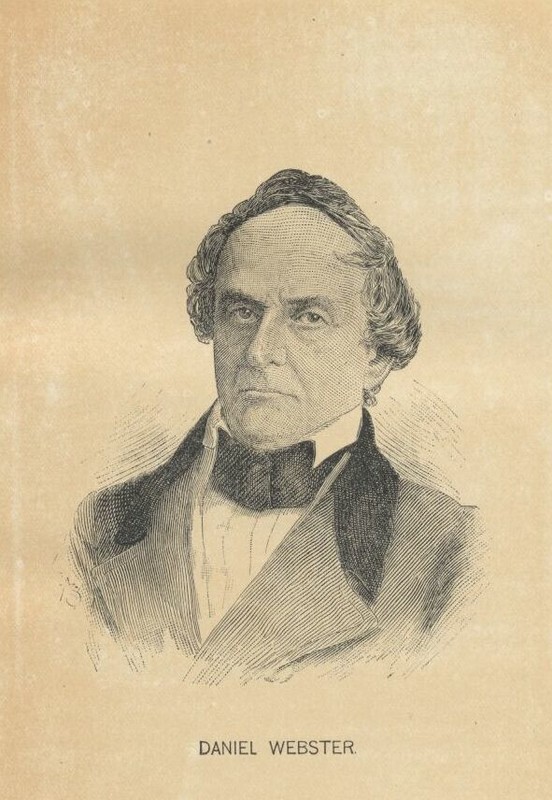
DANIEL WEBSTER,
STEPHEN A. DOUGLAS,
THOMAS JEFFERSON,
ABRAHAM LINCOLN,
JOHN C. CALHOUN,
SEAT OF WAR IN VIRGINIA. (Map)
FIRST BULL RUN BATTLE-FIELD. (Map)
FIRST BULL RUN BATTLE-FIELD, (Map)
J. J. CRITTENDEN
LOUIS T. WIGFALL
DAVID HUNTER
PATRICK HENRY
EDWARD D. BAKER
JOHN C. FREMONT
SIMON CAMERON
H. W. HALLECK
BENJ. F. BUTLER
LYMAN TRUMBULL
BENJ. F. WADE
GEO. B. MCCLELLAN
THAD. STEVENS
HENRY WINTER DAVIS
J. C. BRECKINRIDGE
CHAPTER I.
A PRELIMINARY RETROSPECT.
To properly understand the condition of things preceding the great war of the Rebellion, and the causes underlying that condition and the war itself, we must glance backward through the history of the Country to, and even beyond, that memorable 30th of November, 1782, when the Independence of the United States of America was at last conceded by Great Britain. At that time the population of the United States was about 2,500,000 free whites and some 500,000 black slaves. We had gained our Independence of the Mother Country, but she had left fastened upon us the curse of Slavery. Indeed African Slavery had already in 1620 been implanted on the soil of Virginia before Plymouth Rock was pressed by the feet of the Pilgrim Fathers, and had spread, prior to the Revolution, with greater or less rapidity, according to the surrounding adaptations of soil, production and climate, to every one of the thirteen Colonies.
But while it had thus spread more or less throughout all the original Colonies, and was, as it were, recognized and acquiesced in by all, as an existing and established institution, yet there were many, both in the South and North, who looked upon it as an evil—an inherited evil—and were anxious to prevent the increase of that evil. Hence it was that even as far back as 1699, a controversy sprang up between the Colonies and the Home Government, upon the African Slavery question—a controversy continuing with more or less vehemence down to the Declaration of Independence itself.
It was this conviction that it was not alone an evil but a dangerous evil, that induced Jefferson to embody in his original draft of that Declaration a clause strongly condemnatory of the African Slave Trade—a clause afterward omitted from it solely, he tells us, "in complaisance to South Carolina and Georgia, who had never* attempted to restrain the importation of slaves, and who, on the contrary, still wished to continue it," as well as in deference to the sensitiveness of Northern people, who, though having few slaves themselves, "had been pretty considerable carriers of them to others" a clause of the great indictment of King George III., which, since it was not omitted for any other reason than that just given, shows pretty conclusively that where the fathers in that Declaration affirmed that "all men are created equal," they included in the term "men," black as well as white, bond as well as free; for the clause ran thus: "Determined to keep open a market where MEN should be bought and sold, he has prostituted his negative for suppressing every Legislative attempt to prohibit or to restrain this execrable commerce. And that this assemblage of horrors might want no fact of distinguished dye, he is now exciting those very people to rise in arms among us, and purchase that liberty of which he has deprived them, by murdering the people on whom he also obtruded them; thus paying of former crimes committed against the LIBERTIES of our people with crimes which he urges them to commit against the LIVES of another."
[Prior to 1752, when Georgia surrendered her charter and became a Royal Colony, the holding of slaves within its limits was expressly prohibited by law; and the Darien (Ga.) resolutions of 1775 declared not only a "disapprobation and abhorrence of the unnatural practice of Slavery in America" as "a practice founded in injustice and cruelty, and highly dangerous to our Liberties (as well as lives) but a determination to use our utmost efforts for the manumission of our slaves in this colony upon the most safe and equitable footing for the masters and themselves."]
During the war of the Revolution following the Declaration of Independence, the half a million of slaves, nearly all of them in the Southern States, were found to be not only a source of weakness, but, through the incitements of British emissaries, a standing menace of peril to the Slaveholders. Thus it was that the South was overrun by hostile British armies, while in the North—comparatively free of this element of weakness—disaster after disaster met them. At last, however, in 1782, came the recognition of our Independence, and peace, followed by the evacuation of New York at the close of 1783.
The lessons of the war, touching Slavery, had not been lost upon our statesmen. Early in 1784 Virginia ceded to the United States her claims of jurisdiction and otherwise over the vast territory north-west of the Ohio; and upon its acceptance, Jefferson, as chairman of a Select Committee appointed at his instance to consider a plan of government therefor, reported to the ninth Continental Congress an Ordinance to govern the territory ceded already, or to be ceded, by individual States to the United States, extending from the 31st to the 47th degree of north latitude, which provided as "fundamental conditions between the thirteen original States and those newly described" as embryo States thereafter—to be carved out of such territory ceded or to be ceded to the United States, not only that "they shall forever remain a part of the United States of America," but also that "after the year 1800 of the Christian era, there shall be neither Slavery nor involuntary servitude in any of the said States"—and that those fundamental conditions were "unalterable but by the joint consent of the United States in Congress assembled, and of the particular State within which such alteration is proposed to be made."
But now a signal misfortune befell. Upon a motion to strike out the clause prohibiting Slavery, six States: New Hampshire, Massachusetts, Rhode Island, Connecticut, New York and Pennsylvania, voted to retain the prohibitive clause, while three States, Maryland, Virginia and South Carolina, voted not to retain it. The vote of North Carolina was equally divided; and while one of the Delegates from New Jersey voted to retain it, yet as there was no other delegate present from that State, and the Articles of Confederation required the presence of "two or more" delegates to cast the vote of a State, the vote of New Jersey was lost; and, as the same Articles required an affirmative vote of a majority of all the States—and not simply of those present—the retention of the clause prohibiting Slavery was also lost. Thus was lost the great opportunity of restricting Slavery to the then existing Slave States, and of settling the question peaceably for all time. Three years afterward a similar Ordinance, since become famous as "the Ordinance of '87," for the government of the North-west Territory (from which the Free States of Ohio, Indiana, Illinois, Michigan and Wisconsin have since been carved and admitted to the Union) was adopted in Congress by the unanimous vote of all the eight States present. And the sixth article of this Ordinance, or "Articles of Compact," which it was stipulated should "forever remain unalterable, unless by common consent," was in these words:
"Art. 6. There shall be neither Slavery nor involuntary servitude in the said Territory, otherwise than in punishment of crimes, whereof the party shall have been duly convicted; provided always that any person escaping into the same from whom labor or service is lawfully claimed in any one of the original States, such fugitive may be lawfully reclaimed, and conveyed to the person claiming his or her labor, or service, as aforesaid."
But this Ordinance of '87, adopted almost simultaneously with the framing of our present Federal Constitution, was essentially different from the Ordinance of three years previous, in this: that while the latter included the territory south of the Ohio River as well as that north-west of it, this did not; and as a direct consequence of this failure to include in it the territory south of that river, the States of Tennessee, Alabama and Mississippi, which were taken out of it, were subsequently admitted to the Union as Slave States, and thus greatly augmented their political power. And at a later period it was this increased political power that secured the admission of still other Slave States—as Florida, Louisiana and Texas—which enabled the Slave States to hold the balance of such power as against the original States that had become Free, and the new Free States of the North-west.
Hence, while in a measure quieting the great question of Slavery for the time being, the Ordinance of '87 in reality laid the ground-work for the long series of irritations and agitations touching its restrictions and extension, which eventually culminated in the clash of arms that shook the Union from its centre to its circumference. Meanwhile, as we have seen—while the Ordinance of 1787 was being enacted in the last Congress of the old Confederation at New York—the Convention to frame the present Constitution was sitting at Philadelphia under the Presidency of George Washington himself. The old Confederation had proved itself to be "a rope of sand." A new and stronger form of government had become a necessity for National existence.
To create it out of the discordant elements whose harmony was essential to success, was an herculean task, requiring the utmost forbearance, unselfishness, and wisdom. And of all the great questions, dividing the framers of that Constitution, perhaps none of them required a higher degree of self abnegation and patriotism than those touching human Slavery.
The situation was one of extreme delicacy. The necessity for a closer and stronger Union of all the States was apparently absolute, yet this very necessity seemed to place a whip in the hands of a few States, with which to coerce the greater number of States to do their bidding. It seemed that the majority must yield to a small minority on even vital questions, or lose everything.
Thus it was, that instead of an immediate interdiction of the African Slave Trade, Congress was empowered to prohibit it after the lapse of twenty years; that instead of the basis of Congressional Representation being the total population of each State, and that of direct taxation the total property of each State, a middle ground was conceded, which regarded the Slaves as both persons and property, and the basis both of Representation and of Direct Taxation was fixed as being the total Free population "plus three-fifths of all other persons" in each State; and that there was inserted in the Constitution a similar clause to that which we have seen was almost simultaneously incorporated in the Ordinance of '87, touching the reclamation and return to their owners of Fugitive Slaves from the Free States into which they may have escaped.
The fact of the matter is, that the Convention that framed our Constitution lacked the courage of its convictions, and was "bulldozed" by the few extreme Southern Slave-holding States—South Carolina and Georgia especially. It actually paltered with those convictions and with the truth itself. Its convictions—those at least of a great majority of its delegates—were against not only the spread, but the very existence of Slavery; yet we have seen what they unwillingly agreed to in spite of those convictions; and they were guilty moreover of the subterfuge of using the terms "persons" and "service or labor" when they really meant "Slaves" and "Slavery." "They did this latter," Mr. Madison says, "because they did not choose to admit the right of property in man," and yet in fixing the basis of Direct Taxation as well as Congressional Representation at the total Free population of each State with "three-fifths of all other persons," they did admit the right of property in man! As was stated by Mr. Iredell to the North Carolina Ratification Convention, when explaining the Fugitive Slave clause: "Though the word 'Slave' is not mentioned, this is the meaning of it." And he added: "The Northern delegates, owing to their peculiar scruples on the subject of Slavery, did not choose the word 'Slave' to be mentioned."
In March, 1789, the first Federal Congress met at New York. It at once enacted a law in accordance with the terms of the Ordinance of '87—adapting it to the changed order of things under the new Federal Constitution—prohibiting Slavery in the Territories of the North-west; and the succeeding Congress enacted a Fugitive-Slave law.
In the same year (1789) North Carolina ceded her western territory (now Tennessee) south of the Ohio, to the United States, providing as one of the conditions of that cession, "that no regulation made, or to be made, by Congress, shall tend to emancipate Slaves." Georgia, also, in 1802, ceded her superfluous territorial domain (south of the Ohio, and now known as Alabama and Mississippi), making as a condition of its acceptance that the Ordinance of '87 "shall, in all its parts, extend to the territory contained in the present act of cession, the article only excepted which forbids Slavery."
Thus while the road was open and had been taken advantage of, at the earliest moment, by the Federal Congress to prohibit Slavery in all the territory north-west of the Ohio River by Congressional enactment, Congress considered itself barred by the very conditions of cession from inhibiting Slavery in the territory lying south of that river. Hence it was that while the spread of Slavery was prevented in the one Section of our outlying territories by Congressional legislation, it was stimulated in the other Section by the enforced absence of such legislation. As a necessary sequence, out of the Territories of the one Section grew more Free States and out of the other more Slave States, and this condition of things had a tendency to array the Free and the Slave States in opposition to each other and to Sectionalize the flames of that Slavery agitation which were thus continually fed.
Upon the admission of Ohio to Statehood in 1803, the remainder of the North-west territory became the Territory of Indiana. The inhabitants of this Territory (now known as the States of Indiana, Illinois, Michigan and Wisconsin), consisting largely of settlers from the Slave States, but chiefly from Virginia and Kentucky, very persistently (in 1803, 1806 and 1807) petitioned Congress for permission to employ Slave Labor, but—although their petitions were favorably reported in most cases by the Committees to which they were referred—without avail, Congress evidently being of opinion that a temporary suspension in this respect of the sixth article of the Ordinance of '87 was "not expedient." These frequent rebuffs by Congress, together with the constantly increasing emigration from the Free States, prevented the taking of any further steps to implant Slavery on the soil of that Territory.
Meanwhile the vast territory included within the Valley of the Mississippi and known at that day as the "Colony of Louisiana," was, in 1803, acquired to the United States by purchase from the French—to whom it had but lately been retroceded by Spain. Both under Spanish and French rule, Slavery had existed throughout this vast yet sparsely populated region. When we acquired it by purchase, it was already there, as an established "institution;" and the Treaty of acquisition not only provided that it should be "incorporated into the Union of the United States, and admitted as soon as possible, according to the principles of the Federal Constitution," but that its inhabitants in the meantime "should be maintained and protected in the free enjoyment of their liberty, property, and the religion which they professed"—and, as "the right of property in man" had really been admitted in practice, if not in theory, by the framers of that Constitution itself—that institution was allowed to remain there. Indeed the sparseness of its population at the time of purchase and the amazing fertility of its soil and adaptability of its climate to Slave Labor, together with the then recent invention by Eli Whitney, of Massachusetts, of that wonderful improvement in the separation of cotton-fibre from its seed, known as the "cotton-gin"—which with the almost simultaneous inventions of Hargreaves, and Arkwright's cotton-spinning machines, and Watt's application of his steam engine, etc., to them, marvelously increased both the cotton supply and demand and completely revolutionized the cotton industry—contributed to rapidly and thickly populate the whole region with white Slave-holders and black Slaves, and to greatly enrich and increase the power of the former.
When Jefferson succeeded in negotiating the cession of that vast and rich domain to the United States, it is not to be supposed that either the allurements of territorial aggrandizement on the one hand, or the impending danger to the continued ascendency of the political party which had elevated him to the Presidency, threatening it from all the irritations with republican France likely to grow out of such near proximity to her Colony, on the other, could have blinded his eyes to the fact that its acquisition must inevitably tend to the spread of that very evil, the contemplation of which, at a later day, wrung from his lips the prophetic words, "I tremble for my Country when I reflect that God is just." It is more reasonable to suppose that, as he believed the ascendency of the Republican party of that day essential to the perpetuity of the Republic itself, and revolted against being driven into an armed alliance with Monarchical England against what he termed "our natural friend," Republican France, he reached the conclusion that the preservation of his Republican principles was of more immediate moment than the question of the perpetuation and increase of human Slavery. Be that as it may, it none the less remains a curious fact that it was to Jefferson, the far-seeing statesman and hater of African Slavery and the author of the Ordinance of 1784—which sought to exclude Slavery from all the Territories of the United States south of, as well as north-west of the Ohio River—that we also owe the acquisition of the vast territory of the Mississippi Valley burdened with Slavery in such shape that only a War, which nearly wrecked our Republic, could get rid of!
Out of that vast and fertile, but Slave-ridden old French Colony of "Louisiana" were developed in due time the rich and flourishing Slave States of Louisiana, Missouri and Arkansas.
It will have been observed that this acquisition of the Colony of Louisiana and the contemporaneous inventions of the cotton-gin, improved cotton-spinning machinery, and the application to it of steam power, had already completely neutralized the wisdom of the Fathers in securing, as they thought, the gradual but certain extinction of Slavery in the United States, by that provision in the Constitution which enabled Congress, after an interval of twenty years, to prohibit the African Slave Trade; and which led the Congress, on March 22, 1794, to pass an Act prohibiting it; to supplement it in 1800 with another Act in the same direction; and on March 2, 1807, to pass another supplemental Act—to take effect January 1, 1808—still more stringent, and covering any such illicit traffic, whether to the United States or with other countries. Never was the adage that, "The best laid schemes o' mice an' men gang aft agley," more painfully apparent. Slaves increased and multiplied within the land, and enriched their white owners to such a degree that, as the years rolled by, instead of compunctions of conscience on the subject of African Slavery in America, the Southern leaders ultimately persuaded themselves to the belief that it was not only moral, and sanctioned by Divine Law, but that to perpetuate it was a philanthropic duty, beneficial to both races! In fact one of them declared it to be "the highest type of civilization."
In 1812, the State of Louisiana, organized from the purchased Colony of the same name, was admitted to the Union, and the balance of the Louisiana purchase was thereafter known as the Territory of Missouri.
In 1818 commenced the heated and protracted struggle in Congress over the admission of the State of Missouri—created from the Territory of that name—as a Slave State, which finally culminated in 1820 in the settlement known thereafter as the "Missouri Compromise."
Briefly stated, that struggle may be said to have consisted in the efforts of the House on the one side, to restrict Slavery in the State of Missouri, and the efforts of the Senate on the other, to give it free rein. The House insisted on a clause in the Act of admission providing, "That the introduction of Slavery or involuntary servitude be prohibited, except for the punishment of crimes whereof the party has been duly convicted; and that all children born within the said State, after the admission thereof into the Union, shall be declared Free at the age of twenty-five years." The Senate resisted it—and the Bill fell. In the meantime, however, a Bill passed both Houses forming the Territory of Arkansas out of that portion of the Territory of Missouri not included in the proposed State of Missouri, without any such restriction upon Slavery. Subsequently, the House having passed a Bill to admit the State of Maine to the Union, the Senate amended it by tacking on a provision authorizing the people of Missouri to organize a State Government, without restriction as to Slavery. The House decidedly refused to accede to the Senate proposition, and the result of the disagreement was a Committee of Conference between the two Houses, and the celebrated "Missouri Compromise," which, in the language of another—[Hon. John Holmes of Massachusetts, of said Committee on Conference, March 2, 1820.]—, was: "that the Senate should give up its combination of Missouri with Maine; that the House should abandon its attempt to restrict Slavery in Missouri; and that both Houses should concur in passing the Bill to admit Missouri as a State, with" a "restriction or proviso, excluding Slavery from all territory north and west of the new State"—that "restriction or proviso" being in these words: "That in all that territory ceded by France to the United States under the name of Louisiana, which lies north of thirty-six degrees, thirty minutes north latitude, excepting only such part thereof as is included within the limits of the State contemplated by this act, Slavery and involuntary servitude, otherwise than in the punishment of crime, whereof the party shall have been duly convicted, shall be and is hereby forever prohibited; Provided always, that any person escaping into the same, from whom labor and service is lawfully claimed in any State or Territory of the United States, such Fugitive may be lawfully reclaimed and conveyed to the person claiming his or her labor or service, as aforesaid." At a subsequent session of Congress, at which Missouri asked admission as a State with a Constitution prohibiting her Legislature from passing emancipation laws, or such as would prevent the immigration of Slaves, while requiring it to enact such as would absolutely prevent the immigration of Free Negroes or Mulattoes, a further Compromise was agreed to by Congress under the inspiration of Mr. Clay, by which it was laid down as a condition precedent to her admission as a State—a condition subsequently complied with—that Missouri must pledge herself that her Legislature should pass no act "by which any of the citizens of either of the States should be excluded from the enjoyment of the privileges and immunities to which they are entitled under the Constitution of the United States."
This, in a nut-shell, was the memorable Missouri Struggle, and the "Compromise" or Compromises which settled and ended it. But during that struggle—as during the formation of the Federal Constitution and at various times in the interval when exciting questions had arisen—the bands of National Union were more than once rudely strained, and this time to such a degree as even to shake the faith of some of the firmest believers in the perpetuity of that Union. It was during this bitter struggle that John Adams wrote to Jefferson: "I am sometimes Cassandra enough to dream that another Hamilton, another Burr, may rend this mighty fabric in twain, or perhaps into a leash, and a few more choice spirits of the same stamp might produce as many Nations in North America as there are in Europe."
It is true that we had "sown the wind," but we had not yet "reaped the whirlwind."

CHAPTER II.
PROTECTION AND FREE TRADE.
We have seen that the first Federal Congress met at New York in March, 1789. It organized April 6th. None knew better than its members that the war of the Americana Revolution chiefly grew out of the efforts of Great Britain to cripple and destroy our Colonial industries to the benefit of the British trader, and that the Independence conquered, was an Industrial as well as Political Independence; and none knew better than they, that the failure of the subsequent political Confederation of States was due mainly to its failure to encourage and protect the budding domestic manufactures of those States. Hence they hastened, under the leadership of James Madison, to pass "An Act laying a duty on goods, wares and merchandize imported into the United States," with a preamble, declaring it to be "necessary" for the "discharge of the debt of the United States and the encouragement and protection of manufactures." It was approved by President Washington July 4, 1789—a date not without its significance—and levied imports both specific and ad valorem. It was not only our first Tariff Act, but, next to that prescribing the oath used in organizing the Government, the first Act of the first Federal Congress; and was passed in pursuance of the declaration of President Washington in his first Message, that "The safety and interest of the People" required it. Under the inspiration of Alexander Hamilton the Tariff of 1790 was enacted at the second session of the same Congress, confirming the previous Act and increasing some of the protective duties thereby imposed.
An analysis of the vote in the House of Representatives on this Tariff Bill discloses the fact that of the 39 votes for it, 21 were from Southern States, 13 from the Middle States, and 5 from New England States; while of the 13 votes against it, 9 were from New England States, 3 from Southern States, and 1 from Middle States. In other words, while the Southern States were for the Bill in the proportion of 21 to 3, and the Middle States by 13 to 1, New England was against it by 9 to 5; or again, while 10 of the 13 votes against it were from the New England and Middle States, 21 (or more than half) of the 39 votes for it were from Southern States.
It will thus be seen—singularly enough in view of subsequent events—that we not only mainly owe our first steps in Protective Tariff legislation to the almost solid Southern vote, but that it was thus secured for us despite the opposition of New England. Nor did our indebtedness to Southern statesmen and Southern votes for the institution of the now fully established American System of Protection cease here, as we shall presently see.
That Jefferson, as well as Washington and Madison, agreed with the views of Alexander Hamilton on Protection to our domestic manufactures as against those of foreign Nations, is evident in his Annual Message of December 14, 1806, wherein—discussing an anticipated surplus of Federal revenue above the expenditures, and enumerating the purposes of education and internal improvement to which he thinks the "whole surplus of impost" should during times of peace be applied; by which application of such surplus he prognosticates that "new channels of communication will be opened between the States; the lines of separation will disappear; their interests will be identified, and their Union cemented by new and indissoluble ties"—he says: "Shall we suppress the impost and give that advantage to foreign over domestic manufactures. On a few articles of more general and necessary use, the suppression in due season, will doubtless be right; but the great mass of the articles on which impost is paid is foreign luxuries, purchased by those only who are rich enough to afford themselves the use of them." But his embargo and other retaliatory measures, put in force in 1807 and 1808, and the War of 1812-15 with Great Britain, which closely followed, furnished Protection in another manner, by shutting the door to foreign imports and throwing our people upon their own resources, and contributed greatly to the encouragement and increase of our home manufactures—especially those of wool, cotton, and hemp.
At the close of that War the traders of Great Britain determined, even at a temporary loss to themselves, to glut our market with their goods and thus break down forever, as they hoped, our infant manufactures. Their purpose and object were boldly announced in the House of Commons by Mr. Brougham, when he said: "Is it worth while to incur a loss upon the first importation, in order by the glut to stifle in the cradle those rising manufactures in the United States which the War had forced into existence contrary to the natural course of things." Against this threatened ruin, our manufacturers all over the United States—the sugar planters of Louisiana among them—clamored for Protection, and Congress at once responded with the Tariff Act of 1816.
This law greatly extended and increased specific duties on, and diminished the application of the ad valorem principle to, foreign imports; and it has been well described as "the practical foundation of the American policy of encouragement of home manufactures—the practical establishment of the great industrial system upon which rests our present National wealth, and the power and the prosperity and happiness of our whole people." While Henry Clay of Kentucky, William Loundes of South Carolina, and Henry St. George Tucker of Virginia supported the Bill most effectively, no man labored harder and did more effective service in securing its passage than John C. Calhoun of South Carolina. The contention on their part was not for a mere "incidental protection" —much less a "Tariff for revenue only"—but for "Protection" in its broadest sense, and especially the protection of their cotton manufactures. Indeed Calhoun's defense of Protection, from the assaults of those from New England and elsewhere who assailed it on the narrow ground that it was inimical to commerce and navigation, was a notable one. He declared that:
"It (the encouragement of manufactures) produced a system strictly American, as much so as agriculture, in which it had the decided advantage of commerce and navigation. The country will from this derive much advantage. Again it is calculated to bind together more closely our wide-spread Republic. It will greatly increase our mutual dependence and intercourse, and will, as a necessary consequence, excite an increased attention to internal improvements—a subject every way so intimately connected with the ultimate attainment of national strength and the perfection of our political institutions."
He regarded the fact that it would make the parts adhere more closely; that it would form a new and most powerful cement far outweighing any political objections that might be urged against the system. In his opinion "the liberty and the union of the country were inseparably united; that as the destruction of the latter would most certainly involve the former, so its maintenance will with equal certainty preserve it;" and he closed with an impressive warning to the Nation of a "new and terrible danger" which threatened it, to wit: "disunion." Nobly as he stood up then—during the last term of his service in the House of Representatives—for the great principles of, the American System of Protection to manufactures, for the perpetuity of the Union, and for the increase of "National strength," it seems like the very irony of fate that a few years later should find him battling against Protection as "unconstitutional," upholding Nullification as a "reserved right" of his State, and championing at the risk of his neck that very "danger" to the "liberties" and life of his Country against which his prophetic words had already given solemn warning.
Strange was it also, in view of the subsequent attitudes of the South and New England, that this essentially Protective Tariff Act of 1816 should have been vigorously protested and voted against by New England, while it was ably advocated and voted for by the South—the 25 votes of the latter which secured its passage being more than sufficient to have secured its defeat had they been so inclined.
The Tariff Acts of 1824 and 1828 followed the great American principle of Protection laid down and supported by the South in the Act of 1816, while widening, increasing, and strengthening it. Under their operation—especially under that of 1828, with its high duties on wool, hemp, iron, lead, and other staples—great prosperity smiled upon the land, and particularly upon the Free States.
In the cotton-growing belt of the South, however, where the prosperity was relatively less, owing to the blight of Slavery, the very contrast bred discontent; and, instead of attributing it to the real cause, the advocates of Free Trade within that region insisted that the Protective Tariff was responsible for the condition of things existing there.
A few restless and discontented spirits in the South had indeed agitated the subject of Free Trade as against Protected manufactures as early as 1797, and, hand in hand with it, the doctrine of States Rights. And Jefferson himself, although, as we have already seen, attached to the American System of Protection and believing in its Constitutionality, unwittingly played into the hands of these Free Traders by drawing up the famous Kentucky Resolutions of '98 touching States Rights, which were closely followed by the Virginia Resolutions of 1799 in the same vein by Madison, also an out-and-out Protectionist. It was mainly in condemnation of the Alien and Sedition Laws, then so unpopular everywhere, that these resolutions were professedly fulminated, but they gave to the agitating Free Traders a States-Rights-Secession-weapon of which they quickly availed themselves.
Their drift may be gathered from the first of the Kentucky Resolutions of '98, which was in these words: "Resolved, That the several States composing the United States of America are not united on the principle of unlimited submission to their General Government, but that, by a compact under the style and title of a Constitution for the United States, and of amendments thereto, they constituted a General Government for special purposes—delegated to that Government certain definite powers, reserving, each State to itself, the residuary mass of right to their own self-government; and that whensoever the General Government assumes undelegated powers, its acts are unauthoritative, void, and of no force; that to this compact each State acceded as a State, and as an integral party, its co-States forming, as to itself, the other party; that the Government created by this compact was not made the exclusive or final judge of the extent of the powers delegated to itself; since that would have made its discretion, and not the Constitution, the measure of its powers; but that, as in all other cases of compact among powers having no common judge, each party has an equal right to judge for itself, as well of infractions as of the mode and measure of redress."
The Resolutions, after enumerating the Alien and Sedition and certain other laws as in point, conclude by calling upon the other States to join Kentucky in her opposition to such Federal usurpations of power as thus embodied, and express confidence: "That they will concur with this Commonwealth in considering the said Acts as so palpably against the Constitution as to amount to an undisguised declaration that that compact is not meant to be the measure of the powers of the General Government, but that it will proceed in the exercise over these States, of all powers whatsoever; that they will view this as seizing the rights of the States, and consolidating them in the hands of the General Government, with the power assumed to bind the States (not merely as to the cases made federal (casus foederis) but) in all cases whatsoever, by laws made, not with their consent, but by others against their consent; that this would be to surrender the form of government we have chosen, and live under one deriving its powers from its own will, and not from our authority; and that the co-States, returning to their natural rights in cases not made federal, will concur in declaring these Acts void and of no force, and will each take measures of its own in providing that neither these Acts, nor any others of the General Government, not plainly and intentionally authorized by the Constitution, shall be exercised within their respective territories."
The doctrine of States Rights as formulated in these Resolutions, including the assumed right of a State to nullify laws of the General Government, naturally led up, as we shall see, not only to threats of disunion, but ultimately to a dreadful sectional War waged in the effort to secure it. That Jefferson, when he penned them, foresaw the terrible results to flow from these specious and pernicious doctrines, is not to be supposed for an instant; but that his conscience troubled him may be fairly inferred from the fact that he withheld from the World for twenty years afterward the knowledge that he was their author. It is probable that in this case, as in others, he was a victim of that casuistry which teaches that "the end justifies the means;" that he hoped and believed that the assertion of these baleful doctrines would act solely as a check upon any tendency to further centralization of power in the General Government and insure that strict construction of the Constitution.
Though afterward violated by himself at the same time that he for the moment threw aside his scruples touching African slavery, when he added to our domain the great French Slave Colony of Louisiana—was none the less the great aim of his commanding intellect; and that he fortuitously believed in the "saving common sense" of his race and country as capable of correcting an existing evil when it shall have developed into ill effects.
[Mr. Jefferson takes this very ground, in almost the same words, in his letter, 1803, to Wilson C. Nichols in the Louisiana Colony purchase case, when, after proving by his own strict construction of the Constitution that there was no power in that instrument to make such purchase, and confessing the importance in that very case of setting "an example against broad construction," he concludes: "If, however, our friends shall think differently, certainly I shall acquiesce with satisfaction; confiding that the good sense of the country will correct the evil of construction when it shall produce ill ejects."]
Be that as it may, however, the fact remains that the seeds thus sown by the hands of Jefferson on the "sacred soil" of Virginia and Kentucky, were dragon's teeth, destined in after years to spring up as legions of armed men battling for the subversion of that Constitution and the destruction of that Union which he so reverenced, and which he was so largely instrumental in founding—and which even came back in his own life to plague him and Madison during his embargo, and Madison's war of 1812-15, in the utterances and attitude of some of the New England Federalists.
The few Free Traders of the South—the Giles's and John Taylor's and men of that ilk—made up for their paucity in numbers by their unscrupulous ingenuity and active zeal. They put forth the idea that the American Protective Policy was a policy of fostering combinations by Federal laws, the effect of which was to transfer a considerable portion of the profits of slave labor from the Slave States to other parts of the Union where it was massed in the hands of a few individuals, and thus created a moneyed interest which avariciously influenced the General Government to the detriment of the entire community of people, who, made restive by the exactions of this power working through the Federal Government, were as a consequence driven to consider a possible dissolution of the Union, and make "estimates of resources and means of defense." As a means also of inflaming both the poor whites and Southern slave-holders by arousing the apprehensions of the latter concerning the "peculiar institution" of Slavery, they craftily declared that "If the maxim advanced by the advocates of the protecting duty system will justify Congress in assuming, or rather in empowering a few capitalists to assume, the direction of manufacturing labor, it also invests that body with a power of legislating for the direction of every other species of labor and assigning all occupations whatsoever to the care of the intelligence of mercenary combinations"—and hence untold misery to labor.
They charged as a further means of firing the Southern heart, that this moneyed power, born of Protection, "works upon the passion of the States it has been able to delude by computations of their physical strength and their naval superiority; and by boasting of an ability to use the weakening circumstance of negro slavery to coerce the defrauded and discontented States into submission." And they declared as fundamental truths upon which they rested that "The Federal is not a National Government; it is a league between nations. By this league, a limited power only over persons and property was given to the representatives of the united nations. This power cannot be further extended, under the pretext of national good, because the league does not create a national government."
It was the passage of the Tariff of 1824 that gave these crafty Free Traders their first great success in spreading their doctrine of Free Trade by coupling it with questions of slave labor, States Rights, and nullification, as laid down in the Kentucky and Virginia resolutions. These arguments created great excitement throughout the South—especially in South Carolina and Georgia—which was still further increased by the passage of the Tariff of 1828, since declared by eminent authority to have been "the highest and most protective ever adopted in this country."
[Mr. Greeley, in his "History of the American Conflict," 1864.]
Prior to the passage of this Tariff Act, excited assemblages met in some of the Southern States, and protested against it as an outrage upon their rights—arraying the South in seditious and treasonable attitude against not only the North but the Union, with threats of Secession. At one of these meetings in South Carolina, in 1827, one of their leaders—[Dr. Thomas Cooper, President of South Carolina College.]—declared that "a drilled and managed majority" in the House of Representatives had determined "at all hazards to support the claims of the Northern manufacturers, and to offer up the planting interest on the altar of monopoly." He denounced the American system of Protection exemplified in that Tariff measure as "a system by which the earnings of the South are to be transferred to the North—by which the many are to be sacrificed to the few—under which powers are usurped that were never conceded—by which inequality of rights, inequality of burthens, inequality of protection, unequal laws, and unequal taxes are to be enacted and rendered permanent—that the planter and the farmer under this system are to be considered as inferior beings to the spinner, the bleacher, and the dyer—that we of the South hold our plantations under this system, as the serfs and operatives of the North, subject to the orders and laboring for the benefit of the master-minds of Massachusetts, the lords of the spinning jenny and peers of the power-loom, who have a right to tax our earnings for their emolument, and to burthen our poverty and to swell their riches;" and after characterizing Protection as "a system of fraud, robbery and usurpation," he continued "I have said that we shall ere long be compelled to calculate the value of our Union; and to enquire of what use to us is this most unequal alliance, by which the South has always been the loser and the North always the gainer. Is it worth our while to continue this union of States, where the North demands to be our masters and we are required to be their tributaries? who with the most insulting mockery call the yoke they put upon our necks the 'American system!' The question, however, is fast approaching the alternative of submission or separation."
Only a few days after this inflammatory speech at Columbus, S. C., inciting South Carolinians to resist the pending Protective Tariff even to the lengths of Secession, during a grand banquet at Richmond, Va., William B. Giles—another Free Trade leader—proposed, and those present drank a toast to the "Tariff Schemer" in which was embodied a declaration that "The Southerners will not long pay tribute." Despite these turbulent and treasonable mutterings, however, the "Jacksonian Congress" passed the Act—a majority of members from the Cotton and New England States voting against, while the vote of the Middle and Western Free States was almost solidly for, it.
At a meeting held soon after the enactment of the Tariff of 1828, at Walterborough Court House, S. C., an address was adopted and issued which, after reciting the steps that had been taken by South Carolina during the previous year to oppose it, by memorials and otherwise, and stating that, despite their "remonstrances and implorations," a Tariff Bill had passed, not indeed, such as they apprehended, but "ten-fold worse in all its oppressive features," proceeded thus:
"From the rapid step of usurpation, whether we now act or not, the day of open opposition to the pretended powers of the Constitution cannot be far off, and it is that it may not go down in blood that we now call upon you to resist. We feel ourselves standing underneath its mighty protection, and declaring forth its free and recorded spirit, when we say we must resist. By all the great principles of liberty—by the glorious achievements of our fathers in defending them—by their noble blood poured forth like water in maintaining them—by their lives in suffering, and their death in honor and in glory;—our countrymen! we must resist. Not secretly, as timid thieves or skulking smugglers—not in companies and associations, like money chafferers or stock jobbers—not separately and individually, as if this was ours and not our country's cause—but openly, fairly, fearlessly, and unitedly, as becomes a free, sovereign and independent people. Does timidity ask WHEN? We answer NOW!"
These inflammatory utterances, in South Carolina especially, stirred the Southern heart more or less throughout the whole cotton belt; and the pernicious principles which they embodied found ardent advocates even in the Halls of Congress. In the Senate, Mr. Hayne, of South Carolina, was their chief and most vehement spokesman, and in 1830 occurred that memorable debate between him and Daniel Webster, which forever put an end to all reasonable justification of the doctrine of Nullification, and which furnished the ground upon which President Jackson afterward stood in denouncing and crushing it out with the strong arm of the Government.
In that great debate Mr. Hayne's propositions were that the Constitution is a "compact between the States," that "in case of a plain, palpable violation of the Constitution by the General Government, a State may interpose; and that this interposition is constitutional"—a proposition with which Mr. Webster took direct issue, in these words: "I say, the right of a State to annul a law of Congress cannot be maintained, but on the ground of the inalienable right of man to resist oppression; that is to say, upon the ground of revolution. I admit that there is an ultimate violent remedy, above the Constitution and in defiance of the Constitution, which may be resorted to when a revolution is to be justified. But I do not admit that, under the Constitution, and in conformity with it, there is any mode in which a State Government, as a member of the Union, can interfere and stop the progress of the general movement by force of her own laws under any circumstances whatever." Mr. Webster insisted that "one of two things is true: either the laws of the Union are beyond the discretion and beyond the control of the States, or else we have no Constitution of General Government, and are thrust back again to the days of the Confederation;" and, in concluding his powerful argument, he declared that "even supposing the Constitution to be a compact between the States," Mr. Hayne's doctrine was "not maintainable, because, first, the General Government is not a party to the compact, but a Government established by it, and vested by it with the powers of trying and deciding doubtful questions; and secondly, because, if the Constitution be regarded as a compact, not one State only, but all the States are parties to that compact, and one can have no right to fix upon it her own peculiar construction."
While the comparatively miserable condition of the cotton-growing States of the South was attributed by most of the Southern Free Traders solely to the Protective Tariff of 1828, yet there were some Southerners willing to concede—as did Mr. Hayne, in the Senate (1832)—that there were "other causes besides the Tariff" underlying that condition, and to admit that "Slaves are too improvident, too incapable of that minute, constant, delicate attention, and that persevering industry which are essential to manufacturing establishments," the existence of which would have made those States prosperous. But such admissions were unwilling ones, and the Cotton-lords held only with the more tenacity to the view that the Tariff was the chief cause of their condition.
The Tariff Act of 1832, essentially modifying that of 1828, was passed with a view, in part, to quiet Southern clamor. But the Southern Cotton States refused to be mollified. On the contrary, the Free Traders of South Carolina proceeded to extreme measures, putting in action that which they had before but threatened. On November 19, 1832, the leading men of South Carolina met in Convention, and a few days thereafter—[November 24,1882]—unanimously passed an Ordinance of Nullification which declared the Tariff Acts of 1828 and 1832 "Unauthorized by the Constitution," and "null, void, and no law, nor binding on this State, its officers, or citizens." The people of the State were forbidden by it to pay, after the ensuing February 1st, the import-duties therein imposed. Under the provisions of the Ordinance, the State Legislature was to pass an act nullifying these Tariff laws, and any appeal to the United States Supreme Court against the validity of such nullifying act was prohibited. Furthermore, in the event of the Federal Government attempting to enforce these Tariff laws, the people of South Carolina would thenceforth consider themselves out of the Union, and will "forthwith proceed to organize a separate Government, and do all other acts and things which sovereign and independent States may of right do."
At the subsequent meeting of the Legislature, Mr. Hayne, who had been a member of the Convention, having resigned his seat in the United States Senate, was elected Governor of the State. He declared in his message that he recognized "No allegiance as paramount to that which the citizens of South Carolina owe to the State of their birth or their adoption"—that doctrine of "paramount allegiance to the State" which in after-years gave so much trouble to the Union and to Union-loving Southerners—and declared that he held himself "bound by the highest of all obligations to carry into effect, not only the Ordinance of the Convention, but every act of the Legislature, and every judgment of our own Courts, the enforcement of which may devolve upon the Executive," and "if," continued he, "the sacred soil of Carolina should be polluted by the footsteps of an invader, or be stained with the blood of her citizens, shed in her defense, I trust in Almighty God * * * even should she stand alone in this great struggle for constitutional liberty, encompassed by her enemies, that there will not be found, in the wide limits of the State, one recreant son who will not fly to the rescue, and be ready to lay down his life in her defense." In support of the contemplated treason, he even went to the length of calling for an enrolling of volunteer forces and of holding them ready for service.
But while South Carolina stood in this treasonable and defiant attitude, arming for war against the Union, there happened to be in the Presidential chair one of her own sons—General Jackson. Foreseeing what was coming, he had, prior to the meeting of the Convention that framed the Nullification Ordinance, ordered General Scott to Charleston to look after "the safety of the ports of the United States" thereabouts, and had sent to the Collector of that port precise instructions as to his duty to resist in all ways any and all attempts made under such Ordinance to defeat the operation of the Tariff laws aforesaid. Having thus quietly prepared the arm of the General Government for the exercise of its power, he issued in December a Proclamation declaring his unalterable resolution to treat Nullification as Treason—and to crush it.
In that famous document President Jackson said of Nullification: "If this doctrine had been established at an earlier day, the Union would have been dissolved in its infancy. The Excise law in Pennsylvania, the Embargo and Non-intercourse law in the Eastern States, the Carriage-tax in Virginia, were all deemed unconstitutional, and were more unequal in their operation than any of the laws now complained of; but fortunately, none of those States discovered that they had the right now claimed by South Carolina. * * * The discovery of this important feature in our Constitution was reserved for the present day. To the statesmen of South Carolina belongs the invention, and upon the citizens of that State will unfortunately fall the evils of reducing it to practice. * * * I consider, then, the power to annul a law of the United States, assumed by one State, incompatible with the existence of the Union, contradicted expressly by the letter of the Constitution, unauthorized by its spirit, inconsistent with every principle on which it was founded and destructive of the great object for which it was formed. * * * To say that any State may at pleasure secede from the Union, is to say that the United States are not a Nation, because it would be a solecism to contend that any part of a Nation might dissolve its connection with the other parts, to their injury or ruin, without committing any, offense."
Farther on, in his moving appeal to the South Carolinians, he bids them beware of their leaders: "Their object is disunion; be not deceived by names. Disunion, by armed force, is Treason." And then, reminding them of the deeds of their fathers in the Revolution, he proceeds: "I adjure you, as you honor their memory, as you love the cause of freedom to which they dedicated their lives, as you prize the peace of your country, the lives of its best citizens, and your own fair fame, to retrace your steps. Snatch from the archives of your State the disorganizing edict of its Convention—bid its members to reassemble and promulgate the decided expression of your will to remain in the path which alone can conduct you to safety, prosperity, and honor—tell them that, compared to disunion, all other evils are light, because that brings with it an accumulation of all—declare that you will never take the field unless the Star-spangled banner of your country shall float over you—that you will not be stigmatized when dead, and dishonored and scorned while you live, as the authors of the first attack on the Constitution of your country! Its destroyers you cannot be."
After asserting his firm "determination to execute the laws—to preserve the Union by all constitutional means"—he concludes with the prayer, "May the great Ruler of Nations grant, that the signal blessings with which He has favored, ours may not, by the madness of party, or personal ambition be disregarded and lost; and may His wise providence bring those who have produced this crisis to see the folly before they feel the misery, of civil strife; and inspire a returning veneration for that Union, which, if we may dare to penetrate His designs, He has chosen as the only means of attaining the high destinies to which we may reasonably aspire."
The firm attitude of General Jackson, together with the wise precautionary measures he had already taken, and the practical unanimity with which his declaration to crush out the Treason was hailed in most of the Southern as well as the Northern States, almost at once broke the back of Nullification.
[In this connection the following letter, written at that time by the great Chief Justice Marshall, to a cousin of his, on the subject of State Sovereignty, is of interest, as showing how clearly his penetrating intellect perceived the dangers to the Union hidden in the plausible doctrine of State Rights:
RICHMOND, May 7, 1833.
"MY DEAR SIR:
"I am much indebted to you for your pamphlet on Federal Relations, which I have read with much satisfaction. No subject, as it seems to me, is more misunderstood or more perverted. You have brought into view numerous important historical facts which, in my judgment, remove the foundation on which the Nullifiers and Seceders have erected that superstructure which overshadows our Union. You have, I think, shown satisfactorily that we never have been perfectly distinct, independent societies, sovereign in the sense in which the Nullifiers use the term. When colonies we certainly were not. We were parts of the British empire, and although not directly connected with each other so far as respected government, we were connected in many respects, and were united to the same stock. The steps we took to effect separation were, as you have fully shown, not only revolutionary in their nature, but they were taken conjointly. Then, as now, we acted in many respects as one people. The representatives of each colony acted for all. Their resolutions proceeded from a common source, and operated on the whole mass. The army was a continental army commanded by a continental general, and supported from a continental treasury. The Declaration of Independence was made by a common government, and was made for all the States.
"Everything has been mixed. Treaties made by Congress have been considered as binding all the States. Some powers have been exercised by Congress, some by the States separately. The lines were not strictly drawn. The inability of Congress to carry its legitimate powers into execution has gradually annulled those powers practically, but they always existed in theory. Independence was declared `in the name and by the authority of the good people of these colonies.' In fact we have always been united in some respects, separate in others. We have acted as one people for some purposes, as distinct societies for others. I think you have shown this clearly, and in so doing have demonstrated the fallacy of the principle on which either nullification or the right of peaceful, constitutional secession is asserted.
"The time is arrived when these truths must be more generally spoken, or our Union is at an end. The idea of complete sovereignty of the State converts our government into a league, and, if carried into practice, dissolves the Union.
"I am, dear sir,
"Yours affectionately,
"J. MARSHALL.
"HUMPHREY MARSHALL, ESQ.,
"FRANKFORT, KY."]
The Nullifiers hailed with pretended satisfaction the report from the House Committee on Ways and Means of a Bill making great reductions and equalizations of Tariff duties, as a measure complying with their demands, and postponed the execution of the Ordinance of Nullification until the adjournment of Congress; and almost immediately afterward Mr. Clay's Compromise Tariff Act of 1833 "whereby one tenth of the excess over twenty per cent. of each and every existing impost was to be taken off at the close of that year; another tenth two years thereafter; so proceeding until the 30th of June, 1842, when all duties should be reduced to a maximum of twenty per cent."—[Says Mr. Greeley, in his History aforesaid.]—agreed to by Calhoun and other Nullifiers, was passed, became a law without the signature of President Jackson, and South Carolina once more became to all appearances a contented, law-abiding State of the Union.
But after-events proved conclusively that the enactment of this Compromise Tariff was a terrible blunder, if not a crime. Jackson had fully intended to hang Calhoun and his nullifying coadjutors if they persisted in their Treason. He knew that they had only seized upon the Tariff laws as a pretext with which to justify Disunion, and prophesied that "the next will be the Slavery or Negro question." Jackson's forecast was correct. Free Trade, Slavery and Secession were from that time forward sworn allies; and the ruin wrought to our industries by the disasters of 1840, plainly traceable to that Compromise Tariff measure of 1833, was only to be supplemented by much greater ruin and disasters caused by the Free Trade Tariff of 1846—and to be followed by the armed Rebellion of the Free Trade and Pro-Slavery States of the South in 1861, in a mad attempt to destroy the Union.

CHAPTER III.
GROWTH OF THE SLAVERY QUESTION.
It will be remembered that during the period of the Missouri Struggle, 1818-1820, the Territory of Arkansas was formed by an Act of Congress out of that part of the Missouri Territory not included in the proposed State of Missouri, and that the Act so creating the Territory of Arkansas contained no provision restricting Slavery. Early in 1836, the people of Arkansas Territory met in Convention and formed a Constitution under which, "and by virtue of the treaty of cession by France to the United States, of the Province of Louisiana," they asked admission to the Union as a State. Among other provisions of that Constitution was a section rendering the State Legislature powerless to pass laws for the emancipation of slaves without the consent of the owners, or to prevent emigrants to that State from bringing with them slaves. On June 15th of the same year, Arkansas was, under that Constitution, admitted to the Union as a Slave State, with the sole reservation, that nothing in the Act of admission should be construed as an assent by Congress to all or any of the propositions contained" in the said Constitution.
Long ere this, all the Northern and Middle States had made provision for the emancipation of such slaves as remained within their borders, and only a few years previous (in 1829 and 1831-32) Virginia had made strong but insufficient efforts toward the same end. The failure to free Virginia of Slavery—the effort to accomplish which had been made by some of the greatest of her statesmen—only served to rivet the chains of human bondage more securely throughout all the Slave States, and from that time on, no serious agitation occurred in any one of them, looking toward even the most gradual emancipation. On the other hand, the advocates of the extension of the Slave-Power by the expansion of Slave-territory, were ever on the alert, they considered it of the last importance to maintain the balance of power between the Slave States and the Free States. Hence, while they had secured in 1819 the cession from Spain to the United States of the Slave-holding Floridas, and the organization of the Slave Territory of Florida in 1822—which subsequently came in as a Slave State under the same Act (1845) that admitted the Free State of Iowa—their greedy eyes were now cast upon the adjoining rich territories of Mexico.
Efforts had (in 1827-1829) been made to purchase from Mexico the domain which was known as Texas. They had failed. But already a part of Texas had been settled by adventurous Americans under Mexican grants and otherwise; and General Sam Houston, an adherent of the Slave Power, having become a leading spirit among them, fomented a revolution. In March, 1836, Texas, under his guidance, proclaimed herself a Republic independent of Mexico.
The War that ensued between Texas and Mexico ended in the flight of the Mexican Army and the capture of Santa Anna at San Jacinto, and a treaty recognizing Texan independence. In October, 1836, General Houston was inaugurated President of the Republic of Texas. Close upon this followed (in August, 1837) a proposition to our Government from the Texan envoy for the annexation of Texas to the United States. President Van Buren declined the offer. The Northern friends of Freedom were as much opposed to this annexation project as the advocates of Slavery were anxious for it. Even such conservative Northern Statesmen as Daniel Webster strongly opposed the project. In a speech delivered in New York [1837], after showing that the chief aim of our Government in the acquisition of the Territory of Louisiana was to gain command of the mouths of the great rivers to the sea, and that in the acquisition of the Floridas our policy was based on similar considerations, Mr. Webster declared that "no such necessity, no such policy, requires the annexation of Texas," and that we ought "for numerous and powerful reasons to be content with our present boundaries." He recognized that Slavery already existed under the guarantees of the Constitution and those guarantees must be fulfilled; that "Slavery, as it exists in the States, is beyond the power of Congress. It is a concern of the States themselves," but "when we come to speak of admitting new States, the subject assumes an entirely different aspect. Our rights and our duties are then both different. The Free States, and all the States, are then at liberty to accept or to reject;" and he added, "In my opinion the people of the United States will not consent to bring into the Union a new, vastly extensive and Slaveholding country, large enough for a half a dozen or a dozen States. In my opinion, they ought not to consent to it."
Farther on, in the same speech—after alluding to the strong feeling in the Northern States against the extension of Slavery, not only as a question of politics, but of conscience and religious conviction as wellhe deems him a rash man indeed "who supposes that a feeling of this kind is to be trifled with or despised." Said he: "It will assuredly cause itself to be respected. It may be reasoned with; it may be made willing—I believe it is entirely willing—to fulfill all existing engagements and all existing duties—to uphold and defend the Constitution as it is established, with whatever regrets about some provisions which it does actually contain. But to coerce it into silence, to endeavor to restrain its free expression, to seek to compress and confine it, warm as it is, and more heated as such endeavors would inevitably render it,—should this be attempted, I know nothing, even in the Constitution or in the Union itself, which would not be endangered by the explosion which might follow."
In 1840, General Harrison, the Whig candidate, was elected to the Presidency, but died within a few weeks after his inauguration in 1841, and was succeeded by John Tyler. The latter favored the Slave Power; and on April 12th, 1844, John C. Calhoun, his Secretary of State, concluded with Texas a treaty of annexation—which was, however, rejected by the Senate. Meanwhile the public mind was greatly agitated over the annexation and other, questions.
[In the London Index, a journal established there by Jefferson Davis's agents to support the cause of the rebellious States, a communication appeared during the early part of the war, Dec. 4, 1861, supposed to have been written by Mr. Mason, of Virginia, in which he said: "To tell the Norths, the Butes, the Wedderburns of the present day, that previous to the year 1839 the sovereign States of the South had unalterably resolved on the specific ground of the violation of the Federal Constitution by the tariff of spoliation which the New England States had imposed upon them—to secede from the Union; to tell them that in that year the leader of the South, Calhoun, urged an English gentleman, to whom he had fully explained the position of the South, and the intolerable tyranny which the North inflicted upon it, to be the bearer of credentials from the chief persons of the South, in order to invite the attention of the British Government to the coming event; that on his death-bed (Washington, March 31, 1850), he called around him his political friends—one of whom is now in England—warned them that in no event could the Union survive the Presidential election of 1860, though it might possibly break up before that urged them to be prepared; leaving with his dying words the sacred cause of Southern secession a solemn legacy in their hands—to have told this to the Norths and Dartmouths of the present day, with more and even stronger evidence of the coming events of November, 1860, would have been like speaking to the stones of the street. In November, 1860, they were thoroughly ignorant of all the momentous antecedents of secession—of their nature, their character, their bearing, import, and consequences."
In the same correspondence the distinguished Rebel emissary substantially let out the fact that Calhoun was indirectly, through himself (Mason), in secret communication with the British Government as far back as 1841, with a view to securing its powerful aid in his aforesaid unalterable resolve to Secede from the Union; and then Mr. Mason pleads—but pleads in vain—for the armed intervention of England at this later day. Said he:
"In the year 1841 the late Sir William Napier sent in two plans for subduing the Union, to the War Office, in the first of which the South was to be treated as an enemy, in the second as a friend and ally. I was much consulted by him as to the second plan and was referred to by name in it, as he showed by the acknowledgment of this in Lord Fitzroy Somerset's letter of reply. This plan fully provided for the contingency of an invasion of Canada, and its application would, in eighteen or twenty months, have reduced the North to a much more impotent condition than it exhibits at present. At this very moment the most difficult portion of that plan has been perfectly accomplished by the South itself; and the North, in accordance with Sir William Napier's expectations, now lies helpless before England, and at our absolute mercy. Nor is there any doubt of this, and if Lord Palmerston is not aware of it Mr. Seward certainly is. We have nothing remaining to do but to stretch out our arm in the way Sir William Napier proposed, and the Northern power—power as we ignorantly call it—must come to an end. Sir William knew and well estimated the elements of which that quasi power consisted; and he knew how to apply the substantive power of England to dissolve it. In the best interest of humanity, I venture to say that it is the duty of England to apply this power without further delay—its duty to itself, to its starving operatives, to France, to Europe, and to humanity. And in the discharge of this great duty to the world at large there will not even be the dignity of sacrifice or danger."]
Threats and counter-threats of Disunion were made on either hand by the opponents and advocates of Slavery-extension through annexation; nor was it less agitated on the subject of a Protective Tariff.
The Compromise Tariff of 1833, together with President Jackson's upheaval of our financial system, produced, as has already been hinted, terrible commercial disasters. "In 1840," says competent authority, "all prices had ruinously fallen; production had greatly diminished, and in many departments of industry had practically ceased; thousands of working men were idle, with no hope of employment, and their families suffering from want. Our farmers were without markets, their products rotted in their barns, and their lands, teeming with rich harvests, were sold by the sheriff for debts and taxes. The Tariff, which robbed our industries of Protection failed to supply Government with its necessary revenues. The National Treasury in consequence was bankrupt, and the credit of the Nation had sunk very low."
Mr. Clay himself stated "the average depression in the value of property under that state of things which existed before the Tariff of 1842 came to the rescue of the country, at fifty per cent." And hence it was that Protection was made the chief issue of the Presidential campaign of 1840, which eventuated in the election of Harrison and Tyler, and in the Tariff Act of August 30, 1842, which revived our trade and industries, and brought back to the land a full measure of prosperity. With those disasters fresh in the minds of the people, Protection continued to be a leading issue in the succeeding Presidential campaign of 1844—but coupled with the Texas-annexation issue. In that campaign Henry Clay was the candidate of the Whig party and James K. Polk of the Democratic party. Polk was an ardent believer in the annexation policy and stood upon a platform declaring for the "re-occupation of Oregon and the re-annexation of Texas at the earliest practicable moment"—as if the prefix "re" legitimatized the claim in either case; Clay, on the other hand, held that we had "fairly alienated our title to Texas by solemn National compacts, to the fulfilment of which we stand bound by good faith and National honor;" that "Annexation and War with Mexico are identical," and that he was "not willing to involve this country in a foreign War for the object of acquiring Texas."
[In his letter of April 17, 1844, published in the National Intelligencer.]
As to the Tariff issue also, Clay was the acknowledged champion of the American system of Protection, while Polk was opposed to it, and was supported by the entire Free-trade sentiment, whether North or South.
As the campaign progressed, it became evident that Clay would be elected. Then occurred some of those fatalities which have more than once, in the history of Presidential campaigns, overturned the most reasonable expectations and defeated the popular will. Mr. Clay committed a blunder and Mr. Polk an equivocation—to use the mildest possible term. Mr. Clay was induced by Southern friends to write a letter—[Published in the North Alabamian, Aug. 16, 1844.]—in which, after stating that "far from having any personal objection to the annexation of Texas, I should be glad to see it—without dishonor, without War, with the common consent of the Union, and upon just and fair terms," he added: "I do not think that the subject of Slavery ought to affect the question, one way or the other." Mr. Polk, on the other hand, wrote a letter in which he declared it to be "the duty of the Government to extend, as far as it may be practicable to do so, by its revenue laws and all other means within its power, fair and just Protection to all the great interests of the whole Union, embracing Agriculture, Manufactures, the Mechanic Arts, Commerce and Navigation." This was supplemented by a letter (August 8, 1844) from Judge Wilson McCandless of Pennsylvania, strongly upholding the Protective principle, claiming that Clay in his Compromise Tariff Bill had abandoned it, and that Polk and Dallas had "at heart the true interests of Pennsylvania." Clay, thus betrayed by the treachery of Southern friends, was greatly weakened, while Polk, by his beguiling letter, backed by the false interpretation put upon it by powerful friends in the North, made the North believe him a better Protectionist than Clay.
Polk was elected, and rewarded the misplaced confidence by making Robert J. Walker his Secretary of the Treasury, and, largely through that great Free Trader's exertions, secured a repeal by Congress of the Protective Tariff of 1842 and the enactment of the ruinous Free Trade Tariff of 1846. Had Clay carried New York, his election was secure. As it happened, Polk had a plurality in New York of but 5,106 in an immense vote, and that slim plurality was given to him by the Abolitionists throwing away some 15,000 on Birney. And thus also it curiously happened that it was the Abolition vote which secured the election of the candidate who favored immediate annexation and the extension of the Slave Power!
Emboldened and apparently sustained by the result of the election, the Slave Power could not await the inauguration of Mr. Polk, but proceeded at once, under whip and spur, to drive the Texas annexation scheme through Congress; and two days before the 4th of March, 1845, an Act consenting to the admission of the Republic of Texas as a State of the Union was approved by President Tyler.
In that Act it was provided that "New States of convenient size, not exceeding four in number, in addition to the said State of Texas, and having sufficient population, may hereafter, by the consent of said State, be formed out of the territory thereof, which shall be entitled to admission under the provisions of the Federal Constitution; and such States as may be formed out of that portion of said territory lying south of thirty-six degrees thirty minutes north latitude, commonly known as the Missouri Compromise line, shall be admitted into the Union with or without Slavery, as the people of each State asking admission may desire. And in such State or States as shall be formed out of said territory north of said Missouri Compromise line, Slavery or involuntary servitude (except for crime) shall be prohibited." As has been lucidly stated by another,—[Greeley's History]—"while seeming to curtail and circumscribe Slavery north of the above parallel (that of 36 30' north latitude), this measure really extended it northward to that parallel, which it had not yet approached, under the flag of Texas, within hundreds of miles. But the chief end of this sham Compromise was the involving of Congress in an indirect indorsement of the claim of Texas to the entire left bank of the Rio Grande, from its mouth to its source; and this was effected."
Texas quickly consented to the Act of annexation, and in December, 1845, a Joint Resolution formally admitting her as a State of the Union, reported by Stephen A. Douglas, was duly passed.
In May, 1846, the American forces under General Taylor, which had been dispatched to protect Texas from threatened assault, were attacked by the Mexican army, which at Palo Alto was badly defeated and at Resaca de la Palma driven back across the Rio Grande.
Congress immediately declared that by this invasion a state of War existed between Mexico and the United States. Thus commenced the War with Mexico—destined to end in the triumph of the American Army, and the acquisition of large areas of territory to the United States. In anticipation of such triumph, President Polk lost little time in asking an appropriation of over two million dollars by Congress to facilitate negotiations for peace with, and territorial cession from, Mexico. And a Bill making such appropriation was quickly passed by the House of Representatives—but with the following significant proviso attached, which had been offered by Mr. Wilmot: "Provided. That as an express and fundamental condition to the acquisition of any territory from the Republic of Mexico by the United States, by virtue of any treaty that may be negotiated between them, and to the use by the Executive of the moneys herein appropriated, neither Slavery nor involuntary servitude shall ever exist in any part of said territory, except for crime, whereof the party shall first be duly convicted."
The debate in the Senate upon the Wilmot proviso, which immediately ensued, was cut short by the expiration of the Session of Congress—and the Bill accordingly failed of passage.
In February, 1848, the treaty of Guadalupe Hidalgo was made between Mexico and the United States, and Peace reigned once more. About the same time a Bill was passed by the Senate providing Territorial Governments for Oregon, California and New Mexico, which provided for the reference of all questions touching Slavery in such Territories to the United States Supreme Court, for arbitration. The Bill, however, failed in the House. The ensuing Presidential campaign resulted in the election of General Taylor, the Whig candidate, who was succeeded upon his death, July 10, 1850, by Fillmore. Meanwhile, on the Oregon Territory Bill, in 1848, a strong effort had been made by Mr. Douglas and others to incorporate a provision extending to the Pacific Ocean the Missouri Compromise line of 36 30' of north latitude and extending to all future organizations of Territories of the United States the principles of said Compromise. This provision was adopted by the Senate, but the House struck it from the Bill; the Senate receded, and Oregon was admitted as a Free Territory. But the conflict in Congress between those who would extend and those who would restrict Slavery still continued, and indeed gathered vehemence with time. In 1850, California was clamoring for admission as a Free State to the Union, and New Mexico and Utah sought to be organized under Territorial Governments.
In the heated discussions upon questions growing out of bills for these purposes, and to rectify the boundaries of Texas, it was no easy matter to reach an agreement of any sort. Finally, however, the Compromise of 1850, offered by Mr. Clay, was practically agreed to and carried out, and under it: California was admitted as a Free State; New Mexico and Utah were admitted to Territorial organization without a word pro or con on the subject of Slavery; the State of Texas was awarded a pecuniary compensation for the rectification of her boundaries; the Slave Trade in the District of Columbia was abolished; and a more effectual Fugitive Slave Act passed.
By both North and South, this Compromise of 1850, and the measures growing out of it, were very generally acquiesced in, and for a while it seemed as though a permanent settlement of the Slavery question had been reached. But in the Fugitive Slave law, thus hastily enacted, lay embedded the seed for further differences and excitements, speedily to germinate. In its operation it proved not only unnecessarily cruel and harsh, in the manner of the return to bondage of escaped slaves, but also afforded a shield and support to the kidnapping of Free Negroes from Northern States. The frequency of arrests in the Northern States, and the accompanying circumstances of cruelty and brutality in the execution of the law, soon made it especially odious throughout the North, and created an active feeling of commiseration for the unhappy victims of the Slave Power, which greatly intensified and increased the growing Anti-Slavery sentiment in the Free States.
In 1852-53, an attempt was made in Congress to organize into the Territory of Nebraska, the region of country lying west of Iowa and Missouri. Owing to the opposition of the South the Bill was defeated. In 1853-4 a similar Bill was reported to the Senate by Mr. Douglas, but afterward at his own instance recommitted to the Committee on Territories, and reported back by him again in such shape as to create, instead of one, two Territories, that portion directly west of Missouri to be called Kansas, and the balance to be known as Nebraska—one of the sections of the Bill enacting:
"That in order to avoid all misconstruction it is hereby declared to be the true intent and meaning of this Act, so far as the question of Slavery is concerned, to carry into practical operation the following propositions and principles, established by the Compromise measures of 1850, to wit:
"First, That all questions pertaining to Slavery in the Territories, and the new States to be formed therefrom, are to be left to the decision of the people residing therein through their appropriate representatives.
"Second, That 'all cases involving title to slaves,' and 'questions of personal freedom,' are referred to the adjudication of the local tribunals with the right of appeal to the Supreme Court of the United States.
"Third, That the provisions of the Constitution and laws of the United States, in respect to fugitives from service, are to be carried into faithful execution in all the `organized Territories,' the same as in the States."
The sections authorizing Kansas and Nebraska to elect and send delegates to Congress also prescribed:
"That the Constitution, and all laws of the United States which are not locally inapplicable, shall have the same force and effect within the said Territory, as elsewhere in the United States, except the section of the Act preparatory to the admission of Missouri into the Union, approved March 6th, 1820, which was superseded by the principles of the Legislation of 1850, commonly called the Compromise Measures, and is declared inoperative."
And when "explaining this Kansas-Nebraska Bill" Mr. Douglas announced that, in reporting it, "The object of the Committee was neither to legislate Slavery in or out of the Territories; neither to introduce nor exclude it; but to remove whatever obstacle Congress had put there, and apply the doctrine of Congressional Non-intervention in accordance with the principles of the Compromise Measures of 1850, and allow the people to do as they pleased upon this as well as all other matters affecting their interests."
A vigorous and able debate ensued. A motion by Mr. Chase to strike out the words "which was superseded by the principles of the legislation of 1850, commonly called the Compromise Measures," was defeated decisively. Subsequently Mr. Douglas moved to strike out the same words and insert in place of them, these: "which being inconsistent with the principles of Non-intervention by Congress with Slavery in the States and Territories, as recognized by the legislation of 1850 (commonly called the Compromise Measures), is hereby declared inoperative and void; it being the true intent and meaning of this Act not to legislate Slavery into any Territory or State, nor to exclude it therefrom, but to leave the people thereof perfectly free to form and regulate their domestic institutions in their own way, subject only to the Constitution of the United States"—and the motion was agreed to by a vote of 35 yeas to 10 nays. Mr. Chase immediately moved to add to the amendment just adopted these words: "Under which, the people of the Territory, through their appropriate representatives, may, if they see fit, prohibit the existence of Slavery therein;" but this motion was voted down by 36 nays to 10 yeas. This developed the rat in the meal-tub. The people were to be "perfectly free" to act either way on the subject of Slavery, so long as they did not prohibit Slavery! In this shape the Bill passed the Senate.
Public sentiment in the North was greatly stirred by this direct attempt to repeal the Missouri Compromise. But by the superior parliamentary tactics of Southern Representatives in the House, whereby the radical friends of Freedom were shut out from the opportunity of amendment, a House Bill essentially the same as the Senate Bill was subsequently passed by the House, under the previous question, and afterward rapidly passed the Senate, and was approved by the President. At once commenced that long and terrible struggle between the friends of Free-Soil and the friends of Slavery, for the possession of Kansas, which convulsed the whole Country for years, and moistened the soil of that Territory with streams of blood, shed in numerous "border-ruffian" conflicts.
The Territorial Government of Kansas was organized late in 1854, and an "election" for Delegate held, at which the Pro-Slavery candidate (Whitfield) was fraudulently elected. On March 30, 1855, a Territorial Legislature was similarly chosen by Pro-Slavery voters "colonized" from Missouri. That Legislature, upon its meeting, proceeded at once to enact most outrageous Pro-Slavery laws, which being vetoed by the Free-Soil Governor (Reeder), were passed over the veto, and the Free-Soil Governor had to give place to one who favored Slavery in Kansas. But the Free-Soil settlers of Kansas, in Mass Convention at Big Springs, utterly repudiated the bogus Legislature and all its acts, to which they refused submission.
In consequence of these radical differences, two separate elections for Delegate in Congress were held by the opposing factions, at one of which was elected the Pro-Slavery Whitfield, and at the other the Free-Soiler Reeder. Furthermore, under a call issued by the Big Springs Convention, a Free-State Constitutional Convention was held in October, 1855, at Topeka, which framed a Free-State Constitution, and asked admission under it to the Union.
In 1856, the House of Representatives—which, after a protracted struggle, had elected N. P. Banks Speaker—passed a Bill, by a bare majority, admitting Kansas under her Topeka Constitution; but the Senate defeated it. July 4, 1856, by order of President Pierce, the Free-State Legislature, chosen under the Topeka Constitution to meet at Topeka, was dispersed by United States Troops. Yet, despite all oppositions, discouragements, and outrages, the Free-State population of Kansas continued to increase from immigration.
In 1857, the Pro-Slavery Legislature elected by the Pro-Slavery voters at their own special election—the Free-State voters declining to participate—called a Constitutional Convention at Lecompton, which formed a Pro-Slavery Constitution. This was submitted to the people in such dexterous manner that they could only vote "For the Constitution with Slavery" or "For the Constitution without Slavery"—and, as the Constitution prescribed that "the rights of property in Slaves now in the Territory, shall in no manner be interfered with," to vote "for the Constitution Without Slavery" was an absurdity only paralleled by the course of the United States Senate in refusing to permit the people of Kansas "to prohibit Slavery" while at the same time declaring them "perfectly free to act" as they chose in the matter.
The Constitution, with Slavery, was thus adopted by a vote of over 6,000. But in the meanwhile, at another general election held for the purpose, and despite all the frauds perpetrated by the Pro-Slavery men, a Free-State Legislature, and Free-State Delegate to Congress had been elected; and this Legislature submitted the Lecompton Pro-Slavery Constitution to the people, January 4, 1858, so that they could vote: "For the Lecompton Constitution with Slavery," "For the Lecompton Constitution without Slavery," or "Against the Lecompton Constitution." The consequence was that the Lecompton Constitution was defeated by a majority of over 10,000 votes—the Missouri Pro-Slavery colonists declining to recognize the validity of any further election on the subject.
Meanwhile, in part upon the issues growing out of this Kansas conflict, the political parties of the Nation had passed through another Presidential campaign (1856), in which the Democratic candidate Buchanan had been elected over Fremont the "Republican," and Fillmore the "American," candidates. Both Houses of Congress being now Democratic, Mr. Buchanan recommended them to accept and ratify the Lecompton Pro-Slavery Constitution.
In March, 1858, the Senate passed a Bill—against the efforts of Stephen A. Douglas—accepting it. In the House, however, a substitute offered by Mr. Montgomery (Douglas Democrat) known as the Crittenden-Montgomery Compromise, was adopted. The Senate refused to concur, and the report of a Committee of Conference—providing for submitting to the Kansas people a proposition placing limitations upon certain public land advantages stipulated for in the Lecompton Constitution, and in case they rejected the proposition that another Constitutional Convention should be held—was adopted by both Houses; and the proposition being rejected by the people of Kansas, the Pro-Slavery Lecompton Constitution fell with it.
In 1859 a Convention, called by the Territorial Legislature for the purpose, met at Wyandot, and framed a Free State Constitution which was adopted by the people in October of that year, and at the ensuing State election in December the State went Republican. In April, 1860, the House of Representatives passed a Bill admitting Kansas as a State under that Constitution, but the Democratic Senate adjourned without action on the Bill; and it was not until early in 1861 that Kansas was at last admitted.
In the meantime, the Free Trade Tariff of 1846 had produced the train of business and financial disasters that its opponents predicted. Instead of prosperity everywhere in the land, there was misery and ruin. Even the discovery and working of the rich placer mines of California and the consequent flow, in enormous volume, of her golden treasure into the Eastern States, could not stay the wide-spread flood of disaster. President Fillmore, who had succeeded General Taylor on the latter's death, frequently called the attention of Congress to the evils produced by this Free Trade, and to the necessity of protecting our manufactures "from ruinous competition from abroad." So also with his successor, President Buchanan, who, in his Message of 1857, declared that "In the midst of unsurpassed plenty in all the productions and in all the elements of national wealth, we find our manufactures suspended, our public works retarded, our private enterprises of different kinds abandoned, and thousands of useful laborers thrown out of employment and reduced to want." Further than this, the financial credit of the Nation was at zero. It was financially bankrupt before the close of Buchanan's Presidential term.
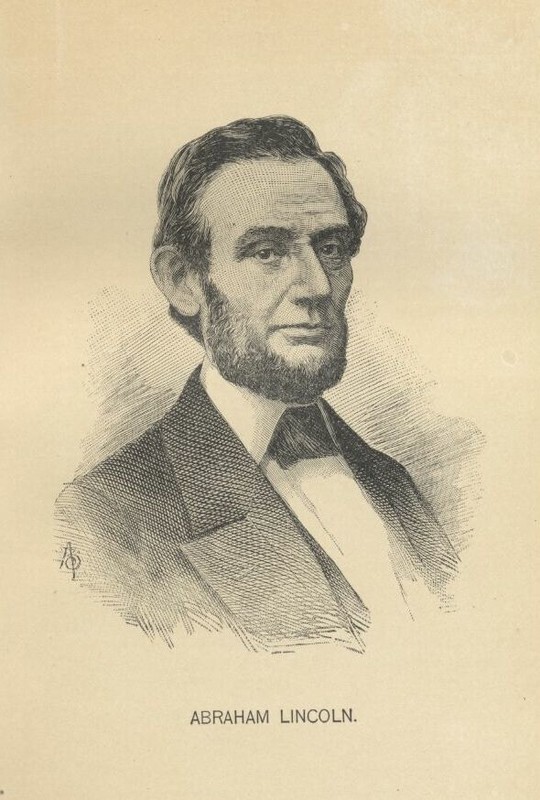
CHAPTER IV.
POPULAR SOVEREIGNTY.
But now occurred the great Presidential struggle of 1860—which involved not alone the principles of Protection, but those of human Freedom, and the preservation of the Union itself—between Abraham Lincoln of Illinois, the candidate of the Republican party, as against Stephen A. Douglas of Illinois, the National or Douglas—Democratic candidate, John C. Breckinridge of Kentucky, the Administration or Breckinridge—Democratic candidate, and John Bell of Tennessee, the candidate of the Bell-Union party. The great preliminary struggle which largely influenced the determination of the Presidential political conflict of 1860, had, however, taken place in the State of Illinois, two years previously. To that preliminary political contest of 1858, therefore, we will now turn our eyes—and, in order to fully understand it, it may be well to glance back over a few years. In 1851 the Legislature of Illinois had adopted—[The vote in the House being 65 yeas to 4 nays.]—the following resolution: "Resolved, That our Liberty and Independence are based upon the right of the people to form for themselves such a government as they may choose; that this great principle, the birthright of freemen, the gift of Heaven, secured to us by the blood of our ancestors, ought to be secured to future generations, and no limitation ought to be applied to this power in the organization of any Territory of the United States, of either Territorial Government or State Constitution, provided the government so established shall be Republican and in conformity with the Constitution of the United States." This resolution was a practical endorsement of the course of Stephen A. Douglas in supporting the Compromise measures of 1850, which he had defended as being "all founded upon the great principle that every people ought to possess the right to form and regulate their own domestic institutions in their own way," and that "the same principle" should be "extended to all of the Territories of the United States."
In accordance with his views and the resolution aforesaid, Mr. Douglas in 1854, as we have already seen, incorporated in the Kansas-Nebraska Bill a clause declaring it to be "the true intent and meaning of the Act not to legislate Slavery into any State or Territory, or to exclude it therefrom, but to leave the people thereof perfectly free to form and regulate their domestic institutions in their own way, subject only to the Constitution of the United States."
His position, as stated by himself, was, substantially that the Lecompton Pro-Slavery Constitution was a fraud upon the people of Kansas, in that it did not embody the will of that people; and he denied the right of Congress to force a Constitution upon an unwilling people—without regard, on his part, to whether that Constitution allowed or prohibited Slavery or any other thing, whether good or bad. He held that the people themselves were the sole judges of whether it is good or bad, and whether desirable or not.
The Supreme Court of the United States had in the meantime made a decision in a case afterward known as the "Dred Scott case," which was held back until after the Presidential election of 1856 had taken place, and added fuel to the political fire already raging. Dred Scott was a Negro Slave. His owner voluntarily took him first into a Free State, and afterward into a Territory which came within the Congressional prohibitive legislation aforesaid. That decision in brief was substantially that no Negro Slave imported from Africa, nor his descendant, can be a citizen of any State within the meaning of the Constitution; that neither the Congress nor any Territorial Legislature has under the Constitution of the United States, the power to exclude Slavery from any Territory of the United States; and that it is for the State Courts of the Slave State, into which the negro has been conveyed by his master, and not for the United States Courts, to decide whether that Negro, having been held to actual Slavery in a Free State, has, by virtue of residence in such State, himself become Free.
Now it was, that the meaning of the words, "subject only to the Constitution," as used in the Kansas-Nebraska Act, began to be discerned. For if the people of a Territory were to be "perfectly free," to deal with Slavery as they chose, "subject only to the Constitution" they were by this Judicial interpretation of that instrument "perfectly free" to deal with Slavery in any way so long as they did not attempt "to exclude" it! The thing was all one-sided. Mr. Douglas's attitude in inventing the peculiar phraseology in the Kansas-Nebraska Act—which to some seemed as if expressly "made to order" for the Dred Scott decision—was criticized with asperity; the popularity, however, of his courageous stand against President Buchanan on the Lecompton fraud, seemed to make it certain that, his term in the United States Senate being about to expire, he would be overwhelmingly re-elected to that body.
But at this juncture occurred something, which for a long time held the result in doubt, and drew the excited attention of the whole Nation to Illinois as the great battle-ground. In 1858 a Republican State Convention was held at Springfield, Ill., which nominated Abraham Lincoln as the Republican candidate for United States Senator to succeed Senator Douglas in the National Legislature. On June 16th—after such nomination—Mr. Lincoln made to the Convention a speech—in which, with great and incisive power, he assailed Mr. Douglas's position as well as that of the whole Democratic Pro-Slavery Party, and announced in compact and cogent phrase, from his own point of view, the attitude, upon the Slavery question, of the Republican Party.
In that remarkable speech—which at once attracted the attention of the Country—Mr. Lincoln said: "We are now far into the fifth year, since a policy was initiated with the avowed object, and confident promise, of putting an end to Slavery agitation. Under the operation of that policy, that agitation has not only not ceased, but has constantly augmented. In my opinion it will not cease, until a crisis shall have been reached and passed. 'A House divided against itself cannot stand.' I believe this Government cannot endure permanently half Slave and half Free. I do not expect the Union to be dissolved—I do not expect the House to fall—but I do expect it will cease to be divided. It will become all one thing, or all the other. Either the opponents of Slavery will arrest the further spread of it, and place it where the public mind shall rest in the belief that it is in the course of ultimate extinction; or its advocates will push it forward, till it shall become alike lawful in all the States, old as well as new, North as well as South."
[Governor Seward's announcement of an "irrepressible conflict" was made four months later.]
He then proceeded to lay bare and closely analyze the history of all that had been done, during the four years preceding, to produce the prevailing condition of things touching human Slavery; describing it as resulting from that, "now almost complete legal combination-piece of machinery, so to speak—compounded of the Nebraska doctrine and the Dred Scott decision." After stating the several points of that decision, and that the doctrine of the "Sacred right of self-government" had been perverted by the Nebraska "Squatter Sovereignty," argument to mean that, "if any one man chose to enslave another, no third man shall be allowed to object," he proceeded to show the grounds upon which he charged "pre-concert" among the builders of that machinery. Said he: "The people were to be left perfectly free, 'subject only to the Constitution.' What the Constitution had to do with it, outsiders could not see. Plainly enough now, it was an exactly fitted niche for the Dred Scott decision to afterward come in and declare the perfect freedom of the people to be just no freedom at all. Why was the amendment, expressly declaring the right of the people, voted down? Plainly enough now, the adoption of it would have spoiled the niche for the Dred Scott decision. Why was the Court decision held up? Why even a Senator's individual opinion withheld, till after the Presidential election? Plainly enough now: the speaking out then would have damaged the 'perfectly free' argument upon which the election was to be carried. Why the outgoing President's felicitation on the indorsement? Why the delay of a re-argument? Why the incoming President's advance exhortation in favor of the decision? These things look like the cautious patting and petting of a spirited horse, preparatory to mounting him, when it is dreaded that he may give the rider a fall. And why the hasty after-indorsement of the decision, by the President and others? We cannot absolutely know that all these exact adaptations are the result of pre-concert. But when we see a lot of framed timbers, different portions of which we know have been gotten out at different times and places and by different workmen—Stephen, Franklin, Roger, and James—[Douglas, Pierce, Taney and Buchanan.]—for instance—and when we see these timbers joined together, and see they exactly make the frame of a house or a mill, all the tenons and mortices exactly fitting, and all the lengths and proportions of the different pieces exactly adapted to their respective places, and not a piece too many or too few—not omitting even the scaffolding, or, if a single piece be lacking, we see the place in the frame exactly fitted and prepared yet to bring such piece in—in such a case, we find it impossible not to believe that Stephen and Franklin and Roger and James all understood one another from the beginning, and all worked upon a common plan or draft drawn up before the first blow was struck."
He drew attention also to the fact that by the Nebraska Bill the people of a State, as well as a Territory, were to be left "perfectly free," "subject only to the Constitution," and that the object of lugging a "State" into this merely Territorial law was to enable the United States Supreme Court in some subsequent decision to declare, when the public mind had been sufficiently imbued with Judge Douglas's notion of not caring "whether Slavery be voted up or voted down," that "the Constitution of the United States does not permit a State to exclude Slavery from its limits"—which would make Slavery "alike lawful in all the States." That, he declared to be Judge Douglas's present mission:—"His avowed mission is impressing the 'public heart' to care nothing about it." Hence Mr. Lincoln urged Republicans to stand by their cause, which must be placed in the hands of its friends, "Whose hands are free, whose hearts are in the work—who do care for the result;" for he held that "a living dog is better than a dead lion."
On the evening of July 9, 1858, at Chicago, Mr. Douglas (Mr. Lincoln being present) spoke to an enthusiastic assemblage, which he fitly described as a "vast sea of human faces," and, after stating that he regarded "the Lecompton battle as having been fought and the victory won, because the arrogant demand for the admission of Kansas under the Lecompton Constitution unconditionally, whether her people wanted it or not, has been abandoned, and the principle which recognizes the right of the people to decide for themselves has been submitted in its place," he proceeded to vindicate his position throughout; declared that he opposed "the Lecompton monstrosity solely on the ground than it was a violation of the fundamental principles of free government; on the ground that it was not the act and deed of the people of Kansas; that it did not embody their will; that they were averse to it;" and hence he "denied the right of Congress to force it upon them, either as a Free State or a Slave State."
Said he: "I deny the right of Congress to force a Slaveholding State upon an unwilling people. I deny their right to force a Free State upon an unwilling people. I deny their right to force a good thing upon a people who are unwilling to receive it. The great principle is the right of every community to judge and decide for itself, whether a thing is right or wrong, whether it would be good or evil for them to adopt it; and the right of free action, the right of free thought, the right of free judgment upon the question is dearer to every true American than any other under a free Government. * * * It is no answer to this argument to say that Slavery is an evil, and hence should not be tolerated. You must allow the people to decide for themselves whether it is good or evil." He then adverted to the arraignment of himself by Mr. Lincoln, and took direct issue with that gentleman on his proposition that, as to Freedom and Slavery, "the Union will become all one thing or all the other;" and maintained on the contrary, that "it is neither desirable nor possible that there should be uniformity in the local institutions and domestic regulations of the different States of this Union."
Upon the further proposition of Mr. Lincoln, which Mr. Douglas described as "a crusade against the Supreme Court of the United States on account of the Dred Scott decision," and as "an appeal from the decision" of that Court "upon this high Constitutional question to a Republican caucus sitting in the country," he also took "direct and distinct issue with him." To "the reason assigned by Mr. Lincoln for resisting the decision of the Supreme Court in the Dred Scott case * * * because it deprives the Negro of the privileges, immunities and rights of citizenship which pertain, according to that decision, only to the White man," Mr. Douglas also took exception thus: "I am free to say to you that in my opinion this Government of ours is founded on the White basis. It was made by the White man for the benefit of the White man, to be administered by White men, in such manner as they should determine. It is also true that a Negro, an Indian, or any other man of inferior race to a White man, should be permitted to enjoy, and humanity requires that he should have, all the rights, privileges, and immunities which he is capable of exercising consistent with the safety of society. * * * But you may ask me what are these rights and these privileges? My answer is, that each State must decide for itself the nature and extent of these rights. * * * Without indorsing the wisdom of that decision, I assert that Virginia has the same power by virtue of her sovereignty to protect Slavery within her limits, as Illinois has to banish it forever from our own borders. I assert the right of each State to decide for itself on all these questions, and I do not subscribe to the doctrine of my friend, Mr. Lincoln, that uniformity is either desirable or possible. I do not acknowledge that the States must all be Free or must all be Slave. I do not acknowledge that the Negro must have civil and political rights everywhere or nowhere. * * * I do not acknowledge any of these doctrines of uniformity in the local and domestic regulations in the different States. * * * Mr. Lincoln goes for a warfare upon the Supreme Court of the United States because of their judicial decision in the Dred Scott case. I yield obedience to the decisions in that Court—to the final determination of the highest judicial tribunal known to our Constitution. He objects to the Dred Scott decision because it does not put the Negro in the possession of the rights of citizenship on an equality with the White man. I am opposed to Negro equality. * * * I would extend to the Negro, and the Indian, and to all dependent races every right, every privilege, and every immunity consistent with the safety and welfare of the White races; but equality they never should have, either political or social, or in any other respect whatever. * * * My friends, you see that the issues are distinctly drawn."
On the following evening (July 10th) at Chicago, Mr. Lincoln addressed another enthusiastic assemblage, in reply to Mr. Douglas; and, after protesting against a charge that had been made the previous night by the latter, of an "unnatural and unholy" alliance between Administration Democrats and Republicans to defeat him, as being beyond his own knowledge and belief, proceeded: "Popular Sovereignty! Everlasting Popular Sovereignty! Let us for a moment inquire into this vast matter of Popular Sovereignty. What is Popular Sovereignty? We recollect at an early period in the history of this struggle there was another name for the same thing—Squatter Sovereignty. It was not exactly Popular Sovereignty, but Squatter Sovereignty. What do those terms mean? What do those terms mean when used now? And vast credit is taken by our friend, the Judge, in regard to his support of it, when he declares the last years of his life have been, and all the future years of his life shall be, devoted to this matter of Popular Sovereignty. What is it? Why it is the Sovereignty of the People! What was Squatter Sovereignty? I suppose if it had any significance at all, it was the right of the people to govern themselves, to be sovereign in their own affairs while they were squatted down in a country not their own—while they had squatted on a territory that did not belong to them in the sense that a State belongs to the people who inhabit it—when it belonged to the Nation—such right to govern themselves was called 'Squatter Sovereignty.'
"Now I wish you to mark. What has become of that Squatter Sovereignty? What has become of it? Can you get anybody to tell you now that the people of a Territory have any authority to govern themselves, in regard to this mooted question of Slavery, before they form a State Constitution? No such thing at all, although there is a general running fire and although there has been a hurrah made in every speech on that side, assuming that that policy had given the people of a Territory the right to govern themselves upon this question; yet the point is dodged. To-day it has been decided—no more than a year ago it was decided by the Supreme Court of the United States, and is insisted upon to-day, that the people of a Territory have no right to exclude Slavery from a Territory, that if any one man chooses to take Slaves into a Territory, all the rest of the people have no right to keep them out. This being so, and this decision being made one of the points that the Judge (Douglas) approved, * * * he says he is in favor of it, and sticks to it, and expects to win his battle on that decision, which says there is no such thing as Squatter Sovereignty; but that any man may take Slaves into a Territory and all the other men in the Territory may be opposed to it, and yet by reason of the Constitution they cannot prohibit it; when that is so, how much is left of this vast matter of Squatter Sovereignty, I should like to know? Again, when we get to the question of the right of the people to form a State Constitution as they please, to form it with Slavery or without Slavery—if that is anything new, I confess I don't know it * * *.
"We do not remember that, in that old Declaration of Independence, it is said that 'We hold these truths to be self-evident, that all men are created equal; that they are endowed by their Creator with certain inalienable rights; that among these are life, liberty, and the pursuit of happiness; that to secure these rights, governments are instituted among men, deriving their just powers from the consent of the governed.' There, is the origin of Popular Sovereignty. Who, then, shall come in at this day and claim that he invented it? The Lecompton Constitution connects itself with this question, for it is in this matter of the Lecompton Constitution that our friend, Judge Douglas, claims such vast credit. I agree that in opposing the Lecompton Constitution, so far as I can perceive, he was right. * * * All the Republicans in the Nation opposed it, and they would have opposed it just as much without Judge Douglas's aid as with it. They had all taken ground against it long before he did. Why, the reason that he urges against that Constitution, I urged against him a year before. I have the printed speech in my hand now. The argument that he makes, why that Constitution should not be adopted, that the people were not fairly represented nor allowed to vote, I pointed out in a speech a year ago which I hold in my hand now, that no fair chance was to be given to the people. * * * The Lecompton Constitution, as the Judge tells us, was defeated. The defeat of it was a good thing or it was not. He thinks the defeat of it was a good thing, and so do I, and we agree in that. Who defeated it? [A voice—'Judge Douglas.'] Yes, he furnished himself, and if you suppose he controlled the other Democrats that went with him, he furnished three votes, while the Republicans furnished twenty. That is what he did to defeat it. In the House of Representatives he and his friends furnished some twenty votes, and the Republicans furnished ninety odd. Now, who was it that did the work? * * * Ground was taken against it by the Republicans long before Douglas did it. The proportion of opposition to that measure is about five to one."
Mr. Lincoln then proceeded to take up the issues which Mr. Douglas had joined with him the previous evening. He denied that he had said, or that it could be fairly inferred from what he had said, in his Springfield speech, that he was in favor of making War by the North upon the South for the extinction of Slavery, "or, in favor of inviting the South to a War upon the North, for the purpose of nationalizing Slavery." Said he: "I did not even say that I desired that Slavery should be put in course of ultimate extinction. I do say so now, however; so there need be no longer any difficulty about that. * * * I am tolerably well acquainted with the history of the Country and I know that it has endured eighty-two years half Slave and half Free. I believe—and that is what I meant to allude to there—I believe it has endured, because during all that time, until the introduction of the Nebraska Bill, the public mind did rest all the, time in the belief that Slavery was in course of ultimate extinction. That was what gave us the rest that we had through that period of eighty-two years; at least, so I believe.
"I have always hated Slavery, I think, as much as any Abolitionist—I have been an Old Line Whig—I have always hated it, but I have always been quiet about it until this new era of the introduction of the Nebraska Bill began. I always believed that everybody was against it, and that it was in course of ultimate extinction. * * * The great mass of the Nation have rested in the belief that Slavery was in course of ultimate extinction. They had reason so to believe. The adoption of the Constitution and its attendant history led the People to believe so, and that such was the belief of the framers of the Constitution itself. Why did those old men about the time of the adoption of the Constitution decree that Slavery should not go into the new territory, where it had not already gone? Why declare that within twenty years the African Slave Trade, by which Slaves are supplied, might be cut off by Congress? Why were all these acts? I might enumerate more of these acts—but enough. What were they but a clear indication that the framers of the Constitution intended and expected the ultimate extinction of that institution?
"And now, when I say, as I said in my speech that Judge Douglas has quoted from, when I say that I think the opponents of Slavery will resist the further spread of it, and place it where the public mind shall rest with the belief that it is in course of ultimate extinction, I only mean to say, that they will place it where the founders of this Government originally placed it. I have said a hundred times, and I have now no inclination to take it back, that I believe there is no right, and ought to be no inclination in the people of the Free States, to enter into the Slave States, and interfere with the question of Slavery at all. I have said that always; Judge Douglas has heard me say it—if not quite a hundred times, at least as good as a hundred times; and when it is said that I am in favor of interfering with Slavery where it exists, I know that it is unwarranted by anything I have ever intended, and as I believe, by anything I have ever said. If, by any means, I have ever used language which could fairly be so construe (as, however, I believe I never have) I now correct it. So much, then, for the inference that Judge Douglas draws, that I am in favor of setting the Sections at War with one another.
"Now in relation to his inference that I am in favor of a general consolidation of all the local institutions of the various States * * * I have said, very many times in Judge Douglas's hearing, that no man believed more than I in the principle of self-government from beginning to end. I have denied that his use of that term applies properly. But for the thing itself, I deny that any man has ever gone ahead of me in his devotion to the principle, whatever he may have done in efficiency in advocating it. I think that I have said it in your hearing—that I believe each individual is naturally entitled to do as he pleases with himself and the fruit of his labor, so far as it in no wise interferes with any other man's rights—that each community, as a State, has a right to do exactly as it pleases with all the concerns within that State that interfere with the rights of no other State, and that the General Government, upon principle, has no right to interfere with anything other than that general class of things that does concern the whole. I have said that at all times.
"I have said, as illustrations, that I do not believe in the right of Illinois to interfere with the cranberry laws of Indiana, the oyster laws of Virginia, or the liquor laws of Maine. I have said these things over and over again, and I repeat them here as my sentiments. * * * What can authorize him to draw any such inference? I suppose there might be one thing that at least enabled him to draw such an inference that would not be true with me or many others, that is, because he looks upon all this matter of Slavery as an exceedingly little thing—this matter of keeping one-sixth of the population of the whole Nation in a state of oppression and tyranny unequaled in the World.
"He looks upon it as being an exceedingly little thing only equal to the cranberry laws of Indiana—as something having no moral question in it—as something on a par with the question of whether a man shall pasture his land with cattle, or plant it with tobacco—so little and so small a thing, that he concludes, if I could desire that anything should be done to bring about the ultimate extinction of that little thing, I must be in favor of bringing about an amalgamation of all the other little things in the Union.
"Now it so happens—and there, I presume, is the foundation of this mistake—that the Judge thinks thus; and it so happens that there is a vast portion of the American People that do not look upon that matter as being this very little thing. They look upon it as a vast moral evil; they can prove it as such by the writings of those who gave us the blessings of Liberty which we enjoy, and that they so looked upon it, and not as an evil merely confining itself to the States where it is situated; while we agree that, by the Constitution we assented to, in the States where it exists we have no right to interfere with it, because it is in the Constitution; and we are by both duty and inclination to stick by that Constitution in all its letter and spirit, from beginning to end. * * * The Judge can have no issue with me on a question of establishing uniformity in the domestic regulations of the States. * * *
"Another of the issues he says that is to be made with me, is upon his devotion to the Dred Scott decision, and my opposition to it. I have expressed heretofore, and I now repeat, my opposition to the Dred Scott decision; but I should be allowed to state the nature of that opposition. * * * What is fairly implied by the term Judge Douglas has used, 'resistance to the decision?' I do not resist it. If I wanted to take Dred Scott from his master, I would be interfering with property and that terrible difficulty that Judge Douglas speaks of, of interfering with property, would arise. But I am doing no such thing as that, but all that I am doing is refusing to obey it, as a political rule. If I were in Congress, and a vote should come up on a question whether Slavery should be prohibited in a new Territory, in spite of the Dred Scott decision, I would vote that it should. That is what I would do.
"Judge Douglas said last night, that before the decision he might advance his opinion, and it might be contrary to the decision when it was made; but after it was made, he would abide by it until it was reversed. Just so! We let this property abide by the decision, but we will try to reverse that decision. We will try to put it where Judge Douglas would not object, for he says he will obey it until it is reversed. Somebody has to reverse that decision, since it is made, and we mean to reverse it, and we mean to do it peaceably.
"What are the uses of decisions of Courts? They have two uses. As rules of property they have two uses. First, they decide upon the question before the Court. They decide in this case that Dred Scott is a Slave. Nobody resists that. Not only that, but they say to everybody else, that persons standing just as Dred Scott stands, are as he is. That is, they say that when a question comes up upon another person, it will be so decided again, unless the Court decides in another way—unless the Court overrules its decision.—Well, we mean to do what we can to have the Court decide the other way. That is one thing we mean to try to do.
"The sacredness that Judge Douglas throws around this decision is a degree of sacredness that has never before been thrown around any other decision. I have never heard of such a thing. Why, decisions apparently contrary to that decision, or that good lawyers thought were contrary to that decision, have been made by that very Court before. It is the first of its kind; it is an astonisher in legal history. It is a new wonder of the world. It is based upon falsehood in the main as to the facts—allegations of facts upon which it stands are not facts at all in many instances; and no decision made on any question—the first instance of a decision made under so many unfavorable circumstances—thus placed, has ever been held by the profession as law, and it has always needed confirmation before the lawyers regarded it as settled law. But Judge Douglas will have it that all hands must take this extraordinary decision, made under these extraordinary circumstances, and give their vote in Congress in accordance with it, yield to it and obey it in every possible sense.
"Circumstances alter cases. Do not gentlemen remember the case of that same Supreme Court, some twenty-five or thirty years ago, deciding that a National Bank was Constitutional? * * * The Bank charter ran out, and a recharter was granted by Congress. That re-charter was laid before General Jackson. It was urged upon him, when he denied the Constitutionality of the Bank, that the Supreme Court had decided that it was Constitutional; and General Jackson then said that the Supreme Court had no right to lay down a rule to govern a co-ordinate branch of the Government, the members of which had sworn to support the Constitution—that each member had sworn to support that Constitution as he understood it. I will venture here to say, that I have heard Judge Douglas say that he approved of General Jackson for that act. What has now become of all his tirade about 'resistance to the Supreme Court?'"
After adverting to Judge Douglas's warfare on "the leaders" of the Republican party, and his desire to have "it understood that the mass of the Republican party are really his friends," Mr. Lincoln said: "If you indorse him, you tell him you do not care whether Slavery be voted up or down, and he will close, or try to close, your mouths with his declaration repeated by the day, the week, the month, and the year. Is that what you mean? * * * Now I could ask the Republican party, after all the hard names that Judge Douglas has called them by, all his repeated charges of their inclination to marry with and hug negroes—all his declarations of Black Republicanism—by the way, we are improving, the black has got rubbed off—but with all that, if he be indorsed by Republican votes, where do you stand? Plainly, you stand ready saddled, bridled, and harnessed, and waiting to be driven over to the Slavery-extension camp of the Nation—just ready to be driven over, tied together in a lot—to be driven over, every man with a rope around his neck, that halter being held by Judge Douglas. That is the question. If Republican men have been in earnest in what they have done, I think that they has better not do it. * * *
"We were often—more than once at least—in the course of Judge Douglas's speech last night, reminded that this Government was made for White men—that he believed it was made for White men. Well, that is putting it in a shape in which no one wants to deny it; but the Judge then goes into his passion for drawing inferences that are not warranted. I protest, now and forever, against that counterfeit logic which presumes that because I do not want a Negro woman for a Slave I do necessarily want her for a wife. My understanding is that I need not have her for either; but, as God has made us separate, we can leave one another alone, and do one another much good thereby. There are White men enough to marry all the White women, and enough Black men to marry all the Black women, and in God's name let them be so married. The Judge regales us with the terrible enormities that take place by the mixture of races; that the inferior race bears the superior down. Why, Judge, if we do not let them get together in the Territories, they won't mix there.
" * * * Those arguments that are made, that the inferior race are to be treated with as much allowance as they are capable of enjoying; that as much is to be done for them as their condition will allow—what are these arguments? They are the arguments that Kings have made for enslaving the People in all ages of the World. You will find that all the arguments in favor of king-craft were of this class; they always bestrode the necks of the People, not that they wanted to do it, but because the People were better off for being ridden! That is their argument, and this argument of the Judge is the same old Serpent that says: you work, and I eat; you toil, and I will enjoy the fruits of it.
"Turn it whatever way you will—whether it come from the mouth of a King, an excuse for enslaving the People of his Country, or from the mouth of men of one race as a reason for enslaving the men of another race, it is all the same old Serpent; and I hold, if that course of argumentation that is made for the purpose of convincing the public mind that we should not care about this, should be granted, it does not stop with the Negro.
"I should like to know, taking this old Declaration of Independence, which declares that all men are equal upon principle, and making exceptions to it, where will it stop? If one man says it does not mean a Negro, why not say it does not mean some other man? If that Declaration is not the truth, let us get the Statute Book, in which we find it, and tear it out! Who is so bold as to do it? If it is not true, let us tear it out!" [Cries of "No, no."] "Let us stick to it then; let us stand firmly by it, then. * * *
" * * * The Saviour, I suppose, did not expect that any human creature could be perfect as the Father in Heaven; but He said, 'As your Father in Heaven is perfect, be ye also perfect.' He set that up as a standard, and he who did most toward reaching that standard, attained the highest degree of moral perfection. So I say, in relation to the principle that all men are created equal—let it be as nearly reached as we can. If we cannot give Freedom to every creature, let us do nothing that will impose Slavery upon any other creature. Let us then turn this Government back into the channel in which the framers of the Constitution originally placed it. Let us stand firmly by each other. * * * Let us discard all this quibbling * * * and unite as one People throughout this Land, until we shall once more stand up declaring that all men are created equal."
At Bloomington, July 16th (Mr. Lincoln being present), Judge Douglas made another great speech of vindication and attack. After sketching the history of the Kansas-Nebraska struggle, from the introduction by himself of the Nebraska Bill in the United States Senate, in 1854, down to the passage of the "English" Bill—which prescribed substantially that if the people of Kansas would come in as a Slave-holding State, they should be admitted with but 35,000 inhabitants; but if they would come in as a Free State, they must have 93,420 inhabitants; which unfair restriction was opposed by Judge Douglas, but to which after it became law he "bowed in deference," because whatever decision the people of Kansas might make on the coming third of August would be "final and conclusive of the whole question"—he proceeded to compliment the Republicans in Congress, for supporting the Crittenden-Montgomery Bill—for coming "to the Douglas platform, abandoning their own, believing (in the language of the New York Tribune), that under the peculiar circumstances they would in that mode best subserve the interests of the Country;" and then again attacked Mr. Lincoln for his "unholy and unnatural alliance" with the Lecompton-Democrats to defeat him, because of which, said he: "You will find he does not say a word against the Lecompton Constitution or its supporters. He is as silent as the grave upon that subject. Behold Mr. Lincoln courting Lecompton votes, in order that he may go to the Senate as the representative of Republican principles! You know that the alliance exists. I think you will find that it will ooze out before the contest is over." Then with many handsome compliments to the personal character of Mr. Lincoln, and declaring that the question for decision was "whether his principles are more in accordance with the genius of our free institutions, the peace and harmony of the Republic" than those advocated by himself, Judge Douglas proceeded to discuss what he described as "the two points at issue between Mr. Lincoln and myself."
Said he: "Although the Republic has existed from 1789 to this day, divided into Free States and Slave States, yet we are told that in the future it cannot endure unless they shall become all Free or all Slave. * * * He wishes to go to the Senate of the United States in order to carry out that line of public policy which will compel all the States in the South to become Free. How is he going to do it? Has Congress any power over the subject of Slavery in Kentucky or Virginia or any other State of this Union? How, then, is Mr. Lincoln going to carry out that principle which he says is essential to the existence of this Union, to wit: That Slavery must be abolished in all the States of the Union or must be established in them all? You convince the South that they must either establish Slavery in Illinois and in every other Free State, or submit to its abolition in every Southern State and you invite them to make a warfare upon the Northern States in order to establish Slavery for the sake of perpetuating it at home. Thus, Mr. Lincoln invites, by his proposition, a War of Sections, a War between Illinois and Kentucky, a War between the Free States and the Slave States, a War between the North and South, for the purpose of either exterminating Slavery in every Southern State or planting it in every Northern State. He tells you that the safety of the Republic, that the existence of this Union, depends upon that warfare being carried on until one Section or the other shall be entirely subdued. The States must all be Free or Slave, for a house divided against itself cannot stand. That is Mr. Lincoln's argument upon that question. My friends, is it possible to preserve Peace between the North and the South if such a doctrine shall prevail in either Section of the Union?
"Will you ever submit to a warfare waged by the Southern States to establish Slavery in Illinois? What man in Illinois would not lose the last drop of his heart's blood before lie would submit to the institution of Slavery being forced upon us by the other States against our will? And if that be true of us, what Southern man would not shed the last drop of his heart's blood to prevent Illinois, or any other Northern State, from interfering to abolish Slavery in his State? Each of these States is sovereign under the Constitution; and if we wish to preserve our liberties, the reserved rights and sovereignty of each and every State must be maintained. * * * The difference between Mr. Lincoln and myself upon this point is, that he goes for a combination of the Northern States, or the organization of a sectional political party in the Free States, to make War on the domestic institutions of the Southern States, and to prosecute that War until they all shall be subdued, and made to conform to such rules as the North shall dictate to them.
"I am aware that Mr. Lincoln, on Saturday night last, made a speech at Chicago for the purpose, as he said, of explaining his position on this question. * * * His answer to this point which I have been arguing, is, that he never did mean, and that I ought to know that he never intended to convey the idea, that he wished the people of the Free States to enter into the Southern States and interfere with Slavery. Well, I never did suppose that he ever dreamed of entering into Kentucky, to make War upon her institutions, nor will any Abolitionist ever enter into Kentucky to wage such War. Their mode of making War is not to enter into those States where Slavery exists, and there interfere, and render themselves responsible for the consequences. Oh, no! They stand on this side of the Ohio River and shoot across. They stand in Bloomington and shake their fists at the people of Lexington; they threaten South Carolina from Chicago. And they call that bravery! But they are very particular, as Mr. Lincoln says, not to enter into those States for the purpose of interfering with the institution of Slavery there. I am not only opposed to entering into the Slave States, for the purpose of interfering with their institutions, but I am opposed to a sectional agitation to control the institutions of other States. I am opposed to organizing a sectional party, which appeals to Northern pride, and Northern passion and prejudice, against Southern institutions, thus stirring up ill feeling and hot blood between brethren of the same Republic. I am opposed to that whole system of sectional agitation, which can produce nothing but strife, but discord, but hostility, and finally disunion. * * *
"I ask Mr. Lincoln how it is that he purposes ultimately to bring about this uniformity in each and all the States of the Union? There is but one possible mode which I can see, and perhaps Mr. Lincoln intends to pursue it; that is, to introduce a proposition into the Senate to change the Constitution of the United States in order that all the State Legislatures may be abolished, State Sovereignty blotted out, and the power conferred upon Congress to make local laws and establish the domestic institutions and police regulations uniformly throughout the United States.
"Are you prepared for such a change in the institutions of your country? Whenever you shall have blotted out the State Sovereignties, abolished the State Legislatures, and consolidated all the power in the Federal Government, you will have established a Consolidated Empire as destructive to the Liberties of the People and the Rights of the Citizen as that of Austria, or Russia, or any other despotism that rests upon the neck of the People. * * * There is but one possible way in which Slavery can be abolished, and that is by leaving a State, according to the principle of the Kansas-Nebraska Bill, perfectly free to form and regulate its institutions in its own way. That was the principle upon which this Republic was founded, and it is under the operation of that principle that we have been able to preserve the Union thus far under its operation. Slavery disappeared from New Hampshire, from Rhode Island, from Connecticut, from New York, from New Jersey, from Pennsylvania, from six of the twelve original Slave-holding States; and this gradual system of emancipation went on quietly, peacefully, and steadily, so long as we in the Free States minded our own business, and left our neighbors alone.
"But the moment the Abolition Societies were organized throughout the North, preaching a violent crusade against Slavery in the Southern States, this combination necessarily caused a counter-combination in the South, and a sectional line was drawn which was a barrier to any further emancipation. Bear in mind that emancipation has not taken place in any one State since the Free Soil Party was organized as a political party in this country. Emancipation went on gradually, in State after State, so long as the Free States were content with managing their own affairs and leaving the South perfectly free to do as they pleased; but the moment the North said we are powerful enough to control you of the South, the moment the North proclaimed itself the determined master of the South, that moment the South combined to resist the attack, and thus sectional parties were formed and gradual emancipation ceased in all the Slave-holding States.
"And yet Mr. Lincoln, in view of these historical facts, proposes to keep up this sectional agitation, band all the Northern States together in one political Party, elect a President by Northern votes alone, and then, of course, make a Cabinet composed of Northern men, and administer the Government by Northern men only, denying all the Southern States of this Union any participation in the administration of affairs whatsoever. I submit to you, my fellow-citizens, whether such a line of policy is consistent with the peace and harmony of the Country? Can the Union endure under such a system of policy? He has taken his position in favor of sectional agitation and sectional warfare. I have taken mine in favor of securing peace, harmony, and good-will among all the States, by permitting each to mind its own business, and discountenancing any attempt at interference on the part of one State with the domestic concerns of the others. * * *
"Mr. Lincoln tells you that he is opposed to the decision of the Supreme Court in the Dred Scott case. Well, suppose he is; what is he going to do about it? * * * Why, he says he is going to appeal to Congress. Let us see how he will appeal to Congress. He tells us that on the 8th of March, 1820, Congress passed a law called the Missouri Compromise, prohibiting Slavery forever in all the territory west of the Mississippi and north of the Missouri line of thirty-six degrees and thirty minutes; that Dred Scott, a slave in Missouri, was taken by his master to Fort Snelling, in the present State of Minnesota, situated on the west branch of the Mississippi River, and consequently in the Territory where Slavery was prohibited by the Act of 1820; and that when Dred Scott appealed for his Freedom in consequence of having been taken into that Territory, the Supreme Court of the United States decided that Dred Scott did not become Free by being taken into that Territory, but that having been carried back to Missouri, was yet a Slave.
"Mr. Lincoln is going to appeal from that decision and reverse it. He does not intend to reverse it as to Dred Scott. Oh, no! But he will reverse it so that it shall not stand as a rule in the future. How will he do it? He says that if he is elected to the Senate he will introduce and pass a law just like the Missouri Compromise, prohibiting Slavery again in all the Territories. Suppose he does re-enact the same law which the Court has pronounced unconstitutional, will that make it Constitutional? * * * Will it be any more valid? Will he be able to convince the Court that the second Act is valid, when the first is invalid and void? What good does it do to pass a second Act? Why, it will have the effect to arraign the Supreme Court before the People, and to bring them into all the political discussions of the Country. Will that do any good? * * *
"The functions of Congress are to enact the Statutes, the province of the Court is to pronounce upon their validity, and the duty of the Executive is to carry the decision into effect when rendered by the Court. And yet, notwithstanding the Constitution makes the decision of the Court final in regard to the validity of an Act of Congress, Mr. Lincoln is going to reverse that decision by passing another Act of Congress. When he has become convinced of the Folly of the proposition, perhaps he will resort to the same subterfuge that I have found others of his Party resort to, which is to agitate and agitate until he can change the Supreme Court and put other men in the places of the present incumbents."
After ridiculing this proposition at some length, he proceeded:
"Mr. Lincoln is alarmed for fear that, under the Dred Scott decision, Slavery will go into all the Territories of the United States. All I have to say is that, with or without this decision, Slavery will go just where the People want it, and not an inch further. * * * Hence, if the People of a Territory want Slavery, they will encourage it by passing affirmatory laws, and the necessary police regulations, patrol laws and Slave Code; if they do not want it, they will withhold that legislation, and, by withholding it, Slavery is as dead as if it was prohibited by a Constitutional prohibition, especially if, in addition, their legislation is unfriendly, as it would be if they were opposed to it."
Then, taking up what he said was "Mr. Lincoln's main objection to the Dred Scott decision," to wit: "that that decision deprives the Negro of the benefits of that clause of the Constitution of the United States which entitles the citizens of each State to all the privileges and immunities of citizens of the several States," and admitting that such would be its effect, Mr. Douglas contended at some length that this Government was "founded on the White basis" for the benefit of the Whites and their posterity. He did "not believe that it was the design or intention of the signers of the Declaration of Independence or the frames of the Constitution to include Negroes, Indians, or other inferior races, with White men as citizens;" nor that the former "had any reference to Negroes, when they used the expression that all men were created equal," nor to "any other inferior race." He held that, "They were speaking only of the White race, and never dreamed that their language would be construed to apply to the Negro;" and after ridiculing the contrary view, insisted that, "The history of the Country shows that neither the signers of the Declaration, nor the Framers of the Constitution, ever supposed it possible that their language would be used in an attempt to make this Nation a mixed Nation of Indians, Negroes, Whites, and Mongrels."
The "Fathers proceeded on the White basis, making the White people the governing race, but conceding to the Indian and Negro, and all inferior races, all the rights and all the privileges they could enjoy consistent with the safety of the society in which they lived. That," said he, "is my opinion now. I told you that humanity, philanthropy, justice, and sound policy required that we should give the Negro every right, every privilege, every immunity consistent with the safety and welfare of the State. The question, then, naturally arises, what are those rights and privileges, and what is the nature and extent of them? My answer is, that that is a question which each State and each Territory must decide for itself. * * * I am content with that position. My friend Lincoln is not. * * * He thinks that the Almighty made the Negro his equal and his brother. For my part I do not consider the Negro any kin to me, nor to any other White man; but I would still carry my humanity and my philanthropy to the extent of giving him every privilege and every immunity that he could enjoy, consistent with our own good."
After again referring to the principles connected with non-interference in the domestic institutions of the States and Territories, and to the devotion of all his energies to them "since 1850, when," said he, "I acted side by side with the immortal Clay and the god-like Webster, in that memorable struggle in which Whigs and Democrats united upon a common platform of patriotism and the Constitution, throwing aside partisan feelings in order to restore peace and harmony to a distracted Country"—he alluded to the death-bed of Clay, and the pledges made by himself to both Clay and Webster to devote his own life to the vindication of the principles of that Compromise of 1850 as a means of preserving the Union; and concluded with this appeal: "This Union can only be preserved by maintaining the fraternal feeling between the North and the South, the East and the West. If that good feeling can be preserved, the Union will be as perpetual as the fame of its great founders. It can be maintained by preserving the sovereignty of the States, the right of each State and each Territory to settle its domestic concerns for itself, and the duty of each to refrain from interfering with the other in any of its local or domestic institutions. Let that be done, and the Union will be perpetual; let that be done, and this Republic, which began with thirteen States and which now numbers thirty-two, which when it began, only extended from the Atlantic to the Mississippi, but now reaches to the Pacific, may yet expand, North and South, until it covers the whole Continent, and becomes one vast ocean-bound Confederacy. Then, my friends, the path of duty, of honor, of patriotism, is plain. There are a few simple principles to be preserved. Bear in mind the dividing line between State rights and Federal authority; let us maintain the great principles of Popular Sovereignty, of State rights and of the Federal Union as the Constitution has made it, and this Republic will endure forever."
On the next evening, July 17th, at Springfield, both Douglas and Lincoln addressed separate meetings.
After covering much the same ground with regard to the history of the Kansas-Nebraska struggle and his own attitude upon it, as he did in his previous speech, Mr. Douglas declined to comment upon Mr. Lincoln's intimation of a Conspiracy between Douglas, Pierce, Buchanan, and Taney for the passage of the Nebraska Bill, the rendition of the Dred Scott decision, and the extension of Slavery, but proceeded to dilate on the "uniformity" issue between himself and Mr. Lincoln, in much the same strain as before, tersely summing up with the statement that "there is a distinct issue of principles—principles irreconcilable—between Mr. Lincoln and myself. He goes for consolidation and uniformity in our Government. I go for maintaining the Confederation of the Sovereign States under the Constitution, as our fathers made it, leaving each State at liberty to manage its own affairs and own internal institutions."
He then ridiculed, at considerable length, Mr. Lincoln's proposed methods of securing a reversal by the United States Supreme Court of the Dred Scott decision—especially that of an "appeal to the People to elect a President who will appoint judges who will reverse the Dred Scott decision," which he characterized as "a proposition to make that Court the corrupt, unscrupulous tool of a political party," and asked, "when we refuse to abide by Judicial decisions, what protection is there left for life and property? To whom shall you appeal? To mob law, to partisan caucuses, to town meetings, to revolution? Where is the remedy when you refuse obedience to the constituted authorities?" In other respects the speech was largely a repetition of his Bloomington speech.
Mr. Lincoln in his speech, the same night, at Springfield, opened by contrasting the disadvantages under which, by reason of an unfair apportionment of State Legislative representation and otherwise, the Republicans of Illinois labored in this fight. Among other disadvantages—whereby he said the Republicans were forced "to fight this battle upon principle and upon principle alone"—were those which he said arose "out of the relative positions of the two persons who stand before the State as candidates for the Senate."
Said he: "Senator Douglas is of world-wide renown. All the anxious politicians of his Party, or who have been of his Party for years past, have been looking upon him as certainly, at no distant day, to be the President of the United States. They have seen in his round, jolly, fruitful face, Post-offices, Land-offices, Marshalships, and Cabinet appointments, Chargeships and Foreign Missions, bursting and sprouting out in wonderful exuberance, ready to be laid hold of by their greedy hands. And as they have been gazing upon this attractive picture so long, they cannot, in the little distraction that has taken place in the party, bring themselves to give up the charming hope; but with greedier anxiety they rush about him, sustain him, and give him marches, triumphal entries, and receptions, beyond what even in the days of his highest prosperity they could have brought about in his favor. On the contrary, nobody has ever expected me to be President. In my poor, lean, lank face, nobody has ever seen that any cabbages were sprouting out."
Then he described the main points of Senator Douglas's plan of campaign as being not very numerous. "The first," he said, "is Popular Sovereignty. The second and third are attacks upon my speech made on the 16th of June. Out of these three points—drawing within the range of Popular Sovereignty the question of the Lecompton Constitution—he makes his principal assault. Upon these his successive speeches are substantially one and the same." Touching the first point, "Popular Sovereignty"—"the great staple" of Mr. Douglas's campaign—Mr. Lincoln affirmed that it was "the most arrant Quixotism that was ever enacted before a community."
He said that everybody understood that "we have not been in a controversy about the right of a People to govern themselves in the ordinary matters of domestic concern in the States and Territories;" that, "in this controversy, whatever has been said has had reference to the question of Negro Slavery;" and "hence," said he, "when hereafter I speak of Popular Sovereignty, I wish to be understood as applying what I say to the question of Slavery only; not to other minor domestic matters of a Territory or a State."
Having cleared away the cobwebs, Mr. Lincoln proceeded:
"Does Judge Douglas, when he says that several of the past years of his life have been devoted to the question of 'Popular Sovereignty' * * * mean to say that he has been devoting his life to securing the People of the Territories the right to exclude Slavery from the Territories? If he means so to say, he means to deceive; because he and every one knows that the decision of the Supreme Court, which he approves, and makes special ground of attack upon me for disapproving, forbids the People of a Territory to exclude Slavery.
"This covers the whole ground from the settlement of a Territory till it reaches the degree of maturity entitling it to form a State Constitution. * * * This being so, the period of time from the first settlement of a Territory till it reaches the point of forming a State Constitution, is not the thing that the Judge has fought for, or is fighting for; but, on the contrary, he has fought for, and is fighting for, the thing that annihilates and crushes out that same Popular Sovereignty. Well, so much being disposed of, what is left? Why, he is contending for the right of the People, when they come to make a State Constitution, to make it for themselves, and precisely as best suits themselves. I say again, that is Quixotic. I defy contradiction when I declare that the Judge can find no one to oppose him on that proposition. I repeat, there is nobody opposing that proposition on principle. * * * Nobody is opposing, or has opposed, the right of the People when they form a State Constitution, to form it for themselves. Mr. Buchanan and his friends have not done it; they, too, as well as the Republicans and the Anti-Lecompton Democrats, have not done it; but on the contrary, they together have insisted on the right of the People to form a Constitution for themselves. The difference between the Buchanan men, on the one hand, and the Douglas men and the Republicans, on the other, has not been on a question of principle, but on a question of fact * * * whether the Lecompton Constitution had been fairly formed by the People or not. * * * As to the principle, all were agreed.
"Judge Douglas voted with the Republicans upon that matter of fact. He and they, by their voices and votes, denied that it was a fair emanation of the People. The Administration affirmed that it was. * * * This being so, what is Judge Douglas going to spend his life for? Is he going to spend his life in maintaining a principle that no body on earth opposes? Does he expect to stand up in majestic dignity and go through his apotheosis and become a god, in the maintaining of a principle which neither man nor mouse in all God's creation is opposing?"
After ridiculing the assumption that Judge Douglas was entitled to all the credit for the defeat of the Lecompton Constitution in the House of Representatives—when the defeating vote numbered 120, of which 6 were Americans, 20 Douglas (or Anti-Lecompton) Democrats, and 94 Republicans —and hinting that perhaps he placed "his superior claim to credit, on the ground that he performed a good act which was never expected of him," or "upon the ground of the parable of the lost sheep," of which it had been said, "that there was more rejoicing over the one sheep that was lost and had been found, than over the ninety and nine in the fold—" he added: "The application is made by the Saviour in this parable, thus: 'Verily, I say unto you, there is more rejoicing in Heaven over one sinner that repenteth, than over ninety and nine just persons that need no repentance.' And now if the Judge claims the benefit of this parable, let him repent. Let him not come up here and say: 'I am the only just person; and you are the ninety-nine sinners!' Repentance before forgiveness is a provision of the Christian system, and on that condition alone will the Republicans grant his forgiveness."
After complaining that Judge Douglas misrepresented his attitude as indicated in his 16th of June speech at Springfield, in charging that he invited "a War of Sections;"—that he proposed that "all the local institutions of the different States shall become consolidated and uniform," Mr. Lincoln denied that that speech could fairly bear such construction.
In that speech he (Mr. L.) had simply expressed an expectation that "either the opponents of Slavery will arrest the further spread of it, and place it where the public mind shall rest in the belief that it is in the course of ultimate extinction, or its advocates will push it forward till it shall become alike lawful in all the States, old as well as new, North as well as South." Since then, at Chicago, he had also expressed a "wish to see the spread of Slavery arrested, and to see it placed where the public mind shall rest in the belief that it is in the course of ultimate extinction"—and, said he: "I said that, because I supposed, when the public mind shall rest in that belief, we shall have Peace on the Slavery question. I have believed—and now believe—the public mind did rest on that belief up to the introduction of the Nebraska Bill. Although I have ever been opposed to Slavery, so far I rested in the hope and belief that it was in the course of ultimate extinction. For that reason, it had been a minor question with me. I might have been mistaken; but I had believed, and now believe, that the whole public mind, that is, the mind of the great majority, had rested in that belief up to the Repeal of the Missouri Compromise. But upon that event, I became convinced that either I had been resting in a delusion, or the institution was being placed on a new basis—a basis for making it Perpetual, National, and Universal. Subsequent events have greatly confirmed me in that belief.
"I believe that Bill to be the beginning of a Conspiracy for that purpose. So believing, I have since then considered that question a paramount one. So believing, I thought the public mind would never rest till the power of Congress to restrict the spread of it shall again be acknowledged and exercised on the one hand, or, on the other, all resistance be entirely crushed out. I have expressed that opinion and I entertain it to-night."
Having given some pieces of evidence in proof of the "tendency," he had discovered, to the Nationalization of Slavery in these States, Mr. Lincoln continued: "And now, as to the Judge's inference, that because I wish to see Slavery placed in the course of ultimate extinction—placed where our fathers originally placed it—I wish to annihilate the State Legislatures—to force cotton to grow upon the tops of the Green Mountains—to freeze ice in Florida—to cut lumber on the broad Illinois prairies—that I am in favor of all these ridiculous and impossible things! It seems to me it is a complete answer to all this, to ask if, when Congress did have the fashion of restricting Slavery from Free Territory; when Courts did have the fashion of deciding that taking a Slave into a Free, Country made him Free—I say it is a sufficient answer to ask, if any of this ridiculous nonsense, about consolidation and uniformity, did actually follow? Who heard of any such thing, because of the Ordinance of '87? because of the Missouri Restriction because of the numerous Court decisions of that character?
"Now, as to the Dred Scott decision; for upon that he makes his last point at me. He boldly takes ground in favor of that decision. This is one-half the onslaught and one-third of the entire plan of the campaign. I am opposed to that decision in a certain sense, but not in the sense which he puts on it. I say that in so far as it decided in favor of Dred Scott's master, and against Dred Scott and his family, I do not propose to disturb or resist the decision. I never have proposed to do any such thing. I think, that in respect for judicial authority, my humble history would not suffer in comparison with that of Judge Douglas. He would have the citizen conform his vote to that decision; the member of Congress, his; the President, his use of the veto power. He would make it a rule of political action for the People and all the departments of the Government. I would not. By resisting it as a political rule, I disturb no right of property, create no disorder, excite no mobs."
After quoting from a letter of Mr. Jefferson (vol. vii., p. 177, of his Correspondence,) in which he held that "to consider the judges as the ultimate arbiters of all Constitutional questions," is "a very dangerous doctrine indeed; and one which would place us under the despotism of an Oligarchy," Mr. Lincoln continued: "Let us go a little further. You remember we once had a National Bank. Some one owed the Bank a debt; he was sued, and sought to avoid payment on the ground that the Bank was unconstitutional. The case went to the Supreme Court, and therein it was decided that the Bank was Constitutional. The whole Democratic party revolted against that decision. General Jackson himself asserted that he, as President, would not be bound to hold a National Bank to be Constitutional, even though the Court had decided it to be so. He fell in, precisely, with the view of Mr. Jefferson, and acted upon it under his official oath, in vetoing a charter for a National Bank.
"The declaration that Congress does not possess this Constitutional power to charter a Bank, has gone into the Democratic platform, at their National Conventions, and was brought forward and reaffirmed in their last Convention at Cincinnati. They have contended for that declaration, in the very teeth of the Supreme Court, for more than a quarter of a century. In fact, they have reduced the decision to an absolute nullity. That decision, I repeat, is repudiated in the Cincinnati platform; and still, as if to show that effrontery can go no further, Judge Douglas vaunts in the very speeches in which he denounces me for opposing the Dred Scott decision, that he stands on the Cincinnati platform.
"Now, I wish to know what the Judge can charge upon me, with respect to decisions of the Supreme Court, which does not lie in all its length, breadth, and proportions, at his own door? The plain truth is simply this: Judge Douglas is for Supreme Court decisions when he likes, and against them when he does not like them. He is for the Dred Scott decision because it tends to Nationalize Slavery—because it is a part of the original combination for that object. It so happens, singularly enough, that I never stood opposed to a decision of the Supreme Court till this. On the contrary, I have no recollection that he was ever particularly in favor of one till this. He never was in favor of any, nor (I) opposed to any, till the present one, which helps to Nationalize Slavery. Free men of Sangamon—Free men of Illinois, Free men everywhere—judge ye between him and me, upon this issue!
"He says this Dred Scott case is a very small matter at most—that it has no practical effect; that at best, or rather I suppose at worst, it is but an abstraction. * * * How has the planting of Slavery in new countries always been effected? It has now been decided that Slavery cannot be kept out of our new Territories by any legal means. In what do our new Territories now differ in this respect from the old Colonies when Slavery was first planted within them?
"It was planted, as Mr. Clay once declared, and as history proves true, by individual men in spite of the wishes of the people; the Mother-Government refusing to prohibit it, and withholding from the People of the Colonies the authority to prohibit it for themselves. Mr. Clay says this was one of the great and just causes of complaint against Great Britain by the Colonies, and the best apology we can now make for having the institution amongst us. In that precise condition our Nebraska politicians have at last succeeded in placing our own new Territories; the Government will not prohibit Slavery within them, nor allow the People to prohibit it."
Alluding to that part of Mr. Douglas's speech the previous night touching the death-bed scene of Mr. Clay, with Mr. Douglas's promise to devote the remainder of his life to "Popular Sovereignty"—and to his relations with Mr. Webster—Mr. Lincoln said: "It would be amusing, if it were not disgusting, to see how quick these Compromise breakers administer on the political effects of their dead adversaries. If I should be found dead to-morrow morning, nothing but my insignificance could prevent a speech being made on my authority, before the end of next week. It so happens that in that 'Popular Sovereignty' with which Mr. Clay was identified, the Missouri Compromise was expressly reserved; and it was a little singular if Mr. Clay cast his mantle upon Judge Douglas on purpose to have that Compromise repealed. Again, the Judge did not keep faith with Mr. Clay when he first brought in the Nebraska Bill. He left the Missouri Compromise unrepealed, and in his report accompanying the Bill, he told the World he did it on purpose. The manes of Mr. Clay must have been in great agony, till thirty days later, when 'Popular Sovereignty' stood forth in all its glory."
Touching Mr. Douglas's allegations of Mr. Lincoln's disposition to make Negroes equal with the Whites, socially and politically, the latter said: "My declarations upon this subject of Negro Slavery may be misrepresented, but cannot be misunderstood. I have said that I do not understand the Declaration (of Independence) to mean that all men were created equal in all respects. They are not equal in color; but I suppose that it does mean to declare that all men are equal in some respects; they are equal in their right to 'Life, Liberty, and the pursuit of Happiness.' Certainly the Negro is not our equal in color—perhaps not in many other respects; still, in the right to put into his mouth the bread that his own hands have earned, he is the equal of every other man, White or Black. In pointing out that more has been given you, you cannot be justified in taking away the little which has been given him. All I ask for the Negro is that if you do not like him, let him alone. If God gave him but little, that little let him enjoy.
"The framers of the Constitution," continued Mr. Lincoln, "found the institution of Slavery amongst their other institutions at the time. They found that by an effort to eradicate it, they might lose much of what they had already gained. They were obliged to bow to the necessity. They gave Congress power to abolish the Slave Trade at the end of twenty years. They also prohibited it in the Territories where it did not exist. They did what they could, and yielded to the necessity for the rest. I also yield to all which follows from that necessity. What I would most desire would be the separation of the White and Black races."
Mr. Lincoln closed his speech by referring to the "New Departure" of the Democracy—to the charge he had made, in his 16th of June speech, touching "the existence of a Conspiracy to Perpetuate and Nationalize Slavery"—which Mr. Douglas had not contradicted—and, said he, "on his own tacit admission I renew that charge. I charge him with having been a party to that Conspiracy, and to that deception, for the sole purpose of Nationalizing Slavery."
This closed the series of preliminary speeches in the canvass. But they only served to whet the moral and intellectual and political appetite of the public for more. It was generally conceded that, at last, in the person of Mr. Lincoln, the "Little Giant" had met his match.
On July 24, Mr. Lincoln opened a correspondence with Mr. Douglas, which eventuated in an agreement between them, July 31st, for joint-discussions, to take place at Ottawa, Freeport, Jonesboro, Charleston, Galesburgh, Quincy, and Alton, on fixed dates in August, September and October—at Ottawa, Mr. Douglas to open and speak one hour, Mr. Lincoln to have an hour and a half in reply, and Mr. Douglas to close in a half hour's speech; at Freeport, Mr. Lincoln to open and speak for one hour, Mr. Douglas to take the next hour and a half in reply, and Mr. Lincoln to have the next half hour to close; and so on, alternating at each successive place, making twenty-one hours of joint political debate.
To these absorbingly interesting discussions, vast assemblages listened with breathless attention; and to the credit of all parties be it said, with unparalleled decorum. The People evidently felt that the greatest of all political principles—that of Human Liberty—was hanging on the issue of this great political contest between intellectual giants, thus openly waged before the World—and they accordingly rose to the dignity and solemnity of the occasion, vindicating by their very example the sacredness with which the Right of Free Speech should be regarded at all times and everywhere.
CHAPTER V.
THE PRESIDENTIAL CONTEST OF 1860—
THE CRISIS APPROACHING.
The immediate outcome of the remarkable joint-debate between the two intellectual giants of Illinois was, that while the popular vote stood 124,698 for Lincoln, to 121,130 for Douglas—showing a victory for Lincoln among the People—yet, enough Douglas-Democrats were elected to the Legislature, when added to those of his friends in the Illinois Senate, who had been elected two years before, and "held over," to give him, in all, 54 members of both branches of the Legislature on joint ballot, against 46 for Mr. Lincoln. Lincoln had carried the people, but Douglas had secured the Senatorial prize for which they had striven—and by that Legislative vote was elected to succeed himself in the United States Senate. This result was trumpeted throughout the Union as a great Douglas victory.
During the canvass of Illinois, Douglas's friends had seen to it that nothing on their part should be wanting to secure success. What with special car trains, and weighty deputations, and imposing processions, and flag raisings, the inspiration of music, the booming of cannon, and the eager shouts of an enthusiastic populace, his political journey through Illinois had been more like a Royal Progress than anything the Country had yet seen; and now that his reelection was accomplished, they proposed to make the most of it—to extend, as it were, the sphere of his triumph, or vindication, so that it would include not the State alone, but the Nation—and thus so accentuate and enhance his availability as a candidate for the Democratic Presidential nomination of 1860, as to make his nomination and election to the Presidency of the United States an almost foregone conclusion.
The programme was to raise so great a popular tidal-wave in his interest, as would bear him irresistibly upon its crest to the White House. Accordingly, as the idol of the Democratic popular heart, Douglas, upon his return to the National Capital, was triumphantly received by the chief cities of the Mississippi and the Atlantic sea-board. Hailed as victor in the great political contest in Illinois—upon the extended newspaper reports of which, the absorbed eyes of the entire nation, for months, had greedily fed—Douglas was received with much ostentation and immense enthusiasm at St. Louis, Memphis, New Orleans, New York, Philadelphia, Baltimore and Washington. Like the "Triumphs" decreed by Rome, in her grandest days, to the greatest of her victorious heroes, Douglas's return was a series of magnificent popular ovations,
In a speech made two years before this period, Mr. Lincoln, while contrasting his own political career with that of Douglas, and modestly describing his own as "a flat failure" had said: "With him it has been one of splendid success. His name fills the Nation, and is not unknown even in foreign lands. I affect no contempt for the high eminence he has reached. So reached, that the oppressed of my species might have shared with me in the elevation, I would rather stand on that eminence than wear the richest crown that ever pressed a monarch's brow." And now the star of Douglas had reached a higher altitude, nearing its meridian splendor. He had become the popular idol of the day.
But Douglas's partial victory—if such it was—so far from settling the public mind and public conscience, had the contrary effect. It added to the ferment which the Pro-Slavery Oligarchists of the South—and especially those of South Carolina—were intent upon increasing, until so grave and serious a crisis should arrive as would, in their opinion, furnish a justifiable pretext in the eyes of the World for the contemplated Secession of the Slave States from the Union.
Under the inspiration of the Slave Power, and in the direct line of the Dred Scott decision, and of the "victorious" doctrine of Senator Douglas, which he held not inconsistent therewith, that the people of any Territory of the United States could do as they pleased as to the institution of Slavery within their own limits, and if they desired the institution, they had the right by local legislation to "protect and encourage it," the Legislature of the Territory of New Mexico at once (1859) proceeded to enact a law "for the protection of property in Slaves," and other measures similar to the prevailing Slave Codes in the Southern States.
The aggressive attitude of the South—as thus evidenced anew—naturally stirred, to their very core, the Abolition elements of the North; on the other hand, the publication of Hinton Rowan Helper's "Impending Crisis," which handled the Slavery question without gloves, and supported its views with statistics which startled the Northern mind, together with its alleged indorsement by the leading Republicans of the North, exasperated the fiery Southrons to an intense degree. Nor was the capture, in October, 1859, of Harper's Ferry, Virginia, by John Brown and his handful of Northern Abolitionist followers, and his subsequent execution in Virginia, calculated to allay the rapidly intensifying feeling between the Freedom-loving North and the Slaveholding South. When, therefore, the Congress met, in December, 1859, the sectional wrath of the Country was reflected in the proceedings of both branches of that body, and these again reacted upon the People of both the Northern and Southern States, until the fires of Slavery Agitation were stirred to a white heat.
The bitterness of feeling in the House at this time, was shown, in part, by the fact that not until the 1st of February, 1860, was it able, upon a forty-fourth ballot, to organize by the election of a Speaker, and that from the day of its meeting on the 5th of December, 1859, up to such organization, it was involved in an incessant and stormy wrangle upon the Slavery question.
So also in the Democratic Senate, the split in the Democratic Party, between the Lecompton and Anti-Lecompton Democracy, was widened, at the same time that the Republicans of the North were further irritated, by the significantly decisive passage of a series of resolutions proposed by Jefferson Davis, which, on the one hand, purposely and deliberately knifed Douglas's "Popular Sovereignty" doctrine and read out of the Party all who believed in it, by declaring "That neither Congress nor a Territorial Legislature, whether by direct legislation, or legislation of an indirect and unfriendly character, possesses power to annul or impair the Constitutional right of any citizen of the United States to take his Slave-property into the common Territories, and there hold and enjoy the same while the Territorial condition remains," and, on the other, purposely and deliberately slapped in the face the Republicans of the North, by declaring—among other things "That in the adoption of the Federal Constitution, the States adopting the same, acted severally as Free and Independent sovereignties, delegating a portion of their powers to be exercised by the Federal Government for the increased security of each against dangers, domestic as well as foreign; and that any intermeddling by any one or more States or by a combination of their citizens, with the domestic institutions of the others, on any pretext whatever, political, moral, or religious, with a view to their disturbance or subversion, is in violation of the Constitution, insulting to the States so interfered with, endangers their domestic peace and tranquillity—objects for which the Constitution was formed—and, by necessary consequence, tends to weaken and destroy the Union itself."
Another of these resolutions declared Negro Slavery to be recognized in the Constitution, and that all "open or covert attacks thereon with a view to its overthrow," made either by the Non-Slave-holding States or their citizens, violated the pledges of the Constitution, "are a manifest breach of faith, and a violation of the most solemn obligations."
This last was intended as a blow at the Freedom of Speech and of the Press in the North; and only served, as was doubtless intended, to still more inflame Northern public feeling, while at the same time endeavoring to place the arrogant and aggressive Slave Power in an attitude of injured innocence. In short, the time of both Houses of Congress was almost entirely consumed during the Session of 1859-60 in the heated, and sometimes even furious, discussion of the Slavery question; and everywhere, North and South, the public mind was not alone deeply agitated, but apprehensive that the Union was founded not upon a rock, but upon the crater of a volcano, whose long-smouldering energies might at any moment burst their confines, and reduce it to ruin and desolation.
On the 23rd of April, 1860, the Democratic National Convention met at Charleston, South Carolina. It was several days after the permanent organization of the Convention before the Committee on Resolutions reported to the main body, and not until the 30th of April did it reach a vote upon the various reports, which had in the meantime been modified. The propositions voted upon were three:
First, The Majority Report of the Committee, which reaffirmed the Cincinnati platform of 1856—with certain "explanatory" resolutions added, which boldly proclaimed: "That the Government of a Territory organized by an Act of Congress, is provisional and temporary; and, during its existence, all citizens of the United States have an equal right to settle with their property in the Territory, without their rights, either of person or property, being destroyed or impaired by Congressional or Territorial Legislation;" that "it is the duty of the Federal Government, in all its departments, to protect, when necessary, the rights of persons and property in the Territories, and wherever else its Constitutional authority extends;" that "when the settlers in a Territory, having an adequate population, form a State Constitution, the right of Sovereignty commences, and, being consummated by admission into the Union, they stand on an equal footing with the people of other States, and the State thus organized ought to be admitted into the Federal Union, whether its Constitution prohibits or recognizes the institution of Slavery;" and that "the enactments of State Legislatures to defeat the faithful execution of the Fugitive Slave Law, are hostile in character, subversive of the Constitution, and revolutionary in effect." The resolutions also included a declaration in favor of the acquisition of Cuba, and other comparatively minor matters.
Second, The Minority Report of the Committee, which, after re-affirming the Cincinnati platform, declared that "Inasmuch as differences of opinion exist in the Democratic party as to the nature and extent of the powers of a Territorial Legislature, and as to the powers and duties of Congress, under the Constitution of the United States, over the institution of Slavery within the Territories * * * the Democratic Party will abide by the decisions of the Supreme Court of the United States on the questions of Constitutional law."
Third, The recommendation of Benjamin F. Butler, that the platform should consist simply of a re-affirmation of the Cincinnati platform, and not another word.
The last proposition was first voted on, and lost, by 105 yeas to 198 nays. The Minority platform was then adopted by 165 yeas to 138 nays.
The aggressive Slave-holders (Majority) platform, and the Butler Compromise do-nothing proposition, being both defeated, and the Douglas (Minority) platform adopted, the Alabama delegation, under instructions from their State Convention to withdraw in case the National Convention refused to adopt radical Territorial Pro-Slavery resolutions, at once presented a written protest and withdrew from the Convention, and were followed, in rapid succession, by; the delegates from Mississippi, Louisiana (all but two), South Carolina, Florida, Texas, Arkansas (in part), Delaware (mostly), and Georgia (mostly)—the seceding delegates afterwards organizing in another Hall, adopting the above Majority platform, and after a four days' sitting, adjourning to meet at Richmond, Virginia, on the 11th of June.
Meanwhile, the Regular Democratic National Convention had proceeded to ballot for President—after adopting the two-thirds rule. Thirty-seven ballots having been cast, that for Stephen A. Douglas being, on the thirty-seventh, 151, the Convention, on the 3d of May, adjourned to meet again at Baltimore, June 18th.
After re-assembling, and settling contested election cases, the delegates (in whole or in part) from Virginia, North Carolina, Tennessee, California, Delaware, Kentucky, Maryland and Massachusetts, withdrew from the Convention, the latter upon the ground mainly that there had been "a withdrawal, in part, of a majority of the States," while Butler, who had voted steadily for Jefferson Davis throughout all the balloting at Charleston, gave as an additional ground personal to himself, that "I will not sit in a convention where the African Slave Trade—which is piracy by the laws of my Country—is approvingly advocated"—referring thereby to a speech, that had been much applauded by the Convention at Charleston, made by a Georgia delegate (Gaulden), in which that delegate had said: "I would ask my friends of the South to come up in a proper spirit; ask our Northern friends to give us all our rights, and take off the ruthless restrictions which cut off the supply of Slaves from foreign lands. * * * I tell you, fellow Democrats, that the African Slave Trader is the true Union man (cheers and laughter). I tell you that the Slave Trading of Virginia is more immoral, more unchristian in every possible point of view, than that African Slave Trade which goes to Africa and brings a heathen and worthless man here, makes him a useful man, Christianizes him, and sends him and his posterity down the stream of Time, to enjoy the blessings of civilization. (Cheers and laughter.) * * * I come from the first Congressional District of Georgia. I represent the African Slave Trade interest of that Section. (Applause.) I am proud of the position I occupy in that respect. I believe that the African Slave Trader is a true missionary, and a true Christian. (Applause.) * * * Are you prepared to go back to first principles, and take off your unconstitutional restrictions, and leave this question to be settled by each State? Now, do this, fellow citizens, and you will have Peace in the Country. * * * I advocate the repeal of the laws prohibiting the African Slave Trade, because I believe it to be the true Union movement. * * * I believe that by re-opening this Trade and giving us Negroes to populate the Territories, the equilibrium of the two Sections will be maintained."
After the withdrawal of the bolting delegates at Baltimore, the Convention proceeded to ballot for President, and at the end of the second ballot, Mr. Douglas having received "two-thirds of all votes given in the Convention" (183) was declared the "regular nominee of the Democratic Party, for the office of President of the United States."
An additional resolution was subsequently adopted as a part of the platform, declaring that "it is in accordance with the true interpretation of the Cincinnati platform, that, during the existence of the Territorial Governments, the measure of restriction, whatever it may be, imposed by the Federal Constitution on the power of the Territorial Legislatures over the subject of the domestic relations, as the same has been, or shall hereafter be, finally determined by the Supreme Court of the United States, should be respected by all good citizens, and enforced with promptness and fidelity by every branch of the General Government."
On the 11th of June, pursuant to adjournment, the Democratic Bolters' Convention met at Richmond, and, after adjourning to meet at Baltimore, finally met there on the 28th of that month—twenty-one States being, in whole or in part, represented. This Convention unanimously readopted the Southern-wing platform it had previously adopted at Charleston, and, upon the first ballot, chose, without dissent, John C. Breckinridge of Kentucky, as its candidate for the Presidential office.
In the meantime, however, the National Conventions of other Parties had been held, viz.: that of the Republican Party at Chicago, which, with a session of three days, May 16-18, had nominated Abraham Lincoln of Illinois and Hannibal Hamlin of Maine, for President and Vice-President respectively; and that of the "Constitutional Union" (or Native American) Party which had severally nominated (May 19) for such positions, John Bell of Tennessee, and Edward Everett of Massachusetts.
The material portion of the Republican National platform, adopted with entire unanimity by their Convention, was, so far as the Slavery and Disunion questions were concerned, comprised in these declarations:
First, That the history of the nation, during the last four years, has fully established the propriety and necessity of the organization and perpetuation of the Republican Party; and that the causes which called it into existence are permanent in their nature, and now, more than ever before, demand its peaceful and Constitutional triumph.
Second, That the maintenance of the principle, promulgated in the Declaration of Independence, and embodied in the Federal Constitution, "that all men are created equal; that they are endowed by their Creator with certain inalienable rights; that among these are Life, Liberty and the pursuit of Happiness; that to secure these rights, governments are instituted among men, deriving their just powers from the consent of the governed," is essential to the preservation of our Republican institutions; and that the Federal Constitution, the Rights of the States, and the Union of the States must and shall be preserved.
Third, That to the Union of the States, this Nation owes its unprecedented increase in population, its surprising development of material resources, its rapid augmentation of wealth, its happiness at home, and its honor abroad; and we hold in abhorrence all schemes for Disunion, come from whatever source they may: And we congratulate the Country that no Republican member of Congress has uttered or countenanced the threats of Disunion, so often made by Democratic members, without rebuke, and with applause, from their political associates; and we denounce those threats of Disunion, in case of a popular overthrow of their ascendancy, as denying the vital principles of a free Government, and as an avowal of contemplated Treason, which it is the imperative duty of an indignant People, sternly to rebuke and forever silence.
Fourth, That the maintenance inviolate of the rights of the States, and especially the right of each State, to order and control its own domestic institutions according to its own judgment exclusively, is essential to that balance of powers on which the perfection and endurance of our political fabric depend; and we denounce the lawless invasion, by armed force, of any State or Territory, no matter under what pretext, as among the gravest of crimes.
Fifth, That the present Democratic Administration has far exceeded our worst apprehensions, in its measureless subserviency to the exactions of a Sectional interest, as especially evinced in its desperate exertions to force the infamous Lecompton Constitution upon the protesting people of Kansas; in construing the personal relation between master and servant to involve an unqualified property in persons; in its attempted enforcement, everywhere, on land and sea, through the intervention of Congress and of the Federal Courts, of the extreme pretensions of a purely local interest; and in its general and unvarying abuse of the power intrusted to it by a confiding People.
* * * * * * *
Seventh, That the new dogma that the Constitution, of its own force, carries Slavery into any or all of the Territories of the United States, is a dangerous political heresy, at variance with the explicit provisions of that instrument itself, with contemporaneous exposition, and with legislation and judicial precedent; is revolutionary in its tendency and subversive of the peace and harmony of the Country.
Eighth, That the normal condition of all the territory of the United States is that of Freedom; that as our Republican fathers, when they had abolished Slavery in all our National Territory, ordained that "No person should be deprived of life, liberty, or property, without due process of law," it becomes our duty, by legislation, whenever such legislation is necessary, to maintain this provision of the Constitution against all attempts to violate it; and we deny the authority of Congress, of a Territorial Legislature, or of any individuals, to give legal existence to Slavery in any Territory of the United States.
Ninth, That we brand the recent re-opening of the African Slave-trade under the cover of our National flag, aided by perversions of judicial power, as a crime against humanity and a burning shame to our Country and Age; and we call upon Congress to take prompt and efficient measures for the total and final suppression of that execrable traffic.
Tenth, That in the recent vetoes, by their Federal Governors, of the acts of the Legislatures of Kansas and Nebraska, prohibiting Slavery in those Territories, we find a practical illustration of the boasted Democratic principle of Non-Intervention and Popular Sovereignty embodied in the Kansas-Nebraska Bill, and a demonstration of the deception and fraud involved therein.
Eleventh, That Kansas should, of right, be immediately admitted as a State, under the Constitution recently formed and adopted by the House of Representatives.
* * * * * * * * * *
The National platform of the "Constitutional Union" Party, was adopted, unanimously, in these words:
"Whereas, experience has demonstrated that platforms adopted by the partisan Conventions of the Country have had the effect to mislead and deceive the People, and at the same time to widen the political divisions of the Country, by the creation and encouragement of geographical and Sectional parties; therefore,
"Resolved, That it is both the part of patriotism and of duty to recognize no political principle other than the Constitution of the Country, the Union of the States, and the Enforcement of the Laws, and that, as representatives of the Constitutional Union men of the Country, in National Convention assembled, we hereby pledge ourselves to maintain, protect, and defend, separately and unitedly, these great principles of public liberty and national safety, against all enemies, at home and abroad; believing that thereby peace may once more be restored to the Country, the rights of the people and of the States re-established, and the Government again placed in that condition of justice, fraternity, and equality which, under the example and Constitution of our fathers, has solemnly bound every citizen of the United States to maintain a more perfect Union, establish justice, insure domestic tranquillity, provide for the common defense, promote the general welfare, and secure the blessings of liberty to ourselves and our posterity."
Thus, by the last of June, 1860, the four National Parties with their platforms and candidates were all in the political field prepared for the onset.
Briefly, the attitude of the standard-bearers representing the platform-principles of their several Parties, was this:
Lincoln, representing the Republicans, held that Slavery is a wrong, to be tolerated in the States where it exists, but which must be excluded from the Territories, which are all normally Free and must be kept Free by Congressional legislation, if necessary; and that neither Congress, nor the Territorial Legislature, nor any individual, has power to give to it legal existence in such Territories.
Breckinridge, representing the Pro-Slavery wing of the Democracy, held that Slavery is a right, which, when transplanted from the Slave-States into the Territories, neither Congressional nor Territorial legislation can destroy or impair, but which, on the contrary, must, when necessary, be protected everywhere by Congress and all other departments of the Government.
Douglas, representing the Anti-Lecompton wing of Democracy, held that whether Slavery be right or wrong, the white inhabitants of the Territories have the sole right to determine whether it shall or shall not exist within their respective limits, subject to the Constitution and Supreme Court decisions thereon; and that neither Congress nor any State, nor any outside persons, must interfere with that right.
Bell, representing the remaining political elements, held that it was all wrong to have any principles at all, except "the Constitution of the Country, the Union of the States, and the Enforcement of the Laws"—a platform which Horace Greeley well described as "meaning anything in general, and nothing in particular."
The canvass that ensued was terribly exciting—Douglas alone, of all the Presidential candidates, bravely taking the field, both North and South, in person, in the hope that the magnetism of his personal presence and powerful intellect might win what, from the start—owing to the adverse machinations, in the Northern States, of the Administration or Breckinridge-Democratic wing—seemed an almost hopeless fight. In the South, the Democracy was almost a unit in opposition to Douglas, holding, as they did, that "Douglas Free-Soilism" was "far more dangerous to the South than the election of Lincoln; because it seeks to create a Free-Soil Party there; while, if Lincoln triumphs, the result cannot fail to be a South united in her own defense;" while the old Whig element of the South was as unitedly for Bell. In the North, the Democracy were split in twain, three-fourths of them upholding Douglas, and the balance, powerful beyond their numbers in the possession of Federal Offices, bitterly hostile to him, and anxious to beat him, even at the expense of securing the election of Lincoln.
Douglas's fight was that the candidacy and platform of Bell were meaningless, those of both Lincoln and Breckinridge, Sectional, and that he alone bore aloft the standard of the entire Union; while, on the other hand, the supporters of Lincoln, his chief antagonist, claimed that—as the burden of the song from the lips of Douglas men, Bell men, and Breckinridge men alike, was the expression of a "fear that," in the language of Mr. Seward, "if the people elected Mr. Lincoln to the Presidency, they would wake up and find that they had no Country for him to preside over"—"therefore, all three of the parties opposing Mr. Lincoln were in the same boat, and hence the only true Union party, was the party which made no threats of Disunion, to wit, the Republican party."
The October elections of 1860 made it plain that Mr. Lincoln would be elected. South Carolina began to "feel good" over the almost certainty that the pretext for Secession for which her leaders had been hoping in vain for thirty years, was at hand. On the 25th of October, at Augusta, South Carolina, the Governor, the Congressional delegation, and other leading South Carolinians, met, and decided that in the event of Mr. Lincoln's election, that State would secede. Similar meetings, to the same end, were also held about the same time, in others of the Southern States. On the 5th of November—the day before the Presidential election—the Legislature of South Carolina met at the special call of Governor Gist, and, having organized, received a Message from the Governor, in which, after stating that he had convened that Body in order that they might on the morrow "appoint the number of electors of President and Vice-President to which this State is entitled," he proceeded to suggest "that the Legislature remain in session, and take such action as will prepare the State for any emergency that may arise." He went on to "earnestly recommend that, in the event of Abraham Lincoln's election to the Presidency, a Convention of the people of this State be immediately called, to consider and determine for themselves the mode and measure of redress," and, he continued: "I am constrained to say that the only alternative left, in my judgment, is the Secession of South Carolina from the Federal Union. The indications from many of the Southern States justify the conclusion that the Secession of South Carolina will be immediately followed, if not adopted simultaneously, by them, and ultimately by the entire South. The long-desired cooperation of the other States having similar institutions, for which so many of our citizens have been waiting, seems to be near at hand; and, if we are true to ourselves, will soon be realized. The State has, with great unanimity declared that she has the right peaceably to Secede, and no power on earth can rightfully prevent it."
[Referring to the Ordinance of Nullification adopted by the people of South Carolina, November 24, 1832, growing out of the Tariff Act of 1832—wherein it was declared that, in the event of the Federal Government undertaking to enforce the provisions of that Act: "The people of this State will thenceforth hold themselves absolved from all further obligation to maintain or preserve their political connection with the people of the other States, and will forthwith proceed to organize a separate government, and do all other acts and things which Sovereign and independent States may of right do."]
He proceeded to say that "If, in the exercise of arbitrary power, and forgetful of the lessons of history, the Government of the United States should attempt coercion, it will become our solemn duty to meet force by force"—and promised that the decision of the aforesaid Convention "representing the Sovereignty of the State, and amenable to no earthly tribunal," should be, by him, "carried out to the letter." He recommended the thorough reorganization of the Militia; the arming of every man in the State between the ages of eighteen and forty-five; and the immediate enrollment of ten thousand volunteers officered by themselves; and concluded with a confident "appeal to the Disposer of all human events," in whose keeping the "Cause" was to be entrusted.
That same evening (November 5), being the eve of the election, at Augusta, South Carolina, in response to a serenade, United States Senator Chestnut made a speech of like import, in which, after predicting the election of Mr. Lincoln, he said: "Would the South submit to a Black Republican President, and a Black Republican Congress, which will claim the right to construe the Constitution of the Country, and administer the Government in their own hands, not by the law of the instrument itself, nor by that of the fathers of the Country, nor by the practices of those who administered seventy years ago, but by rules drawn from their own blind consciences and crazy brains? * * * The People now must choose whether they would be governed by enemies, or govern themselves."
He declared that the Secession of South Carolina was an "undoubted right," a "duty," and their "only safety" and as to himself, he would "unfurl the Palmetto flag, fling it to the breeze, and, with the spirit of a brave man, live and die as became" his "glorious ancestors, and ring the clarion notes of defiance in the ears of an insolent foe!"
So also, in Columbia, South Carolina, Representative Boyce of that State, and other prominent politicians, harangued an enthusiastic crowd that night—Mr. Boyce declaring: "I think the only policy for us is to arm, as soon as we receive authentic intelligence of the election of Lincoln. It is for South Carolina, in the quickest manner, and by the most direct means, to withdraw from the Union. Then we will not submit, whether the other Southern States will act with us or with our enemies. They cannot take sides with our enemies; they must take sides with us. When an ancient philosopher wished to inaugurate a great revolution, his motto was to dare! to dare!"

CHAPTER VI.
THE GREAT CONSPIRACY MATURING.
The 6th of November, 1860, came and passed; on the 7th, the prevailing conviction that Lincoln would be elected had become a certainty, and before the close of that day, the fact had been heralded throughout the length and breadth of the Republic. The excitement of the People was unparalleled. The Republicans of the North rejoiced that at last the great wrong of Slavery was to be placed "where the People could rest in the belief that it was in the course of ultimate extinction!" The Douglas Democracy, naturally chagrined at the defeat of their great leader, were filled with gloomy forebodings touching the future of their Country; and the Southern Democracy, or at least a large portion of it, openly exulted that at last the long-wished-for opportunity for a revolt of the Slave Power, and a separation of the Slave from the Free States, was at hand. Especially in South Carolina were the "Fire-eating" Southrons jubilant over the event.
["South Carolina rejoiced over the election of Lincoln, with bonfires and processions." p. 172, Arnold's "Life of Abraham Lincoln."
"There was great joy in Charleston, and wherever 'Fire Eaters' most did congregate, on the morning of November 7th. Men rushed to shake hands and congratulate each other on the glad tidings of Lincoln's election. * * * Men thronged the streets, talking, laughing, cheering, like mariners long becalmed on a hateful, treacherous sea, whom a sudden breeze had swiftly wafted within sight of their longed-for haven." p. 332, vol. i., Greeley's American Conflict.]
Meanwhile any number of joint resolutions looking to the calling of a Secession Convention, were introduced in the South Carolina Legislature, sitting at Columbia, having in view Secession contingent upon the "cooperation" of the other Slave States, or looking to immediate and "unconditional" Secession.
On the evening of November 7th, Edmund Ruffin of Virginia—a Secession fanatic who had come from thence in hot haste—in response to a serenade, declared to the people of Columbia that: "The defense of the South, he verily believed, was only to be secured through the lead of South Carolina;" that, "old as he was, he had come here to join them in that lead;" and that "every day delayed, was a day lost to the Cause." He acknowledged that Virginia was "not as ready as South Carolina;" but declared that "The first drop of blood spilled on the soil of South Carolina would bring Virginia, and every Southern State, with them." He thought "it was perhaps better that Virginia, and all other border States, remain quiescent for a time, to serve as a guard against the North. * * * By remaining in the Union for a time, she would not only prevent coercive legislation in Congress, but any attempt for our subjugation."
That same evening came news that, at Charleston, the Grand Jury of the United States District Court had refused to make any presentments, because of the Presidential vote just cast, which, they said, had "swept away the last hope for the permanence, for the stability, of the Federal Government of these Sovereign States;" and that United States District Judge Magrath had resigned his office, saying to the Grand Jury, as he did so: "In the political history of the United States, an event has happened of ominous import to fifteen Slave-holding States. The State of which we are citizens has been always understood to have deliberately fixed its purpose whenever that event should happen. Feeling an assurance of what will be the action of the State, I consider it my duty, without delay, to prepare to obey its wishes. That preparation is made by the resignation of the office I have held."
The news of the resignations of the Federal Collector and District Attorney at Charleston, followed, with an intimation that that of the Sub-Treasurer would soon be forthcoming. On November 9th, a joint resolution calling an unconditional Secession Convention to meet at Columbia December 17th, was passed by the Senate, and on the 12th of November went through the House; and both of the United States Senators from South Carolina had now resigned their seats in the United States Senate.
Besides all these and many other incitements to Secession was the fact that at Milledgeville, Georgia, Governor Brown had, November 12th, addressed a Georgian Military Convention, affirming "the right of Secession, and the duty of other Southern States to sustain South Carolina in the step she was then taking," and declaring that he "would like to see Federal troops dare attempt the coercion of a seceding Southern State! For every Georgian who fell in a conflict thus incited, the lives of two Federal Soldiers should expiate the outrage on State Sovereignty"—and that the Convention aforesaid had most decisively given its voice for Secession.
It was about this time, however, that Alexander H. Stephens vainly sought to stem the tide of Secession in his own State, in a speech (November 14) before the Georgia Legislature, in which he declared that Mr. Lincoln "can do nothing unless he is backed by power in Congress. The House of Representatives is largely in the majority against him. In the Senate he will also be powerless. There will be a majority of four against him." He also cogently said: "Many of us have sworn to support it (the Constitution). Can we, therefore, for the mere election of a man to the Presidency—and that too, in accordance with the prescribed forms of the Constitution—make a point of resistance to the Government, and, without becoming the breakers of that sacred instrument ourselves, withdraw ourselves from it? Would we not be in the wrong?"
But the occasional words of wisdom that fell from the lips of the few far-seeing statesmen of the South, were as chaff before the storm of Disunion raised by the turbulent Fire-eaters, and were blown far from the South, where they might have done some good for the Union cause, away up to the North, where they contributed to aid the success of the contemplated Treason and Rebellion, by lulling many of the people there, into a false sense of security. Unfortunately, also, even the ablest of the Southern Union men were so tainted with the heretical doctrine of States-Rights, which taught the "paramount allegiance" of the citizen to the State, that their otherwise powerful appeals for the preservation of the Union were almost invariably handicapped by the added protestation that in any event—and however they might deplore the necessity—they would, if need be, go with their State, against their own convictions of duty to the National Union.
Hence in this same speech we find that Mr. Stephens destroyed the whole effect of his weighty and logical appeal against Secession from the Union, by adding to it, that, "Should Georgia determine to go out of the Union I shall bow to the will of her people. Their cause is my cause, and their destiny is my destiny; and I trust this will be the ultimate course of all."—and by further advising the calling of a Convention of the people to decide the matter; thus, in advance, as it were, binding himself hand and foot, despite his previous Union utterances, to do the fell bidding of the most rampant Disunionists. And thus, in due time, it befell, as we shall see, that this "saving clause" in his "Union speech," brought him at the end, not to that posture of patriotic heroism to which he aspired when he adjured his Georgian auditors to "let us be found to the last moment standing on the deck (of the Republic), with the Constitution of the United States waving over our heads," but to that of an imprisoned traitor and defeated rebel against the very Republic and Constitution which he had sworn to uphold and defend!
The action of the South Carolina Legislature in calling an Unconditional Secession Convention, acted among the Southern States like a spark in a train of gunpowder. Long accustomed to incendiary resolutions of Pro-Slavery political platforms, as embodying the creed of Southern men; committed by those declarations to the most extreme action when, in their judgment, the necessity should arise; and worked up during the Presidential campaign by swarming Federal officials inspired by the fanatical Secession leaders; the entire South only needed the spark from the treasonable torch of South Carolina, to find itself ablaze, almost from one end to the other, with the flames of revolt.
Governor after Governor, in State after State, issued proclamation after proclamation, calling together their respective Legislatures, to consider the situation and whether their respective States should join South Carolina in seceding from the Union. Kentucky alone, of them all, seemed for a time to keep cool, and look calmly and reasonably through the Southern ferment to the horrors beyond. In an address issued by Governor Magoffin of that State, to the people, he said:
"To South Carolina and such other States as may wish to secede from the Union, I would say: The geography of this Country will not admit of a division; the mouth and sources of the Mississippi River cannot be separated without the horrors of Civil War. We cannot sustain you in this movement merely on account of the election of Mr. Lincoln. Do not precipitate by premature action into a revolution or Civil War, the consequences of which will be most frightful to all of us. It may yet be avoided. There is still hope, faint though it be. Kentucky is a Border State, and has suffered more than all of you. * * * She has a right to claim that her voice, and the voice of reason, and moderation and patriotism shall be heard and heeded by you. If you secede, your representatives will go out of Congress and leave us at the mercy of a Black Republican Government. Mr. Lincoln will have no check. He can appoint his Cabinet, and have it confirmed. The Congress will then be Republican, and he will be able to pass such laws as he may suggest. The Supreme Court will be powerless to protect us. We implore you to stand by us, and by our friends in the Free States; and let us all, the bold, the true, and just men in the Free and Slave States, with a united front, stand by each other, by our principles, by our rights, our equality, our honor, and by the Union under the Constitution. I believe this is the only way to save it; and we can do it."
But this "still small voice" of conscience and of reason, heard like a whisper from the mouths of Stephens in Georgia, and Magoffin in Kentucky, was drowned in the clamor and tumult of impassioned harangues and addresses, and the drumming and tramp of the "minute men" of South Carolina, and other military organizations, as they excitedly prepared throughout the South for the dread conflict at arms which they recklessly invited, and savagely welcomed.
We have seen how President Andrew Jackson some thirty years before, had stamped out Nullification and Disunion in South Carolina, with an iron heel.
But a weak and feeble old man—still suffering from the effects of the mysterious National Hotel poisoning—was now in the Executive Chair at the White House. Well-meaning, doubtless, and a Union man at heart, his enfeebled intellect was unable to see, and hold firm to, the only true course. He lacked clearness of perception, decision of character, and nerve. He knew Secession was wrong, but allowed himself to be persuaded that he had no Constitutional power to prevent it. He had surrounded himself in the Cabinet with such unbending adherents and tools of the Slave-Power, as Howell Cobb of Georgia, his Secretary of the Treasury, John B. Floyd of Virginia, as Secretary of War, Jacob Thompson of Mississippi, as Secretary of the Interior, and Isaac Toucy of Connecticut, as Secretary of the Navy, before whose malign influence the councils of Lewis Cass of Michigan, the Secretary of State, and other Union men, in and out of the Cabinet, were quite powerless.
When, therefore, the Congress met (December 3, 1860) and he transmitted to it his last Annual Message, it was found that, instead of treating Secession from the Jacksonian standpoint, President Buchanan feebly wailed over the threatened destruction of the Union, weakly apologized for the contemplated Treason, garrulously scolded the North as being to blame for it, and, while praying to God to "preserve the Constitution and the Union throughout all generations," wrung his nerveless hands in despair over his own powerlessness—as he construed the Constitution—to prevent Secession! Before writing his pitifully imbecile Message, President Buchanan had secured from his Attorney-General (Jeremiah S. Black of Pennsylvania) an opinion, in which the latter, after touching upon certain cases in which he believed the President would be justified in using force to sustain the Federal Laws, supposed the case of a State where all the Federal Officers had resigned and where there were neither Federal Courts to issue, nor officers to execute judicial process, and continued: "In that event, troops would certainly be out of place, and their use wholly illegal. If they are sent to aid the Courts and Marshals there must be Courts and Marshals to be aided. Without the exercise of these functions, which belong exclusively to the civil service, the laws cannot be executed in any event, no matter what may be the physical strength which the Government has at its command. Under such circumstances, to send a military force into any State, with orders to act against the people, would be simply making War upon them."
Resting upon that opinion of Attorney-General Black, President Buchanan, in his Message, after referring to the solemn oath taken by the Executive "to take care that the laws be faithfully executed," and stating that there were now no longer any Federal Officers in South Carolina, through whose agency he could keep that oath, took up the laws of February 28, 1795, and March 3, 1807, as "the only Acts of Congress on the Statute-book bearing upon the subject," which "authorize the President, after he shall have ascertained that the Marshal, with his posse comitatus, is unable to execute civil or criminal process in any particular case, to call out the Militia and employ the Army and Navy to aid him in performing this service, having first, by Proclamation, commanded the insurgents to 'disperse and retire peaceably to their respective abodes, within a limited time'"—and thereupon held that "This duty cannot, by possibility, be performed in a State where no judicial authority exists to issue process, and where there is no Marshal to execute it; and where even if there were such an officer, the entire population would constitute one solid combination to resist him." And, not satisfied with attempting to show as clearly as he seemed to know how, his own inability under the laws to stamp out Treason, he proceeded to consider what he thought Congress also could not do under the Constitution. Said he: "The question fairly stated, is: Has the Constitution delegated to Congress the power to coerce into submission a State which is attempting to withdraw, or has actually withdrawn, from the Confederacy? If answered in the affirmative, it must be on the principle that the power has been conferred upon Congress to declare and make War against a State. After much serious reflection, I have arrived at the conclusion that no such power has been delegated to Congress or to any other department of the Federal Government." And further: "Congress possesses many means of preserving it (the Union) by conciliation; but the sword was not placed in their hands to preserve it by force."
Thus, in President Buchanan's judgment, while, in another part of his Message, he had declared that no State had any right, Constitutional or otherwise, to Secede from that Union, which was designed for all time—yet, if any State concluded thus wrongfully to Secede, there existed no power in the Union, by the exercise of force, to preserve itself from instant dissolution! How imbecile the reasoning, how impotent the conclusion, compared with that of President Jackson, thirty years before, in his Proclamation against Nullification and Secession, wherein that sturdy patriot declared to the South Carolinians that "compared to Disunion, all other evils are light, because that brings with it an accumulation of all;" that "Disunion by armed force, is Treason;" and that he was determined "to execute the Laws," and "to preserve the Union!"
President Buchanan's extraordinary Message—or so much of it as related to the perilous condition of the Union—was referred, in the House of Representatives, to a Select Committee of Thirty-three, comprising one member from each State, in which there was a very large preponderance of such as favored Conciliation without dishonor. But the debates in both Houses, in which the most violent language was indulged by the Southern Fire-eaters, as well as other events, soon proved that there was a settled purpose on the part of the Slave-Power and its adherents to resist and spit upon all attempts at placation.
In the Senate also (December 5), a Select Committee of Thirteen was appointed, to consider the impending dangers to the Union, comprising Senators Powell of Kentucky, Hunter of Virginia, Crittenden of Kentucky, Seward of New York, Toombs of Georgia, Douglas of Illinois, Collamer of Vermont, Davis of Mississippi, Wade of Ohio, Bigler of Pennsylvania, Rice of Minnesota, Doolittle of Wisconsin, and Grimes of Iowa. Their labors were alike without practical result, owing to the irreconcilable attitude of the Southrons, who would accept nothing less than a total repudiation by the Republicans of the very principles upon which the recent Presidential contest had by them been fought and won. Nor would they even accept such a repudiation unless carried by vote of the majority of the Republicans. The dose that they insisted upon the Republican Party swallowing must not only be as noxious as possible, but must absolutely be mixed by that Party itself, and in addition, that Party must also go down on its knees, and beg the privilege of so mixing and swallowing the dose! That was the impossible attitude into which, by their bullying and threats, the Slave Power hoped to force the Republican Party—either that or "War."
Project after project in both Houses of Congress looking to Conciliation was introduced, referred, reported, discussed, and voted on or not, as the case might be, in vain. And in the meantime, in New York, in Philadelphia, and elsewhere in the North, the timidity of Capital showed itself in great Conciliation meetings, where speeches were applauded and resolutions adopted of the most abject character, in behalf of "Peace, at any price," regardless of the sacrifice of honor and principles and even decency. In fact the Commercial North, with supplicating hands and beseeching face, sank on its knees in a vain attempt to propitiate its furious creditor, the South, by asking it not only to pull its nose, but to spit in its face, both of which it humbly and even anxiously offered for the purpose!*
[Thus, in Philadelphia, December 13, 1860, at a great meeting held at the call of the Mayor, in Independence Square, Mayor Henry led off the speaking—which was nearly all in the same line—by saying: "I tell you that if in any portion of our Confederacy, sentiments have been entertained and cherished which are inimical to the civil rights and social institutions of any other portion, those sentiments should be relinquished." Another speaker, Judge George W. Woodward, sneeringly asked: "Whence came these excessive sensibilities that cannot bear a few slaves in a remote Territory until the white people establish a Constitution?" Another, Mr. Charles E. Lex (a Republican), speaking of the Southern People, said: "What, then, can we say to them? what more than we have expressed in the resolutions we have offered? If they are really aggrieved by any laws upon our Statute-books opposed to their rights—if upon examination any such are found to be in conflict with the Constitution of these United States—nay, further, if they but serve to irritate our brethren of the South, whether Constitutional or not, I, for one, have no objection that they should instantly be repealed." Another said, "Let us repeal our obnoxious Personal Liberty bills * * *; let us receive our brother of the South, if he will come among us for a little time, attended by his servant, and permit him thus to come." And the resolutions adopted were even still more abject in tone than the speeches.]
But the South at present was too busy in perfecting its long-cherished plans for the disruption of the Union, to more than grimly smile at this evidence of what it chose to consider "a divided sentiment" in the North. While it weakened the North, it strengthened the South, and instead of mollifying the Conspirators against the Union, it inspired them with fresh energy in their fell purpose to destroy it.
The tone of the Republican press, too, while more dignified, was thoroughly conciliatory. The Albany Evening Journal,—[November 30, 1860]—the organ of Governor Seward, recognizing that the South, blinded by passion, was in dead earnest, but also recognizing the existence of "a Union sentiment there, worth cherishing," suggested "a Convention of the People, consisting of delegates appointed by the States, in which it would not be found unprofitable for the North and South, bringing their respective griefs, claims, and proposed reforms, to a common arbitrament, to meet, discuss, and determine upon a future"—before a final appeal to arms. So, too, Horace Greeley, in the New York Tribune,—[November 9, 1860.]—after weakly conceding, on his own part, the right of peaceable Secession, said: "But while we thus uphold the practical liberty, if not the abstract right, of Secession, we must insist that the step be taken, if it ever shall be, with the deliberation and gravity befitting so momentous an issue. Let ample time be given for reflection; let the subject be fully canvassed before the People; and let a popular vote be taken in every case, before Secession is decreed." Other leading papers of the Northern press, took similar ground for free discussion and conciliatory action.
In the Senate, as well as the House of Representatives—as also was shown by the appointment, heretofore mentioned, of Select Committees to consider the gravity of the situation, and suggest a remedy—the same spirit of Conciliation and Concession, and desire for free and frank discussion, was apparent among most of the Northern and Border-State members of those Bodies. But these were only met by sneers and threats on the part of the Fire-eating Secession members of the South. In the Senate, Senator Clingman of North Carolina, sneeringly said: "They want to get up a free debate, as the Senator (Mr. Seward) from New York expressed it, in one of his speeches. But a Senator from Texas told me the other day that a great many of these free debaters were hanging from the trees of that country;" and Senator Iverson, of Georgia, said: "Gentlemen speak of Concession, of the repeal of the Personal Liberty bills. Repeal them all to-morrow, and you cannot stop this revolution." After declaring his belief that "Before the 4th of March, five States will have declared their independence" and that "three other States will follow as soon as the action of the people can be had;" he proceeded to allude to the refusal of Governor Houston of Texas to call together the Texas Legislature for action in accord with the Secession sentiment, and declared that "if he will not yield to that public sentiment, some Texan Brutus will arise to rid his country of this hoary-headed incubus that stands between the people and their sovereign will!" Then, sneering at the presumed cowardice of the North, he continued: "Men talk about their eighteen millions (of Northern population); but we hear a few days afterwards of these same men being switched in the face, and they tremble like sheep-stealing dogs! There will be no War. The North, governed by such far-seeing Statesmen as the Senator (Mr. Seward) from New York, will see the futility of this. In less than twelve months, a Southern Confederacy will be formed; and it will be the most successful Government on Earth. The Southern States, thus banded together, will be able to resist any force in the World. We do not expect War; but we will be prepared for it—and we are not a feeble race of Mexicans either."
On the other hand, there were Republicans in that Body who sturdily met the bluster of the Southern Fire-eaters with frank and courageous words expressing their full convictions on the situation and their belief that Concessions could not be made and that Compromises were mere waste paper. Thus, Senator Ben Wade of Ohio, among the bravest and manliest of them all, in a speech in the Senate, December 17, the very day on which the South Carolina Secession Convention was to assemble, said to the Fire-eaters: "I tell you frankly that we did lay down the principle in our platform, that we would prohibit, if we had the power, Slavery from invading another inch of the Free Soil of this Government. I stand to that principle to-day. I have argued it to half a million of people, and they stand by it; they have commissioned me to stand by it; and, so help me God, I will! * * * On the other hand, our platform repudiates the idea that we have any right, or harbor any ultimate intention to invade or interfere with your institutions in your own States. * * * It is not, by your own confessions, that Mr. Lincoln is expected to commit any overt act by which you may be injured. You will not even wait for any, you say; but, by anticipating that the Government may do you an injury, you will put an end to it—which means, simply and squarely, that you intend to rule or ruin this Government. * * * As to Compromises, I supposed that we had agreed that the Day of Compromises was at an end. The most solemn we have made have been violated, and are no more. * * * We beat you on the plainest and most palpable issue ever presented to the American people, and one which every man understood; and now, when we come to the Capital, we tell you that our candidates must and shall be inaugurated—must and shall administer this Government precisely as the Constitution prescribes. * * * I tell you that, with that verdict of the people in my pocket, and standing on the platform on which these candidates were elected, I would suffer anything before I would Compromise in any way."
In the House of Representatives, on December 10, 1860, a number of propositions looking to a peaceful settlement of the threatened danger, were offered and referred to the Select Committee of Thirty-three. On the following Monday, December 17, by 154 yeas to 14 nays, the House adopted a resolution, offered by Mr. Adrian of New Jersey, in these words:
"Resolved, That we deprecate the spirit of disobedience to the Constitution, wherever manifested; and that we earnestly recommend the repeal of all Statutes by the State Legislatures in conflict with, and in violation of, that sacred instrument, and the laws of Congress passed in pursuance thereof."
On the same day, the House adopted, by 135 yeas to no nays, a resolution offered by Mr. Lovejoy of Illinois, in these words:
"Whereas, The Constitution of the United States is the Supreme law of the Land, and ready and faithful obedience to it a duty of all good and law-abiding citizens; Therefore:
"Resolved, That we deprecate the spirit of disobedience to the Constitution, wherever manifested; and that we earnestly recommend the repeal of all Nullification laws; and that it is the duty of the President of the United States to protect and defend the property of the United States."
[This resolution, before adoption, was modified by declaring it to be the duty of all citizens, whether "good and law abiding" or not, to yield obedience to the Constitution, as will be seen by referring to the proceedings in the Globe of that date, where the following appears:
"Mr. LOGAN. I hope there will be no objection on this side of the House to the introduction of the [Lovejoy] resolution. I can see no difference myself, between this resolution and the one [Adrian's] just passed, except in regard to verbiage. I can find but one objection to the resolution, and that is in the use of the words declaring that all' law abiding' citizens should obey the Constitution. I think that all men should do so.
"Mr. LOVEJOY. I accept the amendment suggested by my Colleague.
"Mr. LOGAN. It certainly should include members of Congress; but if it is allowed to remain all 'good and law abiding' citizens, I do not think it will include them. [Laughter.]
"The resolution was modified by the omission of those words."]
It also adopted, by 115 yeas to 44 nays, a resolution offered by Mr. Morris of Illinois, as follows:
"Resolved by the House of Representatives: That we properly estimate the immense value of our National Union to our collective and individual happiness; that we cherish a cordial, habitual, and immovable attachment to it; that we will speak of it as the palladium of our political safety and prosperity; that we will watch its preservation with jealous anxiety; that we will discountenance whatever may suggest even a suspicion that it can, in any event, be abandoned, and indignantly frown upon the first dawning of every attempt to alienate any portion of our Country from the rest, or enfeeble the sacred ties which now link together the various parts; that we regard it as a main pillar in the edifice of our real independence, the support of tranquillity at home, our peace abroad, our safety, our prosperity, and that very liberty which we so highly prize; that we have seen nothing in the past, nor do we see anything in the present, either in the election of Abraham Lincoln to the Presidency of the United States, or from any other existing cause, to justify its dissolution; that we regard its perpetuity as of more value than the temporary triumph of any Party or any man; that whatever evils or abuses exist under it ought to be corrected within the Union, in a peaceful and Constitutional way; that we believe it has sufficient power to redress every wrong and enforce every right growing out of its organization, or pertaining to its proper functions; and that it is a patriotic duty to stand by it as our hope in Peace and our defense in War."
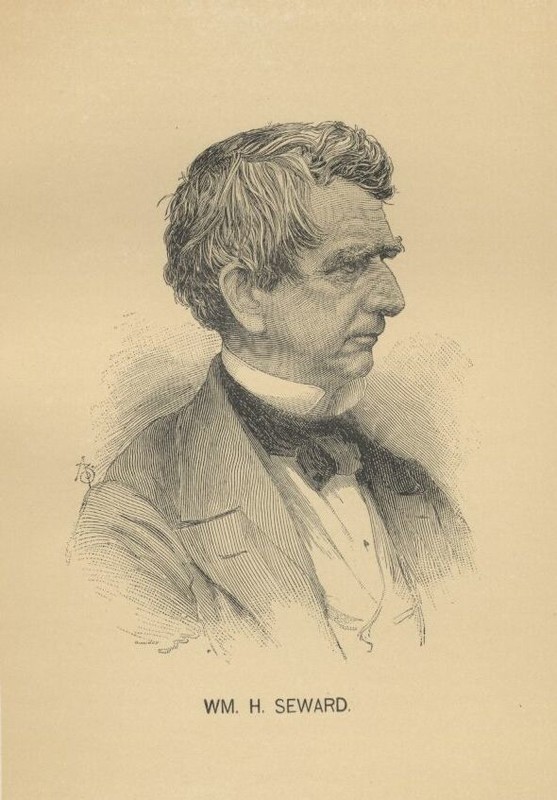
CHAPTER VII.
SECESSION ARMING.
While Congress was encouraging devotion to the Union, and its Committees striving for some mode by which the impending perils might be averted without a wholesale surrender of all just principles, the South Carolina Convention met (December 17, 1860) at Columbia, and after listening to inflammatory addresses by commissioners from the States of Alabama and Mississippi, urging immediate and unconditional Secession, unanimously and with "tremendous cheering" adopted a resolution: "That it is the opinion of the Convention that the State of South Carolina should forthwith Secede from the Federal Union, known as the United States of America,"—and then adjourned to meet at Charleston, South Carolina.
The next day, and following days, it met there, at "Secession Hall," listening to stimulating addresses, while a committee of seven worked upon the Ordinance of Secession. Among the statements made by orators, were several clear admissions that the rebellious Conspiracy had existed for very many years, and that Mr. Lincoln's election was simply the long-sought-for pretext for Rebellion. Mr. Parker said: "It is no spasmodic effort that has come suddenly upon us; it has been gradually culminating for a long period of thirty years. At last it has come to that point where we may say, the matter is entirely right." Mr. Inglis said: "Most of us have had this matter under consideration for the last twenty years; and I presume that we have by this time arrived at a decision upon the subject." Mr. Keitt said: "I have been engaged in this movement ever since I entered political life; * * * we have carried the body of this Union to its last resting place, and now we will drop the flag over its grave." Mr. Barnwell Rhett said: "The Secession of South Carolina is not an event of a day. It is not anything produced by Mr. Lincoln's election, or by the non-execution of the Fugitive Slave Law. It has been a matter which has been gathering head for thirty years." Mr. Gregg said: "If we undertake to set forth all the causes, do we not dishonor the memory of all the statesmen of South Carolina, now departed, who commenced forty years ago a war against the tariff and against internal improvement, saying nothing of the United States Bank, and other measures which may now be regarded as obsolete."
On the 20th of December, 1860—the fourth day of the sittings—the Ordinance of Secession was reported by the Committee, and was at once unanimously passed, as also was a resolution that "the passage of the Ordinance be proclaimed by the firing of artillery and ringing of the bells of the city, and such other demonstrations as the people may deem appropriate on the passage of the great Act of Deliverance and Liberty;" after which the Convention jubilantly adjourned to meet, and ratify, that evening. At the evening session of this memorable Convention, the Governor and Legislature attending, the famous Ordinance was read as engrossed, signed by all the delegates, and, after announcement by the President that "the State of South Carolina is now and henceforth a Free and Independent Commonwealth;" amid tremendous cheering, the Convention adjourned. This, the first Ordinance of Secession passed by any of the Revolting States, was in these words:
"An Ordinance to dissolve the Union between the State of South Carolina and other States united with her, under the compact entitled the 'Constitution of the United States of America.'
"We the people of the State of South Carolina in Convention assembled, do declare and ordain, and it is hereby declared and ordained, that the Ordinance adopted by us in Convention on the 23rd day of May, in the year of our Lord 1788, whereby the Constitution of the United States of America was ratified, and also all Acts and parts of Acts of the General Assembly of this State ratifying the amendments of the said Constitution, are hereby repealed; and that the Union now subsisting between South Carolina and other States, under the name of the United States of America, is hereby dissolved."
Thus, and in these words, was joyously adopted and ratified, that solemn Act of Separation which was doomed to draw in its fateful train so many other Southern States, in the end only to be blotted out with the blood of hundreds of thousands of their own brave sons, and their equally courageous Northern brothers.
State after State followed South Carolina in the mad course of Secession from the Union. Mississippi passed a Secession Ordinance, January 9, 1861. Florida followed, January 10th; Alabama, January 11th; Georgia, January 18th; Louisiana, January 26th; and Texas, February 1st; Arkansas, North Carolina, and Virginia held back until a later period; while Kentucky, Tennessee, Missouri, Maryland, and Delaware, abstained altogether from taking the fatal step, despite all attempts to bring them to it.
In the meantime, however, South Carolina had put on all the dignity of a Sovereign and Independent State. Her Governor had a "cabinet" comprising Secretaries of State, War, Treasury, the Interior, and a Postmaster General. She had appointed Commissioners, to proceed to the other Slave-holding States, through whom a Southern Congress was proposed, to meet at Montgomery, Alabama; and had appointed seven delegates to meet the delegates from such other States in that proposed Southern Congress. On the 21st of December, 1860, three Commissioners (Messrs. Barnwell, Adams, and Orr) were also appointed to proceed to Washington, and treat for the cession by the United States to South Carolina, of all Federal property within the limits of the latter. On the 24th, Governor Pickens issued a Proclamation announcing the adoption of the Ordinance of Secession, declaring "that the State of South Carolina is, as she has a right to be, a separate sovereign, free and independent State, and as such, has a right to levy war, conclude peace, negotiate treaties, leagues or covenants, and to do all acts whatsoever that rightfully appertain to a free and independent State;" the which proclamation was announced as "Done in the eighty-fifth year of the Sovereignty and Independence of South Carolina." On the same day (the Senators from that State in the United States Senate having long since, as we have seen, withdrawn from that body) the Representatives of South Carolina in the United States House of Representatives withdrew.
Serious dissensions in the Cabinet of President Buchanan, were now rapidly disintegrating the "official family" of the President. Lewis Cass, the Secretary of State, disgusted with the President's cowardice and weakness, and declining to be held responsible for Mr. Buchanan's promise not to reinforce the garrisons of the National Forts, under Major Anderson, in Charleston harbor, retired from the Cabinet December 12th—Howell Cobb having already, "because his duty to Georgia required it," resigned the Secretaryship of the Treasury, and left it bankrupt and the credit of the Nation almost utterly destroyed.
On the 26th of December, Major Anderson evacuated Fort Moultrie, removing all his troops and munitions of war to Fort Sumter—whereupon a cry went up from Charleston that this was in violation of the President's promise to take no step looking to hostilities, provided the Secessionists committed no overt act of Rebellion, up to the close of his fast expiring Administration. On the 29th, John B. Floyd, Secretary of War, having failed to secure the consent of the Administration to an entire withdrawal of the Federal garrison from the harbor of Charleston, also resigned, and the next day—he having in the meantime escaped in safety to Virginia—was indicted by the Grand Jury at Washington, for malfeasance and conspiracy to defraud the Government in the theft of $870,000 of Indian Trust Bonds from the Interior Department, and the substitution therefor of Floyd's acceptances of worthless army-transportation drafts on the Treasury Department.
Jacob Thompson, Secretary of the Interior, also resigned, January 8th, 1861, on the pretext that "additional troops, he had heard, have been ordered to Charleston" in the "Star of the West."—[McPherson's History of the Rebellion, p. 28.]
Several changes were thus necessitated in Mr. Buchanan's cabinet, by these and other resignations, so that by the 18th of January, 1861, Jeremiah S. Black was Secretary of State; General John A. Dix, Secretary of the Treasury; Joseph Holt, Secretary of War; Edwin M. Stanton, Attorney General; and Horatio King, Postmaster General. But before leaving the Cabinet, the conspiring Southern members of it, and their friends, had managed to hamstring the National Government, by scattering the Navy in other quarters of the World; by sending the few troops of the United States to remote points; by robbing the arsenals in the Northern States of arms and munitions of war, so as to abundantly supply the Southern States at the critical moment; by bankrupting the Treasury and shattering the public credit of the Nation; and by other means no less nefarious. Thus swindled, betrayed, and ruined, by its degenerate and perfidious sons, the imbecile Administration stood with dejected mien and folded hands helplessly awaiting the coming catastrophe.
On December 28th, 1860, the three Commissioners of South Carolina having reached Washington, addressed to the President a communication, in which—after reciting their powers and duties, under the Ordinance of Secession, and stating that they had hoped to have been ready to proceed to negotiate amicably and without "hostile collision," but that "the events—[The removal, to Fort Sumter, of Major Anderson's command, and what followed.]—of the last twenty-four hours render such an assurance impossible"—they declared that the troops must be withdrawn from Charleston harbor, as "they are a standing menace which render negotiation impossible," threatening speedily to bring the questions involved, to "a bloody issue."
To this communication Mr. Buchanan replied at considerable length, December 30th, in an apologetic, self-defensive strain, declaring that the removal by Major Anderson of the Federal troops under his command, from Fort Moultrie to Fort Sumter was done "upon his own responsibility, and without authority," and that he (the President) "had intended to command him to return to his former position," but that events had so rapidly transpired as to preclude the giving of any such command;
[The seizure by the Secessionists, under the Palmetto Flag, of Castle Pinckney and Fort Moultrie; the simultaneous raising of that flag over the Federal Custom House and Post Office at Charleston; the resignation of the Federal Collector, Naval Officer and Surveyor of that Port—all of which occurred December 27th; and the seizure "by force of arms," December 30th, of the United States Arsenal at that point.]
and concluding, with a very slight stiffening of backbone, by saying: "After this information, I have only to add that, whilst it is my duty to defend Fort Sumter as a portion of the public property of the United States against hostile attacks, from whatever quarter they may come, by such means as I may possess for this purpose, I do not perceive how such a defense can be construed into a menace against the city of Charleston." To this reply of the President, the Commissioners made rejoinder on the 1st of January, 1861; but the President "declined to receive" the communication.
From this time on, until the end of President Buchanan's term of office, and the inauguration of Mr. Lincoln as President, March 4th, 1861, events crowded each other so hurriedly, that the flames of Rebellion in the South were continually fanned, while the public mind in the North was staggered and bewildered, by them.
On January 2nd, prior to the Secession of Georgia, Forts Pulaski and Jackson, commanding Savannah, and the Federal Arsenal at Augusta, Georgia, with two 12 pound howitzers, two cannon, 22,000 muskets and rifles, and ammunition in quantity, were seized by Rebel militia. About the same date, although North Carolina had not seceded, her Governor (Ellis) seized the Federal Arsenal at Fayetteville, Fort Macon, and other fortifications in that State, "to preserve them" from mob-seizure.
January 4th, anticipating Secession, Alabama State troops seized Fort Morgan, with 5,000 shot and shell, and Mount Vernon Arsenal at Mobile, with 2,000 stand of arms, 150, 000 pounds of powder, some pieces of cannon, and a large quantity of other munitions of war. The United States Revenue cutter, "Lewis Cass," was also surrendered to Alabama.
On the 5th, the Federal steamer "Star of the West," with reinforcements and supplies for Fort Sumter, left New York in the night—and Secretary Jacob Thompson notified the South Carolina Rebels of the fact.
On the 9th, the "Star of the West" appeared off Charleston bar, and while steaming toward Fort Sumter, was fired upon by Rebel batteries at Fort Moultrie and Morris Island, and struck by a shot, whereupon she returned to New York without accomplishing her mission. That day the State of Mississippi seceded from the Union.
On the 10th, the Federal storeship "Texas," with Federal guns and stores, was seized by Texans. On the same day Florida seceded.
On the 11th, Forts Jackson and St. Philip, commanding the mouth of the Mississippi River, and Fort Pike, dominating Lake Pontchartrain, were seized by Louisiana troops; also the Federal Arsenal at Baton Rouge, with 50,000 small arms, 4 howitzers, 20 heavy pieces of ordnance, 2 batteries, 300 barrels of powder, and other stores. The State of Alabama also seceded the same day.
On the 12th—Fort Marion, the coast surveying schooner "Dana," the Arsenal at St. Augustine, and that on the Chattahoochee, with 500,000 musket cartridges, 300,000 rifle cartridges and 50,000 pounds of powder, having previously been seized—Forts Barrancas and McRae, and the Navy Yard at Pensacola, were taken by Rebel troops of Florida, Alabama and Mississippi. On the same day, Colonel Hayne, of South Carolina, arrived at Washington as Agent or Commissioner to the National Government from Governor Pickens of that State.
On the 14th, the South Carolina Legislature resolved "that any attempt by the Federal Government to reinforce Fort Sumter will be regarded as an act of open hostility, and a Declaration of War."
On the 16th, Colonel Hayne, of South Carolina, developed his mission, which was to demand of the President the surrender of Fort Sumter to the South Carolina authorities—a demand that had already been made upon, and refused by, Major Anderson.
The correspondence concerning this demand, between Colonel Hayne and ten Southern United States Senators;—[Senators Wigfall, Hemphill, Yulee, Mallory, Jeff. Davis, C. C. Clay, Fitzgerald, Iverson, Slidell, and Benjamin.]—the reply of the President, by Secretary Holt, to those Senators; Governor Pickens's review of the same; and the final demand; consumed the balance of the month of January; and ended, February 6th, in a further reply, through the Secretary of War, from the President, asserting the title of the United States to that Fort, and declining the demand, as "he has no Constitutional power to cede or surrender it." Secretary Holt's letter concluded by saying: "If, with all the multiplied proofs which exist of the President's anxiety for Peace, and of the earnestness with which he has pursued it, the authorities of that State shall assault Fort Sumter, and peril the lives of the handful of brave and loyal men shut up within its walls, and thus plunge our Common Country into the horrors of Civil War, then upon them and those they represent, must rest the responsibility."
But to return from this momentary diversion: On the 18th of January, Georgia seceded; and on the 20th, the Federal Fort at Ship Island, Mississippi, and the United States Hospital on the Mississippi River were seized by Mississippi troops.
On the 26th, Louisiana seceded. On the 28th, Louisiana troops seized all the quartermaster's and commissary stores held by Federal officials; and the United States Revenue cutter "McClelland" surrendered to the Rebels.
On February 1st, the Louisiana Rebels seized the National Mint and Custom House at New Orleans, with $599,303 in gold and silver. On the same day the State of Texas seceded.
On February 8th, the National Arsenal at Little Rock, Arkansas, with 9,000 small arms, 40 cannon, and quantities of ammunition, was seized; and the same day the Governor of Georgia ordered the National Collector of the Port of Savannah to retain all collections and make no further payments to the United States Government.*
[It was during this eventful month that, certain United States troops having assembled at the National Capital, and the House of Representatives having asked the reason therefor, reply was made by the Secretary of War as follows:
"WAR DEPARTMENT, February 18, 1861. [Congressional Globe, August 8, 1861, pp. 457,458] "SIR: On the 11th February, the House of Representatives adopted a resolution requesting the President, if not incompatible with the public interests, to communicate 'the reasons that had induced him to assemble so large a number of troops in this city, and why they are kept here; and whether he has any information of a Conspiracy upon the part of any portion of the citizens of this Country to seize upon the Capital and prevent the Inauguration of the President elect.'
"This resolution having been submitted to this Department for consideration and report, I have the honor to state, that the body of troops temporarily transferred to this city is not as large as is assumed by the resolution, though it is a well-appointed corps and admirably adapted for the preservation of the public peace. The reasons which led to their being assembled here will now be briefly stated.
"I shall make no comment upon the origin of the Revolution which, for the last three months, has been in progress in several of the Southern States, nor shall I enumerate the causes which have hastened its advancement or exasperated its temper. The scope of the questions submitted by the House will be sufficiently met by dealing with the facts as they exist, irrespective of the cause from which they have proceeded. That Revolution has been distinguished by a boldness and completeness of success rarely equaled in the history of Civil Commotions. Its overthrow of the Federal authority has not only been sudden and wide-spread, but has been marked by excesses which have alarmed all and been sources of profound humiliation to a large portion of the American People. Its history is a history of surprises and treacheries and ruthless spoliations. The Forts of the United States have been captured and garrisoned, and hostile flags unfurled upon their ramparts. Its arsenals have been seized, and the vast amount of public arms they contained appropriated to the use of the captors; while more than half a million dollars, found in the Mint at New Orleans, has been unscrupulously applied to replenish the coffers of Louisiana. Officers in command of revenue cutters of the United States have been prevailed on to violate their trusts and surrender the property in their charge; and instead of being branded for their crimes, they, and the vessels they betrayed, have been cordially received into the service of the Seceded States. These movements were attended by yet more discouraging indications of immorality. It was generally believed that this Revolution was guided and urged on by men occupying the highest positions in the public service, and who, with the responsibilities of an oath to support the Constitution still resting upon their consciences, did not hesitate secretly to plan and openly to labor for, the dismemberment of the Republic whose honors they enjoyed and upon whose Treasury they were living. As examples of evil are always more potent than those of good, this spectacle of demoralization on the part of States and statesmen could not fail to produce the most deplorable consequences. The discontented and the disloyal everywhere took courage. In other States, adjacent to and supposed to sympathize in sense of political wrong with those referred to, Revolutionary schemes were set on foot, and Forts and arms of the United States seized. The unchecked prevalence of the Revolution, and the intoxication which its triumphs inspired, naturally suggested wilder and yet more desperate enterprises than the conquest of ungarrisoned Forts, or the plunder of an unguarded Mint. At what time the armed occupation of Washington City became a part of the Revolutionary Programme, is not certainly known. More than six weeks ago, the impression had already extensively obtained that a Conspiracy for the accomplishment of this guilty purpose was in process of formation, if not fully matured. The earnest endeavors made by men known to be devoted to the Revolution, to hurry Virginia and Maryland out of the Union, were regarded as preparatory steps for the subjugation of Washington. This plan was in entire harmony with the aim and spirit of those seeking the subversion of the Government, since no more fatal blow at its existence could be struck than the permanent and hostile possession of the seat of its power. It was in harmony, too, with the avowed designs of the Revolutionists, which looked to the formation of a Confederacy of all the Slave States, and necessarily to the Conquest of the Capital within their limits. It seemed not very indistinctly prefigured in a Proclamation made upon the floor of the Senate, without qualification, if not exultingly, that the Union was already dissolved—a Proclamation which, however intended, was certainly calculated to invite, on the part of men of desperate fortunes or of Revolutionary States, a raid upon the Capital. In view of the violence and turbulent disorders already exhibited in the South, the public mind could not reject such a scheme as at all improbable. That a belief in its existence was entertained by multitudes, there can be no doubt, and this belief I fully shared. My conviction rested not only on the facts already alluded to, but upon information, some of which was of a most conclusive character, that reached the Government from many parts of the Country, not merely expressing the prevalence of the opinion that such an organization had been formed, but also often furnishing the plausible grounds on which the opinion was based. Superadded to these proofs, were the oft-repeated declarations of men in high political positions here, and who were known to have intimate affiliations with the Revolution—if indeed they did not hold its reins in their hands—to the effect that Mr. Lincoln would not, or should not be inaugurated at Washington. Such declarations, from such men, could not be treated as empty bluster. They were the solemn utterances of those who well understood the import of their words, and who, in the exultation of the temporary victories gained over their Country's flag in the South, felt assured that events would soon give them the power to verify their predictions. Simultaneously with these prophetic warnings, a Southern journal of large circulation and influence, and which is published near the city of Washington, advocated its seizure as a possible political necessity.
"The nature and power of the testimony thus accumulated may be best estimated by the effect produced upon the popular mind. Apprehensions for the safety of the Capital were communicated from points near and remote, by men unquestionably reliable and loyal. The resident population became disquieted, and the repose of many families in the city was known to be disturbed by painful anxieties. Members of Congress, too—men of calm and comprehensive views, and of undoubted fidelity to their Country—frankly expressed their solicitude to the President and to this Department, and formally insisted that the defenses of the Capital should be strengthened. With such warnings, it could not be forgotten that, had the late Secretary of War heeded the anonymous letter which he received, the tragedy at Harper's Ferry would have been avoided; nor could I fail to remember that, had the early admonitions which reached here in regard to the designs of lawless men upon the Forts of Charleston Harbor been acted on by sending forward adequate reinforcements before the Revolution began, the disastrous political complications that ensued might not have occurred.
"Impressed by these circumstances and considerations, I earnestly besought you to allow the concentration, at this city, of a sufficient military force to preserve the public peace from all the dangers that seemed to threaten it. An open manifestation, on the part of the Administration, of a determination, as well as of the ability, to maintain the laws, would, I was convinced, prove the surest, as also the most pacific, means of baffling and dissolving any Conspiracy that might have been organized. It was believed too that the highest and most solemn responsibility resting upon a President withdrawing from the Government, was to secure to his successor a peaceful Inauguration. So deeply, in my judgment, did this duty concern the whole Country and the fair fame of our Institutions, that, to guarantee its faithful discharge, I was persuaded no preparation could be too determined or too complete. The presence of the troops alluded to in the resolution is the result of the conclusion arrived at by yourself and Cabinet, on the proposition submitted to you by this Department. Already this display of life and loyalty on the part of your Administration, has produced the happiest effects. Public confidence has been restored, and the feverish apprehension which it was so mortifying to contemplate has been banished. Whatever may have been the machinations of deluded, lawless men, the execution of their purpose has been suspended, if not altogether abandoned in view of preparations which announce more impressively than words that this Administration is alike able and resolved to transfer in peace, to the President elect, the authority that, under the Constitution, belongs to him. To those, if such there be, who desire the destruction of the Republic, the presence of these troops is necessarily offensive; but those who sincerely love our Institutions cannot fail to rejoice that, by this timely precaution they have possibly escaped the deep dishonor which they must have suffered had the Capital, like the Forts and Arsenals of the South, fallen into the hands of the Revolutionists, who have found this great Government weak only because, in the exhaustless beneficence of its spirit, it has refused to strike, even in its own defense, lest it should wound the aggressor.
"I have the honor to be, very respectfully, your obedient servant,
"J. HOLT. "Secretary of War,
"THE PRESIDENT."]
On February 20th, Forts Chadbourne and Belknap were seized by the Texan Rebels; and on the 22nd, the Federal General Twiggs basely surrendered to them all the fortifications under his control, his little Army, and all the Government stores in his possession—comprising $55,000 in specie, 35,000 stand of arms, 26 pieces of mounted artillery, 44 dismounted guns, and ammunition, horses, wagons, forage, etc., valued at nearly $2,000,000.
On the 2nd of March, the Texan Rebels seized the United States Revenue cutter "Dodge" at Galveston; and on the 6th, Fort Brown was surrendered to them.
Thus, with surrender after surrender, and seizure after seizure, of its revenue vessels and fortifications and troops and arms and munitions of war in the Southern States—with Fort Sumter invested and at the mercy of any attack, and Fortress Monroe alone of all the National strongholds yet safe—with State after State seceding—what wonder that, while these events gave all encouragement to the Southern Rebels, the Patriots of the North stood aghast at the appalling spectacle of a crumbling and dissolving Union!
During this period of National peril, the debates in both branches of Congress upon propositions for adjustment of the unfortunate differences between the Southern Seceders and the Union, as has been already hinted, contributed still further to agitate the public mind. Speech after speech by the ablest and most brilliant Americans in public life, for or against such propositions, and discussing the rightfulness or wrongfulness of Secession, were made in Congress day after day, and, by means of the telegraph and the press, alternately swayed the Northern heart with feelings of hope, chagrin, elation or despair.
The Great Debate was opened in the Senate on almost the very first day of its session (December 4th, 1860), by Mr. Clingman, of North Carolina, who, referring to South Carolina, declared that "Instead of being precipitate, she and the whole South have been wonderfully patient." A portion of that speech is interesting even at this time, as showing how certain phases of the Tariff and Internal Improvement questions entered into the consideration of some of the Southern Secession leaders. Said he, "I know there are intimations that suffering will fall upon us of the South, if we secede. My people are not terrified by any such considerations. * * * They have no fears of the future if driven to rely on themselves. The Southern States have more territory than all the Colonies had when they Seceded from Great Britain, and a better territory. Taking its position, climate, and fertility into consideration, there is not upon Earth a body of territory superior to it. * * * The Southern States have, too, at this day, four times the population the Colonies had when they Seceded from Great Britain. Their exports to the North and to Foreign Countries were, last year, more than $300,000,000; and a duty of ten per cent. upon the same amount of imports would give $30,000,000 of revenue—twice as much as General Jackson's administration spent in its first year. Everybody can see, too, how the bringing in of $300,000,000 of imports into Southern ports would enliven business in our seaboard towns. I have seen with some satisfaction, also, Mr. President, that the war made upon us has benefitted certain branches of industry in my State. There are manufacturing establishments in North Carolina, the proprietors of which tell me that they are making fifty per cent. annually on their whole capital, and yet cannot supply one tenth of the demand for their production. The result of only ten per cent. duties in excluding products from abroad, would give life and impetus to mechanical and manufacturing industry, throughout the entire South. Our people understand these things, and they are not afraid of results, if forced to declare Independence. Indeed I do not see why Northern Republicans should wish to continue a connection with us upon any terms. * * * They want High Tariff likewise. They may put on five hundred per cent. if they choose, upon their own imports, and nobody on our side will complain. They may spend all the money they raise on railroads, or opening harbors, or anything on earth they desire, without interference from us; and it does seem to me that if they are sincere in their views they ought to welcome a separation."
From the very commencement of this long three-months debate, it was the policy of the Southern leaders to make it appear that the Southern States were in an attitude of injured innocence and defensiveness against Northern aggression. Hence, it was that, as early as December 5th, on the floor of the Senate, through Mr. Brown, of Mississippi, they declared: "All we ask is to be allowed to depart in Peace. Submit we will not; and if, because we will not submit to your domination, you choose to make War upon us, let God defend the Right!"
At the same time it was esteemed necessary to try and frighten the North into acquiescence with this demand to be "let alone." Hence such utterances as those of Clingman and Iverson, to which reference has already been made, and the especially defiant close of the latter's speech, when—replying to the temperate but firm Union utterances of Mr. Hale—the Georgia Senator said: "Sir, I do not believe there will be any War; but if War is to come, let it come; we will meet the Senator from New Hampshire and all the myrmidons of Abolitionism and Black Republicanism everywhere upon our own soil; and, in the language of a distinguished member from Ohio in relation to the Mexican War, we will 'welcome you with bloody hands to hospitable graves.'"
On the other hand, in order to encourage the revolting States to the speedy commission of overt acts of Rebellion and violence, that would precipitate War without a peradventure, utterances fell from Southern lips, in the National Senate Chamber, like those of Mr. Wigfall, when he said, during this first day of the debate: "Frederick the Great, on one occasion, when he had trumped up an old title to some of the adjacent territory, quietly put himself in possession and then offered to treat. Were I a South Carolinian, as I am a Texan, and I knew that my State was going out of the Union, and that this Government would attempt to use force, I would, at the first moment that that fact became manifest, seize upon the Forts and the arms and the munitions of war, and raise the cry 'To your tents, O Israel, and to the God of battles be this issue!"
And, as we have already seen, the Rebels of the South were not slow in following the baleful advice to the letter. But it was not many days after this utterance when the Conspirators against the Union evidently began to fear that the ground for Rebellion, upon which they had planted themselves, would be taken from under their feet by the impulse of Compromise and Concession which stirred so strongly the fraternal spirit of the North. That peaceful impulse must be checked and exasperated by sneers and impossible demands. Hence, on December 12th we find one of the most active and favorite mouthpieces of Treason, Mr. Wigfall, putting forth such demands, in his most offensive manner.
Said he: "If the two Senators from New York (Seward and King), the Senator from Ohio (Wade), the two Senators from Illinois (Douglas and Trumbull), the Senator from New Hampshire (Hale), the Senator from Maine, and others who are regarded as representative men, who have denied that by the Constitution of the United States, Slaves are recognized as Property; who have urged and advocated those acts which we regard as aggressive on the part of the People—if they will rise here, and say in their places, that they desire to propose amendments to the Constitution, and beg that we will vote for them; that they will, in good faith, go to their respective constituencies and urge the ratification; that they believe, if these Gulf States will suspend their action, that those amendments will be ratified and carried out in good faith; that they will cease preaching this 'irrepressible conflict'; and if, in those amendments, it is declared that Slaves are Property, that they shall be delivered up upon demand; and that they will assure us that Abolition societies shall be abolished; that Abolition speeches shall no longer be made; that we shall have peace and quiet; that we shall not be called cut-throats and pirates and murderers; that our women shall not be slandered—these things being said in good faith, the Senators begging that we will stay our hand until an honest effort can be made, I believe that there is a prospect of giving them a fair consideration!"
Small wonder is it, that this labored and ridiculous piece of impertinence was received with ironical laughter on the Republican side of the Senate Chamber. And it was in reference to these threats, and these preposterous demands—including the suppression of the right of Free Discussion and Liberty of the Press—that, in the same chamber (January 7, 1861) the gallant and eloquent Baker said:
"Your Fathers had fought for that right, and more than that, they had declared that the violation of that right was one of the great causes which impelled them to the Separation. * * * Sir, the Liberty of the Press is the highest safeguard to all Free Government. Ours could not exist without it. It is with us, nay, with all men, like a great exulting and abounding river, It is fed by the dews of Heaven, which distil their sweetest drops to form it. It gushes from the rill, as it breaks from the deep caverns of the Earth. It is fed by a thousand affluents, that dash from the mountaintop to separate again into a thousand bounteous and irrigating rills around. On its broad bosom it bears a thousand barks. There, Genius spreads its purpling sail. There, Poetry dips its silver oar. There, Art, Invention, Discovery, Science, Morality, Religion, may safely and securely float. It wanders through every land. It is a genial, cordial source of thought and inspiration, wherever it touches, whatever it surrounds. Sir, upon its borders, there grows every flower of Grace and every fruit of Truth. I am not here to deny that that Stream sometimes becomes a dangerous Torrent, and destroys towns and cities upon its bank; but I am here to say that without it, Civilization, Humanity, Government, all that makes Society itself, would disappear, and the World would return to its ancient Barbarism.
"Sir, if that were to be possible, or so thought for a moment, the fine conception of the great Poet would be realized. If that were to be possible, though but for a moment, Civilization itself would roll the wheels of its car backward for two thousand years. Sir, if that were so, it would be true that:
'As one by one in dread Medea's train,
Star after Star fades off th' ethereal plain,
Thus at her fell approach and secret might,
Art after art goes out, and all is night.
Philosophy, that leaned on Heaven before,
Sinks to her second cause, and is no more.
Religion, blushing, veils her sacred fires,
And, unawares, Morality expires.'
"Sir, we will not risk these consequences, even for Slavery; we will not risk these consequences even for Union; we will not risk these consequences to avoid that Civil War with which you threaten us; that War which, you announce so deadly, and which you declare to be inevitable. * * * I will never yield to the idea that the great Government of this Country shall protect Slavery in any Territory now ours, or hereafter to be acquired. It is, in my opinion, a great principle of Free Government, not, to be surrendered.
"It is in my judgment, the object of the great battle which we have fought, and which we have won. It is, in my poor opinion, the point upon which there is concord and agreement between the great masses of the North, who may agree in no other political opinion whatever. Be he Republican, or Democrat, or Douglas man, or Lincoln man; be he from the North, or the West, from Oregon, or from Maine, in my judgment nine-tenths of the entire population of the North and West are devoted, in the very depths of their hearts, to the great Constitutional idea that Freedom is the rule, that Slavery is the exception, that it ought not to be extended by virtue of the powers of the Government of the United States; and, come weal, come woe, it never shall be.
"But, sir, I add one other thing. When you talk to me about Compromise or Concession, I am not sure that I always understand you. Do you mean that I am to give up my convictions of right? Armies cannot compel that in the breast of a Free People. Do you mean that I am to concede the benefits of the political struggle through which we have passed, considered politically, only? You are too just and too generous to ask that. Do you mean that we are to deny the great principle upon which our political action has been based? You know we cannot. But if you mean by Compromise and Concession to ask us to see whether we have not been hasty, angry, passionate, excited, and in many respects violated your feelings, your character, your right of property, we will look; and, as I said yesterday, if we have, we will undo it. Allow me to say again, if there be any lawyer or any Court that will advise us that our laws are unconstitutional, we will repeal them.
"Now as to territory. I will not yield one inch to Secession; but there are things that I will yield, and there are things to which I will yield. It is somewhere told that when Harold of England received a messenger from a brother with whom he was at variance, to inquire on what terms reconciliation and peace could be effected between brothers, he replied in a gallant and generous spirit in a few words, 'the terms I offer are the affection of a brother; and the Earldom of Northumberland.' And, said the Envoy, as he marched up the Hall amid the warriors that graced the state of the King, 'if Tosti, thy brother, agree to this, what terms will you allow to his ally and friend, Hadrada, the giant.' 'We will allow,' said Harold, 'to Hadrada, the giant, seven feet of English ground, and if he be, as they say, a giant, some few inches more!' and, as he spake, the Hall rang with acclamation.
"Sir, in that spirit I speak. I follow, at a humble distance, the ideas and the words of Clay, illustrious, to be venerated, and honored, and remembered, forever. * * * He said—I say: that I will yield no inch, no word, to the threat of Secession, unconstitutional, revolutionary, dangerous, unwise, at variance with the heart and the hope of all mankind save themselves. To that I yield nothing; but if States loyal to the Constitution, if people magnanimous and just, desiring a return of fraternal feeling, shall come to us and ask for Peace, for permanent, enduring peace and affection, and say, 'What will you grant? I say to them, 'Ask all that a gentleman ought to propose, and I will yield all that a gentleman ought to offer.' Nay, more: if you are galled because we claim the right to prohibit Slavery in territory now Free, or in any Territory which acknowledges our jurisdiction, we will evade—I speak but for myself—I will aid in evading that question; I will agree to make it all States, and let the People decide at once. I will agree to place them in that condition where the prohibition of Slavery will never be necessary to justify ourselves to our consciences or to our constituents. I will agree to anything which is not to force upon me the necessity of protecting Slavery in the name of Freedom. To that I never can and never will yield."
The speeches of Seward, of Douglas, of Crittenden, of Andrew Johnson, of Baker, and others, in behalf of the Union, and those of Benjamin, Davis, Wigfall, Lane, and others, in behalf of Secession, did much toward fixing the responsibility for the approaching bloody conflict where it belonged. The speeches of Andrew Johnson of Tennessee—who, if he at a subsequent period of the Nation's history, proved himself not the worthiest son of the Republic, at this critical time, at all events, did grand service in the National Senate—especially had great and good effect on the public mind in the Northern and Border States. They were, therefore, gall and wormwood to the Secession leaders, who hoped to drag the Border States into the great Southern Confederacy of States already in process of formation.
Their irritation was shown in threats of personal violence to Mr. Johnson, as when Wigfall—replying February 7th, 1861, to the latter's speech, said, "Now if the Senator wishes to denounce Secession and Nullification eo nomine, let him go back and denounce Jefferson; let him denounce Jackson, if he dare, and go back and look that Tennessee Democracy in the face, and see whether they will content themselves with riddling his effigy!"
It would seem also, from another part of Wigfall's reply, that the speeches of Union Senators had been so effective that a necessity was felt on the part of the Southern Conspirators to still further attempt to justify Secession by shifting the blame to Northern shoulders, for, while referring to the Presidential canvass of 1860—and the attitude of the Southern Secession leaders during that exciting period—he said: "We (Breckinridge-Democrats) gave notice, both North and South, that if Abraham Lincoln was elected, this Union was dissolved. I never made a speech during the canvass without asserting that fact. * * * Then, I say, that our purpose was not to dissolve the Union; but the dire necessity has been put upon us. The question is, whether we shall live longer in a Union in which a Party, hostile to us in every respect, has the power in Congress, in the Executive department, and in the Electoral Colleges—a Party who will have the power even in the Judiciary. We think it is not safe. We say that each State has the clear indisputable right to withdraw if she sees fit; and six of the States have already withdrawn, and one other State is upon the eve of withdrawing, if she has not already done so. How far this will spread no man can tell!"
As tending to show the peculiar mixture of brag, cajolery, and threats, involved in the attitude of the South, as expressed by the same favorite Southern mouthpiece, toward the Border-States on the one hand, and the Middle and New England States on the other, a further extract from this (February 7th) speech of the Texan Senator may be of interest. Said he:
"With exports to the amount of hundreds of millions of dollars, our imports must be the same. With a lighter Tariff than any people ever undertook to live under, we could have larger revenue. We would be able to stand Direct Taxation to a greater extent than any people ever could before, since the creation of the World. We feel perfectly competent to meet all issues that may be presented, either by hostility from abroad or treason at home. So far as the Border-States are concerned, it is a matter that concerns them alone. Should they confederate with us, beyond all doubt New England machinery will be worked with the water power of Tennessee, of Kentucky, of Virginia and of Maryland; the Tariff laws that now give New England the monopoly in the thirty-three States, will give to these Border States a monopoly in the Slave-holding States. Should the non-Slave-holding States choose to side against us in organizing their Governments, and cling to their New England brethren, the only result will be, that the meat, the horses, the hemp, and the grain, which we now buy in Pennsylvania, in Ohio, in Indiana and Illinois, will be purchased in Kentucky and in Western Virginia and in Missouri. Should Pennsylvania stand out, the only result will be, that the iron which is now dug in Pennsylvania, will be dug in the mountains of Tennessee and of Virginia and of Kentucky and of North Carolina. These things we know.
"We feel no anxiety at all, so far as money or men are concerned. We desire War with nobody; we intend to make no War; but we intend to live under just such a Government as we see fit. Six States have left this Union, and others are going to leave it simply because they choose to do it; that is all. We do not ask your consent; we do not wish it. We have revoked our ratification of the Treaty commonly known as the Constitution of the United States; a treaty for common defense and general welfare; and we shall be perfectly willing to enter into another Treaty with you, of peace and amity. Reject the olive branch and offer us the sword, and we accept it; we have not the slightest objection. Upon that subject we feel as the great William Lowndes felt upon another important subject, the Presidency, which he said was neither to be sought nor declined. When you invade our soil, look to your own borders. You say that you have too many people, too many towns, too dense a population, for us to invade you. I say to you Senators, that there is nothing that ever stops the march of an invading force, except a desert. The more populous a country, the more easy it is to subsist an army."
After declaring that—"Not only are our non-Slaveholders loyal, but even our Negroes are. We have no apprehensions whatever of insurrection—not the slightest. We can arm our negroes, and leave them at home, when we are temporarily absent"—Mr. Wigfall proceeded to say: "We may as well talk plainly about this matter. This is probably the last time I shall have an opportunity of addressing you. There is another thing that an invading army cannot do. It cannot burn up plantations. You can pull down fences, but the Negroes will put them up the next morning. The worst fuel that ever a man undertook to make fire with, is dirt; it will not burn. Now I have told you what an invading army cannot do. Suppose I reverse the picture and tell you what it can do. An invading army in an enemy's country, where there is a dense population, can subsist itself at a very little cost; it does not always pay for what it gets. An invading army can burn down towns; an invading army can burn down manufactories; and it can starve operatives. It can do all these things. But an Invading army, and an army to defend a Country, both require a military chest. You may bankrupt every man south of North Carolina, so that his credit is reduced to such a point that he could not discount a note for thirty dollars, at thirty days; but the next autumn those Cotton States will have just as much money and as much credit as they had before. They pick money off the cotton plant. Every time that a Negro touches a cotton-pod with his hand, he pulls a piece of silver out of it, and he drops it into the basket in which it is carried to the gin-house. It is carried to the packing screw. A bale of cotton rolls out—in other words, five ten-dollar pieces roll out—covered with canvas. We shall never again make less than five million bales of cotton. * * * We can produce five million bales of cotton, every bale worth fifty dollars, which is the lowest market price it has been for years past. We shall import a bale of something else, for every bale of cotton that we export, and that bale will be worth fifty dollars. We shall find no difficulty under a War-Tariff in raising an abundance of money. We have been at Peace for a very long time, We are very prosperous. Our planters use their cotton, not to buy the necessaries of life, but for the superfluities, which they can do without. The States themselves have a mine of wealth in the loyalty and the wealth of their citizens. Georgia, Mississippi, any one of those States can issue its six per cent. bonds tomorrow, and receive cotton in payment to the extent almost of the entire crop. They can first borrow from their own citizens; they can tax them to an almost unlimited extent; and they can raise revenue from a Tariff to an almost unlimited extent.
"How will it be with New England? where will their revenue come from? From your Custom-houses? what do you export? You have been telling us here for the last quarter of a century, that you cannot manufacture, even for the home market, under the Tariffs which we have given you. When this Tariff ceases to operate in your favor, and you have to pay for coming into our markets, what will you export? When your machinery ceases to move, and your operatives are turned out, will you tax your broken capitalist or your starving operative? When the navigation laws cease to operate, what will become of your shipping interest? You are going to blockade our ports, you say. That is a very innocent game; and you suppose we shall sit quietly down and submit to a blockade. I speak not of foreign interference, for we look not for it. We are just as competent to take Queen Victoria and Louis Napoleon under our protection, as they are to take us; and they are a great deal more interested to-day in receiving cotton from our ports than we are in shipping it. You may lock up every bale of cotton within the limits of the eight Cotton States, and not allow us to export one for three years, and we shall not feel it further than our military resources are concerned. Exhaust the supply of cotton in Europe for one week, and all Europe is in revolution.
"These are facts. You will blockade us! Do you suppose we shall do nothing, even upon the sea? How many letters of marque and reprisal would it take to put the whole of your ships up at your wharves to rot? Will any merchant at Havre, or Liverpool, or any other portion of the habitable globe, ship a cargo upon a New England, or New York, or Philadelphia clipper, or other ship, when he knows that the seas are swarming with letters of marque and reprisal? Why the mere apprehension of such a thing will cut you out of the Carrying Trade of the civilized World. * * * I speak not of the absurdity of the position that you can blockade our ports, admitting at the same time that we are in the Union. Blockade is a remedy, as all writers on International law say, against a Foreign Power with whom you are at War. You cannot use a blockade against your own people. An embargo even, you cannot use. That is a remedy against a Foreign Nation with whom you expect to be at War. You must treat us as in the Union, or out of it. We have gone out. We are willing to live at peace with you; but, as sure as fate, whenever any flag comes into one of our ports, that has thirty-three stars upon it, that flag will be fired at. Displaying a flag with stars which we have plucked from that bright galaxy, is an insult to the State within whose waters that flag is displayed. You cannot enforce the laws without Coercion, and you cannot Coerce without War.
"These matters, then, can be settled. How? By withdrawing your troops; admitting our right to Self-government clearly, unqualifiedly. Do this, and there is no difficulty about it. You say that you will not do it. Very well; we have no objection—none whatever. That is Coercion. When you have attempted it, you will find that you have made War. These, Senators, are facts. I come here to plead for Peace; but I have seen so much and felt so much, that I am becoming at last, to tell the plain truth of the matter, rather indifferent as to which way the thing turns. If you want War, you can have it. If you want Peace, you can get it; but I plead not for Peace."
Meanwhile the Seceding States of the South were strengthening their attitude by Confederation. On February 4, 1861, the Convention of Seceding States, called by the South Carolina Convention at the time of her Secession, met, in pursuance of that call, at Montgomery, Alabama, and on the 9th adopted a Provisional Constitution and organized a Provisional Government by the election of Jefferson Davis of Mississippi, as President, and Alexander H. Stephens of Georgia, as Vice-President; to serve until a Presidential election could be held by the people of the Confederacy.
[At a later day, March 11, 1861, a permanent Constitution for the "Confederate States" was adopted, and, in the Fall of the same year, Messrs. Davis and Stephens were elected by popular vote, for the term of six years ensuing, as President and Vice-President, respectively, of the Confederacy.]
Mr. Davis almost at once left Jackson, Mississippi, for Montgomery, where he arrived and delivered his Inaugural, February 17, having received on his road thither a succession of ovations from the enthusiastic Rebels, to which he had responded with no less than twenty-five speeches, very similar in tone to those made in the United States Senate by Mr. Wigfall and others of that ilk—breathing at once defiance and hopefulness, while admitting the difficulties in the way of the new Confederacy.
"It may be," said he, at Jackson, "that we will be confronted by War; that the attempt will be made to blockade our ports, to starve us out; but they (the Union men of the North) know little of the Southern heart, of Southern endurance. No amount of privation could force us to remain in a Union on unequal terms. England and France would not allow our great staple to be dammed up within our present limits; the starving thousands in their midst would not allow it. We have nothing to apprehend from Blockade. But if they attempt invasion by land, we must take the War out of our territory. If War must come, it must be upon Northern, and not upon Southern soil. In the meantime, if they were prepared to grant us Peace, to recognize our equality, all is well."
And, in his speech at Stevenson, Alabama, said he "Your Border States will gladly come into the Southern Confederacy within sixty days, as we will be their only friends. England will recognize us, and a glorious future is before us. The grass will grow in the Northern cities, where the pavements have been worn off by the tread of Commerce. We will carry War where it is easy to advance—where food for the sword and torch await our Armies in the densely populated cities; and though they may come and spoil our crops, we can raise them as before; while they cannot rear the cities which took years of industry and millions of money to build."
Very different in tone to these, were the kindly and sensible utterances of Mr. Lincoln on his journey from Springfield to Washington, about the same time, for Inauguration as President of the United States. Leaving Springfield, Illinois, February 11th, he had pathetically said:
"My friends: No one, not in my position, can realize the sadness I feel at this parting. To this people I owe all that I am. Here I have lived more than a quarter of a century. Here my children were born, and here one of them lies buried. I know not how soon I shall see you again. I go to assume a task more difficult than that which has devolved upon any other man since the days of Washington. He never would have succeeded except for the aid of Divine Providence, upon which he at all times relied. I feel that I cannot succeed without the same Divine blessing which sustained him; and on the same Almighty Being I place my reliance for support. And I hope you, my friends, will all pray that I may receive that Divine assistance, without which I cannot succeed, but with which success is certain. Again I bid you an affectionate farewell."
At Indianapolis, that evening, the eve of his birthday anniversary, after thanking the assembled thousands for their "magnificent welcome," and defining the words "Coercion" and "Invasion"—at that time so loosely used—he continued: "But if the United States should merely hold and retake her own Forts and other property, and collect the duties on foreign importation, or even withhold the mails from places where they were habitually violated, would any or all of these things be 'Invasion' or 'Coercion'? Do our professed lovers of the Union, who spitefully resolve that they will resist Coercion and Invasion, understand that such things as these on the part of the United States would be 'Coercion' or 'Invasion' of a State? If so, their idea of means to preserve the object of their great affection would seem to be exceedingly thin and airy."
At Columbus, Ohio, he spoke in a like calm, conservative, reasoning way —with the evident purpose of throwing oil on the troubled waters—when he said: "I have not maintained silence from any want of real anxiety. It is a good thing that there is no more than anxiety; for there is nothing going wrong. It is a consoling circumstance that, when we look out, there is nothing that really hurts anybody. We entertain different views upon political questions; but nobody is suffering anything. This is a consoling circumstance; and from it we may conclude that all we want is time, patience, and a reliance on that God who has never forsaken this People."
So, too, at Pittsburg, Pa., February 15th, he said, of "our friends," as he termed them, the Secessionists: "Take even their own views of the questions involved, and there is nothing to justify the course they are pursuing. I repeat, then, there is no crisis, except such an one as may be gotten up at any time by turbulent men, aided by designing politicians. My advice to them, under the circumstances, is to keep cool. If the great American People only keep their temper both sides of the line, the trouble will come to an end, and the question which now distracts the Country be settled, just as surely as all other difficulties, of a like character, which have been originated in this Government, have been adjusted. Let the people on both sides keep their self-possession, and, just as other clouds have cleared away in due time, so will this great Nation continue to prosper as heretofore."
And toward the end of that journey, on the 22nd of February—Washington's Birthday—in the Independence Hall at Philadelphia, after eloquently affirming his belief that "the great principle or idea that kept this Confederacy so long together was * * * that sentiment in the Declaration of Independence which gave Liberty not alone to the People of this Country, but" he hoped "to the World, for all future time * * * which gave promise that, in due time, the weight would be lifted from the shoulders of all men"—he added, in the same firm, yet temperate and reassuring vein: "Now, my friends, can this Country be saved on that basis? If it can, I will consider myself one of the happiest men in the world, if I can help to save it. If it cannot be saved on that basis, it will be truly awful. But, if this Country cannot be saved without giving up that principle, I was about to say I would rather be assassinated on this spot than surrender it. Now in my view of the present aspect of affairs, there need be no bloodshed or War. There is no necessity for it. I am not in favor of such a course; and I may say, in advance, that there will be no bloodshed, unless it be forced upon the Government, and then it will be compelled to act in self-defense. * * * I have said nothing but what I am willing to live by, and, if it be the pleasure of Almighty God, to die by."
Thus, as he progressed on that memorable journey from his home in Illinois, through Indianapolis, Cincinnati, Columbus, Pittsburgh, Cleveland, Erie, Buffalo, Albany, New York, Trenton, Newark, Philadelphia, and Harrisburg—amid the prayers and blessings and acclamations of an enthusiastic and patriotic people—he uttered words of wise conciliation and firm moderation such as beseemed the high functions and tremendous responsibilities to which the voice of that liberty—and union-loving people had called him, and this too, with a full knowledge, when he made the Philadelphia speech, that the enemies of the Republic had already planned to assassinate him before he could reach Washington.
The prudence of his immediate friends, fortunately defeated the murderous purpose—and by the simple device of taking the regular night express from Philadelphia instead of a special train next day—to Washington, he reached the National Capital without molestation early on the morning of the 23rd of February.
That morning, after Mr. Lincoln's arrival, in company with Mr. Lovejoy, the writer visited him at Willard's Hotel. During the interview both urged him to "Go right along, protect the property of the Country, and put down the Rebellion, no matter at what cost in men and money." He listened with grave attention, and said little, but very clearly indicated his approval of all the sentiments thus expressed—and then, with the same firm and manly and cheerful faith in the outcome, he added: "As the Country has placed me at the helm of the Ship, I'll try to steer her through."
The spirit in which he proposed to accomplish this superhuman task, was shown when he told the Southern people through the Civic authorities of Washington on the 27th of February—When the latter called upon him—that he had no desire or intention to interfere with any of their Constitutional rights—that they should have all their rights under the Constitution, "not grudgingly, but fully and fairly." And what was the response of the South to this generous and conciliatory message? Personal sneers—imputations of Northern cowardice—boasts of Southern prowess—scornful rejection of all compromise—and an insolent challenge to the bloody issue of arms!
Said Mr. Wigfall, in the United States Senate, on March 2d, alluding to Mr. Lincoln, "I do not think that a man who disguises himself in a soldier's cloak and a Scotch cap (a more thorough disguise could not be assumed by such a man) and makes his entry between day and day, into the Capital of the Country that he is to govern—I hardly think that he is going to look War sternly in the face.
[Had Mr. Wigfall been able at this time to look four years into the future and behold the downfall of the Southern Rebellion, the flight of its Chieftains, and the capture of Jefferson Davis while endeavoring to escape, with his body enclosed in a wrapper and a woman's shawl over his head, as stated by Lieutenant-Colonel Stuart of Jefferson Davis's Staff, p. 756, vol. ii., Greeley's American Conflict—he would hardly have retailed this slander.]
"I look for nothing else than that the Commissioners from the Confederated States will be received here and recognized by Abraham Lincoln. I will now predict that this Republican Party that is going to enforce the Laws, preserve the Union, and collect Revenue, will never attempt anything so silly; and that instead of taking Forts, the troops will be withdrawn from those which we now have. See if this does not turn out to be so, in less than a week or ten days."
In the same insulting diatribe, he said: "It is very easy for men to bluster who know there is going to be no danger. Four or five million people living in a territory that extends from North Carolina down to the Rio Grande, who have exports to above three hundred million dollars, whose ports cannot be blockaded, but who can issue letters of marque and reprisal, and sweep your commerce from the seas, and who will do it, are not going to be trifled with by that sensible Yankee nation. Mark my words. I did think, at one time, there was going to be War; I do not think so now. * * * The Star of the West swaggered into Charleston harbor, received a blow planted full in the face, and staggered out. Your flag has been insulted; redress it if you dare! You have submitted to it for two months, and you will submit to it for ever. * * * We have dissolved the Union; mend it if you can; cement it with blood; try the experiment! we do not desire War; we wish to avoid it. * * * This we say; and if you choose to settle this question by the Sword, we feel, we know, that we have the Right. We interfere with you in no way. We ask simply that you will not interfere with us. * * * You tell us you will keep us in the Union. Try the experiment!"
And then, with brutal frankness, he continued: "Now, whether what are called The Crittenden Resolutions will produce satisfaction in some of these Border States, or not, I am unaware; but I feel perfectly sure they would not be entertained upon the Gulf. As to the Resolutions which the Peace Congress has offered us, we might as well make a clean breast of it. If those Resolutions were adopted, and ratified by three fourths of the States of this Union, and no other cause ever existed, I make the assertion that the seven States now out of the Union, would go out upon that."

CHAPTER VIII.
THE REJECTED OLIVE BRANCH.
While instructive, it will also not be devoid of interest, to pause here, and examine the nature of the Crittenden Resolutions, and also the Resolutions of the Peace Congress, which, we have seen, were spurned by the Secession leaders, through their chief mouthpiece in the United States Senate.
The Crittenden Compromise Resolutions * were in these words:
"A Joint Resolution proposing certain Amendments to the Constitution of the United States:
"Whereas, serious and alarming dissensions have arisen between the Northern and the Southern States, concerning the Rights and security of the Rights of the Slaveholding States, and especially their Rights in the common territory of the United States; and whereas, it is eminently desirable and proper that these dissensions, which now threaten the very existence of this Union, should be permanently quieted and settled by Constitutional provisions which shall do equal justice to all Sections, and thereby restore to the People that peace and good-will which ought to prevail between all the citizens of the United States; Therefore:
"Resolved, by the Senate and House of Representatives of the United States of America, in Congress assembled, (two thirds of both Houses concurring), the following articles be, and are hereby proposed and submitted as amendments to the Constitution of the United States, which shall be valid to all intents and purposes, as part of said Constitution, when ratified by Conventions of three-fourths of the several States:
"Article I. In all the territory of the United States now held, or hereafter to be acquired, situate north of latitude 36 30', Slavery or involuntary servitude, except as a punishment for crime, is prohibited, while such territory shall remain under Territorial government. In all the territory south of said line of latitude, Slavery of the African race is hereby recognized as existing, and shall not be interfered with by Congress, but shall be protected as Property by all the departments of the Territorial government during its continuance. And when any Territory, north or south of said line, within such boundaries as Congress may prescribe, shall contain the population requisite for a member of Congress, according to the then Federal ratio of representation of the People of the United States, it shall, if its own form of government be republican, be admitted into the Union, on an equal footing with the original States; with or without Slavery, as the Constitution of such new State may provide.
"Article II. Congress shall have no power to abolish Slavery in places under its exclusive jurisdiction, and situate within the limits of States that permit the holding of Slaves.
"Article III. Congress shall have no power to abolish Slavery within the District of Columbia; so long as it exists in the adjoining States of Virginia and Maryland, or either, nor without the consent of the inhabitants, nor without just compensation first made to such owners of Slaves as do not consent to such abolishment. Nor shall Congress, at any time, prohibit officers of the Federal government, or members of Congress whose duties require them to be in said District, from bringing with them their Slaves, and holding them as such during the time their duties may require them to remain there, and afterward taking them from the District.
"Article IV. Congress shall have no power to prohibit or hinder the Transportation of Slaves from one State to another, or to a Territory in which Slaves are, by law, permitted to be held, whether that transportation be by land, navigable rivers, or by the sea.
"Article V. That in addition to the provisions of the third paragraph of the second section of the fourth article of the Constitution of the United States, Congress shall have power to provide by law, and it shall be its duty to provide, that the United States shall pay to the owner who shall apply for it, the full value of his Fugitive Slaves in all cases where the Marshal, or other officer whose duty it was to arrest said Fugitive, was prevented from so doing by violence or intimidation, or where, after arrest, said Fugitive was rescued by force, and the owner thereby prevented and obstructed in the pursuit of his remedy for the recovery of his Fugitive Slave under the said clause of the Constitution and the laws made in pursuance thereof.
["No Person held to Service or Labour in one State, under the Laws thereof, escaping into another, shall, in consequence of any Law or Regulation therein, be discharged from such Service or Labour, but shall be delivered up on claim of the Party to whom such Service or Labour may be due."—Art. IV., Sec. 2, P 3, U. S. Constitution.]
"And in all such cases, when the United States shall pay for such Fugitive, they shall have the Right, in their own name, to sue the county in which said violence, intimidation, or rescue, was committed, and recover from it, with interest and damages, the amount paid by them for said Fugitive Slave. And the said county, after it has paid said amount to the United States, may, for its indemnity, sue and recover from the wrong-doers or rescuers by whom the owner was prevented from the recovery of his Fugitive Slave, in like manner as the owner himself might have sued and recovered.
"Article VI. No future amendment of the Constitution shall affect the five preceding articles; nor the third paragraph of the second section of the first article of the Constitution, nor the third paragraph of the second section of the fourth article of said Constitution; and no amendment shall be made to the Constitution which shall authorize or give to Congress any power to abolish or interfere with Slavery in any of the States by whose laws it is or may be, allowed or permitted.
["Representatives and Direct Taxes shall be apportioned among the several States which may be included within this Union, according to their respective Numbers, which shall be determined by adding to the whole Number of Free Persons, including those bound to Service for a Term of Years, and excluding Indians not Taxed, three-fifths of all Other Persons," etc.—Art. 1., Sec. 2, P 3, U. S. Constitution.]
"And whereas, also, besides those causes of dissension embraced in the foregoing amendments proposed to the Constitution of the United States, there are others which come within the jurisdiction of Congress, and may be remedied by its legislative power; And whereas it is the desire of Congress, as far as its power will extend, to remove all just cause for the popular discontent and agitation which now disturb the peace of the Country and threaten the stability of its Institutions; Therefore:
"1. Resolved by the Senate and house of Representatives in Congress assembled, that the laws now in force for the recovery of Fugitive Slaves are in strict pursuance of the plain and mandatory provisions of the Constitution, and have been sanctioned as valid and Constitutional by the judgment of the Supreme Court of the United States; that the Slaveholding States are entitled to the faithful observance and execution of those laws; and that they ought not to be repealed, or so modified or changed as to impair their efficiency; and that laws ought to be made for the punishment of those who attempt, by rescue of the Slave, or other illegal means, to hinder or defeat the due execution of said laws.
"2. That all State laws which conflict with the Fugitive Slave Acts of Congress, or any other Constitutional Acts of Congress, or which, in their operation, impede, hinder, or delay, the free course and due execution of any of said Acts, are null and void by the plain provisions of the Constitution of the United States; yet those State laws, void as they are, have given color to practices, and led to consequences, which have obstructed the due administration and execution of Acts of Congress, and especially the Acts for the delivery of Fugitive Slaves; and have thereby contributed much to the discord and commotion now prevailing. Congress, therefore, in the present perilous juncture, does not deem it improper, respectfully and earnestly, to recommend the repeal of those laws to the several States which have enacted them, or such legislative corrections or explanations of them as may prevent their being used or perverted to such mischievous purposes.
"3. That the Act of the 18th of September, 1850, commonly called the Fugitive Slave Law, ought to be so amended as to make the fee of the Commissioner, mentioned in the eighth section of the Act, equal in amount in the cases decided by him, whether his decision be in favor of, or against the claimant. And, to avoid misconstruction, the last clause of the fifth section of said Act, which authorizes the person holding a warrant for the arrest or detention of a Fugitive Slave to summon to his aid the posse comitatus, and which declares it to be the duty of all good citizens to assist him in its execution, ought to be so amended as to expressly limit the authority and duty to cases in which there shall be resistance, or danger of resistance or rescue.
"4. That the laws for the suppression of the African Slave Trade, and especially those prohibiting the importation of Slaves into the United States, ought to be more effectual, and ought to be thoroughly executed; and all further enactments necessary to those ends ought to be promptly made."
The Peace Conference, or "Congress," it may here be mentioned, was called, by action of the Legislature of Virginia, to meet at Washington, February 4, 1861. The invitation was extended to all of such "States of this Confederacy * * * whether Slaveholding or Non-Slaveholding, as are willing to unite with Virginia in an earnest effort to adjust the present unhappy controversies in the spirit in which the Constitution was originally formed, and consistently with its principles, so as to afford to the people of the Slaveholding States adequate guarantees for the security of their rights"—such States to be represented by Commissioners "to consider, and, if practicable, agree upon some suitable adjustment."
The Conference, or "Congress," duly convened, at that place and time, and organized by electing ex-President John Tyler, of Virginia, its President. This Peace Congress—which comprised 133 Commissioners, representing the States of Maine, New Hampshire, Vermont, Massachusetts, Rhode Island, Connecticut, New York, New Jersey, Pennsylvania, Delaware, Maryland, Virginia, North Carolina, Tennessee, Kentucky, Missouri, Ohio, Indiana, Illinois, Iowa, Wisconsin and Kansas—remained in session until February 27, 1861—and then submitted the result of its labors to Congress, with the request that Congress "will submit it to Conventions in the States, as Article Thirteen of the Amendments to the Constitution of the United States, in the following shape:
"Section 1. In all the present territory of the United States, north of the parallel of 36 30' of north latitude, Involuntary Servitude, except in punishment of crime, is prohibited. In all the present territory south of that line, the status of Persons held to Involuntary Service or Labor, as it now exists, shall not be changed; nor shall any law be passed by Congress or the Territorial Legislature to hinder or prevent the taking of such Persons from any of the States of this Union to said Territory, nor to impair the Rights arising from said relation; but the same shall be subject to judicial cognizance in the Federal Courts, according to the course of the common law. When any Territory north or south of said line, within such boundary as Congress may prescribe, shall contain a population equal to that required for a member of Congress, it shall, if its form of government be republican, be admitted into the Union on an equal footing with the original States, with or without Involuntary Servitude, as the Constitution of such State may provide.
"Section 2. No territory shall be acquired by the United States, except by discovery and for naval and commercial stations, depots, and transit routes, without the concurrence of a majority of all the Senators from States which allow Involuntary Servitude, and a majority of all the Senators from States which prohibit that relation; nor shall Territory be acquired by treaty, unless the votes of a majority of the Senators from each class of States hereinbefore mentioned be cast as a part of the two-thirds majority necessary to the ratification of such treaty.
"Section 3. Neither the Constitution, nor any amendment thereof, shall be construed to give Congress power to regulate, abolish, or control, within any State, the relation established or recognized by the laws thereof touching Persons held to Labor or Involuntary Service therein, nor to interfere with or abolish Involuntary Service in the District of Columbia without the consent of Maryland, and without the consent of the owners, or making the owners who do not consent just compensation; nor the power to interfere with or prohibit Representatives and others from bringing with them to the District of Columbia, retaining, and taking away, Persons so held to Labor or Service; nor the power to interfere with or abolish Involuntary Service in places under the exclusive jurisdiction of the United States within those States and Territories where the same is established or recognized; nor the power to prohibit the removal or transportation of Persons held to Labor or Involuntary Service in any State or Territory of the United States to any other State or Territory thereof where it is established or recognized by law or usage; and the right during transportation, by sea or river, of touching at ports, shores, and landings, and of landing in case of distress, shall exist; but not the right of transit in or through any State or Territory, or of sale or traffic, against the laws thereof. Nor shall Congress have power to authorize any higher rate of taxation on Persons held to Labor or Service than on land. The bringing into the District of Columbia of Persons held to Labor or Service, for sale, or placing them in depots to be afterwards transferred to other places for sale as merchandize, is prohibited.
"Section 4. The third paragraph of the second section of the fourth article of the Constitution shall not be construed to prevent any of the States, by appropriate legislation, and through the action of their judicial and ministerial officers, from enforcing the delivery of Fugitives from Labor to the person to whom such Service or Labor is due.
"Section 5. The Foreign Slave Trade is hereby forever prohibited; and it shall be the duty of Congress to pass laws to prevent the importation of Slaves, Coolies, or Persons held to Service or Labor, into the United States and the Territories from places beyond the limits thereof.
"Section 6. The first, third, and fifth sections, together with this section of these amendments, and the third paragraph of the second section of the first article of the Constitution, and the third paragraph of the second section of the fourth article thereof, shall not be amended or abolished without the consent of all the States.
"Section 7. Congress shall provide by law that the United States shall pay to the owner the full value of the Fugitive from Labor, in all cases where the Marshal, or other officer, whose duty it was to arrest such Fugitive, was prevented from so doing by violence or intimidation from mobs or riotous assemblages, or when, after arrest, such Fugitive was rescued by like violence or intimidation, and the owner thereby deprived of the same; and the acceptance of such payment shall preclude the owner from further claim to such Fugitive. Congress shall provide by law for securing to the citizens of each State the privileges and immunities of citizens in the several States."
To spurn such propositions as these—with all the concessions to the Slave Power therein contained—was equivalent to spurning any and all propositions that could possibly be made; and by doing this, the Seceding States placed themselves—as they perhaps desired—in an utterly irreconcilable attitude, and hence, to a certain extent, which had not entered into their calculations, weakened their "Cause" in the eyes of many of their friends in the North, in the Border States, and in the World. They had become Implacables. Practically considered, this was their great mistake. The Crittenden Compromise Resolutions covered and yielded to the Slaveholders of the South all and even more than they had ever dared seriously to ask or hope for, and had they been open to Conciliation, they could have undoubtedly carried that measure through both Houses of Congress and three-fourths of the States.
["Its advocates, with good reason, claimed a large majority of the People in its favor, and clamored for its submission to a direct popular vote. Had such a submission been accorded, it is very likely that the greater number of those who voted at all would have voted to ratify it. * * * The 'Conservatives,' so called, were still able to establish this Crittenden Compromise by their own proper strength, had they been disposed so to do. The President was theirs; the Senate strongly theirs; in the House, they had a small majority, as was evidenced in their defeat of John Sherman for Speaker. Had they now come forward and said, with authority: 'Enable us to pass the Crittenden Compromise, and all shall be peace and harmony,' they would have succeeded without difficulty. It was only through the withdrawal of pro-slavery members that the Republicans had achieved an unexpected majority in either House. Had those members chosen to return to the seats still awaiting them, and to support Mr. Crittenden's proposition, they could have carried it without difficulty."—Vol. 360, Greeley's Am. Conflict.]
But no, they wilfully withdrew their Congressional membership, State by State, as each Seceded, and refused all terms save those which involved an absolute surrender to them on all points, including the impossible claim of the "Right of Secession."
Let us now briefly trace the history of the Compromise measures in the two Houses of Congress.
The Crittenden-Compromise Joint-Resolution had been introduced in the Senate at the opening of its session and referred to a Select Committee of Thirteen, and subsequently, January 16th, 1861, having been reported back, came up in that body for action. On that day it was amended by inserting the words "now held or hereafter to be acquired" after the words "In all the territory of the United States," in the first line of Article I., so that it would read as given above. This amendment—by which not only in all territory then belonging to the United States, but also by implication in all that might thereafter be acquired, Slavery South of 36 30' was to be recognized—was agreed to by 29 yeas to 21 nays, as follows:
YEAS.—Messrs. Baker, Bayard, Benjamin, Bigler, Bragg, Bright, Clingman, Crittenden, Douglas, Fitch, Green, Gwin, Hemphill, Hunter, Iverson, Johnson of Tennessee, Kennedy, Lane, Mason, Nicholson, Pearce, Polk, Powell, Pugh, Rice, Saulsbury, Sebastian, Slidell and Wigfall—29.
NAYS.—Messrs. Anthony, Bingham, Cameron, Chandler, Clark, Collamer, Dixon, Doolittle, Durkee, Fessenden, Foot, Foster, Grimes, Hale, Harlan, King, Latham, Seward, Simmons, Sumner, Ten Eyck, Trumbull, Wade and Wilson—24.
The question now recurred upon an amendment, in the nature of a substitute, offered by Mr. Clark, to strike out the preamble of the Crittenden proposition and all of the resolutions after the word "resolved," and insert:
"That the provisions of the Constitution are ample for the preservation of the Union, and the protection of all the material interests of the Country; that it needs to be obeyed rather than amended; and that an extrication from our present dangers is to be looked for in strenuous efforts to preserve the peace, protect the public property, and enforce the laws, rather than in new Guarantees for particular interests, Compromises for particular difficulties, or Concessions to unreasonable demands.
"Resolved, That all attempts to dissolve the present Union, or overthrow or abandon the present Constitution, with the hope or expectation of constructing a new one, are dangerous, illusory, and destructive; that in the opinion of the Senate of the United States no such Reconstruction is practicable; and, therefore, to the maintenance of the existing Union and Constitution should be directed all the energies of all the departments of the Government, and the efforts of all good citizens."
Before reaching a vote on this amendment, Mr. Anthony, (January 16th) made a most conciliatory speech, pointing out such practical objections to the Crittenden proposition as occurred to his mind, and then, continuing, said: "I believe, Mr. President, that if the danger which menaces us is to be avoided at all, it must be by Legislation; which is more ready, more certain, and more likely to be satisfactory, than Constitutional Amendment. The main difficulty is the Territorial question. The demand of the Senators on the other side of the Chamber, and of those whom they represent, is that the territory south of the line of the Missouri Compromise shall be open to their peculiar Property. All this territory, except the Indian Reservation, is within the limits of New Mexico; which, for a part of its northern boundary, runs up two degrees above that line. This is now a Slave Territory; made so by Territorial Legislation; and Slavery exists there, recognized and protected. Now, I am willing, as soon as Kansas can be admitted, to vote for the admission of New Mexico as a State, with such Constitution as the People may adopt. This disposes of all the territory that is adapted to Slave Labor or that is claimed by the South. It ought to settle the whole question. Surely if we can dispose of all the territory that we have, we ought not to quarrel over that which we have not, and which we have no very honest way of acquiring. Let us settle the difficulties that threaten us now, and not anticipate those which may never come. Let the public mind have time to cool * * *. In offering to settle this question by the admission of New Mexico, we of the North who assent to it propose a great Sacrifice, and offer a large Concession.
"* * * But we make the offer in a spirit of Compromise and good feeling, which we hope will be reciprocated. * * * I appeal to Senators on the other side, when we thus offer to bridge over full seven-eighths of the frightful chasm that separates us, will you not build the other eighth? When, with outstretched arms, we approach you so near that, by reaching out your hands you can clasp ours in the fraternal grasp from which they should never be separated, will you, with folded arms and closed eyes, stand upon extreme demands which you know we cannot accept, and for which, if we did, we could not carry our constituents? * * * Together our Fathers achieved the Independence of their Country; together they laid the foundations of its greatness and its glory; together they constructed this beautiful system under which it is our privilege to live, which it is our duty to preserve and to transmit. Together we enjoy that privilege; together we must perform that duty. I will not believe that, in the madness of popular folly and delusion, the most benignant Government that ever blessed humanity is to be broken up. I will not believe that this great Power which is marching with giant steps toward the first place among the Nations of the Earth, is to be turned 'backward on its mighty track.' There are no grievances, fancied or real, that cannot be redressed within the Union and under the Constitution. There are no differences between us that may not be settled if we will take them up in the spirit of those to whose places we have succeeded, and the fruits of whose labors we have inherited."
And to this more than fair proposition to the Southerners—to this touching appeal in behalf of Peace—what was the response? Not a word! It seemed but to harden their hearts.
[Immediately after Mr. Anthony's appeal to the Southern Senators, a motion was made by Mr. Collamer to postpone the Crittenden Resolutions and take up the Kansas Admission Bill. Here was the chance at once offered to them to respond to that appeal—to make a first step, as it were. They would not make it. The motion was defeated by 25 yeas to 30 nays—Messrs. Benjamin and Slidell of Louisiana, Hemphill and Wigfall of Texas, Iverson of Georgia, and Johnson of Arkansas, voting "nay." The question at once recurred on the amendment of Mr. Clark—being a substitute for the Crittenden Resolutions, declaring in effect all Compromise unnecessary. To let that substitute be adopted, was to insure the failure of the Crittenden proposition. Yet these same six Southern Senators though present, refused to vote, and permitted the substitute to be adopted by 25 yeas to 23 nays. The vote of Mr. Douglas, who had been "called out for an instant into the ante-room, and deprived of the opportunity of voting "—as he afterwards stated when vainly asking unanimous consent to have his vote recorded among the nays—would have made it 25 yeas to 24 nays, had he been present and voting, while the votes of the six Southern Senators aforesaid, had they voted, would have defeated the substitute by 25 yeas to 30 nays. Then upon a direct vote on the Crittenden Compromise there would not only have been the 30 in its favor, but the vote of at least one Republican (Baker) in addition, to carry it, and, although that would not have given the necessary two-thirds, yet it would have been a majority handsome enough to have ultimately turned the scales, in both Houses, for a peaceful adjustment of the trouble, and have avoided all the sad consequences which so speedily befell the Nation. But this would not have suited the Treasonable purposes of the Conspirators. Ten days before this they had probably arranged the Programme in this, as well as other matters. Very certain it is that no time was lost by them and their friends in making the best use for their Cause of this vote, in the doubtful States of Missouri and North Carolina especially. In the St. Louis journals a Washington dispatch, purporting (untruly however) to come from Senators Polk and Green, was published to this effect.
"The Crittenden Resolutions were lost by a vote of 25 to 23. A motion of Mr. Cameron to reconsider was lost; and thus ends all hope of reconciliation. Civil War is now considered inevitable, and late accounts declare that Fort Sumter will be attacked without delay. The Missouri delegation recommend immediate Secession."
This is but a sample of other similar dispatches sent elsewhere. And the following dispatch, signed by Mr. Crittenden, and published in the Raleigh, N. C., Register, to quiet the excitement raised by the telegrams of the Conspirators, serves also to indicate that the friends of Compromise were not disheartened by their defeat:
"WASHINGTON, Jan. 17th, 9 P. M.
"In reply the vote against my resolutions will be reconsidered. Their failure was the result of the refusal of six Southern Senators to vote. There is yet good hope of success.
"JOHN J. CRITTENDEN."
There is instruction also to be drawn from the speeches of Senators Saulsbury, and Johnson of Tennessee, made fully a year afterward (Jan. 29-31, 1862) in the Senate, touching the defeat of the Crittenden Compromise by the Clark substitute at this time. Speaking of the second session of the Thirty-sixth Congress, Mr. Saulsbury said:
"At that session, while vainly striving with others for the adoption of those measures, I remarked in my place in the Senate that—
"'If any Gibbon should hereafter write the Decline and Fall of the American Republic, he would date its fall from the rejection by the Senate of the propositions submitted by the Senator from Kentucky.'
"I believed so then, and I believe so now. I never shall forget, Mr. President, how my heart bounded for joy when I thought I saw a ray of hope for their adoption in the fact that a Republican Senator now on this floor came to me and requested that I should inquire of Mr. Toombs, who was on the eve of his departure for Georgia to take a seat in the Convention of that State which was to determine the momentous question whether she should continue a member of the Union or withdraw from it, whether, if the Crittenden propositions were adopted, Georgia would remain in the Union.
"Said Mr. Toombs:
"'Tell him frankly for me that if those resolutions are adopted by the vote of any respectable number of Republican Senators, evidencing their good faith to advocate their ratification by their people, Georgia will not Secede. This is the position I assumed before the people of Georgia. I told them that if the party in power gave evidence of an intention to preserve our rights in the Union, we were bound to wait until their people could act.'
"I communicated the answer. The Substitute of the Senator from New Hampshire [Mr. Clark] was subsequently adopted, and from that day to this the darkness and the tempest and the storm have thickened, until thousands like myself, as good and as true Union men as you, Sir, though you may question our motives, have not only despaired but are without hope in the future."
To this speech, Mr. Johnson of Tennessee subsequently replied as follows in the United States Senate (Jan. 31, 1862)
"Sir, it has been said by the distinguished Senator from Delaware [Mr. Saulsbury] that the questions of controversy might all have been settled by Compromise. He dealt rather extensively in the Party aspect of the case, and seemingly desired to throw the onus of the present condition of affairs entirely on one side. He told us that, if so and so had been done, these questions could have been settled, and that now there would have been no War. He referred particularly to the resolution offered during the last Congress by the Senator from New Hampshire [Mr. Clark], and upon the vote on that he based his argument. * * * The Senator told us that the adoption of the Clark amendment to the Crittenden Resolutions defeated the settlement of the questions of controversy; and that, but for that vote, all could have been peace and prosperity now. We were told that the Clark amendment defeated the Crittenden Compromise, and prevented a settlement of the controversy. On this point I will read a portion of the speech of my worthy and talented friend from California [Mr. Latham]; and when I speak of him thus, I do it in no unmeaning sense I intend that he, not I, shall answer the Senator from Delaware. * * * As I have said, the Senator from Delaware told us that the Clark amendment was the turning point in the whole matter; that from it had flowed Rebellion, Revolution, War, the shooting and imprisonment of people in different States—perhaps he meant to include my own. This was the Pandora's box that has been opened, out of which all the evils that now afflict the Land have flown. * * * My worthy friend from California [Mr. Latham], during the last session of Congress, made one of the best speeches he ever made. * * * In the course of that speech, upon this very point he made use of these remarks:
"'Mr. President, being last winter a careful eye-witness of all that occurred, I soon became satisfied that it was a deliberate, wilful design, on the part of some representatives of Southern States, to seize upon the election of Mr. Lincoln merely as an excuse to precipitate this revolution upon the Country. One evidence, to my mind, is the fact that South Carolina never sent her Senators here.'
"Then they certainly were not influenced by the Clark amendment.
"'An additional evidence is, that when gentlemen on this floor, by their votes, could have controlled legislation, they refused to cast them for fear that the very Propositions submitted to this body might have an influence in changing the opinions of their constituencies. Why, Sir, when the resolutions submitted by the Senator from New Hampshire [Mr. Clark], were offered as an amendment to the Crittenden Propositions, for the manifest purpose of embarrassing the latter, and the vote taken on the 16th of January, 1861, I ask, what did we see? There were fifty-five Senators at that time upon this floor, in person. The Globe of the second Session, Thirty-Sixth Congress, Part I., page 409, shows that upon the call of the yeas and nays immediately preceding the vote on the substituting of Mr. Clark's amendment, there were fifty-five votes cast. I will read the vote from the Globe:
"'YEAS—Messrs. Anthony, Baker, Bingham, Cameron, Chandler, Clark, Collamer, Dixon, Doolittle, Durkee, Fessenden, Foot, Foster, Grimes, Hale, Harlan, King, Seward, Simmons, Sumner, Ten Eyck, Trumbull, Wade, Wilkinson, and Wilson—25.
"NAYS—Messrs. Bayard, Benjamin, Bigler, Bragg, Bright, Clingman, Crittenden, Douglas, Fitch, Green, Gwin, Hemphill, Hunter, Iverson, Johnson of Arkansas, Johnson of Tennessee, Kennedy, Lane, Latham, Mason, Nicholson, Pearce, Polk, Powell, Pugh, Rice, Saulsbury, Sebastian, Slidell and Wigfall—30.
"The vote being taken immediately after, on the Clark Proposition, was as follows:
"YEAS—Messrs. Anthony, Baker, Bingham, Cameron, Chandler, Clark, Collamer, Dixon, Doolittle, Durkee, Fessenden, Foot, Foster, Grimes, Hale, Harlan, King, Seward, Simmons, Sumner, Ten Eyck, Trumbull, Wade, Wilkinson and Wilson—25.
"NAYS—Messrs. Bayard, Bigler, Bragg, Bright, Clingman, Crittenden, Fitch, Green, Gwin, Hunter, Johnson of Tennessee, Kennefly, Lane, Latham, Mason, Nicholson, Pearce, Polk, Powell, Pugh, Rice, Saulsbury and Sebastian—23.
"'Six senators retained their seats and refused to vote, thus themselves allowing the Clark Proposition to supplant the Crittenden Resolution by a vote of twenty-five to twenty-three. Mr. Benjamin of Louisiana, Mr. Hemphill and Mr. Wigfall of Texas, Mr. Iverson of Georgia, Mr. Johnson of Arkansas, and Mr. Slidell of Louisiana, were in their seats, but refused to cast their votes.'
"I sat right behind Mr. Benjamin, and I am not sure that my worthy friend was not close by, when he refused to vote, and I said to him, 'Mr. Benjamin, why do you not vote? Why not save this Proposition, and see if we cannot bring the Country to it?' He gave me rather an abrupt answer, and said he would control his own action without consulting me or anybody else. Said I: 'Vote, and show yourself an honest man.' As soon as the vote was taken, he and others telegraphed South, 'We cannot get any Compromise.' Here were six Southern men refusing to vote, when the amendment would have been rejected by four majority if they had voted. Who, then, has brought these evils on the Country? Was it Mr. Clark? He was acting out his own policy; but with the help we had from the other side of the chamber, if all those on this side had been true to the Constitution and faithful to their constituents, and had acted with fidelity to the Country, the amendment of the Senator from New Hampshire could have been voted down, the defeat of which the Senator from Delaware says would have saved the Country. Whose fault was it? Who is responsible for it? * * * Who did it? SOUTHERN TRAITORS, as was said in the speech of the Senator from California. They did it. They wanted no Compromise. They accomplished their object by withholding their votes; and hence the Country has been involved in the present difficulty. Let me read another extract from this speech of the Senator from California
"'I recollect full well the joy that pervaded the faces of some of those gentlemen at the result, and the sorrow manifested by the venerable Senator from Kentucky [Mr. Crittenden]. The record shows that Mr. Pugh, from Ohio, despairing of any Compromise between the extremes of ultra Republicanism and Disunionists, working manifestly for the same end, moved, immediately after the vote was announced, to lay the whole subject on the table. If you will turn to page 443, same volume, you will find, when, at a late period, Mr. Cameron, from Pennsylvania, moved to reconsider the vote, appeals having been made to sustain those who were struggling to preserve the Peace of the Country, that the vote was reconsidered; and when, at last, the Crittenden Propositions were submitted on the 2d day of March, these Southern States having 'nearly all Seceded, they were then lost but by one vote. Here is the vote:
"YEAS—Messrs. Bayard, Bigler, Bright, Crittenden, Douglas, Gwin, Hunter, Johnson of Tennessee, Kennedy, Lane, Latham, Mason, Nicholson, Polk, Pugh, Rice, Sebastian, Thomson and Wigfall—19.
"'NAYS—Messrs. Anthony, Bingham, Chandler, Clark, Dixon, Doolittle, Durkee, Fessenden, Foot, Foster, Grimes, Harlan, King, Morrill, Sumner, Ten Eyck, Trumbull, Wade, Wilkinson and Wilson—20.
"'If these Seceding Southern senators had remained, there would have passed, by a large vote (as it did without them), an amendment, by a two-third vote, forbidding Congress ever interfering with Slavery in the States. The Crittenden Proposition would have been indorsed by a majority vote, the subject finally going before the People, who have never yet, after consideration, refused Justice, for any length of time, to any portion of the Country.
"'I believe more, Mr. President, that these gentlemen were acting in pursuance of a settled and fixed plan to break up and destroy this Government.'
"When we had it in our power to vote down the amendment of the Senator from New Hampshire, and adopt the Crittenden Resolutions, certain Southern Senators prevented it; and yet, even at a late day of the session, after they had Seceded, the Crittenden Proposition was only lost by one vote. If Rebellion and bloodshed and murder have followed, to whose skirts does the responsibility attach?
"What else was done at the very same session? The House of Representatives passed, and sent to this body, a Proposition to amend the Constitution of the United States, so as to prohibit Congress from ever hereafter interfering with the Institution of Slavery in the States, making that restriction a part of the Organic law of the Land. That Constitutional Amendment came here after the Senators from seven States had Seceded; and yet it was passed by a two-third vote in the Senate. Have you ever heard of any one of the States which had then Seceded, or which has since Seceded, taking up that Amendment to the Constitution, and saying they would ratify it, and make it a part of that instrument? No. Does not the whole history of this Rebellion tell you that it was Revolution that the Leaders wanted, that they started for, that they intended to have? The facts to which I have referred show how the Crittenden Proposition might have been carried; and when the Senators from the Slave States were reduced to one-fourth of the members of this body, the two Houses passed a Proposition to Amend the Constitution, so as to guarantee to the States perfect security in regard to the Institution of Slavery in all future time, and prohibiting Congress from legislating on the subject.
"But what more was done? After Southern Senators had treacherously abandoned the Constitution and deserted their posts here, Congress passed Bills for the Organization of three new Territories: Dakota, Nevada, and Colorado; and in the sixth section of each of those Bills, after conferring, affirmatively, power on the Territorial Legislature, it went on to exclude certain powers by using a negative form of expression; and it provided, among other things, that the Legislature should have no power to legislate so as to impair the right to private property; that it should lay no tax discriminating against one description of Property in favor of another; leaving the power on all these questions, not in the Territorial Legislature, but in the People when they should come to form a State Constitution.
"Now, I ask, taking the Amendment to the Constitution, and taking the three Territorial Bills, embracing every square inch of territory in the possession of the United States, how much of the Slavery question was left? What better Compromise could have been made? Still we are told that matters might have been Compromised, and that if we had agreed to Compromise, bloody Rebellion would not now be abroad in the Land. Sir, Southern Senators are responsible for it. They stood here with power to accomplish the result, and yet treacherously, and, I may say, tauntingly they left this chamber, and announced that they had dissolved their connection with the Government. Then, when we were left in the hands of those whom we had been taught to believe would encroach upon our Rights, they gave us, in the Constitutional Amendment and in the three Territorial Bills, all that had ever been asked; and yet gentlemen talked Compromise!
"Why was not this taken and accepted? No; it was not Compromise that the Leaders wanted; they wanted Power; they wanted to Destroy this Government, so that they might have place and emolument for themselves. They had lost confidence in the intelligence and virtue and integrity of the People, and their capacity to govern themselves; and they intended to separate and form a government, the chief corner-stone of which should be Slavery, disfranchising the great mass of the People, of which we have seen constant evidence, and merging the Powers of Government in the hands of the Few. I know what I say. I know their feelings and their sentiments. I served in the Senate here with them. I know they were a Close Corporation, that had no more confidence in or respect for the People than has the Dey of Algiers. I fought that Close Corporation here. I knew that they were no friends of the People. I knew that Slidell and Mason and Benjamin and Iverson and Toombs were the enemies of Free Government, and I know so now. I commenced the war upon them before a State Seceded; and I intend to keep on fighting this great battle before the Country, for the perpetuity of Free Government. They seek to overthrow it, and to establish a Despotism in its place. That is the great battle which is upon our hands. * * * Now, the Senator from Delaware tells us that if that (Crittenden) Compromise had been made, all these consequences would have been avoided. It is a mere pretense; it is false. Their object was to overturn the Government. If they could not get the Control of this Government, they were willing to divide the Country and govern part of it."]
The Clark substitute was then agreed to, by 25 (Republican) yeas to 23 Democratic and Conservative (Bell-Everett) nays—6 Pro-Slavery Senators not voting, although present; and then, without division, the Crittenden Resolutions were tabled—Mr. Cameron, however, entering a motion to reconsider. Subsequently the action of the Senate, both on the Resolutions and Substitute, was reconsidered, and March 2d the matter came up again, as will hereafter appear.
Two days prior to this action in the Senate, Mr. Corwin, Chairman of the Select Committee of Thirty-three, reported to the House (January 14th), from a majority of that Committee, the following Joint Resolution:
"Resolved by the Senate and House of Representatives of the United States of America in Congress assembled, That all attempts on the parts of the Legislatures of any of the States to obstruct or hinder the recovery and surrender of Fugitives from Service or Labor, are in derogation of the Constitution of the United States, inconsistent with the comity and good neighborhood that should prevail among the several States, and dangerous to the Peace of the Union.
"Resolved, That the several States be respectfully requested to cause their Statutes to be revised, with a view to ascertain if any of them are in conflict with or tend to embarrass or hinder the execution of the Laws of the United States, made in pursuance of the second section of the Fourth Article of the Constitution of the United States for the delivery up of Persons held to Labor by the laws of any State and escaping therefrom; and the Senate and House of Representatives earnestly request that all enactments having such tendency be forthwith repealed, as required by a just sense of Constitutional obligations, and by a due regard for the Peace of the Republic; and the President of the United States is requested to communicate these resolutions to the Governors of the several States, with a request that they will lay the same before the Legislatures thereof respectively.
"Resolved, That we recognize Slavery as now existing in fifteen of the United States by the usages and laws of those States; and we recognize no authority, legally or otherwise, outside of a State where it so exists, to interfere with Slaves or Slavery in such States, in disregard of the Rights of their owners or the Peace of society.
"Resolved, That we recognize the justice and propriety of a faithful execution of the Constitution, and laws made in pursuance thereof, on the subject of Fugitive Slaves, or Fugitives from Service or Labor, and discountenance all mobs or hindrances to the execution of such laws, and that citizens of each State shall be entitled to all the privileges and immunities of citizens in the several States.
"Resolved, That we recognize no such conflicting elements in its composition, or sufficient cause from any source, for a dissolution of this Government; that we were not sent here to destroy, but to sustain and harmonize the Institutions of the Country, and to see that equal justice is done to all parts of the same; and finally, to perpetuate its existence on terms of equality and justice to all the States.
"Resolved, That a faithful observance, on the part of all the States, of all their Constitutional obligations to each other and to the Federal Government, is essential to the Peace of the Country.
"Resolved, That it is the duty of the Federal Government to enforce the Federal Laws, protect the Federal property, and preserve the Union of these States.
"Resolved, That each State be requested to revise its Statutes, and, if necessary, so to amend the same as to secure, without Legislation by Congress, to citizens of other States traveling therein, the same protection as citizens of such States enjoy; and also to protect the citizens of other States traveling or sojourning therein against popular violence or illegal summary punishment, without trial in due form of law, for imputed crimes.
"Resolved, That each State be also respectfully requested to enact such laws as will prevent and punish any attempt whatever in such State to recognize or set on foot the lawless invasion of any other State or Territory.
"Resolved, That the President be requested to transmit copies of the foregoing resolutions to the Governors of the several States, with a request that they be communicated to their respective Legislatures."
This Joint Resolution, with amendments proposed to the same, came up in the House for action, on the 27th of February, 1861—the same day upon which the Peace Congress or Conference concluded its labors at Washington.
The Proposition of Mr. Burch, of California, was the first acted upon. It was to amend the Select Committee's resolutions, as above given, by adding to them another resolution at the end thereof, as follows:
"Resolved, etc., That it be, and is hereby, recommended to the several States of the Union that they, through their respective Legislatures, request the Congress of the United States to call a Convention of all the States, in accordance with Article Fifth of the Constitution, for the purpose of amending said Constitution in such manner and with regard to such subjects as will more adequately respond to the wants, and afford more sufficient Guarantees to the diversified and growing Interests of the Government and of the People composing the same."
This (Burch) amendment, however, was defeated by 14 yeas to 109 nays.
A Proposition of Mr. Kellogg, of Illinois, came up next for action. It was a motion to strike out all after the first word "That" in the Crittenden Proposition—which had been offered by Mr. Clemens as a substitute for the Committee Resolutions—and insert the following:
"The following articles be, and are hereby, proposed and submitted as Amendments to the Constitution of the United States, which shall be valid, to all intents and purposes as part of said Constitution, when ratified by Conventions of three-fourths of the several States.
"Article XIII. That in all the territory now held by the United States situate north of latitude 36 30' Involuntary Servitude, except in the punishment for crime, is prohibited while such territory shall remain under a Territorial government; that in all the territory now held south of said line, neither Congress nor any Territorial Legislature shall hinder or prevent the emigration to said territory of Persons; held to Service from any State of this Union, when that relation exists by virtue of any law or usage of such State, while it shall remain in a Territorial condition; and when any Territory north or south of said line, within such boundaries as Congress may prescribe, shall contain the population requisite for a member of Congress, according to the then Federal ratio of representation of the People of the United States, it may, if its form of government be Republican, be admitted into the Union on an equal footing with the original States, with or without the relation of Persons held to Service and Labor, as the Constitution of such new State may provide.
"Article XIV. That nothing in the Constitution of the United States, or any amendment thereto, shall be so construed as to authorize any Department of the Government to in any manner interfere with the relation of Persons held to Service in any State where that relation exists, nor in any manner to establish or sustain that relation in any State where it is prohibited by the Laws or Constitution of such State. And that this Article shall not be altered or amended without the consent of every State in the Union.
"Article XV. The third paragraph of the second section of the Fourth Article of the Constitution shall be taken and construed to authorize and empower Congress to pass laws necessary to secure the return of Persons held to Service or Labor under the laws of any State, who may have escaped therefrom, to the party to whom such Service or Labor may be due.
"Article XVI. The migration or importation of Persons held to Service or Involuntary Servitude, into any State, Territory, or place within the United States, from any place or country beyond the limits of the United States or Territories thereof, is forever prohibited.
"Article XVII. No territory beyond the present limits of the United States and the Territories thereof, shall be annexed to or be acquired by the United States, unless by treaty, which treaty shall be ratified by a vote of two-thirds of the Senate."
The Kellogg Proposition was defeated by 33 yeas to 158 nays.
The Clemens Substitute was next voted on. This embraced the whole of the Crittenden Compromise Proposition, as amended in the Senate by inserting the provision as to all territory "hereafter acquired," with the addition of another proposed Article of Amendment to the Constitution, as follows:
"Article VII. Section I. The elective franchise and the Right to hold office, whether Federal, State, Territorial, or Municipal, shall not be exercised by Persons who are, in whole or in part, of the African Race.
"Section II. The United States shall have power to acquire from time to time districts of country in Africa and South America, for the colonization, at expense of the Federal Treasury, of such Free Negroes and Mulattoes as the several States may wish to have removed from their limits, and from the District of Columbia, and such other places as may be under the jurisdiction of Congress."
The Clemens Substitute (or Crittenden Measure, with the addition of said proposed Article VII.), was defeated by 80 yeas to 113 nays, and then the Joint Resolution of the Select Committee as heretofore given—after a vain attempt to table it—was passed by 136 yeas to 53 nays.
Immediately after this action, a Joint Resolution to amend the Constitution of the United States, which had also been previously reported by the Select Committee of Thirty-three, came before the House, as follows:
"Be it Resolved by the Senate and House of Representatives of the United States of America in Congress assembled, (two-thirds of both Houses concurring), That the following Article be proposed to the Legislatures of the several States as an Amendment to the Constitution of the United States, which, when ratified by three-fourths of said Legislatures, shall be valid, to all intents and purposes, as a part of the said Constitution, namely:
"Article XII. No amendment of this Constitution having for its object any interference within the States with the relation between their citizens and those described in Section II. of the First Article of the Constitution as 'all other persons,' shall originate with any State that does not recognize that relation within its own limits, or shall be valid without the assent of every one of the States composing the Union."
Mr. Corwin submitted an Amendment striking out all the words after "namely;" and inserting the following:
"Article XII. No amendment shall be made to the Constitution which will authorize or give to Congress the power to abolish or interfere, within any State, with the Domestic Institutions thereof, including that of Persons held to Labor or Service by the laws of said State."
Amid scenes of great disorder, the Corwin Amendment was adopted by 120 yeas to 61 nays, and then the Joint Resolution as amended, was defeated (two-thirds not voting in the affirmative) by 123 yeas to 71 nays. On the following day (February 28th), amid still greater confusion and disorder, which the Speaker, despite frequent efforts, was unable to quell, that vote was reconsidered, and the Joint Resolution passed by 133 yeas to 65 nays—a result which, when announced was received with "loud and prolonged applause, both on the floor, and in the galleries."
On the 2d of March, the House Joint Resolution just given, proposing an Amendment to the Constitution, prohibiting Congress from touching Slavery within any State where it exists, came up in the Senate for action.
Mr. Pugh moved to substitute for it the Crittenden Proposition.
Mr. Doolittle moved to amend the proposed substitute (the Crittenden Proposition), by the insertion of the following, as an additional Article:
"Under this Constitution, as originally adopted, and as it now exists, no State has power to withdraw from the jurisdiction of the United States; but this Constitution, and all laws passed in pursuance of its delegated powers, are the Supreme Law of the Land, anything contained in any Constitution, Ordinance, or Act of any State, to the contrary notwithstanding."
Mr. Doolittle's amendment was lost by 18 yeas to 28 nays.
Mr. Pugh's substitute (the Crittenden Proposition), was lost by 14 yeas to 25 nays.
Mr. Bingham moved to amend the House Joint Resolution, by striking out all after the word "resolved," and inserting the words of the Clark Proposition as heretofore given, but the amendment was rejected by 13 yeas to 25 nays.
Mr. Grimes moved to strike out all after the word "whereas" in the preamble of the House Joint Resolution, and insert the following:
"The Legislatures of the States of Kentucky, New Jersey, and Illinois have applied to Congress to call a Convention for proposing Amendments to the Constitution of the United States: Therefore,
"Be it Resolved by the Senate and House of Representatives of the United States of America in Congress assembled, That the Legislatures of the other States be invited to take the subject of such a Convention into consideration, and to express their will on that subject to Congress, in pursuance of the Fifth Article of the Constitution."
This amendment was also rejected, by 14 yeas to 25 nays.
Mr. Johnson, of Arkansas, offered, as an amendment to the House Joint Resolution, the propositions submitted by the Peace Congress or Conference, but the amendment was disagreed to by 3 yeas to 34 nays.
The House Joint Resolution was then adopted by 24 yeas to 12 nays.
Subsequently the Crittenden Proposition came up again as a separate order, with the Clark substitute to it (once carried, but reconsidered), pending. The Clark substitute was then rejected by 14 yeas to 22 nays.
Mr. Crittenden then offered the Propositions of the Peace Congress, as a substitute for his own—and they were rejected by 7 yeas to 28 nays.
The Crittenden Proposition itself was then rejected, by 19 yeas to 20 nays.

CHAPTER IX.
SLAVERY'S SETTING, AND FREEDOM'S DAWN.
On that long last night of the 36th Congress—and of the Democratic Administration—to the proceedings of which reference was made in the preceding Chapter, several notable speeches were made, but there was substantially nothing done, in the line of Compromise. The only thing that had been accomplished was the passage, as we have seen, by two-thirds majority in both Houses, of the Joint Resolution proposing a Constitutional Amendment prohibiting Congress from meddling with Slavery in Slave States. There was no Concession nor Compromise in this, because Republicans, as well as Democrats, had always held that Congress had no such power. It is true that the Pro-slavery men had charged the Republicans with ultimate designs, through Congress, upon Slavery in the Slave States; and Mr. Crittenden pleaded for its passage as exhibiting a spirit, on their part, of reconciliation; that was all.
In his speech that night—that memorable and anxious night preceding the Inauguration of President Lincoln—the venerable Mr. Crittenden, speaking before the Resolution was agreed to, well sketched the situation when he said in the Senate: "It is an admitted fact that our Union, to some extent, has already been dismembered; and that further dismemberment is impending and threatened. It is a fact that the Country is in danger. This is admitted on all hands. It is our duty, if we can, to provide a remedy for this. We are, under the Constitution and by the election of the People, the great guardians, as well as the administrators of this Government. To our wisdom they have trusted this great chart. Remedies have been proposed; resolutions have been offered, proposing for adoption measures which it was thought would satisfy the Country, and preserve as much of the Union as remained to us at least, if they were not enough at once to recall the Seceding States to the Union. We have passed none of these measures. The differences of opinion among Senators have been such that we have not been able to concur in any of the measures which have been proposed, even by bare majorities, much less by that two-thirds majority which is necessary to carry into effect some of the pacific measures which have been proposed. We are about to adjourn. We have done nothing. Even the Senate of the United States, beholding this great ruin around them, beholding Dismemberment and Revolution going on, and Civil War threatened as the result, have been able to do nothing; we have absolutely done nothing. Sir, is not this a remarkable spectacle? * * * How does it happen that not even a bare majority here, when the Country trusted to our hands is going to ruin, have been competent to devise any measure of public safety? How does it happen that we have not had unanimity enough to agree on any measure of that kind? Can we account for it to ourselves, gentlemen? We see the danger; we acknowledge our duty, and yet, with all this before us, we are acknowledging before the world that we can do nothing; acknowledging before the world, or appearing to all the world, as men who do nothing! Sir, this will make a strange record in the history of Governments and in the history of the world. Some are for Coercion; yet no army has been raised, no navy has been equipped. Some are for pacification; yet they have been able to do nothing; the dissent of their colleagues prevents them; and here we are in the midst of a falling Country, in the midst of a falling State, presenting to the eyes of the World the saddest spectacle it has ever seen. Cato is represented by Addison as a worthy spectacle, 'a great man falling with a falling State,' but he fell struggling. We fall with the ignominy on our heads of doing nothing, like the man who stands by and sees his house in flames, and says to himself, 'perhaps the fire will stop before it consumes all.'"
One of the strong pleas made in the Senate that night, was by Mr. Douglas, when he said: "The great issue with the South has been that they would not submit to the Wilmot proviso. The Republican Party affirmed the doctrine that Congress must and could prohibit Slavery in the Territories. The issue for ten years was between Non-intervention on the part of Congress, and prohibition by Congress. Up to two years ago, neither the Senator (Mason) from Virginia, nor any other Southern Senator, desired affirmative legislation to protect Slavery. Even up to this day, not one of them has proposed affirmative legislation to protect it. Whenever the question has come up, they have decided that affirmative legislation to protect it was unnecessary; and hence, all that the South required on the Territorial question was 'hands off; Slavery shall not be prohibited by Act of Congress.' Now, what do we find? This very session, in view of the perils which surround the Country, the Republican Party, in both Houses of Congress, by a unanimous vote, have backed down from their platform and abandoned the doctrine of Congressional prohibition. This very week three Territorial Bills have been passed through both Houses of Congress without the Wilmot proviso, and no man proposed to enact it; not even one man on the other side of the Chamber would rise and propose the Wilmot proviso."
"In organizing three Territories," continued he, "two of them South of the very line where they imposed the Wilmot proviso twelve years ago, no one on the other side of the Chamber proposed it. They have abandoned the doctrine of the President-elect upon that point. He said, and it is on record, that he had voted for the Wilmot proviso forty-two times, and would do it forty-two times more if he ever had a chance. Not one of his followers this year voted for it once. The Senator from New York (Mr. Seward) the embodiment of the Party, sat quietly and did not propose it. What more? Last year we were told that the Slave Code of New Mexico was to be repealed. I denounced the attempted interference. The House of Representatives passed the Bill, but the Bill remains on your table; no one Republican member has proposed to take it up and pass it. Practically, therefore, the Chicago platform is abandoned; the Philadelphia platform is abandoned; the whole doctrine for which the Republican Party contended, as to the Territories, is abandoned, surrendered, given up. Non-intervention is substituted in its place. Then, when we find that, on the Territorial question, the Republican Party, by a unanimous vote, have surrendered to the South all they ask, the Territorial question ought to be considered pretty well settled. The only question left was that of the States; and after having abandoned their aggressive policy as to the Territories, a portion of them are willing to unite with us, and deprive themselves of the power to do it in the States."
"I submit," said he, "that these two great facts—these startling, tremendous facts—that they have abandoned their aggressive policy in the Territories, and are willing to give guarantees in the States, ought to be accepted as an evidence of a salutary change in Public Opinion at the North. All I would ask now of the Republican Party is, that they would insert in the Constitution the same principle that they have carried out practically in the Territorial Bills for Colorado, Dakota, and Nevada, by depriving Congress of the power hereafter to do what there cannot be a man of them found willing to do this year; but we cannot ask them to back down too much. I think they have done quite as much within one year, within three months after they have elected a President, as could be expected."
That Douglas and his followers were also patriotically willing to sacrifice a favorite theory in the face of a National peril, was brought out, at the same time, by Mr. Baker, when he said to Mr. Douglas: "I desire to suggest (and being a little of a Popular Sovereignty man, it comes gracefully from me) that others of us have backed down too, from the idea that Congress has not the power to prohibit Slavery in the Territories; and we are proposing some of us in the Crittenden proposition, and some in the Amendment now before the Senate—to prohibit Slavery by the Constitution itself, in the Territories;"—and by Mr. Douglas, when he replied: "I think as circumstances change, the action of public men ought to change in a corresponding degree. * * * I am willing to depart from my cherished theory, by an Amendment to the Constitution by which we shall settle this question on the principles prescribed in the Resolutions of the Senator from Kentucky."
In the House, Mr. Logan, had, on the 5th of February, 1861, said:
"Men, Sir, North and South, who love themselves far better than their Country, have brought us to this unhappy condition. * * * Let me say to gentlemen, that I will go as far as any man in the performance of a Constitutional duty to put down Rebellion, to suppress Insurrection, and to enforce the laws; but when we undertake the performance of these duties, let us act in such a manner as will be best calculated to preserve and not destroy the Government, and keep ourselves within the bounds of the Constitution. * * * Sir, I have always denied, and do yet deny, the Right of Secession. There is no warrant for it in the Constitution. It is wrong, it is unlawful, unconstitutional, and should be called by the right name, Revolution. No good, Sir, can result from it, but much mischief may. It is no remedy for any grievance.
"I hold that all grievances can be much easier redressed inside the Union than out of it. * * * If a collision must ensue between this Government and any of our own people, let it come when every other means of settlement has been tried and exhausted; and not then, except when the Government shall be compelled to repel assaults for the protection of its property, flag, and the honor of the Country. * * *
"I have been taught to believe that the preservation of this glorious Union, with its broad flag waving over us, as the shield for our protection on land and on sea, is paramount to all the Parties and platforms that ever have existed, or ever can exist. I would, to-day, if I had the power, sink my own Party, and every other one, with all their platforms, into the vortex of ruin, without heaving a sigh or shedding a tear, to save the Union, or even stop the Revolution where it is."
After enumerating the various propositions for adjustment, then pending in the House, to wit: that of Senator Crittenden; that of Senator Douglas; that of the Committee of Thirty-three; that of the Border States; and those of Representatives McClernand, Kellogg, and Morris, of Illinois, Mr. Logan took occasion to declare that "in a crisis like this" he was "willing to give his support to any of them," but his preference was for that of Mr. Morris.
Said he: "He (Morris) proposes that neither Congress nor a Territorial Legislature shall interfere with Slavery in the Territories at all; but leaves the people, when they come to form their State Constitution, to determine the question for themselves. I think this is the best proposition, because it is a fair concession on all sides. The Republicans give up their Congressional intervention; those who are styled 'Squatter Sovereigns' give up their Territorial legislative policy; and the Southern (Slave) protectionists give up their protection-intervention policy; thus every Party yields something. With this proposition as an Article in the Constitution, it would satisfy every conservative man in this Union, both North and South, I do seriously and honestly believe.
"Having indicated my preference of these propositions, and my reasons for that preference, I have said all I desire to say on the point, except to repeat again, that I will willingly vote for any of them, or make any other sacrifice necessary to save the Union. It makes no kind of difference to me what the sacrifice; if it will save my Country, I am ready to make it." * * *
"There are some in this Hall," said he, "that are almost ready to strike the Party fetters from their limbs, and assist in measures of Peace. Halt not; take the step; be independent and free at once! Let us overcome Party passion and error; allow virtue and good sense in this fateful hour to be triumphant; let us invoke Deity to interpose and prepare the way for our Country's escape from the perils by which we are now surrounded; and in view of our present greatness and future prospects, our magnificent and growing cities, our many institutions of learning, our once happy and prosperous People, our fruitful fields and golden forests, our enjoyment of all civil and religious blessings—let Parties die that these be preserved. Such noble acts of patriotism and concession, on your part, would cause posterity to render them illustrious, and pause to contemplate the magnitude of the events with which they were connected. * * * In the name of the patriotic sires who breasted the storms and vicissitudes of the Revolution; by all the kindred ties of this Country; in the name of the many battles fought for your Freedom; in behalf of the young and the old; in behalf of the Arts and Sciences, Civilization, Peace, Order, Christianity, and Humanity, I appeal to you to strike from your limbs the chains that bind them! Come forth from that loathsome prison, Party Caucus; and in this hour—the most gloomy and disheartening to the lovers of Free Institutions that has ever existed during our Country's history—arouse the drooping spirits of our countrymen, by putting forth your good strong arms to assist in steadying the rocking pillars of the mightiest Republic that has ever had an existence."
"Mr. Speaker," continued he, "a word or two more, and I am done. Revolution stalks over the Land. States have rebelled against the constituted authorities of the Union, and now stand, sword in hand, prepared to vindicate their new nationality. Others are preparing to take a similar position. Rapidly transpiring events are crowding on us with fearful velocity. Soon, circumstances may force us into an unnatural strife, in which the hand of brother shall be uplifted against brother, and father against son. My God, what a spectacle! If all the evils and calamities that have ever happened since the World began, could be gathered in one great Catastrophe, its horrors could not eclipse, in their frightful proportions, the Drama that impends over us. Whether this black cloud that drapes in mourning the whole political heavens, shall break forth in all the frightful intensity of War, and make Christendom weep at the terrible atrocities that will be enacted—or, whether it will disappear, and the sky resume its wonted serenity, and the whole Earth be irradiated by the genial sunshine of Peace once more—are the alternatives which this Congress, in my judgment, has the power to select between."
In this same broad spirit, Mr. Seward, in his great speech of January 12th, had said: "Republicanism is subordinate to Union, as everything else is and ought to be—Republicanism, Democracy, every other political name and thing; all are subordinate—and they ought to disappear in the presence of the great question of Union." In another part of it, he had even more emphatically said: "I therefore * * * avow my adherence to the Union in its integrity and with all its parts, with my friends, with my Party, with my State, with my Country, or without either, as they may determine, in every event, whether of Peace or War, with every consequence of honor or dishonor, of life or death. Although I lament the occasion, I hail with cheerfulness the duty of lifting up my voice among distracted debates, for my whole Country and its inestimable Union." And as showing still more clearly the kindly and conciliatory attitude of the great Republican leader, when speaking of those others who seemed to be about to invoke revolutionary action to oppose—and overthrow the Government—he said: "In such a case I can afford to meet prejudice with Conciliation, exaction with Concession which surrenders no principle, and violence with the right hand of Peace."
In the House of Representatives, too, the voice of patriotism was often heard through the loud clamor and disorder of that most disorderly and Treason-uttering session—was heard from the lips of statesmen, who rose high above Party, in their devotion to the Union. The calm, dispassionate recital by Henry Winter Davis (of Maryland), of the successive steps by which the Southern leaders had themselves created that very "North" of whose antagonism they complained, was one of the best of these, in some respects. He was one of the great Select Committee of Thirty-three, and it was (February 5th) after the Resolutions, heretofore quoted, had been reported by it, that he condensed the history of the situation into a nutshell, as follows:
"We are at the end of the insane revel of partisan license which, for thirty years, has, in the United States, worn the mask of Government. We are about to close the masquerade by the dance of death. The Nations of the World look anxiously to see if the People, ere they tread that measure, will come to themselves.
* * * * * * * * * * * * *
"Southern politicians have created a North. Let us trace the process and draw the moral.
"The laws of 1850 calmed and closed the Slavery agitation; and President Pierce, elected by the almost unanimous voice of the States, did not mention Slavery in his first two Messages. In 1854, the repeal of the Missouri Compromise, at the instance of the South, reopened the agitation.
"Northern men, deserted by Southern Whigs, were left to unite for self-defense.
"The invasion of Kansas, in 1855 and 1856, from Missouri; the making a Legislature and laws for that Territory, by the invaders; still further united the Northern people. The election of 1856 measured its extent.
"The election of Mr. Buchanan and his opening policy in Kansas, soothed the irritation, and was rapidly demoralizing the new Party, when the Pro-Slavery Party in Kansas perpetrated, and the President and the South accepted, the Lecompton fraud, and again united the North more resolutely in resistance to that invasion of the rights of self-government.
"The South for the first time failed to dictate terms; and the People vindicated by their votes the refusal of the Constitution.
"Ere this result was attained, the opinions of certain Judges of the Supreme Court scattered doubts over the law of Slavery in the Territories; the South, while repudiating other decisions, instantly made these opinions the criterion of faithfulness to the Constitution; while the North was agitated by this new sanction of the extremest pretensions of their opponents.
"The South did not rest satisfied with their Judicial triumph.
"Immediately the claim was pressed for protection by Congress to Slavery, declared by the Supreme Court, they said, to exist in all the Territories.
"This completed the union of the Free States in one great defensive league; and the result was registered in November. That result is now itself become the starting point of new agitation—the demand of new rights and new guarantees. The claim to access to the Territories was followed by the claim to Congressional protection, and that is now followed by the hitherto unheard of claim to a Constitutional Amendment establishing Slavery, not merely in territory now held, but in all hereafter held from the line of 36 30' to Cape Horn, while the debate foreshadows in the distance the claim of the right of transit and the placing of property in Slaves in all respects on the footing of other property—the topics of future agitation. How long the prohibition of the importation of Slaves will be exempted from the doctrine of equality, it needs no prophet to tell.
"In the face of this recital, let the imputation of autocratic and tyrannical aspirations cease to be cast on the people of the Free States; let the Southern people dismiss their fears, return to their friendly confidence in their fellow-citizens of the North, and accept, as pledges of returning Peace, the salutary amendments of the law and the Constitution offered as the first fruits of Reconciliation."
But calmness, kindness, and courtesy were alike thrown away in both Houses upon the implacable Southern leaders. As the last day of that memorable session, which closed in the failure of all peaceful measures to restore the Union, slowly dawned—with but a few hours lacking of the time when Mr. Lincoln would be inaugurated President of the United States—Mr. Wigfall thought proper, in the United States Senate, to sneer at him as "an ex-rail-splitter, an ex-grocery keeper, an ex-flatboat captain, and an ex-Abolition lecturer"—and proceeded to scold and rant at the North with furious volubility.
"Then, briefly," said he, "a Party has come into power that represents the antagonism to my own Section of the Country. It represents two million men who hate us, and who, by their votes for such a man as they have elected, have committed an overt act of hostility. That they have done."
"You have won the Presidency," said he, to the Republicans, "and you are now in the situation of the man who had won the elephant at a raffle. You do not know what to do with the beast now that you have it; and one-half of you to-day would give your right arms if you had been defeated. But you succeeded, and you have to deal with facts. Our objection to living in this Union, and therefore the difficulty of reconstructing it, is not your Personal Liberty bills, not the Territorial question, but that you utterly and wholly misapprehend the Form of Government."
"You deny," continued he, "the Sovereignty of the States; you deny the right of self-government in the People; you insist upon Negro Equality; your people interfere impertinently with our Institutions and attempt to subvert them; you publish newspapers; you deliver lectures; you print pamphlets, and you send them among us, first, to excite our Slaves to insurrection against their masters, and next, to array one class of citizens against the other; and I say to you, that we cannot live in peace, either in the Union or out of it, until you have abolished your Abolition societies; not, as I have been misquoted, abolish or destroy your school-houses; but until you have ceased in your schoolhouses teaching your children to hate us; until you have ceased to convert your pulpits into hustings; until you content yourselves with preaching Christ, and Him crucified, and not delivering political harangues on the Sabbath; until you have ceased inciting your own citizens to make raids and commit robberies; until you have done these things we cannot live in the same Union with you. Until you do these things, we cannot live out of the Union at Peace."
Such were the words—the spiteful, bitter words—with which this chosen spokesman of the South saluted the cold and cloudy dawn of that day which was to see the sceptre depart from the hands of the Slave Power forever.
A few hours later, under the shadow of the main Pastern Portico of the Capitol at Washington—with the retiring President and Cabinet, the Supreme Court Justices, the Foreign Diplomatic Corps, and hundreds of Senators, Representatives and other distinguished persons filling the great platform on either side and behind them—Abraham Lincoln stood bareheaded before full thirty thousand people, upon whose uplifted faces the unveiled glory of the mild Spring sun now shone—stood reverently before that far greater and mightier Presence termed by himself, "My rightful masters, the American People"—and pleaded in a manly, earnest, and affectionate strain with "such as were dissatisfied," to listen to the "better angels" of their nature.
Temperate, reasonable, kindly, persuasive—it seems strange that Mr. Lincoln's Inaugural Address did not disarm at least the personal resentment of the South toward him, and sufficiently strengthen the Union-loving people there, against the red-hot Secessionists, to put the "brakes" down on Rebellion. Said he:
"Apprehension seems to exist among the people of the Southern States, that by the accession of a Republican Administration, their Property and their Peace and personal security are to be endangered. There has never been any reasonable cause for such apprehension. Indeed, the most ample evidence to the contrary has all the while existed, and been open to their inspection. It is found in nearly all the published speeches of him who now addresses you. I do but quote from one of those speeches, when I declare that 'I have no purpose, directly or indirectly, to interfere with the Institution of Slavery in the States where it exists.' I believe I have no lawful right to do so; and I have no inclination to do so. Those who nominated and elected me, did so with the full knowledge that I had made this, and many similar declarations, and had never recanted them. * * *
"I now reiterate these sentiments; and in doing so, I only press upon the public attention the most conclusive evidence of which the case is susceptible, that the Property, Peace, and Security of no Section are to be in any wise endangered by the now incoming Administration. I add, too, that all the protection which, consistently with the Constitution and the laws, can be given, will be cheerfully given to all the States, when lawfully demanded, for whatever cause—as cheerfully to one Section as to another.
"I take the official oath to-day with no mental reservations, and with no purpose to construe the Constitution or laws by any hypercritical rules. * * *
"A disruption of the Federal Union, heretofore only menaced, is now formidably attempted. I hold that, in contemplation of Universal Law, and of the Constitution, the Union of these States is perpetual. Perpetuity is implied, if not expressed, in the fundamental law of all National Governments. It is safe to assert that no Government proper ever had a provision in its organic law for its own termination. Continue to execute all the express provisions of our National Constitution, and the Union will endure forever—it being impossible to destroy it, except by some action not provided for in the instrument itself.
"Again, if the United States be not a Government proper, but an Association of States in the nature of a contract merely, can it, as a contract, be peaceably unmade by less than all the parties who made it? One party to a contract may violate it—break it, so to speak; but does it not require all, to lawfully rescind it?
"Descending from these general principles, we find the proposition that, in legal contemplation, the Union is perpetual, confirmed by the history of the Union itself. The Union is much older than the Constitution. It was formed, in fact, by the Articles of Association in 1774. It was matured and continued in the Declaration of Independence in 1776. It was further matured, and the faith of all the then thirteen States expressly plighted and engaged that it should be perpetual, by the Articles of Confederation, in 1778; and, finally, in 1787, one of the declared objects, for ordaining and establishing the Constitution, was 'to form a more perfect Union.' But, if destruction of the Union by one, or by a part only, of the States, be lawfully possible, the Union is less perfect than before, the Constitution having lost the vital element of perpetuity.
"It follows, from these views, that no State, upon its own mere motion, can lawfully get out of the Union; that Resolves and Ordinances to that effect, are legally void; and that acts of violence within any State or States against the authority of the United States, are insurrectionary or revolutionary, according to circumstances.
"I therefore consider that, in view of the Constitution and the laws, the Union is unbroken, and, to the extent of my ability, I shall take care, as the Constitution itself expressly enjoins upon me, that the laws of the Union shall be faithfully executed in all the States. * * *
"I trust this will not be regarded as a menace, but only as the declared purpose of the Union, that it will Constitutionally defend and maintain itself.
"In doing this, there need be no bloodshed or violence, and there shall be none, unless it is forced upon the National Authority.
"The power confided to me will be used to hold, occupy, and possess the property and places belonging to the Government, and to collect the duties and imposts; but, beyond what may be necessary for these objects, there will be no invasion, no using of force against or among the People anywhere.
"The mails, unless repelled, will continue to be furnished in all parts of the Union.
* * * * * * *
"Is there such perfect identity of interests among the States to compose a new Union, as to produce harmony only, and prevent renewed Secession? Plainly, the central idea of Secession is the essence of anarchy. A majority, held in restraint by Constitutional checks and limitations and always changing easily with deliberate changes of popular opinions and sentiments, is the only true sovereign of a Free People. Whoever rejects it, does, of necessity, fly to anarchy, or to despotism. Unanimity is impossible; the rule of a minority, as a permanent arrangement, is wholly inadmissible; so that, rejecting the majority principle, anarchy or despotism in some form is all that is left.
* * * * * * *
"Physically speaking, we cannot separate. We cannot remove our respective Sections from each other, nor build an impassable wall between them. A husband and wife may be divorced, and go out of the presence and beyond the reach of each other; but the different parts of our Country cannot do this. They cannot but remain face to face; and intercourse, either amicable or hostile, must continue between them. Is it possible, then, to make that intercourse more advantageous or more satisfactory after separation than before? Can aliens make treaties, easier than friends can make laws? Can treaties be more faithfully enforced between aliens, than laws can among friends? Suppose you go to War, you cannot fight always; and when, after much loss on both sides, and no gain on either you cease fighting, the identical old questions, as to terms of intercourse, are again upon you.
"This Country, with its Institutions, belongs to the People who inhabit it. Whenever they shall grow weary of the existing Government, they can exercise their Constitutional right of amending it, or their Revolutionary right to dismember or overthrow it. I cannot be ignorant of the fact that many worthy and patriotic citizens are desirous of having the National Constitution amended. While I make no recommendations of Amendments, I fully recognize the rightful authority of the People over the whole subject, to be exercised in either of the modes prescribed in the instrument itself; and I should, under existing circumstances, favor, rather than oppose, a fair opportunity being afforded the People to act upon it. * * *
"The Chief Magistrate derives all his authority from the People, and they have conferred none upon him to fix terms for the separation of the States. The People themselves can do this also, if they choose; but the Executive, as such, has nothing to do with it. His duty is to administer the present Government, as it came to his hands, and to transmit it, unimpaired by him, to his successor.
* * * * * * *
" * * * While the People retain their virtue and vigilance, no Administration, by any extreme of weakness or folly, can very seriously injure the Government in the short space of four years.
"My countrymen, one and all, think calmly and well upon this whole subject. Nothing valuable can be lost by taking time. If there be an object to hurry any of you, in hot haste, to a step which you would never take deliberately, that object will be frustrated by taking time; but no good object can be frustrated by it. Such of you as are now dissatisfied, still have the old Constitution unimpaired, and, on the sensitive point, the laws of your own framing under it; while the new Administration will have no immediate power, if it would, to change either. If it were admitted that you who are dissatisfied, hold the right side in the dispute, there still is no single good reason for precipitate action. Intelligence, patriotism, Christianity, and a firm reliance on Him who has never yet forsaken this favored Land, are still competent to adjust, in the best way, all our present difficulty.
"In your hands, my dissatisfied fellow-countrymen, and not in mine, is the momentous issue of Civil War. The Government will not assault you. You can have no conflict without being yourselves the aggressors. You have no oath registered in Heaven to destroy the Government, while I shall have the most solemn one to 'preserve, protect, and defend it'.
"I am loath to close. We are not enemies, but friends. We must not be enemies. Though passion may have strained, it must not break our bonds of affection. The mystic chords of memory, stretching from every battle-field and patriot grave to every living heart and hearthstone, all over this broad Land, will yet swell the chorus of the Union, when again touched, as surely they will be, by the better angels of our nature."
Strange, indeed, must have been the thoughts that crowded through the brain and oppressed the heart of Abraham Lincoln that night—his first at the White House!
The city of Washington swarmed with Rebels and Rebel sympathizers, and all the departments of Government were honey-combed with Treason and shadowed with treachery and espionage. Every step proposed or contemplated by the Government would be known to the so-called Government of the Confederate States almost as soon as thought of. All means, to thwart and delay the carrying out of the Government's purposes, that the excuses of routine and red-tape admitted of, would be used by the Traitors within the camp, to aid the Traitors without.
No one knew all this, better than Mr. Lincoln. With no Army, no Navy, not even a Revenue cutter left—with forts and arsenals, ammunition and arms in possession of the Rebels, with no money in the National Treasury, and the National credit blasted—the position must, even to his hopeful nature, have seemed at this time desperate. To be sure, despite threats, neither few nor secret, which had been made, that he should not live to be inaugurated, he had passed the first critical point—had taken the inaugural oath—and was now duly installed in the White House. That was something, of course, to be profoundly thankful for. But the matter regarded by him of larger moment—the safety of the Union—how about that?
How that great, and just, and kindly brain, in the dim shadows of that awful first night at the White House, must have searched up and down and along the labyrinths of history and "corridors of time," everywhere in the Past, for any analogy or excuse for the madness of this Secession movement—and searched in vain!
With his grand and abounding faith in God, how Abraham Lincoln must have stormed the very gates of Heaven that night with prayer that he might be the means of securing Peace and Union to his beloved but distracted Country! How his great heart must have been racked with the alternations of hope and foreboding—of trustfulness and doubt! Anxiously he must have looked for the light of the morrow, that he might gather from the Press, the manner in which his Inaugural had been received. Not that he feared the North—but the South; how would the wayward, wilful, passionate South, receive his proffered olivef-branch?
Surely, surely,—thus ran his thoughts—when the brave, and gallant, and generous people of that Section came to read his message of Peace and Good-will, they must see the suicidal folly of their course! Surely their hearts must be touched and the mists of prejudice dissolved, so that reason would resume her sway, and Reconciliation follow! A little more time for reflection would yet make all things right. The young men of the South, fired by the Southern leaders' false appeals, must soon return to reason. The prairie fire is terrible while it sweeps along, but it soon burns out. When the young men face the emblem of their Nation's glory—the flag of the land of their birth—then will come the reaction and their false leaders will be hurled from place and power, and all will again be right. Yea, when it comes to firing on the old, old flag, they will not, cannot, do it! Between the Compromise within their reach, and such Sacrilege as this, they cannot waver long.
So, doubtless, all the long night, whether waking or sleeping, the mind of this true-hearted son of the West, throbbed with the mighty weight of the problem entrusted to him for solution, and the vast responsibilities which he had just assumed toward his fellow-men, his Nation, and his God.
And when, at last, the long lean frame was thrown upon the couch, and "tired Nature's sweet restorer" held him briefly in her arms, the smile of hopefulness on the wan cheek told that, despite all the terrible difficulties of the situation, the sleeper was sustained by a strong and cheerful belief in the Providence of God, the Patriotism of the People, and the efficacy of his Inaugural Peace-offering to the South. But alas, and alas, for the fallibility of human judgment and human hopes! Instead of a message of Peace, the South chose to regard it as a message of Menace;* and it was not received in a much better spirit by some of the Northern papers, which could see no good in it—"no Union spirit in it"—but declared that it breathed the spirit of Sectionalism and mischief, and "is the knell and requiem of the Union, and the death of hope."
["Mr. Lincoln fondly regarded his Inaugural as a resistless proffering of the olive branch to the South; the Conspirators everywhere interpreted it as a challenge to War."—Greeley's Am. Conflict, vol. i., p. 428.]
Bitter indeed must have been President Lincoln's disappointment and sorrow at the reception of his Inaugural. With the heartiest forgiveness, in the noblest spirit of paternal kindness, he had generously held out his arms, as far as they could reach, to clasp to his heart—to the great heart of the Union—the rash children of the South, if they would but let him. It was more with sorrow, than in anger, that he looked upon their contemptuous repulsion of his advances; and his soul still reproachfully yearned toward these his Southern brethren, as did that of a higher than he toward His misguided brethren, when He cried: "O Jerusalem, Jerusalem, thou that killest the prophets, and stonest them which are sent unto thee, how often would I have gathered thy children together, even as a hen gathereth her chickens under her wings, and ye would not!"
On the day following his Inauguration, President Lincoln sent to the United States Senate the names of those whom he had chosen to constitute his Cabinet, as follows: William H. Seward, of New York, Secretary of State; Salmon P. Chase, of Ohio, Secretary of the Treasury; Simon Cameron, of Pennsylvania, Secretary of War; Gideon Welles, of Connecticut, Secretary of the Navy; Caleb B. Smith, of Indiana, Secretary of the Interior; Edward Bates, of Missouri, Attorney General; and Montgomery Blair, of Maryland, Postmaster General.
On the other hand, the President of the rebellious Confederacy, Jefferson Davis, had partly constituted his Cabinet already, as follows: Robert Toombs, of Georgia, Secretary of State; Charles G. Memminger, of South Carolina, Secretary of the Treasury; Leroy Pope Walker, of Alabama, Secretary of War; to whom he afterwards added: Stephen R. Mallory, of Florida, Secretary of the Navy; and John H. Reagan, of Texas, Postmaster-General.
CHAPTER X.
THE WAR-DRUM "ON TO WASHINGTON".
Scarcely one week had elapsed after the Administration of Mr. Lincoln began, when (March 11th) certain "Commissioners of the Southern Confederacy" (John Forsyth, of Alabama, and Martin J. Crawford, of Georgia), appeared at Washington and served a written request upon the State Department to appoint an early day when they might present to the President of the United States their credentials "from the Government of the Confederate States of America" to the Government of the United States, and open "the objects of the mission with which they are charged."
Secretary Seward, with the President's sanction, declined official intercourse with Messrs. Forsyth and Crawford, in a "Memorandum" (March 15th) reciting their request, etc., in which, after referring to President Lincoln's Inaugural Address—forwarded to them with the "Memorandum" he says: "A simple reference will be sufficient to satisfy those gentlemen that the Secretary of State, guided by the principles therein announced, is prevented altogether from admitting or assuming that the States referred to by them have, in law or in fact, withdrawn from the Federal Union, or that they could do so in the manner described by Messrs. Forsyth and Crawford, or in any other manner than with the consent and concert of the People of the United States, to be given through a National Convention, to be assembled in conformity with the provisions of the Constitution of the United States. Of course, the Secretary of State cannot act upon the assumption, or in any way admit, that the so-called Confederate States constitute a Foreign Power, with whom diplomatic relations ought to be established."
On the 9th of April, Messrs. Forsyth, Crawford and Roman—as "Commissioners of the Southern Confederacy"—addressed to Secretary Seward a reply to the "Memorandum" aforesaid, in which the following passage occurs:
"The undersigned, like the Secretary of State, have no purpose to 'invite or engage in discussion' of the subject on which their two Governments are so irreconcilably at variance. It is this variance that has broken up the old Union, the disintegration of which has only begun.
"It is proper, however, to advise you that it were well to dismiss the hopes you seem to entertain that, by any of the modes indicated, the people of the Confederate States will ever be brought to submit to the authority of the Government of the United States. You are dealing with delusions, too, when you seek to separate our people from our Government, and to characterize the deliberate, Sovereign act of that people as a 'perversion of a temporary and partisan excitement.' If you cherish these dreams, you will be awakened from them, and find them as unreal and unsubstantial as others in which you have recently indulged.
"The undersigned would omit the performance of an obvious duty were they to fail to make known to the Government of the United States that the people of the Confederate States have declared their independence with a full knowledge of all the responsibilities of that act, and with as firm a determination to maintain it by all the means with which nature has endowed them as that which sustained their fathers when they threw off the authority of the British Crown.
"The undersigned clearly understand that you have declined to appoint a day to enable them to lay the objects of the mission with which they are charged, before the President of the United States, because so to do would be to recognize the independence and separate nationality of the Confederate States. This is the vein of thought that pervades the memorandum before us.
"The truth of history requires that it should distinctly appear upon the record, that the undersigned did not ask the Government of the United States to recognize the independence of the Confederate States. They only asked audience to adjust, in a spirit of amity and peace, the new relations springing from a manifest and accomplished revolution in the Government of the late Federal Union.
"Your refusal to entertain these overtures for a peaceful solution, the active naval and military preparation of this Government, and a formal notice to the Commanding General of the Confederate forces in the harbor of Charleston that the President intends to provision Fort Sumter by forcible means, if necessary, are viewed by the undersigned, and can only be received by the World, as a Declaration of War against the Confederate States; for the President of the United States knows that Fort Sumter cannot be provisioned without the effusion of blood.
"The undersigned, in behalf of their Government and people, accept the gage of battle thus thrown down to them, and, appealing to God and the judgment of mankind for the righteousness of their Cause, the people of the Confederate States will defend their liberties to the last, against this flagrant and open attempt at their subjugation to Sectional power."
Let us now, for a moment, glance at the condition of Fort Sumter, and of the Government with regard to it:
On the 5th of March, the day after President Lincoln had taken his oath of office, there was placed in his hands a letter of Major Anderson, commanding at Fort Sumter, in which that officer, under date of the 28th of February, expressed the opinion that "reinforcements could not be thrown into that fort within the time for his relief rendered necessary by the limited supply of provisions, and with a view of holding possession of the same, with a force of less than twenty thousand good and well-disciplined men."
[President Lincoln's first Message, July 4, 1861.]
Lieutenant-General Winfield Scott concurred in that opinion, and as the provisions in the Fort would be exhausted before any such force could be raised and brought to the ground, evacuation and safe withdrawal of the Federal garrison from the Fort became a Military necessity, and was so regarded by the Administration.
"It was believed, however"—in the language of Mr. Lincoln himself, in his first Message to Congress—"that to so abandon that position, under the circumstances, would be utterly ruinous: that the necessity under which it was to be done would not be fully understood; that by many it would be construed as a part of a voluntary policy; that at home it would discourage the friends of the Union, embolden its adversaries, and go far to insure to the latter a recognition abroad; that in fact it would be our National destruction consummated. This could not be allowed. Starvation was not yet upon the garrison; and ere it would be reached, Fort Pickens might be reinforced. This last would be a clear indication of policy, and would better enable the country to accept the evacuation of Fort Sumter as a Military necessity."
Owing to misconception or otherwise, an order to reinforce Fort Pickens was not carried out, and an expedition to relieve Fort Sumter was then ordered to be dispatched. On the 8th of April President Lincoln, by messenger, notified Governor Pickens of South Carolina, "that he might expect an attempt would be made to provision the fort; and that if the attempt should not be resisted there would be no effort to throw in men, arms, or ammunition, without further notice, or in case of an attack upon the fort."
A crisis was evidently approaching, and public feeling all over the Country was wrought up to the highest degree of tension and stood tip-toe with intense expectancy. The test of the doctrine of Secession was about to be made there, in the harbor of Charleston, upon which the eyes of Patriot and Rebel were alike feverishly bent.
There, in Charleston harbor, grimly erect, stood the octagon-shaped Fort Sumter, mid-way of the harbor entrance, the Stars and Stripes proudly waving from its lofty central flagstaff, its guns bristling on every side through the casemates and embrasures, as if with a knowledge of their defensive power.
About equidistant from Fort Sumter on either side of the harbor-entrance, were the Rebel works at Fort Moultrie and Battery Bee on Sullivan's Island, on the one side, and Cummings Point Battery, on Morris Island, on the other-besides a number of other batteries facing seaward along the sea-coast line of Morris Island. Further in, on the same side of the harbor, and but little further off from Fort Sumter, stood Fort Johnson on James Island, while Castle Pinckney and a Floating Battery were between the beleagured Fort and the city of Charleston.
Thus, the Federal Fort was threatened with the concentrated fire of these well-manned Rebel fortifications on all sides, and in its then condition was plainly doomed; for, while the swarming Rebels, unmolested by Fort Sumter, had been permitted to surround that Fort with frowning batteries, whose guns outnumbered those of the Fort, as ten to one, and whose caliber was also superior, its own condition was anything but that of readiness for the inevitable coming encounter.
That the officers' quarters, barracks, and other frame-work wooden buildings should have been permitted to remain as a standing invitation to conflagration from bombardment, can only be accounted for on the supposition that the gallant officer in command, himself a Southerner, would not believe it possible that the thousands of armed Americans by whom he was threatened and encircled, could fire upon the flag of their own native Country. He and his garrison of seventy men, were soon to learn the bitter truth, amid a tempest of bursting shot and shell, the furnace-heat of crackling walls, and suffocating volumes of dense smoke produced by an uncontrollable conflagration.
The Rebel leaders at Washington had prevented an attack in January upon the forts in the harbor of Charleston, and at Pensacola.—[McPherson's History of the Rebellion, p. 112.]—In consequence of which failure to proceed to the last extremity at once, the energies of the Rebellion had perceptibly diminished.
Said the Mobile Mercury: "The country is sinking into a fatal apathy, and the spirit and even the patriotism of the people is oozing out, under this do-nothing policy. If something is not done pretty soon, decisive, either evacuation or expulsion, the whole country will become so disgusted with the sham of Southern independence that the first chance the people get at a popular election they will turn the whole movement topsy-turvy so bad that it never on Earth can be righted again."
After the inauguration of Mr. Lincoln, however, the Rebel authorities at Montgomery lost no time, but strained every nerve to precipitate War. They felt that there was danger to the cause of Secession in delay; that there were wavering States outside the Confederacy, like Virginia, that might be dragged into the Confederacy by prompt and bloody work; and wavering States within, like Alabama, that must be kept in by similar means. Their emissaries were busy everywhere in the South, early in April, preaching an instant crusade against the old flag—inciting the people to demand instant hostilities against Fort Sumter—and to cross a Rubicon of blood, over which there could be no return.
Many of the Rebel leaders seemed to be haunted by the fear (no doubt well founded) that unless blood was shed—unless an impassable barrier, crimsoned with human gore, was raised between the new Confederacy and the old Union—there would surely be an ever-present danger of that Confederacy falling to pieces. Hence they were now active in working the people up to the required point of frenzy.
As a specimen of their speeches, may be quoted that of Roger A. Pryor, of Virginia, who, at Charleston, April 10, 1861, replying to a serenade, said:—[Charleston Mercury's report.]
'Gentlemen, I thank you, especially that you have at last annihilated this accursed Union [Applause] reeking with corruption, and insolent with excess of tyranny. Thank God, it is at last blasted and riven by the lightning wrath of an outraged and indignant people. [Loud applause.] Not only is it gone, but gone forever. [Cries of, 'You're right,' and applause.] In the expressive language of Scripture, it is water spilt upon the ground, which cannot be gathered up. [Applause.] Like Lucifer, son of the morning, it has fallen, never to rise again. [Continued applause.]
"For my part, gentlemen," he continued, as soon as he could be heard, "if Abraham Lincoln and Hannibal Hamlin to-morrow were to abdicate their offices and were to give me a blank sheet of paper to write the condition of re-annexation to the defunct Union, I would scornfully spurn the overture. * * * I invoke you, and I make it in some sort a personal appeal—personal so far as it tends to our assistance in Virginia—I do invoke you, in your demonstrations of popular opinion, in your exhibitions of official intent, to give no countenance to this idea of reconstruction. [Many voices, emphatically, 'never,' and applause.]
"In Virginia," resumed he, "they all say, if reduced to the dread dilemma of this memorable alternative, they will espouse the cause of the South as against the interest of the Northern Confederacy, but they whisper of reconstruction, and they say Virginia must abide in the Union, with the idea of reconstructing the Union which you have annihilated. I pray you, gentlemen, rob them of that idea. Proclaim to the World that upon no condition, and under no circumstances, will South Carolina ever again enter into political association with the Abolitionists of New England. [Cries of 'never,' and applause.]
"Do not distrust Virginia," he continued; "as sure as tomorrow's sun will rise upon us, just so sure will Virginia be a member of this Southern Confederation. [Applause.] And I will tell you, gentlemen, what will put her in the Southern Confederacy in less than an hour by Shrewsbury clock—STRIKE A BLOW! [Tremendous applause.] The very moment that blood is shed, old Virginia will make common cause with her sisters of the South. [Applause.] It is impossible she should do otherwise."
The question of the necessity of "Striking a Blow"—of the immediate "shedding of blood"—was not only discussed before the Southern people for the purpose of inflaming their rebellious zeal, but was also the subject of excited agitation in the Confederate Cabinet at this time.
In a speech made by ex-United States Senator Clemens of Alabama, at Huntsville, Alabama, at the close of the Rebellion, he told the Alabamians how their State, which, as we have seen, was becoming decidedly shaky in its allegiance to the "Sham of Southern Independence," was kept in the Confederacy.
Said he: "In 1861, shortly after the Confederate Government was put in operation, I was in the city of Montgomery. One day (April 11, 1861) I stepped into the office of the Secretary of War, General Walker, and found there, engaged in a very excited discussion, Mr. Jefferson Davis (the President), Mr. Memminger (Secretary of the Treasury), Mr. Benjamin (Attorney-General), Mr. Gilchrist, a member of our Legislature from Loundes county, and a number of other prominent gentlemen. They were discussing the propriety of immediately opening fire on Fort Sumter, to which General Walker, the Secretary of War, appeared to be opposed. Mr. Gilchrist said to him, 'Sir, unless you sprinkle blood in the face of the people of Alabama, they will be back in the old Union in less than ten days!' THE NEXT DAY GENERAL BEAUREGARD OPENED HIS BATTERIES ON SUMTER, AND ALABAMA WAS SAVED TO THE CONFEDERACY."
On the 8th of April, G. T. Beauregard, "Brigadier General Commanding" the "Provisional Army C. S. A." at Charleston, S. C., notified the Confederate Secretary of War (Walker) at Montgomery, Ala., that "An authorized messenger from President Lincoln has just informed Gov. Pickens and myself that provisions will be sent to Fort Sumter peaceably, or otherwise by force."
On the 10th, Confederate Secretary Walker telegraphed to Beauregard: "If you have no doubt of the authorized character of the agent who communicated to, you the intention of the Washington Government to supply Fort Sumter by force, you will at once demand its evacuation, and, if this is refused, proceed, in such manner as you may determine, to reduce it." To this Beauregard at once replied: "The demand will be made to-morrow at 12 o'clock." Thereupon the Confederate Secretary telegraphed again: "Unless there are special reasons connected with your own condition, it is considered proper that you should make the demand at an earlier hour." And Beauregard answered: "The reasons are special for 12 o'clock."
On the 11th General Beauregard notified Secretary Walker: "The demand was sent at 2 P. M., and until 6 was allowed for the answer." The Secretary desiring to have the reply of Major Anderson, General Beauregard telegraphed: "Major Anderson replies: 'I have the honor to acknowledge the receipt of your communication demanding the evacuation of this Fort, and to say in reply thereto that it is a demand with which I regret that my sense of honor and of my obligation to my Government prevent my compliance.' He adds, verbally, 'I will await the first shot, and, if you do not batter us to pieces, we will be starved out in a few days.'"
To this, the Confederate Secretary at once responded with: "Do not desire needlessly to bombard Fort Sumter. If Major Anderson will state the time at which, as indicated by himself, he will evacuate, and agree that, in the mean time, he will not use his guns against us unless ours should be employed against Fort Sumter, you are authorized thus to avoid the effusion of blood. If this or its equivalent be refused, reduce the Fort, as your judgment decides to be the most practicable."
At 11 o'clock that night (April 11) General Beauregard sent to Major Anderson, by the hands of his aides-de-camp, Messrs. Chesnut and Lee, a further communication, in which, after alluding to the Major's verbal observation, the General said: "If you will state the time at which you will evacuate Fort Sumter, and agree that in the mean time you will not use your guns against us unless ours shall be employed against Fort Sumter, we shall abstain from opening fire upon you. Col. Chesnut and Capt. Lee are authorized by me to enter into such an agreement with you. You are therefore requested to communicate to them an open answer."
To this, Major Robert Anderson, at 2.30 A.M. of the 12th, replied "that, cordially uniting with you in the desire to avoid the useless effusion of blood, I will, if provided with the necessary means of transportation, evacuate Fort Sumter by noon on the 15th inst., should I not receive prior to that time, controlling instructions from my Government, or additional supplies, and that I will not in the mean time open my fire upon your forces unless compelled to do so by some hostile act against this Fort or the flag of my Government, by the forces under your command, or by some portion of them, or by the perpetration of some act showing a hostile intention on your part against this Fort or the flag it bears." Thereupon General Beauregard telegraphed Secretary Walker: "He would not consent. I write to-day."
At 3.20 A.M., Major Anderson received from Messrs. Chesnut and Lee a notification to this effect: "By authority of Brigadier General Beauregard, commanding the Provisional Forces of the Confederate States, we have the honor to notify you that he will open the fire of his batteries on Fort Sumter in one hour from this time." And a later dispatch from General Beauregard to Secretary Walker, April 12, laconically stated: "WE OPENED FIRE AT 4.30."
At last the hour and the minute had come, for which the Slave Power of the South had for thirty years so impatiently longed. At last the moment had come, when all the long-treasured vengeance of the South—outgrown from questions of Tariff, of Slavery, and of Secession—was to be poured out in blood and battle; when the panoplied powers and forces of rebellious confederated States, standing face to face with the resolute patriotism of an outraged Union, would belch forth flame and fury and hurtling missiles upon the Federal Fort and the old flag floating o'er it.
And whose the sacrilegious hand that dared be first raised against his Country and his Country's flag? Stevens's mortar battery at Sullivan's Island is ready to open, when a lean, long-haired old man, with eyes blazing in their deep fanatical sockets, totters hastily forward and ravenously seizing in his bony hands a lanyard, pulls the string, and, with a flash and roar, away speeds the shrieking shell on its mission of destruction; and, while shell after shell, and shot after shot, from battery after battery, screams a savage accompaniment to the boom and flash and bellow of the guns, that lean old man works his clutched fingers in an ecstasy of fiendish pleasure, and chuckles: "Aye, I told them at Columbia that night, that the defense of the South is only to be secured through the lead of South Carolina; and, old as I am, I had come here to join them in that lead—and I have done it."
[Edmund Ruffin, see p. 100. This theory of the necessity of South Carolina leading, had long been held, as in the following, first published in the New York Tribune, July 3, 1862, which, among other letters, was found in the house of William H. Trescot, on Barnwell's Island, South Carolina, when re-occupied by United States troops:
"VIRGINIA CONVENTION, May 3, 1851
"My DEAR, SIR:—You misunderstood my last letter, if you supposed that I intended to visit South Carolina this Spring. I am exceedingly obliged to you for your kind invitations, and it would afford me the highest pleasure to interchange in person, sentiments with a friend whose manner of thinking so closely agrees with my own. But my engagements here closely confine me to this city, and deny me such a gratification.
"I would be especially glad to be in Charleston next week, and witness the proceedings of your Convention of Delegates from the Southern Rights Associations. The condition of things in your State deeply interests me. Her wise foresight and manly independence have placed her, as the head of the South, to whom alone true-hearted men can look with any hope or pleasure.
"Momentous are the consequences which depend upon your action. Which party will prevail? The immediate Secessionists, or those who are opposed to separate State action at this time? For my part I forbear to form a wish. Were I a Carolinian, it would be very different; but when I consider the serious effects the decision may have on your future weal or woe, I feel that a citizen of a State which has acted as Virginia, has no right to interfere, even by a wish.
"If the General Government allows you peaceably and freely to Secede, neither Virginia, nor any other Southern State, would, in my opinion, follow you at present. But what would be the effect upon South Carolina? Some of our best friends have supposed that it would cut off Charleston from the great Western trade, which she is now striking for, and would retard very greatly the progress of your State. I confess that I think differently. I believe thoroughly in our own theories, and that, even if Charleston did not grow quite as fast in her trade with other States, yet the relief from Federal taxation would vastly stimulate your prosperity. If so, the prestige of the Union would be destroyed, and you would be the nucleus for a Southern Confederation at no distant day.
"But I do not doubt, from all I have been able toe to learn that the Federal Government would use force, beginning with the form most embarrassing to you, and least calculated to excite sympathy. I mean a naval blockade. In that event, could you stand the reaction feeling which the suffering commerce of Charleston would probably manifest? Would you not lose that in which your strength consists, the union of your people? I do not mean to imply an opinion, I only ask the question.
"If you could force this blockade, and bring the Government to direct force, the feeling in Virginia would be very great. I trust in God it would bring her to your aid. But it would be wrong in me to deceive you by speaking certainly. I cannot express the deep mortification I have felt at her course this Winter. But I do not believe that the course of the Legislature is a fair expression of popular feeling. In the East, at least, the great majority believes in the right of Secession, and feels the deepest sympathy with Carolina in her opposition to measures which they regard as she does. But the West—Western Virginia—there is the rub! Only 60,000 slaves to 494,000 whites! When I consider this fact, and the kind of argument which has been heard in this body, I cannot but regard with the greatest fear the question whether Virginia would assist Carolina in such an issue.
"I must acknowledge, my dear sir, that I look to the future with almost as much apprehension as hope. You well object to the term Democrat. Democracy, in its original philosophical sense, is indeed incompatible with Slavery and the whole system of Southern society. Yet, if you look back, what change will you find made in any of your State Constitutions, or in our legislation—that is, in its general course—for the last fifty years, which was not in the direction of this Democracy? Do not its principles and theories become daily more fixed in our practice? (I had almost said in the opinions of our people, did I not remember with pleasure the great improvement of opinion in regard to the abstract question of Slavery). And if such is the case, what are we to hope in the future? I do not hesitate to say that if the question is raised between Carolina and the Federal Government, and the latter prevails, the last hope of republican government, and, I fear, of Southern civilization, is gone. Russia will then be a better government than ours.
"I fear that the confusion and interruptions amid which I write have made this rather a rambling letter. Do you visit the North in the Summer? I would be very happy to welcome you to the Old Dominion.
"I am much obliged to you for the offer to send me Hammond's Eulogy on Calhoun, but I am indebted to the author for a copy.
"With esteem and friendship, yours truly,
"M. R. H. GARNETT.
"WM. H. TRESCOT, ESQ."]
Next morning's New York herald, in its Charleston dispatch of April 12, announced to the World that "The first shot [fired at Fort Sumter] from Stevens's battery was fired by the venerable Edmund Ruffin, of Virginia," and added, "That ball will do more for the cause of Secession, in Virginia, than volumes of stump speeches."
"Soon," says Greeley in his History, "the thunder of fifty heavy breaching cannon, in one grand volley, followed by the crashing and crumbling of brick, stone, and mortar around and above them, apprized the little garrison that their stay must necessarily be short."
Says an eye-witness of the bombardment: "Shells burst with the greatest rapidity in every portion of the work, hurling the loose brick and stone in all directions, breaking the windows and setting fire to whatever woodwork they burst against. * * * The firing from the batteries on Cumming's Point was scattered over the whole of the gorge or rear of the Fort, till it looked like a sieve. The explosion of shells, and the quantity of deadly missiles that were hurled in every direction and at every instant of time, made it almost certain death to go out of the lower tier of casemates, and also made the working of the barbette or upper (uncovered) guns, which contained all our heaviest metal, and by which alone we could throw shells, quite impossible.
"During the first day there was hardly an instant of time that there was a cessation of the whizzing of balls, which were sometimes coming half a dozen at once. There was not a portion of the work which was not taken in reverse from mortars. * * * During Friday, the officers' barracks were three times set on fire by the shells and three times put out under the most galling and destructive cannonade.
"For the fourth time, the barracks were set on fire early on Saturday morning, and attempts were made to extinguish the flames; but it was soon discovered that red-hot shot were being thrown into the Fort with fearful rapidity, and it became evident that it would be impossible to put out the conflagration. The whole garrison was then set to work, or as many as could be spared, to remove the powder from the magazines, which was desperate work, rolling barrels of powder through the fire. * * * After the barracks were well on fire, the batteries directed upon Fort Sumter increased their cannonading to a rapidity greater than had been attained before."
"About this time, the shells and ammunition in the upper service-magazines exploded, scattering the tower and upper portions of the building in every direction. The crash of the beams, the roar of the flames, and the shower of fragments of the Fort, with the blackness of the smoke, made the scene indescribably terrific and grand. This continued for several hours. * * * "
"There was not a portion of the Fort where a breath of air could be got for hours, except through a wet cloth. The fire spread to the men's quarters on the right hand and on the left, and endangered the powder which had been taken out of the magazines. The men went through the fire, and covered the barrels with wet cloths, but the danger of the Fort's blowing up became so imminent that they were obliged to heave the barrels out of the embrasures."
Major Anderson's official report tells the whole story briefly and well, in these words:
"STEAMSHIP BALTIC, OFF SANDY HOOK
"April 18, 1861, 10.30 A.M., VIA NEW YORK.
"Having defended Fort Sumter for thirty-four hours, until the quarters were entirely burnt, the main gates destroyed by fire, the gorge walls seriously injured, the magazine surrounded by flames, and its door closed from the effects of heat; four barrels and three cartridges of powder only being available, and no provisions remaining but pork, I accepted terms of evacuation offered by General Beauregard—being the same offered by him on the 11th inst., prior to the commencement of hostilities—and marched out of the Fort on Sunday afternoon, the 14th instant, with colors flying and drums beating, bringing away company and private property, and saluting my flag with fifty guns.
"ROBERT ANDERSON, "Major 1st Artillery, Commanding.
"HON. SIMON CAMERON, "Secretary of War, Washington."
During all this thirty-four hours of bombardment, the South rejoiced with exceeding great joy that the time had come for the vindication of its peculiar ideas of State and other rights, even though it be with flames and the sword. At Charleston, the people were crazy with exultation and wine-feasting and drinking being the order of the day and night. But for the surrender, Fort Sumter would have been stormed that Sunday night. As it was, Sunday was turned into a day of general jubilation, and while the people cheered and filled the streets, all the Churches of Charleston celebrated, with more or less devotional fervor and ceremony, the bloodless victory.
At Montgomery, the Chiefs of the Confederate Government were serenaded. "Salvos of artillery were fired, and the whole population seemed to be in an ecstasy of triumph."—[McPherson's History of the Rebellion, p. 114]
The Confederate Secretary of War, flushed with the success, predicted that the Confederate flag "will, before the first of May, float over the dome of the old Capitol at Washington" and "will eventually float over Faneuil Hall, in Boston."
From Maryland to Mexico, the protests of Union men of the South were unheard in the fierce clamor of "On to Washington!"
The Richmond Examiner said: "There never was half the unanimity among the people before, nor a tithe of the zeal upon any subject, that is now manifested to take Washington. From the mountain tops and valleys to the shores of the sea, there is one wild shout of fierce resolve to capture Washington City at all and every human hazard."
So also, the Mobile Advertiser enthusiastically exclaimed:
"We are prepared to fight, and the enemy is not. Now is the time for action, while he is yet unprepared. Let the fife sound 'Gray Jackets over the Border,' and let a hundred thousand men, with such arms as they can snatch, get over the border as quickly as they can. Let a division enter every Northern border State, destroy railroad connection to prevent concentration of the enemy, and the desperate strait of these States, the body of Lincoln's country, will compel him to a peace—or compel his successor, should Virginia not suffer him to escape from his doomed capital."
It was on Friday morning, the 12th of April, as we have seen, that the first Rebel shot was fired at Fort Sumter. It was on Saturday afternoon and evening that the terms of surrender were agreed to, and on Sunday afternoon that the Federal flag was saluted and hauled down, and the surrender completed. On Monday morning, being the 15th of April, in all the great Northern Journals of the day appeared the following:
"PROCLAMATION.
"WHEREAS, the laws of the United States have been for some time past, and now are, opposed, and the execution thereof obstructed, in the States of South Carolina, Georgia, Alabama, Florida, Mississippi, Louisiana, and Texas, by Combinations too powerful to be suppressed by the ordinary course of Judicial proceedings, or by the powers vested in the Marshals by law; now, therefore I, ABRAHAM LINCOLN, President of the United States, in virtue of the power in me vested by the Constitution and the laws, have thought fit to call forth, and hereby do call forth, the Militia of the several States of the Union to the aggregate number of 75,000, in order to suppress said Combinations, and to cause the laws to be duly executed.
"The details for this object will be immediately communicated to the State authorities through the War Department. I appeal to all loyal citizens to favor, facilitate, and aid this effort to maintain the honor, the integrity, and existence of our National Union, and the perpetuity of popular government, and to redress wrongs already long enough endured. I deem it proper to say that the first service assigned to the forces hereby called forth, will probably be to repossess the forts, places, and property which have been seized from the Union; and in every event the utmost care will be observed, consistently with the objects aforesaid, to avoid any devastation, any destruction of, or interference with, property, or any disturbance of peaceful citizens of any part of the Country; and I hereby command the persons composing the Combinations aforesaid, to disperse and retire peaceably to their respective abodes, within twenty days from this date.
"Deeming that the present condition of public affairs presents an extraordinary occasion, I do hereby, in virtue of the power in me vested by the Constitution, convene both Houses of Congress. The Senators and Representatives are, therefore, summoned to assemble at their respective chambers at twelve o'clock, noon, on Thursday, the 4th day of July next, then and there to consider and determine such measures as, in their wisdom, the public safety and interest may seem to demand.
"In witness whereof I have hereunto set my hand, and caused the seal of the United States to be affixed.
"Done at the city of Washington, this fifteenth day of April, in the year of our Lord one thousand eight hundred and sixty-one, and of the independence of the United States the eighty-fifth.
"By the President: ABRAHAM LINCOLN.
"WILLIAM H. SEWARD, Secretary of State."
While in the North the official responses to this Call for troops were prompt and patriotic, in the Border and Slave States, not yet in Rebellion, they were anything but encouraging.
The reply of Governor Burton, of Delaware, was by the issue of a proclamation "recommending the formation of volunteer companies for the protection of the lives and property of the people of Delaware against violence of any sort to which they may be exposed; the companies not being subject to be ordered by the Executive into the United States service—the law not vesting him with such authority—but having the option of offering their services to the General Government for the defense of its capital and the support of the Constitution and laws of the Country."
Governor Hicks, of Maryland, in like manner, issued a proclamation for Maryland's quota of the troops, but stated that her four regiments would be detailed to serve within the limits of Maryland—or, for the defense of the National Capital.
Governor Letcher, of Virginia, replied: "The militia of Virginia will not be furnished to the powers at Washington for any such use or purpose as they have in view. Your object is to subjugate the Southern States, and a requisition made upon me for such an object—an object, in my judgment, not within the purview of the Constitution or the Act of 1795 —will not be complied with. You have chosen to inaugurate Civil War, and having done so, we will meet it in a spirit as determined as the Administration has exhibited toward the South."
Governor Ellis, of North Carolina, replied to Secretary Cameron: "Your dispatch is received, and, if genuine—which its extraordinary character leads me to doubt—I have to say in reply that I regard the levy of troops made by the Administration, for the purpose of subjugating the States of the South, as in violation of the Constitution and a usurpation of power. I can be no party to this wicked violation of the laws of the country, and to this War upon the liberties of a free people. You can get no troops from North Carolina. I will reply more in detail when your Call is received by mail."
Governor Magoffin, of Kentucky, replied: "Your dispatch is received. In answer I say emphatically, Kentucky will furnish no troops for the wicked purpose of subduing her sister Southern States."
Governor Harris, of Tennessee, replied: "Tennessee will not furnish a single man for Coercion, but fifty thousand, if necessary, for the Defense of our rights or those of our Southern brethren."
Governor Jackson, of Missouri, replied: "Your requisition is illegal, unconstitutional, revolutionary, inhuman, diabolical and cannot be complied with."
Governor Rector, of Arkansas, replied: "None will be furnished. The demand is only adding insult to injury."
Discouraging and even insulting as were most of these replies, the responses of the Governors of the Free States were, on the other hand, full of the ring of true martial Patriotism evoked by the fall of Sumter and the President's first call for troops. Twenty millions of Northern hearts were stirred by that Call, as they had never before been stirred. Party and faction became for the moment, a thing of the past.
The Governors of the Free States made instant proclamation for volunteers, and the People responded not by thousands but by hundreds of thousands. New York, the Empire State, by her Governor and her Legislature placed all her tremendous resources at the service of the Union; and the great State of Pennsylvania, through Governor Curtin, did the same. Nor were the other States at all behind.
The Loyal North felt that Law, Order, Liberty, the existence of the Nation itself was in peril, and must be both saved and vindicated. Over half a million of men—from the prairies of the West and the hills and cities of the East—from farms and counting houses, from factories and mines and workshops—sprang to arms at the Call, and begged to be enrolled. The merchants and capitalists throughout the North proffered to the Government their wealth and influence and best services. The press and the people responded as only the press and people of a Free land can respond—with all their heart and soul. "Fort Sumter," said one of the journals, "is lost, but Freedom is saved. Henceforth, the Loyal States are a unit in uncompromising hostility to Treason, wherever plotted, however justified. Fort Sumter is temporarily lost, but the Country is saved. Live the Republic!"
This, in a nutshell, was the feeling everywhere expressed, whether by the great crowds that marched through the streets of Northern cities with drums beating and banners flying—cheering wildly for the Union, singing Union songs, and compelling those of doubtful loyalty to throw out to the breeze from their homes the glorified Stars and Stripes—by the great majority of newspapers—by the pulpit, by the rostrum, by the bench, by all of whatever profession or calling in Northern life. For the moment, the voice of the Rebel-sympathizer was hushed in the land, or so tremendously overborne that it seemed as if there was an absolute unanimity of love for the Union.
Of course, in Border-States, bound to the South by ties of lineage and intermarriage and politics and business association, the feeling could not be the same as elsewhere. There, they were, so to speak, drawn both ways at once, by the beckoning hands of kindred on the one side, and Country on the other! Thus they long waited and hesitated, praying that something might yet happen to save the Union of their fathers, and prevent the shedding of brothers' blood, by brothers—hoping against hope-waited, in the belief that a position of armed neutrality might be permitted to them; and grieved, when they found this could not be.
Each side to the great Conflict-at-arms naturally enough believed itself right, and that the other side was the first aggressor; but the judgment of Mankind has placed the blame where it properly belonged—on the shoulders of the Rebels. The calm, clear statement of President Lincoln, in his July Message to Congress, touching the assault and its preceding history—together with his conclusions—states the whole matter in such authentic and convincing manner that it may be said to have settled the point beyond further controversy. After stating that it "was resolved to notify the Governor of South Carolina that he might expect an attempt would be made to provision the Fort; and that if the attempt should not be resisted there would be no effort to throw in men, arms, or ammunition, without further notice, or in case of an attack on the Fort," Mr. Lincoln continues: "This notice was accordingly given; whereupon the Fort was attacked and bombarded to its fall, without even awaiting the arrival of the provisioning expedition."
The President then proceeds: "It is thus seen that the assault upon and reduction of Fort Sumter was, in no sense, a matter of self-defense on the part of the assailants. They well knew that the garrison in the Fort could, by no possibility, commit aggression upon them. They knew—they were expressly notified—that the giving of bread to the few brave and hungry men of the garrison was all which would on that occasion be attempted, unless themselves, by resisting so much, should provoke more. They knew that this Government desired to keep the garrison in the Fort —not to assail them—but merely to maintain visible possession, and thus to preserve the Union from actual and immediate dissolution—trusting, as hereinbefore stated, to time, discussion, and the ballot-box for final adjustment; and they assailed and reduced the Fort for precisely the reverse object—to drive out the visible authority of the Federal Union, and thus force it to immediate dissolution.
"That this was their object, the Executive well understood; and, having said to them, in the Inaugural Address, 'you can have no conflict without being yourselves the aggressors,' he took pains not only to keep this declaration good, but also to keep the case so free from the power of ingenious sophistry as that the World should not be able to misunderstand it.
"By the affair at Fort Sumter, with its surrounding circumstances, that point was reached. Then and thereby the assailants of the Government began the Conflict of arms, without a gun in sight or in expectancy to return their fire, save only the few in the Fort sent to that harbor years before for their own protection, and still ready to give that protection in whatever was lawful. In this act, discarding all else, they have forced upon the Country, the distinct issue: 'Immediate dissolution or blood.'
"And this issue embraces more than the fate of these United States. It presents to the whole family of Man the question whether a Constitutional Republic or Democracy—a government of the People by the same People—can or cannot maintain its territorial integrity against its own domestic foes. It presents the question whether discontented individuals, too few in numbers to control administration according to organic law in any case, can always, upon the pretences made in this case, or on any other pretences, or arbitrarily without any pretence, break up their Government, and thus practically put an end to free government upon the earth. It forces us to ask: 'Is there in all republics, this inherent and fatal weakness?' 'Must a Government of necessity be too strong for the liberties of its own people, or too weak to maintain its own existence?'
"So viewing the issue, no choice was left but to call out the War power of the Government; and so to resist force, employed for its destruction, by force, for its preservation."
The Call for Troops was made, as we have seen, on the 15th day of April. On the evening of the following day several companies of a Pennsylvania Regiment reported for duty in Washington. On the 18th, more Pennsylvania Volunteers, including a company of Artillery, arrived there.
On the 19th of April, the Sixth Massachusetts Regiment—whose progress through New York city had been triumphal—was suddenly and unexpectedly assailed, in its passage through Baltimore, to the defense of the National Capital, by a howling mob of Maryland Secessionists—worked up to a pitch of States-rights frenzy by Confederate emissaries and influential Baltimore Secession-sympathizers, by news of the sudden evacuation of the Federal Arsenal at Harper's Ferry, and other exciting tidings—and had to fight its way through, leaving three soldiers of that regiment dead, and a number wounded, behind it.
[At a meeting of the "National Volunteer Association," at Monument Square, Baltimore, the previous evening, says Greeley's History of the American Conflict, page 462, "None of the speakers directly advocated attacks on the Northern troops about to pass through the city; but each was open in his hostility to 'Coercion,' and ardently exhorted his hearers to organize, arm and drill, for the Conflict now inevitable. Carr (Wilson C. N. Carr) said: 'I do not care how many Federal troops are sent to Washington; they will soon find themselves surrounded by such an army from Virginia and Maryland, that escape to their homes will be impossible; and when the 75,000 who are intended to invade the South shall have polluted that soil with their touch, the South will extermininate and sweep them from the Earth.' (Frantic cheering and yelling). The meeting broke up with stentorian cheers for 'the South' and for 'President Davis."']
Ten companies of Philadelphia troops, reaching Baltimore at the same time, unarmed, were also violently assailed by the crazy mob, and, after a two hours' fight, reached the cars and returned to Philadelphia.
Washington City—already, by the Secession of Virginia, cut off from the South—was thus practically cut off from the North as well; and to isolate it more completely, the telegraph wires were cut down and the railroad bridges burned. A mere handful of regulars, the few volunteers that had got through before the outbreak in Baltimore, and a small number of Union residents and Government department clerks—these, under General Winfield Scott, constituted the paltry force that, for ten days after the Call for troops, held the National Capital.
Informed, as the Rebels must have been, by their swarming spies, of the weakness of the Federal metropolis, it seems absolutely marvelous that instant advantage was not taken of it.
The Richmond Examiner, of April 23d, said: "The capture of Washington City is perfectly within the power of Virginia and Maryland, if Virginia will only make the effort with her constituted authorities; nor is there a single moment to lose. * * * The fanatical yell for the immediate subjugation of the whole South is going up hourly from the united voices of all the North; and, for the purpose of making their work sure, they have determined to hold Washington City as the point whence to carry on their brutal warfare. Our people can take it—they will take it—and Scott, the arch-traitor, and Lincoln, the Beast, combined, cannot prevent it. The just indignation of an outraged and deeply injured people will teach the Illinois Ape to repeat his race and retrace his journey across the borders of the Free Negro States still more rapidly than he came. * * * Great cleansing and purification are needed and will be given to that festering sink of iniquity, that wallow of Lincoln and Scott—the desecrated city of Washington; and many indeed will be the carcasses of dogs and caitiff that will blacken the air upon the gallows before the great work is accomplished. So let it be!"
But despite all this fanfaronade of brutal bluster, and various movements that looked somewhat threatening, and this complete isolation for more than a week from the rest of the World, the city of Washington was not seized by the Rebels, after all.
This nervous condition of affairs, however, existed until the 25th—and to General Benjamin F. Butler is due the chief credit of putting an end to it. It seems he had reached the Susquehanna river at Perryville, with his Eighth Massachusetts Regiment on the 20th—the day after the Sixth Massachusetts had been mobbed at Baltimore—and, finding his further progress to Washington via Baltimore, barred by the destruction of the bridge across the Susquehanna, etc., he at once seized a large ferry steamer, embarked his men on her, steamed down the river and Chesapeake Bay to Annapolis, the capital of Maryland, took possession of the frigate Constitution, the Naval Academy, and the city itself, gathered supplies, and being reinforced by the arrival by water of the famous New York Seventh, and other regiments, repaired the branch railroad to Annapolis Junction (on the main line of railroad between Baltimore and Washington), and transferred his column from thence, by cars, on the 25th, to the National Capital—soon thereafter also taking military possession of Baltimore, which gave no further trouble to the Union Cause. In the meantime, however, other untoward events to that Cause had happened.
Two days after the Call for troops, the Virginia Convention (April 17th) secretly voted to Secede from the Union. An expedition of Virginia troops was almost at once started to capture the Federal Arsenal at Harper's Ferry, which, as has already been intimated, was evacuated hastily on the night of the 18th, by the handful of Union regulars garrisoning it, after a futile effort to destroy the public property and stores it held. Another expedition was started to seize the Federal Navy Yard at Norfolk—a rich prize, containing as it did, between 2,000 and 3,000 pieces of heavy ordnance (300 of them Dahlgrens), three old line-of-battle ships and a number of frigates, including the Cumberland and the fine forty-gun steam frigate Merrimac, together with thousands of kegs of powder and immense stores of other munitions of war, and supplies—that had cost in all some $10,000,000. Without an enemy in sight, however, this fine Navy Yard was shamefully evacuated, after partly scuttling and setting fire to the vessels—the Cumberland alone being towed away—and spiking the guns, and doing other not very material damage.
So also, in North Carolina, Rebel influence was equally active. On the 20th of April Governor Ellis seized the Federal Branch Mint at, Charlotte, and on the 22d the Federal Arsenal at Fayetteville. A few days thereafter his Legislature authorized him to tender to Virginia—which had already joined the Confederacy—or to the Government of the Confederate States itself, the volunteer forces of North Carolina. And, although at the end of January the people of that State had decided at the polls that no Secession Convention be held, yet the subservient Legislature did not hesitate, on demand, to call one together which met in May and ordained such Secession.
Thus, by the end of May, 1861, the Confederacy had grown to comprise nine instead of seven States, and the Confederate troops were concentrating on Richmond—whither the Rebel Government was soon to remove, from Montgomery.
By this time also not only had the ranks of the regular Union Army been filled and largely added to, but 42,000 additional volunteers had been called out by President Lincoln; and the blockade of the Southern ports (including those of Virginia and North Carolina) that had been proclaimed by him, was, despite all obstacles, now becoming effectual and respected.
Washington City and its suburbs, by the influx of Union volunteers, had during this month become a vast armed camp; the Potomac river had been crossed and the Virginia hills (including Arlington heights) which overlooked the Federal Capital, had been occupied and fortified by Union troops; the young and gallant Colonel Ellsworth had been killed by a Virginia Rebel while pulling down a Rebel flag in Alexandria; and General Benjamin F. Butler, in command at Fortress Monroe, had by an inspiration, solved one of the knottiest points confronting our armies, by declaring of three Negroes who had fled from their master so as to escape working on Rebel fortifications, that they should not be returned to that master—under the Fugitive Slave Law, as demanded by a Rebel officer with a flag of truce—but were confiscated "property," and would be retained, as "contraband of war."
It was about this time, too, that the New Orleans Picayune fell into line with other unscrupulous Rebel sheets, by gravely declaring that: "All the Massachusetts troops now in Washington are Negroes, with the exception of two or three drummer boys. General Butler, in command, is a native of Liberia. Our readers may recollect old Ben, the barber, who kept a shop in Poydras street, and emigrated to Liberia with a small competence. General Butler is his son." Little did the writer of that paragraph dream how soon New Orleans would crouch at the very feet of that same General!
And now, while the armed hosts on either side are assembling in hostile array, or resting on their arms, preliminary to the approaching fray of battle, let us glance at the alleged causes underlying this great Rebellion against the Union.
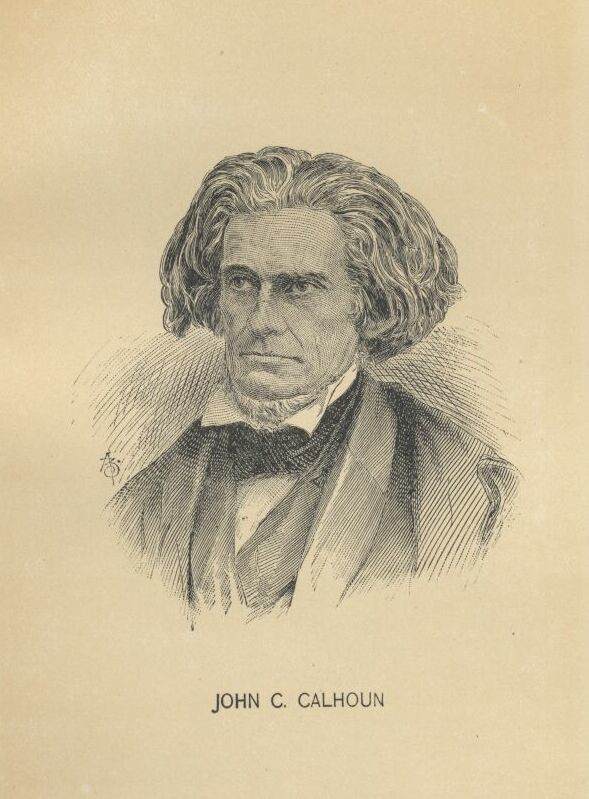
CHAPTER XI.
THE CAUSES OF SECESSION.
In preceding Chapters of this work, it has been briefly shown, that from the very hour in which the Republic of the United States was born, there have not been wanting, among its own citizens, those who hated it, and when they could not rule, were always ready to do what they could, by Conspiracy, Sedition, Mutiny, Nullification, Secession, or otherwise, to weaken and destroy it. This fact, and the processes by which the Conspirators worked, is very well stated, in his documentary "History of the Rebellion," by Edward McPherson, when he says: "In the Slaveholding States, a considerable body of men have always been disaffected to the Union. They resisted the adoption of the National Constitution, then sought to refine away the rights and powers of the General Government, and by artful expedients, in a series of years, using the excitements growing out of passing questions, finally perverted the sentiments of large masses of men, and prepared them for Revolution."
Before giving further incontestable proofs establishing this fact, and before endeavoring to sift out the true cause or causes of Secession, let us first examine such evidences as are submitted by him in support of his proposition.
The first piece of testimony, is an extract from an unpublished journal of U. S. Senator Maclay of Pennsylvania, from March 4, 1789, to March 3, 1791—the period of the First Congress under the Federal Constitution. It runs thus:
"1789, June 9.—In relation to the Tariff Bill, the affair of confining the East India Trade to the citizens of America had been negatived, and a committee had been appointed to report on this business. The report came in with very high duties, amounting to a prohibition. But a new phenomenon had made its appearance in the House (meaning the Senate) since Friday.
"Pierce Butler, from South Carolina, had taken his seat, and flamed like a meteor. He arraigned the whole Impost law, and then charged (indirectly) the whole Congress with a design of oppressing South Carolina. He cried out for encouraging the Danes and Swedes, and foreigners of every kind, to come and take away our produce. In fact he was for a Navigation Act reversed.
"June 11.—Attended at the hall as usual.
"Mr. Ralph Izard and Mr. Butler opposed the whole of the drawbacks in every shape whatever.
"Mr. (William) Grayson, of Virginia, warm on this subject, said we were not ripe for such a thing. We were a new Nation, and had no business for any such regulations—a Nation /sui generis/.
"Mr. (Richard Henry) Lee (of Virginia) said drawbacks were right, but would be so much abused, he could not think of admitting them.
"Mr. (Oliver) Ellsworth (of Connecticut) said New England rum would be exported, instead of West India, to obtain the drawback.
"I thought it best to say a few words in reply to each. We were a new Nation, it was true, but we were not a new People. We were composed of individuals of like manners, habits, and customs with the European Nations. What, therefore, had been found useful among them, came well recommended by experience to us. Drawbacks stand as an example in this point of view to us. If the thing was right in itself, there could be no just argument drawn against the use of a thing from the abuse of it. It would be the duty of Government to guard against abuses, by prudent appointments and watchful attention to officers. That as to changing the kind of rum, I thought the collection Bill would provide for this, by limiting the exportation to the original casks and packages. I said a great deal more, but really did not feel much interest either way. But the debates were very lengthy.
"Butler flamed away, and THREATENED A DISSOLUTION OF THE UNION, with regard to his State, as sure as God was in the firmament. He scattered his remarks over the whole Impost bill, calling it partial, oppressive, etc., and solely calculated to oppress South Carolina, and yet ever and anon declaring how clear of local views and how candid and dispassionate he was. He degenerates into mere declamation. His State would live free, or die glorious."
The next piece of evidence is General Jackson's letter to Rev. A. J. Crawford, as follows:
["Private."]
"WASHINGTON, May 1, 1833.
"MY DEAR SIR: * * * I have had a laborious task here, but Nullification is dead; and its actors and courtiers will only be remembered by the People to be execrated for their wicked designs to sever and destroy the only good Government on the globe, and that prosperity and happiness we enjoy over every other portion of the World. Haman's gallows ought to be the fate of all such ambitious men who would involve their Country in Civil War, and all the evils in its train, that they might reign and ride on its whirlwinds and direct the storm. The Free People of these United States have spoken, and consigned these wicked demagogues to their proper doom. Take care of your Nullifiers; you have them among you; let them meet with the indignant frowns of every man who loves his Country. The Tariff, it is now known, was a mere pretext—its burden was on your coarse woolens. By the law of July, 1832, coarse woolen was reduced to five per cent., for the benefit of the South. Mr. Clay's Bill takes it up and classes it with woolens at fifty per cent., reduces it gradually down to twenty per cent., and there it is to remain, and Mr. Calhoun and all the Nullifiers agree to the principle. The cash duties and home valuation will be equal to fifteen per cent. more, and after the year 1842, you pay on coarse woolens thirty-five per cent. If this is not Protection, I cannot understand; therefore the Tariff was only the pretext, and Disunion and a Southern Confederacy the real object. The next pretext will be the Negro or Slavery question.
"My health is not good, but is improving a little. Present me kindly to your lady and family, and believe me to be your friend. I will always be happy to hear from you. "ANDREW JACKSON."
Another evidence is given in the following extract from Benton's "Thirty Years in the Senate," vol. ii., as follows:
"The regular inauguration of this Slavery agitation dates from the year 1835; but it had commenced two years before, and in this way: Nullification and Disunion had commenced in 1830, upon complaint against Protective Tariff. That, being put down in 1833 under President Jackson's proclamation and energetic measures, was immediately substituted by the Slavery agitation. Mr. Calhoun, when he went home from Congress in the spring of that year, told his friends that 'the South could never be united against the North on the Tariff question—that the sugar interest of Louisiana would keep her out—and that the basis of Southern Union must be shifted to the Slave question.' Then all the papers in his interest, and especially the one at Washington, published by Mr. Duff Green, dropped Tariff agitation, and commenced upon Slavery, and in two years had the agitation ripe for inauguration, on the Slavery question. And in tracing this agitation to its present stage, and to comprehend its rationale, it is not to be forgotten that it is a mere continuation of old Tariff Disunion, and preferred because more available."
Again, from p. 490 of his private correspondence, Mr. Clay's words to an Alabamian, in 1844, are thus given:
"From the developments now being made in South Carolina, it is perfectly manifest that a Party exists in that State seeking a Dissolution of the Union, and for that purpose employ the pretext of the rejection of Mr. Tyler's abominable treaty. South Carolina, being surrounded by Slave States, would, in the event of a Dissolution of the Union, suffer only comparative evils; but it is otherwise with Kentucky. She has the boundary of the Ohio extending four hundred miles on three Free States. What would our condition be in the event of the greatest calamity that could befall this Nation?"
Allusion is also made to a letter written by Representative Nathan Appleton, of Boston, December 15, 1860, in which that gentleman said that when he was in Congress—in 1832-33—he had "made up his mind that Messrs. Calhoun, Hayne, McDuffie, etc., were desirous of a separation of the Slave States into a separate Confederacy, as more favorable to the security of Slave Property."
After mentioning that "About 1835, some South Carolinians attempted a Disunion demonstration," our authority says: It is thus described by ex-Governor Francis Thomas of Maryland, in his speech in Baltimore, October 29, 1861:
"Full twenty years ago, when occupying my seat in the House of Representatives, I was surprised one morning, after the assembling of the House, to observe that all the members from the Slaveholding States were absent. Whilst reflecting on this strange occurrence, I was asked why I was not in attendance on the Southern Caucus assembled in the room of the Committee on Claims. I replied that I had received no invitation.
"I then proposed to go to the Committee-room to see what was being done. When I entered, I found that little cock-sparrow, Governor Pickens, of South Carolina, addressing the meeting, and strutting about like a rooster around a barn-yard coop, discussing the following resolution:
"' Resolved, That no member of Congress, representing a Southern constituency, shall again take his seat until a resolution is passed satisfactory to the South on the subject of Slavery.'
"I listened to his language, and when he had finished, I obtained the floor, asking to be permitted to take part in the discussion. I determined at once to kill the Treasonable plot hatched by John C. Calhoun, the Catiline of America, by asking questions. I said to Mr. Pickens, 'What next do you propose we shall do? are we to tell the People that Republicanism is a failure? If you are for that, I am not. I came here to sustain and uphold American institutions; to defend the rights of the North as well as the South; to secure harmony and good fellowship between all Sections of our common Country.' They dared not answer these questions. The Southern temper had not then been gotten up. As my questions were not answered, I moved an adjournment of the Caucus /sine die/. Mr. Craig, of Virginia, seconded the motion, and the company was broken up. We returned to the House, and Mr. Ingersoll, of Pennsylvania, a glorious patriot then as now, introduced a resolution which temporarily calmed the excitement."
The remarks upon this statement, made November 4, 1861, by the National Intelligencer, were as follows:
"However busy Mr. Pickens may have been in the Caucus after it met, the most active man in getting it up and pressing the Southern members to go into it, was Mr. R. B. Rhett, also a member from South Carolina. The occasion, or alleged cause of this withdrawal from the House into secret deliberation was an anti-Slavery speech of Mr. Slade, of Vermont, which Mr. Rhett violently denounced, and proposed to the Southern members to leave the House and go into Conclave in one of the Committee-rooms, which they generally did, if not all of them. We are able to state, however, what may not have been known to Governor Thomas, that at least three besides himself, of those who did attend it, went there with a purpose very different from an intention to consent to any Treasonable measure. These three men were Henry A. Wise, Balie Peyton, and William Cost Johnson. Neither of them opened his lips in the Caucus; they went to observe; and we can assure Governor Thomas, that if Mr. Pickens or Mr. Calhoun, (whom he names) or any one else had presented a distinct proposition looking to Disunion, or Revolt, or Secession, he would have witnessed a scene not soon to be forgotten. The three whom we have mentioned were as brave as they were determined. Fortunately, perhaps, the man whom they went particularly to watch, remained silent and passive."
Let us, however, pursue the inquiry a little further. On the 14th of November, 1860, Alexander H. Stephens addressed the Legislature of Georgia, and in a portion of that address—replying to a speech made before the same Body the previous evening by Mr. Toombs, in which the latter had "recounted the evils of this Government"—said:
"The first [of these evils] was the Fishing Bounties, paid mostly to the sailors of New England. Our friend stated that forty-eight years of our Government was under the administration of Southern Presidents. Well, these Fishing Bounties began under the rule of a Southern President, I believe. No one of them, during the whole forty-eight years, ever set his Administration against the principle or policy of them. * * *
"The next evil which my friend complained of, was the Tariff. Well, let us look at that for a moment. About the time I commenced noticing public matters, this question was agitating the Country almost as fearfully as the Slave question now is. In 1832, when I was in college, South Carolina was ready to Nullify or Secede from the Union on this account. And what have we seen? The Tariff no longer distracts the public counsels. Reason has triumphed! The present Tariff was voted for by Massachusetts and South Carolina. The lion and the lamb lay down together—every man in the Senate and House from Massachusetts and South Carolina, I think, voted for it, as did my honorable friend himself. And if it be true, to use the figure of speech of my honorable friend, that every man in the North that works in iron, and brass and wood, has his muscle strengthened by the protection of the Government, that stimulant was given by his vote and I believe (that of) every other Southern man.
"Mr. TOOMBS—The Tariff lessened the duties.
"Mr. STEPHENS—Yes, and Massachusetts with unanimity voted with the South to lessen them, and they were made just as low as Southern men asked them to be, and that is the rate they are now at. If reason and argument, with experience, produced such changes in the sentiments of Massachusetts from 1832 to 1857, on the subject of the Tariff, may not like changes be effected there by the same means—reason and argument, and appeals to patriotism on the present vexed question? And who can say that by 1875 or 1890, Massachusetts may not vote with South Carolina and Georgia upon all those questions that now distract the Country and threaten its peace and existence.
"Another matter of grievance alluded to by my honorable friend was the Navigation Laws. This policy was also commenced under the Administration of one of these Southern Presidents who ruled so well, and has been continued through all of them since. * * * One of the objects (of these) was to build up a commercial American marine by giving American bottoms the exclusive Carrying Trade between our own ports. This is a great arm of national power. This object was accomplished. We have now an amount of shipping, not only coastwise, but to foreign countries, which puts us in the front rank of the Nations of the World. England can no longer be styled the Mistress of the Seas. What American is not proud of the result? Whether those laws should be continued is another question. But one thing is certain; no President, Northern or Southern, has ever yet recommended their repeal. * * *
"These then were the true main grievances or grounds of complaint against the general system of our Government and its workings—I mean the administration of the Federal Government. As to the acts of the federal States I shall speak presently: but these three were the main ones used against the common head. Now, suppose it be admitted that all of these are evils in the system; do they overbalance and outweigh the advantages and great good which this same Government affords in a thousand innumerable ways that cannot be estimated? Have we not at the South, as well as the North, grown great, prosperous, and happy under its operations? Has any part of the World ever shown such rapid progress in the development of wealth, and all the material resources of national power and greatness, as the Southern States have under the General Government, notwithstanding all its defects?
"Mr. TOOMBS—In spite of it.
"Mr. STEPHENS—My honorable friend says we have, in spite of the General Government; that without it, I suppose he thinks, we might have done as well, or perhaps better, than we have done in spite of it. * * * Whether we of the South would have been better off without the Government, is, to say the least, problematical. On the one side we can only put the fact, against speculation and conjecture on the other. * * * The influence of the Government on us is like that of the atmosphere around us. Its benefits are so silent and unseen that they are seldom thought of or appreciated.
"We seldom think of the single element of oxygen in the air we breathe, and yet let this simple, unseen and unfelt agent be withdrawn, this life-giving element be taken away from this all-pervading fluid around us, and what instant and appalling changes would take place in all organic creation.
"It may be that we are all that we are 'in spite of the General Government,' but it may be that without it we should have been far different from what we are now. It is true that there is no equal part of the Earth with natural resources superior perhaps to ours. That portion of this Country known as the Southern States, stretching from the Chesapeake to the Rio Grande, is fully equal to the picture drawn by the honorable and eloquent Senator last night, in all natural capacities. But how many ages and centuries passed before these capacities were developed to reach this advanced age of civilization. There these same hills, rich in ore, same rivers, same valleys and plains, are as they have been since they came from the hand of the Creator; uneducated and uncivilized man roamed over them for how long no history informs us.
"It was only under our institutions that they could be developed. Their development is the result of the enterprise of our people, under operations of the Government and institutions under which we have lived. Even our people, without these, never would have done it. The organization of society has much to do with the development of the natural resources of any Country or any Land. The institutions of a People, political and moral, are the matrix in which the germ of their organic structure quickens into life—takes root, and develops in form, nature, and character. Our institutions constitute the basis, the matrix, from which spring all our characteristics of development and greatness. Look at Greece. There is the same fertile soil, the same blue sky, the same inlets and harbors, the same AEgean, the same Olympus; there is the same land where Homer sung, where Pericles spoke; it is in nature the same old Greece—but it is living Greece no more.
"Descendants of the same people inhabit the country; yet what is the reason of this vast difference? In the midst of present degradation we see the glorious fragments of ancient works of art-temples, with ornaments and inscriptions that excite wonder and admiration—the remains of a once high order of civilization, which have outlived the language they spoke—upon them all, Ichabod is written—their glory has departed. Why is this so? I answer, their institutions have been destroyed. These were but the fruits of their forms of government, the matrix from which their great development sprang; and when once the institutions of a People have been destroyed, there is no earthly power that can bring back the Promethean spark to kindle them here again, any more than in that ancient land of eloquence, poetry and song.
"The same may be said of Italy. Where is Rome, once the mistress of the World? There are the same seven hills now, the same soil, the same natural resources; the nature is the same, but what a ruin of human greatness meets the eye of the traveler throughout the length and breadth of that most down-trodden land! why have not the People of that Heaven-favored clime, the spirit that animated their fathers? Why this sad difference?
"It is the destruction of their institutions that has caused it; and, my countrymen, if we shall in an evil hour rashly pull down and destroy those institutions which the patriotic hand of our fathers labored so long and so hard to build up, and which have done so much for us and the World, who can venture the prediction that similar results will not ensue? Let us avoid it if we can. I trust the spirit is among us that will enable us to do it. Let us not rashly try the experiment, for, if it fails, as it did in Greece and Italy, and in the South American Republics, and in every other place wherever liberty is once destroyed, it may never be restored to us again.
"There are defects in our government, errors in administration, and short-comings of many kinds; but in spite of these defects and errors, Georgia has grown to be a great State. Let us pause here a moment.
"When I look around and see our prosperity in everything, agriculture, commerce, art, science, and every department of education, physical and mental, as well as moral advancement—and our colleges—I think, in the face of such an exhibition, if we can, without the loss of power, or any essential right or interest, remain in the Union, it is our duty to ourselves and to posterity—let us not too readily yield to this temptation—to do so. Our first parents, the great progenitors of the human race, were not without a like temptation, when in the Garden of Eden. They were led to believe that their condition would be bettered—that their eyes would be opened—and that they would become as gods. They in an evil hour yielded—instead of becoming gods they only saw their own nakedness.
"I look upon this Country, with our institutions, as the Eden of the World, the Paradise of the Universe. It may be that out of it we may become greater and more prosperous, but I am candid and sincere in telling you that I fear if we rashly evince passion, and without sufficient cause shall take that step, that instead of becoming greater or more peaceful, prosperous, and happy—instead of becoming gods, we will become demons, and at no distant day commence cutting one another's throats. This is my apprehension.
"Let us, therefore, whatever we do, meet those difficulties, great as they are, like wise and sensible men, and consider them in the light of all the consequences which may attend our action. Let us see first clearly where the path of duty leads, and then we may not fear to tread therein."
Said Senator Wigfall, of Texas, March 4, 1861, in the United States Senate, only a few hours before Mr. Lincoln's Inauguration:
"I desire to pour oil on the waters, to produce harmony, peace and quiet here. It is early in the morning, and I hope I shall not say anything that may be construed as offensive. I rise merely that we may have an understanding of this question.
"It is not Slavery in the Territories, it is not expansion, which is the difficulty. If the resolution which the Senator from Wisconsin introduced here, denying the right of Secession, had been adopted by two-thirds of each branch of this department of the Government, and had been ratified by three-fourths of the States, I have no hesitation in saying that, so far as the State in which I live and to which I owe my allegiance is concerned, if she had no other cause for a disruption of the Union taking place, she would undoubtedly have gone out.
[To insert as an additional article of amendment to the Constitution, the following: "Under this Constitution, as originally adopted, and as it now exists, no State has power to withdraw from the jurisdiction of the United States: but this Constitution, and all laws passed in pursuance of its delegated powers, are the Supreme Law of the Land, anything contained in any constitution, ordinance, or act of any State, to the contrary notwithstanding."]
"The moment you deny the right of self-government to the free White men of the South, they will leave the Government. They believe in the Declaration of Independence. They believe that:
"'Governments are instituted among men, deriving their just powers from the consent of the governed; that, whenever any form of government becomes destructive of these ends, it is the right of the People to alter or to abolish it, and to institute a new Government, laying its foundation on such principles and organizing its powers in such form as to them shall seem most likely to effect their safety and happiness.'
"That principle of the Declaration of Independence is the one upon which the free White men of the South predicated their devotion to the present Constitution of the United States; and it was the denial of that, as much as anything else, that has created the dissatisfaction in that Section of the Country.
"There is no instrument of writing that has ever been written that has been more misapprehended and misunderstood and misrepresented than this same unfortunate Declaration of Independence, and no set of gentlemen have ever been so slandered as the fathers who drew and signed that Declaration.
"If there was a thing on earth that they did not intend to assert, it was that a Negro was a White man. As I said here, a short time ago, one of the greatest charges they made against the British Government was, that old King George was attempting to establish the fact practically that all men were created Free and Equal. They charged him in the Declaration of Independence with inciting their Slaves to insurrection. That is one of the grounds upon which they threw off their allegiance to the British Parliament.
"Another great misapprehension is, that the men who drafted that Declaration of Independence had any peculiar fancy for one form of government rather than another. They were not fighting to establish a Democracy in this country; they were not fighting to establish a Republican form of government in this Country. Nothing was further from their intention.
"Alexander Hamilton, after he had fought for seven years, declared that the British form of government was the best that the ingenuity of man had ever devised; and when John Adams said to him, 'without its corruptions;' 'Why,' said he, 'its corruptions are its greatest excellence; without the corruptions, it would be nothing.'
"In the Declaration of Independence, they speak of George III., after this fashion. They say:
"'A prince whose character is thus marked by every act which may define a tyrant, is unfit to be the ruler of a free People.'
"Now, I ask any plain common-sense man what was the meaning of that? Was it that they were opposed to a Monarchical form of government? Was it that they believed a Monarchical form of government was incompatible with civil liberty? No, sir; they entertained no such absurd idea. None of them entertained it; but they say that George III, was a prince whose character was 'marked by every act which may define a tyrant' and that therefore he was 'unfit to be the ruler of a free People.' Had his character not been so marked by every quality which would define a tyrant, he might have been the fit ruler of a free People; ergo, a monarchical form of Government was not incompatible with civil liberty.
"That was clearly the opinion of those men. I do not advocate it now; for I have said frequently that we are wiser than our fathers, and our children will be wiser than we are. One hundred years hence, men will understand their own affairs much better than we do. We understand our affairs better than those who preceded us one hundred years. But what I assert is, that the men of the Revolution did not believe that a Monarchical form of Government was incompatible with civil liberty.
"What I assert is, that when they spoke of 'all men being created equal,' they were speaking of the White men who then had unsheathed their swords—for what purpose? To establish the right of self-government in themselves; and when they had achieved that, they established, not Democracies, but Republican forms of Government in the thirteen sovereign, separate and independent Colonies. Yet the Declaration of Independence is constantly quoted to prove Negro equality. It proves no such thing; it was intended to prove no such thing.
"The 'glittering generalities' which a distinguished former Senator from Massachusetts (Mr. Choate) spoke of, as contained in the Declaration of Independence, one of them at least, about all men being created equal—was not original with Mr. Jefferson. I recollect seeing a pamphlet called the Principles of the Whigs and Jacobites, published about the year 1745, when the last of the Stuarts, called 'the Pretender,' was striking a blow that was fatal to himself, but a blow for his crown, in which pamphlet the very phraseology is used, word for word and letter for letter. I have not got it here to-night. I sent the other day to the Library to try and find it, but could not find it; it was burnt, I believe, with the pamphlets that were burnt some time ago.
"That Mr. Jefferson copied it or plagiarized it, is not true, I suppose, any more than the charge that the distinguished Senator from New York plagiarized from the Federalist in preparing his celebrated compromising speech which was made here a short time ago. It was the cant phrase of the day in 1745, which was only about thirty years previous to the Declaration of Independence. This particular pamphlet, which I have read, was published; others were published at the same time. That sort of phraseology was used.
"There was a war of classes in England; there were men who were contending for legitimacy; who were contending for the right of the Crown being inherent and depending on the will of God, 'the divine right of Kings,' for maintaining an hereditary landed-aristocracy; there was another Party who were contending against this doctrine of legitimacy, and the right of primogeniture. These were called the Whigs; they established this general phraseology in denouncing the divine right and the doctrine of legitimacy, and it became the common phraseology of the Country; so that in the obscure county of Mecklenburg, in North Carolina, a declaration containing the same assertions was found as in this celebrated Declaration of Independence, written by the immortal Jefferson.
"Which of us, I ask, is there upon this floor who has not read and re-read whatever was written within the last twenty-five or thirty years by the distinguished men of this country? But enough of that.
"As I said before, there ought not have been, and there did not necessarily result from our form of Government, any irrepressible conflict between the Slaveholding and the non-Slaveholding States. Nothing of the sort was necessary.
"Strike out a single clause in the Constitution of the United States, that which secures to each State a Republican form of Government, and there is no reason why, under precisely such a Constitution as we have, States that are Monarchical and States that are Republican, could not live in peace and quiet. They confederate together for common defense and general welfare, each State regulating its domestic concerns in its own way; those which preferred a Republican form of Government maintaining it, and those which preferred a Monarchical form of Government maintaining it.
"But how long could small States, with different forms of Government, live together, confederated for common defense and general welfare, if the people of one Section were to come to the conclusion that their institutions were better than those of the other, and thereupon straightway set about subverting the institutions of the other?"
In the reply of the Rebel "Commissioners of the Southern Confederacy" to Mr. Seward, April 9, 1861, they speak of our Government as being "persistently wedded to those fatal theories of construction of the Federal Constitution always rejected by the statesmen of the South, and adhered to by those of the Administration school, until they have produced their natural and often-predicted result of the destruction of the Union, under which we might have continued to live happily and gloriously together, had the spirit of the ancestry who framed the common Constitution animated the hearts of all their sons."
In the "Address of the people of South Carolina, assembled in Convention, to the people of the Slaveholding States of the United States," by which the attempt was made to justify the passage of the South Carolina Secession Ordinance of 1860, it is declared that:
"Discontent and contention have moved in the bosom of the Confederacy, for the last thirty-five years. During this time South Carolina has twice called her people together in solemn Convention, to take into consideration, the aggressions and unconstitutional wrongs, perpetrated by the people of the North on the people of the South. These wrongs were submitted to by the people of the South, under the hope and expectation that they would be final. But such hope and expectation have proved to be vain. Instead of producing forbearance, our acquiescence has only instigated to new forms of aggressions and outrage; and South Carolina, having again assembled her people in Convention, has this day dissolved her connection with the States constituting the United States.
"The one great evil from which all other evils have flowed, is the overthrow of the Constitution of the United States. The Government of the United States, is no longer the Government of Confederated Republics, but of a consolidated Democracy. It is no longer a free Government, but a Despotism. It is, in fact, such a Government as Great Britain attempted to set over our Fathers; and which was resisted and defeated by a seven years struggle for Independence.
"The Revolution of 1776, turned upon one great principle, self-government,—and self-taxation, the criterion of self-government.
"The Southern States now stand exactly in the same position towards the Northern States, that the Colonies did towards Great Britain. The Northern States, having the majority in Congress, claim the same power of omnipotence in legislation as the British Parliament. 'The General Welfare' is the only limit to the legislation of either; and the majority in Congress, as in the British Parliament, are the sole judges of the expediency of the legislation this 'General Welfare' requires. Thus the Government of the United States has become a consolidated Government; and the people of the Southern States are compelled to meet the very despotism their fathers threw off in the Revolution of 1776.
"The consolidation of the Government of Great Britain over the Colonies, was attempted to be carried out by the taxes. The British Parliament undertook to tax the Colonies to promote British interests. Our fathers resisted this pretension. They claimed the right of self-taxation through their Colonial Legislatures. They were not represented in the British Parliament, and, therefore, could not rightly be taxed by its legislation. The British Government, however, offered them a representation in Parliament; but it was not sufficient to enable them to protect themselves from the majority, and they refused the offer. Between taxation without any representation, and taxation without a representation adequate to protection, there was no difference. In neither case would the Colonies tax themselves. Hence, they refused to pay the taxes laid by the British Parliament.
"And so with the Southern States, towards the Northern States, in the vital matter of taxation. They are in a minority in Congress. Their representation in Congress is useless to protect them against unjust taxation; and they are taxed by the people of the North for their benefit, exactly as the people of Great Britain taxed our ancestors in the British Parliament for their benefit. For the last forty years, the taxes laid by the Congress of the United States have been laid with a view of subserving the interests of the North. The people of the South have been taxed by duties on imports, not for revenue, but for an object inconsistent with revenue—to promote, by prohibitions, Northern interests in the productions of their mines and manufactures.
"There is another evil, in the condition of the Southern towards the Northern States, which our ancestors refused to bear towards Great Britain. Our ancestors not only taxed themselves, but all the taxes collected from them were expended amongst them. Had they submitted to the pretensions of the British Government, the taxes collected from them, would have been expended in other parts of the British Empire. They were fully aware of the effect of such a policy in impoverishing the people from whom taxes are collected, and in enriching those who receive the benefit of their expenditure.
"To prevent the evils of such a policy, was one of the motives which drove them on to Revolution, yet this British policy has been fully realized towards the Southern States, by the Northern States. The people of the Southern States are not only taxed for the benefit of the Northern States, but after the taxes are collected, three fourths of them are expended at the North. This cause, with others, connected with the operation of the General Government, has made the cities of the South provincial. Their growth is paralyzed; they are mere suburbs of Northern cities. The agricultural productions of the South are the basis of the foreign commerce of the United States; yet Southern cities do not carry it on. Our foreign trade is almost annihilated. * * *
"No man can for a moment believe, that our ancestors intended to establish over their posterity, exactly the same sort of Government they had overthrown. * * * Yet by gradual and steady encroachments on the part of the people of the North, and acquiescence on the part of the South, the limitations in the Constitution have been swept away; and the Government of the United States has become consolidated, with a claim of limitless powers in its operations. * * *
"A majority in Congress, according to their interested and perverted views, is omnipotent. * * * Numbers with them, is the great element of free Government. A majority is infallible and omnipotent. 'The right divine to rule in Kings,' is only transferred to their majority. The very object of all Constitutions, in free popular Government, is to restrain the majority. Constitutions, therefore, according to their theory, must be most unrighteous inventions, restricting liberty. None ought to exist; but the body politic ought simply to have a political organization, to bring out and enforce the will of the majority. This theory is a remorseless despotism. In resisting it, as applicable to ourselves, we are vindicating the great cause of free Government, more important, perhaps, to the World, than the existence of all the United States."
In his Special Message to the Confederate Congress at Montgomery, April 29, 1861, Mr. Jefferson Davis said:
"From a period as early as 1798, there had existed in all the States a Party, almost uninterruptedly in the majority, based upon the creed that each State was, in the last resort, the sole judge, as well of its wrongs as of the mode and measure of redress. * * * The Democratic Party of the United States repeated, in its successful canvas of 1836, the declaration, made in numerous previous political contests, that it would faithfully abide by and uphold the principles laid down in the Kentucky and Virginia Legislatures of [1798 and] 1799, and that it adopts those principles as constituting one of the main foundations of its political creed."
In a letter addressed by the Rebel Commissioners in London (Yancey, Rost and Mann), August 14, 1861, to Lord John Russell, Secretary of Foreign Affairs, it appears that they said: "It was from no fear that the Slaves would be liberated, that Secession took place. The very Party in power has proposed to guarantee Slavery forever in the States, if the South would but remain in the Union." On the 4th of May preceding, Lord John had received these Commissioners at his house; and in a letter of May 11, 1861, wrote, from the Foreign Office, to Lord Lyons, the British Minister at Washington, a letter, in which, alluding to his informal communication with them, he said: "One of these gentlemen, speaking for the others, dilated on the causes which had induced the Southern States to Secede from the Northern. The principal of these causes, he said, was not Slavery, but the very high price which, for the sake of Protecting the Northern manufacturers, the South were obliged to pay for the manufactured goods which they required. One of the first acts of the Southern Congress was to reduce these duties, and to prove their sincerity he gave as an instance that Louisiana had given up altogether that Protection on her sugar which she enjoyed by the legislation of the United States. As a proof of the riches of the South. He stated that of $350,000,000 of exports of produce to foreign countries $270,000,000 were furnished by the Southern States." * * * They pointed to the new Tariff of the United States as a proof that British manufactures would be nearly excluded from the North, and freely admitted in the South.
This may be as good a place as any other to say a few words touching another alleged "cause" of Secession. During the exciting period just prior to the breaking out of the great War of the Rebellion, the Slave-holding and Secession-nursing States of the South, made a terrible hubbub over the Personal Liberty Bills of the Northern States. And when Secession came, many people of the North supposed these Bills to be the prime, if not the only real cause of it. Not so. They constituted, as we now know, only a part of the mere pretext. But, none the less, they constituted a portion of the history of that eventful time, and cannot be altogether ignored.
In order then, that the reader may quickly grasp, not only the general nature, but also the most important details of the Personal Liberty Bills (in force, in 1860, in many of the Free States) so frequently alluded to in the Debates of Congress, in speeches on the stump, and in the fulminations of Seceding States and their authorized agents, commissioners, and representatives, it may be well now, briefly to refer to them, and to state that no such laws existed in California, Illinois, Indiana, Iowa, Minnesota, New York, Ohio and Oregon.
Those of Maine provided that no officer of the State should in any way assist in the arrest or detention of a Fugitive Slave, and made it the duty of county attorneys to defend the Fugitive Slave against the claim of his master. A Bill to repeal these laws passed the Maine Senate, but failed in the House.
That of Massachusetts provided for commissioners in each county to defend alleged Fugitives from Service or Labor; for payment by the Commonwealth of all expenses of defense; prohibited the issue or service of process by State officers for arrest of alleged Fugitives, or the use of any prisons in the State for their detention, or that of any person aiding their escape; prohibited the kidnapping or removal of alleged Fugitive Slaves by any person; prohibited all officers within the State, down to Town officers, from arresting, imprisoning, detaining or returning to Service "any Person for the reason that he is claimed or adjudged to be a Fugitive from Service or Labor"—all such prohibitions being enforced by heavy fines and imprisonment. The Act of March 25, 1861, materially modified and softened the above provisions.
New Hampshire's law, provided that all Slaves entering the State with consent of the master shall be Free, and made the attempt to hold any person as a Slave within the State a felony.
Vermont's, prescribed that no process under the Fugitive Slave Law should be recognized by any of her Courts, officers, or citizens; nor any aid given in arresting or removing from the State any Person claimed as a Fugitive Slave; provided counsel for alleged Fugitives; for the issue of habeas corpus and trial by jury of issues of fact between the parties; ordained Freedom to all within the State who may have been held as Slaves before coming into it, and prescribed heavy penalties for any attempt to return any such to Slavery. A bill to repeal these laws, proposed November, 1860, in the Vermont House of Representatives, was beaten by two to one.
Connecticut's, provided that there must be two witnesses to prove that a Person is a Slave; that depositions are not evidence; that false testifying in Fugitive Slave cases shall be punishable by fine of $5,000 and five years in State prison.
In New Jersey, the only laws touching the subject, permitted persons temporarily sojourning in the State to bring and hold their Slaves, and made it the duty of all State officers to aid in the recovery of Fugitives from Service.
In Pennsylvania, barring an old dead-letter Statute, they simply prohibited any interference by any of the Courts, Aldermen, or Justices of the Peace, of the Commonwealth, with the functions of the Commissioner appointed under the United States Statute in Fugitive Slave cases.
In Michigan, the law required States' attorneys to defend Fugitive Slaves; prescribed the privileges of habeas corpus and jury trial for all such arrested; prohibited the use of prisons of the State for their detention; required evidence of two credible witnesses as to identity; and provided heavy penalties of fine and imprisonment for the seizure of any Free Person, with intent to have such Person held in Slavery. A Bill to repeal the Michigan law was defeated in the House by about two to one.
Wisconsin's Personal Liberty law was similar to that of Michigan, but with this addition, that no judgment recovered against any person in that State for violating the Fugitive Slave Law of 1850 should be enforced by sale or execution of any real or personal property in that State.
That of Rhode Island, forbade the carrying away of any Person by force out of the State; forbade the official aiding in the arrest or detention of a Fugitive Slave; and denied her jails to the United States for any such detention.
Apropos of this subject, and before leaving it, it may be well to quote remarks of Mr. Simons of Rhode Island, in the United States Senate. Said he: "Complaint has been made of Personal Liberty Bills. Now, the Massachusetts Personal Liberty Bill was passed by a Democratic House, a Democratic Senate, and signed by a Democratic Governor, a man who was afterwards nominated by Mr. Polk for the very best office in New England, and was unanimously confirmed by a Democratic United States Senate. Further than this, the very first time the attention of the Massachusetts Legislature was called to the propriety of a repeal of this law was by a Republican Governor. Now, on the other hand, South Carolina had repealed a law imprisoning British colored sailors, but retained the one imprisoning those coming from States inhabited by her own brethren!"
These Personal Liberty Bills were undoubtedly largely responsible for some of the irritation on the Slavery question preceding open hostilities between the Sections. But President Lincoln sounded the real depths of the Rebellion when he declared it to be a War upon the rights of the People. In his First Annual Message, December 3, 1861, he said:
"It continues to develop that the insurrection is largely, if not exclusively, a War upon the first principle of popular government—the rights of the People. Conclusive evidence of this is found in the most grave and maturely considered public documents, as well as in the general tone of the insurgents. In those documents we find the abridgment of the existing right of suffrage, and the denial to the People of all right to participate in the selection of public officers, except the legislative, boldly advocated, with labored arguments to prove that large control of the People in government is the source of all political evil. Monarchy itself is sometimes hinted at as a possible refuge from the power of the People.
"In my present position, I could scarcely be justified were I to omit raising a warning voice against this approach of returning despotism.
"It is not needed, nor fitting here, that a general argument should be made in favor of popular institutions; but there is one point, with its connections, not so hackneyed as most others, to which I ask brief attention. It is the effort to place Capital on an equal footing with, if not above Labor, in the structure of the Government.
"It is assumed that Labor is available only in connection with Capital; that nobody labors unless somebody else, owning Capital, somehow by the use of it induces him to labor. This assumed, it is next considered whether it is best that Capital shall hire laborers, and thus induce them to work by their own consent, or buy them, and drive them to it without their consent. Having proceeded so far, it is naturally concluded that all laborers are either hired laborers, or what we call Slaves. And further, it is assumed that whoever is once a hired laborer is fixed in that condition for life.
"Now, there is no such relation between Capital and Labor as assumed; nor is there any such thing as a free man being fixed for life, in the condition of a hired laborer. Both these assumptions are false, and all inferences from them are groundless.
"Labor is prior to, and independent of Capital. Capital is only the fruit of Labor, and could never have existed if Labor had not first existed. Labor is the superior of Capital, and deserves much the higher consideration. Capital has its rights, which are as worthy of protection as any other rights. Nor is it denied that there is, and probably always will be, a relation between Labor and Capital, producing mutual benefits. The error is in assuming that the whole Labor of the community exists within that relation.
"A few men own Capital, and that few, avoid labor themselves, and with their Capital hire or buy another few to labor for them. A large majority belong to neither class—neither work for others, nor have others working for them.
"In most of the Southern States, a majority of the whole people of all colors are neither Slaves nor masters; while in the Northern, a large majority are neither hirers nor hired. Men with their families—wives, sons, and daughters—work for themselves, on their farms, in their houses, and in their shops, taking the whole product to themselves, and asking no favors of Capital on the one hand, nor of hired laborers or Slaves on the other.
"It is not forgotten that a considerable number of persons mingle their own Labor with Capital—that is they labor with their own hands, and also buy or hire others to labor for them; but this is only a mixed, and not a distinct class. No principle stated is disturbed by the existence of this mixed class.
"Again, as has already been said, there is not, of necessity, any such thing as the free hired-laborer being fixed to that condition for life. Many independent men everywhere in these States, a few years back in their lives, were hired laborers.
"The prudent, penniless beginner in the World, labors for wages awhile, saves a surplus with which to buy tools or land for himself, then labors on his own account another while, and at length hires another new beginner to help him. This is the just and generous and prosperous system, which opens the way to all, gives hope to all, and consequent energy and progress, and improvement of condition to all.
"No men living are more worthy to be trusted than those who toil up from poverty—none less inclined to take or touch aught which they have not honestly earned. Let them beware of surrendering a political power which they already possess, and which, if surrendered, will surely be used to close the door of advancement against such as they, and to fix new disabilities and burdens upon them, till all of Liberty shall be lost. * * * The struggle of to-day is not altogether for to-day-it is a vast future also. * * * "
So too, Andrew Johnson, in his speech before the Senate, January 31, 1862, spake well and truly when he said that "there has been a deliberate design for years to change the nature and character and genius of this Government." And he added: "Do we not know that these schemers have been deliberately at work, and that there is a Party in the South, with some associates in the North, and even in the West, that have become tired of Free Government, in which they have lost confidence."
Said he: "They raise an outcry against 'Coercion,' that they may paralyze the Government, cripple the exercise of the great powers with which it was invested, finally to change its form and subject us to a Southern despotism. Do we not know it to be so? Why disguise this great truth? Do we not know that they have been anxious for a change of Government for years? Since this Rebellion commenced it has manifested itself in many quarters.
"How long is it since the organ of the Government at Richmond, the Richmond Whig, declared that rather than live under the Government of the United States, they preferred to take the Constitutional Queen of Great Britain as their protector; that they would make an alliance with Great Britain for the purpose of preventing the enforcement of the Laws of the United States. Do we not know this?"
Stephen A. Douglas also, in his great Union speech at Chicago, May 1, 1861—only a few days before his lamented death—said:
"The election of Mr. Lincoln is a mere pretext. The present Secession movement is the result of an enormous Conspiracy formed more than a year since formed by leaders in the Southern Confederacy more than twelve months ago. They use the Slavery question as a means to aid the accomplishment of their ends. They desired the election of a Northern candidate by a Sectional vote, in order to show that the two Sections cannot live together.
"When the history of the two years from the Lecompton question down to the Presidential election shall be written, it will be shown that the scheme was deliberately made to break up this Union.
"They desired a Northern Republican to be elected by a purely Northern vote, and then assign this fact as a reason why the Sections cannot live together. If the Disunion candidate—(Breckinridge) in the late Presidential contest had carried the united South, their scheme was, the Northern candidate successful, to seize the Capital last Spring, and by a united South and divided North, hold it.
"Their scheme was defeated, in the defeat of the Disunion candidates in several of the Southern States.
"But this is no time for a detail of causes. The Conspiracy is now known; Armies have been raised. War is levied to accomplish it. There are only two sides to the question.
"Every man must be for the United States, or against it. There can be no Neutrals in this War; only Patriots or Traitors! [Cheer after Cheer]."
In a speech made in the United States Senate, January 31, 1862, Senator McDougall of California—conceded to be intellectually the peer of any man in that Body—said:
"We are at War. How long have we been at War? We have been engaged in a war of opinion, according to my historical recollection, since 1838. There has been a Systematic organized war against the Institutions established by our fathers, since 1832. This is known of all men who have read carefully the history of our Country. If I had the leisure, or had consulted the authorities, I would give it year by year, and date by date, from that time until the present, how men adversary to our Republican Institutions have been organizing War against us, because they did not approve of our Republican Institutions.
"Before the Mexican War, it is well known that General Quitman, then Governor of Mississippi, was organizing to produce the same condition of things (and he hoped a better condition of things, for he hoped a successful Secession), to produce this same revolution that is now disturbing our whole Land. The War with Mexico, fighting for a Southern proposition, for which I fought myself, made the Nation a unit until 1849; and then again they undertook an Organization to produce Revolution. These things are history. This statement is true, and cannot be denied among intelligent men anywhere, and cannot be denied in this Senate.
"The great men who sat in Council in this Hall, the great men of the Nation, men whose equals are not, and I fear will not be for many years, uniting their judgments, settled the controversy in 1850. They did not settle it for the Conspirators of the South, for they were not parties to the compact. Clay and Webster, and the great men who united with them, had no relation with the extremes of either extreme faction. The Compromise was made, and immediately after it had been effected, again commenced the work of organization. I had the honor to come from my State on the Pacific into the other branch of the Federal Congress, and there I learned as early as 1853, that the work of Treason was as industriously pursued as it is being pursued to-day. I saw it; I felt it; I knew it. I went home to the shores of the Pacific instructed somewhat on this subject.
"Years passed by. I engaged in my duties as a simple professional man, not connected with public affairs. The question of the last Presidential election arose before the Country—one of those great questions that are not appreciated, I regret from my heart, by the American Nation, when we elect a President, a man who has more power for his time than any enthroned Monarch in Europe. We organize a Government and place him in front as the head and the Chief of the Government. That question came before the American People.
"At that time I was advised of this state of feeling—and I will state it in as exact form of words as I can state it, that it may be understood by Senators: Mr. Douglas is a man acceptable to the South. Mr. Douglas is a man to whom no one has just cause of exception throughout the South. Mr. Douglas is more acceptable to Mississippi and Louisiana than Mr. Breckinridge. Mr. Breckinridge is not acceptable to the South; or at least, if he is so, he is not in the same degree with Mr. Douglas. Mr. Douglas is the accepted man of a great National Party, and if he is brought into the field he will be triumphantly elected. THAT MUST NOT BE DONE, because THE ORGANIZATION FOR SECESSION IS MATURED. EVERYTHING IS PREPARED, and the election of Mr. Douglas would only postpone it for four years; and Now when we are PREPARED to carry out these things WE MUST INDULGE IN STRATAGEM, and the nomination of Mr. Breckinridge is a mere strategic movement to divide the great conservative Party of the Nation into two, so as to elect a Republican candidate AND CONSOLIDATE THE SOUTH BY THE CRY OF 'ABOLITIONIST!'
"That is a mere simple statement of the truth, and it cannot be contradicted. Now, in that scheme all the men of counsel of that Party were engaged. * * * I, on the far shores of the Pacific understood those things as long ago as a year last September (1860). I was advised about this policy and well informed of it. * * *
"I was at war, in California, in January (1861) last; in the maintenance of the opinions that I am now maintaining, I had to go armed to protect myself from violence. The country, whenever there was controversy, was agitated to its deepest foundations. That is known, perhaps, not to gentlemen who live up in Maine or Massachusetts, or where you are foreign to all this agitation; but known to all people where disturbance might have been effective in consequences. I felt it, and had to carry my life in my hand by the month, as did my friends surrounding me.
"I say that all through last winter (that of 1860-61) War had been inaugurated in all those parts of the Country where disturbed elements could have efficient result. In January (1861), a year ago, I stood in the hall of the House of Representatives of my State, and there was War then, and angry faces and hostile men were gathered; and we knew then well that the Southern States had determined to withdraw themselves from the Federal Union.
"I happened to be one of those men who said, 'they shall not do it;' and it appears to me that the whole argument is between that class of men and the class of men who said they would let them do it. * * * When this doctrine was started here of disintegrating the Cotton States from the rest of the Confederacy, I opposed it at once. I saw immediately that War was to be invoked. * * *
"I will not say these things were understood by gentlemen of the Republican Party * * * but I, having been accepted and received as a Democrat of the old school from the olden time, and HAVING FAST SOUTHERN SYMPATHIES, I DID KNOW ALL ABOUT THEM. * * * I KNOW THAT SECESSION WAS A THING DETERMINED UPON. * * * I was advised of and understood the whole programme, KNEW HOW IT WAS TO BE DONE IN ITS DETAILS; and I being advised, made war against it. * * *
"War had been, in fact, inaugurated. What is War? Was it the firing on our flag at Sumter? Was that the first adversary passage? To say so, is trifling with men's judgments and information. No, sir; when they organized a Government, and set us at defiance, they commenced War; and the various steps they took afterwards, by organizing their troops, and forming their armies, and advancing upon Sumter; all these were merely acts of War; but War was inaugurated whenever they undertook to say they would maintain themselves as a separate and independent government; and, after that time, every man who gave his assistance to them was a Traitor, according to the highest Law."
The following letter, written by one of the most active of the Southern conspirators in 1858, during the great Douglas and Lincoln Debate of that year, to which extended reference has already been made, is of interest in this connection, not only as corroborative evidence of the fact that the Rebellion of the Cotton States had been determined on long before Mr. Lincoln was elected President, but as showing also that the machinery for "firing the Southern heart" and for making a "solid South" was being perfected even then. The subsequent split in the Democratic Party, and nomination of Breckinridge by the Southern wing of it, was managed by this same Yancey, simply as parts of the deliberate programme of Secession and Rebellion long before determined on by the Cotton Lords of the Cotton States.
"MONTGOMERY, June 15, 1858.
"DEAR SIR:—Your kind favor of the 13th is received.
"I hardly agree with you that a general movement can be made that will clean out the Augean Stable. If the Democracy were overthrown it would result in giving place to a greedier and hungrier swarm of flies.
"The remedy of the South is not in such a process. It is in a diligent organization of her true men for prompt resistance to the next aggression. It must come in the nature of things. No National Party can save us. No Sectional Party can ever do it. But if we could do as our fathers did—organize 'Committees of Safety' all over the Cotton States (and it is only in them that we can hope for any effective movement), we shall fire the Southern heart, instruct the Southern mind, give courage to each other, and at the proper moment, by one organized, concerted action, we can precipitate the Cotton States into a revolution.
"The idea has been shadowed forth in the South by Mr. Ruffin; has been taken up and recommended in the Advertiser under the name of 'League of United Southerners,' who, keeping up their old relations on all other questions, will hold the Southern issues paramount, and influence parties, legislatures and statesmen. I have no time to enlarge, but to suggest merely.
"In haste, yours, etc. "W. L. YANCEY.
"To JAMES S. SLAUGHTER."
At Jackson, Mississippi, in the fall of the same year (1858) just after the great Debate between Douglas and Lincoln had closed, Jefferson Davis had already raised the standard of Revolution, Secession and Disunion, during the course of a speech, in which he said: "If an Abolitionist be chosen President of the United States, you will have presented to you the question of whether you will permit the Government to pass into the hands of your avowed and implacable enemies? Without pausing for an answer, I will state my own position to be, that such a result would be a species of revolution by which the purposes of the Government would be destroyed, and the observance of its mere forms entitled to no respect. In that event, in such a manner as should be most expedient, I should deem it your duty to provide for your safety, outside of the Union with those who have already shown the will, and would have acquired the power to deprive you of your birthright, and to reduce you to worse than the Colonial dependence of your fathers."
The "birthright" thus referred to was of course, the alleged right to have Slaves; but what was this "worse than Colonial dependence" to which, in addition to the peril supposed to threaten the Southern "birthright," the Cotton States of Mississippi were reduced? "Dependence" upon whom, and with regard to what? Plainly upon the North; and with regard, not to Slavery alone—for Jefferson Davis held, down to the very close of the War, that the South fought "not for Slavery"—but as to Tariff Legislation also. There was the rub! These Cotton Lords believed, or pretended to believe, that the High Tariff Legislation, advocated and insisted upon both by the Whigs and Republicans for the Protection of the American Manufacturer and working man, built up and made prosperous the North, and elevated Northern laborers; at the expense of the South, and especially themselves, the Cotton Lords aforesaid.
We have already seen from the utterances of leading men in the South Carolina, Secession Convention, "that"—as Governor Hicks, himself a Southern man, said in his address to the people of Maryland, after the War broke out "neither the election of Mr. Lincoln, nor the non-execution of the Fugitive Slave Law, nor both combined, constitute their grievances. They declare that THE REAL CAUSE of their discontent DATES AS FAR BACK AS 1833."
And what was the chief cause or pretext for discontent at that time? Nothing less than the Tariff. They wanted Free Trade, as well as Slavery. The balance of the Union wanted Protection, as well as Freedom.
The subsequent War, then, was not a War waged for Slavery alone, but for Independence with a view to Free Trade, as set forth in the "Confederate Constitution," as soon as that Independence could be achieved. And the War on our part, while for the integrity of the Union in all its parts—for the life of the Nation itself, and for the freedom of man, should also have brought the triumph of the American idea of a Protective Tariff, whose chief object is the building up of American manufactures and the Protection of the Free working-man, in the essential matters of education, food, clothing, rents, wages, and work.
It is mentioned in McPherson's History of the Rebellion, p. 392, that in a letter making public his reasons for going to Washington and taking his seat in Congress, Mr. James L. Pugh, a Representative from Alabama, November 24, 1860, said: "The sole object of my visit is to promote the cause of Secession."
From the manner in which they acted after reaching Washington, it is not unreasonable to suppose that most of those persons representing, in both branches of Congress, the Southern States which afterwards seceded, came to the National Capital with a similar object in view—taking their salaries and mileages for services supposed to be performed for the benefit of the very Government they were conspiring to injure, and swearing anew the sacred oath to support and defend the very Constitution which they were moving heaven and earth to undermine and destroy!
[As a part of the history of those times, the following letter is not without interest:
"OXFORD, December 24, 1860.
"MY DEAR SIR:—I regretted having to leave Washington without having with you a full conference as to the great events whose shadows are upon us. The result of the election here is what the most sanguine among us expected; that is, its general result is so. It is as yet somewhat difficult to determine the distinctive complexion of the convention to meet on the 7th of January. The friends of Southern Independence, of firm and bona fide resistance, won an overwhelming victory; but I doubt whether there is any precise plan.
"No doubt a large majority of the Convention will be for separate Secession. But unless intervening events work important changes of sentiment, not all of those elected as resistance men will be for immediate and separate Secession. Our friends in Pontotoc, Tippah, De Soto and Pauola took grounds which fell far short of that idea, though their resolutions were very firm in regard to Disunion and an ultimate result.
"In the meantime the Disunion sentiment among the people is growing every day more intense.
"Upon the whole, you have great cause for gratification in the action of your State.
"The submissionists are routed, horse, foot, and dragoons, and any concession by the North will fail to restore that sacred attachment to the Union which was once so deeply radicated in the hearts of our people. What they want now, is wise and sober leading. I think that there might be more of dignity and prudent foresight in the action of our State than have marked the proceedings of South Carolina. I have often rejoiced that we have you to rest upon and confide in. I do not know what we could do without you. That God may preserve you to us, and that your mind may retain all its vigor to carry us through these perilous times, is my most fervent aspiration.
"I am as ever, and forever, your supporter, ally and friend.
"L. Q. C. LAMAR.
"COL. JEFF. DAVIS, Washington, D. C."]
This was but a part of the deliberate, cold-blooded plan mapped out in detail, early in the session succeeding the election of Mr. Lincoln, in a secret Caucus of the Chief Plotters of the Treason. It was a secret conference, but the programme resolved on, soon leaked out.
The following, which appeared in the Washington National Intelligencer on Friday, January 11, 1861, tells the story of this stage of the Great Conspiracy pretty clearly:
"The subjoined communication, disclosing the designs of those who have undertaken to lead the movement now threatening a permanent dissolution of the Union, comes to us from a distinguished citizen of the South [understood to be Honorable Lemuel D. Evans, Representative from Texas in the 34th Congress, from March 4, 1855, to March 3, 1857] who formerly represented his State with great distinction in the popular branch of Congress.
"Temporarily sojourning in this city he has become authentically informed of the facts recited in the subjoined letter, which he communicates to us under a sense of duty, and for the accuracy of which he makes himself responsible.
"Nothing but assurances coming from such an intelligent, reliable source could induce us to accept the authenticity of these startling statements, which so deeply concern not only the welfare but the honor of the Southern people.
"To them we submit, without present comment, the programme to which they are expected to yield their implicit adhesion, without any scruples of conscience as without any regard for their own safety.
"'WASHINGTON, January 9, 1861.
"'I charge that on last Saturday night (January 5th), a Caucus was held in this city by the Southern Secession Senators from Florida, Georgia, Alabama, Mississippi, Louisiana, Arkansas and Texas. It was then and there resolved in effect to assume to themselves the political power of the South, and, to control all political and military operations for the present, they telegraphed to complete the plan of seizing forts, arsenals, and custom-houses, and advised the Conventions now in session, and soon to assemble, to pass Ordinances for immediate Secession; but, in order to thwart any operations of the Government here, the Conventions of the Seceding States are to retain their representations in the Senate and the House.
"'They also advised, ordered, or directed the assembling of a Convention of delegates from the Seceding States at Montgomery on the 13th of February. This can of course only be done by the revolutionary Conventions usurping the powers of the people, and sending delegates over whom they will lose all control in the establishment of a Provisional Government, which is the plan of the dictators.
"'This Caucus also resolved to take the most effectual means to dragoon the Legislatures of Tennessee, Kentucky, Missouri, Arkansas, Texas, and Virginia into following the Seceding States. Maryland is also to be influenced by such appeals to popular passion as have led to the revolutionary steps which promise a conflict with the State and Federal Governments in Texas.
"'They have possessed themselves of all the avenues of information in the South—the telegraph, the press, and the general control of the postmasters. They also confidently rely upon defections in the army and navy.
"'The spectacle here presented is startling to contemplate. Senators entrusted with the representative sovereignty of the States, and sworn to support the Constitution of the United States, while yet acting as the privy councillors of the President, and anxiously looked to by their constituents to effect some practical plan of adjustment, deliberately conceive a Conspiracy for the overthrow of the Government through the military organizations, the dangerous secret order, the 'Knights of the Golden Circle,' 'Committees of Safety,' Southern leagues, and other agencies at their command; they have instituted as thorough a military and civil despotism as ever cursed a maddened Country.
"'It is not difficult to foresee the form of government which a Convention thus hurriedly thrown together at Montgomery will irrevocably fasten upon a deluded and unsuspecting people. It must essentially be 'a Monarchy founded upon military principles,' or it cannot endure. Those who usurp power never fail to forge strong chains.
"'It may be too late to sound the alarm. Nothing may be able to arrest the action of revolutionary tribunals whose decrees are principally in 'secret sessions.' But I call upon the people to pause and reflect before they are forced to surrender every principle of liberty, or to fight those who are becoming their masters rather than their servants. "'EATON"
"As confirming the intelligence furnished by our informant we may cite the following extract from the Washington correspondence of yesterday's Baltimore Sun:
"'The leaders of the Southern movement are consulting as to the best mode of consolidating their interests into a Confederacy under a Provisional Government. The plan is to make Senator Hunter, of Virginia, Provisional President, and Jefferson Davis Commander-in-Chief of the army of defense. Mr. Hunter possesses in a more eminent degree the philosophical characteristics of Jefferson than any other statesman now living. Colonel Davis is a graduate of West Point, was distinguished for gallantry at Buena Vista, and served as Secretary of War under President Pierce, and is not second to General Scott in military science or courage.'
"As further confirmatory of the above, the following telegraphic dispatch in the Charleston Mercury of January 7, 1861, is given:
"'[From our Own Correspondent.]
"'WASHINGTON, January 6.—The Senators from those of the Southern States which have called Conventions of their people, met in caucus last night, and adopted the following resolutions:
"'Resolved, That we recommend to our respective States immediate Secession.
"'Resolved, That we recommend the holding of a General Convention of the said States, to be holden in the city of Montgomery, Alabama, at some period not later than the 15th day of February, 1861.'
"These resolutions were telegraphed this evening to the Conventions of Alabama, Mississippi, and Florida. A third resolution is also known to have been adopted, but it is of a confidential character, not to be divulged at present. There was a good deal of discussion in the caucus on the question of whether the Seceding States ought to continue their delegations in Congress till the 4th of March, to prevent unfriendly legislation, or whether the Representatives of the Seceding States should all resign together, and leave a clear field for the opposition to pass such bills, looking to Coercion, as they may see fit. It is believed that the opinion that they should remain prevailed."
Furthermore, upon the capture of Fernandina, Florida, in 1862, the following letter was found and published. Senator Yulee, the writer, was present and participated as one of the Florida Senators, in the traitorous "Consultation" therein referred to—and hence its especial value:
"WASHINGTON, January 7, 1861.
"My DEAR SIR:—On the other side is a copy of resolutions adopted at a consultation of the Senators from the Seceding States—in which Georgia, Alabama, Louisiana, Arkansas, Texas, Mississippi, and Florida were present.
"The idea of the meeting was that the States should go out at once, and provide for the early organization of a Confederate Government, not later than 15th February. This time is allowed to enable Louisiana and Texas to participate. It seemed to be the opinion that if we left here, force, loan, and volunteer Bills might be passed, which would put Mr. Lincoln in immediate condition for hostilities; whereas, by remaining in our places until the 4th of March, it is thought we can keep the hands of Mr. Buchanan tied, and disable the Republicans from effecting any legislation which will strengthen the hands of the incoming Administration.
"The resolutions will be sent by the delegation to the President of the Convention. I have not been able to find Mr. Mallory (his Senatorial colleague) this morning. Hawkins (Representative from Florida) is in Connecticut. I have therefore thought it best to send you this copy of the resolutions.
"In haste, yours truly "D. L. YULEE.
"JOSEPH FINEGAN, Esq., "'Sovereignty Convention,' Tallahassee, Fla."
The resolutions "on the other side" of this letter, to which he refers, are as follows:
"Resolved, 1—That in our opinion each of the Southern States should, as soon as may be, Secede from the Union.
"Resolved, 2—That provision should be made for a Convention to organize a Confederacy of the Seceding States, the Convention to meet not later than the 15th of February, at the city of Montgomery, in the State of Alabama.
"Resolved, That in view of the hostile legislation that is threatened against the Seceding States, and which may be consummated before the 4th of March, we ask instructions whether the delegations are to remain in Congress until that date for the purpose of defeating such legislation.
"Resolved, That a committee be and are hereby appointed, consisting of Messrs. Davis, Slidell, and Mallory, to carry out the objects of this meeting."
In giving this letter to the World—from its correspondent accompanying the expedition—the New York Times of March 15, 1862, made these forcible and clear-headed comments:
"The telegraphic columns of the Times of January 7, 1861, contained the following Washington dispatch: 'The Southern Senators last night (January 5th) held a conference, and telegraphed to the Conventions of their respective States to advise immediate Secession.' Now, the present letter is a report by Mr. Yulee, who was present at this 'consultation' as he calls it, of the resolutions adopted on this occasion, transmitted to the said Finegan, who by the way, was a member of the 'Sovereign Convention' of Florida, then sitting in the town of Tallahassee.
"It will thus be seen that this remarkable letter, which breathes throughout the spirit of the Conspirator, in reality lets us into one of the most important of the numerous Secret Conclaves which the Plotters of Treason then held in the Capital. It was then, as it appears, that they determined to strike the blow and precipitate their States into Secession. But at the same time they resolved that it would be imprudent for them openly to withdraw, as in that case Congress might pass 'force, loan, and volunteer bills,' which would put Mr. Lincoln in immediate condition for hostilities. No, no! that would not do. (So much patriotic virtue they half suspected, half feared, was left in the Country.) On the contrary, 'by remaining in our places until the 4th of March it is thought we can keep the hands of Mr. Buchanan tied, and disable the Republicans from effecting any legislation which will strengthen the hands of the incoming Administration.' Ah what a tragic back-ground, full of things unutterable, is there!
"It appears, however, that events were faster than they, and instead of being able to retain their seats up to the 4th of March, they were able to remain but a very few weeks. Mr. Davis withdrew on the 21st of January, just a fortnight after this 'consultation.' But for the rest, mark how faithfully the programme here drawn up by this knot of Traitors in secret session was realized. Each of the named States represented by this Cabal did, 'as soon as may be, Secede from the Union'—the Mississippi Convention passing its Ordinance on the heels of the receipt of these resolutions, on the 9th of January; Florida and Alabama on the 11th; Louisiana on the 26th, and Texas on the 1st of February; while the 'organization of the Confederate Government' took place at the very time appointed, Davis being inaugurated on the 18th of February.
"And here is another Plot of the Traitors brought to light. These very men, on withdrawing from the Senate, urged that they were doing so in obedience to the command of their respective States. As Mr. Davis put it, in his parting speech, 'the Ordinance of Secession having passed the Convention of his State, he felt obliged to obey the summons, and retire from all official connection with the Federal Government.' This letter of Mr. Yulee's clearly reveals that they had themselves pushed their State Conventions to the adoption of the very measure which they had the hardihood to put forward as an imperious 'summons' which they could not disobey. It is thus that Treason did its Work."
CHAPTER XII.
COPPERHEADISM VS. UNION DEMOCRACY.
When we remember that it was on the night of the 5th of January, 1861, that the Rebel Conspirators in the United States Senate met and plotted their confederated Treason, as shown in the Yulee letter, given in the preceding Chapter of this work, and that on the very next day, January 6, 1861, Fernando Wood, then Mayor of the great city of New York, sent in to the Common Council of that metropolis, his recommendation that New York city should Secede from its own State, as well as the United States, and become "a Free City," which, said he, "may shed the only light and hope of a future reconstruction of our once blessed Confederacy," it is impossible to resist the conviction that this extraordinary movement of his, was inspired and prompted, if not absolutely directed, by the secret Rebel Conclave at Washington. It bears within itself internal evidences of such prompting.
Thus, when Mayor Wood states the case in the following words, he seems to be almost quoting word for word an instruction received by him from these Rebel leaders—in connection with their plausible argument, upholding it. Says he:
"Much, no doubt, can be said in favor of the justice and policy of a separation. It may be said that Secession or revolution in any of the United States would be subversive of all Federal authority, and, so far as the central Government is concerned, the resolving of the community into its original elements—that, if part of the States form new combinations and, Governments, other States may do the same. Then it may be said, why should not New York city, instead of supporting by her contributions in revenue two-thirds of the expenses of the United States, become also equally independent? As a Free City, with but nominal duty on imports, her local Government could be supported without taxation upon her people. Thus we could live free from taxes, and have cheap goods nearly duty free. In this she would have the whole and united support of the Southern States, as well as all the other States to whose interests and rights under the Constitution she has always been true."
That is the persuasive casuistry peculiar to the minds of the Southern Secession leaders. It is naturally followed by a touch of that self-confident bluster, also at that time peculiar to Southern lips—as follows:
"It is well for individuals or communities to look every danger square in the face, and to meet it calmly and bravely. As dreadful as the severing of the bonds that have hitherto united the States has been in contemplation, it is now apparently a stern and inevitable fact. We have now to meet it, with all the consequences, whatever they may be. If the Confederacy is broken up the Government is dissolved, and it behooves every distinct community, as well as every individual, to take care of themselves.
"When Disunion has become a fixed and certain fact, why may not New York disrupt the bands which bind her to a venal and corrupt master—to a people and a Party that have plundered her revenues, attempted to ruin her commerce, taken away the power of self-government, and destroyed the Confederacy of which she was the proud Empire City? * * *"
After thus restating, as it were, the views and "arguments" of the Rebel Junta, as we may presume them to have been pressed on him, he becomes suddenly startled at the Conclave's idea of meeting "all the consequences, whatever they may be," and, turning completely around, with blanching pen, concludes:
"But I am not prepared to recommend the violence implied in these views. In stating this argument in favor of freedom, 'peaceably if we can, forcibly if we must,' let me not be misunderstood. The redress can be found only in appeals to the magnanimity of the people of the whole State." * * *
If "these views" were his own, and not those of the Rebel Conclave, he would either have been "prepared to recommend the violence implied in them," or else he would have suppressed them altogether. But his utterance is that of one who has certain views for the first time placed before him, and shrinks from the consequences of their advocacy—shrinks from "the violence implied" in them—although for some reason he dares not refuse to place those views before the people.
And, in carrying out his promise to do so—"In stating this argument," presumably of the Rebel Conclave, "in favor of freedom, 'peaceably if we can, forcibly if we must'"—the language used is an admission that the argument is not his own. Were it his own, would he not have said in "making" it, instead of in "stating" it? Furthermore, had he been "making" it of his own accord, he would hardly have involved himself in such singular contradictions and explanations as are here apparent. He was plainly "stating" the Rebel Conclave's argument, not making one himself. He was obeying orders, under the protest of his fears. And those fears forced his trembling pen to write the saving-clause which "qualifies" the Conclave's second-hand bluster preceding it.
That the Rebels hoped for Northern assistance in case of Secession, is very clear from many speeches made prior to and soon after the election of Mr. Lincoln to the Presidency—and from other sources of information. Thus we find in a speech made by Representative L. M. Keitt, of South Carolina, in Charleston, November, 1860, the following language, reported by the Mercury:
"But we have been threatened. Mr. Amos Kendall wrote a letter, in which he said to Colonel Orr, that if the State went out, three hundred thousand volunteers were ready to march against her. I know little about Kendall—and the less the better. He was under General Jackson; but for him the Federal treasury seemed to have a magnetic attraction.
"Jackson was a pure man, but he had too many around him who made fortunes far transcending their salaries. [Applause.] And this Amos Kendall had the same good fortune under Van Buren. He (Kendall) threatened us on the one side, and John Hickman on the other. John Hickman said, defiantly, that if we went out of the Union, eighteen millions of Northern men would bring us back.
"Let me tell you, there are a million of Democrats in the North who, when the Black Republicans attempt to march upon the South, will be found a wall of fire in the front. [Cries of 'that's so,' and applause.]"
Harper's Weekly of May 28, 1864, commenting on certain letters of M. F. Maury and others, then just come to light, said:
"How far Maury and his fellow-conspirators were justified in their hopes of seducing New Jersey into the Rebellion, may be gathered from the correspondence that took place, in the spring of 1861, between Ex-Governor Price, of New Jersey, who was one of the representatives from that State in the Peace Congress, and L. W. Burnet, Esq., of Newark.
"Mr. Price, in answering the question what ought New Jersey to do, says: 'I believe the Southern confederation permanent. The proceeding has been taken with forethought and deliberation—it is no hurried impulse, but an irrevocable act, based upon the sacred, as was supposed, equality of the States; and in my opinion every Slave State will in a short period of time be found united in one Confederacy. * * * Before that event happens, we cannot act, however much we may suffer in our material interests. It is in that contingency, then, that I answer the second part of your question:—What position for New Jersey will best accord with her interests, honor, and the patriotic instincts of her people? I say emphatically she would go with the South from every wise, prudential, and patriotic reason.'
"Ex-Governor Price proceeds to say that he is confident the States of Pennsylvania and New York will 'choose also to cast their lot with the South, and after them, the Western and Northwestern States.'"
The following resolution,* was adopted with others, by a meeting of Democrats held January 16, 1861, at National Hall, Philadelphia, and has been supposed to disclose "a plan, of which ex-Governor Price was likely aware:"
"Twelfth—That in the deliberate judgment of the Democracy of Philadelphia, and, so far as we know it, of Pennsylvania, the dissolution of the Union by the separation of the whole South, a result we shall most sincerely lament, may release this Commonwealth to a large extent from the bonds which now connect her with the Confederacy, except so far as for temporary convenience she chooses to submit to them, and would authorize and require her citizens, through a Convention, to be assembled for that purpose, to determine with whom her lot should be cast, whether with the North and the East, whose fanaticism has precipitated this misery upon us, or with our brethren of the South, whose wrongs we feel as our own; or whether Pennsylvania should stand by herself, as a distinct community, ready when occasion offers, to bind together the broken Union, and resume her place of loyalty and devotion."
Senator Lane of Oregon, replying to Senator Johnson of Tennessee, December 19, 1860, in the United States Senate, and speaking of and for the Northern Democracy, said:
"They will not march with him under his bloody banner, or Mr. Lincoln's, to invade the soil of the gallant State of South Carolina, when she may withdraw from a Confederacy that has refused her that equality to which she is entitled, as a member of the Union, under the Constitution. On the contrary, when he or any other gentleman raises that banner and attempts to subjugate that gallant people, instead of marching with him, we will meet him there, ready to repel him and his forces. He shall not bring with him the Northern Democracy to strike down a people contending for rights that have been refused them in a Union that ought to recognize the equality of every member of the Confederacy. * * * I now serve notice that, when War is made upon that gallant South for withdrawing from a Union which refuses them their rights, the Northern Democracy will not join in the crusade. THE REPUBLICAN PARTY WILL HAVE WAR ENOUGH AT HOME. THE DEMOCRACY OF THE NORTH NEED NOT CROSS THE BORDER TO FIND AN ENEMY."
The following letter from Ex-President Pierce is in the same misleading strain:
"CLARENDON HOTEL, January 6, 1860.—[This letter was captured, at Jeff. Davis's house in Mississippi, by the Union troops.]
"MY DEAR FRIEND:—I wrote you an unsatisfactory note a day or two since. I have just had a pleasant interview with Mr. Shepley, whose courage and fidelity are equal to his learning and talents. He says he would rather fight the battle with you as the standard-bearer in 1860, than under the auspices of any other leader. The feeling and judgment of Mr. S. in this relation is, I am confident, rapidly gaining ground in New England. Our people are looking for 'the coming man,' one who is raised by all the elements of his character above the atmosphere ordinarily breathed by politicians, a man really fitted for this exigency by his ability, courage, broad statesmanship, and patriotism. Colonel Seymour (Thomas H.) arrived here this morning, and expressed his views in this relation in almost the identical language used by Mr. Shepley.
"It is true that, in the present state of things at Washington and throughout the country, no man can predict what changes two or three months may bring forth. Let me suggest that, in the running debates in Congress, full justice seems to me not to have been done to the Democracy of the North. I do not believe that our friends at the South have any just idea of the state of feeling, hurrying at this moment to the pitch of intense exasperation, between those who respect their political obligations and those who have apparently no impelling power but that which fanatical passion on the subject of Domestic Slavery imparts.
"Without discussing the question of right, of abstract power to Secede, I have never believed that actual disruption of the Union can occur without blood; and if, through the madness of Northern Abolitionism, that dire calamity must come, THE FIGHTING WILL NOT BE ALONG MASON'S AND DIXON'S LINE MERELY. IT [WILL] BE WITHIN OUR OWN BORDERS, IN OUR OWN STREETS, BETWEEN THE TWO CLASSES OF CITIZENS TO WHOM I HAVE REFERRED. Those who defy law and scout Constitutional obligations will, if we ever reach the arbitrament of arms, FIND OCCUPATION ENOUGH AT HOME.
"Nothing but the state of Mrs. Pierce's health would induce me to leave the Country now, although it is quite likely that my presence at home would be of little service.
"I have tried to impress upon our people, especially in New Hampshire and Connecticut, where the only elections are to take place during the coming spring, that while our Union meetings are all in the right direction, and well enough for the present, they will not be worth the paper upon which their resolutions are written unless we can overthrow political Abolitionism at the polls and repeal the Unconstitutional and obnoxious laws which, in the cause of 'personal liberty,' have been placed upon our statute-books. I shall look with deep interest, and not without hope, for a decided change in this relation.
"Ever and truly your friend, "FRANKLIN PIERCE.
"Hon. JEFF. DAVIS, "Washington, D. C."
But let us turn from contemplating the encouragements to Southern Treason and Rebellion, held out by Northern Democratic Copperheads, to the more pleasing spectacle of Loyalty and Patriotism exhibited by the Douglas wing of Democracy.
Immediately after Sumter, and while the President was formulating his Message, calling for 75,000 volunteers, Douglas called upon him at the White House, regretted that Mr. Lincoln did not propose to call for thrice as many; and on the 18th of April, having again visited the White House, wrote, and gave the following dispatch to the Associated Press, for circulation throughout the Country:
"April 18, 1861, Senator Douglas called on the President, and had an interesting conversation on the present condition of the Country. The substance of it was, on the part of Mr. Douglas, that while he was unalterably opposed to the administration in all its political issues, he was prepared to fully sustain the President in the exercise of all his Constitutional functions, to preserve the Union, maintain the Government, and defend the Federal Capital. A firm policy and prompt action was necessary. The Capital was in danger and must be defended at all hazards, and at any expense of men and money. He spoke of the present and future without any reference to the past."
It is stated of this meeting and its immediate results: "The President was deeply gratified by the interview. To the West, Douglas telegraphed, 'I am for my Country and against all its assailants.' The fire of his patriotism spread to the masses of the North, and Democrat and Republican rallied to the support of the flag. In Illinois the Democratic and Republican presses vied with each other in the utterance of patriotic sentiments. * * * Large and numerously attended Mass meetings met, as it were with one accord, irrespective of parties, and the people of all shades of political opinions buried their party hatchets. Glowing and eloquent orators exhorted the people to ignore political differences in the present crisis, join in the common cause, and rally to the flag of the Union and the Constitution. It was a noble truce. From the many resolutions of that great outpouring of patriotic sentiment, which ignored all previous party ties, we subjoin the following:
"'Resolved, that it is the duty of all patriotic citizens of Illinois, without distinction of party or sect, to sustain the Government through the peril which now threatens the existence of the Union; and of our Legislature to grant such aid of men and money as the exigency of the hour and the patriotism of our people shall demand.'
"Governor Yates promptly issued his proclamation, dated the 15th of April, convening the Legislature for the 23rd inst. in Extraordinary Session.
* * * * * * *
"On the evening of the 25th of April, Mr. Douglas, who had arrived at the Capital the day before, addressed the General Assembly and a densely packed audience, in the Hall of Representatives, in that masterly effort, which must live and be enshrined in the hearts of his countrymen so long as our Government shall endure. Douglas had ever delighted in the mental conflicts of Party strife; but now, when his Country was assailed by the red hand of Treason, he was instantly divested of his Party armor and stood forth panoplied only in the pure garb of a true Patriot.
"He taught his auditory—he taught his Country, for his speeches were telegraphed all over it—the duty of patriotism at that perilous hour of the Nation's Life. He implored both Democrats and Republicans to lay aside their Party creeds and Platforms; to dispense with Party Organizations and Party Appeals; to forget that they were ever divided until they had first rescued the Government from its assailants. His arguments were clear, convincing, and unanswerable; his appeals for the Salvation of his Country, irresistible. It was the last speech, but one, he ever made."
Among other pithy and patriotic points made by him in that great speech —[July 9, 1861.]—were these: "So long as there was a hope of a peaceful solution, I prayed and implored for Compromise. I have spared no effort for a peaceful solution of these troubles; I have failed, and there is but one thing to do—to rally under the flag." "The South has no cause of complaint." "Shall we obey the laws or adopt the Mexican system of War, on every election." "Forget Party—all remember only your Country." "The shortest road to Peace is the most tremendous preparation for War." "It is with a sad heart and with a grief I have never before experienced, that I have to contemplate this fearful Struggle. * * * But it is our duty to protect the Government and the flag from every assailant, be he who he may."
In Chicago, Douglas repeated his patriotic appeal for the preservation of the Union, and tersely declared that "There can be no Neutrals in this War—only Patriots and Traitors." In that city he was taken with a mortal illness, and expired at the Tremont House, June 3, 1861—just one month prior to the meeting of the called Session of Congress.
The wonderful influence wielded by Douglas throughout the North, was well described afterward by his colleague, Judge Trumbull, in the Senate, when he said: "His course had much to do in producing that unanimity in support of the Government which is now seen throughout the Loyal States. The sublime spectacle of twenty million people rising as one man in vindication of Constitutional Liberty and Free Government, when assailed by misguided Rebels and plotting Traitors, is, to a considerable extent due to his efforts. His magnanimous and patriotic course in this trying hour of his Country's destiny was the crowning act of his life."
And Senator McDougall of California—his life-long friend—in describing the shock of the first intelligence that reached him, of his friend's sudden death, with words of even greater power, continued: "But, as, powerless for the moment to resist the tide of emotions, I bowed my head in silent grief, it came to me that the Senator had lived to witness the opening of the present unholy War upon our Government; that, witnessing it, from the Capital of his State, as his highest and best position, he had sent forth a War-cry worthy of that Douglass, who, as ancient legends tell, with the welcome of the knightly Andalusian King, was told,
'"Take thou the leading of the van, And charge the Moors amain; There is not such a lance as thine In all the hosts of Spain.'
"Those trumpet notes, with a continuous swell, are sounding still throughout all the borders of our Land. I heard them upon the mountains and in the valleys of the far State whence I come. They have communicated faith and strength to millions. * * * I ceased to grieve for Douglas. The last voice of the dead Douglas I felt to be stronger than the voice of multitudes of living men."
And here it may not be considered out of place for a brief reference to the writer's own position at this time; especially as it has been much misapprehended and misstated. One of the fairest of these statements* runs thus:
[Lusk's History of the Politics of Illinois from 1856 to 1884, p. 175.]
"It is said that Logan did not approve the great speech made by Senator Douglas, at Springfield, in April, 1861, wherein he took the bold ground that in the contest which was then clearly imminent to him, between the North and the South, that there could be but two parties, Patriots and Traitors. But granting that there was a difference between Douglas and Logan at that time, it did not relate to their adhesion to the Cause of their Country Logan had fought for the Union upon the plains of Mexico, and again stood ready to give his life, if need be, for his Country, even amid the cowardly slanders that were then following his pathway.
"The difference between Douglas and Logan was this: Mr. Douglas was fresh from an extended campaign in the dissatisfied Sections of the Southern States, and he was fully apprised of their intention to attempt the overthrow of the Union, and was therefore in favor of the most stupendous preparations for War.
"Mr. Logan, on the other hand, believed in exhausting all peaceable means before a resort to Arms, and in this he was like President Lincoln; but when he saw there was no alternative but to fight, he was ready and willing for armed resistance, and, resigning his seat in Congress, entered the Army, as Colonel of the Thirty-first Illinois Infantry, and remained in the field in active service until Peace was declared."
This statement is, in the main, both fair and correct.
It is no more correct, however, in intimating that "Logan did not approve the great speech made by Senator Douglas, at Springfield, in April, 1861, wherein he took the bold ground that in the contest which was then clearly imminent to him, between the North and the South, that there could be but two parties, Patriots and Traitors," than others have been in intimating that he was disloyal to the Union, prior to the breaking out of hostilities—a charge which was laid out flat in the Senate Chamber, April 19, 1881.
[In Dawson's Life of Logan, pp. 348-353, this matter is thus alluded to:
"In an early part of this work the base charge that Logan was not loyal before the War has been briefly touched on. It may be well here to touch on it more fully. As was then remarked, the only man that ever dared insinuate to Logan's face that he was a Secession sympathizer before the War, was Senator Ben Hill of Georgia, in the United States Senate Chamber, March 30, 1881; and Logan instantly retorted: 'Any man who insinuates that I sympathized with it at that time insinuates what is false,' and Senator Hill at once retracted the insinuation."
"Subsequently, April 19, 1881, Senator Logan, in a speech, fortified with indisputable record and documentary evidence, forever set at rest the atrocious calumny. From that record it appears that on the 17th December, 1860, while still a Douglas Democrat, immediately after Lincoln's election, and long before his inauguration, and before even the first gun of the war was fired, Mr. Logan, then a Representative in the House, voted affirmatively on a resolution, offered by Morris of Illinois, which declared an 'immovable attachment' to 'our National Union,' and 'that it is our patriotic duty to stand by it as our hope in peace and our defense in war;' that on the 7th January, 1861, Mr. Adrian having offered the following 'Resolved, That we fully approve of the bold and patriotic act of Major Anderson in withdrawing from Fort Moultrie to Fort Sumter, and of the determination of the President to maintain that fearless officer in his present position; and that we will support the President in all constitutional measures to enforce the laws and preserve the Union'—Mr. Logan, in casting his vote, said: 'As the resolution receives my unqualified approval, I vote Aye;' and that further on the 5th of February, 1861, before the inauguration of President Lincoln, in a speech made by Logan in the House in favor of the Crittenden Compromise measures, he used the following language touching Secession:
"'Sir, I have always denied, and do yet deny, the right of Secession. There is no warrant for it in the Constitution. It is wrong, it is unlawful, unconstitutional, and should be called by the right name—revolution. No good, sir, can result from it, but much mischief may. It is no remedy for any grievances. I hold that all grievances can be much easier redressed inside the Union than out of it.'
"In that same speech he also * * * said:
"'I have been taught that the preservation of this glorious Union, with its broad flag waving over us as the shield for our protection on land and on sea, is paramount to all the parties and platforms that ever have existed or ever can exist. I would, to day, if I had the power, sink my own party and every other one, with all their platforms, into the vortex of ruin, without heaving a sigh or shedding a tear, to save the Union, or even stop the revolution where it is.'
"In this most complete speech of vindication—which Senator Logan said he put upon record, 'First, that my children, after me, may not have these slanders thrown in their faces without the power of dispelling or refuting them; and second, that they may endure in this Senate Chamber, so that it may be a notice to Senators of all parties and all creeds that hereafter, while I am here in the Senate, no insinuation of that kind will be submitted to by me'—the proofs of the falsity of the charge were piled mountain-high, and among them the following voluntary statements from two Democratic Senators, who were with him before the War, in the House of Representatives:
"'United States Senate Chamber, WASHINGTON, April 14, 1881.
"'DEAR SIR: In a discussion in the Senate a few weeks since you referred to the fact that a Southern Senator, who had served with you in Congress before the War, could testify that during your term of service there you gave no encouragement to the Secession of the Southern States, adding, however, that you did not ask such testimony. I was not sure at the time that your reference was to me, as Senator Pugh of Alabama, was also a member of that Congress.
"'Since then, having learned that your reference was to me, I propose on the floor of the Senate, should suitable occasion offer, to state what I know of your position and views at the time referred to. But, as I may be absent from the Senate for some time, I deem it best to give you this written statement, with full authority to use it in any way that seems proper to you.
"'When you first came to Congress in——, you were a very ardent and impetuous Democrat. In the division which took place between Mr. Douglas and his friends, on the one hand, and the Southern Democrats, on the other, you were a warm and uncompromising supporter of Mr. Douglas; and in the course of that convention you became somewhat estranged from your party associates in the South. In our frequent discussions upon the subjects of difference, I never heard a word of sympathy from your lips with Secession in either theory or practice. On the contrary, you were vehement in your opposition to it.'
"'I remember well a conversation I had with you just before leaving Washington to become a candidate for the Secession convention. You expressed the deep regret you felt at my proposed action, and deplored the contemplated movement in terms as strong as any I heard from any Republican.' Yours truly, "'L. Q. C. LAMAR
"'Hon. JOHN A. LOGAN. "United States Senate, Washington, D. C.'
"Senate Chamber, April 14, 1881.
"'Having read the above statement of Senator Lamar, I fully concur with him in my recollection of your expressions and action in opposition to Secession. Truly yours, J. L. PUGH.'
"At the conclusion of Senator Logan's speech of refutation, Senator Brown of Georgia (Democrat) said:
"'Our newspapers may have misrepresented his position. I am now satisfied they did. I have heard the Senator's statement with great interest, and I take pleasure in saying—for I had some idea before that there was some shadow of truth in this report—that I think his vindication' is full, complete, and conclusive.'
"'I recollect very well during the war, when I was Governor of my State and the Federal army was invading it, to have had a large force of militia aiding the Confederate army, and that Gen. Logan was considered by us as one of the ablest, most gallant, and skillful leaders of the Federal army. We had occasion to feel his power, and we learned to respect him.'
"Senator Beck, of Kentucky (Democrat), referring to the fact that he was kept out of the House at one time, and a great many suggestions had been made to him as to General Logan, continued:
"'As I said the other day, I never proposed to go into such things, and never have done so; but at that time General Frank Blair was here, and I submitted many of the papers I received to him,—I never thought of using any of them,—and I remember the remark that he made to me: Beck, John Logan was one of the hardest fighters of the war; and when many men who were seeking to whistle him down the wind because of his politics when the war began, were snugly fixed in safe places, he was taking his life in his hand wherever the danger was greatest—and I tore up every paper I got, and burnt it in the fire before his eyes.'
"Senator Dawes of Massachusetts (Republican), also took occasion to say:
"Mr. President, I do not know that anything which can be said on this side would be of any consequence to the Senator from Illinois in this matter. But I came into the House of Representatives at the same session that the Senator did.
"'He was at that time one of the most intense of Democrats, and I was there with him when the Rebellion first took root and manifested itself in open and flagrant war; and I wish to say as a Republican of that day, when the Senator from Illinois was a Democrat, that at the earliest possible moment when the Republican Party was in anxiety as to the position of the Northern Democracy on the question of forcible assault on the Union, nothing did they hail with more delight than the early stand which the Senator from Illinois, from the Democratic side of the House, took upon the question of resistance to the Government of the United States.
"I feel that it is right that I should state that he was among the first, if not the very first, of the Northern Democrats who came out openly and declared, whatever may have been their opinion about the doctrines of the Republican Party, that when it came to a question of forcible resistance, they should be counted on the side of the Government, and in co-operation with the Republican Party in the attempt to maintain its authority.'
"'I am very glad, whether it be of any service or not, to bear this testimony to the early stand the Senator from Illinois took while he was still a Democrat, and the large influence he exerted upon the Northern Democracy, which kept it from being involved in the condition and in the work of the Southern Democracy at that time.'"]
So far from this being the case, the fact is—and it is here mentioned in part to bring out the interesting point that, had he lived, Douglas would have been no idle spectator of the great War that was about to be waged—that when Douglas visited Springfield, Illinois, to make that great speech in the latter part of April, 1861, the writer went there also, to see and talk over with him the grave situation of affairs, not only in the Nation generally, but particularly in Illinois. And on that occasion Mr. Douglas said to him, substantially: "The time has now arrived when a man must be either for or against his Country. Indeed so strongly do I feel this, and that further dalliance with this question is useless, that I shall myself take steps to join the Array, and fight for the maintenance of the Union."
To this the writer replied that he was "equally well convinced that each and every man must take his stand," and that he also "purposed at an early day to raise a Regiment and draw the sword in that Union's defense."
This was after Sumter, and only seventy days before Congress was to meet in Called Session. When that session met, Douglas had, weeks before, gone down to the grave amid the tears of a distracted Nation, with the solemn injunction upon his dying lips: "Obey the Laws and Defend the Constitution"—and the writer had returned to Washington, to take his seat in Congress, with that determination still alive in his heart.
In fact there had been all along, substantial accord between Mr. Douglas and the writer. There really was no "difference between Douglas and Logan" as to "preparations for War," or in "exhausting all Peaceable means before a resort to Arms," and both were in full accord with President Lincoln on these points.
Let us see if this is not of record: Take the writer's speech in the House of Representatives, February 5, 1861, and it will be seen that he said: "I will go as far as any man in the performance of a Constitutional duty to put down Rebellion, to suppress Insurrection, and to enforce the Laws." Again, he said, "If all the evils and calamities that have ever happened since the World began, could be gathered in one Great Catastrophe, its horrors could not eclipse, in their frightful proportions, the Drama that impends over us."
From these extracts it is plain enough that even at this very early day the writer fully understood the "frightful proportions" of the impending struggle, and would "go as far as"—not only Mr. Douglas, but—"any man, to put down Rebellion"—which necessarily involved War, and "preparations for War." But none the less, but rather the more, because of the horrors which he foresaw must be inseparable from so terrible a War, was he anxious by timely mutual Concessions—"by any sacrifice," as he termed it—if possible, to avert it.
He was ready to sink Party, self, and to accept any of the Propositions to that end—Mr. Douglas's among them.
[See his speech of February 5, 1861, Congressional Globe]
In this attitude also he was in accord with Mr. Douglas, who, as well as the writer, was ready to make any sacrifice, of Party or self; to "exhaust every effort at peaceful adjustment," before resorting to War. The fact is they were much of the time in consultation, and always in substantial accord.
In a speech made in the Senate, March 15, 1861, Mr. Douglas had reduced the situation to the following three alternative points:
"1. THE RESTORATION AND PRESERVATION OF THE UNION by such Amendments to the Constitution as will insure the domestic tranquillity, safety, and equality of all the States, and thus restore peace, unity, and fraternity, to the whole Country.
"2. A PEACEFUL DISSOLUTION OF THE UNION by recognizing the Independence of such States as refuse to remain in the Union without such Constitutional Amendments, and the establishment of a liberal system of commercial and social intercourse with them by treaties of commerce and amity.
"3. WAR, with a view to the subjugation and military occupation of those States which have Seceded or may Secede from the Union."
As a thorough Union man, he could never have agreed to a "Peaceful Dissolution of the Union." On the other hand he was equally averse to War, because he held that "War is Disunion. War is final, eternal Separation." Hence, all his energies and talents were given to carrying out his first-stated line of policy, and to persuading the Seceders to accept what in that line was offered to them by the dominant party.
His speech in the Senate, March 25, 1861, was a remarkable effort in that respect. Mr. Breckinridge had previously spoken, and had declared that: "Whatever settlement may be made of other questions, this must be settled upon terms that will give them [the Southern States] either a right, in common with others, to emigrate into all the territory, or will secure to them their rights on a principle of equitable division."
Mr. Douglas replied: "Now, under the laws as they stand, in every Territory of the United States, without any exception, a Southern man can go with his Slave-property on equal terms with all other property. * * * Every man, either from the North or South, may go into the Territories with his property on terms of exact equality, subject to the local law; and Slave-property stands on an equal footing with all other kinds of property in the Territories of the United States. It now stands on an equal footing in all the Territories for the first time.
"I have shown you that, up to 1859, little more than a year ago, it was prohibited in part of the Territories. It is not prohibited anywhere now. For the first time, under Republican rule, the Southern States have secured that equality of rights in the Territories for their Slave-property which they have been demanding so long."
He held that the doctrine of Congressional prohibition in all the Territories, as incorporated in the Wilmot proviso, had now been repudiated by the Republicans of both Houses of Congress, who had "all come over to Non-intervention and Popular Sovereignty;" that the "Wilmot proviso is given up; that Congressional prohibition is given up; that the aggressive policy is repudiated; and hereafter the Southern man and the Northern man may move into the Territories with their Property on terms of entire equality, without excepting Slaves or any other kind of property."
Continuing, he said: "What more do the Southern States want? What more can any man demand? Non-intervention is all you asked. Will it be said the South required in addition to this, laws of Congress to protect Slavery in the Territories? That cannot be said; for only last May, the Senate, by a nearly unanimous vote—a unanimous vote of the Southern men, with one or two exceptions—declared that affirmative legislation was not needed at this time. * * * What cause is there for further alarm in the Southern States, so far as the Territories are concerned? * * *
"I repeat, the South has got all they ever claimed in all the Territories. * * * Then, sir, according to law, the Slaveholding States have got equality in the Territories. How is it in fact. * * * Now, I propose to show that they have got the actual equitable partition, giving them more than they were disposed to demand.
"The Senator from Kentucky, * * * Mr. Crittenden, introduced a proposition for an equitable partition. That proposition was, that north of 36 30' Slavery should be prohibited, and South of it should be protected, by Territorial law. * * * What is now the case? It is true the Crittenden proposition has not yet become part of the Constitution; but it is also true that an equitable partition has been made by the vote of the people themselves, establishing, maintaining, and protecting Slavery in every inch of territory South of the thirty-seventh parallel, giving the South half a degree more than the Crittenden Proposition.
"There stands your Slave-code in New Mexico protecting Slavery up to the thirty-seventh degree as effectually as laws can be made to protect it. There it stands the Law of the Land. Therefore the South has all below the thirty-seventh parallel, while Congress has not prohibited Slavery even North of it.
* * * * * *
"What more, then, is demanded? Simply that a Constitutional Amendment shall be adopted, affirming—what? Precisely what every Republican in both Houses of Congress has voted for within a month. Just do, by Constitutional Amendment, what you have voted in the Senate and House of Representatives, that is all. You are not even required to do that, but merely to vote for a proposition submitting the question to the People of the States whether they will make a Constitutional Amendment affirming the equitable partition of the Territories which the People have already made. * * *
"You may ask, why does the South want us to do it by Constitutional Amendment, when we have just done it voluntarily by Law? The President of the United States, in his Inaugural, has told you the reason. He has informed you that all of these troubles grow out of the absence of a Constitutional provision defining the power of Congress over the subject of Slavery. * * * He thinks that the trouble has arisen from the absence of such a Constitutional Provision, and suggests a National Convention to enable the People to supply the defect, leaving the People to say what it is, instead of dictating to them what it shall be."