автордың кітабын онлайн тегін оқу The Old Testament in the Light of the Historical Records and Legends of Assyria and Babylonia
The Project Gutenberg EBook of The Old Testament In the Light of The Historical Records and Legends of Assyria and Babylonia by Theophilus Goldridge Pinches
This eBook is for the use of anyone anywhere at no cost and with almost no restrictions whatsoever. You may copy it, give it away or re-use it under the terms of the Project Gutenberg License included with this eBook or online at http://www.gutenberg.org/license
The Old Testament
In the Light of
The Historical Records and Legends
of Assyria and Babylonia
By
Theophilus G. Pinches
LL.D., M.R.A.S.
Published under the direction of the Tract Committee
Third Edition—Revised, With Appendices and Notes
London:
Society For Promoting Christian Knowledge
1908
Contents
- Foreword
- Chapter I. The Early Traditions Of The Creation.
- Chapter II. The History, As Given In The Bible, From The Creation To The Flood.
- Chapter III. The Flood.
- Appendix. The Second Version Of The Flood-Story.
- Chapter IV. Assyria, Babylonia, And The Hebrews, With Reference To The So-Called Genealogical Table.
- The Tower Of Babel.
- The Patriarchs To Abraham.
- Chapter V. Babylonia At The Time Of Abraham.
- The Religious Element.
- The King.
- The People.
- “Year of Šamaš and Rimmon.”
- Chapter VI. Abraham.
- Salem.
- Chapter VII. Isaac, Jacob, And Joseph.
- Chapter VIII. The Tel-El-Amarna Tablets And The Exodus.
- Chapter IX. The Nations With Whom The Israelites Came Into Contact.
- Amorites.
- Hittites.
- Jebusites.
- Girgashites.
- Moabites.
- Chapter X. Contact Of The Hebrews With The Assyrians.
- Sennacherib.
- Esarhaddon.
- Aššur-Banî-Âpli.
- Chapter XI. Contact Of The Hebrews With The Later Babylonians.
- Chapter XII. Life At Babylon During The Captivity, With Some Reference To The Jews.
- Chapter XIII. The Decline Of Babylon.
- Appendix. The Stele Inscribed With The Laws Of Ḫammurabi.
- Appendix To The Third Edition.
- Notes And Additions.
- Index.
- Footnotes
[pg i]
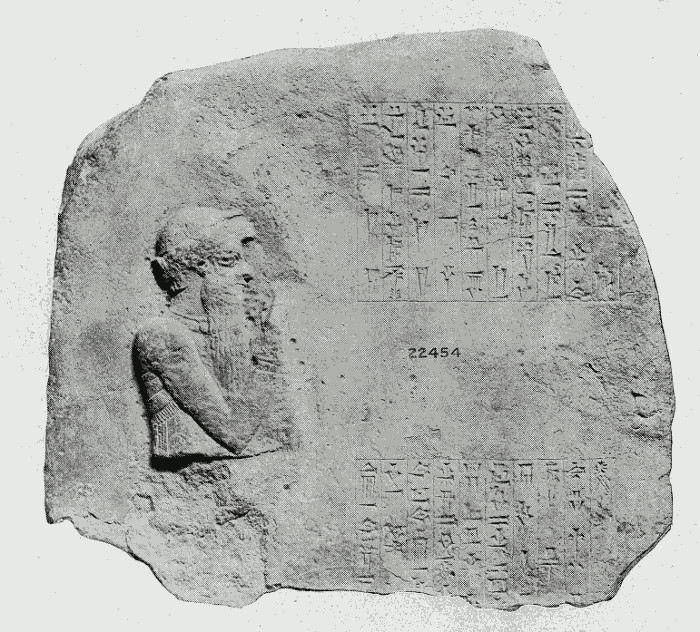
Bas-relief and inscription of Hammurabi, generally regarded as the Biblical Amraphel (Gen. xiv. 1), apparently dedicated for the saving of his life. In this he bears the title (incomplete) of “King of Amoria” (the Amorites), lugal Mar[tu], Semitic Babylonian sar mât Amurrî (see page 315).
[pg ii]
“There is a charm in finding ourselves, our common humanity, our puzzles, our cares, our joys, in the writings of men severed from us by race, religion, speech, and half the gulf of historical time, which no other literary pleasure can equal.”—Andrew Lang.
[pg iii]
Foreword
The present work, being merely a record of things for the most part well known to students and others, cannot, on that account, contain much that is new. All that has been aimed at is, to bring together as many of the old discoveries as possible in a new dress.
It has been thought well to let the records tell their story as far as possible in their own way, by the introduction of translations, thus breaking the monotony of the narrative, and also infusing into it an element of local colour calculated to bring the reader into touch, as it were, with the thoughts and feelings of the nations with whom the records originated. Bearing, as it does, upon the life, history, and legends of the ancient nations of which it treats, controversial matter has been avoided, and the higher criticism left altogether aside.
Assyriology (as the study of the literature and antiquities of the Babylonians and Assyrians is called) being a study still in the course of development, improvements in the renderings of the inscriptions will doubtless from time to time be made, and before many months have passed, things now obscure may have new light thrown upon them, necessitating the revision of such portions as may be affected thereby. It is intended to utilize in future editions any new discoveries which may come to light, and every effort will be made to keep the book up to date.
For shortcomings, whether in the text or in the translations, the author craves the indulgence of the reader, merely pleading the difficult and exacting nature of the study, and the lengthy chronological period to which the book refers.
A little explanation is probably needful upon the question of pronunciation. The vowels in Assyro-Babylonian should [pg iv] be uttered as in Italian or German. Ḫ is a strong guttural like the Scotch ch in “loch”; m had sometimes the pronunciation of w, as in Tiamtu (= Tiawthu), so that the spelling of some of the words containing that letter may later have to be modified. The pronunciation of s and š is doubtful, but Assyriologists generally (and probably wrongly) give the sound of s to the former and sh to the latter. T was often pronounced as th, and probably always had that sound in the feminine endings -tu, -ti, -ta, or at, so that Tiamtu, for instance, may be pronounced Tiawthu, Tukulti-âpil-Êšarra (Tiglath-pileser), Tukulthi-âpil-Êšarra, etc., etc., and in such words as qâtâ, “the hands,” šumāti, “names,” and many others, this was probably always the case. In the names Âbil-Addu-nathanu and Nathanu-yâwa this transcription has been adopted, and may be regarded as correct. P was likewise often aspirated, assuming the sound of ph or f, and k assumed, at least in later times, a sound similar to ḫ (kh), whilst b seems sometimes to have been pronounced as v. G was, to all appearance, never soft, as in gem, but may sometimes have been aspirated. Each member of the group ph is pronounced separately. Ṭ is an emphatic t, stronger than in the word “time.” A terminal m represents the mimmation, which, in later times, though written, was not pronounced.
The second edition, issued in 1903, was revised and brought up to date, and a translation of the Laws of Ḫammurabi, with notes, and a summary of Delitzsch's Babel und Bibel, were appended. For the third edition the work has again been revised, with the help of the recently-issued works of King, Sayce, Scheil, Winckler, and others. At the time of going to press, the author was unable to consult Knudtzon's new edition of the Tel-el-Amarna tablets beyond his No. 228, but wherever it was available, improvements in the translations were made. In addition to revision, the Appendix has been supplemented by paragraphs upon the discoveries at Boghaz-Keui, a mutilated letter from a personage named Belshazzar, and translations of the papyri referring to the Jewish temple at Elephantine.
New material may still be expected from the excavations in progress at Babylon, Susa, Ḫattu, and various other sites in the nearer East.
Theophilus G. Pinches.
[pg 009]
If there are but few letters from the father, there is [pg 315] a sufficient number, and of considerable extent, from the son. He, too, is the faithful servant of the Pharaoh, and he writes also to Dûdu (a form of the name David) and Ḫâi, telling of the difficulties which he had with regard to the king of the Hittites. It is apparently this prince to whom the Pharaoh writes in the letter translated on pp. 300-302, a circumstance which leads to the belief that the complaints of Rib-Addi with regard to Abdi-Aširti and his son Aziru were well-founded. That the king of Egypt asks therein for the delivery to him of certain persons whom he names, implies that he had trustworthy information as to who the intriguers were, and though apparently willing to give Aziru the benefit of the doubt, he certainly did not hold him blameless.
Chapter I. The Early Traditions Of The Creation.
The Hebrew account—Its principal points—The Babylonian account—The story of the Creation properly so called—The version given by the Greek authors—Comparison of the Hebrew and the Greek accounts—The likenesses—The differences—Bêl and the Dragon—The epilogue—Sidelights (notes upon the religion of the Babylonians).
To find out how the world was made, or rather, to give forth a theory accounting for its origin and continued existence, is one of the subjects that has attracted the attention of thinking minds among all nations having any pretension to civilization. It was, therefore, to be expected that the ancient Babylonians and Assyrians, far advanced in civilization as they were at an exceedingly early date, should have formed opinions thereupon, and placed them on record as soon as those opinions were matured, and the art of writing had been perfected sufficiently to enable a serviceable account to be composed.
This, naturally, did not take place all at once. We may take it for granted that the history of the Creation grew piece by piece, as different minds thought over and elaborated it. The first theories we should expect to find more or less improbable—wild stories of serpents and gods, emblematic of the conflicting powers of good and evil, which, with them, had their origin before the advent of mankind upon the earth.
But all men would not have the same opinion of the way in which the universe came into existence, [pg 010] and this would give rise, as really happened in Babylonia, to conflicting accounts or theories, the later ones less improbable than, and therefore superior to, the earlier. The earlier Creation-legend, being a sort of heroic poem, would remain popular with the common people, who always love stories of heroes and mighty conflicts, such as those in which the Babylonians and Assyrians to the latest times delighted, and of which the Semitic Babylonian Creation-story consists.
As the ages passed by, and the newer theories grew up, the older popular ones would be elaborated, and new ideas from the later theories of the Creation would be incorporated, whilst, at the same time, mystical meanings would be given to the events recorded in the earlier legends to make them fit in with the newer ones. This having been done, the scribes could appeal at the same time to both ignorant and learned, explaining how the crude legends of the past were but a type of the doctrines put forward by the philosophers of later and more enlightened days, bringing within the range of the intellect of the unlearned all those things in which the more thoughtful spirits also believed. By this means an enlightened monotheism and the grossest polytheism could, and did, exist side by side, as well as clever and reasonable cosmologies along with the strangest and wildest legends.
Thus it is that we have from the literature of two closely allied peoples, the Babylonians and the Hebrews, accounts of the Creation of the world so widely differing, and, at the same time, possessing, here and there, certain ideas in common—ideas darkly veiled in the old Babylonian story, but clearly expressed in the comparatively late Hebrew account.
It must not be thought, however, that the above theory as to the origin of the Hebrew Creation-story interferes in any way with the doctrine of its inspiration. We are not bound to accept the opinion so [pg 011] generally held by theologians, that the days of creation referred to in Genesis i. probably indicate that each act of creation—each day—was revealed in seven successive dreams, in order, to the inspired writer of the book. The opinion held by other theologians, that “inspiration” simply means that the writer was moved by the Spirit of God to choose from documents already existing such portions as would serve for our enlightenment and instruction, adding, at the same time, such additions of his own as he was led to think to be needful, may be held to be a satisfactory definition of the term in question.
Without, therefore, binding ourselves down to any hard and fast line as to date, we may regard, for the purposes of this inquiry, the Hebrew account of the Creation as one of the traditions handed down in the thought of many minds extending over many centuries, and as having been chosen and elaborated by the inspired writer of Genesis for the purpose of his narrative, the object of which was to set forth the origin of man and the Hebrew nation, to which he belonged, and whose history he was about to narrate in detail.
The Hebrew story of the Creation, as detailed in Genesis i., may be regarded as one of the most remarkable documents ever produced. It must not be forgotten, however, that it is a document that is essentially Hebrew. For the author of this book the language of God and of the first man was Hebrew—a literary language, showing much phonetic decay. The retention of this matter (its omission not being essential at the period of the composition of the book) is probably due, in part, to the natural patriotism of the writer, overruling what ought to have been his inspired common-sense. How this is to be explained it is not the intention of the writer of this book to inquire, the account of the Creation and its parallels being the subject in hand at present.
The question of language apart, the account of the [pg 012] Creation in Genesis is in the highest degree a common-sense one. The creation of (1) the heaven, and (2) the earth; the darkness—not upon the face of the earth, but upon the face of the deep. Then the expansion dividing the waters above from the waters below on the earth. In the midst of this waste of waters dry land afterwards appears, followed by the growth of vegetation. But the sun and the moon had not yet been appointed, nor the stars, all of which come into being at this point. Last of all are introduced the living things of the earth—fish, and bird, and creeping thing, followed by the animals, and, finally, by man.
It is noteworthy and interesting that, in this account, the acts of creation are divided into seven periods, each of which is called a “day,” and begins, like the natural day in the time-reckoning of the Semitic nations, with the evening—“and it was evening, and it was morning, day one.” It describes what the heavenly bodies were for—they were not only to give light upon the earth—they were also for signs, for seasons, for days, and for years.
And then, concerning man, a very circumstantial account is given. He was to have dominion over everything upon the earth—the fish of the sea, the fowl of the air, the cattle, and every creeping thing. All was given to him, and he, like the creatures made before him, was told to “be fruitful, and multiply, and replenish the earth.” It is with this crowning work of creation that the first chapter of the Book of Genesis ends.
The second chapter refers to the seventh day—the day of rest, and is followed by further details of the creation, the central figure of which is the last thing created, namely, man. This chapter reads, in part, like a recapitulation of the first, but contains many additional details. “No plant of the field was yet in the earth, and no herb ... had sprung up: for the Lord [pg 013] God had not caused it to rain ..., and there was not a man to till the ground.” A mist, therefore, went up from the earth, and watered all the face of the ground. Then, to till the earth, man was formed from the dust of the ground, and the Lord God “breathed into his nostrils the breath of life, and man became a living soul.”
The newly-created man was, at this time, innocent, and was therefore to be placed by his Creator in a garden of delight, named Eden, and this garden he was to dress and keep. A hidden danger, however, lay in this pleasant retreat—the tree of knowledge of good and evil, of which he was forbidden to eat, but which was to form for him a constant temptation, for ever testing his obedience. All might have been well, to all appearance, but for the creation of woman, who, giving way to the blandishments of the tempter, in her turn tempted the man, and he fell. Death in the course of nature was the penalty, the earthly paradise was lost, and all chance of eating of the tree of life, and living for ever, disappeared on man's expulsion from his first abode of delight.
In the course of this narrative interesting details are given—the four rivers, the country through which they flowed, and their precious mineral products; the naming of the various animals by the man; the forming of woman from one of his ribs; the institution of marriage, etc.
Such is, in short, the story of the Creation as told in the Bible, and it is this that we have to compare with the now well-known parallel accounts current among the ancient Babylonians and Assyrians. And here may be noted at the outset that, though we shall find some parallels, we shall, in the course of our comparison, find a far greater number of differences, for not only were they produced in a different land, by a different people, but they were also produced under different conditions. Thus, Babylonian polytheism takes the place of the severe and uncompromising [pg 014] monotheism of the Hebrew account in Genesis; Eden was, to the Babylonians, their own native land, not a country situated at a remote distance; and, lastly, but not least, their language, thoughts, and feelings differed widely from those of the dwellers in the Holy Land.
The Babylonian story of the Creation is a narrative of great interest to all who occupy themselves with the study of ancient legends and folklore. It introduces us not only to exceedingly ancient beliefs concerning the origin of the world on which we live, but it tells us also of the religion, or, rather, the religious beliefs, of the Babylonians, and enables us to see something of the changes which those beliefs underwent before adopting the form in which we find them at the time this record was composed.
A great deal has been written about the Babylonian story of the Creation. As is well known, the first translation of these documents was by him who first discovered their nature, the late George Smith, who gave them to the world in his well-known book, The Chaldean Account of Genesis, in 1875. Since that time numerous other translations have appeared, not only in England, but also on the Continent. Among those who have taken part in the work of studying and translating these texts may be named Profs. Sayce, Oppert, Hommel, and Delitzsch, the last-named having both edited the first edition of Smith's book (the first issued on this subject on the Continent), and published one of the last and most complete editions of the whole legend yet placed before the public. To Prof. Sayce, as well as to Prof. Hommel, belongs the honour of many brilliant suggestions as to the tendency of the texts of the creation as a whole: Prof. Oppert was the first to point out that the last tablet of the series was not, as Smith thought, an “Address to primitive man,” but an address to the god Merodach as the restorer of order out of chaos; [pg 015] whilst Delitzsch has perhaps (being almost the last to write upon it) improved the translation more than many of his predecessors in the work.
Before proceeding to deal with the legend itself, a few remarks upon the tablets and the text that they bear will probably not be considered out of place. There are, in all likelihood, but few who have not seen in the British Museum or elsewhere those yellow baked terra-cotta tablets of various sizes and shapes, upon which the Babylonians and Assyrians were accustomed to write their records. And well it is for the science of Assyriology that they used this exceedingly durable material. I have said that the tablets are yellow in colour, and this is generally the case, but the tint varies greatly, and may approach dark grey or black, and even appear as a very good sage-green. The smaller tablets are often cushion-shaped, but, with some few exceptions, they are rectangular, like those of larger size. The writing varies so considerably that the hand of the various scribes can sometimes be distinguished. In the best class of tablets every tenth line is often numbered—a proof that the Assyrians and Babylonians were very careful with the documents with which they had to deal. The Babylonian tablets closely resemble the Assyrian, but the style of the writing differs somewhat, and it is, in general, more difficult to read than the Assyrian. None of the tablets of the Creation-series are, unfortunately, perfect, and many of the fragments are mere scraps, but as more than one copy of each anciently existed, and has survived, the wanting parts of one text can often be supplied from another copy. That copies come from Babylon as well as from Nineveh is a very fortunate circumstance, as our records are rendered more complete thereby.
Of the obverse of the first tablet very little, unfortunately, remains, but what there is extant is of the highest interest. Luckily, we have the beginning of [pg 016] this remarkable legend, which runs, according to the latest and best commentaries, as follows—
“When on high the heavens were unnamed,
Beneath the earth bore not a name:
The primæval ocean was their producer;
Mummu Tiamtu was she who begot the whole of them.
Their waters in one united themselves, and
The plains were not outlined, marshes were not to be seen.
When none of the gods had come forth,
They bore no name, the fates [had not been determined].
There were produced the gods [all of them?]:
Laḫmu and Laḫamu went forth [as the first?]:
The ages were great, [the times were long?].
Anšar and Kišar were produced and over th[em]....
Long grew the days; there came forth (?)...
The god Anu, their son.....
Anšar, the god Anu......”
Such is the tenor of the opening lines of the Babylonian story of the Creation, and the differences between the two accounts are striking enough. Before proceeding, however, to examine and compare them, a few words upon the Babylonian version may not be without value.
First we must note that the above introduction to the legend has been excellently explained and commented upon by the Syrian writer Damascius. The following is his explanation of the Babylonian teaching concerning the creation of the world—
“But the Babylonians, like the rest of the Barbarians, pass over in silence the one principle of the Universe, and they constitute two, Tauthé and Apason, [pg 017] making Apason the husband of Tauthé, and denominating her the mother of the gods. And from these proceeds an only-begotten son, Moumis, which, I conceive, is no other than the intelligible world proceeding from the two principles. From them, also, another progeny is derived, Daché and Dachos; and again a third, Kissaré and Assoros, from which last three others proceed, Anos, and Illinos, and Aos. And of Aos and Dauké is born a son called Belos, who, they say, is the fabricator of the world, the Creator.”
The likeness of the names given in this extract from Damascius will be noticed, and will probably also be recognized as a valuable verification of the certainty now attained by Assyriologists in the reading of the proper names. In Tiamtu, or, rather, Tiawthu, will be easily recognized the Tauthé of Damascius, whose son, as appears from a later fragment, was called Mummu (= Moumis). Apason he gives as the husband of Tauthé, but of this we know nothing from the Babylonian tablet, which, however, speaks of this Apason (apsû, “the abyss”), which corresponds with the “primæval ocean” of the Babylonian tablet.
In Daché and Dachos it is easy to see that there has been a confusion between Greek Λ and Δ, which so closely resemble each other. Daché and Dachos should, therefore, be corrected into Laché and Lachos, the Laḫmu and Laḫamu (better Laḫwu and Laḫawu) of the Babylonian text. They were the male and female personifications of the heavens. Anšar and Kišar are the Greek author's Assoros and Kisaré, the “Host of Heaven” and the “Host of Earth” respectively. The three proceeding from them, Anos, Illinos, and Aos, are the well-known Anu, the god of the heavens; Illil, for En-lila, the Sumerian god of the earth and the Underworld; and Aa or Ea, the god of the waters, who seems to have been [pg 018] identified by some with Yau or Jah. Aa or Ea was the husband of Damkina, or Dawkina, the Dauké of Damascius, from whom, as he says, Belos, i.e. Bel-Merodach, was born, and if he did not “fabricate the world,” at least he ordered it anew, after his great fight with the Dragon of Chaos, as we shall see when we come to the third tablet of the series.
After the lines printed above the text is rather defective, but it would seem that the god Nudimmud (Ae or Ea), “the wise and open of ear,” next came into existence. A comparison is then apparently made between these deities on the one hand, and Tiamtu, Apsû, and Mummu on the other—to the disadvantage of the latter. On Apsû complaining that he had no peace by day nor rest by night on account of the ways of the gods, their sons, it was at last determined to make war upon them.
“They have become hostile, and at the side of Tiamtu they advance,
Storming, planning, not resting night and day,
They make ready for battle, wrathful (and) raging.
They assemble themselves together, and make ready (for) the strife.
Ummu Ḫubur, she who created everything,
Added irresistible weapons, produced giant serpents,
Sharp of tooth, unsparing (their) stings (?)
She caused poison to fill their bodies like blood.
Raging dragons clothed she with terrors,
She endowed (them) with brilliance, she made (them) like the high ones (?)
‘Whoever sees them may fright overwhelm,
May their bodies rear on high, and may (none) turn aside their breast.’
[pg 019]
She set up the viper, the pithon, and the Laḫamu,
Great monsters, raging dogs, scorpion-men,
Driving demons, fish-men, and mountain-rams,
Bearing unsparing weapons, not fearing battle;
Powerful are (her) commands, and irresistible,
She made altogether eleven like that,
Among the gods her firstborn, he who had made for her a host,
Kingu, she raised among them, him she made chief.
Those going in front before the army, those leading the host,
Raising weapons, attacking, who rise up (for) the fray,
The leadership of the conflict
She delivered into his hand, and caused him to sit in state (?).
‘I have set firm thy word, in the assembly of the gods I have made thee great,
The rule of the gods, all of them, have I delivered into thy hand,
Only be thou great—thou, my only husband—
Let them exalt thy name over all the heavenly ones (?)’
She gave him then the tablets of fate, she placed them in his bosom:
‘As for thee, thy command shall not be changed, may thy utterances stand firm!’
Now Kingu is exalted, he has taken to him the godhood of Anu,
Among the gods her sons he determines the fates.
‘Open your mouths, let the Firegod be at rest.
Be ye fearful in the fight, let resistance be laid low (?).’ ”
[pg 020]
Such are the last verses of the first tablet of the so-called story of the Creation as known to the Babylonians, and though it would be better named if called the Story of Bêl and the Dragon, the references to the creation of the world that are made therein prevent the name from being absolutely incorrect, and it may, therefore, serve, along with the more correct one, to designate it still. As will be gathered from the above, the whole story centres in the wish of the goddess of the powers of evil to get creation—the production of all that is in the world—into her own hands. In this she is aided by certain gods, over whom she sets one, Kingu, her husband, as chief. In the preparations that she makes she exercises her creative powers to produce all kinds of dreadful monsters to help her against the gods whom she wishes to overthrow, and the full and vigorous description of her defenders, created by her own hands, adds much to the charm of the narrative, and shows well what the Babylonian scribes were capable of in this class of record.
The first tablet breaks off after the speech of Tiamtu to her husband Kingu. The second one begins by stating how Aa or Ea heard of the plot of Tiamtu and her followers against the gods of heaven. When his first wrath on account of this had somewhat abated, he went and related the whole, in practically the same words as the story is given on the two foregoing pages, to Anšar, his father, who in his turn became filled with rage, biting his lips, and uttering cries of deepest grief. In the mutilated lines which follow Apsû's subjugation seems to be referred to. After this is another considerable gap, and then comes the statement that Anšar applied to his son Anu, “the mighty and brave, whose power is great, whose attack irresistible,” saying that if he will only speak to her, the great Dragon's anger will be calmed and her rage disappear.
[pg 021]
“(Anu heard) the words of his father Anšar,
(Took the ro)ad towards her, and descended by her path,
Anu (went),—he examined Tiamtu's lair, and
(Not having power to resist her?), turned back.”
How the god excused himself to his father Anšar on account of his ignominious flight we do not know, the record being again defective at this point. With the same want of success the god Anšar then, as we learn from another part of the narrative, applied to the god Nudimmud, a deity who is explained in the inscriptions as being the same as the god Aa or Ea, but whom Professor Delitzsch is rather inclined to regard as one of the forms of Bêl.
In the end the god Merodach, the son of Aa, was asked to be the champion of the gods against the great emblem of the powers of evil, the Dragon of Chaos. To become, by this means, the saviour of the universe, was apparently just what the patron-god of the city of Babylon desired, for he seems immediately to have accepted the task of destroying the hated Dragon—
“The lord rejoiced at his father's word,
His heart was glad, and he saith to his father:
‘O lord of the gods, fate of the great gods!
If then I be your avenger,
(If) I bind Tiamtu and save you,
Assemble together, cause to be great, (and) proclaim ye, my lot.
In Upšukenaku assembled, come ye joyfully together,
Having opened my mouth, like you also, let me the fates decide,
That naught be changed that I do, (even) I.
May the word of my lips neither fail nor altered be!’ ”
[pg 022]
Anšar, without delay, calls his messenger Gaga, and directs him to summon all the gods to a festival, where with appetite they may sit down to a feast, to eat the divine bread and drink the divine wine, and there let Merodach “decide the fates,” as the one chosen to be their avenger. Then comes the message that Gaga was to deliver to Laḫmu and Laḫamu, in which the rebellion of Tiamtu is related in practically the same words as the writer used at the beginning of the narrative to describe Tiamtu's revolt. Merodach's proposal and request are then stated, and the message ends with the following words—
“Hasten, and quickly decide for him your fate—
Let him go, let him meet your mighty foe!”
Laḫmu and Laḫamu having heard all the words of Anšar's message, which his messenger Gaga faithfully repeated to them, they, with the Igigi, or gods of the heavens, broke out in bitter lamentation, saying that they could not understand Tiamtu's acts.
Then all the great gods, who “decided the fates,” hastened to go to the feast, where they ate and drank, and, apparently with loud acclaim, “decided the fate” for Merodach their avenger.
Here follow the honours conferred on Merodach on account of the mighty deed that he had undertaken to do. They erected for him princely chambers, wherein he sat as the great judge “in the presence of his fathers,” and they praised him as the highest honoured among the great gods, incomparable as to his ordinances, changeless as to the word of his mouth, uncontravenable as to his utterances. None of them would go against the authority that was to be henceforth his domain.
[pg 023]
“Merodach, thou art he who is our avenger,
(Over) the whole universe have we given thee the kingdom.”
His weapons were never to be defeated, his foes were to be smitten down, but as for those who trusted in him, the gods prayed him that he would grant them life, “pouring out,” on the other hand, the life of the god who had begun the evil against which Merodach was about to fight.
Then, so that he should see that they had indeed given him the power to which they referred, they laid in their midst a garment, and in accordance with their directions, Merodach spoke, and the garment vanished,—he spoke, and it reappeared—
“ ‘Open thy mouth, may the garment be destroyed,
Speak to it once more, and let it be restored again!’
He spoke with his mouth, and the garment was destroyed,
He spoke to it again, and the garment was reproduced.”
Then all the gods called out, “Merodach is king!” and they gave him sceptre, throne, and insignia of royalty, and also an irresistible weapon, which should shatter his enemies.
“ ‘Now, go, and cut off the life of Tiamtu,
Let the winds bear away her blood to hidden places!’
(Thus) did the gods, his fathers, fix the fate of Bel.
A path of peace and goodwill they set for him as his road.”
Then the god armed himself for the fight, taking spear (or dart), bow, and quiver. To these he added [pg 024] lightning flashing before him, flaming fire filling his body; the net which his father Anu had given him wherewith to capture “kirbiš Tiamtu” or “Tiamtu who is in the midst,” he set north and south, east and west, in order that nothing of her might escape. In addition to all this, he created various winds—the evil wind, the storm, the hurricane, “wind four and seven,” the harmful, the uncontrollable (?), and these seven winds he sent forth, to confuse kirbiš Tiamtu, and they followed after him.
Next he took his great weapon called âbubu, and mounted his dreadful, irresistible chariot, to which four steeds were yoked—steeds unsparing, rushing forward, flying along, their teeth full of venom, foam-covered, experienced (?) in galloping, schooled for overthrowing. Merodach being now ready for the fray, he fared forth to meet the Dragon.
“Then, they clustered around him, the gods clustered around him,
The gods his fathers clustered around him, the gods clustered around him.
And the lord advanced, Tiamtu's retreat regarding
Examining the lair of Kingu her consort.”
The sight of the enemy was so menacing, that even the great Merodach began to falter and lose courage, whereat the gods, his helpers, who accompanied him, were greatly disturbed in their minds, fearing approaching disaster. The king of the gods soon recovered himself, however, and uttered to the demon a longish challenge, on hearing which she became as one possessed, and cried aloud. Muttering then incantations and charms, she called the gods of battle to arms, and the great fight for the rule of the universe began.
“The lord spread wide his net, made it enclose her.
The evil wind following behind, he sent on before.
[pg 025]
Tiamtu opened her mouth as much as she could.
He caused the evil wind to enter so that she could not close her lips,
The angry winds filled out her body,
Her heart was overpowered, wide opened she her mouth.”
Being now at the mercy of the conqueror, the divine victor soon made an end of the enemy of the gods, upon whose mutilated body, when dead, he stood triumphantly. Great fear now overwhelmed the gods who had gone over to her side, and fought against the heavenly powers, and they fled to save their lives. Powerless to escape, however, they were captured, and their weapons broken to pieces. Notwithstanding their cries, which filled the vast region, they had to bear the punishment which was their due, and were shut up in prison. The creatures whom Tiamtu had created to help her and strike terror into the hearts of the gods, were also brought into subjection, along with Kingu, her husband, from whom the tablets of fate were taken by the conqueror as things unmeet for Tiamtu's spouse to own. It is probable that we have here the true explanation of the origin of this remarkable legend, for the tablets of fate were evidently things which the king of heaven alone might possess, and Merodach, as soon as he had overcome his foe, pressed his own seal upon them, and placed them in his breast.
He had now conquered the enemy, the proud opposer of the gods of heaven, and having placed her defeated followers in safe custody, he was able to return to the dead and defeated Dragon of Chaos. He split open her skull with his unsparing weapon, hewed asunder the channels of her blood, and caused the north wind to carry it away to hidden places. His fathers saw this, and rejoiced with shouting, and brought him gifts and offerings.
[pg 026]
And there, as he rested from the strife, Merodach looked upon her who had wrought such evil in the fair world as created by the gods, and as he looked, he thought out clever plans. Hewing asunder the corpse of the great Dragon that lay lifeless before him, he made with one half a covering for the heavens, keeping it in its place by means of a bolt, and setting there a watchman to keep guard. He also arranged this portion of the Dragon of Chaos in such a way, that “her waters could not come forth,” and this circumstance suggests a comparison with “the waters above the firmament” of the Biblical story in Genesis.
Passing then through the heavens, he beheld that wide domain, and opposite the abyss, he built an abode for the god Nudimmud, that is, for his father Aa as the creator.
“Then measured the lord the abyss's extent,
A palace in its likeness he founded:—Êšarra;
The palace Êšarra, which he made, (is) the heavens,
(For) Anu, Bêl, and Aa he founded their strongholds.”
With these words, which are practically a description of the creation or building, by Merodach, of the heavens, the fourth tablet of the Babylonian legend of the Creation comes to an end. It is difficult to find a parallel to this part of the story in the Hebrew account in Genesis.
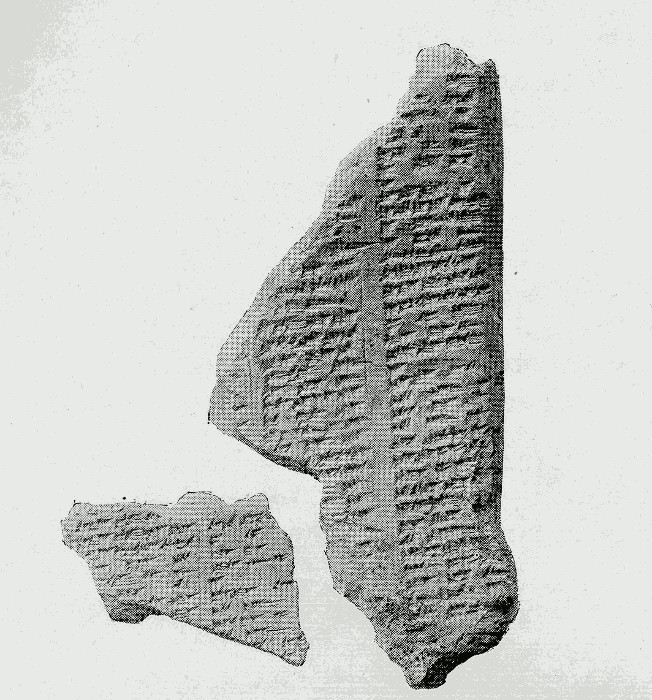
Plate II. Fragments of tablets (duplicates), giving the words for the different fasts, festivals, etc., of the Babylonians and Assyrians. Line 4 of the small piece, and 16 of the large one, have the words ûm nûh libbi, "day of rest of the heart," explained by sapattum (from the Sumerian sa-bat, "heart-rest"), generally regarded as the original of the Hebrew Sabbath. Sapattum, however, was the 15th day of the month. The nearest approaches to Sabbaths were the 7th, 14th, 21st, 28th, and 19th, which were called u-hul-gallu or ûmu limnu, "the evil day" (the 19th being a week of weeks, from the 1st day of the preceding month), because it was unlawful to do certain things on those days.
The fifth tablet of the Babylonian story of the Creation is a mere fragment, but is of considerable interest and importance. It describes, in poetical language, in the style with which the reader has now become fairly familiar, the creation and ordering, by Merodach, of the heavenly bodies, as the ancient Babylonians conceived them to have taken place. The text of the first few stanzas is as follows—
[pg 027]
“He built firmly the stations of the great gods—
Stars their likeness—he set up the Lumaši,
He designated the year, he outlined the (heavenly) forms.
He set for the twelve months three stars each.
From the day when the year begins, ... for signs.
He founded the station of Nîbiru, to make known their limits,
That none might err, nor go astray.
The station of Bêl and Aa he placed with himself,
Then he opened the great gates on both sides,
Bolts he fixed on the left and on the right,
In its centre (?) then he set the zenith (?).
Nannaru (the moon) he caused to shine, ruling the night,
So he set him as a creature of the night, to make known the days,
Monthly, without failing, he provided him with a crown,
At the beginning of the month then, dawning in the land,
The horns shine forth to make known the seasons (?),
On the 7th day crown (perfect)ing (?).
The [Sa]bbath shalt thou then fall in with, half-monthly,
When the sun (is) in the base of the heavens, at thy [approach?].
...... hath caused to be cut off and
... nearing the path of the sun.
[The ...]th [day] shalt thou then fall in with, the sun shall change (?)...
...... the sign seeking its path.
... cause to approach and give the judgment.
........................ to injure (?)
........................... one.”
The final lines of this portion seem to refer to the moon on the 7th and other days of the month, and [pg 028] would in that case indicate the quarters. “Sabbath” is doubtful on account of the mutilation of the first character, but in view of the forms given on pl. II. and p. 527 (šapattum, šapatti) the restoration as šapattu seems possible. It is described on p. 527 as the 15th of the month, but must have indicated also the 14th, according to the length of the month.
An exceedingly imperfect fragment of what is supposed to be part of the fifth tablet exists. It speaks of the bow with which Merodach overcame the Dragon of Chaos, which the god Anu, to all appearance, set in the heavens as one of the constellations. After this comes, apparently, a fragment that may be regarded as recording the creation of the earth, and the cities and renowned shrines upon it, the houses of the great gods, and the cities Nippuru (Niffer) and Asshur being mentioned. Everything, however, is very disconnected and doubtful.
The sixth tablet, judging from the fragment recognized by Mr. L. W. King, must have been one of special interest, as it to all appearance contained a description of the creation of man. Unfortunately, only the beginning of the text is preserved, and is as follows:—
In the present work, the Sabbath is referred to on pl. II., where photographs of two fragments (duplicates) explaining the word are given. Prof. Delitzsch calls attention, in the notes to his first lecture, to this text, together with the British Museum syllabary 82-9-18, 4159, col. I., l. 24, where ud (weakened to û), [pg 527] meaning “day,” is explained by šabattum, “Sabbath,” as “the day” par excellence, and from other passages he reasons that the old rendering of the word as “day of rest,” ûm nûḫ libbi, “day of rest of the heart”—cf. pl. II.—is the correct one.
“Merodach, on hearing the word of the gods,
His heart urged him, and he made [cunning plans].
He opened his mouth and [said] to the god Aê—
[What] he thought out in his heart he communicates ...:
‘Let me gather my blood and let me ... bone,
Let me set up a man, and let the man ....
Let me make then men dwelling ....
May the service of the gods be established, and as for them, let ....
Let me alter the ways of the gods, let me chan[ge their paths]—
As one let them be honoured, as two let them be ....’
Aê answered him, and the word he spake.”
[pg 029]
Here come the remains of ten very imperfect lines, which probably related the consent of the other gods to the proposal, and must have been followed by a description of the way in which it was carried out. All this, however, is unfortunately not preserved. That the whole of Merodach's work received the approval of “the gods his fathers” is shown by the remains of lines with which the sixth tablet closes:—
“They rejoiced ....................
In Upšukenaku they caused .............
Of the son, the hero, who brought back [benefit for them]
‘As for us, whom, succouring, he ...........’
They sat down, and in their assembly they proclaimed
... they all announced ...............”
What they proclaimed and announced was apparently his glorious names, as detailed in the seventh and last tablet of the series, which was regarded by George Smith as containing an address to primitive man, but which proves to be really an address to the god Merodach praising him on account of the great work that he had done in overcoming the Dragon, and in thereafter ordering the world anew. As this portion forms a good specimen of Babylonian poetry at its best, the full text of the tablet, with the exception of some short remains of lines, is here presented in as careful a translation as is at present possible.
The Seventh Tablet Of The Creation-Series, Also Known As The Tablet Of The Fifty-One Names.
1 Asari, bestower of planting, establisher of irrigation.
2 Creator of grain and herbs, he who causes verdure to grow.
[pg 030]
3 Asari-alim, he who is honoured in the house of counsel, [who increases counsel?].
4 The gods bow down to him, fear [possesses them?].
5 Asari-alim-nunna, the mighty one, light of the father his begetter.
6 He who directs the oracles of Anu, Bel, [and Aa].
7 He is their nourisher, who has ordained....
8 He whose provision is fertility, sendeth forth....
9 Tutu, the creator of their renewal, [is he?].
10 Let him purify their desires, (as for) them, let them [be appeased].
11 Let him then make his incantation, let the gods [be at rest].
12 Angrily did he arise, may he lay low [their breast].
13 Exalted was he then in the assembly of the gods....
14 None among the gods shall [forsake him].
15 Tutu.1 “Zi-ukenna,” “life of the people”
16 “He who fixed for the gods the glorious heavens;”
17 Their paths they took, they set
18 May the deeds (that he performed) not be forgotten among men.
19 Tutu. “Zi-azaga,” thirdly, he called (him),—“he who effects purification,”
20 “God of the good wind,” “Lord of hearing and obedience,”
21 “Creator of fulness and plenty,” “Institutor of abundance,”
22 “He who changes what is small to great,”
23 In our dire need we scented his sweet breath.
24 Let them speak, let them glorify, let them render him obedience.
25 Tutu. “Aga-azaga,” fourthly, May he make the crowns glorious,
26 “The lord of the glorious incantation bringing the dead to life,”
27 “He who had mercy on the gods who had been overpowered,”
[pg 031]
28 “He who made heavy the yoke that he had laid on the gods who were his enemies,
29 (And) for their despite (?), created mankind.”
30 “The merciful one,” “He with whom is lifegiving,”
31 May his word be established, and not forgotten,
32 In the mouth of the black-headed ones (mankind) whom his hands have made.
33 Tutu. “Mu-azaga,” fifthly, May their mouth make known his glorious incantation,
34 “He who with his glorious charm rooteth out all the evil ones,”
35 “Sa-zu,” “He who knoweth the heart of the gods,” “He who looketh at the inward parts,”
36 “He who alloweth not evil-doers to go forth against him,”
37 “He who assembleth the gods,” appeasing their hearts,
38 “He who subdueth the disobedient,”...
39 “He who ruleth in truth (and justice”), ...
40 “He who setteth aside injustice,” ...
41 Tutu. “Zi-si” (“He who bringeth about silence”), ...
42 “He who sendeth forth stillness.” ...
43 Tutu. “Suḫ-kur,” “Annihilator of the enemy,” ...
44 “Dissolver of their agreements,” ...
45 “Annihilator of everything evil.” ...
About 40 lines, mostly very imperfect, occur here, and some 20 others are totally lost. The text after this continues:—
107 “Then he seized the back part (?) of the head,which he pierced (?),
108 And as Kirbiš-Tiamtu he circumvented restlessly,
109 His name shall be Nibiru, he who seized Kirbišu (Tiamtu).
[pg 032]
110 Let him direct the paths of the stars of heaven,
111 Like sheep let him pasture the gods, the whole of them.
112 May he confine Tiamtu, may he bring her life into pain and anguish,
113 In man's remote ages, in lateness of days,
114 Let him arise, and he shall not cease, may he continue into the remote future
115 As he made the (heavenly) place, and formed the firm (ground),
116 Father Bêl called him (by) his own name, “Lord of the World,”
117 The appellation (by) which the Igigi have themselves (always) called him.
118 Aa heard, and he rejoiced in his heart:
119 Thus (he spake): “He, whose renowned name his fathers have so glorified,
120 He shall be like me, and Aa shall be his name!
121 The total of my commands, all of them, let him possess, and
122 The whole of my pronouncements he, (even) he, shall make known.”
123 By the appellation “fifty” the great gods
124 His fifty names proclaimed, and they caused his career to be great (beyond all).
125 May they be accepted, and may the primæval one make (them) known,
126 May the wise and understanding altogether well consider (them),
127 May the father repeat and teach to the son,
128 May they open the ears of the shepherd and leader.
129 May they rejoice for the lord of the gods, Merodach,
130 May his land bear in plenty; as for him, may he have peace.
[pg 033]
131 His word standeth firm; his command changeth not—
132 No god hath yet made to fail that which cometh forth from his mouth.
133 If he frown down in displeasure, he turneth not his neck,
134 In his anger, there is no god who can withstand his wrath.
135 Broad is his heart, vast is the kindness (?) of (his) ...
136 The sinner and evildoer before him are (ashamed?).”
The remains of some further lines exist, but they are very uncertain, the beginnings and ends being broken away. All that can be said is, that the poem concluded in the same strain as the last twelve lines preserved.
In the foregoing pages the reader has had placed before him all the principal details of the Babylonian story of the Creation, and we may now proceed to examine the whole in greater detail.
If we may take the explanation of Damascius as representing fairly the opinion of the Babylonians concerning the creation of the world, it seems clear that they regarded the matter of which it was formed as existing in the beginning under the two forms of Tiamtu (the sea) and Apsû (the deep), and from these, being wedded, proceeded “an only begotten son,” Mummu (Moumis), conceived by Damascius to be “no other that the intelligible world proceeding from the two principles,” i.e. from Tiamtu and Apsû. From these come forth, in successive generations, the other gods, ending with Marduk or Merodach, also named Bêl (Bêl-Merodach), the son of Aa (Ea) and his consort Damkina (the Aos and Dauké of Damascius).
Judging from the material that we have, the Babylonians seemed to have believed in a kind of evolution, for they evidently regarded the first creative [pg 034] powers (the watery waste and the abyss) as the rude and barbaric beginnings of things, the divine powers produced from these first principles (Laḫmu and Laḫamu, Anšar and Kišar, Anu, Ellila, and Aa, and finally Marduk), being successive stages in the upward path towards perfection, with which the first rude elements of creation were ultimately bound to come into conflict; for Tiamtu, the chief of the two rude and primitive principles of creation, was, notwithstanding this, ambitious, and desired still to be the creatress of the gods and other inferior beings that were yet to be produced. All the divinities descending from Tiamtu were, to judge from the inscriptions, creators, and as they advanced towards perfection, so also did the things that they created advance, until, by contrast, the works of Tiamtu became as those of the Evil Principle, and when she rebelled against the gods who personified all that was good, it became a battle between them of life and death, which only the latest-born of the gods, elected in consequence of the perfection of his power, to be king and ruler over “the gods his fathers,” was found worthy to wage. The glorious victory gained, and the Dragon of Evil subdued and relegated to those places where her exuberant producing power, which, to all appearance, she still possessed, would be of use, Merodach, in the fulness of his power as king of the gods, perfected and ordered the universe anew, and created his crowning work, Mankind. Many details are, to all appearance, wanting on account of the incompleteness of the series, but those which remain seem to indicate that the motive of the whole story was as outlined here.
In Genesis, however, we have an entirely different account, based, apparently, upon a widely different conception of the origin of the Universe, for one principle only appears throughout the whole narrative, be it Elohistic, Jehovistic, or priestly. “In the beginning [pg 035] God created the heavens and the earth,” and from the first verse to the last it is He, and He alone, who is Creator and Maker and Ruler of the Universe. The only passage containing any indication that more than one person took part in the creation of the world and all that therein is, is in verse 26, where God is referred to as saying, “Let us make man,” but that this is simply the plural of majesty, and nothing more, seems to be proved by the very next verse, where the wording is, “and God made man in his own image,” etc. There is, therefore, no trace of polytheistic influence in the whole narrative.
Let us glance awhile at the other differences.
To begin with, the whole Babylonian narrative is not only based upon an entirely different theory of the beginning of all things, but upon an entirely different conception of what took place ere man appeared upon the earth. “In the beginning God created the heavens and the earth,” implies the conception of a time when the heavens and the earth existed not. Not so, seemingly, with the Babylonian account. There the heavens and the earth are represented as existing, though in a chaotic form, from the first. Moreover, it is not the external will and influence of the Almighty that originates and produces the forms of the first creatures inhabiting the world, but the productive power residing in the watery waste and the deep:
“The primæval ocean (apsû rêstū) was their producer (lit. seeder);
Mummu Tiamtu was she who brought forth the whole of them.”
It is question here of “seeding” (zaru) and “bearing” (âlādu), not of creating.
The legend is too defective to enable us to find out anything as to the Babylonian idea concerning the formation of the dry land. Testimony as to its non-existence [pg 036] at the earliest period is all that is vouchsafed to us. At that time none of the gods had come forth, seemingly because (if the restoration be correct) “the fates had not been determined.” There is no clue, however, as to who was then the determiner of the fates.
Then, gradually, and in the course of long-extended ages, the gods Laḫmu and Laḫamu, Anšar and Kišar, with the others, came into existence, as already related, after which the record, which is mutilated, goes on to speak of Tiamtu, Apsū, and Mummu.
These deities of the Abyss were evidently greatly disquieted on account of the existence and the work of the gods of heaven. They therefore took counsel together, and Apsū complained that he could not rest either night or day on account of them. Naturally the mutilated state of the text makes the true reason of the conflict somewhat uncertain. Fried. Delitzsch regarded it as due to the desire, on the part of Merodach, to have possession of the “Tablets of Fate,” which the powers of good and the powers of evil both wished to obtain. These documents, when they are first spoken of, are in the hands of Tiamtu (see p. 19), and she, on giving the power of changeless command to Kingu, her husband, handed them to him. In the great fight, when Merodach overcame his foes, he seized these precious records, and placed them in his breast—
“And Kingu, who had become great over (?) them—
He bound him, and with Ugga (the god of death) ... he counted him;
From him then he took the Fate-tablets, which were not his,
With his ring he pressed them, and took them to his breast.”
To all appearance, Tiamtu and Kingu were in unlawful possession of these documents, and the king [pg 037] of the gods, Merodach, when he seized them, only took possession of what, in reality, was his own. What power the “Tablets of Fate” conferred on their possessor, we do not know, but in all probability the god in whose hands they were, became, by the very fact, creator and ruler of the universe for ever and ever.
This creative power the king of the gods at once proceeded to exercise. Passing through the heavens, he surveyed them, and built a palace called Ê-šarra, “The house of the host,” for the gods who, with himself, might be regarded as the chief in his heavenly kingdom. Next in order he arranged the heavenly bodies, forming the constellations, marking off the year; the moon, and probably the sun also, being, as stated in Genesis, “for signs, and for seasons, and for days and years,” though all this is detailed, in the Babylonian account, at much greater length. Indeed, had we the whole legend complete, we should probably find ourselves in possession of a detailed description of the Babylonian idea of the heavens which they studied so constantly, and of the world on which they lived, in relation to the celestial phenomena which they saw around them.
Fragments of tablets have been spoken of that seem to belong to the fifth and sixth of the series, and one of them speaks of the building of certain ancient cities, including that now represented by the mounds known by the name of Niffer, which must, therefore, apart from any considerations of paleographic progression in the case of inscriptions found there, or evidence based on the depth of rubbish-accumulations, be one of the oldest known. It is probably on account of this that the Talmudic writers identified the site with the Calneh of Gen. x. 10, which, notwithstanding the absence of native confirmation, may very easily be correct, for the Jews of those days were undoubtedly in a better position to know than we are, after a lapse of two thousand years. The same text, strangely [pg 038] enough, also refers to the city of Aššur, though this city (which did not, apparently, belong to Nimrod's kingdom) can hardly have been a primæval city in the same sense as “Babel, and Erech, and Accad, and Calneh.”
The text of the Semitic Creation-story is here so mutilated as to be useless for comparative purposes, and in these circumstances the bilingual story of the Creation, published by me in 1891, practically covering, as it does, the same ground, may be held, in a measure, to supply its place. Instead, therefore, of devoting to this version a separate section, I insert a translation of it here, together with a description of the tablet upon which it is written.
This second version of the Creation-story is inscribed on a large fragment (about four and a half inches high) of a tablet found by Mr. Rassam at Sippar (Abu Habbah) in 1882. The text is very neatly written in the Babylonian character, and is given twice over, that is, in the original (dialectic) Akkadian, with a Semitic (Babylonian) translation. As it was the custom of the Babylonian and Assyrian scribes, for the sake of giving a nice appearance to what they wrote, to spread out the characters in such a way that the page (as it were) was “justified,” and the ends of the lines ranged, like a page of print, it often happens that, when a line is not a full one, there is a wide space, in the middle, without writing. In the Akkadian text of the bilingual Creation-story, however, a gap is left in every line, sufficiently large to accommodate, in slightly smaller characters, the whole Semitic Babylonian translation. The tablet therefore seems to be written in three columns, the first being the first half of the Akkadian version, the second (a broad one) the Semitic translation, and the third the last half of the Akkadian original text, separated from the first part to allow of the Semitic version being inserted between.
[pg 039]
The reason of the writing of the version already translated and in part commented upon is not difficult to find—it was to give an account of the origin of the world and the gods whom they worshipped. The reason of the writing of the bilingual story of the Creation, however, is not so easy to decide, the account there given being the introduction to one of those bilingual incantations for purification, in which, however, by the mutilation of the tablet, the connecting-link is unfortunately lost. But whatever the reason of its being prefixed to this incantation, the value and importance of the version presented by this new document is incontestable, not only for the legend itself, but also for the linguistic material which a bilingual text nearly always offers.
The following is a translation of this document—
“Incantation: The glorious house, the house of the gods, in a glorious place had not been made,
A plant had not grown up, a tree had not been created,
A brick had not been laid, a beam had not been shaped,
A house had not been built, a city had not been constructed,
A city had not been made, no community had been established,
Niffer had not been built, Ê-kura had not been constructed,
Erech had not been built, Ê-ana had not been constructed,
The Abyss had not been made, Êridu had not been constructed,
(As for) the glorious house, the house of the gods, its seat had not been made—
The whole of the lands were sea.
When within the sea there was a stream,
[pg 040]
In that day Eridu was made, Ê-sagila was constructed—
Ê-sagila, which the god Lugal-du-azaga founded within the Abyss.
Babylon he built, Ê-sagila was completed.
He made the gods (and) the Anunnaki together,
The glorious city, the seat of the joy of their hearts, supremely he proclaimed.
Merodach bound together a foundation before the waters,
He made dust, and poured (it) out beside the foundation,
That the gods might sit in a pleasant place.
He made mankind—
Aruru made the seed of mankind with him.
He made the beasts of the field and the living creatures of the desert,
He made the Tigris and the Euphrates, and set (them) in (their) place—
Well proclaimed he their name.
Grass, the marsh-plant, the reed and the forest, he made,
He made the verdure of the plain,
The lands, the marsh, the thicket also,
The wild cow (and) her young the steer; the ewe (and) her young—the sheep of the fold,
Plantations and forests also.
The goat and the wild goat multiplied for him (?).
Lord Merodach on the sea-shore made a bank,
... (which) at first he made not,
... he caused to be.
(He caused the plant to be brought forth), he made the tree,
(Everything?) he made in (its) place.
(He laid the brick), he made the beams,
(He constructed the house), he built the city,
(He built the city), the community exercised power,
[pg 041]
(He built the city Niffer), he built Ê-kura, the temple,
(He built the city Erech, he built Ê-a)na, the temple,”
Here the obverse breaks off, and the end of the bilingual story of the Creation-story is lost. How many more lines were devoted to it we do not know, nor do we know how the incantation proper, which followed it, and to which it formed the introduction, began. Where the text (about half-way down on the reverse) again becomes legible, it reads as follows—
“Thy supreme messenger, Pap-sukal, the wise one, counsellor of the gods.
Nin-aḫa-kudu, daughter of Aa,
May she make thee glorious with a glorious lustration (?),
May she make thee pure with pure fire,
With the glorious pure fountain of the abyss purify thou thy pathway,
By the incantation of Merodach, king of the universe of heaven and earth,
May the abundance of the land enter into thy midst,
May thy command be fulfilled for ever.
O Ê-zida, seat supreme, the beloved of Anu and Ištar art thou,
Mayest thou shine like heaven; mayest thou be glorious like the earth; mayest thou shine like the midst of heaven;
May the malevolent curse dwell outside of thee.
Incantation making (the purification of the temple).
Incantation: The star ... the long chariot of the heavens.”
The last line but one is apparently the title, and is followed by the first line of the next tablet. From [pg 042] this we see that this text belonged to a series of at least two tablets, and that the tablet following the above had an introduction of an astronomical or astrological nature.
It will be noticed that this text not only contains an account of the creation of gods and men, and flora and fauna, but also of the great and renowned sites and shrines of the country where it originated. It is in this respect that it bears a likeness to the fragmentary portions of the intermediate tablets of the Semitic Babylonian story of the Creation, or Bêl and the Dragon, and this slight agreement may be held to justify, in some measure, its introduction here. The bilingual version, however, differs very much in style from that in Semitic only, and seems to lack the poetical form which characterizes the latter. This, indeed, was to be expected, for poetical form in a translation which follows the original closely is an impossibility, though the poetry of words and ideas which it contains naturally remains. It is not unlikely that the original Sumerian text is in poetical form, as is suggested by the cesura, and the recurring words.
In the bilingual account of the Creation one seems to get a glimpse of the pride that the ancient Babylonians felt in the ancient and renowned cities of their country. The writer's conception of the wasteness and voidness of the earth in the beginning seems to have been that the ancient cities Babel, Niffer, Erech and Eridu had not yet come into existence. For him, those sites were as much creations as the vegetation and animal life of the earth. Being, for him, sacred sites, they must have had a sacred, a divine foundation, and he therefore attributes their origin to the greatest of the gods, Merodach, who built them, brick, and beam, and house, himself. Their renowned temples, too, had their origin at the hands of the Divine Architect of the Universe.
A few words are necessary in elucidation of what [pg 043] follows the line, “When within the sea there was a stream.” “In that day,” it says, “Êridu was made, Ê-sagila was constructed—Ê-sagila which the god Lugal-du-azaga founded within the Abyss. Babylon he built, Ê-sagila was completed.” The connection of Ê-sagila, “the temple of the lofty head,” which was within the Abyss, with Êridu, shows, with little or no doubt, that the Êridu there referred to was not the earthly city of that name, but a city conceived as lying also “within the Abyss.” This Êridu, as we shall see farther on, was the “blessed city,” or Paradise, wherein was the tree of life, and which was watered by the twin stream of the Tigris and the Euphrates.
But there was another Ê-sagila than that founded by the god Lugal-du-azaga within the Abyss, namely the Ê-sagila at Babylon, and it is this fane that is spoken of in the phrase following that mentioning the temple so called within the Abyss. To the Babylonian, therefore, the capital of the country was, in that respect, a counterpart of the divine city that he regarded as the abode of bliss, where dwelt Nammu, the river-god, and the sun-god Dumuzi-Abzu, or “Tammuz of the Abyss.” Like Sippar too, Babylon was situated in what was called the plain, the edina, of which Babylonia mainly consisted, and which is apparently the original of the Garden of Eden.
The present text differs from that of the longer (Semitic) story of the Creation, in that it makes Merodach to be the creator of the gods, as well as of mankind, and all living things. This, of course, implies that it was composed at a comparatively late date, when the god Merodach had become fully recognized as the chief divinity, and the fact that Aa was his father had been lost sight of, and practically forgotten. The goddess Aruru is apparently introduced into the narrative out of consideration for the [pg 044] city Sippar-Aruru, of which she was patron. In another text she is called “Lady of the gods of Sippar and Aruru.” There is also a goddess (perhaps identical with her) called Gala-aruru, “Great Aruru,” or “the great one (of) Aruru,” who is explained as “Ištar the star,” on the tablet K. 2109.
After the account of the creation of the beasts of the field, the Tigris and the Euphrates, vegetation, lands, marshes, thickets, plantations and forests, which are named, to all appearance, without any attempt at any kind of order, “The lord Merodach” is represented as creating those things which, at first, he had not made, namely, the great and ancient shrines in whose antiquity and glorious memories the Babylonian—and the Assyrian too—took such delight. The list, however, is a short one, and it is to be supposed that, in the lines that are broken away, further cities of the kingdom of Babylon were mentioned. That this was the case is implied by the reverse, which deals mainly—perhaps exclusively—with the great shrine of Borsippa called Ê-zida, and identified by many with the Tower of Babel. How it was brought in, however, we have no means of finding out, and must wait patiently for the completion of the text that will, in all probability, ultimately be discovered.
The reverse has only the end of the text, which, as far as it is preserved, is in the form of an “incantation of Êridu,” and mentions “the glorious fountain of the Abyss,” which to was to “purify” or “make glorious” the pathway of the personified fane referred to. As it was the god Merodach, “the merciful one,” “he who raises the dead to life,” “the lord of the glorious incantation,” who was regarded by the Babylonians as revealing to mankind the “incantation of Êridu,” which he, in his turn, obtained from his father Aa, we may see in this final part of the legend not only a glorification of the chief deity of the Babylonians, but also a further testimony of the fact that the composition [pg 045] must belong to the comparatively late period in the history of Babylonian religion, when the worship of Merodach had taken the place of that of his father Aa.
Of course, it must not be supposed that the longer account of the Creation was told so shortly as the bilingual narrative that we have introduced here to supply the missing parts of the longer version. Everything was probably recounted at much greater length, and in confirmation of this there is the testimony of the small fragment of the longer account, translated on p. 28. This simply contains the announcement that Merodach had made cunning plans, and decided to create man from his own blood, and [to form?] his bones, but there must have been, in the long gap which then ensues, a detailed account of the actual creation of the human race, probably with some reference to the formation of animals. One cannot base much upon this mutilated fragment, but, as the first translator has pointed out, the object in creating man was seemingly to ensure the performance of the service (or worship) of the gods, and the building of their shrines, prayer and sacrifice, with the fear of God, being duties from which there was no escape.
In the last tablet of the series—that recording the praises of Merodach and his fifty new names,—there are a few points that are worthy of examination. In the first place, the arrangement of the first part is noteworthy. The principal name that was given to him seems not to have been Merodach, as one would expect from the popularity of the name in later days, but Tutu, which occurs in the margin, at the head of six of the sections, and was probably prefixed to at least three more. This name Tutu is evidently an Akkadian reduplicate word, from the root tu, “to beget,” and corresponds with the explanation of the word given by the list of Babylonian gods, K. 2107; muâllid îlāni, mûddiš îlāni, “begetter of the gods, renewer [pg 046] of the gods”—a name probably given to him on account of his identification with his father, Aa, for, according to the legend, Merodach was rather the youngest than the oldest of the gods, who are even called, as will be remembered, “his fathers.” In the lost portion at the beginning of the final tablet he was also called, according to the tablet here quoted, Gugu = muttakkil îlāni, “nourisher of the gods”; Mumu = mušpiš îlāni, “increaser (?) of the gods”; Dugan = banî kala îlāni, “maker of all the gods”; Dudu = muttarrû îlāni, “saviour (?) of the gods”; Šar-azaga = ša šipat-su êllit, “he whose incantation is glorious”; and Mu-azaga = ša tû-šu êllit, “he whose charm is glorious” (cf. p. 31, l. 33). After this we have Ša-zu or Ša-sud = mûdê libbi īlāni or libbi rûḳu, “he who knoweth the heart of the gods,” or “the remote of heart” (p. 31, l. 35); Zi-uḳenna = napšat napḫar îlāni, “the life of the whole of the gods” (p. 30, l. 15); Zi-si = nasiḫ šabuti, “he who bringeth about silence” (p. 31, l. 41); Suḫ-kur = muballû aabi, “annihilator of the enemy” (p. 31, l. 43); and other names meaning muballû napḫar aabi, nasiḫ raggi, “annihilator of the whole of the enemy, rooter out of evil,” nasiḫ napḫar raggi, “rooter out of the whole of the evil,” êšû raggi, “troubler of the evil (ones),” and êšû napḫar raggi, “troubler of the whole of the evil (ones).” All these last names were probably enumerated on the lost part of the tablet between where the obverse breaks off and the reverse resumes the narrative, and the whole of the fifty names conferred upon him, which were enumerated in their old Akkadian forms and translated into Semitic Babylonian in this final tablet of the Creation, were evidently repeated in the form of a list of gods, on the tablet in tabular form from which the above renderings are taken.
Hailed then as the vanquisher of Kirbiš-Tiamtu, the great Dragon of Chaos, he is called by the name of Nibiru, “the ferry,” a name of the planet Jupiter as [pg 047] the traverser of the heavens (one of the points of contact between Babylonian and Greek mythology), the stars of which he was regarded as directing, and keeping (lit. pasturing) like sheep. (Gods and stars may here be regarded as convertible terms.) His future is then spoken of, and “father Bêl” gives him his own name, “lord of the world.” Rejoicing in the honours showered on his son, and not to be outdone in generosity, Aa decrees that henceforth Merodach shall be like him, and that he shall be called Aa, possessing all his commands, and all his pronouncements—i.e. all the wisdom which he, as god of deep wisdom, possessed. Thus was Merodach endowed with all the names, and all the attributes, of the gods of the Babylonians—“the fifty renowned names of the great gods.”
This was, to all intents and purposes, symbolic of a great struggle, in early days, between polytheism and monotheism—for the masses the former, for the more learned and thoughtful the latter. Of this we shall have further proof farther on, when discussing the name of Merodach. For the present be it simply noted, that this is not the only text identifying Merodach with the other gods.
The reference to the creation of mankind in line 29 of the obverse (p. 31) is noteworthy, notwithstanding that the translation of one of the words—and that a very important one—is very doubtful. Apparently man was created to the despite of the rebellious gods, but there is also just the possibility that there exists here an idiomatic phrase meaning “in their room.” If the latter be the true rendering, this part of the legend would be in striking accord with Bishop Avitus of Vienne, with the old English poet Caedmon, and with Milton in his Paradise Lost. In connection with this, too, the statement in the reverse, lines 113 and 114, where “man's remote ages” is referred to, naturally leads one to ask, Have we here [pg 048] traces of a belief that, in ages to come (“in lateness of days”), Merodach was to return and live among men into the remote future? The return of a divinity or a hero of much-cherished memory is such a usual thing among popular beliefs, that this may well have been the case likewise among the Babylonians.
The comparison of the two accounts of the Creation—that of the Hebrews and that of the Babylonians, that have been presented to the reader—will probably have brought prominently before him the fact, that the Babylonian account, notwithstanding all that has been said to the contrary, differs so much from the Biblical account, that they are, to all intents and purposes, two distinct narratives. That there are certain ideas in common, cannot be denied, but most of them are ideas that are inseparable from two accounts of the same event, notwithstanding that they have been composed from two totally different standpoints. In writing an account of the Creation, statements as to what are the things created must of necessity be inserted. There is, therefore, no proof of a connection between two accounts of the Creation in the fact that they both speak of the formation of dry land, or because they both state that plants, animals, and man were created. Connection may be inferred from such statements that the waters were the first abode of life, or that an expansion was created dividing the waters above from those below. With reference to such points of contact as these just mentioned, however, the question naturally arises, Are these points of similarity sufficient to justify the belief that two so widely divergent accounts as those of the Bible and of the Babylonian tablets have one and the same origin? In the mind of the present writer there seems to be but one answer, and that is, that the two accounts are practically distinct, and are the production of people having entirely different ideas upon the subject, though they may have influenced each other [pg 049] in regard to certain points, such as the two mentioned above. For the rest, the fact that there is—
1.
“They have become hostile, and at the side of Tiamtu they advance,
Storming, planning, not resting night and day,
They make ready for battle, wrathful (and) raging.
They assemble themselves together, and make ready (for) the strife.
Ummu Ḫubur, she who created everything,
Added irresistible weapons, produced giant serpents,
Sharp of tooth, unsparing (their) stings (?)
She caused poison to fill their bodies like blood.
Raging dragons clothed she with terrors,
She endowed (them) with brilliance, she made (them) like the high ones (?)
‘Whoever sees them may fright overwhelm,
May their bodies rear on high, and may (none) turn aside their breast.’
[pg 019]
She set up the viper, the pithon, and the Laḫamu,
Great monsters, raging dogs, scorpion-men,
Driving demons, fish-men, and mountain-rams,
Bearing unsparing weapons, not fearing battle;
Powerful are (her) commands, and irresistible,
She made altogether eleven like that,
Among the gods her firstborn, he who had made for her a host,
Kingu, she raised among them, him she made chief.
Those going in front before the army, those leading the host,
Raising weapons, attacking, who rise up (for) the fray,
The leadership of the conflict
She delivered into his hand, and caused him to sit in state (?).
‘I have set firm thy word, in the assembly of the gods I have made thee great,
The rule of the gods, all of them, have I delivered into thy hand,
Only be thou great—thou, my only husband—
Let them exalt thy name over all the heavenly ones (?)’
She gave him then the tablets of fate, she placed them in his bosom:
‘As for thee, thy command shall not be changed, may thy utterances stand firm!’
Now Kingu is exalted, he has taken to him the godhood of Anu,
Among the gods her sons he determines the fates.
‘Open your mouths, let the Firegod be at rest.
Be ye fearful in the fight, let resistance be laid low (?).’ ”
The final lines of this portion seem to refer to the moon on the 7th and other days of the month, and [pg 028] would in that case indicate the quarters. “Sabbath” is doubtful on account of the mutilation of the first character, but in view of the forms given on pl. II. and p. 527 (šapattum, šapatti) the restoration as šapattu seems possible. It is described on p. 527 as the 15th of the month, but must have indicated also the 14th, according to the length of the month.
The Seventh Tablet Of The Creation-Series, Also Known As The Tablet Of The Fifty-One Names.
1 Asari, bestower of planting, establisher of irrigation.
2 Creator of grain and herbs, he who causes verdure to grow.
[pg 030]
3 Asari-alim, he who is honoured in the house of counsel, [who increases counsel?].
4 The gods bow down to him, fear [possesses them?].
5 Asari-alim-nunna, the mighty one, light of the father his begetter.
6 He who directs the oracles of Anu, Bel, [and Aa].
7 He is their nourisher, who has ordained....
8 He whose provision is fertility, sendeth forth....
9 Tutu, the creator of their renewal, [is he?].
10 Let him purify their desires, (as for) them, let them [be appeased].
11 Let him then make his incantation, let the gods [be at rest].
12 Angrily did he arise, may he lay low [their breast].
13 Exalted was he then in the assembly of the gods....
14 None among the gods shall [forsake him].
15 Tutu.1 “Zi-ukenna,” “life of the people”
16 “He who fixed for the gods the glorious heavens;”
17 Their paths they took, they set
18 May the deeds (that he performed) not be forgotten among men.
19 Tutu. “Zi-azaga,” thirdly, he called (him),—“he who effects purification,”
20 “God of the good wind,” “Lord of hearing and obedience,”
21 “Creator of fulness and plenty,” “Institutor of abundance,”
22 “He who changes what is small to great,”
23 In our dire need we scented his sweet breath.
24 Let them speak, let them glorify, let them render him obedience.
25 Tutu. “Aga-azaga,” fourthly, May he make the crowns glorious,
26 “The lord of the glorious incantation bringing the dead to life,”
27 “He who had mercy on the gods who had been overpowered,”
[pg 031]
28 “He who made heavy the yoke that he had laid on the gods who were his enemies,
29 (And) for their despite (?), created mankind.”
30 “The merciful one,” “He with whom is lifegiving,”
31 May his word be established, and not forgotten,
32 In the mouth of the black-headed ones (mankind) whom his hands have made.
33 Tutu. “Mu-azaga,” fifthly, May their mouth make known his glorious incantation,
34 “He who with his glorious charm rooteth out all the evil ones,”
35 “Sa-zu,” “He who knoweth the heart of the gods,” “He who looketh at the inward parts,”
36 “He who alloweth not evil-doers to go forth against him,”
37 “He who assembleth the gods,” appeasing their hearts,
38 “He who subdueth the disobedient,”...
39 “He who ruleth in truth (and justice”), ...
40 “He who setteth aside injustice,” ...
41 Tutu. “Zi-si” (“He who bringeth about silence”), ...
42 “He who sendeth forth stillness.” ...
43 Tutu. “Suḫ-kur,” “Annihilator of the enemy,” ...
44 “Dissolver of their agreements,” ...
45 “Annihilator of everything evil.” ...
The Seventh Tablet Of The Creation-Series, Also Known As The Tablet Of The Fifty-One Names.
1 Asari, bestower of planting, establisher of irrigation.
2 Creator of grain and herbs, he who causes verdure to grow.
[pg 030]
3 Asari-alim, he who is honoured in the house of counsel, [who increases counsel?].
4 The gods bow down to him, fear [possesses them?].
5 Asari-alim-nunna, the mighty one, light of the father his begetter.
6 He who directs the oracles of Anu, Bel, [and Aa].
7 He is their nourisher, who has ordained....
8 He whose provision is fertility, sendeth forth....
9 Tutu, the creator of their renewal, [is he?].
10 Let him purify their desires, (as for) them, let them [be appeased].
11 Let him then make his incantation, let the gods [be at rest].
12 Angrily did he arise, may he lay low [their breast].
13 Exalted was he then in the assembly of the gods....
14 None among the gods shall [forsake him].
15 Tutu.1 “Zi-ukenna,” “life of the people”
16 “He who fixed for the gods the glorious heavens;”
17 Their paths they took, they set
18 May the deeds (that he performed) not be forgotten among men.
19 Tutu. “Zi-azaga,” thirdly, he called (him),—“he who effects purification,”
20 “God of the good wind,” “Lord of hearing and obedience,”
21 “Creator of fulness and plenty,” “Institutor of abundance,”
22 “He who changes what is small to great,”
23 In our dire need we scented his sweet breath.
24 Let them speak, let them glorify, let them render him obedience.
25 Tutu. “Aga-azaga,” fourthly, May he make the crowns glorious,
26 “The lord of the glorious incantation bringing the dead to life,”
27 “He who had mercy on the gods who had been overpowered,”
[pg 031]
28 “He who made heavy the yoke that he had laid on the gods who were his enemies,
29 (And) for their despite (?), created mankind.”
30 “The merciful one,” “He with whom is lifegiving,”
31 May his word be established, and not forgotten,
32 In the mouth of the black-headed ones (mankind) whom his hands have made.
33 Tutu. “Mu-azaga,” fifthly, May their mouth make known his glorious incantation,
34 “He who with his glorious charm rooteth out all the evil ones,”
35 “Sa-zu,” “He who knoweth the heart of the gods,” “He who looketh at the inward parts,”
36 “He who alloweth not evil-doers to go forth against him,”
37 “He who assembleth the gods,” appeasing their hearts,
38 “He who subdueth the disobedient,”...
39 “He who ruleth in truth (and justice”), ...
40 “He who setteth aside injustice,” ...
41 Tutu. “Zi-si” (“He who bringeth about silence”), ...
42 “He who sendeth forth stillness.” ...
43 Tutu. “Suḫ-kur,” “Annihilator of the enemy,” ...
44 “Dissolver of their agreements,” ...
45 “Annihilator of everything evil.” ...
No direct statement of the creation of the heavens and the earth;
No systematic division of the things created into groups and classes, such as is found in Genesis;
No reference to the Days of Creation;
No appearance of the Deity as the first and only cause of the existence of things—
must be held as a sufficient series of prime reasons why the Babylonian and the Hebrew versions of the Creation-story must have had different origins.
As additional arguments may also be quoted the polytheism of the Babylonian account; the fact that it appears to be merely the setting to the legend of Bêl and the Dragon, and that, as such, it is simply the glorification of Merodach, the patron divinity of the Babylonians, over the other gods of the Assyro-Babylonian Pantheon.
Sidelights:—Merodach.
To judge from the inscriptions of the Babylonians and Assyrians, one would say that there were not upon the earth more pious nations than they. They went constantly in fear of their gods, and rendered to them the glory for everything that they succeeded in bringing to a successful conclusion. Prayer, supplication, and self-debasement before their gods seem to have been their delight.
“The time for the worship of the gods was my heart's delight,
The time of the offering to Ištar was profit and riches,”
[pg 050]
sings Ludlul the sage, and one of a list of sayings is to the following effect—
“When thou seest the profit of the fear of God,
Thou wilt praise God, thou wilt bless the king.”
Many a penitential psalm and hymn of praise exists to testify to the piety of the ancient nations of Assyria and Babylonia. Moreover, this piety was, to all appearance, practical, calling forth not only self-denying offerings and sacrifices, but also, as we shall see farther on, lofty ideas and expressions of the highest religious feeling.
And the Babylonians were evidently proud of their religion. Whatever its defects, the more enlightened—the scribes and those who could read—seem to have felt that there was something in it that gave it the very highest place. And they were right—there was in this gross polytheism of theirs a thing of high merit, and that was, the character of the chief of their gods, Merodach.
We see something of the reverence of the Babylonians and Assyrians for their gods in almost all of their historical inscriptions, and there is hardly a single communication of the nature of a letter that does not call down blessings from them upon the person to whom it is addressed. In many a hymn and pious expression they show in what honour they held them, and their desire not to offend them, even involuntarily, is visible in numerous inscriptions that have been found.
“My god, who art displeased, receive (?) my (prayer?),
My goddess, who art wroth, accept (my supplication)—
Accept my supplication, and let thy mind be at rest.
[pg 051]
My lord, gracious and merciful, (let thy mind be at rest).
Make easy (O my goddess) the day that is directed for death,
My god, (grant that I be?) free (?).
My goddess, have regard for me, and receive my supplication.
Let my sins be separated, and let my misdeeds be forgotten—
Let the ban be loosened, let the fetter fall.
Let the seven winds carry away my sighing.
Let me tear asunder my evil, and let a bird carry it aloft to the sky.
Let a fish carry off my trouble, and let the stream bear it away.
Let the beasts of the field take (it) away from me.
Let the flowing waters of the stream cleanse me.
Make me bright as a chain of gold—
Let me be precious in thy eyes as a diamond ring!
Blot out my evil, preserve my life.
Let me guard thy court, and stand in thy sanctuary (?).
Make me to pass away from my evil state, let me be preserved with thee!
Send to me, and let me see a propitious dream—
Let the dream that I shall see be propitious—let the dream that I shall see be true,
Turn the dream that I shall see to a favour,
Let Mašara (?), the god of dreams, rest by my head,
Make me to enter into Ê-sagila, the temple of the gods, the house of life.
Deliver me, for his favour, into the gracious hands of the merciful Merodach,
[pg 052]
Let me be subject to thy greatness, let me glorify thy divinity;
Let the people of my city praise thy might!”
Here the text breaks off, but sufficient of it remains to show of what the devotion of the Babylonians and Assyrians to their gods consisted, and what their beliefs really were. For some reason or other, the writer recognizes that the divinity whom he worships is displeased with him, and apparently comes to the conclusion that the consort of the god is displeased also. He therefore prays and humbles himself before them, asking that his misdeeds may be forgotten, and that he may be separated from his sins, by which he feels himself to be bound and fettered. He imagines to himself that the seven winds, or a little bird, or a fish, or a beast of the field, or the waters of a stream, may carry his sin away, and that the flowing waters of the river may cleanse him from his sin, making him pure in the eyes of his god as a chain of gold, and precious to him as the most precious thing that he can think of, namely, a diamond ring (upon such material and worldly similes did the thoughts of the Babylonians run). He wishes his life (or his soul—the word in the original is napišti, which Zimmern translates Seele) to be saved, to pass away from his evil state, and to dwell with his god, from whom he begs for a sign in the form of a propitious dream, a dream that shall come true, showing that he is in reality once more in the favour of his god, who, he hopes, will deliver him into the gracious hands of the merciful Merodach, that he and all his city may praise his great divinity.
Fragment though it be, in its beginning, development, and climax, it is, to all intents and purposes, perfect, and a worthy specimen of compositions of this class.
It is noteworthy that the suppliant almost re-echoes [pg 053] the words of the Psalmist in those passages where he speaks of his guarding the court of the temple of his god and dwelling in his temple (Ê-sagila, the renowned temple at Babylon), wherein, along with other deities, the god Merodach was worshipped—the merciful one, into whose gracious hands he wished to be delivered. The prayer that his sin might be carried away by a bird, or a fish, etc., brings up before the mind's eye the picture of the scapegoat, fleeing, laden with the sins of the pious Israelite, into the desert to Azazel.
To all appearance, the worshipper, in the above extract, desires to be delivered by the god whom he worships into the hands of the god Merodach. This is a point that is worthy of notice, for it seems to show that the Babylonians, at least in later times, regarded the other deities in the light of mediators with the chief of the Babylonian Pantheon. As manifestations of him, they all formed part of his being, and through them the suppliant found a channel to reconciliation and forgiveness of his sins.
In this there seems to be somewhat of a parallel to the Egyptian belief in the soul, at death, being united with Osiris. The annihilation of self, however, did not, in all probability, recommend itself to the Babylonian mind any more than it must have done to the mind of the Assyrian. To all appearance, the preservation of one's individuality, in the abodes of bliss after death, was with them an essential to the reality of that life beyond the grave. If we adopt here Zimmern's translation of napišti by “soul,” the necessity of interpreting the above passage in the way here indicated seems to be rendered all the greater.
The Creation legend shows us how the god Merodach was regarded by the Babylonians as having attained his high position among the “gods his fathers,” and the reverence that they had for this deity is not only testified to by that legend, but also by the many documents of a religious nature that exist. [pg 054] This being the case, it is only natural to suppose, that he would be worshipped both under the name of Merodach, his usual appellation, and also under any or all of the other names that were attributed to him by the Babylonians as having been conferred upon him by the gods at the time of his elevation to the position of their chief.
Not only, therefore, was he called Marduk (Amaruduk, “the brightness of day”), the Hebrew Merodach, but he bore also the names of Asaru or Asari, identified by the Rev. C. J. Ball and Prof. Hommel with the Egyptian Osiris—a name that would tend to confirm what is stated above concerning the possible connection between the Egyptian and Babylonian beliefs in the immortality of the soul. This name Asaru was compounded with various other (explanatory) epithets, making the fuller names Asari-lu-duga (probably “Asari, he who is good”), Asari-lu-duga-namsuba (“Asari, he who is good, the charm”), Asari-lu-duga-namtî (“Asari, he who is good, the life”), Asari-alima (“Asari, the prince”), Asari-alima-nuna (“Asari, the prince, the mighty one”), etc., all showing the estimation in which he was held, and testifying to the sacredness of the first component, which, as already remarked, has been identified with the name of Osiris, the chief divinity of the Egyptians. Among his other names are (besides those quoted from the last tablet of the story of the Creation and the explanatory list that bears upon it) some of apparently foreign origin, among them being Amaru (? short for Amar-uduk) and Sal-ila, the latter having a decidedly western Semitic look.2 As “the warrior,” he seems to have borne the name of Gušur (? “the strong”); another of his Akkadian appellations was Gudibir, and as “lord” of all the world he was called Bêl, the equivalent of the Baal of the Phœnicians [pg 055] and the Beel of the Aramæans. In astronomy his name was given to several stars, and he was identified with the planet Jupiter, thus making him the counterpart of the Greek and Latin Zeus or Jove.
As has been said above, Merodach was the god that was regarded by the Babylonians and Assyrians as he who went about doing good on behalf of mankind. If he saw a man in affliction—suffering, for instance, from any malady—he would go and ask his father Aa, he who knew all things, and who had promised to impart all his knowledge to his royal son, what the man must do to be cured of the disease or relieved of the demon which troubled him. The following will give some idea of what the inscriptions detailing these charms and incantations, which the god was supposed to obtain from his father, were like—
“Incantation: The sickness of the head hath darted forth from the desert, and rushed like the wind.
Like lightning it flasheth, above and below it smiteth,
The impious man3 like a reed it cutteth down, and
His nerves like a tendril it severeth.
(Upon him) for whom the goddess Ištar hath no care, and whose flesh is in anguish,
Like a star of heaven it (the sickness) flasheth down, like a night-flood it cometh.
Adversity is set against the trembling man, and threateneth him like a lion—
It hath stricken that man, and
The man rusheth about like one who is mad—
Like one whose heart is smitten he goeth to and fro,
Like one thrown into the fire he burneth,
[pg 056]
Like the wild ass that runneth (?), his eyes are filled with cloud,
Being alive, he eateth, yet is he bound up with death.
The disease,4 which is like a violent wind, nobody knoweth its path—
Its completed time, and its connection nobody knoweth.”
(Here come abbreviations of the set phrases stating that the god Merodach perceived the man who was suffering, and went to ask his father Aa, dwelling in the Abyss, how the man was to be healed of the sickness that afflicted him. In the texts that give the wanting parts, Aa is represented as asking his son Merodach what it was that he did not know, and in what he could still instruct him. What he (Aa) knows, that Merodach shall also know. He then tells Merodach to go and work the charm.)
“The ḫaltigilla plant groweth alone in the desert
Like the sun-god entering his house, cover its head with a garment, and
Cover the ḫaltigilla plant, and enclose some meal, and
In the desert, before the rising sun
Root it out from its place, and
Take its root, and
Take the skin of a young goat, and
Bind up the head of the sick man, and
May a gust (?) of wind carry it (the disease) away, and may it not return to its place.
O spirit of heaven, exorcise; spirit of earth, exorcise.”
[pg 057]
The numerous incantations of this class, in which the god Merodach is represented as playing the part of benefactor to the sick and afflicted among mankind, and interesting himself in their welfare, are exceedingly numerous, and cover a great variety of maladies and misfortunes. No wonder, therefore, that the Babylonians looked upon the god, their own god, with eyes of affection, and worship, and reverence. Indeed, it is doubtful whether the Hebrews themselves, the most God-fearing nation of their time, looked upon the God of their fathers with as much affection, or reverence, as did the Babylonians regard the god Merodach. They show it not only in the inscriptions of the class quoted above, but also in numerous other texts. All the kings of Babylonia, and not a few of those of Assyria, with one consent pay him homage, and testify to their devotion. The names of princes and common people, too, often bear witness to the veneration that they felt for this, the chief of their gods. “Merodach is lord of the gods,” “Merodach is master of the word,” “With Merodach is life,” “The dear one of the gods is Merodach,” “Merodach is our king,” “(My, his, our) trust is Merodach,” “Be gracious to me, O Merodach,” “Direct me, O Merodach,” “Merodach protects,” “Merodach has given a brother” (Marduk-nadin-aḫi, the name of one of Nebuchadrezzar's sons), “A judge is Merodach,” etc., etc., are some of the names compounded with that of this popular divinity. Merodach was not so much in use, as the component part of a name, as the god of wisdom, Nebo, but it is not by any means improbable that this is due to the reverence in which he was held, which must, at times, have led the more devout to avoid the pronunciation of his name any more than was necessary, though, if that was the case, it never reached the point of an utter prohibition against its utterance, such as caused the pronunciation of the Hebrew Yahwah to become [pg 058] entirely lost even to the most learned for many hundred years. Those, therefore, who wished to avoid the profanation, by too frequent utterance, of this holy name, could easily do so by substituting the name of some other deity, for, as we have seen above, the names of all the gods could be applied to him, and the doctrine of their identification with him only grew in strength—we know not under what influence—as time went on, until Marduk or Merodach became synonymous with the word îlu, “God,” and is even used as such in a list where the various gods are enumerated as his manifestations. The portion of the tablet in question containing these advanced ideas is as follows—
81-11-3, 111.
“... is Merodach of planting.
Lugal-a-ki- ... is Merodach of the water-spring.
Ninip is Merodach of the garden (?).
Nergal is Merodach of war.
Zagaga is Merodach of battle.
Bêl is Merodach of lordship and dominion.
Nebo is Merodach of wealth (or trading).
Sin is Merodach the illuminator of the night.
Šamaš is Merodach of truth (or righteousness).
Rimmon is Merodach of rain.
Tišḫu is Merodach of handicraft.
Sig is Merodach of....
Suqamuna is Merodach of the (irrigation-) reservoir.”
As this tablet is not complete, there is every probability that the god Merodach was identified, on the lost portion, with at least as many deities as appear on the part that time has preserved to us.
This identification of deities with each other would [pg 059] seem to have been a far from uncommon thing in the ancient East during those heathen times. A large number of deities of the Babylonian Pantheon are identified, in the Assyrian proper names, with a very interesting divinity whose name appears as Aa, and which may possibly turn out to be only one of the many forms that are met with of the god Ya'u or Jah, who was not only worshipped by the Hebrews, but also by the Assyrians, Babylonians, Hittites, and other nations of the East in ancient times. Prof. Hommel, the well-known Assyriologist and Professor of Semitic languages at Munich, suggests that this god Yâ is another form of the name of Ea, which is possible, but any assimilation of the two divinities is probably best explained upon the supposition that the people of the East in ancient times identified them with each other in consequence of the likeness between the two names.
In any case, the identification of a large number of the gods—perhaps all of them—with a deity whose name is represented by the group Aa, is quite certain. Thus we have Aššur-Aa, Ninip-Aa, Bel-Aa, Nergal-Aa, Šamaš-Aa, Nusku-Aa, Sin-Aa, etc., and it is probable that the list might be greatly extended. Not only, however, have we a large number of deities identified with Aa, but a certain number of them are also identified with the deity known as Ya, Ya'u, or Au, the Jah of the Hebrews. Among these may be cited Bêl-Yau, “Bel is Jah,” Nabû-Yâ', “Nebo is Jah,” Aḫi-Yau, “Aḫi is Jah,” a name that would seem to confirm the opinion which Fuerst held, that aḫi was, in this connection, a word for “god,” or a god. In Ya-Dagunu, “Jah is Dagon,” we have the elements reversed, showing a wish to identify Jah with Dagon, rather than Dagon with Jah, whilst another interesting name, Au-Aa, shows an identification of Jah with Aa, two names which have every appearance of being etymologically connected.
[pg 060]
There is then but little doubt that we have in these names an indication of an attempt at what may be regarded as concentration—a desire and tendency towards monotheism. When this began, and what the real opinions of the more thoughtful upon the subject of the unity or the plurality of the deity may have been, we have at present no means of finding out. There can be no doubt, however, that it sprang from more than one cause—the desire not to offend either heavenly or earthly powers by seeming to favour one divinity more than another, the difficulty of dividing and apportioning the domain in nature of every divinity, the wish to identify the divine patrons of the various nationalities with a view to understanding what they really were, and describing their nature for either religious or political purposes—all these things, and probably others, would tend to counteract not only polytheistic bigotry, but also the exclusive appropriation by one tribe or people of any particular divinity, who was their own special helper against their enemies, and to whose particular protection they defiantly laid claim. When in conflict or in dispute with another, there is no doubt that the man bearing the name of Šamaš-nûri, for instance, would be met with the fierce taunt, “The Sun-god is not more thy light than he is mine,” and, as an answer to Yâ-abî-ni, “Jah is our father too, and more so than he is yours,” would at once spring to the lips of any Jew with whom the bearer of the name may have had a dispute.
For the thoughtful, God was one, and all the various gods of the heathen were but His manifestations, misconceived and misunderstood by the ignorant and thoughtless, but, rightly regarded, full of deep significance. The Jews in later times had, in all probability, no tendency to polytheism, yet it is certain that they had but little objection to bearing heathen names, and of all the examples that might be adduced, there is probably not one that is more noteworthy than [pg 061] Mordecai, or Mardecai, the worshipper of Merodach as typical of the God beside whom there was none other, of whom, as we have seen,—and that from a Babylonian tablet,—all the other deities of the Babylonian Pantheon were but manifestations.
The God Aa, Ae, Or Ea.
As the primitive deity of the Babylonian Pantheon, and as apparently closely identified with the well-known deity Jah, who was worshipped by a large section of the Semitic nations, and whose name is one of the words for “god” in the Assyro-Babylonian language, the god Ea, Ae, or Aa, deserves notice here not only on account of his being the creator of all the gods, but also on account of his fatherhood to Merodach, who, in Babylonian mythology, was conceived as supplanting him—not by any unfair means, but by the right of being the fittest to exercise power and dominion over the world, the universe, and even over “the gods his fathers.”
Assyriologists early recognized the attributes of the god whose name they then read Hea. They saw that he was regarded by the ancient Babylonians and Assyrians as the god of streams, rivers, seas, and the watery abyss of the under-world—the waters under the earth. Of the god Ae or Ea all sorts of wonderful stories were told by the Babylonians, who attributed to him, as the god of wisdom and knowledge, the origin of the civilization which they enjoyed. His name, as god of deep wisdom, was Nin-igi-azaga, “the lord of the bright eye,” a name which would seem to show that the Akkadians (the names of most of the deities of the Assyro-Babylonian Pantheon are written in Akkadian) associated, as we also do at the present day, intelligence with brightness of the eyes, or, more correctly, with alertness of appearance.
But this god had many other names than those [pg 062] mentioned above. He was En-ki, “lord of the world”; Amma-ana-ki, “lord of heaven and earth”; Engur, “god of the Abyss”; Nudimmud, “god of creation”; Nadimmud, “god of everything”; Nun-ura, “god of the potter”; Nin-agal, “god of the smith”; Dunga, “god of the singer” (?); Nin-bubu, “god of the sailor”; Kuski-banda, “god of goldsmiths”;—in fact, he seems to have been the god of arts and crafts in general. He was also called Ellila-banda, “the powerful lord”; En-uru and Nin-uru, “the protecting lord”; Lugal-ida, “king of the river”; Lugal, En, Nuna, and Dara-abzu, “king,” “lord,” “prince,” and “ruler of the abyss”; Dara-dim, Dara-nuna, and Dara-banda, honorific titles as “creator,” “princely ruler,” and “powerful ruler”; Alima-nuna, Alima-banda, and Alima-šum-ki, “princely lord,” “powerful lord,” and “lord disposer of the earth.” He bore also besides these a large number of names, among which may be cited, as an example of his many-sidedness, the following—
Šaršara, apparently “the overwhelmer,” probably as lord of the sea and its teeming myriads.
En-tî, “lord of life.”
Gana-si, probably “the enclosure full (of life).”
Nam-zida, “righteousness.”
Idima (Akk.) or Naqbu (Bab.), “the deep.”
Sa-kalama, “ruler of the land.”
Šanabaku and Šanabi, the god “40.”
That the sea was the abode of the god of knowledge seems to have been the belief of the Babylonians from the earliest times. According to Berosus, whose record has been preserved by Apollodoros, Abydenus, and Alexander Polyhistor, there appeared more than once, from the Erythræan Sea (the Persian Gulf), “the Musaros Oannes, the Annedotos,” a creature half man and half fish, probably conceived in shape of the deity [pg 063] answering to this description found on certain Babylonian cylinder-seals, in a sculpture with representations of marine monsters, now preserved in the Louvre, and in the divine figures in the shape of a man clothed with a fish's skin, preserved in the form of clay statuettes and large sculptures (bas-reliefs) in the British Museum. Abydenus apparently understands Berosus differently, for he makes Annedotos and Oannes to be different personages. All those who have quoted Berosus, however, agree in the main point, that these beings, half man and half fish, came out of the sea to teach mankind. There is hardly any doubt that in some of these cases the deity that is intended is the god whose name is now read Ae or Ea, who was called Aos by Damascius. After the appearance of the fourth Annedotos, there came another person, also from the Erythræan Sea, named Odakon, having, like the former, the same complicated form, between a man and a fish. To these names Abydenus, still quoting Berosus, adds those of four more “double-shaped personages” named Euedocos, Eneugamos, Eneuboulos, and Anementos. These last came forth in the reign of Daos (probably Dumuzi (Duwuzi) or Tammuz) the shepherd, of Pantibiblon (Sippar or Sippara), who reigned for the space of ten sari (360,000 years)! “After these things was Anodaphos, in the time of Euedoreschos.”
Besides his son Merodach, who, in Babylonian mythology, became “king of the gods,”—like Jupiter, in the place of his father—Ae or Ea was regarded as having six other sons, Dumu-zi-abzu, “Tammuz of the abyss”; Ki-gulla, “the destroyer of the world”; Nira (meaning doubtful); Bara, “the revealer” (?); Bara-gula, “the great revealer (?)”; and Burnunta-sā, “the broad of ear.” One daughter is attributed to him, her name being Ḫi-dimme-azaga, “the glorious spirit's offspring,” called, in one of the incantations (W.A.I. iv., 2nd ed., col. ii., line 54), “the daughter of [pg 064] the abyss.” He had also two bull-like guardians (probably those composite creatures, winged bulls with human heads, representations of which guarded the approaches to the Assyrian palaces), one seemingly named Duga, “the good,” and the other Dub-ga, apparently meaning “he who causes (the bolt) to be raised,” giving the suppliant access to the palace of his lord. To all appearance, the gates giving access to his domain were guarded by eight porters, the names of most of whom are unfortunately broken away on the tablet that gives these details, but one of them seems to have borne the name of Eniw-ḫengala, “the bespeaker of fertility,” whilst another was named Igi-ḫen(?)gala, “the eye of fertility,” and the third had a name beginning, like that of the first, with the element Eniw, a circumstance which would lead one to ask whether this may not be the element Eneu found in the names of the two creatures Eneugamos and Eneuboulos, mentioned by Berosus.
His consort was called Damkina, “the lady of the earth,” the Dauké of Damascius, or Dam-gala-nuna, “the great princely lady.” She likewise had two bull-like attendants, A-eru and E-a-eru, of whom but little or nothing is known.
The tablet already quoted (W.A.I. iv., pl. 1, col. ii., ll. 36-39) names Engur (the deep) as being the mother of Ae or Ea, and attributes to him another daughter, Nina, with whom the name of Nineveh is apparently connected.
Down in the Abyss, in the city called Eridu, “the good city,” there dwelt Ae, with all his court. Sitting on his throne, he waited for the time when his son Merodach, the good of heart, came to ask him for those health-bringing incantations for the benefit of mankind. Sometimes, seemingly, instead of Merodach, his sixth son Burnunsia (Burnunta-sā), “the broad of ear,” would perform this office. Ae was always ready to help with his counsels, and no one whose case [pg 065] Merodach forwarded was spurned by the King of the Abyss.
Here, too, dwelt “Tammuz of the Abyss,” one of Ae's sons, but whether this was the well-known Tammuz who was the husband of the goddess Ishtar, is uncertain. Judging from the legends of the Babylonians, Ishtar's husband descended, not to the abode of the lord of the deep, but to the realms of the Babylonian Persephone, the consort of Nergal, in Hades, “the land of no return,” whither Ishtar once descended in search of him. Concerning the Babylonian paradise, where Ae dwelt, see the following chapter.
The second month of the Babylonian year, Iyyar, corresponding to April—May, was dedicated to Ae as lord of mankind, though in this the records contradict each other, for the Creation-stories of the Babylonians attribute the creation of mankind to Merodach, who has, therefore, the best right to be regarded as their lord.
Anšar And Kišar (pp. 16, 17, 20, etc.).
Anšar, “host of heaven,” and Kišar, “host of earth,” are, it will be remembered, given in the Semitic Babylonian account of the Creation as the names of the powers that succeeded Laḫmu and Laḫamu, according to Damascius, the second progeny of the sea and the deep (Tiamtu and Apsū). The Greek forms, Assoros and Kisaré, imply that Damascius understood the former to be masculine and the latter feminine, though there is no hint of gender in the wedge-written records. That the Babylonians regarded them as being of different genders, however, is conceivable enough. The Greek form of the first, Assoros, moreover, implies that, in course of time, the n of Anšar became assimilated with the š (as was usual in Semitic Babylonian), and on account of this, the etymology that connects Anšar with the name [pg 066] of the Assyrian national god Aššur, is not without justification, though whether it be preferable to that of Delitzsch which makes Aššur to be really Ašur, and connects it with ašaru, meaning “holy,” is doubtful. In favour of Delitzsch, however, is the fact that the Assyrians would more probably have given their chief divinity the name of “the Holy one” than that of one of the links in the chain of divinities which culminated in the rise of the god Merodach to the highest place in the kingdom of heaven.
The question naturally arises: Who were these deities, “the host of heaven” and “the host of earth”? and this is a question to which we do not get a very complete answer from the inscriptions. According to the explanatory lists of gods (as distinct from the mythological texts proper) Kišar is explained as the “host of heaven and earth” and also as Anu and Antum, in other words, as the male and female personifications of the heavens. Strange to say, this is just the explanation given in the inscriptions of the names Laḫmu and Laḫamu, for though they are not “the host of heaven and earth,” they are the same, according to the lists of gods, as the deities Anu and his consort Antum. This probably arises from the worship of Anu, the god of the heavens, and his consort, at some period preceding that of the worship of Merodach, or even that of his father Aa or Ea, whose cult, as we have seen, was in early times abandoned for that of the patron god of the city of Babylon. Concerning this portion of the legend of the Creation, however, much more light is required.
Besides the simple form Kišar, there occurs in the lists of gods also Kišaragala, which is likewise explained as a manifestation of Anu and Antum, and described moreover as “Anu, who is the host (kiššat) of heaven and earth.” In addition to Anšar and [pg 067] Kišar, the deities Enšara and Ninšara are mentioned. These names are apparently to be translated “lord of the host” and “lady of the host” respectively, and are doubtless both closely connected with, or the same as, the Anšar and Kišar of the Babylonian story of the Creation, in close connection with which they are, in fact, mentioned. En-kišara is given, in W.A.I., III., pl. 68, as one of the three mu-gala (apparently “great names”) of Anu, the god of the heavens. Another Nin-šara (the second element written with a different character) is given as the equivalent of both Antum and Ištar, the latter being the well-known goddess of love and war, Venus.
Tiamat.
Tiamat is the common transcription of a name generally and more correctly read as Tiamtu. The meaning of this word is “the sea,” and its later and more decayed pronunciation is tâmtu or tâmdu, the feminine t having changed into d after the nasal m, a phenomenon that also meets us in other words having a nasal before the dental. As this word is the Tauthé of the Greek writer Damascius, it is clear that in his time the m was pronounced as w (this peculiarity is common to the Semitic Babylonian and Akkadian languages, and finds its converse illustration in the provincialism of mir for wir, “we,” in German), though the decayed word tâmtu evidently kept its labial unchanged, for it is difficult to imagine w changing t into d, unless it were pronounced in a way to which wee are not accustomed. We have here, then, an example of a differentiation by which one and the same word, by a change of pronunciation, forms two “vocables,” the one used as a proper noun and the other—a more decayed form—as a common one.
Tiamtu (from the above it may be supposed that the real pronunciation was as indicated by the Greek form, namely, Tiauthu), meaning originally “the sea,” [pg 068] became then the personification of the watery deep as the producer of teeming animal life such as we find in the waters everywhere. Dominating and covering at first the whole earth, it was she who was the first producer of living things, but when the land appeared, and creatures of higher organization and intelligence began, under the fostering care of the higher divinities, to make their appearance, she saw, so the Babylonians seem to have thought, that with the advent of man, whom the gods purposed forming, her power and importance would, in a short time, disappear, and rebellion on her part was the result. How, in the Babylonian legends, this conflict ended, the reader of the foregoing pages knows, and after her downfall and destruction or subjugation, she retained her productive power under the immediate control and direction of the gods under whose dominion she had fallen.
Tiamtu is represented in the Old Testament by tehôm, which occurs in Gen. i. 2, where both the Authorised and Revised Versions translate “the deep.” The Hebrew form of the word, however, is not quite the same, the Assyrian feminine ending being absent.
To all appearance the legend of Tiamtu was well known all over Western Asia. As Gunkel and Zimmern have shown, there is a reference thereto in Ps. lxxxix. 10, where Rahab, who was broken in pieces, is referred to, and under the same name she appears also in Isaiah li. 9, with the additional statement that she is the dragon who was pierced; likewise in Job xxvi. 12 and ix. 13, where her followers are said to be referred to; in Ps. lxxiv. 14 the dragon whose heads (a plural probably typifying the diverse forms under which Nature's creative power appears) are spoken of. Tiamtu, as Rahab and the dragon, therefore played a part in Hebrew legends of old as great, perhaps, as in the mythology of Babylonia, where she seems to have originated.
2.
3.
4.
Of the obverse of the first tablet very little, unfortunately, remains, but what there is extant is of the highest interest. Luckily, we have the beginning of [pg 016] this remarkable legend, which runs, according to the latest and best commentaries, as follows—
“But the Babylonians, like the rest of the Barbarians, pass over in silence the one principle of the Universe, and they constitute two, Tauthé and Apason, [pg 017] making Apason the husband of Tauthé, and denominating her the mother of the gods. And from these proceeds an only-begotten son, Moumis, which, I conceive, is no other than the intelligible world proceeding from the two principles. From them, also, another progeny is derived, Daché and Dachos; and again a third, Kissaré and Assoros, from which last three others proceed, Anos, and Illinos, and Aos. And of Aos and Dauké is born a son called Belos, who, they say, is the fabricator of the world, the Creator.”
[pg 069]
Chapter II. The History, As Given In The Bible, From The Creation To The Flood.
Eden—The so-called second story of the Creation and the bilingual Babylonian account—The four rivers—The tree of life—The Temptation—The Cherubim—Cain and Abel—The names of the Patriarchs from Enoch to Noah.
“And the Lord God planted a garden eastward in Eden; and there He put the man whom He had formed.” There also He made every pleasant and good tree to grow, including the tree of life, and the tree of knowledge of good and evil. A river came out of Eden to water the garden, and this river was afterwards divided into four smaller streams, the Pishon, flowing round “the Hawilah,” a land of gold (which was good) and bdellium and onyx stone; the Gihon, flowing round the whole land of Cush; the Hiddekel or Tigris, and the Euphrates.
It is to be noted that it was not the garden itself that was called Eden, but the district in which it lay. The river too seems to have risen in the same tract, and was divided at some indeterminate point, either in the land of Eden or on its borders.
The whereabouts of the Garden of Eden and its rivers has been so many times discussed, and so many diverse opinions prevail concerning them, that there is no need at present to add to these theories yet another, more or less probable. Indeed, in the present work, theories will be kept in the background [pg 070] as much as possible, and prominence given to such facts as recent discoveries have revealed to us.
It had long been known that one of the Akkadian names for “plain” was edina, and that that word had been borrowed by the Babylonians under the form of êdinnu, but it was Prof. Delitzsch, the well-known Assyriologist, who first pointed out to a disbelieving world that this must be the Eden of Genesis. The present writer thought this identification worthless until he had the privilege of examining the tablets acquired by Dr. Hayes Ward in Babylonia on the occasion of his conducting the Wolfe expedition. Among the fragments of tablets that he then brought back was a list of cities in the Akkadian language (the Semitic Babylonian column was unfortunately broken away) which gave the following—
Transcription.
Translation.
Sipar,
D.S. Sippara.
Sipar Edina,
D.S. Sippara of Eden.
Sipar uldua,
D.S. Sippara the everlasting.
Sipar Šamaš,
D.S. Sippara of the Sun-god.
Here at last was the word Eden used as a geographical name, showing that the explanation of Delitzsch was not only plausible, but also, in all probability, true in substance and in fact. Less satisfactory, however, were the learned Professor's identifications of the rivers of Eden, for he regards the Pishon and the Gihon as canals—the former being the Pallacopas (the Pallukatu of the Babylonian inscriptions), and the latter the Guḫandê (also called the Araḫtu, now identified with a large canal running through Babylon). He conjectured that it might be the waterway known as the Shatt en-Nîl. Whatever doubt, however, attaches to his identifications of the rivers, he seems certainly to be right with regard to the Biblical Eden, and this is a decided gain, for it locates the position of that district beyond a doubt.
[pg 071]
To Prof. Sayce belongs the honour of identifying the Babylonian story of the nature and position of Paradise as they conceived it, and here we have another example of the important details that the incantation-tablets may contain concerning beliefs not otherwise preserved to us, for the text in question, like the bilingual story of the Creation, is simply an introduction to a text of that nature. This interesting record, to which I have been able to add a few additional words since Prof. Sayce first gave his translation of it to the world, is as follows—
“Incantation: ‘(In) Êridu a dark vine grew, it was made in a glorious place,
Its appearance (as) lapis-lazuli, planted beside the Abyss,
Which is Ae's path, filling Êridu with fertility.
Its seat is the (central) point of the earth,
Its dwelling is the couch of Nammu.
In the glorious house, which is like a forest, its shadow extends,
No man enters its midst.
In its interior is the Sun-god Tammuz.
Between the mouths of the rivers (which are) on both sides.’ ”
The lines which follow show how this plant, which was a miraculous remedy, was to be used in the cure of a sick man. It was to be placed upon his head, and beneficent spirits would then come and stay with him, whilst the evil ones would stand aside.
From the introductory lines above translated, we see that Êridu, “the good city,” which Sir Henry Rawlinson recognized many years ago as a type of paradise, was, to the Babylonians, as a garden of Eden, wherein grew a glorious tree, to all appearance a vine, for the adjective “dark” may very reasonably be regarded as referring to its fruit. Strange must [pg 072] have been its appearance, for it is described as resembling “white lapis-lazuli,” that is, the beautiful stone of that kind mottled blue and white. The probability that it was conceived by the Babylonians as a garden is strengthened by the fact that the god Aê, and his path, i.e. the rivers, filled the place with fertility, and it was, moreover, the abode of the river-god Nammu, whose streams, the Tigris and Euphrates, flowed on both sides. There, too, dwelt the Sun, making the garden fruitful with his ever-vivifying beams, whilst “the peerless mother of heaven,” as Tammuz seems to be called, added, by fructifying showers, to the fertility that the two great rivers brought down from the mountains from which they flowed. To complete still further the parallel with the Biblical Eden, it was represented as a place to which access was forbidden, for “no man entered its midst,” as in the case of the Garden of Eden after the fall.
Though one cannot be dogmatic in the presence of the imperfect records that we possess, it is worthy of note that Eden does not occur as the name of the earthly paradise in any of the texts referring to the Creation that have come down to us; and though it is to be found in the bilingual story of the Creation, it there occurs simply as the equivalent of the Semitic word ṣêrim in the phrase “he (Merodach) made the verdure of the plain.” That we shall ultimately find other instances of Eden as a geographical name, occurring by itself, and not in composition with another word (as in the expression Sipar Edina), and even a reference to gannat Edinni, “the Garden of Eden,” is to be expected.
Schrader5 has pointed out that whilst in Eden the river bears no name, it is only after it has left the sacred region that it is divided, and then each separate branch received a name. So, also, in the Babylonian [pg 073] description of the Eridu, the rivers were unnamed, though one guesses that the Tigris and the Euphrates are meant. The expression, “the mouth of the rivers [that are on] both sides” (pî nârãti ... kilallan), recalls to the mind the fact, that it was to “a remote place at the mouth of the rivers” that the Babylonian Noah (Pir-napištim) was translated after the Flood, when the gods conferred upon him the gift of immortality. To all appearance, therefore, Gilgameš, the ancient Babylonian hero who visited the immortal sage, entered into the tract regarded by the Babylonians of old times as being set apart for the abode of the blessed after their journeyings on this world should cease.
The connection of the stream which was “the path of Ae” with Eridu, seems to have been very close, for in the bilingual story of the Creation the flowing of the stream is made to be the immediate precursor of the building of Êridu and Êsagila, “the lofty-headed temple” within it—
“When within the sea there was a stream,
In that day Êridu was made, Êsagila was built—
Êsagila which the god Lugal-du-azaga had founded within the Abyss.”
In this Babylonian Creation-story it is a question of a stream and two rivers. In Genesis it is a question of a river and four branches. The parallelism is sufficiently close to be noteworthy and to show, beyond a doubt, that the Babylonians had the same accounts of the Creation and descriptions of the circumstances concerning it, as the Hebrews, though told in a different way, and in a different connection.
Two trees are mentioned in the Biblical account of the Creation, “the tree of life” and “the tree of the knowledge of good and evil.” By the eating of the former, a man would live for ever, and the latter would confer upon him that knowledge which God [pg 074] alone was supposed to possess, namely, of good and evil, carrying with it, however, the disadvantage of the loss of that innocence which he formerly possessed. Like the Hebrews, the Babylonians and Assyrians also had their sacred trees, but whether they attached to them the same deep significance as the Hebrews did to theirs we do not know. Certain, however, it is, that they had beliefs concerning them that were analogous.
The most familiar form of the sacred tree is that employed by the Assyrians, to a certain extent as a decorative ornament, on the sculptured slabs that adorned the walls of the royal palaces. This was the curious conglomeration of knots and leaves which various figures—winged genii with horned hats emblematic of divinity, eagle-headed figures, etc.—worship, and to which they make offerings, and touch with a conical object resembling the fruit of the fir or pine. An ingenious suggestion has been made to the effect that the genius with the pine-cone is represented in the act of fructifying the tree with the pollen (in an idealized form) from the flowers of another tree, just as it is necessary to fructify the date-palm from the pollen of the flowers growing on the “male” tree. This, however, can hardly be the true explanation of the mystic act represented, as similar genii are shown on other slabs not only holding out the conical object as if to touch therewith the figure of the king, but also doing the same thing to the effigies of the great winged bulls. Of course, the fructification of the king would be not only a possible representation to carve in alabaster, but one that we might even expect to find among the royal sculptures. The fructification of a winged bull, however, is quite a different thing, and in the highest degree improbable, unless the divine bull were a kind of representation of the king, which, though possible, is at present unprovable.
This symbolic scene, therefore, remains still a [pg 075] mystery for scholars to explain when they obtain the material to do so. It seems to be a peculiarly Assyrian design, for the offering of a pine-cone or similarly-shaped object to the sacred tree has not yet been found in Babylonian art. The Babylonian sacred tree is, moreover, a much more natural-looking object than the curious combination of knots and honeysuckle-shaped flowers found in the sculptures of Assyria. As in the case of the tree shown in the picture of the Temptation, described below, the sacred tree of the Babylonians often takes the form of a palm-tree, or something very like one. (See pl. III.)
As has been already remarked, the tree of Paradise of the Babylonians was, to all appearance, a vine, described as being in colour like blue and white mottled lapis-lazuli, and apparently bearing fruit (grapes) of a dark colour. That the Babylonian tree of life was a vine is supported by the fact that the ideograms composing the word for “wine” are geš-tin (for kaš-tin), “drink of life,” and “the vine,” giš geš-tin, “tree of the drink of life.” In the text describing the Babylonian Paradise and its divine tree, the name of the latter is given as kiškanû in Semitic, and giš-kin or giš-kan in Akkadian, a word mentioned in the bilingual lists among plants of the vine species. Whether the Hebrews regarded the tree of life as having been a vine or not, cannot at present be decided, but it is very probable that they had the same ideas as the Babylonians in the matter.
It is noteworthy, in this connection, that the Babylonians also believed that there still existed in the world a plant (they do not seem to have regarded it as a tree) which “would make an old man young again.” Judging from the statements concerning it, one would imagine that it was a kind of thorn-bush. As we shall see later, when treating of the story of the Flood, it was this plant which the Chaldean Noah gave the hero Gilgameš instructions how to find—for [pg 076] the desire to become young again had seized him—and he seems to have succeeded in possessing himself of it, only to lose it again almost immediately, for a lion, coming that way at a time when Gilgameš was otherwise occupied, carried it off—to his own benefit, as the hero remarks, for he naturally supposed that the lion who had seized the plant would have his life renewed, and prey all the longer upon the people.
The title of a lost legend, “When the kiškanû (? vine, see above) grew in the land” (referring, perhaps, to the tree of life which grew in Êridu), leads one to ask whether “The legend of Nisaba (the corn-deity) and the date-palm,” and “The legend of the luluppu-tree” may not also refer to sacred trees, bearing upon the question of the tree of knowledge referred to in Gen. ii. As, however, the titles (generally a portion of the first line only) are all that are at present preserved, there is nothing to be done but wait patiently until it pleases Providence to make them further known to us.
The kiškanû was of three kinds, white (piṣu), black (ṣalmi), as in the description of the tree of Paradise, and grey or blue (sâmi). In view of there being these three colours, it would seem that they refer rather to the fruit of the tree than to the tree itself. Now the only plant growing in the country and having these three colours of fruit, is the vine. Of course, this raises the question whether (1) the kiškanû is a synonym of gištin or karanu, or (2) the word gištin, which is generally rendered “vine,” is, in reality, correctly translated. Whatever be the true explanation, one thing is certain, namely, that in the description of Paradise, the word black or dark (ṣalmu), applied to the tree there mentioned, cannot refer to the tree itself, for that is described as being like “white lapis” (uknū êbbu), a beautiful stone mottled blue and white.
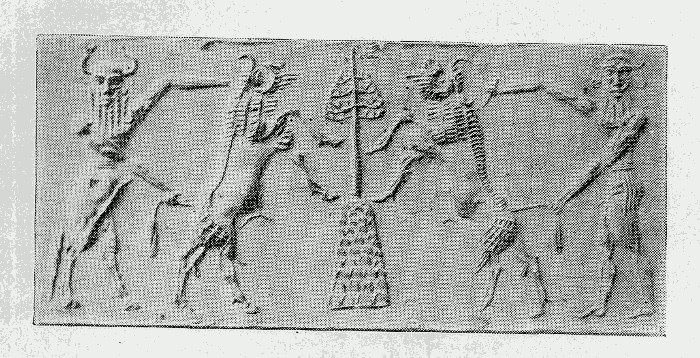
Babylonian Mythological Composition. Impression of a cylinder-seal showing a male figure on the right and a bull-man on the left, holding erect bulls by the horns and tails. In the centre is a form of the sacred tree on a hill. Date about 2500 b.c. British Museum.
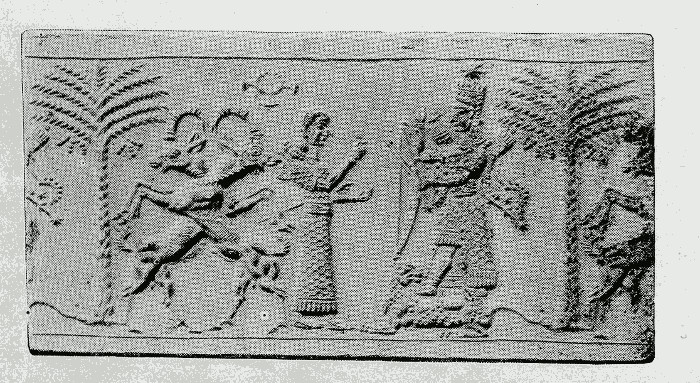
Babylonian Mythological Composition. Impression of a cylinder-seal showing Istar, goddess of love and of war as archeress, standing on the back of a lion, which turns its head to caress her feet. Before her is a worshipper (priest) and two goats (reversed to form a symmetrical design), leaping. Behind her is a date-palm. Date about 650 b.c. British Museum.
Among other trees of a sacred nature is “the cedar [pg 077] beloved of the great gods,” mentioned in an inscription of a religious or ceremonial nature, though exactly in what connection the imperfectness of the document does not enable us to see. It would seem, however, that there were certain priests or seers to whom was confided the “tablet of the gods,” containing the secret of the heavens and earth (probably the “tablet of fate,” which Merodach took from the husband of Tiamat after his fight with her for the dominion of the universe). These persons, who seem to have been the descendants of En-we-dur-an-ki (the Euedoranchos of Berosus), king of Sippar, were those to whom was confided “the cedar beloved of the great gods”—perhaps a kind of sceptre. They had, however, not only to be of noble race, but also perfect physically and free from every defect and disease. Moreover, one who did not keep the command of Šamaš and Addu (Hadad) could not approach the place of Ae, Šamaš, Marduk, and Nin-edina, nor the number of the brothers who were to enter the seership; they were not to reveal to him the word of the oracle, and “the cedar beloved of the great gods” was not to be delivered into his hands.
There is hardly any doubt, then, that we have here the long-sought parallel to the Biblical “tree of knowledge,” for that, too, was in the domain of “the lord of knowledge,” the god Ae, and also in the land which might be described as that of “the lord of Eden,” the “hidden place of heaven and earth” for all the sons of Adam, who are no longer allowed to enter into that earthly Paradise wherein their first parents gained, at such a cost, the knowledge, imperfect as it must have been, and evidently undesirable, which they handed down to their successors.
Adam.
The name of the first man, Adam, is one that has tried the learning of the most noted Hebraists to [pg 078] explain satisfactorily. It was formerly regarded as being derived from the root ādam, “to be red,” but this explanation has been given up in favour of the root ādam, “to make, produce,” man being conceived as “the created one.” This etymology is that put forward by the Assyriologist Fried. Delitzsch, who quotes the Assyrian âdmu, “young bird,” and âdmi summāti, “young doves,” literally, “the young of doves,” though he does not seem to refer the Assyrian udumu, “monkey,” to the same root. He also quotes, apparently from memory, the evidence of a fragment of a bilingual list found by Mr. Rassam, in which Adam is explained by the usual Babylonian word for “man,” amēlu.
The writer of Genesis has given to the first man the name of Adam, thus personifying in him the human race, which was to descend from him. In all probability, the Babylonians had the same legends, but, if so, no fragment of them has as yet come to light. That the Hebrew stories of the Creation had their origin in Babylonia, will probably be conceded by most people as probable, if not actually proven, and the fact that the word a-dam occurs, as Delitzsch has pointed out, in a bilingual list would, supposing the text to which he refers to be actually bilingual, be a matter of peculiar significance, for it would show that this word, which does not occur in Semitic Babylonian as the word for “man,” occurred in the old Akkadian language with that meaning.
And the proof that Delitzsch was right in his recollection of the tablet of which he speaks, is shown by the bilingual Babylonian story of the Creation. There, in lines 9, 10, we read as follows—
Akkadian (dialectic): Uru nu-dim, a-dam nu-mun-ia.
Babylonian: Âlu ûl êpuš, nammaššu ûl šakin.
“A city had not been made, the community had not been established.”
[pg 079]
Here we have the non-Semitic adam translated by the Babylonian nammaššu, which seems to mean a number of men, in this passage something like community, for that is the idea which best fits the context. But besides this Semitic rendering, the word also has the meanings of tenišētu, “mankind,” amelūtu, “human beings.”
The word adam, meaning “man,” is found also in Phœnician, Sabean, and apparently in Arabic, under the form of atam, a collective meaning “creatures.”
The possibility that the Babylonians had an account of the Fall similar to that of the Hebrews, is not only suggested by the legends treated of above, but also by the cylinder-seal in the British Museum with what seems to be the representation of the Temptation engraved upon it. We have there presented to us the picture of a tree—a palm—bearing fruit, and on each side of it a seated figure, that on the right being to all appearance the man, and that on the left the woman, though there is not much difference between them, and, as far as the form of either goes, the sexes might easily be reversed. That, however, which seems to be intended for the man has the horned hat emblematic of divinity, or, probably, of divine origin, whilst from the figure which seems to be that of the woman this head-dress is absent. Behind her, moreover, with wavy body standing erect on his tail, is shown the serpent, towering just above her head, as if ready to speak with her. Both figures are stretching out a hand (the man the right, the woman the left) as if to pluck the fruit growing on the tree. Notwithstanding the doubts that have been thrown on the explanation here given of this celebrated and exceedingly interesting cylinder, the subject and its arrangement are so suggestive, that one can hardly regard it as being other than what it seems to be, namely, a Babylonian representation of the Temptation, according to records [pg 080] that the Babylonians possessed. The date of this object may be set down as being from about 2750 to 2000 b.c.
Future excavations in Babylonia and Assyria will, no doubt, furnish us with the legends current in those countries concerning the Temptation, the Fall, and the sequel thereto. Great interest would naturally attach to the Babylonian rendering of the details and development of the story, more particularly to the terms of the penalty, the expulsion, and the nature of the beings—the cherubim—placed at the east of the garden, and “the flaming sword turning every way, to keep the way of the tree of life.”
Though the Babylonian version of this Biblical story has not yet come to light, the inscriptions in the wedge-writing give us a few details bearing upon the word “cherub.”
The Hebrews understood these celestial beings as having the form which we attribute to angels—a glorified human appearance, but with the addition of wings. They are spoken of as bearing the throne of the Almighty through the clouds (“He rode upon a cherub, and did fly”), and in Psalm xviii. 11 he is also represented as sitting upon them. In Ezekiel i. and x. they are said to be of a very composite form, combining with the human shape the face of a cherub (whatever that may have been), a man, an ox, a lion, and an eagle. It has been supposed that Ezekiel was indebted to Assyro-Babylonian imagery for the details of the cherubic creatures that he describes, but it may safely be said that, though the sculptures furnish us with images of divine creatures in the form of a man with the face of an eagle, or having a modification of a lion's head, and bulls and lions with the faces of men, there has never yet been found a figure provided with a wheel for the purpose of locomotion, and having four heads, like those of which the prophet speaks. We may, therefore, safely conclude, that [pg 081] Ezekiel applied the word kerûb (cherub) to the creatures that he saw in his vision, because that was the most suitable word he could find, not because it was the term usually applied to things of that kind. It is hardly likely that the guardians of the entrance into the earthly Paradise and the creatures that bore up the throne of the Almighty were conceived as being of so complicated a form as the cherubim of Ezekiel.
Whatever doubt may exist as to the original form of this celestial being, the discussion of the origin of the Hebrew word kerûb may now be regarded as finally settled by the discovery of the Assyro-Babylonian records. It is undoubtedly borrowed from the Babylonian kirubu, a word meaning simply “spirit,” and conceived as one who was always in the presence (ina kirib) of God, and formed from the root qarābu, “to be near.” The change from q (qoph) to k (kaph) is very common in Babylonian, and occurs more frequently before e and i, hence the form in Hebrew, kerûb (cherub—the translators intended that ch should be pronounced as k) for qerûb (which the translators would have transcribed as kerub).
Originally the Assyro-Babylonian word kirubu seems to have meant something like “intimate friend,” or “familiar,” as in the expression kirub šarri, “familiar of the king,” mentioned between “daughter of the king,” and “the beloved woman of the king.” An illustration of its extended meaning of “spirit,” however, occurs in the following lines from “the tablet of Good Wishes”—
“In thy mouth may there be perfection of speech
(lû asim dababu);
In thine eye may there be brightness of sight
(lû namir niṭlu);
In thine ear may there be a spirit of hearing”
(lû kirub nišmû, lit. ‘a cherub of hearing’).”
[pg 082]
The cherubim were therefore the good spirits who performed the will of God, and, in the minds of the Assyrians and Babylonians, watched over and guarded the man who was the “son of his God,” i.e. the pious man.
The cherub upon which the Almighty rode, and upon whom he sat, corresponds more to the guzalū or “throne-bearer” of Assyro-Babylonian mythology. They were apparently beings who bore up the thrones of the gods, and are frequently to be seen in Babylonian sculptures thus employed, at rest, and waiting patiently, to all appearance, until their divine master, seated on the throne which rests on their shoulders, should again give them word, or make known that it was now his will to start and journey forth once more.
The story of Cain and Abel, and the first tragedy that occurred in the world after the creation of man, has always attracted the attention of the pious on that account, and because the first recorded murder was that of a brother. This is a story to which the discovery of a Babylonian parallel was least likely to be found, and, as a matter of fact, none has as yet come to light. Notwithstanding this, a few remarks upon such remote parallels which exist, and such few illustrations of the event that can be found, may be cited in this place.
These are contained in the story of Tammuz or Adonis, who, though not supposed to have been slain by his brother, was nevertheless killed by the cold of Winter, who might easily have been regarded as his brother, for Tammuz typified the season of Summer, the Brother-season, so to say, of Winter. As is well known, the name Tammuz is Akkadian, and occurs in that language under the form of Dumu-zi, or, more fully, Dumu-zida, meaning “the everlasting son,” in Semitic Babylonian âblu kênu. It is very noteworthy that Prof. J. Oppert has suggested that the name of Abel, in Hebrew Habel, is, in reality, none other than [pg 083] the Babylonian ablu, “son,” and the question naturally arises, May not the story of Cain and Abel have given rise to the legend of Tammuz, or Ablu kênu, as his name would be if translated into Semitic Babylonian?
Unless by a folk-etymology, however, the Semitic Babylonian translation of the name of Tammuz can hardly be a composition of Abel and Cain, because the first letter is q (qoph) and not k (kaph), the transcription Cain for Kain or Kayin being faulty in the A.V. Still, we feel bound to recognize that there is a possibility, though naturally a remote one, that the legend of Tammuz is connected with that of Cain and Abel, just as the division of the Dragon (in the Babylonian story of the Creation) by the god Merodach into two halves, with one of which he covered the heavens, leaving the other below upon the earth, typifies the division of the waters above the earth from those below in the Biblical story of the same event.
There is a legend, named by me (for want of a more precise title) “The Lament of the Daughter of the god Sin,” in which the carrying off (by death?) of “her fair son” is referred to. Here we have another possible Babylonian parallel to the story of the death of Abel, in which the driving forth of her who makes the lament from her city and from her palace might well typify the expulsion of Eve from Paradise, and her delivery into the power of her enemy, who is, to all appearance, the king of terrors, into whose hands she and her husband were, for their disobedience, consigned. In this really beautiful Babylonian poem her “enemy” seems to reproach her, telling her how it was she, and she alone, who had ruined herself.
Though there may be something in the comparisons with the story of Cain and Abel which are quoted here, more probably (as has been already remarked) there is nothing, and the real parallels have yet to be found. In any case, they are instances of the popularity among the Babylonians and Assyrians of those stories of one, greatly beloved and in the bloom of [pg 084] youth, coming, like Abel, to an untimely end through the perversity of fate, and by no fault of his own. Though neither may be the original of the Biblical story nor yet derived from it, they are of interest and value as beautiful legends of old time, possibly throwing light on the Biblical story.
As yet the Babylonian and Assyrian records shed but little light on the question of the patriarchs of the early ages succeeding Adam, the details that are given concerning them, and their long lives. Upon this last point there is only one remark to be made, and that is, that the prehistoric kings of Babylonia likewise lived and reigned for abnormally long ages, according to the records that have come down to us. Unfortunately, there is nothing complete in the important original of the Canon of Berosus first published by the late G. Smith, and the beginning is especially mutilated.
The likeness between Enoch and the Akkadian name of the city of Erech, Unug, has already been pointed out, and it has been suggested that the two words are identical. This, however, can hardly be the case, for the Hebrew form of Enoch is Ḫanôḳ, the initial letter being the guttural ḫeth, which, notwithstanding the parallel ease of Hiddekel, the Akkadian Idigna (the Tigris), weakens the comparison. The principal argument against the identification, however, is the fact that, in the bilingual story of the Creation, the god Merodach is said to have built the city, and such was evidently the Babylonian belief.6
The name of Enoch's great-grandson, Methusael, finds, as has many times been pointed out, its counterpart in the Babylonian Mut-îli, with the same meaning (“man of God”).
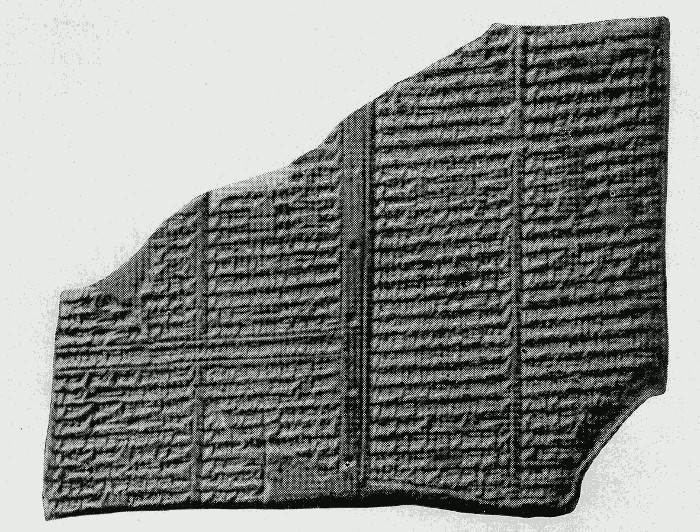
Lower part of the obverse of a terra-cotta tablet from Nineveh, inscribed with the names of Babylonian kings in Sumerian and Semitic Babylonian. The 13th line (that running across two columns) has the statement, "These are the kings who were after the Flood. They are not written in their proper order." The names of Sargina (Sargon of Agadé) and Hammurabi (Amraphel) also occur. Found by Sir A. H. Layard and Hormuzd Rassam.
[pg 085]
5.
6.
Chapter III. The Flood.
The Biblical account—Its circumstantial nature and its great length—The Babylonian account—The reason of the Flood and why Pir-napištim built the Ark—His devotion to the God Ea—Ea and Jah—Ea's antagonism to Bêl—The bloodless sacrifice—Ea's gift of immortality—Further observations—Appendix: The second version of the Flood-story.
Noah, son of Lamech, had reached the age of five hundred years, and had three sons, Shem, Ham, and Japhet; and at this time men had begun to multiply on the face of the earth, and daughters were born unto them; then “the sons of God saw the daughters of men that they were fair, and they took them wives of all that they chose.”
The question naturally arises, “Who were these sons of God?” According to Job xxxviii. 7, where we have the statement that “The morning stars sang together, and all the sons of God shouted for joy,” it would seem to be the angels that are intended by these words, and this is apparently the opinion generally held by scholars and divines on the subject. This view seems to be favoured by the Second Epistle of Peter (ii. 1), though, as the words do not actually agree with those of the text of Genesis quoted above, nothing very positive can be maintained concerning the apostle's dictum—in fact, his words in the passage referred to, “for if God spared not the angels that sinned, but cast them down to hell, and delivered them into chains and darkness, to be reserved unto [pg 086] judgment,” can much more reasonably be regarded as referring, and therefore giving authority to, the story of the fall of the angels, as indicated in Avitus, Caedmon, and Milton, a legend of which the germs are found in the Babylonian account of the Creation, referred to in Chapter I. The other passages of Job where this expression occurs (i. 6, and ii. 2) are not conclusive as to the meaning “angels,” for the expressions “sons of God,” in those passages, who are said to have come before the Almighty, may very well have been merely men.
However the matter may stand, for the passages in Job, there is every probability that it is not the angels that are intended in the description we are examining as to the reasons of the coming of the Flood. As the late George Bertin was the first to point out, the Babylonians often used the phrase “a son of his god,” apparently to designate “a just man,” or something similar. The connection in which this expression occurs is as follows—
“May Damu, the great enchanter, make his thoughts happy,
May the lady who giveth life to the dead, the goddess Gula, heal him by the pressure of her pure hand,
And thou, O gracious Merodach, who lovest the revivification of the dead,
With thy pure incantation of life, free him from his sin, and
May the man, the son of his god, be pure, clean, and bright.”
In this passage the phrase in question is (in Akkadian) gišgallu dumu dingirana, and (in Assyrian) amēlu mâr îli-šu. It is a frequent expression in documents of this class, and always occurs in a similar connection. In some cases, instead of “the man, the son of his god,” the variation “the king, the [pg 087] son of his god” occurs, and is apparently to be paraphrased in the same way, and understood as “the pious king.”
May it not be, then, that “the sons of God,” who saw that the daughters of men were fair (lit. good), and took of them as many wives as they wanted, were those who were regarded as the pious men of the time? For who among the angels would at any time have thought of allying himself with an earthly and mortal spouse, and begetting children—offspring who should turn out to be “mighty men which were of old, men of renown,” as verse 4 has it? In this case, the “daughters of men” would be children of common people, not possessing any special piety or other virtue to recommend them, the only thing being that their daughters were fair, and good enough, in the opinion of those “sons of God,” to have as their wives.
It is apparently given as the result of these unions between the pious men and the daughters of the people that wickedness became rife in the earth, and man's imagination continually evil; and this was so to such an extent that the Almighty repented of having created man, and decided to destroy the wicked generation—both man, and beast, and creeping thing, and fowl of the air—dwelling upon the earth—all except Noah, who found favour in the eyes of Yahwah.
Having decided to destroy the life of the world by means of a flood, God communicated His intention and the reason thereof to the patriarch, and instructed him to build an ark in which he was to save both himself and his family from the impending destruction. The vessel is to be built of gopher-wood, to have rooms in it, and to be pitched within and without with pitch. The dimensions also are specified. Its length was to be three hundred cubits, its width fifty cubits, and its height thirty cubits. He was to [pg 088] make the ark “with light” (צהר or רהצ), that is, with windows, and their length or height, apparently, was to be a cubit. The vessel was to have a door, and to be built with three stories, lower, second, and third. In accordance with God's covenant with the patriarch, he, his sons, and his sons' wives were to be saved, along with every living thing, male and female of each kind. For all this great multitude a sufficiency of food was directed to be provided.
Then comes the command (the ark having been duly built, and all the directions followed) to enter into the vessel, and further instructions are given with regard to the creatures that are to be saved, with a slight modification in the numbers, for the clean beasts are to be taken in “by sevens,” and all the rest, “the unclean,” by pairs. God then announces that in seven days' time He will cause rain to come upon the earth for forty days and forty nights. “All the fountains of the great deep” were broken up, and the Lord shut up those upon whom He had favour in the ark.
Then, as the rain continued, the waters “prevailed exceedingly” upon the earth, and the high hills that were under the whole heaven were covered, the depth of the waters being “fifteen cubits and upwards.” Everything was destroyed, “Noah alone remained alive, and those who were with him in the ark.”
“And the waters prevailed upon the earth an hundred and fifty days.”
The “fountains of the deep” and “the windows of heaven” having been stopped, and the “rain from heaven” restrained, the waters abated, leaving the ark high and dry upon the mountains of Ararat; and after the tops of the mountains were seen, Noah looked out of the window that he had made. He then sent forth a raven and a dove, and the latter, not finding a resting-place, returned to him, to be sent forth again at the end of another week. The dove [pg 089] again returned bearing in her beak an olive-leaf. Seven days more passed, and the dove, having been sent out a third time, returned to him no more. Recognizing that the waters were now all returned into their old channels, and that the land was dry enough for him and his, Noah removed the covering of the vessel, and saw that his supposition was correct, and having received the command to come forth from the ark, which had been his abiding-place for so long, and to send forth the living creatures that were with him, the patriarch obeyed, and, when on dry land, built an altar to Yahwah, and offered burnt offerings thereon of every clean beast and every clean fowl.
“And the Lord smelled a sweet savour (lit. a savour of rest); and the Lord said in His heart, I will not again curse the ground any more for man's sake, for the imagination of man's heart is evil from his youth.... While the earth remaineth, seedtime and harvest, and cold and heat, and summer and winter, and day and night shall not cease.”
Then comes, in the ninth chapter, the blessing of God, with a charge concerning the shedding of blood. He makes also a covenant with Noah, by the sign of the rainbow, declaring that a like calamity shall never again come upon the earth to destroy all life that is upon it.
Such is, in short, the Bible story of the great flood that destroyed, at a remote age of the world, all life upon the earth. It is a narrative circumstantially told, with day, month, and year all indicated, and it forms a good subject for comparison with the Babylonian account, with which it agrees so closely in all the main points, and from which it differs so much in many essential details.
As in the case of the Babylonian story of the Creation, it has been thought well not only to give a fairly full translation of the Babylonian story of the Flood, but also to indicate under what circumstances [pg 090] that story appears in the series of tablets in which it is found.
The first to detect the nature of the series of tablets giving the story of the Flood was the late George Smith, who had unrivalled opportunities of making himself thoroughly acquainted with the treasures of the British Museum in the matter of Assyrian records. As the story runs, it was whilst searching for the fragments of the Creation-series that he came across a fragment of a tablet mentioning that “the ship rested on the mountain of Niṣir,” and this at once suggested to him that this was a reference to the Flood, as, in fact, it turned out to be. Continued and unremitting research among the treasures of the Department in which he was employed enabled him to bring together a large number of other fragments of the series, leaving, in fact, very little indeed for any future student to do in the way of collecting together texts from the fragments that he had an opportunity of examining. The Daily Telegraph expedition to Assyria, which was conducted by Mr. Smith himself, enabled him to add many other fragments to those which he had already recognized in the Oriental Department of the British Museum, and Mr. Rassam's very successful excavations in the same place have since very considerably increased the list of additions.
The story of the Flood, as known to the Babylonians and Assyrians, is one chapter or book of a legend consisting of twelve similar divisions, the first line of the series beginning with the words Ša naqba imûru, “He who saw everything,” and to this is added in the colophons, “the legend of Gilgameš.” The number of fragments extant is large, but the individual tablets are very imperfect, that giving the account of the Flood being by far the most complete, though even that has very regrettable lacunæ. Incomplete as the legend is as a whole, an attempt will nevertheless be made here to give some sort of a connected story, [pg 091] which may be regarded as accurate in all its main details.
The first tablet begins with the words that have been quoted above, “He who saw everything, [who] ... the land.” This is followed, it would seem, by a description of the hero, who, apparently, knew “the wisdom of the whole (of the lands?),” and “saw secret and hidden things.... He brought news of before the flood, went a distant road, and (suffered) dire fatigue (?).” All his journeyings and toils were, apparently, inscribed on tablets of stone, and records thus left for future ages.
Gilgameš, as we learn in the course of the narrative, was lord or king of Uruk supuri, or “Erech the walled,” and at the time when the story begins, the fortifications were in a ruinous state, and the treasury (?) of the sanctuary Ê-anna, the temple of the goddess Ištar, which is mentioned in the legend immediately after, was, we may suppose, empty. Other details of the desolation of the temple are given, and the ruinous state of the walls of the city are spoken of, together with the decay of their foundations.
No other fragment of Col. I. of the first tablet of the Legend of Gilgameš seems to have been recognized, so that the further references to the city are lost. An interesting piece that Mr. G. Smith thought to be part of the third column of this text refers to some misfortune that came upon the city when the people moaned like calves, and the maidens grieved like doves.
“The gods of Erech the walled
Turned to flies, and hummed in the streets;
The winged bulls of Erech the walled
Turned to mice, and went out through the holes.”
The city was, on this occasion, besieged for three years, until at last the god Bêl and the goddess Ištar interested themselves in the state of things. As to [pg 092] who the enemy was who brought the people into such distress, there is no means at present of finding out, but Mr. G. Smith suggested, with at least some show of probability, that they were the Elamites under Ḫumbaba, who appears later as the opponent of our hero. The indifference of the gods and the divine bulls that were supposed to protect the city is well expressed in the statement that they respectively turned into flies and mice, buzzing about and active, but doing no good whatever.
After the reference to the state of Erech, the text is exceedingly mutilated, and the sense difficult to gather, but it would seem to have contained a further description of the hero, who, according to Jensen's translation, is described as “two parts god and the third part man.” To all appearance there was none in all his realm like him, and also no consort suitable for him, though he collected to him all the young men and maidens in the land. This was a matter for grief, which the (divine powers ?) heard, and they called upon the goddess Aruru to make another in his likeness. This being was Êa-banî,7 the mighty one, to all appearance made to be the rival of Gilgameš, but if this be the case, he did not fulfil his destiny, for his delight was to remain with the beasts of the field. All his body was covered with hair, and he had long tresses on his head, like those of a woman (recalling Samson's luxuriant locks). Far, too, from being the rival of Gilgameš, he became his most devoted friend and companion.
[pg 093]
“ ‘Thou, Aruru, hast created (mankind),
Now make thou (one in) his likeness.
The first day let his heart be (formed?),
Let him rival (?) and let him overcome (??) Erech.’
Aruru hearing this,
Made the likeness of Anu in the midst of her heart.
Aruru washed her hands,
She pinched off some clay, she threw it on the ground—
(Thus?) Êa-banî she made, the warrior,
The offspring, the seed, the possession of Ninip.
Covered with hair was all his body,
He had tresses like a woman,
The amount (?) of his hair grew thick like corn.
He knew not (?) people and land.
Clothed with a garment like the god Gira.
With the gazelles he eateth the grass,
With the wild beasts he drinketh drink,
With the dwellers in the water his heart delighteth.
The hunter, the destroyer, a man,
Beside the drinking-place he came across him,
The first day, the second day, the third day, beside the drinking-place he came across him.
The hunter saw him, and his (Êa-banî's) countenance became stern,
(He) and his wild beasts entered his house,
(He became an)gry, stern, and he called out.”
Apparently he did not like being watched so long by the hunter, and becoming suspicious of his intentions, showed resentment, and tried to drive him away. It may be noted by the way, that this description of Êa-banî would answer excellently to the state attributed for a time to Nebuchadnezzar in the Book of Daniel.
The hunter has a conversation with his father, who [pg 094] was with him, and the upshot of it is that they decide to communicate to Gilgameš an account of the terrible man whom they had seen. It was therefore decided to try to catch or, rather, entice him to Erech by means of a female named Samḫat. In accordance with the instructions received, therefore, the hunter took with him the woman who was intrusted to him, and they awaited Êa-banî in the same place, by the side of the water. After watching for him for two days, they got into communication with him, and the woman asked him why he dwelt with the wild animals, depicting at the same time all the glory of Erech the walled and the nobility of Gilgameš, so that he soon allowed himself to be persuaded, and, in the end, went and took up his abode there.
Various things are then narrated, the most important of them being the episode of the Elamite Ḫumbaba, the same name, though not the same person, as the Kombabos of the Greeks.
Gilgameš seems to have gone to a place where there was a forest of cedar-trees, accompanied by Êa-banî. Near this place, apparently, there was a splendid palace, the abode (?) of a great queen. Judging from what remains of the text, they ask their way of her, and she it is who seems to tell them how to reach the dominions of the potentate whom they seek.
“A distant road is the place of Ḫumbaba.
A conflict that he (Gilgameš) knoweth not he will meet,
A road that he knoweth not he will ride,
As long as he goeth and returneth,
Until he reach the forest of cedars,
Until the mighty Ḫumbaba he subdueth,
And whatever is evil, what ye hate, he shall destroy in the l(and).”
Evidently, from the extent of the record in this place, many adventures befell them, but the fragmentary [pg 095] lines and the numerous lacunæ make a connected narrative absolutely impossible, and it is not until we reach the first column of what Mr. G. Smith regarded as the fifth tablet that we get something more satisfactory than this. The hero has apparently come within measurable distance of his goal—
“They stood and looked on the forest,
They regarded the height of the cedar,
They regarded the depth of the forest,
Where Ḫumbaba walked, striding high (?),
The roads prepared, the way made good.
They saw the mountain of the cedar, the dwelling of the gods, the shrine of the god Irnini,
Before the mountain the cedar raised its luxuriance—
Good was its shade, full of delight.”
They had still a long way to go, however, and many things, seemingly, to overcome, before they should reach the abode of the dreaded Elamite ruler, but unfortunately, the details of their adventures are so very fragmentary that no connected sense whatever is to be made out. The last line of the tablet referring to this section, mentioning, as it does, the head of Ḫumbaba, leads the reader to guess the conclusion of the story, whatever the details may have been.
It is with the sixth tablet that we meet, for the first time, almost, with something really satisfactory in the matter of completeness, though even here one is sometimes pulled up sharp by a defective or doubtful passage.
Apparently, Gilgameš had become, at the time to which this tablet refers, very prosperous, and that, combined with his other attractions, evidently drew upon him the attention of the goddess Ištar—
[pg 096]
“Come, Gilgameš, be thou the bridegroom,
Give thy substance to me as a gift,
Be thou my husband, and let me be thy wife.
I will cause to be yoked for thee a chariot of lapis-lazuli and gold,
Whose wheels are gold and adamant its poles.
Thou shalt harness thereto the white ones, the great steeds.
Enter into our house mid the scent of the cedar.”
At his entering, the people were to kiss his feet, and kings, lords, and princes do him homage, and lastly, he was to have no rival upon the earth.
In the mutilated passage that follows, Gilgameš answers the goddess, reproaching her with her treatment of her former lovers or husbands, which seems to have been far from satisfactory. Reference to a “wall of stone,” and to “the land of the enemy,” seem to point to imprisonment and expulsion, and the words “Who is the bridegroom (whom thou hast kept?) for ever?” indicate clearly the opinion in which the hero held the goddess. From generalities, however, he proceeds to more specific charges—
“To Tammuz, the husband of thy youth,
From year to year thou causest bitter weeping.
Thou lovedst the bright-coloured Allala bird,
Thou smotest him and brokest his wings,
He stayed in the forests crying, ‘My wings!’
Thou lovedst also a lion, perfect in strength,
By sevens didst thou cut wounds in him.
Thou lovedst also a horse, glorious in war,
Harness, spur, and bit (?) thou laidest upon him,
Seven kaspu (49 miles) thou madest him gallop,
Distress and sweat thou causedst him,
To his mother Silili thou causedst bitter weeping.
Thou lovedst also a shepherd of the flock,
[pg 097]
Who constantly laid out before thee rich foods (?),
Daily slaughtering for thee suckling kids,
Thou smotest him and changedst him to a jackal,
His own shepherd-boy drove him away,
And his dogs bit his limbs.
Thou lovedst also Išullanu, thy father's gardener,
Who constantly transmitted (?) thy provisions (?),
Daily making thy dishes bright.
Thou raisedst thine eyes to him, and preparedst food.
‘My Išullanu, divide the food, let us eat,
And stretch forth thine hand, and taste of our dish.’
Išullanu said to thee:
‘Me, what (is this that) thou askest me?
My mother, do not cook (this), I have never eaten (of it)—
For should I eat foods of enchantments and witcheries?
[Food bringing?] cold, exhaustion, madness (?)?’
Thou heardest this [the speech of Išullanu],
Thou smotest him, and changedst him into a statue (?),
Thou settest him in the midst of (thy) dom(ain?),
He raiseth not the libation-vase, he descendeth (?) not....
And as for me, thou wouldst love me and (make me) even as these!”
Ištar being angry at these reproaches and accusations of the Babylonian hero, immediately ascended to heaven and complained to her father Anu and her mother Anatum that Gilgameš had reproached her with her enchantments and witcheries, and after a long conversation, a divine bull is sent against the hero and his friend. The heavenly animal is overcome, principally by the activity of Êa-banî, who after [pg 098] its death, when the goddess Ištar was lamenting its overthrow, cut off a portion of the body, and threw it at her. Great were the rejoicings at Erech the walled at the triumph of the hero and his counsellor, and after the feast that was held, they all lay down to sleep. Êa-banî also lay down with the rest, and during the night he saw a dream, of the details of which nothing is known, though, from the words with which it seems to be introduced, “My friend, on account of what do the gods take counsel,” it may be supposed that the defiance and opposition which these mortals had offered to the goddess Ištar was engaging the attention of the heavenly powers with a view to some action being taken. As it is with these words that Êa-banî begins to tell his dream to Gilgameš, there is no doubt that the Babylonians regarded the former as having been admitted, whilst asleep (as in the case of the Babylonian Noah), into the councils of the gods. The solitary line that is quoted above is the first of the seventh tablet.
The details of the legend now again become obscure, but thus much can be gathered, namely, that Gilgameš in his turn had a dream, and that, all appearance, Êa-banî interpreted it. Later on, Êa-banî falls ill, and lies without moving for twelve days. Though unwilling to regard his friend as dead, Gilgameš mourns for him bitterly, and decides to make a journey, apparently with the object of finding out about his friend Êa-banî, and ascertaining whether there were any means of bringing him back to earth again.
He sets out, and comes to the place where the “scorpion-men,” with their heads reaching to heaven, and their breasts on a level with Hades, guarded the place of the rising and the setting sun. The horror of their appearance, which was death to behold, is forcibly described on the tablet. The hero was struck with terror on seeing them, but as he was of [pg 099] divine origin (“his body is of the flesh of the gods,” as the scorpion-man says to his female), death has no power over him on account of them. He seems to describe to them his journey, and the object he had in view. Pir-napištim, the Babylonian Noah, is mentioned in the course of the conversation, and it may be supposed that it is on account of his desire to visit him that he asks these monsters for advice. He afterwards comes into contact with the goddess Siduri, “who sits upon the throne of the sea,” and she, on seeing him, shuts her gate. He speaks to her of this, and threatens to break it open. Having gained admission, he apparently tells the goddess the reason of his journey, and she, in return, describes to him the way that he would have to take, the sea that he would have to cross, and of the deep waters of death that bar the way to the abode of the Babylonian Noah, who had attained unto everlasting life, and whose pilot or boatman, Ur-Šanabi, was to take the Erechite hero to his presence.
After a long conversation with Ur-Šanabi, concerning the road that they will take, they start together, and after passing through a forest, they embark in a ship, and reach, at the end of a month and ten days, the “waters of death.” There Gilgameš does something a number of times, and afterwards sees afar off Pir-napištim, the Babylonian Noah, who apparently communes with himself concerning the visitor who has come to his shores. The conversation which follows is very mutilated, but in the course of his explanation of the reason of his visit, Gilgameš relates all his adventures—how he had traversed all the countries, and crossed difficult mountains, his visit to Siduri, and her refusal to open the door to him, with many other things. The conversation apparently, after a time, becomes of a philosophical nature, for, in the course of it, Pir-napištim says—
[pg 100]
“Always have we built a house,
Always do we seal (?) (the contract).
Always have brothers share together,
Always is the seed in (the earth?),
Always the river rises bringing a flood.”
He then discourses, apparently among other things, of death, and says—
“The Anunnaki, the great gods, are assembled (?).
Mammitum, maker of fate, sets with them the destinies.
They have made life and death,
(But) the death-days are not made known.”
With these words the tenth tablet of the Gilgameš series comes to an end.
The Eleventh Tablet Of The Gilgameš Series, Containing The Story Of The Flood.
As this tablet is the most complete of the series, it may not be considered out of place to give here a description of the outward appearance of the document—or, rather, of the documents, for there are many copies. This description will serve, to a certain extent, for all the other tablets of the series, when in their complete state.
The size of the document which best shows the form is about 8-½ inches wide, by 5-7/8 inches high. It is rectangular in form, and is inscribed on both sides with three columns of writing (six in all). The total number of lines, as given in the text published in the second edition of the fourth vol. of the Cuneiform Inscriptions of Western Asia, is 293, including the catch-line and colophon, but as many of these lines are, in reality, double ones (the scribes frequently squeezed two lines into the space of one, so as to economize space), the original number [pg 101] of the lines was probably nearer 326, or, with the catch-line and colophon, 330. It is probable that the other tablets of the series were not so closely written as this, and in these cases the number of lines is fewer.
The tablet opens with the continuation of the conversation between Gilgameš and “Pir-napištim the remote”—
“Gilgameš said also to him, to Pir-napištim the remote:
‘I perceive thee, O Pir-napištim,
Thy features are not changed—like me art thou,
And thou (thyself) art not changed, like me art thou.
Put an end in thine heart to the making of resistance,
(Here?) art thou placed, does that rise against thee,
(Now?) that thou remainest, and hast attained life in the assembly of the gods?’
Pir-napištim said also to him, to Gilgameš:
‘Let me tell thee, Gilgameš, the account of my preservation,
And let me tell thee, even thee, the decision of the gods.
Šurippak, the city which thou knowest,
Lies (upon the bank) of the Euphrates.
That city was old, and the gods within it.
The great gods decided in their hearts to make a flood.
There (?) was (?) their father Anu,
Their counsellor, the warrior Ellila,
Their throne-bearer, Ninip,
Their leader, En-nu-gi.
Nin-igi-azaga, the god Ae, communed with them, and
[pg 102]
Repeated their command to the earth:
“Earth, earth! Town, town!
O earth, hear: and town, understand!
Surippakite, son of Umbara-Tutu,
Destroy the house, build a ship,
Leave what thou hast (?), see to thy life.
Destroy the hostile and save life,
Take up the seed of life, all of it, into the midst of the ship.
The ship which thou shalt make, even thou,
Let its size be measured,
Let it agree (as to) its height and its length;
(Behold) the deep, launch her (thither).”
I understood and said to Ae, my lord:
“[Behol]d, my lord, what thou, even thou, hast said, verily (?)
It is excellent (?), (and) I will do (it).
(How?) may I answer the city—the young men and the elders?”
Ae opened his mouth and spake,
He said to his servant, to me:
“Thus, then, shalt thou say unto them;
‘It has been told me (that) Ellila hates me,
I will not dwell in ... and
In the territory of Ellila I will not set my face—
I will descend to the deep, with (Ae) my lord I shall (constantly) dwell.
(As for) you, he will cause abundance to rain down upon you, and
(Beasts and?) birds (shall be) the prey (?) of the fishes, and
... he will enclose, (?), and
... of a storm (?),
(In the night) the heavens will rain down upon (y)ou destruction.” ’ ”
With these words the second paragraph comes to an end, the total number of lost or greatly mutilated [pg 103] lines being about nine. Very little of the contents of these lines can be made out, as not much more than traces of words remain. Where the lines begin to become fairly complete, the text seems to refer to the building of the ship, upon which four days had already been spent, its form being laid down on the fifth day. The description of the building, which is somewhat minute, is exceedingly difficult to translate, and any rendering of it must therefore, at the present time, be regarded as tentative. Its bulwarks seem to have risen four measures, and a deck (apparently) is mentioned. Its interior was pitched with six šar of bitumen, and its outside with three šar of pitch, or bitumen of a different kind. The provisionment of the vessel is next described, but this part is mutilated. A quantity of oil for the crew and pilot is referred to, and oxen were also slaughtered, apparently as a propitiatory sacrifice on the completion of the vessel. Various kinds of drink were then brought on board, both intoxicating and otherwise, plentiful (this may be regarded as the word to be supplied here) “like the waters of a river.” After this we have references to the completion of certain details—holes for the cables above and below, etc., and with this the third paragraph comes to an end.
In the next paragraph Pir-napištim collects his goods and his family, and enters into the ark:—
“All I possessed I transferred thereto,
All I possessed I transferred thereto, silver,
All I possessed I transferred thereto, gold;
All I possessed I transferred thereto, the seed of life, the whole
I caused to go up into the midst of the ship. All my family and relatives,
The beasts of the field, the animals of the field, the sons of the artificers—all of them I sent up.
The god Šamaš appointed the time—
[pg 104]
Muir kukki—In the night I will cause the heavens to rain destruction,
Enter into the midst of the ship and shut thy door.”
“That time approached—
Muir kukki—In the night the heavens rained destruction.
I saw the appearance of the day:
I was afraid to look upon the day—
I entered into the midst of the ship, and shut my door.
For the guiding of the ship, to Buzur-Kurgala, the pilot,
I gave the great house with its goods.
At the appearance of dawn in the morning,
There arose from the foundation of heaven a dark cloud:
Rimmon thundered in the midst of it, and
Nebo and Šarru went in front
Then went the throne-bearers (over) mountain and plain.
Ura-gala dragged out the cables,
Then came Ninip, casting down destruction,
The Anunnaki raised (their) torches,
With their brilliance they illuminated the land.
Rimmon's destruction reached to heaven,
Everything bright to darkness turned,
... the land like ... it ...
The first day, the storm (?) ...
Swiftly it swept, and ... the land (?)....
Like a battle against the people it sought....
Brother saw not brother.
The people were not to be recognized. In heaven
The gods feared the flood, and
They fled, they ascended to the heaven of Anu.
The gods kenneled like dogs, crouched down in the enclosures.
[pg 105]
Ištar spake like a mother.8
The lady of the gods9 called out, making her voice resound:
‘All that generation has turned to corruption.
Because I spoke evil in the assembly of the gods,
When I spoke evil in the assembly of the gods,
I spoke of battle for the destruction of my people.
Verily I have begotten (man), but where is he?
Like the sons of the fishes he fills the sea.’
The gods of the Anunnaki were weeping with her.
The gods had crouched down, seated in lamentation,
Covered were their lips in (all) the assemblies,
Six days and nights
The wind blew, the deluge and flood overwhelmed the land.
The seventh day, when it came, the storm ceased, the raging flood,
Which had contended like a whirlwind,
Quieted, the sea shrank back, and the evil wind and deluge ended.
I noticed the sea making a noise,
And all mankind had turned to corruption.
Like palings the marsh-reeds appeared.
I opened my window, and the light fell upon my face,
I fell back dazzled, I sat down, I wept,
Over my face flowed my tears.
I noted the regions, the shore of the sea,
For twelve measures the region arose.
The ship had stopped at the land of Niṣṣir.
The mountain of Niṣir seized the ship, and would not let it pass.
The first day and the second day the mountain of Niṣir seized the ship, and would not let it pass,
[pg 106]
The third day and the fourth day the mountain of Niṣir, etc.,
The fifth and sixth the mountain of Niṣir, etc.,
The seventh day, when it came
I sent forth a dove, and it left,
The dove went, it turned about,
But there was no resting-place, and it returned.
I sent forth a swallow, and it left,
The swallow went, it turned about,
But there was no resting-place, and it returned.
I sent forth a raven, and it left,
The raven went, the rushing of the waters it saw,
It ate, it waded, it croaked, it did not return.
I sent forth (the animals) to the four winds, I poured out a libation,
I made an offering on the peak of the mountain,
Seven and seven I set incense-vases there,
In their depths I poured cane, cedar, and rosewood (?).
The gods smelled a savour,
The gods smelled a sweet savour,
The gods gathered like flies over the sacrificer.
Then the goddess Maḫ, when she came,
Raised the great signets that Anu had made at her wish:
‘These gods—by the lapis-stone of my neck—let me not forget,
These days let me remember, nor forget them forever!
Let the gods come to the sacrifice,
But let not Ellila come to the sacrifice,
For he did not take counsel, and made a flood,
And consigned my people to destruction.’
Then Ellila, when he came,
Saw the ship. And Ellila was wroth,
Filled with anger on account of the gods and the spirits of heaven.
[pg 107]
‘What, has a soul escaped?
Let not a man be saved from the destruction.’
Ninip opened his mouth and spake,
He said to the warrior Ellila:
‘Who but Ae has done the thing
And Ae knows every event.’
Ae opened his mouth and spake,
He said to the warrior Ellila:
‘Thou sage of the gods, warrior,
Verily thou hast not taken counsel, and hast made a flood.
The sinner has committed his sin,
The evildoer has committed his misdeed,
Be merciful—let him not be cut off—yield, let (him) not perish.
Why hast thou made a flood?
Let the lion come, and let men diminish.
Why hast thou made a flood?
Let the hyæna come, and let men diminish.
Why hast thou made a flood?
Let a famine happen, and let the land be destroyed (?).
Why hast thou made a flood?
Let Ura (pestilence) come, and let the land be devastated (?).
I did not reveal the decision of the great gods—
I caused Atra-ḫasis to see a dream, and he heard the decision of the gods.’
When he had taken counsel (with himself),
Ae went up into the midst of the ship,
He took my hand and he led me up, even me
He brought up and caused my woman to kneel (?) at my side;
He touched us, and standing between us, he blessed us (saying):
‘Formerly Pir-napištim was a man:
Now (as for) Pir-napištim and his woman, let them be like unto the gods, (even) us,
[pg 108]
And let Pir-napištim dwell afar at the mouths of the rivers.’
He took me, and afar at the mouths of the rivers he caused me to dwell.
Now as for thee, who of the gods shall restore thee to health?
That thou see the life that thou seekest, even thou?
Well, lie not down to sleep six days and seven nights,
Like one who is sitting down in the midst of his sorrow (?),
Sleep like a dark cloud hovereth over him.
Pir-napištim then said to his wife:
‘See, the hero who desireth life,
Sleep like a dark cloud hovereth over him.’
His wife then said to Pir-napištim the remote:
‘Touch him, and let him awake a man—
Let him return in health by the road that he came,
Let him return to his country by the great gate by which he came forth.’
Pir-napištim said to his wife:
‘The suffering of men hurteth thee.
Come, cook his food, set it by his head.’
And the day that he lay down in the enclosure of his ship,
She cooked his food, she set it by his head:
And the day when he lay down in the enclosure of his cabin
First his food was ground,
Secondly it was sifted,
Thirdly it was moistened,
Fourthly she rolled out his dough,
Fifthly she threw down a part,
Sixthly it was cooked,
Seventhly he (or she) touched him suddenly, and he awoke a man!
[pg 109]
Gilgameš said to him (even) to Pir-napištim the remote:
‘That sleep quite overcame me
Swiftly didst thou touch me, and didst awaken me, even thou.’ ”
Pir-napištim, in answer to this, tells Gilgameš what had been done to him, repeating the description of the preparation of his food in the same words as had been used to describe the ceremony (for such it apparently is), and ending by saying, “Suddenly I touched thee, (even) I, and thou awokest, (even) thou.” Thus putting beyond question the personality of the one who effected the transformation which was brought about, though he leaves out the word “man,” which hid from the hero the fact that a transformation had in consequence taken place in him. The ceremonies were not by any means finished, however, for the boatman or pilot had to take him to the place of lustration to be cleansed, and for the skin, with which he seems to have been covered, to fall off. The Babylonian patriarch then tells him of a wonderful plant which would make an old man young again, and Gilgameš gets possession of one of these. On his way to his own country in the company of the boatman or pilot, he stops to perform what seems to be a religious ceremony, at a well, when a serpent smells the plant,10 and, apparently in consequence of that, a lion comes and takes it away. Gilgameš greatly laments his loss, saying that he had not benefited by the possession of this wonderful plant, but the lion of the desert had gained the advantage. After [pg 110] a journey only varied by the religious festivals that they kept, they at length reached Erech, the walled. Here, after a reference to the dilapidation of the place, and a statement seemingly referring to the offerings to be made if repairs had not, during his absence, been effected, the eleventh and most important tablet of the Gilgameš series comes to an end.
Of the twelfth tablet but a small portion exists, though fragments of more than one copy have been found. In this we learn that Gilgameš still lamented for his friend Êa-banî, whom he had lost so long before. Wishing to know of his present state and how he fared, he called to the spirit of his friend thus—
“Thou restest not the bow upon the ground,
What has been smitten by the bow surround thee.
The staff thou raisest not in thine hand,
The spirits (of the slain) enclose thee.
Shoes upon thy feet thou dost not set,
A cry upon earth thou dost not make:
Thy wife whom thou lovest thou kissest not,
Thy wife whom thou hatest thou smitest not;
Thy child whom thou lovest thou kissest not,
Thy child whom thou hatest thou smitest not.
The sorrowing earth hath taken thee.”
Gilgameš then seems to invoke the goddess “Mother of Nin-a-zu,” seemingly asking her to restore his friend to him, but to all appearance without result. He then turned to the other deities—Bêl, Sin, and Ea, and the last-named seems to have interceded for Êa-banî with Nerigal, the god of the under-world, who, at last, opened the earth, “and the spirit of Êa-banî like mist arose (?).” His friend being thus restored to him, though probably only for a time, and not in bodily form, Gilgameš asks [pg 111] him to describe the appearance of the world from which he had just come. “If I tell thee the appearance of the land I have seen,” he answers, “... sit down, weep.” Gilgameš, however, still persists—“... let me sit down, let me weep,” he answers. Seeing that he would not be denied, Êa-banî complies with his request. It was a place where dwelt people who had sinned in their heart, where (the young) were old, and the worm devoured, a place filled with dust. This was the place of those who had not found favour with their god, who had met with a shameful death (as had apparently Êa-banî himself). The blessed, on the other hand—
“Whom thou sawest [die] the death (?) [of] . .[I see]—
In the resting-place of .... reposing, pure water he drinketh.
Whom in the battle thou sawest killed, I see—
His father and his mother support his head
And his wife sitteth [? beside him].
Whose corpse thou hast seen thrown down on the plain, I see—
His spirit on earth reposeth not.
Whose spirit thou sawest without a caretaker, I see—
The leavings of the dish, the rejected of the food,
Which in the street is thrown, he eateth.”
And with this graphic description of the world of the dead the twelfth and concluding tablet of the Gilgameš series comes to an end.
With the Gilgameš series of tablets as a whole we have not here to concern ourselves, except to remark, that the story of the Flood is apparently inserted in it in order to bring greater glory to the hero, whom the writer desired to bring into connection with one who was regarded as the greatest and most renowned of old times, and who, on account of the favour that [pg 112] the gods had to him, had attained to immortality and to divinity. Except the great Merodach himself, no divine hero of past ages appealed to the Babylonian mind so strongly as Pir-napištim, who was called Atra-ḫasis, the hero of the Flood.
The reason of the coming of the Flood seems to have been regarded by the Babylonians as two-fold. In the first place, as Pir-napištim is made to say (see p. 100), “Always the river rises and brings a flood”—in other words, it was a natural phenomenon. But in the course of the narrative which he relates to Gilgameš, the true reason is implied, though it does not seem to be stated in words. And this reason is the same as that of the Old Testament, namely, the wickedness of the world. If it should again become needful to punish mankind with annihilation on account of their wickedness, the instrument was to be the lion, or the hyæna, or pestilence—not a flood. And we have not to go far to seek the reason for this. By a flood, the whole of mankind might—in fact, certainly would—be destroyed, whilst by the other means named some, in all probability, would escape. There was at least one of the gods who did not feel inclined to witness the complete destruction of the human race without a protest, and an attempt on his part to frustrate such a merciless design.
Little doubt exists that there is some motive in this statement on the part of the Babylonian author of the legend. It has been already noted that Merodach (the god who generally bears the title of Bêl, or “lord”) was, in Babylonian mythology, not one of the older gods, he having displaced his father Ea or Ae, in consequence of the predominance of Babylon, whose patron god Merodach was. Could it be that the Babylonians believed that the visitation of the flood was due to the vengeful anger of Merodach, aroused by the people's non-acceptance [pg 113] of his kingship? It seems unlikely. Pir-napištim was himself a worshipper of Ae, and on account of that circumstance, he is represented in the story as being under the special protection of that god. To all appearance, therefore, the reason which Pir-napištim is represented as having given, for the building of the ship, to his fellow-townsmen, was not intended to be altogether false. The god Ellila hated him, and therefore he was going to dwell with Ae, his lord—on the bosom of the deep which he ruled. An announcement of the impending doom is represented as having been made to the people by the patriarch, and it is therefore doubly unfortunate that the next paragraph is so mutilated, for it doubtless gave, when complete, some account of the way in which they received the notice of the destruction that was about to be rained down upon them.
It has been more than once suggested, and Prof. Hommel has stated the matter as his opinion, that the name of the god Aê or Ea, another possible reading of which is Aa, may be in some way connected with, and perhaps originated the Assyro-Babylonian divine name Ya'u, “God,” which is cognate with the Hebrew Yah or, as it is generally written, Jah. If this be the case, it would seem to imply that a large section of the people remained faithful to his worship, and the flood of the Babylonians may symbolize some persecution of them by the worshippers of the god Ellila, angry at the slight put upon him by their neglect or unwillingness to acknowledge him as the chief of the Pantheon. Some of the people may, indeed, have worshipped Ae or Aa alone, thus constituting a kind of monotheism. This, nevertheless, is very uncertain, and at present unprovable. It is worthy of note, however, that at a later date there was a tendency to identify all the deities of the Babylonian [pg 114] Pantheon with Merodach, and what in the “middle ages” of the Babylonians existed with regard to Merodach may very well have existed for the worship of Ae or Ea at an earlier date. The transfer, in the Semitic Babylonian Creation-story, of the name of Aê to his son Merodach may perhaps be a re-echo of the tendency to identify all the gods with Ae, when the latter was the supreme object of worship in the land. There is one thing that is certain, and that is, that the Chaldean Noah, Pir-napištim, was faithful in the worship of the older god, who therefore warned him, thus saving his life. Ae, the god who knew all things, knew also the design of his fellows to destroy mankind, and being “all and always eye,” to adopt a phrase used by John Bunyan, he bore, as a surname, that name Nin-igi-azaga, “Lord of the bright eye,” so well befitting one who, even among his divine peers, was the lord of unsearchable wisdom.
It is unfortunately a difficult thing to make a comparison of the ark as described in Genesis with a ship of the Babylonian story. It was thought, by the earlier translators of the Babylonian story of the Flood, that its size was indicated in the second paragraph of the story (p. 102, ll. 11, 12), but Dr. Haupt justly doubts that rendering. If the size of the vessel were indicated at all, it was probably in the next paragraph, where the building of the ship is described. This part, however, is so very mutilated, that very little clear sense can be made out of it. The Babylonian home-land of the story seems certainly to be indicated by the mention of two kinds of bitumen or pitch for caulking the vessel, Babylonia being the land of bitumen par excellence. Those who were to live on board were to sustain themselves with the flesh of oxen, and to all appearance they cheered the weary hours with the various kinds of drink of which they laid in store. They were not neglectful, [pg 115] either, of the oil that they used in preparing the various dishes, and with which they anointed their persons. All these points, though but little things in themselves, go to show that the story, in its Babylonian dress, was really written in the country of that luxury-loving people. The mention of holes for the cables, too, shows that the story is the production of maritime people, such as the Babylonians were.
Apparently the Babylonians found there was something inconsistent in the patriarch being saved without any of his relatives (except his sons), and the artificers who had helped him to build the ship which was to save him from the destruction that overwhelmed his countrymen and theirs. For this reason, and also because of the relationship that might be supposed to exist between master and servant, his relatives and the sons of the artificers11 are saved along with his own family, which, of course, would not only include his sons, but their wives also. On this point, therefore, the two accounts may be regarded as in agreement.
When all was ready, the Sun-god, called by the usual Semitic name of Šamaš, appointed the time for the coming of the catastrophe. This would seem to be another confirmation of the statement already made, that the Babylonians, like the Hebrews (see Gen. i. 14-18), regarded one of the uses of the sun as being to indicate seasons and times. It was a great and terrible time, such as caused terror to the beholder, and the patriarch was smitten with fear. Here, as in other parts of the Babylonian version, there is a human interest that is to a large extent wanting in the precise and detailed Hebrew account. Again the maritime [pg 116] nation is in evidence, where the consigning of the ship into the care of a pilot is referred to. Of course such an official could do but little more than prevent disastrous misfortune from the vessel being the plaything of the waves. In the description of the storm, the terror of the gods, Ištar's grief, and Maḫ's anger at the destruction of mankind, we see the production of a nation steeped in idolatry, but there are but few Assyro-Babylonian documents in which this fact is not made evident.
We have a return to the Biblical story in the sending forth of the birds, and the sacrifice of odoriferous herbs, when the gods smelled a sweet savour, and gathered like flies over the sacrificer. In the signets of Maḫ, “the lady of the gods,” by which she swears, we may, perhaps, see a reflection of the covenant by means of the rainbow, which the Babylonians possibly explained as being the necklace of the goddess. Instead of the promise that a similar visitation to destroy the whole of mankind should not occur again, there is simply a kind of exhortation on the part of the god Ae, addressed to Ellila, not to destroy the world by means of a flood again. To punish mankind for sins and misdeeds committed, other means were to be employed that did not involve the destruction of the whole human race.
Noah died at the age of 950 years (Gen. ix. 29), but his Babylonian representative was translated to the abode of the blessed “at the mouths of the rivers,” with his wife, to all appearance immediately after the Flood. In this the Babylonian account differs, and the ultimate fate of the patriarch resembles that of the Biblical Enoch, he who “was not, for God took him” (Gen. v. 24).
[pg 117]
Appendix. The Second Version Of The Flood-Story.
This was found by the late George Smith at Nineveh when excavating for the proprietors of the Daily Telegraph, and was at first supposed to belong to the text translated on pp. 101-109. This, however, is impossible, as the narrative is in the third person instead of the first, and in the form of a conversation between Atra-ḫasis (= Pir-napištim) and the god Aê—
Tablet D. T. 42.
......................
....... may it be
....... like the vault of
....... may it be strong above and below.
Enclose the ... and ...............
[At] the time that I shall send to thee
Enter [the ship] and close the door of the ship,
Into the midst of it [take] thy grain, thy furniture, and [thy] goods,
Thy . . ., thy family, thy relatives, and the artisans;
[The beasts] of the field, the animals of the field, as many as I shall collect (?),
[I will] send to thee, and thy door shall protect them.
[Atra]-ḫasis opened his mouth and spake,
Sa]ying to Aê, his lord:
“...... a ship I have not made .......
Form [its shape (?) upon the gr]ound.
Let me see the [plan], and [I will build] the ship.
[Form] ...... on the ground ........
........ what thou hast said .......
.........................
It is not improbable that the fragment published by the Rev. V. Scheil, O. P., belongs to this legend (see The King's Own,12 April 1898, pp. 397-400).
[pg 118]
7.
8.
9.
10.
Pir-napištim said also to him, to Gilgameš:
‘Let me tell thee, Gilgameš, the account of my preservation,
And let me tell thee, even thee, the decision of the gods.
Šurippak, the city which thou knowest,
Lies (upon the bank) of the Euphrates.
That city was old, and the gods within it.
The great gods decided in their hearts to make a flood.
There (?) was (?) their father Anu,
Their counsellor, the warrior Ellila,
Their throne-bearer, Ninip,
Their leader, En-nu-gi.
Nin-igi-azaga, the god Ae, communed with them, and
[pg 102]
Repeated their command to the earth:
“Earth, earth! Town, town!
O earth, hear: and town, understand!
Surippakite, son of Umbara-Tutu,
Destroy the house, build a ship,
Leave what thou hast (?), see to thy life.
Destroy the hostile and save life,
Take up the seed of life, all of it, into the midst of the ship.
The ship which thou shalt make, even thou,
Let its size be measured,
Let it agree (as to) its height and its length;
(Behold) the deep, launch her (thither).”
I understood and said to Ae, my lord:
“[Behol]d, my lord, what thou, even thou, hast said, verily (?)
It is excellent (?), (and) I will do (it).
(How?) may I answer the city—the young men and the elders?”
Ae opened his mouth and spake,
He said to his servant, to me:
“Thus, then, shalt thou say unto them;
‘It has been told me (that) Ellila hates me,
I will not dwell in ... and
In the territory of Ellila I will not set my face—
I will descend to the deep, with (Ae) my lord I shall (constantly) dwell.
(As for) you, he will cause abundance to rain down upon you, and
(Beasts and?) birds (shall be) the prey (?) of the fishes, and
... he will enclose, (?), and
... of a storm (?),
(In the night) the heavens will rain down upon (y)ou destruction.” ’ ”
11.
12.
Chapter IV. Assyria, Babylonia, And The Hebrews, With Reference To The So-Called Genealogical Table.
The Akkadians—The Semitic Babylonians—The Hebrews—Nimrod—Assur—The Tower of Babel and the confusion of tongues—Babylonian temple-towers—How the legend probably arose—The Patriarchs to the time of Abraham.
“And Cush begat Nimrod: he began to be a mighty one in the earth.
“He was a mighty hunter before the Lord: wherefore it is said, Even as Nimrod, the mighty hunter before the Lord.
“And the beginning of his kingdom was Babel, and Erech, and Accad, and Calneh, in the land of Shinar.
“Out of that land went forth Asshur, and builded Nineveh, and the city Rehoboth (or, the streets of the city), and Calah.
“And Resen between Nineveh and Calah: the same is a great city.”
Such is the Biblical account of the origin of the two most powerful states of the ancient East, Babylonia and Assyria. It has been many times quoted and discussed, but there seems always to be something new to say about it, or to add to it, or what has already been said may be put in another and clearer way. It is for one or more of these reasons, as well as for the completeness of this work, that the author ventures again to approach the well-worn problems that these verses present.
[pg 119]
Every reader, on taking up a book dealing with this period of ancient Eastern history, will probably have noticed, that the word which most frequently meets his eye (if the book be an English one) is Akkad, the Semitic equivalent of the Biblical Accad. If, however, it be a continental work, the equivalent expression will be Šumer—which word, indeed, he will meet with also in English works, if the writer be at all under German or other foreign influence.
The reason for this divergence of opinion is very simple, the fact being that there were two tribes or nationalities, Šumer being before Akkad when the two countries are mentioned together, and as it is regarded as identical with the Shinar of Gen. x. 10, Šumer and Šumerian may possibly be preferable, but in all probability Akkad and Akkadian are not wrong.
As we see from the chapter of Genesis referred to, there were many nationalities in the Euphrates valley in ancient times, and the expression “Cush begat Nimrod,” would imply that the inhabitants of Babylonia were all Cushites. Yet the great majority of the inscriptions found in that country of a later date than about 2000 b.c. are Semitic.
Large additions have of late years been made to the number of ancient remains from Babylonia, and most of these are of a very early period. We are thus in a position to compare not only the different types of that early period with each other, but also with the sculptures of later date. The cylinder-seals show us a comparatively slim race, long-bearded, erect and dignified, and these characteristics are also recognizable among the various types revealed to us by the still earlier sculptures. The representations of kings and deities are often heavily bearded, but, on the other hand, high officials and others are generally clean shaven. These peculiarities, with the difference of costume, especially the thick-brimmed hats, [pg 120] would seem to imply distinct foreign influence, or, rather, in combination with the differences of racial type exhibited, considerable foreign admixture. Perhaps, however, the true explanation is, that the plain of Shinar represents the meeting-point of two different races—one Cushite and the other Semitic.
And this fact, as is well known, is confirmed by the existence of what is regarded as the language of the Akkadians, and also of a dialect of the same. This is not the place to discuss the question whether these non-Semitic idioms be really languages or only cryptographs—the author holds, in common with Sayce, Oppert, Hommel, and all the principal Assyriologists, that they are real languages—but a reference to the few passages where these idioms are spoken of may not be without interest.
One of these is the fragment known as S. 1190 in the British Museum, where the contents of the tablet of which it formed a part are referred to as “Two Šumerian incantations used” (seemingly) “for the stilling of a weeping child.” Another tablet refers to the languages, and states that the tongue of Šumer was like (the tongue of) Akkad, or assumed a likeness to it at some time or other. This document also refers to another form of speech that was the tongue of the prince, chief, or leader. Yet another fragment refers to Akkad as below (? to the south) and Šumer above (? to the north),13 but it is doubtful whether this refers to the position of the country. A fourth large fragment written partly in the “dialect” is referred to as a “Šumerian” text.
Both from the ethnographical and the linguistic side, therefore, ample testimony to the existence of a [pg 121] non-Semitic race (or non-Semitic races) in the plain of Shinar in ancient times is at hand. As to the language intended in the expression “Two Šumerian incantations” (spoken of above) there can be no doubt, the original idiom in question being the non-Semitic tongue already referred to—that tongue which was like the tongue of Akkad, of which it was apparently a more decayed form. The title given cannot refer to the translation into Assyro-Babylonian which accompanies it, as this is undoubtedly of later date than the composition itself.
There is then no doubt that the Akkadians and the Šumerians were two tribes of the same race, probably intermixed to a certain extent with foreign elements (people with oblique eyes being depicted on at least two of the sculptures of the early period from Tel-Loh), and speaking a language differing entirely from that of their Semitic fellow-countrymen,—a language which was of an agglutinative nature, introducing into its verbal forms whole rows of analytical particles, which sometimes gave to the phrase a precision of meaning to which the Semitic Babylonian has but little pretension, though Šumero-Akkadian is generally difficult enough in other respects, in consequence of the excessive number of the homophones that it contains. Indeed, it is sometimes difficult to see how the speakers of the latter language could have understood each other without resorting to some such distinctive aids similar to the tones used in modern—as probably also in ancient—Chinese, of which Šumero-Akkadian is regarded by the Rev. C. J. Ball as an exceedingly ancient form.
The question of the origin of the Akkadians is one concerning which there has been and is still much uncertainty, and which presents many problems for the future. It has been remarked that the fact that there is no special ideograph for “river,” and the fact that “mountain” and “country” are represented by the [pg 122] same character, imply that the people with whom the cuneiform script originated came from a mountainous country—probably the tract to the east or the north-east. This assumption, however, is not wholly dependent on what is here stated, for it is a well-known and admitted fact that the ideograph generally used for “Akkad” stands also for other tracts that are largely mountainous, namely, Phœnicia and Ararat.
It may be of interest here to quote the passage referring to this.
The text in question is the exceedingly important syllabary designated by Prof. Fried. Delitzsch “Syllabary B.” The text is unfortunately defective in the British Museum copy, but a duplicate found at Babylon by the German explorers completes it as follows:—
Uri
[Cuneiform]
Akkadū
Ari
[Cuneiform]
Amurrū
Tilla
[Cuneiform]
Urṭū.
From this we see that the ideograph for Akkad not only stood for that country, but also for the land of the Amorites (Amurrū), and for Ararat (Urṭū), both of them being more or less mountainous districts. That the ancient home of the Akkadians was of the same nature is, therefore, more than probable.
That the Akkadians were a conquering race is indicated by the legend of the god Ura, generally called “the Dibbara Legend,” where the hero, “the warrior Ura,” is represented as speaking prophetically as follows—
“Tâmtu with Tâmtu,
Subartu with Subartu,
Assyrian with Assyrian,
Elamite with Elamite,
Kassite with Kassite,
[pg 123]
Sutite with Sutite,
Qutite with Qutite,
Lullubite with Lullubite,
Country with country, house with house, man with man,
Brother with brother, shall not agree: let them annihilate each other,
And afterwards let the Akkadian come, and
Let him overthrow them all, and let him cast down the whole of them.”
The Akkadians had dominion, at one time or another, over all the above nationalities, some of whom were permanently subjected. Tâmtu, the region of the Persian Gulf, was under their domination constantly, though the inhabitants were apparently rather turbulent, and unwilling subjects. The Assyrians were apparently for a time under Akkadian (Babylonian) rule, but threw it off at a very early period, and later on conquered Akkad itself. The Elamites, too, were for a while conquered by the inhabitants of Babylonia, and the Sutites (people of Sutî) are said to have been all transported by Kadašman-Muruš (he reigned about 1209 b.c., according to Hilprecht). It will thus be seen that they played an important part in the history of the plain of Shinar where they settled, and to all appearance introduced their civilization.
In the earliest ages known to us, the land of Akkad was a collection of small states resembling the Heptarchy. These states differed considerably in power, influence, and prosperity, and the passing centuries brought many changes with them. From time to time one of the kings or viceroys of these small states would find himself more powerful than his contemporaries, and would gradually overcome all the others. One of the earliest instances of this is the ruler Lugal-zag-gi-si, whose reign is placed by Hilprecht [pg 124] at about 4500 b.c. He was son of Ukuš (the reading is doubtful), viceroy (patesi) of a district which seems to be that of which Kis was capital. “He had conquered all Babylonia and established an empire extending from the Persian Gulf to the Mediterranean Sea” (Hilprecht).
Whether he and his successors were able to maintain real dominion over all this extensive tract or not, we do not know, but a few hundred years later we find Sargon of Agadé (known as “Šargani king of the city”) subduing the land of the west in the 11th year of his reign, and placing the districts under one control, whilst his son, Naram-Sin, apparently added Elam to his dominions, and Uruwuš (whom Prof. Sayce suggests as the original of the Horus of Pliny), at a later date, led a warlike expedition thither, and brought away much spoil, some of which is still extant as a lasting testimony to the reality of this historical fact.
Among the states which existed in Akkad before the whole country was united under one king may be mentioned Isin or Karrak, Ur (the supposed Ur of the Chaldees), Kêš, Nippur (or Niffur), the modern Niffer, Lagaš, Êridu, Êrech, and Larsa (identified with Ellasar), with some others. Akkad and Babylon were always important centres, the former being supreme before the date of the dynasty of Babylon (about 2200 b.c.), and the latter afterwards.
Until about the time of the dynasty of Babylon, the language principally used was to all appearance the non-Semitic Babylonian or Akkadian—in any case, the numerous texts (mainly temple-accounts) of the period of Dungi, Bûr-Sin, Gimil-Sin, and Ibi-Sin are written in that tongue. Nevertheless, Akkadian seems to have been the official language of the country for a considerable time after, if we may judge from the contracts, and especially the historical dates of these documents, which are always written in Akkadian. [pg 125] The names, too, which were before this period wholly Akkadian, gradually become more and more Semitic (Assyro-Babylonian), and finally the Akkadian element only exists as a remnant of the non-Semitic tongue which prevailed before the Semitic Dynasty of Babylon—that to which Ḫammurabi or Amraphel belonged—made the Semitic tongue, spoken by Sargon of Agadé more than 1500 years before, the official language of the country.
Such, then, is the history of the ancient Akkadians, from whose intermingled stock the later Semitic Babylonians sprang, and who inherited, at the same time, their method of writing, their literature, their arts and sciences, and also, to a great extent, their manners, customs, and religion. It was to all appearance with the Semitic dynasty of Ḫammurabi that the change from non-Semitic to Semitic predominance took place. This change must have been slow enough, and in all probability it occurred without any national upheaval, and without any interruption of the national life. Semitic names gradually replaced the Akkadian ones, most of the religious works, incantations, national histories, bilingual lists, and syllabaries were supplied with Semitic translations, and legal precedents in Semitic Babylonian for the information of the judges of later times were drawn up, whilst the old Akkadian laws, though retained, were translated for the use of students who no longer learned Akkadian as their mother-tongue, and who committed them to memory at the same time as they learned the set phrases they would have to use when, their education completed, they should attain to the dignity of full-fledged ministers to the legal needs of the community. By this time, or somewhat later, the racial type must have become fixed, for the sculptures from the thirteenth century b.c. downwards no longer show the slim, elegant form of the Akkadians, but the thick-set, well-developed figure of the Semites, such as at [pg 126] least some of the native Christians of Baghdad and the neighbourhood show at the present day.
As has been already noticed, the Assyrians spoke the same language, and had practically the same religion and literature (including the ancient Akkadian classics) as the Babylonians, whom they resembled in manners, customs, and outward appearance. The old translation of the verse referring to Assyria, “Out of that land (Babylonia) went forth Assur,” is, in all probability, perfectly correct, whatever may be the arguments in favour of the rendering, “He (Nimrod) went out into Assyria,” for it is exceedingly likely that the Babylonian civilization of Assyria is wholly due to emigration of settlers from Babylonia. Moreover, as will be seen later on, the enigmatical Nimrod is none other than the well-known head of the Babylonian Pantheon, Merodach, who is actually stated to have built Babel (= the city Babylon), Erech, and Niffer (identified in Rabbinical tradition, which in this case is probably correct, with Calneh). The Babylonian tradition as to the foundation of the city of Akkad is still wanting, but that its origin was attributed to Merodach is more than probable. If, however, there had been any grounds for honouring Calah, Nineveh, and Resen with the same divine origin, the Assyrians would certainly not have allowed the tradition to go unrecorded. Properly speaking the “land of Nimrod” (Micah v. 6) is Babylon, notwithstanding all arguments to the contrary, for that was the land which he loved, the land whose great cities he was regarded as having founded and as still favouring, and the land where, if we may trust the language of his name (in Akkadian it means “the brightness of day”), he ruled when he was king upon earth—the land, in fact, which gave him birth.
At first governed by patesis, or viceroys (many Assyriologists call them priest-kings or pontiffs), this title was abandoned for that of šarru, “king,” between [pg 127] 1600 and 1800 b.c. The use of the title patesi (in Assyrian iššaku, “chief”) implies that the earlier rulers of Assur acknowledged some overlord, and in all probability this overlord was the paramount king of Babylonia at the time. If we regard Nimrod (Merodach) as the first king of Babylonia (or the first really great ruler of the country), then it is certain that it was not he who founded the great cities of Assyria, for they can have no pretensions to the same antiquity as the great cities of Babylonia, any more than Assyrian civilization can be of the same period. Of course it is probable that the cities of Assyria were founded at an exceedingly early date, perhaps many of them are as old as any Babylonian foundation, but their importance was nothing like so great as those of Babylonia until the latter had already been renowned many hundreds—perhaps many thousands—of years, and to attribute the origin of these unimportant places to Nimrod would bring him no honour, even if it were probable that he had founded them.
The founder of Nineveh, Calah, Rehoboth Ir, and Resen was either a Babylonian emigrant named Asshur, the first viceroy of the district, or else Asshur, in the tenth chapter of Genesis, stands for the Assyrian nation. It is noteworthy that, in the verse in question, there is no mention of the foundation of the old capital, the city of Aššur. This is probably to be explained by the fact that the book of Genesis was compiled at a time when the primæval capital had already fallen into the background, and Nineveh, the city first mentioned in the enumeration, had assumed the first place—indeed, the fact that it is mentioned first seems to prove this contention.
Being far away from the centre of civilization, and apparently mingling with barbarous races to the north—the people of Urarṭu (Ararat), Van, Ukka, Muṣaṣir, etc.—in all probability the ancient Assyrians lost what polish they had brought with them from Babylonia, [pg 128] and, like all pioneers, developed into hardy, fearless, and cruel warriors, constantly striving for the mastery over all the other tribes and nationalities around. Thus it came to pass that, having ascertained her strength, Assyria refused to acknowledge the overlordship of the kings of Babylonia, and the rulers of the country abandoned the title of patesi or iššaku for that of šarru or “king.” The country from which the Assyrians had sprung did not long remain secure from the attacks of her offspring, and the conquest of Babylonia by the Assyrians took place more than once. Brave, warlike, and cruel, the Assyrians at last possessed for a time not only Babylonia, with the overlordship of Elam, but also the whole of Western Asia as far as the Mediterranean and Cyprus, and a large part of Egypt. Notwithstanding the polish that they had attained during the last years of the empire, the nations around remembered against them all the cruelties that they had committed during the foregoing centuries, and when the time of weakness came, when the ruling mind that should have held the empire together, and turned the tide of disaster into the channel of success, was wanting, then came the chance of the nations that had known the Assyrian empire in former ages, and the end of the seventh century before Christ saw the last of the power that had dominated Western Asia so long and so successfully.
Yet Assyria was a most remarkable power, and produced a number of really great rulers and generals. The Assyrian kings retained for a long time their dominion over fairly distant tracts, and made themselves greatly feared by all the nations around. As is well known, they had made great advances in the art of sculpture, so much so that visitors to the British Museum, on seeing the wonderful hunting-scenes in the Assyrian side-gallery, have been heard to express the opinion that Greek artists must either have originated them, or influenced their production. Their [pg 129] literature was naturally influenced by that of Babylonia, but one has only to read the historical records of Tiglath-pileser I., who declaims his successes in forceful and elegant paragraphs; Sennacherib, with his wealth of words; or Assur-banî-âpli, who in moderate and elegant phrases tells of the successes of his soldiers and generals, to see that, when occasion arose, they could produce literary works as good as the best of ancient times.
It will probably be a matter of regret to many people, but the name of Nimrod, which we have been accustomed to associate with the pleasures and perils of the chase for so many hundred years, must now be relegated to the domain of words misunderstood or purposely changed for reasons that can without much difficulty be divined.
It is not Nimrod alone that comes under this category—Nibhaz (2 Kings xvii. 31), judging from the Greek, is in the same case, Nisroch (2 Kings xix. 37) is certainly so, and Abed-nego for Abed-nebo is a well-known instance.
But why, it will be asked, should these names have been intentionally changed? The answer is simple. All these names were, or contained, the names of heathen deities, and this offended the strongly monotheistic Hebrew scribe who, at a certain period, was copying the portions of the Hebrew Bible in which they occur, so he defaced them, adding or changing a letter, and thus making them unrecognizable, and in all probability ridiculous as well. A different punctuation (vowelling) completed the work, and the names were then in such a form that pious and orthodox lips could pronounce them without fear of defilement.
Nibhaz is probably for some such name as Aba-hazar, Nisroch is for Assur or Assuraku, and Nimrod is, by similar changes, for Amaruduk or Amarudu (original Akkadian), Maruduk or Marduk (Assyro-Babylonian). The change was brought about by making the root triliteral, and the ending uk (ak in [pg 130] Merodach-baladan) disappearing first, Marduk appeared as Marad. This was connected with the root Marad, “to be rebellious,” and the word was still further mutilated, or, rather, deformed by having a (ni) attached, assimilating it to a certain extent to the “niphal forms” of the Hebrew verbs, and making a change altogether in conformity with the genius of the Hebrew language. This alteration is also clearly visible in Nibhaz and Nisroch, which fully confirm the explanation here given.
From a linguistic point of view, therefore, the identification of Nimrod as a changed form of Merodach is fully justified.
But there is another and a potent reason for eliminating Nimrod from the list of Babylonian heroes, and that is, the fact that his name is nowhere found in the extensive literature which has come down to us. His identification with Gišdubar was destroyed when it was discovered that the true reading of that doubtful name was not, as it was expected that it would be, a Babylonian form of Nimrod, but something entirely different, namely, Gilgameš. Moreover, there is some doubt whether the personage represented on the cylinder-seals struggling with lions and bulls be really Gilgameš (Gišdubar)—his prowess in hunting does not seem to be emphasized in the legend recounting his exploits (see pp. 92-111)—he is in all probability the wild man of the woods who became his great friend and counsellor, the satyr-like figure who is represented as accompanying and imitating the hunter being simply one of those beings who, the Babylonians imagined, existed in wild and waste places, for that this creature is not, as was at first supposed, Êa-banî, the friend of Gilgameš, is not only proved by the fact that in the legend he is described as a man with hairy body and hair long like that of a woman, but also by the incontestable circumstance that this satyr-like creature is, on certain cylinders, [pg 131] represented more than once, and in such a way that the repetition cannot be attributed to the exigencies of the design. Moreover, he is sometimes represented in positions that seem to have no connection with the Gilgameš-legend at all.
It would seem therefore to be certain that Gilgameš is not Nimrod; that as he had little or no fame as a “great hunter before the Lord,” it cannot be he who is represented on the cylinder-seals; and that, in all probability, the hunter there represented is Êa-banî, who overcame the divine bull before Erech, and a lion after the defeat of Ḫumbaba, in both cases, however, assisted by his royal patron.
But, it may be asked, how is it that Nimrod, otherwise Merodach, is described as “the mighty hunter before the Lord”?
The explanation is very simple, and remarkably conclusive in its way. Merodach, in the legend of the Creation, there appears as the greatest hunter (using the word in the Hebrew sense of “entrapper”) that ever lived. For did he not, when Tiamtu, the great dragon of chaos and disorder, tried to usurp the dominion of the gods, and bring ruin on their fair work, chase and entrap her, thereby winning the throne of the kingdom of heaven, and laying the universe under an everlasting debt to him? With his net he caught and held her fast, and, standing on her body, slew her. This was the feat of a real gibbor ṣayid, a “hero in hunting,” or entrapping with a net, for ṣayid, “hunting,” is from the same root as Sidon, the name of the ancient “fishing town,” renowned of old, and still existing at the present day.
[pg 132]
The Tower Of Babel.
There is no doubt that one of the most striking and attractive episodes of the sacred narrative of Genesis is the Tower of Babel. It has attracted the attention of all from its circumstantial details, and has, as an authoritative narrative, had the full belief of all the faithful for many thousand years. This being the case, it is needful to go rather carefully into the matter, not only to try to account for its origin, but also to satisfy the believer of to-day with regard to the story being a real historical fact.
“Of these were the isles of the Gentiles divided in their lands,”—“These are the sons of Ham, after their families,”—“These are the sons of Shem, after their families,” says the author of Genesis in ch. x. 5, 20, and 31, and then he adds, in slightly varying words, “after their tongues, in their lands, in their nations.”
Yet, after this (ch. xi. 1) we have the statement, “And the whole earth was of one language, and of one speech.” Moreover, how was it possible that the whole of the nations of the earth there enumerated in the tenth chapter should have had their origin at Babel, the beginning of Nimrod's (Merodach's) kingdom, coeval with Erech, Akkad, and Calneh, in the land of Shinar? The effect of such a statement as this would surely be to make the language of Nimrod the primitive language of the world, unless, indeed, all the languages of the earth resulting from the confusion of tongues were regarded as new, the primitive speech of man having been destroyed on that occasion. Then, again, as we know, the building of the city was not stopped, for it continued until it became the greatest and most important centre in the known world when it was at the height of its glory.
With the best will in the world, therefore, there [pg 133] seems to be no escape from regarding both the story of the Tower of Babel, and the reference to Nimrod and Asshur in the foregoing chapter as interpolations, giving statements from ancient and possibly fairly well-known records, recording what was commonly believed in the ancient East in those early ages. It is also noteworthy, that both extracts, referring as they do, to Babylonia, are probably on that account from a Babylonian source. May it not be possible, that they have been inserted in the sacred narrative as statements of what was the common opinion among the more well-informed inhabitants of Western Asia at the time, without any claim to an inspired authority being either stated or implied? This would seem to be the most reasonable way of looking at the matter, and would take away what might well be regarded as a great difficulty to the believer in good faith.
If this be conceded, we can with the greater ease analyze this portion of the eleventh chapter of Genesis, and estimate it at its true value.
In any case, there is great improbability that the statement that the whole earth was of one language and of one speech, was ever believed, by thinking men at the time as an actual historical fact. A better translation would be “the whole land,” that is, the whole tract of country from the mountains of Elam to the Mediterranean Sea, rather than “the whole earth.” The same word is used when the “land” of Israel is spoken of, and also when “the land of Egypt” is referred to. It will thus be seen that no violence whatever is done to the text if the restricted use of the word be accepted.
That this is, in a sense, provable as an historical fact, we shall see in the sequel.
Having thus in a measure cleared the way, the various points of the first nine verses of the eleventh chapter of Genesis may be taken in order.
“As they journeyed in the east” apparently refers [pg 134] to the remembrance of the migrations that many a nation, handing down its traditions from mouth to mouth, must have preserved in ancient times. Whilst thus engaged, “they found a plain in the land of Shinar; and they dwelt there”—a statement which would seem to point to the migrants having been wandering about in various districts, some of them mountainous—like Armenia on the north of Assyria, and Elam and other mountainous tracts on the east. This would seem to agree with the migration which, from the evidence of the monuments of Babylonia, the Akkadians apparently made before they settled in that country. And here it may be noted, in support of that fact, that the ideograph14 for Akkad, Uri or Ura in Akkadian, and Akkadū in Semitic Babylonian, not only stood for Akkad, but also (often used in the Assyrian letters) for Ararat (Urṭū), and likewise (this in a syllabary only) for Amurrū, the land of the Amorites, or Phœnicia. Both these being districts more or less mountainous, it is only reasonable to suppose that the original home of the Akkadians was likewise of the same nature, and that they were not aborigines of the Babylonian plain. The Akkadians at least, therefore, “journeyed in the east.”
In the expression “they found a plain in the land of Shinar,” we have a reference to the old name of a district of Babylonia, generally regarded as the Šumer of the Babylonian inscriptions, called Kingi or Kengi “the country” par excellence in the native tongue of the inhabitants. The land of Shinar here spoken of, if this explanation be correct, not merely contained a plain—it was, in fact, itself a large plain, through which the rivers Tigris and Euphrates ran, and it was covered, when the land had been brought into a really good state of cultivation, by a network of canals connected with them. It must, when the ancient Akkadians first settled there, have been a land of remarkable [pg 135] fertility, and would be so still were it brought into the same efficient state of cultivation, with irrigation and drainage, such as the old inhabitants effected.
Here, having settled down, they built a city and a tower, using brick for stone, and bitumen for mortar—just as they are proved to have done from the remains of cities found in the country at the present day. That Babylon was the site of the first settlement of the nature of a city is conceivable, and it is very possible that the first tower in Babylonia, which in later times had many towers, as had also Assyria, was situated in that ancient city. Everything points, therefore, to the correctness of the statements made in this portion of the sacred narrative. According to native tradition, however (and this seems to be supported by the statements in ch. x. 10), there were other important cities on the Babylonian plain of almost equal antiquity, namely, Erech, Akkad, and Calneh, which last is identified with Niffer (see p. 126). Notwithstanding the extensive ruins, proof of the same remote date for Babylon will doubtless be difficult to obtain, on account of the country around and a large portion of the site of the city being so marshy. The result of this condition of things will in all probability be, that very few remains of a really ancient date will be discovered in a condition to render services to archæology. To this must also be added the fact, that the city, being the capital for some thousands of years, underwent many changes at the hands of its various kings, partly from the necessity of keeping in good repair the many comparatively perishable brick monuments that the city contained, and partly from a desire to add more to the glories of the city than any of their predecessors had done.
“And they said, Come, let us build us a city, and a tower, and its top (lit. head) shall be in the heavens.” To all appearance, this means simply that they would [pg 136] build a very high structure,—to many a student of the sacred text it has seemed that the writer only intended to say, that the tower (migdol) that they were about to build was to be very high. The mountains of Elam were not so very far off, and travellers from that part would have been able to assure them that the heavens would not be appreciably nearer on account of their being a few hundred cubits above the surface of the earth, even if traditions of their fathers' wanderings had not assured them of the same thing. They wished simply to make them a name and a rallying-point, “lest,” as the sacred text has it, “we be scattered abroad upon the face of the whole earth.”
And here a few remarks upon the temple-towers of the Babylonians might not be out of place.
As has already been stated, most of the principal towns of Babylonia each possessed one. That of Babylon (called Šu-ana in the list published in the Cuneiform Inscriptions of Western Asia, vol. ii., pl. 50) was named Ê-temen-ana, “the temple of the foundation-stone of Heaven”; that of Borsippa, near to Babylon, was called Ê-ur-imina-ana, generally translated “the temple of the seven spheres of heaven,” on account of its being dedicated to the sun, moon, and planets. This was a high and massive tower in seven stages, each coloured with an emblematic tint indicating the heavenly body with which each stage was associated. At Niffer the tower seems to have had three names, or else there were three towers (which is unlikely), the principal one being Im-ur-sag. Agade, the Akkad of Gen. x. 10, had two of these temple-towers, Ê-Dadia, apparently meaning “the temple of the (divine) Presence,” and Ê-šu-gala or Ê-igi-ê-di, the latter apparently meaning “the temple of the wonder (of mankind),” which was dedicated to the god Tammuz. At Cuthah there was the temple of Nannara (Nan-naros); at Ur the temple Ê-šu-gan-du-du; at Erech Ê-gipara-imina, “the temple of the seven enclosures”; [pg 137] at Larsa Ê-dur-an-ki, “the Temple of the bond of heaven and earth.”
The only temple-tower that contains in its name a distinct reference to the seven stages of which it was composed, is that at Borsippa, though that at Erech may possibly have in its name “seven enclosures” a suggestion of something of the kind. As, however, the ruins of the towers at Dûr-Sargina (Khorsabad) in Assyria, Erech, Niffer, and elsewhere, show distinctly this form of architecture, there is every probability that they were all, or almost all, built on the same plan. In his description of the glories of Babylon, Herodotus gives details, in his usual minute way, of the temple of Belos (Ê-sagila) there. He describes it as having eight stages (the platform upon which the tower proper was built being counted as one), and judging from his description, this building must have differed somewhat from the others, the various platforms being connected by a gradually rising ascent, arranged spirally as it were, so that by constantly walking upwards, and turning at the corners of the edifice, one at last reached the top. About the middle of this long ascending pathway there was a stopping-place, with seats to rest upon. Having reached the top of the structure, the visitor came upon a cell, within which there was a couch and a golden table. Here it was supposed that the god descended from time to time to dwell. Below, he relates, there was another cell, wherein was a large statue of Zeus (Belos) sitting. This image was of gold, as were also the table in front of it, the god's footstool, and his seat. It is probable that at the time to which the narrative in Genesis refers, the tower was neither so high, nor the workmanship so splendid and valuable, as in later times.
But was this the Tower of Babel? We do not know. The general opinion is that the great and celebrated temple-tower at Borsippa, extensive remains [pg 138] of which still exist, was that world-renowned erection. Its name, however, was Ê-zida, and it was not situated within Babylon. Notwithstanding the fact, therefore, that Borsippa, the town on the outskirts of the great city, was called “the second Babylon,” and that tradition associates the site of the Tower of Babel with that spot, it must still be held to be very doubtful whether that was really the place. Neither the renown of Ê-zida nor that of Ê-sagila prove that either of them must have been the place, for the populace is fickle-minded in this as in other matters, and holy fanes have the periods when they are in fashion, just like anything else.
This being the case, the question is, what was that Ê-temen-ana-kia which is apparently mentioned in the list of temple-towers quoted above? In many an inscription of Nebuchadnezzar, this temple-tower is referred to, though very shortly, as having been restored by him. Thus, in the great cylinder of Nebuchadnezzar, 85-4-30, i, the following occurs—
“I caused the fanes of Babylon and Borsippa to be rebuilt and endowed.
Ê-temen-ana-kia, the temple-tower of Babylon;
Ê-ur-imina-ana-kia, the temple-tower of Borsippa, all their structure with bitumen and brick
I made, I completed.”
In the above Ê-temen-ana-kia takes the place of Ê-sagila, and Ê-ur-imina-ana-kia that of Ê-zida, implying that they respectively belonged to each other. The passage corresponding to the above in the India House Inscription is greatly expanded, and recounted with much detail. The portion referring to Ê-temen-ana-kia is as follows—
“The vessels of the temple Ê-sagila with massive gold—
[pg 139]
the bark Ma-kua (Merodach's shrine) with electrum and stones—
I made glorious
like the stars of heaven.
The fanes of Babylon
I caused to be rebuilt and endowed.
Of Ê-temen-ana-kia
with brick and bright lapis stone
I reared its head.
To rebuild Ê-sagila
my heart urged me—
constantly did I set myself,” etc., etc.
According to the plan of Babylon drawn up by Weissbach, one of the German explorers, Ê-temen-ana-kia was situated to the north of Ê-sagila, which latter was evidently the temple connected with it. As both were dedicated to Merodach (Bel), they practically formed one centre of worship, and it is possibly on this account that the Tower is called “the Temple of Belus” in Herodotus. The description, from a Babylonian tablet probably in private hands, published by the late George Smith, agrees well with that given by Herodotus, but has some noteworthy differences—the great height of the lowest stage, the sloping (?) sides of the second stage, and the buildings grouped near it. Unfortunately, the baked brickwork of Ê-temen-ana-kia has been cleared away, practically destroying the remains.
Concerning the miracle of the confusion of tongues, there is, of course, no historical reference. The Babylonian inscriptions know nothing of it. Yet the stranger visiting Babylon could not have been otherwise than struck by the number of languages spoken there. There was the religious tongue, which is called by modern scholars Akkadian or Šumerian, and its dialect, together with the language known as Assyrian, or, more correctly, Semitic Babylonian. [pg 140] Besides this, there were various Aramaic dialects—Chaldee, Aramean (Syriac), and the language of the dockets on the trade-documents, which is also found in Assyria. In addition to these, the Elamite and Kassite conquerors of Babylonia brought with them large numbers of people, and each of these nations naturally introduced, in larger measure than before, the use of their respective languages. Speakers of other tongues long since dead must also have visited the city for the purposes of trade, and of this the so-called Hittite is in all probability an example (in the researches of Profs. Sayce and Jensen we shall, perhaps, see the beginnings of the recovery of this tongue), and a docket in an unknown script implies that yet another language heard there in later times has to be discovered, though this may simply be some other way of writing one of the tongues spoken there that is already known to scholars. With regard to the oneness of the language of the rest of the earth, in all probability this expression referred, as has been already remarked, to the tract enclosed between the mountains of Persia on the east, the Mediterranean on the west, Asia Minor and Armenia on the north, and Arabia on the south—a tract in which the lingua franca of diplomacy was, as is proved by the Tel-el-Amarna tablets, the tongue now called Assyrian, which could easily have been regarded as the proofs and the remains of the thing that had been.
To recapitulate: The story of the Tower of Babel is a break in the narrative of the genealogies, so striking that any thinking man must have been able to recognize it easily. It is a narrative that practically glorifies Babylonia, making it the centre of the human race, and the spot from which they all migrated after the dispersion caused by the confusion of tongues. It was probably given for, and recognized as, the legend current in Babylonia at the time, and must, [pg 141] therefore, have been recognized and valued by the people of the time at its true worth.
The Patriarchs To Abraham.
Little information is unfortunately to be obtained from Assyro-Babylonian sources concerning the patriarchs from Shem to Abraham. It is true that certain comparisons can be made in the matter of the names, but these, when more precise information comes to light, may be found to be more or less erroneous. As a matter of fact, with one or two exceptions, it is probable that we have nothing from Babylonian sources bearing on the patriarchs who preceded Abraham at all.
Nevertheless, there are one or two things that may be put forward in a more or less tentative way, and these may well be discussed with this reservation in this place.
As we have seen, it was the custom of the early Babylonians to deify the early rulers of their race, and as a well-known example of this, the case of the god Merodach will at once occur to the mind. As has been shown, this deity is none other than the long-known and enigmatical hero Nimrod, and it is probable that, if we had more and more complete sources of information, other instances would be found. This being the case, it may be permitted to the student to try to find similar instances of deification by the Babylonians of the men of old who were their ancestors in common with the Jews and other nations of the ancient East.
To begin with Shem, the name of the ancestor of the Semitic race. As a word, this means, in Hebrew, “name.” Now, the Assyro-Babylonian equivalent and cognate word is šumu, “name,” and this naturally leads one to ask whether Shem may not have been designated “He of the Name” par excellence, and [pg 142] deified under that appellation. If this be the case, we may perhaps see the word Shem in certain names of kings and others of the second dynasty of Babylon (that to which Ḫammurabi or Amraphel belonged, and which held the power from about 2230 to 1967 b.c.). Sumu-abi, the name of the first ruler of the dynasty, would then mean “Shem is my father,” Sumu-la-ili would mean “a name to his god,” with a punning allusion to the deified ancestor of the Semitic nations.
Other names, not royal, are Sumu-Upê, apparently, “Shem of Opis”; Sumu-Dagan, “Shem is Dagon,” or “Name of Dagon”; Sumu-ḫatnu, “Shem is a protection”; Sumu-atar, “Shem is great,” and the form Samu-la-ili for Sumu-la-ili leads one to ask whether Samia may not be for Sumia, “my Shem,” a pet name abbreviated from a longer one similar to those already quoted; Sumu-ya (= Sumia) also occurs. All these forms, being written with s, instead of š, like Samsu-iluna for Šamšu-iluna, betray foreign (so-called Arabic) influence, and are not native Babylonian. That the Babylonians had at this time names compounded with the native representative of Sumu is shown by the contracts of that time, where the name Šumum-libši, “let there be a name,” occurs. Many later instances of this are to be found.15
From other than Bible sources there is but little that can be gathered concerning the descendants of Shem, though in this, as in many other things, one lives in hopes of something coming to light later on. And such a record, as may readily be imagined, would be of the greatest interest and value. Shem, as one of those born before the Flood, must certainly on that [pg 143] account have been renowned (as we have just seen he was, if it be true that he was deified) among other nations of Semitic stock than the Hebrews. To all appearance, the lives of the patriarchs decreased greatly after the Flood, and are represented, in the Bible narrative, as gradually assuming the average duration of those who attain a hoary old age at the present day. It is noteworthy that his eldest son was born two years after the Flood, and if this have any ethnic meaning, it ought to point to the foundation of the settlement known as Arpachshad at about that period, though it could not have attained to the renown of a well-known and recognized community until some time after that date.
The theory that Arpachshad represents a community is rather supported by the fact that it is mentioned in Gen. x. 22, where it is accompanied by the names of Elam, Asshur, Lud, and Aram, which were later, as we know, names of nationalities. Indeed, the long lives of the patriarchs of this exceedingly early period are best explained if we suppose that they represent a people or community.
There is a considerable amount of difference of opinion as to the correct identification of the Arpachshad of Gen. ix. 10, though nearly every critic places the country it represents in the same tract. It has been identified with Arrapkha, or Arrapachitis, in Assyria. Schrader makes it to be for Arpa-cheshed, “the coast of the Chaldeans.” Prof. Hommel, who is always ready with a seductive and probable etymology, suggests that Arpachshad is an Egyptianized way of writing Ur of the Chaldees—Ar-pa-Cheshed, for Ur-pa-Cheshed.
This, it must be admitted, is a possible etymology, for Egyptianized words were really used in that district in ancient times. This is shown in the name of Merodach, Asari, which is apparently connected with the Egyptian Osiris, just as one of the [pg 144] names of the Sun-god Šamaš, Amna, is probably an Akkadianized form of the Egyptian Ammon, and even the Egyptian word for “year,” ronpet, made, probably by early Babylonian scribes, into a kind of pun, became, by the change of a vowel, ran pet, “name of heaven,” transcribed, by those same scribes, into mu-anna, which, in its ordinary signification, means likewise “name of heaven,” in Akkadian; the whole being used with the meaning of ronpet, i.e. “year.” It will thus be seen that there is but little that is unlikely in Prof. Hommel's etymology of Arpachshad, and that the explanation which he gives may turn out to be correct.16
In any case, we may take it that the consensus of opinion favours the supposition that the name in question refers to Babylonia, and if this be the case, Abraham, the father of the Hebrew nation, as well as of other peoples, was really, as has been supposed, of Babylonian or Chaldean origin. This is also implied by the statement in Gen. xi. 28, that Ur of the Chaldees was the land of the nativity of Haran, Abraham's brother, who died in the country of his birth before the family of Terah went to settle at Haran, on the way to Canaan. The theory of the identity of Arpachshad is moreover important, because it is contended that Ur of the Chaldees was not in Babylonia, but is to be identified with the site known as Urfa, in Mesopotamia.
Concerning the names of Shelah, Eber, Peleg, Reu, Serug, and Nahor, there is not much that can be said. To all appearance they are not Babylonian names, or, rather, they receive little or no illustration from [pg 145] Babylonian sources. Nothing is recorded concerning these patriarchs except their ages at the time their eldest sons were born, and at what age they died. The question whether the Hebrews derived their name from their ancestor Eber is not set at rest by any passage in the Bible, nor is there any statement in secular literature which would enable this to be decided. To all appearance, it is needful to keep the name of Eber distinct from that of the Hebrews, notwithstanding that they are from the same root. If, however, the Hebrews were “the men from beyond,” then Eber may well have been “the man from beyond,” indicating for his time a migration similar to that of Abraham. In this way, if in no other, the names may be connected.
We have seen that in many cases the names of these “genealogical tables” are regarded as nationalities, and, indeed, there is sufficient justification for such a theory on account of many of the names appearing as those of well-known nations. This being conceded, it would probably not be too much to regard the names of the patriarchs from Shelah to Serug as indicating ethnical historical events. Thus Shelah might mean “extension,” indicating the time when the Semitic race began to go beyond its ancient borders. Treating the other names in the same way, Eber would mean the period when that race crossed some river into another district; Peleg would mean that, at the time referred to, that race, or a portion of it, was divided into small states, as Babylonia was at the period preceding that of the dynasty of Amraphel; whilst Reu would mean “friendliness,” denoting the time when those states were united under one head, and the old dissensions ceased. Serug would then mean something like “interweaving,” perhaps referring to the time when the various races (? of Babylonia) intermingled. These explanations of the names receive a certain amount of confirmation from [pg 146] the parallel list in Gen. x. 25, where to the name Peleg the note is added, “for in his days was the earth divided.”
With regard to Nahor and his son Terah the Jews had other traditions, and they speak thus concerning them—
“Terah, son of Nahor, was the chief officer of king Nimrod, and a great favourite with his royal master. And when his wife Amtheta, the daughter of Kar-Nebo, bare him a son, she called his name Abram, meaning ‘great father.’ And Terah was seventy years old when his son Abram was born.”
Here we have, in Amtheta, a doubtful Babylonian name, in Kar-Nebo a possible Babylonian name, and in the meaning of Abram a signification that does not militate against the indications given by the tablets of Babylonia and Assyria. This being the case, it would seem that there were trustworthy data to go upon for certain facts connected with Abraham's ancestors, and that these facts were known to the Jews of earlier ages. The Talmudic account of the wonders seen at the birth of Abram, however, are not sufficiently worthy of credence to allow of repetition here, notwithstanding their reference to Terah and Abraham's youth.
Eusebius quotes the following from Eupolemus concerning Abraham—
“He saith, moreover, that in the tenth generation in a city of Babylonia, called Camarina (which, by some, is called the city of Urie, and which signifyeth a city of the Chaldeans), there lived, the thirteenth in descent, (a man named) Abraham, a man of a noble race, and superior to all others in wisdom.
“Of him they relate that he was the inventor of astrology and the Chaldean magic, and that on account of his eminent piety he was esteemed by God. It is further said that under the directions of God he removed and lived in Phœnicia, and there taught the [pg 147] Phœnicians the motions of the sun and moon, and all other things; for which reason he was held in great reverence by their king” (Praep. Evan. 9).
Nicolas of Damascus, apparently wishing to glorify his own city, states that Abram was king of Damascus, and went there, with an army, from that part of the country which is situated above Babylon of the Chaldeans, afterwards transferring his dwelling to the land which was at that time called Canaan, but is now called Judea. Justin also states that Abraham lived at Damascus, from which city he traces the origin of the Jews.
According to the most trustworthy traditions, therefore, as well as from the Bible itself, Abraham was of Chaldean or Babylonian origin. If the city of Urie or Ur be, as he says, that which was also called Camarina, this would in all probability be the Aramean form of the Arabic qamar, “the moon,” and the name Camarina would be due to the fact that the Moon-god, Sin or Nannara, was worshipped there. It is also noteworthy that the city whither the family of Terah emigrated, Haran (in Assyro-Babylonian, Ḫarran), was likewise a centre of lunar worship, and some have sought to see in that a reason for choosing that settlement. In connection with this it may be remarked, that in the Talmud Terah, the father of Abraham, is represented as an idolater, reproved by his son Abraham for foolish and wicked superstition.
We see, therefore, from the eleventh chapter of Genesis, that Abraham was a Babylonian from Ur, now known as Mugheir (Muqayyar), or (better still) from that part of the country which lay north of Babylon, known by the non-Semitic inhabitants as Uri, and by the Semitic population as Akkad. As the family of Terah was a pastoral one, they must have pastured their flocks in this district until they heard of those more fruitful tracts in the west, and decided to emigrate thither. And here it may be noted that [pg 148] they did not, by thus quitting their fatherland, go to swear allegiance to another ruler, for the sway of the king of Babylon extended to the farthest limits of the patriarch's wanderings, and wherever he went, Babylonian and Aramean or Chaldean would enable him to make himself understood. He was, therefore, always as it were in his own land, under the governors of the same king who ruled in the place of his birth.
The name of the patriarch, moreover, seems to betray the place of his origin. The first name that he bore was Abram, which has already been compared with the Abu-ramu, “honoured father,” of the Assyrian eponym-lists (in this place an official by whose name the year 677, the 5th year of Esarhaddon, was distinguished). At an earlier date than this the name has not been found, and the element ram, ramu, rame, etc., seems to be rare. Ranke's list gives only Sumu-ramê, “the name is established,” or “Sumu (? Shem) is established,” or something similar, but ramê here is probably not connected with the second syllable of Abram's name. The name of Sarah has been compared with the Assyro-Babylonian šarratu, “queen,” but seems not to occur in the inscriptions. Isaak is also absent, but Ishmael, under the form of Išme-îlu (meaning “(the) god has heard”) occurs, as well as others in which îlu is replaced by Êa, Sin, and Addu or Adad (Hadad).
When, however, it was revealed to Abram that he was to stay in the Promised Land, a change was made in his name—he was no longer known by the Assyro-Babylonian name Abram, “honoured father,” but, in view of the destiny appointed for him, he was to be called Abraham, “father of a multitude of nations.”
The first stratum of the Hebrew nation was, therefore to all appearance, Babylonian, the second stratum Aramean, probably a kindred stock, whilst the third was to all appearance Canaanitish. All these must have left their trace on the Hebrew character, and, [pg 149] like most mixed races, they showed at all times superior intelligence in many ways. They were good diplomates, brave warriors, divine lawgivers, and they excelled in literary skill. One great defect they had—among their many defects—they were stiffnecked to a fatal degree. Had their kings been less obstinate and better rulers, conciliating their subjects instead of exasperating them, the nation might have outlasted the power of Rome, and built upon its ruins in their land a kingdom dominating the Semitic world in the nearer East to the present day.
Of all the characters of early Bible history, there is hardly one which stands out with greater prominence than the patriarch Abraham. And not only is it his history and personality that is important—the historical facts touched upon in the course of his biography are equally so. Facts concerning the ancient East, from Babylonia on the east to Egypt on the west, face the reader as he goes through that attractive narrative, and make him wonder at the state of society, the political situation, and the beliefs of the people which should have made his migrations possible, brought about the monotheistic belief which characterizes his life and that of his descendants, and enabled him and his sons after him to attain such a goodly store of the riches of this world.
To begin with Babylonia, his native place. As is well known, that country had already been in existence as a collection of communities far advanced in arts, sciences, and literature, at an exceedingly early date, and many of the small kingdoms of which it consisted had become united under Ḫammurabi (Amraphel) into one single state, making it one of the greatest powers at the time. Of course, it is not by any means improbable that something similar to this had existed before, but if so, we have no record of the fact, though it is certain that different states had from time to time become predominant and powerful to an extent hardly [pg 150] conceivable. The influence, if not the sway, of Sargon of Agadé, who reigned about 3800 years before Christ, for example, extended from Elam on the east to the Mediterranean on the west—a vast tract of territory to acknowledge the suzerainty of so small a state.
Babylonia, therefore, with a long history behind it, was beginning to feel, to all appearance, a new national life. It had passed the days when the larger states boasted strength begotten of mere size, and when the smaller states sought mutual protection against the larger, finding in that alone, or in the acknowledgment of an overlord, the security upon which their existence as separate states depended. There is every probability that it was at this time that the legends which formed the basis of Babylonian national literature were collected and copied, thus assuring their preservation. It is also probable that the translations from Akkadian of the numerous inscriptions written in that language, and the bilingual lists, syllabaries, and other texts of a similar nature, belong to this period.
The social condition of Babylonia itself at this time is now fairly well known. The ancient Akkadian laws were still in force, but as they did not provide for all the possibilities that might arise, a large series of legal enactments was compiled, in which points were decided in a very common-sense and just manner. It is noteworthy that the number of tablets of a legal nature is very numerous, and arouses the suspicion that the Babylonians were exceedingly fond of litigation, due, no doubt, to the tendency they had to overreach each other. It is therefore very probable that this is the reason why we meet with that remarkable contract of the purchase of the field of Machpelah from the children of Heth. One would have imagined that the frequent protestations, made by the head of the tribe there located, to the effect that he gave the field and the cave to Abraham, would have been sufficient, [pg 151] especially at that solemn moment of the burial of Sarah, and that the matter could have been put upon a legal footing later on. But no, the patriarch was determined to have the matter placed beyond dispute there and then, and knowing how prone the Babylonians (with whom he had passed his youth) were to deny a contract, and try to get back again, by perjury, what they had already parted with for value, the matter was at once placed beyond the possibility of being disputed in any court of law.17
[pg 152]
13.
14.
Such, then, is the history of the ancient Akkadians, from whose intermingled stock the later Semitic Babylonians sprang, and who inherited, at the same time, their method of writing, their literature, their arts and sciences, and also, to a great extent, their manners, customs, and religion. It was to all appearance with the Semitic dynasty of Ḫammurabi that the change from non-Semitic to Semitic predominance took place. This change must have been slow enough, and in all probability it occurred without any national upheaval, and without any interruption of the national life. Semitic names gradually replaced the Akkadian ones, most of the religious works, incantations, national histories, bilingual lists, and syllabaries were supplied with Semitic translations, and legal precedents in Semitic Babylonian for the information of the judges of later times were drawn up, whilst the old Akkadian laws, though retained, were translated for the use of students who no longer learned Akkadian as their mother-tongue, and who committed them to memory at the same time as they learned the set phrases they would have to use when, their education completed, they should attain to the dignity of full-fledged ministers to the legal needs of the community. By this time, or somewhat later, the racial type must have become fixed, for the sculptures from the thirteenth century b.c. downwards no longer show the slim, elegant form of the Akkadians, but the thick-set, well-developed figure of the Semites, such as at [pg 126] least some of the native Christians of Baghdad and the neighbourhood show at the present day.
15.
16.
17.