INTRODUCTION
Communication as a Work Skill
At work, communication is not “extra”. It is part of the job. You can be smart and hardworking, but if your messages are unclear, people will still make mistakes. Tasks will slow down. Meetings will become longer. Small problems will repeat.
Good communication is a practical skill. It helps you move work forward with less stress. It also helps other people work with you easily. When your message is clear, the other person knows what to do next. They do not need to guess. They do not need to ask five basic questions.
Office communication happens in small moments. A short chat message. A quick email. A two-minute meeting. These moments look simple, but they shape your whole day. If each message is unclear, your day becomes a chain of small delays.
This book focuses on daily work language. It is not about complex grammar. It is about clear actions. You will learn how to write short messages, ask precise questions, give clear instructions, set limits, and handle small conflicts in a professional way.
You do not need “perfect English” to communicate well. You need simple English with clear structure. Short sentences are often stronger than long sentences. A clear verb is better than a vague verb. A clear time is better than “later”. This is the core idea.
Why Clear English Improves Work Results
Clear English improves results because it reduces hidden work. Hidden work is the work nobody plans. It appears when messages are unclear. People rewrite tasks. They repeat conversations. They fix mistakes that should not happen. They lose time on follow-ups.
Unclear messages also create pressure. When you do not understand what is expected, you feel stress. When you do not know the deadline, you feel urgency. When you do not know who owns the task, you feel confusion. These feelings are normal, but they hurt performance.
Clear English makes work calmer. It helps people feel safe because they can see the plan. It also builds trust. When your message is clear, people believe you. They see you as reliable. They do not fear surprises.
This is especially important in international teams. People have different communication styles. Some are very direct. Some are very indirect. Some write long emails. Some write one line. Clear structure helps everyone. It reduces cultural misunderstandings and keeps the focus on work.
Clear English also protects your time. When your messages are precise, you receive better replies. You spend less time explaining. You spend less time correcting others. You can focus on real work instead of endless messaging.
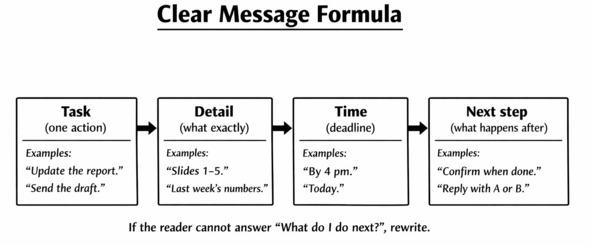
The goal is simple: after a short message, the reader should know the next step. If the reader cannot answer “What do I do now?”, the message is not clear yet. This book will help you build that habit.