


автордың кітабын онлайн тегін оқу Myths & Legends of the Celtic Race
The Project Gutenberg EBook of Myths and Legends of the Celtic Race by Thomas William Rolleston
This eBook is for the use of anyone anywhere at no cost and with almost no restrictions whatsoever. You may copy it, give it away or re-use it under the terms of the Project Gutenberg License included with this eBook or online at http://www.gutenberg.org/license
Title: Myths and Legends of the Celtic Race
Author: Thomas William Rolleston
Release Date: October 16, 2010 [Ebook #34081]
Language: English
***START OF THE PROJECT GUTENBERG EBOOK MYTHS AND LEGENDS OF THE CELTIC RACE***
MYTHS & LEGENDS OF THE CELTIC RACE
Queen Maev
T. W. ROLLESTON
MYTHS & LEGENDS OF THE CELTIC RACE
CONSTABLE - LONDON
[pg 8]
British edition published by Constable and Company Limited, London
First published 1911 by George G. Harrap & Co., London
[pg 9]
PREFACE
The Past may be forgotten, but it never dies. The elements which in the most remote times have entered into a nation's composition endure through all its history, and help to mould that history, and to stamp the character and genius of the people.
The examination, therefore, of these elements, and the recognition, as far as possible, of the part they have actually contributed to the warp and weft of a nation's life, must be a matter of no small interest and importance to those who realise that the present is the child of the past, and the future of the present; who will not regard themselves, their kinsfolk, and their fellow-citizens as mere transitory phantoms, hurrying from darkness into darkness, but who know that, in them, a vast historic stream of national life is passing from its distant and mysterious origin towards a future which is largely conditioned by all the past wanderings of that human stream, but which is also, in no small degree, what they, by their courage, their patriotism, their knowledge, and their understanding, choose to make it.
The part played by the Celtic race as a formative influence in the history, the literature, and the art of the people inhabiting the British Islands—a people which from that centre has spread its dominions over so vast an area of the earth's surface—has been unduly obscured in popular thought. For this the current use of the term “Anglo-Saxon” applied to the British people as a designation of race is largely responsible. Historically the term is quite misleading. There is nothing to justify this singling out of two Low-German tribes when we wish to indicate the race-character of the British people. The use of it leads to such absurdities as that which the writer noticed not [pg 10] long ago, when the proposed elevation by the Pope of an Irish bishop to a cardinalate was described in an English newspaper as being prompted by the desire of the head of the Catholic Church to pay a compliment to “the Anglo-Saxon race.”
The true term for the population of these islands, and for the typical and dominant part of the population of North America, is not Anglo-Saxon, but Anglo-Celtic. It is precisely in this blend of Germanic and Celtic elements that the British people are unique—it is precisely this blend which gives to this people the fire, the élan, and in literature and art the sense of style, colour, drama, which are not common growths of German soil, while at the same time it gives the deliberateness and depth, the reverence for ancient law and custom, and the passion for personal freedom, which are more or less strange to the Romance nations of the South of Europe. May they never become strange to the British Islands! Nor is the Celtic element in these islands to be regarded as contributed wholly, or even very predominantly, by the populations of the so-called “Celtic Fringe.” It is now well known to ethnologists that the Saxons did not by any means exterminate the Celtic or Celticised populations whom they found in possession of Great Britain. Mr. E.W.B. Nicholson, librarian of the Bodleian, writes in his important work “Keltic Researches” (1904):
“Names which have not been purposely invented to describe race must never be taken as proof of race, but only as proof of community of language, or community of political organisation. We call a man who speaks English, lives in England, and bears an obviously English name (such as Freeman or Newton), an Englishman. Yet from the statistics of ‘relative [pg 11] nigrescence’ there is good reason to believe that Lancashire, West Yorkshire, Staffordshire, Worcestershire, Warwickshire, Leicestershire, Rutland, Cambridgeshire, Wiltshire, Somerset, and part of Sussex are as Keltic as Perthshire and North Munster; that Cheshire, Shropshire, Herefordshire, Monmouthshire, Gloucestershire, Devon, Dorset, Northamptonshire, Huntingdonshire, and Bedfordshire are more so—and equal to North Wales and Leinster; while Buckinghamshire and Hertfordshire exceed even this degree, and are on a level with South Wales and Ulster.”1
It is, then, for an Anglo-Celtic, not an “Anglo-Saxon,” people that this account of the early history, the religion, and the mythical and romantic literature of the Celtic race is written. It is hoped that that people will find in it things worthy to be remembered as contributions to the general stock of European culture, but worthy above all to be borne in mind by those who have inherited more than have any other living people of the blood, the instincts and the genius of the Celt.
Contents
- PREFACE
- CHAPTER I: THE CELTS IN ANCIENT HISTORY
- CHAPTER II: THE RELIGION OF THE CELTS
- CHAPTER III: THE IRISH INVASION MYTHS
- CHAPTER IV: THE EARLY MILESIAN KINGS
- CHAPTER V: TALES OF THE ULTONIAN CYCLE
- CHAPTER VI: TALES OF THE OSSIANIC CYCLE
- CHAPTER VII: THE VOYAGE OF MAELDUN
- CHAPTER VIII: MYTHS AND TALES OF THE CYMRY
Illustrations
- Queen Maev
- Prehistoric Tumulus at New Grange
- Stone Alignments at Kermaris, Carnac
- Stone-worship at Locronan, Brittany
[pg 17]
CHAPTER I: THE CELTS IN ANCIENT HISTORY
Earliest References
In the chronicles of the classical nations for about five hundred years previous to the Christian era there are frequent references to a people associated with these nations, sometimes in peace, sometimes in war, and evidently occupying a position of great strength and influence in the Terra Incognita of Mid-Europe. This people is called by the Greeks the Hyperboreans or Celts, the latter term being first found in the geographer Hecatæsus, about 500 B.C.2
Herodotus, about half a century later, speaks of the Celts as dwelling “beyond the pillars of Hercules”—i.e., in Spain—and also of the Danube as rising in their country.
Aristotle knew that they dwelt “beyond Spain,” that they had captured Rome, and that they set great store by warlike power. References other than geographical are occasionally met with even in early writers. Hellanicus of Lesbos, an historian of the fifth century B.C., describes the Celts as practising justice and righteousness. Ephorus, about 350 B.C., has three lines of verse about the Celts in which they are described as using “the same customs as the Greeks”—whatever that may mean—and being on the friendliest terms with that people, who established guest friendships among them. Plato, however, in the “Laws,” classes the Celts among the races who are drunken and combative, and much barbarity is attributed to them on the occasion of their irruption into Greece and the [pg 18] sacking of Delphi in the year 273 B.C. Their attack on Rome and the sacking of that city by them about a century earlier is one of the landmarks of ancient history.
The history of this people during the time when they were the dominant power in Mid-Europe has to be divined or reconstructed from scattered references, and from accounts of episodes in their dealings with Greece and Rome, very much as the figure of a primæval monster is reconstructed by the zoologist from a few fossilised bones. No chronicles of their own have come down to us, no architectural remains have survived; a few coins, and a few ornaments and weapons in bronze decorated with enamel or with subtle and beautiful designs in chased or repoussé work—these, and the names which often cling in strangely altered forms to the places where they dwelt, from the Euxine to the British Islands, are well-nigh all the visible traces which this once mighty power has left us of its civilisation and dominion. Yet from these, and from the accounts of classical writers, much can be deduced with certainty, and much more can be conjectured with a very fair measure of probability. The great Celtic scholar whose loss we have recently had to deplore, M. d'Arbois de Jubainville, has, on the available data, drawn a convincing outline of Celtic history for the period prior to their emergence into full historical light with the conquests of Cæsar,3 and it is this outline of which the main features are reproduced here.
The True Celtic Race
To begin with, we must dismiss the idea that Celtica was ever inhabited by a single pure and homogeneous race. The true Celts, if we accept on this point the carefully studied and elaborately argued conclusion of [pg 19] Dr. T. Rice Holmes,4 supported by the unanimous voice of antiquity, were a tall, fair race, warlike and masterful,5 whose place of origin (as far as we can trace them) was somewhere about the sources of the Danube, and who spread their dominion both by conquest and by peaceful [pg 20] infiltration over Mid-Europe, Gaul, Spain, and the British Islands. They did not exterminate the original prehistoric inhabitants of these regions—palæolithic and neolithic races, dolmen-builders and workers in bronze—but they imposed on them their language, their arts, and their traditions, taking, no doubt, a good deal from them in return, especially, as we shall see, in the important matter of religion. Among these races the true Celts formed an aristocratic and ruling caste. In that capacity they stood, alike in Gaul, in Spain, in Britain, and in Ireland, in the forefront or armed opposition to foreign invasion. They bore the worst brunt of war, of confiscations, and of banishment. They never lacked valour, but they were not strong enough or united enough to prevail, and they perished in far greater proportion than the earlier populations whom they had themselves subjugated. But they disappeared also by mingling their blood with these inhabitants, whom they impregnated with many of their own noble and virile qualities. Hence it comes that the characteristics of the peoples called Celtic in the present day, and who carry on the Celtic tradition and language, are in some respects so different from those of the Celts of classical history and the Celts who produced the literature and art of ancient Ireland, and in others so strikingly similar. To take a physical characteristic alone, the more Celtic districts of the British Islands are at present marked by darkness of complexion, hair, &c. They are not very dark, but they are darker than the rest of the kingdom.6 But the [pg 21] true Celts were certainly fair. Even the Irish Celts of the twelfth century are described by Giraldus Cambrensis as a fair race.
Golden Age of the Celts
But we are anticipating, and must return to the period of the origins of Celtic history. As astronomers have discerned the existence of an unknown planet by the perturbations which it has caused in the courses of those already under direct observation, so we can discern in the fifth and fourth centuries before Christ the presence of a great power and of mighty movements going on behind a veil which will never be lifted now. This was the Golden Age of Celtdom in Continental Europe. During this period the Celts waged three great and successful wars, which had no little influence on the course of South European history. About 500 B.C. they conquered Spain from the Carthaginians. A century later we find them engaged in the conquest of Northern Italy from the Etruscans. They settled in large numbers in the territory afterwards known as Cisalpine Gaul, where many names, such as Mediolanum (Milan), Addua (Adda), Viro-dunum (Verduno), and perhaps Cremona (creamh, garlic),7 testify still to their occupation. They left a greater memorial in the chief of Latin poets, whose name, Vergil, appears to bear evidence of his Celtic ancestry.8 Towards the end of the fourth [pg 22] century they overran Pannonia, conquering the Illyrians.
Alliances with the Greeks
All these wars were undertaken in alliance with the Greeks, with whom the Celts were at this period on the friendliest terms. By the war with the Carthaginians the monopoly held by that people of the trade in tin with Britain and in silver with the miners of Spain was broken down, and the overland route across France to Britain, for the sake of which the Phocæans had in 600 B.C. created the port of Marseilles, was definitely secured to Greek trade. Greeks and Celts were at this period allied against Phœnicians and Persians. The defeat of Hamilcar by Gelon at Himera, in Sicily, took place in the same year as that of Xerxes at Salamis. The Carthaginian army in that expedition was made up of mercenaries from half a dozen different nations, but not a Celt is found in the Carthaginian ranks, and Celtic hostility must have counted for much in preventing the Carthaginians from lending help to the Persians for the overthrow of their common enemy. These facts show that Celtica played no small part in preserving the Greek type of civilisation from being overwhelmed by the despotisms of the East, and thus in keeping alive in Europe the priceless seed of freedom and humane culture.
Alexander the Great
When the counter-movement of Hellas against the East began under Alexander the Great we find the Celts again appearing as a factor of importance.
[pg 23]
In the fourth century Macedon was attacked and almost obliterated by Thracian and Illyrian hordes. King Amyntas II. was defeated and driven into exile. His son Perdiccas II. was killed in battle. When Philip, a younger brother of Perdiccas, came to the obscure and tottering throne which he and his successors were to make the seat of a great empire he was powerfully aided in making head against the Illyrians by the conquests of the Celts in the valleys of the Danube and the Po. The alliance was continued, and rendered, perhaps, more formal in the days of Alexander. When about to undertake his conquest of Asia (334 B.C.) Alexander first made a compact with the Celts “who dwelt by the Ionian Gulf” in order to secure his Greek dominions from attack during his absence. The episode is related by Ptolemy Soter in his history of the wars of Alexander.9 It has a vividness which stamps it as a bit of authentic history, and another singular testimony to the truth of the narrative has been brought to light by de Jubainville. As the Celtic envoys, who are described as men of haughty bearing and great stature, their mission concluded, were drinking with the king, he asked them, it is said, what was the thing they, the Celts, most feared. The envoys replied: “We fear no man: there is but one thing that we fear, namely, that the sky should fall on us; but we regard nothing so much as the friendship of a man such as thou.” Alexander bade them farewell, and, turning to his nobles, whispered: “What a vainglorious people are these Celts!” Yet the answer, for all its Celtic bravura and flourish, [pg 24] was not without both dignity and courtesy. The reference to the falling of the sky seems to give a glimpse of some primitive belief or myth of which it is no longer possible to discover the meaning.10 The national oath by which the Celts bound themselves to the observance of their covenant with Alexander is remarkable. “If we observe not this engagement,” they said, “may the sky fall on us and crush us, may the earth gape and swallow us up, may the sea burst out and overwhelm us.” De Jubainville draws attention most appositely to a passage from the “Táin Bo Cuailgne,” in the Book of Leinster11, where the Ulster heroes declare to their king, who wished to leave them in battle in order to meet an attack in another part of the field: “Heaven is above us, and earth beneath us, and the sea is round about us. Unless the sky shall fall with its showers of stars on the ground where we are camped, or unless the earth shall be rent by an earthquake, or unless the waves of the blue sea come over the forests of the living world, we shall not give ground.”12 This survival of a peculiar oath-formula for more than a thousand years, and its reappearance, after being first heard of among the Celts of Mid-Europe, in a mythical romance of Ireland, is certainly most curious, and, with other facts which we shall note hereafter, speaks strongly for the community and persistence of Celtic culture.13
[pg 25]
The Sack of Rome
We have mentioned two of the great wars of the Continental Celts; we come now to the third, that with the Etruscans, which ultimately brought them into conflict with the greatest power of pagan Europe, and led to their proudest feat of arms, the sack of Rome. About the year 400 B.C. the Celtic Empire seems to have reached the height of its power. Under a king named by Livy Ambicatus, who was probably the head of a dominant tribe in a military confederacy, like the German Emperor in the present day, the Celts seem to have been welded into a considerable degree of political unity, and to have followed a consistent policy. Attracted by the rich land of Northern Italy, they poured down through the passes of the Alps, and after hard fighting with the Etruscan inhabitants they maintained their ground there. At this time the Romans were pressing on the Etruscans from below, and Roman and Celt were acting in definite concert and alliance. But the Romans, despising perhaps the Northern barbarian warriors, had the rashness to play them false at the siege of Clusium, 391 B.C., a place which the Romans regarded as one of the bulwarks of Latium against the North. The Celts recognised Romans who had come to them in the sacred character of ambassadors fighting in the ranks of the enemy. The events which followed are, as they have come down to us, much mingled with legend, but there are certain touches of dramatic vividness in which the true character of the Celts appears distinctly recognisable. They applied, we are told, to Rome for satisfaction for the treachery of the envoys, who were three sons of Fabius Ambustus, the chief pontiff. The Romans refused to listen to the claim, and elected the Fabii military tribunes for the [pg 26] ensuing year. Then the Celts abandoned the siege of Clusium and marched straight on Rome. The army showed perfect discipline. There was no indiscriminate plundering and devastation, no city or fortress was assailed. “We are bound for Rome” was their cry to the guards upon the walls of the provincial towns, who watched the host in wonder and fear as it rolled steadily to the south. At last they reached the river Allia, a few miles from Rome, where the whole available force of the city was ranged to meet them. The battle took place on July 18, 390, that ill-omened dies Alliensis which long perpetuated in the Roman calendar the memory of the deepest shame the republic had ever known. The Celts turned the flank of the Roman army, and annihilated it in one tremendous charge. Three days later they were in Rome, and for nearly a year they remained masters of the city, or of its ruins, till a great fine had been exacted and full vengeance taken for the perfidy at Clusium. For nearly a century after the treaty thus concluded there was peace between the Celts and the Romans, and the breaking of that peace when certain Celtic tribes allied themselves with their old enemy, the Etruscans, in the third Samnite war was coincident with the breaking up of the Celtic Empire.14
Two questions must now be considered before we can leave the historical part of this Introduction. First of all, what are the evidences for the widespread diffusion of Celtic power in Mid-Europe during this period? Secondly, where were the Germanic peoples, and what was their position in regard to the Celts?
[pg 27]
Celtic Place-names in Europe
To answer these questions fully would take us (for the purposes of this volume) too deeply into philological discussions, which only the Celtic scholar can fully appreciate. The evidence will be found fully set forth in de Jubainville's work, already frequently referred to. The study of European place-names forms the basis of the argument. Take the Celtic name Noviomagus composed of two Celtic words, the adjective meaning new, and magos (Irish magh) a field or plain.15 There were nine places of this name known in antiquity. Six were in France, among them the places now called Noyon, in Oise, Nijon, in Vosges, Nyons, in Drôme. Three outside of France were Nimègue, in Belgium, Neumagen, in the Rhineland, and one at Speyer, in the Palatinate.
The word dunum, so often traceable in Gaelic place-names in the present day (Dundalk, Dunrobin, &c.), and meaning fortress or castle, is another typically Celtic element in European place-names. It occurred very frequently in France—e.g., Lug-dunum (Lyons), Viro-dunum (Verdun). It is also found in Switzerland—e.g., Minno-dunum (Moudon), Eburo-dunum (Yverdon)—and in the Netherlands, where the famous city of Leyden goes back to a Celtic Lug-dunum. In Great Britain the Celtic term was often changed by simple translation into castra; thus Camulo-dunum became Colchester, Brano-dunum Brancaster. In Spain and Portugal eight names terminating in dunum are mentioned by classical writers. In Germany the modern names Kempton, Karnberg, Liegnitz, go back respectively to the Celtic forms Cambo-dunum, Carro-aunum, [pg 28] Lugi-dunum, and we find a Singi-dunum, now Belgrade, in Servia, a Novi-dunum, now Isaktscha, in Roumania, a Carro-dunum in South Russia, near the Dniester, and another in Croatia, now Pitsmeza. Sego-dunum, now Rodez, in France, turns up also in Bavaria (Wurzburg), and in England (Sege-dunum, now Wallsend, in Northumberland), and the first term, sego, is traceable in Segorbe (Sego-briga) in Spain. Briga is a Celtic word, the origin of the German burg, and equivalent in meaning to dunum.
One more example: the word magos, a plain, which is very frequent as an element of Irish place-names, is found abundantly in France, and outside of France, in countries no longer Celtic, it appears in Switzerland (Uro-magus now Promasens), in the Rhineland (Broco-magus, Brumath), in the Netherlands, as already noted (Nimègue), in Lombardy several times, and in Austria.
The examples given are by no means exhaustive, but they serve to indicate the wide diffusion of the Celts in Europe and their identity of language over their vast territory.16
Early Celtic Art
The relics of ancient Celtic art-work tell the same story. In the year 1846 a great pre-Roman necropolis was discovered at Hallstatt, near Salzburg, in Austria. It contains relics believed by Dr. Arthur Evans to date from about 750 to 400 B.C. These relics betoken in some cases a high standard of civilisation and considerable commerce. Amber from the Baltic is there, Phoenician glass, and gold-leaf of Oriental workmanship. Iron swords are found whose hilts and sheaths are richly decorated with gold, ivory, and amber.
[pg 29]
The Celtic culture illustrated by the remains at Hallstatt developed later into what is called the La Tène culture. La Tène was a settlement at the north-eastern end of the Lake of Neuchâtel, and many objects of great interest have been found there since the site was first explored in 1858. These antiquities represent, according to Dr. Evans, the culminating period of Gaulish civilisation, and date from round about the third century B.C. The type of art here found must be judged in the light of an observation recently made by Mr. Romilly Allen in his “Celtic Art” (p. 13):
“The great difficulty in understanding the evolution of Celtic art lies in the fact that although the Celts never seem to have invented any new ideas, they possessed an extraordinary aptitude for picking up ideas from the different peoples with whom war or commerce brought them into contact. And once the Celt had borrowed an idea from his neighbours he was able to give it such a strong Celtic tinge that it soon became something so different from what it was originally as to be almost unrecognisable.”
Now what the Celt borrowed in the art-culture which on the Continent culminated in the La Tène relics were certain originally naturalistic motives for Greek ornaments, notably the palmette and the meander motives. But it was characteristic of the Celt that he avoided in his art all imitation of, or even approximation to, the natural forms of the plant and animal world. He reduced everything to pure decoration. What he enjoyed in decoration was the alternation of long sweeping curves and undulations with the concentrated energy of close-set spirals or bosses, and with these simple elements and with the suggestion of a few motives derived from Greek art he elaborated a most [pg 30] beautiful, subtle, and varied system of decoration, applied to weapons, ornaments, and to toilet and household appliances of all kinds, in gold, bronze, wood, and stone, and possibly, if we had the means of judging, to textile fabrics also. One beautiful feature in the decoration of metal-work seems to have entirely originated in Celtica. Enamelling was unknown to the classical nations till they learned from the Celts. So late as the third century A.D. it was still strange to the classical world, as we learn from the reference of Philostratus:
“They say that the barbarians who live in the ocean [Britons] pour these colours upon heated brass, and that they adhere, become hard as stone, and preserve the designs that are made upon them.”
Dr. J. Anderson writes in the “Proceedings of the Society of Antiquaries of Scotland”:
“The Gauls as well as the Britons—of the same Celtic stock—practised enamel-working before the Roman conquest. The enamel workshops of Bibracte, with their furnaces, crucibles, moulds, polishing-stones, and with the crude enamels in their various stages of preparation, have been recently excavated from the ruins of the city destroyed by Caesar and his legions. But the Bibracte enamels are the work of mere dabblers in the art, compared with the British examples. The home of the art was Britain, and the style of the pattern, as well as the association in which the objects decorated with it were found, demonstrated with certainty that it had reached its highest stage of indigenous development before it came in contact with the Roman culture.”17
The National Museum in Dublin contains many superb examples of Irish decorative art in gold, bronze, [pg 31] and enamels, and the “strong Celtic tinge” of which Mr. Romilly Allen speaks is as clearly observable there as in the relics of Hallstatt or La Tène.
Everything, then, speaks of a community of culture, an identity of race-character, existing over the vast territory known to the ancient world as “Celtica.”
Celts and Germans
But, as we have said before, this territory was by no means inhabited by the Celt alone. In particular we have to ask, who and where were the Germans, the Teuto-Gothic tribes, who eventually took the place of the Celts as the great Northern menace to classical civilisation?
They are mentioned by Pytheas, the eminent Greek traveller and geographer, about 300 B.C., but they play no part in history till, under the name of Cimbri and Teutones, they descended on Italy to be vanquished by Marius at the close of the second century. The ancient Greek geographers prior to Pytheas know nothing of them, and assign all the territories now known as Germanic to various Celtic tribes.
The explanation given by de Jubainville, and based by him on various philological considerations, is that the Germans were a subject people, comparable to those “un-free tribes” who existed in Gaul and in ancient Ireland. They lived under the Celtic dominion, and had no independent political existence. De Jubainville finds that all the words connected with law and government and war which are common both to the Celtic and Teutonic languages were borrowed by the latter from the former. Chief among them are the words represented by the modern German Reich, empire, Amt, office, and the Gothic reiks, a king, all of which are of unquestioned Celtic origin. De Jubainville also numbers among loan words from Celtic [pg 32] the words Bann, an order; Frei, free; Geisel, a hostage; Erbe, an inheritance; Werth, value; Weih, sacred; Magus, a slave (Gothic); Wini, a wife (Old High German); Skalks, Schalk, a slave (Gothic); Hathu, battle (Old German); Helith, Held, a hero, from the same root as the word Celt; Heer, an army (Celtic choris); Sieg, victory; Beute, booty; Burg, a castle; and many others.
The etymological history of some of these words is interesting. Amt, for instance, that word of so much significance in modern German administration, goes back to an ancient Celtic ambhactos, which is compounded of the words ambi, about, and actos, a past participle derived from the Celtic root AG, meaning to act. Now ambi descends from the primitive Indo-European mbhi, where the initial m is a kind of vowel, afterwards represented in Sanscrit by a. This m vowel became n in those Germanic words which derive directly from the primitive Indo-European tongue. But the word which is now represented by amt appears in its earliest Germanic form as ambaht, thus making plain its descent from the Celtic ambhactos.
Again, the word frei is found in its earliest Germanic form as frijo-s, which comes from the primitive Indo-European prijo-s. The word here does not, however, mean free; it means beloved (Sanscrit priya-s). In the Celtic language, however, we find prijos dropping its initial p—a difficulty in pronouncing this letter was a marked feature in ancient Celtic; it changed j, according to a regular rule, into dd, and appears in modern Welsh as rhydd=free. The Indo-European meaning persists in the Germanic languages in the name of the love-goddess, Freia, and in the word Freund, friend, Friede, peace. The sense borne by the word in the sphere of civil right is traceable to a Celtic origin, [pg 33] and in that sense appears to have been a loan from Celtic.
The German Beute, booty, plunder, has had an instructive history. There was a Gaulish word bodi found in compounds such as the place-name Segobodium (Seveux), and various personal and tribal names, including Boudicca, better known to us as the “British warrior queen,” Boadicea. This word meant anciently “victory.” But the fruits of victory are spoil, and in this material sense the word was adopted in German, in French (butin) in Norse (byte), and the Welsh (budd). On the other hand, the word preserved its elevated significance in Irish. In the Irish translation of Chronicles xxix. 11, where the Vulgate original has “Tua est, Domine, magnificentia et potentia et gloria et victoria,” the word victoria is rendered by the Irish búaidh, and, as de Jubainville remarks, “ce n'est pas de butin qu'il s'agit.” He goes on to say: “Búaidh has preserved in Irish, thanks to a vigorous and persistent literary culture, the high meaning which it bore in the tongue of the Gaulish aristocracy. The material sense of the word was alone perceived by the lower classes of the population, and it is the tradition of this lower class which has been preserved in the German, the French, and the Cymric languages.”18
Two things, however, the Celts either could not or would not impose on the subjugated German tribes—their language and their religion. In these two great factors of race-unity and pride lay the seeds of the ultimate German uprising and overthrow of the Celtic supremacy. The names of the German are different from those of the Celtic deities, their funeral customs, with which are associated the deepest religious conceptions of primitive races, are different. The Celts, or [pg 34] at least the dominant section of them, buried their dead, regarding the use of fire as a humiliation, to be inflicted on criminals, or upon slaves or prisoners in those terrible human sacrifices which are the greatest stain on their native culture. The Germans, on the other hand, burned their illustrious dead on pyres, like the early Greeks—if a pyre could not be afforded for the whole body, the noblest parts, such as the head and arms, were burned and the rest buried.
Downfall of the Celtic Empire
What exactly took place at the time of the German revolt we shall never know; certain it is, however, that from about the year 300 B.C. onward the Celts appear to have lost whatever political cohesion and common purpose they had possessed. Rent asunder, as it were, by the upthrust of some mighty subterranean force, their tribes rolled down like lava-streams to the south, east, and west of their original home. Some found their way into Northern Greece, where they committed the outrage which so scandalised their former friends and allies in the sack of the shrine of Delphi (273 B.C.). Others renewed, with worse fortune, the old struggle with Rome, and perished in vast numbers at Sentinum (295 B.C.) and Lake Vadimo (283 B.C.). One detachment penetrated into Asia Minor, and founded the Celtic State of Galatia, where, as St. Jerome attests, a Celtic dialect was still spoken in the fourth century A.D. Others enlisted as mercenary troops with Carthage. A tumultuous war of Celts against scattered German tribes, or against other Celts who represented earlier waves of emigration and conquest, went on all over Mid-Europe, Gaul, and Britain. When this settled down Gaul and the British Islands remained practically the sole relics of the Celtic [pg 35] empire, the only countries still under Celtic law and leadership. By the commencement of the Christian era Gaul and Britain had fallen under the yoke of Rome, and their complete Romanisation was only a question of time.
Unique Historical Position of Ireland
Ireland alone was never even visited, much less subjugated, by the Roman legionaries, and maintained its independence against all comers nominally until the close of the twelfth century, but for all practical purposes a good three hundred years longer.
Ireland has therefore this unique feature of interest, that it carried an indigenous Celtic civilisation, Celtic institutions, art, and literature, and the oldest surviving form of the Celtic language,19 right across the chasm which separates the antique from the modern world, [pg 36] the pagan from the Christian world, and on into the full light of modern history and observation.
The Celtic Character
The moral no less than the physical characteristics attributed by classical writers to the Celtic peoples show a remarkable distinctness and consistency. Much of what is said about them might, as we should expect, be said of any primitive and unlettered people, but there remains so much to differentiate them among the races of mankind that if these ancient references to the Celts could be read aloud, without mentioning the name of the race to whom they referred, to any person acquainted with it through modern history alone, he would, I think, without hesitation, name the Celtic peoples as the subject of the description which he had heard.
Some of these references have already been quoted, and we need not repeat the evidence derived from Plato, Ephorus, or Arrian. But an observation of [pg 37] M. Porcius Cato on the Gauls may be adduced. “There are two things,” he says, “to which the Gauls are devoted—the art of war and subtlety of speech” (“rem militarem et argute loqui”).
Cæsar's Account
Cæsar has given us a careful and critical account of them as he knew them in Gaul. They were, he says, eager for battle, but easily dashed by reverses. They were extremely superstitious, submitting to their Druids in all public and private affairs, and regarding it as the worst of punishments to be excommunicated and forbidden to approach thu ceremonies of religion:
“They who are thus interdicted [for refusing to obey a Druidical sentence] are reckoned in the number of the vile and wicked; all persons avoid and fly their company and discourse, lest they should receive any infection by contagion; they are not permitted to commence a suit; neither is any post entrusted to them.... The Druids are generally freed from military service, nor do they pay taxes with the rest.... Encouraged by such rewards, many of their own accord come to their schools, and are sent by their friends and relations. They are said there to get by heart a great number of verses; some continue twenty years in their education; neither is it held lawful to commit these things [the Druidic doctrines] to writing, though in almost all public transactions and private accounts they use the Greek characters.”
The Gauls were eager for news, besieging merchants and travellers for gossip,20 easily influenced, sanguine, [pg 38] credulous, fond of change, and wavering in their counsels. They were at the same time remarkably acute and intelligent, very quick to seize upon and to imitate any contrivance they found useful. Their ingenuity in baffling the novel siege apparatus of the Roman armies is specially noticed by Cæsar. Of their courage he speaks with great respect, attributing their scorn of death, in some degree at least, to their firm faith in the immortality of the soul.21 A people who in earlier days had again and again annihilated Roman armies, had sacked Rome, and who had more than once placed Cæsar himself in positions of the utmost anxiety and peril, were evidently no weaklings, whatever their religious beliefs or practices. Cæsar is not given to sentimental admiration of his foes, but one episode at the siege of Avaricum moves him to immortalise the valour of the defence. A wooden structure or agger had been raised by the Romans to overtop the walls, which had proved impregnable to the assaults of the battering-ram. The Gauls contrived to set this on fire. It was of the utmost moment to prevent the besiegers from extinguishing the flames, and a Gaul mounted a portion of the wall above the agger, throwing down upon it balls of tallow and pitch, which were handed up to him from within. He was soon struck down by a missile from a Roman catapult. Immediately another stepped over him as he lay, and continued his comrade's task. He too fell, [pg 39] but a third instantly took his place, and a fourth; nor was this post ever deserted until the legionaries at last extinguished the flames and forced the defenders back into the town, which was finally captured on the following day.
Strabo on the Celts
The geographer and traveller Strabo, who died 24 A.D., and was therefore a little later than Cæsar, has much to tell us about the Celts. He notices that their country (in this case Gaul) is thickly inhabited and well tilled—there is no waste of natural resources. The women are prolific, and notably good mothers. He describes the men as warlike, passionate, disputatious, easily provoked, but generous and unsuspicious, and easily vanquished by stratagem. They showed themselves eager for culture, and Greek letters and science had spread rapidly among them from Massilia; public education was established in their towns. They fought better on horseback than on foot, and in Strabo's time formed the flower of the Roman cavalry. They dwelt in great houses made of arched timbers with walls of wickerwork—no doubt plastered with clay and lime, as in Ireland—and thickly thatched. Towns of much importance were found in Gaul, and Cæsar notes the strength of their walls, built of stone and timber. Both Cæsar and Strabo agree that there was a very sharp division between the nobles and priestly or educated class on the one hand and the common people on the other, the latter being kept in strict subjection. The social division corresponds roughly, no doubt, to the race distinction between the true Celts and the aboriginal populations subdued by them. While Cæsar tells us that the Druids taught the immortality of the soul, Strabo adds that they believed in [pg 40] the indestructibility, which implies in some sense the divinity, of the material universe.
The Celtic warrior loved display. Everything that gave brilliance and the sense of drama to life appealed to him. His weapons were richly ornamented, his horse-trappings were wrought in bronze and enamel, of design as exquisite as any relic of Mycenean or Cretan art, his raiment was embroidered with gold. The scene of the surrender of Vercingetorix, when his heroic struggle with Rome had come to an end on the fall of Alesia, is worth recording as a typically Celtic blend of chivalry and of what appeared to the sober-minded Romans childish ostentation.22 When he saw that the cause was lost he summoned a tribal council, and told the assembled chiefs, whom he had led through a glorious though unsuccessful war, that he was ready to sacrifice himself for his still faithful followers—they might send his head to Cæsar if they liked, or he would voluntarily surrender himself for the sake of getting easier terms for his countrymen. The latter alternative was chosen. Vercingetorix then armed himself with his most splendid weapons, decked his horse with its richest trappings, and, after riding thrice round the Roman camp, went before Cæsar and laid at his feet the sword which was the sole remaining defence of Gallic independence. Cæsar sent him to Rome, where he lay in prison for six years, and was finally put to death when Cæsar celebrated his triumph.
But the Celtic love of splendour and of art were mixed with much barbarism. Strabo tells us how the warriors rode home from victory with the heads of [pg 41] fallen foemen dangling from their horses' necks, just as in the Irish saga the Ulster hero, Cuchulain, is represented as driving back to Emania from a foray into Connacht with the heads of his enemies hanging from his chariot-rim. Their domestic arrangements were rude; they lay on the ground to sleep, sat on couches of straw, and their women worked in the fields.
Polybius
A characteristic scene from the battle of Clastidium (222 B.C.) is recorded by Polybius. The Gæsati,23 he tells us, who were in the forefront of the Celtic army, stripped naked for the fight, and the sight of these warriors, with their great stature and their fair skins, on which glittered the collars and bracelets of gold so loved as an adornment by all the Celts, filled the Roman legionaries with awe. Yet when the day was over those golden ornaments went in cartloads to deck the Capitol of Rome; and the final comment of Polybius on the character of the Celts is that they, “I say not usually, but always, in everything they attempt, are driven headlong by their passions, and never submit to the laws of reason.” As might be expected, the chastity for which the Germans were noted was never, until recent times, a Celtic characteristic.
Diodorus
Diodorus Siculus, a contemporary of Julius Cæsar and Augustus, who had travelled in Gaul, confirms in the main the accounts of Cæsar and Strabo, but adds some [pg 42] interesting details. He notes in particular the Gallic love of gold. Even cuirasses were made of it. This is also a very notable trait in Celtic Ireland, where an astonishing number of prehistoric gold relics have been found, while many more, now lost, are known to have existed. The temples and sacred places, say Posidonius and Diodorus, were full of unguarded offerings of gold, which no one ever touched. He mentions the great reverence paid to the bards, and, like Cato, notices something peculiar about the kind of speech which the educated Gauls cultivated: “they are not a talkative people, and are fond of expressing themselves in enigmas, so that the hearer has to divine the most part of what they would say.” This exactly answers to the literary language of ancient Ireland, which is curt and allusive to a degree. The Druid was regarded as the prescribed intermediary between God and man—no one could perform a religious act without his assistance.
Ammianus Marcellinus
Ammianus Marcellinus, who wrote much later, in the latter half of the fourth century A.D., had also visited Gaul, which was then, of course, much Romanised. He tells us, however, like former writers, of the great stature, fairness, and arrogant bearing of the Gallic warrior. He adds that the people, especially in Aquitaine, were singularly clean and proper in their persons—no one was to be seen in rags. The Gallic woman he describes as very tall, blue-eyed, and singularly beautiful; but a certain amount of awe is mingled with his evident admiration, for he tells us that while it was dangerous enough to get into a fight with a Gallic man, your case was indeed desperate if his wife with her “huge snowy arms,” which could strike like catapults, came to his assistance. One is irresistibly [pg 43] reminded of the gallery of vigorous, independent, fiery-hearted women, like Maeve, Grania, Findabair, Deirdre, and the historic Boadicea, who figure in the myths and in the history of the British Islands.
Rice Holmes on the Gauls
The following passage from Dr. Rice Holmes' “Cæsar's Conquest of Gaul” may be taken as an admirable summary of the social physiognomy of that part of Celtica a little before the time of the Christian era, and it corresponds closely to all that is known of the native Irish civilisation:
“The Gallic peoples had risen far above the condition of savages; and the Celticans of the interior, many of whom had already fallen under Roman influence, had attained a certain degree of civilisation, and even of luxury. Their trousers, from which the province took its name of Gallia Bracata, and their many-coloured tartan skirts and cloaks excited the astonishment of their conquerors. The chiefs wore rings and bracelets and necklaces of gold; and when these tall, fair-haired warriors rode forth to battle, with their helmets wrought in the shape of some fierce beast's head, and surmounted by nodding plumes, their chain armour, their long bucklers and their huge clanking swords, they made a splendid show. Walled towns or large villages, the strongholds of the various tribes, were conspicuous on numerous hills. The plains were dotted by scores of oper hamlets. The houses, built of timber and wickerwork, were large and well thatched. The fields in summer were yellow with corn. Roads ran from town to town. Rude bridges spanned the rivers; and barges laden with merchandise floated along them. Ships clumsy indeed [pg 44]but larger than any that were seen on the Mediterranean, braved the storms of the Bay of Biscay and carried cargoes between the ports of Brittany and the coast of Britain. Tolls were exacted on the goods which were transported on the great waterways; and it was from the farming of these dues that the nobles derived a large part of their wealth. Every tribe had its coinage; and the knowledge of writing in Greek and Roman characters was not confined to the priests. The Æduans were familiar with the plating of copper and of tin. The miners of Aquitaine, of Auvergne, and of the Berri were celebrated for their skill. Indeed, in all that belonged to outward prosperity the peoples of Gaul had made great strides since their kinsmen first came into contact with Rome.”24
Weakness of the Celtic Policy
Yet this native Celtic civilisation, in many respects so attractive and so promising, had evidently some defect or disability which prevented the Celtic peoples from holding their own either against the ancient civilisation of the Græco-Roman world, or against the rude young vigour of the Teutonic races. Let us consider what this was.
[pg 45]
The Classical State
At the root of the success of classical nations lay the conception of the civic community, the πόλις, the res publica, as a kind of divine entity, the foundation of blessing to men, venerable for its age, yet renewed in youth with every generation; a power which a man might joyfully serve, knowing that even if not remembered in its records his faithful service would outlive his own petty life and go to exalt the life of his motherland or city for all future time. In this spirit Socrates, when urged to evade his death sentence by taking the means of escape from prison which his friends offered him, rebuked them for inciting him to an impious violation of his country's laws. For a man's country, he says, is more holy and venerable than father or mother, and he must quietly obey the laws, to which he has assented by living under them all his life, or incur the just wrath of their great Brethren, the Laws of the Underworld, before whom, in the end, he must answer for his conduct on earth. In a greater or less degree this exalted conception of the State formed the practical religion of every man among the classical nations of antiquity, and gave to the State its cohesive power, its capability of endurance and of progress.
Teutonic Loyalty
With the Teuton the cohesive force was supplied by another motive, one which was destined to mingle with the civic motive and to form, in union with it—and often in predominance over it—the main political factor in the development of the European nations. This was the sentiment of what the Germans called Treue, the personal fidelity to a chief, which in very [pg 46] early times extended itself to a royal dynasty, a sentiment rooted profoundly in the Teutonic nature, and one which has never been surpassed by any other human impulse as the source of heroic self-sacrifice.
Celtic Religion
No human influences are ever found pure and unmixed. The sentiment of personal fidelity was not unknown to the classical nations. The sentiment of civic patriotism, though of slow growth among the Teutonic races, did eventually establish itself there. Neither sentiment was unknown to the Celt, but there was another force which, in his case, overshadowed and dwarfed them, and supplied what it could of the political inspiration and unifying power which the classical nations got from patriotism and the Teutons from loyalty. This was Religion; or perhaps it would be more accurate to say Sacerdotalism—religion codified in dogma and administered by a priestly caste. The Druids, as we have seen from Cæsar, whose observations are entirely confirmed by Strabo and by references in Irish legends,25 were the really sovran power in Celtica. All affairs, public and private, were subject to their authority, and the penalties which they could inflict for any assertion of lay independence, though resting for their efficacy, like the mediæval interdicts of the Catholic Church, on popular superstition [pg 47] alone, were enough to quell the proudest spirit. Here lay the real weakness of the Celtic polity. There is perhaps no law written more conspicuously in the teachings of history than that nations who are ruled by priests drawing their authority from supernatural sanctions are, just in the measure that they are so ruled, incapable of true national progress. The free, healthy current of secular life and thought is, in the very nature of things, incompatible with priestly rule. Be the creed what it may, Druidism, Islam, Judaism, Christianity, or fetichism, a priestly caste claiming authority in temporal affairs by virtue of extra-temporal sanctions is inevitably the enemy of that spirit of criticism, of that influx of new ideas, of that growth of secular thought, of human and rational authority, which are the elementary conditions of national development.
The Cursing of Tara
A singular and very cogent illustration of this truth can be drawn from the history of the early Celtic world. In the sixth century A.D., a little over a hundred years after the preaching of Christianity by St. Patrick, a king named Dermot MacKerval26 ruled in Ireland. He was the Ard Righ, or High King, of that country, whose seat of government was at Tara, in Meath, and whose office, with its nominal and legal superiority to the five provincial kings, represented the impulse which was moving the Irish people towards a true national unity. The first condition of such a unity was evidently the establishment of an effective central authority. Such an authority, as we have said, the High King, in theory, represented. Now it happened that one of his officers was murdered in the discharge of his duty by a chief named Hugh Guairy. Guairy [pg 48] was the brother of a bishop who was related by fosterage to St. Ruadan of Lorrha, and when King Dermot sent to arrest the murderer these clergy found him a hiding-place. Dermot, however, caused a search to be made, haled him forth from under the roof of St. Ruadan, and brought him to Tara for trial. Immediately the ecclesiastics of Ireland made common cause against the lay ruler who had dared to execute justice on a criminal under clerical protection. They assembled at Tara, fasted against the king,27 and laid their solemn malediction upon him and the seat of his government. Then the chronicler tells us that Dermot's wife had a prophetic dream:
“Upon Tara's green was a vast and wide-foliaged tree, and eleven slaves hewing at it; but every chip that they knocked from it would return into its place again and there adhere instantly, till at last there came one man that dealt the tree but a stroke, and with that single cut laid it low.”28
The fair tree was the Irish monarchy, the twelve hewers were the twelve Saints or Apostles of Ireland, and the one who laid it low was St. Ruadan. The plea of the king for his country, whose fate he saw to be hanging in the balance, is recorded with moving force and insight by the Irish chronicler:29
[pg 49]
“ ‘Alas,’ he said, ‘for the iniquitous contest that ye have waged against me; seeing that it is Ireland's good that I pursue, and to preserve her discipline and royal right; but 'tis Ireland's unpeace and murderousness that ye endeavour after.’ ”
But Ruadan said, “Desolate be Tara for ever and ever”; and the popular awe of the ecclesiastical malediction prevailed. The criminal was surrendered, Tara was abandoned, and, except for a brief space when a strong usurper, Brian Boru, fought his way to power, Ireland knew no effective secular government till it was imposed upon her by a conqueror. The last words of the historical tract from which we quote are Dermot's cry of despair:
“Woe to him that with the clergy of the churches battle joins.”
This remarkable incident has been described at some length because it is typical of a factor whose profound influence in moulding the history of the Celtic peoples we can trace through a succession of critical events from the time of Julius Caesar to the present day. How and whence it arose we shall consider later; here it is enough to call attention to it. It is a factor which forbade the national development of the Celts, in the sense in which we can speak of that of the classical or the Teutonic peoples.
What Europe Owes to the Celt
Yet to suppose that on this account the Celt was not a force of any real consequence in Europe would be altogether a mistake. His contribution to the culture of the Western world was a very notable one. For some four centuries—about A.D. 500 to 900—Ireland was [pg 50] the refuge of learning and the source of literary and philosophic culture for half Europe. The verse-forms of Celtic poetry have probably played the main part in determining the structure of all modern verse. The myths and legends of the Gaelic and Cymric peoples kindled the imagination of a host of Continental poets. True, the Celt did not himself create any great architectural work of literature, just as he did not create a stable or imposing national polity. His thinking and feeling were essentially lyrical and concrete. Each object or aspect of life impressed him vividly and stirred him profoundly; he was sensitive, impressionable to the last degree, but did not see things in their larger and more far-reaching relations. He had little gift for the establishment or institutions, for the service of principles; but he was, and is, an indispensable and never-failing assertor of humanity as against the tyranny of principles, the coldness and barrenness of institutions. The institutions of royalty and of civic patriotism are both very capable of being fossilised into barren formulae, and thus of fettering instead of inspiring the soul. But the Celt has always been a rebel against anything that has not in it the breath of life, against any unspiritual and purely external form of domination. It is too true that he has been over-eager to enjoy the fine fruits of life without the long and patient preparation for the harvest, but he has done and will still do infinite service to the modern world in insisting that the true fruit of life is a spiritual reality, never without pain and loss to be obscured or forgotten amid the vast mechanism of a material civilisation.
19.
3.
6.
23.
4.
21.
14.
18.
2.
17.
1.
10.
22.
20.
24.
25.
28.
15.
29.
8.
7.
12.
13.
9.
16.
27.
5.
26.
11.
[pg 51]
CHAPTER II: THE RELIGION OF THE CELTS
Ireland and the Celtic Religion
We have said that the Irish among the Celtic peoples possess the unique interest of having carried into the light of modern historical research many of the features of a native Celtic civilisation. There is, however, one thing which they did not carry across the gulf which divides us from the ancient world—and this was their religion.
It was not merely that they changed it; they left it behind them so entirely that all record of it is lost. St. Patrick, himself a Celt, who apostolised Ireland during the fifth century, has left us an autobiographical narrative of his mission, a document of intense interest, and the earliest extant record of British Christianity; but in it he tells us nothing of the doctrines he came to supplant. We learn far more of Celtic religious beliefs from Julius Cæsar, who approached them from quite another side. The copious legendary literature which took its present form in Ireland between the seventh and the twelfth centuries, though often manifestly going back to pre-Christian sources, shows us, beyond a belief in magic and a devotion to certain ceremonial or chivalric observances, practically nothing resembling a religious or even an ethical system. We know that certain chiefs and bards offered a long resistance to the new faith, and that this resistance came to the arbitrament of battle at Moyrath in the sixth century, but no echo of any intellectual controversy, no matching of one doctrine against another, such as we find, for instance, in the records of the controversy of Celsus with Origen, has reached us from this period of change and strife. The literature of ancient Ireland, as we [pg 52] shall see, embodied many ancient myths; and traces appear in it of beings who must, at one time, have been gods or elemental powers; but all has been emptied of religious significance and turned to romance and beauty. Yet not only was there, as Cæsar tells us, a very well-developed religious system among the Gauls, but we learn on the same authority that the British Islands were the authoritative centre of this system; they were, so to speak, the Rome of the Celtic religion.
What this religion was like we have now to consider, as an introduction to the myths and tales which more or less remotely sprang from it.
The Popular Religion of the Celts
But first we must point out that the Celtic religion was by no means a simple affair, and cannot be summed up as what we call “Druidism.” Beside the official religion there was a body of popular superstitions and observances which came from a deeper and older source than Druidism, and was destined long to outlive it—indeed, it is far from dead even yet.
The Megalithic People
The religions of primitive peoples mostly centre on, or take their rise from, rites and practices connected with the burial of the dead. The earliest people inhabiting Celtic territory in the West of Europe of whom we have any distinct knowledge are a race without name or known history, but by their sepulchral monuments, of which so many still exist, we can learn a great deal about them. They were the so-called Megalithic People,30 the builders of dolmens, cromlechs, and chambered tumuli, of which more than three [pg 53] thousand have been counted in France alone. Dolmens are found from Scandinavia southwards, all down the western lands of Europe to the Straits of Gibraltar, and round by the Mediterranean coast of Spain. They occur in some of the western islands of the Mediterranean, and are found in Greece, where, in Mycenæ, an ancient dolmen yet stands beside the magnificent burial-chamber of the Atreidae. Roughly, if we draw a line from the mouth of the Rhone northward to Varanger Fiord, one may say that, except for a few Mediterranean examples, all the dolmens in Europe lie to the west of that line. To the east none are found till we come into Asia. But they cross the Straits of Gibraltar, and are found all along the North African littoral, and thence eastwards through Arabia, India, and as far as Japan.
Dolmens, Cromlechs, and Tumuli
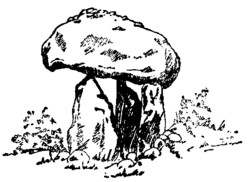
Dolmen at Proleek, Ireland
(After Borlase)
A dolmen, it may be here explained, is a kind of chamber composed of upright unhewn stones, and roofed generally with a single huge stone. They are usually wedge-shaped in plan, and traces of a porch or vestibule can often be noticed. The primary intention of the dolmen was to represent a house or dwelling-place for the dead. A cromlech (often confused in popular language with the dolmen) is properly a circular arrangement of standing stones, often with a dolmen in their midst. It is believed that most [pg 54] if not all of the now exposed dolmens were originally covered with a great mound of earth or of smaller stones. Sometimes, as in the illustration we give from Carnac, in Brittany, great avenues or alignments are formed of single upright stones, and these, no doubt, had some purpose connected with the ritual of worship carried on in the locality. The later megalithic monuments, as at Stonehenge, may be of dressed stone, but in all cases their rudeness of construction, the absence of any sculpturing (except for patterns or symbols incised on the surface), the evident aim at creating a powerful impression by the brute strength of huge monolithic masses, as well as certain subsidiary features in their design which shall be described later on, give these megalithic monuments a curious family likeness and mark them out from the chambered tombs of the early Greeks, of the Egyptians, and of other more advanced races. The dolmens proper gave place in the end to great chambered mounds or tumuli, as at New Grange, which we also reckon as belonging to the Megalithic People. They are a natural development of the dolmen. The early dolmen-builders were in the neolithic stage of culture, their weapons were of polished stone. But in the tumuli not only stone, but also bronze, and even iron, instruments are found—at first evidently importations, but afterwards of local manufacture.
Origin of the Megalithic People
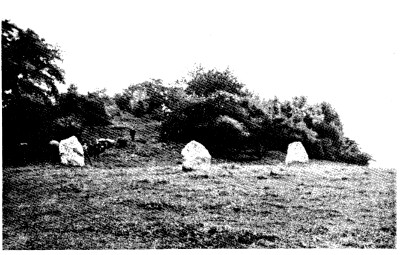
Prehistoric Tumulus at New Grange
Photograph by R. Welch, Belfast
The language originally spoken by this people can only be conjectured by the traces of it left in that of their conquerors, the Celts.31 But a map of the distribution or their monuments irresistibly suggests the idea that their builders were of North African origin; that they were not at first accustomed to traverse the [pg 55] sea for any great distance; that they migrated westwards along North Africa, crossed into Europe where the Mediterranean at Gibraltar narrows to a strait of a few miles in width, and thence spread over the western regions of Europe, including the British Islands, while on the eastward they penetrated by Arabia into Asia. It must, however, be borne in mind that while originally, no doubt, a distinct race, the Megalithic People came in the end to represent, not a race, but a culture. The human remains found in these sepulchres, with their wide divergence in the shape of the skull, &c., clearly prove this.32 These and other relics testify to the dolmen-builders in general as representing a superior and well-developed type, acquainted with agriculture, pasturage, and to some extent with seafaring. The monuments themselves, which are often of imposing size and imply much thought and organised effort in their construction, show unquestionably the existence, at this period, of a priesthood charged with the care of funeral rites and capable of controlling large bodies of men. Their dead were, as a rule, not burned, but buried whole—the greater monuments marking, no doubt, the sepulchres of important personages, while the common people were buried in tombs of which no traces now exist.
The Celts of the Plains
De Jubainville, in his account of the early history of the Celts, takes account of two main groups only—the Celts and the Megalithic People. But A. Bertrand, in his very valuable work “La Religion des Gaulois,” distinguishes two elements among the Celts themselves. There are, besides the Megalithic People, the two groups [pg 56] of lowland Celts and mountain Celts. The lowland Celts, according to his view, started from the Danube and entered Gaul probably about 1200 B.C. They were the founders of the lake-dwellings in Switzerland, in the Danube valley, and in Ireland. They knew the use of metals, and worked in gold, in tin, in bronze, and towards the end of their period in iron. Unlike the Megalithic People, they spoke a Celtic tongue,33 though Bertrand seems to doubt their genuine racial affinity with the true Celts. They were perhaps Celticised rather than actually Celtic. They were not warlike; a quiet folk of herdsmen, tillers, and artificers. They did not bury, but burned their dead. At a great settlement of theirs, Golasecca, in Cisalpine Gaul, 6000 interments were found. In each case the body had been burned; there was not a single burial without previous burning.
This people entered Gaul not (according to Bertrand), for the most part, as conquerors, but by gradual infiltration, occupying vacant spaces wherever they found them along the valleys and plains. They came by the passes of the Alps, and their starting-point was the country of the Upper Danube, which Herodotus says “rises among the Celts.” They blended peacefully with the Megalithic People among whom they settled, and did not evolve any of those advanced political institutions which are only nursed in war, but probably they contributed powerfully to the development of the Druidical system of religion and to the bardic poetry.
[pg 57]
The Celts of the Mountains
Finally, we have a third group, the true Celtic group, which followed closely on the track of the second. It was at the beginning of the sixth century that it first made its appearance on the left bank of the Rhine. While Bertrand calls the second group Celtic, these he styles Galatic, and identifies them with the Galatæ of the Greeks and the Galli and Belgæ of the Romans.
The second group, as we have said, were Celts of the plains. The third were Celts of the mountains. The earliest home in which we know them was the ranges of the Balkans and Carpathians. Their organisation was that of a military aristocracy—they lorded it over the subject populations on whom they lived by tribute or pillage. They are the warlike Celts of ancient history—the sackers of Rome and Delphi, the mercenary warriors who fought for pay and for the love of warfare in the ranks of Carthage and afterwards of Rome. Agriculture and industry were despised by them, their women tilled the ground, and under their rule the common population became reduced almost to servitude; “plebs pœne servorum habetur loco,” as Caesar tells us. Ireland alone escaped in some degree from the oppression of this military aristocracy, and from the sharp dividing line which it drew between the classes, yet even there a reflexion of the state of things in Gaul is found, even there we find free and unfree tribes and oppressive and dishonouring exactions on the part of the ruling order.
Yet, if this ruling race had some of the vices of untamed strength, they had also many noble and humane qualities. They were dauntlessly brave, fantastically chivalrous, keenly sensitive to the appeal of poetry, of music, and of speculative thought. Posidonius found the bardic institution flourishing among them about [pg 58] 100 B.C.,and about two hundred years earlier Hecatæus of Abdera describes the elaborate musical services held by the Celts in a Western island—probably Great Britain—in honour of their god Apollo (Lugh).34 Aryan of the Aryans, they had in them the making of a great and progressive nation; but the Druidic system—not on the side of its philosophy and science, but on that of its ecclesiastico-political organisation—was their bane, and their submission to it was their fatal weakness.
The culture of these mountain Celts differed markedly from that of the lowlanders. Their age was the age of iron, not of bronze; their dead were not burned (which they considered a disgrace), but buried.
The territories occupied by them in force were Switzerland, Burgundy, the Palatinate, and Northern France, parts of Britain to the west, and Illyria and Galatia to the east, but smaller groups of them must have penetrated far and wide through all Celtic territory, and taken up a ruling position wherever they went.
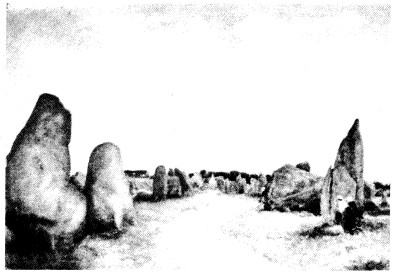
Stone Alignments at Kermaris, Carnac
Arthur G. Bell
There were three peoples, said Cæsar, inhabiting Gaul when his conquest began; “they differ from each other in language, in customs, and in laws.” These people he named respectively the Belgæ, the Celtæ, and the Aquitani. He locates them roughly, the Belgæ in the north and east, the Celtæ in the middle, and the Aquitani in the west and south. The Belgæ are the Galatæ of Bertrand, the Celtæ are the Celts, and the Aquitani are the Megalithic People. They had, of course, all been more or less brought under Celtic influences, and the differences of language which Cæsar noticed need not have been great; still it is noteworthy, and quite in accordance with Bertrand's views, that Strabo speaks of the Aquitani as differing markedly from the rest of the inhabitants, and as [pg 59] resembling the Iberians. The language of the other Gaulish peoples, he expressly adds, were merely dialects of the same tongue.
The Religion of Magic
This triple division is reflected more or less in all the Celtic countries, and must always be borne in mind when we speak of Celtic ideas and Celtic religion, and try to estimate the contribution of the Celtic peoples to European culture. The mythical literature and the art of the Celt have probably sprung mainly from the section represented by the Lowland Celts of Bertrand. But this literature of song and saga was produced by a bardic class for the pleasure and instruction of a proud, chivalrous, and warlike aristocracy, and would thus inevitably be moulded by the ideas of this aristocracy. But it would also have been coloured by the profound influence of the religious beliefs and observances entertained by the Megalithic People—beliefs which are only now fading slowly away in the spreading daylight of science. These beliefs may be summed up in the one term Magic. The nature of this religion of magic must now be briefly discussed, for it was a potent element in the formation of the body of myths and legends with which we have afterwards to deal. And, as Professor Bury remarked in his Inaugural Lecture at Cambridge, in 1903:
“For the purpose of prosecuting that most difficult of all inquiries, the ethnical problem, the part played by race in the development of peoples and the effects of race-blendings, it must be remembered that the Celtic world commands one of the chief portals of ingress into that mysterious pre-Aryan foreworld, from which it may well be that we modern Europeans have inherited far more than we dream.”
[pg 60]
The ultimate root of the word Magic is unknown, but proximately it is derived from the Magi, or priests of Chaldea and Media in pre-Aryan and pre-Semitic times, who were the great exponents of this system of thought, so strangely mingled of superstition, philosophy, and scientific observation. The fundamental conception of magic is that of the spiritual vitality of all nature. This spiritual vitality was not, as in polytheism, conceived as separated from nature in distinct divine personalities. It was implicit and immanent in nature; obscure, undefined, invested with all the awfulness of a power whose limits and nature are enveloped in impenetrable mystery. In its remote origin it was doubtless, as many facts appear to show, associated with the cult of the dead, for death was looked upon as the resumption into nature, and as the investment with vague and uncontrollable powers, of a spiritual force formerly embodied in the concrete, limited, manageable, and therefore less awful form of a living human personality. Yet these powers were not altogether uncontrollable. The desire for control, as well as the suggestion of the means for achieving it, probably arose from the first rude practices of the art of healing. Medicine of some sort was one of the earliest necessities of man. And the power of certain natural substances, mineral or vegetable, to produce bodily and mental effects often of a most startling character would naturally be taken as signal evidence of what we may call the “magical” conception of the universe.35 The first magicians were those who attained a special knowledge of healing or poisonous herbs; but “virtue” of some sort being attributed to every natural object and phenomenon, [pg 61] a kind of magical science, partly the child of true research, partly of poetic imagination, partly of priestcraft, would in time spring up, would be codified into rites and formulas, attached to special places and objects, and represented by symbols. The whole subject has been treated by Pliny in a remarkable passage which deserves quotation at length:
Pliny on the Religion of Magic
“Magic is one of the few things which it is important to discuss at some length, were it only because, being the most delusive of all the arts, it has everywhere and at all times been most powerfully credited. Nor need it surprise us that it has obtained so vast an influence, for it has united in itself the three arts which have wielded the most powerful sway over the spirit of man. Springing in the first instance from Medicine—a fact which no one can doubt—and under cover of a solicitude for our health, it has glided into the mind, and taken the form of another medicine, more holy and more profound. In the second place, bearing the most seductive and flattering promises, it has enlisted the motive of Religion, the subject on which, even at this day, mankind is most in the dark. To crown all it has had recourse to the art of Astrology; and every man is eager to know the future and convinced that this knowledge is most certainly to be obtained from the heavens. Thus, holding the minds of men enchained in this triple bond, it has extended its sway over many nations, and the Kings of Kings obey it in the East.
“In the East, doubtless, it was invented—in Persia and by Zoroaster.36 All the authorities agree in this. [pg 62] But has there not been more than one Zoroaster?... I have noticed that in ancient times, and indeed almost always, one finds men seeking in this science the climax of literary glory—at least Pythagoras, Empedocles, Democritus, and Plato crossed the seas, exiles, in truth, rather than travellers, to instruct themselves in this. Returning to their native land, they vaunted the claims of magic and maintained its secret doctrine.... In the Latin nations there are early traces of it, as, for instance, in our Laws of the Twelve Tables37 and other monuments, as I have said in a former book. In fact, it was not until the year 657 after the foundation of Rome, under the consulate of Cornelius Lentulus Crassus, that it was forbidden by a senatus consultum to sacrifice human beings; a fact which proves that up to this date these horrible sacrifices were made. The Gauls have been captivated by it, and that even down to our own times, for it was the Emperor Tiberius who suppressed the Druids and all the herd of prophets and medicine-men. But what is the use of launching prohibitions against an art which has thus traversed the ocean and penetrated even to the confines of Nature?” (Hist. Nat. xxx.)
Pliny adds that the first person whom he can ascertain to have written on this subject was Osthanes, who accompanied Xerxes in his war against the Greeks, and who propagated the “germs of his monstrous art” wherever he went in Europe.
Magic was not—so Pliny believed—indigenous either in Greece or in Italy, but was so much at home in Britain and conducted with such elaborate ritual that [pg 63] Pliny says it would almost seem as if it was they who had taught it to the Persians, not the Persians to them.
Traces of Magic in Megalithic Monuments
The imposing relics of their cult which the Megalithic People have left us are full of indications of their religion. Take, for instance, the remarkable tumulus of Mané-er-H'oeck, in Brittany. This monument was explored in 1864 by M. René Galles, who describes it as absolutely intact—the surface of the earth unbroken, and everything as the builders left it.38 At the entrance to the rectangular chamber was a sculptured slab, on which was graven a mysterious sign, perhaps the totem of a chief. Immediately on entering the chamber was found a beautiful pendant in green jasper about the size of an egg. On the floor in the centre of the chamber was a most singular arrangement, consisting of a large ring of jadite, slightly oval in shape, with a magnificent axe-head, also of jadite, its point resting on the ring. The axe was a well-known symbol of power or godhead, and is frequently found in rock-carvings of the Bronze Age, as well as in Egyptian hieroglyphs, Minoan carvings, &c. At a little distance from these there lay two large pendants of jasper, then an axe-head in white jade,39 then another jasper pendant. All these objects were ranged with evident intention en suite, forming a straight line which coincided exactly with one of the diagonals of the chamber, running from north-west to south-east. In one of the corners of the chamber were found 101 axe-heads in jade, jadite, and [pg 64] fibrolite. There were no traces of bones or cinders, no funerary urn; the structure was a cenotaph. “Are we not here,” asks Bertrand, “in presence of some ceremony relating to the practices of magic?”
Chiromancy at Gavr'inis
In connexion with the great sepulchral monument of Gavr'inis a very curious observation was made by M. Albert Maitre, an inspector of the Musée des Antiquités Nationales. There were found here—as commonly in other megalithic monuments in Ireland and Scotland—a number of stones sculptured with a singular and characteristic design in waving and concentric lines. Now if the curious lines traced upon the human hand at the roots and tips of the fingers be examined under a lens, it will be found that they bear an exact resemblance to these designs of megalithic sculpture. One seems almost like a cast of the other. These lines on the human hand are so distinct and peculiar that, as is well known, they have been adopted as a method of identification of criminals. Can this resemblance be [pg 65] the result of chance? Nothing like these peculiar assemblages of sculptured lines has ever been found except in connexion with these monuments. Have we not here a reference to chiromancy—a magical art much practised in ancient and even in modern times? The hand as a symbol of power was a well-known magical emblem, and has entered largely even into Christian symbolism—note, for instance, the great hand sculptured on the under side of one of the arms of the Cross of Muiredach at Monasterboice.
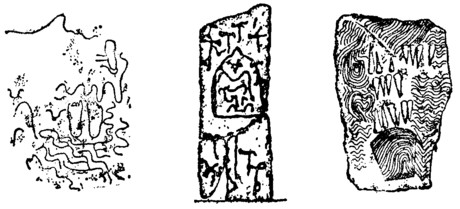
Stones from Brittany sculptured with Footprints, Axes, “Finger-markings,” &c.
(Sergi)
Holed Stones
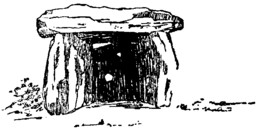
Dolmen at Trie, France
(After Gailhabaud)
Another singular and as yet unexplained feature which appears in many of these monuments, from Western Europe to India, is the presence of a small hole bored through one of the stones composing the chamber. Was it an aperture intended for the spirit of the dead? or for offerings to them? or the channel through which revelations from the spirit-world were supposed to come to a priest or magician? or did it partake of all these characters? Holed stones, not forming part of a dolmen, are, of course, among the commonest relics of the ancient cult, and are still venerated and used in practices connected [pg 66] with child-bearing, &c. Here we are doubtless to interpret the emblem as a symbol of sex.
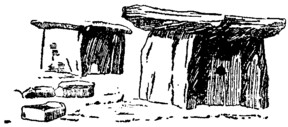
Dolmens in the Deccan, India
(After Meadows-Taylor)
Stone-Worship
Besides the heavenly bodies, we find that rivers, trees, mountains, and stones were all objects of veneration among this primitive people. Stone-worship was particularly common, and is not so easily explained as the worship directed toward objects possessing movement and vitality. Possibly an explanation of the veneration attaching to great and isolated masses of unhewn stone may be found in their resemblance to the artificial dolmens and cromlechs.40 No superstition has proved more enduring. In A.D. 452 we find the Synod of Arles denouncing those who “venerate trees and wells and stones,” and the denunciation was repeated by Charlemagne, and by numerous Synods and Councils down to recent times. Yet a drawing, here reproduced, which was lately made on the spot by Mr. Arthur Bell41 shows this very act of worship still in full force in Brittany, and shows the symbols and the sacerdotal organisation of Christianity actually pressed into the service of this immemorial paganism. According to Mr. Bell, the clergy take part in these performances with much reluctance, but are compelled to do so by the force of local opinion. Holy wells, the water of which is supposed to cure diseases, are still very common in Ireland, [pg 67] and the cult of the waters of Lourdes may, in spite of its adoption by the Church, be mentioned as a notable case in point on the Continent.
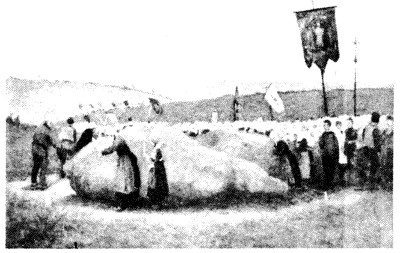
Stone-worship at Locronan, Brittany
Cup-and-Ring Markings
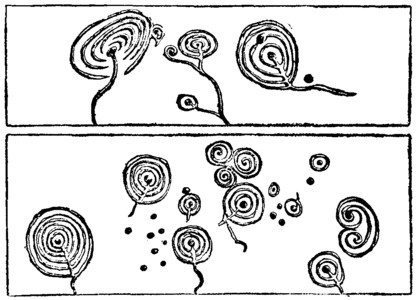
Cup-and-ring Markings from Scotland
(After Sir J. Simpson)
Another singular emblem, upon the meaning of which no light has yet been thrown, occurs frequently in connexion with megalithic monuments. The accompanying illustrations show examples of it. Cup-shaped hollows are made in the surface of the stone, these are often surrounded with concentric rings, and from the cup one or more radial lines are drawn to a point outside the circumference of the rings. Occasionally a system of cups are joined by these lines, but more frequently they end a little way outside the widest of the rings. These strange markings are found in Great Britain and Ireland, in Brittany, and at various places in [pg 68] India, where they are called mahadéos.42 I have also found a curious example—for such it appears to be—in Dupaix' “Monuments of New Spain.” It is reproduced in Lord Kingsborough's “Antiquities of Mexico,” vol. iv. On the circular top of a cylindrical stone, known as the “Triumphal Stone,” is carved a central cup, with nine concentric circles round it, and a duct or channel cut straight from the cup through all the circles to the rim. Except that the design here is richly decorated and accurately drawn, it closely resembles a typical European cup-and-ring marking. That these markings mean something, and that, wherever they are found, they mean the same thing, can hardly be doubted, but what that meaning is remains yet a puzzle to antiquarians. The guess may perhaps be hazarded that they are diagrams or plans of a megalithic sepulchre. The central hollow represents the actual burial-place. The circles are the standing stones, fosses, and ramparts which often surrounded it; and the line or duct drawn from the centre outwards represents the subterranean approach to the sepulchre. The apparent “avenue” intention of the duct is clearly brought out in the varieties given below, which I take from Simpson. As the sepulchre was also a holy place or shrine, the occurrence of a representation of it among other carvings of a sacred character is natural enough; it would seem symbolically to indicate that the place was holy ground. How far this suggestion might apply to the Mexican example I am unable to say.
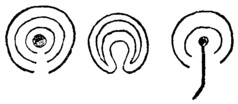
Varieties of Cup-and-ring Markings
[pg 69]
The Tumulus at New Grange
One of the most important and richly sculptured of European megalithic monuments is the great chambered tumulus of New Grange, on the northern bank of the Boyne, in Ireland. This tumulus, and the others which occur in its neighbourhood, appear in ancient Irish mythical literature in two different characters, the union of which is significant. They are regarded on the one hand as the dwelling-places of the Sidhe (pronounced Shee), or Fairy Folk, who represent, probably, the deities of the ancient Irish, and they are also, traditionally, the burial-places of the Celtic High Kings of pagan Ireland. The story of the burial of King Cormac, who was supposed to have heard of the Christian faith long before it was actually preached in Ireland by St. Patrick and who ordered that he should not be buried at the royal cemetery by the Boyne, on account of its pagan associations, points to the view that this place was the centre of a pagan cult involving more than merely the interment of royal personages in its precincts. Unfortunately these monuments are not intact; they were opened and plundered by the Danes in the ninth century,43 but enough evidence remains to show that they were sepulchral in their origin, and were also associated with the cult of a primitive religion. The most important of them, the tumulus of New Grange, has been thoroughly explored and described by Mr. George Coffey, keeper of the collection of Celtic antiquities in the National Museum, Dublin.44 It appears from the outside like a large mound, or knoll, now overgrown with bushes. It measures about 280 feet across, [pg 70] at its greatest diameter, and is about 44 feet in height. Outside it there runs a wide circle of standing stones originally, it would seem, thirty-five in number. Inside this circle is a ditch and rampart, and on top of this rampart was laid a circular curb of great stones 8 to 10 feet long, laid on edge, and confining what has proved to be a huge mound of loose stones, now overgrown, as we have said, with grass and bushes. It is in the interior of this mound that the interest of the monument lies. Towards the end of the seventeenth century some workmen who were getting road-material from the mound came across the entrance to a passage which led into the interior, and was marked by the fact that the boundary stone below it is richly carved with spirals and lozenges. This entrance faces exactly south-east. The passage is formed of upright slabs of unhewn stone roofed with similar slabs, and varies from nearly 5 feet to 7 feet 10 inches in height; it is about 3 feet wide, and runs for 62 feet straight into the heart of the mound. Here it ends in a cruciform chamber, 20 feet high, the roof, a kind of dome, being formed of large flat stones, overlapping inwards till they almost meet at the top, where a large flat stone covers all. In each of the three recesses of the cruciform chamber there stands a large stone basin, or rude sarcophagus, but not traces of any burial now remains.
Symbolic Carvings at New Grange
The stones are all raw and undressed, and were selected for their purpose from the river-bed and elsewhere close by. On their flat surfaces, obtained by splitting slabs from the original quarries, are found the carvings which form the unique interest of this strange monument. Except for the large stone with spiral carvings and one other at the entrance to the mound, [pg 71] the intention of these sculptures does not appear to have been decorative, except in a very rude and primitive sense. There is no attempt to cover a given surface with a system of ornament appropriate to its size and shape. The designs are, as it were, scribbled upon the walls anyhow and anywhere.45 Among them everywhere the spiral is prominent. The resemblance of some of these carvings to the supposed finger-markings of the stones at Gavr'inis is very remarkable. Triple and double spiral are also found, as well as lozenges and zigzags. A singular carving representing what looks like a palm-branch or fern-leaf is found in the west recess. The drawing of this object is naturalistic, and it is hard to interpret it, as Mr. Coffey is inclined to do, as merely a piece of so-called “herring-bone” pattern.46 A similar palm-leaf design, but with the ribs arranged at right angles to the central axis, is found in the neighbouring tumulus of Dowth, at Loughcrew, and in combination with a solar emblem, the swastika, on a small altar in the Pyrenees, figured by Bertrand.
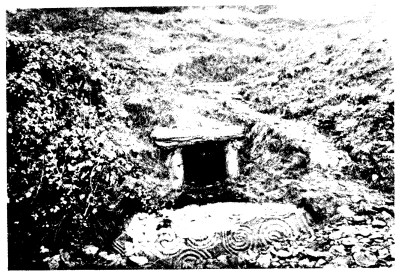
Entrance to Tumulus at New Grange
Photograph by R. Welch, Belfast
The Ship Symbol at New Grange
Another remarkable and, as far as Ireland goes, unusual figure is found sculptured in the west recess at New Grange. It has been interpreted by various critics as a mason's mark, a piece of Phoenician writing, a group of numerals, and finally (and no doubt correctly) by Mr. George Coffey as a rude representation of a ship with men on board and uplifted sail. It is noticeable that just above it is a small circle, forming, apparently, part of the design. Another example occurs at Dowth.
[pg 72]
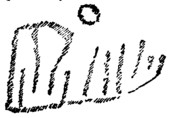
Solar Ship (with Sail?) from New Grange, Ireland
The significance of this marking, as we shall see, is possibly very great. It has been discovered that on certain stones in the tumulus of Locmariaker, in Brittany,47 there occur a number of very similar figures, one of them showing the circle in much the same relative position as at New Grange. The axe, an Egyptian hieroglyph for godhead and a well-known magical emblem, is also represented on this stone. Again, in a brochure by Dr. Oscar Montelius on the rock-sculptures of Sweden48 we find a reproduction (also given in Du Chaillu's “Viking Age”) of a rude rock-carving showing a number of ships with men on board, and the circle quartered by a cross—unmistakably a solar emblem—just above one of them. That these ships (which, like the Irish example, are often so summarily represented as to be mere symbols which no one could identifiy as a ship were the clue not given by other and more elaborate representations) were drawn so frequently in conjunction with the solar disk merely for amusement or for a purely decorative object seems to me most [pg 73] improbable. In the days of the megalithic folk a sepulchral monument, the very focus of religious ideas, would hardly have been covered with idle and meaningless scrawls. “Man,” as Sir J. Simpson has well said, “has ever conjoined together things sacred and things sepulchral.” Nor do these scrawls, in the majority of instances, show any glimmering of a decorative intention. But if they had a symbolic intention, what is it that they symbolise?
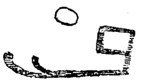
Solar Ship from Loc mariaker, Brittany
(After Ferguson)
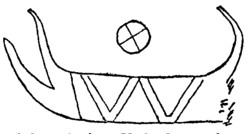
Solar Ship from Hallande, Sweden
(After Montelius)
The Ship Symbol in Egypt
Now this symbol of the ship, with or without the actual portrayal of the solar emblem, is of very ancient and [pg 74] very common occurrence in the sepulchral art of Egypt. It is connected with the worship of Rā, which came in fully 4000 years B.C. Its meaning as an Egyptian symbol is well known. The ship was called the Boat of the Sun. It was the vessel in which the Sun-god performed his journeys; in particular, the journey which he made nightly to the shores of the Other-world, bearing with him in his bark the souls of the beatified dead. The Sun-god, Rā, is sometimes represented by a disk, sometimes by other emblems, hovering above the vessel or contained within it. Any one who will look over the painted or sculptured sarcophagi in the British Museum will find a host of examples. Sometimes he will find representations of the life-giving rays of Rā pouring down upon the boat and its occupants. Now, in one of the Swedish rock-carvings of ships at Backa, Bohuslän, given by Montelius, a ship crowded with figures is shown beneath a disk with three descending rays, and again another ship with a two-rayed sun above it. It may be added that in the tumulus of Dowth, which is close to that of New Grange and is entirely of the same character and period, rayed figures and quartered circles, obviously solar emblems, occur abundantly, as also at Loughcrew and other places in Ireland, and one other ship figure has been identified at Dowth
Egyptian Solar Bark, XXII Dynasty
(British Museum)
[pg 75]
Egyptian Solar Bark, with god Khnemu and attendant deities
(British Museum)
In Egypt the solar boat is sometimes represented as containing the solar emblem alone, sometimes it contains the figure of a god with attendant deities, sometimes it contains a crowd of passengers representing human souls, and sometimes the figure of a single corpse on a bier. The megalithic carvings also sometimes show the solar emblem and sometimes not; the boats are sometimes filled with figures and are sometimes empty. When a symbol has once been accepted and understood, any conventional or summary representation of it is sufficient. I take it that the complete form of the megalithic symbol is that of a boat with figures in it and with the solar emblem overhead. These figures, assuming the foregoing interpretation of the design to be correct, must clearly be taken for representations of the dead on their way to the Other-world. They cannot be deities, for representations of the divine powers under human aspect were quite unknown to the Megalithic People, even after the coming of the Celts—they first occur in Gaul under Roman influence. But if these figures represent the dead, then we have clearly before us the origin of the so-called “Celtic” doctrine of immortality. The carvings in question are pre-Celtic. They are found where no Celts ever penetrated. Yet they point to the existence of just that Other-world doctrine which, from the time of Cæsar [pg 76] downwards, has been associated with Celtic Druidism, and this doctrine was distinctively Egyptian.
Egyptian Bark, with figure of Rā holding an Ankh, enclosed in Solar Disk. XIX Dynasty
(British Museum)
The “Navetas”
In connexion with this subject I may draw attention to the theory of Mr. W.C. Borlase that the typical design of an Irish dolmen was intended to represent a ship. In Minorca there are analogous structures, there popularly called navetas (ships), so distinct is the resemblance. But, he adds, “long before the caves and navetas of Minorca were known to me I had formed the opinion that what I have so frequently spoken of as the ‘wedge-shape’ observable so universally in the ground-plans of dolmens was due to an original conception of a ship. From sepulchral tumuli in Scandinavia we know actual vessels have on several occasions been disinterred. In cemeteries of the Iron Age, in the same country, as well as on the more southern Baltic coasts, the ship was a recognised form of sepulchral enclosure.”49 If Mr. Borlase's view is correct, we have here a very strong corroboration of the symbolic intention which I attribute to the solar ship-carvings of the Megalithic People.
The Ship Symbol in Babylonia
The ship symbol, it may be remarked, can be traced to about 4000 B.C. in Babylonia, where every deity had his own special ship (that of the god Sin was called the Ship of Light), his image being carried in procession on a litter formed like a ship. This is thought by Jastrow50 to have originated at a time when the sacred cities of Babylonia were situated on the Persian Gulf, and when religious processions were often carried out by water.
[pg 77]
The Symbol of the Feet
Yet there is reason to think that some of these symbols were earlier than any known mythology, and were, so to say, mythologised differently by different peoples, who got hold of them from this now unknown source. A remarkable instance is that of the symbol of the Two Feet. In Egypt the Feet of Osiris formed one of the portions into which his body was cut up, in the well-known myth. They were a symbol of possession or of visitation. “I have come upon earth,” says the “Book of the Dead” (ch. xvii.), “and with my two feet have taken possession, I am Tmu.” Now this symbol of the feet or footprint is very widespread. It is found in India, as the print of the foot of Buddha,51 it is found sculptured on dolmens in Brittany,52 and it occurs in rock-carvings in Scandinavia.53 In Ireland it passes for the footprints of St. Patrick or St. Columba. Strangest of all, it is found unmistakably in Mexico.54 Tyler, in his “Primitive Culture” (ii. p. 197) refers to “the Aztec ceremony at the Second Festival of the Sun God, Tezcatlipoca, when they sprinkled maize flour before his sanctuary, and his high priest watched till he beheld the divine footprints, and then shouted to announce, ‘Our Great God is come.’ ”

The Two Feet Symbol
The Ankh on Megalithic Carvings
There is very strong evidence of the connexion of the Megalithic People with North Africa. Thus, as [pg 78] Sergi points out, many signs (probably numerical) found on ivory tablets in the cemetery at Naqada discovered by Flinders Petrie are to be met with on European dolmens. Several later Egyptian hieroglyphic signs, including the famous Ankh, or crux ansata, the symbol of vitality or resurrection, are also found in megalithic carvings.55 From these correspondences Letourneau drew the conclusion “that the builders of our megalithic monuments came from the South, and were related to the races of North Africa.”56
The Ankh
Evidence from Language
Approaching the subject from the linguistic side, Rhys and Brynmor Jones find that the African origin—at least proximately—of the primitive population of Great Britain and Ireland is strongly suggested. It is here shown that the Celtic languages preserve in their syntax the Hamitic, and especially the Egyptian type.57
Egyptian and “Celtic” Ideas of Immortality
The facts at present known do not, I think, justify us in framing any theory as to the actual historical relation of the dolmen-builders of Western Europe with the people who created the wonderful religion and civilisation of ancient Egypt. But when we consider all the lines of evidence that converge in this direction it seems clear that there was such a relation. Egypt was the classic land of religious symbolism. It gave to [pg 79] Europe the most beautiful and most popular of all its religious symbols, that of the divine mother and child58. I believe that it also gave to the primitive inhabitants of Western Europe the profound symbol of the voyaging spirits guided to the world of the dead by the God of Light.
The religion of Egypt, above that of any people whose ideas we know to have been developed in times so ancient, centred on the doctrine of a future life. The palatial and stupendous tombs, the elaborate ritual, the imposing mythology, the immense exaltation of the priestly caste, all these features of Egyptian culture were intimately connected with their doctrine of the immortality of the soul.
To the Egyptian the disembodied soul was no shadowy simulacrum, as the classical nations believed—the future life was a mere prolongation of the present; the just man, when he had won his place in it, found himself among his relatives, his friends, his workpeople, with tasks and enjoyments very much like those of earth. The doom of the wicked was annihilation; he fell a victim to the invisible monster called the Eater of the Dead.
Now when the classical nations first began to take an interest in the ideas of the Celts the thing that principally struck them was the Celtic belief in immortality, which the Gauls said was “handed down by the Druids.” The classical nations believed in immortality; but what a picture does Homer, the Bible of the Greeks, give of the lost, degraded, dehumanised creatures which represented the departed souls of men! Take, as one example, the description of the spirits of the suitors slain by Odysseus as Hermes conducts them to the Underworld:
[pg 80]
“Now were summoned the souls of the dead by Cyllenian Hermes....
Touched by the wand they awoke, and obeyed him and followed him, squealing,
Even as bats in the dark, mysterious depths of a cavern
Squeal as they flutter around, should one from the cluster be fallen
Where from the rock suspended they hung, all clinging together;
So did the souls flock squealing behind him, as Hermes the Helper
Guided them down to the gloom through dank and mouldering pathways.”59
The classical writers felt rightly that the Celtic idea of immortality was something altogether different from this. It was both loftier and more realistic; it implied a true persistence of the living man, as he was at present, in all his human relations. They noted with surprise that the Celt would lend money on a promissory note for repayment in the next world.60 That is an absolutely Egyptian conception. And this very analogy occurred to Diodorus in writing of the Celtic idea of immortality—it was like nothing that he knew of out of Egypt.61
The Doctrine of Transmigration
Many ancient writers assert that the Celtic idea of immortality embodied the Oriental conception of the transmigration of souls, and to account for this the hypothesis was invented that they had learned the doctrine from Pythagoras, who represented it in classical antiquity. Thus Cæsar: “The principal point of their [the Druids'] teaching is that the soul does not perish, and that after death it passes from one body into another.” And Diodorus: “Among them the doctrine of Pythagoras prevails, according to which the souls of men are immortal, and after a fixed term recommence [pg 81] to live, taking upon themselves a new body.” Now traces of this doctrine certainly do appear in Irish legend. Thus the Irish chieftain, Mongan, who is an historical personage, and whose death is recorded about A.D. 625, is said to have made a wager as to the place of death of a king named Fothad, slain in a battle with the mythical hero Finn mac Cumhal in the third century. He proves his case by summoning to his aid a revenant from the Other-world, Keelta, who was the actual slayer of Fothad, and who describes correctly where the tomb is to be found and what were its contents. He begins his tale by saying to Mongan, “We were with thee,” and then, turning to the assembly, he continues: “We were with Finn, coming from Alba....” “Hush,” says Mongan, “it is wrong of thee to reveal a secret.” The secret is, of course, that Mongan was a reincarnation of Finn.62 But the evidence on the whole shows that the Celts did not hold this doctrine at all in the same way as Pythagoras and the Orientals did. Transmigration was not, with them, part of the order of things. It might happen, but in general it did not; the new body assumed by the dead clothed them in another, not in this world, and so far as we can learn from any ancient authority, there does not appear to have been any idea of moral retribution connected with this form of the future life. It was not so much an article of faith as an idea which haunted the imagination, and which, as Mongan's caution indicates, ought not to be brought into clear light.
However it may have been conceived, it is certain that the belief in immortality was the basis of Celtic Druidism.63 Caesar affirms this distinctly, and declares [pg 82] the doctrine to have been fostered by the Druids rather for the promotion of courage than for purely religious reasons. An intense Other-world faith, such as that held by the Celts, is certainly one of the mightiest of agencies in the hands of a priesthood who hold the keys of that world. Now Druidism existed in the British Islands, in Gaul, and, in fact, so far as we know, wherever there was a Celtic race amid a population of dolmen-builders. There were Celts in Cisalpine Gaul, but there were no dolmens there, and there were no Druids.64 What is quite clear is that when the Celts got to Western Europe they found there a people with a powerful priesthood, a ritual, and imposing religious monuments; a people steeped in magic and mysticism and the cult of the Underworld. The inferences, as I read the facts, seem to be that Druidism in its essential features was imposed upon the imaginative and sensitive nature of the Celt—the Celt with his “extraordinary aptitude” for picking up ideas—by the earlier population of Western Europe, the Megalithic People, while, as held by these, it stands in some historical relation, which I am not able to pursue in further detail, with the religious culture of ancient Egypt. Much obscurity still broods over the question, and perhaps will always do so, but if these [pg 83] suggestions have anything in them, then the Megalithic People have been brought a step or two out of the atmosphere of uncanny mystery which has surrounded them, and they are shown to have played a very important part in the religious development of Western Europe, and in preparing that part of the world for the rapid extension of the special type of Christianity which took place in it. Bertrand, in his most interesting chapter on “L'Irlande Celtique,”65 points out that very soon after the conversion of Ireland to Christianity, we find the country covered with monasteries, whose complete organisation seems to indicate that they were really Druidic colleges transformed en masse. Cæsar has told us what these colleges were like in Gaul. They were very numerous. In spite of the severe study and discipline involved, crowds flocked into them for the sake of the power wielded by the Druidic order, and the civil immunities which its members of all grades enjoyed. Arts and sciences were studied there, and thousands of verses enshrining the teachings of Druidism were committed to memory. All this is very like what we know of Irish Druidism. Such an organisation would pass into Christianity of the type established in Ireland with very little difficulty. The belief in magical rites would survive—early Irish Christianity, as its copious hagiography plainly shows, was as steeped in magical ideas as ever was Druidic paganism. The belief in immortality would remain, as before, the cardinal doctrine of religion. Above all the supremacy of the sacerdotal order over the temporal power would remain unimpaired; it would still be true, as Dion Chrysostom said of the Druids, that “it is they who command, and kings on thrones of gold, dwelling in [pg 84] splendid palaces, are but their ministers, and the servants of their thought.”66
Cæsar on the Druidic Culture
The religious, philosophic, and scientific culture superintended by the Druids is spoken of by Cæsar with much respect. “They discuss and impart to the youth,” he writes, “many things respecting the stars and their motions, respecting the extent of the universe and of our earth, respecting the nature of things, respecting the power and the majesty of the immortal gods” (bk. vi. 14). We would give much to know some particulars of the teaching here described. But the Druids, though well acquainted with letters, strictly forbade the committal of their doctrines to writing; an extremely sagacious provision, for not only did they thus surround their teaching with that atmosphere of mystery which exercises so potent a spell over the human mind, but they ensured that it could never be effectively controverted.
Human Sacrifices in Gaul
In strange discord, however, with the lofty words of Cæsar stands the abominable practice of human sacrifice whose prevalence he noted among the Celts. Prisoners and criminals, or if these failed even innocent victims, probably children, were encased, numbers at a time, in huge frames of wickerwork, and there burned alive to win the favour of the gods. The practice of human sacrifice is, of course, not specially Druidic—it is found in all parts both of the Old and of the New World at a certain stage of culture, and was doubtless a survival from the time of the Megalithic People. The fact that it should have continued in Celtic lands after an otherwise [pg 85] fairly high state of civilisation and religious culture had been attained can be paralleled from Mexico and Carthage, and in both cases is due, no doubt, to the uncontrolled dominance of a priestly caste.
Human Sacrifices in Ireland
Bertrand endeavours to dissociate the Druids from these practices, of which he says strangely there is “no trace” in Ireland, although there, as elsewhere in Celtica, Druidism was all-powerful. There is little doubt, however, that in Ireland also human sacrifices at one time prevailed. In a very ancient tract, the “Dinnsenchus,” preserved in the “Book of Leinster,” it is stated that on Moyslaught, “the Plain of Adoration,” there stood a great gold idol, Crom Cruach (the Bloody Crescent). To it the Gaels used to sacrifice children when praying for fair weather and fertility—“it was milk and corn they asked from it in exchange for their children—how great was their horror and their moaning!”67
And in Egypt
In Egypt, where the national character was markedly easy-going, pleasure-loving, and little capable of fanatical exaltation, we find no record of any such cruel rites in the monumental inscriptions and paintings, copious as is the information which they give us on all features of the national life and religion.68 Manetho, indeed, the [pg 86] Egyptian historian who wrote in the third century B.C., tells us that human sacrifices were abolished by Amasis I. so late as the beginning of the XVIII Dynasty—about 1600 B.C. But the complete silence of the other records shows us that even if we are to believe Manetho, the practice must in historic times have been very rare, and must have been looked on with repugnance.
The Names of Celtic Deities
What were the names and the attributes of the Celtic deities? Here we are very much in the dark. The Megalithic People did not imagine their deities under concrete personal form. Stones, rivers, wells, trees, and other natural objects were to them the adequate symbols, or were half symbols, half actual embodiments, of the supernatural forces which they venerated. But the imaginative mind of the Aryan Celt was not content with this. The existence of personal gods with distinct titles and attributes is reported to us by Caesar, who equates them with various figures in the Roman pantheon—Mercury, Apollo, Mars, and so forth. Lucan mentions a triad of deities, Æsus, Teutates, and Taranus69; and it is noteworthy that in these names we seem to be in presence of a true Celtic, i.e., Aryan, tradition. Thus Æsus is derived by Belloguet from the Aryan root as, meaning “to be”, which furnished the name of Asura-masda (l'Esprit Sage) to the Persians, Æsun to the Umbrians, Asa (Divine Being) to the Scandinavians. Teutates comes from a Celtic root meaning “valiant”, “warlike”, and indicates [pg 87] a deity equivalent to Mars. Taranus (? Thor), according to de Jubainville, is a god of the Lightning (taran in Welsh, Cornish, and Breton is the word for “thunderbolt”). Votive inscriptions to these gods have been found in Gaul and Britain. Other inscriptions and sculptures bear testimony to the existence in Gaul of a host of minor and local deities who are mostly mere names, or not even names, to us now. In the form in which we have them these conceptions bear clear traces of Roman influence. The sculptures are rude copies of the Roman style of religious art. But we meet among them figures of much wilder and stranger aspect—gods with triple faces, gods with branching antlers on their brows, ram-headed serpents, and other now unintelligible symbols of the older faith. Very notable is the frequent occurrence of the cross-legged “Buddha” attitude so prevalent in the religious art of the East and of Mexico, and also the tendency, so well known in Egypt, to group the gods in triads.
Caesar on the Celtic Deities
Caesar, who tries to fit the Gallic religion into the framework of Roman mythology—which was exactly what the Gauls themselves did after the conquest—says they held Mercury to be the chief of the gods, and looked upon him as the inventor of all the arts, as the presiding deity of commerce, and as the guardian of roads and guide of travellers. One may conjecture that he was particularly, to the Gauls as to the Romans, the guide of the dead, of travellers to the Other-world, Many bronze statues to Mercury, of Gaulish origin, still remain, the name being adopted by the Gauls, as many place-names still testify70. Apollo was regarded [pg 88] as the deity of medicine and healing, Minerva was the initiator of arts and crafts, Jupiter governed the sky, and Mars presided over war. Cæsar is here, no doubt, classifying under five types and by Roman names a large number of Gallic divinities.
The God of the Underworld
According to Cæsar, a most notable deity of the Gauls was (in Roman nomenclature) Dis, or Pluto, the god of the Underworld inhabited by the dead. From him all the Gauls claimed to be descended, and on this account, says Cæsar, they began their reckoning of the twenty-four hours of the day with the oncoming of night.71 The name of this deity is not given. D'Arbois de Jubainville considers that, together with Æsus, Teutates, Taranus, and, in Irish mythology, Balor and the Fomorians, he represents the powers of darkness, death, and evil, and Celtic mythology is thus interpreted as a variant of the universal solar myth, embodying the conception of the eternal conflict between Day and Night.
The God of Light
The God of Light appears in Gaul and in Ireland as Lugh, or Lugus, who has left his traces in many place-names such as Lug-dunum (Leyden), Lyons, &c. Lugh appears in Irish legend with distinctly solar attributes. When he meets his army before the great conflict with the Fomorians, they feel, says the saga, as if they beheld the rising of the sun. Yet he is also, as we shall see, a god of the Underworld, belonging on the side of his mother Ethlinn, daughter of Balor, to the Powers of Darkness.
[pg 89]
The Celtic Conception of Death
The fact is that the Celtic conception of the realm of death differed altogether from that of the Greeks and Romans, and, as I have already pointed out, resembled that of Egyptian religion. The Other-world was not a place of gloom and suffering, but of light and liberation. The Sun was as much the god of that world as he was or this. Evil, pain, and gloom there were, no doubt, and no doubt these principles were embodied by the Irish Celts in their myths of Balor and the Fomorians, of which we shall hear anon; but that they were particularly associated with the idea of death is, I think, a false supposition founded on misleading analogies drawn from the ideas of the classical nations. Here the Celts followed North African or Asiatic conceptions rather than those of the Aryans of Europe. It is only by realising that the Celts as we know them in history, from the break-up of the Mid-European Celtic empire onwards, formed a singular blend of Aryan with non-Aryan characteristics, that we shall arrive at a true understanding of their contribution to European history and their influence in European culture.
The Five Factors in Ancient Celtic Culture
To sum up the conclusions indicated: we can, I think, distinguish five distinct factors in the religious and intellectual culture of Celtic lands as we find them prior to the influx of classical or of Christian influences. First, we have before us a mass of popular superstitions and of magical observances, including human sacrifice. These varied more or less from place to place, centring as they did largely on local features which were regarded as embodiments or vehicles of divine or of diabolic power. Secondly, there was certainly in existence a [pg 90] thoughtful and philosophic creed, having as its central object of worship the Sun, as an emblem of divine power and constancy, and as its central doctrine the immortality of the soul. Thirdly, there was a worship of personified deities, Æsus, Teutates, Lugh, and others, conceived as representing natural forces, or as guardians of social laws. Fourthly, the Romans were deeply impressed with the existence among the Druids of a body of teaching of a quasi-scientific nature about natural phenomena and the constitution of the universe, of the details of which we unfortunately know practically nothing. Lastly, we have to note the prevalence of a sacerdotal organisation, which administered the whole system of religious and of secular learning and literature,72 which carefully confined this learning to a privileged caste, and which, by virtue of its intellectual supremacy and of the atmosphere of religious awe with which it was surrounded, became the sovran power, social, political, and religious, in every Celtic country. I have spoken of these elements as distinct, and we can, indeed, distinguish them in thought, but in practice they were inextricably intertwined, and the Druidic organisation pervaded and ordered all. Can we now, it may be asked, distinguish among them what is of Celtic and what of pre-Celtic and probably non-Aryan origin? This is a more difficult task; yet, looking at all the analogies and probabilities, I think we shall not be far wrong in assigning to the Megalithic People the special doctrines, the ritual, and the sacerdotal organisation of Druidism, and to the Celtic element the personified deities, with the zest for learning and for speculation; while the popular superstitions were merely the local form assumed by conceptions as widespread as the human race.
[pg 91]
The Celts of To-day
In view of the undeniably mixed character of the populations called “Celtic” at the present day, it is often urged that this designation has no real relation to any ethnological fact. The Celts who fought with Caesar in Gaul and with the English in Ireland are, it is said, no more—they have perished on a thousand battlefields from Alesia to the Boyne, and an older racial stratum has come to the surface in their place. The true Celts, according to this view, are only to be found in the tall, ruddy Highlanders of Perthshire and North-west Scotland, and in a few families of the old ruling race still surviving in Ireland and in Wales. In all this I think it must be admitted that there is a large measure of truth. Yet it must not be forgotten that the descendants of the Megalithic People at the present day are, on the physical side, deeply impregnated with Celtic blood, and on the spiritual with Celtic traditions and ideals. Nor, again, in discussing these questions of race-character and its origin, must it ever be assumed that the character of a people can be analysed as one analyses a chemical compound, fixing once for all its constituent parts and determining its future behaviour and destiny. Race-character, potent and enduring though it be, is not a dead thing, cast in an iron mould, and thereafter incapable of change and growth. It is part of the living forces of the world; it is plastic and vital; it has hidden potencies which a variety of causes, such as a felicitous cross with a different, but not too different, stock, or—in another sphere—the adoption of a new religious or social ideal, may at any time unlock and bring into action.
Of one thing I personally feel convinced—that the problem of the ethical, social, and intellectual development of the people constituting what is called the [pg 92] “Celtic Fringe” in Europe ought to be worked for on Celtic lines; by the maintenance of the Celtic tradition, Celtic literature, Celtic speech—the encouragement, in short, of all those Celtic affinities of which this mixed race is now the sole conscious inheritor and guardian. To these it will respond, by these it can be deeply moved; nor has the harvest ever failed those who with courage and faith have driven their plough into this rich field. On the other hand, if this work is to be done with success it must be done in no pedantic, narrow, intolerant spirit; there must be no clinging to the outward forms of the past simply because the Celtic spirit once found utterance in them. Let it be remembered that in the early Middle Ages Celts from Ireland were the most notable explorers, the most notable pioneers of religion, science, and speculative thought in Europe.73 Modern investigators have traced their footprints of light over half the heathen continent, and the schools of Ireland were thronged with foreign pupils who could get learning nowhere else. The Celtic spirit was then playing its true part in the world-drama, and a greater it has never played. The legacy of these men should be cherished indeed, but not as a museum curiosity; nothing could be more opposed to their free, bold, adventurous spirit than to let that legacy petrify in the hands of those who claim the heirship or their name and fame.
The Mythical Literature
After the sketch contained in this and the foregoing chapter of the early history of the Celts, and of the forces [pg 93] which have moulded it, we shall now turn to give an account of the mythical and legendary literature in which their spirit most truly lives and shines. We shall not here concern ourselves with any literature which is not Celtic. With all that other peoples have made—as in the Arthurian legends—of myths and tales originally Celtic, we have here nothing to do. No one can now tell how much is Celtic in them and how much is not. And in matters of this kind it is generally the final recasting that is of real importance and value. Whatever we give, then, we give without addition or reshaping. Stories, of course, have often to be summarised, but there shall be nothing in them that did not come direct from the Celtic mind, and that does not exist to-day in some variety, Gaelic or Cymric, of the Celtic tongue.
52.
30.
34.
63.
46.
57.
53.
38.
55.
35.
72.
59.
69.
37.
67.
33.
39.
47.
48.
73.
43.
51.
66.
68.
32.
61.
70.
31.
40.
64.
44.
36.
71.
49.
60.
54.
65.
45.
56.
62.
58.
41.
50.
42.
[pg 94]
CHAPTER III: THE IRISH INVASION MYTHS
The Celtic Cosmogony
Among those secret doctrines about the “nature of things” which, as Cæsar tells us, the Druids never would commit to writing, was there anything in the nature of a cosmogony, any account of the origin of the world and of man? There surely was. It would be strange indeed if, alone among the races of the world, the Celts had no world-myth. The spectacle of the universe with all its vast and mysterious phenomena in heaven and on earth has aroused, first the imagination, afterwards the speculative reason, in every people which is capable of either. The Celts had both in abundance, yet, except for that one phrase about the “indestructibility” of the world handed down to us by Strabo, we know nothing of their early imaginings or their reasonings on this subject. Ireland possesses a copious legendary literature. All of this, no doubt, assumed its present form in Christian times; yet so much essential paganism has been allowed to remain in it that it would be strange if Christian influences had led to the excision of everything in these ancient texts that pointed to a non-Christian conception of the origin of things—if Christian editors and transmitters had never given us even the least glimmer of the existence of such a conception. Yet the fact is that they do not give it; there is nothing in the most ancient legendary literature of the Irish Gaels, which is the oldest Celtic literature in existence, corresponding to the Babylonian conquest of Chaos, or the wild Norse myth of the making of Midgard out of the corpse of Ymir, or the Egyptian creation of the universe out of the primeval Water by Thoth, the Word of God, or even to the primitive folklore [pg 95] conceptions found in almost every savage tribe. That the Druids had some doctrine on this subject it is impossible to doubt. But, by resolutely confining it to the initiated and forbidding all lay speculation on the subject, they seem to have completely stifled the mythmaking instinct in regard to questions of cosmogony among the people at large, and ensured that when their own order perished, their teaching, whatever it was, should die with them.
In the early Irish accounts, therefore, of the beginnings of things, we find that it is not with the World that the narrators make their start—it is simply with their own country, with Ireland. It was the practice, indeed, to prefix to these narratives of early invasions and colonisations the Scriptural account of the making of the world and man, and this shows that something of the kind was felt to be required; but what took the place of the Biblical narrative in pre-Christian days we do not know, and, unfortunately, are now never likely to know.
The Cycles of Irish Legend
Irish mythical and legendary literature, as we have it in the most ancient form, may be said to fall into four main divisions, and to these we shall adhere in our presentation of it in this volume. They are, in chronological order, the Mythological Cycle, or Cycle of the Invasions, the Ultonian or Conorian Cycle, the Ossianic or Fenian Cycle, and a multitude of miscellaneous tales and legends which it is hard to fit into any historical framework.
The Mythological Cycle
The Mythological Cycle comprises the following sections:
[pg 96]
1. The coming of Partholan into Ireland.
2. The coming of Nemed into Ireland.
3. The coming of the Firbolgs into Ireland.
4. The invasion of the Tuatha De Danann, or People of the god Dana.
5. The invasion of the Milesians (Sons of Miled) from Spain, and their conquest of the People of Dana.
With the Milesians we begin to come into something resembling history—they represent, in Irish legend, the Celtic race; and from them the ruling families of Ireland are supposed to be descended. The People of Dana are evidently gods. The pre-Danaan settlers or invaders are huge phantom-like figures, which loom vaguely through the mists of tradition, and have little definite characterisation. The accounts which are given of them are many and conflicting, and out of these we can only give here the more ancient narratives.
The Coming of Partholan
The Celts, as we have learned from Caesar, believed themselves to be descended from the God of the Underworld, the God of the Dead. Partholan is said to have come into Ireland from the West, where beyond the vast, unsailed Atlantic Ocean the Irish Fairyland, the Land of the Living—i.e., the land of the Happy Dead— was placed. His father's name was Sera (? the West). He came with his queen Dalny74 and a number of companions of both sexes. Ireland—and this is an imaginative touch intended to suggest extreme antiquity—was then a different country, physically, from what it is now. There were then but three lakes in Ireland, nine rivers, and only one plain. Others were added gradually [pg 97] during the reign of the Partholanians. One, Lake Rury, was said to have burst out as a grave was being dug for Rury, son of Partholan.
The Fomorians
The Partholanians, it is said, had to do battle with a strange race, called the Fomorians, of whom we shall hear much in later sections of this book. They were a huge, misshapen, violent and cruel people, representing, we may believe, the powers of evil. One of these was surnamed Cenchos, which means The Footless, and thus appears to be related to Vitra, the God of Evil in Vedantic mythology, who had neither feet nor hands. With a host of these demons Partholan fought for the lordship of Ireland, and drove them out to the northern seas, whence they occasionally harried the country under its later rulers.
The end of the race of Partholan was that they were afflicted by pestilence, and having gathered together on the Old Plain (Senmag) for convenience of burying their dead, they all perished there; and Ireland once more lay empty for reoccupation.
The Legend of Tuan mac Carell
Who, then, told the tale? This brings us to the mention of a very curious and interesting legend—one of the numerous legendary narratives in which these tales of the Mythical Period have come down to us. It is found in the so-called “Book of the Dun Cow,” a manuscript of about the year A.D. 1100, and is entitled “The Legend of Tuan mac Carell.”
St. Finnen, an Irish abbot of the sixth century, is said to have gone to seek hospitality from a chief named Tuan mac Carell, who dwelt not far from Finnen's monastery at Moville, Co. Donegal. Tuan refused [pg 98] him admittance. The saint sat down on the doorstep of the chief and fasted for a whole Sunday,75 upon which the surly pagan warrior opened the door to him. Good relations were established between them, and the saint returned to his monks.
“Tuan is an excellent man,” said he to them; “he will come to you and comfort you, and tell you the old stories of Ireland.”76
This humane interest in the old myths and legends of the country is, it may here be observed, a feature as constant as it is pleasant in the literature of early Irish Christianity.
Tuan came shortly afterwards to return the visit of the saint, and invited him and his disciples to his fortress. They asked him of his name and lineage, and he gave an astounding reply. “I am a man of Ulster,” he said. “My name is Tuan son of Carell. But once I was called Tuan son of Starn, son of Sera, and my father, Starn, was the brother of Partholan.”
“Tell us the history of Ireland,” then said Finnen, and Tuan began. Partholan, he said, was the first of men to settle in Ireland. After the great pestilence already narrated he alone survived, “for there is never a slaughter that one man does not come out of it to tell the tale.” Tuan was alone in the land, and he wandered about from one vacant fortress to another, from rock to rock, seeking shelter from the wolves. For twenty-two years he lived thus alone, dwelling in waste places, till at last he fell into extreme decrepitude and old age.
“Then Nemed son of Agnoman took possession of Ireland. He [Agnoman] was my father's brother. I [pg 99]saw him from the cliffs, and kept avoiding him. I was long-haired, clawed, decrepit, grey, naked, wretched, miserable. Then one evening I fell asleep, and when I woke again on the morrow I was changed into a stag. I was young again and glad of heart. Then I sang of the coming of Nemed and of his race, and of my own transformation.... ‘I have put on a new form, a skin rough and grey. Victory and joy are easy to me; a little while ago I was weak and defenceless.’ ”
Tuan is then king of all the deer of Ireland, and so remained all the days of Nemed and his race.
He tells how the Nemedians sailed for Ireland in a fleet of thirty-two barks, in each bark thirty persons. They went astray on the seas for a year and a half, and most of them perished of hunger and thirst or of shipwreck. Nine only escaped—Nemed himself, with four men and four women. These landed in Ireland, and increased their numbers in the course of time till they were 8060 men and women. Then all of them mysteriously died.
Again old age and decrepitude fell upon Tuan, but another transformation awaited him. “Once I was standing at the mouth of my cave—I still remember it —and I knew that my body changed into another form. I was a wild boar. And I sang this song about it:
“ ‘To-day I am a boar.... Time was when I sat in the assembly that gave the judgments of Partholan. It was sung, and all praised the melody. How pleasant was the strain of my brilliant judgment! How pleasant to the comely young women! My chariot went along in majesty and beauty. My voice was grave and sweet. My step was swift and firm in battle. My face was full of charm. To-day, lo! I am changed into a black boar.’
“That is what I said. Yea, of a surety I was a wild boar. Then I became young again, and I was glad. I [pg 100] was king of the boar-herds in Ireland; and, faithful to any custom, I went the rounds of my abode when I returned into the lands of Ulster, at the times old age and wretchedness came upon me. For it was always there that my transformations took place, and that is why I went back thither to await the renewal of my body.”
Tuan then goes on to tell how Semion son of Stariat settled in Ireland, from whom descended the Firbolgs and two other tribes who persisted into historic times. Again old age comes on, his strength fails him, and he undergoes another transformation; he becomes “a great eagle of the sea,” and once more rejoices in renewed youth and vigour. He then tells how the People of Dana came in, “gods and false gods from whom every one knows the Irish men of learning are sprung.” After these came the Sons of Miled, who conquered the People of Dana. All this time Tuan kept the shape of the sea-eagle, till one day, finding himself about to undergo another transformation, he fasted nine days; “then sleep fell upon me, and I was changed into a salmon.” He rejoices in his new life, escaping for many years the snares of the fishermen, till at last he is captured by one of them and brought to the wife of Carell, chief of the country. “The woman desired me and ate me by herself, whole, so that I passed into her womb.” He is born again, and passes for Tuan son of Carell; but the memory of his pre-existence and all his transformations and all the history of Ireland that he witnessed since the days of Partholan still abides with him, and he teaches all these things to the Christian monks, who carefully preserve them.
This wild tale, with its atmosphere of grey antiquity and of childlike wonder, reminds us of the transformations of the Welsh Taliessin, who also became an eagle, [pg 101] and points to that doctrine of the transmigration of the soul which, as we have seen, haunted the imagination of the Celt.
We have now to add some details to the sketch of the successive colonisations of Ireland outlined by Tuan mac Carell.
The Nemedians
The Nemedians, as we have seen, were akin to the Partholanians. Both of them came from the mysterious regions of the dead, though later Irish accounts, which endeavoured to reconcile this mythical matter with Christianity, invented for them a descent from Scriptural patriarchs and an origin in earthly lands such as Spain or Scythia. Both of them had to do constant battle with the Fomorians, whom the later legends make out to be pirates from oversea, but who are doubtless divinities representing the powers of darkness and evil. There is no legend of the Fomorians coming into Ireland, nor were they regarded as at any time a regular portion of the population. They were coeval with the world itself. Nemed fought victoriously against them in four great battles, but shortly afterwards died of a plague which carried off 2000 of his people with him. The Fomorians were then enabled to establish their tyranny over Ireland. They had at this period two kings, Morc and Conann. The stronghold of the Formorian power was on Tory Island, which uplifts its wild cliffs and precipices in the Atlantic off the coast of Donegal—a fit home for this race of mystery and horror. They extracted a crushing tribute from the people of Ireland, two-thirds of all the milk and two-thirds of the children of the land. At last the Nemedians rise in revolt. Led by three chiefs, they land on Tory Island, capture Conann's Tower, and Conann himself falls by the [pg 102] hand of the Nemedian chief, Fergus. But Morc at this moment comes into the battle with a fresh host, and utterly routs the Nemedians, who are all slain but thirty:
“The men of Erin were all at the battle,
After the Fomorians came;
All of them the sea engulphed,
Save only three times ten.”
Poem by Eochy O'Flann, circ. A.D. 960.
The thirty survivors leave Ireland in despair. According to the most ancient belief they perished utterly, leaving no descendants, but later accounts, which endeavour to make sober history out of all these myths, represent one family, that of the chief Britan, as settling in Great Britain and giving their name to that country, while two others returned to Ireland, after many wanderings, as the Firbolgs and People of Dana.
The Coming of the Firbolgs
Who were the Firbolgs, and what did they represent in Irish legend? The name appears to mean “Men of the Bags,” and a legend was in later times invented to account for it. It was said that after settling in Greece they were oppressed by the people of that country, who set them to carry earth from the fertile valleys up to the rocky hills, so as to make arable ground of the latter. They did their task by means of leathern bags; but at last, growing weary of the oppression, they made boats or coracles out of their bags, and set sail in them for Ireland. Nennius, however, says they came from Spain, for according to him all the various races that inhabited Ireland came originally from Spain; and “Spain” with him is a rationalistic rendering of the Celtic words designating the Land of the Dead.77 They came in three [pg 103] groups, the Fir-Bolg, the Fir-Domnan, and the Galioin, who are all generally designated as Firbolgs. They play no great part in Irish mythical history, and a certain character of servility and inferiority appears to attach to them throughout.
One of their kings, Eochy78 mac Erc, took in marriage Taltiu, or Telta, daughter of the King of the “Great Plain” (the Land of the Dead). Telta had a palace at the place now called after her, Telltown (properly Teltin). There she died, and there, even in mediæval Ireland, a great annual assembly or fair was held in her honour.
The Coming of the People of Dana
We now come to by far the most interesting and important of the mythical invaders and colonisers of Ireland, the People of Dana. The name, Tuatha De Danann, means literally “the folk of the god whose mother is Dana.” Dana also sometimes bears another name, that of Brigit, a goddess held in much honour by pagan Ireland, whose attributes are in a great measure transferred in legend to the Christian St. Brigit of the sixth century. Her name is also found in Gaulish inscriptions as “Brigindo,” and occurs in several British inscriptions as “Brigantia.” She was the daughter of the supreme head of the People of Dana, the god Dagda, “The Good.” She had three sons, who are said to have had in common one only son, named Ecne—that is to say, “Knowledge,” or “Poetry.”79 Ecne, then, may be said to be the god whose mother was Dana, and the race to whom she gave her name are the clearest representatives we have in Irish myths of [pg 104] the powers of Light and Knowledge. It will be remembered that alone among all these mythical races Tuan mac Carell gave to the People of Dana the name of “gods.” Yet it is not as gods that they appear in the form in which Irish legends about them have now come down to us. Christian influences reduced them to the rank of fairies or identified them with the fallen angels. They were conquered by the Milesians, who are conceived as an entirely human race, and who had all sorts of relations of love and war with them until quite recent times. Yet even in the later legends a certain splendour and exaltation appears to invest the People of Dana, recalling the high estate from which they had been dethroned.
The Popular and the Bardic Conceptions
Nor must it be overlooked that the popular conception of the Danaan deities was probably at all times something different from the bardic and Druidic, or in other words the scholarly, conception. The latter, as we shall see, represents them as the presiding deities of science and poetry. This is not a popular idea; it is the product of the Celtic, the Aryan imagination, inspired by a strictly intellectual conception. The common people, who represented mainly the Megalithic element in the population, appear to have conceived their deities as earth-powers—dei terreni, as they are explicitly called in the eighth-century “Book of Armagh”80—presiding, not over science and poetry, but rather agriculture, controlling the fecundity of the earth and water, and dwelling in hills, rivers, and lakes. In the bardic literature the Aryan idea is prominent; the other is to be found in innumerable folk-tales and popular observances; but of course in each case a considerable amount [pg 105] of interpenetration of the two conceptions is to be met with—no sharp dividing line was drawn between them in ancient times, and none can be drawn now.
The Treasures of the Danaans
Tuan mac Carell says they came to Ireland “out of heaven.” This is embroidered in later tradition into a narrative telling how they sprang from four great cities, whose very names breathe of fairydom and romance—Falias, Gorias, Finias, and Murias. Here they learned science and craftsmanship from great sages one of whom was enthroned in each city, and from each they brought with them a magical treasure. From Falias came the stone called the Lia Fail, or Stone of Destiny, on which the High-Kings of Ireland stood when they were crowned, and which was supposed to confirm the election of a rightful monarch by roaring under him as he took his place on it. The actual stone which was so used at the inauguration of a reign did from immemorial times exist at Tara, and was sent thence to Scotland early in the sixth century for the crowning of Fergus the Great, son of Erc, who begged his brother Murtagh mac Erc, King of Ireland, for the loan of it. An ancient prophecy told that wherever this stone was, a king of the Scotic (i.e., Irish-Milesian) race should reign. This is the famous Stone of Scone, which never came back to Ireland, but was removed to England by Edward I. in 1297, and is now the Coronation Stone in Westminster Abbey. Nor has the old prophecy been falsified, since through the Stuarts and Fergus mac Erc the descent of the British royal family can be traced from the historic kings of Milesian Ireland.
The second treasure of the Danaans was the invincible sword of Lugh of the Long Arm, of whom we shall hear later, and this sword came from the city of [pg 106] Gorias. From Finias came a magic spear, and from Murias the Cauldron of the Dagda, a vessel which had the property that it could feed a host of men without ever being emptied.
With these possessions, according to the version given in the “Book of Invasions,” the People of Dana came into Ireland.
The Danaans and the Firbolgs
They were wafted into the land in a magic cloud, making their first appearance in Western Connacht. When the cloud cleared away, the Firbolgs discovered them in a camp which they had already fortified at Moyrein.
The Firbolgs now sent out one of their warriors, named Sreng, to interview the mysterious new-comers; and the People of Dana, on their side, sent a warrior named Bres to represent them. The two ambassadors examined each other's weapons with great interest. The spears of the Danaans, we are told, were light and sharp-pointed; those of the Firbolgs were heavy and blunt. To contrast the power of science with that of brute force is here the evident intention of the legend, and we are reminded of the Greek myth of the struggle of the Olympian deities with the Titans.
Bres proposed to the Firbolg that the two races should divide Ireland equally between them, and join to defend it against all comers for the future. They then exchanged weapons and returned each to his own camp.
The First Battle of Moytura
The Firbolgs, however, were not impressed with the superiority of the Danaans, and decided to refuse their offer. The battle was joined on the Plain of Moytura,81 [pg 107] in the south of Co. Mayo, near the spot now called Cong. The Firbolgs were led by their king, mac Erc, and the Danaans by Nuada of the Silver Hand, who got his name from an incident in this battle. His hand, it is said, was cut off in the fight, and one of the skilful artificers who abounded in the ranks of the Danaans made him a new one of silver. By their magical and healing arts the Danaans gained the victory, and the Firbolg king was slain. But a reasonable agreement followed: the Firbolgs were allotted the province of Connacht for their territory, while the Danaans took the rest of Ireland. So late as the seventeenth century the annalist Mac Firbis discovered that many of the inhabitants of Connacht traced their descent to these same Firbolgs. Probably they were a veritable historic race, and the conflict between them and the People of Dana may be a piece of actual history invested with some of the features of a myth.
The Expulsion of King Bres
Nuada of the Silver Hand should now have been ruler of the Danaans, but his mutilation forbade it, for no blemished man might be a king in Ireland. The Danaans therefore chose Bres, who was the son of a Danaan woman named Eri, but whose father was unknown, to reign over them instead. This was another Bres, not the envoy who had treated with the Firbolgs and who was slain in the battle of Moytura. Now Bres, although strong and beautiful to look on, had no gift of kingship, for he not only allowed the enemy of Ireland, the Fomorians, to renew their oppression and taxation in the land, but he himself taxed his subjects heavily too; and was so niggardly that he gave no hospitality to chiefs and nobles and harpers. Lack of generosity and hospitality was always reckoned the worst of vices [pg 108] in an Irish prince. One day it is said that there came to his court the poet Corpry, who found himself housed in a small, dark chamber without fire or furniture, where, after long delay, he was served with three dry cakes and no ale. In revenge he composed a satirical quatrain on his churlish host:
“Without food quickly served,
Without a cow's milk, whereon a calf can grow,
Without a dwelling fit for a man under the gloomy night,
Without means to entertain a bardic company,—
Let such be the condition of Bres.”
Poetic satire in Ireland was supposed to have a kind of magical power. Kings dreaded it; even rats could be exterminated by it.82 This quatrain of Corpry's was repeated with delight among the people, and Bres had to lay down his sovranty. This was said to be the first satire ever made in Ireland. Meantime, because Nuada had got his silver hand through the art of his physician Diancecht, or because, as some versions of the legend say, a still greater healer, the son of Diancecht, had made the veritable hand grow again to the stump, he was chosen to be king in place of Bres.
The latter now betook himself in wrath and resentment to his mother Eri, and begged her to give him counsel and to tell him of his lineage. Eri then declared to him that his father was Elatha, a king of the Fomorians, who had come to her secretly from over sea, and when he departed had given her a ring, bidding her never bestow it on any man save him whose finger it would fit. She now brought forth the ring, and it fitted the finger of Bres, who went [pg 109] down with her to the strand where the Fomorian lover had landed, and they sailed together for his father's home.
The Tyranny of the Fomorians
Elatha recognised the ring, and gave his son an army wherewith to reconquer Ireland, and also sent him to seek further aid from the greatest of the Fomorian kings, Balor. Now Balor was surnamed “of the Evil Eye,” because the gaze of his one eye could slay like a thunderbolt those on whom he looked in anger. He was now, however, so old and feeble that the vast eyelid drooped over the death-dealing eye, and had to be lifted up by his men with ropes and pulleys when the time came to turn it on his foes. Nuada could make no more head against him than Bres had done when king; and the country still groaned under the oppression of the Fomorians and longed for a champion and redeemer.
The Coming of Lugh
A new figure now comes into the myth, no other than Lugh son of Kian, the Sun-god par excellence of all Celtica, whose name we can still identify in many historic sites on the Continent.83 To explain his appearance we must desert for a moment the ancient manuscript authorities, which are here incomplete, and have to be supplemented by a folk-tale which was fortunately discovered and taken down orally so late as the nineteenth century by the great Irish antiquary, O'Donovan.84 [pg 110] In this folk-tale the names of Balor and his daughter Ethlinn (the latter in the form “Ethnea”) are preserved, as well as those of some other mythical personages, but that of the father of Lugh is faintly echoed in MacKineely; Lugh's own name is forgotten, and the death of Balor is given in a manner inconsistent with the ancient myth. In the story as I give it here the antique names and mythical outline are preserved, but are supplemented where required from the folk-tale, omitting from the latter those modern features which are not reconcilable with the myth.
The story, then, goes that Balor, the Fomorian king, heard in a Druidic prophecy that he would be slain by his grandson. His only child was an infant daughter named Ethlinn. To avert the doom he, like Acrisios, father of Danae, in the Greek myth, had her imprisoned in a high tower which he caused to be built on a precipitous headland, the Tor Mōr, in Tory Island. He placed the girl in charge of twelve matrons, who were strictly charged to prevent her from ever seeing the face of man, or even learning that there were any beings of a different sex from her own. In this seclusion Ethlinn grew up—as all sequestered princesses do—into a maiden of surpassing beauty.
Now it happened that there were on the mainland three brothers, namely, Kian, Sawan, and Goban the Smith, the great armourer and artificer of Irish myth, who corresponds to Wayland Smith in Germanic legend. Kian had a magical cow, whose milk was so abundant that every one longed to possess her, and he had to keep her strictly under protection.
Balor determined to possess himself of this cow. One day Kian and Sawan had come to the forge to have some weapons made for them, bringing fine steel for that purpose. Kian went into the forge, leaving [pg 111] Sawan in charge of the cow. Balor now appeared on the scene, taking on himself the form of a little redheaded boy, and told Sawan that he had overheard the brothers inside the forge concocting a plan for using all the fine steel for their own swords, leaving but common metal for that of Sawan. The latter, in a great rage, gave the cow's halter to the boy and rushed into the forge to put a stop to this nefarious scheme. Balor immediately carried off the cow, and dragged her across the sea to Tory Island.
Kian now determined to avenge himself on Balor, and to this end sought the advice of a Druidess named Birōg. Dressing himself in woman's garb, he was wafted by magical spells across the sea, where Birōg, who accompanied him, represented to Ethlinn's guardians that they were two noble ladies cast upon the shore in escaping from an abductor, and begged for shelter. They were admitted; Kian found means to have access to the Princess Ethlinn while the matrons were laid by Birōg under the spell of an enchanted slumber, and when they awoke Kian and the Druidess had vanished as they came. But Ethlinn had given Kian her love, and soon her guardians found that she was with child. Fearing Balor's wrath, the matrons persuaded her that the whole transaction was but a dream, and said nothing about it; but in due time Ethlinn was delivered of three sons at a birth.
News of this event came to Balor, and in anger and fear he commanded the three infants to be drowned in a whirlpool off the Irish coast. The messenger who was charged with this command rolled up the children in a sheet, but in carrying them to the appointed place the pin of the sheet came loose, and one of the children dropped out and fell into a little bay, called to this day Port na Delig, or the Haven of the Pin. The other two [pg 112] were duly drowned, and the servant reported his mission accomplished.
But the child who had fallen into the bay was guarded by the Druidess, who wafted it to the home of its father, Kian, and Kian gave it in fosterage to his brother the smith, who taught the child his own trade and made it skilled in every manner of craft and handiwork. This child was Lugh. When he was grown to a youth the Danaans placed him in charge of Duach, “The Dark,” king of the Great Plain (Fairyland, or the “Land of the Living,” which is also the Land of the Dead), and here he dwelt till he reached manhood.
Lugh was, of course, the appointed redeemer of the Danaan people from their servitude. His coming is narrated in a story which brings out the solar attributes of universal power, and shows him, like Apollo, as the presiding deity of all human knowledge and of all artistic and medicinal skill. He came, it is told, to take service with Nuada of the Silver Hand, and when the doorkeeper at the royal palace of Tara asked him what he could do, he answered that he was a carpenter.
“We are in no need of a carpenter,” said the doorkeeper; “we have an excellent one in Luchta son of Luchad.” “I am a smith too,” said Lugh. “We have a master-smith,” said the doorkeeper, “already.” “Then I am a warrior,” said Lugh. “We do not need one,” said the doorkeeper, “while we have Ogma.” Lugh goes on to name all the occupations and arts he can think of—he is a poet, a harper, a man of science, a physician, a spencer, and so forth, always receiving the answer that a man of supreme accomplishment in that art is already installed at the court of Nuada. “Then ask the King,” said Lugh, “if he has in his service any one man who is accomplished in every one of these arts, and if he have, I shall stay here no [pg 113] longer, nor seek to enter his palace.” Upon this Lugh is received, and the surname Ildánach is conferred upon him, meaning “The All-Craftsman,” Prince of all the Sciences; while another name that he commonly bore was Lugh Lamfada, or Lugh of the Long Arm. We are reminded here, as de Jubainville points out, of the Gaulish god whom Caesar identifies with Mercury, “inventor of all the arts,” and to whom the Gauls put up many statues. The Irish myth supplements this information and tells us the Celtic name of this deity.
When Lugh came from the Land of the Living he brought with him many magical gifts. There was the Boat of Mananan, son of Lir the Sea God, which knew a man's thoughts and would travel whithersoever he would, and the Horse of Mananan, that could go alike over land and sea, and a terrible sword named Fragarach (“The Answerer”), that could cut through any mail. So equipped, he appeared one day before an assembly of the Danaan chiefs who were met to pay their tribute to the envoys of the Fomorian oppressors; and when the Danaans saw him, they felt, it is said, as if they beheld the rising of the sun on a dry summer's day. Instead of paying the tribute, they, under Lugh's leadership, attacked the Fomorians, all of whom were slain but nine men, and these were sent back to tell Balor that the Danaans defied him and would pay no tribute henceforward. Balor then made him ready for battle, and bade his captains, when they had subdued the Danaans, make fast the island by cables to their ships and tow it far northward to the Fomorian regions of ice and gloom, where it would trouble them no longer.
The Quest of the Sons of Turenn
Lugh, on his side, also prepared for the final combat; but to ensure victory certain magical instruments were [pg 114] still needed for him, and these had now to be obtained. The story of the quest of these objects, which incidentally tells us also of the end of Lugh's father, Kian, is one of the most valuable and curious in Irish legend, and formed one of a triad of mythical tales which were reckoned as the flower of Irish romance.85
Kian, the story goes, was sent northward by Lugh to summon the fighting men of the Danaans in Ulster to the hosting against the Fomorians. On his way, as he crosses the Plain of Murthemney, near Dundalk, he meets with three brothers, Brian, Iuchar, and Iucharba, sons of Turenn, between whose house and that of Kian there was a blood-feud. He seeks to avoid them by changing into the form of a pig and joining a herd which is rooting in the plain, but the brothers detect him and Brian wounds him with a cast from a spear. Kian, knowing that his end is come, begs to be allowed to change back into human form before he is slain. “I had liefer kill a man than a pig,” says Brian, who takes throughout the leading part in all the brothers' adventures. Kian then stands before them as a man, with the blood from Brian's spear trickling from his breast. “I have outwitted ye,” he cries, “for if ye had slain a pig ye would have paid but the eric [blood-fine] of a pig, but now ye shall pay the eric of a man; never was greater eric than that which ye shall pay; and the weapons ye slay me with shall tell the tale to the avenger of blood.”
“Then you shall be slain with no weapons at all,” [pg 115] says Brian, and he and the brothers stone him to death and bury him in the ground as deep as the height of a man.
But when Lugh shortly afterwards passes that way the stones on the plain cry out and tell him of his father's murder at the hands of the sons of Turenn. He uncovers the body, and, vowing vengeance, returns to Tara. Here he accuses the sons of Turenn before the High King, and is permitted to have them executed, or to name the eric he will accept in remission of that sentence. Lugh chooses to have the eric, and he names it as follows, concealing things of vast price, and involving unheard-of toils, under the names of common objects: Three apples, the skin of a pig, a spear, a chariot with two horses, seven swine, a hound, a cooking-spit, and, finally, to give three shouts on a hill. The brothers bind themselves to pay the fine, and Lugh then declares the meaning of it. The three apples are those which grow in the Garden of the Sun; the pig-skin is a magical skin which heals every wound and sickness if it can be laid on the sufferer, and it is a possession of the King of Greece; the spear is a magical weapon owned by the King of Persia (these names, of course, are mere fanciful appellations for places in the mysterious world of Faëry); the seven swine belong to King Asal of the Golden Pillars, and may be killed and eaten every night and yet be found whole next day; the spit belongs to the sea-nymphs of the sunken Island of Finchory; and the three shouts are to be given on the hill of a fierce warrior, Mochaen, who, with his sons, are under vows to prevent any man from raising his voice on that hill. To fulfil any one of these enterprises would be an all but impossible task, and the brothers must accomplish them all before they can clear themselves of the guilt and penalty of Kian's death.
[pg 116]
The story then goes on to tell how with infinite daring and resource the sons of Turenn accomplish one by one all their tasks, but when all are done save the capture of the cooking-spit and the three shouts on the Hill of Mochaen, Lugh, by magical arts, causes forgetfulness to fall upon them, and they return to Ireland with their treasures. These, especially the spear and the pig-skin, are just what Lugh needs to help him against the Fomorians; but his vengeance is not complete, and after receiving the treasures he reminds the brothers of what is yet to be won. They, in deep dejection, now begin to understand how they are played with, and go forth sadly to win, if they can, the rest of the eric. After long wandering they discover that the Island of Finchory is not above, but under the sea. Brian in a magical “water-dress” goes down to it, sees the thrice fifty nymphs in their palace, and seizes the golden spit from their hearth. The ordeal of the Hill of Mochaen is the last to be attempted. After a desperate combat which ends in the slaying of Mochaen and his sons, the brothers, mortally wounded, uplift their voices in three faint cries, and so the eric is fulfilled. The life is still in them, however, when they return to Ireland, and their aged father, Turenn, implores Lugh for the loan of the magic pig-skin to heal them; but the implacable Lugh refuses, and the brothers and their father die together. So ends the tale.
The Second Battle of Moytura
The Second Battle of Moytura took place on a plain in the north of Co. Sligo, which is remarkable for the number of sepulchral monuments still scattered over it. The first battle, of course, was that which the Danaans had waged with the Firbolgs, and the Moytura there referred to was much further south, in Co. Mayo. [pg 117] The battle with the Fomorians is related with an astounding wealth of marvellous incident. The craftsmen of the Danaans, Goban the smith, Credné the artificer (or goldsmith), and Luchta the carpenter, keep repairing the broken weapons of the Danaans with magical speed—three blows of Goban's hammer make a spear or sword, Luchta flings a handle at it and it sticks on at once, and Credné jerks the rivets at it with his tongs as fast as he makes them and they fly into their places. The wounded are healed by the magical pig-skin. The plain resounds with the clamour of battle:
79.
84.
80.
76.
78.
85.
83.
74.
77.
81.
82.
75.
“Fearful indeed was the thunder which rolled over the battlefield; the shouts of the warriors, the breaking of the shields, the flashing and clashing of the swords, of the straight, ivory-hilted swords, the music and harmony of the ‘belly-darts’ and the sighing and winging of the spears and lances.”86
The Death of Balor
The Fomorians bring on their champion, Balor, before the glance of whose terrible eye Nuada of the Silver Hand and others of the Danaans go down. But Lugh, seizing an opportunity when the eyelid drooped through weariness, approached close to Balor, and as it began to lift once more he hurled into the eye a great stone which sank into the brain, and Balor lay dead, as the prophecy had foretold, at the hand of his grandson. The Fomorians were then totally routed, and it is not recorded that they ever again gained any authority or committed any extensive depredations in Ireland. Lugh, the Ildánach, was then enthroned in place of Nuada, and the myth of the victory of the solar [pg 118] hero over the powers of darkness and brute force is complete.
The Harp of the Dagda
A curious little incident bearing on the power which the Danaans could exercise by the spell of music may here be inserted. The flying Fomorians, it is told, had made prisoner the harper of the Dagda and carried him off with them. Lugh, the Dagda, and the warrior Ogma followed them, and came unknown into the banqueting-hall of the Fomorian camp. There they saw the harp hanging on the wall. The Dagda called to it, and immediately it flew into his hands, killing nine men of the Fomorians on its way. The Dagda's invocation of the harp is very singular, and not a little puzzling:
“Come, apple-sweet murmurer,” he cries, “come, four-angled frame of harmony, come, Summer, come, Winter, from the mouths of harps and bags and pipes.”87
The allusion to summer and winter suggests the practice in Indian music of allotting certain musical modes to the different seasons of the year (and even to different times of day), and also an Egyptian legend referred to in Burney's “History of Music,” where the three strings of the lyre were supposed to answer respectively to the three seasons, spring, summer, and winter.88
When the Dagda got possession of the harp, the tale goes on, he played on it the “three noble strains” [pg 119] which every great master of the harp should command, namely, the Strain of Lament, which caused the hearers to weep, the Strain of Laughter, which made them merry, and the Strain of Slumber, or Lullaby, which plunged them all in a profound sleep. And under cover of that sleep the Danaan champion stole out and escaped. It may be observed that throughout the whole of the legendary literature of Ireland skill in music, the art whose influence most resembles that of a mysterious spell or gift of Faëry, is the prerogative of the People of Dana and their descendants. Thus in the “Colloquy of the Ancients,” a collection of tales made about the thirteenth or fourteenth century, St. Patrick is introduced to a minstrel, Cascorach, “a handsome, curly-headed, dark-browed youth,” who plays so sweet a strain that the saint and his retinue all fall asleep. Cascorach, we are told, was son of a minstrel of the Danaan folk. St. Patrick's scribe, Brogan, remarks, “A good cast of thine art is that thou gavest us.” “Good indeed it were,” said Patrick, “but for a twang of the fairy spell that infests it; barring which nothing could more nearly resemble heaven's harmony.”89 Some of the most beautiful of the antique Irish folk-melodies,—e.g., the Coulin—are traditionally supposed to have been overheard by mortal harpers at the revels of the Fairy Folk.
Names and Characteristics of the Danaan Deities
I may conclude this narrative of the Danaan conquest with some account of the principal Danaan gods and their attributes, which will be useful to readers of the subsequent pages. The best with which I am acquainted is to be found in Mr. Standish O'Grady's “Critical [pg 120] History of Ireland.”90 This work is no less remarkable for its critical insight—it was published in 1881, when scientific study of the Celtic mythology was little heard of—than for the true bardic imagination, kindred to that of the ancient myth-makers themselves, which recreates the dead forms of the past and dilates them with the breath of life. The broad outlines in which Mr. O'Grady has laid down the typical characteristics of the chief personages in the Danaan cycle hardly need any correction at this day, and have been of much use to me in the following summary of the subject.
The Dagda
The Dagda Mōr was the father and chief of the People of Dana. A certain conception of vastness attaches to him and to his doings. In the Second Battle of Moytura his blows sweep down whole ranks of the enemy, and his spear, when he trails it on the march, draws a furrow in the ground like the fosse which marks the mearing of a province. An element of grotesque humour is present in some of the records about this deity. When the Fomorians give him food on his visit to their camp, the porridge and milk are poured into a great pit in the ground, and he eats it with a spoon big enough, it was said, for a man and a woman to lie together in it. With this spoon he scrapes the pit, when the porridge is done, and shovels earth and gravel unconcernedly down his throat. We have already seen that, like all the Danaans, he is a master of music, as well as of other magical endowments, and owns a harp which comes flying through the air at his call. “The tendency to attribute life to inanimate things is apparent in the Homeric literature, but exercises a very great influence in the mythology [pg 121] of this country. The living, fiery spear of Lugh; the magic ship of Mananan; the sword of Conary Mōr, which sang; Cuchulain's sword, which spoke; the Lia Fail, Stone of Destiny, which roared for joy beneath the feet of rightful kings; the waves of the ocean, roaring with rage and sorrow when such kings are in jeopardy; the waters of the Avon Dia, holding back for fear at the mighty duel between Cuchulain and Ferdia, are but a few out of many examples.”91 A legend of later times tells how once, at the death of a great scholar, all the books in Ireland fell from their shelves upon the floor.
Angus Ōg
Angus Ōg (Angus the Young), son of the Dagda, by Boanna (the river Boyne), was the Irish god of love. His palace was supposed to be at New Grange, on the Boyne. Four bright birds that ever hovered about his head were supposed to be his kisses taking shape in this lovely form, and at their singing love came springing up in the hearts of youths and maidens. Once he fell sick of love for a maiden whom he had seen in a dream. He told the cause of his sickness to his mother Boanna, who searched all Ireland for the girl, but could not find her. Then the Dagda was called in, but he too was at a loss, till he called to his aid Bōv the Red, king of the Danaans of Munster—the same whom we have met with in the tale of the Children of Lir, and who was skilled in all mysteries and enchantments. Bōv undertook the search, and after a year had gone by declared that he had found the visionary maiden at a lake called the Lake of the Dragon's Mouth.
[pg 122]
Angus goes to Bōv, and, after being entertained by him three days, is brought to the lake shore, where he sees thrice fifty maidens walking in couples, each couple linked by a chain of gold, but one of them is taller than the rest by a head and shoulders. “That is she!” cries Angus. “Tell us by what name she is known.” Bōv answers that her name is Caer, daughter of Ethal Anubal, a prince of the Danaans of Connacht. Angus laments that he is not strong enough to carry her off from her companions, but, on Bōv's advice, betakes himself to Ailell and Maev, the mortal King and Queen of Connacht, for assistance. The Dagda and Angus then both repair to the palace of Ailell, who feasts them for a week, and then asks the cause of their coming. When it is declared he answers, “We have no authority over Ethal Anubal.” They send a message to him, however, asking for the hand of Caer for Angus, but Ethal refuses to give her up. In the end he is besieged by the combined forces of Ailell and the Dagda, and taken prisoner. When Caer is again demanded of him he declares that he cannot comply, “for she is more powerful than I.” He explains that she lives alternately in the form of a maiden and of a swan year and year about, “and on the first of November next,” he says, “you will see her with a hundred and fifty other swans at the Lake of the Dragon's Mouth.”
Angus goes there at the appointed time, and cries to her, “Oh, come and speak to me!” “Who calls me?” asks Caer. Angus explains who he is, and then finds himself transformed into a swan. This is an indication of consent, and he plunges in to join his love in the lake. After that they fly together to the palace on the Boyne, uttering as they go a music so divine that all hearers are lulled to sleep for three days and nights.
Angus is the special deity and friend of beautiful [pg 123] youths and maidens. Dermot of the Love-spot, a follower of Finn mac Cumhal, and lover of Grania, of whom we shall hear later, was bred up with Angus in the palace on the Boyne. He was the typical lover of Irish legend. When he was slain by the wild boar of Ben Bulben, Angus revives him and carries him off to share his immortality in his fairy palace.
Len of Killarney
Of Bōv the Red, brother of the Dagda, we have already heard. He had, it is said, a goldsmith named Len, who “gave their ancient name to the Lakes of Killarney, once known as Locha Lein, the Lakes of Len of the Many Hammers. Here by the lake he wrought, surrounded by rainbows and showers of fiery dew.”92
Lugh
Lugh has already been described.93 He has more distinctly solar attributes than any other Celtic deity; and, as we know, his worship was spread widely over Continental Celtica. In the tale of the Quest of the Sons of Turenn we are told that Lugh approached the Fomorians from the west. Then Bres, son of Balor, arose and said: “I wonder that the sun is rising in the west to-day, and in the east every other day.” “Would it were so,” said his Druids. “Why, what else but the sun is it?” said Bres. “It is the radiance of the face of Lugh of the Long Arm,” they replied.
Lugh was the father, by the Milesian maiden Dectera, of Cuchulain, the most heroic figure in Irish legend, in whose story there is evidently a strong element of the solar myth.94
[pg 124]
Midir the Proud
Midir the Proud is a son of the Dagda. His fairy palace is at Bri Leith, or Slieve Callary, in Co. Longford. He frequently appears in legends dealing partly with human, partly with Danaan personages, and is always represented as a type of splendour in his apparel and in personal beauty. When he appears to King Eochy on the Hill of Tara he is thus described:95
“It chanced that Eochaid Airemm, the King of Tara, arose upon a certain fair day in the time of summer; and he ascended the high ground of Tara96 to behold the plain of Breg; beautiful was the colour of that plain, and there was upon it excellent blossom glowing with all hues that are known. And as the aforesaid Eochy looked about and around him, he saw a young strange warrior upon the high ground at his side. The tunic that the warrior wore was purple in colour, his hair was of a golden yellow, and of such length that it reached to the edge of his shoulders. The eyes of the young warrior were lustrous and grey; in the one hand he held a fine pointed spear, in the other a shield with a white central boss, and with gems of gold upon it. And Eochaid held his peace, for he knew that none such had been in Tara on the night before, and the gate that led into the Liss had not at that time been thrown open.”97
[pg 125]
Lir and Mananan
Lir, as Mr. O'Grady remarks, “appears in two distinct forms. In the first he is a vast, impersonal presence commensurate with the sea; in fact, the Greek Oceanus. In the second, he is a separate person dwelling invisibly on Slieve Fuad,” in Co. Armagh. We hear little of him in Irish legend, where the attributes of the sea-god are mostly conferred on his son, Mananan.
This deity is one of the most popular in Irish mythology. He was lord of the sea, beyond or under which the Land of Youth or Islands of the Dead were supposed to lie; he therefore was the guide of man to this country. He was master of tricks and illusions, and owned all kinds of magical possessions—the boat named Ocean-sweeper, which obeyed the thought of those who sailed in it and went without oar or sail, the steed Aonbarr, which could travel alike on sea or land, and the sword named The Answerer, which no armour could resist. White-crested waves were called the Horses of Mananan, and it was forbidden (tabu) for the solar hero, Cuchulain, to perceive them—this indicated the daily death of the sun at his setting in the western waves. Mananan wore a great cloak which was capable of taking on every kind of colour, like the widespread field of the sea as looked on from a height; and as the protector of the island of Erin it was said that when any hostile force invaded it they heard his thunderous tramp and the flapping of his mighty cloak as he marched angrily round and round their camp at night. The Isle of Man, seen dimly from the Irish coast, was supposed to be the throne of Mananan, and to take its name from this deity.
[pg 126]
The Goddess Dana
The greatest of the Danaan goddesses was Dana, “mother of the Irish gods,” as she is called in an early text. She was daughter of the Dagda, and, like him, associated with ideas of fertility and blessing. According to d'Arbois de Jubainville, she was identical with the goddess Brigit, who was so widely worshipped in Celtica. Brian, Iuchar, and Iucharba are said to have been her sons—these really represent but one person, in the usual Irish fashion of conceiving the divine power in triads. The name of Brian, who takes the lead in all the exploits of the brethren,98 is a derivation from a more ancient form, Brenos, and under this form was the god to whom the Celts attributed their victories at the Allia and at Delphi, mistaken by Roman and Greek chroniclers for an earthly leader.
The Morrigan
There was also an extraordinary goddess named the Morrigan,99 who appears to embody all that is perverse and horrible among supernatural powers. She delighted in setting men at war, and fought among them herself, changing into many frightful shapes and often hovering above fighting armies in the aspect of a crow. She met Cuchulain once and proffered him her love in the guise of a human maid. He refused it, and she persecuted him thenceforward for the most of his life. Warring with him once in the middle of the stream, she turned herself into a water-serpent, and then into a mass of water-weeds, seeking to entangle and drown him. But he conquered and wounded her, and she afterwards [pg 127] became his friend. Before his last battle she passed through Emain Macha at night, and broke the pole of his chariot as a warning.
Cleena's Wave
One of the most notable landmarks of Ireland was the Tonn Cliodhna, or “Wave of Cleena,” on the seashore at Glandore Bay, in Co. Cork. The story about Cleena exists in several versions, which do not agree with each other except in so far as she seems to have been a Danaan maiden once living in Mananan's country, the Land of Youth beyond the sea. Escaping thence with a mortal lover, as one of the versions tells, she landed on the southern coast of Ireland, and her lover, Keevan of the Curling Locks, went off to hunt in the woods. Cleena, who remained on the beach, was lulled to sleep by fairy music played by a minstrel of Mananan, when a great wave of the sea swept up and carried her back to Fairyland, leaving her lover desolate. Hence the place was called the Strand of Cleena's Wave.
The Goddess Ainé
Another topical goddess was Ainé, the patroness of Munster, who is still venerated by the people of that county. She was the daughter of the Danaan Owel, a foster-son of Mananan and a Druid. She is in some sort a love-goddess, continually inspiring mortals with passion. She was ravished, it was said, by Ailill Olum, King of Munster, who was slain in consequence by her magic arts, and the story is repeated in far later times about another mortal lover, who was not, however, slain, a Fitzgerald, to whom she bore the famous wizard Earl.100 Many of the aristocratic [pg 128] families of Munster claimed descent from this union. Her name still clings to the “Hill of Ainé” (Knockainey), near Loch Gur, in Munster. All the Danaan deities in the popular imagination were earth-gods, dei terreni, associated with ideas of fertility and increase. Ainé is not heard much of in the bardic literature, but she is very prominent in the folk-lore of the neighbourhood. At the bidding of her son, Earl Gerald, she planted all Knockainey with pease in a single night. She was, and perhaps still is, worshipped on Midsummer Eve by the peasantry, who carried torches of hay and straw, tied on poles and lighted, round her hill at night. Afterwards they dispersed themselves among their cultivated fields and pastures, waving the torches over the crops and the cattle to bring luck and increase for the following year. On one night, as told by Mr. D. Fitzgerald,101 who has collected the local traditions about her, the ceremony was omitted owing to the death of one of the neighbours. Yet the peasantry at night saw the torches in greater number than ever circling the hill, and Ainé herself in front, directing and ordering the procession.
“On another St. John's Night a number of girls had stayed late on the Hill watching the cliars (torches) and joining in the games. Suddenly Ainé appeared among them, thanked them for the honour they had done her, but said she now wished them to go home, as they wanted the hill to themselves. She let them understand whom she [pg 129] meant by they, for calling some of the girls she made them look through a ring, when behold, the hill appeared crowded with people before invisible.”
“Here,” observed Mr. Alfred Nutt, “we have the antique ritual carried out on a spot hallowed to one of the antique powers, watched over and shared in by those powers themselves. Nowhere save in Gaeldom could be found such a pregnant illustration of the identity of the fairy class with the venerable powers to ensure whose goodwill rites and sacrifices, originally fierce and bloody, now a mere simulacrum of their pristine form, have been performed for countless ages.”102
Sinend and the Well of Knowledge
There is a singular myth which, while intended to account for the name of the river Shannon, expresses the Celtic veneration for poetry and science, combined with the warning that they may not be approached without danger. The goddess Sinend, it was said, daughter of Lodan son of Lir, went to a certain well named Connla's Well, which is under the sea—i.e., in the Land of Youth in Fairyland. “That is a well,” says the bardic narrative, “at which are the hazels of wisdom and inspirations, that is, the hazels of the science of poetry, and in the same hour their fruit and their blossom and their foliage break forth, and then fall upon the well in the same shower, which raises upon the water a royal surge of purple.” When Sinend came to the well we are not told what rites or preparation she had omitted, but the angry waters broke forth and overwhelmed her, and washed her up on the Shannon shore, where she died, giving to the river its name.103 This myth of the hazels of inspiration and [pg 130] knowledge and their association with springing water runs through all Irish legend, and has been finely treated by a living Irish poet, Mr. G.W. Russell, in the following verses:
“>A cabin on the mountain-side hid in a grassy nook,
With door and window open wide, where friendly stars may look;
The rabbit shy may patter in, the winds may enter free
Who roam around the mountain throne in living ecstasy.
“And when the sun sets dimmed in eve, and purple fills the air,
I think the sacred hazel-tree is dropping berries there,
From starry fruitage, waved aloft where Connla's Well o'erflows;
For sure, the immortal waters run through every wind that blows.
“I think when Night towers up aloft and shakes the trembling dew,
How every high and lonely thought that thrills my spirit through
Is but a shining berry dropped down through the purple air,
And from the magic tree of life the fruit falls everywhere.”
The Coming of the Milesians
After the Second Battle of Moytura the Danaans held rule in Ireland until the coming of the Milesians, the sons of Miled. These are conceived in Irish legend as an entirely human race, yet in their origin they, like the other invaders of Ireland, go back to a divine and mythical ancestry. Miled, whose name occurs as a god in a Celtic inscription from Hungary, is represented as a son of Bilé. Bilé, like Balor, is one of the names of the god of Death, i.e., of the Underworld. They come from “Spain”—the usual term employed by the later rationalising historians for the Land of the Dead.
The manner of their coming into Ireland was as follows: Ith, the grandfather of Miled, dwelt in a great tower which his father, Bregon, had built in “Spain.” One clear winter's day, when looking out westwards from this lofty tower, he saw the coast of Ireland in the distance, and resolved to sail to the unknown land.
[pg 131]
He embarked with ninety warriors, and took land at Corcadyna, in the south-west. In connexion with this episode I may quote a passage of great beauty and interest from de Jubainville's “Irish Mythological Cycle”:104
“According to an unknown writer cited by Plutarch, who died about the year 120 of the present era, and also by Procopius, who wrote in the sixth century A.D., ‘the Land of the Dead’ is the western extremity of Great Britain, separated from the eastern by an impassable wall. On the northern coast of Gaul, says the legend, is a populace of mariners whose business is to carry the dead across from the continent to their last abode in the island of Britain. The mariners, awakened in the night by the whisperings of some mysterious voice, arise and go down to the shore, where they find ships awaiting them which are not their own,105 and, in these, invisible beings, under whose weight the vessels sink almost to the gunwales. They go on board, and with a single stroke of the oar, says one text, in one hour, says another, they arrive at their destination, though with their own vessels, aided by sails, it would have taken them at least a day and a night to reach the coast of Britain. When they come to the other shore the invisible passengers land, and at the same time the unloaded ships are seen to rise above the waves, and a voice is heard announcing the names of the new arrivals, who have just been added to the inhabitants of the Land of the Dead.
“One stroke of the oar, one hour's voyage at most, suffices for the midnight journey which transfers the [pg 132] Dead from the Gaulish continent to their final abode. Some mysterious law, indeed, brings together in the night the great spaces which divide the domain of the living from that of the dead in daytime. It was the same law which enabled Ith one fine winter evening to perceive from the Tower of Bregon, in the Land of the Dead, the shores of Ireland, or the land of the living. The phenomenon took place in winter; for winter is a sort of night; winter, like night, lowers the barriers between the regions of Death and those of Life; like night, winter gives to life the semblance of death, and suppresses, as it were, the dread abyss that lies between the two.”
At this time, it is said, Ireland was ruled by three Danaan kings, grandsons of the Dagda. Their names were MacCuill, MacCecht, and MacGrené, and their wives were named respectively Banba, Fohla, and Eriu. The Celtic habit of conceiving divine persons in triads is here illustrated. These triads represent one person each, and the mythical character of that personage is evident from the name of one of them, MacGrené, Son of the Sun. The names of the three goddesses have each at different times been applied to Ireland, but that of the third, Eriu, has alone persisted, and in the dative form, Erinn, is a poetic name for the country to this day. That Eriu is the wife of MacGrené means, as de Jubainville observes, that the Sun-god, the god of Day, Life, and Science, has wedded the land and is reigning over it.
Ith, on landing, finds that the Danaan king, Neit, has just been slain in a battle with the Fomorians, and the three sons, MacCuill and the others, are at the fortress of Aileach, in Co. Donegal, arranging for a division of the land among themselves. At first they [pg 133] welcome Ith, and ask him to settle their inheritance. Ith gives his judgment, but, in concluding, his admiration for the newly discovered country breaks out: “Act,” he says, “according to the laws of justice, for the country you dwell in is a good one, it is rich in fruit and honey, in wheat and in fish; and in heat and cold it is temperate.” From this panegyric the Danaans conclude that 1th has designs upon their land, and they seize him and put him to death. His companions, however, recover his body and bear it back with them in their ships to “Spain”; when the children of Miled resolve to take vengeance for the outrage and prepare to invade Ireland.
They were commanded by thirty-six chiefs, each having his own ship with his family and his followers. Two of the company are said to have perished on the way. One of the sons of Miled, having climbed to the masthead of his vessel to look out for the coast of Ireland, fell into the sea and was drowned. The other was Skena, wife of the poet Amergin, son of Miled, who died on the way. The Milesians buried her when they landed, and called the place “Inverskena” after her; this was the ancient name of the Kenmare River in Co. Kerry.
“It was on a Thursday, the first of May, and the seventeenth day of the moon, that the sons of Miled arrived in Ireland. Partholan also landed in Ireland on the first of May, but on a different day of the week and of the moon; and it was on the first day of May, too, that the pestilence came which in the space of one week destroyed utterly his race. The first of May was sacred to Beltené, one of the names of the god of Death, the god who gives life to men and takes it away from them again. Thus it was on the feast day [pg 134] of this god that the sons of Miled began their conquest of Ireland.”106
The Poet Amergin
When the poet Amergin set foot upon the soil of Ireland it is said that he chanted a strange and mystical lay:
“I am the Wind that blows over the sea,
I am the Wave of the Ocean;
I am the Murmur of the billows;
I am the Ox of the Seven Combats;
I am the Vulture upon the rock;
I am a Ray of the Sun;
I am the fairest of Plants;
I am a Wild Boar in valour;
I am a Salmon in the Water;
I am a Lake in the plain;
I am the Craft of the artificer;
I am a Word of Science;
I am the Spear-point that gives battle;
I am the god that creates in the head of man the fire of thought.
Who is it that enlightens the assembly upon the mountain,if not I?
Who telleth the ages of the moon, if not I?
“Who showeth the place where the sun goes to rest, if not I?
De Jubainville, whose translation I have in the main followed, observes upon this strange utterance:
“There is a lack of order in this composition, the ideas, fundamental and subordinate, are jumbled together without method; but there is no doubt as to the meaning: the filé [poet] is the Word of Science, he is the god who gives to man the fire of thought; and as science is not distinct from its object, as God and Nature are but one, the being of the filé is mingled with the [pg 135] winds and the waves, with the wild animals and the warrior's arms.”107
Two other poems are attributed to Amergin, in which he invokes the land and physical features of Ireland to aid him:
“I invoke the land of Ireland,
Shining, shining sea;
Fertile, fertile Mountain;
Gladed, gladed wood!
Abundant river, abundant in water!
Fish-abounding lake!”108
The Judgment of Amergin
The Milesian host, after landing, advance to Tara, where they find the three kings of the Danaans awaiting them, and summon them to deliver up the island. The Danaans ask for three days' time to consider whether they shall quit Ireland, or submit, or give battle; and they propose to leave the decision, upon their request, to Amergin. Amergin pronounces judgment—“the first judgment which was delivered in Ireland.” He agrees that the Milesians must not take their foes by surprise—they are to withdraw the length of nine waves from the shore, and then return; if they then conquer the Danaans the land is to be fairly theirs by right of battle.
The Milesians submit to this decision and embark on their ships. But no sooner have they drawn off for this mystical distance of the nine waves than a mist and storm are raised by the sorceries of the Danaans—the coast of Ireland is hidden from their sight, and they wander dispersed upon the ocean. To ascertain if it is [pg 136] a natural or a Druidic tempest which afflicts them, a man named Aranan is sent up to the masthead to see if the wind is blowing there also or not. He is flung from the swaying mast, but as he falls to his death he cries his message to his shipmates: “There is no storm aloft.” Amergin, who as poet—that is to say, Druid—takes the lead in all critical situations, thereupon chants his incantation to the land of Erin. The wind falls, and they turn their prows, rejoicing, towards the shore. But one of the Milesian lords, Eber Donn, exults in brutal rage at the prospect of putting all the dwellers in Ireland to the sword; the tempest immediately springs up again, and many of the Milesian ships founder, Eber Donn's being among them. At last a remnant of the Milesians find their way to shore, and land in the estuary of the Boyne.
The Defeat of the Danaans
A great battle with the Danaans at Telltown109 then follows. The three kings and three queens of the Danaans, with many of their people, are slain, and the children of Miled—the last of the mythical invaders of Ireland—enter upon the sovranty of Ireland. But the People of Dana do not withdraw. By their magic art they cast over themselves a veil of invisibility, which they can put on or off as they choose. There are two Irelands henceforward, the spiritual and the earthly. The Danaans dwell in the spiritual Ireland, which is portioned out among them by their great overlord, the Dagda. Where the human eye can see but green mounds and ramparts, the relics of ruined fortresses or sepulchres, there rise the fairy palaces of the defeated divinities; there they hold their revels in eternal sunshine, nourished by the magic meat and ale that give [pg 137] them undying youth and beauty; and thence they come forth at times to mingle with mortal men in love or in war. The ancient mythical literature conceives them as heroic and splendid in strength and beauty. In later times, and as Christian influences grew stronger, they dwindle into fairies, the People of the Sidhe;110 but they have never wholly perished; to this day the Land of Youth and its inhabitants live in the imagination of the Irish peasant.
The Meaning of the Danaan Myth
All myths constructed by a primitive people are symbols, and if we can discover what it is that they symbolise we have a valuable clue to the spiritual character, and sometimes even to the history, of the people from whom they sprang. Now the meaning of the Danaan myth as it appears in the bardic literature, though it has undergone much distortion before it reached us, is perfectly clear. The Danaans represent the Celtic reverence for science, poetry, and artistic skill, blended, of course, with the earlier conception of the divinity of the powers of Light. In their combat with the Firbolgs the victory of the intellect over dulness and ignorance is plainly portrayed—the comparison of the heavy, blunt weapon of the Firbolgs with the light and penetrating spears of the People of Dana is an indication which it is impossible to mistake. Again, in their struggle with a far more powerful and dangerous enemy, the Fomorians, we are evidently to see the combat of the powers of Light with evil of a more positive kind than that represented by the Firbolgs. The Fomorians stand not for mere dulness or [pg 138] stupidity, but for the forces of tyranny, cruelty, and greed—for moral rather than for intellectual darkness.
The Meaning of the Milesian Myth
But the myth of the struggle of the Danaans with the sons of Miled is more difficult to interpret. How does it come that the lords of light and beauty, wielding all the powers of thought (represented by magic and sorcery), succumbed to a human race, and were dispossessed by them of their hard-won inheritance? What is the meaning of this shrinking of their powers which at once took place when the Milesians came on the scene? The Milesians were not on the side of the powers of darkness. They were guided by Amergin, a clear embodiment of the idea of poetry and thought. They were regarded with the utmost veneration, and the dominant families of Ireland all traced their descent to them. Was the Kingdom of Light, then, divided against itself? Or, if not, to what conception in the Irish mind are we to trace the myth of the Milesian invasion and victory?
The only answer I can see to this puzzling question is to suppose that the Milesian myth originated at a much later time than the others, and was, in its main features, the product of Christian influences. The People of Dana were in possession of the country, but they were pagan divinities—they could not stand for the progenitors of a Christian Ireland. They had somehow or other to be got rid of, and a race of less embarrassing antecedents substituted for them. So the Milesians were fetched from “Spain” and endowed with the main characteristics, only more humanised, of the People of Dana. But the latter, in contradistinction to the usual attitude of early Christianity, are treated very tenderly in the story of their overthrow. [pg 139] One of them has the honour of giving her name to the island, the brutality of one of the conquerors towards them is punished with death, and while dispossessed of the lordship of the soil they still enjoy life in the fair world which by their magic art they have made invisible to mortals. They are no longer gods, but they are more than human, and frequent instances occur in which they are shown as coming forth from their fairy world, being embraced in the Christian fold, and entering into heavenly bliss. With two cases of this redemption of the Danaans we shall close this chapter on the Invasion Myths of Ireland.
The first is the strange and beautiful tale of the Transformation of the Children of Lir.
The Children of Lir
Lir was a Danaan divinity, the father of the sea-god Mananan who continually occurs in magical tales of the Milesian cycle. He had married in succession two sisters, the second of whom was named Aoife.111 She was childless, but the former wife of Lir had left him four children, a girl named Fionuala112 and three boys. The intense love of Lir for the children made the stepmother jealous, and she ultimately resolved on their destruction. It will be observed, by the way, that the People of Dana, though conceived as unaffected by time, and naturally immortal, are nevertheless subject to violent death either at the hands of each other or even of mortals.
With her guilty object in view, Aoife goes on a journey to a neighbouring Danaan king, Bōv the Red, taking the four children with her. Arriving at a lonely place by Lake Derryvaragh, in Westmeath, she [pg 140] orders her attendants to slay the children. They refuse, and rebuke her. Then she resolves to do it herself; but, says the legend, “her womanhood overcame her,” and instead of killing the Children she transforms them by spells of sorcery into four white swans, and lays on them the following doom: three hundred years they are to spend on the waters of Lake Derryvaragh, three hundred on the Straits of Moyle (between Ireland and Scotland), and three hundred on the Atlantic by Erris and Inishglory. After that, “when the woman of the South is mated with the man of the North,” the enchantment is to have an end.
When the children fail to arrive with Aoife at the palace of Bōv her guilt is discovered, and Bōv changes her into “a demon of the air.” She flies forth shrieking, and is heard of no more in the tale. But Lir and Bōv seek out the swan-children, and find that they have not only human speech, but have preserved the characteristic Danaan gift of making wonderful music. From all parts of the island companies of the Danaan folk resort to Lake Derryvaragh to hear this wondrous music and to converse with the swans, and during that time a great peace and gentleness seemed to pervade the land.
But at last the day came for them to leave the fellowship of their kind and take up their life by the wild cliffs and ever angry sea of the northern coast. Here they knew the worst of loneliness, cold, and storm. Forbidden to land, their feathers froze to the rocks in the winter nights, and they were often buffeted and driven apart by storms. As Fionuala sings:
94.
109.
108.
89.
87.
103.
99.
105.
110.
107.
96.
104.
88.
95.
86.
101.
90.
92.
112.
98.
111.
100.
106.
102.
97.
91.
93.
“Cruel to us was Aoife
Who played her magic upon us,
And drove us out on the water—
Four wonderful snow-white swans.
[pg 141]
“Our bath is the frothing brine,
In bays by red rocks guarded;
For mead at our father's table
We drink of the salt, blue sea.
“Three sons and a single daughter,
In clefts of the cold rocks dwelling,
The hard rocks, cruel to mortals—
We are full of keening to-night.”
Fionuala, the eldest of the four, takes the lead in all their doings, and mothers the younger children most tenderly, wrapping her plumage round them on nights of frost. At last the time comes to enter on the third and last period of their doom, and they take flight for the western shores of Mayo. Here too they suffer much hardship; but the Milesians have now come into the land, and a young farmer named Evric, dwelling on the shores of Erris Bay, finds out who and what the swans are, and befriends them. To him they tell their story, and through him it is supposed to have been preserved and handed down. When the final period of their suffering is close at hand they resolve to fly towards the palace of their father Lir, who dwells, we are told, at the Hill of the White Field, in Armagh, to see how things have fared with him. They do so; but not knowing what has happened on the coming of the Milesians, they are shocked and bewildered to find nothing but green mounds and whin-bushes and nettles where once stood—and still stands, only that they cannot see it—the palace of their father. Their eyes are holden, we are to understand, because a higher destiny was in store for them than to return to the Land of Youth.
On Erris Bay they hear for the first time the sound of a Christian bell. It comes from the chapel of a hermit who has established himself there. The swans are at first startled and terrified by the “thin, dreadful [pg 142] sound,” but afterwards approach and make themselves known to the hermit, who instructs them in the faith, and they join him in singing the offices of the Church.
Now it happens that a princess of Munster, Deoca, (the “woman of the South”) became betrothed to a Connacht chief named Lairgnen, and begged him as a wedding gift to procure for her the four wonderful singing swans whose fame had come to her. He asks them of the hermit, who refuses to give them up, whereupon the “man of the North” seizes them violently by the silver chains with which the hermit had coupled them, and drags them off to Deoca. This is their last trial. Arrived in her presence, an awful transformation befalls them. The swan plumage falls off, and reveals, not, indeed, the radiant forms of the Danaan divinities, but four withered, snowy-haired, and miserable human beings, shrunken in the decrepitude of their vast old age. Lairgnen flies from the place in horror, but the hermit prepares to administer baptism at once, as death is rapidly approaching them. “Lay us in one grave,” says Fionuala, “and place Conn at my right hand and Fiachra at my left, and Hugh before my face, for there they were wont to be when I sheltered them many a winter night upon the seas of Moyle.” And so it was done, and they went to heaven; but the hermit, it is said, sorrowed for them to the end of his earthly days.113
In all Celtic legend there is no more tender and beautiful tale than this of the Children of Lir.
The Tale of Ethné
But the imagination of the Celtic bard always played with delight on the subjects of these transition tales, [pg 143] where the reconciling of the pagan order with the Christian was the theme. The same conception is embodied in the tale of Ethné, which we have now to tell.
It is said that Mananan mac Lir had a daughter who was given in fosterage to the Danaan prince Angus, whose fairy palace was at Brugh na Boyna. This is the great sepulchral tumulus now called New Grange, on the Boyne. At the same time the steward of Angus had a daughter born to him whose name was Ethné, and who was allotted to the young princess as her handmaiden.
Ethné grew up into a lovely and gentle maiden, but it was discovered one day that she took no nourishment of any kind, although the rest of the household fed as usual on the magic swine of Mananan, which might be eaten to-day and were alive again for the feast to-morrow. Mananan was called in to penetrate the mystery, and the following curious story came to light. One of the chieftains of the Danaans who had been on a visit with Angus, smitten by the girl's beauty, had endeavoured to possess her by force. This woke in Ethné's pure spirit the moral nature which is proper to man, and which the Danaan divinities know not. As the tale says, her “guardian demon” left her, and an angel of the true God took its place. After that event she abstained altogether from the food of Faëry, and was miraculously nourished by the will of God. After a time, however, Mananan and Angus, who had been on a voyage to the East, brought back thence two cows whose milk never ran dry, and as they were supposed to have come from a sacred land Ethné lived on their milk thenceforward.
All this is supposed to have happened during the reign of Eremon, the first Milesian king of all Ireland, [pg 144] who was contemporary with King David. At the time of the coming of St. Patrick, therefore, Ethné would have been about fifteen hundred years of age. The Danaan folk grow up from childhood to maturity, but then they abide unaffected by the lapse of time.
Now it happened one summer day that the Danaan princess whose handmaid Ethné was went down with all her maidens to bathe in the river Boyne. When arraying themselves afterwards Ethné discovered, to her dismay—and this incident was, of course, an instance of divine interest in her destiny—that she had lost the Veil of Invisibility, conceived here as a magic charm worn on the person, which gave her the entrance to the Danaan fairyland and hid her from mortal eyes. She could not find her way back to the palace of Angus, and wandered up and down the banks of the river seeking in vain for her companions and her home. At last she came to a walled garden, and, looking through the gate, saw inside a stone house of strange appearance and a man in a long brown robe. The man was a Christian monk, and the house was a little church or oratory. He beckoned her in, and when she had told her story to him he brought her to St. Patrick, who completed her adoption into the human family by giving her the rite of baptism.
Now comes in a strangely pathetic episode which reveals the tenderness, almost the regret, with which early Irish Christianity looked back on the lost world of paganism. As Ethné was one day praying in the little church by the Boyne she heard suddenly a rushing sound in the air, and innumerable voices, as it seemed from a great distance, lamenting and calling her name. It was her Danaan kindred, who were still seeking for her in vain. She sprang up to reply, but was so overcome with emotion that she fell in a swoon [pg 145] on the floor. She recovered her senses after a while, but from that day she was struck with a mortal sickness, and in no long time she died, with her head upon the breast of St. Patrick, who administered to her the last rites, and ordained that the church should be named after her, Kill Ethné—a name doubtless borne, at the time the story was composed, by some real church on the banks of Boyne.114
Christianity and Paganism in Ireland
These, taken together with numerous other legendary incidents which might be quoted, illustrate well the attitude of the early Celtic Christians, in Ireland at least, towards the divinities of the older faith. They seem to preclude the idea that at the time of the conversion of Ireland the pagan religion was associated with cruel and barbarous practices, on which the national memory would look back with horror and detestation.
114.
113.
[pg 146]
CHAPTER IV: THE EARLY MILESIAN KINGS
The Danaans after the Milesian Conquest
The kings and heroes of the Milesian race now fill the foreground of the stage in Irish legendary history. But, as we have indicated, the Danaan divinities are by no means forgotten. The fairyland in which they dwell is ordinarily inaccessible to mortals, yet it is ever near at hand; the invisible barriers may be, and often are, crossed by mortal men, and the Danaans themselves frequently come forth from them; mortals may win brides of Faëry who mysteriously leave them after a while, and women bear glorious children of supernatural fatherhood. Yet whatever the Danaans may have been in the original pre-Christian conceptions of the Celtic Irish, it would be a mistake to suppose that they figure in the legends, as these have now come down to us, in the light of gods as we understand this term. They are for the most part radiantly beautiful, they are immortal (with limitations), and they wield mysterious powers of sorcery and enchantment. But no sort of moral governance of the world is ever for a moment ascribed to them, nor (in the bardic literature) is any act of worship paid to them. They do not die naturally, but they can be slain both by each other and by mortals, and on the whole the mortal race is the stronger. Their strength when they come into conflict (as frequently happens) with men lies in stratagem and illusion; when the issue can be fairly knit between the rival powers it is the human that conquers. The early kings and heroes of the Milesian race are, indeed, often represented as so mightily endowed with supernatural power that it is impossible to draw a clear distinction between them and the People of Dana in this respect. [pg 147] The Danaans are much nobler and more exalted beings, as they figure in the bardic literature, than the fairies into which they ultimately degenerated in the popular imagination; they may be said to hold a position intermediate between these and the Greek deities as portrayed in Homer. But the true worship of the Celts, in Ireland as elsewhere, seems to have been paid, not to these poetical personifications of their ideals of power and beauty, but rather to elemental forces represented by actual natural phenomena—rocks, rivers, the sun, the wind, the sea. The most binding of oaths was to swear by the Wind and Sun, or to invoke some other power of nature; no name of any Danaan divinity occurs in an Irish oath formula. When, however, in the later stages of the bardic literature, and still more in the popular conceptions, the Danaan deities had begun to sink into fairies, we find rising into prominence a character probably older than that ascribed to them in the literature, and, in a way, more august. In the literature it is evident that they were originally representatives of science and poetry—the intellectual powers of man. But in the popular mind they represented, probably at all times and certainly in later Christian times, not intellectual powers, but those associated with the fecundity of earth. They were, as a passage in the Book of Armagh names them, dei terreni, earth-gods, and were, and are still, invoked by the peasantry to yield increase and fertility. The literary conception of them is plainly Druidic in origin, the other popular; and the popular and doubtless older conception has proved the more enduring.
But these features of Irish mythology will appear better in the actual tales than in any critical discussion of them; and to the tales let us now return.
[pg 148]
The Milesian Settlement of Ireland
The Milesians had three leaders when they set out for the conquest of Ireland—Eber Donn (Brown Eber), Eber Finn (Fair Eber), and Eremon. Of these the first-named, as we have seen, was not allowed to enter the land—he perished as a punishment for his brutality. When the victory over the Danaans was secure the two remaining brothers turned to the Druid Amergin for a judgment as to their respective titles to the sovranty. Eremon was the elder of the two, but Eber refused to submit to him. Thus Irish history begins, alas! with dissension and jealousy. Amergin decided that the land should belong to Eremon for his life, and pass to Eber after his death. But Eber refused to submit to the award, and demanded an immediate partition of the new-won territory. This was agreed to, and Eber took the southern half of Ireland, “from the Boyne to the Wave of Cleena,”115 while Eremon occupied the north. But even so the brethren could not be at peace, and after a short while war broke out between them. Eber was slain, and Eremon became sole King of Ireland, which he ruled from Tara, the traditional seat of that central authority which was always a dream of the Irish mind, but never a reality of Irish history.
Tiernmas and Crom Cruach
Of the kings who succeeded Eremon, and the battles they fought and the forests they cleared away and the rivers and lakes that broke out in their reign, there is little of note to record till we come to the reign of Tiernmas, fifth in succession from Eremon. He is said [pg 149] to have introduced into Ireland the worship of Crom Cruach, on Moyslaught (The Plain of Adoration116), and to have perished himself with three-fourths of his people while worshipping this idol on November Eve, the period when the reign of winter was inaugurated. Crom Cruach was no doubt a solar deity, but no figure at all resembling him can be identified among the Danaan divinities. Tiernmas also, it is said, found the first gold-mine in Ireland, and introduced variegated colours into the clothing of the people. A slave might wear but one colour, a peasant two, a soldier three, a wealthy landowner four, a provincial chief five, and an Ollav, or royal person, six. Ollav was a term applied to a certain Druidic rank; it meant much the same as “doctor,” in the sense of a learned man—a master of science. It is a characteristic trait that the Ollav is endowed with a distinction equal to that of a king.
Ollav Fōla
The most distinguished Ollav of Ireland was also a king, the celebrated Ollav Fōla, who is supposed to have been eighteenth from Eremon and to have reigned about 1000 B.C. He was the Lycurgus or Solon of Ireland, giving to the country a code of legislature, and also subdividing it, under the High King at Tara, among the provincial chiefs, to each of whom his proper rights and obligations were allotted. To Ollav Fōla is also attributed the foundation of an institution which, whatever its origin, became of great importance in Ireland—the great triennial Fair or Festival at Tara, where the sub-kings and chiefs, bards, historians, and musicians from all parts of Ireland assembled to make up the genealogical records of the clan chieftainships, to enact laws, hear disputed cases, settle succession, and so [pg 150] forth; all these political and legislative labours being lightened by song and feast. It was a stringent law that at this season all enmities must be laid aside; no man might lift his hand against another, or even institute a legal process, while the Assembly at Tara was in progress. Of all political and national institutions of this kind Ollav Fōla was regarded as the traditional founder, just as Goban the Smith was the founder of artistry and handicraft, and Amergin of poetry. But whether the Milesian king had any more objective reality than the other more obviously mythical figures it is hard to say. He is supposed to have been buried in the great tumulus at Loughcrew, in Westmeath.
Kimbay and the Founding of Emain Macha
With Kimbay (Cimbaoth), about 300 B.C., we come to a landmark in history. “All the historical records of the Irish, prior to Kimbay, were dubious”—so, with remarkable critical acumen for his age, wrote the eleventh-century historian Tierna of Clonmacnois.117 There is much that is dubious in those that follow, but we are certainly on firmer historical ground. With the reign of Kimbay one great fact emerges into light: we have the foundation of the kingdom of Ulster at its centre, Emain Macha, a name redolent to the Irish student of legendary splendour and heroism. Emain Macha is now represented by the grassy ramparts of a great hill-fortress close to Ard Macha (Armagh). According to one of the derivations offered in Keating's “History of Ireland,” Emain is derived from eo, a bodkin, and muin, the neck, the word being thus equivalent to [pg 151] “brooch,” and Emain Macha means the Brooch of Macha. An Irish brooch was a large circular wheel of gold or bronze, crossed by a long pin, and the great circular rampart surrounding a Celtic fortress might well be imaginatively likened to the brooch or a giantess guarding her cloak, or territory.118 The legend of Macha tells that she was the daughter of Red Hugh, an Ulster prince who had two brothers, Dithorba and Kimbay. They agreed to enjoy, each in turn, the sovranty of Ireland. Red Hugh came first, but on his death Macha refused to give up the realm and fought Dithorba for it, whom she conquered and slew. She then, in equally masterful manner, compelled Kimbay to wed her, and ruled all Ireland as queen. I give the rest of the tale in the words of Standish O'Grady:
“The five sons of Dithorba, having been expelled out of Ulster, fled across the Shannon, and in the west of the kingdom plotted against Macha. Then the Queen went down alone into Connacht and found the brothers in the forest, where, wearied with the chase, they were cooking a wild boar which they had slain, and were carousing before a fire which they had kindled. She appeared in her grimmest aspect, as the war-goddess, red all over, terrible and hideous as war itself but with bright and flashing eyes. One by one the brothers were inflamed by her sinister beauty, and one by one she overpowered and bound them. Then she lifted her burthen of champions upon her back and returned with them into the north. With the spear of her brooch she marked out on the plain the circuit of the city of Emain Macha, whose ramparts and trenches [pg 152] were constructed by the captive princes, labouring like slaves under her command.”
“The underlying idea of all this class of legend,” remarks Mr. O'Grady, “is that if men cannot master war, war will master them; and that those who aspired to the Ard-Rieship [High-Kingship] of all Erin must have the war-gods on their side.”119
Macha is an instance of the intermingling of the attributes of the Danaan with the human race of which I have already spoken.
Laery and Covac
The next king who comes into legendary prominence is Ugainy the Great, who is said to have ruled not only all Ireland, but a great part of Western Europe, and to have wedded a Gaulish princess named Kesair. He had two sons, Laery and Covac. The former inherited the kingdom, but Covac, consumed and sick with envy, sought to slay him, and asked the advice of a Druid as to how this could be managed, since Laery, justly suspicious, never would visit him without an armed escort. The Druid bade him feign death, and have word sent to his brother that he was on his bier ready for burial. This Covac did, and when Laery arrived and bent over the supposed corpse Covac stabbed him to the heart, and slew also one of his sons, Ailill,120 who attended him. Then Covac ascended the throne, and straightway his illness left him.
Legends of Maon, Son of Ailill
He did a brutal deed, however, upon a son of Ailill's named Maon, about whom a number of legends [pg 153] cluster. Maon, as a child, was brought into Covac's presence, and was there compelled, says Keating, to swallow a portion of his father's and grandfather's hearts, and also a mouse with her young. From the disgust he felt, the child lost his speech, and seeing him dumb, and therefore innocuous, Covac let him go. The boy was then taken into Munster, to the kingdom of Feramorc, of which Scoriath was king, and remained with him some time, but afterwards went to Gaul, his great-grandmother Kesair's country, where his guards told the king that he was heir to the throne of Ireland, and he was treated with great honour and grew up into a noble youth. But he left behind him in the heart of Moriath, daughter of the King of Feramorc, a passion that could not be stilled, and she resolved to bring him back to Ireland. She accordingly equipped her father's harper, Craftiny, with many rich gifts, and wrote for him a love-lay, in which her passion for Maon was set forth, and to which Craftiny composed an enchanting melody. Arrived in France, Craftiny made his way to the king's court, and found occasion to pour out his lay to Maon. So deeply stirred was he by the beauty and passion of the song that his speech returned to him and he broke out into praises of it, and was thenceforth dumb no more. The King of Gaul then equipped him with an armed force and sent him to Ireland to regain his kingdom. Learning that Covac was at a place near at hand named Dinrigh, Maon and his body of Gauls made a sudden attack upon him and slew him there and then, with all his nobles and guards. After the slaughter a Druid of Covac's company asked one of the Gauls who their leader was. “The Mariner” (Loingseach), replied the Gaul, meaning the captain of the fleet—i.e., Maon. “Can he speak?” inquired the Druid, who had begun to suspect the truth. “He [pg 154] does speak” (Labraidh), said the man; and henceforth the name “Labra the Mariner” clung to Maon son of Ailill, nor was he known by any other. He then sought out Moriath, wedded her, and reigned over Ireland ten years.
From this invasion of the Gauls the name of the province of Leinster is traditionally derived. They were armed with spears having broad blue-green iron heads called laighne (pronounced “lyna”), and as they were allotted lands in Leinster and settled there, the province was called in Irish Laighin (“Ly-in”) after them—the Province of the Spearmen.121
Of Labra the Mariner, after his accession, a curious tale is told. He was accustomed, it is said, to have his hair cropped but once a year, and the man to do this was chosen by lot, and was immediately afterwards put to death. The reason of this was that, like King Midas in the similar Greek myth, he had long ears like those of a horse, and he would not have this deformity known. Once it fell, however, that the person chosen to crop his hair was the only son of a poor widow, by whose tears and entreaties the king was prevailed upon to let him live, on condition that he swore by the Wind and Sun to tell no man what he might see. The oath was taken, and the young man returned to his mother. But by-and-by the secret so preyed on his mind that he fell into a sore sickness, and was near to death, when a wise Druid was called in to heal him. “It is the secret that [pg 155] is killing him,” said the Druid, “and he will never be well till he reveals it. Let him therefore go along the high-road till he come to a place where four roads meet. Let him there turn to the right, and the first tree he shall meet on the road, let him tell his secret to that, and he shall be rid of it, and recover.” So the youth did; and the first tree was a willow. He laid his lips close to the bark, whispered his secret to it, and went home, light-hearted as of old. But it chanced that shortly after this the harper Craftiny broke his harp and needed a new one, and as luck would have it the first suitable tree he came to was the willow that had the king's secret. He cut it down, made his harp from it, and performed that night as usual in the king's hall; when, to the amazement of all, as soon as the harper touched the strings the assembled guests heard them chime the words, “Two horse's ears hath Labra the Mariner.” The king then, seeing that the secret was out, plucked off his hood and showed himself plainly; nor was any man put to death again on account of this mystery. We have seen that the compelling power of Craftiny's music had formerly cured Labra's dumbness. The sense of something magical in music, as though supernatural powers spoke through it, is of constant recurrence in Irish legend.
Legend-Cycle of Conary Mōr
We now come to a cycle of legends centering on, or rather closing with, the wonderful figure of the High King Conary Mōr—a cycle so charged with splendour, mystery, and romance that to do it justice would require far more space than can be given to it within the limits of this work.122
[pg 156]
Etain in Fairyland
The preliminary events of the cycle are transacted in the “Land of Youth,” the mystic country of the People of Dana after their dispossession by the Children of Miled. Midir the Proud son of the Dagda, a Danaan prince dwelling on Slieve Callary, had a wife named Fuamnach. After a while he took to himself another bride, Etain, whose beauty and grace were beyond compare, so that “as fair as Etain” became a proverbial comparison for any beauty that exceeded all other standards. Fuamnach therefore became jealous of her rival, and having by magic art changed her into a butterfly, she raised a tempest that drove her forth from the palace, and kept her for seven years buffeted hither and thither throughout the length and breadth of Erin. At last, however, a chance gust of wind blew her through a window of the fairy palace of Angus on the Boyne. The immortals cannot be hidden from each other, and Angus knew what she was. Unable to release her altogether from the spell of Fuamnach, he made a sunny bower for her, and planted round it all manner of choice and honey-laden flowers, on which she lived as long as she was with him, while in the secrecy of the night he restored her to her own form and enjoyed her love. In time, however, her refuge was discovered by Fuamnach; again the magic tempest descended upon her and drove her forth; and this time a singular fate was hers. Blown into the palace of an Ulster chieftain named Etar, she fell into the drinking-cup of Etar's wife just as the latter was about to drink. She was swallowed in the draught, and in due time, having [pg 157] passed into the womb of Etar's wife, she was born as an apparently mortal child, and grew up to maidenhood knowing nothing of her real nature and ancestry.
Eochy and Etain
About this time it happened that the High King of Ireland, Eochy,123 being wifeless and urged by the nobles of his land to take a queen—“for without thou do so,” they said, “we will not bring our wives to the Assembly at Tara”—sent forth to inquire for a fair and noble maiden to share his throne. The messengers report that Etain, daughter of Etar, is the fairest maiden in Ireland, and the king journeys forth to visit her. A piece of description here follows which is one of the most highly wrought and splendid in Celtic or perhaps in any literature. Eochy finds Etain with her maidens by a spring of water, whither she had gone forth to wash her hair:
“A clear comb of silver was held in her hand, the comb was adorned with gold; and near her, as for washing, was a bason of silver whereon four birds had been chased, and there were little bright gems of carbuncles on the rims of the bason. A bright purple mantle waved round her; and beneath it was another mantle ornamented with silver fringes: the outer mantle was clasped over her bosom with a golden brooch. A tunic she wore with a long hood that might cover her head attached to it; it was stiff and glossy with green silk beneath red embroidery of gold, and was clasped over her breasts with marvellously wrought clasps of silver and gold; so that men saw the bright gold and the green silk flashing against the sun. On her head were two tresses of golden hair, [pg 158] and each tress had been plaited into four strands; at the end of each strand was a little ball of gold. And there was that maiden undoing her hair that she might wash it, her two arms out through the armholes of her smock. Each of her two arms was as white as the snow of a single night, and each of her cheeks was as rosy as the foxglove. Even and small were the teeth in her head, and they shone like pearls. Her eyes were as blue as a hyacinth, her lips delicate and crimson; very high, soft and white were her shoulders. Tender, polished and white were her wrists; her fingers long and of great whiteness; her nails were beautiful and pink. White as snow, or the foam of a wave, was her neck; long was it, slender, and as soft as silk. Smooth and white were her thighs; her knees were round and firm and white; her ankles were as straight as the rule of a carpenter. Her feet were slim and as white as the ocean's foam; evenly set were her eyes; her eyebrows were of a bluish black, such as you see upon the shell of a beetle. Never a maid fairer than she, or more worthy of love, was till then seen by the eyes of men; and it seemed to them that she must be one of those that have come from the fairy mounds.”124
The king wooed her and made her his wife, and brought her back to Tara.
The Love-Story of Ailill
It happened that the king had a brother named Ailill, who, on seeing Etain, was so smitten with her beauty that he fell sick of the intensity of his passion and wasted almost to death. While he was in this condition Eochy had to make a royal progress [pg 159] through Ireland. He left his brother—the cause of whose malady none suspected—in Etain's care, bidding her do what she could for him, and, if he died, to bury him with due ceremonies and erect an Ogham stone above his grave.125 Etain goes to visit the brother; she inquires the cause of his illness; he speaks to her in enigmas, but at last, moved beyond control by her tenderness, he breaks out in an avowal of his passion. His description of the yearning of hopeless love is a lyric of extraordinary intensity. “It is closer than the skin,” he cries, “it is like a battle with a spectre, it overwhelms like a flood, it is a weapon under the sea, it is a passion for an echo.” By “a weapon under the sea” the poet means that love is like one of the secret treasures of the fairy-folk in the kingdom of Mananan—as wonderful and as unattainable.
Etain is now in some perplexity; but she decides, with a kind of naïve good-nature, that although she is not in the least in love with Ailill, she cannot see a man die of longing for her, and she promises to be his. Possibly we are to understand here that she was prompted by the fairy nature, ignorant of good and evil, and alive only to pleasure and to suffering. It must be said, however, that in the Irish myths in general this, as we may call it, “fairy” view of morality is the one generally prevalent both among Danaans and mortals—both alike strike one as morally irresponsible.
Etain now arranges a tryst with Ailill in a house outside of Tara—for she will not do what she calls her “glorious crime” in the king's palace. But Ailill on the eve of the appointed day falls into a profound [pg 160] slumber and misses his appointment. A being in his shape does, however, come to Etain, but merely to speak coldly and sorrowfully of his malady, and departs again. When the two meet once more the situation is altogether changed. In Ailill's enchanted sleep his unholy passion for the queen has passed entirely away. Etain, on the other hand, becomes aware that behind the visible events there are mysteries which she does not understand.
Midir the Proud
The explanation soon follows. The being who came to her in the shape of Ailill was her Danaan husband, Midir the Proud. He now comes to woo her in his true shape, beautiful and nobly apparelled, and entreats her to fly with him to the Land of Youth, where she can be safe henceforward, since her persecutor, Fuamnach, is dead. He it was who shed upon Ailill's eyes the magic slumber. His description of the fairyland to which he invites her is given in verses of great beauty:
The Land of Youth
“O fair-haired woman, will you come with me to the marvellous land, full of music, where the hair is primrose-yellow and the body white as snow?
There none speaks of ‘mine’ or ‘thine’—white are the teeth and black the brows; eyes flash with many-coloured lights, and the hue of the foxglove is on every cheek.
Pleasant to the eye are the plains of Erin, but they are a desert to the Great Plain.
Heady is the ale of Erin, but the ale of the Great Plain is headier.
It is one of the wonders of that land that youth does not change into age.
Smooth and sweet are the streams that flow through it; mead and wine abound of every kind; there men are [pg 161] all fair, without blemish; there women conceive without sin.
We see around us on every side, yet no man seeth us; the cloud of the sin of Adam hides us from their observation.
“O lady, if thou wilt come to my strong people, the purest of gold shall be on thy head—thy meat shall be swine's flesh unsalted,126 new milk and mead shall thou drink with me there, O fair-haired woman.
I have given this remarkable lyric at length because, though Christian and ascetic ideas are obviously discernible in it, it represents on the whole the pagan and mythical conception of the Land of Youth, the country of the Dead.
Etain, however, is by no means ready to go away with a stranger and to desert the High King for a man “without name or lineage.” Midir tells her who he is, and all her own history of which, in her present incarnation, she knows nothing; and he adds that it was one thousand and twelve years from Etain's birth in the Land of Youth till she was born a mortal child to the wife of Etar. Ultimately Etain agrees to return with Midir to her ancient home, but only on condition that the king will agree to their severance, and with this Midir has to be content for the time.
A Game of Chess
Shortly afterwards he appears to King Eochy, as already related,127 on the Hill of Tara. He tells the king that he has come to play a game of chess with him, and produces a chessboard of silver with pieces of gold studded with jewels. To be a skilful chess-player was a necessary accomplishment of kings and nobles in [pg 162] Ireland, and Eochy enters into the game with zest. Midir allows him to win game after game, and in payment for his losses he performs by magic all kinds of tasks for Eochy, reclaiming land, clearing forests, and building causeways across bogs—here we have a touch of the popular conception of the Danaans as earth deities associated with agriculture and fertility. At last, having excited Eochy's cupidity and made him believe himself the better player, he proposes a final game, the stakes to be at the pleasure of the victor after the game is over. Eochy is now defeated.
“My stake is forfeit to thee,” said Eochy.
“Had I wished it, it had been forfeit long ago,” said Midir.
“What is it that thou desirest me to grant?” said Eochy.
“That I may hold Etain in my arms and obtain a kiss from her,” said Midir.
The king was silent for a while; then he said: “One month from to-day thou shalt come, and the thing thou desirest shall be granted thee.”
Midir and Etain
Eochy's mind foreboded evil, and when the appointed day came he caused the palace of Tara to be surrounded by a great host of armed men to keep Midir out. All was in vain, however; as the king sat at the feast, while Etain handed round the wine, Midir, more glorious than ever, suddenly stood in their midst. Holding his spears in his left hand, he threw his right around Etain, and the couple rose lightly in the air and disappeared through a roof-window in the palace. Angry and bewildered, the king and his warriors rushed out of doors, but all they could see was two white swans that circled in the air above the palace, and then [pg 163] departed in long, steady flight towards the fairy mountain of Slievenamon. And thus Queen Etain rejoined her kindred.
War with Fairyland
Eochy, however, would not accept defeat, and now ensues what I think is the earliest recorded war with Fairyland since the first dispossession of the Danaans. After searching Ireland for his wife in vain, he summoned to his aid the Druid Dalan. Dalan tried for a year by every means in his power to find out where she was. At last he made what seems to have been an operation of wizardry of special strength—“he made three wands of yew, and upon the wands he wrote an ogham; and by the keys of wisdom that he had, and by the ogham, it was revealed to him that Etain was in the fairy mound of Bri-Leith, and that Midir had borne her thither.”
Eochy then assembled his forces to storm and destroy the fairy mound in which was the palace of Midir. It is said that he was nine years digging up one mound after another, while Midir and his folk repaired the devastation as fast as it was made. At last Midir, driven to the last stronghold, attempted a stratagem—he offered to give up Etain, and sent her with fifty handmaids to the king, but made them all so much alike that Eochy could not distinguish the true Etain from her images. She herself, it is said, gave him a sign by which to know her. The motive of the tale, including the choice of the mortal rather than the god, reminds one of the beautiful Hindu legend of Damayanti and Nala. Eochy regained his queen, who lived with him till his death, ten years afterwards, and bore him one daughter, who was named Etain, like herself.
[pg 164]
The Tale of Conary Mōr
From this Etain ultimately sprang the great king Conary Mōr, who shines in Irish legend as the supreme type of royal splendour, power, and beneficence, and whose overthrow and death were compassed by the Danaans in vengeance for the devastation of their sacred dwellings by Eochy. The tale in which the death of Conary is related is one of the most antique and barbaric in conception of all Irish legends, but it has a magnificence of imagination which no other can rival. To this great story the tale of Etain and Midir may be regarded as what the Irish called a priomscel, “introductory tale,” showing the more remote origin of the events related. The genealogy of Conary Mōr will help the reader to understand the connexion of events.
Eochy=Etain.
|
Cormac, King=Etain Oig (Etain the younger).
of Ulster. |
|
Eterskel, King=Messbuachalla (the cowherd's fosterling).
of Erin. |
|
Conary Mōr.
The Law of the Geis
The tale of Conary introduces us for the first time to the law or institution of the geis, which plays henceforward a very important part in Irish legend, the violation or observance of a geis being frequently the turning-point in a tragic narrative. We must therefore delay a moment to explain to the reader exactly what this peculiar institution was.
Dineen's “Irish Dictionary” explains the word geis [pg 165] (pronounced “gaysh”—plural, “gaysha”) as meaning “a bond, a spell, a prohibition, a taboo, a magical injunction, the violation of which led to misfortune and death.”128 Every Irish chieftain or personage of note had certain geise peculiar to himself which he must not transgress. These geise had sometimes reference to a code of chivalry—thus Dermot of the Love-spot, when appealed to by Grania to take her away from Finn, is under geise not to refuse protection to a woman. Or they may be merely superstitious or fantastic—thus Conary, as one of his geise, is forbidden to follow three red horsemen on a road, nor must he kill birds (this is because, as we shall see, his totem was a bird). It is a geis to the Ulster champion, Fergus mac Roy, that he must not refuse an invitation to a feast; on this turns the Tragedy of the Sons of Usnach. It is not at all clear who imposed these geise or how any one found out what his personal geise were—all that was doubtless an affair of the Druids. But they were regarded as sacred obligations, and the worst misfortunes were to be apprehended from breaking them. Originally, no doubt, they were regarded as a means of keeping oneself in proper relations with the other world—the world of Faëry—and were akin to the well-known Polynesian practice of the “tabu.” I prefer, however, to retain the Irish word as the only fitting one for the Irish practice.
The Cowherd's Fosterling
We now return to follow the fortunes of Etain's great-grandson, Conary. Her daughter, Etain Oig, as we have seen from the genealogical table, married Cormac, King of Ulster. She bore her husband no children save one daughter only. Embittered by her [pg 166] barrenness and his want of an heir, the king put away Etain, and ordered her infant to be abandoned and thrown into a pit. “Then his two thralls take her to a pit, and she smiles a laughing smile at them as they were putting her into it.”129 After that they cannot leave her to die, and they carry her to a cowherd of Eterskel, King of Tara, by whom she is fostered and taught “till she became a good embroidress and there was not in Ireland a king's daughter dearer than she.” Hence the name she bore, Messbuachalla (“Messboo´hala”), which means “the cowherd's foster-child.”
For fear of her being discovered, the cowherds keep the maiden in a house of wickerwork having only a roof-opening. But one of King Eterskel's folk has the curiosity to climb up and look in, and sees there the fairest maiden in Ireland. He bears word to the king, who orders an opening to be made in the wall and the maiden fetched forth, for the king was childless, and it had been prophesied to him by his Druid that a woman of unknown race would bear him a son. Then said the king: “This is the woman that has been prophesied to me.”
Parentage and Birth of Conary
Before her release, however, she is visited by a denizen from the Land of Youth. A great bird comes down through her roof-window. On the floor of the hut his bird-plumage falls from him and reveals a glorious youth. Like Danaë, like Leda, like Ethlinn daughter of Balor, she gives her love to the god. Ere they part he tells her that she will be taken to the king, but that she will bear to her Danaan lover a son [pg 167] whose name shall be Conary, and that it shall be forbidden to him to go a-hunting after birds.
So Conary was born, and grew up into a wise and noble youth, and he was fostered with a lord named Desa, whose three great-grandsons grew up with him from childhood. Their names were Ferlee and Fergar and Ferrogan; and Conary, it is said, loved them well and taught them his wisdom.
Conary the High King
Then King Eterskel died, and a successor had to be appointed. In Ireland the eldest son did not succeed to the throne or chieftaincy as a matter of right, but the ablest and best of the family at the time was supposed to be selected by the clan. In this tale we have a curious account of this selection by means of divination. A “bull-feast” was held—i.e., a bull was slain, and the diviner would “eat his fill and drink its broth”; then he went to bed, where a truth-compelling spell was chanted over him. Whoever he saw in his dream would be king. So at Ægira, in Achæa, as Whitley Stokes points out, the priestess of Earth drank the fresh blood of a bull before descending into the cave to prophesy. The dreamer cried in his sleep that he saw a naked man going towards Tara with a stone in his sling.
The bull-feast was held at Tara, but Conary was then with his three foster-brothers playing a game on the Plains of Liffey. They separated, Conary going towards Dublin, where he saw before him a flock of great birds, wonderful in colour and beauty. He drove after them in his chariot, but the birds would go a spear-cast in front and light, and fly on again, never letting him come up with them till they reached the sea-shore. Then he lighted down from his chariot and took out his sling to cast at them, whereupon they [pg 168] changed into armed men and turned on him with spears and swords. One of them, however, protected him, and said: “I am Nemglan, king of thy father's birds; and thou hast been forbidden to cast at birds, for here there is no one but is thy kin.” “Till to-day,” said Conary, “I knew not this.”
“Go to Tara to-night,” said Nemglan; “the bull-feast is there, and through it thou shalt be made king. A man stark naked, who shall go at the end of the night along one of the roads to Tara, having a stone and a sling—'tis he that shall be king.”
So Conary stripped off his raiment and went naked through the night to Tara, where all the roads were being watched by chiefs having changes of royal raiment with them to clothe the man who should come according to the prophecy. When Conary meets them they clothe him and bring him in, and he is proclaimed King of Erin.
Conary's Geise
A long list of his geise is here given, which are said to have been declared to him by Nemglan. “The bird-reign shall be noble,” said he, “and these shall be thy geise:
“Thou shalt not go right-handwise round Tara, nor left-handwise round Bregia,130
Thou shalt not hunt the evil-beasts of Cerna,
Thou shalt not go out every ninth night beyond Tara.
Thou shalt not sleep in a house from which firelight shows after sunset, or in which light can be seen from without.
No three Reds shall go before thee to the house of Red.
No rapine shall be wrought in thy reign.
[pg 169]
After sunset, no one woman alone or man alone shall enter the house in which thou art.
Thou shalt not interfere in a quarrel between two of thy thralls.”
Conary then entered upon his reign, which was marked by the fair seasons and bounteous harvests always associated in the Irish mind with the reign of a good king. Foreign ships came to the ports. Oak-mast for the swine was up to the knees every autumn; the rivers swarmed with fish. “No one slew another in Erin during his reign, and to every one in Erin his fellow's voice seemed as sweet as the strings of lutes. From mid-spring to mid-autumn no wind disturbed a cow's tail.”
Beginning of the Vengeance
Disturbance, however, came from another source. Conary had put down all raiding and rapine, and his three foster-brothers, who were born reavers, took it ill. They pursued their evil ways in pride and wilfulness, and were at last captured red-handed. Conary would not condemn them to death, as the people begged him to do, but spared them for the sake of his kinship in fosterage. They were, however, banished from Erin and bidden to go raiding overseas, if raid they must. On the seas they met another exiled chief, Ingcel the One-Eyed, son of the King of Britain, and joining forces with him they attacked the fortress in which Ingcel's father, mother, and brothers were guests at the time, and all were destroyed in a single night. It was then the turn of Ingcel to ask their help in raiding the land of Erin, and gathering a host of other outlawed men, including the seven Manés, sons of Ailell and Maev of Connacht, besides Ferlee, Fergar, and Ferrogan, they made a descent upon Ireland, taking land on the Dublin coast near Howth.
[pg 170]
Meantime Conary had been lured by the machinations of the Danaans into breaking one after another of his geise. He settles a quarrel between two of his serfs in Munster, and travelling back to Tara they see the country around it lit with the glare of fires and wrapped in clouds of smoke. A host from the North, they think, must be raiding the country, and to escape it Conary's company have to turn right-handwise round Tara and then left-handwise round the Plain of Bregia. But the smoke and flames were an illusion made by the Fairy Folk, who are now drawing the toils closer round the doomed king. On his way past Bregia he chases “the evil beasts of Cerna”—whatever they were—“but he saw it not till the chase was ended.”
Da Derga's Hostel and the Three Reds
Conary had now to find a resting-place for the night, and he recollects that he is not far from the Hostel of the Leinster lord, Da Derga, which gives its name to this bardic tale.131 Conary had been generous to him when Da Derga came visiting to Tara, and he determined to seek his hospitality for the night. Da Derga dwelt in a vast hall with seven doors near to the present town of Dublin, probably at Donnybrook, on the high-road to the south. As the cavalcade are journeying thither an ominous incident occurs—Conary marks in front of them on the road three horsemen clad all in red and riding on red horses. He remembers his geis about the “three Reds,” and sends a messenger forward to bid them fall behind. But however the messenger lashes his horse he fails to get nearer than the length of a spear-cast to the three Red Riders. He shouts to them to turn back and follow the king, but one of them, looking over his shoulder, bids him ironically look out for “great [pg 171] news from a Hostel.” Again and again the messenger is sent to them with promises of great reward if they will fall behind instead of preceding Conary. At last one of them chants a mystic and terrible strain. “Lo, my son, great the news. Weary are the steeds we ride —the steeds from the fairy mounds. Though we are living, we are dead. Great are the signs: destruction of life; sating of ravens; feeding of crows; strife of slaughter; wetting of sword-edge; shields with broken bosses after sundown. Lo, my son!” Then they ride forward, and, alighting from their red steeds, fasten them at the portal of Da Derga's Hostel and sit down inside. “Derga,” it may be explained, means “red.” Conary had therefore been preceded by three red horsemen to the House of Red. “All my geise,” he remarks forebodingly, “have seized me to-night.”
Gathering of the Hosts
From this point the story of Conary Mōr takes on a character of supernatural vastness and mystery, the imagination of the bardic narrator dilating, as it were, with the approach of the crisis. Night has fallen, and the pirate host of Ingcel is encamped on the shores of Dublin Bay. They hear the noise of the royal cavalcade, and a long-sighted messenger is sent out to discover what it is. He brings back word of the glittering and multitudinous host which has followed Conary to the Hostel. A crashing noise is heard—Ingcel asks of Ferrogan what it may be—it is the giant warrior mac Cecht striking flint on steel to kindle fire for the king's feast. “God send that Conary be not there to-night,” cry the sons of Desa; “woe that he should be under the hurt of his foes.” But Ingcel reminds them of their compact—he had given them the plundering of his own father and brethren; they cannot refuse to stand by him in the [pg 172] attack he meditates on Conary in the Hostel. A glare of the fire lit by mac Cecht is now perceived by the pirate host, shining through the wheels of the chariots which are drawn up around the open doors of the Hostel. Another of the geise of Conary has been broken.
Ingcel and his host now proceed to build a great cairn of stones, each man contributing one stone, so that there may be a memorial of the fight, and also a record of the number slain when each survivor removes his stone again.
The Morrigan
The scene now shifts to the Hostel, where the king's party has arrived and is preparing for the night. A solitary woman comes to the door and seeks admission. “As long as a weaver's beam were each of her two shins, and they were as dark as the back of a stag-beetle. A greyish, woolly mantle she wore. Her hair reached to her knee. Her mouth was twisted to one side of her head.” It was the Morrigan, the Danaan goddess of Death and Destruction. She leant against the doorpost of the house and looked evilly on the king and his company. “Well, O woman,” said Conary, “if thou art a witch, what seest thou for us?” “Truly I see for thee,” she answered, “that neither fell nor flesh of thine shall escape from the place into which thou hast come, save what birds will bear away in their claws.” She asks admission. Conary declares that his geis forbids him to receive a solitary man or woman after sunset. “If in sooth,” she says, “it has befallen the king not to have room in his house for the meal and bed of a solitary woman, they will be gotten apart from him from some one possessing generosity.” “Let her in, then,” says Conary, “though it is a geis of mine.”
[pg 173]
Conary and his Retinue
A lengthy and brilliant passage now follows describing how Ingcel goes to spy out the state of affairs in the Hostel. Peeping through the chariot-wheels, he takes note of all he sees, and describes to the sons of Desa the appearance and equipment of each prince and mighty man in Conary's retinue, while Ferrogan and his brother declare who he is and what destruction he will work in the coming fight. There is Cormac, son of Conor, King of Ulster, the fair and good; there are three huge, black and black-robed warriors of the Picts; there is Conary's steward, with bristling hair, who settles every dispute—a needle would be heard falling when he raises his voice to speak, and he bears a staff of office the size of a mill-shaft; there is the warrior mac Cecht, who lies supine with his knees drawn up—they resemble two bare hills, his eyes are like lakes, his nose a mountain-peak, his sword shines like a river in the sun. Conary's three sons are there, golden-haired, silk-robed, beloved of all the household, with “manners of ripe maidens, and hearts of brothers, and valour of bears.” When Ferrogan hears of them he weeps and cannot proceed till hours of the night have passed. Three Fomorian hostages of horrible aspect are there also; and Conall of the Victories with his blood-red shield; and Duftach of Ulster with his magic spear, which, when there is a premonition of battle, must be kept in a brew of soporific herbs, or it will flame on its haft and fly forth raging for massacre; and three giants from the Isle of Man with horses' manes reaching to their heels. A strange and unearthly touch is introduced by a description of three naked and bleeding forms hanging by ropes from the roof—they are the daughters of the Bav, another [pg 174] name for the Morrigan, or war-goddess, “three of awful boding,” says the tale enigmatically, “those are the three that are slaughtered at every time.” We are probably to regard them as visionary beings, portending war and death, visible only to Ingcel. The hall with its separate chambers is full of warriors, cup-bearers, musicians playing, and jugglers doing wonderful feats; and Da Derga with his attendants dispensing food and drink. Conary himself is described as a youth; “the ardour and energy of a king has he and the counsel of a sage; the mantle I saw round him is even as the mist of May-day—lovelier in each hue of it than the other.” His golden-hilted sword lies beside him—a forearm's length of it has escaped from the scabbard, shining like a beam of light. “He is the mildest and gentlest and most perfect king that has come into the world, even Conary son of Eterskel ... great is the tenderness of the sleepy, simple man till he has chanced on a deed of valour. But if his fury and his courage are awakened when the champions of Erin and Alba are at him in the house, the Destruction will not be wrought so long as he is therein ... sad were the quenching of that reign.”
Champions at the House
Ingcel and the sons of Desa then march to the attack and surround the Hostel:
“Silence a while!” says Conary, “what is this?”
“Champions at the house,” says Conall of the Victories.
“There are warriors for them here,” answers Conary.
“They will be needed to-night,” Conall rejoins.
One of Desa's sons rushes first into the Hostel. His head is struck off and cast out of it again. Then the great struggle begins. The Hostel is set on fire, but [pg 175] the fire is quenched with wine or any liquids that are in it. Conary and his people sally forth—hundreds are slain, and the reavers, for the moment, are routed. But Conary, who has done prodigies of fighting, is athirst and can do no more till he gets water. The reavers by advice of their wizards have cut off the river Dodder, which flowed through the Hostel, and all the liquids in the house had been spilt on the fires.
Death of Conary
The king, who is perishing of thirst, asks mac Cecht to procure him a drink, and mac Cecht turns to Conall and asks him whether he will get the drink for the king or stay to protect him while mac Cecht does it. “Leave the defence of the king to us,” says Conall, “and go thou to seek the drink, for of thee it is demanded.” Mac Cecht then, taking Conary's golden cup, rushes forth, bursting through the surrounding host, and goes to seek for water. Then Conall, and Cormac of Ulster, and the other champions, issue forth in turn, slaying multitudes of the enemy; some return wounded and weary to the little band in the Hostel, while others cut their way through the ring of foes. Conall, Sencha, and Duftach stand by Conary till the end; but mac Cecht is long in returning, Conary perishes of thirst, and the three heroes then fight their way out and escape, “wounded, broken, and maimed.”
Meantime mac Cecht has rushed over Ireland in frantic search for the water. But the Fairy Folk, who are here manifestly elemental powers controlling the forces of nature, have sealed all the sources against him. He tries the Well of Kesair in Wicklow in vain; he goes to the great rivers, Shannon and Slayney, Bann and Barrow—they all hide away at his approach; the lakes [pg 176] deny him also; at last he finds a lake, Loch Gara in Roscommon, which failed to hide itself in time, and thereat he fills his cup. In the morning he returned to the Hostel with the precious and hard-won draught, but found the defenders all dead or fled, and two of the reavers in the act of striking off the head of Conary. Mac Cecht struck off the head of one of them, and hurled a huge pillar stone after the other, who was escaping with Conary's head. The reaver fell dead on the spot, and mac Cecht, taking up his master's head, poured the water into its mouth. Thereupon the head spoke, and praised and thanked him for the deed.
Mac Cecht's Wound
A woman then came by and saw mac Cecht lying exhausted and wounded on the field.
“Come hither, O woman,” says mac Cecht.
“I dare not go there,” says the woman, “for horror and fear of thee.”
But he persuades her to come, and says: “I know not whether it is a fly or gnat or an ant that nips me in the wound.”
The woman looked and saw a hairy wolf buried as far as the two shoulders in the wound. She seized it by the tail and dragged it forth, and it took “the full of its jaws out of him.”
“Truly,” says the woman, “this is an ant of the Ancient Land.”
And mac Cecht took it by the throat and smote it on the forehead, so that it died.
“Is thy Lord Alive?”
The tale ends in a truly heroic strain. Conall of the Victories, as we have seen, had cut his way out after the king's death, and made his way to Teltin, where he [pg 177] found his father, Amorgin, in the garth before his dūn. Conall's shield-arm had been wounded by thrice fifty spears, and he reached Teltin now with half a shield, and his sword, and the fragments of his two spears.
“Swift are the wolves that have hunted thee, my son,” said his father.
“'Tis this that has wounded us, old hero, an evil conflict with warriors,” Conall replied.
“Is thy lord alive?” asked Amorgin.
“He is not alive,” says Conall.
“I swear to God what the great tribes of Ulster swear: he is a coward who goes out of a fight alive having left his lord with his foes in death.”
“My wounds are not white, old hero,” says Conall. He showed him his shield-arm, whereon were thrice fifty spear-wounds. The sword-arm, which the shield had not guarded, was mangled and maimed and wounded and pierced, save that the sinews kept it to the body without separation.
“That arm fought to-night, my son,” says Amorgin.
“True is that, old hero,” says Conall of the Victories. “Many are they to whom it gave drinks of death to-night in front of the Hostel.”
So ends the story of Etain, and of the overthrow of Fairyland and the fairy vengeance wrought on the great-grandson of Eochy the High King.
124.
116.
129.
125.
121.
131.
128.
123.
117.
115.
120.
127.
119.
126.
122.
130.
118.
[pg 178]
CHAPTER V: TALES OF THE ULTONIAN CYCLE
The Curse of Macha
The centre of interest in Irish legend now shifts from Tara to Ulster, and a multitude of heroic tales gather round the Ulster king Conor mac Nessa, round Cuchulain,132 his great vassal, and the Red Branch Order of chivalry, which had its seat in Emain Macha.
The legend of the foundation of Emain Macha has already been told.133 But Macha, who was no mere woman, but a supernatural being, appears again in connexion with the history of Ulster in a very curious tale which was supposed to account for the strange debility or helplessness that at critical moments sometimes fell, it was believed, upon the warriors of the province.
The legend tells that a wealthy Ulster farmer named Crundchu, son of Agnoman, dwelling in a solitary place among the hills, found one day in his dūn a young woman of great beauty and in splendid array, whom he had never seen before. Crundchu, we are told, was a widower, his wife having died after bearing him four sons. The strange woman, without a word, set herself to do the houshold tasks, prepared dinner, milked the cow, and took on herself all the duties of the mistress of the household. At night she lay down at Crundchu's side, and thereafter dwelt with him as his wife; and they loved each other dearly. Her name was Macha.
One day Crundchu prepared himself to go to a great fair or assembly of the Ultonians, where there would be feasting and horse-racing, tournaments and music, and merrymaking of all kinds. Macha begged her husband [pg 179] not to go. He persisted. “Then,” she said, “at least do not speak of me in the assembly, for I may dwell with you only so long as I am not spoken of.”
It has been observed that we have here the earliest appearance in post-classical European literature of the well-known motive of the fairy bride who can stay with her mortal lover only so long as certain conditions are observed, such as that he shall not spy upon her, ill-treat her, or ask of her origin.
Crundchu promised to obey the injunction, and went to the festival. Here the two horses of the king carried off prize after prize in the racing, and the people cried: “There is not in Ireland a swifter than the King's pair of horses.”
“I have a wife at home,” said Crundchu, in a moment of forgetfulness, “who can run quicker than these horses.”
“Seize that man,” said the angry king, “and hold him till his wife be brought to the contest.”
So messengers went for Macha, and she was brought before the assembly; and she was with child. The king bade her prepare for the race. She pleaded her condition. “I am close upon my hour,” she said. “Then hew her man in pieces,” said the king to his guards. Macha turned to the bystanders. “Help me,” she cried, “for a mother hath borne each of you! Give me but a short delay till I am delivered.” But the king and all the crowd in their savage lust for sport would hear of no delay. “Then bring up the horses,” said Macha, “and because you have no pity a heavier infamy shall fall upon you.” So she raced against the horses, and outran them, but as she came to the goal she gave a great cry, and her travail seized her, and she gave birth to twin children. As she uttered that cry, however, all the spectators felt [pg 180] themselves seized with pangs like her own and had no more strength than a woman in her travail. And Macha prophesied: “From this hour the shame you have wrought on me will fall upon each man of Ulster. In the hours of your greatest need ye shall be weak and helpless as women in childbirth, and this shall endure for five days and four nights—to the ninth generation the curse shall be upon you.” And so it came to pass; and this is the cause of the Debility of the Ultonians that was wont to afflict the warriors of the province.
Conor mac Nessa
The chief occasion on which this Debility was manifested was when Maev, Queen of Connacht, made the famous Cattle-raid of Quelgny (Tain Bo Cuailgné), which forms the subject of the greatest tale in Irish literature. We have now to relate the preliminary history leading up to this epic tale and introducing its chief characters.
Fachtna the Giant, King of Ulster, had to wife Nessa, daughter of Echid Yellow-heel, and she bore him a son named Conor. But when Fachtna died Fergus son of Roy, his half-brother, succeeded him, Conor being then but a youth. Now Fergus loved Nessa, and would have wedded her, but she made conditions. “Let my son Conor reign one year,” she said, “so that his posterity may be the descendants of a king, and I consent.” Fergus agreed, and young Conor took the throne. But so wise and prosperous was his rule and so sagacious his judgments that, at the year's end, the people,as Nessa foresaw, would have him remain king; and Fergus, who loved the feast and the chase better than the toils of kingship, was content to have it so, and remained at Conor's court for a time, great, honoured, and happy, but king no longer.
[pg 181]
The Red Branch
In his time was the glory of the “Red Branch” in Ulster, who were the offspring of Ross the Red, King of Ulster, with collateral relatives and allies, forming ultimately a kind of warlike Order. Most of the Red Branch heroes appear in the Ultonian Cycle of legend, so that a statement of their names and relationships may be usefully placed here before we proceed to speak of their doings. It is noticeable that they have a partly supernatural ancestry. Ross the Red, it is said, wedded a Danaan woman, Maga, daughter of Angus Ōg.134 As a second wife he wedded a maiden named Roy. His descendants are as follows:
Maga === Ross the Red === Roy
| |
| +-----+
| |
Fachtna === Nessa Fergus mac Roy
the Giant |
|
|
Conor mac
Nessa
But Maga was also wedded to the Druid Cathbad, and by him had three daughters, whose descendants played a notable part in the Ultonian legendary cycle.
Cathbad === Maga
|
+--------------------+-----+-------------+
| | |
Dectera[*] === Lugh Elva === Usna Finchoom === Amorgin
| | |
| +-----+-----+ |
| | | | |
Cuchulain Naisi Ainlé Ardan Conall of the
Victories
[*]Dectera also had a mortal husband, Sualtam, who passed as
Cuchulain's father.
[pg 182]
Birth of Cuchulain
It was during the reign of Conor mac Nessa that the birth of the mightiest hero of the Celtic race, Cuchulain, came about, and this was the manner of it. The maiden Dectera, daughter of Cathbad, with fifty young girls, her companions at the court of Conor, one day disappeared, and for three years no searching availed to discover their dwelling-place or their fate. At last one summer day a flock of birds descended on the fields about Emain Macha and began to destroy the crops and fruit. The king, with Fergus and others of his nobles, went out against them with slings, but the birds flew only a little way off, luring the party on and on till at last they found themselves near the Fairy Mound of Angus on the river Boyne. Night fell, and the king sent Fergus with a party to discover some habitation where they might sleep. A hut was found, where they betook themselves to rest, but one of them, exploring further, came to a noble mansion by the river, and on entering it was met by a young man of splendid appearance. With the stranger was a lovely woman, his wife, and fifty maidens, who saluted the Ulster warrior with joy. And he recognised in them Dectera and her maidens, whom they had missed for three years, and in the glorious youth Lugh of the Long Arm, son of Ethlinn. He went back with his tale to the king, who immediately sent for Dectera to come to him. She, alleging that she was ill, requested a delay; and so the night passed; but in the morning there was found in the hut among the Ulster warriors a new-born male infant. It was Dectera's gift to Ulster, and for this purpose she had lured them to the fairy palace by the Boyne. The child was taken home by the warriors and was given to Dectera's sister, Finchoom, who was then [pg 183] nursing her own child, Conall, and the boy's name was called Setanta. And the part of Ulster from Dundalk southward to Usna in Meath, which is called the Plain of Murthemney, was allotted for his inheritance, and in later days his fortress and dwelling-place was in Dundalk.
It is said that the Druid Morann prophesied over the infant: “His praise will be in the mouths of all men; charioteers and warriors, kings and sages will recount his deeds; he will win the love of many. This child will avenge all your wrongs; he will give combat at your fords, he will decide all your quarrels.”
The Hound of Cullan
When he was old enough the boy Setanta went to the court of Conor to be brought up and instructed along with the other sons of princes and chieftains. It was now that the event occurred from which he got the name of Cuchulain, by which he was hereafter to be known.
One afternoon King Conor and his nobles were going to a feast to which they were bidden at the dūn of a wealthy smith named Cullan, in Quelgny, where they also meant to spend the night. Setanta was to accompany them, but as the cavalcade set off he was in the midst of a game of hurley with his companions and bade the king go forward, saying he would follow later when his play was done. The royal company arrived at their destination as night began to fall. Cullan received them hospitably, and in the great hall they made merry over meat and wine while the lord of the house barred the gates of his fortress and let loose outside a huge and ferocious dog which every night guarded the lonely mansion, and under whose protection, it was said, Cullan feared nothing less than the onset of an army.
[pg 184]
But they had forgotten Setanta! In the middle of the laughter and music of the feast a terrible sound was heard which brought every man to his feet in an instant. It was the tremendous baying of the hound of Cullan, giving tongue as it saw a stranger approach. Soon the noise changed to the howls of a fierce combat, but, on rushing to the gates, they saw in the glare of the lanterns a young boy and the hound lying dead at his feet. When it flew at him he had seized it by the throat and dashed its life out against the side-posts of the gate. The warriors bore in the lad with rejoicing and wonder, but soon the triumph ceased, for there stood their host, silent and sorrowful over the body of his faithful friend, who had died for the safety of his house and would never guard it more.
“Give me,” then said the lad Setanta, “a whelp of that hound, O Cullan, and I will train him to be all to you that his sire was. And until then give me shield and spear and I will myself guard your house; never hound guarded it better than I will.”
And all the company shouted applause at the generous pledge, and on the spot, as a commemoration of his first deed of valour, they named the lad Cuchulain,135 the Hound of Cullan, and by that name he was known until he died.
Cuchulain Assumes Arms
When he was older, and near the time when he might assume the weapons of manhood, it chanced one day that he passed close by where Cathbad the Druid [pg 185] was teaching to certain of his pupils the art of divination and augury. One of them asked of Cathbad for what kind of enterprise that same day might be favourable; and Cathbad, having worked a spell of divination, said: “The youth who should take up arms on this day would become of all men in Erin most famous for great deeds, yet will his life be short and fleeting.” Cuchulain passed on as though he marked it not, and he came before the king. “What wilt thou?” asked Conor. “To take the arms of manhood,” said Cuchulain. “So be it,” said the king, and he gave the lad two great spears. But Cuchulain shook them in his hand, and the staves splintered and broke. And so he did with many others; and the chariots in which they set him to drive he broke to pieces with stamping of his foot, until at last the king's own chariot of war and his two spears and sword were brought to the lad, and these he could not break, do what he would; so this equipment he retained.
His Courtship of Emer
The young Cuchulain was by this grown so fair and noble a youth that every maid or matron on whom he looked was bewitched by him, and the men of Ulster bade him take a wife of his own. But none were pleasing to him, till at last he saw the lovely maiden Emer, daughter of Forgall, the lord of Lusca,136 and he resolved to woo her for his bride. So he bade harness his chariot, and with Laeg, his friend and charioteer, he journeyed to Dūn Forgall.
As he drew near, the maiden was with her companions, daughters of the vassals of Forgall, and she was teaching them embroidery, for in that art she excelled all women. She had “the six gifts of [pg 186] womanhood—the gift of beauty, the gift of voice, the gift of sweet speech, the gift of needlework, the gift of wisdom, and the gift of chastity.”
Hearing the thunder of horse-hoofs and the clangour of the chariot from afar, she bade one of the maidens go to the rampart of the Dūn and tell her what she saw. “A chariot is coming on,” said the maiden, “drawn by two steeds with tossing heads, fierce and powerful; one is grey, the other black. They breathe fire from their jaws, and the clods of turf they throw up behind them as they race are like a flock of birds that follow in their track. In the chariot is a dark, sad man, comeliest of the men of Erin. He is clad in a crimson cloak, with a brooch of gold, and on his back is a crimson shield with a silver rim wrought with figures of beasts. With him as his charioteer is a tall, slender, freckled man with curling red hair held by a fillet of bronze, with plates of gold at either side of his face. With a goad of red gold he urges the horses.”
When the chariot drew up Emer went to meet Cuchulain and saluted him. But when he urged his love upon her she told him of the might and the wiliness of her father Forgall, and of the strength of the champions that guarded her lest she should wed against his will. And when he pressed her more she said: “I may not marry before my sister Fial, who is older than I. She is with me here—she is excellent in handiwork.” “It is not Fial whom I love,” said Cuchulain. Then as they were conversing he saw the breast of the maiden over the bosom of her smock, and said to her: “Fair is this plain, the plain of the noble yoke.” “None comes to this plain,” said she, “who has not slain his hundreds, and thy deeds are still to do.”
So Cuchulain then left her, and drove back to Emain Macha.
[pg 187]
Cuchulain in the Land of Skatha
Next day Cuchulain bethought himself how he could prepare himself for war and for the deeds of heroism which Emer had demanded of him. Now he had heard of a mighty woman-warrior named Skatha, who dwelt in the Land of Shadows,137 and who could teach to young heroes who came to her wonderful feats of arms. So Cuchulain went overseas to find her, and many dangers he had to meet, black forests and desert plains to traverse, before he could get tidings of Skatha and her land. At last he came to the Plain of Ill-luck, where he could not cross without being mired in its bottomless bogs or sticky clay, and while he was debating what he should do he saw coming towards him a young man with a face that shone like the sun,138 and whose very look put cheerfulness and hope into his heart. The young man gave him a wheel and told him to roll it before him on the plain, and to follow it whithersoever it went. So Cuchulain set the wheel rolling, and as it went it blazed with light that shot like rays from its rim, and the heat of it made a firm path across the quagmire, where Cuchulain followed safely.
When he had passed the Plain of Ill-luck, and escaped the beasts of the Perilous Glen, he came to the Bridge of the Leaps, beyond which was the country of Skatha. Here he found on the hither side many sons of the princes of Ireland who were come to learn feats of war from Skatha, and they were playing at hurley on the green. And among them was his friend Ferdia, son of the Firbolg, Daman; and they all asked him of [pg 188] the news from Ireland. When he had told them all he asked Ferdia how he should pass to the dūn of Skatha. Now the Bridge of Leaps was very narrow and very high, and it crossed a gorge where far below swung the tides of a boiling sea, in which ravenous monsters could be seen swimming.
“Not one of us has crossed that bridge,” said Ferdia, “for there are two feats that Skatha teaches last, and one is the leap across the bridge, and the other the thrust of the Gae Bolg.139 For if a man step upon one end of that bridge, the middle straightway rises up and flings him back, and if he leap upon it he may chance to miss his footing and fall into the gulf, where the sea-monsters are waiting for him.”
But Cuchulain waited till evening, when he had recovered his strength from his long journey, and then essayed the crossing of the bridge. Three times he ran towards it from a distance, gathering all his powers together, and strove to leap upon the middle, but three times it rose against him and flung him back, while his companions jeered at him because he would not wait for the help of Skatha. But at the fourth leap he lit fairly on the centre of the bridge, and with one leap more he was across it, and stood before the strong fortress of Skatha; and she wondered at his courage and vigour, and admitted him to be her pupil.
For a year and a day Cuchulain abode with Skatha, and all the feats she had to teach he learned easily, and last of all she taught him the use of the Gae Bolg, and gave him that dreadful weapon, which she had deemed no champion before him good enough to have. And the manner of using the Gae Bolg was that it was thrown with the foot, and if it entered an enemy's [pg 189] body it filled every limb and crevice of him with its barbs. While Cuchulain dwelt with Skatha his friend above all friends and his rival in skill and valour was Ferdia, and ere they parted they vowed to love and help one another as long as they should live.
Cuchulain and Aifa
Now whilst Cuchulain was in the Land of the Shadows it chanced that Skatha made war on the people of the Princess Aifa, who was the fiercest and strongest of the woman-warriors of the world, so that even Skatha feared to meet her in arms. On going forth to the war, therefore, Skatha mixed with Cuchulain's drink a sleepy herb so that he should not wake for four-and-twenty hours, by which time the host would be far on its way, for she feared lest evil should come to him ere he had got his full strength. But the potion that would have served another man for a day and a night only held Cuchulain for one hour; and when he waked up he seized his arms and followed the host by its chariot-tracks till he came up with them. Then it is said that Skatha uttered a sigh, for she knew that he would not be restrained from the war.
When the armies met, Cuchulain and the two sons of Skatha wrought great deeds on the foe, and slew six of the mightiest of Aifa's warriors. Then Aifa sent word to Skatha and challenged her to single combat. But Cuchulain declared that he would meet the fair Fury in place of Skatha, and he asked first of all what were the things she most valued. “What Aifa loves most,” said Skatha, “are her two horses, her chariot and her charioteer.” Then the pair met in single combat, and every champion's feat which they knew they tried on each other in vain, till at last a blow of Aifa's shattered the sword of Cuchulain to the hilt. [pg 190] At this Cuchulain cried out: “Ah me! behold the chariot and horses of Aifa, fallen into the glen!” Aifa glanced round, and Cuchulain, rushing in, seized her round the waist and slung her over his shoulder and bore her back to the camp of Skatha. There he flung her on the ground and put his knife to her throat. She begged for her life, and Cuchulain granted it on condition that she made a lasting peace with Skatha, and gave hostages for her fulfilment of the pledge. To this she agreed, and Cuchulain and she became not only friends but lovers.
The Tragedy of Cuchulain and Connla
Before Cuchulain left the Land of Shadows he gave Aifa a golden ring, saying that if she should bear him a son he was to be sent to seek his father in Erin so soon as he should have grown so that his finger would fit the ring. And Cuchulain said, “Charge him under geise that he shall not make himself known, that he never turn out of the way for any man, nor ever refuse a combat. And be his name called Connla.”
In later years it is narrated that one day when King Conor of Ulster and the lords of Ulster were at a festal gathering on the Strand of the Footprints they saw coming towards them across the sea a little boat of bronze, and in it a young lad with gilded oars in his hands. In the boat was a heap of stones, and ever and anon the lad would put one of these stones into a sling and cast it at a flying sea-bird in such fashion that it would bring down the bird alive to his feet. And many other wonderful feats of skill he did. Then Conor said, as the boat drew nearer: “If the grown men of that lad's country came here they would surely grind us to powder. Woe to the land into which that boy shall come!”
[pg 191]
When the boy came to land, a messenger, Condery, was sent to bid him be off. “I will not turn back for thee,” said the lad, and Condery repeated what he had said to the king. Then Conall of the Victories was sent against him, but the lad slung a great stone at him, and the whizz and wind of it knocked him down, and the lad sprang upon him, and bound his arms with the strap of his shield. And so man after man was served; some were bound, and some were slain, but the lad defied the whole power of Ulster to turn him back, nor would he tell his name or lineage.
“Send for Cuchulain,” then said King Conor. And they sent a messenger to Dundalk, where Cuchulain was with Emer his wife, and bade him come to do battle against a stranger boy whom Conall of the Victories could not overcome. Emer threw her arm round Cuchulain's neck. “Do not go,” she entreated. “Surely this is the son of Aifa. Slay not thine only son.” But Cuchulain said: “Forbear, woman! Were it Connla himself I would slay him for the honour of Ulster,” and he bade yoke his chariot and went to the Strand. Here he found the boy tossing up his weapons and doing marvellous feats with them. “Delightful is thy play, boy,” said Cuchulain; “who art thou and whence dost thou come?” “I may not reveal that,” said the lad. “Then thou shalt die,” said Cuchulain. “So be it,” said the lad, and then they fought with swords for a while, till the lad delicately shore off a lock of Cuchulain's hair. “Enough of trifling,” said Cuchulain, and they closed with each other, but the lad planted himself on a rock and stood so firm that Cuchulain could not move him, and in the stubborn wrestling they had the lad's two feet sank deep into the stone and made the footprints whence the Strand of the Footprints has its name. At last they both fell [pg 192] into the sea, and Cuchulain was near being drowned, till he bethought himself of the Gae Bolg, and he drove that weapon against the lad and it ripped up his belly. “That is what Skatha never taught me,” cried the lad. “Woe is me, for I am hurt.” Cuchulain looked at him and saw the ring on his finger. “It is true,” he said; and he took up the boy and bore him on shore and laid him down before Conor and the lords of Ulster. “Here is my son for you, men of Ulster,” he said. And the boy said: “It is true. And if I had five years to grow among you, you would conquer the world on every side of you and rule as far as Rome. But since it is as it is, point out to me the famous warriors that are here, that I may know them and take leave of them before I die.” Then one after another they were brought to him, and he kissed them and took leave of his father, and he died; and the men of Ulster made his grave and set up his pillar-stone with great mourning. This was the only son Cuchulain ever had, and this son he slew.
This tale, as I have given it here, dates from the ninth century, and is found in the “Yellow Book of Lecan.” There are many other Gaelic versions of it in poetry and prose. It is one of the earliest extant appearances in literature of the since well-known theme of the slaying of a heroic son by his father. The Persian rendering of it in the tale of Sohrab and Rustum has been made familiar by Matthew Arnold's fine poem. In the Irish version it will be noted that the father is not without a suspicion of the identity of his antagonist, but he does battle with him under the stimulus of that passionate sense of loyalty to his prince and province which was Cuchulain's most signal characteristic.
To complete the story of Aifa and her son we have anticipated events, and now turn back to take up the thread again.
[pg 193]
Cuchulain's First Foray
After a year and a day of training in warfare under Skatha, Cuchulain returned to Erin, eager to test his prowess and to win Emer for his wife. So he bade harness his chariot and drove out to make a foray upon the fords and marches of Connacht, for between Connacht and Ulster there was always an angry surf of fighting along the borders.
And first he drove to the White Cairn, which is on the highest of the Mountains of Mourne, and surveyed the land of Ulster spread out smiling in the sunshine far below and bade his charioteer tell him the name of every hill and plain and dūn that he saw. Then turning southwards he looked over the plains of Bregia, and the charioteer pointed out to him Tara and Teltin, and Brugh na Boyna and the great dūn of the sons of Nechtan. “Are they,” asked Cuchulain, “those sons of Nechtan of whom it is said that more of the men of Ulster have fallen by their hands than are yet living on the earth?” “The same,” said the charioteer. “Then let us drive thither,” said Cuchulain. So, much unwilling, the charioteer drove to the fortress of the sons of Nechtan, and there on the green before it they found a pillar-stone, and round it a collar of bronze having on it writing in Ogham. This Cuchulain read, and it declared that any man of age to bear arms who should come to that green should hold it geis for him to depart without having challenged one of the dwellers in the dūn to single combat. Then Cuchulain flung his arms round the stone, and, swaying it backwards and forwards, heaved it at last out of the earth and flung it, collar and all, into the river that ran hard by. “Surely,” said the charioteer, “thou art seeking for a violent death, and now thou wilt find it without delay.”
[pg 194]
Then Foill son of Nechtan came forth from the dūn, and seeing Cuchulain, whom he deemed but a lad, he was annoyed. But Cuchulain bade him fetch his arms, “for I slay not drivers nor messengers nor unarmed men,” and Foill went back into the dūn. “Thou canst not slay him,” then said the charioteer, “for he is invulnerable by magic power to the point or edge of any blade.” But Cuchulain put in his sling a ball of tempered iron, and when Foill appeared he slung at him so that it struck his forehead, and went clean through brain and skull; and Cuchulain took his head and bound it to his chariot-rim. And other sons of Nechtan, issuing forth, he fought with and slew by sword or spear; and then he fired the dūn and left it in a blaze and drove on exultant. And on the way he saw a flock of wild swans, and sixteen of them he brought down alive with his sling, and tied them to the chariot; and seeing a herd of wild deer which his horses could not overtake he lighted down and chased them on foot till he caught two great stags, and with thongs and ropes he made them fast to the chariot.
But at Emain Macha a scout of King Conor came running in to give him news. “Behold, a solitary chariot is approaching swiftly over the plain; wild white birds flutter round it and wild stags are tethered to it; it is decked all round with the bleeding heads of enemies.” And Conor looked to see who was approaching, and he saw that Cuchulain was in his battle-fury, and would deal death around him whomsoever he met; so he hastily gave order that a troop of the women of Emania should go forth to meet him, and, having stripped off their clothing, should stand naked in the way. This they did, and when the lad saw them, smitten with shame, he bowed his head upon the chariot-rim. Then Conor's men instantly seized him [pg 195] and plunged him into a vat of cold water which had been made ready, but the water boiled around him and the staves and hoops of the vat were burst asunder. This they did again and yet again, and at last his fury left him, and his natural form and aspect were restored. Then they clad him in fresh raiment and bade him in to the feast in the king's banqueting-hall.
The Winning of Emer
Next day he went to the dūn of Forgall the Wily, father of Emer, and he leaped “the hero's salmon leap,” that he had learned of Skatha, over the high ramparts of the dūn. Then the mighty men of Forgall set on him, and he dealt but three blows, and each blow slew eight men, and Forgall himself fell lifeless in leaping from the rampart of the dūn to escape Cuchulain. So he carried off Emer and her foster-sister and two loads of gold and silver. But outside the dūn the sister of Forgall raised a host against him, and his battle-fury came on him, and furious were the blows he dealt, so that the ford of Glondath ran blood and the turf on Crofot was trampled into bloody mire. A hundred he slew at every ford from Olbiny to the Boyne; and so was Emer won as she desired, and he brought her to Emain Macha and made her his wife, and they were not parted again until he died.
Cuchulain Champion of Erin
A lord of Ulster named Briccriu of the Poisoned Tongue once made a feast to which he bade King Conor and all the heroes of the Red Branch, and because it was always his delight to stir up strife among men or women he set the heroes contending among themselves as to who was the champion of the land of Erin. At last it was agreed that the championship [pg 196] must lie among three of them, namely, Cuchulain, and Conall of the Victories and Laery the Triumphant. To decide between these three a demon named The Terrible was summoned from a lake in the depth of which he dwelt. He proposed to the heroes a test of courage. Any one of them, he said, might cut off his head to-day provided that he, the claimant of the championship, would lay down his own head for the axe to-morrow. Conall and Laery shrank from the test, but Cuchulain accepted it, and after reciting a charm over his sword, he cut off the head of the demon, who immediately rose, and taking the bleeding head in one hand and his axe in the other, plunged into the lake.
Next day he reappeared, whole and sound, to claim the fulfilment of the bargain. Cuchulain, quailing but resolute, laid his head on the block. “Stretch out your neck, wretch,” cried the demon; “'tis too short for me to strike at.” Cuchulain does as he is bidden. The demon swings his axe thrice over his victim, brings down the butt with a crash on the block, and then bids Cuchulain rise unhurt, Champion of Ireland and her boldest man.
Deirdre and the Sons of Usna
We have now to turn to a story in which Cuchulain takes no part. It is the chief of the preliminary tales to the Cattle-spoil of Quelgny.
There was among the lords of Ulster, it is said, one named Felim son of Dall, who on a certain day made a great feast for the king. And the king came with his Druid Cathbad, and Fergus mac Roy, and many heroes of the Red Branch, and while they were making merry over the roasted flesh and wheaten cakes and Greek wine a messenger from the women's apartments [pg 197] came to tell Felim that his wife had just borne him a daughter. So all the lords and warriors drank health to the new-born infant, and the king bade Cathbade perform divination in the manner of the Druids and foretell what the future would have in store for Felim's babe. Cathbad gazed upon the stars and drew the horoscope of the child, and he was much troubled; and at length he said: “The infant shall be fairest among the women of Erin, and shall wed a king, but because of her shall death and ruin come upon the Province of Ulster.” Then the warriors would have put her to death upon the spot, but Conor forbade them. “I will avert the doom,” he said, “for she shall wed no foreign king, but she shall be my own mate when she is of age.” So he took away the child, and committed it to his nurse Levarcam, and the name they gave it was Deirdre. And Conor charged Levarcam that the child should be brought up in a strong dūn in the solitude of a great wood, and that no young man should see her or she him until she was of marriageable age for the king to wed. And there she dwelt, seeing none but her nurse and Cathbad, and sometimes the king, now growing an aged man, who would visit the dūn from time to time to see that all was well with the folk there, and that his commands were observed.
One day, when the time for the marriage of Deirdre and Conor was drawing near, Deirdre and Levarcam looked over the rampart of their dūn. It was winter, a heavy snow had fallen in the night, and in the still, frosty air the trees stood up as if wrought in silver, and the green before the dūn was a sheet of unbroken white, save that in one place a scullion had killed a calf for their dinner, and the blood of the calf lay on the snow. And as Deirdre looked, a raven lit down from [pg 198] a tree hard by and began to sip the blood. “O nurse,” cried Deirdre suddenly, “such, and not like Conor, would be the man that I would love—his hair like the raven's wing, and in his cheek the hue of blood, and his skin as white as snow.” “Thou hast pictured a man of Conor's household,” said the nurse. “Who is he?” asked Deirdre. “He is Naisi, son of Usna,140 a champion of the Red Branch,” said the nurse. Thereupon Deirdre entreated Levarcam to bring her to speak with Naisi; and because the old woman loved the girl and would not have her wedded to the aged king, she at last agreed. Deirdre implored Naisi to save her from Conor, but he would not, till at last her entreaties and her beauty won him, and he vowed to be hers. Then secretly one night he came with his two brethren, Ardan and Ainlé, and bore away Deirdre with Levarcam, and they escaped the king's pursuit and took ship for Scotland, where Naisi took service with the King of the Picts. Yet here they could not rest, for the king got sight of Deirdre, and would have taken her from Naisi, but Naisi with his brothers escaped, and in the solitude of Glen Etive they made their dwelling by the lake, and there lived in the wild wood by hunting and fishing, seeing no man but themselves and their servants.
And the years went by and Conor made no sign, but he did not forget, and his spies told him of all that befell Naisi and Deirdre. At last, judging that Naisi and his brothers would have tired of solitude, he sent the bosom friend of Naisi, Fergus son of Roy, to bid them return, and to promise them that all would be forgiven. Fergus went joyfully, and joyfully did Naisi and his brothers hear the message, but Deirdre foresaw evil, and would fain have sent Fergus home alone. [pg 199] But Naisi blamed her for her doubt and suspicion, and bade her mark that they were under the protection of Fergus, whose safeguard no king in Ireland would dare to violate; and they at last made ready to go.
On landing in Ireland they were met by Baruch, a lord of the Red Branch, who had his dūn close by, and he bade Fergus to a feast he had prepared for him that night. “I may not stay,” said Fergus, “for I must first convey Deirdre and the sons of Usna safely to Emain Macha.” “Nevertheless,” said Baruch, “thou must stay with me to-night, for it is a geis for thee to refuse a feast.” Deirdre implored him not to leave them, but Fergus was tempted by the feast, and feared to break his geis, and he bade his two sons Illan the Fair and Buino the Red take charge of the party in his place, and he himself abode with Baruch.
And so the party came to Emain Macha, and they were lodged in the House of the Red Branch, but Conor did not receive them. After the evening meal, as he sat, drinking heavily and silently, he sent a messenger to bid Levarcam come before him. “How is it with the sons of Usna?” he said to her. “It is well,” she said. “Thou hast got the three most valorous champions in Ulster in thy court. Truly the king who has those three need fear no enemy.” “Is it well with Deirdre?” he asked. “She is well,” said the nurse, “but she has lived many years in the wildwood, and toil and care have changed her—little of her beauty of old now remains to her, O King.” Then the king dismissed her, and sat drinking again. But after a while he called to him a servant named Trendorn, and bade him go to the Red Branch House and mark who was there and what they did. But when Trendorn came the place was bolted and barred for the night, and he could not get an entrance, and at last he [pg 200] mounted on a ladder and looked in at a high window. And there he saw the brothers of Naisi and the sons of Fergus, as they talked or cleaned their arms, or made them ready for slumber, and there sat Naisi with a chess-board before him, and playing chess with him was the fairest of women that he had ever seen. But as he looked in wonder at the noble pair, suddenly one caught sight of him and rose with a cry, pointing to the face at the window. And Naisi looked up and saw it, and seizing a chessman from the board he hurled it at the face of the spy, and it struck out his eye. Then Trendorn hastily descended, and went back with his bloody face to the king. “I have seen them,” he cried, “I have seen the fairest woman of the world, and but that Naisi had struck my eye out I had been looking on her still.”
Then Conor arose and called for his guards and bade them bring the sons of Usna before him for maiming his messenger. And the guards went; but first Buino, son of Fergus, with his retinue, met them, and at the sword's point drove them back; but Naisi and Deirdre continued quietly to play chess, “For,” said Naisi, “it is not seemly that we should seek to defend ourselves while we are under the protection of the sons of Fergus.” But Conor went to Buino, and with a great gift of lands he bought him over to desert his charge. Then Illan took up the defence of the Red Branch Hostel, but the two sons of Conor slew him. And then at last Naisi and his brothers seized their weapons and rushed amid the foe, and many were they who fell before the onset. Then Conor entreated Cathbad the Druid to cast spells upon them lest they should get away and become the enemies of the province, and he vowed to do them no hurt if they were taken alive. So Cathbad conjured up, as it were, a lake of slime that seemed to be about [pg 201] the feet of the sons of Usna, and they could not tear their feet from it, and Naisi caught up Deirdre and put her on his shoulder, for they seemed to be sinking in the slime. Then the guards and servants of Conor seized and bound them and brought them before the king. And the king called upon man after man to come forward and slay the sons of Usna, but none would obey him, till at last Owen son of Duracht and Prince of Ferney came and took the sword of Naisi, and with one sweep he shore off the heads of all three, and so they died.
Then Conor took Deirdre perforce, and for a year she abode with him in the palace in Emain Macha, but during all that time she never smiled. At length Conor said: “What is it that you hate most of all on earth, Deirdre?” And she said: “Thou thyself and Owen son of Duracht,” and Owen was standing by. “Then thou shalt go to Owen for a year,” said Conor. But when Deirdre mounted the chariot behind Owen she kept her eyes on the ground, for she would not look on those who thus tormented her; and Conor said, taunting her: “Deirdre, the glance of thee between me and Owen is the glance of a ewe between two rams.” Then Deirdre started up, and, flinging herself head foremost from the chariot, she dashed her head against a rock and fell dead.
And when they buried her it is said there grew from her grave and from Naisi's two yew-trees, whose tops, when they were full-grown, met each other over the roof of the great church of Armagh, and intertwined together, and none could part them.
The Rebellion of Fergus
When Fergus mac Roy came home to Emain Macha after the feast to which Baruch bade him and found [pg 202] the sons of Usna slain and one of his own sons dead and the other a traitor, he broke out against Conor in a storm of wrath and cursing, and vowed to be avenged on him with fire and sword. And he went off straightway to Connacht to take service of arms with Ailell and Maev, who were king and queen of that country.
Queen Maev
But though Ailell was king, Maev was the ruler in truth, and ordered all things as she wished, and took what husbands she wished, and dismissed them at pleasure; for she was as fierce and strong as a goddess of war, and knew no law but her own wild will. She was tall, it is said, with a long, pale face and masses of hair yellow as ripe corn. When Fergus came to her in her palace at Rathcroghan in Roscommon she gave him her love, as she had given it to many before, and they plotted together how to attack and devastate the Province of Ulster.
The Brown Bull of Quelgny
Now it happened that Maev possessed a famous red bull with white front and horns named Finnbenach, and one day when she and Ailell were counting up their respective possessions and matching them against each other he taunted her because the Finnbenach would not stay in the hands of a woman, but had attached himself to Ailell's herd. So Maev in vexation went to her steward, mac Roth, and asked of him if there were anywhere in Erin a bull as fine as the Finnbenach. “Truly,” said the steward, “there is—for the Brown Bull of Quelgny, that belongs to Dara son of Fachtna, is the mightiest beast that is in Ireland.” And after that Maev felt as if she had no flocks and [pg 203] herds that were worth anything at all unless she possessed the Brown Bull of Quelgny. But this was in Ulster, and the Ulstermen knew the treasure they possessed, and Maev knew that they would not give up the bull without fighting for it. So she and Fergus and Ailell agreed to make a foray against Ulster for the Brown Bull, and thus to enter into war with the province, for Fergus longed for vengeance, and Maev for fighting, for glory, and for the bull, and Ailell to satisfy Maev.
Here let us note that this contest for the bull, which is the ostensible theme of the greatest of Celtic legendary tales, the “Tain Bo Cuailgné,” has a deeper meaning than appears on the surface. An ancient piece of Aryan mythology is embedded in it. The Brown Bull is the Celtic counterpart of the Hindu sky-deity, Indra, represented in Hindu myth as a mighty bull, whose roaring is the thunder and who lets loose the rains “like cows streaming forth to pasture.” The advance of the Western (Connacht) host for the capture of this bull is emblematic of the onset of Night. The bull is defended by the solar hero Cuchulain, who, however, is ultimately overthrown and the bull is captured for a season. The two animals in the Celtic legend probably typify the sky in different aspects. They are described with a pomp and circumstance which shows that they are no common beasts. Once, we are told, they were swineherds of the people of Dana. “They had been successively transformed into two ravens, two sea-monsters, two warriors, two demons, two worms or animalculae, and finally into two kine.”141 The Brown Bull is described as having a back broad enough for fifty children to play on; when he is angry with his keeper he stamps the [pg 204] man thirty feet into the ground; he is likened to a sea wave, to a bear, to a dragon, a lion, the writer heaping up images of strength and savagery. We are therefore concerned with no ordinary cattle-raid, but with a myth, the features of which are discernible under the dressing given it by the fervid imagination of the unknown Celtic bard who composed the “Tain,” although the exact meaning of every detail may be difficult to ascertain.
The first attempt of Maev to get possession of the bull was to send an embassy to Dara to ask for the loan of him for a year, the recompense offered being fifty heifers, besides the bull himself back, and if Dara chose to settle in Connacht he should have as much land there as he now possessed in Ulster, and a chariot worth thrice seven cumals,142 with the patronage and friendship of Maev.
Dara was at first delighted with the prospect, but tales were borne to him of the chatter of Maev's messengers, and how they said that if the bull was not yielded willingly it would be taken by force; and he sent back a message of refusal and defiance. “'Twas known,” said Maev, “the bull will not be yielded by fair means; he shall now be won by foul.” And so she sent messengers around on every side to summon her hosts for the Raid.
The Hosting of Queen Maev
And there came all the mighty men of Connacht—first the seven Mainés, sons of Ailell and Maev, each with his retinue; and Ket and Anluan, sons of Maga, with thirty hundreds of armed men; and yellow-haired Ferdia, with his company of Firbolgs, boisterous giants [pg 205] who delighted in war and in strong ale. And there came also the allies of Maev—a host of the men of Leinster, who so excelled the rest in warlike skill that they were broken up and distributed among the companies of Connacht, lest they should prove a danger to the host; and Cormac son of Conor, with Fergus mac Roy and other exiles from Ulster, who had revolted against Conor for his treachery to the sons of Usna.
Ulster under the Curse
But before the host set forth towards Ulster Maev sent her spies into the land to tell her of the preparations there being made. And the spies brought back a wondrous tale, and one that rejoiced the heart of Maev, for they said that the Debility of the Ultonians143 had descended on the province. Conor the king lay in pangs at Emain Macha, and his son Cuscrid in his island-fortress, and Owen Prince of Ferney was helpless as a child; Celtchar, the huge grey warrior, son of Uthecar Hornskin, and even Conall of the Victories, lay moaning and writhing on their beds, and there was no hand in Ulster that could lift a spear.
Prophetic Voices
Nevertheless Maev went to her chief Druid, and demanded of him what her own lot in the war should be. And the Druid said only: “Whoever comes hack in safety, or comes not, thou thyself shalt come.” But on her journey back she saw suddenly standing before her chariot-pole a young maiden with tresses of yellow hair that fell below her knees, and clad in a mantle of green; and with a shuttle of gold she wove a fabric upon a loom. “Who art thou, girl?” said Maev, [pg 206] “and what dost thou?” “I am the prophetess, Fedelma, from the Fairy Mound of Croghan,” said the maid, “and I weave the four provinces of Ireland together for the foray into Ulster.” “How seest thou our host?” asked Maev. “I see them all be-crimsoned, red,” replied the prophetess. “Yet the Ulster heroes are all in their pangs—there is none that can lift a spear against us,” said Maev. “I see the host all becrimsoned,” said Fedelma. “I see a man of small stature, but the hero's light is on his brow—a stripling young and modest, but in battle a dragon; he is like unto Cuchulain of Murthemney; he doth wondrous feats with his weapons; by him your slain shall lie thickly.”144
At this the vision of the weaving maiden vanished, and Maev drove homewards to Rathcroghan wondering at what she had seen and heard.
Cuchulain Puts the Host under Geise
On the morrow the host set forth, Fergus mac Roy leading them, and as they neared the confines of Ulster he bade them keep sharp watch lest Cuchulain of Murthemney, who guarded the passes of Ulster to the south, should fall upon them unawares. Now Cuchulain and his father Sualtam145 were on the borders of the province, and Cuchulain, from a warning Fergus had sent him, suspected the approach of a great host, and bade Sualtam go northwards to Emania and warn the men of Ulster. But Cuchulain himself would not stay there, for he said he had a tryst to keep with a handmaid of the wife of Laery the bodach (farmer), so he went into the forest, and there, standing on one leg, [pg 207] and using only one hand and one eye, he cut an oak sapling and twisted it into a circular withe. On this he cut in Ogham characters how the withe was made, and he put the host of Maev under geise not to pass by that place till one of them had, under similar conditions, made a similar withe; “and I except my friend Fergus mac Roy,” he added, and wrote his name at the end. Then he placed the withe round the pillar-stone of Ardcullin, and went his way to keep his tryst with the handmaid.146
When the host of Maev came to Ardcullin, the withe upon the pillar-stone was found and brought to Fergus to decipher it. There was none amongst the host who could emulate the feat of Cuchulain, and so they went into the wood and encamped for the night. A heavy snowfall took place, and they were all in much distress, but next day the sun rose gloriously, and over the white plain they marched away into Ulster, counting the prohibition as extending only for one night.
The Ford of the Forked Pole
Cuchulain now followed hard on their track, and as he went he estimated by the tracks they had left the number of the host at eighteen triucha cét (54,000 men). Circling round the host, he now met them in front, and soon came upon two chariots containing scouts sent ahead by Maev. These he slew, each man with his driver, and having with one sweep of his sword cut a forked pole of four prongs from the wood, he drove the pole deep into a river-ford at the place called Athgowla,147 and impaled on each prong a bloody head. When the host came up they wondered and feared at [pg 208] the sight, and Fergus declared that they were under geise not to pass that ford till one of them had plucked out the pole even as it was driven in, with the fingertips of one hand. So Fergus drove into the water to essay the feat, and seventeen chariots were broken under him as he tugged at the pole, but at last he tore it out; and as it was now late the host encamped upon the spot. These devices of Cuchulain were intended to delay the invaders until the Ulster men had recovered from their debility.
In the epic, as given in the Book of Leinster, and other ancient sources, a long interlude now takes place in which Fergus explains to Maev who it is—viz., “my little pupil Setanta”—who is thus harrying the host, and his boyish deeds, some of which have been already told in this narrative, are recounted.
The Charioteer of Orlam
The host proceeded on its way next day, and the next encounter with Cuchulain shows the hero in a kindlier mood. He hears a noise of timber being cut, and going into a wood he finds there a charioteer belonging to a son of Ailell and Maev cutting down chariot-poles of holly, “For,” says he, “we have damaged our chariots sadly in chasing that famous deer, Cuchulain.” Cuchulain—who, it must be remembered, was at ordinary times a slight and unimposing figure, though in battle he dilated in size and underwent a fearful distortion, symbolic of Berserker fury—helps the driver in his work. “Shall I,” he asks, “cut the poles or trim them for thee?” “Do thou the trimming,” says the driver. Cuchulain takes the poles by the tops and draws them against the set of the branches through his toes, and then runs his fingers down them the same way, and gives them over as smooth and [pg 209] polished as if they were planed by a carpenter. The driver stares at him. “I doubt this work I set thee to is not thy proper work,” he says. “Who art thou then at all?” “I am that Cuchulain of whom thou spakest but now.” “Surely I am but a dead man,” says the driver. “Nay,” replies Cuchulain, “I slay not drivers nor messengers nor men unarmed. But run, tell thy master Orlam that Cuchulain is about to visit him.” The driver runs off, but Cuchulain outstrips him, meets Orlam first, and strikes off his head. For a moment the host of Maev see him as he shakes this bloody trophy before them; then he disappears from sight—it is the first glimpse they have caught of their persecutor.
The Battle-Frenzy of Cuchulain
A number of scattered episodes now follow. The host of Maev spreads out and devastates the territories of Bregia and of Murthemney, but they cannot advance further into Ulster. Cuchulain hovers about them continually, slaying them by twos and threes, and no man knows where he will swoop next. Maev herself is awed when, by the bullets of an unseen slinger, a squirrel and a pet bird are killed as they sit upon her shoulders. Afterwards, as Cuchulain's wrath grows fiercer, he descends with supernatural might upon whole companies of the Connacht host, and hundreds fall at his onset. The characteristic distortion or riastradh which seized him in his battle-frenzy is then described. He became a fearsome and multiform creature such as never was known before. Every particle of him quivered like a bulrush in a running stream. His calves and heels and hams shifted to the front, and his feet and knees to the back, and the muscles of his neck stood out like the head of a young child. One [pg 210] eye was engulfed deep in his head, the other protruded, his mouth met his ears, foam poured from his jaws like the fleece of a three-year-old wether. The beats of his heart sounded like the roars of a lion as he rushes on his prey. A light blazed above his head, and “his hair became tangled about as it had been the branches of a red thorn-bush stuffed into the gap of a fence.... Taller, thicker, more rigid, longer than the mast of a great ship was the perpendicular jet of dusky blood which out of his scalp's very central point shot upwards and was there scattered to the four cardinal points, whereby was formed a magic mist of gloom resembling the smoky pall that drapes a regal dwelling, what time a king at nightfall of a winter's day draws near to it.”148
Such was the imagery by which Gaelic writers conveyed the idea of superhuman frenzy. At the sight of Cuchulain in his paroxysm it is said that once a hundred of Maev's warriors fell dead from horror.
The Compact of the Ford
Maev now tried to tempt him by great largesse to desert the cause of Ulster, and had a colloquy with him, the two standing on opposite sides of a glen across which they talked. She scanned him closely, and was struck by his slight and boyish appearance. She failed to move him from his loyalty to Ulster, and death descends more thickly than ever upon the Connacht host; the men are afraid to move out for plunder save in twenties and thirties, and at night the stones from Cuchulain's sling whistle continually through the camp, braining or maiming. At last, through the mediation of Fergus, an agreement was come to. Cuchulain undertook not to harry the host provided they would [pg 211] only send against him one champion at a time, whom Cuchulain would meet in battle at the ford of the River Dee, which is now called the Ford of Ferdia.149 While each fight was in progress the host might move on, but when it was ended they must encamp till the morrow morning. “Better to lose one man a day than a hundred,” said Maev, and the pact was made.
Fergus and Cuchulain
Several single combats are then narrated, in which Cuchulain is always a victor. Maev even persuades Fergus to go against him, but Fergus and Cuchulain will on no account fight each other, and Cuchulain, by agreement with Fergus, pretends to fly before him, on Fergus's promise that he will do the same for Cuchulain when required. How this pledge was kept we shall see later.
Capture of the Brown Bull
During one of Cuchulain's duels with a famous champion, Natchrantal, Maev, with a third of her army, makes a sudden foray into Ulster and penetrates as far as Dunseverick, on the northern coast, plundering and ravaging as they go. The Brown Bull, who was originally at Quelgny (Co. Down), has been warned at an earlier stage by the Morrigan150 to withdraw himself, and he has taken refuge, with his herd of cows, in a glen of Slievegallion, Co. Armagh. The raiders of Maev find him there, and drive him off with the herd in triumph, passing Cuchulain as they return. Cuchulain slays the leader of the escort—Buic son of Banblai—but cannot [pg 212] rescue the Bull, and “this,” it is said, “was the greatest affront put on Cuchulain during the course of the raid.”
The Morrigan
The raid ought now to have ceased, for its object has been attained, but by this time the hostings of the four southern provinces151 had gathered together under Maev for the plunder of Ulster, and Cuchulain remained still the solitary warder of the marches. Nor did Maev keep her agreement, for bands of twenty warriors at a time were loosed against him and he had much ado to defend himself. The curious episode of the fight with the Morrigan now occurs. A young woman clad in a mantle of many colours appears to Cuchulain, telling him that she is a king's daughter, attracted by the tales of his great exploits, and she has come to offer him her love. Cuchulain tells her rudely that he is worn and harassed with war and has no mind to concern himself with women. “It shall go hard with thee,” then said the maid, “when thou hast to do with men, and I shall be about thy feet as an eel in the bottom of the Ford.” Then she and her chariot vanished from his sight and he saw but a crow sitting on a branch of a tree, and he knew that he had spoken with the Morrigan.
The Fight with Loch
The next champion sent against him by Maev was Loch son of Mofebis. To meet this hero it is said that Cuchulain had to stain his chin with blackberry juice so as to simulate a beard, lest Loch should disdain to do combat with a boy. So they fought in the Ford, and the [pg 213] Morrigan came against him in the guise of a white heifer with red ears, but Cuchulain fractured her eye with a cast of his spear. Then she came swimming up the river like a black eel and twisted herself about his legs, and ere he could rid himself of her Loch wounded him. Then she attacked him as a grey wolf, and again, before he could subdue her, he was wounded by Loch. At this his battle-fury took hold of him and he drove the Gae Bolg against Loch, splitting his heart in two. “Suffer me to rise,” said Loch, “that I may fall on my face on thy side of the ford, and not backward toward the men of Erin.” “It is a warrior's boon thou askest,” said Cuchulain, “and it is granted.” So Loch died; and a great despondency, it is said, now fell upon Cuchulain, for he was outwearied with continued fighting, and sorely wounded, and he had never slept since the beginning of the raid, save leaning upon his spear; and he sent his charioteer, Laeg, to see if he could rouse the men of Ulster to come to his aid at last.
Lugh the Protector
But as he lay at evening by the grave mound of Lerga in gloom and dejection, watching the camp-fires of the vast army encamped over against him and the glitter of their innumerable spears, he saw coming through the host a tall and comely warrior who strode impetuously forward, and none of the companies through which he passed turned his head to look at him or seemed to see him. He wore a tunic of silk embroidered with gold, and a green mantle fastened with a silver brooch; in one hand was a black shield bordered with silver and two spears in the other. The stranger came to Cuchulain and spoke gently and sweetly to him of his long toil and waking, and his sore wounds, and said in the end: “Sleep now, Cuchulain, by the grave in Lerga; sleep [pg 214] and slumber deeply for three days, and for that time I will take thy place and defend the Ford against the host of Maev.” Then Cuchulain sank into a profound slumber and trance, and the stranger laid healing balms of magical power to his wounds so that he awoke whole and refreshed, and for the time that Cuchulain slept the stranger held the Ford against the host. And Cuchulain knew that this was Lugh his father, who had come from among the People of Dana to help his son through his hour of gloom and despair.
136.
138.
134.
150.
141.
144.
143.
132.
137.
135.
133.
146.
151.
145.
140.
142.
148.
149.
139.
147.
The Sacrifice of the Boy Corps
But still the men of Ulster lay helpless. Now there was at Emain Macha a band of thrice fifty boys, the sons of all the chieftains of the provinces, who were there being bred up in arms and in noble ways, and these suffered not from the curse of Macha, for it fell only on grown men. But when they heard of the sore straits in which Cuchulain, their playmate not long ago, was lying they put on their light armour and took their weapons and went forth for the honour of Ulster, under Conor's young son, Follaman, to aid him. And Follaman vowed that he would never return to Emania without the diadem of Ailell as a trophy. Three times they drove against the host of Maev, and thrice their own number fell before them, but in the end they were overwhelmed and slain, not one escaping alive.
The Carnage of Murthemney
This was done as Cuchulain lay in his trance, and when he awoke, refreshed and well, and heard what had been done, his frenzy came upon him and he leaped into his war-chariot and drove furiously round and round the host of Maev. And the chariot ploughed the earth till the ruts were like the ramparts of a [pg 215] fortress, and the scythes upon its wheels caught and mangled the bodies of the crowded host till they were piled like a wall around the camp, and as Cuchulain shouted in his wrath the demons and goblins and wild things in Erin yelled in answer, so that with the terror and the uproar the host of men heaved and surged hither and thither, and many perished from each other's weapons, and many from horror and fear. And this was the great carnage, called the Carnage of Murthemney, that Cuchulain did to avenge the boy-corps of Emania; six score and ten princes were then slain of the host of Maev, besides horses and women and wolf-dogs and common folk without number. It is said that Lugh mac Ethlinn fought there by his son.
The Clan Calatin
Next the men of Erin resolved to send against Cuchulain, in single combat, the Clan Calatin.152 Now Calatin was a wizard, and he and his seven-and-twenty sons formed, as it were, but one being, the sons being organs of their father, and what any one of them did they all did alike. They were all poisonous, so that any weapon which one of them used would kill in nine days the man who was but grazed by it. When this multiform creature met Cuchulain each hand of it hurled a spear at once, but Cuchulain caught the twenty-eight spears on his shield and not one of them drew blood. Then he drew his sword to lop off the spears that bristled from his shield, but as he did so the Clan Calatin rushed upon him and flung him down, thrusting his face into the gravel. At this Cuchulain gave a great cry of distress at the unequal combat, and one of [pg 216] the Ulster exiles, Fiacha son of Firaba, who was with the host of Maev, and was looking on at the fight, could not endure to see the plight of the champion, and he drew his sword and with one stroke he lopped off the eight-and-twenty hands that were grinding the face of Cuchulain into the gravel of the Ford. Then Cuchulain arose and hacked the Clan Calatin into fragments, so that none survived to tell Maev what Fiacha had done, else had he and his thirty hundred followers of Clan Rury been given by Maev to the edge of the sword.
Ferdia to the Fray
Cuchulain had now overcome all the mightiest of Maev's men, save only the mightiest of them all after Fergus, Ferdia son of Daman. And because Ferdia was the old friend and fellow pupil of Cuchulain he had never gone out against him; but now Maev begged him to go, and he would not. Then she offered him her daughter, Findabair of the Fair Eyebrows, to wife, if he would face Cuchulain at the Ford, but he would not. At last she bade him go, lest the poets and satirists of Erin should make verses on him and put him to open shame, and then in wrath and sorrow he consented to go, and bade his charioteer make ready for to-morrow's fray. Then was gloom among all his people when they heard of that, for they knew that if Cuchulain and their master met, one of them would return alive no more.
Very early in the morning Ferdia drove to the Ford, and lay down there on the cushions and skins of the chariot and slept till Cuchulain should come. Not till it was full daylight did Ferdia's charioteer hear the thunder of Cuchulain's war-car approaching, and then he woke his master, and the two friends faced each [pg 217] other across the Ford. And when they had greeted each other Cuchulain said: “It is not thou, O Ferdia, who shouldst have come to do battle with me. When we were with Skatha did we not go side by side in every battle, through every wood and wilderness? were we not heart-companions, comrades, in the feast and the assembly? did we not share one bed and one deep slumber?” But Ferdia replied: “O Cuchulain, thou of the wondrous feats, though we have studied poetry and science together, and though I have heard thee recite our deeds of friendship, yet it is my hand that shall wound thee. I bid thee remember not our comradeship, O Hound of Ulster; it shall not avail thee, it shall not avail thee.”
They then debated with what weapons they should begin the fight, and Ferdia reminded Cuchulain of the art of casting small javelins that they had learned from Skatha, and they agreed to begin with these. Backwards and forwards, then, across the Ford, hummed the light javelins like bees on a summer's day, but when noonday had come not one weapon had pierced the defence of either champion. Then they took to the heavy missile spears, and now at last blood began to flow, for each champion wounded the other time and again. At last the day came to its close. “Let us cease now,” said Ferdia, and Cuchulain agreed. Each then threw his arms to his charioteer, and the friends embraced and kissed each other three times, and went to their rest. Their horses were in the same paddock, their drivers warmed themselves over the same fire, and the heroes sent each other food and drink and healing herbs for their wounds.
Next day they betook themselves again to the Ford, and this time, because Ferdia had the choice of weapons the day before, he bade Cuchulain take it [pg 218] now.153 Cuchulain chose then the heavy, broad-bladed spears for close fighting, and with them they fought from the chariots till the sun went down, and drivers and horses were weary, and the body of each hero was torn with wounds. Then at last they gave over, and threw away their weapons. And they kissed each other as before, and as before they shared all things at night, and slept peacefully till the morning.
When the third day of the combat came Ferdia wore an evil and lowering look, and Cuchulain reproached him for coming out in battle against his comrade for the bribe of a fair maiden, even Findabair, whom Maev had offered to every champion and to Cuchulain himself if the Ford might be won thereby; but Ferdia said: “Noble Hound, had I not faced thee when summoned, my troth would be broken, and there would be shame on me in Rathcroghan.” It is now the turn of Ferdia to choose the weapons, and they betake themselves to their “heavy, hard-smiting swords,” and though they hew from each other's thighs and shoulders great cantles of flesh, neither can prevail over the other, and at last night ends the combat. This time they parted from each other in heaviness and gloom, and there was no interchange of friendly acts, and their drivers and horses slept apart. The passions of the warriors had now risen to a grim sternness.
[pg 219]
Death of Ferdia
On the fourth day Ferdia knew the contest would be decided, and he armed himself with especial care. Next his skin was a tunic of striped silk bordered with golden spangles, and over that hung an apron of brown leather. Upon his belly he laid a flat stone, large as a millstone, and over that a strong, deep apron of iron, for he dreaded that Cuchulain would use the Gae Bolg that day. And he put on his head his crested helmet studded with carbuncle and inlaid with enamels, and girt on his golden-hilted sword, and on his left arm hung his broad shield with its fifty bosses of bronze. Thus he stood by the Ford, and as he waited he tossed up his weapons and caught them again and did many wonderful feats, playing with his mighty weapons as a juggler plays with apples; and Cuchulain, watching him, said to Laeg, his driver: “If I give ground to-day, do thou reproach and mock me and spur me on to valour, and praise and hearten me if I do well, for I shall have need of all my courage.”
“O Ferdia,” said Cuchulain when they met, “what shall be our weapons to-day?” “It is thy choice to-day,” said Ferdia. “Then let it be all or any,” said Cuchulain, and Ferdia was cast down at hearing this, but he said, “So be it,” and thereupon the fight began. Till midday they fought with spears, and none could gain any advantage over the other. Then Cuchulain drew his sword and sought to smite Ferdia over the rim of his shield; but the giant Firbolg flung him off. Thrice Cuchulain leaped high into the air, seeking to strike Ferdia over his shield, but each time as he descended Ferdia caught him upon the shield and flung him off like a little child into the Ford. And Laeg mocked him, crying: “He casts thee off as a river flings [pg 220] its foam, he grinds thee as a millstone grinds a corn of wheat; thou elf, never call thyself a warrior.”
Then at last Cuchulain's frenzy came upon him, and he dilated giant-like, till he overtopped Ferdia, and the hero-light blazed about his head. In close contact the two were interlocked, whirling and trampling, while the demons and goblins and unearthly things of the glens screamed from the edges of their swords, and the waters of the Ford recoiled in terror from them, so that for a while they fought on dry land in the midst of the riverbed. And now Ferdia found Cuchulain a moment off his guard, and smote him with the edge of the sword, and it sank deep into his flesh, and all the river ran red with his blood. And he pressed Cuchulain sorely after that, hewing and thrusting so that Cuchulain could endure it no longer, and he shouted to Laeg to fling him the Gae Bolg. When Ferdia heard that he lowered his shield to guard himself from below, and Cuchulain drove his spear over the rim of the shield and through his breastplate into his chest. And Ferdia raised his shield again, but in that moment Cuchulain seized the Gae Bolg in his toes and drove it upward against Ferdia, and it pierced through the iron apron and burst in three the millstone that guarded him, and deep into his body it passed, so that every crevice and cranny of him was filled with its barbs. “'Tis enough,” cried Ferdia; “I have my death of that. It is an ill deed that I fall by thy hand, O Cuchulain.” Cuchulain seized him as he fell, and carried him northward across the Ford, that he might die on the further side of it, and not on the side of the men of Erin. Then he laid him down, and a faintness seized Cuchulain, and he was falling, when Laeg cried: “Rise up, Cuchulain, for the host of Erin will be upon us. No single combat will they give after Ferdia has fallen.” But Cuchulain said: “Why should [pg 221] I rise again, O my servant, now he that lieth here has fallen by my hand?” and he fell in a swoon like death. And the host of Maev with tumult and rejoicing, with tossing of spears and shouting of war-songs, poured across the border into Ulster.
But before they left the Ford they took the body of Ferdia and laid it in a grave, and built a mound over him and set up a pillar-stone with his name and lineage in Ogham. And from Ulster came certain of the friends of Cuchulain, and they bore him away into Murthemney, where they washed him and bathed his wounds in the streams, and his kin among the Danaan folk cast magical herbs into the rivers for his healing. But he lay there in weakness and in stupor for many days.
The Rousing of Ulster
Now Sualtam, the father of Cuchulain, had taken his son's horse, the Grey of Macha, and ridden off again to see if by any means he might rouse the men of Ulster to defend the province. And he went crying abroad: “The men of Ulster are being slain, the women carried captive, the kine driven!” Yet they stared on him stupidly, as though they knew not of what he spake. At last he came to Emania, and there were Cathbad the Druid and Conor the King, and all their nobles and lords, and Sualtam cried aloud to them: “The men of Ulster are being slain, the women carried captive, the kine driven; and Cuchulain alone holds the gap of Ulster against the four provinces of Erin. Arise and defend yourselves!” But Cathbad only said: “Death were the due of him who thus disturbs the King”; and Conor said: “Yet it is true what the man says”; and the lords of Ulster wagged their heads and murmured: “True indeed it is.”
Then Sualtam wheeled round his horse in anger and [pg 222] was about to depart when, with a start which the Grey made, his neck fell against the sharp rim of the shield upon his back, and it shore off his head, and the head fell on the ground. Yet still it cried its message as it lay, and at last Conor bade put it on a pillar that it might be at rest. But it still went on crying and exhorting, and at length into the clouded mind of the king the truth began to penetrate, and the glazed eyes of the warriors began to glow, and slowly the spell of Macha's curse was lifted from their minds and bodies. Then Conor arose and swore a mighty oath, saying: “The heavens are above us and the earth beneath us, and the sea is round about us; and surely, unless the heavens fall on us and the earth gape to swallow us up, and the sea overwhelm the earth, I will restore every woman to her hearth, and every cow to its byre.”154 His Druid proclaimed that the hour was propitious, and the king bade his messengers go forth on every side and summon Ulster to arms, and he named to them warriors long dead as well as the living, for the cloud of the curse still lingered in his brain.
With the curse now departed from them the men of Ulster flocked joyfully to the summons, and on every hand there was grinding of spears and swords, and buckling on of armour and harnessing of war-chariots for the rising-out of the province.155 One host came under Conor the King and Keltchar, son of Uthecar Hornskin, from Emania southwards, and another from the west along the very track of the host of Maev. And Conor's host fell upon eight score of [pg 223] the men of Erin in Meath, who were carrying away a great booty of women-captives, and they slew every man of the eight score and rescued the women. Maev and her host then fell back toward Connacht, but when they reached Slemon Midi, the Hill of Slane, in Meath, the Ulster bands joined each other there and prepared to give battle. Maev sent her messenger mac Roth to view the Ulster host on the Plain of Garach and report upon it. Mac Roth came back with an awe-striking description of what he beheld. When he first looked he saw the plain covered with deer and other wild beasts. These, explains Fergus, had been driven out of the forests by the advancing host of the Ulster men. The second time mac Roth looked he saw a mist that filled the valleys, the hill-tops standing above it like islands. Out of the mist there came thunder and flashes of light, and a wind that nearly threw him off his feet. “What is this?” asks Maev, and Fergus tells her that the mist is the deep breathing of the warriors as they march, and the light is the flashing of their eyes, and the thunder is the clangour of their war-cars and the clash of their weapons as they go to the fight: “They think they will never reach it,” says Fergus. “We have warriors to meet them,” says Maev. “You will need that,” says Fergus, “for in all Ireland, nay, in all the Western world, to Greece and Scythia and the Tower of Bregon156 and the Island of Gades, there live not who can face the men of Ulster in their wrath.”
A long passage then follows describing the appearance and equipment of each of the Ulster chiefs.
The Battle of Garach
The battle was joined on the Plain of Garach, in Meath. Fergus, wielding a two-handed sword, the [pg 224] sword which, it was said, when swung in battle made circles like the arch of a rainbow, swept down whole ranks of the Ulster men at each blow,157 and the fierce Maev charged thrice into the heart of the enemy.
Fergus met Conor the King, and smote him on his golden-bordered shield, but Cormac, the king's son, begged for his father's life. Fergus then turned on Conall of the Victories.
“Too hot art thou,” said Conall, “against thy people and thy race for a wanton.”158 Fergus then turned from slaying the Ulstermen, but in his battle-fury he smote among the hills with his rainbow-sword, and struck off the tops of the three Maela of Meath, so that they are flat-topped (mael) to this day.
Cuchulain in his stupor heard the crash of Fergus's blows, and coming slowly to himself he asked of Laeg what it meant. “It is the sword-play of Fergus,” said Laeg. Then he sprang up, and his body dilated so that the wrappings and swathings that had been bound on him flew off, and he armed himself and rushed into the battle. Here he met Fergus. “Turn hither, Fergus,” he shouted; “I will wash thee as foam in a pool, I will go over thee as the tail goes over a cat, I will smite thee as a mother smites her infant.” “Who speaks thus to me?” cried Fergus. “Cuchulain mac Sualtam; and now do thou avoid me as thou art pledged.”159
“I have promised even that,” said Fergus, and then went out of the battle, and with him the men of Leinster and the men of Munster, leaving Maev with her seven sons and the hosting of Connacht alone.
[pg 225]
It was midday when Cuchulain came into the fight; when the evening sun was shining through the leaves of the trees his war-chariot was but two wheels and a handful of shattered ribs, and the host of Connacht was in full flight towards the border. Cuchulain overtook Maev, who crouched under her chariot and entreated grace. “I am not wont to slay women,” said Cuchulain, and he protected her till she had crossed the Shannon at Athlone.
The Fight of the Bulls
But the Brown Bull of Quelgny, that Maev had sent into Connacht by a circuitous way, met the white-horned Bull of Ailell on the Plain of Aei, and the two beasts fought; but the Brown Bull quickly slew the other, and tossed his fragments about the land so that pieces of him were strewn from Rathcroghan to Tara; and then careered madly about till he fell dead, bellowing and vomiting black gore, at the Ridge of the Bull, between Ulster and Iveagh. Ailell and Maev made peace with Ulster for seven years, and the Ulster men returned home to Emain Macha with great glory.
Thus ends the “Tain Bo Cuailgnè,” or Cattle Raid of Quelgny; and it was written out in the “Book of Leinster” in the year 1150 by the hand of Finn mac Gorman, Bishop of Kildare, and at the end is written: “A blessing on all such as faithfully shall recite the ‘Tain’ as it stands here, and shall not give it in any other form.”
Cuchulain in Fairyland
One of the strangest tales in Celtic legend tells how Cuchulain, as he lay asleep after hunting, against a pillar-stone, had a vision of two Danaan women who came to him armed with rods and alternately beat [pg 226] him till he was all but dead, and he could not lift a hand to defend himself. Next day, and for a year thereafter, he lay in sore sickness, and none could heal him.
Then a man whom none knew came and told him to go to the pillar-stone where he had seen the vision, and he would learn what was to be done for his recovery. There he found a Danaan woman in a green mantle, one of those who had chastised him, and she told him that Fand, the Pearl of Beauty, wife of Mananan the Sea-god, had set her love on him; and she was at enmity with her husband Mananan; and her realm was besieged by three demon kings, against whom Cuchulain's help was sought, and the price of his help would be the love of Fand. Laeg, the charioteer, was then sent by Cuchulain to report upon Fand and her message. He entered Fairyland, which lies beyond a lake across which he passed in a magic boat of bronze, and came home with a report of Fand's surpassing beauty and the wonders of the kingdom; and Cuchulain then betook himself thither. Here he had a battle in a dense mist with the demons, who are described as resembling sea-waves—no doubt we are to understand that they are the folk of the angry husband, Mananan. Then he abode with Fand, enjoying all the delights of Fairyland for a month, after which he bade her farewell, and appointed a trysting-place on earth, the Strand of the Yew Tree, where she was to meet him.
Fand, Emer, and Cuchulain
But Emer heard of the tryst; and though not commonly disturbed at Cuchulain's numerous infidelities, she came on this occasion with fifty of her maidens armed with sharp knives to slay Fand. Cuchulain and Fand perceive their chariots from afar, and [pg 227] the armed angry women with golden clasps shining on their breasts, and he prepares to protect his mistress. He addresses Emer in a curious poem, describing the beauty and skill and magical powers of Fand—“There is nothing the spirit can wish for that she has not got.” Emer replies: “In good sooth, the lady to whom thou dost cling seems in no way better than I am, but the new is ever sweet and the well-known is sour; thou hast all the wisdom of the time, Cuchulain! Once we dwelled in honour together, and still might dwell if I could find favour in thy sight.” “By my word thou dost,” said Cuchulain, “and shalt find it so long as I live.”
“Give me up,” then said Fand. But Emer said: “Nay, it is more fitting that I be the deserted one.” “Not so,” said Fand; “it is I who must go.” “And an eagerness for lamentation seized upon Fand, and her soul was great within her, for it was shame for her to be deserted and straightway to return to her home; moreover, the mighty love that she bore to Cuchulain was tumultuous in her.”160
But Mananan, the Son of the Sea, knew of her sorrow and her shame, and he came to her aid, none seeing him but she alone, and she welcomed him in a mystic song. “Wilt thou return to me?” said Mananan, “or abide with Cuchulain?” “In truth,” said Fand, “neither of ye is better or nobler than the other, but I will go with thee, Mananan, for thou hast no other mate worthy of thee, but that Cuchulain has in Emer.”
So she went to Mananan, and Cuchulain, who did not see the god, asked Laeg what was happening. “Fand,” he replied, “is going away with the Son of the Sea, since she hath not been pleasing in thy sight.”
[pg 228]
Then Cuchulain bounded into the air and fled from the place, and lay a long time refusing meat and drink, until at last the Druids gave him a draught of forgetfulness; and Mananan, it is said, shook his cloak between Cuchulain and Fand, so that they might meet no more throughout eternity.161
The Vengeance of Maev
Though Maev made peace with Ulster after the battle of Garech she vowed the death of Cuchulain for all the shame and loss he had brought upon her and on her province, and she sought how she might take her vengeance upon him.
Now the wife of the wizard Calatin, whom Cuchulain slew at the Ford, brought forth, after her husband's death, six children at a birth, namely, three sons and three daughters. Misshapen, hideous, poisonous, born for evil were they; and Maev, hearing of these, sent them to learn the arts of magic, not in Ireland only, but in Alba; and even as far as Babylon they went to seek for hidden knowledge, and they came back mighty in their craft, and she loosed them against Cuchulain.
Cuchulain and Blanid
Besides the Clan Calatin, Cuchulain had also other foes, namely Ere, the King of Ireland, son to Cairpre, whom Cuchulain had slain in battle, and Lewy son of Curoi, King of Munster.162 For Curoi's wife, Blanid, had set her love on Cuchulain, and she bade him come and take her from Curoi's dūn, and watch his time to [pg 229] attack the dūn, when he would see the stream that flowed from it turn white. So Cuchulain and his men waited in a wood hard by till Blanid judged that the time was fit, and she then poured into the stream the milk of three cows. Then Cuchulain attacked the dūn, and took it by surprise, and slew Curoi, and bore away the woman. But Fercartna, the bard of Curoi, went with them and showed no sign, till, finding himself near Blanid as she stood near the cliff-edge of Beara, he flung his arms round her, and leaped with her over the cliff, and so they perished, and Curoi was avenged upon his wife.
All these now did Maev by secret messages and by taunts and exhortations arouse against Cuchulain, and they waited till they heard that the curse of Macha was again heavy on the men of Ulster, and then they assembled a host and marched to the Plain of Murthemney.
The Madness of Cuchulain
And first the Children of Calatin caused a horror and a despondency to fall upon the mind of Cuchulain, and out of the hooded thistles and puff-balls and fluttering leaves of the forest they made the semblance of armed battalions marching against Murthemney, and Cuchulain seemed to see on every side the smoke of burning dwellings going up. And for two days he did battle with the phantoms till he was sick and wearied out. Then Cathbad and the men of Ulster persuaded him to retire to a solitary glen, where fifty of the princesses of Ulster, and among them Niam, wife of his faithful friend Conall of the Victories, tended him, and Niam made him vow that he would not leave the dūn where he was until she gave him leave.
But still the Children of Calatin filled the land with apparitions of war, and smoke and flames went up, and [pg 230] wild cries and wailings with chattering, goblin laughter and the braying of trumpets and horns were borne upon the winds. And Bave, Calatin's daughter, went into the glen, and, taking the form of a handmaid of Niam, she beckoned her away and led her to a distance among the woods and put a spell of straying on her so that she was lost and could find her way home no more. Bave then went in the form of Niam to Cuchulain and bade him up and rescue Ulster from the hosts that were harrying it, and the Morrigan came in the form of a great crow where Cuchulain sat with the women, and croaked of war and slaughter. Then Cuchulain sprang up and called Laeg to harness his chariot. But when Laeg sought for the Grey of Macha to harness him, the horse fled from him, and resisted, and only with great difficulty could Laeg yoke him in the chariot, while large tears of dark blood trickled down his face.
Then Cuchulain, having armed himself, drove forth; and on every side shapes and sounds of dread assailed him and clouded his mind, and then it appeared to him that he saw a great smoke, lit with bursts of red flame, over the ramparts of Emain Macha, and he thought he saw the corpse of Emer tossed out over the ramparts. But when he came to his dūn at Murthemney, there was Emer living, and she entreated him to leave the phantoms alone, but he would not listen to her, and he bade her farewell. Then he bade farewell to his mother Dectera, and she gave him a goblet of wine to drink, but ere he could drink it the wine turned to blood, and he flung it away, saying, “My life's end is near; this time I shall not return alive from the battle.” And Dectera and Cathbad besought him to await the coming of Conall of the Victories, who was away on a journey, but he would not.
[pg 231]
The Washer at the Ford
When he came to the ford upon the plain of Emania he saw there kneeling by the stream as it were a young maiden, weeping and wailing, and she washed a heap of bloody raiment and warlike arms in the stream, and when she raised a dripping vest or corselet from the water Cuchulain saw that they were his own. And as they crossed the ford she vanished from their sight.163
Clan Calatin Again
Then, having taken his leave of Conor and of the womenfolk in Emania, he turned again towards Murthemney and the foe. But on his way he saw by the roadside three old crones, each blind of one eye, hideous and wretched, and they had made a little fire of sticks, and over it they were roasting a dead dog on spits of rowan wood. As Cuchulain passed they called to him to alight and stay with them and share their food. “That will I not, in sooth,” said he. “Had we a great feast,” they said, “thou wouldst soon have stayed; it doth not become the great to despise the small.” Then Cuchulain, because he would not be thought discourteous to the wretched, lighted down, and he took a piece of the roast and ate it, and the hand with which he took it was stricken up to the shoulder so that its former strength was gone. For it was geis to Cuchulain to approach a cooking hearth and take food from it, and it was geis to him to eat of his namesake.164
[pg 232]
Death of Cuchulain
Near to Slieve Fuad, south of Armagh, Cuchulain found the host of his enemies, and drove furiously against them, plying the champion's “thunder-feat” upon them until the plain was strewn with their dead. Then a satirist, urged on by Lewy, came near him and demanded his spear.165 “Have it, then,” said Cuchulain, and flung it at him with such force that it went clean through him and killed nine men beyond. “A king will fall by that spear,” said the Children of Calatin to Lewy, and Lewy seized it and flung it at Cuchulain, but it smote Laeg, the king of charioteers, so that his bowels fell out on the cushions of the chariot, and he bade farewell to his master and he died.
Then another satirist demanded the spear, and Cuchulain said: “I am not bound to grant more than one request on one day.” But the satirist said: “Then I will revile Ulster for thy default,” and Cuchulain flung him the spear as before, and Ere now got it, and this time in flying back it struck the Grey of Macha with a mortal wound. Cuchulain drew out the spear from the horse's side, and they bade each other farewell, and the Grey galloped away with half the yoke hanging to its neck.
And a third time Cuchulain flung the spear to a satirist, and Lewy took it again and flung it back, and it struck Cuchulain, and his bowels fell out in the chariot, and the remaining horse, Black Sainglend, broke away and left him.
“I would fain go as far as to that loch-side to drink,” said Cuchulain, knowing the end was come, and they suffered him to go when he had promised to return to them again. So he gathered up his bowels into his [pg 233] breast and went to the loch-side, and drank, and bathed himself, and came forth again to die. Now there was close by a tall pillar-stone that stood westwards of the loch, and he went up to it and slung his girdle over it and round his breast, so that he might die in his standing and not in his lying down; and his blood ran down in a little stream into the loch, and an otter came out of the loch and lapped it. And the host gathered round, but feared to approach him while the life was still in him, and the hero-light shone above his brow. Then came the Grey of Macha to protect him, scattering his foes with biting and kicking.
And then came a crow and settled on his shoulder.
Lewy, when he saw this, drew near and pulled the hair of Cuchulain to one side over his shoulder, and with his sword he smote off his head; and the sword fell from Cuchulain's hand, and smote off the hand of Lewy as it fell. They took the hand of Cuchulain in revenge for this, and bore the head and hand south to Tara, and there buried them, and over them they raised a mound. But Conall of the Victories, hastening to Cuchulain's side on the news of the war, met the Grey of Macha streaming with blood, and together they went to the loch-side and saw him headless and bound to the pillar-stone, and the horse came and laid its head on his breast. Conall drove southwards to avenge Cuchulain, and he came on Lewy by the river Liffey, and because Lewy had but one hand Conall tied one of his behind his back, and for half the day they fought, but neither could prevail. Then came Conall's horse, the Dewy-Red, and tore a piece out of Lewy's side, and Conall slew him, and took his head, and returned to Emain Macha. But they made no show of triumph in entering the city, for Cuchulain the Hound of Ulster was no more.
[pg 234]
The Recovery of the Tain
The history of the “Tain,” or Cattle Raid, of Quelgny was traditionally supposed to have been written by no other than Fergus mac Roy, but for a long time the great lay or saga was lost. It was believed to have been written out in Ogham characters on staves of wood, which a bard who possessed them had taken with him into Italy, whence they never returned.
The recovery of the “Tain” was the subject of a number of legends which Sir S. Ferguson, in his “Lays of the Western Gael,” has combined in a poem of so much power, so much insight into the spirit of Gaelic myth, that I venture to reproduce much of it here in telling this singular and beautiful story. It is said that after the loss of the “Tain” Sanchan Torpest, chief bard of Ireland, was once taunted at a feast by the High King Guary on his inability to recite the most famous and splendid of Gaelic poems. This touched the bard to the quick, and he resolved to recover the lost treasure. Far and wide through Erin and through Alba he searched for traces of the lay, but could only recover scattered fragments. He would have conjured up by magic arts the spirit of Fergus to teach it to him, even at the cost of his own life—for such, it seems, would have been the price demanded for the intervention and help of the dead—but the place of Fergus's grave, where the spells must be said, could not be discovered. At last Sanchan sent his son Murgen with his younger brother Eimena to journey to Italy and endeavour to discover there the fate of the staff-book. The brothers set off on their journey.
“Eastward, breadthwise, over Erin straightway travell'd forth the twain,
Till with many days' wayfaring Murgen fainted by Loch Ein:
[pg 235]
‘Dear my brother, thou art weary: I for present aid am flown:
Thou for my returning tarry here beside this Standing Stone.’
“Shone the sunset red and solemn: Murgen,where he leant,observed
Down the corners of the column letter-strokes of Ogham carved.
‘'Tis, belike, a burial pillar,’ said he, ‘and these shallow lines
Hold some warrior's name of valour, could I rightly spell the signs.’
“Letter then by letter tracing, soft he breathed the sound of each;
Sound and sound then interlacing, lo, the signs took form of speech;
And with joy and wonder mainly thrilling, part a-thrill with fear,
Murgen read the legend plainly, ‘FERGUS SON OF ROY IS HERE.’ ”
Murgen then, though he knew the penalty, appealed to Fergus to pity a son's distress, and vowed, for the sake of the recovery of the “Tain,” to give his life, and abandon his kin and friends and the maiden he loves, so that his father might no more be shamed. But Fergus gave no sign, and Murgen tried another plea:
“Still he stirs not. Love of women thou regard'st not, Fergus, now:
Love of children, instincts human, care for these no more hast thou:
Wider comprehension, deeper insights to the dead belong:—
Since for Love thou wak'st not, Sleeper, yet awake for sake of Song.
“ ‘Thou, the first in rhythmic cadence dressing life's discordant tale,
Wars of chiefs and loves of maidens, gavest the Poem to the Gael;
Now they've lost their noblest measure, and in dark days hard at hand,
Song shall be the only treasure left them in their native land.’
“Fergus rose. A mist ascended with him, and a flash was seen
As of brazen sandals blended with a mantle's wafture green;
But so thick the cloud closed o'er him, Eimena, return'd at last,
Found not on the field before him but a mist-heap grey and vast.
“Thrice to pierce the hoar recesses faithful Eimena essay'd;
Thrice through foggy wildernesses back to open air he stray'd;
Till a deep voice through the vapours fill'd the twilight far and near
And the Night her starry tapers kindling, stoop'd from heaven to hear.
[pg 236]
“Seem'd as though the skiey Shepherd back to earth had cast the fleece
Envying gods of old caught upward from the darkening shrines of Greece;
So the white mists curl'd and glisten'd, to from heaven's expanses bare,
Stars enlarging lean'd and listen'd down the emptied depths of air.
153.
156.
159.
160.
155.
164.
161.
158.
162.
165.
152.
163.
154.
157.
“All night long by mists surrounded Murgen lay in vapoury bars;
All night long the deep voice sounded 'neath the keen, enlarging stars:
But when, on the orient verges, stars grew dim and mists retired,
Rising by the stone of Fergus, Murgen stood a man inspired.
“ ‘Back to Sanchan!—Father, hasten, ere the hour of power be past,
Ask not how obtain'd but listen to the lost lay found at last!’
‘Yea, these words have tramp of heroes in them; and the marching rhyme
Rolls the voices of the eras down the echoing steeps of Time.’
“Not till all was thrice related, thrice recital full essay'd,
Sad and shamefaced, worn and faded, Murgen sought the faithful maid.
‘Ah, so haggard; ah, so altered; thou in life and love so strong!’
‘Dearly purchased,’ Murgen falter'd, ‘life and love I've sold for song!’
“ ‘Woe is me, the losing bargain! what can song the dead avail?’
‘Fame immortal,’ murmur'd Murgen, ‘long as lay delights the Gael.’
‘Fame, alas! the price thou chargest not repays one virgin tear.’
‘Yet the proud revenge I've purchased for my sire, I deem not dear.’
“ ‘So,again to Gort the splendid, when the drinking boards were spread,
Sanchan, as of old attended, came and sat at table-head.
‘Bear the cup to Sanchan Torpest: twin gold goblets, Bard, are thine,
If with voice and string thou harpest, Tain-Bo-Cuailgne, line for line.’
“ ‘Yea, with voice and string I'll chant it. Murgen to his father's knee
Set the harp: no prelude wanted, Sanchan struck the master key,
And, as bursts the brimful river all at once from caves of Cong,
Forth at once, and once for ever, leap'd the torrent of the song.
[pg 237]
“Floating on a brimful torrent, men go down and banks go by:
Caught adown the lyric current, Guary, captured, ear and eye,
Heard no more the courtiers jeering, saw no more the walls of Gort,
Creeve Roe's166 meads instead appearing, and Emania's royal fort.
“Vision chasing splendid vision, Sanchan roll'd the rhythmic scene;
They that mock'd in lewd derision now, at gaze, with wondering mien
Sate, and, as the glorying master sway'd the tightening reins of song,
Felt emotion's pulses faster—fancies faster bound along.
“Pity dawn'd on savage faces, when for love of captive Crunn,
Macha, in the ransom-races, girt her gravid loins, to run
'Gainst the fleet Ultonian horses; and, when Deirdra on the road
Headlong dash'd her 'mid the corses, brimming eyelids overflow'd.
“Light of manhood's generous ardour, under brows relaxing shone,
When, mid-ford, on Uladh's border, young Cuchullin stood alone,
Maev and all her hosts withstanding:— ‘Now, for love of knightly play,
Yield the youth his soul's demanding; let the hosts their marchings stay,
“'Till the death he craves be given; and, upon his burial stone
Champion-praises duly graven, make his name and glory known;
For, in speech-containing token, age to ages never gave
Salutation better spoken, than, “Behold a hero's grave.”’
“What, another and another, and he still or combat calls?
Ah, the lot on thee, his brother sworn in arms, Ferdia, falls;
And the hall with wild applauses sobb'd like woman ere they wist,
When the champions in the pauses of the deadly combat kiss'd.
“Now, for love of land and cattle, while Cuchullin in the fords
Stays the march of Connaught's battle, ride and rouse the Northern Lords;
Swift as angry eagles wing them toward the plunder'd eyrie's call,
Thronging from Dun Dealga bring them, bring them from the Red Branch hall!
[pg 238]
“Heard ye not the tramp of armies? Hark! amid the sudden gloom,
'Twas the stroke of Conall's war-mace sounded through the startled room;
And, while still the hall grew darker, king and courtier chill'd with dread,
Heard the rattling of the war-car of Cuchullin overhead.
“Half in wonder, half in terror, loth to stay and loth to fly,
Seem'd to each beglamour'd hearer shades of kings went thronging by:
But the troubled joy of wonder merged at last in mastering fear,
As they heard through pealing thunder, ‘Fergus son of Roy is here!’
“Brazen-sandall'd, vapour-shrouded, moving in an icy blast,
Through the doorway terror-crowded, up the tables Fergus pass'd:—
‘Stay thy hand, oh harper, pardon! cease the wild unearthly lay!
Murgen, bear thy sire his guerdon.’ Murgen sat, a shape of clay.
“ ‘Bear him on his bier beside me: never more in halls of Gort
Shall a niggard king deride me: slaves, of Sanchan make their sport!
But because the maiden's yearnings needs must also be condoled,
Hers shall be the dear-bought earnings, hers the twin-bright cups of gold.’
“ ‘Cups,’ she cried, ‘of bitter drinking, fling them far as arm can throw!’
Let them in the ocean sinking, out of sight and memory go!
Let the joinings of the rhythm, let the links of sense and sound
Of the Tain-Bo perish with them, lost as though they'd ne'er been found!’
“So it comes, the lay, recover'd once at such a deadly cost,
Ere one full recital suffer'd, once again is all but lost:
For, the maiden's malediction still with many a blemish-stain
Clings in coarser garb of fiction round the fragments that remain.”
The Phantom Chariot of Cuchulain
Cuchulain, however, makes an impressive reappearance in a much later legend of Christian origin, found in the twelfth-century “Book of the Dun Cow.” He was summoned from Hell, we are told, by St. Patrick to prove [pg 239] the truths of Christianity and the horrors of damnation to the pagan monarch, Laery mac Neill, King of Ireland. Laery, with St. Benen, a companion of Patrick, are standing on the Plain of mac Indoc when a blast of icy wind nearly takes them off their feet. It is the wind of Hell, Benen explains, after its opening before Cuchulain. Then a dense mist covers the plain, and anon a huge phantom chariot with galloping horses, a grey and a black, loom up through the mist. Within it are the famous two, Cuchulain and his charioteer, giant figures, armed with all the splendour of the Gaelic warrior.
Cuchulain then talks to Laery, and urges him to “believe in God and in holy Patrick, for it is not a demon that has come to thee, but Cuchulain son of Sualtam.” To prove his identity he recounts his famous deeds of arms, and ends by a piteous description of his present state:
“What I suffered of trouble,
O Laery, by sea and land—
Yet more severe was a single night
When the demon was wrathful!
Great as was my heroism,
Hard as was my sword,
The devil crushed me with one finger
Into the red charcoal!”
He ends by beseeching Patrick that heaven may be granted to him, and the legend tells that the prayer was granted and that Laery believed.
Death of Conor mac Nessa
Christian ideas have also gathered round the end of Cuchulain's lord, King Conor of Ulster. The manner of his death was as follows: An unjust and cruel attack had been made by him on Mesgedra, King of Leinster, [pg 240] in which that monarch met his death at the hand of Conall of the Victories.167 Conall took out the brains of the dead king and mingled them with lime to make a sling-stone—such “brain balls,” as they were called, being accounted the most deadly of missiles. This ball was laid up in the king's treasure-house at Emain Macha, where the Connacht champion, Ket son of Maga, found it one day when prowling in disguise through Ulster. Ket took it away and kept it always by him. Not long thereafter the Connacht men took a spoil of cattle from Ulster, and the Ulster men, under Conor, overtook them at a river-ford still called Athnurchar (The Ford of the Sling-cast), in Westmeath. A battle was imminent, and many of the ladies of Connacht came to their side of the river to view the famous Ultonian warriors, and especially Conor, the stateliest man of his time. Conor was willing to show himself, and seeing none but women on the other bank he drew near them; but Ket, who was lurking in ambush, now rose and slung the brain-ball at Conor, striking him full in the forehead. Conor fell, and was carried off by his routed followers. When they got him home, still living, to Emain Macha, his physician, Fingen, pronounced that if the ball were extracted from his head he must die; it was accordingly sewn up with golden thread, and the king was bidden to keep himself from horse-riding and from all vehement passion and exertion, and he would do well.
Seven years afterwards Conor saw the sun darken at noonday, and he summoned his Druid to tell him the cause of the portent. The Druid, in a magic trance, tells him of a hill in a distant land on which stand three crosses with a human form nailed to each of them, and one of them is like the Immortals. “Is he a [pg 241] malefactor?” then asks Conor. “Nay,” says the Druid, “but the Son of the living God,” and he relates to the king the story of the death of Christ. Conor breaks out in fury, and drawing his sword he hacks at the oak-trees in the sacred grove, crying, “Thus would I deal with his enemies,” when with the excitement and exertion the brain-ball bursts from his head, and he falls dead. And thus was the vengeance of Mesgedra fulfilled. With Conor and with Cuchulain the glory of the Red Branch and the dominance of Ulster passed away. The next, or Ossianic, cycle of Irish legend brings upon the scene different characters, different physical surroundings, and altogether different ideals of life.
Ket and the Boar of mac Datho
The Connacht champion Ket, whose main exploit was the wounding of King Conor at Ardnurchar, figures also in a very dramatic tale entitled “The Carving of mac Datho's Boar.” The story runs as follows:
Once upon a time there dwelt in the province of Leinster a wealthy hospitable lord named Mesroda, son of Datho. Two possessions had he; namely, a hound which could outrun every other hound and every wild beast in Erin, and a boar which was the finest and greatest in size that man had ever beheld.
Now the fame of this hound was noised all about the land, and many were the princes and lords who longed to possess it. And it came to pass that Conor King of Ulster and Maev Queen of Connacht sent messengers to mac Datho to ask him to sell them the hound for a price, and both the messengers arrived at the dūn of mac Datho on the same day. Said the Connacht messenger: “We will give thee in exchange for the hound six hundred milch cows, and a chariot with two horses, the best that are to be found in Connacht, and at the end [pg 242] of a year thou shalt have as much again.” And the messenger of King Conor said: “We will give no less than Connacht, and the friendship and alliance of Ulster, and that will be better for thee than the friendship of Connacht.”
Then Mesroda mac Datho fell silent, and for three days he would not eat or drink, nor could he sleep o' nights, but tossed restlessly on his bed. His wife observed his condition, and said to him: “Thy fast hath been long, Mesroda, though good food is by thee in plenty; and at night thou turnest thy face to the wall, and well I know thou dost not sleep. What is the cause of thy trouble?”
“There is a saying,” replied Mac Datho, “'Trust not a thrall with money, nor a woman with a secret.'”
“When should a man talk to a woman,” said his wife, “but when something were amiss? What thy mind cannot solve perchance another's may.”
Then mac Datho told his wife of the request for his hound both from Ulster and from Connacht at one and the same time. “And whichever of them I deny,” he said, “they will harry my cattle and slay my people.”
“Then hear my counsel,” said the woman. “Give it to both of them, and bid them come and fetch it; and if there be any harrying to be done, let them even harry each other; but in no way mayest thou keep the hound.”
Mac Datho followed this wise counsel, and bade both Ulster and Connacht to a great feast on the same day, saying to each of them that they could have the hound afterwards.
So on the appointed day Conor of Ulster, and Maev, and their retinues of princes and mighty men assembled at the dūn of mac Datho. There they found a great feast set forth, and to provide the chief dish mac Datho [pg 243] had killed his famous boar, a beast of enormous size. The question now arose as to who should have the honourable task of carving it, and Bricriu of the Poisoned Tongue characteristically, for the sake of the strife which he loved, suggested that the warriors of Ulster and Connacht should compare their principal deeds of arms, and give the carving of the boar to him who seemed to have done best in the border-fighting which was always going on between the provinces. After much bandying of words and of taunts Ket son of Maga arises and stands over the boar, knife in hand, challenging each of the Ulster lords to match his deeds of valour. One after another they arise, Cuscrid son of Conor, Keltchar, Moonremur, Laery the Triumphant, and others—Cuchulain is not introduced in this story—and in each case Ket has some biting tale to tell of an encounter in which he has come off better than they, and one by one they sit down shamed and silenced. At last a shout of welcome is heard at the door of the hall and the Ulstermen grow jubilant: Conall of the Victories has appeared on the scene. He strides up to the boar, and Ket and he greet each other with chivalrous courtesy:
“And now welcome to thee, O Conall, thou of the iron heart and fiery blood; keen as the glitter of ice, ever-victorious chieftain; hail, mighty son of Finnchoom!” said Ket.
And Conall said: “Hail to thee, Ket, flower of heroes, lord of chariots, a raging sea in battle; a strong, majestic bull; hail, son of Maga!”
“And now,” went on Conall, “rise up from the boar and give me place.”
“Why so?” replied Ket.
“Dost thou seek a contest from me?” said Conall. “Verily thou shalt have it. By the gods of my nation I swear that since I first took weapons in my hand I [pg 244] have never passed one day that I did not slay a Connacht man, nor one night that I did not make a foray on them, nor have I ever slept but I had the head of a Connacht man under my knee.”
“I confess,” then said Ket, “that thou art a better man than I, and I yield thee the boar. But if Anluan my brother were here, he would match thee deed for deed, and sorrow and shame it is that he is not.”
“Anluan is here,” shouted Conall, and with that he drew from his girdle the head of Anluan and dashed it in the face of Ket.
Then all sprang to their feet and a wild shouting and tumult arose, and the swords flew out of themselves, and battle raged in the hall of mac Datho. Soon the hosts burst out through the doors of the dūn and smote and slew each other in the open field, until the Connacht host were put to flight. The hound of mac Datho pursued the chariot of King Ailell of Connacht till the charioteer smote off its head, and so the cause of contention was won by neither party, and mac Datho lost his hound, but saved his lands and life.
The Death of Ket
The death of Ket is told in Keating's “History of Ireland.” Returning from a foray in Ulster, he was overtaken by Conall at the place called the Ford of Ket, and they fought long and desperately. At last Ket was slain, but Conall of the Victories was in little better case, and lay bleeding to death when another Connacht champion named Beälcu168 found him. “Kill me,” said Conall to him, “that it be not said I fell at the hand of one Connacht man.” But Beälcu said: “I will not slay a man at the point of death, but I will bring thee home and heal thee, and when thy strength is come again [pg 245] thou shalt fight with me in single combat.” Then Beälcu put Conall on a litter and brought him home, and had him tended till his wounds were healed.
The three sons of Beälcu, however, when they saw what the Ulster champion was like in all his might, resolved to assassinate him before the combat should take place. By a stratagem Conall contrived that they slew their own father instead; and then, taking the heads of the three sons, he went back, victoriously as he was wont, to Ulster.
The Death of Maev
The tale of the death of Queen Maev is also preserved by Keating. Fergus mac Roy having been slain by Ailell with a cast of a spear as he bathed in a lake with Maev, and Ailell having been slain by Conall, Maev retired to an island169 on Loch Ryve, where she was wont to bathe early every morning in a pool near to the landing-place. Forbay son of Conor mac Nessa, having discovered this habit of the queen's, found means one day to go unperceived to the pool and to measure the distance from it to the shore of the mainland. Then he went back to Emania, where he measured out the distance thus obtained, and placing an apple on a pole at one end he shot at it continually with a sling until he grew so good a marksman at that distance that he never missed his aim. Then one day, watching his opportunity by the shores of Loch Ryve, he saw Maev enter the water, and putting a bullet in his sling he shot at her with so good an aim that he smote her in the centre of the forehead and she fell dead.
The great warrior-queen had reigned in Connacht, it was said, for eighty-eight years. She is a signal example [pg 246] of the kind of women whom the Gaelic bards delighted to portray. Gentleness and modesty were by no means their usual characteristics, but rather a fierce overflowing life. Women-warriors like Skatha and Aifa are frequently met with, and one is reminded of the Gaulish women, with their mighty snow-white arms, so dangerous to provoke, of whom classical writers tell us. The Gaelic bards, who in so many ways anticipated the ideas of chivalric romance, did not do so in setting women in a place apart from men. Women were judged and treated like men, neither as drudges nor as goddesses, and we know that well into historic times they went with men into battle, a practice only ended in the sixth century.
Fergus mac Leda and the Wee Folk
Of the stories of the Ultonian Cycle which do not centre on the figure of Cuchulain, one of the most interesting is that of Fergus mac Leda and the King of the Wee Folk. In this tale Fergus appears as King of Ulster, but as he was contemporary with Conor mac Nessa, and in the Cattle Raid of Quelgny is represented as following him to war, we must conclude that he was really a sub-king, like Cuchulain or Owen of Ferney.
The tale opens in Faylinn, or the Land of the Wee Folk, a race of elves presenting an amusing parody of human institutions on a reduced scale, but endowed (like dwarfish people generally in the literature of primitive races) with magical powers. Iubdan,170 the King of Faylinn, when flushed with wine at a feast, is bragging of the greatness of his power and the invincibility of his armed forces—have they not the strong man Glower, who with his axe has been known to hew down a thistle at a stroke? But the king's bard, [pg 247] Eisirt, has heard something of a giant race oversea in a land called Ulster, one man of whom would annihilate a whole battalion of the Wee Folk, and he incautiously allows himself to hint as much to the boastful monarch. He is immediately clapped into prison for his audacity, and only gets free by promising to go immediately to the land of the mighty men, and bring back evidence of the truth of his incredible story.
So off he goes; and one fine day King Fergus and his lords find at the gate of their Dūn a tiny little fellow magnificently clad in the robes of a royal bard, who demands entrance. He is borne in upon the hand of Æda, the king's dwarf and bard, and after charming the court by his wise and witty sayings, and receiving a noble largesse, which he at once distributes among the poets and other court attendants of Ulster, he goes off home, taking with him as a guest the dwarf Æda, before whom the Wee Folk fly as a “Fomorian giant,” although, as Eisirt explains, the average man of Ulster can carry him like a child. Iubdan is now convinced, but Eisirt puts him under geise, the bond of chivalry which no Irish chieftain can repudiate without being shamed, to go himself, as Eisirt has done, to the palace of Fergus and taste the king's porridge. Iubdan, after he has seen Æda, is much dismayed, but he prepares to go, and bids Bebo, his wife, accompany him. “You did an ill deed,” she says, “when you condemned Eisirt to prison; but surely there is no man under the sun that can make thee hear reason.”
So off they go, and Iubdan's fairy steed bears them over the sea till they reach Ulster, and by midnight they stand before the king's palace. “Let us taste the porridge as we were bound,” says Bebo, “and make off before daybreak.” They steal in and find the [pg 248] porridge-pot, to the rim of which Iubdan can only reach by standing on his horse's back. In straining downwards to get at the porridge he overbalances himself and falls in. There in the thick porridge he sticks fast, and there Fergus's scullions find him at the break of day, with the faithful Bebo lamenting. They bear him off to Fergus, who is amazed at finding another wee man, with a woman too, in his palace. He treats them hospitably, but refuses all appeals to let them go. The story now recounts in a spirit of broad humour several Rabelaisian adventures in which Bebo is concerned, and gives a charming poem supposed to have been uttered by Iubdan in the form of advice to Fergus's fire-gillie as to the merits for burning of different kinds of timber. The following are extracts:
“Burn not the sweet apple-tree of drooping branches, of the white blossoms, to whose gracious head each man puts forth his hand.”
“Burn not the noble willow, the unfailing ornament of poems; bees drink from its blossoms, all delight in the graceful tent.”
“The delicate, airy tree of the Druids, the rowan with its berries, this burn; but avoid the weak tree, burn not the slender hazel.”
“The ash-tree of the black buds burn not—timber that speeds the wheel, that yields the rider his switch; the ashen spear is the scale-beam of battle.”
At last the Wee Folk come in a great multitude to beg the release of Iubdan. On the king's refusal they visit the country with various plagues, snipping off the ears of corn, letting the calves suck all the cows dry, defiling the wells, and so forth; but Fergus is obdurate. In their quality as earth-gods, dei terreni, they promise to make the plains before the palace of Fergus stand thick with corn every year without ploughing or sowing, [pg 249] but all is vain. At last, however, Fergus agrees to ransom Iubdan against the best of his fairy treasures, so Iubdan recounts them—the cauldron that can never be emptied, the harp that plays of itself; and finally he mentions a pair of water-shoes, wearing which a man can go over or under water as freely as on dry land. Fergus accepts the shoes, and Iubdan is released.
The Blemish of Fergus
But it is hard for a mortal to get the better of Fairyland—a touch of hidden malice lurks in magical gifts, and so it proved now. Fergus was never tired of exploring the depths of the lakes and rivers of Ireland; but one day, in Loch Rury, he met with a hideous monster, the Muirdris, or river-horse, which inhabited that lake, and from which he barely saved himself by flying to the shore. With the terror of this encounter his face was twisted awry; but since a blemished man could not hold rule in Ireland, his queen and nobles took pains, on some pretext, to banish all mirrors from the palace, and kept the knowledge of his condition from him. One day, however, he smote a bondmaid with a switch, for some negligence, and the maid, indignant, cried out: “It were better for thee, Fergus, to avenge thyself on the river-horse that hath twisted thy face than to do brave deeds on women!” Fergus bade fetch him a mirror, and looked in it. “It is true,” he said; “the river-horse of Loch Rury has done this thing.”
Death of Fergus
The conclusion may be given in the words of Sir Samuel Ferguson's fine poem on this theme. Fergus [pg 250] donned the magic shoes, took sword in hand, and went to Loch Rury:
“For a day and night
Beneath the waves he rested out of sight,
But all the Ultonians on the bank who stood
Saw the loch boil and redden with his blood.
When next at sunrise skies grew also red
He rose—and in his hand the Muirdris' head.
Gone was the blemish! On his goodly face
Each trait symmetric had resumed its place:
And they who saw him marked in all his mien
A king's composure, ample and serene.
He smiled; he cast his trophy to the bank,
Said, 'I, survivor, Ulstermen!' and sank."
This fine tale has been published in full from an Egerton MS., by Mr. Standish Hayes O'Grady, in his “Silva Gadelica.” The humorous treatment of the fairy element in the story would mark it as belonging to a late period of Irish legend, but the tragic and noble conclusion unmistakably signs it as belonging to the Ulster bardic literature, and it falls within the same order of ideas, if it were not composed within the same period, as the tales of Cuchulain.
Significance of Irish Place-Names
Before leaving this great cycle of legendary literature let us notice what has already, perhaps, attracted the attention of some readers—the extent to which its chief characters and episodes have been commemorated in the still surviving place-names of the country.171 This is true of Irish legend in general—it is especially so of the Ultonian Cycle. Faithfully indeed, through many a century of darkness and forgetting, have these names pointed to the hidden treasures of heroic romance [pg 251] which the labours of our own day are now restoring to light. The name of the little town of Ardee, as we have seen,172 commemorates the tragic death of Ferdia at the hand of his “heart companion,” the noblest hero of the Gael. The ruins of Dūn Baruch, where Fergus was bidden to the treacherous feast, still look over the waters of Moyle, across which Naisi and Deirdre sailed to their doom. Ardnurchar, the Hill of the Sling-cast, in Westmeath,173 brings to mind the story of the stately monarch, the crowd of gazing women, and the crouching enemy with the deadly missile which bore the vengeance of Mesgedra. The name of Armagh, or Ard Macha, the Hill of Macha, enshrines the memory of the Fairy Bride and her heroic sacrifice, while the grassy rampart can still be traced where the war-goddess in the earlier legend drew its outline with the pin of her brooch when she founded the royal fortress of Ulster. Many pages might be filled with these instances. Perhaps no modern country has place-names so charged with legendary associations as are those of Ireland. Poetry and myth are there still closely wedded to the very soil of the land—a fact in which there lies ready to hand an agency for education, for inspiration, of the noblest kind, if we only had the insight to see it and the art to make use of it.
169.
168.
166.
173.
167.
172.
171.
170.