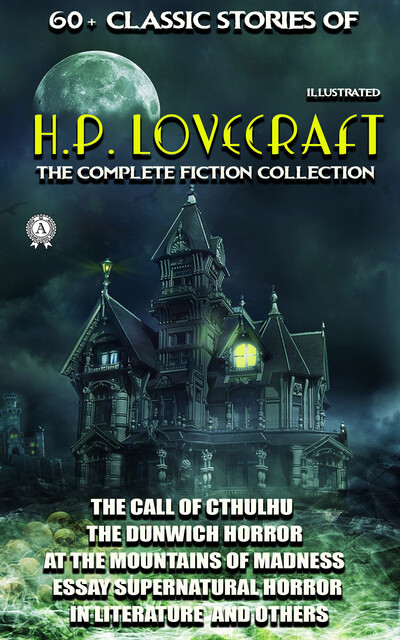
автордың кітабын онлайн тегін оқу The Complete Poetry of H. P. Lovecraft
The Complete Poetry
of
H. P. Lovecraft
Part I. Juvenilia (1887-1905)
Poemata Minora, Volume II
* * * * *
Written: 1902
First Published in:
- “Ode to Selene or Diana” (as “To Selene”)
The Tryout, Vol. 5, No. 4 (April 1919), Page 18 - “To the Old Pagan Religion” (as “The Last Pagan Speaks”)
The Tryout, Vol. 5, No. 4 (April 1919), Page 17 - “On the Ruin of Rome”
A Winter Wish. Chapel Hill, NC: Whispers Press, 1977, Page 150 - “To Pan” (as “Pan”)
The Tryout, Vol. 5, No. 4 (April 1919), Page 16 - “On the Vanity of Human Ambition”
A Winter Wish. Chapel Hill, NC: Whispers Press, 1977, Page 143

Ode to Selene or Diana
Immortal Moon, in maiden splendour shine.
Dispense thy beams, divine Latona’s child.
Thy silver rays all grosser things define,
And hide harsh truth in sweet illusion mild.
In thy soft light, the city of unrest
That stands so squalid in thy brother’s glare
Throws off its habit, and in silence blest
Becomes a vision, sparkling bright and fair.
The modern world, with all it’s care & pain,
The smoky streets, the hideous clanging mills,
Face ’neath thy beams, Selene, and again
We dream like shepherds on Chaldæa’s hills.
Take heed, Diana, of my humble plea.
Convey me where my happiness may last.
Draw me against the tide of time’s rough sea
And let my sprirt rest amid the past.
To the Old Pagan Religion
Olympian gods! How can I let ye go
And pin my faith to this new Christian creed?
Can I resign the deities I know
For him who on a cross for man did bleed?
How in my weakness can my hopes depend
On one lone God, though mighty be his pow’r?
Why can Jove’s host no more assistance lend,
To soothe my pain, and cheer my troubled hour?
Are there no Dryads on these wooded mounts
O’er which I oft in desolation roam?
Are there no Naiads in these crystal founts?
Nor Nereids upon the Ocean foam?
Fast spreads the new; the older faith declines.
The name of Christ resounds upon the air.
But my wrack’d soul in solitude repines
And gives the Gods their last-receivèd pray’r.
On the Ruin of Rome
Low dost thou lie, O Rome, neath the foot of the Teuton
Slaves are thy men, and bent to the will of thy conqueror:
Wither hath gone, great city, the race that gave law to all nations,
Subdu’d the east and the west, and made them bow down to thy consuls.
Knew not defeat, but gave it to all who attack’d thee?
Dead! and replac’d by these wretches who cower in confusion
Dead! They who gave us this empire to guard and to live in
Rome, thou didst fall from thy pow’r with the proud race that made thee,
And we, base Italians, enjoy’d what we could not have builded.
To Pan
Seated in a woodland glen
By a shallow reedy stream
Once I fell a-musing, when
I was lull’d into a dream.
From the brook a shape arose
Half a man and half a goat.
Hoofs it had instead of toes
And a beard adorn’d its throat
On a set of rustic reeds
Sweetly play’d this hybrid man
Naught car’d I for earthly needs,
For I knew that this was Pan
Nymphs & Satyrs gather’d ’round
To enjoy the lively sound.
All to soon I woke in pain
And return’d to haunts of men.
But in rural vales I’d fain
Live and hear Pan’s pipes again.
On the Vanity of Human Ambition
Apollo, chasing Daphne, gain’d his prize
But lo! she turn’d to wood before his eyes.
More modern swains at golden prizes aim,
And ever strive some worldly thing to claim.
Yet ’tis the same as in Apollo’s case,
For, once attain’d, the purest gold seems base.
All that men seek ’s unworthy of the quest,
Yet seek they will, and never pause for rest.
True bliss, methinks, a man can only find
In virtuous life, & cultivated mind.
Part II. Fantasy and Horror
Nemesis
* * * * *
Written: 1st November 1917
First Published in The Vagrant,
No. 7 (June 1918), Pages 41-43
Thro’ the ghoul-guarded gateways of slumber,
Past the wan-moon’d abysses of night,
I have liv’d o’er my lives without number,
I have sounded all things with my sight;
And I struggle and shriek ere the daybreak, being driven to madness with fright.
I have whirl’d with the earth at the dawning,
When the sky was a vaporous flame;
I have seen the dark universe yawning,
Where the black planets roll without aim;
Where they roll in their horror unheeded, without knowledge or lustre or name.
I had drifted o’er seas without ending,
Under sinister grey-clouded skies
That the many-fork’d lightning is rending,
That resound with hysterical cries;
With the moans of invisible daemons that out of the green waters rise.
I have plung’d like a deer thro’ the arches
Of the hoary primoridal grove,
Where the oaks feel the presence that marches
And stalks on where no spirit dares rove;
And I flee from a thing that surrounds me, and leers thro’ dead branches above.
I have stumbled by cave-ridden mountains
That rise barren and bleak from the plain,
I have drunk of the fog-foetid fountains
That ooze down to the marsh and the main;
And in hot cursed tarns I have seen things I care not to gaze on again.
I have scann’d the vast ivy-clad palace,
I have trod its untenanted hall,
Where the moon writhing up from the valleys
Shews the tapestried things on the wall;
Strange figures discordantly woven, which I cannot endure to recall.
I have peer’d from the casement in wonder
At the mouldering meadows around,
At the many-roof’d village laid under
The curse of a grave-girdled ground;
And from rows of white urn-carven marble I listen intently for sound.
I have haunted the tombs of the ages,
I have flown on the pinions of fear
Where the smoke-belching Erebus rages,
Where the jokulls loom snow-clad and drear:
And in realms where the sun of the desert consumes what it never can cheer.
I was old when the Pharaohs first mounted
The jewel-deck’d throne by the Nile;
I was old in those epochs uncounted
When I, and I only, was vile;
And Man, yet untainted and happy, dwelt in bliss on the far Arctic isle.
Oh, great was the sin of my spirit,
And great is the reach of its doom;
Not the pity of Heaven can cheer it,
Nor can respite be found in the tomb:
Down the infinite aeons come beating the wings of unmerciful gloom.
Thro’ the ghoul-guarded gateways of slumber,
Past the wan-moon’d abysses of night,
I have liv’d o’er my lives without number,
I have sounded all things with my sight;
And I struggle and shriek ere the daybreak, being driven to madness with fright.
Astrophobos
* * * * *
Written: 25th November 1917
First Published in The United Amateur,
Vol. 17, No. 3 (January 1918), Page 38
In the midnight heavens burning
Thro’ ethereal deeps afar,
Once I watch’d with restless yearning
An alluring, aureate star;
Ev’ry eye aloft returning,
Gleaming nigh the Arctic car.
Mystic waves of beauty blended
With the gorgeous golden rays;
Phantasies of bliss descended
In a myrrh’d Elysian haze;
And in lyre-born chords extended
Harmonies of Lydian lays.
There (thought I) lies scenes of pleasure,
Where the free and blessed dwell,
And each moment bears a treasure
Freighted with a lotus-spell,
And there floats a liquid measure
From the lute of Israfel.
There (I told myself) were shining
Worlds of happiness unknown,
Peace and Innocence entwining
By the Crowned Virtue’s throne;
Men of light, their thoughts refining
Purer, fairer, than our own.
Thus I mus’d, when o’er the vision
Crept a red delirious change;
Hope dissolving to derision,
Beauty to distortion strange;
Hymnic chords in weird collision,
Spectral sights in endless range.
Crimson burn’d the star of sadness
As behind the beams I peer’d;
All was woe that seem’d but gladness
Ere my gaze with truth was sear’d;
Cacodaemons, mir’d with madness,
Thro’ the fever’d flick’ring leer’d.
Now I know the fiendish fable
That the golden glitter bore;
Now I shun the spangled sable
That I watch’d and lov’d before;
But the horror, set and stable,
Haunts my soul for evermore
The Poe-et’s Nightmare
* * * * *
Written: 1916
First Published in The Vagrant,
No. 8 (July 1918), Pages 13-23