автордың кітабын онлайн тегін оқу The Influence of Sea Power Upon History, 1660-1783
The Project Gutenberg eBook, The Influence of Sea Power Upon History, 1660-1783, by A. T. Mahan
This eBook is for the use of anyone anywhere at no cost and with
almost no restrictions whatsoever. You may copy it, give it away or
re-use it under the terms of the Project Gutenberg License included
with this eBook or online at www.gutenberg.org
Title: The Influence of Sea Power Upon History, 1660-1783
Author: A. T. Mahan
Release Date: September 26, 2004 [eBook #13529]
Most recently updated: November 19, 2007
Language: English
Character set encoding: ISO-8859-1
***START OF THE PROJECT GUTENBERG EBOOK THE INFLUENCE OF SEA POWER UPON HISTORY, 1660-1783***
E-text prepared by A. E. Warren and revised by
Jeannie Howse, Frank van Drogen, Paul Hollander,
and the Project Gutenberg Online Distributed Proofreading Team
(http://www.pgdp.net)
HTML version prepared by
Jeannie Howse, Frank van Drogen, Paul Hollander,
and the Project Gutenberg Online Distributed Proofreading Team
Transcriber's Note:
Inconsistent hyphenation, and spelling in the original document have been preserved.
Obvious typographical errors have been corrected. For a complete list, please see the end of this document.
Click on the images to see a larger version.
THE INFLUENCE
OF SEA POWER
UPON HISTORY
1660-1783
By
A. T. MAHAN, D.C.L., LL.D.
Author of "The Influence of Sea Power upon the French
Revolution and Empire, 1793-1812," etc.
TWELFTH EDITION
BOSTON
LITTLE, BROWN AND COMPANY
Copyright, 1890,
By Captain A. T. Mahan.
Copyright, 1918,
By Ellen Lyle Mahan.
Printed in the United States of America
PREFACE.
The definite object proposed in this work is an examination of the general history of Europe and America with particular reference to the effect of sea power upon the course of that history. Historians generally have been unfamiliar with the conditions of the sea, having as to it neither special interest nor special knowledge; and the profound determining influence of maritime strength upon great issues has consequently been overlooked. This is even more true of particular occasions than of the general tendency of sea power. It is easy to say in a general way, that the use and control of the sea is and has been a great factor in the history of the world; it is more troublesome to seek out and show its exact bearing at a particular juncture. Yet, unless this be done, the acknowledgment of general importance remains vague and unsubstantial; not resting, as it should, upon a collection of special instances in which the precise effect has been made clear, by an analysis of the conditions at the given moments.
A curious exemplification of this tendency to slight the bearing of maritime power upon events may be drawn from two writers of that English nation which more than any other has owed its greatness to the sea. "Twice," says Arnold in his History of Rome, "Has there been witnessed the struggle of the highest individual genius against the resources and institutions of a great nation, and in both cases the nation was victorious. For seventeen years Hannibal strove against Rome, for sixteen years Napoleon strove against England; the efforts of the first ended in Zama, those of the second in Waterloo." Sir Edward Creasy, quoting this, adds: "One point, however, of the similitude between the two wars has scarcely been adequately dwelt on; that is, the remarkable parallel between the Roman general who finally defeated the great Carthaginian, and the English general who gave the last deadly overthrow to the French emperor. Scipio and Wellington both held for many years commands of high importance, but distant from the main theatres of warfare. The same country was the scene of the principal military career of each. It was in Spain that Scipio, like Wellington, successively encountered and overthrew nearly all the subordinate generals of the enemy before being opposed to the chief champion and conqueror himself. Both Scipio and Wellington restored their countrymen's confidence in arms when shaken by a series of reverses, and each of them closed a long and perilous war by a complete and overwhelming defeat of the chosen leader and the chosen veterans of the foe."
Neither of these Englishmen mentions the yet more striking coincidence, that in both cases the mastery of the sea rested with the victor. The Roman control of the water forced Hannibal to that long, perilous march through Gaul in which more than half his veteran troops wasted away; it enabled the elder Scipio, while sending his army from the Rhone on to Spain, to intercept Hannibal's communications, to return in person and face the invader at the Trebia. Throughout the war the legions passed by water, unmolested and unwearied, between Spain, which was Hannibal's base, and Italy, while the issue of the decisive battle of the Metaurus, hinging as it did upon the interior position of the Roman armies with reference to the forces of Hasdrubal and Hannibal, was ultimately due to the fact that the younger brother could not bring his succoring reinforcements by sea, but only by the land route through Gaul. Hence at the critical moment the two Carthaginian armies were separated by the length of Italy, and one was destroyed by the combined action of the Roman generals.
On the other hand, naval historians have troubled themselves little about the connection between general history and their own particular topic, limiting themselves generally to the duty of simple chroniclers of naval occurrences. This is less true of the French than of the English; the genius and training of the former people leading them to more careful inquiry into the causes of particular results and the mutual relation of events.
There is not, however, within the knowledge of the author any work that professes the particular object here sought; namely, an estimate of the effect of sea power upon the course of history and the prosperity of nations. As other histories deal with the wars, politics, social and economical conditions of countries, touching upon maritime matters only incidentally and generally unsympathetically, so the present work aims at putting maritime interests in the foreground, without divorcing them, however, from their surroundings of cause and effect in general history, but seeking to show how they modified the latter, and were modified by them.
The period embraced is from 1660, when the sailing-ship era, with its distinctive features, had fairly begun, to 1783, the end of the American Revolution. While the thread of general history upon which the successive maritime events is strung is intentionally slight, the effort has been to present a clear as well as accurate outline. Writing as a naval officer in full sympathy with his profession, the author has not hesitated to digress freely on questions of naval policy, strategy, and tactics; but as technical language has been avoided, it is hoped that these matters, simply presented, will be found of interest to the unprofessional reader.
A. T. MAHAN
December, 1889.
CONTENTS.
INTRODUCTORY.
History of Sea Power one of contest between nations, therefore largely military
1Permanence of the teachings of history
2Unsettled condition of modern naval opinion
2Contrasts between historical classes of war-ships
2Essential distinction between weather and lee gage
5Analogous to other offensive and defensive positions
6Consequent effect upon naval policy
6Lessons of history apply especially to strategy
7Less obviously to tactics, but still applicable
9Illustrations:
The battle of the Nile,
A.D.1798
10Trafalgar,
A.D.1805
11Siege of Gibraltar,
A.D.1779-1782
12Actium,
B.C.31, and Lepanto,
A.D.1571
13Second Punic War,
B.C.218-201
14Naval strategic combinations surer now than formerly
22Wide scope of naval strategy
22 CHAPTER I.Discussion of the Elements of Sea Power.
The sea a great common
25Advantages of water-carriage over that by land
25Navies exist for the protection of commerce
26Dependence of commerce upon secure seaports
27Development of colonies and colonial posts
28Links in the chain of Sea Power: production, shipping, colonies
28 General conditions affecting Sea Power:I. Geographical position
29II. Physical conformation
35III. Extent of territory
42IV. Number of population
44V. National character
50VI. Character and policy of governments
58England
59Holland
67France
69Influence of colonies on Sea Power
82The United States:
Its weakness in Sea Power
83Its chief interest in internal development
84Danger from blockades
85Dependence of the navy upon the shipping interest
87Conclusion of the discussion of the elements of Sea Power
88Purpose of the historical narrative
89 CHAPTER II. State of Europe in 1660.—Second Anglo-Dutch War, 1665-1667.—Sea Battles of Lowestoft and of the Four DaysAccession of Charles II. and Louis XIV.
90Followed shortly by general wars
91French policy formulated by Henry IV. and Richelieu
92Condition of France in 1660
93Condition of Spain
94Condition of the Dutch United Provinces
96Their commerce and colonies
97Character of their government
98Parties in the State
99Condition of England in 1660
99Characteristics of French, English, and Dutch ships
101Conditions of other European States
102Louis XIV. the leading personality in Europe
103His policy
104Colbert's administrative acts
105Second Anglo-Dutch War, 1665
107Battle of Lowestoft, 1665
108Fire-ships, compared with torpedo-cruisers
109The group formation
112 The order of battle for sailing-ships 115The Four Days' Battle, 1666
117Military merits of the opposing fleets
126Soldiers commanding fleets, discussion
127Ruyter in the Thames, 1667
132Peace of Breda, 1667
132Military value of commerce-destroying
132 CHAPTER III. War of England and France in Alliance against the United Provinces, 1672-1674.—Finally, of France against Combined Europe, 1674-1678.—Sea Battles of Solebay, the Texel, and Stromboli.Aggressions of Louis XIV. on Spanish Netherlands
139Policy of the United Provinces
139Triple alliance between England, Holland, and Sweden
140Anger of Louis XIV.
140Leibnitz proposes to Louis to seize Egypt
141His memorial
142Bargaining between Louis XIV. and Charles II.
143The two kings declare war against the United Provinces
144Military character of this war
144Naval strategy of the Dutch
144Tactical combinations of De Ruyter
145Inefficiency of Dutch naval administration
145Battle of Solebay, 1672
146Tactical comments
147Effect of the battle on the course of the war
148Land campaign of the French in Holland
149Murder of John De Witt, Grand Pensionary of Holland
150Accession to power of William of Orange
150Uneasiness among European States
150Naval battles off Schoneveldt, 1673
151Naval battle of the Texel, 1673
152Effect upon the general war
154Equivocal action of the French fleet
155General ineffectiveness of maritime coalitions
156Military character of De Ruyter
157Coalition against France
158 Peace between England and the United Provinces 158Sicilian revolt against Spain
159Battle of Stromboli, 1676
161Illustration of Clerk's naval tactics
163De Ruyter killed off Agosta
165England becomes hostile to France
166Sufferings of the United Provinces
167Peace of Nimeguen, 1678
168Effects of the war on France and Holland
169Notice of Comte d'Estrées
170 CHAPTER IV. English Revolution.—War of the League of Augsburg, 1688-1697.—Sea Battles of Beachy Head and La Hougue.Aggressive policy of Louis XIV.
173State of French, English, and Dutch navies
174Accession of James II.
175Formation of the League of Augsburg
176Louis declares war against the Emperor of Germany
177Revolution in England
178Louis declares war against the United Provinces
178William and Mary crowned
178James II. lands in Ireland
179Misdirection of French naval forces
180William III. lands in Ireland
181Naval battle of Beachy Head, 1690
182Tourville's military character
184Battle of the Boyne, 1690
186End of the struggle in Ireland
186Naval battle of La Hougue, 1692
189Destruction of French ships
190Influence of Sea Power in this war
191Attack and defence of commerce
193Peculiar characteristics of French privateering
195Peace of Ryswick, 1697
197Exhaustion of France: its causes
198 CHAPTER V.War of the Spanish Succession, 1702-1713.—Sea Battle Of Malaga.
Failure of the Spanish line of the House of Austria
201King of Spain wills the succession to the Duke of Anjou
202Death of the King of Spain
202Louis XIV. accepts the bequests
203He seizes towns in Spanish Netherlands
203Offensive alliance between England, Holland, and Austria
204Declarations of war
205The allies proclaim Carlos III. King of Spain
206Affair of the Vigo galleons
207Portugal joins the allies
208Character of the naval warfare
209Capture of Gibraltar by the English
210Naval battle of Malaga, 1704
211Decay of the French navy
212Progress of the land war
213Allies seize Sardinia and Minorca
215Disgrace of Marlborough
216England offers terms of peace
217Peace of Utrecht, 1713
218Terms of the peace
219Results of the war to the different belligerents
219Commanding position of Great Britain
224Sea Power dependent upon both commerce and naval strength
225Peculiar position of France as regards Sea Power
226Depressed condition of France
227Commercial prosperity of England
228Ineffectiveness of commerce-destroying
229Duguay-Trouin's expedition against Rio de Janeiro, 1711
230War between Russia and Sweden
231 CHAPTER VI. The Regency in France.—Alberoni in Spain.—Policies of Walpole and Fleuri.—War of the Polish Succession.—English Contraband Trade in Spanish America.—Great Britain declares War against Spain.—1715-1739.Death of Queen Anne and Louis XIV.
232Accession of George I.
232Regency of Philip of Orleans
233Administration of Alberoni in Spain
234Spaniards invade Sardinia
235Alliance of Austria, England, Holland, and France
235Spaniards invade Sicily
236Destruction of Spanish navy off Cape Passaro, 1718
237Failure and dismissal of Alberoni
239Spain accepts terms
239Great Britain interferes in the Baltic
239Death of Philip of Orleans
241Administration of Fleuri in France
241Growth of French commerce
242France in the East Indies
243Troubles between England and Spain
244English contraband trade in Spanish America
245Illegal search of English ships
246Walpole's struggles to preserve peace
247War of the Polish Succession
247Creation of the Bourbon kingdom of the Two Sicilies
248Bourbon family compact
248France acquires Bar and Lorraine
249England declares war against Spain
250Morality of the English action toward Spain
250Decay of the French navy
252Death of Walpole and of Fleuri
253 CHAPTER VII. War between Great Britain and Spain, 1739.—War of the Austrian Succession, 1740.—France joins Spain against Great Britain, 1744.—Sea Battles of Matthews, Anson, and Hawke.—Peace of Aix-la-Chapelle, 1748.Characteristics of the wars from 1739 to 1783
254Neglect of the navy by French government
254Colonial possessions of the French, English, and Spaniards
255Dupleix and La Bourdonnais in India
258Condition of the contending navies
259Expeditions of Vernon and Anson
261Outbreak of the War of the Austrian Succession
262England allies herself to Austria
262Naval affairs in the Mediterranean
263Influence of Sea Power on the war
264Naval battle off Toulon, 1744
265Causes of English failure
267Courts-martial following the action
268Inefficient action of English navy
269Capture of Louisburg by New England colonists, 1745
269Causes which concurred to neutralize England's Sea Power
269France overruns Belgium and invades Holland
270Naval actions of Anson and Hawke
271Brilliant defence of Commodore l'Étenduère
272Projects of Dupleix and La Bourdonnais in the East Indies
273Influence of Sea Power in Indian affairs
275La Bourdonnais reduces Madras
276Peace of Aix-la-Chapelle, 1748
277Madras exchanged for Louisburg
277Results of the war
278Effect of Sea Power on the issue
279 CHAPTER VIII. Seven Years' War, 1756-1763.—England's Overwhelming Power and Conquests on the Seas, in North America, Europe, and East and West Indies.—Sea Battles: Byng off Minorca; Hawke and Conflans; Pocock and D'Aché in East Indies.Peace of Aix-la-Chapelle leaves many questions unsettled
281Dupleix pursues his aggressive policy
281He is recalled from India
282His policy abandoned by the French
282Agitation in North America
283Braddock's expedition, 1755
284Seizure of French ships by the English, while at peace
285French expedition against Port Mahon, 1756
285Byng sails to relieve the place
286Byng's action off Port Mahon, 1756
286Characteristics of the French naval policy
287Byng returns to Gibraltar
290He is relieved, tried by court-martial, and shot
290Formal declarations of war by England and France
291England's appreciation of the maritime character of the war
291France is drawn into a continental struggle
292The Seven Years' War (1756-1763) begins
293Pitt becomes Prime Minister of England
293Operations in North America
293Fall of Louisburg, 1758
294Fall of Quebec, 1759, and of Montreal, 1760
294Influence of Sea Power on the continental war
295English plans for the general naval operations
296Choiseul becomes Minister in France
297He plans an invasion of England
297Sailing of the Toulon fleet, 1759
298Its disastrous encounter with Boscawen
299Consequent frustration of the invasion of England
300Project to invade Scotland
300Sailing of the Brest fleet
300Hawke falls in with it and disperses it, 1759
302Accession of Charles III. to Spanish throne
304Death of George II.
304 Clive in India 305Battle of Plassey, 1757
306Decisive influence of Sea Power upon the issues in India
307Naval actions between Pocock and D'Aché, 1758, 1759
307Destitute condition of French naval stations in India
309The French fleet abandons the struggle
310Final fall of the French power in India
310Ruined condition of the French navy
311Alliance between France and Spain
313England declares war against Spain
313Rapid conquest of French and Spanish colonies
314French and Spaniards invade Portugal
316The invasion repelled by England
316Severe reverses of the Spaniards in all quarters
316Spain sues for peace
317Losses of British mercantile shipping
317Increase of British commerce
318Commanding position of Great Britain
319Relations of England and Portugal
320Terms of the Treaty of Paris
321Opposition to the treaty in Great Britain
322Results of the maritime war
323Results of the continental war
324Influence of Sea Power in countries politically unstable
324Interest of the United States in the Central American Isthmus
325Effects of the Seven Years' War on the later history of Great Britain
326Subsequent acquisitions of Great Britain
327British success due to maritime superiority
328Mutual dependence of seaports and fleets
329 CHAPTER IX. Course of Events from the Peace of Paris to 1778.—Maritime War Consequent upon the American Revolution.—Sea Battle off Ushant.French discontent with the Treaty of Paris
330Revival of the French navy
331Discipline among French naval officers of the time
332Choiseul's foreign policy
333Domestic troubles in Great Britain
334Controversies with the North American colonies
334 Genoa cedes Corsica to France 334Dispute between England and Spain about the Falkland Islands
335Choiseul dismissed
336Death of Louis XV.
336Naval policy of Louis XVI.
337Characteristics of the maritime war of 1778
338Instructions of Louis XVI. to the French admirals
339Strength of English navy
341Characteristics of the military situation in America
341The line of the Hudson
342Burgoyne's expedition from Canada
343Howe carries his army from New York to the Chesapeake
343Surrender of Burgoyne, 1777
343American privateering
344Clandestine support of the Americans by France
345Treaty between France and the Americans
346Vital importance of the French fleet to the Americans
347The military situation in the different quarters of the globe
347Breach between France and England
350Sailing of the British and French fleets
350Battle of Ushant, 1778
351Position of a naval commander-in-chief in battle
353 CHAPTER X. Maritime War in North America and West Indies, 1778-1781.—Its Influence upon the Course of the American Revolution.—Fleet Actions off Grenada, Dominica, and Chesapeake Bay.D'Estaing sails from Toulon for Delaware Bay, 1778
359British ordered to evacuate Philadelphia
359Rapidity of Lord Howe's movements
360D'Estaing arrives too late
360Follows Howe to New York
360Fails to attack there and sails for Newport
361Howe follows him there
362Both fleets dispersed by a storm
362D'Estaing takes his fleet to Boston
363Howe's activity foils D'Estaing at all points
363D'Estaing sails for the West Indies
365The English seize Sta. Lucia
365 Ineffectual attempts of D'Estaing to dislodge them 366D'Estaing captures Grenada
367Naval battle of Grenada, 1779; English ships crippled
367D'Estaing fails to improve his advantages
370Reasons for his neglect
371French naval policy
372English operations in the Southern States
375D'Estaing takes his fleet to Savannah
375His fruitless assault on Savannah
376D'Estaing returns to France
376Fall of Charleston
376De Guichen takes command in the West Indies
376Rodney arrives to command English fleet
377His military character
377First action between Rodney and De Guichen, 1780
378Breaking the line
380Subsequent movements of Rodney and De Guichen
381Rodney divides his fleet
381Goes in person to New York
381De Guichen returns to France
381Arrival of French forces in Newport
382Rodney returns to the West Indies
382War between England and Holland
382Disasters to the United States in 1780
382De Grasse sails from Brest for the West Indies, 1781
383Engagement with English fleet off Martinique
383Cornwallis overruns the Southern States
384He retires upon Wilmington, N.C., and thence to Virginia
385Arnold on the James River
385The French fleet leaves Newport to intercept Arnold
385Meets the English fleet off the Chesapeake, 1781
386French fleet returns to Newport
387Cornwallis occupies Yorktown
387De Grasse sails from Hayti for the Chesapeake
388Action with the British fleet, 1781
389Surrender of Cornwallis, 1781
390Criticism of the British naval operations
390Energy and address shown by De Grasse
392Difficulties of Great Britain's position in the war of 1778
392The military policy best fitted to cope with them
393Position of the French squadron in Newport, R.I., 1780
394Great Britain's defensive position and inferior numbers
396Consequent necessity for a vigorous initiative
396Washington's opinions as to the influence of Sea Power on the American contest
397 CHAPTER XI. Maritime War in Europe, 1779-1782.Objectives of the allied operations in Europe
401Spain declares war against England
401Allied fleets enter the English Channel, 1779
402Abortive issue of the cruise
403Rodney sails with supplies for Gibraltar
403Defeats the Spanish squadron of Langara and relieves the place
404The allies capture a great British convoy
404The armed neutrality of the Baltic powers, 1780
405England declares war against Holland
406Gibraltar is revictualled by Admiral Derby
407The allied fleets again in the Channel, 1781
408They retire without effecting any damage to England
408Destruction of a French convoy for the West Indies
408Fall of Port Mahon, 1782
409The allied fleets assemble at Algesiras
409Grand attack of the allies on Gibraltar, which fails, 1782
410Lord Howe succeeds in revictualling Gibraltar
412Action between his fleet and that of the allies
412Conduct of the war of 1778 by the English government
412Influence of Sea Power
416Proper use of the naval forces
416 CHAPTER XII. Events in the East Indies, 1778-1781.—Suffren sails from Brest for India, 1781.—His Brilliant Naval Campaign in the Indian Seas, 1782, 1783.Neglect of India by the French government
419England at war with Mysore and with the Mahrattas
420Arrival of the French squadron under Comte d'Orves
420It effects nothing and returns to the Isle of France
420Suffren sails from Brest with five ships-of-the-line, 1781
421Attacks an English squadron in the Cape Verde Islands, 1781
422Conduct and results of this attack
424Distinguishing merits of Suffren as a naval leader
425Suffren saves the Cape Colony from the English
427 He reaches the Isle of France 427Succeeds to the chief command of the French fleet
427Meets the British squadron under Hughes at Madras
427Analysis of the naval strategic situation in India
428The first battle between Suffren and Hughes, Feb. 17, 1782
430Suffren's views of the naval situation in India
433Tactical oversights made by Suffren
434Inadequate support received by him from his captains
435Suffren goes to Pondicherry, Hughes to Trincomalee
436and to the skilful conduct of war in the future. Napoleon names among the campaigns to be studied by the aspiring soldier, those of Alexander, Hannibal, and Cæsar, to whom gunpowder was unknown; and there is a substantial agreement among professional writers that, while many of the conditions of war vary from age to age with the progress of weapons, there are certain teachings in the school of history which remain constant, and being, therefore, of universal application, can be elevated to the rank of general principles. For the same reason the study of the sea history of the past will be found instructive, by its illustration of the general principles of maritime war, notwithstanding the great changes that have been brought about in naval weapons by the scientific advances of the past half century, and by the introduction of steam as the motive power.
In tracing resemblances there is a tendency not only to overlook points of difference, but to exaggerate points of likeness,—to be fanciful. It may be so considered to point out that as the sailing-ship had guns of long range, with comparatively great penetrative power, and carronades, which were of shorter range but great smashing effect, so the modern steamer has its batteries of long-range guns and of torpedoes, the latter being effective only within a limited distance and then injuring by smashing, while the gun, as of old, aims at penetration. Yet these are distinctly tactical considerations, which must affect the plans of admirals and captains; and the analogy is real, not forced. So also both the sailing-ship and the steamer contemplate direct contact with an enemy's vessel,—the former to carry her by boarding, the latter to sink her by ramming; and to both this is the most difficult of their tasks, for to effect it the ship must be carried to a single point of the field of action, whereas projectile weapons may be used from many points of a wide area.
or refusing battle at will, which in turn carries the usual advantage of an offensive attitude in the choice of the method of attack. This advantage was accompanied by certain drawbacks, such as irregularity introduced into the order, exposure to raking or enfilading cannonade, and the sacrifice of part or all of the artillery-fire of the assailant,—all which were incurred in approaching the enemy. The ship, or fleet, with the lee-gage could not attack; if it did not wish to retreat, its action was confined to the defensive, and to receiving battle on the enemy's terms. This disadvantage was compensated by the comparative ease of maintaining the order of battle undisturbed, and by a sustained artillery-fire to which the enemy for a time was unable to reply. Historically, these favorable and unfavorable characteristics have their counterpart and analogy in the offensive and defensive operations of all ages. The offence undertakes certain risks and disadvantages in order to reach and destroy the enemy; the defence, so long as it remains such, refuses the risks of advance, holds on to a careful, well-ordered position, and avails itself of the exposure to which the assailant submits himself. These radical differences between the weather and the lee gage were so clearly recognized, through the cloud of lesser details accompanying them, that the former was ordinarily chosen by the English, because their steady policy was to assail and destroy their enemy; whereas the French sought the lee-gage, because by so doing they were usually able to cripple the enemy as he approached, and thus evade decisive encounters and preserve their ships. The French, with rare exceptions, subordinated the action of the navy to other military considerations, grudged the money spent upon it, and therefore sought to economize their fleet by assuming a defensive position and limiting its efforts to the repelling of assaults. For this course the lee-gage, skilfully used, was admirably adapted so long as an enemy displayed more courage than conduct; but when Rodney showed an intention to use the advantage of the wind, not merely to attack, but to make a formidable concentration on a part of the enemy's
line, his wary opponent, De Guichen, changed his tactics. In the first of their three actions the Frenchman took the lee-gage; but after recognizing Rodney's purpose he manœuvred for the advantage of the wind, not to attack, but to refuse action except on his own terms. The power to assume the offensive, or to refuse battle, rests no longer with the wind, but with the party which has the greater speed; which in a fleet will depend not only upon the speed of the individual ships, but also upon their tactical uniformity of action. Henceforth the ships which have the greatest speed will have the weather-gage.
has a great deal to say. There has been of late a valuable discussion in English naval circles as to the comparative merits of the policies of two great English admirals, Lord Howe and Lord St. Vincent, in the disposition of the English navy when at war with France. The question is purely strategic, and is not of mere historical interest; it is of vital importance now, and the principles upon which its decision rests are the same now as then. St. Vincent's policy saved England from invasion, and in the hands of Nelson and his brother admirals led straight up to Trafalgar.
interval between such changes has been unduly long. This doubtless arises from the fact that an improvement of weapons is due to the energy of one or two men, while changes in tactics have to overcome the inertia of a conservative class; but it is a great evil. It can be remedied only by a candid recognition of each change, by careful study of the powers and limitations of the new ship or weapon, and by a consequent adaptation of the method of using it to the qualities it possesses, which will constitute its tactics. History shows that it is vain to hope that military men generally will be at the pains to do this, but that the one who does will go into battle with a great advantage,—a lesson in itself of no mean value.
help of the weather ones before the latter were destroyed; but the principles which underlay the combination, namely, to choose that part of the enemy's order which can least easily be helped, and to attack it with superior forces, has not passed away. The action of Admiral Jervis at Cape St. Vincent, when with fifteen ships he won a victory over twenty-seven, was dictated by the same principle, though in this case the enemy was not at anchor, but under way. Yet men's minds are so constituted that they seem more impressed by the transiency of the conditions than by the undying principle which coped with them. In the strategic effect of Nelson's victory upon the course of the war, on the contrary, the principle involved is not only more easily recognized, but it is at once seen to be applicable to our own day. The issue of the enterprise in Egypt depended upon keeping open the communications with France. The victory of the Nile destroyed the naval force, by which alone the communications could be assured, and determined the final failure; and it is at once seen, not only that the blow was struck in accordance with the principle of striking at the enemy's line of communication, but also that the same principle is valid now, and would be equally so in the days of the galley as of the sailing-ship or steamer.
Napoleon's combinations failed, and Nelson's intuitions and activity kept the English fleet ever on the track of the enemy, and brought it up in time at the decisive moment.
which might be exchanged against Gibraltar. It is not, however, likely that England would have given up the key of the Mediterranean for any other foreign possession, though she might have yielded it to save her firesides and her capital. Napoleon once said that he would reconquer Pondicherry on the banks of the Vistula. Could he have controlled the English Channel, as the allied fleet did for a moment in 1779, can it be doubted that he would have conquered Gibraltar on the shores of England?
has received scant recognition. There cannot now be had the full knowledge necessary for tracing in detail its influence upon the issue of the second Punic War; but the indications which remain are sufficient to warrant the assertion that it was a determining factor. An accurate judgment upon this point cannot be formed by mastering only such facts of the particular contest as have been clearly transmitted, for as usual the naval transactions have been slightingly passed over; there is needed also familiarity with the details of general naval history in order to draw, from slight indications, correct inferences based upon a knowledge of what has been possible at periods whose history is well known. The control of the sea, however real, does not imply that an enemy's single ships or small squadrons cannot steal out of port, cannot cross more or less frequented tracts of ocean, make harassing descents upon unprotected points of a long coast-line, enter blockaded harbors. On the contrary, history has shown that such evasions are always possible, to some extent, to the weaker party, however great the inequality of naval strength. It is not therefore inconsistent with the general control of the sea, or of a decisive part of it, by the Roman fleets, that the Carthaginian admiral Bomilcar in the fourth year of the war, after the stunning defeat of Cannæ, landed four thousand men and a body of elephants in south Italy; nor that in the seventh year, flying from the Roman fleet off Syracuse, he again appeared at Tarentum, then in Hannibal's hands; nor that Hannibal sent despatch vessels to Carthage; nor even that, at last, he withdrew in safety to Africa with his wasted army. None of these things prove that the government in Carthage could, if it wished, have sent Hannibal the constant support which, as a matter of fact, he did not receive; but they do tend to create a natural impression that such help could have been given. Therefore the statement, that the Roman preponderance at sea had a decisive effect upon the course of the war, needs to be made good by an examination of ascertained facts. Thus the kind and degree of its influence may be fairly estimated.
firearms would cause any great modifications in the way of making war. I replied that they would probably have an influence upon the details of tactics, but that in great strategic operations and the grand combinations of battles, victory would, now as ever, result from the application of the principles which had led to the success of great generals in all ages; of Alexander and Cæsar, as well as of Frederick and Napoleon." This study has become more than ever important now to navies, because of the great and steady power of movement possessed by the modern steamer. The best-planned schemes might fail through stress of weather in the days of the galley and the sailing-ship; but this difficulty has almost disappeared. The principles which should direct great naval combinations have been applicable to all ages, and are deducible from history; but the power to carry them out with little regard to the weather is a recent gain.
the coasting trade would only be an inconvenience, although water transit is still the cheaper. Nevertheless, as late as the wars of the French Republic and the First Empire, those who are familiar with the history of the period, and the light naval literature that has grown up around it, know how constant is the mention of convoys stealing from point to point along the French coast, although the sea swarmed with English cruisers and there were good inland roads.
As a nation, with its unarmed and armed shipping, launches forth from its own shores, the need is soon felt of points upon which the ships can rely for peaceful trading, for refuge and supplies. In the present day friendly, though foreign, ports are to be found all over the world; and their shelter is enough while peace prevails. It was not always so, nor does peace always endure, though the United States have been favored by so long a continuance of it. In earlier times the merchant seaman, seeking for trade in new and unexplored regions, made his gains at risk of life and liberty from suspicious or hostile nations, and was under great delays in collecting a full and profitable freight. He therefore intuitively sought at the far end of his trade route one or more stations, to be given to him by force or favor, where he could fix himself or his agents in reasonable security, where his ships could lie in safety, and where the merchantable products of the land could be continually collecting, awaiting the arrival of the home fleet, which should carry them to the mother-country. As there was immense gain, as well as much risk, in these early voyages, such establishments naturally multiplied and grew until they became colonies; whose ultimate development and success depended upon the genius and policy of the nation from which they sprang, and form a very great part of the history, and particularly of the sea history, of the world. All colonies had not the simple and natural birth and growth above described. Many were more formal, and purely political, in their conception and founding, the act of the rulers of the people rather than of private individuals; but the trading-station with its after expansion, the work simply of the adventurer seeking gain, was in its reasons and essence the same as the elaborately organized and chartered colony. In both cases the mother-country had won a foothold in a foreign land, seeking a new outlet for what it had to sell, a new sphere for its shipping, more employment for its people, more comfort and wealth for itself.
The voyages were long and dangerous, the seas often beset with enemies. In the most active days of colonizing there prevailed on the sea a lawlessness the very memory of which is now almost lost, and the days of settled peace between maritime nations were few and far between. Thus arose the demand for stations along the road, like the Cape of Good Hope, St. Helena, and Mauritius, not primarily for trade, but for defence and war; the demand for the possession of posts like Gibraltar, Malta, Louisburg, at the entrance of the Gulf of St. Lawrence,—posts whose value was chiefly strategic, though not necessarily wholly so. Colonies and colonial posts were sometimes commercial, sometimes military in their character; and it was exceptional that the same position was equally important in both points of view, as New York was.
natural productions and climate. III. Extent of Territory. IV. Number of Population. V. Character of the People. VI. Character of the Government, including therein the national institutions.
follows, from her geographical position and her power, with mathematical certainty.
movements for a year. While the war in the Netherlands lasted, the Dutch control of the sea forced Spain to send her troops by a long and costly journey overland instead of by sea; and the same cause reduced her to such straits for necessaries that, by a mutual arrangement which seems very odd to modern ideas, her wants were supplied by Dutch ships, which thus maintained the enemies of their country, but received in return specie which was welcome in the Amsterdam exchange. In America, the Spanish protected themselves as best they might behind masonry, unaided from home; while in the Mediterranean they escaped insult and injury mainly through the indifference of the Dutch, for the French and English had not yet begun to contend for mastery there. In the course of history the Netherlands, Naples, Sicily, Minorca, Havana, Manila, and Jamaica were wrenched away, at one time or another, from this empire without a shipping. In short, while Spain's maritime impotence may have been primarily a symptom of her general decay, it became a marked factor in precipitating her into the abyss from which she has not yet wholly emerged.
scattered condition of the United States ships, the latter could not have been distributed as they were; and being forced to concentrate for mutual support, many small but useful approaches would have been left open to commerce. But as the Southern coast, from its extent and many inlets, might have been a source of strength, so, from those very characteristics, it became a fruitful source of injury. The great story of the opening of the Mississippi is but the most striking illustration of an action that was going on incessantly all over the South. At every breach of the sea frontier, war-ships were entering. The streams that had carried the wealth and supported the trade of the seceding States turned against them, and admitted their enemies to their hearts. Dismay, insecurity, paralysis, prevailed in regions that might, under happier auspices, have kept a nation alive through the most exhausting war. Never did sea power play a greater or a more decisive part than in the contest which determined that the course of the world's history would be modified by the existence of one great nation, instead of several rival States, in the North American continent. But while just pride is felt in the well-earned glory of those days, and the greatness of the results due to naval preponderance is admitted, Americans who understand the facts should never fail to remind the over-confidence of their countrymen that the South not only had no navy, not only was not a seafaring people, but that also its population was not proportioned to the extent of the sea-coast which it had to defend.
V. National Character.—The effect of national character and aptitudes upon the development of sea power will next be considered.
the pursuit of gain, and a keen scent for the trails that lead to it, all exist; and if there be in the future any fields calling for colonization, it cannot be doubted that Americans will carry to them all their inherited aptitude for self-government and independent growth.
is to insure perseverance after the death of a particular despot.
keeps up a spirit of military honor, which is of the first importance in ages when military institutions have not yet provided the sufficient substitute in what is called esprit-de-corps. But although full of class feeling and class prejudice, which made themselves felt in the navy as well as elsewhere, their practical sense left open the way of promotion to its highest honors to the more humbly born; and every age saw admirals who had sprung from the lowest of the people. In this the temper of the English upper class differed markedly from that of the French. As late as 1789, at the outbreak of the Revolution, the French Navy List still bore the name of an official whose duty was to verify the proofs of noble birth on the part of those intending to enter the naval school.
England. When William died, his policy was still followed by the government which succeeded him. Its aims were wholly centred upon the land, and at the Peace of Utrecht, which closed a series of wars extending over forty years, Holland, having established no sea claim, gained nothing in the way of sea resources, of colonial extension, or of commerce.
government upon the sea career of its people, it is seen that that influence can work in two distinct but closely related ways.
unexpected attack may cause disaster in some one quarter, the actual superiority of naval power prevents such disaster from being general or irremediable. History has sufficiently proved this. England's naval bases have been in all parts of the world; and her fleets have at once protected them, kept open the communications between them, and relied upon them for shelter.
sea power. It will not be too much to say that the action of the government since the Civil War, and up to this day, has been effectively directed solely to what has been called the first link in the chain which makes sea power. Internal development, great production, with the accompanying aim and boast of self-sufficingness, such has been the object, such to some extent the result. In this the government has faithfully reflected the bent of the controlling elements of the country, though it is not always easy to feel that such controlling elements are truly representative, even in a free country. However that may be, there is no doubt that, besides having no colonies, the intermediate link of a peaceful shipping, and the interests involved in it, are now likewise lacking. In short, the United States has only one link of the three.
on board ships which an enemy cannot touch except when bound to a blockaded port, what will constitute an efficient blockade? The present definition is, that it is such as to constitute a manifest danger to a vessel seeking to enter or leave the port. This is evidently very elastic. Many can remember that during the Civil War, after a night attack on the United States fleet off Charleston, the Confederates next morning sent out a steamer with some foreign consuls on board, who so far satisfied themselves that no blockading vessel was in sight that they issued a declaration to that effect. On the strength of this declaration some Southern authorities claimed that the blockade was technically broken, and could not be technically re-established without a new notification. Is it necessary, to constitute a real danger to blockade-runners, that the blockading fleet should be in sight? Half a dozen fast steamers, cruising twenty miles off-shore between the New Jersey and Long Island coast, would be a very real danger to ships seeking to go in or out by the principal entrance to New York; and similar positions might effectively blockade Boston, the Delaware, and the Chesapeake. The main body of the blockading fleet, prepared not only to capture merchant-ships but to resist military attempts to break the blockade, need not be within sight, nor in a position known to the shore. The bulk of Nelson's fleet was fifty miles from Cadiz two days before Trafalgar, with a small detachment watching close to the harbor. The allied fleet began to get under way at 7 A.M., and Nelson, even under the conditions of those days, knew it by 9.30. The English fleet at that distance was a very real danger to its enemy. It seems possible, in these days of submarine telegraphs, that the blockading forces in-shore and off-shore, and from one port to another, might be in telegraphic communication with one another along the whole coast of the United States, readily giving mutual support; and if, by some fortunate military combination, one detachment were attacked in force, it could warn the others and retreat upon them. Granting that such a blockade off one port were broken on one day, by
States is not now able to go alone if an emergency should arise?
shipping? It is doubtful. History has proved that such a purely military sea power can be built up by a despot, as was done by Louis XIV.; but though so fair seeming, experience showed that his navy was like a growth which having no root soon withers away. But in a representative government any military expenditure must have a strongly represented interest behind it, convinced of its necessity. Such an interest in sea power does not exist, cannot exist here without action by the government. How such a merchant shipping should be built up, whether by subsidies or by free trade, by constant administration of tonics or by free movement in the open air, is not a military but an economical question. Even had the United States a great national shipping, it may be doubted whether a sufficient navy would follow; the distance which separates her from other great powers, in one way a protection, is also a snare. The motive, if any there be, which will give the United States a navy, is probably now quickening in the Central American Isthmus. Let us hope it will not come to the birth too late.
will next be examined the general history of Europe and America, with particular reference to the effect exercised upon that history, and upon the welfare of the people, by sea power in its broad sense. From time to time, as occasion offers, the aim will be to recall and reinforce the general teaching, already elicited, by particular illustrations. The general tenor of the study will therefore be strategical, in that broad definition of naval strategy which has before been quoted and accepted: "Naval strategy has for its end to found, support, and increase, as well in peace as in war, the sea power of a country." In the matter of particular battles, while freely admitting that the change of details has made obsolete much of their teaching, the attempt will be made to point out where the application or neglect of true general principles has produced decisive effects; and, other things being equal, those actions will be preferred which, from their association with the names of the most distinguished officers, may be presumed to show how far just tactical ideas obtained in a particular age or a particular service. It will also be desirable, where analogies between ancient and modern weapons appear on the surface, to derive such probable lessons as they offer, without laying undue stress upon the points of resemblance. Finally, it must be remembered that, among all changes, the nature of man remains much the same; the personal equation, though uncertain in quantity and quality in the particular instance, is sure always to be found.
of, by people unconnected with the sea, and particularly by the people of the United States in our own day, that this study has been undertaken.
During the century before the Peace of Westphalia, the extension of family power, and the extension of the religion professed, were the two strongest motives of political action. This was the period of the great religious wars which arrayed nation against nation, principality against principality, and often, in the same nation, faction against faction. Religious persecution caused the revolt of the Protestant Dutch Provinces against Spain, which issued, after eighty years of more or less constant war, in the recognition of their independence. Religious discord, amounting to civil war at times, distracted France during the greater part of the same period, profoundly affecting not only her internal but her external policy. These were the days of St. Bartholomew, of the religious murder of Henry IV., of the siege of La Rochelle, of constant intriguing between Roman Catholic Spain and Roman Catholic Frenchmen. As the religious motive, acting in a sphere to which it did not naturally belong, and in which it had no rightful place, died away, the political necessities and interests of States began to have juster weight; not that they had been wholly lost sight of in the mean time, but the religious animosities had either blinded the eyes, or fettered the action, of statesmen. It was natural that in France, one of the greatest sufferers from religious passions, owing to the number and character of the Protestant minority, this reaction should first and most markedly be seen. Placed between Spain and the German States, among which Austria stood foremost without a rival, internal union and checks upon the power of the House of Austria were necessities of political existence. Happily, Providence raised up to her in close succession two great rulers, Henry IV. and Richelieu,—men in whom religion fell short of bigotry, and who, when forced to recognize it in the sphere of politics, did so as masters and not as slaves. Under them French statesmanship received a guidance, which Richelieu formulated as a tradition, and which moved on the following general lines,—(1) Internal union of the kingdom, appeasing or putting down religious strife and centralizing
authority in the king; (2) Resistance to the power of the House of Austria, which actually and necessarily carried with it alliance with Protestant German States and with Holland; (3) Extension of the boundaries of France to the eastward, at the expense mainly of Spain, which then possessed not only the present Belgium, but other provinces long since incorporated with France; and (4) The creation and development of a great sea power, adding to the wealth of the kingdom, and intended specially to make head against France's hereditary enemy, England; for which end again the alliance with Holland was to be kept in view. Such were the broad outlines of policy laid down by statesmen in the front rank of genius for the guidance of that country whose people have, not without cause, claimed to be the most complete exponent of European civilization, foremost in the march of progress, combining political advance with individual development. This tradition, carried on by Mazarin, was received from him by Louis XIV.; it will be seen how far he was faithful to it, and what were the results to France of his action. Meanwhile it may be noted that of these four elements necessary to the greatness of France, sea power was one; and as the second and third were practically one in the means employed, it may be said that sea power was one of the two great means by which France's external greatness was to be maintained. England on the sea, Austria on the land, indicated the direction that French effort was to take.
Spain, the nation before which all others had trembled less than a century before, was now long in decay and scarcely formidable; the central weakness had spread to all parts of the administration. In extent of territory, however, she was still great. The Spanish Netherlands still belonged to her; she held Naples, Sicily, and Sardinia; Gibraltar had not yet fallen into English hands; her vast possessions in America—with the exception of Jamaica, conquered by England a few years before—were still untouched. The condition of her sea power, both for peace and war, has been already alluded to. Many years before, Richelieu had contracted a temporary alliance with Spain, by virtue of which she placed forty ships at his disposal; but the bad condition of the vessels, for the most part ill armed and ill commanded, compelled their withdrawal. The navy of Spain was then in full decay, and its weakness did not escape the piercing eye of the cardinal. An encounter which took place between the Spanish and Dutch fleets in 1639 shows most plainly the state of degradation into which this once proud navy had fallen.
thus describes the commercial and colonial conditions, at the accession of Louis XIV., of this people, which beyond any other in modern times, save only England, has shown how the harvest of the sea can lift up to wealth and power a country intrinsically weak and without resources:—
francs. The powerful East India Company, founded in 1602, had built up in Asia an empire, with possessions taken from the Portuguese. Mistress in 1650 of the Cape of Good Hope, which guaranteed it a stopping-place for its ships, it reigned as a sovereign in Ceylon, and upon the coasts of Malabar and Coromandel. It had made Batavia its seat of government, and extended its traffic to China and Japan. Meanwhile the West India Company, of more rapid rise, but less durable, had manned eight hundred ships of war and trade. It had used them to seize the remnants of Portuguese power upon the shores of Guinea, as well as in Brazil.
England coveted Holland's trade and sea dominion; France desired the Spanish Netherlands. The United Provinces had reason to oppose the latter as well as the former.
navy, and there was too little of a true military spirit among the officers. A more heroic people than the Dutch never existed; the annals of Dutch sea-fights give instances of desperate enterprise and endurance certainly not excelled, perhaps never equalled, elsewhere; but they also exhibit instances of defection and misconduct which show a lack of military spirit, due evidently to lack of professional pride and training. This professional training scarcely existed in any navy of that day, but its place was largely supplied in monarchical countries by the feeling of a military caste. It remains to be noted that the government, weak enough from the causes named, was yet weaker from the division of the people into two great factions bitterly hating each other. The one, which was the party of the merchants (burgomasters), and now in power, favored the confederate republic as described; the other desired a monarchical government under the House of Orange. The Republican party wished for a French alliance, if possible, and a strong navy; the Orange party favored England, to whose royal house the Prince of Orange was closely related, and a powerful army. Under these conditions of government, and weak in numbers, the United Provinces in 1660, with their vast wealth and external activities, resembled a man kept up by stimulants. Factitious strength cannot endure indefinitely; but it is wonderful to see this small State, weaker by far in numbers than either England or France, endure the onslaught of either singly, and for two years of both in alliance, not only without being destroyed, but without losing her place in Europe. She owed this astonishing result partly to the skill of one or two men, but mainly to her sea power.
Spanish Netherlands (Belgium) to France would tend toward the subjection of Europe, and especially would be a blow to the sea power both of the Dutch and English; for it was not to be supposed that Louis would allow the Scheldt and port of Antwerp to remain closed, as they then were, under a treaty wrung by the Dutch from the weakness of Spain. The reopening to commerce of that great city would be a blow alike to Amsterdam and to London. With the revival of inherited opposition to France the ties of kindred began to tell; the memory of past alliance against the tyranny of Spain was recalled; and similarity of religious faith, still a powerful motive, drew the two together. At the same time the great and systematic efforts of Colbert to build up the commerce and the navy of France excited the jealousy of both the sea powers; rivals themselves, they instinctively turned against a third party intruding upon their domain. Charles was unable to resist the pressure of his people under all these motives; wars between England and Holland ceased, and were followed, after Charles's death, by close alliance.
naturally follow from the thoughtful and systematic way in which the French navy at that time was restored from a state of decay, and has a lesson of hope for us in the present analogous condition of our own navy. The Dutch ships, from the character of their coast, were flatter-bottomed and of less draught, and thus were able, when pressed, to find a refuge among the shoals; but they were in consequence less weatherly and generally of lighter scantling than those of either of the other nations.
the future kingdom were then being prepared by the Elector of Brandenburg, a powerful minor State, which was not yet able to stand quite alone, but carefully avoided a formally dependent position. The kingdom of Poland still existed, a most disturbing and important factor in European politics, because of its weak and unsettled government, which kept every other State anxious lest some unforeseen turn of events there should tend to the advantage of a rival. It was the traditional policy of France to keep Poland upright and strong. Russia was still below the horizon; coming, but not yet come, within the circle of European States and their living interests. She and the other powers bordering upon the Baltic were naturally rivals for preponderance in that sea, in which the other States, and above all the maritime States, had a particular interest as the source from which naval stores of every kind were chiefly drawn. Sweden and Denmark were at this time in a state of constant enmity, and were to be found on opposite sides in the quarrels that prevailed. For many years past, and during the early wars of Louis XIV., Sweden was for the most part in alliance with France; her bias was that way.
though by the treaty of marriage she had renounced all claim to her father's inheritance, it was not difficult to find reasons for disregarding this stipulation. Technical grounds were found for setting it aside as regarded certain portions of the Netherlands and Franche Comté, and negotiations were entered into with the court of Spain to annul it altogether. The matter was the more important because the male heir to the throne was so feeble that it was evident that the Austrian line of Spanish kings would end in him. The desire to put a French prince on the Spanish throne—either himself, thus uniting the two crowns, or else one of his family, thus putting the House of Bourbon in authority on both sides of the Pyrenees—was the false light which led Louis astray during the rest of his reign, to the final destruction of the sea power of France and the impoverishment and misery of his people. Louis failed to understand that he had to reckon with all Europe. The direct project on the Spanish throne had to wait for a vacancy; but he got ready at once to move upon the Spanish possessions to the east of France.
peninsular kingdoms. As a matter of fact, Portugal became a dependent and outpost of England, by which she readily landed in the Peninsula down to the days of Napoleon. Indeed, if independent of Spain, she is too weak not to be under the control of the power that rules the sea and so has readiest access to her. Louis continued to support her against Spain, and secured her independence. He also interfered with the Dutch, and compelled them to restore Brazil, which they had taken from the Portuguese.
called Louis from the pursuit of glory on the land to seek the durable grandeur of France in the possession of a great sea power, the elements of which, thanks to the genius of Colbert, he had in his hands. A century later a greater man than Louis sought to exalt himself and France by the path pointed out by Leibnitz; but Napoleon did not have, as Louis had, a navy equal to the task proposed. This project of Leibnitz will be more fully referred to when the narrative reaches the momentous date at which it was broached; when Louis, with his kingdom and navy in the highest pitch of efficiency, stood at the point where the roads parted, and then took the one which settled that France should not be the power of the sea. This decision, which killed Colbert and ruined the prosperity of France, was felt in its consequences from generation to generation afterward, as the great navy of England, in war after war, swept the seas, insured the growing wealth of the island kingdom through exhausting strifes, while drying up the external resources of French trade and inflicting consequent misery. The false line of policy that began with Louis XIV. also turned France away from a promising career in India, in the days of his successor.
the United Provinces would gladly have avoided the war; the able man who was at their head saw too clearly the delicate position in which they stood between England and France. They claimed, however, the support of the latter in virtue of a defensive treaty made in 1662. Louis allowed the claim, but unwillingly; and the still young navy of France gave practically no help.
took the command of the ship from her officers, and carried her out of action. This movement was followed by twelve or thirteen other ships, leaving a great gap in the Dutch line. The occurrence shows, what has before been pointed out, that the discipline of the Dutch fleet and the tone of the officers were not high, despite the fine fighting qualities of the nation, and although it is probably true that there were more good seamen among the Dutch than among the English captains. The natural steadfastness and heroism of the Hollanders could not wholly supply that professional pride and sense of military honor which it is the object of sound military institutions to encourage. Popular feeling in the United States is pretty much at sea in this matter; there is with it no intermediate step between personal courage with a gun in its hand and entire military efficiency.
to modern discussions; namely, the group formation. "The idea of combining fire-ships with the fighting-ships to form a few groups, each provided with all the means of attack and defence," was for a time embraced; for we are told that it was later on abandoned. The combining of the ships of a fleet into groups of two, three, or four meant to act specially together is now largely favored in England; less so in France, where it meets strong opposition. No question of this sort, ably advocated on either side, is to be settled by one man's judgment, nor until time and experience have applied their infallible tests. It may be remarked, however, that in a well-organized fleet there are two degrees of command which are in themselves both natural and necessary, that can be neither done away nor ignored; these are the command of the whole fleet as one unit, and the command of each ship as a unit in itself. When a fleet becomes too large to be handled by one man, it must be subdivided, and in the heat of action become practically two fleets acting to one common end; as Nelson, in his noble order at Trafalgar, said, "The second in command will, after my intentions are made known to him" (mark the force of the "after," which so well protects the functions both of the commander-in-chief and the second), "have the entire direction of his line, to make the attack upon the enemy, and to follow up the blow until they are captured or destroyed."
war of 1665 its peculiar interest in the history of naval tactics. In it is found for the first time the close-hauled line-of-battle undeniably adopted as the fighting order of the fleets. It is plain enough that when those fleets numbered, as they often did, from eighty to a hundred ships, such lines would be very imperfectly formed in every essential, both of line and interval; but the general aim is evident, amid whatever imperfections of execution. The credit for this development is generally given to the Duke of York, afterward James II.; but the question to whom the improvement is due is of little importance to sea-officers of the present day when compared with the instructive fact that so long a time elapsed between the appearance of the large sailing-ship, with its broadside battery, and the systematic adoption of the order which was best adapted to develop the full power of the fleet for mutual support. To us, having the elements of the problem in our hands, together with the result finally reached, that result seems simple enough, almost self-evident. Why did it take so long for the capable men of that day to reach it? The reason—and herein lies the lesson for the officer of to-day—was doubtless the same that leaves the order of battle so uncertain now; namely, that the necessity of war did not force men to make up their minds, until the Dutch at last met in the English their equals on the sea. The sequence of ideas which resulted in the line-of-battle is clear and logical. Though familiar enough to seamen, it will be here stated in the words of the writer last quoted, because they have a neatness and precision entirely French:—
the controlling weapon of the day, which the French navy has yielded, the above brief argument may well be taken as an instance of the way in which researches into the order of battle of the future should be worked out. A French writer, commenting on Labrousse's paper, says:—
was to fall with their whole fleet upon the Dutch before their allies could come up. This lesson is as applicable to-day as it ever was. A second lesson, likewise of present application, is the necessity of sound military institutions for implanting correct military feeling, pride, and discipline. Great as was the first blunder of the English, and serious as was the disaster, there can be no doubt that the consequences would have been much worse but for the high spirit and skill with which the plans of Monk were carried out by his subordinates, and the lack of similar support to Ruyter on the part of the Dutch subalterns. In the movements of the English, we hear nothing of two juniors turning tail at a critical moment, nor of a third, with misdirected ardor, getting on the wrong side of the enemy's fleet. Their drill also, their tactical precision, was remarked even then. The Frenchman De Guiche, after witnessing this Four Days' Fight, wrote:—
of the admirals and captains, and the skill of the seamen and soldiers under them. The wise and vigorous efforts made by the government of the United Provinces, and the undeniable superiority of Ruyter in experience and genius over any one of his opponents, could not compensate for the weakness or incapacity of part of the Dutch officers, and the manifest inferiority of the men under their orders."
sent into the river, under De Ruyter, a force of sixty or seventy ships-of-the-line, which on the 14th of June, 1667, went up as high as Gravesend, destroying ships at Chatham and in the Medway, and taking possession of Sheerness. The light of the fires could be seen from London, and the Dutch fleet remained in possession of the mouth of the river until the end of the month. Under this blow, following as it did upon the great plague and the great fire of London, Charles consented to peace, which was signed July 31, 1667, and is known as the Peace of Breda. The most lasting result of the war was the transfer of New York and New Jersey to England, thus joining her northern and southern colonies in North America.
English ambassador Temple, "the Dutch feel that their country will be only a maritime province of France;" and sharing that opinion, "he advocated the policy of resistance to the latter country, whose domination in the Low Countries he considered as a threatened subjection of all Europe. He never ceased to represent to his government how dangerous to England would be the conquest of the sea provinces by France, and he urgently pointed out the need of a prompt understanding with the Dutch. 'This would be the best revenge,' said he, 'for the trick France has played us in involving us in the last war with the United Provinces.'" These considerations brought the two countries together in that Triple Alliance with Sweden which has been mentioned, and which for a time checked the onward movement of Louis. But the wars between the two sea nations were too recent, the humiliation of England in the Thames too bitter, and the rivalries that still existed too real, too deeply seated in the nature of things, to make that alliance durable. It needed the dangerous power of Louis, and his persistence in a course threatening to both, to weld the union of these natural antagonists. This was not to be done without another bloody encounter.
France; but France, hampered by her continental politics, could not hope to wrest the control of the seas from England without an ally. This ally Louis proposed to destroy, and he asked England to help him. The final result is already known, but the outlines of the contest must now be followed.
by which Leibnitz sought to convince the French king two hundred years ago.
Diplomatic strategy on a vast scale was displayed in order to isolate and hem in Holland. Louis, who had been unable to make Europe accept the conquest of Belgium by France, now hoped to induce it to see without trembling the fall of Holland." His efforts were in the main successful. The Triple Alliance was broken; the King of England, though contrary to the wishes of his people, made an offensive alliance with Louis; and Holland, when the war began, found herself without an ally in Europe, except the worn-out kingdom of Spain and the Elector of Brandenburg, then by no means a first-class State. But in order to obtain the help of Charles II., Louis not only engaged to pay him large sums of money, but also to give to England, from the spoils of Holland and Belgium, Walcheren, Sluys, and Cadsand, and even the islands of Goree and Voorn; the control, that is, of the mouths of the great commercial rivers the Scheldt and the Meuse. With regard to the united fleets of the two nations, it was agreed that the officer bearing the admiral's flag of England should command in chief. The question of naval precedence was reserved, by not sending the admiral of France afloat; but it was practically yielded. It is evident that in his eagerness for the ruin of Holland and his own continental aggrandizement Louis was playing directly into England's hand, as to power on the sea. A French historian is justified in saying: "These negotiations have been wrongly judged. It has been often repeated that Charles sold England to Louis XIV. This is true only of internal policy. Charles indeed plotted the political and religious subjugation of England with the help of a foreign power; but as to external interests, he did not sell them, for the greater share in the profit from the ruin of the Dutch was to go to England."
not strike their flags. In January, 1672, England sent an ultimatum, summoning Holland to acknowledge the right of the English crown to the sovereignty of the British seas, and to order its fleets to lower their flags to the smallest English man-of-war; and demands such as these received the support of a French king. The Dutch continued to yield, but seeing at length that all concessions were useless, they in February ordered into commission seventy-five ships-of-the-line, besides smaller vessels. On the 23d of March the English, without declaration of war, attacked a fleet of Dutch merchantmen; and on the 29th the king declared war. This was followed, April 6th, by the declaration of Louis XIV.; and on the 28th of the same month he set out to take command in person of his army.
been met; though it is possible that the particular acts referred to, consisting in partial attacks amounting to little more than demonstrations against the French contingent, may have sprung from political motives. This solution for the undoubted fact that the Dutch attacked the French lightly has not been met with elsewhere by the writer; but it seems possible that the rulers of the United Provinces may have wished not to increase the exasperation of their most dangerous enemy by humiliating his fleet, and so making it less easy to his pride to accept their offers. There is, however, an equally satisfactory military explanation in the supposition that, the French being yet inexperienced, Ruyter thought it only necessary to contain them while falling in force upon the English. The latter fought throughout with their old gallantry, but less than their old discipline; whereas the attacks of the Dutch were made with a sustained and unanimous vigor that showed a great military advance. The action of the French was at times suspicious; it has been alleged that Louis ordered his admiral to economize his fleet, and there is good reason to believe that toward the end of the two years that England remained in his alliance he did do so.
fully intending to fight, fell back before them to his own coast. The allies did not follow him there, but retired, apparently in full security, to Southwold Bay, on the east coast of England, some ninety miles north of the mouth of the Thames. There they anchored in three divisions,—two English, the rear and centre of the allied line, to the northward, and the van, composed of French ships, to the southward. Ruyter followed them, and on the early morning of June 7, 1672, the Dutch fleet was signalled by a French lookout frigate in the northward and eastward; standing down before a northeast wind for the allied fleet, from which a large number of boats and men were ashore in watering parties. The Dutch order of battle was in two lines, the advanced one containing eighteen ships with fire-ships (Plate III., A). Their total force was ninety-one ships-of-the-line; that of the allies one hundred and one.
If this can be accepted, it gives a marked evidence of Ruyter's high qualities as a general officer, in advance of any other who appears in this century.
were not so precise as to make the French admiral technically disobedient in taking the opposite tack from the commander-in-chief, and so separating the squadrons; and that Ruyter profited most ably by the surprise which he had himself prepared, and by the further opportunity given him by the ineptness of his enemies. Unless for circumstances that are not stated, the French admiral took the right tack, with a northeast wind, for it led out to sea and would give room for manœuvring; had the Duke of York chosen the same, the allied fleet would have gone out together, with only the disadvantage of the wind and bad order. In that case, however, Ruyter could, and probably would, have done just what he did at the Texel a year later,—check the van, the French, with a small containing force, and fall with the mass of his fleet upon the centre and rear. It is the similarity of his action in both cases, under very different conditions, that proves he intended at Southwold Bay merely to keep the French in check while he destroyed the English.
enemy's superior forces, Ruyter met and convoyed safely to port a fleet of Dutch merchantmen.
on the Zuyder Zee, two hours distant from Amsterdam, at the junction of a number of rivers and canals, Muyden not only held the key of the principal dykes by which Amsterdam could surround herself with a protecting inundation, it also held the key of the harbor of this great city, all the ships which went from the North Sea to Amsterdam by the Zuyder Zee being obliged to pass under its guns. Muyden saved and its dykes open, Amsterdam had time to breathe, and remained free to break off her communications by land and to maintain them by sea."
France, was unwilling to see the destruction of the Provinces, because that would be to the advantage of England's sea power. Nevertheless the next year, 1673, opened with promise for France, and the English king was prepared to fulfil his part of the compact on the seas; but the Dutch, under the firm leadership of William of Orange, and with their hold on the sea unshaken, now refused to accept conditions of peace which had been offered by themselves the year before.
A detached squadron was sent to draw them out, but Ruyter needed no invitation; the wind served, and he followed the detached squadron with such impetuosity as to attack before the allied line was fairly formed. On this occasion the French occupied the centre. The affair was indecisive, if a battle can be called so in which an inferior force attacks a superior, inflicts an equal loss, and frustrates the main object of the enemy. A week later Ruyter again attacked, with results which, though indecisive as before as to the particular action, forced the allied fleet to return to the English coast to refit, and for supplies. The Dutch in these encounters had fifty-five ships-of-the-line; their enemies eighty-one, fifty-four of which were English.
hot private action on their own account. These two junior admirals sought each other personally, and the battle between their flags was so severe that Spragge twice had to shift his own to another ship; on the second occasion the boat in which he was embarked was sunk by a shot, and he himself drowned.
The military features of the action have sufficiently appeared in the account that has been given,—the skill of De Ruyter; the firmness and promptness of Bankert, first in checking and then in passing through the French division; the apparent disloyalty or, at the best, inefficiency of the latter; the insubordination and military blundering of Spragge; the seeming lack of everything but hard fighting on Rupert's part. The allies indulged in bitter mutual recriminations. Rupert blamed both D'Estrées and Spragge; D'Estrées found fault with Rupert for running to leeward; and D'Estrées' own second, Martel, roundly called his chief a coward, in a letter which earned him an imprisonment in the Bastille. The French king ordered an inquiry by the intendant of the navy at Brest, who made a report
action he had detached ten ships of the Zealand squadron to keep it in play."
The battle of the Texel, closing the long series of wars in which the Dutch and English contended on equal terms for the mastery of the seas, saw the Dutch navy in its highest efficiency, and its greatest ornament, De Ruyter, at the summit of his glory. Long since old in years, for he was now sixty-six, he had lost none of his martial vigor; his attack was as furious as eight years before, and his judgment apparently had ripened rapidly through the experience of the last war, for there is far more evidence of plan and military insight than before. To him, under the government of the great Pensionary De Witt, with whom he was in close sympathy, the increase of discipline and sound military tone now apparent in the Dutch navy must have been largely due. He went to this final strife of the two great sea-peoples in the fulness of his own genius, with an admirably tempered instrument in his hands, and with the glorious disadvantage of numbers, to save his country. The mission was fulfilled not by courage alone, but by courage, forethought, and skill. The attack at the Texel was, in its general lines, the same as that at Trafalgar, the enemy's van being neglected to fall on the centre and rear, and as at Trafalgar the van, by failing to do its duty, more than justified the conception; but as the odds against De Ruyter were greater than those against Nelson, so was his success less. The part played by Bankert at Solebay was essentially the same as that of Nelson at St. Vincent, when he threw himself across the path of the Spanish division with his single ship (see Plate III., c, c’); but Nelson took his course without orders from Jervis, while Bankert was carrying out Ruyter's plan. Once more, still himself in his bearing, but under sadly altered surroundings, will this simple and heroic man come before us; and here, in contrast with his glory, seems a proper place to insert a little description by the Comte de Guiche
good God that gives it to us. Amid the disorders of the fleet and the appearance of loss, he seemed to be moved only by the misfortune to his country, but always submissive to the will of God. Finally, it may be said that he has something of the frankness and lack of polish of our patriarchs; and, to conclude what I have to say of him, I will relate that the day after the victory I found him sweeping his own room and feeding his chickens."
of the sea, and not having, except for a short time, any serious idea of operating against the French coast, diminished their own fleets. The war became more and more continental, and drew in more and more the other powers of Europe. Gradually the German States cast their lot with Austria, and on May 28, 1674, the Diet proclaimed war against France. The great work of French policy in the last generations was undone, Austria had resumed her supremacy in Germany, and Holland had not been destroyed. On the Baltic, Denmark, seeing Sweden inclining toward France, hastened to make common cause with the German Empire, sending fifteen thousand troops. There remained in Germany only Bavaria, Hanover, and Wurtemberg faithful still to their French alliance. The land war had thus drawn in nearly all the powers of Europe, and, from the nature of the case, the principal theatre of the conflict was beyond the eastern boundary of France, toward the Rhine, and in the Spanish Netherlands; but while this was raging, a maritime episode was introduced by the fact of Denmark and Sweden being engaged on opposite sides. Of this it will not be necessary to speak, beyond mentioning that the Dutch sent a squadron under Tromp to join the Danes, and that the united fleets won a great victory over the Swedes in 1676, taking from them ten ships. It is therefore evident that the sea superiority of Holland detracted greatly from Sweden's value as an ally to Louis XIV.
and the power to attack. Duquesne resolved to use it, and sending the convoy ahead, formed his line on the starboard tack standing south; the Dutch did the same, and waited for him (Plate V., A, A, A).
which a fleet action under sail necessarily ended from loss or spars.
principal factors which a man of genius considers, and it was to this as much as to any other one trait that Nelson owed his dazzling successes. On the other hand, the French admiral attacked in a wholly unscientific manner, ship against ship, without an attempt to concentrate on a part of the enemy, or even trying to keep him in play until the French squadron of eight ships-of-the-line in Messina, near by, could join. Such tactics cannot be named beside that of Solebay or the Texel; but as Duquesne was the best French officer of the century, with the possible exception of Tourville, this battle has a value of its own in the history of tactics, and may by no means be omitted. The standing of the commander-in-chief is the warrant that it marks the highest point to which French naval tactics has as yet attained. Before quitting this discussion, it may be noted that the remedy Clerk proposed was to attack the rear ships of the enemy's line, and preferably to leeward; the remainder of the fleet must then either abandon them or stand down for a general action, which according to his postulate was all that the English seamen desired.
long career had been struck by an enemy's shot, received a mortal wound. He died a week later at Syracuse, and with him passed away the last hope of resistance on the sea. A month later the Spanish and Dutch fleets were attacked at anchor at Palermo, and many of them destroyed; while a division sent from Holland to reinforce the Mediterranean fleet was met by a French squadron in the Straits of Gibraltar and forced to take refuge in Cadiz.
coalition. Though among the smallest in extent of the countries arrayed against Louis, they were strongest in the character and purpose of their ruler, the Prince of Orange, and in the wealth which, while supporting the armies of the confederates, also kept the poor and greedy German princes faithful to their alliance. Almost alone, by dint of mighty sea power, by commercial and maritime ability, they bore the burden of the war; and though they staggered and complained, they still bore it. As in later centuries England, so at the time we are now speaking of Holland, the great sea power, supported the war against the ambition of France; but her sufferings were great. Her commerce, preyed upon by French privateers, lost heavily; and there was added an immense indirect loss in the transfer of the carrying-trade between foreign countries, which had contributed so much to the prosperity of the Dutch. When the flag of England became neutral, this rich business went to her ships, which crossed the seas the more securely because of the eager desire of Louis to conciliate the English nation. This desire led him also to make very large concessions to English exigencies in the matter of commercial treaties, undoing much of the work of protection upon which Colbert sought to nourish the yet feeble growth of French sea power. These sops, however, only stayed for a moment the passions which were driving England; it was not self-interest, but stronger motives, which impelled her to a break with France.
exhaustion, and with it destroyed her position among the nations of the world. "Situated between France and England," says a historian of Holland, "by one or other of them were the United Provinces, after they had achieved their independence of Spain, constantly engaged in wars, which exhausted their finances, annihilated their navy, and caused the rapid decline of their trade, manufactures, and commerce; and thus a peace-loving nation found herself crushed by the weight of unprovoked and long-continued hostilities. Often, too, the friendship of England was scarcely less harmful to Holland than her enmity. As one increased and the other lessened, it became the alliance of the giant and the dwarf."
coast of Africa and in Guiana. She owed her safety at first, and the final successful issue, to her sea power. That delivered her in the hour of extreme danger, and enabled her afterward to keep alive the general war. It may be said to have been one of the chief factors, and inferior to no other one singly, in determining the event of the great war which was formally closed at Nimeguen.
depends, would bring in money nearly if not quite equal to that which the State spent. This is not a fanciful picture; by his attitude toward Holland, and its consequences, Louis gave the first impulse to England upon the path which realized to her, within his own day, the results which Colbert and Leibnitz had hoped for France. He drove the Dutch carrying-trade into the ships of England; allowed her to settle peacefully Pennsylvania and Carolina, and to seize New York and New Jersey; and he sacrificed, to gain her neutrality, the growing commerce of France. Not all at once, but very rapidly, England pressed into the front place as a sea power; and however great her sufferings and the sufferings of individual Englishmen, it remained true of her that even in war her prosperity was great. Doubtless France could not forget her continental position, nor wholly keep free from continental wars; but it may be believed that if she had chosen the path of sea power, she might both have escaped many conflicts and borne those that were unavoidable with greater ease. At the Peace of Nimeguen the injuries were not irreparable, but "the agricultural classes, commerce, manufactures, and the colonies had alike been smitten by the war; and the conditions of peace, so advantageous to the territorial and military power of France, were much less so to manufactures, the protective tariffs having been lowered in favor of England and Holland,"
who was already showing his zeal for the conversion of the Protestants, and was preparing for the revocation of the Edict of Nantes. But the discontent, though deep and general, had to be organized and directed; the spirit necessary to give it form and final effective expression was found again in Holland, in William of Orange. Time, however, was needed to mature the work. "No one yet armed himself; but every one talked, wrote, agitated, from Stockholm to Madrid.... The war of the pen preceded by many years the war of the sword; incessant appeals were made to European opinion by indefatigable publicists; under all forms was diffused the terror of the New Universal Monarchy," which was seeking to take the place once filled by the House of Austria. It was known that Louis sought to make himself or his son emperor of Germany. But complications of different kinds, private interests, lack of money, all combined to delay action. The United Provinces, despite William's wishes, were yet unwilling to act again as banker for a coalition, and the emperor was so threatened on his eastern frontier by the rebel Hungarians and the Turks that he dared not risk a western war.
it had continued five years longer would in all probability have remedied even the numerous and mighty evils it had introduced, by wearing out the whole royal navy, and so leaving no room for future mistakes. However, a just sense of this induced the king, in 1684, to resume the management of the fleet into his own hands, restoring most of the old officers; but before any great progress in the work of restoration could be made, his Majesty died,"
Protestants, and their feelings became stronger as the policy of James of England showed itself more and more bent toward Rome. The Protestant northern States, Holland, Sweden, and Brandenburg, drew together in alliances; and they counted for support upon the Emperor of Austria and Germany, upon Spain and other Roman Catholic States whose motives were political apprehension and anger. The emperor had latterly been successful against the Turks, thus freeing his hands for a move against France. July 9, 1686, there was signed at Augsburg a secret agreement between the emperor, the kings of Spain and Sweden, and a number of German princes. Its object was at first defensive only against France, but it could readily be turned into an offensive alliance. This compact took the name of the League of Augsburg, and from it the general war which followed two years later was called the War of the League of Augsburg.
encountered in material interests, and put all Holland at the disposition of William, none having reason longer to conciliate France." This was in November, 1687. In the summer of the following year the birth of an heir to the English throne brought things to an issue. English loyalty might have put up with the reign of the father, now advanced in years, but could not endure the prospect of a continued Roman Catholic royalty.
winds, he finally set sail from Holland on the 30th of October. More than five hundred transports, with fifteen thousand troops, escorted by fifty men-of-war, formed the expedition; and it is typical of its mingled political and religious character, that the larger part of the army officers were French Protestants who had been driven from France since the last war, the commander-in-chief under William being the Huguenot Schomberg, late a marshal of France. The first start was foiled by a violent storm; but sailing again on the 10th of November, a fresh, fair breeze carried the ships through the Straits and the Channel, and William landed on the 15th at Torbay. Before the end of the year, James had fled from his kingdom. On the 21st of the following April, William and Mary were proclaimed sovereigns of Great Britain, and England and Holland were united for the war, which Louis had declared against the United Provinces as soon as he heard of William's invasion. During all the weeks that the expedition was preparing and delayed, the French ambassador at the Hague and the minister of the navy were praying the king to stop it with his great sea power,—a power so great that the French fleet in the first years of the war outnumbered those of England and Holland combined; but Louis would not. Blindness seems to have struck the kings of England and France alike; for James, amid all his apprehensions, steadily refused any assistance from the French fleet, trusting to the fidelity of the English seamen to his person, although his attempts to have Mass celebrated on board the ships had occasioned an uproar and mutiny which nearly ended in the crews throwing the priests overboard.
of strategic interest are the failure of Louis, having a decided superiority at sea, properly to support James II. in Ireland, which remained faithful to him, and the gradual disappearance from the ocean of the great French fleets, which Louis XIV. could no longer maintain, owing to the expense of that continental policy which he had chosen for himself. A third point of rather minor interest is the peculiar character and large proportions taken on by the commerce-destroying and privateering warfare of the French, as their large fleets were disappearing. This, and the great effect produced by it, will appear at first to contradict what has been said as to the general inadequacy of such a warfare when not supported by fleets; but an examination of the conditions, which will be made later on, will show that the contradiction is rather apparent than real.
getting a foothold till James was further strengthened and Londonderry, then passing through its famous siege, reduced; and although the French were superior to the united English and Dutch on the seas in 1689 and 1690; nevertheless, the English admiral Rooke was able, unmolested, to throw succors and troops into Londonderry, and afterward landed Marshal Schomberg, with a small army, near Carrickfergus. Rooke stopped intercourse between Ireland and Scotland, where were many Stuart partisans, and then with his small squadron passed along the east coast of Ireland, attempted to burn the shipping in Dublin harbor, failing only through lack of wind, and finally came off Cork, then occupied by James, took possession of an island in the harbor, and returned in safety to the Downs in October. These services, which raised the siege of Londonderry and kept open the communications between England and Ireland, extended throughout the summer months; nor was any attempt made by the French to stop them. There can be little doubt that an effective co-operation of the French fleet in the summer of 1689 would have broken down all opposition to James in Ireland, by isolating that country from England, with corresponding injury to William's power.
William's throne in England; the other was to make the fleet subsidiary to the Irish campaign. The French king decided upon the former, which was undoubtedly the proper course; but there was no reason for neglecting, as he did, the important duty of cutting off the communications between the two islands. As early as March he had sent a large fleet with six thousand troops and supplies of war, which were landed without any trouble in the southern ports of Ireland; but after performing that service, the ships employed returned to Brest, and there remained inactive during May and June while the grand fleet under the Comte de Tourville was assembling. During those two months the English were gathering an army on their west coast, and on the 21st of June, William embarked his forces at Chester on board two hundred and eighty-eight transports, escorted by only six men-of-war. On the 24th he landed in Carrickfergus, and the ships-of-war were dismissed to join the English grand fleet, which, however, they were not able to do; Tourville's ships having in the mean time got to sea and occupied the channel to the eastward. There is nothing more striking than the carelessness shown by both the contending parties, during the time that Ireland was in dispute, as to the communications of their opponents with the island; but this was especially strange in the French, as they had the larger forces, and must have received pretty accurate information of what was going on from disaffected persons in England. It appears that a squadron of twenty-five frigates, to be supported by ships-of-the-line, were told off for duty in St. George's Channel; but they never reached their station, and only ten of the frigates had got as far as Kinsale by the time James had lost all at the battle of the Boyne. The English communications were not even threatened for an hour.
of Wight in such an unprepared attitude that he had not even lookout ships to the westward. He got under way, standing off-shore to the southeast, and was joined from time to time, during the next ten days, by other English and Dutch ships. The two fleets continued moving to the eastward, sighting each other from time to time.
mauled, that, by English accounts, it was decided rather to destroy the disabled ships than to risk a general engagement to preserve them.
to the ex-king. The counsel of Louis XIV. was that James should avoid decisive action, retiring if necessary to the Shannon, in the midst of a country wholly devoted to him. It was, however, a good deal to ask, this abandonment of the capital after more than a year's occupancy, with all the consequent moral effect; it would have been much more to the purpose to stop William's landing. James undertook to cover Dublin, taking up the line of the river Boyne, and there on the 11th of July the two armies met, with the result that James was wholly defeated. The king himself fled to Kinsale, where he found ten of those frigates that had been meant to control St. George's Channel. He embarked, and again took refuge in France, begging Louis to improve the victory at Beachy Head by landing him with another French army in England itself. Louis angrily refused, and directed that the troops still remaining in Ireland should be at once withdrawn.
ships-of-the-line, thirteen of which were to come from Toulon, was to engage the English fleet; from which so many desertions were expected as would, with the consequent demoralization, yield the French an easy and total victory. The first hitch was in the failure of the Toulon fleet, delayed by contrary winds, to join; and Tourville went to sea with only forty-four ships, but with a peremptory order from the king to fight when he fell in with the enemy, were they few or many, and come what might.
his own, which was also necessarily weak from its extreme length; but he avoided Herbert's error at Beachy Head, keeping his van refused with long intervals between the ships, to check the enemy's van, and engaging closely with his centre and rear (Plate VIa. A, A, A). It is not necessary to follow the phases of this unequal fight; the extraordinary result was that when the firing ceased at night, in consequence of a thick fog and calm, not a single French ship had struck her colors nor been sunk. No higher proof of military spirit and efficiency could be given by any navy, and Tourville's seamanship and tactical ability contributed largely to the result, which it must also be confessed was not creditable to the allies. The two fleets anchored at nightfall (B, B, B), a body of English ships (B’) remaining to the southward and westward of the French, Later on, these cut their cables and allowed themselves to drift through the French line in order to rejoin their main body; in doing which they were roughly handled.
French thus lost fifteen of the finest ships in their navy, the least of which carried sixty guns; but this was little more than the loss of the allies at Beachy Head. The impression made upon the public mind, accustomed to the glories and successes of Louis XIV., was out of all proportion to the results, and blotted out the memory of the splendid self-devotion of Tourville and his followers. La Hougue was also the last general action fought by the French fleet, which did rapidly dwindle away in the following years, so that this disaster seemed to be its death-blow. As a matter of fact, however, Tourville went to sea the next year with seventy ships, and the losses were at the time repaired. The decay of the French navy was not due to any one defeat, but to the exhaustion of France and the great cost of the continental war; and this war was mainly sustained by the two sea peoples whose union was secured by the success of William in the Irish campaign. Without asserting that the result would have been different had the naval operations of France been otherwise directed in 1690, it may safely be said that their misdirection was the immediate cause of things turning out as they did, and the first cause of the decay of the French navy.
did not weaken the French armies to any great extent. If the French ports had been less well defended, or French water-ways open into the heart of the country, like our own Chesapeake and Delaware bays and the Southern sounds, the result might have been different.
an impunity and extension to commerce-destroying which caused a tremendous outcry in England. "It must be confessed," says the English naval chronicler, "that our commerce suffered far less the year before, when the French were masters at sea, than in this, when their grand fleet was blocked up in port." But the reason was that the French having little commerce and a comparatively large number of seamen, mainly employed in the fleet, were able, when this lay by, to release them to cruisers. As the pressure of the war became greater, and Louis continued to reduce the number of his ships in commission, another increase was given to the commerce-destroyers. "The ships and officers of the royal navy were loaned, under certain conditions, to private firms, or to companies who wished to undertake privateering enterprises, in which even the cabinet ministers did not disdain to take shares;" indeed, they were urged to do so to please the king. The conditions generally provided that a certain proportion of the profits should go to the king, in return for the use of the ships. Such employment would be demoralizing to any military service, but not necessarily all at once; and the conditions imparted for the time a tone and energy to privateering that it cannot always have. In truth, the public treasury, not being able to maintain the navy, associated with itself private capital, risking only material otherwise useless, and looking for returns to robbing the enemy. The commerce-destroying of this war, also, was no mere business of single cruisers; squadrons of three or four up to half a dozen ships acted together under one man, and it is only just to say that under seamen like Jean Bart, Forbin, and Duguay-Trouin, they were even more ready to fight than to pillage. The largest of these private expeditions, and the only one that went far from the French shores, was directed in 1697 against Cartagena, on the Spanish Main. It numbered seven ships-of-the-line and six frigates, besides smaller vessels, and carried twenty-eight hundred troops. The chief object was to lay a contribution on the city of Cartagena; but its effect on the policy of Spain was marked,
as a usurper as well as his own inveterate enemy. On its surface, and taken as a whole, this war will appear almost wholly a land struggle, extending from the Spanish Netherlands down the line of the Rhine, to Savoy in Italy and Catalonia in Spain. The sea fights in the Channel, the Irish struggle receding in the distance, look like mere episodes; while the underlying action of trade and commerce is wholly disregarded, or noticed only as their outcries tell of their sufferings. Yet trade and shipping not only bore the burden of suffering, but in the main paid the armies that were fighting the French; and this turning of the stream of wealth from both sea nations into the coffers of their allies was perhaps determined, certainly hastened, by the misdirection of that naval supremacy with which France began the war. It was then possible, as it will usually be possible, for a really fine military navy of superior force to strike an overwhelming blow at a less ready rival; but the opportunity was allowed to slip, and the essentially stronger, better founded sea power of the allies had time to assert itself.
France in its measure shows that a nation cannot subsist indefinitely off itself, however powerful in numbers and strong in internal resources.
held all that part of the continent now divided among the Spanish American States, a region whose vast commercial possibilities were coming to be understood; and in the Asian archipelago there were large possessions that entered less into the present dispute. The excessive weakness of this empire, owing to the decay of the central kingdom, had hitherto caused other nations, occupied as they were with more immediate interests, to regard with indifference its enormous extent. This indifference could not last when there was a prospect of a stronger administration, backed possibly by alliances with one of the great powers of Europe.
Louis XIV. accepted the bequest, and in so doing felt bound in honor to resist all attempts at partition. The union of the two kingdoms under one family promised important advantages to France, henceforth delivered from that old enemy in the rear, which had balked so many of her efforts to extend her frontiers eastward. As a matter of fact, from that time, with rare breaks, there existed between the two kingdoms an alliance, the result of family ties, which only the weakness of Spain kept from being dangerous to the rest of Europe. The other countries at once realized the situation, and nothing could have saved war but some backward step on the part of the French king. The statesmen of England and Holland, the two powers on whose wealth the threatened war must depend, proposed that the Italian States should be given to the son of the Austrian emperor, Belgium be occupied by themselves, and that the new king of Spain should grant no commercial privileges in the Indies to France above other nations. To the credit of their wisdom it must be said that this compromise was the one which after ten years of war was found, on the whole, best; and in it is seen the growing sense of the value of extension by sea. Louis, however, would not yield; on the contrary, he occupied, by connivance of the Spanish governors, towns in the Netherlands which had been held by Dutch troops under treaties with Spain. Soon after, in February, 1701, the English Parliament met, and denounced any treaty which promised France the dominion of the Mediterranean. Holland began to arm, and the Emperor of Austria pushed his troops into northern Italy, where a campaign followed, greatly to the disadvantage of Louis.
same security, and also for the security of the navigation and commerce of the subjects of his Britannic Majesty and of the United Provinces. The sea powers should have the right to conquer, for the utility of the said navigation and commerce, the countries and towns of the Spanish Indies; and all that they should be able to take there should be for them and remain theirs. The war begun, none of the allies could treat without the others, nor without having taken just measures—first, to prevent the kingdoms of France and Spain from ever being united under the same king; second, to prevent the French from ever making themselves masters of the Spanish Indies, or from sending ships thither to engage, directly or indirectly, in commerce; third, to secure to the subjects of his Britannic Majesty and of the United Provinces the commercial privileges which they enjoyed in all the Spanish States under the late king.
and despite the strong feeling of the latter country against France, the manufacturers and merchants still remembered the terrible sufferings of the last war. Just then, as the scales were wavering, James II. died. Louis, yielding to a sentiment of sympathy and urged by his nearest intimates, formally recognized the son of James as king of England; and the English people, enraged at what they looked on as a threat and an insult, threw aside all merely prudential considerations. The House of Lords declared that "there could be no security till the usurper of the Spanish monarchy was brought to reason;" and the House of Commons voted fifty thousand soldiers and thirty-five thousand seamen, besides subsidies for German and Danish auxiliaries. William III. died soon after, in March, 1702; but Queen Anne took up his policy, which had become that of the English and Dutch peoples.
is fatal to the end in view, which is not a mere chronicle of naval events, nor even a tactical or strategic discussion of certain naval problems divorced from their surroundings of cause and effect in general history, but an appreciation of the effect of sea power upon the general result of the war and upon the prosperity of nations. It will conduce to clearness, however, to point out again that the aim of William III. was not to dispute the claim of Philip V. to the throne,—a matter of comparative indifference to the sea powers,—but to seize, to the benefit of their commerce and colonial empire, such portions of the Spanish American possessions as he could, and at the same time to impose such conditions upon the new monarchy as would at least prevent any loss, to English and Dutch commerce, of the privileges they had had under the Austrian line. Such a policy would not direct the main effort of the sea nations upon the Spanish peninsula, but upon America; and the allied fleets might not have entered the Straits. Sicily and Naples were to go, not to England, but to Austria. Subsequent causes led to an entire change in this general plan. A new candidate, a son of the Emperor of Germany, was set up in 1703 by the coalition under the name of Carlos III., and the peninsula became the scene of a doubtful and bloody war, keeping the Anglo-Dutch fleets hovering round the coasts; with the result, as regards the sea powers, that nothing of decisive importance was done in Spanish America, but that England issued from the strife with Gibraltar and Port Mahon in her hands, to be thenceforth a Mediterranean power. At the same time that Carlos III. was proclaimed, a treaty was negotiated with Portugal, known as the Methuen Treaty, which gave England the practical monopoly of Portuguese trade, and sent the gold of Brazil by way of Lisbon to London,—an advantage so great that it aided materially in keeping up the war on the continent as well as in maintaining the navy. At the same time the efficiency of the latter so increased that the losses by French cruisers, though still heavy, were at no time unendurable.
policy, Sir George Rooke, with a fleet of fifty ships-of-the-line and transports carrying fourteen thousand troops, was sent against Cadiz, which was the great European centre of the Spanish-American trade; there came the specie and products of the West, and thence they were dispersed through Europe. It had been the purpose of William III. also to seize Cartagena, one of the principal centres of the same trade in the other hemisphere; and to that end, six months before his death, in September, 1701, he had despatched there a squadron under that traditional seaman of the olden time, Benbow. Benbow fell in with a French squadron sent to supply and strengthen the place, and brought it to action north of Cartagena; but though superior in force, the treason of several of his captains, who kept out of action, defeated his purpose, and after fighting till his ship was helpless and he himself had received a mortal wound, the French escaped and Cartagena was saved. Before his death Benbow received a letter from the French commodore to this effect: "Yesterday morning I had no hope but I should have supped in your cabin. As for those cowardly captains of yours, hang them up, for, by God! they deserve it." And hanged two of them were. Rooke's expedition against Cadiz also failed, as it was nearly certain to do; for his instructions were so to act as to conciliate the Spanish people and disincline them to the Bourbon king. Such doubtful orders tied his hands; but after failing there, he learned that the galleons from the West Indies, loaded with silver and merchandise, had put into Vigo Bay under escort of French ships-of-war. He went there at once, and found the enemy in a harbor whose entrance was but three quarters of a mile wide, defended by fortifications and a heavy boom; but a passage was forced through the boom under a hot fire, the place seized, and all the shipping, with much of the specie, either taken or sunk. This affair, which is known in history as that of the Vigo galleons, was a brilliant and interesting feat of arms, but has no military features calling for mention, except the blow it gave to the finances and prestige of the two crowns.
The affair at Vigo had, however, important political results, and helped to that change in the general plan of the sea powers which has been mentioned. The King of Portugal, moved by fear of the French, had acknowledged Philip V.; but his heart was against him, for he dreaded French influence and power brought so near his little and isolated kingdom. It had been a part of Rooke's mission to detach him from the alliance of the two crowns; and the affair of Vigo, happening so near his own frontiers, impressed him with a sense of the power of the allied navies. In truth, Portugal is nearer to the sea than to Spain, and must fall naturally under the influence of the power controlling the sea. Inducements were offered,—by the Emperor of Austria a cession of Spanish territory, by the sea powers a subsidy; but the king was not willing to declare himself until the Austrian claimant should have landed at Lisbon, fairly committing the coalition to a peninsular as well as a continental war. The emperor transferred his claims to his second son, Charles; and the latter, after being proclaimed in Vienna and acknowledged by England and Holland, was taken by the allied fleets to Lisbon, where he landed in March, 1704. This necessitated the important change in the plans of the sea powers. Pledged to the support of Carlos, their fleets were thenceforth tied to the shores of the peninsula and the protection of commerce; while the war in the West Indies, becoming a side issue on a small scale, led to no results. From this time on, Portugal was the faithful ally of England, whose sea power during this war gained its vast preponderance over all rivals. Her ports were the refuge and support of English fleets, and on Portugal was based in later days the Peninsular war with Napoleon. In and through all, Portugal, for a hundred years, had more to gain and more to fear from England than from any other power.
one naval action of military interest. Once only did great fleets meet, and then with results that were indecisive; after which the French gave up the struggle at sea, confining themselves wholly to a commerce-destroying warfare. This feature of the War of the Spanish Succession characterizes nearly the whole of the eighteenth century, with the exception of the American Revolutionary struggle. The noiseless, steady, exhausting pressure with which sea power acts, cutting off the resources of the enemy while maintaining its own, supporting war in scenes where it does not appear itself, or appears only in the background, and striking open blows at rare intervals, though lost to most, is emphasized to the careful reader by the events of this war and of the half-century that followed. The overwhelming sea power of England was the determining factor in European history during the period mentioned, maintaining war abroad while keeping its own people in prosperity at home, and building up the great empire which is now seen; but from its very greatness its action, by escaping opposition, escapes attention. On the few occasions in which it is called to fight, its superiority is so marked that the affairs can scarcely be called battles; with the possible exceptions of Byng's action at Minorca and Hawke's at Quiberon, the latter one of the most brilliant pages in naval history, no decisive encounter between equal forces, possessing military interest, occurs between 1700 and 1778.
was understood would be handed over when the fleets appeared; but the governor was faithful to his king and kept down the Austrian party. Rooke then sailed for Toulon, where a French fleet was at anchor. On his way he sighted another French fleet coming from Brest, which he chased but was unable to overtake; so that both the enemy's squadrons were united in the port. It is worth while to note here that the English navy did not as yet attempt to blockade the French ports in winter, as they did at a later date. At this period fleets, like armies, went into winter quarters. Another English admiral, Sir Cloudesley Shovel, had been sent in the spring to blockade Brest; but arriving too late, he found his bird flown, and at once kept on to the Mediterranean. Rooke, not thinking himself strong enough to resist the combined French squadrons, fell back toward the Straits; for at this time England had no ports, no base, in the Mediterranean, no useful ally; Lisbon was the nearest refuge. Rooke and Shovel met off Lagos, and there held a council of war, in which the former, who was senior, declared that his instructions forbade his undertaking anything without the consent of the kings of Spain and Portugal. This was indeed tying the hands of the sea powers; but Rooke at last, chafing at the humiliating inaction, and ashamed to go home without doing something, decided to attack Gibraltar for three reasons: because he heard it was insufficiently garrisoned, because it was of infinite importance as a port for the present war, and because its capture would reflect credit on the queen's arms. The place was attacked, bombarded, and then carried by an assault in boats. The English possession of Gibraltar dates from August 4, 1704, and the deed rightly keeps alive the name of Rooke, to whose judgment and fearlessness of responsibility England owes the key of the Mediterranean.
eastward, and the two fleets met on the 24th of August off Velez Malaga. The allies were to windward with a northeast wind, both fleets on the port tack heading to the southward and eastward. There is some uncertainty as to the numbers; the French had fifty-two ships-of-the-line, their enemy probably half a dozen more. The allies kept away together, each ship for its opposite; there was apparently no attempt on Rooke's part at any tactical combination. The battle of Malaga possesses indeed no military interest, except that it is the first in which we find fully developed that wholly unscientific method of attack by the English which Clerk criticised, and which prevailed throughout the century. It is instructive to notice that the result in it was the same as in all others fought on the same principle. The van opened out from the centre, leaving quite an interval; and the attempt made to penetrate this gap and isolate the van was the only tactical move of the French. We find in them at Malaga no trace of the cautious, skilful tactics which Clerk rightly thought to recognize at a later day. The degeneracy from the able combinations of Monk, Ruyter, and Tourville to the epoch of mere seamanship is clearly marked by the battle of Malaga, and gives it its only historical importance. In it was realized that primitive mode of fighting which Macaulay has sung, and which remained for many years the ideal of the English navy:—
weather-gage to the French, but they did not use the opportunity to attack; for which they were much to blame, if their claim of the advantage the day before is well founded. Rooke could not have fought; nearly half his fleet, twenty-five ships, it is said, had used up all their ammunition. Even during the battle itself several of the allied ships were towed out of line, because they had not powder and ball for a single broadside. This was doubtless due to the attack upon Gibraltar, in which fifteen thousand shot were expended, and to the lack of any port serving as a base of supplies,—a deficiency which the new possession would hereafter remove. Rooke, in seizing Gibraltar, had the same object in view that prompted the United States to seize Port Royal at the beginning of the Civil War, and which made the Duke of Parma urge upon his king, before sending the Spanish Great Armada, to seize Flushing on the coast of Holland,—advice which, had it been followed, would have made unnecessary that dreary and disastrous voyage to the north of England. The same reasons would doubtless lead any nation intending serious operations against our seaboard, to seize points remote from the great centres and susceptible of defence, like Gardiner's Bay or Port Royal, which in an inefficient condition of our navy they might hold with and for their fleets.
of France depended upon some Rhenish positions, could not but favor these ideas adverse to the sea service, which have made England's strength and our weakness."
Mediterranean were diverted from the coast of Spain to support an attack upon Toulon made by the Austrians and Piedmontese. The latter moved from Italy along the coast of the Mediterranean, the fleet supporting the flank on the sea, and contributing supplies. The siege, however, failed, and the campaign was inconclusive. Returning home, the admiral, Sir Cloudesley Shovel, with several ships-of-the-line, was lost on the Scilly Islands, in one of those shipwrecks which have become historical.
part, was kept in communication with Sardinia and the Italian provinces of Germany by the English fleet; but the entire disappearance of the French navy and the evident intention on the part of Louis to keep no squadrons at sea, allowed some diminution of the Mediterranean fleet, with the result of greater protection to trade. In the years 1710 and 1711 expeditions were also made against the French colonies in North America. Nova Scotia was taken, but an attempt on Quebec failed.
There being no other male heir, Carlos became at once emperor of Austria, and was soon after elected emperor of Germany. England had no more wish to see two crowns on an Austrian head than on that of a Bourbon.
out every year for maintaining a superiority in the Mediterranean and for opposing any force which the enemy might prepare either at Dunkirk or in the ports of west France; your Majesty's readiness, in fitting out your proportion of ships for all parts of that service, hath not prevailed with Holland, which has been greatly deficient every year in proportion to what your Majesty hath furnished.... Hence your Majesty hath been obliged to supply those deficiencies with additional reinforcements of your own ships, and your Majesty's ships have been forced in greater numbers to continue in remote seas, and at unseasonable times of the year, to the great damage of the navy. This also hath straitened the convoys for trade; the coasts have been exposed for want of cruisers; and you have been disabled from annoying the enemy in their most beneficial commerce with the West Indies, whence they received those vast supplies of treasure, without which they could not have supported the expenses of the war."
France were turned against them. Barcelona was taken by storm in September, 1714; the islands submitted in the following summer.
during the War of the League of Augsburg, and received its completeness and seal during that of the Spanish Succession. By it she controlled the great commerce of the open sea with a military shipping that had no rival, and in the exhausted condition of the other nations could have none; and that shipping was now securely based on strong positions in all the disputed quarters of the world. Although her Indian empire was not yet begun, the vast superiority of her navy would enable her to control the communications of other nations with those rich and distant regions, and to assert her will in any disputes arising among the trading-stations of the different nationalities. The commerce which had sustained her in prosperity, and her allies in military efficiency, during the war, though checked and harassed by the enemy's cruisers (to which she could pay only partial attention amid the many claims upon her), started with a bound into new life when the war was over. All over the world, exhausted by their share of the common suffering, people were longing for the return of prosperity and peaceful commerce; and there was no country ready as England was in wealth, capital, and shipping to forward and reap the advantages of every enterprise by which the interchange of commodities was promoted, either by lawful or unlawful means. In the War of the Spanish Succession, by her own wise management and through the exhaustion of other nations, not only her navy but her trade was steadily built up; and indeed, in that dangerous condition of the seas, traversed by some of the most reckless and restless cruisers France ever sent out, the efficiency of the navy meant safer voyages, and so more employment for the merchant-ships. The British merchant-ships, being better protected than those of the Dutch, gained the reputation of being far safer carriers, and the carrying-trade naturally passed more and more into their hands; while the habit of employing them in preference, once established, was likely to continue.
stood higher than at this period, or the spirit of the people higher. The success of our arms at sea, the necessity of protecting our trade, and the popularity of every step taken to increase our maritime power, occasioned such measures to be pursued as annually added to our force. Hence arose that mighty difference which at the close of the year 1706 appeared in the Royal Navy; this, not only in the number but in the quality of the ships, was much superior to what it had been at the time of the Revolution or even before. Hence it was that our trade rather increased than diminished during the last war, and that we gained so signally by our strict intercourse with Portugal."
due use and control of the sea is but one link in the chain of exchange by which wealth accumulates; but it is the central link, which lays under contribution other nations for the benefit of the one holding it, and which, history seems to assert, most surely of all gathers to itself riches. In England, this control and use of the sea seems to arise naturally, from the concurrence of many circumstances; the years immediately preceding the War of the Spanish Succession had, moreover, furthered the advance of her prosperity by a series of fiscal measures, which Macaulay speaks of as "the deep and solid foundation on which was to rise the most gigantic fabric of commercial prosperity which the world had ever seen." It may be questioned, however, whether the genius of the people, inclined to and developed by trade, did not make easier the taking of such measures; whether their adoption did not at least partially spring from, as well as add to, the sea power of the nation. However that may be, there is seen, on the opposite side of the Channel, a nation which started ahead of England in the race,—a nation peculiarly well fitted, by situation and resources, for the control of the sea both by war and commerce. The position of France is in this peculiar, that of all the great powers she alone had a free choice; the others were more or less constrained to the land chiefly, or to the sea chiefly, for any movement outside their own borders; but she to her long continental frontier added a seaboard on three seas. In 1672 she definitely chose expansion by land. At that time Colbert had administered her finances for twelve years, and from a state of terrible confusion had so restored them that the revenue of the King of France was more than double that of the King of England. In those days France paid the subsidies of Europe; but Colbert's plans and hopes for France rested upon making her powerful on the sea. The war with Holland arrested these plans, the onward movement of prosperity ceased, the nation was thrown back upon itself, shut off from the outside world. Many causes doubtless worked together to the disastrous result which marked the end of the reign of Louis XIV.: constant wars, bad
administration in the latter half of the period, extravagance throughout; but France was practically never invaded, the war was kept at or beyond her own frontiers with slight exceptions, her home industries could suffer little from direct hostilities. In these respects she was nearly equal to England, and under better conditions than her other enemies. What made the difference in the results? Why was France miserable and exhausted, while England was smiling and prosperous? Why did England dictate, and France accept, terms of peace? The reason apparently was the difference in wealth and credit. France stood alone against many enemies; but those enemies were raised and kept moving by English subsidies. The Lord Treasurer of England, writing in 1706 to Marlborough, says:—
preying upon the cities. The fields were deserted, the lands fallow for lack of instruments, for lack of manure, for lack of cattle; the houses were falling to ruin. Monarchical France seemed ready to expire with its aged king."
end with respect to England was in this war particularly in great measure answered,—I mean the destruction of the French power at sea, for, after the battle of Malaga, we hear no more of their great fleets; and though by this the number of their privateers was very much increased, yet the losses of our merchants were far less in the latter than in the former reign.... It is certainly a matter of great satisfaction that ... setting out at first with the sight of so great a naval power as the French king had assembled in 1688, while we struggled under such difficulties, and when we got out of that troublesome war, in 1697, found ourselves loaded with a debt too heavy to be shaken off in the short interval of peace, yet by 1706, instead of seeing the navy of France riding upon our coast, we sent every year a powerful fleet to insult theirs, superior to them not only in the ocean, but in the Mediterranean, forcing them entirely out of that sea by the mere sight of our flag.... By this we not only secured our trade with the Levant, and strengthened our interests with all the Italian princes, but struck the States of Barbary with terror, and awed the Sultan from listening to any proposals from France. Such were the fruits of the increase of our naval power, and of the manner in which it was employed.... Such fleets were necessary; they at once protected our flag and our allies, and attached them to our interest; and, what is of greater importance than all the rest, they established our reputation for maritime force so effectually that we feel even to this day [1740] the happy effects of the fame thus acquired."
numbers what they may, no argument is needed beyond the statements just given, to show the inability of a mere cruising warfare, not based upon large fleets, to break down a great sea power. Jean Bart died in 1702; but in Forbin, Du Casse, and others, and above all in Duguay-Trouin, he left worthy successors, the equals of any commerce-destroyers the world has ever seen.
sailing on the return voyage, the king's profits were probably small.
a feeling of instability, of apprehension, in the governments of England and France, which influenced the policy of both. As regards the relations of France and Spain, the mutual hatred of the actual rulers stood for a while in the way of the friendly accord Louis XIV. had hoped from family ties, and was injurious to the true interests of both nations.
Philip V. to put him in a position to reconquer Sicily and Naples, if granted five years of peace. He worked hard to bring up the revenues, rebuild the navy, and re-establish the army, while at the same time promoting manufactures, commerce, and shipping, and the advance made in all these was remarkable; but the more legitimate ambition of Spain to recover her lost possessions, and with them to establish her power in the Mediterranean, so grievously wounded by the loss of Gibraltar, was hampered by the ill-timed purpose of Philip to overthrow the regency of Orleans in France. Alberoni was compelled to alienate France, whose sea power, as well as that of Spain, was concerned in seeing Sicily in friendly hands, and, instead of that natural ally, had to conciliate the maritime powers, England and Holland. This he also sought to do by commercial concessions; promising promptly to put the English in possession of the privileges granted at Utrecht, concerning which Spain had so far delayed. In return, he asked favorable action from them in Italy. George I., who was at heart German, received coldly advances which were unfriendly to the German emperor in his Italian dominions; and Alberoni, offended, withdrew them. The Triple Alliance, by guaranteeing the existing arrangement of succession to the French throne, gave further offence to Philip V., who dreamed of asserting his own claim. The result of all these negotiations was to bind England and France together against Spain,—a blind policy for the two Bourbon kingdoms.
wished the emperor's success; and the English statesmen naturally preferred to see Sicily in the hands of their late ally and well-assured friend rather than in Spain's. France, contrary to her true policy, but under the urgency of the regent's position, entertained the same views, and it was proposed to modify the Treaty of Utrecht by transferring Sicily from Savoy to Austria, giving the former Sardinia instead. It was necessary, however, to consider Spain, which under Alberoni had already gained a degree of military power astounding to those who had known her weakness during the last war. She was not yet ready to fight, for only half of the five years asked by the cardinal had passed; but still less was she ready to forego her ambitions. A trifling incident precipitated an outbreak. A high Spanish official, travelling from Rome to Spain by land, and so passing through the Italian States of the emperor, was arrested as a rebellious subject by order of the latter, who still styled himself King of Spain. At this insult, Alberoni could not hold Philip back. An expedition of twelve ships of war and eighty-six hundred soldiers was sent against Sardinia, the transfer to Savoy not having yet taken effect, and reduced the island in a few months. This happened in 1717.
title of the Quadruple Alliance. Spain was obstinate; and it is significant of Alberoni's achievements in developing her power, and the eagerness, not to say anxiety, of George I., that the offer was made to purchase her consent by ceding Gibraltar. If the Regent Orleans knew this, it would partly justify his forwarding the negotiations.
or destroy the Spanish fleet, and that as a military man he was justified by his orders. The Spanish naval officers had not made up their minds to any line of conduct; they were much inferior in numbers, and, as must always be the case, Alberoni's hastily revived navy had not within the same period reached nearly the efficiency of his army. The English approached threateningly near, one or more Spanish ships opened fire, whereupon the English, being to windward, stood down and made an end of them; a few only escaped into Valetta harbor. The Spanish navy was practically annihilated. It is difficult to understand the importance attached by some writers to Byng's action at this time in attacking without regard to the line-of-battle. He had before him a disorderly force, much inferior both in numbers and discipline. His merit seems rather to lie in the readiness to assume a responsibility from which a more scrupulous man might have shrunk; but in this and throughout the campaign he rendered good service to England, whose sea power was again strengthened by the destruction not of an actual but a possible rival, and his services were rewarded by a peerage. In connection with this day's work was written a despatch which has great favor with English historians. One of the senior captains was detached with a division against some escaping ships of the enemy. His report to the admiral ran thus: "Sir,—We have taken or destroyed all the Spanish ships upon this coast, the number as per margin. Respectfully, etc., G. Walton." One English writer makes, and another indorses, the uncalled-for but characteristic fling at the French, that the ships thus thrust into the margin would have filled some pages of a French narration.
The steady stream of reverses, and the hopelessness of contending for distant maritime possessions when without a navy, broke down the resistance of Spain. England and France insisted upon the dismissal of Alberoni, and Philip yielded to the terms of the Quadruple Alliance. The Austrian power, necessarily friendly to England, was thus firmly settled in the central Mediterranean, in Naples and Sicily, as England herself was in Gibraltar and Port Mahon. Sir Robert Walpole, the minister now coming into power in England, failed at a later day to support this favorable conjunction, and so far betrayed the traditional policy of his country. The dominion of the House of Savoy in Sardinia, which then began, has lasted; it is only within our own day that the title King of Sardinia has merged in the broader one of King of Italy.
England therefore was the special enemy of Spain, but Spain was not the only enemy of England.
would raise up stronger men around him. Fleuri, reasonably secure as to the throne and his own power, wished like Walpole the peaceful development of his country, and shrank from war with the love of repose natural to old age; for he was seventy-three when he took office, and ninety when he laid it down in death. Under his mild administration the prosperity of France revived; the passing traveller could note the change in the face of the country and of the people; yet it may be doubted whether this change was due to the government of the quiet old man, or merely to the natural elasticity of the people, no longer drained by war nor isolated from the rest of the world. French authorities say that agriculture did not revive throughout the country. It is certain, however, that the maritime prosperity of France advanced wonderfully, owing mainly to the removal of commercial restrictions in the years immediately following the death of Louis XIV. The West India islands in particular throve greatly, and their welfare was naturally shared by the home ports that traded with them. The tropical climate of Martinique, Guadeloupe, and Louisiana, and cultivation by slaves, lent themselves readily to the paternal, semi-military government which marks all French colonies, but which produced less happy results in the bitter weather of Canada. In the West Indies, France at this time obtained a decided preponderance over England; the value of the French half of Hayti was alone equal to that of all the English West Indies, and French coffee and sugar were driving those of England out of European markets. A like advantage over England in the Mediterranean and Levant trade is asserted by French historians. At the same time the East India Company was revived, and its French depot, whose name tells its association with the East, the Breton town of L'Orient, quickly became a splendid city. Pondicherry on the Coromandel coast, and Chandernagore on the Ganges, the chief seats of French power and commerce in India, grew rapidly; the Isle of Bourbon and the Isle of France, now the Mauritius, whose position is so well suited for the control of the Indian Ocean,
became, the one a rich agricultural colony, the other a powerful naval station. The monopoly of the great company was confined to the trade between home and the chief Indian stations; the traffic throughout the Indian seas was open to private enterprise and grew more rapidly. This great movement, wholly spontaneous, and even looked on with distrust by the government, was personified in two men, Dupleix and La Bourdonnais; who, the former at Chandernagore and the latter at the Isle of France, pointed out and led the way in all these undertakings, which were building up the power and renown of the French in the Eastern seas. The movement was begun which, after making France the rival of England in the Hindustan peninsula, and giving her for a moment the promise of that great empire which has bestowed a new title on the Queen of Great Britain, was destined finally to falter and perish before the sea power of England. The extent of this expansion of French trade, consequent upon peace and the removal of restrictions, and not due in any sense to government protection, is evidenced by the growth of French merchant shipping from only three hundred vessels at the death of Louis XIV., to eighteen hundred, twenty years later. This, a French historian claims, refutes "the deplorable prejudices, born of our misfortunes, that France is not fitted for sea commerce, the only commerce that indefinitely extends the power of a nation with its sphere of activity."
policy, because of Spain's restless enmity to England, yet his mind was chiefly bent upon strengthening the position of France on the land, by establishing Bourbon princes where he could, and drawing them together by family alliances. The navy was allowed to decay more and more. "The French government abandoned the sea at the very moment that the nation, through the activity of private individuals, was making an effort to regain it." The material force fell to fifty-four ships-of-the-line and frigates, mostly in bad condition; and even when war with England had been imminent for five years, France had but forty-five ships-of-the-line to England's ninety. This difference foreshadowed the results which followed a quarter of a century of war.
upon the sickly coast, was a mortality among the crews that shocked the nation, and led, among other causes, to the minister's overthrow many years later. Between three and four thousand officers and men, including Admiral Hosier himself, died there. Walpole's aim, however, was reached; though Spain made a foolish attack by land upon Gibraltar, the presence of the English fleet assured its supplies and provisions and averted the formal outbreak of war. The emperor withdrew from the alliance, and under English pressure also revoked the charter of an East India company which he had authorized in the Austrian Netherlands, and which took its name from the port of Ostend. English merchants demanded the removal of this competitor, and also of a similar rival established in Denmark; both which concessions the English ministry, backed by Holland, obtained. So long as commerce was not seriously disturbed, Walpole's peace policy, accompanied as it naturally was by years of plenty and general content, was easily maintained, even though Spain continued threatening and arrogant in her demands for Gibraltar; but unfortunately she now entered more deeply upon a course of annoyance to English trade. The concessions of the Asiento, or slave-trade, and of the annual ship to South America have been mentioned; but these privileges were but a part of the English commerce in those regions. The system of Spain with regard to the trade of her colonies was of the narrowest and most exclusive character; but, while attempting to shut them out from foreign traffic, she neglected to provide for their wants herself. The consequence was that a great smuggling or contraband trade arose throughout her American possessions, carried on mainly by the English, who made their lawful traffic by the Asiento and the yearly ship subserve also the unlawful, or at least unauthorized, trade. This system was doubtless advantageous to the great body of the Spanish colonists, and was encouraged by them, while colonial governors connived at it, sometimes for money, sometimes swayed by local public opinion and their own knowledge of the hardships of the case; but there were Spanish subjects
who saw their own business injured by the use and abuse of English privileges, and the national government suffered both in pocket and in pride by these evasions of the revenue. It now began to pull the strings tighter. Obsolete regulations were revived and enforced. Words in which the action of Spain in this old controversy have been described are curiously applicable to certain recent disputes to which the United States has been a party. "The letter of the treaty was now followed, though the spirit which dictated it was abandoned. Although English ships still enjoyed the liberty of putting into Spanish harbors for the purpose of refitting and provisioning, yet they were far from enjoying the same advantages of carrying on a friendly and commercial intercourse. They were now watched with a scrupulous jealousy, strictly visited by guarda-costas, and every efficient means adopted to prevent any commerce with the colonies, except what was allowed by the annual ship." If Spain could have confined herself to closer watchfulness and to enforcing in her own waters vexatious customs regulations, not essentially different from those sanctioned by the general commercial ideas of that day, perhaps no further harm would have resulted; but the condition of things and the temper of her government would not let her stop there. It was not possible to guard and effectually seal a sea-coast extending over hundreds of miles, with innumerable inlets; nor would traders and seamen, in pursuit of gain which they had come to consider their right, be deterred by fears of penalties nor consideration for Spanish susceptibilities. The power of Spain was not great enough to enforce on the English ministry any regulation of their shipping, or stoppage of the abuse of the treaty privileges, in face of the feelings of the merchants; and so the weaker State, wronged and harassed, was goaded into the use of wholly unlawful means. Ships-of-war and guarda-costas were instructed, or at least permitted, to stop and search English ships on the high seas, outside of Spanish jurisdiction; and the arrogant Spanish temper, unrestrained by the weak central government, made many of
these visits, both the lawful and the unlawful, scenes of insult and even violence. Somewhat similar results, springing from causes not entirely different, have occurred in the relations of Spanish officials to the United States and American merchant-ships in our own day. The stories of these acts of violence coming back to England, coupled with cases of loss by confiscation and by the embarrassment of trade, of course stirred up the people. In 1737 the West India merchants petitioned the House of Commons, saying,—
of England and Holland was secured by a promise not to attack the Austrian Netherlands, the possession of any part of which by France was considered to be dangerous to England's sea power. The allied States declared war against Austria in October, 1733, and their armies entered Italy together; but the Spaniards, intent on their long-cherished projects against Naples and Sicily, left the others and turned southward. The two kingdoms were easily and quickly conquered, the invaders having command of the sea and the favor of the population. The second son of the King of Spain was proclaimed king under the title of Carlos III., and the Bourbon Kingdom of the Two Sicilies thus came into existence. Walpole's aversion to war, leading him to abandon a long-standing ally, thus resulted in the transfer of the central Mediterranean to a control necessarily unfriendly to Great Britain.
on the insults and injuries which have been proved at your bar;" and he expressed the opinion that "England was not a match for the French and Spaniards too."
minister was now over sixty years of age, and scarcely able to change the settled convictions and policy of his prime. He was face to face with one of those irrepressible conflicts between nations and races toward which a policy of repression and compromise can be employed but for a short time. The English were bent upon opening the West Indies and Spanish America, the Spanish government equally bent upon obstructing them. Unfortunately for their policy of obstruction, they strengthened Walpole's enemies by unlawful search of English ships on the open sea, and possibly also by outrages to English seamen. Some of the latter were brought before the bar of the House of Commons, and testified that they had been not merely plundered, but tortured, shut up in prison, and compelled to live and work under loathsome conditions. The most celebrated case was that of a certain Jenkins, the master of a merchant-brig, who told that a Spanish officer had torn off one of his ears, bidding him carry it to the king his master, and say that if he had been there he would have been served likewise. Being asked what were his feelings at such a moment of danger and suffering, he was said to have replied, "I commended my soul to God and my cause to my country." This well-turned dramatic utterance from the mouth of a man of his class throws a suspicion of high coloring over the whole story; but it can be readily imagined what a capital campaign-cry it would be in the heat of a popular movement. The tide of feeling swept away Walpole's patchwork of compromise, and war was declared against Spain by Great Britain on the 19th of October, 1739. The English ultimatum insisted upon a formal renunciation of the right of search as claimed and exercised by the Spaniards, and upon an express acknowledgment of the British claims in North America. Among these claims was one relating to the limits of Georgia, then a recently established colony, touching the Spanish territory of Florida.
of Bourbon, and blame Walpole for being overreached. The French say of Fleuri that "he lived from day to day seeking only to have quiet in his old age. He had stupefied France with opiates, instead of laboring to cure her. He could not even prolong this silent sleep until his own death."
this element of greatness, France silently swallowed the greatest humiliations, and could only complain of the violence of English cruisers, which pillaged our commerce, in violation of the law of nations,"
In North America, England now held the thirteen colonies, the original United States, from Maine to Georgia. In these colonies was to be found the highest development of that form of colonization peculiar to England, bodies of free men essentially self-governing and self-dependent, still enthusiastically loyal, and by occupation at once agricultural, commercial, and sea-faring. In the character of their country and its productions, in its long sea-coast and sheltered harbors, and in their own selves, they had all the elements of sea power, which had already received large development. On such a country and such a people the royal navy and army were securely based in the western hemisphere. The English colonists were intensely jealous of the French and Canadians.
of their affairs in the Indian peninsula and the islands, Dupleix and La Bourdonnais,—men to whom no rivals in ability or force of character had as yet appeared among the English Indian officials. Yet in these two men, whose cordial fellow-working might have ruined the English settlement in India, there appeared again that singular conflict of ideas, that hesitation between the land and the sea as the stay of power, a prophecy of which seems to be contained in the geographical position of France itself. The mind of Dupleix, though not inattentive to commercial interests, was fixed on building up a great empire in which France should rule over a multitude of vassal native princes. In the pursuit of this end he displayed great tact and untiring activity, perhaps also a somewhat soaring and fantastic imagination; but when he met La Bourdonnais, whose simpler and sounder views aimed at sea supremacy, at a dominion based upon free and certain communication with the home country instead of the shifting sands of Eastern intrigues and alliances, discord at once arose. "Naval inferiority," says a French historian who considers Dupleix to have had the higher aims, "was the principal cause that arrested his progress;"
were to have an importance as yet unrealized. Neither precise numbers nor an exact account of condition of the ships can be given; but the relative efficiency can be fairly estimated. Campbell, the English contemporary naval historian, says that in 1727 the English navy had eighty-four ships-of-the-line, from sixty guns up; forty 50-gun ships, and fifty-four frigates and smaller vessels. In 1734 this number had fallen to seventy ships-of-the-line and nineteen 50-gun ships. In 1744, after four years of war with Spain alone, the number was ninety ships-of-the-line and eighty-four frigates. The French navy at the same time he estimates at forty-five ships-of-the-line and sixty-seven frigates. In 1747, near the end of the first war, he says that the royal navy of Spain was reduced to twenty-two ships-of-the-line, that of France to thirty-one, while the English had risen to one hundred and twenty-six. The French writers consulted are less precise in their figures, but agree in representing not only that the navy was reduced to a pitiful number of ships, but that these were in bad condition and the dock-yards destitute of materials. This neglect of the navy lasted more or less throughout these wars, until 1760, when the sense of the nation was aroused to the importance of restoring it; too late, however, to prevent the most serious of the French losses. In England as well as in France discipline and administration had been sapped by the long peace; the inefficiency of the armaments sent out was notorious, and recalls the scandals that marked the outbreak of the Crimean War; while the very disappearance of the French ships led, by the necessity of replacing them, to putting afloat vessels superior singly, because more modern and scientific, to the older ships of the same class in England. Care must be had, however, in accepting too easily the complaints of individual writers; French authors will be found asserting that English ships are faster, while at the same period Englishmen complain that they are slower. It may be accepted as generally true that the French ships built between 1740 and 1800 were better designed and larger, class for class, than the English. The latter had the
easy and rich prey. The first expedition sailed under Admiral Vernon in November of the same year, and took Porto Bello by a sudden and audacious stroke, but found only the insignificant sum of ten thousand dollars in the port whence the galleons sailed. Returning to Jamaica, Vernon received large reinforcements of ships, and was joined by a land force of twelve thousand troops. With this increased force, attempts were made upon both Cartagena and Santiago de Cuba, in the years 1741 and 1742, but in both wretched failures resulted; the admiral and the general quarrelled, as was not uncommon in days when neither had an intelligent comprehension of the other's business. Marryatt, when characterizing such misunderstandings by a humorous exaggeration, seems to have had in view this attempt on Cartagena: "The army thought that the navy might have beaten down stone ramparts ten feet thick; and the navy wondered why the army had not walked up the same ramparts, which were thirty feet perpendicular."
that sailed yearly from Acapulco to Manila. In the passage across, one of the two ships now left to him was found in such bad condition that she had to be destroyed. With the other he succeeded in his last undertaking, capturing the great galleon with a million and a half dollars in specie. The expedition, from its many misfortunes, had no military result beyond the terror and consequent embarrassment caused to the Spanish settlements; but its very misfortunes, and the calm persistency which worked out a great success from them all, have given it a well-deserved renown.
like England by previous treaties to support the succession of Maria Theresa, also voted a subsidy. Here occurs again that curious view of international relations before mentioned. Both of these powers thus entered the war against France, but only as auxiliaries to the empress, not as principals; as nations, except the troops actually in the field, they were considered to be still at peace. Such an equivocal situation could in the end have only one result. On the sea France had already assumed the same position of auxiliary to Spain, in virtue of the defensive alliance between the two kingdoms, while affecting still to be at peace with England; and it is curious to see the gravity with which French writers complain of assaults upon French by English ships, upon the plea that there was no open war between the two States. It has already been mentioned that in 1740 a French squadron supported a division of Spanish ships on their way to America. In 1741, Spain, having now entered the continental war as an enemy of Austria, sent a body of fifteen thousand troops from Barcelona to attack the Austrian possessions in Italy. The English admiral Haddock, in the Mediterranean, sought and found the Spanish fleet; but with it was a division of twelve French sail-of-the-line, whose commander informed Haddock that he was engaged in the same expedition and had orders to fight, if the Spaniards, though formally at war with England, were attacked. As the allies were nearly double his force, the English admiral was obliged to go back to Port Mahon. He was soon after relieved; and the new admiral, Matthews, held at once the two positions of commander-in-chief in the Mediterranean and English minister at Turin, the capital of the King of Sardinia. In the course of the year 1742 an English captain in his fleet, chasing some Spanish galleys, drove them into the French port of St. Tropez, and following them into the harbor burned them, in spite of the so-called neutrality of France. In the same year Matthews sent a division of ships under Commodore Martin to Naples, to compel the Bourbon king to withdraw his contingent of twenty thousand troops serving with the Spanish army in
northern Italy against the Austrians. To the attempts to negotiate, Martin replied only by pulling out his watch and giving the government an hour to come to terms. There was nothing for it but submission; and the English fleet left the harbor after a stay of twenty-four hours, having relieved the empress of a dangerous enemy. Henceforward it was evident that the Spanish war in Italy could only be maintained by sending troops through France; England controlled the sea and the action of Naples. These two last incidents, at St. Tropez and Naples, deeply impressed the aged Fleuri, who recognized too late the scope and importance of a well-founded sea power. Causes of complaint were multiplying on both sides, and the moment was fast approaching when both France and England must quit the pretence of being only auxiliaries in the war. Before it came to that, however, the controlling sea power and wealth of England again made itself felt by attaching the King of Sardinia to the Austrian cause. Between the dangers and advantages of the French or English alliance the king's action was determined by a subsidy and the promise of a strong English fleet in the Mediterranean; in return he engaged to enter the war with an army of forty-five thousand men. This compact was signed in September, 1743. In October, Fleuri being now dead, Louis XV. made with Spain a treaty, by which he engaged to declare war against England and Sardinia, and to support the Spanish claims in Italy, as also to Gibraltar, Mahon, and Georgia. Open war was thus near at hand, but the declaration was still deferred. The greatest sea fight that took place occurred while nominal peace yet existed.
de Court,—an old man of eighty years, a veteran of the days of Louis XIV.,—to escort the Spaniards either to the Gulf of Genoa or to their own ports, it does not clearly appear which. The French admiral was ordered not to fire unless he was attacked. In order to secure the best co-operation of the Spaniards, whose efficiency he probably distrusted, De Court proposed, as Ruyter had done in days long gone by, to scatter their ships among his own; but as the Spanish admiral, Navarro, refused, the line-of-battle was formed with nine French ships in the van, in the centre six French and three Spaniards, in the rear nine Spanish ships; in all, twenty-seven. In this order the combined fleets sailed from Toulon February 19, 1744. The English fleet, which had been cruising off Hyères in observation, chased, and on the 22d its van and centre came up with the allies; but the rear division was then several miles to windward and astern, quite out of supporting distance (Plate VII., r). The wind was easterly, both fleets heading to the southward, and the English had the weather-gage. The numbers were nearly equal, the English having twenty-nine to the allied twenty-seven; but this advantage was reversed by the failure of the English rear to join. The course of the rear-admiral has been generally attributed to ill-will toward Matthews; for although he proved that in his separated position he made all sail to join, he did not attack later on when he could, on the plea that the signal for the line-of-battle was flying at the same time as the signal to engage; meaning that he could not leave the line to fight without disobeying the order to form line. This technical excuse was, however, accepted by the subsequent court-martial. Under the actual conditions Matthews, mortified and harassed by the inaction of his lieutenant, and fearing that the enemy would escape if he delayed longer, made the signal to engage when his own van was abreast the enemy's centre, and at once bore down himself out of the line and attacked with his flag-ship of ninety guns the largest ship in the enemy's line, the "Royal Philip," of one hundred and ten guns, carrying the flag of the Spanish admiral (a). In doing
necessity of having their minds prepared and stocked, by study of the conditions of war in their own day, if they would not be found unready and perhaps disgraced in the hour of battle.
flag-ship seemed to forget the rank of their admiral in their desire to testify their joy at meeting him. "This Nelson," wrote Captain Duff, who fell in the battle, "is so lovable and excellent a man, so kindly a leader, that we all wish to exceed his desires and anticipate his orders." He himself was conscious of this fascination and its value, when writing of the battle of the Nile to Lord Howe, he said, "I had the happiness to command a band of brothers."
later times, that the general value of England's sea power is now shown; like some precious faculty, scarcely valued when possessed, but keenly missed when withdrawn. Mistress now of the seas rather by the weakness of her enemies than by her own disciplined strength, she drew from that mastery no adequate results; the most solid success, the capture of Cape Breton Island, in 1745, was achieved by the colonial forces of New England, to which indeed the royal navy lent valuable aid, for to troops so situated the fleet is the one line of communication. The misconduct off Toulon was repeated by officers high in command in the West and East Indies, resulting in the latter case in the loss of Madras. Other causes concurred with the effete condition of the naval officers to hamper the action of that sea power which launches out far from home. The condition of England itself was insecure; the cause of the Stuarts was still alive, and though a formidable invasion by fifteen thousand troops under Marshal Saxe, in 1744, was foiled, partly by the English Channel fleet, and partly by a storm which wrecked several of the transports assembled off Dunkirk, with the loss of many lives, yet the reality of the danger was shown in the following year, when the Pretender landed in Scotland with only a few men at his back and the northern kingdom rose with him. His successful invasion was carried well down into England itself; and sober historians have thought that at one time the chances of ultimate success were rather with than against him. Another serious fetter upon the full use of England's power was the direction given to the French operations on land and the mistaken means used to oppose them. Neglecting Germany, France turned upon the Austrian Netherlands, a country which England, out of regard to her sea interests, was not willing to see conquered. Her commercial preponderance would be directly threatened by the passing of Antwerp, Ostend, and the Scheldt into the hands of her great rival; and though her best check against this would have been to seize valuable French possessions elsewhere and hold them as a pledge, the weakness of her government and the present inefficiency of the navy prevented her doing so.
The position of Hanover, again, controlled the action of England; for though united only by the tie of a common sovereign, the love of that sovereign for his continental dominion, his native country, made itself strongly felt in the councils of a weak and time-serving ministry. It was the disregard of Hanover by the first William Pitt, consequent upon his strong English feeling, that incensed the king and led him so long to resist the demands of the nation that he should be put at the head of affairs. These different causes—dissension at home, interest in the Netherlands, regard for Hanover—combined to prevent a subservient and second-rate ministry, divided also among themselves, from giving a proper direction and infusing a proper spirit into the naval war; but a better condition of the navy itself, more satisfactory results from it, might have modified even their action. As it was, the outcome of the war was almost nothing as regards the disputes between England and her special enemies. On the continent, the questions after 1745 reduced themselves to two,—what part of the Austrian possessions should be given to Prussia, Spain, and Sardinia, and how peace was to be wrenched by France from England and Holland. The sea countries still, as of old, bore the expenses of the war, which however now fell chiefly upon England. Marshal Saxe, who commanded the French in Flanders throughout this war, summed up the situation in half a dozen words to his king. "Sire," said he, "peace is within the walls of Maestricht." This strong city opened the course of the Meuse and the way for the French army into the United Provinces from the rear; for the English fleet, in conjunction with that of Holland, prevented an attack from the sea. By the end of 1746, despite the efforts of the allies, nearly all Belgium was in the hands of the French; but up to this time, although Dutch subsidies were supporting the Austrian government, and Dutch troops in the Netherlands were fighting for it, there was nominal peace between the United Provinces and France. In April, 1747, "the King of France invaded Dutch Flanders, announcing that he was
obliged to send his army into the territory of the republic, to arrest the protection granted by the States-General to the Austrian and English troops; but that he had no intention of breaking with it, and that the places and provinces occupied would be restored to the United Provinces as soon as they gave proof that they had ceased to succor the enemies of France." This was actual, but not formal, war. Numerous places fell during the year, and the successes of the French inclined both Holland and England to come to terms. Negotiations went on during the winter; but in April, 1748, Saxe invested Maestricht. This forced a peace.
the slowest of the pursued, and that therefore either the latter must be abandoned or the whole force brought to bay. In the second case the French commander, Commodore l'Étenduère, did not have to be followed far. He had with him a convoy of two hundred and fifty merchant-ships; detaching one ship-of-the-line to continue the voyage with the convoy, he placed himself with the other eight between it and the enemy, awaiting the attack under his topsails. As the English came up one after another they divided on either side of the French column, which was thus engaged on both sides. After an obstinate resistance, six of the French ships were taken, but the convoy was saved. The English had been so roughly handled that the two remaining French men-of-war got back safely to France. If, therefore, Sir Edward Hawke showed in his attack the judgment and dash which always distinguished that remarkable officer, it may be claimed for Commodore l'Étenduère that fortune, in assigning him the glorious disadvantage of numbers, gave him also the leading part in the drama, and that he filled it nobly. A French officer justly remarks that "he defended his convoy as on shore a position is defended, when the aim is to save an army corps or to assure an evolution; he gave himself to be crushed. After an action that lasted from mid-day till eight P.M. the convoy was saved, thanks to the obstinacy of the defence; two hundred and fifty ships were saved to their owners by the devotion of L'Étenduère and of the captains under his orders. This devotion cannot be questioned, for eight ships had but few chances of surviving an action with fourteen; and not only did the commander of the eight accept an action which he might possibly have avoided, but he knew how to inspire his lieutenants with trust in him; for all supported the strife with honor, and yielded at last, showing the most indisputable proofs of their fine and energetic defence. Four ships were entirely dismasted, two had only the foremast standing."
original or acquired, and of the results that may be obtained by a gallant, even hopeless defence, for the furtherance of a particular object. It may be added that Hawke, disabled from further pursuit himself, sent a sloop of war express to the West Indies, with information of the approach of the convoy,—a step which led to the capture of part of it, and gives a touch of completeness to the entire transaction, which cannot fail to be gratifying to a military student interested in seeing the actors in history fully alive to and discharging to the utmost their important tasks.
go on unmarked, until strong enough to bear the light. Dupleix's present aim, therefore, was to build up a great French principality in southeast India, around Pondicherry, while maintaining the present positions in Bengal.
fleets instead of English had controlled the coasts of the peninsula and the seas between it and Europe, can it be believed that the schemes of Dupleix would have utterly failed? "Naval inferiority," justly says a French historian, "was the principal cause that arrested the progress of Dupleix. The French royal navy did not make its appearance in the East Indies" in his day. It remains to tell the story briefly.
During this year the disasters to the French navy in the Atlantic, already related, left the English undisturbed masters of the sea. In the following winter they sent to India the greatest European fleet yet seen in the East, with a large land force, the whole under the command of Admiral Boscawen, who bore a general's commission in addition to his naval rank. The fleet appeared off the Coromandel coast in August, 1748. Pondicherry was attacked by land and sea, but Dupleix made a successful resistance. The English fleet in its turn suffered from a hurricane, and the siege was raised in October. Shortly after came the news of the Peace of Aix-la-Chapelle, which ended the European war. Dupleix, with his home communications restored, could now resume his subtle and persevering efforts to secure a territorial base which should, as far as possible, shelter him from the chances of sea war. Pity that so much genius and patience should have been spent in an effort wholly vain; nothing could protect against that sea attack but a naval aid, which the home government could not give. One of the conditions of the peace was that Madras should be restored to the English in exchange for Louisburg, the prize won by the North American colonists and released by them as reluctantly as Madras was by Dupleix. This was indeed illustrating Napoleon's boast that he would reconquer Pondicherry on the bank of the Vistula; yet, although the maritime supremacy of England made Louisburg in her hands much stronger than Madras, or any other position in India, when held by the French, the gain by the exchange was decidedly on the side of Great Britain. The English colonists were not men to be contented with this action; but they knew the naval power of England, and that they could do again what they had done once, at a point not far distant from their own shores. They understood the state of the case. Not so with Madras. How profound must have been the surprise of the native princes at this surrender, how injurious to the personality of Dupleix and the influence he had gained among them, to see him, in the very hour of victory, forced, by a power they could not
understand, to relinquish his spoil! They were quite right; the mysterious power which they recognized by its working, though they saw it not, was not in this or that man, king or statesman, but in that control of the sea which the French government knew forbade the hope of maintaining that distant dependency against the fleets of England. Dupleix himself saw it not; for some years more he continued building, on the sand of Oriental intrigues and lies, a house which he vainly hoped would stand against the storms that must descend upon it.
whose military power was now first felt. Such was the first theatre of the war. On the other hand, in the Netherlands, whither the chief scene of hostilities shifted later, France struck not only at Austria, but also at the sea powers, always jealous of her intrusion there. They were the soul of the war against her, by their subsidies to her other enemies and by the losses inflicted on her commerce and that of Spain. The misery of France was alleged to the King of Spain by Louis XV., as forcing him to conclude peace; and it is evident that the suffering must have been great to induce him to yield such easy terms as he did, when he already held the Netherlands and parts of Holland itself by force of arms. But while so successful on the continent, his navy was annihilated and communication with the colonies thus cut off; and though it may be doubted whether the French government of that day cherished the colonial ambitions ascribed to it by some, it is certain French commerce was suffering enormously.
already described. Mingling adroitly in the quarrels of surrounding princes, and advancing his own power while so doing, he attained by rapid steps to the political control, in 1751, of the southern extremity of India,—a country nearly as large as France. Given the title of Nabob, he now had a place among the princes of the land. "A merely commercial policy was in his eyes a delusion; there could be no middle course between conquest and abandonment." In the course of the same year further grants extended the French power through extensive regions to the north and east, embracing all the coast of Orissa, and made Dupleix ruler of a third of India. To celebrate his triumphs, perhaps also in accordance with his policy of impressing the native mind, he now founded a town and put up a pillar setting forth his successes. But his doings caused the directors of the company only disquietude; instead of the reinforcements he asked for they sent him exhortations to peace; and at about this time Robert Clive, then but twenty-six years old, began to show his genius. The success of Dupleix and his allies became checkered with reverses; the English under Clive's leadership supported the native opponents of the French. The company at home was but little interested in his political schemes, and was annoyed at the failure of dividends. Negotiations were opened at London for a settlement of difficulties, and Dupleix was summoned home; the English government, it is said, making his recall an absolute condition of continued peace. Two days after his departure, in 1754, his successor signed a treaty with the English governor, wholly abandoning his policy, stipulating that neither company should interfere in the internal politics of India, and that all possessions acquired during the war in the Carnatic should be given back to the Mogul. What France thus surrendered was in extent and population an empire, and the mortification of French historians has branded the concession as ignominious; but how could the country have been held, with the English navy cutting off the eagerly desired reinforcements?
renewed agitation, which sprang from and betokened the deep feeling and keen sense of the situation had by the colonists and local authorities on either side. The Americans held to their points with the stubbornness of their race. "There is no repose for our thirteen colonies," wrote Franklin, "so long as the French are masters of Canada." The rival claims to the central unsettled region, which may accurately enough be called the valley of the Ohio, involved, if the English were successful, the military separation of Canada from Louisiana; while on the other hand, occupation by the French, linking the two extremes of their acknowledged possessions, would shut up the English colonists between the Alleghany Mountains and the sea. The issues were apparent enough to leading Americans of that day, though they were more far-reaching than the wisest of them could have foreseen; there is room for curious speculation as to the effect, not only upon America, but upon the whole world, if the French government had had the will, and the French people the genius, effectively to settle and hold the northern and western regions which they then claimed. But while Frenchmen upon the spot saw clearly enough the coming contest and the terrible disadvantage of unequal numbers and inferior navy under which Canada must labor, the home government was blind alike to the value of the colony and to the fact that it must be fought for; while the character and habits of the French settlers, lacking in political activity and unused to begin and carry through measures for the protection of their own interests, did not remedy the neglect of the mother-country. The paternal centralizing system of French rule had taught the colonists to look to the mother-country, and then failed to take care of them. The governors of Canada of that day acted as careful and able military men, doing what they could to supply defects and weaknesses; it is possible that their action was more consistent and well-planned than that of the English governors; but with the carelessness of both home governments, nothing in the end could take the place of the capacity of the English colonists to look out for
themselves. It is odd and amusing to read the conflicting statements of English and French historians as to the purposes and aims of the opposing statesmen in these years when the first murmurings of the storm were heard; the simple truth seems to be that one of those conflicts familiarly known to us as irrepressible was at hand, and that both governments would gladly have avoided it. The boundaries might be undetermined; the English colonists were not.
in August further orders to take all French ships of every kind, men-of-war, privateers, and merchantmen, and to send them into English ports. Before the end of the year, three hundred trading vessels, valued at six million dollars, had been captured, and six thousand French seamen were imprisoned in England,—enough to man nearly ten ships-of-the-line. All this was done while nominal peace still existed. War was not declared until six months later.
Byng sailed from Portsmouth with ten ships-of-the-line only three days before the French left Toulon. Six weeks later, when he reached the neighborhood of Port Mahon, his fleet had been increased to thirteen ships-of-the-line, and he had with him four thousand troops. It was already late; a practicable breach had been made in the fortress a week before. When the English fleet came in sight, La Galissonière stood out to meet it and bar the entrance to the harbor.
seriously dismantled aloft. The sixth English ship, counting from the van, had her foretopmast shot away, flew up into the wind, and came aback, stopping and doubling up the rear of the line. Then undoubtedly was the time for Byng, having committed himself to the fight, to have set the example and borne down, just as Farragut did at Mobile when his line was confused by the stopping of the next ahead; but according to the testimony of the flag-captain, Matthews's sentence deterred him. "You see, Captain Gardiner, that the signal for the line is out, and that I am ahead of the ships 'Louisa' and 'Trident' [which in the order should have been ahead of him]. You would not have me, as the admiral of the fleet, run down as if I were going to engage a single ship. It was Mr. Matthews's misfortune to be prejudiced by not carrying down his force together, which I shall endeavor to avoid." The affair thus became entirely indecisive; the English van was separated from the rear and got the brunt of the fight (C). One French authority blames Galissonière for not tacking to windward of the enemy's van and crushing it. Another says he ordered the movement, but that it could not be made from the damage to the rigging; but this seems improbable, as the only injury the French squadron underwent aloft was the loss of one topsail yard, whereas the English suffered very badly. The true reason is probably that given and approved by one of the French authorities on naval warfare. Galissonière considered the support of the land attack on Mahon paramount to any destruction of the English fleet, if he thereby exposed his own. "The French navy has always preferred the glory of assuring or preserving a conquest to that more brilliant perhaps, but actually less real, of taking some ships, and therein has approached more nearly the true end that has been proposed in war."
discouraged, because the loss to you is greater than the loss to your opponent. "In fact," says Ramatuelle, upholding the French policy, "of what consequence to the English would be the loss of a few ships?" But the next inevitable step in the argument is that it is better not to meet the enemy. As another Frenchman,
and, as the article of war prescribed death with no alternative punishment for this offence, it felt compelled to sentence him to death. The king refused to pardon, and Byng was accordingly shot.
as great as that of France now was, it cannot hope for success.
instead of waiting for it to develop, put his armies in motion and invaded Saxony, whose ruler was also King of Poland. This movement, in October, 1756, began the Seven Years' War; which, like the War of the Austrian Succession, but not to the same extent, drew some of the contestants off from the original cause of difference. But while France, having already on hand one large quarrel with her neighbor across the Channel, was thus needlessly entering upon another struggle, with the avowed end of building up that Austrian empire which a wiser policy had long striven to humble, England this time saw clearly where her true interests lay. Making the continental war wholly subsidiary, she turned her efforts upon the sea and the colonies; at the same time supporting Frederick both with money and cordial sympathy in the war for the defence of his kingdom, which so seriously diverted and divided the efforts of France. England thus had really but one war on hand. In the same year the direction of the struggle was taken from the hands of a weak ministry and given into those of the bold and ardent William Pitt, who retained his office till 1761, by which time the ends of the war had practically been secured.
covered the siege from the only molestation it could fear, and cut off from the besieged the only line by which they could look for supplies. The island fell in 1758, opening the way by the St. Lawrence to the heart of Canada, and giving the English a new base both for the fleet and army.
for, had a French squadron got the start of the English in sailing up the river, Quebec must have fallen." Wholly cut off now, the little body of Frenchmen that remained in Montreal was surrounded by three English armies, which had come, one by way of Lake Champlain, the others from Oswego and from Quebec. The surrender of the city on the 8th of September, 1760, put an end forever to the French possession of Canada.
Besides the operations on the North American continent already described, this plan was fourfold:—
though the intention certainly was to fight if opportunity offered, the chief object was to neutralize an offensive weapon in the enemy's hands; the destruction of the weapon was secondary. The truth of this remark is shown by the outburst of fear and anger which swept over England when an unavoidable absence of the blockading fleet in 1759 allowed the French to escape. The effect of the blockade in this and after wars was to keep the French in a state of constant inferiority in the practical handling of their ships, however fair-showing their outward appearance or equal their numerical force. The position of the port of Brest was such that a blockaded fleet could not get out during the heavy westerly gales that endangered the blockaders; the latter, therefore, had the habit of running away from them to Torbay or Plymouth, sure, with care, of getting back to their station with an east wind before a large and ill-handled fleet could get much start of them.
one at Toulon, the other at Brest. The junction of these two squadrons at Brest was the first step in the great enterprise.
missing ships. Instead of that, they were the lookouts of Boscawen's fleet, which, numbering fourteen ships-of-the-line, was in full pursuit. The French formed their order on one of the close-hauled lines, and fled; but of course their fleet-speed was less than that of the fastest English ships. The general rule for all chases where the pursuer is decidedly superior, namely, that order must be observed only so far as to keep the leading ships within reasonable supporting distance of the slower ones, so that they may not be singly overpowered before the latter can come up, was by this time well understood in the English navy, and that is certainly the fitting time for a mélêe. Boscawen acted accordingly. The rear ship of the French, on the other hand, nobly emulated the example of L'Étenduère when he saved his convoy. Overtaken at two o'clock by the leading English ship, and soon after surrounded by four others, her captain made for five hours a desperate resistance, from which he could hope, not to save himself, but to delay the enemies long enough for the better sailers to escape. He so far succeeded that—thanks to the injury done by him and their better speed—they did that day escape action at close quarters, which could only have ended in their capture. When he hauled down his flag, his three topmasts were gone, the mizzen-mast fell immediately after, and the hull was so full of water that the ship was with difficulty kept afloat. M. de Sabran—his name is worthy to be remembered—had received eleven wounds in this gallant resistance, by which he illustrated so signally the duty and service of a rearguard in retarding pursuit. That night two of the French ships hauled off to the westward, and so escaped. The other four continued their flight as before; but the next morning the commodore, despairing of escape, headed for the Portuguese coast, and ran them all ashore between Lagos and Cape St. Vincent. The English admiral followed and attacked them, taking two and burning the others, without regard to the neutrality of Portugal. For this insult no amend was made beyond a formal apology; Portugal was too dependent upon England to be seriously
considered. Pitt, writing to the English minister to Portugal about the affair, told him that while soothing the susceptibilities of the Portuguese government he must not allow it to suppose that either the ships would be given up or the distinguished admiral censured.
eastward. In a few moments more it was discovered that the fleet to windward numbered twenty-three ships-of-the-line to the French twenty-one, and among them some three-deckers. Conflans then called in the chasing ships and got ready for action. It remained to settle his course under circumstances which he had not foreseen. It was now blowing hard from the west-northwest, with every appearance of heavy weather, the fleet not far from a lee shore, with an enemy considerably superior in numbers; for besides Hawke's twenty-three of the line, Duff had four fifty-gun ships. Conflans therefore determined to run for it and lead his squadron into Quiberon Bay, trusting and believing that Hawke would not dare to follow, under the conditions of the weather, into a bay which French authorities describe as containing banks and shoals, and lined with reefs which the navigator rarely sees without fright and never passes without emotion. It was in the midst of these ghastly dangers that forty-four large ships were about to engage pell-mell; for the space was too contracted for fleet manœuvres. Conflans flattered himself that he would get in first and be able to haul up close under the western shore of the bay, forcing the enemy, if he followed, to take position between him and the beach, six miles to leeward. None of his expectations were fulfilled. In the retreat he took the head of his fleet; a step not unjustifiable, since only by leading in person could he have shown just what he wanted to do, but unfortunate for his reputation with the public, as it placed the admiral foremost in the flight. Hawke was not in the least, nor for one moment, deterred by the dangers before him, whose full extent he, as a skilful seaman, entirely realized; but his was a calm and steadfast as well as a gallant temper, that weighed risks justly, neither dissembling nor exaggerating. He has not left us his reasoning, but he doubtless felt that the French, leading, would serve partially as pilots, and must take the ground before him; he believed the temper and experience of his officers, tried by the severe school of the blockade, to be superior to those of the French; and he knew that both the government
English lost two ships which ran upon a shoal (a), and were hopelessly wrecked; their losses in action were slight. At nightfall Hawke anchored his fleet and prizes in the position shown in the plate (b).
Pitt's influence then began to wane, the new king being less bent on war. During these years, 1759 and 1760, Frederick the Great still continued the deadly and exhausting strife of his small kingdom against the great States joined against him. At one moment his case seemed so hopeless that he got ready to kill himself; but the continuance of the war diverted the efforts of France from England and the sea.
might be kept between it and the English. The native invitation was therefore refused, and offers of neutrality made to the other company. Clive marched out, met the Indian forces and defeated them, and the nabob at once asked for peace, and sought the English alliance, yielding all the claims on the strength of which he had first attacked Calcutta. After some demur his offers were accepted. Clive and Watson then turned upon Chandernagore and compelled the surrender of the French settlement.
men of their own kind, a few of whom could turn the wavering balance the other way. At the very time that Clive was acting in Bengal, Bussy invaded Orissa, seized the English factories, and made himself master of much of the coast regions between Madras and Calcutta; while a French squadron of nine ships, most of which, however, belonged to the East India Company and were not first-rate men-of-war, was on its way to Pondicherry with twelve hundred regular troops,—an enormous European army for Indian operations of that day. The English naval force on the coast, though fewer in numbers, may be considered about equal to the approaching French squadron. It is scarcely too much to say that the future of India was still uncertain, and the first operations showed it.
efficiency shows in a strong light the fatal tendency of that economy which always characterized French operations at sea, and was at once significant and ominous.
minister of the navy that he "was about to leave, only to save the crews from dying of hunger, and that nothing need be expected from the squadron if supplies were not sent, for both men and things were in a deplorable state."
and conduct which the latter at a more hopeful moment failed to show.
been of great advantage to her, permitting her to restore her finances and trade and to re-establish her internal resources; but she needed a still longer period of it. Nevertheless, the king, influenced by family feeling and resentment against England, allowed himself to be drawn on by the astute Choiseul, and the Family Compact between the two crowns was signed on the 15th of August, 1761. This compact, into which the King of Naples was also to enter, guaranteed their mutual possessions by the whole power of both kingdoms. This in itself was a weighty undertaking; but the secret clause further stipulated that Spain should declare war against England on the 1st of May, 1762, if peace with France had not then been made. Negotiations of this character could not be kept wholly secret, and Pitt learned enough to convince him that Spain was becoming hostile in intention. With his usual haughty resolve, he determined to forestall her by declaring war; but the influence against him in the councils of the new king was too strong. Failing to carry the ministry with him, he resigned on the 5th of October, 1761. His prevision was quickly justified; Spain had been eager in professing good-will until the treasure-ships from America should arrive laden with the specie so needed for carrying on war. On the 21st of September the Flota of galleons anchored safely in Cadiz; and on the 2d of November the British ambassador announced to his government that "two ships had safely arrived with very extraordinary rich cargoes from the West Indies, so that all the wealth that was expected from Spanish America is now safe in old Spain," and in the same despatch reports a surprising change in the words of the Spanish minister, and the haughty language now used.
However, no such delay on the part of England could alter the essential inequality, in strength and preparation, between the two nations. The plans formed by Pitt were in the main adopted by his successor, and carried out with a speed which the readiness of the English navy permitted. On the 5th of March, Pocock, who had returned from the East Indies, sailed from Portsmouth, convoying a fleet of transports to act against Havana; in the West Indies he was reinforced from the forces in that quarter, so that his command contained nineteen ships-of-the-line besides smaller vessels, and ten thousand soldiers.
judged rightly that the country had more to fear from England and her fleet than from the Spanish army. The allies declared war and invaded Portugal. They were for a time successful; but the "tyrants of the seas" answered Portugal's call, sent a fleet and landed at Lisbon eight thousand soldiers, who drove the Spaniards over the frontiers, and even carried the war into Spain itself.
The selection of the points of attack, due to the ministry of Pitt, was strategically good, cutting effectually the sinews of the enemy's strength; and if his plans had been fully carried out and Panama also seized, the success would have been yet more decisive. England had lost also the advantage of the surprise he would have effected by anticipating Spain's declaration of war; but her arms were triumphant during this short contest, through the rapidity with which her projects were carried into execution, due to the state of efficiency to which her naval forces and administration had been brought.
forty of our privateers, their comrades still took eight hundred and twelve English vessels. The explanation of the number of these prizes lies in the prodigious growth of the English shipping. In 1760 it is claimed that the English had at sea eight thousand sail; of these the French captured nearly one tenth, despite escorts and cruisers. In the four years from 1756 to 1760 the French lost only nine hundred and fifty vessels."
had few merchant-ships at sea, the trading-fleets of England covered the seas. Every year her commerce was increasing; the money which the war carried out was returned by the produce of her industry. Eight thousand vessels were employed by the traders of Great Britain." The extent of her losses is attributed to three causes, of which the first only was preventable: (1) The inattention of merchant-ships to the orders of the convoying vessels; (2) The immense number of English ships in all seas; (3) The enemy's venturing the whole remains of his strength in privateering. During the same year, 1761, the navy lost one ship-of-the-line, which was retaken, and one cutter. At the same time, notwithstanding the various exchanges, the English still held twenty-five thousand French prisoners, while the English prisoners in France were but twelve hundred. These were the results of the sea war.
obstinate bias of a great minister had relaxed the muscles of her fleet. Now she but reached forth her hand and seized what she wished; nor could there have been any limit to her prey, had not the ministry again been untrue to the interests of the country.
situation of the Portuguese dominions and the nature of the English power. The English squadrons cannot in all seasons keep the sea, nor cruise on the principal coasts of France and Spain for cutting off the navigation of the two countries, without the ports and assistance of Portugal; and these islanders could not insult all maritime Europe, if the whole riches of Portugal did not pass through their hands, which furnishes them with the means to make war and renders the alliance truly and properly offensive."
Minorca was given back to England; and as the restoration of the island to Spain had been one of the conditions of the alliance with the latter, France, unable to fulfil her stipulation, ceded to Spain Louisiana west of the Mississippi.
was poorly paid for by the cession of the yet desolate and unproductive region called Florida. Porto Rico was suggested, Florida accepted. There were other minor points of difference, into which it is unnecessary to enter. It could scarcely be denied that with the commanding military control of the sea held by England, grasping as she now did so many important positions, with her navy overwhelmingly superior in numbers, and her commerce and internal condition very thriving, more rigorous terms might easily have been exacted and would have been prudent. The ministry defended their eagerness and spirit of concession on the ground of the enormous growth of the debt, which then amounted to £122,000,000, a sum in every point of view much greater then than now; but while this draft upon the future was fully justified by the success of the war, it also imperatively demanded that the utmost advantages which the military situation made attainable should be exacted. This the ministry failed to do. As regards the debt, it is well observed by a French writer that "in this war, and for years afterward, England had in view nothing less than the conquest of America and the progress of her East India Company. By these two countries her manufactures and commerce acquired more than sufficient outlets, and repaid her for the numerous sacrifices she had made. Seeing the maritime decay of Europe,—its commerce annihilated, its manufactures so little advanced,—how could the English nation feel afraid of a future which offered so vast a perspective?" Unfortunately the nation needed an exponent in the government; and its chosen mouthpiece, the only man, perhaps, able to rise to the level of the great opportunity, was out of favor at court.
from all share in that strife, and peace between the other parties to it was signed five days after the Peace of Paris. The terms of the peace were simply the status quo ante bellum. By the estimate of the King of Prussia, one hundred and eighty thousand of his soldiers had fallen or died in this war, out of a kingdom of five million souls; while the losses of Russia, Austria, and France aggregated four hundred and sixty thousand men. The result was simply that things remained as they were.
the situation; and that they, if intelligently used, will direct the future inevitable changes. Upon the western continents the political condition of the Central American and tropical South American States is so unstable as to cause constant anxiety about the maintenance of internal order, and seriously to interfere with commerce and with the peaceful development of their resources. So long as—to use a familiar expression—they hurt no one but themselves, this may go on; but for a long time the citizens of more stable governments have been seeking to exploit their resources, and have borne the losses arising from their distracted condition. North America and Australia still offer large openings to immigration and enterprise; but they are filling up rapidly, and as the opportunities there diminish, the demand must arise for a more settled government in those disordered States, for security to life and for reasonable stability of institutions enabling merchants and others to count upon the future. There is certainly no present hope that such a demand can be fulfilled from the existing native materials; if the same be true when the demand arises, no theoretical positions, like the Monroe doctrine, will prevent interested nations from attempting to remedy the evil by some measure, which, whatever it may be called, will be a political interference. Such interferences must produce collisions, which may be at times settled by arbitration, but can scarcely fail at other times to cause war. Even for a peaceful solution, that nation will have the strongest arguments which has the strongest organized force. It need scarcely be said that the successful piercing of the Central American Isthmus at any point may precipitate the moment that is sure to come sooner or later. The profound modification of commercial routes expected from this enterprise, the political importance to the United States of such a channel of communication between her Atlantic and Pacific seaboards, are not, however, the whole nor even the principal part of the question. As far as can be seen, the time will come when stable governments for the American tropical States must be assured by the now existing powerful and
stable States of America or Europe. The geographical position of those States, the climatic conditions, make it plain at once that sea power will there, even more than in the case of Turkey, determine what foreign State shall predominate,—if not by actual possession, by its influence over the native governments. The geographical position of the United States and her intrinsic power give her an undeniable advantage; but that advantage will not avail if there is a great inferiority of organized brute-force, which still remains the last argument of republics as of kings. Herein lies to us the great and still living interest of the Seven Years' War. In it we have seen and followed England, with an army small as compared with other States, as is still her case to-day, first successfully defending her own shores, then carrying her arms in every direction, spreading her rule and influence over remote regions, and not only binding them to her obedience, but making them tributary to her wealth, her strength, and her reputation. As she loosens the grasp and neutralizes the influence of France and Spain in regions beyond the sea, there is perhaps seen the prophecy of some other great nation in days yet to come, that will incline the balance of power in some future sea war, whose scope will be recognized afterward, if not by contemporaries, to have been the political future and the economical development of regions before lost to civilization; but that nation will not be the United States if the moment find her indifferent, as now, to the empire of the seas.
salutary lesson, the severe chastisement which the weakness of Spain had allowed her to inflict upon that huge disjointed empire. The words of the English naval historian of that war, speaking about Spain, apply with slight modifications to England in our own day.
Egypt, despite the jealousy of France, has passed under English control. The importance of that position to India, understood by Napoleon and Nelson, led the latter at once to send an officer overland to Bombay with the news of the battle of the Nile and the downfall of Bonaparte's hopes. Even now, the jealousy with which England views the advance of Russia in Central Asia is the result of those days in which her sea power and resources triumphed over the weakness of D'Aché and the genius of Suffren, and wrenched the peninsula of India from the ambition of the French.
by the extent of its navy, by the number of its subjects who lived on the sea or by the sea, and by its numerous bases of operations scattered over the globe. Yet it must be observed that these bases themselves would have lost their value if their communications remained obstructed. Therefore the French lost Louisburg, Martinique, Pondicherry; so England herself lost Minorca. The service between the bases and the mobile force between the ports and the fleets is mutual.
combination successfully made and working efficiently, would pluck up heart to declare against a government whose greatness excited envy and fear, and which acted with the disregard to the rights and welfare of others common to all uncontrolled power. Unhappily for both France and Spain, the alliance came too late. The virtual annihilation of the French fleet in 1759 was indeed followed by an outburst of national enthusiasm for the navy, skilfully fostered and guided by Choiseul. "Popular feeling took up the cry, from one end of France to the other, 'The navy must be restored.' Gifts of cities, corporations, and private individuals raised funds. A prodigious activity sprang up in the lately silent ports; everywhere ships were building and repairing." The minister also recognized the need of restoring the discipline and tone, as well as the material of the navy. The hour, however, was too late; the middle of a great and unsuccessful war is no time to begin preparations. "Better late than never" is not so safe a proverb as "In time of peace prepare for war." The condition of Spain was better. When war broke out, the English naval historian estimates that she had one hundred ships of all sizes; of these, probably sixty were of the line. Nevertheless, although the addition of Spain to her numerous enemies might make the position of England seem critical, the combination in her favor of numbers, skill, experience, and prestige, was irresistible. With seventy thousand veteran seamen, she had only to maintain a position already won. The results we know.
when Choiseul was dismissed, the royal navy numbered sixty-four of the line and fifty frigates afloat. The arsenals and storehouses were filled, and a stock of ship-timber laid up. At the same time the minister tried to improve the efficiency of the officers by repressing the arrogant spirit of those of noble birth, which showed itself both toward superiors and toward another order of officers, not of the nobility, whose abilities made them desired on board the fleet. This class-feeling carried with it a curious sentiment of equality among officers of very different grades, which injuriously affected the spirit of subordination. Members, all, of a privileged social order, their equality as such was more clearly recognized than their inequality as junior and senior. The droll story told by Marryatt of the midshipman, who represented to his captain that a certain statement had been made in confidence, seems to have had a realization on the French quarter-deck of that day. "Confidence!" cried the captain; "who ever heard of confidence between a post-captain and a midshipman!" "No sir," replied the youngster, "not between a captain and a midshipman, but between two gentlemen." Disputes, arguments, suggestions, between two gentlemen, forgetful of their relative rank, would break out at critical moments, and the feeling of equality, which wild democratic notions spread throughout the fleets of the republic, was curiously forestalled by that existing among the members of a most haughty aristocracy. "I saw by his face," says one of Marryatt's heroes, "that the first lieutenant did not agree with the captain; but he was too good an officer to say so at such a moment." The phrase expresses one of the deepest-rooted merits of the English system, the want of which is owned by French writers:—
everything was in common. They thee-and-thou'd each other like chums. In handling the ship, the inferior gave his opinion, argued, and the chief, irritated, often preferred to yield rather than make enemies. Facts of this kind are asserted by witnesses whose truthfulness is above suspicion."
Spain. Gibraltar, Minorca, and Florida were still in the hands of England; no Spaniard could be easy till this reproach was wiped out.
Cyprus to England nine years ago,—a transfer likely to be as final and far-reaching as that of Corsica. England then remonstrated and talked angrily; but though Burke said, "Corsica as a province of France is terrible to me," only one member of the House of Commons, the veteran admiral Sir Charles Saunders, was found to say "that it would be better to go to war with France than consent to her taking possession of Corsica."
for a reply, ships were ordered into commission, press-gangs swept the streets, and in a short time a powerful fleet was ready at Spithead to revenge the insult. Spain, relying upon the Bourbon family compact and the support of France, was disposed to stand firm; but the old king, Louis XV., was averse to war, and Choiseul, among whose enemies at court was the last mistress, was dismissed. With his fall disappeared the hopes of Spain, which at once complied with the demands of England, reserving, however, the question as to the rights of sovereignty. This conclusion shows clearly that England, though still wielding an effective sea power able to control Spain, was not eager for a war merely in order to break down the rival navies.
show the spirit with which his reign up to the Revolution was inspired, whether or not they originated with the king himself:—
which would result from these numbers was affected, to the disadvantage of England, by the superior size and artillery of the French and Spaniards; but on the other hand her strength was increased by the unity of aim imparted by belonging to one nation. The allies were destined to feel the proverbial weakness of naval coalitions, as well as the degenerate administration of Spain, and the lack of habit—may it not even be said without injustice, of aptitude for the sea—of both nations. The naval policy with which Louis XVI. began his reign was kept up to the end; in 1791, two years after the assembly of the States-General, the French navy numbered eighty-six ships-of-the-line, generally superior, both in dimensions and model, to English ships of the same class.
imparting to this conflict that peculiar feature of their naval policy, which subordinated the control of the sea by the destruction of the enemy's fleets, of his organized naval forces, to the success of particular operations, the retention of particular points, the carrying out of particular ulterior strategic ends. It is not necessary to endeavor to force upon others the conviction of the present writer that such a policy, however applicable as an exception, is faulty as a rule; but it is most desirable that all persons responsible for the conduct of naval affairs should recognize that the two lines of policy, in direct contradiction to each other, do exist. In the one there is a strict analogy to a war of posts; while in the other the objective is that force whose destruction leaves the posts unsupported and therefore sure to fall in due time. These opposing policies being recognized, consideration should also be had of the results of the two as exemplified in the history of England and France.
beginning with that struggle, it may be well to supplement the rough estimate of England's total naval force, given, in lack of more precise information, by the statement of the First Lord of the Admiralty made in the House of Lords in November, 1777, a very few months before the war with France began. Replying to a complaint of the opposition as to the smallness of the Channel fleet, he said:—
It has been said before that, had the thirteen colonies been islands, the sea power of Great Britain would have so completely isolated them that their fall, one after the other, must have ensued. To this it may be added that the narrowness of the strip then occupied by civilized man, and the manner in which it was intersected by estuaries of the sea and navigable rivers, practically reduced to the condition of islands, so far as mutual support went, great sections of the insurgent country, which were not large enough to stand alone, yet too large for their fall not to have been a fatal blow to the common cause. The most familiar case is that of the line of the Hudson, where the Bay of New York was held from the first by the British, who also took the city in September, 1776, two months after the Declaration of Independence. The difficulties in the way of moving up and down such a stream were doubtless much greater to sailing vessels than they now are to steamers; yet it seems impossible to doubt that active and capable men wielding the great sea power of England could so have held that river and Lake Champlain with ships-of-war at intervals and accompanying galleys as to have supported a sufficient army moving between the head-waters of the Hudson and the lake, while themselves preventing any intercourse by water between New England and the States west of the river. This operation would have closely resembled that by which in the Civil War the United States fleets and armies gradually cut in twain the Southern Confederacy by mastering the course of the Mississippi, and the political results would have been even more important than the military; for at that early stage of the war the spirit of independence was far more general and bitter in the section that would have been cut off,—in New England,—than in New York and New Jersey, perhaps than anywhere except in South Carolina.
In 1777 the British attempted to accomplish this object by sending General Burgoyne from Canada to force his way by Lake Champlain to the Hudson. At the same time Sir Henry Clinton moved north from New York with three thousand men, and reached West Point, whence he sent by shipping a part of his force up the river to within forty miles of Albany. Here the officer in command learned of the surrender of Burgoyne at Saratoga, and returned; but what he did at the head of a detachment from a main body of only three thousand, shows what might have been done under a better system. While this was happening on the Hudson, the English commander-in-chief of the troops acting in America had curiously enough made use of the sea power of his nation to transport the bulk of his army—fourteen thousand men—from New York to the head of Chesapeake Bay, so as to take Philadelphia in the rear. This eccentric movement was successful as regarded its objective, Philadelphia; but it was determined by political considerations, because Philadelphia was the seat of Congress, and was contrary to sound military policy. The conquest therefore was early lost; but it was yet more dearly won, for by this diversion of the British forces the different corps were placed out of mutual support, and the control of the water-line of the Hudson was abandoned. While Burgoyne, with seven thousand regular troops, besides auxiliaries, was moving down to seize the head-waters of the river, fourteen thousand men were removed from its mouth to the Chesapeake. The eight thousand left in or near New York were consequently tied to the city by the presence of the American army in New Jersey. This disastrous step was taken in August; in October Burgoyne, isolated and hemmed in, surrendered. In the following May
the English evacuated Philadelphia, and after a painful and perilous march through New Jersey, with Washington's army in close pursuit, regained New York.
was not necessary to excite the enmity and the hopes of France in the harassed state of the British government. The hour of reckoning, of vengeance, at which the policy of Choiseul had aimed, seemed now at hand. The question was early entertained at Paris what attitude should be assumed, what advantage drawn from the revolt of the colonies. It was decided that the latter should receive all possible support short of an actual break with England; and to this end a Frenchman named Beaumarchais was furnished with money to establish a business house which should supply the colonists with warlike stores. France gave a million francs, to which Spain added an equal sum, and Beaumarchais was allowed to buy from government arsenals. Meanwhile agents were received from the United States, and French officers passed into its service with little real hindrance from their government. Beaumarchais' house was started in 1776; in December of that year Benjamin Franklin landed in France, and in May, 1777, Lafayette came to America. Meanwhile the preparations for war, especially for a sea war, were pushed on; the navy was steadily increased, and arrangements were made for threatening an invasion from the Channel, while the real scene of the war was to be in the colonies. There France was in the position of a man who has little to lose. Already despoiled of Canada, she had every reason to believe that a renewal of war, with Europe neutral and the Americans friends instead of enemies, would not rob her of her islands. Recognizing that the Americans, who less than twenty years before had insisted upon the conquest of Canada, would not consent to her regaining it, she expressly stipulated that she would have no such hopes, but exacted that in the coming war she should retain any English West Indian possessions which she could seize. Spain was differently situated. Hating England, wanting to regain Gibraltar, Minorca, and Jamaica,—no mere jewels in her crown, but foundation-stones of her sea power,—she nevertheless saw that the successful rebellion of the English colonists against the hitherto unrivalled sea power of the mother-country would be a dangerous example to her own enormous
colonial system, from which she yearly drew so great subsidies. If England with her navy should fail, what could Spain achieve? In the introductory chapter it was pointed out that the income of the Spanish government was drawn, not as a light tax upon a wealthy sea power, built upon the industry and commerce of the kingdom, but from a narrow stream of gold and silver trickling through a few treasure-ships loaded with the spoils of colonies administered upon the narrowest system. Spain had much to lose, as well as to gain. It was true still, as in 1760, that she was the power with which England could war to the greatest advantage. Nevertheless, existing injuries and dynastic sympathy carried the day. Spain entered upon the secretly hostile course pursued by France.
that of England. Will it be too much for American pride to admit that, had France refused to contest the control of the sea with England, the latter would have been able to reduce the Atlantic seaboard? Let us not kick down the ladder by which we mounted, nor refuse to acknowledge what our fathers felt in their hour of trial.
On the 13th of March, 1778, the French ambassador at London notified the English government that France had acknowledged the independence of the United States, and made with them a treaty of commerce and defensive alliance. England at once recalled her ambassador; but though war was imminent and England at disadvantage, the Spanish king offered mediation, and France wrongly delayed to strike. In June, Admiral Keppel sailed from Portsmouth, with twenty ships, on a cruise. Falling in with two French frigates, his guns, to bring them to, opened the war. Finding from their papers that thirty-two French ships lay in Brest, he at once returned for reinforcements. Sailing again with thirty ships, he fell in with the French fleet under D'Orvilliers to the westward of Ushant, and to windward, with a westerly wind. On the 27th of July was fought the first fleet action of the war, generally known as the battle of Ushant.
steady breeze at southwest (Plate IX., A, A, A).
whether due to misunderstanding or misconduct, raises the question, which is still debated, as to the proper position for a naval commander-in-chief in action. Had D'Orvilliers been in the van, he could have insured the evolution he wished. From the centre the admiral has the extremities of his fleet equally visible, or invisible, as it may be. At the head he enforces his orders by his example. The French toward the end of this war solved the question by taking him out of the line altogether and putting him on board a frigate, for the avowed reasons that he could thus better see the movements of his fleet and of the enemy without being blinded by smoke or distracted by the occurrences on board his own ship, and that his signals could be better seen.
them, Lord Howe's movements were marked by a vigor and system other than D'Estaing's. First assembling his fleet and transports in Delaware Bay, and then hastening the embarkation of stores and supplies, he left Philadelphia as soon as the army had marched from there for New York. Ten days were taken up in reaching the mouth of the bay;
under the discouragement of the pilots; he gave up the attack and stood away to the southward.
the Seakonnet and Western passages had also been occupied by French ships, and the fleet was prepared to sustain the American army in an attack upon the British works.
The English fell back on New York. The French rallied again off the entrance of Narragansett Bay; but D'Estaing decided that he could not remain on account of the damage to the squadron, and accordingly sailed for Boston on the 21st of August. Rhode Island was thus left to the English, who retained it for a year longer, evacuating then for strategic reasons. Howe on his part diligently repaired his ships, and sailed again for Rhode Island when he heard of the French being there; but meeting on the way a vessel with word of their going to Boston, he followed them to that harbor, in which they were too strongly placed to be attacked. Taking into consideration his enforced return to New York, the necessary repairs, and the fact that he was only four days behind the French at Boston, it may be believed that Howe showed to the end the activity which characterized the beginning of his operations.
D'Estaing, having repaired his ships, sailed with his whole force for Martinique on the 4th of November; on the same day Commodore Hotham left New York for Barbadoes, with five sixty-four and fifty-gun ships and a convoy of five thousand troops, destined for the conquest of Sta. Lucia Island. On the way a heavy gale of wind injured the French fleet more than the English, the French flag-ship losing her main and mizzen topmasts. The loss of these spars, and the fact that twelve unencumbered ships-of-war reached Martinique only one day before the convoy of fifty-nine English transports reached Barbadoes, a hundred miles farther on, tells badly for the professional skill which then and now is a determining feature in naval war.
the transports were being warped inside the ships-of-war, and the latter anchored across the entrance to the bay, especial care being taken to strengthen the two extremities of the line, and to prevent the enemy from passing inside the weather end, as the English ships in after years did at the battle of the Nile. The French was much more than double the English fleet; and if the latter were destroyed, the transports and troops would be trapped.
necessary here to use the example of both Dominica and Sta. Lucia to enforce what has before been said, that the possession of these smaller islands depended solely upon the naval preponderance. Upon the grasp of this principle held by any one will depend his criticism upon the next action of D'Estaing, to be immediately related.
much to leeward of their line, being in fact nearer the French than the English; while the speed of the English fleet was necessarily reduced to that of the crippled ships remaining in line. These conditions bring out strongly the embarrassments of a fleet whose injuries are concentrated upon a few ships, instead of being distributed among all; the ten or twelve which were practically untouched had to conform to the capabilities of the others. D'Estaing, with twenty-five ships, now had Byron to windward of him with seventeen or eighteen capable of holding together, but slower and less handy than their enemies, and saw him tactically embarrassed by the care of a convoy to windward and three disabled ships to leeward. Under these circumstances three courses were open to the French admiral: (1) He might stretch ahead, and, tacking in succession, place himself between Byron and the convoy, throwing his frigates among the latter; (2) He might tack his fleet together and stand up to the English line to bring on a general action; or (3) he could, after going about, cut off the three disabled ships, which might bring on a general action with less exposure.
The English imitated this movement, except the van ship "Monmouth" (a’), which being too badly hurt to manœuvre kept on to the northward, and the three separated ships. Two of these (c’) kept on north and passed once more under the French broadsides; but the "Lion" (c’’), unable to keep to the wind, kept broad off before it across the bows of the enemy, for Jamaica, a thousand miles away. She was not pursued; a single transport was the sole maritime trophy of the French. "Had the admiral's seamanship equalled his courage," wrote the celebrated Suffren, who commanded the French van ship, "we would not have suffered four dismasted vessels to escape." "D'Estaing, at the age of thirty, had been transferred from the army to the navy with the premature rank of rear-admiral. The navy did not credit him with nautical ability when the war broke out, and it is safe to say that its opinion was justified by his conduct during it."
less real, of taking a few ships; and in that it has approached more nearly the true end to be proposed in war. What in fact would the loss of a few ships matter to the English? The essential point is to attack them in their possessions, the immediate source of their commercial wealth and of their maritime power. The war of 1778 furnishes examples which prove the devotion of the French admirals to the true interests of the country. The preservation of the island of Grenada, the reduction of Yorktown where the English army surrendered, the conquest of the island of St. Christopher, were the result of great battles in which the enemy was allowed to retreat undisturbed, rather than risk giving him a chance to succor the points attacked."
the confidence in him expressed by some French writers. Gifted with a brilliant and contagious personal daring, he distinguished himself most highly, when an admiral, by leading in person assaults upon intrenchments at Sta. Lucia and Grenada, and a few months later in the unsuccessful attack upon Savannah.
slow at first, into a premature assault. In it he displayed his accustomed gallantry, fighting at the head of his column, as did the American general; but the result was a bloody repulse. The siege was raised, and D'Estaing sailed at once for France, not only giving up his project upon New York, but abandoning the Southern States to the enemy. The value of this help from the great sea power of France, thus cruelly dangled before the eyes of the Americans only to be withdrawn, was shown by the action of the English, who abandoned Newport in the utmost haste when they learned the presence of the French fleet. Withdrawal had been before decided upon, but D'Estaing's coming converted it into flight.
admiral of the traditional English type, Sir Hyde Parker, had so settled himself at the anchorage, with sixteen ships, that Guichen with his twenty-two would not attack. The opportunity, if it were one, did not recur. De Guichen, returning to Martinique, anchored there on the 27th; and the same day Parker at Sta. Lucia was joined by the new English commander-in-chief, Rodney.
eagerness of Nelson. As in Tourville we have seen the desperate fighting of the seventeenth century, unwilling to leave its enemy, merging into the formal, artificial—we may almost say trifling—parade tactics of the eighteenth, so in Rodney we shall see the transition from those ceremonious duels to an action which, while skilful in conception, aimed at serious results. For it would be unjust to Rodney to press the comparison to the French admirals of his day. With a skill that De Guichen recognized as soon as they crossed swords, Rodney meant mischief, not idle flourishes. Whatever incidental favors fortune might bestow by the way, the objective from which his eye never wandered was the French fleet,—the organized military force of the enemy on the sea. And on the day when Fortune forsook the opponent who had neglected her offers, when the conqueror of Cornwallis failed to strike while he had Rodney at a disadvantage, the latter won a victory which redeemed England from the depths of anxiety, and restored to her by one blow all those islands which the cautious tactics of the allies had for a moment gained, save only Tobago.
convincing proof that he recognized the dangerousness of his enemy is to be found in the fact that he took care not to have the lee-gage in their subsequent encounters. Rodney's careful plans being upset, he showed that with them he carried all the stubborn courage of the most downright fighter; taking his own ship close to the enemy and ceasing only when the latter hauled off, her foremast and mainyard gone, and her hull so damaged that she could hardly be kept afloat.
divide the opposing force by penetrating through an interval found, or made, in it, and then to concentrate upon that one of the fractions which can be least easily helped by the other. In a column of ships this will usually be the rear. The compactness of the order attacked, the number of the ships cut off, the length of time during which they can be isolated and outnumbered, will all affect the results. A very great factor in the issue will be the moral effect, the confusion introduced into a line thus broken. Ships coming up toward the break are stopped, the rear doubles up, while the ships ahead continue their course. Such a moment is critical, and calls for instant action; but the men are rare who in an unforeseen emergency can see, and at once take the right course, especially if, being subordinates, they incur responsibility. In such a scene of confusion the English, without presumption, hoped to profit by their better seamanship; for it is not only "courage and devotion," but skill, which then tells. All these effects of "breaking the line" received illustration in Rodney's great battle in 1782.
run was very great, and scarcely justifiable; but no ill effect followed the dispersal of forces.
but partially relieved by the victory at King's Mountain. The substantial aid of French troops was the most cheerful spot in the situation. Yet even that had a checkered light, the second division of the intended help being blocked in Brest by the English fleet; while the final failure of De Guichen to appear, and Rodney coming in his stead, made the hopes of the campaign fruitless.
as to make his backwardness yet more extraordinary. Can a policy or a tradition which justifies such a line of conduct be good?
contingency had been established. His opponent, General Greene, then turned the American troops toward South Carolina. Cornwallis, too weak to dream of controlling, or even penetrating, into the interior of an unfriendly country, had now to choose between returning to Charleston, to assure there and in South Carolina the shaken British power, and moving northward again into Virginia, there to join hands with a small expeditionary force operating on the James River under Generals Phillips and Arnold. To fall back would be a confession that the weary marching and fighting of months past had been without results, and the general readily convinced himself that the Chesapeake was the proper seat of war, even if New York itself had to be abandoned. The commander-in-chief, Sir Henry Clinton, by no means shared this opinion, upon which was justified a step taken without asking him. "Operations in the Chesapeake," he wrote, "are attended with great risk unless we are sure of a permanent superiority at sea. I tremble for the fatal consequences that may ensue." For Cornwallis, taking the matter into his own hands, had marched from Wilmington on the 25th of April, 1781, joining the British already at Petersburg on the 20th of May. The forces thus united numbered seven thousand men. Driven back from the open country of South Carolina into Charleston, there now remained two centres of British power,—at New York and in the Chesapeake. With New Jersey and Pennsylvania in the hands of the Americans, communication between the two depended wholly upon the sea.
in Gardiner's Bay,
van to haul the wind again. M. Destouches now executed a very neat movement by defiling. Signalling his van to haul up on the other tack (e), he led the rest of his squadron by the disabled English ships, and after giving them the successive broadsides of his comparatively fresh ships, wore (d), and out to sea (D). This was the end of the battle, in which the English certainly got the worst; but with their usual tenacity of purpose, being unable to pursue their enemy afloat, they steered for the bay (D), made the junction with Arnold, and thus broke up the plans of the French and Americans, from which so much had been hoped by Washington. There can be no doubt, after careful reading of the accounts, that after the fighting the French were in better force than the English, and they in fact claimed the victory; yet the ulterior objects of the expedition did not tempt them again to try the issue with a fleet of about their own size.
and meantime the allied generals drew their troops toward New York, where they would be on hand for the furtherance of one object, and nearer the second if they had to make for it.
the French squadron at Newport, eight ships-of-the-line with four frigates and eighteen transports under M. de Barras, sailed for the rendezvous; making, however, a wide circuit out to sea to avoid the English. This course was the more necessary as the French siege-artillery was with it. The troops under Washington and Rochambeau had crossed the Hudson on the 24th of August, moving toward the head of Chesapeake Bay. Thus the different armed forces, both land and sea, were converging toward their objective, Cornwallis.
steadily endured, but the control of the sea made only one issue possible, and the English forces were surrendered October 19, 1781. With this disaster the hope of subduing the colonies died in England. The conflict flickered through a year longer, but no serious operations were undertaken.
On the French side De Grasse must be credited with a degree of energy, foresight, and determination surprising in view of his failures at other times. The decision to take every ship with him, which made him independent of any failure on the part of De Barras; the passage through the Bahama Channel to conceal his movements; the address with which he obtained the money and troops required, from the Spanish and the French military authorities; the prevision which led him, as early as March 29, shortly after leaving Brest, to write to Rochambeau that American coast pilots should be sent to Cap Français; the coolness with which he kept Graves amused until De Barras's squadron had slipped in, are all points worthy of admiration. The French were also helped by the admiral's power to detain the two hundred merchant-ships, the "West India trade," awaiting convoy at Cap Français, where they remained from July till November, when the close of operations left him at liberty to convoy them with ships-of-war. The incident illustrates one weakness of a mercantile country with representative government, compared with a purely military nation. "If the British government," wrote an officer of that day, "had sanctioned, or a British admiral had adopted, such a measure, the one would have been turned out and the other hanged."
by land and sea, was only kept alive in its desperate resistance by the skill of English seamen triumphing over the inaptness and discords of their combined enemies. In the East Indies, Sir Edward Hughes met in Suffren an opponent as superior to him in numbers as was De Grasse to Hood, and of far greater ability. Minorca, abandoned by the home government, fell before superior strength, as has been seen to fall, one by one, the less important of the English Antilles. The position of England from the time that France and Spain opened their maritime war was everywhere defensive, except in North America; and was therefore, from the military point of view, essentially false. She everywhere awaited attacks which the enemies, superior in every case, could make at their own choice and their own time. North America was really no exception to this rule, despite some offensive operations which in no way injured her real, that is her naval, foes.
the fleet was fairly outnumbered, if not before. The case of so large an island as Jamaica must be studied separately, as well as with reference to the general question. Such an island may be so far self-supporting as to defy any attack but one in great force and numbers, and that would rightly draw to it the whole English force from the windward stations at Barbadoes and Sta. Lucia.
enfiladed and crushed by the English ships taking position west of Rose Island. The essential points of close range and superior height were thus possible to the English fleet, which numbered twenty to the enemy's seven. If successful in destroying the shipping and reducing Rose Island, it could find anchorage farther up the bay and await a favorable wind to retire. In the opinion of a distinguished English naval officer of the day,
command rose to the level of the situation, with the exception of Hood, and possibly of Howe. Rodney was now old, infirm, and though of great ability, a careful tactician rather than a great admiral.
for Spain, Minorca, Pensacola, and Mobile, and the two courts bound themselves to grant neither peace, nor truce, nor suspension of hostilities, until Gibraltar should be restored.
on the part of Spain, though the French ministry utterly failed to meet the pressing wants of its fleet, fell, of course, upon the innocent Admiral d'Orvilliers. That brave and accomplished but unfortunate officer, whose only son, a lieutenant, had died of the pestilence which scourged the allies, could not support the odium. Being of a deeply religious character, the refuge which Villeneuve after Trafalgar found in suicide was denied him; but he threw up his command and retired into a religious house.
fleet of eleven sail-of-the-line was seen in the southeast. They held their ground, supposing the approaching vessels to be only supply-ships for Gibraltar, without a strong force of men-of-war,—an unfortunate error from which they did not awake until too late to escape, owing to the yet more unfortunate oversight of having no lookout frigates thrown out. When the Spanish admiral, Don Juan de Langara, recognized his mistake, he attempted to escape; but the English ships were copper-bottomed, and Rodney making the signal for a general chase overtook the enemy, cut in between him and his port, regardless of a blowy night, lee shore, and dangerous shoals, and succeeded in capturing the commander-in-chief with six ships-of-the-line. A seventh was blown up. The weather continuing very tempestuous, one of the prizes was wrecked, and one forced into Cadiz; several of the English ships were also in great danger, but happily escaped, and within a few days the entire force entered Gibraltar Bay. The convoy for Minorca was at once despatched, and immediately after the return of the ships-of-war guarding it, on the 13th of February, Rodney sailed for the West Indies with four ships-of-the-line, sending the rest of his force, with the prizes, to England under Admiral Digby.
24th of October, De Guichen, returning from his contest with Rodney, came into the same port with his West Indian squadron, of nineteen ships-of-the-line; but the immense armament thus assembled did nothing. The French ships returned to Brest in January, 1781.
International law; but it is evident that no great maritime State, situated as England then was, would submit to the first and third as a matter of right. Policy only could induce her to do so. Without meeting the declarations by a direct contradiction, the ministry and the king determined to disregard them,—a course which was sustained in principle even by prominent members of the bitter opposition of that day. The undecided attitude of the United Provinces, divided as in the days of Louis XIV. between the partisans of England and France, despite a century of alliance with the former, drew the especial attention of Great Britain. They had been asked to join the Armed Neutrality; they hesitated, but the majority of the provinces favored it. A British officer had already gone so far as to fire upon a Dutch man-of-war which had resisted the search of merchant-ships under its convoy; an act which, whether right or wrong, tended to incense the Dutch generally against England. It was determined by the latter that if the United Provinces acceded to the coalition of neutrals, war should be declared. On the 16th of December, 1780, the English ministry was informed that the States-General had resolved to sign the declarations of the Armed Neutrality without delay. Orders were at once sent out to Rodney to seize the Dutch West India and South American possessions; similar orders to the East Indies; and the ambassador at the Hague was recalled. England declared war four days later. The principal effect, therefore, of the Armed Neutrality upon the war was to add the colonies and commerce of Holland to the prey of English cruisers. The additional enemy was of small account to Great Britain, whose geographical position effectually blocked the junction of the Dutch fleet with those of her other enemies. The possessions of Holland fell everywhere, except when saved by the French; while a bloody but wholly uninstructive battle between English and Dutch squadrons in the North Sea, in August, 1781, was the only feat of arms illustrative of the old Dutch courage and obstinacy.
of the United States, was marked in the European seas by imposing movements of great fleets followed by puny results. At the end of March De Grasse sailed from Brest with twenty-six ships-of-the-line. On the 29th he detached five under Suffren to the East Indies, and himself continued on to meet success at Yorktown and disaster in the West Indies. On the 23d of June De Guichen sailed from Brest with eighteen ships-of-the-line for Cadiz, where he joined thirty Spanish ships. This immense armament sailed on the 22d of July for the Mediterranean, landed fourteen thousand troops at Minorca, and then moved upon the English Channel.
Upon the approach of the combined fleet of nearly fifty sail in August following, Derby fell back upon Torbay and there anchored his fleet, numbering thirty ships. De Guichen, who held chief command, and whose caution when engaged with Rodney has been before remarked, was in favor of fighting; but the almost unanimous opposition of the Spaniards, backed by some of his own officers, overruled him in a council of war,
fleet. Only two ships-of-the-line and five merchantmen out of one hundred and fifty reached the West Indies.
without at least such mention as may recognize and draw attention to their interest.
On the 10th of October a violent westerly gale injured the combined ships, driving one ashore under the batteries of Gibraltar, where she was surrendered. The next day Howe's force came in sight, and the transports had a fine chance to make the anchorage, which, through carelessness, was missed by all but four. The rest, with the men-of-war, drove eastward into the Mediterranean. The allies followed on the 13th; but though thus placed between the port and the relieving force, and not encumbered, like the latter, with supply-ships, they yet contrived to let the transports, with scarcely an exception, slip in and anchor safely. Not only provisions and ammunition, but also bodies of troops carried by the ships-of-war, were landed without molestation. On the 19th the English fleet repassed the straits with an easterly wind, having within a week's time fulfilled its mission, and made Gibraltar safe for another year. The allied fleet followed, and on the 20th an action took place at long range, the allies to windward, but not pressing their attack close. The number of ships engaged in this magnificent spectacle, the closing scene of the great drama in Europe, the after-piece to the successful defence of Gibraltar, was eighty-three of the line,—forty-nine allies and thirty-four English. Of the former, thirty-three only got into action; but as the duller sailers would have come up to a general engagement, Lord Howe was probably right in declining, so far as in him lay, a trial which the allies did not too eagerly court.
injured ships, would not have exhausted by a great deal the roll of the English navy; and that such fleets would not have had to fight, may not only be said by us, who have the whole history before us, but might have been inferred by those who had watched the tactics of D'Estaing and De Guichen, and later on of De Grasse. Or, had even so much dispersal been thought unadvisable, forty ships before Brest would have left the sea open to the Spanish fleet to try conclusions with the rest of the English navy when the question of controlling Gibraltar and Mahon came up for decision. Knowing what we do of the efficiency of the two services, there can be little question of the result; and Gibraltar, instead of a weight, would, as often before and since those days, have been an element of strength to Great Britain.
the common enemy. At the beginning of the war between England and France, a French agent appeared at Poonah. It was reported to Warren Hastings, the Governor-General, that the tribes had agreed to terms and ceded to the French a seaport on the Malabar coast. With his usual promptness, Hastings at once determined on war, and sent a division of the Bengal army across the Jumna and into Berar. Another body of four thousand English troops also marched from Bombay; but being badly led, was surrounded and forced to surrender in January, 1779. This unusual reverse quickened the hopes and increased the strength of the enemies of the English; and although the material injury was soon remedied by substantial successes under able leaders, the loss of prestige remained. The anger of Hyder Ali, roused by the capture of Mahé, was increased by imprudent thwarting on the part of the governor of Madras. Seeing the English entangled with the Mahrattas, and hearing that a French armament was expected on the Coromandel coast, he quietly prepared for war. In the summer of 1780 swarms of his horsemen descended without warning from the hills, and appeared near the gates of Madras. In September one body of English troops, three thousand strong, was cut to pieces, and another of five thousand was only saved by a rapid retreat upon Madras, losing its artillery and trains. Unable to attack Madras, Hyder turned upon the scattered posts separated from each other and the capital by the open country, which was now wholly in his control.
once raised the siege of the beleaguered posts, and after a series of operations extending through the spring months, was brought to battle on the 1st of July, 1781. His total defeat restored to the English the open country, saved the Carnatic, and put an end to the hopes of the partisans of the French in their late possession of Pondicherry. A great opportunity had been lost.
determined Suffren also to anchor at Porto Praya. On the 16th of April, five days after Johnstone, he made the island early in the morning and stood for the anchorage, sending a coppered ship ahead to reconnoitre. Approaching from the eastward, the land for some time hid the English squadron; but at quarter before nine the advance ship, the "Artésien," signalled that enemy's ships were anchored in the bay. The latter is open to the southward, and extends from east to west about a mile and a half; the conditions are such that ships usually lie in the northeast part, near the shore (Plate XIII).
of Good Hope against an English expedition; the chief reliance for effecting his purpose was to get there first; the obstacle to his success was the English fleet. To anticipate the arrival of the latter, two courses were open to him,—to run for it in the hope of winning the race, or to beat the enemy and so put him out of the running altogether. So long as his whereabouts was unknown, a search, unless with very probable information, would be a waste of time; but when fortune had thrown his enemy across his path, the genius of Suffren at once jumped to the conclusion that the control of the sea in southern waters would determine the question, and should be settled at once. To use his own strong expression, "The destruction of the English squadron would cut off the root of all the plans and projects of that expedition, gain us for a long time the superiority in India, a superiority whence might result a glorious peace, and hinder the English from reaching the Cape before me,—an object which has been fulfilled and was the principal aim of my mission." He was ill-informed as to the English force, believing it greater than it was; but he had it at disadvantage and surprised. The prompt decision to fight, therefore, was right, and it is the most pronounced merit of Suffren in this affair, that he postponed for the moment—dismissed, so to speak, from his mind—the ulterior projects of the cruise; but in so doing he departed from the traditions of the French navy and the usual policy of his government. It cannot be imputed to him as a fault that he did not receive from his captains the support he was fairly entitled to expect. The accidents and negligence which led to their failure have been mentioned; but having his three best ships in hand, there can be little doubt he was right in profiting by the surprise, and trusting that the two in reserve would come up in time.
This lack of order, according to English accounts, threw out of action two of their fifty-gun ships,—a circumstance which, while discreditable to Johnstone, confirmed Suffren's judgment in precipitating his attack. Had he received the aid upon which, after all deductions, he was justified in counting, he would have destroyed the English squadron; as it was, he saved the Cape Colony at Porto Praya. It is not surprising, therefore, that the French Court, notwithstanding its traditional sea policy and the diplomatic embarrassment caused by the violation of Portuguese neutrality, should have heartily and generously acknowledged a vigor of action to which it was unused in its admirals.
however, in retaking the East India ship which the "Artésien" had carried out. Suffren continued his course and anchored at the Cape, in Simon's Bay, on the 21st of June. Johnstone followed him a fortnight later; but learning by an advance ship that the French troops had been landed, he gave up the enterprise against the colony, made a successful commerce-destroying attack upon five Dutch India ships in Saldanha Bay, which poorly repaid the failure of the military undertaking, and then went back himself to England, after sending the ships-of-the-line on to join Sir Edward Hughes in the East Indies.
statement of the material forces. The French fleet had three seventy-fours, seven sixty-fours, and two fifty-gun ships, one of which was the lately captured English "Hannibal." To these Sir Edward Hughes opposed two seventy-fours, one seventy, one sixty-eight, four sixty-fours, and one fifty-gun ship. The odds, therefore, twelve to nine, were decidedly against the English; and it is likely that the advantage in single-ship power, class for class, was also against them.
Trincomalee, which depended wholly on the fleet.
The French commodore was seriously, and it would seem justly, angered by the inaction of several of his captains. Of the second in command he complained to the minister: "Being at the head, I could not well see what was going on in the rear. I had directed M. de Tromelin to make signals to ships which might be near him; he only repeated my own without having them carried out." This complaint was wholly justified. On the 6th of February, ten days before the fight, he had written to his second as follows:—
one of his engagements with Rodney shaped the course of his fleet with reference to being to windward when the afternoon breeze made, and was successful. What use Hughes would have made of the advantage of the wind can only be inferred from his own words,—that he sought it in order to engage more closely. There is not in this the certain promise of any skilful use of a tactical advantage.
those who followed him, and engaged, cannot avail for the rear ships, and especially not for the second in command, who knew Suffren's plans. He should have compelled the rear ships to take position to leeward, leading himself, if necessary. There was wind enough; for two captains actually engaged to leeward, one of them without orders, acting, through the impulse of his own good will and courage, on Nelson's saying, "No captain can do very wrong who places his ship alongside that of an enemy." He received the special commendation of Suffren, in itself an honor and a reward. Whether the failure of so many of his fellows was due to inefficiency, or to a spirit of faction and disloyalty, is unimportant to the general military writer, however interesting to French officers jealous for the honor of their service. Suffren's complaints, after several disappointments, became vehement.
plaintive expression, "still existed;" not only so, but had not lost a single ship. The only conclusion that can be drawn is that of a French naval writer: "Quantity disappeared before quality."
The second battle between Suffren and Hughes, April 12, 1782
437Suffren's tactics in the action
439Relative injuries received by the opposing fleets
441Contemporaneous English criticisms upon Hughes's conduct
442Destitute condition of Suffren's fleet
443His activity and success in supplying wants
443He communicates with Hyder Ali, Sultan of Mysore
443Firmness and insight shown by Suffren
445His refusal to obey orders from home to leave the Indian Coast
446The third battle between Suffren and Hughes, July 6, 1782
447Qualities shown by Hughes
449Stubborn fighting by the British admiral and captains
449Suffren deprives three captains of their commands
449Dilatory conduct of Admiral Hughes
450Suffren attacks and takes Trincomalee
450Strategic importance of this success
451Comparative condition of the two fleets in material for repairs
451The English government despatches powerful reinforcements
452The French court fails to support Suffren
452The fourth battle between Suffren and Hughes, Sept. 3, 1782
453Mismanagement and injuries of the French
455Contrast between the captains in the opposing fleets
456Two ships of Suffren's fleet grounded and lost
457Arrival of British reinforcements under Admiral Bickerton
458Approach of bad-weather season; Hughes goes to Bombay
458Military situation of French and English in India
459Delays of the French reinforcements under Bussy
460Suffren takes his fleet to Achem, in Sumatra
460He returns to the Indian coast
461Arrival of Bussy
461Decline of the French power on shore
461The English besiege Bussy in Cuddalore by land and sea
462Suffren relieves the place
462The fifth battle between Suffren and Hughes, June 20, 1783
463Decisive character of Suffren's action
463 News of the peace received at Madras 463Suffren sails for France
464His flattering reception everywhere
464His distinguishing military qualities
465His later career and death
466 CHAPTER XIII. Events in the West Indies after the Surrender of Yorktown.— Encounters of De Grasse with Hood.—The Sea Battle of the Saints.—1781-1782.Maritime struggle transferred from the continent to West Indies
468De Grasse sails for the islands
469French expedition against the island of St. Christopher, January, 1782
469Hood attempts to relieve the garrison
470Manœuvres of the two fleets
471Action between De Grasse and Hood
472Hood seizes the anchorage left by De Grasse
473De Grasse attacks Hood at his anchorage
474Hood maintains his position
475Surrender of the garrison and island
475Merits of Hood's action
476Criticism upon De Grasse's conduct
477Rodney arrives in West Indies from England
479Junction of Rodney and Hood at Antigua
479De Grasse returns to Martinique
479Allied plans to capture Jamaica
479Rodney takes his station at Sta. Lucia
480The French fleet sails and is pursued by Rodney
480Action of April 9, 1782
481Criticism upon the action
483The chase continued; accidents to French ships
484The naval battle of the Saints, April 12, 1782
485Rodney breaks the French line
488Capture of the French commander-in-chief and five ships-of-the-line
489Details of the action
489Analysis of the effects of Rodney's manœuvre
491Tactical bearing of improvements in naval equipment
493Lessons of this short naval campaign
495Rodney's failure to pursue the French fleet
496 Examination of his reasons and of the actual conditions 497Probable effect of this failure upon the conditions of peace
498Rodney's opinions upon the battle of April 12
499Successes achieved by Rodney during his command
500He is recalled by a new ministry
500Exaggerated view of the effects of this battle upon the war
500Subsequent career of De Grasse
501Court-martial ordered upon the officers of the French fleet
502Findings of the court
502De Grasse appeals against the finding
503He is severely rebuked by the king
503Deaths of De Grasse, Rodney, and Hood
504 CHAPTER XIV. Critical Discussion of the Maritime War of 1778.The war of 1778 purely maritime
505Peculiar interest therefore attaching to it
506Successive steps in the critical study of a war
507Distinction between "object" and "objective"
507Parties to the war of 1778
507Objects of the different belligerents
508Foundations of the British Empire of the seas
510Threatened by the revolt of the colonies
510The British fleet inferior in numbers to the allies
511Choice of objectives
511The fleets indicated as the keys of the situation everywhere
513Elements essential to an active naval war
514The bases of operations in the war of 1778:—
In Europe
515On the American continent
515In the West Indies
516In the East Indies
518Strategic bearing of the trade-winds and monsoons
518The bases abroad generally deficient in resources
519Consequent increased importance of the communications
519The navies the guardians of the communications
520Need of intermediate ports between Europe and India
520Inquiry into the disposition of the naval forces
521Difficulty of obtaining information at sea
521Perplexity as to the destination of a naval expedition
522Disadvantages of the defensive
523 England upon the defensive in 1778 523Consequent necessity for wise and vigorous action
524The key of the situation
525British naval policy in the Napoleonic wars
525British naval policy in the Seven Years' War
527Difficulties attending this policy
527Disposition of the British navy in the war of 1778
528Resulting inferiority on many critical occasions
528Effect on the navy of the failure to fortify naval bases
529The distribution of the British navy exposes it to being out-numbered at many points
531The British naval policy in 1778 and in other wars compared
532Naval policy of the allies
535Divergent counsels of the coalition
536"Ulterior objects"
537The allied navies systematically assume a defensive attitude
538Dangers of this line of action
538Glamour of commerce-destroying
539The conditions of peace, 1783
540 Index 543hope to cut off two ships-of-the-line which were expected from England. For this he was too late; the two seventy-fours joined the main body at Madras, March 30th. Hughes had refitted at Trincomalee in a fortnight, and reached Madras again on the 12th of March. Soon after the reinforcement had joined him, he sailed again for Trincomalee with troops and military stores for the garrison. On the 8th of April Suffren's squadron was seen to the northeast, also standing to the southward. Hughes kept on, through that and the two following days, with light northerly winds. On the 11th he made the coast of Ceylon, fifty miles north of Trincomalee, and bore away for the port. On the morning of the 12th the French squadron in the northeast was seen crowding sail in pursuit. It was the day on which Rodney and De Grasse met in the West Indies, but the parts were reversed; here the French, not the English, sought action.
its inferiority was yet more decisive by the subtraction of two ships, and Suffren's freedom to move was increased.
the French chief intended an attack elementary in conception and difficult of execution. To keep a fleet on a line of bearing, sailing free, requires much drill, especially when the ships have different rates of speed, as had Suffren's. The extreme injury suffered by the "Superbe" and "Monmouth," undeniably due to a concentration, cannot be attributed to Suffren's dispositions. "The injuries which the 'Héros' received at the beginning of the action did not allow her to remain by the 'Superbe.' Not being able to back her topsails in time, the braces having been cut, she passed ahead, and was only stopped on the beam of the 'Monmouth.'"
The accounts accessible are too meagre to permit an accurate judgment upon this opinion, which probably reflected the mess-table and quarter-deck talk of the subordinate officers of the fleet. Hughes's own report of the position of the two fleets is vague, and in one important particular directly contradictory to the French. If the alleged opportunity offered, the English admiral in declining to use it adhered to the resolve, with which he sailed, neither to seek nor shun the enemy, but to go directly to Trincomalee and land the troops and supplies he had on board. In other words, he was governed in his action by the French rather than the English naval policy, of subordinating the attack of the enemy's fleet to the particular mission in hand. If for this reason he did allow a favorable chance of fighting to slip, he certainly had reason bitterly to regret his neglect, in the results of the battle which followed; but in the lack of precise information the most interesting point to be noted is the impression made upon public and professional opinion, indicating how strongly the English held that the attack of the enemy's fleet was the first duty of an English admiral. It may also be said that he could hardly have fared worse by attacking than he did by allowing the enemy to become the assailant; and certainly not worse than he would have fared had Suffren's captains been as good as his own.
It is not likely that Suffren erred on the side of excessive caution. On the contrary, his most marked defect as a commander-in-chief was an ardor which, when in sight of the enemy, became impatience, and carried him at times into action hastily and in disorder. But if, in the details and execution of his battles, in his tactical combinations, Suffren was at times foiled by his own impetuosity and the short-comings of most of his captains, in the general conduct of the campaign, in strategy, where the personal qualities of the commander-in-chief mainly told, his superiority was manifest, and achieved brilliant success. Then ardor showed itself in energy, untiring and infectious. The eagerness of his hot Provençal blood overrode difficulty, created resources out of destitution, and made itself felt through every vessel under his orders. No military lesson is more instructive nor of more enduring value than the rapidity and ingenuity with which he, without a port or supplies, continually refitted his fleet and took the field, while his slower enemy was dawdling over his repairs.
have rations of wheat and rice assured for more than a year." This achievement was indeed a just source of pride and self-congratulation. Without a port, and destitute of resources, the French commodore had lived off the enemy; the store ships and commerce of the latter had supplied his wants. To his fertility of resource and the activity of his cruisers, inspired by himself, this result was due. Yet he had but two frigates, the class of vessel upon which an admiral must mainly depend for this predatory warfare. On the 23d of March, both provisions and stores had been nearly exhausted. Six thousand dollars in money, and the provisions in the convoy, were then his sole resources. Since then he had fought a severe action, most expensive in rigging and men, as well as in ammunition. After that fight of April 12 he had left only powder and shot enough for one other battle of equal severity. Three months later he was able to report as above, that he could keep the sea on his station for six months without further supplies. This result was due wholly to himself,—to his self-reliance, and what may without exaggeration be called his greatness of soul. It was not expected at Paris; on the contrary, it was expected there that the squadron would return to the Isle of France to refit. It was not thought possible that it could remain on a hostile coast, so far from its nearest base, and be kept in efficient condition. Suffren thought otherwise; he considered, with true military insight and a proper sense of the value of his own profession, that the success of the operations in India depended upon the control of the sea, and therefore upon the uninterrupted presence of his squadron. He did not shrink from attempting that which had always been thought impossible. This firmness of spirit, bearing the stamp of genius, must, to be justly appreciated, be considered with reference to the circumstances of his own time, and of the preceding generations in which he grew up.
days of the French Revolution, when the uprising of a people had taught men how often impossibilities are not impossible; before Napoleon and Nelson had made a mock of the word. His attitude and action had therefore at the time the additional merit of originality, but his lofty temper was capable of yet higher proof. Convinced of the necessity of keeping the squadron on its station, he ventured to disregard not only the murmurs of his officers but the express orders of the Court. When he reached Batacalo, he found despatches directing him to return to the Isle of France. Instead of taking them as a release from the great burden of responsibility, he disobeyed, giving his reasons, and asserting that he on the spot could judge better than a minister in Europe what the circumstances demanded. Such a leader deserved better subordinates, and a better colleague than he had in the commander of the forces on shore. Whether or no the conditions of the general maritime struggle would have permitted the overthrow of the English East Indian power may be doubtful; but it is certain that among all the admirals of the three nations there was none so fitted to accomplish that result as Suffren. We shall find him enduring severer tests, and always equal to them.
offset to the failure of the French rear on the 12th of April,
This action was the only one of the five fought by Suffren on the coast of India, in which the English admiral was the assailant. There can be found in it no indication of military conceptions, of tactical combinations; but on the other hand Hughes is continually showing the aptitudes, habits of thought, and foresight of the skilful seaman, as well as a courage beyond all proof. He was in truth an admirable representative of the average English naval officer of the middle of the eighteenth century; and while it is impossible not to condemn the general ignorance of the most important part of the profession, it is yet useful to remark how far thorough mastery of its other details, and dogged determination not to yield, made up for so signal a defect. As the Roman legions often redeemed the blunders of their generals, so did English captains and seamen often save that which had been lost by the errors of their admirals,—errors which neither captain nor seamen recognized, nor would probably have admitted. Nowhere were these solid qualities so clearly shown as in Suffren's battles, because nowhere else were such demands made upon them. No more magnificent instances of desperate yet useful resistance to overwhelming odds are to be found in naval annals, than that of the "Monmouth" on April 12, and of the "Exeter" on February 17. An incident told of the latter ship is worth quoting. "At the heel of the action, when the 'Exeter' was already in the state of a wreck, the master came to Commodore King to ask him what he should do with the ship, as two of the enemy were again bearing down upon her. He laconically answered, 'there is nothing to be done but to fight her till she sinks.'"
were dispossessed of their commands. However necessary and proper this step, few but Suffren would have had the resolution to take it; for, so far as he then knew, he was only a captain in rank, and it was not permitted even to admirals to deal thus with their juniors. "You may perhaps be angry, Monseigneur," he wrote, "that I have not used rigor sooner; but I beg you to remember that the regulations do not give this power even to a general officer, which I am not."
and profitably employed, the English admiral had remained quietly at anchor, repairing and refitting. No precise information is available for deciding how far this delay was unavoidable; but having in view the well-known aptitude of English seamen of that age, it can scarcely be doubted that, had Hughes possessed the untiring energy of his great rival, he could have gained the few days which decided the fate of Trincomalee, and fought a battle to save the place. In fact, this conclusion is supported by his own reports, which state that on the 12th of August the ships were nearly fitted; and yet, though apprehending an attack on Trincomalee, he did not sail until the 20th. The loss of this harbor forced him to abandon the east coast, which was made unsafe by the approach of the northeast monsoon, and conferred an important strategic advantage upon Suffren, not to speak of the political effect upon the native rulers in India.
powerful impulse, the most difficult tasks were done with incredible rapidity. Nevertheless, his officers represented to him the bad state of the fleet, and the need of a port for the ships-of-the-line. 'Until we have taken Trincomalee,' he replied, 'the open roadsteads of the Coromandel coast will answer.'"
strong enough to relieve him of any anxiety about holding it. This great seaman, who had done as much in proportion to the means intrusted to him as any known to history, and had so signally illustrated the sphere and influence of naval power, had no intention of fettering the movements of his fleet, or risking his important conquest, by needlessly taking upon the shoulders of the ships the burden of defending a seaport. When Hughes appeared, it was past the power of the English fleet by a single battle to reduce the now properly garrisoned post. Doubtless a successful campaign, by destroying or driving away the French sea power, would achieve this result; but Suffren might well believe that, whatever mishaps might arise on a single day, he could in the long run more than hold his own with his opponent.
fell upon Suffren's flag-ship (a) and two others which supported him; while at the extreme rear a small ship-of-the-line, backed by a large frigate, alone engaged the English rear; but these, being wholly overmatched, were soon forced to retire.
numbers. Full credit must in this action be allowed to Hughes, who, though lacking in enterprise and giving no token of tactical skill or coup d'œil, showed both judgment and good management in the direction of his retreat and in keeping his ships so well in hand. It is not easy to apportion the blame which rests upon his enemies. Suffren laid it freely upon his captains.
to whatever it be attributed, the French single ships were as a rule incomparably worse-handled than those of their opponents. Four times, Suffren claims, certainly thrice, the English squadron was saved from overwhelming disaster by the difference in quality of the under officers. Good troops have often made amends for bad generalship; but in the end the better leader will prevail. This was conspicuously the case in the Indian seas in 1782 and 1783. War cut short the strife, but not before the issue was clearly indicated.
damaged; but the loss was so evenly distributed among them that it is difficult to justify his failure to follow up the injuries done to the French.
than those in Bombay, when the milder ending of the season made landing more practicable.
fellow-worker with Dupleix, now a gouty invalid of sixty-four. With a view to secrecy, Bussy sailed from Cadiz in November, 1781, with two ships-of-the-line, for Teneriffe, where he was to be joined by a convoy leaving Brest in December. This convoy was captured by the English, only two of the vessels escaping to Bussy. The latter pursued his journey, and learning at the Cape of Good Hope that Bickerton's strong force was on the way, felt compelled to land there a great part of his troops. He reached the Isle of France on the 31st of May. The next convoy of eighteen transports, sailing in April for India, was also intercepted. Two of the four ships-of-war were taken, as also ten of the transports; the remainder returned to Brest. A third detachment was more fortunate, reaching the Cape in May; but it was delayed there two months by the wretched condition of the ships and crews. These disappointments decided Bussy to remain at the Island until joined by the expected ships from the Cape, and Suffren at this critical moment did not know what the state of things there was. The general had only written him that, as he could not reach the coast before the bad season, he should rendezvous at Achem. These uncertainties made a painful impression upon Hyder Ali, who had been led to expect Bussy in September, and had instead received news of Bickerton's arrival and the defection of his old allies, the Mahrattas. Suffren was forced to pretend a confidence which he did not feel, but which, with the influence of his own character and achievements, determined the sultan to continue the war. This settled, the squadron sailed for Achem on the 15th of October, anchoring there the 2d of November.
was his purpose to attack not only the coasting vessels but the English factories on shore as well, the surf being now often moderate; but learning on the 12th, from an English prize, the important and discouraging news of Hyder Ali's death, he gave up all minor operations, and sailed at once for Cuddalore, hoping to secure by his presence the continuance of the alliance as well as the safety of the garrison. He reached the place on the 6th of February.
French on shore went from bad to worse. Suffren, having but fifteen ships to eighteen English, was unwilling to go to leeward of Trincomalee, lest it should fall before he could return to it. Under these conditions the English troops advanced from Madras, passing near but around Cuddalore, and encamped to the southward of it, by the sea. The supply-ships and light cruisers were stationed off the shore near the army; while Admiral Hughes, with the heavy ships, anchored some twenty miles south, where, being to windward, he covered the others.
of the garrison were hastily embarked to fill the numerous vacancies at the guns of the fleet.
does not need to be diminished in the interests of truth.
harbor. Their captains called eagerly upon the admiral, the stout Commodore King of the "Exeter" at their head. "The good Dutchmen have received me as their savior," wrote Suffren; "but among the tributes which have most flattered me, none has given me more pleasure than the esteem and consideration testified by the English who are here." On reaching home, rewards were heaped upon him. Having left France as a captain, he came back a rear-admiral; and immediately after his return the king created a fourth vice-admiralship, a special post to be filled by Suffren, and to lapse at his death. These honors were won by himself alone; they were the tribute paid to his unyielding energy and genius, shown not only in actual fight but in the steadfastness which held to his station through every discouragement, and rose equal to every demand made by recurring want and misfortune.
previous dispositions. Paradoxical though it sounds, it is true that only fleets which are able to perform regular movements can afford at times to cast them aside; only captains whom the habit of the drill-ground has familiarized with the shifting phases it presents, can be expected to seize readily the opportunities for independent action presented by the field of battle. Howe and Jervis must make ready the way for the successes of Nelson. Suffren expected too much of his captains. He had the right to expect more than he got, but not that ready perception of the situation and that firmness of nerve which, except to a few favorites of Nature, are the result only of practice and experience.
to call for separate treatment, and have such close relation to the conclusion of the war and the conditions of peace, as to form the dramatic finale of the one and the stepping-stone of transition to the other. It is fitting indeed that a brilliant though indecisive naval victory should close the story of an essentially naval war.
twenty-nine, and the latter being generally superior in force, class for class, it is necessary to mark closely the lay of the land in order to understand Hood's original plans and their subsequent modifications; for, resultless as his attempt proved, his conduct during the next three weeks forms the most brilliant military effort of the whole war. The islands of St. Kitt's and Nevis (Plates XVIII. and XIX.) being separated only by a narrow channel, impracticable for ships-of-the-line, are in effect one, and their common axis lying northwest and southeast, it is necessary for sailing-ships, with the trade wind, to round the southern extremity of Nevis, from which position the wind is fair to reach all anchorages on the lee side of the islands. Basse Terre is about twelve miles distant from the western point of Nevis (Fort Charles), and its roadstead lies east and west. The French fleet were anchored there in disorder (Plate XVIII., A), three or four deep, not expecting attack, and the ships at the west end of the road could not reach those at the east without beating to windward,—a tedious, and under fire a perilous process. A further most important point to note is that all the eastern ships were so placed that vessels approaching from the southward could reach them with the usual wind.
The best-laid plans, however, may fail, and Hood's was balked by the awkwardness of a lieutenant of the watch, who hove-to (stopped) a frigate at night ahead of the fleet, and was consequently run down by a ship-of-the-line. The latter also received such injury as delayed the movement, several hours being lost in repairing damages. The French were thus warned of the enemy's approach, and although not suspecting his intention to attack, De Grasse feared that Hood would pass down to leeward of him and disturb the siege of Brimstone Hill,—an undertaking so rash for an inferior force that it is as difficult to conceive how he could have supposed it, as to account for his overlooking the weakness of his own position at anchor.
so suddenly thrown upon it. Moreover, both fleets were expecting reinforcements; Rodney was on his way and might arrive first, which he did, and in time to save St. Kitt's, which he did not. It was also but four months since Yorktown; the affairs of England were going badly; something must be done, something left to chance, and Hood knew himself and his officers. It may be added that he knew his opponent.
signal for the ships ahead to carry a press of sail, and gain their positions regardless of the danger to the threatened rear. The latter, closely pressed and outnumbered, stood on unswervingly, shortened sail, and came to anchor, one by one, in a line ahead (B, B’), under the roar of the guns of their baffled enemies. The latter filed by, delivered their fire, and bore off again to the southward, leaving their former berths to their weaker but clever antagonists.
by the trade-wind. To these difficulties was to be added that the attack must be made under sail against ships at anchor, to whom loss of spars would be of no immediate concern; and which, having springs
passing. She was indeed in so shattered a state as to be compelled to bear away for St. Eustatius." And so ship after ship passed by, running the length of the line (Plate XVIII., B, B), distributing their successive fires in gallant but dreary, ineffectual monotony over the whole extent. A second time that day De Grasse attacked in the same order, but neglecting the English van, directed his effort upon the rear and centre. This was equally fruitless, and seems to have been done with little spirit.
in itself might not be worth a great risk; but it was of the first importance that energy and audacity should be carried into the conduct of England's naval war, that some great success should light upon her flag. Material success was not obtained. The chances, though fair enough, turned against Hood; but every man in that fleet must have felt the glow of daring achievement, the assured confidence which follows a great deed nobly done. Had this man been in chief command when greater issues were at stake, had he been first instead of second at the Chesapeake, Cornwallis might have been saved. The operation—seizing an anchorage left by the enemy—would have been nearly the same; and both situations may be instructively compared with Suffren's relief of Cuddalore.
as De Grasse kept to windward, he maintained his communications with Martinique, and he was strong enough, too, to force communication when necessary with the troops before Brimstone Hill. It was probable, as the event showed, that the particular operation, the reduction of St. Kitt's, would succeed despite the presence of the English fleet; and "the French navy has always preferred the glory of assuring a conquest to that, more brilliant perhaps but less real, of taking a few ships."
should feel, even if he did not admit, the consequences of this mistake, by which he had won a paltry island and lost an English fleet. Rodney had sailed from Europe on the 15th of January, with twelve ships-of-the-line. On the 19th of February he anchored at Barbadoes, and the same day Hood reached Antigua from St. Kitt's. On the 25th the squadrons of Rodney and Hood met to windward of Antigua, forming a united fleet of thirty-four ships-of-the-line. The next day De Grasse anchored in Fort Royal, thus escaping the pursuit which Rodney at once began. The English admiral then returned to Sta. Lucia, where he was joined by three more ships-of-the-line from England, raising his force to thirty-seven. Knowing that a large convoy was expected from France, before the arrival of which nothing could be attempted, Rodney sent a part of his fleet to cruise to windward and as far north as Guadeloupe; but the officer in charge of the French convoy, suspecting this action, kept well north of that island, and reached Fort Royal, Martinique, on the 20th of March. The ships-of-war with him raised De Grasse's fleet to thirty-three effective sail-of-the-line and two fifty-gun ships.
to westward of, Dominica and Guadeloupe. These are twenty-three miles apart; but the channel is narrowed to thirteen by three islets called the Saints, lying ten miles south of Guadeloupe. It is said to have been De Grasse's intention, instead of sailing direct for Cap Français,
seen from the mastheads of the main body just before sundown. The English stood to the northward all night, and at daybreak of the 9th were abreast Dominica, but for the most part becalmed. In-shore of them, to the northward and eastward, were seen the French fleet and convoy: the men-of-war numbering thirty-three of the line, besides smaller vessels; the convoy a hundred and fifty sail, under special charge of the two fifty-gun ships. The irregular and uncertain winds, common to the night and early hours of the day near the land, had scattered these unwieldy numbers. Fifteen sail-of-the-line were in the channel between Dominica and the Saints, with a fresh trade-wind, apparently beating to windward; the remainder of the ships-of-war and most of the convoy were still becalmed close under Dominica (Plate XX., Position I, b). Gradually, however, one by one, the French ships were catching light airs off the land; and by favor of these, which did not reach so far as the English in the offing, drew out from the island and entered the more steady breeze of the channel, reinforcing the group which was thus possessed of that prime element of naval power, mobility. At the same time light airs from the southeast crept out to the English van under Hood, fanning it gently north from the main body of the fleet toward two isolated French ships (i), which, having fallen to leeward during the night, had shared the calms that left the English motionless, with their heads all round the compass. They had come nearly within gunshot, when a light puff from the northwest enabled the Frenchmen to draw away and approach their own ships in the channel.
therefore hotly renewed; but the French centre and rear (b), having the wind, kept their distance, and held Rodney's division at long range. At quarter-past one the French, finding that the whole British line was coming up with the wind, ceased firing, and at two Rodney hauled down the signal for battle, the enemy having withdrawn.
were made at all, it would be more prudent to make it in force; less injury would fall on individual ships, while in the end the whole fleet would inevitably be drawn in to support any which, by losing spars, could not return to windward.
two were standing away for Basse Terre, where the "Caton" and "Jason," as well as the convoy, had already arrived. The French fleet had thus lost three from its line-of-battle since leaving Martinique.
the five ships next astern of him (C, a), while nearly at the same moment, and from the same causes, his sixth astern (C, b) led through the interval abreast him, followed by the whole English rear. The French line-of-battle was thus broken in two places by columns of enemies' ships in such close order as to force its vessels aside, even if the wind had not conspired to embarrass their action. Every principle upon which a line-of-battle was constituted, for mutual support and for the clear field of fire of each ship, was thus overthrown for the French, and preserved for the English divisions which filed through; and the French were forced off to leeward by the interposition of the enemy's columns, besides being broken up. Compelled thus to forsake the line upon which they had been ranged, it was necessary to re-form upon another, and unite the three groups into which they were divided,—a difficult piece of tactics under any circumstances, but doubly so under the moral impression of disaster, and in presence of a superior enemy, who, though himself disordered, was in better shape, and already felt the glow of victory.
who pursued without any regular order, for which there was no need, as mutual support was assured without it. Shortly after six P.M. De Grasse's flag-ship, the "Ville de Paris," struck her colors to the "Barfleur," carrying the flag of Sir Samuel Hood. The French accounts state that nine of the enemy's ships then surrounded her, and there is no doubt that she had been fought to the bitter end. Her name, commemorating the great city whose gift she had been to the king, her unusual size, and the fact that no French naval commander-in-chief had before been taken prisoner in battle, conspired to bestow a peculiar brilliancy upon Rodney's victory. Four other ships-of-the-line were taken,
be accepted to diminish the credit of the person wholly responsible for the results, which proves that the suggestion came from Douglas, and Rodney's consent was with difficulty obtained. The value of the manœuvre itself is of more consequence than any question of personal reputation. It has been argued by some that, so far from being a meritorious act, it was unfortunate, and for Rodney's credit should rather be attributed to the force of circumstances than to choice. It had been better, these say, to have continued along under the lee of the French rear, thus inflicting upon it the fire of the whole English line, and that the latter should have tacked and doubled on the French rear. This argument conveniently forgets that tacking, or turning round in any way, after a brush of this kind, was possible to only a part of the ships engaged; and that these would have much difficulty in overtaking the enemies who had passed on, unless the latter were very seriously crippled. Therefore this suggested attack, the precise reproduction of the battle of Ushant, really reduces itself to the fleets passing on opposite tacks, each distributing its fire over the whole of the enemy's line without attempting any concentration on a part of it. It may, and must, be conceded at once, that Rodney's change of course permitted the eleven rear ships of the French (D, r) to run off to leeward, having received the fire of only part of their enemy, while the English van had undergone that of nearly the whole French fleet. These ships, however, were thus thrown entirely out of action for a measurable and important time by being driven to leeward, and would have been still more out of position to help any of their fleet, had not De Grasse himself been sent to leeward by Hood's division cutting the line three ships ahead of him. The thirteen leading French ships, obeying the last signal they had seen, were hugging the wind; the group of six with De Grasse (C, e) would have done the same had they not been headed off by Hood's division. The result of Rodney's own action alone, therefore, would have been to divide the French fleet into two parts, separated by a space of six miles, and one of them
opportunity until too late. The natural results of Rodney's act, therefore, were: (1) The gain of the wind, with the power of offensive action; (2) Concentration of fire upon a part of the enemy's order; and (3) The introduction into the latter of confusion and division, which might, and did, become very great, offering the opportunity of further tactical advantage. It is not a valid reply to say that, had the French been more apt, they could have united sooner. A manœuvre that presents a good chance of advantage does not lose its merit because it can be met by a prompt movement of the enemy, any more than a particular lunge of the sword becomes worthless because it has its appropriate parry. The chances were that by heading off the rear ships, while the van stood on, the French fleet would be badly divided; and the move was none the less sagacious because the two fragments could have united sooner than they did, had they been well handled. With the alternative action suggested, of tacking after passing the enemy's rear, the pursuit became a stern chase, in which both parties having been equally engaged would presumably be equally crippled. Signals of disability, in fact, were numerous in both fleets.
grape and shot of large diameter, these guns were peculiarly harmful in close action and useless at long range. In a later despatch De Vaudreuil says: "The effect of these new arms is most deadly within musket range; it is they which so badly crippled us on the 12th of April." There were other gunnery innovations, in some at least of the English ships, which by increasing the accuracy, the rapidity, and the field of fire, greatly augmented the power of their batteries. These were the introduction of locks, by which the man who aimed also fired; and the fitting to the gun-carriages of breast-pieces and sweeps, so that the guns could be pointed farther ahead or astern,—that is, over a larger field than had been usual. In fights between single ships, not controlled in their movements by their relations to a fleet, this improvement would at times allow the possessor to take a position whence he could train upon his enemy without the latter being able to reply, and some striking instances of such tactical advantage are given. In a fleet fight, such as is now being considered, the gain was that the guns could be brought to bear farther forward, and could follow the opponent longer as he passed astern, thus doubling, or more, the number of shots he might receive, and lessening for him the interval of immunity enjoyed between two successive antagonists.
shows conclusively that the true way to secure ulterior objects is to defeat the force which threatens them. There remains at least one criticism, delicate in its character, but essential to draw out the full teachings of these events; that is, upon the manner in which the victory was followed up, and the consequent effects upon the war in general.
body of twenty-six ships-of-the-line."
Domingo, where they picked up in the Mona Passage the "Jason" and the "Caton," which had separated before the battle and were on their way to Cap Français. These, and two small vessels with them, were the sole after-fruits of the victory. Under the conditions of England's war this cautious failure is a serious blot on Rodney's military reputation, and goes far to fix his place among successful admirals. He had saved Jamaica for the time; but he had not, having the opportunity, crushed the French fleet. He too, like De Grasse, had allowed the immediate objective to blind him to the general military situation, and to the factor which controlled it.
of the line from Havana and ten from San Domingo.... Might we not too reasonably apprehend that the campaign in the West Indies would have closed with the loss of Jamaica itself, the avowed object of this immense armament?"
Langara's fleet off Cape St. Vincent, has almost passed into oblivion; yet it called for the highest qualities of a seaman, and is not unworthy of comparison with Hawke's pursuit of Conflans.
no longer in a condition to contest with Great Britain the empire of the seas." This is nonsense, excusable in 1782, but not to the calm thought of after days. The favorable terms obtained were due to the financial embarrassment of France, not to her naval humiliation; and if there was exaggeration in the contention of the advocates of peace that England could not save Jamaica, it is probable that she could not have recovered by arms the other islands restored to her by the treaty.
base desertion of his officers in the other ships, to whom he made the signal to rally, and even hailed them to abide by him, but was abandoned."
to the conduct of the battle by the admiral, the Court found that the danger of the "Zélé" on the morning of the 12th was not such as to justify bearing down for so long a time as was done; that the crippled ship had a breeze which was not then shared by the English, five miles away to the southward, and which carried her into Basse Terre at ten A.M.; that the engagement should not have been begun before all the ships had come into line; and finally, that the fleet should have been formed on the same tack as the English, because, by continuing to stand south, it entered the zone of calms and light airs at the north end of Dominica.
was also created a peer, and commanded with distinction in the early part of the wars of the French Revolution, winning the enthusiastic admiration of Nelson, who served under him; but a sharp difference with the admiralty caused him to be retired before achieving any brilliant addition to his reputation. He died in 1816, at the great age of ninety-two.
Empire, the apparent equality in numbers of ships and weight of batteries was illusive, owing to the demoralization of the French officers and seamen by causes upon which it is not necessary here to enlarge. After some years of courageous but impotent effort, the tremendous disaster of Trafalgar proclaimed to the world the professional inefficiency of the French and Spanish navies, already detected by the keen eyes of Nelson and his brother officers, and upon which rested the contemptuous confidence that characterized his attitude, and to some extent his tactics, toward them. Thenceforward the emperor "turned his eyes from the only field of battle where fortune had been unfaithful to him, and deciding to pursue England elsewhere than upon the seas, undertook to restore his navy, but without reserving to it any share in a strife become more than ever furious.... Up to the last day of the Empire he refused to offer to this restored navy, full of ardor and confidence, the opportunity to measure itself with the enemy."
battles, or which, by their skilful and energetic combinations, attain great ends without the actual contact of arms, depend upon factors more permanent than the weapons of the age, and therefore furnish principles of more enduring value.
enemy's commerce, necessarily confined their efforts to land warfare, which constituted indeed a powerful diversion in favor of the allies and an exhausting drain upon the resources of Great Britain, but which it was in the power of the latter to stop at once by abandoning the contest. Holland, on the other hand, being safe from invasion by land, showed little desire for anything more than to escape with as little external loss as possible, through the assistance of the allied navies. The object of these two minor parties may therefore be said to have been the cessation of the war; whereas the principals hoped from its continuance certain changed conditions, which constituted their objects.
was also the aim of the equally humbled but less vigorous kingdom of Spain; but there was a definiteness in the injuries suffered and the objects specially sought by her which is less easily found in the broader views of her ally. Although no Spaniard then living could remember the Spanish flag flying over Minorca, Gibraltar, or Jamaica, the lapse of time had not reconciled the proud and tenacious nation to their loss; nor was there on the part of the Americans the same traditional objection to the renewal of Spanish sovereignty over the two Floridas that was felt with reference to Canada.
political possession and commercial use. It involved a military question of the first importance,—whether a chain of naval stations covering one of the shores of the Atlantic, linking Canada and Halifax with the West Indies, and backed by a thriving seafaring population, should remain in the hands of a nation which had so far used its unprecedented sea power with consistent, resolute aggressiveness, and with almost unbroken success.
was to obtain maritime supremacy, not only locally, but over the general field of war. Otherwise occupation was precarious, unless enforced by a body of troops so large as to entail expense beyond the worth of the object. The key of the situation in the West Indies being thus in the fleets, these became the true objectives of the military effort; and all the more so because the real military usefulness of the West Indian ports in this war was as an intermediate base, between Europe and the American continent, to which the fleets retired when the armies went into winter quarters. No sound strategic operation on shore was undertaken in the West Indies except the seizure of Sta. Lucia by the English, and the abortive plan against Jamaica in 1782; nor was any serious attempt against a military port, as Barbadoes or Fort Royal, possible, until naval preponderance was assured either by battle or by happy concentration of force. The key of the situation, it must be repeated, was in the fleet.
made a principal objective of the allies. The tenure of both these depended, obviously, upon control of the sea.
foregoing considerations now be applied to the whole field of war, and see how far the same conclusion holds good of it, and if so, what should have been the nature of the operations on either side.
important stations on the continent, from their position, susceptibility of defence, and resources. Boston had passed into the hands of the Americans, and was therefore at the service of the allies. From the direction actually given to the war, by diverting the active English operations to the Southern States in 1779, Boston was thrown outside the principal theatre of operations, and became from its position militarily unimportant; but had the plan been adopted of isolating New England by holding the line of the Hudson and Lake Champlain, and concentrating military effort to the eastward, it will be seen that these three ports would all have been of decisive importance to the issue. South of New York, the Delaware and Chesapeake Bays undoubtedly offered tempting fields for maritime enterprise; but the width of the entrances, the want of suitable and easily defended points for naval stations near the sea, the wide dispersal of the land forces entailed by an attempt to hold so many points, and the sickliness of the locality during a great part of the year, should have excepted them from a principal part in the plan of the first campaigns. It is not necessary to include them among the local bases of the war. To the extreme south the English were drawn by the ignis fatuus of expected support among the people. They failed to consider that even if a majority there preferred quiet to freedom, that very quality would prevent them from rising against the revolutionary government by which, on the English theory, they were oppressed; yet upon such a rising the whole success of this distant and in its end most unfortunate enterprise was staked. The local base of this war apart was Charleston, which passed into the hands of the British in May, 1780, eighteen months after the first expedition had landed in Georgia.
Posts like Martinique and Sta. Lucia had therefore for the present war great strategic advantage over Jamaica, Havana, or others to leeward. They commanded the latter in virtue of their position, by which the passage westward could be made so much more quickly than the return; while the decisive points of the continental struggle were practically little farther from the one than from the other. This advantage was shared equally by most of those known as the Lesser Antilles; but the small island of Barbadoes, being well to windward of all, possessed peculiar advantages, not only for offensive action, but because it was defended by the difficulty with which a large fleet could approach it, even from so near a port as Fort Royal. It will be remembered that the expedition which finally sat down before St. Kitt's had been intended for Barbadoes, but could not reach it through the violence of the trade-wind. Thus Barbadoes, under the conditions of the time, was peculiarly fitted to be the local base and depot of the English war, as well as a wayside port of refuge on the line of communications to Jamaica, Florida, and even to North America; while Sta. Lucia, a hundred miles to leeward, was held in force as an advanced post for the fleet, watching closely the enemy at Fort Royal.
on the coast, were therefore unadvisable from this time until the close of the northeast monsoon. The question of a port to which to retire during this season was pressing. Trincomalee was the only one, and its unique strategic value was heightened by being to windward, during the fine season, of the principal scene of war. The English harbor of Bombay on the west coast was too distant to be considered a local base, and rather falls, like the French islands Mauritius and Bourbon, under the head of stations on the line of communications with the mother-country.
once made good part of these losses, and worried his opponents by the success of his cruisers preying on the English supply-ships.
benevolent neutrality of Portugal, extended in the islands of Madeira and Cape Verde and in the Brazilian ports. This neutrality was indeed a frail reliance for defence, as was shown by the encounter between Johnstone and Suffren at the Cape Verde; but there being several possible stopping-places, and the enemy unable to know which, if any, would be used, this ignorance itself conferred no small security, if the naval commander did not trust it to the neglect of proper disposition of his own force, as did Johnstone at Porto Praya. Indeed, with the delay and uncertainty which then characterized the transmission of intelligence from one point to another, doubt where to find the enemy was a greater bar to offensive enterprises than the often slight defences of a colonial port.
has laid down certain advantageous routes, which will be habitually followed by a careful seaman, and afford some presumption as to his movements; but in 1778 the data for such precision were not collected, and even had they been, the quickest route must often have been abandoned for one of the many possible ones, in order to elude pursuit or lying-in-wait. In such a game of hide-and-seek the advantage is with the sought, and the great importance of watching the outlets of an enemy's country, of stopping the chase before it has got away into the silent desert, is at once evident. If for any reason such a watch there is impossible, the next best thing is, not attempting to watch routes which may not be taken, to get first to the enemy's destination and await him there; but this implies a knowledge of his intentions which may not always be obtainable. The action of Suffren, when pitted against Johnstone, was throughout strategically sound, both in his attack at Porto Praya and in the haste with which he made for their common destination; while the two failures of Rodney to intercept the convoys to Martinique in 1780 and 1782, though informed that they were coming, show the difficulty which attended lying-in-wait even when the point of arrival was known.
ships in the time allowed, or when, as in the present war, allied powers furnish separate contingents. To prevent the junction of these contingents is a matter of prime necessity, and nowhere can this be done so certainly as off the ports whence one or both is to sail. The defence, from its very name, is presumably the less strong, and is therefore the more bound to take advantage of such a source of weakness as the division of the enemy's force. Rodney in 1782 at Sta. Lucia, watching the French contingent at Martinique to prevent its union with the Spaniards at Cap Français, is an instance of correct strategic position; and had the islands been so placed as to put him between the French and their destination, instead of in their rear, nothing better could have been devised. As it was, he did the best thing possible under the circumstances.
governments in time of peace. The fact remains that, notwithstanding the notorious probability of France and Spain joining in the war, the English navy was inferior in number to that of the allies. In what have been called the strategic features of the situation, the home bases, and the secondary bases abroad, the advantage upon the whole lay with her. Her positions, if not stronger in themselves, were at least better situated, geographically, for strategic effect; but in the second essential for war, the organized military force, or fleet, adequate to offensive operations, she had been allowed to become inferior. It only remained, therefore, to use this inferior force with such science and vigor as would frustrate the designs of the enemy, by getting first to sea, taking positions skilfully, anticipating their combinations by greater quickness of movement, harassing their communications with their objectives, and meeting the principal divisions of the enemy with superior forces.
ships-of-the-line all over the world, exposing them to be beaten in detail while endeavoring to protect all the exposed points of the scattered empire.
The ships of 1805 were essentially the same as those of 1780. There had doubtless been progress and improvement; but the changes were in degree, not in kind. Not only so, but the fleets of twenty years earlier, under Hawke and his fellows, had dared the winters of the Bay of Biscay. "There is not in Hawke's correspondence," says his biographer, "the slightest indication that he himself doubted for a moment that it was not only possible, but his duty, to keep the sea, even through the storms of winter, and that he should soon be able to 'make downright work of it.'"
used Maddalena Bay in Sardinia when watching the Toulon fleet,—a step to which he was further forced by the exceptionally bad condition of many of his ships. So Sir James Saumarez in 1800 even used Douarnenez Bay, on the French coast, only five miles from Brest, to anchor the in-shore squadron of the blockading force in heavy weather. The positions at Plymouth and Torbay cannot be considered perfectly satisfactory from this point of view; not being, like Maddalena Bay, on the flank of the enemy's route, but like Sta. Lucia, rather to its rear. Nevertheless, Hawke proved that diligence and well-managed ships could overcome this disadvantage, as Rodney also afterward showed on his less tempestuous station.
dependent, and whose different parts stood in close relations of greater or less importance, to which due attention should have been paid.
was always liable to loss when thus inferior. She actually did lose one by one, by sudden attack, most of her islands, and at different times had her fleet shut up under the batteries of a port; whereas the enemy, when he found himself inferior, was able to wait for reinforcements, knowing that he had nothing to fear while so waiting.
England; and its deliverance was due, not to the power of the English navy suitably disposed by its government, but to the skill of British officers and the inefficiency of the Spaniards. In the great final relief, Lord Howe's fleet numbered only thirty-four to the allied forty-nine.
their crews and their own increasing injury, rather than diminish the force by sending them home; for the deficiencies of the colonial dock-yards did not allow extensive repairs without crossing the Atlantic. As regards the comparative expense of the two strategies, the question is not only which would cost the more in the same time, but which would most tend to shorten the war by the effectiveness of its action.
no case seriously to have contemplated the destruction of that force. In the crucial instance, when Derby's squadron of thirty sail-of-the-line was hemmed in the open roadstead of Torbay by the allied forty-nine, the conclusion of the council of war not to fight only epitomized the character of the action of the combined navies. To further embarrass their exertions in Europe, Spain, during long periods, obstinately persisted in tying down her fleet to the neighborhood of Gibraltar; but there was at no time practical recognition of the fact that a severe blow to the English navy in the Straits, or in the English Channel, or on the open sea, was the surest road to reduce the fortress, brought more than once within measurable distance of starvation.
England. Questions of preparation and administration, however, though of deep military interest and importance, are very different from the strategic plan or method adopted by the allied courts in selecting and attacking their objectives, and so compassing the objects of the war; and their examination would not only extend this discussion unreasonably, but would also obscure the strategic question by heaping up unnecessary details foreign to its subject.
factor in the military conduct of the war, that, while the allied powers were on the offensive and England on the defensive, the attitude of the allied fleets in presence of the English navy was habitually defensive. Neither in the greater strategic combinations, nor upon the battlefield, does there appear any serious purpose of using superior numbers to crush fractions of the enemy's fleet, to make the disparity of numbers yet greater, to put an end to the empire of the seas by the destruction of the organized force which sustained it. With the single brilliant exception of Suffren, the allied navies avoided or accepted action; they never imposed it. Yet so long as the English navy was permitted thus with impunity to range the seas, not only was there no security that it would not frustrate the ulterior objects of the campaign, as it did again and again, but there was always the possibility that by some happy chance it would, by winning an important victory, restore the balance of strength. That it did not do so is to be imputed as a fault to the English ministry; but if England was wrong in permitting her European fleet to fall so far below that of the allies, the latter were yet more to blame for their failure to profit by the mistake. The stronger party, assuming the offensive, cannot plead the perplexities which account for, though they do not justify, the undue dispersal of forces by the defence anxious about many points.
thoroughly tested; for if erroneous they work sure failure, and perhaps disaster.
from a powerful navy only by fighting and overcoming it. For two hundred years England has been the great commercial nation of the world. More than any other her wealth has been intrusted to the sea in war as in peace; yet of all nations she has ever been most reluctant to concede the immunities of commerce and the rights of neutrals. Regarded not as a matter of right, but of policy, history has justified the refusal; and if she maintain her navy in full strength, the future will doubtless repeat the lesson of the past.
LIST OF ILLUSTRATIONS.
LIST OF MAPS.
I.
Mediterranean Sea
15II.
English Channel and North Sea
107III.
Indian Peninsula and Ceylon
257IV.
North Atlantic Ocean
532PLANS OF NAVAL BATTLES.
In these plans, when the capital letters A, B, C, and D are used, all positions marked by the same capital are simultaneous.
I.
Four Days' Battle, 1666
119II.
Four Days' Battle, 1666
124III.
Battle of Solebay, 1672
146IV.
Battle of the Texel, 1673
153V.
Battle of Stromboli, 1676
161Va.
Pocock and D'Aché, 1758
161VI.
Battle of Beachy Head, 1690
183VIa.
Battle of La Hougue, 1692
183VII.
Matthews's Action off Toulon, 1744
265VIIa.
Byng's Action off Minorca, 1756
265VIII.
Hawke and Conflans, 1759
303IX.
Battle of Ushant, 1778
351X.
D'Estaing and Byron, 1779
368XI.
Rodney and De Guichen, April 17, 1780
378XII.
Arbuthnot and Destouches, 1781
386XIII.
Suffren at Porto Praya, 1781
423XIV.
Suffren and Hughes, February 17, 1782
431XV.
Suffren and Hughes, April 12, 1782
438XVI.
Suffren and Hughes, July 6, 1782
447XVII.
Suffren and Hughes, September 3, 1782
454XVIII.
Hood and De Grasse, January, 1782
470XIX.
Hood and De Grasse, January, 1782
472XX.
Rodney and De Grasse, April 9, 1782
482XXI.
Rodney's Victory, April 12, 1782
486
INFLUENCE
OF
SEA POWER UPON HISTORY.
INTRODUCTORY.
The history of Sea Power is largely, though by no means solely, a narrative of contests between nations, of mutual rivalries, of violence frequently culminating in war. The profound influence of sea commerce upon the wealth and strength of countries was clearly seen long before the true principles which governed its growth and prosperity were detected. To secure to one's own people a disproportionate share of such benefits, every effort was made to exclude others, either by the peaceful legislative methods of monopoly or prohibitory regulations, or, when these failed, by direct violence. The clash of interests, the angry feelings roused by conflicting attempts thus to appropriate the larger share, if not the whole, of the advantages of commerce, and of distant unsettled commercial regions, led to wars. On the other hand, wars arising from other causes have been greatly modified in their conduct and issue by the control of the sea. Therefore the history of sea power, while embracing in its broad sweep all that tends to make a people great upon the sea or by the sea, is largely a military history; and it is in this aspect that it will be mainly, though not exclusively, regarded in the following pages.
A study of the military history of the past, such as this, is enjoined by great military leaders as essential to correct ideas and to the skilful conduct of war in the future. Napoleon names among the campaigns to be studied by the aspiring soldier, those of Alexander, Hannibal, and Cæsar, to whom gunpowder was unknown; and there is a substantial agreement among professional writers that, while many of the conditions of war vary from age to age with the progress of weapons, there are certain teachings in the school of history which remain constant, and being, therefore, of universal application, can be elevated to the rank of general principles. For the same reason the study of the sea history of the past will be found instructive, by its illustration of the general principles of maritime war, notwithstanding the great changes that have been brought about in naval weapons by the scientific advances of the past half century, and by the introduction of steam as the motive power.
It is doubly necessary thus to study critically the history and experience of naval warfare in the days of sailing-ships, because while these will be found to afford lessons of present application and value, steam navies have as yet made no history which can be quoted as decisive in its teaching. Of the one we have much experimental knowledge; of the other, practically none. Hence theories about the naval warfare of the future are almost wholly presumptive; and although the attempt has been made to give them a more solid basis by dwelling upon the resemblance between fleets of steamships and fleets of galleys moved by oars, which have a long and well-known history, it will be well not to be carried away by this analogy until it has been thoroughly tested. The resemblance is indeed far from superficial. The feature which the steamer and the galley have in common is the ability to move in any direction independent of the wind. Such a power makes a radical distinction between those classes of vessels and the sailing-ship; for the latter can follow only a limited number of courses when the wind blows, and must remain motionless when it fails. But while it is wise to observe things that are alike, it is also wise to look for things that differ; for when the imagination is carried away by the detection of points of resemblance,—one of the most pleasing of mental pursuits,—it is apt to be impatient of any divergence in its new-found parallels, and so may overlook or refuse to recognize such. Thus the galley and the steamship have in common, though unequally developed, the important characteristic mentioned, but in at least two points they differ; and in an appeal to the history of the galley for lessons as to fighting steamships, the differences as well as the likeness must be kept steadily in view, or false deductions may be made. The motive power of the galley when in use necessarily and rapidly declined, because human strength could not long maintain such exhausting efforts, and consequently tactical movements could continue but for a limited time;[1] and again, during the galley period offensive weapons were not only of short range, but were almost wholly confined to hand-to-hand encounter. These two conditions led almost necessarily to a rush upon each other, not, however, without some dexterous attempts to turn or double on the enemy, followed by a hand-to-hand mêlée. In such a rush and such a mêlée a great consensus of respectable, even eminent, naval opinion of the present day finds the necessary outcome of modern naval weapons,—a kind of Donnybrook Fair, in which, as the history of mêlées shows, it will be hard to know friend from foe. Whatever may prove to be the worth of this opinion, it cannot claim an historical basis in the sole fact that galley and steamship can move at any moment directly upon the enemy, and carry a beak upon their prow, regardless of the points in which galley and steamship differ. As yet this opinion is only a presumption, upon which final judgment may well be deferred until the trial of battle has given further light. Until that time there is room for the opposite view,—that a mêlée between numerically equal fleets, in which skill is reduced to a minimum, is not the best that can be done with the elaborate and mighty weapons of this age. The surer of himself an admiral is, the finer the tactical development of his fleet, the better his captains, the more reluctant must he necessarily be to enter into a mêlée with equal forces, in which all these advantages will be thrown away, chance reign supreme, and his fleet be placed on terms of equality with an assemblage of ships which have never before acted together.[2] History has lessons as to when mêlées are, or are not, in order.
The galley, then, has one striking resemblance to the steamer, but differs in other important features which are not so immediately apparent and are therefore less accounted of. In the sailing-ship, on the contrary, the striking feature is the difference between it and the more modern vessel; the points of resemblance, though existing and easy to find, are not so obvious, and therefore are less heeded. This impression is enhanced by the sense of utter weakness in the sailing-ship as compared with the steamer, owing to its dependence upon the wind; forgetting that, as the former fought with its equals, the tactical lessons are valid. The galley was never reduced to impotence by a calm, and hence receives more respect in our day than the sailing-ship; yet the latter displaced it and remained supreme until the utilization of steam. The powers to injure an enemy from a great distance, to manœuvre for an unlimited length of time without wearing out the men, to devote the greater part of the crew to the offensive weapons instead of to the oar, are common to the sailing vessel and the steamer, and are at least as important, tactically considered, as the power of the galley to move in a calm or against the wind.
In tracing resemblances there is a tendency not only to overlook points of difference, but to exaggerate points of likeness,—to be fanciful. It may be so considered to point out that as the sailing-ship had guns of long range, with comparatively great penetrative power, and carronades, which were of shorter range but great smashing effect, so the modern steamer has its batteries of long-range guns and of torpedoes, the latter being effective only within a limited distance and then injuring by smashing, while the gun, as of old, aims at penetration. Yet these are distinctly tactical considerations, which must affect the plans of admirals and captains; and the analogy is real, not forced. So also both the sailing-ship and the steamer contemplate direct contact with an enemy's vessel,—the former to carry her by boarding, the latter to sink her by ramming; and to both this is the most difficult of their tasks, for to effect it the ship must be carried to a single point of the field of action, whereas projectile weapons may be used from many points of a wide area.
The relative positions of two sailing-ships, or fleets, with reference to the direction of the wind involved most important tactical questions, and were perhaps the chief care of the seamen of that age. To a superficial glance it may appear that since this has become a matter of such indifference to the steamer, no analogies to it are to be found in present conditions, and the lessons of history in this respect are valueless. A more careful consideration of the distinguishing characteristics of the lee and the weather "gage,"[3] directed to their essential features and disregarding secondary details, will show that this is a mistake. The distinguishing feature of the weather-gage was that it conferred the power of giving or refusing battle at will, which in turn carries the usual advantage of an offensive attitude in the choice of the method of attack. This advantage was accompanied by certain drawbacks, such as irregularity introduced into the order, exposure to raking or enfilading cannonade, and the sacrifice of part or all of the artillery-fire of the assailant,—all which were incurred in approaching the enemy. The ship, or fleet, with the lee-gage could not attack; if it did not wish to retreat, its action was confined to the defensive, and to receiving battle on the enemy's terms. This disadvantage was compensated by the comparative ease of maintaining the order of battle undisturbed, and by a sustained artillery-fire to which the enemy for a time was unable to reply. Historically, these favorable and unfavorable characteristics have their counterpart and analogy in the offensive and defensive operations of all ages. The offence undertakes certain risks and disadvantages in order to reach and destroy the enemy; the defence, so long as it remains such, refuses the risks of advance, holds on to a careful, well-ordered position, and avails itself of the exposure to which the assailant submits himself. These radical differences between the weather and the lee gage were so clearly recognized, through the cloud of lesser details accompanying them, that the former was ordinarily chosen by the English, because their steady policy was to assail and destroy their enemy; whereas the French sought the lee-gage, because by so doing they were usually able to cripple the enemy as he approached, and thus evade decisive encounters and preserve their ships. The French, with rare exceptions, subordinated the action of the navy to other military considerations, grudged the money spent upon it, and therefore sought to economize their fleet by assuming a defensive position and limiting its efforts to the repelling of assaults. For this course the lee-gage, skilfully used, was admirably adapted so long as an enemy displayed more courage than conduct; but when Rodney showed an intention to use the advantage of the wind, not merely to attack, but to make a formidable concentration on a part of the enemy's line, his wary opponent, De Guichen, changed his tactics. In the first of their three actions the Frenchman took the lee-gage; but after recognizing Rodney's purpose he manœuvred for the advantage of the wind, not to attack, but to refuse action except on his own terms. The power to assume the offensive, or to refuse battle, rests no longer with the wind, but with the party which has the greater speed; which in a fleet will depend not only upon the speed of the individual ships, but also upon their tactical uniformity of action. Henceforth the ships which have the greatest speed will have the weather-gage.
It is not therefore a vain expectation, as many think, to look for useful lessons in the history of sailing-ships as well as in that of galleys. Both have their points of resemblance to the modern ship; both have also points of essential difference, which make it impossible to cite their experiences or modes of action as tactical precedents to be followed. But a precedent is different from and less valuable than a principle. The former may be originally faulty, or may cease to apply through change of circumstances; the latter has its root in the essential nature of things, and, however various its application as conditions change, remains a standard to which action must conform to attain success. War has such principles; their existence is detected by the study of the past, which reveals them in successes and in failures, the same from age to age. Conditions and weapons change; but to cope with the one or successfully wield the others, respect must be had to these constant teachings of history in the tactics of the battlefield, or in those wider operations of war which are comprised under the name of strategy.
It is however in these wider operations, which embrace a whole theatre of war, and in a maritime contest may cover a large portion of the globe, that the teachings of history have a more evident and permanent value, because the conditions remain more permanent. The theatre of war may be larger or smaller, its difficulties more or less pronounced, the contending armies more or less great, the necessary movements more or less easy, but these are simply differences of scale, of degree, not of kind. As a wilderness gives place to civilization, as means of communication multiply, as roads are opened, rivers bridged, food-resources increased, the operations of war become easier, more rapid, more extensive; but the principles to which they must be conformed remain the same. When the march on foot was replaced by carrying troops in coaches, when the latter in turn gave place to railroads, the scale of distances was increased, or, if you will, the scale of time diminished; but the principles which dictated the point at which the army should be concentrated, the direction in which it should move, the part of the enemy's position which it should assail, the protection of communications, were not altered. So, on the sea, the advance from the galley timidly creeping from port to port to the sailing-ship launching out boldly to the ends of the earth, and from the latter to the steamship of our own time, has increased the scope and the rapidity of naval operations without necessarily changing the principles which should direct them; and the speech of Hermocrates twenty-three hundred years ago, before quoted, contained a correct strategic plan, which is as applicable in its principles now as it was then. Before hostile armies or fleets are brought into contact (a word which perhaps better than any other indicates the dividing line between tactics and strategy), there are a number of questions to be decided, covering the whole plan of operations throughout the theatre of war. Among these are the proper function of the navy in the war; its true objective; the point or points upon which it should be concentrated; the establishment of depots of coal and supplies; the maintenance of communications between these depots and the home base; the military value of commerce-destroying as a decisive or a secondary operation of war; the system upon which commerce-destroying can be most efficiently conducted, whether by scattered cruisers or by holding in force some vital centre through which commercial shipping must pass. All these are strategic questions, and upon all these history has a great deal to say. There has been of late a valuable discussion in English naval circles as to the comparative merits of the policies of two great English admirals, Lord Howe and Lord St. Vincent, in the disposition of the English navy when at war with France. The question is purely strategic, and is not of mere historical interest; it is of vital importance now, and the principles upon which its decision rests are the same now as then. St. Vincent's policy saved England from invasion, and in the hands of Nelson and his brother admirals led straight up to Trafalgar.
It is then particularly in the field of naval strategy that the teachings of the past have a value which is in no degree lessened. They are there useful not only as illustrative of principles, but also as precedents, owing to the comparative permanence of the conditions. This is less obviously true as to tactics, when the fleets come into collision at the point to which strategic considerations have brought them. The unresting progress of mankind causes continual change in the weapons; and with that must come a continual change in the manner of fighting,—in the handling and disposition of troops or ships on the battlefield. Hence arises a tendency on the part of many connected with maritime matters to think that no advantage is to be gained from the study of former experiences; that time so used is wasted. This view, though natural, not only leaves wholly out of sight those broad strategic considerations which lead nations to put fleets afloat, which direct the sphere of their action, and so have modified and will continue to modify the history of the world, but is one-sided and narrow even as to tactics. The battles of the past succeeded or failed according as they were fought in conformity with the principles of war; and the seaman who carefully studies the causes of success or failure will not only detect and gradually assimilate these principles, but will also acquire increased aptitude in applying them to the tactical use of the ships and weapons of his own day. He will observe also that changes of tactics have not only taken place after changes in weapons, which necessarily is the case, but that the interval between such changes has been unduly long. This doubtless arises from the fact that an improvement of weapons is due to the energy of one or two men, while changes in tactics have to overcome the inertia of a conservative class; but it is a great evil. It can be remedied only by a candid recognition of each change, by careful study of the powers and limitations of the new ship or weapon, and by a consequent adaptation of the method of using it to the qualities it possesses, which will constitute its tactics. History shows that it is vain to hope that military men generally will be at the pains to do this, but that the one who does will go into battle with a great advantage,—a lesson in itself of no mean value.
We may therefore accept now the words of a French tactician, Morogues, who wrote a century and a quarter ago: "Naval tactics are based upon conditions the chief causes of which, namely the arms, may change; which in turn causes necessarily a change in the construction of ships, in the manner of handling them, and so finally in the disposition and handling of fleets." His further statement, that "it is not a science founded upon principles absolutely invariable," is more open to criticism. It would be more correct to say that the application of its principles varies as the weapons change. The application of the principles doubtless varies also in strategy from time to time, but the variation is far less; and hence the recognition of the underlying principle is easier. This statement is of sufficient importance to our subject to receive some illustrations from historical events.
The battle of the Nile, in 1798, was not only an overwhelming victory for the English over the French fleet, but had also the decisive effect of destroying the communications between France and Napoleon's army in Egypt. In the battle itself the English admiral, Nelson, gave a most brilliant example of grand tactics, if that be, as has been defined, "the art of making good combinations preliminary to battles as well as during their progress." The particular tactical combination depended upon a condition now passed away, which was the inability of the lee ships of a fleet at anchor to come to the help of the weather ones before the latter were destroyed; but the principles which underlay the combination, namely, to choose that part of the enemy's order which can least easily be helped, and to attack it with superior forces, has not passed away. The action of Admiral Jervis at Cape St. Vincent, when with fifteen ships he won a victory over twenty-seven, was dictated by the same principle, though in this case the enemy was not at anchor, but under way. Yet men's minds are so constituted that they seem more impressed by the transiency of the conditions than by the undying principle which coped with them. In the strategic effect of Nelson's victory upon the course of the war, on the contrary, the principle involved is not only more easily recognized, but it is at once seen to be applicable to our own day. The issue of the enterprise in Egypt depended upon keeping open the communications with France. The victory of the Nile destroyed the naval force, by which alone the communications could be assured, and determined the final failure; and it is at once seen, not only that the blow was struck in accordance with the principle of striking at the enemy's line of communication, but also that the same principle is valid now, and would be equally so in the days of the galley as of the sailing-ship or steamer.
Nevertheless, a vague feeling of contempt for the past, supposed to be obsolete, combines with natural indolence to blind men even to those permanent strategic lessons which lie close to the surface of naval history. For instance, how many look upon the battle of Trafalgar, the crown of Nelson's glory and the seal of his genius, as other than an isolated event of exceptional grandeur? How many ask themselves the strategic question, "How did the ships come to be just there?" How many realize it to be the final act in a great strategic drama, extending over a year or more, in which two of the greatest leaders that ever lived, Napoleon and Nelson, were pitted against each other? At Trafalgar it was not Villeneuve that failed, but Napoleon that was vanquished; not Nelson that won, but England that was saved; and why? Because Napoleon's combinations failed, and Nelson's intuitions and activity kept the English fleet ever on the track of the enemy, and brought it up in time at the decisive moment.[4] The tactics at Trafalgar, while open to criticism in detail, were in their main features conformable to the principles of war, and their audacity was justified as well by the urgency of the case as by the results; but the great lessons of efficiency in preparation, of activity and energy in execution, and of thought and insight on the part of the English leader during the previous months, are strategic lessons, and as such they still remain good.
In these two cases events were worked out to their natural and decisive end. A third may be cited, in which, as no such definite end was reached, an opinion as to what should have been done may be open to dispute. In the war of the American Revolution, France and Spain became allies against England in 1779. The united fleets thrice appeared in the English Channel, once to the number of sixty-six sail of the line, driving the English fleet to seek refuge in its ports because far inferior in numbers. Now, the great aim of Spain was to recover Gibraltar and Jamaica; and to the former end immense efforts both by land and sea were put forth by the allies against that nearly impregnable fortress. They were fruitless. The question suggested—and it is purely one of naval strategy—is this: Would not Gibraltar have been more surely recovered by controlling the English Channel, attacking the British fleet even in its harbors, and threatening England with annihilation of commerce and invasion at home, than by far greater efforts directed against a distant and very strong outpost of her empire? The English people, from long immunity, were particularly sensitive to fears of invasion, and their great confidence in their fleets, if rudely shaken, would have left them proportionately disheartened. However decided, the question as a point of strategy is fair; and it is proposed in another form by a French officer of the period, who favored directing the great effort on a West India island which might be exchanged against Gibraltar. It is not, however, likely that England would have given up the key of the Mediterranean for any other foreign possession, though she might have yielded it to save her firesides and her capital. Napoleon once said that he would reconquer Pondicherry on the banks of the Vistula. Could he have controlled the English Channel, as the allied fleet did for a moment in 1779, can it be doubted that he would have conquered Gibraltar on the shores of England?
To impress more strongly the truth that history both suggests strategic study and illustrates the principles of war by the facts which it transmits, two more instances will be taken, which are more remote in time than the period specially considered in this work. How did it happen that, in two great contests between the powers of the East and of the West in the Mediterranean, in one of which the empire of the known world was at stake, the opposing fleets met on spots so near each other as Actium and Lepanto? Was this a mere coincidence, or was it due to conditions that recurred, and may recur again?[5] If the latter, it is worth while to study out the reason; for if there should again arise a great eastern power of the sea like that of Antony or of Turkey, the strategic questions would be similar. At present, indeed, it seems that the centre of sea power, resting mainly with England and France, is overwhelmingly in the West; but should any chance add to the control of the Black Sea basin, which Russia now has, the possession of the entrance to the Mediterranean, the existing strategic conditions affecting sea power would all be modified. Now, were the West arrayed against the East, England and France would go at once unopposed to the Levant, as they did in 1854, and as England alone went in 1878; in case of the change suggested, the East, as twice before, would meet the West half-way.
At a very conspicuous and momentous period of the world's history, Sea Power had a strategic bearing and weight which has received scant recognition. There cannot now be had the full knowledge necessary for tracing in detail its influence upon the issue of the second Punic War; but the indications which remain are sufficient to warrant the assertion that it was a determining factor. An accurate judgment upon this point cannot be formed by mastering only such facts of the particular contest as have been clearly transmitted, for as usual the naval transactions have been slightingly passed over; there is needed also familiarity with the details of general naval history in order to draw, from slight indications, correct inferences based upon a knowledge of what has been possible at periods whose history is well known. The control of the sea, however real, does not imply that an enemy's single ships or small squadrons cannot steal out of port, cannot cross more or less frequented tracts of ocean, make harassing descents upon unprotected points of a long coast-line, enter blockaded harbors. On the contrary, history has shown that such evasions are always possible, to some extent, to the weaker party, however great the inequality of naval strength. It is not therefore inconsistent with the general control of the sea, or of a decisive part of it, by the Roman fleets, that the Carthaginian admiral Bomilcar in the fourth year of the war, after the stunning defeat of Cannæ, landed four thousand men and a body of elephants in south Italy; nor that in the seventh year, flying from the Roman fleet off Syracuse, he again appeared at Tarentum, then in Hannibal's hands; nor that Hannibal sent despatch vessels to Carthage; nor even that, at last, he withdrew in safety to Africa with his wasted army. None of these things prove that the government in Carthage could, if it wished, have sent Hannibal the constant support which, as a matter of fact, he did not receive; but they do tend to create a natural impression that such help could have been given. Therefore the statement, that the Roman preponderance at sea had a decisive effect upon the course of the war, needs to be made good by an examination of ascertained facts. Thus the kind and degree of its influence may be fairly estimated.
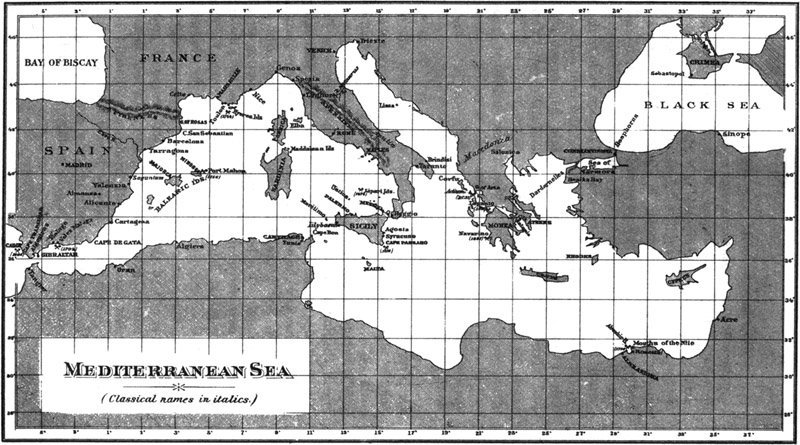
Mediterranean SeaToList
At the beginning of the war, Mommsen says, Rome controlled the seas. To whatever cause, or combination of causes, it be attributed, this essentially non-maritime state had in the first Punic War established over its sea-faring rival a naval supremacy, which still lasted. In the second war there was no naval battle of importance,—a circumstance which in itself, and still more in connection with other well-ascertained facts, indicates a superiority analogous to that which at other epochs has been marked by the same feature.
As Hannibal left no memoirs, the motives are unknown which determined him to the perilous and almost ruinous march through Gaul and across the Alps. It is certain, however, that his fleet on the coast of Spain was not strong enough to contend with that of Rome. Had it been, he might still have followed the road he actually did, for reasons that weighed with him; but had he gone by the sea, he would not have lost thirty-three thousand out of the sixty thousand veteran soldiers with whom he started.
While Hannibal was making this dangerous march, the Romans were sending to Spain, under the two elder Scipios, one part of their fleet, carrying a consular army. This made the voyage without serious loss, and the army established itself successfully north of the Ebro, on Hannibal's line of communications. At the same time another squadron, with an army commanded by the other consul, was sent to Sicily. The two together numbered two hundred and twenty ships. On its station each met and defeated a Carthaginian squadron with an ease which may be inferred from the slight mention made of the actions, and which indicates the actual superiority of the Roman fleet.
After the second year the war assumed the following shape: Hannibal, having entered Italy by the north, after a series of successes had passed southward around Rome and fixed himself in southern Italy, living off the country,—a condition which tended to alienate the people, and was especially precarious when in contact with the mighty political and military system of control which Rome had there established. It was therefore from the first urgently necessary that he should establish, between himself and some reliable base, that stream of supplies and reinforcements which in terms of modern war is called "communications." There were three friendly regions which might, each or all, serve as such a base,—Carthage itself, Macedonia, and Spain. With the first two, communication could be had only by sea. From Spain, where his firmest support was found, he could be reached by both land and sea, unless an enemy barred the passage; but the sea route was the shorter and easier.
In the first years of the war, Rome, by her sea power, controlled absolutely the basin between Italy, Sicily, and Spain, known as the Tyrrhenian and Sardinian Seas. The sea-coast from the Ebro to the Tiber was mostly friendly to her. In the fourth year, after the battle of Cannæ, Syracuse forsook the Roman alliance, the revolt spread through Sicily, and Macedonia also entered into an offensive league with Hannibal. These changes extended the necessary operations of the Roman fleet, and taxed its strength. What disposition was made of it, and how did it thereafter influence the struggle?
The indications are clear that Rome at no time ceased to control the Tyrrhenian Sea, for her squadrons passed unmolested from Italy to Spain. On the Spanish coast also she had full sway till the younger Scipio saw fit to lay up the fleet. In the Adriatic, a squadron and naval station were established at Brindisi to check Macedonia, which performed their task so well that not a soldier of the phalanxes ever set foot in Italy. "The want of a war fleet," says Mommsen, "paralyzed Philip in all his movements." Here the effect of Sea Power is not even a matter of inference.
In Sicily, the struggle centred about Syracuse. The fleets of Carthage and Rome met there, but the superiority evidently lay with the latter; for though the Carthaginians at times succeeded in throwing supplies into the city, they avoided meeting the Roman fleet in battle. With Lilybæum, Palermo, and Messina in its hands, the latter was well based in the north coast of the island. Access by the south was left open to the Carthaginians, and they were thus able to maintain the insurrection.
Putting these facts together, it is a reasonable inference, and supported by the whole tenor of the history, that the Roman sea power controlled the sea north of a line drawn from Tarragona in Spain to Lilybæum (the modern Marsala), at the west end of Sicily, thence round by the north side of the island through the straits of Messina down to Syracuse, and from there to Brindisi in the Adriatic. This control lasted, unshaken, throughout the war. It did not exclude maritime raids, large or small, such as have been spoken of; but it did forbid the sustained and secure communications of which Hannibal was in deadly need.
On the other hand, it seems equally plain that for the first ten years of the war the Roman fleet was not strong enough for sustained operations in the sea between Sicily and Carthage, nor indeed much to the south of the line indicated. When Hannibal started, he assigned such ships as he had to maintaining the communications between Spain and Africa, which the Romans did not then attempt to disturb.
The Roman sea power, therefore, threw Macedonia wholly out of the war. It did not keep Carthage from maintaining a useful and most harassing diversion in Sicily; but it did prevent her sending troops, when they would have been most useful, to her great general in Italy. How was it as to Spain?
Spain was the region upon which the father of Hannibal and Hannibal himself had based their intended invasion of Italy. For eighteen years before this began they had occupied the country, extending and consolidating their power, both political and military, with rare sagacity. They had raised, and trained in local wars, a large and now veteran army. Upon his own departure, Hannibal intrusted the government to his younger brother, Hasdrubal, who preserved toward him to the end a loyalty and devotion which he had no reason to hope from the faction-cursed mother-city in Africa.
At the time of his starting, the Carthaginian power in Spain was secured from Cadiz to the river Ebro. The region between this river and the Pyrenees was inhabited by tribes friendly to the Romans, but unable, in the absence of the latter, to oppose a successful resistance to Hannibal. He put them down, leaving eleven thousand soldiers under Hanno to keep military possession of the country, lest the Romans should establish themselves there, and thus disturb his communications with his base.
Cnæus Scipio, however, arrived on the spot by sea the same year with twenty thousand men, defeated Hanno, and occupied both the coast and interior north of the Ebro. The Romans thus held ground by which they entirely closed the road between Hannibal and reinforcements from Hasdrubal, and whence they could attack the Carthaginian power in Spain; while their own communications with Italy, being by water, were secured by their naval supremacy. They made a naval base at Tarragona, confronting that of Hasdrubal at Cartagena, and then invaded the Carthaginian dominions. The war in Spain went on under the elder Scipios, seemingly a side issue, with varying fortune for seven years; at the end of which time Hasdrubal inflicted upon them a crushing defeat, the two brothers were killed, and the Carthaginians nearly succeeded in breaking through to the Pyrenees with reinforcements for Hannibal. The attempt, however, was checked for the moment; and before it could be renewed, the fall of Capua released twelve thousand veteran Romans, who were sent to Spain under Claudius Nero, a man of exceptional ability, to whom was due later the most decisive military movement made by any Roman general during the Second Punic War. This seasonable reinforcement, which again assured the shaken grip on Hasdrubal's line of march, came by sea,—a way which, though most rapid and easy, was closed to the Carthaginians by the Roman navy.
Two years later the younger Publius Scipio, celebrated afterward as Africanus, received the command in Spain, and captured Cartagena by a combined military and naval attack; after which he took the most extraordinary step of breaking up his fleet and transferring the seamen to the army. Not contented to act merely as the "containing"[6] force against Hasdrubal by closing the passes of the Pyrenees, Scipio pushed forward into southern Spain, and fought a severe but indecisive battle on the Guadalquivir; after which Hasdrubal slipped away from him, hurried north, crossed the Pyrenees at their extreme west, and pressed on to Italy, where Hannibal's position was daily growing weaker, the natural waste of his army not being replaced.
The war had lasted ten years, when Hasdrubal, having met little loss on the way, entered Italy at the north. The troops he brought, could they be safely united with those under the command of the unrivalled Hannibal, might give a decisive turn to the war, for Rome herself was nearly exhausted; the iron links which bound her own colonies and the allied States to her were strained to the utmost, and some had already snapped. But the military position of the two brothers was also perilous in the extreme. One being at the river Metaurus, the other in Apulia, two hundred miles apart, each was confronted by a superior enemy, and both these Roman armies were between their separated opponents. This false situation, as well as the long delay of Hasdrubal's coming, was due to the Roman control of the sea, which throughout the war limited the mutual support of the Carthaginian brothers to the route through Gaul. At the very time that Hasdrubal was making his long and dangerous circuit by land, Scipio had sent eleven thousand men from Spain by sea to reinforce the army opposed to him. The upshot was that messengers from Hasdrubal to Hannibal, having to pass over so wide a belt of hostile country, fell into the hands of Claudius Nero, commanding the southern Roman army, who thus learned the route which Hasdrubal intended to take. Nero correctly appreciated the situation, and, escaping the vigilance of Hannibal, made a rapid march with eight thousand of his best troops to join the forces in the north. The junction being effected, the two consuls fell upon Hasdrubal in overwhelming numbers and destroyed his army; the Carthaginian leader himself falling in the battle. Hannibal's first news of the disaster was by the head of his brother being thrown into his camp. He is said to have exclaimed that Rome would now be mistress of the world; and the battle of Metaurus is generally accepted as decisive of the struggle between the two States.
The military situation which finally resulted in the battle of the Metaurus and the triumph of Rome may be summed up as follows: To overthrow Rome it was necessary to attack her in Italy at the heart of her power, and shatter the strongly linked confederacy of which she was the head. This was the objective. To reach it, the Carthaginians needed a solid base of operations and a secure line of communications. The former was established in Spain by the genius of the great Barca family; the latter was never achieved. There were two lines possible,—the one direct by sea, the other circuitous through Gaul. The first was blocked by the Roman sea power, the second imperilled and finally intercepted through the occupation of northern Spain by the Roman army. This occupation was made possible through the control of the sea, which the Carthaginians never endangered. With respect to Hannibal and his base, therefore, Rome occupied two central positions, Rome itself and northern Spain, joined by an easy interior line of communications, the sea; by which mutual support was continually given.
Had the Mediterranean been a level desert of land, in which the Romans held strong mountain ranges in Corsica and Sardinia, fortified posts at Tarragona, Lilybæum, and Messina, the Italian coast-line nearly to Genoa, and allied fortresses in Marseilles and other points; had they also possessed an armed force capable by its character of traversing that desert at will, but in which their opponents were very inferior and therefore compelled to a great circuit in order to concentrate their troops, the military situation would have been at once recognized, and no words would have been too strong to express the value and effect of that peculiar force. It would have been perceived, also, that the enemy's force of the same kind might, however inferior in strength, make an inroad, or raid, upon the territory thus held, might burn a village or waste a few miles of borderland, might even cut off a convoy at times, without, in a military sense, endangering the communications. Such predatory operations have been carried on in all ages by the weaker maritime belligerent, but they by no means warrant the inference, irreconcilable with the known facts, "that neither Rome nor Carthage could be said to have undisputed mastery of the sea," because "Roman fleets sometimes visited the coasts of Africa, and Carthaginian fleets in the same way appeared off the coast of Italy." In the case under consideration, the navy played the part of such a force upon the supposed desert; but as it acts on an element strange to most writers, as its members have been from time immemorial a strange race apart, without prophets of their own, neither themselves nor their calling understood, its immense determining influence upon the history of that era, and consequently upon the history of the world, has been overlooked. If the preceding argument is sound, it is as defective to omit sea power from the list of principal factors in the result, as it would be absurd to claim for it an exclusive influence.
Instances such as have been cited, drawn from widely separated periods of time, both before and after that specially treated in this work, serve to illustrate the intrinsic interest of the subject, and the character of the lessons which history has to teach. As before observed, these come more often under the head of strategy than of tactics; they bear rather upon the conduct of campaigns than of battles, and hence are fraught with more lasting value. To quote a great authority in this connection, Jomini says: "Happening to be in Paris near the end of 1851, a distinguished person did me the honor to ask my opinion as to whether recent improvements in firearms would cause any great modifications in the way of making war. I replied that they would probably have an influence upon the details of tactics, but that in great strategic operations and the grand combinations of battles, victory would, now as ever, result from the application of the principles which had led to the success of great generals in all ages; of Alexander and Cæsar, as well as of Frederick and Napoleon." This study has become more than ever important now to navies, because of the great and steady power of movement possessed by the modern steamer. The best-planned schemes might fail through stress of weather in the days of the galley and the sailing-ship; but this difficulty has almost disappeared. The principles which should direct great naval combinations have been applicable to all ages, and are deducible from history; but the power to carry them out with little regard to the weather is a recent gain.
The definitions usually given of the word "strategy" confine it to military combinations embracing one or more fields of operations, either wholly distinct or mutually dependent, but always regarded as actual or immediate scenes of war. However this may be on shore, a recent French author is quite right in pointing out that such a definition is too narrow for naval strategy. "This," he says, "differs from military strategy in that it is as necessary in peace as in war. Indeed, in peace it may gain its most decisive victories by occupying in a country, either by purchase or treaty, excellent positions which would perhaps hardly be got by war. It learns to profit by all opportunities of settling on some chosen point of a coast, and to render definitive an occupation which at first was only transient." A generation that has seen England within ten years occupy successively Cyprus and Egypt, under terms and conditions on their face transient, but which have not yet led to the abandonment of the positions taken, can readily agree with this remark; which indeed receives constant illustration from the quiet persistency with which all the great sea powers are seeking position after position, less noted and less noteworthy than Cyprus and Egypt, in the different seas to which their people and their ships penetrate. "Naval strategy has indeed for its end to found, support, and increase, as well in peace as in war, the sea power of a country;" and therefore its study has an interest and value for all citizens of a free country, but especially for those who are charged with its foreign and military relations.
The general conditions that either are essential to or powerfully affect the greatness of a nation upon the sea will now be examined; after which a more particular consideration of the various maritime nations of Europe at the middle of the seventeenth century, where the historical survey begins, will serve at once to illustrate and give precision to the conclusions upon the general subject.
Peninsula of India and Ceylon.ToList
Pl. I.ToList
Pl. II.ToList
Pl. III.ToList
Pl. IV.ToList
Pl. V. and Pl. Va.ToList
Pl. VI. and Pl. VIa.ToList
Pl. VII. and Pl. VIIa.ToList
Pl. VIII.ToList
Pl. IX.ToList
Pl. X.ToList
Pl. XI.ToList
Pl. XII.ToList
Pl. XIII.ToList
Pl. XIV.ToList
Pl. XV.ToList
Pl. XVI.ToList
Pl. XVII.ToList
Pl. XVIII.ToList
Pl. XIX.ToList
Pl. XX.ToList
Pl. XXI.ToList
[1] Thus Hermocrates of Syracuse, advocating the policy of thwarting the Athenian expedition against his city (B.C. 413) by going boldly to meet it, and keeping on the flank of its line of advance, said: "As their advance must be slow, we shall have a thousand opportunities to attack them; but if they clear their ships for action and in a body bear down expeditiously upon us, they must ply hard at their oars, and when spent with toil we can fall upon them."
[2] The writer must guard himself from appearing to advocate elaborate tactical movements issuing in barren demonstrations. He believes that a fleet seeking a decisive result must close with its enemy, but not until some advantage has been obtained for the collision, which will usually be gained by manœuvring, and will fall to the best drilled and managed fleet. In truth, barren results have as often followed upon headlong, close encounters as upon the most timid tactical trifling.
[3] A ship was said to have the weather-gage, or "the advantage of the wind," or "to be to windward," when the wind allowed her to steer for her opponent, and did not let the latter head straight for her. The extreme case was when the wind blew direct from one to the other; but there was a large space on either side of this line to which the term "weather-gage" applied. If the lee ship be taken as the centre of a circle, there were nearly three eighths of its area in which the other might be and still keep the advantage of the wind to a greater or less degree. Lee is the opposite of weather.
[4] See note at end of Introductory Chapter, page 23.
[5] The battle of Navarino (1827) between Turkey and the Western Powers was fought in this neighborhood.
[6] A "containing" force is one to which, in a military combination, is assigned the duty of stopping, or delaying the advance of a portion of the enemy, while the main effort of the army or armies is being exerted in a different quarter.
Note.—The brilliancy of Nelson's fame, dimming as it does that of all his contemporaries, and the implicit trust felt by England in him as the one man able to save her from the schemes of Napoleon, should not of course obscure the fact that only one portion of the field was, or could be, occupied by him. Napoleon's aim, in the campaign which ended at Trafalgar, was to unite in the West Indies the French fleets of Brest, Toulon, and Rochefort, together with a strong body of Spanish ships, thus forming an overwhelming force which he intended should return together to the English Channel and cover the crossing of the French army. He naturally expected that, with England's interests scattered all over the world, confusion and distraction would arise from ignorance of the destination of the French squadrons, and the English navy be drawn away from his objective point. The portion of the field committed to Nelson was the Mediterranean, where he watched the great arsenal of Toulon and the highways alike to the East and to the Atlantic. This was inferior in consequence to no other, and assumed additional importance in the eyes of Nelson from his conviction that the former attempts on Egypt would be renewed. Owing to this persuasion he took at first a false step, which delayed his pursuit of the Toulon fleet when it sailed under the command of Villeneuve; and the latter was further favored by a long continuance of fair winds, while the English had head winds. But while all this is true, while the failure of Napoleon's combinations must be attributed to the tenacious grip of the English blockade off Brest, as well as to Nelson's energetic pursuit of the Toulon fleet when it escaped to the West Indies and again on its hasty return to Europe, the latter is fairly entitled to the eminent distinction which history has accorded it, and which is asserted in the text. Nelson did not, indeed, fathom the intentions of Napoleon. This may have been owing, as some have said, to lack of insight; but it may be more simply laid to the usual disadvantage under which the defence lies before the blow has fallen, of ignorance as to the point threatened by the offence. It is insight enough to fasten on the key of a situation; and this Nelson rightly saw was the fleet, not the station. Consequently, his action has afforded a striking instance of how tenacity of purpose and untiring energy in execution can repair a first mistake and baffle deeply laid plans. His Mediterranean command embraced many duties and cares; but amid and dominating them all, he saw clearly the Toulon fleet as the controlling factor there, and an important factor in any naval combination of the Emperor. Hence his attention was unwaveringly fixed upon it; so much so that he called it "his fleet," a phrase which has somewhat vexed the sensibilities of French critics. This simple and accurate view of the military situation strengthened him in taking the fearless resolution and bearing the immense responsibility of abandoning his station in order to follow "his fleet." Determined thus on a pursuit the undeniable wisdom of which should not obscure the greatness of mind that undertook it, he followed so vigorously as to reach Cadiz on his return a week before Villeneuve entered Ferrol, despite unavoidable delays arising from false information and uncertainty as to the enemy's movements. The same untiring ardor enabled him to bring up his own ships from Cadiz to Brest in time to make the fleet there superior to Villeneuve's, had the latter persisted in his attempt to reach the neighborhood. The English, very inferior in aggregate number of vessels to the allied fleets, were by this seasonable reinforcement of eight veteran ships put into the best possible position strategically, as will be pointed out in dealing with similar conditions in the war of the American Revolution. Their forces were united in one great fleet in the Bay of Biscay, interposed between the two divisions of the enemy in Brest and Ferrol, superior in number to either singly, and with a strong probability of being able to deal with one before the other could come up. This was due to able action all round on the part of the English authorities; but above all other factors in the result stands Nelson's single-minded pursuit of "his fleet."
This interesting series of strategic movements ended on the 14th of August, when Villeneuve, in despair of reaching Brest, headed for Cadiz, where he anchored on the 20th. As soon as Napoleon heard of this, after an outburst of rage against the admiral, he at once dictated the series of movements which resulted in Ulm and Austerlitz, abandoning his purposes against England. The battle of Trafalgar, fought October 21, was therefore separated by a space of two months from the extensive movements of which it was nevertheless the outcome. Isolated from them in point of time, it was none the less the seal of Nelson's genius, affixed later to the record he had made in the near past. With equal truth it is said that England was saved at Trafalgar, though the Emperor had then given up his intended invasion; the destruction there emphasized and sealed the strategic triumph which had noiselessly foiled Napoleon's plans.
FOOTNOTES:
[1] Thus Hermocrates of Syracuse, advocating the policy of thwarting the Athenian expedition against his city (B.C. 413) by going boldly to meet it, and keeping on the flank of its line of advance, said: "As their advance must be slow, we shall have a thousand opportunities to attack them; but if they clear their ships for action and in a body bear down expeditiously upon us, they must ply hard at their oars, and when spent with toil we can fall upon them."
[2] The writer must guard himself from appearing to advocate elaborate tactical movements issuing in barren demonstrations. He believes that a fleet seeking a decisive result must close with its enemy, but not until some advantage has been obtained for the collision, which will usually be gained by manœuvring, and will fall to the best drilled and managed fleet. In truth, barren results have as often followed upon headlong, close encounters as upon the most timid tactical trifling.
[3] A ship was said to have the weather-gage, or "the advantage of the wind," or "to be to windward," when the wind allowed her to steer for her opponent, and did not let the latter head straight for her. The extreme case was when the wind blew direct from one to the other; but there was a large space on either side of this line to which the term "weather-gage" applied. If the lee ship be taken as the centre of a circle, there were nearly three eighths of its area in which the other might be and still keep the advantage of the wind to a greater or less degree. Lee is the opposite of weather.
[4] See note at end of Introductory Chapter, page 23.
[5] The battle of Navarino (1827) between Turkey and the Western Powers was fought in this neighborhood.
[6] A "containing" force is one to which, in a military combination, is assigned the duty of stopping, or delaying the advance of a portion of the enemy, while the main effort of the army or armies is being exerted in a different quarter.
CHAPTER I.ToC
Discussion of the Elements of Sea Power.
The first and most obvious light in which the sea presents itself from the political and social point of view is that of a great highway; or better, perhaps, of a wide common, over which men may pass in all directions, but on which some well-worn paths show that controlling reasons have led them to choose certain lines of travel rather than others. These lines of travel are called trade routes; and the reasons which have determined them are to be sought in the history of the world.
Notwithstanding all the familiar and unfamiliar dangers of the sea, both travel and traffic by water have always been easier and cheaper than by land. The commercial greatness of Holland was due not only to her shipping at sea, but also to the numerous tranquil water-ways which gave such cheap and easy access to her own interior and to that of Germany. This advantage of carriage by water over that by land was yet more marked in a period when roads were few and very bad, wars frequent and society unsettled, as was the case two hundred years ago. Sea traffic then went in peril of robbers, but was nevertheless safer and quicker than that by land. A Dutch writer of that time, estimating the chances of his country in a war with England, notices among other things that the water-ways of England failed to penetrate the country sufficiently; therefore, the roads being bad, goods from one part of the kingdom to the other must go by sea, and be exposed to capture by the way. As regards purely internal trade, this danger has generally disappeared at the present day. In most civilized countries, now, the destruction or disappearance of the coasting trade would only be an inconvenience, although water transit is still the cheaper. Nevertheless, as late as the wars of the French Republic and the First Empire, those who are familiar with the history of the period, and the light naval literature that has grown up around it, know how constant is the mention of convoys stealing from point to point along the French coast, although the sea swarmed with English cruisers and there were good inland roads.
Under modern conditions, however, home trade is but a part of the business of a country bordering on the sea. Foreign necessaries or luxuries must be brought to its ports, either in its own or in foreign ships, which will return, bearing in exchange the products of the country, whether they be the fruits of the earth or the works of men's hands; and it is the wish of every nation that this shipping business should be done by its own vessels. The ships that thus sail to and fro must have secure ports to which to return, and must, as far as possible, be followed by the protection of their country throughout the voyage.
This protection in time of war must be extended by armed shipping. The necessity of a navy, in the restricted sense of the word, springs, therefore, from the existence of a peaceful shipping, and disappears with it, except in the case of a nation which has aggressive tendencies, and keeps up a navy merely as a branch of the military establishment. As the United States has at present no aggressive purposes, and as its merchant service has disappeared, the dwindling of the armed fleet and general lack of interest in it are strictly logical consequences. When for any reason sea trade is again found to pay, a large enough shipping interest will reappear to compel the revival of the war fleet. It is possible that when a canal route through the Central-American Isthmus is seen to be a near certainty, the aggressive impulse may be strong enough to lead to the same result. This is doubtful, however, because a peaceful, gain-loving nation is not far-sighted, and far-sightedness is needed for adequate military preparation, especially in these days.
As a nation, with its unarmed and armed shipping, launches forth from its own shores, the need is soon felt of points upon which the ships can rely for peaceful trading, for refuge and supplies. In the present day friendly, though foreign, ports are to be found all over the world; and their shelter is enough while peace prevails. It was not always so, nor does peace always endure, though the United States have been favored by so long a continuance of it. In earlier times the merchant seaman, seeking for trade in new and unexplored regions, made his gains at risk of life and liberty from suspicious or hostile nations, and was under great delays in collecting a full and profitable freight. He therefore intuitively sought at the far end of his trade route one or more stations, to be given to him by force or favor, where he could fix himself or his agents in reasonable security, where his ships could lie in safety, and where the merchantable products of the land could be continually collecting, awaiting the arrival of the home fleet, which should carry them to the mother-country. As there was immense gain, as well as much risk, in these early voyages, such establishments naturally multiplied and grew until they became colonies; whose ultimate development and success depended upon the genius and policy of the nation from which they sprang, and form a very great part of the history, and particularly of the sea history, of the world. All colonies had not the simple and natural birth and growth above described. Many were more formal, and purely political, in their conception and founding, the act of the rulers of the people rather than of private individuals; but the trading-station with its after expansion, the work simply of the adventurer seeking gain, was in its reasons and essence the same as the elaborately organized and chartered colony. In both cases the mother-country had won a foothold in a foreign land, seeking a new outlet for what it had to sell, a new sphere for its shipping, more employment for its people, more comfort and wealth for itself.
The needs of commerce, however, were not all provided for when safety had been secured at the far end of the road. The voyages were long and dangerous, the seas often beset with enemies. In the most active days of colonizing there prevailed on the sea a lawlessness the very memory of which is now almost lost, and the days of settled peace between maritime nations were few and far between. Thus arose the demand for stations along the road, like the Cape of Good Hope, St. Helena, and Mauritius, not primarily for trade, but for defence and war; the demand for the possession of posts like Gibraltar, Malta, Louisburg, at the entrance of the Gulf of St. Lawrence,—posts whose value was chiefly strategic, though not necessarily wholly so. Colonies and colonial posts were sometimes commercial, sometimes military in their character; and it was exceptional that the same position was equally important in both points of view, as New York was.
In these three things—production, with the necessity of exchanging products, shipping, whereby the exchange is carried on, and colonies, which facilitate and enlarge the operations of shipping and tend to protect it by multiplying points of safety—is to be found the key to much of the history, as well as of the policy, of nations bordering upon the sea. The policy has varied both with the spirit of the age and with the character and clear-sightedness of the rulers; but the history of the seaboard nations has been less determined by the shrewdness and foresight of governments than by conditions of position, extent, configuration, number and character of their people,—by what are called, in a word, natural conditions. It must however be admitted, and will be seen, that the wise or unwise action of individual men has at certain periods had a great modifying influence upon the growth of sea power in the broad sense, which includes not only the military strength afloat, that rules the sea or any part of it by force of arms, but also the peaceful commerce and shipping from which alone a military fleet naturally and healthfully springs, and on which it securely rests.
The principal conditions affecting the sea power of nations may be enumerated as follows: I. Geographical Position. II. Physical Conformation, including, as connected therewith, natural productions and climate. III. Extent of Territory. IV. Number of Population. V. Character of the People. VI. Character of the Government, including therein the national institutions.
I. Geographical Position.—It may be pointed out, in the first place, that if a nation be so situated that it is neither forced to defend itself by land nor induced to seek extension of its territory by way of the land, it has, by the very unity of its aim directed upon the sea, an advantage as compared with a people one of whose boundaries is continental. This has been a great advantage to England over both France and Holland as a sea power. The strength of the latter was early exhausted by the necessity of keeping up a large army and carrying on expensive wars to preserve her independence; while the policy of France was constantly diverted, sometimes wisely and sometimes most foolishly, from the sea to projects of continental extension. These military efforts expended wealth; whereas a wiser and consistent use of her geographical position would have added to it.
The geographical position may be such as of itself to promote a concentration, or to necessitate a dispersion, of the naval forces. Here again the British Islands have an advantage over France. The position of the latter, touching the Mediterranean as well as the ocean, while it has its advantages, is on the whole a source of military weakness at sea. The eastern and western French fleets have only been able to unite after passing through the Straits of Gibraltar, in attempting which they have often risked and sometimes suffered loss. The position of the United States upon the two oceans would be either a source of great weakness or a cause of enormous expense, had it a large sea commerce on both coasts.
England, by her immense colonial empire, has sacrificed much of this advantage of concentration of force around her own shores; but the sacrifice was wisely made, for the gain was greater than the loss, as the event proved. With the growth of her colonial system her war fleets also grew, but her merchant shipping and wealth grew yet faster. Still, in the wars of the American Revolution, and of the French Republic and Empire, to use the strong expression of a French author, "England, despite the immense development of her navy, seemed ever, in the midst of riches, to feel all the embarrassment of poverty." The might of England was sufficient to keep alive the heart and the members; whereas the equally extensive colonial empire of Spain, through her maritime weakness, but offered so many points for insult and injury.
The geographical position of a country may not only favor the concentration of its forces, but give the further strategic advantage of a central position and a good base for hostile operations against its probable enemies. This again is the case with England; on the one hand she faces Holland and the northern powers, on the other France and the Atlantic. When threatened with a coalition between France and the naval powers of the North Sea and the Baltic, as she at times was, her fleets in the Downs and in the Channel, and even that off Brest, occupied interior positions, and thus were readily able to interpose their united force against either one of the enemies which should seek to pass through the Channel to effect a junction with its ally. On either side, also, Nature gave her better ports and a safer coast to approach. Formerly this was a very serious element in the passage through the Channel; but of late, steam and the improvement of her harbors have lessened the disadvantage under which France once labored. In the days of sailing-ships, the English fleet operated against Brest making its base at Torbay and Plymouth. The plan was simply this: in easterly or moderate weather the blockading fleet kept its position without difficulty; but in westerly gales, when too severe, they bore up for English ports, knowing that the French fleet could not get out till the wind shifted, which equally served to bring them back to their station.
The advantage of geographical nearness to an enemy, or to the object of attack, is nowhere more apparent than in that form of warfare which has lately received the name of commerce-destroying, which the French call guerre de course. This operation of war, being directed against peaceful merchant vessels which are usually defenceless, calls for ships of small military force. Such ships, having little power to defend themselves, need a refuge or point of support near at hand; which will be found either in certain parts of the sea controlled by the fighting ships of their country, or in friendly harbors. The latter give the strongest support, because they are always in the same place, and the approaches to them are more familiar to the commerce-destroyer than to his enemy. The nearness of France to England has thus greatly facilitated her guerre de course directed against the latter. Having ports on the North Sea, on the Channel, and on the Atlantic, her cruisers started from points near the focus of English trade, both coming and going. The distance of these ports from each other, disadvantageous for regular military combinations, is an advantage for this irregular secondary operation; for the essence of the one is concentration of effort, whereas for commerce-destroying diffusion of effort is the rule. Commerce-destroyers scatter, that they may see and seize more prey. These truths receive illustration from the history of the great French privateers, whose bases and scenes of action were largely on the Channel and North Sea, or else were found in distant colonial regions, where islands like Guadaloupe and Martinique afforded similar near refuge. The necessity of renewing coal makes the cruiser of the present day even more dependent than of old on his port. Public opinion in the United States has great faith in war directed against an enemy's commerce; but it must be remembered that the Republic has no ports very near the great centres of trade abroad. Her geographical position is therefore singularly disadvantageous for carrying on successful commerce-destroying, unless she find bases in the ports of an ally.
If, in addition to facility for offence, Nature has so placed a country that it has easy access to the high sea itself, while at the same time it controls one of the great thoroughfares of the world's traffic, it is evident that the strategic value of its position is very high. Such again is, and to a greater degree was, the position of England. The trade of Holland, Sweden, Russia, Denmark, and that which went up the great rivers to the interior of Germany, had to pass through the Channel close by her doors; for sailing-ships hugged the English coast. This northern trade had, moreover, a peculiar bearing upon sea power; for naval stores, as they are commonly called, were mainly drawn from the Baltic countries.
But for the loss of Gibraltar, the position of Spain would have been closely analogous to that of England. Looking at once upon the Atlantic and the Mediterranean, with Cadiz on the one side and Cartagena on the other, the trade to the Levant must have passed under her hands, and that round the Cape of Good Hope not far from her doors. But Gibraltar not only deprived her of the control of the Straits, it also imposed an obstacle to the easy junction of the two divisions of her fleet.
At the present day, looking only at the geographical position of Italy, and not at the other conditions affecting her sea power, it would seem that with her extensive sea-coast and good ports she is very well placed for exerting a decisive influence on the trade route to the Levant and by the Isthmus of Suez. This is true in a degree, and would be much more so did Italy now hold all the islands naturally Italian; but with Malta in the hands of England, and Corsica in those of France, the advantages of her geographical position are largely neutralized. From race affinities and situation those two islands are as legitimately objects of desire to Italy as Gibraltar is to Spain. If the Adriatic were a great highway of commerce, Italy's position would be still more influential. These defects in her geographical completeness, combined with other causes injurious to a full and secure development of sea power, make it more than doubtful whether Italy can for some time be in the front rank among the sea nations.
As the aim here is not an exhaustive discussion, but merely an attempt to show, by illustration, how vitally the situation of a country may affect its career upon the sea, this division of the subject may be dismissed for the present; the more so as instances which will further bring out its importance will continually recur in the historical treatment. Two remarks, however, are here appropriate.
Circumstances have caused the Mediterranean Sea to play a greater part in the history of the world, both in a commercial and a military point of view, than any other sheet of water of the same size. Nation after nation has striven to control it, and the strife still goes on. Therefore a study of the conditions upon which preponderance in its waters has rested, and now rests, and of the relative military values of different points upon its coasts, will be more instructive than the same amount of effort expended in another field. Furthermore, it has at the present time a very marked analogy in many respects to the Caribbean Sea,—an analogy which will be still closer if a Panama canal-route ever be completed. A study of the strategic conditions of the Mediterranean, which have received ample illustration, will be an excellent prelude to a similar study of the Caribbean, which has comparatively little history.
The second remark bears upon the geographical position of the United States relatively to a Central-American canal. If one be made, and fulfil the hopes of its builders, the Caribbean will be changed from a terminus, and place of local traffic, or at best a broken and imperfect line of travel, as it now is, into one of the great highways of the world. Along this path a great commerce will travel, bringing the interests of the other great nations, the European nations, close along our shores, as they have never been before. With this it will not be so easy as heretofore to stand aloof from international complications. The position of the United States with reference to this route will resemble that of England to the Channel, and of the Mediterranean countries to the Suez route. As regards influence and control over it, depending upon geographical position, it is of course plain that the centre of the national power, the permanent base,[7] is much nearer than that of other great nations. The positions now or hereafter occupied by them on island or mainland, however strong, will be but outposts of their power; while in all the raw materials of military strength no nation is superior to the United States. She is, however, weak in a confessed unpreparedness for war; and her geographical nearness to the point of contention loses some of its value by the character of the Gulf coast, which is deficient in ports combining security from an enemy with facility for repairing war-ships of the first class, without which ships no country can pretend to control any part of the sea. In case of a contest for supremacy in the Caribbean, it seems evident from the depth of the South Pass of the Mississippi, the nearness of New Orleans, and the advantages of the Mississippi Valley for water transit, that the main effort of the country must pour down that valley, and its permanent base of operations be found there. The defence of the entrance to the Mississippi, however, presents peculiar difficulties; while the only two rival ports, Key West and Pensacola, have too little depth of water, and are much less advantageously placed with reference to the resources of the country. To get the full benefit of superior geographical position, these defects must be overcome. Furthermore, as her distance from the Isthmus, though relatively less, is still considerable, the United States will have to obtain in the Caribbean stations fit for contingent, or secondary, bases of operations; which by their natural advantages, susceptibility of defence, and nearness to the central strategic issue, will enable her fleets to remain as near the scene as any opponent. With ingress and egress from the Mississippi sufficiently protected, with such outposts in her hands, and with the communications between them and the home base secured, in short, with proper military preparation, for which she has all necessary means, the preponderance of the United States on this field follows, from her geographical position and her power, with mathematical certainty.
II. Physical Conformation.—The peculiar features of the Gulf coast, just alluded to, come properly under the head of Physical Conformation of a country, which is placed second for discussion among the conditions which affect the development of sea power.
The seaboard of a country is one of its frontiers; and the easier the access offered by the frontier to the region beyond, in this case the sea, the greater will be the tendency of a people toward intercourse with the rest of the world by it. If a country be imagined having a long seaboard, but entirely without a harbor, such a country can have no sea trade of its own, no shipping, no navy. This was practically the case with Belgium when it was a Spanish and an Austrian province. The Dutch, in 1648, as a condition of peace after a successful war, exacted that the Scheldt should be closed to sea commerce. This closed the harbor of Antwerp and transferred the sea trade of Belgium to Holland. The Spanish Netherlands ceased to be a sea power.
Numerous and deep harbors are a source of strength and wealth, and doubly so if they are the outlets of navigable streams, which facilitate the concentration in them of a country's internal trade; but by their very accessibility they become a source of weakness in war, if not properly defended. The Dutch in 1667 found little difficulty in ascending the Thames and burning a large fraction of the English navy within sight of London; whereas a few years later the combined fleets of England and France, when attempting a landing in Holland, were foiled by the difficulties of the coast as much as by the valor of the Dutch fleet. In 1778 the harbor of New York, and with it undisputed control of the Hudson River, would have been lost to the English, who were caught at disadvantage, but for the hesitancy of the French admiral. With that control, New England would have been restored to close and safe communication with New York, New Jersey, and Pennsylvania; and this blow, following so closely on Burgoyne's disaster of the year before, would probably have led the English to make an earlier peace. The Mississippi is a mighty source of wealth and strength to the United States; but the feeble defences of its mouth and the number of its subsidiary streams penetrating the country made it a weakness and source of disaster to the Southern Confederacy. And lastly, in 1814, the occupation of the Chesapeake and the destruction of Washington gave a sharp lesson of the dangers incurred through the noblest water-ways, if their approaches be undefended; a lesson recent enough to be easily recalled, but which, from the present appearance of the coast defences, seems to be yet more easily forgotten. Nor should it be thought that conditions have changed; circumstances and details of offence and defence have been modified, in these days as before, but the great conditions remain the same.
Before and during the great Napoleonic wars, France had no port for ships-of-the-line east of Brest. How great the advantage to England, which in the same stretch has two great arsenals, at Plymouth and at Portsmouth, besides other harbors of refuge and supply. This defect of conformation has since been remedied by the works at Cherbourg.
Besides the contour of the coast, involving easy access to the sea, there are other physical conditions which lead people to the sea or turn them from it. Although France was deficient in military ports on the Channel, she had both there and on the ocean, as well as in the Mediterranean, excellent harbors, favorably situated for trade abroad, and at the outlet of large rivers, which would foster internal traffic. But when Richelieu had put an end to civil war, Frenchmen did not take to the sea with the eagerness and success of the English and Dutch. A principal reason for this has been plausibly found in the physical conditions which have made France a pleasant land, with a delightful climate, producing within itself more than its people needed. England, on the other hand, received from Nature but little, and, until her manufactures were developed, had little to export. Their many wants, combined with their restless activity and other conditions that favored maritime enterprise, led her people abroad; and they there found lands more pleasant and richer than their own. Their needs and genius made them merchants and colonists, then manufacturers and producers; and between products and colonies shipping is the inevitable link. So their sea power grew. But if England was drawn to the sea, Holland was driven to it; without the sea England languished, but Holland died. In the height of her greatness, when she was one of the chief factors in European politics, a competent native authority estimated that the soil of Holland could not support more than one eighth of her inhabitants. The manufactures of the country were then numerous and important, but they had been much later in their growth than the shipping interest. The poverty of the soil and the exposed nature of the coast drove the Dutch first to fishing. Then the discovery of the process of curing the fish gave them material for export as well as home consumption, and so laid the corner-stone of their wealth. Thus they had become traders at the time that the Italian republics, under the pressure of Turkish power and the discovery of the passage round the Cape of Good Hope, were beginning to decline, and they fell heirs to the great Italian trade of the Levant. Further favored by their geographical position, intermediate between the Baltic, France, and the Mediterranean, and at the mouth of the German rivers, they quickly absorbed nearly all the carrying-trade of Europe. The wheat and naval stores of the Baltic, the trade of Spain with her colonies in the New World, the wines of France, and the French coasting-trade were, little more than two hundred years ago, transported in Dutch shipping. Much of the carrying-trade of England, even, was then done in Dutch bottoms. It will not be pretended that all this prosperity proceeded only from the poverty of Holland's natural resources. Something does not grow from nothing. What is true, is, that by the necessitous condition of her people they were driven to the sea, and were, from their mastery of the shipping business and the size of their fleets, in a position to profit by the sudden expansion of commerce and the spirit of exploration which followed on the discovery of America and of the passage round the Cape. Other causes concurred, but their whole prosperity stood on the sea power to which their poverty gave birth. Their food, their clothing, the raw material for their manufactures, the very timber and hemp with which they built and rigged their ships (and they built nearly as many as all Europe besides), were imported; and when a disastrous war with England in 1653 and 1654 had lasted eighteen months, and their shipping business was stopped, it is said "the sources of revenue which had always maintained the riches of the State, such as fisheries and commerce, were almost dry. Workshops were closed, work was suspended. The Zuyder Zee became a forest of masts; the country was full of beggars; grass grew in the streets, and in Amsterdam fifteen hundred houses were untenanted." A humiliating peace alone saved them from ruin.
This sorrowful result shows the weakness of a country depending wholly upon sources external to itself for the part it is playing in the world. With large deductions, owing to differences of conditions which need not here be spoken of, the case of Holland then has strong points of resemblance to that of Great Britain now; and they are true prophets, though they seem to be having small honor in their own country, who warn her that the continuance of her prosperity at home depends primarily upon maintaining her power abroad. Men may be discontented at the lack of political privilege; they will be yet more uneasy if they come to lack bread. It is of more interest to Americans to note that the result to France, regarded as a power of the sea, caused by the extent, delightfulness, and richness of the land, has been reproduced in the United States. In the beginning, their forefathers held a narrow strip of land upon the sea, fertile in parts though little developed, abounding in harbors and near rich fishing-grounds. These physical conditions combined with an inborn love of the sea, the pulse of that English blood which still beat in their veins, to keep alive all those tendencies and pursuits upon which a healthy sea power depends. Almost every one of the original colonies was on the sea or on one of its great tributaries. All export and import tended toward one coast. Interest in the sea and an intelligent appreciation of the part it played in the public welfare were easily and widely spread; and a motive more influential than care for the public interest was also active, for the abundance of ship-building materials and a relative fewness of other investments made shipping a profitable private interest. How changed the present condition is, all know. The centre of power is no longer on the seaboard. Books and newspapers vie with one another in describing the wonderful growth, and the still undeveloped riches, of the interior. Capital there finds its best investments, labor its largest opportunities. The frontiers are neglected and politically weak; the Gulf and Pacific coasts actually so, the Atlantic coast relatively to the central Mississippi Valley. When the day comes that shipping again pays, when the three sea frontiers find that they are not only militarily weak, but poorer for lack of national shipping, their united efforts may avail to lay again the foundations of our sea power. Till then, those who follow the limitations which lack of sea power placed upon the career of France may mourn that their own country is being led, by a like redundancy of home wealth, into the same neglect of that great instrument.
Among modifying physical conditions may be noted a form like that of Italy,—a long peninsula, with a central range of mountains dividing it into two narrow strips, along which the roads connecting the different ports necessarily run. Only an absolute control of the sea can wholly secure such communications, since it is impossible to know at what point an enemy coming from beyond the visible horizon may strike; but still, with an adequate naval force centrally posted, there will be good hope of attacking his fleet, which is at once his base and line of communications, before serious damage has been done. The long, narrow peninsula of Florida, with Key West at its extremity, though flat and thinly populated, presents at first sight conditions like those of Italy. The resemblance may be only superficial, but it seems probable that if the chief scene of a naval war were the Gulf of Mexico, the communications by land to the end of the peninsula might be a matter of consequence, and open to attack.
When the sea not only borders, or surrounds, but also separates a country into two or more parts, the control of it becomes not only desirable, but vitally necessary. Such a physical condition either gives birth and strength to sea power, or makes the country powerless. Such is the condition of the present kingdom of Italy, with its islands of Sardinia and Sicily; and hence in its youth and still existing financial weakness it is seen to put forth such vigorous and intelligent efforts to create a military navy. It has even been argued that, with a navy decidedly superior to her enemy's, Italy could better base her power upon her islands than upon her mainland; for the insecurity of the lines of communication in the peninsula, already pointed out, would most seriously embarrass an invading army surrounded by a hostile people and threatened from the sea.
The Irish Sea, separating the British Islands, rather resembles an estuary than an actual division; but history has shown the danger from it to the United Kingdom. In the days of Louis XIV., when the French navy nearly equalled the combined English and Dutch, the gravest complications existed in Ireland, which passed almost wholly under the control of the natives and the French. Nevertheless, the Irish Sea was rather a danger to the English—a weak point in their communications—than an advantage to the French. The latter did not venture their ships-of-the-line in its narrow waters, and expeditions intending to land were directed upon the ocean ports in the south and west. At the supreme moment the great French fleet was sent upon the south coast of England, where it decisively defeated the allies, and at the same time twenty-five frigates were sent to St. George's Channel, against the English communications. In the midst of a hostile people, the English army in Ireland was seriously imperilled, but was saved by the battle of the Boyne and the flight of James II. This movement against the enemy's communications was strictly strategic, and would be just as dangerous to England now as in 1690.
Spain, in the same century, afforded an impressive lesson of the weakness caused by such separation when the parts are not knit together by a strong sea power. She then still retained, as remnants of her past greatness, the Netherlands (now Belgium), Sicily, and other Italian possessions, not to speak of her vast colonies in the New World. Yet so low had the Spanish sea power fallen, that a well-informed and sober-minded Hollander of the day could claim that "in Spain all the coast is navigated by a few Dutch ships; and since the peace of 1648 their ships and seamen are so few that they have publicly begun to hire our ships to sail to the Indies, whereas they were formerly careful to exclude all foreigners from there.... It is manifest," he goes on, "that the West Indies, being as the stomach to Spain (for from it nearly all the revenue is drawn), must be joined to the Spanish head by a sea force; and that Naples and the Netherlands, being like two arms, they cannot lay out their strength for Spain, nor receive anything thence but by shipping,—all which may easily be done by our shipping in peace, and by it obstructed in war." Half a century before, Sully, the great minister of Henry IV., had characterized Spain "as one of those States whose legs and arms are strong and powerful, but the heart infinitely weak and feeble." Since his day the Spanish navy had suffered not only disaster, but annihilation; not only humiliation, but degradation. The consequences briefly were that shipping was destroyed; manufactures perished with it. The government depended for its support, not upon a wide-spread healthy commerce and industry that could survive many a staggering blow, but upon a narrow stream of silver trickling through a few treasure-ships from America, easily and frequently intercepted by an enemy's cruisers. The loss of half a dozen galleons more than once paralyzed its movements for a year. While the war in the Netherlands lasted, the Dutch control of the sea forced Spain to send her troops by a long and costly journey overland instead of by sea; and the same cause reduced her to such straits for necessaries that, by a mutual arrangement which seems very odd to modern ideas, her wants were supplied by Dutch ships, which thus maintained the enemies of their country, but received in return specie which was welcome in the Amsterdam exchange. In America, the Spanish protected themselves as best they might behind masonry, unaided from home; while in the Mediterranean they escaped insult and injury mainly through the indifference of the Dutch, for the French and English had not yet begun to contend for mastery there. In the course of history the Netherlands, Naples, Sicily, Minorca, Havana, Manila, and Jamaica were wrenched away, at one time or another, from this empire without a shipping. In short, while Spain's maritime impotence may have been primarily a symptom of her general decay, it became a marked factor in precipitating her into the abyss from which she has not yet wholly emerged.
Except Alaska, the United States has no outlying possession,—no foot of ground inaccessible by land. Its contour is such as to present few points specially weak from their saliency, and all important parts of the frontiers can be readily attained,—cheaply by water, rapidly by rail. The weakest frontier, the Pacific, is far removed from the most dangerous of possible enemies. The internal resources are boundless as compared with present needs; we can live off ourselves indefinitely in "our little corner," to use the expression of a French officer to the author. Yet should that little corner be invaded by a new commercial route through the Isthmus, the United States in her turn may have the rude awakening of those who have abandoned their share in the common birthright of all people, the sea.
III. Extent of Territory.—The last of the conditions affecting the development of a nation as a sea power, and touching the country itself as distinguished from the people who dwell there, is Extent of Territory. This may be dismissed with comparatively few words.
As regards the development of sea power, it is not the total number of square miles which a country contains, but the length of its coast-line and the character of its harbors that are to be considered. As to these it is to be said that, the geographical and physical conditions being the same, extent of sea-coast is a source of strength or weakness according as the population is large or small. A country is in this like a fortress; the garrison must be proportioned to the enceinte. A recent familiar instance is found in the American War of Secession. Had the South had a people as numerous as it was warlike, and a navy commensurate to its other resources as a sea power, the great extent of its sea-coast and its numerous inlets would have been elements of great strength. The people of the United States and the Government of that day justly prided themselves on the effectiveness of the blockade of the whole Southern coast. It was a great feat, a very great feat; but it would have been an impossible feat had the Southerners been more numerous, and a nation of seamen. What was there shown was not, as has been said, how such a blockade can be maintained, but that such a blockade is possible in the face of a population not only unused to the sea, but also scanty in numbers. Those who recall how the blockade was maintained, and the class of ships that blockaded during great part of the war, know that the plan, correct under the circumstances, could not have been carried out in the face of a real navy. Scattered unsupported along the coast, the United States ships kept their places, singly or in small detachments, in face of an extensive network of inland water communications which favored secret concentration of the enemy. Behind the first line of water communications were long estuaries, and here and there strong fortresses, upon either of which the enemy's ships could always fall back to elude pursuit or to receive protection. Had there been a Southern navy to profit by such advantages, or by the scattered condition of the United States ships, the latter could not have been distributed as they were; and being forced to concentrate for mutual support, many small but useful approaches would have been left open to commerce. But as the Southern coast, from its extent and many inlets, might have been a source of strength, so, from those very characteristics, it became a fruitful source of injury. The great story of the opening of the Mississippi is but the most striking illustration of an action that was going on incessantly all over the South. At every breach of the sea frontier, war-ships were entering. The streams that had carried the wealth and supported the trade of the seceding States turned against them, and admitted their enemies to their hearts. Dismay, insecurity, paralysis, prevailed in regions that might, under happier auspices, have kept a nation alive through the most exhausting war. Never did sea power play a greater or a more decisive part than in the contest which determined that the course of the world's history would be modified by the existence of one great nation, instead of several rival States, in the North American continent. But while just pride is felt in the well-earned glory of those days, and the greatness of the results due to naval preponderance is admitted, Americans who understand the facts should never fail to remind the over-confidence of their countrymen that the South not only had no navy, not only was not a seafaring people, but that also its population was not proportioned to the extent of the sea-coast which it had to defend.
IV. Number of Population.—After the consideration of the natural conditions of a country should follow an examination of the characteristics of its population as affecting the development of sea power; and first among these will be taken, because of its relations to the extent of the territory, which has just been discussed, the number of the people who live in it. It has been said that in respect of dimensions it is not merely the number of square miles, but the extent and character of the sea-coast that is to be considered with reference to sea power; and so, in point of population, it is not only the grand total, but the number following the sea, or at least readily available for employment on ship-board and for the creation of naval material, that must be counted.
For example, formerly and up to the end of the great wars following the French Revolution, the population of France was much greater than that of England; but in respect of sea power in general, peaceful commerce as well as military efficiency, France was much inferior to England. In the matter of military efficiency this fact is the more remarkable because at times, in point of military preparation at the outbreak of war, France had the advantage; but she was not able to keep it. Thus in 1778, when war broke out, France, through her maritime inscription, was able to man at once fifty ships-of-the-line. England, on the contrary, by reason of the dispersal over the globe of that very shipping on which her naval strength so securely rested, had much trouble in manning forty at home; but in 1782 she had one hundred and twenty in commission or ready for commission, while France had never been able to exceed seventy-one. Again, as late as 1840, when the two nations were on the verge of war in the Levant, a most accomplished French officer of the day, while extolling the high state of efficiency of the French fleet and the eminent qualities of its admiral, and expressing confidence in the results of an encounter with an equal enemy, goes on to say: "Behind the squadron of twenty-one ships-of-the-line which we could then assemble, there was no reserve; not another ship could have been commissioned within six months." And this was due not only to lack of ships and of proper equipments, though both were wanting. "Our maritime inscription," he continues, "was so exhausted by what we had done [in manning twenty-one ships], that the permanent levy established in all quarters did not supply reliefs for the men, who were already more than three years on cruise."
A contrast such as this shows a difference in what is called staying power, or reserve force, which is even greater than appears on the surface; for a great shipping afloat necessarily employs, besides the crews, a large number of people engaged in the various handicrafts which facilitate the making and repairing of naval material, or following other callings more or less closely connected with the water and with craft of all kinds. Such kindred callings give an undoubted aptitude for the sea from the outset. There is an anecdote showing curious insight into this matter on the part of one of England's distinguished seamen, Sir Edward Pellew. When the war broke out in 1793, the usual scarceness of seamen was met. Eager to get to sea and unable to fill his complement otherwise than with landsmen, he instructed his officers to seek for Cornish miners; reasoning from the conditions and dangers of their calling, of which he had personal knowledge, that they would quickly fit into the demands of sea life. The result showed his sagacity, for, thus escaping an otherwise unavoidable delay, he was fortunate enough to capture the first frigate taken in the war in single combat; and what is especially instructive is, that although but a few weeks in commission, while his opponent had been over a year, the losses, heavy on both sides, were nearly equal.
It may be urged that such reserve strength has now nearly lost the importance it once had, because modern ships and weapons take so long to make, and because modern States aim at developing the whole power of their armed force, on the outbreak of war, with such rapidity as to strike a disabling blow before the enemy can organize an equal effort. To use a familiar phrase, there will not be time for the whole resistance of the national fabric to come into play; the blow will fall on the organized military fleet, and if that yield, the solidity of the rest of the structure will avail nothing. To a certain extent this is true; but then it has always been true, though to a less extent formerly than now. Granted the meeting of two fleets which represent practically the whole present strength of their two nations, if one of them be destroyed, while the other remains fit for action, there will be much less hope now than formerly that the vanquished can restore his navy for that war; and the result will be disastrous just in proportion to the dependence of the nation upon her sea power. A Trafalgar would have been a much more fatal blow to England than it was to France, had the English fleet then represented, as the allied fleet did, the bulk of the nation's power. Trafalgar in such a case would have been to England what Austerlitz was to Austria, and Jena to Prussia; an empire would have been laid prostrate by the destruction or disorganization of its military forces, which, it is said, were the favorite objective of Napoleon.
But does the consideration of such exceptional disasters in the past justify the putting a low value upon that reserve strength, based upon the number of inhabitants fitted for a certain kind of military life, which is here being considered? The blows just mentioned were dealt by men of exceptional genius, at the head of armed bodies of exceptional training, esprit-de-corps, and prestige, and were, besides, inflicted upon opponents more or less demoralized by conscious inferiority and previous defeat. Austerlitz had been closely preceded by Ulm, where thirty thousand Austrians laid down their arms without a battle; and the history of the previous years had been one long record of Austrian reverse and French success. Trafalgar followed closely upon a cruise, justly called a campaign, of almost constant failure; and farther back, but still recent, were the memories of St. Vincent for the Spaniards, and of the Nile for the French, in the allied fleet. Except the case of Jena, these crushing overthrows were not single disasters, but final blows; and in the Jena campaign there was a disparity in numbers, equipment, and general preparation for war, which makes it less applicable in considering what may result from a single victory.
England is at the present time the greatest maritime nation in the world; in steam and iron she has kept the superiority she had in the days of sail and wood. France and England are the two powers that have the largest military navies; and it is so far an open question which of the two is the more powerful, that they may be regarded as practically of equal strength in material for a sea war. In the case of a collision can there be assumed such a difference of personnel, or of preparation, as to make it probable that a decisive inequality will result from one battle or one campaign? If not, the reserve strength will begin to tell; organized reserve first, then reserve of seafaring population, reserve of mechanical skill, reserve of wealth. It seems to have been somewhat forgotten that England's leadership in mechanical arts gives her a reserve of mechanics, who can easily familiarize themselves with the appliances of modern iron-clads; and as her commerce and industries feel the burden of the war, the surplus of seamen and mechanics will go to the armed shipping.
The whole question of the value of a reserve, developed or undeveloped, amounts now to this: Have modern conditions of warfare made it probable that, of two nearly equal adversaries, one will be so prostrated in a single campaign that a decisive result will be reached in that time? Sea warfare has given no answer. The crushing successes of Prussia against Austria, and of Germany against France, appear to have been those of a stronger over a much weaker nation, whether the weakness were due to natural causes, or to official incompetency. How would a delay like that of Plevna have affected the fortune of war, had Turkey had any reserve of national power upon which to call?
If time be, as is everywhere admitted, a supreme factor in war, it behooves countries whose genius is essentially not military, whose people, like all free people, object to pay for large military establishments, to see to it that they are at least strong enough to gain the time necessary to turn the spirit and capacity of their subjects into the new activities which war calls for. If the existing force by land or sea is strong enough so to hold out, even though at a disadvantage, the country may rely upon its natural resources and strength coming into play for whatever they are worth,—its numbers, its wealth, its capacities of every kind. If, on the other hand, what force it has can be overthrown and crushed quickly, the most magnificent possibilities of natural power will not save it from humiliating conditions, nor, if its foe be wise, from guarantees which will postpone revenge to a distant future. The story is constantly repeated on the smaller fields of war: "If so-and-so can hold out a little longer, this can be saved or that can be done;" as in sickness it is often said: "If the patient can only hold out so long, the strength of his constitution may pull him through."
England to some extent is now such a country. Holland was such a country; she would not pay, and if she escaped, it was but by the skin of her teeth. "Never in time of peace and from fear of a rupture," wrote their great statesman, De Witt, "will they take resolutions strong enough to lead them to pecuniary sacrifices beforehand. The character of the Dutch is such that, unless danger stares them in the face, they are indisposed to lay out money for their own defence. I have to do with a people who, liberal to profusion where they ought to economize, are often sparing to avarice where they ought to spend."
That our own country is open to the same reproach, is patent to all the world. The United States has not that shield of defensive power behind which time can be gained to develop its reserve of strength. As for a seafaring population adequate to her possible needs, where is it? Such a resource, proportionate to her coast-line and population, is to be found only in a national merchant shipping and its related industries, which at present scarcely exist. It will matter little whether the crews of such ships are native or foreign born, provided they are attached to the flag, and her power at sea is sufficient to enable the most of them to get back in case of war. When foreigners by thousands are admitted to the ballot, it is of little moment that they are given fighting-room on board ship.
Though the treatment of the subject has been somewhat discursive, it may be admitted that a great population following callings related to the sea is, now as formerly, a great element of sea power; that the United States is deficient in that element; and that its foundations can be laid only in a large commerce under her own flag.
V. National Character.—The effect of national character and aptitudes upon the development of sea power will next be considered.
If sea power be really based upon a peaceful and extensive commerce, aptitude for commercial pursuits must be a distinguishing feature of the nations that have at one time or another been great upon the sea. History almost without exception affirms that this is true. Save the Romans, there is no marked instance to the contrary.
All men seek gain and, more or less, love money; but the way in which gain is sought will have a marked effect upon the commercial fortunes and the history of the people inhabiting a country.
If history may be believed, the way in which the Spaniards and their kindred nation, the Portuguese, sought wealth, not only brought a blot upon the national character, but was also fatal to the growth of a healthy commerce; and so to the industries upon which commerce lives, and ultimately to that national wealth which was sought by mistaken paths. The desire for gain rose in them to fierce avarice; so they sought in the new-found worlds which gave such an impetus to the commercial and maritime development of the countries of Europe, not new fields of industry, not even the healthy excitement of exploration and adventure, but gold and silver. They had many great qualities; they were bold, enterprising, temperate, patient of suffering, enthusiastic, and gifted with intense national feeling. When to these qualities are added the advantages of Spain's position and well-situated ports, the fact that she was first to occupy large and rich portions of the new worlds and long remained without a competitor, and that for a hundred years after the discovery of America she was the leading State in Europe, she might have been expected to take the foremost place among the sea powers. Exactly the contrary was the result, as all know. Since the battle of Lepanto in 1571, though engaged in many wars, no sea victory of any consequence shines on the pages of Spanish history; and the decay of her commerce sufficiently accounts for the painful and sometimes ludicrous inaptness shown on the decks of her ships of war. Doubtless such a result is not to be attributed to one cause only. Doubtless the government of Spain was in many ways such as to cramp and blight a free and healthy development of private enterprise; but the character of a great people breaks through or shapes the character of its government, and it can hardly be doubted that had the bent of the people been toward trade, the action of government would have been drawn into the same current. The great field of the colonies, also, was remote from the centre of that despotism which blighted the growth of old Spain. As it was, thousands of Spaniards, of the working as well as the upper classes, left Spain; and the occupations in which they engaged abroad sent home little but specie, or merchandise of small bulk, requiring but small tonnage. The mother-country herself produced little but wool, fruit, and iron; her manufactures were naught; her industries suffered; her population steadily decreased. Both she and her colonies depended upon the Dutch for so many of the necessaries of life, that the products of their scanty industries could not suffice to pay for them. "So that Holland merchants," writes a contemporary, "who carry money to most parts of the world to buy commodities, must out of this single country of Europe carry home money, which they receive in payment of their goods." Thus their eagerly sought emblem of wealth passed quickly from their hands. It has already been pointed out how weak, from a military point of view, Spain was from this decay of her shipping. Her wealth being in small bulk on a few ships, following more or less regular routes, was easily seized by an enemy, and the sinews of war paralyzed; whereas the wealth of England and Holland, scattered over thousands of ships in all parts of the world, received many bitter blows in many exhausting wars, without checking a growth which, though painful, was steady. The fortunes of Portugal, united to Spain during a most critical period of her history, followed the same downward path: although foremost in the beginning of the race for development by sea, she fell utterly behind. "The mines of Brazil were the ruin of Portugal, as those of Mexico and Peru had been of Spain; all manufactures fell into insane contempt; ere long the English supplied the Portuguese not only with clothes, but with all merchandise, all commodities, even to salt-fish and grain. After their gold, the Portuguese abandoned their very soil; the vineyards of Oporto were finally bought by the English with Brazilian gold, which had only passed through Portugal to be spread throughout England." We are assured that in fifty years, five hundred millions of dollars were extracted from "the mines of Brazil, and that at the end of the time Portugal had but twenty-five millions in specie,"—a striking example of the difference between real and fictitious wealth.
The English and Dutch were no less desirous of gain than the southern nations. Each in turn has been called "a nation of shopkeepers;" but the jeer, in so far as it is just, is to the credit of their wisdom and uprightness. They were no less bold, no less enterprising, no less patient. Indeed, they were more patient, in that they sought riches not by the sword but by labor, which is the reproach meant to be implied by the epithet; for thus they took the longest, instead of what seemed the shortest, road to wealth. But these two peoples, radically of the same race, had other qualities, no less important than those just named, which combined with their surroundings to favor their development by sea. They were by nature business-men, traders, producers, negotiators. Therefore both in their native country and abroad, whether settled in the ports of civilized nations, or of barbarous eastern rulers, or in colonies of their own foundation, they everywhere strove to draw out all the resources of the land, to develop and increase them. The quick instinct of the born trader, shopkeeper if you will, sought continually new articles to exchange; and this search, combined with the industrious character evolved through generations of labor, made them necessarily producers. At home they became great as manufacturers; abroad, where they controlled, the land grew richer continually, products multiplied, and the necessary exchange between home and the settlements called for more ships. Their shipping therefore increased with these demands of trade, and nations with less aptitude for maritime enterprise, even France herself, great as she has been, called for their products and for the service of their ships. Thus in many ways they advanced to power at sea. This natural tendency and growth were indeed modified and seriously checked at times by the interference of other governments, jealous of a prosperity which their own people could invade only by the aid of artificial support,—a support which will be considered under the head of governmental action as affecting sea power.
The tendency to trade, involving of necessity the production of something to trade with, is the national characteristic most important to the development of sea power. Granting it and a good seaboard, it is not likely that the dangers of the sea, or any aversion to it, will deter a people from seeking wealth by the paths of ocean commerce. Where wealth is sought by other means, it may be found; but it will not necessarily lead to sea power. Take France. France has a fine country, an industrious people, an admirable position. The French navy has known periods of great glory, and in its lowest estate has never dishonored the military reputation so dear to the nation. Yet as a maritime State, securely resting upon a broad basis of sea commerce, France, as compared with other historical sea-peoples, has never held more than a respectable position. The chief reason for this, so far as national character goes, is the way in which wealth is sought. As Spain and Portugal sought it by digging gold out of the ground, the temper of the French people leads them to seek it by thrift, economy, hoarding. It is said to be harder to keep than to make a fortune. Possibly; but the adventurous temper, which risks what it has to gain more, has much in common with the adventurous spirit that conquers worlds for commerce. The tendency to save and put aside, to venture timidly and on a small scale, may lead to a general diffusion of wealth on a like small scale, but not to the risks and development of external trade and shipping interests. To illustrate,—and the incident is given only for what it is worth,—a French officer, speaking to the author about the Panama Canal, said: "I have two shares in it. In France we don't do as you, where a few people take a great many shares each. With us a large number of people take one share or a very few. When these were in the market my wife said to me, 'You take two shares, one for you and one for me.'" As regards the stability of a man's personal fortunes this kind of prudence is doubtless wise; but when excessive prudence or financial timidity becomes a national trait, it must tend to hamper the expansion of commerce and of the nation's shipping. The same caution in money matters, appearing in another relation of life, has checked the production of children, and keeps the population of France nearly stationary.
The noble classes of Europe inherited from the Middle Ages a supercilious contempt for peaceful trade, which has exercised a modifying influence upon its growth, according to the national character of different countries. The pride of the Spaniards fell easily in with this spirit of contempt, and co-operated with that disastrous unwillingness to work and wait for wealth which turned them away from commerce. In France, the vanity which is conceded even by Frenchmen to be a national trait led in the same direction. The numbers and brilliancy of the nobility, and the consideration enjoyed by them, set a seal of inferiority upon an occupation which they despised. Rich merchants and manufacturers sighed for the honors of nobility, and upon obtaining them, abandoned their lucrative professions. Therefore, while the industry of the people and the fruitfulness of the soil saved commerce from total decay, it was pursued under a sense of humiliation which caused its best representatives to escape from it as soon as they could. Louis XIV., under the influence of Colbert, put forth an ordinance "authorizing all noblemen to take an interest in merchant ships, goods and merchandise, without being considered as having derogated from nobility, provided they did not sell at retail;" and the reason given for this action was, "that it imports the good of our subjects and our own satisfaction, to efface the relic of a public opinion, universally prevalent, that maritime commerce is incompatible with nobility." But a prejudice involving conscious and open superiority is not readily effaced by ordinances, especially when vanity is a conspicuous trait in national character; and many years later Montesquieu taught that it is contrary to the spirit of monarchy that the nobility should engage in trade.
In Holland there was a nobility; but the State was republican in name, allowed large scope to personal freedom and enterprise, and the centres of power were in the great cities. The foundation of the national greatness was money—or rather wealth. Wealth, as a source of civic distinction, carried with it also power in the State; and with power there went social position and consideration. In England the same result obtained. The nobility were proud; but in a representative government the power of wealth could be neither put down nor overshadowed. It was patent to the eyes of all; it was honored by all; and in England, as well as Holland, the occupations which were the source of wealth shared in the honor given to wealth itself. Thus, in all the countries named, social sentiment, the outcome of national characteristics, had a marked influence upon the national attitude toward trade.
In yet another way does the national genius affect the growth of sea power in its broadest sense; and that is in so far as it possesses the capacity for planting healthy colonies. Of colonization, as of all other growths, it is true that it is most healthy when it is most natural. Therefore colonies that spring from the felt wants and natural impulses of a whole people will have the most solid foundations; and their subsequent growth will be surest when they are least trammelled from home, if the people have the genius for independent action. Men of the past three centuries have keenly felt the value to the mother-country of colonies as outlets for the home products and as a nursery for commerce and shipping; but efforts at colonization have not had the same general origin, nor have different systems all had the same success. The efforts of statesmen, however far-seeing and careful, have not been able to supply the lack of strong natural impulse; nor can the most minute regulation from home produce as good results as a happier neglect, when the germ of self-development is found in the national character. There has been no greater display of wisdom in the national administration of successful colonies than in that of unsuccessful. Perhaps there has been even less. If elaborate system and supervision, careful adaptation of means to ends, diligent nursing, could avail for colonial growth, the genius of England has less of this systematizing faculty than the genius of France; but England, not France, has been the great colonizer of the world. Successful colonization, with its consequent effect upon commerce and sea power, depends essentially upon national character; because colonies grow best when they grow of themselves, naturally. The character of the colonist, not the care of the home government, is the principle of the colony's growth.
It is doubly necessary thus to study critically the history and experience of naval warfare in the days of sailing-ships, because while these will be found to afford lessons of present application and value, steam navies have as yet made no history which can be quoted as decisive in its teaching. Of the one we have much experimental knowledge; of the other, practically none. Hence theories about the naval warfare of the future are almost wholly presumptive; and although the attempt has been made to give them a more solid basis by dwelling upon the resemblance between fleets of steamships and fleets of galleys moved by oars, which have a long and well-known history, it will be well not to be carried away by this analogy until it has been thoroughly tested. The resemblance is indeed far from superficial. The feature which the steamer and the galley have in common is the ability to move in any direction independent of the wind. Such a power makes a radical distinction between those classes of vessels and the sailing-ship; for the latter can follow only a limited number of courses when the wind blows, and must remain motionless when it fails. But while it is wise to observe things that are alike, it is also wise to look for things that differ; for when the imagination is carried away by the detection of points of resemblance,—one of the most pleasing of mental pursuits,—it is apt to be impatient of any divergence in its new-found parallels, and so may overlook or refuse to recognize such. Thus the galley and the steamship have in common, though unequally developed, the important characteristic mentioned, but in at least two points they differ; and in an appeal to the history of the galley for lessons as to fighting steamships, the differences as well as the likeness must be kept steadily in view, or false deductions may be made. The motive power of the galley when in use necessarily and rapidly declined, because human strength could not long maintain such exhausting efforts, and consequently tactical movements could continue but for a limited time;[1] and again, during the galley period offensive weapons were not only of short range, but were almost wholly confined to hand-to-hand encounter. These two conditions led almost necessarily to a rush upon each other, not, however, without some dexterous attempts to turn or double on the enemy, followed by a hand-to-hand mêlée. In such a rush and such a mêlée a great consensus of respectable, even eminent, naval opinion of the present day finds the necessary outcome of modern naval weapons,—a kind of Donnybrook Fair, in which, as the history of mêlées shows, it will be hard to know friend from foe. Whatever may prove to be the worth of this opinion, it cannot claim an historical basis in the sole fact that galley and steamship can move at any moment directly upon the enemy, and carry a beak upon their prow, regardless of the points in which galley and steamship differ. As yet this opinion is only a presumption, upon which final judgment may well be deferred until the trial of battle has given further light. Until that time there is room for the opposite view,—that a mêlée between numerically equal fleets, in which skill is reduced to a minimum, is not the best that can be done with the elaborate and mighty weapons of this age. The surer of himself an admiral is, the finer the tactical development of his fleet, the better his captains, the more reluctant must he necessarily be to enter into a mêlée with equal forces, in which all these advantages will be thrown away, chance reign supreme, and his fleet be placed on terms of equality with an assemblage of ships which have never before acted together.[2] History has lessons as to when mêlées are, or are not, in order.
It is doubly necessary thus to study critically the history and experience of naval warfare in the days of sailing-ships, because while these will be found to afford lessons of present application and value, steam navies have as yet made no history which can be quoted as decisive in its teaching. Of the one we have much experimental knowledge; of the other, practically none. Hence theories about the naval warfare of the future are almost wholly presumptive; and although the attempt has been made to give them a more solid basis by dwelling upon the resemblance between fleets of steamships and fleets of galleys moved by oars, which have a long and well-known history, it will be well not to be carried away by this analogy until it has been thoroughly tested. The resemblance is indeed far from superficial. The feature which the steamer and the galley have in common is the ability to move in any direction independent of the wind. Such a power makes a radical distinction between those classes of vessels and the sailing-ship; for the latter can follow only a limited number of courses when the wind blows, and must remain motionless when it fails. But while it is wise to observe things that are alike, it is also wise to look for things that differ; for when the imagination is carried away by the detection of points of resemblance,—one of the most pleasing of mental pursuits,—it is apt to be impatient of any divergence in its new-found parallels, and so may overlook or refuse to recognize such. Thus the galley and the steamship have in common, though unequally developed, the important characteristic mentioned, but in at least two points they differ; and in an appeal to the history of the galley for lessons as to fighting steamships, the differences as well as the likeness must be kept steadily in view, or false deductions may be made. The motive power of the galley when in use necessarily and rapidly declined, because human strength could not long maintain such exhausting efforts, and consequently tactical movements could continue but for a limited time;[1] and again, during the galley period offensive weapons were not only of short range, but were almost wholly confined to hand-to-hand encounter. These two conditions led almost necessarily to a rush upon each other, not, however, without some dexterous attempts to turn or double on the enemy, followed by a hand-to-hand mêlée. In such a rush and such a mêlée a great consensus of respectable, even eminent, naval opinion of the present day finds the necessary outcome of modern naval weapons,—a kind of Donnybrook Fair, in which, as the history of mêlées shows, it will be hard to know friend from foe. Whatever may prove to be the worth of this opinion, it cannot claim an historical basis in the sole fact that galley and steamship can move at any moment directly upon the enemy, and carry a beak upon their prow, regardless of the points in which galley and steamship differ. As yet this opinion is only a presumption, upon which final judgment may well be deferred until the trial of battle has given further light. Until that time there is room for the opposite view,—that a mêlée between numerically equal fleets, in which skill is reduced to a minimum, is not the best that can be done with the elaborate and mighty weapons of this age. The surer of himself an admiral is, the finer the tactical development of his fleet, the better his captains, the more reluctant must he necessarily be to enter into a mêlée with equal forces, in which all these advantages will be thrown away, chance reign supreme, and his fleet be placed on terms of equality with an assemblage of ships which have never before acted together.[2] History has lessons as to when mêlées are, or are not, in order.
The relative positions of two sailing-ships, or fleets, with reference to the direction of the wind involved most important tactical questions, and were perhaps the chief care of the seamen of that age. To a superficial glance it may appear that since this has become a matter of such indifference to the steamer, no analogies to it are to be found in present conditions, and the lessons of history in this respect are valueless. A more careful consideration of the distinguishing characteristics of the lee and the weather "gage,"[3] directed to their essential features and disregarding secondary details, will show that this is a mistake. The distinguishing feature of the weather-gage was that it conferred the power of giving or refusing battle at will, which in turn carries the usual advantage of an offensive attitude in the choice of the method of attack. This advantage was accompanied by certain drawbacks, such as irregularity introduced into the order, exposure to raking or enfilading cannonade, and the sacrifice of part or all of the artillery-fire of the assailant,—all which were incurred in approaching the enemy. The ship, or fleet, with the lee-gage could not attack; if it did not wish to retreat, its action was confined to the defensive, and to receiving battle on the enemy's terms. This disadvantage was compensated by the comparative ease of maintaining the order of battle undisturbed, and by a sustained artillery-fire to which the enemy for a time was unable to reply. Historically, these favorable and unfavorable characteristics have their counterpart and analogy in the offensive and defensive operations of all ages. The offence undertakes certain risks and disadvantages in order to reach and destroy the enemy; the defence, so long as it remains such, refuses the risks of advance, holds on to a careful, well-ordered position, and avails itself of the exposure to which the assailant submits himself. These radical differences between the weather and the lee gage were so clearly recognized, through the cloud of lesser details accompanying them, that the former was ordinarily chosen by the English, because their steady policy was to assail and destroy their enemy; whereas the French sought the lee-gage, because by so doing they were usually able to cripple the enemy as he approached, and thus evade decisive encounters and preserve their ships. The French, with rare exceptions, subordinated the action of the navy to other military considerations, grudged the money spent upon it, and therefore sought to economize their fleet by assuming a defensive position and limiting its efforts to the repelling of assaults. For this course the lee-gage, skilfully used, was admirably adapted so long as an enemy displayed more courage than conduct; but when Rodney showed an intention to use the advantage of the wind, not merely to attack, but to make a formidable concentration on a part of the enemy's line, his wary opponent, De Guichen, changed his tactics. In the first of their three actions the Frenchman took the lee-gage; but after recognizing Rodney's purpose he manœuvred for the advantage of the wind, not to attack, but to refuse action except on his own terms. The power to assume the offensive, or to refuse battle, rests no longer with the wind, but with the party which has the greater speed; which in a fleet will depend not only upon the speed of the individual ships, but also upon their tactical uniformity of action. Henceforth the ships which have the greatest speed will have the weather-gage.
Nevertheless, a vague feeling of contempt for the past, supposed to be obsolete, combines with natural indolence to blind men even to those permanent strategic lessons which lie close to the surface of naval history. For instance, how many look upon the battle of Trafalgar, the crown of Nelson's glory and the seal of his genius, as other than an isolated event of exceptional grandeur? How many ask themselves the strategic question, "How did the ships come to be just there?" How many realize it to be the final act in a great strategic drama, extending over a year or more, in which two of the greatest leaders that ever lived, Napoleon and Nelson, were pitted against each other? At Trafalgar it was not Villeneuve that failed, but Napoleon that was vanquished; not Nelson that won, but England that was saved; and why? Because Napoleon's combinations failed, and Nelson's intuitions and activity kept the English fleet ever on the track of the enemy, and brought it up in time at the decisive moment.[4] The tactics at Trafalgar, while open to criticism in detail, were in their main features conformable to the principles of war, and their audacity was justified as well by the urgency of the case as by the results; but the great lessons of efficiency in preparation, of activity and energy in execution, and of thought and insight on the part of the English leader during the previous months, are strategic lessons, and as such they still remain good.
To impress more strongly the truth that history both suggests strategic study and illustrates the principles of war by the facts which it transmits, two more instances will be taken, which are more remote in time than the period specially considered in this work. How did it happen that, in two great contests between the powers of the East and of the West in the Mediterranean, in one of which the empire of the known world was at stake, the opposing fleets met on spots so near each other as Actium and Lepanto? Was this a mere coincidence, or was it due to conditions that recurred, and may recur again?[5] If the latter, it is worth while to study out the reason; for if there should again arise a great eastern power of the sea like that of Antony or of Turkey, the strategic questions would be similar. At present, indeed, it seems that the centre of sea power, resting mainly with England and France, is overwhelmingly in the West; but should any chance add to the control of the Black Sea basin, which Russia now has, the possession of the entrance to the Mediterranean, the existing strategic conditions affecting sea power would all be modified. Now, were the West arrayed against the East, England and France would go at once unopposed to the Levant, as they did in 1854, and as England alone went in 1878; in case of the change suggested, the East, as twice before, would meet the West half-way.
Two years later the younger Publius Scipio, celebrated afterward as Africanus, received the command in Spain, and captured Cartagena by a combined military and naval attack; after which he took the most extraordinary step of breaking up his fleet and transferring the seamen to the army. Not contented to act merely as the "containing"[6] force against Hasdrubal by closing the passes of the Pyrenees, Scipio pushed forward into southern Spain, and fought a severe but indecisive battle on the Guadalquivir; after which Hasdrubal slipped away from him, hurried north, crossed the Pyrenees at their extreme west, and pressed on to Italy, where Hannibal's position was daily growing weaker, the natural waste of his army not being replaced.
[7] By a base of permanent operations "is understood a country whence come all the resources, where are united the great lines of communication by land and water, where are the arsenals and armed posts."
This truth stands out the clearer because the general attitude of all the home governments toward their colonies was entirely selfish. However founded, as soon as it was recognized to be of consequence, the colony became to the home country a cow to be milked; to be cared for, of course, but chiefly as a piece of property valued for the returns it gave. Legislation was directed toward a monopoly of its external trade; the places in its government afforded posts of value for occupants from the mother-country; and the colony was looked upon, as the sea still so often is, as a fit place for those who were ungovernable or useless at home. The military administration, however, so long as it remains a colony, is the proper and necessary attribute of the home government.
The fact of England's unique and wonderful success as a great colonizing nation is too evident to be dwelt upon; and the reason for it appears to lie chiefly in two traits of the national character. The English colonist naturally and readily settles down in his new country, identifies his interest with it, and though keeping an affectionate remembrance of the home from which he came, has no restless eagerness to return. In the second place, the Englishman at once and instinctively seeks to develop the resources of the new country in the broadest sense. In the former particular he differs from the French, who were ever longingly looking back to the delights of their pleasant land; in the latter, from the Spaniards, whose range of interest and ambition was too narrow for the full evolution of the possibilities of a new country.
The character and the necessities of the Dutch led them naturally to plant colonies; and by the year 1650 they had in the East Indies, in Africa, and in America a large number, only to name which would be tedious. They were then far ahead of England in this matter. But though the origin of these colonies, purely commercial in its character, was natural, there seems to have been lacking to them a principle of growth. "In planting them they never sought an extension of empire, but merely an acquisition of trade and commerce. They attempted conquest only when forced by the pressure of circumstances. Generally they were content to trade under the protection of the sovereign of the country." This placid satisfaction with gain alone, unaccompanied by political ambition, tended, like the despotism of France and Spain, to keep the colonies mere commercial dependencies upon the mother-country, and so killed the natural principle of growth.
Before quitting this head of the inquiry, it is well to ask how far the national character of Americans is fitted to develop a great sea power, should other circumstances become favorable.
It seems scarcely necessary, however, to do more than appeal to a not very distant past to prove that, if legislative hindrances be removed, and more remunerative fields of enterprise filled up, the sea power will not long delay its appearance. The instinct for commerce, bold enterprise in the pursuit of gain, and a keen scent for the trails that lead to it, all exist; and if there be in the future any fields calling for colonization, it cannot be doubted that Americans will carry to them all their inherited aptitude for self-government and independent growth.
VI. Character of the Government.—In discussing the effects upon the development of a nation's sea power exerted by its government and institutions, it will be necessary to avoid a tendency to over-philosophizing, to confine attention to obvious and immediate causes and their plain results, without prying too far beneath the surface for remote and ultimate influences.
Nevertheless, it must be noted that particular forms of government with their accompanying institutions, and the character of rulers at one time or another, have exercised a very marked influence upon the development of sea power. The various traits of a country and its people which have so far been considered constitute the natural characteristics with which a nation, like a man, begins its career; the conduct of the government in turn corresponds to the exercise of the intelligent will-power, which, according as it is wise, energetic and persevering, or the reverse, causes success or failure in a man's life or a nation's history.
It would seem probable that a government in full accord with the natural bias of its people would most successfully advance its growth in every respect; and, in the matter of sea power, the most brilliant successes have followed where there has been intelligent direction by a government fully imbued with the spirit of the people and conscious of its true general bent. Such a government is most certainly secured when the will of the people, or of their best natural exponents, has some large share in making it; but such free governments have sometimes fallen short, while on the other hand despotic power, wielded with judgment and consistency, has created at times a great sea commerce and a brilliant navy with greater directness than can be reached by the slower processes of a free people. The difficulty in the latter case is to insure perseverance after the death of a particular despot.
England having undoubtedly reached the greatest height of sea power of any modern nation, the action of her government first claims attention. In general direction this action has been consistent, though often far from praiseworthy. It has aimed steadily at the control of the sea. One of its most arrogant expressions dates back as far as the reign of James I., when she had scarce any possessions outside her own islands; before Virginia or Massachusetts was settled. Here is Richelieu's account of it:—
"The Duke of Sully, minister of Henry IV. [one of the most chivalrous princes that ever lived], having embarked at Calais in a French ship wearing the French flag at the main, was no sooner in the Channel than, meeting an English despatch-boat which was there to receive him, the commander of the latter ordered the French ship to lower her flag. The Duke, considering that his quality freed him from such an affront, boldly refused; but this refusal was followed by three cannon-shot, which, piercing his ship, pierced the heart likewise of all good Frenchmen. Might forced him to yield what right forbade, and for all the complaints he made he could get no better reply from the English captain than this: 'That just as his duty obliged him to honor the ambassador's rank, it also obliged him to exact the honor due to the flag of his master as sovereign of the sea.' If the words of King James himself were more polite, they nevertheless had no other effect than to compel the Duke to take counsel of his prudence, feigning to be satisfied, while his wound was all the time smarting and incurable. Henry the Great had to practise moderation on this occasion; but with the resolve another time to sustain the rights of his crown by the force that, with the aid of time, he should be able to put upon the sea."
This act of unpardonable insolence, according to modern ideas, was not so much out of accord with the spirit of nations in that day. It is chiefly noteworthy as the most striking, as well as one of the earliest indications of the purpose of England to assert herself at all risks upon the sea; and the insult was offered under one of her most timid kings to an ambassador immediately representing the bravest and ablest of French sovereigns. This empty honor of the flag, a claim insignificant except as the outward manifestation of the purpose of a government, was as rigidly exacted under Cromwell as under the kings. It was one of the conditions of peace yielded by the Dutch after their disastrous war of 1654. Cromwell, a despot in everything but name, was keenly alive to all that concerned England's honor and strength, and did not stop at barren salutes to promote them. Hardly yet possessed of power, the English navy sprang rapidly into a new life and vigor under his stern rule. England's rights, or reparation for her wrongs, were demanded by her fleets throughout the world,—in the Baltic, in the Mediterranean, against the Barbary States, in the West Indies; and under him the conquest of Jamaica began that extension of her empire, by force of arms, which has gone on to our own days. Nor were equally strong peaceful measures for the growth of English trade and shipping forgotten. Cromwell's celebrated Navigation Act declared that all imports into England or her colonies must be conveyed exclusively in vessels belonging to England herself, or to the country in which the products carried were grown or manufactured. This decree, aimed specially at the Dutch, the common carriers of Europe, was resented throughout the commercial world; but the benefit to England, in those days of national strife and animosity, was so apparent that it lasted long under the monarchy. A century and a quarter later we find Nelson, before his famous career had begun, showing his zeal for the welfare of England's shipping by enforcing this same act in the West Indies against American merchant-ships. When Cromwell was dead, and Charles II. sat on the throne of his father, this king, false to the English people, was yet true to England's greatness and to the traditional policy of her government on the sea. In his treacherous intrigues with Louis XIV., by which he aimed to make himself independent of Parliament and people, he wrote to Louis: "There are two impediments to a perfect union. The first is the great care France is now taking to create a commerce and to be an imposing maritime power. This is so great a cause of suspicion with us, who can possess importance only by our commerce and our naval force, that every step which France takes in this direction will perpetuate the jealousy between the two nations." In the midst of the negotiations which preceded the detestable attack of the two kings upon the Dutch republic, a warm dispute arose as to who should command the united fleets of France and England. Charles was inflexible on this point. "It is the custom of the English," said he, "to command at sea;" and he told the French ambassador plainly that, were he to yield, his subjects would not obey him. In the projected partition of the United Provinces he reserved for England the maritime plunder in positions that controlled the mouths of the rivers Scheldt and Meuse. The navy under Charles preserved for some time the spirit and discipline impressed on it by Cromwell's iron rule; though later it shared in the general decay of morale which marked this evil reign. Monk, having by a great strategic blunder sent off a fourth of his fleet, found himself in 1666 in presence of a greatly superior Dutch force. Disregarding the odds, he attacked without hesitation, and for three days maintained the fight with honor, though with loss. Such conduct is not war; but in the single eye that looked to England's naval prestige and dictated his action, common as it was to England's people as well as to her government, has lain the secret of final success following many blunders through the centuries. Charles's successor, James II., was himself a seaman, and had commanded in two great sea-fights. When William III. came to the throne, the governments of England and Holland were under one hand, and continued united in one purpose against Louis XIV. until the Peace of Utrecht in 1713; that is, for a quarter of a century. The English government more and more steadily, and with conscious purpose, pushed on the extension of her sea dominion and fostered the growth of her sea power. While as an open enemy she struck at France upon the sea, so as an artful friend, many at least believed, she sapped the power of Holland afloat. The treaty between the two countries provided that of the sea forces Holland should furnish three eighths, England five eighths, or nearly double. Such a provision, coupled with a further one which made Holland keep up an army of 102,000 against England's 40,000, virtually threw the land war on one and the sea war on the other. The tendency, whether designed or not, is evident; and at the peace, while Holland received compensation by land, England obtained, besides commercial privileges in France, Spain, and the Spanish West Indies, the important maritime concessions of Gibraltar and Port Mahon in the Mediterranean; of Newfoundland, Nova Scotia, and Hudson's Bay in North America. The naval power of France and Spain had disappeared; that of Holland thenceforth steadily declined. Posted thus in America, the West Indies, and the Mediterranean, the English government thenceforth moved firmly forward on the path which made of the English kingdom the British Empire. For the twenty-five years following the Peace of Utrecht, peace was the chief aim of the ministers who directed the policy of the two great seaboard nations, France and England; but amid all the fluctuations of continental politics in a most unsettled period, abounding in petty wars and shifty treaties, the eye of England was steadily fixed on the maintenance of her sea power. In the Baltic, her fleets checked the attempts of Peter the Great upon Sweden, and so maintained a balance of power in that sea, from which she drew not only a great trade but the chief part of her naval stores, and which the Czar aimed to make a Russian lake. Denmark endeavored to establish an East India company aided by foreign capital; England and Holland not only forbade their subjects to join it, but threatened Denmark, and thus stopped an enterprise they thought adverse to their sea interests. In the Netherlands, which by the Utrecht Treaty had passed to Austria, a similar East India company, having Ostend for its port, was formed, with the emperor's sanction. This step, meant to restore to the Low Countries the trade lost to them through their natural outlet of the Scheldt, was opposed by the sea powers England and Holland; and their greediness for the monopoly of trade, helped in this instance by France, stifled this company also after a few years of struggling life. In the Mediterranean, the Utrecht settlement was disturbed by the emperor of Austria, England's natural ally in the then existing state of European politics. Backed by England, he, having already Naples, claimed also Sicily in exchange for Sardinia. Spain resisted; and her navy, just beginning to revive under a vigorous minister, Alberoni, was crushed and annihilated by the English fleet off Cape Passaro in 1718; while the following year a French army, at the bidding of England, crossed the Pyrenees and completed the work by destroying the Spanish dock-yards. Thus England, in addition to Gibraltar and Mahon in her own hands, saw Naples and Sicily in those of a friend, while an enemy was struck down. In Spanish America, the limited privileges to English trade, wrung from the necessities of Spain, were abused by an extensive and scarcely disguised smuggling system; and when the exasperated Spanish government gave way to excesses in the mode of suppression, both the minister who counselled peace and the opposition which urged war defended their opinions by alleging the effects of either upon England's sea power and honor. While England's policy thus steadily aimed at widening and strengthening the bases of her sway upon the ocean, the other governments of Europe seemed blind to the dangers to be feared from her sea growth. The miseries resulting from the overweening power of Spain in days long gone by seemed to be forgotten; forgotten also the more recent lesson of the bloody and costly wars provoked by the ambition and exaggerated power of Louis XIV. Under the eyes of the statesmen of Europe there was steadily and visibly being built up a third overwhelming power, destined to be used as selfishly, as aggressively, though not as cruelly, and much more successfully than any that had preceded it. This was the power of the sea, whose workings, because more silent than the clash of arms, are less often noted, though lying clearly enough on the surface. It can scarcely be denied that England's uncontrolled dominion of the seas, during almost the whole period chosen for our subject, was by long odds the chief among the military factors that determined the final issue.[8] So far, however, was this influence from being foreseen after Utrecht, that France for twelve years, moved by personal exigencies of her rulers, sided with England against Spain; and when Fleuri came into power in 1726, though this policy was reversed, the navy of France received no attention, and the only blow at England was the establishment of a Bourbon prince, a natural enemy to her, upon the throne of the two Sicilies in 1736. When war broke out with Spain in 1739, the navy of England was in numbers more than equal to the combined navies of Spain and France; and during the quarter of a century of nearly uninterrupted war that followed, this numerical disproportion increased. In these wars England, at first instinctively, afterward with conscious purpose under a government that recognized her opportunity and the possibilities of her great sea power, rapidly built up that mighty colonial empire whose foundations were already securely laid in the characteristics of her colonists and the strength of her fleets. In strictly European affairs her wealth, the outcome of her sea power, made her play a conspicuous part during the same period. The system of subsidies, which began half a century before in the wars of Marlborough and received its most extensive development half a century later in the Napoleonic wars, maintained the efforts of her allies, which would have been crippled, if not paralyzed, without them. Who can deny that the government which with one hand strengthened its fainting allies on the continent with the life-blood of money, and with the other drove its own enemies off the sea and out of their chief possessions, Canada, Martinique, Guadeloupe, Havana, Manila, gave to its country the foremost rôle in European politics; and who can fail to see that the power which dwelt in that government, with a land narrow in extent and poor in resources, sprang directly from the sea? The policy in which the English government carried on the war is shown by a speech of Pitt, the master-spirit during its course, though he lost office before bringing it to an end. Condemning the Peace of 1763, made by his political opponent, he said: "France is chiefly, if not exclusively, formidable to us as a maritime and commercial power. What we gain in this respect is valuable to us, above all, through the injury to her which results from it. You have left to France the possibility of reviving her navy." Yet England's gains were enormous; her rule in India was assured, and all North America east of the Mississippi in her hands. By this time the onward path of her government was clearly marked out, had assumed the force of a tradition, and was consistently followed. The war of the American Revolution was, it is true, a great mistake, looked at from the point of view of sea power; but the government was led into it insensibly by a series of natural blunders. Putting aside political and constitutional considerations, and looking at the question as purely military or naval, the case was this: The American colonies were large and growing communities at a great distance from England. So long as they remained attached to the mother-country, as they then were enthusiastically, they formed a solid base for her sea power in that part of the world; but their extent and population were too great, when coupled with the distance from England, to afford any hope of holding them by force, if any powerful nations were willing to help them. This "if," however, involved a notorious probability; the humiliation of France and Spain was so bitter and so recent that they were sure to seek revenge, and it was well known that France in particular had been carefully and rapidly building up her navy. Had the colonies been thirteen islands, the sea power of England would quickly have settled the question; but instead of such a physical barrier they were separated only by local jealousies which a common danger sufficiently overcame. To enter deliberately on such a contest, to try to hold by force so extensive a territory, with a large hostile population, so far from home, was to renew the Seven Years' War with France and Spain, and with the Americans, against, instead of for, England. The Seven Years' War had been so heavy a burden that a wise government would have known that the added weight could not be borne, and have seen it was necessary to conciliate the colonists. The government of the day was not wise, and a large element of England's sea power was sacrificed; but by mistake, not wilfully; through arrogance, not through weakness.
This steady keeping to a general line of policy was doubtless made specially easy for successive English governments by the clear indications of the country's conditions. Singleness of purpose was to some extent imposed. The firm maintenance of her sea power, the haughty determination to make it felt, the wise state of preparation in which its military element was kept, were yet more due to that feature of her political institutions which practically gave the government, during the period in question, into the hands of a class,—a landed aristocracy. Such a class, whatever its defects otherwise, readily takes up and carries on a sound political tradition, is naturally proud of its country's glory, and comparatively insensible to the sufferings of the community by which that glory is maintained. It readily lays on the pecuniary burden necessary for preparation and for endurance of war. Being as a body rich, it feels those burdens less. Not being commercial, the sources of its own wealth are not so immediately endangered, and it does not share that political timidity which characterizes those whose property is exposed and business threatened,—the proverbial timidity of capital. Yet in England this class was not insensible to anything that touched her trade for good or ill. Both houses of Parliament vied in careful watchfulness over its extension and protection, and to the frequency of their inquiries a naval historian attributes the increased efficiency of the executive power in its management of the navy. Such a class also naturally imbibes and keeps up a spirit of military honor, which is of the first importance in ages when military institutions have not yet provided the sufficient substitute in what is called esprit-de-corps. But although full of class feeling and class prejudice, which made themselves felt in the navy as well as elsewhere, their practical sense left open the way of promotion to its highest honors to the more humbly born; and every age saw admirals who had sprung from the lowest of the people. In this the temper of the English upper class differed markedly from that of the French. As late as 1789, at the outbreak of the Revolution, the French Navy List still bore the name of an official whose duty was to verify the proofs of noble birth on the part of those intending to enter the naval school.
Since 1815, and especially in our own day, the government of England has passed very much more into the hands of the people at large. Whether her sea power will suffer therefrom remains to be seen. Its broad basis still remains in a great trade, large mechanical industries, and an extensive colonial system. Whether a democratic government will have the foresight, the keen sensitiveness to national position and credit, the willingness to insure its prosperity by adequate outpouring of money in times of peace, all which are necessary for military preparation, is yet an open question. Popular governments are not generally favorable to military expenditure, however necessary, and there are signs that England tends to drop behind.
It has already been seen that the Dutch Republic, even more than the English nation, drew its prosperity and its very life from the sea. The character and policy of its government were far less favorable to a consistent support of sea power. Composed of seven provinces, with the political name of the United Provinces, the actual distribution of power may be roughly described to Americans as an exaggerated example of States Rights. Each of the maritime provinces had its own fleet and its own admiralty, with consequent jealousies. This disorganizing tendency was partly counteracted by the great preponderance of the Province of Holland, which alone contributed five sixths of the fleet and fifty-eight per cent of the taxes, and consequently had a proportionate share in directing the national policy. Although intensely patriotic, and capable of making the last sacrifices for freedom, the commercial spirit of the people penetrated the government, which indeed might be called a commercial aristocracy, and made it averse to war, and to the expenditures which are necessary in preparing for war. As has before been said, it was not until danger stared them in the face that the burgomasters were willing to pay for their defences. While the republican government lasted, however, this economy was practised least of all upon the fleet; and until the death of John De Witt, in 1672, and the peace with England in 1674, the Dutch navy was in point of numbers and equipment able to make a fair show against the combined navies of England and France. Its efficiency at this time undoubtedly saved the country from the destruction planned by the two kings. With De Witt's death the republic passed away, and was followed by the practically monarchical government of William of Orange. The life-long policy of this prince, then only eighteen, was resistance to Louis XIV. and to the extension of French power. This resistance took shape upon the land rather than the sea,—a tendency promoted by England's withdrawal from the war. As early as 1676, Admiral De Ruyter found the force given him unequal to cope with the French alone. With the eyes of the government fixed on the land frontier, the navy rapidly declined. In 1688, when William of Orange needed a fleet to convoy him to England, the burgomasters of Amsterdam objected that the navy was incalculably decreased in strength, as well as deprived of its ablest commanders. When king of England, William still kept his position as stadtholder, and with it his general European policy. He found in England the sea power he needed, and used the resources of Holland for the land war. This Dutch prince consented that in the allied fleets, in councils of war, the Dutch admirals should sit below the junior English captain; and Dutch interests at sea were sacrificed as readily as Dutch pride to the demands of England. When William died, his policy was still followed by the government which succeeded him. Its aims were wholly centred upon the land, and at the Peace of Utrecht, which closed a series of wars extending over forty years, Holland, having established no sea claim, gained nothing in the way of sea resources, of colonial extension, or of commerce.
Of the last of these wars an English historian says: "The economy of the Dutch greatly hurt their reputation and their trade. Their men-of-war in the Mediterranean were always victualled short, and their convoys were so weak and ill-provided that for one ship that we lost, they lost five, which begat a general notion that we were the safer carriers, which certainly had a good effect. Hence it was that our trade rather increased than diminished in this war."
From that time Holland ceased to have a great sea power, and rapidly lost the leading position among the nations which that power had built up. It is only just to say that no policy could have saved from decline this small, though determined, nation, in face of the persistent enmity of Louis XIV. The friendship of France, insuring peace on her landward frontier, would have enabled her, at least for a longer time, to dispute with England the dominion of the seas; and as allies the navies of the two continental States might have checked the growth of the enormous sea power which has just been considered. Sea peace between England and Holland was only possible by the virtual subjection of one or the other, for both aimed at the same object. Between France and Holland it was otherwise; and the fall of Holland proceeded, not necessarily from her inferior size and numbers, but from faulty policy on the part of the two governments. It does not concern us to decide which was the more to blame.
France, admirably situated for the possession of sea power, received a definite policy for the guidance of her government from two great rulers, Henry IV. and Richelieu. With certain well-defined projects of extension eastward upon the land were combined a steady resistance to the House of Austria, which then ruled in both Austria and Spain, and an equal purpose of resistance to England upon the sea. To further this latter end, as well as for other reasons, Holland was to be courted as an ally. Commerce and fisheries as the basis of sea power were to be encouraged, and a military navy was to be built up. Richelieu left what he called his political will, in which he pointed out the opportunities of France for achieving sea power, based upon her position and resources; and French writers consider him the virtual founder of the navy, not merely because he equipped ships, but from the breadth of his views and his measures to insure sound institutions and steady growth. After his death, Mazarin inherited his views and general policy, but not his lofty and martial spirit, and during his rule the newly formed navy disappeared. When Louis XIV. took the government into his own hands, in 1661, there were but thirty ships of war, of which only three had as many as sixty guns. Then began a most astonishing manifestation of the work which can be done by absolute government ably and systematically wielded. That part of the administration which dealt with trade, manufactures, shipping, and colonies, was given to a man of great practical genius, Colbert, who had served with Richelieu and had drunk in fully his ideas and policy. He pursued his aims in a spirit thoroughly French. Everything was to be organized, the spring of everything was in the minister's cabinet. "To organize producers and merchants as a powerful army, subjected to an active and intelligent guidance, so as to secure an industrial victory for France by order and unity of efforts, and to obtain the best products by imposing on all workmen the processes recognized as best by competent men.... To organize seamen and distant commerce in large bodies like the manufactures and internal commerce, and to give as a support to the commercial power of France a navy established on a firm basis and of dimensions hitherto unknown,"—such, we are told, were the aims of Colbert as regards two of the three links in the chain of sea power. For the third, the colonies at the far end of the line, the same governmental direction and organization were evidently purposed; for the government began by buying back Canada, Newfoundland, Nova Scotia, and the French West India Islands from the parties who then owned them. Here, then, is seen pure, absolute, uncontrolled power gathering up into its hands all the reins for the guidance of a nation's course, and proposing so to direct it as to make, among other things, a great sea power.
To enter into the details of Colbert's action is beyond our purpose. It is enough to note the chief part played by the government in building up the sea power of the State, and that this very great man looked not to any one of the bases on which it rests to the exclusion of the others, but embraced them all in his wise and provident administration. Agriculture, which increases the products of the earth, and manufactures, which multiply the products of man's industry; internal trade routes and regulations, by which the exchange of products from the interior to the exterior is made easier; shipping and customs regulations tending to throw the carrying-trade into French hands, and so to encourage the building of French shipping, by which the home and colonial products should be carried back and forth; colonial administration and development, by which a far-off market might be continually growing up to be monopolized by the home trade; treaties with foreign States favoring French trade, and imposts on foreign ships and products tending to break down that of rival nations,—all these means, embracing countless details, were employed to build up for France (1) Production; (2) Shipping; (3) Colonies and Markets,—in a word, sea power. The study of such a work is simpler and easier when thus done by one man, sketched out by a kind of logical process, than when slowly wrought by conflicting interests in a more complex government. In the few years of Colbert's administration is seen the whole theory of sea power put into practice in the systematic, centralizing French way; while the illustration of the same theory in English and Dutch history is spread over generations. Such growth, however, was forced, and depended upon the endurance of the absolute power which watched over it; and as Colbert was not king, his control lasted only till he lost the king's favor. It is, however, most interesting to note the results of his labors in the proper field for governmental action—in the navy. It has been said that in 1661, when he took office, there were but thirty armed ships, of which three only had over sixty guns. In 1666 there were seventy, of which fifty were ships of the line and twenty were fire-ships; in 1671, from seventy the number had increased to one hundred and ninety-six. In 1683 there were one hundred and seven ships of from twenty-four to one hundred and twenty guns, twelve of which carried over seventy-six guns, besides many smaller vessels. The order and system introduced into the dock-yards made them vastly more efficient than the English. An English captain, a prisoner in France while the effect of Colbert's work still lasted in the hands of his son, writes:—
"When I was first brought prisoner thither, I lay four months in a hospital at Brest for care of my wounds. While there I was astonished at the expedition used in manning and fitting out their ships, which till then I thought could be done nowhere sooner than in England, where we have ten times the shipping, and consequently ten times the seamen, they have in France; but there I saw twenty sail of ships, of about sixty guns each, got ready in twenty days' time; they were brought in and the men were discharged; and upon an order from Paris they were careened, keeled up, rigged, victualled, manned, and out again in the said time with the greatest ease imaginable. I likewise saw a ship of one hundred guns that had all her guns taken out in four or five hours' time; which I never saw done in England in twenty-four hours, and this with the greatest ease and less hazard than at home. This I saw under my hospital window."
A French naval historian cites certain performances which are simply incredible, such as that the keel of a galley was laid at four o'clock, and that at nine she left port, fully armed. These traditions may be accepted as pointing, with the more serious statements of the English officer, to a remarkable degree of system and order, and abundant facilities for work.
Yet all this wonderful growth, forced by the action of the government, withered away like Jonah's gourd when the government's favor was withdrawn. Time was not allowed for its roots to strike down deep into the life of the nation. Colbert's work was in the direct line of Richelieu's policy, and for a time it seemed there would continue the course of action which would make France great upon the sea as well as predominant upon the land. For reasons which it is not yet necessary to give, Louis came to have feelings of bitter enmity against Holland; and as these feelings were shared by Charles II., the two kings determined on the destruction of the United Provinces. This war, which broke out in 1672, though more contrary to natural feeling on the part of England, was less of a political mistake for her than for France, and especially as regards sea power. France was helping to destroy a probable, and certainly an indispensable, ally; England was assisting in the ruin of her greatest rival on the sea, at this time, indeed, still her commercial superior. France, staggering under debt and utter confusion in her finances when Louis mounted the throne, was just seeing her way clear in 1672, under Colbert's reforms and their happy results. The war, lasting six years, undid the greater part of his work. The agricultural classes, manufactures, commerce, and the colonies, all were smitten by it; the establishments of Colbert languished, and the order he had established in the finances was overthrown. Thus the action of Louis—and he alone was the directing government of France—struck at the roots of her sea power, and alienated her best sea ally. The territory and the military power of France were increased, but the springs of commerce and of a peaceful shipping had been exhausted in the process; and although the military navy was for some years kept up with splendor and efficiency, it soon began to dwindle, and by the end of the reign had practically disappeared. The same false policy, as regards the sea, marked the rest of this reign of fifty-four years. Louis steadily turned his back upon the sea interests of France, except the fighting-ships, and either could not or would not see that the latter were of little use and uncertain life, if the peaceful shipping and the industries, by which they were supported, perished. His policy, aiming at supreme power in Europe by military strength and territorial extension, forced England and Holland into an alliance, which, as has before been said, directly drove France off the sea, and indirectly swamped Holland's power thereon. Colbert's navy perished, and for the last ten years of Louis' life no great French fleet put to sea, though there was constant war. The simplicity of form in an absolute monarchy thus brought out strongly how great the influence of government can be upon both the growth and the decay of sea power.
The latter part of Louis' life thus witnessed that power failing by the weakening of its foundations, of commerce, and of the wealth that commerce brings. The government that followed, likewise absolute, of set purpose and at the demand of England, gave up all pretence of maintaining an effective navy. The reason for this was that the new king was a minor; and the regent, being bitterly at enmity with the king of Spain, to injure him and preserve his own power, entered into alliance with England. He aided her to establish Austria, the hereditary enemy of France, in Naples and Sicily to the detriment of Spain, and in union with her destroyed the Spanish navy and dock-yards. Here again is found a personal ruler disregarding the sea interests of France, ruining a natural ally, and directly aiding, as Louis XIV. indirectly and unintentionally aided, the growth of a mistress of the seas. This transient phase of policy passed away with the death of the regent in 1726; but from that time until 1760 the government of France continued to disregard her maritime interests. It is said, indeed, that owing to some wise modifications of her fiscal regulations, mainly in the direction of free trade (and due to Law, a minister of Scotch birth), commerce with the East and West Indies wonderfully increased, and that the islands of Guadeloupe and Martinique became very rich and thriving; but both commerce and colonies lay at the mercy of England when war came, for the navy fell into decay. In 1756, when things were no longer at their worst, France had but forty-five ships-of-the-line, England nearly one hundred and thirty; and when the forty-five were to be armed and equipped, there was found to be neither material nor rigging nor supplies; not even enough artillery. Nor was this all.
"Lack of system in the government," says a French writer, "brought about indifference, and opened the door to disorder and lack of discipline. Never had unjust promotions been so frequent; so also never had more universal discontent been seen. Money and intrigue took the place of all else, and brought in their train commands and power. Nobles and upstarts, with influence at the capital and self-sufficiency in the seaports, thought themselves dispensed with merit. Waste of the revenues of the State and of the dock-yards knew no bounds. Honor and modesty were turned into ridicule. As if the evils were not thus great enough, the ministry took pains to efface the heroic traditions of the past which had escaped the general wreck. To the energetic fights of the great reign succeeded, by order of the court, 'affairs of circumspection.' To preserve to the wasted material a few armed ships, increased opportunity was given to the enemy. From this unhappy principle we were bound to a defensive as advantageous to the enemy as it was foreign to the genius of our people. This circumspection before the enemy, laid down for us by orders, betrayed in the long run the national temper; and the abuse of the system led to acts of indiscipline and defection under fire, of which a single instance would vainly be sought in the previous century."
A false policy of continental extension swallowed up the resources of the country, and was doubly injurious because, by leaving defenceless its colonies and commerce, it exposed the greatest source of wealth to be cut off, as in fact happened. The small squadrons that got to sea were destroyed by vastly superior force; the merchant shipping was swept away, and the colonies, Canada, Martinique, Guadeloupe, India, fell into England's hands. If it did not take too much space, interesting extracts might be made, showing the woful misery of France, the country that had abandoned the sea, and the growing wealth of England amid all her sacrifices and exertions. A contemporary writer has thus expressed his view of the policy of France at this period:—
"France, by engaging so heartily as she has done in the German war, has drawn away so much of her attention and her revenue from her navy that it enabled us to give such a blow to her maritime strength as possibly she may never be able to recover. Her engagement in the German war has likewise drawn her from the defence of her colonies, by which means we have conquered some of the most considerable she possessed. It has withdrawn her from the protection of her trade, by which it is entirely destroyed, while that of England has never, in the profoundest peace, been in so flourishing a condition. So that, by embarking in this German war, France has suffered herself to be undone, so far as regards her particular and immediate quarrel with England."
In the Seven Years' War France lost thirty-seven ships-of-the-line and fifty-six frigates,—a force three times as numerous as the whole navy of the United States at any time in the days of sailing-ships. "For the first time since the Middle Ages," says a French historian, speaking of the same war, "England had conquered France single-handed, almost without allies, France having powerful auxiliaries. She had conquered solely by the superiority of her government." Yes; but it was by the superiority of her government using the tremendous weapon of her sea power,—the reward of a consistent policy perseveringly directed to one aim.
The profound humiliation of France, which reached its depths between 1760 and 1763, at which latter date she made peace, has an instructive lesson for the United States in this our period of commercial and naval decadence. We have been spared her humiliation; let us hope to profit by her subsequent example. Between the same years (1760 and 1763) the French people rose, as afterward in 1793, and declared they would have a navy. "Popular feeling, skilfully directed by the government, took up the cry from one end of France to the other, 'The navy must be restored.' Gifts of ships were made by cities, by corporations, and by private subscriptions. A prodigious activity sprang up in the lately silent ports; everywhere ships were building or repairing." This activity was sustained; the arsenals were replenished, the material of every kind was put on a satisfactory footing, the artillery reorganized, and ten thousand trained gunners drilled and maintained.
The tone and action of the naval officers of the day instantly felt the popular impulse, for which indeed some loftier spirits among them had been not only waiting but working. At no time was greater mental and professional activity found among French naval officers than just then, when their ships had been suffered to rot away by governmental inaction. Thus a prominent French officer of our own day writes:—
"The sad condition of the navy in the reign of Louis XV., by closing to officers the brilliant career of bold enterprises and successful battles, forced them to fall back upon themselves. They drew from study the knowledge they were to put to the proof some years later, thus putting into practice that fine saying of Montesquieu, 'Adversity is our mother, Prosperity our step-mother.'... By the year 1769 was seen in all its splendor that brilliant galaxy of officers whose activity stretched to the ends of the earth, and who embraced in their works and in their investigations all the branches of human knowledge. The Académie de Marine, founded in 1752, was reorganized."[9]
The Académie's first director, a post-captain named Bigot de Morogues, wrote an elaborate treatise on naval tactics, the first original work on the subject since Paul Hoste's, which it was designed to supersede. Morogues must have been studying and formulating his problems in tactics in days when France had no fleet, and was unable so much as to raise her head at sea under the blows of her enemy. At the same time England had no similar book; and an English lieutenant, in 1762, was just translating a part of Hoste's great work, omitting by far the larger part. It was not until nearly twenty years later that Clerk, a Scotch private gentleman, published an ingenious study of naval tactics, in which he pointed out to English admirals the system by which the French had thwarted their thoughtless and ill-combined attacks.[10] "The researches of the Académie de Marine, and the energetic impulse which it gave to the labors of officers, were not, as we hope to show later, without influence upon the relatively prosperous condition in which the navy was at the beginning of the American war."
It has already been pointed out that the American War of Independence involved a departure from England's traditional and true policy, by committing her to a distant land war, while powerful enemies were waiting for an opportunity to attack her at sea. Like France in the then recent German wars, like Napoleon later in the Spanish war, England, through undue self-confidence, was about to turn a friend into an enemy, and so expose the real basis of her power to a rude proof. The French government, on the other hand, avoided the snare into which it had so often fallen. Turning her back on the European continent, having the probability of neutrality there, and the certainty of alliance with Spain by her side, France advanced to the contest with a fine navy and a brilliant, though perhaps relatively inexperienced, body of officers. On the other side of the Atlantic she had the support of a friendly people, and of her own or allied ports, both in the West Indies and on the continent. The wisdom of this policy, the happy influence of this action of the government upon her sea power, is evident; but the details of the war do not belong to this part of the subject. To Americans, the chief interest of that war is found upon the land; but to naval officers upon the sea, for it was essentially a sea war. The intelligent and systematic efforts of twenty years bore their due fruit; for though the warfare afloat ended with a great disaster, the combined efforts of the French and Spanish fleets undoubtedly bore down England's strength and robbed her of her colonies. In the various naval undertakings and battles the honor of France was upon the whole maintained; though it is difficult, upon consideration of the general subject, to avoid the conclusion that the inexperience of French seamen as compared with English, the narrow spirit of jealousy shown by the noble corps of officers toward those of different antecedents, and above all, the miserable traditions of three quarters of a century already alluded to, the miserable policy of a government which taught them first to save their ships, to economize the material, prevented French admirals from reaping, not the mere glory, but the positive advantages that more than once were within their grasp. When Monk said the nation that would rule upon the sea must always attack, he set the key-note to England's naval policy; and had the instructions of the French government consistently breathed the same spirit, the war of 1778 might have ended sooner and better than it did. It seems ungracious to criticise the conduct of a service to which, under God, our nation owes that its birth was not a miscarriage; but writers of its own country abundantly reflect the spirit of the remark. A French officer who served afloat during this war, in a work of calm and judicial tone, says:—
[8] An interesting proof of the weight attributed to the naval power of Great Britain by a great military authority will be found in the opening chapter of Jomini's "History of the Wars of the French Revolution." He lays down, as a fundamental principle of European policy, that an unlimited expansion of naval force should not be permitted to any nation which cannot be approached by land,—a description which can apply only to Great Britain.
[9] Gougeard: La Marine de Guerre; Richelieu et Colbert.
[10] Whatever may be thought of Clerk's claim to originality in constructing a system of naval tactics, and it has been seriously impugned, there can be no doubt that his criticisms on the past were sound. So far as the author knows, he in this respect deserves credit for an originality remarkable in one who had the training neither of a seaman nor of a military man.
"What must the young officers have thought who were at Sandy Hook with D'Estaing, at St. Christopher with De Grasse, even those who arrived at Rhode Island with De Ternay, when they saw that these officers were not tried at their return?"[11]
Again, another French officer, of much later date, justifies the opinion expressed, when speaking of the war of the American Revolution in the following terms:—
"It was necessary to get rid of the unhappy prejudices of the days of the regency and of Louis XV.; but the mishaps of which they were full were too recent to be forgotten by our ministers. Thanks to a wretched hesitation, fleets, which had rightly alarmed England, became reduced to ordinary proportions. Intrenching themselves in a false economy, the ministry claimed that, by reason of the excessive expenses necessary to maintain the fleet, the admirals must be ordered to maintain the 'greatest circumspection,' as though in war half measures have not always led to disasters. So, too, the orders given to our squadron chiefs were to keep the sea as long as possible, without engaging in actions which might cause the loss of vessels difficult to replace; so that more than once complete victories, which would have crowned the skill of our admirals and the courage of our captains, were changed into successes of little importance. A system which laid down as a principle that an admiral should not use the force in his hands, which sent him against the enemy with the foreordained purpose of receiving rather than making the attack, a system which sapped moral power to save material resources, must have unhappy results.... It is certain that this deplorable system was one of the causes of the lack of discipline and startling defections which marked the periods of Louis XVI., of the [first] Republic, and of the [first] Empire."[12]
Within ten years of the peace of 1783 came the French Revolution; but that great upheaval which shook the foundations of States, loosed the ties of social order, and drove out of the navy nearly all the trained officers of the monarchy who were attached to the old state of things, did not free the French navy from a false system. It was easier to overturn the form of government than to uproot a deep-seated tradition. Hear again a third French officer, of the highest rank and literary accomplishments, speaking of the inaction of Villeneuve, the admiral who commanded the French rear at the battle of the Nile, and who did not leave his anchors while the head of the column was being destroyed:—
"A day was to come [Trafalgar] in which Villeneuve in his turn, like De Grasse before him, and like Duchayla, would complain of being abandoned by part of his fleet. We have come to suspect some secret reason for this fatal coincidence. It is not natural that among so many honorable men there should so often be found admirals and captains incurring such a reproach. If the name of some of them is to this very day sadly associated with the memory of our disasters, we may be sure the fault is not wholly their own. We must rather blame the nature of the operations in which they were engaged, and that system of defensive war prescribed by the French government, which Pitt, in the English Parliament, proclaimed to be the forerunner of certain ruin. That system, when we wished to renounce it, had already penetrated our habits; it had, so to say, weakened our arms and paralyzed our self-reliance. Too often did our squadrons leave port with a special mission to fulfil, and with the intention of avoiding the enemy; to fall in with him was at once a piece of bad luck. It was thus that our ships went into action; they submitted to it instead of forcing it.... Fortune would have hesitated longer between the two fleets, and not have borne in the end so heavily against ours, if Brueys, meeting Nelson half way, could have gone out to fight him. This fettered and timid war, which Villaret and Martin had carried on, had lasted long, thanks to the circumspection of some English admirals and the traditions of the old tactics. It was with these traditions that the battle of the Nile had broken; the hour for decisive action had come."[13]
Some years later came Trafalgar, and again the government of France took up a new policy with the navy. The author last quoted speaks again:—
"The emperor, whose eagle glance traced plans of campaign for his fleets as for his armies, was wearied by these unexpected reverses. He turned his eyes from the one field of battle in which fortune was faithless to him, and decided to pursue England elsewhere than upon the seas; he undertook to rebuild his navy, but without giving it any part in the struggle which became more furious than ever.... Nevertheless, far from slackening, the activity of our dock-yards redoubled. Every year ships-of-the-line were either laid down or added to the fleet. Venice and Genoa, under his control, saw their old splendors rise again, and from the shores of the Elbe to the head of the Adriatic all the ports of the continent emulously seconded the creative thought of the emperor. Numerous squadrons were assembled in the Scheldt, in Brest Roads, and in Toulon.... But to the end the emperor refused to give this navy, full of ardor and self-reliance, an opportunity to measure its strength with the enemy.... Cast down by constant reverses, he had kept up our armed ships only to oblige our enemies to blockades whose enormous cost must end by exhausting their finances."
When the empire fell, France had one hundred and three ships-of-the-line and fifty-five frigates.
To turn now from the particular lessons drawn from the history of the past to the general question of the influence of government upon the sea career of its people, it is seen that that influence can work in two distinct but closely related ways.
First, in peace: The government by its policy can favor the natural growth of a people's industries and its tendencies to seek adventure and gain by way of the sea; or it can try to develop such industries and such sea-going bent, when they do not naturally exist; or, on the other hand, the government may by mistaken action check and fetter the progress which the people left to themselves would make. In any one of these ways the influence of the government will be felt, making or marring the sea power of the country in the matter of peaceful commerce; upon which alone, it cannot be too often insisted, a thoroughly strong navy can be based.
Secondly, for war: The influence of the government will be felt in its most legitimate manner in maintaining an armed navy, of a size commensurate with the growth of its shipping and the importance of the interests connected with it. More important even than the size of the navy is the question of its institutions, favoring a healthful spirit and activity, and providing for rapid development in time of war by an adequate reserve of men and of ships and by measures for drawing out that general reserve power which has before been pointed to, when considering the character and pursuits of the people. Undoubtedly under this second head of warlike preparation must come the maintenance of suitable naval stations, in those distant parts of the world to which the armed shipping must follow the peaceful vessels of commerce. The protection of such stations must depend either upon direct military force, as do Gibraltar and Malta, or upon a surrounding friendly population, such as the American colonists once were to England, and, it may be presumed, the Australian colonists now are. Such friendly surroundings and backing, joined to a reasonable military provision, are the best of defences, and when combined with decided preponderance at sea, make a scattered and extensive empire, like that of England, secure; for while it is true that an unexpected attack may cause disaster in some one quarter, the actual superiority of naval power prevents such disaster from being general or irremediable. History has sufficiently proved this. England's naval bases have been in all parts of the world; and her fleets have at once protected them, kept open the communications between them, and relied upon them for shelter.
Colonies attached to the mother-country afford, therefore, the surest means of supporting abroad the sea power of a country. In peace, the influence of the government should be felt in promoting by all means a warmth of attachment and a unity of interest which will make the welfare of one the welfare of all, and the quarrel of one the quarrel of all; and in war, or rather for war, by inducing such measures of organization and defence as shall be felt by all to be a fair distribution of a burden of which each reaps the benefit.
Such colonies the United States has not and is not likely to have. As regards purely military naval stations, the feeling of her people was probably accurately expressed by an historian of the English navy a hundred years ago, speaking then of Gibraltar and Port Mahon. "Military governments," said he, "agree so little with the industry of a trading people, and are in themselves so repugnant to the genius of the British people, that I do not wonder that men of good sense and of all parties have inclined to give up these, as Tangiers was given up." Having therefore no foreign establishments, either colonial or military, the ships of war of the United States, in war, will be like land birds, unable to fly far from their own shores. To provide resting-places for them, where they can coal and repair, would be one of the first duties of a government proposing to itself the development of the power of the nation at sea.
As the practical object of this inquiry is to draw from the lessons of history inferences applicable to one's own country and service, it is proper now to ask how far the conditions of the United States involve serious danger, and call for action on the part of the government, in order to build again her sea power. It will not be too much to say that the action of the government since the Civil War, and up to this day, has been effectively directed solely to what has been called the first link in the chain which makes sea power. Internal development, great production, with the accompanying aim and boast of self-sufficingness, such has been the object, such to some extent the result. In this the government has faithfully reflected the bent of the controlling elements of the country, though it is not always easy to feel that such controlling elements are truly representative, even in a free country. However that may be, there is no doubt that, besides having no colonies, the intermediate link of a peaceful shipping, and the interests involved in it, are now likewise lacking. In short, the United States has only one link of the three.
The circumstances of naval war have changed so much within the last hundred years, that it may be doubted whether such disastrous effects on the one hand, or such brilliant prosperity on the other, as were seen in the wars between England and France, could now recur. In her secure and haughty sway of the seas England imposed a yoke on neutrals which will never again be borne; and the principle that the flag covers the goods is forever secured. The commerce of a belligerent can therefore now be safely carried on in neutral ships, except when contraband of war or to blockaded ports; and as regards the latter, it is also certain that there will be no more paper blockades. Putting aside therefore the question of defending her seaports from capture or contribution, as to which there is practical unanimity in theory and entire indifference in practice, what need has the United States of sea power? Her commerce is even now carried on by others; why should her people desire that which, if possessed, must be defended at great cost? So far as this question is economical, it is outside the scope of this work; but conditions which may entail suffering and loss on the country by war are directly pertinent to it. Granting therefore that the foreign trade of the United States, going and coming, is on board ships which an enemy cannot touch except when bound to a blockaded port, what will constitute an efficient blockade? The present definition is, that it is such as to constitute a manifest danger to a vessel seeking to enter or leave the port. This is evidently very elastic. Many can remember that during the Civil War, after a night attack on the United States fleet off Charleston, the Confederates next morning sent out a steamer with some foreign consuls on board, who so far satisfied themselves that no blockading vessel was in sight that they issued a declaration to that effect. On the strength of this declaration some Southern authorities claimed that the blockade was technically broken, and could not be technically re-established without a new notification. Is it necessary, to constitute a real danger to blockade-runners, that the blockading fleet should be in sight? Half a dozen fast steamers, cruising twenty miles off-shore between the New Jersey and Long Island coast, would be a very real danger to ships seeking to go in or out by the principal entrance to New York; and similar positions might effectively blockade Boston, the Delaware, and the Chesapeake. The main body of the blockading fleet, prepared not only to capture merchant-ships but to resist military attempts to break the blockade, need not be within sight, nor in a position known to the shore. The bulk of Nelson's fleet was fifty miles from Cadiz two days before Trafalgar, with a small detachment watching close to the harbor. The allied fleet began to get under way at 7 A.M., and Nelson, even under the conditions of those days, knew it by 9.30. The English fleet at that distance was a very real danger to its enemy. It seems possible, in these days of submarine telegraphs, that the blockading forces in-shore and off-shore, and from one port to another, might be in telegraphic communication with one another along the whole coast of the United States, readily giving mutual support; and if, by some fortunate military combination, one detachment were attacked in force, it could warn the others and retreat upon them. Granting that such a blockade off one port were broken on one day, by fairly driving away the ships maintaining it, the notification of its being re-established could be cabled all over the world the next. To avoid such blockades there must be a military force afloat that will at all times so endanger a blockading fleet that it can by no means keep its place. Then neutral ships, except those laden with contraband of war, can come and go freely, and maintain the commercial relations of the country with the world outside.
It may be urged that, with the extensive sea-coast of the United States, a blockade of the whole line cannot be effectively kept up. No one will more readily concede this than officers who remember how the blockade of the Southern coast alone was maintained. But in the present condition of the navy, and, it may be added, with any additions not exceeding those so far proposed by the government,[14] the attempt to blockade Boston, New York, the Delaware, the Chesapeake, and the Mississippi, in other words, the great centres of export and import, would not entail upon one of the large maritime nations efforts greater than have been made before. England has at the same time blockaded Brest, the Biscay coast, Toulon, and Cadiz, when there were powerful squadrons lying within the harbors. It is true that commerce in neutral ships can then enter other ports of the United States than those named; but what a dislocation of the carrying traffic of the country, what failure of supplies at times, what inadequate means of transport by rail or water, of dockage, of lighterage, of warehousing, will be involved in such an enforced change of the ports of entry! Will there be no money loss, no suffering, consequent upon this? And when with much pain and expense these evils have been partially remedied, the enemy may be led to stop the new inlets as he did the old. The people of the United States will certainly not starve, but they may suffer grievously. As for supplies which are contraband of war, is there not reason to fear that the United States is not now able to go alone if an emergency should arise?
The question is eminently one in which the influence of the government should make itself felt, to build up for the nation a navy which, if not capable of reaching distant countries, shall at least be able to keep clear the chief approaches to its own. The eyes of the country have for a quarter of a century been turned from the sea; the results of such a policy and of its opposite will be shown in the instance of France and of England. Without asserting a narrow parallelism between the case of the United States and either of these, it may safely be said that it is essential to the welfare of the whole country that the conditions of trade and commerce should remain, as far as possible, unaffected by an external war. In order to do this, the enemy must be kept not only out of our ports, but far away from our coasts.[15]
Can this navy be had without restoring the merchant shipping? It is doubtful. History has proved that such a purely military sea power can be built up by a despot, as was done by Louis XIV.; but though so fair seeming, experience showed that his navy was like a growth which having no root soon withers away. But in a representative government any military expenditure must have a strongly represented interest behind it, convinced of its necessity. Such an interest in sea power does not exist, cannot exist here without action by the government. How such a merchant shipping should be built up, whether by subsidies or by free trade, by constant administration of tonics or by free movement in the open air, is not a military but an economical question. Even had the United States a great national shipping, it may be doubted whether a sufficient navy would follow; the distance which separates her from other great powers, in one way a protection, is also a snare. The motive, if any there be, which will give the United States a navy, is probably now quickening in the Central American Isthmus. Let us hope it will not come to the birth too late.
Here concludes the general discussion of the principal elements which affect, favorably or unfavorably, the growth of sea power in nations. The aim has been, first to consider those elements in their natural tendency for or against, and then to illustrate by particular examples and by the experience of the past. Such discussions, while undoubtedly embracing a wider field, yet fall mainly within the province of strategy, as distinguished from tactics. The considerations and principles which enter into them belong to the unchangeable, or unchanging, order of things, remaining the same, in cause and effect, from age to age. They belong, as it were, to the Order of Nature, of whose stability so much is heard in our day; whereas tactics, using as its instruments the weapons made by man, shares in the change and progress of the race from generation to generation. From time to time the superstructure of tactics has to be altered or wholly torn down; but the old foundations of strategy so far remain, as though laid upon a rock. There will next be examined the general history of Europe and America, with particular reference to the effect exercised upon that history, and upon the welfare of the people, by sea power in its broad sense. From time to time, as occasion offers, the aim will be to recall and reinforce the general teaching, already elicited, by particular illustrations. The general tenor of the study will therefore be strategical, in that broad definition of naval strategy which has before been quoted and accepted: "Naval strategy has for its end to found, support, and increase, as well in peace as in war, the sea power of a country." In the matter of particular battles, while freely admitting that the change of details has made obsolete much of their teaching, the attempt will be made to point out where the application or neglect of true general principles has produced decisive effects; and, other things being equal, those actions will be preferred which, from their association with the names of the most distinguished officers, may be presumed to show how far just tactical ideas obtained in a particular age or a particular service. It will also be desirable, where analogies between ancient and modern weapons appear on the surface, to derive such probable lessons as they offer, without laying undue stress upon the points of resemblance. Finally, it must be remembered that, among all changes, the nature of man remains much the same; the personal equation, though uncertain in quantity and quality in the particular instance, is sure always to be found.
FOOTNOTES:
[7] By a base of permanent operations "is understood a country whence come all the resources, where are united the great lines of communication by land and water, where are the arsenals and armed posts."
[8] An interesting proof of the weight attributed to the naval power of Great Britain by a great military authority will be found in the opening chapter of Jomini's "History of the Wars of the French Revolution." He lays down, as a fundamental principle of European policy, that an unlimited expansion of naval force should not be permitted to any nation which cannot be approached by land,—a description which can apply only to Great Britain.
[9] Gougeard: La Marine de Guerre; Richelieu et Colbert.
[10] Whatever may be thought of Clerk's claim to originality in constructing a system of naval tactics, and it has been seriously impugned, there can be no doubt that his criticisms on the past were sound. So far as the author knows, he in this respect deserves credit for an originality remarkable in one who had the training neither of a seaman nor of a military man.
[11] La Serre: Essais Hist. et Crit. sur la Marine Française.
[12] Lapeyrouse-Bonfils: Hist. de la Marine Française.
[13] Jurien de la Gravière: Guerres Maritimes.
[14] Since the above was written, the secretary of the navy, in his report for 1889, has recommended a fleet which would make such a blockade as here suggested very hazardous.
[15] The word "defence" in war involves two ideas, which for the sake of precision in thought should be kept separated in the mind. There is defence pure and simple, which strengthens itself and awaits attack. This may be called passive defence. On the other hand, there is a view of defence which asserts that safety for one's self, the real object of defensive preparation, is best secured by attacking the enemy. In the matter of sea-coast defence, the former method is exemplified by stationary fortifications, submarine mines, and generally all immobile works destined simply to stop an enemy if he tries to enter. The second method comprises all those means and weapons which do not wait for attack, but go to meet the enemy's fleet, whether it be but for a few miles, or whether to his own shores. Such a defence may seem to be really offensive war, but it is not; it becomes offensive only when its object of attack is changed from the enemy's fleet to the enemy's country. England defended her own coasts and colonies by stationing her fleets off the French ports, to fight the French fleet if it came out. The United States in the Civil War stationed her fleets off the Southern ports, not because she feared for her own, but to break down the Confederacy by isolation from the rest of the world, and ultimately by attacking the ports. The methods were the same; but the purpose in one case was defensive, in the other offensive.
The confusion of the two ideas leads to much unnecessary wrangling as to the proper sphere of army and navy in coast-defence. Passive defences belong to the army; everything that moves in the water to the navy, which has the prerogative of the offensive defence. If seamen are used to garrison forts, they become part of the land forces, as surely as troops, when embarked as part of the complement, become part of the sea forces.
CHAPTER II.ToC
State of Europe in 1660.—Second Anglo-Dutch War, 1665-1667. Sea Battles of Lowestoft and of The Four Days.
The period at which our historical survey is to begin has been loosely stated as the middle of the seventeenth century. The year 1660 will now be taken as the definite date at which to open. In May of that year Charles II. was restored to the English throne amid the general rejoicing of the people. In March of the following year, upon the death of Cardinal Mazarin, Louis XIV. assembled his ministers and said to them: "I have summoned you to tell you that it has pleased me hitherto to permit my affairs to be governed by the late cardinal; I shall in future be my own prime minister. I direct that no decree be sealed except by my orders, and I order the secretaries of State and the superintendent of the finances to sign nothing without my command." The personal government thus assumed was maintained, in fact as well as in name, for over half a century.
Within one twelvemonth then are seen, setting forward upon a new stage of national life, after a period of confusion more or less prolonged, the two States which, amid whatever inequalities, have had the first places in the sea history of modern Europe and America, indeed, of the world at large. Sea history, however, is but one factor in that general advance and decay of nations which is called their history; and if sight be lost of the other factors to which it is so closely related, a distorted view, either exaggerated or the reverse, of its importance will be formed. It is with the belief that that importance is vastly underrated, if not practically lost sight of, by people unconnected with the sea, and particularly by the people of the United States in our own day, that this study has been undertaken.
The date taken, 1660, followed closely another which marked a great settlement of European affairs, setting the seal of treaty upon the results of a general war, known to history as the Thirty Years' War. This other date was that of the Treaty of Westphalia, or Munster, in 1648. In this the independence of the Dutch United Provinces, long before practically assured, was formally acknowledged by Spain; and it being followed in 1659 by the Treaty of the Pyrenees between France and Spain, the two gave to Europe a state of general external peace, destined soon to be followed by a series of almost universal wars, which lasted as long as Louis XIV. lived,—wars which were to induce profound changes in the map of Europe; during which new States were to arise, others to decay, and all to undergo large modifications, either in extent of dominion or in political power. In these results maritime power, directly or indirectly, had a great share.
We must first look at the general condition of European States at the time from which the narrative starts. In the struggles, extending over nearly a century, whose end is marked by the Peace of Westphalia, the royal family known as the House of Austria had been the great overwhelming power which all others feared. During the long reign of the Emperor Charles V., who abdicated a century before, the head of that house had united in his own person the two crowns of Austria and Spain, which carried with them, among other possessions, the countries we now know as Holland and Belgium, together with a preponderating influence in Italy. After his abdication the two great monarchies of Austria and Spain were separated; but though ruled by different persons, they were still in the same family, and tended toward that unity of aim and sympathy which marked dynastic connections in that and the following century. To this bond of union was added that of a common religion. During the century before the Peace of Westphalia, the extension of family power, and the extension of the religion professed, were the two strongest motives of political action. This was the period of the great religious wars which arrayed nation against nation, principality against principality, and often, in the same nation, faction against faction. Religious persecution caused the revolt of the Protestant Dutch Provinces against Spain, which issued, after eighty years of more or less constant war, in the recognition of their independence. Religious discord, amounting to civil war at times, distracted France during the greater part of the same period, profoundly affecting not only her internal but her external policy. These were the days of St. Bartholomew, of the religious murder of Henry IV., of the siege of La Rochelle, of constant intriguing between Roman Catholic Spain and Roman Catholic Frenchmen. As the religious motive, acting in a sphere to which it did not naturally belong, and in which it had no rightful place, died away, the political necessities and interests of States began to have juster weight; not that they had been wholly lost sight of in the mean time, but the religious animosities had either blinded the eyes, or fettered the action, of statesmen. It was natural that in France, one of the greatest sufferers from religious passions, owing to the number and character of the Protestant minority, this reaction should first and most markedly be seen. Placed between Spain and the German States, among which Austria stood foremost without a rival, internal union and checks upon the power of the House of Austria were necessities of political existence. Happily, Providence raised up to her in close succession two great rulers, Henry IV. and Richelieu,—men in whom religion fell short of bigotry, and who, when forced to recognize it in the sphere of politics, did so as masters and not as slaves. Under them French statesmanship received a guidance, which Richelieu formulated as a tradition, and which moved on the following general lines,—(1) Internal union of the kingdom, appeasing or putting down religious strife and centralizing authority in the king; (2) Resistance to the power of the House of Austria, which actually and necessarily carried with it alliance with Protestant German States and with Holland; (3) Extension of the boundaries of France to the eastward, at the expense mainly of Spain, which then possessed not only the present Belgium, but other provinces long since incorporated with France; and (4) The creation and development of a great sea power, adding to the wealth of the kingdom, and intended specially to make head against France's hereditary enemy, England; for which end again the alliance with Holland was to be kept in view. Such were the broad outlines of policy laid down by statesmen in the front rank of genius for the guidance of that country whose people have, not without cause, claimed to be the most complete exponent of European civilization, foremost in the march of progress, combining political advance with individual development. This tradition, carried on by Mazarin, was received from him by Louis XIV.; it will be seen how far he was faithful to it, and what were the results to France of his action. Meanwhile it may be noted that of these four elements necessary to the greatness of France, sea power was one; and as the second and third were practically one in the means employed, it may be said that sea power was one of the two great means by which France's external greatness was to be maintained. England on the sea, Austria on the land, indicated the direction that French effort was to take.
As regards the condition of France in 1660, and her readiness to move onward in the road marked by Richelieu, it may be said that internal peace was secured, the power of the nobles wholly broken, religious discords at rest; the tolerant edict of Nantes was still in force, while the remaining Protestant discontent had been put down by the armed hand. All power was absolutely centred in the throne. In other respects, though the kingdom was at peace, the condition was less satisfactory. There was practically no navy; commerce, internal and external, was not prosperous; the finances were in disorder; the army small.
Spain, the nation before which all others had trembled less than a century before, was now long in decay and scarcely formidable; the central weakness had spread to all parts of the administration. In extent of territory, however, she was still great. The Spanish Netherlands still belonged to her; she held Naples, Sicily, and Sardinia; Gibraltar had not yet fallen into English hands; her vast possessions in America—with the exception of Jamaica, conquered by England a few years before—were still untouched. The condition of her sea power, both for peace and war, has been already alluded to. Many years before, Richelieu had contracted a temporary alliance with Spain, by virtue of which she placed forty ships at his disposal; but the bad condition of the vessels, for the most part ill armed and ill commanded, compelled their withdrawal. The navy of Spain was then in full decay, and its weakness did not escape the piercing eye of the cardinal. An encounter which took place between the Spanish and Dutch fleets in 1639 shows most plainly the state of degradation into which this once proud navy had fallen.
"Her navy at this time," says the narrative quoted, "met one of those shocks, a succession of which during this war degraded her from her high station of mistress of the seas in both hemispheres, to a contemptible rank among maritime powers. The king was fitting out a powerful fleet to carry the war to the coasts of Sweden, and for its equipment had commanded a reinforcement of men and provisions to be sent from Dunkirk. A fleet accordingly set sail, but were attacked by Von Tromp, some captured, the remainder forced to retire within the harbor again. Soon after, Tromp seized three English [neutral] ships carrying 1070 Spanish soldiers from Cadiz to Dunkirk; he took the troops out, but let the ships go free. Leaving seventeen vessels to blockade Dunkirk, Tromp with the remaining twelve advanced to meet the enemy's fleet on its arrival. It was soon seen entering the Straits of Dover to the number of sixty-seven sail, and having two thousand troops. Being joined by De Witt with four more ships, Tromp with his small force made a resolute attack upon the enemy. The fight lasted till four P.M., when the Spanish admiral took refuge in the Downs. Tromp determined to engage if they should come out; but Oquendo with his powerful fleet, many of which carried from sixty to a hundred guns, suffered himself to be blockaded; and the English admiral told Tromp he was ordered to join the Spaniards if hostilities began. Tromp sent home for instructions, and the action of England only served to call out the vast maritime powers of the Dutch. Tromp was rapidly reinforced to ninety-six sail and twelve fire-ships, and ordered to attack. Leaving a detached squadron to observe the English, and to attack them if they helped the Spaniards, he began the fight embarrassed by a thick fog, under cover of which the Spaniards cut their cables to escape. Many running too close to shore went aground, and most of the remainder attempting to retreat were sunk, captured, or driven on the French coast. Never was victory more complete."[16]
When a navy submits to such a line of action, all tone and pride must have departed; but the navy only shared in the general decline which made Spain henceforward have an ever lessening weight in the policy of Europe.
"In the midst of the splendors of her court and language," says Guizot, "the Spanish government felt itself weak, and sought to hide its weakness under its immobility. Philip IV. and his minister, weary of striving only to be conquered, looked but for the security of peace, and only sought to put aside all questions which would call for efforts of which they felt themselves incapable. Divided and enervated, the house of Austria had even less ambition than power, and except when absolutely forced, a pompous inertia became the policy of the successors of Charles V."[17]
Such was the Spain of that day. That part of the Spanish dominions which was then known as the Low Countries, or the Roman Catholic Netherlands (our modern Belgium), was about to be a fruitful source of variance between France and her natural ally, the Dutch Republic. This State, whose political name was the United Provinces, had now reached the summit of its influence and power,—a power based, as has already been explained, wholly upon the sea, and upon the use of that element made by the great maritime and commercial genius of the Dutch people. A recent French author thus describes the commercial and colonial conditions, at the accession of Louis XIV., of this people, which beyond any other in modern times, save only England, has shown how the harvest of the sea can lift up to wealth and power a country intrinsically weak and without resources:—
"Holland had become the Phœnicia of modern times. Mistresses of the Scheldt, the United Provinces closed the outlets of Antwerp to the sea, and inherited the commercial power of that rich city, which an ambassador of Venice in the fifteenth century had compared to Venice herself. They received besides in their principal cities the workingmen of the Low Countries who fled from Spanish tyranny of conscience. The manufactures of clothes, linen stuffs, etc., which employed six hundred thousand souls, opened new sources of gain to a people previously content with the trade in cheese and fish. Fisheries alone had already enriched them. The herring fishery supported nearly one fifth of the population of Holland, producing three hundred thousand tons of salt-fish, and bringing in more than eight million francs annually.
"The naval and commercial power of the republic developed rapidly. The merchant fleet of Holland alone numbered 10,000 sail, 168,000 seamen, and supported 260,000 inhabitants. She had taken possession of the greater part of the European carrying-trade, and had added thereto, since the peace, all the carriage of merchandise between America and Spain, did the same service for the French ports, and maintained an importation traffic of thirty-six million francs. The north countries, Brandenburg, Denmark, Sweden, Muscovy, Poland, access to which was opened by the Baltic to the Provinces, were for them an inexhaustible market of exchange. They fed it by the produce they sold there, and by purchase of the products of the North,—wheat, timber, copper, hemp, and furs. The total value of merchandise yearly shipped in Dutch bottoms, in all seas, exceeded a thousand million francs. The Dutch had made themselves, to use a contemporary phrase, the wagoners of all seas."[18]
It was through its colonies that the republic had been able thus to develop its sea trade. It had the monopoly of all the products of the East. Produce and spices from Asia were by her brought to Europe of a yearly value of sixteen million francs. The powerful East India Company, founded in 1602, had built up in Asia an empire, with possessions taken from the Portuguese. Mistress in 1650 of the Cape of Good Hope, which guaranteed it a stopping-place for its ships, it reigned as a sovereign in Ceylon, and upon the coasts of Malabar and Coromandel. It had made Batavia its seat of government, and extended its traffic to China and Japan. Meanwhile the West India Company, of more rapid rise, but less durable, had manned eight hundred ships of war and trade. It had used them to seize the remnants of Portuguese power upon the shores of Guinea, as well as in Brazil.
The United Provinces had thus become the warehouse wherein were collected the products of all nations.
The colonies of the Dutch at this time were scattered throughout the eastern seas, in India, in Malacca, in Java, the Moluccas, and various parts of the vast archipelago lying to the northward of Australia. They had possessions on the west coast of Africa, and as yet the colony of New Amsterdam remained in their hands. In South America the Dutch West India Company had owned nearly three hundred leagues of coast from Bahia in Brazil northward; but much had recently escaped from their hands.
The United Provinces owed their consideration and power to their wealth and their fleets. The sea, which beats like an inveterate enemy against their shores, had been subdued and made a useful servant; the land was to prove their destruction. A long and fierce strife had been maintained with an enemy more cruel than the sea,—the Spanish kingdom; the successful ending, with its delusive promise of rest and peace, but sounded the knell of the Dutch Republic. So long as the power of Spain remained unimpaired, or at least great enough to keep up the terror that she had long inspired, it was to the interest of England and of France, both sufferers from Spanish menace and intrigue, that the United Provinces should be strong and independent. When Spain fell,—and repeated humiliations showed that her weakness was real and not seeming,—other motives took the place of fear. England coveted Holland's trade and sea dominion; France desired the Spanish Netherlands. The United Provinces had reason to oppose the latter as well as the former.
Under the combined assaults of the two rival nations, the intrinsic weakness of the United Provinces was soon to be felt and seen. Open to attack by the land, few in numbers, and with a government ill adapted to put forth the united strength of a people, above all unfitted to keep up adequate preparation for war, the decline of the republic and the nation was to be more striking and rapid than the rise. As yet, however, in 1660, no indications of the coming fall were remarked. The republic was still in the front rank of the great powers of Europe. If, in 1654, the war with England had shown a state of unreadiness wonderful in a navy that had so long humbled the pride of Spain on the seas, on the other hand the Provinces, in 1657, had effectually put a stop to the insults of France directed against her commerce; and a year later, "by their interference in the Baltic between Denmark and Sweden, they had hindered Sweden from establishing in the North a preponderance disastrous to them. They forced her to leave open the entrance to the Baltic, of which they remained masters, no other navy being able to dispute its control with them. The superiority of their fleet, the valor of their troops, the skill and firmness of their diplomacy, had caused the prestige of their government to be recognized. Weakened and humiliated by the last English war, they had replaced themselves in the rank of great powers. At this moment Charles II. was restored."
The general character of the government has been before mentioned, and need here only be recalled. It was a loosely knit confederacy, administered by what may not inaccurately be called a commercial aristocracy, with all the political timidity of that class, which has so much to risk in war. The effect of these two factors, sectional jealousy and commercial spirit, upon the military navy was disastrous. It was not kept up properly in peace, there were necessarily rivalries in a fleet which was rather a maritime coalition than a united navy, and there was too little of a true military spirit among the officers. A more heroic people than the Dutch never existed; the annals of Dutch sea-fights give instances of desperate enterprise and endurance certainly not excelled, perhaps never equalled, elsewhere; but they also exhibit instances of defection and misconduct which show a lack of military spirit, due evidently to lack of professional pride and training. This professional training scarcely existed in any navy of that day, but its place was largely supplied in monarchical countries by the feeling of a military caste. It remains to be noted that the government, weak enough from the causes named, was yet weaker from the division of the people into two great factions bitterly hating each other. The one, which was the party of the merchants (burgomasters), and now in power, favored the confederate republic as described; the other desired a monarchical government under the House of Orange. The Republican party wished for a French alliance, if possible, and a strong navy; the Orange party favored England, to whose royal house the Prince of Orange was closely related, and a powerful army. Under these conditions of government, and weak in numbers, the United Provinces in 1660, with their vast wealth and external activities, resembled a man kept up by stimulants. Factitious strength cannot endure indefinitely; but it is wonderful to see this small State, weaker by far in numbers than either England or France, endure the onslaught of either singly, and for two years of both in alliance, not only without being destroyed, but without losing her place in Europe. She owed this astonishing result partly to the skill of one or two men, but mainly to her sea power.
The conditions of England, with reference to her fitness to enter upon the impending strife, differed from those of both Holland and France. Although monarchical in government, and with much real power in the king's hands, the latter was not able to direct the policy of the kingdom wholly at his will. He had to reckon, as Louis had not, with the temper and wishes of his people. What Louis gained for France, he gained for himself; the glory of France was his glory. Charles aimed first at his own advantage, then at that of England; but, with the memory of the past ever before him, he was determined above all not to incur his father's fate nor a repetition of his own exile. Therefore, when danger became imminent, he gave way before the feeling of the English nation. Charles himself hated Holland; he hated it as a republic; he hated the existing government because opposed in internal affairs to his connections, the House of Orange; and he hated it yet more because in the days of his exile, the republic, as one of the conditions of peace with Cromwell, had driven him from her borders. He was drawn to France by the political sympathy of a would-be absolute ruler, possibly by his Roman Catholic bias, and very largely by the money paid him by Louis, which partially freed him from the control of Parliament. In following these tendencies of his own, Charles had to take account of certain decided wishes of his people. The English, of the same race as the Dutch, and with similar conditions of situation, were declared rivals for the control of the sea and of commerce; and as the Dutch were now leading in the race, the English were the more eager and bitter. A special cause of grievance was found in the action of the Dutch East India Company, "which claimed the monopoly of trade in the East, and had obliged distant princes with whom it treated to close their States to foreign nations, who were thus excluded, not only from the Dutch colonies, but from all the territory of the Indies." Conscious of greater strength, the English also wished to control the action of Dutch politics, and in the days of the English Republic had even sought to impose a union of the two governments. At the first, therefore, popular rivalry and enmity seconded the king's wishes; the more so as France had not for some years been formidable on the continent. As soon, however, as the aggressive policy of Louis XIV. was generally recognized, the English people, both nobles and commons, felt the great danger to be there, as a century before it had been in Spain. The transfer of the Spanish Netherlands (Belgium) to France would tend toward the subjection of Europe, and especially would be a blow to the sea power both of the Dutch and English; for it was not to be supposed that Louis would allow the Scheldt and port of Antwerp to remain closed, as they then were, under a treaty wrung by the Dutch from the weakness of Spain. The reopening to commerce of that great city would be a blow alike to Amsterdam and to London. With the revival of inherited opposition to France the ties of kindred began to tell; the memory of past alliance against the tyranny of Spain was recalled; and similarity of religious faith, still a powerful motive, drew the two together. At the same time the great and systematic efforts of Colbert to build up the commerce and the navy of France excited the jealousy of both the sea powers; rivals themselves, they instinctively turned against a third party intruding upon their domain. Charles was unable to resist the pressure of his people under all these motives; wars between England and Holland ceased, and were followed, after Charles's death, by close alliance.
Although her commerce was less extensive, the navy of England in 1660 was superior to that of Holland, particularly in organization and efficiency. The stern, enthusiastic religious government of Cromwell, grounded on military strength, had made its mark both on the fleet and army. The names of several of the superior officers under the Protector, among which that of Monk stands foremost, appear in the narrative of the first of the Dutch wars under Charles. This superiority in tone and discipline gradually disappeared under the corrupting influence of court favor in a licentious government; and Holland, which upon the whole was worsted by England alone upon the sea in 1665, successfully resisted the combined navies of England and France in 1672. As regards the material of the three fleets, we are told that the French ships had greater displacement than the English relatively to the weight of artillery and stores; hence they could keep, when fully loaded, a greater height of battery. Their hulls also had better lines. These advantages would naturally follow from the thoughtful and systematic way in which the French navy at that time was restored from a state of decay, and has a lesson of hope for us in the present analogous condition of our own navy. The Dutch ships, from the character of their coast, were flatter-bottomed and of less draught, and thus were able, when pressed, to find a refuge among the shoals; but they were in consequence less weatherly and generally of lighter scantling than those of either of the other nations.
Thus as briefly as possible have been sketched the conditions, degree of power, and aims which shaped and controlled the policy of the four principal seaboard States of the day,—Spain, France, England, and Holland. From the point of view of this history, these will come most prominently and most often into notice; but as other States exercised a powerful influence upon the course of events, and our aim is not merely naval history but an appreciation of the effect of naval and commercial power upon the course of general history, it is necessary to state shortly the condition of the rest of Europe. America had not yet begun to play a prominent part in the pages of history or in the policies of cabinets.
Germany was then divided into many small governments, with the one great empire of Austria. The policy of the smaller States shifted, and it was the aim of France to combine as many of them as possible under her influence, in pursuance of her traditional opposition to Austria. With France thus working against her on the one side, Austria was in imminent peril on the other from the constant assaults of the Turkish Empire, still vigorous though decaying. The policy of France had long inclined to friendly relations with Turkey, not only as a check upon Austria, but also from her wish to engross the trade with the Levant. Colbert, in his extreme eagerness for the sea power of France, favored this alliance. It will be remembered that Greece and Egypt were then parts of the Turkish Empire.
Prussia as now known did not exist. The foundations of the future kingdom were then being prepared by the Elector of Brandenburg, a powerful minor State, which was not yet able to stand quite alone, but carefully avoided a formally dependent position. The kingdom of Poland still existed, a most disturbing and important factor in European politics, because of its weak and unsettled government, which kept every other State anxious lest some unforeseen turn of events there should tend to the advantage of a rival. It was the traditional policy of France to keep Poland upright and strong. Russia was still below the horizon; coming, but not yet come, within the circle of European States and their living interests. She and the other powers bordering upon the Baltic were naturally rivals for preponderance in that sea, in which the other States, and above all the maritime States, had a particular interest as the source from which naval stores of every kind were chiefly drawn. Sweden and Denmark were at this time in a state of constant enmity, and were to be found on opposite sides in the quarrels that prevailed. For many years past, and during the early wars of Louis XIV., Sweden was for the most part in alliance with France; her bias was that way.
The general state of Europe being as described, the spring that was to set the various wheels in motion was in the hands of Louis XIV. The weakness of his immediate neighbors, the great resources of his kingdom, only waiting for development, the unity of direction resulting from his absolute power, his own practical talent and untiring industry, aided during the first half of his reign by a combination of ministers of singular ability, all united to make every government in Europe hang more or less upon his action, and be determined by, if not follow, his lead. The greatness of France was his object, and he had the choice of advancing it by either of two roads,—by the land or by the sea; not that the one wholly forbade the other, but that France, overwhelmingly strong as she then was, had not power to move with equal steps on both paths.
Louis chose extension by land. He had married the eldest daughter of Philip IV., the then reigning king of Spain; and though by the treaty of marriage she had renounced all claim to her father's inheritance, it was not difficult to find reasons for disregarding this stipulation. Technical grounds were found for setting it aside as regarded certain portions of the Netherlands and Franche Comté, and negotiations were entered into with the court of Spain to annul it altogether. The matter was the more important because the male heir to the throne was so feeble that it was evident that the Austrian line of Spanish kings would end in him. The desire to put a French prince on the Spanish throne—either himself, thus uniting the two crowns, or else one of his family, thus putting the House of Bourbon in authority on both sides of the Pyrenees—was the false light which led Louis astray during the rest of his reign, to the final destruction of the sea power of France and the impoverishment and misery of his people. Louis failed to understand that he had to reckon with all Europe. The direct project on the Spanish throne had to wait for a vacancy; but he got ready at once to move upon the Spanish possessions to the east of France.
In order to do this more effectually, he cut off from Spain every possible ally by skilful diplomatic intrigues, the study of which would give a useful illustration of strategy in the realm of politics, but he made two serious mistakes to the injury of the sea power of France. Portugal had until twenty years before been united to the crown of Spain, and the claim to it had not been surrendered. Louis considered that were Spain to regain that kingdom she would be too strong for him easily to carry out his aims. Among other means of prevention he promoted a marriage between Charles II. and the Infanta of Portugal, in consequence of which Portugal ceded to England, Bombay in India, and Tangiers in the Straits of Gibraltar, which was reputed an excellent port. We see here a French king, in his eagerness for extension by land, inviting England to the Mediterranean, and forwarding her alliance with Portugal. The latter was the more curious, as Louis already foresaw the failure of the Spanish royal house, and should rather have wished the union of the peninsular kingdoms. As a matter of fact, Portugal became a dependent and outpost of England, by which she readily landed in the Peninsula down to the days of Napoleon. Indeed, if independent of Spain, she is too weak not to be under the control of the power that rules the sea and so has readiest access to her. Louis continued to support her against Spain, and secured her independence. He also interfered with the Dutch, and compelled them to restore Brazil, which they had taken from the Portuguese.
On the other hand, Louis obtained from Charles II. the cession of Dunkirk on the Channel, which had been seized and used by Cromwell. This surrender was made for money, and was inexcusable from the maritime point of view. Dunkirk was for the English a bridge-head into France. To France it became a haven for privateers, the bane of England's commerce in the Channel and the North Sea. As the French sea power waned, England in treaty after treaty exacted the dismantling of the works of Dunkirk, which it may be said in passing was the home port of the celebrated Jean Bart and other great French privateersmen.
Meanwhile the greatest and wisest of Louis' ministers, Colbert, was diligently building up that system of administration, which, by increasing and solidly basing the wealth of the State, should bring a surer greatness and prosperity than the king's more showy enterprises. With those details that concern the internal development of the kingdom this history has no concern, beyond the incidental mention that production, both agricultural and manufacturing, received his careful attention; but upon the sea a policy of skilful aggression upon the shipping and commerce of the Dutch and English quickly began, and was instantly resented. Great trading companies were formed, directing French enterprise to the Baltic, to the Levant, to the East and West Indies; customs regulations were amended to encourage French manufactures, and to allow goods to be stored in bond in the great ports, by which means it was hoped to make France take Holland's place as the great warehouse for Europe, a function for which her geographical position eminently fitted her; while tonnage duties on foreign shipping, direct premiums on home-built ships, and careful, rigorous colonial decrees giving French vessels the monopoly of trade to and from the colonies, combined to encourage the growth of her mercantile marine. England retaliated at once; the Dutch, more seriously threatened because their carrying-trade was greater and their home resources smaller, only remonstrated for a time; but after three years they also made reprisals. Colbert, relying on the great superiority of France as an actual, and still more as a possible producer, feared not to move steadily on the grasping path marked out; which, in building up a great merchant shipping, would lay the broad base for the military shipping, which was being yet more rapidly forced on by the measures of the State. Prosperity grew apace. At the end of twelve years everything was flourishing, everything rich in the State, which was in utter confusion when he took charge of the finances and marine.
[11] La Serre: Essais Hist. et Crit. sur la Marine Française.
[12] Lapeyrouse-Bonfils: Hist. de la Marine Française.
[13] Jurien de la Gravière: Guerres Maritimes.
[14] Since the above was written, the secretary of the navy, in his report for 1889, has recommended a fleet which would make such a blockade as here suggested very hazardous.
[15] The word "defence" in war involves two ideas, which for the sake of precision in thought should be kept separated in the mind. There is defence pure and simple, which strengthens itself and awaits attack. This may be called passive defence. On the other hand, there is a view of defence which asserts that safety for one's self, the real object of defensive preparation, is best secured by attacking the enemy. In the matter of sea-coast defence, the former method is exemplified by stationary fortifications, submarine mines, and generally all immobile works destined simply to stop an enemy if he tries to enter. The second method comprises all those means and weapons which do not wait for attack, but go to meet the enemy's fleet, whether it be but for a few miles, or whether to his own shores. Such a defence may seem to be really offensive war, but it is not; it becomes offensive only when its object of attack is changed from the enemy's fleet to the enemy's country. England defended her own coasts and colonies by stationing her fleets off the French ports, to fight the French fleet if it came out. The United States in the Civil War stationed her fleets off the Southern ports, not because she feared for her own, but to break down the Confederacy by isolation from the rest of the world, and ultimately by attacking the ports. The methods were the same; but the purpose in one case was defensive, in the other offensive.
The second remark bears upon the geographical position of the United States relatively to a Central-American canal. If one be made, and fulfil the hopes of its builders, the Caribbean will be changed from a terminus, and place of local traffic, or at best a broken and imperfect line of travel, as it now is, into one of the great highways of the world. Along this path a great commerce will travel, bringing the interests of the other great nations, the European nations, close along our shores, as they have never been before. With this it will not be so easy as heretofore to stand aloof from international complications. The position of the United States with reference to this route will resemble that of England to the Channel, and of the Mediterranean countries to the Suez route. As regards influence and control over it, depending upon geographical position, it is of course plain that the centre of the national power, the permanent base,[7] is much nearer than that of other great nations. The positions now or hereafter occupied by them on island or mainland, however strong, will be but outposts of their power; while in all the raw materials of military strength no nation is superior to the United States. She is, however, weak in a confessed unpreparedness for war; and her geographical nearness to the point of contention loses some of its value by the character of the Gulf coast, which is deficient in ports combining security from an enemy with facility for repairing war-ships of the first class, without which ships no country can pretend to control any part of the sea. In case of a contest for supremacy in the Caribbean, it seems evident from the depth of the South Pass of the Mississippi, the nearness of New Orleans, and the advantages of the Mississippi Valley for water transit, that the main effort of the country must pour down that valley, and its permanent base of operations be found there. The defence of the entrance to the Mississippi, however, presents peculiar difficulties; while the only two rival ports, Key West and Pensacola, have too little depth of water, and are much less advantageously placed with reference to the resources of the country. To get the full benefit of superior geographical position, these defects must be overcome. Furthermore, as her distance from the Isthmus, though relatively less, is still considerable, the United States will have to obtain in the Caribbean stations fit for contingent, or secondary, bases of operations; which by their natural advantages, susceptibility of defence, and nearness to the central strategic issue, will enable her fleets to remain as near the scene as any opponent. With ingress and egress from the Mississippi sufficiently protected, with such outposts in her hands, and with the communications between them and the home base secured, in short, with proper military preparation, for which she has all necessary means, the preponderance of the United States on this field follows, from her geographical position and her power, with mathematical certainty.
This act of unpardonable insolence, according to modern ideas, was not so much out of accord with the spirit of nations in that day. It is chiefly noteworthy as the most striking, as well as one of the earliest indications of the purpose of England to assert herself at all risks upon the sea; and the insult was offered under one of her most timid kings to an ambassador immediately representing the bravest and ablest of French sovereigns. This empty honor of the flag, a claim insignificant except as the outward manifestation of the purpose of a government, was as rigidly exacted under Cromwell as under the kings. It was one of the conditions of peace yielded by the Dutch after their disastrous war of 1654. Cromwell, a despot in everything but name, was keenly alive to all that concerned England's honor and strength, and did not stop at barren salutes to promote them. Hardly yet possessed of power, the English navy sprang rapidly into a new life and vigor under his stern rule. England's rights, or reparation for her wrongs, were demanded by her fleets throughout the world,—in the Baltic, in the Mediterranean, against the Barbary States, in the West Indies; and under him the conquest of Jamaica began that extension of her empire, by force of arms, which has gone on to our own days. Nor were equally strong peaceful measures for the growth of English trade and shipping forgotten. Cromwell's celebrated Navigation Act declared that all imports into England or her colonies must be conveyed exclusively in vessels belonging to England herself, or to the country in which the products carried were grown or manufactured. This decree, aimed specially at the Dutch, the common carriers of Europe, was resented throughout the commercial world; but the benefit to England, in those days of national strife and animosity, was so apparent that it lasted long under the monarchy. A century and a quarter later we find Nelson, before his famous career had begun, showing his zeal for the welfare of England's shipping by enforcing this same act in the West Indies against American merchant-ships. When Cromwell was dead, and Charles II. sat on the throne of his father, this king, false to the English people, was yet true to England's greatness and to the traditional policy of her government on the sea. In his treacherous intrigues with Louis XIV., by which he aimed to make himself independent of Parliament and people, he wrote to Louis: "There are two impediments to a perfect union. The first is the great care France is now taking to create a commerce and to be an imposing maritime power. This is so great a cause of suspicion with us, who can possess importance only by our commerce and our naval force, that every step which France takes in this direction will perpetuate the jealousy between the two nations." In the midst of the negotiations which preceded the detestable attack of the two kings upon the Dutch republic, a warm dispute arose as to who should command the united fleets of France and England. Charles was inflexible on this point. "It is the custom of the English," said he, "to command at sea;" and he told the French ambassador plainly that, were he to yield, his subjects would not obey him. In the projected partition of the United Provinces he reserved for England the maritime plunder in positions that controlled the mouths of the rivers Scheldt and Meuse. The navy under Charles preserved for some time the spirit and discipline impressed on it by Cromwell's iron rule; though later it shared in the general decay of morale which marked this evil reign. Monk, having by a great strategic blunder sent off a fourth of his fleet, found himself in 1666 in presence of a greatly superior Dutch force. Disregarding the odds, he attacked without hesitation, and for three days maintained the fight with honor, though with loss. Such conduct is not war; but in the single eye that looked to England's naval prestige and dictated his action, common as it was to England's people as well as to her government, has lain the secret of final success following many blunders through the centuries. Charles's successor, James II., was himself a seaman, and had commanded in two great sea-fights. When William III. came to the throne, the governments of England and Holland were under one hand, and continued united in one purpose against Louis XIV. until the Peace of Utrecht in 1713; that is, for a quarter of a century. The English government more and more steadily, and with conscious purpose, pushed on the extension of her sea dominion and fostered the growth of her sea power. While as an open enemy she struck at France upon the sea, so as an artful friend, many at least believed, she sapped the power of Holland afloat. The treaty between the two countries provided that of the sea forces Holland should furnish three eighths, England five eighths, or nearly double. Such a provision, coupled with a further one which made Holland keep up an army of 102,000 against England's 40,000, virtually threw the land war on one and the sea war on the other. The tendency, whether designed or not, is evident; and at the peace, while Holland received compensation by land, England obtained, besides commercial privileges in France, Spain, and the Spanish West Indies, the important maritime concessions of Gibraltar and Port Mahon in the Mediterranean; of Newfoundland, Nova Scotia, and Hudson's Bay in North America. The naval power of France and Spain had disappeared; that of Holland thenceforth steadily declined. Posted thus in America, the West Indies, and the Mediterranean, the English government thenceforth moved firmly forward on the path which made of the English kingdom the British Empire. For the twenty-five years following the Peace of Utrecht, peace was the chief aim of the ministers who directed the policy of the two great seaboard nations, France and England; but amid all the fluctuations of continental politics in a most unsettled period, abounding in petty wars and shifty treaties, the eye of England was steadily fixed on the maintenance of her sea power. In the Baltic, her fleets checked the attempts of Peter the Great upon Sweden, and so maintained a balance of power in that sea, from which she drew not only a great trade but the chief part of her naval stores, and which the Czar aimed to make a Russian lake. Denmark endeavored to establish an East India company aided by foreign capital; England and Holland not only forbade their subjects to join it, but threatened Denmark, and thus stopped an enterprise they thought adverse to their sea interests. In the Netherlands, which by the Utrecht Treaty had passed to Austria, a similar East India company, having Ostend for its port, was formed, with the emperor's sanction. This step, meant to restore to the Low Countries the trade lost to them through their natural outlet of the Scheldt, was opposed by the sea powers England and Holland; and their greediness for the monopoly of trade, helped in this instance by France, stifled this company also after a few years of struggling life. In the Mediterranean, the Utrecht settlement was disturbed by the emperor of Austria, England's natural ally in the then existing state of European politics. Backed by England, he, having already Naples, claimed also Sicily in exchange for Sardinia. Spain resisted; and her navy, just beginning to revive under a vigorous minister, Alberoni, was crushed and annihilated by the English fleet off Cape Passaro in 1718; while the following year a French army, at the bidding of England, crossed the Pyrenees and completed the work by destroying the Spanish dock-yards. Thus England, in addition to Gibraltar and Mahon in her own hands, saw Naples and Sicily in those of a friend, while an enemy was struck down. In Spanish America, the limited privileges to English trade, wrung from the necessities of Spain, were abused by an extensive and scarcely disguised smuggling system; and when the exasperated Spanish government gave way to excesses in the mode of suppression, both the minister who counselled peace and the opposition which urged war defended their opinions by alleging the effects of either upon England's sea power and honor. While England's policy thus steadily aimed at widening and strengthening the bases of her sway upon the ocean, the other governments of Europe seemed blind to the dangers to be feared from her sea growth. The miseries resulting from the overweening power of Spain in days long gone by seemed to be forgotten; forgotten also the more recent lesson of the bloody and costly wars provoked by the ambition and exaggerated power of Louis XIV. Under the eyes of the statesmen of Europe there was steadily and visibly being built up a third overwhelming power, destined to be used as selfishly, as aggressively, though not as cruelly, and much more successfully than any that had preceded it. This was the power of the sea, whose workings, because more silent than the clash of arms, are less often noted, though lying clearly enough on the surface. It can scarcely be denied that England's uncontrolled dominion of the seas, during almost the whole period chosen for our subject, was by long odds the chief among the military factors that determined the final issue.[8] So far, however, was this influence from being foreseen after Utrecht, that France for twelve years, moved by personal exigencies of her rulers, sided with England against Spain; and when Fleuri came into power in 1726, though this policy was reversed, the navy of France received no attention, and the only blow at England was the establishment of a Bourbon prince, a natural enemy to her, upon the throne of the two Sicilies in 1736. When war broke out with Spain in 1739, the navy of England was in numbers more than equal to the combined navies of Spain and France; and during the quarter of a century of nearly uninterrupted war that followed, this numerical disproportion increased. In these wars England, at first instinctively, afterward with conscious purpose under a government that recognized her opportunity and the possibilities of her great sea power, rapidly built up that mighty colonial empire whose foundations were already securely laid in the characteristics of her colonists and the strength of her fleets. In strictly European affairs her wealth, the outcome of her sea power, made her play a conspicuous part during the same period. The system of subsidies, which began half a century before in the wars of Marlborough and received its most extensive development half a century later in the Napoleonic wars, maintained the efforts of her allies, which would have been crippled, if not paralyzed, without them. Who can deny that the government which with one hand strengthened its fainting allies on the continent with the life-blood of money, and with the other drove its own enemies off the sea and out of their chief possessions, Canada, Martinique, Guadeloupe, Havana, Manila, gave to its country the foremost rôle in European politics; and who can fail to see that the power which dwelt in that government, with a land narrow in extent and poor in resources, sprang directly from the sea? The policy in which the English government carried on the war is shown by a speech of Pitt, the master-spirit during its course, though he lost office before bringing it to an end. Condemning the Peace of 1763, made by his political opponent, he said: "France is chiefly, if not exclusively, formidable to us as a maritime and commercial power. What we gain in this respect is valuable to us, above all, through the injury to her which results from it. You have left to France the possibility of reviving her navy." Yet England's gains were enormous; her rule in India was assured, and all North America east of the Mississippi in her hands. By this time the onward path of her government was clearly marked out, had assumed the force of a tradition, and was consistently followed. The war of the American Revolution was, it is true, a great mistake, looked at from the point of view of sea power; but the government was led into it insensibly by a series of natural blunders. Putting aside political and constitutional considerations, and looking at the question as purely military or naval, the case was this: The American colonies were large and growing communities at a great distance from England. So long as they remained attached to the mother-country, as they then were enthusiastically, they formed a solid base for her sea power in that part of the world; but their extent and population were too great, when coupled with the distance from England, to afford any hope of holding them by force, if any powerful nations were willing to help them. This "if," however, involved a notorious probability; the humiliation of France and Spain was so bitter and so recent that they were sure to seek revenge, and it was well known that France in particular had been carefully and rapidly building up her navy. Had the colonies been thirteen islands, the sea power of England would quickly have settled the question; but instead of such a physical barrier they were separated only by local jealousies which a common danger sufficiently overcame. To enter deliberately on such a contest, to try to hold by force so extensive a territory, with a large hostile population, so far from home, was to renew the Seven Years' War with France and Spain, and with the Americans, against, instead of for, England. The Seven Years' War had been so heavy a burden that a wise government would have known that the added weight could not be borne, and have seen it was necessary to conciliate the colonists. The government of the day was not wise, and a large element of England's sea power was sacrificed; but by mistake, not wilfully; through arrogance, not through weakness.
"The sad condition of the navy in the reign of Louis XV., by closing to officers the brilliant career of bold enterprises and successful battles, forced them to fall back upon themselves. They drew from study the knowledge they were to put to the proof some years later, thus putting into practice that fine saying of Montesquieu, 'Adversity is our mother, Prosperity our step-mother.'... By the year 1769 was seen in all its splendor that brilliant galaxy of officers whose activity stretched to the ends of the earth, and who embraced in their works and in their investigations all the branches of human knowledge. The Académie de Marine, founded in 1752, was reorganized."[9]
The Académie's first director, a post-captain named Bigot de Morogues, wrote an elaborate treatise on naval tactics, the first original work on the subject since Paul Hoste's, which it was designed to supersede. Morogues must have been studying and formulating his problems in tactics in days when France had no fleet, and was unable so much as to raise her head at sea under the blows of her enemy. At the same time England had no similar book; and an English lieutenant, in 1762, was just translating a part of Hoste's great work, omitting by far the larger part. It was not until nearly twenty years later that Clerk, a Scotch private gentleman, published an ingenious study of naval tactics, in which he pointed out to English admirals the system by which the French had thwarted their thoughtless and ill-combined attacks.[10] "The researches of the Académie de Marine, and the energetic impulse which it gave to the labors of officers, were not, as we hope to show later, without influence upon the relatively prosperous condition in which the navy was at the beginning of the American war."
"What must the young officers have thought who were at Sandy Hook with D'Estaing, at St. Christopher with De Grasse, even those who arrived at Rhode Island with De Ternay, when they saw that these officers were not tried at their return?"[11]
"It was necessary to get rid of the unhappy prejudices of the days of the regency and of Louis XV.; but the mishaps of which they were full were too recent to be forgotten by our ministers. Thanks to a wretched hesitation, fleets, which had rightly alarmed England, became reduced to ordinary proportions. Intrenching themselves in a false economy, the ministry claimed that, by reason of the excessive expenses necessary to maintain the fleet, the admirals must be ordered to maintain the 'greatest circumspection,' as though in war half measures have not always led to disasters. So, too, the orders given to our squadron chiefs were to keep the sea as long as possible, without engaging in actions which might cause the loss of vessels difficult to replace; so that more than once complete victories, which would have crowned the skill of our admirals and the courage of our captains, were changed into successes of little importance. A system which laid down as a principle that an admiral should not use the force in his hands, which sent him against the enemy with the foreordained purpose of receiving rather than making the attack, a system which sapped moral power to save material resources, must have unhappy results.... It is certain that this deplorable system was one of the causes of the lack of discipline and startling defections which marked the periods of Louis XVI., of the [first] Republic, and of the [first] Empire."[12]
"A day was to come [Trafalgar] in which Villeneuve in his turn, like De Grasse before him, and like Duchayla, would complain of being abandoned by part of his fleet. We have come to suspect some secret reason for this fatal coincidence. It is not natural that among so many honorable men there should so often be found admirals and captains incurring such a reproach. If the name of some of them is to this very day sadly associated with the memory of our disasters, we may be sure the fault is not wholly their own. We must rather blame the nature of the operations in which they were engaged, and that system of defensive war prescribed by the French government, which Pitt, in the English Parliament, proclaimed to be the forerunner of certain ruin. That system, when we wished to renounce it, had already penetrated our habits; it had, so to say, weakened our arms and paralyzed our self-reliance. Too often did our squadrons leave port with a special mission to fulfil, and with the intention of avoiding the enemy; to fall in with him was at once a piece of bad luck. It was thus that our ships went into action; they submitted to it instead of forcing it.... Fortune would have hesitated longer between the two fleets, and not have borne in the end so heavily against ours, if Brueys, meeting Nelson half way, could have gone out to fight him. This fettered and timid war, which Villaret and Martin had carried on, had lasted long, thanks to the circumspection of some English admirals and the traditions of the old tactics. It was with these traditions that the battle of the Nile had broken; the hour for decisive action had come."[13]
It may be urged that, with the extensive sea-coast of the United States, a blockade of the whole line cannot be effectively kept up. No one will more readily concede this than officers who remember how the blockade of the Southern coast alone was maintained. But in the present condition of the navy, and, it may be added, with any additions not exceeding those so far proposed by the government,[14] the attempt to blockade Boston, New York, the Delaware, the Chesapeake, and the Mississippi, in other words, the great centres of export and import, would not entail upon one of the large maritime nations efforts greater than have been made before. England has at the same time blockaded Brest, the Biscay coast, Toulon, and Cadiz, when there were powerful squadrons lying within the harbors. It is true that commerce in neutral ships can then enter other ports of the United States than those named; but what a dislocation of the carrying traffic of the country, what failure of supplies at times, what inadequate means of transport by rail or water, of dockage, of lighterage, of warehousing, will be involved in such an enforced change of the ports of entry! Will there be no money loss, no suffering, consequent upon this? And when with much pain and expense these evils have been partially remedied, the enemy may be led to stop the new inlets as he did the old. The people of the United States will certainly not starve, but they may suffer grievously. As for supplies which are contraband of war, is there not reason to fear that the United States is not now able to go alone if an emergency should arise?
The question is eminently one in which the influence of the government should make itself felt, to build up for the nation a navy which, if not capable of reaching distant countries, shall at least be able to keep clear the chief approaches to its own. The eyes of the country have for a quarter of a century been turned from the sea; the results of such a policy and of its opposite will be shown in the instance of France and of England. Without asserting a narrow parallelism between the case of the United States and either of these, it may safely be said that it is essential to the welfare of the whole country that the conditions of trade and commerce should remain, as far as possible, unaffected by an external war. In order to do this, the enemy must be kept not only out of our ports, but far away from our coasts.[15]
[16] Davies: History of Holland.
[17] République d'Angleterre.
[18] Lefèvre-Pontalis: Jean de Witt.
"Under him," says a French historian, "France grew by peace as she had grown by war.... The warfare of tariffs and premiums skilfully conducted by him tended to reduce within just limits the exorbitant growth of commercial and maritime power which Holland had arrogated at the expense of other nations; and to restrain England, which was burning to wrest this supremacy from Holland in order to use it in a manner much more dangerous to Europe. The interest of France seemed to be peace in Europe and America; a mysterious voice, at once the voice of the past and of the future, called for her warlike activity on other shores."[19]
This voice found expression through the mouth of Leibnitz, one of the world's great men, who pointed out to Louis that to turn the arms of France against Egypt would give her, in the dominion of the Mediterranean and the control of Eastern trade, a victory over Holland greater than the most successful campaign on land; and while insuring a much needed peace within his kingdom, would build up a power on the sea that would insure preponderance in Europe. This memorial called Louis from the pursuit of glory on the land to seek the durable grandeur of France in the possession of a great sea power, the elements of which, thanks to the genius of Colbert, he had in his hands. A century later a greater man than Louis sought to exalt himself and France by the path pointed out by Leibnitz; but Napoleon did not have, as Louis had, a navy equal to the task proposed. This project of Leibnitz will be more fully referred to when the narrative reaches the momentous date at which it was broached; when Louis, with his kingdom and navy in the highest pitch of efficiency, stood at the point where the roads parted, and then took the one which settled that France should not be the power of the sea. This decision, which killed Colbert and ruined the prosperity of France, was felt in its consequences from generation to generation afterward, as the great navy of England, in war after war, swept the seas, insured the growing wealth of the island kingdom through exhausting strifes, while drying up the external resources of French trade and inflicting consequent misery. The false line of policy that began with Louis XIV. also turned France away from a promising career in India, in the days of his successor.
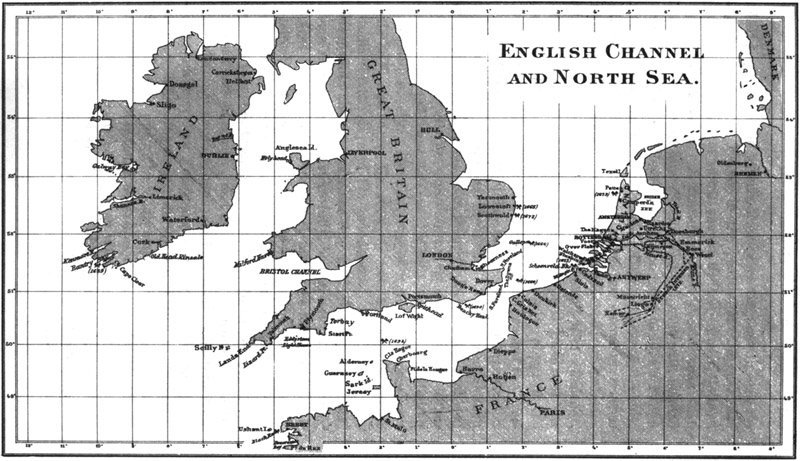
English Channel and North Sea.ToList
Meanwhile the two maritime States, England and Holland, though eying France distrustfully, had greater and growing grudges against each other, which under the fostering care of Charles II. led to war. The true cause was doubtless commercial jealousy, and the conflict sprang immediately from collisions between the trading companies. Hostilities began on the west coast of Africa; and an English squadron, in 1664, after subduing several Dutch stations there, sailed to New Amsterdam (now New York), and seized it. All these affairs took place before the formal declaration of war in February, 1665. This war was undoubtedly popular in England; the instinct of the people found an expression by the lips of Monk, who is reported to have said, "What matters this or that reason? What we want is more of the trade which the Dutch now have." There is also little room to doubt that, despite the pretensions of the trading companies, the government of the United Provinces would gladly have avoided the war; the able man who was at their head saw too clearly the delicate position in which they stood between England and France. They claimed, however, the support of the latter in virtue of a defensive treaty made in 1662. Louis allowed the claim, but unwillingly; and the still young navy of France gave practically no help.
The war between the two sea States was wholly maritime, and had the general characteristics of all such wars. Three great battles were fought,—the first off Lowestoft, on the Norfolk coast, June 13, 1665; the second, known as the Four Days' Battle in the Straits of Dover, often spoken of by French writers as that of the Pas de Calais, lasting from the 11th to the 14th of June, 1666; and the third, off the North Foreland, August 4 of the same year. In the first and last of these the English had a decided success; in the second the advantage remained with the Dutch. This one only will be described at length, because of it alone has been found such a full, coherent account as will allow a clear and accurate tactical narrative to be given. There are in these fights points of interest more generally applicable to the present day than are the details of somewhat obsolete tactical movements.
In the first battle off Lowestoft, it appears that the Dutch commander, Opdam, who was not a seaman but a cavalry officer, had very positive orders to fight; the discretion proper to a commander-in-chief on the spot was not intrusted to him. To interfere thus with the commander in the field or afloat is one of the most common temptations to the government in the cabinet, and is generally disastrous. Tourville, the greatest of Louis XIV.'s admirals, was forced thus to risk the whole French navy against his own judgment; and a century later a great French fleet escaped from the English admiral Keith, through his obedience to imperative orders from his immediate superior, who was sick in port.
In the Lowestoft fight the Dutch van gave way; and a little later one of the junior admirals of the centre, Opdam's own squadron, being killed, the crew was seized with a panic, took the command of the ship from her officers, and carried her out of action. This movement was followed by twelve or thirteen other ships, leaving a great gap in the Dutch line. The occurrence shows, what has before been pointed out, that the discipline of the Dutch fleet and the tone of the officers were not high, despite the fine fighting qualities of the nation, and although it is probably true that there were more good seamen among the Dutch than among the English captains. The natural steadfastness and heroism of the Hollanders could not wholly supply that professional pride and sense of military honor which it is the object of sound military institutions to encourage. Popular feeling in the United States is pretty much at sea in this matter; there is with it no intermediate step between personal courage with a gun in its hand and entire military efficiency.
Opdam, seeing the battle going against him, seems to have yielded to a feeling approaching despair. He sought to grapple the English commander-in-chief, who on this day was the Duke of York, the king's brother. He failed in this, and in the desperate struggle which followed, his ship blew up. Shortly after, three, or as one account says four, Dutch ships ran foul of one another, and this group was burned by one fire-ship; three or four others singly met the same fate a little later. The Dutch fleet was now in disorder, and retreated under cover of the squadron of Van Tromp, son of the famous old admiral who in the days of the Commonwealth sailed through the Channel with a broom at his masthead.
Fire-ships are seen here to have played a very conspicuous part, more so certainly than in the war of 1653, though at both periods they formed an appendage to the fleet. There is on the surface an evident resemblance between the rôle of the fire-ship and the part assigned in modern warfare to the torpedo-cruiser. The terrible character of the attack, the comparative smallness of the vessel making it, and the large demands upon the nerve of the assailant, are the chief points of resemblance; the great points of difference are the comparative certainty with which the modern vessel can be handled, which is partly met by the same advantage in the iron-clad over the old ship-of-the-line, and the instantaneousness of the injury by torpedo, whose attack fails or succeeds at once, whereas that of the fire-ship required time for effecting the object, which in both cases is total destruction of the hostile ship, instead of crippling or otherwise reducing it. An appreciation of the character of fire-ships, of the circumstances under which they attained their greatest usefulness, and of the causes which led to their disappearance, may perhaps help in the decision to which nations must come as to whether the torpedo-cruiser, pure and simple, is a type of weapon destined to survive in fleets.
A French officer, who has been examining the records of the French navy, states that the fire-ship first appears, incorporated as an arm of the fleet, in 1636.
"Whether specially built for the purpose, or whether altered from other purposes to be fitted for their particular end, they received a special equipment. The command was given to officers not noble, with the grade of captain of fire-ship. Five subordinate officers and twenty-five seamen made up the crew. Easily known by grappling-irons which were always fitted to their yards, the fire-ship saw its rôle growing less in the early years of the eighteenth century. It was finally to disappear from the fleets whose speed it delayed and whose evolutions were by it complicated. As the ships-of-war grew larger, their action in concert with fire-ships became daily more difficult. On the other hand, there had already been abandoned the idea of combining them with the fighting-ships to form a few groups, each provided with all the means of attack and defence. The formation of the close-hauled line-of-battle, by assigning the fire-ships a place in a second line placed half a league on the side farthest from the enemy, made them more and more unfitted to fulfil their office. The official plan of the battle of Malaga (1704), drawn up immediately after the battle, shows the fire-ship in this position as laid down by Paul Hoste. Finally the use of shells, enabling ships to be set on fire more surely and quickly, and introduced on board at the period of which we are now treating, though the general use did not obtain until much later, was the last blow to the fire-ship."[20]
Those who are familiar with the theories and discussions of our own day on the subject of fleet tactics and weapons, will recognize in this short notice of a long obsolete type certain ideas which are not obsolete. The fire-ship disappeared from fleets "whose speed it delayed." In heavy weather small bulk must always mean comparatively small speed. In a moderate sea, we are now told, the speed of the torpedo-boat falls from twenty knots to fifteen or less, and the seventeen to nineteen knot cruiser can either run away from the pursuing boats, or else hold them at a distance under fire of machine and heavy guns. These boats are sea-going, "and it is thought can keep the sea in all weathers; but to be on board a 110-foot torpedo-boat, when the sea is lively, is said to be far from agreeable. The heat, noise, and rapid vibrations of the engines are intense. Cooking seems to be out of the question, and it is said that if food were well cooked few would be able to appreciate it. To obtain necessary rest under these conditions, added to the rapid motions of the boat, is most difficult." Larger boats are to be built; but the factor of loss of speed in rough weather will remain, unless the size of the torpedo-cruiser is increased to a point that will certainly lead to fitting them with something more than torpedoes. Like fire-ships, small torpedo-cruisers will delay the speed and complicate the evolutions of the fleet with which they are associated.[21] The disappearance of the fire-ship was also hastened, we are told, by the introduction of shell firing, or incendiary projectiles; and it is not improbable that for deep-sea fighting the transfer of the torpedo to a class of larger ships will put an end to the mere torpedo-cruiser. The fire-ship continued to be used against fleets at anchor down to the days of the American Civil War; and the torpedo-boat will always be useful within an easy distance of its port.
A third phase of naval practice two hundred years ago, mentioned in the extract quoted, involves an idea very familiar to modern discussions; namely, the group formation. "The idea of combining fire-ships with the fighting-ships to form a few groups, each provided with all the means of attack and defence," was for a time embraced; for we are told that it was later on abandoned. The combining of the ships of a fleet into groups of two, three, or four meant to act specially together is now largely favored in England; less so in France, where it meets strong opposition. No question of this sort, ably advocated on either side, is to be settled by one man's judgment, nor until time and experience have applied their infallible tests. It may be remarked, however, that in a well-organized fleet there are two degrees of command which are in themselves both natural and necessary, that can be neither done away nor ignored; these are the command of the whole fleet as one unit, and the command of each ship as a unit in itself. When a fleet becomes too large to be handled by one man, it must be subdivided, and in the heat of action become practically two fleets acting to one common end; as Nelson, in his noble order at Trafalgar, said, "The second in command will, after my intentions are made known to him" (mark the force of the "after," which so well protects the functions both of the commander-in-chief and the second), "have the entire direction of his line, to make the attack upon the enemy, and to follow up the blow until they are captured or destroyed."
The size and cost of the individual iron-clad of the present day makes it unlikely that fleets will be so numerous as to require subdivision; but whether they are or not does not affect the decision of the group question. Looking simply to the principle underlying the theory, and disregarding the seeming tactical clumsiness of the special groups proposed, the question is: Shall there be introduced between the natural commands of the admiral and of the captains of individual ships a third artificial contrivance, which on the one hand will in effect partly supersede the supreme authority, and on the other will partly fetter the discretion of commanders of ships? A further difficulty springing from the narrow principle of support specially due to particular ships, on which the group system rests, is this: that when signals can no longer be seen, the duty of the captain to his own ship and to the fleet at large will be complicated by his duty to observe certain relations to particular ships; which particular ships must in time come to have undue prominence in his views. The group formation had its day of trial in old times, and disappeared before the test of experience; whether in its restored form it will survive, time will show. It may be said, before quitting the subject, that as an order of sailing, corresponding to the route-step of an army in march, a loose group formation has some advantages; maintaining some order without requiring that rigid exactness of position, to observe which by day and night must be a severe strain on captain and deck-officers. Such a route-order should not, however, be permitted until a fleet has reached high tactical precision.
To return to the question of fire-ships and torpedo-boats, the rôle of the latter, it is often said, is to be found in that mêlée which is always to succeed a couple of headlong passes between the opposing fleets. In the smoke and confusion of that hour is the opportunity of the torpedo-boat. This certainly sounds plausible, and the torpedo vessel certainly has a power of movement not possessed by the fire-ship. A mêlée of the two fleets, however, was not the condition most favorable for the fire-ship. I shall quote here from another French officer, whose discussion of these Anglo-Dutch sea-fights, in a late periodical, is singularly clear and suggestive. He says:
"Far from impeding the direct action of the fire-ship, which was naught or nearly so during the confused battles of the war of 1652, the regularity and ensemble newly attained in the movements of squadrons seem rather to favor it. The fire-ships played a very important part at the battles of Lowestoft, Pas de Calais, and the North Foreland. Thanks to the good order preserved by the ships-of-the-line, these incendiary ships can indeed be better protected by the artillery; much more efficiently directed than before toward a distinct and determined end."[22]
In the midst of the confused mêlées of 1652 the fire-ship "acted, so to speak, alone, seeking by chance an enemy to grapple, running the risk of a mistake, without protection against the guns of the enemy, nearly sure to be sunk by him or else burned uselessly. All now, in 1665, has become different. Its prey is clearly pointed out; it knows it, follows it easily into the relatively fixed position had by it in the enemy's line. On the other hand, the ships of his own division do not lose sight of the fire-ship. They accompany it as far as possible, cover it with their artillery to the end of its course, and disengage it before burning, if the fruitlessness of the attempt is seen soon enough. Evidently under such conditions its action, always uncertain (it cannot be otherwise), nevertheless acquires greater chances of success." These instructive comments need perhaps the qualifying, or additional, remark that confusion in the enemy's order at the time that your own remains good gives the best opening for a desperate attack. The writer goes on to trace the disappearance of the fire-ship:—
"Here then we see the fire-ship at the point of its highest importance. That importance will decrease, the fire-ship itself will end by disappearing from engagements in the open sea, when naval artillery becoming more perfect shall have greater range, be more accurate and more rapid;[23] when ships receiving better forms, greater steering power, more extensive and better balanced sail power, shall be able, thanks to quicker speed and handling, to avoid almost certainly the fire-ships sent against them; when, finally, fleets led on principles of tactics as skilful as they were timid, a tactics which will predominate a century later during the whole war of American Independence, when these fleets, in order not to jeopardize the perfect regularity of their order of battle, will avoid coming to close quarters, and will leave to the cannon alone to decide the fate of an action."
In this discussion the writer has in view the leading feature which, while aiding the action of the fire-ship, also gives this war of 1665 its peculiar interest in the history of naval tactics. In it is found for the first time the close-hauled line-of-battle undeniably adopted as the fighting order of the fleets. It is plain enough that when those fleets numbered, as they often did, from eighty to a hundred ships, such lines would be very imperfectly formed in every essential, both of line and interval; but the general aim is evident, amid whatever imperfections of execution. The credit for this development is generally given to the Duke of York, afterward James II.; but the question to whom the improvement is due is of little importance to sea-officers of the present day when compared with the instructive fact that so long a time elapsed between the appearance of the large sailing-ship, with its broadside battery, and the systematic adoption of the order which was best adapted to develop the full power of the fleet for mutual support. To us, having the elements of the problem in our hands, together with the result finally reached, that result seems simple enough, almost self-evident. Why did it take so long for the capable men of that day to reach it? The reason—and herein lies the lesson for the officer of to-day—was doubtless the same that leaves the order of battle so uncertain now; namely, that the necessity of war did not force men to make up their minds, until the Dutch at last met in the English their equals on the sea. The sequence of ideas which resulted in the line-of-battle is clear and logical. Though familiar enough to seamen, it will be here stated in the words of the writer last quoted, because they have a neatness and precision entirely French:—
"With the increase of power of the ship-of-war, and with the perfecting of its sea and warlike qualities, there has come an equal progress in the art of utilizing them.... As naval evolutions become more skilful, their importance grows from day to day. To these evolutions there is needed a base, a point from which they depart and to which they return. A fleet of war-ships must be always ready to meet an enemy; logically, therefore, this point of departure for naval evolutions must be the order of battle. Now, since the disappearance of galleys, almost all the artillery is found upon the sides of a ship of war. Hence it is the beam that must necessarily and always be turned toward the enemy. On the other hand, it is necessary that the sight of the latter must never be interrupted by a friendly ship. Only one formation allows the ships of the same fleet to satisfy fully these conditions. That formation is the line ahead [column]. This line, therefore, is imposed as the only order of battle, and consequently as the basis of all fleet tactics. In order that this order of battle, this long thin line of guns, may not be injured or broken at some point weaker than the rest, there is at the same time felt the necessity of putting in it only ships which, if not of equal force, have at least equally strong sides. Logically it follows, at the same moment in which the line ahead became definitively the order for battle, there was established the distinction between the ships 'of the line,' alone destined for a place therein, and the lighter ships meant for other uses."
If to these we add the considerations which led to making the line-of-battle a close-hauled line, we have the problem fully worked out. But the chain of reasoning was as clear two hundred and fifty years ago as it is now; why then was it so long in being worked out? Partly, no doubt, because old traditions—in those days traditions of galley-fighting—had hold of and confused men's minds; chiefly because men are too indolent to seek out the foundation truths of the situation in their day, and develop the true theory of action from its base up. As a rare instance of clear-sightedness, recognizing such a fundamental change in conditions and predicting results, words of Admiral Labrousse of the French navy, written in 1840, are most instructive. "Thanks to steam," he wrote, "ships will be able to move in any direction with such speed that the effects of collision may, and indeed must, as they formerly did, take the place of projectile weapons and annul the calculations of the skilful manœuvrer. The ram will be favorable to speed, without destroying the nautical qualities of a ship. As soon as one power shall have adopted this terrible weapon, all others must accept it, under pain of evident inferiority, and thus combats will become combats of ram against ram." While forbearing the unconditional adhesion to the ram as the controlling weapon of the day, which the French navy has yielded, the above brief argument may well be taken as an instance of the way in which researches into the order of battle of the future should be worked out. A French writer, commenting on Labrousse's paper, says:—
"Twenty-seven years were scarce enough for our fathers, counting from 1638, the date of building the 'Couronne,' to 1665, to pass from the tactical order of the line abreast, the order for galleys, to that of the line ahead. We ourselves needed twenty-nine years from 1830, when the first steamship was brought into our fleet, to 1859, when the application of the principle of ram-fighting was affirmed by laying down the 'Solferino' and the 'Magenta' to work a revolution in the contrary direction; so true it is that truth is always slow in getting to the light.... This transformation was not sudden, not only because the new material required time to be built and armed, but above all, it is sad to say, because the necessary consequences of the new motive power escaped most minds."[24]
We come now to the justly celebrated Four Days' Battle of June, 1666, which claims special notice, not only on account of the great number of ships engaged on either side, nor yet only for the extraordinary physical endurance of the men who kept up a hot naval action for so many successive days, but also because the commanders-in-chief on either side, Monk and De Ruyter, were the most distinguished seamen, or rather sea-commanders, brought forth by their respective countries in the seventeenth century. Monk was possibly inferior to Blake in the annals of the English navy; but there is a general agreement that De Ruyter is the foremost figure, not only in the Dutch service, but among all the naval officers of that age. The account about to be given is mainly taken from a recent number of the "Revue Maritime et Coloniale,"[25] and is there published as a letter, recently discovered, from a Dutch gentleman serving as volunteer on board De Ruyter's ship, to a friend in France. The narrative is delightfully clear and probable,—qualities not generally found in the description of those long-ago fights; and the satisfaction it gave was increased by finding in the Memoirs of the Count de Guiche, who also served as volunteer in the fleet, and was taken to De Ruyter after his own vessel had been destroyed by a fire-ship, an account confirming the former in its principal details.[26] This additional pleasure was unhappily marred by recognizing certain phrases as common to both stories; and a comparison showed that the two could not be accepted as independent narratives. There are, however, points of internal difference which make it possible that the two accounts are by different eye-witnesses, who compared and corrected their versions before sending them out to their friends or writing them in their journals.
The numbers of the two fleets were: English about eighty ships, the Dutch about one hundred; but the inequality in numbers was largely compensated by the greater size of many of the English. A great strategic blunder by the government in London immediately preceded the fight. The king was informed that a French squadron was on its way from the Atlantic to join the Dutch. He at once divided his fleet, sending twenty ships under Prince Rupert to the westward to meet the French, while the remainder under Monk were to go east and oppose the Dutch.
A position like that of the English fleet, threatened with an attack from two quarters, presents one of the subtlest temptations to a commander. The impulse is very strong to meet both by dividing his own numbers as Charles did; but unless in possession of overwhelming force it is an error, exposing both divisions to be beaten separately, which, as we are about to see, actually happened in this case. The result of the first two days was disastrous to the larger English division under Monk, which was then obliged to retreat toward Rupert; and probably the opportune return of the latter alone saved the English fleet from a very serious loss, or at the least from being shut up in their own ports. A hundred and forty years later, in the exciting game of strategy that was played in the Bay of Biscay before Trafalgar, the English admiral Cornwallis made precisely the same blunder, dividing his fleet into two equal parts out of supporting distance, which Napoleon at the time characterized as a glaring piece of stupidity. The lesson is the same in all ages.
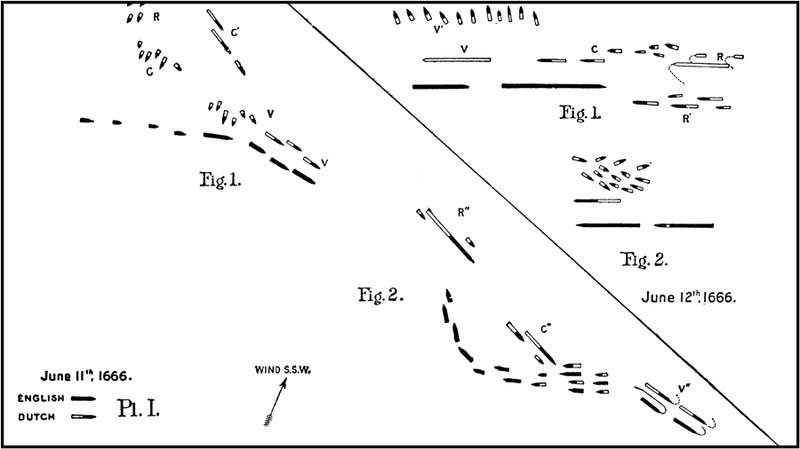
Pl. I.ToList
The Dutch had sailed for the English coast with a fair easterly wind, but it changed later to southwest with thick weather, and freshened, so that De Ruyter, to avoid being driven too far, came to anchor between Dunkirk and the Downs.[27] The fleet then rode with its head to the south-southwest and the van on the right; while Tromp, who commanded the rear division in the natural order, was on the left. For some cause this left was most to windward, the centre squadron under Ruyter being to leeward, and the right, or van, to leeward again of the centre.[28] This was the position of the Dutch fleet at daylight of June 11, 1666; and although not expressly so stated, it is likely, from the whole tenor of the narratives, that it was not in good order.
The same morning Monk, who was also at anchor, made out the Dutch fleet to leeward, and although so inferior in numbers determined to attack at once, hoping that by keeping the advantage of the wind he would be able to commit himself only so far as might seem best. He therefore stood along the Dutch line on the starboard tack, leaving the right and centre out of cannon-shot, until he came abreast of the left, Tromp's squadron. Monk then had thirty-five ships well in hand; but the rear had opened and was straggling, as is apt to be the case with long columns. With the thirty-five he then put his helm up and ran down for Tromp, whose squadron cut their cables and made sail on the same tack (V’); the two engaged lines thus standing over toward the French coast, and the breeze heeling the ships so that the English could not use their lower-deck guns (Fig. 2, V’’). The Dutch centre and rear also cut (Fig. 1, C’), and followed the movement, but being so far to leeward, could not for some time come into action. It was during this time that a large Dutch ship, becoming separated from her own fleet, was set on fire and burned, doubtless the ship in which was Count de Guiche.
As they drew near Dunkirk the English went about, probably all together; for in the return to the northward and westward the proper English van fell in with and was roughly handled by the Dutch centre under Ruyter himself (Fig. 2, C’’). This fate would be more likely to befall the rear, and indicates that a simultaneous movement had reversed the order. The engaged ships had naturally lost to leeward, thus enabling Ruyter to fetch up with them. Two English flag-ships were here disabled and cut off; one, the "Swiftsure," hauled down her colors after the admiral, a young man of only twenty-seven, was killed. "Highly to be admired," says a contemporary writer, "was the resolution of Vice-Admiral Berkeley, who, though cut off from the line, surrounded by enemies, great numbers of his men killed, his ship disabled and boarded on all sides, yet continued fighting almost alone, killed several with his own hand, and would accept no quarter; till at length, being shot in the throat with a musket-ball, he retired into the captain's cabin, where he was found dead, extended at his full length upon a table, and almost covered with his own blood." Quite as heroic, but more fortunate in its issue, was the conduct of the other English admiral thus cut off; and the incidents of his struggle, though not specially instructive otherwise, are worth quoting, as giving a lively picture of the scenes which passed in the heat of the contests of those days, and afford coloring to otherwise dry details.
"Being in a short time completely disabled, one of the enemy's fire-ships grappled him on the starboard quarter; he was, however, freed by the almost incredible exertions of his lieutenant, who, having in the midst of the flames loosed the grappling-irons, swung back on board his own ship unhurt. The Dutch, bent on the destruction of this unfortunate ship, sent a second which grappled her on the larboard side, and with greater success than the former; for the sails instantly taking fire, the crew were so terrified that nearly fifty of them jumped overboard. The admiral, Sir John Harman, seeing this confusion, ran with his sword drawn among those who remained, and threatened with instant death the first man who should attempt to quit the ship, or should not exert himself to quench the flames. The crew then returned to their duty and got the fire under; but the rigging being a good deal burned, one of the topsail yards fell and broke Sir John's leg. In the midst of this accumulated distress, a third fire-ship prepared to grapple him, but was sunk by the guns before she could effect her purpose. The Dutch vice-admiral, Evertzen, now bore down to him and offered quarter; but Sir John replied, 'No, no, it is not come to that yet,' and giving him a broadside, killed the Dutch commander; after which the other enemies sheered off."[29]
It is therefore not surprising that the account we have been following reported two English flag-ships lost, one by a fire-ship. "The English chief still continued on the port tack, and," says the writer, "as night fell we could see him proudly leading his line past the squadron of North Holland and Zealand [the actual rear, but proper van], which from noon up to that time had not been able to reach the enemy [Fig. 2, R’’] from their leewardly position." The merit of Monk's attack as a piece of grand tactics is evident, and bears a strong resemblance to that of Nelson at the Nile. Discerning quickly the weakness of the Dutch order, he had attacked a vastly superior force in such a way that only part of it could come into action; and though the English actually lost more heavily, they carried off a brilliant prestige and must have left considerable depression and heart-burning among the Dutch. The eye-witness goes on: "The affair continued until ten P.M., friends and foes mixed together and as likely to receive injury from one as from the other. It will be remarked that the success of the day and the misfortunes of the English came from their being too much scattered, too extended in their line; but for which we could never have cut off a corner of them, as we did. The mistake of Monk was in not keeping his ships better together;" that is, closed up. The remark is just, the criticism scarcely so; the opening out of the line was almost unavoidable in so long a column of sailing-ships, and was one of the chances taken by Monk when he offered battle.
The English stood off on the port tack to the west or west-northwest, and next day returned to the fight. The Dutch were now on the port tack in natural order, the right leading, and were to windward; but the enemy, being more weatherly and better disciplined, soon gained the advantage of the wind. The English this day had forty-four ships in action, the Dutch about eighty; many of the English, as before said, larger. The two fleets passed on opposite tacks, the English to windward;[30] but Tromp, in the rear, seeing that the Dutch order of battle was badly formed, the ships in two or three lines, overlapping and so masking each other's fire, went about and gained to windward of the enemy's van (R’); which he was able to do from the length of the line, and because the English, running parallel to the Dutch order, were off the wind. "At this moment two flag-officers of the Dutch van kept broad off, presenting their sterns to the English (V’). Ruyter, greatly astonished, tried to stop them, but in vain, and therefore felt obliged to imitate the manœuvre in order to keep his squadron together; but he did so with some order, keeping some ships around him, and was joined by one of the van ships, disgusted with the conduct of his immediate superior. Tromp was now in great danger, separated [by his own act first and then by the conduct of the van] from his own fleet by the English, and would have been destroyed but for Ruyter, who, seeing the urgency of the case, hauled up for him," the van and centre thus standing back for the rear on the opposite tack to that on which they entered action. This prevented the English from keeping up the attack on Tromp, lest Ruyter should gain the wind of them, which they could not afford to yield because of their very inferior numbers. Both the action of Tromp and that of the junior flag-officers in the van, though showing very different degrees of warlike ardor, bring out strongly the lack of subordination and of military feeling which has been charged against the Dutch officers as a body; no signs of which appear among the English at this time.
How keenly Ruyter felt the conduct of his lieutenants was manifested when "Tromp, immediately after this partial action, went on board his flagship. The seamen cheered him; but Ruyter said, 'This is no time for rejoicing, but rather for tears.' Indeed, our position was bad, each squadron acting differently, in no line, and all the ships huddled together like a flock of sheep, so packed that the English might have surrounded all of them with their forty ships [June 12, Fig. 2]. The English were in admirable order, but did not push their advantage as they should, whatever the reason." The reason no doubt was the same that often prevented sailing-ships from pressing an advantage,—disability from crippled spars and rigging, added to the inexpediency of such inferior numbers risking a decisive action.
Ruyter was thus able to draw his fleet out into line again, although much maltreated by the English, and the two fleets passed again on opposite tacks, the Dutch to leeward, and Ruyter's ship the last in his column. As he passed the English rear, he lost his maintopmast and mainyard. After another partial rencounter the English drew away to the northwest toward their own shores, the Dutch following them; the wind being still from southwest, but light. The English were now fairly in retreat, and the pursuit continued all night, Ruyter's own ship dropping out of sight in the rear from her crippled state.
The third day Monk continued retreating to the westward. He burned, by the English accounts, three disabled ships, sent ahead those that were most crippled, and himself brought up the rear with those that were in fighting condition, which are variously stated, again by the English, at twenty-eight and sixteen in number (Plate II., June 13). One of the largest and finest of the English fleet, the "Royal Prince," of ninety guns, ran aground on the Galloper Shoal and was taken by Tromp (Plate II. a); but Monk's retreat was so steady and orderly that he was otherwise unmolested. This shows that the Dutch had suffered very severely. Toward evening Rupert's squadron was seen; and all the ships of the English fleet, except those crippled in action, were at last united.
The next day the wind came out again very fresh from the southwest, giving the Dutch the weather-gage. The English, instead of attempting to pass upon opposite tacks, came up from astern relying upon the speed and handiness of their ships. So doing, the battle engaged all along the line on the port tack, the English to leeward.[31] The Dutch fire-ships were badly handled and did no harm, whereas the English burned two of their enemies. The two fleets ran on thus, exchanging broadsides for two hours, at the end of which time the bulk of the English fleet had passed through the Dutch line.[32] All regularity of order was henceforward lost. "At this moment," says the eye-witness, "the lookout was extraordinary, for all were separated, the English as well as we. But luck would have it that the largest of our fractions surrounding the admiral remained to windward, and the largest fraction of the English, also with their admiral, remained to leeward [Figs. 1 and 2, C and C’]. This was the cause of our victory and their ruin. Our admiral had with him thirty-five or forty ships of his own and of other squadrons, for the squadrons were scattered and order much lost. The rest of the Dutch ships had left him. The leader of the van, Van Ness, had gone off with fourteen ships in chase of three or four English ships, which under a press of sail had gained to windward of the Dutch van [Fig. 1, V]. Van Tromp with the rear squadron had fallen to leeward, and so had to keep on [to leeward of Ruyter and the English main body, Fig. 1, R] after Van Ness, in order to rejoin the admiral by passing round the English centre." De Ruyter and the English main body kept up a sharp action, beating to windward all the time. Tromp, having carried sail, overtook Van Ness, and returned bringing the van back with him (V’, R’); but owing to the constant plying to windward of the English main body he came up to leeward of it and could not rejoin Ruyter, who was to windward (Fig. 3, V’’, R’’). Ruyter, seeing this, made signal to the ships around him, and the main body of the Dutch kept away before the wind (Fig 3, C’’), which was then very strong. "Thus in less than no time we found ourselves in the midst of the English; who, being attacked on both sides, were thrown into confusion and saw their whole order destroyed, as well by dint of the action, as by the strong wind that was then blowing. This was the hottest of the fight [Fig. 3]. We saw the high admiral of England separated from his fleet, followed only by one fire-ship. With that he gained to windward, and passing through the North Holland squadron, placed himself again at the head of fifteen or twenty ships that rallied to him."
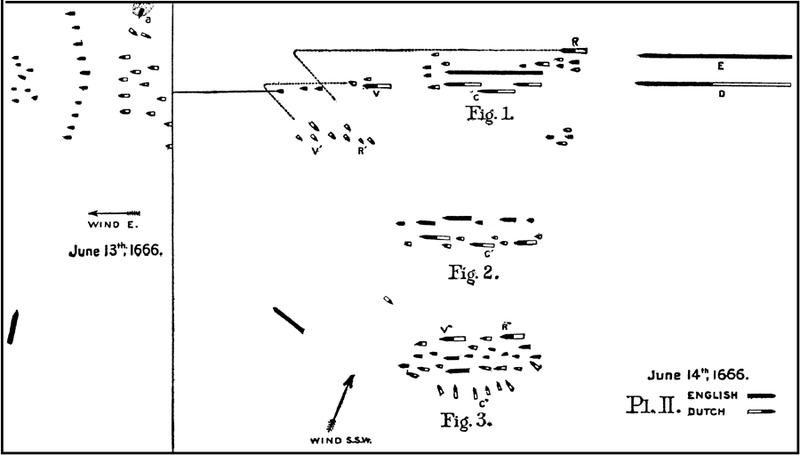
Pl. II.ToList
Thus ended this great sea-fight, the most remarkable, in some of its aspects, that has ever been fought upon the ocean. Amid conflicting reports it is not possible to do more than estimate the results. A fairly impartial account says: "The States lost in these actions three vice-admirals, two thousand men, and four ships. The loss of the English was five thousand killed and three thousand prisoners; and they lost besides seventeen ships, of which nine remained in the hands of the victors."[33] There is no doubt that the English had much the worst of it, and that this was owing wholly to the original blunder of weakening the fleet by a great detachment sent in another direction. Great detachments are sometimes necessary evils, but in this case no necessity existed. Granting the approach of the French, the proper course for the English was to fall with their whole fleet upon the Dutch before their allies could come up. This lesson is as applicable to-day as it ever was. A second lesson, likewise of present application, is the necessity of sound military institutions for implanting correct military feeling, pride, and discipline. Great as was the first blunder of the English, and serious as was the disaster, there can be no doubt that the consequences would have been much worse but for the high spirit and skill with which the plans of Monk were carried out by his subordinates, and the lack of similar support to Ruyter on the part of the Dutch subalterns. In the movements of the English, we hear nothing of two juniors turning tail at a critical moment, nor of a third, with misdirected ardor, getting on the wrong side of the enemy's fleet. Their drill also, their tactical precision, was remarked even then. The Frenchman De Guiche, after witnessing this Four Days' Fight, wrote:—
"Nothing equals the beautiful order of the English at sea. Never was a line drawn straighter than that formed by their ships; thus they bring all their fire to bear upon those who draw near them.... They fight like a line of cavalry which is handled according to rule, and applies itself solely to force back those who oppose; whereas the Dutch advance like cavalry whose squadrons leave their ranks and come separately to the charge."[34]
The Dutch government, averse to expense, unmilitary in its tone, and incautious from long and easy victory over the degenerate navy of Spain, had allowed its fleet to sink into a mere assembly of armed merchantmen. Things were at their worst in the days of Cromwell. Taught by the severe lessons of that war, the United Provinces, under an able ruler, had done much to mend matters, but full efficiency had not yet been gained.
[19] Martin: History of France.
[20] Gougeard: Marine de Guerre.
[21] Since the above was written, the experience of the English autumn manœuvres of 1888 has verified this statement; not indeed that any such experiment was needed to establish a self-evident fact.
[22] Chabaud-Arnault: Revue Mar. et Col. 1885.
[23] The recent development of rapid-firing and machine guns, with the great increase of their calibre and consequent range and penetration, reproduces this same step in the cycle of progress.
[24] Gougeard: Marine de Guerre.
[25] Vol. lxxxii. p. 137.
[26] Mémoires du Cte. de Guiche. À Londres, chez P. Changuion. 1743 pp. 234-264.
[27] See Map of English Channel and North Sea, page 107.
[28] Plate I., June 11, 1666, Fig. 1. V, van; C, centre; R, rear: in this part of the action the Dutch order was inverted, so that the actual van was the proper rear. The great number of ships engaged in the fleet actions of these Anglo-Dutch wars make it impossible to represent each ship and at the same time preserve clearness in the plans. Each figure of a ship therefore represents a group more or less numerous.
[29] Campbell: Lives of the Admirals.
[30] Plate I., June 12, Fig. 1, V, C, R.
[31] Plate II., June 14, Fig. 1, E, D.
[32] Fig. 1, V, C, R. This result was probably due simply to the greater weatherliness of the English ships. It would perhaps be more accurate to say that the Dutch had sagged to leeward so that they drifted through the English line.
[33] Lefèvre-Pontalis. Jean de Witt.
[34] Mémoires, pp. 249, 251, 266, 267.
"In 1666 as in 1653," says a French naval writer, "the fortune of war seemed to lean to the side of the English. Of the three great battles fought two were decided victories; and the third, though adverse, had but increased the glory of her seamen. This was due to the intelligent boldness of Monk and Rupert, the talents of part of the admirals and captains, and the skill of the seamen and soldiers under them. The wise and vigorous efforts made by the government of the United Provinces, and the undeniable superiority of Ruyter in experience and genius over any one of his opponents, could not compensate for the weakness or incapacity of part of the Dutch officers, and the manifest inferiority of the men under their orders."[35]
England, as has been said before, still felt the impress of Cromwell's iron hand upon her military institutions; but that impress was growing weaker. Before the next Dutch war Monk was dead, and was poorly replaced by the cavalier Rupert. Court extravagance cut down the equipment of the navy as did the burgomaster's parsimony, and court corruption undermined discipline as surely as commercial indifference. The effect was evident when the fleets of the two countries met again, six years later.
There was one well-known feature of all the military navies of that day which calls for a passing comment; for its correct bearing and value is not always, perhaps not generally, seen. The command of fleets and of single vessels was often given to soldiers, to military men unaccustomed to the sea, and ignorant how to handle the ship, that duty being intrusted to another class of officer. Looking closely into the facts, it is seen that this made a clean division between the direction of the fighting and of the motive power of the ship. This is the essence of the matter; and the principle is the same whatever the motive power may be. The inconvenience and inefficiency of such a system was obvious then as it is now, and the logic of facts gradually threw the two functions into the hands of one corps of officers, the result being the modern naval officer, as that term is generally understood.[36] Unfortunately, in this process of blending, the less important function was allowed to get the upper hand; the naval officer came to feel more proud of his dexterity in managing the motive power of his ship than of his skill in developing her military efficiency. The bad effects of this lack of interest in military science became most evident when the point of handling fleets was reached, because for that military skill told most, and previous study was most necessary; but it was felt in the single ship as well. Hence it came to pass, and especially in the English navy, that the pride of the seaman took the place of the pride of the military man. The English naval officer thought more of that which likened him to the merchant captain than of that which made him akin to the soldier. In the French navy this result was less general, owing probably to the more military spirit of the government, and especially of the nobility, to whom the rank of officer was reserved. It was not possible that men whose whole association was military, all of whose friends looked upon arms as the one career for a gentleman, could think more of the sails and rigging than of the guns or the fleet. The English corps of officers was of different origin. There was more than the writer thought in Macaulay's well-known saying: "There were seamen and there were gentlemen in the navy of Charles II.; but the seamen were not gentlemen, and the gentlemen were not seamen." The trouble was not in the absence or presence of gentlemen as such, but in the fact that under the conditions of that day the gentleman was pre-eminently the military element of society; and that the seaman, after the Dutch wars, gradually edged the gentleman, and with him the military tone and spirit as distinguished from simple courage, out of the service. Even "such men of family as Herbert and Russell, William III.'s admirals," says the biographer of Lord Hawke, "were sailors indeed, but only able to hold their own by adopting the boisterous manners of the hardy tarpaulin." The same national traits which made the French inferior as seamen made them superior as military men; not in courage, but in skill. To this day the same tendency obtains; the direction of the motive power has no such consideration as the military functions in the navies of the Latin nations. The studious and systematic side of the French character also inclined the French officer, when not a trifler, to consider and develop tactical questions in a logical manner; to prepare himself to handle fleets, not merely as a seaman but as a military man. The result showed, in the American Revolutionary War, that despite a mournful history of governmental neglect, men who were first of all military men, inferior though they were in opportunities as seamen to their enemies, could meet them on more than equal terms as to tactical skill, and were practically their superiors in handling fleets. The false theory has already been pointed out, which directed the action of the French fleet not to crushing its enemy, but to some ulterior aim; but this does not affect the fact that in tactical skill the military men were superior to the mere seamen, though their tactical skill was applied to mistaken strategic ends. The source whence the Dutch mainly drew their officers does not certainly appear; for while the English naval historian in 1666 says that most of the captains of their fleet were sons of rich burgomasters, placed there for political reasons by the Grand Pensionary, and without experience, Duquesne, the ablest French admiral of the day, comments in 1676 on the precision and skill of the Dutch captains in terms very disparaging to his own. It is likely, from many indications, that they were generally merchant seamen, with little original military feeling; but the severity with which the delinquents were punished both by the State and by popular frenzy, seems to have driven these officers, who were far from lacking the highest personal courage, into a sense of what military loyalty and subordination required. They made a very different record in 1672 from that of 1666.
Before finally leaving the Four Days' Fight, the conclusions of another writer may well be quoted:—
"Such was that bloody Battle of the Four Days, or Straits of Calais, the most memorable sea-fight of modern days; not, indeed, by its results, but by the aspect of its different phases; by the fury of the combatants; by the boldness and skill of the leaders; and by the new character which it gave to sea warfare. More than any other this fight marks clearly the passage from former methods to the tactics of the end of the seventeenth century. For the first time we can follow, as though traced upon a plan, the principal movements of the contending fleets. It seems quite clear that to the Dutch as well as to the British have been given a tactical book and a code of signals; or, at the least, written instructions, extensive and precise, to serve instead of such a code. We feel that each admiral now has his squadron in hand, and that even the commander-in-chief disposes at his will, during the fight, of the various subdivisions of his fleet. Compare this action with those of 1652, and one plain fact stares you in the face,—that between the two dates naval tactics have undergone a revolution.
"Such were the changes that distinguish the war of 1665 from that of 1652. As in the latter epoch, the admiral still thinks the weather-gage an advantage for his fleet; but it is no longer, from the tactical point of view, the principal, we might almost say the sole, preoccupation. Now he wishes above all to keep his fleet in good order and compact as long as possible, so as to keep the power of combining, during the action, the movements of the different squadrons. Look at Ruyter, at the end of the Four Days' Fight; with great difficulty he has kept to windward of the English fleet, yet he does not hesitate to sacrifice this advantage in order to unite the two parts of his fleet, which are separated by the enemy. If at the later fight off the North Foreland great intervals exist between the Dutch squadrons, if the rear afterward continues to withdraw from the centre, Ruyter deplores such a fault as the chief cause of his defeat. He so deplores it in his official report; he even accuses Tromp [who was his personal enemy] of treason or cowardice,—an unjust accusation, but which none the less shows the enormous importance thenceforth attached, during action, to the reunion of the fleet into a whole strictly and regularly maintained."[37]
This commentary is justified in so far as it points out general aims and tendencies; but the results were not as complete as might be inferred from it.
The English, notwithstanding their heavy loss in the Four Days' Battle, were at sea again within two months, much to the surprise of the Dutch; and on the 4th of August another severe fight was fought off the North Foreland, ending in the complete defeat of the latter, who retired to their own coasts. The English followed, and effected an entrance into one of the Dutch harbors, where they destroyed a large fleet of merchantmen as well as a town of some importance. Toward the end of 1666 both sides were tired of the war, which was doing great harm to trade, and weakening both navies to the advantage of the growing sea power of France. Negotiations looking toward peace were opened; but Charles II., ill disposed to the United Provinces, confident that the growing pretensions of Louis XIV. to the Spanish Netherlands would break up the existing alliance between Holland and France, and relying also upon the severe reverses suffered at sea by the Dutch, was exacting and haughty in his demands. To justify and maintain this line of conduct he should have kept up his fleet, the prestige of which had been so advanced by its victories. Instead of that, poverty, the result of extravagance and of his home policy, led him to permit it to decline; ships in large numbers were laid up; and he readily adopted an opinion which chimed in with his penury, and which, as it has had advocates at all periods of sea history, should be noted and condemned here. This opinion, warmly opposed by Monk, was:—
"That as the Dutch were chiefly supported by trade, as the supply of their navy depended upon trade, and, as experience showed, nothing provoked the people so much as injuring their trade, his Majesty should therefore apply himself to this, which would effectually humble them, at the same time that it would less exhaust the English than fitting out such mighty fleets as had hitherto kept the sea every summer.... Upon these motives the king took a fatal resolution of laying up his great ships and keeping only a few frigates on the cruise."[38]
In consequence of this economical theory of carrying on a war, the Grand Pensionary of Holland, De Witt, who had the year before caused soundings of the Thames to be made, sent into the river, under De Ruyter, a force of sixty or seventy ships-of-the-line, which on the 14th of June, 1667, went up as high as Gravesend, destroying ships at Chatham and in the Medway, and taking possession of Sheerness. The light of the fires could be seen from London, and the Dutch fleet remained in possession of the mouth of the river until the end of the month. Under this blow, following as it did upon the great plague and the great fire of London, Charles consented to peace, which was signed July 31, 1667, and is known as the Peace of Breda. The most lasting result of the war was the transfer of New York and New Jersey to England, thus joining her northern and southern colonies in North America.
Before going on again with the general course of the history of the times, it will be well to consider for a moment the theory which worked so disastrously for England in 1667; that, namely, of maintaining a sea-war mainly by preying upon the enemy's commerce. This plan, which involves only the maintenance of a few swift cruisers and can be backed by the spirit of greed in a nation, fitting out privateers without direct expense to the State, possesses the specious attractions which economy always presents. The great injury done to the wealth and prosperity of the enemy is also undeniable; and although to some extent his merchant-ships can shelter themselves ignobly under a foreign flag while the war lasts, this guerre de course, as the French call it, this commerce-destroying, to use our own phrase, must, if in itself successful, greatly embarrass the foreign government and distress its people. Such a war, however, cannot stand alone; it must be supported, to use the military phrase; unsubstantial and evanescent in itself, it cannot reach far from its base. That base must be either home ports, or else some solid outpost of the national power, on the shore or the sea; a distant dependency or a powerful fleet. Failing such support, the cruiser can only dash out hurriedly a short distance from home, and its blows, though painful, cannot be fatal. It was not the policy of 1667, but Cromwell's powerful fleets of ships-of-the-line in 1652, that shut the Dutch merchantmen in their ports and caused the grass to grow in the streets of Amsterdam. When, instructed by the suffering of that time, the Dutch kept large fleets afloat through two exhausting wars, though their commerce suffered greatly, they bore up the burden of the strife against England and France united. Forty years later, Louis XIV. was driven, by exhaustion, to the policy adopted by Charles II. through parsimony. Then were the days of the great French privateers, Jean Bart, Forbin, Duguay-Trouin, Du Casse, and others. The regular fleets of the French navy were practically withdrawn from the ocean during the great War of the Spanish Succession (1702-1712). The French naval historian says:—
"Unable to renew the naval armaments, Louis XIV. increased the number of cruisers upon the more frequented seas, especially the Channel and the German Ocean [not far from home, it will be noticed]. In these different spots the cruisers were always in a position to intercept or hinder the movements of transports laden with troops, and of the numerous convoys carrying supplies of all kinds. In these seas, in the centre of the commercial and political world, there is always work for cruisers. Notwithstanding the difficulties they met, owing to the absence of large friendly fleets, they served advantageously the cause of the two peoples [French and Spanish]. These cruisers, in the face of the Anglo-Dutch power, needed good luck, boldness, and skill. These three conditions were not lacking to our seamen; but then, what chiefs and what captains they had!"[39]
The English historian, on the other hand, while admitting how severely the people and commerce of England suffered from the cruisers, bitterly reflecting at times upon the administration, yet refers over and over again to the increasing prosperity of the whole country, and especially of its commercial part. In the preceding war, on the contrary, from 1689 to 1697, when France sent great fleets to sea and disputed the supremacy of the ocean, how different the result! The same English writer says of that time:—
"With respect to our trade it is certain that we suffered infinitely more, not merely than the French, for that was to be expected from the greater number of our merchant-ships, but than we ever did in any former war.... This proceeded in great measure from the vigilance of the French, who carried on the war in a piratical way. It is out of all doubt that, taking all together, our traffic suffered excessively; our merchants were many of them ruined."[40]
Macaulay says of this period: "During many months of 1693 the English trade with the Mediterranean had been interrupted almost entirely. There was no chance that a merchantman from London or Amsterdam would, if unprotected, reach the Pillars of Hercules without being boarded by a French privateer; and the protection of armed vessels was not easily obtained." Why? Because the vessels of England's navy were occupied watching the French navy, and this diversion of them from the cruisers and privateers constituted the support which a commerce-destroying war must have. A French historian, speaking of the same period in England (1696), says: "The state of the finances was deplorable; money was scarce, maritime insurance thirty per cent, the Navigation Act was virtually suspended, and the English shipping reduced to the necessity of sailing under the Swedish and Danish flags."[41] Half a century later the French government was again reduced, by long neglect of the navy, to a cruising warfare. With what results? First, the French historian says: "From June, 1756, to June, 1760, French privateers captured from the English more than twenty-five hundred merchantmen. In 1761, though France had not, so to speak, a single ship-of-the-line at sea, and though the English had taken two hundred and forty of our privateers, their comrades still took eight hundred and twelve vessels. But," he goes on to say, "the prodigious growth of the English shipping explains the number of these prizes."[42] In other words, the suffering involved to England in such numerous captures, which must have caused great individual injury and discontent, did not really prevent the growing prosperity of the State and of the community at large. The English naval historian, speaking of the same period, says: "While the commerce of France was nearly destroyed, the trading-fleet of England covered the seas. Every year her commerce was increasing; the money which the war carried out was returned by the produce of her industry. Eight thousand merchant vessels were employed by the English merchants." And again, summing up the results of the war, after stating the immense amount of specie brought into the kingdom by foreign conquests, he says: "The trade of England increased gradually every year, and such a scene of national prosperity, while waging a long, bloody, and costly war, was never before shown by any people in the world." On the other hand, the historian of the French navy, speaking of an earlier phase of the same wars, says: "The English fleets, having nothing to resist them, swept the seas. Our privateers and single cruisers, having no fleet to keep down the abundance of their enemies, ran short careers. Twenty thousand French seamen lay in English prisons."[43] When, on the other hand, in the War of the American Revolution France resumed the policy of Colbert and of the early reign of Louis XIV., and kept large battle-fleets afloat, the same result again followed as in the days of Tourville. "For the first time," says the Annual Register, forgetting or ignorant of the experience of 1693, and remembering only the glories of the later wars, "English merchant-ships were driven to take refuge under foreign flags."[44] Finally, in quitting this part of the subject, it may be remarked that in the island of Martinique the French had a powerful distant dependency upon which to base a cruising warfare; and during the Seven Years' War, as afterward during the First Empire, it, with Guadeloupe, was the refuge of numerous privateers. "The records of the English admiralty raise the losses of the English in the West Indies during the first years of the Seven Years' War to fourteen hundred merchantmen taken or destroyed." The English fleet was therefore directed against the islands, both of which fell, involving a loss to the trade of France greater than all the depredations of her cruisers on the English commerce, besides breaking up the system; but in the war of 1778 the great fleets protected the islands, which were not even threatened at any time.
So far we have been viewing the effect of a purely cruising warfare, not based upon powerful squadrons, only upon that particular part of the enemy's strength against which it is theoretically directed,—upon his commerce and general wealth; upon the sinews of war. The evidence seems to show that even for its own special ends such a mode of war is inconclusive, worrying but not deadly; it might almost be said that it causes needless suffering. What, however, is the effect of this policy upon the general ends of the war, to which it is one of the means, and to which it is subsidiary? How, again, does it react upon the people that practise it? As the historical evidences will come up in detail from time to time, it need here only be summarized. The result to England in the days of Charles II. has been seen,—her coast insulted, her shipping burned almost within sight of her capital. In the War of the Spanish Succession, when the control of Spain was the military object, while the French depended upon a cruising war against commerce, the navies of England and Holland, unopposed, guarded the coasts of the peninsula, blocked the port of Toulon, forced the French succors to cross the Pyrenees, and by keeping open the sea highway, neutralized the geographical nearness of France to the seat of war. Their fleets seized Gibraltar, Barcelona, and Minorca, and co-operating with the Austrian army failed by little of reducing Toulon. In the Seven Years' War the English fleets seized, or aided in seizing, all the most valuable colonies of France and Spain, and made frequent descents on the French coast. The War of the American Revolution affords no lesson, the fleets being nearly equal. The next most striking instance to Americans is the War of 1812. Everybody knows how our privateers swarmed over the seas, and that from the smallness of our navy the war was essentially, indeed solely, a cruising war. Except upon the lakes, it is doubtful if more than two of our ships at any time acted together. The injury done to English commerce, thus unexpectedly attacked by a distant foe which had been undervalued, may be fully conceded; but on the one hand, the American cruisers were powerfully supported by the French fleet, which being assembled in larger or smaller bodies in the many ports under the emperor's control from Antwerp to Venice, tied the fleets of England to blockade duty; and on the other hand, when the fall of the emperor released them, our coasts were insulted in every direction, the Chesapeake entered and controlled, its shores wasted, the Potomac ascended, and Washington burned. The Northern frontier was kept in a state of alarm, though there squadrons, absolutely weak but relatively strong, sustained the general defence; while in the South the Mississippi was entered unopposed, and New Orleans barely saved. When negotiations for peace were opened, the bearing of the English toward the American envoys was not that of men who felt their country to be threatened with an unbearable evil. The late Civil War, with the cruises of the "Alabama" and "Sumter" and their consorts, revived the tradition of commerce-destroying. In so far as this is one means to a general end, and is based upon a navy otherwise powerful, it is well; but we need not expect to see the feats of those ships repeated in the face of a great sea power. In the first place, those cruises were powerfully supported by the determination of the United States to blockade, not only the chief centres of Southern trade, but every inlet of the coast, thus leaving few ships available for pursuit; in the second place, had there been ten of those cruisers where there was one, they would not have stopped the incursion in Southern waters of the Union fleet, which penetrated to every point accessible from the sea; and in the third place, the undeniable injury, direct and indirect, inflicted upon individuals and upon one branch of the nation's industry (and how high that shipping industry stands in the writer's estimation need not be repeated), did not in the least influence or retard the event of the war. Such injuries, unaccompanied by others, are more irritating than weakening. On the other hand, will any refuse to admit that the work of the great Union fleets powerfully modified and hastened an end which was probably inevitable in any case? As a sea power the South then occupied the place of France in the wars we have been considering, while the situation of the North resembled that of England; and, as in France, the sufferers in the Confederacy were not a class, but the government and the nation at large. It is not the taking of individual ships or convoys, be they few or many, that strikes down the money power of a nation; it is the possession of that overbearing power on the sea which drives the enemy's flag from it, or allows it to appear only as a fugitive; and which, by controlling the great common, closes the highways by which commerce moves to and from the enemy's shores. This overbearing power can only be exercised by great navies, and by them (on the broad sea) less efficiently now than in the days when the neutral flag had not its present immunity. It is not unlikely that, in the event of a war between maritime nations, an attempt may be made by the one having a great sea power and wishing to break down its enemy's commerce, to interpret the phrase "effective blockade" in the manner that best suits its interests at the time; to assert that the speed and disposal of its ships make the blockade effective at much greater distances and with fewer ships than formerly. The determination of such a question will depend, not upon the weaker belligerent, but upon neutral powers; it will raise the issue between belligerent and neutral rights; and if the belligerent have a vastly overpowering navy he may carry his point, just as England, when possessing the mastery of the seas, long refused to admit the doctrine of the neutral flag covering the goods.
FOOTNOTES:
[16] Davies: History of Holland.
[17] République d'Angleterre.
[18] Lefèvre-Pontalis: Jean de Witt.
[19] Martin: History of France.
[20] Gougeard: Marine de Guerre.
[21] Since the above was written, the experience of the English autumn manœuvres of 1888 has verified this statement; not indeed that any such experiment was needed to establish a self-evident fact.
[22] Chabaud-Arnault: Revue Mar. et Col. 1885.
[23] The recent development of rapid-firing and machine guns, with the great increase of their calibre and consequent range and penetration, reproduces this same step in the cycle of progress.
[24] Gougeard: Marine de Guerre.
[25] Vol. lxxxii. p. 137.
[26] Mémoires du Cte. de Guiche. À Londres, chez P. Changuion. 1743 pp. 234-264.
[27] See Map of English Channel and North Sea, page 107.
[28] Plate I., June 11, 1666, Fig. 1. V, van; C, centre; R, rear: in this part of the action the Dutch order was inverted, so that the actual van was the proper rear. The great number of ships engaged in the fleet actions of these Anglo-Dutch wars make it impossible to represent each ship and at the same time preserve clearness in the plans. Each figure of a ship therefore represents a group more or less numerous.
[29] Campbell: Lives of the Admirals.
[30] Plate I., June 12, Fig. 1, V, C, R.
[31] Plate II., June 14, Fig. 1, E, D.
[32] Fig. 1, V, C, R. This result was probably due simply to the greater weatherliness of the English ships. It would perhaps be more accurate to say that the Dutch had sagged to leeward so that they drifted through the English line.
[33] Lefèvre-Pontalis. Jean de Witt.
[34] Mémoires, pp. 249, 251, 266, 267.
[35] Chabaud-Arnault: Revue Mar. et Col. 1885.
[36] The true significance of this change has often been misunderstood, and hence erroneous inferences as to the future have been drawn. It was not a case of the new displacing the old, but of the military element in a military organization asserting its necessary and inevitable control over all other functions.
[37] Chabaud-Arnault: Revue Mar. et Col. 1885.
[38] Campbell: Lives of the Admirals.
[39] Lapeyrouse-Bonfils: Hist. de la Marine Française.
[40] Campbell: Lives of the Admirals.
[41] Martin: History of France.
[42] Martin: History of France.
[43] Lapeyrouse-Bonfils.
[44] Annual Reg., vol. xxvii. p. 10.
CHAPTER III.ToC
War of England and France in Alliance against the United Provinces, 1672-1674.—Finally, of France against Combined Europe, 1674-1678.—Sea Battles of Solebay, the Texel, and Stromboli.
Shortly before the conclusion of the Peace of Breda, Louis XIV. made his first step toward seizing parts of the Spanish Netherlands and Franche Comté. At the same time that his armies moved forward, he sent out a State paper setting forth his claims upon the territories in question. This paper showed unmistakably the ambitious character of the young king, roused the anxiety of Europe, and doubtless increased the strength of the peace party in England. Under the leadership of Holland, but with the hearty co-operation of the English minister, an alliance was formed between the two countries and Sweden, hitherto the friend of France, to check Louis' advance before his power became too great. The attack first on the Netherlands in 1667, and then on Franche Comté in 1668, showed the hopeless weakness of Spain to defend her possessions; they fell almost without a blow.
The policy of the United Provinces, relative to the claims of Louis at this time, was summed up in the phrase that "France was good as a friend, but not as a neighbor." They were unwilling to break their traditional alliance, but still more unwilling to have her on their border. The policy of the English people, though not of their king, turned toward the Dutch. In the increased greatness of Louis they saw danger to all Europe; to themselves more especially if, by a settled preponderance on the continent, his hands were free to develop his sea power. "Flanders once in the power of Louis XIV.," wrote the English ambassador Temple, "the Dutch feel that their country will be only a maritime province of France;" and sharing that opinion, "he advocated the policy of resistance to the latter country, whose domination in the Low Countries he considered as a threatened subjection of all Europe. He never ceased to represent to his government how dangerous to England would be the conquest of the sea provinces by France, and he urgently pointed out the need of a prompt understanding with the Dutch. 'This would be the best revenge,' said he, 'for the trick France has played us in involving us in the last war with the United Provinces.'" These considerations brought the two countries together in that Triple Alliance with Sweden which has been mentioned, and which for a time checked the onward movement of Louis. But the wars between the two sea nations were too recent, the humiliation of England in the Thames too bitter, and the rivalries that still existed too real, too deeply seated in the nature of things, to make that alliance durable. It needed the dangerous power of Louis, and his persistence in a course threatening to both, to weld the union of these natural antagonists. This was not to be done without another bloody encounter.
Louis was deeply angered at the Triple Alliance, and his wrath was turned mainly upon Holland, in which from the necessities of her position he recognized his most steadfast opponent. For the time, however, he seemed to yield; the more readily because of the probable approaching failure of the Spanish royal line, and the ambition he had of getting more than merely the territory lying to the east of France, when the throne became vacant. But, though he dissembled and yielded, from that time he set his mind upon the destruction of the republic. This policy was directly contrary to that laid down by Richelieu, and to the true welfare of France. It was to England's interest, at least just then, that the United Provinces should not be trodden down by France; but it was much more to the interest of France that they should not be subjected to England. England, free from the continent, might stand alone upon the seas contending with France; but France, hampered by her continental politics, could not hope to wrest the control of the seas from England without an ally. This ally Louis proposed to destroy, and he asked England to help him. The final result is already known, but the outlines of the contest must now be followed.
Before the royal purpose had passed into action, and while there was still time to turn the energies of France into another channel, a different course was proposed to the king. This was the project of Leibnitz, before spoken of, which has special interest for our subject because, in proposing to reverse the lines which Louis then laid down, to make continental expansion secondary and growth beyond the sea the primary object of France, the tendency avowedly and necessarily was to base the greatness of the country upon the control of the sea and of commerce. The immediate object offered to the France of that day, with the attainment of which, however, she could not have stopped short, was the conquest of Egypt; that country which, facing both the Mediterranean and Eastern seas, gave control of the great commercial route which in our own day has been completed by the Suez Canal. That route had lost much of its value by the discovery of the way round the Cape of Good Hope, and yet more by the unsettled and piratical conditions of the seas through which it lay; but with a really strong naval power occupying the key of the position it might have been largely restored. Such a power posted in Egypt would, in the already decaying condition of the Ottoman Empire, have controlled the trade not only of India and the far East, but also of the Levant; but the enterprise could not have stopped there. The necessity of mastering the Mediterranean and opening the Red Sea, closed to Christian vessels by Mohammedan bigotry, would have compelled the occupation of stations on either side of Egypt; and France would have been led step by step, as England has been led by the possession of India, to the seizure of points like Malta, Cyprus, Aden, in short, to a great sea power. That is clear now; but it will be interesting to hear the arguments by which Leibnitz sought to convince the French king two hundred years ago.
After pointing out the weakness of the Turkish Empire, and the readiness with which it might be further embarrassed by stirring up Austria and Poland, the latter the traditional ally of France; after showing that France had no armed enemy in the Mediterranean, and that on the other side of Egypt she would meet the Portuguese colonies, longing to obtain protection against the Dutch in India, the memorial proceeds:—
"The conquest of Egypt, that Holland of the East, is infinitely easier than that of the United Provinces. France needs peace in the west, war at a distance. War with Holland will probably ruin the new Indian companies as well as the colonies and commerce lately revived by France, and will increase the burdens of the people while diminishing their resources. The Dutch will retire into their maritime towns, stand there on the defensive in perfect safety, and assume the offensive on the sea with great chance of success. If France does not obtain a complete victory over them, she loses all her influence in Europe, and by victory she endangers that influence. In Egypt, on the contrary, a repulse, almost impossible, will be of no great consequence, and victory will give the dominion of the seas, the commerce of the East and of India, the preponderance in Christendom, and even the empire of the East on the ruins of the Ottoman power. The possession of Egypt opens the way to conquests worthy of Alexander; the extreme weakness of the Orientals is no longer a secret. Whoever has Egypt will have all the coasts and islands of the Indian Ocean. It is in Egypt that Holland will be conquered; it is there she will be despoiled of what alone renders her prosperous, the treasures of the East. She will be struck without being able to ward off the blow. Should she wish to oppose the designs of France upon Egypt, she would be overwhelmed with the universal hatred of Christians; attacked at home, on the contrary, not only could she ward off the aggression, but she could avenge herself sustained by universal public opinion, which suspects the views of France of ambition."[45]
The memorial had no effect. "All that the efforts of ambition and human prudence could do to lay the foundations for the destruction of a nation, Louis XIV. now did. Diplomatic strategy on a vast scale was displayed in order to isolate and hem in Holland. Louis, who had been unable to make Europe accept the conquest of Belgium by France, now hoped to induce it to see without trembling the fall of Holland." His efforts were in the main successful. The Triple Alliance was broken; the King of England, though contrary to the wishes of his people, made an offensive alliance with Louis; and Holland, when the war began, found herself without an ally in Europe, except the worn-out kingdom of Spain and the Elector of Brandenburg, then by no means a first-class State. But in order to obtain the help of Charles II., Louis not only engaged to pay him large sums of money, but also to give to England, from the spoils of Holland and Belgium, Walcheren, Sluys, and Cadsand, and even the islands of Goree and Voorn; the control, that is, of the mouths of the great commercial rivers the Scheldt and the Meuse. With regard to the united fleets of the two nations, it was agreed that the officer bearing the admiral's flag of England should command in chief. The question of naval precedence was reserved, by not sending the admiral of France afloat; but it was practically yielded. It is evident that in his eagerness for the ruin of Holland and his own continental aggrandizement Louis was playing directly into England's hand, as to power on the sea. A French historian is justified in saying: "These negotiations have been wrongly judged. It has been often repeated that Charles sold England to Louis XIV. This is true only of internal policy. Charles indeed plotted the political and religious subjugation of England with the help of a foreign power; but as to external interests, he did not sell them, for the greater share in the profit from the ruin of the Dutch was to go to England."[46]
During the years preceding the war the Dutch made every diplomatic effort to avert it, but the hatred of Charles and Louis prevented any concession being accepted as final. An English royal yacht was ordered to pass through the Dutch ships-of-war in the Channel, and to fire on them if they did not strike their flags. In January, 1672, England sent an ultimatum, summoning Holland to acknowledge the right of the English crown to the sovereignty of the British seas, and to order its fleets to lower their flags to the smallest English man-of-war; and demands such as these received the support of a French king. The Dutch continued to yield, but seeing at length that all concessions were useless, they in February ordered into commission seventy-five ships-of-the-line, besides smaller vessels. On the 23d of March the English, without declaration of war, attacked a fleet of Dutch merchantmen; and on the 29th the king declared war. This was followed, April 6th, by the declaration of Louis XIV.; and on the 28th of the same month he set out to take command in person of his army.
The war which now began, including the third and last of the great contests between the English and Dutch upon the ocean, was not, like those before it, purely a sea war; and it will be necessary to mention its leading outlines on the land also, not only in order to clearness of impression, but also to bring out the desperate straits to which the republic was reduced, and the final deliverance through its sea power in the hands of the great seaman De Ruyter.
The naval war differs from those that preceded it in more than one respect; but its most distinctive feature is that the Dutch, except on one occasion at the very beginning, did not send out their fleet to meet the enemy, but made what may properly be called a strategic use of their dangerous coast and shoals, upon which were based their sea operations. To this course they were forced by the desperate odds under which they were fighting; but they did not use their shoals as a mere shelter,—the warfare they waged was the defensive-offensive. When the wind was fair for the allies to attack, Ruyter kept under cover of his islands, or at least on ground where the enemy dared not follow; but when the wind served so that he might attack in his own way, he turned and fell upon them. There are also apparent indications of tactical combinations, on his part, of a higher order than have yet been met; though it is possible that the particular acts referred to, consisting in partial attacks amounting to little more than demonstrations against the French contingent, may have sprung from political motives. This solution for the undoubted fact that the Dutch attacked the French lightly has not been met with elsewhere by the writer; but it seems possible that the rulers of the United Provinces may have wished not to increase the exasperation of their most dangerous enemy by humiliating his fleet, and so making it less easy to his pride to accept their offers. There is, however, an equally satisfactory military explanation in the supposition that, the French being yet inexperienced, Ruyter thought it only necessary to contain them while falling in force upon the English. The latter fought throughout with their old gallantry, but less than their old discipline; whereas the attacks of the Dutch were made with a sustained and unanimous vigor that showed a great military advance. The action of the French was at times suspicious; it has been alleged that Louis ordered his admiral to economize his fleet, and there is good reason to believe that toward the end of the two years that England remained in his alliance he did do so.
The authorities of the United Provinces, knowing that the French fleet at Brest was to join the English in the Thames, made great exertions to fit out their squadron so as to attack the latter before the junction was made; but the wretched lack of centralization in their naval administration caused this project to fail. The province of Zealand was so backward that its contingent, a large fraction of the whole, was not ready in time; and it has been charged that the delay was due, not merely to mismanagement, but to disaffection to the party in control of the government. A blow at the English fleet in its own waters, by a superior force, before its ally arrived, was a correct military conception; judging from the after-history of this war, it might well have produced a profound effect upon the whole course of the struggle. Ruyter finally got to sea and fell in with the allied fleets, but though fully intending to fight, fell back before them to his own coast. The allies did not follow him there, but retired, apparently in full security, to Southwold Bay, on the east coast of England, some ninety miles north of the mouth of the Thames. There they anchored in three divisions,—two English, the rear and centre of the allied line, to the northward, and the van, composed of French ships, to the southward. Ruyter followed them, and on the early morning of June 7, 1672, the Dutch fleet was signalled by a French lookout frigate in the northward and eastward; standing down before a northeast wind for the allied fleet, from which a large number of boats and men were ashore in watering parties. The Dutch order of battle was in two lines, the advanced one containing eighteen ships with fire-ships (Plate III., A). Their total force was ninety-one ships-of-the-line; that of the allies one hundred and one.
The wind was blowing toward the coast, which here trends nearly north and south, and the allies were in an awkward position. They had first to get under way, and they could not fall back to gain time or room to establish their order. Most of the ships cut their cables, and the English made sail on the starboard tack, heading about north-northwest, a course which forced them soon to go about; whereas the French took the other tack (Plate III., B). The battle began therefore by the separation of the allied fleet. Ruyter sent one division to attack the French, or rather to contain them; for these opponents exchanged only a distant cannonade, although the Dutch, being to windward, had the choice of closer action if they wished it. As their commander, Bankert, was not censured, it may be supposed he acted under orders; and he was certainly in command a year later, and acting with great judgment and gallantry at the battle of the Texel. Meanwhile Ruyter fell furiously upon the two English divisions, and apparently with superior forces; for the English naval historians claim that the Dutch were in the proportion of three to two.[47] If this can be accepted, it gives a marked evidence of Ruyter's high qualities as a general officer, in advance of any other who appears in this century.
[35] Chabaud-Arnault: Revue Mar. et Col. 1885.
[36] The true significance of this change has often been misunderstood, and hence erroneous inferences as to the future have been drawn. It was not a case of the new displacing the old, but of the military element in a military organization asserting its necessary and inevitable control over all other functions.
[37] Chabaud-Arnault: Revue Mar. et Col. 1885.
[38] Campbell: Lives of the Admirals.
[39] Lapeyrouse-Bonfils: Hist. de la Marine Française.
[40] Campbell: Lives of the Admirals.
[41] Martin: History of France.
[42] Martin: History of France.
[43] Lapeyrouse-Bonfils.
[44] Annual Reg., vol. xxvii. p. 10.
"Her navy at this time," says the narrative quoted, "met one of those shocks, a succession of which during this war degraded her from her high station of mistress of the seas in both hemispheres, to a contemptible rank among maritime powers. The king was fitting out a powerful fleet to carry the war to the coasts of Sweden, and for its equipment had commanded a reinforcement of men and provisions to be sent from Dunkirk. A fleet accordingly set sail, but were attacked by Von Tromp, some captured, the remainder forced to retire within the harbor again. Soon after, Tromp seized three English [neutral] ships carrying 1070 Spanish soldiers from Cadiz to Dunkirk; he took the troops out, but let the ships go free. Leaving seventeen vessels to blockade Dunkirk, Tromp with the remaining twelve advanced to meet the enemy's fleet on its arrival. It was soon seen entering the Straits of Dover to the number of sixty-seven sail, and having two thousand troops. Being joined by De Witt with four more ships, Tromp with his small force made a resolute attack upon the enemy. The fight lasted till four P.M., when the Spanish admiral took refuge in the Downs. Tromp determined to engage if they should come out; but Oquendo with his powerful fleet, many of which carried from sixty to a hundred guns, suffered himself to be blockaded; and the English admiral told Tromp he was ordered to join the Spaniards if hostilities began. Tromp sent home for instructions, and the action of England only served to call out the vast maritime powers of the Dutch. Tromp was rapidly reinforced to ninety-six sail and twelve fire-ships, and ordered to attack. Leaving a detached squadron to observe the English, and to attack them if they helped the Spaniards, he began the fight embarrassed by a thick fog, under cover of which the Spaniards cut their cables to escape. Many running too close to shore went aground, and most of the remainder attempting to retreat were sunk, captured, or driven on the French coast. Never was victory more complete."[16]
"In the midst of the splendors of her court and language," says Guizot, "the Spanish government felt itself weak, and sought to hide its weakness under its immobility. Philip IV. and his minister, weary of striving only to be conquered, looked but for the security of peace, and only sought to put aside all questions which would call for efforts of which they felt themselves incapable. Divided and enervated, the house of Austria had even less ambition than power, and except when absolutely forced, a pompous inertia became the policy of the successors of Charles V."[17]
"The naval and commercial power of the republic developed rapidly. The merchant fleet of Holland alone numbered 10,000 sail, 168,000 seamen, and supported 260,000 inhabitants. She had taken possession of the greater part of the European carrying-trade, and had added thereto, since the peace, all the carriage of merchandise between America and Spain, did the same service for the French ports, and maintained an importation traffic of thirty-six million francs. The north countries, Brandenburg, Denmark, Sweden, Muscovy, Poland, access to which was opened by the Baltic to the Provinces, were for them an inexhaustible market of exchange. They fed it by the produce they sold there, and by purchase of the products of the North,—wheat, timber, copper, hemp, and furs. The total value of merchandise yearly shipped in Dutch bottoms, in all seas, exceeded a thousand million francs. The Dutch had made themselves, to use a contemporary phrase, the wagoners of all seas."[18]
"Under him," says a French historian, "France grew by peace as she had grown by war.... The warfare of tariffs and premiums skilfully conducted by him tended to reduce within just limits the exorbitant growth of commercial and maritime power which Holland had arrogated at the expense of other nations; and to restrain England, which was burning to wrest this supremacy from Holland in order to use it in a manner much more dangerous to Europe. The interest of France seemed to be peace in Europe and America; a mysterious voice, at once the voice of the past and of the future, called for her warlike activity on other shores."[19]
"Whether specially built for the purpose, or whether altered from other purposes to be fitted for their particular end, they received a special equipment. The command was given to officers not noble, with the grade of captain of fire-ship. Five subordinate officers and twenty-five seamen made up the crew. Easily known by grappling-irons which were always fitted to their yards, the fire-ship saw its rôle growing less in the early years of the eighteenth century. It was finally to disappear from the fleets whose speed it delayed and whose evolutions were by it complicated. As the ships-of-war grew larger, their action in concert with fire-ships became daily more difficult. On the other hand, there had already been abandoned the idea of combining them with the fighting-ships to form a few groups, each provided with all the means of attack and defence. The formation of the close-hauled line-of-battle, by assigning the fire-ships a place in a second line placed half a league on the side farthest from the enemy, made them more and more unfitted to fulfil their office. The official plan of the battle of Malaga (1704), drawn up immediately after the battle, shows the fire-ship in this position as laid down by Paul Hoste. Finally the use of shells, enabling ships to be set on fire more surely and quickly, and introduced on board at the period of which we are now treating, though the general use did not obtain until much later, was the last blow to the fire-ship."[20]
Those who are familiar with the theories and discussions of our own day on the subject of fleet tactics and weapons, will recognize in this short notice of a long obsolete type certain ideas which are not obsolete. The fire-ship disappeared from fleets "whose speed it delayed." In heavy weather small bulk must always mean comparatively small speed. In a moderate sea, we are now told, the speed of the torpedo-boat falls from twenty knots to fifteen or less, and the seventeen to nineteen knot cruiser can either run away from the pursuing boats, or else hold them at a distance under fire of machine and heavy guns. These boats are sea-going, "and it is thought can keep the sea in all weathers; but to be on board a 110-foot torpedo-boat, when the sea is lively, is said to be far from agreeable. The heat, noise, and rapid vibrations of the engines are intense. Cooking seems to be out of the question, and it is said that if food were well cooked few would be able to appreciate it. To obtain necessary rest under these conditions, added to the rapid motions of the boat, is most difficult." Larger boats are to be built; but the factor of loss of speed in rough weather will remain, unless the size of the torpedo-cruiser is increased to a point that will certainly lead to fitting them with something more than torpedoes. Like fire-ships, small torpedo-cruisers will delay the speed and complicate the evolutions of the fleet with which they are associated.[21] The disappearance of the fire-ship was also hastened, we are told, by the introduction of shell firing, or incendiary projectiles; and it is not improbable that for deep-sea fighting the transfer of the torpedo to a class of larger ships will put an end to the mere torpedo-cruiser. The fire-ship continued to be used against fleets at anchor down to the days of the American Civil War; and the torpedo-boat will always be useful within an easy distance of its port.
"Far from impeding the direct action of the fire-ship, which was naught or nearly so during the confused battles of the war of 1652, the regularity and ensemble newly attained in the movements of squadrons seem rather to favor it. The fire-ships played a very important part at the battles of Lowestoft, Pas de Calais, and the North Foreland. Thanks to the good order preserved by the ships-of-the-line, these incendiary ships can indeed be better protected by the artillery; much more efficiently directed than before toward a distinct and determined end."[22]
"Here then we see the fire-ship at the point of its highest importance. That importance will decrease, the fire-ship itself will end by disappearing from engagements in the open sea, when naval artillery becoming more perfect shall have greater range, be more accurate and more rapid;[23] when ships receiving better forms, greater steering power, more extensive and better balanced sail power, shall be able, thanks to quicker speed and handling, to avoid almost certainly the fire-ships sent against them; when, finally, fleets led on principles of tactics as skilful as they were timid, a tactics which will predominate a century later during the whole war of American Independence, when these fleets, in order not to jeopardize the perfect regularity of their order of battle, will avoid coming to close quarters, and will leave to the cannon alone to decide the fate of an action."
"Twenty-seven years were scarce enough for our fathers, counting from 1638, the date of building the 'Couronne,' to 1665, to pass from the tactical order of the line abreast, the order for galleys, to that of the line ahead. We ourselves needed twenty-nine years from 1830, when the first steamship was brought into our fleet, to 1859, when the application of the principle of ram-fighting was affirmed by laying down the 'Solferino' and the 'Magenta' to work a revolution in the contrary direction; so true it is that truth is always slow in getting to the light.... This transformation was not sudden, not only because the new material required time to be built and armed, but above all, it is sad to say, because the necessary consequences of the new motive power escaped most minds."[24]
We come now to the justly celebrated Four Days' Battle of June, 1666, which claims special notice, not only on account of the great number of ships engaged on either side, nor yet only for the extraordinary physical endurance of the men who kept up a hot naval action for so many successive days, but also because the commanders-in-chief on either side, Monk and De Ruyter, were the most distinguished seamen, or rather sea-commanders, brought forth by their respective countries in the seventeenth century. Monk was possibly inferior to Blake in the annals of the English navy; but there is a general agreement that De Ruyter is the foremost figure, not only in the Dutch service, but among all the naval officers of that age. The account about to be given is mainly taken from a recent number of the "Revue Maritime et Coloniale,"[25] and is there published as a letter, recently discovered, from a Dutch gentleman serving as volunteer on board De Ruyter's ship, to a friend in France. The narrative is delightfully clear and probable,—qualities not generally found in the description of those long-ago fights; and the satisfaction it gave was increased by finding in the Memoirs of the Count de Guiche, who also served as volunteer in the fleet, and was taken to De Ruyter after his own vessel had been destroyed by a fire-ship, an account confirming the former in its principal details.[26] This additional pleasure was unhappily marred by recognizing certain phrases as common to both stories; and a comparison showed that the two could not be accepted as independent narratives. There are, however, points of internal difference which make it possible that the two accounts are by different eye-witnesses, who compared and corrected their versions before sending them out to their friends or writing them in their journals.
We come now to the justly celebrated Four Days' Battle of June, 1666, which claims special notice, not only on account of the great number of ships engaged on either side, nor yet only for the extraordinary physical endurance of the men who kept up a hot naval action for so many successive days, but also because the commanders-in-chief on either side, Monk and De Ruyter, were the most distinguished seamen, or rather sea-commanders, brought forth by their respective countries in the seventeenth century. Monk was possibly inferior to Blake in the annals of the English navy; but there is a general agreement that De Ruyter is the foremost figure, not only in the Dutch service, but among all the naval officers of that age. The account about to be given is mainly taken from a recent number of the "Revue Maritime et Coloniale,"[25] and is there published as a letter, recently discovered, from a Dutch gentleman serving as volunteer on board De Ruyter's ship, to a friend in France. The narrative is delightfully clear and probable,—qualities not generally found in the description of those long-ago fights; and the satisfaction it gave was increased by finding in the Memoirs of the Count de Guiche, who also served as volunteer in the fleet, and was taken to De Ruyter after his own vessel had been destroyed by a fire-ship, an account confirming the former in its principal details.[26] This additional pleasure was unhappily marred by recognizing certain phrases as common to both stories; and a comparison showed that the two could not be accepted as independent narratives. There are, however, points of internal difference which make it possible that the two accounts are by different eye-witnesses, who compared and corrected their versions before sending them out to their friends or writing them in their journals.
The Dutch had sailed for the English coast with a fair easterly wind, but it changed later to southwest with thick weather, and freshened, so that De Ruyter, to avoid being driven too far, came to anchor between Dunkirk and the Downs.[27] The fleet then rode with its head to the south-southwest and the van on the right; while Tromp, who commanded the rear division in the natural order, was on the left. For some cause this left was most to windward, the centre squadron under Ruyter being to leeward, and the right, or van, to leeward again of the centre.[28] This was the position of the Dutch fleet at daylight of June 11, 1666; and although not expressly so stated, it is likely, from the whole tenor of the narratives, that it was not in good order.
The Dutch had sailed for the English coast with a fair easterly wind, but it changed later to southwest with thick weather, and freshened, so that De Ruyter, to avoid being driven too far, came to anchor between Dunkirk and the Downs.[27] The fleet then rode with its head to the south-southwest and the van on the right; while Tromp, who commanded the rear division in the natural order, was on the left. For some cause this left was most to windward, the centre squadron under Ruyter being to leeward, and the right, or van, to leeward again of the centre.[28] This was the position of the Dutch fleet at daylight of June 11, 1666; and although not expressly so stated, it is likely, from the whole tenor of the narratives, that it was not in good order.
"Being in a short time completely disabled, one of the enemy's fire-ships grappled him on the starboard quarter; he was, however, freed by the almost incredible exertions of his lieutenant, who, having in the midst of the flames loosed the grappling-irons, swung back on board his own ship unhurt. The Dutch, bent on the destruction of this unfortunate ship, sent a second which grappled her on the larboard side, and with greater success than the former; for the sails instantly taking fire, the crew were so terrified that nearly fifty of them jumped overboard. The admiral, Sir John Harman, seeing this confusion, ran with his sword drawn among those who remained, and threatened with instant death the first man who should attempt to quit the ship, or should not exert himself to quench the flames. The crew then returned to their duty and got the fire under; but the rigging being a good deal burned, one of the topsail yards fell and broke Sir John's leg. In the midst of this accumulated distress, a third fire-ship prepared to grapple him, but was sunk by the guns before she could effect her purpose. The Dutch vice-admiral, Evertzen, now bore down to him and offered quarter; but Sir John replied, 'No, no, it is not come to that yet,' and giving him a broadside, killed the Dutch commander; after which the other enemies sheered off."[29]
The English stood off on the port tack to the west or west-northwest, and next day returned to the fight. The Dutch were now on the port tack in natural order, the right leading, and were to windward; but the enemy, being more weatherly and better disciplined, soon gained the advantage of the wind. The English this day had forty-four ships in action, the Dutch about eighty; many of the English, as before said, larger. The two fleets passed on opposite tacks, the English to windward;[30] but Tromp, in the rear, seeing that the Dutch order of battle was badly formed, the ships in two or three lines, overlapping and so masking each other's fire, went about and gained to windward of the enemy's van (R’); which he was able to do from the length of the line, and because the English, running parallel to the Dutch order, were off the wind. "At this moment two flag-officers of the Dutch van kept broad off, presenting their sterns to the English (V’). Ruyter, greatly astonished, tried to stop them, but in vain, and therefore felt obliged to imitate the manœuvre in order to keep his squadron together; but he did so with some order, keeping some ships around him, and was joined by one of the van ships, disgusted with the conduct of his immediate superior. Tromp was now in great danger, separated [by his own act first and then by the conduct of the van] from his own fleet by the English, and would have been destroyed but for Ruyter, who, seeing the urgency of the case, hauled up for him," the van and centre thus standing back for the rear on the opposite tack to that on which they entered action. This prevented the English from keeping up the attack on Tromp, lest Ruyter should gain the wind of them, which they could not afford to yield because of their very inferior numbers. Both the action of Tromp and that of the junior flag-officers in the van, though showing very different degrees of warlike ardor, bring out strongly the lack of subordination and of military feeling which has been charged against the Dutch officers as a body; no signs of which appear among the English at this time.
The next day the wind came out again very fresh from the southwest, giving the Dutch the weather-gage. The English, instead of attempting to pass upon opposite tacks, came up from astern relying upon the speed and handiness of their ships. So doing, the battle engaged all along the line on the port tack, the English to leeward.[31] The Dutch fire-ships were badly handled and did no harm, whereas the English burned two of their enemies. The two fleets ran on thus, exchanging broadsides for two hours, at the end of which time the bulk of the English fleet had passed through the Dutch line.[32] All regularity of order was henceforward lost. "At this moment," says the eye-witness, "the lookout was extraordinary, for all were separated, the English as well as we. But luck would have it that the largest of our fractions surrounding the admiral remained to windward, and the largest fraction of the English, also with their admiral, remained to leeward [Figs. 1 and 2, C and C’]. This was the cause of our victory and their ruin. Our admiral had with him thirty-five or forty ships of his own and of other squadrons, for the squadrons were scattered and order much lost. The rest of the Dutch ships had left him. The leader of the van, Van Ness, had gone off with fourteen ships in chase of three or four English ships, which under a press of sail had gained to windward of the Dutch van [Fig. 1, V]. Van Tromp with the rear squadron had fallen to leeward, and so had to keep on [to leeward of Ruyter and the English main body, Fig. 1, R] after Van Ness, in order to rejoin the admiral by passing round the English centre." De Ruyter and the English main body kept up a sharp action, beating to windward all the time. Tromp, having carried sail, overtook Van Ness, and returned bringing the van back with him (V’, R’); but owing to the constant plying to windward of the English main body he came up to leeward of it and could not rejoin Ruyter, who was to windward (Fig. 3, V’’, R’’). Ruyter, seeing this, made signal to the ships around him, and the main body of the Dutch kept away before the wind (Fig 3, C’’), which was then very strong. "Thus in less than no time we found ourselves in the midst of the English; who, being attacked on both sides, were thrown into confusion and saw their whole order destroyed, as well by dint of the action, as by the strong wind that was then blowing. This was the hottest of the fight [Fig. 3]. We saw the high admiral of England separated from his fleet, followed only by one fire-ship. With that he gained to windward, and passing through the North Holland squadron, placed himself again at the head of fifteen or twenty ships that rallied to him."
The next day the wind came out again very fresh from the southwest, giving the Dutch the weather-gage. The English, instead of attempting to pass upon opposite tacks, came up from astern relying upon the speed and handiness of their ships. So doing, the battle engaged all along the line on the port tack, the English to leeward.[31] The Dutch fire-ships were badly handled and did no harm, whereas the English burned two of their enemies. The two fleets ran on thus, exchanging broadsides for two hours, at the end of which time the bulk of the English fleet had passed through the Dutch line.[32] All regularity of order was henceforward lost. "At this moment," says the eye-witness, "the lookout was extraordinary, for all were separated, the English as well as we. But luck would have it that the largest of our fractions surrounding the admiral remained to windward, and the largest fraction of the English, also with their admiral, remained to leeward [Figs. 1 and 2, C and C’]. This was the cause of our victory and their ruin. Our admiral had with him thirty-five or forty ships of his own and of other squadrons, for the squadrons were scattered and order much lost. The rest of the Dutch ships had left him. The leader of the van, Van Ness, had gone off with fourteen ships in chase of three or four English ships, which under a press of sail had gained to windward of the Dutch van [Fig. 1, V]. Van Tromp with the rear squadron had fallen to leeward, and so had to keep on [to leeward of Ruyter and the English main body, Fig. 1, R] after Van Ness, in order to rejoin the admiral by passing round the English centre." De Ruyter and the English main body kept up a sharp action, beating to windward all the time. Tromp, having carried sail, overtook Van Ness, and returned bringing the van back with him (V’, R’); but owing to the constant plying to windward of the English main body he came up to leeward of it and could not rejoin Ruyter, who was to windward (Fig. 3, V’’, R’’). Ruyter, seeing this, made signal to the ships around him, and the main body of the Dutch kept away before the wind (Fig 3, C’’), which was then very strong. "Thus in less than no time we found ourselves in the midst of the English; who, being attacked on both sides, were thrown into confusion and saw their whole order destroyed, as well by dint of the action, as by the strong wind that was then blowing. This was the hottest of the fight [Fig. 3]. We saw the high admiral of England separated from his fleet, followed only by one fire-ship. With that he gained to windward, and passing through the North Holland squadron, placed himself again at the head of fifteen or twenty ships that rallied to him."
Thus ended this great sea-fight, the most remarkable, in some of its aspects, that has ever been fought upon the ocean. Amid conflicting reports it is not possible to do more than estimate the results. A fairly impartial account says: "The States lost in these actions three vice-admirals, two thousand men, and four ships. The loss of the English was five thousand killed and three thousand prisoners; and they lost besides seventeen ships, of which nine remained in the hands of the victors."[33] There is no doubt that the English had much the worst of it, and that this was owing wholly to the original blunder of weakening the fleet by a great detachment sent in another direction. Great detachments are sometimes necessary evils, but in this case no necessity existed. Granting the approach of the French, the proper course for the English was to fall with their whole fleet upon the Dutch before their allies could come up. This lesson is as applicable to-day as it ever was. A second lesson, likewise of present application, is the necessity of sound military institutions for implanting correct military feeling, pride, and discipline. Great as was the first blunder of the English, and serious as was the disaster, there can be no doubt that the consequences would have been much worse but for the high spirit and skill with which the plans of Monk were carried out by his subordinates, and the lack of similar support to Ruyter on the part of the Dutch subalterns. In the movements of the English, we hear nothing of two juniors turning tail at a critical moment, nor of a third, with misdirected ardor, getting on the wrong side of the enemy's fleet. Their drill also, their tactical precision, was remarked even then. The Frenchman De Guiche, after witnessing this Four Days' Fight, wrote:—
"Nothing equals the beautiful order of the English at sea. Never was a line drawn straighter than that formed by their ships; thus they bring all their fire to bear upon those who draw near them.... They fight like a line of cavalry which is handled according to rule, and applies itself solely to force back those who oppose; whereas the Dutch advance like cavalry whose squadrons leave their ranks and come separately to the charge."[34]
"In 1666 as in 1653," says a French naval writer, "the fortune of war seemed to lean to the side of the English. Of the three great battles fought two were decided victories; and the third, though adverse, had but increased the glory of her seamen. This was due to the intelligent boldness of Monk and Rupert, the talents of part of the admirals and captains, and the skill of the seamen and soldiers under them. The wise and vigorous efforts made by the government of the United Provinces, and the undeniable superiority of Ruyter in experience and genius over any one of his opponents, could not compensate for the weakness or incapacity of part of the Dutch officers, and the manifest inferiority of the men under their orders."[35]
There was one well-known feature of all the military navies of that day which calls for a passing comment; for its correct bearing and value is not always, perhaps not generally, seen. The command of fleets and of single vessels was often given to soldiers, to military men unaccustomed to the sea, and ignorant how to handle the ship, that duty being intrusted to another class of officer. Looking closely into the facts, it is seen that this made a clean division between the direction of the fighting and of the motive power of the ship. This is the essence of the matter; and the principle is the same whatever the motive power may be. The inconvenience and inefficiency of such a system was obvious then as it is now, and the logic of facts gradually threw the two functions into the hands of one corps of officers, the result being the modern naval officer, as that term is generally understood.[36] Unfortunately, in this process of blending, the less important function was allowed to get the upper hand; the naval officer came to feel more proud of his dexterity in managing the motive power of his ship than of his skill in developing her military efficiency. The bad effects of this lack of interest in military science became most evident when the point of handling fleets was reached, because for that military skill told most, and previous study was most necessary; but it was felt in the single ship as well. Hence it came to pass, and especially in the English navy, that the pride of the seaman took the place of the pride of the military man. The English naval officer thought more of that which likened him to the merchant captain than of that which made him akin to the soldier. In the French navy this result was less general, owing probably to the more military spirit of the government, and especially of the nobility, to whom the rank of officer was reserved. It was not possible that men whose whole association was military, all of whose friends looked upon arms as the one career for a gentleman, could think more of the sails and rigging than of the guns or the fleet. The English corps of officers was of different origin. There was more than the writer thought in Macaulay's well-known saying: "There were seamen and there were gentlemen in the navy of Charles II.; but the seamen were not gentlemen, and the gentlemen were not seamen." The trouble was not in the absence or presence of gentlemen as such, but in the fact that under the conditions of that day the gentleman was pre-eminently the military element of society; and that the seaman, after the Dutch wars, gradually edged the gentleman, and with him the military tone and spirit as distinguished from simple courage, out of the service. Even "such men of family as Herbert and Russell, William III.'s admirals," says the biographer of Lord Hawke, "were sailors indeed, but only able to hold their own by adopting the boisterous manners of the hardy tarpaulin." The same national traits which made the French inferior as seamen made them superior as military men; not in courage, but in skill. To this day the same tendency obtains; the direction of the motive power has no such consideration as the military functions in the navies of the Latin nations. The studious and systematic side of the French character also inclined the French officer, when not a trifler, to consider and develop tactical questions in a logical manner; to prepare himself to handle fleets, not merely as a seaman but as a military man. The result showed, in the American Revolutionary War, that despite a mournful history of governmental neglect, men who were first of all military men, inferior though they were in opportunities as seamen to their enemies, could meet them on more than equal terms as to tactical skill, and were practically their superiors in handling fleets. The false theory has already been pointed out, which directed the action of the French fleet not to crushing its enemy, but to some ulterior aim; but this does not affect the fact that in tactical skill the military men were superior to the mere seamen, though their tactical skill was applied to mistaken strategic ends. The source whence the Dutch mainly drew their officers does not certainly appear; for while the English naval historian in 1666 says that most of the captains of their fleet were sons of rich burgomasters, placed there for political reasons by the Grand Pensionary, and without experience, Duquesne, the ablest French admiral of the day, comments in 1676 on the precision and skill of the Dutch captains in terms very disparaging to his own. It is likely, from many indications, that they were generally merchant seamen, with little original military feeling; but the severity with which the delinquents were punished both by the State and by popular frenzy, seems to have driven these officers, who were far from lacking the highest personal courage, into a sense of what military loyalty and subordination required. They made a very different record in 1672 from that of 1666.
"Such were the changes that distinguish the war of 1665 from that of 1652. As in the latter epoch, the admiral still thinks the weather-gage an advantage for his fleet; but it is no longer, from the tactical point of view, the principal, we might almost say the sole, preoccupation. Now he wishes above all to keep his fleet in good order and compact as long as possible, so as to keep the power of combining, during the action, the movements of the different squadrons. Look at Ruyter, at the end of the Four Days' Fight; with great difficulty he has kept to windward of the English fleet, yet he does not hesitate to sacrifice this advantage in order to unite the two parts of his fleet, which are separated by the enemy. If at the later fight off the North Foreland great intervals exist between the Dutch squadrons, if the rear afterward continues to withdraw from the centre, Ruyter deplores such a fault as the chief cause of his defeat. He so deplores it in his official report; he even accuses Tromp [who was his personal enemy] of treason or cowardice,—an unjust accusation, but which none the less shows the enormous importance thenceforth attached, during action, to the reunion of the fleet into a whole strictly and regularly maintained."[37]
"That as the Dutch were chiefly supported by trade, as the supply of their navy depended upon trade, and, as experience showed, nothing provoked the people so much as injuring their trade, his Majesty should therefore apply himself to this, which would effectually humble them, at the same time that it would less exhaust the English than fitting out such mighty fleets as had hitherto kept the sea every summer.... Upon these motives the king took a fatal resolution of laying up his great ships and keeping only a few frigates on the cruise."[38]
"Unable to renew the naval armaments, Louis XIV. increased the number of cruisers upon the more frequented seas, especially the Channel and the German Ocean [not far from home, it will be noticed]. In these different spots the cruisers were always in a position to intercept or hinder the movements of transports laden with troops, and of the numerous convoys carrying supplies of all kinds. In these seas, in the centre of the commercial and political world, there is always work for cruisers. Notwithstanding the difficulties they met, owing to the absence of large friendly fleets, they served advantageously the cause of the two peoples [French and Spanish]. These cruisers, in the face of the Anglo-Dutch power, needed good luck, boldness, and skill. These three conditions were not lacking to our seamen; but then, what chiefs and what captains they had!"[39]
"With respect to our trade it is certain that we suffered infinitely more, not merely than the French, for that was to be expected from the greater number of our merchant-ships, but than we ever did in any former war.... This proceeded in great measure from the vigilance of the French, who carried on the war in a piratical way. It is out of all doubt that, taking all together, our traffic suffered excessively; our merchants were many of them ruined."[40]
Macaulay says of this period: "During many months of 1693 the English trade with the Mediterranean had been interrupted almost entirely. There was no chance that a merchantman from London or Amsterdam would, if unprotected, reach the Pillars of Hercules without being boarded by a French privateer; and the protection of armed vessels was not easily obtained." Why? Because the vessels of England's navy were occupied watching the French navy, and this diversion of them from the cruisers and privateers constituted the support which a commerce-destroying war must have. A French historian, speaking of the same period in England (1696), says: "The state of the finances was deplorable; money was scarce, maritime insurance thirty per cent, the Navigation Act was virtually suspended, and the English shipping reduced to the necessity of sailing under the Swedish and Danish flags."[41] Half a century later the French government was again reduced, by long neglect of the navy, to a cruising warfare. With what results? First, the French historian says: "From June, 1756, to June, 1760, French privateers captured from the English more than twenty-five hundred merchantmen. In 1761, though France had not, so to speak, a single ship-of-the-line at sea, and though the English had taken two hundred and forty of our privateers, their comrades still took eight hundred and twelve vessels. But," he goes on to say, "the prodigious growth of the English shipping explains the number of these prizes."[42] In other words, the suffering involved to England in such numerous captures, which must have caused great individual injury and discontent, did not really prevent the growing prosperity of the State and of the community at large. The English naval historian, speaking of the same period, says: "While the commerce of France was nearly destroyed, the trading-fleet of England covered the seas. Every year her commerce was increasing; the money which the war carried out was returned by the produce of her industry. Eight thousand merchant vessels were employed by the English merchants." And again, summing up the results of the war, after stating the immense amount of specie brought into the kingdom by foreign conquests, he says: "The trade of England increased gradually every year, and such a scene of national prosperity, while waging a long, bloody, and costly war, was never before shown by any people in the world." On the other hand, the historian of the French navy, speaking of an earlier phase of the same wars, says: "The English fleets, having nothing to resist them, swept the seas. Our privateers and single cruisers, having no fleet to keep down the abundance of their enemies, ran short careers. Twenty thousand French seamen lay in English prisons."[43] When, on the other hand, in the War of the American Revolution France resumed the policy of Colbert and of the early reign of Louis XIV., and kept large battle-fleets afloat, the same result again followed as in the days of Tourville. "For the first time," says the Annual Register, forgetting or ignorant of the experience of 1693, and remembering only the glories of the later wars, "English merchant-ships were driven to take refuge under foreign flags."[44] Finally, in quitting this part of the subject, it may be remarked that in the island of Martinique the French had a powerful distant dependency upon which to base a cruising warfare; and during the Seven Years' War, as afterward during the First Empire, it, with Guadeloupe, was the refuge of numerous privateers. "The records of the English admiralty raise the losses of the English in the West Indies during the first years of the Seven Years' War to fourteen hundred merchantmen taken or destroyed." The English fleet was therefore directed against the islands, both of which fell, involving a loss to the trade of France greater than all the depredations of her cruisers on the English commerce, besides breaking up the system; but in the war of 1778 the great fleets protected the islands, which were not even threatened at any time.
Macaulay says of this period: "During many months of 1693 the English trade with the Mediterranean had been interrupted almost entirely. There was no chance that a merchantman from London or Amsterdam would, if unprotected, reach the Pillars of Hercules without being boarded by a French privateer; and the protection of armed vessels was not easily obtained." Why? Because the vessels of England's navy were occupied watching the French navy, and this diversion of them from the cruisers and privateers constituted the support which a commerce-destroying war must have. A French historian, speaking of the same period in England (1696), says: "The state of the finances was deplorable; money was scarce, maritime insurance thirty per cent, the Navigation Act was virtually suspended, and the English shipping reduced to the necessity of sailing under the Swedish and Danish flags."[41] Half a century later the French government was again reduced, by long neglect of the navy, to a cruising warfare. With what results? First, the French historian says: "From June, 1756, to June, 1760, French privateers captured from the English more than twenty-five hundred merchantmen. In 1761, though France had not, so to speak, a single ship-of-the-line at sea, and though the English had taken two hundred and forty of our privateers, their comrades still took eight hundred and twelve vessels. But," he goes on to say, "the prodigious growth of the English shipping explains the number of these prizes."[42] In other words, the suffering involved to England in such numerous captures, which must have caused great individual injury and discontent, did not really prevent the growing prosperity of the State and of the community at large. The English naval historian, speaking of the same period, says: "While the commerce of France was nearly destroyed, the trading-fleet of England covered the seas. Every year her commerce was increasing; the money which the war carried out was returned by the produce of her industry. Eight thousand merchant vessels were employed by the English merchants." And again, summing up the results of the war, after stating the immense amount of specie brought into the kingdom by foreign conquests, he says: "The trade of England increased gradually every year, and such a scene of national prosperity, while waging a long, bloody, and costly war, was never before shown by any people in the world." On the other hand, the historian of the French navy, speaking of an earlier phase of the same wars, says: "The English fleets, having nothing to resist them, swept the seas. Our privateers and single cruisers, having no fleet to keep down the abundance of their enemies, ran short careers. Twenty thousand French seamen lay in English prisons."[43] When, on the other hand, in the War of the American Revolution France resumed the policy of Colbert and of the early reign of Louis XIV., and kept large battle-fleets afloat, the same result again followed as in the days of Tourville. "For the first time," says the Annual Register, forgetting or ignorant of the experience of 1693, and remembering only the glories of the later wars, "English merchant-ships were driven to take refuge under foreign flags."[44] Finally, in quitting this part of the subject, it may be remarked that in the island of Martinique the French had a powerful distant dependency upon which to base a cruising warfare; and during the Seven Years' War, as afterward during the First Empire, it, with Guadeloupe, was the refuge of numerous privateers. "The records of the English admiralty raise the losses of the English in the West Indies during the first years of the Seven Years' War to fourteen hundred merchantmen taken or destroyed." The English fleet was therefore directed against the islands, both of which fell, involving a loss to the trade of France greater than all the depredations of her cruisers on the English commerce, besides breaking up the system; but in the war of 1778 the great fleets protected the islands, which were not even threatened at any time.
Macaulay says of this period: "During many months of 1693 the English trade with the Mediterranean had been interrupted almost entirely. There was no chance that a merchantman from London or Amsterdam would, if unprotected, reach the Pillars of Hercules without being boarded by a French privateer; and the protection of armed vessels was not easily obtained." Why? Because the vessels of England's navy were occupied watching the French navy, and this diversion of them from the cruisers and privateers constituted the support which a commerce-destroying war must have. A French historian, speaking of the same period in England (1696), says: "The state of the finances was deplorable; money was scarce, maritime insurance thirty per cent, the Navigation Act was virtually suspended, and the English shipping reduced to the necessity of sailing under the Swedish and Danish flags."[41] Half a century later the French government was again reduced, by long neglect of the navy, to a cruising warfare. With what results? First, the French historian says: "From June, 1756, to June, 1760, French privateers captured from the English more than twenty-five hundred merchantmen. In 1761, though France had not, so to speak, a single ship-of-the-line at sea, and though the English had taken two hundred and forty of our privateers, their comrades still took eight hundred and twelve vessels. But," he goes on to say, "the prodigious growth of the English shipping explains the number of these prizes."[42] In other words, the suffering involved to England in such numerous captures, which must have caused great individual injury and discontent, did not really prevent the growing prosperity of the State and of the community at large. The English naval historian, speaking of the same period, says: "While the commerce of France was nearly destroyed, the trading-fleet of England covered the seas. Every year her commerce was increasing; the money which the war carried out was returned by the produce of her industry. Eight thousand merchant vessels were employed by the English merchants." And again, summing up the results of the war, after stating the immense amount of specie brought into the kingdom by foreign conquests, he says: "The trade of England increased gradually every year, and such a scene of national prosperity, while waging a long, bloody, and costly war, was never before shown by any people in the world." On the other hand, the historian of the French navy, speaking of an earlier phase of the same wars, says: "The English fleets, having nothing to resist them, swept the seas. Our privateers and single cruisers, having no fleet to keep down the abundance of their enemies, ran short careers. Twenty thousand French seamen lay in English prisons."[43] When, on the other hand, in the War of the American Revolution France resumed the policy of Colbert and of the early reign of Louis XIV., and kept large battle-fleets afloat, the same result again followed as in the days of Tourville. "For the first time," says the Annual Register, forgetting or ignorant of the experience of 1693, and remembering only the glories of the later wars, "English merchant-ships were driven to take refuge under foreign flags."[44] Finally, in quitting this part of the subject, it may be remarked that in the island of Martinique the French had a powerful distant dependency upon which to base a cruising warfare; and during the Seven Years' War, as afterward during the First Empire, it, with Guadeloupe, was the refuge of numerous privateers. "The records of the English admiralty raise the losses of the English in the West Indies during the first years of the Seven Years' War to fourteen hundred merchantmen taken or destroyed." The English fleet was therefore directed against the islands, both of which fell, involving a loss to the trade of France greater than all the depredations of her cruisers on the English commerce, besides breaking up the system; but in the war of 1778 the great fleets protected the islands, which were not even threatened at any time.
Macaulay says of this period: "During many months of 1693 the English trade with the Mediterranean had been interrupted almost entirely. There was no chance that a merchantman from London or Amsterdam would, if unprotected, reach the Pillars of Hercules without being boarded by a French privateer; and the protection of armed vessels was not easily obtained." Why? Because the vessels of England's navy were occupied watching the French navy, and this diversion of them from the cruisers and privateers constituted the support which a commerce-destroying war must have. A French historian, speaking of the same period in England (1696), says: "The state of the finances was deplorable; money was scarce, maritime insurance thirty per cent, the Navigation Act was virtually suspended, and the English shipping reduced to the necessity of sailing under the Swedish and Danish flags."[41] Half a century later the French government was again reduced, by long neglect of the navy, to a cruising warfare. With what results? First, the French historian says: "From June, 1756, to June, 1760, French privateers captured from the English more than twenty-five hundred merchantmen. In 1761, though France had not, so to speak, a single ship-of-the-line at sea, and though the English had taken two hundred and forty of our privateers, their comrades still took eight hundred and twelve vessels. But," he goes on to say, "the prodigious growth of the English shipping explains the number of these prizes."[42] In other words, the suffering involved to England in such numerous captures, which must have caused great individual injury and discontent, did not really prevent the growing prosperity of the State and of the community at large. The English naval historian, speaking of the same period, says: "While the commerce of France was nearly destroyed, the trading-fleet of England covered the seas. Every year her commerce was increasing; the money which the war carried out was returned by the produce of her industry. Eight thousand merchant vessels were employed by the English merchants." And again, summing up the results of the war, after stating the immense amount of specie brought into the kingdom by foreign conquests, he says: "The trade of England increased gradually every year, and such a scene of national prosperity, while waging a long, bloody, and costly war, was never before shown by any people in the world." On the other hand, the historian of the French navy, speaking of an earlier phase of the same wars, says: "The English fleets, having nothing to resist them, swept the seas. Our privateers and single cruisers, having no fleet to keep down the abundance of their enemies, ran short careers. Twenty thousand French seamen lay in English prisons."[43] When, on the other hand, in the War of the American Revolution France resumed the policy of Colbert and of the early reign of Louis XIV., and kept large battle-fleets afloat, the same result again followed as in the days of Tourville. "For the first time," says the Annual Register, forgetting or ignorant of the experience of 1693, and remembering only the glories of the later wars, "English merchant-ships were driven to take refuge under foreign flags."[44] Finally, in quitting this part of the subject, it may be remarked that in the island of Martinique the French had a powerful distant dependency upon which to base a cruising warfare; and during the Seven Years' War, as afterward during the First Empire, it, with Guadeloupe, was the refuge of numerous privateers. "The records of the English admiralty raise the losses of the English in the West Indies during the first years of the Seven Years' War to fourteen hundred merchantmen taken or destroyed." The English fleet was therefore directed against the islands, both of which fell, involving a loss to the trade of France greater than all the depredations of her cruisers on the English commerce, besides breaking up the system; but in the war of 1778 the great fleets protected the islands, which were not even threatened at any time.
[45] Martin: History of France.
[46] Martin: History of France.
[47] Ledyard, vol ii. p. 599; Campbell: Lives of the Admirals. See also letter of Sir Richard Haddock, Naval Chronicle, vol. xvii. p. 121.
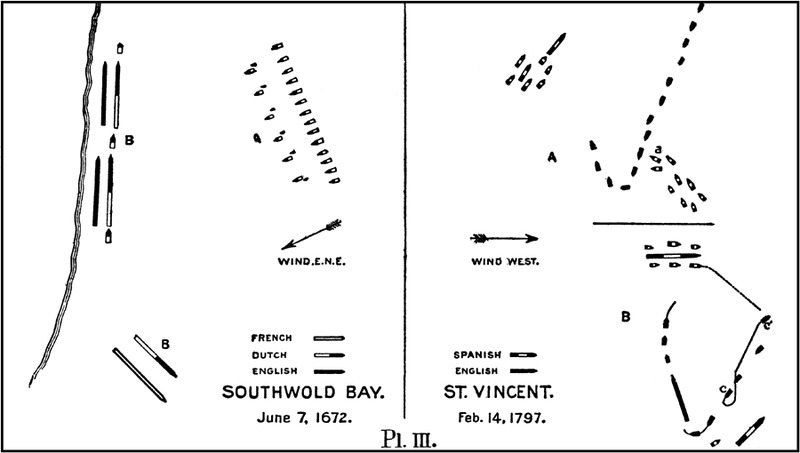
Pl. III.ToList
The results of the battle, considered simply as an engagement, were indecisive; both sides lost heavily, but the honors and the substantial advantages all belonged to the Dutch, or rather to De Ruyter. He had outgeneralled the allies by his apparent retreat, and then returning had surprised them wholly unprepared. The false move by which the English, two thirds of the whole, stood to the northward and westward, while the other third, the French, went off to the east and south, separated the allied fleet; Ruyter threw his whole force into the gap, showing front to the French with a division probably smaller in numbers, but which, from its position to windward, had the choice of coming to close action or not, while with the remainder he fell in much superior strength upon the English (Plate III., B). Paul Hoste says[48] that Vice-Admiral d'Estrées, commanding the French, had taken measures for tacking and breaking through the Dutch division opposed to him so as to rejoin the Duke of York, the allied commander-in-chief. It may be so, for D'Estrées was a very brave man, and not enough of a seaman to appreciate the dangers of the attempt; but no such move was begun, and both the English and Ruyter thought that the French rather avoided than sought close action. Had D'Estrées, however, gone about, and attempted to break through the line of experienced Dutchmen to windward of him with the still raw seamen of France, the result would have been as disastrous as that which overtook the Spanish admiral at the battle of St. Vincent a hundred and twenty-five years later, when he tried to reunite his broken fleet by breaking through the close order of Jervis and Nelson. (See Plate III., a.) The truth, which gradually dawns through a mass of conflicting statements, is, that the Duke of York, though a fair seaman and a brave man, was not an able one; that his fleet was not in good order and was thus surprised; that his orders beforehand were not so precise as to make the French admiral technically disobedient in taking the opposite tack from the commander-in-chief, and so separating the squadrons; and that Ruyter profited most ably by the surprise which he had himself prepared, and by the further opportunity given him by the ineptness of his enemies. Unless for circumstances that are not stated, the French admiral took the right tack, with a northeast wind, for it led out to sea and would give room for manœuvring; had the Duke of York chosen the same, the allied fleet would have gone out together, with only the disadvantage of the wind and bad order. In that case, however, Ruyter could, and probably would, have done just what he did at the Texel a year later,—check the van, the French, with a small containing force, and fall with the mass of his fleet upon the centre and rear. It is the similarity of his action in both cases, under very different conditions, that proves he intended at Southwold Bay merely to keep the French in check while he destroyed the English.
In this battle, called indifferently Southwold Bay and Solebay, Ruyter showed a degree of skill combined with vigor which did not appear upon the sea, after his death, until the days of Suffren and Nelson. His battles of the war of 1672 were no "affairs of circumspection," though they were fought circumspectly; his aim was no less than the enemy's total overthrow, by joining good combinations to fury of attack. At Solebay he was somewhat, though not greatly, inferior to his enemies; afterward much more so.
The substantial results of Solebay fight were wholly favorable to the Dutch. The allied fleets were to have assisted the operations of the French army by making a descent upon the coast of Zealand. Ruyter's attack had inflicted an amount of damage, and caused an expenditure of ammunition, which postponed the sailing of the fleet for a month; it was a diversion, not only important, but vital in the nearly desperate condition to which the United Provinces were reduced ashore. It may be added, as an instructive comment on the theory of commerce-destroying, that after this staggering check to the enemy's superior forces, Ruyter met and convoyed safely to port a fleet of Dutch merchantmen.
The progress of the land campaign must now be briefly described.[49] Early in May the French army in several corps moved forward, passing through the outskirts of the Spanish Netherlands, and directing their attack upon Holland from the south and east. The republican party which was in power in Holland had neglected the army, and now made the mistake of scattering the force they had among many fortified towns, trusting that each would do something toward delaying the French. Louis, however, under the advice of Turenne, simply observed the more important places, while the second-rate towns surrendered nearly as fast as they were summoned; the army of the Provinces, as well as their territory, thus passing rapidly, by fractions, into the power of the enemy. Within a month the French were in the heart of the country, having carried all before them, and with no organized force remaining in their front sufficient of itself to stop them. In the fortnight following the battle of Solebay, terror and disorganization spread throughout the republic. On the 15th of June the Grand Pensionary obtained permission of the States-General to send a deputation to Louis XIV., begging him to name the terms on which he would grant them peace; any humiliation to the foreigner was better in the eyes of the politician than to see the opposite party, the House of Orange, come into power on his downfall. While negotiations were pending, the Dutch towns continued to surrender; and on the 20th of June a few French soldiers entered Muyden, the key to Amsterdam. They were only stragglers, though the large body to which they belonged was near at hand; and the burghers, who had admitted them under the influence of the panic prevailing throughout the land, seeing that they were alone, soon made them drunk and put them out. The nobler feeling that animated Amsterdam now made itself felt in Muyden; a body of troops hurried up from the capital, and the smaller city was saved. "Situated on the Zuyder Zee, two hours distant from Amsterdam, at the junction of a number of rivers and canals, Muyden not only held the key of the principal dykes by which Amsterdam could surround herself with a protecting inundation, it also held the key of the harbor of this great city, all the ships which went from the North Sea to Amsterdam by the Zuyder Zee being obliged to pass under its guns. Muyden saved and its dykes open, Amsterdam had time to breathe, and remained free to break off her communications by land and to maintain them by sea."[50] It was the turning-point of the invasion; but what would have been the effect upon the spirit of the Dutch, oppressed by defeat and distracted in council, if in that fateful fortnight which went before, the allied fleet had attacked their coasts? From this they were saved by the battle of Solebay.
Negotiations continued. The burgomasters—the party representing wealth and commerce—favored submission; they shrank from the destruction of their property and trade. New advances were made; but while the envoys were still in the camp of Louis, the populace and the Orange party rose, and with them the spirit of resistance. On the 25th of June Amsterdam opened the dykes, and her example was followed by the other cities of Holland; immense loss was entailed, but the flooded country and the cities contained therein, standing like islands amid the waters, were safe from attack by land forces until freezing weather. The revolution continued. William of Orange, afterward William III. of England, was on the 8th of July made stadtholder, and head of the army and navy; and the two De Witts, the heads of the republican party, were murdered by a mob a few weeks later.
The resistance born of popular enthusiasm and pride of country was strengthened by the excessive demands of Louis XIV. It was plain that the Provinces must conquer or be destroyed. Meanwhile the other States of Europe were waking up to the danger, and the Emperor of Germany, the Elector of Brandenburg, and the King of Spain declared for Holland; while Sweden, though nominally in alliance with France, was unwilling to see the destruction of the Provinces, because that would be to the advantage of England's sea power. Nevertheless the next year, 1673, opened with promise for France, and the English king was prepared to fulfil his part of the compact on the seas; but the Dutch, under the firm leadership of William of Orange, and with their hold on the sea unshaken, now refused to accept conditions of peace which had been offered by themselves the year before.
Three naval battles were fought in 1673, all near the coast of the United Provinces; the first two, June 7 and June 14, off Schoneveldt, from which place they have taken their name; the third, known as the battle of the Texel, August 21. In all three Ruyter attacked, choosing his own time, and retiring when it suited him to the protection of his own shores. For the allies to carry out their objects and make any diversion upon the seaboard, or on the other hand to cripple the sea resources of the hard-pressed Provinces, it was necessary first to deal successfully with Ruyter's fleet. The great admiral and his government both felt this, and took the resolution that "the fleet should be posted in the passage of Schoneveldt, or a little farther south toward Ostend, to observe the enemy, and if attacked, or seeing the enemy's fleet disposed to make a descent upon the shores of the United Provinces, should resist vigorously, by opposing his designs and destroying his ships."[51] From this position, with good lookouts, any movement of the allies would be known.
The English and French put to sea about the 1st of June, under the command of Prince Rupert, first cousin to the king, the Duke of York having been obliged to resign his office on account of the passage of the Test Act, directed against persons of the Roman Catholic faith holding any public employment. The French were under Vice-Admiral d'Estrées, the same who had commanded them at Solebay. A force of six thousand English troops at Yarmouth was ready to embark if De Ruyter was worsted. On the 7th of June the Dutch were made out, riding within the sands at Schoneveldt. A detached squadron was sent to draw them out, but Ruyter needed no invitation; the wind served, and he followed the detached squadron with such impetuosity as to attack before the allied line was fairly formed. On this occasion the French occupied the centre. The affair was indecisive, if a battle can be called so in which an inferior force attacks a superior, inflicts an equal loss, and frustrates the main object of the enemy. A week later Ruyter again attacked, with results which, though indecisive as before as to the particular action, forced the allied fleet to return to the English coast to refit, and for supplies. The Dutch in these encounters had fifty-five ships-of-the-line; their enemies eighty-one, fifty-four of which were English.
The allied fleets did not go to sea again until the latter part of July, and this time they carried with them a body of troops meant for a landing. On the 20th of August the Dutch fleet was seen under way between the Texel and the Meuse. Rupert at once got ready to fight; but as the wind was from the northward and westward, giving the allies the weather-gage, and with it the choice of the method of attack, Ruyter availed himself of his local knowledge, keeping so close to the beach that the enemy dared not approach,—the more so as it was late in the day. During the night the wind shifted to east-southeast off the land, and at daybreak, to use the words of a French official narrative, the Dutch "made all sail and stood down boldly into action."
The allied fleet was to leeward on the port tack, heading about south,—the French in the van, Rupert in the centre, and Sir Edward Spragge commanding the rear. De Ruyter divided his fleet into three squadrons, the leading one of which, of ten or twelve ships only, he sent against the French; while with the rest of his force he attacked the English in the centre and rear (Plate IV., A, A’, A’’). If we accept the English estimate of the forces, which gives the English sixty ships, the French thirty, and the Dutch seventy, Ruyter's plan of attack, by simply holding the French in check as at Solebay, allowed him to engage the English on equal terms. The battle took on several distinct phases, which it is instructive to follow. M. de Martel, commanding the van of the French, and consequently the leading subdivision of the allied fleet, was ordered to stretch ahead, go about and gain to windward of the Dutch van, so as to place it between two fires. This he did (B); but as soon as Bankert—the same who had manœuvred so judiciously at Solebay the year before—saw the danger, he put his helm up and ran through the remaining twenty ships of D'Estrées' squadron with his own twelve (C),—a feat as creditable to him as it was discreditable to the French; and then wearing round stood down to De Ruyter, who was hotly engaged with Rupert (C’). He was not followed by D'Estrées, who suffered him to carry this important reinforcement to the Dutch main attack undisturbed. This practically ended the French share in the fight.
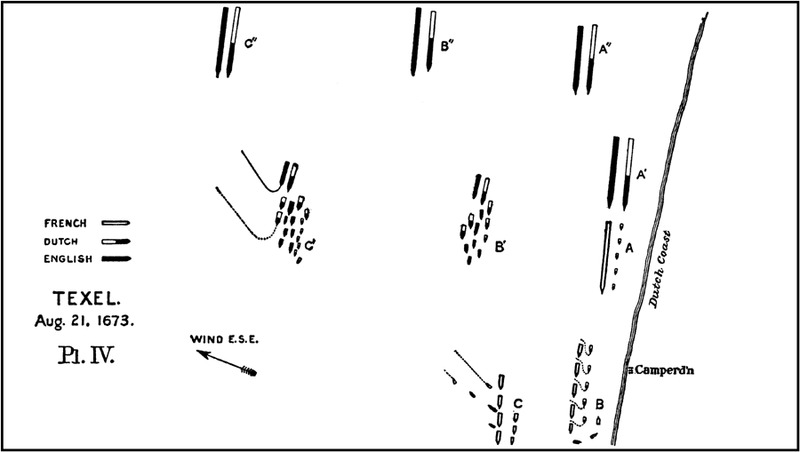
Pl. IV.ToList
Rupert, during his action with De Ruyter, kept off continually, with the object of drawing the Dutch farther away from their coast, so that if the wind shifted they might not be able to regain its shelter. De Ruyter followed him, and the consequent separation of the centre from the van (B, B’) was one of the reasons alleged by D'Estrées for his delay. It does not, however, seem to have prevented Bankert from joining his chief.
In the rear an extraordinary action on the part of Sir Edward Spragge increased the confusion in the allied fleet. For some reason this officer considered Tromp, who commanded the Dutch rear, as his personal antagonist, and in order to facilitate the latter's getting into action, he hove-to (stopped) the whole English rear to wait for him. This ill-timed point of honor on Spragge's part seems to have sprung from a promise he had made to the king that he would bring back Tromp alive or dead, or else lose his own life. The stoppage, which recalls the irresponsible and insubordinate action of the junior Dutch flag-officers in the former war, of course separated the rear (A’’, B’’, C’’), which also drifted rapidly to leeward, Spragge and Tromp carrying on a hot private action on their own account. These two junior admirals sought each other personally, and the battle between their flags was so severe that Spragge twice had to shift his own to another ship; on the second occasion the boat in which he was embarked was sunk by a shot, and he himself drowned.
Rupert, thus forsaken by his van and rear, found himself alone with Ruyter (B’); who, reinforced by his van, had the address further to cut off the rear subdivision of the allied centre, and to surround the remaining twenty ships with probably thirty or forty of his own (C’). It is not creditable to the gunnery of the day that more substantial results did not follow; but it is to be remembered that all Ruyter's skill could secure, except for probably a very short time, was an action on equal terms with the English; his total inferiority in numbers could not be quite overcome. The damage to the English and Dutch may therefore have been great, and was probably nearly equal.
Rupert finally disengaged himself, and seeing that the English rear (C’’) was not replying well to its immediate opponents, ran down toward it, Ruyter following him; the two opposing centres steering parallel courses, and within cannon-shot, but by mutual consent, induced perhaps by ammunition running short, refraining from firing. At four P.M. the centres and rears united, and toward five a fresh engagement began, which continued till seven, when Ruyter withdrew, probably because of the approach of the French, who, by their own accounts, rejoined Rupert about that time. This ended the battle, which, like all that preceded it in this war, may be called a drawn fight, but as to which the verdict of the English naval historian is doubtless correct: "The consequences which the Dutch, through the prudence of their admiral, drew from this battle were exceedingly great; for they opened their ports, which were entirely blocked up, and put an end to all thoughts, by removing the possibility, of an invasion."[52]
The military features of the action have sufficiently appeared in the account that has been given,—the skill of De Ruyter; the firmness and promptness of Bankert, first in checking and then in passing through the French division; the apparent disloyalty or, at the best, inefficiency of the latter; the insubordination and military blundering of Spragge; the seeming lack of everything but hard fighting on Rupert's part. The allies indulged in bitter mutual recriminations. Rupert blamed both D'Estrées and Spragge; D'Estrées found fault with Rupert for running to leeward; and D'Estrées' own second, Martel, roundly called his chief a coward, in a letter which earned him an imprisonment in the Bastille. The French king ordered an inquiry by the intendant of the navy at Brest, who made a report[53] upon which the account here given has mainly rested, and which leaves little doubt of the dishonor of the French arms in this battle. "M. d'Estrées gave it to be understood," says the French naval historian, "that the king wished his fleet spared, and that the English should not be trusted. Was he wrong in not relying upon the sincerity of the English alliance, when he was receiving from all quarters warnings that the people and the nobles were murmuring against it, and Charles II. was perhaps alone in his kingdom in wishing it?"[54] Possibly not; but he was surely wrong if he wished any military man, or body of men, to play the equivocal part assigned to the French admiral on this day; the loss of the fleet would have been a lighter disaster. So evident to eye-witnesses was the bad faith or cowardice (and the latter supposition is not admissible), that one of the Dutch seamen, as they discussed among themselves why the French did not come down, said: "You fools! they have hired the English to fight for them, and all their business here is to see that they earn their wages." A more sober-minded and significant utterance is that with which the intendant at Brest ends the official report before mentioned: "It would appear in all these sea-fights Ruyter has never cared to attack the French squadron, and that in this last action he had detached ten ships of the Zealand squadron to keep it in play."[55] No stronger testimony is needed to Ruyter's opinion of the inefficiency or faithlessness of that contingent to the allied forces.
Another chapter in the history of maritime coalitions was closed, on the 21st of August, 1673, by the battle of the Texel. In it, as in others, were amply justified the words with which a modern French naval officer has stamped them: "United by momentary political interests, but at bottom divided to the verge of hatred, never following the same path in counsel or in action, they have never produced good results, or at least results proportioned to the efforts of the powers allied against a common enemy. The navies of France, Spain, and Holland seem, at several distinct times, to have joined only to make more complete the triumph of the British arms."[56] When to this well-ascertained tendency of coalitions is added the equally well known jealousy of every country over the increasing power of a neighbor, and the consequent unwillingness to see such increase obtained by crushing another member of the family of nations, an approach is made to the measure of naval strength required by a State. It is not necessary to be able to meet all others combined, as some Englishmen have seemed to think; it is necessary only to be able to meet the strongest on favorable terms, sure that the others will not join in destroying a factor in the political equilibrium, even if they hold aloof. England and Spain were allies in Toulon in 1793, when the excesses of Revolutionary France seemed to threaten the social order of Europe; but the Spanish admiral told the English flatly that the ruin of the French navy, a large part of which was there in their hands, could not fail to be injurious to the interests of Spain, and a part of the French ships was saved by his conduct, which has been justly characterized as not only full of firmness, but also as dictated by the highest political reason.[57]
The battle of the Texel, closing the long series of wars in which the Dutch and English contended on equal terms for the mastery of the seas, saw the Dutch navy in its highest efficiency, and its greatest ornament, De Ruyter, at the summit of his glory. Long since old in years, for he was now sixty-six, he had lost none of his martial vigor; his attack was as furious as eight years before, and his judgment apparently had ripened rapidly through the experience of the last war, for there is far more evidence of plan and military insight than before. To him, under the government of the great Pensionary De Witt, with whom he was in close sympathy, the increase of discipline and sound military tone now apparent in the Dutch navy must have been largely due. He went to this final strife of the two great sea-peoples in the fulness of his own genius, with an admirably tempered instrument in his hands, and with the glorious disadvantage of numbers, to save his country. The mission was fulfilled not by courage alone, but by courage, forethought, and skill. The attack at the Texel was, in its general lines, the same as that at Trafalgar, the enemy's van being neglected to fall on the centre and rear, and as at Trafalgar the van, by failing to do its duty, more than justified the conception; but as the odds against De Ruyter were greater than those against Nelson, so was his success less. The part played by Bankert at Solebay was essentially the same as that of Nelson at St. Vincent, when he threw himself across the path of the Spanish division with his single ship (see Plate III., c, c’); but Nelson took his course without orders from Jervis, while Bankert was carrying out Ruyter's plan. Once more, still himself in his bearing, but under sadly altered surroundings, will this simple and heroic man come before us; and here, in contrast with his glory, seems a proper place to insert a little description by the Comte de Guiche[58] of his bearing in the Four Days' Fight, which brings out at once the homely and the heroic sides of his character.
"I never saw him [during those last three days] other than even-tempered; and when victory was assured, saying always it was the good God that gives it to us. Amid the disorders of the fleet and the appearance of loss, he seemed to be moved only by the misfortune to his country, but always submissive to the will of God. Finally, it may be said that he has something of the frankness and lack of polish of our patriarchs; and, to conclude what I have to say of him, I will relate that the day after the victory I found him sweeping his own room and feeding his chickens."
Nine days after the battle of the Texel, on the 30th of August, 1673, a formal alliance was made between Holland on the one hand, and Spain, Lorraine, and the emperor of Germany on the other, and the French ambassador was dismissed from Vienna. Louis almost immediately offered Holland comparatively moderate terms; but the United Provinces, with their new allies by their sides and with their backs borne firmly upon the sea which had favored and supported them, set their face steadily against him. In England the clamor of the people and Parliament became louder; the Protestant feeling and the old enmity to France were daily growing, as was the national distrust of the king. Charles, though he had himself lost none of his hatred of the republic, had to give way. Louis, seeing the gathering storm, made up his mind, by the counsel of Turenne, to withdraw from his dangerously advanced position by evacuating Holland, and to try to make peace with the Provinces separately while continuing the war with the House of Austria in Spain and Germany. Thus he returned to Richelieu's policy, and Holland was saved. February 19, 1674, peace was signed between England and the Provinces. The latter recognized the absolute supremacy of the English flag from Cape Finisterre in Spain to Norway, and paid a war indemnity.
The withdrawal of England, which remained neutral during the remaining four years of the war, necessarily made it less maritime. The King of France did not think his navy, either in numbers or efficiency, able to contend alone with that of Holland; he therefore withdrew it from the ocean and confined his sea enterprises to the Mediterranean, with one or two half-privateering expeditions to the West Indies. The United Provinces for their part, being freed from danger on the side of the sea, and not having, except for a short time, any serious idea of operating against the French coast, diminished their own fleets. The war became more and more continental, and drew in more and more the other powers of Europe. Gradually the German States cast their lot with Austria, and on May 28, 1674, the Diet proclaimed war against France. The great work of French policy in the last generations was undone, Austria had resumed her supremacy in Germany, and Holland had not been destroyed. On the Baltic, Denmark, seeing Sweden inclining toward France, hastened to make common cause with the German Empire, sending fifteen thousand troops. There remained in Germany only Bavaria, Hanover, and Wurtemberg faithful still to their French alliance. The land war had thus drawn in nearly all the powers of Europe, and, from the nature of the case, the principal theatre of the conflict was beyond the eastern boundary of France, toward the Rhine, and in the Spanish Netherlands; but while this was raging, a maritime episode was introduced by the fact of Denmark and Sweden being engaged on opposite sides. Of this it will not be necessary to speak, beyond mentioning that the Dutch sent a squadron under Tromp to join the Danes, and that the united fleets won a great victory over the Swedes in 1676, taking from them ten ships. It is therefore evident that the sea superiority of Holland detracted greatly from Sweden's value as an ally to Louis XIV.
Another maritime strife arose in the Mediterranean by the revolt of the Sicilians against the Spanish rule.[59] The help they asked from France was granted as a diversion against Spain, but the Sicilian enterprise never became more than a side issue. Its naval interest springs from bringing Ruyter once more on the scene, and that as the antagonist of Duquesne, the equal, and by some thought even the superior, of Tourville, whose name has always stood far above all others in the French navy of that day.
Messina revolted in July, 1674, and the French king at once took it under his protection. The Spanish navy throughout seems to have behaved badly, certainly inefficiently; and early in 1675 the French were safely established in the city. During the year their naval power in the Mediterranean was much increased, and Spain, unable to defend the island herself, applied to the United Provinces for a fleet, the expenses of which she would bear. The Provinces, "fatigued by the war, involved in debt, suffering cruelly in their commerce, exhausted by the necessity of paying the emperor and all the German princes, could no longer fit out the enormous fleets which they had once opposed to France and England." They however hearkened to Spain and sent De Ruyter, with a squadron of only eighteen ships and four fire-ships. The admiral, who had noted the growth of the French navy, said the force was too small, and departed oppressed in spirit, but with the calm resignation which was habitual to him. He reached Cadiz in September, and in the mean time the French had further strengthened themselves by the capture of Agosta, a port commanding the southeast of Sicily. De Ruyter was again delayed by the Spanish government, and did not reach the north coast of the island until the end of December, when head winds kept him from entering the Straits of Messina. He cruised between Messina and the Lipari Islands in a position to intercept the French fleet convoying troops and supplies, which was expected under Duquesne.
On the 7th of January, 1676, the French came in sight, twenty ships-of-the-line and six fire-ships; the Dutch had but nineteen ships, one of which was a Spaniard, and four fire-ships; and it must be remembered that, although there is no detailed account of the Dutch ships in this action, they were as a rule inferior to those of England, and yet more to those of France. The first day was spent in manœuvring, the Dutch having the weather-gage; but during that night, which was squally and drove the Spanish galleys accompanying the Dutch to take refuge under Lipari, the wind shifted, and coming out at west-southwest, gave the French the weather-gage and the power to attack. Duquesne resolved to use it, and sending the convoy ahead, formed his line on the starboard tack standing south; the Dutch did the same, and waited for him (Plate V., A, A, A).
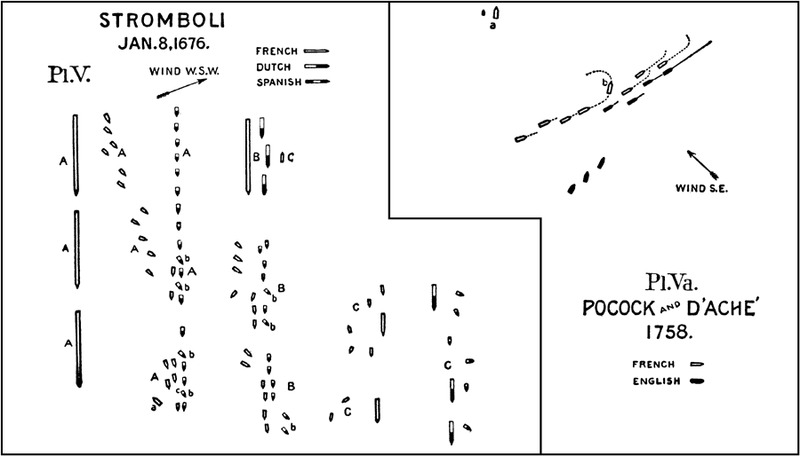
Pl. V. and Pl. Va.ToList
An emotion of surprise must be felt at seeing the great Dutch admiral surrender the choice of attack on the 7th. At daybreak of that day he saw the enemy and steered for him; at three P.M., a French account says, he hauled his wind on the same tack as themselves, but out of cannon-shot to windward. How account for the seeming reluctance of the man who three years before had made the desperate attacks of Solebay and the Texel? His reasons have not been handed down; it may be that the defensive advantages of the lee-gage had been recognized by this thoughtful seaman, especially when preparing to meet, with inferior forces, an enemy of impetuous gallantry and imperfect seamanship. If any such ideas did influence him they were justified by the result. The battle of Stromboli presents a partial anticipation of the tactics of the French and English a hundred years later; but in this case it is the French who seek the weather-gage and attack with fury, while the Dutch take the defensive. The results were very much such as Clerk pointed out to the English in his celebrated work on naval tactics, the accounts here followed being entirely French.[60]
The two fleets being drawn up in line-of-battle on the starboard tack, heading south, as has been said, De Ruyter awaited the attack which he had refused to make. Being between the French and their port, he felt they must fight. At nine A.M. the French line kept away all together and ran down obliquely upon the Dutch, a manœuvre difficult to be performed with accuracy, and during which the assailant receives his enemy's fire at disadvantage (A’, A’’, A’’’). In doing this, two ships in the French van were seriously disabled. "M. de la Fayette, in the 'Prudente,' began the action; but having rashly thrown himself into the midst of the enemy's van, he was dismantled and forced to haul off" (a). Confusion ensued in the French line, from the difficult character of the manœuvre. "Vice-Admiral de Preuilli, commanding the van, in keeping away took too little room, so that in coming to the wind again, the ships, in too close order, lapped and interfered with one another's fire [A’]. The absence of M. de la Fayette from the line threw the 'Parfait' into peril. Attacked by two ships, she lost her maintopmast and had also to haul off for repairs." Again, the French came into action in succession instead of all together, a usual and almost inevitable result of the manœuvre in question. "In the midst of a terrible cannonade," that is, after part of his ships were engaged, "Duquesne, commanding the centre, took post on the beam of Ruyter's division." The French rear came into action still later, after the centre (A’’, A’’’). "Langeron and Bethune, commanding leading ships of the French centre, are crushed by superior forces." How can this be, seeing the French had the more ships? It was because, as the narrative tells us, "the French had not yet repaired the disorder of the first movement." However, all at last got into action (B, B, B), and Duquesne gradually restored order. The Dutch, engaged all along the line, resisted everywhere, and there was not one of their ships which was not closely engaged; more cannot be said for the admiral and captains of the inferior fleet. The remaining part of the fight is not very clearly related. Ruyter is said to have given way continually with his two leading divisions; but whether this was a confession of weakness or a tactical move does not appear. The rear was separated (C’), in permitting which either Ruyter or the immediate commander was at fault; but the attempts made by the French to surround and isolate it failed, probably because of damaged spars, for one French ship did pass entirely around the separated division. The action ended at 4.30 P.M., except in the rear, and the Spanish galleys shortly after came up and towed the disabled Dutch ships away. Their escape shows how injured the French must have been. The positions, C, C’, are intended to show the Dutch rear far separated, and the disorder in which a fleet action under sail necessarily ended from loss or spars.
Those who are familiar with Clerk's work on naval tactics, published about 1780, will recognize in this account of the battle of Stromboli all the features to which he called the attention of English seamen in his thesis on the methods of action employed by them and their adversaries in and before his time. Clerk's thesis started from the postulate that English seamen and officers were superior in skill or spirit, or both, to the French, and their ships on the whole as fast; that they were conscious of this superiority and therefore eager to attack, while the French, equally conscious of inferiority, or for other reasons, were averse to decisive engagements. With these dispositions the latter, feeling they could rely on a blindly furious attack by the English, had evolved a crafty plan by which, while seeming to fight, they really avoided doing so, and at the same time did the enemy much harm. This plan was to take the lee-gage, the characteristic of which, as has before been pointed out, is that it is a defensive position, and to await attack. The English error, according to Clerk, upon which the French had learned by experience that they could always count, was in drawing up their line parallel to the enemy, or nearly so, and then keeping away all together to attack, ship for ship, each its opposite in the hostile line. By standing down in this manner the assailant lost the use of most of his artillery, while exposed to the full fire of his opponent, and invariably came up in confusion, because the order of attack was one difficult to maintain at any time, and much more so in the smoke under fire, with torn sails and falling masts. This was precisely the attack made by Duquesne at Stromboli, and it there had precisely the consequences Clerk points out,—confusion in the line, the van arriving first and getting the brunt of the fire of the defence, disabled ships in the van causing confusion in the rear, etc. Clerk further asserts, and he seems to be right, that as the action grew warm, the French, by running off to leeward, in their turn, led the English to repeat the same mode of attack;[61] and so we find, at Stromboli, Ruyter giving ground in the same way, though his motive does not appear. Clerk also points out that a necessary corollary of the lee-gage, assumed for tactical reasons, is to aim at the assailant's spars, his motive power, so that his attack cannot be pushed farther than the defendant chooses, and at Stromboli the crippled condition of the French is evident; for after Ruyter had fallen to leeward, and could no longer help his separated rear, it was practically unmolested by the French, although none of these had been sunk. While therefore there cannot with certainty be attributed to Ruyter the deliberate choice of the lee-gage, for which there was as yet no precedent, it is evident that he reaped all its benefits, and that the character of the French officers of his day, inexperienced as seamen and of impetuous valor, offered just the conditions that gave most advantage to an inferior force standing on the defensive. The qualities and characteristics of the enemy are among the principal factors which a man of genius considers, and it was to this as much as to any other one trait that Nelson owed his dazzling successes. On the other hand, the French admiral attacked in a wholly unscientific manner, ship against ship, without an attempt to concentrate on a part of the enemy, or even trying to keep him in play until the French squadron of eight ships-of-the-line in Messina, near by, could join. Such tactics cannot be named beside that of Solebay or the Texel; but as Duquesne was the best French officer of the century, with the possible exception of Tourville, this battle has a value of its own in the history of tactics, and may by no means be omitted. The standing of the commander-in-chief is the warrant that it marks the highest point to which French naval tactics has as yet attained. Before quitting this discussion, it may be noted that the remedy Clerk proposed was to attack the rear ships of the enemy's line, and preferably to leeward; the remainder of the fleet must then either abandon them or stand down for a general action, which according to his postulate was all that the English seamen desired.
After the fight De Ruyter sailed to Palermo, one of his ships sinking on the way. Duquesne was joined outside Messina by the French division that had been lying there. The remaining incidents of the Sicilian war are unimportant to the general subject. On the 22d of April, De Ruyter and Duquesne met again off Agosta. Duquesne had twenty-nine ships, the allied Spaniards and Dutch twenty-seven, of which ten were Spanish. Unfortunately the Spaniard commanded in chief, and took the centre of the line with the ships of his country, contrary to the advice of Ruyter, who, knowing how inefficient his allies were, wished to scatter them through the line and so support them better. Ruyter himself took the van, and the allies, having the wind, attacked; but the Spanish centre kept at long cannon range, leaving the brunt of the battle to fall on the Dutch van. The rear, following the commander-in-chief's motions, was also but slightly engaged. In this sorrowful yet still glorious fulfilment of hopeless duty, De Ruyter, who never before in his long career had been struck by an enemy's shot, received a mortal wound. He died a week later at Syracuse, and with him passed away the last hope of resistance on the sea. A month later the Spanish and Dutch fleets were attacked at anchor at Palermo, and many of them destroyed; while a division sent from Holland to reinforce the Mediterranean fleet was met by a French squadron in the Straits of Gibraltar and forced to take refuge in Cadiz.
The Sicilian enterprise continued to be only a diversion, and the slight importance attached to it shows clearly how entirely Louis XIV. was bent on the continental war. How differently would the value of Sicily have impressed him, had his eyes been fixed on Egypt and extension by sea. As the years passed, the temper of the English people became more and more excited against France; the trade rivalries with Holland seemed to fall into the shade, and it became likely that England, which had entered the war as the ally of Louis, would, before it closed, take up arms against him. In addition to other causes of jealousy she saw the French navy increased to a number superior to her own. Charles for a while resisted the pressure of Parliament, but in January, 1678, a treaty of alliance, offensive and defensive, was made between the two sea countries; the king recalled the English troops which until now had been serving as part of the French army, and when Parliament opened again in February, asked for money to equip ninety ships and thirty thousand soldiers. Louis, who was expecting this result, at once ordered the evacuation of Sicily. He did not fear England by land, but on the sea he could not yet hold his own against the union of the two sea powers. At the same time he redoubled his attacks on the Spanish Netherlands. As long as there was a hope of keeping the ships of England out of the fight, he had avoided touching the susceptibilities of the English people on the subject of the Belgian sea-coast; but now that they could no longer be conciliated, he thought best to terrify Holland by the sharpness of his attack in the quarter where she dreaded him most.
The United Provinces were in truth the mainspring of the coalition. Though among the smallest in extent of the countries arrayed against Louis, they were strongest in the character and purpose of their ruler, the Prince of Orange, and in the wealth which, while supporting the armies of the confederates, also kept the poor and greedy German princes faithful to their alliance. Almost alone, by dint of mighty sea power, by commercial and maritime ability, they bore the burden of the war; and though they staggered and complained, they still bore it. As in later centuries England, so at the time we are now speaking of Holland, the great sea power, supported the war against the ambition of France; but her sufferings were great. Her commerce, preyed upon by French privateers, lost heavily; and there was added an immense indirect loss in the transfer of the carrying-trade between foreign countries, which had contributed so much to the prosperity of the Dutch. When the flag of England became neutral, this rich business went to her ships, which crossed the seas the more securely because of the eager desire of Louis to conciliate the English nation. This desire led him also to make very large concessions to English exigencies in the matter of commercial treaties, undoing much of the work of protection upon which Colbert sought to nourish the yet feeble growth of French sea power. These sops, however, only stayed for a moment the passions which were driving England; it was not self-interest, but stronger motives, which impelled her to a break with France.
Still less was it to the interest of Holland to prolong the war, after Louis showed a wish for peace. A continental war could at best be but a necessary evil, and source of weakness to her. The money she spent on her own and the allied armies was lost to her navy, and the sources of her prosperity on the sea were being exhausted. How far the Prince of Orange was justified, by the aims of Louis XIV., in that unyielding attitude of opposition toward him which he always maintained, may be uncertain, and there is here no need to decide the question; but there can be no doubt that the strife sacrificed the sea power of Holland through sheer exhaustion, and with it destroyed her position among the nations of the world. "Situated between France and England," says a historian of Holland, "by one or other of them were the United Provinces, after they had achieved their independence of Spain, constantly engaged in wars, which exhausted their finances, annihilated their navy, and caused the rapid decline of their trade, manufactures, and commerce; and thus a peace-loving nation found herself crushed by the weight of unprovoked and long-continued hostilities. Often, too, the friendship of England was scarcely less harmful to Holland than her enmity. As one increased and the other lessened, it became the alliance of the giant and the dwarf."[62] Hitherto we have seen Holland the open enemy or hearty rival of England; henceforward she appears as an ally,—in both cases a sufferer from her smaller size, weaker numbers, and less favored situation.
The exhaustion of the United Provinces and the clamor of their merchants and peace party on the one hand, aided on the other by the sufferings of France, the embarrassment of her finances, and the threatened addition of England's navy to her already numerous enemies, inclined to peace the two principal parties to this long war. Louis had long been willing to make peace with Holland alone; but the States had been withheld, at first by fidelity to those who had joined them in their hour of trouble, and latterly by the firm purpose of William of Orange. Difficulties were gradually smoothed away, and the Peace of Nimeguen between the United Provinces and France was signed August 11, 1678. The other powers shortly afterward acceded to it. The principal sufferer, as was natural, was the overgrown but feeble monarchy whose centre was Spain, which gave up to France Franche Comté and a number of fortified towns in the Spanish Netherlands, thus extending the boundaries of France to the east and northeast. Holland, for whose destruction Louis began the war, lost not a foot of ground in Europe; and beyond the seas only her colonies on the west coast of Africa and in Guiana. She owed her safety at first, and the final successful issue, to her sea power. That delivered her in the hour of extreme danger, and enabled her afterward to keep alive the general war. It may be said to have been one of the chief factors, and inferior to no other one singly, in determining the event of the great war which was formally closed at Nimeguen.
The effort none the less sapped her strength, and being followed by many years of similar strain broke her down. But what was the effect upon the vastly greater state, the extreme ambition of whose king was the principal cause of the exhausting wars of this time? Among the many activities which illustrated the brilliant opening of the reign of the then youthful king of France, none was so important, none so intelligently directed, as those of Colbert, who aimed first at restoring the finances from the confusion into which they had fallen, and then at establishing them upon a firm foundation of national wealth. This wealth, at that time utterly beneath the possibilities of France, was to be developed on the lines of production encouraged, trade stimulated to healthful activity, a large merchant shipping, a great navy, and colonial extension. Some of these are sources, others the actual constituents, of sea power; which indeed may be said in a seaboard nation to be the invariable accompaniment, if it be not the chief source, of its strength. For nearly twelve years all went well; the development of the greatness of France in all these directions went forward rapidly, if not in all with equal strides, and the king's revenues increased by bounds. Then came the hour in which he had to decide whether the exertions which his ambition naturally, perhaps properly, prompted should take the direction which, while imposing great efforts, did nothing to sustain but rather hindered the natural activities of his people, and broke down commerce by making control of the sea uncertain; or whether he should launch out in pursuits which, while involving expense, would keep peace on his borders, lead to the control of the sea, and by the impulse given to trade, and all upon which trade depends, would bring in money nearly if not quite equal to that which the State spent. This is not a fanciful picture; by his attitude toward Holland, and its consequences, Louis gave the first impulse to England upon the path which realized to her, within his own day, the results which Colbert and Leibnitz had hoped for France. He drove the Dutch carrying-trade into the ships of England; allowed her to settle peacefully Pennsylvania and Carolina, and to seize New York and New Jersey; and he sacrificed, to gain her neutrality, the growing commerce of France. Not all at once, but very rapidly, England pressed into the front place as a sea power; and however great her sufferings and the sufferings of individual Englishmen, it remained true of her that even in war her prosperity was great. Doubtless France could not forget her continental position, nor wholly keep free from continental wars; but it may be believed that if she had chosen the path of sea power, she might both have escaped many conflicts and borne those that were unavoidable with greater ease. At the Peace of Nimeguen the injuries were not irreparable, but "the agricultural classes, commerce, manufactures, and the colonies had alike been smitten by the war; and the conditions of peace, so advantageous to the territorial and military power of France, were much less so to manufactures, the protective tariffs having been lowered in favor of England and Holland,"[63] the two sea powers. The merchant shipping was stricken, and the splendid growth of the royal navy, that excited the jealousy of England, was like a tree without roots; it soon withered away under the blast of war.
Before finally quitting this war with Holland, a short notice of the Comte d'Estrées, to whom Louis committed the charge of the French contingent of the allied fleet, and who commanded it at Solebay and the Texel, will throw some light upon the qualifications of the French naval officers of the day before experience had made seamen of many of them. D'Estrées went to sea for the first time in 1667, being then a man of mature years; but in 1672 we find him in the chief command of an important squadron, having under him Duquesne, who was a seaman, and had been so for nearly forty years. In 1677, D'Estrées obtained from the king a body of eight ships which he undertook to maintain at his own expense, upon the condition of receiving half the prizes made. With this squadron he made an attack upon the then Dutch island of Tobago, with a recklessness which showed that no lack of courage prompted his equivocal conduct at the Texel. The next year he went out again and contrived to run the whole squadron ashore on the Aves Islands. The account given by the flag-captain of this transaction is amusing as well as instructive. In his report he says:—
[48] Hoste: Naval Tactics.
[49] See Map, p. 107.
[50] Martin: History of France.
[51] Brandt: Life of De Ruyter.
[52] Campbell: Lives of the Admirals.
[53] Troude: Batailles Navales de la France, year 1673.
[54] Ibid.
[55] Troude: Batailles Navales de la France, year 1673.
[56] Chabaud-Arnault: Revue Mar. et Col. July, 1885.
[57] Jurien de la Gravière: Guerres Maritimes.
[58] Mémoires.
[59] See Map of Mediterranean, p. 15.
[60] Lapeyrouse-Bonfils: Hist. de la Marine Française.
[61] This movement, according to Clerk, was not made by the whole of a French line together, but in a way much more scientific and military. A group of two or three ships withdrew at a time, being covered by the smoke and the continued fire of the rest of their line. In time a second line was partly formed, which in its turn protected the ships which had remained on the first, as they executed the somewhat exposed movement of falling back. In Plan V., Dutch ships at b, b, b, are represented as thus withdrawing. English official reports of the eighteenth century often speak of French ships acting thus; the English officers attributing to their superior valor a movement which Clerk more plausibly considers a skilful military manœuvre, well calculated to give the defence several opportunities of disabling the assailants as they bore down on a course which impeded the use of their artillery. In 1812 the frigate "United States," commanded by Decatur, employed the same tactics in her fight with the "Macedonian;" and the Confederate gunboats at Mobile by the same means inflicted on Farragut's flag-ship the greater part of the heavy loss which she sustained. In its essential features the same line of action can now be followed by a defendant, having greater speed, when the ardor of the attack, or the necessities of the case, force the assailant to a direct approach. An indirect cause of a lee line falling farther to leeward has never been noticed. When a ship in that line (as at c) found itself without an opponent abeam, and its next ahead perhaps heavily engaged, the natural impulse would be to put up the helm so as to bring the broadside to bear. This advantage would be gained by a loss of ground to leeward and consequent disorder in the line; which, if the act were repeated by several ships, could only be restored by the whole line keeping away.
[62] Davies: History of Holland.
[63] Martin: History of France.