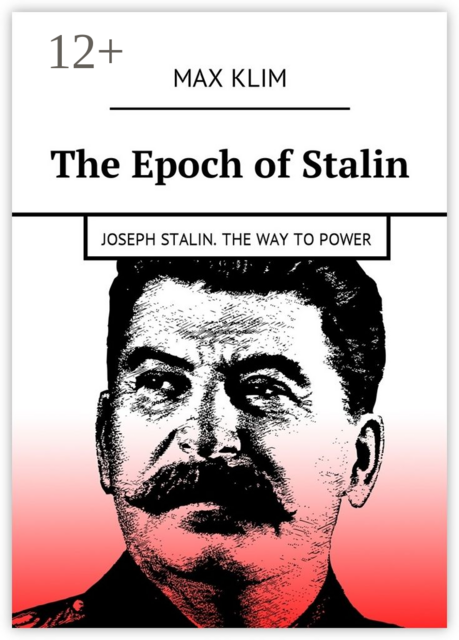



автордың кітабын онлайн тегін оқу The Epoch of Stalin. Joseph Stalin. The way to power
Max Klim
The Epoch of Stalin
Joseph Stalin. The way to power
Fonts by «ParaType»
© Max Klim, 2018
Joseph Stalin is an outstanding revolutionary politician in the history of the Russian Empire and the Soviet Union, whose activities are marked by mass repressions, which today are considered a crime against humanity. The personality and activity of Stalin in modern society are still loudly discussed — some consider him a great ruler, leading the country to victory in the Great Patriotic War, while others accuse him of genocide of the people and of famine, terror and violence against people.
ISBN 978-5-4490-2181-6
Created with Ridero smart publishing system
Contents
- The Epoch of Stalin
- Josef Stalin: biography
- The way to power
- Head of the USSR
- Personal life
- Death
- 100 interesting facts from the life of Stalin
Joseph Stalin is an outstanding revolutionary politician in the history of the Russian Empire and the Soviet Union, whose activities are marked by mass repressions, which today are considered a crime against humanity. The personality and activity of Stalin in modern society are still loudly discussed — some consider him a great ruler, leading the country to victory in the Great Patriotic War, while others accuse him of genocide of the people and of famine, terror and violence against people.
Josef Stalin: biography
Name: Joseph Stalin (Joseph Dzhugashvili)
Date of birth: December 21, 1879
Sign of the Zodiac: Sagittarius
Age: 73 years old
Date of death: March 5, 1953.
Place of birth: Gori, Tiflis Gubernia, Russian Empire
Height: 173
Activity: revolutionary, head of the government of the USSR, Generalissimo of the Soviet Union
Marital Status: Widower
Born Joseph Stalin Vissarionovich (real name Djugashvili) December 21, 1879 in the Georgian town of Gori in a family belonging to the lowest estate. He was the third, but the only surviving child in the family — his older brother and sister died in infancy. Soso, as the mother of the future ruler of the USSR called, was born not an entirely healthy child, he had birth defects of limbs (he had two fingers on his left leg), and also had damaged skin of the face and back. At the age of seven, an accident happened to Stalin — he was hit by a phaeton, as a result of which his left hand was broken.
In addition to congenital and acquired injuries, the future revolutionary was repeatedly beaten by his father Vissarion, which once led to a serious head injury and over the years affected the psycho-emotional state of Stalin. The mother of Joseph Vissarionovich, Ekaterina Georgievna, surrounded her son with immense care and care, wishing to compensate the boy for the missing love of his father. Being exhausted by the hard work, with the aim of earning as much money as possible to raise her son, the woman did her best to raise a worthy person who, in her opinion, was to become a priest. But her hopes were not crowned with success — Stalin grew up as a street darling and spent more time not in the church, but in the company of local hooligans.
At the same time in 1888, Joseph Vissarionovich became a student of the Gori Orthodox School, and at the end he entered the Tiflis Theological Seminary. It was within the walls of the seminary that he became acquainted with Marxism and joined the ranks of underground revolutionaries. In the seminary, the future ruler of the Soviet Union proved to be a gifted and talented student, as he was easily given all subjects without exception. Then he became the head of the illegal circle of Marxists, in which he was actively engaged in propaganda activities.
Stalin did not succeed in graduating from the seminary, since he was expelled from the school just before the exams for absenteeism. After that, Vissarionovich was given a certificate, which allows him to become a teacher of primary schools. At first he earned his living by tutoring, and after that he settled in the Tiflis Physical Observatory as observer-observer.
The way to power
Stalin’s revolutionary activity began in the early 1900s — the future ruler of the USSR then engaged in active propaganda, thus strengthening his position in society. Then he gets acquainted with the head of the Soviet government, Vladimir Lenin and other famous revolutionaries. The path to power of Joseph Vissarionovich was saturated with numerous references and imprisonments, from where he always managed to escape. In 1912, he finally decided to change his name Dzhugashvili to the pseudonym “Stalin”.
In the same period he became the editor-in-chief of the Bolshevik newspaper Pravda, where his colleague was Vladimir Lenin, who saw Stalin as his assistant in resolving Bolshevik and revolutionary questions, as a result of which Joseph Vissarionovich became his right-hand man.
In 1917, for special merits, Lenin appointed Stalin a People’s Commissar for Nationalities Affairs in the Council of People’s Commissars. The next stage of the career of the future ruler of the USSR is connected with the Civil War, in which the revolutionary showed all his professionalism and leadership qualities. At the end of the war, when Lenin was already deadly sick, Stalin completely ruled the country, while destroying all opponents and contenders for the post of chairman of the government of the Soviet Union on his way.
In 1930, all power was concentrated in the hands of Stalin, in connection with which in the USSR, tremendous upheavals and perestroika began. This period is marked by the beginning of mass repression and collectivization, when all rural population of the country was driven to collective farms and starved. All the selected food from the peasants, the new leader of the Soviet Union sold abroad, and on the proceeds he developed the industry, building industrial enterprises. Thus, in the shortest possible time he made the USSR the second country in the world in terms of industrial production, true, at the cost of millions of lives of peasants who died of hunger.
Head of the USSR
By 1940, Joseph Stalin became the single ruler-dictator of the USSR. He was a strong leader of the country, had an extraordinary capacity for work, while being able to target people to solve important tasks for him. A characteristic feature of Stalin was his ability to take immediate decisions on any issues discussed and to find the time for control over absolutely all the processes taking place in the country.
The achievements of Joseph Stalin, despite his rigid methods of governing the country, are still highly appreciated by historical experts. Thanks to him, the USSR defeated in the Great Patriotic War, the country actively mechanized agriculture, industrialization took place, as a result of which the USSR turned into a nuclear superpower with colossal geopolitical influence all over the world.
Along with indisputable achievements, Stalin’s rule is characterized by a mass of negative moments, which even now cause horror in society. Stalinist repression, dictatorship, terror, violence — all these are key characteristics of the rule of Joseph Stalin. He is also accused of suppressing entire scientific directions of the country, accompanied by baiting of doctors and engineers, which caused disproportionate harm to the development of national culture and science.
The policy of Stalin and today is loudly condemned all over the world. The ruler of the USSR is accused of mass starvation and death of people who were victims of Stalinism and Nazism. Joseph Vissarionovich is posthumously considered an honorary citizen and an outstanding warrior in many cities, and many Soviet people still respect the dictator ruler, calling him the great leader.
Personal life
The personal life of Joseph Stalin has little confirmed facts today. The leader-dictator carefully destroyed all evidence of his family life and love relations, so historians managed to restore the chronology of events only slightly.
It is known that for the first time Stalin married in 1906 on Catherine Svanidze, who bore him the firstborn of Jacob. After a year of family life, Stalin’s wife died of typhus. After this, the harsh revolutionary fully devoted himself to serving the country and only 14 years later decided to marry Nadezhda Allilueva, who was younger than him for 23 years.
The second wife of Joseph Vissarionovich gave birth to the wife of his son Vasily and took up the education of the first-born Stalin, who until that moment had lived with his grandmother on the maternal line. In 1925, Svetlana’s daughter was born to Stalin’s family.
In 1932 the children of Stalin were orphaned, and he became a widower for the second time. His wife Nadezhda committed suicide amid a conflict with her husband. After that, Stalin never married again.
Death
The death of Joseph Stalin occurred on March 5, 1953. According to the official version of physicians, the ruler of the USSR died as a result of hemorrhage to the brain. After the autopsy, it was established that during his life he suffered several ischemic strokes on his feet, which led to serious heart problems and mental disorders. The embalmed body of Stalin was placed in the Mausoleum next to Lenin, but after 8 years at the Congress of the CPSU it was decided to rebury the revolutionary into the grave beside the Kremlin wall.
There are versions that his ill-wishers, who consider the policy of the leader of the revolutionaries unacceptable, have involvement in the death of Stalin. Almost all historical researchers are sure that the “companions” of the ruler deliberately prevented physicians from approaching him, who could put Stalin on his feet and prevent the death of a revolutionary.