



автордың кітабын онлайн тегін оқу The White Prophet, Volume I (of 2)
THE WHITE PROPHET, VOLUME I
This ebook is for the use of anyone anywhere in the United States and most other parts of the world at no cost and with almost no restrictions whatsoever. You may copy it, give it away or re-use it under the terms of the Project Gutenberg License included with this ebook or online at http://www.gutenberg.org/license. If you are not located in the United States, you'll have to check the laws of the country where you are located before using this ebook.
Title: The White Prophet, Volume I (of 2) Author: Hall Caine Release Date: June 15, 2016 [EBook #52342] Language: English Character set encoding: UTF-8
*** START OF THIS PROJECT GUTENBERG EBOOK THE WHITE PROPHET, VOLUME I (OF 2) ***
Produced by Al Haines.
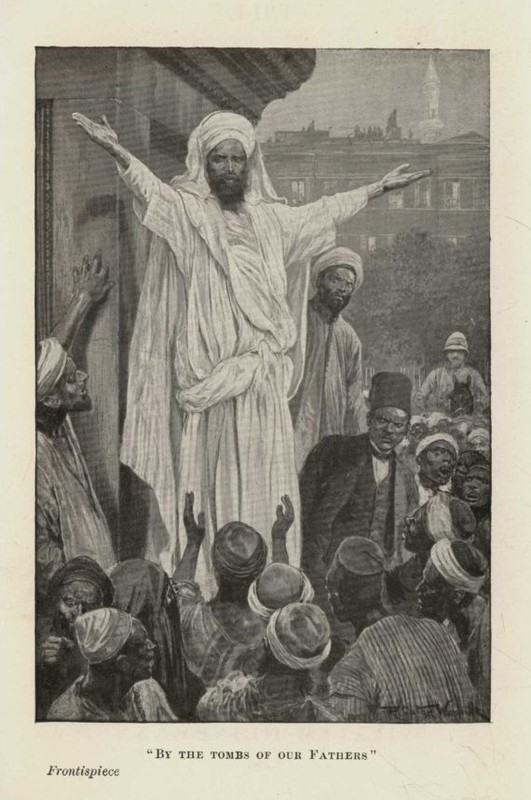
"By the tombs of our Fathers"
THE WHITE PROPHET
BY
HALL CAINE
ILLUSTRATED BY R. CATON WOODVILLE
IN TWO VOLUMES VOL. I
LONDON WILLIAM HEINEMANN 1909
Copyright London 1909 by William Heinemann and Washington U.S.A. by D. Appleton & Company
ILLUSTRATIONS
"By the tombs of our Fathers" . . . Frontispiece
He stretched out his hand to her, but she made no response
"Look here—and here," he cried, pointing to the broken sword
"How interesting!" cried the ladies in chorus
THE WHITE PROPHET
FIRST BOOK
THE CRESCENT AND THE CROSS
CHAPTER I
It was perhaps the first act of open hostility, and there was really nothing in the scene or circumstance to provoke an unfriendly demonstration.
On the broad racing ground of the Khedivial Club a number of the officers and men of the British Army quartered in Cairo, assisted by a detachment of the soldiers of the Army of Egypt, had been giving a sham fight in imitation of the battle of Omdurman, which is understood to have been the death-struggle and the end of Mahdism.
The Khedive himself had not been there—he was away at Constantinople—and his box had stood empty the whole afternoon; but a kinsman of the Khedive with a company of friends had occupied the box adjoining, and Lord Nuneham, the British Consul-General, had sat in the centre of the grand pavilion, surrounded by all the great ones of the earth in a sea of muslin, flowers, and feathers. There had been European ladies in bright spring costumes; Sheikhs in flowing robes of flowered silk; Egyptian Ministers of State in Western dress, and British Advisers and Under-Secretaries in Eastern tarbooshes; officers in gold-braided uniforms, Foreign Ambassadors, and an infinite number of Pashas, Beys, and Effendis.
Besides these, too, there had been a great crowd of what are called the common people, chiefly Cairenes, the volatile, pleasure-loving people of Cairo, who care for nothing so little as the atmosphere of political trouble. They had stood in a thick line around the arena, all capped in crimson, thus giving to the vast ellipse the effect of an immense picture framed in red.
There had been nothing in the day, either, to stimulate the spirit of insurrection. It had been a lazy day, growing hot in the afternoon, so that the white city of domes and minarets, as far up as the Mokattam Hills and the self-conscious Citadel, had seemed to palpitate in a glistening haze, while the steely ribbon of the Nile that ran between was reddening in the rays of the sunset.
General Graves, an elderly man with martial bearing, commanding the army in Egypt, had taken his place as Umpire in the Judge's box in front of the pavilion; four squadrons of British and Egyptian cavalry, a force of infantry, and a grunting and ruckling camel corps had marched and pranced and bumped out of a paddock to the left, and then young Colonel Gordon Lord, Assistant Adjutant-General, who was to play the part of Commandant in the sham fight, had come trotting into the field.
Down to that moment there had been nothing but gaiety and the spirit of fun among the spectators, who with ripples of merry laughter had whispered "Littleton's," "Wauchope's," "Macdonald's," and "Maxwell's," as the white-faced and yellow-faced squadrons had taken their places. Then the General had rung the big bell that was to be the signal for the beginning of the battle, a bugle had been sounded, and the people had pretended to shiver as they smiled.
But all at once the atmosphere had changed. From somewhere on the right had come the tum, tum, tum of the war drums of the enemy, followed by the boom, boom, boom of their war-horns, a melancholy note, half bellow and half wail. Then everybody in the pavilion had stood up, everybody's glass had been out, and a moment afterwards a line of strange white things had been seen fluttering in the far distance.
Were they banners? No! They were men, they were the dervishes, and they were coming down in a deep white line, like sheeted ghosts in battle array.
"They're here!" said the spectators in a hushed whisper, and from that moment onward to the end there had been no more laughter either in the pavilion or in the dense line around the field.
The dervishes had come galloping on, a huge disorderly horde in flying white garments, some of them black as ink, some brown as bronze, brandishing their glistening spears, their swords, and their flintlocks, beating their war-drams, blowing their war-horns, and shouting in high-pitched, rasping, raucous voices their war-cry and their prayer, "Allah! Allah! Allah!"
On and on they had come, like champing surf rolling in on a reef-bound coast; on and on, faster and faster, louder and louder; on and on until they had all but hurled themselves into the British lines, and then—crash! a sheet of blinding flashes, a roll of stifling smoke, and, when the air cleared, a long empty space in the front line of the dervishes, and the ground strewn as with the drapery of two hundred dead men.
In an instant the gap had been filled and the mighty horde had come on again, but again and again and yet again they had been swept down before the solid rock of the British forces like the spent waves of an angry sea.
At one moment a flag, silver-white and glistening in the sun, had been seen coming up behind. It had seemed to float here, there, and everywhere, like a disembodied spirit, through the churning breakers of the enemy, and while the swarthy Arab who carried it had cried out over the thunder of battle that it was the Angel of Death leading them to victory or Paradise, the dervishes had screamed "Allah! Allah!" and poured themselves afresh on to the British lines.
But crash, crash, crash! the British rifles had spoken, and the dervishes had fallen in long swathes, like grass before the scythe, until the broad field had been white with its harvest of the dead.
The sham fight had lasted a full hour, and until it was over the vast multitude of spectators had been as one immense creature that trembled without drawing breath. But then the Umpire's big bell had been rung again, the dead men had leapt briskly to their feet and scampered back to paddock, and a rustling breeze of laughter, half merriment and half surprise, had swept over the pavilion and the field.
This was another moment at which the atmosphere had seemed to change. Some one at the foot of the pavilion had said—
"Whew: What a battle it must have been!"
And some one else had said—
"Don't call it a battle, sir—call it an execution."
And then a third, an Englishman, in the uniform of an Egyptian Commandant of Police, had cried—
"If it had gone the other way, though—if the Mahdists had beaten us that day at Omdurman, what would have happened to Egypt then?"
"Happened?" the first speaker had answered—he was the English Adviser to one of the Egyptian Ministers—"What would have happened to Egypt, you say? Why, there wouldn't have been a dog to howl for a lost master by this time."
Lord Nuneham had heard the luckless words, and his square-hewn jaw had grown harder and more grim. Unfortunately the Egyptian Ministers, the Sheikhs, the Pashas, the Beys, and the Effendis had heard them also, and by the mysterious law of nature that sends messages over a trackless desert, the last biting phrase had seemed to go like an electric whisper through the thick line of the red-capped Cairenes around the arena.
In the native mind it altered everything in an instant; transformed the sham battle into a serious incident; made it an insult, an outrage, a pre-arranged political innuendo, something got up by the British Army of Occupation or perhaps by the Consul-General himself to rebuke the Egyptians for the fires of disaffection that had smouldered in their midst for years, and to say as by visible historiography—-
"See, that's what England saved Egypt from—that horde of Allah-intoxicated fanatics who would have cut off the heads of your Khedives, tortured and pillaged your Pashas, flogged your Effendis, made slaves of your fellaheen, or swept your whole nation into the Nile."
Every soldier on the field had distinguished himself that day—the British by his bull-dog courage, the Soudanese by fighting as dervishes like demons, the Egyptian by standing his ground like a man; but not even when young Colonel Lord, the most popular Englishman in Egypt, the one officer of English blood who was beloved by the Egyptians—not even when he had come riding back to paddock after a masterly handling of his men, sweating but smiling, his horse blowing and spent, the people on the pavilion receiving him with shouts and cheers, the clapping of hands, and the fluttering of handkerchiefs—not even then had the Cairenes at the edge of the arena made the faintest demonstration. Their opportunity came a few minutes later, and, sullen and grim under the gall of their unfounded suspicion, they seized it in fierce and rather ugly fashion.
Hardly had the last man left the field when a company of mounted police came riding down the fringe of it, followed by a carriage drawn by two high-stepping horses, between a body-guard of Egyptian soldiers. They drew up in front of the box occupied by the kinsman of the Khedive, and instantly the Cairenes made a rush for it, besieging the barrier on either side, and even clambering on each other's shoulders as human scaffolding from which to witness the departure of the Prince.
Then the Prince came out, a rather slack, feeble, ineffectual-looking man, and there were the ordinary salutations prescribed by custom. First the cry from the police in Turkish and in unison, "Long live our Master!" being cheers for the Khedive whose representative the Prince was, and then a cry in Arabic for the Prince himself. The Prince touched his forehead, stepped into his carriage, and was about to drive off when, without sign or premeditation, by one of those mischievous impulses which the devil himself inspires, there came a third cry never heard on that ground before. In a lusty, guttural voice, a young man standing on the shoulders of another man, both apparently students of law or medicine, shouted over the heads of the people, "Long live Egypt!" and in an instant the cry was repeated in a deafening roar from every side.
The Prince signalled to his body-guard and his carriage started, but all the way down the line of the enclosure, where the red-capped Egyptians were still standing in solid masses, the words cracked along like fireworks set alight.
The people on the great pavilion watched and listened, and to the larger part of them, who were British subjects, and to the Officers, Advisers, and Under-Secretaries, who were British officials, the cry was like a challenge which seemed to say, "Go home to England; we are a nation of ourselves, and can do without you." For a moment the air tingled with expectancy, and everybody knew that something else was going to happen. It happened instantly, with that promptness which the devil alone contrives.
Almost as soon as the Prince's company had cleared away, a second carriage, that of the British Consul-General, came down the line to the pavilion, with a posse of native police on either side and a sais running in front. Then from his seat in the centre Lord Nuneham rose and stepped down to the arena, shaking hands with people as he passed, gallant to the ladies as befits an English gentleman, but bearing himself with a certain brusque condescension towards the men, all trying to attract his attention—a medium-sized yet massive person, with a stern jaw and steady grey eyes, behind which the cool brain was plainly packed in ice—a man of iron who had clearly passed through the pathway of life with a firm, high step.
The posse of native police cleared a way for him, and under the orders of an officer rendered military honours, but that was not enough for the British contingent in the fever of their present excitement. They called for three cheers for the King, whose representative the Consul-General was in Egypt, and then three more for Lord Nuneham, giving not three but six, with a fierceness that grew more frantic at every shout, and seemed to say, as plainly as words could speak, "Here we are, and here we stay."
The Egyptians listened in silence, some of them spitting as a sign of contempt, until the last cheer was dying down, and then the lusty guttural voice cried again, "Long live Egypt!" and once more the words rang like a rip-rap down the line.
It was noticed that the stern expression of Lord Nuneham's face assumed a death-like rigidity, that he took out a pocket-book, wrote some words, tore away a leaf, handed it to a native servant, and then, with an icy smile, stepped into his carriage. Meantime the British contingent were cheering again with yet more deafening clamour, and the rolling sound followed the Consul-General as he drove away. But the shout of the Egyptians followed him too, and when he reached the high road the one was like muffled drums at a funeral far behind, while the other was like the sharp crack of Maxim guns that were always firing by his side.
The sea of muslin, ribbons, flowers, and feathers in the pavilion had broken up by this time, the light was striking level in people's eyes, the west was crimsoning with sunset tints, the city was red on the tips of its minarets and ablaze on the bare face of its insurgent hills, and the Nile itself, taking the colouring of the sky, was lying like an old serpent of immense size which had stretched itself along the sand to sleep.
CHAPTER II
General Graves's daughter had been at the sports that day, sitting in the chair immediately behind Lord Nuneham's. Her name was Helena, and she was a fine, handsome girl in the early twenties, with coal-black hair, very dark eyes, a speaking face, and a smile like eternal sunshine, well grown, splendidly developed, and carrying herself in perfect equipoise with natural grace and a certain swing when she walked.
Helena Graves was to marry Lord Nuneham's son, Colonel Gordon Lord, and during the progress of the sham fight she had had eyes for nobody else. She had watched him when he had entered the field, sitting solid on his Irish horse, which was stepping high and snorting audibly; when at the "Fire" he had stood behind the firing line and at the "Cease fire" galloped in front; when he had threaded his forces round and round, north, south, and west, in and out as in a dance, so that they faced the enemy on every side; when somebody had blundered and his cavalry had been caught in a trap and he had had to ride without sword or revolver through a cloud of dark heads that had sprung up as if out of the ground; and above all, when his horse had stumbled and he had fallen, and the dervishes, forgetting that the battle was not a real one, had hurled their spears like shafts of forked lightning over his head. At that moment she had forgotten all about the high society gathered in a brilliant throng around her, and had clutched the Consul-General's chair convulsively, breathing so audibly that he had heard her, and lowering the glasses through which he had watched the distant scene, had patted her arm and said—
"He's safe—don't be afraid, my child."
When the fight was over her eyes were radiant, her cheeks were like a conflagration, and, notwithstanding the ugly incident attending the departure of the Prince and Lord Nuneham, her face was full of a triumphant joy as she stepped down to the green, where Colonel Lord, who was waiting for her, put on her motor cloak—she had come in her automobile—and helped her to fix the light veil which in her excitement had fallen back from her hat and showed that she was still blushing up to the roots of her black hair.
Splendid creature as she was, Colonel Lord was a match for her. He was one of the youngest Colonels in the British Army, being four-and-thirty, of more than medium height, with crisp brown hair, and eyes of the flickering, steel-like blue that is common among enthusiastic natures, especially when they are soldiers—a man of unmistakable masculinity, yet with that vague suggestion of the woman about him which, sometimes seen in a manly face, makes one say, without knowing any of the circumstances, "That man is like his mother, and whatever her ruling passion is, his own will be, only stronger, more daring, and perhaps more dangerous."
"They're a lovely pair," the women were saying of them as they stood together, and soon they were surrounded by a group of people, some complimenting Helena, others congratulating Gordon, all condemning the demonstration which had cast a certain gloom over the concluding scene.
"It was too exciting, too fascinating; but how shameful—that conduct of the natives. It was just like a premeditated insult," said a fashionable lady, a visitor to Cairo; and then an Englishman—it was the Adviser who had spoken the first unlucky words—said promptly—
"So it was—it must have been. Didn't you see how it was all done at a pre-concerted signal?"
"I'm not surprised. I've always said we English in Egypt are living on the top of a volcano," said a small, slack, grey-headed man, a Judge in the native courts; and then the Commandant of Police, a somewhat pompous person, said bitterly—
"We saved their country from bankruptcy, their backs from the lash, and their stomachs from starvation, and now listen: 'Long live Egypt!'"
At that moment a rather effusive American lady came up to Helena and said—
"Don't you ever recognise your friends, dear? I tried to catch your eye during the fight, but a certain officer had fallen, and of course nobody else existed in the world."
"Let us make up our minds to it—we are not liked," the Judge was saying. "Naturally we were popular as long as we were plastering the wounds made by tyrannical masters, but the masters are dead and the patient is better, so the doctor is found to be a bore."
At that moment an Egyptian Princess, famous for her wit and daring, came down the pavilion steps. She was one of the few Egyptian women who frequented mixed society and went about with uncovered face—a large person, with plump, pallid cheeks, very voluble, outspoken, and quick-tempered, a friend and admirer of the Consul-General and a champion of the English rule. Making straight for Helena, she said—
"Goodness, child, is it your face I see or the light of the moon? The battle? Oh yes, it was beautiful, but it was terrible, and thank the Lord it is over. But tell me about yourself, dear. You are desperately in love, they say, and no wonder. I'm in love with him myself, I really am, and if ... Oh, you're there, are you? Well, I'm telling Helena I'm in love with you. Such strength, such courage—pluck, you call it, don't you?"
Helena had turned to answer the American lady, and Gordon, whose eyes had been on her as if waiting for her to speak, whispered to the Princess—
"Isn't she looking lovely to-day, Princess?"
"Then why don't you tell her so?" said the Princess.
"Hush!" said Gordon, whereupon the Princess said—
"My goodness, what ridiculous creatures men are! What cowards, too! As brave as lions before a horde of savages, but before a woman—mon Dieu!"
"Yes," said the Judge in his slow, shrill voice, "they are fond of talking of the old book of Egypt, yet the valley of the Nile is strewn with the tombs of Egyptians who have perished under their hard taskmasters from the Pharaohs to the Pashas. Can't they hear the murmur of the past about them? Have they no memory if they have no gratitude?"
At the last words General Graves came up to the group, looking hot and excited, and he said—
"Memory! Gratitude! They're a nation of ingrates and fools."
"What's that?" asked the Princess.
"Pardon me, Princess. I say the demonstration of your countrymen to-day is an example of the grossest ingratitude."
"You're quite right, General. But Ma'aleysh! (No matter!) The barking of dogs doesn't hurt the clouds."
"And who are the dogs in this instance, Princess?" said a thin-faced Turco-Egyptian, with a heavy moustache, who had been congratulating Colonel Lord.
"Your Turco-Egyptian beauties who would set the country ablaze to light their cigarettes," said the Princess. "Children, I call them. Children, and they deserve the rod. Yes, the rod—and serve them right. Excuse the word. I know! I tell you plainly, Pasha."
"And the clouds are the Consul-General, I suppose?"
"Certainly, and he's so much above them that they can't even see he's the sun in their sky, the stupids."
Whereupon the Pasha, who was the Egyptian Prime Minister under a British Adviser, said with a shrug and a dubious smile—
"Your sentiments are beautiful, but your similes are a little broken, Princess."
"Not half so much broken as your treasury would have been if the English hadn't helped it," said the Princess, and when the Pasha had gone off with a rather halting laugh, she said—
"Ma'aleysh! When angels come the devils take their leave. I don't care. I say what I think. I tell the Egyptians the English are the best friends Egypt ever had, and Nuneham is their greatest ruler since the days of Joseph. But Adam himself wasn't satisfied with Paradise, and it's no use talking. 'Don't throw stones into the well you drink from,' I say. But serve you right, you English. You shouldn't have come. He who builds on another's land brings up another's child. Everybody is excited about this sedition, and even the harem are asking what the Government is going to do. Nuneham knows best, though. Leave him alone. He'll deal with these half-educated upstarts. Upstarts—that's what I call them. Oh, I know! I speak plainly!"
"I agree with the Princess," chimed the Judge. "What is this unrest among the Egyptians due to? The education we ourselves have given them."
"Yes, teach your dog to snap and he'll soon bite you."
"These are the tares in the harvest we are reaping, and perhaps our Western grain doesn't suit this Eastern desert."
"Should think it doesn't, indeed. 'Liberty,' 'Equality,' 'Fraternity,' 'representative Institutions'! If you English come talking this nonsense to the Egyptians what can you expect? Socialism, is it? Well, if I am to be Prince, and you are to be Prince, who is to drive the donkey? Excuse the word! I know! I tell you plainly. Good-bye, my dear! You are looking perfect to-day. But then you are so happy. I can see when young people are in love by their eyes, and yours are shining like moons. After all, your Western ways are best. We choose the husbands for our girls, thinking the silly things don't know what is good for them, and the chicken isn't wiser than the hen; but it's the young people, not the old ones, who have to live together, so why shouldn't they choose for themselves?"
At that instant there passed from some remote corner of the grounds a brougham containing two shrouded figures in close white veils, and the Princess said—
"Look at that, now—that relic of barbarism! Shutting our women up like canaries in a cage, while their men are enjoying the sunshine. Life is a dancing girl—let her dance a little for all of us."
The Princess was about to go when General Graves appealed to her. The Judge had been saying—
"I should call it a religious rather than a political unrest. You may do what you will for the Moslem, but he never forgets that the hand which bestows his benefits is that of an infidel."
"Yes, we're aliens here, there's no getting over it," said the Adviser.
And the General said, "Especially when professional fanatics are always reminding the Egyptians that we are not Mohammedans. By the way, Princess, have you heard of the new preacher, the new prophet, the new Mahdi, as they say?"
"Prophet! Mahdi! Another of them?"
"Yes, the comet that has just appeared in the firmament of Alexandria."
"Some holy man, I suppose. Oh, I know. Holy man indeed! Shake hands with him and count your rings, General! Another impostor riding on the people's backs, and they can't see it, the stupids! But the camel never can see his hump—not he! Good-bye, girl. Get married soon and keep together as long as you can. Stretch your legs to the length of your bed, my dear—why shouldn't you? Say good-bye to Gordon? ... Certainly, where is he?"
At that moment Gordon was listening with head down to something the General was saying with intense feeling.
"The only way to deal with religious impostors who sow disaffection among the people is to suppress them with a strong hand. Why not? Fear of their followers? They're fit for nothing but to pray in their mosques, 'Away with the English, O Lord, but give us water in due measure!' Fight? Not for an instant! There isn't an ounce of courage in a hundred of them, and a score of good soldiers would sweep all the native Egyptians of Alexandria into the sea."
Then Gordon, who had not yet spoken, lifted his head and answered, in a rather nervous voice—
"No, no, no, sir! Ill usage may have made these people cowards in the old days, but proper treatment since has made them men, and there wasn't an Egyptian fellah on the field to-day who wouldn't have followed me into the jaws of death if I had told him to. As for our being aliens in religion"—the nervous voice became louder and at the same time more tremulous—"that isn't everything. We're aliens in sympathy and brotherhood and even in common courtesy as well. What is the honest truth about us? Here we are to help the Egyptians to regenerate their country, yet we neither eat nor drink nor associate with them. How can we hope to win their hearts while we hold them at arm's length? We've given them water, yes, water in abundance, but have we given them—love?"
The woman in Gordon had leapt out before he knew it, and he had swung a little aside as if ashamed, while the men cleared their throats, and the Princess, notwithstanding that she had been abusing her own people, suddenly melted in the eyes, and muttered to herself, "Oh, our God!" and then, reaching over to kiss Helena, whispered in her ear—
"You've got the best of the bunch, my dear, and if England would only send us a few more of his sort we should hear less of 'Long live Egypt.' Now, General, you can see me to my carriage if you would like to. By-bye, young people!"
At that moment the native servant to whom the Consul-General had given the note came up and gave it to Gordon, who read it and then handed it to Helena. It ran—
"Come to me immediately. Have something to say to you.—N."
"We'll drive you to the Agency in the car," said Helena, and they moved away together.
In a crowded lane at the back of the pavilion people were clamouring for their carriages and complaining of the idleness and even rudeness of the Arab runners, but Helena's automobile was brought up instantly, and when it was moving off, with the General inside, Helena at the wheel, and Gordon by her side, the natives touched their foreheads to the Colonel and said, "Bismillah!"
As soon as the car was clear away, and Gordon was alone with Helena for the first time, there was one of those privateering passages of love between them which lovers know how to smuggle through even in public and the eye of day.
"Well!"
"Well!"
"Everybody has been saying the sweetest things to me and you've never yet uttered a word."
"Did you really expect me to speak—there—before all those people? But it was splendid, glorious, magnificent!" And then, the steering-wheel notwithstanding, her gauntletted left hand went down to where his right hand was waiting for it.
Crossing the iron bridge over the river, they drew up at the British Agency, a large, ponderous, uninspired edifice, with its ambuscaded back to the city and its defiant front to the Nile, and there, as Gordon got down, the General, who still looked hot and excited, said—
"You'll dine with us to-night, my boy—usual hour, you know?"
"With pleasure, sir," said Gordon, and then Helena leaned over and whispered—
"May I guess what your father is going to talk about?"
"The demonstration?"
"Oh no!"
"What then?"
"The new prophet at Alexandria."
"I wonder," said Gordon, and with a wave of the hand he disappeared behind a screen of purple blossom, as Helena and the General faced home.
Their way lay up through the old city, where groups of aggressive young students, at sight of the General's gold-laced cap, started afresh the Kentish fire of their "Long live Egypt," up and up until they reached the threatening old fortress on the spur of the Mokattani Hills, and then through the iron-clamped gates to the wide courtyard where the mosque of Mohammed Ali, with its spikey minarets, stands on the edge of the ramparts like a cock getting ready to crow, and drew up at the gate of a heavy-lidded house which looks sleepily down on the city, the sinuous Nile, the sweeping desert, the preponderating Pyramids, and the last saluting of the sun. Then as Helena rose from her seat she saw that the General's head had fallen back and his face was scarlet.
"Father, you are ill."
"Only a little faint—I'll be better presently."
But he stumbled in stepping out of the car, and Helena said—
"You are ill, and you must go to bed immediately, and let me put Gordon off until to-morrow."
"No, let him come. I want to hear what the Consul-General had to say to him."
In spite of himself he had to go to bed, though, and half-an-hour later, having given him a sedative, Helena was saying—
"You've over-excited yourself again, Father. You were anxious about Gordon when his horse fell and those abominable spears were flying about."
"Not a bit of it. I knew he would come out all right. The fighting devil isn't civilised out of the British blood yet, thank God! But those Egyptians at the end—the ingrates, the dastards!"
"Father!"
"Oh, I am calm enough now—don't be afraid, girl. I was sorry to hear Gordon standing up for them, though. A soldier every inch of him, but how unlike his father! Never saw father and son so different. Yet so much alike too! Fighting men both of them, Hope to goodness they'll never come to grips. Heavens! that would be a bad day for all of us."
And then drowsily, under the influence of the medicine—
"I wonder what Nuneham wanted with Gordon! Something about those graceless tarbooshes, I suppose. He'll make them smart for what they've done to-day. Wonderful man, Nuneham! Wonderful!"
CHAPTER III
John Nuneham was the elder son of a financier of whose earlier life little or nothing was ever learned. What was known of his later life was that he had amassed a fortune by colonial speculation, bought a London newspaper, and been made a baronet for services to his political party. Having no inclination towards journalism the son became a soldier, rose quickly to the rank of Brevet-Major, served several years with his regiment abroad, and at six-and-twenty went to India as Private Secretary to the Viceroy, who, quickly recognising his natural tendency, transferred him to the administrative side and put him on the financial staff. There he spent five years with conspicuous success, obtaining rapid promotion, and being frequently mentioned in the Viceroy's reports to the Foreign Minister.
Then his father died, without leaving a will, as the cable of the solicitors informed him, and he returned to administer the estate. Here a thunderbolt fell on him, for he found a younger brother, with whom he had nothing in common and had never lived at peace, preparing to dispute his right to his father's title and fortune on the assumption that he was illegitimate, that is to say, was born before the date of the marriage of his parents.
The allegation proved to be only too well founded, and as soon as the elder brother had recovered from the shock of the truth, he appealed to the younger one to leave things as they found them.
"After all, a man's eldest son is his eldest son—let matters rest," he urged; but his brother was obdurate. "Nobody knows what the circumstances may have been—is there no ground of agreement?" but his brother could see none.
"You can take the inheritance, if that's what you want, but let me find a way to keep the title so as to save the family and avoid scandal"; but his brother was unyielding.
"For our father's sake—it is not for a man's sons to rake up the dead past of his forgotten life"; but the younger brother could not be stirred.
"For our mother's sake—nobody wants his mother's good name to be smirched, least of all when she's in her grave"; but the younger brother remained unmoved.
"I promise never to marry. The title shall end with me. It shall return to you or to your children"; but the younger brother would not listen.
"England is the only Christian country in the world in which a man's son is not always his son—for God's sake let me keep my father's name?"
"It is mine, and mine alone," said the younger brother, and then a heavy and solitary tear, the last he was to shed for forty years, dropped slowly down John Nuneham's hard-drawn face, for at that instant the well of his heart ran dry.
"As you will," he said. "But if it is your pride that is doing this I shall humble it, and if it is your greed I shall live long enough to make it ashamed."
From that day forward he dedicated his life to one object only, the founding of a family that should far eclipse the family of his brother, and his first step towards that end was to drop his father's surname in the register of his regiment and assume his mother's name of Lord.
At that moment England with two other European Powers had, like Shadrach, Meshech, and Abednego, entered the fiery furnace of Egyptian affairs, though not so much to withstand as to protect the worship of the golden image. A line of Khedives, each seeking his own advantage, had culminated in one more unscrupulous and tyrannical than the rest, who had seized the lands of the people, borrowed money upon them in Europe, wasted it in wicked personal extravagance, as well as in reckless imperial expenditure that had not yet had time to yield a return, and thus brought the country to the brink of ruin, with the result that England was left alone at last to occupy Egypt, much as Rome occupied Palestine, and to find a man to administer her affairs in a position analogous to that of Pontius Pilate. It found him in John Lord, the young Financial Secretary who had distinguished himself in India.
His task was one of immense difficulty, for though nominally no more than the British Consul-General, he was really the ruler of the country, being representative of the sovereign whose soldiers held Egypt in their grip. Realising at once that he was the official receiver to a bankrupt nation, he saw that his first duty was to make it solvent. He did make it solvent. In less than five years Egypt was able to pay her debt to Europe. Therefore Europe was satisfied, England was pleased, and John Lord was made Knight of the Order of St. Michael and St. George.
Then he married a New England girl whom he had met in Cairo, daughter of a Federal General in the Civil War, a gentle creature, rather delicate, a little sentimental, and very religious.
During the first years their marriage was childless, and the wife, seeing with a woman's sure eyes that her husband's hope had been for a child, began to live within herself, and to weep when no one could see. But at last a child came, and it was a son, and she was overjoyed and the Consul-General was content. He allowed her to christen the child by what name she pleased, so she gave him the name of her great Christian hero, Charles George Gordon. They called the boy Gordon, and the little mother was very happy.
But her health became still more delicate, so a nurse had to be looked for, and they found one in an Egyptian woman—with a child of her own—who, by power of a pernicious law of Mohammedan countries, had been divorced through no fault of hers, at the whim of a husband who wished to marry another wife. Thus Hagar, with her little Ishmael, became foster-mother to the Consul-General's son, and the two children were suckled together and slept in the same cot.
Years passed, during which the boy grew up like a little Arab in the Englishman's house, while his mother devoted herself more and more to the exercises of her religion, and his father, without failing in affectionate attention to either of them, seemed to bury his love for both too deep in his heart and to seal it with a seal, although the Egyptian nurse was sometimes startled late at night by seeing the Consul-General coming noiselessly into her room before going to his own, to see if it was well with his child.
Meantime as ruler of Egypt the Consul-General was going from strength to strength, and seeing that the Nile is the most wonderful river in the world and the father of the country through which it flows, he determined that it should do more than moisten the lips of the Egyptian desert while the vast body lay parched with thirst. Therefore he took engineers up to the fork of the stream where the clear and crystal Blue Nile of Khartoum, tumbling down in mighty torrents from the volcanic gorges of the Abyssinian hills, crosses the slow and sluggish White Nile of Omdurman, and told them to build dams, so that the water should not be wasted into the sea, but spread over the arid land, leaving the glorious sun of Egypt to do the rest.
The effect was miraculous. Nature, the great wonder-worker, had come to his aid, and never since the Spirit of God first moved upon the face of the waters had anything so marvellous been seen. The barren earth brought forth grass and the desert blossomed like a rose. Land values increased; revenues were enlarged; poor men became rich; rich men became millionaires; Egypt became a part of Europe; Cairo became a European city; the record of the progress of the country began to sound like a story from the "Arabian Nights," and the Consul-General's annual reports read like fresh chapters out of the Book of Genesis, telling of the creation of a new heaven and a new earth. The remaking of Egypt was the wonder of the world; the faces of the Egyptians were whitened; England was happy, and Sir John Lord was made a baronet. His son had gone to school in England by this time, and from Eton he was to go on to Sandhurst and to take up the career of a soldier.
Then, thinking the Englishman's mission on foreign soil was something more than to make money, the Consul-General attempted to regenerate the country. He had been sent out to re-establish the authority of the Khedive, yet he proceeded to curtail it; to suppress the insurrection of the people, yet he proceeded to enlarge their liberties. Setting up a high standard of morals, both in public and private life, he tolerated no trickery. Finding himself in a cockpit of corruption, he put down bribery, slavery, perjury, and a hundred kinds of venality and intrigue. Having views about individual justice and equal rights before the law, he cleansed the law courts, established a Christian code of morals between man and man, and let the light of Western civilisation into the mud hut of the Egyptian fellah.
Mentally, morally, and physically his massive personality became the visible soul of Egypt. If a poor man was wronged in the remotest village he said, "I'll write to Lord," and the threat was enough. He became the visible conscience of Egypt, too, and if a rich man was tempted to do a doubtful deed he thought of "the Englishman" and the doubtful deed was not done.
The people at the top of the ladder trusted him, and the people at the bottom, a simple, credulous, kindly race, who were such as sixty centuries of mis-government had made them, touched their breasts, their lips, and their foreheads at the mention of his name, and called him "The Father of Egypt." England was proud, and Sir John Lord was made a peer.
When the King's letter reached him he took it to his wife, who now lay for long hours every day on the couch in the drawing-room, and then wrote to his son, who had left Sandhurst and was serving with his regiment in the Soudan, but he said nothing to anybody else, and left even his secretary to learn the great news through the newspapers.
He was less reserved when he came to select his title, and remembering his brother he found a fierce joy in calling himself by his father's name, thinking he had earned the right to it. Twenty-five years had passed since he had dedicated his life to the founding of a family that should eclipse and even humiliate the family of his brother, and now his secret aim was realised. He saw a long line succeeding him, his son, and his son's son, and his son's son's son, all peers of the realm, and all Nunehams. His revenge was sweet; he was very happy.
CHAPTER IV
If Lord Nuneham had died then, or if he had passed away from Egypt, he would have left an enduring fame as one of the great Englishmen who twice or thrice in a hundred years carve their names on the granite page of the world's history; but he went on and on, until it sometimes looked as if in the end it might be said of him, in the phrase of the Arab proverb, that he had written his name in water.
Having achieved one object of ambition, he set himself another, and having tasted power he became possessed by the lust of it. Great men had been in England when he first came to Egypt, and he had submitted to their instructions without demur, but now, wincing under the orders of inferior successors, he told himself, not idly boasting, that nobody in London knew his work as well as he did, and he must be liberated from the domination of Downing Street. The work of emancipation was delicate but not difficult. There was one power stronger than any Government, whereby public opinion might be guided and controlled—the press.
The British Consul-General in Cairo was in a position of peculiar advantage for guiding and controlling the press. He did guide and control it. What he thought it well that Europe should know about Egypt that it knew, and that only. The generally ill-informed public opinion in England was corrected; the faulty praise and blame of the British press was set right; within five years London had ceased to send instructions to Cairo; and when a diplomatic question created a fuss in Parliament the Consul-General was heard to say—
"I don't care a rush what the Government think, and I don't care a straw what the Foreign Minister says; I have a power stronger than either at my back—the public."
It was true, but it was also the beginning of the end. Having attained to absolute power, he began to break up from the seeds of dissolution which always hide in the heart of it. Hitherto he had governed Egypt by guiding a group of gifted Englishmen who as Secretaries and Advisers had governed the Egyptian Governors; but now he desired to govern everything himself. As a consequence the gifted men had to go, and their places were taken by subordinates whose best qualification was their subservience to his strong and masterful spirit.
Even that did not matter as long as his own strength served him. He knew and determined everything, from the terms of treaties with foreign Powers to the wages of the Khedive's English coachman. With five thousand British bayonets to enforce his will, he said to a man, "Do that," and the man did it, or left Egypt without delay. No Emperor or Czar or King was ever more powerful, no Pope more infallible; but if his rule was hard, it was also just, and for some years yet Egypt was well governed.
"When a fish goes bad," the Arabs say, "is it first at the head or at the tail?" As Lord Nuneham grew old, his health began to fail, and he had to fall back on the weaklings who were only fit to carry out his will. Then an undertone of murmuring was heard in Egypt. The Government was the same, yet it was altogether different. The hand was Esau's, but the voice was Jacob's. "The millstones are grinding," said the Egyptians, "but we see no flour."
The glowing fire of the great Englishman's fame began to turn to ashes, and a cloud no bigger than a man's hand appeared in the sky. His Advisers complained to him of friction with their Ministers; his Inspectors, returning from tours in the country, gave him reports of scant courtesy at the hands of natives, and to account for their failures they worked up in his mind the idea of a vast racial and religious conspiracy. The East was the East; the West was the West; Moslem was Moslem; Christian was Christian; Egyptians cared more about Islam than they did about good government, and Europeans in the valley of the Nile, especially British soldiers and officials, were living on the top of a volcano.
The Consul-General listened to them with a sour smile, but he believed them and blundered. He was a sick man now, and he was not really living in Egypt any longer—he was only sleeping at the Agency; and he thought he saw the work of his lifetime in danger of being undone. So, thinking to end fanaticism by one crushing example, he gave his subordinates an order like that which the ancient King of Egypt gave to the midwives, with the result that five men were hanged and a score were flogged before their screaming wives and children for an offence that had not a particle of religious or political significance.
A cry of horror went up through Egypt; the Consul-General had lost it; his forty years of great labour had been undone in a day.
As every knife is out when the bull is down, so the place-hunting Pashas, the greedy Sheikhs, and the cruel Governors whose corruptions he had suppressed found instruments to stab him, and the people who had kissed the hand they dared not bite thought it safe to bite the hand they need not kiss. He had opened the mouths of his enemies, and in Eastern manner they assailed him first by parables. Once there had been a great English eagle; its eyes were clear and piercing; its talons were firm and relentless in their grip; yet it was a proud and noble bird; it held its own against East and West, and protected all who took refuge under its wing; but now the eagle had grown old and weak; other birds, smaller and meaner, had deprived it of its feathers and picked out its eyes, and it had become blind and cruel and cowardly and sly—would nobody shoot it or shut it up in a cage?
Rightly or wrongly, the Consul-General became convinced that the Khedive was intriguing against him, and one day he drove to the royal palace and demanded an audience. The interview that followed was not the first of many stormy scenes between the real governor of Egypt and its nominal ruler, and when Lord Nuneham strode out with his face aflame, through the line of the quaking bodyguard, he left the Khedive protesting plaintively to the people of his court that he would sell up all and leave the country. At that the officials put their heads together in private, concluded that the present condition could not last, and asked themselves how, since it was useless to expect England to withdraw the Consul-General, it was possible for Egypt to get rid of him.
By this time Lord Nuneham, in the manner of all strong men growing weak, had begun to employ spies, and one day a Syrian Christian told him a secret story. He was to be assassinated. The crime was to be committed in the Opera House, under the cover of a general riot, on the night of the Khedive's State visit, when the Consul-General was always present. As usual the Khedive was to rise at the end of the first act and retire to the saloon overlooking the square; as usual he was to send for Lord Nuneham to follow him, and the moment of the Khedive's return to his box was to be the signal for a rival demonstration of English and Egyptians that was to end in the Consul-General's death. There was no reason to believe the Khedive himself was party to the plot, or that he knew anything about it, yet none the less it was necessary to stay away, to find an excuse—illness at the last moment—anything.
Lord Nuneham was not afraid, but he sent up to the Citadel for General Graves, and arranged that a battalion of infantry and a battery of artillery were to be marched down to the Opera Square at a message over the telephone from him.
"If anything happens, you know what to do," he said; and the General knew perfectly.
Then the night came, and the moment the Khedive left his palace the Consul-General heard of it. A moment later a message was received at the Citadel, and a quarter of an hour afterwards Lord Nuneham was taking his place at the Opera. The air of the house tingled with excitement, and everything seemed to justify the Syrian's story.
Sure enough, at the end of the first act the Khedive rose and retired to the saloon, and sure enough at the next moment the Consul-General was summoned to follow him. His Highness was very gracious, very agreeable, all trace of their last stormy interview being gone; and gradually Lord Nuneham drew him up to the windows overlooking the public square.
There, under the sparkling light of a dozen electric lamps, in a solid line surrounding the Opera House, stood a battalion of infantry, with the guns of the artillery facing outward at every corner; and at sight of them the Khedive caught his breath and said—
"What is the meaning of this, my lord?"
"Only a little attention to your Highness," said the Consul-General in a voice that was intended to be heard all over the room.
At that instant somebody came up hurriedly and whispered to the Khedive, who turned ashen white, ordered his carriage, and went home immediately.
Next morning at eleven, Lord Nuneham, with the same force drawn up in front of Abdeen Palace, went in to see the Khedive again.
"There's a train for Alexandria at twelve," he said, "and a steamer for Constantinople at five—your Highness will feel better for a little holiday in Europe!" and half-an-hour afterwards the Khedive, accompanied by several of his Court officials, was on his way to the railway station, with the escort, in addition to his own bodyguard, of a British regiment whose band was playing the Khedivial hymn.
He had got rid of the Khedive at a critical juncture, but he had still to deal with a sovereign that would not easily be chloroformed into silence. The Arabic press, to which he had been the first to give liberty, began to attack him openly, to vilify him, and systematically to misrepresent his actions, so that he who had been the great torch-bearer of light in a dark country saw himself called the Great Adventurer, the Tyrant, the Assassin, the worst Pharaoh Egypt had ever known—a Pharaoh surrounded by a kindergarten of false prophets, obsessed by preposterous fears of assassination and deluded by phantoms of fanaticism.
His subordinates told him that these hysterical tirades were inflaming the whole of Egypt; that their influence was in proportion to their violence; that the huge, untaught mass of the Egyptian people were listening to them; that there was not an ignorant fellah possessed of one ragged garment who did not go to the coffee-house at night to hear them read; that the lives of British officials were in peril; and that the promulgation of sedition must be stopped, or the British governance of the country could not go on.
A sombre fire shone in the Consul-General's eyes while he heard their prophecy, but he believed it all the same, and when he spoke contemptuously of incendiary articles as froth, and they answered that froth could be stained with blood, he told himself that if fools and ingrates spouting nonsense in Arabic could destroy whatever germs of civilisation he had implanted in Egypt, the doctrine of the liberty of the press was all moonshine.
And so, after sinister efforts to punish the whole people for the excesses of their journalists by enlarging the British army and making the country pay the expense, he found a means to pass a new press law, to promulgate it by help of the Prime Minister, now Regent in the Khedive's place, and to suppress every native newspaper in Egypt in one day. By that blow the Egyptians were staggered into silence, the British officials went about with stand-off manners and airs of conscious triumph, and Lord Nuneham himself, mistaking violence for power, thought he was master of Egypt once more.
But low, very low on the horizon a new planet now rose in the firmament. It was not the star of a Khedive jealous of Nuneham's power, nor of an Egyptian Minister chafing under the orders of his Under-Secretary, nor yet of a journalist vilifying England and flirting with France, but that of a simple Arab in turban and caftan, a swarthy son of the desert whose name no man had heard before, and it was rising over the dome of the mosque within whose sacred precincts neither the Consul-General nor his officials could intrude, and where the march of British soldiers could not be made. There a reverberation was being heard, a now voice was going forth, and it was echoing and re-echoing through the hushed chambers that were the heart of Islam.
When Lord Nuneham first asked about the Arab he was told that the man was one Ishmael Ameer, out of the Libyan Desert, a carpenter's son, and a fanatical, backward, unenlightened person of no consequence whatever; but with his sure eye for the political heavens, the Consul-General perceived that a planet of no common magnitude had appeared in the Egyptian firmament, and that it would avail him nothing to have suppressed the open sedition of the newspapers if he had only driven it underground, into the mosques, where it would be a hundredfold more dangerous..
If a political agitation was not to be turned into religious unrest, if fanaticism was not to conquer civilisation and a holy war to carry the country back to its old rotten condition of bankruptcy and barbarity, that man out of the Libyan Desert must be put down. But how and by whom? He himself was old—more than seventy years old—his best days were behind him, the road in front of him must be all downhill now; and when he looked around among the sycophants who said, "Yes, my lord," "Excellent, my lord," "The very thing, my lord," for some one to fight the powers of darkness that were arrayed against him, he saw none.
It was in this mood that he had gone to the sham fight, merely because he had to show himself in public; and there, sitting immediately in front of the fine girl who was to be his daughter soon, and feeling at one moment her quick breathing on his neck, he had been suddenly caught up by the spirit of her enthusiasm and had seen his son as he had never seen him before. Putting his glasses to his eyes he had watched him—he and (as it seemed) the girl together. Such courage, such fire, such resource, such insight, such foresight! It must be the finest brain and firmest character in Egypt, and it was his own flesh and blood, his own son Gordon!
Hitherto his attitude towards Gordon had been one of placid affection, compounded partly of selfishness, being proud that he was no fool and could forge along in his profession, and pleased to think of him as the next link in the chain of the family he was founding; but now everything was changed. The right man to put down sedition was the man at his right hand. He would save England against Egyptian aggression; he would save his father too, who was old and whose strength was spent, and perhaps—why not?—he would succeed him some day and carry on the traditions of his work in the conquests of civilisation and its triumph in the dark countries of the world.
For the first time for forty years a heavy and solitary tear dropped slowly down the Consul-General's cheek, now deeply scored with lines; but no one saw it, because few dared look into his face. The man who had never unburdened himself to a living soul wished to unburden himself at last, so he scribbled his note to Gordon and then stepped into the carriage that was to take him home.
Meantime he was aware that some fool had provoked a demonstration, but that troubled him hardly at all; and while the crackling cries of "Long live Egypt!" were following him down the arena he was being borne along as by invisible wings.
Thus the two aims in the great Proconsul's life had become one, and that one aim centred in his son.
CHAPTER V
As Gordon went into the British Agency a small, wizened man with a pock-marked face, wearing Oriental dress, came out. He was the Grand Cadi (Chief Judge) of the Mohammedan courts and representative of the Sultan of Turkey in Egypt, one who had secretly hated the Consul-General and raved against the English rule for years; and as he saluted obsequiously with his honeyed voice and smiled with his crafty eyes, it flashed upon Gordon—he did not know why—that just so must Caiaphas, the high priest, have looked when he came out of Pilate's judgment hall after saying, "If thou let this man go thou art not Cæsar's friend."
Gordon leapt up the steps and into the house as one who was at home, and going first into the shaded drawing-room he found his mother on the couch looking to the sunset and the Nile—a sweet old lady in the twilight of life, with white hair, a thin face almost as white, and the pale smile of a patient soul who had suffered pain. With her, attending upon her, and at that moment handing a cup of chicken broth to her, was a stout Egyptian woman with a good homely countenance—Gordon's old nurse, Fatimah.
His mother turned at the sound of his voice, roused herself on the couch, and with that startled cry of joy which has only one note in all nature, that of a mother meeting her beloved son, she cried, "Gordon! Gordon!" and clasped her delicate hands about his neck. Before he could prevent it, his foster-mother, too, muttering in Eastern manner, "O my eye! O my soul!" had snatched one of his hands and was smothering it with kisses.
"And how is Helena?" his mother asked, in her low, sweet voice.
"Beautiful!" said Gordon.
"She couldn't help being that. But why doesn't she come to see me?"
"I think she's anxious about her father's health, and is afraid to leave him," said Gordon; and then Fatimah, with blushes showing through her Arab skin, said—
"Take care! a house may hold a hundred men, but the heart of a woman has only room for one of them."
"Ah, but Helena's heart is as wide as a well, mammy," said Gordon; whereupon Fatimah said—
"That's the way, you see! When a young man is in love there are only two sort of girls in the world—ordinary girls and his girl."
At that moment, while the women laughed, Gordon heard his father's deep voice in the hall saying, "Bid good-bye to my wife before you go, Reg," and then the Consul-General, with "Here's Gordon also," came into the drawing-room, followed by Sir Reginald Mannering, Sirdar of the Egyptian army and Governor of the Soudan, who said—
"Splendid, my boy! Not forgotten your first fight, I see! Heavens, I felt as if I was back at Omdurman and wanted to get at the demons again."
"Gordon," said the Consul-General, "see His Excellency to the door and come to me in the library;" and when the Sirdar was going out at the porch he whispered—
"Go easy with the Governor, my boy. Don't let anything cross him. Wonderful man, but I see a difference since I was down last year. Bye-bye!"
Gordon found his father writing a letter, with his kawas Ibrahim, in green caftan and red waistband, waiting by the side of the desk, in the library, a plain room, formal as an office, being walled with bookcases full of Blue Books, and relieved by two pictures only—a portrait of his mother when she was younger than he could remember to have seen her, and one of himself when he was a child and wore an Arab fez and slippers.
"The General—the Citadel," said the Consul-General, giving his letter to Ibrahim; and as soon as the valet was gone he wheeled his chair round to Gordon and began—
"I've been writing to your General for his formal consent, having something I wish you to do for me."
"With pleasure, sir," said Gordon.
"You know all about the riots at Alexandria?"
"Only what I've learned from the London papers, sir.
"Well, for some time past the people there have been showing signs of effervescence. First, strikes of cabmen, carters, God knows what—all concealing political issues. Then, open disorder. Europeans hustled and spat upon in the streets. A sheikh crying aloud in the public thoroughfares, 'O Moslems, come and help me to drive out the Christians.' Then a Greek merchant warned to take care, as the Arabs were going to kill the Christians that day or the day following. Then low-class Moslems shouting in the square of Mohammed Ali, 'The last day of the Christians is drawing nigh.' As a consequence there have been conflicts. The first of them was trivial, and the police scattered the rioters with a water-hose. The second was more serious, and some Europeans were wounded. The third was alarming, and several natives had to be arrested. Well, when I look for the cause I find the usual one."
"What is it, sir?" asked Gordon.
"Egypt has at all times been subject to local insurrections. They are generally of a religious character, and are set on foot by madmen who give themselves out as divinely-inspired leaders. But shall I tell you what it all means?"
"Tell me, sir," said Gordon.
The Consul-General rose from his chair and began to walk up and down the room with long strides and heavy tread.
"It means," he said, "that the Egyptians, like all other Mohammedans, are cut off by their religion from the spirit and energy of the great civilised nations—that, swathed in the bands of the Koran, the Moslem faith is like a mummy, dead to all uses of the modern world."
The Consul-General drew up sharply and continued—
"Perhaps all dogmatic religions are more or less like that, but the Christian religion has accommodated itself to the spirit of the ages, whereas Islam remains fixed, the religion of the seventh century, born in a desert and suckled in a society that was hardly better than barbarism."
He began to walk again and to talk with great animation.
"What does Islam mean? It means slavery, seclusion of women, indiscriminate divorce, unlimited polygamy, the breakdown of the family and the destruction of the nation. Well, what happens? Civilisation comes along, and it is death to all such dark ways. What next? The scheming Sheikhs, the corrupt Pashas, the tyrannical Caliphs, all the rascals and rogues who batten on corruption, the fanatics who are opponents of the light, cry out against it. Either they must lose their interests or civilisation must go. What then? Civilisation means the West, the West means Christianity. So 'Down with the Christians! O Moslems, help us to kill them!'"
The Consul-General stopped by Gordon's chair, put his hand on his son's shoulder, and said—
"There comes a time in the history of all our Mohammedan dependencies—India, Egypt, every one of them—when England has to confront a condition like that."
"And what has she to do, sir?"
The Consul-General lifted his right fist and brought it down on his left palm, and said—
"To come down with a heavy hand on the lying agitators and intriguers who are leading away the ignorant populace."
"I agree, sir. It is the agitators who should be punished, not the poor, emotional, credulous Egyptian people."
"The Egyptian people, my boy, are graceless ingrates who under the influence of momentary passion would brain their best friend with their nabouts, and go like camels before the camel-driver."
Gordon winced visibly, but only said, "Who is the camel-driver in this instance, sir?"
"A certain Ishmael Ameer, preaching in the great mosque at Alexandria, the cradle of all disaffection."
"An Alim?"
"A teacher of some sort, saying England is the deadly foe of Islam, and must therefore be driven out."
"Then he is worse than the journalists?"
"Yes, we thought of the viper, forgetting the scorpion."
"But is it certain he is so dangerous?"
"One of the leaders of his own people has just been here to say that if we let that man go on it will be death to the rule of England in Egypt."
"The Grand Cadi?"
The Consul-General nodded and then said, "The cunning rogue has a grievance of his own, I find, but what's that to me? The first duty of a government is to keep order."
"I agree," said Gordon.
"There may be picric acid in prayers as well as in bombs."
"There may."
"We have to make these fanatical preachers realise that even if the onward march of progress is but faintly heard in the sealed vaults of their mosque, civilisation is standing outside the walls with its laws and, if need be, its soldiers."
"You are satisfied, sir, that this man is likely to lead the poor, foolish people into rapine and slaughter?"
"I recognise a bird by its flight. This is another Mahdi—I see it—I feel it," said the Consul-General, and his eyes flashed and his voice echoed like a horn.
"You want me to smash the Mahdi?"
"Exactly! Your namesake wanted to smash his predecessor—romantic person—too fond of guiding his conduct by reference to the prophet Isaiah; but he was right in that, and the Government was wrong, and the consequence was the massacre you represented to-day."
"I have to arrest Ishmael Ameer?"
"That's so, in open riot if possible, and if not, by means of testimony derived from his sermons in the mosques."
"Hadn't we better begin there, sir—make sure that he is inciting the people to violence?"
"As you please!"
"You don't forget that the mosques are closed to me as a Christian?"
The Consul-General reflected for a moment and then said—
"Where's Fatimah's son, Hafiz?"
"With his regiment at Abbassiah."
"Take him with you—take two other Moslem witnesses as well."
"I'm to bring this new prophet back to Cairo?"
"That's it—bring him here—we'll do all the rest."
"What if there should be trouble with the people?"
"There's a battalion of British soldiers in Alexandria. Keep a force in readiness—under arms night and day."
"But if it should spread beyond Alexandria?"
"So much the better for you. I mean," said the Consul-General, hesitating for the first time, "we don't want bloodshed, but if it must come to that, it must, and the eyes of England will be on you. What more can a young man want? Think of yourself"—he put his hand on his son's shoulder again—"think of yourself as on the eve of crushing England's enemies and rendering a signal service to Gordon Lord as well. And now go—go up to your General and get his formal consent. My love to Helena! Fine girl, very! She's the sort of woman who might ... yes, women are the springs that move everything in this world. Bid good-bye to your mother and get away. Lose no time. Write to me as soon as you have anything to say. That's enough for the present. I'm busy. Good day!"
Almost before Gordon had left the library the Consul-General was back at his desk—the stern, saturnine man once more, with a face that seemed to express a mind inaccessible to human emotions of any sort.
"As bright as light—sees things before one says them," he said to himself, as Gordon closed the door on going out. "Why have I wasted myself with weaklings so long?"
Gordon kissed his pale-faced mother in the drawing-room and his swarthy foster-mother in the porch, and went back to his quarters in barracks—a rather bare room with bed, desk, and bookcase, many riding boots on a shelf, several weapons of savage warfare on the walls, a dervish's suit of chain armour with a bullet-hole where the heart of the man had been, a picture of Eton, his old school, and above all, as became the home of a soldier, many photographs of his womankind—his mother with her plaintive smile, Fatimah with her humorous look, and of course Helena, with her glorious eyes—Helena, Helena, everywhere Helena.
There, taking down the receiver of a telephone, he called up the headquarters of the Egyptian army and spoke to Hafiz, his foster-brother, now a captain in the native cavalry.
"Is that you, Hafiz? ... Well, look here, I want to know if you can arrange to go with me to Alexandria for a day or two ... You can? Good! I wish you to help me to deal with that new preacher, prophet, Mahdi, what's his name now? ... That's it, Ishmael Ameer. He has been setting Moslem against Christian, and we've got to lay the gentleman by the heels before he gets the poor, credulous people into further trouble.... What do you say? ... Not that kind of man, you think? ... No? ... You surprise me.... Do you really mean to say ... Certainly, that's only fair ... Yes, I ought to know all about him.... Your uncle? ... Chancellor of the University? ... I know, El Azhar.... When could I see him? ... What day do we go to Alexandria? To-morrow if possible.... To-night the only convenient time, you think? Well, I promised to dine at the Citadel, but I suppose I must write to Helena.... Oh, needs must when the devil drives, old fellow.... To-night, then? ... You'll come down for me immediately? Good! By-bye!"
With that he rang off and sat down to write a letter.
CHAPTER VI
Gordon Lord loved the Egyptians. Nursed on the knee of an Egyptian woman, speaking Arabic as his mother tongue, lisping the songs of Arabia before he knew a word of English, Egypt was under his very skin, and the spirit of the Nile and of the desert was in his blood.
Only once a day in his childhood was there a break in his Arab life. That was in the evening about sunset, when Fatimah took him into his father's library, and the great man with the stern face, who assumed towards him a singularly cold manner, put him through a catechism which was always the same: "Tutor been here to-day, boy?" "Yes, sir." "Done your lessons?" "Yes, sir." "English—French—everything?" "Yes, sir." "Say good-night to your mother and go to bed."
Then for a few moments more he was taken into his mother's boudoir, the cool room with the blinds down to keep out the sun, where the lady with the beautiful pale face embraced and kissed him, and made him kneel by her side while they said the Lord's Prayer together in a rustling whisper like a breeze in the garden. But, after that, off to bed with Hafiz—who in his Arab caftan and fez had been looking furtively in at the half-open door—up two steps at a time, shouting and singing in Arabic, while Fatimah, in fear of the Consul-General, cried, "Hush! Be good, now, my sweet eyes!"
In his boyhood, too, he had been half a Mohammedan, going every afternoon to fetch Hafiz home from the kuttab, the school of the mosque, and romping round the sacred place like a little king in stockinged feet, until the Sheikh in charge, who pretended as long as possible not to see him, came with a long cane to whip him out, always saying he should never come there again—until to-morrow.
While at school in England he had felt like a foreigner, wearing his silk hat on the back of his head as if it had been a tarboosh; and while at Sandhurst, where he got through his three years more easily in spite of a certain restiveness under discipline, he had always looked forward to his Christmas visits home—that is to say, to Cairo.
But at last he came back to Egypt on a great errand, with the expedition that was intended to revenge the death of his heroic namesake, having got his commission by that time, and being asked for by his father's old friend, Reginald Mannering, who was a Colonel in the Egyptian army. His joy was wild, his excitement delirious, and even the desert marches under the blazing sun and the sky of brass, killing to some of his British comrades, was a long delight to the Arab soul in him.
The first fighting he did, too, was done with an Egyptian by his side. His great chum was a young Lieutenant named Ali Awad, the son of a Pasha, a bright, intelligent, affectionate young fellow who was intensely sensitive to the contempt of British officers for the quality of the courage of their Egyptian colleagues. During the hurly-burly of the battle of Omdurman both Gordon and Ali had been eager to get at the enemy, but their Colonel had held them back, saying, "What will your fathers say to me if I allow you to go into a hell like that?" When the dervish lines had been utterly broken, though, and one coffee-coloured demon in chain armour was stealing off with his black banner, the Colonel said, "Now's your time, boys; show what stuff you are made of; bring me back that flag," and before the words were out of his mouth the young soldiers were gone.
Other things happened immediately and the Colonel had forgotten his order, when, the battle being over and the British and Egyptian army about to enter the dirty and disgusting city of the Khalifa, he became aware that Gordon Lord was riding beside him with a black banner in one hand and some broken pieces of horse's reins in the other.
"Bravo! You've got it, then," said the Colonel.
"Yes, sir," said Gordon, very sadly; and the Colonel saw that there were tears in the boy's eyes.
"What's amiss?" he said, and looking round, "Where's Ali?"
Then Gordon told him what had happened. They had captured the dervish and compelled him to give up his spear and rifle, but just as Ali was leading the man into the English lines, the demon had drawn a knife and treacherously stabbed him in the back. The boy choked with sobs while he delivered his comrade's last message: "Say good-bye to the Colonel, and tell him Ali Awad was not a coward. I didn't let go the Baggara's horse until he stuck me, and then he had to cut the reins to get away. Show the bits of the bridle to my Colonel, and tell him I died faithful. Give my salaams to him, Charlie. I knew Charlie Gordon Lord would stay with me to the end."
The Colonel was quite broken down, but he only said, "This is no time for crying, my boy," and a moment afterwards, "What became of the dervish?" Then, for the first time, the fighting devil flashed out of Gordon's eyes and he answered—
"I killed him like a dog, sir."
It was the black flag of the Khalifa himself which Gordon had taken, and when the Commander-in-Chief sent home his despatch he mentioned the name of the young soldier who had captured it.
From that day onward for fifteen years honours fell thick on Gordon Lord. Being continually on active service, and generally in staff appointments, promotions came quickly, so that when he went to South Africa, the graveyard of so many military reputations, in those first dark days of the nation's deep humiliation when the very foundations of her army's renown seemed to be giving way, he was one of the young officers whose gallantry won back England's fame. Though hot-tempered, impetuous, and liable to frightful errors, he had the imagination of a soldier as well as the bravery that goes to the heart of a nation, so that when in due course, being now full Colonel, he was appointed, though so young, Second in Command of the Army of Occupation in Cairo, no one was surprised.
All the same he knew he owed his appointment to his father's influence, and he wrote to thank him and to say he was delighted to return to Cairo. Only at intervals had he heard from the Consul-General, and though his admiration of his father knew no limit and he thought him the greatest man in the world, he always felt there was a mist between them. Once, for a moment, had that mist seemed to be dispelled when, on his coming of age, his father wrote a letter in which he said—
"You are twenty-one years of age, Gordon, and your mother and I have been recalling the incidents of the day on which you were born. I want to tell you that from this day forward I am no longer your father; I am your friend; perhaps the best friend you will ever have; let nothing and no one come between us."
Gordon's joy on returning to Egypt was not greater than that of the Egyptians on receiving him. They were waiting in a crowd when he arrived at the railway station, a red sea of tarbooshes over faces he remembered as the faces of boys, with the face of Hafiz, now a soldier like himself, beaming by his carriage window.
It was not good form for a British officer to fraternise with the Egyptians, but Gordon shook hands with everybody and walked down the platform with his arm round Hafiz's shoulders, while the others who had come to meet him cried, "Salaam, brother!" and laughed like children.
By his own choice, and contrary to custom, quarters had been found for him in the barracks on the bank of the Nile, and the old familiar scene from there made his heart leap and tremble. It was evening when at last he was left alone, and throwing the window wide open he looked out on the river flowing like liquid gold in the sunset, with its silent boats, that looked like birds with outstretched wings, floating down without a ripple, and the violet blossom of the island on the other side spreading odours in the warm spring air.
He was watching the traffic on the bridge—the camels, the cameleers, the donkeys, the blue-shirted fellaheen, the women with tattooed chins and children astraddle on their shoulders, the water-carriers with their bodies twisted by their burdens, the Bedouins with their lean, lithe, swarthy forms and the rope round the head-shawls which descended to their shoulders—when he heard the toot of a motor-horn, and saw a white automobile threading its way through the crowd. The driver was a girl, and a veil of white chiffon which she had bound about her head instead of a hat was flying back in the light breeze, leaving her face framed within, with its big black eyes and firm but lovely mouth.
An officer in general's uniform was sitting at the back of the car, but Gordon was conscious of the man's presence without actually seeing him, so much was he struck by the spirit of the girl, which suggested a proud strength and self-reliance, coupled with a certain high gaiety, full of energy and grace.
Gordon leaned out of his window to get a better look at her, and, quick as the glance was, he thought she looked up at him as the motor glided by. At the next instant she had gone, and it seemed to him that in one second, at one stride, the sun had gone too.
That night he dined at the British Agency, but he did not stay late, thinking his father, who looked much older, seemed preoccupied, and his mother, who appeared to be more delicate than ever, was over-exciting herself; but early next morning he rode up to the Citadel to pay his respects to his General in Command, and there a surprise awaited him. General Graves was ill and unable to see him, but his daughter came to offer his apologies—and she was the driver of the automobile.
The impression of strength and energy which the girl bad made on him the evening before was deepened by this nearer view. She was fairly tall, and as she swung into the room her graceful round form seemed to be poised from the hips. This particularly struck him, and he told himself at that first moment that here was a girl who might be a soldier, with the passionate daring and chivalry of women like Joan of Arc and the Rani of Jhansi.
At the next moment he had forgotten all about that, and under the caressing smile which broke from her face and fascinated him, he was feeling as if for the first time in his life he was alone with a young and beautiful woman. They talked a long time, and he was startled by an unexpected depth in her voice, while his own voice seemed to him to have suddenly disappeared.
"You like the Egyptians—yes?" she asked.
"I love them," said Gordon. "And coming back here is like coming home. In fact, it is coming home. I've never been at home in England, and I love the desert, I love the Nile, I love everything and everybody."
She laughed—a fresh, ringing laugh that was one of her great charms—and told him about herself and her female friends; the Khediviah, who was so sweet, and the Princess Nazimah, who was so amusing, and finally about the Sheikh who for two years had been teaching her Arabic.
"I should have known you by your resemblance to your mother," she said, "but you are like your father, too; and then I saw you yesterday—passing the barracks, you remember."
"So you really did ... I thought our eyes——"
His ridiculous voice was getting out of all control, so he cleared his throat and got up to go, but the half smile that parted her lips and brightened her beautiful eyes seemed to say as plainly as words could speak, "Why leave so soon?"
He lingered as long as he dared, and when he took up his cap and riding-whip she threw the same chiffon veil over her head and walked with him through the garden to the gate. There they parted, and when, a little ashamed of himself, he held her soft white hand somewhat too long and pressed it slightly, he thought an answering pressure came back from her.
In three weeks they were engaged.
The General trembled when he heard what had happened, protested he was losing the only one he had in the world, asked what was to become of him when Helena had to go away with her husband, as a soldier's wife should, but finally concluded to go on half-pay and follow her, and then said to Gordon, "Speak to your father. If he is satisfied, so am I."
The Consul-General listened passively, standing with his back to the fireplace, and after a moment of silence he said—
"I've never believed in a man marrying for rank or wealth. If he has any real stuff in him he can do better than that. I didn't do it myself and I don't expect my son to do it. As for the girl, if she can do as well for her husband as she has done for her father, she'll be worth more to you than any title or any fortune. But see what your mother says. I'm busy. Good-day!"
His mother said very little; she cried all the time he was telling her, but at last she told him there was not anybody else in the world she would give him up to except Helena, because Helena was gold—pure, pure gold.
Gordon was writing to Helena now:—
"DEAREST HELENA,—Dreadfully disappointed I cannot dine with you to-night, having to go to Alexandria to-morrow, and finding it necessary to begin preparations immediately.
"You must really be a witch—your prediction proved to be exactly right—it was about the new Mahdi, the new prophet, my father wished to speak to me.
"The Governor thinks the man is making mischief, inciting the people to rebellion by preaching sedition, so with the General's consent I am to smash him without delay.
"Hafiz is to go with me to Alexandria, and strangely enough, he tells me over the telephone that the new prophet, as far as he can learn, is not a firebrand at all; but I am just off to see his uncle, the Chancellor of the University, and he is to tell me everything about him.
"Therefore think of me to-night as penned up in the thick atmosphere of El Azhar, tête-à-tête, with some sallow-faced fossil with pock-marked cheeks perhaps, when I hoped to be in the fragrant freshness of the Citadel, looking into somebody's big black eyes, you know.
"But really, my dear Nell, the way you know things without learning them is wonderful, and seems to indicate an error of nature in not making you a diplomatist, which would have given you plenty of scope for your uncanny gift of second sight.
"On second thoughts, though, I prefer you as you are and am not exactly dying to see you turned into a man.
"Maa-es-salamah! I kiss your hand!
"GORDON.
"P.S.—Your father would get a letter from the Consul-General suggesting my task, but of course I must go up for his formal order, and you might tell him I expect to be at the Citadel about tea-time to-morrow, which will enable me to kill two birds with one stone, you know, and catch the evening train as well.
"Strange if it should turn out that this new Mahdi is a wholesome influence after all, and not a person one can conscientiously put down! I have always suspected that the old Mahdi was a good man at the beginning, an enemy created by our own errors and excesses. Is history repeating itself? I wonder! And if so, what will the Consul-General say? I wonder! I wonder!"
Gordon was sealing and addressing his letter when his soldier servant brought in Hafiz, a bright young Egyptian officer, whose plump face seemed to be all smiles.
"Helloa! Here you are!" cried Gordon, and then giving his letter to his servant, he said, "Citadel—General's house, you know.... And now, Hafiz, my boy, let's be off."
CHAPTER VII
El Azhar is a vast edifice that stands in the midst of the Arab quarter of Cairo like a fortress on an island rock, being surrounded by a tangled maze of narrow, dirty, unpaved streets, with a swarming population of Mohammedans of every race; and the Christian who crosses its rather forbidding portals feels that he has passed in an instant out of the twentieth century and a city of civilisation into scenes of Bible lands and the earliest years of recorded time.
It is a thousand years old, and the central seat of Moslem learning, not for Egypt only but for the whole of the kingdoms and principalities of the Mohammedan world, sending out from there the water of spiritual life that has kept the Moslem soul alive through centuries of persecution and pain.
As you approach its threshold a monotonous cadence comes out to you, the murmur of the mass of humanity within, and you feel like one who stands at the mouth of some great subterranean river whose waters have flowed with just that sound on just that spot since the old world itself was young.
It was not yet full sunset when the two young soldiers reached El Azhar, and after yellow slippers had been tied over their boots at the outer gate they entered the dim, bewildering place of vast courts and long corridors, with low roofs supported by a forest of columns, and floors covered by a vast multitude of men and boys, who were squatting on the ground in knots and circles, all talking together, teachers and pupils, and many of them swaying rhythmically to and fro to a monotonous chanting of the Koran whose verses they were learning by heart.
Picking their way through the classes on the floor, the young soldiers crossed an open quadrangle and ascended many flights of stairs until they reached the Chancellor's room in the highest roof, where the droning murmur in the courts below could be only faintly heard and the clear voice of the muezzin struck level with their faces when he came out of a minaret near by and sent into the upper air, north, south, east, and west, his call to evening prayers.
They had hardly entered this silent room, with its thick carpets on which their slippered feet made no noise, when the Chancellor came to welcome them. He was a striking figure, with his venerable face, long white beard, high forehead, refined features, graceful robes, and very soft voice, a type of the grave and dignified Oriental, such as might have walked out of the days of the prophet Samuel.
"Peace be on you!" they said.
"And on you too! Welcome!" he said, and motioned them to sit on the divans that ran round the walls.
Then Hafiz explained the object of their visit—how Gordon was ordered to Alexandria to suppress the riots there, and, if need be, to arrest the preacher who was supposed to have provoked them.
"I have already told him," said Hafiz, "that so far as I know Ishmael Ameer is no firebrand; but, hearing through the mouth of one of our own people that he is another Mahdi, threatening the rule of England in Egypt——"
"Oh, peace, my son," said the Chancellor. "Ishmael Ameer is no Mahdi. He claims no divinity."
"Then tell me, O Sheikh," said Gordon, "tell me what Ishmael Ameer is, that I may know what to do when it becomes my duty to deal with him."
Leisurely the Chancellor took snuff, leisurely he opened a folded handkerchief, dusted his nostrils, and then, in his soft voice, said—
"Ishmael Ameer is a Koranist—that is to say, one who takes the Koran as the basis of belief and keeps an open mind about tradition."
"I know," said Gordon. "We have people like that among Christians—people who take the Bible as the basis of faith and turn their backs on dogma."
"Ishmael Ameer reads the Koran by the spirit, not the letter."
"We have people like that too—the letter killeth, you know, the spirit maketh alive."
"Ishmael Ameer thinks Islam should advance with advancing progress."
"There again we are with you, O Sheikh—we have people of the same kind in Christianity."
"Ishmael Ameer thinks slavery, the seclusion of women, divorce, and polygamy are as much opposed to the teaching of Mohammed as to the progress of society."
"Excellent! My father says the same thing. Wallahi! (I assure you!) Or rather, he holds that Islam can never take its place as the religion of great progressive nations until it rids itself of these evils."
"Ishmael Ameer thinks the corruptions of Islam are the work of the partisans of the old barbaric ideas, who are associating the cause of religion with their own interests and passions."
"Splendid! Do you know the Consul-General is always saying that, sir?"
"Ishmael Ameer believes that if God wills it (praise be to Him, the Exalted One!) the day is not distant when an appeal to the Prophet's own words will regenerate Islam, and banish the Caliphs and Sultans whose selfishness and sensuality keep it in bondage to the powers of darkness."
"Really," said Gordon, rising impetuously to his feet, "if Ishmael Ameer says this, he is the man Egypt, India, the whole Mohammedan world, is waiting for. No wonder men like the Cadi are trying to destroy him, though that's only an instinct of self-preservation—but my father, the Consul-General ... What is there in all this to create ... Why should such teaching set Moslem against Christian?"
"Ishmael Ameer, O my brother," the Chancellor continued with the same soft voice, "thinks Islam is not the only faith that has departed from the spirit of its founder."
"True!"
"If Islam for its handmaidens has divorce and polygamy, Christianity has drunkenness and prostitution."
"No doubt—certainly."
"Coming out of the East, out of the desert, Ishmael Ameer sees in the Christianity of the West a contradiction of every principle for which your great Master fought and suffered."
Gordon sat down again.
"His was a religion of peace, but while your Christian Church prays for unity and concord among the nations your Christian States are daily increasing the instruments of destruction. His was a religion of poverty, but while your Christian priests are saying 'Blessed are the meek,' your Christian communities are struggling for wealth and trampling upon the poor in their efforts to gain it. Ishmael Ameer believes that if your great Master came back now He would not recognise in the civilisation known by His name the true posterity of the little church He founded on the shores of the Lake of Galilee."
"All this is true, too true," said Gordon, "yet under all that ... Doesn't Ishmael Ameer see that under all that——"
"Ishmael Ameer sees," said the Chancellor, "that what is known to the world as Christian civilisation is little better than an organised hypocrisy, a lust of empire in nations and a greed of gold in men, destroying liberty, morality, and truth. Therefore he warns his followers against a civilisation which comes to the East with religion in one hand and violence and avarice in the other."
"But surely he sees," said Gordon, "what Christian civilisation has done for the world, what science has done for progress; what England, for example, has done for Egypt?"
"Ishmael Ameer thinks," replied the Chancellor in the same slow, soft voice, "that the essential qualities of national greatness are moral, not material; that man does not live by bread alone; that it is of little value to Egypt that her barns are full if the hearts of her children are empty; that Egypt can afford to be patient, for she is old and eternal; that many are the events which have passed before the eyes of the crouching Sphinx; that the life of man is threescore and ten years, but when Egypt reviews her past she looks back on threescore and ten centuries."
There was silence for a moment, during which the muezzin's voice was heard again, calling the first hour of night, and then Gordon, visibly agitated, said—
"You think Ishmael Ameer a regenerator, a reformer, a redeemer of Islam; and if his preaching prevailed it would send the Grand Cadi back to his Sultan—isn't that so?" But the Chancellor made no reply.
"It would also send England out of Egypt—wouldn't it?" said Gordon, but still the Chancellor gave no sign.
"It would go farther than that perhaps—it would drive Western civilisation out of the East—wouldn't that be the end of it?" said Gordon, and then the Chancellor replied—
"It would drive a corrupt and ungodly civilisation out of the world, my son."
"I see!" said Gordon. "You think the mission of Ishmael Ameer transcends Egypt, transcends even Europe, and says to humanity in general, 'What you call civilisation is killing religion, because the nations—Christian and Moslem alike—have sold themselves to the lust of empire and the greed of gold'—isn't that what you mean?"
The Chancellor bowed his grave head, and in a scarcely audible voice said, "Yes."
"You think, too," said Gordon, whose breathing was now quick and loud, "that Ishmael Ameer is an apostle of the soul of Islam—perhaps of the soul of religion itself without respect of creed—one of the great men who come once in a hundred years to call the world back from a squalid and sordid materialism, and are ready to live, aye, and to die for their faith—the Savonarolas, the Luthers, the Gamal-ed-Deens—perhaps the Mohammeds and" (dropping his voice) "in a sense the Christs?"
But the Egyptian soul, like the mirage of the Egyptian desert, recedes as it is approached, and again the Chancellor made no reply.
"Tell me, O Sheikh," said Gordon, rising to go, "if Ishmael Ameer came to Cairo, would you permit him to preach in El Azhar?"
"He is an Alim" (a doctor of the Koran); "I could not prevent him."
"But would you lodge him in your own house?"
"Yes."
"That is enough for me. Now I must go to Alexandria and see him for myself."
"May God guide you, O my son," said the Chancellor, and a moment afterwards his soft voice was saying farewell to the two young soldiers at the door.
"Let us walk back to barracks, Hafiz," said Gordon. "My head aches a little, somehow."
CHAPTER VIII
It was night by this time; the courts and corridors of El Azhar were empty, and even the tangled streets outside were less loud than before with the guttural cries of a swarming population, but a rumbling murmur came from the mosque of the University, and the young soldiers stood a moment at the door to look in. There, under a multitude of tiny lanterns, stood long rows of men in stockinged feet and Eastern costume, rising and kneeling in unison, at one moment erect and at the next with foreheads to the floor, while the voice of the Imam echoed in the arches of the mosque and the voices of the people answered him.
Then through narrow alleys, full of life, lit only by the faint gleam of uncovered candles, with native women, black-robed and veiled, passing like shadows through a moving crowd of men, the young soldiers came to the quarter of Cairo that is nick-named the "Fish Market," where the streets are brilliantly lighted up, where the names over the shops are English and French, Greek, and Italian, and where girls with painted faces wave their hands from barred windows and call to men who sit at tables in front of the cafés opposite, drinking wine, smoking cigarettes, and playing dominoes. The sound of music and dancing came from the open windows behind the girls who glittered with gold brocade and diamonds; and among the men were young Egyptians in the tarboosh and British soldiers in khaki, who looked across at the women in the flare of the coarse light and laughed.
At the gate of the Kasr-el-Nil barracks the young men parted.
"Tell me, Hafiz," said Gordon, "if a soldier is ordered to act in a way he believes to be wrong, what is he to do?"
"His duty, I suppose," said Hafiz.
"His duty to what—his Commander or his conscience?"
"If a soldier is under orders I suppose he has no conscience?"
"I wonder!" said Gordon, and promising to write to Hafiz in the morning, he went up to his quarters.
The room was in darkness, save for the moonlight with its gleam of mellow gold, which seemed to vibrate from the river outside, and Gordon stood by the window, with a dull sense of headache, looking at the old Nile that had seen so many acts in the drama of humanity and still flowed so silently, until he became conscious of a perfume he knew, and then, switching on the light, he found a letter in a scented envelope lying on his desk. It was from Helena, and it was written in her bold, upright hand, with the gay raillery, the passionate tenderness, and the fierce earnestness which he recognised as her chief characteristics:—
"MISTER, most glorious and respected, the illustrious Colonel Lord, owner of Serenity and Virtue, otherwise dear old Gordon—
"It was wrong of you not to come to dinner, for though Father over-excited himself at Ghezirah to-day and I have had to pack him off to bed, I made every preparation to receive you, and here I am in my best bib and tucker, wearing the crown of pink blossom which my own particular Sultan says suits my gipsy hair, and nobody to admire it but my poor little black boy Mosie—who is falling in love with me, I may tell you, and is looking at me now with his scrubby face all blubbered up like a sentimental hippopotamus.
"I am not surprised that the Consul-General talked about the new 'holy man,' and I do not wonder that he ordered you to arrest him, but I am at a loss to know why you should take counsel with that old fossil at El Azhar, and you can tell Master Hafiz I mean to dust his jacket for suggesting it, knowing your silly old heart is like wax, and they have only to recite something out of the 'noble Koran' and you'll be as weak as—well, as a woman.
"As for holy men generally, I agree with the Princess that they are holy humbugs, which is the title I would give to a good many of the genus at home as well as here, so I say with your namesake of glorious memory (who wasn't an ogre, goodness knows!), Smash the Mahdi!
"A thousand to one he is some ugly, cross-eyed old fanatic, who would destroy every germ of civilisation in Egypt and carry the country back to barbarity and ruin, so I say again, Smash the Mahdi!
"As for your 'conscience,' I cry 'Marry-come-up!' by what right does it push its nose where it isn't wanted, seeing it is the conscience of the Consul-General that will be damned if the work is wrong and wicked and there won't be so much as a plum of Paradise for yours if it is right and good, so once again I say, Smash the Mahdi!
"Moreover, and furthermore, and by these presents, I rede ye beware of resisting the will of your father, for if you do, as sure as I'm a 'witch' and 'know things without learning them,' I have a 'mystic sense' there will be trouble, and nobody can say where it will end or how many of us may be involved in it, so again and yet again I say, Smash the Mahdi!
"The Consul-General's letter has come, but I shall not read it to Father until morning, and meantime, if I ever pass through your imagination, think of me as poor Ruth sitting on the threshing-floor with Boaz, and dreaming of Zion—that is to say, of stuffy old El Azhar, where somebody who ought to know better is now talking to an old frump in petticoats instead of to me.
"Inshallah! The slave of your Virtues.—HELENA.
"P.S.—Dying for to-morrow afternoon, dear.
"P.P.S.—IMPORTANT—Smash the Mahdi!"
CHAPTER IX
Helena Graves was everything to her father, for the General's marriage had been unhappy, and it had come to a tragic end. His wife, the daughter of a Jewish merchant in Madras, had been a woman of strong character and great beauty but of little principle, and they had been married while he was serving as senior Major with a battalion of his regiment in India, and there, Helena, their only child, had been born.
Things had gone tolerably between them until the Major returned to England as Lieutenant-Colonel commanding the battalion of his regiment at home, and then, in their little military town, they had met and become intimate with the Lord-Lieutenant of the county, a nobleman, a bachelor, a sportsman, a breeder of racehorses, and a member of the Government.
The end of that intimacy had been a violent scene, in which the husband, in his ungovernable rage, had flung the nobleman on the ground and trampled on him, torn the jewels out of his wife's breast and crushed them under his heel, and then, realising the bankruptcy his life had come to, had gone home and had brain fever.
Helena, like her father, was passionate and impetuous, and her mother had neglected and never really loved her. With the keen eyes of a child who is supposed to see nothing, she had observed from the first what was going on at home, and all her soul had risen against her mother and her mother's lover with a hatred which no presents could appease. Being now a girl of eighteen, well grown and developed, and seeing with what treachery and cruelty her father had been stricken down, her heart went out to him, and she became a woman in one day.
When the brain fever was gone, the General, weak both in body and mind, was ordered rest and change. Somebody suggested the Lake Country, as his native air, so Helena, who did everything for him, took him to a furnished cottage in Grasmere, a sweet place bowered in roses, with its face to the sedgy lake, and with the beautiful river, the Rotha, laughing and babbling by the garden at the back.
There he recovered bodily strength, but it was long before his mind returned to him, and meantime he had strange delusions. Something, perhaps, in the place of their retreat brought ghosts of the past out of a world of shadows, for he thought he was a boy again and Helena was his mother, who was thirty years dead and buried in the little churchyard lower down the stream, where the Rotha was deep and flowed with a solemn hush.
Helena played up to his pathetic delusion, took the tender endearments that were meant for the grandmother she had never known, and as his young days came to the surface with the beautiful persistence of old memories ha the human mind, she fell in with them as if they had been her own. Thus on Sunday morning, when the bells rang, she would walk with him to church, holding his hand in her hand as if she were the mother and he the child.
It was very sweet to look upon, for, in the sleep of the General's brain, he was very happy, and only to those who saw that the brave girl, with her eyes of light and her lips of dew, was giving away her youth to her old father, was it charged with feeling too deep for tears.
But at length the stricken man came out of the twilight land, and his dream faded away. Helena had to play their little American organ every evening that he might sing a hymn to it, for that was what his mother had always done, when she was putting her boy to bed and thinking, like a soldier's wife, of his father who was away at the wars. It was always the same hymn, and one breathless evening, when the sun had gone down and the vale was still, they had come to—
"Hide me, O my Saviour, hide,
Till the storms of life be past"—
and then his voice stopped suddenly, and he shaded his eyes as if something were blinding them.
At that moment the past, which had been dead so long, seemed to rise from its grave, with all its mournful incidents—his wife and his shattered home—and Helena was not his mother but his daughter, and he was not a happy boy but an old soldier, with a broken life behind him.
Seeing by the look in his eyes that he was coming to himself, Helena tried to comfort him, and when he gasped, "Who is it?" she answered in a voice she tried to render cheerful, "It is I. It is Helena. Don't you know me, Father?" And then the years rolled back upon him like a flood, and he sobbed on her shoulder.
The awakening had been painful, but it was not all pain. If he had lost a wife he had gained a daughter, and she was the strongest, staunchest creature in the world. For her sake he must begin again. Having had so much shadow in her young life, she must now have sunshine. Thus Helena became her father's idol, the one thing on earth to him, and he was more to her than a father usually is to a daughter, because she had seen him in his weakness and mothered him back to strength.
Two years after the breakdown they were in London, and there Helena met Lord Nuneham on one of his few visits to England. The great Proconsul, who had heard what she had done, was most favourably impressed by her, and as she talked to him, he said to himself, "This girl has the blood of the great women of the Bible, the Deborahs who were mothers in Israel, aye, and the Jaels who avenged her." At that time the post of Major-General to the British Army in Egypt was shortly to become vacant, and by Lord Nuneham's influence it was offered to Graves. Six months later father and daughter arrived in Cairo.
It had been an exciting time, but Helena had managed everything, and the General had borne up manfully until they took possession of the house assigned to them, a renovated old palace on the edge of the Citadel. Then in a moment he had collapsed, and fallen from his chair to the floor. Helena had lifted him in her strong arms, laid him on the couch, and sent his Aide-de-camp for the Medical Officer in charge.
Consciousness came back quickly, and Helena laughed through the tears that had gathered in her great eyes, but the surgeon continued to look grave.
"Has the General ever had attacks like this before?" he asked.
"Never that I know of," said Helena.
"He must be kept quiet. I'll see him in the morning."
Next day the Medical Officer had no doubts of his diagnosis—heart-disease, quite unmistakably. The news had to be broken to the General, and he bore it bravely, but thinking of Helena he made one request—that nothing should be said on the subject. If the fact were known at the War Office he might be retired, and there could be no necessity for that until the army was put on active service.
"But isn't the army always on active service in Egypt, sir?" said the surgeon.
"Technically perhaps, not really," said the General. "In any case I'm not afraid, and I ask you to keep the matter quiet."
"As you please, sir."
"You and I and Helena must be the only ones to know anything about it."
"Very well, but you must promise to take care. Any undue excitement, any over-exertion, any outburst of anger even——"
"It shall not occur—I give you my word for it," said the General.
But it had occurred, not once but frequently during the twelve months following. It occurred after Gordon asked for Helena, and again last night, the moment the General reached his bedroom on his return from the Khedivial Club.
He was better next morning, and then Helena took up the letter from Lord Nuneham. "Read it," said the General, and Helena read—
"DEAR GENERAL,—Gordon is here, and I will send him up to tell you what I think it necessary to do in order to put an end to the riots at Alexandria and make an example of the ringleaders.
"The chief of them is the Arab preacher, Ishmael Ameer, and I propose that we bring him up to Cairo immediately, try him by Special Tribunal, and despatch him without delay to our new penal settlement in the Soudan.
"For that purpose (as the local police are chiefly native and therefore scarcely reliable, and your Colonel on the spot might hesitate to act on his own initiative in the possible event of a rising of the man's Moslem followers), I propose that you send some one from Cairo to take command, and therefore suggest Gordon, your first staff officer, and the most proper person (always excepting yourself) to deal with a situation of such gravity.—Yours in haste, NUNEHAM."
While Helena was reading the letter the General could hardly restrain his excitement.
"Just as I thought!" he said. "I knew the Consul-General would put down that new Mahdi. Wonderful man, Nuneham! And what a chance for Gordon! By Gad, he'll have all Europe talking about him. He deserves it, though. Ask the staff. Ask the officers. Ask the men. I see what Nuneham's aiming at—making Gordon his successor! Well, why not? Why not Gordon Lord the Consul-General? I ask, why not? Good for Egypt and good for England too. Am I wrong?"
Then, remembering to whom he was addressing these imperative challenges, he laughed and said, "Ah, of course! I congratulate you, my child! I'll live to see you proud and happy yet, Helena. Now go—I'm going to get up."
And when Helena warned him that he was over-exciting himself again, he said, "Not a bit of it. I'm all right now. But I must write to Alexandria immediately and see Gordon at once.... Coming up this afternoon, you say? That will do. Splendid fellow! Fine as his father! Father and son—both splendid!"
CHAPTER X
When Gordon reached the General's house at five o'clock that day there was for a while a clash of opposing wills. Thinking of Helena's peremptory advice, Smash the Mahdi, he was determined to tell her what the Chancellor of El Azhar had said of Ishmael Ameer, and she was resolved that he should say nothing about him. So while Gordon stood by the shaded window, looking down on the city below, which still lay hot under the sun's fierce eye, Helena talked of his mother, her father, and of the Princess Nazimah, who had invited her, in a funny letter, to join the ladies' council for the emancipation of Egyptian women and the abolition of polygamy, saying among other things, "The needle carries but one thread, my dear, and the heart cannot carry two." But at length she said—
"When do you leave for Alexandria?"
"To-night at half-past six. My servant is to take my bag to the railway station, and Hafiz and two other Moslems are to meet me there."
"Good gracious! No time to lose, then. Mosie!" she cried, and a small black boy with large limpid eyes, wearing a scarlet caftan and blue waistband, came into the room.
"Tea, Mosie, quick! Tell the cook the Colonel has to catch a train."
The black boy kissed her hand and went bounding out, whereupon she talked again to prevent Gordon from talking.
"Didn't I tell you that boy was falling in love with me? I found him fighting in the market-place. That was a week ago, since when he has adopted me, and now he is always kissing my hand or the hem of my gown, as who would say, 'I have none but her, and I love her like my eyes.' A most dear little human dog, and I do believe—yes, I really do believe—if I wished it he would go to his death for me."
Gordon, who was gloomy and dejected, and had been drumming on the window-pane without listening, then said—
"Helena, can you imagine what it is to a soldier to feel that he is on the wrong side in battle? If he is to fight well he ought to feel that he is fighting for his country, his flag, and—justice. But when the position is the reverse of that; when, for example——"
But at that moment the General came into the room and welcomed Gordon with a shout.
"Just been writing to Alexandria, telling Jenkinson to keep a force in readiness for you night and day," he said. "Only way, my boy! Force is the one thing the Easterns understand. Of course we don't want bloodshed, but if these rascals are telling the people that the power is not in our hands, or that England will not allow us to use it—we must let them see—we can't help it. Glorious commission, Gordon! I congratulate you! My job, though, and there's only one man I could give it up to—only one man in the world."
And then Gordon, who had been biting his underlip, said, "I almost wish you could do it yourself, General."
"Why, what the deuce——"
"Gordon has been taking counsel with the Chancellor of El Azhar," said Helena, "and the old silly seems to have given him 'the eye' or talked nonsense out of the noble Koran."
"Not nonsense, Helena, and not out of the Koran, but out of the book of life itself," said Gordon, and after the black boy had brought in the tea, he told them what the Chancellor had said.
"So you see," he said, "the preaching of this new prophet has nothing to do with England in Egypt—nothing more, at least, than with England in India, or South Africa, or even Canada itself. It transcends all that, and is teaching for the world, for humanity. Isn't it true, too? Take what he says about the lust of empire, and look at the conduct of the Christian countries. They are praying in their churches 'that it may please Thee to give to all nations unity, peace, and concord,' yet they are increasing their armaments every day. What for—defence? Certainly! But what does that mean?—fear of aggression. So, while in our King's speeches and our President's messages, in our newspapers and even in our pulpits we keep up the pretence that we are at peace with the world, we are always, according to the devil's code of honour, preparing for the time when two high-spirited nations may find it convenient to fly at each other's throats. Peace with the world! Lies, sir, all lies, and barefaced hypocrisy! The nations never are at peace with the world, never have been, never want to be."
The General tried to protest, but Gordon, who was now excited, said—
"Oh, I know—I'm a soldier too, sir, and I don't want to see my country walked upon. It may be all right, all necessary to the game of empire, but for Heaven's sake let us call it by its right name—conquest, not Christianity—and put away the cant and quackery of being Christian countries."
Again the General tried to protest, but Gordon did not hear.
"Think of it! Kaisers and Kings and Presidents asking God's blessing on their Ministries of War! Bishops and Archbishops praying for more battleships! Christians? Followers of Christ? Why, in the name of God, do they not tear the scales from their eyes and stand revealed to themselves as good, upright, honest, honourable Pagans, bent on the re-paganisation of the world and the destruction of Christian civilisation? I'm a soldier, yes, but I hope to Heaven I'm not a hypocrite, and show me the soldier worth his salt who is not at heart a man of peace."
The General's face was growing scarlet, but Gordon saw nothing of that.
"Then take what this new preacher says about the greed of wealth—isn't that true, too? We pretend to believe that 'it is easier for a camel to go through the eye of a needle than for a rich man to enter into the kingdom of God,' yet we are nearly all trying, struggling, fighting, scrambling to be rich."
He laughed out loud and then said—-
"Look at America—I'm half an American myself, sir, so I've a right to say it—where a man may become a millionaire by crushing out everybody else and appropriating the gifts of nature which God meant for humanity! But America is a Christian country, too, and its richest men build, of their abundance, churches in which to glorify the giving of the widow's mite! Is the man to be silenced who warns the world that such sordid and squalid materialism is swallowing up religion, morality, and truth? Such a man may be the very soul of a country, yet what do we do with him? We hang him or stone him or crucify him—that's what we do with him, sir."
Gordon, who had been walking up and down the room and talking in an intense and poignant voice, stopped suddenly and said—
"General, did you ever reflect upon the way in which Jesus Christ was brought to His death?"
"Good gracious, man, what has that subject to do with this?" said the General.
"A good deal, I think, sir. Did you ever ask yourself who it was that betrayed Jesus?"
"Judas Iscariot, I suppose."
"No, sir, Judas was only the catspaw—scorned through all the ages and burnt in a million effigies, but nearly as innocent of the death of his Master as you or I. The real betrayer was the High Priest of the Jews. He was the head of the bad system which Christ came to wipe out, and he saw that if he did not destroy Jesus, Jesus would destroy him. What did he do? He went to the Governor, the Consul-General of the Roman Occupation, and said, 'This man is setting himself up against Cæsar. If you let him go you are not Cæsar's friend.'"
"Well?"
"That's what the High Priest of Islam is doing in Egypt now. As I was going into the Agency yesterday I met the Grand Cadi coming out. You know what he is, sir—the most fanatical supporter of the old dark ways—slavery, divorce, polygamy, all the refuse of bad Mohammedanism."
"Well, well?"
"Well, my father told me the Grand Cadi had said, 'If you let Ishmael Ameer go on it will be death to the rule of England in Egypt.'"
"And what does it all come to?"
"It comes to this, sir—that if the Chancellor of El Azhar has told me the truth—if, I say if—when we take Ishmael Ameer and shut him up in prison for life with nothing but a desert around him, we shall be doing something that bears an ugly resemblance to what the Romans did in Palestine."
Then the General, who had not once taken his eyes off Gordon, rose in visible agitation and said—
"Gordon Lord, you astonish me! If what you say means anything it means that this man Ishmael is not only preaching sedition but is justified in doing so. That's what you mean! Am I wrong?"
In his excitement he spoke so rapidly that he stammered, and Helena cried, "Father!"
"Leave me alone, Helena. I'm calm, but when a man talks of ... When you talk of conquest you mean England in Egypt—yes, you do—and you refuse to see that we have to hold high the honour of our country and to protect our dominions in the East."
His voice sounded choked, but he went on—
"More than that, when you compare our Lord's trial and death with that of this—this half-educated Arab out of the desert—this religious Don Quixote who is a menace not only to Government but to the very structure of civilised society—it's shocking, it's blasphemous, and I will not listen to it."
The General was going out in white anger when he stopped at the door and said—
"Gordon Lord, I take leave to think this man an impostor, and if you want my view of how to deal with him and with the credulous simpletons who are turning sedition into crime and crime into bloody anarchy, I give it to you—'Martial law, sir, and no damned nonsense!'"
Save for one word Helena had not yet spoken, but now with tightly-compressed lips, and such an expression on her face as Gordon had never before seen there, she said—
"I hate that man! I hate him! I hate him!"
Her eyes blazed, and she looked straight into Gordon's face, as she said, "I hate him because you are allowing yourself to be influenced in his favour against your own father, and your own country. An Englishman's duty is to stand by England, whatever she is and whatever she does. And the duty of an English soldier is to fight for her and ask no questions. She is his mother, and to inquire of himself whether she is right or wrong, when her enemies are upon her, is not worthy of a son."
The colour rushed to Gordon's face and he dropped his head.
"As for this man's teaching, it may transcend Egypt but it includes it, and these people will take out of it only what they want, and what they want is an excuse to resist authority and turn their best friends out of the country. As for you," she said, with new force, "your duty is to go to Alexandria and bring this man back to Cairo. It begins and ends there, and has nothing to do with anything else."
Then Gordon raised his head and answered, "You are right, Helena. You are always right. A son is not the judge of his father. And where would England be to-day if her soldiers had always asked themselves whether she was in the right or the wrong? I thought England would be sinning against the light if she sent Ishmael Ameer to the Soudan and so stifled a voice that might be the soul of the East, but I know nothing about him except what his friends have told me.... After all, grapes don't grow on pine trees, and the only fruit we see is ... I'll see the man for myself, Helena, and if I find he is encouraging the rioters ... if even in his sermons in the mosques ... Hafiz and the Moslems are to tell me what he says in them.... They must tell me the truth, though ... Whatever the consequences ... they must tell me the truth. They shall—my God, they must."
CHAPTER XI
The clock struck six, and Gordon rose to go. Helena helped him to belt up the sword he had taken off and to put on his military greatcoat. Then she threw a lace scarf over her head and went out with him into the garden that they might bid good-bye at the gate.
The sun was going down by this time, the odourless air of the desert was cooler and fresher than before, and all nature was full of a soothing and blissful peace.
"Don't go yet; you have a few minutes to spare still. Come," said Helena, and taking his hand she drew him to a blossom-thatched arbour which stood on the edge of the ramparts.
There, with the red glow on their faces, as on the face of the great mosque which stood in conscious grandeur by their side, they looked out in silence for some moments on the glittering city, the gleaming Nile, the yellow desert, and all the glory of the sky.
It was just that mysterious moment between day and night when the earth seems to sing a silent song which only the human heart can hear, and, stirred by an emotion she could scarcely understand, Helena, who had been so brave until now, began to tremble and break down, and the woman in her to appear.
"Don't think me foolish," she said, "but I feel—I feel as if—as if this were the last time you and I were to be together."
"Don't unman me, Helena," said Gordon. "The work I have to do in Alexandria may be dangerous, but don't tell me you are afraid——"
"It isn't that. I shouldn't be fit to be a soldier's daughter or to become—to become a soldier's wife if I were afraid of that. No, I'm not afraid of that, Gordon. I shall never allow myself to be afraid of that. But——"
"But what, Helena?"
"I feel as if something has broken between you and me, and we shall never be the same to each other after to-night. It frightens me. You are so near, yet you seem so far away. Coming out of the house a moment ago, I felt as if I had to take farewell of you, here and now."
Without more ado Gordon took her firmly in his arms, and with one hand on her forehead that he might look full in her face, he said—
"You are not angry with me, Helena—for what I said to your father just now?"
"No, oh no! you were speaking out of your heart, and perhaps it was partly that——"
"You didn't agree with me, I know that quite well, but you love me still, Helena?"
"Don't ask me that, dear."
"I must. I am going away, so speak out, I entreat you. You love me still, Helena?"
"I am here. Isn't that enough?" she said, putting her arms about his neck and laying her head on his breast.
He kissed her, and there was silence for some moments more. Then in a sharp, agitated whisper she said—
"Gordon, that man is coming between us."
"Ishmael Ameer?"
"Yes."
"What utter absurdity, Helena!"
"No, I'm telling you the truth. That man is coming between us. I know it—I feel it—something is speaking to me—warning me. Listen! Last night I saw it in a dream. I cannot remember what happened but he was there, and you and I, and your father and mine, and then——"
"My dear Nell, how foolish! But I see what has happened. When did you receive the Princess Nazimah's letter?"
"Last night—just before going to bed."
"Exactly! And you were brooding over what she said of the needle carrying only one thread?"
"I was thinking of it—yes."
"You were also thinking of what you had said yourself in your letter to me—that if I resisted my father's will the results might be serious for all of us?"
"That too, perhaps."
"There you are, then—there's the stuff of your dream, dear. But don't you see that whatever a man's opinions and sympathies may be, his affections are a different matter altogether—that love is above everything else in a man's life—yes, everything—and that even if this Ishmael Ameer were to divide me from my father or from your father—which God forbid!—he could not possibly separate me from you?"
She looked up into his eyes and said—there was a smile on her lips now—"Could nothing separate you and me?"
"Nothing in this world," he answered.
Her trembling lips fluttered up to his, and again there was a moment of silence. The sun had gone down, the stars had begun to appear, and, under the mellow gold of mingled night and day, the city below, lying in the midst of the desert, looked like a great jewel on the soft bosom of the world.
"You must go now, dear," she whispered.
"And you will promise me never to think these ugly thoughts again?"
"'Love is above everything'—I shall only think of that. Good-bye!"
"Good-bye!" he said, and he embraced her passionately. At the next moment he was gone.
Shadows from the wing of night had gathered over the city by this time, and there came up from the heart of it a surge of indistinguishable voices, some faint and far away, some near and loud, the voices of the muezzins calling from a thousand minarets to evening prayers—and then came another voice from the glistening crest of the great mosque on the ramparts, clear as a clarion and winging its way through the upper air over the darkening mass below—
"God is Most Great! God is Most Great!"

Music fragment
CHAPTER XII
At half-past six Gordon was at the railway-station. He found his soldier servant half-way down the platform, on which blue-shirted porters bustled to and fro, holding open the door of a compartment labelled "Reserved." He found Hafiz also, and with him were two pale-faced Egyptians, in the dress of Sheikhs, who touched their foreheads as Gordon approached.
"These are the men you asked for," said Hafiz.
Gordon shook hands with the Egyptians, and then standing between them, with one firm hand on the shoulder of each and the light of an electric arc lamp in their faces, he said—
"You know what you've got to do, brothers?"
"We know," the men answered.
"The future of Egypt, perhaps of the East, may depend upon what you tell me—you will tell me the truth?"
"We will tell you the truth, Colonel."
"If the man we are going to see should be condemned on your report and on my denunciation you may suffer at the hands of his followers. Protect you as I please, you may be discovered, followed, tracked down—you have no fear of the consequences?"
"We have no fear, sir."
"You are prepared to follow me into any danger?"
"Into any danger."
"To death if need be?"
"To death if need be, brother."
"Step in, then," said Gordon.
At the next moment there was the whistle of the locomotive, and then slowly, rhythmically, with its heavy volcanic throb shaking the platform and rumbling in the glass roof, the train moved out of the station on its way to Alexandria.
CHAPTER XIII
Ishmael Ameer was the son of a Libyan carpenter and boat-builder who, shortly before the days of the Mahdi, had removed with his family to Khartoum. His earliest memory was of the solitary figure of the great white Pasha, on the roof of the palace, looking up the Nile for the relief army that never arrived, and of the same white-headed Englishman, with the pale face, who, walking to and fro on the sands outside the palace garden, patted his head and smiled.
His next memory was of the morning after the fall of the desert city, when, awakened by the melancholy moan of the great ombeya, the elephant-horn that was the trumpet of death, he heard the hellish shrieks of the massacre that was going on in the streets, and saw his mother lying dead in front of the door of the inner closet in which she had hidden him, and found his father's body on the outer threshold.
He was seven years of age at this time, and being adopted by an uncle, a merchant in the town who had been rich enough to buy his own life, he was sent in due course first to the little school of the mosque in Khartoum, and afterwards, at eighteen, to El Azhar in Cairo, where, with other poor students, he slept in the stifling rooms under the flat roof and lived on the hard bread and the jars of cheese and butter which were sent to him from home.
Within four years he had passed the highest examination at the Arabic University, taking the rank of Alim (doctor of Koranic divinity), which entitled him to teach and preach in any quarter of the Mohammedan world, and then, by reason of his rich voice and his devout mind, he was made Reader in the mosque of El Azhar.
Morality was low among the governing classes at that period, and when it occurred that the Grand Cadi, who was a compound of the Eastern voluptuary and the libertine of the Parisian boulevards, marrying for the fourth time, made a feast that went on for a week, in which the days were spent in eating and drinking and the nights in carousing of an unsaintly character, the orgy so shocked the young Alim from the desert that he went down to the great man's house to protest.
"How is this, your Eminence?" he said stoutly. "The Koran teaches temperance, chastity, and contempt of the things of the world, yet you, who are a tower and a light in Islam, have darkened our faces before the infidel."
So daring an outrage on the authority of the Cadi had never been committed before, and Ishmael was promptly flung into the streets, but the matter made some noise, and led in the end to the expulsion of all the Governors (the Ulema) of the University except the one man who, being the first cause of the scandal, was also the representative of the Sultan, and therefore could not be charged.
Meantime Ishmael, returning no more to El Azhar, had settled himself on an island far up the river, and there practising extreme austerities, he gathered a great reputation for holiness, and attracted attention throughout the valley of the Nile by breathing out threatening and slaughter, not so much against the leaders of his own people who were degrading Islam as against the Christians, under whose hated bondage, as he believed, the whole Mohammedan world was going mad.
So wide was the appeal of Ishmael's impeachment and so vast became his following that the Government (now Anglo-Egyptian), always sure that, after sand-storms and sand-flies, holy men of all sorts were the most pernicious products of the Soudan, thought it necessary to put him down, and for this purpose they sent two companies of Arab camel police, promising a reward to the one that should capture the new prophet.
The two camel corps set out on different tracks, but each resolving to take Ishmael by night, they entered his village at the same time from opposite ends, met in the darkness, and fought and destroyed one another, so that when morning dawned they saw their leaders on both sides lying dead in the crimsoning light.
The gruesome incident had the effect of the supernatural on the Arab intellect, and when Ishmael and his followers, with nothing but a stick in one hand and the Koran in the other, came down with a roar of voices and the sand whirling in the wind, the native remnant turned tail and fled before the young prophet's face.
Then the Governor-General, an agnostic with a contempt for "mystic senses" of all kinds, sent a ruckling, swearing, unbelieving company of British infantry, and they took Ishmael without further trouble, brought him up to Khartoum, put him on trial for plotting against the Christian Governor of his province, and imprisoned him in a compound outside the town.
But soon the Government began to see that though they had crushed Ishmael they could not crush Ishmaelism, and they lent an ear to certain of the leaders of his own faith, judges of the Mohammedan law courts, who, having put their heads together, had devised a scheme to wean him from his asceticism, and so destroy the movement by destroying the man. The scheme was an old one, the vales of a woman, and they knew the very woman for the purpose.
This was a girl named Adila, a Copt, only twenty years of age, and by no means a voluptuous creature, but a little winsome thing, very sweet and feminine, always freshly clad, and walking barefoot on the hot sand with an erect confidence that was beautiful to see.
Adila had been the daughter of a Christian merchant at Assouan, and there, six years before, she had been kidnapped by a Bisharin tribe, who, answering her tears with rough comfort, promised to make her a queen.
In their own way they did so, for those being the dark days of Mahdism, they brought her to Omdurman and put her up to auction in the open slave-market, where the black eunuch of the Caliph, after thrusting his yellow fingers into her mouth to examine her teeth, bought her, among other girls, for his master's harem.
There, with forty women of varying ages, gathered by concupiscence from all quarters of the Soudan, she was mewed up in the close atmosphere of two sealed chambers in the Caliph's crudely gorgeous palace, seeing no more of her owner than his coffee-coloured countenance as he passed once a day through the curtained rooms and signalled to one or other of their bedecked and be-ringleted occupants to follow him down a hidden stairway to his private quarters. At such moments of inspection Adila would sit trembling and breathless, in dread of being seen, and she found her companions only too happy to help her to hide herself from the attentions they were seeking for themselves.
This lasted nearly a year, and then came a day when the howling in the streets outside, the wailing of shells overhead, and the crashing of cannon-ball in the dome of the Mahdi's tomb, told the imprisoned women, who were creeping together in corners and clinging to each other in terror, that the English had come at last, and that the Caliph had fallen and fled.
When Adila was set at liberty by the English Sirdar she learned that, in grief at the loss of their daughter, her parents had died, and so, ashamed to return to Assouan, after being a slave girl in Omdurman, she took service with a Greek widow who kept a bakery in Khartoum.
It was there the Sheikhs of the law-courts found her, and they proceeded to coax and flatter her, telling her she had been a good girl who had seen much sorrow, and therefore ought to know some happiness now, to which end they had found a husband to marry her, and he was a fine handsome man, young and learned and rich.
At this Adila, remembering the Caliph, and thinking that such a person as they pictured could only want her as the slave of his bed, turned sharply upon them and said, "When did I ask you to find me a man?" and the Sheikhs had to go back discomfited.
Meanwhile Ishmael, raving against the Christians who were corrupting Mohammedans while he was lying helpless in his prison, fell into a fever, and the Greek mistress of Adila, hearing who had been meant for her handmaiden, and fearing the girl might think too much of herself, began to taunt and mock her.
"They told you he was rich, didn't they?" said the widow. "Well, he has no bread but what the Government gives him, and he is in chains and he is dying, and you would only have had to nurse him and bury him. That's all the husband you would have got, my girl, so perhaps you are better off where you are."
But the widow's taunting went wide, for as soon as Adila had heard her out she went across to the Mohammedan court-house and said—
"Why didn't you tell me it was Ishmael Ameer you meant?"
The Sheikhs answered with a show of shame that they had intended to do so eventually, and if they had not done so at first it was only out of fear of frightening her.
"He's sick and in chains, isn't he?" said Adila.
They admitted that it was true.
"He may never come out of prison alive—isn't that so?"
They could not deny it.
"Then I want to marry him," said Adila.
"What a strange girl you are!" said the Sheikhs, but without more ado the contract was made while Ishmael was so sick that he knew little about it, the marriage document was drawn up in his name, Adila signed it, half her dowry was paid to her, and she promptly gave the money to the poor.
Next day Ishmael was tossing on his angerib in the mud hut which served for his cell when he saw his Soudanese guard come in, followed by four women, and the first of them was Adila, carrying a basket full of cakes such as are made in that country for a marriage festival. One moment she stood over him as he lay on his bed with what seemed to be the dews of death on his forehead, and then putting her basket on the ground she slipped to her knees by his side and said—
"I am Adila. I belong to you now, and have come to take care of you."
"Why do you come to me?" he answered. "Go away. I don't want you."
"But we are married, and I am your wife, and I am here to nurse you until you are well," she said.
"I shall never be well," he replied. "I am dying and will soon be dead. Why should you waste your life on me, my girl? Go away, and God bless you. Praise to His name!"
With that she kissed his hand and her tears fell over it, but after a moment she wiped her eyes, rose to her feet, and turning briskly to the other women she said—
"Take your cakes and be off with you—I'm going to stay."
CHAPTER XIV
Three weeks longer Ishmael lay in the grip of his fever, and day and night Adila tended him, moistening his parched lips and cooling his hot forehead, while he raged against his enemies in his strong delirium, crying, "Down with the Christians! Drive them away! Kill them!" Then the thunging and roaring in his poor brain ceased, and his body was like a boat that had slid in an instant out of a stormy sea into a quiet harbour. Opening his eyes, with his face to the red wall, in the cool light of a breathless morning, he heard behind him the soft and mellow voice of a woman who seemed to be whispering to herself or to Heaven, and she was saying—
"Forgive us our trespasses as we forgive them that trespass against us; and lead us not into temptation, but deliver us from evil; for Thine is the kingdom, the power, and the glory. Amen."
"What is that?" he asked, closing his eyes again, and at the next moment the mellow voice came from somewhere above his face—
"So you are better? Oh, how good that is! I am Adila. Don't you remember me?"
"What was that you were saying, my girl?"
"That? Oh, that was the prayer of the Lord Isa (Jesus)."
"The Lord Isa?"
"Don't you know? Long ago my father told me about Him, and I've not forgotten it even yet. He was only a poor man, a poor Jewish man, a carpenter, but He was so good that He loved all the world, especially sinful women when they were sorry, and little helpless children. He never did harm to His enemies either, but people were cruel and they crucified Him. And now He is in heaven, sitting at God's right hand, with Mary His mother beside Him."
There was silence for a moment, and then—
"Say His prayer again, Adila."
So Adila, with more constraint than before, but still softly and sweetly, began afresh—
"Our Father who art in heaven, hallowed be Thy name; Thy kingdom come; Thy will be done on earth as it is in heaven; give us this day our daily bread; and forgive us our trespasses as we forgive them that trespass against us; and lead us not into temptation, but deliver us from evil; for Thine is the kingdom, the power, and the glory. Amen."
Thus the little Coptic woman, in her soft and mellow voice, said her Lord's prayer in that mud hut on the edge of the desert, with only the sick man to hear her, and he was a prisoner and in chains; but long before she had finished, Ishmael's face was hidden in his bed-clothes and he was crying like a child.
There were three weeks more of a painless and dreamy convalescence, in which Adila repeated other stories her father had told her, and Ishmael saw Christianity for the first time as it used to be, and wondered to find it a faith so sweet and so true, and above all, save for the character of Jesus, so like his own.
Then a new set of emotions took possession of him, and with returning strength he began to see Adila with fresh eyes. He loved to look at her soft, round form, and he found the air of his gloomy prison full of perfume and light as she walked with her beautiful erect bearing and smiling blue eyes about his bed. Hitherto she had slept on a mattress which she had laid out on the ground by the side of his angerib, but now he wished to change places, and when nothing would avail with her to do so, he would stretch out his arm at night until their hands met and clasped and thus linked together they would fall asleep.
But often he would awake in the darkness, not being able to sleep for thinking of her, and, finding one night that she was awake too, he said in a tremulous voice—
"Will you not come on to the angerib, Adila?"
"Should I?" she whispered, and she did.
Next day the black Soudanese guard that had been set to watch him reported to the Mohammedan Sheikhs that the devotee had been swallowed up in the man, whereupon the Sheikhs, with a chuckle, reported the same to the Government, and then Ishmael, with certain formalities, was set free.
At the expense of his uncle a house was found for him outside the town, for in contempt of his weakness in being tricked, as his people believed, by a Coptic slave girl, his following had gone, and he and Adila were to be left alone. Little they recked of that, though, for in the first sweet joys of husband and wife they were very happy, talking in delicious whispers, and with the frank candour of the East, of the child that was to come. He was sure it would be a girl, so they agreed to call it Ayesha (Mary), she for the sake of the sinful soul who had washed her Master's feet with her tears and wiped them with the hair of her head, and he in memory of the poor Jewish woman, the mother of Isa, whose heart had been torn with grief for the sorrows of her son.
But when at length came their day of days, at the height of their happiness a bolt fell out of a cloudless sky, for though God gave them a child, and it was a girl, He took the mother in place of it.
She made a bravo end, the sweet Coptic woman, only thinking of Ishmael and holding his hand to cheer him. It was noon, the sun was hot outside, and in the cool shade of the courtyard three Moslems chanted the "Islamee la Illaha," for so much they could do even for the infidel, while Ishmael sat within on one side of his wife's angerib, with his uncle, seventy years of age now, on the other. She was too weak to speak to her husband, but she held up her mouth to him like a child to be kissed.
A moment later the old man closed her eyes and said—
"Be comforted, my son—death is a black camel that kneels at the gate of all."
There were no women to wail outside the house that night, and next day, when Adila had to be buried, it was neither in the Mohammedan cemetery with those who had "received direction," nor in the Christian one with English soldiers who had fallen in fight, that the slave-wife of a prisoner could be laid, but out in the open desert, where there was nothing save the sand and the sky.
They laid her with her face to Jerusalem, wrapped in a cocoa-nut mat, and put a few thorns over her to keep off the eagles, and when this was done they would have left her, saying she would sleep cool in her soft bed, for a warm wind was blowing and the sun was beginning to set; but Ishmael would not go.
In his sorrow and misery, his doubt and darkness, he was asking himself whether, if his poor Coptic wife was doomed to hell as an unbeliever, he could ever be happy in heaven. The moon had risen when at length they drew him away, and even then in the stillness of the lonely desert he looked back again and again at the dark patch on the white waste of the wilderness in which he was leaving her behind him.
Next morning he took the child from the midwife's arms and, carrying it across to his uncle, he asked him to take care of it and bring it up, for he was leaving Khartoum and did not know how long he might be away. Where was he going to? He could not say. Had he any money? None, but God would provide for him.
"Better stay in the Soudan and marry another woman, a believer," said his uncle; and then Ishmael answered in a quivering voice—
"No, no, by Allah! One wife I had, and if she was a Christian and was once a slave, I loved her, and never—never—shall another woman take her place."
He was ten years away, and only at long intervals did anybody hear of him, and it was sometimes from Mecca, sometimes from Jerusalem, sometimes from Rome and finally from the depths of the Libyan desert. Then he reappeared at Alexandria, and entering a little mosque he exercised his right as Alim and went up into the pulpit to preach.
His teaching was like fire, and men were like fuel before it. Day by day the crowds increased that came to hear him, until Alexandria seemed to be aflame, and he had to remove to the large mosque of Abou Abbas in the square of the same name.
Such was the man whom Gordon Lord was sent to arrest.
CHAPTER XV
"HEADQUARTERS, CARACOL ATTARIN,
"ALEXANDRIA.
"MY DEAREST HELENA,—I have seen my man and it is all a mistake! I can have no hesitation in saying so—a mistake! Wallahi! Ishmael Ameer is not the cause of the riots which are taking place here—never has been, never can be. And if his preaching should ever lead by any indirect means to sporadic outbursts of fanaticism the fault will be ours—ours, and nobody else's.
"Colonel Jenkinson and the Commandant of Police met me on my arrival. It seems my coming had somehow got wind, but the only effect of the rumour had been to increase the panic, for even the conservative elements among the Europeans had made a run on the gunsmiths' shops for firearms and—could you believe it?—on the chemists' for prussic acid to be used by their women in case of the worst.
"Next morning I saw my man for the first time. It was outside Abou Abbas on the toe of the East port, where the native population, with quiet Eastern greeting, of hands to the lips and forehead, were following him from his lodging to the mosque.
"My dear girl, he is not a bit like the man you imagined. Young—as young as I am, at all events—tall, very tall (his head showing above others in a crowd) with clean-cut face, brown complexion, skin soft and clear, hands like a woman's, and large, beaming black eyes as frank as a child's. His dress is purely Oriental, being white throughout save for the red slippers under the caftan and the tip of the tarboosh above the turban. No mealy-mouthed person, though, but a spontaneous, passionate man, careless alike of the frowns of men and the smiles of women, a real type of the Arab out of the desert, uncorrupted by the cities, a man of peace perhaps, but full of deadly fire and dauntless energy.
"My dear Helena, I liked my first sight of Ishmael Ameer, and thinking I saw in him some of the barbarous virtues we have civilised away, some of the fine old stuff of the Arab nobleman who would light his beacon to guide you to his tent even if you were his worst enemy, I could not help but say to myself, 'By —, here's a man I want to fight!'
"As soon as he had gone into the mosque I sent Hafiz and the two Egyptians after him by different doors with strict injunctions against collusion of any kind, and then went off to the police headquarters in the Governorat to await their report. Hafiz himself was the first to come to me, and he brought a circumstantial story. Not a word of sedition, not a syllable about the Christians, good, bad, or indifferent! Did the man flatter the Moslems? Exactly the reverse! Never had Hafiz heard such a rating of a congregation even from a Mohammedan preacher.
"The sermon had been on the degradation of woman in the East, which the preacher had denounced as a disgrace to their humanity. Christians believed it to be due to their faith, but what had degraded woman in Mohammedan countries was not the Mohammedan religion but the people's own degradation.
"'I dreamt last night,' he said, 'that in punishment of your offences against woman God lifted the passion of love out of the heart of man. What a chaos! A cockpit of selfishness and sin! Woman is meant to sweeten life, to bind its parts together—will you continue to degrade her? Fools! are you wiser than God, trying to undo what He has done?'
"Such was Ishmael's sermon as Hafiz reported it, and when the Egyptians came their account was essentially the same, but just at the moment when I was asking myself what there could be in teaching like this to set Moslem against Christian, tinkle-tinkle went the bell of the telephone, and the Commandant of Police, who had been listening with a supercilious smile, seemed to take a certain joy in telling me that his inspector in the quarter of Abou Abbas was calling for reinforcements because a fresh disturbance had broken out there.
"In three minutes I was on the spot, and the first thing I saw was the white figure of Ishmael Ameer lashing his way through a turbulent crowd, whereupon the Commandant, who was riding by my side, said, 'See that! Are you satisfied now, sir?' to which I answered, 'Don't be a fool,' with a stronger word to drive it home, and then made for the middle of the throng.
"It was all over before I got there, for Christians and Moslems alike were flying before Ishmael's face, and without waiting for a word of thanks he was gone too, and in another moment the square was clear, save for a dozen men, native and European, whom the police had put under arrest.
"With these rascals I returned to the Governorat and investigated the riot, which turned out to be a very petty affair, originating in an effort on the part of a couple of low-class Greeks to attend to the scriptural injunction to spoil the Egyptians by robbing a shop (covered only by a net) while its native owner was in the mosque.
"Next morning came a letter from Ishmael Ameer beginning, 'In the name of God, the Compassionate, the Merciful,' but otherwise written without preamble or circumlocution, saying he was aware that certain incidents in connection with his services had assumed an anti-Christian aspect, and begging to be permitted in the interests of peace, and in order to give a feeling of security to Europeans, to preach openly at noon the next day in the Square of Mohammed Ali.
"I need not tell you, my dear Helena, that everybody at the Governorat thought the letter a piece of appalling effrontery, and of course the Commandant, who is one of the good Christians with a rooted contempt for anything in a turban (forgetting that Jesus Christ probably wore one) made himself big with phrases out of Blue Books about the only way to suppress disorder being to refuse to let sedition show its head. But I have never been afraid of a mob, and thinking the situation justified the experiment I advised the Governor to let the man come.
"One thing I did, though, my dear Helena, and that was to dictate a pretty stiff reply saying I should be present myself with a battalion of soldiers, and if instead of pacifying the people he aggravated their hostility, I should make it my personal business to see that he would be the first to suffer.
"That night all the world and his wife declared that I was fishing in troubled waters, and I hear that some brave souls fled panic-stricken by the last train to Cairo, where they are now, I presume, preferring their petitions at the Agency, but next morning (that is to say, this morning) the air was calmer, and the great square, when I reached it, was as quiet as an inland sea.
"It was a wonderful sight, however, with the First Suffolk lining the east walls and the Second Berkshire lining the west, and the overflowing Egyptian and European populace between, standing together yet apart, like the hosts of Pharaoh and of Israel with the Red Sea dividing them.
"I rode up with Jenkinson a little before twelve, and I think the people saw that though we had permitted this unusual experiment in the interests of peace we meant business. A space had been kept clear for Ishmael at the foot of the statue of the great Khedive, and hardly had the last notes of the midday call to prayers died away when our man arrived. He was afoot, quite unattended, walking with an active step and that assured nobility of bearing which belongs to the Arab blood alone. He bowed to me, with a simple dignity that had not a particle either of fear or defiance, and again, Heaven knows why, I said to myself, 'By —, I want to fight that man!'
"Then he stepped on to the angerib that had been placed for him as a platform and began to speak. His first words were a surprise, being in English and faultlessly spoken.
"'The earth and the sky are full of trouble—God has afflicted us, praise to His name,' he began, and then, pointing to the warships that were just visible in the bay, he cried—
"'Men who are watching the heavens and who speak with authority tell us that great conflicts are coming among the nations of the world. Why is it so? What is dividing us? Is it race? We are the sons of one Father. Is it faith? It is the work of religion not only to set men free but to bind them together. Our Prophet says, 'Thou shalt love thy brother as thyself, and never act towards him but as thou wouldst that he should act towards thee.' The Gospel of Jesus Christ and the law of Moses say the same. The true Christian is the true Moslem—the true Moslem is the true Jew. All that is right in religion is included in one commandment—Love one another! Then why warfare between brethren so near akin?'
"His voice, my dear Helena, was such as I had never in my life heard before. It throbbed with the throb that is peculiar to the voice of the Arab singer, and seems to go through you like an electric current. His sermon, too, which was sometimes in English, sometimes in Arabic, the two languages so intermingled that the whole vast congregation of the cosmopolitan seaport seemed to follow him at once, was not like preaching at all, but vehement, enthusiastic, extempore prayer.
"I have sent a long account of it to the Consul-General, so I dare say you will see what it contained. It was the only preaching I ever heard that seemed to me to deserve the name of inspiration. Sedition! In one passage alone did it seem so much as to skirt the problem of England in Egypt, and then there was a spirit in the man's fiery words that was above the finest patriotism. Speaking of the universal hope of all religions, the hope of a time to come when the Almighty will make all the faiths of the world one faith, and all the peoples of the world one people, he said—
"'In visions of the night I see that promised day, and what is our Egypt then? She, the oldest of the nations, who has seen so many centuries of persecution and shame, trodden under the heel of hard task-masters, and buried in the sands of her deserts, what is she? She is the meeting-place of nations, the hand-clasp of two worlds, the interpreter and the peace-maker between East and West. We can never be a great nation—let us be a good one. Is it not enough? Look around! We stand amid ruins half as old as the earth itself—is it not worth waiting for?'
"Then in his last word, speaking first in Arabic, and afterwards in English, he cried—
"'Oh, men of many races, be brothers one to another. God is Most Great! God is Most Great! Take hands, O sons of one Father, believers in one God! Pray to Him who changes all things but Himself changeth not! God is Most Great! God is Most Great! Let Allahu-Akbar sound for ever through your souls!'
"The effect was overwhelming. Even some of the low-class Greeks and Italians were sobbing aloud, and our poor Egyptian children were like people possessed. Hungry, out of work, many of them wearing a single garment and that a ragged one, yet a new magnificence seemed to be given to their lives. Something radiant and glorious seemed to glimmer in the distance, making their present sufferings look small and mean.
"And I? I don't know, my dear Helena, how I can better tell you what I felt than by telling you what I did. I was looking down from the saddle at my First Suffolk and my Second Berkshire, standing in line with their poor little rifles, when something gripped me by the throat and I signed to the officers, shouted 'Back to your quarters!' and rode off, without waiting to see what would happen, because I knew.
"I have written both to the General and to my father, telling them I have not arrested Ishmael Ameer and don't intend to do so. If this is quackery and spiritual legerdemain to cover sedition and conspiracy I throw up the sponge and count myself among the fools. But Ishmael Ameer is one of the flame-bearers of the world. Let who will put him down—I will not.
"My dearest Helena, I've written all this about the new prophet and not a word about yourself, though I've been feeling the quivering grip of your hand in mine every moment of the time. The memory of that delicious quarter of an hour in the garden has sweetened the sulphurous air of Alexandria for me, and I'm in a fever to get back. Smash the Mahdi, you said, thinking if I didn't obey my father and yours I should offend both, and so lead to trouble between you and me. But the Consul-General is a just man if he is a hard one, and I should not deserve to be his son if I did not dare to warn him when he was going to do wrong. Neither should I deserve to be loved by the bravest girl alive if I hadn't the pluck to stand up for the right.
"Good-night, sweetheart! It's two in the morning, the town is as quiet as a desert village, and I'm going to turn in. GORDON.
"P.S.—Forgot to say Ishmael Ameer is to go up to Cairo shortly, so you'll soon see him for yourself. But Heaven help me! what is to become of Gordon Lord when you've once looked on this son of the wilderness?
"P.P.S.—Not an arrest since yesterday!"
CHAPTER XVI
"GENERAL'S HOUSE,
"CITADEL, CAIRO.
"MY DEAR GORDON,—You're in for it! In that whispering gallery which people call the East, where everything is known before it happens to happen, rumours without end were coming to Cairo of what you were doing in Alexandria, but nobody in authority believed the half of it until your letters arrived at noon to-day, and now—heigho, for the wind and the rain!
"My dear Dad is going about like an old Tom with his tail up, and as for the Consul-General ... whew! (a whistle, your Excellency).
"Let me take things in their order, though, so that you may see what has come to pass. I was reading your letter for the third (or was it the thirtieth?) time this afternoon when who should come in but the Princess Nazimah, so I couldn't resist an impulse to tell her what your son of Hagar had to say on the position of Eastern women, thinking it would gratify her and she would agree. But no, not a bit of it; off she went on the other side, with talk straight out of the harem, showing that the woman of the East isn't worthy of emancipation and shouldn't get it—yet.
"It seems that if the men of the East are 'beasts' the women are 'creatures.' Love? They never heard of such a thing. Husband? The word doesn't exist for them. Not 'my Master' even! Just 'Master'! Living together like school-girls and loving each other like sisters—think of that, my dear!
"And when I urged that we were all taught to love one another—all Christians, at all events—she cried, 'What! and share one man between four of you?' In short, the condition was only possible to cocks and hens, and that Eastern women could put up with it showed they were creatures—simple creatures, content and happy if their husbands (beg pardon, their Masters) gave them equal presents of dresses and jewels and Turkish delight. No, let the woman of the East keep a little longer to her harem window, her closed carriage, and the wisp of mousseline de soie she calls her veil, or she'll misuse her liberty. 'Oh, I know! I say what I think! I don't care!'
"As for your Ishmael, the Princess wouldn't have him at any price. He's just another Mahdi, and if he's championing the cause of women, the son of a duck knows how to swim. His predecessor began by denouncing slavery and ended by being the biggest slave-dealer in the Soudan. Ergo, your Ishmael, who cares neither for 'the frowns of men nor the smiles of women,' is going to finish up like Solomon or Samson either as the tyrant of a hundred women or the victim of one of them whose heart is snares and nets. 'Oh, I know! Every man is a Sultan to himself, and the tail of a dog is never straight!'
"But as for you it seems you are 'a brother of girls,' which being interpreted means you are a man to whom God has given a clean heart to love all women as his sisters, and courage and strength to fight for their protection. 'Didn't I tell you that you had the best of the bunch, my child?' (She did, Serenity!) 'But though he is a soldier and as brave as a lion he has too much of the woman in him.' In this respect you resemble, it seems, one of the Princess's own husbands, but having had a variety of them, both right- and left-handed, she found a difficulty in fixing your prototype. 'My first husband was like that—or no, it was my second—or perhaps it was one of the other ones.'
"But this being so, O virtuous one, it became my duty to get you back from Alexandria as speedily as possible. 'Love like the sparrows comes and goes! Oh, I know! I've seen it myself, my child!'
"'And listen, my moon! Don't allow your Gordon' (she calls you Gourdan) 'to go against his father. Nuneham is the greatest man in the world, but let anybody cross him—mon Dieu! If you go out as the wind you meet the whirlwind, and serve you right, too!'
"In complete agreement on this point, the Princess and I were parting in much kindness when Father came dashing into my drawing-room like a gust of the Khamseen, having just had a telephone message from the Consul-General requiring him to go down to the Agency without delay. Whereupon, with a word or two of apology to the Princess and a rumbling subterranean growl of 'Don't know what the d— that young man...' he picked up your letter to himself and was gone in a moment.
"It is now 10 P.M. and he hasn't come back yet. Another telephone message told me he wouldn't be home to dinner, so I dined alone, with only Mosie Gobs for company, but he waits on me like my shadow, and gives me good advice on all occasions.
"It seems his heart is still on fire with love for me, and having caught him examining his face in my toilet-glass this morning I was amused, and a little touched, when he asked me to-night if the Army Surgeon had any medicine to make people white.
"Apparently his former love was a small black maiden who works in the laundry, and he shares your view (as revealed in happier hours, your Highness) that there's nothing in the world so nice as a little girl except a big one. But I find he hasn't the best opinion of you, for when I was trying to while away an hour after dinner by playing the piano I overheard the monkey telling the cook that to see her hands (i.e. mine) run over the teeth of the music-box amazes the mind—therefore why should her husband (id est, you) spend so much time in the coffee-shop?
"Since then I've been out in the arbour trying to live over again the delicious quarter of an hour you speak of, but though the wing of night is over the city and the air is as soft as somebody's kiss is (except sometimes) it was a dreadful failure, for when I closed my eyes, thinking hearts see each other, I could feel nothing but the sting of a mosquito, and could only hear the watchman crying Wahhed! and what that was like you've only to open your mouth wide and then say it and you'll know.
"So here I am at my desk talking against time until Father comes and there's something to say. And if you would know how I am myself, I would tell you, most glorious and respected, that I'm as tranquil as can be expected considering what a fever you've put me in, for, falling on my knees before your unsullied hands, O Serenity, it seems to me you're a dunce after all, and have gone and done exactly what your great namesake did before you, in spite of his tragic fate to warn you.
"The trouble in Gordon Major's case was that the Government gave him a discretionary power and he used it, and it seems as if something similar has happened to Gordon Minor, with the same results. I hope to goodness they may send you a definite order as the consequence of their colloguing to-night, and then you can have no choice and there will be no further trouble.
"This is not to say that I think you are wrong in your view of this new Mahdi, but merely that I don't want to know anything about him. His protests against the spirit of the world may be good and beneficial, but peace and quiet are better. His predictions about the millennium may be right too, and if he likes to live on that dinner of herbs, let him. Can't you leave such people to boil their own pot without your providing them with sticks? I'm a woman, of course, and my Moslem sisters may be suffering this, that, or the other injustice, but when it comes to letting these things get in between your happiness and mine, what the dickens and the deuce and the divil do I care—which is proof of what Mosie says to the cook about the sweetness of my tongue.
"As for your 'Arab nobleman' taking me by storm, no thank you! I dare say he has red finger-nails, and if one touched the tip of his nose it would be as soft as Mosie's. I hate him anyway, and if you are ever again tempted to fight him, take my advice and fall! But look here, Mr. Charlie Gordon Lord! If you're so very keen for a fight come here and fight me—I'm game for you!
"Soberly, my dear-dear, don't think I'm not proud of you that you are the only man in all Egypt, aye, or the world, who dares stand up to your father. When God made you he made you without fear—I know that. He made you with a heart that would die rather than do a wrong—I know that too. I don't believe you are taking advantage of your position as a son, either, and when people blame your parents for bringing you up as an Arab I know it all comes from deeper down than that. I suppose it is the Plymouth rock in you, the soul and blood of the men of the Mayflower. You cannot help it, and you would fight your own father for what you believed to be the right.
"But, oh dear, that's just what makes me tremble. Your father and you on opposite sides is a thing too terrible to think about. English gentlemen? Yes, I'm not saying anything to the contrary, but British bulldogs too, and as if that were not enough you've got the American eagle in you as well. You'll destroy each other—that will be the end of it. And if you ask me what reason I have for saying so, I answer—simply a woman's, I know! I know!
* * * * *
"Father just back—dreadfully excited and exhausted—had to get him off to bed. Something fresh brewing—cannot tell what.
"I gather that your friend the Grand Cadi was at the Agency to-night—but I'll hear more in the morning.
"It's very late, and the city seems to be tossing in its sleep—a kind of somnambulant moan coming up from it. They say the Nile is beginning to rise, and by the light of the moon (it has just risen) I can faintly see a streak of red water down the middle of the river. Ugh! It's like blood, and makes me shiver, so I must go to bed.
* * * * *
"Father much better this morning. But oh! oh! oh! ... It seems you are to be telegraphed for to return immediately. Something you have to do in Cairo—I don't know what. I'm glad you are to come back, though, for I hate to think of you in the same city as that man Ishmael. Let me hear from you the minute you arrive, for I may have something to say by that time, and meantime I send this letter by hand to your quarters at Kasr-el-Nil.
"That red streak in the Nile is plain enough this morning. I suppose it's only the first water that comes pouring down from the clay soil of Abyssinia, but I hate to look at it.
"Take care of yourself, Gordon, dear—I'm really a shocking coward, you know. HELENA.
"P.S.—Another dream last night! Same as before exactly—that man coming between you and me."
CHAPTER XVII
Returning to Cairo by the first train the following morning, Gordon received Helena's letter and replied to it—
"Just arrived in obedience to their telegram. But don't be afraid, dearest. Nothing can happen that will injure either of us. My father cannot have wished me to arrest an innocent man. Therefore set your mind at ease and be happy. Going over to the Agency now, but hope to see you in the course of the day. Greetings to the General and all my love to his daughter.
"GORDON."
But in spite of the brave tone of this letter he was not without a certain uneasiness as he rode across to his father's house. "I couldn't have acted otherwise," he thought. And then, recalling Helena's hint of something else which it was intended he should do, he told himself that his father was being deceived and did not know what he was doing. "First of all I must tell him the truth—at all costs, the truth," he thought.
This firm resolution was a little shaken the moment he entered the garden and the home atmosphere began to creep upon him. And when Ibrahim, his father's Egyptian servant, told him that his mother, who had been less well since he went away, was keeping her bed that morning, the shadow of domestic trouble seemed to banish his stalwart purpose.
Bounding upstairs three steps at a time he called in a cheery voice at his mother's door, but almost before the faint, half-frightened answer came back to him, he was in the room, and the pale-faced old lady in her nightdress was in his arms.
"I knew it was you," she said, and then, with her thin, moist hands clasped about his neck and her head against his breast she began in a plaintive, hesitating voice, as if she were afraid of her own son, to warn and reprove him.
"I don't understand what is happening, dear, but you must never let anybody poison your mind against your father. He may be a little hard sometimes—I'm not denying that; but then he is not to be judged like other men—he is really not, you know. He would cut off his right hand if he thought it had done him a wrong, but he is very tender to those he loves, and he loves you, dear, and wants to do so much for you. It was pitiful to hear him last night, Gordon. 'I feel as if my enemy has stolen my own son,' he said. 'My own son, my own son,' he kept saying, until I could have cried, and I couldn't sleep for thinking of it. You won't let anybody poison your mind against your father—promise me you won't, dear."
Gordon comforted and kissed her, and rallied her and laughed, but he felt for a moment as if he had come back as a traitor to destroy the happiness of home.
Fatimah followed him out of the room, and winking to keep back her tears, she whispered some disconnected story of what had happened on the day on which his father received his letter.
"Oh, my eye, my soul, it was sad! We could hear his footsteps in his bedroom all night long. Sometimes he was speaking to himself. 'The scoundrels!' 'They don't know what shame is!' 'Haven't I had enough? And now he too! My son, my son!'"
Gordon went downstairs with a slow and heavy step. He felt as if everything were conspiring to make him abandon his purpose. "Why can't I leave things alone?" he thought. But just as he reached the hall the Egyptian Prime Minister, who was going out of the house, passed in front of him without seeing him, and a certain sinister look in the man's sallow face wiped out in an instant all the softening effect of the scenes upstairs. "Take care!" he thought. "Tell him the truth whatever happens."
When he entered the library he expected his father to fly out at him, but the old man was very quiet.
"Sit down—I shall be ready in a moment," he said, and he continued to write without raising his eyes.
Gordon saw that his father's face was more than usually furrowed and severe, and a voice seemed to say to him, "Don't be afraid!" So he walked over to the window and tried to look at the glistening waters of the Nile and the red wedges of Pyramids across the river.
"Well, I received your letter," said the old man after a moment. "But what was the nonsensical reason you gave me for not doing your duty?"
It was the brusque tone he had always taken with his secretaries when they were in the wrong, but it was a blunder to adopt it with Gordon, who flushed up to the forehead, wheeled round from the window, walked up to the desk, and said, beginning a little hesitatingly but gathering strength as he went on—
"My reason, Father ... for not doing my ... what I was sent to do ... was merely that I found I could not do it without being either a rascal or a fool."
The old man flinched and his glasses fell. "Explain yourself," he said.
"I came to the conclusion, sir, that you were mistaken in this matter."
"Really!"
"Possibly misinformed——"
"Indeed!"
"By British officials who don't know what they are talking about or by native scoundrels who do."
Not for forty years had anybody in Egypt spoken to the Consul-General like that, but he only said—
"Don't stand there like a parson in a pulpit. Sit down and tell me all about it," whereupon Gordon took a seat by the desk.
"The only riot I witnessed in Alexandria, sir, was due simply to the bad feeling which always exists between the lowest elements of the European and Egyptian inhabitants. Ishmael Ameer had nothing to do with it. On the contrary he helped to put it down."
"You heard what he had said in the mosques?"
"I had one of his sermons reported to me, sir, and it was teaching such as would have had your own sympathy, being in line with what you have always said yourself about the corruptions of Islam, and the necessity of uplifting the Egyptian woman as a means of raising the Egyptian man."
"So you decided, it seems——"
"I decided, Father, that to arrest Ishmael Ameer as one who was promulgating sedition, and inciting the people to rebellion, would be an act of injustice which you could not wish me to perpetrate in your name."
The Consul-General put up his glasses, looked for a letter which lay on the desk, glanced at it, and said—
"I see you say that before you arrived in Alexandria it was known that you were to come."
"That is so, sir."
"And that after the riot you counselled the Governor to consent to the man's request that he should preach in public."
"I did, sir—I thought it would be a good experiment to try the effect of a little moral influence."
"Of course the experiment was justified?"
"Perfectly justified—the people dispersed quietly, and there has not been a single arrest since."
"But you had a battalion of soldiers on the spot?"
"I had—it was only right to be ready for emergencies."
The old man laughed bitterly. "I'm surprised at you. Don't you see how you've been hoodwinked? The man was warned of your coming—warned from Cairo, from El Azhar, which I find you were so foolish as to visit before you left for Alexandria. Everything was prepared for you. A trick, an Eastern trick, and you were so simple as to be taken in. I'm ashamed of you—ashamed of you before my servants, my secretaries."
Gordon coloured up to his flickering steel-blue eyes and said—
"Father, I must ask you to begin by remembering that I am no longer a child and not quite a simpleton. I know the Egyptians. I know them better than all your people put together."
"Better than your father himself, perhaps?"
"Yes, sir, better than my father himself because—because I love them, whereas you—you have hated them from the first. They've never deceived me yet, sir, and, with your permission, I'm not going to deceive them."
The passionate words were hotly, almost aggressively spoken, but in some unfathomable depth of the father's heart the old man was proud of his son at that moment—strong, fearless, and right.
"And the sermon in public—was that also on the corruptions of Islam?"
"No, sir, it was about the spirit of the world—the greed of wealth which is making people forget in these days that the true welfare of a nation is moral, not material."
"Anything else?"
"Yes—the hope of a time when the world will have so far progressed towards peace that arms will be laid down and a Redeemer will come to proclaim a universal brotherhood."
"That didn't strike you as ridiculous—to see one unlettered man trying to efface the laws of civilised society—asking sensible people to turn their backs on the facts of life in order to live in a spiritual hothouse of dreams?"
"No, Father, that did not strike me as ridiculous, because——"
"Because—what—what now?"
"Because John the Baptist and Jesus Christ did precisely the same thing."
There was silence for a moment, and then the old. man said-
"In this golden age that is to come, he predicts, I am told, a peculiar place for Egypt—is that so?"
"Yes, sir. He holds that in the commonwealth of the world, Egypt, by reason of her geographical position, will become the interpreter and peacemaker between the East and the West—that that's what she has lived so long for."
"Yet it didn't occur to you that this was sedition in its most seductive form, and that the man who promulgated it was probably the most dangerous of the demagogues—the worst of the Egyptians who prate about the natives governing themselves and the English being usurping foreigners?"
"No, sir, that didn't occur to me at all, because I felt that a Moslem people had a right to their own ideals, and also because I thought——"
"Well? Well?"
"That the man who imagines that the soul of a nation can be governed by the sword—whoever he is, King, Kaiser, or—or Czar—is the worst of tyrants."
The old autocrat flinched visibly. The scene was becoming tragic to him. For forty years he had been fighting his enemies, and he had beaten them, and now suddenly his own son was standing up as his foe. After a moment of silence he rose and said, with stony gravity—
"Very well! Having heard your views on Ishmael Ameer, and incidentally on myself and all I have hitherto attempted to do in Egypt, it only remains to me to tell you what I intend to do now. You know that this man is coming on to Cairo?"
Gordon bowed.
"You are probably aware that it is intended that he shall preach at El Azhar?"
"I didn't know that, sir, but I'm not surprised to hear it."
"Well, El Azhar has to be closed before he arrives."
"Closed?"
"That is what I said—closed, shut up, and its students and professors turned into the streets."
"But there are sixteen thousand of them—from all parts of the Mohammedan world, sir."
"That's why! The press as a medium of disaffection was bad enough, but El Azhar is worse. It is a hotbed of rebellion, and a word spoken there goes, as by wireless telegraphy, all over Egypt. It is a secret society, and as such it must be stopped."
"But have you reflected——"
"Do I do anything without reflection?"
"Closed, you say? The University? The mosque of mosques? It is impossible! You are trifling with me."
"Have you taken leave of your senses, sir?"
"I beg your pardon, Father. I only wish to prevent you from doing something you will never cease to regret. It's dangerous work to touch the religious beliefs of an Eastern people—you know that, sir, better than I do. And if you shut up their University, their holy of holies, you shake the foundations of their society. It's like shutting up St. Peter's in Rome or St. Paul's in London."
"Both events have happened," said the old man, resuming his seat.
"Father, I beg of you to beware. Trust me, I know these people. No Christian nation nowadays believes in Christianity as these Moslems believe in Islam. We don't care enough for our faith to fight for it. But these dusky millions will die for their religion. And then there's Ishmael Ameer—you must see for yourself what manner of man he is—careless alike of comfort or fame; a fanatic if you like, but he has only to call to the people and they'll follow him. All the wealth and well-being you have bestowed on them will go to the winds, and they'll follow him to a man."
The Consul-General's lip curled again and he said quietly—
"You ask me to believe that at the word of this man without a penny, and with his head full of worthless noise, the blue-shirted fellaheen will leave their comfortable homes and their lands——"
"Aye, and their wives and children too—everything they have or ever hope to have! And if he promises them nothing but danger and death all the more they'll go to him."
"Then we must deal with him also."
"You can't—you can't do anything with a man like that—a man who wants nothing and is afraid of nothing—except kill him, and you can't do that either."
The Consul-General did not reply immediately, and, coming closer, Gordon began to plead with him.
"Father, believe me, I know what I'm saying. Don't be blind to the storm that is brewing, and so undo all the good you have ever done. For Egypt's sake, England's, your own, don't let damnable scoundrels like the Grand Cadi and the Prime Minister play on you like a pipe."
It was Gordon who had blundered now, and the consequences were cruel. The ruthless, saturnine old man rose again, and on his square-hewn face there was an icy smile.
"That brings me," he said, speaking very slowly, "from what I have done to what you must do. The Ulema of El Azhar have received an order to close the University. It went to them this morning through the President of the Council, who is acting as Regent in the absence of the Khedive. If they refuse to go it will be your duty to turn them out."
"Mine?"
"Yours! The Governor of the City and the Commandant of Police will go with you, but where sixteen thousand students and a disaffected population have to be dealt with the military will be required. If you had brought Ishmael Ameer back from Alexandria this step might have been unnecessary, but now instead of one man you may have to arrest hundreds."
"But if they resist—and they will—I know they will——"
"In that case they will be tried by Special Tribunal as persons assaulting members of the British Army of Occupation, and be dispatched without delay to the Soudan."
"But surely——"
"The Ulema are required to signify their assent by to-morrow morning, and we are to meet at the Citadel at four in the afternoon. You will probably be required to be there."
"But, Father——"
"We left something to your discretion before, hoping to give you an opportunity of distinguishing yourself in the eyes of England, but in this case your orders will be definite, and your only duty will be to obey."
"But will you not permit me to——"
"That will do for the present. I'm busy. Good-day!"
Gordon went out dazed and dumbfounded. He saw nothing of Ibrahim who handed him his linen-covered cap in the hall, or of the page-boy at the porch who gave him his reins and held down his stirrup. When he came back to consciousness he was riding by the side of the Nile where the bridge was open, and a number of boats with white sails, like a flight of great sea-gulls, were sweeping through.
At the next moment he was at the entrance to his own quarters, and found a white motor-car standing there. It was Helena's car, and leaping from the saddle, he went bounding up the stairs.
CHAPTER XVIII
Helena, with an anxious and perplexed face, was at his door, talking to his soldier-servant. At the next instant they were in each other's arms, and their troubles were gone. Her smile seemed to light up his room more than all its wealth of sunlight, and nothing else was of the smallest consequence. But after a moment she drew out a letter and said—
"I told Father you were back, and he dictated a message to you. He was going to send it by his A.D.C., but I asked to be allowed to bring it myself and he consented. Here it is, dear."
Gordon opened and read the General's letter. It was a formal request that he should be in attendance at the Citadel at four the following day to receive urgent and important instructions.
"You know what it refers to, Helena?"
"Yes, I know," she answered.
The look of perplexity had returned to her face, and for some minutes they stood arm-in-arm by the open window, looking down at the Nile in a dazed and dreamy way.
"What are you going to do, Gordon?"
"I don't know—yet."
"It will be an order now, and as an officer you can do nothing but obey."
"I suppose not, dear."
"There are so many things calling for your obedience, too—honour, ambition, everything a soldier can want, you know."
"I know! I know!"
She crept closer and said, "Then there's something else, dear."
"What else, Helena?"
"Haven't I always told you that sooner or later that man would come between us?"
"Ishmael?"
"Yes. Last night my father said ... but I hate to mention it."
"Tell me, dear, tell me."
"He said, 'You couldn't marry a man who had disobeyed and been degraded.'"
"Meaning that if I refused to obey orders, you and I perhaps ... by arrangement between your father and mine, maybe——"
"That is what I understood him to mean, dear, and therefore I came to see you."
He flushed crimson for a moment and then began to laugh.
"No, no! I'll never believe that of them. It would be monstrous—impossible!"
But the questioning look in Helena's eyes remained, and he tried to reassure her. So many things might happen to remove the difficulty altogether. The Ulema might take the order of the Government as a protest against the visit of Ishmael Ameer, and send him instructions not to come to Cairo.
"He's here already, dear," said Helena.
As she drove down from the Citadel she had passed through a crowd of natives coming from the direction of the railway station, and some one had said it was a procession in honour of the new prophet who had just arrived from Alexandria.
"Then you've seen him yourself, Helena?"
"I saw a man in a white dress on a white camel, but I didn't look at him.—I had somebody else to think about."
He was carried away by the singleness of her love, and with a score of passionate expressions he kissed her beautiful white hands and did his best to comfort her.
"Never mind, dear! Don't be afraid! The Governors of El Azhar may agree to close their doors—temporarily, at all events. Anyhow, we'll muddle through somehow."
She made him promise not to go near the "new Mahdi," and then began to draw on her long yellow driving gloves.
"I suppose the gossips of Cairo would be shocked if they knew I had come to see you," she said.
"It's not the first time you've been here, though. You're here always—see!" he said, and with his arm about her waist he took her round his room to look at her portraits that hung on the walls. It was Helena here, Helena there, Helena everywhere, but since that was the first time the real Helena had visited his quarters she must drink his health there.
She would only drink it in water, and when she had done so, she had to slip off her glove again and dip her finger into the same glass that he might drink her own health as well. In spite of the shadow of trouble which hung over them they were very happy. A world of warm impulses coursed through their veins, and they could hardly permit themselves to part. It was sweet to stand by the window again and look down at the dazzling Nile. For them the old river flowed, for them it sang its sleepy song. They looked into each other's eyes and smiled without speaking. It was just as if their hearts saw each other and were satisfied.
At length she clasped her arms about his neck, and he felt the warm glow of her body.
"You think that still, Gordon?"
"What, dearest?"
"That love is above everything?"
"Everything in the world," he whispered, and then she kissed him of herself and nothing else mattered—nothing on earth or in heaven.
CHAPTER XIX
When Helena had gone the air of his room seemed to be more dumb and empty than it had ever been before; but the bell of the telephone rang immediately, and Hafiz spoke to him.
Hafiz had just heard from his uncle that the Ulema were to meet at eight o'clock to consider what course they ought to adopt. The Chancellor was in favour of submission to superior force, but some of his colleagues of the reactionary party—the old stick-in-the-muds made in Mecca—not being able to believe the Government could be in earnest, were advocating revolt, even resistance.
"Hadn't you better go up to El Azhar to-night, Gordon, and tell them the Government means business? They'll believe you, you know, and it may save riot, perhaps bloodshed."
"I hadn't intended to go there again, Hafiz, but if you think I can do any good——"
"You can—I'm sure you can. Let me call for you at eight and we'll go up together."
"Can't see why we shouldn't.... But wait! Ishmael Ameer is in Cairo—will he be there, think you?"
"Don't know—should think it very likely."
"Well, it can't be helped. Eight o'clock, then! By-bye!" said Gordon, and with that he rang off and wrote to Helena, telling her what he was going to do. He was going to break his word to her again, but it was only in the interests of peace, and with the hope of preventing trouble.
"Don't suppose these people can influence me a hair's-breadth, dearest," he wrote, "and above all don't be angry."
At eight o'clock Hafiz came for him, and, dressed in mufti, they walked up to the University. With more than usual ceremony they were taken to the Chancellor's room in the roof, and there in a tense, electrical atmosphere, the Ulema were already assembled—a group of eight or nine rugged and unkempt creatures in their farageeyahs (a loose grey robe like that of a monk), squatting on the divans about the walls. All the members of the Board of El Azhar were present, and the only stranger there, except themselves, was Ishmael Ameer, who sat, in his spotless white dress and with his solemn face, on a chair beside the door.
In silence, and with many sweeping salaams from floor to forehead, Gordon was received by the company, and at the request of the Chancellor he explained the object of his visit. It was not official, and it was scarcely proper, but it was intended to do good. There were moments when, passion being excited, there was a serious risk of collision between governors and governed. This was one of them. Rightly or wrongly the Consul-General was convinced that the University of Cairo was likely to become a centre of sedition—could they not agree to close it for a time at all events?
At that the electrical atmosphere of the room broke into rumblings of thunder. The order of the Government was an outrage on the Mohammedan religion, which England had pledged herself to respect. El Azhar was one of the three holy places of the Islamic world, and to close it was to take the bread of life from the Moslems. "The Government might as well cut our throats at once and have done with it," said some one.
From denouncing the order of the Government the Ulema went on to denounce the Government itself. It was eating the people! It was like wolves trying to devour them! "Are we to be body and soul under the heel of the infidel!" they asked themselves.
After that they denounced Lord Nuneham. He was the slave of power! He was drunk with the strong drink of authority! The University was their voice—he had deprived them of every other—and now he was trying to strike them dumb! When somebody, remembering that they were speaking before the Consul-General's son, suggested that if he were doing a bad act it might be with a good conscience, an Alim with an injured eye and a malignant face cried, "No, by Allah! The man who usurps the place of God becomes a devil, and that's what Nuneham is and long has been."
Listening to their violence, Gordon had found himself taking his father's part, and at this moment his anger had risen so high that he was struggling against an impulse to take the unkempt creature by the throat and fling him out of the room, when the soft voice of the Chancellor began to plead for peace—
"Mohammed (to him be prayer and peace!) always yielded to superior force, and who are we that we should be too proud to follow his example?"
But at that the reactionary party became louder and fiercer than before. "Our Prophet," cried one, "has commanded us not to seek war and not to begin it. But he has also told us that if war is waged against Islam we are to resist it under penalty of being ourselves as unbelievers, and to follow up those who assail us without pity and without remorse. Therefore, if the English close our holy El Azhar, they will be waging war on our religion, and by the Most High God, we win fight them to the last man, woman, and child."
At that instant Hafiz, who had been trembling in an obscure seat by the door, rose to his feet and said in a nervous voice, addressing his uncle—
"Eminence, may I say something?"
"Speak, son of my sister," said the Chancellor.
"It is about Colonel Lord," said Hafiz. "If you refuse to close El Azhar, an order to force you to do so will be issued to the military, and Colonel Lord will be required to carry it into effect."
"Well?"
"He is the friend of the Muslemeen, your Eminence, but if you resist him he will be compelled to kill you."
"Wouldn't it be well to say 'With God's permission'?" said the man with the injured eye, whereupon Hafiz wheeled round on him and answered hotly—
"He has the bayonets and he has the courage, and if you fight him there won't be so much as a rat among you that will be left alive."
There was a moment of tense and breathless silence, and then Hafiz, now as nervous as before, said quietly—
"On the other hand, if he refuses to obey his orders he will lose his place and rank as a soldier. Which of these do you wish to see, your Eminence?"
There was another moment of breathless silence, and then Ishmael Ameer, who had not spoken before, said in his quivering voice—
"Let us call on God to guide us, my brothers—in tears and in fervent prayer, all night long in the mosque, until His light shines on us and a door of hope has opened."
CHAPTER XX
As Gordon returned to barracks the air of the native section of the city seemed to tingle with excitement. The dirty, unpaved streets with their overhanging tenements were thronged. Framed portraits of Ishmael Ameer, with candles burning in front of them, were standing on the counters of nearly all the cafés, and the men squatting on the benches about were chanting the Koran. One man, generally a blind man, with his right hand before his ear, would be reciting the text, and at the close of every Surah the others would cry "Allah! Allah!"
In the densest quarter, where the streets were narrowest and most full of ruts, the houses most wretched, and the windows most covered with cobwebs, a company of dervishes were walking in procession, bearing their ragged banners, and singing their weird Arab music to the accompaniment of pipes and drums, while boys parading beside them were carrying tin lamps and open flares. Before certain of the houses they stopped, and for some minutes they swayed their bodies to an increasing chorus of "Allah! Allah! Allah!"
Gordon saw what had happened. With the coming of the new teacher a wave of religious feeling had swept over the city. Dam it up suddenly, and what scenes of fanatical frenzy might not occur!
Back in his room, with the window down to shut out the noises from the river and the bridge, he tried to come to a conclusion as to what he ought to do the following day if the Ulema decided to resist. They would resist, he had no doubt about that, for where men were under the influence of gusts of religious passion, they might call on God, but God's answer was always the same.
If the Ulema were to decide not to close their sacred place they would intend to die in defence of it, and, seeing the issue from the Moslem point of view, that El Azhar was the centre of their spiritual life, Gordon concluded that they would be justified in resisting. If they were justified the order to evict them would be wicked, and the act of eviction would be a crime. "I can't do it," he told himself. "I can't and I won't!"
This firm resolve relieved him for a moment, and then he began to ask himself what would happen if he refused to obey. The bad work would be done all the same, for somebody else would do it. "What, then, will be the result?" he thought.
The first result would be that he himself would suffer. He would be tried for insubordination, and of course degraded and punished. As a man he might be in the right, but as a soldier he would be in the wrong. He thought of his hard-fought fights and of the honours he had won, and his head went round in a whirl.
The next result would be that he would bring disgrace upon his father as well. His refusal to obey orders would become known, and if the consequences he expected should come to pass he would seem to stand up as the first of his father's accusers. He, his father's only son, would be the means of condemning him in the eyes of England, of Europe, of the world! In his old age, too, and after all he had done for Egypt!
Then above all there was Helena! The General would side with the Consul-General, and Helena would be required to cast in her lot with her father or with him. If she sided with him she would have to break with her father; if she sided with her father she would have to part from him. In either case the happiness of her life would be wasted—he would have wasted it, and he would have wasted his own happiness as well.
This thought seemed to take him by the throat and stifle him. He leapt from the bed on which he had been lying in restless pain and threw open the window. The river and the bridge were quiet by that time, but through the breathless night air there came the music of a waltz. It was the last dance of the visiting season at an hotel near by—a number of British officers were dancing on the edge of the volcano.
Gordon shut the window and again threw himself on the bed. At length the problem that tormented him seemed to resolve itself into one issue. His father did not realise that the Moslems would die rather than give up possession of their holy place, and that, in order to turn them out of it, he would have to destroy them—slaughter them. A man could not outrage the most sacred of human feelings without being morally blind to what he was doing. His father was a great man—a thousand times greater than he himself could ever hope to be—but in this case he was blind, and somebody had to open his eyes.
"I'll go and bring him to reason," he thought. "He may insult me if he likes, but no matter!"
The last cab had rattled home and the streets were silent when Gordon reached the entrance to the Agency. Then he saw that it was late, for the house was in darkness and not even the window of the library showed a light. The moon was full and he looked at his watch. Good heavens! It was two o'clock!
The house-dog heard his footsteps on the gravel path and barked and bounded towards him; then, recognising him, it began to snuffle and to lick his hands. At the same moment a light appeared in an upper window. It was the window of his mother's room, and at sight of it his resolution began to ebb away and he was once more seized with uncertainty.
Strife between himself and his father would extinguish the last rays of his mother's flickering life. He could see her looking at him with her pleading, frightened eyes.
"Am I really going to kill my mother—that too?" he thought.
He was as far as ever from knowing what course he ought to take, but the light in his mother's window, filtering through the lace curtains that were drawn across it, was like a tear-dimmed, accusing eye, and with a new emotion he was compelled to turn away.
CHAPTER XXI
As two o'clock struck on the soft cathedral bell of a little clock by the side of her bed Fatimah rose with a yawn, switched on the electric light, and filled a small glass from a bottle on the mantel-piece.
"Time to take your medicine, my lady," she said in a sleepy voice.
Her mistress did not reply immediately, and she asked—
"Are you asleep?"
But her lady, who was wide awake, whispered, "Hush! do you hear Rover? Isn't that somebody on the path?"
Fatimah listened as well as she could through the drums of sleep that were beating in her ears, and then she answered—
"No, I hear nothing."
"I thought it was Gordon's footstep," said the old lady, raising herself in bed to take the medicine that Fatimah was holding out to her.
"It's strange! Gordon's step is exactly like his grandfather's."
"Don't spill it, my lady," said Fatimah, and with a trembling hand the old lady drank off her dose.
"He's like his grandfather in other things, too. I remember when I was a girl there was a story of how he struck one of his soldiers in the Civil War, thinking the man was guilty of some offence. But afterwards he found the poor fellow was innocent, and had taken the blow for his brother without saying a word. Father never forgave himself for that—never!"
"Shall I put on the eider-down? The nights are cold if the days are hot, you know."
"Yes—no—just as you think best, nurse.... I'm sure Gordon will do what is right, whatever happens. I'm sorry for his father, though. Did you hear what he said when he came to bid me good-night?—'They think they've caught me now that they've caught my son, but let them wait—we'll see.'"
"Hush!" said Fatimah, and she pointed to the wall of the adjoining room. From the other side of it came the faint sound of measured footsteps.
"He's walking again—can't sleep, I suppose," said Fatimah in a drowsy whisper.
"Ah, well!" said the old lady, after listening for a moment. And then Fatimah put out the light and went back to her bed.
"God bless my boy!" said a tremulous voice in the darkness.
After that there was a sigh, and then silence—save for the hollow thud of footsteps in the adjoining room.
CHAPTER XXII
Before Gordon was out of bed next morning Hafiz rang him up on the telephone. He had just heard from his uncle, the Chancellor, that as a result of their night-long deliberation and prayer, the Ulema had decided to ask the Consul-General to receive Ishmael Ameer and listen to a suggestion.
"What will it be?" asked Gordon.
"That the Government should leave El Azhar alone on condition that the Ulema consent to open it, and all the mosques connected with it, to public and police inspection, so as to dissipate the suspicion that they are centres of sedition."
"Splendid! To make the mosques as free as Christian churches is a splendid thought—an inspiration! But if the Government will not agree—what then?"
"Then the order to close El Azhar will be resisted. 'Only over our dead bodies,' they say, 'shall the soldiers enter it.'"
Gordon went about his work that morning like a man dazed and dumb, but after lunch he dressed himself carefully in his full staff uniform, with his aiguilettes hanging from his left shoulder, his gold and crimson sash, his sword, and his white, be-spiked helmet. He put on all his medals and decorations—his Distinguished Service Order: his King's and South African War medal with four clasps: his British Soudan medal: his Medjidieh: and his Khedive's medal with four clasps. It was not for nothing that he did this, nor merely because he was going to an official conference, but with a certain pride as of a man who had won the right to consideration.
Taking a cab by the gate of the barracks he drove through the native quarters of the city, and saw crowds surging through the streets in the direction of El Azhar. The atmosphere seemed to tingle with the spirit of revolution, and seeing the operation of the sublime instinct of humanity which leads people in defence of their faith to the place where danger is greatest, he felt glad and proud that what was best in him was about to conquer.
Arriving at the Citadel he found Helena's black boy waiting for him at the door of the General's house with a message from his mistress, saying the gentlemen had not arrived and she wished to see him. The city below lay bright under the warm soolham of the afternoon sun, and the swallows were swirling past the windows of Helena's sitting-room, but Helena herself was under a cloud.
"I see what it is—you are angry with me for going to El Azhar last night," said Gordon.
"No, it isn't that, though I think you might have kept faith with me," she answered. "But we have no time to lose, and I have something to say to you. In the first place I want you to know that Colonel Macdonald, your Deputy Assistant Adjutant, has been ordered to stand by. He will be only too happy to take your place if necessary."
"He's welcome!" said Gordon.
Her brows were contracted, her lips set. She fastened her eyes on him and said—
"Then there is something else I wish to tell you."
"What is it, Helena?"
"When my father asked me if I could marry a man who had disobeyed and been degraded, I said ... But it doesn't matter what I said. My father has hardly spoken to me since. It is the first cloud that has come between us—the very first. But when I answered him as I did, there was something I had forgotten."
"What was it, dearest?"
"I cannot tell you what it was—I can only tell you what it comes to."
"What does it come to, Helena?"
"That whatever happens to-day I can never leave my father—never as long as he lives."
"God forbid that you should be tempted to do so—but why?"
"That is what I cannot tell you. It is a secret."
"I can think of no secret that I could not share with you, Helena."
"Nor I with you—if it were my own—but this isn't."
"I cannot understand you, dear."
"Say it is somebody else's secret, and that his life, his career, depends upon it. Say it couldn't be told to you without putting you in a false position—involving you in responsibilities which you have no right to bear."
"You puzzle me, bewilder me, Helena."
"Then trust me, dear—trust me for the present at all events, and some day you shall know everything," she said; whereupon Gordon, who had not taken his eyes off her, said—
"So what it really comes to is this—that whatever course your father takes to-day I must take it also, under pain of a violent separation from you! Isn't that it, Helena? Isn't it? And if so, isn't it like sending a man into battle with his hands tied and his eyes blindfolded?"
She dropped her head but made no reply.
"That is not what I expected of you, Helena. The Helena who has been living in my mind is a girl who would say to me at a moment like this, 'Do what you believe to be right, Gordon, and whether you are degraded to the lowest rank or raised to the highest honour, I will be with you—I will stand by your side.'"
Her eyes flashed and she drew herself up.
"So you think I couldn't say that—that I didn't say anything like it when my father spoke to me? But if you have been thinking of me as a girl like that, I have been thinking of you as a man who would say, 'I love you, and do you know what my love means? It means that my love for you is above everything and everybody in the world.'"
"And it is, Helena, it is."
"Then why," she said, with her eyes fixed on his, "why do you let this Egyptian and his interests come between us? If you take his part after what I have just told you, will it not be the same thing in the end as choosing him against me?"
"Don't vex me, Helena. I've told you before that your jealousy of this man is nonsense."
The word cut her to the quick, and she drew herself up again.
"Very well," she said, with a new force; "if it's jealousy and if it's nonsense you must make your account with it. I said I couldn't tell you why I cannot leave my father—now I won't. You must choose between us. It is either that man or me."
"You mean that if the General decides against Ishmael Ameer you will follow your father, and that I—whatever my conscience may say—I must follow you?"
Her eyes blazed and she answered, "Yes."
"Good God, Helena! What is it you want me to be? Is it a man or a manikin?"
At that moment the young Lieutenant who was the General's Aide-de-camp came in to say that the Consul-General and the Prime Minister had arrived, and required Colonel Lord's attendance.
"Presently," said Gordon, and as soon as the Lieutenant had gone he turned to Helena again.
"Helena," he said, "there is not a moment to lose. Remember, this is the last time I can see you before I am required to act one way or the other. God knows what may happen before I come out of that room. Will you send me into it without any choice?"
She was breathing hard and biting her under lip.
"Your happiness is dearer to me than anything else in life, dear, but I am a man, not a child, and if I am to follow your father in order not to lose you, I must know why. Will you tell me?"
Without raising her eyes Helena answered, "No!"
"Very well!" he said. "In that case it must be as the fates determine," and straightening his sword-belt, he stepped to the door.
Helena looked up at him and in a fluttering voice called "Gordon!"
He turned, with his hand on the handle. "What is it?"
For one instant she had an impulse to break her promise and tell him of her father's infirmity, but at the next moment she thought of the Egyptian, and her pride and jealousy conquered.
"What is it, Helena?"
"Nothing," she said, and fled into her bedroom.
Gordon looked after her until she had disappeared, and then—hot, angry, nervous, less able than before to meet the ordeal before him—he turned the handle of the door and entered the General's office.
CHAPTER XXIII
The Consul-General, the General, and the Egyptian Pasha in his tarboosh were sitting in a half-circle; the General's Military Secretary, Captain Graham, was writing at the desk, and his Aide-de-camp, Lieutenant Robson, was standing beside it. Nobody was speaking as Gordon entered, and the air of the room had the dumb emptiness which goes before a storm. The General signalled to Gordon to sit, and requested his Aide-de-camp to step out and wait in his own office, and then said, speaking in a jerky, nervous way—
"Gordon, I have an order of the utmost importance to give you, but before I do so your father has something to say."
With that he took a seat by the side of the desk, while the Consul-General, without changing the direction of his eyes, said slowly and deliberately—
"I need hardly tell you, Gordon, that the explanation I am about to make would be quite unnecessary in the case of an ordinary officer receiving an ordinary command, but I have decided to make it to you out of regard to the fact of who you are and what your relation to the General is to be."
Gordon bowed without speaking. He was struggling to compose himself, and something was whispering to him, "Above all things, be calm!"
"I regret to say the Ulema have ignored the order which his Excellency sent to them," said the Consul-General, indicating the Pasha.
"Ignored?"
"That's what it comes to, though it's true they asked me to receive the man Ishmael Ameer and to consider a suggestion."
"You did, sir?"
"I did. The man came, I saw him, and heard what he had to say—and now I am more than ever convinced that he is a public peril."
"A peril?"
"First, because he advises officers and men to abstain from military service on the ground that war is incompatible with religion. That is opposed to the existing. order of society, and therefore harmful to good government."
"I agree," said the General, swinging restlessly in his revolving chair.
"Next, because he tells the Egyptian people that where the authority of the law is opposed to what he is pleased to consider the commandments of God they are to obey God and not the Government. That is to make every man a law to himself, and to cause the rule of the Government to be defied."
The Pasha smiled and bowed his thin face over his hands, which were clasped at his breast.
"Finally, because he says openly that in the time to come Egypt will be a separate state with a peculiar mission, and that means Nationalism and the end of the rule of England in the valley of the Nile."
Gordon made an effort to speak, but his father waved him aside.
"I am not here to argue with you about the man's teaching, but merely to define it. He is one of the mischievous people who, taking no account of the religious principles which lie at the root of civilisation, would use religion to turn the world back to barbarism. What is true in his doctrines is not new, and what is new is not true. As for his reforms of polygamy, divorce, seclusion of women, and so forth, I have no use for the people who, in Cairo or in London, are for ever correcting the proof-sheets of the Almighty by reading their holy book as they please, whether it is the Koran or the Bible. And as for his prophecies, there are such things as mental strong drinks, and a man like this is providing them."
"You spoke of a suggestion, sir," said Gordon, who was still struggling to keep calm.
"His suggestion," said the Consul-General with icy composure, "his suggestion was an aggravation of his offence. He proposed that we should leave El Azhar unmolested on condition that the Ulema opened it to the public. That meant that the Government must either countenance his sedition or suppress it by the stupid means of discussing his principles in courts of law."
The Pasha smiled and the General laughed, and then in a last word the Consul-General said quietly—
"General Graves will now tell you what we require you to do."
The General, still jerky and nervous, then said—
"All the necessary preparations have been made, Gordon. The—the Governor of the City will call you up at your quarters, and on—on receiving his message you will take a regiment of cavalry which is ready here in the Citadel and one battalion of infantry which is under arms at Kasr-el-Nil and accompany him to El Azhar. There—as—as commander of the troops you—at the request of the Governor—you will take such military steps as in your opinion will be required to enter the University—and—and clear out its students and professors. You will cause ten rounds of ammunition to be served out to the men, and you will have absolute discretion as to the way you go to work, and as to the amount of force necessary to be used—but you—of course you will be responsible for everything that is done—or not done—in carrying out your order. I—I ask you to attend to this matter at once, and to report to me to-night if possible."
When the General's flurried words were spoken there was silence for a moment, and then Gordon, trying in vain to control his voice, said haltingly—
"You know I don't want to do this work, General, and if it must be done I beg of you to order some one else to do it."
"That is impossible," replied the General. "You are the proper person for this duty, and to give it to another officer would be to—to strengthen the party of rebellion by saying in so many words that there is disaffection in our own ranks."
"Then permit me to resign my appointment on your staff, sir. I don't want to do so—God knows I don't. My rank as a soldier is the one thing in the world I'm proudest of, but I would rather resign it——"
"Resign it if you please—if you are so foolish. Send in your papers, but until they are accepted you are my officer, and I must ask you to obey my order."
Gordon struggled hard with himself, and then said boldly—
"General, you must pardon me if I tell you that you don't know what you are asking me to do."
The three old men looked sharply round at him, but he was now keyed up and did not care.
"No, sir—none of you! You think you are merely asking me to drive out of El Azhar a number of rebellious students and their teachers. But you are really asking me to kill hundreds, perhaps thousands of them."
"Fudge! Fiddlesticks!" cried the General, and then, forgetting the presence of the Pasha, he said, "These people are Egyptians—miserable, pigeon-livered Egyptians! Before you fire a shot they'll fly away to a man. But even if they stay the responsibility will be their own—so what the dev——"
"That's just where we join issue, General," said Gordon. "There isn't a worm that hasn't a right to resent a wrong, and this will be a wrong, and the people will be justified in resenting it."
The General, who was breathing hard, turned to the Consul-General and said, "I'm sorry, my lord, very sorry, but you see——"
There was a short silence, and then the Consul-General, still calm on the outside as a frozen lake, said, "Gordon, I presume you know what you will be doing if you refuse to obey your General's order?"
Gordon did not answer, and his father, in a biting note, continued—-
"I dare say you suppose you are following the dictates of conscience, and I don't question your sincerity. I'm beginning to see that this empire of ours is destined to be destroyed in the end by its humanitarians, its philanthropists, its foolish people who are bewitched by good intentions."
The sarcasm was cutting Gordon to the bone, but he did not reply, and presently the old man's voice softened.
"I presume you know that if you refuse to obey your General's order you will be dealing a blow at your father—dishonouring him, accusing him. Your refusal will go far. There will be no hushing it up. England as well as Egypt will hear of it."
A deep flush overspread the Proconsul's face.
"For forty years I've been doing the work of civilisation in this country. I think progress has received a certain impetus. And now when I am old, and my strength is not what it once was, my son—my only son—is pulling the lever that is to bring my house down over my head."
The old man's voice trembled and almost broke.
"You've not thought of that, I suppose?"
Gordon's emotions almost mastered him. "Yes, sir," he said, "I have thought of it, and it's a great grief to me to oppose you. But it would be a still greater grief to help you—to help you to undo all the great work you have ever done in Egypt. Father, believe me, I know what I am saying. There will be bloodshed, and as sure as that happens there will be an outcry all over the Mohammedan world. The prestige of England will suffer—in India—in Europe—America—everywhere. And you, father, you alone will be blamed."
At that the General rose in great wrath, but the Consul-General interposed.
"One moment, please! I am anxious to make allowances for fanaticism, and at a moment of tension I could wish to avoid any act that might create a conflagration. Therefore," he said, turning to Gordon, "if you are so sure that there will be bloodshed I am willing to hold my hand on one condition—that the man Ishmael, the mouthpiece of the sedition we wish to suppress, should leave Egypt without delay."
Gordon did not reply immediately, and his father continued, "Why not? It is surely better that one man should go than that the whole nation should suffer. Send him out, drive him out, walk him over the frontier, and for the present I am satisfied."
"Father," said Gordon, "what you ask me to do is impossible. The Egyptians believe Ishmael to be one of the prophets who are sent into the world to keep the souls of men alive. He is like the Mahdi to them, and—who knows?—they may come to think of him as the Redeemer, the Christ, who is to pacify the world. Rightly or wrongly, they think of him already as a living protest against that part of Western civilisation which is the result of force and fraud. Therefore to drive him out of the country would be the same thing to them as to drive out religion. In their view, it would be a sin against humanity—a sin against God."
But the General could bear no more. Rising from the desk, he said contemptuously—
"All that's very fine, very exalted, I dare say, but we are plain soldiers, you and I, and we cannot follow the flights of great minds like these Mohammedan Sheikhs. So without further argument I ask you if you are willing to carry out the order I have given you."
"It would be a crime, sir."
"Crime or no crime, it would be no concern of yours. Do you refuse to obey my order?"
"Recall your order, sir, and I shall have no reason to refuse to obey it."
"Do you refuse to obey my order?"
"It would be against my conscience, General."
"Your conscience is not in question. Your only duty is to carry out the will of your superior."
"When I accepted my commission in the army did I lose my rights as a human being, sir?"
"Don't talk to me about losing your rights. In the face of duty an officer loses father and mother, wife and child. According to the King's regulations, you are a soldier first, remember."
"No, sir; according to the King's regulations I am first of all a man."
The General bridled his gathering anger and answered—
"Of course you can ask for a written order—if you wish to avoid the danger of blame."
"I wish to avoid the danger of doing wrong, sir," said Gordon, and then, glancing towards his father, he added, "Let me feel that I'm fighting for the right. An English soldier cannot fight without that."
"Then I ask you as an English soldier if you refuse to obey my order?" repeated the General. But Gordon, still with his face towards his father, said—
"Wherever the English flag flies men say, 'Here is justice.' That's something to be proud of. Don't let us lose it, sir."
"I ask you again," said the General, "if you refuse to obey my order?"
"I have done wrong things without knowing them," said Gordon, "but when you ask me to——"
"England asks you to obey your General—will you do it?" said General Graves, and then Gordon faced back to him, and in a voice that rang through the room he said—
"No, not for England will I do what I know to be wrong."
At that the Consul-General waved his hand and said, "Let us have done," whereupon General Graves, who was now violently agitated, touched a hand-bell on the desk, and when his servant appeared, he said—
"Tell my daughter to come to me."
Not a word more was spoken until light footsteps were heard approaching and Helena came into the room, with a handkerchief in her hand, pale as if she had been crying and breathless as if she had been running hard. The three old gentlemen rose and bowed to her as she entered, but Gordon, whose face had frowned when he heard the General's command, rose and sat down again without turning in her direction.
"Sit down, Helena," said the General, and Helena sat.
"Helena, you will remember that I asked you if you could marry an officer who for disobedience to his General—and that General your father—had been court-martialled and perhaps degraded?"
In a scarcely audible voice Helena answered, "Yes."
"Then tell Colonel Lord what course you will take if by his own deliberate act that misfortune should befall him."
A hot blush mounted to Helena's cheeks, and looking at the hem of her handkerchief she said—
"Gordon knows already what I would say, father. There is no need to tell him."
Then the General turned back to Gordon. "You hear?" he said. "I presume you understand Helena's answer. For the sake of our mutual peace and happiness I wished to give you one more chance. The issue is now plain. Either you obey your General's order or you renounce all hope of his daughter—which is it to be?"
The young man swallowed his anger and answered—
"Is it fair, sir—fair to Helena, I mean—to put her to a test like that—either violent separation from her father or from me? But as you have spoken to Helena I ask you to allow me to do so also."
"No, I forbid it!" said the General.
"Don't be afraid, sir. I'm not going to appeal over your head to any love for me in Helena's heart. That must speak for itself now—if it's to speak at all. But"—his voice was so soft and low that it could hardly be heard—"I wish to ask her a question. Helena——"
"I forbid it, I tell you," said the General hotly.
There was a moment of tense silence and then Gordon, who had suddenly become hoarse, said—
"You spoke about a written order, General—give it to me."
"With pleasure!" said the General, and turning to his Military Secretary at the desk he requested him to make out an order in the Order Book according to the terms of his verbal command.
Nothing was heard in the silence of the next moment but the spasmodic scratching of Captain Graham's quill pen. The Consul-General sat motionless, and the Pasha merely smoothed one white hand over the other. Gordon tried to glance into Helena's face, but she looked fixedly before her out of her large, wide-open, swollen eyes.
Only one idea shaped itself clearly through the storm that raged in Gordon's brain—to secure his happiness with Helena he must make himself unhappy in every other relation of life—to save himself from degradation as a soldier he must degrade himself as a man.
Presently through the whirling mist of his half-consciousness he was aware that the Military Secretary had ceased writing, and that the General was offering him a paper.
"Here it is," the General was saying, with a certain bitterness. "Now you may set your mind at ease. If there are any bad consequences, you can preserve your reputation as an officer. And if there are any complaints from the War Office or anywhere else, you can lay the blame on me. You can go on with your duty without fear for your honour, and when——"
But Gordon, whose gorge had risen at every word, suddenly lost control of himself, and getting up with the paper in his hand he said—
"No, I will not go on. Do you suppose I have been thinking of myself? Take back your order. There is no obedience due to a sinful command, and this command is sinful. It is wicked, it is mad, it is abominable. You are asking me to commit murder—that's it—murder—and I will not commit it. There's your order—take it back and damn it!"
So saying, he crushed the paper in his hands and flung it on the desk.
At the next instant everybody in the room had risen. There was consternation on every face, and the General, who was choking with anger, was saying in a half-stifled voice—
"You are no fool—you know what you have done now. You have not only refused to obey orders—you have insulted your General and been guilty of deliberate insubordination. Therefore you are unworthy of bearing arms—give me your sword."
Gordon hesitated for a moment, and the General said—
"Give it me—give it me."
Then with a rapid gesture Gordon unbuckled his sword from the belt and handed it to the General.
The General held it in both his hands, which were vibrating like the parts of an engine from the moving power within, while he said, in the same half-stifled voice as before—
"You have had the greatest opportunity that ever came to an English soldier and—thrown it away. You have humiliated your father, outraged the love of your intended wife, and insulted England. Therefore you are a traitor!"
Gordon quivered visibly at that word, and seeing this, the General hurled it at him again.
"A traitor, I say. A traitor who has consorted with the enemies of his country." With that he drew the sword from its scabbard, broke it across his knee, and flung the fragments at Gordon's feet.
Helena turned and fled from the room in agony at the harrowing scene, and the Consul-General, unable to bear the sight of it, rose and walked to the window, his face broken up with pain as no one had ever seen it before.
Then the General, who had been worked up to a towering rage by his own words and acts, lost himself utterly, and saying—
"You are unfit to wear the decorations of an English soldier. Take them off, take them off!" he laid hold of Gordon's medals—the Distinguished Service Order, the South African Medal with its four clasps, the British Soudan Medal, the Medjidieh, and the Khedive's star—and tore them from his tunic, ripping pieces of the cloth away with them, and threw them on the ground.
Then in a voice like the scream of a wild bird, he cried—
"Now go! Go back to your quarters and consider yourself under arrest. Or take my advice and be off altogether. Quit the army you have dishonoured and the friends you have disgraced and hide your infamous conduct in some foreign land. Leave the room at once!"
Gordon had stood through this gross indignity bolt upright and without speaking. His face had become deadly white and his colourless lower lip had trembled. At the end, while the old General was taking gusts of breath, he tried to say something, but his tongue refused to speak. At length he staggered rather than walked to the door, and with his hand on the handle he turned and said quietly, but in a voice which his father never forgot—
"General, the time may come when it will be even more painful to you to remember all this than it has been to me to bear it."
Then he stumbled out of the room.
CHAPTER XXIV
Out in the hall he had an impulse to turn towards Helena's room on the right, but through his half-blind eyes he saw Helena herself on the left, standing by the open entrance to the garden, with her handkerchief at her mouth.
"Helena!"
She made a little nervous cry, but stifling it in her throat she turned hotly round on him.
"You told me that love was above everything," she said, "and this is how you love me!"
Torn as he was to his heart's core, outraged as he believed himself to be, he made a feeble effort to excuse himself.
"I couldn't help it, Helena,—it was impossible for me to act otherwise."
"Oh, I know! I know!" she said. "You were doing what you thought to be right. But I am no match for you. You have duties that are higher than your duty to me."
Her tone cut him to the quick, and he tried to speak but could not. Like a drowning man he stretched out his hand to her, but she made no response.
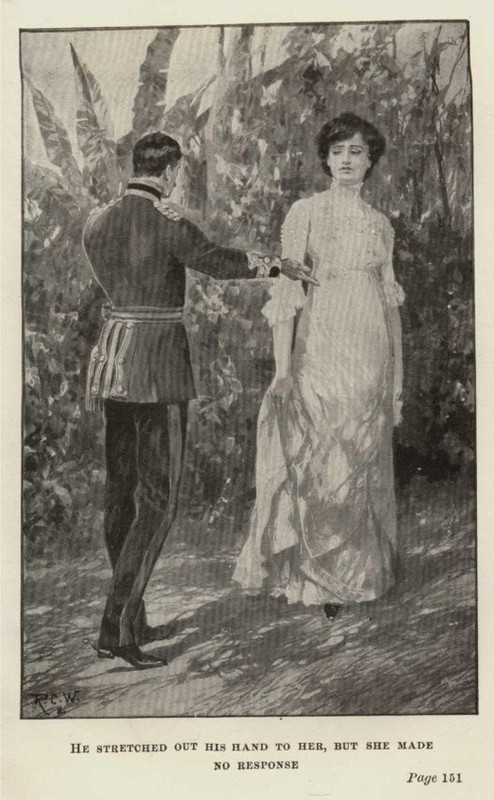
He stretched out his hand to her, but she made no response
"It was not to be, I see that now," she said, while her eyes filled and her bosom heaved. "I am not worthy of you. But I loved you and I thought you loved me, and I believed you when you told me that nothing could come between us."
Again he tried to speak, to explain, to protest, but his tongue would not utter a sound.
"If you had really loved me you would have been ready to ... even to.... But I was mistaken and I am punished, and this is how it is to end!"
"Helena, for God's sake—" he began, but he could bear no more. He did not see that the girl's love was fighting with her pride. The hideous injustice of it all was working like madness in his brain, and after a moment he turned to go.
As he walked across the garden the ground under his feet sounded hollow in his ears like the ground above a new-covered grave. When he reached the gate he thought he heard Helena calling in a pleading, sobbing voice—
"Gordon!"
But when he turned to look back she had disappeared. Then bareheaded, without helmet or sword, with every badge of rank and honour gone, he pulled the gate open and staggered into the square.
CHAPTER XXV
Helena returned to her father's room, and found the two old men getting ready to go. In the Pasha's face there were traces of that impulse to smile which comes to shallow natures in the presence of another person's troubles. But the face of the Consul-General was a tragic sight. The square-set jaw hung low, and the eyes were heavy as with unshed tears. It was easy to see that the iron man was deeply moved—that the depths of his ice-bound soul were utterly broken up.
Only in short, disjointed sentences did he speak at all. It was about his enemies—the corrupt, cruel, and hypocritical upholders of the old dark ways. They had bided their time; they had taken their revenge; they had hit him at last where he could least bear a blow; they had struck him in the face with the hand of his only son.
"There is no shame left in them," he said, and then he turned to Helena as if intending to say some word of sympathy. He wanted to tell her that he had hoped for other things, and would have been happy if they had come to pass. But when he saw the girl standing before him with her red eyes and pale cheeks, he hesitated, grasped her hand, held it for a moment, and then walked away without a word.
The Military Secretary accompanied the Consul-General and the Pasha to their carriages, and so father and daughter were left together. The General, labouring under the most painful of all senses, the sense of having done an unworthy thing, walked for some minutes about the room, and talked excitedly, while Helena sat on the sofa in silence, and, resting her chin on her hand, looked fixedly before her.
"Well, well, it's all over, thank God! It couldn't be helped, either! It had to be! Better as it is, too, than if it had come later on.... How hot I am! My throat is like fire. Get me a drink of water, girl."
"Let me give you your medicine, father. It's here on the desk," said Helena.
"No, no! Water, girl, water! That's right! There! ... He has gone, I suppose? Has he gone? Yes? Good thing too! Hope I'll never see him again! I never will—never! ... How my head aches! No wonder either!"
"You're ill, father—let me run for the doctor."
"Certainly not. I'm all right. Sit down, girl. Sit down and don't worry.... You mustn't mind me. I'm a bit put out—naturally! It's hard for you, I know, but don't cry, Helena!"
"I'm not crying, father—you see I'm not."
"That's right! That's right, dear! It's hard for you, I say, but then it isn't easy for me either. I liked him. I did, I confess it. I really liked him, and to ... to do that was like cutting off one's own son. But ... give me another drink of water, Helena ... or perhaps if you think you ought to run ... no, give me the medicine and I'll be better presently."
She poured out a dose and he drank it off.
"Now I'll lie down and close my eyes. I soon get better when I lie down and close my eyes, you know. And don't fret, dear. Think what an escape you've had! Merciful heavens! A traitor! Think if you had married a traitor! A man who had sold himself to the enemies of England! I was proud of you when you showed him that—come what would—you must stand by your country. Splendid! Just what I expected of you, Helena! Splendid!"
After a while his excited speech and gusty breathing softened down to silence and to something like sleep, and then Helena sat on a stool beside the sofa and covered her face with her hands. A hot flush mounted to her pale cheeks when she remembered that it had not been for England that she had acted as she had, but first for her father and next for herself.
Perhaps she ought to have told Gordon why she could not leave her father. If she had done so he might have acted otherwise. But the real author of the whole trouble had been the Egyptian. How she hated that man! With all the bitterness of her tortured heart she hated him!
As for Gordon, traitor or no traitor, he had been above them all! Far, far above everybody! Even the Consul-General, now she came to think of it, had been a little man compared with his son.
With her face buried in both hands and the tears at last trickling through her fingers, she saw everything over again, and one thing above all—Gordon standing in silence while her father insulted and degraded him.
The General opened his eyes, and seeing Helena at his feet he tried to comfort her, but every word he spoke went like iron into her soul.
"I'm sorry for you, Helena—very sorry! We must bear this trouble together, dear. Only ourselves again now, you know, just as it was five years ago at home. Your dark hour, this time, darling, but I'll make it up to you. Come, kiss me, Helena," and, drying her weary eyes, she kissed him.
The afternoon sun was then reddening the alabaster walls of the mosque outside, and they heard a surging sound as of a crowd approaching. A moment later little black Mosie ran in to say that the new Mahdi was coming, and almost before the General and Helena could rise to their feet a tall man in white Oriental costume entered the room. He came in slowly, solemnly, and with head bent, saying—
"Excuse me, sir, if I come without ceremony."
"Ishmael Ameer?" asked the General.
"My name is Ishmael—you are the Commander of the British forces. May I speak with you alone?"
The General stood still for a moment, measuring his man from head to foot, and then said—
"Leave us, Helena."
Helena hesitated, and the General said, "I'm better now—leave us."
With that she went out reluctantly, turning at the door to look at her enemy, who stood in his great height in the middle of the floor and never so much as glanced in her direction.
CHAPTER XXVI
Both men continued to stand during the interview that followed—the one in his white robes by the end of the sofa, resting two tapering fingers upon it, the other in his General's uniform by the side of the desk, except when in the heat of his anger he strode with heavy step and the jingling of spurs across the space between.
"Now, sir, now," said the General. "I have urgent work to do, and not much time to give you. What is it?"
"I come," said Ishmael, who was outwardly very calm, though his large black eyes were full of fire and light, "I come to speak to you about the order to close El Azhar."
"Then you come to the wrong place," said the General sharply. "You should go to the Agency—the British Agency."
"I have seen the English lord already. He refuses to withdraw his order. Therefore I am here to ask you—forgive me—I am here to ask you not to obey it."
The General tried to laugh. "Wonderful!" he said. "Your Eastern ideas of discipline are wonderful! Please understand, sir, I am here as the instrument of authority—that and that only."
"An instrument has its responsibility," said Ishmael. "If there were no instruments to do evil deeds would evil deeds be done? It is not your fault, sir, that the order has been issued, but it will be your fault if it is carried into effect."
"Really!" said the General, again trying to laugh. "Permit me to tell you, sir, that in this case there will be no fault in question, neither of mine nor anybody else's. El Azhar is a hotbed of sedition, and it is high time the Government cleared it out."
"El Azhar," said Ishmael, "is the heart of the Moslem faith. Take their religion away from them and the Moslems have nothing left. You are a Christian, and when your great Master was on earth He fed the souls of the people first."
"Yes, and He whipped the rascals out of the temple, and that's what the Government is going to do now—to drive out the pretentious impostors who are putting a lying spirit into the mouth of the people and making it impossible to govern them."
The Egyptian showed no anger. "I am here only to plead for the people, sir. Do not harden your heart against them. Do not send armed men among an unarmed populace. It will be slaughter."
"Tell them to submit to the Government and there will be no harm done to any one. It's their duty, isn't it? Whatever the Government may be, isn't it their duty to submit to it?"
"Yes," said Ishmael. "We who are Moslems are taught by the Prophet (blessed be his name!) that even if a negro slave is appointed to rule over us we ought to obey him."
"Deuce take it, sir, what do you mean by that?" said the General.
"But Government is a trust from God," said the Egyptian, "and at the Day of Resurrection the Most High will ask you what you have done to His children."
"Damn it, sir, have you come here to preach me a sermon?"
"I have come to plead with you for justice—the justice you look for from your Saviour. 'Be merciful to the weak,' He taught, and it is for the weak I appeal to you. He was meek and lowly—will you forget His precepts? 'Love one another'—will you make strife between man and man? He is dead—shall it be said that His spirit has died out among those who call Him their Redeemer?"
The General brought his fist heavily down on the desk as if to command silence.
"Listen here, sir," he said. "If you imagine for one moment that this tall talk will have any effect upon me, let me advise you to drop it. Being a plain soldier who has received a plain command, I shall take whatever military steps are necessary to see it faithfully carried out, and if the precious leaders of the people, playing on their credulity and fanaticism, should instigate rebellion, I shall have the honour—understand me plainly—I shall have the honour to lodge them in safe quarters, whosoever they are and whatsoever their pretensions may be."
The Egyptian's eyes showed at that moment that he was a man capable of wild frenzy, but he controlled himself and answered—
"I am not here to defend myself, sir. You can take me now if you choose to do so. But if I cannot plead with you for the people let me plead with you for yourself—your family."
The General, who had turned away from Ishmael, swung round on him.
"My family?"
"He that troubleth his own house, saith the Koran, shall inherit the wind. Will you, my brother, allow your daughter to be separated from the brave man who loves her? A woman is tender and sweet; all she wants is love; and love is a sacred thing, sir. Your daughter is your flesh and blood—will you make her unhappy? I see a day when you are dead—will it comfort you in the grave that two who should be together are apart?"
"They're apart already, so that's over and done with," said the General. "But listen to me again, sir. My girl needs none of your pity. She has done her duty as a soldier's daughter, and cut off the traitor whom you, and men like you, appear to have corrupted. Look here—and here," he cried, pointing to the broken sword and the medals which were still lying where he had flung them on the floor. "The man has gone—gone in disgrace and shame. That's what you've done for him, if it's any satisfaction to you to know it. As for my daughter," he said, raising his voice in his gathering wrath and striding up to Ishmael with heavy steps and the jingling of his spurs, "As for my daughter, Helena, I will ask you to be so good as to keep her name out of it—do you hear? Keep her name out of it, or else——"

"Look here—and here," he cried, pointing to the broken sword
At that moment the men heard the door open and a woman's light footsteps behind them. It was Helena coming into the room.
"Did you call me, father?" she asked.
"No; go back immediately."
She looked doubtfully at the two men, who were now face to face as if in the act of personal quarrel, hesitated, seemed about to speak, and then, went out slowly.
There was silence for a moment after she was gone, and then Ishmael said—
"Do I understand you to say, sir, that Colonel Lord has gone in disgrace?"
"Yes, for consorting with the enemies of his country and refusing to obey the order of his General."
"Lost his place and rank as a soldier?"
"Soon will, and then he will be alone and have you to thank for it."
The Egyptian drew himself up to his full height and answered, "You are wrong, sir. He who has no one has God, and if that brave man has suffered rather than do an evil act, will God forget him? No!"
"God will do as He thinks best without considering either you or me, sir," said the General. "But I have something to do and I will ask you to leave me.... Or wait one moment! Lest you should carry away the impression that because Colonel Lord has refused to obey his General's order the order will not be obeyed—wait and see."
He touched the bell and called for his Aide-de-camp.
"Tell Colonel Macdonald to come to me immediately," said the General, and when the Aide-de-camp had gone he turned to his desk for papers.
The Egyptian, who had never moved from his place by the sofa, now took one step forward and said in a low, quivering voice—
"General, I have appealed to you on behalf of my people and on your own behalf, but there is one thing more."
"What is it?"
"Your country."
The General made an impatient gesture, and the Egyptian said, "Hear me, I beg, I pray! Real as life, real as death, real as wells of water in a desert place, is their religion to the Muslemeen, and if you lay so much as your finger upon it your Government will die."
He raised his hand and with one trembling finger pointed upwards. "Do you think your swords will govern them? What can your swords do to their souls? By the Most High God I swear to you that I have only to speak the word and the rule of England in Egypt will end."
At that moment Colonel Macdonald, a large man in khaki, a Highlander, with a ruddy face and a glass in his left eye, opened the door and stood by it, while the General, whose own face was scarlet with anger, said—
"So! So that's how you talked to Colonel Lord, I presume—how you darkened the poor devil's understanding! Now see—see what effect your threats have upon me. Step forward, Colonel Macdonald."
The Colonel saluted and stepped up to the General, who repeated to him word for word the order he had given to Gordon, and then said—
"You will arrest all who resist you, and if any resist with violence you will compel obedience—you understand?"
"Perfectly," said the Colonel, and saluting again he left the room.
"Now, sir, you can go," said the General to Ishmael, whereupon the Egyptian, whose face had taken on an extreme pallor, replied—
"Very well! I have warned you and you will not hear me. But I tell you that at this moment Israfil has the trumpet to his mouth and is only waiting for God's order to blow it! I tell you, too, that I see you—you—on the Day of Judgment, and there are black marks on your face."
"Silence, sir!" said the General, bringing his clenched fist heavily down on the desk. Then he struck the bell, and in a choking voice called first for his servant and afterwards for his Aide-de-camp. "Robson! See this man out of the Citadel! This damnable, presumptuous braggart! Robson! Where are you?" But the servant did not appear and the Aide-de-camp did not answer.
"No matter," said the Egyptian. "I will go of myself. I will try to forget the hard words you have said of me. I will not retort them upon you. You are a Christian, and it was a Christian who said 'Resist not evil.' That is a commandment as binding upon us as upon you. God's will be done."
With that Ishmael went out as he had entered, slowly, solemnly, with head bent and eyes on the ground.
CHAPTER XXVII
The General was now utterly exhausted. Being left alone he leaned against the desk, intending to wait until his breathing had become more regular and he could reach the sofa. Standing there, he heard the surging noise of the crowd that had been waiting outside for their Arab prophet and were now going away with him. He wanted to call Helena, but restrained himself, remembering how often she had warned him.
"Robson!" he called again but again the Aide-de-camp did not answer—he must have gone off on some errand for Colonel Macdonald.
The General took up his medicine and gulped down a large dose, drinking from the neck of the bottle, and then sank on to the sofa.
Some minutes passed and he began to feel better. The sunset was deflected into his face from the alabaster walls of the mosque outside, but he could not get up to pull down the blind of his window. So he closed his eyes and thought of what had happened.
It seemed to him that Gordon had been to blame for everything. But for Gordon's monstrous conduct they would have been spared all this trouble—Lord Nuneham's crushing blow, his own humiliating action, so wickedly forced upon him, and above all, Helena's sorrow.
In the delirium of his anger against Gordon he felt as if he would choke. Thinking of Helena and her ruined happiness, he wondered why he had let Gordon off so lightly, and he wanted to follow and punish him.
Then he heard the door open, and thinking Helena was coming into the room, he rose to his feet and faced around, when before him, with a haggard face, stood Gordon himself.
CHAPTER XXVIII
When Gordon Lord, after parting with Helena, had left the Citadel, his mental anguish had been so intense as to deaden all his faculties. His reason was clogged, his ideas were obscure, he could not see or hear properly. Passing the sentry in his lodge by the gate, he did not notice the man's bewildered stare or acknowledge his abbreviated salute. The whole event of the last hour had overwhelmed him as with a terrible darkness, and in this darkness he plodded on, until he came into the streets, dense with people and clamorous with all the noises of an Eastern city—the clapping of water-carriers, the crying of lemonade-sellers, the braying of donkeys, and the ruckling of camels.
"Where am I going?" he asked himself at one moment, and when he remembered that he was going back to his quarters—for that was what he had been ordered to do, that he might be under arrest and in due course tried by court-martial—he told himself that he had been tried and condemned and punished already. At that thought, though clouded and obscure, he bit his lip until it bled, and muttered, "No, I cannot go back to quarters—I will not!"
At the next moment a certain helplessness came over him, and up from the deep place where the strongest man is as a child, by the pathetic instinct that keeps the boy alive in him to the last dark day of his life and in the hour of death, came a desire to go home—to his mother. But when he thought of his mother's pleading voice as she begged him to keep peace with his father, and then, by some juggling twist of torturing memory, of the first evening after his return to Egypt, when he wore his medals and she fingered them on his breast with a pride that no queen ever had in the jewels in her crown, he said to himself, "No, I can never go home again."
His mind was oscillating among these agonising thoughts when he became aware that he was walking in the Esbekiah district, the European quarter of Cairo, where the ooze of the gutter of the city is flung up under the public eye; and there under the open piazza, containing a line of drinking places, in an atmosphere that was thick with tobacco smoke, the reek of alcohol, the babel of many tongues, the striking of matches, and the popping of corks, he sat down at a table and called for a glass of brandy.
The brandy seemed to clear his faculties for a moment, and his aimless and wandering thoughts began to concentrate themselves. Then the scene in the General's office came back to him—the drawing of his sword from its scabbard, the breaking of it across the knee, the throwing of the wretched fragments at his feet, the ripping away of his medals and the trampling of them under foot. The hideous memory of it all, so illegal, so un-English, made his blood to boil, and when his beaten brain swung back to the scenes in which he had won his honours at the risk of his life—Omdurman, Ladysmith, Pretoria—the rank injustice he had suffered almost stifled him with rage, and he swore and struck the table.
All his anger was against the General, not against his father, of whom he had hardly thought at all, but the cruellest agony he passed through came at the moment when his wrath rose against Helena. As he thought of her he became dizzy; his brain reeled with a dance of ideas, in which no picture lasted longer than an instant, and no emotion would stay. At one moment he was seeing her as he saw her first, with her big eyes, black as a sloe, the joyous smile that was one of her greatest charms, the arched brow, the silken lashes, the gleam of celestial fire, the "Don't go yet" that came into her look, and then his quickening pulse, the thrill that passed through him, and the mysterious voice that whispered, "It is She!"
Without knowing it he groaned aloud as he thought of the ruin all this had come to, and at the next moment he was in the midst of another memory—a memory of the future as he had imagined it would be. They were to be married soon, and then, realising one of the dreams of his life, they were to visit America, for his mother's blood called to him to go there, to see the great new world—yes, but above all to stand, with Helena's quivering hand in his, on that rock at Plymouth, where a handful of fearless men and women had landed on a bleak and hungry coast, afraid of no fate, for God was with them, and in two short centuries had peopled a vast continent and created one of the mightiest empires of the earth. Remembering this as a vanished dream, his wretched soul was on the edge of a vortex of madness, and he laughed outright with a laugh that shivered the air around him.
Then he was conscious that somebody was speaking to him. It was a young girl in a gaudy silk dress, with a pasty face, lips painted very red, eyebrows darkened, a flower in her full bosom which was covered with transparent lace, and a little satchel swinging on her wrist.
"Overdoing it a bit, haven't you, dear?" she said in French, and she smiled at him, a poor sidelong smile, out of her crushed and crumpled soul.
At the same moment he became aware that three men at a table behind him were winking at the girl and joking at his expense. One of them, a little fat American Jew with puffy cheeks, chewing the end of a cigar, was saying—
"Guess a man don't have no use for a hat in a climate like this—sun so soft, and only ninety-nine in the shade."
Whereupon an Englishman with a ripped and ragged mouth and a miscellaneous nose, half pug and half Roman, answered—
"Been hanging himself up on a nail by the breast of his coat, too, you bet."
Putting his hand to his hair and looking down at the torn cloth of his tunic, Gordon realised for the first time that he was bareheaded, having left his helmet at the Citadel, and that to the unclean consciousness of the people about him he was drunk.
At that moment he started up suddenly, and coming into collision with the American, who was swinging on the back legs of his chair, he sent him sprawling on the ground, where he yelled—
"Here, I say, you blazing——"
But the third man at the table, a dragoman in a fez, whispered—
"Hush! I know that gentleman. Leave him alone, sirs, please. Let him go."
With heart and soul aflame, Gordon walked away, intending to take the first cab that came along and then forgetting to do so. One wild thought now took possession of him and expelled all other thoughts. He must go back to the Citadel and accuse the General of his gross injustice. He must say what he meant to say when he stood by the door as he was going out.
The General should hear it—he should, and by —— he must!
The brandy was working in his brain by this time, and in the blind leading of passion everything that happened on the way seemed to fortify his resolve. The streets of the native city were now surging with people, as a submerged mine surges with the water that runs through it. He knew where they were going—they were going to El Azhar—and when he came to the great mosque he had to fight his way through a crowd that was coming from the opposite direction, with the turbaned head of a very tall man showing conspicuously in the midst of the multitude, who were chanting verses from the Koran and crying in chorus, "La ilaha illa-llah."
At sight of this procession, knowing what it meant—that the Moslems were going to the doomed place, to defend it or to die—a thousand confused forms danced before Gordon's eyes. His impatience to reach the Citadel became feverish, and he began to run, but again at the foot of the hill on which the fortress stands he was kept back. This time it was by a troop of cavalry who were trotting hard towards El Azhar. He saw his deputy, Macdonald, with his blotchy face and his monocle, but he was himself seen by no one, and in the crush he was almost ridden down.
The Citadel, when he reached it, seemed to be deserted, even the sentry standing with his back to him in the sentry-box as he hurried through. There was nobody in the square of the mosque or yet at the gate to the General's garden, which was open, and the door of the house, when he came to it, was open too. With the hot blood in his head, his teeth compressed, and his nostrils quivering, he burst into the General's office and came face to face with the old soldier as he was rising from the sofa. Thus in the blind swirl of circumstance the two men met at the moment when the heart of each was full of hatred for the other.
They were brave men both of them, and never for one instant had either of them known what it was to feel afraid. They were not afraid now, but they had loved each other once, and up from what deep place in their souls God alone can say, there came a wave of feeling that fought with their hate. The General no longer wanted to punish Gordon, but only that Gordon should go away, while Gordon's rage, which was to have thundered at the General, broke into an agonising cry.
"What are you doing here? Didn't I order you to your quarters? Do you wish me to put you under close arrest? Get off!"
"Not yet. You and I have to settle accounts first. You have behaved like a tyrant. A tyrant—that's the only word for it! If I was guilty of insubordination, you were guilty of outrage. You had a right to arrest me, and to order that I should be court-martialled, but what right had you to condemn me before I was tried and punish me before I was sentenced? Before or after, what right had you to break my sword and tear off my medals? Degradation is obsolete in the British Army—what right had you to degrade me? Before my father, too, and before Helena—what right had you?"
"Leave my house instantly; leave it, leave it!" said the General, his voice coming thick and hoarse.
"Not till you hear what I've come to tell you," said Gordon, and then he repeated the threat—who knows on what inherited cell of his brain imprinted—which his father had made forty years before.
"I've come to tell you that I'll go back to my quarters and you shall court-martial me to-morrow if you dare. Before that, England may know by what is done to-night that I refused to obey your order because I'm a soldier, not a murderer. But if she never knows," he cried, in his breaking voice, "and you try me and condemn me and degrade me even to the ranks, I'll get up again—do you hear me?—I'll get up again, and win back all I've lost and more—until I'm your own master and you'll have to obey me."
The General's face became scarlet, and lifting his hand as if to strike Gordon, he cried, in a choking voice—
"Go, before I do something——"
But Gordon in the delirium of his rage heard nothing except the sound of his own quivering voice.
"More than that," he said, "I'll win back Helena. She was mine, and you have separated her from me and broken her heart as well as my own. Was that the act of a father, or of a robber and a tyrant? But she will come back to me, and when you are dead and in your grave we shall be together, because ... Stop that! Stop it, I say!"
The General, unable to command himself any longer, had snatched up the broken sword from the floor and was making for Gordon as if to smite him.
"Stand away! You are an old man and I am not a coward. Drop that, or by God you——"
But the General, losing himself utterly, flung himself on Gordon with the broken sword, his voice gone in a husky growl and his breath coming in hoarse gusts.
The struggle was short but terrible. Gordon in the strength of his young manhood first laid hold of the General by the upper part of the breast to keep him off, and then, feeling that his hand was wounded, he gripped at the old man's throat with fingers that clung like claws. At the next moment he snatched the sword from the General, and at the same instant, with a delirious laugh, he flung the man himself away.
The General fell heavily with a deep groan and a gurgling cry. Gordon, with a contemptuous gesture, threw the broken sword on the floor, and then with the growl of a wild creature he turned to go.
"Fight me—would you, eh! Kill me, perhaps! We've settled accounts at last—haven't we?"
But hearing no answer he turned at the door to look back and saw the General lying where he had fallen, outstretched and still. At that sight the breath seemed to go out of his body at one gasp. His head turned giddy, and the red gleams of the sunset which were deflected into the room appeared to his half-blind eyes to cover everything with blood.
CHAPTER XXIX
Gordon stood with his mouth open, the brute sense struck out of him by the dead silence. Then he said—
"Get up! Why don't you get up?" hardly knowing what he was saying.
He got no answer, and a horrible idea began to take shape in his mind. Though so hot a moment ago, he shivered and his teeth began to chatter. He looked around him for a moment in the dazed way of a man awakening from a nightmare, and then stepped up on tiptoe to where the General lay.
Raising his head he looked at him, and found it hard to believe that what he vaguely feared had happened. There was no sign of injury anywhere. The eyes were open, and they looked fixedly at him with so fierce a stare that they seemed to jump out of their sockets.
"Stunned—that's all—stunned by the fall," he thought, and seeing a bottle of brandy on the shelf of the desk he got up and poured a little into the medicine glass, and then, kneeling and lifting the General's head again, he forced the liquor through the tightly compressed lips.
It ran out as it went in, and, with gathering fear and fumbling fingers, Gordon unbuttoned the General's frock coat and laid a trembling hand over his heart. At one moment he thought he felt a beat, but at the next he knew it was only the throb of his own pulse.
At that the world seemed for a moment to be blotted out, and when he came to himself again he was holding the General in his arms and calling to him—
"General! General! Speak to me! For God's sake speak to me."
In the torrent of his remorse he was kissing the General's forehead, and crying over his face, but there was no response.
Then a great trembling shook his whole body, and dropping the head gently back to the floor he rose to his feet. The General was dead, and he knew it.
He had seen death a hundred times before, but only on the battlefield, amid the boom of cannon, the wail of shell, the snap of rifles, and the oaths of men, but now it filled him with terror.
The silence was awful. A minute ago the General had been a living man, face to face with him, and the room had been ringing with the clashing of their voices; but now this breathless hush, this paralysing stillness, in which the very air seemed to be dead, for something was gone as by the stroke of an almighty hand, and there was nothing left but the motionless figure at his feet.
"What have I done?" he asked, and when he told himself that in his headstrong wrath he had killed a man, his head spun round and round. He, who had refused to obey orders because he would not commit murder was guilty of murder himself! What devil out of hell had ordered things so that as the very consequence of refusing to commit a crime he had become a criminal?
"God have pity upon me and tell me it is not true," he thought.
But he knew it was true, and when he told himself that the man he had killed was his General his pain increased tenfold. The General had loved him and favoured him, been proud of him and upheld him, and never, down to the coming of this trouble, had their friendship been darkened by a cloud.
"Oh, forgive me! God forgive me!" he thought.
In his blind misery, which hardly saw itself yet for what it was, the impulse came to him to carry the burden of his sin, too heavy for himself, to Helena, that she might help him to bear it; and he had taken some steps towards the door leading to her room when it struck him as a blow on the brain that she was the daughter of the dead man, and he was going to her for comfort after killing her father.
At that thought he stopped and laid hold of the desk for support, being so weak that he could scarcely keep on his legs. He remembered Helena's love for the General, how much of her young life she had given to him, and how the quarrel that had divided himself from her had come of her determination not to leave her father as long as he lived. And now he had killed him!
Beads of sweat started from his forehead, but after a moment he told himself that if he could not expect comfort from Helena it was his duty to comfort her—to break the news to her. He saw himself doing so. "Helena, listen, dear; be brave." "What is it?" "Your father—is—is dead." "Dead?" "Worse, a thousandfold worse—he is murdered." "Murdered?" "It was all in the heat of blood—the man didn't know what he was doing." "Who was it—who was it?" "Don't you see, Helena—it was I."
He had turned again to the door leading to Helena's room when another blow from an invisible hand seemed to fall upon him. He saw Helena's eyes fixed on his face in the intensity of her hate, and he heard her voice driving him away. "Go, let me never see you again!" That was more than he could bear, and staggering to the sofa he sat down.
Some minutes passed. The red glow in the room deepened to a dull brown, and at one moment there was a groan in the gathering gloom. He heard it and looked up, but there was nobody there and then he realised that it was he who had groaned. At another moment his mind occupied itself with lesser things. He saw that one finger of his left hand was badly wounded, and he bound it up in his handkerchief. Then he looked at himself in a mirror that hung on the wall in front of the sofa, but he could not see his face distinctly—eyes, nose, and mouth being blurred. He did not attempt to escape. Never for an instant did it occur to him to run away.
The sun went down behind the black Pyramids across the Nile, and after a while the dead silence of the evening of the Eastern day was broken by the multitudinous cries of the muezzin, which came up from the city below like a deep ground-swell on a rugged coast.
After that Gordon knelt again by the General's body, trying to believe he was not dead. The eyes were still open, but all the light had gone out of them, and seeing their stony stare the thought came to him that the General's soul was with him in the room. The stupor of his senses had suddenly given way to a supernatural acuteness, and at one moment he imagined he felt the touch of a hand on his shoulder.
At the next instant he was plainly conscious of a door opening and closing in the inner part of the house, and of light and rapid footsteps approaching. He knew what had occurred—Helena had been out on the terrace or in the parade ground and had just come back.
She was now in the next room, breathing hard as if she had been running. He could hear the rustling of her skirt and her soft step as she walked towards the door of the General's office.
At the next moment there came a knock, but Gordon, held his breath and made no answer.
Then "Father!" in a tremulous voice, full of fear, as if Helena knew what had happened.
Still Gordon made no reply, and the frightened voice came again.
"Are you alone now? May I come in?"
Then Gordon felt an impulse to throw the door open and confess everything, saying, "I did it, Helena, but I didn't intend to do it. He threw himself upon me, and I flung him off and he fell, and that is the truth, as God is my witness."
But he could not do this, because he was afraid. He who had never before known fear, he who had stood in the firing line when hordes of savage men had galloped down with fanatical cries—he was trembling now at the thought of meeting a woman's face.
So, treading softly, he stole out of the room by the outer door, the door leading to the gate, and as he closed it behind him he felt that the door of hope also was now for ever closed between Helena and him.
But going through the garden he had to pass the arbour, and at sight of that loved spot a wave of tender memories swept over him, and in pity of Helena's position he wanted to return. She would be in her father's room by this time, standing over his dead body and alone in her great grief.
"I will go back," he thought. "She has no one else. She may curse me, but I cannot leave her alone. I will go back—I will—I must!"
That was what his soul was saying to itself, but at the same time his body was carrying him away—through the open gate and across the deserted square, swiftly, stealthily, like a criminal leaving the scene of his crime.
The day was now gone, the twilight was deep, and as he passed under the outer port of the Citadel in the dead silence of the unquickened air, a voice like that of an accusing angel, telling of judgment to come, fell upon his ear. It was the voice of the last of the muezzin on the minaret of the Mohammed Mosque calling to evening prayer—"God is Most Great! God is Most Great!"
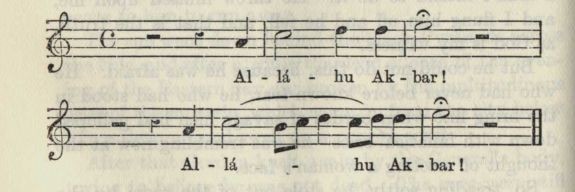
Music fragment
END OF FIRST BOOK
SECOND BOOK
THE SHADOW OF THE SWORD
CHAPTER I
When Helena had left the General and Ishmael Ameer together, the signs she knew so well of illness in her father's face suggested that she should run at once for the Medical Officer. One moment she stood in the room adjoining the General's office, listening to the muffled rumble that came from the other side of the wall, the short snap of her father's impatient voice and the deep boom of the Egyptian's, and then she hurried into the outer passages to pin on her hat. There she met the General's Aide-de-camp, who, seeing her excitement, asked if there was anything he could do for her, but she answered "No," and then—
"Yes, I think you might go over to the Colonel" (meaning the Colonel commanding the Citadel) "and tell him this man is here with a crowd of his followers."
"He must know it already, but I'll go with pleasure," said the young Lieutenant. At the next moment there were three hasty beats on the General's bell, followed by a summons from the General's soldier servant, but the Aide-de-camp had disappeared.
Helena went out by the back of the house, and seeing her cook and the black boy as she passed the kitchen quarters an impulse came to her to send somebody else on her errand, lest anything should happen in her absence; but telling herself that nobody but herself and the Doctor must know the secret of her father's condition, she hurried along.
Her way was through the unoccupied courts of the old palace, down a flight of long steps, through an old gateway whereof the iron-clamped door always stood open, across a disused drawbridge, and so on to the open parade-ground. The Army Surgeon's quarters were on the farther side of it, and never before had it seemed so broad.
When she reached her destination the Surgeon was out on his evening round of the hospital, so she wrote a hurried note asking him to come to the General's house immediately, sent his assistant in search of him, and then turned back.
Returning hurriedly by the "married quarters," she was detained for some moments by a soldier's wife, a young thing, almost a child, who stood at the door of her house with a red woollen shawl about her shoulders, a baby in long clothes in her arms, and a look of radiant happiness in her round face.
"Ye've not seen 'im yet, have ye, Miss?" said the little mother, holding out her baby to be admired. "Only six weeks old and 'e weighs ten pounds. Colonel says as 'ow 'e's a credit to the reg'ment, and I'm agoin' to shorten 'im soon. To-morrow I'm 'avin' 'im photoed to send to mother. She lives in Clerkenwell, Miss, and she ain't likely to show 'is photo to nobody in our court. Oh no!"
Helena did her best to play up to the pride of the little Cockney mother, and was turning to go when the girl said—
"But my Harry tells me as how you're to be married yourself soon, so I wish ye joy, and many of 'em."
"Good-bye, Mrs. Dimmock," said Helena, but the young thing was not yet done. With a look of wondrous wisdom she said—
"They're a deal of trouble, Miss, but there ain't no love in the house without 'em. As mother says, they keeps the pot a-boilin'," and she was ducking down her head to kiss the child as Helena hurried away.
In the bright light of the young mother's life and the breadth of shadow that lay upon her own, Helena thought of Gordon and her anger rose against him again, but at the next moment she saw him in her mind's eye as she had seen him last, going out of the garden, a broken, bankrupt man, and then her eyes filled and it was as much as she could do to see her way.
In the quickening flow of her emotion this riot in her heart between anger with Gordon and with herself only led to deeper hatred of the Egyptian, and even the memory of his dignity and largeness in the single moment in which she had looked upon him made her wrath the more intense.
A vague fear, an indefinite forewarning, hardly able yet to assume a shape, was beginning to take possession of her. She recalled the scene she had left behind her in the General's office, the two men face to face, as if in the act of personal quarrel, and told herself that if anything happened to her father as the result of the excitement caused by the meeting, the Egyptian would be the cause of it.
In her impatience to be back she began to run. How broad the parade ground was! The air, too, was so close and lifeless. The sun had nearly set, the arms of night were closing round the day, but still the sky was a hot, dark red like the inside of a transparent shell that had a smouldering fire outside of it.
At one moment she heard hoarse and jarring voices that seemed to come from the square of the mosque in front of the house. Perhaps the Egyptian and his people were going off with their usual monotonous chanting of "Allah! Allah!" She was glad to reach the cool shade and silence of the empty courts of the old palace, but coming to the gateway she found it closed.
A footstep was dying away within, so she knocked and called, and after a moment an old soldier, a kind of caretaker of the Citadel, opened the gate to her.
"Beg pardon, Miss! Lieutenant Robson told me to shut up everything immediately," he said, but Helena did not wait for further explanation.
There was nobody in sight when she passed the kitchen quarters, and when she entered the house a chill silence seemed to strike to the very centre of her life.
Then followed one of those mystic impulses of the human heart which nobody can understand. In her creeping fear of what might have happened during her absence she was at first afraid to go into her father's room. If she had done so, there and then, and without an instant's hesitation, she must have found Gordon kneeling over her father's body. But in dread of learning the truth she tried to keep back the moment of certainty, and in a blind agony of doubt she stood and tried to think.
The voices of the men were no longer to be heard through the wall, and the deep rumble of the crowd outside had died away, therefore the Egyptian must have gone. Had her father gone too? She remembered that he was in uniform, and took a step back into the hall to see if his cap hung on the hat-rail. The cap was there. Had he gone into his bedroom? She crossed to the door. The door was open and the room was empty.
Hardly able to analyse her unlinked ideas, but with a gathering dread of the unknown, she found herself stepping on tiptoe towards the General's office. Then she thought she heard a faint cry within, a feeble, interrupted moan, and in an unsteady voice she called.
There was no answer. She called again, and still there was no reply. Then girding up her heart to conquer a vague fear, which hardly knew itself yet for what it was, she opened the door.
The room was almost dark. She took one step into the gloom, breathing rapidly, then stopped and said—
"Father! Are you here, father?"
There was no sound, so she took another step into the room, thinking to switch on the light over the desk and at the same time to reach the sofa. As she did so she stumbled against something, and her breath was struck out of her in an instant.
She stooped in the darkness to feel what it was that lay at her feet, and at the next moment she needed no light to tell her.
"Father! Father!" she cried, and in the dead silence that followed, the voice of the muezzin came from without.
She was lying prostrate over her father's body when the door was burst open as by a gust of wind and the Army Surgeon came into the room. Without a word he knelt and laid his hand over the heart of the fallen man, while Helena, who rose at the same instant, watched him in the awful thraldom of fear.
Then young Lieutenant Robson came in hurriedly, switching on the light and saying something, but the Surgeon silenced him with the lifting of his left hand. There was one of those blank moments in which time itself seems to stand still, while the Surgeon was on his knees and Helena stood aside with whitening lips and with eyes that had a wild stare in them. Then, lifting his face, which was stamped with the heaviness of horror and told before he spoke what he was going to say, the Surgeon rose, and turning to Helena, said in a nervous voice—
"I regret—I deeply regret to tell you..."
"Gone?" asked Helena, and the Surgeon bowed his head.
She did not cry or utter a sound. Only the trembling of her white lips showed what she felt, but all the cheer of life had died out of her face, and in a moment it had become hard and stony.
There was an instant of silence, and then the Surgeon and the young Lieutenant, casting sidelong looks at Helena, began to whisper together. At sight of her tearless eyes a certain fear had fallen on them which the presence of death could not create.
"Take her away," whispered the Surgeon, and then the Lieutenant, whose throat was hard and whose eyes were dim, approached her and said with the sadness of sympathy—
"May I help you to your room, please?"
Helena shook her head and stood immovable a moment longer, and then, with a firm step, she walked away.
CHAPTER II
All the moral cowardice that had paralysed Gordon Lord was gone the moment he left the Citadel, and as soon as he reached the streets of the city the power of life came back to him. There, in tumultuous swarms, the native people were swinging along in one direction, uttering the monotonous cries of the Moslems when they are deeply moved. Into this maelstrom of emotion Gordon was swept before he knew it, and hardly conscious of where he was going he followed where he was led.
He felt, without knowing why, the lust of violence which comes to the soldier in battle who wants to run away until the moment when the first shot has been fired, and then—all fear and moral conscience gone in an instant—forges his path with shouts and oaths to where danger is greatest and death most sure.
In the thickening darkness he saw a great glow coming from a spot in front of him, as of many lanterns and torches burning together. Towards this spot he pushed his way, calling to the people in their own tongue to let him pass, or sweeping them aside and ploughing through. In his delirious excitement his strength seemed to be supernatural, and men were flung away as if they had been children.
At length he reached a place where a narrow lane, opening on to a square, was blocked by a line of soldiers, who were coming and going with the glare of the torch-light on their faces. Here the monotonous noises of the crowd behind him were pierced by sharp cries, mingled with screams. Perspiration was pouring down Gordon's neck by this time, and he stopped to see where he was. He was at the big gate of El Azhar.
On leaving the Citadel, Colonel Macdonald had taken two squadrons with him, telling the Lieutenant-Colonel commanding the regiment to follow with the rest.
"Half of these will be enough for this job, and we'll clear the rascals out like rats," he said.
The Governor of the city, a small man in European dress, acting on the order of the Minister of the Interior as Regent in the absence of the Khedive, had met him at the University. They found the gate shut and barred against them, and when the Governor called for it to be opened there was no reply. Then the Colonel said—
"Omar Bey, have I your permission to force an entrance?"
Whereupon the Governor, in whom the wine of life was chiefly vinegar, answered promptly—
"Colonel, I request you to do so."
A few minutes afterwards a stout wooden beam was brought up from somewhere, and six or eight of the soldiers laid hold of it and began to use it on the closed gate as a battering ram. The gate was a strong one clamped with iron, but it was being crunched by the blows that fell on it when some of the students within clambered on to the top of the walls and hurled down stones on the heads of the soldiers.
One of them was a young boy of not more than fourteen years, and while others protected themselves by hiding behind the coping stones, he exposed his whole body to the troops by standing on the very crest of the parapet. The windows of the houses around were full of faces, and from one that was nearly opposite to the gate came the shrill cry of a woman, calling on the boy to go back. But in the clamour of noises he heard nothing, or in the fire of his spirit he did not heed, for he continued to hurl down everything that came to his hand, until Colonel Macdonald commanded the troop to dismount with rifles and said—
"Stop that young devil up there!"
At the next moment there was the crack of a dozen rifles, and the boy on the parapet swayed aside, lurched forward, and fell into the street. The Colonel was giving orders that he should be taken up and carried away when the woman's cry was heard again, this time in a frenzied shriek, and at the next instant the soldiers had to make way for the mightiest thing on earth, an outraged mother in the presence of her dead.
The woman, who had torn the black veil from her face, lifted the boy's head to her breast and cried, "My God! My good God! My boy! Ali! Ali!" But just then the gate gave way with a crash, and the Colonel ordered one of the squadrons to ride into the courtyard of the mosque, where five thousand of the students and their professors could be seen squirming in dense masses like ants on an upturned ant-hill.
The soldiers were forcing their horses through the crowds and beating with the flat of their swords when two or three shots were fired from within, and it became certain that some of the students were using firearms. At that the bulldog in the British Colonel got the better of the man, and he wanted to shout a command to his men to use the edge of their weapons and clear the place at any cost, but the shrill cry of the mother over her dead boy drowned his thick voice.
"He is dead! They have killed him! My only child! His father died last week. God took him, and now I have nobody. Ali, come back to me! Ali! Ali!"
"Take that yelping b—— away!" shouted the Colonel, ripping out an oath of impatience, and that was the moment when Gordon Lord came up.
What he did then he could never afterwards remember, but what others saw was that with the spring of a tiger he leapt up to Macdonald, laid hold of him by the collar of his khaki jacket, dragged him from the saddle, flung him headlong on the ground, and stamped on him as if he had been a poisonous snake.
In another moment there would have been no more Macdonald, but just then, while the soldiers, recognising their First Staff Officer, stood dismayed, not knowing what it was their duty to do, there came over the sibilant hiss of the crowd the loud clangour of the hoofs of galloping horses, and the native people laid hold of Gordon and carried him away.
His great strength was now gone, and he felt himself being dragged out of the hard glare of the light into the shadow of a side street, where he was thrust into a carriage and held down in it by somebody who was saying—
"Lie still, my brother! Lie still! Lie still!"
For one instant longer he heard deafening shouts through the carriage glass, over the rumble of the moving wheels, and then a blank darkness fell on him for a time and he knew no more.
When he recovered consciousness his mind had swung back, with no memory of anything between, to the moment when he was leaving the General's house, and he was saying to himself again, "I must go back. She may curse me, but I cannot leave her alone. I cannot—I will not."
Then he was aware of a voice—it was the quavering voice of an old man, and seemed to come out of a toothless mouth—saying—
"Be careful, Michael! His poor hand is injured. We must send for the surgeon."
He opened his eyes and saw that he was being carried through a quiet courtyard where he could hear the footsteps of the men who bore him and see by the light of a smoking lantern the façade of a church. Then he heard the same quavering voice say—
"Take him up to the salamlik, my brother," and then there was a jerk and a jolt and he lost consciousness again.
He was lying on a bed in a dimly lighted room when memory returned and the events of the day unrolled themselves before him. He made an effort to raise himself on his elbows, but in his weakness he fell back, and after a while he dropped into a delirious sleep. In this sleep he saw first his mother and then Helena, and then Helena and again his mother—everything and everybody else being quite blotted out.
CHAPTER III
Soon after sunset Lady Nuneham had taken her last dose of medicine, and had got into bed, when the Consul-General came into her room. He had the worn and jaded look by which she knew that the day had gone heavily with him, and she waited for him to tell her how and why. With a face full of the majesty of suffering he told her what had happened, describing the scene in the General's office, and all the circumstances whereby matters had been brought to such a tragic pass.
"It was pitiful," he said. "The General went too far—much too far—and the sight of Gordon's white face and trembling lips was more than I could bear."
His voice thickened as he spoke, and it seemed to the mother at that moment as if the pride of the father in his son, which he had hidden so many years in the sealed chamber of his iron soul, had only come up at length that she might see it die.
"It's all over with him now, I suppose, and we must make the best of it. He promised so well, though! Always did—ever since he was a boy. If one's children could only remain children! The pity of it! Good-night! Good-night, Janet!"
She had listened to him without speaking and without a tear coming into her eyes, and she answered his "Good-night" in a low but steady voice. Soon afterwards the gong sounded in the hall, and, as she lay in her bed, she knew that he would be dining alone—one of the great men of the world, and one of the loneliest.
Meantime Fatimah, tidying up the room for the night and sniffling audibly, was talking as much to herself as to her mistress. At one moment she was excusing the Consul-General, at the next she was excusing Gordon. Lady Nuneham let her talk on, and gave no sign until darkness fell and the moment came for the Egyptian woman also to get into bed. Then the old lady said—
"Open the door of this room, Fatimah," pointing to a room on her right.
Fatimah did so, without saying a word, and then she lay down, blowing her nose demonstratively as if trying to drown other noises.
From her place on the pillow the old lady could now see into the adjoining chamber, and through its two windows on to the Nile. A bright moon had risen, and she lay a long time looking into the silvery night.
Somewhere in the dead waste of early morning the Egyptian woman thought she heard somebody calling her, and, rising in alarm, she found that her mistress had left her bed and was speaking in a toneless voice in the next room.
"Fatimah! Are you awake? Isn't the boy very restless to-night? He throws his arms out in his sleep and uncovers little Hafiz too."
She was standing in her nightdress and lace nightcap, with the moon shining in her face, by the side of one of the two beds the room contained, tugging at its eiderdown coverlet. Her eyes had the look of eyes that did not see, but she stood up firmly, and seemed to have become younger and stronger—so swiftly had her spirit carried her back in sleep to the woman she used to be.
"Oh my heart, no," said Fatimah. "Gordon hasn't slept in this room for nearly twenty years—nor Hafiz neither."
At the sound of Fatimah's husky voice and the touch of her moist fingers the old lady awoke.
"Oh yes, of course," she said, and after a moment, in a sadder tone, "Yes, yes."
"Come, my heart, come," said Fatimah, and taking her cold and nerveless hand, she led her, a weak old woman once more, back to her bed, for the years had rolled up like a tidal wave and the spell of her sweet dream was broken.
On a little table by the side of her bed stood a portrait of Helena in a silver frame, and she took it up and looked at it for a moment, and then the light which Fatimah had switched on was put out again. After a little while there was a sigh in the darkness, and after a little while longer a soft, tremulous—
"Ah, well!"
CHAPTER IV
Helena was still in her room when the Consul-General, who had been telephoned for, held an inquiry into the circumstances of the General's death. She was sitting with her hands clasped in her lap and her eyes looking fixedly before her, hardly listening, hardly hearing, while the black boy darted in and out with broken and breathless messages which contained the substance of what was said.
The household servants could say nothing except that, following in the wake of the new prophet when he left the Citadel, they had left the house by the side gate of the garden without being aware of anything that had happened in the General's office. The Surgeon testified to the finding of the General's body, and the Aide-de-camp explained that the last time he saw his chief alive was when he was ordered to call Colonel Macdonald.
"Who was with him at that moment?" asked the Consul-General.
"The Egyptian, Ishmael Ameer."
"Was there anything noticeable in their appearance and demeanour?"
"The General looked hot and indignant."
"Did you think there had been angry words between them?"
"I certainly thought so, my lord."
Other witnesses there were, such as the soldier servant at the door, who made a lame excuse for leaving his post for a few minutes while the Egyptian was in the General's office, and the sentry at the gate of the Citadel, who said no one had come in after Colonel Macdonald and the cavalry had passed out. Then, some question of calling Helena herself was promptly quashed by the Consul-General, and the inquiry closed.
Hardly had the black boy delivered the last of his messages when there was a timid knock at Helena's door, and the Army Surgeon came into the room. He was a small man with an uneasy manner: married, and with a family of grown-up girls who were understood to be a cause of anxiety to him.
"I regret—I deeply regret to tell you, Miss Graves, that your father's death has been due to heart-failure, the result of undue excitement. You will do me the justice—I'm sure you will do me the justice to remember that I repeatedly warned the General of the dangers of over-exciting himself, but unfortunately his temperament was such——"
The Consul-General's deep voice in the adjoining room seemed to interrupt the Surgeon, and making a visible call on his resolution he came closer to Helena and said—
"I have not mentioned my previous knowledge of organic trouble. Lord Nuneham asked some searching questions, but the promise I made to your father——"
Again the Consul General's voice interrupted him, and with a flicker of fear on his face, he said—
"Now that things have turned out so unhappily it might perhaps be awkward for me if ... In short, my dear Miss Graves, I think I may rely on you not to ... Oh, thank you, thank you!" he said, as Helena, understanding his anxiety, bowed her head.
"I thought it would relieve you to receive my assurance that death was due to natural causes only—purely natural. It's true I thought for a moment that perhaps there had also been violence——"
"Violence?" said Helena.
"Don't let me alarm you. It was only a passing impression, and I should be sorry, very sorry——"
But just at that moment, when a new thought was passing through the stormy night of Helena's mind like a shaft of deadly lightning, the Chaplain of the Forces came into the room, and the Surgeon left it.
The Chaplain was a well-nurtured person, who talked comfort out of a full stomach with the expansiveness which sometimes comes to clergy who live long amongst soldiers.
"I have come to say, my dear young lady, that I place myself entirely at your service. With your permission I will charge myself with all the sad and necessary duties. So sudden! So unexpected! How true that in the midst of life we are in death!"
There was more coin from the same mint, and then, the shaft of deadly lightning as before.
"It is perhaps the saddest fact of death in this Eastern climate that burial follows so closely after it. As there seems to be no sufficient reason to believe that the General's death has been due to any but natural causes, it will probably be to-morrow—I say it will probably——"
"Sufficient!" said Helena, and, with a new poison at her heart, she hurried away to her father's room.
She found the General where they had placed him, on his own bed and in his uniform. His eyes were now closed, his features were composed, and everything about him was suggestive of a peaceful end.
While she was standing in the gloomy, echoless chamber, the Consul-General came in and stood beside her. Though he faintly simulated his natural composure he was deeply shaken. For a moment he looked down at his dead friend in silence, while his eyelids blinked and his lips trembled. Then he took Helena's hand, and drawing her aside, he said—
"This is a blow to all of us, my child, but to you it is a great and terrible one."
She did not reply, but stood with her dry eyes looking straight before her.
"I have made strict inquiry, and I am satisfied—entirely satisfied—that your father died by the visitation of God."
Still she did not speak, and after a moment he spoke again.
"It is true that the man Ishmael Ameer was the last to be with him, but what happened at their interview it would be useless to ask—dangerous, perhaps, in the present state of public feeling."
She listened with complete self-possession and strong hold of her feelings, though her bosom heaved and her breathing was audible.
"So let us put away painful thoughts, Helena. After all, your father's end was an enviable one, and harder for us than for him, you know."
He looked steadily for a moment at her averted face and then said, in a husky voice—
"I'm sorry Lady Nuneham is so much of an invalid that she cannot come to see you. This is the moment when a mother——"
He stopped without finishing what he had intended to say, and then he said—
"I'm still more sorry that one who——"
Again he stopped, and then in a low, smothered, scarcely audible voice, he said hurriedly—
"But that is all over now. Good-night, my child! God help you!"
Helena was standing where the Consul-General had left her, fighting hard against a fearful thought which had only vaguely taken shape in her mind, when the black boy came back with his mouth full of news.
The bell of the telephone had rung furiously for the English lord, and he had gone away hurriedly, his horses galloping through the gate; there had been a riot at El Azhar; a boy had been shot; a hundred students had been killed with swords; the cavalry were clearing the streets, and the people were trooping in thousands into the great mosque of the Sultan Hakim, where the new prophet was preaching to them.
Helena listened to the terrible story as to some far-off event which in the tempest of her own trouble did not concern her, and then she sent the boy away. Gordon had been right, plainly right, from the first, but what did it matter now?
Some hours passed, and again and again the black boy came back to the room with fresh news and messages, first, to say that her supper was served, next, that her bedroom was ready, and finally, with shame-faced looks and a face blubbered over with tears, to explain the cause of his absence from the house when the tragic incident happened. He had followed the crowd out of the Citadel, and only when he found himself at the foot of the hill had he thought, "Who is to take care of lady while Mosie is away?" Then he had run back fast, very fast, but he was too late, it was all over.
"Will lady ever forgive Mosie? Will lady like Mosie any more?"
Helena comforted the little twisted and tortured soul with some words of cheer, and then sent him to bed. But with a sad longing in his big eyes, and the look of a dumb creature that wanted to lick her hand, he came back to say he could not sleep in his own room because death was in the house, and might he sit on the floor where lady was and keep her company.
Touched by the tender bit of human nature that was tearing the big, little soul of the black boy who worshipped her, Helena went back to her own bedroom, and then a grin of delight passed over Mosie's ugly face and he said—
"Never mind! It's no thing! Lady will forget all about it to-morrow. Now lady will lie down and sleep."
Helena put out the light in her room, and sitting by the open window she looked long into the moonlight that lay over the city. At one moment she heard the clatter of horses' hoofs—Macdonald's cavalry were returning to the Citadel after their efforts in the interests of peace and order. At intervals she heard the ghafirs (watchmen) who cried Wahhed! (God is One) in the silent streets below. Constantly she looked across to the barracks that stood at the edge of the glistening Nile, and at every moment the cruel core in her heart grew yet more hard.
Why had not Gordon come to her? He must know of her father's death by this time—why was he not there? Why had he not written to her at all events? It was true they had parted in anger, but what of that? He had never loved her or he would be with her now. She had done well to drive him away from her, and, thank God, she would never see him again!
The moon died out, a cold breath passed through the air, the city seemed to yawn in its sleep, the dawn came with its pale, pink streamers and with its joyous birds—the happy, heart-breaking children of the air—twittering in the eaves, and then the pride and hatred of her wounded heart broke down utterly.
She wanted Gordon now as she had never wanted him before. She wanted the sound of his voice, she wanted the touch of his hand, she wanted to lay her head on his breast like a child, and hear him tell her that it would all be well.
She found a hundred excuses for him in as many minutes. He was a prisoner—how could he leave his quarters? They might be keeping him under close arrest—how could he get away? Perhaps they had never even told him of her father's death—how could he write to her about it?
In the fever of her fresh thought, she decided that she herself would tell him, and in the tumult of her confused brain she never doubted that he would come to her. Regulations? They would count for nothing. He was brave, he was fearless, he would find a way. Already she could see him flinging open the door of her room and she could feel herself flying into his arms.
Thus with a yearning and choking heart, in the vacant stillness of the early dawn, she sat down to write to Gordon. This is what she wrote:—
"Six o'clock, Sunday morning.
"DEAREST,—The greatest sorrow I have ever known—God, our good God, has taken my beloved father.
"He loved you and was always so proud of you. He thought there was nobody like you. I try to think how it all happened at the end, and I cannot.
"Forgive me for what I said yesterday. It seems you were right about everything, and everybody else was wrong. But that doesn't matter now—nothing matters.
"I want you. I have nobody else. I am quite alone. God help me! Come to me soon——"
Unconsciously she was speaking the words aloud as she wrote them and sobbing as she spoke. Suddenly she became aware of another voice in the adjoining room. She thought it might be Gordon's voice, and catching her breath she rose to listen. Then in a muffled, broken, tear-laden tone, these words came to her through the wall—
"O Allah, most High, most Merciful, make lady sleep. Make lady sleep, O Allah, most High, most Merciful!"
Her black boy had been lying all night like a dog on the mat behind her door.
CHAPTER V
Before Gordon opened his eyes that morning he heard the tinkling of cymbals and the sweet sound of the voices of boys singing in a choir, and he felt for a moment as if he were carried back to his school at Eton, where the morning dawned on green fields to the joyous carolling of birds.
Then he looked and saw that he was lying in a little yellow-curtained room which was full of the gentle rays of the early sun, and opened on to a garden in a quiet courtyard, with one date tree in the middle and the façade of a Christian church at the opposite side. In the disarray of his senses he could not at first remember what had happened to him, and he said aloud—
"Where am I?"
Then a cheery voice by his side said, "Ah, you are awake?" and an elderly man with a good, simple, homely face looked down at him and smiled.
"What place is this?" asked Gordon.
"This?" said the good man. "This is the house of the Coptic Patriarch. And I am Michael, the Patriarch's servant. He brought you home in his carriage last night. Out of the riots in the streets, you know. But I must tell him you are awake. 'Tell me the moment he opens his eyes, Michael,' he said. No time to lose, though. Listen! They're at matins. He'll be going into church soon. Lie still! I'll be back presently."
Then Gordon remembered everything. The events of the night before rose before him in a moment, and he drank of memory's very dregs. He had closed his eyes again with a groan when he heard shuffling footsteps coming into the room, and a husky, kindly voice, interrupted by gusty breathing, saying cheerfully—
"God be praised! Michael tells me you are awake and well."
The Coptic Patriarch was a little man in a black turban and a kind of black cassock, very old, nearly ninety years of age, and with a saintly face in which the fires of life had kindled no evil passions.
"Don't speak yet, my son. Don't exhaust yourself. The surgeon said you were to have rest—rest and sleep above all things. He came last night to dress your poor hand. It was wounded in the cruel fight at El Azhar. I was passing at the moment and the people put you into my carriage. 'Save him for the love of God,' they said. 'He is our brother and he will be taken.' So I brought you home, seeing you were hurt and not knowing what else to do with you. But now I am glad and thankful, having read the newspapers this morning and learned that you were in great peril.... No, no, my son, lie still."
Gordon had made an effort to raise himself on his elbow, but resting his weight on his left hand and finding it was closely bandaged and gave him pain, he was easily pushed back to his pillow.
"Lie still until the surgeon comes. Michael has gone for him. He will be here immediately. A good man—make yourself sure about that. He will be secret. He will say nothing."
Then there came through the open window the sound of footsteps on the gravel path of the garden, and the old Patriarch, leaning over Gordon, said in the same husky, kindly whisper—
"They are coming, and I must go into church. But don't be afraid. You did bravely and nobly, and no harm shall come to you while you are here."
Hardly knowing what to understand, but choking with confusion and shame, Gordon heard the old man's shuffling step going out of the room, and, a moment afterwards, the firm tread of the surgeon coming into it. The surgeon, who was a middle-aged man, a Copt, with a bright face and a hearty manner, took Gordon's right arm to feel his pulse, and said—
"Better! Much better! Last night the condition was so serious that I found it necessary to inject morphia. There was the hand too, you know. The third finger had been badly hurt, and I was compelled to take the injured part away. This morning, however——"
But Gordon's impatience could restrain itself no longer. "Doctor," he said, clutching at the surgeon's sleeve, "close the door and tell me what has happened."
The surgeon repeated the reports which appeared in the English newspapers—about the clearing out of El Azhar, the shooting of the boy, the killing of a hundred students by the sword, and the imprisonment of nearly four hundred others. And then, thinking that the drug he had administered was still beclouding his patient's brain, he spoke of Gordon's own share in the bad work of the night before—how he had refused to obey instructions and been ordered under open arrest to return to his own quarters; how he had defied authority, and, making his way to the University, had perpetrated a violent personal attack on the officer commanding the troops there.
"I know nothing about it, you know, but what Colonel Macdonald has communicated to the press—contrary, I should think, to Army Regulations and all sense of honour and decency—but he says you have been guilty of a threefold offence; first, mutiny, next desertion, and finally gross assault on an officer while in the execution of his duty."
Gordon had hardly listened to this part of the surgeon's story, but his face betrayed a feverish eagerness when the surgeon said—
"There is something else, but I hardly know whether I ought to tell you."
"What is it?" asked Gordon, though he knew full well what the surgeon was about to say.
"It occurred last night, too, but the Consul-General has managed to keep it out of the morning newspapers. I feel I ought to tell you, though, and if I could be sure you would take it calmly——"
"Tell me."
"General Graves is dead. He was found dead on the floor of his office. His daughter found him."
Gordon covered his face and asked, in a voice which he tried in vain to render natural, "What do they say he died of?"
"God!" said the surgeon. "That's what the Mohammedans call it, and I don't know that science can find a better name."
Suffocating with the sickness of fear, Gordon said, "What about his daughter?"
"Bearing herself with a strange stoicism, they say. Not a tear on her face, they tell me. But if I know anything of human nature she is suffering all the more for that, poor girl!"
Gordon threw off the counterpane and rose in bed. "I'm better now," he said. "Let me get up. I must go out."
"Impossible!" said the surgeon. "You are far too weak to go into the streets. Besides, you would never reach your destination. Macdonald would take care of that. Haven't I told you? He has given it out that the penalty of military law for the least of your offences is—well, death."
Gordon dropped back in bed, and the surgeon continued, "But if you have a message to send to any one why not write it? Michael will see that it reaches safe hands. I'll send him in. He's cooking some food for you, and I'll tell him to bring paper and pens."
With that the surgeon left him, and a moment later the serving-man's cheery face came into the room behind a smoking basin of savoury broth.
"Here it is! You're to drink it at once," he said, and then taking a writing-pad from under his armpit, he laid it with pens and ink on a table by the bed, saying the doctor had told him he was to deliver a letter.
Gordon replied that he would ring when he was ready, whereupon Michael said, "Good! You'll take your broth first. It will put some strength into you," and he smiled and nodded his simple face out of the room.
In vain Gordon tried to write to Helena. His first impulse was to tell her all, to make a clean breast of everything. "Dearest Helena, I am in the deepest sorrow and shame, but I cannot live another hour without letting you know that your dear father——"
But that was impossible. At a moment when one great blow had fallen on her it was impossible to inflict another. If she suffered now when she thought her father had died by the hand of God, how much more would she suffer if she heard that his death had been due to violence, to foul play, to the hand of the man who said he loved her?
Destroying his first attempt, Gordon began again. "My poor dear Helena, I am inexpressibly shocked and grieved by the news of——"
But that was impossible also. Its hypocrisy of concealment seemed to blister his very soul. He tried again and yet again, but not a word would come that was not cruel or false. Then a great trembling came over him as he realised that being what he was to Helena, and she being what she was to her father, he was struck dumb before her as by the hand of Heaven.
Hours passed, and though the day was bright a deep, impenetrable darkness seemed to close around him. At certain moments he was vaguely conscious of noises in the streets outside, a great scuttling and scurrying of feet, a loud clamour of tongues chopping and ripping the air, the barking and bleating of a mob in full flight, and then the clattering of horses' hoofs and the whistling and shouting of soldiers.
Michael came back at last, having waited in vain to be summoned, and he was full of news. All business in Cairo had been suspended, the Notables had met in the Opera Square to condemn the action of the British Army, a vast multitude of Egyptians had joined them, and they had gone up to the house of the Grand Cadi to ask him to call on the Sultan to protest to England.
"Well, well?" said Gordon.
"The Cadi was afraid, and hearing the crowd were coming he barricaded his doors and windows."
"And then?"
"They wrecked his house, shouting 'Down with the Turks!' 'Long live Egypt!' But the Cadi himself was inside, sir, speaking on the telephone to the officer commanding on the Citadel, and the soldiers came galloping up and took a hundred and fifty prisoners."
In spite of his better feelings Gordon felt a certain joy in the bad news Michael brought him. He had been right! Everybody would see that he had been right! What, then, was his duty? His duty was to deliver himself up and say, "Here I am! Court-martial me now if you will—if you dare!"
Plain, practical sense seemed to tell him that he ought to go to the Agency, where his father (the highest British authority in Egypt, even though a civil one), seeing the turn events had taken, the chaos into which affairs had fallen, and the ruin which Macdonald's brutality threatened, and having witnessed the utterly illegal circumstances which had attended his arrest, would place him in command, pending instructions from the War Office, and trust to his influence with the populace to restore peace. He could do it, too. Why not?
But the General? A sickening pang of hope shot through him as he told himself that no one knew he had killed the General, that even if he had done so it had only been in self-defence, that the veriest poltroon would have done what he did, and that the mind that counted such an act as crime was morbid and diseased.
Helena? She thought her father had died by the visitation of God—why could he not leave her at that? She was suffering, though, and it was for him to comfort her. He would fly to her side. All their differences would be over now. She, too, would see that he had been right and that her jealousy had been mistaken, and then death with its mighty wing would sweep away everything else.
Thus in the blind labouring of hope he threw off the counterpane again and got out of bed, whereupon Michael, whose garrulous tongue had been going ever since he came into the room, first asking for the letter which the surgeon had told him to deliver, then protesting in plaintive tones that the broth was untouched and now it was cold, laid hold of him and said—
"No, brother, no! You cannot get up to-day. Doctor says you must not, and if you attempt to do so I am to tell the Patriarch."
But Michael's voice only whistled by Gordon's ear like the wind in a desert sand-storm, and seeing that Gordon was determined to dress, the good fellow fled off to fetch his master.
Hardly had Michael gone when the barrenness of his hope was borne down on Gordon's mind, and he was asking himself by what title he could go out as a champion of the right, being so deeply in the wrong. Even if everything happened as he expected; if his threefold offence against the letter of military law could be overlooked in the light of his obedience to its spirit; if the Consul-General were able to place him in command, pending instructions from the War Office; and if he were capable of restoring order in Cairo by virtue of his influence with the inhabitants—what then?
What of his conscience, which had clamoured so loudly, in relation to his own conduct? Could he continue to plead extenuation of his own offence on the ground of the General's unjustifiable and unsoldierly conduct? or to tell himself that what he had done in the General's house had been in self-defence? Had it been in self-defence that he had returned to the Citadel after he was ordered to his own quarters? or that he had hurled hot and insulting words at the General, such as no man could listen to without loss of pride or even self-respect?
"No, no; my God, no!" he thought.
And then Helena? With what conscience could he comfort her in her sufferings, being himself the cause of them? With what sincerity could his tongue speak if his pen refused to write? And if he juggled himself into deceiving her, could he go on, as his affections would tempt him to do—now more than ever since her father was gone and she was quite alone—to carry out the plans he had made for them before these fearful events befell?
"Impossible! utterly impossible!" he told himself.
A grim vision rose before him of a shameful life, corrupted by hypocrisy and damned by deceit, in which he was married to Helena, having succeeded to her father's rank and occupying his house, his room, his office, with one sight standing before his eyes always—the sight of the General's body lying on the floor where he had flung it.
"O God, save me from that!" he thought.
Gordon dropped back to the bed and sat on the edge of it, doubled up and with his hands covering his face. How long he sat there he never knew, for his mind was deadened to all sense of time, and only at intervals of lucidity was he partly conscious of what was going on outside the little pulseless place in which he was hidden away while the world went on without him.
At one moment he heard the bells of the Coptic Cathedral ringing for evensong; then the light pattering as of rain when the people passed over the pavement into the church; and then suddenly there came a sound that seemed to beat on his very soul.
It was the firing of the guns at the Citadel, and as a soldier he knew what they were—they were the minute guns for the General's funeral. Boom—boom! He could see what was taking place as plainly as if his eyes beheld it; the square of the mosque lined up with troops—two battalions of Infantry, one regiment of Cavalry, and two batteries of Artillery. Boom—boom! The coffin on the gun-carriage covered with the silken Union Jack and with the General's sword and his plumed white helmet on the top of all. Boom—boom! The General's charger immediately behind the body, with his spurred boots in the stirrups reversed. Boom—boom—boom! The officers of the Army of Occupation drawn up by the door of the General's house, every one of them that could be spared from duty except himself, who ought, above all others, to be there. Then the carriages of the Consul-General and of the Egyptian Prime Minister, and then boom—boom—boom—boom, as the cortège moved away to the slow squirling of the funeral march, through the square of the mosque and under the gate of the old fortress.
The firing ceased, and in the dumb emptiness of the air Gordon saw another sight that tore at his heart still more terribly. It was a room in the General's house, dark and blind, with curtains drawn, and Helena sitting there, alone for the first time, and no one to comfort her. Seeing this, and thinking of the barrier that was between them, of the blood that was dividing them, and that they could never again come together, all his manhood went down at last, and he burst into tears like a boy.
"Forgive me, Helena! I am alone too! Forgive me, forgive me!"
Then over the sound of his own voice he heard the innocent voices of the choir-boys singing their evening hymn—"Remove my sin from before Thy sight, O God!"—and at the next moment he was conscious of an old and wrinkled hand being laid on his bare arm and of somebody by his side who was saying huskily—
"Peace, my son! God is merciful!"
Then the sharp rattle of three volleys of musketry coming from far away.
The body of the General had been committed to the grave.
CHAPTER VI
Helena had been in the act of sending out her letter when the General's Aide-de-camp came in with news of the doings of the night before—the riot at El Azhar, Gordon's assault on Colonel Macdonald, and then his disappearance, before the troops could recover from their surprise, as suddenly and unaccountably as if he had been swallowed up by the earth.
"Of course Macdonald acted like a brute," said the young Lieutenant, "and the Colonel did exactly what might have been expected of him under the circumstances. He would have done the same if the offender had been the Commander-in-Chief himself. But now he has to pay the penalty, and it cannot be a light one. Macdonald is scouring the city to find him—every nook and corner of the Mohammedan quarter. He has two motives for doing so, too—ambition and revenge."
As Helena tore up her letter and dropped it bit by bit into the waste-paper basket she felt as if the last of her hopes dropped with it. But they rose again with the thought that though Gordon might be in danger he could not be afraid, and that his love for her was so great, so unconquerable, that it would bring him back to her now, in her time of trouble, in the teeth of death itself.
"He'll come—I'm sure he'll come," she thought.
In this confidence she sat in the semi-darkness of her room during the preparations for the military funeral, hearing all that was being done outside with that supernatural acuteness which comes to the bereaved—the marching of troops, the rolling of the gun-carriage and the arrival of friends, as well as the soul-crushing booming of the minute gun. She was waiting to be told that Gordon was there, and was listening for his name as her black boy darted in and out with whispered news of Egyptian Ministers, English Advisers, Inspectors, and Judges, and finally the Consul-General himself.
When the last moment came, and the band of the Guards had begun to play "Toll for the Brave," and it was certain that Gordon had not come, her heart sank low; but then she told herself that if he ran the risk of arrest, that was reason enough why he should not show himself at the fortress.
"He will be at the chapel instead," she thought, and though she had not intended to be present at the funeral she determined now that she would go.
She was put into a carriage with the Consul-General and sat by his side without speaking, merely looking through the windows at the crowds that stood in the streets, quietly, silently, but without much grief on their faces, and listening to the slow squirling of the "Dead March" and the roll of the muffled drums over the dull rumbling of the closed coach.
When they reached the cemetery in the desolate quarter of Old Cairo, and the band stopped and the drumming ceased and she stepped out of the carriage, and the breathing silence of the open air was broken by the tremendous words, "I am the Resurrection and the Life," she was sure, as she took the arm of the Consul-General and walked with him over the crackling gravel to the door of the chapel, that the moment she crossed its threshold the first person she would see would be Gordon.
Her heart sank lower than ever when she realised that he was not there, and after she had taken her seat and the chill chapel had filled up behind her, and the service began, she tried in vain, save at moments of poignant memory, to fix her mind on the awful errand that had brought her.
"He will be at the graveside," she thought. No one would arrest him at a place like that. English soldiers were English gentlemen, and if the Arab nobleman in the desert could allow the enemy who had stumbled into his tent at night to get clear away in the morning. Gordon would be allowed to stand by the grave of his friend and General, and no one would know he was there.
When the short service was over and the Consul-General drew her hand through his arm again, and they walked together over the gravel and through the grass to the open grave behind the rose-bushes that grew near to the wall, she thought she knew she had only to raise her eyes from the ground and she would see Gordon standing there, shaken with sobs.
She knew, too, that the moment she saw him she would break down altogether, so she kept her head low as long as she could. But when the troops had formed in a rectangle, and the Chaplain had taken his place and the last words had been spoken, and through a deeper hush the bugle had led the voices of the soldiers with—
"Father, in Thy gracious keeping
Leave we now Thy servant sleeping,"
and she looked up at last and saw that Gordon had not come at all, she felt as if something that had been soft and tender within her had broken, and something that was hard and bitter had taken its place.
While the volleys were being fired over the grave the officers of the army came up to her one by one—brave men all of them, but many of them hardly able at that moment to speak or see. Still she did not weep, and when the Consul-General, with twitching lips, said, "Let us go," she gave him her hand again, though it was limp and nerveless now, and, under her long black glove, as cold as snow.
The blinds were drawn up in her room when she returned to the Citadel, and with eyes that did not see she was staring out on its far view of the city, the Nile, the Pyramids, and the rolling waves of desert beyond, when a knock came to the door and the Consul-General entered. He was clearly much affected. His firm mouth, which often looked as if it had been cast in bronze, seemed now to be blown in foam.
"Helena," he said, "the time has come to speak plainly. I am sorry. It is quite unavoidable."
After the first salutation she continued to stand by a chair and to stare out of the window.
"Gordon has gone. I can no longer have any doubt about that. Others, with other motives, have been trying to find him and have failed. I have been trying, too, with better purposes perhaps, but no better results."
His voice was hoarse; he was struggling to control it.
"I am now satisfied that when he left this house after the scene ... the painful, perhaps unsoldierly, scene of his ... his degradation, he took the advice your father gave him—to fly from Egypt and hide his shame in some other country."
He paused for a moment and then said—
"It was scarcely proper advice, perhaps; but who can be hot and cold, wise and angry, in a moment? Whatever the merits of your father's counsel, I think Gordon made up his mind to follow it. Only as the conduct of a despairing man who knew that all was over can I explain his last appearance at El Azhar."
Again he paused for a moment, and then, after clearing his throat, he said—
"I do not think we shall see him again. I do not think I wish to see him. A military court would probably hold him responsible for the blood that has been shed during the past twenty-four hours, thinking the encouragement he gave the populace had led them to rebel. Therefore its judgment upon his offences as a soldier could hardly be less than ... than the most severe."
His voice was scarcely audible as he added—
"That would be harder for me to bear than to think of him as dead. Therefore, whatever others may be doing, his mother or ... or yourself, I am cherishing no illusions. My son is gone. His career is at an end. Let us ... please let us say no more on the subject."
Helena did not reply. Her bosom was stirred by her rapid breathing, but she continued to stare out of the window. After a moment the Consul-General said more calmly—
"Have you any plans for the future?"
Helena shook her head.
"No desire to remain in Egypt?"
"Any relatives or friends in England?"
"All the same I think it will be best for you to return home."
Helena bowed without speaking.
"The sooner the better, perhaps."
"This is Sunday. There is a steamship from Alexandria on Saturday—will it suit you to sail by that?"
"One of my secretaries shall make arrangements and see you safely aboard. Meantime have no anxieties. England will take care of your father's daughter."
Then he rose, and taking her ice-cold hand, he said—
"I think that is all. I'll come up on Saturday morning to see you off. Good-bye for the present." And then, in the same hoarse voice as before, looking steadfastly into her face for a moment, "God bless you, my girl!"
For some minutes Helena did not move from the spot on which Lord Nuneham left her. A sense of double bereavement had fallen on her for the first time with a crushing blow. That some day she would lose her father was an idea to which her mind had long been accustomed, but never for one moment until then—not even in the bitter hour in which they had parted at the door—had she allowed herself to believe that a time would come when she would have to live on without Gordon. It was here now. The past and the future alike were closed to her. A black curtain had fallen about her life. If Gordon could not return without the risk of arrest, what right had she to expect him to come back to her at all? He was gone. He was lost to her. She was alone.
The city, which had been lying hot in the quivering sun, began to grow red and hazy, and in the gathering twilight Helena became conscious of criers in the streets below. The black boy, who was always bustling about her, interpreted their cries. They were crying the funeral of the students who had fallen at El Azhar. It was to take place that night. Ishmael Ameer called on the people to gather in the great market-place of Mohammed Ali and walk up by torchlight to the Arab cemetery outside the town.
"Would lady like Mosie go and see? Then Mosie come back and tell lady everything," said the black boy, and in the hope of being alone Helena allowed him to go.
But hardly had the boy gone when a timid knock came to her door and the Army surgeon entered the room. The man's thin lips were twitching, and he was clearly ill at ease.
"Excuse me," he said, "but hearing you were soon to leave for home ... I thought it only fair to myself ... In fact, I have come to make an explanation."
"What is it?" asked Helena, without a trace of interest in her tone.
The surgeon gnawed the ends of his moustache for an instant, and then, looking uneasily at Helena, he said—
"When you come to turn things over in your mind you may perhaps think I was to blame in keeping your dear father's secret. His condition, however, was not so serious but that under ordinary circumstances ... I say ordinary circumstances ... he might have lived five years, ten years, even fifteen. The truth is, though——"
"Well?"
"I want to prove the sincerity of my friendship, Miss Graves. I am sure you prefer that I should speak plainly."
"The truth is—what!" asked Helena, who was now listening with strained attention.
"That ... that your dear father's death ... I am now fully convinced of it ... was due—partly due at all events ... to circumstances that ... that were not ordinary."
Helena's pale face turned white, but she made no answer, and after a moment the surgeon said—
"It would have been cruel to tell you this last night immediately after the shock of your bereavement but ... but now that you are going away ... Besides, I spoke to Lord Nuneham. I mentioned my surmises. But you know what he is ... a great man, undoubtedly a great man, but incapable of taking counsel. Always has been, always will be, we all of us find it so."
Helena, seized with an indefinable fear, was speechless, but the surgeon's blundering tongue went on—
"'Better not speak of it,' said Lord Nuneham. 'Drop it! Don't let us weaken our case against the man and rouse popular fury by an accusation we cannot possibly bring home. Wait! We'll get hold of him to better purpose by-and-by.'"
Helena's heart was beating violently, but she only said, with laboured breathing—
"Can't we dispense with all this? You have come to tell me that my father did not die from natural causes—isn't that it?"
"Yes ... that is to say ... pardon me ... we are alone?"
Helena assented impatiently.
"Then, to tell you the truth ... I am satisfied that violence ... as a contributing cause, at all events ... I looked at him again this morning, when ... at the last moment, in fact ... and the marks were even plainer than before."
"Marks?"
"Marks of a man's hand about the throat."
"A man's hand?" said Helena, with her lips rather than with her voice.
"I thought at first it might have been the General's own hand, but there was one peculiarity which forbade that inference."
"Tell me."
"It was the left hand, and while the thumb and the first, second, and fourth fingers were plainly indicated, there was no impression made by the third."
"So?"
"So I concluded that the marks about the throat must have been made by somebody who had lost the third finger of his left hand."
Helena gazed a long time blankly into the surgeon's face, until at length, frozen by fear, having said all, he tried to convey the impression that he had said nothing.
"Miss Graves, I have given you pain—I feel I have. And mind, I do not say certainly that the hand at your father's throat was the cause of his death. It may have been used merely to push him off. But if the person seen last in the General's company was apparently quarrelling with him ... please understand, I make no accusations. I have never met Ishmael Ameer. And even if it should be found that he had this peculiarity ... of the third finger, I mean ... In any case, the Consul-General will not hear of an indictment, so I'm sure ... I'm sure I can rely on your discretion. But hearing you were going home, I felt I could not allow you to think that I had permitted your dear father——"
The surgeon went stammering on for some time longer, but Helena did not listen, and when at last the man backed himself out of her room, hugging his shallow soul with the flattering thought that in following his selfish impulse he had done well, she did not hear him go.
She was now sure of that which she had hitherto only half suspected. The Egyptian had killed her father! Killed him! there was no other word for it; not merely by the excitement his presence engendered but by actual violence. The authorities knew it, too, they knew it perfectly, but they were afraid—afraid in the absence of conclusive evidence—to risk the breakdown of a charge against one whom the people in their blindness worshipped.
The sky had grown blue and luminous by this time, the stars had come out in the distant depths of the heavens, and from the market-place below the ramparts of the Citadel there came up into the clear air the thick murmuring of the vast multitude that had gathered there, with ten thousand smoking torches, to follow the new prophet to the Arab cemetery beyond the town.
When Helena thought of the Egyptian again it was with an intensity of hatred she had never felt before. He had not only killed her father but he had been the first cause of the devilish entanglement which had led to Gordon's disgrace. Yet he was to escape punishment for these offences; he was to go on until some sin against the State had brought him into the meshes of its Ministers, while her father was in his grave and Gordon was in banishment and she ... she was sent home in her womanish helplessness and shame!
"O God, is there to be no one to punish this man?" she thought, in the dark searching of her soul, while her finger-nails were digging trenches in her palms and from the hard clenching of her teeth her lips were bleeding.
Then suddenly, in the delirium of her hatred of the Egyptian and the tragic tangle of her error, while she was standing alone in her desolate room, with the "Allah! Allah!" of Ishmael's followers surging up from below, a new feeling—a feeling she had never felt before—stirred in the depths of her abased and outraged soul.
"Shall I go back to England?" she asked herself. "Shall I?"
CHAPTER VII
As soon as Lord Nuneham reached the Agency he went up to his wife's room. The sweet old lady was sitting in her dressing-gown with her face to the windows on the west, while the Egyptian woman was combing out her thin, white hair and binding it up for the night. The sun was gone, but the river and the sky were shining like molten gold, and a faint reflected glow was on her soft, pale cheeks.
"Ah, is it you, John?" she said in a nervous voice, and while he was taking a seat she looked at him with her deep, slow, weary eyes as if waiting for an answer to a question she was afraid to ask.
"Helena is going home, Janet," said the old man after a moment.
"Poor girl!"
"There is a steamship on Saturday. I thought it better she should sail by that."
"Poor thing! Poor darling!"
"Her will seems to be quite gone—she agrees to everything."
"Poor Helena!"
"I don't think she has shed a tear since her father died. It is extraordinary. She startles me, almost frightens me. Either she is a girl of astonishing character, or else——"
"She has had a great shock, poor child. Only yesterday at this hour her father was with her, and now——"
"True—quite true!"
A hush fell upon all. Even Fatimah's comb was quiet. It was almost as if a spirit were passing through the room. At length the old lady said—
"Any news of——"
"None."
"Would you tell me if there were?"
"If you asked me—yes."
"My poor boy!"
"Hafiz has inquired everywhere. Nobody knows anything about him."
"He will come back, though, I am sure he will," said Lady Nuneham with a nervous trill, and then a strange contraction passed over the Consul-General's face, and he rose to go.
"We'll not speak about that again, Janet," he said; but, full of the sweetest and bitterest emotion that comes to the human soul—the emotion of a mother when she thinks of the son that is lost to her—the old lady did not hear.
"I remember that his grandfather ... it was in the early days of the Civil War, I think ... he had done something against his General, I suppose——"
She had been speaking for some moments when Fatimah, who was standing behind, reached round to her ear and said—
"His lordship has gone, my lady," and then there was a sudden and deep silence.
The molten gold died out of the river and the sky, and in the luminous blue twilight the old lady got into bed.
"Fatimah," she said, "do you think Doctor would allow me to go up to the Citadel one day this week?"
"Why not, if the carriage was closed and the blinds down?"
"And, Fatimah?"
"What is it, O my heart?"
"What do you think the Consul-General meant when he said Helena frightened him?"
"I think he meant that she's one of the girls who do things when they're in trouble—drown themselves, take poison, or something."
"My poor Helena! My poor Gordon!"
There was the rustling whisper of a prayer at the pillow, and then, for the weary and careworn old lady another day slid into night.
CHAPTER VIII
Meantime Gordon, with a heart filled with darkness, sat huddled up on his bed in the little guest-room of the Coptic Cathedral. On a table at his left a small green-shaded lamp was burning, and on a chair at his right sat the saintly old Patriarch, gently patting his bare arm and trying in vain to comfort him.
"Yes, God is merciful, my son, and it is just because we are such guilty creatures that our Lord came to deliver us."
"But you don't know, Father, you don't know," said Gordon.
"Know—what, my son?"
"You don't know what reason I have to reproach myself," said Gordon, and then, catching by the sure instinct of a pure heart some vague sense of Gordon's position, the old man began to talk of confession, wherein the soul of man lays down its sins before God and begins to feel as if it had wings.
"On receiving the penitent's confession," he said, "it is the duty of the Coptic priest to take his sin upon himself just as if it were his own, and if I, my son——"
"But you can't! It's impossible! God forbid it," said Gordon; and then the saintly old soul, allowing that there were sacred places in the heart of man which only God's eye should see, spoke of atonement, whereby he that is guilty of any sin may begin his journey towards repentance, and be numbered at last, if his penitence be true, among the living who live in God's peace.
"Why should any of us, my son, no matter how foul the stain of sin we have contracted, live in the dread of miscarrying for ever while we have energy to atone?" said the good old man in his worn and husky voice; and then the tides of Gordon's troubled mind, which had ebbed and flowed like the sea on a desolate shore under the blank darkness of a starless night, seemed to be suddenly brightened by a light from the morning.
"Father," he said, "could you send for somebody?"
"Indeed I could—who is it?" asked the Patriarch.
"Captain Hafiz Ahmed of the Egyptian Army. He can be found at headquarters. Say that some one he knows well wishes to see him at once."
"I'll tell Michael to take the message immediately," said the Patriarch, and his shuffling old feet went off on his errand.
The new light that had dawned on Gordon's mind was the same as he had seen before, and yet it was now quite different. He would deliver himself up, as he had first intended to do, but in humility, not in pride, in submission to the will of God, not in defiance of the power of man. A reclaiming voice seemed to say to him, "Atone for your crime! Confess everything! Die—on the gallows if need be! Better suffer the pains of death than the furies of remorse! Give your own life for the life you have taken, no matter by what impulse of self-defence or devilish accident of fate!"
Hafiz would carry his message to headquarters, or perhaps help him to go there, and the good old Patriarch would explain why he had not gone before.
"It is the only way now, the only hope," he thought.
Within half-an-hour Hafiz arrived hot and breathless as if he had been running. One moment he stood near the door, while his lip lagged low and his cheerful face darkened at sight of Gordon's white cheeks, and then he gushed out into words which tried their best to be brave but were tragic with tears.
"I knew it," he said, "I've said so all day long. 'He's lying ill somewhere, or he would show up now, whatever the consequences.' You're wounded, aren't you? Let me see."
"It's nothing," said Gordon. "Nothing at all. Sit down, old fellow."
And then Hafiz sat on the right of the bed, holding Gordon's hand in his hand, and told him what had happened during the day—how Macdonald and his bloodhounds had been out in pursuit of him, expecting to arrest and court-martial him, and how he also had been searching for him since yesterday, but with the hope of helping him to escape.
"High and low we've looked, everywhere—everywhere except here—and who would have thought of a place like this?" said Hafiz. "So much the better, though! You'll stay here until you are well and I can get you safely away. I will, too! You'll see I will!"
It was hard to listen to the good fellow's schemes for his escape and tell him at once of his intention to give himself up, so Gordon asked one by one the questions that were uppermost in his mind, little thinking that Hafiz's answers would break up his purpose and stifle for ever the cry of his tortured heart.
"The General is buried, isn't he?" he said, turning his face away as he spoke, and when Hafiz answered Yes, that he had died by the hand of God and been buried that afternoon, and that everybody was saying that he had been a good man and a great soldier and Egypt would never again see his equal, Gordon asked himself what, after all, would be the worth of an atonement which offered as an equivalent for a life like the General's a life such as his own, which was no longer of any use to him or to any one.
And again, when he asked in a low voice that was breathless with fear, how his father was, and Hafiz answered that the iron man whose name had been a terror in Egypt for so many years, though calm on the outside still, was breaking up like a frozen lake from below; that he had been calling him over the telephone all day long, and entreating him to find his son that he might tell him to deliver himself up immediately, in spite of everything, lest he should be charged with desertion and be liable to death, Gordon sickened with a sense of the shame into which he was about to plunge his father in his last days by the confession he intended to make and the fate he meant to meet.
And again, when with deepening emotion he asked about his mother—was she worse for the disgrace that had overtaken himself?—and Hafiz told him No, that though sitting in a sort of bewilderment, waiting for God's light in the darkness that had fallen on her life, she was yet living in a beautiful blind hope that he would come back to justify himself, and meantime sending messages to him saying, "Tell him his mother is sure he only did what he believed to be right, because her boy could not do what was wrong," Gordon's heart knocked hard at his breast with the thought that the brave atonement to which he had set his face would surely kill his mother before it had time to kill him.
And when, last of all, in the sore pain of a wounded tenderness, he asked about Helena—was she well and was she asking after him?—and Hafiz again answered, No, but that he had seen her at the General's funeral (where he could not trust himself to speak to her for pity of the dumb trouble in her pale face), and that, leaning on the arm of the Consul-General, she had lifted her tearless eyes as if looking for somebody she could not see, and that she was to go back to England soon, very soon—on Saturday—without any one for company, being alone in the world now, then Gordon broke down altogether, for he saw himself following her on her lonely journey home with a cruel and needless blow that would ruin the little that was left of her peace.
"On Saturday, you say?"
"Yes, by the English steamer from Alexandria," said Hafiz, and then, eagerly, as if by a sudden thought, "Gordon!"
"Well?"
"Why shouldn't you go with her?"
Gordon shook his head.
"Why not? You'll be better by that time, and even if you're not ... You can't stay here for ever, and if you should fall into Macdonald's hands ... Besides, it's better in any case to let the War Office deal with you. They'll know everything before you reach London, and they'll see you've been in the right. You'll get justice there. Gordon, whereas here ... Then there's Helena, too—she's expecting you to join her—I'm sure she is—why shouldn't she, being friendless in Egypt now, and without anybody to go to even at home? And if the worst comes to the worst, and you have to leave the army, which God forbid, you'll be together at all events; she'll be with you anyway——"
"No, no, my boy, no!" cried Gordon; but Hafiz, full of his new hope, was not to be denied.
"You think it's impossible, but it isn't. Wallahi! Leave it to me. I'll arrange everything. Trust me!" he said, and in the warmth of his new resolve and the urgency of another errand, he got up to go.
The hundred and fifty Notables who had been arrested that morning before the Grand Cadi's house had been tried in the afternoon by a Special Tribunal, and despatched in the evening as dangerous rebels to the penal settlement in the Soudan. In protest against this injustice, as well as in lamentation for the loss of the students who had fallen at El Azhar, Ishmael Ameer had called upon the people of Cairo to follow him in procession to the Arabic cemetery outside the city, that there, without violence or offence, they might appeal from the barbarity of man to the judgment seat of God.
"They've gone with him, too," said Hafiz, "tens of thousands of them, so that the streets are deserted and half the shops shut up. Oh, they've not done with Ishmael yet—you'll see they have not! I must find out what he's doing, though, and come back and tell you what's going on. Meantime I'll say nothing about you—about knowing where you are, I mean—nothing to the Consul-General, nothing to my mother, nothing to anybody. Good-bye, old fellow! Leave yourself to me. I'll see you through."
When Hafiz went off with a rush of spirits, Gordon, being left alone, sank to a still deeper depression than before. He felt as if he were thrown back again on that desolate shore where the tides of his mind ebbed and flowed under the blank darkness of a starless sky.
The proud atonement whereby he had expected to wipe out his crime had fallen utterly to ashes. It looked like nothing better now than a selfish impulse to escape from a life that had become a burden to him by killing his father's honour, his mother's trust, and the last hope of Helena's happiness.
"No, I cannot deliver myself up. It is impossible," he thought.
But if death itself was denied to him, what was there left to him in life? His career as a soldier was clearly at an end, his father's house was for ever closed to him, and his days with Helena were over.
"Then what can I do? Where can I go?" he asked himself.
Suddenly he remembered what the General had said in that delirious moment when with bitter taunts he had told him to fly to some foreign country where men would know nothing of his disgrace. Cruel and unjust as that sentence had seemed to him then, it appeared to be all that was left to him now, when work and home and love alike were gone from him.
"Yes, I'll go away," he thought, with a choking sob. "I'll bury myself as far from humanity as possible."
Yet at the next moment the hand of iron was on his heart again, and he told himself that though he might fly from the sight of man he could not escape from the eye of God, and to be alone with that was more than a guilty man could bear, and live.
"But why can't I go to America?" he asked himself.
It was his mother's home, and a country to which something in his blood had always been calling him. But no! That refuge also was denied to him, for though he might hide in New York, or Boston, or Philadelphia, or Chicago, or San Francisco, better than in the trackless desert itself, yet in the very pulse of life he would still be alone, with a mind that must always be rambling through the ways of the past, seeing nothing in the happiness of other men but cruel visions of what might have come to him also but for one blind moment of headstrong passion.
"Is life, then, to be utterly closed to me?" he thought.
Was he neither to die for his crime nor live for his repentance? Had God Almighty set His face against both?
He thought of Helena as she would be in England, alone like himself, cut off for the rest of her life from every happiness except the bitter one of her memory of their few short days together, thinking ill of him, as she needs must for leaving her in her sore need, while all the time his heart was yearning for love of her and he would have given his soul to be by her side, but for the barrier of blood which now seemed to separate them forever.
And then in the bitterness of his remorse and the depths of his abased penitence, thinking the Almighty Himself must be against him, he began to pray—never having prayed since the days when his mother held him to her knee.
"O God, have pity upon me," he cried, as he sat huddled up on his bed. "I only intended to do what was right, yet I have plunged everybody I love into trouble. What can I do? Where can I go? Let it be anything and anywhere! O Lord, speak to me, lead me, deliver me, tell me what I ought to do; tell me, tell me!"
The green-shaded lamp on the table had gone out by this time, the darkness of the night had gone, and a dim gleam of saffron-tinted light from the dawn had begun to filter through the yellow window curtains of the room.
Then suddenly the silence of the little, pulseless place was broken by the sound of eager footsteps running over the gravel path of the courtyard and leaping up the stone staircase of the house.
It was Hafiz returning from the cemetery.
CHAPTER IX
The Mohammedan cemetery of Cairo lies to the north-east of the city, outside the Bab-en-Nasr (the Gate of Victory), on the fringe of the desert, and down a dusty road that leads to a group of tomb-mosques of the Caliphs, now old and falling into decay.
No more forlorn and desolate spot ever lay under the zealous blue of the sky. Not a tree, not a blade of grass, not a rill of water, not a bird singing in the empty air. Only an arid waste, dotted over by an irregular encampment of the narrow mansions of the dead, the round hummocks of blistered clay, each with its upright stone, its shahed, capped with turban or tarboosh. The barren nakedness and savage aridity of the place make it a melancholy spectacle by day, but in the silence of night, under the moon's quiet eye, or with the darkness flushed by the white light of the stars, the wild desolation of the city of the dead is an awesome sight. Such was the spot in which the people of Cairo had concluded to pass their Night of Lamentation—such was their Gethsemane.
When tidings of their intention passed through the town there were rumblings of thunder in the ever-lowering diplomatic atmosphere. The Consul-General heard it, and sent for the Commandant of Police.
"This gathering of great numbers of natives outside the walls," he said, "looks like a ruse for an organised attack on the European inhabitants. Therefore let your plans for their protection be put into operation without delay. As the ostensible object of the demonstration is a funeral, you cannot stop it, but see that a sufficient body of police goes with it and that your entire force is in readiness."
After that he called up the officer who was now in command of the Army of Occupation, and advised that the troops at Kasr-el-Nil, at the Citadel, and particularly at the barracks of Abbassiah, should be strictly confined and kept in readiness for all emergencies.
"If all goes well to-night," he said, "give your men an airing in the streets in the morning. Let their bands go with them, so that when the turbulent gentlemen who are organising all this hubbub take their walks abroad they may meet one of your companies coming along. If they turn aside to avoid it, let them meet another and another ... And wait!" said the old man, while his brow contracted and his lip stiffened. "The man Ishmael Ameer has escaped us thus far. He has been lying low and allowing others to get into trouble. But he seems to be putting his head into the noose this time. Follow him, watch him—don't be afraid."
The bodies of the students who were to be buried that night had been lying in the Mosque of the Sultan Hasan at the foot of the Citadel, and as soon as word came that the Imams had recited the prayer for the dead, asking "Give your testimony respecting them—were they faithful?" and being answered, "Aye, faithful unto death," the cortège started.
First a group of blind men, at slow pace, chanting the first Surah of the Koran; then the biers, a melancholy line of them, covered with red and green cloths and borne head foremost; then schoolboys singing, in shrill voices, passages from a poem describing the last judgment; then companies of Fikees, reciting the profession of faith; then the female relatives of the dead, shrouded black forms with dishevelled hair, sitting in carriages or squatting on carts, wailing in their woe; and finally Ishmael Ameer himself and his vast and various following.
Never had any one seen so great a concourse, not even on the days when the sacred carpet came from Mecca. There were men and women, rich and poor, great and small, religious fraternities with half-furled banners and dervishes with wrapped-up flags, sheikhs in robes and beggars in rags. Boys carried lamps, women carried candles, and young men carried torches and open flares which sent coils of smoke into the windless air.
Their way lay down the broad boulevard of Mohammed Ali, across the wide square of the Bab-el-Khalk, past the Governorat and the police headquarters. As they walked at slow pace, they chanted the Surah which says, "O Allah! There is no strength nor power but in God! To God we belong and to Him we must return." The shops were shut, and the muezzins called from the minarets as the procession went by the mosques.
Thus like a long, sinuous stream, sometimes flowing deep and still, sometimes rumbling in low tones, sometimes breaking into sharp sounds, they passed through the narrow streets of the city and out by the Bab-en-Nasr to the Mohammedan cemetery beyond the walls.
As Hafiz approached this place the deep multitudinous hum of many tongues that came up from it was like the loud sighing of the wind. Calm as the night was, it was the same as if a storm had broken over that spot while the desert around lay sleeping under the unclouded moon. Through a thick haze that floated over the ground there were bubbles and flashes of light, the red and white flames of the lamps and torches, spurting and steaming like electrical apparitions from a cauldron.
A cordon of mounted police surrounded the cemetery, and a few were riding inside. The funerals were over, and the people were squatting in groups on the bare sand. Hafiz could hear the solemn chanting of the Fikees as they passed their beads through their fingers and recited to the spirits of the dead. Some of the dervishes were dancing, and some of the women were swaying their bodies to a slow, monotonous, hypnotic movement that seemed to act on them like a drug.
A number of the Ulema, professors of El Azhar and teachers of the Koran, were passing from group to group, comforting and counselling the people. Behind each of them was a little crowd of followers, and, where the crowd of such followers was greatest, there always was the erect white figure and pale face of Ishmael Ameer, He stood in his great stature above the heads of the tallest of the men about him, and as he passed from company to company he left hope and inspiration behind him, for his lips seemed to be touched with fire.
"Night has fallen on us, O my brothers," he said in his throbbing voice. "Our path is desolate, we are encompassed by sorrows, we envy the dead who are in their graves. O ye people of the tombs, you have passed on before us. Peace be to you! Peace be to us also! A woman is here who has lost her husband—the camel of her house is gone! A mother is here who has lost her son—the eye of her heart is blind! O Thou most merciful of those that show mercy, comfort and keep them and send them safely to Thy Paradise! Sleep, O servants of God, in the arms of the Mighty and Compassionate!"
"Poor me, poor my children, poor all the people!" cried the women who crouched at his feet.
"Oppressors have risen against us, O God, but let us not cry to Thee for vengeance against them. They are Christians, and it was a Christian who said, 'Father, forgive them, for they know not what they do.'"
"La ilaha illa-llah! La ilaha illa-llah!" cried the men, but their faces were dark and stern.
"O sons of Adam," cried Ishmael, "shall the children of one Father fight before His face? To-night the lamps are lit to the Lord on the rock at Mecca. To-night, too, the lamps are burning to God on the Calvary at Jerusalem. So it has been for a thousand years. So it will be for a thousand more. Father, forgive them, for they know not what they do."
At that a great shout went up from the clamorous billow of human beings about him, and "O children of Allah," he cried, "religion is the bread of our souls, and the strangers who have come to us from the West are trying to take it away. Let us fight to preserve it! Let us draw the sword of our spirit against a black devouring world! By the life of our God, let us be men! By the tombs of our fathers, let us be living souls! By the beard of the Prophet (praise to his name!), let us no longer be mere machines for the making of gold for Europe! Better the mud hut of the fellah with the Spirit of God within, than the palace of the rich man with the devil's arms on the doorpost. If we cannot be free in the city, let us go out to the desert. Out from the empire of man to the empire of Allah! And if we must leave behind our gorgeous mosques, built on the bones of slaves and cemented with the blood of conquest, we shall worship in a vaster and more magnificent temple, the dome whereof is the sky."
By this time the excitement of the people amounted to frenzy. "Allah! Allah!" they shouted as they followed Ishmael from group to group in an ever-increasing crowd that was like a boiling, surging, rushing river, flashing in fierce brilliance under the light of the lamps and torches.
"Brothers," said Ishmael again, "your homes are here, and your wives and children. I am going out into the desert and you cannot all follow me. But give me one hundred men and your enemies will afflict you no more. One hundred men to carry into every town and village the word of the message of God, and the reign of Mammon will be at an end. Our Prophet (praise to his name!) was driven out of Mecca as a slave, but he returned to it as a conqueror. We are driven out of Cairo in disgrace but we shall come back in glory. So the years pass and repeat themselves," he cried, and then, in triumphant tone, "Yes, by Allah!"
The emotional Egyptian people were now like children possessed, and the fever in Ishmael's own face seemed to have consumed the natural man.
"I ask for martyrs, not for soldiers," he cried. "Shall not the reward of him who suffers daily for his brethren's sake be equal to that of the man who dies in battle? I ask for the young and the strong, not the weak and the old—difficulty is before us and danger and perhaps death. I ask for sinners, not saints—though you are as pure as the sands of the sea-shore, like the sands of the shore you may be fruitless. But are you sin-laden and suffering? Do the ways of life seem to be closed to you? Does the sweet light of morning bring you no joy? Are you praying for the darkness of death to cover you? Is your repentance deep? In the bitterness of your soul are you calling upon God for a way of redemption? Then come to me, my brothers! Your purification is here! A pilgrimage is before you that will cleanse you of all sin.
"Allah! Allah! Allah!" cried the people with one voice, and the cry of their thousand throats in that desolate place was like the boom of breakers in cavernous rocks.
It was one of those moments of life when by a spontaneous impulse humanity shows how divine is the heart of man. In an instant, more than five hundred men, some of them looked upon as low and base, leapt out in answer to Ishmael's call, and were struggling, quarrelling, almost fighting to go with him.
For two hours thereafter the professors and teachers were busy selecting one hundred from the five hundred, telling them what they had to do and where they had to go, each man to his allotted place, while the mounted police rode round and through them in a vain effort to find out what was being said.
The night was now near to morning, the lamps and torches were dying out, and a dun streak, like an arrow's barb, was shooting up into the darkness of the sky. In this vague fore-dawn the hundred chosen men were drawn up before the tomb of a Sheikh, and Ishmael, standing on the dome of it, with his tall figure against the uncertain light, spoke to them and to the vast company of the people that had gathered about.
"Brothers," he said, "you offer yourselves as messengers of the Compassionate to carry His word to the uttermost ends of this country and as far as the tongue you speak is spoken. You have been told what to say and you will say it without fear. You are no rebels against the State, but if the commandments of the Government are against the commandments of God, you are to tell the people to obey God and not the Government."
At that word the sea of faces seemed to flash white under the heaviness of the sky, but Ishmael only looked down at the hundred men who stood below and said calmly—
"You are soldiers of God, therefore you will carry no weapons of the devil with you on your journey. Do you expect to conquer by the sword? Stand back, this pilgrimage is not yours! Do you wish to drive the English out of Egypt, to establish Khedive or Sultan, to found kingdom or empire? Go home! This work is not for you! Only one enemy will you drive out, and that is the devil! Only one Sultan will you establish, and that is God!"
The mass of moving heads seemed to sway for a moment, and then, amid the deep breathing of the people, Ishmael said—
"You will take nothing with you on your way, neither purse nor scrip nor second coat. In the city or the village or the desert the Merciful will make your beds, the Compassionate will provide for you. Where the Mussulman is, there is your brother—greet him, he will welcome you. Where his house is there is your home—enter it, it will shelter you. But you are slaves of God, therefore look for no ease and comfort. Burning heat by day, weary marches by night, hunger and thirst and toil and pain—these only are the allurements God offers to His servants—these and glory!"
At that last word a loud shout broke from the people, but when Ishmael spoke again the burden of a great awe seemed to fall upon them.
"Say farewell to one another and to your wives and children. If God wills it you will come back. If He does not will it you will go on, never more to look in each other's faces."
Then in a louder, shriller voice than before, he cried—
"But fear nothing! The battle is not yours but God's! You will be purified by your pilgrimage, your sins will be forgiven you, and when death comes that stands at the foot of life's account, Paradise will wait for you and the arms of the Merciful be open! In the name of the Compassionate, peace!"
"Peace! Peace!" cried the vast mass in a voice that seemed to ring through the empty dome of the sky. The men who had been standing before Ishmael now prostrated themselves with their faces to the east, and then rising to their feet they embraced each other. A subdued murmur passed through the people, and at the next moment the crowd parted in many places, leaving long, wide ways that went out from the foot of the tomb. Down these paths the men passed in twos and threes as if going in different directions, some north, some south, some east, some west.
Thus the hundred messengers set out on their pilgrimage, each his own way, and none knowing if they should ever meet again. Though the eager, emotional Egyptian people were ready to sob at sight of them, yet they kept back their cries. Some of the women held out their children to be kissed by their husbands as they passed, but they dried their own eyes lest the men should see them weep.
The dawn was coming up by this time in a thin streak of pink across the eastern sky, and the people watched the men as they passed away—beyond the ruined tombs of the Caliphs, towards the barracks of the soldiers at Abbassiah and over the reddening crest of the Mokattam Hills—until they could be seen no more.
Then slowly as the great mass of the crowd had opened, it closed again, and while women sobbed and men broke down in tears, the tall figure of Ishmael, forgotten for a moment, was seen standing in the mystic light of the dawn above the multitude of moving heads, and his throbbing voice was heard pealing over them.
"O children of God," he cried, "be comforted! Go back to your homes and wait! Be patient! Is not that what Islam means? Shed no tears for those who have gone away from you. As sure as the sun will rise your brethren will return. Look! Already it is gilding the fringes of the clouds; it is sending away the spirits of darkness; it is approaching the gates of morning! Even so in life or in death, in the spirit or in the flesh, those who have left you will return, and when they come back our Egypt will be God's."
With that, amid an answering cry from the people, he stepped down from the tomb. Then the crowd parted as before, and he passed through them towards the town in the direction of the Bab-en-Nasr, the Gate of Victory. There was no shouting or waving of banners as he went away, but only the silent Eastern greeting of hands to the lips and forehead, with hardly a noise as loud as the sound of human breath.
The sun was now rising above the yellow Mokattam Hills, the day was reddening over the desert, the gleaming streak of the Nile was shooting out of the mist, and in the radiance of morning the crowd began to break up and return to the city. Their eyes were shining with a new light, a new joy, a new hope. They had come out to mourn and they were going back rejoicing.
Hafiz was among the first to go. With his mouth full of a fresh message he was flying back to Gordon. As he passed through the echoing streets he met the band of one of the British battalions, and it was playing a march from the latest opera.