


Nikolay Linde
Emotion-Image Therapy
Analysis and Implementation
Fonts by «ParaType»
© Nikolay Linde, 2019
Emotion-Image therapy (EIT) is a new method of psychotherapy, which addresses any chronic negative emotional state of the individual. EIT allows to solve many psychological and psychosomatic problems (such as phobias, anxieties, allergies, asthma, and much more).
This book provides a theoretical basis of EIT, practical approaches and cases, imaginative exercises, and a dictionary of images interpretations.
ISBN 978-5-4496-9882-7
Created with Ridero smart publishing system
Contents
- Emotion-Image Therapy
- Preface
- Introduction
- Chapter 1. Emotions and their importance
- 1. Emotion — criterion of correctness and successfulness
- 2. Emotion as the main goal
- 3. The way you feel is also an emotion
- 4. Emotion as energy
- 5. How people deal with emotions
- 6. Emotion as the basis of choosing a decision
- 7. Emotional states
- 8. Levels of an individyal and the tasks of eit
- Summary
- Chapter 2. Emotions and body
- Summary
- Chapter 3. Psychological problem
- 1. The problem’s inner structure
- Summary
- Chapter 4. Images and analitical work with them
- 1. Spontaneuos images
- 2. Creating the hypothesis
- 3. Verification of a hypothesis
- Summary
- Chapter 5. Main stages of the process of the therapy through emotions and images
- 1. General scheme of therapeutic work [10 steps]
- 2. Recommendations
- Summary
- Chapter 6. Ways of changing negative emotional states with the help of images
- 1. Methods of self-regulation with the help of images of emotional states
- 2. Mental actions techniques
- 3. Dialogue with an image
- 4. Interaction of opposites
- 5. The change of image
- 6. Transfer of feelings
- 7. The image’s fate
- 8. Free dreaming
- 9. Magic
- 10. To free the energy of feeling
- 11. Simple and paradoxical permission
- 12. Counter-direction
- 13. Strengthening [energizing] a part of a personality
- 14. Redistribution of shares
- 15. Accepting the Inner Child
- 16. To play with mud
- 17. To breathe in emptiness
- 18. To allow the image to reveal its potential
- 19. To recognize the importance of the image
- 20. The method of returning femininity
- 21. Returning a “gift”, or returning evil
- 22. The method of conversion of negative energy into positive
- 23. The method “Release”, or “Unclench your paw”
- 24. The method of repentance
- 25. The method “And not a drop more”
- 26. Refusal from self-pity
- 27. The method of returning investments
- Summary
- Chapter 7. Advantages and peculiariries of the method
- 1. Reasons of the EIT effectiveness
- 2. Differences from other psychotherapy methods
- Summary
- Chapter 8. Imaginative exercises in the eit
- 1. Exercises for training
- 2. Relaxation exercises
- 3. Imaginative exercises
- 4. Exercises for the first stage of instruction
- 5. Exercises for the second stage of studies
- 6. Exercises for stage three
- Summary
- Chapter 9. Selected therapeutic stories
- Dictionary of the eit images
- References

I express my profound gratitude to Tatiana Djarova for her help in editing this book and I am also grateful to Galina Anosova for helping me to make up the list of images.
Nikolay Linde
Preface
Therapy through emotions and images, or emotional image therapy (EIT), is a new and original method of psychodynamic direction in psychotherapy, which makes it possible to achieve quick and significant results in the field of psychosomatics and while dealing with emotional problems. The basic idea of this method is that any emotional state can be expressed through visual, audial or kinesthetic image and further inner work with this image which transforms negative emotional state into positive.
But for this transformation to be successful it is necessary to analyze psychological reasons of this undesirable emotional state. This method of therapy is oriented at discovering the primary reason of emerging psychological problems. On the basis of images, it is possible not only to analyze psychological problem but to correct it. Thus, we can combine analysis and impact. But we cannot correct undesirable emotional state by just mechanical influence on the image. Emotional and meaningful intersubjective [interpersonal] impact is aimed at changing chronically negative emotional state; the image is just a “leverage’ for this work. That is why at present I use another name for therapy through emotions and images: analytically effective therapy. The state is changed by resolving the initial psychodynamic conflict.
From theoretical point of view emotions are the expression of psychical energy of an individual aimed at some action, for example fear makes a person contract and anger — attack. “Trapped ‘or ‘stuck’ emotions don’t express themselves in actions but generate many negative consequences including psychosomatic symptoms and other chronic problems. We have created and systematized many methods of working with images including those that reveal the structure of psychological problem and those that help resolve it with the help of inner work.
This direction doesn’t contradict other directions of psychotherapy, but makes it possible to use theoretical and practical discoveries of various schools. Seemingly simple work with images is no more than the visible part of the ‘iceberg’ but the efficiency of this method is ensured by its “underwater part’. So, to properly use this method one must know the basics of psychoanalysis; transactional analysis of Eric Berne, gestalt therapy, body therapy of Wilhelm Reich, neurolinguistic programming (NLP) and other methods. But due to some new ideas our method proves to be more effective while dealing with some problems than previous methods.
An important part of our therapy is also life philosophy that we believe in and develop for many years and constantly verify in practice. This philosophy is partly reflected in philosopho – psychological essays, which I call sutras. They are published in a separate book “Psychological sutras. Psychology for real life’ [1].
The method of therapy through emotions and images emerged from my first attempts to find psychological impact on psychosomatic state by working with images. Such methods as relaxation, autogenic training, meditation, autosuggestion, affirmation existed in the past, and still exist. What I didn’t like about them was that the impact program was given a priori. I wanted to proceed from the actual state of the body, I wanted to find a way to understand why it felt that way. I invented meditations aimed at calling forth images reflecting different somatic or psychological state. For example, I asked to imagine how organs of our body look if you travel inside them as a tiny man; what light they radiate if you can imagine this light; what sound they produce if they could produce some sound; in what “mood” they are… Some abstract psychological ideas emerged to: how you can imagine your own “self”; how “meaning of life” looks; how to recover “lost” parts of your personality, etc. Doing these exercises, I got a pleasant feeling. Sometimes I felt that I am overfilled with energy. I felt like sharing my observations with other people.
It turned out that it was possible to correct some symptoms just by focusing one’s thoughts on the created image of this symptom. For instance, it was possible to listen to the imagined sound corresponding to the headache — and the sound changed for the better and the headache disappeared without any analysis of what caused it! One could mentally stretch or loosen the badly sounding string — the sound became better and the pain went away! It was possible to smell the imaginative smell of one’s heart pain — the smell disappeared and so did the pain! It was very interesting, it was like the old method “biofeedback’ [biological feedback], when the patient was taught to mentally control his or her physiological indications shown to him or her on the monitor’s screen. In our case, no computer was needed and the choice of states and images was unlimited, the correction could take place “in the field’. The correction came within just a few minutes, but the result stayed forever. That was wonderful!
I gave seminars, set up a study group. In the course of these studies, the main model of therapeutic work acquired its form. It turned out that it was not always possible to act in a simple way, especially, when we didn’t have a psychosomatic symptom but a psychological problem. I realized that the selection of a method of mental impact on the image is determined by the psychological cause of the problem. The image itself contains a lot of information about the problem, and can be a clue to discovering true reasons of suffering. The client often does not realize that he or she is telling about himself or herself through the image, but the doctor does realize it. Thus, it was necessary to complete our approach by adding to it the procedure of analysis of the problem. This resulted in the development of the primary problems models, see below.
In 1994 I published a small textbook in which I pointed out main ideas, methods and stages of work. It was called in the old way “Meditation psychotherapy” [2]. Soon after that, I changed the title because the words therapy through emotions and images corresponded more adequately to the actual therapy process. I constantly worked with study groups this time including students, developed my theory, means and philosophy of the method.
The field of applying the method gradually broadened, I could easily rid a person from pain, allergy of phobia… Success turned my head a little, though at the beginning I most of my colleagues failed to adequately understand and accept my method. Some of my friends made use of my ideas, which I readily shared, for their own benefit, but I don’t take any offence as the main direction of the development of this method was still with me, and what they did just confirmed that I was right. Besides, in psychotherapy it is impossible to avoid borrowing. On my own part, I gained a lot by studying yoga, having lessons of gestalt therapy and body therapy by psychotherapists from Germany and Switzerland, seminars on NLP [neurolinguistics programming] by different professors, seminars on procedural therapy of Arnold Mindell. I also studied literature on psychoanalysis, symbol drama and other directions of psychotherapy.
I sought to teach students so that they could later use and develop this method and prove that it works not only when I use it. Now I have dozens of followers, and some experienced practical psychologists after having training prefer to use this method, though they know gestalt therapy, NLP, Ericksonian hypnotherapy, etc.
There appeared additional details to the method, but not all of them can be found in publications. The most detailed of them is the book “Emotional Image Therapy. Theory and Practice”. It was published in 2004 in The Moscow University for Humanities, its circulation was rather small [3]. But even in that book much was left out, for example the analytical aspect of the EIT was not fully explained. Various aspects of EIT have been covered in my other books [4,5], and in many of my articles, but only part of them are available in English [6—19]. Therefore, it was necessary to enlarge the book filling in the gaps and expanding the theoretical part, which is the goal of this new book. The method is still being developed; there will be many new things in the book.
This method is new and some of its parts are often misinterpreted. Some people think it enough to create an image and then manipulate it in any way, and everything will become fine. They think that this is my method, but this is not the case. It is necessary to master not only the method itself, but the way to use it.
Once a student I didn’t know came to me and said: “I treated my boyfriend using your method, he had a stomach-ache. His stomach-ache passed but his back started aching. How could it happen?”
— Tell me — I asked — what were the images?
— I don’t remember…
— And what methods of impact did you use?
— I don’t know…
— What problem did you reveal?
— [the look of not understanding] None…
— How can I tell you what you have done and why it happened? You should study first and only after that use the method…
It is not sufficient just to know EIT, our therapeutic work corresponds to all the requirements of any psychotherapeutic work. We face the same difficulties that all others face — resistance, transferring, projection, lack of trust, mental rigidity, prejudices etc. To be able to work in the line of EIT one must have at least basic knowledge of psychoanalysis, analytical psychology of Carl Jung, individual psychology of Alfred Adler, transactional analysis of Eric Berne, body therapy theory of Wilhelm Reich, gestalt therapy of Fritz Perls, etc.
It is impossible to apply the method mechanically, as a set of technical tools. It is necessary to treat a client with empathy, model his problem on yourself, solve it as if it were yours, and only after that solve it for the client. It is necessary to get the client’s experience, solve your own problems in this way. It is necessary to have well thought over life philosophy, to have an open heart and to be able to clearly formulate moral principles.
Any form of psychotherapy is a subtle intellectual, emotional and spiritual activity. It is an elitist profession, but the demand for such professionals is great. The number and quality of such specialists should grow. I hope that my experience and many tangible successes in EIT may help to reach this goal.
Introduction
Psychotherapy is treatment of soul and treatment by soul. This is what the famous Carl Jung said. But this brilliant definition is not sufficient to understand what a psychotherapist does. In our country, a psychotherapist is perceived either as a doctor writing out prescriptions or as a hypnotist filling his patients with what is necessary.
In contemporary terms psychology is a scientific and practical branch of psychology meant to help a suffering person solve his or her psychological problems in the course of specially organized professional communication. Some forms of psychotherapy, for instance, art therapy or body therapy don’t fully match this definition, but the basis of psychotherapy is invariably a conversation, a dialogue. Psychotherapy is conducted either individually or in a group. Most of the clients of a psychotherapist are mentally healthy.
Psychotherapeutic conversation is professional not just because it is conducted according to definite rules, but also because in the course of the conversation the doctor uses the great volume of his professional knowledge and methods aimed at helping the individual to solve his or her own problem. Those are analytical methods meant to discover true reasons of psychological problems. Or they may be teaching methods, meant to work out skills and abilities that could help deal with a problem situation. Or they may be methods encouraging the client to work on himself or herself. Or creating model methods which helps create a, so to speak, “laboratory” model of the problem in order to solve it. Or development methods, helping develop the client’s personality, to uplift it, if we may say so, so that as a result he or she could easily solve the problem himself. Or transformation methods, helping change emotions, behavior or way of thinking of the individual. And other methods…
Somehow or other, psychology can fulfill only two interconnected tasks — to help a client in self-knowledge and to help him in self-change. It cannot and must not fulfill any other tasks. A psychologist or a psychotherapist are only conductors or “stalkers” helping the individual travel around his/her own inner world. The main work is done by the one who came to get some help, and without his work on himself nothing can be done. Rare exceptions only prove the rule.
From that come important consequences. If the client thinks that his problem is caused not by himself but some outside forces, then we can’t help him. In other words, if a client thinks that he can’t control himself, can’t cognize himself and change his behavior, way of thinking, emotions and character then psychological therapy can’t be provided to him. In this case, he considers himself to be a victim of some independent from him outer forces so he can’t change anything.
If he believes that his problem is connected with malfunctioning of his brain, he should turn to psychoneurologists or psychiatrists. If he thinks that his problem is connected with some telepathic influence on him by aliens, the use against him of some psychotropic weapon, influence on him of an inner voice, which orders him to this or that, the influence of his neighbors who pull out his thoughts from his head, he should turn to above mentioned professionals. If he thinks that an evil curse was put on him, that he was bewitched or that an evil spirit got into him, he should go to a person with extrasensory perception, to church or to psychiatrists. If he believes that his problem is connected with some wrong or illegal actions of some people, he should go to the police, to a lower or city administration etc. If he thinks that his problem is caused by the lack of money, he must learn to earn it. And if he thinks that to resolve all his problems he must become the president, change all men [or all women], better the country, all people, the world, morality, in this case he should go to Father Frost, Gold Fish, God or well-known Pike.
If the client doesn’t understand that his problem is rooted in his own self, psychotherapist can’t help him. Psychotherapist will, anyway, try to patiently explain to the client what the problem is, but if the client doesn’t agree to take the responsibility for his problems, the work will fail.
Therapy through emotions and images is not outside the specter of psychotherapeutic directions, it is not magic or panacea from all diseases, it addresses inner forces of the person himself seeking to remove all barriers on the way of harmonization of inner psychic forces and programs. These aims are reached by impacting emotional states of the client through the work with inner that is imaginative images of those very states. The main methods are models, analysis and transformation. Transformation is made by the client himself, in the same way as he himself creates images of his states. The doctor helps him do it, revealing those emotional states which are clue elements for resolving the problems. He also helps produce images, analyze them, he gives his interpretation of the images, offers some ways how to influence them. He helps continue the process of transformation to ultimate completion, controls ecological purity of the result and fixing it in real life.
Different therapy directions work with images; they are first and foremost gestalt therapy and symbol drama. But it was Sigmund Freud who interpreted images in dreams [20], and Carl Jung applied the method of active imagination [21,22]. NLP, art-therapy and many other directions up to behavior therapy also use images [23,24]. Nevertheless, we claim that we have invented something new in this field. There is something similar in all directions of psychotherapy. They have more in common then different. But it is little things, small “details” that make up the style of each method, and the style determines how effective the method is for certain tasks, how easy it is for the doctor, and how simple and understandable it is for the client.
Therapy through emotions and defined as a new our country’s method [modality] of psychodynamic direction in psychotherapy.
We should recognize balanced combination of analytical research and corrective impact in one process of working with images of emotional states [“two in one”, so to speak] as a specific trait of EIT. Another characteristic trait of EIT is that the result is most often achieved there and now, at the same second when an adequate means curing the inner emotional conflict is used. It is determined by the fact that EIT is a causal psychotherapy that is it as aimed at finding the primary cause of the person’s problem and its correction by a pointed, ecologically pure and humane influence. This influence is executed by the client himself, but though it is the work with an image [or images], in actual fact it is his influence on his own emotions or parts of his personality.
Another characteristic feature of EIT is that all problems without any exceptions are considered through their psychosomatic expression. It means that we believe that all problems are rooted in emotional states, but these states can be understood only through bodily feelings. It is the body that expresses emotions; they don’t fly in the air. Our view is that the body is the center of identification, where chronic emotional states are fixed. Transformation of an emotion, regarded as psychosomatic state leads not only to obvious psychosomatic effect but to actual change of the personality which settles the problem at a deeper level than just behavior or intellect. Behavior and mentality change as if by themselves but in fact as a result of the change of deep emotional basis. The transformed emotion is also fixed in the body and then “by passing over in silence” determines new behavior, mentality, psychosomatic states, energy level and traits or character.
We will further describe characteristic features of EIT in greater detail. We will tell about theoretical background of EIT, methodological basis and techniques explaining their meaning in detail. We will explain how EIT differs from other psychotherapy modalities. We will also analyze imaginative exercises, which are used in EIT. There are a lot of examples from practice and they are very important. Many conclusions logically come from examples, but they must be made by the reader himself. Examples may give the impression that the therapy is executed during one session, but it is not true. The examples are given in such a way as to clearly show the possibilities of this or that methodology and causes of typical problems. It is necessary to study prolonged individual therapy; it has its own particulars, which are not covered in this book. Though even in this case every session is aimed at resolving some local problem, and all stages of problem solving make one line, which is determined by theoretical views of the doctor.
At the end of the book we give the list of most typical images, described in the book and their interpretation.
Chapter 1. Emotions and their importance
1. Emotion — criterion of correctness and successfulness
Whatever a man does he does it for some emotional state. He connects the result with the desirable emotion. It is this emotion that is the criterion of success. But we can ask: “And what if he does it for clear conscience? What does it have to do with emotion?”
Then tell me, what the state of clear conscience gives to a person? This state provides the feeling of wellbeing and dignity, calmness and being of one self. These emotions are very dear to a person, and the one who feels that way will not want to lose them. These emotions are extremely significant and the one who feels that way, will not want to lose them for some temporary benefit. If on the other hand a man feels that his conscience is not clear, he has unpleasant emotions of shame and guilt. He wouldn’t want to be feeling that way, so [normally] he would try to behave accordingly.
The same is true of any business. Whatever business you would try to consider, the ultimate goal for which you would do it, is emotion or emotional state. Certain emotional state is a final “bonus”. Though a person may think that he does it for some actual result, and not for some emotion. But if not for emotions, then the man doesn’t really want the result, he will not even try to achieve it. Let me give an example.
Example 1. “An unhappy rich man”
A successful rich man once asked me, why, though everything is all right with him, he doesn’t feel happy.
— I have — he says — everything. I have a family, children. I have an apartment — a usual one — 130 square meters. I don’t need much. Well, a nice car “Jaguar”. And I don’t need anything else. But for some reason I don’t feel happy. I am thinking all the time how to increase my wealth. I go jogging to keep fit, but my mind is always busy, thinking over something all the time. I am a member of five boards of directors, I have a boat in joint ownership, I have some land… I have to manage it all properly… My friend and I made a very big deal costing hundreds of millions of dollars. We did everything correctly and in keeping with the law, but as a result we both have the feeling of emptiness.
— And why are you trying so hard? You can live with no worry and enjoy life…
— No. I want to be the first!
— And for what?
— I don’t know. Just want and that’s all!
— Well, imagine that you have achieved everything and are standing on the first step of the pedestal. What have you got out of it?
— I don’t know. I think people must love me…
— Well, and who will love you for that?
— Indeed. People will envy me will even hate me…
— Then for what? Do you think somebody may give you a medal? Make up an image of the one who will give you a medal. Just the first thing that comes to your mind…
— [After thinking a little and then looking at me slyly] What? I can’t believe it, is it really my mother?
— Of course, mother! She used to tell you: “Be patient, sonny. Try hard, sonny.” She herself was a workaholic, a foremost person in industry. It turns out that you are working not for yourself but for your mother. Though she loves you in any case… But she didn’t teach you to be happy, she taught you to be hardworking and persistent!
Commentary. The businessman wanted to feel happy getting his mother’s approval, but he didn’t realize that. His mother’s approval, when he followed her advice, gave him the feeling of wellbeing, self-accepting and “clear conscience”. But if he got some pleasure for himself, his personal happiness, it was as if he was idle and became “bad” at once. He tortured himself seeking values of hard labor and achievements that his mother approved, though his real mother would in every case have approved of him. He was guided by the desire to get the approval and the fear to get disapproval. But from his own point of view he didn’t apply enough efforts, so he exhausted himself by hard work but failed to get the desirable happiness.
Thus, people are guided by feelings, even though they don’t notice that.
However, few people would agree to get “pure” positive emotion, not supported by actual results, as, for example, drug addicts. Most people try to achieve real results, the result that would give the feeling of profound satisfaction and even, as many people hope, the feeling of happiness. It is the real result and not an illusion of it, that gives the feeling of solidity and confidence, that gives fool value to other emotions, connected with this result. Unfortunately, people often deceive themselves, and when they achieve their real goals, they don’t feel happy, sometimes they don’t even feel delighted. Why it happens is a long story. But the fact is that personal emotional reaction determines the significance of the result for this person. For example, when a child cries bitterly because his balloon has flown away, the adult may not be very upset, but somewhat disturbed because he is not sure how to console the child, how to explain to him that what happened is a trifle.
2. Emotion as the main goal
But some things that people deal with are meant in fact for the only purpose to feel certain emotion; in this case emotions are both the goal and the result of some kind of activities. It is for this that fans come to the stadium, people listen to music, some people gamble, go in for extreme kinds of sports, meet with friends, mark holidays, let off fireworks, dance and sing and, why not, make love. Some psychologists think that orgasm is not an emotion, but what is it then? Emotions themselves are important, they give us something, and it is also important. And it is clear that positive emotions give us health, fill us with energy. Negative emotions tell badly on how we feel, on our health, deprive us of our strength.
When a person is incapable of feeling pleased, of feeling positive emotions, we call it apathy, nothing matters for him. If he not only wants nothing, but is constantly in low spirits, feels dysphoria, then we can speak of depression. In other cases, a person is worried all the time. He feels guilty, sorrowful. Then the goal is to get rid of those unpleasant feelings.
There is always room for improvement. Everybody seeks to have good feelings, positive emotions which make the basis for adequate reactions, clear thinking, ability to be creative. In soviet culture this optimal emotional state is Called happiness, in Hinduism — Samadhi, in Buddhism — enlightening [purity in spirit], in Christian tradition it is divine grace. Happiness is the feeling of absolute psychological freedom which can be defined as the feeling of limitless opportunities. In this state a person gets so much energy that he feels as if he were overfilled with it and, because of that, with good feelings. Whatever he does, it is easy and not tiring. The surrounding reality is perceived as comfortable and safe, other people don’t arouse the feeling of threat, he thinks about them with warm and friendly feelings. This is how a person in love feels, when he knows that he is loved too, and then love and joy overfill him.
Happiness is a man’s natural state. He can get to this state when all the obstacles to feeling happy are removed. These obstacles are numerous negative emotions, taboos and tensions. Taboos and tensions in their turn can be fixed as chronic emotions, and a part of them can be positive. The paradox is that to be happy it is necessary just to get back to you true self, to stop suppressing and distorting your nature.
3. The way you feel is also an emotion
People care a lot about how they feel, but they don’t consider it to be an emotion, they consider it to be the consequence of the state of their health. But even when feeling well or feeling bad is the result of good health or illness, a person feels it as any other emotion. This emotion actually expresses or reflects good or bad state of the body, and it can cause some changes in the body, for example, the secretion of adrenalin or other hormones. It is the so called autonomous nervous system that runs the whole inner “chemistry’ of the body. It is not subjected to conscious management, but is by emotions that it is governed by. If a person chronically has certain emotional states, the impact of these emotions can lead to some psychosomatic disease.
It is true, all emotions are in fact felt physically, bodily. In what other way can we know about our feelings? They are not flying in the air, after all… That is why the word “emotion’ has two meanings: one is emotion such as love or joy and the other — the state of our body such as cheerfulness, wholeness, liveliness vigor etc. What we call how a person feels in terms of his health is bodily feeling. “How are you feeling?” — we ask someone meaning how he himself feels the state of his health. “Well”, he complains, “my heart aches a little.” Pain — is also an emotion, suffering — is emotion, happiness — is emotion. In NLP it is called kinesthetic representation of reality that is representation connected with the body. For us emotion is the subjective expression of the state of a person and his body as one whole, in its unity, and not just information. These are both the reactions of the body, inner changes in the body and also feelings which occur in the inner world.
4. Emotion as energy
Emotion is a motive pushing a person to some action. It is a kind of “gasoline” or “electric power” getting to some parts of the body to stimulate some activity. The emotion of fear makes the body shrink or run away and stop any contact with the frightening situation. The emotion of anger stimulates the repulse to the aggressor and even to attack the object putting obstacles on the way to some aims. In this sense emotions are the embodiment of inner energy which expresses itself in various forms and fulfils different functions. In fact, no action can be made unless it is motivated by emotion. A need, a motive are scientific notions, but in actual behavior they are felt as emotions which push to action. We can say, for example, that sexual attraction is determined by the need to continue your family, but this need is felt as love and sexual desire. This feeling makes a person look for a suitable match and then find means to gain his or her sympathy etc.
Negative emotions also have a very important function in regulating a person’s behavior. They restrict possible was of behavior which, as a rule, are dangerous, harmful or socially unacceptable. Trying to avoid such feelings as shame, guilt, fear or anger at oneself, the person doesn’t make actions which can arouse such feelings. But once they arise such feelings have a destructive effect on a person’s health and psyche. But sometimes a person can have such chronic feelings not because he did something that deserves punishment but for no reason at all. These and similar emotions may be destructive for the person himself and for the people surrounding him.
5. How people deal with emotions
Let’s remember that emotion is energy directed at performing some action. If there are no emotions there will be no actions which is exactly what happens to a person who suffers from apathy. However, if there are no emotions it means that they are fixed somewhere where there is no hope that they will be realized. Apathetic person ousted all his emotions because he was disillusioned about reaching his main goal, and without achieving it all other things of no importance to him.
If some emotions are not desirable are in a way dangerous for a person, he starts to resist them. For instance, he controls them, ousts them, suppresses, freezes, sublimates, projects, isolates etc. People worked out many ways to deal with emotions but essentially they are the same, in the sense that what you can mainly achieve by them is not a solution of the problem but escaping from it, not their remaking [treatment] but their withdrawal from consciousness. However, realization of these emotions in actions which may be dangerous is avoided. Though this final point is not so evident, as in some cases these emotions break out indirectly. Anger, for instance, may be directed not at the one who caused it, but at a different person. Besides, suppressed and ousted emotions sometimes distort psychic activity itself and lead to inadequate behavior.
The main characteristic feature of EIT is just that it offers quite different ways of working with emotions, primarily with chronic negative emotional sates as it is chronic negative states that lead to psychic and psychosomatic distortions. The treatment is made on the basis images of emotional states, which make it possible to remake the very emotion and resolve the problem. But images are not the aim in itself. They are only a means of affecting emotional states. An emotion is a kind of energy, so negative, destructive energy can be transformed into positive, creative form. In another case, negative energy can be simply “let go, then it disappears and positive energy comes to its place. In this case, much energy which was spent on controlling “bad” energy is saved. Opposing forces can be reconciled and joined… More details will follow.
6. Emotion as the basis of choosing a decision
To understand the logic of EIT it is necessary to keep in mind that emotions are not just the immediate energy source for actions but the basis for a particular form of behavior and thinking too. Emotional states constitute the basis of behavioral reactions, thoughts and feelings. Every emotional state determines the selections of actions and circumstances which a person faces. Being in a certain state people don’t notice any delightful events around them, in another state they don’t notice difficulties, in a third they invariably find some reasons for fear and worries and in fourth — find some pretext to enjoy oneself and so on.
Every emotional state makes it possible to pull to the fore some forms of behavior which are potentially possible but cannot be elicited if a person is in a different state. In other words, earlier existing emotional states determine a possible choice of actions and thoughts which can be realized by a person proceeding from these states. Thus, if a person is in the state of fear, this state will not let appear the reaction of joyful laughter or thoughts about your successes. Anger lets attack, behave aggressively. Joy lets laugh and have fun, socialize in a friendly way. Sadness lets complain, cry, avoid socializing, pity oneself and so on. It is difficult to imagine a situation when a person in anger would express joyful and kind reactions. Such behavior would be insincere, and everybody will see it, even if he manages to successfully imitate another state. But in case a positive emotional state comes the needed reactions will come by themselves, without any additional instruction. Though sometimes additional instruction is necessary.
One of the most frequent complaints that makes a client turn to a psychologist for help is about poignant, irrational and uncontrollable negative emotions, which they would like to get rid of. Just take obsessive fears which are absolutely groundless, and yet they may sometimes destroy a person’s life. For example, the fear of closed up spaces [claustrophobia] may lead to the situation when a person can’t not only go up and down in a lift but even enter a toilet in the office and working becomes impossible.
Phobias and worries, depressions and sorrows, anger and guilt, grief and a psychological trauma, emotional dependence or “absence” of any emotions, inability to understand emotions [alexithymia] — all this may be the reason to go to a psychologist. Emotional disorders [the last word reminds of a hospital, of diseases diagnoses and medicines for that reason in future I’ll avoid such terms] are numerous and various. They cause many additional life problems. But therapy through emotions and images deals not only with such problems.
From our point of view all psychological and psychosomatic problems are caused by some chronic fixed negative emotions which at present may be quite groundless. As soon as you remove this fixed pathogenic emotion, all problems that have grown like shells on the initial ground will disappear. It is this that can explain such “miracles” made with the help of EIT as immediate cure if the right method is applied. The best illustration is the correction of psychosomatic problems. When fixation is removed, the pain goes away, breathing becomes free, complete relaxation comes, and the client feels an unusual surge of energy. But in order to apply the method correctly it is necessary to find the right point for applying it first that means the initial fixation point. You will read about it later. Now, however, we will give one example of such quick cure, though there will be many such examples ahead.
Example 2. “A spider on the back”
At one of the seminars I asked my students to show their work. One student asked to solve her psychosomatic problem. For two months, she has been suffering from constant pain in the back, which didn’t let her sleep well, the back hurt in any position of her body. She went to doctors but they failed to help her.
I asked her to make an image of this pain. She saw it as a very big spider sitting on her back. As a spider is usually the symbol of a man, I supposed that she had a serious problem with a man. It turned out that her friend is a drug addict and she keeps trying to save him from this addiction, but in vain. She tries to break up their relations but for some reason can’t get rid of him. We tried different methods to free her from the presence of the spider on her back but nothing helped to save her from the harmful emotional dependence.
She realized that she would not be able to save him that she sacrifices her health and her life, but for some reason she couldn’t let him go. Then I offered her to imagine that the spider is sitting on a chair, sit on this chair and become this spider in her mind after that on his behalf answer the question: “Does he want to be saved and brought on the back to some place where he doesn’t intend to go?”
“I don’t want to get where she is dragging me, what has she taken into her head?” — replied the girl with somewhat rough male intonations. Replying as the spider the girl understood that in actual fact he didn’t want to be saved that’s why he resisted. At this very moment she could let the spider do to be more exact it disappeared from her back by itself, and the pain in the back went away too. That evening she broke up with this narcomaniac. In some time, she met another man married him a child was born she is happy. Since that time, her back didn’t hurt [at least during four following years]. But she still remembers the main question that I asked her. She told me this story four years after the séance which I had forgotten already. The séance lasted not more than 20 minutes.
COMMENTARY. It is clear that the student couldn’t cut agonizing relationship because of the wrongly understood feeling of responsibility toward the young man, she hoped for a miracle didn’t want to be accountable for his further degradation. That is why she sincerely didn’t make use of the methods offered her earlier. After speaking on behalf of the spider she understood that he didn’t want to saved and his further degradation is determined by his own will and she is not responsible. She realized that she was carrying him on her back against his will.
This direct realization which couldn’t be achieved before by any arguments of a physician, made it possible for her to let this man go and stop straining her back to save him. That’s why the pain in the back passed at once and never came back. She could part with this man, get rid of emotional dependence, truly refuse from the wrong feeling of duty which fixed the problem situation and caused the pain in the back to be more exact in the shoulder girdle. We can refer this problem both to the area of psychosomatics and to the area of emotional dependence. Both problems are difficult tasks for traditional therapy.
If we can change the state with the help of EIT the needed reactions come by themselves. This is such a great surprise for some clients that they begin to suspect that they were hypnotized. After a week of successful séance one of my clients started to ask me with some prejudice why in a relevant critical situation he behaved not in his usual way but in a new way, which surprised him and troubled. I explained that his initial state had changed, so he himself produces new reactions and if he was pleased with them. Yes, these reactions pleased him, but he was surprised that they were produced as if by themselves, not by his deliberate choice and not after some thinking but just by themselves. I explained again that sincere reactions meant that he had really changed, and that was good, but I am afraid he didn’t understand this logic and wasn’t pleased.
So you can and should work with the emotional state itself helping not only understand what caused it but transforming it into a positive form.
7. Emotional states
Some emotional states are kept in one’s psyche for years and even decades. It was Sigmund Freud who pointed out that all events and feelings are preserved in one’s subconscious part of our memory in the present tense irrespective of how long ago something happened. Emerged once emotional states continue determining the perception of reality, thoughts and behavioral reactions of a person independently from his consciousness. Because of that a person says that he can’t do anything with himself, even though he realizes that he acts inadequately and has feelings which cannot be explained rationally. Our theoretical premise is that it is negative emotions that cause any psychic and psychosomatic disturbance.
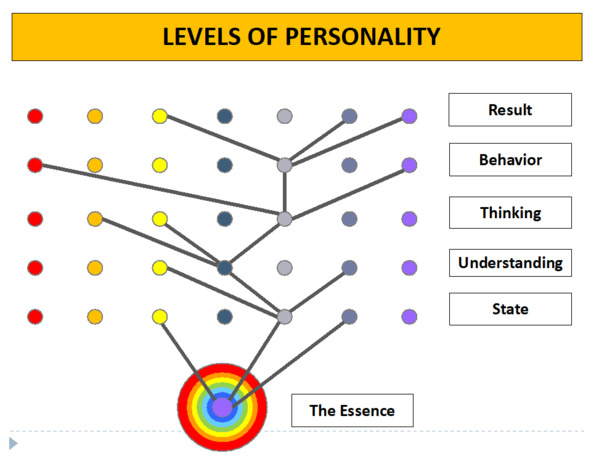
The basis of human psychological world is his essence.
This notion is difficult to define, but this is what we really are, our essence. Carl Jung called it selfhood, you may call it your soul or your deep Ego, but we prefer the term essence. The essence predetermines main capabilities of a person is the initial point that unrolls into his potential. The essence has its layers, levels and parts, but normally is a whole, well-integrated formation. Any damage of the essence can lead to serious psychic disturbances even to psychic disorders. In such cases the essence seems to break up and its parts start fighting with each other. There is a supposition that in case of schizophrenia a person rejects himself fully, totally which is the reason of wrong perception of reality [delirium, hallucinations].
When disturbances are not too bad depressions, panic attacks, neurosis of obtrusiveness, psychosomatic diseases may occur. For example, a person may reject his Inner Child or some “bad” part of himself. He rejects this part but it comes back to him again and again and he lives in constant fight with himself. Different problems of personal identity, for instance, sexual identity also refer to essence disturbances. See some examples further.
The essence can give rise to [or maintain] a certain set of emotional states. According to circumstances these states are more or less probably switched on. A well-wishing essence will hardly produce angry and aggressive states. A depressed essence can’t produce tender, playful and joyful states.
But even if the essence is intact and undamaged the psyche can keep some negative emotional states, which then may act as self-sufficient inner causes that bring about neurotic or psychosomatic disturbances. The theory explaining the appearance of chronic negative emotional states as a result of a psychodynamic conflict will be given later. These same conflicts may damage a person’s essence, when for some reason a person revolts against himself, separates from himself, refuses from himself and even loses himself.
We draw your attention to the fact that the offered model presupposes active behavior coming from deep psyche to the outside reality, and not just reactive behavior only reflecting reality reacting to outer events.
8. Levels of an individyal and the tasks of eit
Both clients and doctors may approach treatment tasks from different premises and at different levels, which depends on theories that the doctor believes in consciously or subconsciously as well as on his aims. A personality can reveal itself ae different levels: the level of behavior, of thinking, of insight [understanding] of states and of essence. Everything starts from the deeper level of essence and gradually unrolls to the level of behavior. Behavior leads to some results according to which a person makes some conclusions. So we proceed from the model of active behavior developing from deep inside outward, and not reactive behavior when behavior is just a response to outer impact.
1. The level of behavior. The most evident task is to find such way of behavior that can resolve some conflict, reach an agreement, protect oneself, defeat one’s opponent and so on. In this case the doctor is expected to give a recommendation about how to behave in this or that situation, what to say, what to answer, what strategy to stick to, how to learn to behave properly so as to get the desirable result.
To work out the right way of behavior psychologists make use of various trainings, give detailed individual instruction, play role games, give advice and recommendations and so on. For such psychologists, behavior is nothing more but just behavior. If a person behaves himself as if he had no fear that means that he really has no fear. Such trainings can really be effective. Some people should be taught proper manners and right ways of expressing their ideas, others should be taught how to socialize and how to be self- confident and so on.
But this way of dealing with psychological problems reminds me a fable about a devil who wanted to become a saint and he implored a priest famous for his sainthood to teach him how to become a saint. Naturally the priest refused for a long time but seeing how sincerely the devil pleaded with him, he finally agreed. He said: “As you are begging so hard here is the first commandment: Whoever slaps you on your right cheek, turn to him the other also. Strictly follow this commandment!” The devil was pleased and he left. But he reappeared in the evening bruised all over. “What “s happened?” — the priest was surprised — “I have told you: Whoever slaps you on your right cheek, turn to him the other one!” “Yes, — answered the devil, — but I was slapped on the left cheek!”
The priest had to explain to the devil how and in what circumstances one should follow this commandment correctly. It turned out that in some situations one should really let be hit another time whatever part of the body was hit first. In another situation one should run away as soon as possible, in still other situation it is worth to rebuff but by peaceful means, and sometimes it is necessary to bravely defend oneself. In still other cases it is sensible not to go to an unsuitable place and not to have anything to do with bad people and in the fifth case — to evade a blow time! And so on. A detailed instruction was needed for every case; it became a whole book.
But the devil always got into a mess, as there was usually a variant of behavior that wasn’t taken into account in the instruction book, besides he didn’t always have time to take out the book, to find the needed page and to read the right advice! And there were other commandments and they also needed numerous commentaries and explanations, exceptions and variants of behavior.
Many years passed, the book became huge the priest died and the devil failed to learn how to be a saint! Why? What was the mistake? How would you answer this question? Our answer you will read a little later.
2. The level of thinking. The second way to resolve the problem is to influence the client’s thoughts. Potentially thoughts contain a whole set of possible ways of behavior. The right thoughts allow to behave correctly without working out certain ways of behavior, modifying them according to circumstances and tasks.
Thoughts are integrated in a logical system. By logic rules we can combine different thoughts, make conclusions, in doing so influence various areas of a person’s life, following logical ties between phenomena of his psychic life and different situations and ways of behavior. People are used to subordinating their behavior to logic and if a doctor could prove some idea to a client, this idea begins to transform the client’s behavior, effect his decisions and emotions. This is the basis of cognitive-behavioral therapy.
3. The level of understanding. Deeper and more generalized is the level of understanding and meaning. When a person understands something that he couldn’t understand before, he has the feeling of insight, of discovery. Through the process of understanding a person discovers a new meaning of phenomena which opens up for him new opportunities. The meaning can be expressed by different thoughts both verbally and not verbally, for instance, by images.
This is how a teacher can make sure that his student understands properly what has been explained, asking the student to say the same thing but in his own words or to do some unusual task on the ground of what he understood. One and the same meaning can be expressed by different phrases, in different languages, for example, in Russian, in Finnish, in German, in Chinese or it can be expressed by gestures or images. The meaning itself doesn’t have its own universal language, it doesn’t have its own form of expression and yet it can find various forms of expression.
A Chinese fable says about it in the following way: “Words are only traps for the meaning. When a beast is captured the trap is forgotten. Where can I find a man who forgot about words in order to talk to him?”
Our psyche prefers to talk to us in the language of images. Almost all discoveries were made when a person became relaxed and switched off his familiar fussing around thoughts, then his psyche sleeping or meditating gave rise to images whose meaning solved the task. This is how Archimedes relaxed in the bath and discovered his famous law. He was so excited that he jumped out if the bath and was running about Syracuse crying: “Evrica!” [which means “I’ve found!”]. Mendeleev saw his periodic table in his dream as a solitaire. And Bach saw his fugues in his dream as Gothic cathedrals.
They say that the inventor of sewing machine Elias Howe spent two years on his research, got broke but failed to achieve the desirable result. And once nearly in a complete despair he fell asleep in his laboratory on his drawings. He had a dream that he was somewhere in Africa, he was caught by cannibal savages who tied up his hands and legs, pushed him into a tub of water, put a lid on and began to boil it. Hot water made the ropes get loose, he freed his hands and legs pulled away the lid and began to get out of the tub. But the cannibals came running at once and started to push him back into the tub with spears, he screamed with terror and woke up. “Their spears were kind of unusual, — he thought in surprise, — they had holes in the spikes!” And he invented a needle for sewing machines! The subconscious coded the solution in images but he was lucky to decode it. We also ask the subconscious in terms of images and then interpret its answer!
Insight is an ecstatic reaction to the opened truth. In place of a dead-end there appeared unusual opportunities! Everything became clear, understandable and… nice, even beautiful! The discovery of new ways arouses the feeling of liberation and joy. The tension that chains you eases and much energy comes instead which overfills you. Now you can act, now you will gain success, victory and new discoveries. There will be no end to new space and miracles! Understanding easily gives rise to new ideas, they come in a free flow, because the dam is broken and what follows are numerous consequences of the discovery or the whole chain of liberating discoveries.
That’s why we say:
There are people who can at once understand a hint.
There are people who can understand when you explain to them.
There are people who can understand only from their own experience.
There are people who can understand only when everybody around them has understood.
And there are people who can never understand.
Psychoanalyses, humanistic psychotherapy, gestalt therapy and all trends of psychotherapy oriented towards awareness and self-knowledge work at the level of insight.
4. The level of states. However, there is a deeper level than that of understanding. Understanding may be blocked or on the contrary stimulated by emotional states. In the state of anger, it is not possible to open up for yourself tenderness, in the state of constrain and fear you cannot understand trust and calmness. Stiffness, depression, anxiety, bitterness and other similar states aren’t conductive to self-knowledge and creativeness. And on the contrary, different negative feelings give rise to numerous was of self- deceit called protections. To see yourself as you really are may be very difficult and painful, but avoiding the truth you will not find the truth. So many clients prefer to slide on the surface trying to avoid the consequences, but not to touch on the true reasons of their suffering. So they prefer to learn the skills of outer behavior or just take some medicine. Then there is no need to work on yourself. So if creativeness and insight are blocked by negative emotional states, they must be stimulated by positive states, when a person is full of joy, happiness when he is relaxed… Why then we speak about throes of creation! Indeed, there really are throes of creation, but there is no creation. Creation really starts when a person is relaxed and is getting into a state liberating his spirit. Throes or torments result from violating your nature, but creation is the result of the activity of your subconscious when it is free.
5. The level of essence. A deeper level in regard to emotional states is the level of essence. Essence is deeper than character. Character is a whole set [cluster] of typical and customary emotional states which a person identified with himself but there is always a key state that gives rise to the whole set. These customary states are rigidly tied to the complex of inner philosophy, to the worldview, with chronic muscle clamps [muscle shell], with a complex of customary reactions to different situations. For that reason, it is very difficult for person to get beyond his character and take a detached view at himself. But his essence is outside his character. And only getting beyond the character it is possible to feel your true essence which is broader and deeper than character. However, with the help of character people protect themselves from real life and feel very uneasy when they lose their habitual protective shell. Character performs only stereotype behavior, and prevents more flexible adaptation, deprives of energy and paralyzes…
Essence can also be damaged. For instance, a person may be at war with himself, may reject a part of his essence, “may be at odds with himself” so to speak. We think that in cases of serious psychic diseases it is the essence that is damaged. But many not so bad psychological problems may be connected to the problems at this level. For example, when you reject your Inner Child [see further] many psychological disturbances can take place, and this is a frequent case of a splitting of essence.
So, essence maintains a certain [quite big] set of possible states, a certain state may lead to a certain set of understandings [insights], understanding may give rise to a certain set of thoughts [cognitive constructs], a thought may give rise to a certain set of actions, and an action leads to a certain result. Poor results, as a rule, make a person come to the conclusion that his essence is good, states are correct, understanding is adequate, thoughts are exact and actions are right those which should have been taken, and but reality is somehow “bad” and should be changed. The psychologist on his part helps the person himself to change.
Now, coming back to the story about the devil… What was he wrong about? Why did he fail?
Earlier I thought that the secret was that the devil simply didn’t understand the meaning of the commandments, acted according to the pattern, at the level of behavior, never getting to the level of insight. Later I understood the problem deeper. A student from Costa-Rica [once I had such student] helped me do it. She gave me a fantastically simple answer to my provocative question! The devil’s mistake was that he remained a devil! That is he didn’t change his essence! And was not going to do so!
Indeed, one can behave properly for a very long time, one can understand why and for what he does so, but if one remains his old self, with old emotional stereotypes, then in actual fact one’s false behavior is worth nothing. “Didn’t do any good, but in his soul, he was really a kind man” — said Pushkin about himself. And this is much better than to do some good remaining a wicked man.
What can do EIT in this sense? On the basis of the scheme of levels expressing the personality we can point out that therapy through emotions and images works for changing emotional states, which are the roots of psychological problems, as well as for rehabilitating the wholeness and harmony of a person’s essence. That means we work at a deeper level than thinking, behavior and even understanding. Rehabilitating the damaged essence makes it possible for a person to open up for himself the whole lot of new positive states which guarantee more effective and healthy life.
We help a person understand himself, do nothing “behind his back” which actually is impossible. Our method has nothing to do with hypnosis, rather it helps remove hypnotic-emotional states which emerged in the course of his life.
We do try to change the client’s behavior and thinking. We do indeed, but we always seek the underlying reason of his behavior and thinking, which appears to a problem for the client. We talk about and bodily expression of these feelings, about images of these feelings and at times it’s very surprising for the client. It is this that helps to achieve real, sincere and not imagined changes of behavior. We don’t teach the client how to behave but ask him what reactions occur involuntarily, when his emotional state has changed. If these reactions correspond to his desires as well as to lows of ecology and ethics, it is the best result in EIT. Sometimes the client is surprised that his reactions became quite different, though he doesn’t have time to think how to react properly. And this is the criterion of real changes!
In EIT realization and understanding for the client is secondary, primary is the changing if states, though the physician must understand what kind of changes he is trying to achieve, how some impact on the image can change the emotional state and personality. Everything is done for the good of the client, in compliance with psychological ecology, on condition of the client’s own agreement and using his own efforts. In the framework of EIT analyzing process is very quick, and the client’s insight is not forbidden, but it is more important for the physician. The physician’s insight is followed by a delightful “a-ha reaction” and the insight of the client is sometimes followed by the feeling of horror or remorse and by the rain of tears. He understands at last what terrible for him events and feelings brought him to this life, how he spoiled his life. But everything can be improved. It is never too late.
Summary
1. Emotions are the criterion of the success of a person’s activity, the criterion of success.
2. Emotions may be the main goal of some activity; it is performed in order to get emotions.
3. The way you feel is also an emotional phenomenon, expressing the state of your organism. Chronic emotions effect health.
4. Emotions provide energy for any actions of a person.
5. Emotional states make the basis for a person’s choice of thoughts and ways of behavior.
6. Negative emotions sometimes serve as social barriers for undesirable forms of thinking and behavior. But often they restrict positive capabilities of an individual.
7. Chronic negative emotions are the reason of disturbed psychological and psychosomatic health of a person, his inadequate behavior. They may remain unchanged in the person’s psyche all his life.
8. Psyche is active. Activity is being developed from within the personality. It proceeds from the essence and expresses itself through states, understanding, thinking and acts.
9. The task of EIT is to change chronic negative emotional states and work for integration and harmonization of a person’s essence.
Chapter 2. Emotions and body
Emotion is “a bridge” connecting psyche and body.
Emotion connects psyche and body; it exists both in psyche and in body at the same time. But emotion is also energy, which becomes revealed in actions. Emotion is felt subjectively but it is expressed in very strong bodily manifestations. They are more frequent or more slow heartbeat and breathing, tension or relaxation of muscles, more intensive or less intensive blood flow in some parts of the body, more intensive or less intensive sweating, discharging into blood some mediators [like adrenalin] and so on. Emotions affect the functioning of autonomous nervous system, which controls inner organism and does not follow the orders of the mind. That is why emotions strongly affect the states of the body and cause psychosomatic diseases.
Wilhelm Reich stated that undesirable emotions are blocked in the body by chronic muscle clamps [25, 26]. The system of these clamps makes up the so-called muscle shell. This shell not only restricts the expression of sincere feelings but also creates a barrier for spontaneous and flexible behavioral reactions. It blocks free flow of energy in the body, the amount of energy becomes smaller, feelings and behavior become limited, their repertory becomes much smaller. A person feels constant discomfort because of too much tension in his body, at times pain, sometimes the feeling of heaviness and limited mobility. Muscle clamp fully corresponds to adapting activity. It expresses the character of a person, that is of typical for him emotional and behavioral repertory with its limitations and stereotypes.
If the muscle clamp relaxes, the person gets back to his initial nature, becomes sincere and natural, flexible and creative. The heaviness of the body as if goes away, it becomes light, as if fresh wind were blowing inside the body. Energy and joy fill the person. He becomes capable of getting real pleasure from living, and his behavior is adequate, it corresponds to the situation, he doesn’t go crazy, on the contrary, he thinks clearly and fully realizes what is going on. We called this state of a person uncharacteristic, this is a new and unusual term requiring an explanation.
The matter is that character becomes revealed in customary and stereotypical ways of behavior, which repeat themselves in various situations, sometimes quite adequately and sometimes not. For example, a touchy person takes offence very often and as a rule when there is no reason to take offence. Touchiness is a trait of character. An anxious person is worrying for no reason; anxiety is his trait of character. A hot-tempered man is often outraged and feels insulted because of some trifle. Hot-temperedness is his trait of character. Any characteristic manifestations of a person are typical reactions excluding flexibility and creativity. A person lives within his character as a turtle in its shell. With the help of his character, he protects himself from his own shortcomings which he faces if he is open to the world. To do it he has to suppress some feelings and limit the repertory of possible actions straining the corresponding muscles of his body in fear of his own unlimited freedom. He is afraid if freedom and doesn’t know what to do with it.
But if he casts off the yoke of his character displayed in the muscle shell, not only his body relaxes but he no longer needs stereotype protective reactions. New spontaneous adequate to the current situation reactions become accessible to him. As he reacts creatively and not in a stereotype way you can’t say what kind of character he has. He is not touchy though but he may take offence if this is adequate to the situation as he really was insulted. But even feelings of offence don’t last long, he easily forgives them and goes on communicating normally. He is not anxious but may worry if future may have in store some unpredictable dangers. For example, if he has to take an important and difficult examination. But his worrying doesn’t last very long and is not pathological, doesn’t prevent from focusing on preparing for the examination.
You can’t say about such person that he lacks in character because a weak-willed person displays weak unstable and dependable character. A non-character person can easily stand up for justice and can’t be easily bent to someone’s will because he has an independent character. He doesn’t live inside his character, his character doesn’t command how he should live, he rules over his character if he still has some stereotype reactions. So he is always different and you can’t say what stable features of character he has. The only suitable term to describe him is “non-character” that is not corresponding to traditional classifications of characters, flowing like water he reacts not in keeping with the character but freely as it is necessary here and now.
Character is stiff and stuck emotions turned to stone in the forms if muscle clamps or ousted and materialized in the forms of emptiness and muscle impotence. Very often current problems of a personality are the result of deeper defects of character. As we have already said people face the problems which reflect our character. The world gives us back our own reflection exactly like it did for the famous donkey Eeyore. As we know he looked at his reflection on one side of the lake, then went to the other side looked again… “Yes, -he said, -I knew, on this aide it is no better than on that. Harrowing sight…” For some reason, people don’t think that it is necessary to change themselves, thinking that it is the world that is wrong and must be changed. But changing the world they face themselves again, fatally facing the consequences of their character, to which they try to adjust the world. The same thing happens when social revolutions take place.
The problem is that when we speak about changing the character practically any client demonstrates strong resistance. The matter is that he views himself as his character, he identifies himself with his character and is afraid of losing himself as a result therapeutic changes. Character is also connected with main life values and scenarios, supported by some inner philosophy, profound convictions, individual life experience. At the background of character there is some basic emotional fixation from early childhood, but the client is reluctant to change it in justified fear that he can lose the whole customary system relying on which he lived all his life. He fears to be unprotected in the face if unpredictable life.
If we manage to change some basic emotional fixation, the client may feel disoriented, as if he got into absolutely different unusual world and doesn’t know how to behave.
Example 3. “A new world”
Once I succeeded to help one student to get rid of bitterness that overfilled him. He had every reason to feel bitter he had to go through very much, but bitterness interfered in his life and studies, made all he was doing more difficult. I recommended him to go to the forest and shout there letting his anger go out. To my surprise he followed my advice he was shouting for two hours and kicking something in the air. And after this process he came somewhat soft and light.
— How is life? — I asked him.
— Excellent. Very calm. So many problems went away! I have enough time for everything, it is easier for me to study, have far less conflicts. But I just don’t know how to live this way?
— Why, isn’t it better?
— It is, but I don’t know how, I can’t live this way, it is sort of unusual…
— And what is wrong, give an example?
— My dad yelled at me and I don’t know what to tell him. Just sitting saying nothing… But actually he also got silent…
— Well, that’s fine, isn’t it?
— Yes, it is. But I don’t know how to live this way! These days on my way home I see two men fighting. In the past I would interfere in the fight, and now I think: What are they fighting for, fools and fools… I just passed them by. But I don’t know how to live this way!
I had to explain to him for a long time how to adapt to the new reality. He really began to study well, later entered a postgraduate course, though he had been a very poor student before. But I still had to work with him a lot.
Now let’s get back to the Wilhelm Reich theory. He discovered relatively independent segments of the muscle armor. Each one blocks some emotions. We use this information in EIT to diagnose what caused different psychological problems.
1. Eyes. Protective armor in eyes area reveals itself in brow immobility and “empty” expression of the eyes. They look as if from behind a motionless mask. You can achieve relaxation by opening your eyes as wide as possible [like you do in great fear] to move eyelids and brow to an enforced emotional state, as well as by rolling your eyes and looking from side to side fixing your look on either wall.
2. Mouth. Oral segment includes muscles of the chin, throat and the back of the head. The jaw can be both greatly compressed and unnaturally relaxed. This segment keeps the emotional expression of weeping, yelling, anger, biting, sucking, grimacing. Protective tensions can be relaxed by imitating weeping, making sounds engaging lips, making biting movements, throwing up movements and directly working on muscles.
3. Neck. This segment includes deep muscles of the neck and tongue. It controls mostly anger, yelling and weeping. It is not possible to directly affect deep muscles in the neck, so important means to achieve relaxation are yelling, screaming, vomiting movements and so on.
4. Breast. Breast segment includes broad muscles of shoulders, shoulder blades, thorax, arms and hands. This segment holds back laughter, anger, sorrow, passion. Holding back breathing, which is an important way of suppressing any emotion, is mostly realized in the breast. The armor can relax if you work on your breathing, especially by full breathing in. Arms and hands are used for hitting a target, for tearing, suffocating, beating and passionately achieving something.
5. Diaphragm. This segment includes the diaphragm, solar plexus, muscles of the middle part of the back. Protective tension reveals itself in the bent of the vertebral to the f