


автордың кітабын онлайн тегін оқу Learn Languages Easily. Methods of self-regulation for successful learning
Andrey Ermoshin
Learn Languages Easily
Methods of self-regulation for successful learning
Fonts by «ParaType»
Translator Maria Sapozhnikova
Translator Elena Lysenko
Editor Mary Larry
Editor William Schultz
Cover designer Maria Ermoshina
Illustrator Daria Ermoshina
© Andrey Ermoshin, 2017
© Maria Sapozhnikova, translation, 2017
© Elena Lysenko, translation, 2017
© Maria Ermoshina, cover design, 2017
© Daria Ermoshina, illustrations, 2017
Have you ever wanted to learn a language quickly and easily? In Learn Languages Easily renowned Russian psychotherapist Andrey Ermoshin guides the reader to do just that.
The solutions offered here employ his own method called psychocatalysis. This is a method of self-regulation which is built upon paying attention to your body’s signals and leveraging your own internal strengths.
Ermoshin offers 40 exercises that will speed up the deep learning process needed to master new knowledge.
ISBN 978-5-4490-1806-9
Created with Ridero smart publishing system
Contents
- Learn Languages Easily
- To the English-speaking Readers
- INTRODUCTION
- How did this method appear?
- What usually happens to our knowledge?
- Basic problems one encounters when learning a foreign language
- New facts
- “I would learn English simply because…”
- Obstacles mean nothing
- Inherited qualities: pros and cons
- Learning under pressure
- First unpleasant emotions
- Tensions and complexes acquired in the early stages of learning
- Student-time traumas
- Background tensions and traumas remotely connected with the learning process
- Nerve cells can regenerate!
- Test “A constructive drawing of a person’
- Cerebral ischemia
- Influence of upbringing
- Influence of historical associations
- A primordial instinct
- Organic lesion of the central nervous system
- Depressants
- Workload
- Learning for adults
- A test: “An ideal student’
- Objectives and ways to achieve them Initiation
- Psychocatalysis is a way to help the self-regulation of the body
- Access via sensations
- Concentrations and discharges, rises and falls
- Meditation-based practices
- The light of knowledge versus the darkness of ignorance
- “Mission control centre’
- Unexpected answers to strange questions
- Question attack using a three-step method
- Conscious choice
- How did this method appear?
- LET’S FREE OUR ATTENTION
- If you feel surrounded by problems
- Exercise 1: Total immediate reinvention of the mind
- Exercise 2: Getting rid of pipe dreams
- Exercise 3: Spend some time in a happy place and then return
- Exercise 4: Paying attention to the problems and sorting them out: if they are dead-end, go away from them, and find the solutions to the problems that have something promising!
- Streams flow into your head
- Putting the bone back into the joint again
- If there are any complications
- If you feel surrounded by problems
- PEACE OF MIND AND INTEGRITY OF THE SOUL
- Tensions and traumas
- The soil and the seed
- One needs peace of mind
- Two sources of stress
- Atlas of emotional experience
- One needs systematic work
- Setting oneself free from stress and trauma when working with languages
- Stress of the first encounter
- What do we do to update the state we are in?
- Exercise 5: Working through internal tensions and traumas received during the learning process
- Edgy upbringing
- A lump in the throat
- What to do when something is smothering you, and you feel screens in the throat and a noose around the neck
- Exercise 6: If there is something squeezing your neck
- There is more than one cause
- Working with the initial state
- Bold 90-s
- Working with negative influence of the ancestral and national experience
- Inherited ancestral memory
- A sugar kiss melon made of granite in my stomach
- Tensions and traumas
- STRIVING FOR SELF-FULFILLMENT
- The level of vitality
- Explore your commitment to life
- Sé and Antisé
- Exercise 7: Working with the striving for “proper’ self-fulfillment
- Sensations are unique, but tendencies are common
- FORMING A DETERMINATION TO SET OFF ON A JOURNEY OF LEARNING A LANGUAGE AND ACHIEVING RESULTS
- Multilevel motivation
- Four vectors
- Positive motivation
- Disincentives
- Neutral realizations
- Maintaining the level
- What sensations do we experience when it comes to motivation?
- Motivation 1: “I understand that it’s useful and necessary”
- Reasons
- Exercise 8. Guiding understanding of the necessity to study into the body
- Motivation 2: “Even if I didn’t want to, but I have to”
- Unbacked horses
- Pythagoras
- Commuter train
- Interiorization of control
- Every day is not Sunday
- You will study, if you want to have a good life
- Turning around
- From the back to the chest
- Exercise 9. Accepting reasonable responsibility — Where is the energy of reality demands?
- Exercise 10. Reject those unhealthy demands!
- Motivation 3: “I want to learn the language!”
- Eager beaver
- Exercise 11. Strong connecting with the expected result
- Exercise 12. Getting your motivation out
- Motivation 4: “It would be impossible not to learn it”
- Correspond to the level of the achievements in the family
- A big soul
- Exercise 13. To be in the flow and to be the successor to the traditions
- Putting motivating vectors together: determination
- Exercise 14. Determination in the soul
- Multilevel motivation
- WHAT HAPPENS TO KNOWLEDGE IN OUR BODY
- Introduction: Soaking up information like a sponge
- A Rock or a Vacuum Unit?
- Will you drink the nectar of knowledge or grind your way into studies?
- A child absorbs like a sponge
- An adult just cannot “take it in’
- A big head in the drawing
- A dangerous syndrome
- The risk of getting a stroke
- “Autonomic memory’
- “Career of knowledge’
- Disc C and disc D
- Examination and adjustment of the mother-tongue
- Stage 1. Diagnostics of the initial state
- Getting reference
- Exercise 15. Experiencing one’s mother-tongue: its location and features
- Fragments from the seminars
- Stage 2. Upgrading one’s attitude
- Getting rid of toxins
- Exercise 16. Sensations connected with the mother tongue: completeness and clarity
- Exercise 17. Sensation of a mother-tongue: optimizing its location
- Exercise 18. Enriching your mother tongue
- How does native speech flow?
- Exercise 19. The way out
- Sensations connected with one more language and with new information
- Competence leads to the peace of mind
- Looking for a place
- Exercise 20. Does your body have ‘a container’ for new information?
- How many languages can it fit in?
- Exercise 21. Taking in another language of the body
- Double benefit
- Exercise 22. Guiding knowledge to the body, continuation
- Options for this stage of work
- The flow turns into a test
- Entering the knowledge is like stepping into a city
- Exercise 23. Entering the realm of the language
- “Impregnation’ on the curve and “embryo’ formation
- Exercise 24. Final algorithm for guiding the knowledge into the body
- Enriching the language
- Look after it like it’s a puppy or a kitten
- Exercise 25. Enriching of the language you are learning
- Exercise 26. Knowledge finds an even more comfortable place in the body
- Correcting of the errors, removing the husk
- Consolidation of the languages that have been brought back to use
- Introduction: Soaking up information like a sponge
- THE “MYSTIC” DIMENSION
- The adoption of information from the outer space
- Filling from Above
- A moment of calmness
- Recommendations to a pupil
- Exercise 27. Pulling up additional knowledge from the outer space
- Direct learning from another person
- Import of a scroll
- A knife thrower
- Placing “an embryo of knowledge’ and its incubation
- Three reservoirs
- Immersion into the right atmosphere without moving in space
- To show the “spirit of language’ in the specific language forms
- Exercise 28. The formation of the embryo and its incubation
- Access to knowledge through the works of art and through staying in the places, where knowledge has been accumulated
- Directions of feeding
- Memory areas and experience space
- Is the past behind or below?
- The experience of generations
- Universal metaphors
- Main directions of coming knowledge and its storage
- Let it come out of nowhere
- Exercise 29. Let the useful knowledge come from wherever it is
- Exercise 30. Filling with the “spirit of language’
- It is like the ancient practice, but there is some difference
- Working through prejudices
- Is it possible “to recall” language, assuming that you have already spoken it once?
- Proto-language
- Previous lives
- To run roots down to the aquifer
- The adoption of information from the outer space
- THIRST FOR KNOWLEDGE
- SPIRIT AND FLESH OF THE LANGUAGE
- ACCESS AND APPLICATION
- Exercise 31. The mystery of how speech is born: the flow goes out!
- Let’s sum up
- Working in waltz time: the three steps
- TURNING INTO A NATIVE SPEAKER THROUGH IMPERSONATION
- USING ALL CHANNELS TO SATURATE THE BODY
- V. Raikov
- The actor’s impersonation
- Colourful vitamin pills
- The essence of the role
- Exercise 32. Impersonating like an actor
- Extended algorithm of actor impersonation
- Preliminary phase
- Adjustment phase for a specific role
- Suitable both for writers and for business people!
- A Fairy Tale about Meeting a Tree
- A Loaf
- WHO CAN I PRACTICE WITH?
- Types of interlocutors
- Peculiarity of your type
- Buffer phrases
- DIAGNOSTIC PHRASES AND VISUALIZATIONS
- Method of diagnostic phrases
- Exercise 33. Diagnostic phrases
- Diagnostic visualization of a situation you are preparing for
- Exercise 34. Diagnostic visualizations
- Fugue of images
- Increased self-esteem of Russian people
- reconciliation of “sub-identities” standpoints Neopaganism
- Archetypal Theatre
- Exercise 35. Reconciliation of sub-identities’ standpoints
- Method of diagnostic phrases
- WAYS TO IMPROVE NUTRITION SUPPLY TO THE BRAIN
- Heavy mind
- Stretching
- Exercise 36. Physical exercises for stretching muscles
- Hip height
- Pat-a-cake
- Removing other causes in order to improve brain functioning
- Extended list of ways to improve brain nutrition
- USEFUL PRESCRIPTIONS IN CASE OF ORGANIC LESIONS OF THE CENTRAL NERVOUS SYSTEM (CNS) AND ATTENTION DISORDER CAUSED BY IT
- Heavy mind
- GUIDELINES FOR LANGUAGE ACQUISITION OFFERED BY ADVANCED USERS AND TEACHERS
- New opportunities
- Learning methods with the help of ted.com
- A textbook that you like
- Phonetics, vocabulary, and grammar
- Cellophane, nail, and a pan
- Learning and reciting poetry
- Tongue twisters and jokes
- The ‘plus one’ rule
- If the textbook is frighteningly thick
- One but very elaborated utterance
- Build your dialogue and thus, fill in the gaps with words and expressions
- The language you’re learning comes from the languages you already know
- “A cheat sheet”
- Begin with the topics that you can easily learn
- Love the language you’re learning
- Other little tricks
- Grammar exercises
- Back translation
- The way to memorize
- Memory: Repetitio est mater studiorum
- If you don’t want to lose it, use it!
- Sleep and nutrition lay the foundation of physical education
- Exercise 37. Taking in another portion of knowledge
- Excerpts from the seminars
- ACCEPTING THE TASK
- A task within your scope of abilities
- Exercise 38. Finding the right amount of work for the next step of the task
- BUILDING A PROJECT AND CHANGING YOUR LIFESTYLE FOR THE PERIOD OF LEARNING A LANGUAGE
- When, where, and how?
- Exercise 39. Creating an educational program: when and how you will study
- Do you have everything to climb it?
- Established timing
- Redistribute time
- Silence, calm, readiness!
- Exercise 40. “A self-fulfilling prophecy”
- New opportunities
- PSYCHOLOGICAL OCTAVE
- CASES
- Thirst for knowledge
- What do I feel?
- What could one feel?
- You need to fill yourself!
- Where is the knowledge?
- How exactly are you going to learn the language?
- Feeling offended…
- Social phobia
- WORKING WITH KNOWLEDGE IN APPLICATION TO SOLVING OTHER PROBLEMS
- Overall use
- Before exams and during the semester
- Professionalization: “I want to keep my feet firmly on the ground”
- Herbal tea doesn’t help
- A teeny-tiny world
- “I’ll fail the mission”
- Could it be that you “freak out’ for a reason?
- It was a slow entry
- I want to stay in this business
- Predictable unpredictability
- Where is the knowledge?
- Bobbins
- The tape in the lower pelvis stacks in coils
- Too much space
- The Olympian calm
- Influence on a kilometre
- The list is torn
- Helping athletes
- Algorithm of ‘professional initiation’ and ‘maturity’
- Corrective accentuation of personality traits
- Asking a stand against addiction and changing life
- Psychosomatic healing
- Swollen legs
- Higher chance of successful conception and carrying
- Uterine myoma disappears
- Healing a chronic gumboil
- Calming dreams
- My headache goes away
- ANSWERS TO THE QUESTIONS
- “Can I practice it on my own?”
- “Can we work with kids using this method?”
- WORK AFTER WORK
- Renewal of the effort
- Unload new portions of knowledge into the body using the method you already know
- Check your state through imagining yourself in a situation when you use this language
- Strengthen your spirit with the help of the diagnostic phrases
- From time to time, test yourself with the constructive drawing of a person using the algorithm presented in the appendix
- Renewal of the effort
- AFTERWORD
- Appendix
- Appendix I. Brief algorithm of how to use the method of Psychocatalysis
- REFERENCE LIST
- ABOUT THE AUTHOR
- Appendix
To the English-speaking Readers
This book is an introduction to psychotherapy and self-regulation methods without offering a person to admit that he or she is sick.
This book will help you learn foreign languages and turn this process into an easy and pleasant adventure. I also expect this book to do a bit more than that: the solution to the problem might also serve as an entrance to the world of self-regulation, the way you can maintain your health and pave your way to success.
Having begun to solve a specific problem, to study a language, in particular, a person understands that most of the obstacles to success in learning are inside.
The accumulated stress in the nervous system and the undeveloped pathways for perception of information can prevent him or her from getting new knowledge and forming new skills.
The stress is associated with the injuries, such as disappointment, deception, injustice, betrayal, unkindness, fear, etc. It can be also caused by stagnant strains, which have been formed during important periods of life: entering pre-school institutions or school, moving to another place of residence, changing job and other difficult situations. These are trace mobilization contours. All of them can be worked out, up to the most severe phobias.
Another important aspect of working with yourself is to pave a path for the new knowledge in the space of your consciousness…
The language is taken as a model. Any other task can be in that place, for example, the mastery of painting or the achievement of success in business. The algorithms for inner work, suggested in this book, can be used by any person and within any field of activity. Especially it can be useful for all teachers and students.
Thanks to the psychocatalysis practices, the readers will quickly restore their integrity and balance, supplement the competence and, by the end of the work, it will turn out that they have also learned the language, doing it easily, as if imperceptibly for themselves. What is more, the self-regulation skills will become even greater acquisition for the users of the method of psychocatalysis.
This is the second of my books, translated into English. The first one is “Phobias”. It describes the work with mental traumas. In Russian there are also the books “The Objects in the Body: psychotherapeutic method of work with sensations”, “Geometry of the Experiences: a constructive drawing of a person in psychotherapeutic practice,” “The Enigmatic Syndrome: panic attacks and how to treat them”, which describe other details of the methodology.
Originally, this book was addressed to the Russian-speaking readers. In Russia, people are willing to learn foreign languages, so this topic was taken as an example of the task, which is solved by many. In other countries, there may be other preferences, but I am sure that everyone will find useful the techniques of self-regulation offered in this book.
During reading and practicing you will learn a lot about yourself, grow up psychologically and you can be even healed.
Psychocatalysis offers the effective methods of improving your attention, motivation, ability to perceive the required knowledge, and other aspects of your personal achievements.
I wish you success in your self-regulation practices. This will be not only the contribution to your successful studying, but also an important factor of your personal growth and wellbeing.
Andrey Ermoshin
INTRODUCTION
How did this method appear?
“The head like a stone and the wooden feet’
“There’s no rush, but you’ve got to learn Chinese by the morning!” I think that sounds like a familiar situation not only to military interpreters who often use this phrase. Most of us live in a constant rush. We never have enough time to learn a foreign language although we urgently need it.
Some time ago, the author of the book found himself in the same situation. Fortunately, he managed to resolve it successfully, but it was not easy.
My head is ‘splitting’
At the end of 1992, I received a very interesting invitation to Italy for a course. The organizers paid all expenses, but there was one condition: I had to speak Italian, as there would be no interpreter[1]. The course was to begin in three months.
A group of about 10 people willing to go was organized. We found a very good teacher of Italian and plunged into the learning process. However, two weeks later, I started experiencing some unpleasant symptoms: I was having splitting headaches, my cheeks were burning, and my feet would get cold. When I shared this with my colleagues, it turned out that they were not doing great too: some were having headaches, and one of us even had a hypertonic crisis.
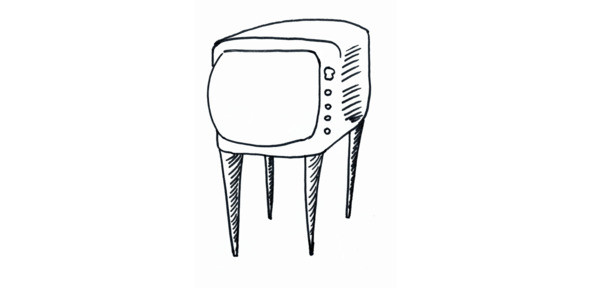
An old TV with a big box and long thin legs. This is the way a person usually feels in a situation of information
overload: a hot heavy head of immense size and cold ‘shrunken’ wooden feet.
Later, when I began investigating this question, I found out that this problem is rather frequent: people of different age told me about similar symptoms in the situations when there was some information overload.
One patient described what he was experiencing in the following way: “My head was like a big old TV set, and the rest of my body was like those thin long legs TV sets used to have.”
Another patient of mine worked as a manager for one company, and this is what she was experiencing after one training course: “My head feels like a computer monitor, and as if there is a floppy disc stuck at the back of my neck. My legs are wooden[2].”
Here is a story told by one of the participants. He is a pilot, and this is what he went through in the flight school.
The 17th class syndrome
There are about 680 English terms, which every pilot has to know. In reality, they use only 50 more or less, but they have to know all of them. Flight school is intense with six hours of English classes daily. By the time students reach class number seventeen, they find nothing better than to start drinking vodka. This is what they call “the syndrome of the seventeenth class’[3].
Even little children can suffer from the syndrome of brain overload. “My head is filled with stones, and I cannot think straight,” — this is what pupils at school often say. Could it be the reason why they end up skipping classes?
There has to be a reasonable solution!
Alcohol is the worst solution to this problem: ethanol not only removes the information, but it also affects the hardware, so to speak. Running away from the studies does not help either: after some time, everything you have missed catches up with you. If you do not exercise today, you might miss out something significant tomorrow.
How can one avoid difficulties in the learning process and protect oneself from the disappointment in the future?
Learn with your heart
Here is how my story continued. The third class of Italian turned out to be the last one for us as a group. One of the participants said with a sad voice: “We’re learning the language with our brain, but what we have to do is to learn it with our heart”, and he put his hand on his chest.
On the way home, while sitting in a train, I thought, if there, in fact, was a language that we learned with our hearts. “It is our mother tongue!” There was an immediate answer to it. There was another step to make to have a discovery on our hands: “Where are my sensations connected with the Russian language?”
At that time, I was already working as a therapist and was deeply involved in the research of the methodology that would pay very close attention to the sensations experienced by the body. Our internal sight perceives these sensations as “objects inside our body.” This is exactly how I called the book devoted to the idea of psychocatalysis[4].
Move that mass from the forehead to your body
As I closed my eyes, I was surprised to find out that my Russian language was ‘located’ somewhere at the level of the stomach. My inner vision registered it as a red-coloured ball that spread beyond the contours of my body. However, Italian triggered an absolutely different set of sensations. It was like a “white mass’ which was bursting my forehead. I dwelled on this sensation for some time and let the mass flow down where my Russian was. This moment was the beginning of my experiment.
As soon as Italian found its way to my stomach, my learning process gained speed, and I began soaking information like a sponge.
“Hatching’ on the train
Further processes might seem a bit surreal. That white mass, which poured down from my forehead to the stomach (my initial knowledge of Italian), turned into a clutch of eggs. Soon, the first nestling hatched. It looked like a little rooster. It fed on the words and expressions in Italian, and it grew very quickly. Turning to a new word only once was enough for the nestling to “swallow’ it.
The only time I could ‘devote’ to my nestlings was on the train on my way to work and back home. Local trains can be rather crowded, so quite often I could not find a place to sit. This made me more of a penguin rather than any other bird. So, I was making my way through the textbook by myself 16 minutes on the way to the city, and then 16 more minutes on the way back, five days a week.
My head is resting
The dates of my new linguistic trip moved to July instead of February, and that way, I got enough time to make my way through all 47 lessons of the textbook without any hurry.
In Italy, I was surprised to find out that my head remained calm and clear in response to the flow of Italian speech, and my stomach was “moving.” Approximately three days later, this movement in the area of my solar plexus calmed down, and Italian speech became clear, word for word, or as they say in Italian: “parola a parola’. My stomach felt slightly “disturbed’ as a person with an unusual speech appeared; for example, for a different professional sphere or with a different dialect. At some point, I realized that I had developed the same attitude towards Spanish too, as if it was a variety of Italian. I was merely trying to comprehend it in a very hands-on style, without any barrier. I think, this is the way children perceive any language. After some time, French speech also became quite interesting to my ear, as another variation of familiar Italian sounds.
What usually happens to our knowledge?
I have overcome my personal challenge successfully, as I managed to learn Italian and have been comfortable using it since then. I did the same with English. Nevertheless, what is also important for me in this experiment is the fact that the solution which I found to learn a foreign language can be used as an efficient model for a further research of how a person interacts with any kind of knowledge in general. Here are some questions that came up throughout the elaboration of the methodology.
— How can one make one’s body more responsive to the new information: how can one ‘soften’ it, if the body feels ‘rigid’, in order to open it up and welcome new information? How can one cultivate full engagement into the process of learning? How can one avoid neuroticism in the learning process?
— How is the overall competence developed? How do nature, culture, and the spirit mysteriously interact within one person? Is it, at all, possible to renew one’s perception?
— Are there ways to restore one’s contact with the knowledge, which we have inside, but which is somehow unavailable for immediate use? Is it possible to “plug in’ to universal knowledge, which is present in space? What do we get from our tradition by way of belonging to a family, people, and life in general?
I was gradually discovering the answers: they did not all come to me in one day, more as they were slowly falling into their place like pieces of a big puzzle. Behind simple algorithms, which you will find in this book, there are thousands of hours of individual psychotherapeutic sessions with my patients, hundreds of hours of group sessions with my students, and multiple episodes of self-observation in order to prove and grow those seeds of the new knowledge, that I discovered on the train after that memorable class of Italian.
Methods of self-development, that I would like to offer you in this book, might become useful for knowledge acquisition in any sphere. It can be professional development, sports, business, politics, and culture. Psychocatalysis is a universal method of self-regulation that will help you successfully achieve your life goals.
My personal experience of using this method has been exclusively positive so far.
Be inspired by a wonderful perspective!
Fruit of labour is sweet
The Italian language, as well as English which I learned, further along, have presented me with an opportunity to experience a variety of positive moments in my life. Being the only interpreter during some seminars and congresses, I would often work for hours, as if I had absolutely no idea how ‘difficult’ it was. When I was told that simultaneous interpreters are supposed to get some rest every 20—30 minutes, I was a bit confused: I must be the wrong kind of an interpreter, as I did not feel tired at all. It is highly likely that my own innocence saved me because it did not even occur to me that it could have been done differently.
I managed to save a lot of energy because the process of interpreting taught me to be calm and tune into the frequency of the speaker. It was about catching the ideas, not words, and looking at this process as an interesting game. At some point, I started enjoying finishing my translation before the speakers would finish expressing their thoughts. Other interpreters confirmed that such a tendency existed in their field. Interpretation is not just a kind of sports, it is also a school of artistry, and it is a highly interesting task!
I need to note that some of my fellow psychotherapists whom I have happened to work with and interpret are very peculiar people. Motto of one of the colleagues is “Sono tutti matti” (“We are all crazy!”), and then she would always add: “Ma sono capo dei matti!” (“But I am the head of all crazy!”). One can hardly fear anything else, having interpreted this lady.
I have conducted my seminars on psychocatalysis in Switzerland and Italy in Italian, including Sapienza University in Rome. I have invited my Italian-speaking colleagues to Russia on various occasions; there have been many situations where knowing Italian proved to be necessary and useful.
I have translated into Russian the book written by an Italian philosopher and psychotherapist, Antonio Mercurio. It was published in Russia in 2006. Here is its title: “Existential Anthropology and Personalistic Metapsychology”. I do not always remember the exact title right away. However, I feel proud that everything worked out.
Knowing the language has given me an opportunity to discover new cities and countries, as well as meet wonderful people. Memories of each of these meetings are still vibrant. I hope you will also have your victories and achievements, thanks to free communication without any language barrier: there will be people and new places, interesting projects in the countries that will open up in a new light because you speak their language.
Further on, I will share multiple episodes of how self-regulation methods can be used in everyday life — in psychotherapy, or while travelling, or in other situations. However, to overcome these intense moments in our lives, when maximum self-realization is expected from us, we need to learn to move from the state of tension and feeling ‘petrified’ to the state of freedom and flexibility.
In the next chapter, you will find information on how you can become more successful in the learning process, and what your possible stumbling points might be. I hope that you will be able to define your priority tasks with the help of self-diagnostics offered below.
Learning a foreign language can become a model for acquiring knowledge in any other sphere. If there’s a person who needs to make quick progress in any other field, the following algorithms can be easily adjusted to suit this goal.
[1] The event was organized by wonderful people from Roman-Catholic and Russian Orthodox churches, among them were: padre Nilo Cadonna and Don Silvio Frank on the Italian side and Father Alexiy (Baburin) and others as representatives of the Russian side. The professional aspect of the event was provided by Renzo de Stefani, Carlo Tieni, Roberto Cuni, and others (Trento, Northern Italy). I will always remember them with gratitude.
[2] This description was given by Tatiana Perts.
[3] Written down on August 13, 2011, in Moscow.
[4] Psychocatalysis was officially accepted as a method of psychotherapy by the Professional Psychotherapeutic League in 2001.
[1] The event was organized by wonderful people from Roman-Catholic and Russian Orthodox churches, among them were: padre Nilo Cadonna and Don Silvio Frank on the Italian side and Father Alexiy (Baburin) and others as representatives of the Russian side. The professional aspect of the event was provided by Renzo de Stefani, Carlo Tieni, Roberto Cuni, and others (Trento, Northern Italy). I will always remember them with gratitude.
[2] This description was given by Tatiana Perts.
[3] Written down on August 13, 2011, in Moscow.
[4] Psychocatalysis was officially accepted as a method of psychotherapy by the Professional Psychotherapeutic League in 2001.
At the end of 1992, I received a very interesting invitation to Italy for a course. The organizers paid all expenses, but there was one condition: I had to speak Italian, as there would be no interpreter[1]. The course was to begin in three months.
Another patient of mine worked as a manager for one company, and this is what she was experiencing after one training course: “My head feels like a computer monitor, and as if there is a floppy disc stuck at the back of my neck. My legs are wooden[2].”
There are about 680 English terms, which every pilot has to know. In reality, they use only 50 more or less, but they have to know all of them. Flight school is intense with six hours of English classes daily. By the time students reach class number seventeen, they find nothing better than to start drinking vodka. This is what they call “the syndrome of the seventeenth class’[3].
At that time, I was already working as a therapist and was deeply involved in the research of the methodology that would pay very close attention to the sensations experienced by the body. Our internal sight perceives these sensations as “objects inside our body.” This is exactly how I called the book devoted to the idea of psychocatalysis[4].
Basic problems one encounters when learning a foreign language
New facts
There were times when it was more than enough to speak our mother tongue. Back then, life was revolving within the limits of the village or a region, where you travelled on a horse on the days of a fair, and in those circumstances, learning a foreign language seemed at least eccentric. Using a foreign language made sense only when a person was wealthy enough and had enough free time to subscribe to foreign magazines, or to travel, or if one had business abroad. Even a hundred years ago, there were very few people who could afford it.
Now, everything has changed. Knowing a foreign language is indispensable. Many people travel around the world as tourists; many also run international businesses; now, it is quite usual to have friends in foreign countries and on different continents. Modern technology and means of transportation make it all possible!
There is no limit to increasing our scope of knowledge. One should at least speak English, which is the language of international communication. It is recommendable to speak another foreign language, depending on your interests.
What do modern people think about education?
Let’s be honest; they do not always have a positive attitude towards this process. Learning a foreign language is often associated with hard work, extra effort, similar to climbing a mountain covered with ice, as there is always the danger of sliding back. Of course, we will do everything we can to hold tight and to keep on moving; we try to flatten our way to the top, to make it comfortable and easy, but before setting off on this journey, let’s define where we stand.
We will have a look at the cases when people were ‘lucky’ to avoid any difficulties, and everything simply worked out on its own. The examples of the “lucky ones’ can actually give us clues on how we can be successful, too! We will also turn to what causes difficulties in the learning process.
“I would learn English simply because…”
The lucky ones are those who learn the language of their favourite musicians, poets, and scientists. No one has to make these people study because, for them, it is a pleasure.
Schwarzenegger and Paul McCartney
One doctor, a colleague of mine, looks like Arnold Schwarzenegger, although he is of delicate psyche; he learnt German and Italian simply because these were the languages of Mozart, his favourite composer. He worked at a clinic, and he sometimes would donate blood to provide for his family, but during the nights, he was compiling a catalogue of all works composed by Mozart. Such hobby required the knowledge of the language, and that is why he learnt German and Italian.
Oleg, another friend of mine, is a musician. He looks a bit like Paul McCartney, and he adores “The Beatles”. For this reason, he learnt all their songs, and that is how he learnt English.
During the process of learning, such people usually make wonderful discoveries about the object of their interest, and that is what maintains their motivation.
There are countless stories about how quickly people learn the language when they fall in love with the foreigners! We can feel motivated in learning a language when we want to speak to a spiritual guru. The sole idea of meeting someone special, a person who triggers the surge of endorphins in your body (these are the hormones of happiness), filled with positive emotions and does not require any additional reward.
Those were the cases when everything was all right with the motivation, and that is exactly what helped to cross the boundaries.
However, it is quite possible to achieve success even when your motivation is not that highly emotional. There are also cases like that!
Obstacles mean nothing
When a person is truly gifted, obstacles connected with learning a foreign language may seem insignificant absolutely.
If we try to describe the characteristics of the “lucky ones,” then we should mention their intelligence, willpower, outgoings, and the ability to connect with their interlocutor. No doubt, it is wonderful when a person possesses such qualities. Think about the universal genius of Leonardo, for example!
It is very seldom that one has all these qualities. It is much more often that someone has the willpower, and another person is brighter, yet another person is more emotional. However, there is no such person, who would be deprived of any of these qualities. All of us are gifted. We just have these talents in different proportions[1].
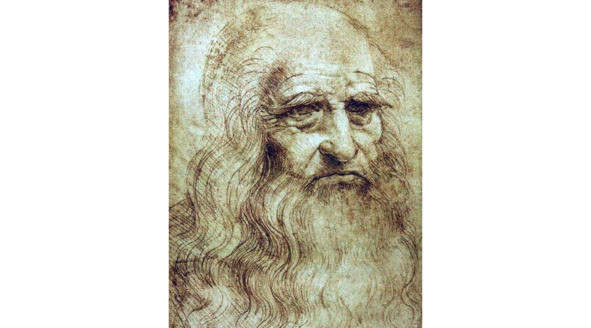
The self-portrait of Leonardo da Vinci: deep-set eyes is a sign of a sagacious mind; a fleshy tip of the nose and full cheeks mean rich emotionality and breadth of the soul; bushy eyebrows, a nose with a hump, a developed lower part of the face mean a remarkable will.
I single out the three types of people who I call “square and shaggy,” “round and bald,” and “triangular and with a receding hairline’[2].
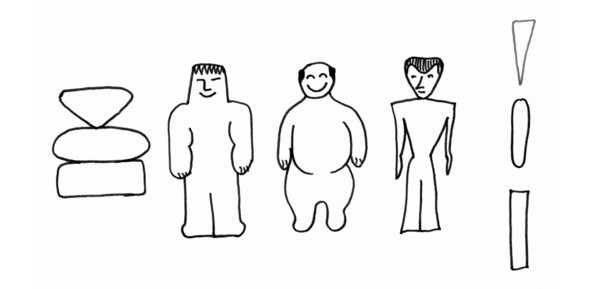
The constitutional genetic types: “square” (strong-willed), “rounded” (emotional) and “triangular” (intellectual). To the left there is an image of a hypersthenic, squat structure of the body that gives the character expansiveness, to the right there is an image of the hyposthenic, “elongated” structure of the body, which gives the character delicacy, pliability
Each of these types has its own set of abilities.
Inherited qualities: pros and cons
“Triangular, with a receding line’ do not see the process of learning as labour. They like studying as much as other people enjoy jogging. These people have distinct looks: deep-set eyes, a prominent nose, and a spare frame (schizoid constitution according to Kretschmer’s terminology[3]). For this type of people, thinking means pleasure, and a learning process is perceived as a kind of sports, as a chance to exercise their brain. They greedily gobble new information.
A pencil and a shoe
People of this kind can easily find hidden connections between events. They are always the first to answer the question: “what have a pencil and a shoe got in common?” Their answer will be: “Both leave a mark.” A pronounced ability to establish associations helps them memorize things that might seem impossible for others.
We have to mention though that the extreme degree of these qualities may cause communicative difficulties: such people are often very reserved, unwilling to establish contact with other people; they can even seem autistic. Such students can easily read and understand, but they find it very difficult to speak in public because of the social anxiety.
There is the second kind of students. They are highly disciplined people who never ask themselves if learning a language should be pleasant. They usually have a strong chin, pronounced eyebrows, and an overall athletic figure (“square and shaggy’ as we refer to them, or as psychiatrists call them “epileptoid’). These strong-willed people are characterized by their can-do attitude towards the task.
Military interpreter
This is how military people often treat the task they are given: “If you cannot do it, we will teach you; if you don’t want to, we will make you to. If it is round, roll it; if it’s square-shaped, drag it. If you don’t have super-abilities, you will get there, but by studying hard!” I have met quite a lot of military interpreters, and all of them are very professional!
Their assertin, an immense willpower, and focus on the goal are the qualities that lead these people to success. At the same time, their ‘laconic nature’ may also become a problem. It sometimes happens that these people experience certain difficulties with speaking, as eloquence is not their strongest point.
On the contrary, there are very talkative people; they may seem rather pushy when it comes to communication: in other words, it is impossible to get a word in edgeways when talking to them. These people usually have plump cheeks, a small round nose, and they are prone to be overweight. Women have soft hair, and men are bald (‘round and bald’ according to our terminology, or a cycloid type, according to Kretschmer). They are always ready to communicate, no matter what the topic is. For them, speaking the language is one of the primary needs.
Cycloids can easily establish contact with a native speaker, though it does not mean they have no weaknesses: they tend to lack consistency and depth in learning grammar.
There are sensitive people who are able to perceive the finest nuances of speech and of human relations. They look delicate as they have a long, narrow face, a long neck, and a thin bone structure (“thin and resonant;’ an asthenic kind). Unfortunately, this kind of people is characterized by shyness and bashfulness. They feel lost when in the company of other people as if their frequency is weaker than the powerful signal of other transmitters. These people have to go a long way to develop confidence and bravery in communication with other people.
We have several methods to help you make up for the qualities that each of the described types lacks, but we will discuss them later. As you may have already noticed, each quality can complicate the process and facilitate it at the same time. The schizoid’s ability to assimilate semiotic systems; the epileptoid’s stubbornness in getting to their goal; the cycloid’s openness to communication, and the asthenic’s delicate way of perception — each of these qualities can become a tool to achieve success, and they have to work for you!
Further, we will return to the topic of personality types in the chapter titled “Who should I practice with?”
Learning under pressure
Even if you are lucky, and you possess all those qualities mentioned above, if you are intelligent, strong-willed, big-hearted and delicate at the same time, you still can sometimes feel like a learning process turns into an ordeal.
How do you learn the language?
I conducted a survey on the site www.psychocatalysis.ru in 2010—2011: “If you are in the process of learning a foreign language, how do you organize it?” The first variant sounded the following way: “For me, learning a new foreign language is an easy and pleasant process because it makes me feel that I am getting closer to making my dream come true.” The second variant was like this: “I have a business-like approach to learning the language because I understand that I need it.” Here is the third variant: “I am learning the language under pressure simply because I have to do it.” I suppose you have already found your approach among these answers. Here is what statistics say on this matter: 37.8% of respondents said that they were learning under pressure because of the circumstances. Fortunately, there were also people who were enjoying the learning process and found it easy. There were about 31.6% of people, who answered this way; 30.6% of respondents said that they had a business-like approach to this process because they understood the necessity.
Ninety-eight (98) people took part in the given survey. The percentage of the “students under pressure’ was fluctuating from 37.8%, which we have mentioned earlier, to 42.3%; 37.8% continued learning the language although they had little wish to do so! Why shouldn’t they begin enjoying the process and learn the language with as much interest as 62.2% do? Creating positive motivation will be one of our first tasks here. Then we will add some methods to make the process of knowledge acquisition easier, and we will get started. However, for now, we have to return to the reasons why we experience complications in the process of learning.
First unpleasant emotions
At the first stage of getting to know a foreign language, it seems very ‘uncomfortable’ up to the point of seeming ‘idiotic.” One should make a certain effort to overcome this aversion. This feeling often becomes the topic for stand-up comedians.
Because of this, I lost all the interest
During one of my seminars in Riga in 2010, one participant (her name was Olga) told us that during her first steps in learning German, she saw a quote from Mark Twain statement: “Life is too short to learn German.” (He compared German words to rails because they are so extraordinarily long: “Some German words are so long that they have a perspective.” This quote turned out to be so shocking for Olga that she immediately lost any interest towards the German language. Even years later, Twain’s words still had so much power over Olga, it stuck like a pin in her head, and it prevented her from making progress quickly. During the session of self-regulation based on the method of psychocatalysis, Olga “removed’ this pin and absorbed the light of a much calmer and natural attitude towards this language. She realized its importance and its beauty despite the words of Mark Twain. Moreover, Mark Twain himself learnt German though he was always making jokes about it.
Recycling our first impression and setting ourselves free from some idle and harmful speculations is one of the stages of our work.
Tensions and complexes acquired in the early stages of learning
A bit of knowledge, but a lot of tension — this is a law of mental life. Our body has the following logic: “I don’t know what to do, but I hope that this energy outbreak will do the trick.” It is purely a reflex reaction. However, this energetic outburst will hardly compensate for the lack of experience! As a result, the student is sweating for no apparent reason. The only result it leads to is wasting ene
...