


автордың кітабын онлайн тегін оқу Beautiful Wales
Transcriber's Note:
The cover image was created by the transcriber and is placed in the public domain.
BEAUTIFUL WALES
AGENTS IN AMERICA
THE MACMILLAN COMPANY
64 & 66 Fifth Avenue, New York
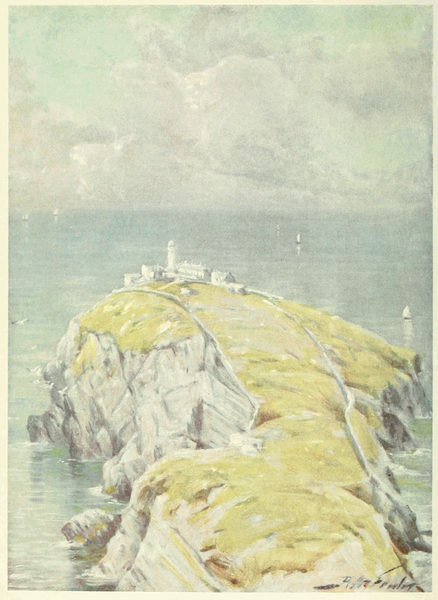
THE STACK, HOLYHEAD
BEAUTIFUL WALES
PAINTED BY ROBERT
FOWLER · R·I · DESCRIBED
BY EDWARD THOMAS
WITH A NOTE ON MR.
FOWLER'S LANDSCAPES
BY ALEX. J. FINBERG
PUBLISHED BY A. & C.
BLACK · LONDON · MCMV

PREFACE
A few of my jests, impressions of scenery, and portraits in this book have already been printed in The Daily Chronicle, The World, The Week's Survey, The Outlook, and The Illustrated London News. I have only to add that the line of verse on p. 34 is by Mr. Ernest Rhys; the lines on p. 71 are by Mr. T. Sturge Moore; and those on pp. 130 and 178 by Mr. Gordon Bottomley: and to confess, chiefly for the benefit of the solemn reviewer, that I know nothing of the Welsh language.
EDWARD THOMAS.
Looking back, the artistry of time makes it appear that soon after I had become certain that the painter had somehow caught Launcelot kneeling at the foot of the column, I reached Wales.
and for the moment, thought he was a man. No actor ever stormed and swelled so, because no actor yet played the part which he played. It was a chant; yet it was too uncontrollable for a chant. If you call it declamation, you must admit that to declaim a man shall first go to Medea, that she
Yesterday, the flower of the wood-sorrel and the song of the willow-wren came together into the oak woods, and higher up on the mountain, though they were still grey, the larches were misty and it was clearly known that soon they would be green. The air was full of the bleating of lambs, and though there was a corpse here and there, so fresh and blameless was it that it hardly spoiled the day. The night was one of calm and breathing darkness; nor was there any moon; and therefore the sorrowful darkness and angularity of early spring valleys by moonlight, when they have no masses of foliage to make use of the beams, did not exist. It was dark and warm, and from the invisible orchard, where snow yet lay under the stone wall, came a fragrance which, though it was not May, brought into our minds the song that was made for May in another orchard high among hills:
In the afternoon I climbed out of a valley, descended again, and came on to a road that rolled over many little hills into many little valleys, and at the top of each hill grew the vision of a purple land ahead. But, for some miles, the valleys were solitary. There were brooks in them with cold, fresh voices, and copses of oak, and sometimes the smoke or the white wall of a house. There sang the latest of the willow-wrens, and among the blackthorns a bullfinch, with delicate voices. The air was warm and motionless; the light on oak and grass was steady and rich; the sky was low and leaning gently to the earth, and its large white clouds moved not, though they changed their shapes. But these things belonged to the brooks, the copses, the willow-wrens; or so it seemed, since that warm day, which elsewhere might have seemed so kind with an ancient kindness as if to one returning home after long exile, was not kind, but was indifferent and made an intruder of me. And I should have passed the stony hedges and the little brooks over the road and the desolate mine, in the indifferent little worlds of the valleys, one by one, as if they had been in a museum, or as if I had been taken there to admire them, had it not been that on the crests of the road between valley and valley, I saw the purple beckoning hills far away, and that, at length, towards the last act of the dim, rich, long-drawn out and windless sunset, the road took me into a small valley that was different. Just within reach of the sunset light, on one side of the valley lay a farm, with ricks, outhouses, and two cottages, all thatched. In the corner of the field nearest to the house, the long-horned craggy cattle were beginning to lie down. Those cattle, always vast and fierce, seemed to have sprung from the earth—into which the lines of their recumbent bodies flowed—out of which their horns rose coldly and angrily. The buildings also had sprung from the earth, and only prejudice taught me that they were homes of men. They enmeshed the shadows and lights of sunset in their thatch, and were as some enormous lichen-covered things, half crag, half animal, which the cattle watched, together with five oaks.
CONTENTS
PAGE
CHAPTER I
Preliminary Remarks on Men, Authors, and Things in Wales 1CHAPTER II
Entering Wales 28CHAPTER III
A Farmhouse under a Mountain, a Fire, and some Firesiders 41CHAPTER IV
Two Ministers, a Bard, a Schoolmaster, an Innkeeper, and Others 55CHAPTER V
Wales Month by Month 99APPENDIX
A Note on Mr. Fowler's Landscapes, by Alexander J. Finberg 201CHAPTER I
PRELIMINARY REMARKS ON MEN, AUTHORS, AND THINGS IN WALES
CHAPTER II
ENTERING WALES
CHAPTER III
A FARMHOUSE UNDER A MOUNTAIN, A FIRE, AND SOME FIRESIDERS
CHAPTER IV
TWO MINISTERS, A BARD, A SCHOOLMASTER, AN INNKEEPER, AND OTHERS
CHAPTER V
WALES MONTH BY MONTH
APPENDIX
LIST OF ILLUSTRATIONS
1.
The Stack, Holyhead
FrontispieceFACING PAGE
2.
Summer Evening, Anglesey Coast
23.
Yachts, Anglesey Coast
44.
Beaumaris—Moonlight
65.
The Beach, Beaumaris
86.
The Trout Stream
127.
Near Menai Straits
148.
Near Bangor
189.
A Footpath on the Great Orme
2010.
A View from the Great Orme's Head
2411.
Old Cottage and Ruins of Abbey, Great Orme's Head
2612.
Breezy Morning, Llandudno Bay
2813.
Country Lane
3014.
A Nocturne, Llandudno Bay
3215.
Conway from Benarth—Early Morning
3616.
Near Colwyn Bay
3817.
Distant View of Penmaenmawr—Early Morning Light
4218.
Silvery Light, Conway Shore
4419.
A Mountain Pass—Noon
4820.
Conway Castle and Quay—Noon
5021.
Conway Valley
5422.
Carnarvon, from Anglesey
5623.
Boddnant Hall, Conway Valley
6024.
Carnarvon Castle
6225.
Distant View of Carnarvon Bay
6626.
On the River Seiont, Carnarvonshire—Evening Glow
6827.
Bridge, Cwm-y-Glo—Evening
7228.
Field Path, near Llanrug
7429.
Windy Day, near Llanrug
7830.
Morning Mists, near Trefriw
8031.
Distant View of Bettws-y-Coed
8232.
The Old Bridge, Bettws-y-Coed
8433.
Swallow Falls, Bettws-y-Coed
8634.
Fairy Glen, Bettws-y-Coed
9035.
Church Pool, Bettws-y-Coed
9236.
Miner's Bridge on River Llugwy
9637.
Sunny Field, near Llanberis
10038.
Welsh Farm, near Llanberis
10439.
Snowdon from Cwm-y-Glo
10640.
Snowdon from Llanberis Lake
10841.
Snowdon from Traeth Mawr
11042.
Snowdon from Capel Curig Lake—Summer Evening
11443.
In the Lledr Valley
11644.
Duffws Mountain
12045.
Duffws Mountain in Mist
12246.
Coming Night, near Beddgelert
12647.
Aberglaslyn
12848.
View of Moelwyn
13249.
A Hayfield near Portmadoc
13450.
Valle Crucis Abbey
13651.
View of Llangollen
13852.
A Lonely Shore near Penrhyn Deudraeth
14053.
The Shore near Harlech—Afternoon
14254.
In the Woods, Farchynys, Barmouth Estuary
14655.
Incoming Tide, near Barmouth
14856.
Barmouth Bridge
15257.
Misty Morning, near Barmouth
15458.
A Lonely Shore, Barmouth Estuary
15659.
View from Bontddu, Dolgelly
15860.
Thundery Weather, near Dolgelly
16061.
Near Penmaen Pool—Noon
16262.
View of Cader Idris
16463.
Mist on Cader Idris
16864.
In the Woods, Berwyn
17065.
Aberdovey
17266.
Sunny Afternoon, Cardigan Bay
17667.
A Sudden Squall, Cardigan Bay
17868.
St. David's—Bishop's Palace
18069.
The Stacks, near Tenby
18270.
St. Catherine's Rock, Tenby
18671.
Old Roman Bridge, near Swansea
18872.
View near Mumbles, Swansea
19273.
Pennard Castle, Glamorganshire
19474.
Old Castle Keep, Cardiff
198The Illustrations in this volume have been engraved and printed in England
by Hentschel Colourtype, Ltd.
WALES
SUMMER EVENING, ANGLESEY COAST
YACHTS, ANGLESEY COAST
BEAUMARIS—MOONLIGHT
THE BEACH, BEAUMARIS
THE TROUT STREAM
NEAR MENAI STRAITS
NEAR BANGOR
A FOOTPATH ON THE GREAT ORME
A VIEW FROM THE GREAT ORME'S HEAD
OLD COTTAGE AND RUINS OF ABBEY, GREAT ORME'S HEAD
BREEZY MORNING, LLANDUDNO BAY
COUNTRY LANE
A NOCTURNE, LLANDUDNO BAY
CONWAY FROM BENARTH—EARLY MORNING
NEAR COLWYN BAY
DISTANT VIEW OF PENMAENMAWR—EARLY MORNING LIGHT
SILVERY LIGHT, CONWAY SHORE
A MOUNTAIN PASS—NOON
CONWAY CASTLE AND QUAY—NOON
CONWAY VALLEY
CARNARVON, FROM ANGLESEY
BODDNANT HALL, CONWAY VALLEY
CARNARVON CASTLE
DISTANT VIEW OF CARNARVON BAY
ON THE RIVER SEIONT, CARNARVONSHIRE—EVENING GLOW
BRIDGE, CWM-Y-GLO—EVENING
FIELD PATH, NEAR LLANRUG
WINDY DAY, NEAR LLANRUG
MORNING MISTS, NEAR TREFRIW
DISTANT VIEW OF BETTWS-Y-COED
THE OLD BRIDGE, BETTWS-Y-COED
SWALLOW FALLS, BETTWS-Y-COED
FAIRY GLEN, BETTWS-Y-COED
CHURCH POOL, BETTWS-Y-COED
MINER'S BRIDGE ON RIVER LLUGWY
SUNNY FIELD, NEAR LLANBERIS
WELSH FARM, NEAR LLANBERIS
SNOWDON FROM CWM-Y-GLO
SNOWDON FROM LLANBERIS LAKE
SNOWDON FROM TRAETH MAWR
SNOWDON FROM CAPEL CURIG LAKE—SUMMER EVENING
IN THE LLEDR VALLEY
DUFFWS MOUNTAIN
DUFFWS MOUNTAIN IN MIST
COMING NIGHT, NEAR BEDDGELERT
ABERGLASLYN
VIEW OF MOELWYN
A HAYFIELD NEAR PORTMADOC
VALLE CRUCIS ABBEY
VIEW OF LLANGOLLEN
A LONELY SHORE NEAR PENRHYN DEUDRAETH
THE SHORE NEAR HARLECH—AFTERNOON
IN THE WOODS, FARCHYNYS, BARMOUTH ESTUARY
INCOMING TIDE, NEAR BARMOUTH
BARMOUTH BRIDGE
MISTY MORNING, NEAR BARMOUTH
A LONELY SHORE, BARMOUTH ESTUARY
VIEW FROM BONTDDU, DOLGELLY
THUNDERY WEATHER, NEAR DOLGELLY
NEAR PENMAEN POOL—NOON
VIEW OF CADER IDRIS
MIST ON CADER IDRIS
IN THE WOODS, BERWYN
ABERDOVEY
SUNNY AFTERNOON, CARDIGAN BAY
A SUDDEN SQUALL, CARDIGAN BAY
ST. DAVID'S—BISHOP'S PALACE
THE STACKS, NEAR TENBY
ST. CATHERINE'S ROCK, TENBY
OLD ROMAN BRIDGE, NEAR SWANSEA
VIEW NEAR MUMBLES, SWANSEA
PENNARD CASTLE, GLAMORGANSHIRE
OLD CASTLE KEEP, CARDIFF
CHAPTER I
PRELIMINARY REMARKS ON MEN, AUTHORS, AND THINGS IN WALES
Among friends and acquaintances and authors, I have met many men who have seen and read more of Wales than I can ever do. But I am somewhat less fearful in writing about the country, inasmuch as few of them seem to know the things which I know, and fewer still in the same way. When I read their books or hear them speak, I am interested, pleased, amazed, but seldom am I quite sure that we mean the same thing by Wales; sometimes I am sure that we do not. One man writes of the country as the home of legends, whose irresponsibility puzzles him, whose naïveté shocks him. Another, and his name is legion, regards it as littered with dead men's bones, among which a few shepherds and miners pick their way without caring for the lover of bones. Another, of the same venerable and numerous family as the last, has admired the silver lake of Llanberis or blue Plynlimmon; has been pestered by the pronunciation of Machynlleth, and has carried away a low opinion of the whole language because his own attempts at uttering it are unmelodious and even disgusting; has fallen entirely in love with the fragrant Welsh ham, preferring it, in fact, to the curer and the cook. Others, who have not, as a rule, gone the length of visiting the persons they condemn, call the Welshmen thieving, lying, religious, and rebellious knaves. Others would repeat with fervour the verse which Evan sings in Ben Jonson's masque, For the Honour of Wales:
And once but taste o' the Welsh mutton,
Your English seep's not worth a button:
and so they would conclude, admitting that the trout are good when caught. Some think, and are not afraid of saying, that Wales will be quite a good place (in the season) when it has been chastened a little by English enterprise: and I should not be surprised were they to begin by introducing English sheep, though I hardly see what would be done with them, should they be cut up and exposed for sale. The great disadvantage of Wales seems to be that it is not England, and the only solution is for the malcontents to divide their bodies, and, leaving one part in their native land, to have the rest sent to Wales, as they used to send Welsh princes to enjoy the air of two, three, and even four English towns, at the same time and in an elevated position.
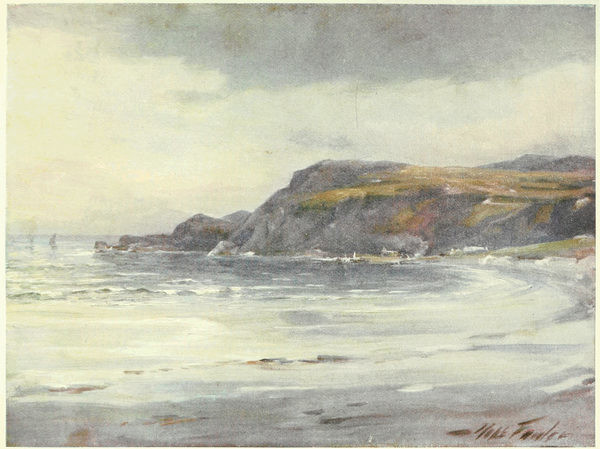
SUMMER EVENING, ANGLESEY COAST
Then also there are the benevolent writers of books, who have for a century repeated, sometimes not unmusically, the words of a fellow who wrote in 1798, that the beauty of Llangollen "has been universally allowed by gentlemen of distinguished taste," and that, in short, many parts of Wales "have excited the applause of tourists and poets." Would that many of them had been provided with pens like those at the catalogue desks of the British Museum! Admirable pens! that may be put to so many uses and should be put into so many hands to-day and to-morrow. Admirable pens! and yet no one has praised them before. Admirable pens that will not write; and, by the way, how unlike those which wrote this:—
"Caldecot Castle, a grand and spacious edifice of high antiquity, occurs to arrest the observation of the passing stranger about two miles beyond the new passage; appearing at no great distance across the meadows that lie to the left of the Newport road. The shattered remnants of this curious example of early military architecture are still so far considerable as to be much more interesting than we could possibly have been at first aware, and amply repaid the trouble of a visit we bestowed upon it, in our return through Monmouthshire by the way of Caldecot village. In the distance truly it does not fail to impress the mind with some idea of its ancient splendour, for it assumes an aspect of no common dignity: a friendly mantling of luxuriant ivy improves, in an eminent degree, the picturesque effect of its venerable mouldering turrets; and, upon the whole, the ruin altogether would appear unquestionably to great advantage, were it, fortunately for the admirers of artless beauty, stationed in a more conspicuous situation, like the greater number of edifices of a similar nature in other parts of the country."
The decency, the dignity, the gentlemanliness (circa 1778), the fatuity of it, whether they tickle or affront, are more fascinating than many better but less portentous things. There was, too, a Fellow of the Royal Society who said in the last century that, in the Middle Ages, St. Winifred's Well and Chapel, and the river, and Basingwerk, must have been "worthy of a photograph."
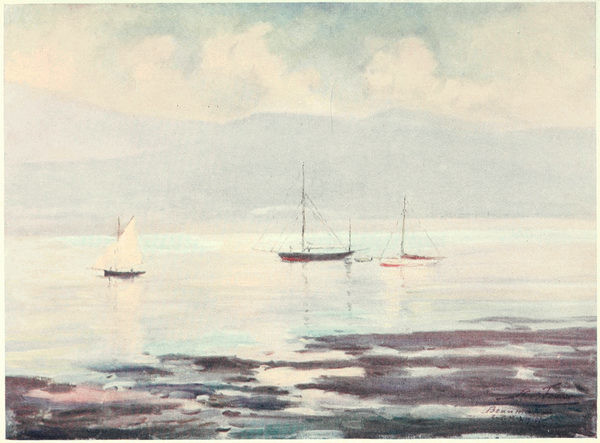
YACHTS, ANGLESEY COAST
Yet there are two others who might make any crowd respectable—the lively, the keen-eyed, the versatile Mr. A. G. Bradley, and George Borrow, whose very name has by this time absorbed and come to imply more epithets than I have room to give. From the former, a contemporary, it would be effrontery to quote. From the latter I allow myself the pleasure of quoting at least this, and with the more readiness because hereafter it cannot justly be said that this book does not contain a fine thing about Wales. Borrow had just been sitting (bareheaded) in the outdoor chair of Huw Morus, whose songs he had read "in the most distant part of Lloegr, when he was a brown-haired boy"; and on his way back to Llangollen, he had gone into a little inn, where the Tarw joins the Ceiriog brook. "'We have been to Pont-y-Meibion,' said Jones, 'to see the chair of Huw Morus,' adding, that the Gwr Boneddig was a great admirer of the songs of the Eos Ceiriog. He had no sooner said these words than the intoxicated militiaman started up, and, striking the table with his fist, said: 'I am a poor stone-cutter—this is a rainy day and I have come here to pass it in the best way I can. I am somewhat drunk, but though I am a poor stone-mason, a private in the militia, and not so sober as I should be, I can repeat more of the songs of the Eos than any man alive, however great a gentleman, however sober—more than Sir Watkin, more than Colonel Biddulph himself.'
"He then began to repeat what appeared to be poetry, for I could distinguish the rhymes occasionally, though owing to his broken utterance it was impossible for me to make out the sense of the words. Feeling a great desire to know what verses of Huw Morus the intoxicated youth would repeat, I took out my pocket-book and requested Jones, who was much better acquainted with Welsh pronunciation, under any circumstances, than myself, to endeavour to write down from the mouth of the young fellow any verses uppermost in his mind. Jones took the pocket-book and pencil and went to the window, followed by the young man, scarcely able to support himself. Here a curious scene took place, the drinker hiccuping up verses, and Jones dotting them down, in the best manner he could, though he had evidently great difficulty to distinguish what was said to him. At last methought the young man said, 'There they are, the verses of the Nightingale (Eos), on his deathbed....'
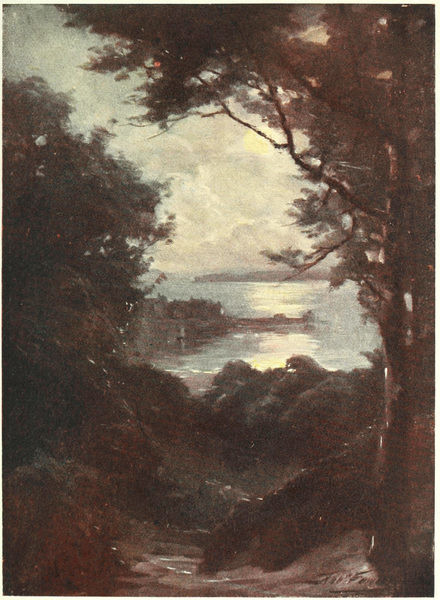
BEAUMARIS—MOONLIGHT
"... A scene in a public-house, yes! but in a Welsh public-house. Only think of a Suffolk toper repeating the deathbed verses of a poet; surely there is a considerable difference between the Celt and the Saxon?"
But the number is so great of sensible, educated men who have written on Wales, or would have written if business or pleasure or indolence or dislike of fame had not prevented them, that either I find it impossible to visit the famous places (and if I visit them, my predecessors fetter my capacity and actually put in abeyance the powers of the places), or, very rarely, I see that they were imperfect tellers of the truth, and yet feel myself unwilling to say an unpleasant new thing of village or mountain because it will not be believed, and a pleasant one because it puts so many excellent people in the wrong. Of Wales, therefore, as a place consisting of Llandudno, Llangammarch, Llanwrtyd, Builth, Barmouth, Penmaenmawr, Llanberis, Tenby, ... and the adjacent streams and mountains, I cannot speak. At ——, indeed, I ate poached salmon and found it better than any preserver of rivers would admit; it was dressed and served by an Eluned (Lynette), with a complexion so like a rose that I missed the fragrance, and movements like those of a fountain when the south wind blows; and all the evening they sang, or when they did not sing, their delicate voices made "llech" and "llawr" lovely words: but I remember nothing else. At —— I heard some one playing La ci darem la mano: and I remember nothing else. Then, too, there was ——, with its castle and cross and the memory of the anger of a king: and I remember that the rain outside my door was the only real thing in the world except the book in my hand; for the trees were as the dreams of one who does not care for dreams; the mountains were as things on a map; and the men and women passing were but as words unspoken and without melody. All I remember of —— is that, as I drew near to it on a glorious wet Sunday in winter, on the stony roads, the soles began to leave my boots. I knew no one there; I was to reach a place twelve miles ahead among the mountains; I was assured that nobody in the town would cobble on Sunday: and I began to doubt whether, after all, I had been wise in steadily preferring football boots to good-looking things at four times the price; when, finally, I had the honour of meeting a Baptist—a Christian—a man—who, for threepence, fixed my soles so firmly that he assured me they would last until I reached the fiery place to which he believed I was travelling, and serve me well there. I distrusted his theology, and have yet to try them on "burning marl," but they have taken me some hundreds of miles on earth since then.
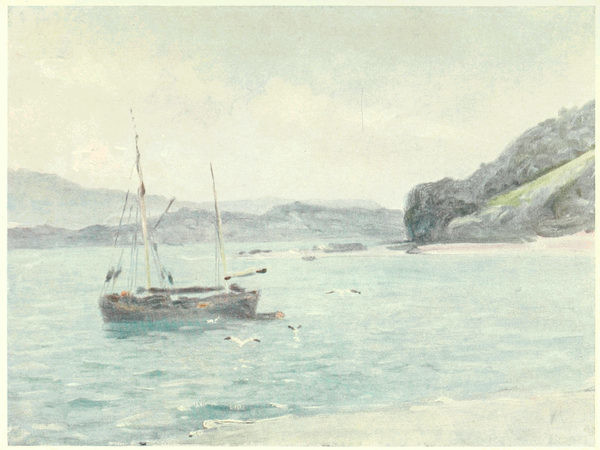
THE BEACH, BEAUMARIS
It would be an impertinence to tell the reader what Llangollen is like, especially as he probably knows and I do not. Also, I confess that its very notoriety stupefies me, and I see it through a cloud of newspapers and books, and amid a din of applausive voices, above which towers a tremendous female form "like Teneriffe or Atlas unremoved," which I suppose to be Lady Eleanor Butler.
Nevertheless, I will please myself and the discerning reader by repeating the names of a few of the places to which I have never been, or of which I will not speak, namely, Llangollen, Aberglaslyn, Bettws-y-Coed, the Fairy Glen, Capel Curig, Colwyn, Tintern, Bethesda, Llanfairfechan, Llanrhaiadr, Llanynys, Tenby (a beautiful flower with a beetle in it), Mostyn, Glyder Fach and Glyder Fawr, Penmaenmawr, Pen-y-Gader, Pen-y-Gwryd, Prestatyn, Tremadoc, the Swallow Falls, the Devil's Bridge, the Mumbles, Harlech, Portmadoc, Towyn, and Aberdovey (with its song and still a poet there). I have read many lyrics worse than that inventory.
But there is another kind of human being—to use a comprehensive term—of which I stand in almost as much awe as of authors and those who know the famous things of Wales. I mean the lovers of the Celt. They do not, of course, confine their love—which in its extent and its tenuity reminds one of a very great personage indeed—to the Celt; but more perhaps than the Japanese or the Chinese or the Sandwich Islander the Celt has their hearts; and I know of one who not only learned to speak Welsh badly, but had the courage to rise at a public meeting and exhort the (Welsh-speaking) audience to learn their "grand mother tongue." Their aim and ideal is to go about the world in a state of self-satisfied dejection, interrupted, and perhaps sustained, by days when they consume strange mixed liquors to the tune of all the fine old Celtic songs which are fashionable. If you can discover a possible Celtic great-grandmother, you are at once among the chosen. I cannot avoid the opinion that to boast of the Celtic spirit is to confess you have it not. But, however that may be, and speaking as one who is afraid of definitions, I should be inclined to call these lovers of the Celt a class of "decadents," not unrelated to Mallarmé, and of æsthetes, not unrelated to Postlethwaite. They are sophisticated, neurotic—the fine flower of sounding cities—often producing exquisite verse and prose; preferring crême de menthe and opal hush to metheglin or stout, and Kensington to Eryri and Connemara; and perplexed in the extreme by the Demetian with his taste in wall-papers quite untrained. Probably it all came from Macpherson's words, "They went forth to battle and they always fell"; just as much of their writing is to be traced to the vague, unobservant things in Ossian, or in the proud, anonymous Irishman who wrote Fingal in six cantos in 1813. The latter is excellent in this vein. "Let none then despise," he writes, "the endeavour, however humble, now made, even by the aid of fiction, to throw light upon the former manners and customs of one of the oldest and noblest nations of the earth. That once we were, is all we have left to boast of; that once we were, we have record upon record.... We yet can show the stately pharos where waved the chieftain's banner, and the wide ruin where the palace stood—the palace once the pride of ages and the theme of song—once Emuin a luin Aras Ullah." The reader feels that it is a baseness to exist. Mr. John Davidson, who, of course, is as far removed from the professional Celt as a battle-axe from a toothpick, has put something like the fashionable view majestically into the mouth of his "Prime Minister":
... That offscouring of the Eastern world,
The melancholy Celt, whom Latin, Greek,
And Teuton drove through Europe to the rocks,
The utmost isles and precincts of the sea;
Who fight for fighting's sake, and understand
No meaning in defeat, having no cause
At heart, no depth of purpose, no profound
Desire, no inspiration, no belief;—
A twilight people living in a dream,
A withered dream they never had themselves,
A faded heirloom that their fathers dreamt:
How much more happy these had they destroyed
The spell of life at once, and so escaped
An unregarded martyrdom, the consciousness
Of inefficience and the world's contempt.
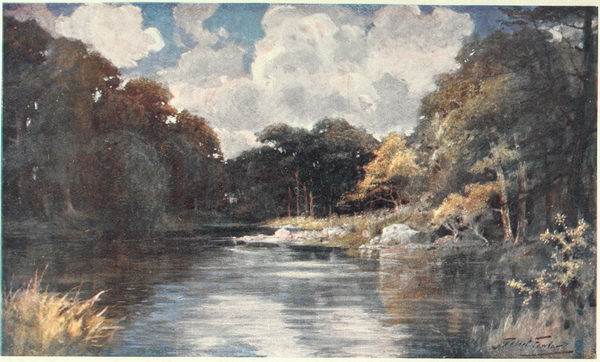
THE TROUT STREAM
"An Earth-born coolness
Coloured with the sky."
But it is probably true that when one has said that the typical Celt is seldom an Imperialist, a great landowner, a brewer, a cabinet minister, or (in Wales, at least) a member of the Salvation Army, one has exhausted the list of his weaknesses; and that not greatly wanting to be one of these things, he has endeared himself to those to-day who have set their hearts on gold and applause and have not gained them, and those few others who never sought them. I heard of a pathetic, plausible stockbroker's clerk the other day, who, having spent his wife's money and been at last discovered by his tailor, took comfort in studying his pedigree, which included a possibly Welsh Lewis high upon the extreme right. He was sufficiently advanced in philology to find traces of an Ap' in his name, which was Piper, and he could repeat some of Ossian by heart with great emotion and less effect. I prefer the kind of Celt whom I met in Wales one August night. It was a roaring wet night, and I stepped into the shelter of a bridge to light a pipe. As I paused to see if it was dawn yet, I heard a noise which I supposed to be the breathing of a cow. My fishing-rod struck the bridge; the noise ceased, and I heard something move in the darkness close by. I confess that my pipe went out when, without warning, a joyous, fighting baritone voice rose and shook the bridge with the words.
Through all the changing scenes of life,
In trouble and in joy,
The praises of my God shall still
My heart and tongue employ.
The voice sang all the verses of the hymn, and then laughed loudly, yet with a wonderful serenity. Then a man stood up heavily with a sound like a flock of starlings suddenly taking flight. I lit a match and held it to his face and looked at him, and saw a fair-skinned, high-cheek-boned face, wizened like a walnut, with much black hair about it, that yet did not conceal the flat, straight, eloquent mouth. He lit a match and held it to my face, and looked at me and laughed again. Finding that I could pronounce Bwlch-y-Rhiw, he was willing to talk and to share the beer in my satchel. And he told me that he had played many parts—he was always playing—before he took to the road: he had been a booking-office clerk, a soldier, a policeman, a gamekeeper, and put down what he called his variability to "the feminine gender." He would not confess where he had been to school, and his one touch of melancholy came when, to show that he had once known Latin, he began to repeat, in vaguely divided hexameters, the passage in the Aeneid which begins Est in conspectu Tenedos. For he could not go on after At Capys and was angry with himself. But he recalled being caned for the same inability, and laughed once more. Every other incident remembered only fed his cheerfulness. Everything human had his praise,—General Buller in particular. I cannot say the same of his attitude towards the divine. His conversation raised my spirits, and I suppose that the bleared and dripping dawn can have peered on few less melancholy men than we. "Life," said he, "is a plaguey thing: only I don't often remember it." And as he left me, he remarked, apologetically, that he "always had been a cheerful ——, and couldn't be miserable," and did me the honour of supposing that in this he resembled me.
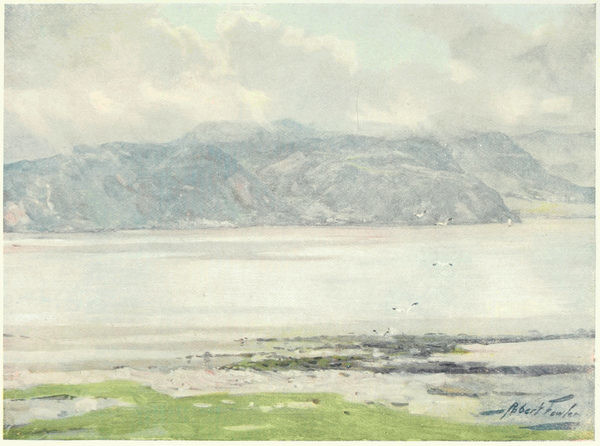
NEAR MENAI STRAITS
He went off singing, in Welsh, something not in the least like a hymn to a fine victorious hymn tune, but had changed, before I was out of hearing, to the plaintive, adoring "Ar hyd y nos." And I remembered the proverbial saying of the Welsh, that "the three strong ones of the world" are "a lord, a headstrong man, and a pauper."
Having heard and read the aforesaid authors, tourists, higher philatelists, and lovers of the Celt, I need hardly say, firstly, that I have come under their influence; secondly, that I have tried to avoid it; and thirdly, that I am not equal to the task of apportioning the blame between them and myself for what I write.
And, first, let me ease my memory and pamper my eyes, and possibly make a reader's brain reverberate with the sound of them, by giving the names of some of the streams and lakes and villages I have known in Wales. And among the rivers, there are Ebbw and Usk, that cut across my childhood with silver bars, and cloud it with their apple flowers and their mountain-ash trees, and make it musical with the curlew's despair and the sound of the blackbird singing in Eden still; and Towy and Teivy and Cothi and Ystwyth; and, shyer streams, the old, deserted, perhaps deserted, pathways of the early gods, the Dulais and Marlais and Gwili and Aman and Cenen and Gwenlais and Gwendraeth Fawr and Sawdde and Sawdde Fechan and Twrch and Garw; and those nameless but not unremembered ones (and yet surely no river in Wales but has a name if one could only know it well enough) that crossed the road like welcomed lingerers from some happier day, flashing and snake-like, and ever about to vanish and never vanishing, and vocal all in reed or pebble or sedge, some deep enough for a sewin, others too shallow to wash the dust from the little pea-like toes of the barefooted child that learns from them how Nile and Ganges flow, and why Abana and Pharpar were dear, and why these are more sweet; and there is Llwchwr, whose voice is bright in constant shadow; and Wye; and the little river in a stony valley of Gower which at first reminded me, and always reminds me, of the adventure of Sir Marhaus, Sir Gawaine, and Sir Uwaine.
"And so they rode, and came into a deep valley full of stones, and thereby they saw a fair stream of water; above thereby was the head of the stream a fair fountain, and three damosels sitting thereby. And then they rode to them, and either saluted other, and the eldest had a garland of gold about her head, and she was threescore winter of age or more, and her hair was white under the garland. The second damosel was of thirty winter of age, with a circlet of gold about her head. The third damosel was but fifteen year of age, and a garland of flowers about her head. When the knights had so beheld them, they asked them the cause why they sat at that fountain? 'We be here,' said the damosels, 'for this cause: if we may see any errant knights, to teach them unto strange adventures; and ye be three knights that seeken adventures, and we be three damosels, and therefore each one of you must choose one of us; and when ye have done so we will lead you unto three highways, and there each of you shall choose a way and his damosel with him. And this day twelvemonth ye must meet here again, and God send you your lives, and thereto ye must plight your troth.' 'This is well said,' said Sir Marhaus." And no other than a Welsh story-teller could have made that clear picture of the three damosels.
And there is Severn in its wild and unnoted childhood, its lovely and gallant youth, its noble and romantic prime, as it leaves Wales and passes Shrewsbury, the pattern of all famous streams—
Fluminaque antiquos subterlabentia muros;
and its solemn, grey, and mighty and worldly-wise old age, listening to its latest daughter the Wye, where it has
A cry from the sea, a cry from the mountain;
and Clwyd and Conway and Ceiriog and Aled and Dovey, streams that remember princes and bards; and the little waters flowing from Cwellyn Lake, of which a story is told.
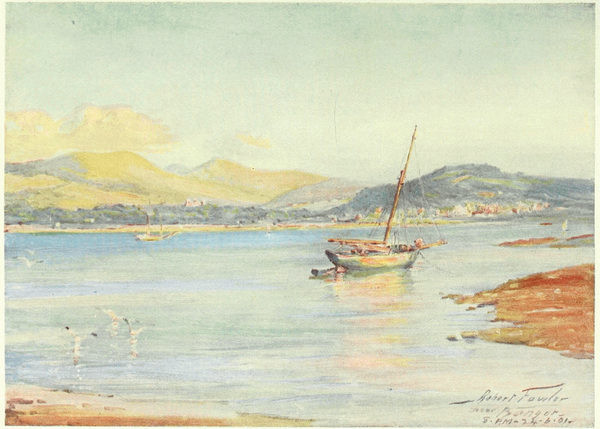
NEAR BANGOR
Near the river which falls from Cwellyn Lake, they say that the fairies used to dance in a meadow on fair moonlit nights. One evening the heir to the farm of Ystrad, to which the meadow belonged, hid himself in a thicket near the meadow. And while the fairies were dancing, he ran out and carried off one of the fairy women. The others at once disappeared. She resisted and cried, but he led her to his home, where he was tender to her, so that she was willing to remain as his maid-servant. But she would not tell him her name. Some time afterward he again saw the fairies in the meadow and overheard one of them saying, "The last time we met here, our sister Penelope was snatched away from us by one of the mortals." So he returned and offered to marry her, because she was hard-working and beautiful. For a long time she would not consent; but at last she gave way, on the condition "that if ever he should strike her with iron, she would leave him and never return to him again." They were happy together for many years; and she bore him a son and a daughter; and so wise and active was she, that he became one of the richest men of that country, and besides the farm of Ystrad, he farmed all the lands on the north side of Nant-y-Bettws to the top of Snowdon, and all Cwm Brwynog in Llanberis, or about five thousand acres. But one day Penelope went with him into a field to catch a horse; and as the horse ran away from him, he was angry and threw the bridle at him, but struck Penelope instead. She disappeared. He never saw her again, but one night afterward he heard her voice at his window, asking him to take care of the children, in these words:
Oh, lest my son should suffer cold,
Him in his father's coat enfold:
Lest cold should seize my darling fair,
For her, her mother's robe prepare.
These children and their descendants were called the Pellings, says the teller of the tale; and "there are," he adds, "still living several opulent and respectable persons who are known to have sprung from the Pellings. The best blood in my own veins is this fairy's."
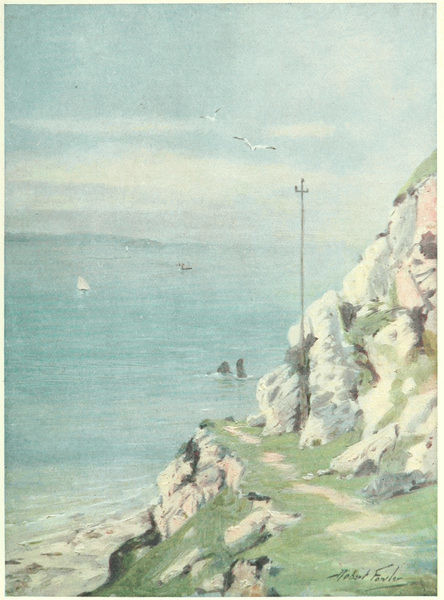
A FOOTPATH ON THE GREAT ORME
And of lakes, I have known Llyn-y-Fan Fach, the lonely, deep, gentle lake on the Caermarthen Fan, two thousand feet high, where, if the dawn would but last a few moments longer, or could one swim but just once more across, or sink but a little lower in its loving icy depths, one would have such dreams that the legend of the shepherd and the lady whom he loved and gained and lost upon the edge of it would fade away: and Llyn Llech Owen, and have wondered that only one legend should be remembered of those that have been born of all the gloom and the golden lilies and the plover that glories in its loneliness; for I stand in need of a legend when I come down to it through rolling heathery land, through bogs, among blanched and lichened crags, and the deep sea of heather, with a few flowers and many withered ones, of red and purple whin, of gorse and gorse-flower, and (amongst the gorse) a grey curling dead grass, which all together make the desolate colour of a "black mountain"; and when I see the water for ever waved except among the weeds in the centre, and see the waterlily leaves lifted and resembling a flock of wild-fowl, I cannot always be content to see it so remote, so entirely inhuman, and like a thing a poet might make to show a fool what solitude was, and as it remains with its one poor legend of a man who watered his horse at a well, and forgot to cover it with the stone, and riding away, saw the water swelling over the land from the well, and galloped back to stop it, and saw the lake thus created and bounded by the track of his horse's hooves; and thus it is a thing from the beginning of the world that has never exchanged a word with men, and now never will, since we have forgotten the language, though on some days the lake seems not to have forgotten it. And I have known the sombre Cenfig water among the sands, where I found the wild goose feather with which I write.
And I have seen other waters; but least of them all can I forget the little unnecessary pool that waited alongside a quiet road and near a grim, black village. Reed and rush and moss guarded one side of it, near the road; a few hazels overhung the other side; and in their discontented writhing roots there was always an empty moorhen's nest, and sometimes I heard the bird hoot unseen (a sound by which the pool complained, as clearly as the uprooted trees over the grave of Polydorus complained), and sometimes in the unkind grey haze of winter dawns, I saw her swimming as if vainly she would disentangle herself from the two golden chains of ripples behind her. In the summer, the surface was a lawn of duckweed on which the gloom from the hazels found something to please itself with, in a slow meditative way, by showing how green could grow from a pure emerald, at the edge of the shadow, into a brooding vapourish hue in the last recesses of the hazels. The smell of it made one shudder at it, as at poison. An artist would hardly dare to sit near enough to mark all the greens, like a family of snaky essences, from the ancient and mysterious one within to the happy one in the sun. When the duckweed had dissolved in December, the pool did but whisper that of all things in that season, when
Blue is the mist and hollow the corn parsnep,
it alone rejoiced. It was in sight of the smoke and the toy-like chimney-stacks of the village, of new houses all around, and of the mountains. It had no possible use—nothing would drink of it. It did not serve as a sink, like the blithe stream below. It produced neither a legend nor a brook. It was a whole half-acre given up to a moorhen and innumerable frogs. It was not even beautiful. And yet, there was the divinity of the place, embodied, though there was no need for that, in the few broken brown reeds that stood all the winter, each like a capital Greek lambda, out of the water. When the pool harboured the image of the moon for an hour in a winter night, it seemed to be comforted. But when the image had gone, the loss of that lovely captive was more eloquent than the little romantic hour. And I think that, after all, the pool means the beauty of a pure negation, the sweetness of utter and resolved despair, the greatness of Death itself.
And I have been to Abertillery, Pontypool, Caerleon, infernal Landore, Gower, Pontardulais, Dafen, Llanedi, Llanon (where only the little Gwili runs, but good children are told that they shall go to Llanon docks), Pen-y-Groes, Capel Hendre, Maesy-bont, Nantgaredig, Bolgoed, Pentre Bach, Bettws, Amanford, Llandebie, Pentre Gwenlais, Derwydd, Ffairfach, Llandeilo, Tal-y-Llychau, Brynamman, Gwynfe, Llanddeusant, Myddfai, Cil-y-Cwm, Rhandir Mwyn, and the farms beyond,—Maes Llwyn Fyddau, Bwlch-y-Rhiw, Garthynty, Nant-yr-ast, Blaen Cothi, Blaen Twrch,—Llanddewi Brefi, Tregaron, Pont Llanio, Llanelltyd, Bettws Garmon, Bala, Aber Dusoch.... And I have crossed many "black" mountains, and Gareg Lwyd, Gareg Las, the Banau Sir Gaer, Crugian Ladies, Caeo, Bryn Ceilogiau, Craig Twrch, and Craig-y-Ddinas....
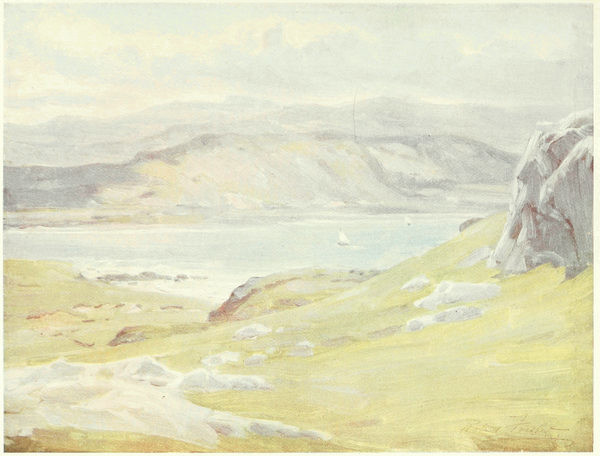
A VIEW FROM THE GREAT ORME'S HEAD
The chapels and churches, Siloh, Ebenezer, Llanedi, Llandefan, Abergwesyn, Llanddeusant, ... but I dare not name them lest I should disturb some one's dreams, or invite some one to disturb my own. They are all in the admirable guide-books, which say nothing of the calm and the nettles and the shining lizards and the sleepy luxurious Welsh reading of the lessons at ——; and the wet headstones at ——, where you may lean on any Sunday in the rain and hear the hymn take heaven by storm, and quarrel melodiously upon the heights, and cease and leave the soul wandering in the rain as far from heaven as Paolo and Francesca in their drifts of flame; and ——, white and swept and garnished, and always empty, and always lighted by a twilight four hundred years old, the door being open and ready to receive some god or goddess that delays; and Soar at ——, so blank, lacking in beauty and even in ugliness,—so blank that when one enters, the striving spirit will not be content, and perforce takes flight and finds an adventure not unlike that of the man who was once returning from Beddgelert fair by a gloomy road, and saw a great and splendid house conspicuously full of gaiety in a place where no such house had seemed to stand before; and supposing that he had lost his way, he asked and was given a lodging, and found the chambers bright and sounding with young men and women and children, and slept deeply in a fine room, on a soft white bed, and on waking and studying his neighbourhood, saw but a bare swamp and a tuft of rushes beneath his head.
And there is Siloh at ——, standing bravely,—at night, it often seems perilously,—at the end of a road, beyond which rise immense mountains and impassable, and, in my memory, always the night and a little, high, lonely moon, haunted for ever by a pale grey circle, looking like a frail creature which one of the peaks had made to sail for his pleasure across the terrible deeps of the sky. But Siloh stands firm, and ventures once a week to send up a thin music that avails nothing against the wind; although close to it, threatening it, laughing at it, able to overwhelm it, should the laugh become cruel, is a company of elder trees, which, seen at twilight, are sentinels embossed upon the sky—sentinels of the invisible, patient, unconquerable powers: or (if one is lighter-hearted) they seem the empty homes of what the mines and chapels think they have routed; and at midnight they are not empty, and they love the mountain rain, and at times they summon it and talk with it, while the preacher thunders and the windows of the chapel gleam.
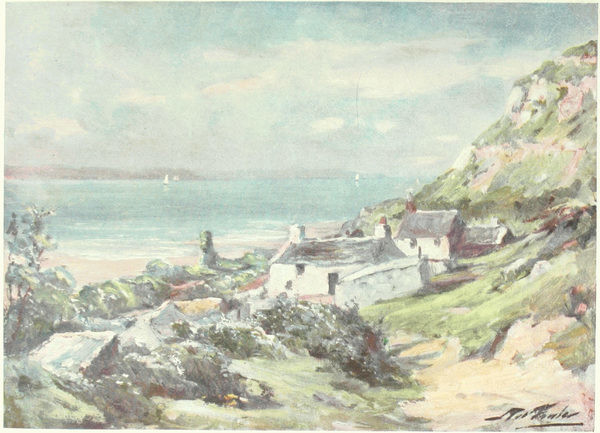
OLD COTTAGE AND RUINS OF ABBEY, GREAT ORME'S HEAD
And there is ——, where an ancient, unwrinkled child used to talk in gentle, melancholy accents about hell to an assembly of ancient men who sometimes muttered "Felly, felly," as men who had heard it so often that they longed to be there and to taste and to see; where the young men and maidens sang so lustily and well that I wondered the minister never heard them, or, hearing, understood them. To the children, when they listened, his mild ferocity did but put an edge on the bird's-nesting of the day before and the day after. When they did not listen, some of them looked through the windows and saw heaven as fresh and gaudy, in the flowers of a steep garden close by, as in the coloured pictures of apostles and lambs on their bedroom walls; but chiefly in the company of delicate lime trees that stood above the garden, on a grassy breast of land. The fair, untrodden turf below them shone even when the sun was not with it. The foliage of all the limes, in autumn, ripened together to the same hue of gold. It burned and was cool. It flamed and yet had something in it of the dusk. It was the same as when, many years ago, two children saw in it some fellowship with the coloured windows at Llandaff, and with the air of an old library that had "golden silence and golden speech" over the door. And the trees seemed to be a council of blessed creatures devising exquisite enjoyments and plotting to outwit the preacher. They might be not ill-chosen deputies of leisure, health, and contemplation, and all that fair and reverend family. In the cool gloom at the centre of the foliage sat also Mystery, with palms linked before her eyelids, unlinking them but seldom, lest seeing might shut out visions.
CHAPTER II
ENTERING WALES
The best way into Wales is the way you choose, provided that you care. Some may like the sudden modern way of going to sleep at London in a train and remaining asleep on a mountain-side, which has the advantage of being the most expensive and the least surprising way. Some may like to go softly into the land along the Severn, on foot, and going through sheath after sheath of the country, to reach at last the heart of it at peaty Tregaron, or the soul of it on Plynlimmon itself. Or you may go by train at night; and at dawn, on foot, follow a little stream at its own pace and live its fortnight's life from mountain to sea.
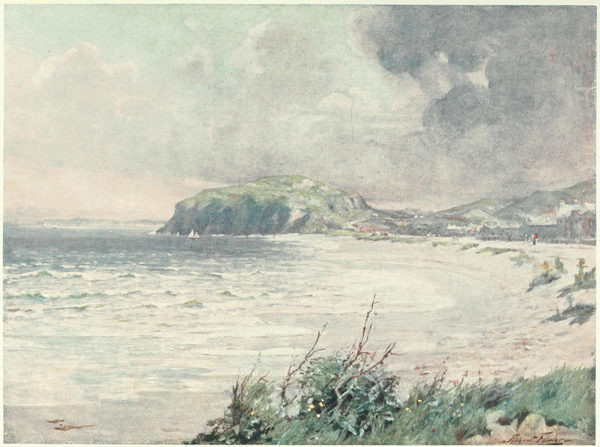
BREEZY MORNING, LLANDUDNO BAY
Or you may cross the Severn and then the lower Wye, and taking Tredegar and Caerleon alternately, or Rhigws and Landore, or Cardiff and Lantwit, or the Rhondda Valley and the Vale of Neath, and thus sharpening the spirit, as an epicure may sharpen his palate, by opposites, find true Wales everywhere, whether the rivers be ochre and purple with corruption, or still as silver as the fountain dew on the mountain's beard; whether the complexions of the people be pure as those of the young cockle-women of Penclawdd, or as heavily superscribed as those of tin-platers preparing to wash. Or you may get no harm by treading in the footsteps of that warm-blooded antiquarian, Pennant, who wrote at the beginning of his tours in Wales: "With obdurate valour we sustained our independency ... against the power of a kingdom more than twelve times larger than Wales: and at length had the glory of falling, when a divided country, beneath the arms of the most wise and most warlike of the English monarchs." That "we" may have saved the soul even of an antiquarian.
But the entry I best remember and most love was made by a child whom I used to know better than I have known anyone else. He disappeared, after a slow process of evanishment, several years ago: and I will use what I know as if it were my own, since the first person singular will help me to write as if I should never be subjected to the dignity of print,—as if I were addressing, not the general reader, but some one who cared.
At a very early age, I (that is to say, he, bien entendu) often sat in a room in outer London, where I now see that it was probably good to be. It was always October there, and the yellow poplar leaves were always falling. And so also there was always a fire—a casket in which emeralds and sapphires contended with darker spirits continually. Where are the poplars now? Where the leaves which loved the frost that spoiled them at last? Where the emeralds and sapphires—and the child? There were late October twilights that seemed so mighty in their gentleness and so terrible in their silence that they alarmed the child with fear of desolation, until the spell was suspended by lighted lamps and drawn curtains and fearless voices of elder persons, though one could draw the curtains and see the thing still, and oneself, and the very fire, outside in its embrace. And still
The jealous ear of night eave-dropped our talk.
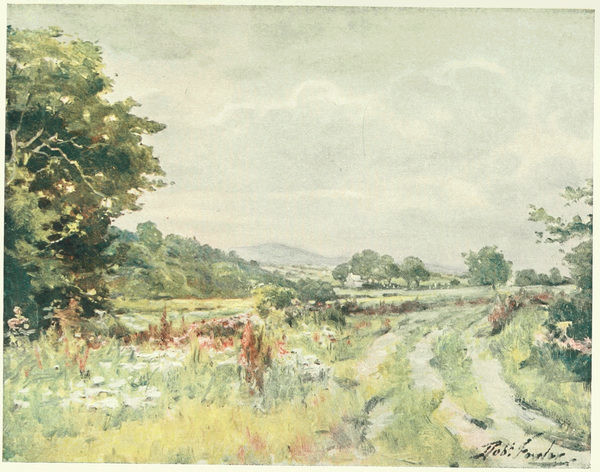
COUNTRY LANE
I think those twilights have overwhelmed all at last, and they have their way with child and trees and fire. But they have spared one thing, which even in those days was more puissant than the fire, though they have left their marks upon it, and now it seems a less mighty thing if one goes to it soberly too critically, or even too cheerfully. For a picture hung in the room, and the last October sunlight used to fall upon it when the silence set in. The picture meant Wales.
In the foreground, a stream shone with ripples in the midst, and glowed with foam among the roots of alders at the edge. Branches with white berries overhung the stream; and there were hornbeams and writhen oaks; and beyond them, a sky with a shaggy and ancient storm in it, and wrestling with that, and rising into it, the ruins of an Early English chancel. The strength and anger and tenderness and majesty of it were one great thought. I still think that could deeds spring panoplied from thoughts, and could great thoughts of themselves do anything but flush the cheek, such a simply curving landscape as this would be at the bidding of one of those great thoughts that empty all the brain.... Under one of the columns by the chancel, the artist meant to have drawn vaguely a pile of masonry and a muscular ivy stem. And that was the point of the picture, because it seemed to be a kneeling knight, with one forearm on an oval shield and the other buried in his beard, and his head bent. I suppose that the thought that it was a knight, and that the knight was Launcelot, first came as I looked at the picture once, straight from a book where I had been reading:
"Then Sir Launcelot departed, and when he came to the Chapel Perilous, he alighted, and tied his horse to a little gate. And as soon as he was within the churchyard he saw on the front of the Chapel many fair, rich shields turned upside down; and many of the shields Sir Launcelot had seen knights have before; with that he saw standing by him thirty great knights, more by a yard than any man that he had ever seen, and all these grinned and gnashed at Sir Launcelot; and when he saw their countenances he dreaded them sore, and so put his shield afore him, and took his sword in his hand ready to do battle; and they were all armed in black harness, ready with their shields and swords drawn. And when Sir Launcelot would have gone through them they scattered on every side of him, and gave him the way to pass; and therewith he waxed all bold, and entered into the Chapel, and there he saw no light but a dim lamp burning, and then he was aware of a corse covered with a cloth of silk. And as Sir Launcelot stooped down and cut a piece of the cloth away, the earth quaked, and he was afraid...."
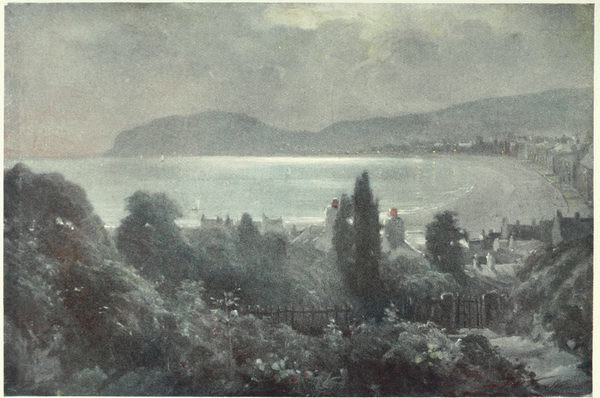
A NOCTURNE, LLANDUDNO BAY
And the picture was a picture of the Chapel Perilous; and thus out of a poor story-book and a dear picture and the dim poplars in the dim street, I made a Launcelot who was not merely an incredible mediæval knight of flesh and armour, but a strange immortal figure that lived and was desirable and friendly in the grey rain of a suburb in the nineteenth century.
This was the beginning of the creation of Wales. Or shall I say that it was the beginning of the discovery? Let the reader decide, with the help of the explanation, that I use the words as I should use them of a play of Shakespeare's, or a picture of Titian's, or any other living thing which grows and changes and is born again, in age after age, as certainly and as elusively as the substance of a waterfall is changed; even in one moment these things are never the same to any two observers, backward or advanced, egotistical or servile, blind or keen....
Looking back, the artistry of time makes it appear that soon after I had become certain that the painter had somehow caught Launcelot kneeling at the foot of the column, I reached Wales.
There I saw one of the Round Tables of Arthur, but also a porpoise hunt in the river close by; and the porpoise threshed the water so that the shining spray now hides the Round Table from my view. And I heard the national anthem of Wales: and at first I cowered beneath the resolved and terrible despair of it, forgetting that—
In every dirge there sleeps a battle-march;
so that I seemed to look out from the folds of a fantastic purple curtain of heavily embroidered fabric upon a fair landscape and an awful sky; and I know not whether the landscape or the sky was the more fascinating in its mournfulness.
And I heard sounds of insult, shame, and wrong,
And trumpets blown for wars,—
and it was of Arthur's last battle that I dreamed. But the sky cleared, and I seemed to let go of the folds of the curtain and to see a red dragon triumphing and the shielded Sir Launcelot again; and next, it was only a tournament that I saw, and there were careless ladies on high among the golden dust. And, at last, I could once more think happily of the little white house where I lived, and the largest and reddest apples in all the world that grew upon the wizened orchard, and the smoked salmon and the hams that perfumed the long kitchen, and all the shining candlesticks, and the wavy, crisp, thin leaves of oaten bread that were eaten there with buttermilk: and the great fire shook his rustling sheaf of flames and laughed at the wind and rain that stung the window-panes; and sometimes a sense of triumph arose from the glory of the fire and the vanity of the wind, and sometimes a sense of fear lest the fire should be conspiring with the storm. That also was Wales—a meandering village street, the house with the orchard, and a white river in sight of it, and the great music of the national anthem hovering over it and giving the whole a strange solemnity.
Just beyond the village, but not under the same solemn sky, I see an island of apple trees in spring, which in fact belongs to a somewhat later year. It was reached by a mile of winding lane that passed the slender outmost branches of the village, and lastly, a shining cottage, with streaked and mossy thatch, and two little six-paned windows, half-filled with many-coloured sweets, and boasting one pane of bottle-glass. Outside sat an old woman; her moist, grey, hempen curls framing a cruel face which had been made by three or four swift strokes of a hatchet; her magnificent brown eyes seeming to ponder heavenly things and really looking for half-pence. A picture would have made her—wringing her hands slowly as if she were perpetually washing, or sitting bolt upright and pleased with her white apron—a type of resigned and reverend and beautiful old age. On the opposite side of the road was a white and thatched piggery, half the size of the house; and alongside of it, a neat, moulded pile of coal-dust, clay, and lime, mixed, for her ever-burning fire. The pigs grunted; the old woman, who would herself watch the slaughtering, sat and was pleased, and said, "Good morning," and "Good afternoon," and "Good evening" as the day went by, except when the children were due to pass to and from school, with half-pence to spend.
Just beyond this dragon and its house, an important road crossed the lane, which then narrowed and allowed the hedgerow hazels to arch over it and let in only the wannest light to the steep, stony hedge-bank of whin and grass and fern and violets. Little streams ran this way and that, under and over and alongside the lane, and at length a larger one was honoured by a bridge, the parapet covered with flat, dense, even turf. The bridge made way for a wide view, and to invite the eye a magpie flew away from the grassy parapet with wavy flight to a mountain side.
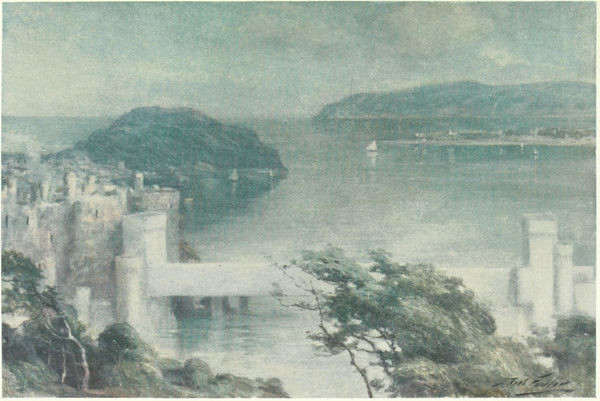
CONWAY FROM BENARTH—EARLY MORNING
Between the bridge and the mountain, and in fact surrounded by streams which were heard although unseen, was an island of apple trees.
There were murmurs of bees. There was a gush and fall and gurgle of streams, which could be traced by their bowing irises. There was a poignant glow and fragrance of flowers in an air so moist and cold and still that at dawn the earliest bee left a thin line of scent upon it. Beyond, the mountain, grim, without trees, lofty and dark, was clearly upholding the low blue sky full of slow clouds of the colour of the mountain lambs or of melting snow. This mountain and this sky, for that first hour, shut out, and not only shut out but destroyed, and not only destroyed but made as if it had never been, the world of the old woman, the coal-pits, the schools, and the grown-up persons. And the magic of Wales, or of Spring, or of childhood made the island of apple trees more than an orchard in flower. For as some women seem at first to be but rich eyes in a mist of complexion and sweet voice, so the orchard was but an invisible soul playing with scent and colour as symbols. Nor did this wonder vanish when I walked among the trees and looked up at the blossoms in the sky. For in that island of apple trees there was not one tree but was curved and jagged and twisted and splintered by great age, by the west wind, or by the weight of fruit in many autumns. In colour they were stony. They were scarred with knots like mouths. Some of their branches were bent sharply like lightning flashes. Some rose up like bony, sunburnt, imprecating arms of furious prophets. One stiff, gaunt bole that was half hid in flower might have been Ares' sword in the hands of the Cupids. Others were like ribs of submerged ships, or the horns of an ox emerging from a skeleton deep in the sand of a lonely coast. And the blossom of them all was the same, so that they seemed to be Winter with the frail Spring in his arms. Nor was I surprised when the first cuckoo sang therein, since the blossom made it for its need. And when a curlew called from the mountain hopelessly, I laughed at it.
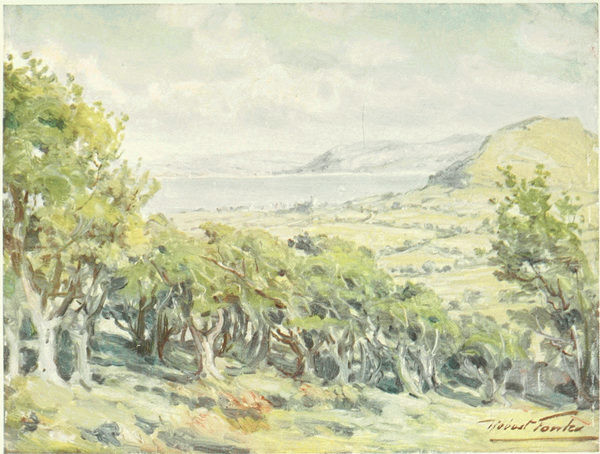
NEAR COLWYN BAY
When I came again and saw the apple trees in flower, the island was very far away, and the unseen cuckoo sang behind a veil and not so suitably as the curlew. There was something of the dawn in the light over it, though it was mid-day; and I could hardly understand, and was inclined to melancholy, until chance brought into my head the poem of the old princely warrior poet Llywarch Hên, and out of his melancholy and mine was born a mild and lasting joy. He sang:
Sitting high upon a hill, to battle is inclined
My mind, but it does not impel me onward.
Short is my journey, my tenement is laid waste.
Sharp is the gale, it is bare punishment to live.
When the trees array themselves in gay colours
Of Summer, extremely ill am I this day.
I am no hunter, I keep no animal of the chase,
I cannot move about:
As long as it pleases the cuckoo, let her sing.
The loud-voiced cuckoo sings with the dawn,
Her melodious notes in the dales of Cuawg:
Better than the miser is the lavish man.
At Aber Cuawg the cuckoos sing,
On the blossom-covered branches;
Woe to the sick that hears their contented notes.
At Aber Cuawg the cuckoos sing.
The recollection is in my mind,
There are that hear them that will not hear them again.
Have I not listened to the cuckoo on the ivied tree?
Did not my shield hang down?
What I loved is but vexation; what I loved is no more.
And I thought that perhaps it is even true, as Taliesin sang, that "A man is wont to be oldest when born, and younger all the time," and that the apple flowers did but remind me of old capacities laid waste.
These little things are the opening cadences of a great music which I have heard, and which is Wales. But I have forgotten the whole, and have echoes of it only, when I hear an old Welsh song, when I am trying to catch a trout, or am eating bread and butter and white cheese, and drinking pale tea, in a mountain farm.... One echo of it I had strangely in Oxford, when, entertaining an old wise gipsy, and asking him of his travels, and whether he had been in Wales, he meditated for a long time, and then sang in an emotionless and moving tone the "Hen wlad fy nhadau," up there among the books, the towers, and the stars. I have had a vision of a rose. But my memory possesses only the doubtful and withered dustiness of a petal or two.
CHAPTER III
A FARMHOUSE UNDER A MOUNTAIN, A FIRE, AND SOME FIRESIDERS
Having passed the ruined abbey and the orchard, I came to a long, low farmhouse kitchen, smelling of bacon and herbs and burning sycamore and ash. A gun, a blunderbuss, a pair of silver spurs, and a golden spray of last year's corn hung over the high mantelpiece and its many brass candlesticks; and beneath was an open fireplace and a perpetual red fire, and two teapots warming, for they had tea for breakfast, tea for dinner, tea for tea, tea for supper, and tea between. The floor was of sanded slate flags, and on them a long many-legged table, an oak settle, a table piano, and some Chippendale chairs. There were also two tall clocks; and they were the most human clocks I ever met, for they ticked with effort and uneasiness: they seemed to think and sorrow over time, as if they caused it, and did not go on thoughtlessly or impudently like most clocks, which are insufferable; they found the hours troublesome and did not twitter mechanically over them; and at midnight the twelve strokes always nearly ruined them, so great was the effort. On the wall were a large portrait of Spurgeon, several sets of verses printed and framed in memory of dead members of the family, an allegorical tree watered by the devil, and photographs of a bard and of Mr. Lloyd George. There were about fifty well-used books near the fire, and two or three men smoking, and one man reading some serious book aloud, by the only lamp; and a white girl was carrying out the week's baking, of large loaves, flat fruit tarts of blackberry, apple, and whinberry, plain golden cakes, large soft currant biscuits, and curled oat cakes. And outside, the noises of a west wind and a flooded stream, the whimper of an otter, and the long, slow laugh of an owl; and always silent, but never forgotten, the restless, towering outline of a mountain.
The fire was—is—of wood, dry oak-twigs of last spring, stout ash sticks cut this morning, and brawny oak butts grubbed from the copse years after the tree was felled. And I remember how we built it up one autumn, when the heat and business of the day had almost let it die.
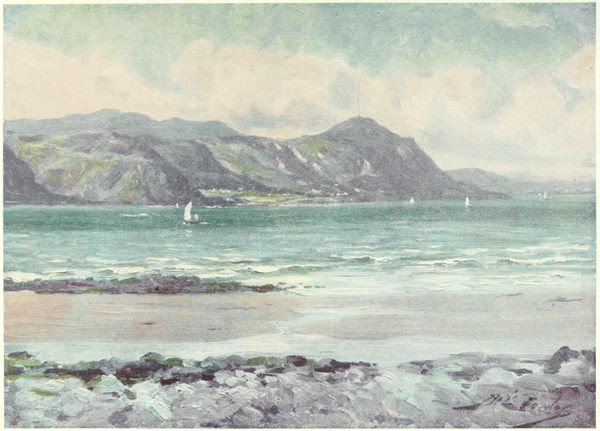
DISTANT VIEW OF PENMAENMAWR—EARLY MORNING LIGHT
We had been out all day, cutting and binding the late corn. At one moment we admired the wheat straightening in the sun after drooping in rain, with grey heads all bent one way over the luminous amber stalks, and at last leaning and quivering like runners about to start or like a wind made visible. At another moment we admired the gracious groups of sheaves in pyramids made by our own hands, as we sat and drank our buttermilk or ale, and ate bread and cheese or chwippod (the harvesters' stiff pudding of raisins, rice, bread, and fresh milk) among the furze mixed with bramble and fern at the edge of the field. Behind us was a place given over to blue scabious flowers, haunted much by blue butterflies of the same hue; to cross-leaved heath and its clusters of close, pensile ovals, of a perfect white that blushed towards the sun; to a dainty embroidery of tormentil shining with unvaried gold; and to tall, purple loosestrife, with bees at it, dispensing a thin perfume of the kind that all fair living things, plants or children, breathe.
What a thing it is to reap the wheat with your own hands, to thresh it with the oaken flail in the misty barn, to ride with it to the mill and take your last trout while it is ground, and then to eat it with no decoration of butter, straight from the oven! There is nothing better, unless it be to eat your trout with the virgin appetite which you have won in catching it. But in the field, we should have been pleased with the plainest meal a hungry man can have, which is, I suppose, barley bread and a pale "double Caermarthen" cheese, which you cut with a hatchet after casting it on the floor and making it bounce, to be sure that it is a double Caermarthen. And yet I do not know. For even a Welsh hymnist of the eighteenth century, in translating "the increase of the fields," wrote avidly of "wheaten bread," so serious was his distaste for barley bread. But it was to a meal of wheaten bread and oat cake, and cheese and onions and cucumber, that we came in, while the trembling splendours of the first stars shone, as if they also were dewy like the furze. Nothing is to be compared with the pleasure of seeing the stars thus in the east, when most eyes are watching the west, except perhaps to read a fresh modern poet, straight from the press, before any one has praised it, and to know that it is good.
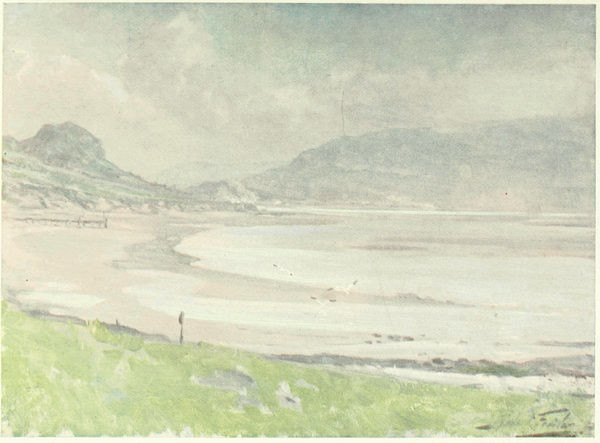
SILVERY LIGHT, CONWAY SHORE
As we sat, some were singing the song "Morwynion Sir Gaerfyrdd-in." Some were looking out at the old hay waggon before the gate.
Fine grass was already growing in corners of the wrecked hay waggon. Two months before, it travelled many times a day between the rick and the fields. Swallow was in the shafts while it carried all the village children to the field, as it had done some sixty years ago, when the village wheelwright helped God to make it. The waggoner lifted them out in clusters; the haymakers loaded silently; the waggon moved along the roads between the swathes; and, followed by children who expected another ride, and drawn by Swallow and Darling, it reached the rick that began to rise, like an early church, beside the elms. But hardly had it set out for another load than Swallow shied; an axle splintered and tore and broke in two, near the hub of one wheel, which subsided so that a corner of the waggon fell askew into the tussocks, and the suspended horse-shoe dropped from its place. There the mare left it, and switched her black tail from side to side of her lucent, nut-brown haunches, as she went.
All day the waggon was now the children's own. They climbed and slid and made believe that they were sailors, on its thin, polished timbers. The grass had grown up to it, under its protection. Before it fell, the massive wheels and delicate curved sides had been so fair and strong that no one thought of its end. Now, the exposed decay raised a smile at its so recent death. No one gave it a thought, except, perhaps, as now, when the September evening began, and one saw it on this side of the serious, dark elms, when the flooded ruts were gleaming, and a cold light fell over it from a tempestuous sky, and the motionless air was full of the shining of moist quinces and yellow fallen apples in long herbage; and, far off, the cowman let a gate shut noisily; the late swallows and early bats mingled in flight; and, under an oak, a tramp was kindling his fire....
Suddenly in came the dog, one of those thievish, lean, swift demi-wolves, that appear so fearful of meeting a stranger, but when he has passed, turn and follow him. He shook himself, stepped into the hearth and out and in again. With him was one whose red face and shining eyes and crisped hair were the decoration with which the wind invests his true lovers. A north wind had risen and given the word, and he repeated it: let us have a fire.
So one brought hay and twigs, another branches and knotted logs, and another the bellows. We made an edifice worthy of fire and kneeled with the dog to watch light changing into heat, as the spirals of sparks arose. The pyre was not more beautiful which turned to roses round the innocent maiden for whom it was lit; nor that more wonderful round which, night after night in the west, the clouds are solemnly ranged, waiting for the command that will tell them whither they are bound in the dark blue night. We became as the logs, that now and then settled down (as if they wished to be comfortable) and sent out, as we did words, some bristling sparks of satisfaction. And hardly did we envy then the man who lit the first fire and saw his own stupendous shadow in cave or wood and called it a god. As we kneeled, and our sight grew pleasantly dim, were we looking at fire-born recollections of our own childhood, wondering that such a childhood and youth as ours could ever have been; or at a golden age that never was?... The light spelt the titles of the books for a moment, and the bard read Spenser aloud, as if forsooth a man can read poetry in company round such a fire. So we pelted him with tales and songs....
And one of the songs was "The Maid of Landybie," by the bard, Watcyn Wyn. Here follows the air, and a translation which was made by an English poet. The naïveté of the original has troubled him, and the Welsh stanza form has driven him to the use of rhymeless feminine endings; but I think that his version will, with the air, render not too faintly the song I heard.
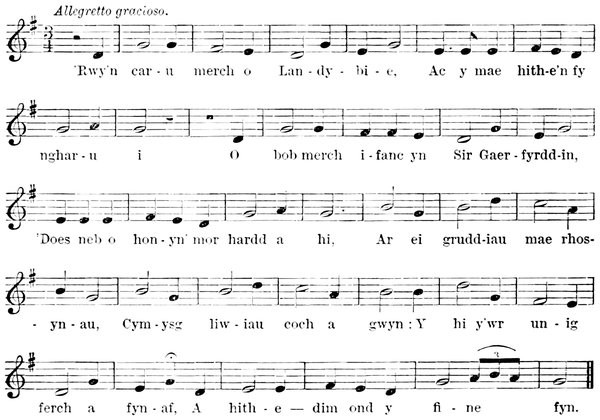
THE MAID OF LANDYBIE
Air: Y Ferch o Blwyf Penderyn.
'Rwy'n car - u merch o Lan - dy - bi - e, Ac y mae hith-e'n fy
nghar - u i O bob merch i - fanc yn Sir Gaer - fyrdd-in,
'Does neb o hon - yn' mor hardd a hi, Ar ei grudd-iau mae rhos-
- yn - au, Cym - ysg liw - iau coch a gwyn: Y hi y'wr un - ig
ferch a fyn - af, A hith - e — dim ond y fi - ne fyn.
I love a maid of Landybie
And it is she who loves me too.
Of all the women of Caermarthen
None is so fair as she, I know.
White and red are her cheeks' young roses,
The tints all blended mistily;
She is the only maid I long for,
And she will have no lad but me.
I love one maid of Landybie.
And she too loves but one, but one;
The tender girl remains my faithful,
Pure of heart, a bird in tone.
Her beauty and her comely bearing
Have won my love and life and care,
For there is none in all the kingdoms
Like her, so blushing, kind, and fair.
While there is lime in Craig-y-Ddinas;
While there is water in Pant-y-Llyn;
And while the waves of shining Loughor
Walk between these hills and sing;
While there's a belfry in the village
Whose bells delight the country nigh,
The dearest maid of Landybie
Shall have her name held sweet and high.
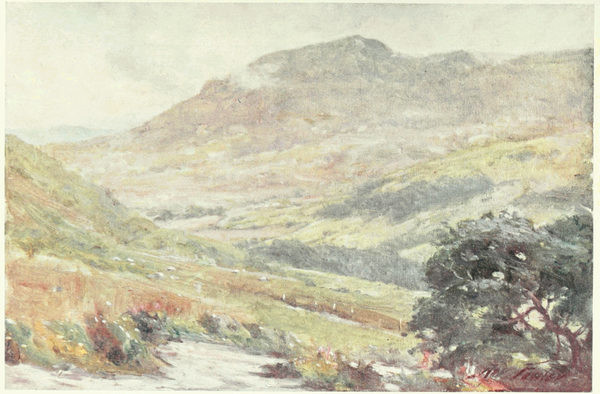
A MOUNTAIN PASS—NOON
When we are by this fire, we can do what we like with Time, making a strange solitude within these four walls, as if they were cut off in time as in space from the great world by something more powerful than the night; so that, whether Llewelyn the Great, or Llewelyn the Last, or Arthur, or Kilhwch, or Owen Glyndwr, or the most recent prophet be the subject of our talk, nothing intrudes that can prevent us for the time from being utterly at one with them. They sing or jest or make puns; they talk of hero and poet as if they had met them on the hills; and as the poet has said, "Folly would it be to say that Arthur has a grave."
In such a room are legends made, if made at all. In fact, I lately saw a pretty proof of it.
The valley in which the farmhouse lies is not so fortified that some foreign things of one kind and another cannot enter. And a miner or a youth on holiday from London brought a song of Bill Bailey to the ears of one of the children of the house, a happy, melancholy boy named Merfyn. The elders caught it for a day or two, and though the song does not recommend itself to those who are heirs to "Sospan bach" and "Ar hyd y nos," the name of the hero stuck. The child asked who he was, and could get no answer. When anything happened about the farm that could not easily be explained, it was jestingly said that Bill Bailey was at the bottom of it. The child seriously caught up the name and the mystery, and applied it with amusing and strange effect. Thus, when he had asked who made the mushrooms in the dawn, and was not satisfied, he himself decided, and with pride and joy announced, that they were Bill Bailey's work. Looking into the fire one night, and seeing faces that he could not recognise among the throbbing heat, he saw Bill Bailey, as he surmised. Thus is a new solar hero being bred. The last news is that he made Cader Idris and Orion and the Pleiades, and that the owls cry so sadly because he is afoot in the woods.
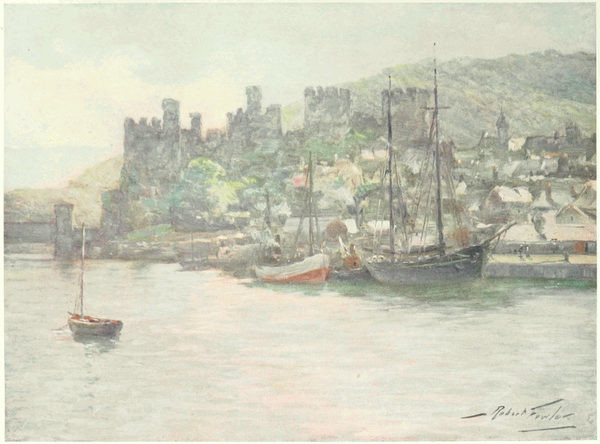
CONWAY CASTLE AND QUAY—NOON
And yet, if we are so unwise as to draw back the curtain from the window at night, the illusion of timelessness is broken for that evening, and in the flower-faced owl by the pane, in the great hill scarred with precipices, and ribbed with white and crying streams, with here and there a black tree disturbed and a very far-off light, I can see nothing but the past as a magnificent presence besieging the house. At such times the legends that I remember most are those of the buried and unforgotten lands. What I see becomes but a symbol of what is now invisible. And sometimes I dream of something hidden out there and elaborating some omnipotent alcahest for the world's delight or the world's bane; sometimes, as when I passed Llanddeusant and Myddfai, I could see nothing that was there, because I was thinking of what had been long ago. There is still a tradition on the coast that Cardigan Bay now covers a country that was once populous and fair and rich. The son of a prince of South Wales is said to have had charge of the floodgates on the protecting embankment, and one night the floodgates were left open at high tide, while he slept with wine, and the sea was over the corn. "Seithenyn the Drunkard let in the sea over Cantre-'r-Gwaelod, so that all the houses and lands contained in it were lost. And before that time there were in it sixteen fortified towns superior to all the towns and cities in Wales, except Caerlleon on the Usk. And Cantre-'r-Gwaelod was the dominion of Gwyddno, King of Cardigan, and this event happened in the time of Ambrosius. And the people who escaped from that inundation came and landed in Ardudwy, the country of Arvon, the Snowdon mountains, and other places not before inhabited...." The sands in some places uncover the roots of an old forest. According to one tradition the flood took place during a feast. The harper suddenly foresaw what was to happen and warned the guests; but he alone escaped. There is also a tradition that Bala Lake covers old palaces. It is said that they have been seen on clear moonlit nights, when the air is one sapphire, and that a voice is heard saying, "Vengeance will come"; and another voice, "When will it come?" and again the first voice saying, "In the third generation." For a prince once had a palace where the lake is. He was cruel and persisted in his cruelty, despite a voice that sometimes cried to him, "Vengeance will come." One night there was a bright festival in the palace, and there were many ladies and many lords among the guests, for an heir had just been born to the prince. The wine shone and was continually renewed. The dancers were merry and never tired. And a voice cried, "Vengeance." But only the harper heard; and he saw a bird beckoning him out of the palace. He followed, and if he stopped, the bird called, "Vengeance." So they travelled a long way, and at last he stopped and rested, and the bird was silent. Then the harper upbraided himself, and turned, and would have gone back to the palace. But he lost his way, for it was night. And in the morning he saw one calm large lake where the palace had been; and on the lake floated the harper's harp....
This fire, in my memory, gathers round it many books which I have read and many men that I have spoken with among the mountains—gathers them from coal-pits and tin-works and schools and chapels and farmhouses and hideous cottages, beside rivers, among woods; and I have drawn a thin line round their shadows and have called the forms that came of it men, and their "characters" follow.
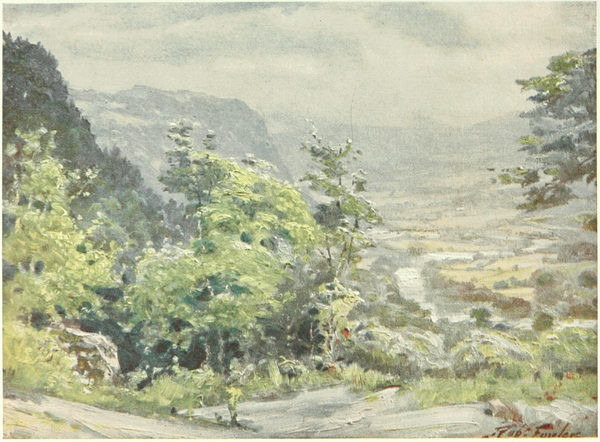
CONWAY VALLEY
CHAPTER IV
TWO MINISTERS, A BARD, A SCHOOLMASTER, AN INNKEEPER, AND OTHERS
Mr. Jones, the Minister
Jones is a little, thin, long-skulled, black-haired, pale Congregational minister, with a stammer and a squint. He has a book-shelf containing nothing but sermons and theology, which he has read, and the novels of Sir Walter Scott, which he hopes to read. I suppose he believes in metempsychosis. He is accustomed to say that everything is theology—which is fine; and that theology is everything—which is hard. He tries to love man as well as God, and succeeds in convincing every one of his honesty, generosity, and industry. In the care of souls he fears no disease or squalor or shape of death. But there is a condescension about his ways with men. He calls them the worldliest of God's creatures. But with the Divine he is happy and at ease, and in his pulpit seems to sit on the right hand. Then his Biblical criticism is absent as if it had never been, and he sees the holy things at once as clearly as Quarles and as mystically as Herbert or Crashaw. He speaks of them with the enthusiasm of a collector or of a man of science dealing with a bone or a gas. Like them, he sees nothing but the subjects of the moment. He loves them as passionately and yet with a sense of possession. He gives to them the adoration which he seems wilfully to have withheld from women, pageantry, gardens, palaces—which his speech would have adorned. He lavishes upon them his whole ingenious heart, so that, to those used to the false rhetoric and dull compliment of ordinary worshippers, there is in his sermons something fantastical, far-fetched, or smelling of the lamp. If he has to describe something naked or severe, he must needs give them a kind of voluptuousness by painting the things which they lack, and the lack of which makes them what they are. With Herbert, he might repeat:
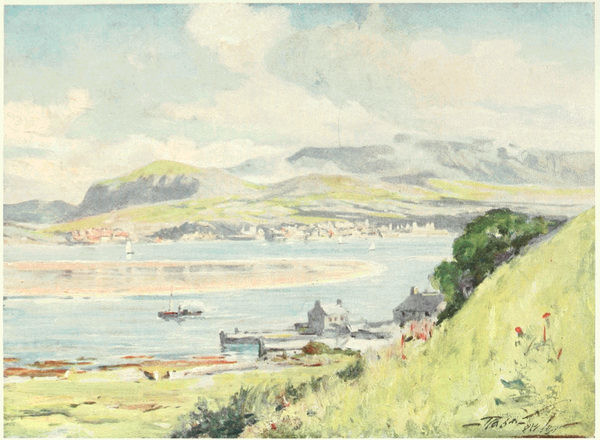
CARNARVON, FROM ANGLESEY
My God, where is that ancient heat towards thee,
Wherewith whole shoals of Martyrs once did burn,
Besides their other flames? doth Poetry
Wear Venus' livery? only serve her turn?
Why are not Sonnets made of thee? and lays
Upon thine altar burnt? Cannot thy love
Heighten a spirit to sound out thy praise
As well as she? Cannot thy Dove
Outstrip their Cupid easily in flight?
Or, since thy ways are deep, and still the same,
Will not a verse run smooth that bears thy name?
Why doth the fire which by thy power and might
Each breast does feel, no braver fuel choose
Than that, which one day worms may chance refuse?
Sure, Lord, there is enough in thee to dry
Oceans of ink; for as the Deluge did
Cover the Earth, so does thy Majesty;
Each cloud distils thy praise, and doth forbid
Poets to turn it to another use.
Roses and lilies speak thee: and to make
A pair of cheeks of them, is thy abuse.
Why should I women's eyes for crystal take?
Such poor invention burns in their low mind
Whose fire is wild, and does not upward go
To praise, and on thee, Lord, some note bestow.
Open the bones, and you shall nothing find
In the best face but filth; when, Lord, in thee
Thy beauty lies in the discovery.
It is no matter to him that to the uninspired audience his holy persons appear only exquisite marionettes. His sermons are all of his love for them. Could one leave out the names of prophet and evangelist, they might seem to be addressed to earthly beauties. No eyebrow ever awakened more glowing praise. He takes religion, as he does his severe morality, like a sensuous delight. One might think from his epithets that he was an æsthete, except that he is so abandoned.
When he ventures to speak of men, their very virtues and vices are all handled in such a way that they seem to be his own imaginations. Thus, his drunkard is as unreal and as terrible as a chimera. The words are those of a man who has conceived a drunkard in his own brain, and then, seeing the real thing, has preferred his own conception, and shunned the poor human imitation. Still, he speaks of religious things, of incidents in the life of David or Christ or the Maries, as if he had seen, for example, the Holy Family in some misty barn among his own hills. I have even heard him introduce a farmer whittling a flail of hazel sticks and binding it with willow thongs, in a picture of that scene. This quaintness and clearness are perhaps the result of his not quite healthy asceticism. But even by the farmhouse fire he makes use of them, and will speak of the red or brown hair of scriptural characters, and even of the grey hair and shining eyes of Charity. In hunger or weariness or pain, common people sometimes see things thus: he never sees them otherwise. In the chapel they delight the older labourers, and yet fail because they vanish in the cold night air and "leave not a rack behind." Some hearers, on the other hand, sicken at them, when the blood is noisy in the breast and the brain is warm, as they sicken at drugs.
It is not, therefore, surprising that at one time he had gorgeous earthly dreams. But with an oddity of which nothing will cure him, he is much troubled by this pomp which he desires not to see save in celestial things. And now he allows sleep nightly but a brief victory over him.
The Landlord of the "Cross Inn"
A very pretty companion for Jones was Owen, the innkeeper, a robust man of words, who called himself the preacher's best customer, because he needed so much of his charity.
He was a perfect Celt, according to the English superstition. For never was there such a failure who was also such a swaggerer as he. He had fair hair, blue eyes, and a small, elegant beard, which
Business could not make dull, nor passion wild.
He was bullied by a contemptuous wife; he was ridiculed by all his regular customers, rallied by the rest. But the beard was always neat and fair, a symbol of his unconquerable mind. No matter how he was trodden down, he smelt sweet. He had humour, for he could laugh at himself, though he lacked the common gift of being able to laugh at others, and had no repartee. The more lusty the Saturday night thrusts at him, the more vivid was his reply, and it was commonly a piece of egoism and self-exposure, which, if not so long and so wonderfully draped, would have called for a repetition of the very blow he was parrying. Once when he had been sold up and had little more than a wife and a walking-stick in the world, and his position attracted some trifling compliments and condolences from his old harriers, he stood up, and, wielding his stick and motioning to his wife to be silent, gave an inventory of the things he had lost with such decoration as would have abashed an auctioneer. There is a Welsh proverb, "A Welshman keeps nothing until he has lost it"; and the now invisible and inaccessible furniture called up such a tumult of admiration that he cared not that it was no longer his. How rich he looked! As the words flowed on and it was time for his hearers to be going, it was clear that if he had forgotten anything, he had invented more; but though he ended in no better company than that of his wife, who picked something from his coat and held it between the tips of two fingers for his humiliation, he but wiped his forehead and cursed because he had forgotten the ancient horse-trappings of brass that used to hang over the mantelpiece at the —— Arms.
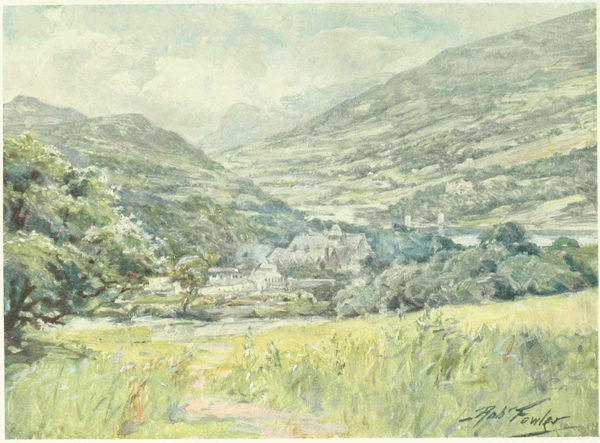
BODDNANT HALL, CONWAY VALLEY
His voice, whether he sang or spoke, was of wide range and exquisite adjustment, and he spoke with care and gusto, as if he loved his native tongue. Under its influence, he respected nobody of any importance. Thus, he was once pretty justly thrashed; when, having tired his chastiser by his patience, he remarked at great length that he supposed the other did not know who he was, and the splendour of his manner overcame his heated companion. No sooner had he got home than he gave a rapturous description of how one had given another a thrashing down the road. He did it so well that he was asked whether he was the beater. "No," said he bravely, "it happened that I was beat."
Had he lost by a bargain, had he taken a bad coin unawares, had he been worsted in argument, he could so rant that he moved every one, and himself obviously first of all, and made the worse appear the better. He kept a genealogical tree in constant use by pruning and watering, and though there was not only a prince but a poet in it, I think he gloried less in the old splendour of his family than in the length of its fall, as who should say he had once been so high that he was "from morn to dewy eve" in falling.
When first I saw him, he had just come into the "Cross Inn." It was mid-day; the weather was cold and wet; and since he never liked to see a man drinking by himself, and the shepherds coming down from the mountains to market had called pretty often, he was not sober. He told me that his was a fine house—the finest in the village, and therefore in the county; and that it had not paid the former tenant well, who had, in fact, sold but eighteen gallons of beer in a month. He was going to do better than that, he said; to make a beginning, he was going to drink that quantity himself. I asked for brandy. He had not a drop, and explained that he had a weakness for it himself—took a drop very often; and that therefore, to get out of temptation, he had finished his stock on the night before. "But," said he, "I have upstairs such a bed as you—pardon me—never slept in yet."
"I have no doubt," said I, and sat down.
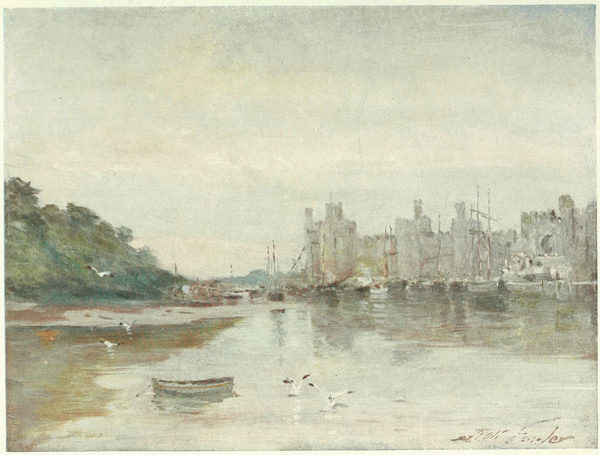
CARNARVON CASTLE
But when he heard that I was walking across Wales, and had therefore tried many beds, he insisted that I should see the thing. It was the finest in the village—in the county—in Wales—"I don't see why I should not say in the whole world." Truly it was a noble bed, in a great, empty, raftered, uncarpeted room; the wood all darkened oak, with a dusky gleam; the hangings ample and of a rich crimson stuff; the purity of the linen splendid. If a royal person or a poet had not slept in it, "that was their misfortune." He stood by, awed and reverent, beholding the bed. I was not his equal in eloquence, and he echoed my praise with an elaborate "of course": and for the sake of hearing some of the words he loved, he finally invited me to spend a night in the bed, "as his guest," so he magnificently said.
All his family were of the same temper. His father and mother had gone to London years ago, and, at seventy years of age, to the infirmary of a workhouse....
The aged paupers sat in a long, grey, motionless, and silent row—like a sculptured frieze, or like persons expecting to be photographed—under the wall of a church. Before them was a strip of grass, one emerald half of which shone so that it seemed of an element like flame; for it was pure, insubstantial colour; and into this, as the paupers saw, the tide of the shadow of the church gradually ate. Beyond the grass was the infirmary, and alongside it a yellow road, and on that a hearse. Watching this and the paupers, a crowd of persons, with uninterested, inquisitive eyes and bowler hats, stuck their noses through the railings which ran between the busy street and the infirmary. Motor cars brayed, hooves clattered.
Presently three men carried out a coffin, containing the remains of Mrs. Owen, and shoved it into the hearse. "God love me, what a coffin!" said one of the crowd. But the frieze of paupers were silent and motionless in the long grey row—all but the husband of the corpse. He, like the others, seemed to stare at the hearse with fixed gaze, and in a loud voice he remembered what a bonny woman the corpse had been, and in particular how, while a travelling musician played in the village street, when she was past fifty years of age, she had locked herself into the kitchen and danced, having spread a mat to deaden the clicking of her merry clogs; and he had watched her, unobserved. The story and his uncontrolled, bleating voice raised a laugh under the bowler hats; and the old men lifted their heads and straightened themselves and laughed; and most loudly and grimly of all laughed Owen, while he remembered the cottage in sight of the beacons of Breconshire; and the hearse rolled out and the crowd removed.
Mr. Rowlands, the Minister
Rowlands, another minister, is six feet and two inches in height, seventeen stone in weight, and has a voice which is in proportion. When he stands up, one supposes that he can never sit down; when he sits down, one supposes that he can never stand up. Every one of his attitudes seems to be final. Only when he is moving is his ponderosity a little less than divine; for he moves with an odd briskness, so that, from behind, he is like a large schoolboy on some urgent business. His mind is subject to similar changes of aspect. In domestic life no one is less awful than he; and were he not good-tempered, cheerful, frolicsome, and humorous as well, he would be one of the most mirth-provoking of mankind. On children he leaves no impression but that of weight, and in spite of his black clothes, he once reminded a child (with a shrill voice) of Atlas upholding the world.
In his everyday life he is a learned, happy child. His curiosity is matched by his credulity. He is the victim not only of tradesmen, but of beggars. He cannot keep his coat clean, and that he sews on his own buttons is apparent from the fact that he seldom has more than one or two of those decorations. He knows every one in his neighbourhood—miners, farmers, parsons, and the resident Englishmen—and knows and loves them so well that he never condemned any one except for cruelty. For he seems to have started life with such a strong belief in the sinfulness of men, that he has ever since been pleased and surprised by this one's goodness and the amiability of that one's badness. He might, in truth, have spoken of himself in something like the words of that fine, possibly Welsh poet of the seventeenth century, Thomas Traherne:
A learned and a happy ignorance
Divided me
From all the vanity,
From all the sloth, care, pain, and sorrow that advance
The madness and the misery
Of men. No error, no distraction I
Saw soil the earth or overcloud the sky.
I knew not that there was a serpent's sting
Whose poison shed,
On men, did overspread
The world; nor did I dream of such a thing
As sin, in which mankind lay dead.
They were all brisk and living wights to me,
Yea, pure and full of immortality.
Joy, pleasure, beauty, kindness, glory, love,
Sleep, day, life, light,
Peace, melody, my sight,
My ears and heart did fill and freely move.
All that I saw did me delight.
The universe was then a world of treasure,
To me an universal world of pleasure....
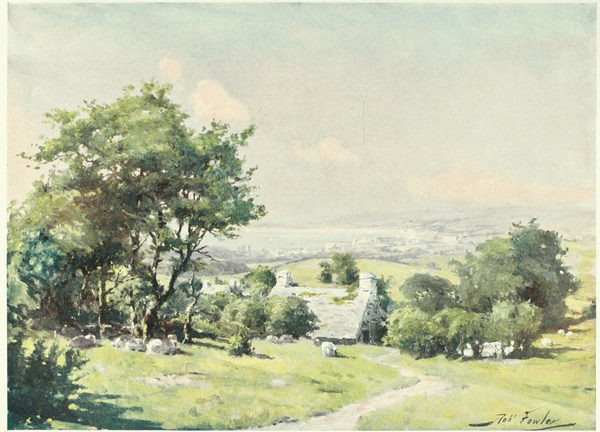
DISTANT VIEW OF CARNARVON BAY
His own verses, by the way, are not so good, for, like all Welsh ministers, he writes a hundred lines of verse every day, perhaps to avoid being thought singular.
He makes a fine figure of Charity in his old age, with his preoccupied blue eyes under a brow that is marked only by three lines like three beams thrown upward by a sun. He has a large, joyous, curving mouth, side-whiskers, careless beard, large feet.
He has but one touch of sentiment. Nearly half a century ago he fell in love with a pretty woman, and unsuccessfully; yet, though she is known to be married and still alive, he has come to have for her memory a grandfatherly tenderness, regarding her as a white and careless girl, in spite of time. For the rest, so warm and radiant is he, that I remember the peculiarity of Kai. "When it rained hardest, whatever he carried remained dry for a handbreadth above and a handbreadth below his hand, and when his companions were coldest, it was to them as fuel with which to light their fire."
But in the pulpit—whether it is a whim or an atonement or merely a recollection of his years at a theological college—he always makes an attempt to dust the wrinkles of his waistcoat. In every other way he makes his week-day self incredible to a stranger. He justifies and makes use of his size more than any man I ever saw. Seeing him in the pulpit, it seems fitting that he should live there day and night, so necessary a pillar is he to the dull, small chapel, though, when holding out his arms, as often he does, he threatens to demolish the little arches and poor windows and to create something more splendid in their place. Going there once in his absence, a visitor remarked to a deacon that they had made some changes in the building; and asking what had gone from there, he was told, "Oh, only Mr. Rowlands."
Standing there, he undertakes to speak on behalf of the Deity, whose ways he explains, and by a magnificent self-conceit supposes that his own stature and voice are fitting symbols to mortals incapable of apprehending things more august. For a time, indeed, during the singing of the hymns, there is a geniality as of lightning about his face. He smiles; he tosses his head with the joy of the song, and may even be supposed to feel, not without sympathy, that the mighty music says things which were not dreamed of by prophets or apostles.
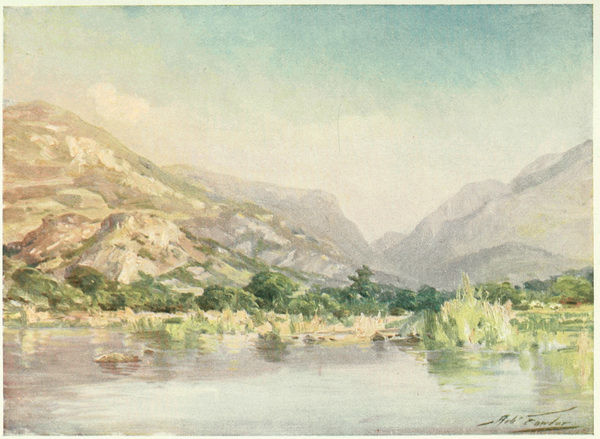
ON THE RIVER SEIONT, CARNARVONSHIRE—EVENING GLOW
When he reads a lesson, it is plain to see that above all other Gods he loves "the Lord that smiteth." He opens his mouth and rejoices in the rich and massy Welsh. He makes no attempt at mere clear reading, which would be of no use to an imaginative audience, that is familiar with the Bible; but, raising and lowering his voice, now hurrying as if to a precipice where all will be overthrown, now creeping as if he feared what is to come, he makes the chapter anew, creating it as if he were sculptor or musician. I suppose he uses nearly as many musical notes as if he sang; but the result differs from singing, as prose from poetry; and so noble is the prose that it suggests only one possible answer to the question which, like a school-man, he once asked, Whether the music of the spheres be verse or prose? Yet, if the note of the lesson is melancholy, full of the dreariness of moving over the void and creating, the note of the sermon is triumphant, or if not triumphant it is minatory, or if not minatory it is scornful, and at times a listener expects to see him wrapped in a cloud and carried away from an undeserving and purblind race.
The medium of what English people would call his rhetoric is the "hwyl," an exuberant, impassioned, musical modulation of the voice, and, to compare great things with small, comparable to the very finest intoning to which has been added (if we can suppose it) a lyrical, egotistical indulgence in all moods of pity, scorn, tenderness, anger, sorrow, joy, anxiety and hope. It can be familiar or lofty. It is as powerful as harp and song together; and the force of it often arises from the fact that what is heard is rather the musical accompaniment of the man's thought than the thought itself. Hence its terrible and lovely purposes, and the many sentiments with which it is shot, and the dubiousness of the loftier passages, as in the verses which the bards recited before Arthur and only one man understood them, except that they were in Arthur's praise.
I have seen him so thunder that I thought of the Llewelyns and Glyndwr, and forgot that the castles fester no longer with Englishmen, and
aerea ramis
dependet galea et prato gravia arma quiescunt,
and for the moment, thought he was a man. No actor ever stormed and swelled so, because no actor yet played the part which he played. It was a chant; yet it was too uncontrollable for a chant. If you call it declamation, you must admit that to declaim a man shall first go to Medea, that she
Having drawn that weakness from his limbs
Which torpid now and chilly there abode,
Through every vacant artery may force
The green and joyous sap of thriving plants,—
Juice of crushed stalks mixed with their ropy gums,
And purpled bright with strength from berry and grape,
Full of a stinging, swift, and masterful
Vivacity.
For the blood of a declaimer of seventy does not travel so by ordinary ways. Nor can a declaimer, as he does, build up for the imagination an earth, with sky and mountains, within a little chapel, for the sake of showing how the lightning vaults and impales the unjust man. At other times his words rise up and circle and make fantastic architecture, as real as dreams, for the terror of the soul that for the time is forced to dwell therein. And though the substance of his sermon is but anecdote, biblical reference, exhortation, warning, picturesque logic built upon some simple religious theme, men and women weep under this divine bullying. A man, listening outside the chapel, put his hand to his head to make sure that his hat was on, so stiffly his hair stood up.
"Then the earth shook and trembled; the foundations also of the hills moved and were shaken, because he was wroth....
"He bowed the heavens also, and came down: and darkness was under his feet.
"And he rode upon a cherub, and did fly: yea, he did fly upon the wings of the wind.
"He made darkness his secret place; his pavilion round about him were dark waters and thick clouds of the skies...."
Once he paused long, towards the end of a sermon, while the thunder withdrew with a terrible solemnity which he envied; and he did not hesitate to follow the thunder with the words, "It has been said," and so to end.
The Poacher
One who used to come in late, years ago, was Gwilym Pritchard, the poacher.
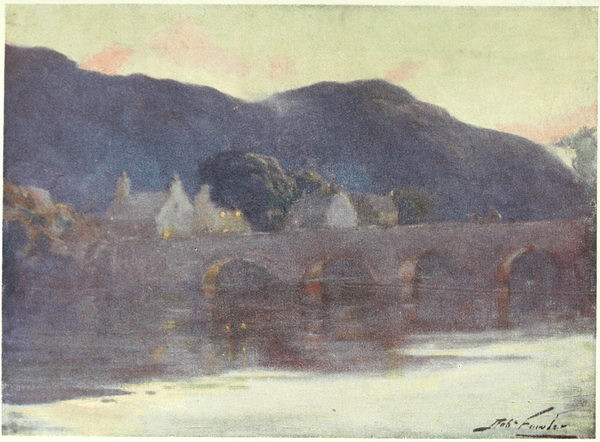
BRIDGE, CWM-Y-GLO—EVENING
I wish to make a nice distinction between poachers and poachers. The man who is nothing but a poacher I regard as one only in the strict literal sense. Such a man is rare to-day. Formerly he went to the woods as another man went to the Bar. He lived like a gentleman upon other men's venison, and was beneath the pleasure of salt-pork broth. He would swagger about the hamlet with a deer on his back. The deer was but a carcass at sixpence the pound to him. He has lately stooped to dictate his autobiography, which may be bought over the counter. A less majestical note was never sounded. He turned gamekeeper, and no doubt touched his cap for half-a-sovereign, and stared at his palm for a crown. He is, in short, "one of God's creatures." But the nobler one I have in mind seemed to bear high office in the scheme of the natural world. A mighty man, capable of killing anything and of sparing anything too, he was a true scholar in his kind. The pedants who peep and botanise and cry "allium" or "cnicus" to one another in the awful woods, and the sublime enthusiasts who cannot see the earth for the flowers, were equally beneath him. He would give twelve hours a day at least to the open air, as a scholar to his books. Thus he had acquired a large erudition which would probably have exhausted a whole field of inquiry if written down. It is fortunate that faultless observers like this hand down nothing to posterity, since it leaves us in these latter days free to feel ourselves discoverers when we come upon what hundreds have known during the last thousand years. In the case of this man, the knowledge came out not so much in speech—of which he was economical—as in infinite tact,
Wearing all that weight
Of learning lightly like a flower.
It was shown in the way he stepped in the woods, in the way he laid his ear to the bare ground (not the grass) to ascertain a distant noise of footsteps. I have seen him lose a wood-pigeon by an interrupted aim, and, standing without sound or motion, shoot the bird, that returned to its branch, enchanted by the absence of hostile sounds; for his very clothes were more the work of nature than the tailor, and matched the trees like a hawk or a November moth. His belief in the earth as a living thing was almost a superstition. I shall not forget how he took me to a hilltop one autumn day, when the quiet gave birth to sound after sound as we listened and let our silence grow. By a process of elimination he set aside the wind, the birds, the falling leaves, the water, and tried to capture for my sake the low hum which was the earth making music to itself. And what I heard I can no more describe than the magic of an excellent voice when once it is silent. "Depend upon it, that means something," he said. "And now——" there was a sharp report and a hare that I had not noticed bounded as if it had fallen from a great height, and lay dead.
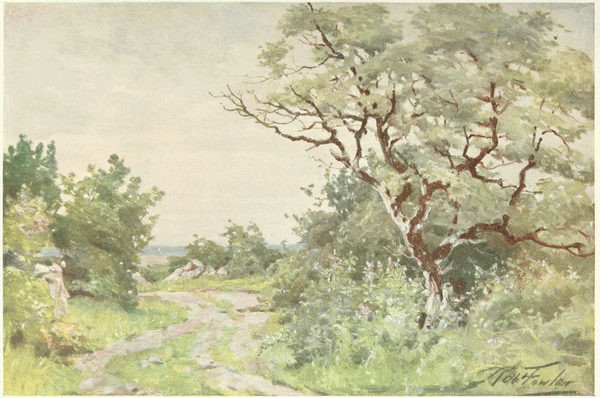
FIELD PATH, NEAR LLANRUG
Having been caught once, I remarked that his captor must have been a clever man. "A fool," he replied—"a fool. He'd been after me a hundred times, and I had fooled him all but once." It was at one time his practice to deliver a tithe of his poached game at the cottages of the sick, infirm, or poor, as a present from the Squire, a notoriously ungenerous man. His occupation had made him indifferent to the future or the past. None ever chattered less about past happiness and future pain. He seemed to owe a duty to the present moment of which he partook as if he were eating ripe fruit. Even a piece of drudgery or a keen sorrow never drove his intelligence backward or forward; pain he took as some take medicine, on trust. Thus he was a small, though not a poor, talker. Venturing once to greet him pleasantly with the long beginning of a story, when I found him seated without any visible occupation, and noticing his irritation, I said that I had supposed he was not doing anything; to which he answered "Yes, nothing!" and continued. At one time of his life he heard that a considerable sum of money had been left to him. A year later, the foundering of a ship left his fortunes unchanged; and on the afternoon of the news, he shot every pigeon at which he raised his gun. Birds of prey he would never shoot, even to show his skill. Jackdaws were always spared; he used to say that there was "a bit of God" in that bird. It was noticeable, too, that here and there he spared game birds, though he despised the race. I have seen him raise his gun and drop it again, not without a sigh as the bird flew off, observing that there was "something in the bird" which stayed his hand. In men, as in birds and beasts, he was anxious to see individuality, and loved the creature that possessed and used it. The only time I ever saw him use contempt was towards a beggar who had soiled his calling by theft. A good beggar, a good thief, anything beyond which "the force of nature could no further go," he reverenced. And he was a good poacher, glorying in the name. He died polishing the white steel on his gun.
Llewellyn, the Bard
Of Llewelyn, the bard, I cannot decide whether he most loves man or men. He is for ever building castles in the air and filling them with splendid creatures, whom he calls men. Then he laments that he cannot find any like them on hill or in valley: when, straightway, he will meet some human being, old friend or passing stranger, on the road or in a shop, and away go the phantoms of his castles, and he is wild in adoration of the new thing he has found. His grandmother, by the way, was called a fairy's child, though the truth seems to have been that her mother was a gipsy girl. Perhaps that is why he has no creed but many creeds, and was looked upon with great favour by the Calvinists until they found that he liked the Church as well. Yet I think that he likes men truly because they remind him of something he has read or dreamed, or because they make him dream; herein somewhat resembling the fellow who paid much court to another because he reminded him of the late Duke of ——, and he was a lover of dukes. Or he is like some that have seen processions of phantoms and say that sometimes the phantoms are simply fairies speaking an unknown tongue, but that sometimes several have the faces and voices of some among the dead whom they used to know. Why he is so glad to be among us at the farmhouse I have not discovered, but I suppose we remind him of Hebrew prophets or Greekish kings, for of our established merits he takes no thought.
I think he wastes so much pity for Annie of Lochroyan that other maids find him passionless, and he grows tender over Burd Ellen and Cynisca as their lovers never did. Arthur and Gwalchmai and Gwenhwyvar, the most unreal and unliving of all the persons of literature, please him most. In a world where all things are passing, he loves best those things which, having past and having left a ghost of fame behind, can live for ever in minds like his. In London he saw but a place where marsh and river and woods had been and might be again; or where
Sometimes a lily petal floated down
From dear, remote pools to the dreary town;
where the gulls flew over in the mournful January light; where a few friends had fires and lamps and books—their light faintly flickering in tremendous gloom and making one faint reality in the place; where wind and rain sometimes brought the past again; for the very touch of rain and wind beckoned to him, as it is fabled that the foam driven from waters that cover old towns will draw the unwary whom it touches into the deeps.
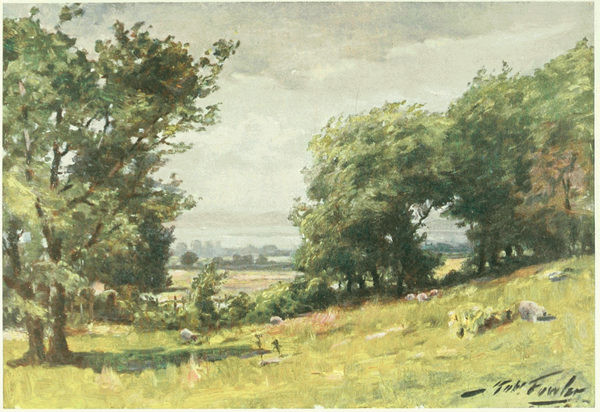
WINDY DAY, NEAR LLANRUG
He himself professes to care only for his own childhood and youth; only he is aware, as not every one is, that the childhood began in Eden, and is ages old, so that, after all, the few years that make middle age do not count for much. His life and his way of looking at it remind me of a story of a young Eastern prince. Every day, from his early childhood, a story-teller had told him a tale. But, soon after he was sixteen, the story-teller came to him, and, falling on his knees, told him that he had no more stories to tell. The young prince fell into a rage and swore that he would kill the man if, in a week, he had no new story ready. And the story-teller, who was very old and unwilling to die, went into the desert and neither ate nor drank, and made a plan by which to save his life. So he returned to the young prince, who asked if he had a new story, and he said that he had. And the prince bade him tell the story; and he began to speak, and told the prince the story which he had told him first, when he was a small child; and the prince was pleased. And until the old man died, he never told a story which he had not told before; and the prince was always pleased.
His poetry, if it could be understood, might be counted great, and perhaps it is so in a world where trees and animals are reverenced in a way which is hardly dawning here. He is a kind of mad Blake. He sees the world from among the stars, and those who see it from an elevation of five or six feet, and think that they see it as it really is, are not satisfied. He would make human the stars and seasons; he would make starry the flowers and the grass. He would have it that the world is but a shadow of Blake's "Real and Eternal world": that we who are shadows cling to the superstition that we are not, and have but prejudiced and fearful ears for his prophecies. He sees the world as a commonwealth of angels and men and beasts and herbs; and in it, horrible discords that we others scarcely hear seem to him to strike the stars.
Each outcry of the hunted hare
A fibre from the brain doth tear;
A skylark wounded on the wing
Doth make a cherub cease to sing.
After all, in matters of the spirit, men are all engaged in colloquies with themselves. Some of them are overheard, and they are the poets. It is his fortune that he is not overheard, at least by men.
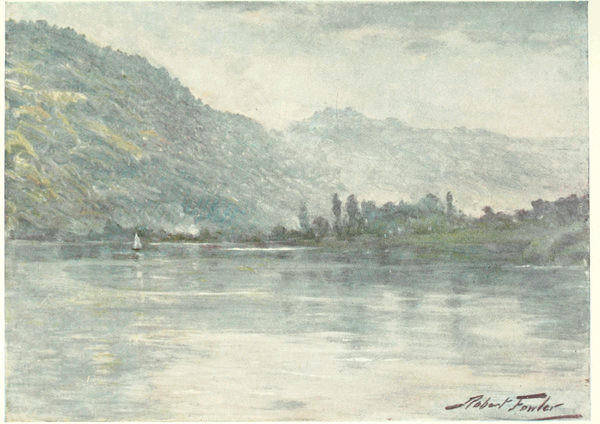
MORNING MISTS, NEAR TREFRIW
Yet how much would he sacrifice could he but write a few verses in the old Welsh manner,—but a few verses like those he repeats as lovingly as others would their own. First, there is the elegy on Gwenhwyvar by Griffith ap Meredith ap Davydd:
The wearer of white and green, of red and blue,
Is now in the painful fold of death.
The Church conceals her—she whom velvet so adorned.
Wearer of velvet,
We mourn with tears now that the flush of her beauty has faded,
Now that the wearer of velvet and red is no more.
That he praises for its clear-eyed simplicity, its mournfulness direct as the cry of a child, as the bravery of this is as direct as the laughter of a child (it is by a poet who was also a prince):
I love the time of summer, when the charger
Of the exulting chief prances in the presence of a gallant lord,
When the nimbly moving wave is covered with foam,
When the apple tree is in flower,
And the white shield is borne on my shoulder to battle.
This, also, for its simple pride:
The men who went to Cattraeth were men of name:
Wine and mead out of gold was their drink:
Three men, and threescore, and three hundred, with golden torques.
How often will he repeat "with golden torques"!
But (and here some will reconsider their opinion that he is a fool, or one "not wise" as the pleasant Welsh phrase goes) there is no one that can laugh more loudly than he; or sing a song more happily; or join more lustily than he in hunting on foot, over the craggy hills, some fox which the farmer can never shoot when he comes for the turkeys in November; and in the heat of the run he will curse the hounds for gaining on the fox, and the fox for running no faster, saying that the worst of fox-hunting is that it is so one-sided, since the fox is not allowed to rejoice at the end with hounds and men.
And here is one of his imitative songs, reduced to its lowest terms by a translator:
She is dead, Eluned,
Whom the young men and the old men
And the old women and even the young women
Came to the gates in the village
To see, because she walked as beautifully as a heifer.
She is dead, Eluned,
Who sang the new songs
And the old; and made the new
Seem old, and the old
As if they were just born and she had christened them.
She is dead, Eluned,
Whom I admired and loved,
When she was gathering red apples,
When she was making bread and cakes,
When she was smiling to herself alone and not thinking of me.
She is dead, Eluned,
Who was part of Spring,
And of blue Summer and red Autumn,
And made the Winter beloved;
She is dead, and these things come not again.
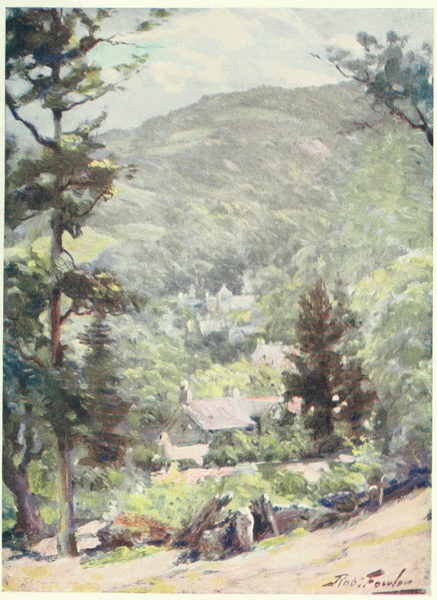
DISTANT VIEW OF BETTWS-Y-COED
Azariah John Pugh
One of the most inspiriting of our fire-siders at the farmhouse is a young schoolmaster named Azariah John Pugh, and called, in the Welsh fashion, almost invariably, Azariah John.
He is mainly English and partly Spanish; he was born in England, but having a Welsh name, he boasts much of his country, as he has elected to call Wales. But in truth he belongs to no time or place. He cares nothing for the house he lives in, for the village, or for any place he ever saw. Yet are we never tired of hearing his rich sentiments about them all. If only he be far away from it, there is no place known to him which he will not magnify with words which others do not easily use even for their true loves. Probably he would like to like them; but that very liking seems to be due to his feverish wide reading in books that are full of sentiments he admires and would borrow, if he could. Thus, of old cities, rivers flowing past famous places, mountains of beauty or story, the white cliffs of the south, the whin-red moorland of Wales, old gardens, solemn woods, all solitudes, fading races, sunsets, fallen greatness in men and things, old books, old beer, poverty, childhood ... of all these he will talk as if he had discovered them to the world, though it may be doubted whether he knows them at all. Yet is he a magnificent echo of the genuine lovers of these things, and he is so sorrowfully anxious to be believed that to some of us he has seemed to be the true heir, though defrauded of his inheritance, of all beauty and all antiquity. He is for ever speaking of "remembering afresh and with pleasure ancient matters," though he knows that even he cannot remember them with pleasure, and that no experienced man ever does so. He is so young that he has nothing to forget. But in his own esteem he is old now, and shakes his head over the light-heartedness of old men, saying, "If they were as old as I am——"
He speaks so suavely that the plain man wonders that he has never felt as deeply himself. Before his patriotism, the patriot is abashed. The lover of the quiet life, in his presence, is persuaded that himself can hardly be said to love it. No lover repeats more fondly—
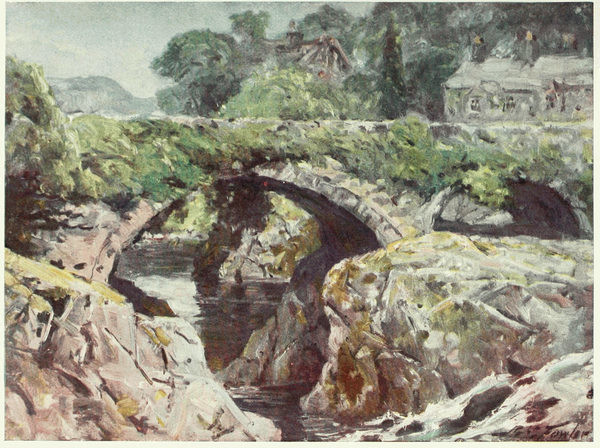
THE OLD BRIDGE, BETTWS-Y-COED
And I would send tales of forgotten love
Late into the lone night, and sing wild songs
Of maids deserted in the olden time.
He thus deceives every one but himself, and that one exception is the real cause of his unhappiness. He cannot avoid his affectations. He only finds them out when they are full-grown and most noisily and hungrily abroad in every man's ears, and then he has to maintain them, wearily but with an apparent gaiety. Pity even will not hurt him. It is his genial air: he rejoices in it as a pigeon, leaning and raising her wing to expose her tender side, rejoices in summer rain, and as languidly; and then again he is furious at it, and cultivates brutality, drinks much beer, and uses many oaths, of which he wearies and comes again to the old tap.
The ghosts of the subtle emotions which we say make up modernity have come into his brain, and they are so many that he has become, if not a theatre, at least a mortuary, of modernity. But the nervous strain of any real passion in his neighbourhood obliges him to be rude or to run away. Real passion was always scandalously ill done: he would have no lover die less romantically than Romeo.
And as his thoughts, so are his acts, except that they are few. He has been to Rome, the Bay of Spezzia, Windermere; he has walked along the Pilgrim's Road to Canterbury. He has learned to work badly in metal and wood. He has had whims and drugs enough to win an appreciation from Mr. Arthur Symons. He has written poems under the influence of something in his stomach; but either he cannot read them, or they are not fit to be read. He wrote one, I remember, about a girl who worked a story in tapestry while her lover played on a harp the melody which told the same story. He wrote a sermon on the death of John Jones because a hundred persons of that name die every day, and he wished to praise the average man, out of a whimsical distaste for his late less fantastic likings. He has had friends and has been left by them; or, as he says, after the Welsh poet,