


автордың кітабын онлайн тегін оқу Lectures on the Philosophy of the Human Mind (Vol. 1 of 3)
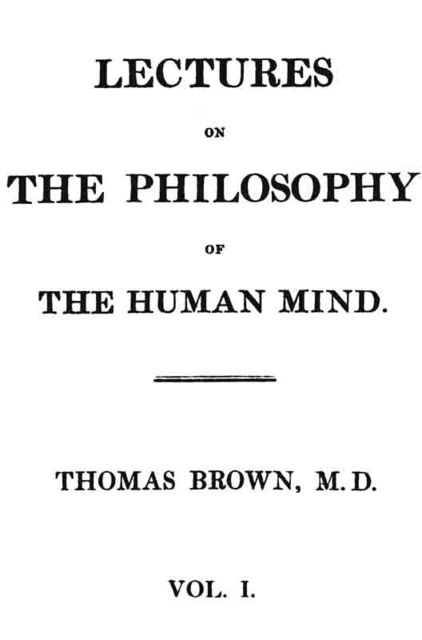
LECTURES
ON
THE PHILOSOPHY
OF
THE HUMAN MIND.
BY THE LATE
THOMAS BROWN, M. D.
PROFESSOR OF MORAL PHILOSOPHY IN THE UNIVERSITY OF
EDINBURGH.
IN THREE VOLUMES.
VOL. I.
ANDOVER:
PUBLISHED BY MARK NEWMAN.
FLAGG AND GOULD, PRINTERS.
1822.
CONTENTS.
PAGE.LECTURE I.
Introduction,
9LECTURE II.
Relation of the Philosophy of Mind to the Sciences in general,
20LECTURE III.
Relation of the Philosophy of Mind to the Intellectual Sciences and Arts,
35LECTURE IV.
Relation of the Philosophy of Mind to the Cultivation of Moral Feeling,
50LECTURE V.
On the Nature of Physical Inquiry in general,
64LECTURE VI.
On the Nature of Physical Inquiry in general,
80LECTURE VII.
On Power, Cause, and Effect,
98LECTURE VIII.
On Hypothesis and Theory,
113LECTURE IX.
Recapitulation of the Four preceding Lectures,
129Application of the Laws of Physical Inquiry to the Study of Mind,
135LECTURE X.
Continuation of the same Subject,
144LECTURE XI.
Continuation of the same Subject,
162On the Phenomena of Mind in General,
167On Consciousness,
169LECTURE XII.
On Consciousness,
178On Mental Identity,
180Identity irreconcilable with the Doctrine of Materialism,
180Distinction between Personal and Mental Identity,
182Shaftesbury's Opinion of Identity,
184Objections to the Doctrine of Mental Identity,
185LECTURE XIII.
On the Direct Evidence of Mental Identity,
192Objections answered,
204LECTURE XIV.
Continuation of the same Subject,
207LECTURE XV.
Continuation of the same Subject,
224Opinion of Mr Locke respecting Identity,
230Source of his Paradox respecting it,
234Reflections suggested by his Paradox,
235LECTURE XVI.
On the Classification of the Phenomena of Mind,
239LECTURE XVII.
Continuation of the same Subject,
254On the External Affections of Mind, in general,
262On the less Definite External Affections,
264LECTURE XVIII.
On the more Definite External Affections,
269LECTURE XIX.
On the Corporeal Part of the Process, in Sensation,
283LECTURE XX.
Particular Consideration of our Sensations,
298On Smell,
300On Taste,
301On Hearing,
305LECTURE XXI.
Continuation of the same Subject,
312On Touch,
326LECTURE XXII.
On the Feelings ascribed to the Sense of Touch,
328Analysis of these Feelings,
330LECTURE XXIII.
Continuation of the same Subject,
345LECTURE XXIV.
Continuation of the same Subject,
358LECTURE XXV.
On the Distinction between Sensation and Perception,
379On the Primary and Secondary Qualities of Matter,
384LECTURE XXVI.
On Dr. Reid's supposed Confutation of the Ideal System,
395Hypothesis of the Peripatetics regarding Perception,
396Opinion of Locke—Hobbes—Des Cartes —Arnauld—Le Clerc De Crousaz, regarding Perception,
399LECTURE XXVII.
Examination of Dr Reid's supposed Confutation of Idealism
411LECTURE XXVIII.
Conclusion of the Subject,
427On Vision,—Analysis of the Feelings ascribed to it,
431LECTURE XXIX.
Continuation of the same Subject,
442LECTURE XXX.
History of Opinions regarding Perception,
459Opinion of the Peripatetics,
462—— of Des Cartes,
464—— of Malebranche,
469—— of St Austin,
472LECTURE XXXI.
—— of Leibnitz,
474On the External Affections combined with Desire,
479Attention,
482LECTURE XXXII.
Continuation of the Same Subject,
490On the Internal Affections of Mind,
497On the Classification of these Affections,
500LECTURE XXXIII.
On Locke, Condillac, and Reid's Classification of the Mental Phenomena,
505New Classification of the Internal Affections,
518LECTURE XXXIV.
On Simple Suggestion,
523Advantages resulting from the Principle of Suggestion,
526On Mr Hume's Classification of the Associating or Suggesting Principles,
532LECTURES
ON THE
PHILOSOPHY OF THE HUMAN MIND.
LECTURE I.—(Introduction.)
Gentlemen,
The subject on which we are about to enter, and which is to engage, I trust, a considerable portion of your attention for many months, is the Philosophy of the Human Mind,—not that speculative and passive philosophy only, which inquires into the nature of our intellectual part, and the mysterious connexion of this with the body which it animates, but that practical science, which relates to the duties, and the hopes, and the great destiny of man, and which, even in analyzing the powers of his understanding, and tracing all the various modifications of which it is individually susceptible, views it chiefly as a general instrument of good—an instrument by which he may have the dignity of co-operating with his beneficent Creator, by spreading to others the knowledge, and virtue, and happiness, which he is qualified at once to enjoy, and to diffuse.
“Philosophy,” says Seneca, “is not formed for artificial show or delight. It has a higher office than to free idleness of its languor, and wear away and amuse the long hours of a day. It is that which forms and fashions the soul, which gives to life its disposition and order, which points out what it is our duty to do, what it is our duty to omit. It sits at the helm, and in a sea of peril, directs the course of those who are wandering through the waves.” “Non est philosophia populare artificium, nec ostentationi paratum; non in verbis sed in rebus est. Nec in hoc adhibetur ut aliqua oblectatione consumatur dies, ut dematur otio nausea. Animum format et fabricat, vitam disponit, actiones regit, agenda et omittenda demonstrat, sedit ad gubernaculum, et per ancipitia fluctuantium dirigit cursum.” Ep. 16.
Such, unquestionably, is the great practical object of all philosophy. If it increase the happiness and virtue of human kind, it must be allowed to have fulfilled, to human beings, the noblest of earthly ends. The greatness of this primary object, however, perhaps fixed too exclusively the attention of the moral inquirers of antiquity, who, in considering man as capable of virtue and happiness, and in forming nice and subtle distinctions as to his supreme good, and the means by which he might attain it, seem almost to have neglected the consideration of his intellectual nature, as an object of mere physical science. Hence it happens, that, while the systems of ancient philosophy exhibit, in many instances, a dignity of moral sentiment as high, or almost as high, as the unassisted reason of man could be supposed to reach, and the defects of which we perhaps discover only by the aid of that purer light, which was not indulged to them, they can scarcely be said to have left us a single analysis of complex phenomena of thought and feeling. By some of them, indeed, especially by the Peripatetics and Stoics, much dialectic subtilty was employed in distinctions, that may seem at first to involve such an analysis; but even these distinctions were verbal, or little more than verbal. The analytical investigation of the mind, in all its complexity of perceptions, and thoughts, and emotions, was reserved to form almost a new science in the comprehensive philosophy of far later years.
If, however, during the flourishing periods of Greek and Roman letters, this intellectual analysis was little cultivated, the department of the philosophy of the mind, which relates to practical ethics, was enriched, as I have said, by moral speculations the most splendid and sublime. In those ages, indeed, and in countries in which no revealed will of heaven had pointed out and sanctioned one unerring rule of right, it is not to be wondered at, that, to those who were occupied in endeavouring to trace and ascertain such a rule in the moral nature of man, all other mental inquiries should have seemed comparatively insignificant. It is even pleasing thus to find the most important of all inquiries regarded as truly the most important, and minds of the highest genius, in reflecting on their own constitution, so richly diversified and adorned with an almost infinite variety of forms of thought, discovering nothing, in all this splendid variety, so worthy of investigation, as the conduct which it is fitting for man to pursue.
But another period was soon to follow, a period in which ages of long and dreary ignorance were to be followed by ages of futile labour, as long and dreary. No beautiful moral speculations were then to compensate the poverty of intellectual science. But morality, and even religion itself, were to be degraded, as little more than technical terms of a cold and unmeaning logic. The knowledge of our mental frame was then, indeed, professedly cultivated with most assiduous zeal; and if much technical phraseology, and much contention, were sufficient to constitute an elaborate science, that assiduous zeal might well deserve to have been rewarded with so honourable a name. But what reasonable hope of a progress truly scientific could be formed, when to treat of the philosophy of mind was to treat of every thing but of the mind and its affections; when some of the most important questions, with respect to it, were, Whether its essence were distinct from its existence? whether its essence therefore might subsist, when it had no actual existence? and what were all the qualities inherent in it as a nonentity? In morals, whether ethics were an art or a science? whether, if the mind had freedom of choice, this independent will be an entity or a quiddity? and whether we should say, with a dozen schoolmen, that virtue is good, because it has intrinsic goodness, or, with a dozen more, that it has this intrinsic goodness, because it is good?
In natural theology, questions of equal moment were contested with equal keenness and subtilty; but they related less to the Deity, of whose nature, transcendent as it is, the whole universe may be considered as in some degree a faint revelation, than to those spiritual ministers of his power, of whose very existence nature affords no evidence, and of whom revelation itself may be said to teach us little but the mere existence. Whether angels pass from one point of space to another, without passing through the intermediate points? whether they can visually discern objects in the dark? whether more than one can exist at the same moment in the same physical point? whether they can exist in a perfect vacuum, with any relation to the absolute incorporeal void? and whether if an angel were in vacuo, the void could still truly be termed perfect?—such, or similar to these were the great inquiries in that department of Natural Theology, to which, as to a separate science, was given the name of Angelography: and of the same kind were the principal inquiries with respect to the Deity himself, not so much an examination of the evidence which nature affords of his self-existence, and power, and wisdom, and goodness, those sublime qualities which even our weakness cannot contemplate without deriving some additional dignity from the very greatness which it adores, as a solution of more subtile points, whether he exist in imaginary space as much as in the space that is real? whether he can cause a mode to exist without a substance? whether, in knowing all things, he know universals, or only things singular? and whether he love a possible unexisting angel better than an actually existing insect?
“Indignandum de isto, non disputandum est.”—“Sed non debuit hoc nobis esse propositum arguta disserere,[1] et philosophiam in has augustias ex sua majestate detrahere. Quanto satius est, ire aperta via et recta, quam sibi ipsi flexus disponere, quos cum magna molestia debeas relegere?”[2]—“Why waste ourselves,” says the same eloquent moralist; “why torture and waste ourselves in questions, which there is more real subtilty in despising than in solving?”—
“Quid te troques et maceras, in ea quæstione quam subtilius est contempsisse quam solvere?”[3]
From the necessity of such inquiries we are now fortunately freed. The frivolous solemnities of argument, which, in the disputations of Scotists and Thomists, and the long controversy of the believers and rejectors of the universal a parti rei, rendered human ignorance so very proud of its temporary triumphs over human ignorance, at length are hushed forever; and, so precarious is all that glory, of which men are the dispensers, that the most subtile works, which for ages conferred on their authors a reverence more than praise, and almost worship, would now scarcely find a philosophic adventurer, so bold, as to avow them for his own.
The progress of intellectual philosophy may indeed, as yet, have been less considerable than was to be hoped under its present better auspices. But it is not a little, to have escaped from a labyrinth, so very intricate, and so very dark, even though we should have done nothing more than advance into sunshine and an open path, with a long journey of discovery still before us. We have at last arrived at the important truth, which now seems so very obvious a one, that the mind is to be known best by observation of the series of changes which it presents, and of all the circumstances which precede and follow these; that, in attempting to explain its phenomena, therefore, we should know what those phenomena are; and that we might as well attempt to discover, by logic, unaided by observation or experiment, the various coloured rays that enter into the composition of a sunbeam, as to discover, by dialectic subtilties, a priori, the various feelings that enter into the composition of a single thought or passion.
The mind, it is evident, may, like the body to which it is united, or the material objects which surround it, be considered simply as a substance possessing certain qualities, susceptible of various affections or modifications, which, existing successively as momentary states of the mind, constitute all the phenomena of thought and feeling. The general circumstances in which these changes of state succeed each other, or, in other words, the laws of their succession, may be pointed out, and the phenomena arranged in various classes, according as they may resemble each other, in the circumstances that precede or follow them, or in other circumstances of obvious analogy. There is, in short, a science that may be termed mental physiology, as there is another science relating to the structure and offices of our corporeal frame, to which the term physiology is more commonly applied; and as, by observation and experiment, we endeavour to trace those series of changes which are constantly taking place in our material part, from the first moment of animation to the moment of death; so, by observation, and in some measure also by experiment, we endeavour to trace the series of changes that take place in the mind, fugitive as these successions are, and rendered doubly perplexing by the reciprocal combinations into which they flow. The innumerable changes, corporeal and mental, we reduce, by generalizing, to a few classes; and we speak, in reference to the mind, of its faculties or functions of perception, memory, reason, as we speak, in reference to the body, of its functions of respiration, circulation, nutrition. This mental physiology, in which the mind is considered simply as a substance endowed with certain susceptibilities, and variously affected or modified in consequence, will demand of course our first inquiry; and I trust that the intellectual analyses, into which we shall be led by it, will afford results that will repay the labour of persevering attention, which they may often require from you.
In one very important respect, however, the inquiries, relating to the physiology of mind, differ from those which relate to the physiology of our animal frame. If we could render ourselves acquainted with the intimate structure of our bodily organs, and all the changes which take place, in the exercise of their various functions, our labour, with respect to them, might be said to terminate. But though our intellectual analysis were perfect, so that we could distinguish, in our most complex thought or emotion, its constituent elements, and trace with exactness the series of simpler thoughts which have progressively given rise to them, other inquiries, equally, or still more important, would remain. We do not know all which is to be known of the mind, when we know all its phenomena, as we know all which can be known of matter, when we know the appearances which it presents, in every situation in which it is possible to place it, and the manner in which it then acts or is acted upon by other bodies. When we know that man has certain affections and passions, there still remains the great inquiry, as to the propriety or impropriety of those passions, and of the conduct to which they lead. We have to consider, not merely how he is capable of acting, but also, whether, acting in the manner supposed, he would be fulfilling a duty or perpetrating a crime. Every enjoyment which man can confer on man, and every evil, which he can reciprocally inflict or suffer, thus become objects of two sciences—first of that intellectual analysis which traces the happiness and misery, in their various forms and sequence, as mere phenomena or states of the substance mind;—and secondly, of that ethereal judgment, which measures our approbation and disapprobation, estimating, with more than judicial scrutiny, not merely what is done, but what is scarcely thought in secrecy and silence, and discriminating some element of moral good or evil, in all the physical good and evil, which it is in our feeble power to execute, or in our still frailer heart, to conceive and desire.
To this second department of inquiry belong the doctrines of general ethics.
But, though man were truly impressed with the great doctrine of moral obligation, and truly desirous, in conformity with it, of increasing, as far as his individual influence may extend, the sum of general happiness, he may still err in the selection of the means which he employs for this benevolent purpose. So essential is knowledge, if not to virtue, at least to all the ends of virtue, that, without it, benevolence itself, when accompanied with power, may be as destructive and desolating as intentional tyranny; and notwithstanding the great principles of progression in human affairs, the whole native vigour of a state may be kept down for ages, and the comfort, and prosperity, and active industry of unexisting millions be blasted by regulations, which, in the intention of their generous projectors, were to stimulate those very energies which they repressed, and to relieve that very misery which they rendered irremediable. It therefore becomes an inquiry of paramount importance, what are the means best calculated for producing the greatest amount of social good? By what ordinances would public prosperity, and all the virtues which not merely adorn that prosperity, but produce it, be most powerfully excited and maintained? This political department of our science, which is in truth only a subdivision, though a very important one, of general practical ethics, comprehends, of course, the inquiries as to the relative advantages of different forms of government, and the expediency of the various contrivances which legislative wisdom may have established, or may be supposed to establish, for the happiness and defence of nations.
The inquiries, to which I have as yet alluded, relate to the mind, considered simply as an object of physiological investigation; or to man, considered in his moral relations to a community, capable of deriving benefit from his virtues and knowledge, or of suffering by his errors and his crimes. But there is another more important relation in which the mind is still to be viewed,—that relation which connects it with the Almighty Being to whom it owes its existence. Is man, whose frail generations begin and pass away, but one of the links of an infinite chain of beings like himself, uncaused, and co-eternal with that self-existing world of which he is the feeble tenant? or, Is he the offspring of an all creating Power, that adapted him to nature, and nature to him, formed together with the magnificent scene of things around him, to enjoy its blessings, and to adore, with the gratitude of happiness, the wisdom and goodness from which they flow? What attributes, of a Being so transcendent, may human reason presume to explore? and, What homage will be most suitable to his immensity, and our nothingness? Is it only for an existence of a few moments, in this passing scene, that he has formed us? or, Is there something within us, over which death has no power,—something, that prolongs and identifies the consciousness of all which we have done on earth, and that, after the mortality of the body, may yet be a subject of the moral government of God? When compared with these questions, even the sublimest physical inquiries are comparatively insignificant. They seem to differ, as it has been said, in their relative importance and dignity, almost as philosophy itself differs from the mechanical arts that are subservient to it. “Quantum inter philosophiam interest,—et cæteras artes; tantum interesse existimo in ipsa philosophia, inter illam partem quæ ad homines et hanc quæ ad Deos spectat. Altior est hæc et animosior: multum permisit sibi; non fuit oculis contenta. Majus esse quiddam suspicata est, ac pulchrius, quod extra conspectum natura posuisset.”[4] It is when ascending to these sublimer objects, that the mind seems to expand, as if already shaking off its earthly fetters, and returning to its source; and it is scarcely too much to say, that the delight which it thus takes in things divine is an internal evidence of its own divinity. “Cum illa tetigit, alitur, crescit: ac velut vinculis liberatus, in originem redit. Et hoc habet argumentum divinitatis suæ, quod illum divina delectant.”
I have thus briefly sketched the various important inquiries, which the philosophy of mind, in its most extensive sense, may be said to comprehend. The nature of our spiritual being, as displayed in all the phenomena of feeling and thought—the ties which bind us to our fellow-men, and to our Creator—and the prospect of that unfading existence, of which life is but the first dawning gleam; such are the great objects to which in the department of your studies committed to my charge, it will be my office to guide your attention and curiosity. The short period of the few months to which my course is necessarily limited, will not, indeed, allow me to prosecute, with such full investigation as I should wish, every subject that may present itself in so various a range of inquiry. But even these few months, I flatter myself, will be sufficient to introduce you to all which is most important for you to know in the science, and to give such lights as may enable you, in other hours, to explore, with success, the prospects that here, perhaps, may only have opened on your view. It is not, I trust, with the labours of a single season that such inquiries, on your part, are to terminate. Amid the varied occupations and varied pleasures of your future years,—in the privacy of domestic enjoyment, as much as in the busier scenes of active exertion,—the studies on which you are about to enter must often rise to you again with something more than mere remembrance; because there is nothing that can give you interest, in any period or situation of your life, to which they are not related. The science of mind, is the science of yourselves; of all who surround you; of every thing which you enjoy or suffer, or hope or fear: so truly the science of your very being, that it will be impossible for you to look back on the feelings of a single hour, without constantly retracing phenomena that have been here, to a certain extent, the subjects of your analysis and arrangement. The thoughts and faculties of your own intellectual frame, and all which you admire as wonderful in the genius of others,—the moral obligation, which, as obeyed or violated, is ever felt by you with delight or with remorse,—the virtues, of which you think as often as you think of those whom you love; and the vices, which you view with abhorrence, or with pity,—the traces of divine goodness, which never can be absent from your view, because there is no object in nature which does not exhibit them,—the feeling of your dependence on the gracious Power that formed you,—and the anticipation of a state of existence more lasting than that which is measured by the few beatings of a feeble pulse,—these in their perpetual recurrence, must often recal to you the inquiries that, in this place, engaged your early attention. It will be almost as little possible for you to abandon wholly such speculations, as to look on the familiar faces of your home with a forgetfulness of every hour which they have made delightful, or to lose all remembrance of the very language of your infancy, that is every moment sounding in your ears.
Though I shall endeavour, therefore, to give as full a view as my limits will permit of all the objects of inquiry which are to come before us, it will be my chief wish to awake in you, or to cherish, a love of these sublime inquiries themselves. There is a philosophic spirit which is far more valuable than any limited acquirements of philosophy; and the cultivation of which, therefore, is the most precious advantage that can be derived from the lessons and studies of many academic years:—a spirit, which is quick to pursue whatever is within the reach of human intellect; but which is not less quick to discern the bounds that limit every human inquiry, and which, therefore, in seeking much, seeks only what man may learn:—which knows how to distinguish what is just in itself from what is merely accredited by illustrious names; adopting a truth which no one has sanctioned, and rejecting an error of which all approve, with the same calmness as if no judgment were opposed to its own:—but which, at the same time, alive, with congenial feeling, to every intellectual excellence, and candid to the weakness from which no excellence is wholly privileged, can dissent and confute without triumph, as it admires without envy; applauding gladly whatever is worthy of applause in a rival system, and venerating the very genius which it demonstrates to have erred.
Such is that philosophic temper to which, in the various discussions that are to occupy us, it will be my principal ambition to form your minds; with a view not so much to what you are at present, as to what you are afterwards to become. You are now, indeed, only entering on a science, of which, by many of you, perhaps, the very elements have never once been regarded as subjects of speculative inquiry. You have much, therefore, to learn, even in learning only what others have thought. But I should be unwilling to regard you as the passive receivers of a system of opinions, content merely to remember whatever mixture of truths and errors may have obtained your easy assent. I cannot but look to you in your maturer character, as yourselves the philosophers of other years; as those who are, perhaps, to add to science many of its richest truths, which as yet are latent to every mind, and to free it from many errors, in which no one has yet suspected even the possibility of illusion. The spirit which is itself to become productive in you, is therefore, the spirit which I wish to cultivate; and happy, as I shall always be, if I succeed in conveying to you that instruction which it is my duty to communicate, I shall have still more happiness if I can flatter myself, that, in this very instruction, I have trained you to habits of thought, which may enable you to enrich, with your own splendid discoveries, the age in which you live, and to be yourselves the instructors of all the generations that are to follow you.
Footnotes
[1] Argutias serere. Lect. var.
[2] Seneca, Ep. 102.
[3] Ibid, 49.
[4] Seneca Nat. Quæst. Lib. 1. Præf.
LECTURE II.
RELATION OF THE PHILOSOPHY OF MIND TO THE SCIENCES IN GENERAL.
In my former Lecture, Gentlemen, I gave you a slight sketch of the departments into which the Philosophy of Mind divides itself, comprehending, in the first place, The physiology of the mind, considered as a substance capable of the various modifications, or states, which constitute, as they succeed each other, the phenomena of thought and feeling; secondly, The doctrines of general ethics, as to the obligation, under which man lies, to increase and extend, as widely as possible, the happiness of all that live; thirdly, The political doctrines, as to the means which enable him, in society with his fellow men, to furthermost successfully, and with the least risk of future evil, that happiness of all, which it is the duty of each individually to wish and to promote; and, fourthly, The doctrines of natural theology, as to the existence and attributes of that greatest of Beings, under whose moral government we live, and the foundations of our confidence that death is only a change of scene, which, with respect to our mortality indeed, may be said to be its close; but which, with respect to the soul itself, is only one of the events of a life that is everlasting.
Of these great divisions of our subject, the Physiology of the Mind, or the consideration of the regular series of phenomena which it presents, simply as states or affections of the mind, is that to which we are first to turn our attention. But, before entering on it, it may be useful to employ a few Lectures in illustrating the advantages, which the study of the mind affords, and the principles of philosophizing, in their peculiar application to it—subjects, which, though of a general kind, will, I trust, leave an influence that will be felt in all the particular inquiries in which we are to be engaged; preparing you, both for appreciating better the importance of those inquiries, and for prosecuting them with greater success.
One very obvious distinction of the physical investigations of mind and matter, is, that, in intellectual science, the materials on which we operate, the instruments with which we operate, and the operating agent, are the same. It is the mind, endowed with the faculties of perception and judgment, observing, comparing, and classifying the phenomena of the mind. In the physics of matter, it is, indeed, the mind which observes, compares, and arranges; but the phenomena are those of a world, which, though connected with the mind by many wonderful relations of reciprocal agency, still exists independently of it—a world that presents its phenomena only in circumstances, over most of which we have no controul, and over others a controul that is partial and limited. The comparative facility, as to all external circumstances, attending the study of the mental phenomena, is unquestionably an advantage of no small moment. In every situation in which man can be placed, as long as his intellectual faculties are unimpaired, it is impossible that he should be deprived of opportunities of carrying on this intellectual study; because, in every situation in which he can be placed, he must still have with him that universe of thought, which is the true home and empire of the mind. No costly apparatus is requisite—no tedious waiting for seasons of observation. He has but to look within himself to find the elements which he has to put together, or the compounds which he has to analyze, and the instruments that are to perform the analysis or composition.
It was not, however, to point out to you the advantage which arises to the study of our mental frame, from the comparative facility as to the circumstances attending it, that I have led your attention to the difference, in this respect, of the physics of mind and matter. It was to show,—what is of much more importance,—how essential a right view of the science of mind is to every other science, even to those sciences, which superficial thinkers might conceive to have no connexion with it; and how vain it would be to expect, that any branch of the physics of mere matter could be cultivated to its highest degree of accuracy and perfection, without a due acquaintance with the nature of that intellectual medium, through which alone the phenomena of matter become visible to us, and of those intellectual instruments, by which the objects of every science, and of every science alike, are measured, and divided, and arranged. We might almost as well expect to form an accurate judgment, as to the figure, and distance, and colour of an object, at which we look through an optical glass, without paying any regard to the colour and refractory power of the line itself. The distinction of the sciences and arts, in the sense in which these words are commonly understood, is as just as it is familiar; but it may be truly said, that, in relation to our power of discovery, science is itself an art, or the result of an art. Whether, in this most beautiful of processes, we regard the mind as the instrument or the artist, it is equally that by which all the wonders of speculative, or practical knowledge, are evolved. It is an agent operating in the production of new results, and employing for this purpose the known laws of thought, in the same manner as, on other occasions, it employs the known laws of matter. The objects, to which it may apply itself, are indeed various, and, as such, give to the sciences their different names. But, though the objects vary, the observer and the instrument are continually the same. The limits of the powers of this mental instrument, are not the limits of its powers alone; they are also the only real limits, within which every science is comprehended. To the extent which it allows, all those sciences, physical or mathematical, and all the arts which depend on them, may be improved; but, beyond this point, it would be vain to expect them to pass; or rather, to speak more accurately, the very supposition of any progress beyond this point would imply the grossest absurdity; since human science can be nothing more than the result of the direction of human faculties to particular objects. To the astronomer, the faculty by which he calculates the disturbing forces that operate on a satellite of Jupiter, in its revolution round its primary planet, is as much an instrument of his art, as the telescope by which he distinguishes that almost invisible orb; and it is as important, and surely as interesting, to know the real power of the intellectual instrument, which he uses, not for calculations of this kind only, but for all the speculative and moral purposes of life, as it can be to know the exact power of that subordinate instrument, which he uses only for his occasional survey of the heavens.
To the philosophy of mind, then, every speculation, in every science, may be said to have relation as to a common centre. The knowledge of the quality of matter, in the whole wide range of physics, is not itself a phenomenon of matter, more than the knowledge of any of our intellectual or moral affections; it is truly, in all its stages of conjecture, comparison, doubt, belief, a phenomenon of mind; or, in other words, it is only the mind itself existing in a certain state. The inanimate bodies around us might, indeed, exhibit the same changes as at present, though no mind had been created. But science is not the existence of these inanimate bodies; it is the principle of thought itself variously modified by them, which, as it exists in certain states, constitutes that knowledge which we term Astronomy; in certain other states, that knowledge which we term Chemistry; in other states our Physiology, corporeal or mental, and all the other divisions and subdivisions of science. It would surely be absurd to suppose, that the mixture of acids and alkalies constitutes Chemistry, or that Astronomy is formed by the revolution of planets round a sun. Such phenomena, the mere objects of science, are only the occasions on which Astronomy and Chemistry arise in the mind of the inquirer, Man. It is the mind which perceives bodies, which reasons on their apparent relations, which joins them in thought as similar, however distant they may be in sphere, or separates them in thought as dissimilar, though apparently contiguous. These perceptions, reasonings, and classifications of the mind must, of course be regulated by the laws of mind, which mingle in their joint result with the laws of matter. It is the object indeed which affects the mind when sentient; but it is the original susceptibility of the mind itself, which determines and modifies the particular affection, very nearly, if I may illustrate what is mental by so coarse an image, as the impression which a seal leaves on melted wax depends, not on the qualities of the wax alone, or of the seal alone, but on the softness of the one, and the form of the other. Change the external object which affects the mind in any case, and we all know, that the affection of the mind will be different. It would not be less so, if, without any change of object, there could be a change in the mere feeling, whatever it might be, which would result from that different susceptibility becoming instantly as different, as if not the mind had been altered, but the object which it perceived. There is no physical science, therefore, in which the laws of mind are not to be considered together with the laws of matter; and a change in either set of laws would equally produce a change in the nature of the science itself.
If, to take one of the simplest of examples, the mind had been formed susceptible of all the modifications which it admits at present, with the single exception of those which it receives on the presence of light, of how many objects and powers in nature, which we are now capable of distinguishing, must we have remained in absolute ignorance! But would this comparative ignorance of many objects be the only effect of such a change of the laws of mind, as I have supposed? Or rather, is it not equally certain, that this simple change alone would be sufficient to alter the very nature of the limited science of which the mind would still be capable, as much as it narrowed its extent? Science is the classification of relations; varying, too, in every case, as the relations observed are different; and how very differently should we, in such circumstances, have classed the few powers of the few objects, which might still have become known to us, since we could no longer have classed them according to any of those visual relations, which are always the most obvious and prominent. It is even, perhaps, an extravagant supposition, that a race of the blind, unless endowed with some other sense to compensate the defect of sight, could have acquired so much command of the common arts of life, or so much science of any sort, as to preserve themselves in existence. But though all this, by a very strong license of supposition, were taken for granted, it must surely be admitted, that the knowledge which man could in those circumstances acquire, would be not merely less in degree, but would be as truly different from that which his powers at present have reached, as if the objects of his science, or the laws which regulate them, had themselves been changed to an extent, at least as great as the supposed change in the laws of mind. The astronomy of the blind, if the word might still be used to express a science so very different from the present, would, in truth, be a sort of chemistry. Day and night, the magnificent and harmonious revolution of season after season, would be nothing more than periodical changes of temperature in the objects around; and that great Dispenser of the seasons, the Source of light, and beauty, and almost of animation, at whose approach nature seems not merely to awake, but to rise again, as it was at first, from the darkness of its original chaos, if its separate existence could be at all inferred, would probably be classed as something similar, though inferior in power, to that unknown source of heat, which, by a perilous and almost unknown process, was fearfully piled and kindled on the household hearth.
So accustomed are we, however, to consider the nature and limits of the different sciences, as depending on the objects themselves, and not on the laws of the mind, which classes their relations, that it may be difficult for you at first to admit the influence of these mere laws of mind, as modifying general physics, at least to the extent which I have now stated. But, that a change in the laws of human thought, whatever influence it might have in altering the very nature and limits of the physical sciences, would at least affect greatly the state of their progress, must be immediately evident to those who consider for a moment on what discovery depends; the progress of science being obviously nothing more than a series of individual discoveries, and the number of discoveries varying with the powers of the individual intellect. The same phenomena which were present to the mind of Newton, had been present, innumerable times before, not to the understandings of philosophers only, but to the very senses of the vulgar. Every thing was the same to him and to them, except the observing and reasoning mind. To him alone, however, they suggested those striking analogies, by which on a comparison of all the known circumstances in both, he ventured to class the force which retains the planets in their orbits, with that which occasions the fall of a pebble to the earth.
Another source of error, we found to be the too great extension of what are termed general laws; which though a less error in itself, is yet, in one respect, more dangerous than the former; because it is the error of better understandings,—of understandings that would not readily fall into the extravagant follies of hypotheses, but acknowledge the essential importance of induction, and think they are proceeding on it without the slightest deviation, almost at the very moment when they are abandoning it for conjecture. To observe the regular series of antecedents and consequents, and to class these as similar or dissimilar, are all which philosophers can do with complete certainty. But there is a constant tendency in the mind, to convert a general law into an universal law,—to suppose, after a wide induction, that what is true of many substances that have a very striking analogy, is as certainly true of all that have this striking analogy,—and that what is true of them in certain circumstances, is true of them in all circumstances,—or, at least, in all circumstances which are not remarkably different. The widest induction which we can make, however, is still limited in its nature; and, though we may have observed substances in many situations, there may be some new situations, in which the event may be different, or even, perhaps, the very reverse of that which we should have predicted, by reasoning from the mere analogy of other circumstances. It appeared to me necessary, therefore, in consequence of the very ambiguous manner in which writers on this higher branch of logic speak of reasoning from general laws to particulars, to warn you, that the application to particulars can be made with certainty, only to the very particulars before observed and generalized,—and that, however analogous other particulars may seem, the application of the general law to them admits only of probability, which may, indeed, as the induction has been wider, and the circumstances of observed analogy more numerous, approach more or less to certainty, but must always be short of it, even in its nearest approximation.
After these remarks on physical inquiry in general, and its particular application to our own science, I trust that we shall now proceed to observe, and analyse, and arrange the mental phenomena, with clearer views, both of the materials on which we have to operate, and of the nature of the operations which we have to perform. We may consider the mind as now lying open before us, presenting to us all its phenomena, but presenting them in assemblages, which it is to be our labour to separate and arrange. In this separation and arrangement, there are difficulties, I confess, of no slight kind. But, I trust, that you have the spirit, which delights in overcoming difficulties, and which, even if its most strenuous exertions should fail, delights in the very strenuousness of the endeavour. In what admits our analysis, and in what transcends it, we shall always find much that is truly wonderful in itself, and deserving of our profoundest admiration; and, even in the obscurest parts of the great field of mind, though we may see only dimly, and must, therefore, be cautious in inquiring, and fearful of pronouncing, we may yet, perhaps, be opening paths that are to lead to discovery, and, in the very darkness of our search, may perceive some gleams of that light, which, though now only dawning upon us, is to brighten on the inquirers of other ages.
The consideration of the mind, as one substance, capable of existing in a variety of states, according as it is variously affected, and constituting, in these different states, all the complex phenomena of thought and feeling, necessarily involves the consideration of consciousness, and of personal identity. To the examination of these, accordingly, I now proceed, as essential to all the inquiries and speculations, in which we are afterwards to be engaged; since, whatever powers or susceptibilities we may consider as attributes of the mind, this consideration must always suppose the existence of certain phenomena, of which we are conscious, and the identity of the sentient or thinking principle, in which that consciousness resides, and to which all the varieties of those ever-changing feelings, which form the subjects of our inquiry, are collectively to be referred.
Consciousness, in short, whenever it is conceived to express more than the present feeling, or present momentary state of the mind, whatever that may be, which is said to be the object of consciousness,—as if it were at once something different at every moment from the present state or feeling of the mind, and yet the very state in which the mind is at every moment supposed to exist,—is a retrospect of some past feeling, with that belief of a common relation of the past and present feeling to one subject mind, which is involved in the very notion, or rather constitutes the very notion, of personal identity,—and all which distinguishes this rapid retrospect from any of the other retrospects, which we class as remembrances, and ascribe to memory as their source, is the mere briefness of the interval between the feeling that is remembered, and the reflective glance which seems to be immediately retrospective. A feeling of some kind has arisen, and we look instantly back upon that feeling; but a remembrance is surely still the same in nature, and arises from the same principle of the mental constitution, whether the interval which precedes it be that of a moment, or of many hours, or years.
“Sir John Cutler had a pair of black worsted stockings, which his maid darned so often with silk, that they became at last a pair of silk stockings. Now supposing those stockings of Sir John's endued with some degree of consciousness at every particular darning, they would have been sensible, that they were the same individual pair of stockings both before and after the darning; and this sensation would have continued in them through all the succession of darnings; and yet after the last of all, there was not perhaps one thread left of the first pair of stockings; but they were grown to be silk stockings, as was said before.
That all mankind place their personality in something, which cannot be divided into two persons, or into halves or quarters of a person, is true; because the mind itself is indivisible, and the presence of this one indivisible mind is essential to personality. But, though essential to personality in man, mind is not all, in the popular sense of the word at least, which this comprehends. Thus, if, according to the system of metempsychosis, we were to suppose the mind, which animates any of our friends, to be the same mind, which animated Homer or Plato,—though we should have no scruple, in asserting the identity of the mind itself, in this corporeal transmigration,—there is no one, I conceive, who would think himself justifiable, in point of accuracy, in saying of Plato and his friend, that they were as exactly, in every respect, the same person, as if no metempsychosis whatever had intervened. It does not follow from this, as Dr Reid very strangely supposes, that a leg or arm, if it had any relation to our personality, would, after amputation, be liable to a part of our engagements, or be entitled to a share of our merit or demerit; for the engagement, and the moral merit or demerit, belong not to the body, but to the mind, which we believe to continue precisely the same, after the amputation, as before it. This, however, is a question merely as to the comparative propriety of a term, and as such, therefore, it is unnecessary to dwell upon it. It is of much more importance, to proceed to the consideration of the actual identity of the mind, whether we term it simply mental or personal identity.
“Meanwhile, there is no impediment, hinderance, or suspension of action, on account of these wonderfully refined speculations. Argument and debate go on still. Conduct is settled. Rules and measures are given out, and received. Nor do we scruple to act as resolutely upon the mere supposition that we are, as if we had effectually proved it a thousand times, to the full satisfaction of our metaphysical or Pyrrhonean antagonist.”[47]
The belief of our mental identity, then, we may safely conclude, is founded on an essential principle of our constitution,—in consequence of which, it is impossible for us to consider our successive feelings, without regarding them as truly our successive feelings—states, or affections of one thinking substance. But though the belief of the identity of the substance which thinks, is thus established on the firmest of all grounds, the very ground, as we have seen, on which demonstration itself is founded,—even though no particular fallacy could be traced in the objections brought against it, which I detailed in my last Lecture,—it is still an interesting inquiry, in what the fallacy of the objections consists; and the inquiry is the more interesting, as it will lead us to some remarks and distinctions, which, I flatter myself, will throw some light on the philosophy of all the changes, material as well as mental, that are every moment taking place in the universe.
With these remarks, I conclude what appears to me to be the most accurate view of the question of our personal, or, as I have rather chosen to term it, our mental identity. We have seen, that the belief of this arises, not from any inference of reasoning, but from a principle of intuitive assent, operating universally, immediately, irresistibly, and therefore justly to be regarded, as essential to our constitution,—a principle, exactly of the same kind, as those, to which reasoning itself must ultimately be traced, and from which alone its consecutive series of propositions can derive any authority. We have seen, that this belief,—though intuitive,—is not involved in any one of our separate feelings, which, considered merely as present, might succeed each other, in endless variety, without affording any notion of a sentient being, more permanent than the sensation itself; but that it arises, on the consideration of our feelings as successive, in the same manner, as our belief of proportion, or relation in general, arises, not from the conception of one of the related objects or ideas, but only after the previous conception of both the relative and the correlative; or rather, that the belief of identity does not arise as subsequent, but is involved in the very remembrance which allows us to consider our feelings as successive; since it is impossible for us to regard them as successive, without regarding them as feelings of our sentient self;—not flowing, therefore, from experience or reasoning, but essential to these, and necessarily implied in them,—since there can be no result in experience, but to the mind which remembers that it has previously observed, and no reasoning but to the mind which remembers that it has felt the truth of some proposition, from which the truth of its present conclusion is derived. In addition to this positive evidence of our identity, we have seen, that the strongest objections which we could imagine to be urged against it, are, as might have been expected, sophistical, in the false test of identity which they assume,—that the contrasts of momentary feeling, and even the more permanent alterations of general character, in the same individual, afford no valid argument against it; since, not in mind only, but in matter also,—(from a superficial and partial view of the phenomena of which the supposed objections are derived,)—the most complete identity of substance, without addition of any thing, or subtraction of any thing, is compatible with an infinite diversity of states.
It is to be traced chiefly, I conceive, to a source which is certainly the most abundant source of error in the writings and silent reflections of philosophers, especially of those who are gifted with originality of thought,—the ambiguity of the language they use, when they retain a word with one meaning, which is generally understood in a different sense; the common meaning, in the course of their speculations, often mingling insensibly with their own, and thus producing a sort of confusion, which incapacitates them from perceiving the precise consequences of either. Mr Locke gives his own definition of the word person, as comprised in the very consciousness which he supposes to be all that is essential to personal identity; or at least he speaks of consciousness so vaguely and indefinitely, as to allow this meaning of his definition to be present to his own mind, as often as he thought of personality. “To find,” he says, “wherein personal identity consists, we must consider what person stands for; which, I think, is a thinking intelligent being, that has reason and reflection, and can consider itself as itself, the same thinking thing, in different times and places, which it does only by that consciousness, which is inseparable from thinking.”[53]
Certain states of our bodily organs are directly followed by certain states or affections of our mind;—certain states or affections of our mind are directly followed by certain states of our bodily organs. The nerve of sight, for example, is affected in a certain manner; vision, which is an affection or state of the mind, is its consequence. I will to move my hand; the hand obeys my will, so rapidly, that the motion, though truly subsequent, seems almost to accompany my volition, rather than to follow it. In conformity with the definitions before given of power and susceptibility, the one as implying a reference to something consequent, the other a reference to something antecedent, I should be inclined to consider the sensation which follows the presence of an external object as indicating a mental susceptibility of being so affected;—the production of muscular motion by the will, as indicating a mental power. But the terms are of less consequence, if you understand fully the distinction that is implied in them; and you may be allowed still, in compliance with the general language, to speak of the power or faculty of sensation or perception, if you mean nothing more, as often as you use these terms, than that the mind is affected in a certain manner, and, therefore, must have had a previous susceptibility of being thus affected whenever certain changes have previously taken place, in that nervous system, with which it is connected.
The pain of hunger and thirst, then, and, in general, every internal pain arising from a state of the bodily organs,—and distinct from the subsequent desires which they occasion,—are as truly sensations, as any other sensations; and the desires that follow these particular sensations, are as truly desires, as any other desires of which we have the consciousness. We may, indeed, if we resolve to invent a new name, for those particular desires, that terminate immediately in the relief of bodily pain, or the production of bodily pleasure, give to such desires the name of appetites; but it is surely a very simple analysis only, that is necessary to separate, from the desire of relief, the feeling of the pain which we wish to be relieved; since it is very evident, that the pain must have existed primarily before any such desire could be felt.
When the particles of odour affect our nerves of smell, a certain state of mind is produced, varying with the nature of the odoriferous body. The mere existence of this state, is all the information which we could originally have received from it, if it had been excited previously to our sensations of a different class. But, with our present knowledge, it seems immediately to communicate to us much more important information. We are not merely sensible of the particular feeling, but we refer it, in the instant,—almost in the same manner, as if the reference itself were involved in the sensation,—to a rose, hemlock, honeysuckle, or any other substance, agreeable or disagreeable; the immediate presence, or vicinity of which we have formerly found to be attended with this particular sensation. The power of making the reference, however, is unquestionably derived from a source different from that, from which the mere sensation is immediately derived. We must previously have seen, or handled, the rose, the hemlock, the honeysuckle; or if, without making this particular reference, we merely consider our sensation of smell as caused by some unknown object external to our mind, we must at least have previously seen or handled some other bodies, which excited, at the same time, sensations analogous to the present. If we had been endowed with the sense of smell, and with no other sense whatever, the sensations of this class would have been simple feelings of pleasure or pain, which we should as little have ascribed to an external cause, as any of our spontaneous feelings of joy or sorrow, that are equally lasting or equally transient. Even at present, after the connexion of our sensations of a fragrance with the bodies which we term fragrant, has been, in a great measure, fixed in our mind, by innumerable reflections, we still, if we attend to the process of the reference itself, are conscious of a suggestion of remembrance, and can separate the sensation, as a mere feeling of the mind, from the knowledge of the object or external cause of the sensation, which seems to us a subsequent state of the mind, however close the succession may be. Indeed, what is there which we can discover, in the mere sensation of fragrance, that is itself significant of solidity, extension, or what ever we may regard as essential to the existence of things without? As a mere change in the form of our being, it may suggest to us the necessity of some cause or antecedent of the change. But it is far from implying the necessity of a corporeal cause;—any more than such a direct corporeal cause is implied in any other modification of our being, intellectual or moral,—in our belief, for example, of the most abstract truth, at which we may have arrived by a slow developement of proposition after proposition, in a process of internal reflective analysis,—or in the most refined and sublime of our emotions, when, without thinking of any one of the objects around, we have been meditating on the Divinity who formed them—himself the purest of spiritual existences. Our belief of a system of external things, then, does not, as far as we can judge from the nature of the feelings, arise from our sensations of smell, more than from any of our internal pleasures or pains; but we class our sensations of smell as sensations, because we have previously believed in a system of external things, and have found, by uniform experience, that the introduction of some new external body, either felt or seen by us, was the antecedent, of those states of mind which we denominate sensations of smell, and not of those internal pains or pleasures, which we therefore distinguish from them, as the spontaneous affections of our own independent mind.
One very important advantage, more directly obvious than this, and of a kind which every one may be disposed more readily to admit, is afforded by our senses of smell and taste, in guiding our selection of the substances which we take as alimentary. To the other animals, whose senses of this order are so much quicker, and whose instincts, in accommodation to their want of general language, and consequent difficulty of acquiring knowledge by mutual communication, are providentially allotted to them, in a degree, and of a kind, far surpassing the instincts of the slow but noble reflector man, these senses seem to furnish immediate instruction as, to the substances proper for nourishment, to the exclusion of those which would be noxious. To man, however, who is under the guardianship of affections more beneficial to him than any instinct of his own could be, there is no reason to believe, that they do this primarily, and of themselves, though, in the state in which he is brought up, instructed with respect to every thing noxious or salutary, by those who watch constantly over him in the early period of his life, and having, therefore, no necessity to appeal to the mere discrimination of his own independent organs, and, still more, as in the artificial state of things, in which he lives, his senses are at once perplexed and palled, by the variety and confusion of luxurious preparation, it is not easy to say, how far his primary instincts,—if it had not been the high and inevitable dignity of his nature to rise above these,—might, of themselves, have operated as directors. But, whatever their primary influence may be, the secondary influence of his organs of taste and smell is not the less important. When we have once completely learned what substances are noxious, and what are salutary, we then, however similar they may be in their other sensible qualities, discriminate these as often as they are again presented to us, by that taste or smell, which they affect with different sensations; and our acquired knowledge has thus ultimately, in guiding our choice, the force and the vivacity of an original instinct.
Since, of the two senses of Sight and Touch, that of Sight,—as far, at least, as we are able, by intellectual analysis at present to discover its original sensations,—is more simple, and more analogous to the senses before considered, I should be inclined, on these accounts, to proceed to the consideration of it, previously to any inquiry into the sense of Touch. But this order, though unquestionably the more regular, if we had to consider only the original sensations of each organ, would be attended with great inconvenience in considering their subsequent modified sensations; since those of Vision depend, in a very great degree, on the prior affections of Touch, with the nature of which, therefore, it is necessary for you to be acquainted in the first place. I am aware, indeed, that, in considering even Touch, I may sometimes find it necessary to refer, for illustration to the phenomena of Vision, though these have not been considered by us, and must, therefore, for the time, be taken upon trust. But when phenomena are at all complicated, such occasional anticipations are absolutely unavoidable. Sensation, indeed, says Aristotle, is a straight line, while intellect is a circle,—Αἴσθησις γραμμὴ, νοῦς κύκλος,—or to use the paraphrastic translation of Cudworth, in his treatise on Immutable Morality, “Sense is of that which is without. Sense wholly gazes and gads abroad; and, therefore, doth not know and comprehend its object, because it is different from it. Sense is a line, the mind is a circle. Sense is like a line, which is the flux of a point running out from itself; but intellect like a circle, that keeps within itself.”[82] That sense is not a circle is, indeed, true, since it terminates in a point; but far from being a straight line, it is one of the most perplexing of curves, and is crossed and cut by so many other curves,—into many of which it flows, and unites with them completely,—that when we arrive at the extremity of the line, it is almost impossible for us to determine with accuracy what curve it is, which, in the strange confusion of our diagram, we have been attempting to trace from its initial point.
By touch, we are commonly said to be made acquainted with extension, magnitude, divisibility, figure, motion, solidity, liquidity, viscidity, hardness, softness, roughness, smoothness. These terms, I readily allow, are very convenient for expressing notions of certain forms or states of bodies, that are easily distinguishable. But, though specifically distinguishable, they admit generically of very considerable reduction and simplification. Hardness and softness, for example, are expressive only of greater or less resistance,—roughness is irregularity of resistance, when there are intervals between the points that resist, or when some of these points project beyond others,—smoothness is complete uniformity of resistance,—liquidity, viscidity, are expressive of certain degrees of yieldingness to our effort, which solidity excludes, unless when the effort employed is violent. All, in short, I repeat, are only different species or degrees of that which we term resistance, whatever it may be, which impedes our continued effort, and impedes it variously as the substances without are themselves various. Such is one order, then, of the feelings commonly ascribed to the sense which we are at present considering.
“Every one knows that extension, divisibility, figure, motion, solidity, hardness, softness, and fluidity, were by Mr Locke called primary qualities of body; and that sound, colour, taste, smell, and heat or cold, were called secondary qualities. Is there a just foundation for this distinction? Is there any thing common to the primary, which belongs not to the secondary? And what is it?
The remarks which I offered, in my last Lecture, in illustration of what have been termed the primary and secondary qualities of matter, were intended chiefly to obviate that false view of them, in which the one set of these qualities is distinguished, as affording us a knowledge that is direct, and the other set, a knowledge that is relative only;—as if any qualities of matter could become known to the mind, but as they are capable of affecting the mind with certain feelings, and as relative, therefore, to the feelings which they excite. What matter is, but as the cause of those various states of mind, which we denominate our sensations or perceptions, it is surely impossible for us, by perception, to discover. The physical universe, amid which we are placed, may have innumerable qualities that have no relation to our percipient mind,—and qualities, which, if our mind were endowed with other capacities of sensation, we might discover as readily as those which we know at present; but the qualities that have no relation to the present state of the mind, cannot to the mind, in its present state, be elements of its knowledge. From the very constitution of our nature, indeed, it is impossible for us not to believe, that our sensations have external causes, which correspond with them, and which have a permanence, that is independent of our transient feelings,—a permanence, that enables us to predict in certain circumstances, the feelings which they are again to excite in our percipient mind; and to the union of all these permanent external causes, in one great system, we give the name of the material world. But the material world, in the sense in which alone we are entitled to speak of it, is still only a name for a multitude of external causes of our feelings,—of causes which are, recognized by us as permanent and uniform in their nature; but are so recognized by us, only because, in similar circumstances, they excite uniformly in the mind the same perceptions, or, at least, are supposed by us to be uniform in their own nature, when the perceptions which they excite in us are uniform. It is according to their mode of affecting the mind, then, with various sensations, that we know them,—and not according to their own absolute nature, which it is impossible for us to know,—whether we give the name of primary or secondary to the qualities which affect us. If our sensations were different, our perceptions of the qualities of things, which induce these sensations in us, would instantly have a corresponding difference. All the external existences, which we term matter,—and all the phenomena of their motion or their rest,—if known to us at all, are known to us only by exciting in us, the percipients of them, certain feelings:—and qualities, which are not more or less directly relative to our feelings, as sentient or percipient beings, are, therefore, qualities which we must be forever incapable even of divining.
The sceptic, and the orthodox philosopher of Dr Reid's school, thus come precisely to the same conclusion. The creed of each, on this point, is composed of two propositions, and of the same two propositions; the first of which is, that the existence of a system of things, such as we understand when we speak of an external world, cannot be proved by argument; and the second, that the belief of it is of a force, which is paramount to that of argument, and absolutely irresistible. The difference, and the only difference is, that, in asserting the same two propositions, the sceptic pronounces the first in a loud tone of voice, and the second in a whisper,—while his supposed antagonist passes rapidly over the first, and dwells on the second, with a tone of confidence. The negation in the one case, and the affirmation in the other case, are, however, precisely the same. To him, indeed, who considers the tone only, and not the meaning, there may seem to be a real strife of sentiment; but, if we neglect the tone, which is of no consequence, and attend to the meaning only of what is affirmed and denied by both, we shall not be able to discover even the slightest discrepancy. There is no argument of mere reasoning that can prove the existence of an external world; it is absolutely impossible for us not to believe in the existence of an external world. We may call these two propositions, then, a summary of the doctrine of Reid, or of the doctrine of Hume, as we please; for it is truly the common and equal doctrine of the two.
This view of causation, however,—as not more unintelligible in the reciprocal sequences of events in matter and mind than in their separate sequences,—could not occur to philosophers while they retained their mysterious belief of secret links, connecting every observed antecedent with its observed consequent; since mind and matter seemed, by their very nature, unsusceptible of any such common bondage. A peculiar difficulty, therefore, as you may well suppose, was felt, in the endeavour to account for their mutual successions of phenomena, which vanishes, when the necessity of any connecting links in causation is shewn to be falsely assumed.
I fear, however, that I have already fallen into the folly which I professed to avoid,—the folly of attempting to confute, what, considered in itself, is not worthy of being seriously confuted, and scarcely worthy even of being proved to be ridiculous. It must be remembered, however, in justice to its author, that the doctrine of perception, by intermediate phantasms, is not a single opinion alone, but a part of a system of opinions, and that there are many errors, which, if considered singly, appear too extravagant for the assent of any rational mind, that lose much of this extravagance, by combination with other errors, as extravagant. Whatever difficulties the hypothesis of species involved, it at least seemed to remove the supposed difficulty of perception at a distance, and by the half spiritual tenuity of the sensible images, seemed also to afford a sort of intermediate link, for the connexion of matter with mind; thus appearing to obviate, or at least to lessen, the two great difficulties, which I suppose to have given occasion to the principal hypothesis on this subject.
It is in the writings of St Augustine, however,—who had himself imbibed a considerable portion of the spirit of the Platonic philosophy,—that the true source of the hypothesis, which we are now reviewing, is to be found. This very eminent father of the church,—whose acuteness and eloquence would have entitled him to very high consideration, even though his works had related to subjects less interesting to man, than those noble subjects of which they treat,—seems to have met with peculiar honour from the French theologians, and to have given a very evident direction to their intellectual inquiries. It is indeed impossible to read the works of any of the theological metaphysicians of that country, without meeting with constant references to the opinions of St Austin, and an implied reference, even where it is not expressed,—particularly to the very opinions most analogous to those of Malebranche.
When, in my attempt to arrange the various feelings of which the mind is susceptible, I divided these into our external and internal affections, according as their causes are, in the one case, objects without the mind, and, in the other case, previous feelings, or affections of the mind itself: and subdivided this latter class of internal affections into the two orders of our intellectual states of mind, and our emotions; I warned you, that you were not to consider these as always arising separately, and as merely successive to each other;—that, in the same manner, as we may both see and smell a rose, so may we see, or compare, or remember, while under the influence of some or other of our emotions; though, at the same time, by analysis, or at least by a reflective process that is similar to analysis, we may be able to distinguish the emotion from the coexisting perception, or remembrance, or comparison,—as we are able, by a very easy analysis, in like manner, when we both see and smell a rose, to distinguish in our complex perception, the fragrance from the colour and form.
Let us now, for the application of these remarks, consider, what it is which takes place in attention, when many objects are together acting on our senses, and we attend, perhaps, only to a single sensation. As a mere description of the process, I cannot use a happier exemplification, than that which Condillac has given us in his Logique.
“Nonne vides, quoties nox circumfunditur atra
Immensi terga Oceani terramque polumque,
Cum rerum obduxit species obnubilus Aer
Nec fragor impulsas aut vox allabitur aures,
Ut nullo intuitu mens jam defixa, recedit
In sese, et vires intra se colligit omnes?
Ut magno hospitio potitur, seque excipit ipsa
Totam intus; seu jussa Deum discumbere mensis.
Nam neque sic illam solido de marmore tecta
Nec cum porticibus capiunt laquiaria centum
Aurea, tot distincta locis, tot regibus apta,
Quæsitæque epulæ, Tyrioque instructus ab ostro;
Ut gaudet sibi juncta, sibique intenditur ipsa,
Ipsa sibi tota incumbens, totamque pererrans
Immensa immensam spatio longeque patentem.
Seu dulces inter latebras Heliconis amæni,
Et sacram Phœbi nemorum divertitur umbram,
Fœcundum pleno exercens sub pectore numen;
Seu causas rerum occultas, et semina volvit,
Et queis fœderibus conspirent maximus Æther
Neptunusque Pater, Tellusque, atque omnia gignant;
Sive altum virtutis iter subducit, et almus
Molitur leges, queis fortunata juventus
Pareat, ac pace imperium tutetur et armis.”[133]
When we think of the infinite variety of the physical objects around us, and of the small number of classes in which they are at present arranged, it would seem to us, if we were ignorant of the history of philosophy, that the regular progress of classification must have been to simplify, more and more, the general circumstances of agreement, on which arrangement depends; that, in this progressive simplification, millions of diversities must have been originally reduced to thousands,—these, afterwards, to hundreds,—and these again, successively, to divisions still more minute. But, the truth is, that this simplicity of division is far from being so progressive in the arrangement even of external things. The first steps of classification must, indeed, uniformly be, to reduce the great multitude of obvious diversities to some less extensive tribes. But the mere guess-work of hypothesis soon comes in to supply the place of laborious observation or experiment, and of that slow and accurate reasoning on observations and experiments, which, to minds of very rapid imagination, is perhaps, a labour as wearisome, as, in the long observation itself, to watch for hours, with an eye fixed like the telescope through which it gazes, one constant point of the heavens, or to minister to the furnace, and hang over it in painful expectance of the transmutations which it tardily presents. By the unlimited power of an hypothesis, we in a moment range together, under one general name, myriads of diversities the most obstinately discordant; as if the mere giving of a name could of itself alter the qualities of things, making similar what was dissimilar before, like words of magic, that convert any thing into any thing. When the hypothesis is proved to be false, the temporary magic of the spell is of course dissolved; and all the original diversities appear again, to be ranged once more in a wider variety of classes. Even where, without any such guess-work of hypothetical resemblance, divisions and arrangements have been formed on the justest principles, according to the qualities of objects known at the time, some new observation, or new experiment, is continually shewing differences of composition or of general qualities, where none were conceived before; and the same philosophy is thus, at the same moment, employed in uniting and disuniting,—in reducing many objects to a few, and separating a few into many,—as the same electric power, at the moment in which it is attracting objects nearer to it, repels others which were almost in contiguity, and often brings the same object close to it, only to throw it off the next moment to a greater distance. While a nicer artificial analysis, or more accurate observation, is detecting unsuspected resemblances, and, still more frequently, unsuspected diversities, there is hence no fixed point nor regular advance, but a sort of ebb and flow of wider and narrower divisions and subdivisions; and the classes of an intervening age maybe fewer than the classes both of the age which preceded it, and of that which comes after it. For a very striking example of this alternation, I may refer to the history of that science, which is to matter what our intellectual analysis is to mind. The elements of bodies have been more and fewer successively, varying with the analyses of almost every distinguished chemist; far from having fewer principles of bodies, as chemistry advances, how many more elements have we now than in the days of Aristotle! There can be no question, that when man first looked around him with a philosophic eye, and saw, in the sublime rudeness of nature, something more than objects of savage rapacity, or still more savage indifference, he must have conceived the varieties of bodies to be innumerable; and could as little have thought of comprehending them all under a few simple names, as of comprehending the whole earth itself within his narrow grasp. In a short time, however, this narrow grasp, if I may venture so to express myself, did strive to comprehend the whole earth; and soon after man had made the first great advance in science, of wondering at the infinity of things in which he was lost, we had sages, such as Thales, Anaximenes, and Heraclitus, who were forming every thing of a single principle,—water, or air, or fire. The four elements, which afterwards reigned so long in the schools of physics, gave place to a single principle with the alchemists; or to three principles,—salt, sulphur, and mercury,—with chemists less bold in conjecture. These, again, were soon multiplied by observers of still nicer discrimination; and modern chemistry, while it has shewn some bodies, which we regarded as different, to be composed of the same elements, has, at the same time, shewn, that what we regarded as elements, are themselves compounds of elements which we knew not before.
Our various states or affections of the mind, I have already divided into two classes, according to the nature of the circumstances which precede them,—the External and the Internal,—and this latter class into two orders,—our Intellectual States of Mind, and our Emotions. It is with the intellectual phenomena that we are at present concerned; and this order I would arrange under two generic capacities, that appear to me to comprehend or exhaust the phenomena of the order. The whole order, as composed of feelings, which arise immediately, in consequence of certain former feelings of the mind, may be technically termed, in reference to these feelings which have induced them, Suggestions; but, in the suggested feelings themselves, there is one striking difference. If we analyse our trains of intellectual thought exclusively of the Emotions which may coexist or mingle with them, and of sensations that may be accidentally excited by external objects, we shall find them to be composed of two very distinct sets of feelings,—one set of which are mere conceptions or images of the past, that rise, image after image, in regular sequence, but simply in succession, without any feeling of relation necessarily involved,—while the perceptions of relation, in the various objects of our thought, form another set of feelings, of course as various as the relations perceived. Conceptions and relations,—it is with these, and with these alone, that we are intellectually conversant. There is thus an evident ground for the arrangement of the internal suggestions, that form our trains of thought, under two heads, according as the feeling excited directly by some former feeling, may be either a simple conception, in its turn, perhaps, giving place to some other conception as transient; or may be the feeling of a relation which two or more objects of our thought are considered by us as bearing to each other. There is, in short, in the mind, a capacity of association; or as, for reasons afterwards to be stated, I would rather term it,—the capacity of Simple Suggestion,—by which feelings, formerly existing, are revived, in consequence of the mere existence of other feelings, as there is also a capacity of feeling resemblance, difference, proportion, or relation in general, when two or more external objects, or two or more feelings of the mind itself, are considered by us,—which mental capacity in distinction from the former, I would term the capacity of Relative Suggestion; and of these simple and relative suggestions, our whole intellectual trains of thought are composed. As I am no lover of new phrases, when the old can be used without danger of mistake, I would very willingly, substitute for the phrase relative suggestion, the term comparison, which is more familiar, and expresses very nearly the same meaning. But comparison, though it involve the feeling of relation, seems to me also to imply a voluntary seeking for some relation, which is far from necessary to the mere internal suggestion or feeling of the relation itself. The resemblance of two objects strikes me, indeed, when I am studiously comparing them; but it strikes me also, with not less force, on many other occasions, when I had not previously been forming the slightest intentional comparison. I prefer, therefore, a term which is applicable alike to both cases, when a relation is sought, and when it occurs, without any search or desire of finding it.
It is through the medium of perception, as we have seen,—that is to say, through the medium of those sensitive capacities already so fully considered by us,—that we acquire our knowledge of the properties of external things. But if our knowledge of these properties were limited to the moment of perception, and were extinguished forever with the fading sensation from which it sprang, the acquisition of this fugitive knowledge would be of little value. We should still, indeed, be sensible of the momentary pleasure or pain; but all experience of the past, and all that confidence in the regular successions of future events, which flows from experience of the past, would of course, be excluded by universal and instant forgetfulness. In such circumstances, if the common wants of our animal nature remained, it is evident, that even life itself, in its worst and most miserable state, could not be supported; since, though oppressed with thirst and hunger, and within reach of the most delicious fruits and the most plentiful spring-water, we should still suffer without any knowledge of the means by which the suffering could be remedied. Even if, by some provision of Nature, our bodily constitution had been so framed, as to require no supply of subsistence, or if, instinctively and without reflection, we had been led on the first impulse of appetite, to repair our daily waste, and to shelter ourselves from the various causes of physical injury to which we are exposed, though our animal life might then have continued to be extended to as long a period as at present, still, if but a succession of momentary sensations, it would have been one of the lowest forms of mere animal life. It is only as capable of looking before and behind,—that is to say, as capable of those spontaneous suggestions of thought which constitute remembrance and foresight,—that we rise to the dignity of intellectual being, and that man can be said to be the image of that Purest of Intellects, who looks backward and forward, in a single glance, not on a few years only, but on all the ages of eternity. “Deum te scito esse,” says Cicero, in allusion to these powers,—“Deum te scito esse, siquidem Deus est, qui viget, qui sentit,—qui meminit, qui prævidet, qui tam regit et moderatur et movet id corpus, cui præpositus est, quam hunc mundum princeps ille Deus.”
That there is some regularity in these successions, must, as I have already remarked, have been felt by every one; and there are many references to such regularity in the works of philosophers of every age. The most striking ancient reference, however, to any general circumstances, or laws of suggestion,—though the innumeration of these is hinted, rather than developed at any length,—is that which you will find in a passage, quoted by Dr Beattie and Mr Stewart, from Aristotle. It is a passage explanatory of the process by which, in voluntary reminiscence, we endeavour to discover the idea of which we are in search. We are said to hunt for it—(Θηρεὺομεν is the word in the original)—among other ideas, either of objects existing at present, or at some former time; and from their resemblance, contrariety, and contiguity—ἀπὸ τοῦ νῦν, ἢ ἂλλου τινὸς, καὶ ἀφ' ὁμοίου, ἢ ἐναντίου, ἢ τοῦ συνέγγυς. Διὰ τοῦτο γινεταὶ ἡ ἀνάμνησις.[142] This brief enumeration of the general circumstances which direct us in reminiscence is worthy of our attention on its own account; and is not less remarkable on account of the very close resemblance which it bears to the arrangement afterwards made by Mr Hume, though there is no reason to believe that the modern philosopher was at all acquainted with the classification which had, at so great a distance of time, anticipated his own.
[1] Argutias serere. Lect. var.
[2] Seneca, Ep. 102.
[3] Ibid, 49.
[4] Seneca Nat. Quæst. Lib. 1. Præf.
“Indignandum de isto, non disputandum est.”—“Sed non debuit hoc nobis esse propositum arguta disserere,[1] et philosophiam in has augustias ex sua majestate detrahere. Quanto satius est, ire aperta via et recta, quam sibi ipsi flexus disponere, quos cum magna molestia debeas relegere?”[2]—“Why waste ourselves,” says the same eloquent moralist; “why torture and waste ourselves in questions, which there is more real subtilty in despising than in solving?”—
“Indignandum de isto, non disputandum est.”—“Sed non debuit hoc nobis esse propositum arguta disserere,[1] et philosophiam in has augustias ex sua majestate detrahere. Quanto satius est, ire aperta via et recta, quam sibi ipsi flexus disponere, quos cum magna molestia debeas relegere?”[2]—“Why waste ourselves,” says the same eloquent moralist; “why torture and waste ourselves in questions, which there is more real subtilty in despising than in solving?”—
“Quid te troques et maceras, in ea quæstione quam subtilius est contempsisse quam solvere?”[3]
The inquiries, to which I have as yet alluded, relate to the mind, considered simply as an object of physiological investigation; or to man, considered in his moral relations to a community, capable of deriving benefit from his virtues and knowledge, or of suffering by his errors and his crimes. But there is another more important relation in which the mind is still to be viewed,—that relation which connects it with the Almighty Being to whom it owes its existence. Is man, whose frail generations begin and pass away, but one of the links of an infinite chain of beings like himself, uncaused, and co-eternal with that self-existing world of which he is the feeble tenant? or, Is he the offspring of an all creating Power, that adapted him to nature, and nature to him, formed together with the magnificent scene of things around him, to enjoy its blessings, and to adore, with the gratitude of happiness, the wisdom and goodness from which they flow? What attributes, of a Being so transcendent, may human reason presume to explore? and, What homage will be most suitable to his immensity, and our nothingness? Is it only for an existence of a few moments, in this passing scene, that he has formed us? or, Is there something within us, over which death has no power,—something, that prolongs and identifies the consciousness of all which we have done on earth, and that, after the mortality of the body, may yet be a subject of the moral government of God? When compared with these questions, even the sublimest physical inquiries are comparatively insignificant. They seem to differ, as it has been said, in their relative importance and dignity, almost as philosophy itself differs from the mechanical arts that are subservient to it. “Quantum inter philosophiam interest,—et cæteras artes; tantum interesse existimo in ipsa philosophia, inter illam partem quæ ad homines et hanc quæ ad Deos spectat. Altior est hæc et animosior: multum permisit sibi; non fuit oculis contenta. Majus esse quiddam suspicata est, ac pulchrius, quod extra conspectum natura posuisset.”[4] It is when ascending to these sublimer objects, that the mind seems to expand, as if already shaking off its earthly fetters, and returning to its source; and it is scarcely too much to say, that the delight which it thus takes in things divine is an internal evidence of its own divinity. “Cum illa tetigit, alitur, crescit: ac velut vinculis liberatus, in originem redit. Et hoc habet argumentum divinitatis suæ, quod illum divina delectant.”
“Have ye not listen'd, while he bound the suns
And planets to their spheres! the unequal task
Of human kind till then. Oft had they roll'd
O'er erring man the year, and oft disgraced
The pride of schools.
——He took his ardent flight
Through the blue infinite; and every star
Which the clear concave of a winter's night
Pours on the eye, or astronomic tube,
Far-stretching, snatches from the dark abyss,
Or such as farther in successive skies
To fancy shine alone, at his approach
Blazed into suns, the living centre each
Of an harmonious system; all combined,
And ruled unerring by that single power,
Which draws the stone projected to the ground.”[5]
It is recorded of this almost superhuman Genius, whose powers and attainments at once make us proud of our common nature, and humble us with our disparity, that, in acquiring the Elements of Geometry, he was able, in a very large proportion of cases, to pass immediately from Theorem to Theorem, by reading the mere enunciation of each, perceiving, as it were intuitively, that latent evidence, which others are obliged slowly to trace through a long series of Propositions. When the same Theorem was enunciated, or the same simple phenomenon observed, the successions of thought, in his mind, were thus obviously different from the successions of thought in other minds; but it is easy to conceive the original susceptibilities of all minds such, as exactly to have corresponded with those of the mind of Newton. And if the minds of all men, from the creation of the world, had been similar to the mind of Newton, is it possible to conceive, that the state of any science would have been, at this moment, what it now is, or in any respect similar to what it now is, though the laws which regulate the physical changes in the material universe, had continued unaltered, and no change occurred, but in the simple original susceptibilities of the mind itself?
The laws of the observing and comparing mind, then, it must be admitted, have modified, and must always continue to modify, every science, as truly as the laws of that particular department of nature of which the phenomena are observed and compared. But, it may be said, we are Chemists, we are Astronomers, without studying the philosophy of mind. And true it certainly is, that there are excellent Astronomers, and excellent Chemists, who have never paid any particular attention to intellectual philosophy. The general principles of philosophizing, which a more accurate intellectual philosophy had introduced, have become familiar to them, without study. But those general principles are not less the effect of that improved philosophy of mind, any more than astronomy and chemistry themselves have now a less title to be considered as sciences,—because, from the general diffusion of knowledge in society, those who have never professedly studied either science, are acquainted with many of their most striking truths. It is gradually, and almost insensibly, that truths diffuse themselves—at first admired and adopted by a few, who are able to compare the present with the past, and who gladly own them, as additions to former knowledge,—from them communicated to a wider circle, who receive them, without discussion, as if familiar and long known; and at length, in this widening progress, becoming so nearly universal, as almost to seem effects of a natural instinctive law of human thought:—like the light, which we readily ascribe to the sun, as it first flows directly from him, and forces his image on our sight; but which, when reflected from object to object, soon ceases to remind us of its origin, and seems almost to be a part of the very atmosphere which we breathe.
I am aware, that it is not to improvements in the mere philosophy of mind, that the great reformation in our principles of physical inquiry is commonly ascribed. Yet it is to this source—certainly at least to this source chiefly, that I would refer the origin of those better plans of philosophical investigation which have distinguished with so many glorious discoveries the age in which we live, and the ages immediately preceding. When we think of the great genius of Lord Bacon, and of the influence of his admirable works, we are too apt to forget the sort of difficulties which his genius must have had to overcome, and to look back to his rules of philosophizing, as a sort of ultimate truths, discoverable by the mere perspicacity of his superior mind, without referring them to those simple views of nature in relation to our faculties of discovery, from which they were derived. The rules which he gives us, are rules of physical investigation; and it is very natural for us, therefore, in estimating their value, to think of the erroneous physical opinions which preceded them, without paying sufficient attention to the false theories of intellect, which had led to those very physical absurdities. Lord Bacon, if he was not the first who discovered that we were in some degree idolaters, to use his own metaphor, in our intellectual worship, was certainly the first who discovered the extent of our idolatry. But we must not forget, that the temple which he purified, was not the temple of external nature, but the temple of the mind,—that in its inmost sanctuaries were all the idols which he overthrew,—and that it was not till these were removed, and the intellect prepared for the presence of a nobler divinity, that Truth would deign to unveil herself to adoration;—as in the mysteries of those Eastern religions, in which the first ceremony for admission to the worship of the God is the purification of the worshipper.
In the course of our analysis of the intellectual phenomena, we shall have frequent opportunities of remarking the influence, which errors with respect to these mere phenomena of mind must have had, on the contemporary systems of general physics, and on the spirit of the prevailing plans of inquiry. It may be enough to remark at present the influence of one fundamental error, which, as long as it retained its hold of the understanding, must have rendered all its energies ineffectual, by wasting them in the search of objects, which it never could attain, because in truth they had no real existence,—to the neglect of objects that would have produced the very advantage which was sought. I allude to the belief of the schools, in the separate existence, or entity as they technically termed it, of the various orders of universals, and the mode in which they conceived every acquisition of knowledge in reasoning, to take place, by the intervention of certain intelligible forms or species, existing separately in the intellect, as the direct objects of thought,—in the same manner as they ascribed simple perception to the action of species of another order, which they termed sensible species,—the images of things derived indeed from objects without, but when thus derived, existing independently of them. When we amuse ourselves with inquiring into the history of human folly—that most comprehensive of all histories—which includes, at least for many ages, the whole history of philosophy; or rather, to use a word more appropriate than amusement,—when we read with regret the melancholy annals of genius aspiring to be pre-eminently frivolous, and industry labouring to be ignorant, we often discover absurdities of the grossest kind, which almost cease to be absurdities, on account of other absurdities, probably as gross, which accompany them; and this is truly the case, in the grave extravagance of the logic of the schools. The scholastic mode of philosophizing, ridiculous as it now seems, was far from absurd, when taken in connection with the scholastic philosophy. It was indeed the only mode of procedure, which that philosophy could consistently admit. To those who believed that singular objects could afford no real knowledge, singularium nullam dari scientiam: and that this was to be obtained only from what they termed intelligible species, existing not in external things, but in the intellect itself, it must have seemed as absurd to wander, in quest of knowledge, out of that region in which alone they supposed it to exist, and to seek it among things singular, as it would now, to us, seem hopeless and absurd, to found a system of physical truths on the contemplation and comparison of universals. While this false theory of the mental phenomena prevailed, was it possible, that the phenomena of matter should have been studied on sounder principles of investigation, when any better plan must have been absolutely inconsistent with the very theory of thought? It was in mind that the student of general nature was to seek his guiding light, without which all then was darkness. The intellectual philosopher, if any such had then arisen, to analyze simply the phenomena of thought, without any reference to general physics, would in truth have done more in that dark age, for the benefit of every physical science, than if he had discovered a thousand properties of as many different substances.
Let us suppose, for a moment, that an accurate view of the intellectual process of abstraction could have been communicated to a veteran sage of the schools, at the very moment when he was intently contemplating the tree of Porphyry, in all its branches of species and genera, between the individual and the summum genus; and when he was preparing perhaps, by this contemplation of a few universals, to unfold all the philosophy of colours, or of the planetary movements, would the benefit which he received from this clearer view of a single process of thought have terminated in the mere science of mind—or would not rather his new views of mind have extended with a most important influence to his whole wide views of matter?—He must immediately have learned, that, in the whole tree of genera and species, the individual at the bottom of his scale was the only real independent existence, and that all the rest, the result of certain comparisons of agreement or disagreement, were simple modifications of his own mind, not produced by any thing existing in his intellect but by the very constitution of his intellect itself; the consideration of a number of individuals as of one species being nothing more than the feeling of their agreement in certain respects, and the feeling of this agreement being as simple a result of the observation of them together, as the perception of each, individually, was of its individual presence. It would surely have been impossible for him, with this new and important light, to return to his transcendental inquiries, into entities, and quiddities, and substantial forms; and the simple discovery of a better theory of abstraction, as a process of the mind, would thus have supplied the place of many rules of philosophizing.
The philosophy of mind then, we must admit, did, in former ages at least, exercise an important influence on general science:—and are we to suppose that it has now no influence?
Even though no other advantage were to be obtained from our present juster views of mind, than the protection which they give, from those gross errors of inquiry to which the philosophers of so long a series of ages were exposed, this alone would surely be no slight gain. But, great as this advantage is, are we certain, that it is all which the nicest mental analysis can afford,—or rather, is it not possible at least, that we may still, in our plans of physical investigation, be suffering under the influence of errors from which we should be saved, by still juster views of the faculties employed in every physical inquiry?
That we are not aware of any such influence, argues nothing; for to suppose us aware of it, would be to suppose us acquainted with the very errors which mislead us. Aquinas and Scotus, it is to be presumed, and all their contentious followers, conceived themselves as truly in the right path of physical investigation, as we do at this moment; and, though we are free from their gross mistakes, there may yet be others of which we are less likely to divest ourselves, from not having as yet the slightest suspicion of their existence. The question is not, Whether our method of inquiry be juster than theirs?—for, of our superiority in this respect, if any evidence of fact were necessary, the noble discoveries of these later years are too magnificent a proof to allow us to have any doubt,—but, Whether our plan of inquiry may not still be susceptible of improvements, of which we have now as little foresight, as the Scotists and Aquinists of the advantages which philosophy has received from the general prosecution of the inductive method? There is, indeed, no reason now to fear, that the observation of particular objects, with a view to general science, will be despised as incapable of giving any direct knowledge, and all real science be confined to universals. “Singularium datur scientia.” But, though a sounder view of one intellectual process may have banished from philosophy much idle contention, and directed inquiry to fitter objects, it surely does not therefore follow, that subsequent improvements in the philosophy of mind are to be absolutely unavailing. On the contrary, the presumption unquestionably is, that if by understanding better the simple process of abstraction, we have freed ourselves from many errors in our plans of inquiry, a still clearer view of the nature and limits of all the intellectual processes concerned in the discovery of truth, may lead to still juster views of philosophizing.
Even at present, I cannot but think that we may trace, in no inconsiderable degree, the influence of false notions, as to some of the phenomena of the mind, in misdirecting the spirit of our general philosophy. I allude in particular, to one very important intellectual process,—that by which we acquire our knowledge of the relation on which all physics may be said to be founded. He must have paid little attention to the history of philosophy, and even to the philosophy of his own time, who does not perceive, how much the vague and obscure notions entertained of that intermediate tie, which is supposed to connect phenomena with each other, have tended to favour the invention and ready admission of physical hypotheses, which otherwise could not have been entertained for a moment;—hypotheses, which attempt to explain what is known by the introduction of what is unknown; as if successions of phenomena were rendered easier to be understood merely by being rendered more complicated. This very unphilosophic passion for complexity, (which, unphilosophic as it is, is yet the passion of many philosophers,) seems, to me, to arise, in a great measure, from a mysterious and false view of causation; as involving always, in every series of changes, the intervention of something unobserved, between the observed antecedent and the observed effect;—a view which may very naturally be supposed to lead the mind, when it has observed no actual intervention, to imagine any thing which is not absolutely absurd, that it may flatter itself with the pleasure of having discovered a cause. It is unnecessary, however, to enlarge at present on this subject, as it must again come before us; when you will perhaps see more clearly, how much the general diffusion of juster views, as to the nature and origin of our notion of the connection of events, would tend to the simplification, not of our theories of mind only, but, in a still higher degree, of our theories of matter.
The observations already made, I trust, have shown how important, to the perfection of every science, is an accurate acquaintance with that intellectual medium, through which alone the objects of every science become known to us, and with those intellectual instruments, by which, alike in every science, truth is to be detected and evolved. On this influence, which the philosophy of mind must always exercise on general philosophy, I have dwelt the longer, because, important as the relation is, it is one which we are peculiarly apt to forget; and the more apt to forget it, on account of that very excellence of the physical sciences, to which it has itself essentially contributed. The discoveries, which reward our inquiry into the properties of matter, as now carried on, on principles better suited to the nature and limits of our powers of investigation, are too splendid to allow us to look back to the circumstances which prepared them at a distance; and we avail ourselves of rules, that are the result of logical analysis, without reflecting, and almost without knowing, that they are the result of any analysis whatever. We are, in this respect, like navigators on the great ocean, who perform their voyage successfully by the results of observations, of which they are altogether ignorant; who look, with perfect confidence, to their compass and chart, and think of the stars as useful only in those early ages, when the pilot, if he ventured from shore, had no other directors of his course. It is only some more skilful mariner who is still aware of their guidance; and who knows, how much he is indebted to the satellites of Jupiter for the accuracy of that very chart, by which the crowds around him are mechanically directing their course.
The chief reason, however, for my dwelling so long on this central and governing relation, which the philosophy of intellect bears to all other philosophy, is, that I am anxious to impress their relation strongly on your minds; not so much with a view to the importance which it may seem to give to the particular science that is to engage us together, as with a view to those other sciences in which you may already have been engaged, or which may yet await you in the course of your studies. The consideration of mind, as universally present and presiding,—at once the medium of all the knowledge which can be acquired, and the subject of all the truths of which that knowledge consists,—gives, by its own unity, a sort of unity and additional dignity to the sciences, of which their scattered experiments and observations would otherwise be unsusceptible. It is an unfortunate effect of physical inquiry, when exclusively devoted to the properties of external things, to render the mind, in our imagination, subordinate to the objects on which it is directed; the faculties are nothing, the objects every thing. The very nature of such inquiry leads us perpetually without to observe and arrange, and nothing brings us back to the observer and arranger within; or, if we do occasionally cast an inquisitive glance on the phenomena of our thought, we bring back with us what Bacon, in his strong language, calls “the smoke and tarnish of the furnace;”—the mind seems, to us, to be broken down to the littleness of the objects which it has, been habitually contemplating; and we regard the faculties that measure earth and heaven, and that add infinity to infinity, with a curiosity of no greater interest, than that with which we inquire into the angles of a crystal, or the fructification of a moss. “Ludit istis animus,” says one of the most eloquent of the ancients,—“Ludit istis animus, non proficit; et philosophiam a fastigio deducit in planum.” To rest in researches of this minute kind, indeed, if we were absolutely to REST in them, without any higher and profounder views, would truly be, as he says, to drag down philosophy from that pure eminence on which she sits, to the very dust of the plain on which we tread. To the inquirer, however, whose mind has been previously embued with this first philosophy, and who has learned to trace, in the wonders of every science, the wonders of his own intellectual frame, there is no physical research, however minute its object, which does not at once elevate the mind, and derive elevation from it. Nothing is truly humble, which can exercise faculties that are themselves sublime.
——Search, undismayed the dark profound,
Where Nature works in secret; view the beds
Of mineral treasure, and the eternal vault
That bounds the hoary ocean; trace the forms
Of atoms, moving with incessant change,
Their elemental round; behold the seeds
Of being, and the energy of life,
Kindling the mass with ever active flame;
Then to the secrets of the working mind
Attentive turn; from dim oblivion call
Her fleet ideal band; and bid them go
Break through time's barrier, and o'ertake the hour
That saw the heavens created; then declare,
If ought were found in these external scenes
To move thy wonder now.[6]
In the physics of the material universe, there is, it must be owned, much that is truly worthy of our philosophic admiration, and of the sublimest exertions of philosophic genius. But even that material world will appear more admirable, to him who contemplates it, as it were, from the height of his own mind, and who measures its infinity with the range of his own limited but aspiring faculties. He is unquestionably the philosopher most worthy of the name, who unites to the most accurate knowledge of mind, the most accurate knowledge of all the physical objects amid which he is placed; who makes each science, to each, reciprocally a source of additional illumination; and who learns, from both, the noblest of all the lessons which they can give,—the knowledge and adoration of that divine Being, who has alike created, and adapted to each other, with an order so harmonious, the universe of matter, and the universe of thought.
Footnotes
[5] Thomson's Poem on the Death of Sir Isaac Newton.
[6] Akenside's Pleasures of Imagination, Book I. v. 512–526.
LECTURE III.
RELATION OF THE PHILOSOPHY OF MIND TO THE SCIENCES AND ARTS MORE STRICTLY INTELLECTUAL.
In my last Lecture, Gentlemen, I illustrated, at great length, the relation which the Philosophy of Mind bears to all the other sciences, as the common centre of each. These sciences I represented, as, in their relation to the powers of discovery, that are exercised in them, truly arts, in all the various intellectual processes of which, the artist is the same, and the instruments the same; and as to the perfection of any of the mechanical arts, it is essential, that we know the powers of the instruments employed in it, so, in the inventive processes of science of every kind, it seems essential to the perfection of the process, that we should know, as exactly as possible, the powers and the limits of these intellectual instruments, which are exercised alike in all,—that we may not waste our industry, in attempting to accomplish with them what is impossible to be accomplished, and at the same time may not despair of achieving with them any of the wonders to which they are truly adequate, if skilfully and perseveringly exerted; though we should have to overcome many of those difficulties which present themselves, as obstacles to every great effort, but which are insurmountable, only to those who despair of surmounting them.
It was to a consideration of this kind, as to the primary importance of knowing the questions to which our faculties are competent, that we are indebted for one of the most valuable works in our science, a work, which none can read even now, without being impressed with reverence for the great talents of its author; but of which it is impossible to feel the whole value, without an acquaintance with the verbal trifling, and barren controversies, that still perplexed and obscured intellectual science at the period when it was written.
The work to which I allude is the Essay on the Human Understanding, to the composition of which Mr Locke, in his preface, states himself to have been led by an accidental conversation with some friends who had met at his chamber. In the course of a discussion, which had no immediate relation to the subject of the Essay, they found themselves unexpectedly embarrassed by difficulties that appeared to rise on every side, when after many vain attempts to extricate themselves from the doubts which perplexed them, it occurred to Mr Locke, that they had taken a wrong course,—that the inquiry in which they were engaged was probably one which was beyond the reach of human faculties, and, that their first inquiry should have been, into the nature of the understanding itself, to ascertain what subjects it was fit to explore and comprehend.
“When we know our own strength,” he remarks, “we shall the better know what to undertake with hopes of success: and when we have well surveyed the powers of our own minds, and made some estimate what we may expect from them, we shall not be inclined either to sit still, and not set our thoughts on work at all, in despair of knowing anything; or, on the other side, question every thing, and disclaim all knowledge, because some things are not to be understood. It is of great use to the sailor, to know the length of his line, though he cannot with it fathom all the depths of the ocean. It is well he knows, that it is long enough to reach the bottom, at such places as are necessary to direct his voyage, and caution him against running upon shoals that may ruin him.—This was that which gave the first rise to this essay concerning the understanding. For I thought, that the first step towards satisfying several inquiries, the mind of man was very apt to run into, was to take a survey of our own understandings, examine our own powers, and see to what things they were adapted. Till that was done, I suspected we began at the wrong end, and in vain sought for satisfaction in a quiet and sure possession of truths that most concerned us, while we let loose our thoughts into the vast ocean of being, as if all that boundless extent were the natural and undoubted possession of our understandings.—Thus men, extending their inquiries beyond their capacities, and letting their thoughts wander into those depths, where they can find no sure footing, it is no wonder that they raise questions and multiply disputes, which, never coming to any clear resolution, are proper only to continue and increase their doubts, and to confirm them, at last, in perfect scepticism; whereas, were the capacities of our understanding well considered, the extent of our knowledge once discovered, and the horizon found, which sets the bounds between the enlightened and dark parts of things, between what is and what is not comprehensible by us, men would perhaps, with less scruple, acquiesce in the avowed ignorance of the one, and employ their thoughts and discourse, with more advantage and satisfaction in the other.”[7]
These observations of Mr Locke illustrate, very happily, the importance of a right view of the limits of our understanding, for directing our inquiries to the objects that are truly within our reach. It is not the waste of intellect, as it lies torpid in the great multitude of our race, that is alone to be regretted in relation to science, which in better circumstances, it might improve and adorn. It is in many cases, the very industry of intellect, busily exerted, but exerted in labours that must be profitless, because the objects, to which the labour is directed, are beyond the reach of man. If half the zeal, and, I may add, even half the genius, which, during so many ages, were employed in attempting things impossible, had been given to investigations, on which the transcendental inquirers of those times would certainly have looked down with contempt, there are many names that are now mentioned only with ridicule or pity, for which we should certainly have felt the same deep veneration, which our hearts so readily offer to the names of Bacon and Newton; or perhaps even the great names of Bacon and Newton might, in comparison with them, have been only of secondary dignity. It was not by idleness that this high rank of instructors and benefactors of the world was lost, but by a blind activity more hurtful than idleness itself. To those who never could have thought of numbering the population of our own little globe, it seemed an easy matter to number, with precise arithmetical accuracy, the tribes of angels, and to assign to each order of spiritual beings its separate duties, and separate dignities, with the exactness of some heraldic pomp; and, amid all those visible demonstrations of the Divinity which surround us wherever we turn our view, there were minds that could think in relation to him, of every thing but his wisdom and goodness; as if He who created us, and placed around us this magnificent system of things, were an object scarcely worthy of our reverence, till we had fixed his precise station in our logical categories, and had determined, not the majestic relations which he bears to the universe, as created and sustained by his bounty, but all the frivolous relations which he can be imagined to bear to impossibilities and nonentities.
O, son of earth! attempt ye still to rise,
By mountains pil'd on mountains, to the skies!
Heaven still, with laughter, the vain toil surveys,
And buries madmen in the heaps they raise.[8]
It is, indeed, then, to borrow Mr Locke's metaphor, of no slight importance to know the length of our line, though we cannot, with it, fathom all the depths of the ocean. With the knowledge, that, to a certain depth at least, we may safely confide in it, we shall not be corrupted, by our fear, to coast along the shore, with such cautious timidity as to lose all the treasures which might be obtained by a more adventurous voyage; nor tempted in the rashness of ignorance or despair, to trust ourselves wildly to every wind, though our course should be amidst rocks and quicksands.
The study of the natural limits of the faculties of the mind, has, indeed, sometimes been misrepresented, as favouring a tendency to vague and unlimited doubt on all subjects, even on those most important to individual and social happiness; as if the great names, to which we have long given our admiration, for the light which they have thrown on the powers and weaknesses of the human understanding, were not also the very names which we have been accustomed, not to admire merely, but to venerate, for excellence of a still nobler kind. Far from leading to general scepticism, it is, on the contrary, a sound study of the principles of our intellectual and moral nature, which alone can free from the danger of it. If the sceptical philosophy be false, as the assertors of this objection will allow that it most assuredly is, it can be overcome and destroyed only by a philosophy that is true; and the more deeply, and the more early, the mind is embued with the principles of truth, the more confidently may we rely on its rejection of the errors that are opposed to them. It is impossible for one, who is not absolutely born to labour, to pass through life without forming, in his own mind, occasionally, some imperfect reflections on the faculties by which he perceives and reasons; or without catching, from those with whom he may associate, some of those vague notions, of a vague philosophy, which pass unexamined from mind to mind, and become current in the very colloquial language of the day. The alternatives, therefore, (if we can, indeed, think of any other alternative when truth is one,) are not those of knowledge and absolute ignorance of the mental phenomena, but of knowledge more or less accurate; because absolute ignorance, even though it were a state to be wished, is beyond our power to preserve, in one who enjoys, in any respects, the benefit of education and liberal society. We might, with much greater prospect of success, attempt, by merely keeping from his view all professed treatises on Astronomy, to prevent him from acquiring that slight and common acquaintance with the system of the heavenly bodies, which is necessary for knowing that the sun does not go round the earth, than we could hope to prevent him from forming, or receiving, some notions, accurate or inaccurate, as to the nature of mind; and we surely cannot suppose, that the juster those opinions are, as to the nature and force of the principles of belief, the feebler must the principles of belief appear. It is not so, that nature has abandoned us, with principles which we must fear to examine, and with truths and illusions which we must never dare to separate. In teaching us what our powers are incapable of attaining, she has at the same time, taught us what truths they may attain; and within this boundary, we have the satisfaction of knowing, that she has placed all the truths that are important for our virtue and happiness. He, whose eyes are the clearest to distinguish the bounding circle, cannot surely, be the dullest to perceive the truths that are within. To know only to doubt, is but the first step in philosophy; and to rest at this first step, is either imbecility or idleness. It is not there that Wisdom sees, and compares, and pronounces; it is Ignorance, that, with dazzled eyes, just opening from the darkness of the night, perceives that she has been dreaming, without being able to distinguish, in the sunshine, what objects really existing are around. He alone is the philosopher truly awake, who knows both how to doubt, and how to believe; believing what is evident on the very same principles, which lead him to doubt, with various degrees of uncertainty, where the evidence is less sure. To conceive, that inquiry must lead to scepticism, is itself a species of scepticism, as to the power and evidence of the principles to which we have given our assent, more degrading, because still more irrational, than that open and consistent scepticism which it dreads. It would, indeed, be an unworthy homage to truths, which we profess to venerate, to suppose, that adoration can be paid to them only while we are ignorant of their nature; and that to approach their altars would be to discover, that the majestic forms, which seem animated at a distance, are only lifeless idols, as insensible as the incense which we have offered to them.
The study of the powers and limits of the understanding, and of the sources of evidence in external nature and ourselves, instead of either forming or favouring a tendency to scepticism, is then, it appears, the surest, or rather the only mode, of removing the danger of such a tendency. That mind may soon doubt even of the most important truths, which has never learned to distinguish the doubtful from the true. But to know well the irresistible evidence on which truth is founded, is to believe in it, and to believe in it forever.
Nor is it from the danger of scepticism only, that a just view of the principles of his intellectual constitution tends to preserve the philosophic inquirer. It saves him, also, from that presumptuous and haughty dogmatism, which, though free from doubt, is not, therefore, necessarily free from error; and which is, indeed, much more likely to be fixed in error than in truth, where the inquiry, that precedes conviction, has been casual and incomplete. A just view of our nature as intelligent beings, at the same time that it teaches us enough of our strength to allow us to rest with confidence on the great principles, physical, moral, and religious, in which alone it is of importance for us to confide, teaches us also enough of our weakness, to render us indulgent to the weakness of others. We cease to be astonished that multitudes should differ from us; because we know well, that while nature has made a provision for the universal assent of mankind to those fundamental physical truths, which are essential to their very existence, and those fundamental truths of another kind, which are equally essential to their existence as subjects of moral government, she has left them, together with principles of improvement that ensure their intellectual progress, a susceptibility of error, without which there could be no progression; and while we almost trace back the circumstances which have modified our own individual belief, we cannot but be aware, at the same time, how many sources there are of prejudice, and, consequently, of difference of opinion, in the various situations in which the multitudes, that differ from us, have been placed. To feel anger at human error, says an ancient philosopher, is the same thing as if we were to be angry with those who stumble in the dark,—with the deaf for not obeying our command,—with the sick,—with the aged,—with the weary. That very dulness of discernment, which excites at once our wonder and our wrath, is but a part of the general frailty of mortality; and the love of our errors is not less inherent in our constitution than error itself. It is this general constitution which is to be studied by us, that we may know with what mistakes and weaknesses we must have to deal, when we have to deal with our fellow-men; and the true art, therefore, of learning to forgive individuals, is to learn first how much we have to forgive to the whole human race. “Illud potius cogitabis, non esse irascendum erroribus. Quid enim, si quis irascatur in tenebris parum vestigia certa ponentibus? Quid si quis surdis, imperia non exaudientibus? Quid si pueris, quod neglecto dispectu officiorum, ad lusus et ineptos æqualium jocos spectent? Quid si illis irasci velis, qui ægrotant, senescunt, fatigantur? Inter cætera mortalitatis incommoda, et hæc est, caligo mentium: nec tantum necessitas errandi, sed errorum amor. Ne singulis irascaris, universis ignoscendum: generi humano venia tribuenda est.”[9]
How much of the fury of the persecuting spirit of darker ages would have been softened and turned into moderation, by juster views of the nature of man, and of all the circumstances on which belief depends! It appears to us so very easy to believe what we consider as true,—or, rather, it appears to us so impossible to disbelieve it,—that, if we judge from our own momentary feelings only, without any knowledge of the general nature of belief, and of all the principles in our mental constitution by which it is diversified, we very naturally look on the dissent of others as a sort of wilful and obstinate contrariety, and almost as an insulting denial of a right of approbation, which we consider ourselves, in these circumstances, as very justly entitled to claim. The transition from this supposed culpability to the associated ideas of pains and penalties, is a very natural one; and there is, therefore a sufficient fund of persecution in mere ignorance, though the spirit of it were not, as it usually is, aggravated by degrading notions of the divine Being, and false impressions of religious duty. Very different are the sentiments which the science of mind produces and cherishes. It makes us tolerant, not merely by showing the absurdity of endeavouring to overcome, by punishment, a belief which does not depend on suffering; but which may remain, and even gather additional strength, in imprisonment, in exile, under the axe, and at the stake. The absurdity of every attempt of this kind it shews indeed; but it makes us feel, still more intimately, that injustice of it, which is worse than absurdity,—by shewing our common nature, in all the principles of truth and error, with those whom we would oppress; all having faculties that may lead to truth, and tendencies of various kinds which may mislead to error, and the mere accidental and temporary difference of power being, if not the greatest, at least the most obvious circumstance, which, in all ages, has distinguished the persecutor from the persecuted.
Let not this weak, unknowing hand,
Presume thy bolts to throw;
Or deal damnation round the land,
On all I judge thy foe!
If I am right,—thy grace impart,
Still in the right to stay;
If I am wrong,—O, teach my heart,
To find the better way.[10]
Such is the language of devout philosophy. No proud assertion of individual infallibility,—no triumph over the consequences in others, of a fallible nature, which ourselves partake in common,—but the expression of feelings more suited to earthly weakness,—of a modest joy of belief, which is not less delightful for the humility that tempers it; and of a modest sorrow for the seeming errors of others, to which the consciousness of our own nature gives a sympathy of warmer interest. The more important the subject of difference, the greater, not the less, will be the indulgence of him who has learned to trace the sources of human error,—of error, that has its origin not in our weakness and imperfection merely, but often in the most virtuous affections of the heart,—in that respect for age, and admiration of virtue, and gratitude for kindness received, which make the opinions of those whom we love and honour seem to us, in our early years, as little questionable, as the virtues which we love to contemplate, or the very kindness which we feel at every moment beaming on our heart, in the tender protection that surrounds us. That the subjects on which we may differ from others, are important to happiness, of course implies, that it is no slight misfortune to have erred; and that the mere error, therefore, must be already too great an evil to require any addition from our individual contempt or indignation, far less from the vengeance of public authority,—that may be right, in the opinions which it conceives to be insulted by partial dissent; but which must be wrong, in the means which it takes to avenge them. To be sincerely thankful for truths received, is, by the very nature of the feeling, to be sensible how great a blessing those have lost who are deprived of the same enjoyment; and to look down, then, with insolent disdain, on the unfortunate victim of error, is, indeed to render contemptible, (as far as it is in our feeble power to render it contemptible,) not the error which we despise, but the truth which allows us to despise it.
The remarks which I have as yet made, on the effects of acquaintance with the Philosophy of Mind, relate to its influence on the general spirit of philosophical inquiry; the advantages which must be derived, in every science, from a knowledge of the extent of the power of the intellectual instruments which we use for the discovery of truth; the skill which we thence acquire in distinguishing the questions in which we may justly hope to discover truth, from those questions of idle and endless controversy, the decision of which is altogether beyond the reach of our faculties; and the consequent moderation in the temper, with which we look both to our own possible attainments, and to the errors of others.
But beside these general advantages, which the Philosophy of Mind extends to all the inquiries of which human genius is capable, there are some advantages more peculiarly felt in certain departments of science or art. It is not merely with the mind that we operate; the subject of our operations is also often the mind itself. In education, in criticism, in poetry, in eloquence, the mind has to act upon mind, to produce in it either emotions that are temporary, or affections and opinions that are permanent. We have to instruct it,—to convince it,—to persuade it,—to delight it,—to soften it with pity,—to agitate it with terror or indignation;—and all these effects, when other circumstances of genius are the same, we shall surely be able to produce more readily, if we know the natural laws of thought and emotion; the feelings which are followed by other feelings; and the thoughts, which, expanding into other thoughts, almost of themselves produce the very passion, or conviction, which we wish to excite.
“One considerable advantage,” says Mr Hume, “which results from the accurate and abstract philosophy, is its subserviency to the easy and humane; which, without the former, can never attain a sufficient degree of exactness in its sentiments, precepts, or reasonings. All polite letters are nothing but pictures of human life in various attitudes and situations; and inspire us with different sentiments of praise or blame, admiration or ridicule, according to the qualities of the object which they set before us. An artist must be better qualified to succeed in this undertaking; who, besides a delicate taste and quick apprehension, possesses an accurate knowledge of the internal fabric, the operations of the understanding, the workings of the passions, and the various species of sentiment which discriminate vice and virtue. However painful this inward search or inquiry may appear, it becomes, in some measure, requisite to those who would describe with success the obvious and outward appearances of life and manners. The anatomist presents to the eye the most hideous and disagreeable objects; but his science is highly useful to the painter in delineating even a Venus or an Helen. While the latter employs all the richest colours of his art, and gives his figures the most graceful and engaging airs, he must still carry his attention to the inward structure of the human body, the position of the muscles, the fabric of the bones, and the use and figure of every part or organ. Accuracy is, in every case, advantageous to beauty, and just reasoning to delicacy of sentiment;—in vain would we exalt the one by depreciating the other.”[11]
There is a most striking passage to the same purport, in that beautiful dialogue on ancient oratory, which has been ascribed, without any very satisfactory evidence, to various authors, particularly to Quinctilian, the younger Pliny, and Tacitus, and which is not unworthy of the most eminent of the names to which it has been ascribed. After dwelling on the universal science and erudition of the great master of Roman eloquence, the chief speaker in the dialogue proceeds to show the peculiar advantage which oratory must derive from moral and intellectual science, to the neglect of which fundamental study, as superseded by the frivolous disputations of the rhetorical schools, he ascribes the decay of eloquence in the age of which he speaks.
“Ita enim est, optimi viri, ita, ex multa eruditione, ex pluribus artibus, et omnium rerum scientia, exundat et exuberat illa admirabilis eloquentia. Neque oratoris vis et facultas, sicut ceterarum rerum, angustis et brevibus terminis eluditur; sed is est orator, qui de omni quæstione pulchre, et ornate, et ad persuadendum apte dicere, pro dignitate rerum ad utilitatem temporum, cum voluptate audientium, possit. Hæc sibi illi veteres persuadebant. Ad hæc efficienda intelligebant opus esse, non ut Rhetorum scholis declamarent,—sed ut his artibus pectus implerent, in quibus de bonis ac malis, de honesto ac turpi, de justo et injusto disputatur;—de quibus copiose, et varie, et ornate, nemo dicere potest, nisi qui cognovit naturam humanam.—Ex his fontibus etiam illa profluunt, ut facilius iram judicis vel instiget, vel leniat, qui scit quid ira, promptius ad miserationem impellat qui scit quid sit misericordia, et quibus animi motibus concitetur. In his artibus exercitationibusque versatus orator, sive apud infestos, sive apud cupidos, sive apud invidentes, sive apud tristes, sive apud timentes dicendum habuerit, tenebit habenas animorum, et prout cujusque natura postulabit, adhibebit manum et temperabit orationem, parato omni instrumento, et ad usum reposito.”[12]
What is the whole art of criticism, in its most important applications, but the knowledge of the most natural successions of thought and feeling in the mind? We judge of the perspicuity and order of a discourse, by knowing the progress in which the mind, by the developement of truth after truth, may be made at last to see the full meaning of the most complex proposition. We judge of the beauty of impassioned poetry or eloquence, by knowing whether the figures, the images, the very feelings described, be such as, from our observation of the laws that regulate the internal series of changes in the mind, we know to be consistent with that state of emotion, in which a mind must exist that has been placed in the situation supposed. If all other circumstances be equal, he will undoubtedly be the best critic, who knows best the phenomena of human thought and feeling; and, without this knowledge, criticism can be nothing but a measurement of words, or a repetition of the ever repeated and endless common places of rhetoric. The knowledge of nature,—of the necessity of which critics speak so much, and so justly, and which is as essential to the critic himself, as to the writer on whom he sits in judgment,—is only another name for the knowledge of the successive transitions of feeling of the mind, in all the innumerable diversities in which it is capable of being modified, by the variety of circumstances in which it maybe placed. It is for this reason, that, with so great an abundance of the mere art, or rather of the mere technical phrases of criticism, we have so very little of the science of it; because the science of criticism implies an acquaintance with the philosophy of thought and passion, which few can be expected to possess; and though nothing can be easier than to deliver opinions, such as pass current in the drawing-room, and even in the literary circle, which the frivolous may admire as profound, and the ignorant as erudite, and which many voices may be proud to repeat; though even the dull and pedantic are as able as the wise to say, in fluent language, that one passage of a work of genius is beautiful, and another the reverse,—because one of them is in accordance with some technical rules, or because Homer and Milton have passages similar to the one, and not to the other: it is far from being equally easy to show, how the one passage is beautiful, from its truth of character, and the other, though perhaps rich in harmony of rhythm and rhetorical ornament, is yet faulty, by its violation of the more important harmony of thought and emotion,—a harmony which nature observes as faithfully, in the progress of those vehement passions that appear most wild and irregular, as in the calmest successions of feeling of the most tranquil hours. It would indeed, be too much to say, as in the well known couplet of Pope,
[5] Thomson's Poem on the Death of Sir Isaac Newton.
[6] Akenside's Pleasures of Imagination, Book I. v. 512–526.
Which draws the stone projected to the ground.”[5]
To move thy wonder now.[6]
[7] Essay on the Human Understanding.—Introd. sect. 6, 7.
[8] Pope's Essay on Man, Ep. iv. v. 73–76.
[9] Seneca, de Ira, lib. ii. cap. 9.
[10] Pope's Universal Prayer, v. 25–32.
[11] Inquiry concerning the Human Understanding, sec. I.
[12] Tacitus, edit. Lipsii, p. 484, 5.
“Let such teach others who themselves excel,
And censure freely, who have written well;”[13]
for the critic requires only one of the two great talents, which in the poet, ought to exist together, but which may yet exist separately. In the poet, there must be, in the first place, an inventive fancy to bring together thoughts and images which have never been combined before; and with this inventive fancy, a discriminating judgment, which is to measure, by the standard of nature, the products of invention; and to retain them, only if they appear such, as though perhaps never before combined, might yet, in conformity with the natural laws of thought, have occurred to a mind, in the circumstances represented, as truly, as the other thoughts or images, which the works of other poets have rendered more familiar. This latter talent,—the judgment which determines the intrinsic beauty and fidelity to general nature,—is all which is absolutely requisite to the critic, who is not, therefore, under the necessity of being himself “the great sublime” which he draws. Yet, though all the elements of excellence in the artist are not absolutely requisite for the judgment of the sage and discriminating admirer of the noble works which that excellence may have produced, some of these elements unquestionably are requisite,—elements, for which the critic may search in vain in all the rules of rhetoricians, and even in the perusal of all the masterpieces of ancient and modern times, unless, to an acquaintance with these, he add an accurate acquaintance with that intellectual and moral nature of man, the beautiful conformity to which was the essential charm of all the pathos, and all the eloquence, which he has admired.
There is another art, however, to which knowledge of the intellectual and moral nature of man is still more important—that noble art, which has the charge of training the ignorance and imbecility of infancy into all the virtue, and power, and wisdom of maturer manhood—of forming, of a creature, the frailest and feeblest perhaps which heaven has made, the intelligent and fearless sovereign of the whole animated creation, the interpreter, and adorer, and almost the representative of the Divinity. The art, which performs a transformation so wondrous, cannot but be admirable itself; and it is from observation of the laws of mind, that all which is most admirable in it is derived. These laws we must follow indeed, since they exist not by our contrivance, but by the contrivance of that nobler wisdom, from which the very existence of the mind has flowed; yet, if we know them well, we can lead them, in a great measure, even while we follow them. And, while the helpless subject of this great moral art is every moment requiring our aid,—with an understanding that may rise, from truth to truth, to the sublimest discoveries, or may remain sunk forever in ignorance, and with susceptibilities of vice that may be repressed, and of virtue that may be cherished,—can we know too well the means of checking what is evil, and of fostering what is good? It is too late to lie by, in indolent indulgence of affection, till vice be already formed in the little being whom we love, and to labour then to remove it, and to substitute the virtue that is opposite to it. Vice already formed, is almost beyond our power. It is only in the state of latent propensity, that we can with much reason expect to overcome it by the moral motives which we are capable of presenting; and to distinguish this propensity before it has expanded itself, and even before it is known to the very mind in which it exists,—to tame those passions which are never to rage, and to prepare, at a distance, the virtues of other years,—implies a knowledge of the mental constitution, which can be acquired only by a diligent study of the nature, and progress, and successive transformations of feeling. It is easy to know, that praise or censure, reward or punishment, may increase or lessen, the tendency to the repetition of any particular action; and this, together with the means of elementary instruction, is all which is commonly termed education. But the true science of education is something far more than this. It implies a skilful observation of the past, and that long foresight of the future, which experience and judgment united afford. It is the art of seeing, not the immediate effect only, but the series of effects which may follow any particular thought or feeling, in the infinite variety of possible combinations—the art often of drawing virtue from apparent evil, and of averting evil that may rise from apparent good. It is, in short, the philosophy of the human mind applied practically to the human mind,—enriching it, indeed, with all that is useful or ornamental in knowledge, but at the same time giving its chief regard to objects of yet greater moment—averting evil, which all the sciences together could not compensate, or producing good, compared with which all the sciences together are as nothing.
Footnotes
[7] Essay on the Human Understanding.—Introd. sect. 6, 7.
[8] Pope's Essay on Man, Ep. iv. v. 73–76.
[9] Seneca, de Ira, lib. ii. cap. 9.
[10] Pope's Universal Prayer, v. 25–32.
[11] Inquiry concerning the Human Understanding, sec. I.
[12] Tacitus, edit. Lipsii, p. 484, 5.
[13] Essay on Criticism, v. 15, 16.
LECTURE IV.
RELATION OF THE PHILOSOPHY OF MIND TO THE CULTIVATION OF MORAL FEELING.
We have already, Gentlemen, considered the relation which the Philosophy of Mind bears to the Sciences in general, and its particular application to those sciences and arts, in which the mind is not merely the instrument with which we carry on our intellectual operations, but the very subject on which we operate, as in the great arts of reasoning, and persuading, of delighting with all the charms of poetry and eloquence, of judging of the degrees of excellence that have been attained in these delightful arts; and, still more, its application to the noblest, though, in proportion to its value, the least studied of all the arts, the art of education. It remains still, to point out some moral effects which the study of the Science of Mind produces in the inquirer himself, effects which may not be obvious at first sight, but which result from it, as truly as the intellectual advantages already pointed out.
One very powerful and salutary influence of moral science arises directly from the mere contemplation of the objects with which it is conversant—the benevolent affections, the pleasure which attends these, the sacrifices that are made by generous virtue, and all the sublime admiration which they excite—the sordid and malevolent, and joyless passions of the selfish—the fear and shame that attend the guilty in society, and the horrors that, with a certainty of constant return more dreadful than their very presence, await them in their solitary hours. It is good to have these often before us, and to trace and contrast all the immediate, and all the remote effects of vice and virtue, even though we should form, at the time, no direct reference to our own past or future conduct. Without any such reference to ourselves, we must still be sensible of the pleasure and serene confidence which attend the one, and of the insecurity and remorse which forever hang over the other; and the remaining impressions of love and disgust, will have an influence on our future conduct, of which we may probably be altogether unconscious at the time. It is, in truth, like the influence of the example of those with whom we habitually associate, which no one perceives at any particular moment, though all are every moment subject to it; and to meditate often on virtue and happiness, is thus almost to dwell in a sort of social communion with the virtuous and happy. The influence of moral conceptions has, in this respect, been compared to that of light, which it is impossible to approach, without deriving from it some faint colouring, even though we should not sit in the very sunshine,—or to that of precious odours, amid which we cannot long remain, without bearing away with us some portion of the fragrance. “Ea enim philosophiæ vis est, ut non solum studentes, sed etiam conversantes juvet. Qui in solem venit, licet non in hoc venerit, colorabitur: qui in unguentaria taberna resederunt, et paulo diutius commorati sunt, odorem secum loci ferunt: et qui apud philosophiam fuerunt, traxerint aliquid necesse est, quod prodesset etiam negligentibus.”[14]
The nature of the process, by which this moral benefit arises from the mere contemplation of moral objects, frequently repeated, is far from obscure, though it depends on a cause to which you may perhaps as yet have paid little attention, but which, in an after part of the course, I shall have an opportunity of illustrating at length,—the influence of the associating principle in the mind,—of that principle, by which ideas and other feelings, that have often co-existed, acquire, forever after, an almost indissoluble union. It is not merely, therefore, by having traced, more accurately than others, the consequences of vice and virtue, as affecting the general character, that the lover of moral science strengthens his admiration of virtue, and his abhorrence of vice. But, by the frequent consideration of virtue, together with the happiness which it affords, and of vice, together with its consequent misery, the notions of these become so permanently, and so deeply associated, that future virtue appears almost like happiness about to be enjoyed, and future vice like approaching misery. The dread of misery, and the love of happiness, which are essential principles of our very physical existence, are thus transformed into principles of moral conduct, that operate, before reflection, with the rapidity, and almost with the energy of instincts,—and that, after reflection, add to our virtuous resolutions a force and stability, which, as results of mere reasoning, they could not possess.
It is, besides, no small advantage of the abstract consideration of virtue, as opposed to the miseries of vice, that, in considering these philosophically, we regard them as stripped of every thing that can blind or seduce us; and we behold them, therefore, truly as they are. It is not in the madness of intemperate enjoyment, that we see drunkenness in the goblet, and disease in the feast. Under the actual seduction of a passion, we see dimly, if we see at all, any of the evils to which it leads; and if the feelings, of which we are then conscious, were those which were forever after to be associated with the remembrance of the passion, it would appear to us an object, not of disgust or abhorrence, but of delight and choice, and almost of a sort of moral approbation. It is of importance, then, that we should consider the passion, at other moments than these, that the images associated with it may be not of that brief and illusive pleasure, which stupifies its unfortunate victim, but of its true inherent character, of deformity, and of the contempt and hatred which it excites in others. Such is the advantage of the point of view, in which it is seen by the moral inquirer, to whom it presents itself, not under its momentary character of pleasure, but under its lasting character of pain and disgust. By habituating himself to consider the remote, as well as the immediate results of all the affections and passions, he learns to regard virtue, not merely as good in itself, at the moment in which it is called into exercise, but as an inexhaustible source of good which is continually increasing; and vice not merely as a temporary evil in itself, but as a source of permanent and yet deeper misery and degradation. Every generous principle, which nature has given him, is thus continually deriving new strength, from the very contemplation of the good which it affords; and if, in the frailty of mortality, he should still be subject to the occasional influence of those very passions, which, in cooler moments, he detests, he yet does not fall, thoroughly and hopelessly. There are lingering associations of moral beauty and happiness in his mind, which may save him still,—associations that must render it, in some degree at least, more difficult for him than for others, to yield to seductions, of which he has long known the vanity, and which perhaps even may, in some happier hour, lead him back to that virtue, of which he has never wholly forgotten the charms.
The charms of virtue, indeed, it is scarcely possible, for him who has felt them, wholly to forget. There may be eyes that can look unmoved on the external beauty which once delighted them. But who is there that has ever been alive to its better influence, who can think of moral loveliness without a feeling of more than admiration,—without a conscious enjoyment, in the possession of what is so truly admirable, or a sigh at having lost the privilege of dwelling on it with delight, and at being obliged to shrink from the very thought of what it once appeared?
“For what can strive
With virtue? which of nature's regions vast
Can in so many forms produce to sight
Such powerful beauty?—Beauty, which the eye
Of hatred cannot look upon secure;
Which Envy's self contemplates, and is turn'd
Ere long to tenderness, to infant smiles,
Or tears of humblest love. Is ought so fair,
In all the dewy landscapes of the Spring,
The Summer's noontide groves, the purple eve
At harvest-home, or in the frosty moon
Glittering on some smooth sea, is aught so fair
As virtuous friendship? As the honour'd roof,
Whither, from highest heaven, immortal love,
His torch etherial, and his golden bow,
Propitious brings, and there a temple holds,
To whose unspotted service gladly vow'd,
The social bond of parent, brother, child,
With smiles, and sweet discourse, and gentle deeds,
Adore his power? What gift of richest clime
E'er drew such eager eyes, or prompted such
Deep wishes, as the zeal, that snatcheth back
From Slander's poisonous tooth a foe's renown,
Or crosseth Danger in his lion-walk,
A rival's life to rescue?”
The study of moral science, then, we have seen, has a direct tendency to strengthen our attachment to the virtues which we habitually contemplate. Another most important advantage derived from it, relates to us in our higher character of beings capable of religion, increasing our devotion and gratitude to the Divinity, by the clearest manifestation which it gives us of his provident goodness in the constitution and government of the moral world.
The external universe, indeed, though our study were confined to the laws which regulate its phenomena, would afford, in itself, abundant proof of the power and wisdom by which it was created. But power and wisdom alone excite admiration only, not love; which, though it may be feigned in the homage that is universally paid to power, is yet, as an offering of the heart, paid to it only when it is combined with benevolence. It is the splendid benevolence, therefore, of the Supreme Being, which is the object of our grateful adoration; and, to discover this benevolence, we must look to creatures that have not existence merely, like inanimate things, but a capacity of enjoyment, and means of enjoyment. It is in man,—or in beings capable of knowledge and happiness, like man,—that we find the solution of the wonders of the creation; which would otherwise, with all its regularity and beauty, be but a solitary waste, like the barren magnificence of rocks and deserts. God, says Epictetus, has introduced man into the world, to be the spectator of his works, and of their divine Author; and not to be the spectator only, but to be the announcer and interpreter of the wonders which he sees and adores. Ὁ Θεὸς—τὸν ἄνθρωπον θεατὴν εἰσήγαγεν αὐτοῦ τε καὶ τῶν ἔργων τῶν αὐτοῦ· καὶ οὖ μόνον θεατὴν ἀλλὰ καὶ ἐξηγητὴν αὐτῶν.[15] “Hæc qui contemplatur,” says another ancient Stoic, with a little of the bold extravagance of his school,—“Hæc qui contemplatur, quid Deo præstat? Ne tanta ejus opera sine teste sint.”—“Curiosum nobis natura ingenium dedit; et artis sibi ac pulchritudinis suae conscia, spectatores nos tantis rerum spectaculis genuit, perditura fructum sui, si tam magna, tam clara, tarn subtiliter ducta, tam nitida, et non uno genere formosa solitudini ostenderet.”[16]
In the study of what might be considered as the very defects of our moral nature, how pleasing is it, to the philosophic inquirer, to discover that provident arrangement of a higher Power, which has rendered many of the most striking of the apparent evils of life subservient to the production of a general utility, that had never entered into the contemplation of its remote authors. He who has never studied the consequences of human actions, perceives, in the great concourse of mankind, only a multitude of beings consulting each his own peculiar interest, or the interest of the very small circle immediately around him, with little, if any, apparent attention to the interests of others. But he who has truly studied human actions and their consequences, sees, in the prosecution of all these separate interests, that universal interest which is their great result; and the very principle of self-regard thus contributing to social happiness,—unconsciously indeed, but almost as surely as the principle of benevolence itself.
Each individual seeks a several goal,
But Heaven's great view is one, and that the whole.
That counterworks each folly and caprice;
That disappoints the effect of every vice;—
All Virtue's ends from Vanity's can raise;
Which seeks no interest, no reward but praise;
And build on wants, and on defects of mind,
The joy, the peace, the glory of mankind.[17]
I have already,[18]—when treating of the influence of just views of the extent and limits of our faculties, in fixing the proper tone of inquiry, and lessening equally the tendency to the opposite extremes of dogmatism and scepticism,—stated some important moral advantages that arise from this very moderation of the tone of inquiry, particularly with respect to the temper with which it prepares us to receive dissent from our opinions without anger, or insolent disdain, or even astonishment. So much of the intercourse of human society consists in the reciprocal communication of opinions which must often be opposed to each other, that this preparation of the temper, whether for amicable and equal discussion, or for mutual silent forbearance, is not to be lightly appreciated as an element in the sum of human happiness. On this point, however, and on its relation to the still greater advantages, or still greater evils, of national or legislative tolerance or intolerance, I before offered some remarks, and therefore merely allude to it at present.
The tolerance with which we receive the opinions of others is a part, and an indispensable part, of that general refinement of manners to which we give the name of politeness. But politeness itself, in all its most important respects,—indeed in every respect, in which it is to be separated from the mere fluctuating and arbitrary forms and ceremonies of the month or year,—is nothing more than knowledge of the human mind directing general benevolence. It is the art of producing the greatest happiness, which, in the mere external courtesies of life, can be produced, by raising such ideas or other feelings in the minds of those with whom we are conversant, as will afford the most pleasure, and averting, as much as possible, every idea which may lead to pain. It implies, therefore, when perfect, a fine knowledge of the natural series of thoughts, so as to distinguish, not merely the thought which will be the immediate or near effect of what is said or done, but those which may arise still more remotely; and he is the most successful in this art of giving happiness, who sees the future at the greatest distance. It is this foresight acquired by attentive observation of the various characters of mankind in a long intercourse with society, which is the true knowledge of the world; for the knowledge of the mere forms and ceremonies of the world, which is of far easier acquisition, is scarcely worthy of being called a part of it. The essential, and the only valuable part of politeness then, is as truly the result of study of the human mind, as if its minutest rules had formed a regular part of our systems of intellectual and moral philosophy. It is the philosophy indeed of those, who scarcely know that they are philosophizing; because philosophy, to them, implies something which has no other ornaments than diagrams and frightful algebraic characters, laid down in systems, or taught in schools and universities, with the methodical tediousness of rules of grammar; and they are conscious, that all, or the greatest part of what they know, has been the result of their own observation, and acquired in the very midst of the amusements of life. But he, who knows the world, must have studied the mind of man, or at least—for it is only a partial view of the mind which is thus formed—must have studied it in some of its most striking aspects. He is a practical philosopher, and, therefore, a speculative one also, since he must have founded his rules of action on certain principles, the results of his own observation and reflection. These results are, indeed, usually lost to all but to the individual: and the loss is not to be considered as slight, merely because the knowledge, which thus perishes, has been usually applied by its possessor to frivolous purposes, and sometimes perhaps to purposes still more unworthy. When we read the maxims of La Rochefoucauld, which, false as they would be, if they had been intended to give us a faithful universal picture of the moral nature of man, were unfortunately too faithful a delineation of the passions and principles that immediately surrounded their author, and met his daily view, in the splendid scenes of vanity and ambitious intrigue to which his observation was confined,—it is impossible not to feel, that, acute and subtle as they are, many of these maxims must have been only the expression of principles, which were floating, without being fixed in words, in the minds of many of his fellow courtiers; and the instruction, which might be received from those who have been long conversant with mankind, in situations favourable to observation, if, by any possibility, it could be collected and arranged, would probably furnish one of the most important additions which could be made to moral science.
How much politeness consists in knowledge of the natural succession of thoughts and feelings, and a consequent ready foresight of the series of thoughts, which it is in our power indirectly to excite or avert, must have presented itself in a very striking manner to every one, whose professional duties, or other circumstances, have led him to pay attention to the lower orders of society. The most benevolent of the poor, in situations too in which their benevolence is most strongly excited, as in the sickness of their relations or friends, and in which they exert themselves to relieve obvious pain, with an assiduity of watching and fatigue, after all the ordinary fatigues of the day, that is truly honourable to their tenderness, have yet little foresight of the mere pains of thought; and while in the same situation, the rich and better educated, with equal, or perhaps even with less benevolence of intention, carefully avoid the introduction of any subject, which might suggest, indirectly to the sufferer the melancholy images of parting life, the conversation of the poor, around the bed of their sick friend, is such as can scarcely fail to present to him every moment, not the probability merely, but almost the certainty of approaching death. It is impossible to be present, in these two situations, without remarking the benefit of a little knowledge of the human mind, without which, far from fulfilling its real wishes, benevolence itself may be the most cruel of torturers.
The same species of foresight which is essential to the refinements of social intercourse, is equally essential in the active occupations of life, to that knowledge of times and circumstances, which is so important to success; and though this knowledge may be too often abused, to unworthy purposes, by the sordid and the servile, it is not the less necessary to those who pursue only honourable plans, and who avail themselves only of honourable means. Such is the nature of society, that the most generous and patriotic designs still require some conduct to procure for them authority; and, at least in the public situations of life, without a knowledge of the nature both of those who are to govern, and of those who are to be governed, though it may be very easy to wish well to society, the hardest of all tasks will be the task of doing it good.
May I not add, as another salutary moral effect of the Science of Mind, the tendency which the study of the general properties of our common nature has to lessen that undue veneration, which, in civilized society, must always attend the adventitious circumstances of fortune, and to bring this down, at least some degrees, nearer to that due respect which is indispensable for the tranquillity and good order of a state, and which no wise and patriotic moralist, therefore, would wish to see diminished. It is only in the tumultuous phrenzy of a revolution, however, or in periods of great and general discontent, that the respect of the multitude for those who are elevated above them, in rank and fortune, is likely to fall beneath this salutary point. So many of the strongest principles of our nature, favour the excess of it, that, in the ordinary circumstances of society, it must always pass far beyond the point of calm respect; so far beyond it, indeed, that the lesson which the people require most frequently to be taught, is, not to venerate the very guilt and folly of the rich and powerful, because they are the guilt and folly of the rich and powerful. It is to the objects of the idolatry themselves, however, that the study of a science, which considers them as stripped of every adventitious distinction, and possessing only the common virtues and talents of mankind, must be especially salutary. In the ordinary circumstances of a luxurious age, it is scarcely possible for the great to consider themselves as what they truly are; and though, if questioned as to their belief of their common origin with the rest of mankind, they would no doubt think the question an absurd one, and readily own their descent from the same original parentage; there can be as little doubt, that in the silence of their own mind, and in those hours of vanity and ambition, which, to many of them, are almost the whole hours of life, this tie of common nature is rarely, if ever felt. It is impossible indeed, that it should be often felt, because, in the circumstances in which they are placed, there is every thing to remind them of a superiority, of which their passions themselves are sufficiently ready to remind them, and very little to remind them of an equality, from the contemplation of which all their passions are as ready to turn away. There are, however, some circumstances which are too strong for all these passions to overcome, and which force in spite of them, upon the mind that self-knowledge, which in other situations, it is easy to avoid. In pain and sickness, notwithstanding all the vain magnificence which the pride of grandeur spreads around the couch, and the profusion of untasted delicacies, with which officious tenderness strives to solicit an appetite that loathes them, he who lies upon the couch within, begins to learn his own nature, and sees through the splendour that seems to surround him, as it were, without touching him, how truly foreign it is to that existence, of which before it seemed to form a part. The feeling that he is but a man, in the true sense of that word, as a frail and dependant being like those around him, is one of the first feelings, and perhaps not one of the least painful, which arise in such a situation. The impression, however, of this common nature, is, while it lasts, a most salutary one; and it is to be regretted only, that health cannot return without bringing back with it all those flattering circumstances which offer the same seductions as before to his haughty superiority.
The sight of death, or of the great home of the dead, in like manner, seldom fails to bring before us our common and equal nature. In spite of all the little distinctions which a churchyard exhibits, in mimic imitation, and almost in mockery, of the great distinctions of life, the turf, the stone with its petty sculptures, and all the columns and images of the marble monument; as we read the inscription, or walk over the sod, we think only of what lies beneath in undistinguishable equality. There is scarcely any one on whom these two great equalizing objects, sickness and the sight of death, have not produced, for a short time, at least, some salutary moral impression. But these are objects which cannot often occur, and which are accompanied with too many distressing circumstances, to render it desirable that they should be of very frequent occurrence. The study of the mind, of our common moral and intellectual nature, and of those common hopes which await us, as immortal beings, seems in some degree to afford the advantage, without the mixture of evil: for, though in such speculative inquiries, the impression may be less striking than when accompanied with painful circumstances, it is more permanent, because, from the absence of those powerful circumstances, it is more frequently and willingly renewed. In the philosophy of mind, all those heraldic differences which have converted mere human vanity into a science, are as nothing. It is man that is the object of investigation, and man with no distinctions that are adventitious. The feelings, the faculties, which we consider, are endowments of the rich and powerful indeed; but they are endowments also of the meanest of those on whom they look with disdain. It is something, then, for those whose thoughts are continually directed by external circumstances, to that perilous elevation on which they are placed, to be led occasionally, as in such inquiries they must be, to measure themselves and others without regard to the accidental differences of the heights on which they stand, and to see what it is in which they truly differ, and what it is in which they truly agree.
In the remarks already made, on the study of the Science of Mind, we have considered its effects on the progress of the other sciences, and on the moral dispositions. But, though the study had no effects of this kind, moral or intellectual, is not the mind itself a part of nature, and as a mere physical object, deserving of our profoundest and most intent investigation? or shall it be said, that while we strive, not merely to measure the whole earth, and to follow in our thought the revolutions of these great orbs, whose majesty may almost be said to force from us this homage of admiration, but to arrange, in distinct tribes, those animalcular atoms, whose very existence we learn only from the glass through which we view them; the observing and calculating mind itself is less an object of universal science, than the antennae of an insect, or the filaments of a weed? Would it be no reproach to man, even though he knew all things besides, that he yet knew far less accurately than he might know, his own internal nature,—like voyagers who delight in visiting every coast of the most distant country, without the slightest acquaintance, perhaps, with the interior of their own?
Qui terræ pelagique vias, mundique per omnes
Articulos spatiatur ovans, metasque suorum
Herculeas audet supra posuisse laborum,
Neglectus jacet usque sibi, dumque omnia quærit,
Ipse sui quæsitor abest; incognita tellus
Solus nauta latet, propiorque ignotior orbis.
Would the lines which follow these, if indeed there were any one to whom they were applicable in their full extent, convey praise less high than that which might be given to the observer of some small nerve or membrane, that had never been observed before, or the discoverer of a new species of earth, in some pebble before unanalyzed?
Tu melior Tiphys, spreto jam Phasidis auro,
In te vela paras, animatos detegis orbes,
Humanasque aperis ausis ingentibus oras.
Jamque novos laxari sinus, animæque latentis
Arcanas reserare vias, cœlosque recessus
Fas aperire tibi, totamque secludere mentem.
To the mind, considered as a mere object of physical inquiry, there is one circumstance of interest, that is peculiar. It is the part of our mixed nature which we have especially in view as often as we think of self,—that by which we began to exist, and continue to exist, by which in every moment of our being, we have rejoiced, and hoped, and feared, and loved; or rather, it is that which has been itself, in all our emotions, the rejoicer, the hoper, the fearer. To inquire into the history of the mind, therefore, is in truth to look back, as far as it is permitted to us to look back, on the whole history of our life. It is to think of those many pleasing emotions which delighted us when present, or of those sadder feelings, which when considered as past, become delightful, almost like the feelings that were in themselves originally pleasing, and in many cases, are reviewed with still greater interest. We cannot attempt to think of the origin of our knowledge, without bringing before us scenes and persons most tenderly familiar; and though the effect of such remembrances is perhaps less powerful, when the mind is prepared for philosophical investigation, than in moments in which it is more passive, still the influence is not wholly lost. He must be a very cold philosopher indeed, who, even in intellectual analysis, can retrace the early impressions of his youth, with as little interest as that with which he looks back on the common occurrences of the past day.
But it is not any slight interest which it may receive from such peculiar remembrances, that can be said to give value to the philosophy of mind. It furnishes, in itself, the sublimest of all speculations, because it is the philosophy of the sublimest of all created things. “There is but one object,” says St. Augustine, “greater than the soul, and that one is its Creator.” “Nihil est potentius illa creatura quæ mens dicitur rationalis, nihil est sublimius. Quicquid supra illam est jam Creator est.” When we consider the powers of his mind, even without reference to the wonders which he has produced on earth, what room does man afford for astonishment and admiration! His senses, his memory, his reason, the past, the present, the future, the whole universe, and, if the universe have any limits, even more than the whole universe, comprised in a single thought; and, amid all these changes of feelings that succeed each other, in rapid and endless variety, a permanent and unchangeable duration, compared with which, the duration of external things is but the existence of a moment.
“O what a patrimony this! a being
Of such inherent strength and majesty,
Not worlds possest can raise it; worlds destroy'd
Not injure;[19] which holds on its glorious course,
When thine, O Nature, ends!”[20]
Such, in dignity and grandeur, is the mind considered, even abstractedly. But when, instead of considering the mind itself, we look to the wonders which it has performed—the cities, the cultivated plains, and all the varieties of that splendid scene to which the art of man has transformed the deserts, and forests, and rocks of original nature; when we behold him, not limiting the operations of his art to that earth to which he seemed confined, but bursting through the very elements, that appeared to encircle him as an insurmountable barrier—traversing the waves—struggling with the winds, and making their very opposition subservient to his course; when we look to the still greater transformations which he has wrought in the moral scene, and compare with the miseries of barbarous life, the tranquillity and security of a well ordered state; when we see, under the influence of legislative wisdom, insurmountable multitudes obeying, in opposition to their strongest passions, the restraints of a power which they scarcely perceive, and the crimes of a single individual marked and punished, at the distance of half the earth; is it possible for us to observe all these wonders, and yet not to feel some curiosity to examine the faculties by which they have been wrought, some interest in a being so noble, that leads us to speculate on the future wonders which he may yet perform, and on the final destiny which awaits him? This interest we should feel, though no common tie connected us with the object of our admiration; and we cannot surely admit that the object of our admiration is less interesting to us, or less sublime in nature, because the faculties which we admire are those which ourselves possess, and the wonders such as we are capable of achieving and surpassing.
Footnotes
[14] Seneca, Ep. 108.
[15] Dissertat. ab Arrian, collect, lib. i. c. 6.—p. 35. Edit. Upton.
[16] Seneca de otio Sapent. c. 32.
[17] Pope's Essay on Man, Ep. ii. v. 237–240, and 245–248.
[18] Lect. III.
[19] Can't injure. Orig.
[20] Young's Night Thoughts, VI. v. 535–539.
LECTURE V.
ON THE NATURE OF PHYSICAL INQUIRY IN GENERAL.
The preceding Lectures, Gentlemen, have, I trust, sufficiently convinced you of the importance of the science on which we are to enter,—if, indeed, many of the advantages which we have considered were not of themselves so obvious, as readily to have occurred to your own reflection, or at least to require less illustration, than,—in my desire to interest not your attention merely, but your zealous ardour, in a science which appears to me so truly to deserve it,—I have thought necessary to give them. We have seen, how interesting the mind is, as an object of study, from its own intrinsic excellence, even though it were to be considered in no other light, than as a mere part of the universal system of things, necessary, therefore, to be comprehended with every other existing substance, in a system of general physics. We have seen, likewise, in how many important respects, the study of the science of Mind is favourable to the growth of virtuous sentiment, and to the refinement and happiness of society; and, above all, how essential an acquaintance with it is, to the proper conduct of our inquiries,—not merely in those sciences, the objects of which are kindred or analogous, but in every other science, the various objects of which, however independent, and even remote from it they may seem, must always be considered, not as they exist in themselves, but as they exist in relation to it; since they can be known to us only through the medium of the mental affections, or feelings, excited by them, which have laws peculiar to themselves, and analyzed and arranged only by our mental faculties, which have their own peculiar limits of extent and power.
The first great division of our course of inquiry is purely physiological. It has for its object the mind, considered as susceptible of various states or affections, and constituting, as it is thus variously affected, the whole phenomena of thought and feeling, which, though expressed by a variety of terms, of functions, or faculties, are still but the one mind itself existing in different states. On retracing these states, which form the whole progress of our sentient, intellectual, and moral life, we have to inquire into the properties of the substance, mind, according to the same laws of investigation, by which we inquire into the properties of external substances,—not by assuming principles, from which the phenomena may be supposed to flow, but by observing and generalizing, till we arrive at those few simple principles or laws, which, however pompous the term laws may seem, as if it denoted something different from the phenomena themselves, and paramount to them, are in truth, nothing more than the expression of the most general circumstances, in which the phenomena themselves have been felt by us to agree. As we say of gold, that it is that which is of a certain specific weight, yellow, ductile, fusible at a certain temperature, and capable of certain combinations,—because all these properties have been observed by ourselves or others,—so we say of the mind, that it is that which perceives, remembers, compares, and is susceptible of various emotions or other feelings; because of all these we have been conscious, or have observed them indirectly in others. We are not entitled to state with confidence any quality, as a property of gold, which we do not remember to have observed ourselves, or to have received on the faith of the observation of others, whose authority we have reason to consider as indubitable; and as little are we entitled to assert any quality, or general susceptibility, as belonging to the human mind, of which we have not been conscious ourselves in the feelings resulting from it, or for which we have not the authority of the indubitable consciousness of others. The exact coincidence, in this respect, of the physics of mind and of matter, it is important that you should have constantly before you, that you may not be led to regard the comparative indistinctness and vagueness of the mental phenomena as a warrant for greater boldness of assertion, and looseness of reasoning with respect to them. There is, on the contrary, in such a case, still greater reason to adhere rigidly to the strict rules of philosophizing; because the less definite the phenomena are, the greater danger is there of being misled in discriminating and classing them. The laws of inquiry, those general principles of the logic of physics, which regulate our search of truth in all things, external and internal, do not vary with the name of a science, or its objects or instruments. They are not laws of one science, but of every science, whether the objects of it be mental or material, clear or obscure, definite or indefinite; and they are thus universal, because, in truth, though applicable to many sciences, they are only laws of the one inquiring mind, founded on the weakness of its powers of discernment, in relation to the complicated phenomena on which those powers are exercised. The sort of reasoning which would be false in chemistry, would be false in astronomy, would be false in the physiology of our corporeal or intellectual and moral nature, and in all, for the same reason; because the mind is the inquirer in all alike, and is limited, by the very constitution of its faculties, to a certain order of inquiry, which it must, in this case of supposed erroneous reasoning, have transgressed.
On these general laws of inquiry, as relating alike to the investigation of the properties of matter and of mind, it is my intention to dwell, for some time, with full discussion; for, though the subject may be less pleasing, and may require more severe and unremitting attention on your part, than the greater number of the inquiries which await us, it is still more important than any of these, because it is, in truth, essential to them all. The season of your life is not that which gathers the harvest; it is that which prepares the soil, by diligent cultivation, for the fruits which are to adorn and enrich it;—or, to speak without a metaphor, you do not come here, that you may make yourselves acquainted, in a few months, with all the phenomena of the universe,—as if it were only to look on the motions of the planets in an orrery, or to learn a few names of substances and qualities,—but that you may acquire those philosophical principles, which in the course of a long and honourable life, are to enable you to render yourselves more familiar every day with the works of nature, and with the sublime plans of its beneficent Author:—and if without the knowledge of a single word of fact, in matter or in mind, it were possible for you to carry away from these walls a clear notion of the objects of inquiry, and of the plan on which alone investigation can be pursued with advantage, I should conceive, that you had profited far more, than if, with confused notions of the objects and plan of investigation, you carried with you the power of talking fluently, of observations, and experiments, and hypotheses, and systems, and of using, in their proper places, all the hardest words of science.
I must remark, however, that I should not have thought it necessary, thus to direct so much of your attention to the principles of scientific inquiry in general, if I could have taken for granted, that you had already enjoyed the benefit of the instruction of my illustrious colleague in another Chair, whose Lectures on Natural Philosophy, exemplifying that soundness of inquiry, which I can only recommend, would, in that case, have enlightened you more, as to the principles of physical investigation, than any mere rules, of which it is possible to point out to you the utility and the excellence.
All physical science, whatever may be the variety of objects, mental or material, to which it is directed, is nothing more than the comparison of phenomena, and the discovery of their agreement or disagreement, or order of succession. It is on observation, therefore, or on consciousness, which is only another name for internal observation, that the whole of science is founded; because there can be no comparison, without observation of the phenomena compared, and no discovery of agreement or disagreement, without comparison. So far, then, as man has observed the phenomena of matter or of mind, so far, and no farther, may he infer, with confidence, the properties of matter and of mind; or, in the words of the great primary aphorism of Lord Bacon, which has been so often quoted, and so often quoted in vain, “Homo, naturæ minister et interpres, tantum facit et intelligit, quantum de naturæ ordine re vel mente observaverit; nec amplius scit aut potest.”[21]
What is it that we truly mean, however, when we say, that we are about to inquire into the nature and properties of any substance? The question is a most important one, and is far from being so simple as it may at first appear. From the mere misunderstanding of the import of this question, the brightest talents of a long succession of ages,—talents, which, with clearer views of this single point, might have anticipated all the discoveries of our own time, and introduced us, perhaps, to discoveries still more brilliant and astonishing, were wasted in inquiries as barren as the frivolous glory which attended them,—that produced indeed much contention, and more pride, but produced nothing more; and, without giving any additional knowledge, took away from ignorance only its humility, and its power of being instructed.
What is it that we truly have in view, or should have in view, when we inquire into the nature of a substance?
The material universe, and all the separate substances which compose it, may be considered in two lights,—either simply, as composed of parts that co-exist, and are to our feelings continuous, so as to form, of many separate and independent elements, one apparent whole; or of parts that change their relative positions, constituting, by this change of place, all the physical events of the material system of the world; and inquiry may have reference to a substance in both, or either of those points of view. What is this body? may be inquired of us, when any particular body is pointed out; and the answer which we give will be very different according to the particular light in which we may have viewed it, though it must always relate to it in one or other of these two aspects. Let us suppose, for example, the body, concerning which the question is put, to be a piece of glass; I select intentionally a substance which is familiar to you all, and of which many of you probably have sufficient chemical knowledge to be acquainted with the composition. It may be asked of us, then, What is the substance termed glass? and our answer will vary, as I have said, with the view which we take of it. If we consider it merely as a continuous whole, our answer will be, that it is a compound of alkaline and siliceous matter—meaning that particles of alkali and flint co-exist, and are apparently continuous, in that mass of which we speak.
Such is one of the answers which may be given to the question; and this sort of answer is one which is very commonly given to such questions. It is, you will perceive, nothing more than the enumeration of the constituent parts of the substance, and considers the substance, simply as it exists alone, without regard to any other bodies that may exist around it, or near it, and without any allusion to change of any kind.
This sort of view, however, may be altogether reversed; and, instead of thinking of the parts that exist together in the substance, without reference to any changes, of which it is either the agent or the subject, we may think only of such changes, without reference to its constituent parts.
In this latter point of view, we may say, in answer to the question, as to the nature of the substance termed glass, that it is a transparent substance, which, according to the general laws of refraction, bends the light that passes through it variously, according to the different density of the medium through which the rays have immediately passed before arriving at it, or of the medium, through which they are to pass after penetrating it; that it is a substance fusible at a certain temperature, not dissolved by the common powerful acids, but soluble in a particular acid termed the fluoric acid; that, when strongly rubbed, by certain other substances, it communicates, for a time, to various bodies, the power of attracting or repelling other bodies; and we may add to our description, in like manner, as many other qualities as there are various substances which produce in it any change, or are in any way changed by it. In all answers of this kind, you will perceive that regard is uniformly had, not to the mere substance, concerning which the question is put, but also to some other substance with which, in consequence of some motion of one or other of the bodies, at the time of the phenomenon of which we speak, it has changed its relative position; for, if all the objects in nature remained constantly at rest, it is very evident that we could have no notion of any property of matter whatever. In the enumeration of the qualities of glass, for example, when we speak of its properties, we suppose it to have changed, in every case, some relative position with the light that passes through it, the heat that melts it, the fluoric acid that dissolves it, and the various bodies that excite in it, or conduct from it, electricity; and all these bodies, therefore, we must have in view, in our enumeration, as much as the glass itself.
As there are only these two different aspects in which matter can be viewed, all physical inquiry, with respect to matter, must, as I have said, have reference to one of them; and if we think that we are inquiring further concerning it, our inquiry is truly without an object, and we know not what we seek. We may consider it, simply as it exists in space, or as it exists in time. Any substance, considered as it exists in space, is the mere name which ourselves give to the co-existence of a multitude of bodies, similar in nature, or dissimilar, in apparent continuity; considered as it exists in time, it is that which is affected by the prior changes of other bodies, or which itself produces a change of some sort in other bodies. As it exists in space, therefore, we inquire into its composition, or, in other words, endeavour to discover what are the elementary bodies that co-exist in the space which it occupies, and that are all which we truly consider, when we think that we are considering the compound as one distinct body. As it exists in time, we inquire into its susceptibilities or its powers, or, in other words, endeavour to trace all the series of prior and subsequent changes, of which its presence forms an intermediate link.
This, then, is our meaning, when we speak of inquiring into the nature of a substance. We have one, or both of two objects in view, the discovery of the separate bodies that co-exist in the substance, or rather that constitute the substance, which is nothing more than the separate bodies themselves, or the discovery of that series of changes, of which the presence of this particular substance, in some new relative position with respect to other bodies, forms a part; the changes which other bodies, in consequence of this altered relative position, occasion in it, with the changes which it occasions in other bodies.
On these two different objects of physical investigation, the co-existing elements of bodies, and their successions of changes, it may be of advantage to dwell a little more fully in elucidation of the method which we have to pursue in our own department of physical research; for, though it may perhaps at first appear to you, that to treat of the principles of inquiry, in the physics of matter, is to wander from the intellectual and moral speculations which peculiarly concern us; it is in truth only as they are illustrative of inquiries which we are to pursue in the physiology of the mind, that I am led to make these general remarks. The principles of philosophic investigation are, as I have already said, common to all the sciences. By acquiring more precise notions of the objects of any one of them, we can scarcely fail to acquire, in some degree, more precision in our notions of every other, and each science may thus be said to profit indirectly by every additional light that is thrown upon each. It is by this diffusive tendency of its spirit, almost as much as by its own sublime truths, and the important applications of these to general physics, that the study of geometry has been of such inestimable advantage to science. Those precise definitions which insure to every word the same exact signification, in the mind of every one who hears it pronounced, and that lucid progress in the developement of truth after truth, which gives, even to ordinary powers, almost the same facility of comprehension with the highest genius, are unquestionably of the utmost benefit to the mathematical student, while he is prosecuting his particular study, without any contemplation of other advantages to be reaped from them. But there can be no doubt that they are, at the same time, preparing his mind for excellence in other inquiries, of which he has then no conception; that he will ever after be less ready to employ, and be more quicksighted than he would otherwise have been in detecting vague and indefinite phraseology, and loose and incoherent reasoning; and that a general spirit of exactness and perspicuity may thus at length be diffused in society, which will extend its influence, not to the sciences merely, but, in some faint degree, also to works of elegant literature, and even to the still lighter graces of conversation itself. “The spirit of geometrical inquiry,” says Fontenelle, “is not so exclusively attached to geometry, as to be incapable of being applied to other branches of knowledge. A work of morals, of politics, of criticism, or even of eloquence, will, if all other circumstances have been the same, be the more beautiful, for having come from the hand of a geometrician. The order, the clearness, the precision, which, for a considerable time, have distinguished works of excellence on every subject, have most probably had their origin in that mathematical turn of thought, which is now more prevalent than ever, and which gradually communicates itself even to those who are ignorant of mathematics. It often happens that a single great man gives the tone to the whole age in which he lives; and we must not forget, that the individual who has the most legitimate claim to the glory of having introduced and established a new art of reasoning, was an excellent geometer.”[22] The philosopher to whom this improvement of the art of reasoning is ascribed, is evidently Descartes, whose claim is certainly much less legitimate than that of our own illustrious countryman; but the works of Bacon were not very extensively studied on the continent, at the time at which Fontenelle wrote; while especially in France, the splendid reputation of the great geometer, who shook, as much with his own wild hypothesis, as with the weight of his reasoning, the almost idolatrous worship of the God of the Schools, seemed to sweep before it the glory of every other reformer. The instance of Descartes, however, is a still more happy one than his ingenious countryman, who was himself a Cartesian, could have imagined it to be. It is, indeed, impossible to conceive a more striking example of that diffusive influence of the general spirit of scientific inquiry, which I wish to illustrate; since, in this instance, it survived the very system by which it was diffused; all that was sceptical in that mixed system of scepticism and dogmatism which constituted the philosophy of Descartes, having long continued, and even now continuing, to operate beneficially, when scarcely a doctrine of his particular philosophy retains its hold.
You will not then, I trust, take for granted, that precise notions as to the objects of inquiry, in any science, even in the department of external physics, can be so absolutely without benefit to our plans of inquiry into mind, which must be pursued on the same principles, if it be pursued with any prospect of success; and I may, therefore, safely solicit your attention to a little farther elucidation of the two objects which we have in view, in general physical inquiry, whether it be relative to matter or to mind.
To inquire into the composition of a substance, is to consider as one, many substances, which have not the less an independent existence, because they are in immediate proximity to each other. What we term a body, however minute, is a multitude of bodies, or to speak more exactly, an infinite number of bodies, which appear limited to us, indeed, but may perhaps appear, in their true character of infinity, to beings of a higher order, who may be able to distinguish as infinite, what our limited senses allow us to perceive only as finite. They are one, not in nature, but in our thought; as one thousand individuals, that in nature must always be one thousand, receive a sort of unity that is relative merely to our conception, when ranked by us as a single regiment, or as many regiments become one by forming together an army. In the energies of external matter, the innumerable separate bodies are thus regarded by us as one, when the space which divides them is not measurable by our imperfect vision, and as distinct or separate, when the space can be measured by us. The unity of the aggregate is here no absolute quality of the mass, but is truly relative to the observer's power of distinguishing the component parts; the mass being one or many, as his senses are less or better able to distinguish these. This whole globe of earth, with its oceans, and rivers, and mountains, and woods, and with all the separate multitudes of its animated inhabitants, may seem to some being of another species, only one continuous and uniform mass; as the masses, that seem to us uniform and continuous, may seem a whole world of separate and varied parts, to the insect population that swarms upon its surface. “A single leaf of a tree,” to borrow an obvious illustration from a French writer, “is a little world inhabited by invisible animals, to whose senses it appears of immense extent, who see in it mountains and abysses that are almost immeasurable, and who, from one side of the leaf to the other, hold as little communication with the opposite animalcula, who have their dwellings there, as we do with our Antipodes.”[23]
Nothing can appear to our eyes more uniform than a piece of glass; yet we know, from its composition, as a product of art, that it is a congeries of bodies, which have no similarity to each other, and which truly exist separately from each other, in the compound, as they existed separately before the composition, though the lines of space which divide them have now ceased to be visible to our weak organs; and though, instead of being composed of alkaline and siliceous matter, which we know to be different in their qualities, the beautiful transparent substance, considered by us, were, as far as we know, simple, in the chemical sense of the term, it would still be as truly an aggregate of many bodies, not dissimilar, indeed, as in the former case, but each similar in qualities to the aggregate itself. The aggregate, in short, is, in every case, but a name invented by ourselves; and what we term the constituent elements, are all that truly exists. To inquire into the composition of a body, is, therefore, only to inquire what these separate bodies are which we have chosen to consider as one, or rather which are ranked by us as one, from their apparent continuity.
I have dwelt the longer on this point of the unity of an aggregate mass, as derived from the mind of the observer only, and not from its constituent bodies, which are truly separate and independent of each other, and must always be separate and independent, whatever changes they may seem to undergo, in the various processes of composition and decomposition, because this is one of the most simple, and, at the same time, one of the most convincing examples of a tendency of the mind, which we shall often have occasion to remark in the course of our intellectual analysis,—the tendency to ascribe to substances without, as if existing in them like permanent physical qualities, the relations which ourselves have formed, by the mere comparison of objects with objects, and which, in themselves, as relations, are nothing more than modifications of our own mind. It is very difficult for us to believe, that, when we speak of a rock, or a mountain, or, perhaps, still more, when we speak of a single leaf or blade of grass as one, we speak of a plurality of independent substances, which may exist apart, as they now exist together, and which have no other unity than in our conception. It is the same with every other species of relation. The tallness of a tree, the lowness of a shrub or weed, as these relative terms are used by us in opposition, do not express any real quality of the tree, or shrub, or weed, but only the fact that our mind has considered them together; all which they express, is the mere comparison that is in us, not any quality in the external objects; and yet we can scarcely bring ourselves to think, but that independently of this comparison, there is some quality, in the tree, which corresponds with our notion of tallness, and some opposite quality in the shrub or weed, which corresponds with our notion of shortness or lowness; so that the tree would deserve the name of tall, though it were the only object in existence, and the shrub or weed, in like manner, the epithet of lowly, though it alone existed, without a single object with which it could be compared. These instances, as I have said, are simple, but they will not be the less useful, in preparing your minds for considering the more important natures of relation in general, that imply, indeed, always some actual qualities in the objects themselves, the perception of which leads us afterwards to consider them as related, but no actual quality in either of the objects that primarily and directly corresponds with the notion of the relation itself, as there are qualities of objects that correspond directly with our sensations of warmth or colour, or any other of the sensations excited immediately by external things. The relation is, in every sense of the word mental, not merely as being a feeling of the mind, for our knowledge of the qualities of external things is, in this sense, equally mental; but, as having its cause and origin directly in the very nature of the mind itself, which cannot regard a number of objects, without forming some comparison, and investing them consequently with a number of relations. I have already spoken of the intellectual medium, through which external objects become known to us; and the metaphor is a just one. The medium, in this case, as truly as in the transmission of light, communicates something of its own to that which it conveys; and it is as impossible for us to perceive objects long or often together, without that comparison which instantly invests them with certain relations, as it would be for us to perceive objects, for a single moment, free from the tint of the coloured glass through which we view them. “Omnes perceptiones,” says Lord Bacon, using a similar figure, “omnes perceptiones, tam sensus quam mentis, sunt ex analogia hominis, non ex analogia universi; estque intellectus humanus instar speculi inæqualis ad radios rerum, qui suam naturam naturæ rerum immiscet, eamque distorquet et inficit.”
But, whatever may be thought of relations in general, there can be no question, at least, as to the nature of that unity which we ascribe to bodies. We have seen, that the substance, which, in thought we regard as one, is, in truth, not one, but many substances, to which our thought alone gives unity; and that all inquiry, therefore, with respect to the nature of a substance, as it exists in space, is an inquiry into the nature of those separate bodies, that occupy the space which we assign to the imaginary aggregate.
To dissipate this imaginary aggregate of our own creation, and to show us those separate bodies which occupy its space, and are all that nature created, is the great office of the analytic art of Chemistry, which does for us only what the microscope does, that enables us to see the small objects which are before us at all times, without our being able to distinguish them. When a chemist tells us, that glass, which appears to us one uniform substance, is composed of different substances, he tells us, what, with livelier perceptive organs, we might have known, without a single experiment; since the siliceous matter and the alkali were present to us in every piece of glass, as much before he told us of their presence, as after it. The art of analysis, therefore, has its origin in the mere imperfection of our senses, and is truly the art of the blind, whose wants it is always striving to remedy, and always discovering sufficient proof of its inability to remedy them.
We boast, indeed, of the chemical discoveries which we have made of late, with a rapidity of progress as brilliant, as it is unexampled in the history of any other science; and we boast justly, because we have found, what the generations of inquirers that have preceded us on our globe,—far from detecting,—had not even ventured to guess. Without alluding to the agency of the Galvanic power,—by which all nature seems to be assuming before us a different aspect—we have seen fixed in the products of our common fires, and in the drossy rust of metals, the purest part of that ethereal fluid which we breathe, and the air itself, which was so long considered as simple, ceasing to be an element. Yet whatever unsuspected similarities and diversities of composition we may have been able to trace in bodies, all our discoveries have not created a single new particle of matter. They have only shown these to exist, where they always existed, as much before our analysis as after it,—unmarked indeed, but unmarked, only because our senses alone were not capable of making the nice discrimination. If man had been able to perceive, with his mere organs of sense, the different particles that form together the atmospheric air—if he had at all times seen the portion of these which unites with the fuel that warms him, enter into this union, as distinctly as he sees the mass of fuel itself, which he flings into his furnace, he could not have thought it a very great intellectual achievement, to state in words so common and familiar a fact,—the mere well-known change of place of a few well-known particles; and yet this is what, in the imperfect state of his perceptive organs, he so proudly terms his Theory of Combustion, the developement of which was hailed by a wondering world, and in these circumstances justly hailed by it, as a scientific era. To beings, capable of perceiving and distinguishing the different particles, that form by their aggregation, those small masses, which, after the minutest mechanical division of which we are capable, appear atoms to us, the pride which we feel, in our chemical analyses, must seem as ludicrous, as to us would seem the pride of the blind, if one, who had never enjoyed the opportunity of beholding the sun, were to boast of having discovered, by a nice comparison of the changing temperature of bodies, that, during certain hours of the day, there passed over our earth some great source of heat. The addition of one new sense to us, who have already the inestimable advantages which vision affords, might probably, in a few hours, communicate more instruction, with respect to matter, than all which is ever to repay and consummate the physical labours of mankind,—giving, perhaps, to a single glance, those slow revelations of nature, which, one by one, at intervals of many centuries, are to immortalize the future sages of our race.
[13] Essay on Criticism, v. 15, 16.
“When we know our own strength,” he remarks, “we shall the better know what to undertake with hopes of success: and when we have well surveyed the powers of our own minds, and made some estimate what we may expect from them, we shall not be inclined either to sit still, and not set our thoughts on work at all, in despair of knowing anything; or, on the other side, question every thing, and disclaim all knowledge, because some things are not to be understood. It is of great use to the sailor, to know the length of his line, though he cannot with it fathom all the depths of the ocean. It is well he knows, that it is long enough to reach the bottom, at such places as are necessary to direct his voyage, and caution him against running upon shoals that may ruin him.—This was that which gave the first rise to this essay concerning the understanding. For I thought, that the first step towards satisfying several inquiries, the mind of man was very apt to run into, was to take a survey of our own understandings, examine our own powers, and see to what things they were adapted. Till that was done, I suspected we began at the wrong end, and in vain sought for satisfaction in a quiet and sure possession of truths that most concerned us, while we let loose our thoughts into the vast ocean of being, as if all that boundless extent were the natural and undoubted possession of our understandings.—Thus men, extending their inquiries beyond their capacities, and letting their thoughts wander into those depths, where they can find no sure footing, it is no wonder that they raise questions and multiply disputes, which, never coming to any clear resolution, are proper only to continue and increase their doubts, and to confirm them, at last, in perfect scepticism; whereas, were the capacities of our understanding well considered, the extent of our knowledge once discovered, and the horizon found, which sets the bounds between the enlightened and dark parts of things, between what is and what is not comprehensible by us, men would perhaps, with less scruple, acquiesce in the avowed ignorance of the one, and employ their thoughts and discourse, with more advantage and satisfaction in the other.”[7]
And buries madmen in the heaps they raise.[8]
Nor is it from the danger of scepticism only, that a just view of the principles of his intellectual constitution tends to preserve the philosophic inquirer. It saves him, also, from that presumptuous and haughty dogmatism, which, though free from doubt, is not, therefore, necessarily free from error; and which is, indeed, much more likely to be fixed in error than in truth, where the inquiry, that precedes conviction, has been casual and incomplete. A just view of our nature as intelligent beings, at the same time that it teaches us enough of our strength to allow us to rest with confidence on the great principles, physical, moral, and religious, in which alone it is of importance for us to confide, teaches us also enough of our weakness, to render us indulgent to the weakness of others. We cease to be astonished that multitudes should differ from us; because we know well, that while nature has made a provision for the universal assent of mankind to those fundamental physical truths, which are essential to their very existence, and those fundamental truths of another kind, which are equally essential to their existence as subjects of moral government, she has left them, together with principles of improvement that ensure their intellectual progress, a susceptibility of error, without which there could be no progression; and while we almost trace back the circumstances which have modified our own individual belief, we cannot but be aware, at the same time, how many sources there are of prejudice, and, consequently, of difference of opinion, in the various situations in which the multitudes, that differ from us, have been placed. To feel anger at human error, says an ancient philosopher, is the same thing as if we were to be angry with those who stumble in the dark,—with the deaf for not obeying our command,—with the sick,—with the aged,—with the weary. That very dulness of discernment, which excites at once our wonder and our wrath, is but a part of the general frailty of mortality; and the love of our errors is not less inherent in our constitution than error itself. It is this general constitution which is to be studied by us, that we may know with what mistakes and weaknesses we must have to deal, when we have to deal with our fellow-men; and the true art, therefore, of learning to forgive individuals, is to learn first how much we have to forgive to the whole human race. “Illud potius cogitabis, non esse irascendum erroribus. Quid enim, si quis irascatur in tenebris parum vestigia certa ponentibus? Quid si quis surdis, imperia non exaudientibus? Quid si pueris, quod neglecto dispectu officiorum, ad lusus et ineptos æqualium jocos spectent? Quid si illis irasci velis, qui ægrotant, senescunt, fatigantur? Inter cætera mortalitatis incommoda, et hæc est, caligo mentium: nec tantum necessitas errandi, sed errorum amor. Ne singulis irascaris, universis ignoscendum: generi humano venia tribuenda est.”[9]
To find the better way.[10]
“One considerable advantage,” says Mr Hume, “which results from the accurate and abstract philosophy, is its subserviency to the easy and humane; which, without the former, can never attain a sufficient degree of exactness in its sentiments, precepts, or reasonings. All polite letters are nothing but pictures of human life in various attitudes and situations; and inspire us with different sentiments of praise or blame, admiration or ridicule, according to the qualities of the object which they set before us. An artist must be better qualified to succeed in this undertaking; who, besides a delicate taste and quick apprehension, possesses an accurate knowledge of the internal fabric, the operations of the understanding, the workings of the passions, and the various species of sentiment which discriminate vice and virtue. However painful this inward search or inquiry may appear, it becomes, in some measure, requisite to those who would describe with success the obvious and outward appearances of life and manners. The anatomist presents to the eye the most hideous and disagreeable objects; but his science is highly useful to the painter in delineating even a Venus or an Helen. While the latter employs all the richest colours of his art, and gives his figures the most graceful and engaging airs, he must still carry his attention to the inward structure of the human body, the position of the muscles, the fabric of the bones, and the use and figure of every part or organ. Accuracy is, in every case, advantageous to beauty, and just reasoning to delicacy of sentiment;—in vain would we exalt the one by depreciating the other.”[11]
“Ita enim est, optimi viri, ita, ex multa eruditione, ex pluribus artibus, et omnium rerum scientia, exundat et exuberat illa admirabilis eloquentia. Neque oratoris vis et facultas, sicut ceterarum rerum, angustis et brevibus terminis eluditur; sed is est orator, qui de omni quæstione pulchre, et ornate, et ad persuadendum apte dicere, pro dignitate rerum ad utilitatem temporum, cum voluptate audientium, possit. Hæc sibi illi veteres persuadebant. Ad hæc efficienda intelligebant opus esse, non ut Rhetorum scholis declamarent,—sed ut his artibus pectus implerent, in quibus de bonis ac malis, de honesto ac turpi, de justo et injusto disputatur;—de quibus copiose, et varie, et ornate, nemo dicere potest, nisi qui cognovit naturam humanam.—Ex his fontibus etiam illa profluunt, ut facilius iram judicis vel instiget, vel leniat, qui scit quid ira, promptius ad miserationem impellat qui scit quid sit misericordia, et quibus animi motibus concitetur. In his artibus exercitationibusque versatus orator, sive apud infestos, sive apud cupidos, sive apud invidentes, sive apud tristes, sive apud timentes dicendum habuerit, tenebit habenas animorum, et prout cujusque natura postulabit, adhibebit manum et temperabit orationem, parato omni instrumento, et ad usum reposito.”[12]
And censure freely, who have written well;”[13]
[14] Seneca, Ep. 108.
[15] Dissertat. ab Arrian, collect, lib. i. c. 6.—p. 35. Edit. Upton.
[16] Seneca de otio Sapent. c. 32.
[17] Pope's Essay on Man, Ep. ii. v. 237–240, and 245–248.
[18] Lect. III.
[19] Can't injure. Orig.
[20] Young's Night Thoughts, VI. v. 535–539.
One very powerful and salutary influence of moral science arises directly from the mere contemplation of the objects with which it is conversant—the benevolent affections, the pleasure which attends these, the sacrifices that are made by generous virtue, and all the sublime admiration which they excite—the sordid and malevolent, and joyless passions of the selfish—the fear and shame that attend the guilty in society, and the horrors that, with a certainty of constant return more dreadful than their very presence, await them in their solitary hours. It is good to have these often before us, and to trace and contrast all the immediate, and all the remote effects of vice and virtue, even though we should form, at the time, no direct reference to our own past or future conduct. Without any such reference to ourselves, we must still be sensible of the pleasure and serene confidence which attend the one, and of the insecurity and remorse which forever hang over the other; and the remaining impressions of love and disgust, will have an influence on our future conduct, of which we may probably be altogether unconscious at the time. It is, in truth, like the influence of the example of those with whom we habitually associate, which no one perceives at any particular moment, though all are every moment subject to it; and to meditate often on virtue and happiness, is thus almost to dwell in a sort of social communion with the virtuous and happy. The influence of moral conceptions has, in this respect, been compared to that of light, which it is impossible to approach, without deriving from it some faint colouring, even though we should not sit in the very sunshine,—or to that of precious odours, amid which we cannot long remain, without bearing away with us some portion of the fragrance. “Ea enim philosophiæ vis est, ut non solum studentes, sed etiam conversantes juvet. Qui in solem venit, licet non in hoc venerit, colorabitur: qui in unguentaria taberna resederunt, et paulo diutius commorati sunt, odorem secum loci ferunt: et qui apud philosophiam fuerunt, traxerint aliquid necesse est, quod prodesset etiam negligentibus.”[14]
The external universe, indeed, though our study were confined to the laws which regulate its phenomena, would afford, in itself, abundant proof of the power and wisdom by which it was created. But power and wisdom alone excite admiration only, not love; which, though it may be feigned in the homage that is universally paid to power, is yet, as an offering of the heart, paid to it only when it is combined with benevolence. It is the splendid benevolence, therefore, of the Supreme Being, which is the object of our grateful adoration; and, to discover this benevolence, we must look to creatures that have not existence merely, like inanimate things, but a capacity of enjoyment, and means of enjoyment. It is in man,—or in beings capable of knowledge and happiness, like man,—that we find the solution of the wonders of the creation; which would otherwise, with all its regularity and beauty, be but a solitary waste, like the barren magnificence of rocks and deserts. God, says Epictetus, has introduced man into the world, to be the spectator of his works, and of their divine Author; and not to be the spectator only, but to be the announcer and interpreter of the wonders which he sees and adores. Ὁ Θεὸς—τὸν ἄνθρωπον θεατὴν εἰσήγαγεν αὐτοῦ τε καὶ τῶν ἔργων τῶν αὐτοῦ· καὶ οὖ μόνον θεατὴν ἀλλὰ καὶ ἐξηγητὴν αὐτῶν.[15] “Hæc qui contemplatur,” says another ancient Stoic, with a little of the bold extravagance of his school,—“Hæc qui contemplatur, quid Deo præstat? Ne tanta ejus opera sine teste sint.”—“Curiosum nobis natura ingenium dedit; et artis sibi ac pulchritudinis suae conscia, spectatores nos tantis rerum spectaculis genuit, perditura fructum sui, si tam magna, tam clara, tarn subtiliter ducta, tam nitida, et non uno genere formosa solitudini ostenderet.”[16]
The external universe, indeed, though our study were confined to the laws which regulate its phenomena, would afford, in itself, abundant proof of the power and wisdom by which it was created. But power and wisdom alone excite admiration only, not love; which, though it may be feigned in the homage that is universally paid to power, is yet, as an offering of the heart, paid to it only when it is combined with benevolence. It is the splendid benevolence, therefore, of the Supreme Being, which is the object of our grateful adoration; and, to discover this benevolence, we must look to creatures that have not existence merely, like inanimate things, but a capacity of enjoyment, and means of enjoyment. It is in man,—or in beings capable of knowledge and happiness, like man,—that we find the solution of the wonders of the creation; which would otherwise, with all its regularity and beauty, be but a solitary waste, like the barren magnificence of rocks and deserts. God, says Epictetus, has introduced man into the world, to be the spectator of his works, and of their divine Author; and not to be the spectator only, but to be the announcer and interpreter of the wonders which he sees and adores. Ὁ Θεὸς—τὸν ἄνθρωπον θεατὴν εἰσήγαγεν αὐτοῦ τε καὶ τῶν ἔργων τῶν αὐτοῦ· καὶ οὖ μόνον θεατὴν ἀλλὰ καὶ ἐξηγητὴν αὐτῶν.[15] “Hæc qui contemplatur,” says another ancient Stoic, with a little of the bold extravagance of his school,—“Hæc qui contemplatur, quid Deo præstat? Ne tanta ejus opera sine teste sint.”—“Curiosum nobis natura ingenium dedit; et artis sibi ac pulchritudinis suae conscia, spectatores nos tantis rerum spectaculis genuit, perditura fructum sui, si tam magna, tam clara, tarn subtiliter ducta, tam nitida, et non uno genere formosa solitudini ostenderet.”[16]
The joy, the peace, the glory of mankind.[17]
I have already,[18]—when treating of the influence of just views of the extent and limits of our faculties, in fixing the proper tone of inquiry, and lessening equally the tendency to the opposite extremes of dogmatism and scepticism,—stated some important moral advantages that arise from this very moderation of the tone of inquiry, particularly with respect to the temper with which it prepares us to receive dissent from our opinions without anger, or insolent disdain, or even astonishment. So much of the intercourse of human society consists in the reciprocal communication of opinions which must often be opposed to each other, that this preparation of the temper, whether for amicable and equal discussion, or for mutual silent forbearance, is not to be lightly appreciated as an element in the sum of human happiness. On this point, however, and on its relation to the still greater advantages, or still greater evils, of national or legislative tolerance or intolerance, I before offered some remarks, and therefore merely allude to it at present.
Not injure;[19] which holds on its glorious course,
When thine, O Nature, ends!”[20]
[21] Nov. Org. Aph. 1.
[22] Preface aux Eloges—Œuvres, tom. v. p. 8.
[23] Fontenelle, Pluralité des Mondes, Conversat. 3.
“All philosophy,” says an acute foreign writer, “is founded on these two things,—that we have a great deal of curiosity, and very bad eyes. In astronomy, for example, if our eyes were better, we should then see distinctly, whether the stars really are, or are not, so many suns, illuminating worlds of their own; and if, on the other hand, we had less curiosity, we should then care a very little about this knowledge, which would come pretty nearly to the same thing. But we wish to know more than we see, and there lies the difficulty. Even if we saw well the little which we do see, this would at least be some small knowledge gained. But we observe it different from what it is; and thus it happens, that a true philosopher passes his life, in not believing what he sees, and in labouring to guess what is altogether beyond his sight. I cannot help figuring to myself,” continues the same lively writer, “that nature is a great public spectacle, which resembles that of the opera. From the place at which we sit in the theatre, we do not see the stage quite as it is. The scenes and machinery are arranged, so as to produce a pleasing effect at a distance; and the weights and pullies, on which the different movements depend, are hid from us. We therefore do not trouble our heads with guessing, how this mechanical part of the performance is carried on. It is perhaps only some mechanician, concealed amid the crowd of the pit, who racks his brain about a flight through the air, which appears to him extraordinary, and who is seriously bent on discovering by what means it has been executed. This mechanic, gazing, and wondering, and tormenting himself, in the pit of the opera, is in a situation very like that of the philosopher in the theatre of the world. But what augments the difficulty to the philosopher, is, that, in the machinery which nature presents, the cords are completely concealed from him,—so completely indeed, that the constant puzzle has been to guess, what that secret contrivance is, which produces the visible motions in the frame of the universe. Let us imagine all the sages collected at an opera,—the Pythagorases, Platos, Aristotles, and all those great names, which now-a-days make so much noise in our ears. Let us suppose, that they see the flight of Phaeton, as he is represented carried off by the winds; that they cannot perceive the cords to which he is attached; and that they are quite ignorant of every thing behind the scenes. It is a secret virtue, says one of them, that carries off Phaeton. Phaeton, says another, is composed of certain numbers, which cause him to ascend. A third says, Phaeton has a certain affection for the top of the stage. He does not feel at his ease, when he is not there. Phaeton, says a fourth, is not formed to fly; but he likes better to fly, than to leave the top of the stage empty,—and a hundred other absurdities of the kind, that might have ruined the reputation of antiquity, if the reputation of antiquity, for wisdom could have been ruined. At last, come Descartes, and some other moderns, who say, Phaeton ascends, because he is drawn by cords, and because a weight, more heavy than he, is descending as a counterpoise. Accordingly, we now no longer believe, that a body will stir, unless it be drawn or impelled by some other body, or that it will ascend, or descend, unless by the operation of some spring or counterpoise; and thus to see nature, such as it really is, is to see the back of the stage at the opera.”[24]
In this exposition of the phenomena of the universe, and of those strange “follies of the wise,” which have been gravely propounded in the systems of philosophers concerning them, there is much truth, as well as happy pleasantry. As far, at least, as relates to matter, considered merely as existing in space,—the first of the two lights in which it may be physically viewed,—there can be no question, that philosophy is nothing more than an endeavour to repair, by art, the badness of our eyes, that we may be able to see what is actually before us at every moment. To be fairly behind the scenes of the great spectacle of nature, however, is something more than this. It is not merely to know, at any one moment, that there are many objects existing on the stage, which are invisible where the spectators sit, but to know them as pieces of machinery, and to observe them operating in all the wonders of the drama. It is, in short, to have that second view of nature, as existing in time as well as space, to the consideration of which I am to proceed in my next Lecture.
Footnotes
[21] Nov. Org. Aph. 1.
[22] Preface aux Eloges—Œuvres, tom. v. p. 8.
[23] Fontenelle, Pluralité des Mondes, Conversat. 3.
[24] Fontenelle, Pluralité des Mondes, Conversat. 1.
LECTURE VI.
THE SAME SUBJECT CONTINUED.
In my last Lecture, Gentlemen, I considered, at some length, the nature of Physical Inquiry in general, and stated to you, in particular, the two lights, in which objects may be physically viewed, as existing simply in space, or as existing in time,—the inquiries, with respect to the one, having regard to the composition of bodies; the inquiries, with respect to the other, having regard to the changes, of which they are either the subjects or occasions, and consequently to their susceptibilities or their powers—their susceptibilities of being affected by other substances, their powers of affecting other substances. I use the word susceptibility, you will perceive, as, in this case, synonymous with what Mr Locke, and some other writers, have denominated passive power, to avoid the apparent verbal contradiction, or at least the ambiguity, which may arise from annexing the term passive to a word, which is generally employed to signify, not the subject of change, but the cause or occasion of change.
Of these two points of view, then, in which an object may be regarded, when the question is put, What is it? we have seen, I hope, sufficiently distinctly, the nature of one. If, in answering the question, we regard the object merely as it exists in space, and say, that it is a compound of certain substances, we mean nothing more, than that, in the portion of space, which we conceive to be occupied by this one imaginary aggregate, there is truly a plurality of bodies, which, though seemingly contiguous, have an existence, as separate and independent of each other, as if they were at the most remote distance; the one aggregate being nothing more than a name for these separate bodies, to which ourselves give all the unity which they have, merely by considering them as one.
The necessity of inquiring into the nature of these separate elementary bodies,—which constitutes one of the two great departments of physical investigation,—we found to arise from the imperfection of our senses, that are not sufficiently acute to discover, of themselves, the component parts of the masses, which nature everywhere presents to us. We are thus obliged to form to ourselves an art of analysis, merely that we may perceive what is constantly before our eyes, in the same manner, as we are obliged to have recourse to the contrivances of the optician, to perceive stars and planets, that are incessantly shedding on us their light.
There is, indeed, something truly worthy of our astonishment, in the sort of knowledge of the qualities of matter, which, with our very imperfect senses, we are still able to attain. What we conceive ourselves to know is an aggregate of many bodies, of each of which, individually, we may be said, in the strictest sense of the term, to be absolutely ignorant; and yet the aggregate, which we know, has no real existence, but as that very multitude of bodies, of which we are ignorant. When water was regarded as a simple substance, every one who looked upon a lake or river, conceived that he knew as well what the liquid was which flowed in it, as the chemist, who now considers it as compound; and the chemist, who has learned to regard it as compound, is perhaps as ignorant of the true nature of the separate bodies that exist in it, as those who formerly regarded it as simple; since one additional discovery may prove the very elements, which he now regards as the ultimate constituents of water, to be truly compounded of other elements, still more minute, and now altogether unknown to him.
That our only knowledge of matter should be of a multitude of bodies, of the nature of each of which, individually, we are in absolute ignorance, may seem, at first sight, to justify many of the most extravagant doubts of the sceptic: and yet there is really no ground for such scepticism, since, though the coexisting bodies be separately unknown, the effect, which they produce when coexisting in the circumstances observed by us, is not the less certain and definite; and it is this joint effect of the whole, thus certain and definite, which is the true object of our knowledge; not the uncertain effect, which the minuter elements might produce, if they existed alone. The same aggregates, whatever their elementary nature may be, operate on our senses, as often as they recur, in the same manner; the unknown elements which constitute an oak, or a tower, or the ivy that clings around it, exciting in the mind those particular sensations, to the external causes of which we continue to give the name of oak or tower or ivy; and exciting these, as precisely and uniformly, as if we were acquainted with each minute element of the objects without. Our knowledge of nature must in this way, indeed, be confined to the mixed effects of the masses which it exhibits; but it is not on that account less valuable, nor less sure; for to the certainty of this limited knowledge all which is necessary is uniformity of the mixed effects, whatever their unknown coexisting causes may be. It is with masses only, not with elements that we are concerned, in all the important purposes of life; and the provident wisdom of the Author of Nature, therefore, has in this as in every other case, adapted our powers to our necessities,—giving to all mankind the knowledge, that is requisite for the purposes which all mankind must equally have in view, and leaving to a few philosophic inquirers, the curiosity of discovering what the substances around us truly are in their elementary state, and the means of making continual progress, in this never-ending analysis.
Such then is the nature of one of the views, in which physical inquiry may be directed to the discovery of elements, that are existing together, at the same moment. But is not this species of inquiry, it may be asked, peculiar to matter, or may it also be extended to mind? It is easy to conceive that, if matter always have extension, and therefore necessarily be composed of parts, an inquiry into its composition may form an important part of physical investigation; but this sort of inquiry will seem to you altogether inadmissible in the philosophy of mind, since the mind is not composed of parts that coexist, but is simple and indivisible. If, indeed, the term composition, in this application of it, be understood strictly in the same sense as when applied to matter, it is very evident, that there can be no inquiry into the composition of thoughts and feelings, since every thought and feeling is as simple and indivisible as the mind itself; being, in truth, nothing more than the mind itself existing at a certain moment in a certain state; and yet, in consequence of some very wonderful laws, which regulate the successions of our mental phenomena, the science of mind is, in all its most important respects, a science of analysis, or at least a science which exhibits to our contemplation the same results as if it were strictly analytical; and we inquire into the separate ideas or other feelings, involved in one complex thought or emotion, very nearly as we inquire into the corpuscular elements, that coexist in one seemingly continuous mass. The nature of this very wonderful application of analysis, or at least of a process which is virtually the same as analysis, to a substance, that is necessarily at all times simple and indivisible, will, however, be better understood by you, after we have turned our attention to the other general division of physical inquiry, which is still to be considered by us. I need not I hope, repeat, after the remarks which I made in my last Lecture, that, in leading your thoughts, for so long a time, to the subject of general science, I have had constantly in view its application to the phenomena of our own department of it, and that we are truly learning to study mind with accuracy, when we are learning what it is, which is to be studied in the great system of things. There can be no question at least, that he who has erroneous notions of the objects of physical investigation in the material universe, will be very likely also to err, or rather cannot fail to err, in his notions of the objects of physical investigation, as it relates to mind.
I proceed, then, to consider, what it is which we truly have in view, when we direct our inquiry, not to the mere composition of objects existing continuously in space, but to the succession of changes which they exhibit in time,—to their susceptibility of being affected by other substances, or their power of affecting other substances. The inquiry, as you must perceive, involves the consideration of some words about which a peculiar mystery has been very generally supposed to hang—causation, power, connexion of events. But we shall perhaps find that what is supposed so peculiarly mysterious in them, is not in the very simple notions themselves, but in the misconceptions of those who have treated of them.
It is not in this case, as in the former department of physical investigation, the mere imperfection of our senses, that produces the necessity of inquiry. Matter, as existing in space, is wholly before us, and all which is necessary for perfect knowledge of it, in this respect, is greater delicacy of our perceptive organs, that we may distinguish every element of the seemingly continuous mass. To know the mere composition of a substance, is to know only what is actually present at the very moment, which we may imagine senses of the highest perfection to be capable of instantly perceiving; but to know all the susceptibilities and powers of a substance, the various modes in which it may affect or be affected by every other, is to know it, not merely as it exists before us in the particular circumstances of any one moment, but as it might have existed, or may exist, in all possible circumstances of combination,—which our senses, that are necessarily confined to the circumstances of the present moment, never could teach us, even though they were able to distinguish every atom of the minutest mass.
If, indeed, there were any thing, in the mere appearance of a body, which could enable us to predict the changes that would take place in it, when brought into every possible variety of situation, with respect to other bodies, or the changes which it would then produce in those other bodies, the two views, into which I have divided physical inquiry, would coincide exactly; so that to know the continuous elements of any substance, would be to know, at the same time, its susceptibilities and powers. But there is nothing, in the mere sensible qualities of bodies, considered separately, that can give us even the slightest intimation of the changes, which, in new circumstances of union, they might reciprocally suffer or produce. Who could infer, from the similar appearance of a lump of sugar and a lump of calcareous spar, that the one would be soluble in water, and the other remain unmelted; or, from the different aspect of gunpowder and snow, that a spark would be extinguished, if it fell upon the one, and, if it fell upon the other, would excite an explosion that would be almost irresistable? But for experience, we should be altogether incapable of predicting any such effects, from either of the objects compared; or, if we did know, that the peculiar susceptibility belonged to one of the two, and not the other, we might as readily suppose, that calcareous spar would melt in water as sugar, and as readily, that snow as that gunpowder would detonate, by the contact of a spark. It is experience alone, which teaches us that these effects ever take place, and that they take place, not in all substances, but only in some particular substances.
It has, indeed, been supposed by many ingenious philosophers, that, if we were acquainted with what they term the intimate structure of bodies, we should then see, not merely what corpuscular changes take place in them, but why these changes take place in them; and should thus be able to predict, before experience, the effects which they would reciprocally produce. “I doubt not,” says Locke, “but if we could discover the figure, size, texture, and motion of the minute constituent parts of any two bodies, we should know without trial several of their operations one upon another, as we do now the properties of a square or a triangle. Did we know the mechanical affections of the particles of rhubarb, hemlock, opium, and a man; as a watch-maker does those of a watch, whereby it performs its operations, and of a file, which by rubbing on them will alter the figure of any of the wheels; we should be able to tell before-hand, that rhubarb will purge, hemlock kill, and opium make a man sleep; as well as a watch-maker can, that a little piece of paper laid on the balance will keep the watch from going, till it be removed; or that, some small part of it being rubbed by a file, the machine would quite lose its motion, and the watch go no more. The dissolving of silver in aquafortis, and gold in aqua regia, and not vice versa, would be then perhaps no more difficult to know, than it is to a smith to understand why the turning of one key will open a lock, and not the turning of another. But while we are destitute of senses acute enough to discover the minute particles of bodies, and to give us ideas of the mechanical affections, we must be content to be ignorant of their properties and ways of operation; nor can we be assured about them any farther, than some few trials we make are able to reach. But whether they will succeed again another time, we cannot be certain. This hinders our certain knowledge of universal truths concerning natural bodies: and our reason carries us herein very little beyond particular matter of fact.
“And therefore I am apt to doubt, that how far soever human industry may advance useful and experimental philosophy in physical things, scientifical will still be out of our reach; because we want perfect and adequate ideas of those very bodies which are nearest to us, and most under our command. Those which we have ranked into classes under names, and we think ourselves best acquainted with, we have but very imperfect and incomplete ideas of. Distinct ideas of the several sorts of bodies that fall under the examination of our senses perhaps we may have; but adequate ideas, I suspect, we have not of any one among them. And though the former of these will serve us for common use and discourse, yet while we want the latter, we are not capable of scientifical knowledge; nor shall ever be able to discover general, instructive, unquestionable truths concerning them. Certainty and demonstration are things we must not, in these matters, pretend to. By the colour, figure, taste, and smell, and other sensible qualities, we have as clear and distinct ideas of sage and hemlock, as we have of a circle and a triangle; but having no ideas of the particular primary qualities of the minute parts of either of these plants, nor of other bodies which we would apply them to, we cannot tell what effects they will produce; nor when we see those effects, can we so much as guess, much less know, their manner of production. Thus having no ideas of the particular mechanical affections of the minute parts of bodies that are within our view and reach, we are ignorant of their constitutions, powers, and operations: and of bodies more remote we are yet more ignorant, not knowing so much as their very outward shapes, or the sensible and grosser parts of their constitutions.”[25]
The fallacy of the reasoning of this very eminent philosopher consists partly, in the present case, in a sort of petitio principii, or, at least, a false assumption that is involved in the very phrase mechanical affections, and in all the mechanical illustrations adduced. If rhubarb purge, and hemlock kill, by qualities that can be said to be mechanical, and if these qualities be PERMANENT, there can be no question, that to know accurately the mechanical qualities of these substances, in relation to the human body, would be to know, that rhubarb must purge, and hemlock kill, as much as to know the mechanism of a watch would be to know, that the watch must stop, if a small part of it were rubbed by a file. But the inquiry is still left, whether it be thus, by the mere principles of mechanical action, that rhubarb and hemlock produce their peculiar effects on the animal system, and that silver is dissolved in aqua fortis, and gold in aqua regia; and, if there be no reason whatever to suppose this, we must then surely admit that the prophecy would still be beyond our power, though we were acquainted with “the figure, size, texture, and motion, of the minute constituent parts” of the different bodies. In the same manner, as, in the mechanical division of a substance, we must still come to other substances capable of further division, so, though we could reduce all the changes that appear to be wrought in the great masses around us, to the changes wrought in their minute parts, we must still come to certain ultimate changes as inexplicable as those which we see at present. It is as difficult to predict, without experience, the motion of one atom to or from another atom, as the motion of one mass of atoms to or from another mass of atoms. That the globe of the earth should tend towards the sun, which is at so great a distance from it, and should thus be every moment arrested within that orbit, from which, if there were no such deflecting force, it would every moment have a tendency to escape by flying off in a straight line, is, indeed, most wonderful. But precisely the same laws which operate on the whole globe of the earth, operate on every particle of which the earth is composed,—since the earth itself is only these separate particles under another name; and if it be wonderful that all of these should have a tendency to approach the sun, it must be equally wonderful, that each minute constituent particle should tend individually, though, to use Mr Locke's words, we were accurately acquainted with the “figure, size, texture, and motion of each.” The same original mystery of gravitation, then, would remain, though our senses enabled us to discover every gravitating particle in the intimate structure of the gravitating mass. By knowing the intimate structure of bodies, we should indeed, know what were their elements mutually affected, but not why these elements were mutually affected, or were affected in one way rather than in another.
The chief error of Mr Locke, in this respect, evidently consisted, as I have said, in his assumption of the very thing to be proved, by taking for granted, that all the changes of bodies are the effects of their immediate contact and impulse, and of a kind, therefore, which may be termed strictly mechanical,—an assumption, indeed, which harmonized with the mathematical chemistry and medicine of the age in which he lived, but of the justness of which there is not the slightest evidence in the general phenomena, chemical and nervous, of which he speaks. If, instead of confining his attention to the action of bodies in apparent contact, he had turned his thought to the great distant agencies of nature in the motions of the planetary world, it is scarcely possible to conceive that he should not have discovered his mistake. In another of his works, his Elements of Natural Philosophy, he has stated very justly, as a consequence of the law of gravitation, that if the earth were the sole body in the universe, and at rest, and the moon were suddenly created at the same distance from the earth as at present, the earth and the moon would instantly begin to move towards one another in a straight line. What knowledge of the “figure, size, and texture,” of the particles of the earth could have enabled its human inhabitants to predict this instant change? and if the particles of gold and aqua regia, and of hemlock, rhubarb, and opium, which, together with all the other particles of our globe, would in the case supposed, instantly begin to move towards the moon,—can thus attract and be attracted, in gravitation, with tendencies that are independent of every mechanical affection, what authority can there be for supposing, that the chemical and vital agencies of the same particles must be mechanical, or that the one set of changes could have been predicted a priori, if the other was confessedly beyond the power of philosophic divination?
But even with regard to the mechanical affections of matter themselves, though all the changes which take place in nature were truly reducible to them, we should still have ultimately the same difficulty in attempting to predict, without experience, the changes that would ensue from them. The mechanical properties are indeed the most familiar to our thought, because they are those which we are constantly witnessing in the great displays of human power that are most striking to our senses. The house, the bridge, the carriage, the vessel, every implement which we use, and the whole wide surface of the cultivated earth, present to us, as it were, one universal trophy of the victories of the great mechanist, man. We cannot look back to the time when we were ignorant of the mechanical properties of matter; but still there was a time when they first became known to us, and became known by experience of the motions that resulted from them. What can be simpler than the phenomena of impulse? That a ball in motion, when it meets another at rest, should force this to quit its place, appears now to be something which it required no skill or experience to predict; and yet, though our faculties were, in every respect, as vigorous as now,—if we could imagine this most common of all phenomena to be wholly unknown to us,—what reason should we be able to discover in the circumstances that immediately precede the shock, for inferring the effect that truly results, rather than any other effect whatever? Were the laws of motion previously unknown, it would be in itself as presumable, that the moving ball should simply stop when it reached the other, or that it should merely rebound from it, as that the quiescent ball should be forced by it to quit its state of rest, and move forward in the same direction. We know, indeed, that the effect is different, but it is because we have witnessed it that we know it; not because the laws of motion, or any of the mechanical affections of matter whatever are qualities that might be inferred independently of observation.
Experience, then, is necessary in every case, for discovering the mutual tendencies of the elements of bodies, as much as for determining the reciprocal affections of the masses. But experience teaches us the past only, not the future, and the object of physical inquiry is, not the mere solitary fact of a change which has taken place, but the similar changes which will continually take place as often as the objects are again in the same circumstances,—not the phenomena only, but the powers by which the phenomena are produced.
Why is it, then, we believe that continual similarity of the future to the past, which constitutes, or at least is implied, in our notion of power? A stone tends to the earth,—a stone will always tend to the earth,—are not the same proposition; nor can the first be said to involve the second. It is not to experience, then, alone that we must have recourse for the origin of the belief, but to some other principle, which converts the simple facts of experience into a general expectation, or confidence, that is afterwards to be physically the guide of all our plans and actions.
This principle, since it cannot be derived from experience itself, which relates only to the past, must be an original principle of our nature. There is a tendency in the very constitution of the mind from which the expectation arises,—a tendency that, in every thing which it adds to the mere facts of experience, may truly be termed instinctive; for though that term is commonly supposed to imply something peculiarly mysterious, there is no more real mystery in it than in any of the simplest successions of thought, which are all, in like manner, the results of natural tendency of the mind to exist in certain states, after existing in certain other states. The belief is, a state or feeling of the mind as easily conceivable as any other state of it,—a new feeling, arising in certain circumstances as uniformly as in certain other circumstances. There arise other states or feelings of the mind, which we never consider as mysterious; those, for example, which we term the sensations of sweetness or of sound. To have our nerves of taste or hearing affected in a certain manner, is not, indeed, to taste or to hear, but it is immediately afterwards to have those particular sensations; and this merely because the mind was originally so constituted, as to exist directly in the one state after existing in the other. To observe, in like manner, a series of antecedents and consequents, is not, in the very feeling of the moment, to believe in the future similarity, but, in consequence of a similar original tendency, it is immediately afterwards to believe, that the same antecedents will invariably be followed by the same consequents. That this belief of the future is a state of mind very different from the mere perception or memory of the past, from which it flows, is indeed true; but what resemblance has sweetness, as a sensation of the mind, to the solution of a few particles of sugar on the tongue,—or the harmonies of music, to the vibration of particles of air? All which we know, in both cases, is, that these successions regularly take place; and in the regular successions of nature, which could not, in one instance more than in another, have been predicted without experience, nothing is mysterious, or every thing is mysterious. It is wonderful, indeed,—for what is not wonderful?—that any belief should arise as to a future which as yet has no existence; and which, therefore, cannot, in the strict sense of the word, be an object of our knowledge. But, when we consider Who it was who formed us, it would, in truth, have been more wonderful, if the mind had been so differently constituted that the belief had not arisen; because, in that case, the phenomena of nature, however regularly arranged, would have been arranged in vain, and that Almighty Being, who, by enabling us to foresee the physical events that are to arise, has enabled us to provide for them, would have left the creatures, for whom he has been so bounteously provident, to perish, ignorant and irresolute, amid elements that seemed waiting to obey them,—and victims of confusion, in the very midst of all the harmonies of the universe.
Mr Hume, indeed, has attempted to show, that the belief of the similarity of future sequences of events is reducible to the influence of custom, without the necessity of any intuitive expectation; but he has completely failed in the reasoning with which he has endeavoured to support this opinion. Custom may account for the mere suggestion of one object by another, as a part of a train of images, but not for that belief of future realities, which is a very different state of mind, and which, perhaps, does not follow every such suggestion, however frequent and habitual. The phenomenon A, a stone has a thousand times fallen to the earth; the phenomenon B, a stone will always, in the same circumstances, fall to the earth; are propositions that differ as much as the propositions, A, a stone has once fallen to the earth; B, a stone will always fall to the earth. At whatever link of the chain we begin, we must still meet with the same difficulty—the conversion of the past into the future. If it be absurd to make this conversion at one stage of inquiry, it is just as absurd to make it at any other stage; and, as far as our memory extends, there never was a time at which we did not make the instant conversion,—no period, however early, at which we were capable of knowing that a stone had fallen, and yet believed that, in exactly the same circumstances, there was no reason to suppose that it would fall again. But on this particular error of Mr Hume, the very narrow outline, within which the present sketch is necessarily bounded, will not permit me to enlarge. I have examined it, at considerable length, in the third edition of the Inquiry which I have published on the Relation of Cause and Effect.
It is more immediately our present purpose to consider, What it truly is which is the object of inquiry, when we examine the physical successions of events, in whatever manner the belief of their similarity of sequence may have arisen? Is it the mere series of regular antecedents and consequents themselves? or, Is it any thing more mysterious, which must be supposed to intervene and connect them by some invisible bondage?
We see, in nature, one event followed by another. The fall of a spark on gunpowder, for example, followed by the deflagration of the gunpowder; and, by a peculiar tendency of our constitution, which we must take for granted, whatever be our theory of power, we believe, that as long as all the circumstances continue the same, the sequence of events will continue the same; that the deflagration of gunpowder, for example, will be the invariable consequence of the fall of a spark on it;—in other words, we believe the gunpowder to be susceptible of deflagration on the application of a spark,—and a spark to have the power of deflagrating gunpowder.
There is nothing more, then, understood in the trains of events, however regular, than the regular order of antecedents and consequents which compose the train; and between which, if any thing else existed, it would itself be a part of the train. All that we mean, when we ascribe to one substance a susceptibility of being affected by another substance, is, that a certain change will uniformly take place in it when that other is present;—all that we mean, in like manner when we ascribe to one substance a power of affecting another substance, is, that, when it is present a certain change will uniformly take place in that other substance. Power, in short, is significant not of any thing different from the invariable antecedent itself, but of the mere invariableness of the order of its appearance in reference to some invariable consequent,—the invariable antecedent being denominated a cause, the invariable consequent an effect. To say, that water has the power of dissolving salt, and to say, that salt will always melt when water is poured upon it, are to say precisely the same thing;—there is nothing in the one proposition, which is not exactly, and to the same extent, enunciated in the other.
It would, indeed, be a very different theory of causation, if, without taking into account the important circumstance of invariableness or the uniform certainty of being at all times followed by a particular event, we were to say, that power is mere antecedence; for there can be no question, that phenomena precede other phenomena, which we never consider as having any permanent relation to them. They are regarded as antecedents, but not invariable antecedents, and the reason of this is obvious. Innumerable events are constantly taking place together in the immense system of the universe. There must, therefore, always be innumerable co-existing series, the parts of each of which, though permanently related to each other, may have no permanent relation to the parts of the other series; and one event of one series, may thus precede, not its own effect merely, which is to be its constant and uniform attendant, in all similar circumstances, but the events also of other co-existing series, which may never occur with it again at the same moment. There is no superstition in believing that an eclipse may be followed by a pestilence, or an unpleasant dream by some unforeseen calamity of the day, though there would be much superstition in believing, that these antecedents and consequents had any permanent relation to each other. In ordinary and familiar cases, at least, every one knows sufficiently the distinction of what is thus casual only, and what is invariable in the order of nature. Yet it is only by losing all sight of a distinction so very obvious, and confounding invariable with casual consequences, that Dr Reid, and other eminent philosophers, have been led into much laborious argumentation, in the confidence of confuting one of the simplest and justest of metaphysical opinions. To prove that power is more than invariable antecedence, they prove that it is more than casual antecedence, and that events do not follow each other, loosely and confusedly, as if antecedents could be invariable, which had not consequents as invariable, or, as if an uniform series were not merely another name for a number of uniform antecedents and consequents. A cause is, perhaps, not that which has merely once preceded an event; but we give the name to that which has always been followed by a certain event, is followed by a certain event, and according to our belief, will continue to be in future followed by that event, as its immediate consequent; and causation, power, or any other synonymous words which we may use, express nothing more than this permanent relation of that which has preceded to that which has followed. If this invariableness of succession, past, present, and future, be not that which constitutes one event the effect of another, Dr Reid, at least, has not pointed out any additional circumstance which we must combine with it, in our definition of an effect, though he has shown, indeed, with most abundant evidence, if any evidence at all were necessary, that the antecedents and consequents are not the same; that we use active and passive verbs, in different senses, applying, as might well be supposed, the one to the antecedent, the other to the consequent; that we speak of effects and causes as if truly different, since it is unquestionably not the same thing to follow uniformly a certain change, and to precede uniformly a certain change, and that we never think of giving those names where we do not conceive that there is some permanent relation. But, though these distinctions might be allowed to have irresistible weight, in opposition to the scepticism, if such extravagant scepticism there ever were, which affirmed the sequences of events to be altogether casual and irregular, they are surely of no weight against that simple definition of power, which affirms it to consist in the probability of the invariable sequence. of some event as its immediate consequent; since this very regularity of the sequences, which is supposed by the definition, must, of itself, have given occasion to all those distinctions of thought and language which Dr Reid has adduced.
That one event should invariably be followed by another event, is indeed, it will be allowed, as every thing in nature is, most wonderful, and can be ascribed only to the infinite source of every thing wonderful and sublime; the will of that divine Being, who gave the universe its laws, and who formed these with a most beneficent arrangement for the happiness of his creatures, who, without a belief in the uniformity of these laws, to direct their conduct, could not have known how to preserve even their animal existence. But the uniformity of succession is surely not rendered less wonderful, by a mere change of name. It is the same unaltered wonder still, when we ascribe the term power to the prior of two events, as when we ascribe to it the exactly synonymous phrase invariableness of antecedence; each of these terms implying nothing more than that the one event cannot take place without being immediately followed by the other. The permanence and uniformity of the relation are the essential circumstances. To be that which cannot exist, without being instantly followed by a certain event, is to be the cause of the event, as a correlative effect. It is impossible for us to believe, that the invariable antecedent is any thing but the cause, or the cause any thing but the invariable antecedent; as it is impossible for us to believe that homo is the Latin synonime of man, and yet that man is not the English synonime of homo.
To know the powers of nature, is, then, nothing more than to know what antecedents are and will be invariable, followed by what consequents; for this invariableness, and not any distinct existence, is all which the shorter term power, in any case, expresses; and this, and this alone, is the true object of physical inquiry, in that second point of view, in which we have considered it, as directed to the successions of events.
Whenever, therefore, the question is put, as to any object, What is it? there are two answers, and only two answers, that can be given with meaning. We may regard it as it exists in space, and state the elements that co-exist in it, or rather that constitute it; or we may regard it, as it exists in time, and state, in all the series of changes, of which it forms an invariable part, the objects to which it is related as antecedent or consequent.
To combine these two views of nature, as it exists in space and time, and to know, with perfect accuracy, every element of every aggregate, and every series of changes, of which each forms, or can form, a part, would be to know every thing which can be physically known of the universe. To extend our mere physical inquiry still farther into the phenomena of nature, after this perfect knowledge, would be to suppose erroneously, that, in the compounds before us, of which we know every element, there is some element, not yet discovered, or, in the well-known successions of events, some antecedent or consequent as yet unobserved; or it would be to inquire without any real object of inquiry,—a sort of investigation, which, for two thousand years, was almost the sole employment of the subtile and the studious, and which is far from having perished, with those venerable follies of the schools, at which we know so well how to smile, even while we are imitating them, perhaps, with similar errors of our own. I cannot but think, for example, that, on this very subject of the connexion of events, the prevalent notions and doctrines, even of very eminent philosophers, are not far advanced beyond the verbal complexity of the four causes of which Aristotle treats, the material, the formal, the efficient, and the final; or Plato's five causes, which Seneca, in one of his Epistles, briefly defines the id ex quo, the id a quo, the id quo, the id ad quod, and the id propter quod,[26] and though there were no other evidence than this one subject affords, it would still, I fear, prove sufficiently, that, with all our manifest improvements in our plans of philosophical investigation, and all the splendid discoveries to which these improvements have led, we have not wholly lost that great art, which, for so long a time, supplied the place of the whole art of philosophizing—the art of inquiring assiduously, without knowing what we are inquiring about.
It is an art, indeed, which, there is too much reason to suppose, will accompany philosophy, though always, it is to be hoped, in less and less proportion, during the whole course of its progress. There will forever be points, on which those will reason ill, who may yet reason, with perfect accuracy, on other matters. With all those sublime discoveries of modern times, which do us so much honour, and with that improved art of discovery, which is still more valuable to us than the discoveries produced by it, we must not flatter ourselves with exemption from the errors of darker ages—of ages truly worthy of the name of dark, but to which we perhaps give the name, with more readiness, because it seems to imply, that our own is an age of light. Our real comfort, in comparing ourselves with the irrefragable and subtile doctors of other times, is not that we do not sometimes reason as indefatigably ill as they, and without knowing what we are truly reasoning about, but that we do this much less frequently, and are continually lessening the number of cases, in which we reason as ill, and increasing, in proportion, the number of cases, in which we reason better, and do truly know, what objects we are seeking.
Of all the cases, however, in which it is of importance, that the mind should have precise notions of its objects of inquiry, the most important are those which relate to the subject at present considered by us; because the nature of power, in the relation which it is impossible for us not to feel of events, as reciprocally effects and causes, must enter, in a great measure, into every inquiry which we are capable of making, as to the successive phenomena, either of matter or of mind. It is of so much importance, therefore, to our future inquiries, that you should know what this universal and paramount relation is, that I have dwelt on it at a length, which I fear must have already exhausted your patience; since it is a discussion, I must confess, which requires considerable effort of attention; and which has nothing, I must also confess, to recommend it, but its dry utility. I trust, however, that you are too well acquainted with the nature of science, not to know, that it is its utility which is its primary recommendation; and that you are too desirous of advancing in it, not to disregard the occasional ruggedness of a road, which is far from being always rugged. It may be allowed to him, who walks only for the pleasure of the moment, to turn away from every path, in which he has not flowers and verdure beneath his feet, and beauty wherever he looks around. But what should we have thought of the competitor of the Olympic course, whose object was the glory of a prize, contested by the proudest of his contemporary heroes, if, with that illustrious reward before him,—with strength and agility that might ensure him the possession of it,—and with all the assembled multitudes of Greece to witness his triumph, he had turned away, from the contest, and the victory, because he was not to tread on softness, and to be refreshed with fragrance, as he moved along! In that knowledge which awaits your studies, in the various sciences to which your attention may be turned, you have a much nobler prize before you; and, therefore, I shall not hesitate to call forth occasionally all the vigour of your attention, at the risk of a little temporary fatigue, as often as it shall appear to me, that, by exciting you to more than ordinary intellectual activity, I can facilitate your acquisition of a reward, which the listless exertions of the indolent never can obtain, and which is as truly the prize of strenuous effort, as the Palms of the Circus or the Course.
[24] Fontenelle, Pluralité des Mondes, Conversat. 1.
All physical science, whatever may be the variety of objects, mental or material, to which it is directed, is nothing more than the comparison of phenomena, and the discovery of their agreement or disagreement, or order of succession. It is on observation, therefore, or on consciousness, which is only another name for internal observation, that the whole of science is founded; because there can be no comparison, without observation of the phenomena compared, and no discovery of agreement or disagreement, without comparison. So far, then, as man has observed the phenomena of matter or of mind, so far, and no farther, may he infer, with confidence, the properties of matter and of mind; or, in the words of the great primary aphorism of Lord Bacon, which has been so often quoted, and so often quoted in vain, “Homo, naturæ minister et interpres, tantum facit et intelligit, quantum de naturæ ordine re vel mente observaverit; nec amplius scit aut potest.”[21]
On these two different objects of physical investigation, the co-existing elements of bodies, and their successions of changes, it may be of advantage to dwell a little more fully in elucidation of the method which we have to pursue in our own department of physical research; for, though it may perhaps at first appear to you, that to treat of the principles of inquiry, in the physics of matter, is to wander from the intellectual and moral speculations which peculiarly concern us; it is in truth only as they are illustrative of inquiries which we are to pursue in the physiology of the mind, that I am led to make these general remarks. The principles of philosophic investigation are, as I have already said, common to all the sciences. By acquiring more precise notions of the objects of any one of them, we can scarcely fail to acquire, in some degree, more precision in our notions of every other, and each science may thus be said to profit indirectly by every additional light that is thrown upon each. It is by this diffusive tendency of its spirit, almost as much as by its own sublime truths, and the important applications of these to general physics, that the study of geometry has been of such inestimable advantage to science. Those precise definitions which insure to every word the same exact signification, in the mind of every one who hears it pronounced, and that lucid progress in the developement of truth after truth, which gives, even to ordinary powers, almost the same facility of comprehension with the highest genius, are unquestionably of the utmost benefit to the mathematical student, while he is prosecuting his particular study, without any contemplation of other advantages to be reaped from them. But there can be no doubt that they are, at the same time, preparing his mind for excellence in other inquiries, of which he has then no conception; that he will ever after be less ready to employ, and be more quicksighted than he would otherwise have been in detecting vague and indefinite phraseology, and loose and incoherent reasoning; and that a general spirit of exactness and perspicuity may thus at length be diffused in society, which will extend its influence, not to the sciences merely, but, in some faint degree, also to works of elegant literature, and even to the still lighter graces of conversation itself. “The spirit of geometrical inquiry,” says Fontenelle, “is not so exclusively attached to geometry, as to be incapable of being applied to other branches of knowledge. A work of morals, of politics, of criticism, or even of eloquence, will, if all other circumstances have been the same, be the more beautiful, for having come from the hand of a geometrician. The order, the clearness, the precision, which, for a considerable time, have distinguished works of excellence on every subject, have most probably had their origin in that mathematical turn of thought, which is now more prevalent than ever, and which gradually communicates itself even to those who are ignorant of mathematics. It often happens that a single great man gives the tone to the whole age in which he lives; and we must not forget, that the individual who has the most legitimate claim to the glory of having introduced and established a new art of reasoning, was an excellent geometer.”[22] The philosopher to whom this improvement of the art of reasoning is ascribed, is evidently Descartes, whose claim is certainly much less legitimate than that of our own illustrious countryman; but the works of Bacon were not very extensively studied on the continent, at the time at which Fontenelle wrote; while especially in France, the splendid reputation of the great geometer, who shook, as much with his own wild hypothesis, as with the weight of his reasoning, the almost idolatrous worship of the God of the Schools, seemed to sweep before it the glory of every other reformer. The instance of Descartes, however, is a still more happy one than his ingenious countryman, who was himself a Cartesian, could have imagined it to be. It is, indeed, impossible to conceive a more striking example of that diffusive influence of the general spirit of scientific inquiry, which I wish to illustrate; since, in this instance, it survived the very system by which it was diffused; all that was sceptical in that mixed system of scepticism and dogmatism which constituted the philosophy of Descartes, having long continued, and even now continuing, to operate beneficially, when scarcely a doctrine of his particular philosophy retains its hold.
To inquire into the composition of a substance, is to consider as one, many substances, which have not the less an independent existence, because they are in immediate proximity to each other. What we term a body, however minute, is a multitude of bodies, or to speak more exactly, an infinite number of bodies, which appear limited to us, indeed, but may perhaps appear, in their true character of infinity, to beings of a higher order, who may be able to distinguish as infinite, what our limited senses allow us to perceive only as finite. They are one, not in nature, but in our thought; as one thousand individuals, that in nature must always be one thousand, receive a sort of unity that is relative merely to our conception, when ranked by us as a single regiment, or as many regiments become one by forming together an army. In the energies of external matter, the innumerable separate bodies are thus regarded by us as one, when the space which divides them is not measurable by our imperfect vision, and as distinct or separate, when the space can be measured by us. The unity of the aggregate is here no absolute quality of the mass, but is truly relative to the observer's power of distinguishing the component parts; the mass being one or many, as his senses are less or better able to distinguish these. This whole globe of earth, with its oceans, and rivers, and mountains, and woods, and with all the separate multitudes of its animated inhabitants, may seem to some being of another species, only one continuous and uniform mass; as the masses, that seem to us uniform and continuous, may seem a whole world of separate and varied parts, to the insect population that swarms upon its surface. “A single leaf of a tree,” to borrow an obvious illustration from a French writer, “is a little world inhabited by invisible animals, to whose senses it appears of immense extent, who see in it mountains and abysses that are almost immeasurable, and who, from one side of the leaf to the other, hold as little communication with the opposite animalcula, who have their dwellings there, as we do with our Antipodes.”[23]
“All philosophy,” says an acute foreign writer, “is founded on these two things,—that we have a great deal of curiosity, and very bad eyes. In astronomy, for example, if our eyes were better, we should then see distinctly, whether the stars really are, or are not, so many suns, illuminating worlds of their own; and if, on the other hand, we had less curiosity, we should then care a very little about this knowledge, which would come pretty nearly to the same thing. But we wish to know more than we see, and there lies the difficulty. Even if we saw well the little which we do see, this would at least be some small knowledge gained. But we observe it different from what it is; and thus it happens, that a true philosopher passes his life, in not believing what he sees, and in labouring to guess what is altogether beyond his sight. I cannot help figuring to myself,” continues the same lively writer, “that nature is a great public spectacle, which resembles that of the opera. From the place at which we sit in the theatre, we do not see the stage quite as it is. The scenes and machinery are arranged, so as to produce a pleasing effect at a distance; and the weights and pullies, on which the different movements depend, are hid from us. We therefore do not trouble our heads with guessing, how this mechanical part of the performance is carried on. It is perhaps only some mechanician, concealed amid the crowd of the pit, who racks his brain about a flight through the air, which appears to him extraordinary, and who is seriously bent on discovering by what means it has been executed. This mechanic, gazing, and wondering, and tormenting himself, in the pit of the opera, is in a situation very like that of the philosopher in the theatre of the world. But what augments the difficulty to the philosopher, is, that, in the machinery which nature presents, the cords are completely concealed from him,—so completely indeed, that the constant puzzle has been to guess, what that secret contrivance is, which produces the visible motions in the frame of the universe. Let us imagine all the sages collected at an opera,—the Pythagorases, Platos, Aristotles, and all those great names, which now-a-days make so much noise in our ears. Let us suppose, that they see the flight of Phaeton, as he is represented carried off by the winds; that they cannot perceive the cords to which he is attached; and that they are quite ignorant of every thing behind the scenes. It is a secret virtue, says one of them, that carries off Phaeton. Phaeton, says another, is composed of certain numbers, which cause him to ascend. A third says, Phaeton has a certain affection for the top of the stage. He does not feel at his ease, when he is not there. Phaeton, says a fourth, is not formed to fly; but he likes better to fly, than to leave the top of the stage empty,—and a hundred other absurdities of the kind, that might have ruined the reputation of antiquity, if the reputation of antiquity, for wisdom could have been ruined. At last, come Descartes, and some other moderns, who say, Phaeton ascends, because he is drawn by cords, and because a weight, more heavy than he, is descending as a counterpoise. Accordingly, we now no longer believe, that a body will stir, unless it be drawn or impelled by some other body, or that it will ascend, or descend, unless by the operation of some spring or counterpoise; and thus to see nature, such as it really is, is to see the back of the stage at the opera.”[24]
[25] Essay concerning Human Understanding, book iv. c. 3. sec. 25, 26.
[26] Epist. 65.
Footnotes
[25] Essay concerning Human Understanding, book iv. c. 3. sec. 25, 26.
[26] Epist. 65.
LECTURE VII.
ON POWER, CAUSE, AND EFFECT.
My last Lecture, Gentlemen, was chiefly employed in examining what it is, which is the real object of inquiry, when we consider the phenomena of nature as successive; and we found, that, by an original principle of our constitution, we are led, from the mere observation of change, to believe, that, when similar circumstances recur, the changes, which we observed, will also recur in the same order,—that there is hence conceived by us to be a permanent relation of one event, as invariably antecedent, to another event, as invariably consequent,—and that this permanent relation is all which constitutes power. It is a word, indeed, of much seeming mystery; but all which is supposed to be mysterious and perplexing in it vanishes, when it is regarded in its true light as only a short general term, expressive of invariable antecedence, or, in other words, of that, which cannot exist in certain circumstances, without being immediately followed by a certain definite event, which we denominate an effect, in reference to the antecedent, which we denominate a cause. To express, shortly, what appears to me to be the only intelligible meaning of the three most important words in physics, immediate invariable antecedence, is power,—the immediate invariable antecedent, in any sequence, is a cause,—the immediate invariable consequent is the correlative effect.
The object of philosophic inquiry, then, in that second department of it, which we considered with respect to the phenomena of nature as successive, we have found not to be any thing different from the phenomena themselves, but to be those very phenomena, as preceding or following, in certain regular series. Power is not any thing that can exist separately from a substance, but is merely the substance itself, considered in relation to another substance,—in the same manner, as what we denominate form, is not any thing separate from the elementary atoms of a mass, but is merely the relation of a number of atoms, as co-existing in apparent contact. The sculptor at every stroke of his chisel, alters the form of the block of marble on which he works, not by communicating to it any new qualities, but merely by separating from it a number of the corpuscles, which were formerly included by us, in our conception of the continuous whole; and when he has given the last delicate touches that finish the Jupiter, or the Venus, or Apollo, the divine form which we admire, as if it had assumed a new existence beneath the artist's hand, is still in itself unaltered,—the same quiescent mass, that slumbered for ages in the quarry of which it was a part.
Quale fuscæ marmor in Africæ
Solo recisum, sumere idoneum
Quoscunque vultus, seu Diana
Seu Cytheræa magis placebit;
Informis, ater, sub pedibus jacet,
Donec politus Phidiaca manu
Formosa tandem destinatæ
Induitur lapis ora divæ.
Jam, jamque poni duritiem placens,
Et nunc ocelli, et gratia mollium
Spirat genarum, nunc labella et
Per nivium coma sparsa collum.
The form of bodies is the relation of their elements to each other in space,—the power of bodies is their relation to each other in time; and both form and power, if considered separately from the number of elementary corpuscles, and from the changes that arise successively, are equally abstractions of the mind, and nothing more. In a former Lecture, I alluded to the influence of errors with respect to the nature of abstraction, as one of the principal causes that retard the progress of philosophy. We give a name to some common quality of many substances; and we then suppose, that there is in it something real, because we have given it a name, and strive to discover, what that is in itself, which, in itself, has no existence. The example, which I used at that time, was the very striking one, of the genera, and species, and the whole classes of ascending and descending universals of the schools. I might have found an example, as striking, in those abstractions of form and power, which we are now considering,—abstractions, that have exercised an influence on philosophy, as injurious as the whole series of universals in Porphyry's memorable tree, and one of which, at least, still continues to exercise the same injurious influence, when the tree of Porphyry has been long disregarded, and almost forgotten.
In the philosophy of Aristotle, form, which all now readily allow to be a mere abstraction of the mind, when considered separately from the figured substance, was regarded as something equally real with matter itself; and indeed, matter, which was supposed to derive from form all its qualities, was rather the less important of the two. Of substantial forms, however, long so omnipotent, we now hear, only in those works which record the errors of other ages, as a part of the history of the fallible being, man, or in those higher works of playful ridicule, which convert our very follies into a source of amusement, and find abundant materials, therefore, in what was once the wisdom of the past. Crambé, the young companion of Martinus Scribblerus, we are told, “regretted extremely, that substantial forms, a race of harmless beings, which had lasted for many years, and afforded a comfortable subsistence to many poor philosophers, should be now hunted down like so many wolves, without the possibility of a retreat. He considered that it had gone much harder with them, than with essences, which had retired from the schools, into the apothecaries' shops, where some of them had been advanced into the degree of quintessences. He thought there should be a retreat for poor substantial forms among the Gentlemen Ushers at Court, and that there were indeed substantial forms, such as forms of Prayer and forms of Government, without which the things themselves could never long subsist.”[27]
The subject of this pleasantry is, indeed, it must be owned, so absurd in itself, as scarcely to require the aid of wit, to render it ridiculous; and yet this more than poetic personification of the mere figure of a body, as itself a separate unity, which appears to us too absurd almost to be feigned as an object of philosophic belief, even to such a mind as that of Crambé, was what, for age after age, seemed to the most intelligent philosophers a complete explanation of all the wonders of the universe; and substantial forms, far from needing a retreat among Gentlemen Ushers at Court, had their place of highest honours amid Doctors and Disputants, in every School and College, where, though they certainly could not give science, they at least served the temporary purpose of rendering the want of it unfelt, and of giving all the dignity which science itself could have bestowed.
The vague and obscure notions, at present attached to the words power, cause, effect, appear to me very analogous to the notions of the Peripatetics, and, indeed, of the greater number of the ancient philosophers, with respect to form; and, I trust that as we have now universally learned to consider form, as nothing in itself, but only as the relation of bodies co-existing immediately in space, so power will at length be as universally considered as only the relation which substances bear to each other in time, according as their phenomena are immediately successive; the invariable antecedent being the cause, the invariable consequent the effect; and the antecedent and consequent being all that are present in any phenomenon. There are, in nature, only substances; and all the substances in nature, are every thing that truly exists in nature. There is, therefore, no additional power, separate, or different from the antecedent itself, more than there is form, separate or different from the figured mass, or any other quality, without a substance. In the beautiful experiment of the prismatic decomposition of light, for example, the refracting power of the prism is not any thing separate or separable from it, more than its weight or transparency of colour. There are not a prism and transparency, but there is a prism giving passage to light. In like manner, there are not a prism, and refracting power, and coloured rays, but there are a prism and rays of various colours, which we have perceived to be deflected variously from their original line of direction, when they approach and quit the lens, and which we believe, will, in the same circumstances, continually exhibit the same tendency.
It is the mere regularity of the successions of events, not any additional and more mysterious circumstance, which power may be supposed to denote, that gives the whole value to our physical knowledge. It is of importance for us to know, what antecedents truly precede what consequents; since we can thus provide for that future, which we are hence enabled to foresee, and can, in a great measure, modify, and almost create, the future to ourselves, by arranging the objects over which we have command, in such a manner, as to form with them the antecedents, which we know to be invariably followed by the consequents desired by us. It is thus we are able to exercise that command over nature, which He, who is its only real Sovereign, has designed, in the magnificence of His bounty, to confer on us, together with the still greater privilege of knowing that Omnipotence to which all our delegated empire is so humbly subordinate. It is a command which can be exercised by us, only as beings, who, according to one of the definitions that have been given of man, look both before and behind; or, in the words of Cicero, who join and connect the future with the present, seeing things, not in their progress merely, but in the circumstances that precede them, and the circumstances that follow them, and being thus enabled to provide and arrange whatever is necessary for that life, of which the whole course lies open before us. “Homo autem (quod rationis est particeps, per quam consequentia cernit, causas rerum videt, earumque progressus et quasi antecessiones non ignorat, similitudines comparat, et rebus præsentibus adjungit atque annectit futuras) facile totius vitæ cursum videt, ad eamque degendam præparat res necessarias.”[28]
That power is nothing more than the relation of one object or event as antecedent to another object or event, though its immediate and invariable consequent, may, perhaps, from the influence of former habits of thought, or rather, of former abuse of language, at first appear to you an unwarrantable simplification; for, though you may never have clearly conceived, in power, any thing more than the immediate sequence of a certain change or event, as its uniform attendant, the mere habit of attaching to it many phrases of mystery, may, very naturally, lead you to conceive, that, in itself, independently of these phrases, there must be something peculiarly mysterious. But the longer you attend to the notion, the more clearly will you perceive, that all which you have ever understood in it, is the immediate sequence of some change with the certainty of the future recurrence of this effect, as often as the antecedent itself may recur in similar circumstances. To take an example, which I have already repeatedly employed, when a spark falls upon gunpowder, and kindles it into explosion, every one ascribes to the spark the power of kindling the inflammable mass. But let any one ask himself, what it is which he means by the term, and, without contenting himself with a few phrases that signify nothing, reflect, before he give his answer, and he will find, that he means nothing more than that, in all similar circumstances, the explosion of gunpowder will be the immediate and uniform consequence of the application of a spark. To take an example more immediately connected with our own science, we all know, that as soon as any one, in the usual circumstances of health and freedom, wills to move his arm, the motion of his arm follows; and we all believe, that, in the same circumstance of health, and in the same freedom from external restraint, the same will to move the arm, will be constantly followed by the same motion. If we knew and believed nothing more, than that this motion of the arm would uniformly follow the will to move it, would our knowledge of this particular phenomenon be less perfect, than at present, and should we learn any thing new, by being told, that the will would not merely be invariably followed by the motion of the arm, but that the will would also have the power of moving the arm; or would not the power of moving the arm be precisely the same thing, as the invariable sequence of the motion of the arm, when the will was immediately antecedent?
This test of identity, as I have said in my Essay on the subject, appears to me to be a most accurate one. When a proposition is true, and yet communicates no additional information, it must be of exactly the same import, as some other proposition, formerly understood and admitted. Let us suppose ourselves, then, to know all the antecedents and consequents in nature, and to believe, not merely that they have once or repeatedly existed in succession, but that they have uniformly done so, and will continue forever to recur in similar series, so that, but for the intervention of the Divine will, which would be itself, in that case, a new antecedent, it will be absolutely impossible for any one of the antecedents to exist again, in similar circumstances, without being instantly followed by its original consequent. If an effect be something more than what invariably follows a particular antecedent, we might, on the present supposition, know every invariable consequent of every antecedent, so as to be able to predict, in their minutest circumstance, what events would forever follow every other event, and yet have no conception of power or causation. We might know, that the flame of a candle, if we hold our hand over it, would be instantly followed by pain and burning of the hand,—that, if we ate or drank a certain quantity, our hunger and thirst would cease:—we might even build houses for shelter, sow and plant for sustenance, form legislative enactments for the prevention or punishment of vice, and bestow rewards for the encouragement of virtue;—in short, we might do, as individuals and citizens, whatever we do at this moment, and with exactly the same views, and yet, (on the supposition that power is something different from that invariable antecedence which alone we are supposed to know,) we might with all this unerring knowledge of the future, and undoubting confidence in the results which it was to present, have no knowledge of a single power in nature, or of a single cause or effect. To him who had previously kindled a fire, and placed on it a vessel full of water, with the certainty that the water, in that situation, would speedily become hot, what additional information would be given, by telling him that the fire had the power of boiling water, that it was the cause of the boiling, and the boiling its effect? And, if no additional information would in this case be given, then, according to the test of this identity of propositions, before stated, to know events as invariably antecedent and consequent, is to know them as causes and effects; and to know all the powers of every substance therefore, would be only to know what changes or events would, in all possible circumstances, ensue, when preceded by certain other changes or events. It is only by confounding casual with uniform and invariable antecedence, that power can be conceived, to be something different from antecedence. It certainly is something very different from the priority of a single moment; but it is impossible to form any conception of it whatever, except merely as that which is constantly followed by a certain effect.
Such is the simple, and, as it appears to me, the only intelligible view of power, as discoverable in the successive phenomena of nature. And yet, how different from this simple view is the common, or, I may almost say, the universal notion of the agencies, which are supposed to be concerned in the phenomena that are the objects of philosophic inquiry. It is the detection of the powers of nature, to which such inquiry is supposed to lead,—but not of powers, in the sense in which alone that phrase is intelligible, as signifying the objects themselves which uniformly precede certain changes. The powers which our investigation is to detect, or which, at least, in all the phenomena that come under our observation, we are to consider as the sole efficient, though invisible producers of them, are conceived by us to be something far more mysterious,—something that is no part of the antecedent, and yet is a part of it,—or that intervenes between each antecedent and consequent, without being itself any thing intermediate,—as if it were possible that any thing could intervene in a series, without instantly becoming itself a part of the series,—a new link in the lengthened chain,—the consequent of the former antecedent, and the antecedent of the former consequent.
To me, indeed, it appears so very obvious a truth, that the substances which exist in nature—the world, its living inhabitants, and the adorable Being who created them,—are all the real existences in nature, and that, in the various changes which occur, therefore, there can as little be any powers or susceptibilities different from the antecedents and consequents themselves, as there can be forms different from the co-existing particles which constitute them,—that to labour thus to impress this truth upon your minds, seems to me almost like an attempt to demonstrate a self-evident proposition. An illusion, however, so universal, as that which supposes the powers of nature, to be something more, than the mere series of antecedents themselves, is not rashly, or without very full inquiry, to be considered as an illusion; and, at any rate, in the case of a mistake, so prevalent and so important in its consequences, it cannot be uninteresting, to inquire into the circumstances, that appear most probably to have led to it. Indeed the more false, and the more obviously false the illusion is, the more must it deserve our inquiry, what those circumstances have been which have so long obtained for it the assent, not of common understanding merely, but of the quick-sighted and the subtile. For a full view of my opinions on this subject, I must refer you to the work which I have published on the Relation of Cause and Effect; and the short abstract of them which I now offer, as it would be superfluous for those who have read and understood that work, is chiefly for the sake of those who may not have had an opportunity of perusing the volume itself.
One source of the general fallacy unquestionably is that influence of abstraction, to which I before alluded, as aided, and in a great measure perpetuated, by the use of language, and the common unavoidable modes of grammatical construction. We speak of the powers of a substance, of substances that have certain power—of the figure of a body, or of bodies that have a certain figure, in the same manner as we speak of the students of a university, or of a house that has a great number of lodgers; and we thus learn to consider the power, which a substance possesses, as something different from the substance itself, inherent in it indeed, but inherent, as something that may yet subsist separately. In the ancient philosophy, this error extended to the notions both of form and power. In the case of form, however, we have seen, that the illusion, though it lasted for many ages, did at length cease, and that no one now regards the figure of a body, as any thing but the body itself. It is probable that the illusion, with respect to power, as something different from the substance that is said to possess it, would, in like manner, have ceased, and given place to juster views, if it had not been for the cause, which I am next to consider.
This cause is the imperfection of our senses, the same cause which, in the other department of physics before examined by us,—the department, that relates to matter considered merely as existing in space,—we find to give occasion to all our inquiries into the compositions of bodies. In this department of physics, however, which relates to the successions of phenomena in time, the imperfection of our senses operates in a different way. It is not that which gives occasion to the necessity of inquiry; for we have seen, that senses, of the utmost accuracy and delicacy, could not, of themselves, and without experience, have enabled us to predict any one event, in the innumerable series of phenomena that are constantly taking place around us. But, though senses of the nicest discrimination could not have rendered inquiry into the successions of events superfluous, they would have saved us from much idle inquiry, and have given far greater precision, if not to our rules, at least to our uniform practice, of philosophizing.
As our senses are at present constituted, they are too imperfect, to enable us to distinguish all the elements, that co-exist in bodies, and of elements, which are themselves unknown to us, the minute changes which take place in them, must of course be unknown. We are hence, from our incapacity of discovering these elements by our imperfect senses, and imperfect analysis, incapable of distinguishing the whole series of external changes that occur in them,—the whole progressive series of antecedents and consequents in a phenomenon that appears to our senses simple; and, since it is only between immediate antecedents and consequents, that we suppose any permanent and invariable relation, we are therefore constantly on the watch, to detect, in the more obvious changes that appear to us in nature, some of those minuter elementary changes, which we suspect to intervene. These minute invisible changes, when actually intervening, are truly what connect the obvious antecedents with the obvious consequents; and the innumerable discoveries, which we are constantly making of these, lead us habitually to suppose, that, amid all the visible changes perceived by us, there is something latent which links them together. He who for the first time listens to the delightful sounds of a violin, if he be ignorant of the theory of sound, will very naturally suppose that the touch of the strings by the bow is the cause of the melody which he hears. He learns, however, that this primary impulse would be of little effect, were it not for the vibrations excited by it in the violin itself; and another discovery, still more important, shews him that the vibration of the instrument would be of no effect, if it were not for the elastic medium, interposed, between his ear and it. It is no longer to the violin, therefore, that he looks, as the direct cause of the sensation of sound, but to the vibrating air; nor will even this be long considered by him as the cause, if he turns his attention to the structure of the organ of hearing. He will then trace effect after effect, through a long series of complex and very wonderful parts, till he arrive at the auditory nerve, and the whole mass of the brain,—in some unknown state of which he is at length forced to rest, as the cause or immediate antecedent, of that affection of the mind, which constitutes the particular sensation. To inquire into the latent causes of events is thus to endeavour to observe changes which we suppose to be actually taking place before us unobserved, very nearly in the same manner, as to inquire into the composition of a substance is to strive to discover the bodies that are constantly before us, without our being able to distinguish them.
It is quite impossible, that this constant search, and frequent detection of causes, before unknown, thus found to intervene between all the phenomena observed by us, should not, by the influence of the common principles of our mental constitution, at length associate, almost indissolubly, with the very notion of changes as perceived by us, the notion of something intermediate, that as yet lies hid from our search, and connects the parts of the series which we at present perceive. This latent something, supposed to intervene between the observed antecedent and the observed consequent, being the more immediate antecedent of the change which we observe, is of course regarded by us as the true cause of the change, while the antecedent actually observed by us, and known, ceases, for the same reason, to be regarded as the cause, and a cause is hence supposed by us, to be something very mysterious; since we give the name, in our imagination, to something of the nature of which we must be absolutely ignorant, as we are, by supposition, ignorant of its very existence. The parts of a series of changes, which we truly observe, are regarded by us as little more than signs of other intervening changes as yet undetected; and our thought is thus constantly turned from the known to the unknown, as often as we think of discovering a cause.
The expectation of discovering something intermediate and unknown between all known events, it thus appears, is very readily convertible into the common notion of power, as a secret and invisible tie. Why does it do this? or, How does it produce this effect? is the question which we are constantly disposed to put, when we are told of any change which one substance occasions in another; and the common answer, in all such cases, is nothing more than the statement of some intervening object, or event, supposed to be unknown to the asker, but as truly a mere antecedent in the sequence, as the more obvious antecedent which he is supposed to know. How is it that we see objects at a distance—a tower, for example, on the summit of a hill, on the opposite side of a river? Because rays of light are reflected from the tower to the eye. The new antecedent appears to us a very intelligible reason. And why do rays of light, that fall in confusion from every body, within our sphere of vision, on every point of the surface of the eye,—from the wood, the rock, the bridge, the river, as well as the tower,—give distinct impressions of all these different objects? Because the eye is formed of such refracting power, that the rays of light, which fall confusedly on its surface, converge within it, and form distinct images of the objects from which they come, on that part of the eye which is an expansion of the nerve of sight. Again we are told only of intervening events before unknown to us; and again we consider the mere knowledge of these new antecedents as a very intelligible explanation of the event which we knew before. This constant statement of something intermediate, that is supposed to be unknown to us, as the cause of the phenomena which we perceive, whenever we ask, how or why they take place? continually strengthens the illusion, which leads us to regard the powers of objects as something different from the perceived objects themselves;—and yet it is evident, that to state intervening changes, is only to state other antecedents,—not any thing different from mere antecedence,—and that whatever number of these intervening changes we may discover between the antecedent and the consequent, which we at present know, we must at length come to some ultimate change, which is truly and immediately antecedent to the known effect. We may say, that an orator, when he declaims, excites the sensation of sound, because the motion of his vocal organs excites vibrations in the intervening air,—that these vibrations of air are the cause of the sound, by communicating vibration to parts of the ear, and that the vibrations of these parts of the ear are the cause of the sound, by affecting in a particular manner the nerve of hearing, and the brain in general;—but, when we come to the ultimate affection of the sensorial organ, which immediately precedes the sensation of the mind, it is evident, that we cannot say of it, that it is the cause of the sound, by exciting any thing intermediate, since it then could not itself be that by which the sound was immediately preceded. It is the cause, however; exactly in the same manner as all the other parts of the sequence were causes, merely by being the immediate and invariable antecedent of the particular effect. If, in our inability of assigning any thing intermediate, we were to say, that this last affection of the sensorial organ occasioned the sound, because it had the power of occasioning sound, we should say nothing more than if we had said at once, that it occasioned the sound, or, in other words, was that which could not exist in the same circumstances without the sound as its instant attendant.
“What is there,” says Malebranche, “which Aristotle cannot at once propose and resolve, by his fine words of genus, species, act, power, nature, form, faculties, qualities, causa per se, causa per accidens? His followers find it very difficult to comprehend that these words signify nothing; and that we are not more learned than we were before, when we have heard them tell us, in their best manner, that fire melts metals, because it has a solvent faculty; and that some unfortunate epicure, or glutton digests ill, because he has a weak digestion, or because the vis concoctrix does not perform well its functions.”[29]
We see only parts of the great sequences that are taking place in nature; and it is on this account we seek for the causes of what we know in the parts of the sequences that are unknown. If our senses had originally enabled us to discriminate every element of bodies, and consequently, all the minute changes which take place in these, as clearly as the more obvious changes at present perceived by us; in short, if, between two known events, we had never discovered any thing intermediate and unknown, forming a new antecedent of the consequent observed before, our notion of a cause would have been very different from that mysterious unintelligible something which we now conceive it to be; and we should then, perhaps, have found as little difficulty in admitting it to be what it simply and truly is,—only another name for the immediate invariable antecedent of any event,—as we now find in admitting the form of a body, to be only another name for the relative position of the parts that constitute it.
But,—I have said in my Essay,—though the powers of created things be nothing more than their relation to certain events that invariably attend them, is this definition consistent with the notion which we form of the power of the Creator? or, Is not his efficiency altogether different in nature, as well as in degree? The omnipotence of God, it must, indeed, be allowed, bears to every created power the same relation of awful superiority, which his infinite wisdom and goodness bear to the humble knowledge and virtue of his creatures. But as we know his wisdom and goodness, only by knowing what that human wisdom and goodness are, which, with all their imperfection, he has yet permitted to know and adore him,—so, it is only by knowing created power, weak and limited as it is, that we can rise to the contemplation of his omnipotence. In contemplating it, we consider only his will, as the direct antecedent of those glorious effects which the universe displays. The power of God is not any thing different from God; but is the Almighty himself, willing whatever seems to him good, and creating or altering all things by his very will to create or alter. It is enough for our devotion to trace every where the characters of the Divinity,—of provident arrangement prior to this system of things,—and to know, therefore, that, without that divine will as antecedent, nothing could have been. Wherever we turn our eyes,—to the earth—to the heavens—to the myriads of beings that live and move around us—or to those more than myriads of worlds, which seem themselves almost like animated inhabitants of the infinity through which they range,—above us, beneath us, on every side, we discover, with a certainty that admits not of doubt, intelligence and design, that must have preceded the existence of every thing which exists. Yet, when we analyse those great, but obscure, ideas which rise in our mind, while we attempt to think of the creation of things, we feel, that it is still only a sequence of events which we are considering,—though of events, the magnitude of which allows us no comparison, because it has nothing in common with those earthly changes which fall beneath our view. We do not see any third circumstance existing intermediately, and binding, as it were, the will of the Omnipotent Creator to the things which are to be; we conceive only the divine will itself, as if made visible to our imagination, and all nature at the very moment rising around. It is evident, that in the case of the divine agency, as well as in every other instance of causation, the introduction of any circumstance, as a bond of closer connexion, would only furnish a new phenomenon to be itself connected; but even though it were possible to conceive the closer connexion of such a third circumstance, as is supposed to constitute the inexplicable efficiency between the will of the Creator and the rise of the universe, it would diminish, indeed, but it certainly cannot be supposed to elevate, the majesty of the person, and of the scene. Our feeling of his omnipotence is not rendered stronger by the elevation of the complicated process; it is, on the contrary, the immediate succession of the object to the desire, which impresses the force of the omnipotence on our mind; and it is to the divine agency, therefore, that the representation of instant sequence seems peculiarly suited, as if it were more emphatically powerful. Such is the great charm of the celebrated passage of Genesis, descriptive of the creation of light. It is from stating nothing more than the antecedent and consequent, that the majestic simplicity of the description is derived. God speaks, and it is done. We imagine nothing intermediate. In our highest contemplation of His power, we believe only, that, when He willed creation, a world arose; and that, in all future time, His will to create cannot exist, without being followed by the instant rise into being of whatever He may have willed; that His will to destroy any thing, will be, in like manner, followed by its non-existence; and His will to vary the course of things, by miraculous appearances. The will is the only necessary previous change; and that Being has almighty power, whose every will is immediately and invariably followed by the existence of its object.
Footnotes
[27] Mart. Scrib. c. 7.—Pope's Works, Ed. 1757, v. vii. p. 58, 59.
[28] Cicero de Officiis, lib. i. c. 4.
[29] Recherche de la veritè, liv iv. c. ii.—Vol. II. p. 322.
LECTURE VIII.
ON HYPOTHESIS AND THEORY.
The observations which I have already made on power, Gentlemen, have, I hope, shown you, both what it truly is, and the sources of that illusion, which leads us to regard it as something more mysterious.
The principal source of this illusion, we found to be our incapacity of distinguishing the minute elements of bodies,—that leads us, in a manner, which it is unnecessary now to recapitulate, to suspect constantly some intermediate and unobserved objects and events, between the parts of sequences, which we truly observe, and, by the influence of this habit, to transfer, at least, the notion of power, from the antecedent which we observe, to the supposed more direct antecedent, which we only imagine, and to consider the causes of events as some unknown circumstances, that exist between all the antecedents which we know, and the consequents which we know, and connect these together in mysterious union.
The same imperfection of our senses, which, from our incapacity of discovering all the minute elements, and consequently all the minute elementary changes, in bodies, leads us to form erroneous notions of power and causation, has tended, in like manner, to produce a fondness for hypotheses, which, without rendering the observed phenomena, in any respect, more intelligible, only render them more complicated, and increase the very difficulty, which they are supposed to diminish.
Of this tendency of the mind, which is a very injurious one to the progress of sound philosophy, I must request your attention to a little fuller elucidation. To know well, what hypotheses truly are in themselves, and what it is which they contribute to the explanation of phenomena, is, I am convinced, the surest of all preservatives against that too ready assent, which you might otherwise be disposed to give to them; and to guard you from the ready adoption of such loose conclusions, in the reasonings of others, and from the tendency to similar rashness of arrangement and inference, in your own speculative inquiries, is to perform for you the most important office that can be performed, for the regulation, both of your present studies, and of those maturer investigations, to which, I trust, your present studies are to lead.
I have also endeavoured to point out to you, in what manner we are led to believe, that we explain the sequence of two events, by stating some intermediate event. If asked, How it is that we hear a voice at a distance, or see a distant object? we immediately answer, Because the primary vibration of the organs of speech is propagated in successive vibrations through the intervening air, and because light is reflected or emitted from the distant object to the eye; and he who hears this answer, which is obviously nothing more than the statement of another effect, or series of effects, that takes place before that particular effect, concerning which the question is put, is perfectly satisfied, for the time, with the acquisition which he has made, and thinks, that he now knows, how it is, that we hear and see. To know why a succession of events takes place, is thus at length conceived by us, to be the same thing, as to know some other changes, or series of changes, which take place between them; and, with this opinion, as to the necessary presence of some intervening and connecting link, it is very natural, that, when we can no longer state or imagine any thing which intervenes, we should feel as if the sequence itself were less intelligible, though unquestionably, when we can state some intervening circumstance, we have merely found a new antecedent in the train of physical events, so as to have now two antecedents and consequents, instead of one simple antecedent and consequent, and have thus only doubled our supposed mystery, instead of removing it.
Since it does appear to us, however, to remove the very mystery which it doubles, it is the same thing, with respect to our general practice of philosophizing, as if it did remove it. If we suppose the intervention of some unknown cause, in every phenomenon which we perceive, we must be equally desirous of discovering that unknown cause, which we suppose to be intermediate,—and, when this is not easily discoverable, we must feel a strong tendency to divine what it is, and to acquiesce, more readily than we should otherwise have done, in the certainty of what we have only imagined,—always, of course, imagining the cause, which seems to have most analogy to the observed effect.
Such is the nature of that illusion, from which the love of hypotheses flows,—as seeming, by the intervention of a new antecedent, to render more intelligible the sequences of events that are obviously before us,—though all which is truly done, is to double the number of antecedents; and, therefore, to double, instead of removing the difficulty, that is supposed to be involved in the consideration of a simple sequence of events. A stone tends to the ground—that it should have this tendency, in consequence of the mere presence of the earth, appears to us most wonderful; and we think, that it would be much less wonderful, if we could discover the presence, though it were the mere presence, of something else. We therefore, in our mind, run over every circumstance analogous, to discover something which we may consider as present, that may represent to our imagination the cause which we seek. The effect of impulse, in producing motion, we know by constant experience; and, as the motion, which it produces, in a particular direction, seems analogous to the motion of the stone in its particular direction, we conceive, that the motion of a stone, in its fall to the earth, is rendered more intelligible, by the imagined intervention of some impelling body. The circumstances, which we observe, however, are manifestly inconsistent with the supposition of the impulse of any very gross matter. The analogies of gross matter are accordingly excluded from our thoughts, and we suppose the impulse to proceed from some very subtle fluid, to which we give the name of ether, or any other name, which we may choose to invent for it. The hypothesis is founded, you will observe, on the mere analogy of another species of motion, and which would account for gravitation by the impulse of some fine fluid. It is evident, that there may be, in this way, as many hypotheses to explain a single fact, as there have been circumstances analogous observed in all the various phenomena of nature. Accordingly, another set of philosophers, instead of explaining gravitation by the analogy of impulse, have had recourse to another analogy, still more intimately familiar to us—that of the phenomena of life: We are able to move our limbs by our mere volition. The mind, therefore, it is evident, can produce motion in matter; and it is hence some interposed spiritual agent, which produces all the phenomena of gravitation. Every orb, in its revolution on its axis, or in its great journey through the heavens, has, according to this system of philosophical mythology, some peculiar genius, or directing spirit, that regulates its course, in the same manner as, of old, the universe itself was considered as one enormous animal, performing its various movements by its own vital energies. It is the influence of this analogy of our own muscular motions, as obedient to our volition,—together with the mistaken belief of adding greater honour to the divine Omnipotent,—which has led a very large class of philosophers to ascribe every change in the universe, material or intellectual, not to the original foresight and arrangement merely,—the irresistible evidence of which even the impiety, that professes to question it, must secretly admit,—but to the direct operation of the Creator and Sovereign of the world,—
“The mighty Hand,
That, ever busy, wheels the silent spheres,
Works in the secret deep; shoots streaming thence
The fair profusion that o'erspreads the spring;
Flings from the sun direct the flaming day;
Feeds every creature; hurls the tempest forth;
And, as on earth this grateful change revolves,
With transport touches all the springs of life.”
So prone is the mind to complicate every phenomenon, by the insertion of imagined causes, in the simple sequences of physical events, that one hypothesis may often be said to involve in it many other hypotheses, invented for the explanation of that very phenomenon, which is adduced in explanation of another phenomenon, as simple as itself. The production of muscular motion by the will, which is the source of the hypothesis of direct spiritual agency, in every production of motion, or change, in the universe, has itself given occasion to innumerable speculations of this kind. Indeed, on no subject has the imagination been more fruitful of fancies, that have been strangely given to the world under the name of philosophy. Though you cannot be supposed to be acquainted with the minute nomenclature of anatomy, you yet all know, that there are parts termed muscles, and other parts termed nerves, and that it is by the contraction of our muscles that our limbs are moved. The nerves, distributing to the different muscles, are evidently instrumental to their contraction; since the destruction of the nerve puts an end to the voluntary contraction of the muscle, and consequently to the apparent motion of the limb. But what is the influence that is propagated along the nerve, and in what manner is it propagated? For explaining this most familiar of all phenomena, there is scarcely any class of phenomena in nature, to the analogy of which recourse has not been had,—the vibration of musical chords,—the coiling or uncoiling of springs,—the motion of elastic fluids, electricity, magnetism, galvanism;—and the result of so many hypotheses,—after all the labour of striving to adapt them to the phenomena, and the still greater labour of striving to prove them exactly adapted, when they were far from being so—has been the return to the simple fact, that muscular motion follows a certain state of the nerve;—in the same manner, as the result of all the similar labour, that has been employed to account, as it has been termed, for gravitation, has been a return to the simple fact, that, at all visible distances observed, the bodies in nature tend toward each other.
The mere sequence of one event after another event, is, however, too easily conceived, and has too little in it of that complication, which at once busies and delights us, to allow the mind to rest in it long. It must forever have something to disentangle, and, therefore, something which is perplexed; for, such is the strange nature of man, that the simplicity of truth, which might seem to be its essential charm,—and which renders it doubly valuable, in relation to the weakness of his faculties,—is the very circumstance that renders it least attractive to him; and though, in his analysis of every thing that is compound in matter, or involved in thought, he constantly flatters himself, that it is this very simplicity, which he loves and seeks, he yet, when he arrives at absolute simplicity, feels an equal tendency to turn away from it, and gladly prefers to it any thing that is more mysterious, merely because it is mysterious. “I am persuaded,” said one, who knew our nature well, “that, if the majority of mankind could be made to see the order of the universe, such as it is, as they would not remark in it any virtues attached to certain numbers, nor any properties inherent in certain planets, nor fatalities, in certain times and revolutions of these, they would not be able to restrain themselves, on the sight of this admirable regularity and beauty, from crying out with astonishment, What, is this all?”
For the fidelity of this picture, in which Fontenelle has so justly represented one of the common weaknesses of our intellectual nature, we unfortunately need not refer to the majority of mankind alone, to whom, it may be said, almost with equal truth, that every thing is wonderful, and that nothing is wonderful. The feeling which it describes exists even in the most philosophic mind, and had certainly no increased influence even on that mind which described it so truly, when it employed all its great powers, in still striving to support the cumbrous system of the Vortices, against the simple theory of attraction. Even Newton himself, whose transcendent intellect was so well fitted to perceive the sublimity, which simplification adds to every thing that is truly great in itself, yet, showed, by his query with respect to the agency of ether, that he was not absolutely exempt from that human infirmity of which I speak; and though philosophers may now be considered as almost unanimous with respect to gravitation,—in considering it as the mere tendency of bodies towards each other, we yet, in admiring this tendency which we perceive, feel some reluctance to admit a mere fact, that presents itself so simply to our conception, and would be better pleased, if any other mode could be pointed out, by which, with some decent appearance of reason on its side, the same effect could seem to be brought about, by a natural apparatus, better suited to gratify our passion for the complicated and the wonderful. Though the theory of Vortices can scarcely be said now to have any lingering defender left, there is a constant tendency, and a tendency which requires all our philosophy to repress it,—to relapse into the supposition of a great etherial fluid, by the immense ocean, or immense streams, of which the phenomenon now asserted to gravitate, may be explained, and we have no objection, to fill the whole boundless void of the universe, with an infinite profusion of this invisible matter, merely that we may think, with more comfort, that we know how a feather falls to the ground;—though the fall of the feather, after this magnificent cast of contrivance, would still be as truly inexplicable as at present; and though many other difficulties must, in that case, be admitted in addition. It is only in geometry, that we readily allow a straight line, to be the shortest that can be drawn between any two points. In the physics of mind, or of matter, we are far from allowing this. We prefer to it almost any curve that is presented to us by others,—and, without all doubt, any curve which we have described ourselves; and we boldly maintain, and, which is yet more fairly believe, that we have found out a shorter road, merely because, in our philosophical peregrination, we have chosen to journey many miles about, and in our delight of gazing on new objects, have never thought of measuring the ground which we have trod.
I am aware, indeed, that, in the consideration of the simple antecedents, and consequents which nature exhibits, it is not the mere complication of these, by the introduction of new intervening substances or events, which obtains from the mind so ready an adoption of hypotheses. On the contrary, there is a sort of false simplification in the introduction of hypotheses, which itself aids the illusion of the mystery. I term the simplification false, because it is not in the phenomena themselves, but in our mode of conceiving them. It is certainly far more simple, in nature, that bodies should have a tendency toward each other, than that there should be oceans of a subtle fluid, circulating around them, in vortices,—or streams of such a fluid, projected continually on them from some unknown source, merely to produce the same exact motions, which would be the result of the reciprocal tendency in the bodies themselves. But the interposition of all this immensity of matter, to account for the fall of a feather or rain-drop, cumbrous as the contrivance must be allowed to be, is yet in one respect, more simple to our conception, because, instead of two classes of phenomena, those of gravitation and of impulse, we have, in referring all to impulse, only one general class. Man loves what is simple much, but he loves what is mysterious more; and a mighty ocean of ether, operating invisibly in all the visible phenomena of the universe, has thus a sort of double charm, by uniting the false simplification, of which I have spoken, with abundance of real mystery. This mixture of the simple and the mysterious, is, in some measure, like the mixture of uniformity with diversity, that is so delightful in works of art. However pleasing objects may separately be, we are soon wearied with wandering over them, when, from their extreme irregularity, we cannot group them in any distinct assemblage, or discover some slight relation of parts to the whole; and we are still sooner, and more painfully fatigued, when every object which we see is in exact symmetry with some other object. In like manner, the mind would be perplexed and oppressed, if it were to conceive a great multitude of objects or circumstances, concurring in the production of one observed event. But it feels a sort of dissatisfaction also, when the sequences of events which it observes, are reduced to the mere antecedents and consequents of which they consist, and must have a little more complication to flatter it with the belief, that it has learned something which it is important to have learned. To know that a withered leaf falls to the ground, is to know, what the very vulgar know, as well as ourselves; but an ocean of ether, whirling it downward, is something of which the vulgar have no conception, and gives a kind of mysterious magnificence to a very simple event, which makes us think, that our knowledge is greater, because we have given, in our imagination, a sort of cumbrous magnitude to the phenomenon itself.
That hypotheses, in that wide sense of the word which implies every thing conjectural, are without use in philosophy, it would be absurd to affirm, since every inquiry may, in that wide sense, be said to pre-suppose them, and must always pre-suppose them if the inquiry have any object. They are of use, however, not as superseding investigation, but as directing investigation to certain objects,—not as telling us, what we are to believe, but as pointing out to us what we are to endeavour to ascertain. An hypothesis, in this view of it, is nothing more than a reason for making one experiment or observation rather than another; and it is evident, that, without some reason of this kind, as experiment and observations are almost infinite, inquiry would be altogether profitless. To make experiments, at random, is not to philosophize; it becomes philosophy, only when the experiments are made with a certain view; and to make them, with any particular view, is to suppose the presence of something, the operation of which they will tend either to prove or disprove. When Torricelli, for example,—proceeding on the observation previously made, by Galileo, with respect to the limited height to which water could be made to rise in a pump,—that memorable observation, which demonstrated, at last, after so many ages of errors, what ought not for a single moment to have required to be demonstrated; the absurdity of the horror of a void ascribed to nature—when, proceeding in this memorable observation, Torricelli made his equally memorable experiment with respect to the height of the column of mercury supported in an inverted tube, and found, on comparison of their specific gravities, the columns of mercury and water to be exactly equiponderant, it is evident that he was led to the experiment with the mercury by the supposition, that the rise of fluids in vacuo was occasioned by some counterpressure, exactly equal to the weight supported, and that the column of mercury, therefore should be less in height than the column of water, in the exact inverse ratio of their specific gravities, by which the counterpressure was to be sustained. To conceive the air, which was then universally regarded as essentially light, to be not light but heavy, so as to press on the fluid beneath, was, at that time, to make as bold a supposition as could be made. It was indeed, a temporary hypothesis, even when it led to that experimental demonstration of the fact, which proved it forever after not to be hypothetical.
An hypothesis, then, in the first stage of inquiry, far from being inconsistent with sound philosophy, may be said to be essential to it. But it is essential only in this first stage, as suggesting what is afterwards to be verified or disproved; and, when the experiments or observations to which it directs us do not verify it, it is no longer to be entertained, even as an hypothesis. If we observe a phenomenon, which we never have observed before, it is absolutely impossible for us, not to think of the analogous cases which we may have seen; since they are suggested by a principal of association, which is as truly a part of our constitution, as the senses with which we perceived the phenomenon itself; and, if any of these analogies strike us as remarkably coincident, it is equally impossible for us not to imagine, that the cause, which we knew in that former instance, may also be present in this analogical instance, and that they may, therefore, both be reduced to the same class. To stop here, and, from this mere analogy, to infer positive identity of the causes, and to follow out the possible consequences in innumerable applications, would be to do, as many great artists in systematizing have done. What a philosopher, of sounder views, however, would do in such a case, is very different. He would assume, indeed, as possible or perhaps as probable, the existence of the supposed cause. But he would assume it, only to direct his examination of its reality, by investigating, as far as he was able, from past experience, what the circumstances would have been, in every respect, if the cause supposed had been actually present; and, even if these were all found to be exactly coincident, though he would think the presence of the cause more probable, he would be very far from considering it as certain, and would still endeavour to lessen the chances of fallacy, by watching the circumstances, should they again recur, and varying them, by experiment, in every possible way.
This patience and caution, however, essential as they are to just philosophizing, require, it must be confessed, no slight efforts of self-denial, but of a self-denial which is as necessary to intellectual excellence as the various moral species of self-denial are to excellence and virtue.
“Mr Locke, I think,” says Dr Reid, “mentions an eminent musician, who believed that God created the world in six days, and rested the seventh, because there are but seven notes in music. I myself,” he continues, “knew one of that profession, who thought that there could be only three parts in harmony, to wit, bass, tenor, and treble; because there are but three persons in the Trinity.”[30]
The minds that could be satisfied with analogies so very slight, must, indeed, have been little acquainted with the principles of philosophic inquiry; and yet how many systems have been advanced in different ages, admired by multitudes, who knew them only by name, and still more revered by the philosophers, who gloried in adopting them, that have been founded on analogies almost as slight.
“The philosophers who form hypothetical systems of the universe, and of all its most secret laws,” says Voltaire, in one of his lively similes, “are like our travellers that go to Constantinople, and think that they must tell us a great deal about the seraglio. They pretend to know every thing which passes within it—the whole secret history of the Sultan and his favourites, and they have seen nothing but its outside walls.”
In one respect, however, philosophers, in their hypothetical systems, far outdo the travellers to Constantinople. They not merely tell us secrets of nature, which they have no opportunity of learning, but they believe the very tales of their own fancy. To see any usual phenomenon, is, indeed, to wonder at it, at first; but to explain it, is almost the very next step, reason serving rather to defend the explanation, when it is made, than to assist greatly in making it; and, in many cases, each philosopher has his separate explanation, on which he is disposed to put as much reliance, as on the certainty of the fact itself, not abandoning the hypothesis, even though the fact should prove to have been different, but making it bend, with a happy pliability, to all the diversities discovered, so as at last, perhaps, to account for circumstances the very reverse of those which it was originally invented to explain. “I have heard,” says Condillac, “of a philosopher, who had the happiness of thinking that he had discovered a principle, which was to explain all the wonderful phenomena of chemistry; and who, in the ardour of his self-congratulation, hastened to communicate his discovery to a skilful chemist. The chemist had the kindness to listen to him, and then calmly told him, that there was but one unfortunate circumstance for his discovery, which was, that the chemical facts were exactly the reverse of what he had supposed. Well then, said the philosopher, have the goodness to tell me what they are, that I may explain them by my system.”[31] To those who know that fondness for conjecture, which may almost be said to be a sort of intellectual appetite, there is nothing in all the wonders which Swift tells us of his fabled Houynhnhms, that marks them more strongly as a different race from mankind, than the total absence of hypothesis from their systems of knowledge.
“I remember,” says Gulliver, “it was with extreme difficulty that I could bring my master to understand the meaning of the word opinion, or how a point could be disputable; because reason taught us to affirm or deny only when we are certain; and beyond our knowledge we cannot do either. So that controversies, wranglings, disputes, and positiveness, in false or dubious propositions, are evils unknown among the Houynhnhms. In the like manner, when I used to explain to him our several systems of Natural Philosophy, he would laugh, that a creature pretending to reason, should value itself upon the knowledge of other people's conjectures, and in things, where that knowledge, if it were certain, could be of no use. Wherein he agreed entirely with the sentiments of Socrates, as Plato delivers them, which I mention as the highest honour I can do that Prince of philosophers. I have often since reflected what destruction such a doctrine would make in the libraries of Europe, and how many paths to fame would be then shut up in the learned world.”[32]
While I wish to caution you against a fondness for hypotheses, by shewing you, not merely that they are liable to error,—for inquiry, of every kind, must be so in some degree,—but that, in truth, they leave the real difficulty of the succession of the observed consequents to the observed antecedents as great as before, and only add, to the supposed difficulty of explaining one sequence, the necessity of explaining a sequence additional,—I must remark, at the same time, that what is commonly termed theory, in opposition to hypothesis, is far from being so different from it as is commonly represented,—at least, in the very wide application which is usually made of it. We are told, by those who lay down rules of philosophizing, that the object of philosophy is, to observe particulars, and, from these, to frame general laws, which may, again, be applied to the explanation of particulars; and the view which is thus given of the real province of philosophy is undoubtedly a just one;—but there is an ambiguity in the language which may deceive you, and with respect to which, therefore, it is necessary for you to be on your guard. If, by the term general law, be meant the agreement in some common circumstances of a number of events observed, there can be no question that we proceed safely in framing it, and that what we have already found in a number of events, must be applicable to that number of events; in the same manner, as, after combining in the term animal the circumstances in which a dog, a horse, a sheep agree, we cannot err in applying the term animal to a dog, a horse, a sheep. But the only particular to which, in this case, we can, with perfect confidence, apply a general law, are the very particulars that have been before observed by us. If it be understood as more general than the circumstances observed, and, therefore, capable of being applied with perfect certainty to the explanation of new phenomena, we evidently, to the extent in which the general law is applied beyond the circumstances observed, proceed on mere supposition, as truly, as in any hypothesis which we could have framed; and though the supposition may be more and more certain, in proportion to the number of cases thus generalized, and the absence of any circumstance which can be supposed, in the new case, to be inconsistent with it, it never can amount to actual certainty. Let us take, for example, one of the most striking cases of this sort. That bodies tend to each other, in all circumstances, with a force increasing directly as their quantities, and inversely as the squares of their distances, may seem in the highest degree probable indeed, from the innumerable facts observed on our globe, and in the magnificent extent of the planetary movements; but it cannot be said to be certain at all distances, in which we have never had an opportunity of making observations,—as it seems to be verified in the heights of our atmosphere, and in the distances of the planets, in their orbits, from the sun, and from each other. It is not necessary, however, to refer, for possible exceptions, to spaces that are beyond our observation; since, on the surface of our own earth, there is abundant evidence, that the law does not hold universally. Every quiescent mass that is capable of greater compression, and of which the particles, therefore, before that compression, are not in absolute contact, shews sufficiently, that the principle of attraction, which, of itself, would have brought them into actual contact, must have ceased to operate, while there was still a space between the particles that would have allowed its free operation; and, in the phenomena of elasticity, and impulse in general, it has not merely ceased, but is actually reversed,—the bodies which, at all visible distances, exhibited a reciprocal attraction, now exhibiting a reciprocal repulsion, in consequence of which they mutually fly off, as readily as they before approached,—that is to say, the tendency of bodies to each other being converted into a tendency from each other, by a mere change of distance, so slight as to be almost inappreciable. When a ball rebounds from the earth, toward which it moved rapidly before, and the gravitating tendency is thus evidently reversed, without the intervention of any foreign force, what eye, though it be aided by all the nicest apparatus of optical art, can discover the lines which separate those infinitesimal differences of proximity, at which the particles of the ball still continue to gravitate toward the earth, and are afterwards driven from it in an opposite direction;—yet the phenomenon itself is a sufficient proof, that in these spaces, which seem, to our organs of sense, so completely the same, that it is absolutely impossible for us to distinguish them, the reciprocal tendencies of the particles of the ball and of the earth are as truly opposite, as if the laws of gravitation had, at the moment at which the rebound begins, been reversed through the whole system of the universe.
It is, indeed, scarcely possible to imagine a more striking proof of the danger of extending, with too great certainty, a general law, than this instant conversion of attraction into repulsion, without the addition of any new bodies, without any change in the nature of the bodies themselves, and a change of their circumstances so very slight, as to be absolutely indistinguishable, but for the opposite motions that result from it, with a change of their circumstances. After observing the gravity of bodies, at all heights of our atmosphere, and extending our survey through the wide spaces of our solar system,—computing the tendency of the planets to the sun, and their disturbing forces, as they operate on each other,—and finding the resulting motions exactly to correspond with those which we had predicted by theory;—in these circumstances, after an examination so extensive, if we had affirmed, as an universal law of matter, that, at all distances, bodies tend toward each other, we should have considered the wideness of the induction, as justifying the affirmation; and yet, even in this case, we find, on the surface of our earth, in the mutual shocks of bodies, and in their very rest, sufficient evidence, that, in making the universal affirmation, we should have reasoned falsely. There is no theory, then, which, if applied to the explanation of new phenomena, is not, to a certain degree, conjectural; because it must proceed on the supposition, that what was true in certain circumstances, is true also in circumstances that have not been observed. It admits of certainty, only when it is applied to the very substances observed,—in the very circumstances observed,—in which case, it may be strictly said to be nothing more than the application of a general term to the particulars, which we have before agreed to comprehend in it. Whatever is more than this is truly hypothetical,—the difference being, that we commonly give the name of hypothesis to cases, in which we suppose the intervention of some substance, of the existence of which, as present in the phenomenon, we have no direct proof, or of some additional quality of a substance before unobserved,—and the name of theory to cases, which do not suppose the existence of any substance, that is not actually observed, or of any quality that has not been actually observed, but merely the continuance, in certain new circumstances, of tendencies observed in other circumstances. Thus, if a planet were discovered revolving in the space which separates the orbits of any two planets at present known, were we to suppose of matter, in this new situation, that it would be subject to the same exact law of gravitation, to which the other planets were known to be subject, and to predict its place in the heavens, at any time, according to this law, we should be said to form a theory of its motions; as we should not take for granted, any new quality of a substance, or the existence of any substance, which was not evidently present, but only of tendencies observed before in other circumstances,—analogous indeed, but not absolutely the same. We should be said to form an hypothesis on the subject, if, making the same prediction, as to its motions, and place in the heavens, at any given time, we were to ascribe the centripetal tendency, which confines it within its orbit, to the impulse of ether, or to any other mechanical cause. The terms, however, I must confess, though the distinction which I have now stated would be, in all cases, a very convenient one, are used very loosely, not in conversation merely, but in the writings of philosophers,—an hypothesis often meaning nothing more than a theory, to which we have not given our assent,—and a theory, an hypothesis which we have adopted, or still more, one which we have formed ourselves.
A theory, then, even in that best sense, to which I wish it accurately confined, as often as it ventures a single hair-breadth beyond the line of former observation, may be wrong, as an hypothesis may be wrong. But, in a theory, in this sense of it, there are both less risk of error, and less extensive evil from error, than in an hypothesis. There is less risk of error, because we speak only of the properties of bodies, that must be allowed actually to exist; and the evil of error is, for the same reason, less extensive, since it must be confined to this single point; whereas, if we were to imagine falsely the presence of some third substance, our supposition might involve as many errors, as that substance has qualities; since we should be led to suppose, and expect, some or all of the other consequences, which usually attend it, when really present.
The practical conclusion to be drawn from all this very long discussion, is, that we should use hypotheses to suggest and direct inquiry, not to terminate or supersede it; and that, in theorizing,—as the chance of error, in the application of a general law, diminishes, in proportion to the number of analogous cases, in which it is observed to hold,—we should not form any general proposition, till after as wide an induction, as it is possible for us to make; and, in the subsequent application of it to particulars, should never content ourselves, in any new circumstances, with the mere probability, however high, which this application of it affords; while it is possible for us to verify, or disprove it, by actual experiment.
“And therefore I am apt to doubt, that how far soever human industry may advance useful and experimental philosophy in physical things, scientifical will still be out of our reach; because we want perfect and adequate ideas of those very bodies which are nearest to us, and most under our command. Those which we have ranked into classes under names, and we think ourselves best acquainted with, we have but very imperfect and incomplete ideas of. Distinct ideas of the several sorts of bodies that fall under the examination of our senses perhaps we may have; but adequate ideas, I suspect, we have not of any one among them. And though the former of these will serve us for common use and discourse, yet while we want the latter, we are not capable of scientifical knowledge; nor shall ever be able to discover general, instructive, unquestionable truths concerning them. Certainty and demonstration are things we must not, in these matters, pretend to. By the colour, figure, taste, and smell, and other sensible qualities, we have as clear and distinct ideas of sage and hemlock, as we have of a circle and a triangle; but having no ideas of the particular primary qualities of the minute parts of either of these plants, nor of other bodies which we would apply them to, we cannot tell what effects they will produce; nor when we see those effects, can we so much as guess, much less know, their manner of production. Thus having no ideas of the particular mechanical affections of the minute parts of bodies that are within our view and reach, we are ignorant of their constitutions, powers, and operations: and of bodies more remote we are yet more ignorant, not knowing so much as their very outward shapes, or the sensible and grosser parts of their constitutions.”[25]
To combine these two views of nature, as it exists in space and time, and to know, with perfect accuracy, every element of every aggregate, and every series of changes, of which each forms, or can form, a part, would be to know every thing which can be physically known of the universe. To extend our mere physical inquiry still farther into the phenomena of nature, after this perfect knowledge, would be to suppose erroneously, that, in the compounds before us, of which we know every element, there is some element, not yet discovered, or, in the well-known successions of events, some antecedent or consequent as yet unobserved; or it would be to inquire without any real object of inquiry,—a sort of investigation, which, for two thousand years, was almost the sole employment of the subtile and the studious, and which is far from having perished, with those venerable follies of the schools, at which we know so well how to smile, even while we are imitating them, perhaps, with similar errors of our own. I cannot but think, for example, that, on this very subject of the connexion of events, the prevalent notions and doctrines, even of very eminent philosophers, are not far advanced beyond the verbal complexity of the four causes of which Aristotle treats, the material, the formal, the efficient, and the final; or Plato's five causes, which Seneca, in one of his Epistles, briefly defines the id ex quo, the id a quo, the id quo, the id ad quod, and the id propter quod,[26] and though there were no other evidence than this one subject affords, it would still, I fear, prove sufficiently, that, with all our manifest improvements in our plans of philosophical investigation, and all the splendid discoveries to which these improvements have led, we have not wholly lost that great art, which, for so long a time, supplied the place of the whole art of philosophizing—the art of inquiring assiduously, without knowing what we are inquiring about.
[27] Mart. Scrib. c. 7.—Pope's Works, Ed. 1757, v. vii. p. 58, 59.
[28] Cicero de Officiis, lib. i. c. 4.
[29] Recherche de la veritè, liv iv. c. ii.—Vol. II. p. 322.
In the philosophy of Aristotle, form, which all now readily allow to be a mere abstraction of the mind, when considered separately from the figured substance, was regarded as something equally real with matter itself; and indeed, matter, which was supposed to derive from form all its qualities, was rather the less important of the two. Of substantial forms, however, long so omnipotent, we now hear, only in those works which record the errors of other ages, as a part of the history of the fallible being, man, or in those higher works of playful ridicule, which convert our very follies into a source of amusement, and find abundant materials, therefore, in what was once the wisdom of the past. Crambé, the young companion of Martinus Scribblerus, we are told, “regretted extremely, that substantial forms, a race of harmless beings, which had lasted for many years, and afforded a comfortable subsistence to many poor philosophers, should be now hunted down like so many wolves, without the possibility of a retreat. He considered that it had gone much harder with them, than with essences, which had retired from the schools, into the apothecaries' shops, where some of them had been advanced into the degree of quintessences. He thought there should be a retreat for poor substantial forms among the Gentlemen Ushers at Court, and that there were indeed substantial forms, such as forms of Prayer and forms of Government, without which the things themselves could never long subsist.”[27]
It is the mere regularity of the successions of events, not any additional and more mysterious circumstance, which power may be supposed to denote, that gives the whole value to our physical knowledge. It is of importance for us to know, what antecedents truly precede what consequents; since we can thus provide for that future, which we are hence enabled to foresee, and can, in a great measure, modify, and almost create, the future to ourselves, by arranging the objects over which we have command, in such a manner, as to form with them the antecedents, which we know to be invariably followed by the consequents desired by us. It is thus we are able to exercise that command over nature, which He, who is its only real Sovereign, has designed, in the magnificence of His bounty, to confer on us, together with the still greater privilege of knowing that Omnipotence to which all our delegated empire is so humbly subordinate. It is a command which can be exercised by us, only as beings, who, according to one of the definitions that have been given of man, look both before and behind; or, in the words of Cicero, who join and connect the future with the present, seeing things, not in their progress merely, but in the circumstances that precede them, and the circumstances that follow them, and being thus enabled to provide and arrange whatever is necessary for that life, of which the whole course lies open before us. “Homo autem (quod rationis est particeps, per quam consequentia cernit, causas rerum videt, earumque progressus et quasi antecessiones non ignorat, similitudines comparat, et rebus præsentibus adjungit atque annectit futuras) facile totius vitæ cursum videt, ad eamque degendam præparat res necessarias.”[28]
“What is there,” says Malebranche, “which Aristotle cannot at once propose and resolve, by his fine words of genus, species, act, power, nature, form, faculties, qualities, causa per se, causa per accidens? His followers find it very difficult to comprehend that these words signify nothing; and that we are not more learned than we were before, when we have heard them tell us, in their best manner, that fire melts metals, because it has a solvent faculty; and that some unfortunate epicure, or glutton digests ill, because he has a weak digestion, or because the vis concoctrix does not perform well its functions.”[29]
[30] On the Powers of the Human Mind, Essay vi. Chap. viii. Vol. II. p. 334. 8vo. edit.
[31] Traite des Systemes, chap. xii. Vol. II. p. 372.
[32] Travels, Part iv, chap. 8. Swift's Works, edit. Nichols, Vol. ix. p. 300.
Footnotes
[30] On the Powers of the Human Mind, Essay vi. Chap. viii. Vol. II. p. 334. 8vo. edit.
[31] Traite des Systemes, chap. xii. Vol. II. p. 372.
[32] Travels, Part iv, chap. 8. Swift's Works, edit. Nichols, Vol. ix. p. 300.
LECTURE IX.
RECAPITULATION OF THE FOUR PRECEDING LECTURES; AND APPLICATION OF THE LAWS OF PHYSICAL INQUIRY TO THE STUDY OF MIND, COMMENCED.
For several Lectures, Gentlemen, we have been employed in considering the objects that are to be had in view, in Physical Inquiry in general, a clear conception of which seems to me as essential to the Philosophy of Mind, as to the Philosophy of Matter. I should now proceed to apply these general remarks more particularly to our own science; but, before doing this, it may be of advantage to retrace slightly our steps in the progress already made.
All inquiry, with respect to the various substances in nature, we have seen, must regard them as they exist in space, or as they exist in time,—the inquiry, in the one case, being into their composition; the inquiry, in the other case, into the changes which they exhibit. The first of these views we found to be very simple, having, for its object, only the discovery of what is actually before us at the moment,—which, therefore, if we had been endowed with senses of greater delicacy and acuteness, we might have known, without any inquiry whatever. It is the investigation of the elements, or separate bodies, that exist together, in the substances which we considered, or rather that constitute the substances which we considered, by occupying the space which we assign to the one imaginary aggregate, and are regarded by us as one substance,—not from any absolute unity which they have in nature, since the elementary atoms, however continuous or near, have an existence as truly separate and independent, as if they had been created at the distance of worlds,—but from a unity, that is relative only to our incapacity of distinguishing them as separate. It is to the imperfection of our senses, then, that this first division of Physical Inquiry owes its origin; and its most complete results could enable us to discover only, what has been before our eyes from the moment of our birth.
The second division of inquiry,—that which relates to the successions of phenomena in time,—we found, however, to have a different origin; since the utmost perfection of our mere senses could show us only what is, at the moment of perception, not what has been, nor what will be; and there is nothing in any qualities of bodies perceived by us, which, without experience, could enable us to predict the changes that are to occur in them. The foundation of all inquiry, with respect to phenomena as successive, we found to be that most important law, or original tendency, of our nature, in consequence of which we not merely perceive the changes exhibited to us at one particular moment, but from this perception, are led irresistibly to believe, that similar changes have constantly taken place, in all similar circumstances, and will constantly take place, as often as the future circumstances shall be exactly similar to the present. We hence consider events, not as casually antecedent and consequent, but as invariably antecedent and consequent,—or, in other words, as causes and effects; and we give the name of power to this permanent relation of the invariable antecedent to its invariable consequent. The powers of substances, then, concerning which so many vague, and confused, and mysterious notions prevail, are only another name for the substances themselves, in relation to other substances,—not any thing separate from them and intermediate,—as the form of a body, concerning which too, for many ages, notions as vague and mysterious prevailed, is not any thing different from the body, but is only the body itself, considered according to the relative position of its elements. Form is the relation of immediate proximity, which bodies bear to each other in space;—power is the relation of immediate and uniform proximity, which events bear to each other in time; and the relation, far from being different, as is commonly supposed, when applied to matter and to spirit, is precisely the same in kind, whether the events, of which we think, be material or immaterial. It is of invariable antecedence that we speak alike in both cases, and of invariable antecedence only. When we say, that a magnet has the power of attracting iron, we mean only, that a magnet cannot be brought near iron, without the instant motion of the iron towards it. When we say, in treating of mental influence, that man, in the ordinary circumstances of health, and when free from any foreign restraint, has the power of moving his hand, we mean only, that, in these circumstances, he cannot will to move his hand, without its consequent motion. When we speak of the omnipotence of the Supreme of Beings,—who is the fountain of all power, as he is the fountain of all existence,—we mean only, that the universe arose at his command, as its instant consequence, and that whatever he wills to exist or perish, exists, or is no more.
This simple view of power, as the mere antecedent substance itself, in its relation to its immediate and invariable consequences, without the intervention of any mysterious tie,—since there surely can be nothing in nature, but all the substances which exist in nature,—it was necessary to illustrate, at great length, in consequence of the very false notions, that are generally, or, I may say, universally prevalent on the subject. The illustration, I am aware, must, to many of you, have appeared very tedious, and a sufficient exemplification of that license of exhausting occasionally your attention, and perhaps, too, your patience, of which I claimed the right of exercise, whenever it should appear to me necessary, to make any important, but abstract truth familiar to your mind. I shall not regret, however, any temporary feeling of weariness which I may have occasioned, by dwelling on this great fundamental subject, if I have succeeded in making familiar to your minds, the truths which I wished to impress on them, and have freed you from those false notions of occult and unintelligible agency in causes,—as something different from the mere causes or antecedents themselves,—which appear to me to have retarded, in a very singular degree, the progress of philosophy,—not merely, by habituating the mind to acquiesce in the use of language, to which it truly affixes no meaning, though even this evil is one of very serious injury in its general effects,—but by misdirecting its inquiries, and leading it, from the simplicity of nature,—in which every glance is truth, and every step is progress,—to bewilder itself, with the verbal mysteries of the schools, where there is no refreshment of truth to the eye, that is wearied with wandering only from shadow to shadow,—and where there is all the fatigue of continual progress, without the advance of a single step.
Even those philosophers, who have had the wisdom to perceive, that man can never discover any thing in the phenomena of nature, but a succession of events, that follow each other in regular series,—and who, accordingly, recommend the observation and arrangement of these regular antecedents and consequents, as the only attainable objects of philosophy, yet found this very advice, on the distinction of what they have termed efficient causes, as different from the physical causes, or simple antecedents, to which they advise us to devote our whole attention. There are certain secret causes, they say, continually operating in the production of every change which we observe, and causes which alone deserve the name of efficient; but they are, at the same time, careful to tell us, that, although these causes are constantly operating before us, and are all which are truly acting before us, we must not hope, that we shall ever be able to detect one of them; and indeed, the prohibition of every attempt to discover the efficient causes of phenomena,—repeated in endless varieties of precept or reproof,—is the foundation of all their rules of philosophizing; as if the very information,—that what we are to consider exclusively, in the phenomena of nature, is far less important, than what we are studiously to omit,—were not, of itself, more powerful, in stimulating our curiosity to attempt the forbidden search, than any prohibition could be in repressing it. “Felix qui potuit rerum cognoscere causas.” This will forever be the feeling of the inquirer, while he thinks that there are any causes, more than those, which he has already investigated. Even Newton himself, that sagest of observers and reasoners, who could say, with the simplicity of pure philosophy, “Hypotheses non fingo.” yet showed, as we have seen, by one of the most hypothetical of his Queries, that he was not exempt from the error which he wished to discourage—that inordinate love of the unknown, which must always lead those, who believe that there is something intermediate and undiscovered truly existing between events, to feel the anxious dissatisfaction of incomplete inquiry, in considering the mere antecedents and consequents which nature exhibits, and to turn, therefore, as if for comfort, to any third circumstance, which can be introduced, without obvious absurdity, as a sort of connecting link, between the pairs of events. To suppose that the mind should not have this disposition, would, indeed, be to suppose it void of that principle of curiosity, without which there can be no inquiry of any kind. He who could believe, that, between all the visible phenomena, there are certain invisible agencies continually operating, which have as real an existence as all that he perceives, and could yet content himself with numbering the visible phenomena, and giving them names, without any endeavour to discover the intervening powers, by which he is constantly surrounded, or at least to form some slight guess, as to that universal machinery, by which he conceived all the wonders of nature to be wrought, must be a being as different from the common intellectual beings of this earth, as the perfect sage of the Stoics from the frail creatures, of mingled vice and virtue, that live and err around us. That, in considering the phenomena of nature, we should confine our attention to the mere antecedents and consequents, which succeed each other in regular series, is unquestionably the soundest advice that can be given. But it is sound advice, for this reason more than any other, that the regular series is, in truth, all that constitutes the phenomena, and that to search for any thing more, is not to have an unattainable object in view, but to have no conceivable object whatever. Then only can the inquirer be expected to content himself with observing and classing the sequences, which nature presents to us spontaneously, or in obedience to our art, when he is convinced, that all the substances which exist in the universe—God and the things which he has created—are every thing which truly exists in the universe, to which nothing can be added, which is not itself a new substance; that there can be nothing in the events of nature, therefore, but the antecedents and consequents which are present in them; and that these, accordingly, or nothing, are the very causes and effects, which he is desirous of investigating.
After this examination of the notions connected with the uniform successions of events, our attention was next turned to the nature and origin of hypothetical inquiry, which we found reason to ascribe to the imperfection of our senses, that renders it impossible for us to know whether we have observed the whole train of sequences in any phenomenon, from our inability to distinguish the various elements that may be the subjects of minute changes unobserved.
We are hence eager to supply, by a little guess-work of fancy, the parts unobserved, and suppose deficiencies in our observation where there may truly have been none; till at length, by this habitual process, every phenomenon becomes, to our imagination, the sign of something intermediate as its cause, the discovery of which is to be an explanation of the phenomenon. The mere succession of one event to another appears, to us, very difficult to be conceived, because it wants that intervening something, which we have learned to consider as a cause; but there seems to be no longer any mystery, if we can only suppose something intervening between them, and can thus succeed in doubling the difficulty, which we flatter ourselves with having removed; since, by the insertion of another link, we must now have two sequences of events instead of one simple sequence. This tendency of the imagination to form and rest on hypotheses,—or, in other words, to suppose substances present and operating, of the existence of which we have no direct proof,—we found to be one great source of error in our practice of philosophizing.
Another source of error, we found to be the too great extension of what are termed general laws; which though a less error in itself, is yet, in one respect, more dangerous than the former; because it is the error of better understandings,—of understandings that would not readily fall into the extravagant follies of hypotheses, but acknowledge the essential importance of induction, and think they are proceeding on it without the slightest deviation, almost at the very moment when they are abandoning it for conjecture. To observe the regular series of antecedents and consequents, and to class these as similar or dissimilar, are all which philosophers can do with complete certainty. But there is a constant tendency in the mind, to convert a general law into an universal law,—to suppose, after a wide induction, that what is true of many substances that have a very striking analogy, is as certainly true of all that have this striking analogy,—and that what is true of them in certain circumstances, is true of them in all circumstances,—or, at least, in all circumstances which are not remarkably different. The widest induction which we can make, however, is still limited in its nature; and, though we may have observed substances in many situations, there may be some new situations, in which the event may be different, or even, perhaps, the very reverse of that which we should have predicted, by reasoning from the mere analogy of other circumstances. It appeared to me necessary, therefore, in consequence of the very ambiguous manner in which writers on this higher branch of logic speak of reasoning from general laws to particulars, to warn you, that the application to particulars can be made with certainty, only to the very particulars before observed and generalized,—and that, however analogous other particulars may seem, the application of the general law to them admits only of probability, which may, indeed, as the induction has been wider, and the circumstances of observed analogy more numerous, approach more or less to certainty, but must always be short of it, even in its nearest approximation.
Such, then, is physical inquiry, both as to its objects, and its mode of procedure, particularly as it regards the universe without; and the laws which regulate our inquiry in the internal world of thought are, in every respect, similar. The same great objects are to be had in view, and no other,—the analysis of what is complex, and the observation and arrangement of the sequences of phenomena, as respectively antecedent and consequent.
In this respect, also, I may remark, the philosophy of matter and the philosophy of mind completely agree—that, in both equally, our knowledge is confined to the phenomena which they exhibit. We give the name of matter to the unknown cause of various feelings, which, by the constitution of our nature, it is impossible for us not to refer to something external as their cause. What it is, independent of our perception, we know not; but as the subject of our perception, we regard it as that which is extended, and consequently divisible, impenetrable, mobile; and these qualities, or whatever other qualities we may think necessary to include for expressing the particular substances that affect our senses variously, constitute our whole definition of matter, because, in truth, they constitute our whole knowledge of it. To suppose us to know what it is in itself, in absolute independence of our perception, would be manifestly absurd: since it is only by our perception,—that is to say, by the feelings of our mind,—that it can be known to us at all; and these mere feelings of the mind must depend, at least, as much on the laws of the mind affected, as on the laws of the substance that affects it. Whatever knowledge we may acquire of it, therefore, is relative only, and must be relative in all circumstances; though, instead of the few senses which connect us with it at present, we were endowed with as many senses as there are, perhaps, qualities of matter, the nature of which we are at present incapable of distinguishing;—the only effect of such increased number of senses being, to render more qualities of matter known to us, not to make matter known to us in its very essence, as it exists without relation to mind.
“Tell me,” says Micromegas, an inhabitant of one of the planets of the Dog Star, to the secretary of the Academy of Sciences in the planet Saturn, at which he had recently arrived in a journey through the heavens,—“Tell me, how many senses have the men on your globe?”—I quote, as perhaps the name has already informed you from an ingenious philosophic romance of Voltaire, who, from various allusions in the work, has evidently had Fontenelle, the illustrious secretary of the French Academy of Sciences, in view, in the picture which he gives of the Saturnian secretary.—“We have seventy-two senses,” answered the academician, “and we are, every day, complaining of the smallness of the number. Our imagination goes far beyond our wants. What are seventy-two senses! and how pitiful a boundary, even for beings with such limited perceptions, to be cooped up within our ring, and our five moons! In spite of our curiosity, and in spite of as many passions as can result from six dozen of senses, we find our hours hang very heavily on our hands, and can always find time enough for yawning.”—“I can very well believe it,” says Micromegas, “for, in our globe, we have very near one thousand senses; and yet, with all these, we feel continually a sort of listless inquietude and vague desire, which are forever telling us that we are nothing, and that there are beings infinitely nearer perfection. I have travelled a good deal in the universe. I have seen many classes of mortals far beneath us, and many as much superior; but I have never had the good fortune to find any, who had not always more desires than real necessities to occupy their life.—And, pray, how long may you Saturnians live with your few senses?” continued the Sirian.—“Ah! but a very short time, indeed!” said the little man of Saturn, with a sigh.—“It is the same with us,”said the traveller; “we are forever complaining of the shortness of life. It must be an universal law of nature.”—“Alas!” said the Saturnian, “we live only five hundred great revolutions of the sun (which is pretty much about fifteen thousand years of our counting.) You see well, that this is to die almost the moment one is born. Our existence is a point—our duration an instant—our globe an atom. Scarcely have we begun to pick up a little knowledge, when death rushes in upon us, before we can have acquired any thing like experience. As for me, I cannot venture even to think of any project. I feel myself but like a drop of water in the ocean; and, especially now, when I look to you and to myself, I really feel quite ashamed of the ridiculous appearance which I make in the universe.”
“If I did not know that you were a philosopher,” replied Micromegas, “I should be afraid of distressing you, when I tell you, that our life is seven hundred times longer than yours.—But what is even that? and, when we come to the last moment, to have lived a single day, and to have lived a whole eternity, amount to the very same thing. I have been in countries where they live a thousand times longer than with us; and I have always found them murmuring, just as we do ourselves.—But you have seventy-two senses, and they must have told you something about your globe. How many properties has matter with you?”—“If you mean essential properties,” said the Saturnian, “without which our globe could not subsist, we count three hundred, extensive, impenetrable, mobile, gravitation, divisibility, and so forth.”—“That small number,” replied the gigantic traveller, “may be sufficient for the views which the Creator must have had with respect to your narrow habitation. Your globe is little; its inhabitants are so too. You have few senses; your matter has few qualities. In all this, Providence has suited you most happily to each other.”
“The academician was more and more astonished with every thing which the traveller told him. At length, after communicating to each other a little of what they knew, and a great deal of what they knew not, and reasoning, as well and as ill, as philosophers usually do, they resolved to set out together, on a little tour of the universe.”[33]
That, with the one thousand senses of the Sirian, or even the seventy-two senses of the inhabitant of Saturn, our notions of matter would be very different from what they are at present, cannot be doubted; since we should assign to it qualities, corresponding with all the varieties of our six dozen or one thousand classes of sensations. But, even with all these sensations, it is evident, that we should still know as little of matter, independent of the phenomena which it exhibits in relation to us, as we know, at this moment. Our definition of it would comprehend more phenomena; but it would still be a definition of its phenomena only. We might perhaps be able to fill up the Saturnian catalogue of three hundred essential properties, but these would be still only the relations of matter to our own perception. A change in the mere susceptibility of our organs of sense, or of our sentient mind, would be relatively to us, like a change in the whole system of things, communicating, as it were, new properties to every object around us. A single sense additional, in man, might thus be to external nature, like the creation of the sun, when he first burst upon it in splendour, “like the god of the new world,” and pouring every where his own effulgency, seemed to shed on it the very beauties which he only revealed.
If our knowledge of matter be relative only, our knowledge of mind is equally so. We know it only as susceptible of feelings that have already existed, and its susceptibilities of feelings which have not arisen, but which may, in other circumstances, arise, we know as little, as the blind can be supposed to know of colours, or as we, with all our senses, know of the qualities which matter might exhibit to us, if our own organization were different. Of the essence of mind, then, we know nothing, but in relation to the states or feelings that form, or have formed, our momentary consciousness. Our knowledge is not absolute but relative; though, I must confess, that the term relative is applied, in an unusual manner, when, as in the present instance, the relative and correlative are the same. It is unquestionably the same individual mind, which, in intellectual investigation, is at once the object and the observer. But the noble endowment of memory, with which our Creator has blessed us, solves all the mystery of this singular paradox. In consequence of this one faculty, our mind, simple and indivisible as it truly is, is, as it were multiplied and extended, expanding itself over that long series of sensations and emotions, in which it seems to live again, and to live with many lives. But for memory, there can be no question that the relation of thought to thought could not have been perceived; and that hence there could have been no philosophy whatever, intellectual or moral, physical or metaphysical. To this wonderful endowment, then, which gives us the past to compare with the present, we owe that most wonderful of relations, of which the same being is at once the object and the subject, contemplating itself, in the same manner, as it casts its view on objects that are distant from it, comparing thought with thought, emotion with emotion, approving its own moral actions, with the complacency with which it looks on the virtues of those whom it admires and loves, in the most remote nation or age, or passing sentence on itself, as if on a wretch whom it loathed, that was trembling with conscious delinquency, under the inquisition of a severe and all-knowing judge.
The past feelings of the mind, then, are, as it were, objects present to the mind itself, and acquire, thus truly, a sort of relative existence, which enables us to class the phenomena of our own spiritual being as we class the phenomena of the world without. The mind is that which we know to have been susceptible of all the variety of feelings which we remember; and it is only as it is susceptible of all these varieties of feeling, that we can have any knowledge of it. We define it therefore, by stating its various susceptibilities, including more or fewer of these, in our definition, as we may either have observed or remembered more or less, or generalized more or less what we have observed and remembered; precisely as in our definition of matter, we include more or fewer qualities, according to the extent of our previous observation and arrangement.
That we know matter, only as relative to our own susceptibility of being affected by it, does not lessen the value of the knowledge of it, which we are able to acquire; and, indeed, it is only as it is capable of affecting us, that the knowledge of it can be of any direct and immediate utility. It would, indeed, be the very absurdity of contradiction, to suppose ourselves acquainted with qualities which cannot affect us. But, even though this were possible, how profitless would the knowledge be, compared with the knowledge of the qualities which are capable of affecting us; like the knowledge of the seasons of the planet Saturn, or of the planets that have the Dog Star for their sun, compared with the more important knowledge of the seasons of our own globe, by which we have the comfort of anticipating, in the labours of spring, the abundance of autumn, and gather in autumn the fruits, which, as products of vernal labour, are truly fruits of the spring.
To know matter, even relatively, as our limited senses allow us to know it, is to have knowledge which can scarcely be called limited. Nothing, indeed, can seem more narrow in extent, if we think only of the small number of our senses, by which alone the communication can be carried on. But what infinity of objects has nature presented to each! In the mere forms and colours that strike our eyes, what splendid variety! the proportion of all things that bloom or live, the earth, the ocean, the universe, and almost God himself appearing to our very senses, in the excellence and beauty of the works which He has made!
It is the same, with respect to the mind, though we know it only by its susceptibilities of affection, in the various feelings of our momentary consciousness, and cannot hope to know it, but as the permanent subject of all these separate consciousnesses; to know thus relatively only, the affections even of one single substance, is to have a field of the most boundless and inexhaustible wonders ever present and open to our inquiry! It may be said to comprehend every thing which we perceive, and remember, and imagine, and compare, and admire, all those mysterious processes of thought, which, in the happy efforts of the philosopher and the poet, are concerned in the production of their noblest results, and which are not less deserving of our regard, as they are every moment exercised by all, in the humble intellectual functions of common life. In analyzing and arranging the mental phenomena, then, we consider phenomena, that are diversified, indeed, in individuals, but, as species, are still common to all; for there is no power possessed by the most comprehensive intellect, which it does not share, in some proportion, with the dullest and rudest of mankind. All men perceive, remember, reason,—all, to a certain degree at least, from their little theories, both physical and metaphysical, of the conduct of their fellow men, and of the passing events of nature; and all, occasionally, enliven their social intercourse, or their solitary hours, with inventions of fancy, that last but for a moment indeed, and are not worthy of lasting longer, but which are products of the same species of intellectual energy, that gave existence to those glorious works, to which ages have listened with increasing reverence, and which, immortal as the spirits that produced them, are yet to command the veneration of every future age. When we see before us, in its finished magnificence, a temple, appropriated to the worship of the Supreme Being, and almost worthy of being filled with his presence, we scarcely think that it is erected according to the same simple principles, and formed of the same stone and mortar, as the plain dwellings around us, adapted to the hourly and humble uses of domestic life; and by a similar illusion, when we consider the splendid works of intellectual art, we can scarcely bring ourselves to think, that genius is but a form of general tendencies of association, of which all partake; and that its magnificent conceptions, therefore, rise, according to the same simple laws which regulate the course of thought of the vulgar. In this universality of diffusion as general tendencies, that may be variously excited by varying circumstances, our intellectual powers are similar to those other principles of our nature,—our emotions, and whatever feelings more immediately connected with moral action have been usually distinguished by the name of our active powers. In the philosophy of both we consider, not a few distinguished individuals, as possessed of principles essentially distinct in kind, but the species man. They are to be found, wherever there is a human being; and we do not infer with more certainty, when we perceive the impression of a foot upon the sand, that man has been there, than we expect to find in him, whatever may be his state of barbarism or civilization, some form of the common powers, and passions, which, though directed perhaps to different objects, we have felt and witnessed in the society around us. “The two-legged animal,” says Dr Reid, “that eats of nature's dainties what his taste or appetite craves, and satisfies his thirst at the crystal fountain; who propagates his kind as occasion and lust prompt; repels injuries, and takes alternate labour and repose; is like a tree in the forest, purely of nature's growth. But this same savage has within him the seeds of the logician, the man of taste and breeding, the orator, the statesman, the man of virtue, and the saint; which seeds, though planted in his mind by nature, yet, through want of culture and exercise, must lie forever buried, and be hardly perceivable, by himself, or by others.”[34] Even of those passions of a prouder kind, which attract our attention only when they are on a theatre that allows their full display, some vestiges are to be traced universally; though in different individuals, they may exist with very different degrees of influence, and though their influence, according to the degree of power possessed by the individual, may be attended with very different consequences, to the few, or the many, comprehended within the wide or narrow circle, to which his power extends.
——“Not kings alone,
Each villager has his ambition to;
No sultan prouder than his fetter'd slave.
Slaves build their little Babylons of straw,
Echo the proud Assyrian in their hearts,
And cry, Behold the wonders of my might.”[35]
It is this universal diffusion of sympathies and emotions, indeed, which gives its whole force to morality, as a universal obligation; and renders ethics truly a science.
Nature, in requiring the fruits of virtue from all, has not fixed the seeds of it, only in a few breasts. “Nulli præclusa virtus est, omnibus patet, omnes admittit, omnes invitat, ingenuos, libertinos, servos, reges et exsules; non eligit domum, nec censum; nudo homine contenta est.”[36] Virtue has no partial favours or exclusions. She is open to all, she admits all, she invites all. She asks no wealth nor ancestry; but she asks the man,—the master or the slave, the cottager and his lord, the sovereign and the exile.
Though we know mind, then only relatively, in the series of feelings, of which we are conscious, as we know matter relatively in the series of phenomena, which it exhibits to our observation, we have, in this relative knowledge, subjects worthy of the contemplation of beings permitted, in these shadowings of a higher power, to trace some faint image of the very majesty which formed them. Even of the humblest mind, as we have seen, the various affections, sensitive, intellectual, and moral, that arise in it as affections of our common nature, are truly admirable; and what an increase of sublimity do they acquire, in minds of higher powers! But still, it must be remembered, that even in minds the most sublime, as much as in the most humble, all which can be truly known is the successive phenomena which they exhibit, not the essence of the spiritual substance itself; and that, even of these successive phenomena, though we become gradually acquainted with more and more, we probably never can arrive at any bound which is to limit their number. The susceptibilities of the mind, by which, in different circumstances, it may exist in different states, are certainly as truly infinite as the space which surrounds us, or as that eternity which, in its progress, measures the successions of our feelings, and all the other changes in the universe. Every new thought, or combination of thoughts, is in truth a new state or affection, or phenomenon of the mind, and, therefore, a proof of the susceptibility of that new affection, as an original quality of the mind; and every rise in knowledge, from age to age, and from inquirer to inquirer, is thus only the developement of susceptibilities, which the mind possessed before, though the circumstances which at last called them forth, never existed till the moment of the developement. What should we think of the half-naked savage of some barbarous island, if, in the pride of his ignorance, he were to conceive his own thoughts and feelings, to be the noblest of which the human intellect is capable? and, perhaps, even the mind of a Newton, is but the mind of such a savage, compared with what man is hereafter to become.
Footnotes
[33] Voltaire Œuvres, tom. xiv. p. 99–101. 4to Edit. of 1771.
[34] Inquiry into the Human Mind, Introd. p. 7. 8vo. Edit.
[35] Young's Night Thoughts, vii. v. 392–397.
[36] Seneca de Beneficiis, lib. iii. c. 18.
LECTURE X.
THE SAME SUBJECT CONTINUED.
Gentlemen, after laying down the general laws of physical inquiry, I had begun, in the conclusion of my last Lecture, to consider them, more particularly in their relation to the study of mind.
One very important circumstance of agreement in the physical investigations of mind and matter, we found to be, that, of both matter and mind, the successive phenomena are all which we truly know, though by the very constitution of our nature, it is impossible for us not to ascribe these to some permanent subject. Matter is the permanent subject of certain qualities, extension, and its consequent divisibility, attraction, repulsion; that is to say, it is the permanent exhibiter to us of certain varying phenomena which we observe. Mind is the permanent subject of certain qualities or states or affections of a different class—perception, memory, reason, joy, grief, love, hate; that is to say, of certain varying phenomena of which we are conscious. What matter is independent of our perception; what mind is independent of its temporary variety of feeling, it is impossible for us to discover; since whatever new knowledge of matter we can suppose ourselves to acquire, must be acquired by our perception, and must, therefore, be relative to it; and whatever new knowledge we can suppose ourselves to acquire of mind, must be itself a state or affection of the mind, and, therefore, only a new mental phenomenon to be added to those with which we were before acquainted, as one of the many states in which the permanent substance mind is capable of existing.
Since it is only by their relation to our own feelings, then, that substances can be known to us, beyond these relations it would be vain for us to think of penetrating; as vain, at least, as would be the attempts of the deaf to discover, by a process of reasoning, the nature of the sensations of sound, or of the blind to determine, not the lines of direction merely, in which the various coloured rays of light pass after refraction, for these they may optically determine, but the various sensations, corresponding with all the varieties of tint into which the sun-beams are broken by the drops of a falling shower. The substance matter, the substance mind, are, in this respect, to the whole race of metaphysical inquirers, what the rainbow, as a series of colours, is to opticians, who have never seen.
The absurdity of such inquiries, into any thing more than the mere phenomena, if it be not sufficiently evident of itself, may, perhaps, be rendered more apparent, by a very easy supposition. Let us imagine the permanent unknown substance matter, and the permanent unknown substance mind, to be rendered, by the same divine power which made them, altogether different in their own absolute essence, as they exist independently, but to exhibit relatively, precisely the same phenomena as at present,—that spring, and summer, and autumn, and winter, in every appearance that can affect our organs of perception, succeed each other as now, pouring out the same profusion of foliage, and flowers, and fruits, and, after the last gladness of the vintage and the harvest, sweeping the few lingering blossoms, with those desolating blasts, which seem like the very destroyers of nature, while they are only leading in, with great freshness, under the same benevolent eye of Heaven, the same delightful circle of beauty and abundance,—that, in mind, the same sensations are excited by the same objects, and are followed by the same remembrances, and comparisons, and hopes, and fears;—in these circumstances, while all the phenomena which we observe, and all the phenomena of which we are conscious, continue exactly the same, can we believe, that we should be able to discover the essential change, which, according to this supposition, had taken place, in the permanent subjects of these unvaried phenomena! And, if, as long as the external and internal phenomena continued exactly the same, we should be incapable of discovering, or even suspecting, the slightest change, where, by supposition, there had been a change so great, how absurd is it to conceive that the changed or unchanged nature of the substance itself, as it exists independently of the phenomenon, ever can become known to us.
He, indeed, it may always safely be presumed, knows least of the mind, who thinks that he knows its substance best. “What is the soul?” was a question once put to Marivaux. “I know nothing of it,” he answered, “but that it is spiritual and immortal.” “Well,” said his friend, “let us ask Fontenelle, and he will tell us what it is.” “No,” cried Marivaux, “ask any body but Fontenelle, for he has too much good sense to know any more about it than we do.”
It is to the phenomena only, then, that our attention is to be given, not to any vain inquiries into the absolute nature of the substances which exhibit the phenomena. This alone is legitimate philosophy,—philosophy which must forever retain its claim to our assent, amid the rise and fall of all those spurious speculations, to which our vanity is so fond of giving the names of theory and system. Whatever that may be, in itself, which feels, and thinks, and wills,—if our feelings, and thoughts, and volitions be the same—all which we can know, and compare, and arrange, must be the same; and, while we confine our attention to these, the general laws of their succession which we infer, and the various relations which they seem to bear to each other, may be admitted equally by those whose opinions, as to the absolute nature of the feeling and thinking principle, differ fundamentally. It requires no peculiar supposition, or belief, as to the nature of the mind, to know, that its trains of thought are influenced, by former habits, or casual association; and every fact, which the immaterialist has accurately observed and arranged, with respect to the influence of habit or association, may thus, with equal reason, form a part of the intellectual and moral creed of the materialist also.
On these two systems it is not at present my intention to make any remarks; all which I wish, now, is to explain to you, how independent the real philosophy of the mind is, of any fanciful conjectures, which may be formed, with respect to its essence. It differs from these, as Mr. Stewart has well observed, in the same manner “as the inquiries of Galileo, concerning the laws of moving bodies, differ from the disputes of the ancient Sophists, concerning the existence and the nature of motion,” or as the conclusions of Newton, with respect to the law of gravitation, differ from his query concerning the mode in which he supposed that gravity might possibly be produced. The hypothesis, involved in the query, you may admit or reject; the conclusions, with respect to the law of gravitation itself, as far as relates to our planetary system, are, I may say, almost beyond your power of rejecting.
The philosophy of mind then, and the philosophy of matter, agree, in this respect, that our knowledge is, in both, confined to the mere phenomena. They agree also, in the two species of inquiry which they admit. The phenomena of mind, in the same manner as we have seen in the case of matter, may be considered as complex and susceptible of analysis, or they may be considered as successive in a certain order, and bearing, therefore, to each other the reciprocal relation of causes and effects.
That we can know the phenomena, only as far as we have attended to their sequences, and that, without experiment, therefore, it would have been impossible for us to predict any of their successions, is equally true, in mind as in matter. Many of the successions, indeed, are so familiar to us, that it may appear to you, at first, very difficult to conceive, that we should not have been able, at least with respect to them, to predict, originally, what antecedents would have been followed by what consequents. We may allow certainly, that we should not have been able to foresee the pleasure which we receive from the finer works of imitative art—from the successions, or co-existences, in music, of sounds, that, considered separately, would scarcely be counted among the sources of delight—from the charm of versification, that depends on circumstances, so very slight, as to be altogether destroyed, and even converted into pain, by the change of quantity of a single syllable. But, that the remembrance of pleasure should not be attended with desire of enjoying it again, seems to us almost inconsistent with the very nature of the pleasing emotion. In like manner, we may allow, that we could not have predicted the sympathy which we feel with the distresses of others, when they arise from causes that cannot affect us, and yet make, for the time, the agony, which we merely behold, a part of our own existence. But we can scarcely think, that we require any experience, to know, that the contemplation of pain, which we may ourselves have to endure, should be the cause of that painful feeling, to which we give the name of fear, or that the actual suffering should be accompanied with the desire of relief. The truth is, however, that, in all these cases, and in all of them equally,—it would have been impossible, but for experience, to predict the consequent of any of the antecedents. The pleasure, which we feel, in the contemplation of a work of art, the pain, which we feel, at the sight of the misery of others, are as much the natural effects of states of mind preceding them, as the fear of pain is the effect of the consideration of pain as hanging over us. Our various feelings, similar or dissimilar, kindred or discordant, are all mere states of the mind; and there is nothing, in any one state of the mind, considered in itself, which, necessarily, involves the succession of any other state of mind. That particular state, for example, which constitutes the mere feeling of pain, instead of being attended by that different state which constitutes the desire of being freed from pain, might have continued, as one uniform feeling, or might have ceased, and been succeeded by some other state, though in the original adaptation of our mental frames, by that Creator's wisdom which planned the sequences of its phenomena, the particular affection, which constitutes desire, had not been one of the innumerable varieties of affection, of which the mind was forever to be susceptible.
What susceptibilities the mind has exhibited in the ordinary circumstances in which it has been placed, we know, and they have been limited to a certain number, corresponding with the feelings which have arisen in these circumstances. But the Almighty Power, who fixed this particular number, might have increased or lessened the number at His pleasure, in the same manner, as He might, at His pleasure, have multiplied or diminished the whole number of his animated creatures; and, where there has been no limit, but the will of the Limiter, it is experience only which can give us any knowledge of the actual limitation. We are always too much inclined to believe, that we know what must have been, because we know what is,—and to suppose ourselves acquainted, not merely with the gracious ends which Supreme Goodness had in view, in creating us, but with the very object, which each separate modification of our intellectual and moral constitution was intended to answer. I would not, indeed, go so far as Pope, in that passage of the Essay on Man, in which he seems to imply, that our ignorance of the wise and harmonious intentions of Providence, in the constitution of our mind, is like the ignorance of the inferior animals, as to the motives which influence the follies and inconsistencies of their capricious master.
“Mr Locke, I think,” says Dr Reid, “mentions an eminent musician, who believed that God created the world in six days, and rested the seventh, because there are but seven notes in music. I myself,” he continues, “knew one of that profession, who thought that there could be only three parts in harmony, to wit, bass, tenor, and treble; because there are but three persons in the Trinity.”[30]
In one respect, however, philosophers, in their hypothetical systems, far outdo the travellers to Constantinople. They not merely tell us secrets of nature, which they have no opportunity of learning, but they believe the very tales of their own fancy. To see any usual phenomenon, is, indeed, to wonder at it, at first; but to explain it, is almost the very next step, reason serving rather to defend the explanation, when it is made, than to assist greatly in making it; and, in many cases, each philosopher has his separate explanation, on which he is disposed to put as much reliance, as on the certainty of the fact itself, not abandoning the hypothesis, even though the fact should prove to have been different, but making it bend, with a happy pliability, to all the diversities discovered, so as at last, perhaps, to account for circumstances the very reverse of those which it was originally invented to explain. “I have heard,” says Condillac, “of a philosopher, who had the happiness of thinking that he had discovered a principle, which was to explain all the wonderful phenomena of chemistry; and who, in the ardour of his self-congratulation, hastened to communicate his discovery to a skilful chemist. The chemist had the kindness to listen to him, and then calmly told him, that there was but one unfortunate circumstance for his discovery, which was, that the chemical facts were exactly the reverse of what he had supposed. Well then, said the philosopher, have the goodness to tell me what they are, that I may explain them by my system.”[31] To those who know that fondness for conjecture, which may almost be said to be a sort of intellectual appetite, there is nothing in all the wonders which Swift tells us of his fabled Houynhnhms, that marks them more strongly as a different race from mankind, than the total absence of hypothesis from their systems of knowledge.
“I remember,” says Gulliver, “it was with extreme difficulty that I could bring my master to understand the meaning of the word opinion, or how a point could be disputable; because reason taught us to affirm or deny only when we are certain; and beyond our knowledge we cannot do either. So that controversies, wranglings, disputes, and positiveness, in false or dubious propositions, are evils unknown among the Houynhnhms. In the like manner, when I used to explain to him our several systems of Natural Philosophy, he would laugh, that a creature pretending to reason, should value itself upon the knowledge of other people's conjectures, and in things, where that knowledge, if it were certain, could be of no use. Wherein he agreed entirely with the sentiments of Socrates, as Plato delivers them, which I mention as the highest honour I can do that Prince of philosophers. I have often since reflected what destruction such a doctrine would make in the libraries of Europe, and how many paths to fame would be then shut up in the learned world.”[32]
[33] Voltaire Œuvres, tom. xiv. p. 99–101. 4to Edit. of 1771.
[34] Inquiry into the Human Mind, Introd. p. 7. 8vo. Edit.
[35] Young's Night Thoughts, vii. v. 392–397.
[36] Seneca de Beneficiis, lib. iii. c. 18.
“The academician was more and more astonished with every thing which the traveller told him. At length, after communicating to each other a little of what they knew, and a great deal of what they knew not, and reasoning, as well and as ill, as philosophers usually do, they resolved to set out together, on a little tour of the universe.”[33]
It is the same, with respect to the mind, though we know it only by its susceptibilities of affection, in the various feelings of our momentary consciousness, and cannot hope to know it, but as the permanent subject of all these separate consciousnesses; to know thus relatively only, the affections even of one single substance, is to have a field of the most boundless and inexhaustible wonders ever present and open to our inquiry! It may be said to comprehend every thing which we perceive, and remember, and imagine, and compare, and admire, all those mysterious processes of thought, which, in the happy efforts of the philosopher and the poet, are concerned in the production of their noblest results, and which are not less deserving of our regard, as they are every moment exercised by all, in the humble intellectual functions of common life. In analyzing and arranging the mental phenomena, then, we consider phenomena, that are diversified, indeed, in individuals, but, as species, are still common to all; for there is no power possessed by the most comprehensive intellect, which it does not share, in some proportion, with the dullest and rudest of mankind. All men perceive, remember, reason,—all, to a certain degree at least, from their little theories, both physical and metaphysical, of the conduct of their fellow men, and of the passing events of nature; and all, occasionally, enliven their social intercourse, or their solitary hours, with inventions of fancy, that last but for a moment indeed, and are not worthy of lasting longer, but which are products of the same species of intellectual energy, that gave existence to those glorious works, to which ages have listened with increasing reverence, and which, immortal as the spirits that produced them, are yet to command the veneration of every future age. When we see before us, in its finished magnificence, a temple, appropriated to the worship of the Supreme Being, and almost worthy of being filled with his presence, we scarcely think that it is erected according to the same simple principles, and formed of the same stone and mortar, as the plain dwellings around us, adapted to the hourly and humble uses of domestic life; and by a similar illusion, when we consider the splendid works of intellectual art, we can scarcely bring ourselves to think, that genius is but a form of general tendencies of association, of which all partake; and that its magnificent conceptions, therefore, rise, according to the same simple laws which regulate the course of thought of the vulgar. In this universality of diffusion as general tendencies, that may be variously excited by varying circumstances, our intellectual powers are similar to those other principles of our nature,—our emotions, and whatever feelings more immediately connected with moral action have been usually distinguished by the name of our active powers. In the philosophy of both we consider, not a few distinguished individuals, as possessed of principles essentially distinct in kind, but the species man. They are to be found, wherever there is a human being; and we do not infer with more certainty, when we perceive the impression of a foot upon the sand, that man has been there, than we expect to find in him, whatever may be his state of barbarism or civilization, some form of the common powers, and passions, which, though directed perhaps to different objects, we have felt and witnessed in the society around us. “The two-legged animal,” says Dr Reid, “that eats of nature's dainties what his taste or appetite craves, and satisfies his thirst at the crystal fountain; who propagates his kind as occasion and lust prompt; repels injuries, and takes alternate labour and repose; is like a tree in the forest, purely of nature's growth. But this same savage has within him the seeds of the logician, the man of taste and breeding, the orator, the statesman, the man of virtue, and the saint; which seeds, though planted in his mind by nature, yet, through want of culture and exercise, must lie forever buried, and be hardly perceivable, by himself, or by others.”[34] Even of those passions of a prouder kind, which attract our attention only when they are on a theatre that allows their full display, some vestiges are to be traced universally; though in different individuals, they may exist with very different degrees of influence, and though their influence, according to the degree of power possessed by the individual, may be attended with very different consequences, to the few, or the many, comprehended within the wide or narrow circle, to which his power extends.
And cry, Behold the wonders of my might.”[35]
Nature, in requiring the fruits of virtue from all, has not fixed the seeds of it, only in a few breasts. “Nulli præclusa virtus est, omnibus patet, omnes admittit, omnes invitat, ingenuos, libertinos, servos, reges et exsules; non eligit domum, nec censum; nudo homine contenta est.”[36] Virtue has no partial favours or exclusions. She is open to all, she admits all, she invites all. She asks no wealth nor ancestry; but she asks the man,—the master or the slave, the cottager and his lord, the sovereign and the exile.
“When the proud steed shall know, why man restrains
His fiery course, or drives him o'er the plains,
When the dull ox, why now he breaks the clod,
Is now a victim, and now Egypt's God,—
Then shall man's pride and dulness comprehend
His action's, passion's, being's, use and end;
Why doing, suffering, check'd, impell'd; and why
This hour a slave, the next a deity.”[37]
Our Divine Author has not left us, even now, to darkness like this. We know, in a great measure, the use and end of our actions and passions, because we know who it is who has formed us to do and to bear,—and who, from His own moral excellence, cannot have given us any susceptibility, even that of suffering, which does not tend, upon the whole, to strengthen virtue, and to consecrate, as in some purifying sacrifice, the sufferer of a moment to affections more holy, and happiness more divine. Yet, though we know, in this general sense, our action's, passion's, being's, use and end, as subservient to the universal plan of Infinite Goodness, we are not so well acquainted with the particular uses of each state of the mind, as to have been able to predict it, merely as a part or consequence of the plan. The knowledge of every successive modification of our thought, is still as much the result of experience, as if the gracious plan, to which all these successive modifications are instrumental, were wholly unknown to us:—Yet, such is the influence of habit, in familiarizing us to phenomena, that we think, that experience is nothing, only in those cases, in which the power of experience has been most frequently and familiarly felt; and while in the rarer successions of feelings, we allow, that there are phenomena of the mind, which we could not have foreknown, we find it difficult to imagine, in the recurrences of the common mental phenomena, that, even originally, it could have required any peculiar foresight to predict, what we are now conscious of predicting with a readiness, that seems to us almost like the instant glance of intuition.
In the philosophy of external matter, the greater or less familiarity of events produces an illusion exactly similar. There are certain phenomena, which, we readily admit, could not, of themselves, and without experience, have indicated to us, either the changes which preceded them, or the changes which were to follow; while there are other phenomena, more familiar, which seem to us to require no experience, for informing us, both of their antecedents and consequents,—merely because they have been of such frequent occurrence, that we do not remember the time, when we were ignorant of them, or of the circumstances, by which they are usually preceded and followed. That a magnetic needle should tend to the north, rather than to any other point,—and that glass, or amber, rubbed in a certain manner, should exhibit the very striking phenomena of electricity, transmitting this power through certain substances, and not transmitting it through others, which have nothing peculiar in their sensible qualities, to mark them as less or better fitted for this communication, appear to us to be facts, which we could not have known, till we had actually witnessed them. But that a stone, rolled from the hand, should continue to move in the same direction, after quitting the hand, seems a fact, which it must have been easy for us to foresee. We are not aware, that it is only the more familiar occurrence of the one event, than of the others, which makes its sequence appear more obvious; and that, but for this greater familiarity, we might as readily have supposed, that a stone, after quitting the hand which flung it, should have remained in the air, or fallen to the ground, as that the needle, without any tendency to the north, would remain stationary, to whatever point of the compass we might turn it.
Such is the influence of early acquaintance with the more frequent and obvious events, whether in mind or in matter. We have become familiar with them, and with their causes and consequences, long before reflection; and it is not very wonderful, that we should conceive ourselves to have known always, what we do not remember to have ever learned.
That to know, in the series of mental phenomena, what are the antecedents, and what their consequents, is one great branch of the Philosophy of Mind, I surely need not attempt to demonstrate; and it would be equally superfluous to demonstrate its importance, especially after the remarks—if even these were necessary,—which I made in a former Lecture; since it is not merely, as a very interesting branch of speculative knowledge, that it is valuable, but, as I then showed, still more valuable, as the foundation of every intellectual art, especially of those noble and almost divine arts, which have, for their immediate object, the illumination and amendment of mankind—the art of training ignorance to wisdom, and even wisdom itself to knowledge still more sublime,—of fixing youthful innocence in the voluntary practice of virtue, that is as yet little more than an instinct of which it is scarcely conscious,—of breathing that moral inspiration, which strengthens feeble goodness, when it is about to fall, tames even the wildest excesses of the wildest passions, and leads back, as if by the invisible power of some guardian spirit, even Guilt itself, to the happiness which it had lost, and the holier wishes, which it rejoices to feel once more.
Since the phenomena of the mind, however, are obviously successive, like those of matter, the consideration of the sequences of the mental phenomena, and the arrangement of them in certain classes, may appear to you sufficiently analogous to the consideration and arrangement of the sequences of the phenomena of the material world. But that there should be any inquiries, in the philosophy of mind, corresponding with the inquiries into the composition of bodies, may appear to you improbable, or almost absurd; since the mind, and consequently its affections—which I use as a short general term for expressing all the variety of the modes in which it can be affected, and which, therefore, are only the mind itself as it exists in different states,—must be always simple and indivisible. Yet, wonderful, or even absurd, as it may seem, notwithstanding the absolute simplicity of the mind itself, and consequently of all its feelings or momentary states,—the Science of Mind is, in its most important respects, a source of analysis, or of a process which I have said to be virtually the same as analysis; and it is only, as it is in this virtual sense analytical, that any discovery, at least that any important discovery, can be expected to be made in it.
It is, indeed, scarcely possible to advance, even a step in intellectual physics, without the necessity of performing some sort of analysis, by which we reduce to simpler elements, some complex feeling that seems to us virtually to involve them. In the mind of man, all is in a state of constant and ever-varying complexity, and a single sentiment may be the slow result of innumerable feelings. There is not a single pleasure, or pain, or thought, or emotion, that may not,—by the influence of that associating principle, which is afterwards to come under our consideration,—be so connected with other pleasures, or pains, or thoughts, or emotions, as to form with them, forever after, an union the most intimate. The complex, or seemingly complex, phenomena of thought, which result from the constant operation of this principle of the mind, it is the labour of the intellectual inquirer to analyze, as it is the labour of the chemist to reduce the compound bodies, on which he operates, however close and intimate their combination may be, to their constituent elements. The process, and the instruments by which the analyses are carried on, are, indeed, as different as matter is from mind,—cumbrous as matter, in the one case,—in the other, simple and spiritual as mind itself. The aggregates of matter we analyze by the use of other matter, adding substance after substance, and varying manipulation after manipulation;—the complex mental phenomena we analyze virtually by mere reflection; the same individual mind being the subject of analysis, the instrument of analysis, and the analysing inquirer.
When I speak, however, of the union of separate thoughts and feelings in one complex sentiment or emotion, and of the analytic power of reflection or reason, it must not be conceived, that I use these words in a sense precisely the same as when they are applied to matter. A mass of matter, as we have seen, is, in truth, not one body merely, but a multitude of contiguous bodies; all of which, at the time, may be considered as having a separate existence, and as placed together more by accidental apposition, than by any essential union;—and analysis is nothing more than what its etymology denotes, a loosening of these from each other. In strictness of language, this composition and analysis cannot take place in mind. Even the most complex feeling is still only one feeling; for we cannot divide the states or affections of our mind into separate self-existing fractions, as we can divide a compound mass of matter into masses, which are separate and self-existing,—nor distinguish half a joy or sorrow from a whole joy or sorrow. The conception of gold, and the conception of a mountain, may separately arise, and may be followed by the conception of a golden mountain; which may be said to be a compound of the two, in the sense in which I use that word, to express merely, that what is thus termed compound or complex is the result of certain previous feelings, to which, as if existing together, it is felt to have the virtual relation of equality, or the relation which a whole bears to the parts that are comprehended in it. But the conception of a golden mountain is still as much one state or feeling of one simple mind, as either of the separate conceptions of gold and of a mountain which preceded it. In cases of this kind, indeed, it is the very nature of the resulting feeling to seem to us thus complex; and we are led, by the very constitution of our mind itself, to consider what we term a complex idea, as equivalent to the separate ideas from which it results, or as comprehensive of them,—as being truly to our conception—though to our conception only—and, therefore, only virtually or relatively to us the inquirers—the same, as if it were composed of the separate feelings co-existing, as the elements of a body co-exist in space.
It is this feeling of the relation of certain states of mind to certain other states of mind, which solves the whole mystery of mental analysis, that seemed at first so inexplicable,—the virtual decomposition, in our thought, of what is by its very nature, indivisible. The mind, indeed, it must be allowed, is absolutely simple in all its states; every separate state or affection of it must therefore, be absolutely simple; but in certain cases, in which a feeling is the result of other feelings preceding it, it is its very nature to appear to involve the union of those preceding feelings; and to distinguish the separate sensations, or thoughts, or emotions, of which, on reflection, it thus seems to be comprehensive, is to perform an intellectual process, which, though not a real analysis, is an analysis at least relatively to our conception. It may still, indeed, be said with truth, that the different feelings,—the states or affections of mind which we term complex,—are absolutely simple and indivisible, as much as the feelings or affections of mind which we term simple. Of this there can be no doubt. But the complexity with which alone we are concerned is not absolute but relative,—a seeming complexity, which is involved in the very feeling of relation of every sort. That we are thus impressed with certain feelings of relation of conceptions to conceptions, no one can doubt who knows, that all science has its origin in these very feelings; and equivalence, or equality, is one of those relations, which, from its very constitution, it would be as impossible for the mind in certain circumstances, not to feel, as it would be impossible for it, in certain other circumstances, not to have those simple feelings which it compares. With perfect organs of vision, and in the full light of day, it is not possible for us to look on a tree, or a rock, without perceiving it; but it is not more possible for us to form a conception of two trees, without regarding this state of mind, simple though it truly is, when absolutely considered as virtually involving, or as equal to, two of those separate feelings, which constituted the conception of a single tree.
On this mere feeling of virtual equivalence, is founded all the demonstration of those sciences, which claim the glory of being peculiarly demonstrative; our equations and proportions of abstract number and quantity involving continually this analytic valuation of notions, as reciprocally proportional. Our conception of an angle of forty-five degrees is one state or affection of mind,—one state of one simple indivisible substance;—such, too, is our conception of a right angle. Our notion of four or eight is as much one affection of mind, as our notion of a simple unit. But, in reflecting on the separate states of mind which constitute these notions, we are impressed with certain relations which they seem, to us, reciprocally to bear, and we consider the angle of forty-five degrees as equal to half the angle of ninety degrees, and our notion of eight as involving or equal to two of four. If one state of mind, which constitutes the notion of a certain abstract number or quantity, had not been considered in this sort of virtual comprehensiveness, as bearing the relation of equality, or proportion, to other states of mind, which constitute other abstract notions of the same species, mathematics would not merely have lost their certainty, but there could not, in truth, have been any such science as mathematics.
The intellectual analysis, which appears to me to constitute so important a part of the science of mind, is nothing more than the successive developement, in application to the various mental phenomena, of this feeling of equivalence, or comprehensiveness, which is not confined to the mathematical notions of number and quantity, (though, from the greater simplicity of these, their equality or proportion may be more accurately distinguished,) but extends to every thought and feeling which we regard as complex, that is to say, to almost every thought and feeling of which the mind is susceptible. We compare virtue with virtue, talent with talent, not, indeed, with the same precision, but certainly in the same manner, and with the same feeling of proportion, as we compare intellectually one angle with another; and we ask what ideas are involved in our complex notions of religion and government, with as strong a feeling that a number of ideas are virtually involved or comprehended in them, as when we ask, how often the square of two is repeated in the cube of six.
Analysis, then, in the Science of Mind, you will perceive, is founded wholly on the feeling of relation which one state of mind seems to us to bear to other states of mind, as comprehensive of them; but, while this seeming complexity is felt, it is the same thing to our analysis, as if the complexity, instead of being virtual and relative only, were absolute and real. It may be objected to the application of the term analysis to the Science of Mind, that it is a term which, its etymology shews, as I have already admitted, to be borrowed from matter, and to convey, as applied to the mind, a notion in some degree different from its etymological sense. But this is an objection which may be urged, with at least equal force, against every term, or almost every term, of our science. In our want of a peculiar metaphysical language, we are obliged in this, as in every other case, to borrow a metaphysical language from the material world; and we are very naturally led to speak of mental composition and analysis, since to the mind which feels the relation of equivalence or comprehensiveness, it is precisely the same thing as if our ideas and emotions, that result from former ideas and emotions, and are felt by us as if involving these in one complex whole, could be actually divided into the separate elements which appear to us thus virtually or relatively to be comprehended in them.
It is from having neglected this branch of the physical investigation of the mind,—by far the more important of the two,—and having fixed their attention solely on the successions of its phenomena, that some philosophers have been led to disparage the science as fruitless of discovery, and even to deride the pretensions or the hopes of those who do not consider it as absolutely exhausted;—I will not say now merely, in the present improved state of the science, but as not exhausted almost before philosophy began, in the rude consciousness of the rudest savage, who saw, and remembered, and compared, and hoped, and feared; and must, therefore, it is said, have known what it is to see, and remember, and compare, and hope, and fear.
If the phenomena of the mind were to be regarded merely as successive,—which is one only of the two lights in which they may be physically viewed,—it might, indeed, be said, with a little more appearance of truth, that this mere succession must be as familiar to the unreflecting mind as to the mind of the philosopher; though, even in this limited sense, the remark is far from being accurate. But the phenomena have other relations, as well as those of succession,—relations which are not involved in the mere consciousness of the moment, but are discoverable by reflection only,—and to the knowledge of which, therefore, addition after addition may be made by every new generation of reflecting inquirers. From the very instant of its first existence, the mind is constantly exhibiting phenomena more and more complex,—sensations, thoughts, emotions, all mingling together, and almost every feeling modifying, in some greater or less degree, the feelings that succeed it;—and as, in chemistry, it often happens, that the qualities of the separate ingredients of a compound body are not recognizable by us, in the apparently different qualities of the compound itself,—so, in this spontaneous chemistry of the mind, the compound sentiment, that results from the association of former feelings, has, in many cases, on first consideration, so little resemblance to these constituents of it, as formerly existing in their elementary state, that it requires the most attentive reflection to separate, and evolve distinctly to others, the assemblages which even a few years may have produced. Indeed, so complex are the mental phenomena, and so difficult of analysis,—even in those most common cases, which may be said to be familiar to all,—that it is truly wonderful that the difficulty of this analysis, and the field of inquiry which this very difficulty opens, should not have occurred to the disparagers of intellectual discovery, and made them feel, that what they were not able to explain could not be so well known to all mankind as to be absolutely incapable of additional illustration. The savage, they will tell us, is conscious of what he feels in loving his country, as well as the sage; but, does he know as well, or can even the sage himself inform us with precision, what the various elementary feelings have been, that have successively modified, or rather, that have constituted this local attachment? The peasant, indeed, may have the feeling of beauty, like the artist who produces it, or the speculative inquirer, who analyses this very complex emotion—
“Ask the swain,
Who journeys homeward, from a summer day's
Long labour, why, forgetful of his toils
And due repose, he loiters to behold
The sunshine gleaming, as through amber clouds,
O'er all the western sky? Full soon, I ween,
His rude expression, and untutor'd airs,
Beyond the power of language, will unfold
The form of Beauty smiling at his heart,
How lovely, how commanding!”[38]
But the mere emotion which beauty produces, is not the knowledge of the simpler feelings that have composed or modified it; and though the pleasure and admiration were to continue exactly the same, the peasant would surely have learned something, if he could be made to understand, that beauty was more than the form and colour which his eye perceived. What is thus true of beauty as differently understood by the peasant and the philosopher, is true, in like manner, of all the other complex mental phenomena. It would, indeed, be as reasonable to affirm, that, because we all move our limbs, we are all equally acquainted with the physiology of muscular motion; or, to take a case still more exactly appropriate, that we know all the sublimest truths of arithmetic and geometry, because we know all the numbers and figures of the mere relations of which these are the science,—as that we are all acquainted with the physiology of the mind, and the number of elements which enter into our various feelings, because we all perceive, and remember, and love, and hate. It is, it will be allowed, chiefly, or perhaps, wholly, as it is analytical, that the science of mind admits of discovery; but, as a science of analysis, in which new relations are continually felt on reflection, it presents us with a field of discovery as rich, and, I may say, almost as inexhaustible in wonders, as that of the universe without.
“It is thus,” I have elsewhere remarked, “even in phenomena, which seem so simple as scarcely to have admitted combination, what wonders have been developed by scientific inquiry! Perception itself, that primary function of the mind, which was surely the same before Berkeley examined the laws of vision as at present, is now regarded by us very differently, in relation to the most important of its organs; and it would not be easy to find, amid all the brilliant discoveries of modern chemistry, and even in the whole range of the physics of matter, a proposition more completely revolting to popular belief, than that, which it is now the general faith of philosophers, that the sense of sight, which seems to bring the farthest hills of the most extended landscape, and the very boundlessness of space before our view, is, of itself, incapable of shewing us a single line of longitudinal distance.”[39]
If, as has been strongly affirmed, the science of mind be a science that is, by its very nature, insusceptible of improvement by discovery, it must have been so, before the time of Berkeley as now, and it might have been a sufficient answer to all the arguments which he adduced in support of his theory of vision, that the phenomena which he boasted to have analysed, were only the common and familiar phenomena of a sense that had been exercised by all mankind.
“The vulgar,” I have said, “would gaze with astonishment, were they to perceive an electrician inflame gunpowder with an icicle; but they would not be less confounded by those dazzling subtleties with which metaphysicians would persuade them, that the very actions which they feel to be benevolent and disinterested, had their source in the same principle of selfishness, which makes man a knave or a tyrant. That this particular doctrine is false, is of no consequence; the whole theory of our moral sentiment presents results which are nearly as wonderful; and, indeed, the falseness of any metaphysical doctrine, if rightly considered, is itself one of the strongest proofs that the science of mind is a science which admits of discovery; for, if all men had equal knowledge of all the relations of all the phenomena of their mind, no one could advance an opinion on the subject, with real belief of it, which another could discover to be erroneous. In the different stages of the growth of a passion, what a variety of appearances does it assume; and how difficult is it often to trace, in the confusion and complication of the paroxysm, those calm and simple emotions, in which, in many cases, it originated!—The love of domestic praise, and of the parental smile of approbation, which gave excellence to the first efforts of the child, may expand, with little variation, into the love of honest and honourable fame; or, in more unhappy circumstances, may shoot out from its natural direction, into all the guilt and madness of atrocious ambition;—and can it truly be maintained, or even supposed, for a moment, that all this fine shadowing of feelings into feelings, is known as much to the rudest and most ignorant of mankind, as it is to the profoundest intellectual inquirer? How different is the passion of the miser, as viewed by himself, by the vulgar, and by philosophers! He is conscious, however, only of the accuracy of his reasonings on the probabilities of future poverty, of a love of economy, and of temperance, and certain too of strict and rigid justice. To common observers, he is only a lover of money. They content themselves with the passion, in its mature state; and it would not be easy to convince them, that the most self-denying avarice involves as its essence, or at least originally involved, the love of those very pleasures and accommodations, which are now sacrificed to it without the least apparent reluctance.”[40]
“This light and darkness, in our chaos join'd,
What shall divide? The God within the mind.”
There is, indeed, a chaos, in the mind. But there is a spirit of inquiry, which is forever moving over it, slowly separating all its mingled elements. It is only when these are separated, that the philosophy of mind can be complete, and incapable of further discovery. To say that it is now complete, because it has in it every thing which can be the subject of analysis, is as absurd, as it would be to suppose that the ancient chaos, when it contained merely the elements of things, before the spirit of God moved upon the waters of the abyss, was already that world of life, and order, and beauty, which it was after to become.
The difficulty which arises in the physical investigation of the mind, from the apparent simplification of those thoughts and feelings which, on more attentive reflection, are felt to be as if compounded of many other thoughts and feelings, that have previously existed together, or in immediate succession, is similar to the difficulty which we experience in the physics of matter, from the imperfection of our senses, that allows us to perceive masses only, not their elemental parts, and thus leads us to consider as simple bodies, what a single new experiment may prove to be composed of various elements.
In the intellectual world, the slow progress of discovery arises, in like manner, from the obstacles which our feeble power of discrimination presents to our mental analysis. But, in mind, as well as in matter, it must be remembered, that it is to this very feebleness of our discriminating powers, the whole analytic science owes its origin. If we could distinguish instantly and clearly in our complex phenomena of thought, their constituent elements—if, for example, in that single and apparently simple emotion, which we feel, on the sight of beauty, as it lives before us, or in the contemplation of that ideal beauty, which is reflected from works of art, we could discover, as it were, in a single glance, all the innumerable feelings, which, perhaps, from the first moment of life, have been conspiring together, and blending in the production of it—we should then feel as little interest in our theories of taste, as in a case formerly supposed, we should have done in our theories of combustion, if the most minute changes that take place in combustion had been at all times distinctly visible. The mysteries of our intellect, the “altæ penetralia mentis,” would then lie for ever open to us; and what was said poetically of Hobbes, in the beautiful verses addressed to him on his work De Natura Hominis, would be applicable to all mankind, not poetically, but in the strictness of philosophic truth.
“Quæ magna cœli mœnia, et tractus maris,
Terræque fines, siquid aut ultra est, capit,
Mens ipsa tandem capitur; Omnia hactenus
Quæ nosse potuit, nota jam primum est sibi.
“Consultor audax, et Promethei potens
Facinoris animi! quis tibi dedit deus
Hæc intueri sæculis longe abdita,
Oculosque luce tinxit ambrosia tuos?
Tu mentis omnis, at tuæ nulla est capax.
Hoc laude solus fruere: divinum est opus
Animam creare; proximum huic, ostendere.
“Hic cerno levia affectuum vestigia,
Gracilesque Sensus lineas; video quibus
Vehantur alis blanduli Cupidines,
Quibusque stimulis urgeant Iræ graves,
Hic et Dolores et Voluptates suos
Produnt recessus; ipsi nec Timor latet.”
Footnotes
[37] Ep. i. v. 61–68. Works, vol. III. p. 5, 6.
[38] Pleasures of Imagination, Book III. v. 526–535.
[39] Inquiry into the Relation of Cause and Effect, 2d edition, p. 32, 33.
[40] Inquiry into the Relation of Cause and Effect, 2d edition, p. 26–30. with some alterations and exclusions.
LECTURE XI.
APPLICATION OF THE LAWS OF PHYSICAL INQUIRY, TO THE PHILOSOPHY OF MIND, CONCLUDED.—ON CONSCIOUSNESS, AND ON MENTAL IDENTITY.
In my last Lecture, Gentlemen, I considered, very fully, the two species of inquiry which the philosophy of mind admits in exact analogy to the two species of inquiry in the philosophy of matter,—the consideration of the mental phenomena, as successive, and therefore susceptible of arrangement in the order of their succession, as causes and effects,—and the consideration of them as complex, and therefore susceptible of analysis. I stated to you, that it was chiefly, if not wholly, in this latter view, as analytical, that I conceived the philosophy of mind to be a science of progressive discovery; though, as a science of analogy, it has not merely produced results, as astonishing, perhaps, in some cases, as any of those which the analysis of matter has exhibited, but presents still a field of inquiry, that may be considered as inexhaustible; since the mind cannot exist, without forming continually new combinations, that modify its subsequent affections, and vary, therefore, the products, which it is the labour of our intellectual analysis to reduce to their original elements.
What the chemist does, in matter, the intellectual analysis does in mind; the one distinguishing by a purely mental process of reflection, the elements of his complex feelings, as the other operates on his material compounds, by processes that are themselves material. Though the term analysis, however, may be used in reference to both processes, the mental, as well as the material, since the result of the process is virtually the same in both, it has been universally employed by philosophers, in the laws of the mind, without any accurate definition of the process; and I was careful, therefore, to explain to you the peculiar meaning, in which it is strictly to be understood in our science; that you might not extend to the mind and its affections, that essential divisibility, which is inconsistent with its very nature; and suppose that, when we speak of complex notions, and of thoughts and feelings that are united by association with other thoughts and feelings, we speak of a plurality of separable things. The complex mental phenomena, as I explained to you, are complex only in relation to our mode of conceiving them. They are, strictly and truly, as simple and indivisible states of a substance, which is necessarily in all its states simple and indivisible—the results, rather than the compounds, of former feelings,—to which, however, they seem to us, and from the very nature of the feelings themselves, cannot but seem to us, to bear the same species of relation, which a whole bears to the parts that compose it. The office of intellectual analysis, accordingly, in the mode in which I have explained it to you, has regard to this relation only. It is to trace the various affections or states of mind that have successively contributed, to form or to modify any peculiar sentiment or emotion, and to develope the elements, to which, after tracing this succession, the resulting sentiment or emotion is felt by us to bear virtually that relation of seeming comprehensiveness of which I spoke.
If, indeed, our perspicacity were so acute that we could distinguish immediately all the relations of our thoughts and passions, there could evidently be no discovery in the science of mind; but, in like manner, what discovery could there be, in the analysis of matter, if our senses were so quick and delicate, as to distinguish immediately all the elements of every compound? It is only slowly that we discover the composition of the masses without; and we have therefore a science of chemistry:—It is only slowly that we discover the relations of complex thought to thought; and we have therefore a science of mental analysis.
It is to the imperfection of our faculties, then, as forcing us to guess and explore what is half concealed from us, that we owe our laborious experiments and reasonings, and consequently all the science which is the result of these; and the proudest discoveries which we make may thus, in one point of view, whatever dignity they may give to a few moments of our life, be considered as proofs and memorials of our general weakness. If, in its relation to matter, philosophy be founded, in a very great degree, on the mere badness of our eyes, which prevents us from distinguishing accurately the minute changes that are constantly taking place in the bodies around us; we have seen, in like manner, that, in its relation to the mind, it is founded chiefly, or perhaps wholly, on the imperfection of our power of discriminating the elementary feelings, which compose our great complexities of thought and passion; the various relations of which are felt by us only on attentive reflection, and are, therefore, in progressive discovery, slowly added to relations that have before been traced. In both cases, the analysis, necessary for this purpose, is an operation of unquestionable difficulty. But it is surely not less so, in mind, than in matter; nor, when nature exhibits all her wonders to us, in one case, in objects that are separate from us, and foreign; and, in the other, in the intimate phenomena of our own consciousness, can we justly think, that it is of ourselves we know the most. On the contrary, strange as it may seem, it is of her distant operations, that our knowledge is least imperfect; and we have far less acquaintance with the sway which she exercises in our own mind, than with that by which she guides the course of the most remote planet, in spaces beyond us, which we rather calculate than conceive. The only science, which, by its simplicity and comprehensiveness, seems to have attained a maturity that leaves little for future inquiry, is not that which relates immediately to man himself, or to the properties of the bodies on his own planet, that are ever acting on his perceptive organs, and essential to his life and enjoyment; but that which relates to the immense system of the universe, to which the very orb, that supports all the multitudes of his race, is but an atom of dust, and to which himself, as an individual, is as nothing.
“Could he, whose rules the rapid comet bind,
Describe or fix one movement of his mind?
Who saw its fires here rise, and there descend,
Explain his own beginning or his end?
Go, wondrous creature! mount where Science guides,
Go, measure earth, weigh air, and state the tides;
Instruct the planets in what orbs to run,
Correct old Time, and regulate the Sun;
Go, soar with Plato to th' empyreal sphere,
To the first good, first perfect, and first fair;
Go, teach Eternal Wisdom how to rule—
Then drop into thyself, and be a fool!”[41]
That man should know so much of the universe, and so very little of himself, is, indeed, one of the circumstances, which, in the language of the same poet, most strongly characterize him, as the “jest and riddle” of that world, of which he is also no less truly “the glory.”
“That the intelligence of any being,” to use the words of D'Alembert, “should not pass beyond certain limits—that, in one species of beings, it should be more or less circumscribed, than in another—all this is not surprising, more than that a blade of grass should be less tall than a shrub; or a shrub than an oak. But that the same being should be at once arrested by the narrow circle which nature has traced around him, and yet constantly reminded, that, beyond these limits, there are objects which he is never to attain—that he should be able to reason, till he loses himself, on the existence and nature of these objects, though condemned to be eternally ignorant of them—that he should have too little sagacity to resolve an infinity of questions, which he has yet sagacity enough to make—that the principle within us, which thinks, should ask itself in vain, what it is which constitutes its thought, and that this thought, which sees so many things, so distant, should yet not be able to see itself, which is so near,—that self, which it is notwithstanding always striving to see and to know—these are contradictions, which, even in the very pride of our reasoning, cannot fail to surprise and confound us.”
All that remains for us, in that impossibility which nature has imposed on us of attaining a more intimate knowledge of the essence and constitution either of mind or of matter, is to attend to the phenomena which they present, analysing whatever is complex, and tracing the order of every sequence. By attentive reflection on the phenomena themselves, and on all the circumstances which precede or follow them, we shall be able to discover the relations which they mutually bear, and to distinguish their casual coincidence, or succession, from those invariable relations which nature has established among them as causes and effects. This, humble as it may seem, is, as I have said, the true philosophy of man; because it is all of which man is capable. To inquire, as may be thought, more deeply into the essences of things, or the nature of certain supposed bonds by which they are connected, is to show, not that we have advanced far in the progress of science, but that we have gone far astray; not that we know more than philosophers of humbler views and pretensions, but that we know less; since it proves that we are unacquainted with the limits within which nature has bounded our prospect, and have not attained that prime knowledge, which consists in knowing how little can be known.
If the philosophy, not of mind only, but of the universe, is to be found, as Hobbes has boldly said, within ourselves,—in the same manner as the perfect statue is to be found in the rude block of the quarry, when all the superfluous mass, that adheres to it, has been removed,—in no respect can it more justly be said to be in our own minds than in this, that it is only by knowing the true extent, and consequently the limits, of our intellectual powers, that we can form any rational system of philosophic investigation. Then, indeed, Philosophy may be truly said, in his strong figurative language, to be Human Reason herself, hovering over all created things, and proclaiming their order, their causes, and effects. “Philosophiam noli credere eam esse, per quam fiunt lapides philosophici, neque illam quam ostentant codices metaphysici; sed Rationem Humanum naturalem per omnes res creatas sedulo volitantem, et de earum ordine, causis, et effectibus, ea quæ vera sunt renuntiantem. Mentis ergo tuæ, et totius mundi filia philosophia in te ipso est; nondum fortasse figurata, sed genitori mundo qualis erat in principio informi similes. Faciendum ergo tibi est quod faciunt statuarii, qui materiam exculpentes supervacraeum, imaginem non faciunt sed inveniunt.”[42]
After these remarks on physical inquiry in general, and its particular application to our own science, I trust that we shall now proceed to observe, and analyse, and arrange the mental phenomena, with clearer views, both of the materials on which we have to operate, and of the nature of the operations which we have to perform. We may consider the mind as now lying open before us, presenting to us all its phenomena, but presenting them in assemblages, which it is to be our labour to separate and arrange. In this separation and arrangement, there are difficulties, I confess, of no slight kind. But, I trust, that you have the spirit, which delights in overcoming difficulties, and which, even if its most strenuous exertions should fail, delights in the very strenuousness of the endeavour. In what admits our analysis, and in what transcends it, we shall always find much that is truly wonderful in itself, and deserving of our profoundest admiration; and, even in the obscurest parts of the great field of mind, though we may see only dimly, and must, therefore, be cautious in inquiring, and fearful of pronouncing, we may yet, perhaps, be opening paths that are to lead to discovery, and, in the very darkness of our search, may perceive some gleams of that light, which, though now only dawning upon us, is to brighten on the inquirers of other ages.
In proceeding to examine and compare the mental phenomena, the first circumstance that strikes us, prior to any attempt to arrange them in classes, is, that the mind which exhibits these is susceptible of a variety of feelings, every new feeling being a change of its state; and, indeed, it is by such changes alone that it manifests itself, either in our own consciousness, or in the actions of our fellow men. If it could exist only in one everlasting state,—such as now constitutes the feeling of any particular moment,—it is quite superfluous to say, that it could not reason upon this state,—for this very reasoning would itself imply the change, which is supposed to be impossible; and as little could this one unchanged and unchangeable feeling be an object of reasoning to others, even if there were any mode of its becoming manifest to them, which there evidently could not be. It is, perhaps, even not too extravagant an assertion of Hobbes, who supposes a mind so constituted as to perceive only one colour, and to perceive this constantly, and affirms, that, in that case, it would be absurd to say that it had any perception at all, being rather, as he expresses it, stupified than seeing. “Attonitum esse et fortasse aspectare eum, sed stupentem dicerem, videre non dicerem; adeo sentire semper idem, et non sentire ad idem recidunt.”
Mind, then, is capable of existing in various states; an enumeration of the leading classes of which, as I before remarked, is all that constitutes our definition of it. It is that, we say, which perceives, remembers, compares, grieves, rejoices, loves, hates; and though the terms, whatever they may be, that are used by us, in any such enumeration, may be few, we must not forget that the terms are mere inventions of our own for the purpose of classification, and, that each of them comprehends a variety of feelings, that are as truly different from each other, as the classes themselves are different. Perception is but a single word; yet, when we consider the number of objects that may act upon our organs of sense, and the number of ways in which their action, may be combined, so as to produce one compound effect, different from that which the same objects would produce separately, or in other forms of combination, how many are the feelings which this single word denotes!—so many, indeed, that no arithmetical computation is sufficient to measure their infinity.
Amid all this variety of feelings, with whatever rapidity the changes may succeed each other, and however opposite they may seem, we have still the most undoubting belief, that it is the same individual mind, which is thus affected in various ways. The pleasure, which is felt at one moment, has indeed little apparent relation to the pain that was perhaps felt a few moments before; and the knowledge of a subject, which we possess, after having reflected on it fully, has equally little resemblance to our state of doubt when we began to inquire, or the total ignorance and indifference which preceded the first doubt that we felt. It is the same individual mind, however, which, in all these instances, is pleased and pained, is ignorant, doubts, reflects, knows. There is something “changed in all, and yet in all the same,” which at once constitutes the thoughts and emotions of the hour, and yet outlives them,—something, which, from the temporary agitations of passion, rises, unaltered and everlasting, like the pyramid, that lifts still the same point to heaven, amid the sands and whirlwinds of the desert.
The consideration of the mind, as one substance, capable of existing in a variety of states, according as it is variously affected, and constituting, in these different states, all the complex phenomena of thought and feeling, necessarily involves the consideration of consciousness, and of personal identity. To the examination of these, accordingly, I now proceed, as essential to all the inquiries and speculations, in which we are afterwards to be engaged; since, whatever powers or susceptibilities we may consider as attributes of the mind, this consideration must always suppose the existence of certain phenomena, of which we are conscious, and the identity of the sentient or thinking principle, in which that consciousness resides, and to which all the varieties of those ever-changing feelings, which form the subjects of our inquiry, are collectively to be referred.
Our first inquiry, then, is into the nature of
CONSCIOUSNESS.
In the systems of philosophy, which have been most generally prevalent, especially in this part of the Island, consciousness has always been classed as one of the intellectual powers of the mind, differing from its other powers, as these mutually differ from each other. It is accordingly ranked by Dr Reid, as separate and distinct, in his Catalogue of the Intellectual Powers; and he says of it, that “it is an operation of the understanding of its own kind, and cannot be logically defined. The objects of it are our present pains, our pleasures, our hopes, our fears, our desires, our doubts, our thoughts of every kind,—in a word, all the passions, and all the actions and operations of our own minds, while they are present.” And in various parts of his works, which it would be needless to quote, he alludes to its radical difference from the other powers of the mind, as if it were a point on which there could be no question. To me, however, I must confess, it appears that this attempt to double, as it were, our various feelings, by making them not to constitute our consciousness, but to be the objects of it, as of a distinct intellectual power, is not a faithful statement of the phenomena of the mind, but is founded, partly on a confusion of thought, and still more on a confusion of language. Sensation is not the object of consciousness different from itself, but a particular sensation is the consciousness of the moment; as a particular hope, or fear, or grief, or resentment, or simple remembrance, may be the actual consciousness of the next moment. In short, if the mind of man, and all the changes which take place in it, from the first feeling with which life commenced, to the last with which it closes, could be made visible to any other thinking being, a certain series of feelings alone, that is to say, a certain number of successive states of the mind, would be distinguishable in it, forming, indeed, a variety of sensations, and thoughts, and passions, as momentary states of the mind, but all of them existing individually, and successively to each other. To suppose the mind to exist in two different states, in the same moment, is a manifest absurdity. To the whole series of states of the mind, then, whatever the individual momentary successive states may be, I give the name of our consciousness,—using that term, not to express any new state additional to the whole series, (for to that, which is already the whole nothing can be added, and the mind, as I have already said, cannot be conceived to exist at once in two different states,) but merely as a short mode of expressing the wide variety of our feelings; in the same manner, as I use any other generic word, for expressing briefly the individual varieties comprehended under it. There are not sensations, thoughts, passions, and also consciousness, any more than there is quadruped or animal, as a separate being, to be added to the wolves, tigers, elephants, and other living creatures, which I include under those terms.
The fallacy of conceiving consciousness to be something different from the feeling, which is said to be its object, has arisen, in a great measure, from the use of the personal pronoun I, which the conviction of our identity, during the various feelings, or temporary consciousnesses of different moments, has led us to employ, as significant of our permanent self, of that being, which is conscious, and variously conscious, and which continues, after these feelings have ceased, to be the subject of other consciousness, as transient as the former. I am conscious of a certain feeling, really means, however, no more than this—I feel in a certain manner, or, in other words, my mind exists in that state which constitutes a certain feeling; the mere existence of that feeling, and not any additional and distinguishable feeling that is to be termed consciousness, being all which is essential to the state of my mind, at the particular moment of sensation; for a pleasure, or pain, of which we are not conscious, is a pleasure or pain, that, in reference to us at least, has no existence. But when we say, I am conscious of a particular feeling, in the usual paraphrastic phraseology of our language, which has no mode of expressing, in a single word, the mere existence of a feeling, we are apt, from a prejudice of grammar, to separate the sentient I and the feeling as different,—not different, as they really are, merely in this respect, that the feeling is one momentary and changeable state of the permanent substance I, that is, capable of existing also, at other moments, in other states,—but so radically different, as to justify our classing the feeling, in the relation of an object, to that sentient principle which we call I,—and an object to it, not in retrospect only, as when the feeling is remembered, or when it is viewed in relation to other remembered feelings,—but in the very moment of the primary sensation itself; as if there could truly be two distinct states of the same mind, at that same moment, one of which states is to be termed sensation, and the other different state of the same mind to be termed consciousness.
To estimate more accurately the effect, which this reference to self produces, let us imagine a human being to be born with his faculties perfect as in mature life, and let us suppose a sensation to arise for the first time in his mind. For the sake of greater simplicity, let us suppose the sensation to be of a kind as little complex as possible; such for example, as that which the fragrance of a rose excites. If, immediately after this first sensation, we imagine the sentient principle to be extinguished, what are we to call that feeling, which filled and constituted the brief moment of life? It was a simple sensation, and nothing more; and if only we say, that the sensation has existed,—whether we say, or do not say, that the mind was conscious of the sensation,—we shall convey precisely the same meaning; the consciousness of the sensation being, in that case, only a tautological expression of the sensation itself. There will be, in this first momentary state, no separation of self and the sensation,—no little proposition formed in the mind, I feel, or I am conscious of a feeling; but the feeling and the sentient I will, for the moment, be the same. It is this simple feeling, and this alone, which is the whole consciousness of the first moment; and no reference can be made of this to a self, which is independent of the temporary consciousness; because the knowledge of self, as distinct from the particular feeling, implies the remembrance of former feelings,—of feelings, which, together with the present, we ascribe to one thinking principle,—recognizing the principle, the self, the one, as the same, amid all its transient diversities of consciousness.
Let us now, then, instead of supposing life, as in the former case, to be extinguished immediately after the first sensation, suppose another sensation to be excited, as for instance that which is produced by the sound of a flute. The mind either will be completely absorbed in this new sensation, without any subsequent remembrance,—in which case the consciousness of the sensation, as in the case of the fragrance that preceded it, will be only another more paraphrastic expression of the simple sensation—or the remembrance of the former feeling will arise. If the remembrance of the former feeling arise, and the two different feelings be considered by the mind at once, it will now, by that irresistible law of our nature, which impresses us with the conviction of our identity, conceive the two sensations, which it recognizes as different in themselves, to have yet belonged to the same being,—that being, to which, when it has the use of language, it gives the name of self, and in relation to which it speaks, as often as it uses the pronoun I.—The notion of self, as the lasting subject of successive transient feelings, being now, and not till now, acquired, through the remembrance of former sensations or temporary diversities of consciousness, the mind will often again, when other new sensations may have arisen, go through a similar process, being not merely affected with the particular momentary sensation, but remembering other prior feelings, and identifying it with them, in the general designation of self. In these circumstances the memory of the past will often mingle with and modify the present; and now indeed, to form the verbal proposition, I am conscious of a particular sensation,—since the very word I implies that this remembrance and identification has taken place,—may be allowed to express something more than the mere existence of the momentary sensation: for it expresses also that the mind, which now exists in the state of this particular sensation, has formerly existed in a different state. There is a remembrance of former feelings, and a belief that the present and the past have been states of one substance. But this belief, or in other words, this remembrance of former feelings, is so far from being essential to every thought or sensation, that innumerable feelings every moment arise, without any such identification with the past. They are felt, however, for this is necessarily implied in their existence; but they exist, as transient thoughts or sensations only, and the consciousness, which we have of them, in these circumstances, is nothing more, than the thoughts or sensations themselves, which could not be thoughts or sensations if they were not felt.
In the greater number of our successions of momentary feelings, then, when no reference is made to former states of the mind, the consciousness is obviously nothing more than the simple momentary feeling itself as it begins and ceases; and when there is a reference to former states of the mind, we discover on analysis only a remembrance, like all our other remembrances, and a feeling of common relation of the past and the present affection of the mind to one permanent subject. It is the belief of our continued identity which involves this particular feeling of relation of past and present feelings; and consciousness, in this sense of the term, is only a word expressive of that belief.
That the fragrance of a rose, the sound of a flute, and in general all the other objects of sense, might have excited precisely the same immediate sensations as at present, Doctor Reid admits, though the belief of our personal identity had not been impressed upon us; for he ascribes this belief to an instinctive principle only, and acknowledges, that there is nothing in our sensations themselves, from which any such inference could be drawn by reason. If, then, this instinctive belief of identity had not been, as at present, a natural law of human thought,—operating irresistibly on the remembrance of our different feelings, we should have had no notion of self, of me, the sentient and thinking being, who exists at the present moment, and who existed before the present moment:—and what, then, would have been the consciousness, accompanying, and different from, our sensations, when they merely flashed along the mind and vanished? The most zealous defender of consciousness, as a separate intellectual power, must surely admit, that, in such circumstances, it would have been nothing more than sensation itself. It is the belief of our identity only, which gives us the notion of self, as the subject of various feelings, and it is the notion of self, as the subject of various former feelings, which leads us to regard the consciousness of the moment, as different from the sensation of the moment; because it suggests to us those former feelings, which truly were different from it, or at least that subject mind, which unquestionably existed before the present sensation.
If it be said, that the faculty of consciousness is nothing more than this reference to the past, and consequent belief of identity, we may, in that case, very safely admit its existence; though the classification of it, as a peculiar intellectual power, would in that case be a most singular anomaly in arrangement, and would involve a very absurd, or at least a very awkward use of a term. To assert this signification of it, however, would be to admit everything for which I have contended. But it certainly is not the sense, which has been attached to it by philosophers; and indeed, in this sense, consciousness, instead of having for its objects, as Doctor Reid says, all “our present pains, our pleasures, our hopes, our fears, our desires, our doubts, our thoughts of every kind; in a word, all the passions, and all the actions and operations of our own mind, while they are present,” would be limited to the comparatively few, of which the consideration of our personal identity forms a part. In far the greater number of our feelings, as I have already said, the sensation dies away, almost in the moment,—not indeed, without being enjoyed or suffered, but without any reference to self, as the subject of various feelings, or remembrance of any prior state of mind, as distinct from the present. The belief of our identity, is surely not the only belief that arises from an instinctive principle; and if its existence entitle us, in our systematic arrangements, to the possession of a new intellectual power, every other belief that arises instinctively from a principle of our constitution, must give us a similar title to enlarge the catalogue of our faculties. The never-failing and instant faith, by which we expect, without the slightest doubt of the similarity of the future, that events will continue to follow each other, in the same order as at present,—that bodies will fall to the ground, fire burn, food satisfy the craving of our appetite—that immediate intuitive principle of belief, on which all our foresight depends, and according to which we regulate our whole conduct in providing for the future,—should certainly, in that case, be ascribed by us to some peculiar intellectual power, for which it would be easy to invent a name. It is not, by any inference of our reason, we believe, that the sound of a flute which preceded the fragrance of a rose, and the fragrance of a rose which followed the sound of a flute, excited sensations that were states of the same identical mind; for there is nothing, in either of the separate sensations, or in both together, from which such an inference can be drawn; and yet, notwithstanding the impossibility of inferring it, we believe this, at least as strongly, as we believe any of the conclusions of our reasoning. In like manner, it is not by any inference of reason we believe, that fire will warm us to-morrow, as it has warmed us to-day; for there is nothing, in the fire of to-day, or in the sensation of warmth, considered as a mere sequence of it, from which the succession of a similar sensation to the fire of to-morrow can be inferred; yet we also rely on this future sequence, at least as strongly, as we believe any of the conclusions of our reasoning. In both cases the parallel is complete; and in both, the evidence of a particular intellectual faculty, must consequently be alike,—or in neither is there sufficient evidence of such a power.
There is, indeed, one other sense, in which we often talk of our consciousness of a feeling, and a sense, in which, it must be allowed, that the consciousness is not precisely the same as the feeling itself. This is, when we speak of a feeling, not actually existing at present, but past—as when we say, that we are conscious of having seen, or heard, or done something. Such a use of the term, however, is pardonable only in the privileged looseness and inaccuracy of familiar conversation: the consciousness, in this case, being precisely synonymous with remembrance or memory, and not a power, different from the remembrance. The remembrance of the feeling, and the vivid feeling itself, indeed, are different. But the remembrance, and the consciousness of the remembrance, are the same—as the consciousness of a sensation, and the sensation, are the same; and to be conscious that we have seen or spoken to any one, is only to remember that we have seen or spoken to him.
Much of this very confusion with respect to memory, however, I have no doubt, has been always involved in the assertion of consciousness as a peculiar and distinct power of the mind. When we think of feelings long past, it is impossible for us not to be aware that our mind is then truly retrospective; and memory seems to us sufficient to account for the whole. But when the retrospect is of very recent feelings—of feelings, perhaps, that existed as distinct states of the mind, the very moment before our retrospect began, the short interval is forgotten, and we think that the primary feeling, and our consideration of the feeling, are strictly simultaneous. We have a sensation;—we look instantly back on that sensation,—such is consciousness, as distinguished from the feeling that is said to be its object. When it is any thing more than the sensation, thought, or emotion, of which we are said to be conscious, it is a brief and rapid retrospect. Its object is not a present feeling, but a past feeling, as truly as when we look back, not on the moment immediately preceding, but on some distant event or emotion of our boyhood.
After thus distinguishing all that is truly present in consciousness, from common remembrance, I surely need not undertake, at any length, to distinguish it from that peculiar species of remembrance, which goes under the name of conscience; though their similar etymology may have a slight tendency to mislead. Conscience is our moral memory;—it is the memory of the heart, if I may apply to it a phrase, which, in its original application, was much more happily employed, by one of the deaf and dumb pupils of the Abbe Sicard, who, on being asked what he understood by the word gratitude, wrote down immediately, “Gratitude is the memory of the heart.”
The power of conscience does, indeed, what consciousness does not. It truly doubles all our feelings, when they have been such as virtue inspired; “Hoc est vivere bis, vita posse priore frui;” and it multiplies them in a much more fearful proportion, when they have been of an opposite kind—arresting, as it were every moment of guilt, which, of itself, would have passed away, as fugitive as our other moments, and suspending them forever before our eyes, in fixed and terrifying reality. “Prima et maxima peccantium est pæna,” says Seneca, “peccasse; nec ullum scelus, illud fortuna exornet muneribus suis, licet tueatur ac vindicet, impunitum est quoniam sceleris in scelere supplicium est.”[43] “The first and the greatest punishment of guilt, is to have been guilty; nor can any crime, though fortune should adorn it with all her most lavish bounty, as if protecting and vindicating it, pass truly unpunished; because the punishment of the base or atrocious deed, is in the very baseness or atrocity of the deed itself.” But this species of memory, which we denominate conscience, and, indeed, every species of memory, which must necessarily have for its object the past, is essentially different from the consciousness which we have been considering, that, in its very definition, is limited to present feelings, and of which, if we really had such an intellectual power, our moral conscience would, in Dr Reid's sense of the term, be an object rather than a part.
Consciousness, then, I conclude, in its simplest acceptation, when it is understood as regarding the present only, is no distinct power of the mind, or name of a distinct class of feelings, but is only a general term for all our feelings, of whatever species these may be, sensations, thoughts, desires;—in short, all those states or affections of mind, in which the phenomena of mind consist; and when it expresses more than this, it is only the remembrance of some former state of the mind, and a feeling of the relation of the past and the present as states of one sentient substance. The term is very conveniently used for the purpose of abbreviation, when we speak of the whole variety of our feelings, in the same manner as any other general term is used, to express briefly the multitude of individuals that agree in possessing some common property of which we speak; when the enumeration of these, by description and name, would be as wearisome to the patience, as it would be oppressive to the memory. But still, when we speak of the evidence of consciousness, we mean nothing more, than the evidence implied in the mere existence of our sensations, thoughts, desires,—which is utterly impossible for us to believe to be and not to be; or, in other words, impossible for us to feel and not to feel at the same moment. This precise limitation of the term, I trust, you will keep constantly in mind in the course of our future speculations.
[37] Ep. i. v. 61–68. Works, vol. III. p. 5, 6.
[38] Pleasures of Imagination, Book III. v. 526–535.
[39] Inquiry into the Relation of Cause and Effect, 2d edition, p. 32, 33.
[40] Inquiry into the Relation of Cause and Effect, 2d edition, p. 26–30. with some alterations and exclusions.
This hour a slave, the next a deity.”[37]
How lovely, how commanding!”[38]
“It is thus,” I have elsewhere remarked, “even in phenomena, which seem so simple as scarcely to have admitted combination, what wonders have been developed by scientific inquiry! Perception itself, that primary function of the mind, which was surely the same before Berkeley examined the laws of vision as at present, is now regarded by us very differently, in relation to the most important of its organs; and it would not be easy to find, amid all the brilliant discoveries of modern chemistry, and even in the whole range of the physics of matter, a proposition more completely revolting to popular belief, than that, which it is now the general faith of philosophers, that the sense of sight, which seems to bring the farthest hills of the most extended landscape, and the very boundlessness of space before our view, is, of itself, incapable of shewing us a single line of longitudinal distance.”[39]
“The vulgar,” I have said, “would gaze with astonishment, were they to perceive an electrician inflame gunpowder with an icicle; but they would not be less confounded by those dazzling subtleties with which metaphysicians would persuade them, that the very actions which they feel to be benevolent and disinterested, had their source in the same principle of selfishness, which makes man a knave or a tyrant. That this particular doctrine is false, is of no consequence; the whole theory of our moral sentiment presents results which are nearly as wonderful; and, indeed, the falseness of any metaphysical doctrine, if rightly considered, is itself one of the strongest proofs that the science of mind is a science which admits of discovery; for, if all men had equal knowledge of all the relations of all the phenomena of their mind, no one could advance an opinion on the subject, with real belief of it, which another could discover to be erroneous. In the different stages of the growth of a passion, what a variety of appearances does it assume; and how difficult is it often to trace, in the confusion and complication of the paroxysm, those calm and simple emotions, in which, in many cases, it originated!—The love of domestic praise, and of the parental smile of approbation, which gave excellence to the first efforts of the child, may expand, with little variation, into the love of honest and honourable fame; or, in more unhappy circumstances, may shoot out from its natural direction, into all the guilt and madness of atrocious ambition;—and can it truly be maintained, or even supposed, for a moment, that all this fine shadowing of feelings into feelings, is known as much to the rudest and most ignorant of mankind, as it is to the profoundest intellectual inquirer? How different is the passion of the miser, as viewed by himself, by the vulgar, and by philosophers! He is conscious, however, only of the accuracy of his reasonings on the probabilities of future poverty, of a love of economy, and of temperance, and certain too of strict and rigid justice. To common observers, he is only a lover of money. They content themselves with the passion, in its mature state; and it would not be easy to convince them, that the most self-denying avarice involves as its essence, or at least originally involved, the love of those very pleasures and accommodations, which are now sacrificed to it without the least apparent reluctance.”[40]
[41] Pope's Essay on Man, Ep. ii. v. 35–39; 19–24; and 29, 30.
[42] Ad Lectorem.—A Note prefixed to the Elementa Philosophiæ. 4to. Amstelod. 1668.
[43] Epist. 97.
Footnotes
[41] Pope's Essay on Man, Ep. ii. v. 35–39; 19–24; and 29, 30.
[42] Ad Lectorem.—A Note prefixed to the Elementa Philosophiæ. 4to. Amstelod. 1668.
[43] Epist. 97.
LECTURE XII.
ON CONSCIOUSNESS, CONTINUED,—ON MENTAL IDENTITY,—IDENTITY IRRECONCILABLE WITH THE DOCTRINE OF MATERIALISM,—DIFFERENCE BETWEEN PERSONAL IDENTITY AND MENTAL IDENTITY,—OBJECTIONS TO THE DOCTRINE OF MENTAL IDENTITY STATED.
In my last Lecture, Gentlemen, I brought to a conclusion my remarks on the nature and objects of Physical Inquiry,—the clear understanding of which seemed to me, essentially necessary before we could enter with any prospect of success, on the physiological investigation of the Mind.
We then opened our eyes, as it were on the great field of thought and passion, and on all the infinite variety of feelings, which, in assemblages more or less complex, and in colours more or less brilliant or obscure, it is every moment presenting to our internal glance. The very attempt to arrange these transient feelings as phenomena of the mind, however, implies evidently some consideration of the nature of that varied consciousness in which they consist, and of the identity of the permanent substance, as states of which we arrange them. My last Lecture, therefore, was devoted to this primary consideration of consciousness,—which we found reason to regard, not as any separate and peculiar faculty of the mind, of which our various feelings are, to use Dr Reid's expression, objects, and which is, therefore, to be added, in every instance, to the separate pleasures, pains, perceptions, remembrances, passions, that constitute the momentary states of the mind,—but merely as a short general term, expressive of all these momentary states in reference to the permanent subject mind. The sensation of fragrance, for example, is the consciousness of one moment, as the remembrance of that sensation, or some other sensation, is, perhaps, the consciousness of the succeeding moment;—the mind, at every moment, existing in one precise state, which, as one state can be accurately denoted only by one precise name, or by names that are synonymous, not by names that are significant of total diversity.
All which we know, or can be supposed to know, of the mind, indeed, is a certain series of these states or feelings that have succeeded each other, more or less rapidly, since life began; the sensation, thought, emotion, of the moment being one of those states, and the supposed consciousness of the state being only the state itself, whatever it may be, in which the mind exists at that particular moment; since it would be manifestly absurd to suppose the same indivisible mind to exist at the very same moment in two separate states, one of sensation, and one of consciousness. It is not simply because we feel, but because we remember some prior feeling, and have formed a notion of the mind as the permanent subject of different feeling, that we conceive the proposition, “I am conscious of a sensation,” to express more than the simple existence of the sensation itself; since it expresses, too, a reference of this to the same mind which had formerly been recognised as the subject of other feelings. There is a remembrance of some former feeling, and a reference of the present feeling to the same subject; and this mere remembrance, and the intuitive belief of identity which accompanies remembrance, are all that philosophers, by defective analyses, and a little confusion of language and thought, have asserted to be the result of a peculiar mental faculty, under the name of consciousness;—though consciousness, in this sense, far from embracing all the varieties of feeling,—that, in the greater number of instances, begin and cease, without any accompanying thought of that permanent substance to which the transient feeling is referable,—must be limited to the comparatively few, in which such a reference to self is made.
Consciousness, in short, whenever it is conceived to express more than the present feeling, or present momentary state of the mind, whatever that may be, which is said to be the object of consciousness,—as if it were at once something different at every moment from the present state or feeling of the mind, and yet the very state in which the mind is at every moment supposed to exist,—is a retrospect of some past feeling, with that belief of a common relation of the past and present feeling to one subject mind, which is involved in the very notion, or rather constitutes the very notion, of personal identity,—and all which distinguishes this rapid retrospect from any of the other retrospects, which we class as remembrances, and ascribe to memory as their source, is the mere briefness of the interval between the feeling that is remembered, and the reflective glance which seems to be immediately retrospective. A feeling of some kind has arisen, and we look instantly back upon that feeling; but a remembrance is surely still the same in nature, and arises from the same principle of the mental constitution, whether the interval which precedes it be that of a moment, or of many hours, or years.
I now then proceed, after these remarks on our consciousness as momentary, to a most important inquiry, which arises necessarily from the consideration of the successions of our momentary consciousness, and must be considered as involved in all our attempts to arrange them,—the inquiry into the Identity of the Mind, as truly one and permanent, amid all the variety of its fugitive affections.
In our examination of this very wonderful coincidence of sameness and diversity, I shall confine my remarks to the phenomena which are purely mental, omitting the objections drawn from the daily waste and daily aliment of our corporeal part, the whole force of which objection may be admitted, without any scruple by those who contend for the identity only of the thinking principle; since the individuality of this would be as little destroyed, though every particle of the body were completely changed, as the individuality of the body itself would be destroyed, by a change of the mere garments that invest it. The manner in which the mind is united to a system of particles, which are in a perpetual state of flux, is, indeed, more than we can ever hope to be able to explain; though it is really not more inexplicable, than its union to such a system of particles would be, though they were to continue forever unchanged.
I may remark, however, by the way, that though the constant state of flux of the corporeal particles furnishes no argument against the identity of the principle which feels and thinks, if feeling and thought be states of a substance, that is essentially distinct from these changing particles, the unity and identity of this principle, amid all the corpuscular changes,—if it can truly be proved to be identical,—furnish a very strong argument, in disproof of those systems which consider thought and feeling as the result of material organization. Indeed the attempts which have been seriously made by materialists to obviate this difficulty, involve, in every respect, as much absurdity, though certainly not so much pleasantry, at least so much intentional pleasantry, as the demonstrations, which the Society of Freethinkers communicated to Martinus Scriblerus, in their letter of greeting and invitation. The arguments, which they are represented as urging in this admirable letter, ludicrous as they may seem, are truly as strong, at least, as those of which they are a parody; and indeed, in this case, where both are so like, a very little occasional change of expression is all which is necessary, to convert the grave ratiocination into the parody, and the parody into the grave ratiocination.
“The parts (say they) of an animal body,” stating the objection which they profess to answer, “are perpetually changed, and the fluids which seem to be the subject of consciousness, are in a perpetual circulation; so that the same individual particles do not remain in the brain; from whence it will follow, that the idea of individual consciousness must be constantly translated from one particle of matter to another, whereby the particle A, for example must not only be conscious, but conscious that it is the same being with the particle B that went before.
“We answer, this is only a fallacy of the imagination, and is to be understood in no other sense than that maxim of the English law, that the king never dies. This power of thinking, self-moving, and governing the whole machine, is communicated from every particle to its immediate successor, who, as soon as he is gone, immediately takes upon him the government, which still preserves the unity of the whole system.
“They make a great noise about this individuality, how a man is conscious to himself that he is the same individual he was twenty years ago, notwithstanding the flux state of the particles of matter that compose his body. We think this is capable of a very plain answer, and may be easily illustrated by a familiar example.
“Sir John Cutler had a pair of black worsted stockings, which his maid darned so often with silk, that they became at last a pair of silk stockings. Now supposing those stockings of Sir John's endued with some degree of consciousness at every particular darning, they would have been sensible, that they were the same individual pair of stockings both before and after the darning; and this sensation would have continued in them through all the succession of darnings; and yet after the last of all, there was not perhaps one thread left of the first pair of stockings; but they were grown to be silk stockings, as was said before.
“And whereas it is affirmed, that every animal is conscious of some individual self-moving, self-determining principle; it is answered, that, as in a House of Commons all things are determined by a majority, so it is in every animal system. As that which determines the house is said to be the reason of the whole assembly; it is no otherwise with thinking beings, who are determined by the greater force of several particles, which, like so many unthinking members, compose one thinking system.”[44]
The identity, which we are to consider, is, as I have already said, the identity only of the principle which feels and thinks, without regard to the changeable state of the particles of the brain, or of the body in general. This unity and permanence of the principle, which thinks, if we had still to invent a phrase, I would rather call mental identity, than personal identity, though the latter phrase may now be considered as almost fixed by the general use of philosophers. On no system can there be this absolute identity, unless as strictly mental; for, if we adopt the system of materialism, we must reject the absolute lasting identity of the thinking principle altogether; and if we do not adopt that system, it is in the mind alone that we must conceive the identity to subsist. The person, in the common and familiar meaning of the term, though involving the mind, is yet more than the mere mind; and, by those, at least, who are not conversant with the writings of philosophers on the subject, sameness of person would be understood as not mental only, but as combining with the absolute identity of the mind, some sort of identity of the body also; though, it must be confessed, that, in its application to the body, the term identity is not used with the same strictness, as in its application to the mind; the bodily identity being not absolute, but admitting of considerable, and ultimately, perhaps, even of total, change, provided only the change be so gradual, as not to be inconsistent with apparent continuity of existence. Still, however, identity of person, at least in the popular notion of it, is something more than identity of mind.
“All mankind,” says Dr Reid, “place their personality in something, that cannot be divided or consist of parts. A part of a person is a manifest absurdity.
“When a man loses his estate, his health, his strength, he is still the same person, and has lost nothing of his personality. If he has a leg or an arm cut off, he is the same person he was before. The amputated member is no part of his person, otherwise it would have a right to a part of his estate, and be liable for a part of his engagements; it would be entitled to a share of his merit and demerit, which is manifestly absurd. A person is something indivisible, and is what Leibnitz calls a monad.”[45]
That all mankind place their personality in something, which cannot be divided into two persons, or into halves or quarters of a person, is true; because the mind itself is indivisible, and the presence of this one indivisible mind is essential to personality. But, though essential to personality in man, mind is not all, in the popular sense of the word at least, which this comprehends. Thus, if, according to the system of metempsychosis, we were to suppose the mind, which animates any of our friends, to be the same mind, which animated Homer or Plato,—though we should have no scruple, in asserting the identity of the mind itself, in this corporeal transmigration,—there is no one, I conceive, who would think himself justifiable, in point of accuracy, in saying of Plato and his friend, that they were as exactly, in every respect, the same person, as if no metempsychosis whatever had intervened. It does not follow from this, as Dr Reid very strangely supposes, that a leg or arm, if it had any relation to our personality, would, after amputation, be liable to a part of our engagements, or be entitled to a share of our merit or demerit; for the engagement, and the moral merit or demerit, belong not to the body, but to the mind, which we believe to continue precisely the same, after the amputation, as before it. This, however, is a question merely as to the comparative propriety of a term, and as such, therefore, it is unnecessary to dwell upon it. It is of much more importance, to proceed to the consideration of the actual identity of the mind, whether we term it simply mental or personal identity.
“That there is something undoubtedly which thinks,” says Lord Shaftesbury, “our very doubt itself and scrupulous thought evinces. But in what subject that thought resides, and how that subject is continued one and the same, so as to answer constantly to the supposed train of thoughts or reflections, which seem to run so harmoniously through a long course of life, with the same relation still to one single and self-same person, this is not a matter so easily or hastily decided, by those who are nice self-examiners, or searchers after truth and certainty.
“'Twill not, in this respect, be sufficient for us to use the seeming logic of a famous[46] modern, and say, ‘We think; therefore we are.’ Which is a notably invented saying, after the model of that like philosophical proposition, that ‘What is, is.’ Miraculously argued! If ‘I am, I am.’ Nothing more certain! For the ego or I being established in the first part of the proposition, the ergo, no doubt, must hold it good in the latter. But the question is, ‘What constitutes the we or I?’ And, ‘Whether the I of this instant be the same with that of any instant preceding, or to come.’ For we have nothing but memory to warrant us, and memory may be false. We may believe we have thought and reflected thus or thus; but we may be mistaken. We may be conscious of that, as truth, which perhaps was no more than dream; and we may be conscious of that as a past dream, which perhaps was never before so much as dreamt of.
“This is what metaphysicians mean, when they say, ‘That identity can be proved only by consciousness; but that consciousness withal may be as well false as real, in respect of what is past.’ So that the same successional we or I must remain still, on this account, undecided.
“To the force of this reasoning I confess I must so far submit, as to declare that for my own part, I take my being upon trust. Let others philosophize as they are able; I shall admire their strength, when, upon this topic, they have refuted what able metaphysicians object, and Pyrrhonists plead in their own behalf.
“Meanwhile, there is no impediment, hinderance, or suspension of action, on account of these wonderfully refined speculations. Argument and debate go on still. Conduct is settled. Rules and measures are given out, and received. Nor do we scruple to act as resolutely upon the mere supposition that we are, as if we had effectually proved it a thousand times, to the full satisfaction of our metaphysical or Pyrrhonean antagonist.”[47]
In stating the objections, that may be urged against our mental identity, by such metaphysical or Pyrrhonean antagonists, as those of whom Lord Shaftesbury speaks, I shall endeavour to exhibit the argument in as strong a light as possible, and in a manner that appears to me in some measure, new. It is surely unnecessary for me to warn you, that the argument, however specious, is a sophistical one; and the nature of the peculiar sophistry which it involves shall be afterwards pointed out to you. But I conceive it to be most important, in teaching you to reflect for yourselves,—by far the most important lesson which you can be taught,—that you should be accustomed to consider the force of objections that may be urged, as clearly by the force of that surer evidence which they oppose,—and that even sophistry itself, when it is to be exhibited and confuted, should, therefore, always be exhibited fairly. We pay truth a very easy homage, when we content ourselves with despising her adversaries. The duty which we owe to her is of a more manly kind. It is to gird ourselves for the battle,—to fit us for overcoming those adversaries, whenever they shall dare to present themselves in array; and this we cannot do, with absolute confidence, unless we know well the sort of arms, which they may use, strong or feeble as those arms may be. I can have no fear, that any argument of this kind, in whatever manner it may be stated, can have the slightest influence on your conviction; because it is directly opposed by a principle of our nature, which is paramount to all reasoning. We believe our identity, as one mind, in our feelings of to-day and our feelings of yesterday, as indubitably as we believe that the fire, which burned us yesterday, would, in the same circumstances, burn us to-day,—not from reasoning, but from a principle of instant and irresistible belief, such as gives to reasoning itself all its validity. As Lord Shaftesbury justly says, “We act as resolutely, upon the mere supposition that we are, as if we had effectually proved it a thousand times.”
To identity, it may be said, it is necessary that the qualities be the same. That of which the qualities are different, cannot be the same; and the only mode of discovering whether a substance have the same or different qualities, is to observe, how it affects and is affected by other substances. It is recognized by us as the same, or, at least, as perfectly similar, when, in two corresponding series of changes, the same substances affect it in the same manner, and it affects, in the same manner, the same substances; and when either the same substances do not affect it in the same manner, or it does not affect, in the same manner, the same substances, we have no hesitation in considering it as different. Thus, if a white substance, resembling exactly, in every external appearance, a lump of sugar, do not melt when exposed to the action of boiling water, we do not regard it as sugar, because the water does not act on it as we have uniformly known it to act on that substance; or if the same white lump, in every other respect resembling sugar, affect our taste as bitter or acrid rather than sweet, we immediately, in like manner, cease to consider it as sugar, because it does not act upon our nerves of taste in the same manner as sugar acts upon them. The complete similarity, in other respects, is far from sufficient to make us alter our judgment; a single circumstance of manifest difference, in its mode either of acting upon other substances, or of being acted upon by them, being sufficient to destroy the effect of a thousand manifest resemblances.
Let this test of identity, then, it may be said, be applied to the mind, at different periods, if the test be allowed to be a just one; and let it be seen, whether, in the series of changes in which it acts or is acted upon, the phenomena precisely correspond in every case. If the same objects do not act upon it in the same manner, it must then be different, according to the very definition to which we are supposed to have assented.—You, of course, understand, that I am at present only assuming the character of an objector, and that I state an argument, the principle of which you will afterwards find to be false.
When we compare the listless inactivity of the infant, slumbering, from the moment at which he takes his milky food, to the moment at which he awakes to require it again, with the restless energies of that mighty being which he is to become, in his maturer years, pouring truth after truth in rapid and dazzling profusion, upon the world, or grasping in his single hand the destiny of empires, how few are the circumstances of resemblance which we can trace, of all that intelligence which is afterwards to be displayed, how little more is seen, than what serves to give feeble motion to the mere machinery of life. What prophetic eye can venture to look beyond the period of distinct utterance, and discern that variety of character by which even boyhood is marked, far less are the intellectual and moral growth of the years that follow—the genius, before whose quick glance the errors and prejudices, which all the ages and nations of mankind have received as truths, are to disappear—the political wisdom, with which, in his calm and silent meditations, he is to afford more security to his country than could be given to it by a thousand armies, and which, with a single thought, is to spread protection and happiness to the most distant lands—or that ferocious ambition, with which, in unfortunate circumstances of power, he is perhaps to burst the whole frame of civil society, and to stamp, through every age, the deep and dark impression of his existence, in the same manner as he leaves on the earth which he has desolated, the track of his sanguinary footsteps. The cradle has its equality almost as the grave. Talents, imbecilities, virtues, vices, slumber in it together, undistinguished; and it is well that it is so, since, to those who are most interested in the preservation of a life that would be helpless but for their aid, it leaves those delightful illusions which more than repay their anxiety and fatigue, and allows them to hope, for a single being, every thing which it is possible for the race of man to become. If clearer presages of the future mind were then discoverable, how large a portion of human happiness would be destroyed by this single circumstance! What pleasure could the mother feel, in her most delightful of offices, if she knew that she was nursing into strength, powers, which were to be exerted for the misery of that great or narrow circle, in which they were destined to move, and which to her were to be a source, not of blessing, but of grief, and shame, and despair!
“These shall the fury passions tear,
The vultures of the mind,”
says Gray, on thinking of a group of happy children;
“For see, how all around them wait,
The ministers of human fate,
And black Misfortune's baleful train;
Oh! shew them, where in ambush stand,
To seize their prey, the murd'rous band!
Oh! tell them, they are men!” Ode III.
To tell them they are men, though they were capable of understanding it, even in this sense of the word, would not communicate information so melancholy or so astonishing to themselves, as, by breaking too soon that dream of expectation, which is not to last forever, but which fulfils the benevolent purpose of nature while it lasts, it would communicate to the parent who watches over them, and who sees in them only those pure virtues, and that happiness as pure, which are perhaps more than the nature of man admits, and which, at least in the case before her, are never to be realized.
Is the mind, then, in infancy, and in mature life, precisely the same, when in the one case, so many prominent diversities of character force themselves upon the view, and, in the other case, so little appears to distinguish the future ornament of mankind, from him who is afterwards
“To eat his glutton meal with greedy haste,
Nor know the hand which feeds him?”
If we apply the test of identity, do we find that the same objects, in these different periods, act upon the mind in exactly the same manner; and are its own feelings, in the successive trains, intellectual and moral, of which they form a part, attended with consequents exactly the same?
Every age,—if we may speak of many ages, in the few years of human life,—seems to be marked with a distinct character. Each has its peculiar objects that excite lively affections; and in each, exertion is excited by affections, which, in other periods, terminate, without inducing active desire. The boy finds a world in less space than that which bounds his visible horizon; he wanders over his range of field, and exhausts his strength in pursuit of objects, which, in the years that follow, are seen only to be neglected; while, to him, the objects that are afterwards to absorb his whole soul, are as indifferent as the objects of his present passions are destined then to appear.
In the progress of life, though we are often gratified with the prospect of benevolence increasing as its objects increase, and of powers rising over the greatness of their past attainments, this gratification is not always ours. Not slight changes of character only appear, which require our attentive investigation to trace them, but, in innumerable cases, complete and striking contrasts press, of themselves, upon view. How many melancholy opportunities must every one have had in witnessing the progress of intellectual decay, and the coldness that steals upon the once benevolent heart! We quit our country, perhaps at an early period of life, and, after an absence of many years, we return with all the remembrances of past pleasure, which grow more tender as we approach their objects. We eagerly seek him, to whose paternal voice we have been accustomed to listen, with the same reverence as if its predictions had possessed oracular certainty,—who first led us into knowledge, and whose image has been constantly joined in our mind, with all that veneration which does not forbid love. We find him sunk, perhaps, in the imbecility of idiotism, unable to recognize us—ignorant alike of the past and of the future, and living only in the sensibility of animal gratification. We seek the favourite companion of our childhood, whose gentleness of heart we have often witnessed when we have wept together over the same ballad, or in the thousand little incidents that called forth our mutual compassion, in those years when compassion requires so little to call it forth. We find him hardened into man, meeting us scarcely with the cold hypocrisy of dissembled friendship—in his general relations to the world, careless of the misery which he is not to feel—and, if he ever think of the happiness of others, seeking it as an instrument, not as an end. When we thus observe all that made us one, and gave an heroic interest even to our childish adventures, absorbed in the chillness of selfish enjoyment, do we truly recognize in him the same unaltered friend, from whom we were accustomed to regret our separation, and do we use only a metaphor of little meaning, when we say of him, that he is become a different person, and that his mind and character are changed? In what does the identity consist? The same objects no longer act upon him in the same manner; the same views of things are no longer followed by similar approbation or disapprobation, grief, joy, admiration, disgust; and if we affirm that substance to be, in the strictest sense of identity, the same on which, in two corresponding series of phenomena, the same objects act differently, while itself also acts differently on the same objects; in short, in which the antecedents being the same, the consequents are different, and, the consequents being the same, the antecedents are different, what definition of absolute diversity can we give, with which this affirmation of absolute identity may not be equally consistent?
“Behold the child, by nature's kindly law,
Pleas'd with a rattle, tickled with a straw;
Some livelier plaything gives his youth delight,
A little louder, but as empty quite;
Scarfs, garters, gold, amuse his riper stage;
And beads and prayer-books are the toys of age.
Pleas'd with this bauble still, as that before;
Till, tir'd, he sleeps,—and life's poor play is o'er.”[48]
The supposed test of identity, when applied to the mind in these cases, completely fails. It neither affects, nor is affected, in the same manner, in the same circumstances. It, therefore, if the test be a just one, is not the same identical mind.
This argument against the identity of the mind, drawn from the occasional striking contrasts of character in the same individual at different periods of life, or when, by great changes of fortune, he may have been placed suddenly in circumstances remarkably different, must, in some degree, have forced itself upon every one who has been at all accustomed to reflect; and yet, in no one instance, I may safely say, can it have produced conviction even for a moment. I have stated it to you, without attempting to lessen its force by any allusion to the fallacy on which it is founded; because the nature of this fallacy is afterwards to be fully considered by us.
There is another argument that may be urged against the identity of the sentient and thinking principle, which has at least equal semblance of force, though it does not occur so readily, because it does not proceed on those general and lasting changes of character with which every one must be struck, but on the passing phenomena of the moment, which are not inconsistent with a continuance of the same general character, and which, as common to all mankind, and forming, indeed, the whole customary and familiar series of our thoughts and emotions, excite no astonishment when we look back on them in the order of their succession.
The mere diversity of our feelings at different moments, it may be said, is of itself incompatible with the strict and absolute unity which is supposed to belong to the thinking principle. If joy and sorrow, such as every one has felt, be different, that which is joyful, and that which is sorrowful, cannot be precisely the same. On the supposition of complete unity and permanence of the thinking principle, nothing is added to it, nothing is taken away from it; and, as it has no parts, no internal change of elementary composition can take place in it. But that to which nothing is added, from which nothing is taken away, and which has no parts to vary their own relative positions and affinities, is so strictly the same, it may be said, that it would surely be absurd to predicate of it any diversity whatever. Joy and sorrow imply an unquestionable diversity of some kind; and if this diversity cannot be predicated of that substance which is precisely the same, without addition, subtraction, or any internal change of composition whatever, that which is joyful, and that which is sorrowful, cannot have absolute identity; or if we affirm, that a diversity, so striking as to form an absolute contrast, is yet not inconsistent with complete and permanent unity and identity, we may, in like manner, affirm, that a substance which is hard, heavy, blue, transparent,—which unites with acids, not, with alkalies,—and which is volatilizable at a low temperature,—is precisely the same substance as that, which is soft, light, green, opaque,—which unites with alkalies, not with acids,—and which is absolutely infusible and fixed in the highest temperature to which we can expose it.
I have thus endeavoured to place, in the strongest possible light, the most imposing arguments which I can conceive to be urged against the permanent identity of the sentient and thinking principle, that, in combating even Sophistry itself, you may learn, as I have said, to combat with it on equal ground, and assume no advantage but that irresistible advantage which Truth must always afford to him who is the combatant of Error.
The positive evidence of the identity of the mind I shall proceed to consider in my next Lecture.
Footnotes
[44] Mart. Scrib. chap. vii.—Pope's Works, edit. 1757, v. vii. p. 82–84.
[45] Essays on the Intellectual Powers, Essay III. chap. iv.—v. 1. p. 341. Edit. Ed. 1808.
[46] Monsieur Des Cartes. Shaftesb.
[47] Shaftesbury's Characteristics, vol. iii. p. 172–174. Edit. 1745.
[48] Pope's Essay on Man, Ep. II. v. 275–282.
LECTURE XIII.
ON THE DIRECT EVIDENCE OF MENTAL IDENTITY; AND OBJECTIONS ANSWERED.
My last Lecture, Gentlemen, was employed in considering the great question of the Identity of the Mind, as one and permanent, amid all the infinite variety of our feelings; and particularly, in stating the two most forcible objections, which I can imagine to be urged against this identity,—one founded on the striking contrasts, intellectual and moral, which the same mind exhibits in different periods of life, and in different circumstances of fortune,—the other, more abstract, and, therefore, less obvious, but not less forcible, founded on the mere diversity of our temporary feelings, as itself inconsistent with identity, at least with that strict and absolute identity, to which, as in the case of the mind, nothing can have been added,—from which nothing can have been taken away,—and which, by its very nature, as simple and indivisible, must have been incapable of any elementary change.
Since the exposure of the fallacy, on which these objections are founded, would, however, afford only a sort of negative evidence of that great truth which they oppose, it will be of advantage, before entering on an examination of the objections themselves, to state, in the first place, the nature of that positive evidence, which does not, indeed, lead us to the belief of the unity and permanence of our spiritual being, by that slow process which is denominated reasoning, but constitutes to us, primarily and directly, an impossibility of disbelieving it. I do this the more readily, from the opportunity which it gives of making you acquainted with the paramount importance of those principles of intuitive belief, which are essential to philosophy in all its forms, as they are physically essential, indeed, to the very preservation of our animal existence; and which the rash and unphilosophic extension of them by one class of philosophers, and the equally unphilosophic misapprehension of them by other writers who controverted them, have rendered more necessary, than it would otherwise have been, to state to you with precision.
Of these first truths, as they have been termed, the subject, which we are at present considering, affords one of the most striking examples. The belief of our identity is not the result of any series of propositions, but arises immediately, in certain circumstances, from a principle of thought, as essential to the very nature of the mind, as its powers of perception or memory, or as the power of reasoning itself, on the essential validity of which, and consequently on the intuitive belief of some first truth on which it is founded, every objection to the force of these very truths themselves must ultimately rest. To object is to argue; and to argue is to assert the validity of argument, and, therefore, of the primary evidence, from which the evidence of each succeeding proposition of the argument flows. To object to the authority of such primary intuitive belief, would thus be to reason against reason,—to affirm and deny at the same moment,—and to own that the very arguments which we urge are unworthy of being received and credited.
As the nature of the process of reasoning has not yet come under our review, it may not at first appear to you, how essential the truths of intuition are to those very truths which are usually opposed to them. But that they are thus essential, a very little attention will be sufficient to show you.
All belief, it is evident, must be either direct or indirect. It is direct, when a proposition, without regard to any former proposition expressed or understood, is admitted as soon as it is expressed in words, or as soon as it rises silently in the mind. Such are all the order of truths, which have been denominated, on this account, first truths. The belief is indirect, when the force of the proposition, to which assent is given, is admitted only in consequence of the previous admission of some former proposition, with which it is felt to be intimately connected; and the statement in words, or the internal developement of these relative propositions in the order in which their relation to the primary proposition is felt, is all that constitutes reasoning. The indirect belief which attends the result of reasoning, even in the proudest demonstration, is thus only another form of some first truth, which was believed directly and independently of reasoning; and, without this primary intuitive assent, the demonstration itself, in all its beautiful precision and regularity, would be as powerless and futile as the most incoherent verbal wrangling.
Without some principles of immediate belief, then, it is manifest, that we could have no belief whatever; for we believe one proposition, because we discover its relation to some other proposition, which is itself, perhaps, related, in like manner, to some other proposition formerly admitted, but which, carried back as far as it may, through the longest series of ratiocination, must ultimately come to some primary proposition, which we admit from the evidence contained in itself, or, to speak more accurately, which we believe from the mere impossibility of disbelieving it. All reasoning, then, the most sceptical, be it remarked, as well as the most dogmatical, must proceed on some principles, which are taken for granted, not because we infer them by logical deduction, for this very inference must then itself be founded on some other principle assumed without proof; but because the admission of these first principles is a necessary part of our intellectual constitution. The ridicule, therefore, with which Dr Priestley and some other English metaphysicians, were disposed to regard the decision of philosophical questions, on certain ultimate principles of common sense, was surely, at least in its wide degree of extension, misplaced; though the phrase common sense, it will be admitted, was not the happiest that could have been chosen. The controversy, indeed, was truly a verbal and insignificant one, unless as far as it had reference to the unnecessary multiplication of these principles, by the philosophers of this part of the island whom Dr Priestley opposed; since, if traced to their ultimate evidence, it could have been only from some one or more of the principles of common sense, at least from those primary universal intuitions of direct belief, which were all that Dr Reid and his friends meant to denote by the term, that the very reasonings employed against them derived even the slightest semblance of force. An argument that rejects not the phrase common sense only, which is of little consequence, but also what the phrase was intended, by its authors, to imply, is an argument confessedly founded upon nothing; which, therefore, as wholly unfounded, requires no answer, and which, at any rate, it would be vain to attempt to answer, because the answer, if it proceed on any ground whatever, must begin with assuming what the argument rejects, as inadmissible.
All reasoning, then, I repeat, whether sceptical or dogmatical, must take for granted, as its primary evidence, the truth of certain propositions, admitted intuitively, and independently of the reasoning, which follows, but cannot precede, the perception of their truth; and hence, as we cannot suppose that the subsequent ratiocination, though it may afford room for errors in the process, can at all add evidence to these primary truths; which, as directly believed, are themselves the ultimate evidence of each successive proposition, down to the last result of the longest argument; we must admit that our identity, if it be felt by us intuitively, and felt universally, immediately, irresistibly, is founded on the very same authority as the most exact logical demonstration, with this additional advantage, that it is not subject to those possibilities of error in the steps of the demonstration, from which no long series of reasoning can be exempt.
So little accustomed are we, however, to think of this primary fundamental evidence of every reasoning, while we give our whole attention to the consecutive propositions which derive from it their force, that we learn, in this manner, to consider truth and reasoning as necessarily connected, and to regard the assertion of truths that do not flow from reasoning, as the assertion of something which it would be equally unworthy of philosophy to assert or to admit; though every assertion and every admission, which the profoundest reasoner can make, must, as we have seen, involve the direct or indirect statement of some truth of this kind. Nor is it wonderful that we should thus think more of the reasoning itself, than of the foundation of the reasoning; since the first truths, which give force to reasoning but require no reasoning to establish them, must necessarily be of a kind which all admit, and which, therefore, as always believed by us, and undisputed by others, have excited no interest in discussion, and have never seemed to add to our stock of knowledge, like the results of reasoning, which have added to it truth after truth. Yet that they are thus uninteresting to us, is the effect only of their primary, and universal, and permanent force. They are the only truths, in short, which every one admits; and they seem to us unworthy of being maintained as truths, merely because they are the only truths which are so irresistible in evidence, as to preclude the possibility of a denial.
It is not as the primary evidence of all our processes of reasoning, however, that they are chiefly valuable. Every action of our lives is an exemplification of some one or other of these truths, as practically felt by us. Why do we believe, that what we remember truly took place, and that the course of nature will be in future such as we have already observed it? Without the belief of these physical truths, we could not exist a day, and yet there is no reasoning from which they can be inferred.
These principles of intuitive belief, so necessary for our very existence, and too important, therefore, to be left to the casual discovery of reason, are, as it were, an internal never-ceasing voice from the Creator and Preserver of our being. The reasonings of men, admitted by some, and denied by others, have over us but a feeble power, which resembles the general frailty of man himself. These internal revelations from on high, however, are omnipotent like their Author. It is impossible for us to doubt them, because to disbelieve them would be to deny what our very constitution was formed to admit. Even the Atheist himself, therefore, if, indeed, there be one who truly rejects a Creator and Ruler of the universe, is thus every moment in which he adapts his conduct implicitly, and without reasoning, to these directions of the Wisdom that formed him, obeying, with most exact subserviency, that very Voice which he is professing to question or to deride.
That the assertion of principles of intuitive belief, independent of reasoning, may be carried to an extravagant and ridiculous length,—as, indeed, seems to me to have been the case in the works of Dr Reid, and some other Scotch philosophers, his contemporaries and friends,—no one can deny; nor that the unnecessary multiplication of these would be in the highest degree injurious to sound philosophy,—both as leading us to form false views of the nature of the mind, in ascribing to it principles which are no part of its constitution, and, still more, as checking the general vigour of our philosophic inquiry, by seducing us into the habit of acquiescing too soon, in the easy and indolent faith, that it is unnecessary for us to proceed farther, as if we had already advanced as far as our faculties permit. It is the more unfortunate, because our very avidity for knowledge, which is only another name for that philosophic curiosity in which inquiry originates, is itself favourable to this too easy acquiescence; tending, consequently, by a sort of double influence, to repress the very speculation to which it gave rise. This it does, by rendering the suspense of ungratified curiosity so painful to us, as to resemble, in a very great degree, the uneasiness which we feel from the ungratified cravings of bodily appetite. We more readily, therefore, yield to the illusion which seems to remove this suspense: and are happy to think, however falsely, that we have now completed our inquiry, and that, without attempting any more elementary analysis, we may content ourselves with simply classing the results which we have already obtained. Though there is no human being who must not have felt doubts on some point or other, it is not every one who knows how to doubt. To the perfection of a doubt, indeed, it is essential,—if I may apply to it what rhetoricians say of an epic or dramatic narrative,—that it should have a beginning, a middle, and in many cases, too, though not in all, an end. The middle is a very easy matter; the great difficulty relates to the beginning and the end, and to the end not less than the beginning. We err equally, when the doubt ceases too soon, and when it does not cease where it ought to cease. There is a scepticism as different from the true spirit of philosophy, as the most contented ignorance, that has never questioned a single prejudice; a scepticism, which, instead of seeking to distinguish truth from falsehood, professes to deny altogether the competency of our faculties as to making such a distinction in any case, and to which any proposition, therefore, is as likely as its opposite. With this wild half reasoning extravagance, which is ignorant whether it affirms or denies, and which does not even know certainly that it has any uncertainty at all, it would be manifestly absurd to reason; and we may even truly say of it, notwithstanding the high character of perfect doubting which it affects, that it does not know how to doubt more than the all-credulous imbecility which it despises and derides; because it does not know in what circumstances doubt is legitimate, and in what circumstances it should cease. But, at the same time, he also, it may be said, does not know how to doubt, who is completely satisfied with the result of an inquiry which he is capable of prosecuting still further,—even though it were only by the addition of a single step to the thousand which he may already have made. Truth is the last link of many long chains; the first links of all of which, Nature has placed in our hands. When we have fairly arrived at the last, and feel completely that there is no link beyond, it would be manifestly absurd to suppose, that we can still proceed further;—but if we stop before we have arrived at the last, maintaining, without stretching out our hand to make the experiment, that there cannot be yet another link after that which we have reached, it matters not how far we may have advanced. Truth is still beyond us—to be grasped only by an arm more vigorous and persevering.
If, instead of maintaining boldly, that we have reached the last link of the chain, we content ourselves with affirming, that we have reached the last which human effort can reach, we must beware that we do not measure the incapacity of the whole race of mankind by our own individual inability, or, which is far from improbable, that we do not mistake for inability, even in ourselves, what is only the irksomeness of long continued exertion. Our power is often much greater than we are willing to believe; and in many cases, as La Rochefoucault very justly says, it is only to excuse to ourselves our own indolence that we talk of things as impossible. “Non putant fieri,” says Seneca, speaking of persons of this character, “quicquid facere non possunt. Ex infirmitate sua ferunt sententiam.”—“Scis quare non possumus ista? Quia nos posse non credimus.”—“Magno animo de rebus magnis judicandum est; alioqui videbitur illarum vitium esse quod nostrum est.”
Much evil, then, it must be admitted, would arise in the Philosophy of Mind from a disposition to acquiesce too soon in instinctive principles of belief. But though these may be, and have been, multiplied unnecessarily, and beyond the truth of nature, it is not less certain, that of our mental nature such principles are truly a part. We should, indeed, draw monsters, not men, if we were to represent the human head and trunk with a double proportion of arms and legs; but we should also give an unfaithful portraiture of the human figure, and should draw monsters, not men, if we were to represent them with but one arm and leg, or with no arm or leg at all. In like manner, to suppose the mind endowed with more principles of intuition than belong to it, would be to imagine a species of mental monster. But it would not less be a mental monster, if we were to attempt to strip it of the principles which it truly possesses.
In contending, then, for the authority of certain first principles of belief, such as that on which I conceive the conviction of our identity to be founded, I am sufficiently aware, in how many instances, reference to these has been rashly made by philosophers; when a deeper and more minute analysis would have shewn, that the supposed first principles were not elementary laws of thought, but were resolvable into others more simple. It is not to be inferred, however, from the rash attempts to establish principles of intuitive belief which do not exist, that there are no such principles in our mental constitution, any more than it is to be inferred, from the general prevalence of bad reasoning, that it is impossible for a human being to reason accurately. I trust, at any rate, that I have already sufficiently warned you, against the danger of acquiescing too soon in any proposition, as a law of thought, precluding all further inquiry, from its own primary and independent evidence; and that I have impressed you, not merely with the necessity of admitting some principles of this sort, as essential to every reasoning, but with the necessity also, of admitting them, only after the most cautious examination.
The difficulty of ascertaining precisely, whether it be truth which we have attained, is, in many cases, much greater, than the difficulty of the actual attainment. Philosophy has in this respect been compared, by a very happy illustration,—which, therefore, homely and familiar as it is, I make no scruple to quote,—to “a game at which children play, in which one of them, with his eyes bandaged, runs after the others. If he catch any one, he is obliged to tell his name; and if he fail to name him, he is obliged to let him go, and to begin his running once more. It is the same,” says Fontenelle, the author from whom I borrow this image, “in our seeking after truth. Though we have our eyes bandaged, we do sometimes catch it.—But then we cannot maintain with certainty that it is truth, which we have caught;—and in that moment it escapes from us.”
If there be, as it has been already shewn that there must be, intuitive truths; and, if we are not to reject, but only to weigh cautiously, the belief which seems to us intuitive, it will be difficult to find any, which has a better claim to this distinction, than the faith which we have, in our identity, as one continued sentient and thinking being, or rather, to speak more accurately, as one permanent being capable of many varieties of sensation and thought.
There is to be found in it, every circumstance which can be required to substantiate it as a law of intuitive belief. It is universal, irresistible, immediate. Indeed, so truly prior and paramount is it to mere reasoning, that the very notion of reasoning necessarily involves the belief of our identity as admitted. To reason, is to draw a conclusion from some former proposition; and how can one truth be inferred from another truth, unless the mind, which admits the one, be the mind, which admitted the other? In its order, as much as in its importance, it may be truly considered as the first of those truths which do not depend on reasoning, and as itself necessarily implied, perhaps in all, certainly in the greater number, of our other intuitions. I believe, for example, without being able to infer it, or even to discover the greater probability of it, by any process of reasoning, that the course of nature in future will resemble the past; and, since all mankind have the same irresistible tendency, I have no scruple in referring it to an original principle of our nature. In taking for granted this similarity, however, in the order of succession of two distinct sets of phenomena, I must previously have believed, that I, the same sentient being, who expect a certain order in the future phenomena of nature, have already observed a certain order in the past.
Since, then, the belief of our identity is intuitive and irresistible, the only inquiry which remains is as to the circumstances in which the belief arises. Identity is a relative term. It implies of course, in every instance, a double observation of some sort. The identity of our mind is its continuance, as the subject of various feelings, or at least as that which is susceptible of various feelings. The belief of it therefore, can arise only on the consideration of its successive phenomena; and is indeed involved in the mere consideration of these as successive.
The knowledge of our mind as a substance, and the belief of our identity during successive feelings, may be considered as the same notion, expressed in different words. Our identity is the unity and sameness of that which thinks and feels,—itself substantially unchanged amid the endless variety of its thoughts and feelings,—capable of existing separately in all these different states; not ceasing therefore when they cease, but independent of their transient changes. The knowledge of mind, then, as a substance, implying the belief of identity during changes of state cannot be involved in any one of these separate states; and, if our feelings merely succeeded each other, in the same manner as the moving bodies of a long procession are reflected from a mirror, without any vestige of them as past, or consequently, any remembrance of their successions, we should be as incapable of forming a notion of the sentient substance mind, abstracted from the momentary sensation, as the mirror itself; though we should indeed differ from the mirror, in having what mind only can have, the sensations themselves, thus rapidly existing and perishing.
But, if it be only on the consideration of some past feeling, that the belief of the permanent substance mind can arise, it is to the principle which recals to us past feelings, that the belief is ultimately to be traced. We remember;—and in that remembrance is involved the belief, the source of which we seek. It is not merely a past feeling that arises to us, in what is commonly termed memory, but a feeling that is recognized by us as ours, in that past time of which we think,—a feeling, therefore, of that mind which now remembers what it before saw, perhaps, or heard, or enjoyed, or suffered. We are told by writers on this subject, that it is from a comparison of our present with our past consciousness, that the belief of our identity in these states arises; and this use of the term comparison, which is commonly applied to a process of a different kind, may perhaps mislead you as to this simpler process. It is true, indeed, that the belief arises from a feeling of the past, that is remembered, together with the consciousness of our remembrance as a present feeling,—a contemplation, as it were, of two successive states of the mind. But the comparison is nothing more than this.—It is not to be supposed that we discover in the two feelings some common quality or proportion, as when, in arithmetic or geometry we compare two numbers, or two regular figures; for the two feelings may have nothing common, except that very belief of identity which is involved in the remembrance itself. We remember the past,—we feel the present,—we believe, and cannot but believe, that the rememberer of the past existed in that past which he remembers. The process itself is sufficiently simple, however truly wonderful one of the feelings may be which forms the most important part of the process;—for we are not to forget that the remembrance itself, the revealer of the past, is not a past, but a present feeling. It is the mind existing for the present moment in a particular state, as much as any primary and immediate sensation is the mind existing in a particular state. That this state of remembrance, itself a present feeling, should be representative to us of some former feeling, so as to impress us irresistibly with the belief of that former state of the mind, is indeed most wonderful; but that it does impress us with this belief, is as undeniable as the belief itself is irresistible.
Our faith in our identity, then, as being only another form of the faith which we put in memory, can be questioned only by those who deny all memory, and with memory all reasoning of every kind,—who believe only the existence of the present moment, and who with respect to every thing else, are as incapable of opposing or questioning as they are of believing. If our memory be unworthy of the faith which we intuitively give to it, all that is founded on memory, and therefore demonstration itself, must equally deceive us. We cannot admit the most rigid demonstration, or expect it to be admitted, without having already admitted, intuitively, that identity, which in words only we profess to question, and to question which, even in words, is to assert the reality of that which we deny.
The belief of the identity of self, then, as the one permanent subject of the transient feelings remembered by us, arises from a law of thought, which is essential to the very constitution of the mind. It has accordingly all the qualities, which I can imagine to be required by the most rigid scrutinizer of our principles of intuitive assent. It is universal, and immediate, and irresistible. I do not believe, with more confidence, that the half of thirty-two is equal to the square of four, than I believe, that I, who computed the square of four, am the same with that mind, which computes the half of thirty-two, and asserts the equality of the two numbers.
This consideration is of itself decisive of the question of identity; since, if it be manifest, that there is an universal, immediate, and irresistible impression of our identity,—an impression, which cannot be traced to any law of thought more simple,—its truth is established by a species of evidence, which must be allowed to be valid, before the very objections can be put, in which it is professedly denied;—every objection, however sceptical, involving, as we have seen, and necessarily involving, the assertion of some such intuitive proposition, from which alone its authority, if it have any authority, is derived. In endeavouring to move the whole world of truth with his lever, there must still be some little spot at least, on which the sceptic must be content to rest his foot as firmly as others. Δὸς ποῦ στῶ, he must still be condemned to say with Archimedes; and if we allow no resting-place to his foot,—or, even allowing him this, if we allow no fulcrum for the instrument which he uses, he may contract or lengthen his lever at pleasure; but all the efforts, which in such circumstances, he can make, will exhibit nothing so striking to those by whom the efforts are witnessed, as the laborious impotence of him who employs them. To deny any first principles of intuitive belief, that are not themselves to stand in need of a demonstration,—which, as a demonstration, or series of consecutive propositions, can be founded, in its primary evidence, only on some principle of the same kind,—is, indeed, for such a sceptical mechanic, to set his foot upon air, rather than on the ground, on which all around him are standing, and to throw away the single fulcrum on which his lever rests, and from which alone all its power is derived.
The belief of our mental identity, then, we may safely conclude, is founded on an essential principle of our constitution,—in consequence of which, it is impossible for us to consider our successive feelings, without regarding them as truly our successive feelings—states, or affections of one thinking substance. But though the belief of the identity of the substance which thinks, is thus established on the firmest of all grounds, the very ground, as we have seen, on which demonstration itself is founded,—even though no particular fallacy could be traced in the objections brought against it, which I detailed in my last Lecture,—it is still an interesting inquiry, in what the fallacy of the objections consists; and the inquiry is the more interesting, as it will lead us to some remarks and distinctions, which, I flatter myself, will throw some light on the philosophy of all the changes, material as well as mental, that are every moment taking place in the universe.
The objections brought against the identity of the mind, from a supposed incompatibility of its diversities of state with sameness of substance, appear to me to depend on the assumption of a test of identity, transferred, without sufficient reason, from the obvious appearances of matter to mind, and which, if matter be accurately considered, is equally false, too, as applied to it. The cause of the transference, however, from the obvious material appearances, is a very natural one,—the same, which has included so many analogies, from external things, in the language, which we employ to express the intellectual functions. It is with the changes of the material substances around us, that all our operations, which leave any fixed and permanent marks of our agency, are immediately concerned. It is indeed only through them, that our communication with other minds can be at all carried on; and it is not wonderful, therefore, that, in considering the nature of change, of every kind, our philosophy should be strongly tainted with prejudices, derived from the material world, the scene of all the immediate and lasting changes, which it is in our power to produce. How much the mere materialism of our language has itself operated, in darkening our conceptions of the nature of the mind, and of its various phenomena, is a question, which is obviously beyond our power to solve; since the solution of it would imply, that the mind of the solver was itself free from the influence which he traced and described. But of this, at least, we may be sure, that it is almost impossible for us to estimate the influence too highly; for we must not think, that its effect has been confined to the works of philosophers. It has acted, much more powerfully, in the familiar discourse, and silent reflections of multitudes, that have never had the vanity to rank themselves as philosophers,—thus incorporating itself, as it were, with the very essence of human thought. In that rude state of social life, in which languages had their origin, the inventor of a word probably thought of little more, than the temporary facility, which it might give to himself and his companions, in communicating their mutual wants, and concerting their mutual schemes of co-operation. He was not aware, that, with this faint and perishing sound, which a slight difference of breathing produced, he was creating that which was afterwards to constitute one of the most imperishable of things, and to form, in the minds of millions, during every future age, a part of the complex lesson of their intellectual existence,—giving rise to lasting systems of opinions, which, perhaps, but for the invention of this single word, never could have prevailed for a moment, and modifying sciences, the very elements of which had not then begun to exist. The inventor of the most barbarous term may thus have had an influence on mankind, more important, than all which the most illustrious conqueror could effect, by a long life of fatigue, and anxiety, and peril, and guilt. Of the generalship of Alexander, and the valour of his armies,—of all which he suffered, and planned, and executed, what permanent vestiges remain, but in the writings of historians! In a very few years, after the termination of his dazzling career, every thing on the earth was almost as if he had never been. A few phrases of Aristotle achieved a much more extensive and lasting conquest, and are, perhaps, even at this moment, exercising no small sway on the very minds which smile at them with scorn, and which, in tracing the extent of their melancholy influence on the progress of science, in centuries that are past, are unconscious that they are describing and lamenting prejudices, of which they are themselves still, in a great measure, the slaves. How many truths are there, of which we are ignorant, merely because one man lived!
To return, however, to the objections, which we are to consider.
Diversity of any kind, it is said, is inconsistent with absolute identity, in any case, and in the mind, which is by supposition indivisible, nothing can be added to it or taken away, and no internal change can take place, in the relative positions and affinities of parts which it has not. Joy and sorrow are different in themselves; that which is joyful, therefore, and that which is sorrowful, cannot be precisely the same, or diversity of any kind might be consistent with absolute identity. That the joyful and sorrowful mind are precisely the same, is not asserted, if the sameness be meant to imply sameness of state; for it is admitted, that the state of the mind is different in joy and sorrow! and the only question is, whether this difference, to which we give the name of difference of state, be incompatible with complete and absolute sameness of substance.
The true key to the sophistry is, as I have already said, that it assumes a false test of identity, borrowed, indeed, from the obvious appearances of the material world, but from these obvious appearances only. Because diversity of any kind seems, in these familiar cases, to be inconsistent with absolute identity, we draw hastily the universal conclusion, that it is inconsistent with absolute identity in any case. Paradoxical as the assertion may appear, however, we may yet safely assert, that, not in mind only, but, as we shall find, in matter also; some sort of diversity is so far from being inconsistent with absolute identity, that there is scarcely a single moment, if, indeed, there be a single moment, in which every atom in the universe is not constantly changing the tendencies that form its physical character, without the slightest alteration of its own absolute identity; so that the variety of states or tendencies of the same identical mind, in joy and sorrow, ignorance and knowledge, instead of being opposed, as you might think, by the general analogy of nature, is in exact harmony with that general analogy. It is from our view of matter, unquestionably, as implying, in all its visible changes of state, some loss of identity, some addition or subtraction of particles, or change of their form of combination, that the objection, with respect to the identity of the mind, during its momentary or lasting changes of state, is derived; and yet we shall find, that it is only when we consider even matter itself superficially and slightly, that we ascribe the changes which take place in it, to circumstances that affect its identity. To view it more profoundly and accurately, is to observe, even in matter, constant changes of state, where the identity has continued entire, and changes as opposite, as those of the mind itself, when, at different periods, it presents itself in different aspects, as sad and cheerful, ignorant and wise, cruel and benevolent.
The apparent mystery of the continued identity of one simple and indivisible mind, in all the variety of states, of which it is susceptible, is thus in a great measure, solved, when we find this union of variety and sameness to be the result of a law that is not limited to our spiritual being, but extends to the whole universe, or at least to every thing which we know in the universe. It can no longer appear to us peculiarly wonderful, that the mind should exist at different moments in opposite states, and yet be the same in its own absolute nature, when we shall find that this compatibility is true of every atom around us, as much as of the mind itself.
Then drop into thyself, and be a fool!”[41]
If the philosophy, not of mind only, but of the universe, is to be found, as Hobbes has boldly said, within ourselves,—in the same manner as the perfect statue is to be found in the rude block of the quarry, when all the superfluous mass, that adheres to it, has been removed,—in no respect can it more justly be said to be in our own minds than in this, that it is only by knowing the true extent, and consequently the limits, of our intellectual powers, that we can form any rational system of philosophic investigation. Then, indeed, Philosophy may be truly said, in his strong figurative language, to be Human Reason herself, hovering over all created things, and proclaiming their order, their causes, and effects. “Philosophiam noli credere eam esse, per quam fiunt lapides philosophici, neque illam quam ostentant codices metaphysici; sed Rationem Humanum naturalem per omnes res creatas sedulo volitantem, et de earum ordine, causis, et effectibus, ea quæ vera sunt renuntiantem. Mentis ergo tuæ, et totius mundi filia philosophia in te ipso est; nondum fortasse figurata, sed genitori mundo qualis erat in principio informi similes. Faciendum ergo tibi est quod faciunt statuarii, qui materiam exculpentes supervacraeum, imaginem non faciunt sed inveniunt.”[42]
The power of conscience does, indeed, what consciousness does not. It truly doubles all our feelings, when they have been such as virtue inspired; “Hoc est vivere bis, vita posse priore frui;” and it multiplies them in a much more fearful proportion, when they have been of an opposite kind—arresting, as it were every moment of guilt, which, of itself, would have passed away, as fugitive as our other moments, and suspending them forever before our eyes, in fixed and terrifying reality. “Prima et maxima peccantium est pæna,” says Seneca, “peccasse; nec ullum scelus, illud fortuna exornet muneribus suis, licet tueatur ac vindicet, impunitum est quoniam sceleris in scelere supplicium est.”[43] “The first and the greatest punishment of guilt, is to have been guilty; nor can any crime, though fortune should adorn it with all her most lavish bounty, as if protecting and vindicating it, pass truly unpunished; because the punishment of the base or atrocious deed, is in the very baseness or atrocity of the deed itself.” But this species of memory, which we denominate conscience, and, indeed, every species of memory, which must necessarily have for its object the past, is essentially different from the consciousness which we have been considering, that, in its very definition, is limited to present feelings, and of which, if we really had such an intellectual power, our moral conscience would, in Dr Reid's sense of the term, be an object rather than a part.
[44] Mart. Scrib. chap. vii.—Pope's Works, edit. 1757, v. vii. p. 82–84.
[45] Essays on the Intellectual Powers, Essay III. chap. iv.—v. 1. p. 341. Edit. Ed. 1808.
[46] Monsieur Des Cartes. Shaftesb.
[47] Shaftesbury's Characteristics, vol. iii. p. 172–174. Edit. 1745.
[48] Pope's Essay on Man, Ep. II. v. 275–282.
“And whereas it is affirmed, that every animal is conscious of some individual self-moving, self-determining principle; it is answered, that, as in a House of Commons all things are determined by a majority, so it is in every animal system. As that which determines the house is said to be the reason of the whole assembly; it is no otherwise with thinking beings, who are determined by the greater force of several particles, which, like so many unthinking members, compose one thinking system.”[44]
“When a man loses his estate, his health, his strength, he is still the same person, and has lost nothing of his personality. If he has a leg or an arm cut off, he is the same person he was before. The amputated member is no part of his person, otherwise it would have a right to a part of his estate, and be liable for a part of his engagements; it would be entitled to a share of his merit and demerit, which is manifestly absurd. A person is something indivisible, and is what Leibnitz calls a monad.”[45]
“'Twill not, in this respect, be sufficient for us to use the seeming logic of a famous[46] modern, and say, ‘We think; therefore we are.’ Which is a notably invented saying, after the model of that like philosophical proposition, that ‘What is, is.’ Miraculously argued! If ‘I am, I am.’ Nothing more certain! For the ego or I being established in the first part of the proposition, the ergo, no doubt, must hold it good in the latter. But the question is, ‘What constitutes the we or I?’ And, ‘Whether the I of this instant be the same with that of any instant preceding, or to come.’ For we have nothing but memory to warrant us, and memory may be false. We may believe we have thought and reflected thus or thus; but we may be mistaken. We may be conscious of that, as truth, which perhaps was no more than dream; and we may be conscious of that as a past dream, which perhaps was never before so much as dreamt of.
“Meanwhile, there is no impediment, hinderance, or suspension of action, on account of these wonderfully refined speculations. Argument and debate go on still. Conduct is settled. Rules and measures are given out, and received. Nor do we scruple to act as resolutely upon the mere supposition that we are, as if we had effectually proved it a thousand times, to the full satisfaction of our metaphysical or Pyrrhonean antagonist.”[47]
Till, tir'd, he sleeps,—and life's poor play is o'er.”[48]
LECTURE XIV.
CONTINUATION OF THE ANSWER TO OBJECTIONS AGAINST THE DOCTRINE OF MENTAL IDENTITY.
My Lecture yesterday was, in a great measure, employed in illustrating the primary evidence of those principles of intuitive assent, to which we traced our belief of the identity of the mind as one and permanent, in all the variety of its ever-changing affections. I explained to you, particularly with a view to that vague and not very luminous controversy, in which Dr Priestley was engaged with some philosophers of this part of the Island, in what manner the truth of these intuitive propositions must be assumed or admitted by all who reason, even by the wildest sceptic who professes to question them; pointing out to you, at the same time, the danger to which two of the strongest principles of our constitution, our indolence and our love of knowledge, alike expose us—the danger of believing too soon that we have arrived at truths which are susceptible of any minuter analysis. In conformity, therefore, with the caution which this danger renders necessary, we examined the belief of our continued identity; and we found it to possess the distinguishing marks, which I ventured to lay down as the three great characters of intuition, that it is universal, immediate, and irresistible;—so universal, that even the very maniac, who conceives that he was yesterday emperor of the Moon, believes that he is to-day the very person who had yesterday that empire—so immediate, that we cannot consider any two feelings, of our mind as successive, without instantly considering them as feelings of our mind, that is to say, as states of one permanent substance, and so irresistible that even to doubt of our identity, if it were possible for us truly to doubt of it, would be to believe, that our mind, which doubts, is that very mind which has reflected and reasoned on the subject.
Having thus stated the positive ground of belief, in our spiritual identity, I proceeded to consider the negative evidence which might arise from the confutation of the objections urged against it,—objections drawn from the supposed incompatibility of the changes of our mental affections, with that strict absolute identity of substance, to which nothing can have been added, and from which nothing can have been taken away. The test of identity, which this supposed incompatibility implies, I stated to be a very false one, transferred from matter to mind, and borrowed, not from a philosophical, but from a very superficial view even of matter itself. If it appear, on a closer inquiry, that matter itself, without the slightest loss of identity, exists at different moments, in states which are not merely different but opposite, and exists in almost infinite variety of such states, it cannot surely seem wonderful, that the mind also should, without the slightest loss of its identity, exist at different moments, in states that are different and opposite.
That a superficial view of matter, as it presents itself to our mere organs of sense, should lead us to form a different opinion, is, however, what might readily be supposed, because the analogies, which that superficial view presents, are of a kind that seem to mark a loss of identity whenever the state itself is altered.
In experimental philosophy, and in the obvious natural phenomena of the material world, whenever a body changes its state, some addition or separation has previously taken place. Thus, water becomes steam by the addition, and it becomes ice by the loss, of a portion of that matter of heat which is termed by chemists caloric; which loss and addition are, of course, inconsistent with the notion of absolute numerical identity of the corpuscles, in the three states of water as a solid, a liquid, and a gaseous vapour. Perception, by which the mind is metaphorically said to acquire knowledge, and forgetfulness, by which it is metaphorically said to lose knowledge, have, it must be confessed, a very striking analogy to these processes of corpuscular loss and gain; and, since absolute identity seems to be inconsistent with a change of state in the one set of phenomena, with which we are constantly familiar, we find difficulty in persuading ourselves, that it is not inconsistent with a change of state in the other set also. It is a difficulty of the same kind as that which every one must have felt, when he learned, for the first time, the simple physical law, that matter is indifferent as to the states of motion and rest, and that it requires, therefore, as much force to destroy completely the motion of a body, as to give it that motion when at rest. We have not been accustomed to take into account the effects of friction, and of atmospherical resistance, in gradually destroying, without the interference of any visible force, the motion of a ball, which we are conscious of effort in rolling from our hand; and we think, therefore, that rest is the natural state of a body, and that it is the very nature of motion to cease spontaneously. “Dediscet animus sero, quod dedicit diu.” It is a very just saying of a French writer, that “it is not easy to persuade men to put their reason in the place of their eyes; and that when, for example, after a thousand proofs, they are reasonable enough to do their best to believe, that the planets are so many opaque, solid, habitable orbs, like our earth, they do not believe it in the same manner as they would have done if they had never looked upon them in another light. There still comes back upon their belief something of the first notion which they had, that clings to them with an obstinacy, which it requires a continual effort to shake off.”[49]
It is, then, because some substantial loss or gain does truly take place in the changing phenomena of the bodies immediately around us, to which we are accustomed to pay our principal attention, that we learn to regard a change of state in matter as significant of loss of identity, and to feel, therefore, some hesitation in admitting the mental changes of state to be consistent with absolute sameness of substance. Had our observation of the material phenomena been different, there would have been a corresponding difference in our view of the changes of the phenomena of the mind.
If, for example, instead of previously gaining or losing caloric,—as in the constitution of things of which we have our present experience,—the particles of the water had suddenly assumed the state of vapour on the sounding of a trumpet at a distance, and the state of ice immediately on the rising of the sun,—-in short, if the different changes of state in bodies, by which their physical character for the time seems, in many cases, to be wholly altered, had occurred without any apparent loss or gain of substance, we should then no longer have found the same difficulty in admitting the changes of state in mind as consistent with its identity; and the sentient substance, which previously existed in a different state, might then, on the sounding of a trumpet, have been conceived by us to begin to exist, in the state which constitutes that particular sensation of hearing, or, on the rising of the sun, to exist in that different state which constitutes the sun's change of colour as readily as the material substance, previously existing in the form of water, to begin at the same moment, without any essential or numerical change, and consequently with perfect identity, to exist in the new state of steam, or in the state of a chrystalline mass, as solid as the rock from which it hangs as an icicle, or that glitters with its gemmy covering.
But it may be said, that the very supposition which we now make is an absurd one; that the mere presence of the sun in the firmament, at a distance from the water, cannot be supposed to convert it into ice, unless the water gain or lose something, and consequently cease to have absolute identity; and that the case, therefore, is of no value, as illustrating the compatibility of change of state in our various sensations, with unaltered identity of the sentient mind. To this I might answer, that although the presence of the sun certainly does not operate in the manner supposed,—as the sequences of events are now arranged in the great system of nature,—it is only by experience, and not by intuition or reasoning, we know, that the presence of the sun has not the very effect which the separation of caloric now produces, and that there is nothing absolutely more wonderful in the one case than in the other. If our experience had been the reverse of this,—if the change of place of a few particles of caloric had not, as now, converted the liquid water into that solid congeries of crystals which we call ice,—we should then have found as little difficulty in conceiving that it should not have this effect, as we now find in adapting our belief to the particular series of events which constitute our present experience.
It is not necessary, however, to have recourse to suppositions of this kind; since the system of nature, even according to our present experience of it, furnishes sufficient proof of changes as wonderful in the state of bodies produced obviously at a distance, and, therefore, without any loss or addition which can affect their identity. For sufficient evidence of this, I need appeal only to the agency of the celestial gravitation; that gigantic energy of nature which fills the universe, like the immediate presence of the Deity himself,—to which, in the immensity of its influence, the distances, not from planets to planets merely, but from suns to suns, are like those invisible spaces between the elements of the bodies around us, that seem actual contact to our eyes,—and in comparison with which, the powers, that play their feeble part in the physical changes on the surface of our earth, are as inconsiderable as the atoms, on which they exercise their little dominion, are to the massy orbs which it wields and directs at will,—
“Those bright millions of the heavens,
Of which the least full Godhead had proclaim'd,
And thrown the gazer on his knee.”—“Admire
The tumult untumultuous! All on wing,
in motion all; yet what profound repose!
What fervid action, yet no noise!—as aw'd
To silence by the presence of their Lord.”
The action of these great planetary bodies on each other,—it surely cannot be denied,—leaves them separate identities, precisely as before; and it is a species of agency, so essential to the magnificent harmony of the system, that we cannot conceive it to have been interrupted, for a single moment, since the universe itself was formed. An action, therefore, has been constantly taking place on all the bodies in the universe,—and consequently a difference of some sort produced,—which yet leaves their identities unaffected. But, though the identity of the substance of the separate orbs is not affected by their mutual attractions, the state, or temporary physical character, of these orbs,—considered individually as one great whole,—must be affected,—or it would be absurd to speak of their mutual agency at all; for action implies the sequence of a change of some sort, and there can be no action, therefore, where the substances continue precisely the same, and their state also precisely the same, as before the action. Accordingly, we find, on our own globe, that great changes of state, such as form the most striking of its regular visible phenomena, are produced by this distant operation. The waters of our ocean, for example, rise and fall,—and, therefore, must have altered states, or physical tendencies, in consequence of which they rise and fall, as there is no corresponding addition or subtraction of matter,—at regular intervals,—which it is in our power to predict with infallible accuracy,—not because we can divine any loss of identity in the fluid mass,—any internal change in its elementary composition, or the nature and varieties of the winds, which are to sweep along its surface,—but because we know well, at what hours, and in what relative situation, a certain great body, at the distance of some hundreds of thousands of miles, is to be passing along the heavens.
If, then, the mere position of a distant heavenly body can cause the particles of our ocean to arrange themselves in a different configuration,—from that in which they would otherwise have existed, and, therefore, must have produced in the particles that change of state, which forces them, as it were, into this altered form,—without addition to them of any thing, or subtraction of any thing,—in short, leaving in them the same absolute numerical or corpuscular identity as before,—there surely can be no greater difficulty, in supposing, as in the case before imagined, that a certain position of the sun might have immediately caused the particles of a distant liquid, to arrange themselves in the particular configuration, that constitutes the solid ice,—which, though perhaps a more striking change of state, would not have been more truly a change of state, than that, which it now unquestionably produces, in modifying the rise or fall of our tides. And, if a distant body can produce in matter a change of state, without affecting its identity, by any addition or subtraction, we may surely admit, that the presence of an external body, as in perception, may, in mind also, produce a change of state, without affecting its identity; unless indeed, (which is not impossible, because nothing is impossible to human folly,) we should be inclined to reverse our prejudices, and maintain, that matter may be easily conceived to change the affinities or tendencies that form its physical character, in the particular circumstances observed, without any addition or subtraction of substance, but that some positive addition or subtraction of substance is, notwithstanding, essential to the simple changes or affections of the mind.
If the moon were suddenly annihilated, our earth would still be the same identical planet, without the loss or gain of a single particle of substance. But the state of this planet, as a whole, and of every atom of this planet, would be instantly altered, in many most important respects,—so completely altered, indeed, that not an atom of the mass would tend to the other atoms of the mass, in the same manner as before. In like manner, if the light,—which now, operating on one of my organs of sense, causes my mind to exist in the state that constitutes the sensation of a particular colour,—were suddenly to vanish, the state of my mind would be instantly changed, though my mind itself, considered as a substance, would still continue unaltered. In both cases,—the spiritual, and the material,—and in both cases, alike,—absolute identity, in the strictest sense of the term, is consistent with innumerable diversities.
In the discussion of this supposed difficulty, I have chosen, for illustration, in the first place, to consider the planetary attractions, in preference to those which occur, in the minuter changes, that are simply terrestrial; because in the case of operations at a distance, it is impossible for us, not to perceive, that, even in matter, a change of state is not inconsistent with complete permanence of absolute corpuscular identity; while, in the compositions or decompositions, that occur spontaneously, or by artificial experiment, in the physical changes on the surface of our earth, the additions or subtractions of matter, that appear to us to constitute these phenomena, truly destroy the corpuscular identity of the substances, in which the change takes place; and the change of state is thus considered by us, as implying a positive substantial change. But when we examine even these phenomena a little more deeply, we shall find, that, like the great operations of gravitation on the masses of the universe,—the change, in these also, is not a positive change of substance, but is simply a change of state in a congeries of independent substances, which we term one substance, merely because the spaces, that are really between them, are imperceptible to our very imperfect organs; the addition or subtraction of matter being not that which constitutes the new states or tendencies of the particles which continue present, but merely that which gives occasion to those changes of state or tendency;—as the positions of the heavenly bodies do not constitute the phenomena of our tides, but merely give occasion to that difference of state in the particles of the ocean, in consequence of which they assume of themselves a different configuration. Man is placed, as it has been truly said, on a point, between two infinities,—the infinitely great, and the infinitely little. It may be an extravagant speculation, to which I have before alluded,—but it is not absolutely absurd, to suppose, that in the unbounded system of nature, there may be beings, to whose vision the whole planetary attendants of each separate sun, which to us appear to revolve at distances so immense, may yet seem but one small cohesive mass, in the same manner, as to those animalculæ, whose existence and successive generations had been altogether unknown to man, till the microscope created them, as it were to his feeble sight,—and which, perhaps, are mighty animals compared with races of beings still more minute, that are constantly living in our very presence, and yet destined never to be known to us,—those bodies, which to us seem one small cohesive mass, may appear separated by distances, relatively as great, as to us are those of the planets. That light, itself a body, should pass freely through a mass of solid crystal, is regarded by us as a sort of physical wonder; and yet it is far from impossible, that, between the atoms which compose this apparently solid mass, whole nations of living beings maybe dwelling, and exercising their mutual works of peace or hostility; while perhaps, if philosophy can be exercised, in brains of such infinitesimal dimensions, in the same manner as in our coarser organs, the nature of the atoms, or distant worlds around them, may be dividing with endless absurdities, the Ptolemies and Aristotles of the little republics. We have all so much of the nature of the inhabitants of Brobdignag, that a supposition of this kind,—which is perhaps truly in itself not a very probable one,—yet appears to us much more improbable, than it really is. We smile, as recognizing our own nature, when the sovereign of that country of giants is represented by the most unfortunate, or rather the most fortunate of all voyagers, as “turning to his first minister, who waited behind him with a white staff, near as tall as the mainmast of the Royal Sovereign, and observing how contemptible a thing was human grandeur, which could be mimicked by such diminutive insects.” “And yet,” said he, “I dare engage, those creatures have their titles and distinctions of honour; they contrive their nests and burrows, that they call houses and cities; they make a figure in dress and equipage; they love, they fight, they dispute, they cheat, they betray.” And we fully enter into the difficulty which the savans of the country, who had all agreed that the new-discovered animal could not have been produced according to the regular laws of nature, must have found, in giving him a name. “One of them seemed to think that I might be an embryo, or abortive birth. But this opinion was rejected by the other two, who observed my limbs to be perfect and finished; and that I had lived several years, as it was manifest from my beard, the stumps whereof they plainly discovered through a magnifying-glass. They would not allow me to be a dwarf, because my littleness was beyond all degrees of comparison; for the queen's favourite dwarf, the smallest ever known in that kingdom, was near thirty feet high. After much debate, they concluded unanimously, that I was only relplum scalcath, which is interpreted literally lusus naturæ; a determination exactly agreeable to the modern philosophy of Europe, whose professors, disdaining the old evasion of occult causes, whereby the followers of Aristotle endeavoured in vain to disguise their ignorance, have invented this wonderful solution of all difficulties, to the unspeakable advancement of human knowledge.”[50]
Whatever may be thought of speculations of this kind, however, with respect to the relative distance of the atoms of bodies, it is not the less certain, that these atoms are separate substances, independent of the other similar or different substances that apparently adhere to them in continuity,—that they are, in truth, the only material substances which really exist, since the bodies which we term masses are only those very atoms under another name,—that they remain, and cannot but remain, identical, amid all the changes of chemical composition or decomposition,—and that the change which they suffer, therefore, however strikingly their physical character may be altered for the time, is a change not of substance but of state only. In the case of the formation of ice, for example, the elementary atoms themselves, which are all that truly exist in nature, are not, and cannot be, changed; but particles, which were formerly easily separable from adjacent particles, now resist this separation by a considerable force. There is a change in their state, therefore, since they now exist with a different degree of tendency toward each other,—a change, to which the separation of a quantity of caloric may, indeed, have given occasion, but which is to be distinguished from that momentary separation itself, since the solidity, which is only another name for the corpuscular resistance, continues after the separation is complete, and would continue forever, unless a change of temperature were again to restore that former state or tendency of the particles, in which they were easily separable. To him who has learned to consider bodies as, what they truly are, a multitude of separate and independent corpuscles, there is no change of identity, and cannot be any change of identity, in all the phenomena or changes of the universe. The atoms, which alone existed, continue as before; and all which constitutes the phenomenon, or varieties of successive phenomena, is a change of their place or tendency.
This corpuscular view of the material universe,—which, of course, admits an infinite variety of applications, corresponding with the infinite variety of its phenomena,—has many most striking analogies in that moral universe, with the phenomena of which we are chiefly concerned. Indeed, when we consider any of the masses before us, as deriving all its apparent magnitude from a number of separate bodies, of which it is composed,—any one of which, individually, would be too minute to be distinguishable by us,—it is scarcely possible not to think of the similarity which it presents to the multitudes of human beings that are as it were, massed together in the great nations of the earth; and in which any single individual, if he could be supposed to have exercised his powers separately, would have been truly as insignificant as a single atom separated from the mass of which it is a part. What we call the greatness of a nation, is nothing more than the union of a number of little interests and little passions joined in one common object; to which insignificant elements, so wonderful when combined, if we could distinctly reduce, by analysis, the most unrivalled power that has ever commanded the admiration and envy of the world, it would, at first view, run some little risk of appearing contemptible. The advantages of this social union of mankind, as silently felt at every moment, are unquestionably so infinite in comparison, as almost to sink into nothing the occasional evils to which the aggregation and massing of so many powers, when ill directed, may give rise,—though these terrific evils, when they occur, may dwell more permanently in the mind;—like the visitations of storms and earthquakes, which we remember forever, while, with a sort of thankless forgetfulness, we scarcely think of the calm beauty and regularity which, season after season, passes over us. The rock which, descending from the top of a mountain, lays waste whatever it meets in its progress,—and to attempt to stop which, while its short career lasts, would be almost like instant annihilation,—derives this overwhelming force from an infinite number of independent corpuscles, any one of which, if it had fallen singly, would have been far less destructive than the flutter of an insect's wing; and that tyrannical power of a single man, before which, in unhappy ages of successful oppression, the earth has so often trembled,—as before some power of darkness, endowed with more than human sway,—has derived its irresistible might, not from powers included in itself,—which, in reference to the objects achieved by it, would have been feeble indeed,—but from the united powers of beings still feebler, who were trembling while they executed commands to which themselves alone gave omnipotence.
To this corpuscular view, however, though it is unquestionably the sort of view to which, in our ultimate physical inquiries into the phenomena of matter, we must come, you may, perhaps, not be sufficiently accustomed, to enter fully into the reasoning on the subject. It will probably be less difficult for you, if we take rather, as an illustration, the simpler case of impulse; in which the bodies affecting each other are not, as in chemistry, indistinguishable corpuscles, but masses, clearly defined, and easily perceptible.
I need not, of course, repeat the arguments formerly stated, to prove that attraction, however general it may be as a law of matter at all visible distances, does not continue, but gives place to an opposite tendency at those smaller distances, which we are unable to perceive with our weak organs, and which we learn to estimate only by effects that are inconsistent with absolute contact;—for example, by the well-known fact of the compressibility of bodies, which could not take place if their particles were already in contact, and which by continually increasing resistance to the compressing force that would bring the corpuscles nearer, shews, that there is, at different degrees of nearness, a tendency continuing to operate, which is the very reverse of attraction. There is, therefore, every reason to believe,—since repulsion, as the fact of forcible compression shews, takes place while the particles of bodies are still at a certain distance,—that the motion produced in one body by another, and ascribed to immediate impulse, is produced, without actual contact, by this mutual repulsion, as it is called, of the bodies when brought within a certain invisible degree of vicinity to each other; or, in other words,—for repulsion means nothing more mysterious than this simple fact,—the tendency which bodies, in certain relative positions of apparent but not actual contact, have to fly off from each other with certain degrees of velocity, as in certain other relative positions, of distinguishable distance, they have a tendency to approach each other. This repulsion, or tendency from each other at one point of nearness, is of itself as easy to be conceived, as that attraction, or tendency toward each other at other points of distance, to which we give the name of gravitation; and it is only from our greater familiarity with the one, as operating at distances which are visible, while the other,—except in a few cases, such as those of magnetism and electricity,—operates only at distances which are imperceptible to us, that we feel a little more difficulty in admitting the repulsion than the attraction of matter. There is then,—however universal gravitation may seem, when we think only of perceptible distances,—a certain point of near approach, before actual contact, at which gravitation ceases; and, beyond this point, the tendency of bodies toward each other is converted,—as the force necessary to compress them evidently shews,—into a tendency from each other; both tendencies, indeed, being inexplicable, but the one in no respect more so than the other.
For this apparent digression, on a point of general physics, I make no apology, as it is absolutely necessary for illustrating the particular case to which I am to proceed. The consideration of it requires, what the whole of this discussion, indeed, has already required from you, no small exercise of patient attention; but I trust that I sufficiently prepared you for this, in a former Lecture, when I stated the importance of such attention, not merely in relation to the subject considered at the time, but as a part of your mental discipline, and the advantage which might thus be derived to your intellectual character, from the very difficulties which the subject presents. It is in philosophy, as in many a fairy tale. The different obstacles which the hero encounters, are not progressively greater and greater; but his most difficult achievements are often at the very commencement of his career. He begins, perhaps, with attacking the castle of some enchanter, and has to force his way, unassisted, through the griffins and dragons that oppose his entrance. He finishes the adventure, with the death of the magician—and strips him of some ring, or other talisman, which renders his subsequent adventures comparatively easy and secure. I cannot venture to say, indeed, that a perfect acquaintance with the difficulties of the present question, and of some of the late questions which have engaged us, will be such a talisman to you, in your future career of intellectual science. But I may safely say, that the habit of attentive thought, which the consideration of subjects, so abstract, necessarily produces, in those who are not too indolent to give attention to them, or too indifferent to feel interest in them, is more truly valuable than any talisman, of which accident or force might deprive you. The magic with which this endows you, is not attached to a ring, or a gem, or any thing external; it lives, and lives forever, in the very essence of your minds.
When a billiard ball, on being struck, approaches another, which is at rest, it soon arrives at the point of seeming, but not actual contact, at which their mutual attraction ceases, and the force which it has acquired still carrying it on, it passes this bounding point, and arrives at a point at which repulsion has already begun. Accordingly the body, formerly at rest, now flies off, on a principle precisely similar, (though the mere direction be opposite) to that by which the same ball, if dropped from a hand that supported it, would, without the actual impulse of any body, have quitted its state of rest, as in the present case, and have gravitated, or, which is the same thing, have moved of itself toward the earth.
Before the first ball, which you will, perhaps more easily remember by the name, A, arrived so very near to the second ball B, as to have come within the sphere of their mutual repulsion, this second ball was at rest, that is to say, it had no tendency to move in any direction. This state of rest, however, is only one of the many states, in which a body may exist; and if, which must surely be allowed, a body having a tendency to continued motion, be in a different state, from one which has no such tendency, this change of state implying, it must be remarked, not even the slightest loss of identity, has been produced in the body B, by the mere vicinity of the body A. For the sake of illustration, let us now suppose this body A to be hot or luminous. It will still, as before, produce the new state of tendency to motion, in B, when it arrives within the limits of their sphere of repulsion. Is it less conceivable, then, that the mere presence of this hot or luminous body should produce the new sensation of warmth, or of colour, which are different states of the sentient mind, without affecting in the slightest degree the identity of the mind itself, than that it should produce, without any loss of absolute identity, in the body B, an immediate tendency, in that body, to move along with a certain velocity, a state as different from that in which it remains at rest, as the sensation of warmth, which is one state of the mind, is different from the sensation of colour, which is another state of the mind? Nor does the parallel end here; for, since a body at rest, acquiring a tendency to begin motion in one particular direction, as, for example, to move north, must be in a different state from that in which it would have been, if it had acquired an instant tendency to move east, or in any other direction; and, the direction once begun, being the same, since a body having a tendency to move with one velocity, must, at every moment of its progress, be in a different state from that in which it has a tendency to move with a different velocity, it is evident, that the mere presence of a body may produce, in a second body, according to the difference of their positions and relative magnitudes, a variety of states, that, when all the varieties of direction, and all the varieties of velocity are estimated together, may be considered as infinite,—equal at least in number, to the different states of which the mind is susceptible, in its almost infinite variety of feelings; and all this without any essential change, that can affect the identity of the quiescent or moving body, or any essential change, that can affect the identity of the mind.
I am aware, that, when you consider, for the first time, this assertion of an infinite variety of states, corresponding with all the innumerable varieties of direction and velocity, in the tendencies of a simple billiard-ball, which, in the various circumstances supposed, appears to us precisely the same, in all its sensible qualities, you may be apt to conceive, that the assertion must be founded on a mistake, and, from the influence of former prejudice may be inclined to think, that, when it exhibits a tendency to begin to move east, at one time, and, at another time, a beginning tendency to move north, this does not arise from any difference of state in itself, but from its being merely carried along by the first ball, which was itself previously moving in one or other of these particular lines of direction. When the elastic billiard-ball, however, bounds away from the ball which strikes it, this supposition is manifestly inapplicable;—and, in all cases, it is the influence only of former prejudice which can lead you to this opinion,—the influence of that prejudice, by which you may have been accustomed to consider impulse, not as inducing a tendency to motion at some little distance, but as involving the necessity of actual contact. To destroy this prejudice, a very little reflection on the phenomena of elastic bodies, in their shocks and mutual retrocessions, is surely all that can be requisite; and if the motion of B, and consequently its tendency to motion, have begun, without contact of A, as it afterwards continues while A, the elastic body which struck it, is moving back in an opposite direction, it could not be by mechanical trusion, as carried along by A, which is still at some points of distance from it when its motion begins, and at still greater distance the longer the motion continues, that B has assumed any one of its variety of states,—that, for example, in which, in one case, it tends to move east, in another case to move north, in one case to move rapidly, in another slowly. To say that the body acquires this new tendency because it is impelled, is only to say that it is impelled because it is impelled. It is an equally idle use of language, to affirm, as if a word could obviate the difficulty instead of merely stating it,—that A, in communicating a different tendency to B, which was before at rest, does this by a principle, or power of repulsion; for this, as I have said, is merely to state in a single word, the regularity in certain circumstances of the very fact asserted. The different tendencies of B, and consequently the different states in which B exists,—are not the less different, in whatever manner the difference may have been produced, or by whatever word, or combination of words, the difference may be expressed. There is no magic, in the phrase, principle of repulsion, or power of repulsion, which can render the same, states or tendencies that are in themselves opposite;—for, as far as we understand the phrase, it expresses nothing more than the invariableness of the simple fact, that in certain circumstances of relative position, bodies have a tendency to fly off from each other, as in certain other circumstances of relative position, which constitute the phenomena of gravitation, they have a tendency to approach. Whatever term we may employ to denote it, it is still a physical fact, that at a certain point of near and seemingly close approach of another mass, a body which was before in a state of rest, acquires immediately a tendency to fly off in different directions, and with different velocities at different times, and consequently, that, if the tendency to begin or to continue motion, in one direction, and with one velocity, be a state different from that which constitutes the tendency to begin or to continue motion in another direction, and with another velocity, the ball B, in these different circumstances, however identical it may be in substance, exists in two different states;—or all states, however different, may be said to be the same.
It may be admitted, then, that the feeling of rapture is a state of mind, completely different from that which constitutes the feeling of agony,—that the sensation of the fragrance of a rose, has no resemblance to our conception of a sphere or of an equilateral triangle,—and that, in general, all those thoughts and emotions, which,—more truly than the mere union of the immortal spirit within us with the body which it animates,—may be said to constitute life,
“Love, Hope, and Joy, fair Pleasure's smiling train,—
Hate, Fear, and Grief, the family of Pain;”
these, as they prevail, in different hours, render the same individual mind more unlike to itself, if its states or tendencies alone, and not its substantial identity be considered, than the minds perhaps of any two human beings, at the same moment. But still, as we have seen, even from the analogy of the material world,—which was supposed to furnish a powerful objection, it is no argument against the absolute identity of the mind, that exists in different states, however opposite, any more, than it is an argument against the absolute identity of a body, that it, at one moment, has a tendency to one particular motion,—at another moment a tendency to a different motion,—and at another moment, no tendency whatever to motion of any kind; since, in all these cases, as much as in the varying affections of the mind, there is a change of state, with absolute identity of substance.
Footnotes
[49] Fontenelle, Pluralité des Mondes, Conversat. 6me.
[50] Gulliver's Travels, part ii. chap. 3.
LECTURE XV.
CONSIDERATION OF THE OBJECTIONS AGAINST MENTAL IDENTITY, CONTINUED; OPINION OF MR LOCKE RESPECTING IDENTITY; SOURCE OF HIS PARADOX ON THIS SUBJECT; AND REFLECTIONS SUGGESTED BY IT.
My last Lecture, Gentlemen, was employed in considering the general objection to the Identity of the Mind, drawn from the contrasts of its momentary feelings,—an objection founded on the supposed incompatibility of diversity of any kind, with strict and absolute identity. After the very full examination which it received, it is unnecessary to dwell at any length on the other objection, drawn from changes of general character, in the same individual, at different periods of life, or in different circumstances of fortune; since precisely the same arguments, from the general analogy of nature, which disprove the supposed incompatibility in the one case, disprove it also in the other. Even matter itself, we have seen, may, without the slightest alteration of its identity, exist in an almost infinite variety of states; having, in some of these states, qualities precisely the reverse of those, which it exhibited in other states, attracting what it repelled, repelling what it attracted;—and it surely is not more wonderful, therefore, that the same identical mind, also, should, in relation to the same objects, in different circumstances, be susceptible of an almost infinite variety of affections,—approving, disapproving, choosing, repenting. If we knew nothing more of the relations of two billiard balls to each other, than the phenomena which they exhibit, in the moment of their mutual percussion, when they have been forced, within a certain degree of close vicinity, by the impelling stroke, we should regard them, from their instant reciprocal repulsion, as having a natural tendency to fly off from each other; and, in the state in which they then exist, there is no question that such is their tendency,—a tendency, which, in these circumstances, may be regarded as their genuine physical character. Yet we have only to imagine the two balls placed at a distance from each other, like that of the remotest planet from the sun; and, in traversing the whole wide void that intervenes, what a different physical character would they exhibit, in their accelerating tendency toward each other, as if their very nature were lastingly changed? If there are, then, such opposite tendencies in the same bodies, without any loss of identity, why may not the same minds also have their opposite tendencies, when, in like manner, removed, as it were, into circumstances that are different, loving, perhaps, what they hated before, and hating what they loved? If the change of state be not temporary, but permanent, the resulting affections may well be supposed to be permanently different; and, indeed, if they be different at all, cannot but be permanently different, like the altered state. It is as little wonderful, therefore, when any lasting change of circumstances is taken into account, that the same individual should no longer exhibit the same intellectual and moral appearances, as that matter, in its different states, should no longer exhibit the same obvious phenomena, attracting, perhaps, the very bodies which it before repelled, and repelling the very bodies which it before attracted, and attracting and repelling with differences of force, and consequent differences of velocity in the bodies moved, the varieties of which it would require all the powers of our arithmetic to compute.
When we observe, then, in a mind, which we have long known and valued, any marks of altered character,—when, for example, in one, who, by the favour, or rather by the cruelty of Fortune, has been raised, from a situation comparatively humble, to sudden distinctions of power and opulence, we see the neglect of all those virtues, the wider opportunity of exercising which seemed to him formerly the chief, or even the only, advantage that rendered such distinctions desirable,—the same frivolous vanity, which before appeared to him ridiculous in others, and the same contemptuous insolence of pride, which before appeared to him contemptible,—a craving and impatient desire of greater wealth, merely because he has no longer any use to make of it, unless, indeed that it has become more necessary to his avarice, than it ever was before to his want,—and a gay and scornful indifference to miseries, that are still sometimes able to force themselves upon his view, the relief of which, that once seemed to him so glorious a privilege, would now not require of him even the scanty merit of sacrificing a single superfluity: When we perceive this contrast, and almost say within ourselves, Is this the same being? we should remember that the influence of fortune is not confined to the mere trapping, which it gives or takes away,—that it operates within as much as without,—and that, accordingly, in the case now imagined by us, the new external circumstances have been gradually modifying the mind, in the same manner, as new external circumstances of a different kind modify the bodies, which happen to be placed in them,—not affecting their identity, but altering their state; and that, if we could distinguish, as accurately, the series of changes, which take place in mind, as we can distinguish those which take place in matter, we should not be more astonished, that, in circumstances of rare and unhappy occurrence, a disposition once apparently generous is generous no more, than we are to observe a body, attracted to another body, at one distance, and afterwards repelled from it, in consequence merely of a change of their mutual position,—a change so very slight as to be altogether undistinguishable by our senses.
I have dwelt on this question at much greater length than I should otherwise have done, however interesting it truly is as a question of metaphysics, because I was anxious to obviate a prejudice which is very closely connected with this point, and which, most unfortunately for the progress of the Philosophy of Mind, has given a wrong bias to the speculations of many very enlightened men. No one, I am aware, can be so sincerely sceptical as to doubt, even for a moment, his own identity, as one continued sentient being, whatever ingenious sophistry he may urge in support of the paradox which he professes to hold. But still, while the compatibility of diversity with absolute identity, as now explained to you, was but obscurely felt,—a compatibility which, to the best of my remembrance, no writer, with whom I am acquainted, has attempted to illustrate,—the difficulty of reconciling the growth or decay of knowledge, and all the successive contrasts or changes of feeling, which our sensations, thoughts, emotions, exhibit, with the permanent indivisible unity of the same sentient principle, has been sufficient, in many cases, to produce a vague and almost unconscious tendency to materialism, in minds that would not otherwise have been easily led away by a system so illusive; and, where it has not produced this full effect, it has at least produced a tendency, in many cases, to encumber the simple theory of the mental phenomena with false and unnecessary hypotheses, very much akin to those of absolute materialism. Without this absolute materialism, mind must still be left, indeed, as the ultimate subject of sensation, and the difficulty truly remains the same; but it is contrived to complicate, as much as possible, the corporeal part of the process, which precedes this ultimate mental part, by the introduction of phantasms, or other shadowy films, animal spirits, vibratiuncles, or other sensorial motions, that a wider room may thus be left for a play of changes, and the difficulty of accounting for the diversity of sensations be less felt, when it is to be divided among so many substances in almost constant motion; while the attention is, at the same time, led away from the immediate mental change, in which alone the supposed difficulty consists, to the mere corpuscular changes, in which there is no supposed difficulty.
It is a general law of our internal, as well as of our external perceptions, that we distinguish most readily what is least complicated. In a chorus of many voices, a single discordant voice may escape even a nice discriminator of musical sounds, who would have detected instantly the slightest deviation from the melody of a simple air. A juggler, when he wishes to withdraw a single card, is careful to present to us many; and, though the card which he withdraws is truly before our eyes at the very moment at which he separates it from the pack, we do not discover the quick motion which separates it, however suspiciously watchful we may be, because our vigilance of attention is distracted by the number of cards which he suffers to remain. It is not because the card which he removes is not before us, then, that we do not observe the removal of it, but because it is only one of many that are before us. It is precisely the same in those complicated material processes, with which some theorists encumber the simple phenomena of the mind. The difficulty which seems, to them, to attend any diversity whatever in a substance that is identical, simple, indivisible, and incapable of addition or subtraction, remains, indeed, ultimately in all its force, and would strike us equally, if this supposed difficulty were to be considered alone. But many hypothetical vibrations, or other motions, are given to our consideration at the same moment, that glance upon our mental view like the rapid movements of the juggler's hand. We, therefore, do not feel so painfully as before a difficulty which occupies our attention only in part; and, in our feeble estimation of things, to render a difficulty less visible to us, is almost like a diminution of the difficulty itself.
For obviating this tendency to materialism, or to what may be considered almost as a species of semi-materialism in the physiology of the mind, it is of no small consequence to have accurate views of the nature of our mental identity. Above all, it is of importance, that we should be sufficiently impressed with the conviction, that absolute identity, far from excluding every sort of diversity, is perfectly compatible, as we have seen, with diversities that are almost infinite. When we have once obtained a clear view of this compatibility, as independent of any additions or subtractions of substance, we shall no longer be led to convert our simple mental operations into long continued processes, of which the last links only are mental, and the preceding imaginary links corporeal; as if the introduction of all this play of hypotheses were necessary for saving that identity of mind, which we are perhaps unwilling to abandon altogether; for it will then appear to us not more wonderful, that the mind, without the slightest loss of identity, should at one moment begin to exist in the state which constitutes the sensation of the fragrance of a rose, and at another moment should begin to exist in the state which constitutes the sensation of the sound of a flute, or in the opposite states of love and hate, rapture and agony—than that the same body, without the slightest change of its identity, should exist, at one moment, in the state which constitutes the tendency to approach another body, and at another moment in the opposite state which constitutes the tendency to fly from it, or that, with the same absolute identity, it should exist, at different moments in the different states, which constitute the tendencies to begin motion in directions that are at right angles to each other, so as to begin to move in the one case north, in the other east, and to continue this motion, at one time with one velocity, at other times with other velocities, and consequently, with other tendencies to motion that are infinite, or almost infinite.
With these remarks, I conclude what appears to me to be the most accurate view of the question of our personal, or, as I have rather chosen to term it, our mental identity. We have seen, that the belief of this arises, not from any inference of reasoning, but from a principle of intuitive assent, operating universally, immediately, irresistibly, and therefore justly to be regarded, as essential to our constitution,—a principle, exactly of the same kind, as those, to which reasoning itself must ultimately be traced, and from which alone its consecutive series of propositions can derive any authority. We have seen, that this belief,—though intuitive,—is not involved in any one of our separate feelings, which, considered merely as present, might succeed each other, in endless variety, without affording any notion of a sentient being, more permanent than the sensation itself; but that it arises, on the consideration of our feelings as successive, in the same manner, as our belief of proportion, or relation in general, arises, not from the conception of one of the related objects or ideas, but only after the previous conception of both the relative and the correlative; or rather, that the belief of identity does not arise as subsequent, but is involved in the very remembrance which allows us to consider our feelings as successive; since it is impossible for us to regard them as successive, without regarding them as feelings of our sentient self;—not flowing, therefore, from experience or reasoning, but essential to these, and necessarily implied in them,—since there can be no result in experience, but to the mind which remembers that it has previously observed, and no reasoning but to the mind which remembers that it has felt the truth of some proposition, from which the truth of its present conclusion is derived. In addition to this positive evidence of our identity, we have seen, that the strongest objections which we could imagine to be urged against it, are, as might have been expected, sophistical, in the false test of identity which they assume,—that the contrasts of momentary feeling, and even the more permanent alterations of general character, in the same individual, afford no valid argument against it; since, not in mind only, but in matter also,—(from a superficial and partial view of the phenomena of which the supposed objections are derived,)—the most complete identity of substance, without addition of any thing, or subtraction of any thing, is compatible with an infinite diversity of states.
I cannot quit the subject of identity, however,—though from my belief of its importance, I may already, perhaps, have dwelt upon it too long,—without giving you some slight account of the very strange opinions of Mr Locke on the subject. I do this, both because some notice is due, to the paradoxes,—even though they be erroneous,—of so illustrious a man, and because I conceive it to be of great advantage, to point out to you occasionally the illusions, which have been able to obscure the discernment of those bright spirits, which nature sometimes, though sparingly, grants, to adorn at least that intellectual gloom, which even they cannot irradiate; that, in their path of glory, seem to move along the heavens by their own independent light, as if almost unconscious of the darkness below, but cannot exist there for a moment, without shedding, on the feeble and doubtful throngs beneath, some faint beams of their own incommunicable lustre. It is chiefly, as connected with these eminent names, that fallacy itself becomes instructive, when simply exhibited,—if this only be done, not from any wish to disparage merits, that are far above the impotence of such attempts, but with all the veneration which is due to human excellence, united as it must ever be to human imperfection, “Even the errors of great men,” it has been said, “are fruitful of truths;” and, though they were to be attended with no other advantage, this one at least they must always have, that they teach us how very possible it is for man to err; thus lessening at once our tendency to slavish acquiescence in the unexamined opinions of others, and—which is much harder to be done—lessening also, as much as it is possible for any thing to lessen, the strong conviction, which we feel, that we are ourselves unerring.—The first and most instructive lesson, which man can receive, when he is capable of reflection, is to think for himself; the second, without which the first would be comparatively of little value, is to reject, in himself, that infallibility, which he rejects in others.
The opinion of Locke, with respect to personal identity, is, that it consists in consciousness alone; by which term, in its reference to the past, he can mean nothing more than perfect memory. As far back as we are conscious, or remember; so far and no farther, he says, are we the same persons. In short, what we do not remember, we, as persons, strictly speaking, never did. The identity of that which remembers, and which is surely independent of the remembrance itself, is thus made to consist in the remembrance, that is confessedly fugitive; and, as if that every possible inconsistency might be crowded together in this simple doctrine, the same philosopher, who holds, that our personal identity consists in consciousness, is one of the most strenuous opponents of the doctrine, that the soul always thinks, or is conscious; so that, in this interval of thought, from consciousness to consciousness,—since that which is essential to identity is, by supposition, suspended, the same identical soul, as far as individual personality is concerned, is not the same identical soul, but exists when it does not exist.
“There is another consequence of this doctrine,” says Dr Reid, “which follows no less necessarily, though Mr Locke probably did not see it. It is that a man be, and at the same time not be, the person that did a particular action.
“Suppose a brave Officer to have been flogged when a boy at school, for robbing an orchard, to have taken a standard from the enemy in his first campaign, and to have been made a General in advanced life: Suppose also, which must be admitted to be possible, that when he took the standard, he was conscious of his having been flogged at school; and that when made a General, he was conscious of his taking the standard, but had absolutely lost the consciousness of his flogging.
“These things being supposed, it follows, from Mr Locke's doctrine, that he who was flogged at school is the same person who took the standard; and that he who took the standard is the same person who was made a General. Whence it follows, if there be any truth in logic, that the General is the same person with him who was flogged at school. But the General's consciousness does not reach so far back as his flogging, therefore, according to Mr Locke's doctrine, he is not the person who was flogged, Therefore the General is, and at the same time is not, the same person with him who was flogged at school.”[51]
But it is needless to deduce consequences, from this very strange paradox; since its author himself has done this, most freely and fully, and often with an air of pleasantry, that, but for the place in which we find it, as forming a part of a grave methodical essay on the understanding, would almost lead us to think, that he was himself smiling, in secret, at his own doctrine, and propounding it with the same mock solemnity with which the discoverer of Laputa has revealed to us all the secrets of the philosophy of that island of philosophers.
He allows it to follow, from his doctrine, that, if we remembered at night, and never but at night, one set of the events of our life; as, for instance, those which happened five years ago; and never but in the day time, that different set of events, which happened six years ago; this, “day and night man,” to use his own phrase, would be two as distinct persons, as Socrates and Plato; and, in short, that we are truly as many persons as we have, or can be supposed to have, at different times, separate and distinct remembrances of different series of events. In this case, indeed, he makes a distinction of the visible man, who is the same, and of the person who is different.
“But yet possibly it will still be objected,” he says, “suppose I wholly lose the memory of some parts of my life, beyond a possibility of retrieving them, so that perhaps I shall never be conscious of them again; yet am I not the same person that did those actions, had those thoughts that I once was conscious of, though I have now forgot them? To which I answer, that we must here take notice what the word I is applied to; which, in this case, is the man only. And the same man being presumed to be the same person, I is easily here supposed to stand also for the same person. But if it be possible for the same man to have distinct incommunicable consciousness at different times, it is past doubt the same man would at different times make different persons; which we see is the sense of mankind in the solemnest declaration of their opinions; human laws not punishing the mad man for the sober man's actions, nor the sober man for what the mad man did, thereby making them two persons: which is somewhat explained by our way of speaking in English, when we say such an one is not himself, or is beside himself; in which phrases it is insinuated, as if those who now, or at least first used them, thought that self was changed, the self-same person was no longer in that man.”[52]
Such is the doctrine of a philosopher, whose intellectual excellence was unquestionably of the highest rank, and whose powers might be considered as entitling him to exemption, at least, from those gross errors which far weaker understandings are capable of discovering, if even this humble relative privilege had not been too great for man. He contends, that our remembrance of having done a certain action, is not merely to us, the rememberers, the evidence by which we believe that we were the persons who did it, but is the very circumstance that makes us personally to have done it,—a doctrine, which, if the word person were to be understood in the slightest degree in its common acceptation, would involve, as has been justly said, an absurdity as great as if it had been affirmed, that our belief of the creation of the world actually made it to have been created.
If we could suppose Mr Locke to have never thought on the subject of personal identity, till this strange doctrine, and its consequences, were stated to him by another, it may almost be taken for granted, that he would not have failed instantly to discover its absurdity, as a mere verbal paradox; and, yet, after much reflection on the subject, he does not perceive that very absurdity, which he would have discovered, but for reflection. Such is the strange nature of our intellectual constitution. The very functions, that, in their daily and hourly exercise, save us from innumerable errors, sometimes lead us into errors, which, but for them, we might have avoided. The philosopher is like a well armed and practised warrior, who, in his helmet and coat of mail, goes to the combat with surer means of victory, than the ill disciplined and defenceless mob around him, but who may yet sometimes fall where others would have stood, unable to rise and extricate himself, from the incumbrance of that very armour, to which he has owed the conquests of many other fields.
What, then, may we conceive to have been the nature of the illusion, which could lead a mind like that of Mr Locke, to admit, after reflection, an absurd paradox, and all its absurd consequences, which, before reflection, he would have rejected?
It is to be traced chiefly, I conceive, to a source which is certainly the most abundant source of error in the writings and silent reflections of philosophers, especially of those who are gifted with originality of thought,—the ambiguity of the language they use, when they retain a word with one meaning, which is generally understood in a different sense; the common meaning, in the course of their speculations, often mingling insensibly with their own, and thus producing a sort of confusion, which incapacitates them from perceiving the precise consequences of either. Mr Locke gives his own definition of the word person, as comprised in the very consciousness which he supposes to be all that is essential to personal identity; or at least he speaks of consciousness so vaguely and indefinitely, as to allow this meaning of his definition to be present to his own mind, as often as he thought of personality. “To find,” he says, “wherein personal identity consists, we must consider what person stands for; which, I think, is a thinking intelligent being, that has reason and reflection, and can consider itself as itself, the same thinking thing, in different times and places, which it does only by that consciousness, which is inseparable from thinking.”[53]
Having once given this definition of a person, there can be no question, that personal identity, in his sense, is wherever consciousness is, and only where consciousness is. But this is true of a person, only as defined by him; and, if strictly analysed, means nothing more, than that consciousness is wherever consciousness is,—a doctrine, on which, certainly, he could not have thought it worth his while to give any very long commentary. It appears more important however, even to himself, and worthy of the long commentary which he has given it, because, in truth, he cannot refrain from still keeping, in his own mind, some obscure impression of the more common meaning of the term, and extending to a person, as thus commonly understood, what is true only of a person, as defined by him. It is as if some whimsical naturalist should give a definition of the word animal, exclusive of every winged creature, and should then think that he was propounding a very notable and subtile paradox, in affirming that no animal is capable of rising for a few minutes above the surface of the earth. It would be a paradox, only inasmuch as it might suggest to those who heard it, a meaning different from that of the definition; and, but for this misconception, which the author of it himself might share, would be so insignificant a truism, as not to deserve even the humblest of all praise, that of amusing absurdity.
When, in such cases as this, we discover that singular inconsistency, which is to be found even in the very excellence of every thing that is human,—the perspicacity which sees, at an immeasurable distance, in the field of inquiry, what no other eye has seen, and which yet, in the very objects which it has grasped, is unable to distinguish what is visible to common eyes, are we to lament the imperfection of our mental constitution, which leaves us liable to such error? Or, as in other instances, in which, from our incapacity of judging rightly, we are tempted at first to regret the present arrangement of things, are we not rather to rejoice that we are so constituted by nature? if man had not been formed to err, in the same manner as he is formed to reason, and to know, that perfect system of faculties, which excluded error, must have rendered his discernment too quick, not to seize instantly innumerable truths, the gradual discovery of which, by the exercise of his present more limited faculties, has been sufficient to give glory and happiness to whole ages of philosophical inquiry. If, indeed, the field had been absolutely boundless, he might still have continued to advance, as at present, though with more gigantic step, and more searching vision, and found no termination to his unlimited career. But the truths which relate to us physically, on this bounded scene of things in which we are placed, numerous as they are, are still in some measure finite, like that scene itself; and the too rapid discoveries, therefore, of a few generations, as to the most important properties of things, would have left little more for the generations which were to follow, than the dull and spiritless task of learning what others had previously learned, or of teaching what themselves had been taught.
Philosophy is not the mere passive possession of knowledge; it is, in a much more important respect, the active exercise of acquiring it. We may truly apply to it what Pascal says of the conduct of life in general. “We think,” says he, “that we are seeking repose, and all which we are seeking is agitation.” In like manner, we think that it is truth itself which we seek, when the happiness which we are to feel most strongly, is in the mere search; and all that would be necessary, in many cases, to make the object of it appear indifferent, would be to put it fairly within our grasp.
[49] Fontenelle, Pluralité des Mondes, Conversat. 6me.
[50] Gulliver's Travels, part ii. chap. 3.
In experimental philosophy, and in the obvious natural phenomena of the material world, whenever a body changes its state, some addition or separation has previously taken place. Thus, water becomes steam by the addition, and it becomes ice by the loss, of a portion of that matter of heat which is termed by chemists caloric; which loss and addition are, of course, inconsistent with the notion of absolute numerical identity of the corpuscles, in the three states of water as a solid, a liquid, and a gaseous vapour. Perception, by which the mind is metaphorically said to acquire knowledge, and forgetfulness, by which it is metaphorically said to lose knowledge, have, it must be confessed, a very striking analogy to these processes of corpuscular loss and gain; and, since absolute identity seems to be inconsistent with a change of state in the one set of phenomena, with which we are constantly familiar, we find difficulty in persuading ourselves, that it is not inconsistent with a change of state in the other set also. It is a difficulty of the same kind as that which every one must have felt, when he learned, for the first time, the simple physical law, that matter is indifferent as to the states of motion and rest, and that it requires, therefore, as much force to destroy completely the motion of a body, as to give it that motion when at rest. We have not been accustomed to take into account the effects of friction, and of atmospherical resistance, in gradually destroying, without the interference of any visible force, the motion of a ball, which we are conscious of effort in rolling from our hand; and we think, therefore, that rest is the natural state of a body, and that it is the very nature of motion to cease spontaneously. “Dediscet animus sero, quod dedicit diu.” It is a very just saying of a French writer, that “it is not easy to persuade men to put their reason in the place of their eyes; and that when, for example, after a thousand proofs, they are reasonable enough to do their best to believe, that the planets are so many opaque, solid, habitable orbs, like our earth, they do not believe it in the same manner as they would have done if they had never looked upon them in another light. There still comes back upon their belief something of the first notion which they had, that clings to them with an obstinacy, which it requires a continual effort to shake off.”[49]
In the discussion of this supposed difficulty, I have chosen, for illustration, in the first place, to consider the planetary attractions, in preference to those which occur, in the minuter changes, that are simply terrestrial; because in the case of operations at a distance, it is impossible for us, not to perceive, that, even in matter, a change of state is not inconsistent with complete permanence of absolute corpuscular identity; while, in the compositions or decompositions, that occur spontaneously, or by artificial experiment, in the physical changes on the surface of our earth, the additions or subtractions of matter, that appear to us to constitute these phenomena, truly destroy the corpuscular identity of the substances, in which the change takes place; and the change of state is thus considered by us, as implying a positive substantial change. But when we examine even these phenomena a little more deeply, we shall find, that, like the great operations of gravitation on the masses of the universe,—the change, in these also, is not a positive change of substance, but is simply a change of state in a congeries of independent substances, which we term one substance, merely because the spaces, that are really between them, are imperceptible to our very imperfect organs; the addition or subtraction of matter being not that which constitutes the new states or tendencies of the particles which continue present, but merely that which gives occasion to those changes of state or tendency;—as the positions of the heavenly bodies do not constitute the phenomena of our tides, but merely give occasion to that difference of state in the particles of the ocean, in consequence of which they assume of themselves a different configuration. Man is placed, as it has been truly said, on a point, between two infinities,—the infinitely great, and the infinitely little. It may be an extravagant speculation, to which I have before alluded,—but it is not absolutely absurd, to suppose, that in the unbounded system of nature, there may be beings, to whose vision the whole planetary attendants of each separate sun, which to us appear to revolve at distances so immense, may yet seem but one small cohesive mass, in the same manner, as to those animalculæ, whose existence and successive generations had been altogether unknown to man, till the microscope created them, as it were to his feeble sight,—and which, perhaps, are mighty animals compared with races of beings still more minute, that are constantly living in our very presence, and yet destined never to be known to us,—those bodies, which to us seem one small cohesive mass, may appear separated by distances, relatively as great, as to us are those of the planets. That light, itself a body, should pass freely through a mass of solid crystal, is regarded by us as a sort of physical wonder; and yet it is far from impossible, that, between the atoms which compose this apparently solid mass, whole nations of living beings maybe dwelling, and exercising their mutual works of peace or hostility; while perhaps, if philosophy can be exercised, in brains of such infinitesimal dimensions, in the same manner as in our coarser organs, the nature of the atoms, or distant worlds around them, may be dividing with endless absurdities, the Ptolemies and Aristotles of the little republics. We have all so much of the nature of the inhabitants of Brobdignag, that a supposition of this kind,—which is perhaps truly in itself not a very probable one,—yet appears to us much more improbable, than it really is. We smile, as recognizing our own nature, when the sovereign of that country of giants is represented by the most unfortunate, or rather the most fortunate of all voyagers, as “turning to his first minister, who waited behind him with a white staff, near as tall as the mainmast of the Royal Sovereign, and observing how contemptible a thing was human grandeur, which could be mimicked by such diminutive insects.” “And yet,” said he, “I dare engage, those creatures have their titles and distinctions of honour; they contrive their nests and burrows, that they call houses and cities; they make a figure in dress and equipage; they love, they fight, they dispute, they cheat, they betray.” And we fully enter into the difficulty which the savans of the country, who had all agreed that the new-discovered animal could not have been produced according to the regular laws of nature, must have found, in giving him a name. “One of them seemed to think that I might be an embryo, or abortive birth. But this opinion was rejected by the other two, who observed my limbs to be perfect and finished; and that I had lived several years, as it was manifest from my beard, the stumps whereof they plainly discovered through a magnifying-glass. They would not allow me to be a dwarf, because my littleness was beyond all degrees of comparison; for the queen's favourite dwarf, the smallest ever known in that kingdom, was near thirty feet high. After much debate, they concluded unanimously, that I was only relplum scalcath, which is interpreted literally lusus naturæ; a determination exactly agreeable to the modern philosophy of Europe, whose professors, disdaining the old evasion of occult causes, whereby the followers of Aristotle endeavoured in vain to disguise their ignorance, have invented this wonderful solution of all difficulties, to the unspeakable advancement of human knowledge.”[50]
[51] Reid's Essays on the Intellectual Powers, Essay III. Chap. vi.
[52] Essay concerning Human Understanding, B. ii. c. xxvii. sect. 20.
[53] Essay concerning Human Understanding, B. ii. c. xxvii. sect. 9.