


автордың кітабын онлайн тегін оқу The Diary of John Evelyn (Volume 1 of 2)
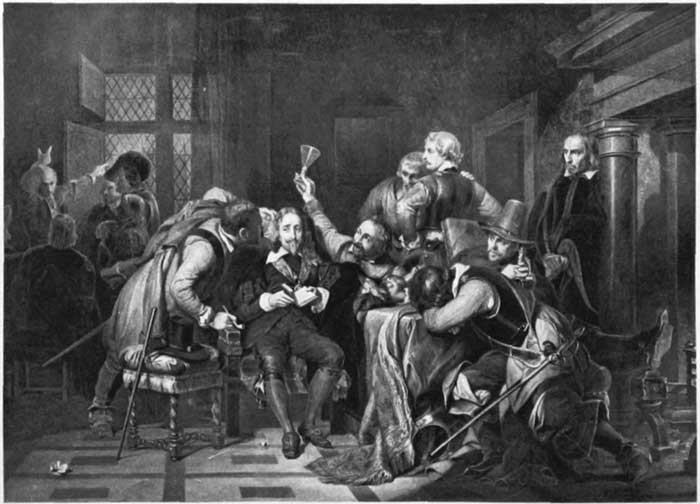
CHARLES I. IN PRISON
Photogravure after De La Roche
THE DIARY OF JOHN EVELYN
EDITED FROM THE ORIGINAL MSS BY WILLIAM BRAY Fellow of the Antiquarian Society
IN TWO VOLUMES VOL. I
WITH A BIOGRAPHICAL INTRODUCTION BY THE EDITOR
AND A SPECIAL INTRODUCTION BY RICHARD GARNETT, LL.D. Of the British Museum
M. WALTER DUNNE, PUBLISHER WASHINGTON & LONDON
Copyright, 1901, BY M. WALTER DUNNE, PUBLISHER
ILLUSTRATIONS
VOLUME I.
Charles I. in Prison FrontispiecePhotogravure after De La Roche.
Lord William Russell Taking Leave of His Children, 1683 180Photogravure after a painting by Bridges.
Oliver Cromwell Dictating to John Milton 284The letter to the Duke of Savoy to stop the persecution of the Protestants of Piedmont, 1655.
Photogravure from an engraving by Sartain after Newenham.
VOLUME II.
The Duke of BuckinghamFrontispiece
From an old painting.
Nell Gwynne64
Photogravure after Sir Peter Lely.
EVELYN'S DIARY
The two chief diarists of the age of Charles the Second are, mutatis mutandis, not ill characterized by the remark of a wicked wit upon the brothers Austin. "John Austin," it was said, "served God and died poor: Charles Austin served the devil, and died rich. Both were clever fellows. Charles was much the cleverer of the two." Thus John Evelyn and Samuel Pepys, the former a perfect model of decorum, the latter a grievous example of indecorum, have respectively left us diaries, of which the indecorous is to the decorous as a zoölogical garden is to a museum: while the disparity between the testamentary bequests of the two Austins but imperfectly represents the reputation standing to Pepys's account with posterity in comparison with that accruing to his sedate and dignified contemporary.
Museums, nevertheless, have their uses, and Evelyn's comparatively jejune record has laid us under no small obligation. But for Pepys's amazing indiscretion and garrulity, qualities of which one cannot have too little in life, or too much in the record of it, Evelyn would have been esteemed the first diarist of his age. Unable for want of these qualifications to draw any adequate picture of the stirring life around him, he has executed at least one portrait admirably, his own. The likeness is, moreover, valuable, as there is every reason to suppose it typical, and representative of a very important class of society, the well-bred and well-conducted section of the untitled aristocracy of England. We may well believe that these men were not only the salt but the substance of their order. There was an ill-bred section exclusively devoted to festivity and sport. There was an ill-conducted section, plunged into the dissipations of court life. But the majority were men like Evelyn: not, perhaps, equally refined by culture and travel, or equally interested in literary research and scientific experiment, but well informed and polite; no strangers to the Court, yet hardly to be called courtiers, and preferring country to town; loyal to Church and King but not fanatical or rancorous; as yet but slightly imbued with the principles of civil and religious liberty, yet adverse to carry the dogma of divine right further than the right of succession; fortunate in having survived all ideas of serfdom or vassalage, and in having few private interests not fairly reconcilable with the general good. Evelyn was made to be the spokesman of such a class, and, meaning to speak only for himself, he delivers its mind concerning the Commonwealth and the Restoration, the conduct of the later Stuart Kings and the Revolution.
Evelyn's Diary practically begins where many think he had no business to be diarising, beyond the seas. The position of a loyalist who solaces himself in Italy while his King is fighting for his crown certainly requires explanation: it may be sufficient apology for Evelyn that without the family estates he could be of no great service to the King, and that these, lying near London, were actually in the grasp of the Parliament. He was also but one of a large family and it was doubtless convenient that one member should be out of harm's way. His three years' absence (1643-6) has certainly proved advantageous to posterity. Evelyn is, indeed, a mere sight-seer, but this renders his tour a precise record of the objects which the sight-seer of the seventeenth century was expected to note, and a mirror not only of the taste but of the feeling of the time. There is no cult of anything, but there is curiosity about everything; there is no perception of the sentiment of a landscape, but real enjoyment of the landscape itself; antiquity is not unappreciated, but modern works impart more real pleasure. Of the philosophical reflections which afterward rose to the mind of Gibbon there is hardly a vestige, and of course Evelyn is at an immeasurable distance from Byron and De Staël. But he gives us exactly what we want, the actual attitude of a cultivated young Englishman in presence of classic and renaissance art with its background of Southern nature. We may register without undue self-complacency a great development of the modern world in the æsthetical region of the intellect, which implies many other kinds of progress. It is interesting to compare with Evelyn's narrative the chapters recording the visit to Italy supposed to have been made at this very period by John Inglesant, who inevitably sees with the eyes of the nineteenth century. Evelyn's casual remarks on foreign manners and institutions display good sense, without extraordinary insight; in description he is frequently observant and graphic, as in his account of the galley slaves, and of Venetian female costumes. He naturally regards Alpine scenery as "melancholy and troublesome."
Returned to England, Evelyn strictly follows the line of the average English country gentleman, execrating the execution of Charles I., disgusted beyond measure with the suppression of the Church of England service, but submissive to the powers that be until there are evident indications of a change, which he promotes in anything but a Quixotic spirit. Although he is sincerely attached to the monarchy, the condition of the Church is evidently a matter of greater concern to him: Cromwell would have done much to reconcile the royalists to his government, had it been possible for him to have restored the liturgy and episcopacy. The same lesson is to be derived from his demeanor during the reigns of Charles and James. The exultation with which the Restoration is at first hailed soon evaporates. The scandals of the Court are an offense, notwithstanding Evelyn's personal attachment to the King. But the chief point is not vice or favoritism or mismanagement, but alliances with Roman Catholic powers against Protestant nations. Evelyn is enraged to see Charles missing the part so clearly pointed out to him by Providence as the protector of the Protestant religion all over Europe. The conversion of the Duke of York is a fearful blow, James's ecclesiastical policy after his accession adds to Evelyn's discontent day by day, while political tyranny passes almost without remark. At last the old cavalier is glad to welcome the Prince of Orange as deliverer, and though he has no enthusiasm for William in his character as King, he remains his dutiful subject. Just because Evelyn was by no means an extraordinary person, he represents the plain straightforward sense of the English gentry. The questions of the seventeenth century were far more religious than political. The synthesis "Church and King" expressed the dearest convictions of the great majority of English country families, but when the two became incompatible they left no doubt which held the first place in their hearts. They acted instinctively on the principle of the Persian lady who preferred her brother to her husband. It was not impossible to find a new King, but there was no alternative to the English Church.
Evelyn's memoirs thus possess a value far exceeding the modest measure of worth allowed them by De Quincey: "They are useful as now and then enabling one to fix the date of a particular event, but for little besides." The Diary's direct contribution to historical accuracy is insignificant; it is an index, not to chronological minutiæ, but to the general progress of moral and political improvement. The editor of 1857 certainly goes too far in asserting that "All that might have been excluded from the range of his opinions, his feelings and sympathies embraced"; but it is interesting to observe the gradual widening of Evelyn's sympathies with good men of all parties, and to find him in his latter days criticising the evidence produced in support of the Popish Plot on the one hand, and deploring the just condemnation of Algernon Sydney on the other. It is true that, so far as the sufferings of his country are concerned, his attitude is rather that of the Levite than of the Samaritan; but more lively popular sympathies would have destroyed the peculiar value attaching to the testimony of the reluctant witness. We should, for example, have thought little of such a passage as the following from the pen of Burnet, from Evelyn it is significant indeed:—
October 14, 1688.—The King's birthday. No guns from the Tower as usual. The sun eclipsed at its rising. This day signal for the victory of William the Conqueror against Harold, near Battel in Sussex. The wind, which had been hitherto west, was east all this day. Wonderful expectation of the Dutch fleet. Public prayers ordered to be read in the churches against invasion.
It might be difficult to produce a nearer approximation in secular literature to Daniel's "Mene, Mene, Tekel, Upharsin."
There is little else in the Diary equally striking, though Evelyn's description of Whitehall on the eve of the death of Charles the Second ranks among the memorable passages of the language. It is nevertheless full of interesting anecdotes and curious notices, especially of the scientific research which, in default of any adequate public organization, was in that age more efficaciously promoted by students than by professors. De Quincey censures Evelyn for omitting to record the conversation of the men with whom he associated, but he does not consider that the Diary in its present shape is a digest of memoranda made long previously, and that time failed at one period and memory at the other. De Quincey, whose extreme acuteness was commonly evinced on the negative side of a question, saw the weak points of the Diary upon its first publication much more clearly than his contemporaries did, and was betrayed into illiberality by resentment at what he thought its undeserved vogue. Evelyn has in truth been fortunate; his record, which his contemporaries would have neglected, appeared (1818) just in time to be a precursor of the Anglican movement, a tendency evinced in a similar fashion by the vindication, no doubt mistaken, of the Caroline authorship of the "Icon Basilike." Evelyn was a welcome encounter to men of this cast of thought, and was hailed as a model of piety, culture, and urbanity, without sufficient consideration of his deficiencies as a loyalist and a patriot. It also conduced to his reputation that all his other writings should have virtually perished except his "Sylva," like his Diary a landmark in the history of improvement, though in a widely different department. But for his lack of diplomatic talent, he might be compared with an eminent and much applauded, but in our times somewhat decrescent, contemporary, Sir William Temple. Both these eminent persons would have aroused a warmer feeling in posterity, and have effected more for its instruction and entertainment, if they could occasionally have dashed their dignity with an infusion of the grotesqueness, we will not say of Pepys, but of Roger North. To them, however, their dignity was their character, and although we could have wished them a larger measure of geniality, we must feel indebted to them for their preservation of a refined social type.

EDITOR'S INTRODUCTION
Evelyn lived in the busy and important times of King Charles I., Oliver Cromwell, King Charles II., King James II., and King William, and early accustomed himself to note such things as occurred, which he thought worthy of remembrance. He was known to, and had much personal intercourse with, the Kings Charles II. and James II.; and he was in habits of great intimacy with many of the ministers of these two monarchs, and with many of the eminent men of those days, as well among the clergy as the laity. Foreigners distinguished for learning, or arts, who came to England, did not leave it without visiting him.
The following pages contribute extensive and important particulars of this eminent man. They show that he did not travel merely to count steeples, as he expresses himself in one of his Letters: they develop his private character as one of the most amiable kind. With a strong predilection for monarchy, with a personal attachment to Kings Charles II. and James II., formed when they resided at Paris, he was yet utterly averse to the arbitrary measures of these monarchs.
Strongly and steadily attached to the doctrine and practice of the Church of England, he yet felt the most liberal sentiments for those who differed from him in opinion. He lived in intimacy with men of all persuasions; nor did he think it necessary to break connection with anyone who had ever been induced to desert the Church of England, and embrace the doctrines of that of Rome. In writing to the brother of a gentleman thus circumstanced, in 1659, he expresses himself in this admirable manner: "For the rest, we must commit to Providence the success of times and mitigation of proselytical fervors; having for my own particular a very great charity for all who sincerely adore the Blessed Jesus, our common and dear Saviour, as being full of hope that God (however the present zeal of some, and the scandals taken by others at the instant [present] affliction of the Church of England may transport them) will at last compassionate our infirmities, clarify our judgments, and make abatement for our ignorances, superstructures, passions, and errors of corrupt times and interests, of which the Romish persuasion can no way acquit herself, whatever the present prosperity and secular polity may pretend. But God will make all things manifest in his own time, only let us possess ourselves in patience and charity. This will cover a multitude of imperfections."
He speaks with great moderation of the Roman Catholics in general, admitting that some of the laws enacted against them might be mitigated; but of the Jesuits he had the very worst opinion, considering them as a most dangerous Society, and the principal authors of the misfortunes which befell King James II., and of the horrible persecutions of the Protestants in France and Savoy.
He must have conducted himself with uncommon prudence and address, for he had personal friends in the Court of Cromwell, at the same time that he was corresponding with his father-in-law, Sir Richard Browne, the Ambassador of King Charles II. at Paris; and at the same period that he paid his court to the King, he maintained his intimacy with a disgraced minister.
In his travels, he made acquaintance not only with men eminent for learning, but with men ingenious in every art and profession.
His manners we may presume to have been most agreeable; for his company was sought by the greatest men, not merely by inviting him to their own tables, but by their repeated visits to him at his own house; and this was equally the case with regard to ladies, of many of whom he speaks in the highest style of admiration, affection, and respect. He was master of the French, Italian, and Spanish languages. That he had read a great deal is manifest; but at what time he found opportunities for study, it is not easy to say. He acknowledges himself to have been idle, while at Oxford; and, when on his travels, he had little time for reading, except when he stayed about nineteen weeks in France, and at Padua, where he was likewise stationary for several months. At Rome, he remained a considerable time, but, while there, he was so continually engaged in viewing the great variety of interesting objects to be seen in that city, that he could have found little leisure for reading. When resident in England, he was so much occupied in the business of his numerous offices, in paying visits, in receiving company at home, and in examining whatever was deemed worthy of curiosity, or of scientific observation, that it is astonishing how he found the opportunity to compose the numerous books which he published, and the much greater number of Papers, on almost every subject, which still remain in manuscript; to say nothing of the very extensive and voluminous correspondence which he appears to have carried on during his long life, with men of the greatest eminence in Church and State, and the most distinguished for learning, both Englishmen and foreigners. In this correspondence he does not seem to have made use of an amanuensis; and he has left transcripts in his own hand of great numbers of letters both received and sent. He observes, indeed, in one of these, that he seldom went to bed before twelve, or closed his eyes before one o'clock.
He was happy in a wife of congenial dispositions with his own, of an enlightened mind, who had read much, and was skilled in etching and painting, yet attentive to the domestic concerns of her household, and a most affectionate mother.
His grandfather, George, was not the first of the family who settled in Surrey. John, father of this George, was of Kingston, in 1520, and married a daughter of David Vincent, Esq., Lord of the Manor of Long Ditton, near Kingston, which afterward came in the hands of George, who there carried on the manufacture of gunpowder. He purchased very considerable estates in Surrey, and three of his sons became heads of three families, viz, Thomas, his eldest son, at Long Ditton; John, at Godstone, and Richard at Wotton. Each of these three families had the title of Baronet conferred on them at different times, viz, at Godstone, in 1660; Long Ditton, in 1683; and Wotton, in 1713.
The manufacture of gunpowder was carried on at Godstone as well as at Long Ditton; but it does not appear that there ever was any mill at Wotton, or that the purchase of that place was made with such a view.
It may be not altogether incurious to observe, that though Mr. Evelyn's father was a man of very considerable fortune, the first rudiments of this son's learning were acquired from the village schoolmaster over the porch of Wotton Church. Of his progress at another school, and at college, he himself speaks with great humility; nor did he add much to his stock of knowledge, while he resided in the Middle Temple, to which his father sent him, with the intention that he should apply to what he calls "an impolished study," which he says he never liked.
The "Biographia" does not notice his tour in France, Flanders, and Holland, in 1641, when he made a short campaign as a volunteer in an English regiment then in service in Flanders.1 Nor does it notice his having set out, with intent to join King Charles I. at Brentford; and subsequently desisting when the result of that battle became known, on the ground that his brother's as well as his own estates were so near London as to be fully in power of the Parliament, and that their continued adherence would have been certain ruin to themselves without any advantage to his Majesty. In this dangerous conjuncture he asked and obtained the King's leave to travel. Of these travels, and the observations he made therein, an ample account is given in this Diary.
The national troubles coming on before he had engaged in any settled plan for his future life, it appears that he had thoughts of living in the most private manner, and that, with his brother's permission, he had even begun to prepare a place for retirement at Wotton. Nor did he afterward wholly abandon his intention, if the plan of a college, which he sent to Mr. Boyle in 1659, was really formed on a serious idea. This scheme is given at length in the "Biographia," and in Dr. Hunter's edition of the "Sylva" in 1776; but it may be observed that he proposes it should not be more than twenty-five miles from London.
As to his answer to Sir George Mackenzie's panegyric on Solitude, in which Mr. Evelyn takes the opposite part and urges the preference to which public employment and an active life is entitled,—it may be considered as the playful essay of one who, for the sake of argument, would controvert another's position, though in reality agreeing with his own opinion; if we think him serious in two letters to Mr. Abraham Cowley, dated 12th March and 24th August, 1666, in the former of which he writes: "You had reason to be astonished at the presumption, not to name it affront, that I, who have so highly celebrated recess, and envied it in others, should become an advocate for the enemy, which of all others it abhors and flies from. I conjure you to believe that I am still of the same mind, and that there is no person alive who does more honor and breathe after the life and repose you so happily cultivate and advance by your example; but, as those who praised dirt, a flea, and the gout, so have I public employment in that trifling Essay, and that in so weak a style compared with my antagonist's, as by that alone it will appear I neither was nor could be serious, and I hope you believe I speak my very soul to you.
'Sunt enim Musis sua ludicra mista Camœnis Otia sunt——'"
In the other, he says, "I pronounce it to you from my heart as oft as I consider it, that I look on your fruitions with inexpressible emulation, and should think myself more happy than crowned heads, were I, as you, the arbiter of mine own life, and could break from those gilded toys to taste your well-described joys with such a wife and such a friend, whose conversation exceeds all that the mistaken world calls happiness." But, in truth, Mr. Evelyn's mind was too active to admit of solitude at all times, however desirable it might appear to him in theory.
After he had settled at Deptford, which was in the time of Cromwell, he kept up a constant correspondence with Sir Richard Browne (his father-in-law), the King's Ambassador at Paris; and though his connection must have been known, it does not appear that he met with any interruption from the government here. Indeed, though he remained a decided Royalist, he managed so well as to have intimate friends even among those nearly connected with Cromwell; and to this we may attribute his being able to avoid taking the Covenant, which he says he never did take. In 1659, he published "An Apology for the Royal Party"; and soon after printed a paper which was of great service to the King, entitled "The Late News, or Message from Brussels Unmasked," which was an answer to a pamphlet designed to represent the King in the worst light.
On the Restoration, we find him very frequently at Court; and he became engaged in many public employments, still attending to his studies and literary pursuits. Among these, is particularly to be mentioned the Royal Society, in the establishment and conduct of which he took a very active part. He procured Mr. Howard's library to be given to them; and by his influence, in 1667, the Arundelian Marbles were obtained for the University of Oxford.
His first appointment to a public office was in 1662, as a Commissioner for reforming the buildings, ways, streets, and incumbrances, and regulating hackney coaches in London. In the same year he sat as a Commissioner on an inquiry into the conduct of the Lord Mayor, etc., concerning Sir Thomas Gresham's charities. In 1664 he was in a commission for regulating the Mint; in the same year was appointed one of the Commissioners for the care of the Sick and Wounded in the Dutch war; and he was continued in the same employment in the second war with that country.
He was one of the Commissioners for the repair of St. Paul's Cathedral, shortly before it was burned in 1666. In that year he was also in a commission for regulating the farming and making saltpetre; and in 1671 we find him a Commissioner of Plantations on the establishment of the board, to which the Council of Trade was added in 1672.
In 1685 he was one of the Commissioners of the Privy Seal, during the absence of the Earl of Clarendon (who held that office), on his going Lord Lieutenant to Ireland. On the foundation of Greenwich Hospital, in 1695, he was one of the Commissioners; and, on the 30th of June, 1696, laid the first stone of that building. He was also appointed Treasurer, with a salary of £200 a year; but he says that it was a long time before he received any part of it.
When the Czar of Muscovy came to England, in 1698, proposing to instruct himself in the art of shipbuilding, he was desirous of having the use of Sayes Court, in consequence of its vicinity to the King's dockyard at Deptford. This was conceded; but during his stay he did so much damage that Mr. Evelyn had an allowance of £150 for it. He especially regrets the mischief done to his famous holly hedge, which might have been thought beyond the reach of damage. But one of Czar Peter's favorite recreations had been to demolish the hedges by riding through them in a wheelbarrow.
October, 1699, his elder brother, George Evelyn, dying without male issue, aged eighty-three, he succeeded to the paternal estate; and in May following, he quitted Sayes Court and went to Wotton, where he passed the remainder of his life, with the exception of occasional visits to London, where he retained a house. In the great storm of 1703, he mentions in his last edition of the "Sylva," above one thousand trees were blown down in sight of his residence.
He died at his house in London, 27th February, 1705-6, in the eighty-sixth year of his age, and was buried at Wotton. His lady survived him nearly three years, dying 9th February, 1708-9, in her seventy-fourth year, and was buried near him at Wotton.
Of Evelyn's children, a son, who died at the age of five, and a daughter, who died at the age of nineteen, were almost prodigies. The particulars of their extraordinary endowments, and the profound manner in which he was affected at their deaths, may be seen in these volumes.
One daughter was well and happily settled; another less so; but she did not survive her marriage more than a few months. The only son who lived to the age of manhood, inherited his father's love of learning, and distinguished himself by several publications.
Mr. Evelyn's employment as a Commissioner for the care of the Sick and Wounded was very laborious; and, from the nature of it, must have been extremely unpleasant. Almost the whole labor was in his department, which included all the ports between the river Thames and Portsmouth; and he had to travel in all seasons and weathers, by land and by water, in the execution of his office, to which he gave the strictest attention. It was rendered still more disagreeable by the great difficulty which he found in procuring money for support of the prisoners. In the library at Wotton, are copies of numerous letters to the Lord Treasurer and Officers of State, representing, in the strongest terms, the great distress of the poor men, and of those who had furnished lodging and necessaries for them. At one time, there were such arrears of payment to the victuallers, that, on landing additional sick and wounded, they lay some time in the streets, the publicans refusing to receive them, and shutting up their houses. After all this trouble and fatigue, he found as great difficulty in getting his accounts settled.2 In January, 1665-6, he formed a plan for an Infirmary at Chatham, which he sent to Mr. Pepys, to be laid before the Admiralty, with his reasons for recommending it; but it does not appear that it was carried into execution.
His employments, in connection with the repair of St. Paul's (which, however, occupied him but a brief time), as in the Commission of Trade and Plantations, and in the building of Greenwich Hospital, were much better adapted to his inclinations and pursuits.
As a Commissioner of the Privy Seal in the reign of King James II., he had a difficult task to perform. He was most steadily attached to the Church of England, and the King required the Seal to be affixed to many things incompatible with the welfare of that Church. This, on some occasions, he refused to do, particularly to a license to Dr. Obadiah Walker to print Popish books;3 and on other occasions he absented himself, leaving it to his brother Commissioners to act as they thought fit. Such, however, was the King's estimation of him, that no displeasure was evinced on this account.
Of Evelyn's attempt to bring Colonel Morley (Cromwell's Lieutenant of the Tower, immediately preceding the Restoration) over to the King's interest, an imperfect account is given in the "Biographia." The fact is, that there was great friendship between these gentlemen, and Evelyn did endeavor to engage the Colonel in the King's interest. He saw him several times, and put his life into his hands by writing to him on 12th January, 1659-60; he did not succeed, and Colonel Morley was too much his friend to betray him; but so far from the Colonel having settled matters privately with Sir Anthony Ashley Cooper, or General Monk, as there described, he was obliged, when the Restoration took place, actually to apply to Evelyn to procure his pardon; who obtained it accordingly, though, as he states, the Colonel was obliged to pay a large sum of money for it. This could not have happened, if there had been any previous negotiation with General Monk.
Dr. Campbell took some pains to vindicate Mr. Evelyn's book, entitled, "Navigation and Commerce, their Origin and Progress," from the charge of being an imperfect work, unequal to the expectation excited by the title. But the Doctor, who had not the information which this Journal so amply affords on this subject, was not aware that what was so printed was nothing more than an Introduction to the History of the Dutch War; a work undertaken by Evelyn at the express command of King Charles II., and the materials for which were furnished by the Officers of State. The completion of this work, after considerable progress had been made in it, was put a stop to by the King himself, for what reason does not appear; but perhaps it was found that Evelyn was inclined to tell too much of the truth concerning a transaction, which it will be seen by his Journal that he utterly reprobated. His copy of the History, as far as he had proceeded, he put into the hands of his friend, Mr. Pepys, of the Admiralty, who did not return it; but the books and manuscripts belonging to Mr. Pepys passed into the possession of Magdalen College, Cambridge.
From the numerous authors who have spoken in high terms of Mr. Evelyn, we will select the two following notices of him.
In the "Biographia Britannica" Dr. Campbell says, "It is certain that very few authors who have written in our language deserve the character of able and agreeable writers so well as Mr. Evelyn, who, though he was acquainted with most sciences, and wrote upon many different subjects, yet was very far, indeed the farthest of most men of his time, from being a superficial writer. He had genius, he had taste, he had learning; and he knew how to give all these a proper place in his works, so as never to pass for a pedant, even with such as were least in love with literature, and to be justly esteemed a polite author by those who knew it best."
Horace Walpole (afterward Earl of Orford), in his Catalogue of Engravers, gives us the following admirably drawn character: "If Mr. Evelyn had not been an artist himself, as I think I can prove he was, I should yet have found it difficult to deny myself the pleasure of allotting him a place among the arts he loved, promoted, patronized; and it would be but justice to inscribe his name with due panegyric in these records, as I have once or twice taken the liberty to criticise him. But they are trifling blemishes compared with his amiable virtues and beneficence; and it may be remarked that the worst I have said of him is, that he knew more than he always communicated. It is no unwelcome satire to say, that a man's intelligence and philosophy is inexhaustible. I mean not to write his biography, but I must observe, that his life, which was extended to eighty-six years, was a course of inquiry, study, curiosity, instruction, and benevolence. The works of the Creator, and the minute labors of the creature, were all objects of his pursuit. He unfolded the perfection of the one, and assisted the imperfection of the other. He adored from examination; was a courtier that flattered only by informing his Prince, and by pointing out what was worthy of him to countenance; and really was the neighbor of the Gospel, for there was no man that might not have been the better for him. Whoever peruses a list of his works will subscribe to my assertion. He was one of the first promoters of the Royal Society; a patron of the ingenious and the indigent; and peculiarly serviceable to the lettered world; for, besides his writings and discoveries, he obtained the Arundelian Marbles for the University of Oxford, and the Arundelian Library for the Royal Society. Nor is it the least part of his praise, that he who proposed to Mr. Boyle the erection of a Philosophical College for retired and speculative persons, had the honesty to write in defense of active life against Sir George Mackenzie's 'Essay on Solitude.' He knew that retirement, in his own hands, was industry and benefit to mankind; but in those of others, laziness and inutility."
Evelyn was buried in the Dormitory adjoining Wotton Church.
On a white marble, covering a tomb shaped like a coffin, raised about three feet above the floor, is inscribed:
Here lies the Body
of John Evelyn, Esq.,
of this place, second son
of Richard Evelyn, Esq.;
who having serv'd the Publick
in several employments, of which that
of Commissioner of the Privy-Seal in the
Reign of King James the 2d was most
honourable, and perpetuated his fame
by far more lasting monuments than
those of Stone or Brass, his learned
and usefull Works, fell asleep the 27 day
of February 1705-6, being the 86 year
of his age, in full hope of a glorious
Resurrection, thro' Faith in Jesus Christ.
Living in an age of extraordinary
Events and Revolutions, he learnt
(as himself asserted) this Truth,
which pursuant to his intention
is here declared—
That all is vanity which is not honest,
and that there is no solid wisdom
but in real Piety.
Of five Sons and three Daughters
born to him from his most
vertuous and excellent Wife,
Mary, sole daughter and heiress
of Sir Rich. Browne of Sayes
Court near Deptford in Kent,
onely one daughter, Susanna,
married to William Draper
Esq., of Adscomb in this
County, survived him; the
two others dying in the
flower of their age, and
all the Sons very young, except
one named John, who
deceased 24 March, 1698-9,
in the 45 year of his age,
leaving one son, John, and
one daughter, Elizabeth.
VOLUME I. 1620-1664
VOLUME II. 1665-1706
DIARY OF JOHN EVELYN.
WOTTON
I was born at Wotton, in the County of Surrey, about twenty minutes past two in the morning, being on Tuesday the 31st and last of October, 1620, after my father had been married about seven years,4 and that my mother had borne him three children; viz, two daughters and one son, about the 33d year of his age, and the 23d of my mother's.
My father, named Richard, was of a sanguine complexion, mixed with a dash of choler: his hair inclining to light, which, though exceedingly thick, became hoary by the time he had attained to thirty years of age; it was somewhat curled toward the extremities; his beard, which he wore a little peaked, as the mode was, of a brownish color, and so continued to the last, save that it was somewhat mingled with gray hairs about his cheeks, which, with his countenance, were clear and fresh-colored; his eyes extraordinary quick and piercing; an ample forehead,—in sum, a very well-composed visage and manly aspect: for the rest, he was but low of stature, yet very strong. He was, for his life, so exact and temperate, that I have heard he had never been surprised by excess, being ascetic and sparing. His wisdom was great, and his judgment most acute; of solid discourse, affable, humble, and in nothing affected; of a thriving, neat, silent, and methodical genius, discreetly severe, yet liberal upon all just occasions, both to his children, to strangers, and servants; a lover of hospitality; and, in brief, of a singular and Christian moderation in all his actions; not illiterate, nor obscure, as, having continued Justice of the Peace and of the Quorum, he served his country as High Sheriff, being, as I take it, the last dignified with that office for Sussex and Surrey together, the same year, before their separation. He was yet a studious decliner of honors and titles; being already in that esteem with his country, that they could have added little to him besides their burden. He was a person of that rare conversation that, upon frequent recollection, and calling to mind passages of his life and discourse, I could never charge him with the least passion, or inadvertency. His estate was esteemed about £4000 per annum, well wooded, and full of timber.
My mother's name was Eleanor, sole daughter and heiress of John Standsfield, Esq., of an ancient and honorable family (though now extinct) in Shropshire, by his wife Eleanor Comber, of a good and well-known house in Sussex. She was of proper personage; of a brown complexion; her eyes and hair of a lovely black; of constitution more inclined to a religious melancholy, or pious sadness; of a rare memory, and most exemplary life; for economy and prudence, esteemed one of the most conspicuous in her country: which rendered her loss much deplored, both by those who knew, and such as only heard of her.
Thus much, in brief, touching my parents; nor was it reasonable I should speak less of them to whom I owe so much.
The place of my birth was Wotton, in the parish of Wotton, or Blackheath, in the county of Surrey, the then mansion-house of my father, left him by my grandfather, afterward and now my eldest brother's. It is situated in the most southern part of the shire; and, though in a valley, yet really upon part of Leith Hill, one of the most eminent in England for the prodigious prospect to be seen from its summit, though by few observed. From it may be discerned twelve or thirteen counties, with part of the sea on the coast of Sussex, in a serene day. The house is large and ancient, suitable to those hospitable times, and so sweetly environed with those delicious streams and venerable woods, as in the judgment of strangers as well as Englishmen it may be compared to one of the most pleasant seats in the nation, and most tempting for a great person and a wanton purse to render it conspicuous. It has rising grounds, meadows, woods, and water, in abundance.
The distance from London little more than twenty miles, and yet so securely placed, as if it were one hundred; three miles from Dorking, which serves it abundantly with provision as well of land as sea; six from Guildford, twelve from Kingston. I will say nothing of the air, because the pre-eminence is universally given to Surrey, the soil being dry and sandy; but I should speak much of the gardens, fountains, and groves that adorn it, were they not as generally known to be among the most natural, and (till this later and universal luxury of the whole nation, since abounding in such expenses) the most magnificent that England afforded; and which indeed gave one of the first examples to that elegancy, since so much in vogue, and followed in the managing of their waters, and other elegancies of that nature. Let me add, the contiguity of five or six manors, the patronage of the livings about it, and what Themistocles pronounced for none of the least advantages—the good neighborhood. All which conspire here to render it an honorable and handsome royalty, fit for the present possessor, my worthy brother, and his noble lady, whose constant liberality gives them title both to the place and the affections of all that know them. Thus, with the poet:
1 This expression is, perhaps, hardly applicable to the fact of Evelyn's having witnessed a siege merely as a curious spectator. He reached the camp on the 2d, and left it on the 8th of August, 1641. It is certain, however, that during these six days he took his turn on duty, and trailed a pike.—See Diary.
2 2d October, 1665, he writes to the Lord Chancellor, Lord Arlington, Sir William Coventry, and Sir Philip Warwick, complaining of want of money for the prisoners: praying that while he and his brother Commissioners adventure their persons and all that is dear to them, in this uncomfortable service, they may not be exposed to ruin, and to a necessity of abandoning their care; and adding that they have lost their officers and servants by the pestilence, and are hourly environed with the saddest objects of perishing people. "I have," says he, "fifteen places full of sick men, where they put me to unspeakable trouble; the magistrates and justices, who should further us in our exigencies, hindering the people from giving us quarters, jealous of the contagion, and causing them to shut the doors at our approach."
3 Dr. Walker had been a member of the Church of England, but had renounced it, and turned Papist.
4 He was married at St. Thomas's, Southwark, 27th January, 1613. My sister Eliza was born at nine at night, 28th November, 1614; Jane at four in the morning, 16th February, 1616; my brother George at nine at night, Wednesday, 18th June, 1617; and my brother Richard, 9th November, 1622.—Note by Evelyn.
Nescio quâ natale solum dulcedine cunctos Ducit, et immemores non sinit esse sui.
I had given me the name of my grandfather, my mother's father, who, together with a sister of Sir Thomas Evelyn, of Long Ditton, and Mr. Comber, a near relation of my mother, were my susceptors. The solemnity (yet upon what accident I know not, unless some indisposition in me) was performed in the dining-room by Parson Higham, the present incumbent of the parish, according to the forms prescribed by the then glorious Church of England.
I was now (in regard to my mother's weakness, or rather custom of persons of quality) put to nurse to one Peter, a neighbor's wife and tenant, of a good, comely, brown, wholesome complexion, and in a most sweet place toward the hills, flanked with wood and refreshed with streams; the affection to which kind of solitude I sucked in with my very milk. It appears, by a note of my father's, that I sucked till 17th of January, 1622, or at least I came not home before.5
1623. The very first thing that I can call to memory, and from which time forward I began to observe, was this year (1623) my youngest brother, being in his nurse's arms, who, being then two days and nine months younger than myself, was the last child of my dear parents.
1624. I was not initiated into any rudiments until near four years of age, and then one Frier taught us at the church-porch of Wotton; and I do perfectly remember the great talk and stir about Il Conde Gondomar, now Ambassador from Spain (for near about this time was the match of our Prince with the Infanta proposed); and the effects of that comet, 1618, still working in the prodigious revolutions now beginning in Europe, especially in Germany, whose sad commotions sprang from the Bohemians' defection from the Emperor Matthias; upon which quarrel the Swedes broke in, giving umbrage to the rest of the princes, and the whole Christian world cause to deplore it, as never since enjoying perfect tranquillity.
1625. I was this year (being the first of the reign of King Charles) sent by my father to Lewes, in Sussex, to be with my grandfather, Standsfield, with whom I passed my childhood. This was the year in which the pestilence was so epidemical, that there died in London 5,000 a week, and I well remember the strict watches and examinations upon the ways as we passed; and I was shortly after so dangerously sick of a fever that (as I have heard) the physicians despaired of me.
1626. My picture was drawn in oil by one Chanterell, no ill painter.
1627. My grandfather, Standsfield, died this year, on the 5th of February: I remember perfectly the solemnity at his funeral. He was buried in the parish church of All Souls, where my grandmother, his second wife, erected him a pious monument. About this time, was the consecration of the Church of South Malling, near Lewes, by Dr. Field, Bishop of Oxford (one Mr. Coxhall preached, who was afterward minister); the building whereof was chiefly procured by my grandfather, who having the impropriation, gave £20 a year out of it to this church. I afterward sold the impropriation. I laid one of the first stones at the building of the church.
1628-30. It was not till the year 1628, that I was put to learn my Latin rudiments, and to write, of one Citolin, a Frenchman, in Lewes. I very well remember that general muster previous to the Isle of Rhè's expedition, and that I was one day awakened in the morning with the news of the Duke of Buckingham being slain by that wretch, Felton, after our disgrace before La Rochelle. And I now took so extraordinary a fancy to drawing and designing, that I could never after wean my inclinations from it, to the expense of much precious time, which might have been more advantageously employed. I was now put to school to one Mr. Potts, in the Cliff at Lewes, from whom, on the 7th of January, 1630, being the day after Epiphany, I went to the free-school at Southover, near the town, of which one Agnes Morley had been the foundress, and now Edward Snatt was the master, under whom I remained till I was sent to the University.6 This year, my grandmother (with whom I sojourned) being married to one Mr. Newton, a learned and most religious gentleman, we went from the Cliff to dwell at his house in Southover. I do most perfectly remember the jubilee which was universally expressed for the happy birth of the Prince of Wales, 29th of May, now Charles II., our most gracious Sovereign.
1631. There happened now an extraordinary dearth in England, corn bearing an excessive price; and, in imitation of what I had seen my father do, I began to observe matters more punctually, which I did use to set down in a blank almanac. The Lord of Castlehaven's arraignment for many shameful exorbitances was now all the talk, and the birth of the Princess Mary, afterward Princess of Orange.
21st October, 1632. My eldest sister was married to Edward Darcy, Esq., who little deserved so excellent a person, a woman of so rare virtue. I was not present at the nuptials; but I was soon afterward sent for into Surrey, and my father would willingly have weaned me from my fondness of my too indulgent grandmother, intending to have placed me at Eton; but, not being so provident for my own benefit, and unreasonably terrified with the report of the severe discipline there, I was sent back to Lewes; which perverseness of mine I have since a thousand times deplored. This was the first time that ever my parents had seen all their children together in prosperity. While I was now trifling at home, I saw London, where I lay one night only. The next day, I dined at Beddington, where I was much delighted with the gardens and curiosities. Thence, we returned to the Lady Darcy's, at Sutton; thence to Wotton; and, on the 16th of August following, 1633, back to Lewes.
3d November, 1633. This year my father was appointed Sheriff, the last, as I think, who served in that honorable office for Surrey and Sussex, before they were disjoined. He had 116 servants in liveries, every one liveried in green satin doublets; divers gentlemen and persons of quality waited on him in the same garb and habit, which at that time (when thirty or forty was the usual retinue of the High Sheriff) was esteemed a great matter. Nor was this out of the least vanity that my father exceeded (who was one of the greatest decliners of it); but because he could not refuse the civility of his friends and relations, who voluntarily came themselves, or sent in their servants. But my father was afterward most unjustly and spitefully molested by that jeering judge, Richardson, for reprieving the execution of a woman, to gratify my Lord of Lindsey, then Admiral: but out of this he emerged with as much honor as trouble. The king made this year his progress into Scotland, and Duke James was born.
15th December, 1634: My dear sister, Darcy, departed this life, being arrived to her 20th year of age; in virtue advanced beyond her years, or the merit of her husband, the worst of men. She had been brought to bed the 2d of June before, but the infant died soon after her, the 24th of December. I was therefore sent for home the second time, to celebrate the obsequies of my sister; who was interred in a very honorable manner in our dormitory joining to the parish church, where now her monument stands.
1635. But my dear mother being now dangerously sick, I was, on the 3d of September following, sent for to Wotton. Whom I found so far spent, that, all human assistance failing, she in a most heavenly manner departed this life upon the 29th of the same month, about eight in the evening of Michaelmas-day. It was a malignant fever which took her away, about the 37th of her age, and 22d of her marriage, to our irreparable loss and the regret of all that knew her. Certain it is, that the visible cause of her indisposition proceeded from grief upon the loss of her daughter, and the infant that followed it; and it is as certain, that when she perceived the peril whereto its excess had engaged her, she strove to compose herself and allay it; but it was too late, and she was forced to succumb. Therefore summoning all her children then living (I shall never forget it), she expressed herself in a manner so heavenly, with instructions so pious and Christian, as made us strangely sensible of the extraordinary loss then imminent; after which, embracing every one of us she gave to each a ring with her blessing and dismissed us. Then, taking my father by the hand, she recommended us to his care; and, because she was extremely zealous for the education of my younger brother, she requested my father that he might be sent with me to Lewes; and so having importuned him that what he designed to bestow on her funeral, he would rather dispose among the poor, she labored to compose herself for the blessed change which she now expected. There was not a servant in the house whom she did not expressly send for, advise, and infinitely affect with her counsel. Thus she continued to employ her intervals, either instructing her relations, or preparing of herself.
Though her physicians, Dr. Meverell, Dr. Clement, and Dr. Rand, had given over all hopes of her recovery, and Sir Sanders Duncombe had tried his celebrated and famous powder, yet she was many days impairing, and endured the sharpest conflicts of her sickness with admirable patience and most Christian resignation, retaining both her intellectuals and ardent affections for her dissolution, to the very article of her departure. When near her dissolution, she laid her hand on every one of her children; and taking solemn leave of my father, with elevated heart and eyes, she quietly expired, and resigned her soul to God. Thus ended that prudent and pious woman, in the flower of her age, to the inconsolable affliction of her husband, irreparable loss of her children, and universal regret of all that knew her. She was interred, as near as might be, to her daughter Darcy, the 3d of October, at night, but with no mean ceremony.
It was the 3d of the ensuing November, after my brother George was gone back to Oxford, ere I returned to Lewes, when I made way, according to instructions received of my father, for my brother Richard, who was sent the 12th after.
1636. This year being extremely dry, the pestilence much increased in London, and divers parts of England.
13th February, 1637: I was especially admitted (and, as I remember, my other brother) into the Middle Temple, London, though absent, and as yet at school. There were now large contributions to the distressed Palatinates.
The 10th of December my father sent a servant to bring us necessaries, and the plague beginning now to cease, on the 3d of April, 1637, I left school, where, till about the last year, I have been extremely remiss in my studies; so as I went to the University rather out of shame of abiding longer at school, than for any fitness, as by sad experience I found: which put me to re-learn all that I had neglected, or but perfunctorily gained.
OXFORD
10th May, 1637. I was admitted a Fellow-commoner of Baliol College, Oxford; and, on the 29th, I was matriculated in the vestry of St. Mary's, where I subscribed the Articles, and took the oaths: Dr. Baily, head of St. John's, being vice-chancellor, afterward bishop. It appears by a letter of my father's, that he was upon treaty with one Mr. Bathurst (afterward Doctor and President), of Trinity College, who should have been my tutor; but, lest my brother's tutor, Dr. Hobbs, more zealous in his life than industrious to his pupils, should receive it as an affront, and especially for that Fellow-commoners in Baliol were no more exempt from exercise than the meanest scholars there, my father sent me thither to one Mr. George Bradshaw (nomen invisum! yet the son of an excellent father, beneficed in Surrey). I ever thought my tutor had parts enough; but as his ambition made him much suspected of the College, so his grudge to Dr. Lawrence, the governor of it (whom he afterward supplanted), took up so much of his time, that he seldom or never had the opportunity to discharge his duty to his scholars. This I perceiving, associated myself with one Mr. James Thicknesse (then a young man of the foundation, afterward a Fellow of the house), by whose learned and friendly conversation I received great advantage. At my first arrival, Dr. Parkhurst was master: and after his decease, Dr. Lawrence, a chaplain of his Majesty's and Margaret Professor, succeeded, an acute and learned person; nor do I much reproach his severity, considering that the extraordinary remissness of discipline had (till his coming) much detracted from the reputation of that College.
There came in my time to the College one Nathaniel Conopios, out of Greece, from Cyrill, the patriarch of Constantinople, who, returning many years after, was made (as I understand) Bishop of Smyrna. He was the first I ever saw drink coffee; which custom came not into England till thirty years after.7
After I was somewhat settled there in my formalities (for then was the University exceedingly regular, under the exact discipline of William Laud, Archbishop of Canterbury, then Chancellor), I added, as benefactor to the library of the College, these books—"ex dono Johannis Evelyni, hujus Coll. Socio-Commensalis, filii Richardi Evelyni, è com. Surriæ, armigr."—
"Zanchii Opera," vols. 1, 2, 3.
"Granado in Thomam Aquinatem," vols. 1, 2, 3.
"Novarini Electa Sacra" and "Cresolii Anthologia Sacra"; authors, it seems, much desired by the students of divinity there.
Upon the 2d of July, being the first Sunday of the month, I first received the blessed Sacrament of the Lord's Supper in the college chapel, one Mr. Cooper, a Fellow of the house, preaching; and at this time was the Church of England in her greatest splendor, all things decent, and becoming the Peace, and the persons that governed. The most of the following week I spent in visiting the Colleges, and several rarities of the University, which do very much affect young comers.
18th July, 1637. I accompanied my eldest brother, who then quitted Oxford, into the country; and, on the 9th of August, went to visit my friends at Lewes, whence I returned the 12th to Wotton. On the 17th of September, I received the blessed Sacrament at Wotton church, and 23d of October went back to Oxford.
5th November, 1637. I received again the Holy Communion in our college chapel, one Prouse, a Fellow (but a mad one), preaching.
9th December, 1637. I offered at my first exercise in the Hall, and answered my opponent; and, upon the 11th following, declaimed in the chapel before the Master, Fellows, and Scholars, according to the custom. The 15th after, I first of all opposed in the Hall.
The Christmas ensuing, being at a Comedy which the gentlemen of Exeter College presented to the University, and standing, for the better advantage of seeing, upon a table in the Hall, which was near to another, in the dark, being constrained by the extraordinary press to quit my station, in leaping down to save myself I dashed my right leg with such violence against the sharp edge of the other board, as gave me a hurt which held me in cure till almost Easter, and confined me to my study.
22d January, 1638. I would needs be admitted into the dancing and vaulting schools; of which late activity one Stokes, the master, did afterward set forth a pretty book, which was published, with many witty elogies before it.
4th February, 1638. One Mr. Wariner preached in our chapel; and, on the 25th, Mr. Wentworth, a kinsman of the Earl of Strafford; after which followed the blessed Sacrament.
13th April, 1638. My father ordered that I should begin to manage my own expenses, which till then my tutor had done; at which I was much satisfied.
PORTSMOUTH
9th July, 1638. I went home to visit my friends, and, on the 26th, with my brother and sister to Lewes, where we abode till the 31st; and thence to one Mr. Michael's, of Houghton, near Arundel, where we were very well treated; and, on the 2d of August, to Portsmouth, and thence, having surveyed the fortifications (a great rarity in that blessed halcyon time in England), we passed into the Isle of Wight, to the house of my Lady Richards, in a place called Yaverland; but were turned the following day to Chichester, where, having viewed the city and fair cathedral, we returned home.
About the beginning of September, I was so afflicted with a quartan ague, that I could by no means get rid of it till the December following. This was the fatal year wherein the rebellious Scots opposed the King, upon the pretense of the introduction of some new ceremonies and the Book of Common Prayer, and madly began our confusions, and their own destruction, too, as it proved in event.
14th January, 1639. I came back to Oxford, after my tedious indisposition, and to the infinite loss of my time; and now I began to look upon the rudiments of music, in which I afterward arrived to some formal knowledge, though to small perfection of hand, because I was so frequently diverted with inclinations to newer trifles.
20th May, 1639. Accompanied with one Mr. J. Crafford (who afterward being my fellow-traveler in Italy, there changed his religion), I took a journey of pleasure to see the Somersetshire baths, Bristol, Cirencester, Malmesbury, Abington, and divers other towns of lesser note; and returned the 25th.
8th October, 1639. I went back to Oxford.
14th December, 1639. According to injunctions from the Heads of Colleges, I went (among the rest) to the Confirmation at St. Mary's, where, after sermon, the Bishop of Oxford laid his hands upon us, with the usual form of benediction prescribed: but this received (I fear) for the more part out of curiosity, rather than with that due preparation and advice which had been requisite, could not be so effectual as otherwise that admirable and useful institution might have been, and as I have since deplored it.
21st January, 1640. Came my brother, Richard, from school, to be my chamber-fellow at the University. He was admitted the next day and matriculated the 31st.
LONDON
11th April, 1640. I went to London to see the solemnity of his Majesty's riding through the city in state to the Short Parliament, which began the 13th following,—a very glorious and magnificent sight, the King circled with his royal diadem and the affections of his people: but the day after I returned to Wotton again, where I stayed, my father's indisposition suffering great intervals, till April 27th, when I was sent to London to be first resident at the Middle Temple: so as my being at the University, in regard of these avocations, was of very small benefit to me. Upon May the 5th following, was the Parliament unhappily dissolved; and, on the 20th I returned with my brother George to Wotton, who, on the 28th of the same month, was married at Albury to Mrs. Caldwell (an heiress of an ancient Leicestershire family, where part of the nuptials were celebrated).
10th June, 1640. I repaired with my brother to the term, to go into our new lodgings (that were formerly in Essex-court), being a very handsome apartment just over against the Hall-court, but four pair of stairs high, which gave us the advantage of the fairer prospect; but did not much contribute to the love of that impolished study, to which (I suppose) my father had designed me, when he paid £145 to purchase our present lives, and assignments afterward.
London, and especially the Court, were at this period in frequent disorders, and great insolences were committed by the abused and too happy City: in particular, the Bishop of Canterbury's Palace at Lambeth was assaulted by a rude rabble from Southwark, my Lord Chamberlain imprisoned and many scandalous libels and invectives scattered about the streets, to the reproach of Government, and the fermentation of our since distractions: so that, upon the 25th of June, I was sent for to Wotton, and the 27th after, my father's indisposition augmenting, by advice of the physicians he repaired to the Bath.
7th July, 1640. My brother George and I, understanding the peril my father was in upon a sudden attack of his infirmity, rode post from Guildford toward him, and found him extraordinary weak; yet so as that, continuing his course, he held out till the 8th of September, when I returned home with him in his litter.
15th October, 1640. I went to the Temple, it being Michaelmas Term.
30th December, 1640. I saw his Majesty (coming from his Northern Expedition) ride in pomp and a kind of ovation, with all the marks of a happy peace, restored to the affections of his people, being conducted through London with a most splendid cavalcade; and on the 3d of November following (a day never to be mentioned without a curse), to that long ungrateful, foolish, and fatal Parliament, the beginning of all our sorrows for twenty years after, and the period of the most happy monarch in the world: Quis talia fando!
But my father being by this time entered into a dropsy, an indisposition the most unsuspected, being a person so exemplarily temperate, and of admirable regimen, hastened me back to Wotton, December the 12th; where, the 24th following, between twelve and one o'clock at noon, departed this life that excellent man and indulgent parent, retaining his senses and piety to the last, which he most tenderly expressed in blessing us, whom he now left to the world and the worst of times, while he was taken from the evil to come.
1641. It was a sad and lugubrious beginning of the year, when on the 2d of January, 1640-1, we at night followed the mourning hearse to the church at Wotton; when, after a sermon and funeral oration by the minister, my father was interred near his formerly erected monument, and mingled with the ashes of our mother, his dear wife. Thus we were bereft of both our parents in a period when we most of all stood in need of their counsel and assistance, especially myself, of a raw, vain, uncertain, and very unwary inclination: but so it pleased God to make trial of my conduct in a conjuncture of the greatest and most prodigious hazard that ever the youth of England saw; and, if I did not amidst all this impeach my liberty nor my virtue with the rest who made shipwreck of both, it was more the infinite goodness and mercy of God than the least providence or discretion of mine own, who now thought of nothing but the pursuit of vanity, and the confused imaginations of young men.
15th April, 1641. I repaired to London to hear and see the famous trial of the Earl of Strafford, Lord-Deputy of Ireland, who, on the 22d of March, had been summoned before both Houses of Parliament, and now appeared in Westminster-hall,8 which was prepared with scaffolds for the Lords and Commons, who, together with the King, Queen, Prince, and flower of the noblesse, were spectators and auditors of the greatest malice and the greatest innocency that ever met before so illustrous an assembly. It was Thomas, Earl of Arundel and Surrey, Earl Marshal of England, who was made High Steward upon this occasion; and the sequel is too well known to need any notice of the event.
On the 27th of April, came over out of Holland the young Prince of Orange, with a splendid equipage, to make love to his Majesty's eldest daughter, the now Princess Royal.
That evening, was celebrated the pompous funeral of the Duke of Richmond, who was carried in effigy, with all the ensigns of that illustrious family, in an open chariot, in great solemnity, through London to Westminster Abbey.
On the 12th of May, I beheld on Tower-hill the fatal stroke which severed the wisest head in England from the shoulders of the Earl of Strafford, whose crime coming under the cognizance of no human law or statute, a new one was made, not to be a precedent, but his destruction. With what reluctancy the King signed the execution, he has sufficiently expressed; to which he imputes his own unjust suffering—to such exorbitancy were things arrived.
On the 24th of May, I returned to Wotton; and, on the 28th of June, I went to London with my sister, Jane, and the day after sat to one Vanderborcht for my picture in oil, at Arundel-house, whose servant that excellent painter was, brought out of Germany when the Earl returned from Vienna (whither he was sent Ambassador-extraordinary, with great pomp and charge, though without any effect, through the artifice of the Jesuited Spaniard who governed all in that conjuncture). With Vanderborcht, the painter, he brought over Winceslaus Hollar, the sculptor, who engraved not only the unhappy Deputy's trial in Westminster-hall, but his decapitation; as he did several other historical things, then relating to the accidents happening during the Rebellion in England, with great skill; besides many cities, towns, and landscapes, not only of this nation, but of foreign parts, and divers portraits of famous persons then in being; and things designed from the best pieces of the rare paintings and masters of which the Earl of Arundel was possessor, purchased and collected in his travels with incredible expense: so as, though Hollar's were but etched in aquafortis, I account the collection to be the most authentic and useful extant. Hollar was the son of a gentleman near Prague, in Bohemia, and my very good friend, perverted at last by the Jesuits at Antwerp to change his religion; a very honest, simple, well-meaning man, who at last came over again into England, where he died. We have the whole history of the king's reign, from his trial in Westminster-hall and before, to the restoration of King Charles II., represented in several sculptures, with that also of Archbishop Laud, by this indefatigable artist; besides innumerable sculptures in the works of Dugdale, Ashmole, and other historical and useful works. I am the more particular upon this for the fruit of that collection, which I wish I had entire.
This picture9 I presented to my sister, being at her request, on my resolution to absent myself from this ill face of things at home, which gave umbrage to wiser than myself that the medal was reversing, and our calamities but yet in their infancy: so that, on the 15th of July, having procured a pass at the Custom-house, where I repeated my oath of allegiance, I went from London to Gravesend, accompanied with one Mr. Caryll, a Surrey gentleman, and our servants, where we arrived by six o'clock that evening, with a purpose to take the first opportunity of a passage for Holland. But the wind as yet not favorable, we had time to view the Block-house of that town, which answered to another over against it at Tilbury, famous for the rendezvous of Queen Elizabeth, in the year 1588, which we found stored with twenty pieces of cannon, and other ammunition proportionable. On the 19th of July, we made a short excursion to Rochester, and having seen the cathedral went to Chatham to see the Royal Sovereign, a glorious vessel of burden lately built there, being for defense and ornament, the richest that ever spread cloth before the wind. She carried an hundred brass cannon, and was 1,200 tons; a rare sailer, the work of the famous Phineas Pett, inventor of the frigate-fashion of building, to this day practiced. But what is to be deplored as to this vessel is, that it cost his Majesty the affections of his subjects, perverted by the malcontent of great ones, who took occasion to quarrel for his having raised a very slight tax for the building of this, and equipping the rest of the navy, without an act of Parliament; though, by the suffrages of the major part of the Judges the King might legally do in times of imminent danger, of which his Majesty was best apprised. But this not satisfying a jealous party, it was condemned as unprecedented, and not justifiable as to the Royal prerogative; and, accordingly, the Judges were removed out of their places, fined, and imprisoned.10
We returned again this evening, and on the 21st of July embarked in a Dutch frigate, bound for Flushing, convoyed and accompanied by five other stout vessels, whereof one was a man-of-war. The next day at noon, we landed at Flushing.
DE VERE
Being desirous to overtake the Leagure,11 which was then before Genep, ere the summer should be too far spent, we went this evening from Flushing to Middleburg, another fine town in this island, to De Vere, whence the most ancient and illustrious Earls of Oxford derive their family, who have spent so much blood in assisting the state during their wars. From De Vere we passed over many towns, houses, and ruins of demolished suburbs, etc., which have formerly been swallowed up by the sea; at what time no less than eight of those islands had been irrecoverably lost.
The next day we arrived at Dort, the first town of Holland, furnished with all German commodities, and especially Rhenish wines and timber. It hath almost at the extremity a very spacious and venerable church; a stately senate house, wherein was holden that famous synod against the Arminians in 1618; and in that hall hangeth a picture of "The Passion," an exceeding rare and much-esteemed piece.
From Dort, being desirous to hasten toward the army, I took wagon this afternoon to Rotterdam, whither we were hurried in less than an hour, though it be ten miles distant; so furiously do those Foremen drive. I went first to visit the great church, the Doole, the Bourse, and the public statue of the learned Erasmus, of brass. They showed us his house, or rather the mean cottage, wherein he was born, over which there are extant these lines, in capital letters:
ÆDIBUS HIS ORTUS, MUNDUM DECORAVIT ERASMUS
ARTIBUS INGENIO, RELIGIONE, FIDE.
The 26th of July I passed by a straight and commodious river through Delft to the Hague; in which journey I observed divers leprous poor creatures dwelling in solitary huts on the brink of the water, and permitted to ask the charity of passengers, which is conveyed to them in a floating box that they cast out.
Arrived at the Hague, I went first to the Queen of Bohemia's court, where I had the honor to kiss her Majesty's hand, and several of the Princesses', her daughters. Prince Maurice was also there, newly come out of Germany; and my Lord Finch, not long before fled out of England from the fury of the Parliament. It was a fasting day with the Queen for the unfortunate death of her husband, and the presence chamber had been hung with black velvet ever since his decease.
NIMEGUEN
The 28th of July I went to Leyden; and the 29th to Utrecht, being thirty English miles distant (as they reckon by hours). It was now Kermas, or a fair, in this town, the streets swarming with boors and rudeness, so that early the next morning, having visited the ancient Bishop's court, and the two famous churches, I satisfied my curiosity till my return, and better leisure. We then came to Rynen, where the Queen of Bohemia hath a neat and well built palace, or country house, after the Italian manner, as I remember; and so, crossing the Rhine, upon which this villa is situated, lodged that night in a countryman's house. The 31st to Nimeguen; and on the 2d of August we arrived at the Leagure, where was then the whole army encamped about Genep, a very strong castle situated on the river Waal; but, being taken four or five days before, we had only a sight of the demolitions. The next Sunday was the thanksgiving sermons performed in Colonel Goring's regiment (eldest son of the since Earl of Norwich) by Mr. Goffe, his chaplain (now turned Roman, and father-confessor to the Queen-mother). The evening was spent in firing cannon and other expressions of military triumphs.
Now, according to the compliment, I was received a volunteer in the company of Captain Apsley, of whose Captain-lieutenant, Honywood (Apsley being absent), I received many civilities.
The 3d of August, at night, we rode about the lines of circumvallation, the general being then in the field. The next day I was accommodated with a very spacious and commodious tent for my lodging; as before I was with a horse, which I had at command, and a hut which during the excessive heats was a great convenience; for the sun piercing the canvas of the tent, it was during the day unsufferable, and at night not seldom infested with mists and fogs, which ascended from the river.
6th August, 1641. As the turn came about, we were ordered to watch on a horn-work near our quarters, and trail a pike, being the next morning relieved by a company of French. This was our continual duty till the castle was refortified, and all danger of quitting that station secured; whence I went to see a Convent of Franciscan Friars, not far from our quarters, where we found both the chapel and refectory full, crowded with the goods of such poor people as at the approach of the army had fled with them thither for sanctuary. On the day following, I went to view all the trenches, approaches, and mines, etc. of the besiegers; and, in particular, I took special notice of the wheel-bridge, which engine his Excellency had made to run over the moat when they stormed the castle; as it is since described (with all the other particulars of this siege) by the author of that incomparable work, "Hollandia Illustrata." The walls and ramparts of earth, which a mine had broken and crumbled, were of prodigious thickness.
Upon the 8th of August, I dined in the horse-quarters with Sir Robert Stone and his lady, Sir William Stradling, and divers Cavaliers; where there was very good cheer, but hot service for a young drinker, as then I was; so that, being pretty well satisfied with the confusion of armies and sieges (if such that of the United Provinces may be called, where their quarters and encampments are so admirably regular, and orders so exactly observed, as few cities, the best governed in time of peace, exceed it for all conveniences), I took my leave of the Leagure and Camerades; and, on the 12th of August, I embarked on the "Waal," in company with three grave divines, who entertained us a great part of our passage with a long dispute concerning the lawfulness of church-music. We now sailed by Teil, where we landed some of our freight; and about five o'clock we touched at a pretty town named Bommell, that had divers English in garrison. It stands upon Contribution-land, which subjects the environs to the Spanish incursions. We sailed also by an exceeding strong fort called Lovestein, famous for the escape of the learned Hugo Grotius, who, being in durance as a capital offender, as was the unhappy Barneveldt, by the stratagem of his lady, was conveyed in a trunk supposed to be filled with books only. We lay at Gorcum, a very strong and considerable frontier.
13th August, 1641. We arrived late at Rotterdam, where was their annual mart or fair, so furnished with pictures (especially landscapes and drolleries, as they call those clownish representations), that I was amazed. Some of these I bought and sent into England. The reason of this store of pictures, and their cheapness, proceeds from their want of land to employ their stock, so that it is an ordinary thing to find a common farmer lay out two or three thousand pounds in this commodity. Their houses are full of them, and they vend them at their fairs to very great gains. Here I first saw an elephant, who was extremely well disciplined and obedient. It was a beast of a monstrous size, yet as flexible and nimble in the joints, contrary to the vulgar tradition, as could be imagined from so prodigious a bulk and strange fabric; but I most of all admired the dexterity and strength of its proboscis, on which it was able to support two or three men, and by which it took and reached whatever was offered to it; its teeth were but short, being a female, and not old. I was also shown a pelican, or onocratulas of Pliny, with its large gullets, in which he kept his reserve of fish; the plumage was white, legs red, flat, and film-footed, likewise a cock with four legs, two rumps and vents: also a hen which had two large spurs growing out of her sides, penetrating the feathers of her wings.
17th August, 1641. I passed again through Delft, and visited the church in which was the monument of Prince William of Nassau,—the first of the Williams, and savior (as they call him) of their liberty, which cost him his life by a vile assassination. It is a piece of rare art, consisting of several figures, as big as the life, in copper. There is in the same place a magnificent tomb of his son and successor, Maurice. The senate-house hath a very stately portico, supported with choice columns of black marble, as I remember, of one entire stone. Within, there hangs a weighty vessel of wood, not unlike a butter-churn, which the adventurous woman that hath two husbands at one time is to wear on her shoulders, her head peeping out at the top only, and so led about the town, as a penance for her incontinence. From hence, we went the next day to Ryswick, a stately country-house of the Prince of Orange, for nothing more remarkable than the delicious walks planted with lime trees, and the modern paintings within.
HAGUE
19th August, 1641. We returned to the Hague, and went to visit the Hoff, or Prince's Court, with the adjoining gardens full of ornament, close walks, statues, marbles, grots, fountains, and artificial music. There is to this palace a stately hall, not much inferior to ours of Westminster, hung round with colors and other trophies taken from the Spaniards;12 and the sides below are furnished with shops. Next day (the 20th) I returned to Delft, thence to Rotterdam, the Hague, and Leyden, where immediately I mounted a wagon, which that night, late as it was, brought us to Haerlem. AMSTERDAMAbout seven in the morning after I came to Amsterdam, where being provided with a lodging, the first thing I went to see was a Synagogue of the Jews (being Saturday), whose ceremonies, ornaments, lamps, law, and schools, afforded matter for my contemplation. The women were secluded from the men, being seated in galleries above, shut with lattices, having their heads muffled with linen, after a fantastical and somewhat extraordinary fashion; the men, wearing a large calico mantle, yellow colored, over their hats, all the while waving their bodies, while at their devotions. From thence, I went to a place without the town, called Overkirk, where they have a spacious field assigned them to bury their dead, full of sepulchers with Hebraic inscriptions, some of them stately and costly. Looking through one of these monuments, where the stones were disjointed, I perceived divers books and papers lie about a corpse; for it seems, when any learned Rabbi dies, they bury some of his books with him. With the help of a stick, I raked out several, written in Hebrew characters, but much impaired. As we returned, we stepped in to see the Spin-house, a kind of bridewell, where incorrigible and lewd women are kept in discipline and labor, but all neat. We were shown an hospital for poor travelers and pilgrims, built by Queen Elizabeth of England; and another maintained by the city.
The State or Senate-house of this town, if the design be perfected, will be one of the most costly and magnificent pieces of architecture in Europe, especially for the materials and the carvings. In the Doole is painted, on a very large table, the bust of Marie de Medicis, supported by four royal diadems, the work of one Vanderdall, who hath set his name thereon, 1st September, 1638.
On Sunday, I heard an English sermon at the Presbyterian congregation, where they had chalked upon a slate the psalms that were to be sung, so that all the congregation might see them without the bidding of a clerk. I was told, that after such an age no minister was permitted to preach, but had his maintenance continued during life.
I purposely changed my lodgings, being desirous to converse with the sectaries that swarmed in this city, out of whose spawn came those almost innumerable broods in England afterward. It was at a Brownist's house, where we had an extraordinary good table. There was in pension with us my Lord Keeper, Finch, and one Sir J. Fotherbee. Here I also found an English Carmelite, who was going through Germany with an Irish gentleman. I now went to see the Weese-house, a foundation like our Charter-house, for the education of decayed persons, orphans, and poor children, where they are taught several occupations. The girls are so well brought up to housewifery, that men of good worth, who seek that chiefly in a woman, frequently take their wives from this hospital. Thence to the Rasp-house, where the lusty knaves are compelled to work; and the rasping of brasil and logwood for the dyers is very hard labor. To the Dool-house, for madmen and fools. But none did I so much admire, as an Hospital for their lame and decrepit soldiers and seamen, where the accommodations are very great, the building answerable; and, indeed, for the like public charities the provisions are admirable in this country, where, as no idle vagabonds are suffered (as in England they are), there is hardly a child of four or five years old, but they find some employment for it.
It was on a Sunday morning that I went to the Bourse, or Exchange, after their sermons were ended, to see the Dog-market, which lasts till two in the afternoon, in this place of convention of merchants from all parts of the world. The building is not comparable to that of London, built by that worthy citizen, Sir Thomas Gresham, yet in one respect exceeding it, that vessels of considerable burden ride at the very quay contiguous to it; and indeed it is by extraordinary industry that as well this city, as generally all the towns of Holland, are so accommodated with graffs, cuts, sluices, moles, and rivers, made by hand, that nothing is more frequent than to see a whole navy, belonging to this mercantile people, riding at anchor before their very doors: and yet their streets even, straight, and well paved, the houses so uniform and planted with lime trees, as nothing can be more beautiful.
The next day we were entertained at a kind of tavern, called the Briloft, appertaining to a rich Anabaptist, where, in the upper rooms of the house, were divers pretty waterworks, rising 108 feet from the ground. Here were many quaint devices, fountains, artificial music, noises of beasts, and chirping of birds; but what pleased me most was a large pendant candlestick, branching into several sockets, furnished all with ordinary candles to appearance, out of the wicks spouting out streams of water, instead of flames. This seemed then and was a rarity, before the philosophy of compressed air made it intelligible. There was likewise a cylinder that entertained the company with a variety of chimes, the hammers striking upon the brims of porcelain dishes, suited to the tones and notes, without cracking any of them. Many other waterworks were shown.
The Kaiser's or Emperor's Graft, which is an ample and long street, appearing like a city in a forest; the lime trees planted just before each house, and at the margin of that goodly aqueduct so curiously wharfed with Klincard brick, which likewise paves the streets, than which nothing can be more useful and neat. This part of Amsterdam is built and gained upon the main sea, supported by piles at an immense charge, and fitted for the most busy concourse of traffickers and people of commerce beyond any place, or mart, in the world. Nor must I forget the port of entrance into an issue of this town, composed of very magnificent pieces of architecture, some of the ancient and best manner, as are divers churches.
The turrets, or steeples, are adorned after a particular manner and invention; the chimes of bells are so rarely managed, that being curious to know whether the motion was from any engine, I went up to that of St. Nicholas, where I found one who played all sorts of compositions from the tablature before him, as if he had fingered an organ; for so were the hammers fastened with wires to several keys put into a frame twenty feet below the bells, upon which (by the help of a wooden instrument, not much unlike a weaver's shuttle, that guarded his hand) he struck on the keys and played to admiration. All this while, through the clattering of the wires, din of the too nearly sounding bells, and noise that his wooden gloves made, the confusion was so great, that it was impossible for the musician, or any that stood near him, to hear anything at all; yet, to those at a distance, and especially in the streets, the harmony and the time were the most exact and agreeable.
The south church is richly paved with black and white marble,—the west is a new fabric; and generally all the churches in Holland are furnished with organs, lamps, and monuments, carefully preserved from the fury and impiety of popular reformers, whose zeal has foolishly transported them in other places rather to act like madmen than religious.
5 The whole of this passage, so characteristic of the writer's tastes and genius, and both the paragraphs before and after it, are printed for the first time in this edition. Portions of the preceding description of Wotton are also first taken from the original; and it may not be out of place to add that, more especially in the first fifty pages of this volume, a very large number of curious and interesting additions are made to Evelyn's text from the Manuscript of the Diary at Wotton.
6 Long afterward, Evelyn was in the habit of paying great respect to his old teacher.
7 Evelyn should have said "till twenty years after," not thirty. Coffee was introduced into England, and coffee-houses set up, in 1658.
8 On the 15th of April Strafford made his eloquent defense, which it seems to have been Evelyn's good fortune to be present at. And here the reader may remark the fact, not without significance, that between the entries on this page of the Diary which relate to Lord Strafford, the young Prince of Orange came over to make love to the Princess Royal, then twelve years old; and that the marriage was subsequently celebrated amid extraordinary Court rejoicings and festivities, in which the King took a prominent part, during the short interval which elapsed between the sentence and execution of the King's great and unfortunate minister.
9 His own portrait.
10 In such manner Evelyn refers to the tax of Ship-money. But compare this remarkable passage, now first printed from the original, with the tone in which, eight years later, he spoke of the only chance by which monarchy in England might be saved; namely, that of "doing nothing as to government but what shall be approved by the old way of a free parliament, and the known laws of the land."
11 The meaning of this expression is, that they should be in time to witness the siege.
12 Westminster hall used to be so in Term time, and during the sitting of Parliament, as late as the beginning of the reign of George III.
HAERLEM
Upon St. Bartholomew's day, I went among the booksellers, and visited the famous Hondius and Bleaw's shop, to buy some maps, atlases, and other works of that kind. At another shop, I furnished myself with some shells and Indian curiosities; and so, toward the end of August, I returned again to Haerlem by the river, ten miles in length, straight as a line, and of competent breadth for ships to sail by one another. They showed us a cottage where, they told us, dwelt a woman who had been married to her twenty-fifth husband, and being now a widow, was prohibited to marry in future; yet it could not be proved that she had ever made away with any of her husbands, though the suspicion had brought her divers times to trouble.
Haerlem is a very delicate town and hath one of the fairest churches of the Gothic design I had ever seen. There hang in the steeple, which is very high, two silver bells, said to have been brought from Damietta, in Egypt, by an earl of Holland, in memory of whose success they are rung out every evening. In the nave hang the goodliest branches of brass for tapers that I have seen, esteemed of great value for the curiosity of the workmanship; also a fair pair of organs, which I could not find they made use of in divine service, or so much as to assist them in singing psalms, but only for show, and to recreate the people before and after their devotions, while the burgomasters were walking and conferring about their affairs. Near the west window hang two models of ships, completely equipped, in memory of that invention of saws under their keels, with which they cut through the chain of booms, which barred the port of Damietta. LEYDENHaving visited this church, the fish-market, and made some inquiry about the printing-house, the invention whereof is said to have been in this town, I returned to Leyden.
At Leyden, I was carried up to the castle, or Pyrgus, built on a very steep artificial mount, cast up (as reported) by Hengist the Saxon, on his return out of England, as a place to retire to, in case of any sudden inundations.
The churches are many and fair; in one of them lies buried the learned and illustrious Joseph Scaliger, without any extraordinary inscription, who, having left the world a monument of his worth more lasting than marble, needed nothing more than his own name; which I think is all engraven on his sepulcher. He left his library to this University.
28th August, 1641. I went to see the college and schools, which are nothing extraordinary, and was complimented with a matricula by the magnificus Professor, who first in Latin demanded of me where my lodging in the town was, my name, age, birth, and to what Faculty I addicted myself; then, recording my answers in a book, he administered an oath to me that I should observe the statutes and orders of the University while I stayed, and then delivered me a ticket, by virtue whereof I was made excise-free; for all which worthy privileges, and the pains of writing, he accepted of a rix-dollar.
Here was now the famous Dan. Heinsius, whom I so longed to see, as well as the no less famous printer, Elzevir's printing-house and shop, renowned for the politeness of the character and editions of what he has published through Europe. Hence to the physic-garden, well stored with exotic plants, if the catalogue presented to me by the gardener be a faithful register.
But, among all the rarities of this place, I was much pleased with a sight of their anatomy-school, theater, and repository adjoining, which is well furnished with natural curiosities; skeletons, from the whale and elephant to the fly and spider; which last is a very delicate piece of art, to see how the bones (if I may so call them of so tender an insect) could be separated from the mucilaginous parts of that minute animal. Among a great variety of other things, I was shown the knife newly taken out of a drunken Dutchman's guts, by an incision in his side, after it had slipped from his fingers into his stomach. The pictures of the chirurgeon and his patient, both living, were there.
There is without the town a fair Mall, curiously planted.
Returning to my lodging, I was showed the statue, cut in stone, of the happy monk, whom they report to have been the first inventor of typography, set over the door; but this is much controverted by others, who strive for the glory of it, besides John Gutenberg.
I was brought acquainted with a Burgundian Jew, who had married an apostate Kentish woman. I asked him divers questions: he told me, among other things, that the World should never end; that our souls transmigrated, and that even those of the most holy persons did penance in the bodies of brutes after death,—and so he interpreted the banishment and savage life of Nebuchadnezzar: that all the Jews should rise again, and be led to Jerusalem; that the Romans only were the occasion of our Savior's death, whom he affirmed (as the Turks do) to be a great prophet, but not the Messiah. He showed me several books of their devotion, which he had translated into English, for the instruction of his wife; he told me that when the Messiah came, all the ships, barks, and vessels of Holland should, by the power of certain strange whirlwinds, be loosed from their anchors, and transported in a moment to all the desolate ports and havens throughout the world, wherever the dispersion was, to convey their brethren and tribes to the Holy City; with other such like stuff. He was a merry drunken fellow, but would by no means handle any money (for something I purchased of him), it being Saturday; but desired me to leave it in the window, meaning to receive it on Sunday morning.
1st September, 1641. I went to Delft and Rotterdam, and two days after back to the Hague, to bespeak a suit of horseman's armor, which I caused to be made to fit me. I now rode out of town to see the monument of the woman, pretended to have been a countess of Holland, reported to have had as many children at one birth, as there are days in the year. The basins were hung up in which they were baptized, together with a large description of the matter-of-fact in a frame of carved work, in the church of Lysdun, a desolate place. As I returned, I diverted to see one of the Prince's Palaces, called the Hoff Van Hounsler's Dyck, a very fair cloistered and quadrangular building. The gallery is prettily painted with several huntings, and at one end a gordian knot, with rustical instruments so artificially represented, as to deceive an accurate eye to distinguish it from actual relievo. The ceiling of the staircase is painted with the "Rape of Ganymede," and other pendant figures, the work of F. Covenberg, of whose hand I bought an excellent drollery, which I afterward parted with to my brother George of Wotton, where it now hangs. To this palace join a fair garden and park, curiously planted with limes.
8th September, 1641. Returned to Rotterdam, through Delftshaven and Sedan, where were at that time Colonel Goring's winter quarters. This town has heretofore been very much talked of for witches.
10th September, 1641. I took a wagon for Dort, to be present at the reception of the Queen-mother, Marie de Medicis, Dowager of France, widow of Henry the Great, and mother to the French King, Louis XIII., and the Queen of England, whence she newly arrived, tossed to and fro by the various fortune of her life. From this city, she designed for Cologne, conducted by the Earl of Arundel and the Herr Van Bredrod. At this interview, I saw the Princess of Orange, and the lady her daughter, afterward married to the House of Brandenburgh. There was little remarkable in this reception befitting the greatness of her person; but an universal discontent, which accompanied that unlucky woman wherever she went.
12th September, 1641. I went toward Bois-le-Duc, where we arrived on the 16th, at the time when the new citadel was advancing, with innumerable hands, and incomparable inventions for draining off the waters out of the fens and morasses about it, being by buckets, mills, cochleas, pumps, and the like; in which the Hollanders are the most expert in Europe. Here were now sixteen companies and nine troops of horse. They were also cutting a new river, to pass from the town to a castle not far from it. Here we split our skiff, falling foul upon another through negligence of the master, who was fain to run aground, to our no little hazard. At our arrival, a soldier conveyed us to the Governor, where our names were taken, and our persons examined very strictly.
17th September, 1641. I was permitted to walk the round and view the works, and to visit a convent of religious women of the order of St. Clara (who by the capitulation were allowed to enjoy their monastery and maintenance undisturbed, at the surrender of the town twelve years since), where we had a collation and very civil entertainment. They had a neat chapel, in which the heart of the Duke of Cleves, their founder, lies inhumed under a plate of brass. Within the cloister is a garden, and in the middle of it an overgrown lime tree, out of whose stem, near the root, issue five upright and exceeding tall suckers, or bolls, the like whereof for evenness and height I had not observed.
The chief church of this city is curiously carved within and without, furnished with a pair of organs, and a most magnificent font of copper.
18th September, 1641. I went to see that most impregnable town and fort of Hysdune, where I was exceedingly obliged to one Colonel Crombe, the lieutenant-governor, who would needs make me accept the honor of being captain of the watch, and to give the word this night. The fortification is very irregular, but esteemed one of the most considerable for strength and situation in the Netherlands. We departed toward Gorcum. Here Sir Kenelm Digby, traveling toward Cologne, met us.
The next morning, the 19th, we arrived at Dort, passing by the Decoys, where they catch innumerable quantities of fowl.
ROTTERDAM
22d September, 1641. I went again to Rotterdam to receive a pass which I expected from Brussels, securing me through Brabant and Flanders, designing to go into England through those countries. The Cardinal Infante, brother to the King of Spain, was then governor. By this pass, having obtained another from the Prince of Orange, upon the 24th of September I departed through Dort; but met with very bad tempestuous weather, being several times driven back, and obliged to lie at anchor off Keele, other vessels lying there waiting better weather. The 25th and 26th we made other essays; but were again repulsed to the harbor, where lay sixty vessels waiting to sail. But, on the 27th, we, impatient of the time and inhospitableness of the place, sailed again with a contrary and impetuous wind and a terrible sea, in great jeopardy; for we had much ado to keep ourselves above water, the billows breaking desperately on our vessel: we were driven into Williamstadt, a place garrisoned by the English, where the governor had a fair house. The works, and especially the counterscarp, are curiously hedged with quick, and planted with a stately row of limes on the rampart. The church is of a round structure, with a cupola, and the town belongs entirely to the Prince of Orange, as does that of Breda, and some other places.
28th September, 1641. Failing of an appointment, I was constrained to return to Dort for a bill of exchange; but it was the 1st of October ere I could get back. At Keele, I numbered 141 vessels, who durst not yet venture out; but, animated by the master of a stout bark, after a small encounter of weather, we arrived by four that evening at Steenbergen. In the passage we sailed over a sea called the Plaats, an exceeding dangerous water, by reason of two contrary tides which meet there very impetuously. Here, because of the many shelves, we were forced to tide it along the Channel; but, ere we could gain the place, the ebb was so far spent, that we were compelled to foot it at least two long miles, through a most pelting shower of rain.
2d October, 1641. With a gentleman of the Rhyngraves, I went in a cart, or tumbrel (for it was no better; no other accommodation could be procured), of two wheels and one horse, to Bergen-op-Zoom, meeting by the way divers parties of his Highness's army now retiring toward their winter quarters; the convoy skiffs riding by thousands along the harbor. The fort was heretofore built by the English.
The next morning I embarked for Lillo, having refused a convoy of horse which was offered me. The tide being against us, we landed short of the fort on the beach, where we marched half leg deep in mud, ere we could gain the dyke, which, being five or six miles from Lillo, we were forced to walk on foot very wet and discomposed; and then entering a boat we passed the ferry, and came to the castle. Being taken before the Governor, he demanded my pass, to which he set his hand, and asked two rix-dollars for a fee, which methought appeared very exorbitant in a soldier of his quality. I told him that I had already purchased my pass of the commissaries at Rotterdam; at which, in a great fury, snatching the paper out of my hand, he flung it scornfully under the table, and bade me try whether I could get to Antwerp without his permission: but I had no sooner given him the dollars, then he returned the passport surlily enough, and made me pay fourteen Dutch shillings to the cantone, or searcher, for my contempt, which I was glad to do for fear of further trouble, should he have discovered my Spanish pass, in which the States were therein treated by the name of rebels. Besides all these exactions, I gave the commissary six shillings, to the soldiers something, and, ere perfectly clear of this frontier, thirty-one stivers to the man-of-war, who lay blocking up the river between Lillo and the opposite sconce called Lifkinshoeck.
ANTWERP
4th October, 1641. We sailed by several Spanish forts, out of one of which, St. Mary's port, came a Don on board us, to whom I showed my Spanish pass, which he signed, and civilly dismissed us. Hence, sailing by another man-of-war, to which we lowered our topsails, we at length arrived at Antwerp.
The lodgings here are very handsome and convenient. I lost little time; but, with the aid of one Mr. Lewkner, our conductor, we visited divers churches, colleges, and monasteries. The Church of the Jesuits is most sumptuous and magnificent; a glorious fabric without and within, wholly incrusted with marble, inlaid and polished into divers representations of histories, landscapes, and flowers. On the high altar is placed the statue of the Blessed Virgin and our Savior in white marble, with a boss in the girdle set with very fair and rich sapphires, and divers other stones of price. The choir is a glorious piece of architecture: the pulpit supported by four angels, and adorned with other carvings, and rare pictures by Rubens, now lately dead, and divers votive tables and relics. Hence, to the Vroù Kirk, or Nôtre Dame of Antwerp: it is a very venerable fabric, built after the Gothic manner, especially the tower, which I ascended, the better to take a view of the country adjacent; which, happening on a day when the sun shone exceedingly bright, and darted his rays without any interruption, afforded so bright a reflection to us who were above, and had a full prospect of both land and water about it, that I was much confirmed in my opinion of the moon's being of some such substance as this earthly globe: perceiving all the subjacent country, at so small an horizontal distance, to repercuss such a light as I could hardly look against, save where the river, and other large water within our view, appeared of a more dark and uniform color; resembling those spots in the moon supposed to be seas there, according to Hevelius, and as they appear in our late telescopes. I numbered in this church thirty privileged altars, that of St. Sebastian adorned with a painting of his martyrdom.
We went to see the Jerusalem Church, affirmed to have been founded by one who, upon divers great wagers, passed to and fro between that city and Antwerp, on foot, by which he procured large sums of money, which he bestowed on this pious structure.13 Hence, to St. Mary's Chapel, where I had some conference with two English Jesuits, confessors to Colonel Jaye's regiment. These fathers conducted us to the Cloister of Nuns, where we heard a Dutch sermon upon the exposure of the Host. The Senate-house of this city is a very spacious and magnificent building.
5th October, 1641. I visited the Jesuits' School, which, for the fame of their method, I greatly desired to see. They were divided into four classes, with several inscriptions over each: as, first, Ad majorem Dei gloriam; over the second, Princeps diligentiæ; the third, Imperator Byzantiorum; over the fourth and uppermost, Imperator Romanorum. Under these, the scholars and pupils and their places, or forms with titles and priority according to their proficiency. Their dormitory and lodgings above were exceedingly neat. They have a prison for the offenders and less diligent; and, in an ample court, to recreate themselves in, is an aviary, and a yard, where eagles, vultures, foxes, monkeys, and other animals are kept, to divert the boys withal at their hours of remission. To this school join the music and mathematical schools, and lastly a pretty, neat chapel. The great street is built after the Italian mode, in the middle whereof is erected a glorious crucifix of white and black marble, greater than the life. This is a very fair and noble street, clean, well paved, and sweet to admiration.
The Oesters house, belonging to the East India Company, is a stately palace, adorned with more than 300 windows. From hence, walking into the Gun-garden, I was allowed to see as much of the citadel as is permitted to strangers. It is a matchless piece of modern fortification, accommodated with lodgments for the soldiers and magazines. The graffs, ramparts, and platforms are stupendous. Returning by the shop of Plantine, I bought some books, for the namesake only of that famous printer.
But there was nothing about this city which more ravished me than those delicious shades and walks of stately trees, which render the fortified works of the town one of the sweetest places in Europe; nor did I ever observe a more quiet, clean, elegantly built and civil place, than this magnificent and famous city of Antwerp. In the evening, I was invited to Signor Duerte's, a Portuguese by nation, an exceeding rich merchant, whose palace I found to be furnished like a prince's. His three daughters entertained us with rare music, vocal and instrumental, which was finished with a handsome collation. I took leave of the ladies and of sweet Antwerp, as late as it was, embarking for Brussels on the Scheldt in a vessel, which delivered us to a second boat (in another river) drawn or towed by horses. In this passage, we frequently changed our barge, by reason of the bridges thwarting our course. Here I observed numerous families inhabiting their vessels and floating dwellings, so built and divided by cabins, as few houses on land enjoyed better accommodation; stored with all sorts of utensils, neat chambers, a pretty parlor, and kept so sweet, that nothing could be more refreshing. The rivers on which they are drawn are very clear and still waters, and pass through a most pleasant country on both the banks. We had in our boat a very good ordinary, and excellent company. The cut is straight as a line for twenty English miles. What I much admired was, near the midway, another artificial river, which intersects this at right angles, but on an eminence of ground, and is carried in an aqueduct of stone so far above the other as that the waters neither mingle, nor hinder one another's passage.
We came to a town called Villefrow, where all the passengers went on shore to wash at a fountain issuing out of a pillar, and then came aboard again. On the margin of this long tract are abundance of shrines and images, defended from the injuries of the weather by niches of stone wherein they are placed.
BRUSSELS
7th October, 1641. We arrived at Brussels at nine in the morning. The Stadt-house, near the market place, is, for the carving in freestone, a most laborious and finished piece, well worthy observation. The flesh-shambles are also built of stone. I was pleased with certain small engines, by which a girl, or boy, was able to draw up, or let down, great bridges, which in divers parts of this city crossed the channel for the benefit of passengers. The walls of this town are very entire, and full of towers at competent distances. The cathedral is built upon a very high and exceeding steep ascent, to which we mounted by fair steps of stone. Hence I walked to a convent of English Nuns, with whom I sat discoursing most part of the afternoon.
8th October, 1641. Being the morning I came away, I went to see the Prince's Court, an ancient, confused building, not much unlike the Hofft, at the Hague: there is here likewise a very large hall, where they vend all sorts of wares. Through this we passed by the chapel, which is indeed rarely arched, and in the middle of it was the hearse, or catafalque, of the late Archduchess, the wise and pious Clara Eugenia. Out of this we were conducted to the lodgings, tapestried with incomparable arras, and adorned with many excellent pieces of Rubens, old and young Breugel, Titian, and Stenwick, with stories of most of the late actions in the Netherlands.
By an accident we could not see the library. There is a fair terrace which looks to the vineyard, in which, on pedestals, are fixed the statues of all the Spanish kings of the house of Austria. The opposite walls are painted by Rubens, being an history of the late tumults in Belgia: in the last piece, the Archduchess shuts a great pair of gates upon Mars, who is coming out of hell, armed, and in a menacing posture; which, with that other of the Infanta taking leave of Don Philip IV., is a most incomparable table.
From hence, we walked into the park, which for being entirely within the walls of the city is particularly remarkable: nor is it less pleasant than if in the most solitary recesses; so naturally is it furnished with whatever may render it agreeable, melancholy, and country-like. Here is a stately heronry, divers springs of water, artificial cascades, rocks, grots; one whereof is composed of the extravagant roots of trees, cunningly built and hung together with wires. In this park are both fallow and red deer.
From hence, we were led into the Menage, and out of that into a most sweet and delicious garden, where was another grot of more neat and costly materials, full of noble statues, and entertaining us with artificial music; but the hedge of water, in form of lattice-work, which the fountaineer caused to ascend out of the earth by degrees, exceedingly pleased and surprised me; for thus, with a pervious wall, or rather a palisade hedge of water, was the whole parterre environed.
There is likewise a fair aviary; and in the court next it are kept divers sorts of animals, rare and exotic fowl, as eagles, cranes, storks, bustards, pheasants of several kinds, and a duck having four wings. In another division of the same close are rabbits of an almost perfect yellow color.
There was no Court now in the palace; the Infante Cardinal, who was the Governor of Flanders, being dead but newly, and every one in deep mourning.
At near eleven o'clock, I repaired to his Majesty's agent, Sir Henry de Vic, who very courteously received me, and accommodated me with a coach and six horses, which carried me from Brussels to Ghent, where it was to meet my Lord of Arundel, Earl Marshal of England, who had requested me when I was at Antwerp to send it for him, if I went not thither myself.
Thus taking leave of Brussels and a sad Court, yet full of gallant persons (for in this small city, the acquaintance being universal, ladies and gentlemen, I perceived had great diversions, and frequent meetings), I hastened toward Ghent. On the way, I met with divers little wagons, prettily contrived, and full of peddling merchandise, drawn by mastiff dogs, harnessed completely like so many coach horses; in some four, in others six, as in Brussels itself I had observed. In Antwerp I saw, as I remember, four dogs draw five lusty children in a chariot: the master commands them whither he pleases, crying his wares about the streets. After passing through Ouse, by six in the evening, I arrived at Ghent. This is a city of so great a circumference, that it is reported to be seven leagues round; but there is not half of it now built, much of it remaining in fields and desolate pastures even within the walls, which have strong gates toward the west, and two fair churches.
Here I beheld the palace wherein John of Gaunt and Charles V. were born; whose statue14 stands in the market-place, upon a high pillar, with his sword drawn, to which (as I was told) the magistrates and burghers were wont to repair upon a certain day every year with ropes about their necks, in token of submission and penance for an old rebellion of theirs; but now the hemp is changed into a blue ribbon. Here is planted the basilisco, or great gun, so much talked of. The Lys and the Scheldt meeting in this vast city, divide it into twenty-six islands, which are united by many bridges, somewhat resembling Venice. This night I supped with the Abbot of Andoyne, a pleasant and courteous priest.
8th October, 1641. I passed by a boat to Bruges, taking in at a redoubt a convoy of fourteen musketeers, because the other side of the river, being Contribution-land, was subject to the inroads and depredations of the bordering States. This river was cut by the famous Marquis Spinola, and is in my judgment a wonderful piece of labor, and a worthy public work, being in some places forced through the main rock, to an incredible depth, for thirty miles. At the end of each mile is built a small redoubt, which communicates a line to the next, and so the whole way, from whence we received many volleys of shot, in compliment to my Lord Marshal, who was in our vessel, a passenger with us. At five that evening, we were met by the magistrates of Bruges, who came out to convey my Lord to his lodgings, at whose cost he was entertained that night.
The morning after we went to see the Stadt-house and adjoining aqueduct, the church, and market-place, where we saw cheeses and butter piled up in heaps; also the fortifications and graffs, which are extremely large.
The 9th, we arrived at Ostend by a straight and artificial river. Here, with leave of the captain of the watch, I was carried to survey the river and harbor, with fortifications on one side thereof: the east and south are mud and earth walls. It is a very strong place, and lately stood a memorable siege three years, three months, three weeks, and three days. I went to see the church of St. Peter, and the cloisters of the Franciscans.
10th October, 1641. I went by wagon, accompanied with a jovial commissary, to Dunkirk, the journey being made all on the sea sands. On our arrival, we first viewed the court of guards, the works, the townhouse, and the new church; the latter is very beautiful within; and another, wherein they showed us an excellent piece of "Our Savior's Bearing the Cross." The harbor, in two channels, coming up to the town, was choked with a multitude of prizes.
From hence, the next day, I marched three English miles toward the packet boat, being a pretty frigate of six guns, which embarked us for England about three in the afternoon.
DOVER
At our going off, the fort, against which our pinnace anchored saluted my Lord Marshal with twelve great guns, which we answered with three. Not having the wind favorable, we anchored that night before Calais. About midnight, we weighed; and, at four in the morning, though not far from Dover, we could not make the pier till four that afternoon, the wind proving contrary and driving us westward: but at last we got on shore, October the 12th.
From Dover, I that night rode post to Canterbury. Here I visited the cathedral, then in great splendor; those famous windows being entire, since demolished by the fanatics. The next morning by Sittingbourne, I came to Rochester, and thence to Gravesend, where a light-horseman (as they call it) taking us in, we spent our tide as far as Greenwich. From hence, after we had a little refreshed ourselves at the College (for by reason of contagion then in London we balked the inns), we came to London, landing at Arundel stairs. Here I took leave of his Lordship, and retired to my lodgings in the Middle Temple, being about two in the morning, the 14th of October.
16th October, 1641. I went to see my brother at Wotton. On the 31st of that month (unfortunate for the Irish Rebellion, which broke out on the 23d), I was one and twenty years of age.
7th November, 1641. After receiving the Sacrament at Wotton church, I visited my Lord Marshal at Albury.
23d November, 1641. I returned to London; and, on the 25th, saw his Majesty ride through the City after his coming out of Scotland, and a Peace proclaimed, with great acclamations and joy of the giddy people.
15th December, 1641. I was elected one of the Comptrollers of the Middle Temple revellers, as the fashion of the young students and gentlemen was, the Christmas being kept this year with great solemnity; but, being desirous to pass it in the country, I got leave to resign my staff of office, and went with my brother Richard to Wotton.
10th January, 1642. I gave a visit to my cousin Hatton, of Ditton.
19th January, 1642. I went to London, where I stayed till 5th of March, studying a little, but dancing and fooling more.
3d October, 1642. To Chichester, and hence the next day to see the siege of Portsmouth; for now was that bloody difference between the King and Parliament broken out, which ended in the fatal tragedy so many years after. It was on the day of its being rendered to Sir William Waller; which gave me an opportunity of taking my leave of Colonel Goring, the governor, now embarking for France. This day was fought that signal battle at Edgehill. Thence I went to Southampton and Winchester, where I visited the castle, school, church, and King Arthur's Round Table; but especially the church, and its Saxon kings' monuments, which I esteemed a worthy antiquity.
The 12th of November was the battle of Brentford, surprisingly fought; and to the great consternation of the City, had his Majesty (as it was believed he would) pursued his advantage. I came in with my horse and arms just at the retreat; but was not permitted to stay longer than the 15th, by reason of the army marching to Gloucester; which would have left both me and my brothers exposed to ruin, without any advantage to his Majesty.
LONDON
7th December, 1642. I went from Wotton to London, to see the so much celebrated line of communication, and on the 10th returned to Wotton, nobody knowing of my having been in his Majesty's army.
10th March, 1643. I went to Hartingford-berry to visit my cousin, Keightly.
11th March, 1643. I went to see my Lord of Salisbury's Palace at Hatfield, where the most considerable rarity, besides the house (inferior to few then in England for its architecture), were the garden and vineyard, rarely well watered and planted. They also showed us the picture of Secretary Cecil, in Mosaic work, very well done by some Italian hand.
I must not forget what amazed us exceedingly in the night before, namely, a shining cloud in the air, in shape resembling a sword, the point reaching to the north; it was as bright as the moon, the rest of the sky being very serene. It began about eleven at night, and vanished not till above one, being seen by all the south of England. I made many journeys to and from London.
15th April, 1643. To Hatfield, and near the town of Hertford I went to see Sir J. Harrison's house new built. Returning to London, I called to see his Majesty's house and gardens at Theobald's, since demolished by the rebels.
2d May, 1643. I went from Wotton to London, where I saw the furious and zealous people demolish that stately Cross in Cheapside.
On the 4th I returned, with no little regret, for the confusion that threatened us. Resolving to possess myself in some quiet, if it might be, in a time of so great jealousy, I built by my brother's permission, a study, made a fish-pond, an island, and some other solitudes and retirements at Wotton; which gave the first occasion of improving them to those waterworks and gardens which afterward succeeded them, and became at that time the most famous of England.
12th July, 1643. I sent my black menage horse and furniture with a friend to his Majesty, then at Oxford.
23d July, 1643. The Covenant being pressed, I absented myself; but, finding it impossible to evade the doing very unhandsome things, and which had been a great cause of my perpetual motions hitherto between Wotton and London, October the 2d, I obtained a license of his Majesty, dated at Oxford and signed by the King, to travel again.
6th November, 1643. Lying by the way from Wotton at Sir Ralph Whitfield's, at Blechingley (whither both my brothers had conducted me), I arrived at London on the 7th, and two days after took boat at the Tower-wharf, which carried me as far as Sittingbourne, though not without danger, I being only in a pair of oars, exposed to a hideous storm: but it pleased God that we got in before the peril was considerable. From thence, I went by post to Dover, accompanied with one Mr. Thicknesse, a very dear friend of mine.
11th November, 1643. Having a reasonable good passage, though the weather was snowy and untoward enough, we came before Calais, where, as we went on shore, mistaking the tide, our shallop struck on the sands, with no little danger; but at length we got off.
Calais is considered an extraordinary well-fortified place, in the old castle and new citadel regarding the sea. The haven consists of a long bank of sand, lying opposite to it. The market place and the church are remarkable things, besides those relics of our former dominion there. I remember there were engraven in stone, upon the front of an ancient dwelling which was showed us, these words in English—"God save the King," together with the name of the architect and date. The walls of the town are substantial; but the situation toward the land is not pleasant, by reason of the marshes and low grounds about it.
12th November, 1643. After dinner we took horse with the Messagere, hoping to have arrived at Boulogne that night; but there fell so great a snow, accompanied with hail, rain, and sudden darkness, that we had much ado to gain the next village; and in this passage, being to cross a valley by a causeway, and a bridge built over a small river, the rain that had fallen making it an impetuous stream for near a quarter of a mile, my horse slipping had almost been the occasion of my perishing. We none of us went to bed; for the soldiers in those parts leaving little in the villages, we had enough to do to get ourselves dry, by morning, between the fire and the fresh straw. The next day early, we arrived at Boulogne.
This is a double town, one part of it situate on a high rock, or downs; the other, called the lower town, is yet with a great declivity toward the sea; both of them defended by a strong castle, which stands on a notable eminence. Under the town runs the river, which is yet but an inconsiderable brook. Henry VIII., in the siege of this place is said to have used those great leathern guns which I have since beheld in the Tower of London, inscribed, "Non Marte opus est cui non deficit Mercurius"; if at least the history be true, which my Lord Herbert doubts.
The next morning, in some danger of parties [Spanish] surprising us, we came to Montreuil, built on the summit of a most conspicuous hill, environed with fair and ample meadows; but all the suburbs had been from time to time ruined, and were now lately burnt by the Spanish inroads. This town is fortified with two very deep dry ditches; the walls about the bastions and citadel are a noble piece of masonry. The church is more glorious without than within; the market place large; but the inhabitants are miserably poor. The next day, we came to Abbeville, having passed all this way in continual expectation of the volunteers, as they call them. This town affords a good aspect toward the hill from whence we descended: nor does it deceive us; for it is handsomely built, and has many pleasant and useful streams passing through it, the main river being the Somme, which discharges itself into the sea at St. Valery, almost in view of the town. The principal church is a very handsome piece of Gothic architecture, and the ports and ramparts sweetly planted for defense and ornament. In the morning, they brought us choice of guns and pistols to sell at reasonable rates, and neatly made, being here a merchandise of great account, the town abounding in gunsmiths.
ST. DENIS
Hence we advanced to Beauvais, another town of good note, and having the first vineyards we had seen. The next day to Beaumont, and the morrow to Paris, having taken our repast at St. Denis, two leagues from that great city. St. Denis is considerable only for its stately cathedral, and the dormitory of the French kings, there inhumed as ours at Westminster Abbey. The treasury is esteemed one of the richest in Europe. The church was built by King Dagobert,15 but since much enlarged, being now 390 feet long, 100 in breadth, and 80 in height, without comprehending the cover: it has also a very high shaft of stone, and the gates are of brass. Here, while the monks conducted us, we were showed the ancient and modern sepulchers of their kings, beginning with the founder to Louis his son, with Charles Martel and Pepin, son and father of Charlemagne. These lie in the choir, and without it are many more: among the rest that of Bertrand du Guesclin, Constable of France; in the chapel of Charles V., all his posterity; and near him the magnificent sepulcher of Francis I., with his children, wars, victories, and triumphs engraven in marble. In the nave of the church lies the catafalque, or hearse, of Louis XIII., Henry II., a noble tomb of Francis II., and Charles IX. Above are bodies of several Saints; below, under a state of black velvet, the late Louis XIII., father of this present monarch. Every one of the ten chapels, or oratories, had some Saints in them; among the rest, one of the Holy Innocents. The treasury is kept in the sacristy above, in which are crosses of massy gold and silver, studded with precious stones, one of gold three feet high, set with sapphires, rubies, and great oriental pearls. Another given by Charles the Great, having a noble amethyst in the middle of it, stones and pearls of inestimable value. Among the still more valuable relics are, a nail from our Savior's Cross, in a box of gold full of precious stones; a crucifix of the true wood of the Cross, carved by Pope Clement III., enchased in a crystal covered with gold; a box in which is some of the Virgin's hair; some of the linen in which our blessed Savior was wrapped at his nativity; in a huge reliquary, modeled like a church, some of our Savior's blood, hair, clothes, linen with which he wiped the Apostles' feet; with many other equally authentic toys, which the friar who conducted us would have us believe were authentic relics. Among the treasures is the crown of Charlemagne, his seven-foot high scepter and hand of justice, the agraffe of his royal mantle, beset with diamonds and rubies, his sword, belt, and spurs of gold; the crown of St. Louis, covered with precious stones, among which is one vast ruby, uncut, of inestimable value, weighing 300 carats (under which is set one of the thorns of our blessed Savior's crown), his sword, seal, and hand of justice. The two crowns of Henry IV., his scepter, hand of justice, and spurs. The two crowns of his son Louis. In the cloak-royal of Anne of Bretagne is a very great and rare ruby. Divers books covered with solid plates of gold, and studded with precious stones. Two vases of beryl, two of agate, whereof one is esteemed for its bigness, color, and embossed carving, the best now to be seen: by a special favor I was permitted to take the measure and dimensions of it; the story is a Bacchanalia and sacrifice to Priapus; a very holy thing truly, and fit for a cloister! It is really antique, and the noblest jewel there. There is also a large gondola of chrysolite, a huge urn of porphyry, another of calcedon, a vase of onyx, the largest I had ever seen of that stone; two of crystal; a morsel of one of the waterpots in which our Savior did his first miracle; the effigies of the Queen of Saba, of Julius, Augustus, Mark Antony, Cleopatra, and others, upon sapphires, topazes, agates, and cornelians: that of the queen of Saba16 has a Moorish face; those of Julius and Nero on agates are rarely colored and cut. A cup in which Solomon was used to drink, and an Apollo on a great amethyst. There lay in a window a mirror of a kind of stone said to have belonged to the poet Virgil. Charlemagne's chessmen, full of Arabic characters. In the press next the door, the brass lantern full of crystals, said to have conducted Judas and his company to apprehend our blessed Savior. A fair unicorn's horn, sent by a king of Persia, about seven feet long. In another press (over which stands the picture in oil of their Orleans Amazon with her sword), the effigies of the late French kings in wax, like ours in Westminster, covered with their robes; with a world of other rarities. PARIS Having rewarded our courteous friar, we took horse for Paris, where we arrived about five in the afternoon. In the way were fair crosses of stone carved with fleur-de-lis at every furlong's end, where they affirm St. Denis rested and laid down his head after martyrdom, carrying it from the place where this monastery is builded. We lay at Paris at the Ville de Venice; where, after I had something refreshed, I went to visit Sir Richard Browne, his Majesty's Resident with the French king.
5th December, 1643. The Earl of Norwich came as Ambassador extraordinary: I went to meet him in a coach and six horses, at the palace of Monsieur de Bassompière, where I saw that gallant person, his gardens, terraces, and rare prospects. My lord was waited on by the master of the ceremonies, and a very great cavalcade of men of quality, to the Palais Cardinal, where on the 23d he had audience of the French king, and the queen Regent his mother, in the golden chamber of presence. From thence, I conducted him to his lodgings in Rue St. Denis, and so took my leave.
24th December, 1643. I went with some company to see some remarkable places without the city: as the Isle, and how it is encompassed by the Rivers Seine and the Ouse. The city is divided into three parts, whereof the town is greatest. The city lies between it and the University in form of an island. Over the Seine is a stately bridge called Pont Neuf, begun by Henry III. in 1578, finished by Henry IV. his successor. It is all of hewn freestone found under the streets, but more plentifully at Montmartre, and consists of twelve arches, in the midst of which ends the point of an island, on which are built handsome artificers' houses. There is one large passage for coaches, and two for foot passengers three or four feet higher, and of convenient breadth for eight or ten to go abreast. On the middle of this stately bridge, on one side, stands the famous statue of Henry the Great on horseback, exceeding the natural proportion by much; and, on the four faces of a stately pedestal (which is composed of various sorts of polished marbles and rich moldings), inscriptions of his victories and most signal actions are engraven in brass. The statue and horse are of copper, the work of the great John di Bologna, and sent from Florence by Ferdinand the First, and Cosmo the Second, uncle and cousin to Mary de Medicis, the wife of King Henry, whose statue it represents. The place where it is erected is inclosed with a strong and beautiful grate of iron, about which there are always mountebanks showing their feats to the idle passengers. From hence is a rare prospect toward the Louvre and suburbs of St. Germains, the Isle du Palais, and Nôtre Dame. At the foot of this bridge is a water-house, on the front whereof, at a great height, is the story of Our Savior and the woman of Samaria pouring water out of a bucket. Above, is a very rare dial of several motions, with a chime, etc. The water is conveyed by huge wheels, pumps, and other engines, from the river beneath. The confluence of the people and multitude of coaches passing every moment over the bridge, to a new spectator is an agreeable diversion. Other bridges there are, as that of Nôtre Dame and the Pont-au-Change, etc., fairly built, with houses of stone, which are laid over this river; only the Pont St. Anne, landing the suburbs of St. Germains at the Tuileries, is built of wood, having likewise a water house in the midst of it, and a statue of Neptune casting water out of a whale's mouth, of lead, but much inferior to the Samaritan.
The University lies southwest on higher ground, contiguous to, but the lesser part of, Paris. They reckon no less than sixty-five colleges; but they in nothing approach ours at Oxford for state and order. The booksellers dwell within the University. The schools (of which more hereafter) are very regular.
The suburbs are those of St. Denis, Honoré, St. Marcel, St. Jaques, St. Michael, St. Victoire, and St. Germains, which last is the largest, and where the nobility and persons of best quality are seated: and truly Paris, comprehending the suburbs, is, for the material the houses are built with, and many noble and magnificent piles, one of the most gallant cities in the world; large in circuit, of a round form, very populous, but situated in a bottom, environed with gentle declivities, rendering some places very dirty, and making it smell as if sulphur were mingled with the mud; yet it is paved with a kind of freestone, of near a foot square, which renders it more easy to walk on than our pebbles in London.
On Christmas eve, I went to see the Cathedral at Nôtre Dame, erected by Philip Augustus, but begun by King Robert, son of Hugh Capet. It consists of a Gothic fabric, sustained with 120 pillars, which make two aisles in the church round about the choir, without comprehending the chapels, being 174 paces long, 60 wide, and 100 high. The choir is inclosed with stonework graven with the sacred history, and contains forty-five chapels chancelled with iron. At the front of the chief entrance are statues in relievo of the kings, twenty-eight in number, from Childebert to the founder, Philip; and above them are two high square towers, and another of a smaller size, bearing a spire in the middle, where the body of the church forms a cross. The great tower is ascended by 389 steps, having twelve galleries from one to the other. They greatly reverence the crucifix over the screen of the choir, with an image of the Blessed Virgin. There are some good modern paintings hanging on the pillars. The most conspicuous statute is the huge colossal one of St. Christopher; with divers other figures of men, houses, prospects and rocks, about this gigantic piece; being of one stone, and more remarkable for its bulk than any other perfection. This is the prime church of France for dignity, having archdeacons, vicars, canons, priests, and chaplains in good store, to the number of 127. It is also the palace of the archbishop. The young king was there with a great and martial guard, who entered the nave of the church with drums and fifes, at the ceasing of which I was entertained with the church music; and so I left him.
4th January, 1644. I passed this day with one Mr. J. Wall, an Irish gentleman, who had been a friar in Spain, and afterward a reader in St. Isodore's chair, at Rome; but was, I know not how, getting away, and pretending to be a soldier of fortune, an absolute cavalier, having, as he told us, been a captain of horse in Germany. It is certain he was an excellent disputant, and so strangely given to it that nothing could pass him. He would needs persuade me to go with him this morning to the Jesuits' College, to witness his polemical talent. We found the Fathers in their Church at the Rue St. Antoine, where one of them showed us that noble fabric, which for its cupola, pavings, incrustations of marble, the pulpit, altars (especially the high altar), organ, lavatorium, etc., but above all, for the richly carved and incomparable front I esteem to be one of the most perfect pieces of architecture in Europe, emulating even some of the greatest now at Rome itself. But this not being what our friar sought, he led us into the adjoining convent, where, having shown us the library, they began a very hot dispute on some points of divinity, which our cavalier contested only to show his pride, and to that indiscreet height, that the Jesuits would hardly bring us to our coach, they being put beside all patience. The next day, we went into the University, and into the College of Navarre, which is a spacious, well-built quadrangle, having a very noble library.
Thence to the Sorbonne, an ancient fabric built by one Robert de Sorbonne, whose name it retains, but the restoration which the late Cardinal de Richelieu has made to it renders it one of the most excellent modern buildings; the sumptuous church, of admirable architecture, is far superior to the rest. The cupola, portico, and whole design of the church, are very magnificent.
We entered into some of the schools, and in that of divinity we found a grave Doctor in his chair, with a multitude of auditors, who all write as he dictates; and this they call a Course. After we had sat a little, our cavalier started up, and rudely enough began to dispute with the doctor; at which, and especially as he was clad in the Spanish habit, which in Paris is the greatest bugbear imaginable, the scholars and doctor fell into such a fit of laughter, that nobody could be heard speak for a while: but silence being obtained, he began to speak Latin, and made his apology in so good a style, that their derision was turned to admiration; and beginning to argue, he so baffled the Professor, that with universal applause they all rose up, and did him great honors, waiting on us to the very street and our coach, and testifying great satisfaction.
2d February, 1644. I heard the news of my nephew George's birth, which was on January 15th, English style, 1644.
3d February, 1644. I went to the Exchange. The late addition to the buildings is very noble; but the galleries where they sell their petty merchandise nothing so stately as ours at London, no more than the place where they walk below, being only a low vault.
The Palaise, as they call the upper part, was built in the time of Philip the Fair, noble and spacious. The great Hall annexed to it, is arched with stone, having a range of pillars in the middle, round which, and at the sides, are shops of all kinds, especially booksellers'. One side is full of pews for the clerks of the advocates, who swarm here (as ours at Westminster). At one of the ends stands an altar, at which mass is said daily. Within are several chambers, courts, treasuries, etc. Above that is the most rich and glorious Salle d'Audience, the chamber of St. Louis, and other superior Courts where the Parliament sits, richly gilt on embossed carvings and frets, and exceedingly beautified.
Within the place where they sell their wares, is another narrower gallery, full of shops and toys, etc., which looks down into the prison-yard. Descending by a large pair of stairs, we passed by Sainte Chapelle, which is a church built by St. Louis, 1242, after the Gothic manner: it stands on another church, which is under it, sustained by pillars at the sides, which seem so weak as to appear extraordinary in the artist. This chapel is most famous for its relics, having as they pretend, almost the entire crown of thorns: the agate patine, rarely sculptured, judged one of the largest and best in Europe. There was now a very beautiful spire erecting. The court below is very spacious, capable of holding many coaches, and surrounded with shops, especially engravers', goldsmiths', and watchmakers'. In it are a fair fountain and portico. The Isle du Palais consists of a triangular brick building, whereof one side, looking to the river, is inhabited by goldsmiths. Within the court are private dwellings. The front, looking on the great bridge, is possessed by mountebanks, operators, and puppet-players. On the other part, is the every day's market for all sorts of provisions, especially bread, herbs, flowers, orange trees, choice shrubs. Here is a shop called NOAH'S ARK, where are sold all curiosities, natural or artificial, Indian or European, for luxury or use, as cabinets, shells, ivory, porcelain, dried fishes, insects, birds, pictures, and a thousand exotic extravagances. Passing hence, we viewed the port Dauphine, an arch of excellent workmanship; the street bearing the same name, is ample and straight.
4th February, 1644. I went to see the Marais de Temple, where are a noble church and palace, heretofore dedicated to the Knights Templar, now converted to a piazza, not much unlike ours at Covent Garden; but large and not so pleasant, though built all about with divers considerable palaces.
The Church of St. Geneviève is a place of great devotion, dedicated to another of their Amazons, said to have delivered the city from the English; for which she is esteemed the tutelary saint of Paris. It stands on a steep eminence, having a very high spire, and is governed by canons regular. At the Palais Royal Henry IV. built a fair quadrangle of stately palaces, arched underneath. In the middle of a spacious area, stands on a noble pedestal a brazen statue of Louis XIII., which, though made in imitation of that in the Roman capitol, is nothing so much esteemed as that on the Pont Neuf.
The hospital of the Quinze-Vingts, in the Rue St. Honoré, is an excellent foundation; but above all is the Hôtel Dieu for men and women, near Nôtre Dame, a princely, pious, and expensive structure. That of the Charité gave me great satisfaction, in seeing how decently and christianly the sick people are attended, even to delicacy. I have seen them served by noble persons, men and women. They have also gardens, walks, and fountains. Divers persons are here cut for the stone, with great success, yearly in May. The two Châtelets (supposed to have been built by Julius Cæsar) are places of judicature in criminal causes; to which is a strong prison. The courts are spacious and magnificent.
8th February, 1644. I took coach and went to see the famous Jardine Royale, which is an inclosure walled in, consisting of all varieties of ground for planting and culture of medical simples. It is well chosen, having in it hills, meadows, wood and upland, natural and artificial, and is richly stored with exotic plants. In the middle of the parterre is a fair fountain. There is a very fine house, chapel, laboratory, orangery, and other accommodations for the President, who is always one of the king's chief physicians.
From hence, we went to the other side of the town, and to some distance from it, to the Bois de Vincennes, going by the Bastille, which is the fortress, tower, and magazine of this great city. It is very spacious within, and there the Grand Master of the artillery has his house, with fair gardens and walks.
The Bois de Vincennes has in it a square and noble castle, with magnificent apartments, fit for a royal court, not forgetting the chapel. It is the chief prison for persons of quality. About it there is a park walled in, full of deer; and in one part there is a grove of goodly pine trees.
The next day, I went to see the Louvre with more attention, its several courts and pavilions. One of the quadrangles, begun by Henry IV., and finished by his son and grandson, is a superb, but mixed structure. The cornices, moldings, and compartments, with the insertion of several colored marbles, have been of great expense.
We went through the long gallery, paved with white and black marble, richly fretted and painted à fresco. The front looking to the river, though of rare work for the carving, yet wants of that magnificence which a plainer and truer design would have contributed to it.
In the Cour aux Tuileries is a princely fabric; the winding geometrical stone stairs, with the cupola, I take to be as bold and noble a piece of architecture as any in Europe of the kind. To this is a corps de logis, worthy of so great a prince. Under these buildings, through a garden in which is an ample fountain, was the king's printing house, and that famous letter so much esteemed. Here I bought divers of the classic authors, poets, and others.
We returned through another gallery, larger, but not so long, where hung the pictures of all the kings and queens and prime nobility of France.
Descending hence, we were let into a lower very large room, called the Salle des Antiques, which is a vaulted Cimelia, destined for statues only, among which stands that so celebrated Diana of the Ephesians, said to be the same which uttered oracles in that renowned Temple. Besides these colossean figures of marble, I must not forget the huge globe suspended by chains. The pavings, inlayings, and incrustations of this Hall, are very rich.
In another more private garden toward the Queen's apartment is a walk, or cloister, under arches, whose terrace is paved with stones of a great breadth; it looks toward the river, and has a pleasant aviary, fountain, stately cypresses, etc. On the river are seen a prodigious number of barges and boats of great length, full of hay, corn, wood, wine, and other commodities, which this vast city daily consumes. Under the long gallery we have described, dwell goldsmiths, painters, statuaries, and architects, who being the most famous for their art in Christendom have stipends allowed them by the King. Into that of Monsieur Saracin we entered, who was then molding for an image of a Madonna to be cast in gold of a great size to be sent by the Queen Regent to Loretto, as an offering for the birth of the Dauphin, now the young King.
I finished this day with a walk in the great garden of the Tuileries, rarely contrived for privacy, shade, or company, by groves, plantations of tall trees, especially that in the middle, being of elms, the other of mulberries; and that labyrinth of cypresses; not omitting the noble hedges of pomegranates, fountains, fish-ponds, and an aviary; but, above all, the artificial echo, redoubling the words so distinctly; and, as it is never without some fair nymph singing to its grateful returns; standing at one of the focuses, which is under a tree or little cabinet of hedges, the voice seems to descend from the clouds; at another, as if it was underground. This being at the bottom of the garden, we were let into another, which being kept with all imaginary accurateness as to the orangery, precious shrubs, and rare fruits, seemed a Paradise. From a terrace in this place we saw so many coaches, as one would hardly think could be maintained in the whole city, going, late as it was in the year, toward the course, which is a place adjoining, of near an English mile long, planted with four rows of trees, making a large circle in the middle. This course is walled about, near breast high, with squared freestone, and has a stately arch at the entrance, with sculpture and statues about it, built by Mary di Medicis. Here it is that the gallants and ladies of the Court take the air and divert themselves, as with us in Hyde Park, the circle being capable of containing a hundred coaches to turn commodiously, and the larger of the plantations for five or six coaches abreast.
Returning through the Tuileries, we saw a building in which are kept wild beasts for the King's pleasure, a bear, a wolf, a wild boar, a leopard, etc.
13 This notice, slipped by accident into the entries which refer to Antwerp, belongs to those of Bruges.
14 That of Charles V.
15 A. D. 630.
16 Or Sheba.
ST. CLOUD
27th February, 1644. Accompanied with some English gentlemen, we took horse to see St. Germains-en-Laye, a stately country house of the King, some five leagues from Paris. By the way, we alighted at St. Cloud, where, on an eminence near the river, the Archbishop of Paris has a garden, for the house is not very considerable, rarely watered and furnished with fountains, statues, and groves; the walks are very fair; the fountain of Laocoon is in a large square pool, throwing the water near forty feet high, and having about it a multitude of statues and basins, and is a surprising object. But nothing is more esteemed than the cascade falling from the great steps into the lowest and longest walk from the Mount Parnassus, which consists of a grotto, or shell-house, on the summit of the hill, wherein are divers waterworks and contrivances to wet the spectators; this is covered with a fair cupola, the walls painted with the Muses, and statues placed thick about it, whereof some are antique and good. In the upper walks are two perspectives, seeming to enlarge the alleys, and in this garden are many other ingenious contrivances. The palace, as I said, is not extraordinary. The outer walls only painted à fresco. In the court is a Volary, and the statues of Charles IX., Henry III., IV., and Louis XIII., on horseback, mezzo-relievo'd in plaster. In the garden is a small chapel; and under shelter is the figure of Cleopatra, taken from the Belvidere original, with others. From the terrace above is a tempest well painted; and thence an excellent prospect toward Paris, the meadows, and river.
At an inn in this village is a host who treats all the great persons in princely lodgings for furniture and plate, but they pay well for it, as I have done. Indeed, the entertainment is very splendid, and not unreasonable, considering the excellent manner of dressing their meat, and of the service. Here are many debauches and excessive revelings, as being out of all noise and observance.
From hence, about a league further, we went to see Cardinal Richelieu's villa, at Ruell. The house is small, but fairly built, in form of a castle, moated round. The offices are toward the road, and over against it are large vineyards, walled in. But, though the house is not of the greatest, the gardens about it are so magnificent, that I doubt whether Italy has any exceeding it for all rarities of pleasure. The garden nearest the pavilion is a parterre, having in the midst divers noble brass statues, perpetually spouting water into an ample basin, with other figures of the same metal; but what is most admirable is the vast inclosure, and variety of ground, in the large garden, containing vineyards, cornfields, meadows, groves (whereof one is of perennial greens), and walks of vast length, so accurately kept and cultivated, that nothing can be more agreeable. On one of these walks, within a square of tall trees, is a basilisk of copper, which, managed by the fountaineer, casts water near sixty feet high, and will of itself move round so swiftly, that one can hardly escape wetting. This leads to the Citronière, which is a noble conserve of all those rarities; and at the end of it is the Arch of Constantine, painted on a wall in oil, as large as the real one at Rome, so well done, that even a man skilled in painting, may mistake it for stone and sculpture. The sky and hills, which seem to be between the arches, are so natural, that swallows and other birds, thinking to fly through, have dashed themselves against the wall. I was infinitely taken with this agreeable cheat. At the further part of this walk is that plentiful, though artificial cascade, which rolls down a very steep declivity, and over the marble steps and basins, with an astonishing noise and fury; each basin hath a jetto in it, flowing like sheets of transparent glass, especially that which rises over the great shell of lead, from whence it glides silently down a channel through the middle of a spacious gravel walk, terminating in a grotto. Here are also fountains that cast water to a great height, and large ponds, two of which have islands for harbor of fowls, of which there is store. One of these islands has a receptacle for them built of vast pieces of rock, near fifty feet high, grown over with moss, ivy, etc., shaded at a competent distance with tall trees: in this rupellary nidary do the fowl lay eggs, and breed. We then saw a large and very rare grotto of shell-work, in the shape of Satyrs, and other wild fancies: in the middle stands a marble table, on which a fountain plays in divers forms of glasses, cups, crosses, fans, crowns, etc. Then the fountaineer represented a shower of rain from the top, met by small jets from below. At going out, two extravagant musketeers shot us with a stream of water from their musket barrels. Before this grotto is a long pool into which ran divers spouts of water from leaden escalop basins. ST. GERMAINSThe viewing this paradise made us late at St. Germains.
The first building of this palace is of Charles V., called the Sage; but Francis I. (that true virtuoso) made it complete; speaking as to the style of magnificence then in fashion, which was with too great a mixture of the Gothic, as may be seen in what there is remaining of his in the old Castle, an irregular piece as built on the old foundation, and having a moat about it. It has yet some spacious and handsome rooms of state, and a chapel neatly painted. The new Castle is at some distance, divided from this by a court, of a lower, but more modern design, built by Henry IV. To this belong six terraces, built of brick and stone, descending in cascades toward the river, cut out of the natural hill, having under them goodly vaulted galleries; of these, four have subterranean grots and rocks, where are represented several objects in the manner of scenes and other motions, by force of water, shown by the light of torches only; among these, is Orpheus with his music; and the animals, which dance after his harp; in the second, is the King and Dolphin;17 in the third, is Neptune sounding his trumpet, his chariot drawn by sea horses; in the fourth, the story of Perseus and Andromeda; mills; hermitages; men fishing; birds chirping; and many other devices. There is also a dry grot to refresh in; all having a fine prospect toward the river, and the goodly country about it, especially the forest. At the bottom, is a parterre; the upper terrace nearly half a mile in length, with double declivities, arched and balustered with stone, of vast and royal cost.
In the pavilion of the new Castle are many fair rooms, well painted, and leading into a very noble garden and park, where is a pall-mall, in the midst of which, on one of the sides, is a chapel, with stone cupola, though small, yet of a handsome order of architecture. Out of the park you go into the forest, which being very large, is stored with deer, wild boars, wolves, and other wild game. The Tennis Court, and Cavallerizzo, for the menaged horses, are also observable.
PARIS
We returned to Paris by Madrid, another villa of the King's, built by Francis I., and called by that name to absolve him of his oath that he would not go from Madrid (in which he was prisoner), in Spain, but from whence he made his escape. This house is also built in a park, and walled in. We next called in at the Bonnes-hommes, well situated, with a fair chapel and library.
1st March, 1644. I went to see the Count de Liancourt's Palace in the Rue de Seine, which is well built. Toward his study and bedchamber joins a little garden, which, though very narrow, by the addition of a well-painted perspective, is to appearance greatly enlarged; to this there is another part, supported by arches in which runs a stream of water, rising in the aviary, out of a statue, and seeming to flow for some miles, by being artificially continued in the painting, when it sinks down at the wall. It is a very agreeable deceit. At the end of this garden is a little theater, made to change with divers pretty scenes, and the stage so ordered, with figures of men and women painted on light boards, and cut out, and, by a person who stands underneath, made to act as if they were speaking, by guiding them, and reciting words in different tones, as the parts require. We were led into a round cabinet, where was a neat invention for reflecting lights, by lining divers sconces with thin shining plates of gilded copper.
In one of the rooms of state was an excellent painting of Poussin, being a Satyr kneeling; over the chimney, the Coronation of the Virgin, by Paulo Veronese; another Madonna over the door, and that of Joseph, by Cigali; in the Hall, a Cavaliero di Malta, attended by his page, said to be of Michael Angelo; the Rape of Proserpine, with a very large landscape of Correggio. In the next room are some paintings of Primaticcio, especially the Helena, the naked Lady brought before Alexander, well painted, and a Ceres. In the bedchamber a picture of the Cardinal de Liancourt, of Raphael, rarely colored. In the cabinet are divers pieces of Bassano, two of Polemburg, four of Paulo Brill, the skies a little too blue. A Madonna of Nicholao, excellently painted on a stone; a Judith of Mantegna; three women of Jeronimo; one of Stenwick; a Madonna after Titian, and a Magdalen of the same hand, as the Count esteems it: two small pieces of Paulo Veronese, being the Martyrdoms of St. Justina and St. Catherine; a Madonna of Lucas Van Leyden, sent him from our King; six more of old Bassano; two excellent drawings of Albert; a Magdalen of Leonardo da Vinci; four of Paulo; a very rare Madonna of Titian, given him also by our King; the Ecce Homo, shut up in a frame of velvet, for the life and accurate finishing exceeding all description. Some curious agates, and a chaplet of admirable invention, the intaglios being all on fruit stones. The Count was so exceeding civil, that he would needs make his lady go out of her dressing room, that he might show us the curiosities and pictures in it.
We went thence to visit one Monsieur Perishot, one of the greatest virtuosos in France, for his collection of pictures, agates, medals, and flowers, especially tulips and anemonies. The chiefest of his paintings was a Sebastian, of Titian.
From him we went to Monsieur Frene's, who showed us many rare drawings, a Rape of Helen in black chalk; many excellent things of Sneiders, all naked; some of Julio and Michael Angelo; a Madonna of Passignano; some things of Parmensis, and other masters.
The next morning, being recommended to one Monsieur de Hausse, President of the Parliament, and once Ambassador at Venice for the French King, we were very civilly received, and showed his library. Among his paintings were a rare Venus and Adonis of Veronese, a St. Anthony, after the first manner of Correggio, and a rare Madonna of Palma.
Sunday, the 6th of March, I went to Charenton, two leagues from Paris, to hear and see the manner of the French Protestant Church service. The place of meeting they call the Temple, a very fair and spacious room, built of freestone, very decently adorned with paintings of the Tables of the Law, the Lord's Prayer, and Creed. The pulpit stands at the upper end in the middle, having an inclosure of seats about it, where the Elders and persons of greatest quality and strangers, sit; the rest of the congregation on forms and low stools, but none in pews, as in our churches, to their great disgrace, as nothing so orderly, as here the stools and other cumber are removed when the assembly rises. I was greatly pleased with their harmonious singing the Psalms, which they all learn perfectly well, their children being as duly taught these, as their catechism.
In our passage, we went by that famous bridge over the Marne, where that renowned echo returns the voice of a good singer nine or ten times.
7th March, 1644. I set forward with some company toward Fontainebleau, a sumptuous Palace of the King's, like ours at Hampton Court, about fourteen leagues from the city. By the way, we pass through a forest so prodigiously encompassed with hideous rocks of whitish hard stone, heaped one on another in mountainous heights, that I think the like is nowhere to be found more horrid and solitary. It abounds with stags, wolves, boars, and not long after a lynx, or ounce, was killed among them, which had devoured some passengers. On the summit of one of these gloomy precipices, intermingled with trees and shrubs, the stones hanging over, and menacing ruin, is built an hermitage. In these solitudes, rogues frequently lurk and do mischief (and for whom we were all well appointed with our carabines); but we arrived safe in the evening at the village, where we lay at the Horne, going early next morning to the Palace.
This House is nothing so stately and uniform as Hampton Court, but Francis I. began much to beautify it; most of all Henry IV. (and not a little) the late King. It abounds with fair halls, chambers, and galleries; in the longest, which is 360 feet long, and 18 broad, are painted the Victories of that great Prince, Henry IV. That of Francis I., called the grand Gallery, has all the King's palaces painted in it; above these, in sixty pieces of excellent work in fresco, is the History of Ulysses, from Homer, by Primaticcio, in the time of Henry III., esteemed the most renowned in Europe for the design. The Cabinet is full of excellent pictures, especially a Woman, of Raphael. In the Hall of the Guards is a piece of tapestry painted on the wall, very naturally, representing the victories of Charles VII. over our countrymen. In the Salle des Festins is a rare Chimney-piece, and Henry IV. on horseback, of white marble, esteemed worth 18,000 crowns; Clementia and Pax, nobly done. On columns of jasper, two lions of brass. The new stairs, and a half circular court, are of modern and good architecture, as is a chapel built by Louis XIII., all of jasper, with several incrustations of marble through the inside.
Having seen the rooms, we went to the volary, which has a cupola in the middle of it, great trees and bushes, it being full of birds who drank at two fountains. There is also a fair tennis court, and noble stables; but the beauty of all are the gardens. In the Court of the Fountains stand divers antiquities and statues, especially a Mercury. In the Queen's Garden is a Diana ejecting a fountain, with numerous other brass statues.
The great Garden, 180 toises long and 154 wide, has in the center a fountain of Tyber of a Colossean figure of brass, with the Wolf over Romulus and Remus. At each corner of the garden rises a fountain. In the garden of the piscina, is a Hercules of white marble; next, is that of the pines, and without that a canal of an English mile in length, at the end of which rise three jettos in the form of a fleur-de-lis, of a great height; on the margin are excellent walks planted with trees. The carps come familiarly to hand (to be fed). Hence they brought us to a spring, which they say being first discovered by a dog, gave occasion of beautifying this place, both with the palace and gardens. The white and terrific rocks at some distance in the forest, yield one of the most august and stupendous prospects imaginable. The park about this place is very large, and the town full of noblemen's houses.
Next morning, we were invited by a painter, who was keeper of the pictures and rarities, to see his own collection. We were led through a gallery of old Rosso's work, at the end of which, in another cabinet, were three Madonnas of Raphael, and two of Andrea del Sarto. In the Academy where the painter himself wrought, was a St. Michael of Raphael, very rare; St. John Baptist of Leonardo, and a Woman's head; a Queen of Sicily, and St. Margaret of Raphael; two more Madonnas, whereof one very large, by the same hand; some more of del Sarto; a St. Jerome, of Perino del Vaga; the Rape of Proserpine, very good; and a great number of drawings.
Returning part of our way to Paris, that day, we visited a house called Maison Rouge, having an excellent prospect, grot, and fountains, one whereof rises fifty feet, and resembles the noise of a tempest, battle of guns, etc., at its issue.
Thence to Essone, a house of Monsieur Essling, who is a great virtuoso; there are many good paintings in it; but nothing so observable as his gardens, fountains, fish-pools, especially that in a triangular form, the water cast out by a multitude of heads about it; there is a noble cascade and pretty baths, with all accommodations. Under a marble table is a fountain of serpents twisting about a globe.
We alighted next at Corbeil, a town famous for the siege by Henry IV. Here we slept, and returned next morning to Paris.
18th March, 1644. I went with Sir J. Cotton, a Cambridgeshire Knight, a journey into Normandy. The first day, we passed by Gaillon, the Archbishop of Rouen's Palace. The gardens are highly commended, but we did not go in, intending to reach Pontoise by dinner. This town is built in a very gallant place, has a noble bridge over the Oise, and is well refreshed with fountains.
This is the first town in Normandy, and the furthest that the vineyards extend to on this side of the country, which is fuller of plains, wood, and inclosures, with some towns toward the sea, very like England.
ROUEN
We lay this night at a village, called Magny. The next day, descending a very steep hill, we dined at Fleury, after riding five leagues down St. Catherine, to Rouen, which affords a goodly prospect, to the ruins of that chapel and mountain. This country so abounds with wolves that a shepherd whom we met, told us one of his companions was strangled by one of them the day before, and that in the midst of his flock. The fields are mostly planted with pears and apples, and other cider fruits. It is plentifully furnished with quarries of stone and slate, and hath iron in abundance.
I lay at the White Cross, in Rouen, which is a very large city, on the Seine, having two smaller rivers besides, called the Aubette and Robec. There stand yet the ruins of a magnificent bridge of stone, now supplied by one of boats only, to which come up vessels of considerable burden. The other side of the water consists of meadows, and there have the Reformed a church.
The Cathedral Nôtre Dame was built, as they acknowledge, by the English; some English words graven in Gothic characters upon the front seem to confirm it. The towers and whole church are full of carving. It has three steeples, with a pyramid; in one of these, I saw the famous bell so much talked of, thirteen feet in height, thirty-two round, the diameter eleven, weighing 40,000 pounds.
In the Chapel d'Amboise, built by a Cardinal of that name, lies his body, with several fair monuments. The choir has behind it a great dragon painted on the wall, which they say had done much harm to the inhabitants, till vanquished by St. Romain, their Archbishop; for which there is an annual procession. It was now near Easter, and many images were exposed with scenes and stories representing the Passion; made up of little puppets, to which there was great resort and devotion, with offerings. Before the church is a fair palace. St. Ouen is another goodly church and an abbey with fine gardens. Here the King hath lodgings, when he makes his progress through these parts. The structure, where the Court of Parliament is kept, is very magnificent, containing very fair halls and chambers, especially La Chambre Dorée. The town-house is also well built, and so are some gentlemen's houses; but most part of the rest are of timber, like our merchants' in London, in the wooden part of the city.
21st March, 1644. On Easter Monday, we dined at Totes, a solitary inn between Rouen and Dieppe, at which latter place we arrived. This town is situated between two mountains, not unpleasantly, and is washed on the north by our English seas.
The port is commodious; but the entrance difficult. It has one very ample and fair street, in which is a pretty church. The Fort Pollet consists of a strong earth-work, and commands the haven, as on the other side does the castle, which is also well fortified, with the citadel before it; nor is the town itself a little strong. It abounds with workmen, who make and sell curiosities of ivory and tortoise-shells; and indeed whatever the East Indies afford of cabinets, porcelain, natural and exotic rarities, are here to be had, with abundant choice.
23d March, 1644. We passed along the coast by a very rocky and rugged way, which forced us to alight many times before we came to Havre de Grace, where we lay that night.
The next morning, we saw the citadel, strong and regular, well stored with artillery and ammunition of all sorts: the works furnished with fair brass cannon, having a motto, Ratio ultima Regum. The allogements of the garrison are uniform; a spacious place for drawing up the soldiers, a pretty chapel, and a fair house for the Governor. The Duke of Richelieu being now in the fort, we went to salute him; who received us very civilly, and commanded that we should be showed whatever we desired to see. The citadel was built by the late Cardinal de Richelieu, uncle of the present Duke, and may be esteemed one of the strongest in France. The haven is very capacious.
When we had done here, we embarked ourselves and horses to pass to Honfleur, about four or five leagues distant, where the Seine falls into the sea. It is a poor fisher-town, remarkable for nothing so much as the odd, yet useful habits which the good women wear, of bears' and other skins, as of rugs at Dieppe, and all along these maritime coasts.
CAEN
25th March, 1644. We arrived at Caen, a noble and beautiful town, situate on the river Orne, which passes quite through it, the two sides of the town joined only by a bridge of one entire arch. We lay at the Angel, where we were very well used, the place being abundantly furnished with provisions, at a cheap rate. The most considerable object is the great Abbey and Church, large and rich, built after the Gothic manner, having two spires and middle lantern at the west end, all of stone. The choir round and large, in the center whereof elevated on a square, handsome, but plain sepulcher, is this inscription:
"Hoc sepulchrum invictissimi juxta et clementissimi conquestoris, Gulielmi, dum viverat Anglorum Regis, Normannorum Cenomannorumque Principis, hujus insignis Abbatiae piissimi Fundatoris: Cum anno 1562 vesano hæreticorum furore direptum fuisset, pio tandem nobilium ejusdem Abbatiae religiosorum gratitudinis sensu in tam beneficum largitorem, instauratum fuit, aº D'ni 1642. D'no Johanne de Bailhache Assætorii proto priore. D.D."
On the other side are these monkish rhymes:
"Qui rexit rigidos Northmannos, atq. Britannos Audacter vicit, fortiter obtinuit, Et Cenomanensis virtute coërcuit ensis, Imperiique sui Legibus applicuit. Rex magnus parvâ jacet hâc Gulielm' in Urnâ, Sufficit et magno parva domus Domino. Ter septem gradibus te volverat atq. duobus Virginis in gremio Phœbus, et hic obiit."
We went to the castle, which is strong and fair, and so is the town-house, built on the bridge which unites the two towns. Here are schools and an University for the Jurists.
The whole town is handsomely built of that excellent stone so well known by that name in England. I was led to a pretty garden, planted with hedges of alaternus, having at the entrance a screen at an exceeding height, accurately cut in topiary work, with well understood architecture, consisting of pillars, niches, friezes, and other ornaments, with great curiosity; some of the columns curiously wreathed, others spiral, all according to art.
PARIS
28th March, 1644. We went toward Paris, lying the first night at Evreux, a Bishop's seat, an ancient town, with a fair cathedral; so the next day we arrived at Paris.
1st April, 1644. I went to see more exactly the rooms of the fine Palace of Luxemburg, in the Fauxbourg St. Germains, built by Mary di Medicis, and I think one of the most noble, entire, and finished piles that is to be seen, taking it with the garden and all its accomplishments. The gallery is of the painting of Rubens, being the history of the Foundress's Life, rarely designed; at the end of it is the Duke of Orleans' library, well furnished with excellent books, all bound in maroquin and gilded, the valance of the shelves being of green velvet, fringed with gold. In the cabinet joining to it are only the smaller volumes, with six cabinets of medals, and an excellent collection of shells and agates, whereof some are prodigiously rich. This Duke being very learned in medals and plants, nothing of that kind escapes him. There are other spacious, noble, and princely furnished rooms, which look toward the gardens, which are nothing inferior to the rest.
The court below is formed into a square by a corridor, having over the chief entrance a stately cupola, covered with stone: the rest is cloistered and arched on pilasters of rustic work. The terrace ascending before the front, paved with white and black marble, is balustered with white marble, exquisitely polished.
Only the hall below is low, and the staircase somewhat of a heavy design, but the facia toward the parterre which is also arched and vaulted with stone, is of admirable beauty and full of sculpture.
The gardens are near an English mile in compass, inclosed with a stately wall, and in a good air. The parterre is indeed of box, but so rarely designed and accurately kept cut, that the embroidery makes a wonderful effect to the lodgings which front it. 'Tis divided into four squares and as many circular knots, having in the center a noble basin of marble near thirty feet in diameter (as I remember), in which a Triton of brass holds a dolphin, that casts a girandola of water near thirty feet high, playing perpetually, the water being conveyed from Arceuil by an aqueduct of stone, built after the old Roman magnificence. About this ample parterre, the spacious walks and all included, runs a border of freestone, adorned with pedestals for pots and statues, and part of it near the steps of the terrace, with a rail and baluster of pure white marble.
The walks are exactly fair, long, and variously descending and so justly planted with limes, elms, and other trees, that nothing can be more delicious, especially that of the hornbeam hedge, which being high and stately, buts full on the fountain.
Toward the further end, is an excavation intended for a vast fish-pool, but never finished, and near it is an inclosure for a garden of simples, well kept; and here the Duke keeps tortoises in great number, who use the pool of water on one side of the garden. Here is also a conservatory for snow. At the upper part, toward the palace, is a grove of tall elms cut into a star, every ray being a walk, whose center is a large fountain.
The rest of the ground is made into several inclosures (all hedge-work or rows of trees) of whole fields, meadows, bocages, some of them containing divers acres.
Next the street side, and more contiguous to the house, are knots in trail, or grass work, where likewise runs a fountain. Toward the grotto and stables, within a wall, is a garden of choice flowers, in which the duke spends many thousand pistoles. In sum, nothing is wanted to render this palace and gardens perfectly beautiful and magnificent; nor is it one of the least diversions to see the number of persons of quality, citizens and strangers, who frequent it, and to whom all access is freely permitted, so that you shall see some walks and retirements full of gallants and ladies; in others melancholy friars; in others, studious scholars; in others, jolly citizens, some sitting or lying on the grass, others running and jumping; some playing at bowls and ball, others dancing and singing; and all this without the least disturbance, by reason of the largeness of the place.
What is most admirable, you see no gardeners, or men at work, and yet all is kept in such exquisite order, as if they did nothing else but work; it is so early in the morning, that all is dispatched and done without the least confusion.
I have been the larger in the description of this paradise, for the extraordinary delight I have taken in those sweet retirements. The Cabinet and Chapel nearer the garden-front have some choice pictures. All the houses near this are also very noble palaces, especially Petite Luxemburg. The ascent of the street is handsome from its breadth, situation, and buildings.
I went next to view Paris from the top of St. Jacques' steeple, esteemed the highest in the town, from whence I had a full view of the whole city and suburbs, both which, as I judge, are not so large as London: though the dissimilitude of their several forms and situations, this being round, London long,—renders it difficult to determine; but there is no comparison between the buildings, palaces, and materials, this being entirely of stone and more sumptuous, though I esteem our piazzas to exceed theirs.
Hence I took a turn in St. Innocent's churchyard, where the story of the devouring quality of the ground (consuming bodies in twenty-four hours), the vast charnels of bones, tombs, pyramids, and sepulchers, took up much of my time, together with the hieroglyphical characters of Nicholas Flamel's philosophical work, who had founded this church, and divers other charitable establishments, as he testifies in his book.
Here divers clerks get their livelihood by inditing letters for poor maids and other ignorant people who come to them for advice, and to write for them into the country, both to their sweethearts, parents, and friends; every large gravestone serving for a table. Joining to this church is a common fountain, with good relievos upon it.
The next day I was carried to see a French gentleman's curious collection, which abounded in fair and rich jewels of all sorts of precious stones, most of them of great sizes and value; agates and onyxes, some of them admirably colored and antique; nor inferior were his landscapes from the best hands, most of which he had caused to be copied in miniature; one of which, rarely painted on stone, was broken by one of our company, by the mischance of setting it up: but such was the temper and civility of the gentleman, that it altered nothing of his free and noble humor.
The next morning, I was had by a friend to the garden of Monsieur Morine, who, from being an ordinary gardener, is become one of the most skillful and curious persons in France for his rare collection of shells, flowers, and insects.
His garden is of an exact oval figure, planted with cypress, cut flat and set as even as a wall: the tulips, anemones, ranunculuses, crocuses, etc., are held to be of the rarest, and draw all the admirers of that kind to his house during the season. He lived in a kind of hermitage at one side of his garden, where his collection of porcelain and coral, whereof one is carved into a large crucifix, is much esteemed. He has also books of prints, by Albert [Durer], Van Leyden, Callot, etc. His collection of all sorts of insects, especially of butterflies, is most curious; these he spreads and so medicates, that no corruption invading them, he keeps them in drawers, so placed as to represent a beautiful piece of tapestry.
He showed me the remarks he had made on their propagation, which he promised to publish. Some of these, as also of his best flowers, he had caused to be painted in miniature by rare hands, and some in oil.
6th April, 1644. I sent my sister my own picture in water colors,18 which she requested of me, and went to see divers of the fairest palaces of the town, as that of Vendôme, very large and stately; Lougueville; Guise; Condé; Chevereuse; Nevers, esteemed one of the best in Paris toward the river.
I often went to the Palais Cardinal, bequeathed by Richelieu to the King, on condition that it should be called by his name; at this time, the King resided in it, because of the building of the Louvre. It is a very noble house, though somewhat low; the galleries, paintings of the most illustrious persons of both sexes, the Queen's baths, presence-chamber with its rich carved and gilded roof, theater, and large garden, in which is an ample fountain, grove, and mall, worthy of remark. Here I also frequently went to see them ride and exercise the great horse, especially at the Academy of Monsieur du Plessis, and de Veau, whose schools of that art are frequented by the nobility; and here also young gentlemen are taught to fence, dance, play on music, and something in fortification and the mathematics. The design is admirable, some keeping near a hundred brave horses, all managed to the great saddle.
12th April, 1644. I took coach, to see a general muster of all the gens d'armes about the city, in the Bois de Boulogne, before their Majesties and all the Grandees. They were reputed to be near 20,000, besides the spectators, who much exceeded them in number. Here they performed all their motions; and, being drawn up, horse and foot, into several figures, represented a battle.
ORLEANS
The summer now drawing near, I determined to spend the rest of it in some more remote town on the river Loire; and, on 19th of April, I took leave of Paris, and, by the way of the messenger, agreed for my passage to Orleans.
The way from Paris to this city, as indeed most of the roads in France, is paved with a small square freestone, so that the country does not much molest the traveler with dirt and ill way, as in England, only 'tis somewhat hard to the poor horses' feet, which causes them to ride more temperately, seldom going out of the trot, or grand pas, as they call it. We passed divers walled towns, or villages; among others of note, Chartres and Etampes, where we lay the first night. This has a fair church. The next day, we had an excellent road; but had liked to come short home: for no sooner were we entered two or three leagues into the Forest of Orleans (which extends itself many miles), but the company behind us were set on by rogues, who, shooting from the hedges and frequent covert, slew four upon the spot. Among the slain was a captain of Swiss, of the regiment of Picardy, a person much lamented. This disaster made such an alarm in Orleans at our arrival, that the Prevôt Marshal, with his assistants, going in pursuit, brought in two whom they had shot, and exposed them in the great market place, to see if any would take cognizance of them. I had great cause to give God thanks for this escape; when coming to Orleans and lying at the White Cross, I found Mr. John Nicholas, eldest son to Mr. Secretary. In the night a cat kittened on my bed, and left on it a young one having six ears, eight legs, two bodies from the middle downward, and two tails. I found it dead, but warm, in the morning when I awaked.
21st April, 1644. I went about to view the city, which is well built of stone, on the side of the Loire. About the middle of the river is an island, full of walks and fair trees, with some houses. This is contiguous to the town by a stately stone bridge, reaching to the opposite suburbs, built likewise on the edge of a hill, from whence is a beautiful prospect. At one of the extremes of the bridge are strong towers, and about the middle, on one side, is the statue of the Virgin Mary, or Pieta, with the dead Christ in her lap, as big as the life. At one side of the cross, kneels Charles VII., armed, and at the other Joan d'Arc, armed also like a cavalier, with boots and spurs, her hair disheveled, as the deliveress of the town from our countrymen, when they besieged it. The figures are all cast in copper, with a pedestal full of inscriptions, as well as a fair column joining it, which is all adorned with fleurs-de-lis and a crucifix, with two saints proceeding (as it were) from two branches out of its capital. The inscriptions on the cross are in Latin: "Mors Christi in cruce nos á contagione, labis et æternorum morborum sanavit." On the pedestal: "Rex in hoc signo hostes profligavit, et Johanna Virgo Aureliam obsidio liberavit. Non diu ab impiis diruta, restituta sunt hoc anno D'ni 1578. Jean Buret, m. f."—"Octannoque Galliam servitute Britannicâ liberavit. A Domino factum est illud, et est mirabile in oculis nostris; in quorum memorià hæc nostræ fidei Insignia." To this is made an annual procession on 12th of May, mass being sung before it, attended with great ceremony and concourse of people. The wine of this place is so strong, that the King's cup bearers are, as I was assured, sworn never to give the King any of it: but it is a very noble liquor, and much of it transported into other countries. The town is much frequented by strangers, especially Germans, for the great purity of the language here spoken, as well as for divers other privileges, and the University, which causes the English to make no long sojourn here, except such as can drink and debauch. The city stands in the county of Bealse (Blaisois); was once styled a Kingdom, afterward a Duchy, as at present, belonging to the second son of France. Many Councils have been held here, and some Kings crowned. The University is very ancient, divided now by the students into that of four nations, French, High Dutch, Normans, and Picardines, who have each their respective protectors, several officers, treasurers, consuls, seals, etc. There are in it two reasonable fair public libraries, whence one may borrow a book to one's chamber, giving but a note under hand, which is an extraordinary custom, and a confidence that has cost many libraries dear. The first church I went to visit was St. Croix; it has been a stately fabric, but now much ruined by the late civil wars. They report the tower of it to have been the highest in France. There is the beginning of a fair reparation. About this cathedral there is a very spacious cemetery. The townhouse is also very nobly built, with a high tower to it. The market place and streets, some whereof are deliciously planted with limes, are ample and straight, so well paved with a kind of pebble, that I have not seen a neater town in France. In fine, this city was by Francis I. esteemed the most agreeable of his vast dominions.
28th April, 1644. Taking boat on the Loire, I went toward Blois, the passage and river being both very pleasant. Passing Mehun, we dined at Baugenci, and slept at a little town called St. Dieu. Quitting our bark, we hired horses to Blois, by the way of Chambord, a famous house of the King's, built by Francis I. in the middle of a solitary park, full of deer, inclosed with a wall. I was particularly desirous of seeing this palace, from the extravagance of the design, especially the staircase, mentioned by Palladio. It is said that 1800 workmen were constantly employed in this fabric for twelve years: if so, it is wonderful that it was not finished, it being no greater than divers gentlemen's houses in England, both for room and circuit. The carvings are indeed very rich and full. The staircase is devised with four entries, or assents, which cross one another, so that though four persons meet, they never come in sight, but by small loopholes, till they land. It consists of 274 steps (as I remember), and is an extraordinary work, but of far greater expense than use or beauty. The chimneys of the house appear like so many towers. About the whole is a large deep moat. The country about is full of corn, and wine, with many fair noblemen's houses.
BLOIS
We arrived at Blois in the evening. The town is hilly, uneven, and rugged, standing on the side of the Loire, having suburbs joined by a stately stone bridge, on which is a pyramid with an inscription. At the entrance of the castle is a stone statue of Louis XII. on horseback, as large as life, under a Gothic state; and a little below are these words:
"Hic ubi natus erat dextro Ludovicus Olympo, Sumpsit honoratâ regia sceptra manu; Felix quæ tanti fulsit Lux nuncia Regis! Gallica non alio principe digna fuit."
Under this is a very wide pair of gates, nailed full of wolves and wild-boars' heads. Behind the castle the present Duke Gaston had begun a fair building, through which we walked into a large garden, esteemed for its furniture one of the fairest, especially for simples and exotic plants, in which he takes extraordinary delight. On the right hand is a long gallery full of ancient statues and inscriptions, both of marble and brass; the length, 300 paces, divides the garden into higher and lower ground, having a very noble fountain. There is the portrait of a hart, taken in the forest by Louis XII., which has twenty-four antlers on its head. In the Collegiate Church of St. Savior, we saw many sepulchres of the Earls of Blois.
On Sunday, being May-day, we walked up into Pall Mall, very long, and so noble shaded with tall trees (being in the midst of a great wood), that unless that of Tours, I had not seen a statelier.
From hence, we proceeded with a friend of mine through the adjoining forest, to see if we could meet any wolves, which are here in such numbers that they often come and take children out of the very streets; yet will not the Duke, who is sovereign here, permit them to be destroyed. We walked five or six miles outright; but met with none; yet a gentleman, who was resting himself under a tree, with his horse grazing by him, told us that half an hour before, two wolves had set upon his horse, and had in probability devoured him, but for a dog which lay by him. At a little village at the end of this wood, we ate excellent cream, and visited a castle builded on a very steep cliff.
Blois is a town where the language is exactly spoken; the inhabitants very courteous; the air so good, that it is the ordinary nursery of the King's children. The people are so ingenious, that, for goldsmith's work and watches, no place in France affords the like. The pastures by the river are very rich and pleasant.
2d May, 1644. We took boat again, passing by Charmont, a proud castle on the left hand; before it is a sweet island, deliciously shaded with tall trees. A little distance from hence, we went on shore at Amboise, a very agreeable village, built of stone, and the houses covered with blue slate, as the towns on the Loire generally are; but the castle chiefly invited us, the thickness of whose towers from the river to the top, was admirable. We entered by the drawbridge, which has an invention to let one fall, if not premonished. It is full of halls and spacious chambers, and one staircase is large enough, and sufficiently commodious, to receive a coach, and land it on the very tower, as they told us had been done. There is some artillery in it; but that which is most observable is in the ancient chapel, viz, a stag's head, or branches, hung up by chains, consisting of twenty browantlers, the beam bigger than a man's middle, and of an incredible length. Indeed, it is monstrous, and yet I cannot conceive how it should be artificial they show also the ribs and vertebræ of the same beast; but these might be made of whalebone.
Leaving the castle, we passed Mont Louis, a village having no houses above ground but such only as are hewn out of the main rocks of excellent freestone. Here and there the funnel of a chimney appears on the surface among the vineyards which are over them, and in this manner they inhabit the caves, as it were sea-cliffs, on one side of the river for many miles.
TOURS
We now came within sight of Tours, where we were designed for the rest of the time I had resolved to stay in France, the sojournment being so agreeable. Tours is situate on the east side of a hill on the river Loire, having a fair bridge of stone called St. Edme; the streets are very long, straight, spacious, well built, and exceeding clean; the suburbs large and pleasant, joined to the city by another bridge. Both the church and monastery of St. Martin are large, of Gothic building, having four square towers, fair organs, and a stately altar, where they show the bones and ashes of St. Martin, with other relics. The Mall without comparison is the noblest in Europe for length and shade, having seven rows of the tallest and goodliest elms I had ever beheld, the innermost of which do so embrace each other, and at such a height, that nothing can be more solemn and majestical. Here we played a party, or party or two, and then walked about the town walls, built of square stone, filled with earth, and having a moat. No city in France exceeds it in beauty, or delight.
6th May, 1644. We went to St. Gatian, reported to have been built by our countrymen; the dial and clockwork are much esteemed. The church has two handsome towers and spires of stone, and the whole fabric is very noble and venerable. To this joins the palace of the Archbishop, consisting both of old and new building, with many fair rooms, and a fair garden. Here I grew acquainted with one Monsieur Merey, a very good musician. The Archbishop treated me very courteously. We visited divers other churches, chapels, and monasteries for the most part neatly built, and full of pretty paintings, especially the Convent of the Capuchins, which has a prospect over the whole city, and many fair walks.
8th May, 1644. I went to see their manufactures in silk (for in this town they drive a very considerable trade with silk-worms), their pressing and watering the grograms and camlets, with weights of an extraordinary poise, put into a rolling engine. Here I took a master of the language, and studied the tongue very diligently, recreating myself sometimes at the Mall, and sometimes about the town. The house opposite my lodging had been formerly a King's palace; the outside was totally covered with fleur-de-lis, embossed out of the stone. Here Mary de Medicis held her Court, when she was compelled to retire from Paris by the persecution of the great Cardinal.
25th May, 1644. Was the Fête Dieu, and a goodly procession of all the religious orders, the whole streets hung with their best tapestries, and their most precious movables exposed; silks, damasks, velvets, plate, and pictures in abundance; the streets strewed with flowers, and full of pageantry, banners, and bravery.
6th June, 1644. I went by water to visit that goodly and venerable Abbey of Marmoutiers, being one of the greatest in the kingdom; to it is a very ample church of stone, with a very high pyramid. Among other relics the Monks showed us is the Holy Ampoulle, the same with that which sacres their Kings at Rheims, this being the one that anointed Henry IV. Ascending many steps, we went into the Abbot's Palace, where we were showed a vast tun (as big as that at Heidelberg), which they report St. Martin (as I remember) filled from one cluster of grapes growing there.
7th June, 1644. We walked about two miles from the city to an agreeable solitude, called Du Plessis, a house belonging to the King. It has many pretty gardens, full of nightingales; and, in the chapel, lies buried the famous poet, Ronsard.
Returning, we stepped into a Convent of Franciscans, called St. Cosmo, where the cloister is painted with the miracles of their St. Francis à Paula, whose ashes lie in their chapel, with this inscription: "Corpus Sancti Fran. à Paula 1507, 13 Aprilis, concrematur verò ab Hæreticis anno 1562, cujus quidem ossa et cineres hìc jacent." The tomb has four small pyramids of marble at each corner.
9th June, 1644. I was invited to a vineyard, which was so artificially planted and supported with arched poles, that stooping down one might see from end to end, a very great length, under the vines, the bunches hanging down in abundance.
20th June, 1644. We took horse to see certain natural caves, called Gouttière, near Colombière, where there is a spring within the bowels of the earth, very deep and so excessive cold, that the drops meeting with some lapidescent matter, it converts them into a hard stone, which hangs about it like icicles, having many others in the form of comfitures and sugar plums, as we call them.
Near this, we went under the ground almost two furlongs, lighted with candles, to see the source and spring which serves the whole city, by a passage cut through the main rock of freestone.
28th June, 1644. I went to see the palace and gardens of Chevereux, a sweet place.
30th June, 1644. I walked through the vineyards as far as Roche Corbé, to the ruins of an old and very strong castle, said to have been built by the English, of great height, on the precipice of a dreadful cliff, from whence the country and river yield a most incomparable prospect.
27th July, 1644. I heard excellent music at the Jesuits, who have here a school and convent, but a mean chapel. We have now store of those admirable melons, so much celebrated in France for the best in the kingdom.
1st August, 1644. My valet, one Garro, a Spaniard, born in Biscao, having misbehaved, I was forced to discharge him; he demanded of me (besides his wages) no less than 100 crowns to carry him to his country; refusing to pay it, as no part of our agreement, he had the impudence to arrest me; the next day I was to appear in Court, where both our avocats pleaded before the Lieutenant Civil; but it was so unreasonable a pretense, that the Judge had not patience to hear it out. The Judge immediately acquitted me, after he had reproached the avocat who took part with my servant, he rose from the Bench, and making a courteous excuse to me, that being a stranger I should be so used, he conducted me through the court to the street-door. This varlet afterward threatened to pistol me. The next day, I waited on the Lieutenant, to thank him for his great civility.
18th August, 1644. The Queen of England came to Tours, having newly arrived in France, and going for Paris. She was very nobly received by the people and clergy, who went to meet her with the trained bands. After the harangue, the Archbishop entertained her at his Palace, where I paid my duty to her. The 20th she set forward to Paris.
8th September, 1644. Two of my kinsmen came from Paris to this place, where I settled them in their pension and exercises.
14th September, 1644. We took post for Richelieu, passing by l'Isle Bouchard, a village in the way. The next day, we arrived, and went to see the Cardinal's Palace, near it. The town is built in a low, marshy ground, having a narrow river cut by hand, very even and straight, capable of bringing up a small vessel. It consists of only one considerable street, the houses on both sides (as indeed throughout the town) built exactly uniform, after a modern handsome design. It has a large goodly market house and place, opposite to which is the church built of freestone, having two pyramids of stone, which stand hollow from the towers. The church is well built, and of a well-ordered architecture, within handsomely paved and adorned. To this place belongs an Academy, where, besides the exercise of the horse, arms, dancing, etc., all the sciences are taught in the vulgar French by professors stipendiated by the great Cardinal, who by this, the cheap living there, and divers privileges, not only designed the improvement of the vulgar language, but to draw people and strangers to the town; but since the Cardinal's death, it is thinly inhabited; standing so much out of the way, and in a place not well situated for health, or pleasure. He was allured to build by the name of the place, and an old house there belonging to his ancestors. This pretty town is handsomely walled about and moated, with a kind of slight fortification, two fair gates and drawbridges. Before the gate, toward the palace, is a spacious circle, where the fair is annually kept. About a flight-shot from the town is the Cardinal's house, a princely pile, though on an old design, not altogether Gothic, but mixed, and environed by a clear moat. The rooms are stately, most richly furnished with tissue, damask, arras, and velvet, pictures, statues, vases, and all sorts of antiquities, especially the Cæsars, in oriental alabaster. The long gallery is painted with the famous acts of the Founder; the roof with the life of Julius Cæsar; at the end of it is a cupola, or singing theatre, supported by very stately pillars of black marble. The chapel anciently belonged to the family of the Founder. The court is very ample. The gardens without are very large, and the parterres of excellent embroidery, set with many statues of brass and marble; the groves, meadows, and walks are a real Paradise.
16th September, 1644. We returned to Tours, from whence, after nineteen weeks' sojourn, we traveled toward the more southern part of France, minding now to shape my course so, as I might winter in Italy. With my friend, Mr. Thicknesse, and our guide, we went the first day seven leagues to a castle called Chenonceau, built by Catherine de Medicis, and now belonging to the Duke de Vendôme, standing on a bridge. In the gallery, among divers other excellent statues, is that of Scipio Africanus, of oriental alabaster.
17 Dauphin.
18 In the first and second editions of the "Diary" many trifling personal details, such as this mention of the author having sent his own picture in water colors to his sister, were omitted. It is not necessary to point them out in detail. They are always of this personal character; as, among other examples, the mention of the wet weather preventing the diarist from stirring out, and that of his coming weary to his lodgings.
BOURGES
21st September, 1644. We passed by Villefranche, where we dined, and so by Muneton, lying at Viaron-au-mouton, which was twenty leagues. The next day by Murg to Bourges, four leagues, where we spent the day. This is the capital of Berry, an University much frequented by the Dutch, situated on the river Eure. It stands high, is strong, and well placed for defense; is environed with meadows and vines, and the living here is very cheap. In the suburbs of St. Privé, there is a fountain of sharp water which they report wholesome against the stone. They showed us a vast tree which they say stands in the center of France. The French tongue is spoken with great purity in this place. St. Stephen's church is the cathedral, well built à la Gothique, full of sepulchres without-side, with the representation of the final Judgment over one of the ports. Here they show the chapel of Claude de la Chastre, a famous soldier who had served six kings of France in their wars. St. Chapelle is built much like that at Paris, full of relics, and containing the bones of one Briat, a giant of fifteen cubits high. It was erected by John, Duke of Berry, and there is showed the coronet of the dukedom. The great tower is a Pharos for defense of the town, very strong, in thickness eighteen feet, fortified with graffs and works; there is a garrison in it, and a strange engine for throwing great stones, and the iron cage where Louis, Duke of Orleans, was kept by Charles VIII. Near the Town-house stands the College of Jesuits, where was heretofore an Amphitheater. I was courteously entertained by a Jesuit, who had us into the garden, where we fell into disputation. The house of Jaques Cœur is worth seeing. Bourges is an Archbishopric and Primacy of Aquitaine. I took my leave of Mr. Nicholas, and some other English there; and, on the 23d, proceeded on my journey by Pont du Charge; and lay that evening at Coulaiure, thirteen leagues.
24th September, 1644. By Franchesse, St. Menoux, thence to Moulins, where we dined. This is the chief town of the Bourbonnois, on the river Allier, very navigable. The streets are fair; the castle has a noble prospect, and has been the seat of the Dukes. Here is a pretty park and garden. After dinner, came many who offered knives and scissors to sell; it being a town famous for these trifles. This Duchy of Bourbon is ordinarily assigned for the dowry of the Queens of France.
Hence, we took horse for Varennes, an obscure village, where we lay that night. The next day, we went somewhat out of the way to see the town of Bourbon l'Archambaut, from whose ancient and rugged castle is derived the name of the present Royal Family of France. The castle stands on a flinty rock, overlooking the town. In the midst of the streets are some baths of medicinal waters, some of them excessive hot, but nothing so neatly walled and adorned as ours in Somersetshire; and indeed they are chiefly used to drink of, our Queen being then lodged there for that purpose. After dinner, I went to see the St. Chapelle, a prime place of devotion, where is kept one of the thorns of our Savior's crown, and a piece of the real cross; excellent paintings on glass, and some few statues of stone and wood, which they show for curiosities. Hence, we went forward to La Palise, a village that lodged us that night.
26th September, 1644. We arrived at Roane, where we quitted our guide, and took post for Lyons. Roane seemed to me one of the pleasantest and most agreeable places imaginable, for a retired person: for, besides the situation on the Loire, there are excellent provisions cheap and abundant. It being late when we left this town, we rode no further than Tarare that night (passing St. Saforin), a little desolate village in a valley near a pleasant stream, encompassed with fresh meadows and vineyards. The hills which we rode over before we descended, and afterward, on the Lyons side of this place, are high and mountainous; fir and pines growing frequently on them. The air methought was much altered as well as the manner of the houses, which are built flatter, more after the eastern manner. Before I went to bed, I took a landscape of this pleasant terrace. There followed a most violent tempest of thunder and lightning.
LYONS
27th September, 1644. We rode by Pont Charu to Lyons, which being but six leagues we soon accomplished, having made eighty-five leagues from Tours in seven days. Here at the Golden Lion, rue de Flandre, I met divers of my acquaintance, who, coming from Paris, were designed for Italy. We lost no time in seeing the city, because of being ready to accompany these gentlemen in their journey. Lyons is excellently situated on the confluence of the rivers Soane and Rhone, which wash the walls of the city in a very rapid stream; each of these has its bridge; that over the Rhone consists of twenty-eight arches. The two high cliffs, called St. Just and St. Sebastian, are very stately; on one of them stands a strong fort, garrisoned. We visited the cathedral, St. Jean, where was one of the fairest clocks for art and busy invention I had ever seen. The fabric of the church is gothic, as are likewise those of St. Etienne and St. Croix. From the top of one of the towers of St. Jean (for it has four) we beheld the whole city and country, with a prospect reaching to the Alps, many leagues distant. The Archbishop's palace is fairly built. The church of St. Nisier is the greatest; that of the Jacobins is well built. Here are divers other fine churches and very noble buildings we had not time to visit, only that of the Charité, or great hospital for poor, infirm people, entertaining about 1,500 souls, with a school, granary, gardens, and all conveniences, maintained at a wonderful expense, worthy seeing. The place of the Belle Cour is very spacious, observable for the view it affords, so various and agreeable, of hills, rocks, vineyards, gardens, precipices, and other extravagant and incomparable advantages presenting themselves together. The Pall Mall is set with fair trees. In fine, this stately, clean, and noble city, built all of stone, abounds in persons of quality and rich merchants: those of Florence obtaining great privileges above the rest. In the Town-house, they show two tables of brass, on which is engraven Claudius's speech, pronounced to the Senate, concerning the franchising of the town, with the Roman privileges. There are also other antiquities.
30th September, 1644. We bargained with a waterman to carry us to Avignon on the river, and got the first night to Vienne, in Dauphiné. This is an Archbishopric, and the province gives title to the heir-apparent of France. Here we supped and lay, having among other dainties, a dish of truffles, which is a certain earth-nut, found out by a hog trained to it, and for which those animals are sold at a great price. It is in truth an incomparable meat. We were shown the ruins of an amphitheatre, pretty entire; and many handsome palaces, especially that of Pontius Pilate, not far from the town, at the foot of a solitary mountain, near the river, having four pinnacles. Here it is reported he passed his exile, and precipitated himself into the lake not far from it. The house is modern, and seems to be the seat of some gentleman; being in a very pleasant, though melancholy place. The cathedral of Vienne is St. Maurice; and there are many other pretty buildings, but nothing more so, than the mills where they hammer and polish the sword blades.
Hence, the next morning we swam (for the river here is so rapid that the boat was only steered) to a small village called Thein, where we dined. Over against this is another town, named Tournon, where is a very strong castle under a high precipice. To the castle joins the Jesuits' College, who have a fair library. The prospect was so tempting, that I could not forbear designing it with my crayon.
We then came to Valence, a capital city carrying the title of a Duchy; but the Bishop is now sole Lord temporal of it, and the country about it. The town having a University famous for the study of the civil law, is much frequented; but the churches are none of the fairest, having been greatly defaced in the time of the wars. The streets are full of pretty fountains. The citadel is strong and garrisoned. Here we passed the night, and the next morning by Pont St. Esprit, which consists of twenty-two arches; in the piers of the arches are windows, as it were, to receive the water when it is high and full. Here we went on shore, it being very dangerous to pass the bridge in a boat.
AVIGNON
Hence, leaving our barge, we took horse, seeing at a distance the town and principality of Orange; and, lodging one night on the way, we arrived at noon at Avignon. This town has belonged to the Popes ever since the time of Clement V.; being, in 1352, alienated by Jane, Queen of Naples and Sicily. Entering the gates, the soldiers at the guard took our pistols and carbines, and examined us very strictly; after that, having obtained the Governor's and the Vice-Legate's leave to tarry three days, we were civilly conducted to our lodging. The city is on the Rhone, and divided from the newer part, or town, which is on the other side of the river, by a very fair stone bridge (which has been broken); at one end is a very high rock, on which is a strong castle well furnished with artillery. The walls of the city are of large, square freestone, the most neat and best in repair I ever saw. It is full of well-built palaces; those of the Vice-Legate and Archbishop being the most magnificent. There are many sumptuous churches, especially that of St. Magdalene and St. Martial, wherein the tomb of the Cardinal d'Amboise is the most observable. Clement VI. lies buried in that of the Celestines, the altar whereof is exceedingly rich: but for nothing I more admired it than the tomb of Madonna Laura, the celebrated mistress of Petrarch. We saw the Arsenal, the Pope's palace, and the Synagogue of the Jews, who here are distinguished by their red hats. Vaucluse, so much renowned for the solitude of Petrarch, we beheld from the castle; but could not go to visit it for want of time, being now taking mules and a guide for Marseilles.
We lay at Loumas; the next morning, came to Aix, having passed that extremely rapid and dangerous river of Durance. In this tract, all the heaths, or commons, are covered with rosemary, lavender, lentiscus, and the like sweet shrubs, for many miles together; which to me was very pleasant. Aix is the chief city of Provence, being a Parliament and Presidential town, with other royal Courts and Metropolitan jurisdiction. It is well built, the houses very high, and the streets ample. The Cathedral, St. Savior's, is a noble pile adorned with innumerable figures; especially that of St. Michael; the Baptisterie, the Palace, the Court, built in a most spacious piazza, are very fair. The Duke of Guise's house is worth seeing, being furnished with many antiquities in and about it. The Jesuits have here a royal College, and the City is a University.
7th October, 1644. We had a most delicious journey to Marseilles, through a country sweetly declining to the south and Mediterranean coasts, full of vineyards and olive-yards, orange trees, myrtles, pomegranates, and the like sweet plantations, to which belong pleasantly-situated villas to the number of above 1,500, built all of freestone, and in prospect showing as if they were so many heaps of snow dropped out of the clouds among those perennial greens. It was almost at the shutting of the gates that we arrived. Marseilles is on the sea-coast, on a pleasant rising ground, well walled, with an excellent port for ships and galleys, secured by a huge chain of iron drawn across the harbor at pleasure; and there is a well-fortified tower with three other forts, especially that built on a rock; but the castle commanding the city is that of Notre Dame de la Garde. In the chapel hung up are divers crocodiles' skins.
We went then to visit the galleys, being about twenty-five in number; the Capitaine of the Galley Royal gave us most courteous entertainment in his cabin, the slaves in the interim playing both loud and soft music very rarely. Then he showed us how he commanded their motions with a nod, and his whistle making them row out. The spectacle was to me new and strange, to see so many hundreds of miserably naked persons, their heads being shaven close, and having only high red bonnets, a pair of coarse canvas drawers, their whole backs and legs naked, doubly chained about their middle and legs, in couples, and made fast to their seats, and all commanded in a trice by an imperious and cruel seaman. One Turk among the rest he much favored, who waited on him in his cabin, but with no other dress than the rest, and a chain locked about his leg, but not coupled. This galley was richly carved and gilded, and most of the rest were very beautiful. After bestowing something on the slaves, the capitaine sent a band of them to give us music at dinner where we lodged. I was amazed to contemplate how these miserable caitiffs lie in their galley crowded together; yet there was hardly one but had some occupation, by which, as leisure and calms permitted, they got some little money, insomuch as some of them have, after many years of cruel servitude, been able to purchase their liberty. The rising-forward and falling-back at their oar, is a miserable spectacle, and the noise of their chains, with the roaring of the beaten waters, has something of strange and fearful in it to one unaccustomed to it. They are ruled and chastised by strokes on their backs and soles of their feet, on the least disorder, and without the least humanity, yet are they cheerful and full of knavery.
After dinner, we saw the church of St. Victoire, where is that saint's head in a shrine of silver, which weighs 600 pounds. Thence to Notre Dame, exceedingly well built, which is the cathedral. Thence to the Duke of Guise's Palace, the Palace of Justice, and the Maison du Roi; but nothing is more strange than the great number of slaves working in the streets, and carrying burdens, with their confused noises, and jingling of their huge chains. The chief trade of the town is in silks and drugs out of Africa, Syria, and Egypt, and Barbary horses, which are brought hither in great numbers. The town is governed by four captains, has three consuls, and one assessor, three judges royal; the merchants have a judge for ordinary causes. Here we bought umbrellas against the heats, and consulted of our journey to Cannes by land, for fear of the Picaroon Turks, who make prize of any small vessels about these parts; we not finding a galley bound for Genoa, whither we were designed.
PERIGUEUX
9th October, 1644. We took mules, passing the first night very late in sight of St. Baume, and the solitary grot where they affirmed Mary Magdalen did her penance. The next day, we lay at Perigueux, a city built on an old foundation; witness the ruins of a most stately amphitheatre, which I went out to design, being about a flight-shot from the town; they call it now the Rolsies. There is also a strong tower near the town, called the Visone, but the town and city are at some distance from each other. It is a bishopric; has a cathedral with divers noblemen's houses in sight of the sea. The place was formerly called Forum Julij, well known by antiquaries.
10th October, 1644. We proceeded by the ruins of a stately aqueduct. The soil about the country is rocky, full of pines and rare simples.
11th October, 1644. We lay at Cannes, which is a small port on the Mediterranean; here we agreed with a seaman to carry us to Genoa, and, having procured a bill of health (without which there is no admission at any town in Italy), we embarked on the 12th. We touched at the islands of St. Margaret and St. Honore, lately retaken from the Spaniards with great bravery by Prince Harcourt. Here, having paid some small duty, we bought some trifles offered us by the soldiers, but without going on shore. Hence, we coasted within two leagues of Antibes, which is the utmost town in France. Thence by Nice, a city in Savoy, built all of brick, which gives it a very pleasant appearance toward the sea, having a very high castle which commands it. We sailed by Morgus, now called Monaco, having passed Villa Franca, heretofore Portus Herculis, when, arriving after the gates were shut, we were forced to abide all night in the barge, which was put into the haven, the wind coming contrary. In the morning, we were hastened away, having no time permitted us by our avaricious master to go up and see this strong and considerable place, which now belongs to a prince of the family of Grimaldi, of Genoa, who has put both it and himself under the protection of the French. The situation is on a promontory of solid stone and rock. The town walls very fair. We were told that within it was an ample court, and a palace, furnished with the most rich and princely movables, and a collection of statues, pictures, and massy plate to an immense amount.
We sailed by Menton and Ventimiglia, being the first city of the republic of Genoa; supped at Oneglia, where we anchored and lay on shore. The next morning, we coasted in view of the Isle of Corsica, and St. Remo, where the shore is furnished with evergreens, oranges, citrons, and date trees; we lay at Port Mauritio. The next morning by Diano, Araisso, famous for the best coral fishing, growing in abundance on the rocks, deep and continually covered by the sea. By Albenga and Finale, a very fair and strong town belonging to the King of Spain, for which reason a monsieur in our vessel was extremely afraid, as was the patron of our bark, for they frequently catch French prizes as they creep by these shores to go into Italy; SAVONAhe therefore plied both sails and oars, to get under the protection of a Genoese galley that passed not far before us, and in whose company we sailed as far as the Cape of Savona, a town built at the rise of the Apennines: for all this coast (except a little of St. Remo) is a high and steep mountainous ground, consisting all of rock-marble, without any grass, tree, or rivage, formidable to look on. A strange object it is, to consider how some poor cottages stand fast on the declivities of these precipices, and by what steps the inhabitants ascend to them. The rock consists of all sorts of the most precious marbles.
Here, on the 15th, forsaking our galley, we encountered a little foul weather, which made us creep terra, terra, as they call it, and so a vessel that encountered us advised us to do; but our patron, striving to double the point of Savona, making out into the wind put us into great hazard; for blowing very hard from land between those horrid gaps of the mountains, it set so violently, as raised on the sudden so great a sea, that we could not recover the weather-shore for many hours, insomuch that, what with the water already entered, and the confusion of fearful passengers (of which one was an Irish bishop, and his brother, a priest, were confessing some as at the article of death), we were almost abandoned to despair, our pilot himself giving us up for lost. And now, as we were weary with pumping and laving out the water, almost sinking, it pleased God on the sudden to appease the wind, and with much ado and great peril we recovered the shore, which we now kept in view within half a league in sight of those pleasant villas, and within scent of those fragrant orchards which are on this coast, full of princely retirements for the sumptuousness of their buildings, and nobleness of the plantations, especially those at St. Pietro d'Arena; from whence, the wind blowing as it did, might perfectly be smelt the peculiar joys of Italy in the perfumes of orange, citron, and jasmine flowers, for divers leagues seaward.19
GENOA
16th October, 1644. We got to anchor under the Pharos, or watch-tower, built on a high rock at the mouth of the Mole of Genoa, the weather being still so foul that for two hours at least we durst not stand into the haven. Toward evening we adventured, and came on shore by the Prattique-house, where, after strict examination by the Syndics, we were had to the Ducal Palace, and there our names being taken, we were conducted to our inn, kept by one Zacharias, an Englishman. I shall never forget a story of our host Zachary, who, on the relation of our peril, told us another of his own, being shipwrecked, as he affirmed solemnly, in the middle of a great sea somewhere in the West Indies, that he swam no less than twenty-two leagues to another island, with a tinderbox wrapped up in his hair, which was not so much as wet all the way; that picking up the carpenter's tools with other provisions in a chest, he and the carpenter, who accompanied him (good swimmers it seems both), floated the chest before them; and, arriving at last in a place full of wood, they built another vessel, and so escaped! After this story, we no more talked of our danger; Zachary put us quite down.
17th October, 1644. Accompanied by a most courteous marchand, called Tomson, we went to view the rarities. The city is built in the hollow or bosom of a mountain, whose ascent is very steep, high, and rocky, so that, from the Lantern and Mole to the hill, it represents the shape of a theater; the streets and buildings so ranged one above another, as our seats are in the playhouses; but, from their materials, beauty, and structure, never was an artificial scene more beautiful to the eye, nor is any place, for the size of it, so full of well-designed and stately palaces, as may be easily concluded by that rare book in a large folio which the great virtuoso and painter, Paul Rubens, has published, though it contains [the description of] only one street and two or three churches.
The first palace we went to visit was that of Hieronymo del Negros, to which we passed by boat across the harbor. Here I could not but observe the sudden and devilish passion of a seaman, who plying us was intercepted by another fellow, that interposed his boat before him and took us in; for the tears gushing out of his eyes, he put his finger in his mouth and almost bit it off by the joint, showing it to his antagonist as an assurance to him of some bloody revenge, if ever he came near that part of the harbor again. Indeed this beautiful city is more stained with such horrid acts of revenge and murders, than any one place in Europe, or haply in the world, where there is a political government, which makes it unsafe to strangers. It is made a galley matter to carry a knife whose point is not broken off.
This palace of Negros is richly furnished with the rarest pictures; on the terrace, or hilly garden, there is a grove of stately trees, among which are sheep, shepherds, and wild beasts, cut very artificially in a gray stone; fountains, rocks, and fish ponds; casting your eyes one way, you would imagine yourself in a wilderness and silent country; sideways, in the heart of a great city; and backward, in the midst of the sea. All this is within one acre of ground. In the house, I noticed those red-plaster floors which are made so hard, and kept so polished, that for some time one would take them for whole pieces of porphyry. I have frequently wondered that we never practiced this [art] in England for cabinets and rooms of state, for it appears to me beyond any invention of that kind; but by their carefully covering them with canvass and fine mattresses, where there is much passage, I suppose they are not lasting there in glory, and haply they are often repaired.
There are numerous other palaces of particular curiosities, for the marchands being very rich, have, like our neighbors, the Hollanders, little or no extent of ground to employ their estates in; as those in pictures and hangings, so these lay it out on marble houses and rich furniture. One of the greatest here for circuit is that of the Prince Doria, which reaches from the sea to the summit of the mountains. The house is most magnificently built without, nor less gloriously furnished within, having whole tables and bedsteads of massy silver, many of them set with agates, onyxes, cornelians, lazulis, pearls, torquoises, and other precious stones. The pictures and statues are innumerable. To this palace belong three gardens, the first whereof is beautified with a terrace, supported by pillars of marble; there is a fountain of eagles, and one of Neptune, with other sea-gods, all of the purest white marble; they stand in a most ample basin of the same stone. At the side of this garden is such an aviary as Sir Francis Bacon describes in his "Sermones Fidelium," or "Essays," wherein grow trees of more than two feet diameter, besides cypress, myrtles, lentiscuses, and other rare shrubs, which serve to nestle and perch all sorts of birds, who have air and place enough under their airy canopy, supported with huge iron work, stupendous for its fabric and the charge. The other two gardens are full of orange trees, citrons, and pomegranates, fountains, grots, and statues. One of the latter is a colossal Jupiter, under which is the sepulchre of a beloved dog, for the care of which one of this family received of the King of Spain 500 crowns a year, during the life of that faithful animal. The reservoir of water here is a most admirable piece of art; and so is the grotto over against it.
We went hence to the Palace of the Dukes, where is also the Court of Justice; thence to the Merchant's Walk, rarely covered. Near the Ducal Palace we saw the public armory, which was almost all new, most neatly kept and ordered, sufficient for 30,000 men. We were showed many rare inventions and engines of war peculiar to that armory, as in the state when guns were first put in use. The garrison of the town chiefly consists of Germans and Corsicans. The famous Strada Nova, built wholly of polished marble, was designed by Rubens, and for stateliness of the buildings, paving, and evenness of the street, is far superior to any in Europe, for the number of houses; that of Don Carlo Doria is a most magnificent structure. In the gardens of the old Marquis Spinola, I saw huge citrons hanging on the trees, applied like our apricots to the walls. The churches are no less splendid than the palaces; that of St. Francis is wholly built of Parian marble; St. Laurence, in the middle of the city, of white and black polished stone, the inside wholly incrusted with marble and other precious materials; on the altar of St. John stand four sumptuous columns of porphyry; and here we were showed an emerald, supposed to be one of the largest in the world. The church of St. Ambrosio, belonging to the Jesuits, will, when finished, exceed all the rest; and that of the Annunciada, founded at the charges of one family, in the present and future design can never be outdone for cost and art. From the churches we walked to the Mole, a work of solid huge stone, stretching itself near 600 paces into the main sea, and secures the harbor, heretofore of no safety. Of all the wonders of Italy, for the art and nature of the design, nothing parallels this. We passed over to the Pharos, or Lantern, a tower of very great height. Here we took horses, and made the circuit of the city as far as the new walls, built of a prodigious height, and with Herculean industry; witness those vast pieces of whole mountains which they have hewn away, and blown up with gunpowder, to render them steep and inaccessible. They are not much less than twenty English miles in extent, reaching beyond the utmost buildings of the city. From one of these promontories we could easily discern the island of Corsica; and from the same, eastward, we saw a vale having a great torrent running through a most desolate barren country; and then turning our eyes more northward, saw those delicious villas of St. Pietro d'Arena, which present another Genoa to you, the ravishing retirements of the Genoese nobility. Hence, with much pain, we descended toward the Arsenal, where the galleys lie in excellent order.
The inhabitants of the city are much affected to the Spanish mode and stately garb. From the narrowness of the streets, they use sedans and litters, and not coaches.
19th October, 1644. We embarked in a felucca for Livorno, or Leghorn; but the sea running very high, we put in at Porto Venere, which we made with peril, between two narrow horrid rocks, against which the sea dashed with great velocity; but we were soon delivered into as great a calm and a most ample harbor, being in the Golfo di Spetia. From hence, we could see Pliny's Delphini Promontorium, now called Capo fino. Here stood that famous city of Luna, whence the port was named Lunaris, being about two leagues over, more resembling a lake than a haven, but defended by castles and excessive high mountains. We landed at Lerici, where, being Sunday, was a great procession, carrying the Sacrament about the streets in solemn devotion. After dinner we took post-horses, passing through whole groves of olive trees, the way somewhat rugged and hilly at first, but afterward pleasant. Thus we passed through the towns of Sarzana and Massa, and the vast marble quarries of Carrara, and lodged in an obscure inn, at a place called Viregio. The next morning we arrived at Pisa, where I met my old friend, Mr. Thomas Henshaw, who was then newly come out of Spain, and from whose company I never parted till more than a year after.
The city of Pisa is as much worth seeing as any in Italy; it has contended with Rome, Florence, Sardinia, Sicily, and even Carthage. The palace and church of St. Stefano (where the order of knighthood called by that name was instituted) drew first our curiosity, the outside thereof being altogether of polished marble; within, it is full of tables relating to this Order; over which hang divers banners and pendants, with other trophies taken by them from the Turks, against whom they are particularly obliged to fight; though a religious order, they are permitted to marry. At the front of the palace stands a fountain, and the statue of the great Duke Cosmo. The Campanile, or Settezonio, built by John Venipont, a German, consists of several orders of pillars, thirty in a row, designed to be much higher. It stands alone on the right side of the cathedral, strangely remarkable for this, that the beholder would expect it to fall, being built exceedingly declining, by a rare address of the architect; and how it is supported from falling I think would puzzle a good geometrician. The Duomo, or Cathedral, standing near it, is a superb structure, beautified with six columns of great antiquity; the gates are of brass, of admirable workmanship. The cemetery called Campo Santo is made of divers galley ladings of earth formerly brought from Jerusalem, said to be of such a nature, as to consume dead bodies in forty hours. 'Tis cloistered with marble arches; and here lies buried the learned Philip Decius, who taught in this University. At one side of this church stands an ample and well-wrought marble vessel, which heretofore contained the tribute paid yearly by the city to Cæsar. It is placed, as I remember, on a pillar of opal stone, with divers other antique urns. Near this, and in the same field, is the Baptistery of San Giovanni, built of pure white marble, and covered with so artificial a cupola, that the voice uttered under it seems to break out of a cloud. The font and pulpit, supported by four lions, is of inestimable value for the preciousness of the materials. The place where these buildings stand they call the Area. Hence, we went to the College, to which joins a gallery so furnished with natural rarities, stones, minerals, shells, dried animals, skeletons, etc., as is hardly to be seen in Italy. To this the Physic Garden lies, where is a noble palm tree, and very fine waterworks. The river Arno runs through the middle of this stately city, whence the main street is named Lung 'Arno. It is so ample that the Duke's galleys, built in the arsenal here, are easily conveyed to Livorno; over the river is an arch, the like of which, for its flatness, and serving for a bridge, is nowhere in Europe. The Duke has a stately Palace, before which is placed the statue of Ferdinand the Third; over against it is the Exchange, built of marble. Since this city came to be under the Dukes of Tuscany, it has been much depopulated, though there is hardly in Italy any which exceeds it for stately edifices. The situation of it is low and flat; but the inhabitants have spacious gardens, and even fields within the walls.
LIVORNO
21st October, 1644. We took coach to Livorno, through the Great Duke's new park full of huge cork trees, the underwood all myrtles, among which were many buffaloes feeding, a kind of wild ox, short nose with horns reversed; those who work with them command them, as our bearwards do the bears, with a ring through the nose, and a cord. Much of this park, as well as a great part of the country about it, is very fenny, and the air very bad.
Leghorn is the prime port belonging to all the Duke's territories; heretofore a very obscure town, but since Duke Ferdinand has strongly fortified it (after the modern way), drained the marshes by cutting a channel thence to Pisa navigable sixteen miles, and has raised a Mole, emulating that at Genoa, to secure the shipping, it is become a place of great receipt; it has also a place for the galleys, where they lie safe. Before the sea is an ample piazza for the market, where are the statues in copper of the four slaves, much exceeding the life for proportion, and, in the judgment of most artists, one of the best pieces of modern work. Here, especially in this piazza, is such a concourse of slaves, Turks, Moors, and other nations, that the number and confusion is prodigious; some buying, others selling, others drinking, others playing, some working, others sleeping, fighting, singing, weeping, all nearly naked, and miserably chained. Here was a tent, where any idle fellow might stake his liberty against a few crowns, at dice, or other hazard; and, if he lost, he was immediately chained and led away to the galleys, where he was to serve a term of years, but from whence they seldom returned; many sottish persons, in a drunken bravado, would try their fortune in this way.
The houses of this neat town are very uniform, and excellently painted á fresco on the outer walls, with representations of many of their victories over the Turks. The houses, though low on account of the earthquakes which frequently happen here, (as did one during my being in Italy), are very well built; the piazza is very fair and commodious, and, with the church, whose four columns at the portico are of black marble polished, gave the first hint to the building both of the church and piazza in Covent Garden with us, though very imperfectly pursued.
FLORENCE
22d October, 1644. From Livorno, I took coach to Empoly, where we lay, and the next day arrived at Florence, being recommended to the house of Signor Baritiére, in the Piazza del Spirito Santo, where we were exceedingly well treated. Florence is at the foot of the Apennines, the west part full of stately groves and pleasant meadows, beautified with more than a thousand houses and country palaces of note, belonging to gentlemen of the town. The river Arno runs through the city, in a broad, but very shallow channel, dividing it, as it were, in the middle, and over it are four most sumptuous bridges of stone. On that nearest to our quarter are the four Seasons, in white marble; on another are the goldsmiths' shops; at the head of the former stands a column of ophite, upon which a statue of Justice, with her balance and sword, cut out of porphyry, and the more remarkable for being the first which had been carved out of that hard material, and brought to perfection, after the art had been utterly lost; they say this was done by hardening the tools in the juice of certain herbs. This statue was erected in that corner, because there Cosmo was first saluted with the news of Sienna being taken.
Near this is the famous Palazzo di Strozzi, a princely piece of architecture, in a rustic manner. The Palace of Pitti was built by that family, but of late greatly beautified by Cosmo with huge square stones of the Doric, Ionic, and the Corinthian orders, with a terrace at each side having rustic uncut balustrades, with a fountain that ends in a cascade seen from the great gate, and so forming a vista to the gardens. Nothing is more admirable than the vacant staircase, marbles, statues, urns, pictures, court, grotto, and waterworks. In the quadrangle is a huge jetto of water in a volto of four faces, with noble statues at each square, especially the Diana of porphyry above the grotto. We were here shown a prodigious great loadstone.
The garden has every variety, hills, dales, rocks, groves, aviaries, vivaries, fountains, especially one of five jettos, the middle basin being one of the longest stones I ever saw. Here is everything to make such a Paradise delightful. In the garden I saw a rose grafted on an orange tree. There was much topiary-work, and columns in architecture about the hedges. The Duke has added an ample laboratory, over against which stands a fort on a hill, where they told us his treasure is kept. In this Palace the Duke ordinarily resides, living with his Swiss guards, after the frugal Italian way, and even selling what he can spare of his wines, at the cellar under his very house, wicker bottles dangling over even the chief entrance into the palace, serving for a vintner's bush.
In the Church of Santo Spirito the altar and reliquary are most rich, and full of precious stones; there are four pillars of a kind of serpentine, and some of blue. Hence we went to another Palace of the Duke's, called Palazzo Vecchio, before which is a statue of David, by Michael Angelo, and one of Hercules, killing Cacus, the work of Baccio Bandinelli. The quadrangle about this is of the Corinthian order, and in the hall are many rare marbles, as those of Leo X. and Clement VII., both Popes of the Medicean family; also the acts of Cosmo, in rare painting. In the chapel is kept (as they would make one believe) the original Gospel of St. John, written with his own hand; and the famous Florentine Pandects, and divers precious stones. Near it is another pendent Tower like that of Pisa, always threatening ruin.
Under the Court of Justice is a stately arcade for men to walk in, and over that, the shops of divers rare artists who continually work for the great Duke. Above this is that renowned Ceimeliarcha, or repository, wherein are hundreds of admirable antiquities, statues of marble and metal, vases of porphyry, etc.; but among the statues none so famous as the Scipio, the Boar, the Idol of Apollo, brought from the Delphic Temple, and two triumphant columns. Over these hang the pictures of the most famous persons and illustrious men in arts or arms, to the number of 300, taken out of the museum of Paulus Jovius. They then led us into a large square room, in the middle of which stood a cabinet of an octangular form, so adorned and furnished with crystals, agates, and sculptures, as exceeds any description. This cabinet is called the Tribuna and in it is a pearl as big as an hazelnut. The cabinet is of ebony, lazuli, and jasper; over the door is a round of M. Angelo; on the cabinet, Leo X. with other paintings of Raphael, del Sarto, Perugino, and Correggio, viz, a St. John, a Virgin, a Boy, two Apostles, two heads of Durer, rarely carved. Over this cabinet is a globe of ivory, excellently carved; the Labors of Hercules, in massy silver, and many incomparable pictures in small. There is another, which had about it eight Oriental columns of alabaster, on each whereof was placed a head of a Cæsar, covered with a canopy so richly set with precious stones, that they resembled a firmament of stars. Within it was our Savior's Passion, and the twelve Apostles in amber. This cabinet was valued at two hundred thousand crowns. In another, with calcedon pillars, was a series of golden medals. Here is also another rich ebony cabinet cupolaed with a tortoise shell, and containing a collection of gold medals esteemed worth 50,000 crowns; a wreathed pillar of Oriental alabaster, divers paintings of Da Vinci, Pontorno, del Sarto, an Ecce Homo of Titian, a Boy of Bronzini, etc. They showed us a branch of coral fixed on the rock, which they affirm does still grow. In another room, is kept the Tabernacle appointed for the chapel of St. Laurence, about which are placed small statues of Saints, of precious material; a piece of such art and cost, that having been these forty years in perfecting, it is one of the most curious things in the world. Here were divers tables of Pietra Commesso, which is a marble ground inlaid with several sorts of marbles and stones of various colors representing flowers, trees, beasts, birds, and landscapes. In one is represented the town of Leghorn, by the same hand who inlaid the altar of St. Laurence, Domenico Benotti, of whom I purchased nineteen pieces of the same work for a cabinet. In a press near this they showed an iron nail, one half whereof being converted into gold by one Thurnheuser, a German chemist, is looked on as a great rarity; but it plainly appeared to have been soldered together. There is a curious watch, a monstrous turquoise as big as an egg, on which is carved an emperor's head.
In the armory are kept many antique habits, as those of Chinese kings; the sword of Charlemagne; Hannibal's headpiece; a loadstone of a yard long, which bears up 86 lbs. weight, in a chain of seventeen links, such as the slaves are tied to. In another room are such rare turneries in ivory, as are not to be described for their curiosity. There is a fair pillar of oriental alabaster; twelve vast and complete services of silver plate, and one of gold, all of excellent workmanship; a rich embroidered saddle of pearls sent by the Emperor to this Duke; and here is that embroidered chair set with precious stones in which he sits, when, on St. John's day, he receives the tribute of the cities.
25th October, 1644. We went to the Portico where the famous statue of Judith and Holofernes stands, also the Medusa, all of copper; but what is most admirable is the Rape of a Sabine, with another man under foot, the confusion and turning of whose limbs is most admirable. It is of one entire marble, the work of John di Bologna, and is most stupendous; this stands directly against the great piazza, where, to adorn one fountain, are erected four marble statues and eight of brass, representing Neptune and his family of sea gods, of a Colossean magnitude, with four sea horses, in Parian marble of Lamedrati, in the midst of a very great basin: a work, I think, hardly to be paralleled. Here is also the famous statue of David, by M. Angelo; Hercules and Cacus, by Baccio Bandinelli; the Perseus, in copper, by Benevento, and the Judith of Donatelli, which stand publicly before the old Palace with the Centaur of Bologna, huge Colossean figures. Near this stand Cosmo di Medicis on horseback, in brass on a pedestal of marble, and four copper bassorelievos by John di Bologna, with divers inscriptions; the Ferdinand the First, on horseback, is of Pietro Tacca. The brazen boar, which serves for another public fountain, is admirable.
After dinner, we went to the Church of the Annunciata, where the Duke and his Court were at their devotions, being a place of extraordinary repute for sanctity: for here is a shrine that does great miracles, [proved] by innumerable votive tablets, etc., covering almost the walls of the whole church. This is the image of Gabriel, who saluted the Blessed Virgin, and which the artist finished so well, that he was in despair of performing the Virgin's face so well; whereupon it was miraculously done for him while he slept; but others say it was painted by St. Luke himself. Whoever it was, infinite is the devotion of both sexes to it. The altar is set off with four columns of oriental alabaster, and lighted by thirty great silver lamps. There are innumerable other pictures by rare masters. Our Savior's Passion in brass tables inserted in marble, is the work of John di Bologna and Baccio Bandinelli.
To this church joins a convent, whose cloister is painted in fresco very rarely. There is also near it an hospital for 1,000 persons, with nurse-children, and several other charitable accommodations.
At the Duke's Cavalerizza, the Prince has a stable of the finest horses of all countries, Arabs, Turks, Barbs, Gennets, English, etc., which are continually exercised in the manège.
Near this is a place where are kept several wild beasts, as wolves, cats, bears, tigers, and lions. They are loose in a deep walled court, and therefore to be seen with more pleasure than those at the Tower of London, in their grates. One of the lions leaped to a surprising height, to catch a joint of mutton which I caused to be hung down.
SIENNA
20 There are many plain brick towers erected for defense, when this was a free state. The highest is called the Mangio, standing at the foot of the piazza which we went first to see after our arrival. At the entrance of this tower is a chapel open toward the piazza, of marble well adorned with sculpture.
On the other side is the Signoria, or Court of Justice, well built a la moderna, of brick; indeed the bricks of Sienna are so well made, that they look almost as well as porphyry itself, having a kind of natural polish.
In the Senate-house is a very fair Hall where they sometimes entertain the people with public shows and operas, as they call them. Toward the left are the statues of Romulus and Remus with the wolf, all of brass, placed on a column of ophite stone, which they report was brought from the renowned Ephesian Temple. These ensigns being the arms of the town, are set up in divers of the streets and public ways both within and far without the city.
The piazza compasses the facciáta of the court and chapel, and, being made with descending steps, much resembles the figure of an escalop shell. The white ranges of pavement, intermixed with the excellent bricks above mentioned, with which the town is generally well paved, render it very clean. About this market place (for so it is) are many fair palaces, though not built with excess of elegance. There stands an arch, the work of Baltazzar di Sienna, built with wonderful ingenuity, so that it is not easy to conceive how it is supported, yet it has some imperceptible contiguations, which do not betray themselves easily to the eye. On the edge of the piazza is a goodly fountain beautified with statues, the water issuing out of the wolves' mouths, being the work of Jacobo Quercei, a famous artist. There are divers other public fountains in the city, of good design.
After this we walked to the Sapienza, which is the University, or rather College, where the high Germans enjoy many particular privileges when they addict themselves to the civil law: and indeed this place has produced many excellent scholars, besides those three Popes, Alexander, Pius II., and III., of that name, the learned Æneas Sylvius; and both were of the ancient house of the Piccolomini.
The chief street is called Strada Romana, in which Pius II. has built a most stately palace of square stone, with an incomparable portico joining near to it. The town is commanded by a castle which hath four bastions and a garrison of soldiers. Near it is a list to ride horses in, much frequented by the gallants in summer.
Not far from hence is the Church and Convent of the Dominicans, where in the chapel of St. Catherine of Sienna they show her head, the rest of her body being translated to Rome. The Duomo, or Cathedral, both without and within, is of large square stones of black and white marble polished, of inexpressible beauty, as is the front adorned with sculpture and rare statues. In the middle is a stately cupola and two columns of sundry streaked colored marble. About the body of the church, on a cornice within, are inserted the heads of all the Popes. The pulpit is beautified with marble figures, a piece of exquisite work; but what exceeds all description is the pavement, where (besides the various emblems and other figures in the nave) the choir is wrought with the history of the Bible, so artificially expressed in the natural colors of the marbles, that few pictures exceed it. Here stands a Christo, rarely cut in marble, and on the large high altar is a brazen vessel of admirable invention and art. The organs are exceeding sweet and well tuned. On the left side of the altar is the library, where are painted the acts of Æneas Sylvius, and others by Raphael. They showed us an arm of St. John the Baptist, wherewith, they say, he baptized our Savior in Jordan; it was given by the King of Peloponnesus to one of the Popes, as an inscription testifies. They have also St. Peter's sword, with which he smote off the ear of Malchus.
Just against the cathedral, we went into the Hospital, where they entertain and refresh for three or four days, gratis, such pilgrims as go to Rome. In the chapel belonging to it lies the body of St. Susorius, their founder, as yet uncorrupted, though dead many hundreds of years. They show one of the nails which pierced our Savior, and Saint Chrysostom's "Comment on the Gospel," written by his own hand. Below the hill stands the pool called Fonte Brande, where fish are fed for pleasure more than food.
St. Francis's Church is a large pile, near which, yet a little without the city, grows a tree which they report in their legend grew from the Saint's staff, which, on going to sleep, he fixed in the ground, and at his waking found it had grown a large tree. They affirm that the wood of it in decoction cures sundry diseases.
2d November, 1644. We went from Sienna, desirous of being present at the cavalcade of the new Pope, Innocent X.,21 who had not yet made the grand procession to St. John di Laterano. We set out by Porto Romano, the country all about the town being rare for hunting and game. Wild boar and venison are frequently sold in the shops in many of the towns about it. We passed near Monte Oliveto, where the monastery of that Order is pleasantly situated, and worth seeing. Passing over a bridge, which, by the inscription, appears to have been built by Prince Matthias, we went through Buon-Convento, famous for the death of the Emperor, Henry VII., who was here poisoned with the Holy Eucharist. TORRINIERIThence, we came to Torrinieri, where we dined. This village is in a sweet valley, in view of Montalcino, famous for the rare Muscatello.22 After three miles more, we go by St. Quirico, and lay at a private osteria near it, where, after we were provided of lodging, came in Cardinal Donghi, a Genoese by birth, now come from Rome; he was so civil as to entertain us with great respect, hearing we were English, for that, he told us he had been once in our country. Among other discourse, he related how a dove had been seen to sit on the chair in the Conclave at the election of Pope Innocent, which he magnified as a great good omen, with other particulars which we inquired of him, till our suppers parted us. He came in great state with his own bedstead and all the furniture, yet would by no means suffer us to resign the room we had taken up in the lodging before his arrival. Next morning, we rode by Monte Pientio, or, as vulgarly called, Monte Mantumiato, which is of an excessive height, ever and anon peeping above any clouds with its snowy head, till we had climbed to the inn at Radicofani, built by Ferdinand, the great Duke, for the necessary refreshment of travelers in so inhospitable a place. As we ascended, we entered a very thick, solid, and dark body of clouds, looking like rocks at a little distance, which lasted near a mile in going up; they were dry misty vapors, hanging undissolved for a vast thickness, and obscuring both the sun and earth, so that we seemed to be in the sea rather than in the clouds, till, having pierced through it, we came into a most serene heaven, as if we had been above all human conversation, the mountain appearing more like a great island than joined to any other hills; for we could perceive nothing but a sea of thick clouds rolling under our feet like huge waves, every now and then suffering the top of some other mountain to peep through, which we could discover many miles off: and between some breaches of the clouds we could see landscapes and villages of the subjacent country. This was one of the most pleasant, new, and altogether surprising objects that I had ever beheld.
On the summit of this horrid rock (for so it is) is built a very strong fort, garrisoned, and somewhat beneath it is a small town; the provisions are drawn up with ropes and engines, the precipice being otherwise inaccessible. At one end of the town lie heaps of rocks so strangely broken off from the ragged mountain, as would affright one with their horror and menacing postures. Just opposite to the inn gushed out a plentiful and most useful fountain which falls into a great trough of stone, bearing the Duke of Tuscany's arms. Here we dined, and I with my black lead pen took the prospect. It is one of the utmost confines of the Etrurian State toward St. Peter's Patrimony, since the gift of Matilda to Gregory VII., as is pretended.
Here we pass a stone bridge, built by Pope Gregory XIV., and thence immediately to Acquapendente, a town situated on a very ragged rock, down which precipitates an entire river (which gives it the denomination), with a most horrid roaring noise. We lay at the posthouse, on which is this inscription:
19 Evelyn seems to have been much enchanted by the fragrancy of the air of this coast, for he has noticed it again in his dedication of the "Fumifugium," to Charles the Second.
20 There seems to be here an omission in the MS. between their leaving Florence and going to Sienna.
21 John Baptista Pamphili, chosen Pope in October, 1644, died in 1655.
22 The wine so called.
"L'Insegna della Posta, é posta a posta, In questa posta, fin che habbia à sua posta Ogn'un Cavallo a Vetturi in Posta."
Before it was dark, we went to see the Monastery of the Franciscans, famous for six learned Popes, and sundry other great scholars, especially the renowned physician and anatomist, Fabricius de Acquapendente, who was bred and born there.
4th November, 1644. After a little riding, we descended toward the Lake of Bolsena, which being above twenty miles in circuit, yields from hence a most incomparable prospect. Near the middle of it are two small islands, in one of which is a convent of melancholy Capuchins, where those of the Farnesian family are interred. Pliny calls it Tarquiniensis Lacus, and talks of divers floating islands about it, but they did not appear to us. The lake is environed with mountains, at one of whose sides we passed toward the town Bolsena, anciently Volsinium, famous in those times, as is testified by divers rare sculptures in the court of St. Christiana's church, the urn, altar, and jasper columns.
After seven miles' riding, passing through a wood heretofore sacred to Juno, we came to Montefiascone, the head of the Falisci, a famous people in old time, and heretofore Falernum, as renowned for its excellent wine, as now for the story of the Dutch Bishop, who lies buried in St. Flavian's church with this epitaph:
"Propter Est, Est, dominus meus mortuus est."
Because, having ordered his servant to ride before, and inquire where the best wine was, and there write Est, the man found some so good that he wrote Est, Est, upon the vessels, and the Bishop drinking too much of it, died.
VITERBO
From Montefiascone, we travel a plain and pleasant champaign to Viterbo, which presents itself with much state afar off, in regard of her many lofty pinnacles and towers; neither does it deceive our expectation; for it is exceedingly beautified with public fountains, especially that at the entrance, which is all of brass and adorned with many rare figures, and salutes the passenger with a most agreeable object and refreshing waters. There are many Popes buried in this city, and in the palace is this odd inscription:
"Osiridis victoriam in Gigantas litteris historiographicis in hoc antiquissimo marmore inscriptam, ex Herculis olim, nunc Divi Laurentij Templo translatam, ad conversanda: vetustiss: patriæ monumenta atq' decora his locandum statuit S.P.Q.V."
Under it:
"Sum Osiris Rex Jupiter universo in terrarum orbe."
"Sum Osiris Rex qui ab Itala in Gigantes exercitus veni, vidi, et vici."
"Sum Osiris Rex qui terrarum pacata Italiam decem a'nos quorum inventor fui."
Near the town is a sulphurous fountain, which continually boils. After dinner we took horse by the new way of Capranica, and so passing near Mount Ciminus and the Lake, we began to enter the plains of Rome; at which sight my thoughts were strangely elevated, but soon allayed by so violent a shower, which fell just as we were contemplating that proud Mistress of the world, and descending by the Vatican (for at that gate we entered), that before we got into the city I was wet to the skin.
ROME
I came to Rome on the 4th of November, 1644, about five at night; and being perplexed for a convenient lodging, wandered up and down on horseback, till at last one conducted us to Monsieur Petit's, a Frenchman, near the Piazza Spagnola. Here I alighted, and, having bargained with my host for twenty crowns a month, I caused a good fire to be made in my chamber and went to bed, being so very wet. The next morning (for I was resolved to spend no time idly here) I got acquainted with several persons who had long lived at Rome. I was especially recommended to Father John, a Benedictine monk and Superior of his Order for the English College of Douay, a person of singular learning, religion, and humanity; also to Mr. Patrick Cary, an Abbot, brother to our learned Lord Falkland, a witty young priest, who afterward came over to our church; Dr. Bacon and Dr. Gibbs, physicians who had dependence on Cardinal Caponi, the latter being an excellent poet; Father Courtney, the chief of the Jesuits in the English College; my Lord of Somerset, brother to the Marquis of Worcester; and some others, from whom I received instructions how to behave in town, with directions to masters and books to take in search of the antiquities, churches, collections, etc. Accordingly, the next day, November 6th, I began to be very pragmatical.23
In the first place, our sights-man (for so they name certain persons here who get their living by leading strangers about to see the city) went to the Palace Farnese, a magnificent square structure, built by Michael Angelo, of the three orders of columns after the ancient manner, and when architecture was but newly recovered from the Gothic barbarity. The court is square and terraced, having two pairs of stairs which lead to the upper rooms, and conducted us to that famous gallery painted by Augustine Caracci, than which nothing is more rare of that art; so deep and well-studied are all the figures, that it would require more judgment than I confess I had, to determine whether they were flat, or embossed. Thence, we passed into another, painted in chiaroscúro, representing the fabulous history of Hercules. We went out on a terrace, where was a pretty garden on the leads, for it is built in a place that has no extent of ground backward. The great hall is wrought by Salviati and Zuccharo, furnished with statues, one of which being modern is the figure of a Farnese, in a triumphant posture, of white marble, worthy of admiration. Here we were shown the Museum of Fulvius Ursinos, replete with innumerable collections; but the Major-Domo being absent, we could not at this time see all we wished. Descending into the court, we with astonishment contemplated those two incomparable statues of Hercules and Flora, so much celebrated by Pliny, and indeed by all antiquity, as two of the most rare pieces in the world; there likewise stands a modern statue of Hercules and two Gladiators, not to be despised. In a second court was a temporary shelter of boards over the most stupendous and never-to-be-sufficiently-admired Torso of Amphion and Dirce, represented in five figures, exceeding the life in magnitude, of the purest white marble, the contending work of those famous statuaries, Apollonius and Taurisco, in the time of Augustus, hewed out of one entire stone, and remaining unblemished, to be valued beyond all the marbles of the world for its antiquity and workmanship. There are divers other heads and busts. At the entrance of this stately palace stand two rare and vast fountains of garnito stone, brought into this piazza out of Titus's Baths. Here, in summer, the gentlemen of Rome take the FRESCO in their coaches and on foot. At the sides of this court, we visited the palace of Signor Pichini, who has a good collection of antiquities, especially the Adonis of Parian marble, which my Lord Arundel would once have purchased, if a great price would have been taken for it.
We went into the Campo Vaccino, by the ruins of the Temple of Peace, built by Titus Vespasianus, and thought to be the largest as well as the most richly furnished of all the Roman dedicated places: it is now a heap rather than a temple, yet the roof and volto continue firm, showing it to have been formerly of incomparable workmanship. This goodly structure was, none knows how, consumed by fire the very night, by all computation, that our blessed Savior was born.
From hence we passed by the place into which Curtius precipitated himself for the love of his country, now without any sign of a lake, or vorago. Near this stand some columns of white marble, of exquisite work, supposed to be part of the Temple of Jupiter Tonans, built by Augustus; the work of the capitals (being Corinthian) and architrave is excellent, full of sacrificing utensils. There are three other of Jupiter Stator. Opposite to these are the oratories, or churches, of St. Cosmo and Damiano, heretofore the Temples of Romulus; a pretty old fabric, with a tribunal, or tholus within, wrought all of Mosaic. The gates before it are brass, and the whole much obliged to Pope Urban VIII. In this sacred place lie the bodies of those two martyrs; and in a chapel on the right hand is a rare painting of Cavaliere Baglioni.
We next entered St. Lorenzo in Miranda. The portico is supported by a range of most stately columns; the inscription cut in the architrave shows it to have been the Temple of Faustina. It is now made a fair church, and has an hospital which joins it. On the same side is St. Adriano, heretofore dedicated to Saturn. Before this was once placed a military column, supposed to be set in the center of the city, from whence they used to compute the distance of all the cities and places of note under the dominion of those universal monarchs. To this church are likewise brazen gates and a noble front; just opposite we saw the heaps and ruins of Cicero's palace. Hence we went toward Mons Capitolinus, at the foot of which stands the arch of Septimus Severus, full and entire, save where the pedestal and some of the lower members are choked up with ruins and earth. This arch is exceedingly enriched with sculpture and trophies, with a large inscription. In the terrestrial and naval battles here graven, is seen the Roman Aries (the battering-ram); and this was the first triumphal arch set up in Rome. The Capitol, to which we climbed by very broad steps, is built about a square court, at the right hand of which, going up from Campo Vaccino, gushes a plentiful stream from the statue of Tiber, in porphyry, very antique, and another representing Rome; but, above all, is the admirable figure of Marforius, casting water into a most ample concha. The front of this court is crowned with an excellent fabric containing the Courts of Justice, and where the Criminal Notary sits, and others. In one of the halls they show the statues of Gregory XIII. and Paul III., with several others. To this joins a handsome tower, the whole faciata adorned with noble statues, both on the outside and on the battlements, ascended by a double pair of stairs, and a stately Posario.
In the center of the court stands that incomparable horse bearing the Emperor Marcus Aurelius, as big as the life, of Corinthian metal, placed on a pedestal of marble, esteemed one of the noblest pieces of work now extant, antique and very rare. There is also a vast head of a colossean magnitude, of white marble, fixed in the wall. At the descending stairs are set two horses of white marble governed by two naked slaves, taken to be Castor and Pollux, brought from Pompey's Theatre. On the balustrade, the trophies of Marius against the Cimbrians, very ancient and instructive. At the foot of the steps toward the left hand is that Colonna Miliaria, with the globe of brass on it, mentioned to have been formerly set in Campo Vaccino. On the same hand, is the palace of the Signiori Conservatori, or three Consuls, now the civil governors of the city, containing the fraternities, or halls and guilds (as we call them), of sundry companies, and other offices of state. Under the portico within, are the statues of Augustus Cæsar, a Bacchus, and the so renowned Colonna Rostrata of Duillius, with the excellent bassi-relievi. In a smaller court, the statue of Constantine, on a fountain, a Minerva's head of brass, and that of Commodus, to which belongs a hand, the thumb whereof is at least an ell long, and yet proportionable; but the rest of the colosse is lost. In the corner of this court stand a horse and lion fighting, as big as life, in white marble, exceedingly valued; likewise the Rape of the Sabines; two cumbent figures of Alexander and Mammea; two monstrous feet of a colosse of Apollo; the Sepulchre of Agrippina; and the standard, or antique measure of the Roman foot. Ascending by the steps of the other corner, are inserted four basso-relievos, viz, the triumph and sacrifice of Marcus Aurelius, which last, for the antiquity and rareness of the work, I caused my painter, Carlo Neapolitano, to copy. There are also two statues of the Muses, and one of Adrian, the Emperor; above stands the figure of Marius, and by the wall Marsyas bound to a tree; all of them excellent and antique. Above in the lobby are inserted into the walls those ancient laws, on brass, called the Twelve Tables; a fair Madonna of Pietro Perugino, painted on the wall; near which are the archives, full of ancient records.
In the great hall are divers excellent paintings of Cavaliero Giuseppe d'Arpino, a statue in brass of Sextus V. and of Leo X., of marble. In another hall are many modern statues of their late Consuls and Governors, set about with fine antique heads; others are painted by excellent masters, representing the actions of M. Scævola, Horatius Cocles, etc. The room where the Conservatori now feast upon solemn days, is tapestried with crimson damask, embroidered with gold, having a state or balduquino of crimson velvet, very rich; the frieze above rarely painted. Here are in brass, Romulus and Remus sucking the wolf, of brass, with the Shepherd, Faustulus, by them; also the boy plucking the thorn out of his foot, of brass, so much admired by artists. There are also holy statues and heads of Saints. In a gallery near adjoining are the names of the ancient Consuls, Prætors, and Fasti Romani, so celebrated by the learned; also the figure of an old woman; two others representing Poverty; and more in fragments. In another large room, furnished with velvet, are the statue of Adonis, very rare, and divers antique heads. In the next chamber, is an old statue of Cicero, one of another Consul, a Hercules in brass, two women's heads of incomparable work, six other statues; and, over the chimney, a very rare basso-relievo, and other figures. In a little lobby before the chapel, is the statue of Hannibal, a Bacchus very antique, bustoes of Pan and Mercury, with other old heads. All these noble statues, etc., belong to the city, and cannot be disposed of to any private person, or removed hence, but are preserved for the honor of the place, though great sums have been offered for them by divers Princes, lovers of art, and antiquity. We now left the Capitol, certainly one of the most renowned places in the world, even as now built by the design of the famous M. Angelo.
Returning home by Ara Cœli, we mounted to it by more than 100 marble steps, not in devotion, as I observed some to do on their bare knees, but to see those two famous statues of Constantine, in white marble, placed there out of his baths. In this church is a Madonna, reported to be painted by St. Luke, and a column, on which we saw the print of a foot, which they affirm to have been that of the Angel, seen on the Castle of St. Angelo. Here the feast of our Blessed Savior's nativity being yearly celebrated with divers pageants, they began to make the preparation. Having viewed the Palace and fountain, at the other side of the stairs, we returned weary to our lodgings.
On the 7th of November, we went again near the Capitol, toward the Tarpeian rock, where it has a goodly prospect of the Tiber. Thence, descending by the Tullianum, where they told us St. Peter was imprisoned, they showed us a chapel (S. Pietro de Vincoli) in which a rocky side of it bears the impression of his face. In the nave of the church gushes a fountain, which they say was caused by the Apostle's prayers, when having converted some of his fellow-captives he wanted water to make them Christians. The painting of the Ascension is by Raphael. We then walked about Mount Palatinus and the Aventine, and thence to the Circus Maximus, capable of holding 40,000 spectators, now a heap of ruins, converted into gardens. Then by the Forum Boarium, where they have a tradition that Hercules slew Cacus, some ruins of his temple remaining. The Temple of Janus Quadrifrons, having four arches, importing the four Seasons, and on each side niches for the months, is still a substantial and pretty entire antiquity. Near to this is the Arcus Argentariorum. Bending now toward the Tiber, we went into the Theater of Marcellus, which would hold 80,000 persons, built by Augustus, and dedicated to his nephew; the architecture, from what remains, appears to be inferior to none. It is now wholly converted into the house of the Savelli, one of the old Roman families. The people were now generally busy in erecting temporary triumphs and arches with statues and flattering inscriptions against his Holiness's grand procession to St. John di Laterani, among which the Jews also began one in testimony of gratitude for their protection under the Papal State. The Palazzo Barberini, designed by the present Pope's architect, Cavaliero Bernini, seems from the size to be as princely an object, as any modern building in Europe. It has a double portico, at the end of which we ascended by two pair of oval stairs, all of stone, and void in the well. One of these led us into a stately hall, the volto whereof was newly painted á fresco, by the rare hand of Pietro Berretini il Cortone. To this is annexed a gallery completely furnished with whatever art can call rare and singular, and a library full of worthy collections, medals, marbles, and manuscripts; but, above all, an Egyptian Osiris, remarkable for its unknown material and antiquity. In one of the rooms near this hangs the Sposaliccio of St. Sebastian, the original of Annibal Caracci, of which I procured a copy, little inferior to the prototype; a table, in my judgment, superior to anything I had seen in Rome. In the court is a vast broken guglia, or obelisk, having divers hieroglyphics cut on it.
8th November, 1644. We visited the Jesuits' Church, the front whereof is esteemed a noble piece of architecture, the design of Jacomo della Porta and the famous Vignola. In this church lies the body of their renowned Ignatius Loyola, an arm of Xaverius, their other Apostle; and, at the right end of their high altar, their champion, Cardinal Bellarmine. Here Father Kircher (professor of Mathematics and the oriental tongues) showed us many singular courtesies, leading us into their refectory, dispensatory, laboratory, gardens, and finally (through a hall hung round with pictures of such of their order as had been executed for their pragmatical and busy adventures) into his own study, where, with Dutch patience, he showed us his perpetual motions, catoptrics, magnetical experiments, models, and a thousand other crotchets and devices, most of them since published by himself, or his industrious scholar, Schotti.
Returning home, we had time to view the Palazzo de Medicis, which was an house of the Duke of Florence near our lodging, upon the brow of Mons Pincius, having a fine prospect toward the Campo Marzo. It is a magnificent, strong building, with a substruction very remarkable, and a portico supported with columns toward the gardens, with two huge lions, of marble, at the end of the balustrade. The whole outside of the facciata is incrusted with antique and rare basso-relievos and statues. Descending into the garden is a noble fountain governed by a Mercury of brass. At a little distance, on the left, is a lodge full of fine statues, among which the Sabines, antique and singularly rare. In the arcade near this stand twenty-four statues of great price, and hard by is a mount planted with cypresses, representing a fortress, with a goodly fountain in the middle. Here is also a row balustred with white marble, covered over with the natural shrubs, ivy, and other perennial greens, divers statues and heads being placed as in niches. At a little distance are those famed statues of Niobe and her family, in all fifteen, as large as the life, of which we have ample mention in Pliny, esteemed among the best pieces of work in the world for the passions they express, and all other perfections of that stupendous art. There is likewise in this garden a fair obelisk, full of hieroglyphics. In going out, the fountain before the front casts water near fifty feet in height, when it is received in a most ample marble basin. Here they usually rode the great horse every morning; which gave me much diversion from the terrace of my own chamber, where I could see all their motions. This evening, I was invited to hear rare music at the Chiesa Nova; the black marble pillars within led us to that most precious oratory of Philippus Nerius, their founder; they being of the oratory of secular priests, under no vow. There are in it divers good pictures, as the Assumption of Girolamo Mutiano; the Crucifix; the Visitation of Elizabeth; the Presentation of the Blessed Virgin; Christo Sepolto, of Guido Rheno, Caravaggio, Arpino, and others. This fair church consists of fourteen altars, and as many chapels. In it is buried (besides their Saint) Cæsar Baronius, the great annalist. Through this, we went into the sacristia, where, the tapers being lighted, one of the Order preached; after him stepped up a child of eight or nine years old, who pronounced an oration with so much grace, that I never was better pleased than to hear Italian so well and so intelligently spoken. This course it seems they frequently use, to bring their scholars to a habit of speaking distinctly, and forming their action and assurance, which none so much want as ours in England. This being finished, began their motettos, which in a lofty cupola richly painted, were sung by eunuchs, and other rare voices, accompanied by theorbos, harpsichords, and viols, so that we were even ravished with the entertainment of the evening. This room is painted by Cortona, and has in it two figures in the niches, and the church stands in one of the most stately streets of Rome.
10th November, 1644. We went to see Prince Ludovisio's villa, where was formerly the Viridarium of the poet, Sallust. The house is very magnificent, and the extent of the ground exceedingly large, considering that it is in a city; in every quarter of the garden are antique statues, and walks planted with cypress. To this garden belongs a house of retirement, built in the figure of a cross, after a particular ordonnance, especially the staircase. The whiteness and smoothness of the excellent pargeting was a thing I much observed, being almost as even and polished, as if it had been of marble. Above, is a fair prospect of the city. In one of the chambers hang two famous pieces of Bassano, the one a Vulcan, the other a Nativity; there is a German clock full of rare and extraordinary motions; and, in a little room below are many precious marbles, columns, urns, vases, and noble statues of porphyry, oriental alabaster, and other rare materials. About this fabric is an ample area, environed with sixteen vast jars of red earth, wherein the Romans used to preserve their oil, or wine rather, which they buried, and such as are properly called testæ. In the Palace I must never forget the famous statue of the Gladiator, spoken of by Pliny, so much followed by all the rare artists as the many copies testify, dispersed through almost all Europe, both in stone and metal. There is also a Hercules, a head of porphyry, and one of Marcus Aurelius. In the villa-house is a man's body flesh and all, petrified, and even converted to marble, as it was found in the Alps, and sent by the Emperor to one of the Popes; it lay in a chest, or coffin, lined with black velvet, and one of the arms being broken, you may see the perfect bone from the flesh which remains entire. The Rape of Proserpine, in marble, is of the purest white, the work of Bernini. In the cabinet near it are innumerable small brass figures, and other curiosities. But what some look upon as exceeding all the rest, is a very rich bedstead (which sort of gross furniture the Italians much glory in, as formerly did our grandfathers in England in their inlaid wooden ones) inlaid with all sorts of precious stones and antique heads, onyxes, agates, and cornelians, esteemed to be worth 80 or 90,000 crowns. Here are also divers cabinets and tables of the Florence work, besides pictures in the gallery, especially the Apollo—a conceited chair to sleep in with the legs stretched out, with hooks, and pieces of wood to draw out longer or shorter.
From this villa, we went to see Signor Angeloni's study, who very courteously showed us such a collection of rare medals as is hardly to be paralleled; divers good pictures, and many outlandish and Indian curiosities, and things of nature.
From him, we walked to Monte Cavallo, heretofore called Mons Quirinalis, where we saw those two rare horses, the work of the rivals Phidias and Praxiteles, as they were sent to Nero (by Tiridates King) out of Armenia. They were placed on pedestals of white marble by Sextus V., by whom I suppose their injuries were repaired, and are governed by four naked slaves, like those at the foot of the Capitol. Here runs a most noble fountain, regarding four of the most stately streets for building and beauty to be seen in any city of Europe. Opposite to these statues is the Pope's summer palace, built by Gregory XIII.; and, in my opinion, it is, for largeness and the architecture, one of the most conspicuous in Rome, having a stately portico which leads round the court under columns, in the centre of which there runs a beautiful fountain. The chapel is incrusted with such precious materials, that nothing can be more rich, or glorious, nor are the other ornaments and movables about it at all inferior. The hall is painted by Lanfranci, and others. The garden, which is called the Belvedere di Monte Cavallo, in emulation of that of the Vatican, is most excellent for air and prospect; its exquisite fountains, close walks, grots, piscinas, or stews for fish, planted about with venerable cypresses, and refreshed with water-music, aviaries, and other rarities.
12th November, 1644. We saw Dioclesian's Baths, whose ruins testify the vastness of the original foundation and magnificence; by what M. Angelo took from the ornaments about it, 'tis said he restored the then almost lost art of architecture. This monstrous pile was built by the labor of the primitive Christians, then under one of the ten great persecutions. The Church of St. Bernardo is made out of one only of these ruinous cupolas, and is in the form of an urn with a cover.
Opposite to this, is the Fontana delle Therme, otherwise called Fons Felix; in it is a basso-relievo of white marble, representing Moses striking the rock, which is adorned with camels, men, women, and children drinking, as large as life; a work for the design and vastness truly magnificent. The water is conveyed no less than twenty-two miles in an aqueduct by Sextus V., ex agro Columna, by way of Præneste, as the inscription testifies. It gushes into three ample lavers raised about with stone, before which are placed two lions of a strange black stone, very rare and antique. Near this are the store-houses for the city's corn, and over against it the Church of St. Susanna, where were the gardens of Sallust. The faciàta of this church is noble, the soffito within gilded and full of pictures; especially famous is that of Susanna, by Baldassa di Bologna. The tribunal of the high altar is of exquisite work, from whose marble steps you descend under ground to the repository of divers Saints. The picture over this altar is the work of Jacomo Siciliano. The foundation is for Bernadine Nuns.
Santa Maria della Vittoria presents us with the most ravishing front. In this church was sung the Te Deum by Gregory XV., after the signal victory of the Emperor at Prague; the standards then taken still hang up, and the impress waving this motto over the Pope's arms, Extirpentur. I observed that the high altar was much frequented for an image of the Virgin. It has some rare statues, as Paul ravished into the third heaven, by Fiamingo, and some good pictures. From this, we bent toward Dioclesian's Baths, never satisfied with contemplating that immense pile, in building which 150,000 Christians were destined to labor fourteen years, and were then all murdered. Here is a monastery of Carthusians, called Santa Maria degli Angeli, the architecture of M. Angelo, and the cloister encompassing walls in an ample garden.
Mont Alto's villa is entered by a stately gate of stone built on the Viminalis, and is no other than a spacious park full of fountains, especially that which salutes us at the front; stews for fish; the cypress walks are so beset with statues, inscriptions, relievos, and other ancient marbles, that nothing can be more stately and solemn. The citron trees are uncommonly large. In the palace joining to it are innumerable collections of value. Returning, we stepped into St. Agnes church, where there is a tribunal of antique mosaic, and on the altar a most rich ciborio of brass, with a statue of St. Agnes in oriental alabaster. The church of Santa Constanza has a noble cupola. Here they showed us a stone ship borne on a column heretofore sacred to Bacchus, as the relievo intimates by the drunken emblems and instruments wrought upon it. The altar is of rich porphyry, as I remember. Looking back, we had the entire view of the Via Pia down to the two horses before the Monte Cavallo, before mentioned, one of the most glorious sights for state and magnificence that any city can show a traveler. We returned by Porta Pia, and the Via Salaria, near Campo Scelerato, in whose gloomy caves the wanton Vestals were heretofore immured alive.
Thence to Via Felix, a straight and noble street but very precipitous, till we came to the four fountains of Lepidus, built at the abutments of four stately ways, making an exact cross of right angles; and, at the fountains, are as many cumbent figures of marble, under very large niches of stone, the water pouring into huge basins. The church of St. Carlo is a singular fabric for neatness, of an oval design, built of a new white stone; the columns are worth notice. Under it is another church of a structure nothing less admirable.
Next, we came to Santa Maria Maggiore, built upon the Esqueline Mountain, which gives it a most conspicuous face to the street at a great distance. The design is mixed partly antique, partly modern. Here they affirm that the Blessed Virgin appearing, showed where it should be built 300 years since. The first pavement is rare and antique; so is the portico built by P. P. Eugenius II. The ciborio is the work of Paris Romano, and the tribunal of Mosaic.
We were showed in the church a concha of porphyry, wherein they say Patricius, the founder, lies. This is one of the most famous of the seven Roman Churches, and is, in my opinion at least, after St. Peter's, the most magnificent. Above all, for incomparable glory and materials, are the two chapels of Sextus V. and Paulus V. That of Sextus was designed by Dom. Fontana, in which are two rare great statues, and some good pieces of painting; and here they pretended to show some of the Holy Innocents' bodies slain by Herod: as also that renowned tabernacle of metal, gilt, sustained by four angels, holding as many tapers, placed on the altar. In this chapel is the statue of Sextus, in copper, with basso-relievos of most of his famous acts, in Parian marble; but that of P. Paulus, which we next entered, opposite to this, is beyond all imagination glorious, and above description. It is so encircled with agates, and other most precious materials, as to dazzle and confound the beholders. The basso-relievos are for the most part of pure snowy marble, intermixed with figures of molten brass, double gilt, on lapis lazuli. The altar is a most stupendous piece; but most incomparable is the cupola painted by Giuseppe Rheni, and the present Baglioni, full of exquisite sculptures. There is a most sumptuous sacristia; and the piece over the altar was by the hand of St. Luke; if you will believe it. Paulus V. hath here likewise built two other altars; under the one lie the bones of the Apostle, St. Matthias. In another oratory, is the statue of this Pope, and the head of the Congo Ambassador, who was converted at Rome, and died here. In a third chapel, designed by Michael Angelo, lie the bodies of Platina, and the Cardinal of Toledo, Honorius III., Nicephorus IV., the ashes of St. Hierom, and many others. In that of Sextus V., before mentioned, was showed us part of the crib in which Christ was swaddled at Bethlehem; there is also the statue of Pius V.; and going out at the further end, is the resurrection of Lazarus, by a very rare hand. In the portico, is this late inscription: "Cardinal Antonio Barberino Archypresbytero, aream marmoream quam Christianorum pietas exsculpsit, laborante sub Tyrannis ecclesiâ, ut esset loci sanctitate venerabilior, Francis Gualdus Arm. Eques S. Stephani è suis ædibus huc transtulit et ornavit, 1632." Just before this portico, stands a very sublime and stately Corinthian column, of white marble, translated hither for an ornament from the old Temple of Peace, built by Vespasian, having on the plinth of the capital the image of our Lady, gilt on metal; at the pedestal runs a fountain. Going down the hill, we saw the obelisk taken from the Mausoleum of Augustus, and erected in this place by Domenico Fontana, with this epigraph: "Sextus V. Pont. Max. Obeliscum ex Egypto advectum, Augusti in Mausoleo dicatum, eversum deinde et in plures confractum partes, in via ad S. Rochum jacentem, in pristinam faciem restitutum Salutiferæ Cruci feliciùs hic erigi jussit, anno MDLXXXVIII, Pont. III"; and so we came weary to our lodgings.
At the foot of this hill, is the church of St. Prudentia, in which is a well, filled with the blood and bones of several martyrs, but grated over with iron, and visited by many devotees. Near this stands the church of her sister, S. Praxedeis, much frequented for the same reason. In a little obscure place, canceled in with iron work, is the pillar, or stump, at which they relate our Blessed Savior was scourged, being full of bloody spots, at which the devout sex are always rubbing their chaplets, and convey their kisses by a stick having a tassel on it. Here, besides a noble statue of St. Peter, is the tomb of the famous Cardinal Cajetan, an excellent piece; and here they hold that St. Peter said his first mass at Rome, with the same altar and the stone he kneeled on, he having been first lodged in this house, as they compute about the forty-fourth year of the Incarnation. They also show many relics, or rather rags, of his mantle. St. Laurence in Panisperna did next invite us, where that martyr was cruelly broiled on the gridiron, there yet remaining. St. Bridget is buried in this church under a stately monument. In the front of the pile is the suffering of St. Laurence painted á fresco on the wall. The fabric is nothing but Gothic. On the left is the Therma Novatii; and, on the right, Agrippina's Lavacrum.
14th November, 1644. We passed again through the stately Capitol and Campo Vaccino toward the Amphitheater of Vespasian, but first stayed to look at Titus's Triumphal Arch, erected by the people of Rome, in honor of his victory at Jerusalem; on the left hand whereof he is represented drawn in a chariot with four horses abreast; on the right hand, or side of the arch within, is sculptured in figures, or basso-relievo as big as the life (and in one entire marble) the Ark of the Covenant, on which stands the seven-branched candlestick described in Leviticus, as also the two Tables of the Law, all borne on men's shoulders by the bars, as they are described in some of St. Hierom's bibles; before this, go many crowned and laureated figures, and twelve Roman fasces with other sacred vessels. This much confirmed the idea I before had; and therefore, for the light it gave to the Holy History, I caused my painter, Carlo, to copy it exactly. The rest of the work of the Arch is of the noblest, best understood composita; and the inscription is this, in capital letters:
S. P. Q. R.
D. TITO, D. VESPASIANI, F. VESPASIANI AVGVSTO.
Santa Maria Nova is on the place where they told us Simon Magus fell out of the air at St. Peter's prayer, and burst himself to pieces on a flint. Near this is a marble monument, erected by the people of Rome in memory of the Pope's return from Avignon. Being now passed the ruins of Meta-Sudante (which stood before the Colosseum, so called, because there once stood here the statue of Commodus provided to refresh the gladiators), we enter the mighty ruins of the Vespasian Amphitheatre, begun by Vespasian, and finished by that excellent prince, Titus. It is 830 Roman palms in length (i.e. 130 paces), 90 in breadth at the area, with caves for the wild beasts which used to be baited by men instead of dogs; the whole oval periphery 2888-4/7 palms, and capable of containing 87,000 spectators with ease and all accommodation: the three rows of circles are yet entire; the first was for the senators, the middle for the nobility, the third for the people. At the dedication of this place were 5,000 wild beasts slain in three months during which the feast lasted, to the expense of ten millions of gold. It was built of Tiburtine stone, a vast height, with the five orders of architecture, by 30,000 captive Jews. It is without, of a perfect circle, and was once adorned thick with statues, and remained entire, till of late that some of the stones were carried away to repair the city walls and build the Farnesian palace. That which still appears most admirable is, the contrivance of the porticos, vaults, and stairs, with the excessive altitude, which well deserves this distich of the poet:
"Omnis Cæsareo cedat labor Amphitheatro; Unum pro cunctis fama loquatur opus."
Near it is a small chapel called Santa Maria della Pieta nel Colisseo, which is erected on the steps, or stages, very lofty at one of its sides, or ranges, within, and where there lives only a melancholy hermit. I ascended to the very top of it with wonderful admiration.
The Arch of Constantine the Great is close by the Meta-Sudante, before mentioned, at the beginning of the Via Appia, on one side Monte Celio, and is perfectly entire, erected by the people in memory of his victory over Maxentius, at the Pons Milvius, now Ponte Mole. In the front is this inscription:
IMP. CAES. FL. CONSTANTINO MAXIMO
P. F. AVGVSTO S. P. Q. R.
QVOD INSTINCTV DIVINITATIS MENTIS
MAGNITVDINE CVM EXERCITV SVO
TAM DE TYRANNO QVAM DE OMNI EIVS
FACTIONE VNO TEMPORE IVSTIS
REMPVBLICAM VLTVS EST ARMIS
ARCVM TRIVMPHIS INSIGNEM DICAVIT.
Hence, we went to St. Gregorio, in Monte Celio, where are many privileged altars, and there they showed us an arm of that saint, and other relics. Before this church stands a very noble portico.
15th November, 1644. Was very wet, and I stirred not out, and the 16th I went to visit Father John, Provincial of the Benedictines.
17th November, 1644. I walked to Villa Borghese, a house and ample garden on Mons Pincius, yet somewhat without the city walls, circumscribed by another wall full of small turrets and banqueting-houses; which makes it appear at a distance like a little town. Within it is an elysium of delight, having in the centre of it a noble palace; but the entrance of the garden presents us with a very glorious fabric, or rather door-case, adorned with divers excellent marble statues. This garden abounded with all sorts of delicious fruit and exotic simples, fountains of sundry inventions, groves, and small rivulets. There is also adjoining to it a vivarium for ostriches, peacocks, swans, cranes, etc., and divers strange beasts, deer, and hares. The grotto is very rare, and represents, among other devices, artificial rain, and sundry shapes of vessels, flowers, etc.; which is effected by changing the heads of the fountains. The groves are of cypress, laurel, pine, myrtle, and olive. The four sphinxes are very antique, and worthy observation. To this is a volary, full of curious birds. The house is square with turrets, from which the prospect is excellent toward Rome, and the environing hills, covered as they now are with snow, which indeed commonly continues even a great part of the summer, affording sweet refreshment. Round the house is a baluster of white marble, with frequent jettos of water, and adorned with a multitude of statues. The walls of the house are covered with antique incrustations of history, as that of Curtius, the Rape of Europa, Leda, etc. The cornices above consist of fruitages and festoons, between which are niches furnished with statues, which order is observed to the very roof. In the lodge, at the entry, are divers good statues of Consuls, etc., with two pieces of field artillery upon carriages, (a mode much practiced in Italy before the great men's houses) which they look on as a piece of state more than defense. In the first hall within, are the twelve Roman Emperors, of excellent marble; between them stand porphyry columns, and other precious stones of vast height and magnitude, with urns of oriental alabaster. Tables of pietra-commessa: and here is that renowned Diana which Pompey worshiped, of eastern marble: the most incomparable Seneca of touch, bleeding in an huge vase of porphyry, resembling the drops of his blood; the so famous Gladiator, and the Hermaphrodite upon a quilt of stone. The new piece of Daphne, and David, of Cavaliero Bernini, is observable for the pure whiteness of the stone, and the art of the statuary plainly stupendous. There is a multitude of rare pictures of infinite value, by the best masters; huge tables of porphyry, and two exquisitely wrought vases of the same. In another chamber, are divers sorts of instruments of music: among other toys that of a satyr, which so artificially expressed a human voice, with the motion of eyes and head, that it might easily afright one who was not prepared for that most extravagant sight. They showed us also a chair that catches fast any one who sits down in it, so as not to be able to stir out, by certain springs concealed in the arms and back thereof, which at sitting down surprises a man on the sudden, locking him in by the arms and thighs, after a true treacherous Italian guise. The perspective is also considerable, composed by the position of looking-glasses, which render a strange multiplication of things resembling divers most richly furnished rooms. Here stands a rare clock of German work; in a word, nothing but what is magnificent is to be seen in this Paradise.
The next day, I went to the Vatican, where, in the morning, I saw the ceremony of Pamfilio, the Pope's nephew, receiving a Cardinal's hat; this was the first time I had seen his Holiness in pontificalibus. After the Cardinals and Princes had met in the consistory, the ceremony was in the Pope's chapel, where he was at the altar invested with most pompous rites.
19th November, 1644. I visited St. Peter's, that most stupendous and incomparable Basilica, far surpassing any now extant in the world, and perhaps, Solomon's Temple excepted, any that was ever built. The largeness of the piazza before the portico is worth observing, because it affords a noble prospect of the church, not crowded up, as for the most part is the case in other places where great churches are erected. In this is a fountain, out of which gushes a river rather than a stream which, ascending a good height, breaks upon a round emboss of marble into millions of pearls that fall into the subjacent basins with great noise; I esteem this one of the goodliest fountains I ever saw.
Next is the obelisk transported out of Egypt, and dedicated by Octavius Augustus to Julius Cæsar, whose ashes it formerly bore on the summit; but, being since overturned by the barbarians, was re-erected with vast cost and a most stupendous invention by Domenico Fontana, architect to Sextus V. The obelisk consists of one entire square stone without hieroglyphics, in height seventy-two feet, but comprehending the base and all it is 108 feet high, and rests on four lions of gilded copper, so as you may see through the base of the obelisk and plinth of the pedestal.
Upon two faces of the obelisk is engraven
DIVO CAES. DIVI
IVLII F. AVGVSTO
TI. CAES. DIVI AVG.
F. AVGVS. SACRVM.
It now bears on the top a cross in which it is said that Sextus V. inclosed some of the holy wood; and under it is to be read by good eyes:
SANCTISSIMAE CRVCI
SEXTVS V. PONT. MAX.
CONSECRAVIT.
E. PRIORE SEDE AVVLSVM
ET CAESS. AVG. AC TIB.
I. L. ABLATUM M.D.LXXXVI.
On the four faces of the base below:
1. CHRISTVS VINCIT.
CHRISTVS REGNAT.
CHRISTVS IMPERAT.
CHRISTVS AB OMNI MALO
PLEBEM SVAM DEFENDAT.
2. SEXTVS V. PONT. MAX.
OBELISCVM VATICANVM DIIS GENTIVM
IMPIO CVLTV DICATVM
AD APOSTOLORVM LIMINA
OPEROSO LABORE TRANSTVLIT
AN. M.D.LXXXVI. PONT. II.
3. ECCE CRVX DOMINI
FVGITE PARTES
ADVERSAE
VINCIT LEO
DE TRIBV IVDA.
4. SEXTVS V. PONT. MAX.
CRVCI INVICTAE
OBELISCVM VATICANVM
AB IMPIA SVPERSTITIONE
EXPIATVM IVSTIVS
ET FELICITVS CONSECRAVIT
AN. M.D.L.XXXVI. PONT. II.
A little lower:
DOMINICVS FONTANA EX PAGO MILIAGRI NOVOCOMENSIS
TRANSTVLIT ET EREXIT.
It is reported to have taken a year in erecting, to have cost 37,975 crowns, the labor of 907 men, and 75 horses: this being the first of the four Egyptian obelisks set up at Rome, and one of the forty-two brought to the city out of Egypt, set up in several places, but thrown down by the Goths, Barbarians, and earthquakes. Some coaches stood before the steps of the ascent, whereof one, belonging to Cardinal Medici, had all the metal work of massy silver, viz, the bow behind and other places. The coaches at Rome, as well as covered wagons also much in use, are generally the richest and largest I ever saw. Before the facciata of the church is an ample pavement. The church was first begun by St. Anacletus, when rather a chapel, on a foundation, as they give out, of Constantine the Great, who, in honor of the Apostles, carried twelve baskets full of sand to the work. After him, Julius II. took it in hand, to which all his successors have contributed more or less.
The front is supposed to be the largest and best-studied piece of architecture in the world; to this we went up by four steps of marble. The first entrance is supported by huge pilasters; the volto within is the richest possible, and overlaid with gold. Between the five large anti-ports are columns of enormous height and compass, with as many gates of brass, the work and sculpture of Pollaivola, the Florentine, full of cast figures and histories in a deep relievo. Over this runs a terrace of like amplitude and ornament, where the Pope, at solemn times, bestows his Benediction on the vulgar. On each side of this portico are two campaniles, or towers, whereof there was but one perfected, of admirable art. On the top of all, runs a balustrade which edges it quite round, and upon this at equal distances are Christ and the twelve Disciples of gigantic size and stature, yet below showing no greater than the life. Entering the church, admirable is the breadth of the volto, or roof, which is all carved with foliage and roses overlaid with gold in nature of a deep basso-relievo, à l'antique. The nave, or body, is in form of a cross, whereof the foot-part is the longest; and, at the internodium of the transept, rises the cupola, which being all of stone and of prodigious height is more in compass than that of the Pantheon (which was the largest among the old Romans, and is yet entire) or any other known. The inside, or concave, is covered with most exquisite Mosaic, representing the Celestial Hierarchy, by Giuseppe d'Arpino, full of stars of gold; the convex, or outside, exposed to the air, is covered with lead, with great ribs of metal double gilt (as are also the ten other lesser cupolas, for no fewer adorn this glorious structure), which gives a great and admirable splendor in all parts of the city. On the summit of this is fixed a brazen globe gilt, capable of receiving thirty-five persons. This I entered, and engraved my name among other travelers. Lastly, is the Cross, the access to which is between the leaden covering and the stone convex, or arch-work; a most truly astonishing piece of art! On the battlements of the church, also all overlaid with lead and marble, you would imagine yourself in a town, so many are the cupolas, pinnacles, towers, juttings, and not a few houses inhabited by men who dwell there, and have enough to do to look after the vast reparations which continually employ them.
Having seen this, we descended into the body of the church, full of collateral chapels and large oratories, most of them exceeding the size of ordinary churches; but the principal are four incrusted with most precious marbles and stones of various colors, adorned with an infinity of statues, pictures, stately altars, and innumerable relics. The altar-piece of St. Michael being of Mosaic, I could not pass without particular note, as one of the best of that kind. The chapel of Gregory XIII., where he is buried, is most splendid. Under the cupola, and in the center of the church, stands the high altar, consecrated first by Clement VIII., adorned by Paul V., and lately covered by Pope Urban VIII.; with that stupendous canopy of Corinthian brass, which heretofore was brought from the Pantheon; it consists of four wreathed columns, partly channelled and encircled with vines, on which hang little puti birds and bees (the arms of the Barberini), sustaining a baldacchino of the same metal. The four columns weigh an hundred and ten thousand pounds, all over richly gilt; this, with the pedestals, crown, and statues about it, form a thing of that art, vastness, and magnificence, as is beyond all that man's industry has produced of the kind; it is the work of Bernini, a Florentine sculptor, architect, painter, and poet, who, a little before my coming to the city, gave a public opera (for so they call shows of that kind), wherein he painted the scenes, cut the statues, invented the engines, composed the music, writ the comedy, and built the theater. Opposite to either of these pillars, under those niches which, with their columns, support the weighty cupola, are placed four exquisite statues of Parian marble, to which are four altars; that of St. Veronica, made by Fra. Mochi, has over it the reliquary, where they showed us the miraculous Sudarium indued with the picture of our Savior's face, with this inscription: "Salvatoris imaginem Veronicæ Sudario exceptam ut loci majestas decentèr custodiret, Urbanus VIII. Pont. Max. Marmoreum signum et Altare addidit, Conditorium extruxit et ornavit."
Right against this is that of Longinus, of a Colossean magnitude, also by Bernini, and over him the conservatory of the iron lance inserted in a most precious crystal, with this epigraph: "Longini Lanceam quam Innocentius VIII. à Bajazete Turcarum Tyranno accepit, Urbanus VIII. statuâ appositâ, et Sacello substructo, in exornatum Conditorium transtulit."
The third chapel has over the altar the statue of our countrywoman, St. Helena, the mother of Constantine the Great; the work of Boggi, an excellent sculptor; and here is preserved a great piece of the pretended wood of the holy cross, which she is said to have first detected miraculously in the Holy Land. It was placed here by the late Pope with this inscription: "Partem Crucis quam Helena Imperatrix è Calvario in Urbem adduxit, Urbanus VIII. Pont. Max. è Sissorianâ Basilicâ desumptam, additis arâ et statuâ, hìc in Vaticano collocavit."
The fourth hath over the altar, and opposite to that of St. Veronica, the statue of St. Andrew, the work of Fiamingo, admirable above all the other; above is preserved the head of that Apostle, richly enchased. It is said that this excellent sculptor died mad to see his statue placed in a disadvantageous light by Bernini, the chief architect, who found himself outdone by this artist. The inscription over it is this:
"St. Andreæ caput quod Pius II. ex Achaiâ in Vaticanum asportandum curavit, Urbanus VIII. novis hic ornamentis decoratum sacrisque statuæ ac Sacelli honoribus coli voluit."
The relics showed and kept in this church are without number, as are also the precious vessels of gold, silver, and gems, with the vests and services to be seen in the Sacristy, which they showed us. Under the high altar is an ample grot inlaid with pietra-commessa, wherein half of the bodies of St. Peter and St. Paul are preserved; before hang divers great lamps of the richest plate, burning continually. About this and contiguous to the altar, runs a balustrade, in form of a theater, of black marble. Toward the left, as you go out of the church by the portico, a little beneath the high altar, is an old brass statue of St. Peter sitting, under the soles of whose feet many devout persons rub their heads, and touch their chaplets. This was formerly cast from a statue of Jupiter Capitolinus. In another place, stands a column grated about with iron, whereon they report that our Blessed Savior was often wont to lean as he preached in the Temple. In the work of the reliquary under the cupola there are eight wreathed columns brought from the Temple of Solomon. In another chapel, they showed us the chair of St. Peter, or, as they name it, the Apostolical Throne. But among all the chapels the one most glorious has for an altar-piece a Madonna bearing a dead Christ on her knees, in white marble, the work of Michael Angelo. At the upper end of the Cathedral, are several stately monuments, especially that of Urban VIII. Round the cupola, and in many other places in the church, are confession seats, for all languages, Hebrew, Greek, Latin, Spanish, Italian, French, English, Irish, Welsh, Sclavonian, Dutch, etc., as it is written on their friezes in golden capitals, and there are still at confessions some of all nations. Toward the lower end of the church, and on the side of a vast pillar sustaining a weighty roof, is the depositum and statue of the Countess Matilda, a rare piece, with basso-relievos about it of white marble, the work of Bernini. Here are also those of Sextus IV. and Paulus III., etc. Among the exquisite pieces in this sumptuous fabric is that of the ship with St. Peter held up from sinking by our Savior; the emblems about it are the Mosaic of the famous Giotto, who restored and made it perfect after it had been defaced by the Barbarians. Nor is the pavement under the cupola to be passed over without observation, which with the rest of the body and walls of the whole church, are all inlaid with the richest of pietra-commessa, in the most splendid colors of polished marbles, agates, serpentine, porphyry, calcedon, etc., wholly incrusted to the very roof. Coming out by the portico at which we entered, we were shown the Porta Santa, never opened but at the year of jubilee. This glorious foundation hath belonging to it thirty canons, thirty-six beneficiates, twenty-eight clerks beneficed, with innumerable chaplains, etc., a Cardinal being always archpriest; the present Cardinal was Francisco Barberini, who also styled himself Protector of the English, to whom he was indeed very courteous.
20th November, 1644. I went to visit that ancient See and Cathedral of St. John di Laterano, and the holy places thereabout. This is a church of extraordinary devotion, though, for outward form, not comparable to St. Peter's, being of Gothic ordonnance. Before we went into the cathedral, the Baptistery of St. John Baptist presented itself, being formerly part of the Great Constantine's palace, and, as it is said, his chamber where by St. Silvester he was made a Christian. It is of an octagonal shape, having before the entrance eight fair pillars of rich porphyry, each of one entire piece, their capitals of divers orders, supporting lesser columns of white marble, and these supporting a noble cupola, the molding whereof is excellently wrought. In the chapel which they affirm to have been the lodging place of this Emperor, all women are prohibited from entering, for the malice of Herodias who caused him to lose his head. Here are deposited several sacred relics of St. James, Mary Magdalen, St. Matthew, etc., and two goodly pictures. Another chapel, or oratory near it, is called St. John the Evangelist, well adorned with marbles and tables, especially those of Cavaliére Giuseppe, and of Tempesta, in fresco. We went hence into another called St. Venantius, in which is a tribunal all of Mosaic in figures of Popes. Here is also an altar of the Madonna, much visited, and divers Sclavonish saints, companions of Pope John IV. The portico of the church is built of materials brought from Pontius Pilate's house in Jerusalem.
The next sight which attracted our attention, was a wonderful concourse of people at their devotions before a place called Scala Sancta, to which is built a noble front. Entering the portico, we saw those large marble stairs, twenty-eight in number, which are never ascended but on the knees, some lip-devotion being used on every step; on which you may perceive divers red specks of blood under a grate, which they affirm to have been drops of our Blessed Savior, at the time he was so barbarously misused by Herod's soldiers; for these stairs are reported to have been translated hither from his palace in Jerusalem. At the top of them is a chapel, whereat they enter (but we could not be permitted) by gates of marble, being the same our Savior passed when he went out of Herod's house. This they name the Sanctum Sanctorum, and over it we read this epigraph:
Non est in toto sanctior orbe locus.
Here, through a grate, we saw that picture of Christ painted (as they say) by the hand of St. Luke, to the life. Descending again, we saw before the church the obelisk, which is indeed most worthy of admiration. It formerly lay in the Circo Maximo, and was erected here by Sextus V., in 1587, being 112 feet in height without the base or pedestal; at the foot nine and a half one way, and eight the other. This pillar was first brought from Thebes at the utmost confines of Egypt, to Alexandria, from thence to Constantinople, thence to Rome, and is said by Ammianus Marcellinus to have been dedicated to Rameses, King of Egypt. It was transferred to this city by Constantine the son of the Great, and is full of hieroglyphics, serpents, men, owls, falcons, oxen, instruments, etc., containing (as Father Kircher the Jesuit will shortly tell us in a book which he is ready to publish) all the recondite and abstruse learning of that people. The vessel, galley, or float, that brought it to Rome so many hundred leagues, must needs have been of wonderful bigness and strange fabric. The stone is one and entire, and (having been thrown down) was erected by the famous Dom. Fontana, for that magnificent Pope, Sextus V., as the rest were; it is now cracked in many places, but solidly joined. The obelisk is thus inscribed at the several faciátas:
Fl. Constantinus Augustus, Constantini Augusti F. Obeliscum à patre suo motum diuq; Alexandriæ jacentem, trecentorum remigum impositum navi mirandæ vastitatis per mare Tyberimq; magnis molibus Romam convectum in Circo Max. ponendum S.P.Q.R.D.D.
On the second square:
Fl. Constantinus Max: Aug: Christianæ fidei Vindex & Assertor Obeliscum ab Ægyptio Rege impuro voto Soli dicatum, sedibus avulsum suis per Nilum transfer. Alexandriam, ut Novam Romam ab se tunc conditam eo decoraret monumento.
On the third:
Sextus V. Pontifex Max: Obeliscum hunc specie eximiâ temporum calamitate fractum, Circi Maximi ruinis humo, limoq; altè demersum, multâ impensâ extraxit, hunc in locum magno labore transtulit, formàq; pristinâ accuratè vestitum, Cruci invictissimæ dicavit anno M.D.LXXXVIII. Pont. IIII.
On the fourth:
Constantinus per Crucem Victor à Silvestro hìc Baptizatus Crucis gloriam propagavit.
Leaving this wonderful monument (before which is a stately public fountain, with a statue of St. John in the middle of it), we visited His Holiness's palace, being a little on the left hand, the design of Fontana, architect to Sextus V. This I take to be one of the best palaces in Rome; but not staying we entered the church of St. John di Laterano, which is properly the Cathedral of the Roman See, as I learned by these verses engraven upon the architrave of the portico:
23 The sense in which Evelyn uses this word is that of its old signification, as being very active and full of business, setting to work systematically with what he came upon, namely, to view the antiquities and beauties of Rome.
Dogmate Papali datur, et simul Imperiali Quòd sim cunctarum mater caput Ecclesiarŭ Hinc Salvatoris cœlestia regna datoris Nomine Sanxerunt, cum cuncta peracta fuerunt; Sic vos ex toto conversi supplice voto Nostra quòd hæc ædes; tibi Christe sit inclyta sedes.
It is called Lateran, from a noble family formerly dwelling it seems hereabouts, on Mons Cælius. The church is Gothic, and hath a stately tribunal; the paintings are of Pietro Pisano. It was the first church that was consecrated with the ceremonies now introduced, and where altars of stone supplied those of wood heretofore in use, and made like large chests for the easier removal in times of persecution; such an altar is still the great one here preserved, as being that on which (they hold) St. Peter celebrated mass at Rome; for which reason none but the Pope may now presume to make that use of it. The pavement is of all sorts of precious marbles, and so are the walls to a great height, over which it is painted á fresco with the life and acts of Constantine the Great, by most excellent masters. The organs are rare, supported by four columns. The soffito is all richly gilded, and full of pictures. Opposite to the porta is an altar of exquisite architecture, with a tabernacle on it all of precious stones, the work of Targoni; on this is a cœna of plate, the invention of Curtius Vanni, of exceeding value; the tables hanging over it are of Giuseppe d'Arpino. About this are four excellent columns transported out of Asia by the Emperor Titus, of brass, double gilt, about twelve feet in height; the walls between them are incrusted with marble and set with statues in niches, the vacuum reported to be filled with holy earth, which St. Helena sent from Jerusalem to her son, Constantine, who set these pillars where they now stand. At one side of this is an oratory full of rare paintings and monuments, especially those of the great Connestábile Colonna. Out of this we came into the sacristia, full of good pictures of Albert and others. At the end of the church is a flat stone supported by four pillars which they affirm to have been the exact height of our Blessed Savior, and say they never fitted any mortal man that tried it, but he was either taller or shorter; two columns of the veil of the Temple which rent at his passion; the stone on which they threw lots for his seamless vesture; and the pillar on which the cock crowed, after Peter's denial; and, to omit no fine thing, the just length of the Virgin Mary's foot as it seems her shoemaker affirmed! Here is a sumptuous cross, beset with precious stones, containing some of the VERY wood of the holy cross itself; with many other things of this sort: also numerous most magnificent monuments, especially those of St. Helena, of porphyry; Cardinal Farneze; Martin I., of copper; the pictures of Mary Magdalen, Martin V., Laurentius Valla, etc., are of Gaetano; the Nunciata, designed by M. Angelo; and the great crucifix of Sermoneta. In a chapel at one end of the porch is a statue of Henry IV. of France, in brass, standing in a dark hole, and so has done many years; perhaps from not believing him a thorough proselyte. The two famous œcumenical Councils were celebrated in this Church by Pope Simachus, Martin I., Stephen, etc.
Leaving this venerable church (for in truth it has a certain majesty in it), we passed through a fair and large hospital of good architecture, having some inscriptions put up by Barberini, the late Pope's nephew. We then went by St. Sylvia, where is a noble statue of St. Gregory P., begun by M. Angelo; a St. Andrew, and the bath of St. Cecilia. In this church are some rare paintings, especially that story on the wall of Guido Reni. Thence to St. Giovanni e Paula, where the friars are reputed to be great chemists. The choir, roof, and paintings in the tribuna are excellent.
Descending the Mons Cælius, we came against the vestiges of the Palazzo Maggiore, heretofore the Golden House of Nero; now nothing but a heap of vast and confused ruins, to show what time and the vicissitude of human things does change from the most glorious and magnificent to the most deformed and confused. We next went into St. Sebastian's Church, which has a handsome front: then we passed by the place where Romulus and Remus were taken up by Faustulus, the Forum Romanum, and so by the edge of the Mons Palatinus; where we saw the ruins of Pompey's house, and the Church of St. Anacletus; and so into the Circus Maximus, heretofore capable of containing a hundred and sixty thousand spectators, but now all one entire heap of rubbish, part of it converted into a garden of pot herbs. We concluded this evening with hearing the rare voices and music at the Chiesa Nova.
21st November, 1644. I was carried to see a great virtuoso, Cavaliéro Pozzo, who showed us a rare collection of all kind of antiquities, and a choice library, over which are the effigies of most of our late men of polite literature. He had a great collection of the antique basso-relievos about Rome, which this curious man had caused to be designed in several folios: many fine medals; the stone which Pliny calls Enhydros; it had plainly in it the quantity of half a spoonful of water, of a yellow pebble color, of the bigness of a walnut. A stone paler than an amethyst, which yet he affirmed to be the true carbuncle, and harder than a diamond; it was set in a ring, without foil, or anything at the bottom, so as it was transparent, of a greenish yellow, more lustrous than a diamond. He had very pretty things painted on crimson velvet, designed in black, and shaded and heightened with white, set in frames; also a number of choice designs and drawings.
Hence we walked to the Suburra and Ærarium Saturni, where yet remain some ruins and an inscription. From thence to St. Pietro in vinculis, one of the seven churches on the Esquiline, an old and much-frequented place of great devotion for the relics there, especially the bodies of the seven Maccabean brethren, which lie under the altar. On the wall is a St. Sebastian, of mosaic, after the Greek manner: but what I chiefly regarded was, that noble sepulchre of Pope Julius II., the work of M. Angelo; with that never-sufficiently-to-be-admired statue of Moses, in white marble, and those of Vita Contemplativa and Activa, by the same incomparable hand. To this church belongs a monastery, in the court of whose cloisters grow two tall and very stately palm trees. Behind these, we walked a turn among the Baths of Titus, admiring the strange and prodigious receptacles for water, which the vulgar call the Setti Sali, now all in heaps.
22d November, 1644. Was the solemn and greatest ceremony of all the State Ecclesiastical, viz, the procession of the Pope (Innocent X.) to St. John di Laterano, which, standing on the steps of Ara Celi, near the Capitol, I saw pass in this manner:—First went a guard of Switzers to make way, and divers of the avant guard of horse carrying lances. Next followed those who carried the robes of the Cardinals, two and two; then the Cardinal's mace bearers; the caudatari, on mules; the masters of their horse; the Pope's barber, tailor, baker, gardener, and other domestic officers, all on horseback, in rich liveries; the squires belonging to the Guard; five men in rich liveries led five noble Neapolitan horses, white as snow, covered to the ground with trappings richly embroidered; which is a service paid by the King of Spain for the kingdoms of Naples and Sicily, pretended feudatories to the Pope; three mules of exquisite beauty and price, trapped in crimson velvet; next followed three rich litters with mules, the litters empty; the master of the horse alone, with his squires; five trumpeters; the armerieri estra muros; the fiscal and consistorial advocates; capellani, camerieri de honore, cubiculari and chamberlains, called secreti.
Then followed four other camerieri with four caps of the dignity-pontifical, which were Cardinals' hats carried on staves; four trumpets; after them a number of noble Romans and gentlemen of quality, very rich, and followed by innumerable staffiéri and pages; the secretaries of the chancellaria, abbreviatori-accoliti in their long robes, and on mules; auditori di rota; the dean of the rôti and master of the sacred palace, on mules, with grave but rich footclothes, and in flat episcopal hats; then went more of the Roman and other nobility and courtiers, with divers pages in most rich liveries on horseback; fourteen drums belonging to the Capitol; the marshals with their staves; the two syndics; the conservators of the city, in robes of crimson damask; the knight-gonfalonier and prior of the R. R., in velvet toques; six of his Holiness's mace bearers; then the captain, or governor, of the Castle of St. Angelo, upon a brave prancer; the governor of the city; on both sides of these two long ranks of Switzers, the masters of the ceremonies; the cross bearer on horseback, with two priests at each hand on foot; pages, footmen, and guards, in abundance. Then came the Pope himself, carried in a litter, or rather open chair, of crimson velvet, richly embroidered, and borne by two stately mules; as he went he held up two fingers, blessing the multitude who were on their knees, or looking out of their windows and houses, with loud vivas and acclamations of felicity to their new Prince. This chair was followed by the master of his chamber, cup bearer, secretary, and physician; then came the Cardinal-Bishops, Cardinal-Priests, Cardinal-Deacons, Patriarchs, Archbishops, and Bishops, all in their several and distinct habits, some in red, others in green flat hats with tassels, all on gallant mules richly trapped with velvet, and led by their servants in great state and multitudes; after them, the apostolical protonotary, auditor, treasurer, and referendaries; lastly, the trumpets of the rear guard, two pages of arms in helmets with feathers, and carrying lances; two captains; the pontifical standard of the Church; the two alfieri, or cornets, of the Pope's light horse, who all followed in armor and carrying lances; which, with innumerable rich coaches, litters, and people, made up the procession. What they did at St. John di Laterano, I could not see, by reason of the prodigious crowd; so I spent most of the day in viewing the two triumphal arches which had been purposely erected a few days before, and till now covered; the one by the Duke of Parma, in the Foro Romano, the other by the Jews in the Capitol, with flattering inscriptions. They were of excellent architecture, decorated with statues and abundance of ornaments proper for the occasion, since they were but temporary, and made up of boards, cloth, etc., painted and framed on the sudden, but as to outward appearance, solid and very stately. The night ended with fireworks. What I saw was that which was built before the Spanish Ambassador's house, in the Piazza del Trinita, and another, before that of the French. The first appeared to be a mighty rock, bearing the Pope's Arms, a dragon, and divers figures, which being set on fire by one who flung a rocket at it, kindled immediately, yet preserving the figure both of the rock and statues a very long time; insomuch as it was deemed ten thousand reports of squibs and crackers spent themselves in order. That before the French Ambassador's Palace was a Diana drawn in a chariot by her dogs, with abundance of other figures as large as the life, which played with fire in the same manner. In the meantime, the windows of the whole city were set with tapers put into lanterns, or sconces, of several colored oiled paper, that the wind might not annoy them; this rendered a most glorious show. Besides these, there were at least twenty other fireworks of vast charge and rare art for their invention before divers Ambassadors, Princes, and Cardinals' Palaces, especially that on the Castle of St. Angelo, being a pyramid of lights, of great height, fastened to the ropes and cables which support the standard pole. The streets were this night as light as day, full of bonfires, cannon roaring, music playing, fountains running wine, in all excess of joy and triumph.
23d November, 1644. I went to the Jesuits' College again, the front whereof gives place to few for its architecture, most of its ornaments being of rich marble. It has within a noble portico and court, sustained by stately columns, as is the corridor over the portico, at the sides of which are the schools for arts and sciences, which are here taught as at the University. Here I heard Father Athanasius Kircher upon a part of Euclid, which he expounded. To this joins a glorious and ample church for the students; a second is not fully finished; and there are two noble libraries, where I was showed that famous wit and historian, Famianus Strada. Hence we went to the house of Hippolito Vitellesco (afterward bibliothecary of the Vatican library), who showed us one of the best collections of statues in Rome, to which he frequently talks as if they were living, pronouncing now and then orations, sentences, and verses, sometimes kissing and embracing them. He has a head of Brutus scarred in the face by order of the Senate for killing Julius; this is much esteemed. Also a Minerva, and others of great value. This gentleman not long since purchased land in the kingdom of Naples, in hope, by digging the ground, to find more statues; which it seems so far succeeded, as to be much more worth than the purchase. We spent the evening at the Chiesa Nova, where was excellent music; but, before that began, the courteous fathers led me into a nobly furnished library, contiguous to their most beautiful convent.
28th November, 1644. I went to see the garden and house of the Aldobrandini, now Cardinal Borghese's. This palace is, for architecture, magnificence, pomp, and state, one of the most considerable about the city. It has four fronts, and a noble piazza before it. Within the courts, under arches supported by marble columns, are many excellent statues. Ascending the stairs, there is a rare figure of Diana, of white marble. The St. Sebastian and Hermaphrodite are of stupendous art. For paintings, our Savior's Head, by Correggio; several pieces of Raphael, some of which are small; some of Bassano Veronese; the Leda, and two admirable Venuses, are of Titian's pencil; so is the Psyche and Cupid; the head of St. John, borne by Herodias; two heads of Albert Durer, very exquisite. We were shown here a fine cabinet and tables of Florence work in stone. In the gardens are many fine fountains, the walls covered with citron trees, which, being rarely spread, invest the stone work entirely; and, toward the street, at a back gate, the port is so handsomely clothed with ivy as much pleased me. About this palace are many noble antique bassi-relievi: two especially are placed on the ground, representing armor, and other military furniture of the Romans; beside these, stand about the garden numerous rare statues, altars, and urns. Above all for antiquity and curiosity (as being the only rarity of that nature now known to remain) is that piece of old Roman painting representing the Roman Sponsalia, or celebration of their marriage, judged to be 1,400 years old, yet are the colors very lively, and the design very entire, though found deep in the ground. For this morsel of painting's sake only, it is said the Borghesi purchased the house, because this being on a wall in a kind of banqueting house in the garden, could not be removed, but passes with the inheritance.
29th November, 1644. I a second time visited the Medicean Palace, being near my lodging, the more exactly to have a view of the noble collections that adorn it, especially the bassi-relievi and antique friezes inserted about the stone work of the house. The Saturn, of metal, standing in the portico, is a rare piece; so is the Jupiter and Apollo, in the hall. We were now led into those rooms above we could not see before, full of incomparable statues and antiquities; above all, and haply preferable to any in the world, are the Two Wrestlers, for the inextricable mixture with each other's arms and legs is stupendous. In the great chamber is the Gladiator, whetting a knife; but the Venus is without parallel, being the masterpiece of one whose name you see graven under it in old Greek characters; nothing in sculpture ever approached this miracle of art. To this add Marcius, Ganymede, a little Apollo playing on a pipe; some relievi incrusted on the palace-walls; and an antique vas of marble, near six feet high. Among the pictures may be mentioned the Magdalen and St. Peter, weeping. I pass over the cabinets and tables of pietra commessa, being the proper invention of the Florentines. In one of the chambers is a whimsical chair, which folded into so many varieties, as to turn into a bed, a bolster, a table, or a couch. I had another walk in the garden, where are two huge vases, or baths of stone.
I went further up the hill to the Pope's Palaces at Monte Cavallo, where I now saw the garden more exactly, and found it to be one of the most magnificent and pleasant in Rome. I am told the gardener is annually allowed 2,000 scudi for the keeping of it. Here I observed hedges of myrtle above a man's height; others of laurel, oranges, nay, of ivy and juniper; the close walks, and rustic grotto; a crypt, of which the laver, or basin, is of one vast, entire, antique porphyry, and below this flows a plentiful cascade; the steps of the grotto and the roofs being of rich Mosaic. Here are hydraulic organs, a fish pond, and an ample bath. From hence, we went to taste some rare Greco; and so home.
Being now pretty weary of continual walking, I kept within, for the most part, till the 6th of December; and, during this time, I entertained one Signor Alessandro, who gave me some lessons on the theorbo.
The next excursion was over the Tiber, which I crossed in a ferry-boat, to see the Palazzo di Ghisi, standing in Transtevere, fairly built, but famous only for the painting á fresco on the volto of the portico toward the garden; the story is the Amours of Cupid and Psyche, by the hand of the celebrated Raphael d'Urbino. Here you always see painters designing and copying after it, being esteemed one of the rarest pieces of that art in the world; and with great reason. I must not omit that incomparable table of Galatea (as I remember), so carefully preserved in the cupboard at one of the ends of this walk, to protect it from the air, being a most lively painting. There are likewise excellent things of Baldassare, and others.
Thence we went to the noble house of the Duke of Bracciano, fairly built, with a stately court and fountain.
Next, we walked to St. Mary's Church, where was the Taberna Meritoria, where the old Roman soldiers received their triumphal garland, which they ever after wore. The high altar is very fair, adorned with columns of porphyry: here is also some mosaic work about the choir, and the Assumption is an esteemed piece. It is said that this church was the first that was dedicated to the Virgin at Rome. In the opposite piazza is a very sumptuous fountain.
12th December, 1644. I went again to St. Peter's to see the chapels, churches, and grots under the whole church (like our St. Faith's under Paul's), in which lie interred a multitude of Saints, Martyrs, and Popes; among them our countryman, Adrian IV., (Nicholas Brekespere) in a chest of porphyry; Sir J. Chrysostom; Petronella; the heads of St. James minor, St. Luke, St. Sebastian, and our Thomas à Becket; a shoulder of St. Christopher; an arm of Joseph of Arimathea; Longinus; besides 134 more bishops, soldiers, princes, scholars, cardinals, kings, emperors, their wives; too long to particularize.
Hence we walked into the cemetery, called Campo Santo, the earth consisting of several ship-loads of mold, transported from Jerusalem, which consumes a carcass in twenty-four hours. To this joins that rare hospital, where once was Nero's circus; the next to this is the Inquisition-house and prison, the inside whereof, I thank God, I was not curious to see. To this joins His Holiness's Horseguards.
On Christmas-eve, I went not to bed, being desirous of seeing the many extraordinary ceremonies performed then in their churches, at midnight masses and sermons. I walked from church to church the whole night in admiration at the multitude of scenes and pageantry which the friars had with much industry and craft set out, to catch the devout women and superstitious sort of people, who never parted without dropping some money into a vessel set on purpose; but especially observable was the puppetry in the Church of the Minerva, representing the Nativity. I thence went and heard a sermon at the Apollinare; by which time it was morning. On Christmas-day his Holiness sang mass, the artillery of St. Angelo went off, and all this day was exposed the cradle of our Lord.
29th December, 1644. We were invited by the English Jesuits to dinner, being their great feast of Thomas [à Becket] of Canterbury. We dined in their common refectory, and afterward saw an Italian comedy acted by their alumni before the Cardinals.
January, 1645. We saw pass the new officers of the people of Rome; especially, for their noble habits were most conspicuous, the three Consuls, now called Conservators, who take their places in the Capitol, having been sworn the day before between the hands of the Pope. We ended the day with the rare music at the Chiesa Nova.
6th January, 1645. Was the ceremony of our Savior's baptism in the Church of St. Athanasius, and at Ara Celi was a great procession, del Bambino, as they call it, where were all the magistrates, and a wonderful concourse of people.
7th January, 1645. A sermon was preached to the Jews, at Ponte Sisto, who are constrained to sit till the hour is done; but it is with so much malice in their countenances, spitting, humming, coughing, and motion, that it is almost impossible they should hear a word from the preacher. A conversion is very rare.
14th January, 1645. The heads of St. Peter and St. Paul are exposed at St. John Laterano.
15th January, 1645. The zitelle, or young wenches, which are to have portions given them by the Pope, being poor, and to marry them, walked in procession to St. Peter's, where the Veronica was shown.
I went to the Ghetto, where the Jews dwell as in a suburb by themselves; being invited by a Jew of my acquaintance to see a circumcision. I passed by the Piazza Judea, where their seraglio begins; for, being environed with walls, they are locked up every night. In this place remains yet part of a stately fabric, which my Jew told me had been a palace of theirs for the ambassador of their nation, when their country was subject to the Romans. Being led through the Synagogue into a private house, I found a world of people in a chamber: by and by came an old man, who prepared and laid in order divers instruments brought by a little child of about seven years old in a box. These the man laid in a silver basin; the knife was much like a short razor to shut into the half. Then they burnt some incense in a censer, which perfumed the room all the while the ceremony was performing. In the basin was a little cap made of white paper like a capuchin's hood, not bigger than the finger: also a paper of a red astringent powder, I suppose of bole; a small instrument of silver, cleft in the middle at one end, to take up the prepuce withal; a fine linen cloth wrapped up. These being all in order, the women brought the infant swaddled, out of another chamber, and delivered it to the Rabbi, who carried and presented it before an altar, or cupboard, dressed up, on which lay the five Books of Moses, and the Commandments, a little unrolled. Before this, with profound reverence, and mumbling a few words, he waved the child to and fro awhile; then he delivered it to another Rabbi, who sat all this time upon a table. While the ceremony was performing, all the company fell singing a Hebrew hymn, in a barbarous tone, waving themselves to and fro; a ceremony they observe in all their devotions.—The Jews in Rome all wear yellow hats, live only upon brokage and usury, very poor and despicable, beyond what they are in other territories of Princes where they are permitted.
18th January, 1645. I went to see the Pope's Palace, the Vatican, where he for the most part keeps his Court. It was first built by Pope Symmachus, and since augmented to a vast pile of building by his successors. That part of it added by Sextus V. is most magnificent. This leads us into divers terraces arched sub dio, painted by Raphael with the histories of the Bible, so esteemed, that artists come from all parts of Europe to make their studies from these designs. The foliage and grotesque about some of the compartments are admirable. In another room are represented at large, maps and plots of most countries in the world, in vast tables, with brief descriptions. The stairs which ascend out of St. Peter's portico into the first hall, are rarely contrived for ease; these lead into the hall of Gregory XIII., the walls whereof, half way to the roof, are incrusted with most precious marbles of various colors and works. So is also the pavement inlaid work; but what exceeds description is, the volta, or roof itself, which is so exquisitely painted, that it is almost impossible for the skillfullest eyes to discern whether it be the work of the pencil upon a flat, or of a tool cut deep in stone. The Rota dentata, in this admirable perspective, on the left hand as one goes out, the Setella, etc., are things of art incomparable. Certainly this is one of the most superb and royal apartments in the world, much too beautiful for a guard of gigantic Switzers, who do nothing but drink and play at cards in it. Going up these stairs is a painting of St. Peter, walking on the sea toward our Savior.
Out of this I went into another hall, just before the chapel, called the Sàla del Conclave, full of admirable paintings; among others is the Assassination of Coligni, the great [Protestant] French Admiral, murdered by the Duke of Guise, in the Parisian massacre at the nuptials of Henry IV, with Queen Margaret; under it is written, "Coligni et sociorum cædes:" on the other side, "Rex Coligi necem probat."
There is another very large picture, under which is inscribed:
"Alexander Papa III., Frederici Primi Imperatoris iram et impetum fugiens, abdidit se Venetijs; cognitum et à senatu perhonorificè susceptum, Othone Imperatoris filio navali prælio victo captoq; Fredericus, pace facta, supplex adorat; fidem et obedientiam pollicitus. Ita Pontifici sua dignitas Venet. Reip. beneficio restituta MCLXXVIII."24
This inscription I the rather took notice of, because Urban VIII. had caused it to be blotted out during the difference between him and that State; but it was now restored and refreshed by his successor, to the great honor of the Venetians. The Battle of Lepanto is another fair piece here.
Now we came into the Pope's chapel, so much celebrated for the Last Judgment painted by M. Angelo Buonarotti. It is a painting in fresco, upon a dead wall at the upper end of the chapel, just over the high altar, of a vast design and miraculous fancy, considering the multitude of naked figures and variety of posture. The roof also is full of rare work. Hence, we went into the sacristia where were showed all the most precious vestments, copes, and furniture of the chapel. One priestly cope, with the whole suite, had been sent from one of our English Henrys, and is shown for a great rarity. There were divers of the Pope's pantoufles that are kissed on his foot, having rich jewels embroidered on the instep, covered with crimson velvet; also his tiara, or triple crown, divers miters, crosiers, etc., all bestudded with precious stones, gold, and pearl, to a very great value; a very large cross, carved (as they affirm) out of the holy wood itself; numerous utensils of crystal, gold, agate, amber, and other costly materials for the altar.
We then went into those chambers painted with the Histories of the burning of Rome, quenched by the procession of a Crucifix; the victory of Constantine over Maxentius; St. Peter's delivery out of Prison; all by Julio Romano, and are therefore called the Painters' Academy, because you always find some young men or other designing from them: a civility which is not refused in Italy, where any rare pieces of the old and best masters are extant, and which is the occasion of breeding up many excellent men in that profession.
The Sala Clementina's Suffito is painted by Cherubin Alberti, with an ample landscape of Paul Bril's.
We were then conducted into a new gallery, whose sides were painted with views of the most famous places, towns, and territories in Italy, rarely done, and upon the roof the chief Acts of the Roman Church since St. Peter's pretended See there. It is doubtless one of the most magnificent galleries in Europe.—Out of this we came into the Consistory, a noble room, the volta painted in grotesque, as I remember. At the upper end, is an elevated throne and a baldachin, or canopy of state, for his Holiness, over it.
From thence, through a very long gallery (longer, I think, than the French Kings at the Louvre), but only of bare walls, we were brought into the Vatican Library. This passage was now full of poor people, to each of whom, in his passage to St. Peter's, the Pope gave a mezzo grosse. I believe they were in number near 1,500 or 2,000 persons.
This library is the most nobly built, furnished, and beautified of any in the world; ample, stately, light, and cheerful, looking into a most pleasant garden. The walls and roof are painted, not with antiques and grotesques, like our Bodleian at Oxford, but emblems, figures, diagrams, and the like learned inventions, found out by the wit and industry of famous men, of which there are now whole volumes extant. There were likewise the effigies of the most illustrious men of letters and fathers of the church, with divers noble statues, in white marble, at the entrance, viz, Hippolytus and Aristides. The General Councils are painted on the side walls. As to the ranging of the books, they are all shut up in presses of wainscot, and not exposed on shelves to the open air, nor are the most precious mixed among the more ordinary, which are showed to the curious only; such are those two Virgils written on parchment, of more than a thousand years old; the like, a Terence; the "Acts of the Apostles" in golden capital letters; Petrarch's "Epigrams," written with his own hand; also a Hebrew parchment, made up in the ancient manner, from whence they were first called "Volumina", with the Cornua; but what we English do much inquire after, the book which our Henry VIII. writ against Luther.25
The largest room is 100 paces long; at the end is the gallery of printed books; then the gallery of the Duke of Urban's library, in which are MSS. of remarkable miniature, and divers Chinese, Mexican, Samaritan, Abyssinian, and other oriental books.
In another wing of the edifice, 200 paces long, were all the books taken from Heidelberg, of which the learned Gruter, and other great scholars, had been keepers. These walls and volte are painted with representations of the machines invented by Domenico Fontana for erection of the obelisks; and the true design of Mahomet's sepulchre at Mecca.
Out of this we went to see the Conclave, where, during a vacancy, the Cardinals are shut up till they are agreed upon a new election; the whole manner whereof was described to us.
Hence we went into the Pope's Armory, under the library. Over the door is this inscription:
"URBANUS VIII. LITTERIS ARMA, ARMA LITTERIS."
I hardly believe any prince in Europe is able to show a more completely furnished library of Mars, for the quality and quantity, which is 40,000 complete for horse and foot, and neatly kept. Out of this we passed again by the long gallery, and at the lower end of it down a very large pair of stairs, round, without any steps as usually, but descending with an evenness so ample and easy, that a horse-litter, or coach, may with ease be drawn up; the sides of the vacuity are set with columns: those at Amboise, on the Loire, in France, are something of this invention, but nothing so spruce. By these, we descended into the Vatican gardens, called Belvedere, where entering first into a kind of court, we were showed those incomparable statues (so famed by Pliny and others) of Laocoon with his three sons embraced by a huge serpent, all of one entire Parian stone, very white and perfect, somewhat bigger than the life, the work of those three celebrated sculptors, Agesandrus, Polydorus, and Artemidorus, Rhodians; it was found among the ruins of Titus's baths, and placed here. Pliny says this statue is to be esteemed before all pictures and statues in the world; and I am of his opinion, for I never beheld anything of art approach it. Here are also those two famous images of Nilus with the children playing about him, and that of Tiber; Romulus and Remus with the Wolf; the dying Cleopatra; the Venus and Cupid, rare pieces; the Mercury; Cybel; Hercules; Apollo; Antinous: most of which are, for defense against the weather, shut up in niches with wainscot doors. We were likewise showed the relics of the Hadrian Moles, viz, the Pine, a vast piece of metal which stood on the summit of that mausoleum; also a peacock of copper, supposed to have been part of Scipio's monument.
In the garden without this (which contains a vast circuit of ground) are many stately fountains, especially two casting water into antique lavers, brought from Titus's baths; some fair grots and water-works, that noble cascade where the ship dances, with divers other pleasant inventions, walks, terraces, meanders, fruit trees, and a most goodly prospect over the greatest part of the city. One fountain under the gate I must not omit, consisting of three jettos of water gushing out of the mouths or proboscides of bees (the arms of the late Pope), because of the inscription:
"Quid miraris Apem, quae mel de floribus haurit? Si tibi mellitam gutture fundit aquam."
23d January, 1645. We went without the walls of the city to visit St. Paul's, to which place it is said the Apostle bore his own head after Nero had caused it to be cut off. The church was founded by the great Constantine; the main roof is supported by 100 vast columns of marble, and the Mosaic work of the great arch is wrought with a very ancient story Aº 440; as is likewise that of the facciata. The gates are brass, made at Constantinopole in 1070, as you may read by those Greek verses engraven on them. The church is near 500 feet long and 258 in breadth, and has five great aisles joined to it, on the basis of one of whose columns is this odd title: "Fl. Eugenius Asellus C. C. Præf. Urbis V. S. I. reparavit." Here they showed us that miraculous Crucifix which they say spake to St. Bridget: and, just before the Ciborio, stand two excellent statues. Here are buried part of the bodies of St. Paul and St. Peter. The pavement is richly interwoven with precious Oriental marbles about the high altar, where are also four excellent paintings, whereof one, representing the stoning of St. Stephen, is by the hand of a Bolognian lady, named Lavinia. The tabernacle on this altar is of excellent architecture, and the pictures in the Chapel del Sacramento are of Lanfranco. Divers other relics there be also in this venerable church, as a part of St. Anna; the head of the Woman of Samaria; the chain which bound St. Paul, and the eculeus used in tormenting the primitive Christians. The church stands in the Via Ositensis, about a mile from the walls of the city, separated from many buildings near it except the Trie Fontana, to which (leaving our coach) we walked, going over the mountain or little rising, upon which story says a hundred seventy and four thousand Christians had been martyred by Maximianus, Dioclesian, and other bloody tyrants. On this stand St. Vincent's and St. Anastasius; likewise the Church of St. Maria Scala del Cielo, in whose Tribuna is a very fair Mosaic work. The Church of the Trie Fontana (as they are called) is perfectly well built, though but small (whereas that of St. Paul is but Gothic), having a noble cupola in the middle; in this they show the pillar to which St. Paul was bound, when his head was cut off, and from whence it made three prodigious leaps, where there immediately broke out the three remaining fountains, which give denomination to this church. The waters are reported to be medicinal: over each is erected an altar and a chained ladle, for better tasting of the waters. That most excellent picture of St. Peter's Crucifixion is of Guido.
25th January, 1645. I went again to the Palazzo Farnese, to see some certain statues and antiquities which, by reason of the Major-Domo not being within, I could not formerly obtain. In the hall stands that triumphant Colosse of one of the family, upon three figures, a modern, but rare piece. About it stood some Gladiators; and, at the entrance into one of the first chambers, are two cumbent figures of Age and Youth, brought hither from St. Peter's to make room for the Longinus under the cupola. Here was the statue of a ram running at a man on horseback, a most incomparable expression of Fury, cut in stone; and a table of pietra-commessa, very curious. The next chamber was all painted a fresco, by a rare hand, as was the carving in wood of the ceiling, which, as I remember, was in cedar, as the Italian mode is, and not poor plaster, as ours are; some of them most richly gilt. In a third room, stood the famous Venus, and the child Hercules strangling a serpent, of Corinthian brass, antique, on a very curious basso-relievo; the sacrifice to Priapus; the Egyptian Isis, in the hard, black ophite stone, taken out of the Pantheon, greatly celebrated by the antiquaries: likewise two tables of brass, containing divers old Roman laws. At another side of this chamber, was the statue of a wounded Amazon falling from her horse, worthy the name of the excellent sculptor, whoever the artist was. Near this was a bass-relievo of a Bacchanalia, with a most curious Silenus. The fourth room was totally environed with statues; especially observable was that so renowned piece of a Venus looking backward over her shoulder, and divers other naked figures, by the old Greek masters. Over the doors are two Venuses, one of them looking on her face in a glass, by M. Angelo; the other is painted by Caracci. I never saw finer faces, especially that under the mask, whose beauty and art are not to be described by words. The next chamber is also full of statues; most of them the heads of Philosophers, very antique. One of the Cæsars and another of Hannibal cost 1,200 crowns. Now I had a second view of that never-to-be-sufficiently-admired gallery, painted in deep relievo, the work of ten years' study, for a trifling reward. In the wardrobe above they showed us fine wrought plate, porcelain, mazers of beaten and solid gold, set with diamonds, rubies, and emeralds; a treasure, especially the workmanship considered, of inestimable value. This is all the Duke of Parma's. Nothing seemed to be more curious and rare in its kind than the complete service of the purest crystal, for the altar of the chapel, the very bell, cover of a book, sprinkler, etc., were all of the rock, incomparably sculptured, with the holy story in deep Levati; thus was also wrought the crucifix, chalice, vases, flowerpots, the largest and purest crystal that my eyes ever beheld. Truly I looked on this as one of the greatest curiosities I had seen in Rome. In another part were presses furnished with antique arms, German clocks, perpetual motions, watches, and curiosities of Indian works. A very ancient picture of Pope Eugenius; a St. Bernard; and a head of marble found long since, supposed to be a true portrait of our Blessed Savior's face.
Hence, we went to see Dr. Gibbs, a famous poet and countryman of ours, who had some intendency in an hospital built on the Via Triumphalis, called Christ's Hospital, which he showed us. The Infirmatory, where the sick lay, was paved with various colored marbles, and the walls hung with noble pieces; the beds are very fair; in the middle is a stately cupola, under which is an altar decked with divers marble statues, all in sight of the sick, who may both see and hear mass, as they lie in their beds. The organs are very fine, and frequently played on to recreate the people in pain. To this joins an apartment destined for the orphans; and there is a school: the children wear blue, like ours in London, at an hospital of the same appellation. Here are forty nurses, who give suck to such children as are accidentally found exposed and abandoned. In another quarter, are children of a bigger growth, 450 in number, who are taught letters. In another, 500 girls, under the tuition of divers religious matrons, in a monastery, as it were, by itself. I was assured there were at least 2,000 more maintained in other places. I think one apartment had in it near 1,000 beds; these are in a very long room, having an inner passage for those who attend, with as much care, sweetness, and conveniency as can be imagined, the Italians being generally very neat. Under the portico, the sick may walk out and take the air. Opposite to this, are other chambers for such as are sick of maladies of a more rare and difficult cure, and they have rooms apart. At the end of the long corridor is an apothecary's shop, fair and very well stored; near which are chambers for persons of better quality, who are yet necessitous. Whatever the poor bring is, at their coming in, delivered to a treasurer, who makes an inventory, and is accountable to them, or their representatives if they die.
To this building joins the house of the commendator, who, with his officers attending the sick, make up ninety persons; besides a convent and an ample church for the friars and priests who daily attend. The church is extremely neat, and the sacristia is very rich. Indeed it is altogether one of the most pious and worthy foundations I ever saw. Nor is the benefit small which divers young physicians and chirurgeons reap by the experience they learn here among the sick, to whom those students have free access. Hence, we ascended a very steep hill, near the Port St. Pancratio, to that stately fountain called Acqua Paula, being the aqueduct which Augustus had brought to Rome, now re-edified by Paulus V.; a rare piece of architecture, and which serves the city after a journey of thirty-five miles, here pouring itself into divers ample lavers, out of the mouths of swans and dragons, the arms of this Pope. Situate on a very high mount, it makes a most glorious show to the city, especially when the sun darts on the water as it gusheth out. The inscriptions on it are:
"Paulus V. Romanus Pontifex Opt. Max. Aquæductus ab Augusto Cæsare extructos, ævi longinquâ vetustate collapsos, in ampliorem formam restituit anno salutis M.D.CIX. Pont. V."
And toward the fields:
"Paulus V. Rom. Pontifex Optimus Maximus, priori ductu longissimi temporis injuriâ penè diruto, sublimiorem."
* * * * * * * * *
[One or more leaves are here wanting in Evelyn's MS., descriptive of other parts of Rome, and of his leaving the city.]
Thence to Velletri, a town heretofore of the Volsci, where is a public and fair statue of P. Urban VIII., in brass, and a stately fountain in the street. Here we lay and drank excellent wine.
28th January, 1645. We dined at Sermonetta, descending all this morning down a stony mountain, unpleasant, yet full of olive trees; and, anon, pass a tower built on a rock, kept by a small guard against the banditti who infest those parts, daily robbing and killing passengers, as my Lord Banbury and his company found to their cost a little before. To this guard we gave some money, and so were suffered to pass, which was still on the Appian to the Tres Tabernæ (whither the brethren came from Rome to meet St. Paul, Acts, c. 28); the ruins whereof are yet very fair, resembling the remainder of some considerable edifice, as may be judged by the vast stones and fairness of the arched work. The country environing this passage is hilly, but rich; on the right hand stretches an ample plain, being the Pomptini Campi. We reposed this night at Piperno, in the posthouse without the town; and here I was extremely troubled with a sore hand, which now began to fester, from a mischance at Rome, upon my base, unlucky, stiff-necked, trotting, carrion mule; which are the most wretched beasts in the world. In this town was the poet Virgil's Camilla born.
The day following, we were fain to hire a strong convoy of about thirty firelocks, to guard us through the cork woods (much infested with the banditti) as far as Fossa Nuova, where was the Forum Appii, and now stands a church with a great monastery, the place where Thomas Aquinas both studied and lies buried. Here we all alighted, and were most courteously received by the Monks, who showed us many relics of their learned Saint and at the high altar the print forsooth of the mule's hoof which he caused to kneel before the Host. The church is old, built after the Gothic manner; but the place is very agreeably melancholy. After this, pursuing the same noble [Appian] way (which we had before left a little), we found it to stretch from Capua to Rome itself, and afterward as far as Brundusium. It was built by that famous Consul, twenty-five feet broad, every twelve feet something ascending for the ease and firmer footing of horse and man; both the sides are also a little raised for those who travel on foot. The whole is paved with a kind of beach-stone, and, as I said, ever and anon adorned with some old ruin, sepulchre, or broken statue. In one of these monuments Pancirollus tells us that, in the time of Paul III., there was found the body of a young lady, swimming in a kind of bath of precious oil, or liquor, fresh and entire as if she had been living, neither her face discolored, nor her hair disordered; at her feet burnt a lamp, which suddenly expired at the opening of the vault; having flamed, as was computed, now 1,500 years, by the conjecture that she was Tulliola, the daughter of Cicero, whose body was thus found, and as the inscription testified. We dined this day at Terracina, heretofore the famous Anxur, which stands upon a very eminent promontory, the Circean by name. While meat was preparing, I went up into the town, and viewed the fair remainders of Jupiter's Temple, now converted into a church, adorned with most stately columns; its architecture has been excellent, as may be deduced from the goodly cornices, moldings, and huge white marbles of which it is built. Before the portico stands a pillar thus inscribed:
"Inclyta Gothorum Regis monumenta vetusta
Anxuri hoc Oculos exposuere loco;"
for, it seems, Theodoric drained their marches.
On another more ancient:
"Imp. Cæsar Divi Nervæ Filius Nerva Trojanus Aug. Germanicus Dacicus. Pontif. Max. Trib. Pop. xviii. Imp. vi. Cos. v. p. p. xviii. Silices suâ pecuniâ stravit."
Meaning doubtless, some part of the Via Appia. Then:
"Tit. Upio. Aug. optato Pontano Procuratori et Præfect. Classis.— Ti. Julius. T. Fab. optatus, II. vir."
Here is likewise a Columna Milliaria, with something engraven on it, but I could not stay to consider it. Coming down again, I went toward the sea-side to contemplate that stupendous strange rock and promontory, cleft by hand, I suppose, for the better passage. Within this is the Circean Cave, which I went into a good way; it makes a dreadful noise, by reason of the roaring and impetuous waves continually assaulting the beach, and that in an unusual manner. At the top, at an excessive height, stands an old and very great castle. FONDIWe arrived this night at Fondi, a most dangerous passage for robbing; and so we passed by Galba's villa, and anon entered the kingdom of Naples, where, at the gate, this epigraph saluted us: "Hospes, hìc sunt fines Regni Neopolitani; si amicus advenis, pacatè omnia invenies, et malis moribus pulsis, bonas leges." The Via Appia is here a noble prospect; having before considered how it was carried through vast mountains of rocks for many miles, by most stupendous labor: here it is infinitely pleasant, beset with sepulchres and antiquities, full of sweet shrubs in the environing hedges. At Fondi, we had oranges and citrons for nothing, the trees growing in every corner, charged with fruit.
29th January, 1645. We descried Mount Cæcubus, famous for the generous wine it heretofore produced, and so rode onward the Appian Way, beset with myrtles, lentiscuses, bays, pomegranates, and whole groves of orange trees, and most delicious shrubs, till we came to Formiana [Formiæ], where they showed us Cicero's tomb, standing in an olive grove, now a rude heap of stones without form or beauty; for here that incomparable orator was murdered. I shall never forget how exceedingly I was delighted with the sweetness of this passage, the sepulchre mixed among all sorts of verdure; besides being now come within sight of the noble city, Cajeta [Gaieta], which gives a surprising prospect along the Tyrrhene Sea, in manner of a theater: and here we beheld that strangely cleft rock, a frightful spectacle, which they say happened upon the passion of our Blessed Savior; but the haste of our procaccio did not suffer us to dwell so long on these objects and the many antiquities of this town as we desired.
At Formi, we saw Cicero's grot; dining at Mola, and passing Sinuessa, Garigliano (once the city Mintern), and beheld the ruins of that vast amphitheater and aqueduct yet standing; the river Liris, which bounded the old Latium, Falernus, or Mons Massacus, celebrated for its wine, now named Garo; and this night we lodged at a little village called St. Agatha, in the Falernian Fields, near to Aurunca and Sessa.
The next day, having passed [the river] Vulturnus, we come by the Torre di Francolisi, where Hannibal, in danger from Fabius Maximus, escaped by debauching his enemies; and so at last we entered the most pleasant plains of Campania, now called Terra di Lavoro; in very truth, I think, the most fertile spot that ever the sun shone upon. Here we saw the slender ruins of the once mighty Capua, contending at once both with Rome and Carthage, for splendor and empire, now nothing but a heap of rubbish, except showing some vestige of its former magnificence in pieces of temples, arches, theatres, columns, ports, vaults, colosses, etc., confounded together by the barbarous Goths and Longobards; there is, however, a new city, nearer to the road by two miles, fairly raised out of these heaps. The passage from this town to Naples (which is about ten or twelve English post miles) is as straight as a line, of great breadth, fuller of travelers than I remember any of our greatest and most frequented roads near London; but, what is extremely pleasing, is the great fertility of the fields, planted with fruit trees, whose boles are serpented with excellent vines, and they so exuberant, that it is commonly reported one vine will load five mules with its grapes. What adds much to the pleasure of the sight is, that the vines, climbing to the summit of the trees, reach in festoons and fruitages from one tree to another, planted at exact distances, forming a more delightful picture than painting can describe. Here grow rice, canes for sugar, olives, pomegranates, mulberries, citrons, oranges, figs, and other sorts of rare fruits. About the middle of the way is the town Aversa, whither came three or four coaches to meet our lady travelers, of whom we now took leave, having been very merry by the way with them and the capitáno, their gallant.
24 Pope Alexander III., flying from the wrath and violence of the Emperor Frederick I., took shelter at Venice, where he was acknowledged, and most honorably received by the Senate. The Emperor's son, Otho, being conquered and taken in a naval battle, the Emperor, having made peace, became a suppliant to the Pope, promising fealty and obedience. Thus his dignity was restored to the Pontiff, by the aid of the Republic of Venice, MCLXXVIII.
25 This very book, by one of those curious chances that occasionally happen, found its way into England some forty years ago, and was seen by the Editor of the early edition of this "Diary." It may be worth remarking that wherever, in the course of it, the title of "Defender of the Faith" was subjoined to the name of Henry, the Pope had drawn his pen through the title. The name of the King occurred in his own handwriting both at the beginning and end; and on the binding were the Royal Arms. Its possessor had purchased it in Italy for a few shillings from an old bookstall.
NAPLES
31st January, 1645. About noon we entered the city of Naples, alighting at the Three Kings, where we found the most plentiful fare all the time we were in Naples. Provisions are wonderfully cheap; we seldom sat down to fewer than eighteen or twenty dishes of exquisite meat and fruits.
The morrow after our arrival, in the afternoon, we hired a coach to carry us about the town. First, we went to the castle of St. Elmo, built on a very high rock, whence we had an entire prospect of the whole city, which lies in shape of a theatre upon the sea-brink, with all the circumjacent islands, as far as Capreæ, famous for the debauched recesses of Tiberius. This fort is the bridle of the whole city, and was well stored and garrisoned with native Spaniards. The strangeness of the precipice and rareness of the prospect of so many magnificent and stately palaces, churches, and monasteries, with the Arsenal, the Mole, and Mount Vesuvius in the distance, all in full command of the eye, make it one of the richest landscapes in the world.
Hence, we descended to another strong castle, called Il Castello Nuovo, which protects the shore; but they would by no entreaty permit us to go in; the outward defense seems to consist but in four towers, very high, and an exceeding deep graff, with thick walls. Opposite to this is the tower of St. Vincent, which is also very strong.
Then we went to the very noble palace of the Viceroy, partly old, and part of a newer work; but we did not stay long here. Toward the evening, we took the air upon the Mole, a street on the rampart, or bank, raised in the sea for security of their galleys in port, built as that of Genoa. Here I observed a rich fountain in the middle of the piazza, and adorned with divers rare statues of copper, representing the Sirens, or Deities of the Parthenope, spouting large streams of water into an ample shell, all of cast metal, and of great cost. This stands at the entrance of the Mole, where we met many of the nobility both on horseback and in their coaches to take the fresco from the sea, as the manner is, it being in the most advantageous quarter for good air, delight and prospect. Here we saw divers goodly horses who handsomely become their riders, the Neapolitan gentlemen. This Mole is about 500 paces in length, and paved with a square hewn stone. From the Mole, we ascend to a church of great antiquity, formerly sacred to Castor and Pollux, as the Greek letters carved on the architrave and the busts of their two statues testify. It is now converted into a stately oratory by the Theatines.
The Cathedral is a most magnificent pile, and except St. Peter's in Rome, Naples exceeds all cities for stately churches and monasteries. We were told that this day the blood of St. Januarius and his head should be exposed, and so we found it, but obtained not to see the miracle of the boiling of this blood. The next we went to see was St. Peter's, richly adorned, the chapel especially, where that Apostle said mass, as is testified on the wall.
After dinner we went to St. Dominic, where they showed us the crucifix that is reported to have said these words to St. Thomas, "Benè de me scripsisti, Thoma." Hence, to the Padri Olivetani, famous for the monument of the learned Alexander-ab-Alexandro.
We proceeded, the next day, to visit the church of Santa Maria Maggiore, where we spent much time in surveying the chapel of Joh. Jov. Pontanus, and in it the several and excellent sentences and epitaphs on himself, wife, children, and friends, full of rare wit, and worthy of recording, as we find them in several writers. In the same chapel is shown an arm of Titus Livius, with this epigraph. "Titi Livij brachium quod Anton. Panormita a Patavinis impetravit, Jo. Jovianus Pontanus multos post annos hôc in loco ponendum curavit."
Climbing a steep hill, we came to the monastery and Church of the Carthusians, from whence is a most goodly prospect toward the sea and city, the one full of galleys and ships, the other of stately palaces, churches, monasteries, castles, gardens, delicious fields and meadows, Mount Vesuvius smoking, the promontory of Minerva and Misenum, Capreæ, Prochyta, Ischia, Pausilipum, Puteoli, and the rest, doubtless one of the most divertissant and considerable vistas in the world. The church is most elegantly built; the very pavements of the common cloister being all laid with variously polished marbles, richly figured. They showed us a massy cross of silver, much celebrated for the workmanship and carving, and said to have been fourteen years in perfecting. The choir also is of rare art; but above all to be admired, is the yet unfinished church of the Jesuits, certainly, if accomplished, not to be equalled in Europe. Hence, we passed by the Palazzo Caraffii, full of ancient and very noble statues: also the palace of the Orsini. The next day, we did little but visit some friends, English merchants, resident for their negotiation; only this morning at the Viceroy's Cavalerizza I saw the noblest horses that I had ever beheld, one of his sons riding the menage with that address and dexterity as I had never seen anything approach it.
4th February, 1645. We were invited to the collection of exotic rarities in the Museum of Ferdinando Imperati, a Neapolitan nobleman, and one of the most observable palaces in the city, the repository of incomparable rarities. Among the natural herbals most remarkable was the Byssus marina and Pinna marina; the male and female chameleon; an Onocrotatus; an extraordinary great crocodile; some of the Orcades Anates, held here for a great rarity; likewise a salamander; the male and female Manucordiata, the male having a hollow in the back, in which it is reported the female both lays and hatches her eggs; the mandragoras, of both sexes; Papyrus, made of several reeds, and some of silk; tables of the rinds of trees, written with Japonic characters; another of the branches of palm; many Indian fruits; a crystal that had a quantity of uncongealed water within its cavity; a petrified fisher's net; divers sorts of tarantulas, being a monstrous spider, with lark-like claws, and somewhat bigger.
5th February, 1645. This day we beheld the Vice-king's procession, which was very splendid for the relics, banners, and music that accompanied the Blessed Sacrament. The ceremony took up most of the morning.
6th February, 1645. We went by coach to take the air, and see the diversions, or rather madness of the Carnival; the courtesans (who swarm in this city to the number, as we are told, of 30,000, registered and paying a tax to the State) flinging eggs of sweet water into our coach, as we passed by the houses and windows. Indeed, the town is so pestered with these cattle, that there needs no small mortification to preserve from their enchantment, while they display all their natural and artificial beauty, play, sing, feign compliment, and by a thousand studied devices seek to inveigle foolish young men.
VESUVIUS
7th February, 1645. The next day, being Saturday, we went four miles out of town on mules, to see that famous volcano, Mount Vesuvius. Here we pass a fair fountain, called Labulla, which continually boils, supposed to proceed from Vesuvius, and thence over a river and bridge, where on a large upright stone, is engraven a notable inscription relative to the memorable eruption in 1630.
Approaching the hill, as we were able with our mules, we alighted, crawling up the rest of the proclivity with great difficulty, now with our feet, now with our hands, not without many untoward slips which did much bruise us on the various colored cinders, with which the whole mountain is covered, some like pitch, others full of perfect brimstone, others metallic, interspersed with innumerable pumices (of all which I made a collection), we at the last gained the summit of an extensive altitude. Turning our faces toward Naples, it presents one of the goodliest prospects in the world; all the Baiæ, Cuma, Elysian Fields, Capreæ, Ischia, Prochyta, Misenus, Puteoli, that goodly city, with a great portion of the Tyrrhene Sea, offering themselves to your view at once, and at so agreeable a distance, as nothing can be more delightful. The mountain consists of a double top, the one pointed very sharp, and commonly appearing above any clouds, the other blunt. Here, as we approached, we met many large gaping clefts and chasms, out of which issued such sulphurous blasts and smoke, that we dared not stand long near them. Having gained the very summit, I laid myself down to look over into that most frightful and terrible vorago, a stupendous pit of near three miles in circuit, and half a mile in depth, by a perpendicular hollow cliff (like that from the highest part of Dover Castle), with now and then a craggy prominency jetting out. The area at the bottom is plane, like an even floor, which seems to be made by the wind circling the ashes by its eddy blasts. In the middle and centre is a hill, shaped like a great brown loaf, appearing to consist of sulphurous matter, continually vomiting a foggy exhalation, and ejecting huge stones with an impetuous noise and roaring, like the report of many muskets discharging. This horrid barathrum engaged our attention for some hours, both for the strangeness of the spectacle, and the mention which the old histories make of it, as one of the most stupendous curiosities in nature, and which made the learned and inquisitive Pliny adventure his life to detect the causes, and to lose it in too desperate an approach. It is likewise famous for the stratagem of the rebel, Spartacus, who did so much mischief to the State lurking among and protected by, these horrid caverns, when it was more accessible and less dangerous than it is now; but especially notorious it is for the last conflagration, when, in anno 1630, it burst out beyond what it had ever done in the memory of history; throwing out huge stones and fiery pumices in such quantity, as not only environed the whole mountain, but totally buried and overwhelmed divers towns and their inhabitants, scattering the ashes more than a hundred miles, and utterly devastating all those vineyards, where formerly grew the most incomparable Greco; when, bursting through the bowels of the earth, it absorbed the very sea, and, with its whirling waters, drew in divers galleys and other vessels to their destruction, as is faithfully recorded. We descended with more ease than we climbed up, through a deep valley of pure ashes, which at the late eruption was a flowing river of melted and burning brimstone, and so came to our mules at the foot of the mountain.
On Sunday, we with our guide visited the so much celebrated Baia, and natural rarities of the places adjacent. Here we entered the mountain Pausilypus, at the left hand of which they showed us Virgil's sepulchre erected on a steep rock, in form of a small rotunda or cupolated column, but almost overgrown with bushes and wild bay trees. At the entrance is this inscription:
Stanisi Cencovius.
1589
Qui cineres? Tumuli hæc vestigia, conditur olim
Ille hôc qui cecinit Pascua, Rura Duces.
Can Ree MDLIII.26
After we were advanced into this noble and altogether wonderful crypt, consisting of a passage spacious enough for two coaches to go abreast, cut through a rocky mountain near three quarters of a mile (by the ancient Cimmerii as reported, but as others say by L. Cocceius, who employed a hundred thousand men on it), we came to the midway, where there is a well bored through the diameter of this vast mountain, which admits the light into a pretty chapel, hewn out of the natural rock, wherein hang divers lamps, perpetually burning. The way is paved under foot; but it does not hinder the dust, which rises so excessively in this much-frequented passage, that we were forced at midday to use a torch. At length, we were delivered from the bowels of the earth into one of the most delicious plains in the world: the oranges, lemons, pomegranates, and other fruits, blushing yet on the perpetually green trees; for the summer is here eternal, caused by the natural and adventitious heat of the earth, warmed through the subterranean fires, as was shown us by our guide, who alighted, and, cutting up a turf with his knife, and delivering it to me, it was so hot, I was hardly able to hold it in my hands. This mountain is exceedingly fruitful in vines, and exotics grow readily.
LAGO D'AGNANO
We now came to a lake of about two miles in circumference, environed with hills; the water of it is fresh and sweet on the surface, but salt at bottom; some mineral salt conjectured to be the cause, and it is reported of that profunditude in the middle that it is bottomless. The people call it Lago d'Agnano, from the multitude of serpents which, involved together about the spring, fall down from the cliffy hills into it. It has no fish, nor will any live in it. We tried the old experiment on a dog in the Grotto del Cane, or Charon's Cave; it is not above three or four paces deep, and about the height of a man, nor very broad. Whatever having life enters it, presently expires. Of this we made trial with two dogs, one of which we bound to a short pole to guide him the more directly into the further part of the den, where he was no sooner entered, but—without the least noise, or so much as a struggle, except that he panted for breath, lolling out his tongue, his eyes being fixed:—we drew him out dead to all appearance; but immediately plunging him into the adjoining lake, within less than half an hour he recovered, and swimming to shore, ran away from us. We tried the same on another dog, without the application of the water, and left him quite dead. The experiment has been made on men, as on that poor creature whom Peter of Toledo caused to go in; likewise on some Turkish slaves; two soldiers, and other foolhardy persons, who all perished, and could never be recovered by the water of the lake, as are dogs; for which many learned reasons have been offered, as Simon Majolus in his book of the Canicular-days has mentioned, colloq. 15. And certainly the most likely is, the effect of those hot and dry vapors which ascend out of the earth, and are condensed by the ambient cold, as appears by their converting into crystalline drops on the top, while at the bottom it is so excessively hot, that a torch being extinguished near it, and lifted a little distance, was suddenly re-lighted.
Near to this cave are the natural stoves of St. Germain, of the nature of sudatories, in certain chambers partitioned with stone for the sick to sweat in, the vapors here being exceedingly hot, and of admirable success in the gout, and other cold distempers of the nerves. Hence, we climed up a hill, the very highway in several places even smoking with heat like a furnace. The mountains were by the Greeks called Leucogæi, and the fields Phlegræn. Hercules here vanquished the Giants, assisted with lightning. We now came to the Court of Vulcan, consisting of a valley near a quarter of a mile in breadth, the margin environed with steep cliffs, out of whose sides and foot break forth fire and smoke in abundance, making a noise like a tempest of water, and sometimes discharging in loud reports, like so many guns. The heat of this place is wonderful, the earth itself being almost unsufferable, and which the subterranean fires have made so hollow, by having wasted the matter for so many years, that it sounds like a drum to those who walk upon it; and the water thus struggling with those fires bubbles and spouts aloft into the air. The mouths of these spiracles are bestrewed with variously colored cinders, which rise with the vapor, as do many colored stones, according to the quality of the combustible matter, insomuch as it is no little adventure to approach them. They are, however, daily frequented both by sick and well; the former receiving the fumes, have been recovered of diseases esteemed incurable. Here we found a great deal of sulphur made, which they refine in certain houses near the place, casting it into canes, to a very great value. Near this we were showed a hill of alum, where is one of the best mineries, yielding a considerable revenue. Some flowers of brass are found here; but I could not but smile at those who persuade themselves that here are the gates of purgatory (for which it may be they have erected, very near it, a convent, and named it St. Januarius), reporting to have often heard screeches and horrible lamentations proceeding from these caverns and volcanoes; with other legends of birds that are never seen, save on Sundays, which cast themselves into the lake at night, appearing no more all the week after.
We now approached the ruins of a very stately temple, or theater, of 172 feet in length, and about 80 in breadth, thrown down by an earthquake, not long since; it was consecrated to Vulcan, and under the ground are many strange meanders; from which it is named the Labyrinth; this place is so haunted with bats, that their perpetual fluttering endangered the putting out our links.
POZZOLO
Hence, we passed again those boiling and smoking hills, till we came to Pozzolo, formerly the famous Puteoli, the landing-place of St. Paul, when he came into Italy, after the tempest described in the Acts of the Apostles. Here we made a good dinner, and bought divers medals, antiquities, and other curiosities, of the country people, who daily find such things among the very old ruins of those places. This town was formerly a Greek colony, built by the Samians, a seasonable commodious port, and full of observable antiquities. We saw the ruins of Neptune's Temple, to whom this place was sacred, and near it the stately palace and gardens of Peter de Toledo, formerly mentioned. Afterward, we visited that admirably built Temple of Augustus, seeming to have been hewn out of an entire rock, though indeed consisting of several square stones. The inscription remains thus: "L. Calphurnius L. F. Templum Augusto cum ornamentis D. D.;" and under it, "L. Coccejus L. C. Postumi L. Auctus Architectus." It is now converted into a church, in which they showed us huge bones, which they affirm to have been of some giant.
We went to see the ruins of the old haven, so compact with that bituminous sand in which the materials are laid, as the like is hardly to be found, though all this has not been sufficient to protect it from the fatal concussions of several earthquakes (frequent here) which have almost demolished it, thirteen vast piles of marble only remaining; a stupendous work in the bosom of Neptune! To this joins the bridge of Caligula, by which (having now embarked ourselves) we sailed to the pleasant Baia, almost four miles in length, all which way that proud Emperor would pass in triumph. Here we rowed along toward a villa of the orator Cicero's, where we were shown the ruins of his Academy; and, at the foot of a rock, his Baths, the waters reciprocating their tides with the neighboring sea. Hard at hand, rises Mount Gaurus, being, as I conceived, nothing save a heap of pumices, which here float in abundance on the sea, exhausted of all inflammable matter by the fire, which renders them light and porous, so as the beds of nitre, which lie deep under them, having taken fire, do easily eject them. They dig much for fancied treasure said to be concealed about this place. From hence, we coasted near the ruins of Portus Julius, where we might see divers stately palaces that had been swallowed up by the sea after earthquakes. Coming to shore, we pass by the Lucrine Lake, so famous heretofore for its delicious oysters, now producing few or none, being divided from the sea by a bank of incredible labor, the supposed work of Hercules; it is now half choked up with rubbish, and by part of the new mountain, which rose partly out of it, and partly out of the sea, and that in the space of one night and a day, to a very great altitude, on the 29th September, 1538, after many terrible earthquakes, which ruined divers places thereabout, when at midnight the sea retiring near 200 paces, and yawning on the sudden, it continued to vomit forth flames and fiery stones in such quantity, as produced this whole mountain by their fall, making the inhabitants of Pozzolo to leave their habitations, supposing the end of the world had been come.
From the left part of this, we walked to the Lake Avernus of a round form, and totally environed with mountains. This lake was feigned by the poet for the gates of hell, by which Æneas made his descent, and where he sacrificed to Pluto and the Manes. The waters are of a remarkably black color; but I tasted of them without danger; hence, they feign that the river Styx has its source. At one side, stand the handsome ruins of a Temple dedicated to Apollo, or rather Pluto, but it is controverted. Opposite to this, having new lighted our torches, we enter a vast cave, in which having gone about two hundred paces, we pass a narrow entry which leads us into a room of about ten paces long, proportionably broad and high; the side walls and roof retain still the golden mosaic, though now exceedingly decayed by time. Here is a short cell or rather niche, cut out of the solid rock, somewhat resembling a couch, in which they report that the Sibylla lay, and uttered her Oracles; but it is supposed by most to have been a bath only. This subterranean grot leads quite through to Cuma, but is in some places obstructed by the earth which has sunk in, so as we were constrained back again, and to creep on our bellies, before we came to the light. It is reported Nero had once resolved to cut a channel for two great galleys that should have extended to Ostia, 150 miles distant. The people now call it Licola.
From hence, we ascended to that most ancient city of Italy, the renowned Cuma, built by the Grecians. It stands on a very eminent promontory, but is now a heap of ruins. A little below, stands the Arco Felice, heretofore part of Apollo's Temple, with the foundations of divers goodly buildings; among whose heaps are frequently found statues and other antiquities, by such as dig for them. Near this is the Lake Acherutia, and Acheron. Returning to the shore, we came to the Bagni de Tritoli and Diana, which are only long narrow passages cut through the main rock, where the vapors ascend so hot, that entering with the body erect you will even faint with excessive perspiration; but, stooping lower, as sudden a cold surprises. These sudatories are much in request for many infirmities. Now we entered the haven of the Bahiæ, where once stood that famous town, so-called from the companion of Ulysses here buried; not without great reason celebrated for one of the most delicious places that the sun shines on, according to that of Horace:
"Nullus in Orbe locus Baiis prælucet amœnis."
Though, as to the stately fabrics, there now remain little save the ruins, whereof the most entire is that of Diana's Temple, and another of Venus. Here were those famous poles of lampreys that would come to hand when called by name, as Martial tells us. On the summit of the rock stands a strong castle garrisoned to protect the shore from Turkish pirates. It was once the retiring place of Julius Cæsar.
Passing by the shore again, we entered Bauli, observable from the monstrous murder of Nero committed on his mother Agrippina. Her sepulchre was yet shown us in the rock, which we entered, being covered with sundry heads and figures of beasts. We saw there the roots of a tree turned into stone, and are continually dropping.
MISENUS
Thus having viewed the foundations of the old Cimmeria, the palaces of Marius, Pompey, Nero, Hortensius, and other villas and antiquities, we proceeded toward the promontory of Misenus, renowned for the sepulchre of Æneas's Trumpeter. It was once a great city, now hardly a ruin, said to have been built from this place to the promontory of Minerva, fifty miles distant, now discontinued and demolished by the frequent earthquakes. Here was the villa of Caius Marius, where Tiberius Cæsar died; and here runs the Aqueduct, thought to be dug by Nero, a stupendous passage, heretofore nobly arched with marble, as the ruins testify. Hence, we walked to those receptacles of water called Piscina Mirabilis, being a vault of 500 feet long, and twenty-two in breadth, the roof propped up with four ranks of square pillars, twelve in a row; the walls are brick, plastered over with such a composition as for strength and politure resembles white marble. 'Tis conceived to have been built by Nero, as a conservatory for fresh water; as were also the Centi Camerelli, into which we were next led. All these crypta being now almost sunk into the earth, show yet their former amplitude and magnificence.
Returning toward the Baia, we again pass the Elysian Fields, so celebrated by the poets, nor unworthily, for their situation and verdure, being full of myrtles and sweet shrubs, and having a most delightful prospect toward the Tyrrhene Sea. Upon the verge of these remain the ruins of the Mercato di Saboto, formerly a Circus; over the arches stand divers urns, full of Roman ashes.
Having well satisfied our curiosity among these antiquities, we retired to our felucca, which rowed us back again toward Pozzolo, at the very place of St. Paul's landing. Keeping along the shore, they showed us a place where the sea water and sands did exceedingly boil. Thence, to the island Nesis, once the fabulous Nymph; and thus we leave the Baia, so renowned for the sweet retirements of the most opulent and voluptuous Romans. They certainly were places of uncommon amenity, as their yet tempting site, and other circumstances of natural curiosities, easily invite me to believe, since there is not in the world so many stupendous rarities to be met with, as in the circle of a few miles which environ these blissful abodes.
NAPLES
8th February, 1645. Returned to Naples, we went to see the Arsenal, well furnished with galleys and other vessels. The city is crowded with inhabitants, gentlemen and merchants. The government is held of the Pope by an annual tribute of 40,000 ducats and a white jennet; but the Spaniard trusts more to the power of those his natural subjects there; Apulia and Calabria yielding him near four millions of crowns yearly to maintain it. The country is divided into thirteen Provinces, twenty Archbishops, and one hundred and seven Bishops; the estates of the nobility, in default of the male line, reverting to the King. Besides the Vice-Roy, there is among the Chief Magistrates a High Constable, Admiral, Chief Justice, Great Chamberlain, and Chancellor, with a Secretary; these being prodigiously avaricious, do wonderfully enrich themselves out of the miserable people's labor, silks, manna, sugar, oil, wine, rice, sulphur, and alum; for with all these riches is this delicious country blest. The manna falls at certain seasons on the adjoining hills in form of a thick dew. The very winter here is a summer, ever fruitful, so that in the middle of February we had melons, cherries, apricots, and many other sorts of fruit.
The building of the city is for the size the most magnificent of any in Europe, the streets exceeding large, well paved, having many vaults and conveyances under them for the sulliage; which renders them very sweet and clean, even in the midst of winter. To it belongeth more than 3,000 churches and monasteries, and these the best built and adorned of any in Italy. They greatly affect the Spanish gravity in their habit; delight in good horses; the streets are full of gallants on horseback, in coaches and sedans, from hence brought first into England by Sir Sanders Duncomb. The women are generally well featured, but excessively libidinous. The country people so jovial and addicted to music, that the very husbandmen almost universally play on the guitar, singing and composing songs in praise of their sweethearts, and will commonly go to the field with their fiddle; they are merry, witty, and genial; all which I much attribute to the excellent quality of the air. They have a deadly hatred to the French, so that some of our company were flouted at for wearing red cloaks, as the mode then was.
This I made the non ultra of my travels, sufficiently sated with rolling up and down, and resolving within myself to be no longer an individuum vagum, if ever I got home again; since, from the report of divers experienced and curious persons, I had been assured there was little more to be seen in the rest of the civil world, after Italy, France, Flanders, and the Low Countries, but plain and prodigious barbarism.
ROME
Thus, about the 7th of February,27 we set out on our return to Rome by the same way we came, not daring to adventure by sea, as some of our company were inclined to do, for fear of Turkish pirates hovering on that coast; nor made we any stay save at Albano, to view the celebrated place and sepulchre of the famous duelists who decided the ancient quarrel between their imperious neighbors with the loss of their lives. These brothers, the Horatii and Curiatii, lie buried near the highway, under two ancient pyramids of stone, now somewhat decayed and overgrown with rubbish. We took the opportunity of tasting the wine here, which is famous.
Being arrived at Rome on the 13th of February, we were again invited to Signor Angeloni's study, where with greater leisure we surveyed the rarities, as his cabinet and medals especially, esteemed one of the best collections of them in Europe. He also showed us two antique lamps, one of them dedicated to Pallas, the other Laribus Sacru', as appeared by their inscriptions; some old Roman rings and keys; the Egyptian Isis, cast in iron; sundry rare basso-relievos; good pieces of paintings, principally of Christ of Correggio, with this painter's own face admirably done by himself; divers of both the Bassanos; a great number of pieces by Titian, particularly the Triumphs; an infinity of natural rarities, dried animals, Indian habits and weapons, shells, etc.; divers very antique statues of brass; some lamps of so fine an earth that they resembled cornelians, for transparency and color; hinges of Corinthian brass, and one great nail of the same metal found in the ruins of Nero's golden house.
In the afternoon, we ferried over to Transtevere, to the palace of Gichi, to review the works of Raphael: and, returning by St. Angelo, we saw the castle as far as was permitted, and on the other side considered those admirable pilasters supposed to be of the foundation of the Pons Sublicius, over which Horatius Cocles passed; here anchor three or four water mills, invented by Belizarius: and thence had another sight of the Farnesi's gardens, and of the terrace where is that admirable painting of Raphael, being a Cupid playing with a Dolphin, wrought á fresco, preserved in shutters of wainscot, as well it merits, being certainly one of the most wonderful pieces of work in the world.
14th February, 1645. I went to Santa Cecilia, a church built and endowed by Cardinal Sfrondæti, who has erected a stately altar near the body of this martyr, not long before found in a vesture of silk girt about, a veil on her head, and the bloody scars of three wounds on the neck; the body is now in a silver chest, with her statue over it, in snow-white marble. Other Saints lie here, decorated with splendid ornaments, lamps, and incensories of great cost. A little farther, they show us the Bath of St. Cecilia, to which joins a Convent of Friars, where is the picture of the Flagellation by Vanni, and the columns of the portico, taken from the Baths of Septimius Severus.
15th February, 1645. Mr. Henshaw and I walked by the Tiber, and visited the Stola Tybertina (now St. Bartholomew's), formerly cut in the shape of a ship, and wharfed with marble, in which a lofty obelisk represented the mast. In the church of St. Bartholomew is the body of the Apostle. Here are the ruins of the Temple of Æsculapius, now converted into a stately hospital and a pretty convent. Opposite to it, is the convent and church of St. John Calabita, where I saw nothing remarkable, save an old broken altar. Here was the Temple of Fortuna Virilis. Hence, we went to a cupola, now a church, formerly dedicated to the sun. Opposite to it, Santa Maria Schola Græca, where formerly that tongue was taught; said to be the second church dedicated in Rome to the Blessed Virgin; bearing also the title of a Cardinalate. Behind this stands the great altar of Hercules, much demolished. Near this, being at the foot of Mount Aventine, are the Pope's salt houses. Ascending the hill, we came to St. Sabina, an ancient fabric, formerly sacred to Diana; there, in a chapel, is an admirable picture, the work of Livia Fontana, set about with columns of alabaster, and in the middle of the church is a stone, cast, as they report, by the Devil at St. Dominic, while he was at mass. Hence, we traveled toward a heap of rubbish, called the Marmorata, on the bank of the Tiber, a magazine of stones; and near which formerly stood a triumphal arch, in honor of Horatius vanquishing the Tuscans. The ruins of the bridge yet appear.
We were now got to Mons Testaceus, a heap of potsherds, almost 200 feet high, thought to have been thrown there and amassed by the subjects of the Commonwealth bringing their tribute in earthen vessels, others (more probably) that it was a quarter of the town where potters lived; at the summit Rome affords a noble prospect. Before it is a spacious green, called the Hippodrome, where Olympic games were celebrated, and the people mustered, as in our London Artillery-Ground. Going hence, to the old wall of the city, we much admired the pyramid, or tomb, of Caius Cestius, of white marble, one of the most ancient entire monuments, inserted in the wall, with this inscription:
"C. Cestius L. F. Pob. Epulo (an order of priests) Pr. Tr. pl. VII. Vir. Epulonum."
And a little beneath:
"Opus absolutum ex testamento diebus CCCXXX. arbitratu. Ponti P. F. Cla. Melæ Heredis et Pothi L."
At the left hand, is the Port of St. Paul, once Tergemina, out of which the three Horatii passed to encounter the Curiatii of Albano. Hence, bending homeward by St. Saba, by Antoninus's baths (which we entered), is the marble sepulchre of Vespasian. The thickness of the walls and the stately ruins show the enormous magnitude of these baths. Passing by a corner of the Circus Maximus, we viewed the place where stood the Septizonium, demolished by Sextus V., for fear of its falling. Going by Mons Cœlius, we beheld the devotions of St. Maria in Naviculâ, so named from a ship carved out in white marble standing on a pedestal before it, supposed to be the vow of one escaped from shipwreck. It has a glorious front to the street. Adjoining to this are the Hortii Mathæi, which only of all the places about the city I omitted visiting, though I was told inferior to no garden in Rome for statues, ancient monuments, aviaries, fountains, groves, and especially a noble obelisk, and maintained in beauty at an expense of 6,000 crowns yearly, which, if not expended to keep up its beauty, forfeits the possession of a greater revenue to another family: so curious are they in their villas and places of pleasure, even to excess.
The next day, we went to the once famous Circus Caracalla, in the midst of which there now lay prostrate one of the most stately and ancient obelisks, full of Egyptian hieroglyphics. It was broken into four pieces, when overthrown by the Barbarians, and would have been purchased and transported into England by the magnificent Thomas Earl of Arundel, could it have been well removed to the sea. This is since set together and placed on the stupendous artificial rock made by Innocent X., and serving for a fountain in Piazza Navona, the work of Bernini, the Pope's architect. Near this is the sepulchre of Metellus, of massy stone, pretty entire, now called Capo di Bovo. Hence, to a small oratory, named "Domine, quo vadis"; where the tradition is, that our Blessed Savior met St. Peter as he fled, and turned him back again.
St. Sebastian's was the next, a mean structure (the facciáta excepted), but is venerable, especially for the relics and grots, in which lie the ashes of many holy men. Here is kept the pontifical chair sprinkled with the blood of Pope Stephen, to which great devotion is paid; also a well full of martyrs' bones, and the sepulchre of St. Sebastian, with one of the arrows (used in shooting him). These are preserved by the Fulgentine Monks, who have here their monastery, and who led us down into a grotto which they affirmed went divers furlongs under ground; the sides, or walls which we passed were filled with bones and dead bodies, laid (as it were) on shelves, whereof some were shut up with broad stones and now and then a cross, or a palm, cut in them. At the end of some of these subterranean passages, were square rooms with altars in them, said to have been the receptacles of primitive Christians, in the times of persecution, nor seems it improbable.
17th February, 1645. I was invited, after dinner, to the Academy of the Humorists, kept in a spacious hall belonging to Signor Mancini, where the wits of the town meet on certain days to recite poems, and debate on several subjects. The first that speaks is called the Lord, and stands in an eminent place, and then the rest of the Virtuosi recite in order. By these ingenious exercises, besides the learned discourses, is the purity of the Italian tongue daily improved. The room is hung round with devices, or emblems, with mottoes under them. There are several other Academies of this nature, bearing like fantastical titles. In this of the Humorists is the picture of Guarini, the famous author of the Pastor Fido, once of this society. The chief part of the day we spent in hearing the academic exercises.
18th February, 1645. We walked to St. Nicholas in Carcere; it has a fair front, and within are parts of the bodies of St. Mark and Marcellino; on the Tribuna is a painting of Gentileschi, and the altar of Caval; Baglioni, with some other rare paintings. Coming round from hence we passed by the Circus Flaminius, formerly very large, now totally in ruins. In the afternoon, we visited the English Jesuits, with whose Superior, P. Stafford, I was well acquainted; who received us courteously. They call their church and college St. Thomasso de gli Inglesi, and is a seminary. Among other trifles, they show the relics of Becket, their reputed martyr. Of paintings there is one of Durante, and many representing the sufferings of several of their society executed in England, especially F. Campion.
In the Hospital of the Pelerini della S. Trinita, I had seen the feet of many pilgrims washed by Princes, Cardinals, and noble Romans, and served at table, as the ladies and noble women did to other poor creatures in another room. It was told us that no less than 444,000 men had been thus treated in the Jubilee of 1600, and 25,500 women, as appears by the register, which brings store of money.
Returning homeward, I saw the palace of Cardinal Spada, where is a most magnificent hall painted by Daniel de Volterra and Giulio Piacentino, who made the fret in the little Court; but the rare perspectives are of Bolognesi. Near this is the Mont Pieta, instituted as a bank for the poor, who, if the sum be not great, may have money upon pawns. To this joins St. Martino, to which belongs a Schola, or Corporation, that do many works of charity. Hence we came through Campo di Fiori, or herb-market, in the midst of which is a fountain casting out water of a dolphin, in copper; and in this piazza is common execution done.
19th February, 1645. I went, this afternoon, to visit my Lord John Somerset, brother to the Marquis of Worcester, who had his apartment in Palazzo della Cancellaria, belonging to Cardinal Francesco Barberini, as Vice-chancellor of the Church of Rome, and Protector of the English. The building is of the famous architect, Bramante, of incrusted marble, with four ranks of noble lights; the principal entrance is of Fontana's design, and all marble; the portico within sustained by massy columns; on the second peristyle above, the chambers are rarely painted by Salviati and Vasari; and so ample is this palace, that six princes with their families have been received in it at one time, without incommoding each other.
20th February, 1645. I went, as was my usual custom, and spent an afternoon in Piazza Navona, as well as to see what antiquities I could purchase among the people who hold market there for medals, pictures, and such curiosities, as to hear the mountebanks prate and distribute their medicines. This was formerly the Circus, or Agonales, dedicated to sports and pastimes, and is now the greatest market of the city, having three most noble fountains, and the stately palaces of the Pamfilii, St. Giacomo de Spagnoli belonging to that nation, to which add two convents for friars and nuns, all Spanish. In this Church was erected a most stately catafalco, or capellar ardente, for the death of the Queen of Spain; the church was hung with black, and here I heard a Spanish sermon, or funeral oration, and observed the statues, devices, and impresses hung about the walls, the church and pyramid stuck with thousands of lights and tapers, which made a glorious show. The statue of St. James is by Sansovino; there are also some good pictures of Caracci. The facciáta, too, is fair. Returning home, I passed by the stumps of old Pasquin, at the corner of a street, called Strada Pontificia; here they still paste up their drolling lampoons and scurrilous papers. This had formerly been one of the best statues for workmanship and art in all the city, as the remaining bust does still show.
21st February, 1645. I walked in the morning up the hill toward the Capuchins, where was then Cardinal Unufrio (brother to the late Pope Urban VIII.) of the same order. He built them a pretty church, full of rare pictures, and there lies the body of St. Felix, that they say still does miracles. The piece at the great altar is by Lanfranc. It is a lofty edifice, with a beautiful avenue of trees, and in a good air. After dinner, passing along the Strada del Corso, I observed the column of Antoninus, passing under Arco Portugallo, which is but a relic, heretofore erected in honor of Domitian, called now Portugallo, from a Cardinal living near it. A little further on the right hand stands the column in a small piazza, heretofore set up in honor of M. Aurelius Antoninus, comprehending in a basso-relievo of white marble his hostile acts against the Parthians, Armenians, Germans, etc; but it is now somewhat decayed. On the summit has been placed the image of St. Paul, of gilded copper. The pillar is said to be 161 feet high, ascended by 207 steps, receiving light by fifty-six apertures, without defacing the sculpture.
At a little distance, are the relics of the Emperor's palace, the heads of whose pillars show them to have been Corinthian.
Turning a little down, we came to another piazza, in which stands a sumptuous vase of porphyry, and a fair fountain; but the grace of this market, and indeed the admiration of the whole world, is the Pantheon, now called S. Maria della Rotonda, formerly sacred to all the Gods, and still remaining the most entire antiquity of the city. It was built by Marcus Agrippa, as testifies the architrave of the portico, sustained by thirteen pillars of Theban marble, six feet thick, and fifty-three in height, of one entire stone. In this porch is an old inscription.
Entering the church, we admire the fabric, wholly covered with one cupola, seemingly suspended in the air, and receiving light by a hole in the middle only. The structure is near as high as broad, viz, 144 feet, not counting the thickness of the walls, which is twenty-two more to the top, all of white marble; and, till Urban VIII. converted part of the metal into ordnance of war against the Duke of Parma, and part to make the high altar in St. Peter's, it was all over covered with Corinthian brass, ascending by forty degrees within the roof, or convex, of the cupola, richly carved in octagons in the stone. There are niches in the walls, in which stood heretofore the statues of Jupiter and the other Gods and Goddesses; for here was that Venus which had hung in her ear the other Union28 that Cleopatra was about to dissolve and drink up, as she had done its fellow. There are several of these niches, one above another for the celestial, terrestrial, and subterranean deities; but the place is now converted into a church dedicated to the Blessed Virgin and all the Saints. The pavement is excellent, and the vast folding-gates, of Corinthian brass. In a word, it is of all the Roman antiquities the most worthy of notice. There lie interred in this Temple the famous Raphael di Urbino, Perino del Vaga, F. Zuccharo, and other painters.
Returning home, we pass by Cardinal Cajetan's Palace, a noble piece of architecture of Vincenzo Ammanatti, which is the grace of the whole Corso.
22d February, 1645. I went to Trinitá del Monte, a monastery of French, a noble church built by Louis XI. and Charles VIII., the chapels well painted, especially that by Zaccara da Volterra, and the cloister with the miracles of their St. Francis de Paulo, and the heads of the French Kings. In the pergolo above, the walls are wrought with excellent perspective, especially the St. John; there are the Babylonish dials, invented by Kircher, the Jesuit. This convent, so eminently situated on Mons Pincius, has the entire prospect of Campus Martius, and has a fair garden which joins to the Palazzo di Medici.
23d February, 1645. I went to hear a sermon at St. Giacomo degli Incurabili, a fair church built by F. da Volterra, of good architecture, and so is the hospital, where only desperate patients are brought. I passed the evening at St. Maria del Popolo, heretofore Nero's sepulchre, where his ashes lay many years in a marble chest. To this church joins the monastery of St. Augustine, which has pretty gardens on Mons Pincius, and in the church is the miraculous shrine of the Madonna which Pope Paul III. brought barefooted to the place, supplicating for a victory over the Turks in 1464. In a chapel of the Ghisi, are some rare paintings of Raphael, and noble sculptures. Those two in the choir are by Sansovino, and in the Chapel de Cerasii, a piece of Caravaggio. Here lie buried many great scholars and artists, of which I took notice of this inscription:
26 Such is the inscription, as copied by Evelyn; but as its sense is not very clear, and the Diary contains instances of incorrectness in transcribing, it may be desirable to subjoin the distich said (by Keysler in his "Travels," ii. 433) to be the only one in the whole mausoleum:
27 Evelyn's dates in this portion of his Diary appear to require occasionally that qualification of "about."
28
And in the cup an UNION shall he throw, Richer than that which four successive kings In Denmark's crown have worn. —Shakespeare, "Hamlet," Act v. Sc. 2.
Theobald says, an UNION is the finest sort of pearl, and has its place in all crowns and coronets. The Latin word for a single large pearl, it is hardly necessary to add, is unio.
"Hospes, disce novum mortis genus; improba felis, Dum trahitur, digitum mordet, et intereo."
Opposite to the facciátæ of the church is a superb obelisk full of hieroglyphics, the same that Sennesertus, King of Egypt, dedicated to the Sun; brought to Rome by Augustus, erected in the Circus Maximus, and since placed here by Pope Sextus V. It is eighty-eight feet high, of one entire stone, and placed with great art and engines by the famous Domenico Fontana.
Hence, turning on the right out of the Porto del Popolo, we came to Justinian's gardens, near the Muro Torto, so prominently built as threatening every moment to fall, yet standing so for these thousand years. Under this is the burying place for the common prostitutes, where they are put into the ground, sans ceremonie.
24th February, 1645. We walked to St. Roche's and Martine's, near the brink of the Tiber, a large hospital for both sexes. Hence, to the Mausoleum Augusti, between the Tiber and the Via Flaminia, now much ruined, which had formerly contended for its sumptuous architecture. It was intended as a cemetery for the Roman Emperors, had twelve ports, and was covered with a cupola of white marble, environed with stately trees and innumerable statues, all of it now converted into a garden. We passed the afternoon at the Sapienza, a very stately building full of good marbles, especially the portico, of admirable architecture. These are properly the University Schools, where lectures are read on Law, Medicine, and Anatomy, and students perform their exercises.
Hence, we walked to the church of St. Andrea della Valle, near the former Theater of Pompey, and the famous Piccolomini, but given to this church and the Order, who are Theatins. The Barberini have in this place a chapel, of curious incrusted marbles of several sorts, and rare paintings. Under it is a place where St. Sebastian is said to have been beaten with rods before he was shot with darts. The cupola is painted by Lanfranc, an inestimable work, and the whole fabric and monastery adjoining are admirable.
25th February, 1645. I was invited by a Dominican Friar, whom we usually heard preach to a number of Jews, to be godfather to a converted Turk and Jew. The ceremony was performed in the Church of Santa Maria sopra la Minerva, near the Capitol. They were clad in white; then exorcised at their entering the church with abundance of ceremonies, and, when led into the choir, were baptized by a Bishop, in pontificalibus. The Turk lived afterward in Rome, sold hot waters and would bring us presents when he met us, kneeling and kissing the hems of our cloaks; but the Jew was believed to be a counterfeit. This church, situated on a spacious rising, was formerly consecrated to Minerva. It was well built and richly adorned, and the body of St. Catherine di Sienna lies buried here. The paintings of the chapel are by Marcello Venuti; the Madonna over the altar is by Giovanni di Fiesole, called the Angelic Painter, who was of the Order of these Monks. There are many charities dealt publicly here, especially at the procession on the Annunciation, where I saw his Holiness, with all the Cardinals, Prelates, etc., in pontificalibus; dowries being given to 300 poor girls all clad in white. The Pope had his tiara on his head, and was carried on men's shoulders in an open armchair, blessing the people as he passed. The statue of Christ, at the Columna, is esteemed one of the masterpieces of M. Angelo: innumerable are the paintings by the best artists, and the organ is accounted one of the sweetest in Rome. Cardinal Bembo is interred here. We returned by St. Mark's, a stately church, with an excellent pavement, and a fine piece by Perugino, of the Two Martyrs. Adjoining to this is a noble palace built by the famous Bramante.
26th February, 1645. Ascending the hill, we came to the Forum Trajanum, where his column stands yet entire, wrought with admirable basso-relievo recording the Dacian war, the figures at the upper part appearing of the same proportion with those below. It is ascended by 192 steps, enlightened with 44 apertures, or windows, artificially disposed; in height from the pedestal 140 feet.
It had once the ashes of Trajan and his statue, where now stands St. Peter's of gilt brass, erected by Pope Sextus V. The sculpture of this stupendous pillar is thought to be the work of Apollodorus; but what is very observable is, the descent to the plinth of the pedestal, showing how this ancient city lies now buried in her ruins; this monument being at first set up on a rising ground. After dinner, we took the air in Cardinal Bentivoglio's delicious gardens, now but newly deceased. He had a fair palace built by several good masters on part of the ruins of Constantine's Baths; well adorned with columns and paintings, especially those of Guido Reni.
27th February, 1645. In the morning Mr. Henshaw and myself walked to the Trophies of Marius, erected in honor of his victory over the Cimbrians, but these now taken out of their niches are placed on the balusters of the Capitol, so that their ancient station is now a ruin. Keeping on our way, we came to St. Croce of Jerusalem, built by Constantine over the demolition of the Temple of Venus and Cupid, which he threw down; and it was here, they report, he deposited the wood of the true Cross, found by his mother, Helena; in honor whereof this church was built, and in memory of his victory over Maxentius when that holy sign appeared to him. The edifice without is Gothic, but very glorious within, especially the roof, and one tribuna (gallery) well painted. Here is a chapel dedicated to St. Helena, the floor whereof is of earth brought from Jerusalem; the walls are of fair mosaic, in which they suffer no women to enter, save once a year. Under the high altar of the Church is buried St. Anastasius, in Lydian marble, and Benedict VII.; and they show a number of relics, exposed at our request; with a phial of our blessed Savior's blood; two thorns of his crown; three chips of the real cross; one of the nails, wanting a point; St. Thomas's doubting finger; and a fragment of the title (put on the cross), being part of a thin board; some of Judas's pieces of silver; and many more, if one had faith to believe it. To this venerable church joins a Monastery, the gardens taking up the space of an ancient amphitheatre.
Hence, we passed beyond the walls out at the Port of St. Laurence, to that Saint's church, and where his ashes are enshrined. This was also built by the same great Constantine, famous for the Coronation of Pietro Altissiodorensis, Emperor of Constantinople, by Honorius II. It is said the corpse of St. Stephen, the proto martyr, was deposited here by that of St. Sebastian, which it had no sooner touched, but Sebastian gave it place of its own accord. The Church has no less than seven privileged altars, and excellent pictures. About the walls are painted this martyr's sufferings; and, when they built them, the bones of divers saints were translated to other churches. The front is Gothic. In our return, we saw a small ruin of an aqueduct built by Quintus Marcius, the prætor; and so passed through that incomparable straight street leading to Santa Maria Maggiore, to our lodging, sufficiently tired.
We were taken up next morning in seeing the impertinences of the Carnival, when all the world are as mad at Rome as at other places; but the most remarkable were the three races of the Barbary horses, that run in the Strada del Corso without riders, only having spurs so placed on their backs, and hanging down by their sides, as by their motion to stimulate them: then of mares, then of asses, of buffalos, naked men, old and young, and boys, and abundance of idle ridiculous pastime. One thing is remarkable, their acting comedies on a stage placed on a cart, or plaustrum, where the scene, or tiring place, is made of boughs in a rural manner, which they drive from street to street with a yoke or two of oxen, after the ancient guise. The streets swarm with prostitutes, buffoons, and all manner of rabble.
1st March, 1645. At the Greek Church, we saw the Eastern ceremonies performed by a Bishop, etc., in that tongue. Here the unfortunate Duke and Duchess of Bouillon received their ashes, it being the first day of Lent. There was now as much trudging up and down of devotees, as the day before of licentious people; all saints alike to appearance.
The gardens of Justinian, which we next visited, are very full of statues and antiquities, especially urns; among which is that of Minutius Felix; a terminus that formerly stood in the Appian way, and a huge colossé of the Emperor Justinian. There is a delicate aviary on the hill; the whole gardens furnished with rare collections, fresh, shady, and adorned with noble fountains. Continuing our walk a mile farther, we came to Pons Milvius, now Mela, where Constantine overthrew Maxentius, and saw the miraculous sign of the cross, In hoc signo vinces. It was a sweet morning, and the bushes were full of nightingales. Hence, to Aqua Claudia again, an aqueduct finished by that Emperor at the expense of eight millions. In the afternoon, to Farnese's gardens, near the Campo Vaccino; and upon the Palatine Mount to survey the ruins of Juno's Temple, in the Piscina, a piazza so-called near the famous bridge built by Antoninus Pius, and re-edified by Pope Sextus IV.
The rest of this week, we went to the Vatican, to hear the sermons, at St. Peter's, of the most famous preachers, who discourse on the same subjects and text yearly, full of Italian eloquence and action. On our Lady day, 25th March, we saw the Pope and Cardinals ride in pomp to the Minerva, the great guns of the Castle of St. Angelo being fired, when he gives portions to 500 zitelle (young women), who kiss his feet in procession, some destined to marry, some to be nuns;—the scholars of the college celebrating the blessed Virgin with their compositions. The next day, his Holiness was busied in blessing golden roses, to be sent to several great Princes; the Procurator of the Carmelites preaching on our Savior's feeding the multitude with five loaves, the ceremony ends. The sacrament being this day exposed, and the relics of the Holy Cross, the concourse about the streets is extraordinary. On Palm-Sunday, there was a great procession, after a papal mass.
11th April, 1645. St. Veronica's handkerchief (with the impression of our Savior's face) was exposed, and the next day the spear, with a world of ceremony. On Holy Thursday, the Pope said mass, and afterward carried the Host in procession about the chapel, with an infinity of tapers. This finished, his Holiness was carried in his open chair on men's shoulders to the place where, reading the Bull In Cœnâ Domini, he both curses and blesses all in a breath; then the guns are again fired. Hence, he went to the Ducal hall of the Vatican, where he washed the feet of twelve poor men, with almost the same ceremony as it is done at Whitehall; they have clothes, a dinner, and alms, which he gives with his own hands, and serves at their table; they have also gold and silver medals, but their garments are of white woolen long robes, as we paint the Apostles. The same ceremonies are done by the Conservators and other officers of state at St. John di Lateran; and now the table on which they say our blessed Lord celebrated his last supper is set out, and the heads of the Apostles. In every famous church they are busy in dressing up their pageantries to represent the Holy Sepulchre, of which we went to visit divers.
On Good Friday, we went again to St. Peter's, where the handkerchief, lance, and cross were all exposed, and worshiped together. All the confession seats were filled with devout people, and at night was a procession of several who most lamentably whipped themselves till the blood stained their clothes, for some had shirts, others upon the bare back, having visors and masks on their faces; at every three or four steps dashing the knotted and raveled whip cord over their shoulders, as hard as they could lay it on; while some of the religious orders and fraternities sung in a dismal tone, the lights and crosses going before, making all together a horrible and indeed heathenish pomp.
The next day, there was much ceremony at St. John di Laterano, so as the whole week was spent in running from church to church, all the town in busy devotion, great silence, and unimaginable superstition.
Easter day, I was awakened by the guns from St. Angelo: we went to St. Peter's, where the Pope himself celebrated mass, showed the relics before-named, and gave a public Benediction.
Monday, we went to hear music in the Chiesa Nova; and, though there were abundance of ceremonies at the other great churches, and great exposure of relics, yet being wearied with sights of this nature, and the season of the year, summer, at Rome being very dangerous, by reason of the heat minding us of returning northward, we spent the rest of our time in visiting such places as we had not yet sufficiently seen. Only I do not forget the Pope's benediction of the Gonfalone, or Standard, and giving the hallowed palms; and, on May Day, the great procession of the University and the muleteers at St. Anthony's, and their setting up a foolish May pole in the Capitol, very ridiculous. We therefore now took coach a little out of town, to visit the famous Roma Soterránea, being much like what we had seen at St. Sebastians. Here, in a cornfield, guided by two torches, we crept on our bellies into a little hole, about twenty paces, which delivered us into a large entry that led us into several streets, or alleys, a good depth in the bowels of the earth, a strange and fearful passage for divers miles, as Bosio has measured and described them in his book. We ever and anon came into pretty square rooms, that seemed to be chapels with altars, and some adorned with very ordinary ancient painting. Many skeletons and bodies are placed on the sides one above the other in degrees like shelves, whereof some are shut up with a coarse flat stone, having engraven on them Pro Christo, or a cross and palms, which are supposed to have been martyrs. Here, in all likelihood, were the meetings of the Primitive Christians during the persecutions, as Pliny the Younger describes them. As I was prying about, I found a glass phial, filled (as was conjectured) with dried blood, and two lachrymatories. Many of the bodies, or rather bones (for there appeared nothing else) lay so entire, as if placed by the art of the chirurgeon, but being only touched fell all to dust. Thus, after wandering two or three miles in this subterranean meander, we returned almost blind when we came into the daylight, and even choked by the smoke of the torches. It is said that a French bishop and his retinue adventuring too far into these dens, their lights going out, were never heard of more.
We were entertained at night with an English play at the Jesuits', where we before had dined; and the next day at Prince Galicano's, who himself composed the music to a magnificent opera, where were present Cardinal Pamphilio, the Pope's nephew, the Governors of Rome, the cardinals, the ambassadors, ladies, and a number of nobility and strangers. There had been in the morning a joust and tournament of several young gentlemen on a formal defy, to which we had been invited; the prizes being distributed by the ladies, after the knight-errantry way. The lancers and swordsmen running at tilt against the barriers, with a great deal of clatter, but without any bloodshed, giving much diversion to the spectators, and was new to us travelers.
The next day Mr. Henshaw and I spent the morning in attending the entrance and cavalcade of Cardinal Medici, the ambassador from the Grand Duke of Florence, by the Via Flaminia. After dinner, we went again to the Villa Borghese, about a mile without the city; the garden is rather a park, or a Paradise, contrived and planted with walks and shades of myrtles, cypress, and other trees, and groves, with abundance of fountains, statues, and bass-relievos, and several pretty murmuring rivulets. Here they had hung large nets to catch woodcocks. There was also a vivary, where, among other exotic fowls, was an ostrich; besides a most capacious aviary; and, in another inclosed part, a herd of deer. Before the palace (which might become the court of a great prince) stands a noble fountain, of white marble, enriched with statues. The outer walls of the house are encrusted with excellent antique bass-relievos, of the same marble, incornished with festoons and niches set with statues from the foundation to the roof. A stately portico joins the palace, full of statues and columns of marble, urns, and other curiosities of sculpture. In the first hall were the Twelve Cæsars, of antique marble, and the whole apartments furnished with pictures of the most celebrated masters, and two rare tables of porphyry, of great value. But of this already: for I often visited this delicious place.
This night were glorious fire-works at the palace of Cardinal Medici before the gate, and lights of several colors all about the windows through the city, which they contrive by setting the candles in little paper lanterns dyed with various colors, placing hundreds of them from story to story; which renders a gallant show.
4th May, 1645. Having seen the entry of the ambassador of Lucca, I went to the Vatican, where, by favor of our Cardinal Protector, Fran. Barberini, I was admitted into the Consistory, heard the ambassador make his oration in Latin to the Pope, sitting on an elevated state, or throne, and changing two pontifical mitres; after which, I was presented to kiss his toe, that is, his embroidered slipper, two Cardinals holding up his vest and surplice; and then, being sufficiently blessed with his thumb and two fingers for that day I returned home to dinner.
We went again to see the medals of Signor Gotefredi, which are absolutely the best collection in Rome.
Passing the Ludovisia Villa, where the petrified human figure lies, found on the snowy Alps; I measured the hydra, and found it not a foot long; the three necks and fifteen heads seem to be but patched up with several pieces of serpents' skins.
5th May, 1645. We took coach, and went fifteen miles out of the city to Frascati, formerly Tusculum, a villa of Cardinal Aldobrandini, built for a country house; but surpassing, in my opinion, the most delicious places I ever beheld for its situation, elegance, plentiful water, groves, ascents, and prospects. Just behind the palace (which is of excellent architecture) in the centre of the inclosure, rises a high hill, or mountain, all over clad with tall wood, and so formed by nature, as if it had been cut out by art, from the summit whereof falls a cascade, seeming rather a great river than a stream precipitating into a large theatre of water, representing an exact and perfect rainbow, when the sun shines out. Under this, is made an artificial grot, wherein are curious rocks, hydraulic organs, and all sorts of singing birds, moving and chirping by force of the water, with several other pageants and surprising inventions. In the centre of one of these rooms, rises a copper ball that continually dances about three feet above the pavement, by virtue of a wind conveyed secretly to a hole beneath it; with many other devices to wet the unwary spectators, so that one can hardly step without wetting to the skin. In one of these theaters of water, is an Atlas spouting up the stream to a very great height; and another monster makes a terrible roaring with a horn; but, above all, the representation of a storm is most natural, with such fury of rain, wind, and thunder, as one would imagine oneself in some extreme tempest. The garden has excellent walks and shady groves, abundance of rare fruit, oranges, lemons, etc., and the goodly prospect of Rome, above all description, so as I do not wonder that Cicero and others have celebrated this place with such encomiums. The Palace is indeed built more like a cabinet than anything composed of stone and mortar; it has in the middle a hall furnished with excellent marbles and rare pictures, especially those of Gioseppino d'Arpino; the movables are princely and rich. This was the last piece of architecture finished by Giacomo della Porta, who built it for Pietro Cardinal Aldobrandini, in the time of Clement VIII.29
We went hence to another house and garden not far distant, on the side of a hill called Mondragone, finished by Cardinal Scipio Borghese, an ample and kingly edifice. It has a very long gallery, and at the end a theatre for pastimes, spacious courts, rare grots, vineyards, olive-grounds, groves and solitudes. The air is so fresh and sweet, as few parts of Italy exceed it; nor is it inferior to any palace in the city itself for statues, pictures, and furniture; but, it growing late, we could not take such particular notice of these things as they deserved.
TIVOLI
6th May, 1645. We rested ourselves; and next day, in a coach, took our last farewell of visiting the circumjacent places, going to Tivoli, or the old Tiburtum. At about six miles from Rome, we pass the Teverone, a bridge built by Mammea, the mother of Severus, and so by divers ancient sepulchres, among others that of Valerius Volusi; and near it past the stinking sulphurous river over the Ponte Lucano, where we found a heap, or turret, full of inscriptions, now called the Tomb of Plautius. Arrived at Tivoli, we went first to see the palace d'Este, erected on a plain, but where was formerly an hill. The palace is very ample and stately. In the garden, on the right hand, are sixteen vast conchas of marble, jetting out waters; in the midst of these stands a Janus quadrifrons, that cast forth four girandolas, called from the resemblance (to a particular exhibition in fireworks so named) the Fountana di Spéccho (looking-glass). Near this is a place for tilting. Before the ascent of the palace is the famous fountain of Leda, and not far from that, four sweet and delicious gardens. Descending thence are two pyramids of water, and in a grove of trees near it the fountains of Tethys, Esculapius, Arethusa, Pandora, Pomona, and Flora; then the prancing Pegasus, Bacchus, the Grot of Venus, the two Colosses of Melicerta and Sibylla Tiburtina, all of exquisite marble, copper, and other suitable adornments. The Cupids pouring out water are especially most rare, and the urns on which are placed the ten nymphs. The grots are richly paved with pietra-commessa, shells, coral, etc.
Toward Roma Triumphans, leads a long and spacious walk, full of fountains, under which is historized the whole Ovidian Metamorphosis, in rarely sculptured mezzo relievo. At the end of this, next the wall, is the city of Rome as it was in its beauty, of small models, representing that city, with its amphitheatres; naumachi, thermæ, temples, arches, aqueducts, streets, and other magnificences, with a little stream running through it for the Tiber, gushing out of an urn next to the statue of the river. In another garden, is a noble aviary, the birds artificial, and singing till an owl appears, on which they suddenly change their notes. Near this is the fountain of dragons, casting out large streams of water with great noise. In another grotto, called Grotto di Natura, is an hydraulic organ; and below this are divers stews and fish ponds, in one of which is the statue of Neptune in his chariot on a seahorse, in another a Triton; and lastly, a garden of simples. There are besides in the palace many rare statues and pictures, bedsteads richly inlaid, and sundry other precious movables: the whole is said to have cost the best part of a million.
Having gratified our curiosity with these artificial miracles, and dined, we went to see the so famous natural precipice and cascade of the river Anio, rushing down from the mountains of Tivoli with that fury that, what with the mist it perpetually casts up by the breaking of the water against the rocks, and what with the sun shining on it and forming a natural Iris, and the prodigious depth of the gulf below, it is enough to astonish one that looks on it. Upon the summit of this rock stands the ruins and some pillars and cornices of the Temple of Sibylla Tyburtina, or Albunea, a round fabric, still discovering some of its pristine beauty. Here was a great deal of gunpowder drying in the sun, and a little beneath, mills belonging to the Pope.
ROME
And now we returned to Rome. By the way, we were showed, at some distance, the city Præneste, and the Hadrian villa, now only a heap of ruins; and so came late to our lodging.
We now determined to desist from visiting any more curiosities, except what should happen to come in our way, when my companion, Mr. Henshaw, or myself should go to take the air: only I may not omit that one afternoon, diverting ourselves in the Piazza Navona, a mountebank there to allure curious strangers, taking off a ring from his finger, which seemed set with a dull, dark stone a little swelling out, like what we call (though untruly) a toadstone, and wetting his finger a little in his mouth, and then touching it, it emitted a luculent flame as bright and large as a small wax candle; then, blowing it out, repeated this several times. I have much regretted that I did not purchase the receipt of him for making that composition at what price soever; for though there is a process in Jo. Baptista Porta and others how to do it, yet on several trials they none of them have succeeded.
Among other observations I made in Rome are these: as to coins and medals, ten asses make the Roman denarius, five the quinarius, ten denarii an aureus; which accompt runs almost exactly with what is now in use of quatrini, baiocs, julios, and scudi, each exceeding the other in the proportion of ten. The sestertius was a small silver coin, marked H. S. or rather LLs, valued two pounds and a half of silver, viz, 250 denarii, about twenty-five golden ducati. The stamp of the Roman denarius varied, having sometimes a Janus bifrons, the head of Roma armed, or with a chariot and two horses, which were called bigi; if with four, quadrigi: if with a Victoria, so named. The mark of the denarius was distinguished > | < thus, or X; the quinarius of half value, had, on one side, the head of Rome and V; the reverse, Castor and Pollux on horseback, inscribed Roma, etc.
I observed that in the Greek church they made the sign of the cross from the right hand to the left; contrary to the Latins and the schismatic Greeks; gave the benediction with the first, second, and little finger stretched out, retaining the third bent down, expressing a distance of the third Person of the Holy Trinity from the first two.
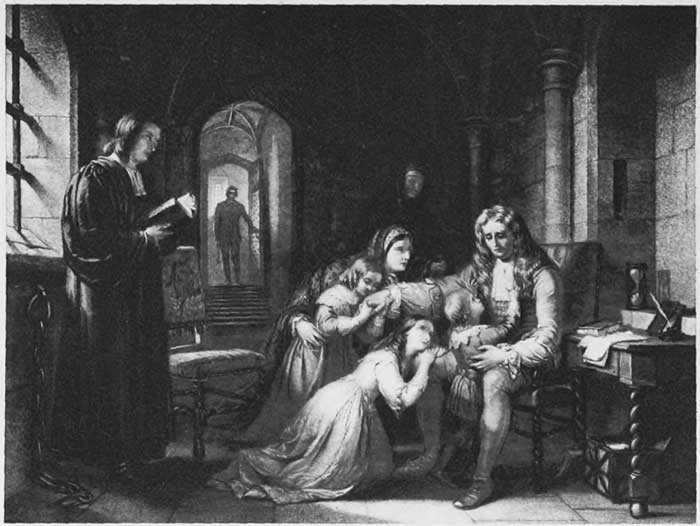
LORD WILLIAM RUSSELL TAKING LEAVE OF HIS CHILDREN, 1683
Photogravure after a painting by Bridges
For sculptors and architects, we found Bernini and Algardi were in the greatest esteem; Fiamingo, as a statuary; who made the Andrea in St. Peter's, and is said to have died mad because it was placed in an ill light. Among the painters, Antonio de la Cornea, who has such an address of counterfeiting the hands of the ancient masters so well as to make his copies pass for originals; Pietro de Cortone, Monsieur Poussin, a Frenchman, and innumerable more. Fioravanti, for armor, plate, dead life, tapestry, etc. The chief masters of music, after Marc Antonio, the best treble, is Cavalier Lauretto, an eunuch; the next Cardinal Bichi's eunuch, Bianchi, tenor, and Nicholai, bass. The Jews in Rome wore red hats, till the Cardinal of Lyons, being short-sighted, lately saluted one of them, thinking him to be a Cardinal as he passed by his coach; on which an order was made, that they should use only the yellow color. There was now at Rome one Mrs. Ward, an English devotée, who much solicited for an order of Jesuitesses.
At executions I saw one, a gentleman, hanged in his cloak and hat for murder. They struck the malefactor with a club that first stunned him, and then cut his throat. At Naples they use a frame, like ours at Halifax.30
It is reported that Rome has been once no less than fifty miles in compass, now not thirteen, containing in it 3,000 churches and chapels, monasteries, etc. It is divided into fourteen regions or wards; has seven mountains, and as many campi or valleys; in these are fair parks, or gardens, called villas, being only places of recess and pleasure, at some distance from the streets, yet within the walls.
The bills of exchange I took up from my first entering Italy till I went from Rome, amounting to but 616 ducati di banco, though I purchased many books, pictures, and curiosities.
18th May, 1645. I intended to have seen Loretto, but, being disappointed of moneys long expected, I was forced to return by the same way I came, desiring, if possible, to be at Venice by the Ascension, and therefore I diverted to take Leghorn in the way, as well to furnish me with credit by a merchant there, as to take order for transporting such collections as I had made at Rome. When on my way, turning about to behold this once and yet glorious city, from an eminence, I did not, without some regret, give it my last farewell.
Having taken leave of our friends at Rome, where I had sojourned now about seven months, autumn, winter, and spring, I took coach, in company with two courteous Italian gentlemen. In the afternoon, we arrived at a house, or rather castle, belonging to the Duke of Parma, called Caprarola, situate on the brow of a hill, that overlooks a little town, or rather a natural and stupendous rock; witness those vast caves serving now for cellarage, where we were entertained with most generous wine of several sorts, being just under the foundation. The palace was built by the famous architect, Vignola, at the cost of Cardinal Alex. Farnese, in form of an octagon, the court in the middle being exactly round, so as rather to resemble a fort, or castle; yet the chambers within are all of them square, which makes the walls exceedingly thick. One of these rooms is so artificially contrived, that from the two opposite angles may be heard the least whisper; they say any perfect square does it. Most of the paintings are by Zuccari. It has a stately entry, on which spouts an artificial fountain within the porch. The hall, chapel, and a great number of lodging chambers are remarkable; but most of all the pictures and witty inventions of Hannibal Caracci; the Dead Christ is incomparable. Behind are the gardens full of statues and noble fountains, especially that of the Shepherds. After dinner, we took horse, and lay that night at Monte Rossi, twenty miles from Rome.
19th May, 1645. We dined at Viterbo, and lay at St. Laurenzo. Next day, at Radicofani, and slept at Turnera.
SIENNA
21st May, 1645. We dined at Sienna, where we could not pass admiring the great church built entirely both within and without with white and black marble in polished squares, by Macarino, showing so beautiful after a shower has fallen. The floor within is of various colored marbles, representing the story of both Testaments, admirably wrought. Here lies Pius II. The bibliotéca is painted by P. Perrugino and Raphael. The life of Æneas Sylvius is in FRESCO; in the middle are the Three Graces, in antique marble, very curious, and the front of this building, though Gothic, is yet very fine. Among other things, they show St. Catharine's disciplining cell, the door whereof is half cut out into chips by the pilgrims and devotees, being of deal wood.
Setting out hence for Pisa, we went again to see the Duomo in which the Emperor Henry VII. lies buried, poisoned by a monk in the Eucharist. The bending tower was built by Busqueto Delichio, a Grecian architect, and is a stupendous piece of art. In the gallery of curiosities is a fair mummy; the tail of a sea-horse; coral growing on a man's skull; a chariot automaton; two pieces of rock crystal, in one of which is a drop of water, in the other three or four small worms; two embalmed children; divers petrifactions, etc. The garden of simples is well furnished, and has in it the deadly yew, or taxus, of the ancients; which Dr. Belluccio, the superintendent, affirms that his workmen cannot endure to clip for above the space of half an hour at a time, from the pain of the head which surprises them.
We went hence from Leghorn, by coach, where I took up ninety crowns for the rest of my journey, with letters of credit for Venice, after I had sufficiently complained of my defeat of correspondence at Rome.
The next day, I came to Lucca, a small but pretty territory and state of itself. The city is neat and well fortified, with noble and pleasant walks of trees on the works, where the gentry and ladies used to take the air. It is situate on an ample plain by the river Serchio, yet the country about it is hilly. The Senate-house is magnificent. The church of St. Michael is a noble piece, as is also St. Fredian, more remarkable to us for the corpse of St. Richard, an English king,31 who died here on his pilgrimage toward Rome. This epitaph is on his tomb:
Hic rex Richardus requiescit, sceptifer, almus; Rex Fuit Anglorum; regnum tenet iste Polorum. Regnum demisit; pro Christo cuncta reliquit. Ergo, Richardum nobis debit Anglia sanctum. Hic genitor Sanctæ Wulburgæ Virginis almæ Est Vrillebaldi sancti simul et Vinebaldi, Suffragium quorum nobis det regna Polorum.
Next this, we visited St. Croce, an excellent structure all of marble both without and within, and so adorned as may vie with many of the fairest even in Rome: witness the huge cross, valued at £15,000, above all venerable for that sacred volto which (as tradition goes) was miraculously put on the image of Christ, and made by Nicodemus, while the artist, finishing the rest of the body, was meditating what face to set on it. The inhabitants are exceedingly civil to strangers, above all places in Italy, and they speak the purest Italian. It is also cheap living, which causes travelers to set up their rest here more than in Florence, though a more celebrated city; besides, the ladies here are very conversable, and the religious women not at all reserved; of these we bought gloves and embroidered stomachers, generally worn by gentlemen in these countries. The circuit of this state is but two easy days' journey, and lies mixed with the Duke of Tuscany's but having Spain for a protector (though the least bigoted of all Roman Catholics), and being one of the fortified cities in Italy, it remains in peace. The whole country abounds in excellent olives, etc.
PISTORIA
Going hence for Florence, we dined at Pistoria, where, besides one church, there was little observable: only in the highway we crossed a rivulet of salt water, though many miles from the sea. The country is extremely pleasant, full of gardens, and the roads straight as a line for the best part of that whole day, the hedges planted with trees at equal distances, watered with clear and plentiful streams.
Rising early the next morning we arrived at Peggio Imperiale, being a palace of the Great Duke, not far from the city, having omitted it in my passage to Rome. The ascent to the house is by a stately gallery as it were of tall and overgrown cypress trees for near half a mile. At the entrance of these ranges, are placed statues of the Tiber and Arno, of marble; those also of Virgil, Ovid, Petrarch, and Dante. The building is sumptuous, and curiously furnished within with cabinets of pietra-commessa in tables, pavements, etc., which is a magnificence, or work, particularly affected at Florence. The pictures are, Adam and Eve by Albert Durer, very excellent; as is that piece of carving in wood by the same hand standing in a cupboard. Here is painted the whole Austrian line; the Duke's mother, sister to the Emperor, the foundress of this palace, than which there is none in Italy that I had seen more magnificently adorned, or furnished.
FLORENCE
We could not omit in our passage to re-visit the same, and other curiosities which we had neglected on our first being at Florence. We went, therefore, to see the famous piece of Andrea del Sarto, in the Annunciata. The story is, that the painter in a time of dearth borrowed a sack of corn of the religious of that convent, and repayment being demanded, he wrought it out in this picture, which represents Joseph sitting on a sack of corn, and reading to the Blessed Virgin; a piece infinitely valued. There fell down in the cloister an old man's face painted on the wall in fresco, greatly esteemed, and broke into crumbs; the Duke sent his best painters to make another instead of it, but none of them would presume to touch a pencil where Andrea had wrought, like another Apelles; but one of them was so industrious and patient, that, picking up the fragments, he laid and fastened them so artificially together, that the injury it had received was hardly discernible. Andrea del Sarto lies buried in the same place. Here is also that picture of Bartolomeo, who having spent his utmost skill in the face of the angel Gabriel, and being troubled that he could not exceed it in the Virgin, he began the body and to finish the clothes, and so left it, minding in the morning to work on the face; but, when he came, no sooner had he drawn away the cloth that was hung before it to preserve it from the dust, than an admirable and ravishing face was found ready painted; at which miracle all the city came in to worship. It is now kept in the Chapel of the Salutation, a place so enriched by devotees, that none in Italy, save Loretto, is said to exceed it. This picture is always covered with three shutters, one of which is of massy silver; methinks it is very brown, the forehead and cheeks whiter, as if it had been scraped. They report that those who have the honor of seeing it never lose their sight—happy then we! Belonging to this church is a world of plate, some whole statues of it, and lamps innumerable, besides the costly vows hung up, some of gold, and a cabinet of precious stones.
Visiting the Duke's repository again, we told at least forty ranks of porphyry and other statues, and twenty-eight whole figures, many rare paintings and relievos, two square columns with trophies. In one of the galleries, twenty-four figures, and fifty antique heads; a Bacchus of M. Angelo, and one of Bandinelli; a head of Bernini, and a most lovely Cupid, of Parian marble; at the further end, two admirable women sitting, and a man fighting with a centaur; three figures in little of Andrea; a huge candlestick of amber; a table of Titian's painting, and another representing God the Father sitting in the air on the Four Evangelists; animals; divers smaller pieces of Raphael; a piece of pure virgin gold, as big as an egg. In the third chamber of rarities is the square cabinet, valued at 80,000 crowns, showing on every front, a variety of curious work; one of birds and flowers, of pietra-commessa; one, a descent from the cross, of M. Angelo; on the third, our Blessed Savior and the Apostles, of amber; and, on the fourth, a crucifix of the same. Between the pictures, two naked Venuses, by Titian; Adam and Eve, by Durer; and several pieces of Portdenone, and del Frate. There is a globe of six feet diameter. In the Armory, were an entire elk, a crocodile, and among the harness, several targets and antique horse-arms, as that of Charles V.; two set with turquoises, and other precious stones; a horse's tail, of a wonderful length. Then, passing the Old Palace, which has a very great hall for feasts and comedies, the roof rarely painted, and the side walls with six very large pictures representing battles, the work of Gio. Vassari. Here is a magazine full of plate; a harness of emeralds; the furnitures of an altar four feet high, and six in length, of massy gold; in the middle is placed the statue of Cosmo II., the bass-relievo is of precious stones, his breeches covered with diamonds; the moldings of this statue, and other ornaments, festoons, etc., are garnished with jewels and great pearls, dedicated to St. Charles, with this inscription, in rubies:
"Cosimus Secundus Dei gratiâ Magnus Dux Etruriæ ex voto."
There is also a King on horseback, of massy gold, two feet high, and an infinity of such like rarities. Looking at the Justice, in copper, set up on a column by Cosmo, in 1555, after the victory over Sienna, we were told that the Duke, asking a gentleman how he liked the piece, he answered, that he liked it very well, but that it stood too high for poor men to come at it.
Prince Leopold has, in this city, a very excellent collection of paintings, especially a St. Catherine of P. Veronese; a Venus of marble, veiled from the middle to the feet, esteemed to be of that Greek workman who made the Venus at the Medici's Palace in Rome, altogether as good, and better preserved, an inestimable statue, not long since found about Bologna.
Signor Gaddi is a lettered person, and has divers rarities, statues, and pictures of the best masters, and one bust of marble as much esteemed as the most antique in Italy, and many curious manuscripts; his best paintings are, a Virgin of del Sarto, mentioned by Vassari, a St. John, by Raphael, and an Ecce Homo, by Titian.
The hall of the Academy de la Crusca is hung about with impresses and devices painted, all of them relating to corn sifted from the bran; the seats are made like breadbaskets and other rustic instruments used about wheat, and the cushions of satin, like sacks.
We took our farewell of St. Laurence, more particularly noticing that piece of the Resurrection, which consists of a prodigious number of naked figures, the work of Pontormo. On the left hand is the Martyrdom of St. Laurence, by Bronzino, rarely painted indeed. In a chapel is the tomb of Pietro di Medici, and his brother John, of copper, excellently designed, standing on two lions' feet, which end in foliage, the work of M. Angelo. Over against this, are sepulchres of all the ducal family. The altar has a statue of the Virgin giving suck, and two Apostles. Paulus Jovius has the honor to be buried in the cloister. Behind the choir is the superb chapel of Ferdinand I., consisting of eight faces, four plain, four a little hollowed; in the other are to be the sepulchres, and a niche of paragon, for the statue of the prince now living, all of copper gilt; above, is a large table of porphyry, for an inscription for the Duke, in letters of jasper. The whole chapel, walls, pavement, and roof, are full of precious stones united with the moldings, which are also of gilded copper, and so are the bases and capitals of the columns. The tabernacle, with the whole altar, is inlaid with cornelians, lazuli, serpentine, agates, onyxes, etc. On the other side are six very large columns of rock crystal, eight figures of precious stones of several colors, inlaid in natural figures, not inferior to the best paintings, among which are many pearls, diamonds, amethysts, topazes, sumptuous and sparkling beyond description. The windows without side are of white marble. The library is the architecture of Raphael; before the port is a square vestibule of excellent art, of all the orders, without confusion; the ascent to it from the library is excellent. We numbered eighty-eight shelves, all MSS. and bound in red, chained; in all about 3,500 volumes, as they told us.
The Arsenal has sufficient to arm 70,000 men, accurately preserved and kept, with divers lusty pieces of ordnance, whereof one is for a ball of 300 pounds weight, and another for 160, which weighs 72,500 pounds.
When I was at Florence, the celebrated masters were: for pietra-commessa (a kind of mosaic, or inlaying, of various colored marble, and other more precious stones), Dominico Benetti and Mazotti; the best statuary, Vincentio Brochi. This statuary makes those small figures in plaster and pasteboard, which so resemble copper that, till one handles them, they cannot be distinguished, he has so rare an art of bronzing them; I bought four of him. The best painter, Pietro Beretino di Cortona.
This Duke has a daily tribute for every courtezan, or prostitute, allowed to practice that infamous trade in his dominions, and so has his Holiness the Pope, but not so much in value.
29 Cardinal Hippolito Aldobrandini was elected Pope in January, 1592, by the name of Clement VIII., and died in March, 1605.
30 A guillotine.
31 What particular Richard King of England this was, it is impossible to say; the tomb still exists, and has long been a crux to antiquaries and travelers.