автордың кітабын онлайн тегін оқу Anthology of Classic Horror. Part 1. Illustrated
ANTHOLOGY OF CLASSIC HORROR
PART 1
The Call of Cthulhu, The Fall of the House of Usher, The Turn of the Screw and other stories
Illustrated
Authors writing for the horror genre succeed in creating an eerie and frightening atmosphere for the reader. While the featured horror is often supernatural, it may spring from a very real origin.
Several classic horror stories have become icons of the horror genre.
They inspire modern retellings throughout print, on stage, and on film. This collection gathers the best of the supernatural and frightening stories spun by expert storytellers who can weave true thrillers haunted by spirits and visited by vampires; stories where even the buildings contribute to the black humor and apocalyptic natures of the plots.
Contents:
H.P. Lovecraft - The Call of Cthulhu
Algernon Blackwood - The Willows
Ambrose Bierce
The Death of Halpin Frayser,
Chickamauga,
An Occurrence at Owl Creek Bridge,
E.F. Benson
Mrs Amworth
Naboth's Vineyard
At the Farmhouse
Negotium Perambulans
The Wishing Well
The Terror by Night
The Thing in the Hall
The Cat
The Sanctuary
Robert W. Chambers
The Repairer of Reputations
The Mask
In the Court of the Dragon
The Yellow Sign
W. W. Jacobs - The Monkey's Paw
Francis Marion Crawford
The Upper Berth
For the Blood Is the Life
The Screaming Skull
The Doll's Ghost
Man Overboard!
Arthur Machen - The Great God Pan
Bram Stoker - The Judge's House
Edgar Allan Poe
The Raven
The Black Cat
The Fall of the House of Usher
Henry James - The Turn of the Screw
H.P. LOVECRAFT. THE CALL OF CTHULHU
(Found Among the Papers of the Late Francis Wayland Thurston, of Boston)
“Of such great powers or beings there may be conceivably a survival… a survival of a hugely remote period when… consciousness was manifested, perhaps, in shapes and forms long since withdrawn before the tide of advancing humanity… forms of which poetry and legend alone have caught a flying memory and called them gods, monsters, mythical beings of all sorts and kinds…”
I.
The Horror in Clay.
The most merciful thing in the world, I think, is the inability of the human mind to correlate all its contents. We live on a placid island of ignorance in the midst of black seas of infinity, and it was not meant that we should voyage far. The sciences, each straining in its own direction, have hitherto harmed us little; but some day the piecing together of dissociated knowledge will open up such terrifying vistas of reality, and of our frightful position therein, that we shall either go mad from the revelation or flee from the deadly light into the peace and safety of a new dark age.
Theosophists have guessed at the awesome grandeur of the cosmic cycle wherein our world and human race form transient incidents. They have hinted at strange survivals in terms which would freeze the blood if not masked by a bland optimism. But it is not from them that there came the single glimpse of forbidden aeons which chills me when I think of it and maddens me when I dream of it. That glimpse, like all dread glimpses of truth, flashed out from an accidental piecing together of separated things-in this case an old newspaper item and the notes of a dead professor. I hope that no one else will accomplish this piecing out; certainly, if I live, I shall never knowingly supply a link in so hideous a chain. I think that the professor, too, intended to keep silent regarding the part he knew, and that he would have destroyed his notes had not sudden death seized him.
My knowledge of the thing began in the winter of 1926-27 with the death of my grand-uncle George Gammell Angell, Professor Emeritus of Semitic Languages in Brown University, Providence, Rhode Island. Professor Angell was widely known as an authority on ancient inscriptions, and had frequently been resorted to by the heads of prominent museums; so that his passing at the age of ninety-two may be recalled by many. Locally, interest was intensified by the obscurity of the cause of death. The professor had been stricken whilst returning from the Newport boat; falling suddenly, as witnesses said, after having been jostled by a nautical-looking negro who had come from one of the queer dark courts on the precipitous hillside which formed a short cut from the waterfront to the deceased’s home in Williams Street. Physicians were unable to find any visible disorder, but concluded after perplexed debate that some obscure lesion of the heart, induced by the brisk ascent of so steep a hill by so elderly a man, was responsible for the end. At the time I saw no reason to dissent from this dictum, but latterly I am inclined to wonder-and more than wonder.

As my grand-uncle’s heir and executor, for he died a childless widower, I was expected to go over his papers with some thoroughness; and for that purpose moved his entire set of files and boxes to my quarters in Boston. Much of the material which I correlated will be later published by the American Archaeological Society, but there was one box which I found exceedingly puzzling, and which I felt much averse from shewing to other eyes. It had been locked, and I did not find the key till it occurred to me to examine the personal ring which the professor carried always in his pocket. Then indeed I succeeded in opening it, but when I did so seemed only to be confronted by a greater and more closely locked barrier. For what could be the meaning of the queer clay bas-relief and the disjointed jottings, ramblings, and cuttings which I found? Had my uncle, in his latter years, become credulous of the most superficial impostures? I resolved to search out the eccentric sculptor responsible for this apparent disturbance of an old man’s peace of mind.

The bas-relief was a rough rectangle less than an inch thick and about five by six inches in area; obviously of modern origin. Its designs, however, were far from modern in atmosphere and suggestion; for although the vagaries of cubism and futurism are many and wild, they do not often reproduce that cryptic regularity which lurks in prehistoric writing. And writing of some kind the bulk of these designs seemed certainly to be; though my memory, despite much familiarity with the papers and collections of my uncle, failed in any way to identify this particular species, or even to hint at its remotest affiliations.
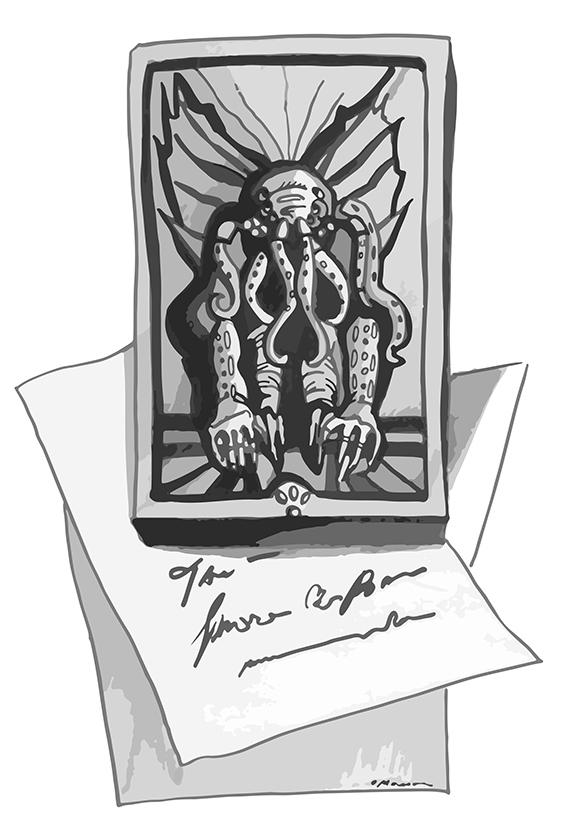
Above these apparent hieroglyphics was a figure of evidently pictorial intent, though its impressionistic execution forbade a very clear idea of its nature. It seemed to be a sort of monster, or symbol representing a monster, of a form which only a diseased fancy could conceive. If I say that my somewhat extravagant imagination yielded simultaneous pictures of an octopus, a dragon, and a human caricature, I shall not be unfaithful to the spirit of the thing. A pulpy, tentacled head surmounted a grotesque and scaly body with rudimentary wings; but it was the general outline of the whole which made it most shockingly frightful. Behind the figure was a vague suggestion of a Cyclopean architectural background.
The writing accompanying this oddity was, aside from a stack of press cuttings, in Professor Angell’s most recent hand; and made no pretence to literary style. What seemed to be the main document was headed “CTHULHU CULT” in characters painstakingly printed to avoid the erroneous reading of a word so unheard-of. The manuscript was divided into two sections, the first of which was headed “1925-Dream and Dream Work of H. A. Wilcox, 7 Thomas St., Providence, R.I.”, and the second, “Narrative of Inspector John R. Legrasse, 121 Bienville St., New Orleans, La., at 1908 A. A. S. Mtg.-Notes on Same, amp; Prof. Webb’s Acct.” The other manuscript papers were all brief notes, some of them accounts of the queer dreams of different persons, some of them citations from theosophical books and magazines (notably W. Scott-Elliot’s Atlantis and the Lost Lemuria), and the rest comments on long-surviving secret societies and hidden cults, with references to passages in such mythological and anthropological source-books as Frazer’s Golden Bough and Miss Murray’s Witch-Cult in Western Europe. The cuttings largely alluded to outré mental illnesses and outbreaks of group folly or mania in the spring of 1925.
The first half of the principal manuscript told a very peculiar tale. It appears that on March 1st, 1925, a thin, dark young man of neurotic and excited aspect had called upon Professor Angell bearing the singular clay bas-relief, which was then exceedingly damp and fresh. His card bore the name of Henry Anthony Wilcox, and my uncle had recognised him as the youngest son of an excellent family slightly known to him, who had latterly been studying sculpture at the Rhode Island School of Design and living alone at the Fleur-de-Lys Building near that institution. Wilcox was a precocious youth of known genius but great eccentricity, and had from childhood excited attention through the strange stories and odd dreams he was in the habit of relating. He called himself “psychically hypersensitive”, but the staid folk of the ancient commercial city dismissed him as merely “queer”. Never mingling much with his kind, he had dropped gradually from social visibility, and was now known only to a small group of aesthetes from other towns. Even the Providence Art Club, anxious to preserve its conservatism, had found him quite hopeless.
On the occasion of the visit, ran the professor’s manuscript, the sculptor abruptly asked for the benefit of his host’s archaeological knowledge in identifying the hieroglyphics on the bas-relief. He spoke in a dreamy, stilted manner which suggested pose and alienated sympathy; and my uncle shewed some sharpness in replying, for the conspicuous freshness of the tablet implied kinship with anything but archaeology. Young Wilcox’s rejoinder, which impressed my uncle enough to make him recall and record it verbatim, was of a fantastically poetic cast which must have typified his whole conversation, and which I have since found highly characteristic of him. He said, “It is new, indeed, for I made it last night in a dream of strange cities; and dreams are older than brooding Tyre, or the contemplative Sphinx, or garden-girdled Babylon.”
It was then that he began that rambling tale which suddenly played upon a sleeping memory and won the fevered interest of my uncle. There had been a slight earthquake tremor the night before, the most considerable felt in New England for some years; and Wilcox’s imagination had been keenly affected. Upon retiring, he had had an unprecedented dream of great Cyclopean cities of titan blocks and sky-flung monoliths, all dripping with green ooze and sinister with latent horror. Hieroglyphics had covered the walls and pillars, and from some undetermined point below had come a voice that was not a voice; a chaotic sensation which only fancy could transmute into sound, but which he attempted to render by the almost unpronounceable jumble of letters, “Cthulhu fhtagn”.

This verbal jumble was the key to the recollection which excited and disturbed Professor Angell. He questioned the sculptor with scientific minuteness; and studied with almost frantic intensity the bas-relief on which the youth had found himself working, chilled and clad only in his night-clothes, when waking had stolen bewilderingly over him. My uncle blamed his old age, Wilcox afterward said, for his slowness in recognising both hieroglyphics and pictorial design. Many of his questions seemed highly out-of-place to his visitor, especially those which tried to connect the latter with strange cults or societies; and Wilcox could not understand the repeated promises of silence which he was offered in exchange for an admission of membership in some widespread mystical or paganly religious body. When Professor Angell became convinced that the sculptor was indeed ignorant of any cult or system of cryptic lore, he besieged his visitor with demands for future reports of dreams. This bore regular fruit, for after the first interview the manuscript records daily calls of the young man, during which he related startling fragments of nocturnal imagery whose burden was always some terrible Cyclopean vista of dark and dripping stone, with a subterrene voice or intelligence shouting monotonously in enigmatical sense-impacts uninscribable save as gibberish. The two sounds most frequently repeated are those rendered by the letters “Cthulhu” and “R’lyeh”.
On March 23d, the manuscript continued, Wilcox failed to appear; and inquiries at his quarters revealed that he had been stricken with an obscure sort of fever and taken to the home of his family in Waterman Street. He had cried out in the night, arousing several other artists in the building, and had manifested since then only alternations of unconsciousness and delirium. My uncle at once telephoned the family, and from that time forward kept close watch of the case; calling often at the Thayer Street office of Dr. Tobey, whom he learned to be in charge. The youth’s febrile mind, apparently, was dwelling on strange things; and the doctor shuddered now and then as he spoke of them. They included not only a repetition of what he had formerly dreamed, but touched wildly on a gigantic thing “miles high” which walked or lumbered about. He at no time fully described this object, but occasional frantic words, as repeated by Dr. Tobey, convinced the professor that it must be identical with the nameless monstrosity he had sought to depict in his dream-sculpture. Reference to this object, the doctor added, was invariably a prelude to the young man’s subsidence into lethargy. His temperature, oddly enough, was not greatly above normal; but his whole condition was otherwise such as to suggest true fever rather than mental disorder.
On April 2nd at about 3 p.m. every trace of Wilcox’s malady suddenly ceased. He sat upright in bed, astonished to find himself at home and completely ignorant of what had happened in dream or reality since the night of March 22nd. Pronounced well by his physician, he returned to his quarters in three days; but to Professor Angell he was of no further assistance. All traces of strange dreaming had vanished with his recovery, and my uncle kept no record of his night-thoughts after a week of pointless and irrelevant accounts of thoroughly usual visions.
Here the first part of the manuscript ended, but references to certain of the scattered notes gave me much material for thought-so much, in fact, that only the ingrained scepticism then forming my philosophy can account for my continued distrust of the artist. The notes in question were those descriptive of the dreams of various persons covering the same period as that in which young Wilcox had had his strange visitations. My uncle, it seems, had quickly instituted a prodigiously far-flung body of inquiries amongst nearly all the friends whom he could question without impertinence, asking for nightly reports of their dreams, and the dates of any notable visions for some time past. The reception of his request seems to have been varied; but he must, at the very least, have received more responses than any ordinary man could have handled without a secretary. This original correspondence was not preserved, but his notes formed a thorough and really significant digest. Average people in society and business-New England’s traditional “salt of the earth”-gave an almost completely negative result, though scattered cases of uneasy but formless nocturnal impressions appear here and there, always between March 23d and April 2nd-the period of young Wilcox’s delirium. Scientific men were little more affected, though four cases of vague description suggest fugitive glimpses of strange landscapes, and in one case there is mentioned a dread of something abnormal.
It was from the artists and poets that the pertinent answers came, and I know that panic would have broken loose had they been able to compare notes. As it was, lacking their original letters, I half suspected the compiler of having asked leading questions, or of having edited the correspondence in corroboration of what he had latently resolved to see. That is why I continued to feel that Wilcox, somehow cognisant of the old data which my uncle had possessed, had been imposing on the veteran scientist. These responses from aesthetes told a disturbing tale. From February 28th to April 2nd a large proportion of them had dreamed very bizarre things, the intensity of the dreams being immeasurably the stronger during the period of the sculptor’s delirium. Over a fourth of those who reported anything, reported scenes and half-sounds not unlike those which Wilcox had described; and some of the dreamers confessed acute fear of the gigantic nameless thing visible toward the last. One case, which the note describes with emphasis, was very sad. The subject, a widely known architect with leanings toward theosophy and occultism, went violently insane on the date of young Wilcox’s seizure, and expired several months later after incessant screamings to be saved from some escaped denizen of hell. Had my uncle referred to these cases by name instead of merely by number, I should have attempted some corroboration and personal investigation; but as it was, I succeeded in tracing down only a few. All of these, however, bore out the notes in full. I have often wondered if all the objects of the professor’s questioning felt as puzzled as did this fraction. It is well that no explanation shall ever reach them.
The press cuttings, as I have intimated, touched on cases of panic, mania, and eccentricity during the given period. Professor Angell must have employed a cutting bureau, for the number of extracts was tremendous and the sources scattered throughout the globe. Here was a nocturnal suicide in London, where a lone sleeper had leaped from a window after a shocking cry. Here likewise a rambling letter to the editor of a paper in South America, where a fanatic deduces a dire future from visions he has seen. A despatch from California describes a theosophist colony as donning white robes en masse for some “glorious fulfilment” which never arrives, whilst items from India speak guardedly of serious native unrest toward the end of March. Voodoo orgies multiply in Hayti, and African outposts report ominous mutterings. American officers in the Philippines find certain tribes bothersome about this time, and New York policemen are mobbed by hysterical Levantines on the night of March 22-23. The west of Ireland, too, is full of wild rumour and legendry, and a fantastic painter named Ardois-Bonnot hangs a blasphemous “Dream Landscape” in the Paris spring salon of 1926. And so numerous are the recorded troubles in insane asylums, that only a miracle can have stopped the medical fraternity from noting strange parallelisms and drawing mystified conclusions. A weird bunch of cuttings, all told; and I can at this date scarcely envisage the callous rationalism with which I set them aside. But I was then convinced that young Wilcox had known of the older matters mentioned by the professor.
II.
The Tale of Inspector Legrasse.
The older matters which had made the sculptor’s dream and bas-relief so significant to my uncle formed the subject of the second half of his long manuscript. Once before, it appears, Professor Angell had seen the hellish outlines of the nameless monstrosity, puzzled over the unknown hieroglyphics, and heard the ominous syllables which can be rendered only as “Cthulhu”; and all this in so stirring and horrible a connexion that it is small wonder he pursued young Wilcox with queries and demands for data.
The earlier experience had come in 1908, seventeen years before, when the American Archaeological Society held its annual meeting in St. Louis. Professor Angell, as befitted one of his authority and attainments, had had a prominent part in all the deliberations; and was one of the first to be approached by the several outsiders who took advantage of the convocation to offer questions for correct answering and problems for expert solution.
The chief of these outsiders, and in a short time the focus of interest for the entire meeting, was a commonplace-looking middle-aged man who had travelled all the way from New Orleans for certain special information unobtainable from any local source. His name was John Raymond Legrasse, and he was by profession an Inspector of Police. With him he bore the subject of his visit, a grotesque, repulsive, and apparently very ancient stone statuette whose origin he was at a loss to determine. It must not be fancied that Inspector Legrasse had the least interest in archaeology. On the contrary, his wish for enlightenment was prompted by purely professional considerations. The statuette, idol, fetish, or whatever it was, had been captured some months before in the wooded swamps south of New Orleans during a raid on a supposed voodoo meeting; and so singular and hideous were the rites connected with it, that the police could not but realise that they had stumbled on a dark cult totally unknown to them, and infinitely more diabolic than even the blackest of the African voodoo circles. Of its origin, apart from the erratic and unbelievable tales extorted from the captured members, absolutely nothing was to be discovered; hence the anxiety of the police for any antiquarian lore which might help them to place the frightful symbol, and through it track down the cult to its fountain-head.
Inspector Legrasse was scarcely prepared for the sensation which his offering created. One sight of the thing had been enough to throw the assembled men of science into a state of tense excitement, and they lost no time in crowding around him to gaze at the diminutive figure whose utter strangeness and air of genuinely abysmal antiquity hinted so potently at unopened and archaic vistas. No recognised school of sculpture had animated this terrible object, yet centuries and even thousands of years seemed recorded in its dim and greenish surface of unplaceable stone.

The figure, which was finally passed slowly from man to man for close and careful study, was between seven and eight inches in height, and of exquisitely artistic workmanship. It represented a monster of vaguely anthropoid outline, but with an octopus-like head whose face was a mass of feelers, a scaly, rubbery-looking body, prodigious claws on hind and fore feet, and long, narrow wings behind. This thing, which seemed instinct with a fearsome and unnatural malignancy, was of a somewhat bloated corpulence, and squatted evilly on a rectangular block or pedestal covered with undecipherable characters. The tips of the wings touched the back edge of the block, the seat occupied the centre, whilst the long, curved claws of the doubled-up, crouching hind legs gripped the front edge and extended a quarter of the way down toward the bottom of the pedestal. The cephalopod head was bent forward, so that the ends of the facial feelers brushed the backs of huge fore paws which clasped the croucher’s elevated knees. The aspect of the whole was abnormally life-like, and the more subtly fearful because its source was so totally unknown. Its vast, awesome, and incalculable age was unmistakable; yet not one link did it shew with any known type of art belonging to civilisation’s youth-or indeed to any other time. Totally separate and apart, its very material was a mystery; for the soapy, greenish-black stone with its golden or iridescent flecks and striations resembled nothing familiar to geology or mineralogy. The characters along the base were equally baffling; and no member present, despite a representation of half the world’s expert learning in this field, could form the least notion of even their remotest linguistic kinship. They, like the subject and material, belonged to something horribly remote and distinct from mankind as we know it; something frightfully suggestive of old and unhallowed cycles of life in which our world and our conceptions have no part.
And yet, as the members severally shook their heads and confessed defeat at the Inspector’s problem, there was one man in that gathering who suspected a touch of bizarre familiarity in the monstrous shape and writing, and who presently told with some diffidence of the odd trifle he knew. This person was the late William Channing Webb, Professor of Anthropology in Princeton University, and an explorer of no slight note. Professor Webb had been engaged, forty-eight years before, in a tour of Greenland and Iceland in search of some Runic inscriptions which he failed to unearth; and whilst high up on the West Greenland coast had encountered a singular tribe or cult of degenerate Esquimaux whose religion, a curious form of devil-worship, chilled him with its deliberate bloodthirstiness and repulsiveness. It was a faith of which other Esquimaux knew little, and which they mentioned only with shudders, saying that it had come down from horribly ancient aeons before ever the world was made. Besides nameless rites and human sacrifices there were certain queer hereditary rituals addressed to a supreme elder devil or tornasuk; and of this Professor Webb had taken a careful phonetic copy from an aged angekok or wizard-priest, expressing the sounds in Roman letters as best he knew how. But just now of prime significance was the fetish which this cult had cherished, and around which they danced when the aurora leaped high over the ice cliffs. It was, the professor stated, a very crude bas-relief of stone, comprising a hideous picture and some cryptic writing. And so far as he could tell, it was a rough parallel in all essential features of the bestial thing now lying before the meeting.
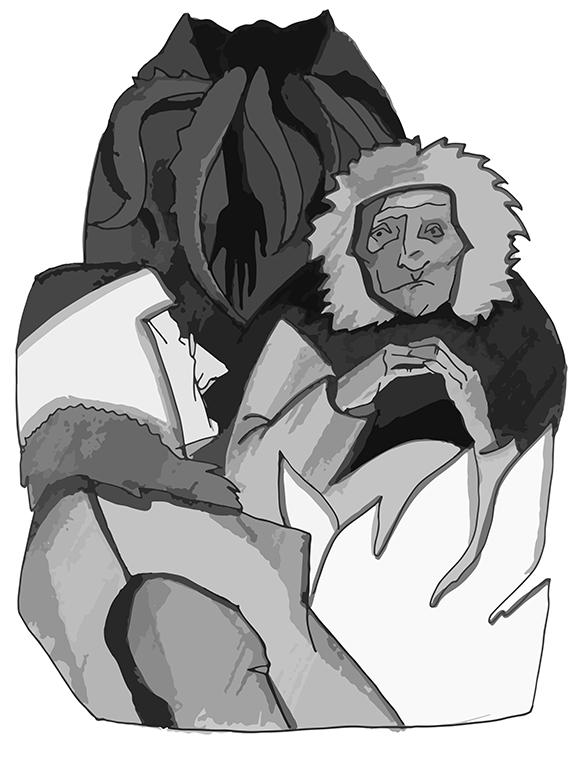
This data, received with suspense and astonishment by the assembled members, proved doubly exciting to Inspector Legrasse; and he began at once to ply his informant with questions. Having noted and copied an oral ritual among the swamp cult-worshippers his men had arrested, he besought the professor to remember as best he might the syllables taken down amongst the diabolist Esquimaux. There then followed an exhaustive comparison of details, and a moment of really awed silence when both detective and scientist agreed on the virtual identity of the phrase common to two hellish rituals so many worlds of distance apart. What, in substance, both the Esquimau wizards and the Louisiana swamp-priests had chanted to their kindred idols was something very like this-the word-divisions being guessed at from traditional breaks in the phrase as chanted aloud:
“Ph’nglui mglw’nafh Cthulhu R’lyeh wgah’nagl fhtagn.”
Legrasse had one point in advance of Professor Webb, for several among his mongrel prisoners had repeated to him what older celebrants had told them the words meant. This text, as given, ran something like this:
“In his house at R’lyeh dead Cthulhu waits dreaming.”

And now, in response to a general and urgent demand, Inspector Legrasse related as fully as possible his experience with the swamp worshippers; telling a story to which I could see my uncle attached profound significance. It savoured of the wildest dreams of myth-maker and theosophist, and disclosed an astonishing degree of cosmic imagination among such half-castes and pariahs as might be least expected to possess it.
On November 1st, 1907, there had come to the New Orleans police a frantic summons from the swamp and lagoon country to the south. The squatters there, mostly primitive but good-natured descendants of Lafitte’s men, were in the grip of stark terror from an unknown thing which had stolen upon them in the night. It was voodoo, apparently, but voodoo of a more terrible sort than they had ever known; and some of their women and children had disappeared since the malevolent tom-tom had begun its incessant beating far within the black haunted woods where no dweller ventured. There were insane shouts and harrowing screams, soul-chilling chants and dancing devil-flames; and, the frightened messenger added, the people could stand it no more.
So a body of twenty police, filling two carriages and an automobile, had set out in the late afternoon with the shivering squatter as a guide. At the end of the passable road they alighted, and for miles splashed on in silence through the terrible cypress woods where day never came. Ugly roots and malignant hanging nooses of Spanish moss beset them, and now and then a pile of dank stones or fragment of a rotting wall intensified by its hint of morbid habitation a depression which every malformed tree and every fungous islet combined to create. At length the squatter settlement, a miserable huddle of huts, hove in sight; and hysterical dwellers ran out to cluster around the group of bobbing lanterns. The muffled beat of tom-toms was now faintly audible far, far ahead; and a curdling shriek came at infrequent intervals when the wind shifted. A reddish glare, too, seemed to filter through the pale undergrowth beyond endless avenues of forest night. Reluctant even to be left alone again, each one of the cowed squatters refused point-blank to advance another inch toward the scene of unholy worship, so Inspector Legrasse and his nineteen colleagues plunged on unguided into black arcades of horror that none of them had ever trod before.
The region now entered by the police was one of traditionally evil repute, substantially unknown and untraversed by white men. There were legends of a hidden lake unglimpsed by mortal sight, in which dwelt a huge, formless white polypous thing with luminous eyes; and squatters whispered that bat-winged devils flew up out of caverns in inner earth to worship it at midnight. They said it had been there before D’Iberville, before La Salle, before the Indians, and before even the wholesome beasts and birds of the woods. It was nightmare itself, and to see it was to die. But it made men dream, and so they knew enough to keep away. The present voodoo orgy was, indeed, on the merest fringe of this abhorred area, but that location was bad enough; hence perhaps the very place of the worship had terrified the squatters more than the shocking sounds and incidents.
Only poetry or madness could do justice to the noises heard by Legrasse’s men as they ploughed on through the black morass toward the red glare and the muffled tom-toms. There are vocal qualities peculiar to men, and vocal qualities peculiar to beasts; and it is terrible to hear the one when the source should yield the other. Animal fury and orgiastic licence here whipped themselves to daemoniac heights by howls and squawking ecstasies that tore and reverberated through those nighted woods like pestilential tempests from the gulfs of hell. Now and then the less organised ululation would cease, and from what seemed a well-drilled chorus of hoarse voices would rise in sing-song chant that hideous phrase or ritual:
“Ph’nglui mglw’nafh Cthulhu R’lyeh wgah’nagl fhtagn.”
Then the men, having reached a spot where the trees were thinner, came suddenly in sight of the spectacle itself. Four of them reeled, one fainted, and two were shaken into a frantic cry which the mad cacophony of the orgy fortunately deadened. Legrasse dashed swamp water on the face of the fainting man, and all stood trembling and nearly hypnotised with horror.
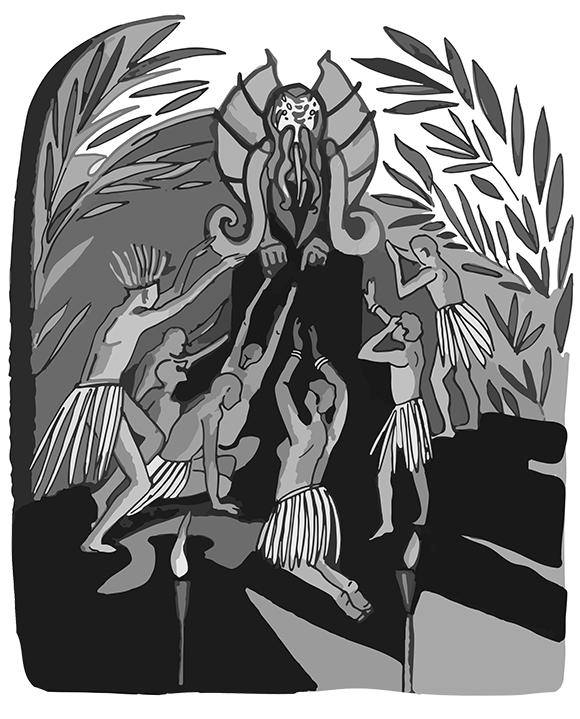
In a natural glade of the swamp stood a grassy island of perhaps an acre’s extent, clear of trees and tolerably dry. On this now leaped and twisted a more indescribable horde of human abnormality than any but a Sime or an Angarola could paint. Void of clothing, this hybrid spawn were braying, bellowing, and writhing about a monstrous ring-shaped bonfire; in the centre of which, revealed by occasional rifts in the curtain of flame, stood a great granite monolith some eight feet in height; on top of which, incongruous with its diminutiveness, rested the noxious carven statuette. From a wide circle of ten scaffolds set up at regular intervals with the flame-girt monolith as a centre hung, head downward, the oddly marred bodies of the helpless squatters who had disappeared. It was inside this circle that the ring of worshippers jumped and roared, the general direction of the mass motion being from left to right in endless Bacchanal between the ring of bodies and the ring of fire.
It may have been only imagination and it may have been only echoes which induced one of the men, an excitable Spaniard, to fancy he heard antiphonal responses to the ritual from some far and unillumined spot deeper within the wood of ancient legendry and horror. This man, Joseph D. Galvez, I later met and questioned; and he proved distractingly imaginative. He indeed went so far as to hint of the faint beating of great wings, and of a glimpse of shining eyes and a mountainous white bulk beyond the remotest trees-but I suppose he had been hearing too much native superstition.
Actually, the horrified pause of the men was of comparatively brief duration. Duty came first; and although there must have been nearly a hundred mongrel celebrants in the throng, the police relied on their firearms and plunged determinedly into the nauseous rout. For five minutes the resultant din and chaos were beyond description. Wild blows were struck, shots were fired, and escapes were made; but in the end Legrasse was able to count some forty-seven sullen prisoners, whom he forced to dress in haste and fall into line between two rows of policemen. Five of the worshippers lay dead, and two severely wounded ones were carried away on improvised stretchers by their fellow-prisoners. The image on the monolith, of course, was carefully removed and carried back by Legrasse.
Examined at headquarters after a trip of intense strain and weariness, the prisoners all proved to be men of a very low, mixed-blooded, and mentally aberrant type. Most were seamen, and a sprinkling of negroes and mulattoes, largely West Indians or Brava Portuguese from the Cape Verde Islands, gave a colouring of voodooism to the heterogeneous cult. But before many questions were asked, it became manifest that something far deeper and older than negro fetichism was involved. Degraded and ignorant as they were, the creatures held with surprising consistency to the central idea of their loathsome faith.
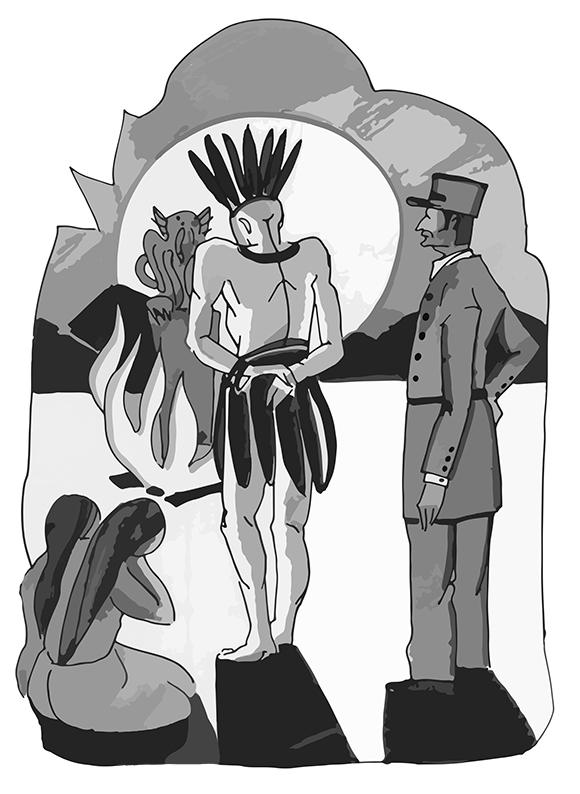
They worshipped, so they said, the Great Old Ones who lived ages before there were any men, and who came to the young world out of the sky. Those Old Ones were gone now, inside the earth and under the sea; but their dead bodies had told their secrets in dreams to the first men, who formed a cult which had never died. This was that cult, and the prisoners said it had always existed and always would exist, hidden in distant wastes and dark places all over the world until the time when the great priest Cthulhu, from his dark house in the mighty city of R’lyeh under the waters, should rise and bring the earth again beneath his sway. Some day he would call, when the stars were ready, and the secret cult would always be waiting to liberate him.
Meanwhile no more must be told. There was a secret which even torture could not extract. Mankind was not absolutely alone among the conscious things of earth, for shapes came out of the dark to visit the faithful few. But these were not the Great Old Ones. No man had ever seen the Old Ones. The carven idol was great Cthulhu, but none might say whether or not the others were precisely like him. No one could read the old writing now, but things were told by word of mouth. The chanted ritual was not the secret-that was never spoken aloud, only whispered. The chant meant only this: “In his house at R’lyeh dead Cthulhu waits dreaming.”
Only two of the prisoners were found sane enough to be hanged, and the rest were committed to various institutions. All denied a part in the ritual murders, and averred that the killing had been done by Black Winged Ones which had come to them from their immemorial meeting-place in the haunted wood. But of those mysterious allies no coherent account could ever be gained. What the police did extract, came mainly from an immensely aged mestizo named Castro, who claimed to have sailed to strange ports and talked with undying leaders of the cult in the mountains of China.
Old Castro remembered bits of hideous legend that paled the speculations of theosophists and made man and the world seem recent and transient indeed. There had been aeons when other Things ruled on the earth, and They had had great cities. Remains of Them, he said the deathless Chinamen had told him, were still to be found as Cyclopean stones on islands in the Pacific. They all died vast epochs of time before men came, but there were arts which could revive Them when the stars had come round again to the right positions in the cycle of eternity. They had, indeed, come themselves from the stars, and brought Their images with Them.
These Great Old Ones, Castro continued, were not composed altogether of flesh and blood. They had shape-for did not this star-fashioned image prove it?-but that shape was not made of matter. When the stars were right, They could plunge from world to world through the sky; but when the stars were wrong, They could not live. But although They no longer lived, They would never really die. They all lay in stone houses in Their great city of R’lyeh, preserved by the spells of mighty Cthulhu for a glorious resurrection when the stars and the earth might once more be ready for Them. But at that time some force from outside must serve to liberate Their bodies. The spells that preserved Them intact likewise prevented Them from making an initial move, and They could only lie awake in the dark and think whilst uncounted millions of years rolled by. They knew all that was occurring in the universe, but Their mode of speech was transmitted thought. Even now They talked in Their tombs. When, after infinities of chaos, the first men came, the Great Old Ones spoke to the sensitive among them by moulding their dreams; for only thus could Their language reach the fleshly minds of mammals.
Then, whispered Castro, those first men formed the cult around small idols which the Great Ones shewed them; idols brought in dim aeras from dark stars. That cult would never die till the stars came right again, and the secret priests would take great Cthulhu from His tomb to revive His subjects and resume His rule of earth. The time would be easy to know, for then mankind would have become as the Great Old Ones; free and wild and beyond good and evil, with laws and morals thrown aside and all men shouting and killing and revelling in joy. Then the liberated Old Ones would teach them new ways to shout and kill and revel and enjoy themselves, and all the earth would flame with a holocaust of ecstasy and freedom. Meanwhile the cult, by appropriate rites, must keep alive the memory of those ancient ways and shadow forth the prophecy of their return.
In the elder time chosen men had talked with the entombed Old Ones in dreams, but then something had happened. The great stone city R’lyeh, with its monoliths and sepulchres, had sunk beneath the waves; and the deep waters, full of the one primal mystery through which not even thought can pass, had cut off the spectral intercourse. But memory never died, and high-priests said that the city would rise again when the stars were right. Then came out of the earth the black spirits of earth, mouldy and shadowy, and full of dim rumours picked up in caverns beneath forgotten sea-bottoms. But of them old Castro dared not speak much. He cut himself off hurriedly, and no amount of persuasion or subtlety could elicit more in this direction. The size of the Old Ones, too, he curiously declined to mention. Of the cult, he said that he thought the centre lay amid the pathless deserts of Arabia, where Irem, the City of Pillars, dreams hidden and untouched. It was not allied to the European witch-cult, and was virtually unknown beyond its members. No book had ever really hinted of it, though the deathless Chinamen said that there were double meanings in the Necronomicon of the mad Arab Abdul Alhazred which the initiated might read as they chose, especially the much-discussed couplet:
“That is not dead which can eternal lie,
And with strange aeons even death may die.”
Legrasse, deeply impressed and not a little bewildered, had inquired in vain concerning the historic affiliations of the cult. Castro, apparently, had told the truth when he said that it was wholly secret. The authorities at Tulane University could shed no light upon either cult or image, and now the detective had come to the highest authorities in the country and met with no more than the Greenland tale of Professor Webb.
The feverish interest aroused at the meeting by Legrasse’s tale, corroborated as it was by the statuette, is echoed in the subsequent correspondence of those who attended; although scant mention occurs in the formal publications of the society. Caution is the first care of those accustomed to face occasional charlatanry and imposture. Legrasse for some time lent the image to Professor Webb, but at the latter’s death it was returned to him and remains in his possession, where I viewed it not long ago. It is truly a terrible thing, and unmistakably akin to the dream-sculpture of young Wilcox.
That my uncle was excited by the tale of the sculptor I did not wonder, for what thoughts must arise upon hearing, after a knowledge of what Legrasse had learned of the cult, of a sensitive young man who had dreamed not only the figure and exact hieroglyphics of the swamp-found image and the Greenland devil tablet, but had come in his dreams upon at least three of the precise words of the formula uttered alike by Esquimau diabolists and mongrel Louisianans? Professor Angell’s instant start on an investigation of the utmost thoroughness was eminently natural; though privately I suspected young Wilcox of having heard of the cult in some indirect way, and of having invented a series of dreams to heighten and continue the mystery at my uncle’s expense. The dream-narratives and cuttings collected by the professor were, of course, strong corroboration; but the rationalism of my mind and the extravagance of the whole subject led me to adopt what I thought the most sensible conclusions. So, after thoroughly studying the manuscript again and correlating the theosophical and anthropological notes with the cult narrative of Legrasse, I made a trip to Providence to see the sculptor and give him the rebuke I thought proper for so boldly imposing upon a learned and aged man.
Wilcox still lived alone in the Fleur-de-Lys Building in Thomas Street, a hideous Victorian imitation of seventeenth-century Breton architecture which flaunts its stuccoed front amidst the lovely colonial houses on the ancient hill, and under the very shadow of the finest Georgian steeple in America. I found him at work in his rooms, and at once conceded from the specimens scattered about that his genius is indeed profound and authentic. He will, I believe, some time be heard from as one of the great decadents; for he has crystallised in clay and will one day mirror in marble those nightmares and phantasies which Arthur Machen evokes in prose, and Clark Ashton Smith makes visible in verse and in painting.
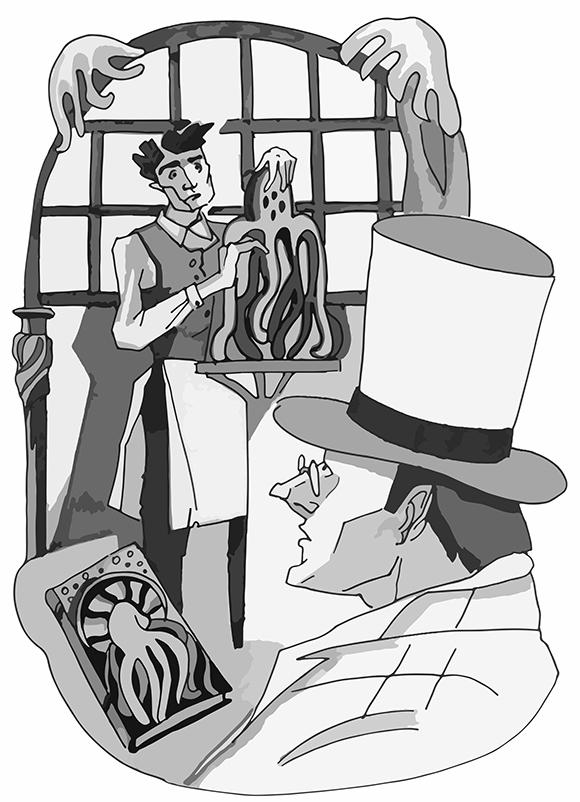
Dark, frail, and somewhat unkempt in aspect, he turned languidly at my knock and asked me my business without rising. When I told him who I was, he displayed some interest; for my uncle had excited his curiosity in probing his strange dreams, yet had never explained the reason for the study. I did not enlarge his knowledge in this regard, but sought with some subtlety to draw him out. In a short time I became convinced of his absolute sincerity, for he spoke of the dreams in a manner none could mistake. They and their subconscious residuum had influenced his art profoundly, and he shewed me a morbid statue whose contours almost made me shake with the potency of its black suggestion. He could not recall having seen the original of this thing except in his own dream bas-relief, but the outlines had formed themselves insensibly under his hands. It was, no doubt, the giant shape he had raved of in delirium. That he really knew nothing of the hidden cult, save from what my uncle’s relentless catechism had let fall, he soon made clear; and again I strove to think of some way in which he could possibly have received the weird impressions.
He talked of his dreams in a strangely poetic fashion; making me see with terrible vividness the damp Cyclopean city of slimy green stone-whose geometry, he oddly said, was all wrong-and hear with frightened expectancy the ceaseless, half-mental calling from underground: “Cthulhu fhtagn”, “Cthulhu fhtagn”. These words had formed part of that dread ritual which told of dead Cthulhu’s dream-vigil in his stone vault at R’lyeh, and I felt deeply moved despite my rational beliefs. Wilcox, I was sure, had heard of the cult in some casual way, and had soon forgotten it amidst the mass of his equally weird reading and imagining. Later, by virtue of its sheer impressiveness, it had found subconscious expression in dreams, in the bas-relief, and in the terrible statue I now beheld; so that his imposture upon my uncle had been a very innocent one. The youth was of a type, at once slightly affected and slightly ill-mannered, which I could never like; but I was willing enough now to admit both his genius and his honesty. I took leave of him amicably, and wish him all the success his talent promises.
The matter of the cult still remained to fascinate me, and at times I had visions of personal fame from researches into its origin and connexions. I visited New Orleans, talked with Legrasse and others of that old-time raiding-party, saw the frightful image, and even questioned such of the mongrel prisoners as still survived. Old Castro, unfortunately, had been dead for some years. What I now heard so graphically at first-hand, though it was really no more than a detailed confirmation of what my uncle had written, excited me afresh; for I felt sure that I was on the track of a very real, very secret, and very ancient religion whose discovery would make me an anthropologist of note. My attitude was still one of absolute materialism, as I wish it still were, and I discounted with almost inexplicable perversity the coincidence of the dream notes and odd cuttings collected by Professor Angell.
One thing I began to suspect, and which I now fear I know, is that my uncle’s death was far from natural. He fell on a narrow hill street leading up from an ancient waterfront swarming with foreign mongrels, after a careless push from a negro sailor. I did not forget the mixed blood and marine pursuits of the cult-members in Louisiana, and would not be surprised to learn of secret methods and poison needles as ruthless and as anciently known as the cryptic rites and beliefs. Legrasse and his men, it is true, have been let alone; but in Norway a certain seaman who saw things is dead. Might not the deeper inquiries of my uncle after encountering the sculptor’s data have come to sinister ears? I think Professor Angell died because he knew too much, or because he was likely to learn too much. Whether I shall go as he did remains to be seen, for I have learned much now.
III.
The Madness from the Sea.
If heaven ever wishes to grant me a boon, it will be a total effacing of the results of a mere chance which fixed my eye on a certain stray piece of shelf-paper. It was nothing on which I would naturally have stumbled in the course of my daily round, for it was an old number of an Australian journal, the Sydney Bulletin for April 18, 1925. It had escaped even the cutting bureau which had at the time of its issuance been avidly collecting material for my uncle’s research.
I had largely given over my inquiries into what Professor Angell called the “Cthulhu Cult”, and was visiting a learned friend in Paterson, New Jersey; the curator of a local museum and a mineralogist of note. Examining one day the reserve specimens roughly set on the storage shelves in a rear room of the museum, my eye was caught by an odd picture in one of the old papers spread beneath the stones. It was the Sydney Bulletin I have mentioned, for my friend has wide affiliations in all conceivable foreign parts; and the picture was a half-tone cut of a hideous stone image almost identical with that which Legrasse had found in the swamp.
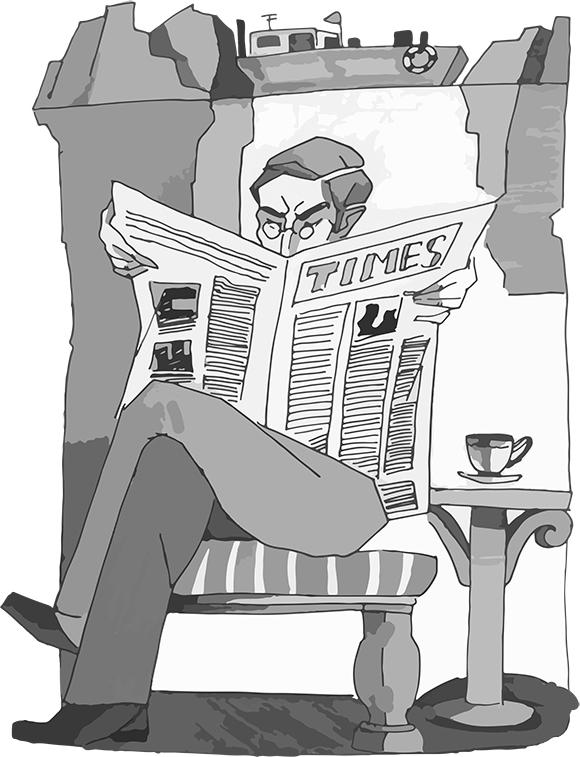
Eagerly clearing the sheet of its precious contents, I scanned the item in detail; and was disappointed to find it of only moderate length. What it suggested, however, was of portentous significance to my flagging quest; and I carefully tore it out for immediate action. It read as follows:
MYSTERY DERELICT FOUND AT SEA
Vigilant Arrives With Helpless Armed New Zealand Yacht in Tow.
One Survivor and Dead Man Found Aboard. Tale of Desperate Battle and Deaths at Sea.
Rescued Seaman Refuses Particulars of Strange Experience.
Odd Idol Found in His Possession. Inquiry to Follow.
The Morrison Co.’s freighter Vigilant, bound from Valparaiso, arrived this morning at its wharf in Darling Harbour, having in tow the battled and disabled but heavily armed steam yacht Alert of Dunedin, N. Z., which was sighted April 12th in S. Latitude 34° 21′, W. Longitude 152° 17′ with one living and one dead man aboard.
The Vigilant left Valparaiso March 25th, and on April 2nd was driven considerably south of her course by exceptionally heavy storms and monster waves. On April 12th the derelict was sighted; and though apparently deserted, was found upon boarding to contain one survivor in a half-delirious condition and one man who had evidently been dead for more than a week. The living man was clutching a horrible stone idol of unknown origin, about a foot in height, regarding whose nature authorities at Sydney University, the Royal Society, and the Museum in College Street all profess complete bafflement, and which the survivor says he found in the cabin of the yacht, in a small carved shrine of common pattern.
This man, after recovering his senses, told an exceedingly strange story of piracy and slaughter. He is Gustaf Johansen, a Norwegian of some intelligence, and had been second mate of the two-masted schooner Emma of Auckland, which sailed for Callao February 20th with a complement of eleven men. The Emma, he says, was delayed and thrown widely south of her course by the great storm of March 1st, and on March 22nd, in S. Latitude 49° 51′, W. Longitude 128° 34′, encountered the Alert, manned by a queer and evil-looking crew of Kanakas and half-castes. Being ordered peremptorily to turn back, Capt. Collins refused; whereupon the strange crew began to fire savagely and without warning upon the schooner with a peculiarly heavy battery of brass cannon forming part of the yacht’s equipment. The Emma’s men shewed fight, says the survivor, and though the schooner began to sink from shots beneath the waterline they managed to heave alongside their enemy and board her, grappling with the savage crew on the yacht’s deck, and being forced to kill them all, the number being slightly superior, because of their particularly abhorrent and desperate though rather clumsy mode of fighting.
Three of the Emma’s men, including Capt. Collins and First Mate Green, were killed; and the remaining eight under Second Mate Johansen proceeded to navigate the captured yacht, going ahead in their original direction to see if any reason for their ordering back had existed. The next day, it appears, they raised and landed on a small island, although none is known to exist in that part of the ocean; and six of the men somehow died ashore, though Johansen is queerly reticent about this part of his story, and speaks only of their falling into a rock chasm. Later, it seems, he and one companion boarded the yacht and tried to manage her, but were beaten about by the storm of April 2nd. From that time till his rescue on the 12th the man remembers little, and he does not even recall when William Briden, his companion, died. Briden’s death reveals no apparent cause, and was probably due to excitement or exposure. Cable advices from Dunedin report that the Alert was well known there as an island trader, and bore an evil reputation along the waterfront. It was owned by a curious group of half-castes whose frequent meetings and night trips to the woods attracted no little curiosity; and it had set sail in great haste just after the storm and earth tremors of March 1st. Our Auckland correspondent gives the Emma and her crew an excellent reputation, and Johansen is described as a sober and worthy man. The admiralty will institute an inquiry on the whole matter beginning tomorrow, at which every effort will be made to induce Johansen to speak more freely than he has done hitherto.
This was all, together with the picture of the hellish image; but what a train of ideas it started in my mind! Here were new treasuries of data on the Cthulhu Cult, and evidence that it had strange interests at sea as well as on land. What motive prompted the hybrid crew to order back the Emma as they sailed about with their hideous idol? What was the unknown island on which six of the Emma’s crew had died, and about which the mate Johansen was so secretive? What had the vice-admiralty’s investigation brought out, and what was known of the noxious cult in Dunedin? And most marvellous of all, what deep and more than natural linkage of dates was this which gave a malign and now undeniable significance to the various turns of events so carefully noted by my uncle?
March 1st-our February 28th according to the International Date Line-the earthquake and storm had come. From Dunedin the Alert and her noisome crew had darted eagerly forth as if imperiously summoned, and on the other side of the earth poets and artists had begun to dream of a strange, dank Cyclopean city whilst a young sculptor had moulded in his sleep the form of the dreaded Cthulhu. March 23d the crew of the Emma landed on an unknown island and left six men dead; and on that date the dreams of sensitive men assumed a heightened vividness and darkened with dread of a giant monster’s malign pursuit, whilst an architect had gone mad and a sculptor had lapsed suddenly into delirium! And what of this storm of April 2nd-the date on which all dreams of the dank city ceased, and Wilcox emerged unharmed from the bondage of strange fever? What of all this-and of those hints of old Castro about the sunken, star-born Old Ones and their coming reign; their faithful cult and their mastery of dreams? Was I tottering on the brink of cosmic horrors beyond man’s power to bear? If so, they must be horrors of the mind alone, for in some way the second of April had put a stop to whatever monstrous menace had begun its siege of mankind’s soul.
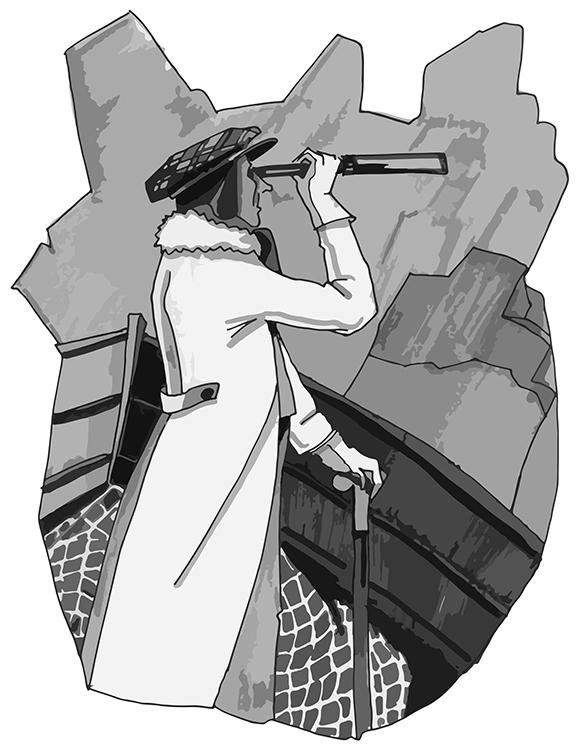
That evening, after a day of hurried cabling and arranging, I bade my host adieu and took a train for San Francisco. In less than a month I was in Dunedin; where, however, I found that little was known of the strange cult-members who had lingered in the old sea-taverns. Waterfront scum was far too common for special mention; though there was vague talk about one inland trip these mongrels had made, during which faint drumming and red flame were noted on the distant hills. In Auckland I learned that Johansen had returned with yellow hair turned white after a perfunctory and inconclusive questioning at Sydney, and had thereafter sold his cottage in West Street and sailed with his wife to his old home in Oslo. Of his stirring experience he would tell his friends no more than he had told the admiralty officials, and all they could do was to give me his Oslo address.
After that I went to Sydney and talked profitlessly with seamen and members of the vice-admiralty court. I saw the Alert, now sold and in commercial use, at Circular Quay in Sydney Cove, but gained nothing from its non-committal bulk. The crouching image with its cuttlefish head, dragon body, scaly wings, and hieroglyphed pedestal, was preserved in the Museum at Hyde Park; and I studied it long and well, finding it a thing of balefully exquisite workmanship, and with the same utter mystery, terrible antiquity, and unearthly strangeness of material which I had noted in Legrasse’s smaller specimen. Geologists, the curator told me, had found it a monstrous puzzle; for they vowed that the world held no rock like it. Then I thought with a shudder of what old Castro had told Legrasse about the primal Great Ones: “They had come from the stars, and had brought Their images with Them.”
Shaken with such a mental revolution as I had never before known, I now resolved to visit Mate Johansen in Oslo. Sailing for London, I reëmbarked at once for the Norwegian capital; and one autumn day landed at the trim wharves in the shadow of the Egeberg. Johansen’s address, I discovered, lay in the Old Town of King Harold Haardrada, which kept alive the name of Oslo during all the centuries that the greater city masqueraded as “Christiana”. I made the brief trip by taxicab, and knocked with palpitant heart at the door of a neat and ancient building with plastered front. A sad-faced woman in black answered my summons, and I was stung with disappointment when she told me in halting English that Gustaf Johansen was no more.
He had not survived his return, said his wife, for the doings at sea in 1925 had broken him. He had told her no more than he had told the public, but had left a long manuscript-of “technical matters” as he said-written in English, evidently in order to safeguard her from the peril of casual perusal. During a walk through a narrow lane near the Gothenburg dock, a bundle of papers falling from an attic window had knocked him down. Two Lascar sailors at once helped him to his feet, but before the ambulance could reach him he was dead. Physicians found no adequate cause for the end, and laid it to heart trouble and a weakened constitution.
I now felt gnawing at my vitals that dark terror which will never leave me till I, too, am at rest; “accidentally” or otherwise. Persuading the widow that my connexion with her husband’s “technical matters” was sufficient to entitle me to his manuscript, I bore the document away and began to read it on the London boat. It was a simple, rambling thing-a naive sailor’s effort at a post-facto diary-and strove to recall day by day that last awful voyage. I cannot attempt to transcribe it verbatim in all its cloudiness and redundance, but I will tell its gist enough to shew why the sound of the water against the vessel’s sides became so unendurable to me that I stopped my ears with cotton.
Johansen, thank God, did not know quite all, even though he saw the city and the Thing, but I shall never sleep calmly again when I think of the horrors that lurk ceaselessly behind life in time and in space, and of those unhallowed blasphemies from elder stars which dream beneath the sea, known and favoured by a nightmare cult ready and eager to loose them on the world whenever another earthquake shall heave their monstrous stone city again to the sun and air.
Johansen’s voyage had begun just as he told it to the vice-admiralty. The Emma, in ballast, had cleared Auckland on February 20th, and had felt the full force of that earthquake-born tempest which must have heaved up from the sea-bottom the horrors that filled men’s dreams. Once more under control, the ship was making good progress when held up by the Alert on March 22nd, and I could feel the mate’s regret as he wrote of her bombardment and sinking. Of the swarthy cult-fiends on the Alert he speaks with significant horror. There was some peculiarly abominable quality about them which made their destruction seem almost a duty, and Johansen shews ingenuous wonder at the charge of ruthlessness brought against his party during the proceedings of the court of inquiry. Then, driven ahead by curiosity in their captured yacht under Johansen’s command, the men sight a great stone pillar sticking out of the sea, and in S. Latitude 47° 9′, W. Longitude 126° 43′ come upon a coast-line of mingled mud, ooze, and weedy Cyclopean masonry which can be nothing less than the tangible substance of earth’s supreme terror-the nightmare corpse-city of R’lyeh, that was built in measureless aeons behind history by the vast, loathsome shapes that seeped down from the dark stars. There lay great Cthulhu and his hordes, hidden in green slimy vaults and sending out at last, after cycles incalculable, the thoughts that spread fear to the dreams of the sensitive and called imperiously to the faithful to come on a pilgrimage of liberation and restoration. All this Johansen did not suspect, but God knows he soon saw enough!
I suppose that only a single mountain-top, the hideous monolith-crowned citadel whereon great Cthulhu was buried, actually emerged from the waters. When I think of the extent of all that may be brooding down there I almost wish to kill myself forthwith. Johansen and his men were awed by the cosmic majesty of this dripping Babylon of elder daemons, and must have guessed without guidance that it was nothing of this or of any sane planet. Awe at the unbelievable size of the greenish stone blocks, at the dizzying height of the great carven monolith, and at the stupefying identity of the colossal statues and bas-reliefs with the queer image found in the shrine on the Alert, is poignantly visible in every line of the mate’s frightened description.
Without knowing what futurism is like, Johansen achieved something very close to it when he spoke of the city; for instead of describing any definite structure or building, he dwells only on broad impressions of vast angles and stone surfaces-surfaces too great to belong to any thing right or proper for this earth, and impious with horrible images and hieroglyphs. I mention his talk about angles because it suggests something Wilcox had told me of his awful dreams. He had said that the geometry of the dream-place he saw was abnormal, non-Euclidean, and loathsomely redolent of spheres and dimensions apart from ours. Now an unlettered seaman felt the same thing whilst gazing at the terrible reality.
Johansen and his men landed at a sloping mud-bank on this monstrous Acropolis, and clambered slipperily up over titan oozy blocks which could have been no mortal staircase. The very sun of heaven seemed distorted when viewed through the polarising miasma welling out from this sea-soaked perversion, and twisted menace and suspense lurked leeringly in those crazily elusive angles of carven rock where a second glance shewed concavity after the first shewed convexity.
Something very like fright had come over all the explorers before anything more definite than rock and ooze and weed was seen. Each would have fled had he not feared the scorn of the others, and it was only half-heartedly that they searched-vainly, as it proved-for some portable souvenir to bear away.
It was Rodriguez the Portuguese who climbed up the foot of the monolith and shouted of what he had found. The rest followed him, and looked curiously at the immense carved door with the now familiar squid-dragon bas-relief. It was, Johansen said, like a great barn-door; and they all felt that it was a door because of the ornate lintel, threshold, and jambs around it, though they could not decide whether it lay flat like a trap-door or slantwise like an outside cellar-door. As Wilcox would have said, the geometry of the place was all wrong. One could not be sure that the sea and the ground were horizontal, hence the relative position of everything else seemed phantasmally variable.
Briden pushed at the stone in several places without result. Then Donovan felt over it delicately around the edge, pressing each point separately as he went. He climbed interminably along the grotesque stone moulding-that is, one would call it climbing if the thing was not after all horizontal-and the men wondered how any door in the universe could be so vast. Then, very softly and slowly, the acre-great panel began to give inward at the top; and they saw that it was balanced. Donovan slid or somehow propelled himself down or along the jamb and rejoined his fellows, and everyone watched the queer recession of the monstrously carven portal. In this phantasy of prismatic distortion it moved anomalously in a diagonal way, so that all the rules of matter and perspective seemed upset.
The aperture was black with a darkness almost material. That tenebrousness was indeed a positive quality; for it obscured such parts of the inner walls as ought to have been revealed, and actually burst forth like smoke from its aeon-long imprisonment, visibly darkening the sun as it slunk away into the shrunken and gibbous sky on flapping membraneous wings. The odour arising from the newly opened depths was intolerable, and at length the quick-eared Hawkins thought he heard a nasty, slopping sound down there. Everyone listened, and everyone was listening still when It lumbered slobberingly into sight and gropingly squeezed Its gelatinous green immensity through the black doorway into the tainted outside air of that poison city of madness.
Poor Johansen’s handwriting almost gave out when he wrote of this. Of the six men who never reached the ship, he thinks two perished of pure fright in that accursed instant. The Thing cannot be described-there is no language for such abysms of shrieking and immemorial lunacy, such eldritch contradictions of all matter, force, and cosmic order. A mountain walked or stumbled. God! What wonder that across the earth a great architect went mad, and poor Wilcox raved with fever in that telepathic instant? The Thing of the idols, the green, sticky spawn of the stars, had awaked to claim his own. The stars were right again, and what an age-old cult had failed to do by design, a band of innocent sailors had done by accident. After vigintillions of years great Cthulhu was loose again, and ravening for delight.
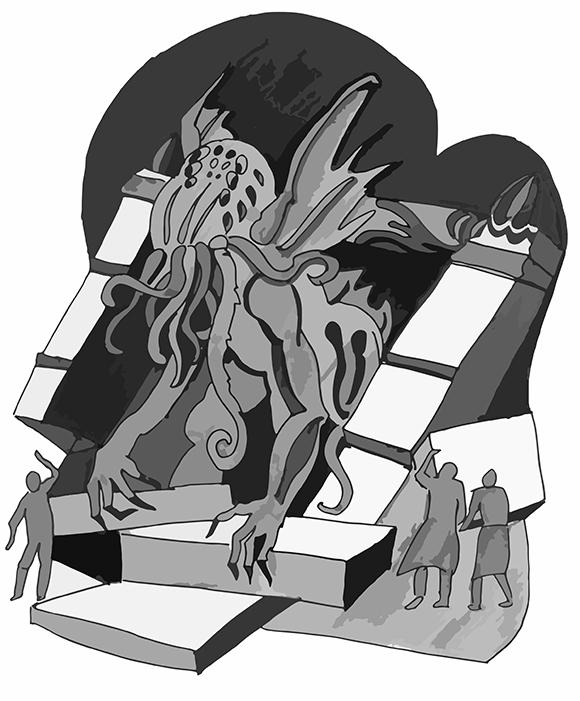
Three men were swept up by the flabby claws before anybody turned. God rest them, if there be any rest in the universe. They were Donovan, Guerrera, and Ångstrom. Parker slipped as the other three were plunging frenziedly over endless vistas of green-crusted rock to the boat, and Johansen swears he was swallowed up by an angle of masonry which shouldn’t have been there; an angle which was acute, but behaved as if it were obtuse. So only Briden and Johansen reached the boat, and pulled desperately for the Alert as the mountainous monstrosity flopped down the slimy stones and hesitated floundering at the edge of the water.
Steam had not been suffered to go down entirely, despite the departure of all hands for the shore; and it was the work of only a few moments of feverish rushing up and down between wheel and engines to get the Alert under way. Slowly, amidst the distorted horrors of that indescribable scene, she began to churn the lethal waters; whilst on the masonry of that charnel shore that was not of earth the titan Thing from the stars slavered and gibbered like Polypheme cursing the fleeing ship of Odysseus. Then, bolder than the storied Cyclops, great Cthulhu slid greasily into the water and began to pursue with vast wave-raising strokes of cosmic potency. Briden looked back and went mad, laughing shrilly as he kept on laughing at intervals till death found him one night in the cabin whilst Johansen was wandering deliriously.
But Johansen had not given out yet. Knowing that the Thing could surely overtake the Alert until steam was fully up, he resolved on a desperate chance; and, setting the engine for full speed, ran lightning-like on deck and reversed the wheel. There was a mighty eddying and foaming in the noisome brine, and as the steam mounted higher and higher the brave Norwegian drove his vessel head on against the pursuing jelly which rose above the unclean froth like the stern of a daemon galleon. The awful squid-head with writhing feelers came nearly up to the bowsprit of the sturdy yacht, but Johansen drove on relentlessly. There was a bursting as of an exploding bladder, a slushy nastiness as of a cloven sunfish, a stench as of a thousand opened graves, and a sound that the chronicler would not put on paper. For an instant the ship was befouled by an acrid and blinding green cloud, and then there was only a venomous seething astern; where-God in heaven!-the scattered plasticity of that nameless sky-spawn was nebulously recombining in its hateful original form, whilst its distance widened every second as the Alert gained impetus from its mounting steam.

That was all. After that Johansen only brooded over the idol in the cabin and attended to a few matters of food for himself and the laughing maniac by his side. He did not try to navigate after the first bold flight, for the reaction had taken something out of his soul. Then came the storm of April 2nd, and a gathering of the clouds about his consciousness. There is a sense of spectral whirling through liquid gulfs of infinity, of dizzying rides through reeling universes on a comet’s tail, and of hysterical plunges from the pit to the moon and from the moon back again to the pit, all livened by a cachinnating chorus of the distorted, hilarious elder gods and the green, bat-winged mocking imps of Tartarus.
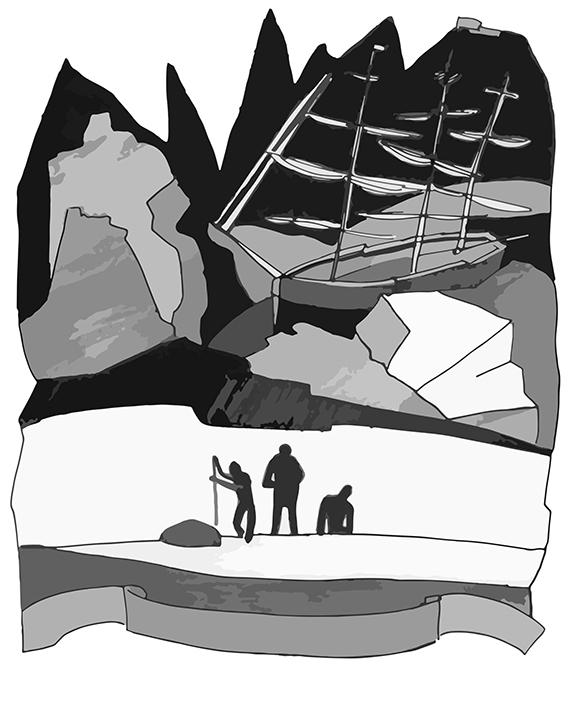
Out of that dream came rescue-the Vigilant, the vice-admiralty court, the streets of Dunedin, and the long voyage back home to the old house by the Egeberg. He could not tell-they would think him mad. He would write of what he knew before death came, but his wife must not guess. Death would be a boon if only it could blot out the memories.
That was the document I read, and now I have placed it in the tin box beside the bas-relief and the papers of Professor Angell. With it shall go this record of mine-this test of my own sanity, wherein is pieced together that which I hope may never be pieced together again. I have looked upon all that the universe has to hold of horror, and even the skies of spring and the flowers of summer must ever afterward be poison to me. But I do not think my life will be long. As my uncle went, as poor Johansen went, so I shall go. I know too much, and the cult still lives.
Cthulhu still lives, too, I suppose, again in that chasm of stone which has shielded him since the sun was young. His accursed city is sunken once more, for the Vigilant sailed over the spot after the April storm; but his ministers on earth still bellow and prance and slay around idol-capped monoliths in lonely places. He must have been trapped by the sinking whilst within his black abyss, or else the world would by now be screaming with fright and frenzy. Who knows the end? What has risen may sink, and what has sunk may rise. Loathsomeness waits and dreams in the deep, and decay spreads over the tottering cities of men. A time will come-but I must not and cannot think! Let me pray that, if I do not survive this manuscript, my executors may put caution before audacity and see that it meets no other eye.
ALGERNON BLACKWOOD. THE WILLOWS
I
After leaving Vienna, and long before you come to Budapest, the Danube enters a region of singular loneliness and desolation, where its waters spread away on all sides regardless of a main channel, and the country becomes a swamp for miles upon miles, covered by a vast sea of low willow-bushes. On the big maps this deserted area is painted in a fluffy blue, growing fainter in color as it leaves the banks, and across it may be seen in large straggling letters the word Sumpfe, meaning marshes.
In high flood this great acreage of sand, shingle-beds, and willow-grown islands is almost topped by the water, but in normal seasons the bushes bend and rustle in the free winds, showing their silver leaves to the sunshine in an ever-moving plain of bewildering beauty. These willows never attain to the dignity of trees; they have no rigid trunks; they remain humble bushes, with rounded tops and soft outline, swaying on slender stems that answer to the least pressure of the wind; supple as grasses, and so continually shifting that they somehow give the impression that the entire plain is moving and alive. For the wind sends waves rising and falling over the whole surface, waves of leaves instead of waves of water, green swells like the sea, too, until the branches turn and lift, and then silvery white as their underside turns to the sun.
Happy to slip beyond the control of the stern banks, the Danube here wanders about at will among the intricate network of channels intersecting the islands everywhere with broad avenues down which the waters pour with a shouting sound; making whirlpools, eddies, and foaming rapids; tearing at the sandy banks; carrying away masses of shore and willow-clumps; and forming new islands innumerably which shift daily in size and shape and possess at best an impermanent life, since the flood-time obliterates their very existence.
Properly speaking, this fascinating part of the river's life begins soon after leaving Pressburg, and we, in our Canadian canoe, with gipsy tent and frying-pan on board, reached it on the crest of a rising flood about mid-July. That very same morning, when the sky was reddening before sunrise, we had slipped swiftly through still-sleeping Vienna, leaving it a couple of hours later a mere patch of smoke against the blue hills of the Wienerwald on the horizon; we had breakfasted below Fischeramend under a grove of birch trees roaring in the wind; and had then swept on the tearing current past Orth, Hainburg, Petronell (the old Roman Carnuntum of Marcus Aurelius), and so under the frowning heights of Thelsen on a spur of the Carpathians, where the March steals in quietly from the left and the frontier is crossed between Austria and Hungary.
Racing along at twelve kilometers an hour soon took us well into Hungary, and the muddy waters-sure sign of flood-sent us aground on many a shingle-bed, and twisted us like a cork in many a sudden belching whirlpool before the towers of Pressburg (Hungarian, Poszony) showed against the sky; and then the canoe, leaping like a spirited horse, flew at top speed under the grey walls, negotiated safely the sunken chain of the Fliegende Brucke ferry, turned the corner sharply to the left, and plunged on yellow foam into the wilderness of islands, sandbanks, and swamp-land beyond-the land of the willows.
The change came suddenly, as when a series of bioscope pictures snaps down on the streets of a town and shifts without warning into the scenery of lake and forest. We entered the land of desolation on wings, and in less than half an hour there was neither boat nor fishing-hut nor red roof, nor any single sign of human habitation and civilization within sight. The sense of remoteness from the world of humankind, the utter isolation, the fascination of this singular world of willows, winds, and waters, instantly laid its spell upon us both, so that we allowed laughingly to one another that we ought by rights to have held some special kind of passport to admit us, and that we had, somewhat audaciously, come without asking leave into a separate little kingdom of wonder and magic-a kingdom that was reserved for the use of others who had a right to it, with everywhere unwritten warnings to trespassers for those who had the imagination to discover them.
Though still early in the afternoon, the ceaseless buffetings of a most tempestuous wind made us feel weary, and we at once began casting about for a suitable camping-ground for the night. But the bewildering character of the islands made landing difficult; the swirling flood carried us in shore and then swept us out again; the willow branches tore our hands as we seized them to stop the canoe, and we pulled many a yard of sandy bank into the water before at length we shot with a great sideways blow from the wind into a backwater and managed to beach the bows in a cloud of spray. Then we lay panting and laughing after our exertions on the hot yellow sand, sheltered from the wind, and in the full blaze of a scorching sun, a cloudless blue sky above, and an immense army of dancing, shouting willow bushes, closing in from all sides, shining with spray and clapping their thousand little hands as though to applaud the success of our efforts.
"What a river!" I said to my companion, thinking of all the way we had traveled from the source in the Black Forest, and how he had often been obliged to wade and push in the upper shallows at the beginning of June.
"Won't stand much nonsense now, will it?" he said, pulling the canoe a little farther into safety up the sand, and then composing himself for a nap.
I lay by his side, happy and peaceful in the bath of the elements-water, wind, sand, and the great fire of the sun-thinking of the long journey that lay behind us, and of the great stretch before us to the Black Sea, and how lucky I was to have such a delightful and charming traveling companion as my friend, the Swede.
We had made many similar journeys together, but the Danube, more than any other river I knew, impressed us from the very beginning with its aliveness. From its tiny bubbling entry into the world among the pinewood gardens of Donaueschingen, until this moment when it began to play the great river-game of losing itself among the deserted swamps, unobserved, unrestrained, it had seemed to us like following the grown of some living creature. Sleepy at first, but later developing violent desires as it became conscious of its deep soul, it rolled, like some huge fluid being, through all the countries we had passed, holding our little craft on its mighty shoulders, playing roughly with us sometimes, yet always friendly and well-meaning, till at length we had come inevitably to regard it as a Great Personage.
How, indeed, could it be otherwise, since it told us so much of its secret life? At night we heard it singing to the moon as we lay in our tent, uttering that odd sibilant note peculiar to itself and said to be caused by the rapid tearing of the pebbles along its bed, so great is its hurrying speed. We knew, too, the voice of its gurgling whirlpools, suddenly bubbling up on a surface previously quite calm; the roar of its shallows and swift rapids; its constant steady thundering below all mere surface sounds; and that ceaseless tearing of its icy waters at the banks. How it stood up and shouted when the rains fell flat upon its face! And how its laughter roared out when the wind blew up-stream and tried to stop its growing speed! We knew all its sounds and voices, its tumblings and foamings, its unnecessary splashing against the bridges; that self-conscious chatter when there were hills to look on; the affected dignity of its speech when it passed through the little towns, far too important to laugh; and all these faint, sweet whisperings when the sun caught it fairly in some slow curve and poured down upon it till the steam rose.
It was full of tricks, too, in its early life before the great world knew it. There were places in the upper reaches among the Swabian forests, when yet the first whispers of its destiny had not reached it, where it elected to disappear through holes in the ground, to appear again on the other side of the porous limestone hills and start a new river with another name; leaving, too, so little water in its own bed that we had to climb out and wade and push the canoe through miles of shallows.
And a chief pleasure, in those early days of its irresponsible youth, was to lie low, like Brer Fox, just before the little turbulent tributaries came to join it from the Alps, and to refuse to acknowledge them when in, but to run for miles side by side, the dividing line well marked, the very levels different, the Danube utterly declining to recognize the newcomer. Below Passau, however, it gave up this particular trick, for there the Inn comes in with a thundering power impossible to ignore, and so pushes and incommodes the parent river that there is hardly room for them in the long twisting gorge that follows, and the Danube is shoved this way and that against the cliffs, and forced to hurry itself with great waves and much dashing to and fro in order to get through in time. And during the fight our canoe slipped down from its shoulder to its breast, and had the time of its life among the struggling waves. But the Inn taught the old river a lesson, and after Passau it no longer pretended to ignore new arrivals.
This was many days back, of course, and since then we had come to know other aspects of the great creature, and across the Bavarian wheat plain of Straubing she wandered so slowly under the blazing June sun that we could well imagine only the surface inches were water, while below there moved, concealed as by a silken mantle, a whole army of Undines, passing silently and unseen down to the sea, and very leisurely too, lest they be discovered.
Much, too, we forgave her because of her friendliness to the birds and animals that haunted the shores. Cormorants lined the banks in lonely places in rows like short black palings; grey crows crowded the shingle-beds; storks stood fishing in the vistas of shallower water that opened up between the islands, and hawks, swans, and marsh birds of all sorts filled the air with glinting wings and singing, petulant cries. It was impossible to feel annoyed with the river's vagaries after seeing a deer leap with a splash into the water at sunrise and swim past the bows of the canoe; and often we saw fawns peering at us from the underbrush, or looked straight into the brown eyes of a stag as we charged full tilt round a corner and entered another reach of the river. Foxes, too, everywhere haunted the banks, tripping daintily among the driftwood and disappearing so suddenly that it was impossible to see how they managed it.
But now, after leaving Pressburg, everything changed a little, and the Danube became more serious. It ceased trifling. It was half-way to the Black Sea, within seeming distance almost of other, stranger countries where no tricks would be permitted or understood. It became suddenly grown-up, and claimed our respect and even our awe. It broke out into three arms, for one thing, that only met again a hundred kilometers farther down, and for a canoe there were no indications which one was intended to be followed.
"If you take a side channel," said the Hungarian officer we met in the Pressburg shop while buying provisions, "you may find yourselves, when the flood subsides, forty miles from anywhere, high and dry, and you may easily starve. There are no people, no farms, no fishermen. I warn you not to continue. The river, too, is still rising, and this wind will increase."
The rising river did not alarm us in the least, but the matter of being left high and dry by a sudden subsidence of the waters might be serious, and we had consequently laid in an extra stock of provisions. For the rest, the officer's prophecy held true, and the wind, blowing down a perfectly clear sky, increased steadily till it reached the dignity of a westerly gale.
It was earlier than usual when we camped, for the sun was a good hour or two from the horizon, and leaving my friend still asleep on the hot sand, I wandered about in desultory examination of our hotel. The island, I found, was less than an acre in extent, a mere sandy bank standing some two or three feet above the level of the river. The far end, pointing into the sunset, was covered with flying spray which the tremendous wind drove off the crests of the broken waves. It was triangular in shape, with the apex up stream.
I stood there for several minutes, watching the impetuous crimson flood bearing down with a shouting roar, dashing in waves against the bank as though to sweep it bodily away, and then swirling by in two foaming streams on either side. The ground seemed to shake with the shock and rush, while the furious movement of the willow bushes as the wind poured over them increased the curious illusion that the island itself actually moved. Above, for a mile or two, I could see the great river descending upon me; it was like looking up the slope of a sliding hill, white with foam, and leaping up everywhere to show itself to the sun.
The rest of the island was too thickly grown with willows to make walking pleasant, but I made the tour, nevertheless. From the lower end the light, of course, changed, and the river looked dark and angry. Only the backs of the flying waves were visible, streaked with foam, and pushed forcibly by the great puffs of wind that fell upon them from behind. For a short mile it was visible, pouring in and out among the islands, and then disappearing with a huge sweep into the willows, which closed about it like a herd of monstrous antediluvian creatures crowding down to drink. They made me think of gigantic sponge-like growths that sucked the river up into themselves. They caused it to vanish from sight. They herded there together in such overpowering numbers.
Altogether it was an impressive scene, with its utter loneliness, its bizarre suggestion; and as I gazed, long and curiously, a singular emotion began to stir somewhere in the depths of me. Midway in my delight of the wild beauty, there crept, unbidden and unexplained, a curious feeling of disquietude, almost of alarm.
A rising river, perhaps, always suggests something of the ominous; many of the little islands I saw before me would probably have been swept away by the morning; this resistless, thundering flood of water touched the sense of awe. Yet I was aware that my uneasiness lay deeper far than the emotions of awe and wonder. It was not that I felt. Nor had it directly to do with the power of the driving wind-this shouting hurricane that might almost carry up a few acres of willows into the air and scatter them like so much chaff over the landscape. The wind was simply enjoying itself, for nothing rose out of the flat landscape to stop it, and I was conscious of sharing its great game with a kind of pleasurable excitement. Yet this novel emotion had nothing to do with the wind. Indeed, so vague was the sense of distress I experienced, that it was impossible to trace it to its source and deal with it accordingly, though I was aware somehow that it had to do with my realization of our utter insignificance before this unrestrained power of the elements about me. The huge-grown river had something to do with it too-a vague, unpleasant idea that we had somehow trifled with these great elemental forces in whose power we lay helpless every hour of the day and night. For here, indeed, they were gigantically at play together, and the sight appealed to the imagination.
But my emotion, so far as I could understand it, seemed to attach itself more particularly to the willow bushes, to these acres and acres of willows, crowding, so thickly growing there, swarming everywhere the eye could reach, pressing upon the river as though to suffocate it, standing in dense array mile after mile beneath the sky, watching, waiting, listening. And, apart quite from the elements, the willows connected themselves subtly with my malaise, attacking the mind insidiously somehow by reason of their vast numbers, and contriving in some way or other to represent to the imagination a new and mighty power, a power, moreover, not altogether friendly to us.
Great revelations of nature, of course, never fail to impress in one way or another, and I was no stranger to moods of the kind. Mountains overawe and oceans terrify, while the mystery of great forests exercises a spell peculiarly its own. But all these, at one point or another, somewhere link on intimately with human life and human experience. They stir comprehensible, even if alarming, emotions. They tend on the whole to exalt.
With this multitude of willows, however, it was something far different, I felt. Some essence emanated from them that besieged the heart. A sense of awe awakened, true, but of awe touched somewhere by a vague terror. Their serried ranks, growing everywhere darker about me as the shadows deepened, moving furiously yet softly in the wind, woke in me the curious and unwelcome suggestion that we had trespassed here upon the borders of an alien world, a world where we were intruders, a world where we were not wanted or invited to remain-where we ran grave risks perhaps!
The feeling, however, though it refused to yield its meaning entirely to analysis, did not at the time trouble me by passing into menace. Yet it never left me quite, even during the very practical business of putting up the tent in a hurricane of wind and building a fire for the stew-pot. It remained, just enough to bother and perplex, and to rob a most delightful camping-ground of a good portion of its charm. To my companion, however, I said nothing, for he was a man I considered devoid of imagination. In the first place, I could never have explained to him what I meant, and in the second, he would have laughed stupidly at me if I had.
There was a slight depression in the center of the island, and here we pitched the tent. The surrounding willows broke the wind a bit.
"A poor camp," observed the imperturbable Swede when at last the tent stood upright, "no stones and precious little firewood. I'm for moving on early tomorrow-eh? This sand won't hold anything."
But the experience of a collapsing tent at midnight had taught us many devices, and we made the cozy gipsy house as safe as possible, and then set about collecting a store of wood to last till bed-time. Willow bushes drop no branches, and driftwood was our only source of supply. We hunted the shores pretty thoroughly. Everywhere the banks were crumbling as the rising flood tore at them and carried away great portions with a splash and a gurgle.
"The island's much smaller than when we landed," said the accurate Swede. "It won't last long at this rate. We'd better drag the canoe close to the tent, and be ready to start at a moment's notice. I shall sleep in my clothes."
He was a little distance off, climbing along the bank, and I heard his rather jolly laugh as he spoke.
"By Jove!" I heard him call, a moment later, and turned to see what had caused his exclamation. But for the moment he was hidden by the willows, and I could not find him.
"What in the world's this?" I heard him cry again, and this time his voice had become serious.
I ran up quickly and joined him on the bank. He was looking over the river, pointing at something in the water.
"Good heavens, it's a man's body!" he cried excitedly. "Look!"
A black thing, turning over and over in the foaming waves, swept rapidly past. It kept disappearing and coming up to the surface again. It was about twenty feet from the shore, and just as it was opposite to where we stood it lurched round and looked straight at us. We saw its eyes reflecting the sunset, and gleaming an odd yellow as the body turned over. Then it gave a swift, gulping plunge, and dived out of sight in a flash.
"An otter, by gad!" we exclaimed in the same breath, laughing.
It was an otter, alive, and out on the hunt; yet it had looked exactly like the body of a drowned man turning helplessly in the current. Far below it came to the surface once again, and we saw its black skin, wet and shining in the sunlight.
Then, too, just as we turned back, our arms full of driftwood, another thing happened to recall us to the river bank. This time it really was a man, and what was more, a man in a boat. Now a small boat on the Danube was an unusual sight at any time, but here in this deserted region, and at flood time, it was so unexpected as to constitute a real event. We stood and stared.
Whether it was due to the slanting sunlight, or the refraction from the wonderfully illumined water, I cannot say, but, whatever the cause, I found it difficult to focus my sight properly upon the flying apparition. It seemed, however, to be a man standing upright in a sort of flat-bottomed boat, steering with a long oar, and being carried down the opposite shore at a tremendous pace. He apparently was looking across in our direction, but the distance was too great and the light too uncertain for us to make out very plainly what he was about. It seemed to me that he was gesticulating and making signs at us. His voice came across the water to us shouting something furiously, but the wind drowned it so that no single word was audible. There was something curious about the whole appearance-man, boat, signs, voice-that made an impression on me out of all proportion to its cause.
"He's crossing himself!" I cried. "Look, he's making the sign of the Cross!"
"I believe you're right," the Swede said, shading his eyes with his hand and watching the man out of sight. He seemed to be gone in a moment, melting away down there into the sea of willows where the sun caught them in the bend of the river and turned them into a great crimson wall of beauty. Mist, too, had begun to ruse, so that the air was hazy.
"But what in the world is he doing at nightfall on this flooded river?" I said, half to myself. "Where is he going at such a time, and what did he mean by his signs and shouting? D'you think he wished to warn us about something?"
"He saw our smoke, and thought we were spirits probably," laughed my companion. "These Hungarians believe in all sorts of rubbish; you remember the shopwoman at Pressburg warning us that no one ever landed here because it belonged to some sort of beings outside man's world! I suppose they believe in fairies and elementals, possibly demons, too. That peasant in the boat saw people on the islands for the first time in his life," he added, after a slight pause, "and it scared him, that's all."
The Swede's tone of voice was not convincing, and his manner lacked something that was usually there. I noted the change instantly while he talked, though without being able to label it precisely.
"If they had enough imagination," I laughed loudly-I remember trying to make as much noise as I could-"they might well people a place like this with the old gods of antiquity. The Romans must have haunted all this region more or less with their shrines and sacred groves and elemental deities."
The subject dropped and we returned to our stew-pot, for my friend was not given to imaginative conversation as a rule. Moreover, just then I remember feeling distinctly glad that he was not imaginative; his stolid, practical nature suddenly seemed to me welcome and comforting. It was an admirable temperament, I felt; he could steer down rapids like a red Indian, shoot dangerous bridges and whirlpools better than any white man I ever saw in a canoe. He was a grand fellow for an adventurous trip, a tower of strength when untoward things happened. I looked at his strong face and light curly hair as he staggered along under his pile of driftwood (twice the size of mine!), and I experienced a feeling of relief. Yes, I was distinctly glad just then that the Swede was-what he was, and that he never made remarks that suggested more than they said.
"The river's still rising, though," he added, as if following out some thoughts of his own, and dropping his load with a gasp. "This island will be under water in two days if it goes on."
"I wish the wind would go down," I said. "I don't care a fig for the river."
The flood, indeed, had no terrors for us; we could get off at ten minutes' notice, and the more water the better we liked it. It meant an increasing current and the obliteration of the treacherous shingle-beds that so often threatened to tear the bottom out of our canoe.
Contrary to our expectations, the wind did not go down with the sun. It seemed to increase with the darkness, howling overhead and shaking the willows round us like straws. Curious sounds accompanied it sometimes, like the explosion of heavy guns, and it fell upon the water and the island in great flat blows of immense power. It made me think of the sounds a planet must make, could we only hear it, driving along through space.
But the sky kept wholly clear of clouds, and soon after supper the full moon rose up in the east and covered the river and the plain of shouting willows with a light like the day.
We lay on the sandy patch beside the fire, smoking, listening to the noises of the night round us, and talking happily of the journey we had already made, and of our plans ahead. The map lay spread in the door of the tent, but the high wind made it hard to study, and presently we lowered the curtain and extinguished the lantern. The firelight was enough to smoke and see each other's faces by, and the sparks flew about overhead like fireworks. A few yards beyond, the river gurgled and hissed, and from time to time a heavy splash announced the falling away of further portions of the bank.
Our talk, I noticed, had to do with the faraway scenes and incidents of our first camps in the Black Forest, or of other subjects altogether remote from the present setting, for neither of us spoke of the actual moment more than was necessary-almost as though we had agreed tacitly to avoid discussion of the camp and its incidents. Neither the otter nor the boatman, for instance, received the honor of a single mention, though ordinarily these would have furnished discussion for the greater part of the evening. They were, of course, distinct events in such a place.
The scarcity of wood made it a business to keep the fire going, for the wind, that drove the smoke in our faces wherever we sat, helped at the same time to make a forced draught. We took it in turn to make some foraging expeditions into the darkness, and the quantity the Swede brought back always made me feel that he took an absurdly long time finding it; for the fact was I did not care much about being left alone, and yet it always seemed to be my turn to grub about among the bushes or scramble along the slippery banks in the moonlight. The long day's battle with wind and water-such wind and such water!-had tired us both, and an early bed was the obvious program. Yet neither of us made the move for the tent. We lay there, tending the fire, talking in desultory fashion, peering about us into the dense willow bushes, and listening to the thunder of wind and river. The loneliness of the place had entered our very bones, and silence seemed natural, for after a bit the sound of our voices became a trifle unreal and forced; whispering would have been the fitting mode of communication, I felt, and the human voice, always rather absurd amid the roar of the elements, now carried with it something almost illegitimate. It was like talking out loud in church, or in some place where it was not lawful, perhaps not quite safe, to be overheard.
The eeriness of this lonely island, set among a million willows, swept by a hurricane, and surrounded by hurrying deep waters, touched us both, I fancy. Untrodden by man, almost unknown to man, it lay there beneath the moon, remote from human influence, on the frontier of another world, an alien world, a world tenanted by willows only and the souls of willows. And we, in our rashness, had dared to invade it, even to make use of it! Something more than the power of its mystery stirred in me as I lay on the sand, feet to fire, and peered up through the leaves at the stars. For the last time I rose to get firewood.
"When this has burnt up," I said firmly, "I shall turn in," and my companion watched me lazily as I moved off into the surrounding shadows.
For an unimaginative man I thought he seemed unusually receptive that night, unusually open to suggestion of things other than sensory. He too was touched by the beauty and loneliness of the place. I was not altogether pleased, I remember, to recognize this slight change in him, and instead of immediately collecting sticks, I made my way to the far point of the island where the moonlight on plain and river could be seen to better advantage. The desire to be alone had come suddenly upon me; my former dread returned in force; there was a vague feeling in me I wished to face and probe to the bottom.
When I reached the point of sand jutting out among the waves, the spell of the place descended upon me with a positive shock. No mere "scenery" could have produced such an effect. There was something more here, something to alarm.
I gazed across the waste of wild waters; I watched the whispering willows; I heard the ceaseless beating of the tireless wind; and, one and all, each in its own way, stirred in me this sensation of a strange distress. But the willows especially; for ever they went on chattering and talking among themselves, laughing a little, shrilly crying out, sometimes sighing-but what it was they made so much to-do about belonged to the secret life of the great plain they inhabited. And it was utterly alien to the world I knew, or to that of the wild yet kindly elements. They made me think of a host of beings from another plane of life, another evolution altogether, perhaps, all discussing a mystery known only to themselves. I watched them moving busily together, oddly shaking their big bushy heads, twirling their myriad leaves even when there was no wind. They moved of their own will as though alive, and they touched, by some incalculable method, my own keen sense of the horrible.
There they stood in the moonlight, like a vast army surrounding our camp, shaking their innumerable silver spears defiantly, formed all ready for an attack.
The psychology of places, for some imaginations at least, is very vivid; for the wanderer, especially, camps have their "note" either of welcome or rejection. At first it may not always be apparent, because the busy preparations of tent and cooking prevent, but with the first pause-after supper usually-it comes and announces itself. And the note of this willow-camp now became unmistakably plain to me; we were interlopers, trespassers; we were not welcomed. The sense of unfamiliarity grew upon me as I stood there watching. We touched the frontier of a region where our presence was resented. For a night's lodging we might perhaps be tolerated; but for a prolonged and inquisitive stay-No! by all the gods of the trees and wilderness, no! We were the first human influences upon this island, and we were not wanted. The willows were against us.
Strange thoughts like these, bizarre fancies, borne I know not whence, found lodgment in my mind as I stood listening. What, I thought, if, after all, these crouching willows proved to be alive; if suddenly they should rise up, like a swarm of living creatures, marshaled by the gods whose territory we had invaded, sweep towards us off the vast swamps, booming overhead in the night-and then settle down! As I looked it was so easy to imagine they actually moved, crept nearer, retreated a little, huddled together in masses, hostile, waiting for the great wind that should finally start them a-running. I could have sworn their aspect changed a little, and their ranks deepened and pressed more closely together.
The melancholy shrill cry of a night-bird sounded overhead, and suddenly I nearly lost my balance as the piece of bank I stood upon fell with a great splash into the river, undermined by the flood. I stepped back just in time, and went on hunting for firewood again, half laughing at the odd fancies that crowded so thickly into my mind and cast their spell upon me. I recalled the Swede's remark about moving on next day, and I was just thinking that I fully agreed with him, when I turned with a start and saw the subject of my thoughts standing immediately in front of me. He was quite close. The roar of the elements had covered his approach.
II
"You've been gone so long," he shouted above the wind, "I thought something must have happened to you."
But there was that in his tone, and a certain look in his face as well, that conveyed to me more than his usual words, and in a flash I understood the real reason for his coming. It was because the spell of the place had entered his soul too, and he did not like being alone.
"River still rising," he cried, pointing to the flood in the moonlight, "and the wind's simply awful."
He always said the same things, but it was the cry for companionship that gave the real importance to his words.
"Lucky," I cried back, "our tent's in the hollow. I think it'll hold all right." I added something about the difficulty of finding wood, in order to explain my absence, but the wind caught my words and flung them across the river, so that he did not hear, but just looked at me through the branches, nodding his head.
"Lucky if we get away without disaster!" he shouted, or words to that effect; and I remember feeling half angry with him for putting the thought into words, for it was exactly what I felt myself. There was disaster impending somewhere, and the sense of presentiment lay unpleasantly upon me.
We went back to the fire and made a final blaze, poking it up with our feet. We took a last look round. But for the wind the heat would have been unpleasant. I put this thought into words, and I remember my friend's reply struck me oddly: that he would rather have the heat, the ordinary July weather, than this "diabolical wind."
Everything was snug for the night; the canoe lying turned over beside the tent, with both yellow paddles beneath her; the provision sack hanging from a willow-stem, and the washed-up dishes removed to a safe distance from the fire, all ready for the morning meal.
We smothered the embers of the fire with sand, and then turned in. The flap of the tent door was up, and I saw the branches and the stars and the white moonlight. The shaking willows and the heavy buffetings of the wind against our taut little house were the last things I remembered as sleep came down and covered all with its soft and delicious forgetfulness.
Suddenly I found myself lying awake, peering from my sandy mattress through the door of the tent. I looked at my watch pinned against the canvas, and saw by the bright moonlight that it was past twelve o'clock-the threshold of a new day-and I had therefore slept a couple of hours. The Swede was asleep still beside me; the wind howled as before; something plucked at my heart and made me feel afraid. There was a sense of disturbance in my immediate neighborhood.
I sat up quickly and looked out. The trees were swaying violently to and fro as the gusts smote them, but our little bit of green canvas lay snugly safe in the hollow, for the wind passed over it without meeting enough resistance to make it vicious. The feeling of disquietude did not pass, however, and I crawled quietly out of the tent to see if our belongings were safe. I moved carefully so as not to waken my companion. A curious excitement was on me.
I was half-way out, kneeling on all fours, when my eye first took in that the tops of the bushes opposite, with their moving tracery of leaves, made shapes against the sky. I sat back on my haunches and stared. It was incredible, surely, but there, opposite and slightly above me, were shapes of some indeterminate sort among the willows, and as the branches swayed in the wind they seemed to group themselves about these shapes, forming a series of monstrous outlines that shifted rapidly beneath the moon. Close, about fifty feet in front of me, I saw these things.
My first instinct was to waken my companion, that he too might see them, but something made me hesitate-the sudden realization, probably, that I should not welcome corroboration; and meanwhile I crouched there staring in amazement with smarting eyes. I was wide awake. I remember saying to myself that I was not dreaming.
They first became properly visible, these huge figures, just within the tops of the bushes-immense, bronze-colored, moving, and wholly independent of the swaying of the branches. I saw them plainly and noted, now I came to examine them more calmly, that they were very much larger than human, and indeed that something in their appearance proclaimed them to be not human at all. Certainly they were not merely the moving tracery of the branches against the moonlight. They shifted independently. They rose upwards in a continuous stream from earth to sky, vanishing utterly as soon as they reached the dark of the sky. They were interlaced one with another, making a great column, and I saw their limbs and huge bodies melting in and out of each other, forming this serpentine line that bent and swayed and twisted spirally with the contortions of the wind-tossed trees. They were nude, fluid shapes, passing up the bushes, within the leaves almost-rising up in a living column into the heavens. Their faces I never could see. Unceasingly they poured upwards, swaying in great bending curves, with a hue of dull bronze upon their skins.
I stared, trying to force every atom of vision from my eyes. For a long time I thought they must every moment disappear and resolve themselves into the movements of the branches and prove to be an optical illusion. I searched everywhere for a proof of reality, when all the while I understood quite well that the standard of reality had changed. For the longer I looked the more certain I became that these figures were real and living, though perhaps not according to the standards that the camera and the biologist would insist upon.
Far from feeling fear, I was possessed with a sense of awe and wonder such as I have never known. I seemed to be gazing at the personified elemental forces of this haunted and primeval region. Our intrusion had stirred the powers of the place into activity. It was we who were the cause of the disturbance, and my brain filled to bursting with stories and legends of the spirits and deities of places that have been acknowledged and worshipped by men in all ages of the world's history. But, before I could arrive at any possible explanation, something impelled me to go farther out, and I crept forward on the sand and stood upright. I felt the ground still warm under my bare feet; the wind tore at my hair and face; and the sound of the river burst upon my ears with a sudden roar. These things, I knew, were real, and proved that my senses were acting normally. Yet the figures still rose from earth to heaven, silent, majestically, in a great spiral of grace and strength that overwhelmed me at length with a genuine deep emotion of worship. I felt that I must fall down and worship-absolutely worship.
Perhaps in another minute I might have done so, when a gust of wind swept against me with such force that it blew me sideways, and I nearly stumbled and fell. It seemed to shake the dream violently out of me. At least it gave me another point of view somehow. The figures still remained, still ascended into heaven from the heart of the night, but my reason at last began to assert itself. It must be a subjective experience, I argued-none the less real for that, but still subjective. The moonlight and the branches combined to work out these pictures upon the mirror of my imagination, and for some reason I projected them outwards and made them appear objective. I knew this must be the case, of course. I took courage, and began to move forward across the open patches of sand. By Jove, though, was it all hallucination? Was it merely subjective? Did not my reason argue in the old futile way from the little standard of the known?
I only know that great column of figures ascended darkly into the sky for what seemed a very long period of time, and with a very complete measure of reality as most men are accustomed to gauge reality. Then suddenly they were gone!
And, once they were gone and the immediate wonder of their great presence had passed, fear came down upon me with a cold rush. The esoteric meaning of this lonely and haunted region suddenly flamed up within me, and I began to tremble dreadfully. I took a quick look round-a look of horror that came near to panic-calculating vainly ways of escape; and then, realizing how helpless I was to achieve anything really effective, I crept back silently into the tent and lay down again upon my sandy mattress, first lowering the door-curtain to shut out the sight of the willows in the moonlight, and then burying my head as deeply as possible beneath the blankets to deaden the sound of the terrifying wind.
As though further to convince me that I had not been dreaming, I remember that it was a long time before I fell again into a troubled and restless sleep; and even then only the upper crust of me slept, and underneath there was something that never quite lost consciousness, but lay alert and on the watch.
But this second time I jumped up with a genuine start of terror. It was neither the wind nor the river that woke me, but the slow approach of something that caused the sleeping portion of me to grow smaller and smaller till at last it vanished altogether, and I found myself sitting bolt upright-listening.
Outside there was a sound of multitudinous little patterings. They had been coming, I was aware, for a long time, and in my sleep they had first become audible. I sat there nervously wide awake as though I had not slept at all. It seemed to me that my breathing came with difficulty, and that there was a great weight upon the surface of my body. In spite of the hot night, I felt clammy with cold and shivered. Something surely was pressing steadily against the sides of the tent and weighing down upon it from above. Was it the body of the wind? Was this the pattering rain, the dripping of the leaves? The spray blown from the river by the wind and gathering in big drops? I thought quickly of a dozen things.
Then suddenly the explanation leaped into my mind: a bough from the poplar, the only large tree on the island, had fallen with the wind. Still half caught by the other branches, it would fall with the next gust and crush us, and meanwhile its leaves brushed and tapped upon the tight canvas surface of the tent. I raised a loose flap and rushed out, calling to the Swede to follow.
But when I got out and stood upright I saw that the tent was free. There was no hanging bough; there was no rain or spray; nothing approached.
A cold, grey light filtered down through the bushes and lay on the faintly gleaming sand. Stars still crowded the sky directly overhead, and the wind howled magnificently, but the fire no longer gave out any glow, and I saw the east reddening in streaks through the trees. Several hours must have passed since I stood there before watching the ascending figures, and the memory of it now came back to me horribly, like an evil dream. Oh, how tired it made me feel, that ceaseless raging wind! Yet, though the deep lassitude of a sleepless night was on me, my nerves were tingling with the activity of an equally tireless apprehension, and all idea of repose was out of the question. The river I saw had risen further. Its thunder filled the air, and a fine spray made itself felt through my thin sleeping shirt.
Yet nowhere did I discover the slightest evidence of anything to cause alarm. This deep, prolonged disturbance in my heart remained wholly unaccounted for.
My companion had not stirred when I called him, and there was no need to waken him now. I looked about me carefully, noting everything; the turned-over canoe; the yellow paddles-two of them, I'm certain; the provision sack and the extra lantern hanging together from the tree; and, crowding everywhere about me, enveloping all, the willows, those endless, shaking willows. A bird uttered its morning cry, and a string of duck passed with whirring flight overhead in the twilight. The sand whirled, dry and stinging, about my bare feet in the wind.
I walked round the tent and then went out a little way into the bush, so that I could see across the river to the farther landscape, and the same profound yet indefinable emotion of distress seized upon me again as I saw the interminable sea of bushes stretching to the horizon, looking ghostly and unreal in the wan light of dawn. I walked softly here and there, still puzzling over that odd sound of infinite pattering, and of that pressure upon the tent that had wakened me. It must have been the wind, I reflected-the wind bearing upon the loose, hot sand, driving the dry particles smartly against the taut canvas-the wind dropping heavily upon our fragile roof.
Yet all the time my nervousness and malaise increased appreciably.
I crossed over to the farther shore and noted how the coast-line had altered in the night, and what masses of sand the river had torn away. I dipped my hands and feet into the cool current, and bathed my forehead. Already there was a glow of sunrise in the sky and the exquisite freshness of coming day. On my way back I passed purposely beneath the very bushes where I had seen the column of figures rising into the air, and midway among the clumps I suddenly found myself overtaken by a sense of vast terror. From the shadows a large figure went swiftly by. Someone passed me, as sure as ever man did…
It was a great staggering blow from the wind that helped me forward again, and once out in the more open space, the sense of terror diminished strangely. The winds were about and walking, I remember saying to myself, for the winds often move like great presences under the trees. And altogether the fear that hovered about me was such an unknown and immense kind of fear, so unlike anything I had ever felt before, that it woke a sense of awe and wonder in me that did much to counteract its worst effects; and when I reached a high point in the middle of the island from which I could see the wide stretch of river, crimson in the sunrise, the whole magical beauty of it all was so overpowering that a sort of wild yearning woke in me and almost brought a cry up into the throat.
But this cry found no expression, for as my eyes wandered from the plain beyond to the island round me and noted our little tent half hidden among the willows, a dreadful discovery leaped out at me, compared to which my terror of the walking winds seemed as nothing at all.
For a change, I thought, had somehow come about in the arrangement of the landscape. It was not that my point of vantage gave me a different view, but that an alteration had apparently been effected in the relation of the tent to the willows, and of the willows to the tent. Surely the bushes now crowded much closer-unnecessarily, unpleasantly close. They had moved nearer.
Creeping with silent feet over the shifting sands, drawing imperceptibly nearer by soft, unhurried movements, the willows had come closer during the night. But had the wind moved them, or had they moved of themselves? I recalled the sound of infinite small patterings and the pressure upon the tent and upon my own heart that caused me to wake in terror. I swayed for a moment in the wind like a tree, finding it hard to keep my upright position on the sandy hillock. There was a suggestion here of personal agency, of deliberate intention, of aggressive hostility, and it terrified me into a sort of rigidity.
Then the reaction followed quickly. The idea was so bizarre, so absurd, that I felt inclined to laugh. But the laughter came no more readily than the cry, for the knowledge that my mind was so receptive to such dangerous imaginings brought the additional terror that it was through our minds and not through our physical bodies that the attack would come, and was coming.
The wind buffeted me about, and, very quickly it seemed, the sun came up over the horizon, for it was after four o'clock, and I must have stood on that little pinnacle of sand longer than I knew, afraid to come down to close quarters with the willows. I returned quietly, creepily, to the tent, first taking another exhaustive look round and-yes, I confess it-making a few measurements. I paced out on the warm sand the distances between the willows and the tent, making a note of the shortest distance particularly.
I crawled stealthily into my blankets. My companion, to all appearances, still slept soundly, and I was glad that this was so. Provided my experiences were not corroborated, I could find strength somehow to deny them, perhaps. With the daylight I could persuade myself that it was all a subjective hallucination, a fantasy of the night, a projection of the excited imagination.
Nothing further came in to disturb me, and I fell asleep almost at once, utterly exhausted, yet still in dread of hearing again that weird sound of multitudinous pattering, or of feeling the pressure upon my heart that had made it difficult to breathe.
The sun was high in the heavens when my companion woke me from a heavy sleep and announced that the porridge was cooked and there was just time to bathe. The grateful smell of frizzling bacon entered the tent door.
"River still rising," he said, "and several islands out in mid-stream have disappeared altogether. Our own island's much smaller."
"Any wood left?" I asked sleepily.
"The wood and the island will finish tomorrow in a dead heat," he laughed, "but there's enough to last us till then."
I plunged in from the point of the island, which had indeed altered a lot in size and shape during the night, and was swept down in a moment to the landing-place opposite the tent. The water was icy, and the banks flew by like the country from an express train. Bathing under such conditions was an exhilarating operation, and the terror of the night seemed cleansed out of me by a process of evaporation in the brain. The sun was blazing hot; not a cloud showed itself anywhere; the wind, however, had not abated one little jot.
Quite suddenly then the implied meaning of the Swede's words flashed across me, showing that he no longer wished to leave post-haste, and had changed his mind. "Enough to last till tomorrow"-he assumed we should stay on the island another night. It struck me as odd. The night before he was so positive the other way. How had the change come about?
Great crumblings of the banks occurred at breakfast, with heavy splashings and clouds of spray which the wind brought into our frying-pan, and my fellow-traveler talked incessantly about the difficulty the Vienna-Pesth steamers must have to find the channel in flood. But the state of his mind interested and impressed me far more than the state of the river or the difficulties of the steamers. He had changed somehow since the evening before. His manner was different-a trifle excited, a trifle shy, with a sort of suspicion about his voice and gestures. I hardly know how to describe it now in cold blood, but at the time I remember being quite certain of one thing-that he had become frightened?
He ate very little breakfast, and for once omitted to smoke his pipe. He had the map spread open beside him, and kept studying its markings.
"We'd better get off sharp in an hour," I said presently, feeling for an opening that must bring him indirectly to a partial confession at any rate. And his answer puzzled me uncomfortably: "Rather! If they'll let us."
"Who'll let us? The elements?" I asked quickly, with affected indifference.
"The powers of this awful place, whoever they are," he replied, keeping his eyes on the map. "The gods are here, if they are anywhere at all in the world."
"The elements are always the true immortals," I replied, laughing as naturally as I could manage, yet knowing quite well that my face reflected my true feelings when he looked up gravely at me and spoke across the smoke:
"We shall be fortunate if we get away without further disaster."
This was exactly what I had dreaded, and I screwed myself up to the point of the direct question. It was like agreeing to allow the dentist to extract the tooth; it had to come anyhow in the long run, and the rest was all pretence.
"Further disaster! Why, what's happened?"
"For one thing-the steering paddle's gone," he said quietly.
"The steering paddle gone!" I repeated, greatly excited, for this was our rudder, and the Danube in flood without a rudder was suicide. "But what-"
"And there's a tear in the bottom of the canoe," he added, with a genuine little tremor in his voice.
I continued staring at him, able only to repeat the words in his face somewhat foolishly. There, in the heat of the sun, and on this burning sand, I was aware of a freezing atmosphere descending round us. I got up to follow him, for he merely nodded his head gravely and led the way towards the tent a few yards on the other side of the fireplace. The canoe still lay there as I had last seen her in the night, ribs uppermost, the paddles, or rather, the paddle, on the sand beside her.
"There's only one," he said, stooping to pick it up. "And here's the rent in the base-board."
It was on the tip of my tongue to tell him that I had clearly noticed two paddles a few hours before, but a second impulse made me think better of it, and I said nothing. I approached to see.
There was a long, finely made tear in the bottom of the canoe where a little slither of wood had been neatly taken clean out; it looked as if the tooth of a sharp rock or snag had eaten down her length, and investigation showed that the hole went through. Had we launched out in her without observing it we must inevitably have foundered. At first the water would have made the wood swell so as to close the hole, but once out in mid-stream the water must have poured in, and the canoe, never more than two inches above the surface, would have filled and sunk very rapidly.
"There, you see an attempt to prepare a victim for the sacrifice," I heard him saying, more to himself than to me, "two victims rather," he added as he bent over and ran his fingers along the slit.
I began to whistle-a thing I always do unconsciously when utterly nonplussed-and purposely paid no attention to his words. I was determined to consider them foolish.
"It wasn't there last night," he said presently, straightening up from his examination and looking anywhere but at me.
"We must have scratched her in landing, of course," I stopped whistling to say. "The stones are very sharp."
I stopped abruptly, for at that moment he turned round and met my eye squarely. I knew just as well as he did how impossible my explanation was. There were no stones, to begin with.
"And then there's this to explain too," he added quietly, handing me the paddle and pointing to the blade.
A new and curious emotion spread freezingly over me as I took and examined it. The blade was scraped down all over, beautifully scraped, as though someone had sand-papered it with care, making it so thin that the first vigorous stroke must have snapped it off at the elbow.
"One of us walked in his sleep and did this thing," I said feebly, "or-or it has been filed by the constant stream of sand particles blown against it by the wind, perhaps."
"Ah," said the Swede, turning away, laughing a little, "you can explain everything."
"The same wind that caught the steering paddle and flung it so near the bank that it fell in with the next lump that crumbled," I called out after him, absolutely determined to find an explanation for everything he showed me.
"I see," he shouted back, turning his head to look at me before disappearing among the willow bushes.
Once alone with these perplexing evidences of personal agency, I think my first thoughts took the form of "One of us must have done this thing, and it certainly was not I." But my second thought decided how impossible it was to suppose, under all the circumstances, that either of us had done it. That my companion, the trusted friend of a dozen similar expeditions, could have knowingly had a hand in it, was a suggestion not to be entertained for a moment. Equally absurd seemed the explanation that this imperturbable and densely practical nature had suddenly become insane and was busied with insane purposes.
Yet the fact remained that what disturbed me most, and kept my fear actively alive even in this blaze of sunshine and wild beauty, was the clear certainty that some curious alteration had come about in his mind-that he was nervous, timid, suspicious, aware of goings on he did not speak about, watching a series of secret and hitherto unmentionable events-waiting, in a word, for a climax that he expected, and, I thought, expected very soon. This grew up in my mind intuitively-I hardly knew how.
I made a hurried examination of the tent and its surroundings, but the measurements of the night remained the same. There were deep hollows formed in the sand I now noticed for the first time, basin-shaped and of various depths and sizes, varying from that of a tea-cup to a large bowl. The wind, no doubt, was responsible for these miniature craters, just as it was for lifting the paddle and tossing it towards the water. The rent in the canoe was the only thing that seemed quite inexplicable; and, after all, it was conceivable that a sharp point had caught it when we landed. The examination I made of the shore did not assist this theory, but all the same I clung to it with that diminishing portion of my intelligence which I called my "reason." An explanation of some kind was an absolute necessity, just as some working explanation of the universe is necessary-however absurd-to the happiness of every individual who seeks to do his duty in the world and face the problems of life. The simile seemed to me at the time an exact parallel.
I at once set the pitch melting, and presently the Swede joined me at the work, though under the best conditions in the world the canoe could not be safe for traveling till the following day. I drew his attention casually to the hollows in the sand.
"Yes," he said, "I know. They're all over the island. But you can explain them, no doubt!"
"Wind, of course," I answered without hesitation. "Have you never watched those little whirlwinds in the street that twist and twirl everything into a circle? This sand's loose enough to yield, that's all."
He made no reply, and we worked on in silence for a bit. I watched him surreptitiously all the time, and I had an idea he was watching me. He seemed, too, to be always listening attentively to something I could not hear, or perhaps for something that he expected to hear, for he kept turning about and staring into the bushes, and up into the sky, and out across the water where it was visible through the openings among the willows. Sometimes he even put his hand to his ear and held it there for several minutes. He said nothing to me, however, about it, and I asked no questions. And meanwhile, as he mended that torn canoe with the skill and address of a red Indian, I was glad to notice his absorption in the work, for there was a vague dread in my heart that he would speak of the changed aspect of the willows. And, if he had noticed that, my imagination could no longer be held a sufficient explanation of it.
III
At length, after a long pause, he began to talk.
"Queer thing," he added in a hurried sort of voice, as though he wanted to say something and get it over. "Queer thing. I mean, about that otter last night."
I had expected something so totally different that he caught me with surprise, and I looked up sharply.
"Shows how lonely this place is. Otters are awfully shy things-"
"I don't mean that, of course," he interrupted. "I mean-do you think-did you think it really was an otter?"
"What else, in the name of Heaven, what else?"
"You know, I saw it before you did, and at first it seemed-so much bigger than an otter."
"The sunset as you looked up-stream magnified it, or something," I replied.
He looked at me absently a moment, as though his mind were busy with other thoughts.
"It had such extraordinary yellow eyes," he went on half to himself.
"That was the sun too," I laughed, a trifle boisterously. "I suppose you'll wonder next if that fellow in the boat-"
I suddenly decided not to finish the sentence. He was in the act again of listening, turning his head to the wind, and something in the expressi