автордың кітабын онлайн тегін оқу History of Woman Suffrage, Volume II
Transcriber's Note
Every effort has been made to replicate this text as faithfully as possible, including obsolete and variant spellings and other inconsistencies. Text that has been changed to correct an obvious error is noted at the end of this ebook.
Many occurrences of mismatched single and double quotes remain as they were in the original.
HISTORY
of
Woman Suffrage.
EDITED BY
ELIZABETH CADY STANTON,
SUSAN B. ANTHONY, AND
MATILDA JOSLYN GAGE.
ILLUSTRATED WITH STEEL ENGRAVINGS.
IN THREE VOLUMES.
VOL. II.
1861-1876.
ALL PERSONS BORN OR NATURALIZED IN THE UNITED STATES, AND SUBJECT TO THE JURISDICTION THEREOF, ARE CITIZENS OF THE UNITED STATES.
SUSAN B. ANTHONY.
17 Madison St., Rochester, N. Y.
Entered, according to Act of Congress, in the year 1881, by
ELIZABETH CADY STANTON, SUSAN B. ANTHONY, AND
MATILDA JOSLYN GAGE.
In the Office of the Librarian of Congress, at Washington, D. C.
PREFACE.
In presenting to our readers the second volume of the "History of Woman Suffrage," we gladly return our thanks to the press for the many favorable notices we have received from leading journals, both in the old world and the new. The words of cordial approval from a large circle of friends, and especially from women well known in periodical literature, have been to us a constant stimulus during the toilsome months we have spent in gathering material for these pages. It was our purpose to have condensed the records of the last twenty years in a second volume, but so many new questions in regard to Citizenship, State rights, and National power, indirectly bearing on the political rights of women, grew out of the civil war, that the arguments and decisions in Congress and the Supreme Courts have combined to swell these pages beyond our most liberal calculations, with much valuable material that can not be condensed nor ignored, making a third volume inevitable.
By their active labors all through the great conflict, women learned that they had many interests outside the home. In the camp and hospital, and the vacant places at their firesides, they saw how intimately the interests of the State and the home were intertwined; that as war and all its concomitants were subjects of legislation, it was only through a voice in the laws that their efforts for peace could command consideration.
The political significance of the war, and the prolonged discussions on the vital principles of government involved in the reconstruction, threw new light on the status of woman in a republic. Under a liberal interpretation of the XIV. Amendment, women, believing their rights of citizenship secured, made several attempts to vote in different States. Those who succeeded were arrested, tried, and convicted. Those who were denied the right to register their names and deposit their votes, sued the Inspectors of Election. Others attempting to practice law, being denied that right in the States, took their cases up to the Supreme Court of the United States for adjudication. Others invaded the pulpit, asking to be ordained, which brought the question of woman's right to preach before ecclesiastical assemblies. These various attempts to secure her political and civil rights have called forth endless discussions on woman's true position in the State, the church, and the world of work.
While gratefully accepting the generous praises of our friends, we must briefly reply to some strictures by our critics. Some object to the title of our work; they say you can not write the "History of Woman Suffrage" until the fact is accomplished. We feel that already enough has been achieved to make the final victory certain. Women vote in England, Australia, New Zealand, Russia, Sweden, Switzerland, and even India, on certain interests and qualifications; in Wyoming and Utah on all questions, and on the same basis as male citizens; and in a dozen States of the Union on school affairs. Moreover, women are filling many offices, such as Clerks of Courts, Notaries Public, Masters in Chancery, State Librarians, School Superintendents, Commissioners of Charity, Post Mistresses, Pension Agents, Engrossing and Enrolling Clerks in Legislative Assemblies.
After years of persistent effort a resolution was passed in both Houses, during the present session of Congress (1882), securing "a select committee on the political Rights and Disabilities of Woman"—the first time in the history of our Government that a special committee to look after the interests of woman was ever appointed. A proposition for a XVI. Amendment to the National Constitution, to secure to women the right of suffrage, is now pending in Congress. Some phase of this question is being debated every year in State Legislatures. Propositions for so amending their constitutions as to extend the elective franchise to women will be voted upon by the people in four of the Western States within the coming two years. These successive steps of progress during forty years are as surely a part of the History of Woman Suffrage as will be the events of the closing period in which victory shall at last crown the hard fought battles of half a century.
CONTENTS.
CHAPTER XVI.page
WOMAN'S PATRIOTISM IN THE WAR.
The first gun on Sumter, April 12, 1861—Woman's military genius—Anna Ella Carroll—The Sanitary Movement—Dr. Elizabeth Blackwell—The Hospitals—Dorothea Dix—Services on the battle-field—Clara Barton—The Freedman's Bureau—Josephine Griffing—Ladies' National Covenant—Political campaigns—Anna Dickinson—The Woman's Loyal National League—The Mammoth Petition—Anniversaries—The Thirteenth Amendment1
CHAPTER XVII.
CONGRESSIONAL ACTION.
First Petitions to Congress December, 1865, against the word "male" in the 14th Amendment—Joint resolutions before Congress—Messrs. Jenckes, Schenck, Broomall, and Stevens—Republicans protest in presenting petitions—The women seek aid of Democrats—James Brooks in the House of Representatives—Horace Greeley on the petitions—Caroline Healy Dall on Messrs. Jenckes and Schenck—The District of Columbia Suffrage Bill—Senator Cowan, of Pennsylvania, moved to strike out the word "male"—A three days' debate in the Senate—The final vote nine in favor of Mr. Cowan's amendment, and thirty-seven against90
CHAPTER XVIII.
NATIONAL CONVENTIONS IN 1866-67.
The first National Woman Suffrage Convention after the war—Speeches by Ernestine L. Rose, Antoinette Brown Blackwell, Henry Ward Beecher, Frances D. Gage, Theodore Tilton, Wendell Phillips—Petitions to Congress and the Constitutional Convention—Mrs. Stanton a candidate to Congress—Anniversary of the Equal Rights Association152
CHAPTER XIX.
THE KANSAS CAMPAIGN—1867.
The Battle Ground of Freedom—Campaign of 1867—Liberals did not Stand by their Principles—Black Men Opposed to Woman Suffrage—Republican Press and Party Untrue—Democrats in Opposition—John Stuart Mill's Letters and Speeches Extensively Circulated—Henry B. Blackwell and Lucy Stone Opened the Campaign—Rev. Olympia Brown Followed—60,000 Tracts Distributed—Appeal Signed by Thirty-one Distinguished Men—Letters from Helen E. Starrett, Susan E. Wattles, Dr. R. S. Tenney, Lieut.-Governor J. B. Root, Rev. Olympia Brown—The Campaign closed by ex-Governor Robinson, Elizabeth Cady Stanton, Susan B. Anthony, and the Hutchinson Family—Speeches and Songs at the Polls in every Ward in Leavenworth Election Day—Both Amendments lost—9,070 Votes for Woman Suffrage, 10,843 for Negro Suffrage229
CHAPTER XX.
NEW YORK CONSTITUTIONAL CONVENTION.
Constitution Amended once in Twenty Years—Mrs. Stanton before the Legislature Claiming Woman's Right to Vote for Members to the Convention—An Immense Audience in the Capitol—The Convention Assembled June 4th, 1867. Twenty Thousand Petitions Presented for Striking the Word "Male" from the Constitution—"Committee on the Right of Suffrage, and the Qualifications for Holding Office" Horace Greeley, Chairman—Mr. Graves, of Herkimer, Leads the Debate in favor of Woman Suffrage—Horace Greeley's Adverse Report—Leading Advocates Heard before the Convention—Speech of George William Curtis on Striking the Word "Man" from Section 1, Article 11—Final Vote, 19 For, 125 Against—Equal Rights Anniversary of 1868269
CHAPTER XXI.
RECONSTRUCTION.
The Fourteenth and Fifteenth Amendments—Universal Suffrage and Universal Amnesty the Key-note of Reconstruction—Gerrit Smith and Wendell Phillips hesitate—A Trying Period in the Woman Suffrage Movement—Those Opposed to the word "Male" in the Fourteenth Amendment Voted Down in Conventions—The Negro's Hour—Virginia L. Minor on Suffrage in the District of Columbia—Women Advised to be Silent—The Hypocrisy of the Democrats preferable to that of the Republicans—Senator Pomeroy's Amendment—Protests against a Man's Government—Negro Suffrage a Political Necessity—Charles Sumner Opposed to the Fourteenth Amendment, but Voted for it as a Party Measure—Woman Suffrage for Utah—Discussion in the House as to who Constitute Electors—Bills for Woman Suffrage presented by the Hon. George W. Julian and Senators Wilson and Pomeroy—The Fifteenth Amendment—Anna E. Dickinson's Suggestion—Opinions of Women on the Fifteenth Amendment—The Sixteenth Amendment—Miss Anthony chosen a Delegate to the Democratic National Convention July 4, 1868—Her Address Read by a Unanimous Vote—Horatio Seymour in the Chair—Comments of the Press—The Revolution313
CHAPTER XXII.
NATIONAL CONVENTIONS—1869.
First Convention in Washington—First hearing before Congress—Delegates Invited from Every State—Senator Pomeroy, of Kansas—Debate between Colored Men and Women—Grace Greenwood's Graphic Description—What the Members of the Convention Saw and Heard in Washington—Robert Purvis—A Western Trip—Conventions in Chicago, Milwaukee, St. Louis, Springfield, and Madison—Editorial Correspondence in The Revolution—Anniversaries in New York and Brooklyn—Conventions in Newport and Saratoga345
CHAPTER XXIII.
THE NEW DEPARTURE—UNDER THE FOURTEENTH AMENDMENT.
Francis Minor's Resolutions—Hearing before Congressional Committee—Descriptions by Mrs. Fannie Howland and Grace Greenwood—Washington Convention 1870—Rev. Samuel J. May—Senator Carpenter—Professor Sprague, of Cornell University—Notes of Mrs. Hooker—May Anniversary in New York—The Fifth Avenue Conference—Second Decade Celebration—Washington, 1871—Victoria Woodhull's Memorial—Judiciary Committee—Majority and Minority Reports—George W. Julian and A. A. Sargent in the House—May Anniversary, 1871—Washington in 1872—Senate Judiciary Committee—Benjamin F. Butler—The Sherman-Dahlgren Protest—Women in Grant and Wilson Campaign407
CHAPTER XXIV.
NATIONAL CONVENTIONS—1873, '74, '75.
Fifth Washington Convention—Mrs. Gage on Centralization—May Anniversary in New York—Washington Convention, 1874—Frances Ellen Burr's Report—Rev. O. B. Frothingham in New York Convention—Territory of Pembina—Discussion in the Senate—Conventions in Washington and New York, 1875—Hearings before Congressional Committees521
CHAPTER XXV.
TRIALS AND DECISIONS.
Women Voting under the XVI. Amendment—Appeals to the Courts—Marilla M. Ricker, of New Hampshire, 1870—Nannette B. Gardner, Michigan—Sara Andrews Spencer, District of Columbia—Ellen Rand Van Valkenburgh, California—Catherine V. Waite, Illinois—Carrie S. Burnham, Pennsylvania—Sarah M. T. Huntingdon, Connecticut—Susan B. Anthony, New York—Virginia L. Minor, Missouri—Judges McKee, Jameson, Sharswood, Cartter—Associate Justice Hunt—Chief Justice Waite—Myra Bradwell—Hon. Matt. H. Carpenter—Supreme Court Decisions586
CHAPTER XXVI.
AMERICAN WOMAN SUFFRAGE ASSOCIATION.
Circular Letter—Cleveland Convention—Association Completed—Henry Ward Beecher, President—Convention in Steinway Hall, New York—George William Curtis Speaks—The First Annual Meeting held in Cleveland—Mrs. Tracy Cutler, President—Mass Meeting in Steinway Hall, New York, 1870—State Action Recommended—Moses Coit Tyler Speaks—Mass Meetings in 1871 in Philadelphia, Washington, Baltimore, Pittsburgh—Memorial to Congress—Letters from William Lloyd Garrison and others—Hon. G. F. Hoar Advocates Woman Suffrage—Anniversary celebrated at St. Louis—Dr. Stone, of Michigan—Thomas Wentworth Higginson, President, 1872—Convention in Cooper Institute, New York—Two Hundred Young Women march in—Meeting in Plymouth Church—Letters from Louise May Alcott and Elizabeth Stuart Phelps—The Annual Meeting in Detroit—Julia Ward Howe, President—Letter from James T. Field—Mary F. Eastman Addresses the Convention. Bishop Gilbert Haven President for 1875—Convention in Steinway Hall, New York—Hon. Charles Bradlaugh Speaks—Centennial Celebration, July 3d—Petition to Congress for a XVI. Amendment—Conventions in Indianapolis, Cincinnati, Washington, and Louisville756
Appendix.863
LIST OF ENGRAVINGS.
Vol. II.
Anna E. Dickinson
Frontispiece.Clara Barton
page 25Clemence S. Lozier, M. D.
153Rev. Olympia Brown
265Jane Graham Jones
313Virginia L. Minor
409Isabella Beecher Hooker
489Belva A. Lockwood
521Ellen Clark Sargent
553Myra Bradwell
617Lucy Stone
761Julia Ward Howe
793CHAPTER XVI.
WOMAN'S PATRIOTISM IN THE WAR.
The first gun on Sumter, April 12, 1861—Woman's military genius—Anna Ella Carroll—The Sanitary Movement—Dr. Elizabeth Blackwell—The Hospitals—Dorothea Dix—Services on the battle-field—Clara Barton—The Freedman's Bureau—Josephine Griffing—Ladies' National Covenant—Political campaigns—Anna Dickinson—The Woman's Loyal National League—The Mammoth Petition—Anniversaries—The Thirteenth Amendment.
Our first volume closed with the period when the American people stood waiting with apprehension the signal of the coming conflict between the Northern and Southern States. On April 12, 1861, the first gun was fired on Sumter, and on the 14th it was surrendered. On the 15th, the President called out 75,000 militia, and summoned Congress to meet July 4th, when 400,000 men and $400,000,000 were voted to carry on the war.
These startling events roused the entire people, and turned the current of their thoughts in new directions. While the nation's life hung in the balance, and the dread artillery of war drowned alike the voices of commerce, politics, religion and reform, all hearts were filled with anxious forebodings, all hands were busy in solemn preparations for the awful tragedies to come.
At this eventful hour the patriotism of woman shone forth as fervently and spontaneously as did that of man; and her self-sacrifice and devotion were displayed in as many varied fields of action. While he buckled on his knapsack and marched forth to conquer the enemy, she planned the campaigns which brought the nation victory; fought in the ranks when she could do so without detection; inspired the sanitary commission; gathered needed supplies for the grand army; provided nurses for the hospitals; comforted the sick; smoothed the pillows of the dying; inscribed the last messages of love to those far away; and marked the resting-places where the brave men fell. The labor women accomplished, the hardships they endured, the time and strength they sacrificed in the war that summoned three million men to arms, can never be fully appreciated.
Think of the busy hands from the Atlantic to the Pacific, making garments, canning fruits and vegetables, packing boxes, preparing lint and bandages[1] for soldiers at the front; think of the mothers, wives and daughters on the far-off prairies, gathering in the harvests, that their fathers, husbands, brothers, and sons might fight the battles of freedom; of those month after month walking the wards of the hospital; and those on the battle-field at the midnight hour, ministering to the wounded and dying, with none but the cold stars to keep them company.
Think of the multitude of delicate, refined women, unused to care and toil, thrown suddenly on their own resources, to struggle evermore with poverty and solitude; their hopes and ambitions all freighted in the brave young men that marched forth from their native hills, with flying flags and marshal music, to return no more forever. The untiring labors, the trembling apprehensions, the wrecked hopes, the dreary solitude of the fatherless, the widowed, the childless in that great national upheaval, have never been measured or recorded; their brave deeds never told in story or in song, no monuments built to their memories, no immortal wreaths to mark their last resting-places.
How much easier it is to march forth with gay companions and marshal music; with the excitement of the battle, the camp, the ever-shifting scenes of war, sustained by the hope of victory; the promise of reward; the ambition for distinction; the fire of patriotism kindling every thought, and stimulating every nerve and muscle to action! How much easier is all this, than to wait and watch alone with nothing to stimulate hope or ambition.
The evils of bad government fall ever most heavily on the mothers of the race, who, however wise and far-seeing, have no voice in its administration, no power to protect themselves and their children against a male dynasty of violence and force.
While the mass of women never philosophize on the principles that underlie national existence, there were those in our late war who understood the political significance of the struggle: the "irrepressible conflict" between freedom and slavery; between national and State rights. They saw that to provide lint, bandages, and supplies for the army, while the war was not conducted on a wise policy, was labor in vain; and while many organizations, active, vigilant, self-sacrificing, were multiplied to look after the material wants of the army, these few formed themselves into a National Loyal League to teach sound principles of government, and to press on the nation's conscience, that "freedom to the slaves was the only way to victory." Accustomed as most women had been to works of charity, to the relief of outward suffering, it was difficult to rouse their enthusiasm for an idea, to persuade them to labor for a principle. They clamored for practical work, something for their hands to do; for fairs, sewing societies to raise money for soldier's families, for tableaux, readings, theatricals, anything but conventions to discuss principles and to circulate petitions for emancipation. They could not see that the best service they could render the army was to suppress the rebellion, and that the most effective way to accomplish that was to transform the slaves into soldiers. This Woman's Loyal League voiced the solemn lessons of the war: liberty to all; national protection for every citizen under our flag; universal suffrage, and universal amnesty.
As no national recognition has been accorded the grand women who did faithful service in the late war; no national honors nor profitable offices bestowed on them, the noble deeds of a few representative women should be recorded. The military services of Anna Ella Carroll in planning the campaign on the Tennessee; the labors of Clara Barton on the battle-field; of Dorothea Dix in the hospital; of Dr. Elizabeth Blackwell in the Sanitary; of Josephine S. Griffing in the Freedman's Bureau; and the political triumphs of Anna Dickinson in the Presidential campaign, reflecting as they do all honor on their sex in general, should ever be proudly remembered by their countrywomen.
ANNA ELLA CARROLL.
THE TENNESSEE CAMPAIGN.
Anna Ella Carroll, the daughter of Thomas King Carroll formerly Governor of Maryland, belongs to one of the oldest and most patriotic families of that State. Her ancestors founded the city of Baltimore; Charles Carroll, of Carrollton, one of the signers of the Declaration of Independence, was of the same family.
At the breaking out of the civil war, Maryland was claimed by the rebellious States, and for a long time her position seemed uncertain. Miss Carroll, an intimate friend of Gov. Hicks, and at that time a member of his family, favored the national cause, and by her powerful arguments induced the Governor to remain firm in his opposition to the scheme of secession. Thus, despite the siren wooing of the South, in its plaint of
"Maryland, my Maryland."
Miss Carroll was the means of preserving her native State to the Union. Although a slave-owner, and a member of that class which so largely proved disloyal, Miss Carroll freed her slaves, and devoted herself throughout the war to the cause of liberty. She replied to the secession speech of Senator Breckenridge, made during the July session of Congress 1861, with such lucid and convincing arguments, that the War Department not only circulated a large edition, but the Government requested her to prepare other papers upon unsettled points. In response she wrote a pamphlet entitled "The War Powers of the Government," published in December, 1861. By the especial request of President Lincoln she also prepared a paper entitled "The Relation of Revolted Citizens to the National Government," which was approved by him, and formed the basis of his subsequent action. In September, 1861, she also prepared a paper on the Constitutional power of the President to make arrests, and to suspend the writ of habeas corpus; a subject upon which a great conflict of opinion then existed, even among persons of unquestioned loyalty.
Early in the fall of 1861, Miss Carroll took a trip to St. Louis to inspect the progress of the war in the West. A gun-boat fleet, under the special authorization of the President, was then in preparation for a descent of the Mississippi. An examination of this plan by Miss Carroll showed its weakness, and the inevitable disaster it would bring to the National arms. Her astute military genius led her to the substitution of another plan, upon which she based great hopes of success, and its results show it to have been one of the profoundest strategic movements of the ages. Strategy and generalship are two entirely distinct forms of the art of war. Many a general, good at following out a plan, is entirely incapable of forming a successful one. Napoleon stands in the foremost ranks as a strategist, and is held as the greatest warrior of modern times, yet he led no forces into battle. So entirely was he convinced that strategy was the whole art of war, that he was accustomed to speak of himself as the only general of his army, thus subordinating the mere command and movement of forces to the art of strategy. Judged by this standard, which is acknowledged by all military men, Anna Ella Carroll, of Maryland, holds foremost rank as a military genius. On the 12th of November, 1861, while still in St. Louis, Miss Carroll wrote to Hon. Edward Bates at Washington (the member of the Cabinet who first suggested the expedition down the Mississippi), that from information gained by her she believed this plan would fail, and urged him, instead, to have the expedition directed up the Tennessee River, as the true line of attack. She also dispatched a similar letter to Hon. Thomas A. Scott, at that time Assistant Secretary of War. On the 30th of this month (November, 1861), Miss Carroll laid the following plan, accompanied by explanatory maps, before the War Department:
The civil and military authorities seem to me to be laboring under a great mistake in regard to the true key of the war in the South-west. It is not the Mississippi, but the Tennessee River. Now, all the military preparations made in the West indicate that the Mississippi River is the point to which the authorities are directing their attention. On that river many battles must be fought and heavy risks incurred, before any impression can be made on the enemy, all of which could be avoided by using the Tennessee River. This river is navigable for medium-class boats to the foot of Muscle Shoals in Alabama, and is open to navigation all the year, while the distance is but two hundred and fifty miles by the river from Paducah on the Ohio. The Tennessee offers many advantages over the Mississippi. We should avoid the almost impregnable batteries of the enemy, which can not be taken without great danger and great risk of life to our forces, from the fact that our forces, if crippled, would fall a prey to the enemy by being swept by the current to him, and away from the relief of our friends. But even should we succeed, still we have only begun the war, for we shall then have to fight the country from whence the enemy derives his supplies.
Now an advance up the Tennessee River would avoid this danger; for, if our boats were crippled, they would drop back with the current and escape capture. But a still greater advantage would be its tendency to cut the enemy's lines in two, by reaching the Memphis and Charleston Railroad, threatening Memphis, which lies one hundred miles due west, and no defensible point between; also Nashville, only ninety miles north-east, and Florence and Tuscumbia in North Alabama, forty miles east. A movement in this direction would do more to relieve our friends in Kentucky, and inspire the loyal hearts in East Tennessee, than the possession of the whole of the Mississippi River. If well executed, it would cause the evacuation of all those formidable fortifications on which the rebels ground their hopes for success; and in the event of our fleet attacking Mobile, the presence of our troops in the northern part of Alabama, would be material aid to the fleet.
Again, the aid our forces would receive from the loyal men in Tennessee would enable them soon to crush the last traitor in that region, and the separation of the two extremes would do more than one hundred battles for the Union cause. The Tennessee River is crossed by the Memphis and Louisville Railroad, and the Memphis and Nashville Railroad. At Hamburg the river makes the big bend on the east, touching the north-east corner of Mississippi, entering the north-west corner of Alabama, forming an arc to the south, entering the State of Tennessee at the north-east corner of Alabama, and if it does not touch the north-west corner of Georgia, comes very near it. It is but eight miles from Hamburg to the Memphis and Charleston Railroad, which goes through Tuscumbia, only two miles from the river, which it crosses at Decatur thirty miles above, intersecting with the Nashville and Chattanooga road at Stephenson. The Tennessee never has less than three feet to Hamburg on the "shoalest" bar, and during the fall, winter, and spring months, there is always water for the largest boats that are used on the Mississippi River. It follows, from the above facts, that in making the Mississippi the key to the war in the West, or rather in overlooking the Tennessee River, the subject is not understood by the superiors in command.
The War Department looked over these papers, and Col. Scott, the Assistant Secretary, possessing a knowledge of the railroad facilities and connections of the South, unequaled perhaps by any other man in the country at that time, at once saw the vital importance of Miss Carroll's plan. He declared it to be the first clear solution of the difficult problem, and was soon sent West to assist in carrying it out in detail. The Mississippi expedition was abandoned, and the Tennessee made the point of attack. Both land and naval forces were ordered to mass themselves at this point, and the country soon began to feel the wisdom of this movement. The capture of Fort Henry, an important Confederate post on the Tennessee River serving to defend the railroad communication between Memphis and Bowling Green, was the first result of Miss Carroll's plan. It fell Feb. 6, 1862, and was rapidly followed by the capture of Fort Donelson, which, after a gallant defense, surrendered to the Union forces Feb. 16th, and the name of Ulysses S. Grant, as the general commanding these forces, for the first time became known to the American people. By these victories the line of Confederate fortifications was broken, and the enemy's means of communication between the East and the West were destroyed.
All the historians of our civil war concede that the strategy which made the Tennessee River the base of military operations in the South-west, thus cutting the Confederacy in two by its control of the Memphis and Charleston Railroad, also made its final destruction inevitable. At an early day the Government had neither a just conception of the rebellion, nor of the steps necessary for its suppression. It was looked upon from a political rather than a military point of view, and much valuable time was wasted in suggestions and plans worse than futile. But while the national Government had been blind to the real situation, the Confederacy had every hour strengthened its position both at home and abroad, having so far secured the recognition of France and England as to have been acknowledged belligerents, while threats of raising the blockade were also made by the same powers.
In order to a more full understanding of our national affairs at that time, we will glance at the proceedings of Congress. When this body met in December, 1861, a "Committee on the Conduct of the War" was at once created, and spirited debates upon the situation took place in both the Senate and the House. It was acknowledged that the salvation of the country depended upon military success. It was declared that the rebellion must be speedily put down or it would destroy the resources of the country, as $2,000,000 a day were then required to maintain the army in the field. Hon. Mr. Dawes compared the country to a man under an exhausted receiver gasping for breath, and said that sixty days of the present state of things must bring about an ignominious peace. Hon. Geo. W. Julian declared that the country was in imminent danger of a foreign war, and that in the opinion of many the great model Republic of the world was in the throes of death. The credit of the nation was then so poor as to render it unable to make loans of money from foreign countries. The treasury notes issued by the Government were falling in the market, selling at five and six per cent. discount. Mr. Morrill, in the Senate, gave it as his opinion that in six months the nation would be beyond hope of relief.
England was anxiously hoping for our downfall. The London Post, Lord Palmerston's paper, the organ of the English Government, prophesied our national bankruptcy within a short time. The London Times denounced us in language deemed too offensive to be read before the Senate. It urged England's direct interference; counseled the pouring of a fleet of gun-boats through the St. Lawrence into the lakes with the opening of spring, "to secure, with the mastery of these waters, the mastery of all," and declared that three months hence the field would be all England's own. At that time the British Government had already sent some thirty thousand men into its colonies in North America, preparatory to an assault upon our north-western frontier. The nation seemed upon the point of being lost, and the hopes of millions of oppressed men in other lands destroyed by the disintegration of the Union. The war had been waged six months, but with the exception of West Virginia, the battle had been against the Union. The fact that military success alone could turn the scale, though now acknowledged, seemed to Congress as far as ever from consummation. Our military commanders, quite ignorant of both the geographical and topographical outlines of our vast country, were unable to formulate the plan necessary for a decisive blow.
Such was the situation at the time Miss Carroll sent her plan of the Tennessee campaign to the War Department. Fortunately for civilization this plan was adopted, and with the fall of Fort Henry, the enemy's center was pierced, the decisive point gained. From that hour the nation's final success was assured. Its fall opened the Tennessee River, and its capture was soon followed by the evacuation of Columbus and Bowling Green. Fort Donelson was given up, its rebel garrison of 14,000 troops marched out as prisoners of war, and hope sprang up in the hearts of the people. Pittsburg Landing and Corinth soon followed the fate of the preceding forts. The President declared the victory at Fort Henry to be of the utmost importance. North and South its influence was alike felt. Gen. Beauregard was himself conscious that this campaign sealed the fate of the "Southern Confederacy." The success of the Tennessee campaign rendered intervention impossible, and taught those foreign enemies who were anxiously watching for our country's downfall, the power and stability of a Republic. Missouri was kept in the Union by its means, Tennessee and Kentucky were restored, the National armies were enabled to push to the Gulf States and secure possession of all the great rivers and routes of internal communication through the heart of the Confederate territory.
On the 10th of April, 1862, the President issued the following proclamation:
It has pleased Almighty God to vouchsafe signal victories to the land and naval forces engaged in suppressing an internal rebellion; and at the same time to avert from our country the damages of foreign intervention and invasion.
During all this time the author of this plan remained unknown, except to the President and his Cabinet, who feared to reveal the fact that the Government was proceeding under the advice and plan of a civilian, and that civilian a woman. Shortly after the capture of Forts Henry and Donelson a debate as to the author of this campaign took place in the House of Representatives.[2] The Senate discussed its origin March 13. It was variously ascribed to the President, to the Secretary of War, and to different naval and land commanders, Halleck, Grant, Foote, Smith, and Fremont. The historians of the war have also given adverse opinions as to its authorship. Draper's "History of the Civil War" ascribes it to Gen. Halleck; Boynton's "History of the Navy" to Commodore Foote; Lossing's "Civil War" to the combined wisdom of Grant, Halleck, and Foote; Badeau's "History of the Civil War" credits it to Gen. C. F. Smith; and Abbott's "Civil War," to Gen. Fremont.
But abundant testimony exists proving Miss Carroll's authorship of the plan, in letters from Hon. B. F. Wade,[3] Chairman of the Committee on the Conduct of the War; from Hon. Thos. A. Scott, Assistant Secretary of War; from Hon. L. D. Evans, former Chief-Justice of the Supreme Court of Texas (entrusted by the Government with an important secret mission during the war); from Hon. Orestes A. Bronson, and many other well-known public men; from conversations of President Lincoln and Secretary Stanton; and from reports of the Military Committee of the XLI., XLII., and XLVI. Congresses.[4] So anxious was the Government to keep the origin of the Tennessee campaign a secret, that Col. Scott, in conversation with Judge Evans, a personal friend of Miss Carroll, pressed upon him the absolute necessity of Miss Carroll's making no claim to the authorship while the struggle lasted. In the plenitude of her self-sacrificing patriotism she remained silent, and saw the honors rightfully belonging to her heaped upon others, although she knew the country was indebted to her for its salvation.
Previous to 1862 historians reckoned but fifteen decisive battles[5] in the world's history, battles in which, says Hallam, a contrary result would have essentially varied the drama of the world in all its subsequent scenes. Professor Cressy, of the chair of Ancient and Modern History, University of London, has made these battles the subject of two grand volumes. The battle of Fort Henry was the sixteenth, and in its effects may well be deemed the most important of all.[6] It opened the doors of liberty to the downtrodden and oppressed among all nations, setting a seal of permanence on the assertion that self-government is the natural right of every person.
But it was not alone through her plan of the Tennessee campaign that Miss Carroll exhibited her military genius; throughout the conflict she continued to send plans and suggestions to the War Department. The events of history prove the wisdom of those plans, and that had they been strictly followed, the war would have been brought to a speedy close,[7] and millions of men and money saved to the country.
Upon the fall of Fort Henry, February, 1862, she again addressed the War Department, advising an immediate advance upon Mobile or Vicksburg. In March, 1862, she presented a memorial and maps to Secretary Stanton in person, in regard to the reduction of Island 10, which had long been a vain effort by the Union forces, in which she said:
The failure to take Island 10, which thus far occasions much disappointment to the country, excites no surprise to me. When I looked at the gun-boats at St. Louis, and was informed as to their powers, and that the current of the Mississippi at full tide runs at the rate of five miles per hour, which is very near the speed of our gun-boats, I could not resist the conclusion that they were not well fitted to the taking of batteries on the Mississippi River, if assisted by gun-boats perhaps equal to our own. Hence it was that I wrote Col. Scott from there, that the Tennessee River was our strategic point, and the successes at Forts Henry and Donelson establish the justice of these observations. Had our victorious army, after the fall of Fort Henry, immediately pushed up the Tennessee River and taken position on the Memphis and Charleston Railroad, between Corinth, Miss., and Decatur, Ala., which might easily have been done at that time with a small force, every rebel soldier in Western Kentucky and Tennessee would have fled from every position south of that railroad. And had Buell pursued the enemy in his retreat from Nashville, without delay, into a commanding position in North Alabama, on the railroad between Chattanooga and Decatur, the rebel government at Richmond would necessarily have been obliged to retreat to the cotton States. I am fully satisfied that the true policy of General Halleck is to strengthen Grant's column by such a force as will enable him at once to seize the Memphis and Charleston Railroad, as it is the readiest means of reducing Island 10, and all the strongholds to Memphis.
In October, 1862, observing the preparations for a naval attack upon Vicksburg, Miss Carroll again addressed the Secretary of War in the following memorial:
As I understand an expedition is about to go down the river, for the purpose of reducing Vicksburg, I have prepared the enclosed map in order to demonstrate more clearly the obstacles to be encountered in the contemplated assault. In the first place, it is impossible to take Vicksburg in the front without too great a loss of life and material, for the reason that the river is only about half a mile wide, and our forces would be in point-blank range of their guns, not only from their water-batteries which line the shore, but from the batteries that crown the hills, while the enemy would be protected from the range of our fire.
By examining the map I enclose, you will at once perceive why a place of so little apparent strength has been enabled to resist the combined fleets of the Upper and Lower Mississippi. The most economical plan for the reduction of Vicksburg now, is to push a column from Memphis or Corinth down the Mississippi Central Railroad to Jackson, the capital of the State of Mississippi. The occupation of Jackson, and the command of the railroad to New Orleans, would compel the immediate evacuation of Vicksburg, as well as the retreat of the entire rebel army east of that line; and by another movement of our army from Jackson, Miss., or from Corinth to Meridan, in the State of Mississippi, on the Ohio and Mobile Railroad, especially if aided by a movement of our gun-boats on Mobile, the Confederate forces, with all the disloyal men and slaves, would be compelled to fly east of the Tombigbee. Mobile being then in our possession, with 100,000 men at Meridan, would redeem the entire country from Memphis to the Tombigbee River. Of course I would have the gun-boats with a small force at Vicksburg, as auxiliary to this movement. With regard to the canal, Vicksburg can be rendered useless to the Confederate army upon the very first rise of the river; but I do not advise this, because Vicksburg belongs to the United States, and we desire to hold and fortify it, for the Mississippi River at Vicksburg and the Vicksburg and Jackson Railroad will become necessary as a base for our future operations. Vicksburg might have been reduced eight months ago, as I advised after the fall of Fort Henry, and with much more ease than it can be done to-day.
It will be recollected that after a month's attack upon Vicksburg, commencing June 28, 1862, by the combined Farragut fleet, Porter mortar flotilla and the gun-boat fleet under Capt. C. H. Davis, the bombardment of the city was suspended, it being found impossible to capture and hold it with the forces at command.
In October, 1862, Grant was appointed to the command of the forces from New Orleans to Vicksburg under the name of the "Department of Tennessee," and the capture of this "Gibraltar of the Confederacy" was once more attempted. This was the period of Miss Carroll's memorial above given, and the results proved the wisdom of her suggestions, as it was not until the army, by an attack upon its rear, were enabled to capture this stronghold, July 4, 1863, more than a year after the first demand of Farragut's fleet for its capitulation. Had it been attacked immediately after the fall of Fort Henry, according to Miss Carroll's plan, many lives, costly munitions of war, and much valuable time would have alike been saved. Miss Carroll's claim before Congress in connection with the Tennessee campaign of 1862, shows that the Military Committee of the United States Senate at the third session of the 41st Congress, reported (document 337), through Senator Howard, that Miss Carroll "furnished the Government the information which caused the change of the military expedition which was preparing in 1861 to descend the Mississippi, from that river to the Tennessee River." The same committee of the 42d Congress, second session (document 167), reported the evidence in support of this claim. For the House report of the 46th Congress, third session, see document 386.[8]
No fact in the history of our country is more clearly proved than that its very existence is due to the military genius of Miss Carroll, and no more shameful fact in its history exists, than that Congress has refused all recognition and reward for such patriotic services because they were rendered by a woman. While in the past twenty years thousands of men, great and small, have received thanks and rewards from the country she saved—for work done in accordance with her plans—Grant, first made known at Donelson, having twice received the highest office in the gift of the nation—having made the tour of the world amid universal honors—having received gifts of countless value at home and abroad—Miss Carroll is still left to struggle for a recognition of her services from that country which is indebted to her for its very life.
DOROTHEA DIX,
GOVERNMENT SUPERINTENDENT OF NURSES.
Upon the breaking out of the war, Miss Dix, who for years had been engaged in philanthropic work, saw here another requirement for her services and hurried to Washington to offer them to her country. She found her first work in nursing soldiers who had been wounded by the Baltimore mob.[9] Upon June 10, 1861, she received from the War Department, Simon Cameron at that time its head, an appointment as the Government Superintendent of Women Nurses. Secretary Stanton, succeeding him, ratified this appointment, thus placing her in an extraordinary and exceptional position, imposing numerous and onerous duties, among them that of hospital visitation, distributing supplies, managing ambulances, adjusting disputes, etc. But while appointed to this office by the Government, Miss Dix found herself as a member of a disfranchised class, in a position of authority without the power of enforcing obedience, and the subject of jealousy among hospital surgeons, which largely militated against the efficiency of her work.[10]
ELIZABETH BLACKWELL, M.D.
THE SANITARY COMMISSION.
It has been computed that since the historic period, fourteen thousand millions of human beings have fallen in the wars which men have waged against each other. From careful statistics it has also been estimated that four-fifths of this loss of life has been due to privation, exposure, and want of care. At an early day the mortality from sickness was evidently far greater than the above estimate; as late as the Crimean War, this mortality reached seven-eighths of the whole number of deaths. Military surgery was formerly but little understood. The wounded and sick of an army were indebted to the chance aid of friend or stranger, or were left to perish from neglect. Nothing has ever been held so cheap as human life, unless, indeed, it were human rights. But even from times of antiquity we read of women, sometimes of noble birth, who followed the soldiers to the field, treating the wounds of friend or lover with healing balms or rude surgical appliance. To woman is the world indebted for the first systematic efforts toward relief, through the establishment of hospitals for sick or wounded soldiers. As early as the fifth century, the Empress Helena erected hospitals on the routes between Rome and Constantinople, where soldiers requiring it, received careful nursing.
In the ninth century an order of women, who consecrated themselves to field work, arose in the Catholic Church. They were called Beguines, and everywhere ministered to the sick and wounded of the armies of Continental Europe during its long period of devastating wars.
To Isabella of Spain,[11] she who sold her jewels to fit Columbus for the discovery of a New World, is modern warfare most indebted for a mitigation of its horrors, through the establishment of the first regular Camp Hospitals. During her war with the Moors she caused a large number of tents to be furnished at her own charge, with the requisite medicines, appliances, and attendants for the wounded and sick of her army. These were known as the "Queen's Hospitals," and formed the inception of all the tender care given in army hospitals by the most enlightened nations of to-day.
It is but a few years since Christendom was thrilled by the heroism of a young English girl of high position, Florence Nightingale, who having passed through the course of training required for hospital nurses, voluntarily went out to the Crimea at the time when English soldiers, wounded and sick, were dying by scores and thousands without medicine or care, broke over the red-tape rules of the army, and with her corps of women nurses, brought life in place of death, winning the gratitude and admiration of her country and mankind by her self-sacrifice and her powers of organization. Rev. Henry Kinglake, in his "History of the Crimea," says she brought a priceless reinforcement of brain power to the nation at a time when the brains of Englishmen had given signs of inanition.
A few years later brought our own civil war, and the wonderful sanitary commission, more familiarly known as "The Sanitary," the public records of which are a part of the history of the war; its sacrifices and its successes have burned themselves deep into the hearts of thousands upon thousands. Its fairs in New York, New England, and the Northwest, were the wonders of the world in the variety and beauty of their exhibits and the vast sums realized from them. Scarcely a woman in the nation, from the girl of tender years,[12] to the aged matron of ninety, whose trembling hands scraped lint or essayed to knit socks and mittens for "the boys in blue," but knows its work, for of it they were a part. But not a hundred of all those thousands who toiled with willing hands, and who, at every battle met anew to prepare or send off stores, knows that to one of her own sex was the formation of the Great Sanitary due.[13]
Dr. Elizabeth Blackwell, returning to this country from England about the time of the breaking out of the war, fresh from an acquaintance with Miss Nightingale, and filled with her enthusiasm, at once called an informal meeting at the New York Infirmary[14] for Women and Children, where, on April 25th, 1861, the germ of the sanitary, known as the Ladies' Central Relief,[15] was inaugurated. A public meeting was held April 26, 1861, at the Cooper Union, its object being to concentrate scattered efforts by a large and formal organization. The society then received the name of the "Woman's Central Relief Association of New York." Miss Louisa Lee Schuyler was chosen its president. She soon sent out an appeal to women which brought New York into direct connection with many other portions of the country, enabling it "to report its monthly disbursements by tens of thousands, and the sum total of its income by millions." But very soon after its organization, Miss Schuyler saw the need of more positive connection with the Government. A united address was sent to the Secretary of War from the Woman's Central Relief Association, the Advisory Committee of the Board of Physicians and Surgeons of the hospitals of New York, and the New York Medical Association for furnishing medical supplies. As the result of this address, the Sanitary Commission was established the 9th of June, 1861, under the authority of the Government, and went into immediate operation. Although acting under Government authorization, this commission was not sustained at Government expense, but was supported by the women of the nation. It was organized under the following general rules:
1. The system of sanitary relief established by army regulations was to be adopted; the Sanitary Commission was to acquaint itself fully with those rules, and see that its agents were familiar with all the plans and methods of the army system.
2. The Commission was to direct its efforts mainly to strengthening the regular army system, and work to secure the favor and co-operation of the Medical Bureau.
3. The Commission was to know nothing of religious differences or State distinctions, distributing without regard to the place where troops were enlisted, in a purely national spirit.
Under these provisions the Sanitary Commission completed its full organization. Dr. Blackwell, in the Ladies' Relief Association, acted as Chairman of the Registration Committee, a position of onerous duties, requiring accord with the Medical Bureau and War Department, and visited Washington in behalf of this committee. But the Association soon lost her services by her own voluntary act of withdrawal. Professional jealousy of women doctors being offensively shown by some of those male physicians with whom she was brought in contact, she chose to resign rather than allow sex-prejudice to obstruct the carrying on of the great work originated by her. The Sanitary, with its Auxiliary Aid Societies, at once presented a method of help to the loyal[16] women of the country, and every city, village, and hamlet soon poured its resources into the Commission. Through it $92,000,000 were raised in aid of the sick and wounded of the army. Nothing connected with the war so astonished foreign nations as the work of the Sanitary Commission.
Dr. Henry Bellows, its President at the close of the war, declared in his farewell address, that the army of women at home had been as patriotic and as self-sacrificing as the army of men in the field, and had it not been for their aid the war could not have been brought to a successful termination.[17]
At every important period in the nation's history, woman has stood by the side of man in duties. Husband, father, son, or brother have not suffered or sacrificed alone.
Preamble, We, the people of the United States, in order to form a more perfect Union, establish justice, insure domestic tranquillity, provide for the common defense, promote the general welfare, and secure the blessings of liberty to ourselves and our posterity, do ordain and establish this Constitution for the United States of America.
Article I. Sec. 2. The House of Representatives shall be composed of members chosen every second year by the people of the several States, and the electors in each State shall have the qualifications requisite for electors of the most numerous branch of the State Legislature.
Sec. 4. The times, places, and manner of holding elections for Senators and Representatives shall be prescribed in each State by the Legislature thereof; but the Congress may, at any time, by law, alter such regulations, except as to the places of choosing Senators.—[See Elliot's Debates, vol. 3, p. 366—remarks of Mr. Madison—Story's Commentaries, Secs. 623, 626, 578].
Sec. 8. The Congress shall have power to establish a uniform mode of naturalization—to make all laws which shall be necessary and proper for carrying into execution the foregoing powers vested by this Constitution in the Government of the United States, or in any department or officer thereof.
Sec. 9. No bill of attainder, or ex post facto law shall be passed.
No title of nobility shall be granted by the United States.
No State shall pass any bill of attainder, ex post facto law—or law impairing the obligations of contracts, or grant any title of nobility.—(See Cummings vs. the State of Missouri. Wallace Rep. 278, and Exparte Garland, same volume).
Article IV. Sec. 2. The citizens of each State shall be entitled to all privileges and immunities of citizens in the several States. (The elective franchise is one of the privileges secured by this section—See Corfield vs. Coryell, 4 Washington Circuit Court Reps. 380—cited and approved in Dunham vs. Lamphere, 3 Gray—Mass. Rep. 276—and Bennett vs. Boggs, Baldwin Rep., p. 72, Circuit Court U. S.)
Sec. 4. The United States shall guarantee to every State in this Union a republican form of government. (How can that form of government be republican, when one-half the people are forever deprived of all participation in its affairs).
Article VI. This Constitution, and the laws of the United States which shall be made in pursuance thereof, shall be the supreme law of the land; and the judges in every State shall be bound thereby, anything in the Constitution or laws of any States to the contrary notwithstanding.
XIV. Amendment. All persons born or naturalized in the United States, and subject to the jurisdiction thereof, are citizens of the United States and of the State wherein they reside.
No State shall make or enforce any law which shall abridge the privileges or immunities of citizens of the United States.
It now appears that under the Federal Constitution and its Amendments, woman is entitled to equal rights of citizenship with man; and as voting is a fundamental right of the citizen in a free government, woman not only may, but should vote. The last Woman Suffrage Convention, held in Washington, January, 1871, called by Paulina W. Davis, J. S. Griffing, and I. B. Hooker, in behalf of the women of the country, contemplated no new issue, proposed only to discuss the XVI. Amendment, and a more thorough system of education for the women of the country, through the issue of a monthly series of tracts. With slight exception, this programme would have been the order of the Convention, as it was the indication of the call, had not the time arrived for the bugle-note, calling all "to the front." Events of the hour at once changed the direction of thought, and inaugurated a line of movement for the practical enfranchisement of, and restoration to woman, of her equal rights as an American citizen. A few days previous to the time of holding this Convention, Mrs. Victoria C. Woodhull, of the City of New York, memorialized Congress for the exercise of the elective franchise, which memorial was read in the House of Representatives by Hon. George W. Julian, early friend of the cause, referred to the Judiciary Committee and ordered to be printed.
This action on the part of Mrs. Woodhull was taken without consultation with, or even knowledge of the movers of the Convention, and by unprecedented energy and great intelligence, pressed upon the attention of both branches of Congress, upon the plea that she was "born upon the soil and was subject to the jurisdiction of the United States," and that as a citizen, she desired a voice in legislation, through the only means in a free government, that of a vote; and on this pivot she based her demand. With some difficulty she obtained permission for a hearing before the Judiciary Committee. Learning this important step taken by Mrs. Woodhull, a stranger to the Convention, a conference was held between the parties, resulting in a friendly agreement, that with consent of the chairman of the Committee, Mrs. I. B. Hooker, on the part of the Convention, should at the same time, through a constitutional lawyer, Hon. A. G. Riddle, ex-member of Congress, defend the memorialists (30,000 women) whose names were already before Congress, asking to exercise the right of the ballot.
Mrs. Woodhull spoke with power and marvelous effect, as though conscious of a right unjustly withheld, and feeling a duty, she was forbidden to do. Under the supreme law of the land, the Constitution, and the XIV. and XV. Amendments thereto, she asked equal protection to person, property, and full citizenship; in response to this, the key-note, Mr. Riddle followed with an unanswerable legal argument, sweeping away all laws of the United States, and of any State, restricting woman in the right to vote, as directly opposed to the supreme law of the land, as pointed out in the XIV. and XV. Amendments to the Federal Constitution, which he showed to be consonant with both the letter and spirit of that instrument. He also suggested that the immediate action of woman, as a citizen, might be found the most speedy method of triumph. The result of this hearing, in the printed reports of Judge Bingham and the majority, and of Judge Loughridge and Hon. B. F. Butler, the minority of the Judiciary Committee, is already before the country, and marks well the beginning of the end.
It was now clearly seen by the leaders of the movement that the agitation of woman's wrongs and oppressions was no longer a necessary part of the discussion. That in the statute books, and above all, in the heart of God, a record of this was made, and that henceforth woman's citizenship and full enfranchisement must be declared. That under the supreme law of the land her right to person, property, children, and full and equal citizenship must be pronounced and admitted; and, finally, her duty to vote, and through her highest capabilities, to assume a share of the responsibility of the State, as she has already of the home, are hereafter to be the legitimate theme of discussion till woman is emancipated. These events and this decision indicated an immediate want of a National Woman Suffrage and Educational Committee, to carry forward measures for the speedy execution of the work, and upon consultation with the experienced and wise men and women of the Convention, and with the approval of all well-wishers who were present, a committee, consisting of Mrs. I. B. Hooker (Chairwoman), J. S. Griffing (Secretary), Mrs. M. B. Bowen (Treasurer), Susan B. Anthony, Paulina Wright Davis, and Ruth Carr Dennison, was organized in the City of Washington, D. C., and the machinery set in operation to accomplish what is now known as the work of that committee. For the temporary use of this committee a part of the House of Education and Labor Committee-room, through the marked kindness of Hon. Mr. Arnell, Chairman of the Committee, was granted; afterward, the beautiful, artistic House Agriculture Committee-room, also used for the Committee on Manufactures, was generously proffered by the chairmen of both, Hon. Mr. Morrell and Gen. Smith, and is still retained.
Books are now opened for signatures to the new Declaration and Pledge,[143] and the autographs of all women ready to exercise the elective franchise. Thousands of tracts, constitutional arguments of Mr. Riddle and Mrs. Woodhull, report of the minority Judiciary Committee, and an address to the women of the United States, are being sent to the whole country, carrying conviction to the weak, force to the active, and hastening the consummation of a triumph worthy of the struggle and undying faith of all who have nobly borne their part in this history. The names of the earnest women who took part in this Convention, and who participated in the inauguration of the new issue, are recorded in the books of the Committee; and now, only the funds—generous and prompt contributions—are needed to respond to the call from all the States and Territories for knowledge—either by voice or pen—to complete a reconstruction of the government "of the people, for the people and by the people," without arms, court-martial, or bloodshed.
In this connection Mrs. Belva A. Lockwood's very able memorial to Congress asking suffrage for the women of the District should be mentioned. It was a well-sustained argument, showing the writer to be mistress of her subject. Mrs. Lockwood is an efficient, earnest, honest worker. She presented to Congress a large petition, fully equal in numbers to the one presented by Mrs. Dahlgren and Sherman, whose anti-suffrage petition and memorial against it formed one of the peculiar features of the work of last winter. Mrs. H. C. Spencer, of Washington, answered Mrs. Dahlgren's pamphlet with a most admirable one entitled "Problems," which has already had an extensive circulation, and is more earnestly called for than any other, with the exception of Mrs. Woodhull's constitutional argument, and Mr. Riddle's on the same question. The meetings were held daily in the committee-room during the entire session, and the interchange of thought was often very interesting and encouraging.
On the day of the adjournment of Congress Mrs. Hooker presented thanks, in the name of the Committee, to such members of the House as had been most active in serving our cause. She said:
Gentlemen: The National Woman Suffrage and Educational Committee desire me to express to you their heartfelt thanks for the good service you have rendered the whole woman movement by your willingness to entertain, examine, and, in some instances, advocate our new claim that we are already enfranchised under the original Constitution and the XIV. and XV. Amendments.
To you, Mr. Julian, we are especially indebted, in that while you were the first member of the House who introduced our claim to the suffrage under the form of a XVI. Amendment, you were in the front once more when a new issue was presented in the shape of the "Woodhull Memorial." Your resolution asking the House "to participate in the proceedings," by which two women citizens of the United States "might present the moral and constitutional argument in favor of the enfranchisement of the women citizens of the United States, and in support of a memorial lately reported upon by a majority and minority of the Judiciary Committee," was in keeping with every other act of your public life, a protest against injustice, a proposition looking toward perfect equality; and we thank you for it in the name of the disfranchised millions who will one day realize, as they now do not, the significance of that act.
To you, Mr. Arnell, we owe not only the passage of "A bill to do justice to the female employes of the Government," but the first admission of women to this Capitol as citizens having common rights with the ruling class in the use of buildings devoted to the public service. In your committee-room we found not only a home, but such courtesy, such opportunity for friendly consultation with members of Congress upon subjects of deepest political importance, as must forever silence the absurd charge that men and women will cease to regard the decorums of life, to interchange its happy civilities when they become equally responsible for the welfare of the State.
To other gentlemen of the House we owe thanks also for their co-operation with you in this manly service, especially to General Wilson, of Ohio, to Mr. Morrill, of Pennsylvania, and General Butler, of Massachusetts, who have, as chairmen of their respective committees, offered us the use of their several rooms, in case the threats of a certain gentleman in the House should so terrify you, sir, that you should feel compelled to withdraw your most friendly offer. We have accepted the use of the Committee-room on Agriculture, leaving you, sir, with reluctance, simply because it is larger and more accessible than your room, and one so beautifully adorned by art, that our womanly tastes are daily gratified in its use.
To you, Mr. Loughridge, as the author of the minority report of the Judiciary Committee on the Woodhull Memorial, and to General Butler, your faithful colleague, we owe that most luminous statement of the historic position of woman, her natural, civil, and constitutional rights, and the best method of enforcing these in the interest of the women citizens of the United States. For that report, sir, we thank you from the depth of our hearts. We claim it as our bill of rights. On that line we also fight, not with weapons of steel, but with pen and voice and silent prayer; and when at last the solemn responsibilities of citizenship shall have been laid upon us by the men of this great nation, and together we shall strive to bring justice and equality into legislation and administration, we shall not forget to whom we owe this first judicial protest in these halls against traditional misrepresentations of the constitutional rights of women citizens of the Republic.
And, gentlemen, permit us to congratulate you all, that having secured equal rights to all men in these United States by your vote, and having welcomed the proscribed black man to a seat by your side in halls of legislation, you are now turning your attention to the women of the United States, with a firm resolution that they shall no longer be denied the rights nor excused from the responsibilities of a full citizenship.
Permit us to express the hope that in coming years you may be returned to this Capitol by the votes of grateful women citizens, enfranchised through your instrumentality; and should you be called to take upper seats here in remembrance of faithful service during this session, we shall congratulate not only ourselves but our common and well-beloved country; and if, gentlemen, you should find here as colleagues some of the matrons of this Republic whose names are now being daily signed to this new declaration of fealty to human rights, we have confident assurance that you will cheerfully work hand in hand with them, according to the tenor of their pledge to work with you for the maintenance of those equal rights on which our Republic was originally founded, to the end that it may have what is declared to be the first condition of just government—the consent of the governed.
Mr. Julian responded:—I thank you, Mrs. Hooker, and the committee you represent, for your words of cordial approbation. Such a testimony will go far to redeem the ordinary drudgery and dreariness of public life, and I shall ever cherish it with real satisfaction and pride. I ought to say, however, that in performing the acts so handsomely commended by you I did nothing but my simple duty. Indeed, constituted as I am, and believing as I do, it was morally impossible for me to do otherwise. Having espoused the cause of woman's enfranchisement more than twenty years ago, when it was first launched in the United States, and having labored so long and so earnestly for the enfranchisement of the male citizens of our country, irrespective of color or race, it would have been grossly inconsistent in me, not to say recreant and mean, to shrink from the duties for which you compliment me when invited to their performance.
You are pleased to express the hope that some of the retiring members of the XLI. Congress may hereafter be returned to the places they have filled. For myself, I am weary of the service in which I have toiled for so many years, and I welcome a season of rest, or at least a change of labor. But when your hope goes farther, and points to our return here by the votes of enfranchised women, and our welcome from a sisterhood of co-representatives in the halls of Congress, I confess the prophecy is so pleasing and the picture seems so tempting that its realization would completely reconcile me to my restored place in the House of Representatives, or even to a seat in that smaller body at the other end of the Capitol. And I am not lacking in the spirit of good courage and hope which animates you. These are revolutionary times. Whole years of progress are now crowded into days. Who will venture to judge the future by any political almanac of by-gone times? I can say with old Thomas Carlyle, "One strong thing I find here below, the just thing, the true thing." And no man or party is strong enough, no earthly power is strong enough to stay the grand march of events through which the hand of God is visibly guiding the Republic to universal liberty, and through that to enduring prosperity and peace.
Mr. Arnell, of Tennessee, said—Mrs. Hooker and Ladies: You have been kind enough to refer to me by name. I think you have been over-generous in your estimation of my poor services. If I have accomplished anything, no matter how inconsiderable, for your cause, I greatly rejoice. Yet, in reality, it is my cause as much as yours—a man's cause as much as a woman's; for the inquiry you have raised is a great fundamental question, broad as humanity itself. I thank you for your wide interpretation of the invitation I gave you to occupy the Committee-room of Education and Labor. You have rightly touched its true meaning. The doors were opened hopefully, invitingly to you as the advance-guard of American women, who are soon, I trust, to take equal part with their brothers, husbands and fathers in the government of this great and free Republic.
There is a bit of history connected with this room of Education and Labor. A hard-working woman was once driven from it by vote of the House of Representatives. She carried her work across the ocean, rested it under the Italian skies, until it blossomed into everlasting stone. Then she brought it back. A great admiring city and the self-same men who had voted her out, marveled and said, "Well done, woman." Her success is a triumph for woman. Meantime you, representing, arguing a higher cause than Art, had found a footing in this very apartment from which she had been turned out. This was a higher triumph. The amiable New York Tribune, chuckling over a false rumor that you were denied its further use, has misstated the facts. The Tribune only advertised its own narrow, pretentious wishes.
In bringing the proposition before Congress to pay women the same price as men for the same work performed, I desired not only to help those spirited, deserving women in the Departments, but also to aid two and a half millions of my working sisters in this country. It seemed to me that just here was room for practical legislation. Here was an angle to be carried in this great contest for justice and freedom, and I drew my best inspiration from a bright, sunny-faced wife, who to-day is far away among the hills of Tennessee. I greatly admire and respect either a working man or woman, for I devoutly believe in this latest evangel, that "to work is to pray." Allow me to say, as a parting word, "Courage." The world may sneer at you, for it does not believe that a man is moved save by some selfish ambition. Trojan's noble fraction of a line, "indocillis privata loqui," is not generally considered as adapted to, or to be applied to, the domain of every-day life. Yet, ladies, far above all ridicule, misjudgment, slander, and abuse even, is the holy consciousness you have of the nobility of your work, which is, as I have said, the emancipation and elevation of both man and woman. The great Republic, of which you are citizens, by express provision of its fundamental law, can exist only as it is free, as it is just; two ideas that lie, as I understand it, at the bottom of your movement. The country must continue one-sided, ill-balanced, imperfect in its civilization, until woman, with her peculiar nature, is admitted to that individuality which of right belongs to every human being. Therefore I bid you God-speed in your work.
Judge Loughridge, of Iowa, spoke as follows—Ladies: I take pleasure in appearing here in response to your kind invitation. I understand fully your desire to express in this way your appreciation of the aid given by a portion of the Representatives to the XLI. Congress to the cause you have so much at heart—the cause of universal suffrage and political liberty.
In reference to the report of the minority of the Judiciary Committee, to which Mrs. Hooker has referred in such complimentary terms and in which I had the honor to join with the distinguished gentleman from Massachusetts, Mr. Butler, I am glad to know that you are satisfied with it, and that you think it does justice to your cause. What is written there is the honest conviction of my judgment, and in my opinion the principles contended for therein will, before many years, be accepted as the law of the land.
I desire to say one word, suggested by the remark which I have heard made frequently of late, that the only resort now for the advocates of woman suffrage is to the courts of the country. I think it is a mistake. In this country, on questions involving political rights, the courts are generally in the rear rank; the people are mostly in advance of the courts. In my opinion the most speedy and certain victory will be acquired through the political departments of the government, which are moulded and controlled by the people, and which will always in the end reflect the will of the people. You applied to Congress; although not successful, yet the support you did receive was greater than the most sanguine expected. Continue your efforts, persevere in your determination, and in the end you will win, for you are right, and the right always triumphs.
This is a writ of error to the Supreme Court of the State of Illinois, to review the proceedings of that court, denying the petition of the plaintiff in error to be admitted to practice as an attorney and counselor of that court, which right was claimed by the plaintiff in error in that court under the XIV. Amendment of the Constitution of the United States. The plaintiff in error is a married woman, of full age, a citizen of the United States and of the State of Illinois; was ascertained and certified to be duly qualified in respect of character and attainments, but was denied admission to the bar for the sole reason that she was a married woman. This is the error relied upon to reverse the proceedings below.
By the rules of this court no person can be admitted to practice at the bar without service for a fixed term in the highest court of the State in which such person resides. Consequently a denial of admission in the highest court of the State is an insurmountable obstacle to admission to the bar of this court. This record, therefore, presents the broad question, whether a married woman, being a citizen of the United States and of a State, and possessing the necessary qualifications, is entitled by the Constitution of the United States to be admitted to practice as an attorney and counselor-at-law in the courts of the State in which she resides. This is a question not of taste, propriety, or politeness, but of civil right. Before proceeding to discuss this question, it may be well to distinguish it from the question of the right of female citizens to participate in the exercise of the elective franchise.
The great problem of female suffrage, the solution of which lies in our immediate future, naturally enough, from its transcendent importance, draws to itself, in prejudiced minds, every question relating to the civil rights of women; and it seems to be feared that doing justice to woman's rights in any particular would probably be followed by the establishment of the right of female suffrage, which, it is assumed, would overthrow Christianity, defeat the ends of modern civilization, and upturn the world.
While I do not believe that female suffrage has been secured by the existing amendments to the Constitution of the United States, neither do I look upon that result as at all to be dreaded. It is not, in my opinion, a question of woman's rights merely, but, in a far greater degree, a question of man's rights. When God created man, he announced the law of his being, that it was not well for him to be alone, and so He created woman to be his helpmate and companion. Commencing with the barbarism of the East, and journeying through the nations toward the bright light of civilization in the West, it will everywhere be found that, just in proportion to the equality of women with men in the enjoyment of social and civil rights and privileges, both sexes are proportionately advanced in refinement and all that ennobles human nature. In our own country, where women are received on an equality with men, we find good order and good manners prevailing. Because women frequent railroad cars and steamboats, markets, shops, and post-offices, those places must be, and are, conducted with order and decency. The only great resorts from which woman is excluded by law are the election places; and the violence, rowdyism, profanity, and obscenity of the gathering there in our largest cities are sufficient to drive decent men, even, away from the polls. If our wives, sisters, and daughters were going to the polls, we should go with them, and good order would be observed, or a row would follow, which would secure order in the future. I have more faith in female suffrage, to reform the abuses of our election system in the large cities, than I have in the penal election laws to be enforced by soldiers and marines. Who believes that, if ladies were admitted to seats in Congress, or upon the bench, or were participating in discussions at the bar, such proceedings would thereby be rendered less refined, or that less regard would be paid to the rights of all?
But whether women should be admitted to the right of suffrage, is one thing; whether this end has already been accomplished, is quite another. The XIV. Amendment forbids the States to make or enforce any law which shall abridge "the privileges or immunities" of a citizen. But whether the right to vote is covered by the phrase "privileges and immunities," was much discussed under the provisions of the old Constitution; and at least one of the earliest decisions drew a distinction between "privileges and immunities" and political rights. On the other hand, Mr. Justice Washington, in a celebrated case, expressed the opinion, that the right to vote and hold office was included in this phrase. But in neither of the cases was this point directly involved, and both opinions are obiter dicta in relation to it.
But the XIV. and XV. Amendments seem to settle this question against the right of female suffrage. These amendments seem to recognize the distinction at first pointed out between "privileges and immunities," and the right to vote. The XIV. Amendment declares,
All persons born and naturalized in the United States, etc., are citizens of the United States, and of the State wherein they reside.
Of course, women, as well as men, are included in this provision, and recognized as citizens. This Amendment further declares:
No State shall make or enforce any law which shall abridge the privileges or immunities of citizens of the United States.
If the privileges and immunities of a citizen can not be abridged, then, of course, the privileges and immunities of all citizens must be the same. The second section of this Amendment provides that
Representatives shall be apportioned among the several States according to their respective numbers, counting the whole number of persons in each State, excluding Indians, not taxed. But when the right to vote at any election, etc., is denied to any of the male inhabitants, being twenty-one years of age, etc., the basis of representation therein shall be reduced in the proportion which the number of such male citizens shall bear to the whole number of male citizens twenty-one years of age in such State.
It can not be denied, that the right or power of a State to exclude a portion of its male citizens from the right to vote, is recognized by this second section; from which it follows, that the right to vote is not one of the "privileges or immunities" which the first section declares shall not be abridged by any State. The right of female suffrage is also inferentially denied by that provision of the second section, above quoted, which provides that when a State shall deny the right to vote to any male citizen,
The basis of representation therein shall be reduced in the proportion which the number of such male citizens shall bear to the whole number of male citizens in such State.
In the first place, it is to be observed that the basis of representation in a State, which is the whole number of persons—male and female, adults and infants—is only to be reduced when the State shall exclude a portion "of the male inhabitants of such State." The exclusion of female inhabitants, and infants under the age of twenty-one years, does not effect a reduction of the basis of representation in such State. And, again, when a State does exclude a portion of its male inhabitants, etc., the basis of representation in such State is not reduced in the proportion which the number of such excluded males bears to the number of persons—male and female—in such State; but only
In the proportion which the number of such (excluded) male citizens shall bear to the whole number of male citizens twenty-one years of age in such State.
This provision assumes that females are no part of the voting population of a State. The XV. Amendment is equally decisive. It recognizes the right—that is, power—of any State to exclude a portion of its citizens from the right to vote, and only narrows this right in favor of a particular class. Its language is:
The right of citizens of the United States to vote shall not be denied or abridged, etc., on account of race, color, or previous condition of servitude.
This amendment was wholly unnecessary upon the theory that the XIV. Amendment had established or recognized the right of every citizen to vote. It recognizes the right of a State to exclude a portion of its citizens, and only restrains that power so far as to provide that citizens shall not be excluded on account of race, color, or previous condition of servitude. In every other case, the power of exclusion recognized by the XIV. Amendment is untouched by the XV. It is also worthy of notice that, throughout the XIV. and XV. Amendments, voting is not treated as, or denominated a privilege, and evidently was not intended to be, nor regarded as included in the "privileges or immunities" of a citizen, which no State can abridge for any cause whatever. I have taken this pains to distinguish between the "privileges and immunities" of a citizen, and the "right" of a citizen to vote, not because I feared that this court would deny one, even if the other would follow, but to quiet the fears of the timid and conservative.
I come now to the narrower and precise question before the court: Can a female citizen, duly qualified in respect of age, character, and learning, claim, under the XIV. Amendment, the privilege of earning a livelihood by practicing at the bar of a judicial court? It was provided by the original Constitution:
The citizens of each State shall be entitled to all privileges and immunities of citizens in the several States.
Under this provision each State could determine for itself what the privileges and immunities of its citizens should be. A citizen emigrating from one State to another carried with him, not the privileges and immunities he enjoyed in his native State, but was entitled, in the State of his adoption, to such privileges and immunities as were enjoyed by the class of citizens to which he belonged by the laws of such adopted State. A white citizen of one State, where no property qualification for voting was required, emigrating to a State which required such qualification, must conform to it before he could claim the right to vote. A colored citizen, authorized to hold property in Massachusetts, emigrating to South Carolina, where all colored persons were excluded from such right, derived no aid, in this respect, from the Constitution of the United States, but was compelled to submit to all the incapacities laid by the laws of that State upon free persons of color born and residing therein. A married woman, a citizen of the State of Wisconsin, where by law she was capable of holding separate estate, and making contracts concerning the same, emigrating to a State where the common law in this regard prevailed, could not buy and sell property in her own name, or contract in reference thereto.
But the XIV. Amendment executes itself in every State of the Union. Whatever are the privileges and immunities of a citizen in the State of New York, such citizen, emigrating, carries them with him into any other State of the Union. It utters the will of the United States in every State, and silences every State constitution, usage, or law which conflicts with it. If to be admitted to the bar, on attaining the age and learning required by law, be one of the privileges of a white citizen in the State of New York, it is equally the privilege of a colored citizen in that State; and if in that State, then in any State. If no State may "make or enforce any law" to abridge the privileges of a citizen, it must follow that the privileges of all citizens are the same. We have already seen that the right to vote is not one of those privileges which are declared to be common to all citizens, and which no State may abridge; but that it is a political right, which any State may deny to a citizen, except on account of race, color, or previous condition of servitude. It therefore only remains to determine whether admission to the bar belongs to that class of privileges which a State may not abridge, or that class of political rights as to which a State may discriminate between its citizens.
In discussing this subject, we are compelled to use the words "privileges and immunities" and the word "rights" in the precise sense in which they are employed in the Constitution. In popular language, and even in the general treatises of law writers, the words "rights" and "privileges" are used synonymously. Those privileges which are secured to a man by the law are his rights; and the great charter of England declares that the ancient privileges enjoyed by Englishmen, are the undoubted rights of Englishmen. But, as we have seen, the XIV. and XV. Amendments distinguish between privileges and rights; and it must be confessed that it is paradoxical to say, as the XIV. Amendment clearly does, that the "privileges" of a citizen shall not be abridged, while his "right" to vote may be. But a judicial construction of the Constitution is wholly different from a mere exercise in philology. The question is not whether certain words were aptly employed—but the context must be searched to ascertain the sense in which such words were used.
It is evident that there are certain "privileges and immunities" which belong to a citizen of the United States as such; otherwise it would be nonsense for the XIV. Amendment to prohibit a State from abridging them; and it is equally evident from the XIV. Amendment that the right to vote is not one of those privileges. And the question recurs whether admission to the bar, the proper qualification being possessed, is one of the privileges which a State may not deny. In Cummings vs. Missouri, 4 Wall., 321, this court say:
In France, deprivation or suspension of civil rights, or some of them—and among these of the right of voting, of eligibility to office, of taking part in family councils, of being guardian or trustee, of bearing arms, and of teaching or being employed in a school or seminary of learning—are punishments prescribed by her code. The theory upon which our political institutions rest is, that all men have certain inalienable rights—that among these are life, liberty, and the pursuit of happiness; and that in the pursuit of happiness all avocations, all honors, all positions, are alike open to every one, and that in the protection of these rights all are equal before the law. Any deprivation or extension of any of these rights for past conduct is punishment, and can be in no otherwise defined.
No broader or better enumeration of the privileges which pertain to American citizenship could be given. "Life, liberty, and the pursuit of happiness; and, in the pursuit of happiness, all avocations, all honors, all positions, are alike open to every one; and in the protection of these rights all are equal before the law." In ex parte Garland (4 Wall., 378) this court say:
The profession of an attorney and counselor is not like an office created by an act of Congress, which depends for its continuance, its powers, and its emoluments upon the will of its creator, and the possession of which may be burdened with any conditions not prohibited by the Constitution. Attorneys and counselors are not officers of the United States; they are not elected or appointed in the manner prescribed by the Constitution for the election and appointment of such officers. They are officers of the court, admitted as such by its order, upon evidence of their possessing sufficient legal learning and fair private character.... The order of admission is the judgment of the court, that the parties possess the requisite qualifications as attorneys and counselors, and are entitled to appear as such and conduct causes therein. From its entry the parties become officers of the court, and are responsible to it for professional misconduct. They hold their office during good behavior, and can only be deprived of it for misconduct, ascertained and declared by the judgment of the court, after opportunity to be heard has been offered. (Ex parte Heyfron, 7 How., Miss., 127; Fletcher vs. Daingerfield, 20 Cal., 430.) Their admission or their exclusion is not the exercise of a mere ministerial power. It is the exercise of judicial power, and has been so held in numerous cases.... The attorney and counselor being, by the solemn judicial act of the court, clothed with his office, does not hold it as a matter of grace and favor. The right which it confers upon him to appear for suitors, and to argue causes, is something more than a mere indulgence, revocable at the pleasure of the court, or at the command of the Legislature. It is a right of which he can only be deprived by the judgment of the court, for moral or professional delinquency. The Legislature may undoubtedly prescribe qualifications for the office, to which he must conform, as it may, where it has exclusive jurisdiction, prescribe qualifications for the pursuit of the ordinary avocations of life.
It is now well settled that the courts, in admitting attorneys to, and in expelling them from, the bar, act judicially, and that such proceedings are subject to review on writ of error or appeal, as the case may be. (Ex parte Cooper, 22 N. Y., 67. Strother vs. Missouri, 1 Mo., 605. Ex parte Secomb, 19 How., 9. Ex parte Garland, 4 Wall., 378.)
From these cases the conclusion is irresistible, that the profession of the law, like the clerical profession and that of medicine, is an avocation open to every citizen of the United States. And while the Legislature may prescribe qualifications for entering upon this pursuit, they can not, under the guise of fixing qualifications, exclude a class of citizens from admission to the bar. The Legislature may say at what age candidates shall be admitted; may elevate or depress the standard of learning required. But a qualification, to which a whole class of citizens never can attain, is not a regulation of admission to the bar, but is, as to such citizens, a prohibition. For instance, a State Legislature could not, in enumerating the qualifications, require the candidate to be a white citizen. This would be the exclusion of all colored citizens, without regard to age, character, or learning. Such an act would abridge the rights of all colored citizens, by denying them admission into one of the avocations which this court has declared is alike open to every one. I presume it will be admitted that such an act would be void. I am certain this court would declare it void. And I challenge the most astute mind to draw any distinction between such an act and a custom, usage, or law of a State, which denies this privilege to all female citizens without regard to age, character, or learning. If the Legislature may, under pretense of fixing qualifications, declare that no female citizen shall be permitted to practice law, they may as well declare that no colored citizen shall practice law. It should be borne in mind that the only provision in the Constitution of the United States which secures to colored male citizens the privilege of admission to the bar, or the pursuit of the other ordinary avocations of life, is that provision that
No State shall make or enforce any law which shall abridge the privileges or immunities of a citizen.
If this provision does not open all the professions, all the avocations, all the methods by which a man may pursue happiness, to the colored as well as the white man, then the Legislatures of the States may exclude colored men from all the honorable pursuits of life, and compel them to support their existence in a condition of servitude. And if this provision does protect the colored citizen, then it protects every citizen, black or white, male or female. Why may a colored citizen buy, hold, and sell land in any State of the Union? Because he is a citizen of the United States, and that is one of the privileges of a citizen. Why may a colored citizen be admitted to the bar? Because he is a citizen, and that is one of the avocations open to every citizen; and no State can abridge his right to pursue it. Certainly no other reason can be given.
Now, let us come to the case of Myra Bradwell. She is a citizen of the United States, and of the State of Illinois, residing therein; she has been judicially ascertained to be of full age, and to possess the requisite character and learning. Indeed, the court below, in their opinion, found in the record, page 9, say: "Of the ample qualifications of the applicant we have no doubt." Still, admission to the bar was denied the petitioner, not upon the ground that she was not a citizen; not for want of age or qualifications; not because the profession of the law is not one of those avocations which are open to every American citizen as matter of right, upon complying with the reasonable regulations prescribed by the Legislature: but upon the sole ground that inconvenience would result from permitting her to enjoy her legal rights in this, to wit, that her clients might have difficulty in enforcing the contracts they might make with her, as their attorney, because of her being a married woman.
Now, with entire respect to that court, it is submitted that this argument ab inconvenienti, which might have been urged with whatever force belongs to it, against adopting the XIV. Amendment in the full scope of its language, is utterly futile to resist its full and proper operation, now that it has been adopted. Concede, for argument, that the XIV. Amendment ought to have read thus:
No State shall make or enforce any law which shall abridge the privileges or immunities of any citizens except married women;
yet that exception is not found in the sweeping provision of this amendment. It is provided that citizens may be disfranchised for treason; but it is nowhere provided that a citizen shall be disfranchised for being a married woman. The opinion of the court below puts a limitation upon this unlimited constitutional provision. If this court shall approve this exception, in the very teeth of the unambiguous language of the Constitution, where may we expect judicial legislation to stop? Can this court say that married women have no rights that are to be respected? Can this court say that, when the XIV. Amendment speaks of all persons, etc., and declares them to be citizens, it means all male persons and unmarried females? Or can this court say that, when the XIV. Amendment declares "the privileges of no citizen shall be abridged," it means that the privileges of no male citizen or unmarried female citizen shall be abridged? This would be bold dealing with the constitutional provision. It would be excluding a large proportion of the citizens of the United States from privileges which the Constitution declares shall be the inheritance of every citizen alike.
But it is respectfully submitted that the court below erred in holding that a married woman, admitted to the bar under the XIV. Amendment, would not be liable on contracts, express or implied, between her and her clients. In Wisconsin, when the Legislature passed the act protecting married women in the enjoyment of their separate estate, our court, upon reasoning that can not be gainsaid, held that the Legislature must have intended all the natural and logical results of the act in question; and, therefore, that the contracts of a married woman, relating to her separate estate, were as binding as if made by a feme sole. It is submitted that, for still stronger reasons, the great innovation of the XIV. Amendment should be carried to its logical conclusion, and that it sweeps away the principles of the common law, as it does the express provisions of State constitutions and statutes.
But again: Mrs. Bradwell, admitted to the bar, becomes an officer of the court, subject to its summary jurisdiction. Any malpractice or unprofessional conduct towards her client would be punishable by fine, imprisonment, or expulsion from the bar, or by all three. Her clients would, therefore, not be compelled to resort to actions at law against her. But if the courts of Illinois should refuse to exercise this summary jurisdiction, and should hold that actions at law could not be maintained on contracts between her and her clients, it might result that she would not be as generally employed as she otherwise would be. But that is no reason why she should be prohibited from appearing and trying causes for clients who are willing to rely upon her integrity and honor.
But let it not be supposed that, in trying to answer as to the inconveniences imagined by the court below, I am at all departing from the broad ground of constitutional right upon which I rest this cause. I maintain that the XIV. Amendment opens to every citizen of the United States, male or female, black or white, married or single, the honorable professions as well as the servile employments of life; and that no citizen can be excluded from any one of them. Intelligence, integrity, and honor are the only qualifications that can be prescribed as conditions precedent to an entry upon any honorable pursuit or profitable avocation, and all the privileges and immunities which I vindicate to a colored citizen, I vindicate to our mothers, our sisters, and our daughters. The inequalities of sex will undoubtedly have their influence, and be considered by every client desiring to employ counsel.
There may be cases in which a client's rights can only be rescued by an exercise of the rough qualities possessed by men. There are many cases in which the telling sympathy and the silver voice of woman would accomplish more than the severity and sternness of man could achieve. Of a bar composed of men and women of equal integrity and learning, women might be more or less frequently retained, as the taste or judgment of clients might dictate. But the broad shield of the Constitution is over them all, and protects each in that measure of success which his or her individual merits may secure.
Supreme Court of the United States. December Term, 1872. Myra Bradwell, Plaintiff in Error, vs. the State of Illinois. In error to the Supreme Court of the State of Illinois.
1. The Supreme Court of Illinois having refused to grant to plaintiff a license to practice law in the courts of that State, on the ground that females are not eligible under the laws of that State, such a decision violates no provision of the Federal Constitution.
2. The second section of the fourth article is inapplicable, because plaintiff is a citizen of the State of whose action she complains, and that section only guarantees privileges and immunities to citizens of other States, in that State.
3. Nor is the right to practice law in the State courts a privilege or immunity of a citizen of the United States, within the meaning of the first section of the XIV. Article of Amendment of the Constitution of the United States.
4. The power of a State to prescribe the qualifications for admission to the bar of its own courts is unaffected by the XIV. Amendment, and this court can not inquire into the reasonableness or propriety of the rules it may prescribe.
Mr. Justice Miller delivered the opinion of the Court.
The plaintiff in error, residing in the State of Illinois, made application to the judges of the Supreme Court of that State for a license to practice law. She accompanied her petition with the usual certificate from an inferior court of her good character, and that on due examination she had been found to possess the requisite qualifications. Pending this application she also filed an affidavit, to the effect "that she was born in the State of Vermont; that she was (had been) a citizen of that State; that she is now a citizen of the United States, and has been for many years past a resident of the city of Chicago, in the State of Illinois." And with this affidavit she also filed a paper claiming that, under the foregoing facts, she was entitled to the license prayed for by virtue of the second section of the fourth article of the Constitution of the United States, and of the XIV. Article of Amendment of that instrument.
The statute of Illinois on this subject enacts that no person shall be permitted to practice as an attorney or counselor-at-law, or to commence, conduct, or defend any action, suit, or plaint, in which he is not a party concerned, in any court of record within this State, either by using or subscribing his own name or the name of any other person, without having previously obtained a license for that purpose from some two of the justices of the Supreme Court, which license shall constitute the person receiving the same an attorney and counselor-at-law, and shall authorize him to appear in all the courts of record within this State, and there to practice as an attorney and counselor-at-law, according to the laws and customs thereof.
The Supreme Court denied the application, apparently upon the ground that it was a woman who made it. The record is not very perfect, but it may be fairly taken that the plaintiff asserted her right to a license on the grounds, among others, that she was a citizen of the United States, and that having been a citizen of Vermont at one time, she was, in the State of Illinois, entitled to any right granted to citizens of the latter State. The court having overruled these claims of right, founded on the clauses of the Federal Constitution before referred, those propositions may be considered as properly before this court.
As regards the provision of the Constitution that citizens of each State shall be entitled to all the privileges and immunities of citizens in the several States, the plaintiff in her affidavit has stated very clearly a case to which it is inapplicable. The protection designed by that clause, as has been repeatedly held, has no application to a citizen of the State whose laws are complained of. If the plaintiff was a citizen of the State of Illinois, that provision of the Constitution gave her no protection against its courts or its legislation. The plaintiff seems to have seen this difficulty, and attempts to avoid it by stating that she was born in Vermont. While she remained in Vermont that circumstance made her a citizen of that State. But she states, at the same time, that she is a citizen of the United States, and that she is now, and has been for many years past, a resident of Chicago, in the State of Illinois.
The XIV. Amendment declares that citizens of the United States are citizens of the State within which they reside; therefore plaintiff was, at the time of making her application, a citizen of the United States and a citizen of the State of Illinois. We do not here mean to say that there may not be a temporary residence in one State, with intent to return to another, which will not create citizenship in the former. But plaintiff states nothing to take her case out of the definition of citizenship of a State as defined by the first section of the XIV. Amendment.
In regard to that amendment counsel for plaintiff in this court truly says that there are certain privileges and immunities which belong to a citizen of the United States as such; otherwise it would be nonsense for the XIV. Amendment to prohibit a State from abridging them, and he proceeds to argue that admission to the bar of a State of a person who possesses the requisite learning and character is one of those which a State may not deny. In this latter proposition we are not able to concur with counsel. We agree with him that there are privileges and immunities belonging to citizens of the United States, in that relation and character, and that it is these, and these alone, which a State is forbidden to abridge. But the right to admission to practice in the courts of a State is not one of them. The right in no sense depends on citizenship of the United States. It has not, as far as we know, ever been made in any State, or in any case, to depend on citizenship at all. Certainly many prominent and distinguished lawyers have been admitted to practice, both in the State and Federal Courts, who were not citizens of the United States or of any State. But, on whatever basis this right may be placed, so far as it can have any relation to citizenship at all, it would seem that, as to the courts of a State, it would relate to citizenship of the State, and as to Federal Courts, it would relate to citizenship of the United States.
The opinion just delivered in the Slaughter-house Cases from Louisiana renders elaborate argument in the present case unnecessary; for, unless we are wholly and radically mistaken in the principles on which those cases are decided, the right to control and regulate the granting of license to practice law in the courts of a State is one of those powers which are not transferred for its protection to the Federal Government, and its exercise is in no manner governed or controlled by citizenship of the United States in the party seeking such license. It is unnecessary to repeat the argument on which the judgment in those cases is founded. It is sufficient to say they are conclusive of the present case.
The judgment of the State court is, therefore, affirmed.
D. W. Middleton, C. S. C. U. S.
Mr. Justice Bradley gave the following: I concur in the judgment of the court in this case by which the judgment of the Supreme Court of Illinois is affirmed, but not for the reasons specified in the opinion just read.
The claim of the plaintiff, who is a married woman, to be admitted to practice as an attorney and counselor-at-law, is based upon the supposed right of every person, man or woman, to engage in any lawful employment for a livelihood. The Supreme Court of Illinois denied the application on the ground that, by the common law, which is the basis of laws of Illinois, only men were admitted to the bar, and the Legislature had not made any change in this respect, but had simply provided no person should be admitted to practice as attorney or counselor without having previously obtained a license for that purpose from two justices of the Supreme Court, and that no person should receive a license without first obtaining a certificate from the court of some county of his good moral character. In other respects it was left to the discretion of the court to establish the rules by which admission to the profession should be determined. The court, however, regarded itself as bound by at least two limitations. One was that it should establish such terms of admission as would promote the proper administration of justice, and the other that it should not admit any persons, or class of persons, not intended by the Legislature to be admitted, even though not expressly excluded by statute. In view of this latter limitation the court felt compelled to deny the application of females to be admitted as members of the bar. Being contrary to the rules of the common law and the usages of Westminster Hall from time immemorial, it could not be supposed that the Legislature had intended to adopt any different rule.
The claim that, under the XIV. Amendment of the Constitution, which declares that no State shall make or enforce any law which shall abridge the privileges and immunities of citizens of the United States, the statute law of Illinois, or the common law prevailing in that State, can no longer be set up as a barrier against the right of females to pursue any lawful employment for a livelihood (the practice of law included), assumes that it is one of the privileges and immunities of women as citizens to engage in any and every profession, occupation, or employment in civil life.
It certainly can not be affirmed, as a historical fact, that this has ever been established as one of the fundamental privileges and immunities of the sex. On the contrary, the civil law, as well as nature herself, has always recognized a wide difference in the respective spheres and destinies of man and woman. Man is, or should be, woman's protector and defender. The natural and proper timidity and delicacy which belongs to the female sex evidently unfits it for many of the occupations of civil life. The constitution of the family organization, which is founded in the divine ordinance, as well as in the nature of things, indicates the domestic sphere as that which properly belongs to the domain and functions of womanhood. The harmony, not to say identity, of interests and views which belong, or should belong, to the family institution is repugnant to the idea of a woman adopting a distinct and independent career from that of her husband. So firmly fixed was this sentiment in the founders of the common law that it became a maxim of that system of jurisprudence that a woman had no legal existence separate from her husband, who was regarded as her head and representative in the social state; and, notwithstanding some recent modifications of this civil status, many of the special rules of law flowing from and dependent upon this cardinal principle still exist in full force in most States. One of these is, that a married woman is incapable, without her husband's consent, of making contracts which shall be binding on her or him. This very incapacity was one circumstance which the Supreme Court of Illinois deemed important in rendering a married woman incompetent fully to perform the duties and trusts that belong to the office of an attorney and counselor.
It is true that many women are unmarried and not affected by any of the duties, complications, and incapacities arising out of the married state, but these are exceptions to the general rule. The paramount destiny and mission of woman are to fulfill the noble and benign offices of wife and mother. This is the law of the Creator. And the rules of civil society must be adapted to the general constitution of things, and can not be based upon exceptional cases.
The humane movements of modern society, which have for their object the multiplication of avenues for woman's advancement, and of occupations adapted to her condition and sex, have my heartiest concurrence. But I am not prepared to say that it is one of her fundamental rights and privileges to be admitted into every office and position, including those which require highly special qualifications and demanding special responsibilities. In the nature of things it is not every citizen of every age, sex, and condition that is qualified for every calling and position. It is the prerogative of the legislator to prescribe regulations founded on nature, reason, and experience for the due admission of qualified persons to professions and callings demanding special skill and confidence. This fairly belongs to the police power of the State; and, in my opinion, in view of the peculiar characteristics, destiny, and mission of woman, it is within the province of the Legislature to ordain what offices, positions, and callings shall be filled and discharged by men, and shall receive the benefit of those energies and responsibilities, and that decision and firmness which are presumed to predominate in the sterner sex.
For these reasons I think that the laws of Illinois now complained of are not obnoxious to the charge of abridging any of the privileges and immunities of citizens of the United States.
I concur in the opinion of Mr. Justice Bradley.
Field, J.
D. W. Middleton, C. S. C. U. S.
[1] Before one man was slain the lint and bandages were so piled up in Washington, that the hospital surgeons in self-defence cried out, enough!
[2] Feb. 24, 1862.
[3] In a conversation with Miss Carroll, in February, 1876, Mr. Wade said: "I have sometimes reproached myself that I had not made known the author when they were discussing the resolution in Congress to find out, but Mr. Lincoln and Mr. Stanton were opposed to its being known that the armies were moving under the plan of a civilian, directed by the President as Commander-in-Chief. Mr. Lincoln said it was that which made him hesitate to inaugurate the movement against the opinion of the military commanders, and he did not wish to risk the effect it might have upon the armies if they found out some outside party had originated the campaign; that he wanted the armies to believe they were doing the whole business of saving the country."
[4] See Appendix.
[5] The ninth, known to the world as the battle of Orleans, fought in 1439, which brought the hundred years' war between France and England to an end, securing the independent existence of France, possessed for its organizer and leader, Joan of Arc, then but eighteen, at which time she acquired her cognomen, "Maid of Orleans."
[6] It has been well said: "That assumption of man that as feud is the origin of all laws; that as woman does not fight she shall not vote, that her rights are to be forever held in abeyance to his wishes, was forever silenced by the military genius of Anna Ella Carroll in planning this brilliant campaign. Proving, too, that as right is of no sex, so genius is of no sex."
[7] Hon. L. D. Evans said: "Nothing is more certain than that the rebel power was able to resist all the forces of the Union, and keep her armies from striking their resources and interior lines of communication, upon any of the plans or lines of operation on which the Union arms were operating. Geographically considered, there was but one line which the National armies could take and maintain, and that was unthought of and unknown, and could not have been found out, in all human probability, in time to have prevented a collapse, or warded off recognition and intervention, but for Miss Carroll. The failure to reduce Vicksburg from the water, after a tremendous sacrifice of life and treasure, and the time it took to take Richmond, furnish irrefragable proof of the inability of the Union to subdue the rebellion on the plan of our ablest generals.... England and France had resolved that duty to their suffering operatives required the raising of the blockade for the supply of cotton, and nothing prevented that intervention but the progress of the National arms up the Tennessee.... This campaign must, therefore, take rank with those few remarkable strategic movements in the world's history, which have decided the fate of empires and nations."
[8] See Appendix.
[9] But as early as she was thus engaged, one woman had already preceded her. When the first blood of the war was shed by the attack upon the Massachusetts troops passing through Baltimore that memorable April 19, 1861, but one person in the whole city was found to offer them shelter and aid. Ann Manley, a woman belonging to what is called the outcast class, with a pity as divine as that of the woman who anointed the feet of our Lord and wiped them with the hair of her head—took the disabled soldiers into her own house, and at the hazard of her life, bound up their wounds. In making up His jewels at the last great day, will not the Lord say of her as of one of old, "She has loved much, and much is forgiven her?"
[10] There was no penalty for disobedience, and persons disaffected, forgetful, or idle, might refuse or neglect to obey with impunity. It indeed seems most wonderful—almost miraculous—that under such circumstances, such a vast amount of good was done. Had she not accomplished half so much, she still would richly have deserved that highest of plaudits, "Well done, good and faithful servant!"—Woman's Work in the Civil War.
[11] When the Spanish minister, Señor Don Francisco Barca, was presented to the President, he spoke of America as the "splendid and fortunate land dreamed of, for the service of God and of human progress, by the greatest of all Spanish women, before others conceived of it."
[12] On a pair of socks sent to the Central Association of Relief, was pinned a paper, saying: "These socks were knit by a little girl five years old, and she is going to knit some more, for mother said it would help some poor soldier."
[13] The Christian Commission, an organization of later date, never succeeded in so fully gaining the affection of the soldiers, who, in tent or hospital, hailed the approach of medicine or delicacy, with an affectionate "How are you, Sanitary?"
[14] Organized seven years previously by Dr. Blackwell as an institution where women might be treated by their own sex, and for co-ordinate purposes, and out of which the New York Medical College for Women finally grew.
[15] Women in many other parts of the country were active at as early a date as those of New York. A Soldiers' Aid Society was formed in Cleveland, Ohio, April 20, 1861, five days after the President's proclamation calling for troops. This association, with a slight change in organization, remained in existence a long time after the close of the war, actively employed in securing pensions and back pay to crippled and disabled soldiers. At two points in Massachusetts, meetings to form aid societies were called immediately upon the departure of the Sixth Militia of that State for Washington.
[16] Women as loyal as these were to be found in the South, where an expression of love for the Union was held as a death offence. Among the affecting incidents of the war, was that of a woman who, standing upon the Pedee River bank, waved her handkerchief for joy at seeing her country's flag upon a boat passing up the stream, and who for this exhibition of patriotism was shot dead by rebels on the shore. During the bread riots in Mobile a woman was shot. As she was dying she took a small National flag from her bosom, where she had kept it hidden, wrapped it outside a cross, kissed it, and fell forward dead.
[17] The distinctive features in woman's work in that war, were magnitude, system, thorough co-operation with the other sex, distinctness of purpose, business-like thoroughness in details, sturdy persistency to the close. There was no more general rising among the men than among the women, and for every assembly where men met for mutual exertion in the service of the country, there was some corresponding gathering of women to stir each other's hearts and fingers in the same sacred cause.... And of the two, the women were clearer and more united than the men, because their moral feelings and political instincts were not so much affected by selfishness, or business, or party considerations.... It is impossible to over-estimate the amount of consecrated work done by the loyal women of the North for the army. Hundreds of thousands of women probably gave all the leisure they could command, and all the money they could save and spare, to the soldiers for the whole four years and more of the war.... No words are adequate to describe the systematic, persistent faithfulness of the women who organized and led the Branches of the United States Sanitary Commission. Their voluntary labor had all the regularity of paid service, and a heartiness and earnestness which no paid service can ever have.... Men were ashamed to doubt where women trusted, or to murmur where they submitted, or to do little where they did so much.—Woman's Work in the Civil War. L. P. Brackett.
"The old Continentals In their ragged regimentals Faltered not,"
because back of them stood the patriotic women of the thirteen Colonies; those of the north-eastern pine-woods, who aided in the first naval battle of the Revolution; those of Massachusetts, Daughters of Liberty, who formed anti-tea leagues, proclaimed inherent rights, and demanded an independency in advance of the men; those of New York, who tilled the fields, and, removing their hearth-stones, manufactured saltpetre from the earth beneath, to make powder for the army; those of New Jersey, who rebuked traitors; those of Pennsylvania, who saved the army; those of Virginia, who protested against taxation without representation; those of South Carolina, who at Charleston established a paper in opposition to the Stamp Act; those of North Carolina, whose fiery patriotism secured for the counties of Rowan and Mecklenberg the derisive name of "The Hornet's Nest of America." The women of the whole thirteen Colonies everywhere showed their devotion to freedom and their choice of liberty with privation, rather than oppression with luxury and ease.
The civil war in our own generation was but an added proof of woman's love for freedom and her worthiness of its possession. The grandest war poem, "The Battle Hymn of the Republic," was the echo of a woman's voice,[18] while woman's prescience and power were everywhere manifested. She saw, before President, Cabinet, generals, or Congress, that slavery must die before peace could be established in the country.[19] Months previous to the issue by the President of the Emancipation Proclamation, women in humble homes were petitioning Congress for the overthrow of slavery, and agonizing in spirit because of the dilatoriness of those in power. Were proof of woman's love of freedom, of her right to freedom needed, the history of our civil war would alone be sufficient to prove that love, to establish that right.
WOMEN AS SOLDIERS.
Many women fought in the ranks during the war, impelled by the same patriotic motives which led their fathers, husbands, and brothers into the contest. Not alone from one State, or in one regiment, but from various parts of the Union, women were found giving their services and lives to their country among the rank and file of the army.[20] Although the nation gladly summoned their aid in camp and hospital, and on the battle-field with the ambulance corps, it gave them no recognition as soldiers, even denying them the rights of chaplaincy,[21] and by "army regulations" entirely refusing them recognition as part of the fighting forces of the country.
Historians have made no mention of woman's services in the war; scarcely referring to the vast number commissioned in the army, whose sex was discovered through some terrible wound, or by their dead bodies on the battle-field. Even the volumes especially devoted to an account of woman's work in the war, have mostly ignored her as a common soldier, although the files of the newspapers of that heroic period, if carefully examined, would be found to contain many accounts of women who fought on the field of battle.[22]
Gov. Yates, of Illinois, commissioned the wife of Lieut. Reynolds of the 17th, as Major, for service in the field, the document being made out with due formality, having attached to it the great seal of State. President Lincoln, more liberal than the Secretary of War, himself promoted the wife of another Illinois officer, named Gates, to a majorship, for service in the hospital and bravery on the field.
One young girl is referred to who served in seven different regiments, participated in several engagements, was twice severely wounded; had been discovered and mustered out of service eight times, but as many times had re-enlisted, although a Canadian by birth, being determined to fight for the American Union.
Hundreds of women marched steadily up to the mouth of a hundred cannon pouring out fire and smoke, shot and shell, mowing down the advancing hosts like grass; men, horses, and colors going down in confusion, disappearing in clouds of smoke; the only sound, the screaming of shells, the crackling of musketry, the thunder of artillery, through all this women were sustained by the enthusiasm born of love of country and liberty.
Amid "sighing shot and shrieking shell And the splintered fire of the shattered hell, And the great white breaths of the cannon smoke As the growling guns by the battery spoke. ................ Right up to the guns, black-throated and grim, Right down on the hedges bordered with steel,"
bravely marched hundreds of women.
Nor was the war without its naval heroines. Among the vessels captured by the pirate cruiser Retribution, was the Union brigantine, J. P. Ellicott, of Bucksport, Maine, the wives of the captain and mate being on board. Her officers and crew were transferred to the pirate vessel and ironed, while a crew from the latter was put on the brigantine; the wife of the mate was left on board the brig with the pirate crew. Having cause to fear bad treatment at the hands of the prize-master[23] and his mate, this woman formed the bold plan of capturing the vessel. She succeeded in getting the officers intoxicated, handcuffed them and took possession of the vessel, persuading the crew, who were mostly colored men from St. Thomas, to aid her. Having studied navigation with her husband on the voyage, she assumed command of the brig, directing its course to St. Thomas, which she reached in safety, placing the vessel in the hands of the United States Consul, who transferred the prize-master, mate, and crew to a United States steamer, as prisoners of war. Her name was not given, but had this bold feat been accomplished by a man or boy, the country would have rung with praises of the daring deed, and history would have borne the echoes down to future generations.
Not alone on the tented field did the war find its patriotic victims. Many women showed their love of country by sacrifices still greater than enlistment in the army. Among these, especially notable for her surroundings and family, was Annie Carter Lee, daughter of Gen. Robert E. Lee, Commander-in-Chief of the rebel army. Her father and three brothers fought against the Union which she loved, and to which she adhered. A young girl, scarcely beyond her teens when the war broke out, she remained firm in her devotion to the National cause, though for this adherence she was banished by her father as an outcast from that elegant home once graced by her presence. She did not live to see the triumph of the cause she loved so well, dying the third year of the war, aged twenty-three, at Jones Springs, North Carolina, homeless, because of her love for the Union, with no relative near her, dependent for care and consolation in her last hours upon the kindly services of an old colored woman. In her veins ran pure the blood of "Light-Horse Harry" and that of her great aunt, Hannah Lee Corbin, who at the time of the Revolution, protested against the denial of representation to taxpaying women, and whose name does much to redeem that of Lee from the infamy, of late so justly adhering to it. When her father, after the war, visited his ancestral home,[24] then turned into a vast national cemetery, it would seem as though the spirit of his Union-loving daughter must have floated over him, whispering of his wrecked hopes, and piercing his heart with a thousand daggers of remorse as he recalled his blind infatuation, and the banishment from her home of that bright young life.
Of the three hundred and twenty-eight thousand Union soldiers who lie buried in national cemeteries, many thousands with headboards marked "Unknown," hundreds are those of women obliged by army regulations to fight in disguise. Official records of the military authorities show that a large number of women recruits were discovered and compelled to leave the army. A much greater number escaped detection, some of them passing entirely through the campaigns, while others were made known by wounds or on being found lifeless upon the battle-field. The history of the war—which has never yet been truly written—is full of heroism in which woman is the central figure.
The social and political condition of women was largely changed by our civil war. Through the withdrawal of so many men from their accustomed work, new channels of industry were opened to them, the value and control of money learned, thought upon political questions compelled, and a desire for their own personal, individual liberty intensified. It created a revolution in woman herself, as important in its results as the changed condition of the former slaves, and this silent influence is still busy. Its work will not have been accomplished until the chains of ignorance and selfishness are everywhere broken, and woman shall stand by man's side his recognized equal in rights as she is now in duties.
CLARA BARTON.
MINISTERING ON THE FIELD OF BATTLE.
Clara Barton was the youngest child of Capt. Stephen Barton, of Oxford, Mass., a non-commissioned officer under "Mad Anthony Wayne." Captain Barton, who was a prosperous farmer and leader in public affairs, gave his children the best opportunities he could secure for their improvement. Clara's early education was principally at home under direction of her brothers and sisters. At sixteen, she commenced teaching, and followed the occupation for several years, during which time she assisted her oldest brother, Capt. Stephen Barton, Jr., a man of fine scholarship and business capacity, in equitably arranging and increasing the salaries of the large village schools of her native place, at the same time having clerical oversight of her brother's counting-house. Subsequently, she finished her school education by a very thorough course of study at Clinton, N. Y. Miss Barton's remarkable executive ability was manifested in the fact that she popularized the Public School System in New Jersey, by opening the first free school in Bordentown, commencing with six pupils, in an old tumble-down building, and at the close of the year, leaving six hundred in the fine edifice at present occupied.
At the close of her work in Bordentown, she went to Washington, D. C., to recuperate and indulge herself in congenial literary pursuits. There she was, without solicitation, appointed by Hon. Charles Mason, Commissioner of Patents, to the first independent clerkship held by a woman under our Government. Her thoroughness and faithfulness fitted her eminently for this position of trust, which she retained until after the election of President Buchanan, when, being suspected of Republican sentiments, and Judge Mason having resigned, she was deposed, and a large part of her salary withheld. She returned to Massachusetts and spent three years in the study of art, belles-lettres, and languages. Shortly after the election of Abraham Lincoln, she was recalled to the Patent Office by the same administration which had removed her. She returned, as she had left, without question, and taking up her line of duty, awaited developments.
When the civil war commenced, she refused to draw her salary from a treasury already overtaxed, resigned her clerkship and devoted herself to the assistance of suffering soldiers. Her work commencing before the organization of Commissions, was continued outside and altogether independent of them, but always with most cordial sympathy. Miss Barton never engaged in hospital service. Her chosen labors were on the battle-field from the beginning, until the wounded and dead were attended to. Her supplies were her own, and were carried by Government transportation. Nearly four years she endured the exposures and rigors of soldier life, in action, always side by side with the field surgeons, and this on the hardest fought fields; such battles as Cedar Mountain, second Bull Run, Chantilly, Antietam, Falmouth, and old Fredericksburg, siege of Charleston, on Morris Island, at Wagner, Wilderness and Spotsylvania, The Mine, Deep Bottom, through sieges of Petersburg and Richmond, with Butler and Grant; through summer without shade, and winter without shelter, often weak, but never so far disabled as to retire from the field; always under fire in severe battles; her clothing pierced with bullets and torn by shot, exposed at all times, but never wounded.
Firm in her integrity to the Union, never swerving from her belief in the justice of the cause for which the North was fighting, on the battle-field she knew no North, no South; she made her work one of humanity alone, bestowing her charities and her care indiscriminately upon the Blue and the Gray, with an impartiality and Spartan firmness that astonished the foe and perplexed the friend, often falling under suspicion, or censure of Union officers unacquainted with her motives and character for her tender care and firm protection of the wounded captured in battle. Their home-thrusts were met with the same calm courage as were the bullets of the enemy, and many a Confederate soldier lives to bless her for care and life, while no Union man will ever again doubt her loyalty. All unconsciously to herself she was carrying out to the letter in practice the grand and beautiful principles of the Red Cross of Geneva (of which she had never heard), for the entire neutrality of war relief among the nations of the earth, that great international step toward a world-wide recognized humanity, of which she has since become the national advocate and leader in this country.
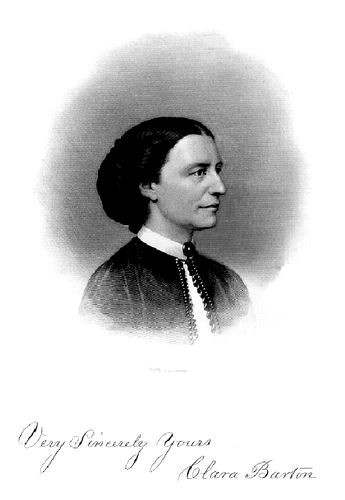
At the close of the war she met exchanged prisoners at Annapolis. Accompanied by Dorrence Atwater, she conducted an expedition, sent at her request by the United States Government to identify and mark the graves of the 13,000 soldiers who perished at Andersonville. From Savannah to that point, as theirs were the first trains which had passed since the destruction of the railroads by Sherman, they were obliged to repair the bridges and the embankments, straighten bent rails, and in some places make new roads. The work was completed in August, 1865, and her report of the expedition was issued in the winter of 1866.
The anxiety felt by the whole country for the fate of those whom the exchange of prisoners and the disbanding of troops failed to reveal, stimulated her to devise the plan of relief, which, sanctioned by President Lincoln, resulted in the "search for missing men," which (except the printing) was carried on entirely at her own expense, to the extent of several thousand dollars, employing from ten to fifteen clerks. In the winter of '66, when she was on the point, for want of further means to carry out her plan, of turning the search over to the Government, Congress voted $15,000 for reimbursing moneys expended, and carrying on the work. The search was continued until 1869, and then a full report made and accepted by Congress. During the winter of 1867-8 Miss Barton was called on to lecture before many lyceums regarding the incidents of the war.
In 1869, her health failing, she went to Switzerland to rest and recover, where she was at the breaking out of the Franco-Prussian war, and immediately tendered her services there, as here, on the battle-field, under the auspices of the Red Cross of Geneva. Her Royal Highness the Grand Duchess of Baden, daughter of the Emperor of Germany, invited Miss Barton to aid her in the establishment of her noble Badise hospitals, a work which consumed several months. On the fall of Strasburg she entered the city with the German army, organized labor for women, conducting the enterprise herself, employing remuneratively a great number, and clothing over thirty thousand. She entered Metz with hospital supplies the day of its fall, and Paris the day after the fall of the Commune. Here she remained two months, distributing money and clothing which she carried, and afterward met the poor in every besieged city in France, extending succor to them.
She is a representative of the "International Red Cross of Geneva," and President of the American National Association of the Red Cross, honorary and only woman member of "Comité de Strasbourgeois"; was decorated with the "Gold Cross of Remembrance" by the Grand Duke and Duchess of Baden, and with the "Iron Cross of Merit" by the Emperor and Empress of Germany.
Miss Barton may be said to have given her whole life to humanitarian affairs, largely national in character. The positions she has occupied, whether remunerative or not—and she has filled but few paid positions—have been pioneer ones, in which her efforts and success have been to raise the standard of woman's work and its recognition and remuneration. Her time, her property, and her influence have been held sacred to benevolence of that character that will assist in true progress. Nevertheless, she is one of the most retiring of women, never voluntarily coming before the world except at the call of manifest duty, and shrinking with peculiar sensitiveness from anything verging on notoriety.
Her summers are passed at her pleasant country residence at Dansville, New York, where she has regained in a most gratifying degree her shattered health and war-worn strength, and her winters in Washington in the interests and charge of the great International movement which she represents in America.
JOSEPHINE SOPHIE GRIFFING.
The National Freedman's Relief Association.
BY CATHARINE A. F. STEBBINS.
Josephine Sophie White was born at Hebron, Conn., December, 1816, and was educated in her native State. She grew to young womanhood in the pure and religious atmosphere of the New England hills, and developed a strength of constitution and character which was the basis of her truly beneficent life-work. Refined, sympathetic, and conscientious, with the golden rule for her text, her career was ever marked with deeds of kindness and charity to the oppressed of every class. Taking an active part in both the "Anti-slavery" and "Woman's Rights" struggles, she early learned the very alphabet of liberty. With her the perception of its blessings and its glory was also a rich inheritance, and the vigilance and courage to conquer and secure it for others was not less a noble legacy. The love of liberty flowed down to her through two streams of life. On the mother's side she was descended from Peter Waldo[25], after whom the Waldenses were named; and on the father's, from Peregrine White, who was born in Massachusetts in 1620, the first child of Pilgrim parents. It is not strange she was by temperament and constitution a reformer, and a protestant against all despotisms, whether of mind, body, or estate. In the agitation for human rights of one class after another, in their historical order, she enlisted with the Abolitionists, with the Woman Suffragists, with the Loyal League and sanitary workers, and after the war, in relief of the Freedmen. Her interest in her own sex began early, and continued to the last.
At the age of twenty-two she married, and about the year 1842 removed with her family to Ohio, where her home soon became the refuge of the fugitive slave, and the resting-place of his defenders. In 1849 she began, with her husband, Chas. S. S. Griffing, her public labors in connection with the "American" and the "Western Anti-Slavery Societies," speaking at first to small audiences in school-houses, and when prejudice and bitterness gave way, to conventions, and mass-meetings; opposition and curiosity yielding finally to sympathy and aid. But for years the meetings were often broken up by mobs. The effort to uproot slavery was pronounced either absurd, treasonable, or irreligious; that it would incite insurrection of the slaves; or if successful, bring great responsibility upon the Abolitionists, and disaster to the whole country.
In 1861, Mrs. Griffing, prompted by the same loyal spirit that moved all the women of the nation, turned from the ordinary occupations of life to see what she could do to mitigate the miseries of the war. She united at once with "The National Woman's Loyal League," lecturing and organizing societies in the West for the soldiers and freedmen, to whom large quantities of clothing and other supplies were sent, and circulating petitions to Congress for the emancipation of slaves as a war measure.
While thus engaged, her thoughts naturally turned to the large number of Southern slaves coming with the army into Washington, whose future she foresaw would be beset with distress and want during the long period of change from chattelism to the settled habits of freedom. They were coming by the hundreds and thousands in 1863, with a vague idea of being cared for by "the Governor," but the Government had as yet made no provision, separate from that for the soldiers, when Mrs. Griffing went to Washington and began her labors for them, which were continued until her death.
She at once counseled with President Lincoln and Secretary Stanton as to the best methods for immediate relief; proposed plans which they approved, and received from them every aid possible in their execution. Her first step was to open three ration-houses, where she fed at least a thousand of the old and most destitute of the freed people daily. She visited hundreds in the alleys and old stables, in attics and cellars, and in almost every place where shelter could be found, and became acquainted personally with their necessities, and the best means of supplying them. There were 30,000 in the capital at this time, and it would be difficult to give an idea to one not there, of the time and labor it cost to hunt out the old barracks and get them transformed into shelters for these outcasts. Upon the personal order of the Secretary of War, she was allowed army blankets and wood, which she distributed herself, going with the army wagons to see that those suffering most were first supplied. This "temporary relief" was necessarily continued for some time, during which Mrs. Griffing was made the General Agent of "The National Freedman's Relief Association of the District of Columbia." She opened a correspondence with the Aid societies of the Northern and New England States, which resulted in her receiving supplies of clothing and provisions, which were most acceptable. These were carefully dispensed by herself and two daughters, who were her assistants. Mrs. Griffing opened three industrial schools, where the women were taught to sew;[26] a price was set on their labors, and they were paid in ready-made garments. The Secretary aided in the purchase of suitable cloth, and with that sent from the North, such outfits were supplied as could be afforded.
It was soon apparent to Mrs. Griffing that the Government must provide for the old and the infirm, and that until labor could be found, even a majority of the strong must be included in the provision—with the understanding, however, that they must seek employment and exert themselves to find homes—and that educational and political interests must be established and encouraged. The stress of the situation can not be said ever to have relaxed during our friend's life, except as to numbers—at any rate in the early years; but as soon as some system grew out of the confusion, and all that could be, were supplied with bread and shelter, she turned her attention in part to the larger plan, and urged a bureau under Government; a department for these freedmen's interests. This plan was favored by Messrs. Sumner, Wade, Wilson, and a few other Senators and Members of Congress, and in December, 1863, a bill for a Bureau of Emancipation was introduced in the House of Representatives by Hon. Mr. Elliot, of Massachusetts. It received no welcome; few cared to listen to the details of the necessity, and it was only through Mrs. Griffing's brave and unwearied efforts that the plan was accepted, and carried through in March, 1865, under the title of "The Freedman's Bureau." The writer has had testimony to the truth of this from Senators Wade of Ohio, Howard of Michigan, and others, as well as to the fact that a majority of the Congressional Committee in charge of the bill, wished that Mrs. Griffing should be made Commissioner (among whom, and most active in support of the bill, was Senator Henry Wilson), but it was decided to place the Bureau in the War Department, with a military man at the head, Mrs. Griffing being appointed "Assistant Commissioner." She really held the position but a few weeks—in name, five months—a second military officer standing ready to take the appointment, as men have ever done, and as they will always crowd women aside so long as they are held political inferiors, without the citizen's charter to sustain their claim. This officer had the title and drew the pay, while our noble friend went on as before in her arduous and almost superhuman labors. The Bureau adopted her plan of finding homes in the North, sending the freedmen at Government charge, and of opening employment offices in New York City and in Providence, R. I.; nevertheless it was necessary to supplement Government provision by private generosity; and moreover, that Congress should provide temporary relief for the helpless in the District. Appropriations were made in sums of $25,000, amounting in all to nearly $200,000, for the purchase of supplies, a very large proportion of which were distributed by Mrs. Griffing in person from her own residence.[27] "Shirley Dare," in writing to The New York World, after a little time spent with Mrs. G., said:
"I sat an hour this morning in Mrs. Griffing's office during the distribution of rations, and a curious scene it was. There was not a sound creature among the crowd which filled the yard, and which hangs about all day from nine till four, and which the neighborhood calls 'Mrs. Griffing's signs.' It reminded me of another crowd of impotent folk, lame, halt, and blind, which filled the loveliest space in Jerusalem, and was a sign of joy and charity in the place. Queer, tender, wistful faces, so earnest one forgets their grotesque character and ragged, faded forms, cluster in the porch; such a set as one might once have seen put up at auction as a 'refuse lot' of plantation negroes. The men wear old army cloaks, while the women, with dresses in every stage of decay, are so comic, one struggles between the ludicrous and the pitiful.... The faith of this class seems to be fastened nowhere so strongly as upon Mrs. Griffing. Salutations follow her along the streets, enough to satisfy the proudest Pharisee, and it provokes one between a smile and a tear, to see the women waiting timidly, yet eagerly, for a word from her, to set their faces all aglow. They used to say, persistently, 'We belongs to you,' and no efforts could induce them to change that phrase. 'Who has we but the Lord and you?' was the simple argument which stayed protest from the kind, proud woman who was their benefactress. A few words from her will draw out histories simple, funny, and sad beyond question."
Our friend had a strong belief that the able in body could sustain themselves if labor were provided, which it could not be there, so she urged them to go to the North, which greatly needed laborers to fill the places of Northern men in the army. Woman's help, too, was as much in demand, for in many places large farms were wholly managed by women in the absence of husbands and sons; but it was learned by Mrs. Griffing and daughters through repeated testimony, that the life-long teaching of the slaves had been, that no good could come from Northern people,[28] and this led the many in their pitiable ignorance to believe that, somewhere in the North, the monsters surely lived who were waiting to destroy them, and that the kind few whom they had met were of a different race; that "the North" was beyond the sea, and they could never return, nor hear from their friends left behind; so persistent argument was needed to convince the most ignorant of their false notions, and many of them never were, until some had gone and returned with good tidings. The first company prepared to go numbered sixty persons, for whom Mrs. Griffing procured Government transportation and a day's rations. She went with them to New York City, and as they passed from the cars the sight was a new and strange one. Filing through the streets, the anxious, wondering women dressed partly in neat garments given them, with others of their own selection in less good taste; while on the men an occasional damaged silk hat topped off a coat that would have made Joseph's of old look plain; with ironclad army shoes; or a half-worn wedding swallow-tail, eked out by a plantation broad-brim, and boots too much worn for either comfort or beauty. This motley band, led by a gentle and spiritual-faced woman, will not soon be forgotten by those who saw it depart. Leaving a few at one depot, and a few at another, to be met at the journey's end by their employer, Mrs. Griffing took those remaining to Providence, near which place homes had been provided. After these sent messages back to friends, others went more readily, and during a little more than two years over seven thousand freed people left Washington under Mrs. Griffing's special supervision and direction for homes in the North. I wish I could say how many parties she actually convoyed on the journey, and how many miles she traveled, but I know that she went as far as New York with a great many; and as I have seen them start, knew and felt that it was too much for her, and longed that some stronger person should appear to share her burdens, and relieve her from these exhausting duties. Perhaps she had written letters till twelve o'clock the night before; had taken a long walk beyond the Navy-Yard cars, in the afternoon, to visit her centenarians; or had received calls, and talked till her voice had almost given out.
But she had the comfort of knowing that many remained where they had been sent, some buying homes and planting vines about the roof-tree. To behold this, she had wrought heroically in the past for emancipation. She was busy with her hands, busier with her brain, and her spiritual nature was like a spring of sweet waters, overflowing in bounteous blessing on all around. Of the great painter Leonardo da Vinci, his biographer says: "He always saw four things he wanted to do at once." Our friend always saw many more. Her mind was teeming not only with ideals as beautiful as those of the great artist, but with practical plans to educate the ignorant, and lift them to self-support and self-protection. Her being was instinct with constructive and spiritual force.
It would be hard to find any sphere of woman's activity in which she had not been leader. Believing that "the manifest intention of nature is the perfection of man," she faithfully did her part. In the laborious and the menial she served the colored poor, while she neglected no opportunity to open their spiritual vision. She fed, warmed, and clothed them; ministered to the sick; attended the dying; procured their coffins; spoke the comforting words, and sung the hymns at their funerals. She instructed them in their Sunday meetings, and gained release for those in prison for petty offences, or for those unjustly accused. Soldiers often appealed to her to assist and aid them. Her work at the jails was very wearing, for the poor creatures, not unfrequently the mother of an infant left at home, arrested for an imaginary offense, or for stealing bread to avert starvation, would plead so hard for her to get them released, and had such full faith that she could, that it was a constant tax upon her sympathy and strength, as was all her work connected with them.
Josephine Griffing had to deal too much with the realities of life and death to make many records of her work, save those required in the routine of her office. These were mostly kept by her daughter Emma, her official assistant. But the substance of what was done in these years may be found in the archives of the Government. On the calendar of both Houses of Congress, in the Congressional Globe, in the War Office, in the Freedman's Bureau, in the offices of District Government and District Courts, and perhaps in the prisons, the future historian may find abundant records of the patient and humane labors of this merciful, vigilant, and untiring woman. Whether he finds them in her name is not so certain!
Mrs. Griffing not only devoted to these people the six days of the week allotted to labor, but her Sundays were given to public ministrations as well as private visits to the distant and aged, unable to come to the Relief rooms during the week. But for a real picture of the condition of these people, nothing can be more graphic or full of feeling, than her own account in a letter to Lucretia Mott,[29] intended as an appeal to the Society of Friends in Philadelphia. It, with others, had early responded, and with its contributions in part, she had established the soup-houses before noted. Her account is also in connection with the Bureau, of historical interest. During this long struggle her evenings were spent in writing letters to the North, framing bills, petitions, and appeals to amend the laws of the District. As she was interested in all the reforms of the day, she was frequently called upon for active service in conventions and political gatherings.
Of the public men whom she consulted, two at least, I know, made everybody and everything yield when she appeared; these were Secretary Stanton and Chas. Sumner—so interested were they in the objects of her devotion, and so sure that Mrs. Griffing would not take their time without sufficient reason. Benj. F. Wade and Henry Wilson would not yield the palm in their respect to her, and Senator Howard, of Michigan, was also one of her most friendly helpers. Stevens, Julian, Dawes, Ashley—all the friends in Congress—could tell of her great achievements, and their unbounded confidence in her, as the following letters show:
Washington, D. C., March 11, 1865.
To the Commissioner of the Freedman's Bureau:
Sir:—I take pleasure in giving my influence to this application for a place at the head of freedmen's affairs in the District of Columbia for Mrs. Josephine S. Griffing, believing her to be eminently qualified to develop the resources of the freed people in this District, most of whom are women and children—secure the national interest, and give satisfaction to the country. Mrs. Griffing has given successful public and private efforts in behalf of the colored race for many years, and has devoted the entire time of the last year to an investigation of the condition and best method of giving relief to the multitudes of freed people in and around the National Capital. Finding many thousands of women with families without employment or the means of self-support, she has conferred with the President and Governors of the Northwestern States upon the practicability of encouraging their emigration. To meet the destitution of these people in this city during the past winter, Mrs. Griffing has disbursed from the Government about $25,000 in wood and blankets and rations, and $5,000 in clothing and money from the public charity. I believe the appointment of Mrs. J. S. Griffing to a chief clerkship or general agency for the District in this Bureau will be creditable to the Government and satisfactory to the freed people.
Z. Chandler.
I fully concur with my colleague. Mrs. Griffing is both worthy and capable, and I trust her services will be secured.
J. M. Howard.
If I had this appointment to make, I would make Mrs. Griffing Commissioner.
J. M. Ashley.
I know Mrs. Griffing to be capable and humane, and very devoted to the colored race. I hope that her services may be secured.
Charles Sumner.
I most cheerfully join in this recommendation.
H. Wilson,
J. N. Grimes.
I fully concur in the above, and hope that Mrs. Griffing will receive a conspicuous place in the Freedman's Bureau. She is the best qualified of any person within my knowledge; her whole heart is in the work.
B. F. Wade, Solomon Foot,
Ira Harris, E. D. Morgan,
W. P. Fessenden.
I most fully concur.
J. V. Driggs,
T. W. Ferry.
I fully concur in all that is said within in behalf of Mrs. Griffing, and earnestly commend her to the favor sought.
Geo. W. Julian.
Washington, July 9, 1869.
Mrs. Griffing has for several years devoted herself with great industry, intelligence, and success to the freed people in the District of Columbia, and in this service she has accomplished more good than any other one individual within my acquaintance. When the War Department was in my charge, she rendered very efficient aid of a humane character to relieve the wants and sufferings of destitute freed people, and was untiring in her benevolent exertions. Property for distribution was often placed in her hands, or under her directions, and she was uniformly trustworthy and skillful in its management and administration. In my judgment, she is entitled to the most full confidence and trust.
Edwin M. Stanton.
Jefferson, Ohio, Nov. 12, 1869.
My Dear Mrs. Griffing:—On my return from Washington I found your kind letter of the 28th, ult. I regret much that I did not meet with you at Washington. I know your merits. I know that no person in America has done so much for the cause of humanity for the last four years as you have. Your disinterested labors have saved hundreds of poor human beings not only the greatest destitution and misery, but from actual starvation and death. I also know that in doing this you have not only devoted your whole time, but all the property you have. And I know, too, that your labors are just as necessary now as they ever have been. Others know all this as well as I do. Secretary Stanton can vouch for it all, and I can not doubt that Congress will not only pay you for what you have done, but give you a position where this necessary work may be done by you effectually. This is the very thing that ought to be done at once. Since the Bureau has been abolished it will be impossible to get along with the great influx of imbecility and destitution which gathers and centers in Washington every winter, without some one being appointed to see to it, and certainly everybody knows that there is no one so competent for this work as yourself. To this end I will do whatever I can, but you know that I am now out of place, and have no influence at Court, but whatever I can do to effect so desirable an object will be done.
B. F. Wade.
Truly yours,
Senate Chamber, April 2.
Dear Madam:—I have your note of the 31st, and am very sorry to hear that there is so much distress in the city. I shall endeavor to bring the charter up as soon as I have an opportunity; but while this trial is pending,[30] it is improbable that any legislative business will be done. I am as anxious as you are to secure its adoption.
Charles Sumner.
Yours truly,
Mrs. J. S. Griffing, Washington.
Boston, 27th July, 1869.
Dear Madam:—The statement or memorial which you placed in my hands was never printed. It is, probably, now on the files of the Senate. I wish I could help your effort with the Secretary of War. You must persevere. If Gen. Rawlins understands the case, he will do all that you desire. Accept my best wishes, and believe me, faithfully yours,
Charles Sumner.
Will Mrs. Griffing let Mr. Sumner know what institution or person should disburse the money appropriated?
Senate Chamber,
Tuesday.
LETTERS ON THE FREEDMAN'S RELIEF ASSOCIATION.
Washington, April 8, '71.
To the Mayor and Board of Common Council, City of Washington, District of Columbia:
Messrs.:—I have the honor to state that the aged, sick, crippled, and blind persons, for whom the National Freedman's Relief Association of this District partially provides, are at this time in very great destitution, many of them in extreme suffering for want of food and fuel. The Association has provided clothing. It is now twelve weeks since the Government appropriation for their temporary support for the last year was exhausted. This Association has by soliciting contributions, up to this time, relieved the most extreme cases, that otherwise must have died; but the want of food is so great among at least a thousand of these, not one of whom is able to labor for a support, that it is impossible to provide the absolute relief they must have, by further contributions from the charitable and the humane.
I would therefore most earnestly appeal in their behalf, that the Hon. Council and Mayor will appropriate from the market fund for their temporary relief one thousand dollars, to be disbursed by the above-named association, which sum will enable these destitute persons to subsist until, as is hoped and believed, Congress will make the usual special appropriation for their partial temporary support. This Association to report the use of such money to the Mayor and Common Council of the City of Washington, D. C.
J. S. Griffing,
General Agent N. F. R. Association, D. C.
Very respectfully,
Tribune Office, New York, Sept. 7, 1870.
Mrs. Griffing:—In my judgment you and others who wish to befriend the blacks crowded into Washington, do them great injury. Had they been told years ago, "You must find work; go out and seek it," they would have been spared much misery. They are an easy, worthless race, taking no thought for the morrow, and liking to lean on those who befriend them. Your course aggravates their weaknesses, when you should raise their ambition and stimulate them to self-reliance. Unless you change your course speedily and signally, the swarming of blacks to the District will increase, and the argument that Slavery is their natural condition will be immeasurably strengthened. So long as they look to others to calculate and provide for them, they are not truly free. If there be any woman capable of earning wages who would rather some one else than herself should pay her passage to the place where she can have work, then she needs reconstruction and awakening to a just and honest self-reliance.
Horace Greeley.
Yours,
Mrs. J. S. Griffing, Washington, D. C.
Sept. 12, 1870.
Horace Greeley:
Dear Sir:—Much as I respect your judgment, and admire your candor, I must express entire dissent with your views in reference to those who are laboring to befriend the Freedmen, and also of your estimate of the character of the black race.
When you condemn my work for the old slaves, who can not labor, and are "crowded into Washington" by force of events uncontrollable, as a "great injury," I am at a loss to perceive your estimate of any and all benevolent action. If, to provide houses, food, clothing, and other physical comforts, to those broken-down aged slaves whom we have liberated in their declining years, when all their strength is gone, and for whom no home, family friendship, or subsistence is furnished; if this is a "great injury," in my judgment there is no call for alms-house, hospital, home, or asylum in human society, and all appropriations of sympathy and material aid are worse than useless, and demand your earnest rebuke and discountenance, and to the unfortunates crowded into these institutions, you should say, "You must find work, go out and seek it." So far as an humble individual can be, I am substituting to these a freedman's (relief) bureau; sanitary commission; church sewing society, to aid the poor; orphan asylum; old people's home; hospital and alms-house for the sick and the blind; minister-at-large, to visit the sick, console the dying, and bury the dead; and wherein I fail, and perhaps you discriminate, is the want of wealthy, popular, and what is called honorable associations. Were these at my command, with the field before me, it would be easy to illustrate the practical use as well as the divine origin of the Golden Rule.
If, in your criticism, you refer to my secondary department in which I have labored to furnish employment to the Freedmen both in the District and out, is it not a direct reflection upon all efforts made for the distribution of labor? Is my course more aggravating to the weakness of destitute unemployed freed people, than emigrant societies, intelligence offices, benevolent ladies' societies, and young men's Christian associations, to give work to the poor of all nations; and lastly the Government Indian department, that has wisely called to its aid the American missionary, and the Quaker societies, to farm out the poor Indians? or, if the measures put forth by these admissible agents can raise the ambition and stimulate to self-reliance their beneficiaries, will you be good enough to show wherein the same means, which I claim to employ, must have the opposite effect upon the freedmen crowded into Washington.
Is it possible that the swarming of the Irish, Swiss, and German poor, to the city of New York, is attributable to the intelligence offices and immigration societies of your city, and not, as we have supposed, to the want of work and bread at home, and is there really a danger, that in providing and calculating for them, we shall strengthen the argument of race, while our institutions of charity are filled with descendants of the Saxon, the Norman, the Goth, and the Vandal? I think not.
Josephine S. Griffing.
Respectfully yours,
From the New National Era.
MRS. JOSEPHINE S. GRIFFING THE ORIGINATOR OF THE FREEDMEN's BUREAU.
This truly excellent and noble woman was fitly spoken of in the New National Era just after her death, but at that early date it was not possible to obtain the facts to prove the statement at the head of this article, which is but simple truth and historic justice.
Mrs. Griffing was engaged in an arduous work for the Loyal League in the Northwest in 1862, and foresaw the need of a comprehensive system of protection, help, and education, for the slaves in the trying transition of freedom. She sought counsel and aid from fit persons in Ohio and Michigan, and came here only in 1863 to begin her work of urging the plan of a Bureau for that purpose. Nothing daunted by coldness or indifference she nobly persisted, until in December, 1863, a bill for a Bureau of Emancipation was introduced in the House of Representatives by Hon T. D. Elliott, of Massachusetts. After some changes in the bill, and a committee of conference of the House and Senate, and the valuable aid of Sumner, Wilson, and other Senators, the bill for the Freedman's Bureau finally passed in March, 1865, and was signed by President Lincoln just before his assassination.
The original idea was Mrs. Griffing's; her untiring efforts gave it life, and it is but just that the colored people, of the South especially, should bear in grateful remembrance this able and gentle woman, whose life and strength were spent for their poor sufferers, and who called into useful existence that great national charity, the Freedman's Bureau.
The following letter from William Lloyd Garrison to Giles B. Stebbins, then in Washington, corroborates the above statements:
Roxbury, Mass., March 4, 1872.
My Dear Friend: ... I was glad to see the well-merited tributes paid by yourself and others to the memory of Mrs. Josephine S. Griffing. She was, for a considerable period, actively engaged in the anti-slavery struggle in Ohio, where by her rare executive ability and persuasiveness as a public lecturer, she aided greatly in keeping the abolition flag flying, enlightening and changing public sentiment, and hastening the year of jubilee. With what unremitting zeal and energy did she espouse the cause of the homeless, penniless, benighted, starving freedmen, driven by stress of circumstances into the national capital in such overwhelming numbers; and what a multitude were befriended and saved through her moving appeals in their behalf! How like an angel of mercy must she have seemed to them all! No doubt the formation of the Freedman's Bureau was mainly due to her representations as to its indispensable necessity; and how much good was done by that instrumentality in giving food, clothing, and protection to those who were so suddenly brought out of the house of bondage, as against the ferocity of the rebel element, it is difficult to compute because of its magnitude. She deserves to be gratefully remembered among "the honorable women not a few," who, in their day and generation, have been
"Those starry lights of virtue that diffuse, Through the dark depths of time their vital flame,"
whose self-abnegation and self-sacrifice in the cause of suffering humanity having been absolute, and who have nobly vindicated every claim made by their sex to full equality with men in all that serves to dignify human nature. Her rightful place is among "the noble army of martyrs," for her life was undoubtedly very much shortened by her many cares and heavy responsibilities and excessive labors in behalf of the pitiable objects of her sympathy and regard.
William Lloyd Garrison.
Very truly yours,
Parker Pillsbury, in a letter to Mrs. Stebbins says: "The anti-slavery conflict could never boast a braver, truer, abler advocate than Josephine Griffing. It was always an honor and inspiration to stand by her side, no matter how fierce the encounter. I have seen her when an infuriated mob assailed our Conventions, and dashed down doors, windows, seats, stoves, tables, everything that would yield to their demoniac rage, stand amid the ruins calm and unmoved, and with her gentle words of remonstrance shame the intruders, until one by one they shrank away, glad to get out of her sight.
Her beautiful home hospitalities; her warm welcome ever extended to the faithful friends of freedom and humanity, were equal to her unshaken courage and self-control in public assemblies. We used to call that humble home in Litchfield, 'The Saint's Rest,' and such it was to many a fugitive slave, as well as soldier in his cause.
To the first demand for the enfranchisement of women in 1848, Mrs. Griffing heartily responded, and in this reform she was ever untiring in effort, wise in counsel, and eminent in public speech. In 1867 she helped to organize the Universal Franchise Association of the District of Columbia, of which she was president for years. She was also Corresponding Secretary of the National Woman Suffrage Association, and was ever considered the organizing power at Washington. She first suggested the importance of annual conventions at the capital, in order to influence Congressional action.
Mrs. Griffing's last appearance in public was at the May Anniversary of the National Woman Suffrage Association, held in New York in 1871, and so feeble was her condition that a screen was placed behind her to enable the audience to hear her voice. At the close of the Convention she went to the home of her childhood, in Hebron, Conn., hoping that the bracing air of the New England hills would give her new life and strength, until she could finish her work. But it was already finished. She had taxed herself to the uttermost, beyond nature's power to recuperate. In November she returned to Washington, and enjoyed the sweet presence and tender care of her daughters until she passed away on Feb. 18, 1872.
THE LADIES' NATIONAL COVENANT.
After the war was fairly inaugurated, the manufactories of the country largely turned their attention to the production of material required by the army, which, combined with the immense number of volunteers from such avocations, and the rise in prices of all home manufactures, created an immense import of foreign goods, which, pouring into our country when gold was at the highest, brought to our doors a danger no less formidable than that of the Rebellion. It was shown from official returns, in 1863, that during a period of nine months, the imports, at the port of New York alone, amounted to $160,000,000 in gold; equal, including exchange, freight, insurance, etc., to twice that sum, while our exports amounted to only $120,000,000 in paper.
This ruinous state of our trade brought on us the taunts of foreign enemies, and roused the attention of the country to devise some method of meeting the new danger; Congress temporarily raised duties fifty per cent. in hopes of stemming the tide of importation. The patriotic women of the nation, ever on the alert for methods of aiding the country, early in 1864 called a meeting of the loyal women of Washington, at which time an association, pledging women to the use of home manufactures, was formed under the name of "The Ladies' National Covenant," with offices in every State and Territory within the national lines. Mrs. General Jas. Taylor was elected President; Mrs. Stephen A. Douglas, Vice-President; Mrs. Rebecca Gillis and Miss Virginia Smith, Recording Secretaries; with ten Corresponding Secretaries, of whom Mrs. H. C. Ingersoll was the most active.
This association, formed for the purpose of encouraging domestic manufactures, was composed at its first meeting of the wives of members of the Cabinet and of Senators and Representatives, women of fashion, popular authoresses, mothers who had lost their sons, and wives who had lost their husbands. An Advisory and Organizing Committee was appointed, consisting of women from each State and Territory within the national line. An Address to the Women of America was issued, and a constitution consisting of eleven sections, together with the following pledge, was adopted:
THE PLEDGE.
For three years, or during the war, we pledge ourselves to each other and the country, to purchase no imported goods where those of American manufacture can be obtained, such as "dress goods of velvet, silks, grenadines, India crape, and imported organdies, India lace and broche shawls, fine wrought laces and embroideries, watches and precious stones, hair ornaments, fans, artificial flowers and feathers, carpets, furniture, silks and velvets, painted china, ormolu, bronze, marble, ornaments, and mirrors."
The emblem of this Covenant was a black or gilt bee, worn as a pin fastening the national colors, upon the hair, arm, or bosom, as a public recognition of membership. In August of the same year the Secretary stated that orders for the emblem, the badge of the Covenant, were received by the manufacturer of the pin from all parts of the Union. A meeting was held in New York, rooms opened in Great Jones Street, and the Covenant was in a fair way to assume large proportions. When Lee's capitulation was announced the necessity for the Covenant ended, and with peace, trade was allowed to drift into its natural channels.
ANNA ELIZABETH DICKINSON.
Foremost among the women who understood the political significance of the great conflict, was Miss Dickinson, a young girl of Quaker ancestry, who possessed remarkable oratorical power, a keen sense of justice, and an intense earnestness of purpose. In the heated discussions of Anti-Slavery Conventions, she had acquired a clear comprehension of the province of laws and constitutions; of the fundamental principles of governments, and the rights of man. Like a meteor, she appeared suddenly in the political horizon, as if born for the eventful times in which she lived, and inspired by the dangers that threatened the life of the republic.
At the very beginning of the war her radical utterances were heard at different points in her native State.[31] Her admirable speech on the higher law, first made at Kennett Square, and the discussion that followed, in which Miss Dickinson maintained her position with remarkable clearness and coolness for one of her years, were a surprise to all who listened. The flattering reports of this meeting in several of the Philadelphia journals introduced her at once to the public.
On the evening of February 27, 1861, she addressed eight hundred people in Concert Hall, Philadelphia. This was her first appearance before so large an assembly, and the first time she had the sole responsibility of entertaining an audience for an entire evening. She spoke two full hours extemporaneously, and the lecture was pronounced a success, not only by the press, but by the many notables and professional men present. Although it was considered a marvelous performance for a young girl, Miss Dickinson herself was mortified, as she said, with the length of her speech and its lack of point, order, and arrangement.
Soon after, she entered the United States Mint, to labor from seven o'clock in the morning to six at night. Although she was ever faithful to her duties and skillful in everything she undertook, soon becoming the most rapid adjuster in the Mint, her radical criticisms on the war and its leaders cost her the loss of the place. At a meeting just after the battle of Ball's Bluff, in summing up the record, after exonerating Stone and Baker, she said, "Future history will show that this battle was lost not through ignorance and incompetence, but through the treason of the commanding general, George B. McClellan, and time will vindicate the truth of my assertion." She was hissed all over the house, though some cried, "Go on!" "Go on!" She repeated this startling assertion three times, and each time was hissed.
When Gen. McClellan was running against Lincoln in 1864, after she had achieved a world-wide reputation, she was sent by the Republican Committee of Pennsylvania to this same town, to speak to the same people, in the same hall. In again summing up the incidents of the war, when she came to Ball's Bluff, she said, "I say now, as I said three years ago, history will record that this battle was lost, not through ignorance or incompetence, but through the treason of the commanding general, George B. McClellan." "And time has vindicated your assertion," was shouted all over the house.
It was the speech made in 1861, that cost her her place in the mint, for while laboring there daily with her hands, her mind was not inactive nor indifferent to the momentous events transpiring about her. She kept a close watch of the progress of the war, and the policy of the Republican leaders. When ex-Governor Pollock dismissed her, he admitted that his reason was that Westchester speech, for at that time McClellan was the idol of the nation.[32]
With remarkable prescience all through the war, and the period of reconstruction, Miss Dickinson took the advance position. Wendell Phillips used to say that "she was the young elephant sent forward to try the bridges to see if they were safe for older ones to cross." When wily politicians found that her criticisms were applauded by immense audiences, they gained courage to follow her lead. As popular thought was centering everywhere on national questions, Miss Dickinson thought less of the special wrongs of women and negroes and more of the causes of revolutions and the true basis of government; hence she spoke chiefly on the political aspects of the war, and thus made herself available in party politics at once.
In the intervals of public speaking, she made frequent visits to the Government hospitals, and became a most welcome guest among our soldiers. In long conversations with them, she learned their individual histories, experiences, hardships, and sufferings; the motives that prompted them to go into the army; what they saw there; what they thought of war in their hours of solitude, away from the camp and the battle-field. Thus she acquired an insight into the soldier's life and feelings, and from these narratives drew her materials for that deeply interesting lecture on hospital life, which she delivered in many parts of the country.
This lecture, given in Concord, New Hampshire, in the autumn of 1862, was the turning-point of her fortunes. In this speech she proved slavery to be the cause of the war, that its continuance would result in prolonged suffering to our soldiers, defeat to our armies, and the downfall of the Republic. She related many touching incidents of her experiences in hospital life, and drew such vivid pictures of the horrors of both war and slavery, that by her pathos and logic, she melted her audience to tears, and forced the most prejudiced minds to accept her conclusions.
It was on this occasion that the Secretary of the State Central Committee heard her for the first time. He remarked to a friend at the close of the lecture, "If we can get this girl to make that speech all through New Hampshire we can carry the Republican ticket in the coming election." Fully appreciating her magnetic power over an audience, he resolved at once, that if the State Committee refused to invite her, he should do so on his own responsibility. But through his influence she was invited by the Republican Committee, and on the first of March commenced her regular campaign speeches. During the four weeks before election she spoke twenty times, everywhere to crowded, enthusiastic audiences. Her march through the State was a succession of triumphs, and ended in a Republican victory.
The member in the first district having no faith that a woman could influence politics, sent word to the Secretary, "Don't send that damn woman down here to defeat my election." The Secretary replied, "We have work enough for her to do in other districts without interfering with you." But when the would-be honorable gentleman saw the furor she created, he changed his mind, and inundated the Secretary with letters to have her sent there. But the Secretary replied, "It is too late; the programme is arranged and published throughout the State; you would not have her when you could, and now you can not have her when you will."
It is pleasant to record that this man, who had the moral hardihood to send a profane adjective over the wires, with the name of this noble girl, lost his election. While all other districts went strongly Republican, his was lost by a large majority. When the news came that the Republicans had carried the State, due credit was awarded to Anna Dickinson. The Governor-elect made personal acknowledgment that her eloquent speeches had secured his election. She was serenaded, feasted, and feted, the recipient of many valuable presents, and eulogized by the press and the people.
New Hampshire safe, all eyes were now turned to Connecticut. The contest there was between Seymour and Buckingham. It was generally conceded that, if Seymour was elected, Connecticut would give no more money or troops for the war. The Republicans were completely disheartened. They said nothing could prevent the Democrats from carrying the State by four thousand, while the Democrats boasted that they would carry it by ten thousand. Though the issue was one of such vital importance, there seemed so little hope of success, that the Republicans were disposed to give it up without making an effort. And no resistance to this impending calamity was made until Anna Dickinson went into the State, and galvanized the desponding loyalists to life. She spent two weeks there, and completely turned the tide of popular sentiment. Democrats, in spite of the scurrilous attacks made on her by some of their leaders and editors, received her everywhere with the warmest welcome, tore off their party badges, substituted her likeness, and applauded whatever she said. The halls where she spoke were so densely packed, that Republicans stayed away to make room for the Democrats, and the women were shut out to give place to those who could vote. There never was such enthusiasm over an orator in this country. The period of her advent, the excited condition of the people, her youth, beauty, and remarkable voice, and wonderful magnetic power, all heightened the effect of her genius, and helped to produce this result. Her name was on every lip; ministers preached about her, prayed for her, as a second Joan of Arc, raised up by God to save that State to the loyal party, and through it the nation to freedom and humanity. As the election approached, the excitement was intense; and when at last it was announced that the State was saved by a few hundred votes, the joy and gratitude of the crowds knew no bounds. They shouted and hurrahed for Anna Dickinson, serenaded her with full bands of music, sent her books, flowers, and ornaments, manifesting in every way their love and loyalty to this gifted girl, who through so many years had bravely struggled with poverty to this proud moment of success in her country's cause. Some leading gentlemen of the State who had invited her there presented her a gold watch and chain, a hundred dollars for every night she had spoken, and four hundred for the last night before election, in Hartford. The comments of the press, though most flattering, give the reader but a faint idea of the enthusiasm of the people.[33]
Fresh from the victories in New Hampshire and Connecticut, she was announced to speak in Cooper Institute, New York. That meeting, in May, 1862, was the most splendid ovation to a woman's genius since Fanny Kemble, in all the wealth of her youth, beauty, and wonderful dramatic power, appeared on the American stage for the first time. There never was such excitement over any meeting in New York; hundreds went away unable even to get standing places in the lobbies and outer halls. The platform was graced with the most distinguished men and women in the country, and so crowded that the young orator had scarce room to stand. There were clergymen, generals, admirals, judges, lawyers, editors, the literati, and leaders of fashion, and all alike ready to do homage to this simple girl, who moved them alternately to laughter and tears, to bursts of applause and the most profound silence.
Henry Ward Beecher, who presided, introduced the speaker in his happiest manner. For nearly two hours she held that large audience with intense interest and enthusiasm, and when she finished with a beautiful peroration, the people seemed to take a long breath, as if to find relief from the intensity of their emotions. Loud cries followed for Mr. Beecher; but he arose, and with great feeling and solemnity, said: "Let no man open his lips here to-night; music is the only fitting accompaniment to the eloquent utterances we have heard." The Hutchinsons closed with one of their soul-stirring ballads, and the audience slowly dispersed, singing the John Brown song with thrilling effect, as they marched into the street.[34]
After her remarkable success in New York, the Philadelphia Union League invited her to speak in that city. The invitation, signed by leading Republicans, she readily accepted. Judge Wm. D. Kelley presided, and a most appreciative audience greeted her. In this address, reviewing the incidents of the war, she criticised General McClellan as usual, with great severity. Some of his personal friends, filled with indignation, left the house, while a derisive laugh followed them to the door. The Philadelphia journals vied with each other in their eulogiums of her grace, beauty, and eloquence. The marked attention she has always received in her native city has been most grateful to her, and honorable to her fellow-citizens.
In July, 1862, the first move was made to enlist colored troops in Pennsylvania. A meeting was called for that purpose in Philadelphia. Judge Kelley, Frederick Douglass, and Anna Dickinson were there, and made strong appeals to the people of that State to grant to the colored man the honor of bearing arms in defence of his country. The effort was successful. A splendid regiment was raised, and the first duty they discharged was to serenade the young orator, who had spoken so eloquently for their race all through the war.
In September a field-day was announced at Camp William Penn. General Pleasanton reviewed the troops. It was a brilliant and interesting occasion, as many were about to leave for the seat of war. At the close of the day when the people began to disperse it was noised round that Miss Dickinson was there; a cry was heard at once on all sides, "A speech! a speech!" The moon was just rising, mingling its pale rays with those of the setting sun, and throwing a soft, mysterious light over the whole scene. The troops gathered round with bristling bayonets and flags flying, the band was hushed to silence, and when all was still, mounted on a gun-wagon, with General Pleasanton and his staff on one side, General Wagner and his staff on the other, this brave girl addressed "our boys in blue." She urged that justice and equality might be secured to every citizen in the republic; that slavery and war might end forever and peace be restored; that our country might indeed be the land of the free and the home of the brave.
[18] Julia Ward Howe. See Appendix.
[19] See Appendix.
[20] During all periods of the war instances occurred of women being found in the ranks fighting as common soldiers, their sex remaining unsuspected.—Women of the War.
[21] After the close of the war a bill was passed by Congress authorizing the payment of salary due Mrs. Ella F. Hobart, for services as chaplain in the Union army. Mrs. Hobart was chaplain in the First Wisconsin Volunteer Artillery. The Governor of Wisconsin declined to commission her until the War Department should consent to recognize the validity of the commission. This Secretary Stanton refused to do on account of her sex, though her application was endorsed by President Lincoln, though not by the Government. Mrs. Hobart continued in her position as religious counselor, Congress at last making payment for her services.
[22] There are many and interesting records of women who served in Iowa, Ohio, Michigan, Minnesota, Illinois, Indiana, Kansas, New York, and Pennsylvania Regiments, in the armies of the Potomac, the Cumberland, the Tennessee, with the Indian Rangers, in cavalry, artillery, on foot. A woman was one of the eighteen soldiers sent as a scout at Lookout Mountain—whose capture was deemed impossible—to ascertain the position of General Bragg's forces; and a woman performed one of the most daring naval exploits of the war. It was a woman of Brooklyn, N. Y., who, inspired with the idea that she was to be the country's savior, joined the army in spite of parental opposition, and, during the bloody battle of Lookout Mountain, fell pierced in the side, a mortal wound, by a minie ball. Elizabeth Compton served over a year in the 25th Michigan cavalry; was wounded at the engagement of Greenbrier Bridge, Tennessee, her sex being discovered upon her removal to the hospital, at Lebanon, Kentucky, where, upon recovery, she was discharged from the service. Ellen Goodridge, although not an enlisted soldier, was in every great battle fought in Virginia, receiving a painful wound in the arm from a minie ball. Sophia Thompson served three years in the 59th O. V. I. Another woman soldier, under the name of Joseph Davidson, also served three years in the same company. Her father was killed fighting by her side at Chickamauga. A soldier belonging to the 14th Iowa regiment was discovered, by the Provost-Marshal of Cairo, to be a woman. An investigation being ordered, "Charlie" placed the muzzle of her revolver to her head, fired, and fell dead on open parade-ground. No clue was obtained to her name, home, or family.
[23] Gilbert Hay, shortly before released from Fort La Fayette.
[24] Lee at Arlington.—Visitors to this noted place are so frequent that his appearance attracted no attention. He walked through the dreary hall, and looked in on the wide, vacant rooms, and passing to the front, stood for some time gazing out over the beautiful panorama, with its one great feature, the new dome of the old capitol, surmounted by a bronze statue of Liberty armed, and with her back to him, gazing seaward.
[25] Peter Waldo, a merchant of Lyon, of the 12th century, was less the founder of a sect, than the representative and leader of a wide-spread struggle against the corruptions of the clergy. The church would have tolerated him, had he not trenched upon ground dangerous to the hierarchy. But he had the four Gospels translated and (like Wicklyffe) maintained that laymen had the right to read them to the people. He exposed thus the ignorance and the immorality of the clergy, and brought down their wrath upon himself. His opinions were condemned by a General Council, and he retired to the valleys of the Cottian Alps. Long persecutions followed, but his disciples could not be forced to yield their opinions. The protest of the Waldenses related to practical questions.—Encyc.
[26] It was almost as thrilling a sight to me to see these earnest women together at work with their needles, as it was to see the first colored soldier in the Union blue. He was from Camp Reed, near Boston. I met him in the church of Rev. Mr. Grimes, and could not have known before how much such a vision would stir me. It was with great satisfaction that I took him by the hand and rejoiced with him in the progress of the Government toward equality.
[27] Mrs. Briggs ("Olivia") writing to the Sunday Morning Chronicle after Mrs. Griffing had departed this life, said in this connection: "Altogether $166,000 were given by Congress to the helpless who had been so long held in bondage, and for the great good accomplished, the sufferers were more indebted to Mrs. Griffing than to all the women of the country combined, for the larger proportion of the supplies purchased with this money, was distributed by her own hands."
[28] This would at first thought seem to conflict with the knowledge of "the North Star" and "Canada," but, as elsewhere, we must draw the line between the ignorant and the intelligent.
[29] See Appendix.
[30] The impeachment trial of President Johnson
[31] Forney's Press, in reporting a meeting at Kennett Square, said: "Miss Anna E. Dickinson, of Philadelphia, aged seventeen years, handsome, of an expressive countenance, plainly dressed, and eloquent beyond her years, made the speech of the occasion. After the listless, monotonous harangues of the day, the distinct, earnest tones of this juvenile Joan of Arc were very sweet and charming. During her discourse, which was frequently interrupted, Miss Dickinson maintained her presence of mind, and uttered her radical sentiments with augmented resolution and plainness. Those who did not sympathize with her remarks, provocative as they were of numerous unmanly interruptions, were softened by her simplicity and solemnity. 'We are told,' said she, 'to maintain constitutions because they are constitutions, and compromises because they are compromises. But what are compromises, and what is laid down in those constitutions? Eminent lawyers have said that certain great fundamental ideas of right are common to the world, and that all laws of man's making which trample on these ideas, are null and void—wrong to obey; right to disobey. The Constitution of the United States recognizes human slavery, and makes the souls of men articles of purchase and of sale.'"
[32] She has always said that that was the best service the Government could have rendered her, as it forced her to the decision to labor no longer with her hands for bread, but open some new path for herself.
[33] The highest compliment that the Union men of this city could pay Miss Anna E. Dickinson, was to invite her to make the closing and most important speech in this campaign. They were willing to rest their case upon her efforts. She may go far and speak much; she will have no more flattering proof of the popular confidence in her eloquence, tact, and power, than this. Her business being to obtain votes for the right side, she addressed herself to that end with singular adaptation. But when we add to this lawyerlike comprehension of the necessities of the case, her earnestness, enthusiasm, and personal magnetism, we account for the effect she produced on that vast audience Saturday night.
[34] Her profits on this occasion were about a thousand dollars.
As she stood there uttering words of warning and prophecy, it seemed as if her lips had been touched with a live coal from the altar of heaven. Her inspired words moved the hearts of our young soldiers to deeds of daring, and gave fresh courage to those about her to bid their loved ones go and die if need be for freedom and their country. The hour, the mysterious light, the stillness, the novel surroundings, the youth of the speaker, all gave a peculiar power to her words, and made the scene one of the most thrilling and beautiful on the page of history.
In January, 1864, she made her first address in Washington. Though she now felt that her success as an orator was established, yet she hesitated long before accepting this invitation.[35] To speak before the President, Chief-Justice, Judges, Senators, Congressmen, Foreign Diplomats, all the dignitaries and honorables of the Government was one of the most trying ordeals in her experience. She had one of the largest and most brilliant audiences ever assembled in the Capitol, and was fully equal to the occasion. She made a profound impression, and her speech was the topic of conversation for days afterward. At the close of her address she was presented to many of the distinguished ladies and gentlemen, and chief among them the President. This was one of the grandest occasions of her life. She was honored as no man ever had been before. The comments of the press[36] must have been satisfactory to her highest ambition as well as to that of her admiring countrywomen.
One of the most powerful and impressive appeals she ever made was in the Convention of Southern Loyalists held in Philadelphia in September, 1866. In this Convention there was a division of opinion between the Border and the Gulf States. The latter wanted to incorporate negro suffrage in their platform, as that was the only means of success for the Liberal party at the South. The former, manipulated by Northern politicians, opposed that measure, lest it should defeat the Republican party in the pending elections at the North. This stultification of principle, of radical public sentiment, stirred the soul of Miss Dickinson, and she desired to speak. But a rule that none but delegates should be allowed that privilege, prevented her. However, as the Southern men had never heard a woman speak in public, and felt great curiosity to hear her, they adjourned the Convention, resolved themselves into a committee of the whole, and invited her to address them.
An eye-witness[37] thus describes the scene: "As the young maiden stepped forward to deliver a speech as denunciatory as was ever listened to against the action of the Border States, on her right sat Brownlow, on her left John Minor Botts with his lips tightly compressed, and his face telling plainly that he remained there from courtesy, and would remain a patient listener to the end. She began; and for the first time since it met, the Convention was so still that the faintest whisper could be heard."
She had not spoken long before she declared that Maryland had no business in the Convention, but should have been with delegates that came to welcome. There was vehement applause from the Border States. "This is a direct insult," shouted a delegate from Maryland. She went on in spite of interruptions, reviewing the conduct of the Border States with scorn, and an eloquence never equalled in any of her previous efforts, in favor of an open, manly declaration of the real opinion of the Convention for justice to the colored Loyalist, not in the courts only, but at the ballot-box. The speech was in Miss Dickinson's noblest style throughout—bold, but tender, and often so pathetic that she brought tears to every eye. Every word came from her heart, and it went right to the hearts of all. Kentucky and Maryland now listened as eagerly as Georgia and Alabama; Brownlow's iron features and Botts' rigid face soon relaxed, and tears stood in the old Virginian's eyes; while the noble Tennesseean moved his place, and gazed at the inspired girl with an interest and wonderment which no other orator had moved before. She had the audience in hand, as easily as a mother holds her child, and like the child, this audience heard her heart beat. It was a marvelous speech. Its greatness lay in its manner and effect, as well as its argument. When she finished, one after another of the Southern delegates came forward and pinned on her dress the badges of their States until she wore the gifts of Alabama, Missouri, Tennessee, Texas, Florida, Louisiana, and Maryland.
And thus it was from time to time that this remarkable girl uttered the highest thought in American politics in that crisis of our nation's history. While in camp and hospital she spoke words of tenderness and love to the sick and dying, she did not hesitate to rebuke the incapacity and iniquity of those in high places. She was among the first to distrust McClellan and Lincoln, and in a lecture, entitled "My Policy," to unveil his successor, Andrew Johnson, to the people. She saw the scepter of power grasped by the party of freedom, and the first gun fired at Sumter in defence of slavery. She saw our armies go forth to battle, the youth, the promise, the hope of the nation—two millions strong—and saw them return with their ranks thinned and broken, their flags tattered and stained, the maimed, the halt and the blind, the weary and worn; and this, she said, is the price of liberty. She saw the dawn of the glorious day of emancipation when four million African slaves were set free, and that night of gloom when the darkest page in American history was written in the blood of its chief. Through the nation's agony was this young girl born into a knowledge of her power; and she drew her inspiration from the great events of her day.
THE WOMAN'S NATIONAL LOYAL LEAGUE.
MAMMOTH PETITION.
Those who had been specially engaged in the Woman Suffrage movement, suspended their Conventions during the war and gave their time and thought wholly to the vital issues of the hour. Seeing the political significance of the war, they urged the emancipation of the slaves as the sure, quick way of cutting the gordion knot of the rebellion. To this end they organized a National League, and rolled up a mammoth petition, urging Congress to so amend the Constitution as to prohibit the existence of slavery in the United States.
From their headquarters in Cooper Institute, New York, they sent out their appeals to the President, Congress, and the people at large; tracts and forms of petition, franked by members of Congress, were scattered like snowflakes from Maine to Texas. Meetings were held every week, in which the policy of the Government was freely discussed, approved or condemned. Robert Dale Owen, chairman of the Freedman's Commission, then residing in New York, aided and encouraged this movement from the beginning, frequently speaking in the public meetings.
That this League did a timely educational work, is manifested by the letters received from generals, statesmen, editors, and from women in most of the Northern States, fully endorsing its action and principles.[38] The clearness of thinking women on the cause of the war; the true policy in waging it; their steadfastness in maintaining the principles of freedom, are worthy of consideration. With this League, Abolitionists and Republicans heartily co-operated. In a course of lectures secured for its benefit in Cooper Institute, we find the names of Horace Greeley, George William Curtis, William D. Kelly, Wendell Phillips, E. P. Whipple, Frederick Douglass, Theodore D. Weld, Rev. Dr. Tyng, Dr. Bellows, and Mrs. Frances D. Gage. Many letters are on its files from Charles Sumner, approving its measures, and expressing great satisfaction at the large number of emancipation petitions being rolled into Congress. The Republican press, too, was highly complimentary. The New York Tribune said: "The women of the Loyal League have shown great practical wisdom in restricting their efforts to one object, the most important which any society can aim at, in this hour, and great courage in undertaking to do what never has been done in the world before, to obtain one million of names to a petition."
The leading journals vied with each other in praising the patience and prudence, the executive ability, the loyalty, the patriotism of the women of the League, and yet these were the same women, who when demanding civil and political rights, privileges, and immunities for themselves, had been uniformly denounced as "unwise," "imprudent," "fanatical," "impracticable." During the six years they held their own claims in abeyance to the slaves of the South, and labored to inspire the people with enthusiasm for the great measures of the Republican party, they were highly honored as "wise, loyal, and clear-sighted." But again when the slaves were emancipated and they asked that women should be recognized in the reconstruction as citizens of the Republic, equal before the law, all these transcendent virtues vanished like dew before the morning sun. And thus it ever is so long as woman labors to second man's endeavors and exalt his sex above her own, her virtues pass unquestioned; but when she dares to demand rights and privileges for herself, her motives, manners, dress, personal appearance, character, are subjects for ridicule and detraction.
In March, 1863, an appeal[39] to the women of the Republic, was published in the New York Tribune, and in tract form extensively circulated with "a call"[40] for a National Convention in New York, which assembled in Dr. Cheever's church May 14th. An immense audience, mostly women, representing a large number of the States, crowded the house at an early hour. Miss Susan B. Anthony called the Convention to order and nominated Lucy Stone for President; the other officers[41] of the Convention being chosen, Mrs. Stanton made the opening address, and stated the objects of the meeting.
Miss Anthony having received large numbers of letters[42] which it was impossible to read, said that the one word which had come up from all quarters showed an earnestness of purpose on the part of women to do everything in their power to aid the Government in the prosecution of this war to the glorious end of freedom. The President in introducing Angelina Grimké Weld, said:
This lady, once a South Carolina slaveholder, not only gave freedom to all her slaves twenty years ago, but has spent the strength of her younger years in going up and down among the people, urging the Northern States to make their soil sacred to freedom, to so amend their laws and constitutions that slavery can find no protection within their borders.
Mrs. Weld said: I came here with no desire and no intention to speak; but my heart is full, my country is bleeding, my people are perishing around me. But I feel as a South Carolinian, I am bound to tell the North, go on! go on! Never falter, never abandon the principles which you have adopted. I could not say this if we were now where we stood two years ago. I could not say thus when it was proclaimed in the Northern States that the Union was all that we sought. No, my friends, such a Union as we had then, God be praised that it has perished. Oh, never for one moment consent that such a Union should be re-established in our land. There was a time when I looked upon the Fathers of the Revolution with the deepest sorrow and the keenest reproach. I said to their shadows in another world, "Why did you leave this accursed system of slavery for us to suffer and die under? why did you not, with a stroke of the pen, determine—when you acquired your own independence—that the principles which you adopted in the Declaration of Independence should be a shield of protection to every man, whether he be slave or whether he be free?" But, my friends, the experience of sixty years has shown me that the fruit grows slowly. I look back and see that great Sower of the world, as he traveled the streets of Jerusalem and dropped the precious seed, "Do unto others as ye would that others should do unto you." I look at all the contests of different nations, and see that, whether it were the Patricians of Rome, England, France, or any part of Europe, every battle fought gained something to freedom. Our fathers, driven out by the oppression of England, came to this country and planted that little seed of liberty upon the soil of New England. When our Revolution took place, the seed was only in the process of sprouting. You must recollect that our Declaration of Independence was the very first National evidence of the great doctrine of brotherhood and equality. I verily believe that those who were the true lovers of liberty did all they could at that time. In their debates in the Convention they denounced slavery—they protested against the hypocrisy and inconsistency of a nation declaring such glorious truths, and then trampling them underfoot by enslaving the poor and oppressed, because he had a skin not colored like their own; as though a man's skin should make any difference in the recognition of his rights, any more than the color of his hair or of his eyes. This little blade sprouted as it were from the precious seeds that were planted by Jesus of Nazareth. But, my friends, if it took eighteen hundred years to bring forth the little blade which was seen in our Declaration, are we not unreasonable to suppose that more could have been done than has been done, looking at the imperfections of human nature, looking at the selfishness of man, looking at his desire for wealth and his greed for glory?
Had the South yielded at that time to the freemen of the North, we should have had a free Government; but it was impossible to overcome the long and strong prejudices of the South in favor of slavery. I know what the South is. I lived there the best part of my life. I never could talk against slavery without making my friends angry—never. When they thought the day was far off, and there was no danger of emancipation, they were willing to admit it was an evil; but when God in His providence raised up in this country an Anti-slavery Society, protesting against the oppressions of the colored man, they began to feel that truth which is more powerful than arms—that truth which is the only banner under which we can successfully fight. They were comparatively quiet till they found, in the election of Mr. Lincoln, the scepter had actually departed from them. His election took place on the ground that slavery was not to be extended—that it must not pass into the Territories. This was what alarmed them. They saw that if the National Government should take one such step, it never would stop there; that this principle had never before been acknowledged by those who had any power in the nation.
God be praised. Abolitionists never sought place or power. All they asked was freedom; all they wanted was that the white man should take his foot off the negro's neck. The South determined to resist the election of Mr. Lincoln. They determined if Fremont was elected, they would rebel. And this rebellion is like their own Republic, as they call it; it is founded upon slavery. As I asked one of my friends one day, "What are you rebelling for? The North never made any laws for you that they have not cheerfully obeyed themselves. What is the trouble between us?" Slavery, slavery is the trouble. Slavery is a "divine institution." My friends, it is a fact that the South has incorporated slavery into her religion; that is the most fearful thing in this rebellion. They are fighting, verily believing that they are doing God service. Most of them have never seen the North. They understand very little of the working of our institutions; but their politicians are stung to the quick by the prosperity of the North. They see that the institution which they have established can not make them wealthy, can not make them happy, can not make them respected in the world at large, and their motto is, "Rule or ruin."
Before I close, I would like, however strange it may seem, to utter a protest against what Mrs. Stanton said of colonizing the aristocrats in Liberia. I can not consent to such a thing. Do you know that Liberia has never let a slave tread her soil?—that when, from the interior of the country, the slaves came there to seek shelter, and their heathen masters pursued them, she never surrendered one? She stands firmly on the platform of freedom to all. I am deeply interested in this colony of Liberia. I do not want it to be cursed with the aristocracy of the South, or any other aristocracy, and far less with the Copperheadism of the North. (Laughter). If these Southern aristocrats are to be colonized, Mrs. President, don't you think England is the best place for them? England is the country which has sympathized most deeply with them. She has allowed vessels to be built to prey upon our commerce; she has sent them arms and ammunition, and everything she could send through the West India Islands. Shall we send men to Liberia who are ready to tread the black man under their feet? No. God bless Liberia for what she has done, and what she is destined to do. (Applause).
I am very glad to say here, that last summer I had the pleasure of entertaining several times, in our house, a Liberian who was well educated in England. He had graduated at Oxford College, and had a high position there. His health broke down, and he went to Liberia. "When I went to Liberia," said he, "I had a first-rate education, and I supposed, of course, I would be a very superior man there; but I soon found that, though I knew a great deal more Greek and Latin and mathematics than most of the men there, I was a child to them in the science of government and history. Why," said he, "you have no idea of the progress of Liberia. The men who go there are freemen—citizens; the burdens of society are upon them; and they feel that they must begin to educate themselves, and they are self-educated men. The President of Liberia, Mr. Benson, was a slave about seven years ago on a plantation in this country. He went to Liberia. He was a man of uncommon talents. He educated himself to the duties which he found himself called upon to perform as a citizen. And when Mr. Benson visited England a year ago, he had a perfect ovation. The white ladies and gentlemen of England, those who were really anti-slavery in their feelings—who love liberty—followed him wherever he went. They opened their houses, they had their soirees, and they welcomed him by every kind of demonstration of their good wishes for Liberia."
Now, Mrs. President, the great object that I had in view in rising, was to give you a representative from South Carolina. (Applause). I mourn exceedingly that she has taken the position she has. I once had a brother who, had he been there, would have stood by Judge Pettigrew in his protest against the action of the South. He, many years ago, during the time of nullification in 1832, was in the Senate of South Carolina, and delivered an able address, in which he discussed these very points, and showed that the South had no right of secession; that, in becoming an integral part of the United States, they had themselves voluntarily surrendered that right. And he remarked, "If you persist in this contest, you will be like a girdled tree, which must perish and die. You can not stand." (Applause).
The President (Lucy Stone): Mrs. Weld thinks it would be too bad to send the Southern aristocrats and Northern copperheads to Liberia: I do not know but it would. I am equally sure that it would be too bad to send them among the laboring people of England, who are thoroughly, heartily, and wholly on the side of the loyal North. They ought not to be sent there. I would suggest, when they are fairly subdued, that we should send them to London to make a part of the staff of the London Times. I think they would do better there than anywhere else. (Laughter).
The Hutchinson Family being present, varied the proceedings with their inspiring songs. Lucy Stone, in introducing them, said Gen. McClellan was not willing they should sing on the other side of the Potomac, but we are glad to hear them everywhere. Susan B. Anthony presented a series of resolutions,[43] and said:
There is great fear expressed on all sides lest this war shall be made a war for the negro. I am willing that it shall be. It is a war to found an empire on the negro in slavery, and shame on us if we do not make it a war to establish the negro in freedom—against whom the whole nation, North and South, East and West, in one mighty conspiracy, has combined from the beginning.
Instead of suppressing the real cause of the war, it should have been proclaimed, not only by the people, but by the President, Congress, Cabinet, and every military commander. Instead of President Lincoln's waiting two long years before calling to the side of the Government the four millions of allies whom we have had within the territory of rebeldom, it should have been the first decree he sent forth. Every hour's delay, every life sacrificed up to the proclamation that called the slave to freedom and to arms, was nothing less than downright murder by the Government. For by all the laws of common-sense—to say nothing of laws military or national—if the President, as Commander-in-Chief of the Army and Navy, could have devised any possible means whereby he might hope to suppress the rebellion, without the sacrifice of the life of one loyal citizen, without the sacrifice of one dollar of the loyal North, it was clearly his duty to have done so. Every interest of the insurgents, every dollar of their property, every institution, however peculiar, every life in every rebel State, even, if necessary, should have been sacrificed, before one dollar or one man should have been drawn from the free States. How much more, then, was it the President's duty to confer freedom on the four million slaves, transform them into a peaceful army for the Union, cripple the rebellion, and establish justice, the only sure foundation of peace! I therefore hail the day when the Government shall recognize that it is a war for freedom. We talk about returning to the old Union—"the Union as it was," and "the Constitution as it is"—about "restoring our country to peace and prosperity—to the blessed conditions that existed before the war!" I ask you what sort of peace, what sort of prosperity, have we had? Since the first slave-ship sailed up the James River with its human cargo, and there, on the soil of the Old Dominion, sold it to the highest bidder, we have had nothing but war. When that pirate captain landed on the shores of Africa, and there kidnapped the first stalwart negro, and fastened the first manacle, the struggle between that captain and that negro was the commencement of the terrible war in the midst of which we are to-day. Between the slave and the master there has been war, and war only. This is only a new form of it. No, no; we ask for no return to the old conditions. We ask for something better. We want a Union that is a Union in fact, a Union in spirit, not a sham. (Applause).
By the Constitution as it is, the North has stood pledged to protect slavery in the States where it existed. We have been bound, in case of insurrections, to go to the aid, not of those struggling for liberty, but of the oppressors. It was politicians who made this pledge at the beginning, and who have renewed it from year to year to this day. These same men have had control of the churches, the Sabbath-schools, and all religious influences; and the women have been a party in complicity with slavery. They have made the large majority in all the different religious organizations throughout the country, and have without protest, fellowshiped the slave-holder as a Christian; accepted pro-slavery preaching from their pulpits; suffered the words "slavery a crime" to be expurgated from all the lessons taught their children, in defiance of the Golden Rule, "Do unto others as you would that others should do unto you." They have had no right to vote in their churches, and, like slaves, have meekly accepted whatever morals and religion the selfish interest of politics and trade dictated.
Woman must now assume her God-given responsibilities, and make herself what she is clearly designed to be, the educator of the race. Let her no longer be the mere reflector, the echo of the worldly pride and ambition of man. (Applause). Had the women of the North studied to know and to teach their sons the law of justice to the black man, regardless of the frown or the smile of pro-slavery priest and politician, they would not now be called upon to offer the loved of their households to the bloody Moloch of war. And now, women of the North, I ask you to rise up with earnest, honest purpose, and go forward in the way of right, fearlessly, as independent human beings, responsible to God alone for the discharge of every duty, for the faithful use of every gift, the good Father has given you. Forget conventionalisms; forget what the world will say, whether you are in your place or out of your place; think your best thoughts, speak your best words, do your best works, looking to your own conscience for approval.
Mrs. Hoyt, of Wisconsin: Thus far this meeting has been conducted in such a way as would lead one to suppose that it was an anti-slavery convention. There are ladies here who have come hundreds of miles to attend a business meeting of the Loyal Women of the North; and good as anti-slavery conventions are, and anti-slavery speeches are, in their way, I think that here we should attend to our own business.
Mrs. Chalkstone, of California: My speech shall be as brief as possible and I ask for an excuse for my broken language. Our field is very small, and God has given us character and abilities to follow it out. We do not need to stand at the ballot-boxes and cast our votes, neither to stand and plead as lawyers; but in our homes we have a great office. I consider women a great deal superior to men. (Laughter and applause). Men are physically strong, but women are morally better. I speak of pure women, good women. It is woman who keeps the world in the balance.
I am from Germany, where my brothers all fought against the Government and tried to make us free, but were unsuccessful. My only son, seventeen years old, is in our great and noble army of the Union. He has fought in many of the battles here, and I only came from California to see him once more. I have not seen him yet; though I was down in the camp, I could not get any pass. But I am willing to lay down all this sacrifice for the cause of liberty. We foreigners know the preciousness of that great, noble gift a great deal better than you, because you never were in slavery, but we are born in it. Germany pines for freedom. In Germany we sacrificed our wealth and ornaments for it, and the women in this country ought to do the same. We can not fight in the battles, but we can do this, and it is all we can do. The speaker, before me, remarked that Abraham Lincoln was two years before he emancipated slaves. She thought it wrong. It took eighteen hundred years in Europe to emancipate the Jews, and they are not emancipated now. Among great and intelligent peoples like Germany and France, until 1814 no Jew had the right to go on the pavement; they had to go in the middle of the street, where the horses walked! It took more than two years to emancipate the people of the North from the idea that the negro was not a human being, and that he had the right to be a free man. A great many will find fault in the resolution that the negro shall be free and equal, because our equal not every human being can be; but free every human being has a right to be. He can only be equal in his rights. (Applause).
Mrs. Rose called for the reading of the resolutions, which after a spirited discussion, all except the fifth, were unanimously adopted.
Mrs. Hoyt, of Wisconsin, said: Mrs. President—I object to the passage of the fifth resolution, not because I object to the sentiment expressed; but I do not think it is the time to bring before this meeting, assembled for the purpose of devising the best ways and means by which women may properly assist the Government in its struggle against treason, anything which could in the least prejudice the interest in this cause which is so dear to us all. We all know that Woman's Rights as an ism has not been received with entire favor by the women of the country, and I know that there are thousands of earnest, loyal, and able women who will not go into any movement of this kind, if this idea is made prominent. (Applause). I came here from Wisconsin hoping to meet the earnest women of the country. I hoped that nothing that would in any way damage the cause so dear to us all would be brought forward by any of the members. I object to this, because our object should be to maintain, as women properly may, the integrity of our Government; to vindicate its authority; to re-establish it upon a far more enduring basis. We can do this if we do not involve ourselves in any purely political matter, or any ism obnoxious to the people. The one idea should be the maintenance of the authority of the Government as it is, and the integrity of the Republican idea. For this, women may properly work, and I hope this resolution will not pass.
Sarah H. Halleck, of Milton, N. Y.: I would make the suggestion that those who approve of this resolution can afford to give way, and allow that part of it which is objectionable to be stricken out. The negroes have suffered more than the women, and the women, perhaps, can afford to give them the preference. Let it stand as regards them, and blot out the word "woman." It may possibly be woman's place to suffer. At any rate, let her suffer, if, by that means, mankind may suffer less.
A Voice: You are too self-sacrificing.
Ernestine L. Rose: I always sympathize with those who seem to be in the minority. I know it requires a great deal of moral courage to object to anything that appears to have been favorably received. I know very well from long experience how it feels to stand in a minority of one; and I am glad that my friend on the other side (Mrs. Halleck) has already added one to make a minority of two, though that is by far too small to be comfortable. I, for one, object to the proposition to throw woman out of the race for freedom. (Applause). And do you know why? Because she needs freedom for the freedom of man. (Applause). Our ancestors made a great mistake in not recognizing woman in the rights of man. It has been justly stated that the negro at present suffers more than woman, but it can do him no injury to place woman in the same category with him. I, for one, object to having that term stricken out, for it can have no possible bearing against anything that we want to promote: we desire to promote human rights and human freedom. It can do no injury, but must do good, for it is a painful fact that woman under the law has been in the same category with the slave. Of late years she has had some small privileges conceded to her. Now, mind, I say conceded; for publicly it has not yet been recognized by the laws of the land that she has a right to an equality with man. In that resolution it simply states a fact, that in a republic based upon freedom, woman, as well as the negro, should be recognized as an equal with the whole human race. (Applause)
Angeline G. Weld: Mrs. President—I rejoice exceedingly that that resolution should combine us with the negro. I feel that we have been with him; that the iron has entered into our souls. True, we have not felt the slave-holder's lash; true, we have not had our hands manacled, but our hearts have been crushed. Was there a single institution in this country that would throw open its doors to the acknowledgment of woman's equality with man in the race for science and the languages, until Oberlin, Antioch, Lima, and a very few others opened their doors, twenty years ago? Have I not heard women say—I said thus to my own brother, as I used to receive from him instruction and reading: "Oh, brother, that I could go to college with you! that I could have the instruction you do! but I am crushed! I hear nothing, I know nothing, except in the fashionable circle." A teacher said to a young lady, who had been studying for several years, on the day she finished her course of instruction, "I thought you would be very glad that you were so soon to go home, so soon to leave your studies." She looked up, and said, "What was I made for? When I go home I shall live in a circle of fashion and folly. I was not made for embroidery and dancing; I was made a woman; but I can not be a true woman, a full-grown woman, in America."
Now, my friends, I do not want to find fault with the past. I believe that men did for women the best that they knew how to do. They did not know their own rights; they did not recognize the rights of any man who had a black face. We can not wonder that, in their tenderness for woman, they wanted to shelter and protect her, and they made those laws from true, human, generous feelings. Woman was then too undeveloped to demand anything else. But woman is full-grown to-day, whether man knows it or not, equal to her rights, and equal to the responsibilities of the hour. I want to be identified with the negro; until he gets his rights, we never shall have ours. (Applause).
Susan B. Anthony: This resolution brings in no question, no ism. It merely makes the assertion that in a true democracy, in a genuine republic, every citizen who lives under the government must have the right of representation. You remember the maxim, "Governments derive their just powers from the consent of the governed." This is the fundamental principle of democracy; and before our Government can be a true democracy—before our republic can be placed upon lasting and enduring foundations—the civil and political rights of every citizen must be practically established. This is the assertion of the resolution. It is a philosophical statement. It is not because women suffer, it is not because slaves suffer, it is not because of any individual rights or wrongs—it is the simple assertion of the great fundamental truth of democracy that was proclaimed by our Revolutionary fathers. I hope the discussion will no longer be continued as to the comparative rights or wrongs of one class or another. The question before us is: Is it possible that peace and union shall be established in this country; is it possible for this Government to be a true democracy, a genuine republic, while one-sixth or one-half of the people are disfranchised?
Mrs. Hoyt: I do not object to the philosophy of these resolutions. I believe in the advancement of the human race, and certainly not in a retrograde movement of the Woman's Rights question; but at the same time I do insist that nothing that has become obnoxious to a portion of the people of the country shall be dragged into this meeting. (Applause). The women of the North were invited here to meet in convention, not to hold a Temperance meeting, not to hold an Anti-Slavery meeting, not to hold a Woman's Rights Convention, but to consult as to the best practical way for the advancement of the loyal cause. To my certain knowledge there are ladies in this house who have come hundreds of miles, who will withdraw from this convention, who will go home disappointed, and be thrown back on their own resources, and form other plans of organization; whereas they would much prefer to co-operate with the National Convention if this matter were not introduced. This movement must be sacred to the one object of assisting our Government. I would add one more remark, that though the women of the Revolution did help our Government in that early struggle, they did not find it necessary to set forth in any theoretical or clamorous way their right to equal suffrage or equal political position, though doubtless they believed, as much as any of us, in the advancement of woman.
A Lady: I want to ask the lady who just spoke if the women of the Revolution found it necessary to form Loyal Leagues? We are not bound to do just as the women of the Revolution did. (Applause and laughter).
Lucy N. Coleman, of Rochester, N. Y.: I wish to say, in the first place, something a little remote from the point, which I have in my mind just now. A peculiar sensitiveness seems to have come over some of the ladies here in reference to the anti-slavery spirit of the resolutions. It seems to me impossible that a company of women could stand upon this platform without catching something of the anti-slavery spirit, and without expressing, to some extent, their sympathy with the advancement of human rights. It is the Anti-Slavery women and the Woman's Rights women who called this meeting, and who have most effectually aided in this movement. Their hearts bleed to the very core that our nation is to-day suffering to its depths, and they came together to devise means whereby they could help the country in its great calamity. I respect the woman who opposed this resolution, for daring to say so much. She says that it is an Anti-Slavery Convention that is in session. So it is, and something more. (Applause). She says it is a Woman's Rights Convention. So it is, and even more than that; it is a World's Convention. (Applause). Another woman (I rejoice to hear that lisping, foreign tongue) says that our sphere is so narrow that we should be careful to keep within it. All honor to her, that she dared to say even that. I recognize for myself no narrow sphere. (Applause). Where you may work, my brother, I may work. I would willingly stand upon the battle-field, and would be glad to receive the balls in my person, if in that way I could do more for my country's good than in any other. I recognize no right of any man or of any woman to say that I should not stand there. Our sphere is not narrow—it is broad.
In reference to this resolution, Mrs. Halleck thinks it might be well to leave out woman. No, no. Do you remember, friends, long, long ago here in New York, an Anti-Slavery convention broke up in high dudgeon, because a woman was put upon a committee? But that Anti-Slavery Society, notwithstanding those persons who felt so sensitive withdrew from it, has lived thirty years, and to-day it has the honor of being credited as the cause of this war. Perhaps if the principle which was then at stake—that a woman had a right to be on a committee—had been waived, from the very fact that the principle of right was overruled, that Society would have failed. I would not yield one iota, one particle, to this clamor for compromise. Be it understood that it is a Woman's Rights matter; for the Woman's Rights women have the same right to dictate to a Loyal League that the Anti-Woman's Rights women have, and the side that is strongest will carry the resolution, of course. But do not withdraw it. Do not say, "We will take it away because it is objectionable."
I want the people to understand that this Loyal League—because it is a Loyal League—must of necessity bring in Anti-Slavery and Woman's Rights. (Applause). Is it possible that any of you believe that there is such a being in this country to-day as a loyal man or woman who is not anti-slavery to the backbone? (Applause). Neither is there a loyal man or woman whose intellect is clear enough to take in a broad, large idea, who is not to the very core a Woman's Rights man or woman. (Applause).
Mrs. Hoyt: As I have said before, I am not opposed to Anti-Slavery. I stand here an Abolitionist from the earliest childhood, and a stronger anti-slavery woman lives not on the soil of America. (Applause). I voted Yea on the anti-slavery resolution, and I would vote it ten times over. But, at the same time, in the West, which I represent, there is a very strong objection to Woman's Rights; in fact, this Woman's Rights matter is odious to some of us from the manner in which it has been conducted; not that we object to the philosophy—we believe in the philosophy—but object to this matter being tacked on to a purely loyal convention.... I will make one more statement which bears upon the point which I have been trying to make. I have never before spoken except in private meetings, and therefore must ask the indulgence of the audience. The women of Madison, Wisconsin, feeling the necessity and importance of doing something more than women were doing to assist the Government in this struggle, organized a Ladies' Union League, which has been in operation some time, and is very efficient.
A Voice:—What are they doing? Please state.
Mrs. Hoyt: In Madison we had a very large and flourishing "Soldiers' Aid Society." We were the headquarters for that part of the State. A great many ladies worked in our Aid Society, and assisted us, who utterly refused to join with the Loyal League, because, they said, it would damage the Aid Society. We recognized that fact, and kept it purely distinct as a Ladies' Loyal League, for the promotion of the loyal sentiment of the North, and to reach the soldiers in the field by the most direct and practical means which were in our power. We have a great many very flourishing Ladies' Loyal Leagues throughout the West, and we have kept them sacred from Anti-Slavery, Woman's Rights, Temperance, and everything else, good though they may be. In our League we have three objects in view. The first is, retrenchment in household expenses, to the end that the material resources of the Government may be, so far as possible, applied to the entire and thorough vindication of its authority. Second, to strengthen the loyal sentiment of the people at home, and instil a deeper love of the national flag. The third and most important object is, to write to the soldiers in the field, thus reaching nearly every private in the army, to encourage and stimulate him in the way that ladies know how to do. I state again, it is not an Anti-Slavery objection. I will vote for every Anti-Slavery movement in this Convention. I object to the Woman's Rights resolutions, and nothing else.
Ernestine L. Rose: It is exceedingly amusing to hear persons talk about throwing out Woman's Rights, when, if it had not been for Woman's Rights, that lady would not have had the courage to stand here and say what she did. (Applause). Pray, what means "loyal"? Loyal means to be true to one's highest conviction. Justice, like charity, begins at home. It is because we are loyal to truth, loyal to justice, loyal to right, loyal to humanity, that woman is included in that resolution. Now, what does this discussion mean? The lady acknowledges that it is not against Woman's Rights itself; she is for Woman's Rights. We are here to endeavor to help the cause of human rights and human freedom. We ought not to be afraid. You may depend upon it, if there are any of those who are called copperheads—but I don't like to call names, for even a copperhead is better than no head at all—(laughter)—if there are any copperheads here, I am perfectly sure they will object to this whole Convention; and if we want to consult them, let us adjourn sine die. If we are loyal to our highest convictions, we need not care how far it may lead. For truth, like water, will find its own level. No, friends, in the name of consistency let us not wrangle here simply because we associate the name of woman with human justice and human rights. Although I always like to see opposition on any subject, for it elicits truth much better than any speech, still I think it will be exceedingly inconsistent if, because some women out in the West are opposed to the Woman's Rights movement—though at the same time they take advantage of it—that therefore we shall throw it out of this resolution.
Mrs. Spence, of New York: I didn't come to this meeting to participate—only to listen. I don't claim to be a Northerner or a Southerner; but I claim to be a human being, and to belong to the human family (Applause). I belong to no sect or creed of politics or religion; I stand as an individual, defending the rights of every one as far as I can see them. It seems to me we have met here to come to some unity of action. If we attempt to bring in religious, political, or moral questions, we all must of necessity differ. We came here hoping to be inspired by each other to lay some plan by which we can unite in practical action. I have not heard such a proposition made; but I anticipate that it will be. (Hear, hear). Then if we are to unite on some proposition which is to be presented, it seems to me that our resolutions should be practical and directed to the main business. Let the object of the meeting be unity of action and expression in behalf of what we feel to be the highest right, our highest idea of liberty.
The President (Lucy Stone): Every good cause can afford to be just. The lady from Wisconsin, who differs from some of us here, says she is an Anti-Slavery woman. We ought to believe her. She accepts the principles of the Woman's Rights movement, but she does not like the way in which it has been carried on. We ought to believe her. It is not, then, that she objects to the idea of the equality of women and negroes, but because she does not wish to have anything "tacked on" to the Loyal League, that to the mass of people does not seem to belong there. She seems to me to stand precisely in the position of those good people just at the close of the war of the Revolution. The people then, as now, had their hearts aching with the memory of their buried dead. They had had years of war from which they had garnered out sorrows as well as hopes; and when they came to establish a Union, they found that one black, unmitigated curse of slavery rooted in the soil. Some men said, "We can have no true Union where there is not justice to the negro. The black man is a human being, like us, with the same equal rights." They had given to the world the Declaration of Independence, grand and brave and beautiful. They said, "How can we form a true Union?" Some people representing the class that Mrs. Hoyt represents, answered, "Let us have a Union. We are weak; we have been beset for seven long years; do not let us meddle with the negro question. What we are for is a Union; let us have a Union at all hazards." There were earnest men, men of talent, who could speak well and earnestly, and they persuaded the others to silence. So they said nothing about slavery, and let the wretched monster live.
To-day, over all our land, the unburied bones of our fathers and sons and brothers tell the sad mistake that those men made when long ago The babes we bear in anguish and carry in our arms are not ours. The few rights that we have, have been wrung from the Legislature by t they left this one great wrong in the land. They could not accomplish good by passing over a wrong. If the right of one single human being is to be disregarded by us, we fail in our loyalty to the country. All over this land women have no political existence. Laws pass over our heads that we can not unmake. Our property is taken from us without our consent. The babes we bear in anguish and carry in our arms are not ours. The few rights that we have, have been wrung from the Legislature by the Woman's Rights movement. We come to-day to say to those who are administering our Government and fighting our battles, "While you are going through this valley of humiliation, do not forget that you must be true alike to the women and the negroes." We can never be truly "loyal" if we leave them out. Leave them out, and we take the same backward step that our fathers took when they left out slavery. If justice to the negro and to woman is right, it can not hurt our loyalty to the country and the Union. If it is not right, let it go out of the way; but if it is right, there is no occasion that we should reject it, or ignore it. We make the statement that the Government derives its just powers from the consent of the governed, and that all human beings have equal rights. This is not an ism—it is simply an assertion that we shall be true to the highest truth.
A man in the audience: The question was asked, as I entered this house, "Is it right for women to meet here and intermeddle in our public affairs?" It is the greatest possible absurdity for women to stand on that platform and talk of loyalty to a Government in which nine-tenths of the politicians of the land say they have no right to interfere, and still oppose Woman's Rights. The very act of standing there is an endorsement of Woman's Rights.
A voice: I believe this is a woman's meeting. Men have no right to speak here.
The gentleman continued: It is on woman more than on man that the real evils of this war settle. It is not the soldier on the battle-field that suffers most; it is the wife, the mother, the daughter. (Applause. Cries of "Question, question").
A voice: You are not a woman, sit down.
Susan B. Anthony: Some of us who sit upon this platform have many a time been clamored down, and told that we had no right to speak, and that we were out of our place in public meetings; far be it from us, when women assemble, and a man has a thought in his soul, burning for utterance, to retaliate upon him. (Laughter and applause).
The resolution was then put to vote.
A Voice: Allow me to inquire if men have a right to vote on this question?
The President: I suppose men who are used to business know that they should not vote here. We give them the privilege of speaking.
The resolution was carried by a large majority.
Susan B. Anthony: The resolution recommending the practical work, has not yet been prepared. We have a grand platform on which to stand, and I hope we shall be able to present a plan of work equally grand. But, Mrs. President, if we should fail in doing this, we shall not fail to enunciate the principles of democracy and republicanism which underlie the structure of a free government. When the heads and hearts of the women of the North are fully imbued with the true idea, their hands will find a way to secure its accomplishment.
There is evidently very great earnestness on the part of all present to settle upon some practical work. I therefore ask that the women from every State of the Union, who are delegates here from Loyal Leagues and Aid Societies, shall retire, at the close of this meeting, to the lecture-room of this church, and there we will endeavor to fix upon the best possible plan we can gather from the counsels of the many. I hope this enthusiasm may be directed to good and legitimate ends, and not allowed to evaporate into thin air. I hope we shall aid greatly in the establishment of this Government on the everlasting foundation of justice to all.
BUSINESS MEETING.
The lecture-room was crowded with representatives from the different States—Susan B. Anthony in the chair. There was a general expression in favor of forming a Woman's Loyal National League, which ended in the adoption of the following resolution:
Resolved, That we, loyal women of the nation, assembled in convention in New York, this 14th day of May, 1863, do hereby pledge ourselves one to another in a Loyal League, to give support to the Government in so far as it makes the war for freedom.
This pledge was signed by nearly every woman present. Mrs. Stanton was elected president unanimously, and Miss Anthony, Secretary. Many women spoke ably and eloquently; women who had never before heard their own voices in a public meeting, discussed nice points of law and constitution in a manner that would have done credit to any legislative assembly. A deep religious tone of loyalty to God and Freedom pervaded the entire meeting. It was an occasion not soon to be forgotten. Women of all ages were assembled there, from the matron of threescore years and ten to the fair girl whose interest in the war had brought to her a premature sadness and high resolve. But of all who mourned the loss of husbands, brothers, sons, and lovers, no word of fear, regret, or doubt was uttered. All declared themselves ready for any sacrifice, and expressed an unwavering faith in the glorious future of a true republic. The interest in the meeting kept up until so late an hour that it was decided to adjourn, to meet the next afternoon.
EVENING SESSION.
The evening session was held in Cooper Institute, Mrs. Stanton presiding. An address to the President was read by Miss Anthony, which was subsequently adopted and sent to him.
The Loyal Women of the Country to Abraham Lincoln, President of the United States.
Having heard many complaints of the want of enthusiasm among Northern women in the war, we deemed it fitting to call a National Convention. From every free State, we have received the most hearty responses of interest in each onward step of the Government as it approaches the idea of a true republic. From the letters received, and the numbers assembled here to-day, we can with confidence address you in the name of the loyal women of the North.
We come not to criticise or complain. Not for ourselves or our friends do we ask redress of specific grievances, or posts of honor or emolument. We speak from no considerations of mere material gain; but, inspired by true patriotism, in this dark hour of our nation's destiny, we come to pledge the loyal women of the Republic to freedom and our country. We come to strengthen you with earnest words of sympathy and encouragement. We come to thank you for your proclamation, in which the nineteenth century seems to echo back the Declaration of Seventy-six. Our fathers had a vision of the sublime idea of liberty, equality, and fraternity; but they failed to climb the heights that with anointed eyes they saw. To us, their children, belongs the work to build up the living reality of what they conceived and uttered.
It is not our mission to criticise the past. Nations, like individuals, must blunder and repent. It is not wise to waste one energy in vain regret, but from each failure rise up with renewed conscience and courage for nobler action. The follies and faults of yesterday we cast aside as the old garments we have outgrown. Born anew to freedom, slave creeds and codes and constitutions must now all pass away. "For men do not put new wine into old bottles, else the bottles break, and the wine runneth out, and the bottles perish; but they put new wine into new bottles, and both are preserved."
Our special thanks are due to you, that by your Proclamation two millions of women are freed from the foulest bondage humanity ever suffered. Slavery for man is bad enough, but the refinements of cruelty must ever fall on the mothers of the oppressed race, defrauded of all the rights of the family relation, and violated in the most holy instincts of their nature. A mother's life is bound up in that of her child. There center all her hopes and ambition. But the slave-mother, in her degradation, rejoices not in the future promise of her daughter, for she knows by experience what her sad fate must be. No pen can describe the unutterable agony of that mother whose past, present, and future are all wrapped in darkness; who knows the crown of thorns she wears must press her daughter's brow; who knows that the wine-press she now treads, unwatched, those tender feet must tread alone. For, by the law of slavery, "the child follows the condition of the mother."
By your act, the family, that great conservator of national virtue and strength, has been restored to millions of humble homes, around whose altars coming generations shall magnify and bless the name of Abraham Lincoln. By a mere stroke of the pen you have emancipated millions from a condition of wholesale concubinage. We now ask you to finish the work by declaring that nowhere under our national flag shall the motherhood of any race plead in vain for justice and protection. So long as one slave breathes in this Republic, we drag the chain with him. God has so linked the race, man to man, that all must rise or fall together. Our history exemplifies this law. It was not enough that we at the North abolished slavery for ourselves, declared freedom of speech and the press, built up churches, colleges, and free schools, studied the science of morals, government, and economy, dignified labor, amassed wealth, whitened the sea with our commerce, and commanded the respect and admiration of the nations of the earth, so long as the South, by the natural proclivities of slavery, was sapping the very foundations of our national life....
You are the first President ever borne on the shoulders of freedom into the position you now fill. Your predecessors owed their elevation to the slave oligarchy, and in serving slavery they did but obey their masters. In your election, Northern freemen threw off the yoke. And with you rests the responsibility that our necks shall never bow again. At no time in the annals of the nation has there been a more auspicious moment to retrieve the one false step of the fathers in their concessions to slavery. The Constitution has been repudiated, and the compact broken by the Southern traitors now in arms. The firing of the first gun on Sumter released the North from all constitutional obligations to slavery. It left the Government, for the first time in our history, free to carry out the Declaration of our Revolutionary fathers, and made us in fact what we have ever claimed to be, a nation of freemen.
"The Union as it was"—a compromise between barbarism and civilization—can never be restored, for the opposing principles of freedom and slavery can not exist together. Liberty is life, and every form of government yet tried proves that slavery is death. In obedience to this law, our Republic, divided and distracted by the collisions of caste and class, is tottering to its base, and can only be reconstructed on the sure foundations of impartial freedom to all men. The war in which we are involved is not the result of party or accident, but a forward step in the progress of the race never to be retraced. Revolution is no time for temporizing or diplomacy. In a radical upheaving, the people demand eternal principles to stand upon.
Northern power and loyalty can never be measured until the purpose of the war be liberty to man; for a lasting enthusiasm is ever based on a grand idea, and unity of action demands a definite end. At this time our greatest need is not in men or money, valiant generals or brilliant victories, but in a consistent policy, based on the principle that "all governments derive their just powers from the consent of the governed." And the nation waits for you to say that there is no power under our declaration of rights, nor under any laws, human or divine, by which free men can be made slaves; and therefore that your pledge to the slaves is irrevocable, and shall be redeemed.
If it be true, as it is said, that Northern women lack enthusiasm in this war, the fault rests with those who have confused and confounded its policy. The page of history glows with incidents of self-sacrifice by woman in the hour of her country's danger. Fear not that the daughters of this Republic will count any sacrifice too great to insure the triumph of freedom. Let the men who wield the nation's power be wise, brave, and magnanimous, and its women will be prompt to meet the duties of the hour with devotion and heroism.
When Fremont on the Western breeze proclaimed a day of jubilee to the bondmen within our gates, the women of the nation echoed back a loud Amen. When Hunter freed a million men, and gave them arms to fight our battles, justice and mercy crowned that act, and tyrants stood appalled. When Butler, in the chief city of the Southern despotism, hung a traitor, we felt a glow of pride; for that one act proved that we had a Government, and one man brave enough to administer its laws. And when Burnside would banish Vallandigham to the Dry Tortugas, let the sentence be approved, and the nation will ring with plaudits. Your Proclamation gives you immortality. Be just, and share your glory with men like these who wait to execute your will.
In behalf of the Women's National Loyal League,
Elizabeth Cady Stanton, President.
Susan B. Anthony, Secretary.
Rev. Antoinette Brown Blackwell: Possibly there maybe nations, like individuals, that are without definite ideas or purposes. They sprang into being by accident, and they continue to live by the sufferance of circumstances. Our American Republic is not of this type. We were born to the heritage of one great idea; we were created by it and for it, and it is mightier than we; it must annihilate us, or it must establish us a nation as lasting as the ages.
Our ante-revolutionary statesmen were dissatisfied with an inadequate, partial, unjust representation. The thought grew in them till it developed the broad principle of self-government by the people. They perceived and asserted that truth; they fought for it, and died or lived for it, as the case might be. So they constructed this great Republic, grounding it firmly upon a deep and wide democracy. Its frame-work was essentially democratic, but there were a few great beams and joists, and plenty of paint and mortar used, which were as purely aristocratic.
We, here at the North, have been accustomed to look at the strength of the foundations, and of the consistent massive frame-work; they, at the South, admired the incongruous ornaments and decorations, and they did not forget any of the exceptional timbers. We were shocked when the great structure seemed ready to tumble about our ears; they expected it all the time, and were working for it, ready to perish in the general downfall, if that were inevitable. I have seen a drop of water spread over a small orifice in a layer of melting ice, which was brilliant red in color to me, but it was the intensest blue to my friend, who was standing at my side. The moral vision is quite as largely dependent upon the angle at which it receives its rays of reflected light. North and South represent the extremes of the moral spectrum. The equalizing of labor and capital, which is a beautiful violet to us, is a very angry red to them; and the soft-toned hues of their system of servitude are crimson with blood-guiltiness to ourselves. If we stood where the perfect and undivided sunbeams could fall upon us, we should see all men under the common radiance of that pure white light, of which Providence has an unlimited supply.
No more unanimity of sentiment or principle existed among our own people in the war of the Revolution, than in this. Democracy, asserting its rights, brought on the conflict then, though aristocracy, goaded by the instinct of self-preservation and self-interest, joined hands and aided it to its consummation. Patriotism grew in the hearts of each, and held us together as a nation for about eighty years; but the subordinate antagonism, tortured by its unnatural alliance during all those years, now in turn strikes also for independence. Predominance, precedence, pre-eminence, might have satisfied it for a time; but, from the nature of our institutions, that was impossible. It encroached at every point, and was generally rewarded for its self-assertion; but it was inherently and constitutionally subordinate, and must have remained so forever in the federation of the United States. It struck for independence, and it did well! It did all it could do, if it would not die inanely. One must always admire that instinct of the grub which leads it to weave its own winding-sheet, and lie down fearlessly in its sepulcher, preparatory to its resurrection as a butterfly; but immeasurably more to be admired is the calculating courage of men who are ready to stake their all upon any issue—even upon one so mistaken, so false, so partial to one class and so unjust to another, as the cause of the slave-holders. Every earnest purpose must have its own baptism of blessings.
We, the inheritors of a sublime truth, have been grievously wanting in faith in our heritage!—wanting in aim and purpose to maintain its integrity! No wonder the land is still washed with tears of the widowed and fatherless, and that stricken mothers refuse to be comforted. Give us a living principle to die for. "Make this a war for emancipation!" cries anti-slavery England, "and our sympathies will be with you!" They demand much; but, that demand granted, it yet falls infinitely below the real point at issue. It is immeasurably short of the great conflict which we are actually waging. It is one phase of it,—the most acute phase, undoubtedly; but not, therefore, the broadest and most momentous one. Slavery was the peculiar institution of the South; but we, as a nation, have an incomparably greater peculiar institution of our own. The one is only peculiarly exceptional to our general policy; the other is essentially and organically at war with it. It is the only thing which pointedly distinguishes us from a dozen other nations. The consent of the governed is the sole, legitimate authority of any government! This is the essential, peculiar creed of our republic. That principle is on one side of this war; and the old doctrine of might makes right, the necessary ground-work of all monarchies, is on the other. It is a life-and-death conflict between all those grand, universal, man-respecting principles, which we call by the comprehensive term democracy, and all those partial, person-respecting, class-favoring elements which we group together under that silver-slippered word aristocracy. If this war does not mean that, it means nothing.
Slavery is malignantly aristocratic, and seems therefore to absorb all other manifestations of the principle into itself. It is Pharaoh's lean kine, which devour all the others of their species, and yet are no better favored than before. But if slavery were dead to-day, aristocracy might still grind our republic to powder. Men may cease to be slaves, and yet not be enfranchised. Although they are no longer bondmen, yet they may be governed without their own consent. But when you deny the universal enfranchisement of our people, you deny the one distinctive principle of our Government, and the only essential, fore-ordained fact in the future of our national institutions. We do not at all comprehend this.
There was one who builded wiser than he knew, Emerson says, and I think that result is not uncommon. The little Indian boy in the pleasant fable, who ran on eagerly in advance of his migrating tribe, to plant his single, three-cornered beech-nut in the center of a great prairie, scarcely foresaw the many acres of heavy timber which was to confront the white pioneer hundreds of years afterward, as the outgrowth of his childish deed. Many soldiers are fighting our battles upon a basis broader than they know. There are men who believe that they are solely engaged in putting down the rebellion; others are maintaining the disputed courage and honor of the "mudsills"; some are fighting to uphold our present Northern civilization and its institutions; and a handful have set out definitely to carry these into the South, to give them to the slave, and to the master also, in spite of himself. All love the Union, and are ready to fight, perhaps to die, for it. Aye! but what does that mean? Something as antagonistic in the interpretation thereof as the decisions touching an ancient oracle, a disputed biblical text, or a knotty passage from our own venerated Constitution.
If victory should come just as she is summoned by each class of our patriotic and brave Union volunteers, would she most favor the rebels or the Government? Look at some of her conflicting purposed achievements:
1. To preserve slavery unharmed, without so much as the smell of fire upon its garments, when it shall emerge from the ordeal of war.
2. To gratuitously establish slavery forever, by solemn and unchanging guarantees.
3. To leave slavery to perish slowly and ingloriously, as it must when unprotected.
4. To cripple and destroy slavery by a long guerrilla warfare against its special manifestations.
5. To kill slavery at a blow, by right of an imperious and undoubted military necessity.
6. To exterminate slavery without compromise or weighing of consequences, because it is a gross moral wrong.
These are a few of the many platforms upon which husbands, brothers and sons are fighting to-day. No two opposing armies ever wearied heaven with asking more impossible cross-purposes than does this fraternal, Union army of ours. The bread and fish of these, are stones and scorpions to those. We are a practical people, but we are fighting for practical paradoxes. Do we expect any massive concentration of results? Our wavering, anaconda system of warfare is typical of our moral status as a people. It is the spontaneous and legitimate exponent of our aims and motives. Many or decisive victories I despair of, till we are better educated in the early lesson of the fathers. But from the President—God bless him that he seems to be more teachable than many others—down to the youngest drummer-boy of the army, the severe discipline of this war is schooling us into a better appreciation of our heritage as a peculiar people.
All governments, said the fathers, are subordinate to the people, not the people to their governments. The distinct enunciation of that principle was the net result of the war of the Revolution. Born of the long-suffering and anguish of bleeding nations, its worth is yet incomparably greater than the cost, for it is the sublimest principle which has ever entered into the governmental relations of men. It must turn and overturn till, as rightful sovereign it is placed securely upon the throne of all nations, for, from the inherent nature of things, it is destined to become the mightiest revolutionist of the ages. The reinstating of that principle in the chair of our Republic will be the net result of this war of the Rebellion!
When the statesmen of '76 sought to embody this principle in the complicated machinery of a vast government, there they partially failed—there they designedly failed. The minority seceded from it in that day as in this, and then they compromised. The antagonism which they engrafted on the young Republic assuming, as it does, that power, not humanity, is statute-maker, could not be more diametrically opposed to the axiom which asserts, that humanity, not power, is lawful arbiter of its own rights. The man, unwashed, unmended, unlearned, is yet a safer judge of his own interests, than is all the rank, the wealth, or the wisdom of men or angels. Thomas Simms is a better witness as to his own need of freedom than the combined wisdom of all the Boston lawyers, judges, and statesmen. We can keep ice and fire upon the same planet, but it never does to bring them too near together. A nation proclaiming to the astonished world that governments derive all just powers solely from the consent of the governed, yet in the very face of this assertion enslaving the black man, and disfranchising half its white citizens, besides minor things of like import and consistency—do you wonder that eighty years of such policy culminated in rebellion?
Do we expect the whole-hearted sympathy of any monarchy? Cannot they see, also, that two entire opposing civilizations are mustered into the conflict? They may hate slavery, and since we have found the courage to point our cannon more directly against the heart of that, they may rejoice so far; but do they desire to establish the subordination of any government to the rights of the very meanest of its subjects? Are they in love with our plebeian heresy, that all the magnificent civil machinery of nations is but so much base clay in the hands of the multitude of royal potters? We are now testing the practical possibilities of democratic theories; and there are those who would a thousand times rather see these shattered into hopeless fragments than any other result which could possibly transpire in the national affairs of all Christendom. Let our democracy prove shallow, weak, inefficient, unfitted for emergencies, and incapable of sustaining itself under the test of determined opposition, to them it is enough. Our great national axiom, is, per se, the eternal foe of all monarchies, aristocracies, oligarchies, of all possible despotism, because it is the fulcrum of a mighty lever which must one day overturn them all, if it be not itself jostled from its resting-place.
What are we to do with our conquered provinces of the South? Give them all the franchises which we hold ourselves, assuredly—as many personal rights and as many State rights—provided always that they cease to encroach upon our liberties, and are no longer rebels against the common Government. Now that the issue is forced upon us, let us apply our principles unsparingly to all, and conclude by making the slaves, men and women too, as free and equal in all civil and political functions as their male masters. Secretary Chase has seized the occasion of our heavy financial troubles to give us a general national banking system; so out of the nettle Danger to our liberal institutions let us pluck the flower Safety to the interest of the feeblest subject. It is thus that the darkest evil is often made nurse to the brightest good. The black mud at its roots nourishes the pure white water-lily. When the Southern people, white and black, male and female, are all voters together, by simple virtue of their human needs and rights, then, but not till then, will I consent to their freely voting themselves into an independent nation, if they are so disposed. Even then, democracy requires that the question shall be decided by the suffrage of the whole country, North as well as South. A republic can never be dismembered except by the consent of a majority of all its citizens....
Ernestine L. Rose, a native of Poland, was next introduced; she said: Louis Kossuth told us it is not well to look back for regret, but only for instruction. I therefore intend slightly to cast my mind's eye back for the purpose of enabling us, as far as possible, to contemplate the present and foresee the future. It is unnecessary to point out the cause of this war. It is written on every object we behold. It is but too well understood that the primary cause is Slavery; and it is well to keep that in mind, for the purpose of gaining the knowledge how ultimately to be able to crush that terrible rebellion which now desolates the land. Slavery being the cause of the war, we must look to its utter extinction for the remedy. (Applause).
We have listened this evening to an exceedingly instructive, kind and gentle address, particularly that part of it which tells how to deal with the South after we have brought them back. But I think it would be well, at first, to consider how to bring them back!
Abraham Lincoln has issued a Proclamation. He has emancipated all the slaves of the rebel States with his pen, but that is all. To set them really and thoroughly free, we will have to use some other instrument than the pen. (Applause). The slave is not emancipated; he is not free. A gentleman once found himself of a sudden, without, so far as he knew, any cause, taken into prison. He sent for his lawyer, and told him, "They have taken me to prison." "What have you done?" said the lawyer. "I have done nothing," he replied. "Then, my friend, they can not put you in prison." "But I am in prison." "Well, that may be; but I tell you, my dear friend, they can not put you in prison." "Well," said he, "I want you to come and take me out, for I tell you, in spite of all your lawyer logic, I am in prison, and I shall be until you take me out." (Great laughter). Now the poor slave has to say, "Abraham Lincoln, you have pronounced me free; still I am a slave, bought and sold as such, and I shall remain a slave till I am taken out of this horrible condition." Then the question is, How? Have not already two long years passed over more than a quarter of a million of the graves of the noblest and bravest of the nation? Is that not enough? No; it has proved not to be enough. Let us look back for a moment. Had the Proclamation of John C. Fremont been allowed to have its effect; had the edict of Hunter been allowed to have its effect, the war would have been over. (Applause). Had the people and the Government, from the very commencement of the struggle, said to the South, "You have openly thrown down the gauntlet to fight for Slavery; we will accept it, and fight for Freedom," the rebellion would long before now have been crushed. (Applause). You may blame Europe as much as you please, but the heart of Europe beats for freedom. Had they seen us here accept the terrible alternative of war for the sake of freedom, the whole heart of Europe would have been with us. But such has not been the case. Hence the destruction of over a quarter of a million of lives and ten millions of broken hearts that have already paid the penalty; and we know not how many more it needs to wipe out the stain of that recreancy that did not at once proclaim this war a war for freedom and humanity.
And now we have got here all around us Loyal Leagues. Loyal to what? What does it mean? I have read that term in the papers. A great many times I have heard that expression to-day. I know not what others mean by it, but I will give you my interpretation of what I am loyal to. I speak for myself. I do not wish any one else to be responsible for my opinions. I am loyal only to justice and humanity. Let the Administration give evidence that they too are for justice to all, without exception, without distinction, and I, for one, had I ten thousand lives, would gladly lay them down to secure this boon of freedom to humanity. (Applause). But without this certainty, I am not unconditionally loyal to the Administration. We women need not be, for the law has never yet recognized us. (Laughter). Then I say to Abraham Lincoln, "Give us security for the future, for really when I look at the past, without a guarantee, I can hardly trust you." And then I would say to him, "Let nothing stand in your way; let no man obstruct your path."
Much is said in the papers and in political speeches about the Constitution. Now, a good constitution is a very good thing; but even the best of constitutions need sometimes to be amended and improved, for after all there is but one constitution which is infallible, but one constitution that ought to be held sacred, and that is the human constitution. (Laughter). Therefore, if written constitutions are in the way of human freedom, suspend them till they can be improved. If generals are in the way of freedom, suspend them too; and more than that, suspend their money. We have got here a whole army of generals who have been actually dismissed from the service, but not from pay. Now, I say to Abraham Lincoln, if these generals are good for anything, if they are fit to take the lead, put them at the head of armies, and let them go South and free the slaves you have announced free. If they are good for nothing, dispose of them as of anything else that is useless. At all events, cut them loose from the pay. (Applause). Why, my friends, from July, 1861, to October, 1862—for sixteen long months—we have been electrified with the name of our great little Napoleon! And what has the great little Napoleon done? (Laughter). Why, he has done just enough to prevent anybody else from doing anything. (Great applause). But I have no quarrel with him. I don't know him. I presume none of you do. But I ask Abraham Lincoln—I like to go to headquarters, for where the greatest power is assumed, there the greatest responsibility rests, and in accordance with that principle I have nothing to do with menials, even though they are styled Napoleons—but I ask the President why McClellan was kept in the army so long after it was known—for there never was a time when anything else was known—that he was both incapable and unwilling to do anything? I refer to this for the purpose of coming, by and by, to the question, "What ought to be done?" He was kept at the head of the army on the Potomac just long enough to prevent Burnside from doing anything, and not much has been done since that time. Now, McClellan may be a very nice young man—I haven't the slightest doubt of it—but I have read a little anecdote of him. Somebody asked the president of a Western railroad company, in which McClellan was an engineer, what he thought about his abilities. "Well," said the president, "he is a first-rate man to build bridges; he is very exact, very mathematical in measurement, very precise in adjusting the timber; he is the best man in the world to build a good, strong, sound bridge, but after he has finished it, he never wishes anybody to cross over it." (Great laughter). Well, we have disposed of him partially, but we pay him yet, and you and I are taxed for it. But if we are to have a new general in his place, we may ask, what has become of Sigel? Why does that disinterested, noble-minded, freedom-loving man in vain ask of the Administration to give him an army to lead into the field?
A voice: Ask Halleck.
Halleck! If Halleck is in the way, dispose of him. (Applause). Do you point me to the Cabinet? If the Cabinet is in the way of freedom, dispose of the Cabinet—(applause) some of them, at least. The magnitude of this war has never yet been fully felt or acknowledged by the Cabinet. The man at its head—I mean Seward—has hardly yet woke up to the reality that we have a war. He was going to crush the rebellion in sixty days. It was a mere bagatelle! Why, he could do it after dinner, any day, as easy as taking a bottle of wine! If Seward is in the way of crushing the rebellion and establishing freedom, dispose of him. From the cause of the war, learn the remedy, decide the policy, and place it in the hands of men capable and willing to carry it out. I am not unconditionally loyal, until we know to what principle we are to be loyal. Promise justice and freedom, and all the rest will follow. Do you know, my friends, what will take place if something decisive is not soon done? It is high time to consider it. I am not one of those who look on the darkest side of things, but yet my reason and reflection forbid me to hope against hope. It is only eighteen months more before another Presidential election—only one year before another President will be nominated. Let the present administration remain as indolent, as inactive, and, apparently, as indifferent as they have done; let them keep generals that are inferior to many of their private soldiers; let them keep the best generals there are in the country—Sigel and Fremont—unoccupied—(applause); let them keep the country in the same condition in which it has been the last two years, and is now, and what would be the result, if, at the next election, the Democrats succeed—I mean the sham Democrats? I am a democrat, and it is because I am a democrat that I go for human freedom. Human freedom and true democracy are identical. Let the Democrats, as they are now called, get into office, and what would be the consequence? Why, under this hue-and-cry for Union, Union, Union, which is like a bait held out to the mass of the people to lure them on, they will grant to the South the meanest and the most contemptible compromises that the worst slaveholders in the South can require. And if they really accept them and come back—my only hope is that they will not—but if the South should accept these compromises, and come back, slavery will be fastened, not only in the South, but it will be nationally fastened on the North. Now, a good Union, like a good Constitution, is a most invaluable thing; but a false Union is infinitely more despicable than no Union at all; and for myself, I would vastly prefer to have the South remain independent, than to bring them back with that eternal curse nationalized in the country. It is not enough for Abraham Lincoln to proclaim the slaves in the South free, nor even to continue the war until they shall be really free. There is something to be done at home; for justice, like charity, must begin at home. It is a mockery to say that we emancipate the slaves we can not reach and pass by those we can reach. First, free the slaves that are under the flag of the Union. If that flag is the symbol of freedom, let it wave over free men only. The slaves must be freed in the Border States. Consistency is a great power. What are you afraid of? That the Border States will join with the now crippled rebel States? We have our army there, and the North can swell its armies. But we can not afford to fight without an object. We can not afford to bring the South back with slavery. We can not compromise with principle. What has brought on this war? Slavery, undoubtedly. Slavery was the primary cause of it. But the great secondary cause was the fact that the North, for the sake of the Union, has constantly compromised. Every demand that the South made of the North was acceded to, until the South came really to believe that they were the natural and legitimate masters, not only of the slaves, but of the North too.
Now, it is time to reverse all these things. This rebellion and this war have cost too dear. The money spent, the vast stores destroyed, the tears shed, the lives sacrificed the hearts broken are too high a price to be paid for the mere name of Union. I never believed we had a Union. A true Union is based upon principles of mutual interest, of mutual respect and reciprocity, none of which ever existed between the North and South. They based their institutions on slavery; the North on freedom.
I care not by what measure you end the war, if you allow one single germ, one single seed of slavery to remain in the soil of America, whatever may be your object, depend upon it, as true as effect follows cause, that germ will spring up, that noxious weed will thrive, and again stifle the growth, wither the leaves, blast the flowers, and poison the fair fruits of freedom. Slavery and freedom can not exist together. Seward proclaimed a truism, but he did not appreciate its import. There is an irrepressible conflict between freedom and slavery. You might as well say that light and darkness can exist together as freedom and slavery. We, therefore, must urge the Government to do something, and that speedily, to secure the boon of freedom, while they yet can, not only in the rebel States, but in our own States too, and in the Border States. It is just as wrong for us to keep slaves in the Union States as it ever was in the South. Slavery is as great a curse to the slaveholder as it is a wrong to the slaves; and yet while we free the rebel slaveholder from the curse, we allow it to continue with our Union-loving men in the Border States. Free the slaves in the Border States, in Western Virginia, in Maryland, and wherever the Union flag floats, and then there will be a consistency in our actions that will enable us to go to work earnestly with heart and hand united, as we move forward to free all others and crush the rebellion. We have had no energy yet in the war, for we have fought only for the purpose of reuniting, what has never been united, restoring the old Union—or rather the shadow as it was. A small republic, a small nation, based upon the eternal principle of freedom, is great and powerful. A large empire based upon slavery, is weak and without foundation. The moment the light of freedom shines upon it, it discloses its defects, and unmasks its hideous deformities. As I said before, I would rather have a small republic without the taint and without the stain of slavery in it, than to have the South brought back by compromise. To avert such calamity, we must work. And our work must mainly be to watch and criticise and urge the Administration to do its whole duty to freedom and humanity. (Applause).
The President then said: I suppose all the loyal women will agree with me that we owe to the President and the Government in these hours of trial, whether they make mistakes or whether they do not, words of cheer and encouragement; and, as events occur one after another, our criticisms should not be harshly made. When we find willful departure from what is just and true, when we find treason, we should not hesitate to speak the word of strongest denunciation against both the treason and the traitor. But where there is evident intention to be and to do right, where there is loyalty, there all good men and all good women should give a word of cheer and encouragement.
Women have their share in the responsibilities of this hour; in the reconstruction of the Government. The battles now being fought on Southern soil, will be fought again in the Capitol at Washington, when we shall need far-seeing statesmen to base the new Union on justice, liberty, and equality. Ours is the work of educating the people to make this demand.
[35] CORRESPONDENCE.
[36] The New York Evening Post in describing the occasion said: "Miss Dickinson's lecture in the Hall of the House of Representatives last night was a gratifying success, and a splendid personal triumph. She can hardly fail to regard it the most flattering ovation—for such it was—of her life. At precisely half-past seven Miss Dickinson came in, escorted by Vice-President Hamlin and Speaker Colfax. A platform had been built directly over the desk of the official reporters and in front of the clerk's desk, from which she spoke. She was greeted with loud cheers as she entered. Mr. Hamlin introduced her in a neat speech, in which he happily compared her to the Maid of Orleans. The scene was one to test severely the powers of a most accomplished orator, for the audience was not composed of the enthusiastic masses of the people, but rather of loungers, office-holders, orators, critics, and men of the fashionable world. At eight o'clock Mr. and Mrs. Lincoln entered, and not even the utterance of a fervid passage in the lecture could repress the enthusiasm of the audience. Just as the President entered the hall Miss Dickinson was criticising with some sharpness his Amnesty Proclamation and the Supreme Court; and the audience, as if feeling it to be their duty to applaud a just sentiment, even at the expense of courtesy, sustained the criticism with a round of deafening cheers. Mr. Lincoln sat meekly through it, not in the least displeased. Perhaps he knew there were sweets to come, and they did come, for Miss Dickinson soon alluded to him and his course as President, and nominated him as his own successor in 1865. The popularity of the President in Washington was duly attested by volleys of cheers. The proceeds of the lecture—over a thousand dollars—were appropriated at Miss Dickinson's request to the National Freedman's Relief Society."
[37] James Redpath.
[38] See Appendix.
[39] When our leading journals, orators, and brave men from the battle-field, complain that Northern women feel no enthusiasm in the war, the time has come for us to pledge ourselves loyal to freedom and our country. Thus far, there has been no united expression from the women of the North as to the policy of the war. Here and there one has spoken and written nobly. Many have vied with each other in acts of generosity and self-sacrifice for the sick and wounded in camp and hospital. But we have, as yet, no means of judging where the majority of Northern women stand.
[40] The call for a meeting of the Loyal Women of the Nation:
[41] Vice-Presidents.—Elizabeth Cady Stanton, of New York; Angelina Grimké Weld, of New Jersey; Fannie W. Willard, of Pennsylvania; Mary H. L. Cabot, of Massachusetts; Mary White, of Connecticut; Mrs. E. O. Sampson Hoyt, of Wisconsin; Eliza W. Farnham, of California; Mrs. H. C. Ingersol, of Maine.
[42] See Appendix.
[43] Resolved, 2. That we heartily approve that part of the President's Proclamation which decrees freedom to the slaves of rebel masters, and we earnestly urge him to devise measures for emancipating all slaves throughout the country.
The entire year was spent in rolling up the mammoth petition. Many hands were busy sending out letters and petitions, counting and assorting the names returned. Each State was rolled up separately in yellow paper, and tied with the regulation red tape, with the number of men and women who had signed, endorsed on the outside. Nearly four hundred thousand were thus sent, and may now be found in the archives at Washington. The passage of the Thirteenth Amendment made the continuance of the work unnecessary. The first installment of 100,000 was presented by Charles Sumner, in an appropriate speech, Feb. 9th, 1864.
THE PRAYER OF ONE HUNDRED THOUSAND.
Speech of Hon. Chas. Sumner on the Presentation of the First Installment of the Emancipation Petition of the Woman's National League.
In the Senate of the United States, Tuesday, February 9, 1864.
Mr. Sumner.—Mr. President: I offer a petition which is now lying on the desk before me. It is too bulky for me to take up. I need not add that it is too bulky for any of the pages of this body to carry.
This petition marks a stage of public opinion in the history of slavery, and also in the suppression of the rebellion. As it is short I will read it:
"To the Senate and House of Representatives of the United States:
"The undersigned, women of the United States above the age of eighteen years, earnestly pray that your honorable body will pass at the earliest practicable day an act emancipating all persons of African descent held to involuntary service or labor in the United States."
There is also a duplicate of this petition signed by "men above the age of eighteen years."
It will be perceived that the petition is in rolls. Each roll represents a State.[44] For instance, here is New York with a list of seventeen thousand seven hundred and six names; Illinois with fifteen thousand three hundred and eighty; and Massachusetts with eleven thousand six hundred and forty-one. These several petitions are consolidated into one petition, being another illustration of the motto on our coin—E pluribus unum.
This petition is signed by one hundred thousand men and women, who unite in this unparalleled number to support its prayer. They are from all parts of the country and from every condition of life. They are from the sea-board, fanned by the free airs of the ocean, and from the Mississippi and the prairies of the West, fanned by the free airs which fertilize that extensive region. They are from the families of the educated and uneducated, rich and poor, of every profession, business, and calling in life, representing every sentiment, thought, hope, passion, activity, intelligence which inspires, strengthens, and adorns our social system. Here they are, a mighty army, one hundred thousand strong, without arms or banners; the advance-guard of a yet larger army.
But though memorable for their numbers, these petitioners are more memorable still for the prayer in which they unite. They ask nothing less than universal emancipation; and this they ask directly at the hands of Congress. No reason is assigned. The prayer speaks for itself. It is simple, positive. So far as it proceeds from the women of the country, it is naturally a petition, and not an argument. But I need not remind the Senate that there is no reason so strong as the reason of the heart. Do not all great thoughts come from the heart?
It is not for me, on presenting this petition, to assign reasons which the army of petitioners has forborne to assign. But I may not improperly add that, naturally and obviously, they all feel in their hearts, what reason and knowledge confirm: not only that slavery as a unit, one and indivisible, is the guilty origin of the rebellion, but that its influence everywhere, even outside the rebel States, has been hostile to the Union, always impairing loyalty, and sometimes openly menacing the national government. It requires no difficult logic to conclude that such a monster, wherever it shows its head, is a national enemy, to be pursued and destroyed as such, or at least a nuisance to the national cause to be abated as such. The petitioners know well that Congress is the depository of those supreme powers by which the rebellion, alike in its root and in its distant offshoots, may be surely crushed, and by which unity and peace may be permanently secured. They know well that the action of Congress may be with the co-operation of the slave-masters, or even without the co-operation, under the overruling law of military necessity, or the commanding precept of the Constitution "to guarantee to every State a Republican form of government." Above all, they know well that to save the country from peril, especially to save the national life, there is no power, in the ample arsenal of self-defense, which Congress may not grasp; for to Congress, under the Constitution, belongs the prerogative of the Roman Dictator to see that the Republic receives no detriment. Therefore to Congress these petitioners now appeal. I ask the reference of the petition to the Select Committee on Slavery and Freedmen.
It was referred, after earnest discussion, as Mr. Sumner proposed.
ANNIVERSARY OF THE
LOYAL WOMEN'S NATIONAL LEAGUE.
The Anniversary of the Women's National League was held at the Church of the Puritans, Thursday morning, May 12, 1864. The President, Elizabeth Cady Stanton, called the meeting to order, and requested the audience to observe a few moments of silence, that each soul might seek for itself Divine guidance through the deliberations of the meeting. The Corresponding Secretary, Charlotte B. Wilbour, read the call for the meeting. The Recording Secretary read the following report of the Executive Committee:
One year ago we formed ourselves into a League, with the declared object of educating thirty millions of people into the true idea of a Christian Republic, by means of tracts, speeches, appeals, and petitions for emancipation. Whilst as women, we might not presume to teach men statesmanship and diplomacy, we felt it our duty to call the nation back to the a, b, c of human rights. In looking over the history of the Republic we clearly saw in slavery the cause not only of all our political and financial convulsions, but of the terrible rebellion desolating our country and our homes. To do this was a work of time and money; and we were compelled to assume a debt of five thousand dollars in starting—the item of postage alone amounting to one thousand—all of which we are happy to say has been duly paid.
Our thanks are due to Robert Dale Owen, Gerrit Smith, Bradhurst Schieffelin, Wendell Phillips, Jessie Benton Fremont, Frederick Douglass, Henry Ward Beecher, and the Hovey Trust Fund Committee of Boston, for their timely contributions and liberal words of cheer. But still more are we indebted to the numberless, nameless thousands of the honest, earnest children of toil, throughout the country, for their responses to our call, their words of hearty God-speed, and their "mite" offerings, ranging from five cents to five dollars; amounting in all to $5,000. From these petitions, thus widely scattered, we have already sent to Congress the names of over two hundred thousand men and women, demanding an amendment of the Constitution and an act of emancipation. And thousands are still returning to us daily, and we hope to roll up another hundred thousand before the close of the present session.
Leaving, then, all minor questions of banks and mints and public improvements for Congressmen to discuss at the rate of $3,000 a year, we decided the first work to be done was to end slavery, and ring the death knell of caste and class throughout the land. To this end, as a means of educating the people, we sent out twenty thousand emancipation petitions, with tracts and appeals, into different districts of the free States, and into the slave States wherever our armies had opened the way.
The Woman's National League now numbers five thousand members. And in the west, where we have employed two lecturing agents—Josephine S. Griffing, and Hannah Tracy Cutler—a large number of auxiliary Leagues have been formed.
We have registered on our books the names of two thousand men and women, boys and girls, who have circulated these petitions. We have on file all the letters received from the thousands with whom we have been in correspondence, feeling that this canvass of the nation for freedom will be an important and most interesting chapter in our future history. These letters, coming from all classes and all latitudes, breathe one prayer for the downfall of slavery.
Massachusetts' noble Senator, Charles Sumner, who has so reverently received, presented, and urged these petitions, has cheered us with kind messages, magnifying the importance of our labors. His eloquent speech, made in the Senate on presenting our first installment—the prayer of one hundred thousand—we have printed in tract form and scattered throughout the country. We have flooded the nation with letters and appeals, public and private, and put forth every energy to rouse the people to earnest, persistent action against slavery, the deadly foe of all our cherished institutions.
We proposed to ourselves in the first moments of enthusiasm to secure, at least, a million signatures—one thirtieth part of our entire population. We thought the troubled warnings of a century—the insidious aggressions of slavery, with its violations of the sacred rights of habeas corpus, free speech, and free press, with its riots in our cities, and in the councils of the nation striking down, alike, black men and brave Senators, all culminating, at last, in the horrid tragedies of war—must have roused the dullest moral sense, and prepared the nation's heart to do justice and love mercy. But we were mistaken. Sunk in luxury, corruption, and crime—born and bred into the "guilty phantasy that man could hold property in man," we needed the clash of arms, the cannon's roar, the shrieks and groans of fallen heroes, the lamentations of mothers for their first-born, the angel's trump, the voices of the mighty dead, to wake this stolid nation from its sleep of death.
In circulating our petition many refused to sign because they believed slavery a divine institution, and therefore did not wish to change the status of the slave. Others, who professed to hate slavery, denied the right of Congress to interfere with it in the States; and yet others condemned all dictation, or even suggestion to Congress or the President. They said, "Let the people be still and trust the affairs of State to the management of the rulers they, themselves, have chosen." And many of our "old Abolitionists," believing their work done, that the war had killed slavery, knocked the bottom out of the tub, not only declared our work one of supererogation, but told us that petitioning, as a means of educating the people or influencing Congress, had become obsolete.
Under all these discouragements, with neither press nor pulpit to magnify our work, without money or the enthusiasm of numbers, in simple faith, into the highways and hedges we sent the Gospel of Freedom, and as of old, the people heard with gladness. A very large majority of our petitioners are from the unlettered masses. They who, knowing naught of the machinery of government or the trickery of politics, believe that, as God reigns, there is justice on the earth. As yet, none of our large cities have been thoroughly canvassed; but from the savannahs of the South and the prairies of the West—from the hills of New England and the shores of our lakes and gulfs, have we enrolled the soldiers of freedom; they who, when the rebels shall lay down their arms, with higher, holier weapons must end the war. Through us, two hundred thousand[45] people—the labor and virtue of the Republic—have spoken in our national Capitol, where their voices were never heard before.
Those unaccustomed to balance influences, who judge of the importance of movements by their apparent results, may deem our efforts lost, because the Amendment and Emancipation bills have not yet passed the House; but we feel that our labors for the past year, in the circulation of tracts and petitions and appeals—in our lectures and letters, public and private, have done as much to kill the rebellion, by educating the people for the final blow, as any other organization, civil, political, military, or religious, in the land. Could you but read the many earnest, thrilling letters we have received from simple men and women, in their rural homes, you would have fresh hope for the stability of our Republic; remembering that the life of a nation depends on the virtue of its people, and not on the dignity of its rulers.
One poor, infirm woman in Wisconsin, who had lost her husband and all her sons in the war, traveled on foot over one hundred miles in gathering two thousand names. Her letter was filled with joy that she, too, had been able to do something for the cause of liberty. Follow her, in imagination, through sleet and snow, from house to house; listen to her words—mark the pathos of her voice, as she debates the question of freedom, or tells some tale of horror in the land of slavery, or asks her neighbors one by one, to give their names to end such wrongs. Aside from all she says, the fact that she comes in storm, on foot, is to all an argument, that there is something wrong in the republic, demanding haste and action from every citizen. You who, in crowded towns, move masses by your eloquence, scorn not the slower modes. Remember the seeds of enthusiasm you call forth have been planted by humbler hands—by the fireside, the old arm-chair in the workshop, at the plow—wherever man communes alone with God.
Our work for the past year—and what must still be our work—involves the vital question of the nation's life. For, until the old Union with slavery be broken, and our Constitution so amended as to secure the elective franchise to all its citizens who are taxed, or who bear arms to support the Government, we have no foundations on which to build a true Republic. We urge our countrywomen who have shown so much enthusiasm in the war—in Sanitary and Freedmen's Associations—now to give themselves to the broader, deeper, higher work of reconstruction. The new nation demands the highest type of womanhood. It is a holy mission to minister to suffering soldiers in camp and hospital, and on the battle-field; to hold the heads and stanch the wounds of dying heroes; but holier still, by the magic word of freedom, to speak a dying nation into life.
Four years ago the many thought all was well in the land of the free and the home of the brave; but we knew the war was raging then through all the Southern States. We knew the secrets of that bastile of horrors; we heard, afar off, the shrieks and groans of the dying, the lamentations of husbands and wives, parents and children, sundered forever from each other. Then we fed, and clothed, and sheltered the fugitives in their weary marches where the North Star led, and crowned with immortal wreaths the panting heroes, pursued by the bloodhounds from the everglades of Florida, who asked but to die in freedom under the shadow of a monarch's throne.
Yes, the rebellion has been raging near a century on every cotton field and rice plantation. Every vice, hardship, and abomination, suffered by our soldiers in the war, has been the daily life in slavery. Yet no Northern volunteers marched to the black man's help, though he stood alone against such fearful odds, until John Brown and his twenty-three men threw themselves into the deadly breach. What a sublime spectacle! Behold! the black man, forgetting all our crimes, all his wrongs for generations, now nobly takes up arms in our defence. Look not to Greece or Rome for heroes—to Jerusalem or Mecca for saints—but for the highest virtues of heroism, let us worship the black man at our feet. Mothers, redeem the past by teaching your children the limits of human rights, with the same exactness that you now teach the multiplication table. That "all men are created equal" is a far more important fact for a child to understand, than that twice two makes four.
Had we during the past century as fondly guarded the tree of liberty, with its blessed fruits of equality, as have Southern mothers the deadly upas of slavery, the blood of our sires and sons, mingled with the sweat and tears of slaves, would not now enrich the tyrant's soil, our hearthstones would not all be desolate, nor we, with shame, behold our Northern statesmen in the nation's councils overwhelmed with doubt and perplexity on the simplest question of human rights. A mariner without chart or compass, ignorant of the starry world above his head, drifting on a troubled sea, is not more hopeless than a nation, in the throes of revolution, without faith in the immutability and safety of truth and justice.
Behold in the long past the endless wreck of nations—Despotisms, Monarchies, Republics—alike, they all sprang up and bloomed—then drooped and died, because not planted with the seeds of life; and on their crumbling ruins the black man now plants his feet, and as he proudly breaks his chains declares, "man above all human government."
Wendell Phillips was introduced and made an eloquent appeal in behalf of the object of the League. He congratulated the Society on the progress it had made, contrasted the past with the present, referred to his experience at former meetings, and argued that woman should have a voice and a vote in the affairs of the nation. He showed the importance of woman's moral power infused into the politics of the country, and of the independence of those outside of party lines, who neither vote or hold office, to criticise the shortcomings of our rulers. He eulogized the manner in which Anna Dickinson had arraigned both men and measures before the judgment-seat of the people; deplored the slavery of party, that puts padlocks on the lips of leading politicians. While the sons of the Puritans, with bated breath, see in the violation of the most sacred rights of citizens the swift-coming destruction of the Republic, and in silence wait the shock, an inspired girl comes forward, sounds the alarm, raises the signal of distress, and fearlessly calls the captain, pilot, crew, and all to duty, for the Ship of State is drifting on a rock-bound coast. Again and again is this young girl put forward to tell the people what men in high places dare not say themselves.
The following resolutions were then read and submitted for discussion:
1. Whereas, The testimony of all history, the teachings of all sound philosophy, and our national experience for almost a hundred years, have demonstrated that in the Divine economy there is an "irrepressible conflict" between slavery and freedom; and
Whereas, The present war is but the legitimate fruit of this unnatural union; therefore
Resolved, That any attempt to reconstruct the Government with any root or branch of the slave system remaining, will surely prove disastrous, and therefore should be met at the outset with the stern rebuke of every true patriot and friend of humanity.
2. Resolved, That this Government still upholds slavery by military as well as civil power, and is, therefore, itself, still in daring rebellion against the God of Justice, before whom Jefferson "trembled" and whose "exterminating thunders" he warned us would be our destruction, unless, by "the diffusion of light and liberality," we were led to exterminate it forever from the land.
3. Resolved, That until the old union with slavery be broken, and the Constitution so amended as to secure the elective franchise to all citizens who bear arms, or are taxed to support the Government, we have no foundations on which to build a true Republic.
4. Whereas, The Anti or Pro-slavery character of the Constitution has long been a question of dispute among statesmen and judges, as well as reformers, therefore
Resolved, That we demand for the new nation a new Constitution, in which the guarantee of liberty and equality to every human being shall be so plainly and clearly written as never again to be called in question.
5. Resolved, That we demand for black men not only the right to be sailors, soldiers, and laborers under equal pay and protection with white men, but the right of suffrage, that only safeguard of civil liberty, without which emancipation is but mockery.
6. Resolved, That women now acting as nurses in our hospitals, who are regular graduates of medicine, should be recognized as physicians and surgeons, and receive the same remuneration for their services as men.
7. Resolved, That the failure of the Administration to protect our black troops against such outrages as were long ago officially threatened, and fearfully perpetrated at Port Hudson, Milliken's Bend, Olustee, and Fort Pillow, is but added proof of its heartless character or utter incapacity to conduct the war.
8. Resolved, That when the men of a nation, in a political party, consecrate themselves to "Freedom and Peace" and declare their high resolve to found a Republic on the principles of justice, they have lifted politics into the sphere of morals and religion, where it is the duty of women to be co-workers with them in giving immortal life to the new nation.
9. Resolved, That our special thanks are due to Robert Dale Owen, who aided us in the inauguration of our work; and to Charles Sumner, who so earnestly and eloquently presented our petitions in the Senate of the United States.
10. Whereas, From official statistics, it appears that our annual national expenditures for imported broadcloths, silks, laces, embroideries, wines, spirits, and cigars, are more than one hundred million dollars; therefore
Resolved, that we recommend the formation of leagues of patriotic men and women throughout the country, whose object shall be to discountenance and prevent the indulgence of all these, and similar useless luxuries during the war; thereby encouraging habits of economy, stimulating American industry, diminishing the foreign debt, and increasing our ability to meet the vast expenditures of the present crisis.
The following letters were read by Miss Anthony:
LETTER FROM EMILE PRETORIUS.
St. Louis, Mo., April 29, 1864.
Madam:—Your favor of 23d inst. has come to hand with your call, which was published and endorsed by our paper, as you will see by the enclosed slip. Your sentiments are so high and noble that to doubt a favorable result and response from the West would be like doubting whether our women had courage enough to follow the truest instincts, the best impulses of their own pure nature. I, for one, have no such idea, no such fears; and if I should ever believe that the Cornelias and Thuseneldas were only to be found by going back thousands of years in history, and would not and could not be rivalled by patriotic mothers and heroic wives in this present crises of ours, I then would renounce at once all hopes of a national resurrection. Liberty, it is true, is immortal; but we would be bound to look for her in some other part of our globe, if we fail on American soil to enlist in our struggle the full heart of our women.
But there is no such thing as failure in battling for all that is high and good and sacred, and there is no such thing as failure in appealing for so good a cause to woman's noble mind and true heart. They will be with us, every one of them will, and whether a majority of our people be up to our standard this time or not, still, in the eyes of our women we would be what our German poet calls, "the conquering defeated."
Emile Pretorius.
Yours for Fremont and Freedom,
LETTER FROM CHARLES SUMNER.
Senate Chamber, May 6, 1864.
Madam:—I can not be with you in New York, according to the invitation with which you have honored me; for my post of duty is here. I am grateful to your Association for what you have done to arouse the country to insist on the extinction of slavery. Now is the time to strike, and no effort should be spared. And yet there are many who lap themselves in the luxury of present success, and hold back. This is a mistake. The good work must be finished; and to my mind nothing seems to be done while anything remains to be done. There is one point to which attention must be directed. No effort should be spared to castigate and blast the whole idea of property in man, which is the corner-stone of the rebel pretension, and the constant assumption of the partisans of slavery, or of its lukewarm opponents. Let this idea be trampled out, and there will be no sympathy with the rebellion; and there will be no such abomination as slave-hunting, which is beyond question the most execrable feature of slavery itself. Accept my thanks, and believe me,
Charles Sumner.
Madam, faithfully yours,
Miss Susan B. Anthony.
Speeches were then made by George Thompson, Lucretia Mott, and Ernestine L. Rose; after which, in adjourning the Convention, the President said:
This is the only organization of women that will have a legitimate cause for existence beyond the present hour. The Sanitary, Soldiers' Aid, Hospital, and Freedmen's Societies all end with the war; but the soldier and negro in peace have yet to be educated into the duties of citizens in a republic, and our legislators to be stimulated by a higher law than temporary policy. This is the only organization formed during the war based specifically on universal emancipation and enfranchisement. Knowing that in this great national upheaval women would exert an influence for good or evil, we felt the importance of concentrating all their power on the side of liberty. To this end we have urged them to use with zeal and earnestness their only political right under the Constitution: the right of petition. During the past year the petitions for freedom have been quietly circulating in the most remote school districts of all the free States and Territories, in the Army, the Navy, and some have found their way to the far South. And now they are coming back by the thousands, with the signatures of men and women, black and white, soldiers and civilians, from every point of the compass, to be presented in mammoth rolls again in the coming Congress. I urge every one present to help spread the glad tidings of liberty to all, by signing and circulating these petitions, remembering that while man may use the bullet and the ballot to enforce his will, this is woman's only weapon of defence to-day in this Republic. The Convention is now adjourned.
The debates throughout these Conventions show how well the leaders of the Loyal League understood the principles of republican government, and the fatal policy of some of those in power. They understood the situation, and clearly made known their sentiments. The character of the discussions and resolutions in their Conventions was entirely changed during the war; broader ideas of constitutional law; the limits of national power and State rights formed the basis of the new arguments. They viewed the questions involved in the great conflict from the point of view of statesmen, rather than that of an ostracised class. Reviewing the varied efforts of the representative women[46] referred to in this chapter in the political, military, philanthropic, and sanitary departments of the Government, and the army of faithful assistants, behind them, all alike self-sacrificing and patriotic; with a keen insight into the policy of the Government and the legitimate results of the war; the question naturally suggests itself, how was it possible that when peace was restored they received no individual rewards nor general recognition for their services, which, though acknowledged in private, have been concealed from the people and ignored by the Government.[47]
Gen. Grant has the credit for the success of plans which were the outgrowth of the military genius of a woman; Gen. Howard received a liberal salary as the head of the Freedman's Bureau, while the woman who inspired and organized that department and carried its burdens on her shoulders to the day of her death, raised most of the funds by personal appeal for that herculean work.
Dr. Bellows enjoyed the distinction as President of the Sanitary Bureau, which originated in the mind of a woman, who, when the machinery was perfected and in good working order, was forced to resign her position as official head through the bigotry of the medical profession.
Though to Anna Dickinson was due the triumph of the Republican party in several of the doubtful States at a most critical period of the war, yet that party, twenty years in power, has refused to secure her in the same civil and political rights enjoyed by the most ignorant foreigner or slave from the plantations of the South.
The lessons of the war were not lost on the women of this nation; through varied forms of suffering and humiliation, they learned that they had an equal interest with man in the administration of the Government, enjoying or suffering alike its blessings or its miseries. When in the enfranchisement of the black man they saw another ignorant class of voters placed above their heads, and with anointed eyes beheld the danger of a distinctively "male" government, forever involving the nations of the earth in war and violence; a lesson taught on every page of history, alike in every century of human experience; and demanded for the protection of themselves and children, that woman's voice should be heard, and her opinions in public affairs be expressed by the ballot, they were coolly told that the black man had earned the right to vote, that he had fought and bled and died for his country!
Did the negro's rough services in camp and battle outweigh the humanitarian labors of woman in all departments of government? Did his loyalty in the army count for more than her educational work in teaching the people sound principles of government? Can it be that statesmen in the nineteenth century believe that they who sacrifice human lives in bloody wars do more for the sum of human happiness and development than they who try to save the multitude and teach them how to live? But if on the battle-field woman must prove her right to justice and equality, history abundantly sets forth her claims; the records of her brave deeds mark every page of fact and fiction, of poetry and prose.
In all the great battles of the past woman as warrior in disguise has verified her right to fight and die for her country by the side of man. In camp and hospital as surgeon, physician, nurse, ministering to the sick and dying, she has shown equal skill and capacity with him. There is no position woman has not filled, no danger she has not encountered, no emergency in all life's tangled trials and temptations she has not shared with man, and with him conquered. If moral power has any value in the balance with physical force, surely the women of this republic, by their self-sacrifice and patriotism, their courage 'mid danger, their endurance 'mid suffering, have rightly earned a voice in the laws they are compelled to obey, in the Government they are taxed to support; some personal consideration as citizens as well as the black man in the "Union blue."
FOOTNOTES:
[1] Before one man was slain the lint and bandages were so piled up in Washington, that the hospital surgeons in self-defence cried out, enough!
[2] Feb. 24, 1862.
[3] In a conversation with Miss Carroll, in February, 1876, Mr. Wade said: "I have sometimes reproached myself that I had not made known the author when they were discussing the resolution in Congress to find out, but Mr. Lincoln and Mr. Stanton were opposed to its being known that the armies were moving under the plan of a civilian, directed by the President as Commander-in-Chief. Mr. Lincoln said it was that which made him hesitate to inaugurate the movement against the opinion of the military commanders, and he did not wish to risk the effect it might have upon the armies if they found out some outside party had originated the campaign; that he wanted the armies to believe they were doing the whole business of saving the country."
[4] See Appendix.
[5] The ninth, known to the world as the battle of Orleans, fought in 1439, which brought the hundred years' war between France and England to an end, securing the independent existence of France, possessed for its organizer and leader, Joan of Arc, then but eighteen, at which time she acquired her cognomen, "Maid of Orleans."
[6] It has been well said: "That assumption of man that as feud is the origin of all laws; that as woman does not fight she shall not vote, that her rights are to be forever held in abeyance to his wishes, was forever silenced by the military genius of Anna Ella Carroll in planning this brilliant campaign. Proving, too, that as right is of no sex, so genius is of no sex."
[7] Hon. L. D. Evans said: "Nothing is more certain than that the rebel power was able to resist all the forces of the Union, and keep her armies from striking their resources and interior lines of communication, upon any of the plans or lines of operation on which the Union arms were operating. Geographically considered, there was but one line which the National armies could take and maintain, and that was unthought of and unknown, and could not have been found out, in all human probability, in time to have prevented a collapse, or warded off recognition and intervention, but for Miss Carroll. The failure to reduce Vicksburg from the water, after a tremendous sacrifice of life and treasure, and the time it took to take Richmond, furnish irrefragable proof of the inability of the Union to subdue the rebellion on the plan of our ablest generals.... England and France had resolved that duty to their suffering operatives required the raising of the blockade for the supply of cotton, and nothing prevented that intervention but the progress of the National arms up the Tennessee.... This campaign must, therefore, take rank with those few remarkable strategic movements in the world's history, which have decided the fate of empires and nations."
[8] See Appendix.
[9] But as early as she was thus engaged, one woman had already preceded her. When the first blood of the war was shed by the attack upon the Massachusetts troops passing through Baltimore that memorable April 19, 1861, but one person in the whole city was found to offer them shelter and aid. Ann Manley, a woman belonging to what is called the outcast class, with a pity as divine as that of the woman who anointed the feet of our Lord and wiped them with the hair of her head—took the disabled soldiers into her own house, and at the hazard of her life, bound up their wounds. In making up His jewels at the last great day, will not the Lord say of her as of one of old, "She has loved much, and much is forgiven her?"
[10] There was no penalty for disobedience, and persons disaffected, forgetful, or idle, might refuse or neglect to obey with impunity. It indeed seems most wonderful—almost miraculous—that under such circumstances, such a vast amount of good was done. Had she not accomplished half so much, she still would richly have deserved that highest of plaudits, "Well done, good and faithful servant!"—Woman's Work in the Civil War.
[11] When the Spanish minister, Señor Don Francisco Barca, was presented to the President, he spoke of America as the "splendid and fortunate land dreamed of, for the service of God and of human progress, by the greatest of all Spanish women, before others conceived of it."
[12] On a pair of socks sent to the Central Association of Relief, was pinned a paper, saying: "These socks were knit by a little girl five years old, and she is going to knit some more, for mother said it would help some poor soldier."
[13] The Christian Commission, an organization of later date, never succeeded in so fully gaining the affection of the soldiers, who, in tent or hospital, hailed the approach of medicine or delicacy, with an affectionate "How are you, Sanitary?"
[14] Organized seven years previously by Dr. Blackwell as an institution where women might be treated by their own sex, and for co-ordinate purposes, and out of which the New York Medical College for Women finally grew.
[15] Women in many other parts of the country were active at as early a date as those of New York. A Soldiers' Aid Society was formed in Cleveland, Ohio, April 20, 1861, five days after the President's proclamation calling for troops. This association, with a slight change in organization, remained in existence a long time after the close of the war, actively employed in securing pensions and back pay to crippled and disabled soldiers. At two points in Massachusetts, meetings to form aid societies were called immediately upon the departure of the Sixth Militia of that State for Washington.
[16] Women as loyal as these were to be found in the South, where an expression of love for the Union was held as a death offence. Among the affecting incidents of the war, was that of a woman who, standing upon the Pedee River bank, waved her handkerchief for joy at seeing her country's flag upon a boat passing up the stream, and who for this exhibition of patriotism was shot dead by rebels on the shore. During the bread riots in Mobile a woman was shot. As she was dying she took a small National flag from her bosom, where she had kept it hidden, wrapped it outside a cross, kissed it, and fell forward dead.
"Indeed, we may safely say that there is scarcely a loyal woman in the North who did not do something in aid of the cause—who did not contribute time, labor, and money, to the comfort of our soldiers and the success of our arms. The story of the war will never be fully or fairly written if the achievements of woman in it are left untold. They do not figure in the official reports; they are not gazetted for deeds as gallant as ever were done; the names of thousands are unknown beyond the neighborhood where they live, or the hospitals where they loved to labor; yet there is no feature in our war more creditable to us as a nation, none from its positive newness so well worthy of record."—Women of the War.
[17] The distinctive features in woman's work in that war, were magnitude, system, thorough co-operation with the other sex, distinctness of purpose, business-like thoroughness in details, sturdy persistency to the close. There was no more general rising among the men than among the women, and for every assembly where men met for mutual exertion in the service of the country, there was some corresponding gathering of women to stir each other's hearts and fingers in the same sacred cause.... And of the two, the women were clearer and more united than the men, because their moral feelings and political instincts were not so much affected by selfishness, or business, or party considerations.... It is impossible to over-estimate the amount of consecrated work done by the loyal women of the North for the army. Hundreds of thousands of women probably gave all the leisure they could command, and all the money they could save and spare, to the soldiers for the whole four years and more of the war.... No words are adequate to describe the systematic, persistent faithfulness of the women who organized and led the Branches of the United States Sanitary Commission. Their voluntary labor had all the regularity of paid service, and a heartiness and earnestness which no paid service can ever have.... Men were ashamed to doubt where women trusted, or to murmur where they submitted, or to do little where they did so much.—Woman's Work in the Civil War. L. P. Brackett.
[18] Julia Ward Howe. See Appendix.
[19] See Appendix.
[20] During all periods of the war instances occurred of women being found in the ranks fighting as common soldiers, their sex remaining unsuspected.—Women of the War.
[21] After the close of the war a bill was passed by Congress authorizing the payment of salary due Mrs. Ella F. Hobart, for services as chaplain in the Union army. Mrs. Hobart was chaplain in the First Wisconsin Volunteer Artillery. The Governor of Wisconsin declined to commission her until the War Department should consent to recognize the validity of the commission. This Secretary Stanton refused to do on account of her sex, though her application was endorsed by President Lincoln, though not by the Government. Mrs. Hobart continued in her position as religious counselor, Congress at last making payment for her services.
[22] There are many and interesting records of women who served in Iowa, Ohio, Michigan, Minnesota, Illinois, Indiana, Kansas, New York, and Pennsylvania Regiments, in the armies of the Potomac, the Cumberland, the Tennessee, with the Indian Rangers, in cavalry, artillery, on foot. A woman was one of the eighteen soldiers sent as a scout at Lookout Mountain—whose capture was deemed impossible—to ascertain the position of General Bragg's forces; and a woman performed one of the most daring naval exploits of the war. It was a woman of Brooklyn, N. Y., who, inspired with the idea that she was to be the country's savior, joined the army in spite of parental opposition, and, during the bloody battle of Lookout Mountain, fell pierced in the side, a mortal wound, by a minie ball. Elizabeth Compton served over a year in the 25th Michigan cavalry; was wounded at the engagement of Greenbrier Bridge, Tennessee, her sex being discovered upon her removal to the hospital, at Lebanon, Kentucky, where, upon recovery, she was discharged from the service. Ellen Goodridge, although not an enlisted soldier, was in every great battle fought in Virginia, receiving a painful wound in the arm from a minie ball. Sophia Thompson served three years in the 59th O. V. I. Another woman soldier, under the name of Joseph Davidson, also served three years in the same company. Her father was killed fighting by her side at Chickamauga. A soldier belonging to the 14th Iowa regiment was discovered, by the Provost-Marshal of Cairo, to be a woman. An investigation being ordered, "Charlie" placed the muzzle of her revolver to her head, fired, and fell dead on open parade-ground. No clue was obtained to her name, home, or family.
Frances Hook, of Illinois, enlisted with her brother in the 65th Home Guards, assuming the name of "Frank Miller." She served three months, and was mustered out without her sex being discovered. She then enlisted in the 90th Illinois, and was taken prisoner in a battle near Chattanooga. Attempting to escape she was shot through one of her limbs. The rebels in searching her person for papers, discovered her sex. They respected her as a woman, giving her a separate room while she was in prison at Atlanta, Ga. During her captivity, Jeff. Davis wrote her a letter, offering her a lieutenant's commission if she would enlist in the rebel army, but she preferred to fight as a private soldier for the stars and stripes, rather than accept a commission from the rebels. This young lady was educated in a superior manner, possessing all the modern accomplishments. After her release from the rebel prison, she again enlisted in the 2d East Tennessee Cavalry. She was in the thickest of the fight at Murfreesboro, and was severely wounded in the shoulder, but fought gallantly and waded the Stone River into Murfreesboro on that memorable Sunday when the Union forces were driven back. Her sex was again disclosed upon the dressing of her wound, and General Rosecrans was informed, who caused her to be mustered out of the service, notwithstanding her earnest entreaty to be allowed to serve the cause she loved so well. The General was favorably impressed with her daring bravery, and himself superintended the arrangements for her transmission home. She left the army of the Cumberland, resolved to enlist again in the first regiment she met. The Louisville Journal gave the following account of her under the head of
"Mustered Out.—'Frank Miller,' the young lady soldier, now at Barracks No. 1, will be mustered out of the service in accordance with the army regulations which prohibit the enlistment of females in the army, and sent to her parents in Pennsylvania. This will be sad news to Frances, who has cherished the fond hope that she would be permitted to serve the Union cause during the war. She has been of great service as a scout to the army of the Cumberland, and her place will not be easily filled. She is a true patriot and a gallant soldier."
"Frank," found the 8th Michigan at Bowling Green, in which she again enlisted, remaining connected with this company. She said she had discovered a great many women in the army, one of them holding a lieutenant's commission, and had at different times assisted in burying three women soldiers, whose sex was unknown to any but herself.
The St. Louis Times, sometime after the war, referring to a girl called as a witness before the Police Court of that city, says:
"This lady is a historical character, having served over two years in the Federal army during the war; fifteen months as a private in the Illinois cavalry, and over nine months as a teamster in the noted Lead mine regiment, which was raised in Washburne district from the counties of Jo Daviess and Carrol. She was at the siege of Corinth, and was on duty during most of the campaign against Vicksburg. At Lookout Mountain she formed one of the party of eighteen selected to make a scout and report the position of General Bragg's forces. She was an attache of General Blair's seventeenth corps during most of the campaign of the Tennessee, and did good service in the reconnoitering operations around the Chattahochie River, at which time she was connected with General Davis' fourteenth corps. She went through her army life under the cognomen of 'Soldier Tom.'"
The name of Miss Brownlow, of Tennessee, was familiar during the war for her daring exploits; also that of Miss Richmond, of Raleigh, North Carolina, who handled a musket, rifle, or shot-gun with precision and skill, fully equal to any sharp-shooter, and who was at any time ready to join the clan of which her father, a devoted Unionist, was leader, in an expedition against the rebels, or on horseback, alone in the night, to thread the wild passes of the mountains as a bearer of information.
Major Pauline Cushman and Dr. Mary Walker were also noted for their devotion to the Union. No woman suffered more or rendered more service to the national cause than Major Cushman, who was employed in the secret service of the Government as scout and spy. She carried letters between Louisville and Nashville, and was for many months with the army of the Cumberland, employed by General Rosecrans, rendering the army invaluable service. She was three times taken prisoner, once by John Morgan, and advertised to be hung in Nashville as a Federal spy, but she escaped by singular daring and courage. The third time she was tried and condemned, but her execution was postponed on account of her illness. After lying in prison three months, she had an interview with General Bragg, who assured her that he would make an example of her and hang her as soon as she got well enough to be hung decently.
While she remained in this condition of suspense, the grand army of Rosecrans commenced its forward march, and one fine day the rebel town in which she was imprisoned was surprised and captured by the Union troops under General Gordon Granger, and she was released. After hearing an account of the sufferings she had undergone for the Union cause, General Granger determined to bestow upon her a testimonial of appreciation for her services, and she was accordingly formally proclaimed a Major of cavalry. The ladies of Nashville, hearing of this promotion, prepared a costly riding habit trimmed in military style, with dainty shoulder-straps, etc., and presented the dress to Miss Cushman.
Dr. Mary Walker gave her services on the field as surgeon, winning an acknowledged reputation in the Second corps, army of the Potomac, for professional superiority. She applied for a commission as assistant surgeon, but was refused by Surgeon-General Hammond because of her sex. Dr. Walker suffered imprisonment in Castle Thunder, Richmond, having been taken prisoner.
The special correspondent of the N. Y. Tribune, Headquarters Army of the Potomac, Sept. 15, 1863, said: "She applied to both Surgeon-Generals Finlay and Hammond for a commission as assistant surgeon. Her competence was attested and approved, yet as the Army Regulations did not authorize the employment of women as surgeons, her petition was denied. A Senator from New York, with an enlightenment which did him honor, urged her appointment to the Secretary of War, but without success."
[23] Gilbert Hay, shortly before released from Fort La Fayette.
[24] Lee at Arlington.—Visitors to this noted place are so frequent that his appearance attracted no attention. He walked through the dreary hall, and looked in on the wide, vacant rooms, and passing to the front, stood for some time gazing out over the beautiful panorama, with its one great feature, the new dome of the old capitol, surmounted by a bronze statue of Liberty armed, and with her back to him, gazing seaward.
From this he passed to the garden, and looked over the line of the officers' graves that bound its sides, saw the dying flowers and wilted borders and leaf strewn walks, and continuing after a slight pause, he stopped on the edge of the field where the sixteen thousand Union soldiers lie buried in lines, as if they had lain down after a review to be interred in their places. Some negroes were at work here raking up the falling leaves, and one old man stopped suddenly and stared at the visitor as if struck mute with astonishment. He continued to gaze in this way until the stranger, walking slowly, regained his horse and rode away, when he dropped his rake and said to his companions: "Shuah as de Lord, men, dat was ole Massa Lee!"
One hastens to imagine the thoughts and feelings that must have agitated this fallen chief as he stood thus, like Marius amid the ruins of Carthage, on the one spot of all others, to realize the fact of the Lost Cause and its eventful history. About him were the scenes of his youth, the home of his honored manhood, the scenery that gave beauty to the peaceful joys of domestic life. They were nearly all the same, and yet between then and now, came the fierce war, the huge campaigns and hundred battles loud with the roar of mouthing cannons and rattling musketry, and stained into history by the blood of thousands, the smoke of burning houses, the devastation of wide States, and the desolation of the households, and all in vain. He stood there, old before his time, the nationality so fiercely struggled for, unrecognized; the great confederacy a dream, his home a grave-yard, and the capitol he sought to destroy grown to twice its size, with the bronze goddess gazing calmly to the East.—Correspondence of the Cincinnati Commercial, 1866.
[25] Peter Waldo, a merchant of Lyon, of the 12th century, was less the founder of a sect, than the representative and leader of a wide-spread struggle against the corruptions of the clergy. The church would have tolerated him, had he not trenched upon ground dangerous to the hierarchy. But he had the four Gospels translated and (like Wicklyffe) maintained that laymen had the right to read them to the people. He exposed thus the ignorance and the immorality of the clergy, and brought down their wrath upon himself. His opinions were condemned by a General Council, and he retired to the valleys of the Cottian Alps. Long persecutions followed, but his disciples could not be forced to yield their opinions. The protest of the Waldenses related to practical questions.—Encyc.
[26] It was almost as thrilling a sight to me to see these earnest women together at work with their needles, as it was to see the first colored soldier in the Union blue. He was from Camp Reed, near Boston. I met him in the church of Rev. Mr. Grimes, and could not have known before how much such a vision would stir me. It was with great satisfaction that I took him by the hand and rejoiced with him in the progress of the Government toward equality.
[27] Mrs. Briggs ("Olivia") writing to the Sunday Morning Chronicle after Mrs. Griffing had departed this life, said in this connection: "Altogether $166,000 were given by Congress to the helpless who had been so long held in bondage, and for the great good accomplished, the sufferers were more indebted to Mrs. Griffing than to all the women of the country combined, for the larger proportion of the supplies purchased with this money, was distributed by her own hands."
[28] This would at first thought seem to conflict with the knowledge of "the North Star" and "Canada," but, as elsewhere, we must draw the line between the ignorant and the intelligent.
[29] See Appendix.
[30] The impeachment trial of President Johnson
[31] Forney's Press, in reporting a meeting at Kennett Square, said: "Miss Anna E. Dickinson, of Philadelphia, aged seventeen years, handsome, of an expressive countenance, plainly dressed, and eloquent beyond her years, made the speech of the occasion. After the listless, monotonous harangues of the day, the distinct, earnest tones of this juvenile Joan of Arc were very sweet and charming. During her discourse, which was frequently interrupted, Miss Dickinson maintained her presence of mind, and uttered her radical sentiments with augmented resolution and plainness. Those who did not sympathize with her remarks, provocative as they were of numerous unmanly interruptions, were softened by her simplicity and solemnity. 'We are told,' said she, 'to maintain constitutions because they are constitutions, and compromises because they are compromises. But what are compromises, and what is laid down in those constitutions? Eminent lawyers have said that certain great fundamental ideas of right are common to the world, and that all laws of man's making which trample on these ideas, are null and void—wrong to obey; right to disobey. The Constitution of the United States recognizes human slavery, and makes the souls of men articles of purchase and of sale.'"
[32] She has always said that that was the best service the Government could have rendered her, as it forced her to the decision to labor no longer with her hands for bread, but open some new path for herself.
[33] The highest compliment that the Union men of this city could pay Miss Anna E. Dickinson, was to invite her to make the closing and most important speech in this campaign. They were willing to rest their case upon her efforts. She may go far and speak much; she will have no more flattering proof of the popular confidence in her eloquence, tact, and power, than this. Her business being to obtain votes for the right side, she addressed herself to that end with singular adaptation. But when we add to this lawyerlike comprehension of the necessities of the case, her earnestness, enthusiasm, and personal magnetism, we account for the effect she produced on that vast audience Saturday night.
Allyn Hall was packed as it never was before. Every seat was crowded. The aisles were full of men who stood patiently for more than three hours; the window-sills had their occupants, every foot of standing room was taken, and in the rear of the galleries men seemed to hang in swarms like bees. Such was the view from the stage. The stage itself and the boxes were filled with ladies, giving the speaker an audience of hundreds who could not see her face. Hardly a listener left the hall during her speech. Her power over that audience was marvellous. She seemed to have that absolute mastery of it which Joan of Arc is reported to have had of the French troops. They followed her with that deep attention which is unwilling to lose a word, greeting her ever and anon with bursts of applause. The speech in itself and its effect was magnificent. The work of the campaign is done, and it only remains in the name of all loyal men in this district to express to Miss Dickinson most heartfelt thanks for her inspiring aid. She has aroused everywhere respect, enthusiasm, and devotion, not to herself alone, but to our country also. While such women are possible in the United States, there is not a spot big enough for her to stand on, that will not be fought for so long as there is a man left.—Hartford Courant.
[34] Her profits on this occasion were about a thousand dollars.
[35] CORRESPONDENCE.
To Miss Anna E. Dickinson, Philadelphia, Pa.:
Miss Dickinson:—Heartily appreciating the value of your services in the campaigns in New Hampshire, Connecticut, Pennsylvania, and New York, and the qualities that have combined to give you the deservedly high reputation you enjoy; and desiring as well to testify that appreciation, as to secure to ourselves the pleasure of hearing you, we unite in cordially inviting you to deliver an address at the capital this winter, at some time suited to your own convenience.
Washington, D.C., Dec. 16, 1863.
Hannibal Hamlin,
Ira Harris,
James A. Garfield,
Charles Sumner,
and sixteen other
Henry C. Deming,
Henry Wilson,
Senators.
R. B. Van Valkenburg,
Benjamin F. Wade,
Schuyler Colfax,
A. C. Wilder,
John Sherman,
Thaddeus Stephens,
and seventy other
James Dixon,
William D. Kelley,
Representatives.
H. B. Anthony,
Robert C. Schenck,
Gentlemen:—I thank you sincerely for the great and most unexpected honor which you have conferred upon me by your kind invitation to speak in Washington. Accepting it, I would suggest the 16th of January as the time, desiring the proceeds to be devoted to the help of the suffering freedmen.
Anna E. Dickinson.
Truly yours,
1710 Locust St., Phila., June 7, 1864.
[36] The New York Evening Post in describing the occasion said: "Miss Dickinson's lecture in the Hall of the House of Representatives last night was a gratifying success, and a splendid personal triumph. She can hardly fail to regard it the most flattering ovation—for such it was—of her life. At precisely half-past seven Miss Dickinson came in, escorted by Vice-President Hamlin and Speaker Colfax. A platform had been built directly over the desk of the official reporters and in front of the clerk's desk, from which she spoke. She was greeted with loud cheers as she entered. Mr. Hamlin introduced her in a neat speech, in which he happily compared her to the Maid of Orleans. The scene was one to test severely the powers of a most accomplished orator, for the audience was not composed of the enthusiastic masses of the people, but rather of loungers, office-holders, orators, critics, and men of the fashionable world. At eight o'clock Mr. and Mrs. Lincoln entered, and not even the utterance of a fervid passage in the lecture could repress the enthusiasm of the audience. Just as the President entered the hall Miss Dickinson was criticising with some sharpness his Amnesty Proclamation and the Supreme Court; and the audience, as if feeling it to be their duty to applaud a just sentiment, even at the expense of courtesy, sustained the criticism with a round of deafening cheers. Mr. Lincoln sat meekly through it, not in the least displeased. Perhaps he knew there were sweets to come, and they did come, for Miss Dickinson soon alluded to him and his course as President, and nominated him as his own successor in 1865. The popularity of the President in Washington was duly attested by volleys of cheers. The proceeds of the lecture—over a thousand dollars—were appropriated at Miss Dickinson's request to the National Freedman's Relief Society."
[37] James Redpath.
[38] See Appendix.
[39] When our leading journals, orators, and brave men from the battle-field, complain that Northern women feel no enthusiasm in the war, the time has come for us to pledge ourselves loyal to freedom and our country. Thus far, there has been no united expression from the women of the North as to the policy of the war. Here and there one has spoken and written nobly. Many have vied with each other in acts of generosity and self-sacrifice for the sick and wounded in camp and hospital. But we have, as yet, no means of judging where the majority of Northern women stand.
If it be true that at this hour the women of the South are more devoted to their cause than we are to ours, the fact lies here. They see and feel the horrors of the war; the foe is at their firesides; while we, in peace and plenty, live as heretofore. There is an inspiration, too, in a definite purpose, be it good or bad. The women of the South know what their sons are fighting for. The women of the North do not. They appreciate the blessings of slavery; we not the blessings of liberty. We have never yet realized the glory of those institutions in whose defence it is the privilege of our sons to bleed and die. They are aristocrats, with a lower class, servile and obsequious, intrenched in feudal homes. We are aristocrats under protest, who must go abroad to indulge our tastes, and enjoy in foreign despotisms the customs which the genius of a Republic condemns.
But, from the beginning of the Government, there have been women among us who, with the mother of the immortal John Quincy Adams, have lamented the inconsistencies of our theory and practice, and demanded for all the people the exercise of those rights that belong to every citizen of a republic. The women of a nation mold its morals, religion, and politics. The Northern treason, now threatening to betray us to our foes, is hatched at our own firesides, where traitor snobs, returned from Europe and the South, out of time and tune with independence and equality, infuse into their sons the love of caste and class, of fame and family, of wealth and ease, and baptize it all in the name of Republicanism and Christianity. Let every woman understand that this war involves the same principles that have convulsed the nations of the earth from Pharaoh to Lincoln—liberty or slavery—democracy or aristocracy—equality or caste—and choose, this day, whether our republican institutions shall be placed on an enduring basis, and an eternal peace secured to our children, or whether we shall leap back through generations of light and experience, and meekly bow again to chains and slavery.
Shall Northern freemen yet stand silent lookers-on when through Topeka, St. Paul, Chicago, Cleveland, Boston, and New York, men and women, little boys and girls, chained in gangs, shall march to their own sad music, beneath a tyrant's lash? On our sacred soil shall we behold the auction-block—babies sold by the pound, and beautiful women for the vilest purposes of lust; where parents and children, husbands and wives, brothers and sisters, shall be torn from each other, and sent East and West, North and South? Shall our free presses and free schools, our palace homes, colleges, churches, and stately capitols all be leveled to the dust? Our household gods be desecrated, and our proud lips, ever taught to sing peans to liberty, made to swear allegiance to the god of slavery? Such degradation shall yet be ours, if we gird not up our giant freemen now to crush this rebellion, and root out forever the hateful principle of caste and class. Men who, in the light of the nineteenth century, believed that God made one race all booted and spurred, and another to be ridden; who would build up a government with slavery for its corner-stone, can not live on the same continent with a pure democracy. To counsel grim-visaged war seems hard to come from women's lips; but better far that the bones of our sires and sons whiten every Southern plain, that we do their rough work at home, than that liberty, struck dumb in the capital of our Republic, should plead no more for man. Every woman who appreciates the grand problem of national life must say war, pestilence, famine, anything but an ignoble peace.
We are but co-workers now with the true ones of every age. The history of the past is but one long struggle upward to equality. All men, born slaves to ignorance and fear, crept through centuries of discord—now one race dominant, then another—but in this ceaseless warring, ever wearing off the chains of their gross material surroundings of a mere animal existence, until at last the sun of a higher civilization dawned on the soul of man, and the precious seed of the ages, garnered up in the Mayflower, was carried in the hollow of God's hand across the mighty waters, and planted deep beneath the snow and ice of Plymouth Rock with prayers and thanksgivings. And what grew there? Men and women who loved liberty better than life. Men and women who believed that not only in person, but in speech should they be free, and worship the God who had brought them thus far according to the dictates of their own conscience. Men and women who, like Daniel of old, defied the royal lion in his den. Men and women who repudiated the creeds and codes of despots and tyrants, and declared to a waiting world that all men are created equal. And for rights like these, the Fathers fought for seven long years, and we have no record that the women of that Revolution ever once cried, "hold, enough," till the invading foe was conquered, and our independence recognized by the nations of the earth.
And here we are, the grandest nation on the globe. By right no privileged caste or class. Education free to all. The humblest digger in the ditch has all the civil, social, and religious rights with the highest in the land. The poorest woman at the wash-tub may be the mother of a future President. Here all are heirs-apparent to the throne. The genius of our institutions bids every man to rise, and use all the powers that God has given him. It can not be, that for blessings such as these, the women of the North do not stand ready for any sacrifice.
A sister of Kossuth, with him an exile to this country, in conversation one day, called my attention to an iron bracelet, the only ornament she wore. "In the darkest days of Hungary," said she, "our noble women threw their wealth and jewels into the public treasury, and clasping iron bands around their wrists, pledged themselves that these should be the only jewels they would wear till Hungary was free." If darker hours than these should come to us, the women of the North will count no sacrifice too great. What are wealth and jewels, home and ease, sires and sons, to the birthright of freedom, secured to us by the heroes of the Revolution? Shall a priceless heritage like this be wrested now from us by Southern tyrants, and Northern women look on unmoved, or basely bid our freemen sue for peace? No! No! The vacant places at our firesides, the void in every heart says No!! Such sacrifices must not be in vain!! The cloud that hangs o'er all our Northern homes is gilded with the hope that through these present sufferings the nation shall be redeemed.
Elizabeth Cady Stanton.
[40] The call for a meeting of the Loyal Women of the Nation:
In this crisis of our country's destiny, it is the duty of every citizen to consider the peculiar blessings of a republican form of government, and decide what sacrifices of wealth and life are demanded for its defence and preservation. The policy of the war, our whole future life, depends on a clearly-defined idea of the end proposed, and the immense advantages to be secured to ourselves and all mankind, by its accomplishment. No mere party or sectional cry, no technicalities of Constitution or military law, no mottoes of craft or policy are big enough to touch the great heart of a nation in the midst of revolution. A grand idea, such as freedom or justice, is needful to kindle and sustain the fires of a high enthusiasm.
At this hour, the best word and work of every man and woman are imperatively demanded. To man, by common consent, is assigned the forum, camp, and field. What is woman's legitimate work, and how she may best accomplish it, is worthy our earnest counsel one with another. We have heard many complaints of the lack of enthusiasm among Northern women; but, when a mother lays her son on the altar of her country, she asks an object equal to the sacrifice. In nursing the sick and wounded, knitting socks, scraping lint, and making jellies, the bravest and best may weary if the thoughts mount not in faith to something beyond and above it all. Work is worship only when a noble purpose fills the soul. Woman is equally interested and responsible with man in the final settlement of this problem of self-government; therefore let none stand idle spectators now. When every hour is big with destiny, and each delay but complicates our difficulties, it is high time for the daughters of the revolution, in solemn council, to unseal the last will and testament of the Fathers—lay hold of their birthright of freedom, and keep it a sacred trust for all coming generations.
To this end we ask the Loyal Women of the Nation to meet in the church of the Puritans (Dr. Cheever's), New York, on Thursday, the 14th of May next.
Let the women of every State be largely represented both in person and by letter.
On behalf of the Woman's Central Committee,
Elizabeth Cady Stanton.
Susan B. Anthony.
[41] Vice-Presidents.—Elizabeth Cady Stanton, of New York; Angelina Grimké Weld, of New Jersey; Fannie W. Willard, of Pennsylvania; Mary H. L. Cabot, of Massachusetts; Mary White, of Connecticut; Mrs. E. O. Sampson Hoyt, of Wisconsin; Eliza W. Farnham, of California; Mrs. H. C. Ingersol, of Maine.
Secretaries.—Martha C. Wright, of New York, and Lucy N. Colman, of New York.
Business Committee.—Susan B. Anthony; Ernestine L. Rose, New York; Rev. Antoinette B. Blackwell, New Jersey; Amy Post, New York; Annie V. Mumford, Penn.
[42] See Appendix.
[43] Resolved, 2. That we heartily approve that part of the President's Proclamation which decrees freedom to the slaves of rebel masters, and we earnestly urge him to devise measures for emancipating all slaves throughout the country.
Resolved, 3. That the national pledge to the freedmen must be redeemed, and the integrity of the Government in making it vindicated, at whatever cost.
Resolved, 4. That while we welcome to legal freedom the recent slaves, we solemnly remonstrate against all State or National legislation which may exclude them from any locality, or debar them from any rights or privileges as free and equal citizens of a common Republic.
Resolved, 5. There never can be a true peace in this Republic until the civil and political rights of all citizens of African descent and all women are practically established.
Resolved, 7. That the women of the Revolution were not wanting in heroism and self-sacrifice, and we, their daughters, are ready in this war to pledge our time, our means, our talents, and our lives, if need be, to secure the final and complete consecration of America to freedom.
[44] The following is the abstract:
State.
Men.
Women.
Total.
New York
6,519
11,187
17,706
Illinois
6,382
8,998
15,380
Massachusetts
4,248
7,392
11,641
Pennsylvania
2,259
6,366
8,625
Ohio
3,676
4,654
8,330
Michigan
1,741
4,441
6,182
Iowa
2,025
4,014
6,039
Maine
1,225
4,362
5,587
Wisconsin
1,639
2,391
4,030
Indiana
1,075
2,591
3,666
New Hampshire
393
2,261
2,654
New Jersey
824
1,709
2,533
Rhode Island
827
1,451
2,278
Vermont
375
1,183
1,558
Connecticut
393
1,162
1,555
Minnesota
396
1,094
1,490
West Virginia
82
100
182
Maryland
115
50
165
Kansas
84
74
158
Delaware
67
70
137
Nebraska
13
20
33
Kentucky
21
21
Louisiana (New Orleans)
14
14
Citizens of the U. S. living in New Brunswick
19
17
36
34,399
65,601
100,000
[45] The exact number of signatures, as ascertained by Senator Sumner's clerk was 265,314
[46] Behind Clara Barton stood Frances D. Gage and others aiding and encouraging her in the consummation of her plans; with Dorothea Dix in the Hospitals, the untiring labors of Abby Hopper Gibbons and Jane G. Swisshelm must not be forgotten. Three noble daughters, with hand and heart devoted to the work, made it possible for Josephine S. Griffing to accomplish what she did in the Freedman's Bureau. With Anna Dickinson stood hosts of women identified with the Anti-Slavery and the liberal republican movement; and behind the leaders of the National Woman's Loyal League stood 300,000 petitioners for freedom and equality to the black man, and the select body demanding the right of suffrage for woman, who thoroughly understood the genius of republican institutions.
[47] The facts that Miss Carroll planned the campaign on the Tennessee; that Dr. Elizabeth Blackwell originated the Sanitary movement; and that those Senators most active in carrying the measure for a Freedman's Bureau through Congress, intended that Mrs. Griffing should be its official head, are known only to the few behind the scenes, facts published now on the page of history for the first time.
[44] The following is the abstract:
[45] The exact number of signatures, as ascertained by Senator Sumner's clerk was 265,314
[46] Behind Clara Barton stood Frances D. Gage and others aiding and encouraging her in the consummation of her plans; with Dorothea Dix in the Hospitals, the untiring labors of Abby Hopper Gibbons and Jane G. Swisshelm must not be forgotten. Three noble daughters, with hand and heart devoted to the work, made it possible for Josephine S. Griffing to accomplish what she did in the Freedman's Bureau. With Anna Dickinson stood hosts of women identified with the Anti-Slavery and the liberal republican movement; and behind the leaders of the National Woman's Loyal League stood 300,000 petitioners for freedom and equality to the black man, and the select body demanding the right of suffrage for woman, who thoroughly understood the genius of republican institutions.
[47] The facts that Miss Carroll planned the campaign on the Tennessee; that Dr. Elizabeth Blackwell originated the Sanitary movement; and that those Senators most active in carrying the measure for a Freedman's Bureau through Congress, intended that Mrs. Griffing should be its official head, are known only to the few behind the scenes, facts published now on the page of history for the first time.
Think of the busy hands from the Atlantic to the Pacific, making garments, canning fruits and vegetables, packing boxes, preparing lint and bandages[1] for soldiers at the front; think of the mothers, wives and daughters on the far-off prairies, gathering in the harvests, that their fathers, husbands, brothers, and sons might fight the battles of freedom; of those month after month walking the wards of the hospital; and those on the battle-field at the midnight hour, ministering to the wounded and dying, with none but the cold stars to keep them company.
During all this time the author of this plan remained unknown, except to the President and his Cabinet, who feared to reveal the fact that the Government was proceeding under the advice and plan of a civilian, and that civilian a woman. Shortly after the capture of Forts Henry and Donelson a debate as to the author of this campaign took place in the House of Representatives.[2] The Senate discussed its origin March 13. It was variously ascribed to the President, to the Secretary of War, and to different naval and land commanders, Halleck, Grant, Foote, Smith, and Fremont. The historians of the war have also given adverse opinions as to its authorship. Draper's "History of the Civil War" ascribes it to Gen. Halleck; Boynton's "History of the Navy" to Commodore Foote; Lossing's "Civil War" to the combined wisdom of Grant, Halleck, and Foote; Badeau's "History of the Civil War" credits it to Gen. C. F. Smith; and Abbott's "Civil War," to Gen. Fremont.
But abundant testimony exists proving Miss Carroll's authorship of the plan, in letters from Hon. B. F. Wade,[3] Chairman of the Committee on the Conduct of the War; from Hon. Thos. A. Scott, Assistant Secretary of War; from Hon. L. D. Evans, former Chief-Justice of the Supreme Court of Texas (entrusted by the Government with an important secret mission during the war); from Hon. Orestes A. Bronson, and many other well-known public men; from conversations of President Lincoln and Secretary Stanton; and from reports of the Military Committee of the XLI., XLII., and XLVI. Congresses.[4] So anxious was the Government to keep the origin of the Tennessee campaign a secret, that Col. Scott, in conversation with Judge Evans, a personal friend of Miss Carroll, pressed upon him the absolute necessity of Miss Carroll's making no claim to the authorship while the struggle lasted. In the plenitude of her self-sacrificing patriotism she remained silent, and saw the honors rightfully belonging to her heaped upon others, although she knew the country was indebted to her for its salvation.
But abundant testimony exists proving Miss Carroll's authorship of the plan, in letters from Hon. B. F. Wade,[3] Chairman of the Committee on the Conduct of the War; from Hon. Thos. A. Scott, Assistant Secretary of War; from Hon. L. D. Evans, former Chief-Justice of the Supreme Court of Texas (entrusted by the Government with an important secret mission during the war); from Hon. Orestes A. Bronson, and many other well-known public men; from conversations of President Lincoln and Secretary Stanton; and from reports of the Military Committee of the XLI., XLII., and XLVI. Congresses.[4] So anxious was the Government to keep the origin of the Tennessee campaign a secret, that Col. Scott, in conversation with Judge Evans, a personal friend of Miss Carroll, pressed upon him the absolute necessity of Miss Carroll's making no claim to the authorship while the struggle lasted. In the plenitude of her self-sacrificing patriotism she remained silent, and saw the honors rightfully belonging to her heaped upon others, although she knew the country was indebted to her for its salvation.
Previous to 1862 historians reckoned but fifteen decisive battles[5] in the world's history, battles in which, says Hallam, a contrary result would have essentially varied the drama of the world in all its subsequent scenes. Professor Cressy, of the chair of Ancient and Modern History, University of London, has made these battles the subject of two grand volumes. The battle of Fort Henry was the sixteenth, and in its effects may well be deemed the most important of all.[6] It opened the doors of liberty to the downtrodden and oppressed among all nations, setting a seal of permanence on the assertion that self-government is the natural right of every person.
Previous to 1862 historians reckoned but fifteen decisive battles[5] in the world's history, battles in which, says Hallam, a contrary result would have essentially varied the drama of the world in all its subsequent scenes. Professor Cressy, of the chair of Ancient and Modern History, University of London, has made these battles the subject of two grand volumes. The battle of Fort Henry was the sixteenth, and in its effects may well be deemed the most important of all.[6] It opened the doors of liberty to the downtrodden and oppressed among all nations, setting a seal of permanence on the assertion that self-government is the natural right of every person.
But it was not alone through her plan of the Tennessee campaign that Miss Carroll exhibited her military genius; throughout the conflict she continued to send plans and suggestions to the War Department. The events of history prove the wisdom of those plans, and that had they been strictly followed, the war would have been brought to a speedy close,[7] and millions of men and money saved to the country.
In October, 1862, Grant was appointed to the command of the forces from New Orleans to Vicksburg under the name of the "Department of Tennessee," and the capture of this "Gibraltar of the Confederacy" was once more attempted. This was the period of Miss Carroll's memorial above given, and the results proved the wisdom of her suggestions, as it was not until the army, by an attack upon its rear, were enabled to capture this stronghold, July 4, 1863, more than a year after the first demand of Farragut's fleet for its capitulation. Had it been attacked immediately after the fall of Fort Henry, according to Miss Carroll's plan, many lives, costly munitions of war, and much valuable time would have alike been saved. Miss Carroll's claim before Congress in connection with the Tennessee campaign of 1862, shows that the Military Committee of the United States Senate at the third session of the 41st Congress, reported (document 337), through Senator Howard, that Miss Carroll "furnished the Government the information which caused the change of the military expedition which was preparing in 1861 to descend the Mississippi, from that river to the Tennessee River." The same committee of the 42d Congress, second session (document 167), reported the evidence in support of this claim. For the House report of the 46th Congress, third session, see document 386.[8]
Upon the breaking out of the war, Miss Dix, who for years had been engaged in philanthropic work, saw here another requirement for her services and hurried to Washington to offer them to her country. She found her first work in nursing soldiers who had been wounded by the Baltimore mob.[9] Upon June 10, 1861, she received from the War Department, Simon Cameron at that time its head, an appointment as the Government Superintendent of Women Nurses. Secretary Stanton, succeeding him, ratified this appointment, thus placing her in an extraordinary and exceptional position, imposing numerous and onerous duties, among them that of hospital visitation, distributing supplies, managing ambulances, adjusting disputes, etc. But while appointed to this office by the Government, Miss Dix found herself as a member of a disfranchised class, in a position of authority without the power of enforcing obedience, and the subject of jealousy among hospital surgeons, which largely militated against the efficiency of her work.[10]
Upon the breaking out of the war, Miss Dix, who for years had been engaged in philanthropic work, saw here another requirement for her services and hurried to Washington to offer them to her country. She found her first work in nursing soldiers who had been wounded by the Baltimore mob.[9] Upon June 10, 1861, she received from the War Department, Simon Cameron at that time its head, an appointment as the Government Superintendent of Women Nurses. Secretary Stanton, succeeding him, ratified this appointment, thus placing her in an extraordinary and exceptional position, imposing numerous and onerous duties, among them that of hospital visitation, distributing supplies, managing ambulances, adjusting disputes, etc. But while appointed to this office by the Government, Miss Dix found herself as a member of a disfranchised class, in a position of authority without the power of enforcing obedience, and the subject of jealousy among hospital surgeons, which largely militated against the efficiency of her work.[10]
To Isabella of Spain,[11] she who sold her jewels to fit Columbus for the discovery of a New World, is modern warfare most indebted for a mitigation of its horrors, through the establishment of the first regular Camp Hospitals. During her war with the Moors she caused a large number of tents to be furnished at her own charge, with the requisite medicines, appliances, and attendants for the wounded and sick of her army. These were known as the "Queen's Hospitals," and formed the inception of all the tender care given in army hospitals by the most enlightened nations of to-day.
A few years later brought our own civil war, and the wonderful sanitary commission, more familiarly known as "The Sanitary," the public records of which are a part of the history of the war; its sacrifices and its successes have burned themselves deep into the hearts of thousands upon thousands. Its fairs in New York, New England, and the Northwest, were the wonders of the world in the variety and beauty of their exhibits and the vast sums realized from them. Scarcely a woman in the nation, from the girl of tender years,[12] to the aged matron of ninety, whose trembling hands scraped lint or essayed to knit socks and mittens for "the boys in blue," but knows its work, for of it they were a part. But not a hundred of all those thousands who toiled with willing hands, and who, at every battle met anew to prepare or send off stores, knows that to one of her own sex was the formation of the Great Sanitary due.[13]
A few years later brought our own civil war, and the wonderful sanitary commission, more familiarly known as "The Sanitary," the public records of which are a part of the history of the war; its sacrifices and its successes have burned themselves deep into the hearts of thousands upon thousands. Its fairs in New York, New England, and the Northwest, were the wonders of the world in the variety and beauty of their exhibits and the vast sums realized from them. Scarcely a woman in the nation, from the girl of tender years,[12] to the aged matron of ninety, whose trembling hands scraped lint or essayed to knit socks and mittens for "the boys in blue," but knows its work, for of it they were a part. But not a hundred of all those thousands who toiled with willing hands, and who, at every battle met anew to prepare or send off stores, knows that to one of her own sex was the formation of the Great Sanitary due.[13]
Dr. Elizabeth Blackwell, returning to this country from England about the time of the breaking out of the war, fresh from an acquaintance with Miss Nightingale, and filled with her enthusiasm, at once called an informal meeting at the New York Infirmary[14] for Women and Children, where, on April 25th, 1861, the germ of the sanitary, known as the Ladies' Central Relief,[15] was inaugurated. A public meeting was held April 26, 1861, at the Cooper Union, its object being to concentrate scattered efforts by a large and formal organization. The society then received the name of the "Woman's Central Relief Association of New York." Miss Louisa Lee Schuyler was chosen its president. She soon sent out an appeal to women which brought New York into direct connection with many other portions of the country, enabling it "to report its monthly disbursements by tens of thousands, and the sum total of its income by millions." But very soon after its organization, Miss Schuyler saw the need of more positive connection with the Government. A united address was sent to the Secretary of War from the Woman's Central Relief Association, the Advisory Committee of the Board of Physicians and Surgeons of the hospitals of New York, and the New York Medical Association for furnishing medical supplies. As the result of this address, the Sanitary Commission was established the 9th of June, 1861, under the authority of the Government, and went into immediate operation. Although acting under Government authorization, this commission was not sustained at Government expense, but was supported by the women of the nation. It was organized under the following general rules:
Dr. Elizabeth Blackwell, returning to this country from England about the time of the breaking out of the war, fresh from an acquaintance with Miss Nightingale, and filled with her enthusiasm, at once called an informal meeting at the New York Infirmary[14] for Women and Children, where, on April 25th, 1861, the germ of the sanitary, known as the Ladies' Central Relief,[15] was inaugurated. A public meeting was held April 26, 1861, at the Cooper Union, its object being to concentrate scattered efforts by a large and formal organization. The society then received the name of the "Woman's Central Relief Association of New York." Miss Louisa Lee Schuyler was chosen its president. She soon sent out an appeal to women which brought New York into direct connection with many other portions of the country, enabling it "to report its monthly disbursements by tens of thousands, and the sum total of its income by millions." But very soon after its organization, Miss Schuyler saw the need of more positive connection with the Government. A united address was sent to the Secretary of War from the Woman's Central Relief Association, the Advisory Committee of the Board of Physicians and Surgeons of the hospitals of New York, and the New York Medical Association for furnishing medical supplies. As the result of this address, the Sanitary Commission was established the 9th of June, 1861, under the authority of the Government, and went into immediate operation. Although acting under Government authorization, this commission was not sustained at Government expense, but was supported by the women of the nation. It was organized under the following general rules:
Under these provisions the Sanitary Commission completed its full organization. Dr. Blackwell, in the Ladies' Relief Association, acted as Chairman of the Registration Committee, a position of onerous duties, requiring accord with the Medical Bureau and War Department, and visited Washington in behalf of this committee. But the Association soon lost her services by her own voluntary act of withdrawal. Professional jealousy of women doctors being offensively shown by some of those male physicians with whom she was brought in contact, she chose to resign rather than allow sex-prejudice to obstruct the carrying on of the great work originated by her. The Sanitary, with its Auxiliary Aid Societies, at once presented a method of help to the loyal[16] women of the country, and every city, village, and hamlet soon poured its resources into the Commission. Through it $92,000,000 were raised in aid of the sick and wounded of the army. Nothing connected with the war so astonished foreign nations as the work of the Sanitary Commission.
Dr. Henry Bellows, its President at the close of the war, declared in his farewell address, that the army of women at home had been as patriotic and as self-sacrificing as the army of men in the field, and had it not been for their aid the war could not have been brought to a successful termination.[17]
The civil war in our own generation was but an added proof of woman's love for freedom and her worthiness of its possession. The grandest war poem, "The Battle Hymn of the Republic," was the echo of a woman's voice,[18] while woman's prescience and power were everywhere manifested. She saw, before President, Cabinet, generals, or Congress, that slavery must die before peace could be established in the country.[19] Months previous to the issue by the President of the Emancipation Proclamation, women in humble homes were petitioning Congress for the overthrow of slavery, and agonizing in spirit because of the dilatoriness of those in power. Were proof of woman's love of freedom, of her right to freedom needed, the history of our civil war would alone be sufficient to prove that love, to establish that right.
The civil war in our own generation was but an added proof of woman's love for freedom and her worthiness of its possession. The grandest war poem, "The Battle Hymn of the Republic," was the echo of a woman's voice,[18] while woman's prescience and power were everywhere manifested. She saw, before President, Cabinet, generals, or Congress, that slavery must die before peace could be established in the country.[19] Months previous to the issue by the President of the Emancipation Proclamation, women in humble homes were petitioning Congress for the overthrow of slavery, and agonizing in spirit because of the dilatoriness of those in power. Were proof of woman's love of freedom, of her right to freedom needed, the history of our civil war would alone be sufficient to prove that love, to establish that right.
Many women fought in the ranks during the war, impelled by the same patriotic motives which led their fathers, husbands, and brothers into the contest. Not alone from one State, or in one regiment, but from various parts of the Union, women were found giving their services and lives to their country among the rank and file of the army.[20] Although the nation gladly summoned their aid in camp and hospital, and on the battle-field with the ambulance corps, it gave them no recognition as soldiers, even denying them the rights of chaplaincy,[21] and by "army regulations" entirely refusing them recognition as part of the fighting forces of the country.
Many women fought in the ranks during the war, impelled by the same patriotic motives which led their fathers, husbands, and brothers into the contest. Not alone from one State, or in one regiment, but from various parts of the Union, women were found giving their services and lives to their country among the rank and file of the army.[20] Although the nation gladly summoned their aid in camp and hospital, and on the battle-field with the ambulance corps, it gave them no recognition as soldiers, even denying them the rights of chaplaincy,[21] and by "army regulations" entirely refusing them recognition as part of the fighting forces of the country.
Historians have made no mention of woman's services in the war; scarcely referring to the vast number commissioned in the army, whose sex was discovered through some terrible wound, or by their dead bodies on the battle-field. Even the volumes especially devoted to an account of woman's work in the war, have mostly ignored her as a common soldier, although the files of the newspapers of that heroic period, if carefully examined, would be found to contain many accounts of women who fought on the field of battle.[22]
Nor was the war without its naval heroines. Among the vessels captured by the pirate cruiser Retribution, was the Union brigantine, J. P. Ellicott, of Bucksport, Maine, the wives of the captain and mate being on board. Her officers and crew were transferred to the pirate vessel and ironed, while a crew from the latter was put on the brigantine; the wife of the mate was left on board the brig with the pirate crew. Having cause to fear bad treatment at the hands of the prize-master[23] and his mate, this woman formed the bold plan of capturing the vessel. She succeeded in getting the officers intoxicated, handcuffed them and took possession of the vessel, persuading the crew, who were mostly colored men from St. Thomas, to aid her. Having studied navigation with her husband on the voyage, she assumed command of the brig, directing its course to St. Thomas, which she reached in safety, placing the vessel in the hands of the United States Consul, who transferred the prize-master, mate, and crew to a United States steamer, as prisoners of war. Her name was not given, but had this bold feat been accomplished by a man or boy, the country would have rung with praises of the daring deed, and history would have borne the echoes down to future generations.
Not alone on the tented field did the war find its patriotic victims. Many women showed their love of country by sacrifices still greater than enlistment in the army. Among these, especially notable for her surroundings and family, was Annie Carter Lee, daughter of Gen. Robert E. Lee, Commander-in-Chief of the rebel army. Her father and three brothers fought against the Union which she loved, and to which she adhered. A young girl, scarcely beyond her teens when the war broke out, she remained firm in her devotion to the National cause, though for this adherence she was banished by her father as an outcast from that elegant home once graced by her presence. She did not live to see the triumph of the cause she loved so well, dying the third year of the war, aged twenty-three, at Jones Springs, North Carolina, homeless, because of her love for the Union, with no relative near her, dependent for care and consolation in her last hours upon the kindly services of an old colored woman. In her veins ran pure the blood of "Light-Horse Harry" and that of her great aunt, Hannah Lee Corbin, who at the time of the Revolution, protested against the denial of representation to taxpaying women, and whose name does much to redeem that of Lee from the infamy, of late so justly adhering to it. When her father, after the war, visited his ancestral home,[24] then turned into a vast national cemetery, it would seem as though the spirit of his Union-loving daughter must have floated over him, whispering of his wrecked hopes, and piercing his heart with a thousand daggers of remorse as he recalled his blind infatuation, and the banishment from her home of that bright young life.
Josephine Sophie White was born at Hebron, Conn., December, 1816, and was educated in her native State. She grew to young womanhood in the pure and religious atmosphere of the New England hills, and developed a strength of constitution and character which was the basis of her truly beneficent life-work. Refined, sympathetic, and conscientious, with the golden rule for her text, her career was ever marked with deeds of kindness and charity to the oppressed of every class. Taking an active part in both the "Anti-slavery" and "Woman's Rights" struggles, she early learned the very alphabet of liberty. With her the perception of its blessings and its glory was also a rich inheritance, and the vigilance and courage to conquer and secure it for others was not less a noble legacy. The love of liberty flowed down to her through two streams of life. On the mother's side she was descended from Peter Waldo[25], after whom the Waldenses were named; and on the father's, from Peregrine White, who was born in Massachusetts in 1620, the first child of Pilgrim parents. It is not strange she was by temperament and constitution a reformer, and a protestant against all despotisms, whether of mind, body, or estate. In the agitation for human rights of one class after another, in their historical order, she enlisted with the Abolitionists, with the Woman Suffragists, with the Loyal League and sanitary workers, and after the war, in relief of the Freedmen. Her interest in her own sex began early, and continued to the last.
She at once counseled with President Lincoln and Secretary Stanton as to the best methods for immediate relief; proposed plans which they approved, and received from them every aid possible in their execution. Her first step was to open three ration-houses, where she fed at least a thousand of the old and most destitute of the freed people daily. She visited hundreds in the alleys and old stables, in attics and cellars, and in almost every place where shelter could be found, and became acquainted personally with their necessities, and the best means of supplying them. There were 30,000 in the capital at this time, and it would be difficult to give an idea to one not there, of the time and labor it cost to hunt out the old barracks and get them transformed into shelters for these outcasts. Upon the personal order of the Secretary of War, she was allowed army blankets and wood, which she distributed herself, going with the army wagons to see that those suffering most were first supplied. This "temporary relief" was necessarily continued for some time, during which Mrs. Griffing was made the General Agent of "The National Freedman's Relief Association of the District of Columbia." She opened a correspondence with the Aid societies of the Northern and New England States, which resulted in her receiving supplies of clothing and provisions, which were most acceptable. These were carefully dispensed by herself and two daughters, who were her assistants. Mrs. Griffing opened three industrial schools, where the women were taught to sew;[26] a price was set on their labors, and they were paid in ready-made garments. The Secretary aided in the purchase of suitable cloth, and with that sent from the North, such outfits were supplied as could be afforded.
It was soon apparent to Mrs. Griffing that the Government must provide for the old and the infirm, and that until labor could be found, even a majority of the strong must be included in the provision—with the understanding, however, that they must seek employment and exert themselves to find homes—and that educational and political interests must be established and encouraged. The stress of the situation can not be said ever to have relaxed during our friend's life, except as to numbers—at any rate in the early years; but as soon as some system grew out of the confusion, and all that could be, were supplied with bread and shelter, she turned her attention in part to the larger plan, and urged a bureau under Government; a department for these freedmen's interests. This plan was favored by Messrs. Sumner, Wade, Wilson, and a few other Senators and Members of Congress, and in December, 1863, a bill for a Bureau of Emancipation was introduced in the House of Representatives by Hon. Mr. Elliot, of Massachusetts. It received no welcome; few cared to listen to the details of the necessity, and it was only through Mrs. Griffing's brave and unwearied efforts that the plan was accepted, and carried through in March, 1865, under the title of "The Freedman's Bureau." The writer has had testimony to the truth of this from Senators Wade of Ohio, Howard of Michigan, and others, as well as to the fact that a majority of the Congressional Committee in charge of the bill, wished that Mrs. Griffing should be made Commissioner (among whom, and most active in support of the bill, was Senator Henry Wilson), but it was decided to place the Bureau in the War Department, with a military man at the head, Mrs. Griffing being appointed "Assistant Commissioner." She really held the position but a few weeks—in name, five months—a second military officer standing ready to take the appointment, as men have ever done, and as they will always crowd women aside so long as they are held political inferiors, without the citizen's charter to sustain their claim. This officer had the title and drew the pay, while our noble friend went on as before in her arduous and almost superhuman labors. The Bureau adopted her plan of finding homes in the North, sending the freedmen at Government charge, and of opening employment offices in New York City and in Providence, R. I.; nevertheless it was necessary to supplement Government provision by private generosity; and moreover, that Congress should provide temporary relief for the helpless in the District. Appropriations were made in sums of $25,000, amounting in all to nearly $200,000, for the purchase of supplies, a very large proportion of which were distributed by Mrs. Griffing in person from her own residence.[27] "Shirley Dare," in writing to The New York World, after a little time spent with Mrs. G., said:
Our friend had a strong belief that the able in body could sustain themselves if labor were provided, which it could not be there, so she urged them to go to the North, which greatly needed laborers to fill the places of Northern men in the army. Woman's help, too, was as much in demand, for in many places large farms were wholly managed by women in the absence of husbands and sons; but it was learned by Mrs. Griffing and daughters through repeated testimony, that the life-long teaching of the slaves had been, that no good could come from Northern people,[28] and this led the many in their pitiable ignorance to believe that, somewhere in the North, the monsters surely lived who were waiting to destroy them, and that the kind few whom they had met were of a different race; that "the North" was beyond the sea, and they could never return, nor hear from their friends left behind; so persistent argument was needed to convince the most ignorant of their false notions, and many of them never were, until some had gone and returned with good tidings. The first company prepared to go numbered sixty persons, for whom Mrs. Griffing procured Government transportation and a day's rations. She went with them to New York City, and as they passed from the cars the sight was a new and strange one. Filing through the streets, the anxious, wondering women dressed partly in neat garments given them, with others of their own selection in less good taste; while on the men an occasional damaged silk hat topped off a coat that would have made Joseph's of old look plain; with ironclad army shoes; or a half-worn wedding swallow-tail, eked out by a plantation broad-brim, and boots too much worn for either comfort or beauty. This motley band, led by a gentle and spiritual-faced woman, will not soon be forgotten by those who saw it depart. Leaving a few at one depot, and a few at another, to be met at the journey's end by their employer, Mrs. Griffing took those remaining to Providence, near which place homes had been provided. After these sent messages back to friends, others went more readily, and during a little more than two years over seven thousand freed people left Washington under Mrs. Griffing's special supervision and direction for homes in the North. I wish I could say how many parties she actually convoyed on the journey, and how many miles she traveled, but I know that she went as far as New York with a great many; and as I have seen them start, knew and felt that it was too much for her, and longed that some stronger person should appear to share her burdens, and relieve her from these exhausting duties. Perhaps she had written letters till twelve o'clock the night before; had taken a long walk beyond the Navy-Yard cars, in the afternoon, to visit her centenarians; or had received calls, and talked till her voice had almost given out.
Mrs. Griffing not only devoted to these people the six days of the week allotted to labor, but her Sundays were given to public ministrations as well as private visits to the distant and aged, unable to come to the Relief rooms during the week. But for a real picture of the condition of these people, nothing can be more graphic or full of feeling, than her own account in a letter to Lucretia Mott,[29] intended as an appeal to the Society of Friends in Philadelphia. It, with others, had early responded, and with its contributions in part, she had established the soup-houses before noted. Her account is also in connection with the Bureau, of historical interest. During this long struggle her evenings were spent in writing letters to the North, framing bills, petitions, and appeals to amend the laws of the District. As she was interested in all the reforms of the day, she was frequently called upon for active service in conventions and political gatherings.
Dear Madam:—I have your note of the 31st, and am very sorry to hear that there is so much distress in the city. I shall endeavor to bring the charter up as soon as I have an opportunity; but while this trial is pending,[30] it is improbable that any legislative business will be done. I am as anxious as you are to secure its adoption.
At the very beginning of the war her radical utterances were heard at different points in her native State.[31] Her admirable speech on the higher law, first made at Kennett Square, and the discussion that followed, in which Miss Dickinson maintained her position with remarkable clearness and coolness for one of her years, were a surprise to all who listened. The flattering reports of this meeting in several of the Philadelphia journals introduced her at once to the public.
It was the speech made in 1861, that cost her her place in the mint, for while laboring there daily with her hands, her mind was not inactive nor indifferent to the momentous events transpiring about her. She kept a close watch of the progress of the war, and the policy of the Republican leaders. When ex-Governor Pollock dismissed her, he admitted that his reason was that Westchester speech, for at that time McClellan was the idol of the nation.[32]
New Hampshire safe, all eyes were now turned to Connecticut. The contest there was between Seymour and Buckingham. It was generally conceded that, if Seymour was elected, Connecticut would give no more money or troops for the war. The Republicans were completely disheartened. They said nothing could prevent the Democrats from carrying the State by four thousand, while the Democrats boasted that they would carry it by ten thousand. Though the issue was one of such vital importance, there seemed so little hope of success, that the Republicans were disposed to give it up without making an effort. And no resistance to this impending calamity was made until Anna Dickinson went into the State, and galvanized the desponding loyalists to life. She spent two weeks there, and completely turned the tide of popular sentiment. Democrats, in spite of the scurrilous attacks made on her by some of their leaders and editors, received her everywhere with the warmest welcome, tore off their party badges, substituted her likeness, and applauded whatever she said. The halls where she spoke were so densely packed, that Republicans stayed away to make room for the Democrats, and the women were shut out to give place to those who could vote. There never was such enthusiasm over an orator in this country. The period of her advent, the excited condition of the people, her youth, beauty, and remarkable voice, and wonderful magnetic power, all heightened the effect of her genius, and helped to produce this result. Her name was on every lip; ministers preached about her, prayed for her, as a second Joan of Arc, raised up by God to save that State to the loyal party, and through it the nation to freedom and humanity. As the election approached, the excitement was intense; and when at last it was announced that the State was saved by a few hundred votes, the joy and gratitude of the crowds knew no bounds. They shouted and hurrahed for Anna Dickinson, serenaded her with full bands of music, sent her books, flowers, and ornaments, manifesting in every way their love and loyalty to this gifted girl, who through so many years had bravely struggled with poverty to this proud moment of success in her country's cause. Some leading gentlemen of the State who had invited her there presented her a gold watch and chain, a hundred dollars for every night she had spoken, and four hundred for the last night before election, in Hartford. The comments of the press, though most flattering, give the reader but a faint idea of the enthusiasm of the people.[33]
Henry Ward Beecher, who presided, introduced the speaker in his happiest manner. For nearly two hours she held that large audience with intense interest and enthusiasm, and when she finished with a beautiful peroration, the people seemed to take a long breath, as if to find relief from the intensity of their emotions. Loud cries followed for Mr. Beecher; but he arose, and with great feeling and solemnity, said: "Let no man open his lips here to-night; music is the only fitting accompaniment to the eloquent utterances we have heard." The Hutchinsons closed with one of their soul-stirring ballads, and the audience slowly dispersed, singing the John Brown song with thrilling effect, as they marched into the street.[34]
In January, 1864, she made her first address in Washington. Though she now felt that her success as an orator was established, yet she hesitated long before accepting this invitation.[35] To speak before the President, Chief-Justice, Judges, Senators, Congressmen, Foreign Diplomats, all the dignitaries and honorables of the Government was one of the most trying ordeals in her experience. She had one of the largest and most brilliant audiences ever assembled in the Capitol, and was fully equal to the occasion. She made a profound impression, and her speech was the topic of conversation for days afterward. At the close of her address she was presented to many of the distinguished ladies and gentlemen, and chief among them the President. This was one of the grandest occasions of her life. She was honored as no man ever had been before. The comments of the press[36] must have been satisfactory to her highest ambition as well as to that of her admiring countrywomen.
In January, 1864, she made her first address in Washington. Though she now felt that her success as an orator was established, yet she hesitated long before accepting this invitation.[35] To speak before the President, Chief-Justice, Judges, Senators, Congressmen, Foreign Diplomats, all the dignitaries and honorables of the Government was one of the most trying ordeals in her experience. She had one of the largest and most brilliant audiences ever assembled in the Capitol, and was fully equal to the occasion. She made a profound impression, and her speech was the topic of conversation for days afterward. At the close of her address she was presented to many of the distinguished ladies and gentlemen, and chief among them the President. This was one of the grandest occasions of her life. She was honored as no man ever had been before. The comments of the press[36] must have been satisfactory to her highest ambition as well as to that of her admiring countrywomen.
An eye-witness[37] thus describes the scene: "As the young maiden stepped forward to deliver a speech as denunciatory as was ever listened to against the action of the Border States, on her right sat Brownlow, on her left John Minor Botts with his lips tightly compressed, and his face telling plainly that he remained there from courtesy, and would remain a patient listener to the end. She began; and for the first time since it met, the Convention was so still that the faintest whisper could be heard."
That this League did a timely educational work, is manifested by the letters received from generals, statesmen, editors, and from women in most of the Northern States, fully endorsing its action and principles.[38] The clearness of thinking women on the cause of the war; the true policy in waging it; their steadfastness in maintaining the principles of freedom, are worthy of consideration. With this League, Abolitionists and Republicans heartily co-operated. In a course of lectures secured for its benefit in Cooper Institute, we find the names of Horace Greeley, George William Curtis, William D. Kelly, Wendell Phillips, E. P. Whipple, Frederick Douglass, Theodore D. Weld, Rev. Dr. Tyng, Dr. Bellows, and Mrs. Frances D. Gage. Many letters are on its files from Charles Sumner, approving its measures, and expressing great satisfaction at the large number of emancipation petitions being rolled into Congress. The Republican press, too, was highly complimentary. The New York Tribune said: "The women of the Loyal League have shown great practical wisdom in restricting their efforts to one object, the most important which any society can aim at, in this hour, and great courage in undertaking to do what never has been done in the world before, to obtain one million of names to a petition."
In March, 1863, an appeal[39] to the women of the Republic, was published in the New York Tribune, and in tract form extensively circulated with "a call"[40] for a National Convention in New York, which assembled in Dr. Cheever's church May 14th. An immense audience, mostly women, representing a large number of the States, crowded the house at an early hour. Miss Susan B. Anthony called the Convention to order and nominated Lucy Stone for President; the other officers[41] of the Convention being chosen, Mrs. Stanton made the opening address, and stated the objects of the meeting.
In March, 1863, an appeal[39] to the women of the Republic, was published in the New York Tribune, and in tract form extensively circulated with "a call"[40] for a National Convention in New York, which assembled in Dr. Cheever's church May 14th. An immense audience, mostly women, representing a large number of the States, crowded the house at an early hour. Miss Susan B. Anthony called the Convention to order and nominated Lucy Stone for President; the other officers[41] of the Convention being chosen, Mrs. Stanton made the opening address, and stated the objects of the meeting.
In March, 1863, an appeal[39] to the women of the Republic, was published in the New York Tribune, and in tract form extensively circulated with "a call"[40] for a National Convention in New York, which assembled in Dr. Cheever's church May 14th. An immense audience, mostly women, representing a large number of the States, crowded the house at an early hour. Miss Susan B. Anthony called the Convention to order and nominated Lucy Stone for President; the other officers[41] of the Convention being chosen, Mrs. Stanton made the opening address, and stated the objects of the meeting.
Miss Anthony having received large numbers of letters[42] which it was impossible to read, said that the one word which had come up from all quarters showed an earnestness of purpose on the part of women to do everything in their power to aid the Government in the prosecution of this war to the glorious end of freedom. The President in introducing Angelina Grimké Weld, said:
The Hutchinson Family being present, varied the proceedings with their inspiring songs. Lucy Stone, in introducing them, said Gen. McClellan was not willing they should sing on the other side of the Potomac, but we are glad to hear them everywhere. Susan B. Anthony presented a series of resolutions,[43] and said:
It will be perceived that the petition is in rolls. Each roll represents a State.[44] For instance, here is New York with a list of seventeen thousand seven hundred and six names; Illinois with fifteen thousand three hundred and eighty; and Massachusetts with eleven thousand six hundred and forty-one. These several petitions are consolidated into one petition, being another illustration of the motto on our coin—E pluribus unum.
Under all these discouragements, with neither press nor pulpit to magnify our work, without money or the enthusiasm of numbers, in simple faith, into the highways and hedges we sent the Gospel of Freedom, and as of old, the people heard with gladness. A very large majority of our petitioners are from the unlettered masses. They who, knowing naught of the machinery of government or the trickery of politics, believe that, as God reigns, there is justice on the earth. As yet, none of our large cities have been thoroughly canvassed; but from the savannahs of the South and the prairies of the West—from the hills of New England and the shores of our lakes and gulfs, have we enrolled the soldiers of freedom; they who, when the rebels shall lay down their arms, with higher, holier weapons must end the war. Through us, two hundred thousand[45] people—the labor and virtue of the Republic—have spoken in our national Capitol, where their voices were never heard before.
The debates throughout these Conventions show how well the leaders of the Loyal League understood the principles of republican government, and the fatal policy of some of those in power. They understood the situation, and clearly made known their sentiments. The character of the discussions and resolutions in their Conventions was entirely changed during the war; broader ideas of constitutional law; the limits of national power and State rights formed the basis of the new arguments. They viewed the questions involved in the great conflict from the point of view of statesmen, rather than that of an ostracised class. Reviewing the varied efforts of the representative women[46] referred to in this chapter in the political, military, philanthropic, and sanitary departments of the Government, and the army of faithful assistants, behind them, all alike self-sacrificing and patriotic; with a keen insight into the policy of the Government and the legitimate results of the war; the question naturally suggests itself, how was it possible that when peace was restored they received no individual rewards nor general recognition for their services, which, though acknowledged in private, have been concealed from the people and ignored by the Government.[47]
The debates throughout these Conventions show how well the leaders of the Loyal League understood the principles of republican government, and the fatal policy of some of those in power. They understood the situation, and clearly made known their sentiments. The character of the discussions and resolutions in their Conventions was entirely changed during the war; broader ideas of constitutional law; the limits of national power and State rights formed the basis of the new arguments. They viewed the questions involved in the great conflict from the point of view of statesmen, rather than that of an ostracised class. Reviewing the varied efforts of the representative women[46] referred to in this chapter in the political, military, philanthropic, and sanitary departments of the Government, and the army of faithful assistants, behind them, all alike self-sacrificing and patriotic; with a keen insight into the policy of the Government and the legitimate results of the war; the question naturally suggests itself, how was it possible that when peace was restored they received no individual rewards nor general recognition for their services, which, though acknowledged in private, have been concealed from the people and ignored by the Government.[47]
CHAPTER XVII.
CONGRESSIONAL ACTION.
First petitions to Congress December, 1865, against the word "male" in the 14th Amendment—Joint resolutions before Congress—Messrs. Jenckes, Schenck, Broomall, and Stevens—Republicans protest in presenting petitions—The women seek aid of Democrats—James Brooks in the House of Representatives—Horace Greeley on the petitions—Caroline Healy Dall on Messrs. Jenckes and Schenck—The District of Columbia Suffrage bill—Senator Cowan, of Pennsylvania, moved to strike out the word "male"—A three days' debate in the Senate—The final vote nine in favor of Mr. Cowan's amendment, and thirty-seven against.
Liberty victorious over slavery on the battle-field had now more powerful enemies to encounter at Washington. The slave set free; the master conquered; the South desolate; the two races standing face to face, sharing alike the sad results of war, turned with appealing looks to the General Government, as if to say, "How stand we now?" "What next?" Questions, our statesmen, beset with dangers, fears for the nation's life, of party divisions, of personal defeat, were wholly unprepared to answer. The reconstruction of the South involved the reconsideration of the fundamental principles of our Government, and the natural rights of man. The nation's heart was thrilled with prolonged debates in Congress and State Legislatures, in the pulpits and public journals, and at every fireside on these vital questions, which took final shape in three historic amendments.
The first point, his emancipation, settled, the political status of the negro was next in order; and to this end various propositions were submitted to Congress. But to demand his enfranchisement on the broad principle of natural rights, was hedged about with difficulties, as the logical result of such action must be the enfranchisement of all ostracised classes; not only the white women of the entire country, but the slave women of the South. Though our Senators and Representatives had an honest aversion to any proscriptive legislation against loyal women, in view of their varied and self-sacrificing work during the war, yet the only way they could open the constitutional door just wide enough to let the black man pass in, was to introduce the word "male" into the national Constitution. After the generous devotion of such women as Anna Carroll and Anna Dickinson in sustaining the policy of the Republicans, both in peace and war, they felt it would come with an ill-grace from that party, to place new barriers in woman's path to freedom. But how could the amendment be written without the word "male"? was the question.
Robert Dale Owen, being at Washington and behind the scenes at the time, sent copies of the various bills to the officers of the Loyal League in New York, and related to them some of the amusing discussions. One of the Committee proposed "persons" instead of "males." "That will never do," said another, "it would enfranchise all the Southern wenches." "Suffrage for black men will be all the strain the Republican party can stand," said another. Charles Sumner said, years afterward, that he wrote over nineteen pages of foolscap to get rid of the word "male" and yet keep "negro suffrage" as a party measure intact; but it could not be done.
Miss Anthony and Mrs. Stanton, ever on the watch-tower for legislation affecting women, were the first to see the full significance of the word "male" in the 14th Amendment, and at once sounded the alarm, and sent out petitions[48] for a constitutional amendment to "prohibit the States from disfranchising any of their citizens on the ground of sex."[49]
Miss Anthony, who had spent the year in Kansas, started for New York the moment she saw the propositions before Congress to put the word "male" into the National Constitution, and made haste to rouse the women in the East to the fact that the time had come to begin vigorous work again for woman's enfranchisement.[50] Mr. Tilton (December 27, 1865) proposed the formation of a National Equal Rights Society, demanding suffrage for black men and women alike, of which Wendell Phillips should be President, and the National Anti-Slavery Standard its organ. Mr. Beecher promised to give a lecture (January 30th) for the benefit of this universal suffrage movement. The New York Independent (Theodore Tilton, editor) gave the following timely and just rebuke of the proposed retrogressive legislation:
A LAW AGAINST WOMEN.
The spider-crab walks backward. Borrowing this creature's mossy legs, two or three gentlemen in Washington are seeking to fix these upon the Federal Constitution, to make that instrument walk backward in like style. For instance, the Constitution has never laid any legal disabilities upon woman. Whatever denials of rights it formerly made to our slaves, it denied nothing to our wives and daughters. The legal rights of an American woman—for instance, her right to her own property, as against a squandering husband; or her right to her own children, as against a malicious father—have grown, year by year, into a more generous and just statement in American laws. This beautiful result is owing in great measure to the persistent efforts of many noble women who, for years past, both publicly and privately, both by pen and speech, have appealed to legislative committees, and to the whole community, for an enlargement of the legal and civil status of their fellow-country women. Signal, honorable, and beneficent have been the works and words of Lucretia Mott, Lydia Maria Child, Paulina W. Davis, Abby Kelly Foster, Frances D. Gage, Lucy Stone, Caroline H. Dall, Antoinette Brown Blackwell, Susan B. Anthony, Elizabeth Cady Stanton, and many others. Not in all the land lives a poor woman, or a widow, who does not owe some portion of her present safety under the law to the brave exertions of these faithful laborers in a good cause.
Now, all forward-looking minds know that, sooner or later, the chief public question in this country will be woman's claim to the ballot. The Federal Constitution, as it now stands, leaves this question an open one for the several States to settle as they choose. Two bills, however, now lie before Congress proposing to array the fundamental law of the land against the multitude of American women by ordaining a denial of the political rights of a whole sex. To this injustice we object totally! Such an amendment is a snap judgment before discussion; it is an obstacle to future progress; it is a gratuitous bruise inflicted upon the most tender and humane sentiment that has ever entered into American politics. If the present Congress is not called to legislate for the rights of women, let it not legislate against them.
But Americans now live who shall not go down into the grave till they have left behind them a Republican Government; and no republic is Republican which denies to half its citizens those rights which the Declaration of Independence, and which a true Christian Democracy make equal to all. Meanwhile, let us break the legs of the spider-crab!
While the 13th Amendment was pending, Senator Sumner wrote many letters to the officers of the Loyal League, saying, "Send on the petitions; they give me opportunity for speech." "You are doing a noble work." "I am grateful to your Association for what you have done to arouse the country to insist on the extinction of slavery." And our petitions were sent again and again, 300,000 strong, and months after the measure was carried, they still rolled in from every quarter where the tracts and appeals had been scattered. But when the proposition for the 14th Amendment was pending, and the same women petitioned for their own civil and political rights, they received no letters of encouragement from Republicans nor Abolitionists; and now came some of the severest trials the women demanding the right of suffrage were ever called on to endure. Though loyal to the Government and the rights of the colored race, they found themselves in antagonism with all with whom they had heretofore sympathized. Though Unionists, Republicans, and Abolitionists, they could not without protest see themselves robbed of their birth-right as citizens of the republic by the proposed amendment. Republicans presented their petitions in a way to destroy their significance, as petitions for "universal suffrage," which to the public meant "manhood suffrage." Abolitionists refused to sign them, saying, "This is the negro's hour."[51] Colored men themselves opposed us, saying, do not block our chance by lumbering the Republican party with Woman Suffrage.
The Democrats readily saw how completely the Republicans were stultifying themselves and violating every principle urged in the debates on the 13th Amendment, and volunteered to help the women fight their battle. The Republicans had declared again and again that suffrage was a natural right that belonged to every citizen that paid taxes and helped to support the State. They had declared that the ballot was the only weapon by which one class could protect itself against the aggressions of another. Charles Sumner had rounded out one of his eloquent periods, by saying, "The ballot is the Columbiad of our political life, and every citizen who holds it is a full-armed monitor."
The Democrats had listened to all the glowing debates on these great principles of freedom until the argument was as familiar as a, b, c, and continually pressed the Republicans with their own weapons. Then those loyal women were taunted with having gone over to the Democrats and the Disunionists. But neither taunts nor persuasions moved them from their purpose to prevent, if possible, the introduction of the word "male" into the Federal Constitution, where it never had been before. They could not see the progress—in purging the Constitution of all invidious distinctions on the ground of color—while creating such distinctions for the first time in regard to sex.
In the face of all opposition they scattered their petitions broadcast, and in one session of Congress they rolled in upwards of ten thousand. The Democrats treated the petitioners with respect, and called attention in every way to the question.[52] But even such Republicans as Charles Sumner presented them, if at all, under protest. A petition from Massachusetts, with the name of Lydia Maria Child at the head, was presented by the great Senator under protest as "most inopportune!" As if there could be a more fitting time for action than when the bills were pending.
During the morning hour of February 21st, Senator Henderson, of Missouri, presented a petition from New York.
SUFFRAGE FOR WOMEN.
Mr. Henderson: I present the petition of Mrs. Gerrit Smith and twenty-seven other ladies of the United States, the most of them from the State of New York, praying that the right of suffrage be granted to women. Along with the petition I received a note, stating as follows:
I notice in the debates of to-day that Mr. Yates promises, at the "proper time" to tell you why the women of Illinois are not permitted to vote. To give you an opportunity to press him on this point I send you a petition, signed by twenty-eight intelligent women of this State, who are native-born Americans—read, write, and pay taxes, and now claim representation! I was surprised to-day to find Mr. Sumner presenting a petition, with an apology, from the women of the republic. After his definition of a true republic, and his lofty peans to "equal rights" and the ballot, one would hardly expect him to ignore the claims of fifteen million educated tax-payers, now taking their places by the side of man in art, science, literature, and government. I trust, sir, you will present this petition in a manner more creditable to yourself and respectful to those who desire to speak through you. Remember, the right of petition is our only right in the Government; and when three joint resolutions are before the House to introduce the word "male" into the Federal Constitution, "it is the proper time" for the women of the nation to be heard, Mr. Sumner to the contrary notwithstanding.
The right of petition is a sacred right, and whatever may be thought of giving the ballot to women, the right to ask it of the Government can not be denied them. I present this petition without any apology. Indeed, I present it with pleasure. It is respectful in its terms, and is signed by ladies occupying so high a place in the moral, social, and intellectual world, that it challenges at our hands, at least a respectful consideration. The distinguished Senators from Massachusetts and from Illinois must make their own defense against the assumed inconsistency of their position. They are abundantly able to give reasons for their faith in all things; whether they can give reasons satisfactory to the ladies in this case, I do not know. The Senators may possibly argue that if women vote at all, the right should not be exercised before the age of twenty-one; that they are generally married at or before that age, and that when married, they become, or ought to become, merged in their husbands; that the act of one must be regarded as the act of the other; that the good of society demands this unity for purposes of social order; that political differences should not be permitted to disturb the peace of a relation so sacred. The honorable Senators will be able to find authority for this position, not only in the common law, approved as it is by the wisdom and experience of ages, but in the declaration of the first man, on the occasion of the first marriage, when he said, "This is now bone of my bone and flesh of my flesh." It may be answered, however, that the wife, though one with her husband, at least constitutes his better half, and if the married man be entitled to but one vote, the unmarried man should be satisfied with less than half a vote. [Laughter]. Having some doubts, myself, whether beyond a certain age, to which I have not yet arrived, such a man should be entitled to a vote or even half a vote, I leave the difficulty to be settled by my friend from Massachusetts and the fair petitioners. The petitioners claim, that as we are proposing to enfranchise four million emancipated slaves, equal and impartial justice alike demands the suffrage for fifteen million women. At first view the proposition can scarcely be met with denial, yet reasons "thick as blackberries" and strong as truth itself may be urged in favor of the ballot in the one case, which can not be urged in the other.
Mr. Saulsbury: I rise to a point of order. My point of order is, that a man who has lived an old bachelor as long as the Senator from Missouri has, has no right to talk about women's rights. [Laughter].
The President pro tem.: The chair moves that is not a point of order; and the Senator from Missouri will proceed.
Mr. Henderson: I had no idea that that was a point of order, sir. Whatever may be said theoretically about the elective franchise as a natural right, in practice at least, it has always been denied in the most liberal States to more than half the population. It is withheld from those whose crimes prove them devoid of respect for social order, and generally from those whose ignorance or imbecility unfits them for an intelligent appreciation of the duties of citizens and the blessings of good government. To women the suffrage has been denied in almost all Governments, not for the reasons just stated, but because it is wholly unnecessary as a means of their protection. In the government of nature the weaker animals and insects, dependent on themselves for safety and life, are provided with means of defense. The bee has its sting and the despised serpent its deadly poison. So, in the Governments of men, the weak must be provided with power to inspire fear at least in the strong, if not to command their respect. Political power was claimed originally by the people as a means of protecting themselves against the usurpations of those in power, whose interests or caprices might lead to their oppression. Hence came the republican system. But it was never thought the interests or caprices of men could lead to a denial of the civil rights or social supremacy of woman. People of one race have always been unjust to those of another. The ignorant and sordid Jew despised the Samaritan and scoffed at the idea of his equality. To him the learned and accomplished Greek was a barbarian, and all rights were denied him except those simple rights accorded to the most degraded Gentile. Chinamen, to-day, believe as firmly in the superiority of the celestial race as Americans do in the superiority of the Anglo-Saxon. All races of men are unjust to other races. They are unjust because of pride. That very pride makes them just to the women of their own race. There may be men who have prejudice against race; they are less than men who have prejudice against sex. The social position of woman in the United States is such that no civil right can be denied her. The women here have entire charge of the social and moral world. Hence she must be educated. First impressions are those which bend the mind to noble or ignoble action, and these impressions are made by mothers. To have intelligent voters we must have intelligent mothers. To have free men we must have free women. The voter from this source receives his moral and intellectual training. Woman makes the voter, and should not descend from her lofty sphere to engage in the angry contests of her creatures. She makes statesmen, and her gentle influence, like the finger of the angel pointing to the path of duty, would be lost in the controversies of political strife. She makes the soldier, infuses courage and patriotism in his youthful heart, and hovers like an invisible spirit over the field of battle, urging him on to victory or death in defense of the right. Hence woman takes no musket to the battle-field. Here, as in politics, her personal presence would detract from her power. Galileo, Newton, and La Place could not fitly discuss the laws of planetary motion with ignorant rustics at a country inn. The learned divine who descends from the theological seminary to wrangle upon doctrinal points with the illiterate, stubborn teacher of a small country flock must lose half his influence for good. Our Government is built as our Capitol is built. The strong and brawny arms of men, like granite blocks, support its arches; but woman, lovely woman, the true goddess of Liberty, crowns its dome.
Mr. Yates: I wish to ask the Senator from Missouri a question. I understand that he has introduced a resolution to amend the Constitution of the United States so that there shall be no distinction on account of color. Will the gentleman accept an amendment to that resolution that there shall be no distinction in regard to sex?
Mr. Henderson: I have given my views, I think, very distinctly, as the Senator would have found if he had listened, in the latter part of what I have just stated in reference to the question of voting. In reply to what he has said, I will say that I do not think that on the mere presentation of a petition it is in order to discuss the merits of the petition. I hope, therefore, that the Senator will not insist upon entering into a question of that sort now.
Mr. Yates: I shall not do so. I only wish to say that I am not proposing to amend the Constitution. I simply desire to give rights to those who have rights under the Constitution as it has been amended. When I propose to amend the Constitution then the question will come up whether I will allow women to vote or not.
Mr. Sumner: Before this petition passes out of sight I wish to make one observation, and only one. The Senator from Missouri began by an allusion to myself and to a remark which fell from me when I presented the other day a petition from women of the United States praying for the ballot. I took occasion then to remark that in my opinion the petition at that time was not judicious. That was all that I said. I did not undertake to express my opinion on the great question whether women should vote or should not vote. I did venture to say that in my opinion it was not judicious for them at this moment to bring forward their claims so as to compromise in any way the great question of equal rights for an enfranchised race now before Congress. The Senator has quoted a letter suggesting that I did not present the petition in a creditable way. I have now to felicitate my excellent friend on the creditable way in which he has performed his duty. [Laughter].
Mr. Yates: Allow me to say that I think the two gentlemen, one of whom has arrived at the age of forty-nine and the other sixty-three, have no right to discuss the question of women's rights in the Senate. [Laughter].
The President pro tem.: Will the Senator from Missouri suggest the disposition he wishes made of this petition?
Mr. Henderson: Let it lie on the table.
The President pro tem.: That order will be made.
The wriggling, the twisting, the squirming of the Republicans at this crisis under the double fire of the Democrats and the women, would have been laughable, had not their proposed action been so outrageously unjust and ungrateful. The tone of the Republican press[53] was stale, flat, and unprofitable. But while their journals were thus unsparing in their ridicule and criticism of the loyal women who had proved themselves so patriotic and self-sacrificing, they would grant them no space in their columns to reply.[54]
The second session of the Thirty-ninth Congress is memorable for an able debate in the Senate on the enfranchisement of woman, on the bill[55] "to regulate the franchise in the District of Columbia," which proposed extending the suffrage to the "males" of the colored race. On Monday, December 10, 1866, Senator Cowan, of Pennsylvania, moved to amend the amendment by striking out the word "male" before the word person. This debate in the Senate lasted three entire days, and during that time the comments of the press were as varied as they were multitudinous. Even Horace Greeley,[56] who had ever been a true friend to woman, in favor of all her rights, industrial, educational, and political, said the time had not yet come for her enfranchisement.
From The Congressional Globe of December 11th, 12th, 13th, 1866, we give the debates on Mr. Cowan's amendment. In moving to drop the word "male" from the District of Columbia Suffrage bill, he said:
[48] Form of Petition.—To the Senate and House of Representatives:—The undersigned women of the United States, respectfully ask an amendment of the Constitution that shall prohibit the several States from disfranchising any of their citizens on the ground of sex.
[49] JOINT RESOLUTIONS BEFORE CONGRESS AFFECTING WOMEN.
[50] Leaving Rochester October 11th, she called on Martha Wright, Auburn; Phebe Jones and Lydia Mott, Albany; Mrs. Rose, Gibbons, Davis, Stanton, New York; Lucy Stone and Antoinette Brown Blackwell, New Jersey; Stephen and Abby Foster, Worcester; Mrs. Severance, Dall, Nowell, Dr. Harriot K. Hunt, Dr. Zakzyewska, Mr. Phillips and Garrison, in Boston, urging them to join in sending protests to Washington against the pending legislation. Mr. Phillips at once consented to vote $500 from the "Jackson Fund" to commence the work. Miss Anthony and Mrs. Stanton spent all their "Christmas holidays" in writing letters and addressing appeals and petitions to every part of the country, and before the close of the session of 1865-66 ten thousand signatures were poured into Congress.
[51] "THIS IS THE NEGRO'S HOUR."
[52] From the New York Evening Express.
[53] Women Politicians.—Mr. Lane, of Kansas, it is reported, has presented to the Senate the petition of "one hundred and twenty-four beautiful, intelligent, and accomplished ladies of Lawrence," praying for a constitutional amendment that shall prohibit States from disfranchising citizens on account of sex. That trick will not do. We wager a big apple that the ladies referred to are not "beautiful" or accomplished. Nine of every ten of them are undoubtedly passe. They have hook-billed noses, crow's-feet under their sunken eyes, and a mellow tinting of the hair. They are connoisseurs in the matter of snuff. They discard hoops, waterfalls, and bandeaux. They hold hen conventions, to discuss and decide, with vociferous expression, the orthodoxy of the minister, the regularity of the doctor, and the morals of the lawyer. They read the Tribune with spectacles, and have files of The Liberator and Wendell Phillips' orations, bound in sheepskin. Heaven forbid that we should think of any of the number as a married woman, without a fervent aspiration of pity for the weaker vessel who officiates as her spouse. As to rearing children, that is not to be thought of in the connection. Show us a woman who wants to mingle in the exciting and unpurified squabble of politics, and we will show you one who has failed to reach and enjoy that true relation of sovereignty which is held by her "meek and lowly" sisters; who, though destitute of such panting aspirations, hold the scepter of true authority in those high and holy virtues which fascinate while they command in their undisputed empire—the social circle. What iconoclast shall break our idol, by putting the ballot in woman's hand?—Albany Evening Journal.
[54] Woman Suffrage.—Editor Commonwealth:—Enclosed is a letter I sent to the editor of The Nation. As I consider his allusion to it insufficient, will you have the kindness to print it, no paper but yours, that I know of, being now open to the subject. All that the editor of The Nation has a right to say is, that he has not investigated the statistics. Most of the women who have signed the petitions are women who have not a male relative in the world interested in the matter.
[55] Be it enacted by the Senate and House of Representatives of the United States of America in Congress assembled: That, from and after the passage of this act, each and every male person, excepting paupers and persons under guardianship, of the age of twenty-one years and upward, who has not been convicted of any infamous crime or offence, and who is a citizen of the United States, and who shall have resided in the said District for the period of six months previous to any election therein, shall be entitled to the elective franchise, and shall be deemed an elector and entitled to vote at any election in said District, without any distinction on account of color or race.
[56] The New York Tribune, Dec. 12, 1866, contains the following editorial comments: The Senate devoted yesterday to a discussion of the right of women to vote—a side question, which Mr. Cowan, of Pennsylvania, interjected into the debate on suffrage for the District of Columbia. Mr. Cowan chooses to represent himself as an ardent champion of the claim of woman to the elective franchise. It is not necessary to question his sincerity, but the occasion which he selects for the exhibition of his new-born zeal, subjects him to the suspicion of being considerably more anxious to embarrass the bill for enfranchising the blacks, than to amend it by conferring upon women the enjoyment of the same right. Mr. Cowan was once a Republican. He abandoned his party, has been repudiated by his State, and may well be casting about for some new issue by which to divert attention from his faithlessness on the old. We have heard that Mr. Cowan affects the classics; we are sure, therefore, that he will thank us for reminding him of that familiar story out of Plutarch respecting Alcibiades. When the dissolute Athenian had cut off the tail of his dog, which was the dog's principal ornament, and all Athens cried out against him for the act, Alcibiades laughed, and said: "Just what I wanted has happened. I wished the Athenians to talk about this that they might not say something worse of me."
Mr. President: It is very well known that I have always heretofore been opposed to any change of the kind contemplated by this bill; but while opposing that change I have uniformly asserted that if it became inevitable, if the change was certain, I should insist upon this change as an accompaniment. It is agreed—for I suppose when my honorable friend from Rhode Island [Mr. Anthony] and myself agree to it, it will be taken to be the universal sentiment of the body—that the right of suffrage is not a natural right, but a conventional right, and that it may be limited by the community, the body-politic, in any manner they see fit and consistent with their sense of propriety and safety.
The proposition now before the Senate is to confer on the colored people of this District the right of franchise; that is, the advocates of the bill say that that will be safe and prudent and proper, and will contribute, of course, to the happiness of the mass of the inhabitants of the District; and they further say that no reason can be given why a man of one color should not vote as well as a man of another color, especially when both are equally members of the same society, equally subjected to its burdens, equally to be called upon to defend it in the field, and all that. I agree to a great portion of that. I do not know and never did know any very good reason why a black man should not vote as well as a white man, except simply that all the white men said, "We do not like it." I do not know of any very good reason why a black woman should not marry a white man, but I suppose the white man would give about the same reason, he does not like to do it. There are certain things in which we do not like to go into partnership with the people of different races and between whom and ourselves there are tribal antipathies. It is now proposed to break down that barrier, so far as political power may be concerned, and admit both equally to share in this privilege; and since the barrier is to be broken down, and since there is to be a change, I desire another change, for which I think there is quite as good a reason, and a little better, perhaps, than that offered for this. I propose to extend this privilege not only to males, but to females as well: and I should like to hear even the most astute and learned Senator upon this floor give any better reason for the exclusion of females from the right of suffrage than there is for the exclusion of negroes. I want to hear that reason. I should like to know it.
Now, for my part, I very much prefer, if the franchise is to be widened, if more people are to be admitted to the exercise of it, to allow females to participate than I would negroes; but certainly I shall never give my consent to the disfranchisement of females who live in society, who pay taxes, who are governed by the laws, and who have a right, I think, even in that respect, at times to throw their weight in the balance for the purpose of correcting the corruptions and the viciousness to which the male portions of the family tend. I think they have a right to throw their influence into the scale; and I should like to hear any reason to be offered why this should not be. Taxation and representation ought to go hand in hand. That we have heard here until all ears have been wearied with it. If taxation and representation are to go hand in hand, why should they not go hand in hand with regard to the female as well as the male? Is there any reason why Mrs. Smith should be governed by a goat-head of a mayor any more than John Smith, if he could correct it? He is paid by taxes levied and assessed on her property just in the same way as he is paid out of taxes levied on the property of John. If she commits an offense she is subjected to be tried, convicted, and punished by the other sex alone; and she has no protection whatever in any way either as to her property, her person, or to her liberty very often. There is another thing, too. A great many reflections have been made upon the white race keeping the black in slavery. I should like to know whether we have not partially kept the female sex in a condition of slavery, particularly that part of them who labor for a living? I do not know of any reason in the world why a woman should be confined to two dollars a week when a man gets two dollars a day and does not do any more work than she does, and does not do that which he does do quite so well at all times.
Mr. President, if we are to venture upon this wide sea of universal suffrage, I object to manhood suffrage. I do not know anything specially about manhood which dedicates it to this purpose more than exists about womanhood. Womanhood to me is rather the more exalted of the two. It is purer; it is higher; it is holier; and it is not purchasable at the same price that the other is, in my judgment. If you want to widen the franchise so as to purify your ballot-box, throw the virtue of the country into it; throw the temperance of the country into it; throw the purity of the country into it; throw the angel element, if I may so express myself, into it. [Laughter]. Let there be as little diabolism as possible, but as much of the divinity as you can get. Therefore, Mr. President, I put this as a serious question for the consideration of this body. In the presence of the tendencies of the age and in recognition of this movement, which my honorable friend from Massachusetts is always talking about, and of which he seems to have had premonition long before it came to any of the rest of us—I say in the face of this movement and in recognition of it, I earnestly beg all patriots here to think of this proposition. It is inevitable. How are you to resist when it is made the demand of fifteen million American females for this right, which can be granted and which can be as safely exercised in their hands as it can in the hands of negroes? And I would ask gentlemen while they are bestowing this ballot which has such merit in it, which has such a healing efficacy for all ills, which educates people, and which elevates them above the common level of mankind, and which, above all, protects them, how they will go home and look in the face their sewing women, their laboring women, their single women, their taxed women, their overburdened women, their women who toil till midnight for the barest subsistence, and say to them, "We have it not for you; we could give it to the negro, but we could not give it to you."
How would the honorable Senator from Massachusetts face the recent meeting of the Equal Rights Society in Philadelphia? How would he answer the potent arguments which were offered there and which challenge an answer even from the Senate of the United States, when made by women of the highest intellect, perhaps, on the planet, and women who are determined, knowing their rights, to maintain them and to secure them? I ask honorable Senators of his faith how they are to answer those ladies there? If this is refused, how are Senators to answer, especially those who recognize the onward force of this movement, who are up to the tendencies of the times, who desire to keep themselves in front of the great army of humanity which is marching forward just as certainly to universal suffrage as to universal manhood suffrage. Therefore, Mr. President, I offer this amendment and ask for the yeas and nays upon it.
The yeas and nays were ordered.
Mr. Anthony: I move that the Senate do now adjourn. ["Oh, no!"]
Mr. Wilson: I hope not.
The President pro tem.: The motion is not debatable and must be put unless withdrawn.
The motion was agreed to; and the Senate adjourned.
SUFFRAGE IN THE DISTRICT.
In Senate, Tuesday, Dec. 11, 1866.
The President pro tempore: If there be no further morning business, and no motion is interposed, the chair, although the morning hour has not expired, will call up the unfinished business, which is the bill (S, No. 1) to regulate the elective franchise in the District of Columbia, the pending question being on the amendment of the Senator from Pennsylvania [Mr. Cowan] to strike out the word "male" before the word "person" in the second line of the first section of the amendment, reported by the Committee on the District of Columbia as a substitute for the original bill.
Mr. Anthony: I suppose the Senator from Pennsylvania introduced this amendment rather as a satire upon the bill itself, or if he had any serious intention it was only a mischievous one to injure the bill; but it will not probably have that effect, for I suppose nobody will vote for it except the Senator himself, who can hardly avoid it, and I, who shall vote for it because it accords with a conclusion to which I have been brought by considerable study upon the subject of suffrage. I do not contend for female suffrage on the ground that it is a natural right, because I believe that suffrage is a right derived from society, and that society is competent to impose upon the exercise of that right whatever conditions it chooses. I hold that the suffrage is a delegated trust—a trust delegated to certain designated classes of society—and that the whole body-politic has the same right to withdraw any part of that trust, that we have to withdraw any part of the powers or the trusts that we have imposed upon any executive officer, and that it is no more a punishment to restrict the suffrage, and thereby deprive certain persons of the exercise of that right who have heretofore exercised it, than it is a punishment on the Secretary of the Treasury if we should take from him the appointment of certain persons whose appointment is now vested in him. The power that confers in each case has the right to withdraw.
The true basis of suffrage, of course, is intelligence and virtue; but as we can not define those, as we can not draw the line that shall mark the amount of intelligence and virtue that any individual possesses, we come as near as we can to it by imperfect conditions. It certainly will not be contended that the feminine part of mankind are so much below the masculine in point of intelligence as to disqualify them from exercising the right of suffrage on that account. If it be asserted and conceded that the feminine intellect is less vigorous, it must also be allowed that it is more acute; if it is not so strong to strike, it is quicker to perceive. But at all events, it will not be contended that there is such a difference in the intellectual capacity of the sexes as that that alone should be a disqualification from the exercise of the right of suffrage. Still less will it be contended that the female part of creation is less virtuous than the masculine. On the contrary, it will be conceded by every one that morality and good order, religion, charity, and all good works appertain rather more to the feminine than to the masculine race.
The argument that women do not want to vote is no argument at all, because if the right to vote is conferred upon them they can exercise it or not, as they choose. It is not a compulsory exercise of power on their part. But I think that argument is partly disproved by the Convention to which the Senator from Pennsylvania referred yesterday, whose arguments he said were worthy of consideration even in this Chamber. I think they are, and I think it would be very difficult for any one in this Chamber to disprove them. Nor is it a fair statement of the case to say that the man represents the woman in the exercise of suffrage, because it is an assumption on the part of the man; it is an involuntary representation so far as the woman is concerned. Representation implies a certain delegated power, and a certain responsibility on the part of the representative toward the party represented. A representation to which the represented party does not assent is no representation at all, but is adding insult to injury. When the American Colonies complained that they ought not to be taxed unless they were represented in the British Parliament, it would have been rather a singular answer to tell them that they were represented by Lord North, or even by the Earl of Chatham. The gentlemen on the other side of the Chamber who say that the States lately in rebellion are entitled to immediate representation in this Chamber would hardly be satisfied if we should tell them that my friend from Massachusetts represented South Carolina, and my friend from Michigan represented Alabama. They would hardly be satisfied, I think, with that kind of representation.
Nor have we any more right to assume that the women are satisfied with the representation of the men. Where has been the assembly at which this right of representation was conferred? Where was the compact made? What were the conditions? It is wholly an assumption. A woman is a member of a manufacturing corporation; she is a stockholder in a bank; she is a shareholder in a railroad company; she attends all those meetings in person or by proxy, and she votes, and her vote is received. Suppose a woman offering to vote at a meeting of a railroad corporation should be told by one of the men "we represent you, you can not vote," it would be precisely the argument that is now used—that men represent the women in the exercise of the elective franchise. A woman pays a large tax, and the man who drives her coach, the man who waits upon her table, goes to the polls and decides how much of her property shall go to support the public expenses, and what shall be done with it. She has no voice in the matter whatever; she is taxed without representation.
The exercise of political power by women is by no means an experiment. There is hardly a country in Europe—I do not think there is any one—that has not at some time of its history been governed by a woman, and many of them very well governed too. There have been at least three empresses of Russia since Peter the Great, and two of them were very wise rulers. Elizabeth raised England to the very height of greatness, and the reign of Anne was illustrious in arms and not less illustrious in letters. A female sovereign supplied to Columbus the means of discovering this country. He wandered foot-sore and weary from court to court, from convent to convent, from one potentate to another, but no man on a throne listened to him, until a female sovereign pledged her jewels to fit out the expedition which "gave a new world to the kingdoms of Castile and Leon." Nor need we cite Anne of Austria, who governed France for ten years, or Marie Theresa, whose reign was so great and glorious. We have two modern instances. A woman is now on the throne of Spain, and a woman sits upon the throne of the mightiest empire in the world. A woman is the high admiral of the most powerful fleet that rests upon the seas. Princes and nobles bow to her, not in the mere homage of gallantry, but as the representative of a sovereignty which has descended to her from a long line of sovereigns, some of the most illustrious of them of her own sex. And shall we say that a woman may properly command an army, and yet can not vote for a Common Councilman in the city of Washington? I know very well this discussion is idle and of no effect, and I am not going to pursue it. I should not have introduced this question, but as it has been introduced, and I intend to vote for the amendment, I desire to declare here that I shall vote for it in all seriousness, because I think it is right. The discussion of this subject is not confined to visionary enthusiasts. It is now attracting the attention of some of the best thinkers in the world, both in this country and in Europe, and one of the very best of them all, John Stuart Mill, in a most elaborate and able paper, has declared his conviction of the right and justice of female suffrage. The time has not come for it, but the time is coming. It is coming with the progress of civilization and the general amelioration of the race, and the triumph of truth and justice and equal rights.
Mr. Williams: Mr. President, to extend the right of suffrage to the negroes in this country I think is necessary for their protection; but to extend the right of suffrage to women, in my judgment, is not necessary for their protection. For that reason, as well as for others, I shall vote against the amendment proposed by the Senator from Pennsylvania, and for the amendment as it was originally introduced by the Senator from Ohio [Mr. Wade]. Negroes in the United States have been enslaved since the formation of the Government. Degradation and ignorance have been their portion; intelligence has been denied to them; they have been proscribed on account of their color; there is a bitter and cruel prejudice against them everywhere, and a large minority of the people of this country to-day, if they had the power, would deprive them of all political and civil rights and reduce them to a state of abject servitude. Women have not been enslaved. Intelligence has not been denied to them; they have not been degraded; there is no prejudice against them on account of their sex; but, on the contrary, if they deserve to be, they are respected, honored, and loved. Wide as the poles apart are the conditions of these two classes of persons. Exceptions I know there are to all rules; but, as a general proposition, it is true that the sons defend and protect the reputation and rights of their mothers; husbands defend and protect the reputation and rights of their wives; brothers defend and protect the reputation and rights of their sisters; and to honor, cherish, and love the women of this country is the pride and the glory of its sons.
When women ask Congress to extend to them the right of suffrage it will be proper to consider their claims. Not one in a thousand of them at this time wants any such thing, and would not exercise the power if it were granted to them. Some few who are seeking notoriety make a feeble clamor for the right of suffrage, but they do not represent the sex to which they belong, or I am mistaken as to the modesty and delicacy which constitute the chief attraction of the sex. Do our intelligent and refined women desire to plunge into the vortex of political excitement and agitation? Would that policy in any way conduce to their peace, their purity, and their happiness? Sir, it has been said that "the hand that rocks the cradle rules the world"; and there is truth as well as beauty in that expression. Women in this country, by their elevated social position, can exercise more influence upon public affairs than they could coerce by the use of the ballot. When God married our first parents in the garden, according to that ordinance they were made "bone of one bone and flesh of one flesh"; and the whole theory of government and society proceeds upon the assumption that their interests are one, that their relations are so intimate and tender that whatever is for the benefit of the one is for the benefit of the other; whatever works to the injury of the one works to the injury of the other. I say, sir, that the more identical and inseparable these interests and relations can be made, the better for all concerned; and the woman who undertakes to put her sex in an antagonistic position to man, who undertakes by the use of some independent political power to contend and fight against man, displays a spirit which would, if able, convert all the now harmonious elements of society into a state of war, and make every home a hell upon earth. Women do not bear their proportion and share, they can not bear their proportion and share of the public burdens. Men represent them in the Army and in the Navy; men represent them at the polls and in the affairs of the Government; and though it be true that individual women do own property that is taxed, yet nine-tenths of the property and the business from which the revenues of the Government are derived are in the hands and belong to and are controlled by the men. Sir, when the women of this country come to be sailors and soldiers; when they come to navigate the ocean and to follow the plow; when they love to be jostled and crowded by all sorts of men in the thoroughfares of trade and business; when they love the treachery and the turmoil of politics; when they love the dissoluteness of the camp and the smoke and the thunder and the blood of battle better than they love the enjoyments of home and family, then it will be time to talk about making the women voters; but until that time the question is not fairly before the country.
Mr. Cowan: Mr. President, I had not intended to say anything on this subject beyond what I offered to the Senate yesterday evening, and I should not do so if it were not for the suggestion of a friend, and I am glad to say a friend who believes as I do, that it is the general supposition that I am not serious and not in earnest in the amendment which I have moved; and I only rise now for the purpose of disabusing the minds of Senators and others from any impression they may have had of that sort.
I am perfectly free to admit that I have always been opposed to change. I do not know why it is. Whether I have felt myself old or not, I have not ranged myself in the category of "old fogies" as yet. Although I feel an indisposition to exchange the "ills we suffer" for "those we know not of," and am not desirous to launch myself away from that which is ascertained and certain, and adventure myself upon a sea of experiment, at the same time I feel as much of that strength, that elasticity, that vigor, and that desire for the advancement of my race, my countrymen, and my kind as anybody can feel. I yield to no one in that respect. All I have asked, and all I have desired heretofore, is that we go surely. I believe with my fathers and my ancestors that to base suffrage upon the white males of twenty-one years of age and upward was a great stride in the world's affairs; that it would be well for the world if its government could progress, could advance upon that basis, and that all the rest of the world who did not happen to be white males of the age of twenty-one years and upward could very well afford to stand back and witness the effect of our experiment. I was of that opinion, I lived in the light of it, and I rejoiced in its success; and when I saw this Rebellion, when I witnessed the differences of opinion which convulsed this part of the Continent; when I saw the fact that one-half of the United States was upon the one side and the other half upon the other side as to the understanding of the true theory of this Government of ours, simple as it may be to the lawyer, complex as it may be when examined more thoroughly, I was more than ever disinclined to widen the suffrage, to intrust the franchise to a larger number of people. I trembled for the success of the experiment; I hesitated as to where it would end. I may say, Mr. President, that I hesitate yet. The question is by no means settled, the difficulty is by no means ended, the controversy is by no means yet concluded.
But the first step taken, from the very initiative of that step, I have announced my ground and my determination. When a bill was up here before, proposing to enlarge and widen the franchise in this District, I stated that if negroes were to vote I would persist in opening the door to females. I said that if the thing were to be taken away from the feudal realms and from feudal reasons, which went on the idea that the man who bore arms, and he alone, was entitled to the exercise of political power, and if it was to be put upon the ground of logic, and if we were to be asked to give a reason for it, and if we were to be compelled to give that reason, I said then, and I say now, "If I have no reason to offer why a negro man shall not vote, I have no reason to offer why a white woman shall not vote." If the negro man is interested in the Government of the country, if he can not trust to the masses of the people that the Government shall be a fair and just Government and that it shall do right to him, then the woman is also interested that this Government shall be fair to woman and fair to the interests of woman. Why not, Mr. President? Are not these interests equal to those of the negro and of his race? I know it has been said that the woman is represented by her husband, represented by the male; and yet we know how she has been represented by her husband in bygone times; we know how she is represented by her barbarian husband; and let him who wants to know how she is represented by her civilized husband go to her speeches made in the recent Woman's Rights Convention. We know how she has been represented by her barbarian husband in the past and is even at the present. She bears his burdens, she bears his children, she nurses them, she does his work, she chops his wood, and she grinds his corn; while he, forsooth, by virtue of this patent of nobility that he has derived, in consequence of his masculinity, from Heaven, confines himself to the manly occupations of hunting and fishing and war.
I should like to hear my honorable friend from Maine [Mr. Morrill], so apt, so pertinent, so eloquent on all questions, discourse upon the title which the male derives in consequence of the fact that he has been a fisher and a hunter and a warrior all the time; and then I should like to know how he would discriminate between that fisher and hunter and warrior, and those Amazons who burnt their right breasts in order that they might the more readily draw the bow and against whose onset no troops of that day were able to stand. I should also like to know from him how it was that the female veterans of the army of Dahomey recently, within the last three or four years, in the face of an escarpment that would have made European veterans, aye, and I might say American veterans tremble, scrambled over that escarpment and carried the city sword in hand.
Now, Mr. President, it is time that we look at these things; and that we look them full in the face. I am always glad and willing to stand upon institutions that have been established in the past; that have been sanctified by time; that have given to men liberty and protection with which they were satisfied. But, sir, when the time comes that we are to make a step forward, then another and different question arises. I am utterly astonished at my honorable friend from Rhode Island who doubted my sincerity in this movement. Why should I not be sincere? Have I not as many interests at stake as he has?
My honorable friend from Oregon [Mr. Williams] thinks this is entirely preposterous. I have no doubt he does, and I give him all credit for honesty and sincerity in the remarks that he has made; but the trouble with him is, and with a great many others—perhaps it is with myself upon some subjects—is that he directs his gaze too long upon a particular point. It is remarkable that when a man who looks long and steadily upon one subject to the exclusion of every other, that subject at last becomes to him the universe itself. I have met fellow-politicians fellow-Senators, and fellow-coworkers in the great battle of life, who really had so long contemplated one subject that it was not within their capacity to see any others.
But it unfortunately happens that in this world there are others besides the negro who suffer. When you have told of the injuries and outrages which prevail on the earth in regard to the negro you have not finished. Another, and in my judgment a much more important personage, comes upon the scene; she lifts the curtain and reveals to you a new drama, and she tells you distinctly that you have not only been tyrannizing over your brother, your sable brother, your brother at the other end of the national antipodes, your troublesome antipathic brother; you have not only been drenching the earth from the East to the far West with the blood of savages of a different color from yours; you have not only left your blood-stained marks in Japan, in China, in the East Indies, everywhere, and in the West, where one of your Christian bishops boasted that six million Mexicans at one time had been sacrificed, and what for? To make them Christians; to make the rest Christians after the six millions had gone. I say this new personage who makes her appearance upon the drama of human affairs informs you that you and your religion, under the conduct of the male, generative, fecundative principle of the sex, have filled the world with blood from one end to the other of it. What for? To give her liberty. She complains to-day; she complains in your most intelligent high places; she complains in your most refined cities; she complains in your halls decorated with a more than Grecian beauty of architecture; she complains where all of past civilization, all of past adornment, and all of past education comes down to satisfy us that we stand upon the very acmé of human progress; she complains that you have been tyrant to her. Mr. President, let me read from the proceedings of the Twenty-ninth Annual Meeting of the Pennsylvania Anti-Slavery Society. I propose to read from the remarks of Mrs. Gage, a woman, a lady, a lady of brain and intellect, of courage and force; and whether I am in earnest or not, whether I may be charged with being serious or not, no man dare charge Mrs. Gage with not being serious. Mrs. Frances D. Gage said: "I have read speeches and heard a great deal said about the right of suffrage for the freedmen." So have we all, Mr. President; and the probability is that we have been even more afflicted if that can be said to be a punishment, and there is very great difficulty now to ascertain what is punishment in this world. If that can be said to be a punishment, I think this Senate can with at least equal propriety with Mrs. Gage, complain of its extraordinary infliction upon them without any previous trial and conviction. [Laughter]. "What does it mean? Does it mean the male freedman only, or does it mean the freedwoman also? I was glad to hear the voice of Miss Anthony in behalf of her sex." I am glad, Mr. President, that we have a male of that name in this body who emulates the virtues of his more humble sister [laughter], and stands up equally here for the broad rights of humanity as she does. "I know it is said that this is bringing in a new issue." Yes, that is what was said about me yesterday evening. Gentlemen said it was a new issue; we had not talked about this thing here before; nobody had thought about it. Why had nobody thought about it? Because nobody was thinking about the actual, real sufferings which human beings were subjected to in this world. Persons thought about such things just in proportion as they reflected themselves upon their future political career. If it became necessary, in order to elect a dozen Senators to this body this winter, that the women should be treated as women ought to be treated, that they should be put upon an equal footing with the men in all respects and enjoy equal rights with men, then I should have great hopes of carrying my amendment, and carrying it in spite of everybody, because then and in that light it would be seen by Senators, and they would be thereby guided. "I know it is said that this is bringing in a new issue. We must bring in new issues."
Now, I want to know what the honorable Senator from Massachusetts [Mr. Wilson] will say when he finds me advocating this new issue that must be brought in while he lags behind. My honorable friend from Delaware [Mr. Saulsbury] will have immensely more the advantage of him to-day than he had yesterday if he dares lag, because I put the question to him now distinctly, and I do not leave it to his sense of propriety as to whether he shall speak or not speak on this question; I demand that he do speak. I demand that that voice which has been so potential, that voice which has had so much of solemn, I do not say sepulchral wisdom in it heretofore, shall now be heard on the one side or the other of this important question, which involves the fate, the destiny, the liberty of one-half of the people who inhabit this Continent. I know from the generous upswelling of the bosom, which I almost perceive from here in my brother, that he will respond to this sentiment, and make a response of which his State and her progress, having two negroes in the Legislature now [laughter], will be proud. I feel assured of it, and I feel that when suffering humanity in any shape or form, whether it be male or female, whether it be black or white, red or yellow, appeals to him, the appeal will not be in vain, but that he will come to the rescue, and that he will strike the shield of the foremost knight on the other side and defy him to the combat.
"We must [said Mrs. Gage][57] bring in new issues. I sat in the Senate Chamber last winter."
And now I beg pardon of my honorable friend from Massachusetts, the other Senator from Massachusetts [Mr. Sumner], for any offence that I may do to his modesty; but when I come to consider the recent change which has taken place in his life and habits, I am the better assured that he will endure it. At any other time I should not have dared to introduce this quotation: "I sat in the Senate Chamber last winter [said Mrs. Gage. Last winter, remember] "and heard Charles Sumner's grand speech, which the whole country applauded."
And Mr. President, they did, too, and they did it properly. It was a great, a grand, and a glorious speech; it was the ultimate of all speeches in that direction; and I too applauded with the country, although I too might not have agreed with every part of the speech. I might not have agreed with the speech in general, but it was a great, grand, proud, high, and intellectual effort, at which every American might applaud, and I pardon Mrs. Gage for the manner in which she speaks of it. She has not excelled me in the tribute which I offer here to the honorable Senator from Massachusetts, and which I am glad to lay at his feet: "I sat in the Senate Chamber last winter, and heard Charles Sumner's grand speech which the whole country applauded; and I heard him declare that taxation without representation was tyranny to the freedman."
That was the ring of that speech; that was its key-note; it was the same key-note which stirred his forefathers in 1776; it was the same bugle-blast which called them to the field of Lexington and Bunker Hill ninety years ago; and it is no wonder that Mrs. Gage picks that out as being the residuum, that which was left upon her ear of substance after the music of the honorable Senator's tones had died away, after the brilliancy of his metaphors had faded, after the light which always encircles him upon this subject had gone away. It is no wonder that all that remained of it was that taxation without representation was tyranny. Let me commend it to the honorable Senator, with his keen eye, his good taste, his appreciation of that which is effective, and that which strikes the American heart to the core; let me commend it to him who desires to be the idol of that heart.
"When"—Now, Mr. President, sic transit gloria mundi. "When I afterwards found that he meant only freedom for the male sex, I learned that Charles Sumner fell far short of the great idea of liberty."
All this outpouring, all this magnificent burst of eloquence, all this eclectic combination drawn from all the quarters of the earth, all the sublime talk about the ballot, was merely meant for the question of trousers and petticoats? "Tyranny to the male sex," says Mrs. Gage, and now she goes on, and this right to the point. The proposition here is to give to the male freedman a vote and to ignore the female freedwoman, to be tautological: "I know something of the freedwomen South. Maria—I do not know that she had any other name—when liberated from slavery at Beaufort went to work, and before the year was out she had laid up $1,000."
That is a magnificent Maria, that is a practical Maria. She puts Sterne's Maria and all other Marias, except Ave Maria, in the shade. [Laughter].
"I never heard of any southern white making $1,000 in a year down there. Shall Maria pay a tax and have no voice?" Shall Maria pay a tax and have no voice where the principle is admitted, where the principle is thundered forth, where it is axiomatic, where none dare gainsay it, that taxation without representation is tyranny? "Shall Maria pay a tax and have no voice?" That is the question. That, Mr. President, is the question before the Senate.
"Old Betty"—There is not so much of the classic, not so much of the euphonious, not so much of the salva rosa about Betty as about Maria—"Old Betty, while under my charge, cleared more than that amount free from taxation, and I presume is worth $3,000 to-day."
Think of Betty! "Is she to be taxed in South Carolina to support the aristocracy?" Betty lives in South Carolina, it seems. "Will you be just, or will you be partial to the end of time!"
The marriage relation was alluded to by Mrs. Gage.
And here is a most important part, to which I would direct the attention of my brother Senators as fundamental in two respects—fundamental in the testimony it furnishes of the character of those you now propose to invest with the right of suffrage, fundamental in its character as to the use which they will make of it as to one-half of the people who are in this bill presumed to be the objects of your especial care. The marriage relation was alluded to by Mrs. Gage. "When the positive order was sent to me to compel the marriage of the colored people living together, the women came to me with tears, and said, 'We don't want to be married in the church, because when we are married in the church our husbands treat us just as old massa used to, and whip us if they think we deserve it; but when we ain't married in the church they knows if they tyrannize over us we go and leff 'em.'"
That is the class of male, gentlemen, to whom you propose to give suffrage. These poor women who have to be whipped if the males think they deserve it, are the people to whom you deny it. These are the gentlemen who are to fabricate and make your laws of marriage, who are to fix the causes of divorce in these several States. These are the men, in other words, who are to enact, if it so please them, that upon the marriage the husband becomes seized of all his wife's property, of the personalty absolute and the realty as tenant by courtesy; or perhaps they will have no courtesy about it—and I should not wonder if they had not—and give it to him in fee.
"And the men"—I beg the Senate to remember that I am reading the testimony of Mrs. Gage; unexceptionable testimony: "And the men came to me and said: 'We want you to compel them to be married, for we can't manage them unless you do.'"
I am not certain whether they can always be managed even after they are married. [Laughter]. But this is worse a great deal than before: "'They goes and earns just as much money as we does, and then they goes and spends it, and never asks no questions. Now we wants 'em married in the church, 'cause when they's married in the church we makes em mind.' So in San Domingo establishing the laws of marriage made tyranny for these redeemed slave women."
Mrs. Gage continues: "I would not say one word against marriage, God forbid. It is the noblest institution we have in this country. But let it be a marriage of equality. Let the man and woman stand as equals before the law. Let the freedwoman of the South own the money she earns by her own labor, and give her the right of suffrage; for she knows as much as the freedman. Bring in these elements, and you will achieve a success. But I will stand firmly and determinedly against the oppression that puts the newly emancipated colored woman of South Carolina under subjection to her husband required by the marriage laws of South Carolina. I demand equality on behalf of the freedwoman as well as the freedman."
I might follow Mrs. Gage further; I might detain the Senate here hour after hour reading extracts from the various speeches and essays which have been delivered and made upon this subject within the last few years, and I may again make the challenge which I made yesterday. Let us have a reason why these are not potent to influence our action. Let us be told wherein the object of this argument is defective. Let us be shown why it is, if these things are rights, natural or conventional, that those who have interests are not to participate in them.
I listened to the eloquent and ingenious remarks of my honorable friend from Maine [Mr. Morrill]—old, time-worn, belonging to the region of paleontology, far behind the carboniferous era. I would not undertake to go back there and answer them. All I can do with them is to refer them to the next meeting of the Equal Rights Society, which more than likely will meet in Albany or Boston the next time. There they will be attended to, and there they will be answered in such satisfactory phrase, I have no doubt, as would pale any poor effort of mine in the attempt. I have also listened to my honorable friend from Oregon [Mr. Williams], and still there are the same ancient foot-prints, the same old arguments, the same things that satisfied men thousands of years ago, and which never did satisfy any woman that I know of, the same traveling continually of the tracks of the lion into the cave along with his victim, and nulla retrorsum vestigia, not a step ever came back. But let me say to my friends that Mrs. Elizabeth Cady Stanton, Mrs. Frances D. Gage, Miss Susan B. Anthony, are upon your heels. They have their banner flung out to the winds; they are after you; and their cry is for justice, and you can not deny it. To deny is to deny the perpetuity of your race.
Now, Mr. President, in regard to this District and this city, here is a fair proposition. It proposes to confer upon all persons above the age of twenty-one years the right to participate in the city government. Is any one afraid of it? Is my honorable friend from Maine afraid of it? He says it shall be confined to the males. He and my friend from Oregon have gone on to tell you that the white males of this city are in a very bad condition; indeed, some of them in such a terrible condition that we are called upon to pass a bill of attainder, or a bill of pains and penalties, and a little ex post facto law in order to reach their tergiversations and perverseness. If that be true, why not incorporate some other element? I do not know much about the female portion of the negroes of this District except what I have seen, and I must confess that although there are a great many respectable persons among the negroes, and many for whom I have considerable regard, yet as a mass they have not impressed me as being a very high style of human development.
When I look along the pavements and about the walks and see them lounging, I am free to say that, without having been previously enlightened on the subject by so much as we have heard upon it recently, I should have had great doubts about conferring on them the right of suffrage. And when I reflect that they have a Freedmen's Bureau to make their contracts for them and to keep them in order, and, it is said, to protect them against the enmity of their white neighbors, even where they have a majority, or nearly a majority, I am not strengthened in my partiality for them by that. And when I reflect that just about this time last year we had great hesitation about adjourning, for fear that the people represented by these males who are now to be invested with the franchise were in an actually starving condition in this District, and that the chief authorities of the District, moved, I have no doubt, by that humanity which ought to characterize them everywhere, investigated the matter and reported to us, we were obliged to appropriate $25,000 to relieve them in their immediate wants; I do not think that speaks so well for the male portion of the African population of this city.
I believe if it were to come to the last resort, that the female Africans of the District of Columbia have more merit, more industry, more of all that which is calculated to make them good and virtuous members of society than the males have. Why should you not throw them in? Why should you throw this batch of males into the ballot-box without any countervailing element which would be efficacious to qualify it and make it better?
To me it is perfectly plain. I have reconciled my mind to negro suffrage, but while I reconcile myself to negro suffrage as inevitable, I hold it to be my bounden duty to insist upon female suffrage at the same time. I am happy to say that in this opinion I am not alone; that while I favor universal suffrage limited by the age of twenty-one years so far, there are others who have been led to this same train of thought with myself. I beg, therefore, to read a letter dated Jefferson, Ohio, November 14, 1866:
"Madam:—Yours of the 9th instant is received, and I desire to say in reply that I am now and ever have been the advocate of equal and impartial suffrage of all citizens of the United States who have arrived at the age of twenty-one years, who are of sound mind, and who have not disqualified themselves by the commission of any offence, without any distinction on account of race, color, or sex. Every argument that ever has been or ever can be adduced to prove that males should have the right to vote, applies with equal if not greater force to prove that females should possess the same right; and were I a citizen of your State I should labor with whatever of ability I possess to ingraft those principles in its constitution.
B. F. Wade.
Yours, very respectfully,
"To Susan B. Anthony,
Secretary American Equal Rights Association."
Now, Mr. President, I ask whether this has not an orthodox sanction at least. I should like to know who would question, who would dare to question, the orthodoxy of the honorable Senator from Ohio, and who dares tell me that this is such a novelty that it is not to be introduced here as serious, as in earnest? Sir, I say that I am perfectly in earnest, and I say that if this amendment be incorporated in this bill I shall vote for it with all my heart and soul. I beg to be understood that I would not inaugurate the movement, I would not make the change by my own mere motion, because I would not venture upon the change anywhere. That change must rise out of, spring out of, and come up from society generally. It is that thing which the poet has called the vox populi, and which he likens to the vox Dei. When the community spontaneously demands this call, when the community spontaneously demands this action, I yield to it. It is so in this instance. While I yield to the demand for negro suffrage, I demand at the same time female suffrage; and when I yield to the question of manhood suffrage, I feel assured I throw along the antidote to all the poison which I suppose would accompany the first proposition.
I am not afraid of negro suffrage if you allow female suffrage to go hand in hand with it. I believe that if there is any one influence in the country which will break down this tribal antipathy, which will make the two races one in political harmony and political action, not in actuality as races by amalgamation, but which will induce that harmony and that co-operation which may bring about the highest state, perhaps, of social civilization and development, it is the fact that woman and not man must interfere in order to smooth the pathway for these two races to go along harmoniously together. And it is for that reason that I insist that when you do make this step, this step forward which once made can never be retrieved, you must do that other thing which assures its success after it is made. Let the negro male vote now, and you open the arena of strife and contention; let both sexes vote, and then you close that arena of strife, you bring in that element which subdues all strife, which has made America what she is, which has made the American political meeting, which has made the American political convention, not the scene of strife or angry contention, where armed men met together to settle political differences, as in the Polish Diet, but a convention where all were subjected to reason, influenced, as it might properly be, by eloquence and by that "feast of reason" which is "the flow of the soul" to those who enjoy it. And therefore, Mr. President, I beg to assure everybody, and especially my honorable friend from Rhode Island, who agrees with me, I know, upon this topic, that I am serious and in earnest in urging this amendment; in dead earnest, in good earnest, and why not? I am not so blind as to mistake the signs of the times.
I might have refused to believe long ago, when my honorable friend from Ohio [Mr. Wade] predicted that this was coming. I might have disbelieved when my honorable friend from Massachusetts [Mr. Wilson] predicted this was coming; when he blew his bugle-blast and announced what an army was coming behind to enforce his doctrine and his principles. I might, like Thomas of old, have doubted; but now I have had my fingers in the very wounds of which he spoke. I know of a certainty now that this movement is in progress, and that this movement will go on. I know of a certainty that black men must vote in the District of Columbia. Who can doubt it? Those who are in favor of that measure here are in force sufficient to carry it constitutionally beyond all question. Well, if it is to be I am reconciled to it, but at the same time I want to throw about it as many safeguards as are possible under the circumstances, and among those safeguards I think that of allowing females suffrage to be not only the best, but the only one which will be efficacious in this behalf. Mr. President, I have trespassed a great deal longer upon the Senate than I intended. I beg to return my thanks for the indulgence they have exhibited in listening to what I had to say.
Mr. Morrill: Mr. President, the honorable Senator began by saying that he was in earnest, and he concludes by affirming the same thing. Doubtless he had made the impression upon his own mind that after all he had said, there might be a doubt in the minds of the Senate on that point. Does any one who has heard the speech, somewhat extraordinary, of the honorable Senator, suppose that he is at all in earnest or sincere in a single sentiment he has uttered on this subject? I do not imagine he believes that any one here is idle enough for a moment to suppose so. Now, his attempt at being facetious has not been altogether a failure. I think he has succeeded in being amusing; he has evidently amused himself; and if he could afford the sacrifice, I admit he has amused the galleries and probably the most of us; but that he has convinced anybody that he was arguing to enlighten the Senate or the public mind on a question which he says is important, he does not believe and he does not expect anybody else to believe it. If it is true, as he intimates, that he is desirous of becoming a Radical, I am not clear that I should not be willing to accept his service, although there is a good deal to be repented of before he can be taken into full confidence. [Laughter].
When a man has seen the error of his ways and confesses it, what more is there to be done except to receive him seventy and seven times? Now if this is an indication that the honorable Senator means to out-radical the Radicals, "Come on, Macduff," nobody will object provided you can show us you are sincere. That is the point. If it is mischief you are at, you will have a hard time to get ahead. While we are radical we mean to be rational. While we intend to give every male citizen of the United States the rights common to all, we do not intend to be forced by our enemies into a position so ridiculous and absurd as to be broken down utterly on that question, and whoever comes here in the guise of a Radical and undertakes to practice that, probably will not make much by the motion. I am not surprised that those of our friends who went out from us and have been feeding on the husks, desire to get in ahead; but I am surprised at the indiscretion and the want of common sense exercised in making so profound a plunge at once! If these gentlemen desire to be taken into companionship and restored to good standing, I am the first man to reach out the hand and say, "Welcome back again, so that you are repentant and regenerated;" but, sir, I am the last man to allow that you shall indorse what you call radicalism for the purpose of breaking down measures which we propose!
So much for the radicalism of my honorable friend. Now, sir, what is the sincerity of this proposition? What is the motive of my honorable friend in introducing it? Is it to perfect this bill? Is it to vindicate a principle in which he believes? Not a bit of it. It is the old device of the enemy—if you want to defeat a measure, make it as hateful and odious and absurd as possible and you have done it. That is the proposition. Does he believe in the absolute right of women to vote? Not a bit of it, for he has said here time and again in the beginning, middle, and end of his discourse that he does not believe a word of it.
Mr. Cowan: And never did.
Mr. Morrill: He says it is no natural right whatever either to man or woman, and therefore he does not stand here to vindicate a right.
Mr. Cowan: I should like to ask the honorable Senator whether he believes it is a natural right either in man or woman.
Mr. Morrill: I have said distinctly on a former occasion that I did not; and therefore I am not to be put in the attitude of so arguing. The Senator does not believe that; he is not here urging a principle in which he believes. What is he doing? Trying to do mischief; trying to make somebody believe he is sincere. That is labor lost here. It will not succeed, of course. Now, what is his position? "I do not believe in woman suffrage, and do not believe in negro suffrage, but if you will insist upon male negro suffrage I will insist upon woman negro suffrage." That is his position exactly. "If you insist that the male negro shall vote, I insist the female shall." That is his attitude, nothing more nor less. Mr. President, I do not think there is much force in the position. He has not offered an argument on the subject. He has read from a paper. He has introduced here the discourse of some ladies in some section of the country, upon what they esteem to be their own rights, in illustration; that is all; not as argument; he does not offer it as an argument, but to illustrate his theme and to put us in an attitude, as he supposes, of embarrassment on that subject. He has read papers which are altogether foreign from his view of this subject, and which he for a moment will not indorse. He offers these as an illustration with a view of illustrating his side of the question, and particularly with a view of embarrassing this measure.
Mr. Cowan: Well, now, Mr. President, I desire to answer a question of the Senator. He alleges that I am not serious in the amendment I have moved, that I am not in earnest about it. How does he know? By what warrant does he undertake to say that a brother Senator here is not serious, not in earnest. I should like to know by what warrant he undertakes to do that. He says I do not look serious. I have not perhaps been trained in the same vinegar and persimmon school [laughter]; I have not been doctrinated into the same solemn nasal twang which may characterize the gentleman, and which may be considered to be the evidence of seriousness and earnestness. I generally speak as a man, and as a good-natured man, I think. I hope I entertain no malice toward anybody. But the honorable gentleman thinks I want to become a radical. Why, sir, common charity ought to have taught the honorable Senator better than that. I think no such imputation, even on the part of the most virulent opponent that I may have, can with any justice be laid to my door. I have never yielded to his radicalism; I have never truckled to it. Whether it be right or wrong, I have never bowed the knee to it. From the very word "go" I have been a conservative; I have endeavored to save all in our institutions that I thought worth saving.
I suppose, in the opinion of the gentleman, I have made sacrifices. I suppose I am in the condition of Dr. Caius: "I have had losses." Certainly if any man has given evidence of the sincerity of his doctrines, I have done so; I have lost all of that, perhaps, which the Senator from Maine may think valuable; I have lost all the feathers that might have adorned my cap by opposition to radicalism; and now I stand perfectly free and independent upon this floor; free, as I supposed, not only from all imputation of interest, but free from all imputation of dishonor. I am out of the contest. If I had chosen to play the radical; if I had chosen to out-Herod Herod, I could have out-Heroded Herod perhaps as well as the honorable gentleman, and I could have had quite as stern and vigorous a following as he or any other man, more than likely without asserting any very large amount of vanity to myself [Mr. Morrill rose]; but now, when I stand here, as, I think, free, unquestionably free from all imputation either of interest or dishonor, to be told this is—If the Senator wants to say anything I will hear him.
Mr. Morrill: The honorable Senator will allow me to say that I do not think this line of argument is open to him, because to-day once or twice he certainly repeated that this was a race of radicalism, and he did not intend to be outdone. My remark was predicated simply on the assumption of the honorable Senator that he was disposed to enter into the race, and rather in a disposition to welcome than discourage him.
Mr. Cowan: Mr. President, I agree that if you will allow the gentleman to put arguments in my mouth, and to furnish me theories as his fancy paints them, he can demolish them. I will not agree that he is my master in any particular; but I do agree that he can take a pair of old pantaloons out in the country and stuff them, and make a man of straw, and that he can overthrow it and trample upon it and kick it about with the utmost impunity. But I do not choose to allow the honorable Senator to make either my theories or my arguments, nor do I allow him to make quotations from me unless he does it fairly. I gave utterance to no such idea as that which he has just attributed to me. I did not say that in this race of radicalism I was determined to be in front. I said no such thing. I said that there was an onward movement, that I yielded to that movement, and that while I yielded to it against my own better opinion that any change was impolitic, yet that change was inevitable, I wanted it to be as perfect as possible, and I wanted it to be made with all the safeguards possible.
That was my argument. I said so yesterday; I said so to-day; I say so now; and I appeal to my friends here who have talked about this onward movement, this progress of things, this inevitable which was in the future, to stand now upon their theories and upon their doctrines. That was my ground, ground simply stated, and for that I am not to be charged here with a desire to conciliate the honorable gentleman, or his faction, or his party, or any other party in this country. Mr. President, I am not a proud man, I hope; not a vain man, I hope; but I would rather be deprived of the right of suffrage, high punishment as it is, I would rather suffer all the penalties that would be inflicted even by the most malignant lawgiver, than to cower or cringe or yield to anything of mortal mould on this planet, except by duress and by force. No man dare charge me with that. I have endeavored to act here as an honest man feeling his own responsibilities, feeling the responsibilities of the oath upon him when he took it; obliged to interpret the Constitution as he himself understands it; feeling that that Constitution was a restraint upon him, a restraint upon the people, a restraint upon everybody; that we were sent here for the purpose of standing upon it even against the rage of the people, even against their desire to trample it under foot. Feeling all these things, I have stood here, and appeal to my fellow-Senators to know if any one of them can say that at any time I have manifested the smallest disposition to yield in any one particular. I scorn the imputation; I would rather have the approval of my own conscience, I would rather walk in the star-light and look up to them and to the God who made me free and independent, than to seek the highest station upon the earth by truckling to any man or to any set of people, or giving up my free opinions.
And yet I propose not to be irrational in this matter. As I said yesterday, and as I said to-day, I have struggled against change; but if it is to be made I wish to direct it properly. I made in my own person, two or three years ago, a motion which passed this body by, I think, a vote of precisely two to one—I believe it was 28 to 14—that the voters of the District of Columbia should be confined to white males; but upon that occasion I stated—and the debates will bear me out, I think—that if the door of the franchise was to be opened, if it was thought that the safety of the country required more people to cast ballots, more people to enjoy this privilege, I would open it to the women of the country sooner than I would open it to the negroes. I say so to-day. You are determined to open it to the negroes. I appeal to you to open it to the women. You say there is no danger in opening it to the negroes. I say there is no danger then in opening it to the women. You say that it is safe in the hands of the negroes. I say it is equally safe in the hands of our sisters, and more safe in the hands of our wives and our mothers. I say more to you. I say you have not demonstrated that it is safe to confer the franchise upon men just emerged from the barbarism of slavery; I say you have not demonstrated that it is safe to give the ballot to men who require a Freedmen's Bureau to take care of them, and who it is not pretended anywhere have that intelligence which is necessary to enable them to comprehend the questions which agitate the people of this nation, and of which the people are supposed to have an intelligent understanding. I say you have not demonstrated all that; but you have expressed your determination. You are determined to do it, and when you are determined to do it I want to put along with that element, that doubtful element, that ignorant element, that debased element, that element just emerged from slavery, I want you to put along with it into the ballot-box, to neutralize its poison if poison there be, to correct its dangers if danger there be, the female element of the country.
That is my position. If you abandon the whole project I have no objection. I am willing to rest the safety of the country where it is and has been so far. I am open to conviction, open to argument, open to reason even upon that subject; but I am willing to leave this question of suffrage where our fathers left it, where the world leaves it to-day, where all wise men leave it. If, however, it is to be opened, if there is to be a new era, if political power is to be distributed per capita according to a particular age, then I am for extending it to women as well as men. Let me tell the honorable Senator I am not alone in this opinion; the Senator from Ohio with me is not alone; one of the first intellects of this age, perhaps the first man of the first country of the earth, is of the same opinion. I allude to John Stuart Mill, of Great Britain. He is now agitating for this very thing in England. So that it need not seem surprising that I should be in earnest in this; and I trust that after the explanation I have made of my position and my doctrines. I shall not be charged either with insincerity or with a desire to ingratiate myself with the majority of this body, with the majority of the people, or with any one, because, thank God, I am free from all entanglements of that kind at this present speaking, and if I retain my senses I think I shall keep free.
Mr. Wade: Mr. President, I did not intend to say a word upon this subject, because on the first day of the last session of Congress I introduced the original bill now before the Senate, to which the Committee have proposed several amendments, and that action on my part I supposed demonstrated sufficiently to all who might read the bill what were my views and sentiments upon the question of suffrage; and, sir, they are of no sudden growth. I have always been of the opinion that in a republican government the right of voting ought to be limited only by the years of discretion. I have always believed that when a person arrived at the age when by the laws of the country he was remitted to the rights of citizens, when the laws fixed the age of majority when the person was supposed to be competent to manage his own affairs, then he ought to be suffered to participate in the Government under which he lives. Nor do I believe that any such rule is unsafe. I imagine that safety is entirely on the other side, for just in proportion as you limit the franchise, you create in the same degree an aristocracy, an irresponsible Government; and gentlemen must be a little tinctured with a fear of republican sentiment when they fear the extension of the right of suffrage.
If I believed, as some gentlemen do, that to participate in Government required intellect of the highest character, the greatest perspicacity of mind, the greatest discipline derived from education and experience, I should be convinced that a republican form of government could not live. It is because I believe that all that is essential in government for the welfare of the community is plain, simple, level with the weakest intellects, that I am satisfied this Government ought to stand and will stand forever. Who is it that ought to be protected by these republican governments? Certainly it is the weak and ignorant, who have no other manner of defending their rights except through the ballot-box.
The argument for aristocracies and monarchies has ever been that the masses of the people do not know enough to take care of the high concerns of government. If they do not, the human race is in a miserable condition. If, indeed, the great masses of mankind, who are permitted to transact their own business, are incompetent to participate in government, then farewell to the republican system of government; it can not stand a day; it is a wrong foundation. Our principles of government are radically wrong if gentlemen's fears on this subject are well grounded. Thank God, I know they are not. I know that all the defects and evils of our Government have not come from the ignorant masses; but the frauds and the devices of the higher intellects and the more cultivated minds have brought upon our Government all those scars by which it has been disfigured.
Why, sir, look at the administration of the Southern governments in the seceded States, where their public men were advocates of the doctrine that suffrage should be restricted, and generally that republican governments were wrong. I had a great deal of private conversation with the gentlemen who were formerly in these halls representing those governments, and I hardly ever conversed with a single man of them from that part of the country who believed that a republican government could or ought to stand. Some of them used to say, "How can the mechanic, how can the laboring man understandingly participate in these high and complicated affairs of Government?" Those men at heart were aristocrats or monarchists; they did not believe in your republican Government. I, on the other hand, believe that the safety of our Government depends on unlimited franchise, or, rather, I should say, on franchise limited only by that discretion which fits a man to manage his own concerns. Let a man arrive at the years of majority, when the Government and the experience of the world say that he has attained to such an age and such discretion that it is safe to intrust him with his own affairs, and then if he can not be permitted to participate in the Government, I say again, farewell to republican government; it can not stand.
It was for these reasons that, when I introduced the original bill, I put it upon the most liberal principles of franchise except as to females. The question of female suffrage had not then been much agitated, and I knew the community had not thought sufficiently upon it to be ready to introduce it as an element in our political system. While I am aware of that fact, I think it will puzzle any gentleman to draw a line of demarkation between the right of the male and the female on this subject. Both are liable to all the laws you pass; their property, their persons, and their lives are affected by the laws. Why, then, should not the females have a right to participate in their construction as well as the male part of the community? There is no argument that I can conceive or that I have yet heard, that makes any discrimination between the two on the question of right.
Why should there be any restriction? Is it because gentlemen apprehend that the female portion of the community are not as virtuous, that they are not as well-calculated to consider what laws and principles of the Government will conduce to their welfare as men are? The great mass of our educated females understand all these great concerns of government infinitely better than that great mass of ignorant population from other countries which you admit to the polls without hesitation.
But, sir, the right of suffrage, in my judgment, has bearings altogether beyond any rights of persons or property that are to be vindicated by it. I lay it down that in any free community, if any particular class of that community are excluded from this right they can not maintain their dignity; it is a brand of Cain upon their foreheads that will sink them into contempt, even in their own estimation. My judgment is that if this right was accorded to females, you would find that they would be elevated in their minds and in their intellects. The best discipline you can offer them would be to permit and to require them to participate in these great concerns of Government, so that their rights and the rights of their children should depend in a manner upon the way in which they understand these great things.
What would be the effect upon their minds? Would it not be, I ask you, sir, to lead them from that miserable amusement of reading frivolous books and novels and romances that consume two-thirds of their time now, from which they learn nothing, and draw their attention to matters of more moment, more substance, better calculated to well-discipline the mind? In my judgment it would. I believe it would tend to educate them as well as the male part of the population. Take the negroes, who, it is said, are ignorant, the moment you confer the franchise on them it will lead them to struggle to get an understanding of the affairs of Government, so as to be able to participate intelligently in them. They will then understand that they are made responsible for the Government under which they live. In my judgment, this is the reason why the fact exists, which is acknowledged everywhere, that the great mass of our population rise immensely higher in intellect and every quality that should adorn human nature, above the peasantry and working-classes of the Old World. Why is this? I think much of it results from the fact that the people of this country are compelled to serve on juries, to participate in the government of their own localities in various capacities, and finally to take part in all the great concerns of Government. That elevates a man, and makes him feel his own consequence in the community in which he lives.
It is for these reasons as much as any other, that I wish to see the franchise extended to every person of mature age and discretion who has committed no crime. I know very well that prejudices against female voting have descended legitimately to us from the Old World; yea, more than anything else, from that common law which we lawyers have all studied as the first element in jurisprudence. That system of law really sank the female to total contempt and insignificance, almost annihilated her from the face of the earth. It made her responsible for nothing. So far was she removed from participating in anything or being responsible for anything, that if she even committed a crime in the presence of her husband she was not by that old law answerable for it. He was her guardian; he had the right to correct her as the master did his slave in the South. Such was the chivalry of that old common law from which we derive our judicial education. A vast remnant of that old prejudice is still lurking in the minds of our community. It is a mere figment of proscription and nothing else, descended to us, and we have not overcome it. It is not founded in reason; it is not founded in common sense; and it is being done away with very fast too.
I know that those women who have taken these things into consideration, with minds as enlightened and as intelligent as our own, have done immense good to their sex by agitating these great subjects against all the ridicule and all the contempt that has been wielded against them from the time they commenced the agitation. I know that in my own State we had, a few years ago, a great many laws on our statute-book depriving females of a great many rights without the least reason upon earth. Perhaps it was because the question was not agitated, and because it did not particularly concern the males, that they did not turn their attention to it; but when agitated in the Women's Rights Conventions that have been so abused and ridiculed throughout the country, man could no longer shut his eyes to the glaring defects that existed in our system, and our Legislature has corrected many of those abuses, and placed the rights of the female upon infinitely higher grounds than they occupied there thirty years ago; I believe this remark is as applicable to many other States as it is to Ohio. I tell you the agitation of these subjects has been salutary and good; and our male population would no more go back to divest women of the rights they have acquired, than they would go back now to slavery itself, in the advance we have lately made.
What do I infer, then, from all this? Seeing that their rights rest upon the same foundation and are only kept down by proscription and prejudice, I think I know that the time will come—not to-day, but the time is approaching—when every female in the country will be made responsible for the just government of our country as much as the male; her right to participate in the Government will be just as unquestioned as that of the male. I know that my opinions on this subject are a little in advance of the great mass, probably, of the community in which I live; but I am advancing a principle. I shall give a vote on this amendment that will be deemed an unpopular vote, but I am not frightened by that. I have been accustomed to give such votes all my life almost, but I believe they have been given in the cause of human liberty and right and in the way of the advancing intelligence of our age; and whenever the landmark has been set up the community have marched up to it. I think I am advocating now the same kind of a principle, and I have no doubt that sooner or later it will become a fixed fact, and the community will think it just as absurd to exclude females from the ballot-box as males.
[57] Mrs. Frances Dana Gage, of Ohio.
I do not believe it will have any unfavorable effect upon the female character, if women are permitted to come up to the polls and vote. I believe it would exercise a most humane and civilizing influence upon the roughness and rudeness with which men meet on these occasions, if the polished ladies of the land would come up to the ballot-box clothed with these rights and participate in the exercise of the franchise. It has not been found that association with ladies is apt to make men rude and uncivilized; and I do not think the reflex of it prevents that lady-like character which we all prize so highly. I do not think it has that effect. On the other hand, in my judgment, if it was popular to-day for ladies to go to the polls, no man would regret their presence there, and the districts where their ballots were given would be harmonized, civilized, and rendered more gentlemanly, if I may say so, on the one side and on the other, and it would prevent the rude collisions that are apt to occur at these places, while it would reflect back no uncivilizing or unlady-like influence upon the female part of the community. That is the way I judge it. Of course, as it has never been tried in this country, it is more or less of an experiment; but here in this District is the very place to try your experiment.
I know that the same things were said about the abolition of slavery. I was here. Gentlemen know very well that there was a strong desire entertained by many gentlemen on this floor that emancipation, if it took place, should be very gradual, very conservative, a little at a time. I was the advocate of striking off the shackles at one blow, and I said that the moment you settled on that the community would settle down upon this principle of righteousness, justice, and liberty, and be satisfied with it, but just as long as you kept it in a state of doubt and uncertainty, going only half way, just so long it would be an irritating element in our proceedings. It is just so now with this question. Do not understand that I expect that this amendment will be carried. I do not. I do not know that I would have agitated it now, although it is as clear to me as the sun at noonday, that the time is approaching when females will be admitted to this franchise as much as males, because I can see no reason for the distinction. I agree, however, that there is not the same pressing necessity for allowing females as there is for allowing the colored people to vote, because the ladies of the land are not under the ban of a hostile race grinding them to powder. They are in high fellowship with those who do govern, who, to a great extent, act as their agents, their friends, promoting their interests in every vote they give, and, therefore, communities get along very well without conferring this right upon the female. But when you speak of it as a right, and as a great educational power in the hands of females, and I am called on to vote on the subject, I will vote that which I think under all circumstances is right, just, and proper. I shrink not from the question because I am told by gentlemen that it is unpopular. The question with me is, is it right? Show me that it is wrong, and then I will withhold my vote; but I have heard no argument that convinces me that the thing is not right.
There has been something said about this right of voting, as to whether it is a natural or a conventional right. I do not know that there is much difference between a natural and a conventional right. Right has its hold upon the conscience in the inevitable fitness of things, and whether it springs from nature or from any other cause right is right, and a conventional right is as sacred as a natural right. I can not distinguish them; I know of no difference between them. It certainly does not seem to me that it would be right now if a new community is about to set up a government, for one-third of them to seize upon that government and say they will govern, and the rest shall have nothing to do with it. It seems to me there is a wrong done to those who are shut out from any participation in the Government, and that it is a violation of their rights; and what odds does it make whether you call it a natural, or conventional, or artificial right? I contend that when you set up a Government you shall call every man who has arrived at the years of discretion, who has committed no crime, into your community and ask him to participate in setting up that Government; and if you shut him out without any reason, you do him a wrong, one of the greatest wrongs that you can inflict upon a man. If it is to be done to me or to my posterity, I say to you take their lives, but do not deprive them of the right of standing upon the same foothold, upon the same platform in their political rights with any other man in the community. I will compromise no such principles. I contend before God and man ever, always, that they shall stand upon the same platform in setting up their governments, and in continuing them after they are set up, and I will brand it as a wrong and an injustice in any man to deprive any portion of the population, unless it be for crime or offence, from participating in the Government to the same extent that he participates himself. If they are ignorant, so much the greater necessity that they have this weapon in their hands to guard themselves against the strong. The weaker, the more ignorant, and the more liable they are to be imposed upon, the greater the necessity of having this great weapon of self-defence in their hands.
I know very well that great prejudices have existed against colored people; but my word for it, the moment they are admitted to the ballot-box, especially about the second Tuesday of October in our State, you will find them as genteel a set of men as you know anywhere; as much consideration will be awarded to them; they will be men; they will be courted; their rights will be awarded to them; they will be made to feel, and it will go abroad that they are not the subjects of utter contempt that can be treated as men see fit to treat them; but they will rise in the scale of the community, and finally occupy a platform according to their merits, which they never can obtain; and you will never be able to make anything of any portion of the community black or white, while you exclude them from the ballot-box.
These, sir, are the reasons why I introduce this bill, and to vindicate them I have spoken. I know I am not able to set forth anything new on this subject. Every American citizen has reflected upon it until his mind is made up, and the thing itself is so universally approved by our community, that the only wonder is that when we propose to extend this franchise to all the people alike anybody is found in opposition to it.
Mr. Yates: Mr. President, I propose to occupy the time of the Senate for but a few moments by way of explanation of my position on this subject. Honorable Senators seem to think there is some little embarrassment in the position in which we are placed upon this question. There is certainly none whatever to my mind. I must confess, after an examination of this question, that logically there are no reasons in my mind which would not permit women to vote as well as men, according to the theory of our Government—a Government of the people, by the people, and for the people.
But, sir, that question as to whether ladies shall vote or not is not an issue now. That was not the question at the last election. That was not the question that was argued in another part of this Capitol. That was not embraced in the bill now before us for consideration. Questions of a different character engross our attention; and, sir, we have but one straightforward course to pursue in this matter. While I may and do indorse, I believe, substantially all that my honorable friend from Ohio has said, and while I can not state perhaps a good reason why under our form of government all persona, male and female, should not exercise the right of suffrage, yet we have another matter on hand now. We have fought the fight, and our banners blaze victoriously in the sky. The honorable Senator from Pennsylvania stands humbled and overcome at his defeat, and he might just as well bow his head before the wheels of that Juggernaut of which he spoke, which has crushed him to the earth, and say, let the vox populi, which is the vox Dei, be the rule of this land.
I believe that this issue will come, and if the gentleman proposes to make it in the next elections, I shall be with him perhaps on the question of universal suffrage; for, sir, I am for universal suffrage. I am not for qualified suffrage; I am not for property suffrage; T am not for intelligent suffrage, as it is termed; but I am for universal suffrage. That is my doctrine. But, sir, when it is proposed to crush out the will of the American people by an issue which certainly is not made in sincerity and truth, then I have no difficulty whatever. While I do not commit myself against the progress of human civilization, because I believe that time is coming, in voting "no" on this amendment I only vote to maintain the position for which I have fought, and for which my State has fought. My notions are peculiar on this subject. I confess that I am for universal suffrage, and when the time comes I am for suffrage by females as well as males; but that is not the point before us.
Mr. Wilson: The Senator from Pennsylvania demands that I shall express my concurrence in or my opposition to his amendment. I tell him, without the least hesitation, I shall vote against it. I am opposed to connecting together these two questions, enfranchisement of black men and the enfranchisement of women, and therefore shall vote against his amendment.
These ladies in the conventions recently held seem to have made a great impression upon the Senator from Pennsylvania. While I heard him reading their speeches, I could not but regret that the Senator had not read the speeches of some of those ladies and the speeches of some of those gentlemen who attended those recent meetings, before he came into the Senate. If he had read the speeches of the ladies and gentlemen who have attended these conventions during the past few years, their speeches might have made as great an impression on him at an earlier day as they seem to have done at this; and if they had done so, the Senator might have made a record for liberty, justice, and humanity he would have been proud of after he leaves the Senate. I have, sir, quite the advantage of the honorable Senator. I have been accustomed to attend the meetings of some of these ladies and gentlemen for many years, and read their speeches too. I read these speeches for the freedom of all, and for the enfranchisement of all, woman included. Before I came to the Senate of the United States, I entertained the conviction that it would be better for this country, that our legislation would be more humane, more for liberty, more for a high civilization, if the women of the country were permitted to vote, and every year of my life has confirmed that conviction. I have been more than ever convinced of it since I have read the opinions of one of the foremost men of this or any other age—John Stuart Mill.
But I say to the Senator from Pennsylvania that while these are my opinions, while I will vote now or at any time for woman suffrage, if he or any other Senator will offer it as a distinct, separate measure, I am unalterably opposed to connecting that question with the pending question of negro suffrage. The question of negro suffrage is now an imperative necessity; a necessity that the negro should possess it for his own protection; a necessity that he should possess it that the nation may preserve its power, its strength, and its unity. We have fought that battle, as has been stated by the Senator from Illinois; we have won negro suffrage for the District of Columbia, and I say I believe we have won for all the States; and before the 4th of March, 1869, before this Administration shall close, I hope that the negro in all the loyal States will be clothed with the right of suffrage. That they will be in the ten rebel States I can not doubt, for patriotism, liberty, justice, and humanity demand it.
This bill, embodying pure manhood suffrage, is destined to become the law in spite of all opposition and all lamentations. I am opposed, therefore, to associating with this achieved measure the question of suffrage for women. That question has been discussed for many years by ladies of high intelligence and of stainless character—ladies who have given years of their lives to the cause of liberty, to the cause of the bondman, to the cause of justice and humanity, to the improvement of all and the elevation of all. No one could have heard them or have read their speeches years ago, without feeling that they were in earnest. They have made progress; these women have instructed the country; women, and men too, have been instructed; progress is making in that direction; but the public judgment is not so pronounced in any one State to-day in favor of woman suffrage, as to create any large and general movement for it. Time is required to instruct the public mind and to carry forward and to concentrate the public judgment in favor of woman suffrage. All public men are not in its favor as is the Senator from Ohio, as has already been proved in this debate. I am, therefore, sir, for keeping these questions apart. I am for securing the needed suffrage for the colored race. I am for enfranchising the black man, and then if this other question shall come up in due time, and I have a vote to give, I shall be ready to give my vote for it. But to vote for it now is to couple it with the great measure now pressing upon us, to weaken that measure and to endanger its immediate triumph, and therefore I shall vote against the amendment proposed by the Senator from Pennsylvania, made, it is too apparent, not for the enfranchisement of woman, but against the enfranchisement of the black man.
Mr. Johnson: The immediate question before the Senate, I understand, is upon the amendment offered by the honorable member from Pennsylvania, which, if I am correctly informed, is to strike out the word "male," so as to give to all persons, independent of sex, the right of voting. It is, therefore, a proposition to admit to the right of suffrage all the females in the District of Columbia who may have the required residence and are of the required age. I am not aware that the right is given to that class anywhere in the United States. I believe for a very short time—my friend from New Jersey will inform me if I am correct—it was more or less extended to the women of New Jersey; but, if that be an exception, it is, as far as I am informed, the only exception; and there are a variety of reasons why, as I suppose, the right has never been extended as now proposed.
Ladies have duties peculiar to themselves which can not be discharged by anybody else; the nurture and education of their children, the demands upon them consequent upon the preservation of their household; and they are supposed to be more or less in their proper vocation when they are attending to those particular duties. But independent of that, I think if it was submitted to the ladies—I mean the ladies in the true acceptation of the term—of the United States, the privilege would not only not be asked for, but would be rejected. I do not think the ladies of the United States would agree to enter into a canvass, and to undergo what is often the degradation of seeking to vote, particularly in the cities, getting up to the polls, crowded out and crowded in. I rather think they would feel it, instead of a privilege, a dishonor. There is another reason why the right should not be extended to them, unless it is the purpose of the honorable member and of the Senate to go a step further. The reason why the males are accorded the privilege, and why it was almost universal in the United States with reference to those of a certain age, is that they may be called upon to defend the country in time of war or in time of insurrection. I do not suppose it is pretended that the ladies should be included in the militia organization or be compelled to take up arms to defend the country. That must be done by the male sex, I hope.
But I rose not so much for the purpose of expressing my own opinion, or reasoning rather upon the opinion, as to refer to a sentence or two in a letter written many years ago, by the elder Adams, to a correspondent in Massachusetts. It was proposed at that time in Massachusetts to alter the suffrage. It was then limited in that State. That limitation, it was suggested, should be taken away in whole or in part, and the correspondent to whom this letter was addressed seems to have been in favor of that change. Mr. Adams, under date of the 26th of May, 1776, writes to his correspondent, Mr. James Sullivan, a name famous in the annals of Massachusetts, and well known to the United States, a long letter, of which I shall read only a sentence or two. It is to be found in the ninth volume of the works of John Adams, beginning at page 375. In that letter Mr. Adams, among other things, says: "But let us first suppose that the whole community, of every age, rank, sex, and condition, has a right to vote. This community is assembled. A motion is made and carried by a majority of one voice. The minority will not agree to this. Whence arises the right of the majority to govern and the obligation of the minority to obey?
"From necessity, you will say, because there can be no other rule. But why exclude women?
"You will say, because their delicacy renders them unfit for practice and experience in the great businesses of life and the hardy enterprises of war, as well as the arduous cares of state. Besides, their attention is so much engaged with the necessary nurture of their children, that nature has made them fittest for domestic cares. And children have not judgment or will of their own. True."
And he closes the letter by saying: "Society can be governed only by general rules. Government can not accommodate itself to every particular case as it happens, nor to the circumstances of particular persons. It must establish general comprehensive regulations for cases and persons. The only question is, which general rule will accommodate most cases and most persons. Depend upon it, sir, it is dangerous to open so fruitful a source of controversy and altercation as would be opened by attempting to alter the qualifications of voters; there will be no end of it. New claims will arise; women will demand a vote; lads from twelve to twenty-one will think their rights not enough attended to; and every man who has not a farthing will demand an equal voice with any other in all acts of state. It tends to confound and destroy all distinctions, and prostrate all ranks to one common level."
The honorable member from Ohio seems to suppose that the right should be given as a means, if I understood him, of protecting themselves and as a means of elevating them intellectually. I had supposed the theory was that the woman was protected by the man. If she is insulted she is not expected to knock the man who insults her down, or during the days of the duello to send him a challenge. She goes to her male friend, her husband or brother or acquaintance. Nature has not made her for the rough and tumble, so to speak, of life. She is intended to be delicate. She is intended to soften the asperities and roughness of the male sex. She is intended to comfort him in the days of his trial, not to participate herself actively in the contest either in the forum, in the council chamber, or on the battle-field. As to her not being protected, what lady has ever said that her rights were not protected because she had not the right of suffrage? There are women, respectable I have no doubt in point of character, moral and virtuous women no doubt, but they are called, and properly called, the "strong-minded"; they are in the public estimation contradistinguished from the delicate; they are men in women's garb, ready, I have no doubt, such people would be—and I deem it no disparagement to them; I have no doubt they are conscientious—to go upon the battle-field. Such things have happened. They are willing to take an insult, and horse-whip and chastise the man who has extended the rudeness to them; but they are exceptions to the softness which is the charm of the female character. I appeal to my friend from New York [Mr. Morgan]—I can speak for Baltimore—and to the member from Pennsylvania [Mr. Cowan] who I suppose can speak for Philadelphia, would they have their wives and their daughters seeking to get up to the poll on a hotly-contested election, driven with indignation at times from it, insulted, violence used to them, as is often the case, rudeness of speech sure to be indulged in——
Mr. Wade: I should like to know if that is the character of your city?
Mr. Johnson: Yes.
Mr. Wade: Then it is very different from the community in which I live.
Mr. Johnson: I rather think you might make Cincinnati an exception from what I have heard. I am not speaking for the country, though I have seen it pretty rough in the country; and they have been rough occasionally in Ohio. If they were all of the same temper with my honorable friend who interrupts me of course it would be different, and all could have their rights accorded them.
Mr. Cowan: I should like to ask whether the presence of ladies on an occasion of that kind would not tend to suppress everything of that sort? Would it not turn the blackguard into a gentleman, so that we should have nothing but good conduct?
Mr. Johnson: No, sir; you can not turn a blackguard into a gentleman.
Mr. Cowan: Except by a lady.
Mr. Johnson: No, sir; by no means known to human power. There may be some revulsion that will cause him to cease to be a blackguard for the moment, but as to a lady making a gentleman of a man who insults her it has not happened that I know of anywhere. He may be made somewhat of a gentleman by being cowhided. But the question I put I put in all seriousness. I have seen the elections in Baltimore, where they are just as orderly as they are in other cities; but we all know that in times of high party excitement it is impossible to preserve that order which would be sufficient to protect a delicate female from insult, and no lady would venture to run the hazard of being subjected to the insults that she would be almost certain to receive.
They do not want this privilege. As to protecting themselves, as to taking a part in the Government in order to protect themselves, if they govern those who govern, is not that protection enough? And who does not know that they govern us? Thank God they do. But what more right has a woman, as a mere matter of right independent of all delicacy, to the suffrage than a boy who is just one day short of twenty-one? You put him in your military service when he is eighteen; you may put him in it at a younger age if you think proper; but you will not let him vote. Why? Only upon moral grounds; that is all; not because that boy may not be able to exercise the right, but because, in the language of Mr. Adams, there must be some general rule, which must be observed, because in the absence of such general rule, if you permit excepted cases you might as well abolish all rules, and then where are we, as he properly asks.
I like to learn wisdom from the men of 1776. I know we have had the advantage of living in an age which they did not witness. I have lived a good many years and watched the public men of the day, and I do not think, and I have never been able with all my disposition to think that we are any better than were the men of 1776 and our predecessors on this floor, the men who participated in the deliberations of the Convention which led to the adoption of the Constitution of the United States, the men who were the authors of the State papers which were issued during that period, and which filled the world with admiration and amazement.
From the days of colonization down to the present hour no such proposition as this has received, so far as I am aware, any support, unless it was for a short time in the State of New Jersey. It has nothing to do with the right of negroes to vote. That is perfectly independent. If I desired because I am opposed to that to defeat the bill, I might perhaps, as a mere party scheme, as a measure known to party tactics which govern occasionally some—I do not say that they have not governed me heretofore—vote for this amendment with a view to defeat the bill: but I have lived to be too old and have become too well satisfied of what I think is my duty to the country to give any vote which I do not believe, if it should be supported by the votes of a sufficient number to carry the measure into operation, would redound to the interests and safety and honor of the country.
Mr. Wade: The gentleman seems to suppose that the only reason females should have the right to vote is that they might defend themselves with a cowhide against those who insult them. I do not suppose that giving them the right to vote will add anything to their physical strength or courage. That is the argument of the Senator, and the whole of his argument: but I did not propose that they should vote on such hypothesis or with any view that it should have any such effect. But I do know that as the law stood until very recently in many of the States a husband was not the best guardian for his wife in many cases, and frequently the greatest hardships that I have ever known in the community have arisen from the fact that a good-for-nothing, drunken, miserable man had married a respectable lady with property, and your law turned the whole of it right over to him and left her a pauper at his will. While I was at the bar I was more conversant with the manner in which these domestic affairs were transacted than I am now; and I knew instances of the greatest hardship arising from the fact that the law permitted such things to be done. I have known a drunken, miserable wretch of a husband take possession of a large property of a virtuous, excellent woman, who had a family of small children depending upon her, and turn her out to support her family by sewing and by manual labor; and it is not an uncommon case. The legislators, the males having the law-making power in their hands, especially were not very prompt to correct these evils; they were very slow in doing so. They continued from the old common law, when the memory of man did not run to the contrary, down to a time that is within the recollection of us all; and I do not know but that in some of the States this absurd rule prevails even now. It would not have prevailed if ladies had been permitted to vote for their legislators. They would have instructed them, and would have withheld their votes from every one who would not correct these most glaring evils.
The Senator tells us that the community in which he lives is so barbarous and rude that a lady could not go to the polls to perform a duty which the law permitted without insult and rudeness. That is a state of things that I did not believe existed anywhere. I do not believe that it exists in Baltimore to-day. I do not believe if the ladies of Baltimore should go up to the polls clothed with the legal right to select their own legislators that there is anybody in Baltimore who would insult them on their way in performing that duty. I do not believe that our communities have got to that degree of depravity yet that such kind of rascally prudence is necessary to be exercised in making laws. On the other hand, I have always found wherever I have gone that the rude and the rough in their conduct were civilized and ameliorated by the presence of females; for I do believe, as much as I believe anything else, that, take the world as it is, the female part of it are really more virtuous than the males. I think so; and I think if we were to permit them to have this right, it would tend to a universal reform instead of the reverse; and I do not believe any lady would be insulted in any community that I know anything about while on her way to perform this duty.
As I can see no good reason to the contrary, I shall vote for this proposition. I shall vote as I have often voted, as the Senator from Massachusetts has often voted, what he believed to be right; not because he believed a majority were with him, but because he believed the proposition which he was called upon to vote for was right, just, and proper. It is because I can not see that this is not so that I vote for it. It comes from a Senator who does not generally vote with us; it is a proposition unlooked for from his general course of action in this body, being, as he says, on the conservative list, and generally for holding things just as they are. Well, sir, I am for holding them just as they are, when I think they are right, and when I think they are not, I am for changing them and making them right. I do not think it is right to exclude females from the right of suffrage. As I said before, I do not expect that public opinion will be so correct at this time that my vote will be effective; but nevertheless it would be no excuse for me that I did not do my part toward effecting a reform that I think the community requires, because I did not see that the whole world was going with me. I do not wait for that. I am frequently in minorities. I would as lief be there as anywhere else, provided I see that I am right; and I do not wait for the majority to go with me when I think a proposition is right. Therefore I shall vote for this amendment if nobody else votes for it, trusting that if I am right the world will finally see it and come up to the mark where I am; if I am wrong, on further investigation and further thought I shall be left in the lurch. Believing that I am right, and believing that the world will come up to this standard finally, I am ambitious to make my mark upon it right here.
Mr. Frelinghuysen: Mr. President, the Senator from Maryland has made an inquiry as to the law of New Jersey in reference to women voting. There was a period in New Jersey when, in reference to some local matters, and those only, women voted; but that period has long since passed away; and I think I am authorized in saying that the women of New Jersey to-day do not desire to vote. Sir, I confess a little surprise at the remark which has been so frequently made in the Senate, that there is no difference between granting suffrage to colored citizens and extending it to the women of America. The difference, to my mind, is as wide as the earth. As I understand it, we legislate for classes, and the women of America as a class do vote now, though there are exceptions from the peculiar circumstances of individuals. Do not the American people vote in this Senate to-day on this question? Do they not vote in the House of Representatives? So the women of America vote by their faithful and true representatives, their husbands, their brothers, their sons; and no true man will go to the polls and deposit his ballot without remembering that true and loving constituency that he has at home. More than that, sir, ninety-nine out of a hundred, I believe nine hundred and ninety-nine out of a thousand, of the women in America do not want the privilege of voting in any other manner than that which I have stated. In both these regards there is a vast difference between the situation of the colored citizen and the women of America.
But Mr. President, besides that, the women of America are not called upon to serve the Government as the men of America are. They do not bear the bayonet, and have not that reason why they should be entitled to the ballot; and it seems to me as if the God of our race has stamped upon them a milder, gentler nature, which not only makes them shrink from, but disqualifies them for the turmoil and battle of public life. They have a higher and a holier mission. It is in retirement, to make the character of the coming men. Their mission is at home, by their blandishments and their love to assuage the passions of men as they come in from the battle of life, and not themselves by joining in the contest to add fuel to the very flames. The learned and eloquent Senator from Pennsylvania said, yesterday, with great beauty, that he wanted to cast the angel element into the suffrage system of America. Sir, it seems to me that it would be ruthlessly tearing the angel element from the homes of America, for the homes of the people of America are infinitely more valuable than any suffrage system. It will be a sorry day for this country when those vestal fires of piety and love are put out. Mr. President, it seems to me that the Christian religion, which has elevated woman to her true position as a peer by the side of man from which she was taken; that religion which is a part of the common law of this land, in its very spirit and declarations recognizes man as the representative of woman. The very structure of that religion which for centuries has been being built recognizes that principle, and it is written on its very door-posts. The woman, it is true, was first tempted; but it was in Adam that we all died. The angel, it is true, appeared to Mary; but it is in the God-man that we are all made alive. I do not see that there is any parity of reasoning between the case of the women of America, entitling them or making it desirable that they should have suffrage, and that of the colored citizens of the United States.
Mr. Conness: It does not appear that we can come to a vote to-night upon this proposition, and I therefore rise to propose an adjournment.
Mr. Morrill: Perhaps we can get a vote on this simple amendment.
Mr. Brown and others: Oh, no; let us adjourn.
Mr. Morrill: I doubt whether there is any inclination to talk further on this amendment, and I should be glad to get a vote on it before we adjourn.
Mr. Conness: If the Senate will come to a vote, I will not move an adjournment.
Mr. Brown: Mr. President——
Mr. Doolittle: If the honorable Senator from Missouri will give way, I will renew the motion to adjourn.
Mr. Brown: I do not care particularly to detain the Senate. I have but a very few remarks to make.
Several Senators: Let us adjourn.
Mr. Doolittle: If the honorable Senator will give way, I will renew the motion to adjourn.
The President pro tem.: Does the Chair understand the Senator from Missouri as yielding the floor?
Mr. Brown: Yes, sir.
Mr. Doolittle: I move that the Senate do now adjourn.
The motion was agreed to; and the Senate adjourned.
In Senate, Wednesday, December 12, 1866.
Prayer by the Chaplain, Rev. E. H. Gray.
The Journal of yesterday was read and approved.
PETITIONS AND MEMORIALS.
The President pro tem.: The Chair has received, and takes this opportunity to lay before the Senate, the memorial of William Boyd, of Washington City, District of Columbia, the substance of which, stated in his own words, is:
I humbly ask your Honorable Body that you make no distinctions in regard to either color or sex if you should think proper to extend the elective franchise in this District, which I beg of your Honorable Body to do immediately; so that hereafter there shall be no distinction of race or sex. I am among those who believe that slavery will never die, until all laws are so constructed as to hold all mankind as equal before the law.
SUFFRAGE IN THE DISTRICT.
The President pro tem.: The unfinished business is the bill (S. No. 1) to regulate the elective franchise in the District of Columbia which is now before the Senate as in Committee of the Whole. The pending question is on the motion of the Senator from Pennsylvania [Mr. Cowan], to amend the amendment reported by the Committee on the District of Columbia, by striking out in the second line of its first section the word "male" before "person." Upon this question the Senator from Missouri is entitled to the floor.
Mr. Brown: Mr. President, I do not believe that the pending amendment to the bill extending the franchise to women in the District of Columbia, offered by the Senator from Pennsylvania, was designed to be carried out into practical legislation at this time or in this connection. I think it was rather intended to elicit an expression of opinion from members of the Senate upon the general proposition involved. If it were to go into practical effect, I am one of those who believe that it would be necessary to accompany it by a good deal of other legislation to prevent it from degenerating into abuse, and perhaps corrupting many of those it designs to advance in position and influence. But accepting the matter in the light which I have stated, for one I am willing to express an opinion very freely on the subject. I have to say then, sir, here on the floor of the American Senate, I stand for universal suffrage, and as a matter of fundamental principle do not recognize the right of society to limit it on any ground of race, color, or sex. I will go further and say that I recognize the right of franchise as being intrinsically a natural right; and I do not believe that society is authorized to impose any limitation upon it that does not spring out of the necessities of the social state itself. These may seem, Mr. President, extreme views, but they conform to the rigid logic of the question, and I defy any Senator here who abides that logic to escape that conclusion. Sir, I have been shocked, yes, shocked, during the course of this debate at expressions which I have heard so often fall from distinguished Senators, and apparently with so little consideration of what the heresy irresistibly leads to, saying in substance that they recognize in this right of franchise only a conventional or political arrangement that may be abrogated at will and taken from any; that it is simply a privilege yielded to you and me and others by society or the Government which represents society; that it is only a gracious boon from some abstract place and abstract body for which we should be proud and thankful; in other words, that it is not a right in any sense, but only a concession. Mr. President, I do not hold my liberties by any such tenure. On the contrary, I believe that whenever you establish that doctrine, whenever you crystalize that idea in the public mind of this country, you ring the death-knell of American liberties. You take from each, what is perhaps the highest safeguard of all, the conviction that there are rights of men embracing their liberty in society, and substitute a skepticism on all matters of personal freedom and popular liberties which will lay them open to be overthrown whenever society shall become sufficiently corrupted by partyism or whenever constitutional majorities shall become sufficiently exasperated by opposition.
Mr. President, so important, yea, so crucial, so to speak, do I deem this position, that I trust I may be pardoned by the Senate if I refer to the abstract grounds, the invincible agreement upon which I deem it to rest. I do this the more readily because in my belief the metaphysical always controls ultimately the practical in all the affairs of life. Now, what are abstract rights? And are there any intrinsic necessary conditions that go to constitute liberty in society? I believe that there are, and that those conditions are as determinable as the liberties they protect. The foundation upon which all free government rests, and out of which all natural rights flow as from a common center, has been well stated by Mr. Herbert Spencer in a late work on "Social Statics," to be "the liberty of each limited by the like liberty of all." As the fundamental truth originating and yet circumscribing the validity of laws and constitutions, it can not be stated in a simpler form. As the rule in conformity with which society must be organized, and which distinguishes where the rightful subordination terminates, and where tyranny, whether of majorities or minorities, begins, it can not be too much commended. "Every man has freedom to do all that he wills, provided he infringes not the equal freedom of any other man," is stated as the law of just social relationships, and in it the rights of individual liberty of thought, of speech, of action, find their complete expression. It will be observed that equality is the essence of it all. In fact, any recognition of an inequality of rights is fatal to liberty.
Observe, furthermore, that those rights inhere in the individual, are part of his existence, and not the gift of any man or aggregation of men. If they were, equality under a despotism might find its justification in the postulate just as well as equality under a republic. Cæsarean Democracy could claim like paternity with American Democracy. The assumption, then, that freedom in any of its forms is a privilege conceded by society is utterly unwarrantable, because society itself is a concession from the individual—the liberty of each limited by the like liberty of all—and such limitation is what society or Government represents. And it is in this sense, and flowing from this axiom, that the rights of franchise originally appertain to all alike; for franchise is in itself nothing more than a mode of participating in the common Government, and represents only the interest each has therein. That limitations may attach thereto, just as they attach to freedom of speech or freedom of action, is perfectly true; but they must be equal limitations, applicable to all alike, growing out of the social relation, and not leveled at the inherent right of any individual or class. Thus the exclusion of criminals from the franchise, the designation of terms of minority as connected with the exercise of political duties, the regulation of the admission to citizenship of persons coming from foreign countries, find their justification in a principle which, so far from recognizing in Government or society a purely arbitrary control of the rights and exercise of self-government or personal liberty, brings it down within rigid and narrow limits of equality and necessity.
There are those, and I am sorry some such have arisen in the Senate to-day, who seek to escape this conclusion, and put the blush upon all free government by affirming, as I have said, that the right of franchise is a purely political right, neither inherent nor inalienable, and may be divested by the citizen or the State at will. The consideration mentioned, that the right of franchise is neither more nor less than the right of self-government as exercised through a participation in the common government of all, shows, however, that if it be not a natural right it will be difficult to say in what a natural right consists. Indeed, it is perhaps the most natural of any of our rights, inasmuch as its denial is the denial of all right to personal liberty, for how can such latter right exist when the right to maintain it among men and the societies of men is denied? Again, if the right to share in the joint government is not inherent, from whence does it come? Who can give the right to govern another? and how can any give what he has not got? Society is but the aggregate of individuals, and in its authority represents only the conceded limitations on all, not any reservoir of human rights, otherwise human rights would vary with every changing association. Still again, if the right of a man as regards Government can be divested either by himself or Government at will, then Government has no limit to its rightful tyranny—it may divest not only one man, but a hundred or a thousand; indeed, why not all but the chosen few or the imperial one, thus arriving logically at oligarchic or despotic rule. And if a man may divest himself of this right, what right is sacred from his renunciation? That a man may refuse to exercise any right is true, and that in changing his abode he may sever his political and social relations is equally true; but these facts only prove that his natural rights inhere in his person, go with him in his movement, subject always to be exercised under the conditions and limitations before recited. After all, to demonstrate the utter falsity and pernicious consequence of the idea that the right to share in the common Government (which is only a synonym for the right of franchise) is a privilege to be farmed out by Government at discretion and to whom it chooses, it is only necessary to ask, if that be so, whence comes the right to representation? Wherein is the foundation for any democratic society, predicated on the rights of individuals? That various mixed Governments do undertake to limit the franchise to the few as a privilege coming from the body-corporate, has nothing to do with the question, for I am discussing now rights, not practices; republics, not aristocracies.
Such I believe, Mr. President, to be the principles on which our personal rights, our liberties in society repose. It is true the argument carries us very far, but not farther, I apprehend, than republican government must go whenever it undertakes to conform its practice to its logic. And having examined the general reasoning that controls the whole question of franchise, let me now advert more particularly to the bearing of that argument upon the proposition submitted by the Senator from Pennsylvania. I know that many affirm that the results to which such reasoning as that I have adduced would lead are themselves conclusive against its force. But that is scarcely a fair mode of judging of the strength and invincibility of any argument, far less one touching interests so momentous in character. To give the objection its greatest force it may be said, "If suffrage be the right of all men, why is it not also the right of all women, of all children?" "Are they not equally interested in good government, and are they not equally capable of expressing through a vote their wish in relation to public affairs?" "Do they not come within the category, the equal liberty of each limited by the like liberty of all, and if so, can the infringement of their liberty by disfranchisement be justified!" To such questions, and, in fact, to the whole inquiry, it may be replied that as freedom finds the expression of its limits in the social relation itself, so long as the marital and paternal state remain as they are now, essential parts to that social relation, so long will there be more or less of constraint involved in their expression through governmental forms. And it may be added also that in so far as marriage and paternity establish an identity of interest between husband and wife, or parent and child, so far the participation of the one in the Government is virtually the participation of both, the franchise of one the franchise of both. Such identity is not always true or equable, but it nevertheless approximates truth, and is therefore the more readily accepted as such in practical affairs.
That the rights of women, however, are intrinsically the same with those of men, may not be consistently denied; and that all the advance of modern civilization has been toward according them greater equality of condition is attested by the current history of every nation within its pale. Rights of married women and minors are constantly finding new expression in our laws and new force in our public opinion, which is only law in process of formation. While it will not be necessary, therefore, to go into those deeper and anterior questions of social life involving the substitution of voluntary for compulsory modes which are agitating so profoundly the intellect of this age, it is important to note that of the three great departments of control in human affairs, namely, morals or conscience, manners or society, governments or laws, the two former have been unreservedly conceded to the full and equal participation of women. And furthermore, I venture to affirm with all confidence, that although the social relation, as it embraces a recognition of family dependence, may present obstacles to an equal influence under present forms of government and to the full exercise of citizen rights on the part of women, yet that the purity, the refinement, the instinctive reading of character, the elegant culture of the women of our land, if brought to bear upon the conduct of political affairs, would do much to elevate them in all their aims, and conform them to higher standards of justice.
Mr. President, I have listened in vain for the argument on which is predicated the assertion that sex alone affords a rightful ground for exclusion from the rights of franchise. I do not find anything to justify that view, even in the position of those who contend that franchise is a mere political privilege and not founded in any right, for that would apply to men equally as to women, and does not touch the question of relative rights. The position would still remain to be established why the franchise should be given to the one and not to the other. It would remain still to present grounds of principle on which that right as such may be denied to her and not denied to him. I have heard reasons of policy, reasons of sentiment, reasons of precedent advanced to justify this exclusion; but in all frankness, and with no disrespect intended, I must say that those which have been presented during this debate seem to me trivial, illogical, and contradictory of one another.
First, it has been said that if women are entitled to the rights of franchise they would correspondingly come under the obligation to bear arms. But, sir, I do not know that there is any necessary connection between the right of franchise and the requirement of service in your army. On the contrary, I do know that all Governments which have existed among men do now recognize the fact that there is no necessary connection between the two; and I do know that no Government has more distinctly recognized this position than the Government of the United States. Are there not large classes even among men in this country who are exempt from service in our armies for physical incapacity and for other reasons? And if exemptions which appertain to males may be recognized as valid, why not similar exemptions for like reason when applied to females? Does it not prove that there is nothing in the argument so far as it involves the question of right? There are Quakers and other religious sects; there are ministers of the gospel—persons having conscientious scruples; indeed, all men over a certain age who under the laws of many of the States are released from service of that character. Indeed, it is the boast of the republic that ours is a volunteer military establishment. Hence I say there is nothing in the position that because she may not be physically qualified for service in your army, therefore you have the right to deny her the franchise on the score of sex. It might be an inquiry of very great interest and worthy of being pursued much further than I have the time or the ability to pursue it just now, how far, if the ballot should be extended to all the women in this land, it would go to modify existing opinion and action and relationship among States so as to obliterate in a great degree the very necessity for your army and navy. I believe, sir, that a very large majority of the wars that have been waged in this world have been wars that were condemned by the moral sense of the nations on both sides; wars that would have been terminated forthwith if that moral sense could have had its rightful influence in controlling the affairs of Government; and I say it is a question that is worthy of consideration how far such an element introduced into your political control would go to obviate these barbarous resorts to force which you now deem essential and which we all deplore, but which it is a folly, if not a crime, to say constitute a reason woman should be denied any right to which she would be otherwise entitled.
Mr. President, a second objection has been taken to any extension of the franchise in this direction, and it is one that perhaps has more seeming force in it than the other. It has been said with a great deal of pathos by the Senator from New Jersey: what, would you have your wives and your daughters mingle in the scenes at the election-booths, go into the riotous demonstrations that attend upon the exercise of the ballot, and become participants in the angry and turbulent strifes that are so characteristic of our political modes. I say with frankness that I would not have wife or daughter mingle in any such scene; I would be loth to have their purity and their virtue exposed to such demoralized surroundings, surroundings that are only too apt to corrupt even the males that mingle in the political arena. But, sir, I contend that that is an argument against the ballot and the hustings and the polling-booths, and not against the rights of woman. It is an argument against those corruptions that you have permitted to grow and fasten upon your political methods and appliances, and not an argument against her rights as contrasted with the rights of man. What! usurp an exclusive control—then degrade the modes of exercising power, and after that say the degradation is reason why the usurpation should continue unchallenged. What profanation of the very powers of thought is that! On the contrary, I am prepared to say that I see no reason, I never have seen any reason, why there might not be changes introduced in your modes of taking the sense of the community, of ascertaining public opinion upon public measures, of making selection even of its individuals for important offices, that would conform them far more to those refinements and those elevations which should characterize and control them, purifications that must render them appropriate for participation in by the most refined of the land, whether male or female. I see no reason why it should not be done. The change has been constant already from the very rudest forms to the forms which we now have, and which I am sorry to say, are sufficiently rude to disgrace the civilization of the age. Why not further amelioration and adaptation? Are we to have no progress in the modes of government among men? Are we and future generations to be ever imprisoned in the uncouth alternative of monarchical or democratic forms as they now obtain? I can not believe it. For five years past we have had revolution enough among us to satisfy even the most conservative that the present is no ultimatum, either of form or substance in political or social affairs. I will go further and venture to say, that there are now seething underneath all the forms of this Government, revolutions still more striking than any one of us have yet witnessed. Beneath all these methods and appliances of administrations and controls among men, I believe there is under our very feet a heaving, unsteady ocean of aroused questioning in which many modes now practiced will sink to rise no more, and out of which other adaptations will emerge that will render far more perfect the reflection of the will of the people; that will perhaps represent minorities as well as majorities; that will disarm corruptions by dispensing with party organizations. It is the very witching hour of change.
And, sir, I do not dread change. Why should we? Is not change the primal condition on which all life is permitted to exist? Change is the very essence of all things pure, the sign and token of the divinity that is within us, and conservatism per se is infidelity against the ordination of God. When, therefore, we see such change in all things that are around us, in fashions and customs and laws and recognitions and intellectualities, even to the supremest generalizations of science, in all things save the elemental principles of our being and by consequence of our rights, why shall we say that these forms into which we have cast administration and government, shall not obey the great law of development and take upon themselves ameliorations better suited to the changing society of mankind, to the wants of a more truthful representation, to the participation by all in the Government that is over all. Mr. President, I am of those who believe that they will. When I look around on the incongruities and corruptions that surround our present system, when I see what politics and government and administration actually are, if I believed there was to be no progress in that direction I should be bereft of all hope and desolate of faith. On the contrary, methinks I can see in the adown vista of the future the golden apples hanging on the tree of promise. It seems to me that the light of the morning is already streaming in upon us that shall illuminate further advancements in the science of government. And why should not even Republican government take to itself other modes of administration without infraction of its fundamental liberties? Why should not large reductions transpire in those opportunities that invite the most sinister combination for offices and spoils? Is there any reason why the emoluments of place should more than repay the labor it calls for? Is there any reason why large abolitions of executive patronage may not transpire; why Government may not generate through examining commissioners, best agencies of its own for the functional work it is called to perform, leaving appeals to the community to pass rather upon controlling measures and general policies and legislative functionaries? Is there any reason why that should not take place? Sir, already, if I mistake not, in the large cities of this land, which are the local points of your domestic political system, the necessity for such a change is being felt and acted upon, and large branches of executive work and supervision are being necessarily put in commission. Mr. President, I think what I have said sufficiently shows that the argument which is advanced, that the present surroundings are such that woman could not properly participate in your elections, is an argument that does not go to the right of the woman, but does go to the wrong of the man. It is a criticism, perhaps a satire upon the civilization of your political system, not a justification for any exclusions practiced under it.
There is one other line of remark that has been indulged in, and only one other so far as I have heard, which calls for any special rejoinder, and that affirms the precedents of the past to be all against any such proposition as that now submitted. It is said that there is no precedent, that it is not customary in any of our governments, that it is not one of the recognitions of our society, that it has never been signified as such in the past. I do not know that such an argument amounts to anything at best, but I do know that the allegation itself has no foundation in fact. I know that in many cases and on many occasions this impassable barrier that is now set forth as dividing the natural rights of man and woman has been broken down and trampled upon, and that, too, without any injury to the society from so doing. Perhaps I can best illustrate this point by what an accomplished lady, who has given much thought and research to the subject, has presented. I read from a contribution she has made to one of our leading public prints. She says:
So long as political power was of an absolute and hereditary character women shared it whenever they happened, by birth, to hold the position to which it was attached. In Hungary, in some of the German States, and in the French Provinces to this day, certain women, holding an inherited right, confer the franchise upon their husbands, and in widowhood empower some relative or accredited agent to be the legislative protector of their property. In 1858, the authorities of the old university town of Upsal granted the right of suffrage to fifty women owning real estate, and to thirty-one doing business on their own account. The representative that their votes elected was to sit in the House of Burgesses. In Scotland, it is less than a century since, for election purposes, parties were unblushingly married in cases where women conveyed a political franchise, and parted after the election. In Ireland, the court of Queen's Bench, Dublin, restored to women, in January, 1864, the old right of voting for town commissioners. The Justice, Fitzgerald, desired to state that ladies were also entitled to sit as town commissioners, as well as to vote for them, and the chief-justice took pains to make it clear that there was nothing in the act of voting repugnant to their habits.
In November, 1864, the Government of Moravia decided that all women who were tax-payers had the right to vote. In the Government of Pitcairn's Island, women over sixteen have voted ever since its settlement. In Canada, in 1850, a distinct electoral privilege was conferred on women, in the hope that thereby the Protestant might balance the Roman Catholic power in the school system. I lived where I saw this right exercised by female property holders for four years. I never heard the most cultivated man, not even that noble gentleman, the late Lord Elgin, object to its results. In New Jersey, the Constitution adopted in 1776, gave the right of suffrage to all inhabitants, of either sex, who possessed fifty dollars in proclamation money. In 1790, to make it clearer, the Assembly inserted the words "he or she." Women voted there till 1838, when, the votes of some colored women having decided an election, the prejudice against the negro came to the aid of lordly supremacy, and an act was passed limiting the right of suffrage to "free white male citizens." In 1852, the Kentucky Legislature conferred the right on widows with children in matters relating to the school system. The same right was conferred in Michigan; and full suffrage was given to women in the State constitution submitted to Kansas in 1860.
I think that is a list of illustrations sufficient to dispose of any argument that may arise on such a score. And now, Mr. President, permit me to say, in concluding the remarks I have felt called upon to make here, that I have spoken rather as indicating my assent to the principle than as expecting any present practical results from the motion in question. In the earliest part of my political life, when first called upon to represent a constituency in the General Assembly of Missouri, in looking around, after my arrival at the seat of Government at those matters that seemed to me of most importance in legislation, I was struck with two great classes of injustices, two great departments in which it seemed to me the laws and the constitutions of my State had done signal wrong. Those were one as respects the rights of colored persons; the other as respects the rights of married women, minors, and females; and I there and then determined that whenever and wherever it should be in my power to aid in relieving them of those inequalities and those injustices, I would do so to the extent of my humble ability. Since then I have labored zealously in those two reforms as far and as fast as a public opinion could be created or elicited to enforce them, and I can say from my own observation that each step of advance taken has been fruitful of all good and productive of no evil. Emancipation of the colored race in Missouri has been achieved in a most thorough manner, substantially achieved even before the war; and to-day the community is ripe for the declaration that all are created equal, and that there is no reason to exclude from any right, civil or political, on the ground of race or color. I feel proud to say likewise that Missouri has gone further, and wiped from her statute-book large portions of that unjust and unfair and illiberal legislation which had been leveled at the rights and the property of the women of the State. Believing that that cause which embraces and embodies the cause of civil liberty will go forward still triumphing and to triumph, I will never, so help me God, cast any vote that may be construed as throwing myself in the face of that progress. Even though I recognize, therefore, the impolicy of coupling these two measures in this manner and at this time, I shall yet record my vote in the affirmative as an earnest indication of my belief in the principle and my faith in the future.
Mr. Davis: Mr. President, our entire population, like that of all other countries, is divided into two great classes, the male and the female. By the census of 1860 the white female population of the United States exceeded thirteen millions, and the aggregate negro population, of both sexes, was below four and a half millions. That great white population, and all its female predecessors, have never had the right of suffrage, or, to use that cant phrase of the day, have never been enfranchised; and such has also been the condition of the negro population. That about one negro in ten thousand in four or five States have been allowed to vote, is too insignificant to be dignified with any consideration as an exception. But now a frenzied party is clamoring to have suffrage given to the negro, while they not only raise no voice for female suffrage, but frown upon and repel every movement and utterance in its favor. Who of the advocates of negro suffrage, in Congress or out of it, dare to stand forth and proclaim to the manhood of America, that the free negroes are fitter and more competent to exercise transcendent political power, the right of suffrage, than their mothers, their wives, their sisters, and their daughters? The great God who created all the races and in every race gave to man woman, never intended that woman should take part in national government among any people, or that the negro, the lowest, should ever have co-ordinate and equal power with the highest, the white race, in any government, national or domestic. To woman in every race He gave correlative, and as high, as necessary, and as essential, but different faculties and attributes, intellectual and moral, as He gave to man in the same race; and to both, those adapted to the equally important but different parts which they were to play in the dramatic destinies of their people. The instincts, the teachings of the distinct and differing, but harmonious organism of each, led man and woman in every race and people and nation and tribe, savage and civilized, in all countries and ages of the world, to choose their natural, appropriate, and peculiar field of labor and effort. Man assumed the direction of government and war, woman of the domestic and family affairs and the care and the training of the child; and each have always acquiesced in this partition and choice. It has been so from the beginning, throughout the whole history of man, and it will continue to be so to the end, because it is in conformity to nature and its laws, and is sustained and confirmed by the experience and reason of six thousand years.
I therefore, Mr. President, am decidedly and earnestly opposed to the amendment moved by my friend from Pennsylvania. There is no man more deeply impressed with or more highly appreciates the important offices which woman exercises over the destiny of race than I do. I concede that woman, by her teachings and influence, is the source of the large mass of the morality and virtue of man and of the world. The benignant and humanizing and important influence which she exercises upon the whole race of man in the proper discharge of her functions and duties can not be overestimated; but that woman should properly perform these great duties, this inappreciably valuable task, it is necessary that she should be kept pure. The domestic altar is a sacred fane where woman is the high and officiating priestess. This priestess should be virtuous, she should be intelligent, she should be competent to the performance of all her high duties. To keep her in that condition of purity, it is necessary that she should be separated from the exercise of suffrage and from all those stern and contaminating and demoralizing duties that devolves upon the hardier sex—man.
What is the proposition now before the Senate? To make pure, cultivated, noble woman a partisan, a political hack, to lead her among the rabble that surround and control by blackguardism and brute force so many of the hustings of the United States. Mr. President, if one greater evil or curse could befall the American people than any other, in my judgment it would be to confer upon the women of America the right of suffrage. It would be a great step in the line of mischief and evil, and it would lead to other and equally fatal steps—in the same direction. Sir, if ever in the depths and silence of night I send up my secret orisons to my Maker, one of the most fervent of my prayers would be that the women of my country should be saved and sheltered by man from this great contamination. It is not necessary to the proper influence and to the legitimate power of woman. A cultivated, enlightened, delicate, refined, and virtuous woman at the family altar is the persuasive and at the same time plastic power that sways and fashions the principles and character of her children, and thus makes her impress upon the future men of America, the Phocians, the Timoleons, the Washingtons, who are the honor of the race, and whose destiny it is to elevate and ennoble it. Mr. President, in proportion as man becomes civilized so increases the power and the influence of woman. In the tribes and nations of the lowest ignorance and barbarism this influence is least—it is most potent where there is the greatest intellectual and moral cultivation of man. I want this gentle and holy influence to continue pure and uncontaminated by keeping it within the domestic fane and afar from party politics. But, sir, it has become the fashion, the philosophy, the frenzy of the day to coin catch-words that carry a seemingly attractive principle, but at the same time alluring and mischievous, and among them is this cry for woman's rights and also for negro suffrage and manhood suffrage and universal suffrage. It is all nothing but slang and demagoguery, and is fraught with naught but evil, mischief, and degradation, individually and nationally. For these reasons, sir, one of the last propositions, or if gentlemen choose, principles which have been or may be propounded to the people of America, or as an amendment to the Constitution of the United States, to which I shall ever give my acceptance, is female suffrage.
I do not deny that our national family properly and wisely comprehends all of the nationalities of Europe who may come here, according to the terms of our naturalization laws, and their posterity; but I assert that negroes, Indians, Mongolians, Chinese, and Tartars ought not and can not safely be admitted to the powers and privileges of citizenship.
I have no doubt that my honorable friend from Pennsylvania desires that the right of suffrage should be given to women; and if he had the power to transfer all the women of the conservative States into and to become residents of the radical States, who imagines that if that were done the Radicals of this House and of the nation would shout in favor of giving to women the right of suffrage? If the Radicals in Congress and out of Congress knew with the certainty of truth that every vote which they will enfranchise by conferring the right of suffrage on the negro, would be cast against that party, in favor of their late southern masters, in favor of the Democracy, in hostility to the schemes of ambition and spoils which are now animating the heart and mind of the great radical organization, who doubts that this party and every mother's son of them would shout for withholding suffrage from the negro?
Mr. Sprague: I know the Senate is impatient for a vote. I know they are determined to vote favorably. When it is necessary that women shall vote for the support of liberty and equality I shall be ready to cast my vote in their favor. The black man's vote is necessary to this at this time....
Mr. Buckalew: I desire to say before the vote is taken on this amendment that I shall vote in favor of it because of the particular position which it occupies. A vote given for this amendment is not a final one. I understand it to pronounce an opinion upon the two propositions which have been undergoing consideration in the Senate, in a comparative manner, if I may use the expression. In voting for this proposition I affirm simply that the principles and the reasonings upon which the bill itself, as reported by the committee, is based, would apply with equal, if not increased force, to the particular proposition contained in the amendment. If that be affirmed, then recurs the question whether it is proper, whether it is expedient at this time to increase, and very extensively increase, suffrage in this country. I do not understand that the general argument on that question is involved in the present motion. I do not understand that it comes up of necessity in considering the proposition covered by the amendment of my colleague which stands simply in contrast with that contained in the bill. I presume there are several gentlemen, members of this body, who will vote with reference to this consideration and who will reserve their opinion, either openly or in their own consciousness, upon the general or indirect question of the extension of suffrage to the females of the United States.
But the occasion invites some remarks beyond the mere statement of this point. The debates which have been going on for three days in this Chamber will go out to the country. They will constitute an element in the popular discussions of the times and awaken a large amount of public attention. This is not the last we shall hear of this subject. It will come to us again; and I am persuaded that one reason why it will come again is that the arguments against the proposed extension of suffrage have not been sufficient; they have been inadequate; they have been placed upon grounds which will not endure debate. Those who are in favor of the extension of suffrage to females can answer what has been said in this Chamber, and they can answer it triumphantly; and you will eventually be obliged to take other grounds than those which have been here stated. From the beginning of this debate there has been either an open or an implied concession of the principle upon which the extension of suffrage is asked; and that is, that there is some natural right or propriety in extending it further than it was extended by those who formed our State and Federal Constitutions; that there is some principle of right or of propriety involved which now appeals powerfully to us in favor of extended and liberal action in behalf of those large classes who have been hitherto disfranchised; upon whom the right of suffrage has not been heretofore conferred.
Having made this concession upon the fundamental ground of the inquiry, or at all events intimated it, the opponents of an extended franchise pass on to particular arguments of inconvenience or inexpediency as constituting the grounds of their opposition.
Now, sir, I venture to say that those who resist the extension of suffrage in this country will be unsuccessful in their opposition; they will be overborne, unless they assume grounds of a more commanding character than those which they have here maintained. This subject of the extension of suffrage must be put upon practical grounds and extricated from the sophisms of theoretical reasoning. Gentlemen must get out of the domain of theory. They must come back again to those principles of action upon which our fathers proceeded in framing our constitutional system. They lodged suffrage in this country simply in those whom they thought most worthy and most fit to exercise it. They did not proceed upon those humanitarian theories which have since obtained and which now seem to have taken a considerable hold on the public mind. They were practical men, and acted with reference to the history and experience of mankind. They were no metaphysicians; they were not reformers in the modern sense of the term; they were men who based their political action upon the experience of mankind, and upon those practical reflections with reference to men and things in which they had indulged in active life. They placed suffrage then upon the broad common-sense principle that it should be lodged in and exercised by those who could use it most wisely and most safely and most efficiently to serve the great ends for which Government was instituted. They had no other ground than this, and their work shows that they proceeded upon it, and not upon any abstract or transcendental notion of human rights which ignored the existing facts of social life.
Now, sir, the objection which I have to a large extension of suffrage in this country, whether by Federal or State power, is this: that thereby you will corrupt and degrade elections, and probably lead to their complete abrogation hereafter. By pouring into the ballot-boxes of the country a large mass of ignorant votes, and votes subjected to pecuniary or social influence, you will corrupt and degrade your elections and lay the foundation for their ultimate destruction. That is a conviction of mine, and it is upon that ground that I resist both negro suffrage and female suffrage, and any other proposed form of suffrage which takes humanity in an unduly broad or enlarged sense as the foundation of an arrangement of political power.
Mr. President, I proposed before the debate concluded, before this subject should be submitted to the Senate for its final decision, to protest against some of the reasoning by which this amendment was resisted. I intended to protest against particular arguments which were submitted; but I was glad this morning that that duty which I had proposed to myself was discharged, and well discharged by the Senator from Missouri [Mr. Brown]. For instance, the argument that the right of suffrage ought not to be conferred upon this particular class because they did not or could not bear arms—a consideration totally foreign and irrelevant, in my opinion, to the question which we are discussing.
But, sir, passing this by, I desire to add a few words before I conclude upon another point which was stated or suggested by the Senator from Missouri, and that is the question of reform or improvement in our election system; I mean in the machinery by which or plans upon which those elections proceed. After due reflection given to this subject, my opinion is that our electoral systems in this country are exceedingly defective, and that they require thorough revision, that to them the hand of reform must be strongly applied if republican institutions are to be ultimately successful with us.
I would see much less objection to your extension of the right of suffrage very largely to classes now excluded if you had a different mode of voting, if you did take or could take the sense of these added classes in a different manner from that which now obtains in popular voting. You proceed at present upon the principle or rule that a mere majority of the electoral community shall possess the whole mass of political power; and what are the inevitable results? First, that the community is divided into parties, and into parties not very unequal in their aggregate numbers. What next? That the balance of power between parties is held by a very small number of voters; and in practical action what is the fact? That the struggle is constantly for that balance of power, and in order to obtain it, all the arts and all the evil influences of elections are called into action. It is this struggle for that balance of power that breeds most of the evils of your system of popular elections. Now, is it not possible to have republican institutions and to eliminate or decrease largely this element of evil? Why, sir, take the State of Pennsylvania, whose voice, perhaps, in this Government is to give direction to its legislation at a given time and take a pecuniary interest in the country largely interested in your laws, looking forward upon the eve of a hotly contested election to some particular measures of Government which shall favor it, with what ease can that interest throw into the State a pecuniary contribution competent to turn the voice of that powerful State and change or determine the policy of your Government. And why so? It is only necessary that this corrupt influence should be exerted very slightly indeed within that State from abroad in order to turn the scale, because you are only to exert your pernicious power upon a small number of persons who hold the balance of power between parties therein. Sir, that organization of our system which allows such a state of things to occur must be inherently vicious. Instead of this being a Government of the whole people, which is our fundamental principle, which is our original idea, it is a Government, in the first place, of a majority only of the people; and in the next place, it is in some sort a Government of that small number of persons who give preponderance to one party over another, and who may be influenced by fanaticism, corruption, or passion.
This being our political state at present with reference to electoral action, what do you propose? We have a great evil. Electoral corruption is the great danger in our path. It is the evil in our system against which we must constantly struggle. Every patriot and every honest man here and in his own State is bound to lift his voice and to strike boldly against it in all its forms, and it requires for its repression all the efforts and all the exertion we can put forth. Now what is proposed by the reformers of the present time? We have our majority rule—it is not a principle; it is an abuse of all terms to call it a principle—we have our majority rule in full action, presenting an invitation to corrupt, base, and sinister influences to attach themselves to our system; we have great difficulties with which we now struggle arising from imperfect arrangements, and what do you propose? To reform existing evils and abuses? To correct your system? To study it as patriots, as men of reflection and good sense? No, sir. You propose to introduce into our electoral bodies new elements of enormous magnitude. You propose to take the base of society, excluded now, and build upon it, and upon it alone or mainly, because the introduction of the enormous mass of voters proposed by the reformers will wholly change the foundations upon which you build.
Will not these new electors you propose to introduce be more approachable than men who now vote to all corrupt influences? Will they not be more passionate, and therefore more easily influenced by the demagogue? Will they not be more easily caught and enraptured by superficial declamation, because more incapable of profound reflection? Will not their weakness render them subservient to the strong and their ignorance to the artful?
I shall not, however, detain you with an elaborate argument upon this question of suffrage. I only feel myself called upon to say enough to indicate the general direction of my reflections upon the questions before us; to show why it is that I am immovably opposed at this time to extending our system of suffrage in the District of Columbia or elsewhere so as to include large classes of persons who are now excluded; and to state my opinion that reform or change should be concerned with the correction of the existing evils of our electoral system, instead of with the enlargement of its boundaries.
Mr. Doolittle: I move that the Senate do now adjourn.
Several Senators: Oh, no; let us have a vote.
The motion was not agreed to.
Mr. Doolittle: Mr. President, this amendment, in my judgment, opens a very grave question; a question graver than it appears at the blush; a question upon which the ablest minds are divided here and elsewhere; a question, however, on which we are called upon to vote, and therefore one upon which I desire very briefly to state the views which control my judgment when I say that I shall vote against the amendment which is now offered.
For myself, sir, after giving some considerable reflection to the subject of suffrage, I have arrived at the conclusion that the true base or foundation upon which to rest suffrage in any republican community is upon the family, the head of the family; because in civilized society the family is the unit, not the individual. What is meant by "man" is man in that relation where he is placed according to nature, reason, and religion. If it were a new question and it were left to me to determine what should be the true qualification of a person to exercise the right of suffrage, I would fix it upon that basis that the head of a family, capable of supporting that family, and who had supported the family, should be permitted to vote, and no other.
While I know that the question is not a new one; while it is impossible for me to treat it as a new question because suffrage everywhere has been extended beyond the heads of families, yet the reason, in my judgment, upon which it has been extended is simply this: if certain men have been permitted to vote who were not the heads of families it was because they were the exceptions to the general rule, and because it was to be presumed that if they were not at the time heads of families they ought to be, and probably would be. I say that according to reason, nature, and religion, the family is the unit of every society. So far as the ballot is concerned, in my judgment, it represents this fundamental element of civilized society, the family. It therefore should be cast by the head of the family, and according to reason, nature, and religion man is the head of the family. In that relation, while every man is king, every woman is queen; but upon him devolves the responsibility of controlling the external relations of this family, and those external relations are controlled by the ballot; for that ballot or vote which he exercises goes to choose the legislators who are to make the laws which are to govern society. Within the family man is supreme; he governs by the law of the family, by the law of reason, nature, religion. Therefore it is that I am not in favor of conferring the right of suffrage upon woman....
Mr. President, I have stated very briefly that I shall not be able to vote for the proposition of my honorable friend from Pennsylvania [Mr. Cowan]. I shall not be able to vote for this bill if it be a bill to give universal suffrage to the colored men in this District without any restriction or qualification. I have been informed that some other Senator intends before this bill shall have passed in the Senate to propose an amendment which will attach a qualification, and perhaps, should that meet the views of the Senate, I might give my support to the bill. I shall not detain the Senate further now on this subject.
Mr. Pomeroy: I desire to say in just a brief word that I shall vote against the amendment of the Senator from Pennsylvania, simply because I am in favor of this measure, and I do not want to weigh it down with anything else. There are other measures that I would be glad to support in their proper place and time; but this is a great measure of itself. Since I have been a member of the Senate, there was a law in this District authorizing the selling of colored men. To have traveled in six years from the auction-block to the ballot with these people is an immense stride, and if we can carry this measure alone of itself we should be contented for the present. I am for this measure religiously and earnestly, and I would vote down and vote against everything that I thought weakened or that I thought was opposed to it. It is simply with this view, without expressing any opinion in regard to the merits of the amendment, that I shall vote against it and all other amendments.
The President pro tem.: The question is on the amendment of the Senator from Pennsylvania [Mr. Cowan], to strike out the word "male" before the word "person," in the second line of the first section of the amendment reported by the Committee on the District of Columbia as a substitute for the whole bill, and on that question the yeas and nays have been ordered. Yeas, 9. Nays, 37.[58]
In the House, January 28, 1867, Mr. Noell, of Missouri, introduced a bill to amend the suffrage act of the District of Columbia, which, after the second reading, he moved should be referred to a select committee of five, and on that motion demanded the previous question, and called for the yeas and nays, which resulted in 49 yeas,[59] 74 nays—68 not voting.
[58] Yeas—Messrs. Anthony, Brown, Buckalew, Cowan, Foster, Nesmith, Patterson, Riddle, Wade—9. Nays—Messrs. Cattell, Chandler, Conness, Creswell, Davis, Dixon, Doolittle, Edmunds, Fessenden, Fogg, Frelinghuysen, Grimes, Harris, Henderson, Hendricks, Howard, Howe, Kirkwood, Lane, Morgan, Morrill, Norton, Poland, Pomeroy, Ramsey, Ross, Saulsbury, Sherman, Sprague, Stewart, Sumner, Trumbull, Van Winkle, Willey, Williams, Wilson, Yates—37.
[59] Yeas—Ancona, Baker, Barker, Baxter, Benjamin, Boyer, Broomall, Bundy, Campbell, Cooper, Defrees, Denison, Eldridge, Farnsworth, Ferry, Finck, Garfield, Hale, Hawkins, Hise, Chester D. Hubbard, Edwin N. Hubbell, Humphrey, Julian, Kasson, Kelley, Kelso, Le Blond, Coan, McClurg, McKee, Miller, Newell, Niblock, Noell, Orth, Ritter, Rogers, Ross, Sitgreaves, Starr, Stevens, Strouse, Taber, Nathaniel G. Taylor, Trimble, Andrew H. Ward, Henry D. Washburn, Winfield—49.
FOOTNOTES:
[48] Form of Petition.—To the Senate and House of Representatives:—The undersigned women of the United States, respectfully ask an amendment of the Constitution that shall prohibit the several States from disfranchising any of their citizens on the ground of sex.
In making our demand for Suffrage, we would call your attention to the fact that we represent fifteen million people—one-half the entire population of the country—intelligent, virtuous, native-born American citizens; and yet stand outside the pale of political recognition. The Constitution classes us as "free people," and counts us whole persons in the basis of representation; and yet are we governed without our consent, compelled to pay taxes without appeal, and punished for violations of law without choice of judge or juror. The experience of all ages, the Declarations of the Fathers, the Statute Laws of our own day, and the fearful revolution through which we have just passed, all prove the uncertain tenure of life, liberty, and property so long as the ballot—the only weapon of self-protection—is not in the hand of every citizen.
Therefore, as you are now amending the Constitution, and, in harmony with advancing civilization, placing new safeguards round the individual rights of four millions of emancipated slaves, we ask that you extend the right of Suffrage to Woman—the only remaining class of disfranchised citizens—and thus fulfill your constitutional obligation "to guarantee to every State in the Union a Republican form of Government." As all partial application of Republican principles must ever breed a complicated legislation as well as a discontented people, we would pray your Honorable Body, in order to simplify the machinery of Government and ensure domestic tranquillity, that you legislate hereafter for persons, citizens, tax-payers, and not for class or caste. For justice and equality your petitioners will ever pray.
[49] JOINT RESOLUTIONS BEFORE CONGRESS AFFECTING WOMEN.
To the Editor of the Standard—Sir:—Mr. Broomall, of Pennsylvania; Mr. Schenck, of Ohio; Mr. Jenckes, of Rhode Island; Mr. Stevens, of Pennsylvania, have each a resolution before Congress to amend the Constitution.
Article 1st, Section 2d, reads thus: "Representatives and direct taxes shall be apportioned among the several States which may be included within this Union according to their respective number."
Mr. Broomall proposes to amend by saying "male electors," Mr. Schenck "male citizens," Mr. Jenckes "male citizens," Mr. Stevens "legal voters." There is no objection to the amendment proposed by Mr. Stevens, as in process of time women may be made "legal voters" in the several States, and would then meet that requirement of the Constitution. But those urged by the other gentlemen, neither time, effort, nor State Constitutions could enable us to meet, unless, by a liberal interpretation of the amendment, a coat of mail to be worn at the polls might be judged all-sufficient. Mr. Jenckes and Mr. Schenck, in their bills, have the grace not to say a word about taxes, remembering perhaps that "taxation without representation is tyranny." But Mr. Broomall, though unwilling to share with us the honors of Government, would fain secure us a place in its burdens; for while he apportions representatives to "male electors" only, he admits "all the inhabitants" into the rights, privileges, and immunities of taxation. Magnanimous M. C.!
I would call the attention of the women of the nation to the fact that under the Federal Constitution, as it now exists, there is not one word that limits the right of suffrage to any privileged class. This attempt to turn the wheels of civilization backward, on the part of Republicans claiming to be the Liberal party, should rouse every woman in the nation to a prompt exercise of the only right she has in the Government, the right of petition. To this end a committee in New York have sent out thousands of petitions, which should be circulated in every district and sent to its Representative at Washington as soon as possible.
Elizabeth Cady Stanton.
New York, January 2, 1866.
[50] Leaving Rochester October 11th, she called on Martha Wright, Auburn; Phebe Jones and Lydia Mott, Albany; Mrs. Rose, Gibbons, Davis, Stanton, New York; Lucy Stone and Antoinette Brown Blackwell, New Jersey; Stephen and Abby Foster, Worcester; Mrs. Severance, Dall, Nowell, Dr. Harriot K. Hunt, Dr. Zakzyewska, Mr. Phillips and Garrison, in Boston, urging them to join in sending protests to Washington against the pending legislation. Mr. Phillips at once consented to vote $500 from the "Jackson Fund" to commence the work. Miss Anthony and Mrs. Stanton spent all their "Christmas holidays" in writing letters and addressing appeals and petitions to every part of the country, and before the close of the session of 1865-66 ten thousand signatures were poured into Congress.
[51] "THIS IS THE NEGRO'S HOUR."
To the Editor of the Standard—Sir:—By an amendment of the Constitution, ratified by three-fourths of the loyal States, the black man is declared free. The largest and most influential political party is demanding suffrage for him throughout the Union, which right in many of the States is already conceded. Although this may remain a question for politicians to wrangle over for five or ten years, the black man is still, in a political point of view, far above the educated women of the country. The representative women of the nation have done their uttermost for the last thirty years to secure freedom for the negro, and so long as he was lowest in the scale of being we were willing to press his claims; but now, as the celestial gate to civil rights is slowly moving on its hinges, it becomes a serious question whether we had better stand aside and see "Sambo" walk into the kingdom first. As self-preservation is the first law of nature, would it not be wiser to keep our lamps trimmed and burning, and when the constitutional door is open, avail ourselves of the strong arm and blue uniform of the black soldier to walk in by his side, and thus make the gap so wide that no privileged class could ever again close it against the humblest citizen of the republic?
"This is the negro's hour." Are we sure that he, once entrenched in all his inalienable rights, may not be an added power to hold us at bay? Have not "black male citizens" been heard to say they doubted the wisdom of extending the right of suffrage to women? Why should the African prove more just and generous than his Saxon compeers? If the two millions of Southern black women are not to be secured in their rights of person, property, wages, and children, their emancipation is but another form of slavery. In fact, it is better to be the slave of an educated white man, than of a degraded, ignorant black one. We who know what absolute power the statute laws of most of the States give man, in all his civil, political, and social relations, demand that in changing the status of the four millions of Africans, the women as well as the men shall be secured in all the rights, privileges, and immunities of citizens.
It is all very well for the privileged order to look down complacently and tell us, "This is the negro's hour; do not clog his way; do not embarrass the Republican party with any new issue; be generous and magnanimous; the negro once safe, the woman comes next." Now, if our prayer involved a new set of measures, or a new train of thought, it would be cruel to tax "white male citizens" with even two simple questions at a time; but the disfranchised all make the same demand, and the same logic and justice that secures suffrage to one class gives it to all. The struggle of the last thirty years has not been merely on the black man as such, but on the broader ground of his humanity. Our Fathers, at the end of the first revolution, in their desire for a speedy readjustment of all their difficulties, and in order to present to Great Britain, their common enemy, an united front, accepted the compromise urged on them by South Carolina, and a century of wrong, ending in another revolution, has been the result of their action. This is our opportunity to retrieve the errors of the past and mould anew the elements of Democracy. The nation is ready for a long step in the right direction; party lines are obliterated, and all men are thinking for themselves. If our rulers have the justice to give the black man suffrage, woman should avail herself of that new-born virtue to secure her rights; if not, she should begin with renewed earnestness to educate the people into the idea of universal suffrage.
Elizabeth Cady Stanton.
New York, December 26, 1865.
[52] From the New York Evening Express.
Scenes in the House of Representatives.—Negroes are to Vote—Why not Coolies in California—Indians everywhere, and First of all, Fifteen Millions of our Countrywomen.
The following occurred in the House, Tuesday, upon Thaddeus Stevens' resolution, from the Reconstruction Committee, to deprive the South of representation, unless the South lets the negroes vote there....
Mr. Chandler, of New York, having the floor for an hour, said: Before proceeding with my remarks, I will yield the floor for ten minutes to my colleague [Mr. Brooks].
Mr. Brooks: Mr. Speaker, I do not rise, of course, to debate this resolution, in the few minutes allowed me by my colleague, nor, in my judgment, does the resolution need any discussion unless it may be for the mere purpose of agitation. I do not suppose that there is an honorable gentleman upon the floor of this House who believes for a moment that any movement of this character is likely to become the fundamental law of the land, and these propositions are, therefore, introduced only for the purpose of agitation. If the honorable gentleman from Pennsylvania [Mr. Stevens] had been quite confident of adopting this amendment, he would at the start have named what are States of this Union. The opinion of the honorable gentleman himself, that there are no States in this Union but those that are now represented upon this floor, I know full well, but he knows as well that the President of the United States recognizes thirty-six States of this Union, and that it is necessary to obtain the consent of three-fourths of those thirty-six States, which number it is not possible to obtain. He knows very well that if his amendment should be adopted by the Legislatures of States enough, in his judgment, to carry it, before it could pass the tribunal of the Executive Chamber it would be obliged to receive the assent of twenty-seven States in order to become an amendment to the Constitution. The whole resolution, therefore, is for the purpose of mere agitation. It is an appeal from this House to the outside constituencies that we know by the name of buncombe. Here it was born, and here, after its agitation in the States, it will die. Hence, I asked the gentleman from Pennsylvania this morning to be consistent in his proposition. In one thing he is consistent, and that is in admitting the whole of the Asiatic immigration, which, by the connection of our steamers with China and Japan and the East Indies, is about to pour forth in mighty masses upon the Pacific coast to the overwhelming even of the white population there.
Mr. Stevens: I wish to correct the gentleman. I said it excluded Chinese.
Mr. Brooks: How exclude them, when Chinese are to be included in the basis of representation?
Mr. Stevens: I say it excludes them.
Mr. Brooks: How exclude them?
Mr. Stevens: They are not included in the basis of representation.
Mr. Brooks: Yes, if the States exclude them from the elective franchise; and the States of California and Oregon and Nevada are to be deprived of representation according to their population upon the floor of this House by this amendment. I asked him, also, if the Indian was not a man and a brother, and I obtained no satisfactory answer from the honorable gentleman. I speak now, in order to make his resolution consistent, for no one hundred thousand coolies or wild savages, but I raise my voice here in behalf of fifteen million of our countrywomen, the fairest, brightest portion of creation, and I ask why they are not permitted to vote for Representatives under this resolution? Why, in organizing a system of liberality and justice, not recognize in the case of free women as well as free negroes the right of representation?
Mr. Stevens: The gentleman will allow me to say that this bill does not exclude women. It does not say who shall vote.
Mr. Brooks: I comprehend all that; but the whole object of this amendment is to obtain votes for the negroes. That is its purport, tendency, and meaning; and it punishes those who will not give a vote to the negroes in the Southern States of our Union. That is the object of the resolution, and the ground upon which it is presented to this House and to the country. This is a new era; this is an age of progress. Indians are not only Indians, but men and brothers; and why not, in a resolution like this, include the fair sex too, and give them the right to representation? Will it be said that this sex does not claim a right to representation? Many members here have petitions from these fifteen millions of women, or a large portion of them, for representation, and for the right to vote on equal terms with the stronger sex, who they say are now depriving them of it. To show that such is their wish and desire, I will send to the Clerk's desk to be read certain documents, to which I ask the attention of the honorable gentleman from Pennsylvania [Mr. Stevens], for in one of them he will find he is somewhat interested.
The Clerk read as follows:
Standard Office, 48 Beekman Street, New York, Jan. 20, 1866.
Dear Sir:—I send you the inclosed copy of petition and signatures sent to Thaddeus Stevens last week. I then urged Mr. Stevens, if their committee of fifteen could not report favorably on our petitions, they would, at least, not interpose any new barrier against woman's right to the ballot.
Mrs. Stanton has sent you a petition—I trust you will present that at your earliest convenience. The Democrats are now in minority. May they drive the Republicans to do good works—not merely to hold the rebel States in check until negro men shall be guaranteed their right to a voice in their governments, but to hold the party to a logical consistency that shall give every responsible citizen in every State equal right to the ballot. Will you, sir, please send me whatever is said or done with our petitions? Will you also give me the names of members whom you think would present petitions for us?
Susan B. Anthony.
Respectfully yours,
Hon. James Brooks.
A PETITION FOR UNIVERSAL SUFFRAGE.
To the Senate and House of Representatives:—[The petition here presented has been already in The Express. The following are the signatures to the petition sent to Mr. Stevens]: Elizabeth Cady Stanton, New York; Susan B. Anthony, Rochester, N.Y.; Antoinette Brown Blackwell, New York; Lucy Stone, Newark, N.J.; Ernestine L. Rose, New York; Joanna S. Morse, 48 Livingston St., Brooklyn; Elizabeth R. Tilton, 48 Livingston St., Brooklyn; Ellen Hoxie Squier, 34 St. Felix St., Brooklyn; Mary Fowler Gilbert, 294 West 19th St., New York; Mary E. Gilbert, 294 West 19th St., New York; Mattie Griffith, New York.
The Speaker: The ten minutes of the gentleman from New York [Mr. Brooks] have expired.
Mr. Brooks: I will only say that at the proper time I will move to amend—or if I do not I would suggest to some gentleman on the other side to move it—this proposed amendment by inserting the words "or sex" after the word "color," so that it will read:
Provided, That whenever the elective franchise shall be denied or abridged in any State on account of race or color or sex, all persons of such race or color or sex shall be excluded from the basis of representation.
Mr. Stevens: Is the gentleman from N.Y. [Mr. Brooks] in favor of that amendment?
Mr. Brooks: I am if negroes are permitted to vote.
Mr. Stevens: That does not answer my question. Is the gentleman in favor of the amendment he has indicated?
Mr. Brooks: I suggested that I would move it at a convenient time.
Mr. Stevens: Is the gentleman in favor of his own amendment?
Mr. Brooks: I am in favor of my own color in preference to any other color, and I prefer the white women of my country to the negro. [Applause on the floor and in the galleries promptly checked by the Speaker]. The Speaker said he saw a number of persons clapping in the galleries. He would endeavor, to the best of his ability, whether supported by the House or not, to preserve order. Applause was just as much out of order as manifestations of disapproval, and hisses not more than clapping of hands. Instead of general applause on the floor, gentlemen on the floor should set a good example.
[53] Women Politicians.—Mr. Lane, of Kansas, it is reported, has presented to the Senate the petition of "one hundred and twenty-four beautiful, intelligent, and accomplished ladies of Lawrence," praying for a constitutional amendment that shall prohibit States from disfranchising citizens on account of sex. That trick will not do. We wager a big apple that the ladies referred to are not "beautiful" or accomplished. Nine of every ten of them are undoubtedly passe. They have hook-billed noses, crow's-feet under their sunken eyes, and a mellow tinting of the hair. They are connoisseurs in the matter of snuff. They discard hoops, waterfalls, and bandeaux. They hold hen conventions, to discuss and decide, with vociferous expression, the orthodoxy of the minister, the regularity of the doctor, and the morals of the lawyer. They read the Tribune with spectacles, and have files of The Liberator and Wendell Phillips' orations, bound in sheepskin. Heaven forbid that we should think of any of the number as a married woman, without a fervent aspiration of pity for the weaker vessel who officiates as her spouse. As to rearing children, that is not to be thought of in the connection. Show us a woman who wants to mingle in the exciting and unpurified squabble of politics, and we will show you one who has failed to reach and enjoy that true relation of sovereignty which is held by her "meek and lowly" sisters; who, though destitute of such panting aspirations, hold the scepter of true authority in those high and holy virtues which fascinate while they command in their undisputed empire—the social circle. What iconoclast shall break our idol, by putting the ballot in woman's hand?—Albany Evening Journal.
A Cry from the Females.—Mr. Sumner yesterday presented a petition to the Senate from a large number of the women of New England, praying that they may not be debarred from the right of suffrage on account of sex. Our heart warms with pity toward these unfortunate creatures. We fancy that we can see them, deserted of men, and bereft of those rich enjoyments and exalted privileges which belong to women, languishing their unhappy lives away in a mournful singleness, from which they can escape by no art in the construction of waterfalls or the employment of cotton-padding. Talk of a true woman needing the ballot as an accessory of power, when she rules the world by a glance of her eye. There was sound philosophy in the remark of an Eastern monarch, that his wife was sovereign of the Empire, because she ruled his little ones, and his little ones ruled him. The sure panacea for such ills as the Massachusetts petitioners complain of, is a wicker-work cradle and a dimple-cheeked baby.—The New York Tribune.
[54] Woman Suffrage.—Editor Commonwealth:—Enclosed is a letter I sent to the editor of The Nation. As I consider his allusion to it insufficient, will you have the kindness to print it, no paper but yours, that I know of, being now open to the subject. All that the editor of The Nation has a right to say is, that he has not investigated the statistics. Most of the women who have signed the petitions are women who have not a male relative in the world interested in the matter.
Caroline H. Dall.
Very truly yours,
Boston, Jan. 20, 1866.
70 Warren Avenue, Boston, Jan. 6, 1866.
To the Editor of The Nation:—I saw with surprise in The Nation, received to-day, a paragraph on "Universal Suffrage," which contained the following lines:
"We think the women of the United States ought to have the franchise if they desire it, and we think they ought to desire it. But until they do desire it, and show that they do, by a general expression of opinion, we are opposed to their being saddled with it on grounds of theoretical fitness, etc."
Surely, it is difficult to explain such a sentence in a professedly far-seeing and deep-thinking journal! That argument will serve as well for the lately enfranchised blacks as for women, for no one will pretend that of the millions set free, a bare majority would of themselves contend for the franchise. That argument might have refused them freedom itself, for a large majority of Southern slaves knew too little of it to desire it, however they may have longed to be rid of a taskmaster and the pangs which slavery brought. During the last four years women have been silent about their "rights" in the several States, because pressed by severe duties. Desirous to establish a reputation for discretion, we have refrained from complicating the perplexities of any Senator; but now that a constitutional amendment is pending we must be careful, even if we gain no franchise, to lose no opportunity.
Hitherto the Constitution of the United States has contained no word that would shut women out from future suffrage. Mr. Schenck, of Ohio, and Mr. Jenckes, of Rhode Island, propose to limit a right to "male citizens" which should rest, as it now does, simply on "legal voters." This would oblige women to move to amend the Constitution of the United States after each separate State was carried. We have no inclination for this unnecessary work, and here, in Boston, we are preparing a petition basing the necessity of our present interference on this fact alone. How much women desire the suffrage, Mr. Editor, you ought to perceive from the conduct of the women of Australia. Carelessly enough, her male legislators omitted the significant adjective from their constitutional amendment, and, without a word of warning, on election day, every woman, properly qualified, was found at the polls. There was no just reason for refusing them the privilege, and The London Times says the precedent is to stand.
A very absurd article in The Evening Post has lately given us an idea that New York contains some remarkable women. Women born to be looked at!—women who do their whole duty if they blossom like the roses, and like the roses die. Let us hope they fulfill the functions of this type by as short a sojourn on this earth as may be, lingering, as Malherbe would have it, only for "the space of a morning." It may be among them that you find the women who "look persistently to married life as a means of livelihood." Here, in Massachusetts, we do not acknowledge any such. Fashion has her danglers among men and women, but we pity those whose lot has thrown them into intimate relations with such women as you describe. They are not of our sort. We think that if the writer in The Evening Post were tested, he would be forced to admire most the hands which could do the best work. It would be small comfort to him, when Bridget and John had simultaneously departed, when the baby was crying and the fire out, that his wife sat lonely, in one corner of the apartment, with serene eyes and unstained hands. Men who talk such nonsense in America, must remember that neither wealth nor gentle blood can here protect them from such a dilemma. As to suffrage, we are not now talking of granting it to a distinct race; if we were, they might manifest a "general" desire for it. Women, who love their husbands and brothers, can not all submit to bear the reproach which clings to their demand for justice. A few of us must suffer sharply for the sake of that great future which God shows us to be possible, when goodness shall join hands with power. But we do not like our pain. We would gladly be sheltered, and comforted, and cheered, and we warn you, by what passes in our own hearts, that women will never express a "general" desire for suffrage until men have ceased to ridicule and despise them for it; until the representatives of men have been taught to treat their petitions with respect. There would be no difficulty in obtaining this right of suffrage If it depended on a property qualification. It is consistent democracy which bars our way.
Caroline Healey Dall.
[55] Be it enacted by the Senate and House of Representatives of the United States of America in Congress assembled: That, from and after the passage of this act, each and every male person, excepting paupers and persons under guardianship, of the age of twenty-one years and upward, who has not been convicted of any infamous crime or offence, and who is a citizen of the United States, and who shall have resided in the said District for the period of six months previous to any election therein, shall be entitled to the elective franchise, and shall be deemed an elector and entitled to vote at any election in said District, without any distinction on account of color or race.
[56] The New York Tribune, Dec. 12, 1866, contains the following editorial comments: The Senate devoted yesterday to a discussion of the right of women to vote—a side question, which Mr. Cowan, of Pennsylvania, interjected into the debate on suffrage for the District of Columbia. Mr. Cowan chooses to represent himself as an ardent champion of the claim of woman to the elective franchise. It is not necessary to question his sincerity, but the occasion which he selects for the exhibition of his new-born zeal, subjects him to the suspicion of being considerably more anxious to embarrass the bill for enfranchising the blacks, than to amend it by conferring upon women the enjoyment of the same right. Mr. Cowan was once a Republican. He abandoned his party, has been repudiated by his State, and may well be casting about for some new issue by which to divert attention from his faithlessness on the old. We have heard that Mr. Cowan affects the classics; we are sure, therefore, that he will thank us for reminding him of that familiar story out of Plutarch respecting Alcibiades. When the dissolute Athenian had cut off the tail of his dog, which was the dog's principal ornament, and all Athens cried out against him for the act, Alcibiades laughed, and said: "Just what I wanted has happened. I wished the Athenians to talk about this that they might not say something worse of me."
We are not to be suspected of indifference to the question whether woman shall vote. At a proper time we mean to urge her claim, but we object to allowing a measure of urgent necessity, and on which the public has made up its mind, to be retarded and imperilled. Nor do we think the Radical majority in the Senate need be beholden to the enemy's camp for suggestions as to their policy. We want to see the ballot put in the hands of the black without one day's delay added to the long postponement of his just claim. When that is done, we shall be ready to take up the next question.
[57] Mrs. Frances Dana Gage, of Ohio.
[58] Yeas—Messrs. Anthony, Brown, Buckalew, Cowan, Foster, Nesmith, Patterson, Riddle, Wade—9. Nays—Messrs. Cattell, Chandler, Conness, Creswell, Davis, Dixon, Doolittle, Edmunds, Fessenden, Fogg, Frelinghuysen, Grimes, Harris, Henderson, Hendricks, Howard, Howe, Kirkwood, Lane, Morgan, Morrill, Norton, Poland, Pomeroy, Ramsey, Ross, Saulsbury, Sherman, Sprague, Stewart, Sumner, Trumbull, Van Winkle, Willey, Williams, Wilson, Yates—37.
[59] Yeas—Ancona, Baker, Barker, Baxter, Benjamin, Boyer, Broomall, Bundy, Campbell, Cooper, Defrees, Denison, Eldridge, Farnsworth, Ferry, Finck, Garfield, Hale, Hawkins, Hise, Chester D. Hubbard, Edwin N. Hubbell, Humphrey, Julian, Kasson, Kelley, Kelso, Le Blond, Coan, McClurg, McKee, Miller, Newell, Niblock, Noell, Orth, Ritter, Rogers, Ross, Sitgreaves, Starr, Stevens, Strouse, Taber, Nathaniel G. Taylor, Trimble, Andrew H. Ward, Henry D. Washburn, Winfield—49.
CHAPTER XVIII.
NATIONAL CONVENTIONS IN 1866-67.
The first National Woman Suffrage Convention after the war—Speeches by Ernestine L. Rose, Antoinette Brown Blackwell, Henry Ward Beecher, Frances D. Gage, Theodore Tilton, Wendell Phillips—Petitions to Congress and the Constitutional Convention—Mrs. Stanton a candidate to Congress—Anniversary of the Equal Rights Association.
The first Woman's Rights Convention[60] after the war was held in the Church of the Puritans, New York, May 10th, 1866.
As the same persons were identified with the Anti-slavery and Woman's Rights Societies, and as by the "Proclamation of Emancipation" the colored man was now a freeman, and a citizen; and as bills were pending in Congress to secure him in the right of suffrage, the same right women were demanding, it was proposed to merge the societies into one, under the name of "The American Equal Rights Association," that the same conventions, appeals, and petitions, might include both classes of disfranchised citizens. The proposition was approved by the majority of those present, and the new organization completed at an adjourned session. Though Mr. Garrison, with many other abolitionists, feeling that the Anti-slavery work was finished, had retired, and thus partly disorganized that Society, yet, in its executive session, Wendell Phillips, President, refused to entertain the proposition, on the ground that such action required an amendment to the constitution, which could not be made without three months previous notice. Nevertheless there was a marked division of opinion among the anti-slavery friends present.
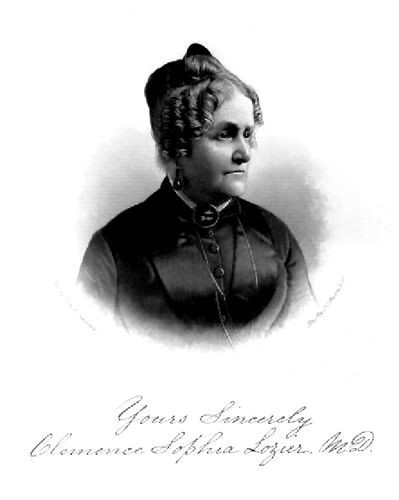
At an early hour Dr. Cheever's church was well filled with an audience chiefly of ladies, who received the officers and speakers[61] of the Convention with hearty applause. Elizabeth Cady Stanton, President of the "National Woman's Rights Committee," called the Convention to order, and said:
We have assembled to-day to discuss the right and duty of women to claim and use the ballot. Now in the reconstruction is the opportunity, perhaps for the century, to base our government on the broad principle of equal rights to all. The representative women of the nation feel that they have an interest and duty equal with man in the struggles and triumphs of this hour.
It may not be known to all of you that, during the past year, thousands of petitions, asking the ballot for woman, have been circulated through the Northern States and sent to Congress. Our thanks are due to the Hon. James Brooks for his kindness in franking our petitions, and his skill in calling to them the attention of the nation. As we have lost this champion in the House, I trust his more fortunate successor will not dodge his responsibilities to his countrywomen who are taxed but not represented. This should be a year of great activity among the women of this State. As New York is to have a constitutional convention in '67, it behooves us now to make an earnest demand, by appeals and petitions, to have the word "male" as well as "white" stricken from our Constitution.
Susan B. Anthony, presented several resolutions for consideration.
5. Resolved, That disfranchisement in a republic is as great an anomaly, if not cruelty, as slavery itself. It is, therefore, the solemn duty of Congress, in "guaranteeing a republican form of government to every State of this Union," to see that there be no abridgment of suffrage among persons responsible to law, on account of color or sex.
6. Resolved, That the Joint Resolutions and report of the "Committee of Fifteen," now before Congress, to introduce the word "male" into the Federal Constitution, are a desecration of the last will and testament of the Fathers, a violation of the spirit of republicanism, and cruel injustice to the women of the nation.
7. Resolved, That while we return our thanks to those members of Congress who, recognizing the sacred right of petition, gave our prayer for the ballot a respectful consideration, we also remind those who, with scornful silence laid them on the table, or with flippant sentimentality pretended to exalt us to the clouds, above man, the ballot and the work of life, that we consider no position more dignified and womanly than on an even platform with man worthy to lay the corner-stone of a republic in equality and justice.
8. Resolved, That we recommend to the women of the several States to petition their Legislatures to take the necessary steps to so amend their constitutions as to secure the right of suffrage to every citizen, without distinction of race, color or sex; and especially in those States that are soon to hold their constitutional conventions.
Theodore Tilton said: According to the programme, it is now my friend Mr. Beecher's turn to speak, but I observe that this gentleman, like some of the rest of the President's friends, occupies a back seat. [Laughter]. While, therefore, he is sitting under the gallery, I will occupy your attention just long enough to give that modest man a chance to muster nerve enough to make his appearance in public. [Laughter]. First of all, I have an account to settle with Mrs. Stanton. In her speech on taking the chair, she said that editors are not good housekeepers—a remark which no editor would think of retorting upon herself. [Laughter]. But, however dingy my editorial office may sometimes be, it is always a cheerful place when Mrs. Stanton visits it. [Applause]. Moreover, I think the place she invited me out of is no darker than this place which she invited me into! [Laughter]. In fact, I think the press has generally as much illumination as the church. [Applause].
Mrs. President, this convention is called to consider the most beautiful and humane idea which has ever entered into American politics—the right of woman to that ballot which belongs equally to all citizens. What is the chief glory of our democratic institutions? It is, that they appeal equally to the common interest of all classes—to high and low, to rich and poor, to white and black, to male and female. And never, until the political equality of all these classes is fully recognized by our laws, shall we have a government truly democratic. The practical instrument of this equality is the ballot. Now what is the ballot? Mr. Frothingham gave us one definition; Mr. Phillips gave us another. But the ballot is so large a thing that it admits of many definitions. The ballot is what the citizen thinks of the government. The government looks to the ballot to know the popular will. I do not mean to say that the little piece of white paper which we hold in our hand on election day is the only means whereby we can utter an opinion that shall be heard in Washington. We can speak by the pen; we can speak by the voice. A wise government will give heed to the public press, and to the popular voice. But there is no spoken voice, there is no written word, which the government is legally bound to heed except the ballot. When they see the ballot, they know they are served with official notice. When you talk to a government, you talk as to a tree; but when you vote at it, you scratch your name on the bark. Now, I want to see Rosalind's name cut into the bark of the government. [Applause]. Who ought to possess the ballot? Our President is right—I mean this President. [Applause]. She does not claim the ballot for women as women, but for women as citizens. That is the true ground. The ballot belongs not to the white man, not to the black man, not to the woman, but to the citizen. Shall the minister vote? No. Shall the lawyer? No. Shall the merchant? No. Shall the rich man? No. Shall the poor man? No. None of these shall vote. There is only one person who shall vote, and that is the citizen. [Applause]. Now I trust the day is not far distant when our institutions shall practically recognize this idea—when civil prerogative shall be limited not only by no distinction of color, but by no distinction of sex.
Are women politically oppressed that they need the ballot for their protection? I leave that question to be answered by women themselves. I demand the ballot for woman, not for woman's sake, but for man's. She may demand it for her own sake; but to-day, I demand it for my sake. We shall never have a government thoroughly permeated with humanity, thoroughly humane, thoroughly noble, thoroughly trustworthy, until both men and women shall unite in forming the public sentiment, and in administering that sentiment through the government. [Applause]. The church needs woman, society needs woman, literature needs woman, science needs woman, the arts need woman, politics need woman. [Applause]. A Frenchman once wrote an essay to prove woman's right to the alphabet. She took the alphabet, entered literature, and drove out Dean Swift. When she takes the ballot, and enters politics, she will drive out Fernando Wood. [Applause]. But, shall we have a woman for President? I would thank God if to-day we had a man for President. [Laughter]. Shall women govern the country? Queens have ruled nations from the beginning of time, and woman has governed man from the foundation of the world! [Laughter]. I know that Plato didn't have a good opinion of women; but probably they were not as amiable in his day as in ours. They undoubtedly have wrought their full share of mischief in the world. The chief bone of contention among mankind, from the earliest ages down, has been that rib of Adam out of which God made Eve. [Laughter]. And I believe in holding women to as great a moral accountability as men. [Laughter]. I believe, also, in holding them to the same intellectual accountability. Twenty years ago, when Macaulay sat down to review Lucy Rushton's—no, I mean Lucy Aiken's (laughter) "Life of Addison," he was forced to allude to what was a patent fact, that a woman's book was then to be treated with more critical leniency than a man's. But criticism nowadays never thinks of asking whether a book be a woman's or a man's, as a preliminary to administering praise or blame. In the Academy of Design, the critic deals as severely with a picture painted by a woman as with one painted by a man. This is right. Would you have it otherwise? Not at all! We are to stand upon a common level.
The signs of the times indicate the progress of woman's cause. Every year helps it forward visibly. The political status of woman was never so seriously pondered as it is now pondered by thoughtful minds in this country. By and by, the principles of Christian democracy will cover the continent—nay, will cover the world, as the equator belts it with summer heat! [Applause]. Until which time, we are called to diligent and earnest work. "Learn to labor and to wait," saith the poet. There will be need of much laboring and of long waiting. Sir William Jones tells us that the Hindoo laws declared that women should have no political independence—and there is many a backward Yankee who don't know any better than to agree with the Hindoos. Salatri, the Italian, drew a design of Patience—a woman chained to a rock by her ankles, while a fountain threw a thin stream of water, drop by drop, upon the iron chain, until the link should be worn away, and the wistful prisoner be set free. In like manner the Christian women of this country are chained to the rock of Burmese prejudice; but God is giving the morning and the evening dew, the early and the latter rain, until the ancient fetters shall be worn away, and a disfranchised sex shall leap at last into political liberty. [Applause]. And now for Mr. Beecher.
Mr. Beecher, on rising, was received with hearty applause,[62] and spoke for an hour, in a strain of great animation, as follows:
It may be asked why, at such a time as this, when the attention of the whole nation is concentrated upon the reconstruction of our States, we should intrude a new and advanced question. I have been asked "Why not wait for the settlement of the one that now fills the minds of men? Why divert and distract their thoughts?" I answer, because the questions are one and the same. We are not now discussing merely the right of suffrage for the African, or his status as a new-born citizen. Claiming his rights compels us to discuss the whole underlying question of government. This is the case in court. But when the judge shall have given his decision, that decision will cover the whole question of civil society, and the relations of every individual in it as a factor, an agent, an actor....
All over the world, the question to-day is, Who has a right to construct and administer law? Russia—gelid, frigid Russia—can not escape the question. Yea, he that sits on the Russian throne has proved himself a better democrat than any of us all, and is giving to-day more evidence of a genuine love of God, and of its partner emotion, love to man, in emancipating thirty million serfs, than many a proud democrat of America has ever given. (Applause.) And the question of emancipation in Russia is only the preface to the next question, which doubtless he as clearly as any of us foresees—namely, the question of citizenship, and of the rights and functions of citizenship. In Italy, the question of who may partake of government has arisen, and there has been an immense widening of popular liberty there. Germany, that freezes at night and thaws out by day only enough to freeze up again at night, has also experienced as much agitation on this subject as the nature of the case will allow. And when all France, all Italy, all Russia, and all Great Britain shall have rounded out into perfect democratic liberty, it is to be hoped that, on the North side of the fence where it freezes first and the ice thaws out last, Germany will herself be thawed out in her turn, and come into the great circle of democratic nations. Strange, that the mother of modern democracy should herself be stricken with such a palsy and with such lethargy! Strange, that in a nation in which was born and in which has inhered all the indomitableness of individualism should be so long unable to understand the secret of personal liberty! But all Europe to-day is being filled and agitated with this great question of the right of every man to citizenship; of the right of every man to make the laws that are to control him; and of the right of every man to administer the laws that are applicable to him. This is the question to-day in Great Britain. The question that is being agitated from the throne down to the Birmingham shop, from the Atlantic to the North Sea, to-day, is this: Shall more than one man in six in Great Britain be allowed to vote? There is only one in six of the full-grown men in that nation that can vote to-day. And everywhere we are moving toward that sound, solid, final ground—namely, that it inheres in the radical notion of manhood that every man has a right which is not given to him by potentate nor by legislator, nor by the consent of the community, but which belongs to his structural idea, and is a divine right, to make the laws that control him, and to elect the magistrates that are to administer those laws. It is universal.
And now, this being the world-tide and tendency, what is there in history, what is there in physiology, what is there in experience, that shall say to this tendency, marking the line of sex, "Thus far shalt thou go, and no farther?" I roll the argument off from my shoulders, and I challenge the man that stands with me, beholding that the world-thought to-day is the emancipation of the citizen's power and the preparation by education of the citizen for that power, and objects to extending the right of citizenship to every human being, to give me the reasons why. (Applause). To-day this nation is exercising its conscience on the subject of suffrage for the African. I have all the time favored that: not because he was an African, but because he was a man; because this right of voting, which is the symbol of everything else in civil power, inheres in every human being. But I ask you, to-day, "Is it safe to bring in a million black men to vote, and not safe to bring in your mother, your wife, and your sister to vote?" (Applause). This ought ye to have done, and to have done quickly, and not to have left the other undone. (Renewed applause).
To-day politicians of every party, especially on the eve of an election, are in favor of the briefest and most expeditious citizenizing of the Irishmen. I have great respect for Irishmen—when they do not attempt to carry on war! (Laughter). The Irish Fenian movement is a ludicrous phenomenon past all laughing at. Bombarding England from the shore of America! (Great laughter). Paper pugnation! Oratorical destroying! But when wind-work is the order of the day, commend me to Irishmen! (Renewed laughter). And yet I am in favor of Irishmen voting. Just so soon as they give pledge that they come to America, in good faith, to abide here as citizens, and forswear the old allegiance, and take on the new, I am in favor of their voting. Why? Because they have learned our Constitution? No; but because voting teaches. The vote is a schoolmaster. They will learn our laws, and learn our Constitution, and learn our customs ten times quicker when the responsibility of knowing these things is laid upon them, than when they are permitted to live in carelessness respecting them. And this nation is so strong that it can stand the incidental mischiefs of thus teaching the wild rabble that emigration throws on our shores for our good and upbuilding. We are wise enough, and we have educational force enough, to carry these ignorant foreigners along with us. We have attractions that will draw them a thousand times more toward us than they can draw us toward them. And yet, while I take this broad ground, that no man, even of the Democratic party (I make the distinction because a man may be a democrat and be ashamed of the party, and a man may be of the party and not know a single principle of democracy), should be debarred from voting, I ask, is an Irishman just landed, unwashed and uncombed, more fit to vote than a woman educated in our common schools? Think of the mothers and daughters of this land, among whom are teachers, writers, artists, and speakers! What a throng could we gather if we should, from all the West, call our women that as educators are carrying civilization there! Thousands upon thousands there are of women that have gone forth from the educational institutions of New England to carry light and knowledge to other parts of our land. Now, place this great army of refined and cultivated women on the one side, and on the other side the rising cloud of emancipated Africans, and in front of them the great emigrant band of the Emerald Isle, and is there force enough in our government to make it safe to give to the African and the Irishman the franchise? There is. We shall give it to them. (Applause). And will our force all fail, having done that? And shall we take the fairest and best part of our society; those to whom we owe it that we ourselves are civilized: our teachers; our companions; those to whom we go for counsel in trouble more than to any others; those to whom we trust everything that is dear to ourselves—our children's welfare, our household, our property, our name and reputation, and that which is deeper, our inward life itself, that no man may mention to more than one—shall we take them and say, "They are not, after all, fit to vote where the Irishman votes, and where the African votes?" I am scandalized when I hear men talk in the way that men do talk—men that do not think.
If therefore, you refer to the initial sentence, and ask me why I introduce this subject to-day, when we are already engaged on the subject of suffrage, I say, This is the greatest development of the suffrage question. It is more important that woman should vote than that the black man should vote. It is important that he should vote, that the principle may be vindicated, and that humanity may be defended; but it is important that woman should vote, not for her sake. She will derive benefit from voting; but it is not on a selfish ground that I claim the right of suffrage for her. It is God's growing and least disclosed idea of a true human society that man and woman should not be divorced in political affairs any more than they are in religious and social affairs. I claim that women should vote because society will never know its last estate and true glory until you accept God's edict and God's command—long raked over and covered in the dust—until you bring it out, and lift it up, and read this one of God's Ten Commandments, written, if not on stone, yet in the very heart and structure of mankind, Let those that God joined together not be put asunder. (Applause.)
When men converse with me on the subject of suffrage, or the vote, it seems to me that the terminology withdraws their minds from the depth and breadth of the case to the mere instruments. Many of the objections that are urged against woman's voting are objections against the mechanical and physical act of suffrage. It is true that all the forces of society, in their final political deliverance, must needs be born through the vote, in our structure of government. In England it is not so. It was one of the things to be learned there that the unvoting population on any question in which they are interested and united are more powerful than all the voting population or legislation. The English Parliament, if they believed to-day that every working man in Great Britain staked his life on the issues of universal suffrage, would not dare a month to deny it. For when a nation's foundations are on a class of men that do not vote, and its throne stands on forces that are coiled up and liable at any time to break forth to its overthrow, it is a question whether it is safe to provoke the exertion of those forces or not. With us, where all men vote, government is safe; because, if a thing is once settled by a fair vote, we will go to war rather than give it up. As when Lincoln was elected, if an election is valid, it must stand. In such a nation as this, an election is equivalent to a divine decree, and irreversible. But in Great Britain an election means, not the will of the people, but the will of rulers and a favored class, and there is always under them a great wronged class, that, if they get stirred up by the thought that they are wronged, will burst out with an explosion that not the throne, nor parliament, nor the army, nor the exchequer can withstand the shock. And they wisely give way to the popular will when they can no longer resist it without running too great a risk. They oppose it as far as it is safe to do so, and then jump on and ride it. And you will see them astride of the vote, if the common people want it. But in America it is not so. The vote with us is so general that there is no danger of insurrection, and there is no danger that the government will be ruined by a wronged class that lies coiled up beneath it. When we speak of the vote here, it is not the representative of a class, as it is in England, worn like a star, or garter, saying, "I have the king's favor or the government's promise of honor." Voting with us is like breathing. It belongs to us as a common blessing. He that does not vote is not a citizen, with us.
It is not the vote that I am arguing, except that that is the outlet. What I am arguing, when I urge that woman should vote, is that she should do all things back of that which the vote means and enforces. She should be a nursing mother to human society. It is a plea that I make, that woman should feel herself called to be interested not alone in the household, not alone in the church, not alone in just that neighborhood in which she resides, but in the sum total of that society to which she belongs; and that she should feel that her duties are not discharged until they are commensurate with the definition which our Saviour gave in the parable of the good Samaritan. I argue, not a woman's right to vote: I argue woman's duty to discharge citizenship. (Applause.) I say that more and more the great interests of human society in America are such as need the peculiar genius that God has given to woman. The questions that are to fill up our days are not forever to be mere money questions. Those will always constitute a large part of politics; but not so large a portion as hitherto. We are coming to a period when it is not merely to be a scramble of fierce and belluine passions in the strife for power and ambition. Human society is yet to discuss questions of work and the workman. Down below privilege lie the masses of men. More men, a thousand times, feel every night the ground, which is their mother, than feel the stars and the moon far up in the atmosphere of favor. As when Christ came the great mass carpeted the earth, instead of lifting themselves up like trees of Lebanon, so now and here the great mass of men are men that have nothing but their hands, their heads, and their good stalwart hearts, as their capital. The millions that come from abroad come that they may have light and power, and lift their children up out of ignorance, to where they themselves could not reach with the tips of their fingers. And the great question of to-day is, How shall work find leisure, and in leisure knowledge and refinement? And this question is knocking at the door of legislation. And is there a man who does not know, that when questions of justice and humanity are blended, woman's instinct is better than man's judgment? From the moment a woman takes the child into her arms, God makes her the love-magistrate of the family; and her instincts and moral nature fit her to adjudicate questions of weakness and want. And when society is on the eve of adjudicating such questions as these, it is a monstrous fatuity to exclude from them the very ones that, by nature, and training, and instinct, are best fitted to legislate and to judge.
For the sake, then, of such questions as these, that have come to their birth, I feel it to be woman's duty to act in public affairs. I do not stand here to plead for your rights. Rights compared with duties, are insignificant—are mere baubles—are as the bow on your bonnet. It seems to me that the voice of God's providence to you to-day is, "Oh messenger of mine, where are the words that I sent you to speak? Whose dull, dead ear has been raised to life by that vocalization of heaven, that was given to you more than to any other one?" Man is sub-base. A thirty-two feet six-inch pipe is he. But what is an organ played with the feet, if all the upper part is left unused? The flute, the hautboy, the finer trumpet stops, all those stops that minister to the intellect, the imagination, and the higher feelings—these must be drawn, and the whole organ played from top to bottom! (Applause.)
More than that, there are now coming up for adjudication public questions of education. And who, by common consent, is the educator of the world? Who has been? Schools are to be of more importance than railroads—not to undervalue railroads. Books and newspapers are to be more vital and powerful than exchequers and banks—not to undervalue exchequers and banks. In other words, as society ripens, it has to ripen in its three departments, in the following order: First, in the animal; second, in the social; and third, in the spiritual and moral. We are entering the last period, in which the questions of politics are to be more and more moral questions. And I invoke those whom God made to be peculiarly conservators of things moral and spiritual to come forward and help us in that work, in which we shall falter and fail without woman. We shall never perfect human society without her offices and her ministration. We shall never round out the government, or public administration, or public policies, or politics itself, until you have mixed the elements that God gave to us in society—namely, the powers of both men and women. (Applause.) I, therefore, charge my countrywomen with this duty of taking part in public affairs in the era in which justice, and humanity, and education, and taste, and virtue are to be more and more a part and parcel of public procedure. * * * *
In such a state of society, then, as the present, I stand, as I have said, on far higher ground in arguing this question than the right of woman. That I believe in; but that is down in the justice's court. I go to the supreme bench and argue it, and argue it on the ground that the nation needs woman, and that woman needs the nation, and that woman can never become what she should be, and the nation can never become what it should be, until there is no distinction made between the sexes as regards the rights and duties of citizenship—until we come to the 28th verse of the third chapter of Galatians. What is it? [turning to Mr. Tilton, who said, "I don't know!"] Don't know? If it was Lucy Rushton, you would! (Great laughter).
There is neither Jew nor Greek, there is neither bond nor free, there is neither male nor female; for ye are all one in Christ Jesus.
And when that day comes; when the heavenly kingdom is ushered in with its myriad blessed influences; when the sun of righteousness shall fill the world with its beams, as the natural sun coming from the far South fills the earth with glorious colors and beauty, then it will come to pass that there shall be no nationality, no difference of classes, and no difference of sexes. Then all shall be one in Christ Jesus. Hold that a minute, please [handing Mr. Tilton a pocket Testament from which he had read the foregoing passage of Scripture]. Theodore was a most excellent young man when he used to go to my church; but he has escaped from my care lately, and now I don't know what he does. (Laughter).
I urge, then, that woman should perform the duty of a citizen in voting. You may, perhaps, ask me, before I go any further, "What is the use of preaching to us that we ought to do it, when we are not permitted to do it?" That day in which the intelligent, cultivated women of America say, "We have a right to the ballot" will be the day in which they will have it. (Voices—"Yes." "That is so"). There is no power on earth that can keep it from them. [Applause]. The reason you have not voted is because you have not wanted to. [Applause]. It is because you have not felt that it was your duty to vote. You have felt yourselves to be secure and happy enough in your privileges and prerogatives, and have left the great mass of your sisters, that shed tears and bore burdens, to shirk for themselves. You have felt that you had rights more than you wanted now. O yes, it is as if a beauty in Fifth Avenue, hearing one plead that bread might be sent to the hungry and famishing, should say, "What is this talk about bread for? I have as much bread as I want, and plenty of sweetmeats, and I do not want your loaves." Shall one that is glutted with abundance despise the wants of the starving, who are so far below them that they do not hear their cries, not one of which escapes the ear of Almighty God? Because you have wealth and knowledge and loving parents, or a faithful husband, or kind brothers, and you feel no pressure of need, do you feel no inward pressure of humanity for others? Is there no part of God's great work in providence that should lead you to be discontented with your ease and privileges until you are enfranchised? You ought to vote; and when your understanding and intellect are convinced that you ought to do it, you will have the power to do it; and you never will till then.
I. Woman has more interest than man in the promotion of virtue and purity and humanity. Half, shall I say?—Half does not half measure the proportion of those sorrows that come upon woman by reason of her want of influence and power. All the young men that, breaking down, break fathers' and mothers' hearts; all those that struggle near to the grave, weeping piteous tears of blood, it might almost be said, and that at last, under paroxysms of despair, sin against nature, and are swept out of misery into damnation; the spectacles that fill our cities, and afflict and torment villages—what are these but reasons that summon woman to have a part in that regenerating of thought and that regenerating of legislation which shall make vice a crime, and vice-makers criminals? Do you suppose that, if it were to turn on the votes of women to-day whether rum should be sold in every shop in this city, there would be one moment's delay in settling the question? What to the oak lightning is that marks it and descends swiftly upon it, that woman's vote would be to miscreant vices in these great cities. [Applause]. Ah, I speak that which I do know. As a physician speaks from that which he sees in the hospital where he ministers, so I speak from that which I behold in my professional position and place, where I see the undercurrent of life. I hear groans that come from smiling faces. I witness tears that when others look upon the face are all swept away, as the rain is when one comes after a storm. Not most vocal are our deepest sorrows. Oh, the sufferings of wives for husbands untrue! Oh, the sufferings of mothers for sons led astray! Oh, the sufferings of sisters for sisters gone! Oh, the sufferings of companions for companion-women desecrated! And I hold it to be a shame that they, who have the instinct of purity and of divine remedial mercy more than any other, should withhold their hand from that public legislation by which society may be scoured, and its pests cleared away. And I declare that woman has more interest in legislation than man, because she is the sufferer and the home-staying, ruined victim.
II. The household, about which we hear so much said as being woman's sphere, is safe only as the community around about it is safe. Now and then there may be a Lot that can live in Sodom; but when Lot was called to emigrate, he could not get all his children to go with him. They had been intermarried and corrupted. A Christian woman is said to have all that she needs for her understanding and to task her powers if she will stay at home and mend her husband's clothes, if she has a husband, and take care of her children, if she has children. The welfare of the family, it is said, ought to occupy her time and thoughts. And some ministers, in descanting upon the sphere of woman, are wont to magnify the glory and beauty of a mother teaching some future chief-justice, or some president of the United States. Not one whit of glory would I withdraw from such a canvas as that; but I aver that the power to teach these children largely depends upon the influences that surround the household. So that she that would take the best care of the house must take care of that atmosphere which is around the house as well. And every true and wise Christian woman is bound to have a thought for the village, for the county, for the State, and for the nation. [Applause]. That was not the kind of woman that brought me up—a woman that never thought of anything outside of her own door-yard. My mother's house was as wide as Christ's house; and she taught me to understand the words of Him that said, "The field is the world; and whoever needs is your brother." A woman that is content to wash stockings, and make Johnny-cake, and to look after and bring up her boys faultless to a button, and that never thinks beyond the meal-tub, and whose morality is so small as to be confined to a single house, is an under-grown woman, and will spend the first thousand years after death in coming to that state in which she ought to have been before she died. [Laughter]. Tell me that a woman is fit to give an ideal life to an American citizen, to enlarge his sympathies, to make him wise in judgment, and to establish him in patriotic regard, who has no thought above what to eat and drink, and wherewithal to be clothed. The best housekeepers are they that are the most widely beneficent. "Seek first the kingdom of God and his righteousness, and all these things shall be added unto you." God will take care of the stockings, if you take care of the heads! [Laughter and applause]. Universal beneficence never hinders anybody's usefulness in any particular field of duty. Therefore, woman's sphere should not be limited to the household. The public welfare requires that she should have a thought of affairs outside of the household, and in the whole community.
III. Woman brings to public affairs peculiar qualities, aspirations, and affections which society needs. I have had persons say to me, "Would you, now, take your daughter and your wife, and walk down to the polls with them?" If I were to take my daughter and my wife, and walk down to the polls with them, and there was a squirming crowd of bloated, loud-mouthed, blattering men, wrangling like so many maggots on cheese, what would take place, but that, at the moment I appeared with my wife and daughter walking by my side with conscious dignity and veiled modesty, the lane would open, and I should pass through the red sea unharmed? [Great applause]. Where is there a mob such that the announcement that a woman is present does not bring down the loudest of them? Nothing but the sorcery of rum prevents a man from paying unconscious, instant respect to the presence of a woman....
IV. The history of woman's co-operative labors thus far justifies the most sanguine anticipations, such as I have alluded to. Allusion has been made to the purification of literature. The influence of women has been a part of the cause of this, unquestionably; but I would not ascribe such a result to any one cause. God is a great workman, and has a chest full of tools, and never uses one tool, but always many; and in the purification of literature, the elevation of thought, the advancement of the public sentiment of the world in humanity, God has employed more than that which has been wrought in their departments. And that which the family has long ago achieved—that, in more eminence and more wondrous and surprising beauty, the world will achieve for itself in public affairs, when man and woman co-operate there, as now they are co-operating in all other spheres of taste, intellection, and morality....
It is said, a "woman's place is at home." Well, now, since compromises are coming into vogue again, will you compromise with me, and agree that until a woman has a home she may vote? [Laughter]. That is only fair. It is said, "She ought to stay at home, and attend to home duty, and minister to the wants of father, or husband, or brothers." Well, may all orphan women, and unmarried women, and women that have no abiding place of residence vote? If not, where is the argument? But, to look at it seriously, what is the defect of this statement? It is the impression that staying at home is incompatible with going abroad. Never was there a more monstrous fallacy. I light my candle, and it gives me all the light I want, and it gives all the light you want to you, and to you, and to you, and to every other one in the room; and there is not one single ray that you get there which cheats me here; and a woman that is doing her duty right in the family sheds a beneficent influence out upon the village in which she dwells, without taking a moment's more time. My cherry-trees are joyful in all their blossoms, and thousands go by them and see them in their beauty day by day; but I never mourn the happiness that they bestow on passers-by as having been taken from me. I am not cheated by the perfume that goes from my flowers into my neighbor's yard. And the character of a true woman is such that it may shine everywhere without making her any poorer. She is richer in proportion as she gives away.... And it is just because woman is woman that she is fitted, while she takes care of the household, to take care of the village and the community around about her.
But it is said, "She ought to act through her father, or husband, or brother, or son." Why ought she? Did you ever frame an argument to show why the girl should use her father to vote for her, and the boy who is younger, and not half so witty, should vote for himself? It does not admit of an argument. If the grandmother, the mother, the wife, and the eldest daughter, are to be voted for by the father, the husband, and the eldest brother, then why are not the children to be voted for in complete family relation by the patriarchal head? Why not go back to the tribal custom of the desert, and let the patriarch do all the voting? To be sure, it would change the whole form of our government; but, if it is good for the family, it is just as good for classes.
In a frontier settlement is a log-cabin, and it is in a region which is infested by wolves. There are in the family a broken-down patient of a man, a mother, and three daughters. The house is surrounded by a pack of these voracious animals, and the inmates feel that their safety requires that the intruders should be driven away. There are three or four rifles in the house. The man creeps to one of the windows, and to the mother and daughters it is said, "You load the rifles, and hand them to me, and let me fire them." But they can load all the four rifles, and he can not fire half as fast as they can load; and I say to the mother, "Can you shoot?" She says, "Let me try;" and she takes a gun, and points it at the wolves, and pulls the trigger, and I see one of them throw his feet up in the air. "Ah!" I say, "I see you can shoot! You keep the rifle, and fire it yourself." And I say to the oldest daughter, "Can you shoot?" "I guess I can," she says. "Well, dare you?" "I dare do anything to save father and the family." And she takes one of the rifles, and pops over another of the pack. And I tell you, if the wolves knew that all the women were firing, they would flee from that cabin instanter. (Laughter). I do not object to a woman loading a man's rifle and letting him shoot; but I say that, if there are two rifles, she ought to load one of them, and shoot herself. And I do not see any use of a woman's influencing a man and loading him with a vote, and letting him go and fire it off at the ballot-box. (Laughter and applause).
It is said, again, "Woman is a creature of such an excitable nature that, if she were to mingle with men in public affairs, it would introduce a kind of vindictive acrimony, and politics would become intolerable." Oh, if I really thought so; if I thought that the purity of politics would be sullied, I would not say another word! (Laughter). I do not want to take anything from the celestial graces of politics! (Renewed laughter). I will admit that woman is an excitable creature, and I will admit that politics needs no more excitement; but sometimes, you know, things are homœopathic. A woman's excitement is apt to put out a man's; and if she should bring her excitability into politics, it is likely that it would neutralize the excitement that is already there, and that there would be a grand peace! (Laughter). But, not to trifle with it, woman is excitable. Woman is yet to be educated. Woman is yet to experience the reactionary influence of being a public legislator and thinker. And let her sphere be extended beyond the family and the school, so that she should be interested in, and actively engaged in, promoting the welfare of the whole community, and in the course of three generations the reaction on her would be such that the excitement that she would bring into public affairs would be almost purely moral inspiration. It would be the excitement of purity and disinterested benevolence.
It is said, furthermore, "Woman might vote for herself, and take office." Why not? A woman makes as good a postmistress as a man does a postmaster. Woman has been tried in every office from the throne to the position of the humblest servant; and where has she been found remiss? I believe that multitudes of the offices that are held by men are mere excuses for leading an effeminate life; and that with their superior physical strength it behooves them better to be actors out of doors, where the severity of climate and the elements is to be encountered, and leave indoor offices to women, to whom they more properly belong. But, women, you are not educated for these offices. I hear bad reports of you. It is told me that the trouble in giving places to women is that they will not do their work well; that they do not feel the sense of conscience. They have been flattered so long, they have been called "women" so long, they have had compliments instead of rights so long, that they are spoiled; but when a generation of young women shall have been educated to a stern sense of right and duty, and shall take no compliments at the expense of right, we shall have no such complaints as these. And when a generation of women, working with the love of God and true patriotism in their souls, shall have begun to hold office, meriting it, and being elected to it by those that would rather have a woman than a man in office, then you may depend upon it that education has qualified them for the trusts which are committed to them. We have tried "old women" in office, and I am convinced that it would be better to have real women than virile old women in public stations. (Laughter and applause). For my own sake, give me a just, considerate, true, straight-forward, honest-minded, noble-hearted woman, who has been able, in the fear of God, to bring up six boys in the way they should go, and settle them in life. If there is anything harder in this nation than that, tell me what it is. A woman that can bring up a family of strong-brained children, and make good citizens of them, can be President without any difficulty. (Applause).
Let me now close with one single thought in connection with this objection. I protest in the name of my countrywomen against the aspersion which is cast upon them by those who say that woman is not fit to hold office or discharge public trusts. The name of what potentate to-day, if you go round the world, would probably, in every nation on the earth, bring down most enthusiasm and public approbation? If I now, here in your midst, shall mention the name of Queen Victoria, your cheers will be a testimony to your admiration of this noble woman. (Great applause). Though it be in a political meeting, or any other public gathering, no man can mention her name without eliciting enthusiasm and tokens of respect. It is a controversy to-day between woman aristocratic and woman democratic (applause); and I claim that what it is right for an aristocratic woman to do—what it is right for a duchess, or a queen, or an empress to do—it is right for the simplest and plainest of my countrywomen to do, that has no title, and no credentials, except the fact that God made her a woman. All that I claim for the proudest aristocrat I claim for all other women. (Applause). I do not object to a woman's being a queen, or a president, if she has the qualifications which fit her to be one. And I claim that, where there is a woman that has the requisite qualifications for holding any office in the family, in the church, or in the state, there is no reason why she should not be allowed to hold it. And we shall have a perfect crystal idea of the state, with all its contents, only when man understands the injunction, "What God hath joined together let no man put asunder."[63] (Great applause).
Miss Anthony and Mrs. Stanton, ever on the watch-tower for legislation affecting women, were the first to see the full significance of the word "male" in the 14th Amendment, and at once sounded the alarm, and sent out petitions[48] for a constitutional amendment to "prohibit the States from disfranchising any of their citizens on the ground of sex."[49]
Miss Anthony and Mrs. Stanton, ever on the watch-tower for legislation affecting women, were the first to see the full significance of the word "male" in the 14th Amendment, and at once sounded the alarm, and sent out petitions[48] for a constitutional amendment to "prohibit the States from disfranchising any of their citizens on the ground of sex."[49]
Miss Anthony, who had spent the year in Kansas, started for New York the moment she saw the propositions before Congress to put the word "male" into the National Constitution, and made haste to rouse the women in the East to the fact that the time had come to begin vigorous work again for woman's enfranchisement.[50] Mr. Tilton (December 27, 1865) proposed the formation of a National Equal Rights Society, demanding suffrage for black men and women alike, of which Wendell Phillips should be President, and the National Anti-Slavery Standard its organ. Mr. Beecher promised to give a lecture (January 30th) for the benefit of this universal suffrage movement. The New York Independent (Theodore Tilton, editor) gave the following timely and just rebuke of the proposed retrogressive legislation:
While the 13th Amendment was pending, Senator Sumner wrote many letters to the officers of the Loyal League, saying, "Send on the petitions; they give me opportunity for speech." "You are doing a noble work." "I am grateful to your Association for what you have done to arouse the country to insist on the extinction of slavery." And our petitions were sent again and again, 300,000 strong, and months after the measure was carried, they still rolled in from every quarter where the tracts and appeals had been scattered. But when the proposition for the 14th Amendment was pending, and the same women petitioned for their own civil and political rights, they received no letters of encouragement from Republicans nor Abolitionists; and now came some of the severest trials the women demanding the right of suffrage were ever called on to endure. Though loyal to the Government and the rights of the colored race, they found themselves in antagonism with all with whom they had heretofore sympathized. Though Unionists, Republicans, and Abolitionists, they could not without protest see themselves robbed of their birth-right as citizens of the republic by the proposed amendment. Republicans presented their petitions in a way to destroy their significance, as petitions for "universal suffrage," which to the public meant "manhood suffrage." Abolitionists refused to sign them, saying, "This is the negro's hour."[51] Colored men themselves opposed us, saying, do not block our chance by lumbering the Republican party with Woman Suffrage.
In the face of all opposition they scattered their petitions broadcast, and in one session of Congress they rolled in upwards of ten thousand. The Democrats treated the petitioners with respect, and called attention in every way to the question.[52] But even such Republicans as Charles Sumner presented them, if at all, under protest. A petition from Massachusetts, with the name of Lydia Maria Child at the head, was presented by the great Senator under protest as "most inopportune!" As if there could be a more fitting time for action than when the bills were pending.
The wriggling, the twisting, the squirming of the Republicans at this crisis under the double fire of the Democrats and the women, would have been laughable, had not their proposed action been so outrageously unjust and ungrateful. The tone of the Republican press[53] was stale, flat, and unprofitable. But while their journals were thus unsparing in their ridicule and criticism of the loyal women who had proved themselves so patriotic and self-sacrificing, they would grant them no space in their columns to reply.[54]
The wriggling, the twisting, the squirming of the Republicans at this crisis under the double fire of the Democrats and the women, would have been laughable, had not their proposed action been so outrageously unjust and ungrateful. The tone of the Republican press[53] was stale, flat, and unprofitable. But while their journals were thus unsparing in their ridicule and criticism of the loyal women who had proved themselves so patriotic and self-sacrificing, they would grant them no space in their columns to reply.[54]
The second session of the Thirty-ninth Congress is memorable for an able debate in the Senate on the enfranchisement of woman, on the bill[55] "to regulate the franchise in the District of Columbia," which proposed extending the suffrage to the "males" of the colored race. On Monday, December 10, 1866, Senator Cowan, of Pennsylvania, moved to amend the amendment by striking out the word "male" before the word person. This debate in the Senate lasted three entire days, and during that time the comments of the press were as varied as they were multitudinous. Even Horace Greeley,[56] who had ever been a true friend to woman, in favor of all her rights, industrial, educational, and political, said the time had not yet come for her enfranchisement.
The second session of the Thirty-ninth Congress is memorable for an able debate in the Senate on the enfranchisement of woman, on the bill[55] "to regulate the franchise in the District of Columbia," which proposed extending the suffrage to the "males" of the colored race. On Monday, December 10, 1866, Senator Cowan, of Pennsylvania, moved to amend the amendment by striking out the word "male" before the word person. This debate in the Senate lasted three entire days, and during that time the comments of the press were as varied as they were multitudinous. Even Horace Greeley,[56] who had ever been a true friend to woman, in favor of all her rights, industrial, educational, and political, said the time had not yet come for her enfranchisement.
"We must [said Mrs. Gage][57] bring in new issues. I sat in the Senate Chamber last winter."
The President pro tem.: The question is on the amendment of the Senator from Pennsylvania [Mr. Cowan], to strike out the word "male" before the word "person," in the second line of the first section of the amendment reported by the Committee on the District of Columbia as a substitute for the whole bill, and on that question the yeas and nays have been ordered. Yeas, 9. Nays, 37.[58]
In the House, January 28, 1867, Mr. Noell, of Missouri, introduced a bill to amend the suffrage act of the District of Columbia, which, after the second reading, he moved should be referred to a select committee of five, and on that motion demanded the previous question, and called for the yeas and nays, which resulted in 49 yeas,[59] 74 nays—68 not voting.
[60] Call for the Eleventh National Woman's Rights Convention.—The Convention will be held in the City of New York, at the Church of the Puritans, Union Square, on Thursday, the 10th of May, 1866, at 10 o'clock. Addresses will be delivered by Ernestine L. Rose, Frances D. Gage, Wendell Phillips, Theodore Tilton, Elizabeth Cady Stanton, and (probably) Lucretia Mott and Anna E. Dickinson.
[61] Ernestine L. Rose, Wendell Phillips, John T. Sargeant, O. B. Frothingham, Frances D. Gage, Elizabeth Cady Stanton, Susan B. Anthony, Theodore Tilton, Lucretia Mott, Martha C. Wright, Stephen S. and Abbey Kelley Foster, Margaret Winchester and Parker Pillsbury.
[62] As this was the first time Mr. Beecher had honored the platform, we give copious extracts from his speech in preference to those who were so often reported in the first volume. This speech is published in full in tract form, and can be obtained from the Secretary of the National Woman's Suffrage Association.
[63]
A COLLOQUY.
When Mr. Beecher took his seat, Mr. Tilton rose and said:
Mrs. President: In the midst of the general hilarity produced throughout the house by my friend's speech, I myself have been greatly solemnized by being made (as you have witnessed) the public custodian of his New Testament. (Laughter). At first I shared in your gratification at seeing that he carried so much of the Scripture with him. (Laughter). But I found, on looking at the fly-leaf, that the book after all, was not his own, but the property of a lady—I will not mention her name. (Laughter). I have, therefore, no right to accept my friend's gift of what is not his own. Now I remember that when he came home from England, he told me a story of a company of ten ministers who sat down to dine together. A dispute arose among them as to the meaning of a certain passage of Scripture—for aught I know the very passage in Galatians which he just now tried to quote, but couldn't. (Laughter). Some one said, "Who has a New Testament?" It was found that no one had a copy. Pretty soon, however, when the dinner reached the point of champagne, some one exclaimed, "Who has a corkscrew?" And it was found that the whole ten had, every man, a corkscrew in his pocket! (Laughter). Now, as there is no telling where a Brooklyn minister who made a temperance speech at Cooper Institute last night is likely to take his dinner to-day, I charitably return the New Testament into my friend's own hands. (Great merriment).
Mr. Beecher—Now I know enough about champagne to know that it don't need any corkscrew. (Laughter).
Mr. Tilton—How is it that you know so much more about corkscrews than about Galatians? (Laughter).
Mr. Beecher, after making some playful allusions to the story of the ten ministers, remarked that he gave it as it was given to him, but that he could not vouch for its truthfulness, as he was not present on the occasion.
Susan B. Anthony read the following appeal to the Congress of the United States for the enfranchisement of woman:
ADDRESS TO CONGRESS.
Adopted by the Eleventh National Woman's Rights Convention, held in New York City, Thursday, May 10, 1866.
To the Senate and House of Representatives:
We have already appeared many times during the present session before your honorable body, in petitions, asking the enfranchisement of woman; and now, from this National Convention we again make our appeal, and urge you to lay no hand on that "pyramid of rights," the Constitution of the Fathers," unless to add glory to its height and strength to its foundation.
We will not rehearse the oft-repeated arguments on the natural rights of every citizen, pressed as they have been on the nation's conscience for the last thirty years in securing freedom for the black man, and so grandly echoed on the floor of Congress during the past winter. We can not add one line or precept to the inexhaustible speech recently made by Charles Sumner in the Senate, to prove that "no just government can be formed without the consent of the governed;" to prove the dignity, the education, the power, the necessity, the salvation of the ballot in the hand of every man and woman; to prove that a just government and a true church rest alike on the sacred rights of the individual.
As you are familiar with that speech of the session on "EQUAL RIGHTS TO ALL," so convincing in facts, so clear in philosophy, and so elaborate in quotations from the great minds of the past, without reproducing the chain of argument, permit us to call your attention to a few of its unanswerable assertions on the ballot:
I plead now for the ballot, as the great guarantee; and the only sufficient guarantee—being in itself peacemaker, reconciler, schoolmaster and protector—to which we are bound by every necessity and every reason; and I speak also for the good of the States lately in rebellion, as well as for the glory and safety of the Republic, that it may be an example to mankind.
Ay, sir, the ballot is the Columbiad of our political life, and every citizen who has it is a full-armed Monitor.
The ballot is schoolmaster. Reading and writing are of inestimable value, but the ballot teaches what these can not teach.
Plutarch records that the wise men of Athens charmed the people by saying that Equality causes no war, and "both the rich and the poor repeated it."
The ballot is like charity, which never faileth, and without which man is only as sounding brass or a tinkling cymbal. The ballot is the one thing needful, without which rights of testimony and all other rights will be no better than cobwebs, which the master will break through with impunity. To him who has the ballot all other things shall be given—protection, opportunity, education, a homestead. The ballot is like the Horn of Abundance, out of which overflow rights of every kind, with corn, cotton, rice, and all the fruits of the earth. Or, better still, it is like the hand of the body, without which man, who is now only a little lower than the angels, must have continued only a little above the brutes. They are fearfully and wonderfully made; but as is the hand in the work of civilization, so is the ballot in the work of government. "Give me the ballot, and I can move the world."
Do you wish to see harmony truly prevail, so that industry, society, government, civilization, may all prosper, and the Republic may wear a crown of true greatness? Then do not neglect the ballot.
Lamartine said, "Universal Suffrage is the first truth and only basis of every national republic."
In regard to "Taxation without representation," Mr. Sumner quotes from Lord Coke:
The Supreme Power cannot take from any man any part of his property without consent in person, or by representation.
Taxes are not to be laid on the people, but by their consent in person, or by representation.
I can see no reason to doubt but that the imposition of taxes, whether on trade, or on land, or houses, or ships, or real or personal, fixed or floating, property in the colonies, is absolutely irreconcilable with the rights of the colonies, as British subjects, and as men. I say men, for in a state of nature no man can take any property from me without my consent. If he does, he deprives me of my liberty and makes me a slave. The very act of taxing, exercised over those who are not represented, appears to me to deprive them of one of their most essential rights as freemen, and if continued seems to be in effect an entire disfranchisement of every civil right. For what one civil right is worth a rush, after a man's property is subject to be taken from him at pleasure without his consent?
In demanding suffrage for the black man you recognize the fact that as a freedman he is no longer a "part of the family," and that, therefore, his master is no longer his representative; hence, as he will now be liable to taxation, he must also have representation. Woman, on the contrary, has never been such a "part of the family" as to escape taxation. Although there has been no formal proclamation giving her an individual existence, she has always had the right to property and wages, the right to make contracts and do business in her own name. And even married women, by recent legislation, have been secured in these civil rights. Woman now holds a vast amount of the property in the country, and pays her full proportion of taxes, revenue included. On what principle, then, do you deny her representation? By what process of reasoning Charles Sumner was able to stand up in the Senate, a few days after these sublime utterances, and rebuke 15,000,000 disfranchised tax-payers for the exercise of their right of petition merely, is past understanding. If he felt that this was not the time for woman to even mention her right to representation, why did he not take breath in some of his splendid periods, and propose to release the poor shirtmakers, milliners and dressmakers, and all women of property, from the tyranny of taxation?
We propose no new theories. We simply ask that you secure to all the practical application of the immutable principles of our government, without distinction of race, color or sex. And we urge our demand now, because you have the opportunity and the power to take this onward step in legislation. The nations of the earth stand watching and waiting to see if our Revolutionary idea, "all men are created equal," can be realized in government. Crush not, we pray you, the million hopes that hang on our success. Peril not another bloody war. Men and parties must pass away, but justice is eternal. And they only who work in harmony with its laws are immortal. All who have carefully noted the proceedings of this Congress, and contrasted your speeches with those made under the old régime of slavery, must have seen the added power and eloquence that greater freedom gives. But still you propose no action on your grand ideas. Your Joint Resolutions, your Reconstruction Reports, do not reflect your highest thought. The constitution, in basing representation on "respective numbers," covers a broader ground than any you have yet proposed. Is not the only amendment needed to Article 1st, Section 3d, to strike out the exceptions which follow "respective numbers?" And is it not your duty, by securing a republican form of government to every State, to see that these "respective numbers" are made up of enfranchised citizens? Thus bringing your legislation up to the Constitution—not the Constitution down to your party possibilities!! The only tenable ground of representation is Universal Suffrage, as it is only through Universal Suffrage that the principle of "Equal Rights to All" can be realized. All prohibitions based on race, color, sex, property, or education, are violations of the republican idea; and the various qualifications now proposed are but so many plausible pretexts to debar new classes from the ballot-box. The limitations of property and intelligence, though unfair, can be met; as with freedom must come the repeal of statute-laws that deny schools and wages to the negro. So time makes him a voter. But color and sex! Neither time nor statutes can make black white, or woman man! You assume to be the representatives of 15,000,000 women—American citizens—who already possess every attainable qualification for the ballot. Women read and write, hold many offices under government, pay taxes, and the penalties of crime, and yet are allowed to exercise but the one right of petition.
For twenty years we have labored to bring the statute laws of the several States into harmony with the broad principles of the Constitution, and have been so far successful that in many, little remains to be done but to secure the right of suffrage. Hence, our prompt protest against the propositions before Congress to introduce the word "male" into the Federal Constitution, which, if successful, would block all State action in giving the ballot to woman. As the only way disfranchised citizens can appear before you, we availed ourselves of the sacred right of petition. And, as our representatives, it was your duty to give those petitions a respectful reading and a serious consideration. How well a Republican Senate performed that duty, is already inscribed on the page of history. Some tell us it is not judicious to press the claims of women now; that this is not the time. Time? When you propose legislation so fatal to the best interests of woman and the nation, shall we be silent till the deed is done? No! As we love republican ideas, we must resist tyranny. As we honor the position of American Senator, we must appeal from the politician to the man.
With man, woman shared the dangers of the Mayflower on a stormy sea, the dreary landing on Plymouth Rock, the rigors of a New England winter, and the privations of a seven years' war. With him she bravely threw off the British yoke, felt every pulsation of his heart for freedom, and inspired the glowing eloquence that maintained it through the century. With you, we have just passed through the agony and death, the resurrection and triumph, of another revolution, doing all in our power to mitigate its horrors and gild its glories. And now, think you we have no souls to fire, no brains to weigh your arguments; that, after education such as this, we can stand silent witnesses while you sell our birthright of liberty, to save from a timely death an effete political organization? No, as we respect womanhood, we must protest against this desecration of the magna charta of American liberties; and with an importunity not to be repelled, our demand must ever be: "No compromise of human rights"—"No admission in the Constitution of inequality of rights, or disfranchisement on account of color or sex."
In the oft-repeated experiments of class and caste, who can number the nations that have risen but to fall? Do not imagine you come one line nearer the demand of justice by enfranchising but another shade of manhood; for, in denying representation to woman you still cling to the same principle on which all the governments of the past have been wrecked. The right way, the safe way, is so clear, the path of duty is so straight and simple, that we who are equally interested with yourselves in the result, conjure you to act not for the passing hour, not with reference to transient benefits, but to do now the one grand deed that shall mark the progress of the century—proclaim Equal Rights to All. We press our demand for the ballot at this time in no narrow, captious or selfish spirit; from no contempt of the black man's claims, nor antagonism with you, who in the progress of civilization are now the privileged order; but from the purest patriotism, for the highest good of every citizen, for the safety of the Republic, and as a spotless example to the nations of the earth.
Mr. Beecher was followed by Wendell Phillips, Frances Dana Gage, Frances Watkins Harper; the Financial Committee[64] meantime passed through the audience for the material aid to carry forward the work. Miss Anthony presented the following resolution, and moved its adoption, which was seconded by Martha C. Wright:
Whereas, By the act of Emancipation and the Civil Rights bill, the negro and woman now hold the same civil and political status, alike needing only the ballot; and whereas the same arguments apply equally to both classes, proving all partial legislation fatal to republican institutions, therefore,
Resolved, That the time has come for an organization that shall demand Universal Suffrage, and that hereafter we shall be known as the "American Equal Rights Association."
Miss Anthony said: Our friend Mrs. Mott desires me to explain the object of this change, which she would gladly do but for a severe cold, which prevents her from making herself heard. For twenty years we have pressed the claims of woman to the right of representation in the government. The first National Woman's Rights Convention was held in Worcester, Mass., in 1850, and each successive year conventions were held in different cities of the Free States—Worcester, Syracuse, Cleveland, Philadelphia, Cincinnati, and New York—until the rebellion. Since then, till now, we have held no conventions. Up to this hour, we have looked to State action only for the recognition of our rights; but now, by the results of the war, the whole question of suffrage reverts back to Congress and the U. S. Constitution. The duty of Congress at this moment is to declare what shall be the basis of representation in a republican form of government. There is, there can be, but one true basis; and that is that taxation must give representation; hence our demand must now go beyond woman—it must extend to the farthest bound of the principle of the "consent of the governed," as the only authorized or just government. We, therefore, wish to broaden our Woman's Rights platform, and make it in name—what it ever has been in spirit—a Human Rights platform. It has already been stated that we have petitioned Congress the past winter to so amend the Constitution as to prohibit disfranchisement on account of sex. We were roused to this work by the several propositions to prohibit negro disfranchisement in the rebel States, which at the same time put up a new bar against the enfranchisement of women. As women we can no longer seem to claim for ourselves what we do not for others—nor can we work in two separate movements to get the ballot for the two disfranchised classes—the negro and woman—since to do so must be at double cost of time, energy, and money.
New York is to hold a Constitutional Convention the coming year. We want to make a thorough canvass of the entire State, with lectures, tracts, and petitions, and, if possible, create a public sentiment that shall send genuine Democrats and Republicans to that Convention who shall strike out from our Constitution the two adjectives "white male," giving to every citizen, over twenty-one, the right to vote, and thus make the Empire State the first example of a true republican form of government. And what we propose to do in New York, the coming eighteen months, we hope to do in every other State so soon as we can get the men, and the women, and the money, to go forward with the work. Therefore, that we may henceforth concentrate all our forces for the practical application of our one grand, distinctive, national idea—Universal Suffrage—I hope we will unanimously adopt the resolution before us, thus resolving this Eleventh National Woman's Rights Convention into the "American Equal Rights Association."
The Resolution was unanimously adopted.
Stephen S. Foster said: I wish to suggest that it will be necessary, first, to adopt a form of Constitution, and that it is a very important question. Upon it will depend much of the success of our movement. We have been deeply thrilled by the eloquence of our friend, Mr. Beecher. We have all felt that his utterances were the essential truth of God; and the bright picture he drew before us is a possibility, if we do our duty. But this state of things will never be realized by us, unless it is from a united, persevering effort, giving a new impetus to the Woman's Rights movement. I think it necessary that we should have a more perfect organization than we can prepare this morning, at this late hour, and I therefore move that we adjourn to meet in the vestry this afternoon at four o'clock, to perfect an organization, and take such further measures for the prosecution of our cause as may then and there be deemed expedient. (The motion was carried.)
A large audience assembled in the Lecture-room, at four o'clock. Susan B. Anthony took the Chair and said, the first thing, in order to complete the new organization, would be to fix upon a form of Constitution. Parker Pillsbury, from the Business Committee, reported one which was considered article by article, and adopted. There was an interesting discussion relative to the necessity of a preamble, in which the majority sympathized with Lucretia Mott, who expressed herself specially desirous that there should be one, and that it should state the fact that this new organization was the outgrowth of the Woman's Rights movement. Mrs. Stanton gave her idea of what the preamble should be; and Mrs. Mott moved that Mrs. Stanton write out her thought, and that it be accepted as the preamble of the Constitution.[65] The motion was adopted. Miss Anthony proposed a list of names as officers[66] of the Association. Mrs. Stanton thanked the Convention for the honor proposed, to make her President, but said she should prefer to see Lucretia Mott in that office; that thus that office might ever be held sacred in the memory that it had first been filled by one so loved and honored by all. "I shall be happy as Vice-President to relieve my dear friend of the arduous duties of her office, if she will but give us the blessing of her name as President." Mrs. Stanton then moved that Mrs. Mott be the President, which was seconded by many voices, and carried by a unanimous vote.
Mrs. Mott, escorted to the Chair by Stephen S. Foster, remarked that her age and feebleness unfitted her for any public duties, but she rejoiced in the inauguration of a movement broad enough to cover class, color, and sex, and would be happy to give her name and influence, if thus she might encourage the young and strong to carry on the good work. On motion of Theodore Tilton, Mrs. Stanton was made first Vice-President. The rest of the names were approved.
Mrs. Stanton said, It had been the desire of her heart to see the Anti-Slavery and Woman's Rights organizations merged into an Equal Rights Association, as the two questions were now one. With emancipation, all that the black man asks is the right of suffrage. With the special legislation of the last twenty years, all that woman asks is the right of suffrage. Hence it seems an unnecessary expenditure of force and substance for the same men and women to meet in convention on Tuesday to discuss the right of one class to the ballot, and on Thursday to discuss the right of another class to the same. Has not the time come, Mrs. President, to bury the black man and the woman in the citizen, and our two organizations in the broader work of reconstruction? They who have been trained in the school of anti-slavery; they who, for the last thirty years, have discussed the whole question of human rights, which involves every other question of trade, commerce, finance, political economy, jurisprudence, morals and religion, are the true statesmen for the new republic—the best enunciators of our future policy of justice and equality. Any work short of this is narrow and partial and fails to meet the requirements of the hour. What is so plain to me, may, I trust, be so to all before the lapse of many months, that all who have worked together thus far, may still stand side by side in this crisis of our nation's history.
James Mott said, he rejoiced that the women had seen fit to re-organize their movement into one for equal rights to all, that he felt the time had come to broaden our work. He felt the highest good of the nation demanded the recognition of woman as a citizen. We could have no true government until all the people gave their consent to the laws that govern them.
Stephen S. Foster said, Many seemed to think that the one question for this hour was negro suffrage. The question for every man and woman, he thought, was the true basis of the reconstruction of our government, not the rights of woman, or the negro, but the rights of all men and women. Suffrage for woman was even a more vital question than for the negro; for in giving the ballot to the black man, we bring no new element into the national life—simply another class of men. And for one, he could not ask woman to go up and down the length and breadth of the land demanding the political recognition of any class of disfranchised citizens, while her own rights are ignored. Thank God, the human family are so linked together, that no one man can ever enjoy life, liberty, or happiness, so long as the humblest being is crippled in a single right. I have demanded the freedom of the slave the last thirty years, because he was a human being, and I now demand suffrage for the negro because he is a human being, and for the same reason I demand the ballot for woman. Therefore, our demand for this hour is equal suffrage to all disfranchised classes, for the one and the same reason—they are all human beings.
Martha C. Wright said: Some one had remarked that we wished to merge ourselves into an Equal Rights Association to get rid of the odious name of Woman's Rights. This she repudiated as unworthy and untrue. Every good cause had been odious some time, even the name Christian has had its odium in all nations. We desire the change, because we feel that at this hour our highest claims are as citizens, and not as women. I for one have always gloried in the name of Woman's Rights, and pitied those of my sex who ignobly declared they had all the rights they wanted. We take the new name for the broader work because we see it is no longer woman's province to be merely a humble petitioner for redress of grievances, but that she must now enter into the fullness of her mission, that of helping to make the laws, and administer justice.
Aaron M. Powell presented the following resolution:
Resolved, That in view of the Constitutional Convention to be held in the State of New York the coming year, it is the duty of this Association to demand such an amendment of the Constitution as shall secure equal rights to all citizens, without distinction of color, sex, or race.
Miss Anthony seconded the resolution, and urged the importance of making a thorough canvass of the State with lectures, tracts, and petitions.[67] Mr. Powell, Mrs. Gage, and others, advocated the concentration of all the energies of the Association for the coming year on the State of New York; after which the resolution was adopted.
Parker Pillsbury: Perhaps we ourselves do not appreciate the magnitude of the enterprise we are here to inaugurate. If successful, we close to-day one epoch in human history, and enter on another of results more millennial than have been seen before. We give now a new definition to the word Liberty. We clothe our divinity with new honors. The ancients worshiped in her temple, but to them all, even the devoutest, she was ever an "Unknown God." In all ages, men sing her praises, but know not her law. Our revolutionary fathers were blind as others—blinder than many others. They declared all men free and equal. They fought long and valiantly for their evangel, baptizing it in the blood of many battles, came home triumphant, and then constructed a despotism which their own immortal Jefferson declared was fraught with more woes in one hour, to myriads of its citizens, than would be endured in whole ages of the worst they themselves had ever known! That government they named a Republic. Under it we held millions of slaves, and were providing to hold many millions more, when God sent a thunderbolt and dashed it in pieces before our eyes and gave our slaves their freedom. Now our wise men and counselors, our statesmen and sages, are seeking how the government and Union may be reconstructed. But they are laying again false foundations. Of three immense classes, they proscribe two and provide for one; and that one perhaps a minority of the whole. Half our people are degraded for their sex; one-sixth for the color of their skin. And this is the republican and democratic definition of freedom. The ruling class boasts two qualities, in virtue of which it claims the right to rule all others. It is male, not female—white, not colored. For neither of these surely is it responsible. For being women and colored, the proscribed classes are no more responsible. A more cruel, unrighteous, unjust distinction was never made under heaven. By it we are driven into this new revolution; a revolution which is to eclipse all that have gone before, as far as the glories of Calvary outshone the shadows and terrors of Sinai. Even the Anti-Slavery Society can only demand equality for the male half of mankind. And the Woman's Rights movement contemplated only woman in its demand. But with us liberty means freedom, equality, and fraternity, irrespective of sex or complexion. It is a gospel that was unknown to the ancients; hidden even from the wise and prudent among our revolutionary fathers. Revolutionary mothers we seem never to have had. As in Eden, "Adam was first found, then Eve," so in our revolution; but Eve has come to-day, demanding her portion of the equal inheritance, a mystery, a wonder, a "new thing under the sun," the declaration of King Solomon to the contrary notwithstanding. And here and to-day we lay new foundations. For the first time, law and liberty are to be founded in nature and the government of the moral universe. For the first time is it demanded that Justice be made our chief corner-stone. The ancient republics, not thus underpinned, fell. Our old foundations, too, are fallen. In God's wisdom, not in man's foolishness, let us henceforth build. And the work of our hands, feeble as we seem to-day, shall survive all the present kingdoms and dominions of the world.
Miss Anthony remarked that Theodore Tilton was in the house, and had not yet spoken. She would like to hear his opinion.
Mr. Tilton replied that of course Miss Anthony was speaking in pleasantry when she thus ingeniously pretended not to know his opinion. This pretense was only a piece of strategy to compel him to make a speech. Both she and he had lately been co-workers in a local association for just such a purpose as to-day's enterprise meditated—"The New York Equal Rights Association," of which he had had the honor to be president, and Miss Anthony to be secretary—an association which both its secretary and its president were only too glad to see superseded by a larger and more general movement. The apple tree bears more blossoms which fall off than come to fruit. Our local association was the necessary first blossom which had to be blown away by the wind. No—he would rather say it was a blossom which had ripened to-day into golden fruit. And now, said he, in this consecrated house, at this sunset hour, amid these falling shadows, with a president in the chair whose well-spent life has been crowned with every virtue, let us make a covenant with each other such as was made by the original members of the American Anti-Slavery Society—a mutual pledge of diligent and earnest labor, not for the abolition of chattel slavery, but for the political rights of all classes, without regard to color or sex. Are we only a handful? We are more than formed the Anti-Slavery Society—which grew into a force that shook the nation. Who knows but that to-night we are laying the corner-stone of an equally grand movement? Let us, therefore, catch at this moment the cheering pretoken of the prophecy that declares, "At evening time there shall be light!"
A motion was made to adjourn, when the President, Lucretia Mott, made a few closing remarks, showing that all great achievements in the progress of the race must be slow, and were ever wrought out by the few, in isolation and ridicule—but, said she, let us remember in our trials and discouragements, that if our lives are true, we walk with angels—the great and good who have gone before us, and God is our Father. As she uttered her few parting words of benediction, the fading sunlight through the stained windows, fell upon her pure face, a celestial glory seemed about her, and a sweet and peaceful influence pervaded every heart. And all responded to Theodore Tilton when he said, "this closing meeting of the Convention was one of the most beautiful, delightful, and memorable which any of its participants ever enjoyed."
The Convention adjourned to meet in Boston May 31, 1866, where a large, enthusiastic meeting was held, of which we find the following report by Charles K. Whipple.
From the National Anti-Slavery Standard of June 9, 1866.
The meeting next in interest as in time, among the crowded assemblies of Anniversary week, was that of the Equal Rights Association, called and managed by those intelligent and excellent women who have for years labored in behalf of Woman's Rights. A large portion of the community have been accustomed to sneer at these ladies as self-seeking and fanatical. The new position they have taken shows, on the contrary, the largeness of their views, the breadth of their sympathy, and the practical good sense which govern their operations. Their proceedings show their full appreciation of the fact that the rights of men and the rights of women must stand or fall together.
Mrs. Dall called the meeting to order, and introduced as its president, Martha C. Wright, of Auburn, N. Y., in the absence of Lucretia Mott, the president of the Association. Mrs. Wright made some well-chosen introductory remarks; Miss Susan B. Anthony read letters of friendly greeting from Frederick Douglass and William Lloyd Garrison, and then a very admirable report was read by Mrs. Dall, summing up the advance made in the woman's cause the past year.... The freedom of the platform was an admirable feature of this Convention. Early in the proceedings it was announced that any member of the audience, male or female, was entitled to speak on the topics under debate, and would be made welcome. Among those who addressed the Convention were Parker Pillsbury, Henry C. Wright, Aaron M. Powell, Dr. Sarah Young, Rev. Olympia Brown (minister of a church at Weymouth), Susan B. Anthony, Stephen S. Foster, Mr. Tooker, Ira Stewart, Charles C. Burleigh, Wendell Phillips, Frances Ellen Harper, Anna E. Dickinson. The mention of these names is enough to indicate that there was abundance of good speaking. No time was lost, and the hours of three sessions were pleasantly and profitably filled.
Mr. Pillsbury said the word "male," as a restriction upon the action of women, is unknown to the Federal Constitution, as well as the word "black," and that its introduction into that document should be resisted in the most strenuous manner, since we can never have a true democracy while the work of government is monopolized by a privileged class.... Wendell Phillips, admitting that the suffrage is the great question of the hour, thought, nevertheless, that in view of the peculiar circumstances of the negro's position, his claim to this right might fairly be considered to have precedence.... This hour, then, is preëminently the property of the negro. Nevertheless, said Mr. Phillips, I willingly stand here to plead the woman's cause, because the Republican party are seeking to carry their purpose by newly introducing the word "male" into the Constitution. To prevent such a corruption of the National Constitution, as well as for the general welfare of the community, male and female, I wish to excite interest everywhere in the maintenance of woman's right to vote. This woman's meeting was well conducted, and met with success in every way.....
Frances D. Gage, in a letter to the National Anti-Slavery Standard, May 26, 1866, speaking of her attendance of the anniversary meetings in New York, said: "If the Anti-Slavery work has fallen somewhat behind our hope, that of the Woman's Rights movement has far outstripped our most sanguine expectations. When the war-cry was heard in 1861, the advance-guard of the Woman's Rights party cried 'halt!' And for five years we have stood waiting while the grand drama of the Rebellion was passing. Not as idle spectators, but as the busiest and most unwearied actors on the boards. We have, as our manly men assert, fought half the battle, and helped to win the victory.
"Wendell Phillips said, 'Women made this war!' By the same process of reasoning women may claim that 'they made the peace,' that 'they broke the chains of the slave, and redeemed the land from its most direful curse.' Be this true or otherwise, one fact is patent to every mind—woman to-day is an acknowledged power! And when we met at the Church of the Puritans last week, we found Woman's Rights filling its halls and galleries as never before; with a Beecher and a Tilton to defend our cause, but not one sneerer or opposer to open his or her lips. Who now will dare call us 'infidels,' since Bishop Simpson, Henry Ward Beecher, and Dr. Tyng champion our cause, and proclaim it 'woman's duty to vote for the good of humanity'? Who will now dare sneer while the leading minds of Europe—among them Ruskin, John Stuart Mill, Mazzini, Victor Hugo—must share the odium with those hitherto called 'strong-minded?'
"It was with pain that I heard Wendell Phillips say on our platform, 'Albany can not help you; your throne is the world of fashion!'—meaning women. If we are given over to fashion, frivolity, and vice, does it follow that rights and privileges, duties and responsibilities will not help us? If just governments derive their powers from the consent of the governed, and taxation without representation is tyranny, then Albany can help us in just so much as a good and just government will help the people who live under its rules and laws. No one would at this day, if a friend to the negro, say to him, 'A vote can not help you!' Then why say it to women?
"Our Woman's Rights Convention has now taken the broad platform of 'Equal Rights,' and upon that will work in time to come. And our meeting in New York seemed proof—if proof was wanting—that all we need now is to ask and receive. Our worst enemy, our greatest hindrance, is woman herself; and her indifference is the legitimate result of long-denied privileges and responsibilities of which she has not learned the necessity. If, as Mr. Beecher asserted, 'to vote is a duty,' then it is the duty of every man and woman to work to secure that right to every human being of adult years.
"Since our meeting, the House of Representatives at Washington has passed, by more than three to one, the amendment of the Reconstruction Committee. If the Senate concurs, then, to save the four million negroes of the South, or rather to save the Republican party (the people agreeing), seventeen millions of women, governed without their own consent, are proclaimed a disfranchised class by the Constitution of the United States, hitherto unpolluted by any such legislation. Let us, then, work for this, too, that seventeen million women shall not be left without the power considered so necessary to the negro for his preservation and protection; the power to help govern himself. Let us never forget his claim, but strengthen it, by not neglecting our own."
At the November election of this year, Mrs. Stanton offered herself as a candidate for Congress; in order to test the constitutional right of a woman to run for office. This aroused some discussion on this phase of the question, and many were surprised to learn that while women could not vote, they could hold any office in which their constituents might see fit to place them. Theodore Tilton gives the following graphic description of this event in "The Eminent Women":
In a cabinet of curiosities I have laid away as an interesting relic, a little white ballot, two inches square, and inscribed:
For Representative to Congress,
ELIZABETH CADY STANTON.
Mrs. Stanton is the only woman in the United States who, as yet, has been a candidate for Congress. In conformity with a practice prevalent in some parts of this country, and very prevalent in England, she nominated herself. The public letter in which she proclaimed herself a candidate was as follows:
To the Electors of the Eighth Congressional District:
Although, by the Constitution of the State of New York woman is denied the elective franchise, yet she is eligible to office; therefore, I present myself to you as a candidate for Representative to Congress. Belonging to a disfranchised class, I have no political antecedents to recommend me to your support,—but my creed is free speech, free press, free men, and free trade,—the cardinal points of democracy. Viewing all questions from the stand-point of principle rather than expediency, there is a fixed uniform law, as yet unrecognized by either of the leading parties, governing alike the social and political life of men and nations. The Republican party has occasionally a clear vision of personal rights, though in its protective policy it seems wholly blind to the rights of property and interests of commerce; while it recognizes the duty of benevolence between man and man, it teaches the narrowest selfishness in trade between nations. The Democrats, on the contrary, while holding sound and liberal principles on trade and commerce, have ever in their political affiliations maintained the idea of class and caste among men—an idea wholly at variance with the genius of our free institutions and fatal to high civilization. One party fails at one point and one at another.
In asking your suffrages—believing alike in free men and free trade—I could not represent either party as now constituted. Nevertheless, as an Independent Candidate, I desire an election at this time, as a rebuke to the dominant party for its retrogressive legislation in so amending the National Constitution as to make invidious distinctions on the ground of sex. That instrument recognizes as persons all citizens who obey the laws and support the State, and if the Constitutions of the several States were brought into harmony with the broad principles of the Federal Constitution, the women of the Nation would no longer be taxed without representation, or governed without their consent. Not one word should be added to that great charter of rights to the insult or injury of the humblest of our citizens. I would gladly have a voice and vote in the Fortieth Congress to demand universal suffrage, that thus a republican form of government might be secured to every State in the Union.
If the party now in the ascendency makes its demand for "Negro Suffrage" in good faith, on the ground of natural right, and because the highest good of the State demands that the republican idea be vindicated, on no principle of justice or safety can the women of the nation be ignored. In view of the fact that the Freedmen of the South and the millions of foreigners now crowding our shores, most of whom represent neither property, education, nor civilization, are all in the progress of events to be enfranchised, the best interests of the nation demand that we outweigh this incoming pauperism, ignorance, and degradation, with the wealth, education, and refinement of the women of the republic. On the high ground of safety to the Nation, and justice to citizens, I ask your support in the coming election.
Elizabeth Cady Stanton.
New York, Oct. 10, 1866.
The New York Herald, though, of course, with no sincerity, since that journal is never sincere in anything—warmly advocated Mrs. Stanton's election. "A lady of fine presence and accomplishments in the House of Representatives," it said (and said truly), "would wield a wholesome influence over the rough and disorderly elements of that body." The Anti-Slavery Standard, with genuine commendation, said: "The electors of the Eighth District would honor themselves and do well by the country in giving her a triumphant election." The other candidates in the same district were Mr. James Brooks, Democrat, and Mr. Le Grand B. Cannon, Republican. The result of the election was as follows: Mr. Brooks received 13,816 votes, Mr. Cannon 8,210, and Mrs. Stanton 24. It will be seen that the number of sensible people in the district was limited! The excellent lady, in looking back upon her successful defeat, regrets only that she did not, before it became too late, procure the photographs of her two dozen unknown friends.[68]
The years of 1866 and '67 were marked by unusual activity among the friends of this movement in both England and America. John Stuart Mill, a member of Parliament, proposed an amendment to the "Household Suffrage Bill," by striking out the word "man," sustained by many able speeches, which finally carried the measure triumphantly there. New York held a Constitutional Convention, Michigan a Commission, and Kansas submitted the proposition of woman suffrage to a vote of her people. Twenty thousand petitions were rolled up and presented in the Constitutional Convention, asking that the word "male" be stricken from Article II, sec. 1, and as many more were poured into Congress and the Legislatures of several of the States. A series of conventions, commencing in Albany, were held in all the chief cities of New York.[69]
THE AMERICAN EQUAL RIGHTS ASSOCIATION.
The labors of this year are well rounded out with a grand National Convention,[70] during Anniversary week, in New York, which assembled at the Church of the Puritans, May 9th, 1867, at 10 o'clock a.m. Elizabeth Cady Stanton called the meeting to order and said: "In the absence of our venerable President (Lucretia Mott), Robert Purvis, one of the Vice-Presidents, will take the chair."
Mr. Purvis said: I regret the absence of Mrs. Mott. It is needless to say that no one has higher claims upon the nation's gratitude for what has been accomplished in the glorious work of Anti-Slavery, and for what is now being accomplished in the still greater, because more comprehensive work for freedom contemplated by this Society, than our honored and beloved President, Lucretia Mott. (Applause). It is with no ordinary feelings that I congratulate the friends of this Association on the healthful, hopeful, animating, inspiring signs of the times. Our simple yet imperative demand, founded upon a just conception of the true idea of our republican government, is equality of rights for all, without regard to color, sex, or race; and, inseparable from the citizen, the possession of that power, that protection, that primal element of republican freedom—the ballot.
Lucretia Mott here entered the hall, and, at the request of Mr. Purvis, took the chair, and called for the Secretary's Report.
Susan B. Anthony said: It is my duty to present to you at this time a written Report of all that has been done during the past year; but those of us who have been active in this movement, have been so occupied in doing the work, that no one has found time to chronicle the progress of events. With but half a dozen live men and women, to canvass the State of New York, to besiege the Legislature and the delegates to the Constitutional Convention with tracts and petitions, to write letters and send documents to every State Legislature that has moved on this question, to urge Congress to its highest duty in the reconstruction, by both public and private appeals, has been a work that has taxed every energy and dollar at our command. Money being the vital power of all movements—the wood and water of the engine—and, as our work through the past winter has been limited only by the want of it, there is no difficulty in reporting on finance. The receipts of our Association, during the year, have amounted to $4,096.78; the expenditures, for lectures and conventions, for printing and circulating tracts and documents, to $4,714.11—leaving us in debt $617.33.
The Secretary then rapidly rehearsed the signs of progress. She spoke of the discussion in the United States Senate on the Suffrage bill, through three entire days, resulting in a vote of nine Senators in favor of extending suffrage to the women as well as black men of the District of Columbia; of the action of the Legislatures of Kansas and Wisconsin to strike the words "white male" from their constitutions; of the discussions and minority votes in the Legislatures of Maine, Massachusetts, New York, Ohio, and Missouri; of the addresses of Elizabeth Cady Stanton and Lucy Stone before the Judiciary Committees of the New York and New Jersey Legislatures; of the demand for household suffrage by the women of England, earnestly maintained by John Stuart Mill in the British Parliament—all showing that the public mind everywhere is awake on this question of equal rights to all. Every mail brings urgent requests from the West for articles for their papers, for lectures and tracts on the question of suffrage. In Kansas they are planning mass conventions, to be held throughout the State through September and October; and they urge us to send out at least a dozen able men and women, with 100,000 tracts, to help them educate the people into the grand idea of universal suffrage, that they may carry the State at the November election.
Two of our agents, Lucy Stone and Henry B. Blackwell, are already in Kansas, speaking in all her towns and cities—in churches, school-houses, barns, and the open air; traveling night and day, by railroad, stage, and ox-cart; scaling the rocky divides, and fording the swollen rivers—their hearts all aglow with enthusiasm, greeted everywhere by crowded audiences, brave men and women, ready to work for the same principles for which they have suffered in the past, that Kansas, the young and beautiful hero of the West, may be the first State in the Union to realize a genuine Republic. The earnest, loyal people of Kansas have resolved to teach the nation to-day the true principle of reconstruction, as they taught the nation, twelve years ago, the one and only way in which to escape from the chains of slavery. They ask us to help them. So do Wisconsin, Illinois, Michigan, and New York. But for this vast work, as I have already shown you, we have an empty treasury. We ask you to replenish it. If you will but give your money generously—if you will but oil the machinery—this Association will gladly do the work that shall establish universal suffrage, equal rights to all, in every State in the Union.
The President (Mrs. Mott) said: The report which we have had, although not written, is most interesting. A great deal of it is new to me. There are so many actively engaged in the cause, that it is fitting that some of us older ones should give place to them. That is the natural order, and every natural order is divine and beautiful. Therefore, I feel glad of the privilege—although my filling the office of President has been a mere nominal thing—to withdraw from the chair and to yield the place to our friend Robert Purvis, one of our Vice-Presidents. The cause is dear to my heart, and has been from my earliest days. Being a native of the island of Nantucket, where women were thought something of, and had some connection with the business arrangements of life, as well as with their homes, I grew up so thoroughly imbued with woman's rights that it was the most important question of my life from a very early day. I hail this more public movement for its advocacy, and have been glad that I had strength enough to co-operate to some extent. I have attended most of the regular meetings, and I now feel almost ashamed, old as I am, to be so ignorant of what has happened during the last year. We need a paper—an organ that shall keep those who can not mingle actively in our public labors better informed. The Standard has done much; and I find in many other papers a disposition to do justice, to a great extent, to our cause. It is not ridiculed as it was in the beginning. We do not have the difficulties, the opposition, and the contumely to confront that we had at an early day. I am very glad to find such an audience here to-day; and far be it from me to occupy the time so as to prevent Mr. May, Mr. Burleigh, and others, from having their proper place.
Mr. Purvis resumed the chair, and introduced Mrs. Stanton, who spoke to the following resolutions:
Resolved, That government, of all sciences, is the most exalted and comprehensive, including, as it does, all the political, commercial, religious, educational, and social interests of the race.
Resolved, That to speak of the ballot as an "article of merchandise," and of the science of government as the "muddy pool of politics," is most demoralizing to a nation based on universal suffrage.
In considering the question of suffrage, there are two starting points: one, that this right is a gift of society, in which certain men, having inherited this privilege from some abstract body and abstract place, have now the right to secure it for themselves and their privileged order to the end of time. This principle leads logically to governing races, classes, families; and, in direct antagonism to our idea of self-government, takes us back to monarchies and despotisms, to an experiment that has been tried over and over again, 6,000 years, and uniformly failed.
Ignoring this point of view as untenable and anti-republican, and taking the opposite, that suffrage is a natural right—as necessary to man under government, for the protection of person and property, as are air and motion to life—we hold the talisman by which to show the right of all classes to the ballot, to remove every obstacle, to answer every objection, to point out the tyranny of every qualification to the free exercise of this sacred right. To discuss this question of suffrage for women and negroes, as women and negroes, and not as citizens of a republic, implies that there are some reasons for demanding this right for these classes that do not apply to "white males."
The obstinate persistence with which fallacious and absurd objections are pressed against their enfranchisement—as if they were anomalous beings, outside all human laws and necessities—is most humiliating and insulting to every black man and woman who has one particle of healthy, high-toned self-respect. There are no special claims to propose for women and negroes, no new arguments to make in their behalf. The same already made to extend suffrage to all white men in this country, the same John Bright makes for the working men of England, the same made for the emancipation of 22,000,000 Russian serfs, are all we have to make for black men and women. As the greater includes the less, an argument for universal suffrage covers the whole question, the rights of all citizens. In thus relaying the foundations of government, we settle all these side issues of race, color, and sex, end class legislation, and remove forever the fruitful cause of the jealousies, dissensions, and revolutions of the past. This is the platform of the American Equal Rights Association. "We are masters of the situation." Here black men and women are buried in the citizen. As in the war, freedom was the key-note of victory, so now is universal suffrage the key-note of reconstruction.
"Negro suffrage" may answer as a party cry for an effete political organization through another Presidential campaign; but the people of this country have a broader work on hand to-day than to save the Republican party, or, with some abolitionists, to settle the rights of races. The battles of the ages have been fought for races, classes, parties, over and over again, and force always carried the day, and will until we settle the higher, the holier question of individual rights. This is our American idea, and on a wise settlement of this question rests the problem whether our nation shall live or perish.
The principle of inequality in government has been thoroughly tried, and every nation based on that idea that has not already perished, clearly shows the seeds of death in its dissensions and decline. Though it has never been tried, we know an experiment on the basis of equality would be safe; for the laws in the world of morals are as immutable as in the world of matter. As the Astronomer Leverrier discovered the planet that bears his name by a process of reason and calculation through the variations of other planets from known laws, so can the true statesman, through the telescope of justice, see the genuine republic of the future amid the ruins of the mighty nations that have passed away. The opportunity now given us to make the experiment of self-government should be regarded by every American citizen as a solemn and a sacred trust. When we remember that a nation's life and growth and immortality depend on its legislation, can we exalt too highly the dignity and responsibility of the ballot, the science of political economy, the sphere of government? Statesmanship is, of all sciences, the most exalted and comprehensive, for it includes all others. Among men we find those who study the laws of national life more liberal and enlightened on all subjects than those who confine their researches in special directions. When we base nations on justice and equality, we lift government out of the mists of speculation into the dignity of a fixed science. Everything short of this is trick, legerdemain, sleight of hand. Magicians may make nations seem to live, but they do not. The Newtons of our day who should try to make apples stand in the air or men walk on the wall, would be no more puerile in their experiments than are they who build nations outside of law, on the basis of inequality.
What thinking man can talk of coming down into the arena of politics? If we need purity, honor, self-sacrifice and devotion anywhere, we need them in those who have in their keeping the life and prosperity of a nation. In the enfranchisement of woman, in lifting her up into this broader sphere, we see for her new honor and dignity, more liberal, exalted and enlightened views of life, its objects, ends and aims, and an entire revolution in the new world of interest and action where she is soon to play her part. And in saying this, I do not claim that woman is better than man, but that the sexes have a civilizing power on each other. The distinguished historian, Henry Thomas Buckle, says: "The turn of thought of women, their habits of mind, their conversation, invariably extending over the whole surface of society, and frequently penetrating its intimate structure, have, more than all other things put together, tended to raise us into an ideal world, and lift us from the dust into which we are too prone to grovel." And this will be her influence in exalting and purifying the world of politics. When woman understands the momentous interests that depend on the ballot, she will make it her first duty to educate every American boy and girl into the idea that to vote is the most sacred act of citizenship—a religious duty not to be discharged thoughtlessly, selfishly or corruptly; but conscientiously, remembering that, in a republican government, to every citizen is entrusted the interests of the nation. Would you fully estimate the responsibility of the ballot, think of it as the great regulating power of a continent, of all our interests, political, commercial, religious, educational, social and sanitary!
To many minds, this claim for the ballot suggests nothing more than a rough polling-booth where coarse, drunken men, elbowing each other, wade knee-deep in mud to drop a little piece of paper two inches long into a box—simply this and nothing more. The poet Wordsworth, showing the blank materialism of those who see only with their outward eyes, says of his Peter Bell:
"A primrose on the river's brim A yellow primrose was to him, And it was nothing more."
So our political Peter Bells see the rough polling-booth in this great right of citizenship, and nothing more. In this act, so lightly esteemed by the mere materialist, behold the realization of that great idea struggled for in the ages and proclaimed by the Fathers, the right of self-government. That little piece of paper dropped into a box is the symbol of equality, of citizenship, of wealth, of virtue, education, self-protection, dignity, independence and power—the mightiest engine yet placed in the hand of man for the uprooting of ignorance, tyranny, superstition, the overturning of thrones, altars, kings, popes, despotisms, monarchies and empires. What phantom can the sons of the Pilgrims be chasing, when they make merchandise of a power like this? Judas Iscariot, selling his Master for thirty pieces of silver, is a fit type of those American citizens who sell their votes, and thus betray the right of self-government. Talk not of the "muddy pool of politics," as if such things must need be. Behold, with the coming of woman into this higher sphere of influence, the dawn of the new day, when politics, so called, are to be lifted into the world of morals and religion; when the polling-booth shall be a beautiful temple, surrounded by fountains and flowers and triumphal arches, through which young men and maidens shall go up in joyful procession to ballot for justice and freedom; and when our election days shall be kept like the holy feasts of the Jews at Jerusalem. Through the trials of this second revolution shall not our nation rise up, with new virtue and strength, to fulfill her mission in leading all the peoples of the earth to the only solid foundation of government, "equal rights to all." ...
Our danger lies, not in the direction of despotism, in the one-man power, in centralization; but in the corruption of the people....
It is in vain to look for a genuine republic in this country until the women are baptized into the idea, until they understand the genius of our institutions, until they study the science of government, until they hold the ballot in their hands and have a direct voice in our legislation. What is the reason, with the argument in favor of the enfranchisement of women all on one side, without an opponent worthy of consideration—while British statesmen, even, are discussing this question—the Northern men are so dumb and dogged, manifesting a studied indifference to what they can neither answer nor prevent? What is the reason that even abolitionists who have fearlessly claimed political, religious and social equality for women for the last twenty years, should now, with bated breath, give her but a passing word in their public speeches and editorial comments—as if her rights constituted but a side issue of this grave question of reconstruction? All must see that this claim for male suffrage is but another experiment in class legislation, another violation of the republican idea. With the black man we have no new element in government, but with the education and elevation of women we have a power that is to develop the Saxon race into a higher and nobler life, and thus, by the law of attraction, to lift all races to a more even platform than can ever be reached in the political isolation of the sexes. Why ignore 15,000,000 women in the reconstruction? The philosophy of this silence is plain enough. The black man crowned with the rights of citizenship, there are no political Ishmaelites left but the women. This is the last stronghold of aristocracy in the country. Sydney Smith says: "There always has been, and always will be, a class of men in the world so small that, if women were educated, there would be nothing left below them."
It is a consolation to the "white male," to the popinjays in all our seminaries of learning, to the ignorant foreigner, the boot-black and barber, the idiot—for a "white male" may vote if he be not more than nine-tenths a fool—to look down on women of wealth and education, who write books, make speeches, and discuss principles with the savans of their age. It is a consolation for these classes to be able to say, "well, if woman can do these things, they can't vote after all." I heard some boys discoursing thus not long since. I told them they reminded me of a story I heard of two Irishmen the first time they saw a locomotive with a train of cars. As the majestic fire-horse, with all its grace and polish, moved up to a station, stopped, and snorted, as its mighty power was curbed, then slowly gathered up its forces again and moved swiftly on—"be jabers," says Pat, "there's muscle for you. What are we beside that giant?" They watched it intently till out of sight, seemingly with real envy, as if oppressed with a feeling of weakness and poverty before this unknown power; but rallying at last, one says to the other: "No matter, Pat; let it snort and dash on—it can't vote, after all."
Poor human nature wants something to look down on. No privileged order ever did see the wrongs of its own victims, and why expect the "white male citizen" to enfranchise woman without a struggle—by a scratch of the pen to place themselves on a dead level with their lowest order? And what a fall would that be, my countrymen. In none of the nations of modern Europe is there a class of women so degraded politically as are the women of these Northern States. In the Old World, where the government is the aristocracy, where it is considered a mark of nobility to share its offices and powers—there women of rank have certain hereditary rights which raise them above a majority of the men, certain honors and privileges not granted to serfs or peasants. In England woman may be Queen, hold office, and vote on some questions. In the Southern States even the women were not degraded below their working population, they were not humiliated in seeing their coachmen, gardeners, and waiters go to the polls to legislate on their interests; hence there was a pride and dignity in their bearing not found in the women of the North, and pluck in the chivalry before which Northern doughfaceism has ever cowered. But here, where the ruling class, the aristocracy, is "male," no matter whether washed or unwashed, lettered or unlettered, rich or poor, black or white, here in this boasted northern civilization, under the shadow of Bunker Hill and Faneuil Hall, which Mr. Phillips proposes to cram down the throat of South Carolina—here women of wealth and education, who pay taxes and are amenable to law, who may be hung, even though not permitted to choose the judge, the juror, or the sheriff who does the dismal deed, women who are your peers in art, science, and literature—already close upon your heels in the whole world of thought—are thrust outside the pale of political consideration with traitors, idiots, minors, with those guilty of bribery, larceny, and infamous crime. What a category is this in which to place your mothers, wives, and daughters. I ask you, men of the Empire State, where on the footstool do you find such a class of citizens politically so degraded? Now, we ask you, in the coming Constitutional Convention, to so amend the Second Article of our State Constitution as to wipe out this record of our disgrace.
"But," say you, "women themselves do not make the demand." Mr. Phillips said on this platform, a year ago, that "the singularity of this cause is, that it has to be carried on against the wishes and purposes of its victims," and he has been echoed by nearly every man who has spoken, on this subject during the past year. Suppose the assertion true, is it a peculiarity of this reform?... Ignorant classes always resist innovations. Women looked on the sewing-machine as a rival for a long time. Years ago the laboring classes of England asked bread; but the Cobdens, the Brights, the Gladstones, the Mills have taught them there is a power behind bread, and to-day they ask the ballot. But they were taught its power first, and so must woman be. Again, do not those far-seeing philosophers who comprehend the wisdom, the beneficence, the morality of free trade urge this law of nations against the will and wishes of the victims of tariffs and protective duties? If you can prove to us that women do not wish to vote, that is no argument against our demand. There are many duties in life that ignorant, selfish, unthinking women do not desire to do, and this may be one of them.
"But," says Rev. O. B. Frothingham, in a recent sermon on this subject, "they who first assume political responsibilities must necessarily lose something of the feminine element." In the education and elevation of woman we are yet to learn the true manhood and womanhood, the true masculine and feminine elements. Dio Lewis is rapidly changing our ideas of feminine beauty. In the large waists and strong arms of the girls under his training, some dilettante gentleman may mourn a loss of feminine delicacy. So in the wise, virtuous, self-supporting, common-sense women we propose as the mothers of the future republic, the reverend gentleman may see a lack of what he considers the feminine element. In the development of sufficient moral force to entrench herself on principle, need a woman necessarily lose any grace, dignity, or perfection of character? Are not those who have advocated the rights of women in this country for the last twenty years as delicate and refined, as moral, high-toned, educated, just, and generous as any women in the land? I have seen women in many countries and classes, in public and private; but have found none more pure and noble than those I meet on this platform. I have seen our venerable President in converse with the highest of English nobility, and even the Duchess of Sutherland did not eclipse her in grace, dignity, and conversational power. Where are there any women, as wives and mothers, more beautiful in their home life than Lucretia Mott and Lucy Stone, or Antoinette Brown Blackwell? Let the freedmen of the South Sea Islands testify to the faithfulness, the devotion, the patience, and tender mercy of Frances D. Gage, who watched over their interests, teaching them to read and work for two long years. Some on our platform have struggled with hardship and poverty—been slaves even in "the land of the free and the home of the brave," and bear the scars of life's battle. But is a self-made woman less honorable than a self-made man? Answer our arguments. When the Republic is in danger, no matter for our manners. When our soldiers came back from the war, wan, weary, and worn, maimed, halt, blind, wrinkled, and decrepit—their banners torn, their garments stained with blood—who, with a soul to feel, thought of anything but the glorious work they had done? What if their mothers on this platform be angular, old, wrinkled, and gray? They, too, have fought a good fight for freedom, and proudly bear the scars of the battle. We alone have struck the key-note of reconstruction. While man talks of "equal, impartial, manhood suffrage," we give the certain sound, "universal suffrage." While he talks of the rights of races, we exalt the higher, the holier idea proclaimed by the Fathers, and now twice baptized in blood, "individual rights." To woman it is given to save the Republic.
Susan B. Anthony, on behalf of the Executive Committee, reported several resolutions.[71]
Rev. Samuel J. May said: I wish to give my testimony most earnestly and solemnly to the conviction, which has continually increased in my soul since my attention was first called to the subject, that this is a fundamental question. How can we expect that our government will be well conducted when one-half, and that too what we have been accustomed to call the "better half," of its constituency is disfranchised, and unable to influence it as it should? It is now twenty-two years since I delivered my first public discourse on this subject; and when I have insisted, as I have done during that time, that women should be allowed to take part in the government, it has always been thrown in my teeth that women were governing the nation after all through their influence over their husbands, brothers, and sons. I was delighted with the remarks of Mrs. Stanton on this subject. In the first place, women can not influence their husbands, nor educate their sons, as they should do, because they are not properly informed, and have no inducement to become informed. Were they to feel a responsibility, doubtless the better part of them would prepare themselves to discharge their duty; but knowing that they have nothing to do with the government of the country, you can hardly persuade our young women to study the subject. Years ago I insisted that the Constitution of the United States should be introduced into the common schools of the city where I live, to be studied by girls as well as boys. Yet I hardly know half a dozen girls there who have taken the least interest in it. Why? Because, when any allusion is made to women's participation in the government, it has been met with a sneer, which so many dread more than they do a bullet; and this has doubtless deterred them from it.
I was glad, too, to hear the reply so successfully made to the objection that women do not demand this right. That is no reason why they should not be required to exercise it. It is their right because it is their duty. It is their duty because it is their right. We have the most glorious inheritance that God ever gave to a nation, the privilege of governing ourselves. Where does self-government begin? Where does it reside? In the individual. No individual that can not govern himself can contribute in the least toward the government of the country in which he lives. He becomes a burden, if not a curse. Knowing that women have the same moral powers as men, the same intellectual powers, the same affections, that they are governed by the same laws, and amenable to the same government, who can doubt that if they were made sensible of their responsibilities in the government of the country, and that they can not contribute in the least to the well-being of the community unless they can contribute those virtues and graces which constitute the true government of one's self; this would have the most inspiring and elevating influence upon them? Think you they would continue to be the servants of mere fashion, as too many of them now are? By our refusal to act in accordance with the eternal principles of righteousness set forth in the Declaration of Independence and in the preamble of the Constitution of the country, we have been brought into a terrible civil war, which has resulted in a disorganized condition requiring reconstruction. Why should we not see to it that our country as a whole, and that each individual State of the country, shall be reconstructed on this true basis, so that, if possible, nothing may be left to be done hereafter to improve the foundations on which this nation rests?
Many say, "One thing at a time. You have been struggling for the abolition of slavery and obtained that; and now claim the political rights of the colored men, and will undoubtedly get them. Why can't you be satisfied?" Because that would leave a tremendous wrong at the foundation of our country. What will be the consequence, God only knows, should we dare to go on with such a fatal mistake in the basis of our institutions. It is presumption to suppose that we can do this without incurring, sooner or later, awful consequences. We can not predict what they will be; but that they will be great our past experiences should teach us. It was thought a very little matter to leave our Constitution indefinite as to the rights of colored men. Our fathers in the meetings held to ratify the Constitution, said they had done all that could be expected, said that the death-blow was struck at the institution of slavery, that it would soon die a natural death; and thus they quieted those who were distrustful because slavery was not explicitly abolished in the Constitution. The people, engaged in their various pursuits, ambitious for office, eager for wealth, let this seed of wrong become a mighty upas tree that covered our republic all over, and scattered everywhere its poisonous fruits. Shall we dare to go on for another period of our national existence knowing that at the foundation of our government there is a tremendous wrong?
What should the government of a nation be? Ought it not to be as much as possible like the government of a well-ordered family? Can you think of any model so good as the divine model set before us in the family? What would the family be with a father and without a mother? To whom do you owe the most—your father or your mother? Who controlled the family most effectually? Some thirty years ago, being chairman of the Board of Education in my district, I proposed to put a woman into a school where the male teachers had been set at nought year after year. It stood the lowest in rank when she took it; but in less than a month its character was obviously changed, and at the end of the term it stood number three in point of character as well as in scholarship. Men are not governed by the fear of punishment. They are governed by a strong, persistent manifestation of the consciousness of a right to govern them; and that is pressed upon them more effectually by the influence of a mother or a sister than of a father or a brother. Just so it will be in the government of our country, when women shall educate and prepare themselves to take part in that government, with their almost instinctive perception of the right, the true, and the good.
And if our fathers and mothers were what they might and should be, the children would be so well trained that they would govern themselves, and there would be very little need of the instrumentality of a political organization. If women understood that it was not only their right, but their duty, to educate themselves to be citizens of the State, we should have, instead of the trifling topics which now occupy their attention in our domestic circles, the consideration of great questions; and doubtless their finer perceptions often would help to settle great questions aright; and they who should go forth from that family circle into the various relations of life, would go prepared to advocate the right, to illustrate the truth, and at the ballot-box to give their votes for the true and the right. It is my first conviction respecting the future well-being of our country, that it is to be measured exactly by our treatment of the colored man. My second conviction is that the well-being of our country never will be effectually provided for until the better half of humanity is educated and instructed, and required to take part in the enactment of the laws and in their administration.
[64] Susan B. Anthony, Frances E. W. Harper, Sarah H. Hallock, Edwin A. Studwell, Dr. C. S. Lozier, Margaret E. Winchester, Mary F. Gilbert, Dr. Laura A. Ward, Edward M. Davis, Mrs. Calhoun.
[65] CONSTITUTION OF THE AMERICAN EQUAL RIGHTS ASSOCIATION.
[66] President, Elizabeth Cady Stanton; Vice-Presidents, Frederick Douglass, Frances D. Gage, Robert Purvis, Theodore Tilton, Josephine S. Griffing, Martha C. Wright, Rebecca W. Mott; Corresponding Secretaries, Susan B. Anthony, Mattie Griffith, Caroline M. Severance; Recording Secretary, Henry B. Blackwell; Treasurer, Ludlow Patton; Executive Committee, Elizabeth Cady Stanton, Lucy Stone, Edwin A. Studwell, Margaret E. Winchester, Aaron M. Powell, Susan B. Anthony, Parker Pillsbury, Elizabeth Gay, Mary F. Gilbert, Stephen S. Foster, Lydia Mott, Antoinette B. Blackwell, Wendell Phillips Garrison.
[67] Miss Anthony reported from the Finance Committee the receipt of $255.50, as follows: Jessie Benton Fremont, $50; Abby Hutchinson Patton, $50; Dr. Clemence S. Lozier, $20; Gerrit Smith, $10; Mrs. Dr. Densmore, $10; James and Lucretia Mott, $10 Martha C. Wright, $8: Elizabeth S. Miller, $5; Eliza W. Osborn, $5; Margaret E. Winchester, $5; and the balance in sums of $1 each, from as many different persons, whose names were enrolled as members of the Equal Rights Association. Miss A. further stated that the proceedings would be published in pamphlet form at the earliest possible day, and that announcement of their place of sale would be made through the Tribune, Anti-Slavery Standard, and other papers.
[68] At a reception one evening in Washington at the residence of Hon. Schuyler Colfax, he rallied Mrs. Stanton on her defeat, regretting that as Speaker of the House he had never had the pleasure of introducing "the Lady from New York." Hon. William D. Kelly, standing near, remarked by way of consolation, "There is still hope for Mrs. Stanton; she received the same number of votes I did the first time I ran for Congress (2,400), the only difference is, her ciphers were on the wrong side (0024).
[69] The speakers were Rev. Olympia Brown, Elizabeth Cady Stanton, Susan B. Anthony, Lucy Stone, Frederick Douglass, Henry B. Blackwell, Sarah P. Remond, Parker Pillsbury, Jane Elizabeth Jones, Charles Lenox Remond, Bessie Bisbee, and Louise Jacobs.
[70]
THE CALL.
The first Annual Meeting of the American Equal Rights Association will be held in the City of New York, at the Church of the Puritans, on Thursday and Friday, the 9th and 10th of May, 1867, commencing on Thursday morning, at 10 o'clock.
The object of this Association is to "secure Equal Rights to all American citizens, especially the Right of Suffrage, irrespective of race, color, or sex." American Democracy has interpreted the Declaration of Independence in the interest of slavery, restricting suffrage and citizenship to a white male minority.
The black man is still denied the crowning right of citizenship, even in the nominally free States, though the fires of civil war have melted the chains of chattelism, and a hundred battle fields attest his courage and patriotism. Half our population are disfranchised on the ground of sex; and though compelled to obey the laws and taxed to support the government, they have no voice in the legislation of the country.
This Association, then, has a mission to perform, the magnitude and importance of which can not be over-estimated. The recent war has unsettled all our governmental foundations. Let us see that in their restoration, all these unjust proscriptions are avoided. Let Democracy be defined anew, as the government of the people, and the whole people.
Let the gathering, then, at this anniversary be, in numbers and character, worthy, in some degree, the demands of the hour. The black man, even the black soldier, is yet but half emancipated, nor will he be, until full suffrage and citizenship are secured to him in the Federal Constitution. Still more deplorable is the condition of the black woman; and legally, that of the white woman is no better! Shall the sun of the nineteenth century go down on wrongs like these, in this nation, consecrated in its infancy to justice and freedom? Rather let our meeting be pledge as well as prophecy to the world of mankind, that the redemption of at least one great nation is near at hand.
There will be four sessions—Thursday, May 9th, at 10 o'clock a.m., and 8 o'clock p. m.; Friday, May 13th, at 10 a.m., and 8 p.m. The speakers will be Elizabeth Cady Stanton, Gen. Rufus Saxton, Frances D. Gage, Parker Pillsbury, Robert Purvis, Mary Grew, Ernestine L. Rose, Charles Lenox Remond, Frederick Douglass, Lucy Stone, Henry B. Blackwell, Rev. Olympia Brown, Sojourner Truth (Mrs. Stowe's "Lybian Sybil"), Rev. Samuel J. May, and others.
On behalf of the American Equal Rights Association,
LUCRETIA MOTT, President.
Susan B. Anthony, Cor. Secretary.
Henry B. Blackwell, Rec. Secretary.
New York, 12th March, 1867.
[71] Resolved, That as republican institutions are based on individual rights, and not on the rights of races or sexes, the first question for the American people to settle in the reconstruction of the government, is the rights of individuals.