автордың кітабын онлайн тегін оқу The History of Woman Suffrage, Volume IV
Transcriber's Note:
Every effort has been made to replicate this text as faithfully as possible, including obsolete and variant spellings and other inconsistencies. Text that has been changed to correct an obvious error is noted at the end of this ebook.
Also, many occurrences of mismatched single and double quotes remain as they were in the original.
This book contains links to individual volumes of "History of Woman Suffrage" contained in the Project Gutenberg collection. Although we verify the correctness of these links at the time of posting, these links may not work, for various reasons, for various people, at various times.
THE HISTORY
OF
Woman Suffrage
EDITED BY
SUSAN B. ANTHONY &
IDA HUSTED HARPER
ILLUSTRATED WITH COPPERPLATE AND PHOTOGRAVURE
ENGRAVINGS
IN FOUR VOLUMES
VOL. IV.
1883-1900
"PERFECT EQUALITY OF RIGHTS FOR WOMAN, CIVIL, LEGAL
AND POLITICAL"
SUSAN B. ANTHONY
17 Madison Street, Rochester, N. Y.
Copyright, 1902, by Susan B. Anthony
THE HOLLENBECK PRESS
INDIANAPOLIS
* * * * Make me respect my material so much that I dare not slight my work. Help me to deal very honestly with words and with people, because they are both alive. Show me that, as in a river, so in writing, clearness is the best quality, and a little that is pure is worth more than much that is mixed. Teach me to see the local color without being blind to the inner light. Give me an ideal that will stand the strain of weaving into human stuff on the loom of the real. Keep me from caring more for books than for folks, for art than for life. Steady me to do my full stint of work as well as I can, and when that is done, stop me, pay me what wages thou wilt, and help me to say from a quiet heart a grateful Amen.
Henry Van Dyke.
PREFACE
After the movement for woman suffrage, which commenced about the middle of the nineteenth century, had continued for twenty-five years, the feeling became strongly impressed upon its active promoters, Miss Susan B. Anthony and Mrs. Elizabeth Cady Stanton, that the records connected with it should be secured to posterity. With Miss Anthony, indeed, the idea had been ever present, and from the beginning she had carefully preserved as far as possible the letters, speeches and newspaper clippings, accounts of conventions and legislative and congressional reports. By 1876 they were convinced through various circumstances that the time had come for writing the history. So little did they foresee the magnitude which this labor would assume that they made a mutual agreement to accept no engagements for four months, expecting to finish it within that time, as they contemplated nothing more than a small volume, probably a pamphlet of a few hundred pages. Miss Anthony packed in trunks and boxes the accumulations of the years and shipped them to Mrs. Stanton's home in Tenafly, N. J., where the two women went cheerfully to work.
Mrs. Stanton was the matchless writer, Miss Anthony the collector of material, the searcher of statistics, the business manager, the keen critic, the detector of omissions, chronological flaws and discrepancies in statement such as are unavoidable even with the most careful historian. On many occasions they called to their aid for historical facts Mrs. Matilda Joslyn Gage, one of the most logical, scientific and fearless writers of her day. To Mrs. Gage Vol. I of the History of Woman Suffrage is wholly indebted for the first two chapters—Preceding Causes and Woman in Newspapers, and for the last chapter—Woman, Church and State, which she later amplified in a book; and Vol. II for the first chapter—Woman's Patriotism in the Civil War.
When the allotted time had expired the work had far exceeded its original limits and yet seemed hardly begun. Its authors were amazed at the amount of history which already had been made and still more deeply impressed with the desirability of preserving the story of the early struggle, but both were in the regular employ of lecture bureaus and henceforth could give only vacations to the task. They were entirely without the assistance of stenographers and typewriters, who at the present day relieve brain workers of so large a part of the physical strain. A labor which was to consume four months eventually extended through ten years and was not completed until the closing days of 1885. The pamphlet of a few hundred pages had expanded into three great volumes of 1,000 pages each, and enough material remained unused to fill another.[1]
It was almost wholly due to Miss Anthony's clear foresight and painstaking habits that the materials were gathered and preserved during all the years, and it was entirely owing to her unequaled determination and persistence that the History was written. The demand for Mrs. Stanton on the platform and the cares of a large family made this vast amount of writing a most heroic effort, and one which doubtless she would have been tempted to evade had it not been for the relentless mentor at her side, helping to bear her burdens and overcome the obstacles, and continually pointing out the necessity that the history of this movement for the emancipation of women should be recorded, in justice to those who carried it forward and as an inspiration to the workers of the future. And so together, for a long decade, these two great souls toiled in the solitude of home just as together they fought in the open field, not for personal gain or glory, but for the sake of a cause to which they had consecrated their lives. Had it not been for their patient and unselfish labor the story of the hard conditions under which the pioneers struggled to lift woman out of her subjection, the bitterness of the prejudice, the cruelty of the persecution, never would have been told. In all the years that have passed no one else has attempted to tell it, and should any one desire to do so it is doubtful if, even at this early date, enough of the records could be found for the most superficial account. In not a library can the student who wishes to trace this movement to its beginning obtain the necessary data except in these three volumes, which will become still more valuable as the years go by and it nears success.
Miss Anthony began this work in 1876 without a dollar in hand for its publication. She never had the money in advance for any of her undertakings, but she went forward and accomplished them, and when the people saw that they were good they usually repaid the amount she had advanced from her own small store. In this case she resolved to use the whole of it and all she could earn in the future rather than not publish the History. Mrs. Elizabeth Thompson, of New York, a generous patron of good works, gave her the first $1,000 in 1880, but this did not cover the expenses that had been actually incurred thus far in its preparation. She was in nowise discouraged, however, but kept steadily on during every moment which could be spared by Mrs. Stanton and herself, absolutely confident that in some way the necessary funds would be obtained. Her strong faith was justified, for the first week of 1882 came a notice from Wendell Phillips that Mrs. Eliza Jackson Eddy, of Boston, had left her a large legacy to be used according to her own judgment "for the advancement of woman's cause." Litigation by an indirect heir deprived her of this money for over three years, but in April, 1885, she received $24,125.
The first volume of the History had been issued in May, 1881, and the second in April, 1882. In June, 1885, Mrs. Stanton and Miss Anthony set resolutely to work and labored without ceasing until the next November, when the third volume was sent to the publishers. With the bequest Miss Anthony paid the debts that had been incurred, replaced her own fund, of which every dollar had been used, and brought out this last volume. All were published at a time when paper and other materials were at a high price. The fine steel engravings alone cost $5,000. On account of the engagements of the editors it was necessary to employ proofreaders and indexers, and because of the many years over which the work had stretched an immense number of changes had to be made in composition, so that a large part of the legacy was consumed.
The money which Miss Anthony now had enabled her to carry out her long-cherished project to put this History free of charge in the public libraries. It was thus placed in twelve hundred in the United States and Europe. Mrs. Stanton and Mrs. Gage, who had contributed their services without price, naturally felt that it should be sold instead of given away, and in order to have a perfectly free hand she purchased their rights. In addition to the libraries, she has given it to hundreds of schools and to countless individuals, writers, speakers, etc., whom she thought it would enable to do better work for the franchise. For seventeen years she has paid storage on the volumes and the stereotype plates. During this time there has been some demand for the books from those who were able and willing to pay, but much the largest part of the labor and money expended were a direct donation to the cause of woman suffrage.
From the time the last volume was finished it was Miss Anthony's intention, if she should live twenty years longer, to issue a fourth containing the history which would be made during that period, and for this purpose she still preserved the records. As the century drew near a close, bringing with it the end of her four-score years, the desire grew still stronger to put into permanent shape the continued story of a contest which already had extended far beyond the extreme limits imagined when she dedicated to it the full power of her young womanhood with its wealth of dauntless courage and unfailing hope. She resigned the presidency of the National Association in February, 1900, which marked her eightieth birthday, in order that she might carry out this project and one or two others of especial importance. Among her birthday gifts she received $1,000 from friends in all parts of the country, and this sum she resolved to apply to the contemplated volume. One of the other objects which she had in view was the collecting of a large fund to be invested and the income used in work for the enfranchisement of women. Already about $3,000 had been subscribed.
By the time the first half year had passed, nature exacted tribute for six decades of unceasing and unparalleled toil, and it became evident that the idea of gathering a reserve fund would have to be abandoned. The donors of the $3,000 were consulted and all gave cordial assent to have their portion applied to the publication of the fourth volume of the History. The largest amount, $1,000, had been contributed by Mrs. Pauline Agassiz Shaw, of Boston. Dr. Cordelia A. Greene, of Castile, N. Y., had given $500 and Mrs. Emma J. Bartol, of Philadelphia, $200. The other contributions ranged all the way down to a few dollars, which in many cases represented genuine sacrifice on the part of the givers. It is not practicable to publish the list of the women in full. They will be sufficiently rewarded in the consciousness of having helped to realize Miss Anthony's dream of finishing the story, to the end of her own part in it, of a great progressive movement in which they were her fellow-workers and loyal friends.
Mrs. Gage passed away in 1898. Although Mrs. Stanton is still living as this volume goes to the publishers in 1902, and evinces her mental vigor at the age of eighty-seven in frequent magazine and newspaper articles, she could not be called upon for this heavy and exacting task. It seemed to Miss Anthony that the one who had recently completed her Biography, in its preparation arranging and classifying her papers of the past sixty years, and who necessarily had made a thorough study of the suffrage movement from its beginning, should share with her this arduous undertaking. The invitation was accepted with much reluctance because of a full knowledge of the great labor and responsibility involved. It must be confessed that even a strong sense of obligation to further the cause of woman's enfranchisement would not have been a sufficient incentive, but personal devotion to a beloved and honored leader outweighed all selfish considerations. It is to Miss Anthony, however, that the world is indebted for this as well as the other volumes. It was she who conceived the idea; through her came the money for its publication; for several years her own home has been given up to the mass of material, the typewriters, the coming and going of countless packages, the indescribable annoyances and burdens connected with a matter of this kind. In addition she has borne from her private means a considerable portion of the expenses, and has endured the physical weariness and mental anxiety at a time when she has earned the right to complete rest and freedom from care. There is not a chapter which has not had the inestimable benefit of her acute criticism and matured judgment.
The peculiar difficulties of historical work can be understood only by those who have experienced them. General information is the easiest of all things to obtain—exact information the hardest, and a history that is not accurate has no practical utility. If a reader discover one mistake it vitiates the whole book. Every historian knows how common it is to find several totally different statements of the same occurrence, each apparently as authentic as the others. He also knows the eel-like elusiveness of dates and the flat contradictions of statistics which seem to disprove absolutely the adage that "figures do not lie." He has suffered the nightmare of wrestling with proper names; and if he is conscientious he has agonized over the attempt to do exact justice to the actors in the drama which he is depicting and yet not detract from its value by loading it with trivial details, of vital moment to those who were concerned in them but of no importance to future readers. All of these embarrassments are intensified in a history of a movement for many years unnoticed or greatly misrepresented in the public press, and its records usually not considered of sufficient value to be officially preserved. None, however, has required such supreme courage and faithfulness from its adherents and this fact makes all the more obligatory the preserving of their names and deeds.
To collect the needful information from fifty States and Territories and arrange it for publication has required the careful and constant work of over two years. It has been necessary many times to appeal to public officials, who have been most obliging, but the main dependence has been on the women of various localities who are connected with the suffrage associations. These women have spent weeks of time and labor, writing letters, visiting libraries, examining records, and often leaving their homes and going to the State capital to search the archives. All this has been done without financial compensation, and it is largely through their assistance that the editors have been able to prepare this volume. To give an idea of the exacting work required it may be stated that to obtain authentic data on one particular point the writer of the Kansas chapter sent 198 letters to 178 city clerks. The meager record of Florida necessitated about thirty letters of inquiry. Several thousand were sent out by the editors of the History, while the number exchanged within the various States is beyond computation.
The demand is widespread that the information which this book contains should be put into accessible shape. Miss Anthony herself and the suffrage headquarters in New York are flooded with inquiries for statistics as to the gains which have been made, the laws for women, the present status of the question and arguments that can be used in the debates which are now of frequent occurrence in Legislatures, universities, schools and clubs in all parts of the country. Practically everything that can be desired on these points will be found herein. The first twenty-two chapters contain the whole argument in favor of granting the franchise to women, as every phase of the question is touched and every objection considered by the ablest of speakers. It has been a special object to present here in compact form the reasons on which is based the claim for woman suffrage. In Chapter XXIV and those following are included the laws pertaining to women, their educational and industrial opportunities, the amount of suffrage they possess, the offices they may fill, legislative action on matters concerning them, and the part which the suffrage associations have had in bringing about present conditions. There are also chapters on the progress made in foreign countries and on the organized work of women in other lines besides that of the franchise. All the care possible has been taken to make each chapter accurate and complete.
Beginning with 1884, where Vol. III closes, the present volume ends with the century. This is not a book which must necessarily wait upon posterity for its readers, but it is filled with live, up-to-date information. Its editors take the greatest pleasure in presenting it to the young, active, progressive men and women of the present day, who, without doubt, will bring to a successful end the long and difficult contest to secure that equality of rights which belongs alike to all the citizens of this largest of republics and greatest of nations.
I. H. H.
FOOTNOTES:
[1] The reader can not fail to be interested in the personal story of the writing of these books as related in the Reminiscences of Elizabeth Cady Stanton and the Life and Work of Susan B. Anthony—the many journeys made by the big boxes of documents from the home of one to that of the other; the complications with those who were gathering data in their respective localities; the trials with publishers; the delays, disappointments and vexations, all interspersed and brightened with many humorous features.
INTRODUCTION.
It has been frequently said that the first three volumes of the History of Woman Suffrage, which bring the record to twenty years ago, represent the seed-sowing time of the movement. They do far more than this, for seeds sown in the early days which they describe would have fallen upon ground so stony that if they had sprung up they would soon have withered away. The pioneers in the work for the redemption of women found an unbroken field, not fallow from lying idle, but arid and barren, filled with the unyielding rocks of prejudice and choked with the thorns of conservatism. It required many years of labor as hard as that endured by the forefathers in wresting their lands from undisturbed nature, before the ground was even broken to receive the seed. Then followed the long period of persistent tilling and sowing which brought no reaping until the last quarter of the century, when the scanty harvest began to be gathered. The yield has seemed small indeed at the end of each twelvemonth and it is only when viewed in the aggregate that its size can be appreciated. The condition of woman to-day compared with that of last year seems unchanged, but contrasted with that of fifty years ago it presents as great a revolution as the world has ever witnessed in this length of time.
If the first organized demand for the rights of woman—made at the memorable convention of Seneca Falls, N. Y., in 1848—had omitted the one for the franchise, those who made it would have lived to see all granted. It asked for woman the right to have personal freedom, to acquire an education, to earn a living, to claim her wages, to own property, to make contracts, to bring suit, to testify in court, to obtain a divorce for just cause, to possess her children, to claim a fair share of the accumulations during marriage. An examination of Chap. XXIV and the following chapters in this volume will show that in many of the States all these privileges are now accorded, and in not one are all refused, but when this declaration was framed all were denied by every State. For the past half century there has been a steady advance in the direction of equal rights for women. In many instances these have been granted in response to the direct efforts of women themselves; in others without exertion on their part but through the example of neighboring States and as a result of the general trend toward a long-delayed justice. Enough has been accomplished in all of the above lines to make it absolutely certain that within a few years women everywhere in the United States will enjoy entire equality of legal, civil and social rights.
Behind all of these has been the persistent demand for political rights, and the question naturally arises, "Why do these continue to be denied? Educated, property-owning, self-reliant and public-spirited, why are women still refused a voice in the Government? Citizens in the fullest sense of the word, why are they deprived of the suffrage in a country whose institutions rest upon individual representation?"
There are many reasons, but the first and by far the most important is the fact that this right, and this alone of all that have had to be gained for woman, can be secured only through Constitutional Law. All others have rested upon statute law, or upon the will of a board of trustees, or of a few individuals, or have needed no official or formal sanction. The suffrage alone must be had through a change of the constitution of the State and this can be obtained only by consent of the majority of the voters. Therefore this most valuable of all rights—the one which if possessed by women at the beginning would have brought all the others without a struggle—is placed absolutely in the hands of men to be granted or withheld at will from women. It is an unjust condition which does not exist even in a monarchy of the Old World, and it makes of the United States instead of a true republic an oligarchy in which one-half of the citizens have entire control of the other half. There is not another country having an elected representative body, where this body itself may not extend the suffrage. While the writing of this volume has been in progress the Parliament of Australia by a single Act has fully enfranchised the 800,000 women of that commonwealth. The Parliament of Great Britain has conferred on women every form of suffrage except that for its own members, and there is a favorable prospect of this being granted long before the women of the United States have a similar privilege.
Not another nation is hampered by a written Federal Constitution which it is almost impossible to change, and by forty-five written State constitutions none of which can be altered in the smallest particular except by consent of the majority of the voters. Every one of these constitutions was framed by a convention which no woman had a voice in selecting and of which no woman was a member. With the sole exception of Wyoming, not one woman in the forty-five States was permitted a vote on the constitution, and every one except Wyoming and Utah confined its elective franchise strictly to "male" citizens.
Thus, wherever woman turns in this boasted republic, from ocean to ocean, from lakes to gulf, seeking the citizen's right of self-representation, she is met by a dead wall of constitutional prohibition. It has been held in some of the States that this applies only to State and county suffrage and that the Legislature has power to grant the Municipal Franchise to women. Kansas is the only one, however, which has given such a vote. A bill for this purpose passed the Legislature of Michigan, after years of effort on the part of women, and was at once declared unconstitutional by its Supreme Court. Similar bills have been defeated in many Legislatures on the ground of unconstitutionality. It is claimed generally that they may bestow School Suffrage and this has been granted in over half the States, but frequently it is vetoed by the Governor as unconstitutional, as has been done several times in California. In New York, after four Acts of the Legislature attempting to give School Suffrage to all women, three decisions of the highest courts confined it simply to those of villages and country districts where questions are decided at "school meetings." Eminent lawyers hold that even this is "unconstitutional." (See chapter on New York.) The Legislature and courts of Wisconsin have been trying since 1885 to give complete School Suffrage to women and yet they are enabled to exercise it this year (1902) for the first time. (See chapter on Wisconsin.) Some State constitutions provide, as in Rhode Island, that no form even of School Suffrage can be conferred on women until it has been submitted as an amendment and sanctioned by a majority of the voters.
The constitutions of a number of States declare that it shall not be sufficient to carry an amendment for it to receive a majority of the votes cast upon it, but it must have a majority of the largest vote cast at the election. Not one State where this in the case ever has been able to secure an amendment for any purpose whatever. Minnesota submitted this question itself to the electors in 1898 in the form of an amendment and it was carried, receiving a total of 102,641, yet the largest number of votes cast at that election was 251,250, so if its own provisions had been required it would have been lost. Nebraska is about to make an effort to get rid of such a provision, but, as this can be done only by another amendment to the constitution, the dilemma is presented of the improbability of securing a vote for it which shall be equal to the majority of the highest number cast at the general election. Since it is impossible to get such a vote even on questions to which there is no special objection, it is clearly evident that an amendment enfranchising women, to which there is a large and strong opposition, would have no chance whatever in States making the above requirement.
It then remains to consider the situation in those States where only a majority of the votes cast upon the amendment itself is required. One or two instances will show the stubborn objection which exists among the masses of men to the very idea of woman suffrage. In 1887 the Legislature of New Jersey passed a law granting School Suffrage to women in villages and country districts. After they had exercised it until 1894 the Supreme Court declared it to be unconstitutional, as "the Legislature can not enlarge or diminish the class of voters." The women decided it was worth while to preserve even this scrap of suffrage, so they made a vigorous effort to secure from the Legislature the submission of an amendment which should give it to them constitutionally. The resolution for this had to pass two successive Legislatures, and it happened in this case that by a technicality three were necessary, but with hard work and a petition signed by 7,000 the amendment was finally submitted in 1897. The unvarying testimony of the school authorities was that the women had used their vote wisely and to the great advantage of the schools during the seven years; there was no organized opposition from the class who might object to the Full Suffrage for women lest their business should be injured, or that other class who might fear their personal liberty would be curtailed; yet the proposition to restore to women in the villages and country districts the right simply to vote for school trustees was defeated by 75,170 noes, 65,029 ayes—over 10,000 majority.
South Dakota as a Territory permitted women to vote for all school officers. It entered the Union in 1889 with a clause in its constitution authorizing them to vote "at any election held solely for school purposes." They soon found that this did not include State and county superintendents, who are voted for at general elections, and that in order to get back their Territorial rights an amendment would have to be submitted to the electors. This was done by the Legislature of 1893. There had not been the slightest criticism of the way in which they had used their school suffrage during the past fourteen years, no class was antagonized, and yet this amendment was voted down by 22,682 noes, 17,010 ayes, an opposing majority of 5,672.
With these examples in two widely-separated parts of the country, the old and the new, representing not only crystallized prejudice in the one but inborn opposition in both to any step toward enfranchising women, and with this depending absolutely on the will of the voters, is it a matter of wonder that its progress has been so slow? If the question were submitted in any State to-day whether, for instance, all who did not pay taxes should be disfranchised, and only taxpayers were allowed to vote upon it, it would be carried by a large majority. If it were submitted whether all owning property above a certain amount should be disfranchised, and only those who owned less than this, or nothing, were allowed to vote, it would be carried unanimously. No class of men could get any electoral right whatever if it depended wholly on the consent of another class whose interests supposedly lay in withholding it. Political, not moral influence removed the property restrictions from the suffrage in order to build up a great party—the Democratic—which because of its enfranchisement of wage-earning men has received their support for eighty years. After the Civil War, although the Republican party was in absolute control, amendments to the State constitutions for striking out the word "white," in order to enfranchise colored men, were defeated in one after another of the Northern States, even in Kansas, the most radical of them all in its anti-slavery sentiment. It finally became so evident that this concession would not be granted by the voters that Congress was obliged to submit first one and then a second amendment to the Federal Constitution to secure it. But even then the ratification of the necessary three-fourths of the Legislatures could be obtained only because it was positively certain that through this action an immense addition would be made to the Republican electorate. Now after a lapse of thirty years this same party looks on unmoved at the violation of these amendments in every Southern State because it is believed that thus there can be, through white suffrage, the building up of the party in that section which the colored vote has not been able to accomplish.
The most superficial examination of the conditions which govern the franchise answers the question why, after fifty years of effort, so little progress has been made in obtaining it for women. Of late years every new or "third" party which is organized declares for woman suffrage. This is partly because such parties come into existence to carry out reforms in which they believe women can help, and partly because in their weak state they are ready to grasp at straws. While giving them full credit for such recognition, whatever may be its inspiring motive, it is clearly evident that the franchise must come to women through the dominant parties. If either of these could have had assurance of receiving the majority of the woman's vote it would have been obtained for her long ago without effort on her part, just as the workingman's and the colored man's were secured for them, but this has been impossible. Even in the four States where women now have the full suffrage neither party has been able to claim a distinct advantage from it. At the last Presidential election two of the four went Democratic and two Republican. In Colorado, where women owed their enfranchisement very largely to the Populists, that party was deposed from power at the first election where they voted and never has been reinstated. Although there was no justification for holding women responsible, they were so held, and the party consequently did not extend the franchise to women in other States where it might have done so. Many consider that the principles of the Republican party in general would be more apt to commend themselves to women than those of the Democratic, but others believe that, so great is their antipathy to war and all the evils connected with it and the consequences following it, they would have opposed the party responsible for these during the past four years. It may be accepted, however, as the most probable view that women will divide on the main issues in much the same proportion as men. From this standpoint neither party will see any especial advantage in their enfranchisement, and both will look with disfavor upon adding to the immense number of voters who must now be reckoned with in every campaign an equally great number who are likely to require an entirely different management. There is a certain element in the leadership of all parties which is not especially objectionable to men, but would not be tolerated by women. Candidates who would be perfectly acceptable to men if they were sound on the political issues might be wholly repudiated by the women of their own party. If temperance and morality were made requisites many leaders and officials who now hold high position would be permanently retired. These are all reasons which appeal to politicians for deferring the day of woman suffrage as long as possible.
Each of the two dominant parties is largely controlled by what are known as the liquor interests. Their influence begins with the National Government, which receives from them billions of revenue; it extends to the States, to which they pay millions; to the cities, whose income they increase by hundreds of thousands; to the farmers, who find in breweries and distilleries the best market for their grain. There is no hamlet so small as not to be touched by their ramifications. No "trust" ever formed can compare with them in the power which they exercise. That their business shall not be interfered with they must possess a certain authority over Congress and Legislatures. They and the various institutions connected with them control millions of votes. They are among the largest contributors to political campaigns. There are few legislators who do not owe their election in a greater or less degree to the influence wielded by these liquor interests, which are positively, unanimously and unalterably opposed to woman suffrage. This can be gained only by the submission of an amendment to the National or State constitutions, and for that women must go to the Congress or the Legislatures. What can they offer to offset the influences behind these bodies? They have no money to contribute for party purposes. They represent no constituency and can not pledge a single vote, a situation in which no other class is placed. They ask men to divide a power of which they now have a monopoly; to give up a sure thing for an uncertainty; to sacrifice every selfish interest—and all in the name of abstract justice, a word which has no place in politics. Was there ever apparently a more hopeless quest?
With the exception of the three amendments made necessary by the Civil War, the Federal Constitution has not been amended for ninety-eight years, and there is strong opposition to any changes in that instrument. If Congress would submit an article to the State Legislatures for the enfranchisement of women the situation would be vastly simplified and eventually the requisite three-fourths for ratification could be secured, but undoubtedly a number of States will have to follow the example of those in the far West in granting the suffrage before this is done. The question at present, therefore, may be considered as resting with the various Legislatures. With all the powerful influences above mentioned strongly intrenched and pitted against the women who come empty-handed, it is naturally a most difficult matter to secure the submission of an amendment where there is the slightest chance of its carrying. With the two exceptions of Colorado and Idaho, it may be safely asserted that in every case where one has been submitted it has been done simply to please the women and to get rid of them, and with the full assurance that it would not be carried. Two conspicuous examples of the impossibility of obtaining an amendment where it would be likely to receive a majority vote are to be found in California and Iowa. In the former State one went before the electors in 1896, and, although the conditions were most unfavorable and the strongest possible fight was made against it, so large an affirmative sentiment was developed that it was clearly evident it would be carried on a second trial. Up to that time the women of this State had very little difficulty in securing suffrage bills, but since then the Legislature has persistently refused to submit another amendment. (See chapter on California.)
In probably no State is the general sentiment so strongly in favor of woman suffrage as in Iowa, and yet for the past thirty years the women have tried in vain to secure from the Legislature the submission of an amendment—simply an opportunity to carry their case to the electors. (See chapter on Iowa.) The politics of that State is practically controlled by the great brewing interests and the balance of power rests in the German vote. It is believed that woman suffrage would be detrimental to their interests and they will not allow it. Here, as in many States, a resolution for an amendment must be acted upon by two successive Legislatures. If a majority of either party should pass this resolution, the enemy would be able to defeat its nominees for the next Legislature before the women could get the chance to vote for them. In other words, all the forces hostile to woman suffrage are already enfranchised and are experienced, active and influential in politics, while the women themselves can give no assistance, and the men in every community who favor it are very largely those who have not an aggressive political influence. This very refusal of certain Legislatures to let the voters pass upon the question is the strongest possible indication that they fear the result. If women could be enfranchised simply by an Act of Congress they would have an opportunity to vote for their benefactors at the same time as the enemies would vote against them, and thus the former would not, as at present, run the risk of personal defeat and the overthrow of their party by espousing the cause of woman suffrage.
If, however, Legislatures were willing to submit the question it is doubtful whether, under present conditions, it could be carried in any large number of States, as the same elements which influence legislators act also upon the voters through the party "machines." Amendments to strike the word "male" from the suffrage clause of the Constitution have been submitted by ten States, and by five of these twice—Kansas, 1867-94; Michigan, 1874; Colorado, 1877-93; Nebraska, 1882; Oregon, 1884-1900; Rhode Island, 1886; Washington, 1889-98; South Dakota, 1890-98; California, 1896; Idaho, 1896. Out of the fifteen trials the amendment has been adopted but twice—in Colorado and Idaho. In these two cases it was indorsed by all the political parties and carried with their permission. Wyoming and Utah placed equal suffrage in the constitution under which they entered Statehood. In both, as Territories, women had had the full franchise—in Wyoming twenty-one and in Utah seventeen years—and public sentiment was strongly in favor. In the States where the question was defeated it had practically no party support.
Aside from all political hostility, however, woman suffrage has to face a tremendous opposition from other sources. The attitude of a remonstrant is the natural one of the vast majority of people. Their first cry on coming into the world, if translated, would be, "I object." They are opposed on principle to every innovation, and the greatest of these is the enfranchisement of women. To grant woman an equality with man in the affairs of life is contrary to every tradition, every precedent, every inheritance, every instinct and every teaching. The acceptance of this idea is possible only to those of especially progressive tendencies and a strong sense of justice, and it is yet too soon to expect these from the majority. If it had been necessary to have the consent of the majority of the men in every State for women to enter the universities, to control their own property, to engage in the various professions and occupations, to speak from the public platform and to form great organizations, in not one would they be enjoying these privileges to-day. It is very probable that this would be equally true if they had depended upon the permission of a majority of women themselves. They are more conservative even than men, because of the narrowness and isolation of their lives, the subjection in which they always have been held, the severe punishment inflicted by society on those who dare step outside the prescribed sphere, and, stronger than all, perhaps, their religious tendencies through which it has been impressed upon them that their subordinate position was assigned by the Divine will and that to rebel against it is to defy the Creator. In all the generations, Church, State and society have combined to retard the development of women, with the inevitable result that those of every class are narrower, more bigoted and less progressive than the men of that class.
While the girls are crowding the colleges now until they threaten to exceed the number of boys, the demand for the higher education was made by the merest handful of women and granted by an equally small number of men, who, on the boards of trustees, were able to do so, but it would have been deferred for decades if it had depended on a popular vote of either men or women. The pioneers in the professions found their most trying opposition from other women, instigated by the men who did their thinking for them to believe that the whole sex was being disgraced. Married women almost universally were opposed to laws which would give them control of their property, being assured by their masculine advisers that this would deprive them of the love and protection of their husbands. Public sentiment was wholly opposed to these laws and no such objections ever have been made in Legislatures even to woman suffrage as were urged against allowing a wife to own property. The contest was won by the smallest fraction of women and a few strong, far-seeing men, the latter actuated not alone by a sentiment of justice but also by the desire of preventing husbands from squandering the property which fathers had accumulated and wished to secure to their daughters, and fortunate indeed was it that this action did not have to be ratified by the voters.
There are in the United States between three and four million women engaged in wage-earning occupations outside of domestic service. Would this be possible had they been obliged to have the duly recorded permission of a majority of all the men over twenty-one years old? If the question were submitted to the votes of these men to-day whether women should be allowed to continue in these employments and enter any and all others, would it be carried in the affirmative in a single State?
And yet this prejudiced, conservative and in a degree ignorant and vicious electorate possesses absolutely the power to withhold the suffrage from women. A large part of it is composed of foreign-born men, bringing from the Old World the most primitive ideas of the degraded position which properly belongs to woman. Another part is addicted to habits with which it never would give women the chance to interfere. Boys of twenty-one form another portion, fully imbued with a belief in woman's inferiority which only experience can eradicate. Men of the so-called working classes vote against it because they fear to add to the power of the so-called aristocracy. The latter oppose it because they think the suffrage already has been too widely extended and ought to be curtailed instead of expanded. The old fogies cast a negative ballot because they believe woman ought to be kept in her "sphere," and the strictly orthodox because it is not authorized by the Scriptures. A large body who are "almost persuaded," but have some lingering doubts as to the "expediency," satisfy their consciences for voting "no" by saying that the women of their family and acquaintance do not want it. Thus is the most valuable of human rights—the right of individual representation—made the football of Legislatures, the shuttlecock of voters, kicked and tossed like the veriest plaything in utter disregard of the vital fact that it is the one principle above all others on which the Government is founded.
Nevertheless there is abundant reason for belief that, in the face of all the forces which are arrayed against it, this measure could be carried in almost any State where the women themselves were a unit or even very largely in the majority in favor of it. In the indifference, the inertia, the apathy of women lies the greatest obstacle to their enfranchisement. Investigation in States where a suffrage amendment has been voted on has shown that practically every election precinct where a thorough canvass was made and every voter personally interviewed by the women who resided in it, was carried in favor. Some men of course can not be moved, but many who never have given the subject any thought can be set to thinking; while there is in the average man a latent sense of justice which responds to the persuasion of a woman who comes in person and says, "I ask you to grant me the same rights which you yourself enjoy; I am your neighbor; I pay taxes just as you do; our interests are identical; give me the same power to protect mine which you possess to protect yours." A man would have to be thoroughly hardened to vote "no" after such an appeal, but if he were let alone he could do so without any qualms. The same situation obtains in the family and in social life. The average man would not vote against granting women the franchise if all those of his own family and the circle of his intimate friends brought a strong pressure to bear upon him in its favor. The measure could be carried against all opposition if every clergyman in every community would urge the women of his congregation to work for it, assuring them of the sanction of the church and the blessing of God, and showing them how vastly it would increase their power for good.
Every privilege which has been granted women has tended to develop them, until their influence is incomparably stronger at the present time than ever before. Their great organizations are a power in every town and city. If these throughout a State would unite in a determined effort to secure the franchise, bringing to bear upon legislators the demands of thousands of women, high and low, rich and poor, of all classes and conditions, they would be compelled to yield; and the same amount of influence would carry the amendment with the voters. But the petitioners for the suffrage are in the minority. There are many obvious reasons for this, and one of them, paradoxical as it may seem, is because so much already has been gained. Woman in general now finds her needs very well supplied. If she wants to work she has all occupations to choose from. If she desires an education the schools and colleges are freely opened to her. If she wishes to address the public by pen or voice the people hear her gladly. The laws have been largely modified in her favor, and where they might press they are seldom enforced. She may accumulate and control property; she may set up her own domestic establishment and go and come at will. If the workingwoman finds herself at a disadvantage she has not time and often not ability to seek the cause until she traces it to disfranchisement, and if she should do so she is too helpless to make a contest against it. Those women who "have dwelt, since they were born, in well-feathered nests and have never needed do anything but open their soft beaks for the choicest little grubs to be dropped into them," can not be expected to feel or see any necessity for the ballot. Nor will the woman half way between, absorbed in her church, her clubs, her charities and her household, make the philosophical study necessary to show that she could do larger and more effective work for all of these if she possessed the great power which lies in the suffrage. Even women of much wealth who are not idle, self-centered and indifferent to the needs of humanity, but are giving munificently for religious, educational and philanthropic purposes, have not been aroused in any large number to the necessity of the suffrage, for reasons which are evident.
Reforms of every kind are inaugurated and carried forward by a minority, and there is no reason why this one should prove an exception. In not an instance has a majority of any class of men demanded the franchise, and there is no precedent for expecting the majority of women to do so. It will have to be gained for them by the foresight, the courage and the toil of the few, just as all other privileges have been, and they will enter into possession with the same eagerness and unanimity as has marked their acceptance of the others.
With this mass of prejudice, selfishness and inertia to overcome is there any hope of future success? Yes, there is a hope which amounts to a certainty. Nothing could be more logical than a belief that where one hundred privileges have been opposed and then ninety-nine of them granted, the remaining one will ultimately follow. While women still suffer countless minor disadvantages, the fundamental rights have largely been secured except the suffrage. This, as has been pointed out, is most difficult to obtain because it is intrenched in constitutional law and because it represents a more radical revolution than all the others combined. The softening of the bitter opposition of the early days through the general spirit of progress has been somewhat counteracted by a modern skepticism as to the supreme merit of a democratic government and a general disgust with the prevalent political corruption. This will continue to react strongly against any further extension of the suffrage until men can be made to see that a real democracy has not as yet existed, but that the dangerous experiment has been made of enfranchising the vast proportion of crime, intemperance, immorality and dishonesty, and barring absolutely from the suffrage the great proportion of temperance, morality, religion and conscientiousness; that, in other words, the worst elements have been put into the ballot-box and the best elements kept out. This fatal mistake is even now beginning to dawn upon the minds of those who have cherished an ideal of the grandeur of a republic, and they dimly see that in woman lies the highest promise of its fulfilment. Those who fear the foreign vote will learn eventually that there are more American-born women in the United States than foreign-born men and women; and those who dread the ignorant vote will study the statistics and see that the percentage of illiteracy is much smaller among women than among men.
The consistent tendency since the right to individual representation was established by the Revolutionary War has been to extend this right, until now every man in the United States is enfranchised. While a few, usually those who are too exclusive to vote themselves, insist that this is detrimental to the electorate, the vast majority hold that in numbers there is the safety of its being more difficult to purchase or mislead; that even the ignorant may vote more honestly than the educated; that more knowledge and judgment can be added through ten million electors than through five; and also that by this universal male suffrage it is made impossible for one class of men to legislate against another class, and thus all excuse for anarchy or a resort to force is removed. Added to these advantages is the developing influence of the ballot upon the individual himself, which renders him more intelligent and gives him a broader conception of justice and liberty. All of these conditions must lead eventually to the enfranchising of the only remaining part of the citizenship without this means of protection and development.
The gradual movement in this direction in the United States is seen in the partial extension of the franchise which has taken place during the past thirty-three years, or within one generation. During this time over one-half of them have conferred School Suffrage on women; one has granted Municipal Suffrage; four a vote on questions of taxation; three have recognized them in local matters, and a number of cities have given such privileges as were possible by charter. Since 1890 four States, by a majority vote of the electors, have enfranchised 200,000 women by incorporating the complete suffrage in their constitutions, from which it never can be removed except by a vote of women themselves. During all these years there have been but two retrogressive steps—the disfranchising of the women of Washington Territory in 1888 by an unconstitutional decision of the Supreme Court, dictated by the disreputable elements then in control; and the taking away of the School Suffrage from all women of the second-class cities in Kentucky by its Legislature of 1902 for the purpose of eliminating the vote of colored women. In every other Legislature a bill to repeal any limited franchise which has been extended has been overwhelmingly voted down.
Another favorable sign is the action taken by Legislatures on[Pg xxviii] bills for the full enfranchisement of women. Formerly they were treated with contempt and ridicule and either thrown out summarily or discussed in language which the descendants of the honorable gentlemen who used it will regret to read. Now such bills are treated with comparative courtesy; a discussion is avoided wherever possible, members not wishing to go on record, but if forced it is conducted in a respectful manner; and, while usually rejected, the opposing majority is small, in many instances only just large enough to secure defeat, and frequently members have to change their votes to the negative as they find the measure is about to be carried. Several instances have occurred in the last year or two where the bill passed but during the night the party whip was applied with such force that the affirmative was compelled to reconsider its action the next day. There is little doubt that even now if members were free to vote their convictions a bill could be carried in many Legislatures.
A most encouraging sign is the attitude of the Press. Although the country papers occasionally refer to the suffrage advocates as hyenas, cats, crowing hens, bold wantons, unsexed females and dangerous home-wreckers—expressions which were common a generation ago—these are no longer found in metropolitan and influential newspapers. Scores of both city and country papers openly advocate the measure and scores of others would do so if they were not under the same control as the Legislatures. Ten years ago it was almost impossible to secure space in any paper for woman suffrage arguments. To-day several of the largest in the country maintain regular departments for this purpose, while the report of the press chairman of the National Association for 1901 stated that during the past eight months 175,000 articles on the subject had been sent to the press and a careful investigation showed that three-fourths of them had been published. In addition different papers had used 150 special articles, while the page of plate matter furnished every six weeks was extensively taken. New York reported 400 papers accepting suffrage matter regularly; Pennsylvania, 368; Iowa, 253; Illinois, 161; Massachusetts, 107, and other States in varying numbers. Since this question is very largely one of educating the people, the opening of the Press to its arguments is probably the most important advantage which has been gained.
The progress of public sentiment is strikingly illustrated in a comparison of the votes in those States which have twice submitted an amendment to their constitution that would give the suffrage to women. In Kansas such an amendment in 1867 received 9,070 ayes, 19,857 noes; in 1894, 95,302 ayes, 130,139 noes. The second time it was indorsed by the Populists and not by the Republicans, therefore the latter, who in that State are really favorable to the measure, largely voted against it in order that the Populists might not strengthen their party by appearing to carry it, and yet the percentage of opposition was considerably decreased. In Colorado in 1877 the vote stood 6,612 ayes, 14,055 noes; in 1893 the amendment was carried by 35,698 ayes, 29,461 noes—a majority of 6,237. Oregon in 1884 gave 11,223 ayes, 28,176 noes; in 1900, 26,265 ayes, 28,402 noes—an increase of 226 opponents and 15,042 advocates. The vote in Washington in 1889 was 16,527 ayes, 35,917 noes; in 1898, 20,171 ayes, 30,497 noes—the opposing majority reduced from 19,396 to 10,326, or almost one-half.
One is logically entitled to believe from these figures that the question will be carried in each of those States the next time it is voted on. It must be remembered that women go into all these campaigns with no political influence and practically no money, not enough to employ workers and speakers to make an approach to a thorough organization and canvass of the State; totally without the aid of party machinery; with no platform on which to present their cause except such as is granted by courtesy; and with no advocacy of it by the speakers on the platforms of the various parties. The increased majorities indicate solely that men are emerging from the bondage of tradition, prejudice and creed, and that when they can escape from the bondage of politics they will grant justice to women.
The very fact that women themselves are arousing from their inertia to the extent of organizing in opposition to what they term "the danger of having the ballot thrust upon them" shows life. While their enrollment is infinitesimal it has set women to thinking, and a number who have signed the declaration that they do not want the franchise, have for the first time been compelled to give the matter consideration and have decided that they do want it. The facts also that within a few years the membership of the National Suffrage Association has doubled; that auxiliaries have been formed in every State and Territory; that permanent headquarters have been established in New York; and that the revenues (almost wholly the contributions of women) have risen from the $2,000 or $3,000 per annum, which it was barely possible to secure half-a-dozen years ago, to $10,345 in 1899, $22,522 in 1900 (including receipts from Bazar), $18,290 in 1901—these facts are indisputable evidence of the growth of the sentiment among women. In this line of progress must be placed also the thousands of other organizations containing millions of women, which, although not including the suffrage among their objects, are engaged in efforts for better laws, civic improvements and a general advance in conditions that inevitably will bring them to realize the immense disadvantage of belonging to a class without political influence.
Nothing could be more illogical than the belief that a republic would confer every gift upon woman except the choicest and then forever withhold this; or that women would be content to possess all others and not eventually demand the one most valuable. The increasing number who are attending political conventions and crowding mass meetings until they threaten to leave no room for voters, are unmistakable proof that eventually women themselves and men also will see the utter absurdity of their disfranchised condition. The ancient objections which were urged so forcibly a generation or two ago have lost their force and must soon be retired from service. The charge of mental incapacity is totally refuted by the statistics of 1900 showing the percentage of girls in the High Schools to be 58.36 and of boys, 41.64; the number of girl graduates, 39,162; boys, 22,575; 70 per cent. of the public school teachers women; 40,000 women college graduates scattered throughout the country and 30,000 now in the universities, with the percentage of their increase in women students three times as great as that of men, and 431,153 women practicing in the various professions.
The charge of business incompetency is disproved by the 503,574 women who are engaged in trade and transportation, the 980,025 in agriculture and the 1,315,890 in manufacturing and mechanical pursuits. Every community also furnishes its special examples of the aptitude of women for business, now that they are allowed a chance to manifest it. Statistics show further that one-tenth of the millionaires are women and that they are large property holders in every locality. Whether they earned or inherited their holdings, the fact remains that they are compelled to pay taxes on billions of dollars without any representation.
The military argument—that women must not vote because they can not fight—is seldom used nowadays, as it is so clearly evident that it would also disfranchise vast numbers of men; that the value of women in the perpetuation of the Government is at least equal to that of the men who defend it; and that there is no recognition in the laws by which the franchise is exercised of the slightest connection between a ballot and a bullet.
The most persistent objection—that if women are allowed to enter politics they will neglect their homes and families—is conclusively answered in the four States where they have had political rights for a number of years and domestic life still moves on just as in other places. In two of the four while Territories women had exercised the franchise from seventeen to twenty-one years, and yet a large majority of the men voted to grant it perpetually. Women do not love their families because compelled to do so by statute, or cling to their homes because there is no place for them outside. This same direful prediction was made at every advanced step, but, although the entire status of women has been changed, and they are largely engaged in the public work of every community, they are better and happier wives, mothers and housekeepers because they are more intelligent and live a broader life. But they are learning, and the world is learning, that their housekeeping qualities should extend to the municipality and their power of motherhood to the children of the whole nation, and that these should be expressed through this very politics from which they are so rigorously excluded.
The objections of the opponents have been so largely confuted that they have for the most part been compelled to make a last defense by declaring: "When the majority of women ask for the suffrage they may have it." By this very concession they admit that there is no valid reason for withholding it, and in thus arbitrarily doing so they are denying all representation to the minority, which is wholly at variance with republican principles. This is excused on the ground that the franchise is not a "right" but a privilege to be granted or not as seems best to those in power. This was the Tory argument before the American Revolution, and, carried back to its origin, it upholds "the divine authority of kings." The law to put in force the one and only amendment ever added to our National Constitution to extend the franchise was entitled, "An act to enforce the right of citizens of the United States to vote;" and the amendment itself reads, "The right of citizens of the United States to vote shall not be denied or abridged." (See Chap. I.)
The readers of the present volume will not find such a story of cruel and relentless punishment inflicted upon advocates of woman suffrage as is related in the earlier volumes of this History, but the passing of rack and thumbscrew, of stake and fagot, does not mean the end of persecution in the world. Those who stand for this reform to-day do not tread a flower-strewn path. It is yet an unpopular subject, under the ban of society and receiving scant measure of public sympathy, but it must continue to be urged. If the assertion had been accepted as conclusive, that a measure which after years of advocacy is still opposed by the majority should be dropped, the greatest reforms of history would have been abandoned. The personal character of those who represent a cause, however, sometimes carries more weight than the numbers, and judged by this standard none has had stronger support than the enfranchisement of women[2].
The struggle of the Nineteenth Century was the transference of power from one man or one class of men to all men, it has been said, and while but one country in 1800 had a constitutional government, in 1900 fifty had some form of constitution and some degree of male sovereignty. Must the Twentieth Century be consumed in securing for woman that which man spent a hundred years in obtaining for himself? The determination of those engaged in this righteous contest was thus expressed by the president of the National Suffrage Association in her address at the annual convention of 1902:
Before the attainment of equal rights for men and women there will be years of struggle and disappointment. We of a younger generation have taken up the work where our noble and consecrated pioneers left it. We, in turn, are enlisted for life, and generations[Pg xxxiii] yet unborn will take up the work where we lay it down. So, through centuries if need be, the education will continue, until a regenerated race of men and women who are equal before man and God shall control the destinies of the earth.
But have we not reason to hope, in this era of rapid fulfilment—when in all material things electricity is accomplishing in a day what required months under the old régime—that moral progress will keep pace? And that as much stronger as the electric power has shown itself than the coarse and heavy forces of the stone and iron periods, so much superior will prove the noblesse oblige of the men and women of the present, achieving in a generation what was not possible to the narrow selfishness and ignorant prejudice of all the past ages?
A part of the magnificent plan to beautify Washington, the capital of the nation, is a colossal statue to American Womanhood. The design embodies a great arch of marble standing on a base in the form of an oval and broken by sweeps of steps. On either side are large bronze panels, bearing groups of figures. One of these will be a symbolic design showing the spirit of the people descending to lay offerings on woman's altar. Lofty pillars crowned by figures representing Victory, are to be placed at the approaches. Surmounting the arch will be the chief group of the composition, symbolizing Woman Glorified. She is rising from her throne to greet War and Peace, Literature and Art, Science and Industry, who approach to lay homage at her feet. Inside the arch is a memorial hall for recording the achievements of women.
How soon this symbol shall become reality and woman stand forth in all the glory of freedom to reach her highest stature, depends upon the use she makes of the opportunities already hers and the fraternal assistance she receives from man. Fearless of criticism, courageous in faith, let each take for a guide these inspiring words which it has been said the Puritan of old would utter if he could speak: "I was a radical in my day; be thou the same in thine! I turned my back upon the old tyrannies and heresies and struck for the new liberties and beliefs; my liberty and my belief are doubtless already tyranny and heresy to thine age; strike thou for the new!"
[1] The reader can not fail to be interested in the personal story of the writing of these books as related in the Reminiscences of Elizabeth Cady Stanton and the Life and Work of Susan B. Anthony—the many journeys made by the big boxes of documents from the home of one to that of the other; the complications with those who were gathering data in their respective localities; the trials with publishers; the delays, disappointments and vexations, all interspersed and brightened with many humorous features.
When the allotted time had expired the work had far exceeded its original limits and yet seemed hardly begun. Its authors were amazed at the amount of history which already had been made and still more deeply impressed with the desirability of preserving the story of the early struggle, but both were in the regular employ of lecture bureaus and henceforth could give only vacations to the task. They were entirely without the assistance of stenographers and typewriters, who at the present day relieve brain workers of so large a part of the physical strain. A labor which was to consume four months eventually extended through ten years and was not completed until the closing days of 1885. The pamphlet of a few hundred pages had expanded into three great volumes of 1,000 pages each, and enough material remained unused to fill another.[1]
[2] For partial list, see Appendix—Eminent Advocates of Woman Suffrage.
FOOTNOTES:
[2] For partial list, see Appendix—Eminent Advocates of Woman Suffrage.
ILLUSTRATIONS
Anthony, Susan B. Frontispiece Anthony, Mary S. 848 Avery, Rachel Foster 270 Avery, Susan Look 678 Blackwell, Alice Stone 270 Blankenburg, Lucretia L. 750 Catt, Carrie Chapman 388 Chapman, Mariana W. 848 Clay, Laura 270 Coggeshall, Mary J. 948 Eaton, Dr. Cora Smith 518 Gordon, Kate M. 678 Greenleaf, Jean Brooks 848 Gregg, Laura A. 518 Hall, Florence Howe 750 Harper, Ida Husted 1042 Hatch, Lavina A. 750 Hayward, Mary Smith 948 Howard, Emma Shafter 518 Howland, Emily 848 Jenkins, Helen Philleo 678 Johns, Laura M. 948 McCulloch, Catharine Waugh 270 Meredith, Ellis 518 Mills, Harriet May 750 Nelson, Julia B. 948 Osborne, Elizabeth Wright 848 Shaw, Rev. Anna Howard 128 Southworth, Louisa 678 Spencer, Rev. Anna Garlin 750 Stanton, Elizabeth Cady 188 Swift, Mary Wood 518 Thomas, Mary Bentley 678 Upton, Harriet Taylor 270 Wells, Emmeline B. 948TABLE OF CONTENTS.
List of Illustrations xxxiv
INTRODUCTION.
Review of the Situationxiii-xxxiii
Pioneers break the ground — All their demands now practically conceded except the Franchise — Why is this still refused? — All other rights depend on Statute Law, suffrage on change of Constitution — No other nation thus fettered — Further almost insurmountable obstacles — Experience in many States — Either dominant party would enfranchise women if it were sure of their votes — Liquor interests and political "machines" allied in opposition — They control the situation — Figures of votes on Amendments — Majority of people born opponents of all innovations — Character of electorate on which women must depend — Indifference of women themselves — Reaction against a democratic government — Facts showing steady progress of Woman Suffrage — All signs favorable — Women in education and business — Old objections dying out — Personal character of advocates — Persecution not obsolete but the enfranchisement of women inevitable.
CHAPTER I.
Woman's Constitutional Right to Vote1-13
Early State constitutions provided against Woman Suffrage — First demand for it — Women after the Civil War — "Male" first used in National Constitution — Fourteenth Amendment — Endeavor to make it include women — They attempt to vote — Susan B. Anthony's trial — Case of Virginia L. Minor — Supreme Court decisions — Suffrage as a right — Arguments for the Federal Franchise — National Association decides to try only for new Amendment — Hearings before Congressional Committees — Reports of these committees — Debate in Congress.
CHAPTER II.
The National Suffrage Convention of 188414-30
Forming of National Association in 1869 — Washington selected for annual conventions — Call for that of '84 — Extracts from speeches on Kentucky Laws for Women — Woman before the Law — Outrage of Disfranchisement — Ethics of Woman Suffrage — England vs. the United States — Bishop Matthew Simpson in Favor of Woman's Enfranchisement — Resolutions and Plan of Work — Memorial to Wendell Phillips — Miss Anthony on Disfranchisement a Disgrace — Matilda Joslyn Gage on The Feminine in the Sciences.
CHAPTER III.
Congressional Hearings and Reports of 188431-55
Debate in the House on a Special Woman Suffrage Committee — Extracts from speeches of John H. Reagan on Awful Effects of Woman Suffrage — James B. Belford on Woman's Right to a Special Committee — J. Warren Keifer on Justice of the Enfranchisement of Women — John D. White on Woman's Right to be Heard — Hearing before Senate Committee — Interdependence of Men and Women — Woman Suffrage a Paramount Question — A Right does not Depend on a Majority's Asking for It — Woman's Ballot for the Good of the Race — Preponderance of Foreign Vote — Miss Anthony on Action by Congress vs. Action by Legislatures — Elizabeth Cady Stanton on Self-Government the Best Means of Self-Development; moral need of woman's ballot, men as natural protectors, inherent right of self-representation — Favorable Senate Report — Adverse House Report by William C. Maybury — Editorial comment — Luke P. Poland on Men Should Represent Women — Strong Report in Favor by Thomas B. Reed, Ezra B. Taylor, Moses A. McCoid, Thomas M. Browne.
CHAPTER IV.
The National Suffrage Convention of 188556-69
Startling descriptions of delegates' attire — Mrs. Stanton on Separate Spheres an Impossibility — Discussion on resolution denouncing Religious Dogmas — Criticism by ministers — Great speech in favor of Woman Suffrage in the U. S. Senate by Thomas W. Palmer; action by Congress a necessity, Scriptures not opposed to the equality of woman, figures of women's vote, State needs woman's ballot.
CHAPTER V.
The National Suffrage Convention of 188670-84
Relation of the Woman Suffrage Movement to the Labor Question — Take Down the Barriers — German and American Independence Contrasted — Resolution condemning Creeds and Dogmas again discussed — Woman's Right to Vote under Fourteenth Amendment — Disfranchisement Cuts Women's Wages — One-half No Right to a Vote on Liberties of Other Half — Woman Suffrage Necessary for Life of Republic — America lags behind in granting political rights to women — Minority House Report in favor of a Sixteenth Amendment by Ezra B. Taylor, W. P. Hepburn, Lucian B. Caswell, A. A. Ranney; men hold franchise by force, women require it for development, history of woman one of wrong and outrage, Government needs woman's vote, no excuse for waiting till majority demand it.
CHAPTER VI.
First Discussion and Vote in U. S. Senate, 188785-111
Joint Resolution for Sixteenth Amendment extending Right of Suffrage to Women — Able speech of Henry W. Blair; Government[Pg xxxvii] founded on equality of rights, no connection between the vote and ability to fight, property qualification an invasion of natural right, man's deification of woman a shallow pretense, no such thing as household suffrage here, maternity qualifies woman to vote, fear of family dissension not a valid excuse — Joseph E. Brown replies; Creator intended spheres of men and women to be different, man qualified by physical strength to vote, caucuses and jury duty too laborious for women, they are queens, princesses and angels, they would neglect their families to go into politics, the delicate and refined would feel compelled to vote, only the vulgar and ignorant would go to the polls, ballot would not help workingwomen, husbands would compel wives to vote as they dictated — Editorial comment — Joseph N. Dolph supports the Resolution; if but one woman wants the suffrage it is tyranny to refuse it, neither in nature nor revealed will of God is there anything to forbid, contest for woman suffrage a struggle for human liberty, its benefits where exercised — James B. Eustis objects — George G. Vest depicts the terrible dangers, negro women all would vote Republican ticket, husband does not wish to go home to embrace of female ward politician, women too emotional to vote, suffrage not a right, we must not unsex our mothers and wives — Editorial comment — George F. Hoar defends woman suffrage; arguments against it are against popular government, Senators Brown and Vest have furnished only gush and emotion — Senator Blair closes debate with an appeal that women may carry their case to the various Legislatures — Vote on submitting an Amendment, 16 yeas, 34 nays.
CHAPTER VII.
The National Suffrage Convention of 1887112-123
Bishop John P. Newman favors Woman Suffrage — Mrs. Stanton's sarcastic comments on the speeches of Senators Brown and Vest — Lillie Devereux Blake's satire on the Rights of Men — Isabella Beecher Hooker on the Constitutional Rights of Women — Woman of the Present and Past — Delegate Joseph M. Carey on Woman Suffrage in Wyoming — Authority of Congress to Enfranchise Women — Zerelda G. Wallace on Woman's Ballot a Necessity for the Permanence of Free Institutions; the lack of morality in Government has caused the downfall of nations — Resolutions — U. S. Treasurer Spinner first to employ women in a Government department.
CHAPTER VIII.
International Council of Women — Hearing of 1888124-142
Origin of the Council — Call issued by National Suffrage Association — Official statistics of this great meeting — Eloquent sermon of the Rev. Anna Howard Shaw on the Heavenly Vision; release of woman from bondage of centuries, crucifixion of reformers, the visions of all ages — Miss Anthony opens the Council — Mrs. Stanton's address; psalms of women's lives in a minor key, sympathy as a civil agent powerless until coined into law, women have been mere echoes of[Pg xxxviii] men — Council demands all employments shall be open to women, equal pay for equal work, a single standard of morality — Forming of permanent National and International Councils — Convention of Suffrage Association — Mrs. Stanton expounds National Constitution to Senate Committee and shows the violation of its provisions in their application to women — Mrs. Ormiston Chant makes address — Also Julia Ward Howe — Frances E. Willard pleads for enfranchisement.
CHAPTER IX.
The National Suffrage Convention of 1889143-157
Official Call shows non-partisan character of the demand for Woman Suffrage — Senator Blair makes clear presentation of woman's right to vote for Representatives in Congress under the Federal Constitution — Mrs. Stanton ridicules women for passing votes of thanks to men for restoring various minor privileges which they had usurped — Hebrew Scriptures not alone the root of woman's subjection — Representative William D. Kelley speaks — Foreign and Catholic vote contrasted with American and Protestant — The Position of Woman in Marriage — Miss Anthony on Woman's Attempt to Vote under the Fourteenth Amendment — The Coming Sex — Woman's Bill of Rights — Favorable report from Committee, Senators Blair, Charles B. Farwell, Jonathan Chace, Edward O. Wolcott.
CHAPTER X.
National-American Convention of 1890158-174
Mrs. Stanton addresses Senate Committee; the South has not treated negro men more unjustly than the North has treated all women, women never can fully respect themselves or be respected while degraded legally and politically, Queen Victoria contrasted with American women who do not wish to vote — Zebulon B. Vance questions Mrs. Stanton and Miss Anthony — Committee reports in favor — Celebration of Miss Anthony's Seventieth Birthday — First convention of the two united associations — Striking resolutions — Address of Wm. Dudley Foulke; fundamental right of self-government, equal rights never conceded to women, a just man accords to every other human being the rights he claims for himself, if one woman insists upon the franchise the justice of America can not afford to deny it — Miss Anthony demands free platform — Chivalry of Reform — Mrs. Wallace on A Whole Humanity; woman is teacher, character-builder, soul-life of the race, not a question of woman's rights but of human rights — Washington Star's tribute to Miss Anthony.
CHAPTER XI.
National-American Convention of 1891175-184
Triennial meeting of National Council — Hail to Wyoming! — Mrs. Stanton on the Degradation of Disfranchisement; women suffer from the disgrace just as men would, State, Church and Society uphold their subordination, all must be brought into harmony with the idea of equality — Lucy Stone speaks — The Rev. Frederick A. Hinckley on Husband and Wife are One; together they must establish justice, temperance and purity — U. S. Senator Carey tells of the admission of Wyoming, first State with full suffrage for women; tribute to their influence in government — The Rev. Miss Shaw describes recent campaign in South Dakota, Indians given preference over women.
CHAPTER XII.
National-American Convention and Hearings of 1892185-201
Discussion on Sunday opening of Columbian Exposition — Last appearance of Mrs. Stanton at a national convention after an attendance of forty years — Miss Anthony elected President — Value of Organizations for Women — First hearing before a Democratic House Committee — Mrs. Stanton on the Solitude of Self; the right of individual conscience, individual citizenship, individual development, man and woman need the same preparation for time and eternity — Lucy Stone pleads for the rights of women, for justice and fair play, for the feminine as well as the masculine influence in Government — Mrs. Hooker speaks — Senate Committee addressed by Carrie Chapman Catt, and other noted women — Miss Shaw on an Appeal to Deaf Ears; time will come when ears will be unstopped, voice of the people is voice of God, but voice of the whole people never has been heard — Miss Anthony compliments Senator Hoar — Committee report in favor by Senators Hoar, John B. Allen, Francis E. Warren; Vance and George dissent.
CHAPTER XIII.
National-American Convention of 1893202-220
Washington Evening News pays a compliment to the Association — Memorial service for George William Curtis, John G. Whittier and others — Frederick Douglass speaks of other days — Miss Shaw on Mrs. Ralph Waldo Emerson and the Rev. Anna Oliver — Miss Anthony tells what has been gained in fourscore years — Woman Independent only when She Can Support and Protect Herself — The Girl of the Future — Opinions of Governors of States on Woman Suffrage — Last Message from Lucy Stone — U. S. Commissioner of Labor, Carroll D. Wright, on the Industrial Emancipation of Women — Miss Anthony on publishing a paper — Discussion on Sunday Observance — Resolutions — Miss Anthony opposes national conventions outside of Washington — Majority votes for alternate meetings elsewhere — Bishop John F. Hurst in favor of Woman Suffrage.
CHAPTER XIV.
National-American Convention of 1894221-235
Interesting picture of convention in Woman's Journal — Miss Anthony describes forty years' wandering in the wilderness — Colorado women present her with flag — She declares the suffrage association knows no section, no party, no creed — Memorial service for Lucy Stone and other distinguished members, with addresses by Mrs. Howe, Mr. Foulke, Mr. Blackwell and others — Many interesting speeches — Miss Shaw's anecdotes — Her Sunday sermon, "Let no man take thy crown;" this was written to the church and includes woman, responsibility should be placed on women to steady them in the use of power — Letter commending Woman Suffrage from Gov. Davis H. Waite of Colorado — Rachel Foster Avery tells of Miss Anthony's part in securing the World's Fair Board of Lady Managers — Discussion on Federal Suffrage — Kate Field states her position.
CHAPTER XV.
National-American Convention of 1895236-251
The Atlanta convention first one held outside of Washington — Cordial reception by press and people — Miss Anthony's charm as presiding officer — Examples of bright informal business meetings — Addresses of welcome by Mayor and others — Woman as a Subject — Out of Her Sphere — The New Woman of the New South — Woman Suffrage a Solution of the Negro Problem — Good suggestions for Organization and Legislative Work — Three Classes of Opponents.
CHAPTER XVI.
National-American Convention of 1896252-269
The Rev. Miss Shaw's account of Miss Anthony's and her trip to the Pacific Coast — Philosophy of Woman Suffrage — Universal not Limited Suffrage — Memorial service for Frederick Douglass, Theodore Lovett Sewall, Ellen Battelle Dietrick and others — Welcome to Utah, a new State with Full Suffrage for Women — Response by Senator Frank J. Cannon and Representative C. E. Allen — Contest over the resolution against Mrs. Stanton's Woman's Bible — Miss Anthony's eloquent protest — Resolution adopted — Women as Legislators — Charlotte Perkins Stetson on The Ballot as an Improver of Motherhood — Congressional Hearings — Representative John F. Shafroth on the good effects of Woman Suffrage in Colorado — Paper of Mrs. Stanton picturing dark page which present political position of woman will offer to historian of the future.
CHAPTER XVII.
National-American Convention of 1897270-287
Annual meeting in Des Moines welcomed by the Governor, the Mayor, the Rev. H. O. Breeden and others — Miss Anthony in her president's address describes campaigns the previous year in Idaho, where Woman Suffrage was carried, and in California where it was defeated — Eulogized by the Leader — Mrs. Chapman Catt receives an ovation — Mrs. Colby presents memorial resolutions for nearly forty faithful friends — President George A. Gates of Iowa College advocates woman suffrage — Maternal Love High but Narrow — Domestic Life of Suffragists — Should the Advocates of Woman Suffrage Be Strictly Non-Partisan? — Celebration in honor of the Free States, Wyoming, Colorado, Utah and Idaho — All God's Works Recognize Co-equality of Male and Female — Letter from daughter of Speaker Reed — Press Work — Presidential Suffrage.
CHAPTER XVIII.
National-American Convention of 1898288-321
Fiftieth Anniversary of First Woman's Rights Convention — Chief obstacle to organization is women themselves — Gains of half-a-century — Miss Anthony's birthday luncheon — Mrs. Stanton's paper on Our Defeats and Our Triumphs — The Distinguished Dead — Mrs. Hooker and Miss Anthony in pretty scene — Roll-call of Pioneers — Letter from Abigail Bush, president of first convention — Greetings from Lucinda H. Stone, Dr. Elizabeth Blackwell and many individuals and associations — Addresses by Mrs. Cannon, a woman State Senator from Utah, Mrs. Conine, a woman State Representative from Colorado, Miss Reel, State Superintendent of Instruction from Wyoming, U. S. Senators Teller and Cannon, and others — Senate Hearing — Wm. Lloyd Garrison on The Nature of a Republican Form of Government — May Wright Sewall on Fitness of Women to Become Citizens from the Standpoint of Education and Mental Development — The Rev. Anna Garlin Spencer on Moral Development — Laura Clay on Physical Development — Harriot Stanton Blatch on Woman as an Economic Factor — Florence Kelley, State Factory Inspector of Illinois, on the Workingwoman's Need of the Ballot — Mariana W. Chapman on Women as Capitalists and Taxpayers — Elizabeth Burrill Curtis, Are Women Represented in Our Government? — Henry B. Blackwell, Woman Suffrage and the Home — Mrs. Stanton, The Significance and History of the Ballot — House Hearing — Practical Working of Woman Suffrage — Alice Stone Blackwell on The Indifference of Women — Miss Anthony Closes Hearing.
CHAPTER XIX.
National-American Convention of 1899322-348
Excellent arrangements at Grand Rapids — Welcome from women's organizations — Miss Anthony's response; counting negro men and refusing them representation no worse than counting all women and refusing them representation, not discouraged, help of the press — The Rev. Anna Garlin Spencer on Our Duty to Our New Possessions; strong protest against giving their men political power and refusing it to their women — Discussion; commissions sent to investigate commerce, finance, everything but social conditions, demand for commission of women, in all savage tribes women superior to men, they should have ballot in Hawaii and the Philippines — Letter from Samuel Gompers — Care to secure soldiers' votes — Effects of Suffrage Teaching — Mrs. Sewall on True Civilization — Miss Shaw speaks — Mrs. Stanton on Women Alone Left to Fight their own Battles — Women and War — Epigrams from Southern women—Miss Anthony on Every Woman Can Help — Resolutions of encouragement — Memorial services for Parker Pillsbury, Robert Purvis, Matilda Joslyn Gage and many others, with Mrs. Stanton's tribute — Efforts of the National Association to secure equal rights for Hawaiian women — Shameful action of Congressional Committee — Unimpeachable testimony from the Philippines.
CHAPTER XX.
National-American Convention of 1900349-384
Woman suffrage editorial in Washington Post — Large number of young college women present — Miss Anthony's last opening address as President — Miss Shaw tells joke on her and then describes International Council of Women in London — Miss Anthony reports as delegate to the Council, which was in effect a big suffrage meeting — The Winning of Educational Freedom for Women — Woman Suffrage in Colorado — New Professions for Women Centering in the Home — Justice of Woman Suffrage — Federation of Labor for woman's enfranchisement — Conditions of Wage-earning Women — Miss Shaw's sermon on the Rights of Women — Woman Suffrage in the South — Work done in Congress and Miss Anthony's part in it — Congressional Hearings — Woman's Franchise in England — Mrs. Chapman Catt on Why We Ask for the Submission of an Amendment — Miss Anthony closes Senate hearing with touching appeal — Constitutional Argument before House Committee by Mrs. Blake — Mrs. Stanton's annual State paper — The Economic Basis of Woman Suffrage — The Protective Power of the Ballot — Miss Shaw's plea for justice and liberty — First appearance of Anti-Suffragists — Their amusing inconsistencies — Charges made by them officially refuted — Miss Anthony's reception by President and Mrs. McKinley.
CHAPTER XXI.
National-American Convention of 1900 Continued385-405
Miss Anthony's determination to resign the presidency — Her address to the convention — Affecting scene at the election of Carrie Chapman Catt — Her acceptance — Press notices of the new President — Birthday gifts to Miss Anthony — Interesting occurrences of the last session — The retiring president introduces her successor, who makes a strong address — Miss Anthony's Farewell — Birthday Celebration in Lafayette Opera House — Program and Woman's Tribune report — Women in all professions bring tributes of gratitude — Organizations of women send greetings — Colored women express devotion — Presents from the "four free States" and from the District of Columbia — Mrs. Coonley-Ward's poem — Mrs. Stanton's daughter brings her mother's love — Miss Shaw's inspiring words — Miss Anthony's beautiful response — Evening reception at Corcoran Art Gallery attended by thousands — Great changes wrought in one life-time.
CHAPTER XXII.
The American Woman Suffrage Association406-433
Annual meeting of 1884 in Chicago — Lucy Stone's account in Woman's Journal — Work in the South — Resolutions and plan of work — Memorial service for Wendell Phillips, Frances Dana Gage and others — List of officers — Annual meeting of 1885 — Welcomed by Mayor of Minneapolis — Julia Ward Howe responds — Letters from Louisa M. Alcott, Mary A. Livermore, Chancellor Wm. G. Eliot, Dr. Mary F. Thomas — Major J. A. Pickler tells of Woman Suffrage in South Dakota — Need of converting women — Lucy Stone on Fair Play — Annual meeting of 1886 — Cordial greeting of Topeka — Addresses of welcome review history of Woman Suffrage in Kansas — President Wm. Dudley Foulke and Mrs. Howe respond with tributes to men of Kansas — Speech of Prof. W. H. Carruth — Mr. Foulke on the Value of Dreamers — Many letters and telegrams — Annual meeting of 1887 — State Senator A. D. Harlan gives welcome of Philadelphia — Col. T. W. Higginson's address — Report of Lucy Stone, chairman of executive committee — Resolutions congratulating Kansas women on the granting of Municipal Suffrage — Great suffrage bazar in Boston — Annual meeting of 1888 — Favorable comment of Cincinnati papers — Letter from Clara Barton — Address of Henry B. Blackwell — Lucy Stone's description — Large amount of work done — Committee to arrange for union with National Suffrage Association — In 1889 delegates from both organizations perfect arrangements — Appeal of Mrs. Stone, Mrs. Howe and Mrs. Livermore to constitutional conventions of Dakota, Washington, Montana and Idaho — Visit of Mr. Blackwell to first three to secure Woman Suffrage Amendments — In 1890 the two associations hold joint convention in national capital.
CHAPTER XXIII.
Suffrage Work in Political and Other Conventions434-449
Mrs. Stanton and Miss Anthony make first appeal to political conventions in 1868 — Faint recognition of National Republican Convention in 1872, 1876, 1888, 1892, 1896 — No Democratic national platform ever noticed women — Record of Populists on Woman Suffrage — Course pursued by Prohibition and other parties — Women as delegates — Miss Anthony's work in various conventions — Unusual efforts made in 1900 — Letters and Memorial to all parties — Amazing result in Republican platform — Ignored by Democrats and Populists — Sentiment developed among delegates — Petitions to non-political conventions — Approval of Labor organizations — Effect in Brewers' Convention — Strong testimony from Wyoming — Thousands of letters written—Petitions for Woman Suffrage representing millions of individuals sent to Congress.
CHAPTER XXIV.
The Rights of Women in the States450-464
Status of woman at close of the century as shown in Organization, Legislative Action, Laws, Suffrage, Office-holding, Occupations and Education — Part of different associations in securing present conditions — Every State shows progress — Legal and civil rights of women now approximate those of men — Property laws for wives — Guardianship of children — Causes for divorce in various States — "Age of protection" for girls — The amount of suffrage women now possess — Women in office in various States — Occupations open to women — Educational advantages.
CHAPTER XXV.
Alabama465-469
Organization for suffrage — Legislative action and laws — Office-holding — Occupations — Education — Clubs.
CHAPTER XXVI.
Arizona470-474
Same as above — (School Suffrage).
CHAPTER XXVII.
Arkansas475-477
Same as above.
CHAPTER XXVIII.
California478-494
Early efforts for the suffrage — Woman's Congress — Amendment submitted to voters — Great campaign of 1896 — National officers go to its assistance — Experience with State political conventions — Favorable attitude of the Press — Liquor dealers fight Woman Suffrage — Treachery of party managers — Defeat and its causes.
Southern California494-508
First suffrage society — Woman's Parliament — Organization and work for the great campaign — Methods worthy of imitation — Friendly spirit of the press and many associations — Southern California declares for Woman Suffrage — Laws for women — Ellen Clark Sargent's test case in San Francisco for the franchise — Large donations of women for education.
CHAPTER XXIX.
Colorado509-534
Organization for Woman Suffrage — Question submitted to voters — Endorsed by all political parties — Work of women in the campaign — Eastern anti-suffragists and Western liquor dealers join hands — Amendment carries by over 6,000 — Reasons for success — After the battle — Political work of women — Only three per cent. failed to vote in 1900 — Laws — Legislature of 1899 urges all States to enfranchise women — General effects of woman suffrage.
CHAPTER XXX.
Connecticut535-542
Organization for suffrage — Legislative action and laws — School Suffrage — Office-holding of women — Occupations — Education — Clubs.
CHAPTER XXXI.
The readers of the present volume will not find such a story of cruel and relentless punishment inflicted upon advocates of woman suffrage as is related in the earlier volumes of this History, but the passing of rack and thumbscrew, of stake and fagot, does not mean the end of persecution in the world. Those who stand for this reform to-day do not tread a flower-strewn path. It is yet an unpopular subject, under the ban of society and receiving scant measure of public sympathy, but it must continue to be urged. If the assertion had been accepted as conclusive, that a measure which after years of advocacy is still opposed by the majority should be dropped, the greatest reforms of history would have been abandoned. The personal character of those who represent a cause, however, sometimes carries more weight than the numbers, and judged by this standard none has had stronger support than the enfranchisement of women[2].
As early as 1887 Gov. David B. Hill, at the earnest request of the State Suffrage Association, had recommended that women should have a representation in the convention which would frame this revision. Miss Susan B. Anthony, Mrs. Lillie Devereux Blake, Mrs. Mary Seymour Howell and Mrs. Caroline Gilkey Rogers addressed a joint committee of the Legislature urging that women delegates should be permitted to sit in this convention. Mrs. Blake also prepared a strong written appeal which was sent to every member. Gov. Roswell P. Flower in his message in 1892 made a similar recommendation. Again Miss Anthony, Mrs. Blake and Mrs. Howell made a plea for women, this time before the Assembly Judiciary Committee.
The women's clubs of Massachusetts are as the sands of the sea. Of these 169, with a membership of 21,451, belong to the State Federation. The New England Woman's Club was organized in 1868, the same year as Sorosis in New York and about one month earlier. These two are generally spoken of as the pioneers of women's clubs as they exist to-day.
The Washington Post said: "There was a touching scene when the vote for Mrs. Chapman Catt was announced. First there was an outburst of applause, and then as though all at once every one realized that she was witnessing the passing of Susan B. Anthony, their beloved president, the deepest silence prevailed for several seconds. Lifelong members of the association, who had toiled and struggled by the side of Miss Anthony, could not restrain their emotions and wept in spite of their efforts at control." The Washington Star thus described the occasion:
The question soon arose whether women should vote on the adoption of the constitution at the coming November election. The commission which had been appointed by the U. S. Government to superintend affairs in Utah, decided at their June meeting to submit the matter to the Attorney-General. There was considerable agitation by the public press; some newspapers favored the women's voting and others thought its legality would be questioned and thus the admission to Statehood would be hindered. The women generally were willing to abide by the highest judicial authority.
The suffragists were divided in opinion as to the presence of women at the polls on the election day which was to decide their fate. Some thought it might be prejudicial, but the friends among the men strongly approved their presence in order to influence voters. What future election could be of more importance to women than this, and why should they hesitate to show their interest? Under directions from suffrage headquarters workers at the polls distributed the leaflets, often supplementing them by their own eloquence. No woman received any discourtesy.
President and Mrs. Grover Cleveland received the Council Friday afternoon. Monday evening a reception was given by Senator and Mrs. Thomas W. Palmer of Michigan, for which eight hundred invitations were sent to foreign legations, prominent officials and the members of the Council. Senator and Mrs. Leland Stanford opened their elegant home on Tuesday afternoon in honor of the pioneers in the woman suffrage movement. In addition to these many special entertainments were given for the women lawyers, physicians, ministers, collegiate alumnae, etc., and those of a semi-private nature were far too numerous for mention.
In discussing The Value of Organizations for Women, Mrs. Elizabeth Lyle Saxon (La.) said:
Dakota543-544
Suffrage work in the Territory.
North Dakota544-552
Efforts of women for the franchise in first constitutional convention — Organization of suffrage clubs to secure amendment of constitution — Legislative action and laws — School Suffrage — Office-holding of women — Occupations — Education — Clubs.
South Dakota552-562
Same as above — Campaign of 1890 to secure Woman Suffrage Amendment — Assistance of National Association — Hardships of the canvass — Treachery of politicians — Amendment defeated by nearly 24,000 — Second attempt in 1898 — Defeated by 3,285.
CHAPTER XXXII.
Delaware563-566
Organization for suffrage — Legislative action and laws — School Suffrage — Office-holding of women — Occupations — Education — Clubs.
CHAPTER XXXIII.
District of Columbia567-576
Peculiar position of women — Work of Suffrage Association with Congressional Committees — Property rights secured — Women on School Board — Women in Government Departments — Woman's College of Law — Other things accomplished by women of the District.
CHAPTER XXXIV.
Florida577-580
Organization for suffrage — Effort to raise "age of protection" for girls and its failure — Laws — Occupations — Education.
CHAPTER XXXV.
Georgia581-588
Same as above — Annual convention of National Association in 1895.
CHAPTER XXXVI.
Idaho589-597
First work for woman suffrage — Submission of Amendment — Campaign of 1896 — Favored by all political parties — Carried by large majority — Favorable decision of Supreme Court — Women elected to office — Percentage of women voting — Effects of woman's vote — Endorsement of prominent men — Laws, etc.
CHAPTER XXXVII.
Illinois598-613
Organization — Obtaining School Suffrage — Supreme Court gives wide latitude to Legislature — Women trustees for State University — Equal guardianship of children for mothers — Many women in office — Women's part in Columbian Exposition — Remarkable achievement of two teachers in compelling corporations to pay taxes — Education.
CHAPTER XXXVIII.
Indiana614-627
Early suffrage organization — Efforts in political conventions — Work in Legislature — Laws — Amazing decisions of Supreme Court on the right of women to practice law, keep a saloon and vote — Struggle for police matrons — Women organized in fifty departments of work.
CHAPTER XXXIX.
Iowa628-637
Long years of organized work — Continued refusal of Legislature to submit a Woman Suffrage Amendment to voters — Convention of the National Association in 1897 — Liberal laws for women — Many holding office — Bond Suffrage.
CHAPTER XL.
Kansas638-664
Organization work and large number of conventions — Granting of Municipal Suffrage — Alliance with parties — Efforts for Full Suffrage — Amendment submitted — Republicans fail to endorse — Campaign of 1894 — National Association and officers assist — Amendment defeated by defection of all parties — Attempt to secure suffrage by statute — A pioneer in liberal laws for women — They hold offices not held by those of any other State — Official statistics of woman's vote — Many restrictions placed on Municipal Suffrage — Class of women who use the franchise.
CHAPTER XLI.
Kentucky665-677
Organization — Efforts to secure Full Suffrage from Constitutional Convention — State Association succeeds in revolutionizing the property laws for women — School Suffrage — Educational facilities, etc.
CHAPTER XLII.
Louisiana678-688
Women's work at Cotton Centennial and in Anti-lottery Campaign — Organization for suffrage — Efforts in Constitutional Convention of 1898 — Taxpayer's Suffrage granted to women — Campaign in New Orleans for Sewerage and Drainage — Measure carried by the women — Napoleonic code of laws.
CHAPTER XLIII.
Maine689-694
Organization for suffrage — Legislative action and laws — Office-holding of women — Occupations — Education — Clubs.
CHAPTER XLIV.
Maryland695-700
Same as above — Pioneers in Woman's Rights — Women vote in Annapolis — Contest of Miss Maddox to practice law — Work of women for Medical Department of Johns Hopkins University.
CHAPTER XLV.
Massachusetts701-750
Pioneer work for suffrage — New England and State Associations and May Festivals — List of Officers — Death of Lucy Stone — Anti-Suffrage Association formed — Fifty years of Legislative Work — Republicans declare for Woman Suffrage — Submission of Mock Referendum — Campaign in its behalf — Activity of the "antis" — Measure defeated, but woman's vote more than ten to one in favor in every district — Laws — Equal guardianship of children — School Suffrage — Women in office — Education — Pay of women teachers.
National Suffrage Association of Massachusetts750-754
Organization — Efforts to secure large school vote — Legislative work — Assistance in Referendum Campaign — Press work — Many meetings held.
CHAPTER XLVI.
Michigan755-771
Organization — Efforts in political conventions — Municipal Suffrage granted to women — Declared unconstitutional by Supreme Court — Coarse methods of opponents — Convention of National Association in 1899 — Laws — School Suffrage — Woman can not be prosecuting attorney — Education, etc.
CHAPTER XLVII.
Minnesota772-782
Organization — Legislative action and laws — School and Library Suffrage — Women in office — Occupations — Education — Clubs.
CHAPTER XLVIII.
Mississippi783-789
Organization — Legislative action — Good property laws — Efforts to secure suffrage for women from Constitutional Convention — Fragmentary franchise — Education.
CHAPTER XLIX.
Missouri790-795
Organization — Legislative action and laws — Office-holding — Education.
CHAPTER L.
Montana796-801
Organization — Attempt to obtain Woman Suffrage from first Constitutional Convention — School and Taxpayers' Suffrage granted — Legislative action and laws — Office-holding — Women's work for location of capital and at World's Fair.
[Pg xlviii]
CHAPTER LI.
Nebraska802-809
Same as above — (School Suffrage).
CHAPTER LII.
Nevada810-814
Same as above.
CHAPTER LIII.
New Hampshire815-819
Same as above — School Suffrage.
CHAPTER LIV.
New Jersey820-834
Organization — Attempt for amendment for School Suffrage — Defeated by 10,000 majority — Legislative action and laws — First State in which women voted — How they were deprived of the ballot — Franchise now possessed — Office-holding — Women in professions.
CHAPTER LV.
New Mexico835-838
Organization — Legislative action and laws — Office-holding — Education — Equal rights for women among Spanish-Americans.
CHAPTER LVI.
New York839-873
Battle-ground for Woman Suffrage — Conventions for fifty years — Great campaign in 1894 to secure amendment from Constitutional Convention — Governors Hill and Flower recommend women delegates — Parties refuse to nominate them — Miss Anthony speaks in all the sixty counties — Vast amount of work by other women — In New York and Albany women organize in opposition — 600,000 petition for suffrage, 15,000 against — Convention refuses to submit Amendment to voters — Long-continued efforts in Legislature — Liberal laws for women — School and Taxpayers' Suffrage — Many women in office — Superior educational advantages — Political and other clubs.
CHAPTER LVII.
North Carolina874-876
Agitation of suffrage question — Legislative action and laws — Education.
CHAPTER LVIII.
Ohio877-885
Organization — Mrs. Southworth's excellent scheme of enrollment — Legislative action and laws — Successful contest in Legislature and Supreme Court for School Suffrage — Women on School Boards — Education — Clubs — Rookwood pottery.
CHAPTER LIX.
Oklahoma886-890
Organization — Legislative action and laws — Attempt to secure Full Suffrage from Legislature of 1899 — Eastern "antis" and Oklahoma liquor dealers co-operate — Treachery of a pretended friend — Office-holding — School Suffrage.
CHAPTER LX.
Oregon891-897
Organization — Congress of Women — Legislature submits Suffrage Amendment — Defeated in 1900 by only 2,000 votes, nearly all in Portland — Excellent laws for women — School Suffrage — Occupations.
CHAPTER LXI.
Pennsylvania898-906
Organization — Press work — Philadelphia society — Women taxpayers — Legislative action and laws — Office-holding — Hannah Penn a Governor — Women in professions — Oldest Medical College for Women — Educational advantages — Clubs.
CHAPTER LXII.
Rhode Island907-921
Early organization — State officers — Legislative action and laws — Campaign for Woman Suffrage Amendment in 1887 — Ably advocated but defeated — Efforts to secure Amendment from Constitutional Convention in 1897 — Women in office — Admitted to Brown University — Clubs and Local Council of Women.
CHAPTER LXIII.
South Carolina922-925
Organization — Legislative action and laws — Office-holding — Education.
CHAPTER LXIV.
Tennessee926-930
Organization — Protest of women against disfranchisement — Legislative action — Cruel laws for women — Occupations — Education.
CHAPTER LXV.
Texas931-935
Organization — Laws — Office-holding — Occupations — Education.
CHAPTER LXVI.
Utah936-956
Women enfranchised by Territorial Legislature in 1870 — Woman's Exponent — Congress disfranchises women in 1887 — They organize to secure their rights — Canvass the State and hold mass meetings — Appear before Constitutional Convention and ask for Suffrage Amendment, which is granted—Miss Anthony and the Rev. Anna Howard Shaw visit Salt Lake City—Amendment carried by large majority in 1895—Official statistics of woman's vote—Laws—Office-holding—Women legislators—Women delegates—Education—Clubs.
CHAPTER LXVII.
Vermont957-963
Organization — Legislative action and laws — School Suffrage — Women office-holders — Education — Progressive steps.
CHAPTER LXVIII.
Virginia964-966
Agitation of suffrage question — Laws for women — Education — Woman head of family.
CHAPTER LXIX.
Washington967-979
Women enfranchised by Territorial Legislature in 1883 — Figures of vote — Unconstitutionally disfranchised by Supreme Court — Suffrage Amendment refused in Constitutional Convention for Statehood — Submitted separately and defeated in 1889 — Action of political conventions in 1896 — Experience in Legislature — Amendment again submitted — Campaign of 1898 — Defeated by majority less than one-half that of nine years before — Organization — Legislative action and laws — School suffrage — Office-holding — Occupations.
CHAPTER LXX.
West Virginia980-984
Organization — Legislative action and laws — Office-holding — Education.
CHAPTER LXXI.
Wisconsin985-993
Organization — Canvass of State — Long but successful struggle to secure School Suffrage — Decisions of Supreme Court — Laws — Women in office — Education.
CHAPTER LXXII.
Wyoming994-1011
First place in the United States to enfranchise women — Territorial Legislature gave Full Suffrage in 1869 — People satisfied with it — Constitutional Convention for Statehood unanimously includes Woman Suffrage — Strong speeches in favor — Fight against it in Congress — Debate for amusement of present and wonder of future generations — Men of Wyoming stand firm — Finally admitted to the Union — Celebration in new State — Honors paid to women — Miss Anthony and the Rev. Anna Howard Shaw visit Cheyenne — Interesting scene — Highest testimony in favor of Woman Suffrage — Legislature of 1901 urges every State to enfranchise its women — Women on juries — Effects of woman's vote — Laws — Office-holding.
CHAPTER LXXIII.
GREAT BRITAIN.
Efforts for Parliamentary Franchise1012-1037
Household suffrage for men proves a disadvantage to women — Primrose League and Liberal Federation — Women in politics — Vote on Suffrage Bill in 1886 — Nineteenth Century and Fortnightly Review open their columns to a discussion — Parliamentary tactics in 1891 to defeat the Bill — Vote in 1892 shows opposing majority of only 17 out of 367 — Great efforts of women in 1895-6 — Petition of 257,796 presented — In 1897 the Bill passes second reading by majority of 71 — Kept from a vote since then by shrewd management — Its friends and its enemies — Franchise given to women in Ireland — Efforts of wage-earning women — Death of Queen Victoria.
Laws Specially Affecting Women1021
Guardianship of Children, Property Rights of Wives, etc.
Laws Relating to Local Government1022
Municipal Franchise for Women of England, Scotland and Ireland — Women on school boards, county councils, poor-law boards, etc. — Deprived of seats in borough councils.
Women in Public Work1023
On Royal Commissions, as factory, school and sanitary inspectors.
Steps in Education1024
Admission to Universities and opening of Woman's Colleges.
The Isle of Man1025
Full Suffrage granted to women.
New Zealand1025
Steps for the Parliamentary Franchise — Granted in 1893 — Statistics of woman's vote.
South Australia1027
As above — Granted in 1894.
West Australia1029
As above — Granted in 1899.
New South Wales1029
As above — Granted in 1902.
Victoria1031
Efforts for Parliamentary Franchise.
Queensland1032
As above.
Tasmania1033
As above.
South African and Other Colonies1033
Dominion of Canada1034
Efforts for Parliamentary Franchise — Present political conditions — Municipal and School Suffrage in the various Provinces — Right of women to hold office.
CHAPTER LXXIV.
Woman Suffrage in Other Countries1038-1041
A limited vote granted in most places — Situation in Germany — Woman's franchise in Russia — Advanced action in Finland — Situation in Belgium — Many rights in Sweden and Norway.
CHAPTER LXXV.
National Organizations of Women1042-1073
First societies on record — Progress by decades — Women's club houses — Changed status of women's conventions — List of National Associations — Evolution of their objects — Women gradually learning the disadvantages of disfranchisement — 4,000,000 enrolled in organized work for the good of humanity — Must necessarily become great factor in public life — Government will be obliged to have their assistance.
APPENDIX.
Eminent Advocates of Woman Suffrage1075-1085
Presidents, Vice-presidents, Supreme Court Judges, U. S. Senators and Representatives, Governors of States, Presidents of Universities, Clergymen and other noted individuals who advocate the enfranchisement of women.
Testimony from Woman Suffrage States1085-1094
Signed statements from the highest authorities in Colorado, Idaho, Utah and Wyoming as to the value of woman's vote in public affairs and the absence of predicted evils.
New York1094-1096
Legal opinion on Suffrage and Office-holding for Women.
Washington1096-1098
Detailed statement of women's voting and their unconstitutional disfranchisement by the Territorial Supreme Court.
Constitution of National-American Woman Suffrage Association1098-1104
Résumé of its principal points — Officers — Standing and Special Committees — Life Members — List of delegates to national conventions.
Alphabetical Index of Subjects1105-1121
Alphabetical Index of Proper Names1122-1144
CHAPTER I.
WOMAN'S CONSTITUTIONAL RIGHT TO VOTE.
In the early days of the movement to enfranchise women, no other method was considered than that of altering the constitution of each individual State, as it was generally accepted that the right to prescribe the qualifications for the suffrage rested entirely with the States and that the National Constitution could not be invoked for this purpose. While the word "male" was not used in this document, yet with the one exception of New Jersey, where women exercised the full suffrage from the adoption of its first constitution in 1776 until 1807, there is no record of any woman's being permitted to vote. At the inception of the republic women were almost wholly uneducated; they were unknown in the industrial world; there were very few property owners among them; the manifold exactions of domestic duties absorbed all their time, strength and interest; and for these and many other causes they were not public factors in even the smallest sense of the word. One could readily believe that the founders of the Government never imagined a time when women would ask for a voice were it not for the significant fact that every State constitution, except the one mentioned above, was careful to put up an absolute barrier against such a contingency by confining the elective franchise strictly to "male" citizens—and there it has stood impassable down to the present day.
It was almost the exact middle of the nineteenth century before the first demand was made by women for the right to represent themselves—the right for which their forefathers had fought a seven-years' war, and the one which had been made the corner-stone of the new Government. The complete story of the startling results which followed this demand never has been told but once, and that was when Vol. I of this History of Woman Suffrage was written. It was related then by the two who were the principal personages in a period which tried women's souls as they were never tried before—Elizabeth Cady Stanton and Susan B. Anthony.[3]
This movement for the freedom of women was scarcely launched when the long-threatened Civil War broke forth and precipitated the struggle for the liberty of another class whose slavery seemed far more terrible than the servitude of white women. The five years' ordeal which followed developed women as all the previous centuries had not been able to do, and when peace reigned once more, when an entire race had been born into freedom and the republic had been consecrated anew, the whole status of the American woman had been changed and the lines which circumscribed her old sphere had been forever obliterated. Women were studying laws, constitutions and public questions as never before in all history, and, as they saw millions of colored men endowed with the full prerogatives of citizenship, they began to ask, "Am I not also a citizen of this great republic and entitled to all its rights and privileges?"
Up to this time the word "male" never had appeared in the Federal Constitution. In 1865, when the leaders among women were beginning to gather up their scattered forces, and the Fourteenth Amendment was under discussion, they saw to their amazement and indignation that it was proposed to incorporate in that instrument this discriminating word. Miss Anthony was the first to sound the alarm, and Mrs. Stanton quickly came to her aid in the attempt to prevent this desecration of the people's Bill of Rights. The thrilling account of their efforts to thwart this highhanded act, their abandonment in consequence by nearly all of their co-workers before and during the war, their anger and humiliation at seeing the former slaves, whom they had helped to free, made their political superiors and endowed with a personal representation in Government which women had been pilloried for asking—all this is graphically told in Vol. II of the History of Woman Suffrage, Chaps. XVII and XXI. The story with many personal touches is also related in the Life and Work of Susan B. Anthony, Chaps. XV and XVI.
The Fourteenth Amendment was declared adopted July 28, 1868,[4] and the women felt that the ground had been swept from beneath their feet, as now the barriers opposed to their enfranchisement by all the State constitutions had been doubly and trebly strengthened by sanction of the National Constitution. The first ray of encouragement came in October, 1869, when, at a State woman suffrage convention held in St. Louis, Mo., Francis Minor, a leading attorney of that city, declared that this very Fourteenth Amendment in enfranchising colored men had performed a like service for all women. His argument was embodied concisely in the following resolutions, which were adopted by that convention with great enthusiasm, and by the National Association at its annual convention in Washington, D. C., the next January:
Whereas, All persons born or naturalized in the United States, and subject to the jurisdiction thereof, are citizens of the United States and of the State wherein they reside; therefore be it
Resolved, 1. That the immunities and privileges of American citizenship, however defined, are national in character and paramount to all State authority.
2. That while the Constitution of the United States leaves the qualification of electors to the several States, it nowhere gives them the right to deprive any citizen of the elective franchise which is possessed by any other citizen—to regulate not including the right to prohibit.
3. That, as the Constitution of the United States expressly declares that no State shall make or enforce any laws that shall abridge the privileges or immunities of citizens of the United States, those provisions of the several State constitutions which exclude women from the franchise on account of sex are violative alike of the spirit and letter of the Federal Constitution.
4. That, as the subject of naturalization is expressly withheld from the States, and as the States clearly have no right to deprive of the franchise naturalized citizens, among whom women are expressly included, still more clearly have they no right to deprive native-born women citizens of the franchise.
In support of these resolutions various portions of the National Constitution were quoted, including Article IV, Section 2: "The citizens of each State shall be entitled to all privileges and immunities of citizens in the several States;" and Section 4: "The United States shall guarantee to every State in this Union a republican form of government." Many other authorities were cited, including numerous court decisions, as to the right of women to the suffrage now that their citizenship had been clearly established and the protection of its privileges and immunities guaranteed.
This position was sustained by many of the best lawyers in the United States, including members of Congress. The previous May the National Woman Suffrage Association had been formed in New York City, and henceforth this right to vote under the Fourteenth Amendment was made the keynote of all its speeches, resolutions, etc., as will be seen in the History of Woman Suffrage, Vol. II, Chap. XXIII.
For the first time the Federal Constitution had defined the term "citizen," leaving no doubt that a woman was a citizen in the fullest meaning of the word. Until now there had been but one Supreme Court decision on this point—that of Chief Justice Taney in 1857, in the Dred Scott Case, which declared that citizens were "the political body who, according to our republican institutions, form the sovereignty and hold the power, and conduct the Government through their representatives." This plainly had barred negroes and white women from citizenship.
At the next general election, in 1872, women attempted to vote in many parts of the country, in some cases their votes being received, in others rejected.[5] The vote of Miss Anthony was accepted in Rochester, N. Y., and she was then arrested for a criminal offense, tried and fined in the U. S. Circuit Court at Canandaigua, by Associate Justice Ward Hunt of the U. S. Supreme Court. There is no more flagrant judicial outrage on record. The full account of this case, in which she was refused the right of trial by jury as guaranteed by the Constitution, will be found in Vol. II, History of Woman Suffrage, p. 667 and following; also much more in detail in the Life and Work of Susan B. Anthony, p. 423, with her great Constitutional Argument delivered in fifty of the postoffice districts of the two counties before the trial, p. 977 and following.
The vote of Mrs. Virginia L. Minor was refused in St. Louis and she brought suit against the inspectors of election. The case was decided against her in the Circuit Court of the county and the Supreme Court of Missouri. She then carried it to the Supreme Court of the United States—Minor vs. Happersett et al. No. 182, October term, 1874. The case was argued by her husband, Francis Minor, and after the lapse of a quarter of a century it is still believed that his argument could not have been excelled. The decision was delivered by Chief Justice Waite, March 29, 1875, and was in brief: "The National Constitution does not define the privileges and immunities of citizens. The United States has no voters of its own creation. The Constitution does not confer the right of suffrage upon any one, but the franchise must be regulated by the States. The Fourteenth Amendment does not add to the privileges and immunities of a citizen; it simply furnishes an additional guarantee to protect those he already has. Before the passage of the Fourteenth and Fifteenth Amendments the States had the power to disfranchise on account of race or color. These Amendments, ratified by the States, simply forbade that discrimination but did not forbid that against sex."
The full text of argument and decision will be found in the History of Woman Suffrage, Vol. II, p. 715 and following. In making this decision the Court was compelled to reverse absolutely its own finding of three years previous in what was known as the Slaughter House Cases (16 Wallace) which said: "The negro having by the Fourteenth Amendment been declared to be a citizen of the United States, is thus made a voter in every State in the Union."
The Fifteenth Amendment says: "The right of citizens of the United States to vote shall not be denied or abridged by the United States or by any State on account of race, color or previous condition of servitude." No right is conferred by this amendment. It simply guarantees protection for a right already existing in the citizen, and the negro having been declared a citizen by the Fourteenth Amendment is thus protected in his right to vote. But whence did he obtain this right unless from the National Constitution, which the Supreme Court in the Minor decision declares "does not confer the right of suffrage upon any one"? Volume II of this History of Woman Suffrage, containing nearly 1,000 pages, is devoted mainly to a recital of the efforts on the part of women to obtain and exercise the franchise through the Fourteenth and Fifteenth Amendments. This decision of the Supreme Court destroyed the last hope, although it did not shake the belief of the leaders of this movement in the justice and legality of their claim.
A number of the women contended that, if the National Constitution did not confer Full Suffrage, it did at least guarantee Federal Suffrage—the right to vote for Congressional Representatives—and in this opinion they were sustained by eminent lawyers. The National Association, however, never made an issue of this question, considering that it would be useless, but it has a Standing Committee on Federal Suffrage empowered to make such efforts in this direction as it deems advisable.[6]
The assertion is made that if Congress had no authority over the election of its own members, it would be wholly unable to perpetuate itself should the States at any time decide that they no longer care to be under the authority of a central governing body, and refuse to elect Representatives. Many able reports have been made by this Standing Committee, and the question was clearly stated in an article in The Arena, December, 1891, by Francis Minor, who gave the question of woman suffrage a more thorough legal examination, perhaps, than any other man. He prepared the following bill which was presented in the House of Representatives, April 25, 1892, by the Hon. Clarence D. Clark, member from Wyoming:
AN ACT TO PROTECT THE RIGHT OF CITIZENS OF THE UNITED STATES TO REGISTER AND TO VOTE FOR MEMBERS OF THE HOUSE OF REPRESENTATIVES.
Whereas, The right to choose Members of the House of Representatives is vested by the Constitution in the people of the several States, without distinction of sex, but for want of proper legislation has hitherto been restricted to one-half of the people; for the purpose, therefore, of correcting this error and of giving effect to the Constitution:
Be it enacted by the Senate and House of Representatives of the United States of America in Congress assembled: That at all elections hereafter held in the several States of this Union for members of the House of Representatives, the right of citizens of the United States, of either sex, above the age of twenty-one years, to register and to vote for such Representatives shall not be denied or abridged by the United States, or by any State, on account of sex.
The argument for the authority of Congress to pass this law is based partly on Article I of the Federal Constitution:
Section 2. The House of Representatives shall be composed of members chosen every second year by the people of the several States; and the electors in each State shall have the qualifications requisite for electors of the most numerous branch of the State Legislature.
Section 4. The time, place and manner of holding elections for Senators and Representatives shall be prescribed in each State by the Legislature thereof, but the Congress may at any time by law make or alter such regulations, except as to the places of choosing Senators.[7]
Congress is here endowed unquestionably with the right to regulate the election of Representatives. James Madison, one of the framers of the Constitution, when asked the intention of this clause, in the Virginia convention of 1788, called to ratify this instrument, answered that the power was reserved to Congress because "should the people of any State by any means be deprived of the right of suffrage, it was judged proper that it should be remedied by the General Government." [Elliott's Debates, Vol. II, p. 266.]
Again Madison said in The Federalist (No. 54), in speaking of the enumeration for Representatives:
The Federal Constitution, therefore, decides with great propriety in the case of our slaves when it views them in the mixed character of persons and property. This is in fact their true character. It is the character bestowed on them by the laws under which they live; and it will not be denied that these are the proper criteria; because it is only under the pretext that the laws have transformed the negroes into subjects of property, that a place is disputed them in the computation of numbers; and it is admitted that, if the laws were to restore the rights which have been taken away, the negroes could no longer be refused an equal share of representation.
Therefore, as women are counted in the enumeration on which the Congressional apportionment is based, they are legally entitled to an equal share in direct representation.
In 1884 the case of Jasper Yarbrough and others who had been sentenced to hard labor in the penitentiary in Georgia for preventing a colored man from voting for a member of Congress, was brought to the U. S. Supreme Court by a petition for a writ of habeas corpus. The decision rendered March 2, virtually nullified that given by this court in the case of Mrs. Minor in 1875, as quoted above, which held that "the National Constitution has no voters," for this one declared:
But it is not correct to say that the right to vote for a member of Congress does not depend on the Constitution of the United States. The office, if it be properly called an office, is created by the Constitution and by that alone. It also declares how it shall be filled, namely, by election. Its language is: "The House of Representatives shall be composed of members chosen every second year by the people of the several States; and the electors in each State shall have the qualifications requisite for electors of the most numerous branch of the State Legislature."
The States in prescribing the qualifications of voters for the most numerous branch of their own Legislature, do not do this with reference to the election for members of Congress. Nor can they prescribe the qualifications for those eo nomine [by that name].
They define who are to vote for the popular branch of their own Legislature, and the Constitution of the United States says the same persons shall vote for members of Congress in that State.
It adopts the qualification thus furnished as the qualification of its own electors for members of Congress. It is not true, therefore, that the electors for members of Congress owe their right to vote to the State law in any sense which makes the exercise of the right to depend exclusively on the law of the State.
Counsel for petitioners seizing upon the expression found in the opinion of the Court in the case of Minor vs. Happersett, "that the Constitution of the United States does not confer the right of suffrage upon any one," without reference to the connection in which it is used, insists that the voters in this case do not owe their right to vote in any sense to that instrument. But the Court was combating the argument that this right was conferred on all citizens, and therefore upon women as well as men.(!)
In opposition to that idea it was said the Constitution adopts, as the qualification for voters for members of Congress, that which prevails in the State where the voting is to be done; therefore, said the opinion, the right is not definitely conferred on any person or class of persons by the Constitution alone, because you have to look to the law of the State for the description of the class. But the Court did not intend to say that, when the class or the person is thus ascertained, his right to vote for a member of Congress was not fundamentally based upon the Constitution which created the office of member of Congress, and declared it should be elective, and pointed to the means of ascertaining who should be electors.
The Fifteenth Amendment of the Constitution, by its limitation of the power of the States in the exercise of their right to prescribe the qualifications of voters in their own elections, and by its limitation of the power of the United States over that subject, clearly shows that the right of suffrage was considered to be of supreme importance to the National Government and was not intended to be left within the exclusive control of the States.
In such cases this Fifteenth Article of amendment does proprio vigore [by its own force] substantially confer on the negro the right to vote, and Congress has the power to protect and enforce that right. In the case of United States vs. Happersett, so much relied on by counsel, this Court said, in regard to the Fifteenth Amendment, that it has invested the citizens of the United States with a new constitutional right which is within the protecting power of Congress. That right is an exemption from discrimination in the exercise of the elective franchise on account of race, color or previous condition of servitude.
This new constitutional right was mainly designed for [male] citizens of African descent. The principle, however, that the protection of the exercise of this right is within the power of Congress, is as necessary to the right of other citizens to vote in general as to the right to be protected against discrimination.
This legal hair-splitting is beyond the comprehension of the average lay mind and will be viewed by future generations with as much contempt as is felt by the present in regard to the infamous decision of the Supreme Court in the Dred Scott case in 1857. If it decides anything it is that the right to vote for Congressional Representatives is a Federal right, vested in all the people by the National Constitution, and one which it is beyond the power of the States to regulate. Therefore, no State has the power to deprive women of the right to vote for Representatives in Congress.
Those who hold that women are already entitled to Federal Suffrage under the National Constitution, further support their claim by a series of decisions as to the citizenship of women and the inherent rights which it carries. They quote especially the case of the United States vs. Kellar. The defendant was indicted by a Federal grand jury in Illinois for illegal voting in a Congressional election, as he never had been naturalized. He and his mother were born in Prussia, but came to the United States when he was a minor, and she married a naturalized citizen. The case was tried in June, 1882, in the Circuit Court of the United States for the Southern District of Illinois, by Associate Justice Harlan of the U. S. Supreme Court, who discharged the defendant. He held that the mother, having become a citizen by marriage while the son was a minor, transferred citizenship to him. In other words she transmitted a Federal Citizenship including the right to vote which she did not herself possess, thus enfranchising a child born while she was an alien. The whole matter was settled not by State but by Federal authority.[8] If a mother can confer this right on a son, why not on a daughter? But why does she not possess it herself? The clause of the National Constitution which established suffrage at the time that instrument was framed, does not mention the sex of the elector.
The argument for Federal Suffrage was presented in a masterly manner before the National Convention of 1889 by U. S. Senator Henry W. Blair (N. H.); and it was discussed by Miss Anthony and Mrs. Minor. See present volume, Chap. IX.
From this bare outline of the claim that women already possess Federal Suffrage, or that Congress has authority to confer it without the sanction of the States, readers can continue the investigation. Notwithstanding its apparent equity, the leaders of the National Association, including Miss Anthony herself, felt convinced after the decision against Mrs. Minor that it would be useless to expect from the Supreme Court any interpretation of the Constitution which would permit women to exercise the right of suffrage. They had learned, however, through the passage of the Fourteenth and Fifteenth Amendments, that it had been possible to amend this document in such a way as to enfranchise an entire new class of voters—or in other words to protect them in the exercise of a right which it seemed that in some mysterious way they already possessed. As the Fourteenth Amendment declared the negroes to be citizens, and the Fifteenth forbade the United States or any State to deny or abridge "the right of citizens of the United States to vote, on account of race, color or previous condition of servitude," it was clearly evident that this right inhered in citizenship. This being the case women must already have it, but as there was no national authority prohibiting the States from denying or abridging it, each of them did so by putting the word "male" in its constitution as a qualification for suffrage; just as many of them had used the word "white" until the adoption of the Fifteenth Amendment by a three-fourths majority made this unconstitutional. Therefore, since the Minor vs. Happersett decision, the National Association has directed its principal efforts to secure from Congress the submission to the several State Legislatures of a Sixteenth Amendment which should prohibit disfranchisement on account of "sex," as the Fifteenth had done on account of "color."
The association does not discourage attempts in various States to secure from their respective Legislatures the submission of an amendment to the voters which shall strike out this word "male" from their own constitutions. On the contrary, it assists every such attempt with money, speakers and influence, but having seen such amendments voted on sixteen times and adopted only twice (in Colorado and Idaho), it is confirmed in the opinion that the quickest and surest way to secure woman suffrage will be by an amendment to the Federal Constitution. In other words it holds that women should be permitted to carry their case to the selected men of the Legislatures rather than to the masses of the voters.
From 1869 until the decision in the Minor case in 1875, the National Association went before committees of every Congress with appeals for a Declaratory Act which would permit women to vote under the Fourteenth Amendment. Since that decision it has asked for a Sixteenth Amendment. In both cases it has been supported by petitions of hundreds of thousands of names.
The ablest women this nation has produced have presented the arguments and pleadings. Many of the older advocates have passed away, but new ones have taken their place. It is the unvarying testimony of the Senate and House Committees who have granted these hearings, that no body of men has appeared before them for any purpose whose dignity, logic and acumen have exceeded, if indeed they have equaled, those of the members of this association. They have been heard always with respect, often with cordiality, but their appeals have fallen, if not upon deaf, at least upon indifferent ears. They have asked these committees to report to their respective Houses a resolution to submit this Sixteenth Amendment. Sometimes the majority of the committee has been hostile to woman suffrage and presented an adverse report: sometimes it has been friendly and presented one favorable; sometimes there have been an opposing majority and a friendly minority report, or vice versa; but more often no action whatever has been taken. During these thirty years eleven favorable reports have been made—five from Senate, six from House Committees.[9]
In the History of Woman Suffrage, Vols. II and III, will be found a full record of various debates which occurred in Senate and House on different phases of the movement to secure suffrage for women previous to 1884, when the present volume begins. In 1885 Thomas W. Palmer gave his great speech in the United States Senate in advocacy of their enfranchisement; and in 1887 occurred the first and only discussion and vote in that body on a Sixteenth Amendment for this purpose, both of which are described herein under their respective dates.
In the following chapters will be found an account of the annual conventions of the National Suffrage Association since 1883, and of the American until the two societies united in 1890, with many of the resolutions and speeches for which these meetings have been distinguished. They contain also portions of the addresses, covering every phase of this subject, made at the hearings before Congressional Committees, and the arguments advanced for and against woman suffrage in the favorable and adverse reports of these committees, thus presenting both sides of the question. Readers who follow the story will be obliged to acknowledge that the very considerable progress which has been made toward obtaining the franchise is due to the unceasing and long-continued efforts of this association far more than to all other agencies combined; and that the women who compose this body have demonstrated their capacity and their right to a voice in the Government infinitely beyond any class to whom it has been granted since the republic was founded.
[3] The part of this record with which Miss Anthony herself was directly connected, and which comprises by far the greater portion of the whole, is given with many personal incidents in her Life and Work. [Husted-Harper.]
[4]
ARTICLE XIV.
Section 1. All persons born or naturalized in the United States and subject to the jurisdiction thereof, are citizens of the United States and of the State wherein they reside. No State shall make or enforce any law which shall abridge the privileges or immunities of citizens; nor shall any State deprive any person of life, liberty or property, without due process of law, or deny to any person within its jurisdiction the equal protection of the laws.
Section 2. Representatives shall be apportioned among the several States according to their respective numbers, counting the whole number of persons in each State, excluding Indians not taxed. But when the right to vote at any election for the choice of electors for President and Vice-President of the United States, Representatives in Congress, the Executive and Judicial officers of a State, or the members of the Legislature thereof, is denied to any of the male inhabitants of such State, being twenty-one years of age, and citizens of the United States, or in any way abridged, except for participation in rebellion or other crime, the basis of representation therein shall be reduced in the proportion which the number of such male citizens shall bear to the whole number of male citizens twenty-one years of age in such State.
[5] Women also had attempted to vote in local and State elections in 1870 and 1871. An account of the trials and decisions which followed will be found in the History of Woman Suffrage, Vol. II, Chap. XXV.
[6] The most earnest advocates of the constitutional right of women to Federal Suffrage are Mrs. Sallie Clay Bennett, Ky.; Mrs. Clara B. Colby, D. C.; Mrs. Martha E. Root, Mich.; Miss Sara Winthrop Smith, Conn. They have done a large amount of persistent but ineffectual work in the endeavor to obtain a recognition of this right.
[7] Senator John Sherman did at one time introduce a bill for this purpose.
[8] This is precisely what was done in the case of Susan B. Anthony above referred to.
[9] The first report, in 1871, was signed by Representatives Benjamin F. Butler (Mass.) and William A. Loughridge (Ia.): History of Woman Suffrage, Vol. II, p. 464.
FOOTNOTES:
[3] The part of this record with which Miss Anthony herself was directly connected, and which comprises by far the greater portion of the whole, is given with many personal incidents in her Life and Work. [Husted-Harper.]
ARTICLE XIV.
Section 1. All persons born or naturalized in the United States and subject to the jurisdiction thereof, are citizens of the United States and of the State wherein they reside. No State shall make or enforce any law which shall abridge the privileges or immunities of citizens; nor shall any State deprive any person of life, liberty or property, without due process of law, or deny to any person within its jurisdiction the equal protection of the laws.
Section 2. Representatives shall be apportioned among the several States according to their respective numbers, counting the whole number of persons in each State, excluding Indians not taxed. But when the right to vote at any election for the choice of electors for President and Vice-President of the United States, Representatives in Congress, the Executive and Judicial officers of a State, or the members of the Legislature thereof, is denied to any of the male inhabitants of such State, being twenty-one years of age, and citizens of the United States, or in any way abridged, except for participation in rebellion or other crime, the basis of representation therein shall be reduced in the proportion which the number of such male citizens shall bear to the whole number of male citizens twenty-one years of age in such State.
[5] Women also had attempted to vote in local and State elections in 1870 and 1871. An account of the trials and decisions which followed will be found in the History of Woman Suffrage, Vol. II, Chap. XXV.
[6] The most earnest advocates of the constitutional right of women to Federal Suffrage are Mrs. Sallie Clay Bennett, Ky.; Mrs. Clara B. Colby, D. C.; Mrs. Martha E. Root, Mich.; Miss Sara Winthrop Smith, Conn. They have done a large amount of persistent but ineffectual work in the endeavor to obtain a recognition of this right.
[7] Senator John Sherman did at one time introduce a bill for this purpose.
[8] This is precisely what was done in the case of Susan B. Anthony above referred to.
[9] The first report, in 1871, was signed by Representatives Benjamin F. Butler (Mass.) and William A. Loughridge (Ia.): History of Woman Suffrage, Vol. II, p. 464.
The second, in 1879, was signed by Senators George F. Hoar (Mass.), John H. Mitchell (Ore.), Angus Cameron (Wis.): Id., Vol. III, p. 131.
The third, in 1882, was signed by Senators Elbridge G. Lapham (N. Y.), Thomas W. Ferry (Mich.), Henry W. Blair (N. H.), Henry B. Anthony (R. I.): Id., p. 231.
The fourth, in 1883, was signed by Representative John D. White (Ky.): Id., p. 263
For the fifth and sixth, in 1884, see Chap. III of present volume; for the seventh and eighth, in 1886, Id., Chap. V. (See also, Chap. VI.); for the ninth and tenth, in 1890, Id., Chap. X; for the eleventh, in 1892, Id., Chap. XII.
It is worthy of notice that from 1879 to 1891, inclusive, Miss Susan B. Anthony was enabled to spend the congressional season in Washington [see pp. 188, 366], and during this time nine of these eleven favorable reports were made.
For adverse reports see History of Woman Suffrage: 1871, Vol. II, p. 461; 1878, Vol. III, p. 112; 1882, Id., p. 237; 1884, present volume, Chap. III (see also, Chap. VI); 1892, Id., Chap. XII; 1894, Id., Chap. XIV; 1896, Id., Chap. XVI.
CHAPTER II.
THE NATIONAL SUFFRAGE CONVENTION OF 1884.
The first Woman's Rights Convention on record was held in Seneca Falls, N. Y., in July, 1848; the second in Salem, O., in April, 1850; the third in Worcester, Mass., in October, 1850. By this time the movement for the civil, educational and political rights of women was fully initiated, and every year thenceforth to the beginning of the Civil War national conventions were held in various States for the purpose of agitating the question and creating a favorable public sentiment. These were addressed by the ablest men and women of the time, and the discussions included the whole scope of women's wrongs, which in those days were many and grievous.
Immediately after the war the political disabilities of the negro man were so closely akin to those of all women that the advocates of universal suffrage organized under the name of the Equal Rights Association. The "reconstruction period," however, engendered so many differences of opinion, and a platform so broad permitted such latitude of debate, the women soon became convinced that their own cause was being sacrificed. Therefore in May, 1869, under the leadership of Mrs. Elizabeth Cady Stanton and Miss Susan B. Anthony, the National Woman Suffrage Association was formed in New York City, having for its sole object the enfranchisement of women. From this time it held a convention in Washington, D. C., every winter.
The above mentioned associations and conventions, as well as the American Woman Suffrage Association, formed at Cleveland, O., in November, 1869, under the leadership of Mrs. Lucy Stone, are described in detail in the preceding volumes of this History. The present volume begins with the usual convention of the National Association in Washington in 1884. This place was selected for a twofold purpose: because here a more cosmopolitan audience could be secured than in any other city, including representatives from every State in the Union and from all the nations of the world; and because here the association could carry directly to the only tribunal which had power to act, its demand for a submission to the State Legislatures of an amendment to the Federal Constitution which should forbid disfranchisement on account of sex. During each of these conventions it was the custom for committees of the Senate and House to grant hearings to the leading advocates of this proposition.
The Sixteenth of these annual conventions met in Lincoln Hall, in response to the usual Call,[10] March 4, 1884, continuing in session four days.[11]
On the evening before the convention a handsome reception was given at the Riggs House by Charles W. and Mrs. Jane H. Spofford to Miss Susan B. Anthony, which was attended by several hundred prominent men and women. Delegates were present from twenty-six States and Territories.[12] Miss Anthony was in the chair at the opening session and read a letter from Mrs. Stanton, who was detained at home, in which she paid a glowing tribute to Wendell Phillips, the staunch defender of the rights of women, who had died the preceding month.
Mrs. Mary B. Clay, in speaking of the work in her State, said:
In talking to a Kentuckian on the subject of woman's right to qualify under the law, you have to batter down his self-conceit that he is just and generous and chivalric toward woman, and that she can not possibly need other protection than he gives her with his own right arm—while he forgets that it is from man alone woman needs protection, and often does she need the right to protect herself from the avarice, brutality or neglect of the one nearest to her. The only remedy for her, as for man himself, in this republic, is the ballot in her hand. He thinks he is generous to woman when he supplies her wants, forgetting that he has first robbed her by law of all her property in marriage, and then may or may not give her that which is her own by right of inheritance....
A mother, legally so, has no right to her child, the husband having the right to will it to whom he pleases, and even to will away from the mother the unborn child at his death. The wife does not own her own property, personal or real, unless given for her sole use and benefit. If a husband may rent the wife's land, or use it during his life and hers, and take the increase or rental of it, and after her death still hold it and deprive her children of its use, which he does by curtesy, and if she can not make a will and bequeath it at her death, then I say she is robbed, and insulted in the bargain, by such so-called ownership of land. "A woman fleeing from her husband and seeking refuge or protection in a neighbor's house, the man protecting her makes himself liable to the husband, who can recover damages by law." "If a husband refuse to sue for a wife who has been slandered or beaten, she can not sue for herself." These are Kentucky laws.
Mrs. Harriette R. Shattuck closed her record for Massachusetts by saying: "The dead wall of indifference is at last broken down and the women 'remonstrants,' by their active resistance to our advancing progress, are not only turning the attention of the public in our direction and making the whole community interested, but also are paving the way for future political action themselves. By remonstrating they have expressed their opinion and entered into politics."
Mrs. Abigail Scott Duniway gave a full report of the situation in Oregon, and a hopeful outlook for the success of the pending suffrage amendment.[13] This was followed later by a strong address. A letter was read from Mrs. Sallie Clay Bennett (Ky.). Dr. Clemence S. Lozier (N. Y.) spoke briefly, saying that for eleven years her parlor had been opened each month for suffrage meetings, and that "this question is the foundation of Christianity; for Christians can look up and truly say 'Our Father' only when they can treat each other as brothers and sisters." Mrs. Mary Seymour Howell (N. Y.) gave an eloquent address on The Outlook, answering the four stock questions: Why do not more women ask for the ballot? Will not voting destroy the womanly instincts? Will not women be contaminated by going to the polls? Will they not take away employment from men?
At the opening of the evening session Miss Anthony read a letter from Mrs. Millicent Garrett Fawcett of England, and an extract from a recent speech by her husband, Henry Fawcett, member of Parliament and Postmaster General, strongly advocating the removal of all political disabilities of women. Mrs. Elizabeth Boynton Harbert (Ills.) spoke on The Statesmanship of Women, citing illustrious examples in all parts of the world. Mrs. Lillie Devereux Blake (N. Y.) gave a trenchant and humorous speech on The Unknown Quantity in Politics, showing the indirect influence of women which unfortunately is not accompanied with responsibility. She took up leading candidates and their records, criticising or commending; illustrated how in every department women are neglected and forgotten, and closed as follows:
It is better to have the power of self-protection than to depend on any man, whether he be the Governor in his chair of State, or the hunted outlaw wandering through the night, hungry and cold and with murder in his heart. We are tired of the pretense that we have special privileges and the reality that we have none; of the fiction that we are queens, and the fact that we are subjects; of the symbolism which exalts our sex but is only a meaningless mockery. We demand that these shadows shall take substance. The coat of arms of the State of New York represents Liberty and Justice supporting a shield on which is seen the sun rising over the hills that guard the Hudson. How are justice and liberty depicted? As a police judge and an independent voter? Oh, no; as two noble and lovely women! What an absurdity in a State where there is neither liberty nor justice for any woman! We ask that this symbolism shall assume reality, for a redeemed and enfranchised womanhood will be the best safeguard of justice.
Mrs. Blake was followed by Mrs. Martha McClellan Brown, of Cincinnati Wesleyan College, who spoke on Disabilities of Woman. Miss Anthony read the report from Missouri by Mrs. Virginia L. Minor, who strongly supported her belief in the constitutional right of women to the franchise. A letter of greeting was read from Miss Fannie M. Bagby, managing editor St. Louis Chronicle; Miss Phoebe W. Couzins (Mo.) gave a brilliant address entitled What Answer?
At the evening session the hall was crowded. The speech of Mrs. Belva A. Lockwood (D. C.), the first woman admitted to practice before the Supreme Court, was a severe criticism on the disfranchising of the women in Utah as proposed by bills now before Congress. It was a clear and strong legal argument which would be marred by an attempt at quotation.
In an address on Women Before the Law, the report says:
Mrs. Helen M. Gougar of Indiana traced the development of human liberty as shown in the history of the ballot, which was at first given to a certain class of believers in orthodox religions, then to property holders, then to all white men. She showed how class legislation had been gradually done away with by allowing believer and unbeliever, rich and poor, white and black, to vote unquestioned and unhindered, and as a result of this onward march of justice, the last remaining form of class legislation, now shown by the sex ballot, must pass away. She declared the sex-line to be the lowest standard upon which to base a privilege and unworthy the civilization of the present time. She answered many of the popular objections to woman suffrage by showing that if education were to be made the test of the ballot, women would not be the disfranchised class in America, as three-fifths of all graduates from the public schools in the last ten years have been women. If morality were to be made a test, women would do more voting than men. The ratio of law-abiding women to men is as one to every 103; of drunken women to drunken men, one to every 1,000. Reasoning from these facts, if sobriety, virtue and intelligence were necessary qualifications, women enfranchised would largely reflect these elements in the Government.
At noon on March 6 the delegates were courteously received at the White House by President Chester A. Arthur.
During the afternoon session the Pennsylvania report was presented by Edward M. Davis, son-in-law of Lucretia Mott, and an exhaustive account of Woman's Work in Philadelphia by Mrs. Lucretia L. Blankenburg. A letter from Mrs. Anna C. Wait (Kas.) was read by Mrs. Bertha H. Ellsworth, who closed with a tribute to Mrs. Wait and a poem dedicated to Kansas.
The guest of the convention, Mrs. Jessie M. Wellstood of Edinburgh, presented a report made by Miss Eliza Wigham, secretary of the Scotland Suffrage Association, prefaced with some earnest remarks in which she said:
To those who are sitting at ease, folding their hands and sweetly saying: "I have all the rights I want, why should I trouble about these matters?" let me quote the burning words of the grand old prophet Isaiah, which entered into my soul and stirred it to action: "Rise up, ye women that are at ease; hear my voice, ye careless daughters, give ear unto my speech; many days shall ye be troubled, ye careless women, etc." It is just because we fold our hands and sit at ease that so many of our less fortunate fellow creatures are leading lives of misery, want, sin and shame.
In the evening Mrs. May Wright Sewall (Ind.) delivered a beautiful address on Forgotten Women, which she closed with these words: "It was not a grander thing to lead the forlorn hope in 1776, not a grander thing to strike the shackles from the black slaves in 1863, than it would be in 1884 to carry a presidential campaign on the basis of Political Equality to Women. The career, the fame, to match that of Washington, to match that of Lincoln, awaits the man who will espouse the cause of forgotten womanhood and introduce that womanhood to political influence and political freedom."
Interesting addresses were made by Mrs. Mary E. Haggart (Ind.), Why Do Not Women Vote? and by the Rev. Phebe A. Hanaford, pastor of the Second Universalist Church, Jersey City, on New Jersey as a Leader—the first to grant suffrage to women. They voted from 1776 until the Legislature took away the right in 1807.
At the afternoon session of the last day Mrs. Lizzie D. Fyler, a lawyer of Arkansas, gave an extended résumé of the legal and educational position of women in that State, which was shown to be in advance of many of the eastern and western States. George W. Clark, one of the old Abolition singers contemporaneous with the Hutchinsons, expressed a strong belief in woman suffrage and offered a tribute of song to Wendell Phillips. Brief addresses were made by Mrs. J. Ellen Foster (Ia.) and Mrs. Morrison (Mass.). A letter of greeting was read from the corresponding secretary, Rachel G. Foster, Julia and Mrs. Julia Foster (Penn.), written in Florence, Italy. Mrs. Caroline Gilkey Rogers described School Suffrage in Lansingburgh, N. Y.
An eloquent address was made by Mrs. Caroline Hallowell Miller (Md.), in which she said:
There are a great many excellent people in the world who are strongly prejudiced against what they designate "isms," but who are always glad of any opportunity of serving God, as they express it. I ask what can finite beings do to serve Omnipotence unless it be to exert all their powers for the good of humanity, for the uplifting of man, which, if aught of ours could do, must rejoice our Creator. When we see more than one-half of the adult human family—reasonably industrious and intelligent, if we make for them no larger claim, and certainly the raison d'etre of the other half—called to account by the laws of the land and held in strict obedience to them without the slightest voice in their making, with neither form nor shadow of representation before State or country, do we not see that there rests upon the entire race a stigma that materialist and idealist, agnostic and churchman, should each and all hasten to remove?
"Behold, the fields are white unto harvest, but the laborers are few!" How can it be longer tolerated that the wives and mothers, the sisters and daughters, of a land claiming the highest degree of civilization and boasting of freedom as its watchword, should still rank before the law with criminals, idiots and slaves? I feel as confident as I do of my existence, that the apathy which we are now fighting against, especially among our own sex, springs mainly from want of thought; the women of culture throughout the country placidly accept the comfortable conditions in which they find themselves. They receive without question the formulated theories of woman's sphere as they accept the formulated theories of the orthodox religions into which they may chance to have been born; occasionally an original thinker steps out of the ranks and finds herself after a while with a few followers. They remain but few, however, for it is too much trouble to think.
At the evening session the Rev. Florence Kollock (Ills.) spoke on The Ethics of Woman Suffrage, saying in part:
By what moral right stands a law upon the statute books that infringes upon the rights and duties of womanhood, that prohibits a mother from the full discharge of the duties of her sacred office, as all are prohibited through the law that forbids them the opportunity of throwing their whole moral strength, influence and convictions against the existence and growth of social and political iniquities and in defense of truth and purity? The great evils of our day are of such a nature that all, regardless of moral principles or sex, suffer from their effects, proving clearly that all have a moral obligation in these matters, and the fact that one human being suffers from an evil carries with it the highest authority to remove that evil.
The silent influence of woman has failed to accomplish the desired good of humanity, has failed to bring about the needed moral reforms, and all observing persons are ready to concede that posing is a weak way of combating giant evils—that attitudism can not take the place of activity. To suppress the full utterance of the moral convictions of those who so largely mold the character of the race is a crime against humanity, against progress, against God.
Mrs. Shattuck, in discussing the question, said:
It is absolutely necessary for the improvement of the race that the manly and womanly elements shall be side by side in all walks of life, and the fact that our social status, our literature and our educational systems have been greatly improved by woman's co-operation with man, points to the eternal truth that man and woman must work hand in hand in the State also, in order that it shall be uplifted and saved. Woman herself will not be harmed by the ballot, for the acquisition of greater responsibilities improves and not degrades the recipient thereof. If the ballot has made man worse it will make woman worse, and not otherwise. Whoever studies the history of the race from age to age and nation to nation finds the world has advanced and not retrograded by giving responsibility to the individual. The opposition to woman suffrage strikes a blow at the foundation-stone of this republic, which is self-representation by means of the ballot. At the bottom of this opposition is a subtle distrust of American institutions, an idea of "restricted suffrage" which is creeping into our republic through so-called aristocratic channels.
A distinguishing feature of this convention was the large number of letters and reports sent from abroad, undoubtedly due to the fact that Mrs. Stanton and Miss Anthony had spent the preceding year in Europe, making the acquaintance and arousing the interest of foreign men and women in the status of the suffrage question in the United States. Among these letters was one from Miss Frances Power Cobbe in which she said: "The final and complete emancipation of our sex ere long, I think, is absolutely certain. All is going well here and I hope with you in America; and with all my heart, dear Miss Anthony, I wish you and the woman's convention triumphant success."
Miss Jane Cobden, daughter of Richard Cobden, said in the course of her letter: "I feel all the more certain of the righteousness of the work in which I am so much engaged, because I know from words spoken and written by my father as far back as 1845, that had he been living at the present day I should have had his sympathy. He was nothing if not consistent, and so he said in a speech delivered in London that year on Free Trade: 'There are many ladies present, I am happy to say. Now it is a very anomalous and singular fact that they can not vote themselves and yet they have the power of conferring votes upon other people. I wish they had the franchise, for they would often make a much better use of it than their husbands.'"
Miss Caroline Ashurst Biggs, for many years editor of the Englishwoman's Review, sent a full report of the situation in England. There was a letter of greeting also from Miss Lydia Becker, editor of the Women's Suffrage Journal and member of the Manchester School Board. John P. Thomasson and Peter A. Taylor, members of Parliament, favored woman suffrage in the strongest terms, the latter saying: "Justice never can be done to the rising generations till the influence of the mother is freed from the ignominy of exclusion from the great political and social work of the day." Mrs. Thomasson, daughter of Margaret Bright Lucas, and Mrs. Taylor, known as the organizer of the women's suffrage movement in England, also sent cordial good wishes.[14]
The wife of Jacob Bright, who was largely responsible for the Married Women's Property Bill, presented a review of present suffrage laws; his sister, Mrs. Priscilla Bright McLaren, wife of Duncan McLaren, M. P., and the great Abolitionist, Mrs. Elizabeth Pease Nichol of Edinburgh, sent long and valuable letters. Mrs. McLaren wrote:
I was in Exeter Hall, London, on the day our Parliament assembled; a prayer-meeting was held there the whole of that day. Earnest were the intercessions that the hearts of our rulers might be influenced to repeal every vestige of the Contagious Diseases Acts; and the women especially prayed that our men might be led to send representatives to Parliament of much higher morality than such Acts testified to, and that the eyes of the women of their country might be opened to see the iniquity of such legislation. I venture to express that the burden of my prayer had been, whilst sitting in that meeting, that the eyes of the women there assembled, and of the women throughout our country, might be opened to see that we could not expect men who did not consider morality to be a necessary part of their own character, to regard it as needful for the men who were to represent them in Parliament; that we needed a new moral power to be brought into exercise at our elections, and as Parliament was meeting that day and one of its first acts would be to bring in a new reform bill, that we might unite in prayer that the petitions so long put forth by many of the women of this land, that their claim to the suffrage should be included in this new Act for the extended representation of the people, might be righteously answered; and the power given to women not only to pray for what was just and right, but to have by the Parliamentary vote a direct power to promote that higher legislation which they all so much desired. I know nothing which calls for more faith and patience than to hear women pleading for justice, and refusing to help get it in the only legitimate way....
Whilst we have our anomalies here, you have a glaring inconsistency in your country. It is not a property qualification which gives a vote in America. Is not every human being, who is of age, according to your Constitution, entitled to equal justice and freedom? Are you women not human beings? The lowest and most ignorant man who leaves any shore and lands on yours, ere he has earned a home or made family ties, becomes a citizen of your great country; whilst your own women, who during a life-time may have done much service and given much to the State, are denied the right accorded to that man, however low his condition may be. You are fighting to overcome this great monopoly of citizenship. We watch your proceedings with deep interest. We rejoice in your successes and sympathize with you in your endeavors to gain fresh victories.
Congratulatory letters were received from Ewing Whittle, M. D., of the Royal Academy, Liverpool, and Miss Isabella M. S. Tod, the well-known reformer of Belfast. M. Leon Richer, the eminent writer of Paris, and Mlle. Hubertine Auclert, editor of La Citoyenne, sent cordial words of co-operation. There were also greetings from Mrs. Ernestine L. Rose, a Polish exile, one of the first women lecturers in America; from the wife and daughter of A. A. Sargent, U. S. Minister to Berlin; from Theodore Stanton; Miss Florence Kelley, daughter of the Hon. William D. Kelley; the wife of Moncure D. Conway; Rosamond, daughter of Robert Dale Owen; Mrs. Charlotte B. Wilbour and Dr. Frances E. Dickinson, all Americans residing abroad.
Among the noted men and women of the United States who sent letters endorsing equal suffrage, were George William Curtis, William Lloyd Garrison, U. S. Senators Henry B. Anthony and Henry W. Blair, the Hon. George W. Julian, the Hon. William I. Bowditch, Robert Purvis, the Rev. Anna Oliver, Mrs. Zerelda G. Wallace, the "mother" of Ben Hur, and Mrs. Abby Hutchinson Patton.[15]
To this assembly Bishop Matthew Simpson, of the Methodist Episcopal Church, sent almost his last public utterance:
For more than thirty years I have been in favor of woman suffrage. I was led to this position not by the consideration of the question of natural rights or of alleged injustice or of inequality before the law, but by what I believed would be the influence of woman on the great moral questions of the day. Were the ballot in the hands of women, I am satisfied that the evils of intemperance would be greatly lessened, and I fear that without that ballot we shall not succeed against the saloons and kindred evils in large cities. You will doubtless have many obstacles placed in your way; there will be many conflicts to sustain; but I have no doubt that the coming years will see the triumph of your cause; and that our higher civilization and morality will rejoice in the work which enlightened woman will accomplish.
The resolutions presented by Mrs. Elizabeth Boynton Harbert (Ills.), chairman of the committee, were adopted.
Whereas, The fundamental idea of a republic is the right of self-government, the right of every citizen to choose her own representatives to enact the laws by which she is governed; and
Whereas, This right can be secured only by the exercise of the suffrage; therefore
Resolved, That the ballot in the hand of every qualified citizen constitutes the true political status of the people, and to deprive one-half of the people of the use of the ballot is to deny the first principle of a republican government.
Resolved, That it is the duty of Congress to submit a Sixteenth Amendment to the National Constitution, securing to women the right of suffrage; first, because the disfranchisement of one-half of the people deprives that half of the means of self-protection and support, limits their resources for self-development and weakens their influence on popular thought; second, because giving all men the absolute authority to decide the social, civil and political status of women, creates a spirit of caste, unrepublican in tendency; third, because in depriving the State of the united wisdom of man and woman, that important "consensus of the competent," our form of government becomes in fact an oligarchy of males instead of a republic of the people.
Resolved, That since the women citizens of the United States have thus far failed to receive proper recognition from any of the existing political parties, we recommend the appointment by this convention of a committee on future political action.
Resolved, That as there is a general awakening to the rights of women in all European countries, the time has arrived to take the initiative steps for a grand International Woman Suffrage Convention, to be held in either England or America, and that for this purpose a committee of three be appointed at this convention to correspond with leading persons in different countries interested in the elevation of women.
Miss Couzins submitted the following, which was unanimously accepted:
Resolved, That in the death of Wendell Phillips the nation has lost one of its greatest moral heroes, its most eloquent orator and honest advocate of justice and equality for all classes; and woman in her struggle for enfranchisement has lost in him a steadfast friend and wise counselor. His consistency in the application of republican principles of government brought him to the woman suffrage platform at the inauguration of the movement, where he remained faithful to the end. The National Woman Suffrage Association in convention assembled, would express their gratitude for his brave words for woman before the Legislatures of so many States and on so many platforms, both in England and America, and would extend their sincere sympathy to her who was his constant inspiration to the utterance of the highest truth, his noble wife, Ann Green Phillips.
Resolved, That the services of Anna Ella Carroll of Maryland, who directed the armies of the republic up the Tennessee river and then southward to the center of the Confederate power to its base in northern Alabama, cutting the Memphis and Charleston railroad and thus breaking the backbone of the rebellion, entitle her justly to the name of the military genius of the war; that her long struggle for recognition at the hands of our Government commends her to the sympathy of all who believe in truth and justice; and the continued refusal of the Government to acknowledge this woman's service, which saved to us the Union, defeated national bankruptcy and prevented the intervention of foreign powers, merits the condemnation of all lovers of right, and we hereby not only send to her our loving recognition and sympathy, but pledge ourselves to arouse this nation to the fact of her services.[16]
The plan of work submitted by Mrs. Gougar, chairman of the committee, was adopted.[17] This was supplemented by suggestions of the national board as to methods of organization.[18]
The following officers were elected: president, Elizabeth Cady Stanton, N. Y.; vice-presidents-at-large, Susan B. Anthony, Matilda Joslyn Gage, N. Y., the Rev. Olympia Brown, Wis., Phoebe W. Couzins, Mo., Abigail Scott Duniway, Ore.; recording secretaries, Ellen H. Sheldon, D. C., Julia T. Foster, Penn.; Pearl Adams, Ills.; corresponding secretary, Rachel G. Foster (Avery), Penn.; foreign corresponding secretaries, Caroline Ashurst Biggs, Lydia E. Becker, England; Marguerite Berry Stanton, Hubertine Auclert, France; treasurer, Jane H. Spofford, D. C.; auditors, Ruth C. Dennison, Julia A. Wilbur, D. C.; chairman of executive committee, May Wright Sewall, Ind., and vice-presidents in every State.
The financial report showed the receipts for 1884 to be in round numbers $2,000, and a balance of $300 still remaining in the treasury.
In her address closing the convention Miss Anthony said:
The reason men are so slow in conceding political equality to women is because they can not believe that women suffer the humiliation of disfranchisement as they would. A dear and noble friend, one who aided our work most efficiently in the early days, said to me, "Why do you say the 'emancipation of women?'" I replied, "Because women are political slaves!" Is it not strange that men think that what to them would be degradation, slavery, is to women elevation, liberty? Men put the right of suffrage for themselves above all price, and count the denial of it the most severe punishment. If a man serving a term in State's prison has one friend outside who cares for him, that friend will get up a petition begging the Governor to commute his sentence, if for not more than forty-eight hours prior to its expiration, so that, when he comes out of prison he may not be compelled to suffer the disgrace of disfranchisement and may not be doomed to walk among his fellows with the mark of Cain upon his forehead. The only penalty inflicted upon the men, who a few years ago laid the knife at the throat of the Nation, was that of disfranchisement, which all men, loyal and disloyal, felt was too grievous to be borne, and our Government made haste to permit every one, even the leader of them all, to escape from this humiliation, this degradation, and again to be honored with the crowning right of United States citizenship. How can men thus delude themselves with the idea that what to them is ignominy unbearable is to women honor and glory unspeakable.[19]
An able address from Mrs. Matilda Joslyn Gage (N. Y.) arrived too late for the convention. It was a denial of the superiority of man from a scientific standpoint, and was so original in thought that it deserves to be reproduced almost in full:
....We must bear in mind the old theologic belief that the earth was flat, the center of the universe, around which all else revolved—that all created things animate and inanimate, were made for man alone—that woman was not part of the original plan of creation but was an after-thought for man's special use and benefit. So that a science which proves the falsity of any of these theological conceptions aids in the overthrow of all.
The first great battle fought by science for woman was a Geographical one lasting for twelve centuries. But finally, Columbus, sustained and sent on his way by Isabella in 1492, followed by Magellan's circumnavigation of the globe twenty years later, settled the question of the earth's rotundity and was the first step toward woman's enfranchisement.
Another great battle was in progress at the same time and the second victory was an Astronomical one. Copernicus was born, the telescope discovered, the earth sank to its subordinate place in the solar system and another battle for woman was won.
Chemistry, long opposed under the name of Alchemy, at last gained a victory, and by its union of diverse atoms began to teach men that nature is a system of nuptials, and that the feminine is everywhere present as an absolute necessity of life.
Geology continued this lesson. It not only taught the immense age of creation, but the motherhood of even the rocks.
Botany was destined for a fierce battle, as when Linnæus declared the sexual nature of plants, he was shunned as having degraded the works of God by a recognition of the feminine in plant life.
Philology owes its rank to Catherine II of Russia, who, in assembling her great congress of deputies from the numerous provinces of her empire, gave the first impetus to this science. Max Müller declares the evidence of language to be irrefragable, and it is the only history we possess prior to historic periods. Through Philology we ascend to the dawn of nations and learn of the domestic, religious and governmental habits of people who left neither monuments nor writing to speak for them. From it we learn the original meaning of our terms, father and mother. Father, says Müller, who is a recognized philological authority, is derived from the root "Pa," which means to protect, to support, to nourish. Among the earliest Aryans, the word mater (mother), from the root "Ma," signified maker; creation being thus distinctively associated with the feminine. Taylor, in his Primitive Culture says the husband acknowledged the offspring of his wife as his own as thus only had he a right to claim the title of father.
While Philology has opened a new fount of historic knowledge, Biology, the seventh and most important witness, the latest science in opposition to divine authority, is the first to deny the theory of man's original perfection. Science gained many triumphs, conquered many superstitions, before the world caught a glimpse of the result toward which each step was tending—the enfranchisement of woman.
Through Biology we learn that the first manifestation of life is feminine. The albuminous protoplasm lying in silent darkness on the bottom of the sea, possessing within itself all the phenomena exhibited by the highest forms of life, as sensation, motion, nutrition and reproduction, produces its like, and in all forms of life the capacity for reproduction undeniably stamps the feminine. Not only does science establish the fact that primordial life is feminine, but it also proves that a greater expenditure of vital force is requisite for the production of the feminine than for the masculine.
The experiments of Meehan, Gentry, Treat, Herrick, Wallace, Combe, Wood and many others, show sex to depend upon environment and nutrition. A meager, contracted environment, together with innutritious or scanty food, results in a weakened vitality and the birth of males; a broad, generous environment together with abundant nutrition, in the birth of females. The most perfect plant produces feminine flowers; the best nurtured insect or animal demonstrates the same law. From every summary of vital statistics we gather further proof that more abundant vitality, fewer infantile deaths and greater comparative longevity belong to woman. It is a recognized fact that quick reaction to a stimulus is proof of superior vitality. In England, where very complete vital statistics have been recorded for many years, it is shown that while the mean duration of man's life within the last thirty years has increased five per cent. that of woman has increased more than eight per cent. Our own last census (tenth) shows New Hampshire to be the State most favorable for longevity. While one in seventy-four of its inhabitants is eighty years old, among native white men the proportion is but one to eighty, while among native white women, the very great preponderance of one to fifty-eight is shown.
That the vitality of the world is at a depressed standard is proven by the fact that more boys are born than girls, the per cent. varying in different countries. Male infants are more often deformed, suffer from abnormal characteristics, and more speedily succumb to infantile diseases than female infants, so that within a few years, notwithstanding the large proportion of male births, the balance of life is upon the feminine side. Many children are born to a rising people, but this biological truth is curiously supplemented by the fact that the proportion of girls born among such people, is always in excess of boys; while in races dying out, the very large proportion of boys' births over those of girls is equally noticeable.
From these hastily presented scientific facts it is manifest that woman possesses in a higher degree than man that adaptation to the conditions surrounding her which is everywhere accepted as evidence of superior vitality and higher physical rank in life; and when biology becomes more fully understood it will also be universally acknowledged that the primal creative power, like the first manifestation of life, is feminine.
It was almost the exact middle of the nineteenth century before the first demand was made by women for the right to represent themselves—the right for which their forefathers had fought a seven-years' war, and the one which had been made the corner-stone of the new Government. The complete story of the startling results which followed this demand never has been told but once, and that was when Vol. I of this History of Woman Suffrage was written. It was related then by the two who were the principal personages in a period which tried women's souls as they were never tried before—Elizabeth Cady Stanton and Susan B. Anthony.[3]
The Fourteenth Amendment was declared adopted July 28, 1868,[4] and the women felt that the ground had been swept from beneath their feet, as now the barriers opposed to their enfranchisement by all the State constitutions had been doubly and trebly strengthened by sanction of the National Constitution. The first ray of encouragement came in October, 1869, when, at a State woman suffrage convention held in St. Louis, Mo., Francis Minor, a leading attorney of that city, declared that this very Fourteenth Amendment in enfranchising colored men had performed a like service for all women. His argument was embodied concisely in the following resolutions, which were adopted by that convention with great enthusiasm, and by the National Association at its annual convention in Washington, D. C., the next January:
At the next general election, in 1872, women attempted to vote in many parts of the country, in some cases their votes being received, in others rejected.[5] The vote of Miss Anthony was accepted in Rochester, N. Y., and she was then arrested for a criminal offense, tried and fined in the U. S. Circuit Court at Canandaigua, by Associate Justice Ward Hunt of the U. S. Supreme Court. There is no more flagrant judicial outrage on record. The full account of this case, in which she was refused the right of trial by jury as guaranteed by the Constitution, will be found in Vol. II, History of Woman Suffrage, p. 667 and following; also much more in detail in the Life and Work of Susan B. Anthony, p. 423, with her great Constitutional Argument delivered in fifty of the postoffice districts of the two counties before the trial, p. 977 and following.
A number of the women contended that, if the National Constitution did not confer Full Suffrage, it did at least guarantee Federal Suffrage—the right to vote for Congressional Representatives—and in this opinion they were sustained by eminent lawyers. The National Association, however, never made an issue of this question, considering that it would be useless, but it has a Standing Committee on Federal Suffrage empowered to make such efforts in this direction as it deems advisable.[6]
Section 4. The time, place and manner of holding elections for Senators and Representatives shall be prescribed in each State by the Legislature thereof, but the Congress may at any time by law make or alter such regulations, except as to the places of choosing Senators.[7]
Those who hold that women are already entitled to Federal Suffrage under the National Constitution, further support their claim by a series of decisions as to the citizenship of women and the inherent rights which it carries. They quote especially the case of the United States vs. Kellar. The defendant was indicted by a Federal grand jury in Illinois for illegal voting in a Congressional election, as he never had been naturalized. He and his mother were born in Prussia, but came to the United States when he was a minor, and she married a naturalized citizen. The case was tried in June, 1882, in the Circuit Court of the United States for the Southern District of Illinois, by Associate Justice Harlan of the U. S. Supreme Court, who discharged the defendant. He held that the mother, having become a citizen by marriage while the son was a minor, transferred citizenship to him. In other words she transmitted a Federal Citizenship including the right to vote which she did not herself possess, thus enfranchising a child born while she was an alien. The whole matter was settled not by State but by Federal authority.[8] If a mother can confer this right on a son, why not on a daughter? But why does she not possess it herself? The clause of the National Constitution which established suffrage at the time that instrument was framed, does not mention the sex of the elector.
The ablest women this nation has produced have presented the arguments and pleadings. Many of the older advocates have passed away, but new ones have taken their place. It is the unvarying testimony of the Senate and House Committees who have granted these hearings, that no body of men has appeared before them for any purpose whose dignity, logic and acumen have exceeded, if indeed they have equaled, those of the members of this association. They have been heard always with respect, often with cordiality, but their appeals have fallen, if not upon deaf, at least upon indifferent ears. They have asked these committees to report to their respective Houses a resolution to submit this Sixteenth Amendment. Sometimes the majority of the committee has been hostile to woman suffrage and presented an adverse report: sometimes it has been friendly and presented one favorable; sometimes there have been an opposing majority and a friendly minority report, or vice versa; but more often no action whatever has been taken. During these thirty years eleven favorable reports have been made—five from Senate, six from House Committees.[9]
One reason why so little has been done by Congress is because none of us has remained here to watch our employes up at the Capitol. Nobody ever gets anything done by Congress or by a State Legislature except by having some one on hand to look out for it. We need a Watching Committee. The women can not expect to get as much done as the railroads, the trusts, the corporations and all the great moneyed concerns. They keep hundreds of agents at the national Capital to further their interests. We have no one here, and yet we expect to get something done, although we labor under the additional disadvantage of having no ballots to use as a reward or punishment. Whatever takes place in Washington is felt to the circumference of the country. I have had nearly all the States send petitions to Congress asking that upon whatever terms suffrage is extended to the men of Hawaii and our other new possessions, it may be extended to the women, and it is this which has stirred up the anti-suffragists in Massachusetts, New York and Illinois to their recent demonstrations.... Mrs. Harper has culled extracts from all the favorable congressional reports we have had during the past thirty years, and we have made a pamphlet of them, which will be laid on the desk of every member of Congress.[126]
[10] The Call ended as follows: "The satisfactory results of Unrestricted Suffrage for Women in Wyoming Territory, of School Suffrage in twelve States, of Municipal and School Suffrage in England and Scotland, of Municipal and Parliamentary Suffrage in the Isle of Man, with the recent triumph in Washington Territory; also the constant agitation of the suffrage question in this country and in England, and the demands that women are everywhere making for larger liberties, are most encouraging signs of the times. This is the supreme hour for all who are interested in the enfranchisement of women to dedicate their time and money to the success of this movement, and by their generous contributions to strengthen those upon whom rests the responsibility of carrying forward this beneficent reform.
[11] The report of this convention, edited by Miss Anthony and Mrs. Stanton, is the most complete of any ever issued by the association and has been placed in most of the public libraries of the United States.
[12] A list of delegates and those making State reports from year to year will be found in the last chapter of the Appendix.
[13] The history of the work in the various States, as detailed more or less fully in these reports from year to year, will be found recorded in the State chapters.
[14] Letters were received from S. Alfred Steinthal, treasurer of the Manchester society; F. Henrietta Müller, member of the London School Board; Frances Lord, poor-law guardian in London; Eliza Orme, England's first woman lawyer; Dr. Agnes McLaren, Hannah Ford, Mary A. Estlin, Anna M. and Mary Priestman, Margaret Priestman Tanner, Rebecca Moore, Margaret E. Parker, all distinguished English women.
[15] California—Clarina I. H. Nichols, Mrs. S. J. Manning, Sarah Knox Goodrich; Colorado—Dr. Alida C. Avery, Henry C. Dillon; Connecticut—Frances Ellen Burr; District of Columbia—Cornelia A. Sheldon; Illinois—Dr. Alice B. Stockham, Ada H. Kepley, Pearl Adams, Lucinda B. Chandler, Annette Porter, M. D.; Iowa—Caroline A. Ingham, Jonathan and Mary V. S. Cowgill, M. A. Root; Kansas—Ex-Governor and Mrs. J. P. St. John, Mary A. Humphrey, Lorenzo Westover, Susan E. Wattles, Mrs. Van Coleman; Kentucky—Ellen B. Dietrick; Massachusetts—Lilian Whiting; Michigan—Catharine A. F. Stebbins, Mrs. R. M. Young, Cordelia F. Briggs; Maine—Ellen French Foster, Lavina M. Snow; Minnesota—Eliza B. Gamble, Laura Howe Carpenter, Mrs. T. B. Walker; Missouri—Elizabeth Avery Meriwether, Annie R. Irvine; Nebraska—Judge and Mrs. A.D. Yocum, Madame Charlton Edholm, Harriet S. Brooks; New Jersey—Theresa Walling Seabrook, Augusta Cooper; New Hampshire—Armenia S. White, Eliza Morrill; New York—Madame Clara Neymann, Mary F. Seymour, Jean Brooks Greenleaf, Mary F. Gilbert, Mathilde F. Wendt, Helen M. Loder, Augusta Lilienthal, Amy Post, Sarah H. Hallock, Elizabeth Oakes Smith; Ohio—Frances Dana Gage; Pennsylvania—Adeline Thomson, Deborah A. Pennock, Matilda Hindman, Hattie M. Du Bois, Mrs. Lovisa C. McCullough; Rhode Island—Catherine C. Knowles; Texas—Jennie Bland Beauchamp; Virginia—N. O. Town; Washington Ty.—Barbara J. Thompson; Wisconsin—Almeda B. Gray, Evaleen L. Mason, Mathilde Anneke; Canada—Dr. Emily H. Stowe.
[16] For a full account of Miss Carroll's services and such congressional action as was taken, see History of Woman Suffrage, Vol. II, pp. 3 and 863. It is the story of a national disgrace.
[17] Resolved, That we hold a convention in every unorganized State and Territory during the present year, as far as possible, at the capital.
[18] The method of organization must be governed by circumstances. In some localities it is best to call a public meeting, in others to invite the friends of the movement to a private conference. Both women and men should be members and co-operate, and the society should be organized on as broad and liberal a basis as possible.
[19] Miss Anthony never wrote her addresses and no stenographic reports were made. Brief and inadequate newspaper accounts are all that remain.
FOOTNOTES:
[10] The Call ended as follows: "The satisfactory results of Unrestricted Suffrage for Women in Wyoming Territory, of School Suffrage in twelve States, of Municipal and School Suffrage in England and Scotland, of Municipal and Parliamentary Suffrage in the Isle of Man, with the recent triumph in Washington Territory; also the constant agitation of the suffrage question in this country and in England, and the demands that women are everywhere making for larger liberties, are most encouraging signs of the times. This is the supreme hour for all who are interested in the enfranchisement of women to dedicate their time and money to the success of this movement, and by their generous contributions to strengthen those upon whom rests the responsibility of carrying forward this beneficent reform.
"Elizabeth Cady Stanton, President.
"Susan B. Anthony, Vice-Pres't at Large.
"May Wright Sewall, Ch. Ex. Committee.
"Jane H. Spofford, Treasurer."
[11] The report of this convention, edited by Miss Anthony and Mrs. Stanton, is the most complete of any ever issued by the association and has been placed in most of the public libraries of the United States.
[12] A list of delegates and those making State reports from year to year will be found in the last chapter of the Appendix.
[13] The history of the work in the various States, as detailed more or less fully in these reports from year to year, will be found recorded in the State chapters.
[14] Letters were received from S. Alfred Steinthal, treasurer of the Manchester society; F. Henrietta Müller, member of the London School Board; Frances Lord, poor-law guardian in London; Eliza Orme, England's first woman lawyer; Dr. Agnes McLaren, Hannah Ford, Mary A. Estlin, Anna M. and Mary Priestman, Margaret Priestman Tanner, Rebecca Moore, Margaret E. Parker, all distinguished English women.
[15] California—Clarina I. H. Nichols, Mrs. S. J. Manning, Sarah Knox Goodrich; Colorado—Dr. Alida C. Avery, Henry C. Dillon; Connecticut—Frances Ellen Burr; District of Columbia—Cornelia A. Sheldon; Illinois—Dr. Alice B. Stockham, Ada H. Kepley, Pearl Adams, Lucinda B. Chandler, Annette Porter, M. D.; Iowa—Caroline A. Ingham, Jonathan and Mary V. S. Cowgill, M. A. Root; Kansas—Ex-Governor and Mrs. J. P. St. John, Mary A. Humphrey, Lorenzo Westover, Susan E. Wattles, Mrs. Van Coleman; Kentucky—Ellen B. Dietrick; Massachusetts—Lilian Whiting; Michigan—Catharine A. F. Stebbins, Mrs. R. M. Young, Cordelia F. Briggs; Maine—Ellen French Foster, Lavina M. Snow; Minnesota—Eliza B. Gamble, Laura Howe Carpenter, Mrs. T. B. Walker; Missouri—Elizabeth Avery Meriwether, Annie R. Irvine; Nebraska—Judge and Mrs. A.D. Yocum, Madame Charlton Edholm, Harriet S. Brooks; New Jersey—Theresa Walling Seabrook, Augusta Cooper; New Hampshire—Armenia S. White, Eliza Morrill; New York—Madame Clara Neymann, Mary F. Seymour, Jean Brooks Greenleaf, Mary F. Gilbert, Mathilde F. Wendt, Helen M. Loder, Augusta Lilienthal, Amy Post, Sarah H. Hallock, Elizabeth Oakes Smith; Ohio—Frances Dana Gage; Pennsylvania—Adeline Thomson, Deborah A. Pennock, Matilda Hindman, Hattie M. Du Bois, Mrs. Lovisa C. McCullough; Rhode Island—Catherine C. Knowles; Texas—Jennie Bland Beauchamp; Virginia—N. O. Town; Washington Ty.—Barbara J. Thompson; Wisconsin—Almeda B. Gray, Evaleen L. Mason, Mathilde Anneke; Canada—Dr. Emily H. Stowe.
[16] For a full account of Miss Carroll's services and such congressional action as was taken, see History of Woman Suffrage, Vol. II, pp. 3 and 863. It is the story of a national disgrace.
[17] Resolved, That we hold a convention in every unorganized State and Territory during the present year, as far as possible, at the capital.
Resolved, That we consider the enfranchisement of the women citizens of the United States the paramount issue of the hour, therefore
Resolved, That we will, by all honorable methods, oppose the election of any presidential candidate who is a known opponent to woman suffrage, and we recommend similar action on the part of our State associations in regard to State and congressional candidates and further
Resolved, That the officers of this convention shall communicate with presidential nominees of the several political parties and ascertain their position upon this question.
Resolved, That all Legislatures shall be requested to memorialize Congress upon the submission of a Sixteenth Amendment to the Constitution, this to be the duty of the vice presidents of the States and Territories.
Whereas, The National Government, through Congress and the Supreme Court, has persistently refused to protect the women of the several States and Territories in "the right of the citizen to vote," therefore
Resolved, That this association most earnestly protests against national interference to abolish the right where it has been secured by the Legislature—as, for example, the Edmunds Tucker Bill, which proposes to disfranchise all the women of Utah, thus inflicting the most degrading penalty upon the innocent equally with the guilty, by robbing them of their most sacred right of citizenship.
[18] The method of organization must be governed by circumstances. In some localities it is best to call a public meeting, in others to invite the friends of the movement to a private conference. Both women and men should be members and co-operate, and the society should be organized on as broad and liberal a basis as possible.
Hold conventions, picnics, teas, and occasionally have a lecture from some one who will draw a large crowd. Utilize your own talent, encourage your young women and men to speak, read essays and debate on the question. Hold public celebrations of the birthdays of eminent women, and in that way interest many who would not attend a pronounced suffrage meeting.
Persons who can not be induced to attend a public meeting will often accept an invitation to a parlor conference or entertainment where woman suffrage can be made the subject of conversation. Cultured women and men, who "have given the matter no thought," can be interested through a paper presenting the life and work of such women as Margaret Fuller, Abigail Adams, Lucretia Mott, etc., or showing the rise and progress of the woman suffrage movement, giving short biographies of the leaders.
Advocate suffrage through your local papers. Send them short, pithy communications, and, when possible, secure a column in each, to be edited by the society.
Invite pastors of churches to select from the numerous appropriate texts in the Bible and preach occasionally upon this subject.
A strong effort should be made to circulate literature. Every society should own a copy of the Woman Question in Europe, by Theodore Stanton, of the History of Woman Suffrage, by Mrs. Stanton, Miss Anthony and Mrs. Gage, of Mrs. Robinson's Massachusetts in the Woman Suffrage Movement, of T. W. Higginson's Common Sense for Women, of John Stuart Mill's Subjection of Women, and of Frances Power Cobbe's Duties of Women. These will furnish ammunition for arguments and debates.
Suffrage leaflets should be circulated in parlors and places of business, and "pockets" should be filled and hung in railroad stations, post-offices and hotels, that "he who runs may read." Over these should be printed "Woman Suffrage—Take and Read."
All the above methods aim rather at the education of the popular mind than the judiciary and legislative branches of the Government. The next step is to educate the representatives in Congress and on the bench of the Supreme Court in the principles of constitutional law and republican government, that they may understand the justice of the demands for a Sixteenth Amendment which shall forbid the several States to deny or abridge the rights of women citizens of the United States.
[19] Miss Anthony never wrote her addresses and no stenographic reports were made. Brief and inadequate newspaper accounts are all that remain.
CHAPTER III.
CONGRESSIONAL HEARINGS AND REPORTS OF 1884.
Both Senate and House of the preceding Congress had appointed Select Committees on Woman Suffrage to whom all petitions, etc., were referred.[20] The Senate of the Forty-eighth Congress renewed this committee, but the House declined to do so. Early in the session, Dec. 19, 1883, the Committee on Rules refused to report such a committee but authorized Speaker Warren Keifer of Ohio to present the question to the House. A spirited debate followed which displayed the sentiment of members against the question of woman suffrage itself. John H. Reagan of Texas was the principal opponent, saying in the course of his remarks:
I hope that it will not be considered ungracious in me that I oppose the wish of any lady. But when she so far misunderstands her duty as to want to go to working on the roads and making rails and serving in the militia and going into the army, I want to protect her against it. I do not think that sort of employment suits her sex or her physical strength. I think also, when we attempt to overturn the social status of the world as it has existed for six thousand years, we ought to begin somewhere where we have a constitutional basis to stand upon....
But I suppose whoever clamors for action here finds a warrant for it in the clamor outside, and it is not necessary to look to the Constitution for it; it is not necessary to regard the interests of civilization and the experience of ages in determining our social as well as our political policy; but we will arrange it so that there shall be no one to nurse the babies, no one to superintend the household, but all shall go into the political scramble, and we shall go back as rapidly as we can march into barbarism. That is the effect of such doings as this, disregarding the social interests of society for a clamor that never ought to have been made.
Mr. Reagan then rambled into a long discussion of the rights allowed under the Constitution, although no action had been proposed except the mere appointment of a Select Committee, to whom all questions relating to woman suffrage might be referred, such as already existed in the Senate.
James B. Belford of Colorado in an able reply said:
I have no doubt that this House will be gratified with the profound respect which the gentleman from Texas has expressed for the Constitution of the country. The last distinguished act with which he was connected was its attempted overthrow; and a man who was engaged in an enterprise of that kind can fight a class to whom his mother belonged. I desire to know whether a woman is a citizen of the United States or an outcast without any political rights whatever....
What is the proposition presented by the gentleman from Ohio? That we will constitute a committee to whom shall be referred all petitions presented by women. Is not the right of petition a constitutional right? Has not woman, in this country at least, risen above the horizon of servitude, discredit and disgrace, and has she not a right, representing as she does in many instances great questions of property, to present her appeals to this National Council and have them judiciously considered? I think it is due to our wives, daughters, mothers and sisters to afford them an avenue through which they can legitimately and judicially reach the ear of this great nation.
Moved by Mr. Reagan's attacks, Mr. Keifer made a strong plea for the rights of women, which deserves a place in history, saying in part:
We must remember that we stand here committed in a large sense to the matter of woman suffrage. In the Territories of Wyoming and Utah for fifteen years past women have had the right to vote on all questions which men can vote upon; and the Congress of the United States has stood by without disapproving the legislative acts of those Territories. And we now have before us a law passed at the last session of the Legislature of Washington, giving to its women the right to vote. We have not passed upon the question one way or the other, but we have the right to pass upon it. This, I think, seems to dispose sufficiently of the question of constitutional legislative power without trampling upon the toes of any State-rights man.
The right of petition belongs to all persons within the limits of our republic, and with the right of petition goes the right on the part of the Congress through constitutional means to grant relief. Do gentlemen claim it is unconstitutional to amend the Constitution? I know that claim was made at one time on the floor of this House and on the floor of the Senate. When it was proposed to abolish slavery in the United States, distinguished gentlemen argued that it was unconstitutional to amend the Constitution so as to abolish slavery. But all that has passed away and we now find ourselves, in the light of the present, seeing clearly that we may amend the Constitution in any way we please, pursuing always the proper constitutional methods of doing so.
There are considerations due to the women of this country which ought not to be lightly thrust aside. For thirty-five years they have been petitioning and holding conventions and demanding that certain relief should be granted them, to the extent of allowing them to exercise the right of suffrage. In that thirty-five years we have seen great things accomplished. We have seen some of the subtleties of the Common Law, which were spread over this country, swept away. There is hardly anybody anywhere who now adheres to the doctrine that a married woman can not make a contract, and that she has no rights or liabilities except those which are centered in her husband. Even the old Common-Law maxim that "husband and wife are one, and that one the husband," has been largely modified under the influence of these patriotic, earnest ladies who have taken hold of this question and enlightened the world upon it. There are now in the vaults of this Capitol hundreds of thousands of petitions for relief, sent in here by women and by those who believed that women ought to have certain rights and privileges of citizenship granted to them. For sixteen years there has been held in this city, annually, a convention composed of representative women from all parts of the country. These conventions, as well as various State and local conventions, have been appealing for relief; and they ought not to be met by the statement that we will not even give them the poor privilege of a committee to whom their petitions and memorials may be referred.
We have made some progress. In 1871 there was a very strong minority report made in this House in favor of woman suffrage. Notwithstanding the notion that we must stand by all our old ideas, the Supreme Court of the United States, after deliberately considering the question, admitted a woman to practice at the bar of that Court.[21] A hundred years ago, in the darkness of which some gentlemen desire still to live, I suppose they would not have done this. Favorable reports on this subject were made by the Committee on Privileges and Elections in the Senate of the Forty-fifth Congress, and in the last Congress by a Select Committee of the Senate and of the House. The Legislatures of many of the States have expressed their judgment on the matter. There has been a great deal of progress in that direction. The Senate and the House of Representatives of the last Congress provided Select Committees to whom all matters relating to woman suffrage could be referred. Will this House take a step backward on this question?
I want especially to notify the gentleman from Texas that we are not standing still on this matter. Eleven States—New Hampshire, Vermont, Massachusetts, New York, Michigan, Kentucky, Minnesota, Nebraska, Kansas, Colorado and Oregon—have authorized women to vote for school trustees and members of school boards. Kentucky extends this right to widows who have children and pay taxes. Women are nominated and voted for not only in the eleven States and three Territories, but in nearly all the Northern and Western States. Pennsylvania, Illinois, Iowa and other States have large numbers of women county superintendents of public schools. And let me say, for the benefit of the Democratic party, that in the great, progressive western State of Kansas the Democracy rose so high as to nominate and vote for a woman for State Superintendent of Public Instruction at the last election. So there has been a little growing away from those old ideas and notions, even among the Democracy. We are permitting women to fill public offices. Why should they not participate in the election of officers who are to govern them? We require them to pay taxes and there are a great many burdens imposed upon them. Kansas, Michigan, Colorado and Nebraska have in recent years submitted the question of woman suffrage to a vote of the people and more than one-third of the electors of each voted in favor. Oregon has now a similar proposition pending.
By the laws of all the States women are required to pay taxes; but we are practically working on the theory that these women shall be taxed without the right of representation. Taxation without representation led to the separation of the colonies from the mother country. They were not so much opposed to being taxed as they were to being taxed without representation. The patriots of that day conceived the idea that there was a principle somewhere involved in the right of representation. So they evolved and formulated that Revolutionary maxim, "Millions for defense, but not one cent for tribute." The basis of that maxim was that they would not give to the payment of taxes without the right of representation. Revolution and war made representation and taxation correlative. But the States tax all women on their property. For illustration, 8,000 women of Boston and 34,000 in Massachusetts pay $2,000,000 of taxes, one-eleventh of the entire tax of that great and wealthy State. The same ratio will be found to prevail in all the other States.
Progress has gone on elsewhere than in the United States. England has been moving forward in this matter, and we should not stand behind her in anything....
I am one of those who do not believe that to give to women common rights and privileges will degrade them, but on the contrary I believe it will ennoble them; and I believe further that to put them on an equality in the matter of rights and privileges with men will enhance their charms and not lessen their beauty.
The vote resulted—yeas, 85; nays, 124; not voting, 112. Of the affirmative votes 72 were Republican, 13 Democratic; of the negative, 4 were Republican, 120 Democratic.
In January, 1884, after the return of the members from their holiday recess, Miss Anthony addressed letters to the 112 absentees, asking each how he would have voted had he been present. Fifty-two replies were received, 26 from Republicans, all of whom would have voted yes; 26 from Democrats, 10 of whom would have voted yes, 10, no, and 6 could not tell which way they would have voted.
In the hope that this respectable minority could be increased to a majority, the Hon. John D. White (Ky.) made a further attempt, Feb. 7, 1884, to secure the desired committee, saying in his speech upon this question:
It seems to me to be an anomalous state of affairs that in a great Nation like this one-half of the people should have no committee to which they could address their appeals.
Women consider they have the same political rights as men. I might read from such distinguished authority as Miss Susan B. Anthony, whose name has been jeered in her native State, and who has been prosecuted there for voting, but who stands before the American people to-day the peer of any woman in the nation, and the superior of half the men occupying a representative capacity. It does seem to me hard that when a woman like this comes to Congress, instructed by thousands and tens of thousands of her sex, in order to be heard she should be compelled to hang around the doors of the Judiciary Committee, or of some other committee, pre-eminently occupied with other matters. But we are told there is no room. Yet we have a room where lobbyists of every sort are provided for. And are we to be told that no room in this wing of the Capitol can be had where respectable women of the nation can present arguments for the calm consideration of their friends in this body? I ask simply for the opportunity to be afforded the representatives of the political rights of women to be heard in making respectful argument to the law-making power of the nation.
Byron M. Cutcheon (Mich.) also spoke in favor of the committee, saying:
Ever since the organization of this House I have received petitions from my constituents in regard to this matter of the political rights of women, but there seems to be no committee to which they could properly be referred. A few years since, when this question of woman suffrage was submitted to the people in my State, more than 40,000 electors were in favor of it. It seems to me, without committing ourselves on the question of the political rights of women, it is but respectful to a very large number of people in all our States that there should be a committee to receive and consider and report upon these petitions which come to us from time to time.
The House refused to allow a vote.
The Senate Committee on Woman Suffrage granted a hearing March 7, 1884, at 10:30 a. m., in the Senate reception room, to the speakers and delegates in attendance at the convention, the entire committee being present.[22] In introducing the speakers Miss Anthony said: "This is the sixteenth year that we have come before Congress in person, and the nineteenth by petitions, asking national protection for the citizen's right to vote, when the citizen happens to be a woman."
Mrs. Harriet R. Shattuck (Mass.): We canvassed four localities in the city of Boston, two in smaller cities, two in country districts and made one record also of school teachers in nine schools of one town. The teachers were unanimously in favor of woman suffrage, and in the nine localities we found that the proportion of women in favor was very much larger than of those opposed. The total of women canvassed was 814. Those in favor were 405, those opposed, 44; indifferent, 166; refused to sign, 160; not seen, 39. These canvasses were made by respectable, responsible women, and they swore before a Justice of the Peace as to the truth of their statements. Thus we have in Massachusetts this reliable canvass of women showing those in favor are to those opposed as nine to one....
Mrs. May Wright Sewall (Ind.): ... My friend has said that men have always kept us just a little below them where they could shower upon us favors and they have done that generously. So they have, but, gentlemen, has your sex been more generous to women than they have been generous toward you in their favors? Neither can dispense with the service of the other, neither can dispense with the reverence of the other or with the aid of the other in social life. The men of this nation are rapidly finding that they can not dispense with the service of woman in business life. I know that they are also feeling the need of the moral support of woman in their political life.
You, gentlemen, by lifting the women of the nation into political equality would simply place us where we could lift you where you never yet have stood—upon a moral equality with us. I do not speak to you as individuals but as the representatives of your sex, as I stand here the representative of mine, and never until we are your equals politically will the moral standard for men be what it now is for women, and it is none too high. Let woman's standard be still more elevated, and let yours come up to match it.
We do not appeal to you as Republicans or as Democrats. We were reared with our brothers under the political belief and faith of our fathers, and probably as much influenced by that rearing as they were. We shall go to strengthen both the parties, neither the one nor the other the more, probably. So this is not a partisan measure; it is a just measure, which is our due, because of what we are, men and women both, by virtue of our heritage and our one Father, our one Mother eternal.
Mrs. Helen M. Gougar (Ind.): I maintain there is no political question paramount to that of woman suffrage before the people of America to-day. Political parties would have us believe that tariff is the great question of the hour. It is an insult to the intelligence of the present to say that when one-half of the citizens of this republic are denied a direct voice in making the laws under which they shall live, that the tariff, the civil rights of the negro, or any other question which can be brought up, is equal to the one of giving political freedom to women.
I ask you to let me have a voice in the laws under which I shall live because the older empires of the earth are sending to the United States a population drawn very largely from their asylums, penitentiaries, jails and poor-houses. They are emptying those men upon our shores, and within a few months they are intrusted with the ballot, the law-making power in this republic, and they and their representatives are seated in official and legislative positions. I, as an American-born woman, enter my protest at being compelled to live under laws made by this class of men while I am denied the protection that can only come from the ballot. While I would not have you take this right from those men whom we invite to our shores, I do ask you, in the face of this immense foreign immigration, to enfranchise the tax-paying, intelligent, moral, native-born women of America.
....We have in our State the signatures of over 5,000 of the school teachers asking for woman's ballot. I ask you if the Government does not need the voice of those 5,000 educated teachers as much as it needs the voice of the 240 criminals who are, on an average, sent out of the penitentiary of Indiana each year, to go to the ballot-box upon every question, and make laws under which those teachers must live, and under which the mothers of our State must keep their homes and rear their children?
On behalf of the mothers of this country I demand that their hands shall be loosened before the ballot-box, and that they shall have the privilege of throwing the mother heart into the laws which shall follow their sons not only to the age of majority, but even after their hair has turned gray and they have seats in the United States Congress; yes, to the very confines of eternity. This can be done in no indirect way; it can not be done by silent influence; it can not be done by prayer. While I do not underestimate the power of prayer, I say give me my ballot with which to send statesmen instead of modern politicians into our legislative halls. I would rather have that ballot on election day than the prayers of all the disfranchised women in the universe!
....Our forefathers did not object to taxation, but they did object to taxation without representation, and we object to it. We are willing to contribute our share to the support of this Government, as we always have done; but we demand our little yes and no in the form of the ballot so that we shall have a direct influence in distributing the taxes.
I am amenable to the gallows and the penitentiary, and it is no more than right that I shall have a voice in framing the laws under which I shall be rewarded or punished. It is written in the law of every State in this Union that a person tried in the courts shall have a jury of his peers; yet so long as the word "male" stands as it does in the Constitution of the United States and the States, no woman can have a jury of her peers. I protest in the name of justice against going into the court-room and being compelled to run the gauntlet of the gutter and saloon—yes, even of the police court and of the jail—as is done in selecting a male jury to try the interests of woman, whether relating to life, property or reputation....
The political party that presumes to fight the moral battles of the future must have the women in its ranks. We are non-partisan. We come as Democrats, Republicans, Prohibitionists and Green-backers, and if there were half a dozen other political parties some of us would affiliate with them. We ask this beneficent action upon your part, because we believe the intelligence and justice of the hour demand it. We ask you in the name of equity and humanity alone, and not in that of any party....
You ask us if we are impatient. Yes; we are impatient. Some of us may die, and I want our grand old standard-bearer, Susan B. Anthony, whose name will go down to history beside those of George Washington, Abraham Lincoln and Wendell Phillips—I want that woman to go to Heaven a free angel from this republic. The power lies in your hands to make all women free.
Mrs. Caroline Gilkey Rogers (N. Y.): It is often said to us that when all the women ask for the ballot it will be granted. Did all the married women petition the Legislatures of their States to secure to them the right to hold in their own name the property which belonged to them? To secure to the poor forsaken wife the right to her earnings? All the women did not ask for these rights, but all accepted them with joy and gladness when they were obtained, and so it will be with the franchise. Woman's right to self-government does not depend upon the numbers that demand it, but upon precisely the same principles on which man claims it for himself. Where did man get the authority which he now exercises to govern one-half of humanity; from what power the right to place woman, his helpmeet in life, in an inferior position? Came it from nature? Nature made woman his superior when it made her his mother—his equal when it fitted her to hold the sacred position of wife. Did women meet in council and voluntarily give up all their right to be their own law-makers? The power of the strong over the weak makes man the master. Thus, and thus only, does he gain the authority.
It is all very well to say, "Convert the women." While we most heartily wish they could all feel as we do, yet when it comes to the decision of this great question they are mere ciphers, for if it is settled by the States it will be left to the men, not to the women, to decide. Or if suffrage comes to women through a Sixteenth Amendment to the National Constitution, it will be decided by Legislatures elected by men only. In neither case will women have an opportunity of passing upon the question. So reason tells us we must devote our best efforts to converting those to whom we must look for the removal of the barriers which now prevent our exercising the right of suffrage....
Mrs. Mary Seymour Howell (N. Y.): We ask for the ballot for the good of the race. Huxley says: "Admitting, for the sake of argument, that woman is the weaker, mentally and physically, for that very reason she should have the ballot and every help which the world can give her." When you debar from your councils and legislative halls the purity, the spirituality and the love of woman, then those councils are apt to become coarse and brutal. God gave us to you to help you in this little journey to a better land, and by our love and our intellect to help make our country pure and noble, and if you would have statesmen you must have stateswomen to bear them....
Mrs. Lillie Devereux Blake (N. Y.): It is often said that we have too many voters; that the aggregate of vice and ignorance among us should not be increased by giving women the right of suffrage. In the enormous immigration which pours upon our shores every year, numbering nearly half a million, there come twice as many men as women. What does this mean? It means a constant preponderance of the masculine over the feminine; and it means also, of course, a preponderance of the voting power of the foreign men as compared to the native born men. To those who fear that our American institutions are threatened by this gigantic inroad of foreigners, I commend the reflection that the best safeguard against any such preponderance of foreign influence is to put the ballot in the hands of the American born woman, and of all other women also, so that if the foreign born man overbalances us in numbers we shall be always in a majority on the side of the liberty which is secured by our institutions....
Mrs. Elizabeth Boynton Harbert: From the great State of Illinois I come, representing 200,000 men and women of that State who have recorded their written petitions for woman's ballot, 90,000 of these being citizens under the law, male voters; those 90,000 have signed petitions for the right of woman to vote on the temperance question; 90,000 women also signed those petitions; 50,000 men and women signed the petitions for the school vote, and 60,000 more have signed petitions that the full right of suffrage might be accorded to woman.
This growth of public sentiment has been occasioned by the needs of the children and the working women of that great State. I come here to ask you to make a niche in the statesmanship and legislation of the nation for the domestic interests of the people. You recognize that the masculine thought is more often turned to material and political interests. I claim that the mother-thought, the woman-element needed, is to supplement the statesmanship of American men on political and industrial affairs with domestic legislation.
In her closing address Miss Anthony took up the question of obtaining suffrage for women through the States instead of Congress and said:
My answer is that I do not wish to see the women of the thirty-eight States of this Union compelled to leave their homes to canvass each one of these, school district by school district. It is asking too much of a moneyless class. The joint earnings of the marriage co-partnership in all the States belong legally to the husband. It is only that wife who goes outside the home to work whom the law permits to own and control the money she earns. Therefore, to ask of women, the vast majority of whom are without an independent dollar of their own, to make a thorough canvass of their several States, is asking an impossibility.
We have already made the experiment of canvassing four States—Kansas in 1867, Michigan in 1874, Colorado in 1877, Nebraska in 1882—and in each, with the best campaign possible for us to make, we obtained a vote of only one-third. One man out of every three voted for the enfranchisement of the women of his household, while two out of every three voted against it....
We beg, therefore, that instead of insisting that a majority of the individual voters must be converted before women shall have the franchise, you will give us the more hopeful task of appealing to the representative men in the Legislatures of the several States. You need not fear that we shall get suffrage too quickly if Congress submits the proposition, for even then we shall have a long siege in going from Legislature to Legislature to secure the vote of three-fourths of the States necessary to ratify the amendment. It may require twenty years after Congress has taken the initiative step, to obtain action by the requisite number, but once submitted by Congress it always will stand until ratified by the States.
Mrs. Elizabeth Cady Stanton's paper on Self-Government the Best Means of Self-Development was read to the committee. A few extracts will serve to show its broad scope:
The basic idea of a republic is the right of self-government, the right of every citizen to choose his own representatives and to have a voice in the laws under which he lives. As this right can be secured only by the exercise of the suffrage, the ballot in the hand of every qualified citizen constitutes the true political status of the people in a republic.
The right of suffrage is simply the right to govern one's self. Every human being is born into the world with this right, and the desire to exercise it comes naturally with the feeling of life's responsibilities. Those only who are capable of appreciating this dignity, can measure the extent to which women are defrauded, and they only can measure the loss to the councils of the nation of the wisdom of representative women. They who say that women do not desire the right of suffrage, that they prefer masculine domination to self-government, falsify every page of history, every fact in human experience.
It has taken the whole power of the civil and canon law to hold woman in the subordinate position which it is said she willingly accepts. If woman naturally has no will, no self-assertion, no opinions of her own, what means the terrible persecution of the sex under all forms of religious fanaticism, culminating in witchcraft in which scarce one wizard to a thousand witches was sacrificed? So powerful and merciless has been the struggle to dominate the feminine element in humanity, that we may well wonder at the steady, determined resistance maintained by woman through the centuries. To every step of progress which she has made from slavery to the partial freedom she now enjoys, the Church and the State alike have made the most cruel opposition, and yet, under all circumstances she has shown her love of individual freedom, her desire for self-government, while her achievements in practical affairs and her courage in the great emergencies of life have vindicated her capacity to exercise this right....
The right of suffrage in a republic means self-government, and self-government means education, development, self-reliance, independence, courage in the hour of danger. That women may attain these virtues we demand the exercise of this right. Not that we suppose we should at once be transformed into a higher order of beings with all the elements of sovereignty, wisdom, goodness and power full-fledged, but because the exercise of the suffrage is the primary school in which the citizen learns how to use the ballot as a weapon of defense; it is the open sesame to the land of freedom and equality. The ballot is the scepter of power in the hand of every citizen. Woman can never have an equal chance with man in the struggle of life until she too wields this power. So long as women have no voice in the Government under which they live they will be an ostracised class, and invidious distinctions will be made against them in the world of work. Thrown on their own resources they have all the hardships that men have to encounter in earning their daily bread, with the added disabilities which grow out of disfranchisement. Men of the republic, why make life harder for your daughters by these artificial distinctions? Surely, if governments were made to protect the weak against the strong, they are in greater need than your stalwart sons of every political right which can give them protection, dignity and power....
The disfranchisement of one-half the people places a dangerous power in the hands of the other half. All history shows that one class never did legislate with justice for another, and all philosophy shows they never can, as the relations of class grow out of either natural or artificial advantages which one has over the other and which it will maintain if possible. It is folly to say that women are not a class, so long as there is any difference in the code of laws for men and women, any discrimination in the customs of society, giving advantages to men over women; so long as in all our State constitutions women are ranked with lunatics, idiots, paupers and criminals. When you say that one-half the people shall be governed by the other half, surely the class distinction is about as broad as it can be....
The disfranchisement of one-half the people deprives the State of the united wisdom of man and woman—that "consensus of the competent" so necessary in national affairs—making our Government an oligarchy of males, instead of a republic of the people, thus perpetuating with all its evils a dominant masculine civilization. But in answer to this it is said that although women do not vote, yet they have an indirect influence in Government through their husbands and brothers. Yes, an "irresponsible power," of all kinds of influence the most dangerous....
The dogged, unreasonable persecutions of sex in all ages, the evident determination to eliminate, as far as possible, the feminine element in humanity, has been the most fruitful cause of the moral chaos the race has suffered, under every form of government and religion.... The loss to women themselves of the highest development of which they are capable is sad, but when this involves a lower type of manhood and danger to our free institutions, it is still more sad. The primal work in every country, for its own safety, should be the education and freedom of woman.
The arguments before the Judiciary Committee of the House were given the next morning, March 8, twelve of the fifteen members being present.[23] Miss Anthony opened the hearing with an earnest address in which she referred to the hundreds of thousands of petitions which had been sent to Congress for woman suffrage—far more than for any other measure—and continued:
Negro suffrage was again and again overwhelmingly voted down in various States—New York, Connecticut, Ohio, etc.—and you know, gentlemen, that if the negro had never had the right to vote until the majority of the rank and file of white men, particularly foreign-born men, had voted "Yes," he would have gone without it till the crack of doom. It was because of the prejudice of the unthinking majority that Congress submitted the question of the negro's enfranchisement to the Legislatures of the several States, to be adjudicated by the educated, broadened representatives of the people. We now appeal to you to lift the decision of woman suffrage from the vote of the populace to that of the Legislatures, that you may thereby be as considerate, as just, to the women of this nation as you were to the male ex-slaves.
Every new privilege granted to women has been by the Legislatures. The liberal laws for married women, the right of the wife to own and control her inherited property and separate earnings, the right of women to vote at school elections in a dozen States, the right to vote on all questions in three Territories, have all been gained through the Legislatures. Had any one of these beneficent propositions been submitted to the masses, do you believe a majority would have placed their sanction upon them? I do not.
It takes all too many of us women, and too much of our hard earnings, from our homes and from the works of charity and education of our respective localities, even to come to Washington, session after session, until Congress shall have submitted the proposition, and then to go from Legislature to Legislature, urging its adoption; but when you insist that we shall beg at the feet of each and every individual voter of each and every one of the thirty-eight States, native and foreign, white and black, educated and ignorant, you doom us to incalculable hardships and sacrifices and to most exasperating insults and humiliations. I pray you, therefore, save us from the fate of working and waiting for our freedom until we shall have educated the masses of men to consent to give their wives and sisters equality of rights with themselves. You surely will not compel us to wait the enlightenment of all the freedmen of this nation and all the newly-made voters from the monarchial governments of the Old World!
Liberty for one's self is a natural instinct possessed alike by all, but to be willing to accord liberty to another is the result of education, of self-discipline, of the practice of the golden rule—"Do unto others as you would that others should do unto you." Therefore we ask that the question of equality of rights to women shall be arbitrated upon by the picked men of the nation in Congress, and the picked men of the several States in their respective Legislatures.
The Rev. Florence Killock (Ills.): ... Called as I am into the homes of the people through the requirements of my office, I know whereof I speak when I say that I am as faithfully fulfilling its sacred duties when I come before you urging this claim, as when, on my bended knees, I plead at the throne of God for the salvation of souls.
I know too well the suffering that might be alleviated, the terrible wrongs that might be righted, the sins that might be punished, could the moral power of the women of our land be utilized—could it be brought to bear on those great questions which affect so vitally the welfare of society. The gigantic evil of intemperance is prostrating the finest powers of our country and threatening the life of social purity; it is in truth the fell destroyer of peace, virtue and domestic and national safety, and upon the unoffending the blow falls with the greatest weight. Why should not they who suffer the most deeply through this evil, be authorized before the law of the land to protect themselves and their loved ones from its fearful ravages? Is it other than simple justice which I ask for them? I have listened to too many sad stories from heart-broken wives and mothers not to know that the demand which the women of the land make in this matter comes not from love of power, is not prompted by false ambition, springs not from unwomanly aspirations, but does come from a direful need of self-protection and an earnest desire to protect those dearer than life itself.
Gentlemen of the Judiciary Committee, in the same spirit in which I seek the aid of Heaven in my endeavor to promote the spiritual welfare of mankind, I now and here seek your aid in promoting the highest moral welfare of every man, woman and child. This you will do in giving your vote and influence for the equality of women before the law, and as you thus confer this new power upon the women of our land, like the bread cast upon the waters, it shall come to you in a higher, nobler type of womanhood, in sweeter homes, in purer social life, in all that contributes to the welfare of the individual and the state.
Mrs. Mary B. Clay (Ky.): We do not come here to plead as individual women with individual men, but as a subject class with a ruling class; nor do we come as suffering individuals—though God knows some of us might do that with propriety—but as the suffering millions whom we represent....
We are born of the same parents as men and raised in the same family. We are possessed of the same loves and animosities as our brothers, and we inherit equally with them the substance of our fathers. So long as we are minors the Government treats us as equals, but when we come of age, when we are capable of feeling and knowing the difference, the boy becomes a free human being, while the girl remains a slave, a subject, and no moral heroism, no self-sacrificing patriotism, ever entitles her to her freedom. Is this just? Is it not, indeed, barbarous?
If American men intend always to keep women slaves, political and civil, they make a great mistake when they let the girl, with the boy, learn the alphabet, for no educated class will long remain in subjection. We are told that men protect us; that they are generous, even chivalric in their protection. Gentlemen, if your protectors were women, and they took all your property and your children, and paid you half as much for your work, though as well or better done than your own, would you think much of the chivalry which permitted you to sit in street-cars and picked up your pocket-handkerchief?
Each one of you is responsible for these laws continuing as they are, and you can not avoid responsibility by saying that you did not help to make them. Great injustice is done us in the fact that we are not tried by a jury of our peers. Great injustice is done us everywhere by our not having a vote. Human nature is naturally selfish, and, as woman is deprived of the ballot, and powerless either to punish or reward, man, loving his bread and butter more than justice, will ever thrust her aside for the benefit of those who can help him, those with ballots in their hands.
....All that is good in the home, and largely the highest principles taught in your youth, were given by your mothers. How then it is possible for you to return this love and interest, as soon as you are capable of acting, by riveting the chains which hold them still slaves, politically and civilly?
You need woman's presence and counsel in legislation as much as she needs yours in the home; you need the association and influence of woman; her intuitive knowledge of men's character and the effect of measures upon the household; you need her for the economical details of public work; you need her sense of justice and moral courage to execute the laws; you need her for all that is just, merciful and good in government. But above all, women themselves need the ballot for self-protection, and as we are by common right and the laws of God free human beings, we demand that you no longer hold us your subjects—your political slaves.
Mrs. Mary E. Haggart (Ind.): When Abraham Lincoln penned the immortal emancipation proclamation he did not stop to inquire whether every man and every woman in Southern slavery did or did not want to be free. Whether women do or do not wish to vote does not affect the question of their right to do so. The right of man to the ballot is a logical deduction from the principles enunciated in the Declaration of Independence. And singular to say, while this inheres in all people alike, the privilege of exercising it is withheld from women by a class who have no right to say whether they are willing or not that women should vote. Their right to the ballot was long ago settled beyond a quibble, by laws and principles of justice which are superior to the codes of men, who have usurped the power to regulate the voting privileges of citizens. If this right be inherent and existing in the great body of society before governments are formed, it follows that all citizens of a republic, be they male or female, are alike entitled to its exercise.
....Is there a man among you willing to resign his own right to the ballot and to place his own business interests and general welfare at the mercy of the votes of others? Would you not resent an attempt on the part of any man, or set of men, to fix your mental status, assign your work in life and lay out with mathematical precision your exact sphere in the world? And yet men undertake to adjust the limitations of the Elizabeth Cady Stantons, the Susan B. Anthonys, the Harriet Beecher Stowes, the Frances E. Willards, the Harriet Hosmers of the world, and continue to talk with patronizing condescension of female retirement, female duties and female spheres.
The question is not whether women want or do not want to vote, but how can republican inconsistencies be wiped out, justice universally recognized and impartially administered, and the civil and political errors of the past effectually repaired. Whoever admits that men have a right to the franchise must include in the admission women also, for there are no reasons capable of demonstrating an abstract right in behalf of one sex which are not equally applicable to the other....
The assertion that women do not want to vote is absolutely without authority, so long as each individual woman does not speak out for herself. In Ohio 225,000, and in Illinois 185,000, have signified a desire to use the ballot for home protection, and yet it is still asserted in those States that women do not want it. Over 100,000 women have already notified this Congress that they desire equality of political rights, and still it is declared all around us that women do not want to vote. Gentlemen, this is most emphatically an assertion which no individual can be justified in making for another.
Since the elective franchise is the parent stem from which branch out legal, industrial, social and educational enterprises necessary to the welfare of the citizens, it will be readily seen how women engaged in reforms, public charities, social enterprises, are hampered and trammeled in their progress without the ballot. Women have beheld their plans frustrated, their Herculean labor undone, their lives wasted, for want of legislative power through the citizen's emblem of sovereignty....
All ranks and occupations are beginning to realize that monstrous evils must ever crowd upon both classes while one side of humanity only is represented, and while one sex has the irresponsible keeping of the rights and privileges of the other. To-day, throughout the length and breadth of our land, woman finds the greatest need of the ballot through an almost overpowering desire to have her wishes and opinions crystallized into law.
I have no hesitancy in saying that if the conditions which surround the women of this nation to-day were the conditions of the male citizens of the country, they would rise up and pronounce them the exact definition of civil and political slavery, instead of the true interpretation of natural justice and civil equity.
Many persons claim that men are born with the right to vote, as they are to the right of life, liberty and happiness; that suffrage is the gift of the State, and that the State has a right to regulate it in any way that it may deem best for the common good. If men are born with the right to life, liberty and happiness, they are also born with the right to give expression as to how these are to be maintained; and in this nation, which professes to rest upon the consent of the governed, this expression is given through the ballot. Consequently the expression of a freeman's will is as God-given as his right to be free. Since the year of Magna Charta we have repudiated the idea of representation by proxy.
We all know that there are thousands of women in this nation who are owners of property, mothers of children, devoted to their homes and families and to all the duties and responsibilities which grow out of social life, and hence are most deeply interested in the public welfare. They have just as much at stake in this Government, which affords them no opportunity of giving or withholding their consent, as men who are consulted. John Quincy Adams said in that grand speech in defense of the petitions of the women of Plymouth: "The women are not only justified, but exhibit the most exalted virtue, when they do depart from the domestic sphere and enter upon the concerns of their country, of humanity and of God."
Miss Phoebe W. Couzins (Mo.) in closing her address said: "At the gateway of this nation, the harbor of New York, there soon shall stand a statue of the Goddess of Liberty, presented by the republic of France—a magnificent figure of a woman, typifying all that is grand and glorious and free in self-government. She will hold aloft an electric torch of great power which is to beam an effulgent light far out to sea, that ships sailing towards this goodly land may ride safely into harbor. So should you thus uplift the women of this nation, and teach these men, at the very threshold, when first their feet shall touch the shore of this republic, that here woman is exalted, ennobled and honored; that here she bears aloft the torch of intelligence and purity which guides our Ship of State into the safe harbor of wise laws, pure morals and secure institutions."
It had been the custom of these committees, when they reported at all, to delay doing so until the following year. In 1884, however, those of both Senate and House submitted reports soon after the hearings. The favorable recommendation was presented March 28, 1884, signed by Thomas W. Palmer, Henry W. Blair, Elbridge G. Lapham and Henry B. Anthony. Senators Francis Marion Cockrell and Joseph E. Brown dissented.[24] The name of Senator James G. Fair does not appear on either document, but he had signed an adverse report in 1882.
An adverse majority report from the House Judiciary Committee was presented by William C. Maybury (Mich.) and began thus:
The right of suffrage is not and never has, under our system of government, been one of the essential rights of citizenship....
What class or portion of the whole people of any State should be admitted to suffrage, and should, by virtue of such admission, exert the active and potential control in the direction of its affairs, was a question reserved exclusively for the determination of the State.
[The report loses sight entirely of the point that this question was not and never has been left to "the people" of a State, but that men alone usurped the right to decide who should be admitted to the suffrage, arbitrarily excluded women and have kept them excluded.]
Under the influence of a just fear that without suffrage as a protective power to the newly-acquired rights and privileges guaranteed to the former slave he might suffer detriment, and with this dominant motive in view, originated the Fifteenth Amendment. It will be noted that by this later amendment the privilege of suffrage is not sought to be conferred on any class; but an inhibition is placed upon the States from excluding from the privilege of suffrage any class on account of race, color or previous condition of servitude.
[The Fifteenth Amendment does not mention the "privilege" of suffrage. It says expressly, "The right of citizens of the United States to vote shall not be denied or abridged." But whether it be a "right" or a "privilege," where did the negro get that which the States are forbidden to deny or abridge, if it does not inhere in citizenship? The report is incorrect in saying that the State is prohibited from excluding any "class;" it is only the "males" of any class who are protected from exclusion. The same right or privilege belongs to women, but they are not protected in the exercise of it. Women never have asked Congress to grant them any new right or privilege, but only to prohibit the States from denying or abridging what is already theirs, as it did in the case of negro men.]
Woman's true sphere is not restricted, but is boundless in resources and consequences. In it she may employ every energy of the mind and every affection of the heart, while within its limitless compass, under Providence, she exercises a power and influence beyond all other agencies for good. She trains and guides the life that is, and forms it for the eternity and immortality that are to be. From the rude contact of life, man is her shield. He is her guardian from its conflicts. He is the defender of her rights in his home, and the avenger of her wrongs everywhere.
[That is, what man considers her true sphere is not restricted, but she is not allowed to decide for herself what shall be its dimensions. "Her power for good is beyond all other agencies," but it is not wanted in affairs of State, where surely it is needed quite as badly as in any place in the world. "Man is her shield, guardian, defender and avenger." Witness the Common Law of England, made by men, under which women lived for centuries and which is still in force in a number of the States; witness the records of the courts with the wife-beaters and slayers, the rapists, the seducers, the husbands who have deserted their families, the schemers who have defrauded widows and orphans—witness all these and then say if all men are the natural protectors of women. But even if they were, witness the millions of women who are not legally entitled to the protection and assistance of any man. However, the report does not forget these women.]
The exceptional cases of unmarried females are too rare to change the general policy, while expectancy and hope, constantly being realized in marriage, are happily extinguishing the exceptions and bringing all within the rule which governs wife and matron.
To permit the entrance of political contention into the home would be either useless or pernicious—useless if man and wife agree, and pernicious if they differ. In the former event the volume of ballots alone would be increased without changing results. In the latter, the peace and contentment of home would be exchanged for the bedlam of political debate and become the scene of base and demoralizing intrigue.
[What a breadth of statesmanship, what a grasp of the principles of a republican form of government, to see in the voting of husband and wife only an "increase of ballots"; what a reflection upon men to assume that if there were an honest difference of opinion "the home would become a scene of base and demoralizing intrigue"; what a recognition of justice to decree that, since possibly there might be a disagreement, the man should do the voting and the woman should be forbidden a voice!]
In respect to married women, it may well be doubted whether the influences which result from the laws of property between husband and wife, would not make it improbable that the woman should exercise her suffrage with freedom and independence. This, too, in despite of the fact that the dependence of woman under the Common Law has been almost entirely obliterated by statutory enactments.
[Almost, but not quite, and it would still prevail everywhere had its obliteration depended upon the committee making this report. Think of saying in cold blood that, as the husband holds the purse-strings, the wife would not dare vote with freedom and independence!]
Your committee are of the opinion that while a few intelligent women, such as appeared before the committee in advocacy of the pending measure, would defy all obstacles in the way of their casting the ballot, yet the great mass of the intelligent, refined and judicious, with the becoming modesty of their sex, would shrink from the rude contact of the crowd and, with the exceptions mentioned, leave the ignorant and vile the exclusive right to speak for the gentler sex in public affairs.
[This opinion has been wholly disproved by the experience of States where women do vote. The "intelligent and judicious" have learned that there is more "rude contact" in going to the market, the theater, the train and the ferry-boat, than in a quiet booth where no man is permitted to come within a hundred feet. But women are not so "modest and refined" as to shrink from "rude contact" even, if it would give them the opportunity to control the conditions which surround and influence their husbands, their children, their homes and their community.]
Your committee are of the opinion that the general policy of female suffrage should remain in abeyance, in so far as the general Government is concerned, until the States and communities directly chargeable under our system of government with the exercise and regulation of this privilege, shall put the seal of affirmation upon it; and there certainly can be no reason for an amendment of the Constitution to settle a question within the jurisdiction of the States, and which they should first settle for themselves.
[Of course, according to this logic, after the States settle the question and put the seal of affirmation on it, then the general Government will take a hand!]
This House Report (No. 1330) was not drastic enough to suit the Hon. Luke P. Poland (Vt.), so he made his own, in which he said:
No government founded upon the principle that sovereignty resides in the people has ever allowed all the people to vote, or to directly participate in making or administering the laws. Suffrage has never been regarded as the natural right of all the people or of any particular class or portion of the people. Suffrage is representation, and it has been given in free governments to such class of persons as in their judgment [whose judgment?] would fairly and safely represent the rights and interests of the whole. The right has generally, if not universally, been conferred on men above twenty-one years of age, and often this has been restricted by requiring the ownership of property or the payment of taxes. [Which?]
The great majority of women are either under the age of twenty-one, or are married and therefore under such influence and control as that relation implies and confers. Is there any necessity for the protection and preservation of the rights of women, that they must be allowed to vote and, of course, to hold office and directly to participate in the administration of the laws?
Nearly every man who votes has a wife or mother or sisters or daughters; some sustain all these relations or more than one. I think it certain that the great majority of men when voting or when engaged as legislators or in administering the laws in some official character, are fully mindful of the interests of all that class with whom they are so closely connected, and whose interests are so bound up with their own, and that, therefore, they fairly represent all the rights and interests of women as well as their own. Persons who have been accustomed to see legal proceedings in the courts, and occasionally to see a female litigant in court, know very well whether they are apt to suffer wrong because their rights are determined wholly by men.[25] There is just as little reason for suspicion that their rights are not carefully guarded in legislation, and in every way where legislation can operate.
There is another reason why I think this proposal to enlist the women of the country as a part of its active political force, and to cast upon them an equal duty in the political meetings, campaigns and elections—to make them legislators, jurors, judges and executive officers—is all wrong. I believe it to be utterly inconsistent with the very nature and constitution of woman, and wholly subversive of the sphere and function she was designed to fill in the home and in society. The office and duty which nature has devolved upon woman during all the active and vigorous portion of her life would often render it impossible, and still more often indelicate, for her to appear and act in caucuses, conventions or elections, or to act as a member of the Legislature or as a juror or judge.
I can not bring myself to believe that any large portion of the intelligent women of this country desire any such thing granted them, or would perform any such duties if the chance were offered them.
[To comment upon this would be "to gild refined gold, to paint the lily, to throw a perfume on the violet." It would be positively "indelicate."]
William Dorsheimer (N. Y.) agreed with the committee to table the resolution, but did not endorse their arguments. He signed the following statement: "I think it probable that the interests of society will some time require that women should have the right of suffrage, and I am not willing to say more than that the present is not an opportune time for submission to the States of the proposed amendment."
In this, it will be observed, there is no recognition of woman's right to represent herself, no disposition to grant her petition for her own sake, but simply the opinion that should there ever be a crisis when her suffrage was needed it should be allowed as a matter of expediency.
In the eyes of posterity the Judiciary Committee of this Forty-eighth Congress will be redeemed from the disgrace of these reports by that of the minority, signed by Thomas B. Reed, afterwards for many years Speaker of the House; Ezra B. Taylor (O.); Moses A. McCoid (Ia.); Thomas M. Browne (Ind.). The question of woman suffrage never has been and never can be more concisely and logically stated.
No one who listens to the reasons given by the superior class for the continuance of any system of subjection can fail to be impressed with the noble disinterestedness of mankind. When the subjection of persons of African descent was to be maintained, the good of those persons was always the main object. When it was the fashion to beat children, to regard them as little animals who had no rights, it was always for their good that they were treated with severity, and never on account of the bad temper of their parents. Hence, when it is proposed to give to the women of this country an opportunity to present their case to the various State Legislatures to demand equality of political rights, it is not surprising to find that the reasons on which the continuance of the inferiority of women is urged are drawn almost entirely from a tender consideration of their own good. The anxiety felt lest they should thereby deteriorate would be an honor to human nature were it not an historical fact that the same sweet solicitude has been put up as a barrier against all the progress which women have made since civilization began.
There is no doubt that if to-day in Turkey or Algiers, countries where woman's sphere is most thoroughly confined to the home circle, it was proposed to admit them to social life, to remove the veil from their faces and permit them to converse in open day with the friends of their husbands and brothers, the conservative and judicious Turk or Algerine of the period, if he could be brought even to consider such a horrible proposition, would point out that the sphere of woman was to make home happy by those gentle insipidities which education would destroy; that by participating in conversation with men they would debase their natures, and men would thereby lose that ameliorating influence which still leaves them unfit to associate with women. He would point out that "nature" had determined that women should be secluded; that their sphere was to raise and educate the man-child, and that any change would be a violation of the divine law which, in the opinion of all conservative men, ordains the present but never the future.
So in civilized countries when it was proposed that women should own their own property, that they should have the earnings of their own labor, there were not wanting those who were sure that such a proposition could work only evil to women, and that continually. It would destroy the family, discordant interests would provoke dispute, and the only real safety for woman was in the headship of man; not that man wanted superiority for any selfish reason, but to preserve intact the family relation for woman's good. To-day a woman's property belongs to herself; her earnings are her own; she has been emancipated beyond the wildest hopes of any reformer of twenty-five years ago. Almost every vocation is open to her. She is proving her usefulness in spheres which the "nature" worshiped by the conservative of the last generation absolutely forbade her to enter. Notwithstanding all these changes the family circle remains unbroken, the man-child gets as well educated as before, and the ameliorating influence of woman has become only the more marked.
Thirty years ago hardly any political assemblage of the people was graced by the presence of women. Had it needed a law to enable them to be present, what an argument could have been made against it! How easily it could have been shown that the coarseness, the dubious expressions, the general vulgarity of the scene, could have had no other effect than to break down that purity of thought and word which women have, and which conservative and radical are alike sedulous to preserve. And yet the actual presence of women at political meetings has not debased them but has raised the other sex. Coarseness has not become diffused through both sexes but has fled from both. To put the whole matter in a short phrase: The association of the sexes in the family circle, in society, and in business, having improved both, there is neither history, reason nor sense to justify the assertion that association in politics will lower the one or demoralize the other.
Hence, we would do well to approach the question without trepidation. We can better leave the "sphere" of woman to the future than confine it in the chains of the past. Words change nothing. Prejudices are none the less prejudices because we vaguely call them "nature," and prate about what nature has forbidden, when we only mean that the thing we are opposing has not been hitherto done. "Nature" forbade a steamship to cross the Atlantic the very moment it was crossing, and yet it arrived just the same. What the majority call "nature" has stood in the way of all progress of the past and present, and will stand in the way of all future progress. It is only another name for conservatism. With conservatism the minority have no quarrel. It is essential to the stability of mankind, of government and of social life. To every new proposal it rightfully calls a halt, demanding countersign, whether it be friend or foe. The enfranchisement of women must pass this ordeal like everything else. It must give good reason for its demand to be, or take its place among the half-forgotten fantasies which have challenged the support of mankind and have not stood the test of argument and discussion.
The majority of the committee claim that suffrage is not a right but a privilege to be guarded by those who have it, and to be by them doled out to those who shall become worthy. That every extension of suffrage has been granted in some form or other by those already holding it is probably true. In some countries, however, it has been extended upon the simple basis of expediency, and in others in obedience to a claim of right. If suffrage be a right, if it be true that no man has a claim to govern any other man except to the extent that the other man has a right to govern him, then there can be no discussion of the question of Woman Suffrage. No reason on earth can be given by those who claim suffrage as a right of manhood which does not make it a right of womanhood also. If the suffrage is to be given man to protect him in his life, liberty and property, the same reasons urge that it be given to woman, for she has the same life, liberty and property to protect. If it be urged that her interests are so bound up in those of man that they are sure to be protected, the answer is that the same argument was urged as to the merging in the husband of the wife's right of property, and was pronounced by the judgment of mankind fallacious in practice and in principle. If the natures of men and women are so alike that for that reason no harm is done by suppressing women, what harm can be done by elevating them to equality? If the natures be different, what right can there be in refusing representation to those who might take juster views about many social and political questions?
Our Government is founded, not on the rule of the wisest and best, but upon the rule of all. The learned and the ignorant, the wise and the unwise, the judicious and the injudicious are all invited to assist in governing, and upon the broad principle that the best government for mankind is not the government which the wisest and best would select, but that which the average of mankind would select. Laws are daily enacted, not because they seem the wisest even to those legislators who pass them, but because they represent what the whole people wish. And, in the long run, it may be just as bad to enact laws in advance of public sentiment as to hold on to laws behind it. Upon what principle in a Government like ours can one-half the minds be denied expression at the polls? Is it because they are untrained in public affairs? Are they more so than the slaves were when the right of suffrage was conferred on them? It is objected that to admit women would be temporarily to lower the suffrage on account of their lack of training in public duties. What is now asked of us is not immediate admission to the right, but the privilege of presenting to the Legislatures of the different States the amendment, which can not become effective until adopted by three-fourths of them. It may be said that the agitation and discussion of this question will, long before its adoption, have made women as familiar with public affairs as the average of men, for the agitation is hardly likely to be successful until after a majority, at least, of women are in favor of it.
We believe in the educating and improving effect of participation in government. We believe that every citizen in the United States is made more intelligent, more learned and better educated by his participation in politics and political campaigns. It must be remembered that education, like all things else, is relative. While the average American voter may not be all that impatient people desire, and is far behind his own future, yet he is incomparably superior to the average citizen of any other land where the subject does not fully participate in the government. Discussions on the stump, and above all the discussions he himself has with his fellows, breed a desire for knowledge which will take no refusal and which leads to great general intelligence. In political discussion, acrimony and hate are not essential, and have of late years quite perceptibly diminished and will more and more diminish when discussions by women, and in the presence of women, become more common. If, then, discussion of public affairs among men has elevated them in knowledge and intelligence, why will it not lead to the same results among women? It is not merely education that makes civilization, but diffusion of education. The standing of a nation and its future depend not upon the education of the few, but of the whole. Every improvement in the status of woman in the matter of education has been an improvement to the whole race. Women have by education thus far become more womanly, not less. The same prophecies of ruin to womanliness were made against her education on general subjects that are now made against her participation in politics.
It is sometimes asserted that women now have a great influence in politics through their husbands and brothers. This is undoubtedly true. But that is just the kind of influence which is not wholesome for the community, for it is influence unaccompanied by responsibility. People are always ready to recommend to others what they would not do themselves. If it be true that women can not be prevented from exercising political influence, is not that only another reason why they should be steadied in their political action by that proper sense of responsibility which comes from acting themselves?
We conclude then, that every reason which in this country bestows the ballot upon man is equally applicable to the proposition to bestow the ballot upon woman, and that in our judgment there is no foundation for the fear that woman will thereby become unfitted for all the duties she has hitherto performed.
The Sixteenth of these annual conventions met in Lincoln Hall, in response to the usual Call,[10] March 4, 1884, continuing in session four days.[11]
The Sixteenth of these annual conventions met in Lincoln Hall, in response to the usual Call,[10] March 4, 1884, continuing in session four days.[11]
On the evening before the convention a handsome reception was given at the Riggs House by Charles W. and Mrs. Jane H. Spofford to Miss Susan B. Anthony, which was attended by several hundred prominent men and women. Delegates were present from twenty-six States and Territories.[12] Miss Anthony was in the chair at the opening session and read a letter from Mrs. Stanton, who was detained at home, in which she paid a glowing tribute to Wendell Phillips, the staunch defender of the rights of women, who had died the preceding month.
Mrs. Abigail Scott Duniway gave a full report of the situation in Oregon, and a hopeful outlook for the success of the pending suffrage amendment.[13] This was followed later by a strong address. A letter was read from Mrs. Sallie Clay Bennett (Ky.). Dr. Clemence S. Lozier (N. Y.) spoke briefly, saying that for eleven years her parlor had been opened each month for suffrage meetings, and that "this question is the foundation of Christianity; for Christians can look up and truly say 'Our Father' only when they can treat each other as brothers and sisters." Mrs. Mary Seymour Howell (N. Y.) gave an eloquent address on The Outlook, answering the four stock questions: Why do not more women ask for the ballot? Will not voting destroy the womanly instincts? Will not women be contaminated by going to the polls? Will they not take away employment from men?
Miss Caroline Ashurst Biggs, for many years editor of the Englishwoman's Review, sent a full report of the situation in England. There was a letter of greeting also from Miss Lydia Becker, editor of the Women's Suffrage Journal and member of the Manchester School Board. John P. Thomasson and Peter A. Taylor, members of Parliament, favored woman suffrage in the strongest terms, the latter saying: "Justice never can be done to the rising generations till the influence of the mother is freed from the ignominy of exclusion from the great political and social work of the day." Mrs. Thomasson, daughter of Margaret Bright Lucas, and Mrs. Taylor, known as the organizer of the women's suffrage movement in England, also sent cordial good wishes.[14]
Among the noted men and women of the United States who sent letters endorsing equal suffrage, were George William Curtis, William Lloyd Garrison, U. S. Senators Henry B. Anthony and Henry W. Blair, the Hon. George W. Julian, the Hon. William I. Bowditch, Robert Purvis, the Rev. Anna Oliver, Mrs. Zerelda G. Wallace, the "mother" of Ben Hur, and Mrs. Abby Hutchinson Patton.[15]
Resolved, That the services of Anna Ella Carroll of Maryland, who directed the armies of the republic up the Tennessee river and then southward to the center of the Confederate power to its base in northern Alabama, cutting the Memphis and Charleston railroad and thus breaking the backbone of the rebellion, entitle her justly to the name of the military genius of the war; that her long struggle for recognition at the hands of our Government commends her to the sympathy of all who believe in truth and justice; and the continued refusal of the Government to acknowledge this woman's service, which saved to us the Union, defeated national bankruptcy and prevented the intervention of foreign powers, merits the condemnation of all lovers of right, and we hereby not only send to her our loving recognition and sympathy, but pledge ourselves to arouse this nation to the fact of her services.[16]
The plan of work submitted by Mrs. Gougar, chairman of the committee, was adopted.[17] This was supplemented by suggestions of the national board as to methods of organization.[18]
The plan of work submitted by Mrs. Gougar, chairman of the committee, was adopted.[17] This was supplemented by suggestions of the national board as to methods of organization.[18]
The reason men are so slow in conceding political equality to women is because they can not believe that women suffer the humiliation of disfranchisement as they would. A dear and noble friend, one who aided our work most efficiently in the early days, said to me, "Why do you say the 'emancipation of women?'" I replied, "Because women are political slaves!" Is it not strange that men think that what to them would be degradation, slavery, is to women elevation, liberty? Men put the right of suffrage for themselves above all price, and count the denial of it the most severe punishment. If a man serving a term in State's prison has one friend outside who cares for him, that friend will get up a petition begging the Governor to commute his sentence, if for not more than forty-eight hours prior to its expiration, so that, when he comes out of prison he may not be compelled to suffer the disgrace of disfranchisement and may not be doomed to walk among his fellows with the mark of Cain upon his forehead. The only penalty inflicted upon the men, who a few years ago laid the knife at the throat of the Nation, was that of disfranchisement, which all men, loyal and disloyal, felt was too grievous to be borne, and our Government made haste to permit every one, even the leader of them all, to escape from this humiliation, this degradation, and again to be honored with the crowning right of United States citizenship. How can men thus delude themselves with the idea that what to them is ignominy unbearable is to women honor and glory unspeakable.[19]
[20] For an interesting account of the struggle to secure these committees see History of Woman Suffrage, Vol. III, p. 198.
[21] But it was after five years of persistent appeal to Congress by Mrs. Belva A. Lockwood, and the enactment of a law, by overwhelming majorities in both Houses, prohibiting the Supreme Court from denying admission to lawyers on account of sex, that this act of justice was accomplished.
[22] This committee was composed of Senators Cockrell (Mo.), Fair (Nev.), Brown (Ga.), Anthony (R. I.), Blair (N. H.), Palmer (Mich.), Lapham (N. Y.).
[23] J. Randolph Tucker, Va.; Nathaniel J. Hammond, Ga.; David B. Culberson, Tex.; Samuel W. Moulton, Ills.; James O. Broadhead, Mo.; William Dorsheimer, N. Y.; Patrick A. Collins, Mass.; George E. Seney, O.; William C. Maybury, Mich.; Thomas B. Reed, Me.; Ezra B. Taylor, O.; Moses A. McCoid, Ia.; Thomas M. Browne, Ind.; Luke P. Poland, Vt.; Horatio Bisbee, Jr., Fla.
[24] Their report, dated April 23, 1884, was used entire by Senator Brown in the debate on woman suffrage which took place in the Senate of the United States January 25, 1887, and will be found in Chapter VI, which contains also a portion of the majority report included in the speech of Senator Blair.
[25] Would the men whose crimes very often have sent these "female litigants" into the courts, be willing to have their cases tried before a jury of women?
FOOTNOTES:
[20] For an interesting account of the struggle to secure these committees see History of Woman Suffrage, Vol. III, p. 198.
[21] But it was after five years of persistent appeal to Congress by Mrs. Belva A. Lockwood, and the enactment of a law, by overwhelming majorities in both Houses, prohibiting the Supreme Court from denying admission to lawyers on account of sex, that this act of justice was accomplished.
[22] This committee was composed of Senators Cockrell (Mo.), Fair (Nev.), Brown (Ga.), Anthony (R. I.), Blair (N. H.), Palmer (Mich.), Lapham (N. Y.).
[23] J. Randolph Tucker, Va.; Nathaniel J. Hammond, Ga.; David B. Culberson, Tex.; Samuel W. Moulton, Ills.; James O. Broadhead, Mo.; William Dorsheimer, N. Y.; Patrick A. Collins, Mass.; George E. Seney, O.; William C. Maybury, Mich.; Thomas B. Reed, Me.; Ezra B. Taylor, O.; Moses A. McCoid, Ia.; Thomas M. Browne, Ind.; Luke P. Poland, Vt.; Horatio Bisbee, Jr., Fla.
[24] Their report, dated April 23, 1884, was used entire by Senator Brown in the debate on woman suffrage which took place in the Senate of the United States January 25, 1887, and will be found in Chapter VI, which contains also a portion of the majority report included in the speech of Senator Blair.
[25] Would the men whose crimes very often have sent these "female litigants" into the courts, be willing to have their cases tried before a jury of women?
CHAPTER IV.
THE NATIONAL SUFFRAGE CONVENTION OF 1885.[26]
The Seventeenth of the national conventions was held in Lincoln Hall, Washington, D. C., Jan. 20-22, 1885, preceded by the usual brilliant reception, which was extended by Mr. and Mrs. Spofford each season for the twelve years during which the association had its headquarters at the Riggs House.
It is rather amusing to note the custom of the newspaper reporters to give a detailed description of the dress of each one of the speakers, usually to the exclusion of the subject-matter of her speech. On this occasion the public was informed that one lady "spoke in dark bangs and Bismarck brown;" one "in black and gold with angel sleeves, boutonnière and ear-drops;" another "in a basque polonaise and snake bracelets;" another "in black silk dress and bonnet, gold eye-glasses and black kid gloves." One lady wore "a small bonnet made of gaudy-colored birds' wings;" one "spoke with a pretty lisp, was attired in a box-pleated satin skirt, velvet newmarket basque polonaise, hollyhock corsage bouquet;" another "addressed the meeting in low tones and a poke bonnet;" still another "discussed the question in a velvet bonnet and plain linen collar." "A large lady wore a green cashmere dress with pink ribbons in her hair;" then there was "a slim lady with tulle ruffles, velvet sacque and silk skirt." Of one it was said: "Her face, though real feminine in shape, was painted all over with business till it looked like a man's, and her hair was shingled and brushed in little banglets." "Miss Anthony," so the report said, "wore a blue barbe trimmed in lace," while Mrs. Stanton "was attired in a black silk dress with a white handkerchief around her throat." One record declares that "there was not a pair of earrings on the platform, but most of the ladies wore gold watch-chains."
These extracts are taken verbatim from the best newspapers of the day. The conventions had passed the stage where, according to the reporters, all of the participants had short hair and wore bloomers, but, according to the same authority, they had reached the wonderful attire described above. This was fifteen years ago. The proceedings of the national convention of 1900 occupied from four to seven columns daily in each of the Washington papers, and one or more columns were telegraphed each day to the large newspapers of the United States, and yet it may be safely said that there was not one line of reference to the costumes of the ladies in attendance. The business meetings, speeches, etc., were reported with the same respect and dignity as are accorded to national conventions of men. The petty personalities of the past were wholly eliminated and women were presented from an intellectual standpoint, to be judged upon their merits and not by their clothes. This result alone is worth the fifty years of endeavor.
Mrs. Elizabeth Cady Stanton presided over all of the sessions. Mrs. Lillie Devereux Blake gave a full report of the legislative work done in New York during the past year. In the address of Mrs. Harriette R. Shattuck (Mass.) she laid especial stress on the need for women to be invested with responsibility. Mrs. Matilda Joslyn Gage (N. Y.) discussed the woman question from a scientific standpoint. She was followed by Mrs. Laura de Force Gordon, the second woman admitted to practice before the U. S. Supreme Court, who answered the question, Is our Civilization Civilized? and described the legal status of women in California. Mrs. Caroline Gilkey Rogers (N. Y.) gave a spirited talk on the Aristocracy of Sex. The principal address of the evening was by Mrs. Stanton, a long and thoughtful paper in which she said:
Those people who declaim on the inequalities of sex, the disabilities and limitations of one as against the other, show themselves as ignorant of the first principles of life as would that philosopher who should undertake to show the comparative power of the positive as against the negative electricity, of the centrifugal as against the centripetal force, the attraction of the north as against the south end of the magnet. These great natural forces must be perfectly balanced or the whole material world would relapse into chaos. Just so the masculine and feminine elements in humanity must be exactly balanced to redeem the moral and social world from the chaos which surrounds it. One might as well talk of separate spheres for the two ends of the magnet as for man and woman; they may have separate duties in the same sphere, but their true place is together everywhere. Having different duties in the same sphere, neither can succeed without the presence and influence of the other. To restore the equilibrium of sex is the first step in social, religious and political progress. It is by the constant repression of the best elements in humanity, by our false customs, creeds and codes, that we have thus far retarded civilization....
There would be more sense in insisting on man's limitations because he can not be a mother, than on woman's because she can be. Surely maternity is an added power and development of some of the most tender sentiments of the human heart and not a "limitation." "Yes," says another pertinacious reasoner, "but it unfits woman for much of the world's work." Yes, and it fits her for much of the world's work; a large share of human legislation would be better done by her because of this deep experience....
If one-half the effort had been expended to exalt the feminine element that has been made to degrade it, we should have reached the natural equilibrium long ago. Either sex, in isolation, is robbed of one-half its power for the accomplishment of any given work. This was the most fatal dogma of the Christian religion—that in proportion as men withdrew from all companionship with women, they could get nearer to God, grow more like the Divine Ideal.
Telegrams of greetings were received from many associations and individuals. Miss Frances Ellen Burr, who made a fine stenographic report of the entire convention, spoke for Connecticut, closing with an ideal picture of civilization as it might be with the wisdom of both sexes brought to bear on the problems of society. The following resolutions were written by Mrs. Clara Bewick Colby:
Whereas, The dogmas incorporated in the religious creeds derived from Judaism, teaching that woman was an afterthought in creation, her sex a misfortune, marriage a condition of subordination, and maternity a curse, are contrary to the law of God as revealed in nature and the precepts of Christ; and,
Whereas, These dogmas are an insidious poison, sapping the vitality of our civilization, blighting woman and palsying humanity; therefore,
Resolved, That we denounce these dogmas wherever they are enunciated, and we will withdraw our personal support from any organization so holding and teaching; and,
Resolved, That we call upon the Christian ministry, as leaders of thought, to teach and enforce the fundamental idea of creation that man was made in the image of God, male and female, and given equal dominion over the earth, but none over each other. And further we invite their co-operation in securing the recognition of the cardinal point of our creed, that in true religion there is neither male nor female, neither bond nor free, but all are one.
The resolutions were introduced and advocated by Mrs. Stanton, who said: "Woman has been licensed to preach in the Methodist church; the Unitarian and Universalist and some branches of the Baptist denomination have ordained women, but the majority do not recognize them officially, although for the first three centuries after the proclamation of Christianity women had a place in the church. They were deaconesses and elders, and were ordained and administered the sacrament. Yet through the Catholic hierarchy these privileges were taken away in Christendom and they have never been restored. Now we intend to demand equal rights in the church."
This precipitated a vigorous discussion which extended into the next day. Miss Anthony was opposed to a consideration of the resolutions and in giving her reasons said:
I was on the old Garrisonian platform and found long ago that this matter of settling any question of human rights by people's interpretation of the Bible is never satisfactory. I hope we shall not go back to that war. No two can ever interpret alike, and discussion upon it is time wasted. We all know what we want, and that is the recognition of woman's perfect equality—in the Home, the Church and the State. We all know that such recognition has never been granted her in the centuries of the past. But for us to begin a discussion here as to who established these dogmas would be anything but profitable. Let those who wish go back into the history of the past, but I beg it shall not be done on our platform.
Mrs. Mary E. McPherson (Ia.) insisted that the Bible did not ignore women, although custom might do so. The Rev. Dr. McMurdy (D. C.) declared that women were teachers under the old Jewish dispensation; that the Catholic church set apart its women, ordained them and gave them the title "reverend"; that the Episcopal church ordained deaconesses. He hoped the convention would not take action on this question. John B. Wolf upheld the resolution. Mrs. Shattuck thought the church was coming around to a belief in woman suffrage and it would be a mistake to antagonize it.
Mrs. Colby insisted the resolutions did not attack the Bible, but the dogmas which grew out of man's interpretation of it, saying:
This dogma of woman's divinely appointed inferiority has sapped the vitality of our civilization, blighted woman and palsied humanity. As a Christian woman and a member of an orthodox church, I stand on this resolution; on the divine plan of creation as set forth in the first chapter of Genesis, where we are told that man was created male and female and set over the world to have equal dominion; and on the gospel of the new dispensation, in which there is neither male nor female, bond nor free, but all are one. This resolution avows our loyalty to what we believe to be the true teachings of the Bible, and the co-operation of the Christian ministry is invited in striving to secure the application of the golden rule to women.
Edward M. Davis (Penn.) declared that, while individual members might favor woman suffrage, not one religious body ever had declared for it, and the convention ought to express itself on this subject. Mrs. Gordon pointed out the difference between religion and theology. Mrs. Stanton, being called on for further remarks, spoke in the most earnest manner:
You may go over the world and you will find that every form of religion which has breathed upon this earth has degraded woman. There is not one which has not made her subject to man. Men may rejoice in them because they make man the head of the woman. I have been traveling over the old world during the last few years and have found new food for thought. What power is it that makes the Hindoo woman burn herself on the funeral pyre of her husband? Her religion. What holds the Turkish woman in the harem? Her religion. By what power do the Mormons perpetuate their system of polygamy? By their religion. Man, of himself, could not do this; but when he declares, "Thus saith the Lord," of course he can do it. So long as ministers stand up and tell us that as Christ is the head of the church, so is man the head of the woman, how are we to break the chains which have held women down through the ages? You Christian women can look at the Hindoo, the Turkish, the Mormon women, and wonder how they can be held in such bondage. Observe to-day the work women are doing for the churches. The church rests on the shoulders of women. Have we ever yet heard a man preach a sermon from Genesis i:27-28, which declares the full equality of the feminine and masculine element in the Godhead? They invariably shy at that first chapter. They always get up in their pulpits and read the second chapter.
Now I ask you if our religion teaches the dignity of woman? It teaches us that abominable idea of the sixth century—Augustine's idea—that motherhood is a curse; that woman is the author of sin, and is most corrupt. Can we ever cultivate any proper sense of self-respect as long as women take such sentiments from the mouths of the priesthood?... The canon laws are infamous—so infamous that a council of the Christian church was swamped by them. In republican America, and in the light of the nineteenth century, we must demand that our religion shall teach a higher idea in regard to woman. People seem to think we have reached the very end of theology; but let me say that the future is to be as much purer than the past as our immediate past has been better than the dark ages. We want to help roll off from the soul of woman the terrible superstitions that have so long repressed and crushed her.
Through the determined efforts of Miss Anthony and some others the resolution was permitted to lie on the table.
Miss Matilda Hindman (Penn.) gave an address on As the Rulers, So the People, well fortified with statistics. The Rev. Olympia Brown (Wis.) made a stirring appeal under the title All Are Created Equal. Among the many excellent addresses were those of Mrs. Colby, Mrs. Annie L. Diggs (Kas.) and Dr. Alice B. Stockham (Ills.). The usual resolutions were adopted, and the memorial called forth a number of eulogies:
Resolved, That in the death of the Hon. Henry Fawcett, of England, Senator Henry B. Anthony, the Rev. William Henry Channing, ex-Secretary of the Treasury Charles J. Folger, Bishop Matthew Simpson, Madame Mathilde Anneke, Kate Newell Doggett, Frances Dana Gage, Laura Giddings Julian, Sarah Pugh and Elizabeth T. Schenck, the year 1884 has been one of irreparable losses to our movement.
Among the many interesting letters written to the convention was one from Wm. Lloyd Garrison, inclosing letters received in times past expressing sympathy with the efforts of the suffrage advocates, from his father, from Ralph Waldo Emerson and from the Rev. William Henry Channing, whose body at this very time was being borne across the ocean to its resting place in this country. A touching message was read from that faithful and efficient pioneer, Clarina I. H. Nichols, of California, which ended: "My last words in the good work for humanity are, 'God is with us.' There can be no failure and no defeat outside ourselves." The writer passed away before it reached the convention. Other encouraging letters were received from the Reverends Anna Garlin Spencer (R. I.), Ada C. Bowles and Phebe A. Hanaford (Mass.); from Mrs. Julia Foster and her daughters, Rachel and Julia, in Berlin; from Mrs. Caroline E. Merrick (La.), Mrs. Emma C. Bascom, of Wisconsin University, and friends and workers in all parts of the country.
The convention adopted a comprehensive plan of work submitted by Mrs. Blake, Miss Hindman and Mrs. Colby.[27] At the last session Miss Anthony made a strong, practical speech on the Present Status of the Woman Suffrage Question, and Mrs. Stanton closed the convention.
A number of ministers on the following Sunday took as a text the resolution which had been discussed so vigorously, and used it as an argument against the enfranchisement of women, some of them going so far as to denounce the suffrage advocates as infidels and the movement itself as atheistic and immoral. They wholly ignored the facts—first, that the resolution was merely against the dogmas which had been incorporated into the creeds, and was simply a demand that Christian ministers should teach and enforce only the fundamental declarations of the Scriptures; second, that there was an emphatic division of opinion among the members on the resolution; third, that by consent it was laid on the table; and fourth, that even had it been adopted, it was neither atheistic nor immoral.
On February 6, 1885, Thomas W. Palmer (Mich.) brought up in the Senate the joint resolution for a Sixteenth Amendment which had been favorably reported by the Select Committee on Woman Suffrage the previous winter, and in its support made a masterly argument which has not been surpassed in the fifteen years that have since elapsed, saying in part:
This resolution involves the consideration of the broadest step in the progress of the struggle for human liberty that has ever been submitted to any ruler or to any legislative body. Its taking is pregnant with wide changes in the pathway of future civilization. Its obstruction will delay and cripple our advancement. The trinity of principles which Lord Chatham called the "Bible of the English Constitution," the Magna Charta, the Petition of Rights, and the Bill of Rights, are towering landmarks in the history of our race, but they immediately concerned but few at the time of their erection.
The Declaration of Independence by the colonists and its successful assertion, the establishment of the right of petition, the abolition of imprisonment for debt, the property qualification for suffrage in nearly all the States, the recognition of the right of women to earn, hold, enjoy and devise property, are proud and notable gains.
The emancipation of 4,000,000 slaves and the subsequent extension of suffrage to the male adults among them were measures enlarging the possibilities of freedom, the full benefits of which have yet to be realized; but the political emancipation of 26,000,000 of our citizens, equal to us in most essential respects and superior to us in many, it seems to me would translate our nation, almost at a bound, to the broad plateau of universal equality and co-operation to which all these blood-stained and prayer-worn steps have surely led.
Like life insurance and the man who carried the first umbrella, the inception of this movement was greeted with derision. Born of an apparently hopeless revolt against unjust discrimination, unequal statutes, and cruel constructions of courts, it has pressed on and over ridicule, malice, indifference and conservatism, until it stands in the gray dawn before the most powerful legislative body on earth and challenges final consideration.
The laws which degraded our wives have been everywhere repealed or modified, and our children may now be born of free women. Our sisters have been recognized as having brains as well as hearts, and as being capable of transacting their own business affairs. New avenues of self-support have been found and profitably entered upon, and the doors of our colleges have ceased to creak their dismay at the approach of women. Twelve States have extended limited suffrage through their Legislatures, and three Territories admit all citizens of suitable age to the ballot-box, while from no single locality in which it has been tried comes any word but that of satisfaction concerning the experiment.
The spirit of inquiry attendant upon the agitation and discussion of this question has permeated every neighborhood in the land, and none can be so blind as to miss the universal development in self-respect, self-reliance, general intelligence and increased capacity among our women. They have lost none of the womanly graces, but by fitting themselves for counselors and mental companions have benefited man, more perhaps than themselves.
In considering the objections to this extension of the suffrage we are fortunate in finding them grouped in the adverse report of the minority of your committee, and also in confidently assuming, from the acknowledged ability and evident earnestness of the distinguished Senators who prepared it, that all is contained therein in the way of argument or protest which is left to the opponents of this reform after thirty-seven years of discussion. I wish that every Senator would examine this report and note how many of its reasonings are self-refuting and how few even seem to warrant further antagonism.
They cite the physical superiority of man, but offer no amendment to increase the voting power of a Sullivan or to disfranchise the halt, the lame, the blind or the sick. They regard the manly head of the family as its only proper representative, but would not exclude the adult bachelor sons. They urge disability to perform military service as fatal to full citizenship, but would hardly consent to resign their own rights because they have passed the age of conscription; or to question those of Quakers, who will not fight, or of professional men and civic officials, who, like mothers, are regarded as of more use to the State at home.
They are dismayed by a vision of women in attendance at caucuses at late hours of the night, but doubtless enjoy their presence at balls and entertainments until the early dawn. They deprecate the appearance of women at political meetings, but in my State women have attended such meetings for years upon the earnest solicitation of those in charge, and the influence of their presence has been good. Eloquent women are employed by State committees of all parties to canvass in their interests and are highly valued and respected....
They object that many women do not desire the suffrage and that some would not exercise it. It is probably true, as often claimed, that many slaves did not desire emancipation in 1863—and there are men in most communities who do not vote, but we hear of no freedman to-day who asks re-enslavement, and no proposition is offered to disfranchise all men because some neglect their duty.
The minority profess a willingness to have this measure considered as a local issue rather than a national one, but those who recall the failures to extend the ballot to black men, in the most liberal Northern States, by a popular vote, may be excused if they question their frankness in suggesting this transfer of responsibility. The education of the people of a whole State on this particular question is a much more laborious and expensive work than an appeal to the several Legislatures. The subject would be much more likely to receive intelligent treatment at the hands of the picked men of a State, where calm discussion may be had, than at the polls where prejudice and tradition oftentimes exert a more potent influence than logic and justice. To refuse this method to those to whom we are bound by the dearest ties betrays an indifference to their requests or an inexplicable adhesion to prejudice, which is only sought to be defended by an asserted regard for women, that to me seems most illogical.
I share no fears of the degradation of women by the ballot. I believe rather that it will elevate men. I believe the tone of our politics will be higher, that our caucuses will be more jealously guarded and our conventions more orderly and decorous. I believe the polls will be freed from the vulgarity and coarseness which now too often surround them, and that the polling booths, instead of being in the least attractive parts of a ward or town, will be in the most attractive; instead of being in stables, will be in parlors. I believe the character of candidates will be more closely scrutinized and that better officers will be chosen to make and administer the laws. I believe that the casting of the ballot will be invested with a seriousness—I had almost said a sanctity—second only to a religious observance.
The objections enumerated above appear to be the only profferings against this measure excepting certain fragmentary quotations and deductions from the sacred Scriptures; and here, Mr. President, I desire to enter my most solemn protest. The opinions of Paul and Peter as to what was the best policy for the struggling churches under their supervision, in deferring to the prejudices of the communities which they desired to attract and benefit, were not inspirations for the guidance of our civilization in matters of political co-operation; and every apparent inhibition of the levelment of the caste of sex may be neutralized by selections of other paragraphs and by the general spirit and trend of the Holy Book.... Sir, my reverence for this grandest of all compilations, human or divine, compels a protest against its being cast into the street as a barricade against every moral, political and social reform; lest, when the march of progress shall have swept on and over to its consummation, it may appear to the superficial observer that it is the Bible which has been overthrown and not its erroneous interpretation.
If with our present experience of the needs and dangers of co-operative government and our present observation of woman's social and economic status, we could divest ourselves of our traditions and prejudices, and the question of suffrage should come up for incorporation into a new organic law, a distinction based upon sex would not be entertained for a moment. It seems to me that we should divest ourselves to the utmost extent possible of these entanglements of tradition, and judicially examine three questions relative to the proposed extension of suffrage: First, Is it right? Second, Is it desirable? Third, Is it expedient? If these be determined affirmatively our duty is plain.
If the right of the governed and the taxed to a voice in determining by whom they shall be governed and to what extent and for what purposes they may be taxed is not a natural right, it is nevertheless a right to the declaration and establishment of which by the fathers we owe all that we possess of liberty. They declared taxation without representation to be tyranny, and grappled with the most powerful nation of their day in a seven-years' struggle for the overthrow of such tyranny. It appears incredible to me that any one can indorse the principles proclaimed by the patriots of 1776 and deny their application to women.
Samuel Adams said: "Representation and legislation, as well as taxation, are inseparable, according to the spirit of our Constitution and of all others that are free." Again, he said: "No man can be justly taxed by, or bound in conscience to obey, any law to which he has not given his consent in person or by his representative." And again: "No man can take another's property from him without his consent. This is the law of nature; and a violation of it is the same thing whether it is done by one man, who is called a king, or by five hundred of another denomination."
James Otis, in speaking of the rights of the colonists as descendants of Englishmen; said they "were not to be cheated out of them by any phantom of virtual representation or any other fiction of law or politics." Again: "No such phrase as virtual representation is known in law or constitution. It is altogether a subtlety and illusion, wholly unfounded and absurd."
The Declaration of Independence asserts that, to secure the inalienable rights to life, liberty and the pursuit of happiness, governments are instituted among men, "deriving their just powers from the consent of the governed."
Benjamin Franklin wrote that "liberty or freedom consists in having an actual share in the appointment of those who frame the laws and who are the guardians of every man's life, property and peace;" that "they who have no voice nor vote in the electing of representatives do not enjoy liberty, but are absolutely enslaved to those who have votes and to their representatives."
James Madison said: "Under every view of the subject, it seems indispensable that the mass of the citizens should not be without a voice in making the laws which they are to obey, and in choosing the magistrates who are to administer them." ...
The right of women to personal representation through the ballot seems to me unassailable, wherever the right of man is conceded and exercised. I can conceive of no possible abstract justification for the exclusion of the one and the inclusion of the other.
Is the recognition of this right desirable? The earliest mention of the Saxon people is found in the Germany of Tacitus, and in his terse description of them he states that "in all grave matters they consult their women." Can we afford to dispute the benefit of this counseling in the advancement of our race?
The measure of the civilization of any nation may be no more surely ascertained by its consumption of salt than by the social, economic and political status of its women. It is not enough for contentment that we assert the superiority of our women in intelligence, virtue, and self-sustaining qualities, but we must consider the profit to them and to the State in their further advancement.
Our statistics are lamentably meager in information as to the status of our women outside their mere enumeration, but we learn that in a single State 42,000 are assessed and pay one-eleventh of the total burden of taxation, with no voice in its disbursements. From the imperfect gleaning of the Tenth Census we learn that of the total enumerated bread-winners of the United States more than one-seventh are women.... That these 2,647,157 citizens of whom we have official information labor from necessity and are everywhere underpaid is within the knowledge and observation of every Senator upon this floor. Only the Government makes any pretense of paying women in accordance with the labor performed—without submitting them to the competition of their starving sisters, whose natural dignity and self-respect have suffered from being driven by the fierce pressure of want into the few and crowded avenues for the exchange of their labor for bread. Is it not the highest exhibit of the moral superiority of our women that so very few consent to exchange pinching penury for gilded vice?
Will the possession of the ballot multiply and widen these avenues to self-support and independence? The most thoughtful women who have given the subject thorough examination believe it, and I can not but infer that many men, looking only to their own selfish interests, fear it.
History teaches that every class which has assumed political responsibility has been materially elevated and improved thereby, and I can not believe that the rule would have an exception in the women of to-day. I do not say that to the idealized women so generally described by obstructionists—the dainty darlings whose prototypes are to be found in the heroines of Walter Scott and Fenimore Cooper—immediate awakening would come; but to the toilers, the wage-workers and the women of affairs, the consequent enlargement of possibilities would give new courage and stimulate to new endeavor, and the State would be the gainer thereby.
The often-urged fear that the ignorant and vicious would swarm to the polls while the intelligent and virtuous would stand aloof, is fully met by the fact that the former class has never asked for the suffrage or shown interest in its seeking, while the hundreds of thousands of petitioners are from our best and noblest women, including those whose efforts for the amelioration of the wrongs and sufferings of others have won for them imperishable tablets in the temple of humanity. Would fear be entertained that the State would suffer mortal harm if, by some strange revolution, its exclusive control should be turned over to an oligarchy composed of such women as have been and are identified with the agitation for the political emancipation of their sex? Saloons, brothels and gaming-houses might vanish before such an administration; wars avoidable with safety and honor might not be undertaken, and taxes might be diverted to purposes of general sanitation and higher education, but neither in these respects nor in the efforts to lift the bowed and strengthen the weak would the right to life, liberty and the pursuit of happiness be placed in peril. Women have exercised the highest civil powers in all ages of the world—from Zenobia to Victoria—and have exhibited statecraft and military capacity of high degree without detracting from their graces as women or their virtues as mothers....
The preponderance of women in our churches, our charitable organizations, our educational councils, has been of such use as to suggest the benefit of their incorporation into our voting force to the least observant. A woman who owns railroad or manufacturing or mining stock may vote unquestioned by the side of the brightest business men of our continent, but if she transfers her property into real estate she loses all voice in its control.
Their abilities, intellectual, physical and political, are as various as ours, and they err who set up any single standard, however lovely, by which to determine the rights, needs and possibilities of the sex. To me the recognition of their capacity for full citizenship is right and desirable, and it only remains to consider whether it is safe, whether it is expedient. To this let experience answer to the extent that the experiment has been made.
During the first thirty years of the independence of New Jersey, universal suffrage was limited only by a property qualification; but we do not learn that divorces were common, that families were more divided on political than on religious differences, that children were neglected or that patriotism languished, although the first seven years of that experiment were years of decimating war, and the remaining twenty-three of poverty and recuperation—conditions most conducive to discontent and erratic legislation.
The reports from Wyoming, which I have examined, are uniform in satisfaction with the system, and I do not learn therefrom that women require greater physical strength, fighting qualities or masculinity to deposit a ballot than a letter or visiting card; while in their service as jurors they have exhibited greater courage than their brothers in finding verdicts against desperadoes in accordance with the facts. Governors, judges, officers and citizens unite in praises of the influence of women upon the making and execution of wholesome laws.
In Washington Territory, last fall, out of a total vote of 40,000 there were 12,000 ballots cast by women, and everywhere friends were rejoiced and opponents silenced as apprehended dangers vanished upon approach. Some of the comments of converted newspaper editors which have reached us are worthy of preservation and future reference. The elections were quiet and peaceable for the first time; the brawls of brutal men gave place to the courtesies of social intercourse; saloons were closed, and nowhere were the ladies insulted or in any way annoyed. Women vote intelligently and safely, and it does not appear that their place is solely at home any more than that the farmer should never leave his farm, the mechanic his shop, the teacher his desk, the clergyman his study, or the professional man his office, for the purpose of expressing his wishes and opinions at the tribunal of the ballot-box.
To-day—and to a greater extent in the near future—we are confronted with political conditions dangerous to the integrity of our nation. In the unforeseen but constant absorption of immigrants and former bondmen into a vast army of untrained voters, without restrictions as to the intelligence, character or patriotism, many political economists see the material for anarchy and public demoralization. It is claimed that the necessities of parties compel subserviency to the lawless and vicious classes in our cities, and that, without the addition of a counterbalancing element, the enactment and enforcement of wholesome statutes will soon be impossible. Fortunately that needed element is not far to seek. It stands at the door of the Congress urging annexation. In its strivings for justice it has cried aloud in petitions from the best of our land, and more than one-third of the present voters of five States have indorsed its cause. Its advocates are no longer the ridiculed few, but the respected many. A list of the leaders of progressive thought of this generation who espouse and urge this reform would be too long and comprehensive for recital.
Mr. President, I do not ask the submission of this amendment, nor shall I urge its adoption, because it is desired by a portion of the American women, although in intelligence, property and numbers that portion would seem to have every requisite for the enforcement of their demands; neither are we bound to give undue regard to the timidity and hesitation of that possibly larger portion who shrink from additional responsibilities; but I ask and shall urge it because the nation has need of the co-operation of women in all directions.
The war power of every government compels, upon occasion, all citizens of suitable age and physique to leave their homes, families and avocations to be merged in armies, whether they be willing or unwilling, craven or bold, patriotic or indifferent, and no one gainsays the right, because the necessities of State require their services. We have passed the harsh stages incident to our permanent institution. We have conquered our independence, conquered the respect of European powers, conquered our neighbors on the western borders, and at vast cost of life and waste have conquered our internal differences and emerged a nation unchallenged from without or within. The great questions of the future conduct of our people are to be economic and social ones. No one doubts the superiority of womanly instincts, and consequent thought in the latter, and the repeated failures and absurdities exhibited by male legislators in the treatment of the former, should give pause to any assertion of superiority there.
The day has come when the counsel and service of women are required by the highest interests of the State, and who shall gainsay their conscription? We place the ballot in the keeping of immigrants who have grown middle-aged or old in the environment of governments dissimilar to the spirit and purpose of ours, and we do well, because the responsibility accompanying the trust tends to examination, comparison and consequent political education; but we decline to avail ourselves of the aid of our daughters, wives and mothers, who were born and are already educated under our system, reading the same newspapers, books and periodicals as ourselves, proud of our common history, tenacious of our theories of human rights and solicitous for our future progress. Whatever may have been wisest as to the extension of suffrage to this tender and humane class when wars of assertion or conquest were likely to be considered, to-day and to-morrow and thereafter no valid reason seems assignable for longer neglect to avail ourselves of their association.
FOOTNOTES:
[26] This chapter closes with the speech in favor of woman suffrage by Thomas W. Palmer in the U. S. Senate.
[27] The primal object of the National Woman Suffrage Association has been from its foundation to secure the submission by the Congress of a Sixteenth Amendment which shall prohibit the several States from disfranchising United States citizens on account of sex. To this end all State societies should see that senators and members of Congress are constantly appealed to by their constituents to labor for the passage of this amendment by the next Congress.
Woman suffrage associations in the several States are advised to push the question to a vote in their respective Legislatures. The time for agitation alone has passed, and the time for aggressive action has come. It will be found by a close examination of many State constitutions that by the liberal provisions of their Bill of Rights—often embodied in Article I—the women of the State can be enfranchised without waiting for the tedious and hopeless proviso of a constitutional amendment....
In States where there has been little or no agitation we recommend the passage of laws granting School Suffrage to women. This first step in politics is an incentive to larger usefulness and aids greatly in familiarizing women with the use of the ballot.
We do not specially recommend Municipal Suffrage, as we think that the agitation expended for the fractional measure had better be directed towards obtaining the passage of a Full Suffrage Bill, but we leave this to the discretion of the States.
The acting Vice-President in every State must hold a yearly convention in the capital or some large town. No efficient organization can exist without some such annual reunion of the friends.
In each county there should be a county woman suffrage society auxiliary to the State; in each town or village a local society auxiliary to the county. Friends desirous of forming a society should meet, even though few in number, and organize.
CHAPTER V.
THE NATIONAL SUFFRAGE CONVENTION OF 1886.
The Eighteenth national convention met in the Church of Our Father, Washington, D. C., Feb. 17-19, 1886, presided over by Miss Susan B. Anthony, vice-president-at-large, with twenty-three States represented. In her opening address Miss Anthony paid an eloquent tribute to her old friend and co-laborer, their absent president, Mrs. Elizabeth Cady Stanton; sketched the history of the movement for the past thirty-six years, and described the first suffrage meeting ever held in Washington. This had been conducted by Ernestine L. Rose and herself in 1854, and the audience consisted of twenty or thirty persons gathered in an upper room of a private house. To-night she faced a thousand interested listeners.
The first address was given by Mrs. Sarah M. Perkins (O.), Are Women Citizens? "While suffrage will not revolutionize the world," she said, "the door of the millennium will have a little child's hand on the latch when the mothers of the nation have equal power with its fathers."
In the evening Mrs. Clara Bewick Colby addressed the audience on The Relation of the Woman Suffrage Movement to the Labor Question. She began by saying, "All revolutions of thought must be allied to practical ends." After sketching those already attained by women, she continued:
The danger threatens that, having accomplished all these so thoroughly and successfully that they no longer need our help and already scarcely own their origin, we will be left without the connecting line between the abstract right on which we stand and the common heart and sympathy which must be enlisted for our cause ere it can succeed. Why is it that, having accomplished so much, the woman suffrage movement does not force itself as a vital issue into the thoughts of the masses? Is it not because the ends which it most prominently seeks do not enlist the self-interest of mankind, and those palpable wrongs which it had in early days to combat have now almost entirely disappeared?...
We need to vitalize our movement by allying it with great non-partisan questions, and many of these are involved in the interests of the wage-earning classes.... We need to labor to secure a change of the conditions under which workingwomen live. We need to help them to educative and protective measures, to better pay, to better knowledge how to make the most of their resources, to better training, to protection against frauds, to shelter when health and heart fail. We must help them to see the connection between the ballot and better hours, exclusion of children from factories, compulsory education, free kindergartens; between the ballot and laws relating to liability of employers, savings banks, adulteration of food and a thousand things which it may secure when in the hands of enlightened and virtuous people.
Miss Ada C. Sweet, who for a number of years occupied the unique position of pension agent in Chicago, supplemented Mrs. Colby's remarks by urging all women to work for the ballot in order to come to the rescue of their fellow-women in the hospitals, asylums and other institutions. She emphasized her remarks by recounting instances of personal knowledge.
The Rev. Rush R. Shippen, pastor of All Souls Unitarian Church of Washington, a consistent advocate of equal suffrage, spoke on woman's advance in every department of the world's work, on the evolution of that work itself and the necessity for a continued progress in conditions.
Mrs. May Wright Sewall presented a comprehensive report of the year's work of the executive committee. The Edmunds Bill had been a special point of attack because of its arbitrary disfranchisement of Utah women, and Mrs. Zerelda G. Wallace (Ind.) had written a personal plea against it to every member of the House. At the close of this report a vote on woman suffrage was called for. The audience voted unanimously in favor, except one man whose "no" called forth much laughter. Miss Anthony said she sympathized with him, as she had been laughed at all her life.
Mrs. Sallie Clay Bennett (Ky.), whose specialty was the Bible argument for woman's equality, said in the course of her remarks: "I am filled with shame and sorrow that from listening to men, instead of studying the Bible for myself, I did once think that the God who said He came into the world to preach glad tidings to the poor, to break every yoke and to set the prisoners free, had really come to rivet the chains with which sin had bound the women, and to forge a gag for them more cruel and silencing than that put into their mouths by heathen men; for in many heathen nations women were once selected to preside at their most sacred altars."
Miss Mary F. Eastman (Mass), in an impressive address, said:
I asked a friend what phase of the subject I should talk about to-night. She answered, "The despair of it.".. Can you conceive what it is to native-born American women citizens, accustomed to the advantages of our schools, our churches and the mingling of our social life, to ask over and over again for so simple a thing as that "we, the people," should mean women as well as men; that our Constitution should mean exactly what it says?...
Men tell us that they speak for us. There is no companionship of women as equals permitted in the State. A man can not represent a woman's opinion. It was in inspiration that magnificent Declaration of Independence was framed. Men builded better than they knew; they were at the highest perception of principles; but after declaring this magnificent principle they went back on it....
Although I hold the attitude of a petitioner, I come not with the sense that men have any right to give. Our forefathers erected barriers which exclude women. I want to press it into the consciousness of the legislator and of the individual citizen that he is personally responsible for the continuance of this injustice. We ask that men take down the barriers. We do not come to pledge that we will be a unit on temperance or virtue or high living, but we want the right to speak for ourselves, as men speak for themselves.
Mrs. Caroline Hallowell Miller (Md.) spoke strongly on A Case in Point. Mrs. Elizabeth Avery Meriwether, of St. Louis, devoted her remarks chiefly to a caustic criticism of Senator George G. Vest, who had recently declared himself uncompromisingly opposed to woman suffrage. He was made the target of a number of spicy remarks, and some of the newspaper correspondents insisted that the presence of the suffrage convention in the city was responsible for the Senator's severe illness, which followed immediately afterwards. Mrs. Meriwether's son, Lee, paid a handsome tribute to "strong-minded mothers".
Mrs. Harriette R. Shattuck (Mass.) addressed the convention on The Basis of Our Claim, the right of every individual to make his personality felt in the Government. Madame Clara Neymann (N. Y.) gave a scholarly paper on German and American Independence Contrasted, in which she said:
The difference between the German and the American is simply this: Germans believe in monarchism, in the rule of the Emperor and Prince Bismarck, while Americans believe in the government by all the people, high or low, rich or poor. You have conferred the blessings of free citizenship upon the negro; you invite the humblest, the lowest men to cast their vote; you make them feel that they are sovereign human beings; you place those men above the most virtuous, intelligent women; you set them above your own daughters. Yes, your own child, if born a girl on this free soil, is not free, for she stands without the pale of the Constitution. She, and only she, is deprived of her rightful heritage.
Oh, shame upon the short-sightedness, the delinquency of American statesmen, who will quietly look on and suffer such an injustice to exist! Nowhere in the world is woman so highly respected as in free America, and nowhere does she feel so keenly and deeply her degradation. The vote—you know it full well—is the insignia of power, of influence, of position. And from this position the American woman is debarred.
Do you wonder at the low estimate of American politics? The exclusion of women means the exclusion of your best men. Not before the husband can take his wife, the brother his sister, the father his daughter to the primary meeting, to the political assembly and to the polls, will he himself become interested and fulfil his duty as a voter and a citizen....
"Look at the homes of the wealthy, or even of the large middle-class", it is often said; "what shallowness and pretense among the women; how they shrink from the responsibility of motherhood; how they spend their days in idle gossip, in hollow amusements; how they waste their hours in frivolities; see what extravagant, unhallowed lives they lead". Sad and true enough! For there is no aristocracy so pernicious as a moneyed aristocracy—no woman so dangerous as she who has privileges and no corresponding duties. There is nothing so wasteful as wasted energies, nothing so harmful as powers wrongfully directed; and the gifts and powers of our wealthy, well-to-do women are wrongfully directed. They are employed in the interest of vanity, of worldly ambition, of public display, of sense gratification.
From whence arises this misdirected ambition? The harm is caused by the false standard man holds up to woman. If men would no longer admire the shallowness of such women they would undoubtedly aim higher. On the one side man subordinates himself to woman's whims and caprices, and on the other side she is made conscious all the time of her dependence and subordination in all that pertains to the higher interests of life; and while he makes a slave of her, she revenges herself and makes a slave of him. See how these women hold men down to their own low level; for women who have no higher aspirations than their own immediate pleasure will induce men to do the same. There is an even-handed justice that rules this world. For every wrong society permits to exist, society must suffer. Look what fools men are made by foolish women—women who are brought up with the idea that they must be ornamental, a beautiful toy for man to play with. See how they turn around and make a toy of him, an instrument to play upon at their leisure.
What we ask in place of all this indulgence is simple justice, a recognition of woman's higher endowment. In giving her larger duties to perform, nobler aims to accomplish—in making her a responsible human being—you not only will benefit her, but will regenerate the manhood of America....
To make the advocates of suffrage responsible for the sins of American women is simply atrocious, since it is from these very advocates that every reform for and among women has started; it is they who preach simplicity, purity, devotion, and who would gird all womanhood with the armor of self-respect and true womanliness. That such women are compelled to come before the public, before the Congress and the Legislatures, and pray for such rights as are freely given to every unenlightened foreigner is a burning shame and reflects badly upon the intelligence, the righteousness of Legislatures and people.
Much indignation was expressed during the convention over the recent action of Gov. Gilbert A. Pierce, of the Territory of Dakota. The Legislature, composed of residents, the previous year passed a bill conferring Full Suffrage on women, which was vetoed by the Governor, an outsider appointed a short time before by President Chester A. Arthur. With a stroke of the pen he prevented the enfranchisement of 50,000 women.
Hundreds were turned away at the last evening session and there was scarcely standing room within the church. A witty and vivacious speech by Mrs. Helen M. Gougar (Ind.) was the first number on the program. Mrs. Julia B. Nelson (Minn.) followed in an original dialect poem, Hans Dunderkopf's Views of Equality. Mrs. Sewall showed the Absurdity of the American Woman's Disfranchisement:
The inconsistency of the present position of the American woman is forcibly shown in that she is now making such an advance in education, studying political science under the best teachers of constitutional law, and enjoying such advantages at the expense of the Government, yet is not allowed to make use of this knowledge in the Government....
Much has been said about the need of the ballot to protect the industrial interests of men, but is it not as ungallant as it is illogical that they should have the ballot for their protection while women, pressed by the same necessities, should be denied it?...
I may perhaps put it that man is composed of brain and heart and woman of heart and brain. We must have the brain of man and the heart of woman employed in the higher developments to come. There can be no great scheme that does not require to be conceived by our brains, quickened by our hearts and carried into execution by our skilled hands. The activities which are considered the especial sphere of woman need more brain; the realm of State developed by the brain of man needs more heart. Home and State have been too long divided. Man must not neglect the interests of home, woman must care for the State. Our public interests and private hopes need all the subtle forces of brain and heart.
An interesting feature of these national conventions was the State reports, which contained not only valuable specific information, but often felicitous little arguments quite equal to those of the more formal addresses. Such reports were received in 1886 from thirty different States. A large number of interesting letters also were read, among them one from George W. Childs, inclosing check; John W. Hutchinson, Belva A. Lockwood, the Hon. J. A. Pickler, Madame Demorest, Dr. Mary F. Thomas, Lucinda B. Chandler, the Rev. Olympia Brown, Mary E. Haggart, Armenia S. White, Emma C. Bascom, Almeda B. Gray and many others.
A letter from Mrs. Elizabeth Cady Stanton urged that the question of woman suffrage should now be carried into the churches and church conventions for their approval, and that more enlightened teaching from the pulpit in regard to women should be insisted upon. The letter was accompanied by a resolution to this effect, both expressed in very strong language. They were read first in executive session. The following extracts are taken from the stenographic report of the meeting:
Mrs. Helen M. Gougar (Ind.) moved that the resolution be laid upon the table, saying: "A resolution something like this came into the last convention, and it has done more to cripple my work and that of other suffragists than anything which has happened in the whole history of the woman suffrage movement. When you look this country over you find the slums are opposed to us, while some of the best leaders and advocates of woman suffrage are among the Christian people. A bishop of the Roman Catholic Church stood through my meeting in Peoria not long since. We can not afford to antagonize the churches. Some of us are orthodox, and some of us are unorthodox, but this association is for suffrage and not for the discussion of religious dogmas. I can not stay within these borders if that resolution is adopted, from the fact that my hands would be tied. I hope it will not go into open convention for debate.
Mrs. Perkins (O.): I think we ought to pay due consideration and respect to our beloved president. I have no objection to sending missionaries to the churches asking them to pay attention to woman suffrage; but I do not think the churches are our greatest enemies. They might have been so in Mrs. Stanton's early days, but to-day they are our best helpers. If it were not for their co-operation I could not get a hearing before the public. And now that they are coming to meet us half way, do not throw stones at them. I hope that resolution, as worded, will not go into the convention.
Mrs. Meriwether (Mo.): I think the resolution could be amended so as to offend no one. The ministers falsely construe the Scriptures. We can overwhelm them with arguments for woman suffrage—with Biblical arguments. We can hurl them like shot and shell. Herbert Spencer once wrote an article on the different biases which distort the human mind, and among the first he reckoned the theological bias. In Christ's time and in the early Christian days there was no liberty, every one was under the despotism of the Roman Cæsars, but women were on an equality with men, and the religion that Christ taught included women equally with men. He made none of the invidious distinctions which the churches make to-day.
Mrs. Shattuck (Mass.): We did not pass the resolution of last year, so it could not have harmed anybody. But I protest against this fling at masculine interpretation of the Scriptures.
Mrs. Minor (Mo.): I object to the whole thing—resolution and letter both. I believe in confining ourselves to woman suffrage.
Mrs. Colby (Neb.): I was on that committee of resolutions last year and wrote the modified one which was presented, and I am willing to stand by it. I have not found that it hurts the work, save with a few who do not know what the resolution was, or what was said about it. The discussion was reported word for word in the Woman's Tribune and I think no one who read it would say that it was irreligious or lacked respect for the teachings of Christ. I believe we must say something in the line of Mrs. Stanton's idea. She makes no fling at the church. She wants us to treat the Church as we have the State—viz., negotiate for more favorable action. We have this fact to deal with—that in no high orthodox body have women been accorded any privileges.
Edward M. Davis (Penn.): I think we have never had a resolution offered here so important as this. We have never had a measure brought forward which would produce better results. I agree entirely with Mrs. Stanton on this thing, that the church is the greatest barrier to woman's progress. We do not want to proclaim ourselves an irreligious or a religious people. This question of religion does not touch us either way. We are neutral.
Madame Neymann (N. Y.): Because the clergy has been one-sided, we do not want to be one-sided. I know of no one for whom I have a greater admiration than for Mrs. Stanton. Her resolution antagonizes no one.
Mrs. Brooks (Neb.): Let us do this work in such a way that it will not arouse the opposition of the most bigoted clergyman. All this discussion only shows that the old superstitions have got to be banished.
Mrs. Snow (Me.): Mrs. Stanton wishes to convert the clergy.
Mrs. Dunbar (Md.): I don't want the resolution referred back to the committee, out of respect to Mrs. Stanton and the manner in which she has been treated by the clergy. I do not want to lose the wording of the original resolution, and therefore move that it be taken up here.
Mrs. Gougar: I think it is quite enough to undertake to change the National Constitution without undertaking to change the Bible. I heartily agree with Mrs. Stanton in her idea of sending delegates to church councils and convocations, but I do not sanction this resolution which starts out—"The greatest barrier to woman's emancipation is found in the superstitions of the church." That is enough in itself to turn the entire church, Catholic and Protestant, against us.
Mrs. Nelson (Minn.): The resolution is directed against the superstitions of the church and not against the church, but I think it would be taken as against the church.
Miss Anthony (N. Y.): As the resolution contains the essence of the letter, I move that the whole subject go to the Plan of Work Committee.
The meeting adjourned without action, and on Friday morning the same subject was resumed. A motion to table Mrs. Stanton's resolution was lost. Miss Anthony then moved that both letter and resolution be placed in her hands, as the representative of the president of the association, to be read in open convention without indorsement. "I do not want any one to say that we young folks strangle Mrs. Stanton's thought."
The Rev. Dr. McMurdy (D. C.): I do not intend to oppose or favor the motion, but as a clergyman and a High Church Episcopalian, I can not see any particular objections to Mrs. Stanton's letter. The Scriptures must be interpreted naturally. Whenever Paul's remarks are brought up I explain them in the light of this nineteenth century as contrasted with the first.
It was finally voted that the letter be read without the resolution.
The resolution was brought up later in open convention and the final vote resulted in 32 ayes and 24 noes. This was not at that time a delegate body, but usually only those voted who were especially connected with the work of the association. Before the present convention adjourned a basis of delegate representation was adopted, and provision made that hereafter only regularly accredited delegates should be entitled to vote.
The resolution calling upon Congress to take the necessary measures to secure the ballot for women through an amendment to the Federal Constitution, was vigorously opposed by the Southern delegates as contrary to States' Rights, but was finally adopted. There was some discussion also on the resolution which condemned the disfranchising of Gentile as well as Mormon women, but which approved the action of Congress in making disfranchisement a punishment for the crime of polygamy. A difference of opinion was shown in regard to the latter clause. This closed the convention.
As a favorable Senate report was pending, no hearing was held before that committee.
The House Judiciary Committee[28] granted a hearing on the morning of February 20. The speakers, as usual, were introduced to the chairman of the committee by Miss Anthony. The first of these, Mrs. Virginia L. Minor, had attempted to vote in St. Louis, been refused permission, carried her case to the Supreme Court and received an adverse decision.[29] Miss Anthony said in reference to this decision: "Chief Justice Waite declared the United States had no voters. The Dred Scott Decision was that the negro, not being a voter, was not a citizen. The Supreme Court decided that women, although citizens, were not protected in the rights of citizenship by the Fourteenth Amendment." Mrs. Minor said in part:
I do not stand here to represent rich women but poor women. Should you give me the right to vote and deny it to my sister I should spurn the gift. Without the ballot no class is so helpless as the working women. If the ballot is necessary for man, it is necessary for woman. We must have one law for all American citizens.
The Supreme Court has half done the work. When my case came up, and I asked them that the same law should protect me as protected the negro, the court said, "When the State gives you the right to vote, we will perpetuate it; the United States has no voters." I want to ask you one question. If there are no United States voters, what right has the U. S. Court to go into the State of New York, arrest Susan B. Anthony and condemn her under Federal Law?[30]
Another decision of the Supreme Court said in relation to the Fourteenth Amendment, that the negro, because of citizenship, was made a voter in every State of the Union. The court went on to say that it had a broader significance, that it included the Chinese or any nationality that should become citizens. That court has said we are citizens. If the Chinese would have the right to vote if they were citizens, have not we the right to vote because of citizenship?
A third decision was in the case of the United States vs. Kellar in the State of Illinois. A man arrested for illegal voting was brought before the court; he was born abroad and was the son of an American woman. Justice Harlan held that because his mother was a citizen, she had transmitted citizenship to her son, therefore he had a right to vote. This right must have been inherent in the mother, else she could not have transmitted it to her son.
Mrs. Julia B. Nelson (Minn.), who had been for many years teaching the freed negroes of the South, said:
What are the obligations of the Government to me, a widow, because my husband gave his life for it? I have been forced to think. As a law-abiding citizen and taxpayer and one who has given all she could give to the support of this Government, I have a right to be heard. I am teaching for it, teaching citizens. I began teaching freedmen when it was so unpopular that men could not have done it. The voting question met me in the office of the mission, which sends out more women than men because better work is done by them. A woman gets for this work $15 per month; if capable of being a principal she has $20. A man in this position receives $75 a month. There must be something wrong, but I do not need to explain to you that an unrepresented class must work at a disadvantage.
If it were granted to women to fill all positions for which they are qualified, they would not be so largely compelled to rush into those occupations where they are unfairly remunerated. As so many people have faith that whatever is is right, the law as it stands has great influence. If it puts woman down as an inferior, she will surely be regarded as such by the people. If I am capable of preparing citizens, I am capable of possessing the rights of a citizen myself. I ask you to remove the barriers which restrain women from equal opportunities and privileges with men.
Mrs. Meriwether pointed out the helplessness of mothers to obtain legal protection for themselves and their children, or to influence the action of municipal bodies, without the suffrage. Miss Eastman said in the course of her address:
The first business of government is foreshadowed in the Constitution, that it is to secure justice between man and man by allowing no intrusion of any on the rights of others. This principle is large in application although simple in statement. The first words, "We, the people," contain the foundation of our claim. If we limit the application of the word "people," all the rest falls to the ground. Whatever work of government is referred to, it all rests on its being managed by "We, the people." If we strike that out, we have lost the fundamental principle. Who are the people? I feel that it is not my business to ask men to vote on my right to be admitted to the franchise. I have been debarred from my right. You hold the position to do me justice. Why should I go to one-half of the people and ask whether so clear and explicit a declaration as this includes me? The suffrage is not theirs to give, and I would not get it from them easily if it were. Neither would you get even education if you had to ask them for it. This question is not for the people at large to settle. Justice demands that we should be referred to the most intelligent tribunals in the land, and not remanded to the popular vote.
Mrs. Clay Bennett based her argument largely on the authority of the Scriptures. Mrs. Gougar said:
We do not come as Democrats or Republicans, not as Northern or as Southern, but as women representing a great principle. This is in line with the Magna Charta, with the Petition of Rights, with the Articles of Confederation, with the National Constitution. This is in direct line of the growth of human liberty. The Declaration of Independence says, "Governments derive their just powers from the consent of the governed." Are you making a single law which does not touch me as much as it does you?
Questions are upon you which you can not solve without the moral sentiment of womanhood. You need us more than we need suffrage. In our large cities the vicious element rules. The reserve force is in the womanhood of the nation. Woman suffrage is necessary for the preservation of the life of the republic. To give women the ballot is to increase the intelligent and law-abiding vote. The tramp vote is entirely masculine. By enfranchising the women of this country, you enfranchise humanity.
Mrs. Colby thus described to the committee the recent vote in Nebraska on a woman suffrage amendment:
The subject was well discussed; the leading men and the majority of the press and pulpit favored it. Everything indicated that here at last the measure might be safely submitted to popular vote. On election day the women went to the polling places in nearly every precinct in the State, with their flowers, their banners, their refreshments and their earnest pleadings. But every saloon keeper worked against the amendment, backed by the money and the power of the liquor league. The large foreign vote went almost solidly against woman suffrage. Nebraska defies the laws of the United States by allowing foreigners to vote when they have been only six months on the soil of America. Many of these, as yet wholly unfamiliar with the institutions of our country, voted the ballot which was placed in their hands. The woman suffrage amendment received but a little over one-third of the votes cast.
Men were still so afraid women did not want to vote that only one thing remained to convince them we were in earnest, and that was for us to vote that way. So the next session we had another amendment introduced, to be voted on by the men as before, but not to take effect until ratified by a majority of the women. We were willing to be counted if the Legislature would make it legal to count us. It refused because the question, it said, had already been settled by the people. Although we had worked and pleaded and done all that women could do to obtain our rights of citizenship, yet the Legislature looking at "the people" did not see us, and refused to submit the question again. Having failed to obtain our rights by popular vote, we now appeal to you.
Both Senate and House of the preceding Congress had appointed Select Committees on Woman Suffrage to whom all petitions, etc., were referred.[20] The Senate of the Forty-eighth Congress renewed this committee, but the House declined to do so. Early in the session, Dec. 19, 1883, the Committee on Rules refused to report such a committee but authorized Speaker Warren Keifer of Ohio to present the question to the House. A spirited debate followed which displayed the sentiment of members against the question of woman suffrage itself. John H. Reagan of Texas was the principal opponent, saying in the course of his remarks:
We have made some progress. In 1871 there was a very strong minority report made in this House in favor of woman suffrage. Notwithstanding the notion that we must stand by all our old ideas, the Supreme Court of the United States, after deliberately considering the question, admitted a woman to practice at the bar of that Court.[21] A hundred years ago, in the darkness of which some gentlemen desire still to live, I suppose they would not have done this. Favorable reports on this subject were made by the Committee on Privileges and Elections in the Senate of the Forty-fifth Congress, and in the last Congress by a Select Committee of the Senate and of the House. The Legislatures of many of the States have expressed their judgment on the matter. There has been a great deal of progress in that direction. The Senate and the House of Representatives of the last Congress provided Select Committees to whom all matters relating to woman suffrage could be referred. Will this House take a step backward on this question?
The Senate Committee on Woman Suffrage granted a hearing March 7, 1884, at 10:30 a. m., in the Senate reception room, to the speakers and delegates in attendance at the convention, the entire committee being present.[22] In introducing the speakers Miss Anthony said: "This is the sixteenth year that we have come before Congress in person, and the nineteenth by petitions, asking national protection for the citizen's right to vote, when the citizen happens to be a woman."
The arguments before the Judiciary Committee of the House were given the next morning, March 8, twelve of the fifteen members being present.[23] Miss Anthony opened the hearing with an earnest address in which she referred to the hundreds of thousands of petitions which had been sent to Congress for woman suffrage—far more than for any other measure—and continued:
It had been the custom of these committees, when they reported at all, to delay doing so until the following year. In 1884, however, those of both Senate and House submitted reports soon after the hearings. The favorable recommendation was presented March 28, 1884, signed by Thomas W. Palmer, Henry W. Blair, Elbridge G. Lapham and Henry B. Anthony. Senators Francis Marion Cockrell and Joseph E. Brown dissented.[24] The name of Senator James G. Fair does not appear on either document, but he had signed an adverse report in 1882.
Nearly every man who votes has a wife or mother or sisters or daughters; some sustain all these relations or more than one. I think it certain that the great majority of men when voting or when engaged as legislators or in administering the laws in some official character, are fully mindful of the interests of all that class with whom they are so closely connected, and whose interests are so bound up with their own, and that, therefore, they fairly represent all the rights and interests of women as well as their own. Persons who have been accustomed to see legal proceedings in the courts, and occasionally to see a female litigant in court, know very well whether they are apt to suffer wrong because their rights are determined wholly by men.[25] There is just as little reason for suspicion that their rights are not carefully guarded in legislation, and in every way where legislation can operate.
[26] This chapter closes with the speech in favor of woman suffrage by Thomas W. Palmer in the U. S. Senate.
[27] The primal object of the National Woman Suffrage Association has been from its foundation to secure the submission by the Congress of a Sixteenth Amendment which shall prohibit the several States from disfranchising United States citizens on account of sex. To this end all State societies should see that senators and members of Congress are constantly appealed to by their constituents to labor for the passage of this amendment by the next Congress.
THE NATIONAL SUFFRAGE CONVENTION OF 1885.[26]
The convention adopted a comprehensive plan of work submitted by Mrs. Blake, Miss Hindman and Mrs. Colby.[27] At the last session Miss Anthony made a strong, practical speech on the Present Status of the Woman Suffrage Question, and Mrs. Stanton closed the convention.
[28] John Randolph Tucker, Va.; Nathaniel J. Hammond, Ga.; David B. Culberson, Tex.; Patrick A. Collins, Mass.; George E. Seney, O.; William C. Oates, Ala.; John H. Rogers, Ark.; John R. Eden, Ill.; Risden T. Bennett, N. C.; Ezra B. Taylor, O.; Abraham X. Parker, N. Y.; Ambrose A. Ranney, Mass.; William P. Hepburn, Ia.; John W. Stewart, Vt.; Lucien B. Caswell, Wis.
[29] See History of Woman Suffrage, Vol. II, p. 715.
[30] This had been done when Miss Anthony voted in Rochester, N. Y., in 1872.
Miss Anthony related the unsuccessful efforts of Mrs. Caroline E. Merrick and other ladies of Louisiana to have women placed on the school boards of that State, due wholly to their disfranchisement. In a forcible speech Mrs. Sewall declared:
In coming here my sense of justice is satisfied, for we belong to this nation as well as you. This room, this building, this committee, the whole machinery of government is supported in part by the money of women and is for their protection as well as for that of men....
Our question should never be partisan. We do not wish to go before our State Legislatures crippled with the fact that an amendment has been submitted by one party rather than the other. The Republican party gave the ballot to the negro and claimed its vote in return. We do not wish any party to feel it has a right to our vote. The Senate now has a majority of Republicans and the House of Democrats, consequently any measure which is passed by this Congress will be unpartisan. This question should receive support of both parties by the higher laws of the universe. Another name for life is helpfulness. Separation of parts belonging to one whole is death. Separation of parties on questions not of partisan interest is death to many issues. It is in your power to bring the parties together by that higher law of the universe on this proposition to submit a Sixteenth Amendment to our Legislatures, that without entanglement of partisan interests this question can be decided.
The committee were so interested in the address of Madame Neymann that the time of the hearing was extended in order that she might finish it. She said in part:
Why Americans, so keen in their sense of what is right and just, should be so dull on this question of giving woman her due share of independence, I can not comprehend. Is not this the land where foreigners flock because they have heard the bugle call of freedom? Why then is it that your own children, the patriotic daughters of America, who have been reared and nurtured in free homes, brought up under the guidance and amidst the blessings of freedom—why is it that you hold them unworthy of the honor of being enrolled as citizens and voters? England, Canada and even Ireland have gone ahead of us, and was not America destined by its tradition to be first and foremost in this important movement of making women the equal, the true partner of man?
In a free country the national life stands in direct relation to the home life, the public life reacts upon the family, and the family furnishes the material for the State. The lives and the characters of our children are influenced by the manners and methods of our Government, and to say that mothers have no right to be concerned in the politics of the country is simply saying that the life and character of our children are of no concern to us.
The citizen's liberty instead of being sacrificed by society has to be defended by society. Who defends woman's individuality in our modern State? Universal suffrage is the only guarantee against despotism. Every man who believes in the subjection of woman will play the despot whenever you give him an opportunity.
We have no right to ask if it is expedient to grant suffrage to women. We recognize that the principle is just and justice must be done though the heavens fall. It is small minds that bring forth small objections. The man who believes in a just principle trusts and confides in it, and thus we ask you to confide in suffrage for women.
On May 6, 1886, the committee report, made by the Hon. John W. Stewart (Vt.), stated that the resolution was laid on the table. The following minority report was submitted:
In a Government by the people the ballot is at once a badge of sovereignty and the means of exercising power. We need not for our present purpose define the right to vote, nor inquire whence it comes. Whether it is a natural or a political right, one arising from social relations and duties, or a necessity incidental to individual protection and communal welfare, is immaterial to the discussion. Let the advocates of man's right to participate in governmental affairs choose their own ground and we will be content. The voting franchise exists, and it exists because it has been seized by force or because of some right antedating its sanction by law. Nativity does not confer it, because aliens exercise it; it does not arise from taxation, for many are taxed who can not vote and many vote who are not taxed. Ability to bear arms is not the test of the voting franchise, as many legally vote who were never able to bear arms, and others who have become unable to do so by reason of sickness, accident or age; nor does education mark the line, for the learned and the illiterate meet at the ballot box.
With us a portion of the adult population have assumed to exercise the right, admitted to exist somewhere, of governing, and have forced another portion into the position of the governed. That this assumption is just and wise is averred by some and denied by others. If we call upon these rulers for a copy of their commission they present one written by themselves.
Children, idiots and convicted felons properly belong to the governed and not to the governing class, as they are intellectually or morally unfit to govern. Necessity only places them there; necessity is an absolute monarch and will be everywhere obeyed. To this governed class has been added woman, and we beg the House and the country to inquire why. They are also "people" and we submit that they are neither moral nor intellectual incapables, and no necessity for their disfranchisement can be suggested; on the contrary, we believe that they are now entitled to immediate and absolute enfranchisement.
First: Because their own good demands it. Give woman the ballot and she will have additional means and inducements to a broader and better education, including a knowledge of affairs, of which she will not fail to avail herself to the uttermost; give her the ballot and you add to her means of protection of her person and estate. The ballot is a powerful weapon of defense sorely needed by those too weak to wield any other, and to take it from such and give to those already clothed in strength and fully armed, would appear to be unjust, unfair and unwise to one unaccustomed to the sight. Long usage "sanctions and sanctifies" wrongs and abuses, and causes cruelty to be mistaken for kindness.
The history of woman is for the most part a history of wrong and outrage. Created the equal companion of man, she early became his slave, and still is so in most parts of the world. In many so-called Christian nations of Europe she is to-day yoked with beasts and is doing the labor of beasts, while her son and husband are serving in the army, protecting the divine right of kings and men to slay and destroy. In the farther East she is still more degraded, being substantially excluded from the world. Man has not been consciously unjust to woman in the past, nor is he now, but he believes that she is in her true sphere, not realizing that he has fixed her sphere, and not God. This is as true of the barbarian as of the Christian, and no more so. If the "unspeakable Turk" should be solicited to open the doors of his harem and let the inmates become free, he would be indignant, doubtless, and would swear by the beard of the Prophet that he never would so degrade lovely woman, who, in her sphere, was intended to be the solace of glorious, superior man.
Yet, as man advances, woman is elevated, and her elevation in turn advances him. No liberty ever given her has been lost or abused or regretted. Where most has been given she has become best. Liberty never degrades her; slavery always does. For her good, therefore, she needs the ballot.
Second: Woman's vote is needed for the good of others. Our horizon is misty with apparent dangers. Woman may aid in dispelling them. She is an enemy of foreign war and domestic turmoil; she is a friend of peace and home. Her influence for good in many directions would be multiplied if she possessed the ballot. She desires the homes of the land to be pure and sober; with her help they may become so. Without her what is the prospect in this regard?
We do not invite woman into the "dirty pool of politics," nor does she intend to enter that pool. Politics is not necessarily unclean; if it is unclean she is not chargeable with the great crime, for crime it is. Politics must be purified or we are lost. To govern this great nation wisely and well is not degrading service; to do it, all the wisdom, ability and patriotism of all the people is required. No great moral force should be unemployed.
But it is sometimes said that women do not desire the ballot. Some may not; very many do not, perhaps a majority. Such indifference can not affect the right of those who are not indifferent. Some men, for one or other insufficient reason, decline to vote; but no statesman has yet urged general disfranchisement on that account. It may be true, and in our judgment it is, that those individuals who so fail to appreciate the rights and obligations of freemen as to deliberately refuse to vote should be disfranchised and made aliens, but their offense should not be visited on vigilant and patriotic citizens. Neither male nor female suffragists can be forced to use the ballot, and while the individuals of each class may fail to appreciate the privilege or recognize the duty the franchise confers, in the main it will result otherwise.
The conservative woman who feels that her present duties are as burdensome as she can bear, when she realizes what she can accomplish for her country and for mankind by the ballot, will as reverently thank God for the opportunity and will as zealously discharge her new obligations, as will her more radical sister who has long and wearily labored and fervently prayed for the coming of the day of equality of rights, duties and hopes.
E. B. Taylor.
W. P. Hepburn.
L. B. Caswell.
I concur in the opinion of the minority that the resolution ought to be adopted.
A. A. Ranney.
FOOTNOTES:
[28] John Randolph Tucker, Va.; Nathaniel J. Hammond, Ga.; David B. Culberson, Tex.; Patrick A. Collins, Mass.; George E. Seney, O.; William C. Oates, Ala.; John H. Rogers, Ark.; John R. Eden, Ill.; Risden T. Bennett, N. C.; Ezra B. Taylor, O.; Abraham X. Parker, N. Y.; Ambrose A. Ranney, Mass.; William P. Hepburn, Ia.; John W. Stewart, Vt.; Lucien B. Caswell, Wis.
[29] See History of Woman Suffrage, Vol. II, p. 715.
[30] This had been done when Miss Anthony voted in Rochester, N. Y., in 1872.
CHAPTER VI.
FIRST DISCUSSION AND VOTE IN THE U. S. SENATE—1887.
Although the Senate Select Committee on Woman Suffrage had reported several times in favor of a Sixteenth Amendment to the Federal Constitution which should prohibit disfranchisement on account of sex, and although Thomas W. Palmer, in 1885, had delivered a speech on the question in the Senate, it never had been brought to a discussion and vote.[31] Urged by the members of the National Association, and by his own strong convictions as to the justice of the cause, Senator Henry W. Blair (N. H.), on Dec. 8, 1886, called up the following, which he had reported for the majority of the committee on February 2 of that year:
JOINT RESOLUTION PROPOSING AN AMENDMENT TO THE CONSTITUTION OF THE UNITED STATES EXTENDING THE RIGHT OF SUFFRAGE TO WOMEN.
Resolved by the Senate and House of Representatives of the United States of America in Congress assembled (two-thirds of each House concurring therein), That the following article be proposed to the Legislatures of the several States as an amendment to the Constitution of the United States; which, when ratified by three-fourths of the said Legislatures, shall be valid as part of said Constitution, namely:
Section 1. The right of citizens of the United States to vote shall not be denied or abridged by the United States or by any State on account of sex.
Section 2. The Congress shall have power, by appropriate legislation, to enforce the provisions of this article.
Senator Blair supported this resolution in a long and comprehensive speech, that will be recorded in history as one of the ablest ever made on this subject, in the course of which he said:[32]
Upon solemn occasions concerning grave public affairs, and when large numbers of the citizens of the country desire to test the sentiments of the people upon an amendment of the organic law in the manner provided by the provisions of that law, it may well become the duty of Congress to submit the proposition to the amending power, which is the same as that which created the original instrument itself—the electors of the several States. It can hardly be claimed that two-thirds of each branch of Congress must necessarily be convinced that the Constitution should be amended, before it submits the same to the judgment of the States.
If there be any principle upon which our form of government is founded, and wherein it is different from aristocracies, monarchies and despotisms, that principle is this: Every human being of mature powers, not disqualified by ignorance, vice or crime, is the equal of and is entitled to all the rights and privileges which belong to any other human being under the law.
The independence, equality and dignity of all human souls is the fundamental assertion of those who believe in what we call human freedom. But we are informed that women are represented by men. This can not reasonably be claimed unless it first be shown that their consent has been given to such representation, or that they lack the capacity to consent. But the exclusion of this class from the suffrage deprives them of the power of assent to representation even when they possess the requisite ability.... The Czar represents his whole people, just as much as voting men represent women who do not vote at all.
True it is that the voting men, in excluding women and other classes from the suffrage, by that act charge themselves with the trust of administering justice to all, even as the monarch whose power is based upon force is bound to rule uprightly. But if it be true that "all just government is founded upon the consent of the governed," then the government of woman by man, without her consent given in a sovereign capacity, even if that government be wise and just in itself, is a violation of natural right and an enforcement of servitude against her on the part of man. If woman, like the infant or the defective classes, be incapable of self-government, then republican society may exclude her from all participation in the enactment and enforcement of the laws under which she lives. But in that case, like the infant and the idiot and the unconsenting subject of tyrannical forms of government, she is ruled and not represented by man. This much I desire to say in the beginning in reply to the broad assumption of those who deny women the suffrage by saying that they are already represented by their fathers, their husbands, their brothers and their sons.
The common ground upon which all agree may be stated thus: All males having certain qualifications are in reason and in law entitled to vote. These qualifications affect either the body or the mind or both. The first is the attainment of a certain age. The age in itself is not material, but maturity of mental development is material, although soundness of body in itself is not essential, and want of it never works forfeiture of the right. Age as a qualification for suffrage is by no means to be confounded with age as a qualification for service in war. Society has well established the distinction, and also that one has no relation whatever to the other—the one having reference to physical prowess, while the other relates only to the mental state. This is shown by the ages fixed by law, that of eighteen years as the commencement of the term of presumed fitness for military service and forty-five as the period of its termination; while the age of presumed fitness for the suffrage, which requires no physical superiority certainly, is set at twenty-one years when still greater strength of body has been attained than at the period when liability to the dangers and hardships of war begins. There are at least three million more male voters in our country than of the population liable by law to the performance of military duty. It is still further to be observed that the right of suffrage continues as long as the mind lasts, while ordinary liability to military service ceases at a period when the physical powers, though still strong, are beginning to wane. The truth is that there is no legal or natural connection between the liability to fight and the right to vote.
The right to fight may be exercised voluntarily, or the liability to fight may be enforced by the community, whenever there is need for it, and the extent to which the physical forces of society may be called upon in self-defense or in justifiable revolution is measured not by age or sex, but by necessity, which may go so far as to call into the field old men and women and the last vestige of physical force. It can not be claimed that woman has no right to vote because she is not liable to fight, for she is so liable, and the freest government on the face of the earth has the reserved power under the call of necessity to place her in the forefront of the battle itself; and more than this, woman has the right, and often has exercised it, to go there. If any one could question the existence of this reserved power to call woman to the common defense, either in the hospital or the field, it would be woman herself, who has been deprived of participation in the Government and in shaping public policies which have resulted in dire emergency to the State. But in all times, and under all forms of government and of social existence, woman has given her body and her soul to the common defense.
The qualification of age, then, is imposed for the purpose of securing mental and moral fitness for the suffrage on the part of those who exercise it. It has no relation to the possession of physical powers at all.
The property qualification for suffrage is, to my mind, an invasion of natural right, which elevates mere property to an equality with life and personal liberty, and it ought never to be imposed. But, however that may be, its application has no relation to sex, and its only object is to secure the exercise of the suffrage under a stronger sense of obligation and responsibility. The same is true of the qualifications of sanity, education and obedience to the laws, which exclude dementia, ignorance and crime from participation in the sovereignty. Every condition or qualification imposed upon the exercise of the suffrage, save sex alone, has for its only object or possible justification the possession of mental and moral fitness, and has no relation to physical power.
The question then arises why is the qualification of masculinity required? The distinction between human beings by reason of sex is a physical distinction. The soul is of no sex. If there be a distinction of soul by reason of the physical difference, woman is the superior of man. In proof of this see the minority report of this committee with all the eulogiums of woman pronounced by those who, like the serpent of old, would flatter her vanity that they may continue to wield her power. I repeat that the soul is of no sex, and that so far as the possession and exercise of human rights and powers are concerned, sex is but a physical property, whose possession renders the female just as important as the male, and in just as great need of power in the government of society. If there be a difference, however, her average physical inferiority is really compensated for by a superior mental and moral fitness to give direction to the course of society and to the policy of the State. If, then, there be a distinction between the souls of human beings resulting from sex, woman is better fitted for the exercise of the suffrage than man.
It is asserted by some that the suffrage is an inherent natural right, and by others that it is merely a privilege extended to the individual by society at its discretion. However this may be, its extension to any class must come through the exercise of the suffrage by those who already possess it. Therefore, the appeal by those who have it not must be made to those who are asked to part with a portion of their own power. It is only human nature that the male sex should hesitate to yield one-half of its power to those whose cause, however strong in reason and justice, lacks that physical force by which so largely the masses of men themselves have wrung their own rights from rulers and kings.
It is not strange that when overwhelmed with argument and half won by appeals to his better nature, and ashamed to refuse blankly that which he finds no reason for longer withholding, man avoids the dilemma by a pretended elevation of woman to a higher sphere, where, as an angel, she has certain gauzy, ethereal resources and superior attributes and functions which render the possession of mere earthly, every-day powers and privileges non-essential to her, however mere mortal men may find them indispensable to their own freedom and happiness. But to the denial of her right to vote, whether that denial be the blunt refusal of the ignorant or the polished evasion of the refined courtier and politician, woman can oppose only her most solemn and perpetual appeal to the reason of man and to the justice of Almighty God. She must continually point out the nature and object of the suffrage and the necessity that she possess it for her own and the public good.
What, then, is the suffrage, and why is it necessary that woman should possess and exercise this function of freemen? I quote briefly from the majority report of the Senate Committee:[33]
"The rights for the maintenance of which human governments are constituted are life, liberty and property. These rights are common to men and women alike and both are entitled to the sovereign power to protect these rights. This right to the protection of rights appertains to the individual, not to the family, or to any form of association, whether social or corporate. Probably not more than five-eighths of the men of legal age, qualified to vote, are heads of families, and not more than that proportion of adult women are united with men in the legal merger of married life. It is, therefore, quite incorrect to speak of the State as an aggregate of families duly represented at the ballot-box by their male head. The relation between the government and the individual is direct; all rights are individual rights, all duties are individual duties.
"Government in its two highest functions is legislative and judicial. By these powers the sovereignty prescribes the law and directs its application to the vindication of rights and the redress of wrongs. Conscience and intelligence are the only forces which enter into the exercise of these primary and highest functions of government. The remaining department is the executive or administrative, and in all forms of government the primary element of administration is force, but even in this department conscience and intelligence are indispensable to its direction.
"If, now, we are to decide who of our sixty millions of human beings are, by virtue of their qualifications, to be the law-making power, by what tests shall the selection be determined? The suffrage is this great primary law-making power. It is not the executive power. It is not founded upon force. Never in the history of this or any other genuine republic has the law-making power, whether in general elections or in the framing of laws in legislative assemblies, been vested in individuals by reason of their physical powers....
"The executive power of itself is a mere physical instrumentality—an animal quality—and it is confided from necessity to those who possess that quality, but always with danger, except so far as wisdom and virtue control its exercise. Therefore it is obvious that the greater the spiritual forces, whether found in those who execute the law, or in the large body by whom the suffrage is exercised, and who direct its execution, the greater will be the safety and the surer will be the happiness of the State.
"It is too late to question the intellectual and moral capacity of woman to understand political issues and intelligently decide them at the polls. Indeed the pretense is no longer advanced that woman should not vote because of her mental or moral unfitness to perform this legislative function; but the suffrage is denied to her because she can neither hang criminals, suppress mobs nor handle the enginery of war. We have already seen the untenable nature of this assumption, because those who make it bestow the suffrage upon very large classes of men who, however well qualified they may be to vote, are physically unable to perform any of the duties which appertain to the execution of the law and the defense of the State. Scarcely a Senator on this floor is liable by law to perform military or other administrative duty, yet this rule set up against the right of women to vote would disfranchise nearly this whole body.
"But it is unnecessary to grant that woman can not fight. History is full of examples of her heroism in danger, of her endurance and fortitude in trial, of her indispensable and supreme service in hospital and field.... It is hardly worth while to consider this trivial objection—that she is incompetent for purposes of national murder or of bloody self-defense—as the basis for denying a fundamental right, when we consider that if this right were given to her she would by its very exercise almost certainly abolish this great crime of the nations, which has always inflicted upon woman the chief burden of woe."
Mr. Blair then demonstrated the intellectual ability of the woman of the present day, proving in this respect her capacity and fitness to vote. He quoted from the minority report of the Senate Committee, which had been submitted by Senators Brown and Cockrell, saying:
It proceeds to show that both man and woman are designed for a higher final estate—to-wit, that of matrimony. It seems to be conceded that man is just as well fitted for matrimony as woman herself, and the whole subject is illuminated with certain botanical lore about stamens and pistils, which, however relevant to matrimony, does not prove that woman should not vote unless at the same time it proves that man should not vote. And certainly it can not apply to those women, any more than to those men, whose highest and final estate never is merged in the family relation at all....
The right to vote is the great primitive right in which all freedom originates and culminates. It is the right from which all others spring, in which they merge, and without which they fall whenever assailed. This right makes all the difference between government by and with the consent of the governed, and government without and against the consent of the governed; and that is the difference between freedom and slavery. If the right to vote be not that difference, what is? If either sex as a class can dispense with the right to vote, then take it from the strong and do not longer rob the weak of their defense for the benefit of the strong. But it is impossible to conceive of the suffrage as a right dependent at all upon such an irrelevant condition as sex. It is an individual, a personal right, and if withheld by reason of sex it is a moral robbery.
It is said that the duties of maternity disqualify for the performance of the act of voting. It can not be, and I think is not claimed by any one, that the mother who otherwise would be fit to vote is rendered mentally or morally less fit to exercise this high function in the State because of motherhood. On the contrary, if any woman has a motive more than another person, man or woman, to secure the enactment and enforcement of good laws, it is the mother, who, besides her own life, person and property—to the protection of which the ballot is as essential as to those of man—has her little contingent of immortal beings to conduct safely to the portals of active life through all the snares and pitfalls woven around them by bad men and bad laws, and to prepare rightly for the discharge of all the duties of their day and generation, including, if boys, the exercise of the very right denied to their mother.
Certainly if but for motherhood woman should vote, then ten thousand times more necessary is it that the mother should be armed with this great social and political power for the sake of all men and women who are yet to be. It is said that she has not the time. Let us see. By the best deductions I can make from the census and from other sources, of the women of voting age in this country not more than one-half are married and still liable to the duties of maternity; for it will be remembered that a considerable proportion of the mothers at any given time are below the voting age, while another large proportion have passed beyond the point of this objection. Then why disfranchise the half to whom your objection, even if valid as to any, does not apply at all; and most of these, too, the most mature and therefore the best qualified to vote of any of their sex?
But how much is there of this objection of want of time or physical strength to vote in its application to those women who are bearing and training the coming millions?... The average mother will attend church at least forty times yearly from her cradle to her grave; and there is, besides, an infinity of other social, religious and industrial obligations which she performs because she is a married woman and a mother rather than for any other reason whatever. Yet it is proposed to deprive all women alike of an inestimable privilege for the reason that on any given day of election perhaps one woman in twenty of voting age may not be able to reach the polls....
When one thinks of the innumerable and trifling causes which keep many of the best of men and the strongest opponents of woman suffrage from the polls upon important occasions, it is difficult to be tolerant of the objection that woman by reason of motherhood has no time to vote....
It is urged that woman does not desire the privilege. If the right exist at all it is an individual right, and not one which belongs to a class or to the sex as such. Yet men tell us that they will vote to give the suffrage to women whenever the majority of women desire it. What would we say if it were seriously proposed to recall the suffrage from all colored or from all white men because a majority of either class should decline or for any cause fail to vote? If one or many choose not to claim their right it is no argument for depriving me of mine or one woman of hers. There are many reasons why some women declare themselves opposed to the extension of suffrage to their sex. Some well-fed and pampered, without serious experiences in life, are incapable of comprehending the subject at all. Vast numbers, who secretly and earnestly desire it, from the long habit of deference to the wishes of the other sex upon whom they are so entirely dependent, and knowing the hostility of their "protectors" to it, conceal their real sentiments. The "lord" of the family referring this question to his wife, who has heard him sneer or worse than sneer at suffragists for half a lifetime, ought not expect an answer which she knows will subject her to his censure and ridicule. It is like the old appeal of the master to his slave to know if he would like to be free. Full well did the wise and wary slave know that happiness depended upon declaring contentment with his lot....
We are told that husband and wife will disagree and thus the suffrage will destroy the family and ruin society. If a married couple will quarrel at all, they will find the occasion, and it would be fortunate indeed if their contention might concern important affairs. There is no peace in the family save where love is, and the same spirit which enables husband and wife to enforce the toleration act between themselves in religious matters will keep the peace between them in political discussions. At all events this argument is unworthy of notice unless we are to push it to its logical conclusion, and, for the sake of peace in the family, to prohibit woman absolutely the exercise of free speech and action. Men live with their countrymen and yet disagree with them in politics, religion and ten thousand of the affairs of life, as often the trifling as the important. What harm, then, if woman be allowed her thought and vote upon the tariff, education, temperance, peace, war, and whatsoever else the suffrage decides.
We are told that no government of which we have authentic history ever gave to women a share in the sovereignty. This is not true, for the annals of monarchies and despotisms have been rendered illustrious by queens of surpassing brilliance and power. But even if it be true that no nation ever enfranchised woman—even so until within one hundred years universal or even general suffrage was unknown among men.
Has the millennium yet dawned? Is all progress at an end? If that which is should therefore remain, why abolish the slavery of men?
We are informed that woman does not vote when she has the opportunity. Wherever she has the unrestricted right she exercises it. The records of Wyoming and Washington demonstrate this fact.
Mr. Blair then quoted the statistics embodied in the report of the committee, showing the slow but sure progress of the enfranchisement of women, and concluded:
It is sometimes urged against this movement for the submission of a resolution for a National Constitutional Amendment that women should go to the States and fight it out there. But we did not send the colored man to the States. No other amendment touching the general national interest has been left to be fought out by individual action in the separate States....
We only ask for woman an opportunity to bring her suit in the great court for the amendment of fundamental law. It is impossible for any right mind to escape the impression of solemn responsibility which attaches to our decision. Ridicule and wit of whatever quality are here as much out of place as in the debates upon the Declaration of Independence. We are affirming or denying the right of petition which by all law belongs as much to women as to men....
Let us by our action to-day indorse, if we do not initiate, a movement which, in the development of our race, shall guarantee liberty to all without distinction of sex, even as our glorious Constitution already grants the suffrage to every male citizen without distinction of color or race.
As Senator Brown was absent, Senator Cockrell objected to a consideration of the resolution and it was postponed. The minority report of the Select Committee on Woman Suffrage signed by these two Senators consisted wholly of extracts from a series of anonymous articles which had appeared in the Chicago Tribune, entitled "Letters from a Chimney-Corner."
On January 25, 1887, Senator Blair again called up his resolution and a spirited debate followed. Senators Joseph E. Brown (Ga.) and George G. Vest (Mo.) represented the negative; Henry W. Blair (N. H.) and Joseph N. Dolph (Ore.) the affirmative. Senator Brown opened the discussion by presenting, word for word, the report signed by Senator Francis M. Cockrell (Mo.) and himself in 1884. It embodied the stock objections to woman suffrage, practically all in fact which are ever made, and was in part as follows:[34]
Mr. President, the joint resolution introduced by my friend, the Senator from New Hampshire, proposing an amendment to the Constitution of the United States, conferring the right to vote upon the women of the United States, is one of paramount importance, as it involves great questions far-reaching in their tendency, which seriously affect the very pillars of our social fabric, which involve the peace and harmony of society, the unity of the family, and much of the future success of our Government....
I believe that the Creator intended that the sphere of the males and females of our race should be different, and that their duties and obligations, while they differ materially, are equally important and equally honorable, and that each sex is equally well qualified by natural endowments for the discharge of the important duties which pertain to each, and that each sex is equally competent to discharge those duties.
We find an abundance of evidence, both in the works of nature and in the Divine revelation, to establish the fact that the family properly regulated is the foundation and pillar of society, and is the most important of any other human institution. In the Divine economy it is provided that the man shall be the head of the family, and shall take upon himself the solemn obligation of providing for and protecting the family.
Man, by reason of his physical strength, and his other endowments and faculties, is qualified for the discharge of those duties that require strength and ability to combat with the sterner realities and difficulties of life. It is not only his duty to provide for and protect the family, but as a member of the community it is also his duty to discharge the laborious and responsible obligations which the family owe to the State, and which obligations must be discharged by the head of the family, until the male members have grown up to manhood and are able to aid in the discharge of those obligations, when it becomes their duty each in turn to take charge of and rear a family, for which he is responsible.
Among other duties which the head of the family owes to the State is military duty in time of war, which he, when able-bodied, is able to discharge and which the female members of the family are unable to discharge.[35]
He is also under obligation to discharge jury duty,[36] and by himself or his representatives to perform his part of the labor necessary to construct and keep in order roads, bridges, streets and all grades of public highways.[37] And in this progressive age upon the male sex is devolved the duty of constructing and operating our railroads, and the engines and other rolling stock with which they are operated; of building, equipping and launching shipping and other water craft of every character necessary for the transportation of passengers and freight upon our rivers, our lakes, and upon the high seas.
The labor in our fields, sowing, cultivating and reaping crops must be discharged mainly by the male sex, as the female sex, for want of physical strength, are generally unable to discharge these duties. As it is the duty of the male sex to perform the obligations to the State, to society and to the family, already mentioned, with numerous others that might be enumerated, it is also their duty to aid in the government of the State, which is simply a great aggregation of families.[38] Society can not be preserved nor can the people be prosperous without good government. The government of our country is a government of the people, and it becomes necessary that the class of people upon whom the responsibility rests should assemble together and consider and discuss the great questions of governmental policy which from time to time are presented for their decision.
This often requires the assembling of caucuses in the night time, as well as public assemblages in the daytime. It is a laborious task, for which the male sex is infinitely better fitted than the female sex; and after proper consideration and discussion of the measures that may divide the country from time to time, the duty devolves upon those who are responsible for the government, at times and places to be fixed by law, to meet and by ballot to decide the great questions of government upon which the prosperity of the country depends.
These are some of the active and sterner duties of life to which the male sex is by nature better fitted than the female sex. If in carrying out the policy of the State on great measures adjudged vital such policy should lead to war, either foreign or domestic, it would seem to follow very naturally that those who have been responsible for the management of the State should be the parties to take the hazards and hardships of the struggle.[39] Here again man is better fitted by nature for the discharge of the duty—woman is unfit for it.
On the other hand, the Creator has assigned to woman very laborious and responsible duties, by no means less important than those imposed upon the male sex, though entirely different in their character.[40] In the family she is a queen. She alone is fitted for the discharge of the sacred trust of wife and the endearing relation of mother. While the man is contending with the sterner duties of life, the whole time of the noble, affectionate and true woman is required in the discharge of the delicate and difficult duties assigned her in the family circle, in her church relations and in the society where her lot is cast. When the husband returns home weary and worn in the discharge of the difficult and laborious tasks assigned him, he finds in the good wife solace and consolation which is nowhere else afforded.
But a still more important duty devolves upon the mother. After having brought into existence the offspring of the nuptial union, the children are dependent upon the mother as they are not upon any other human being. The trust is a most sacred, most responsible and most important one. She molds the character. She educates the heart as well as the intellect, and she prepares the future man, now the boy, for honor or dishonor. Upon the manner in which she discharges her duty depends the fact whether he shall in future be a useful citizen or a burden to society. She inculcates lessons of patriotism, manliness, religion and virtue, fitting the man by reason of his training to be an ornament to society, or dooming him by her neglect to a life of dishonor and shame. Society acts unwisely, when it imposes upon her the duties that by common consent have always been assigned to the stronger and sterner sex, and the discharge of which causes her to neglect those sacred and all-important duties to her children and to the society of which they are members.[41]
In the church, by her piety, her charity and her Christian purity, she not only aids society by a proper training of her own children, but the children of others, whom she encourages to come to the sacred altar. In the Sunday-school room the good woman is a princess and she exerts an influence which purifies and ennobles society. In the sick room and among the humble, the poor and the suffering the good woman is an angel of light....
If the wife and the mother is required to leave the sacred precincts of home and to attempt to do military duty when the State is in peril; or if she is to be required to leave her home from day to day in attendance upon the court as a juror, and to be shut up in the jury room from night to night with men who are strangers, while a question of life or property is being discussed; if she is to attend political meetings, take part in political discussions and mingle with the male sex at political gatherings; if she is to become an active politician; if she is to attend political caucuses at late hours of the night; if she is to take part in all the unsavory work that may be deemed necessary for the triumph of her party; and if on election day she is to leave her home and go upon the streets electioneering for votes for the candidates who receive her support, and mingling among the crowds of men who gather round the polls, she is to press her way through them to the precinct and deposit her ballot; if she is to take part in the corporate struggles of the city or town in which she resides, attend to the duties of his honor, the mayor, the councilman, or of policeman, to say nothing of the many other like obligations which are disagreeable (!) even to the male sex, how is she, with all these heavy duties of citizen, politician and officeholder resting upon her shoulders, to attend to the more sacred, delicate, refining trust to which we have already referred, and for which she is peculiarly fitted by nature? Who is to care for and train the children while she is absent in the discharge of these masculine duties?[42]
But it has been said that the present law is unjust to woman; that she is often required to pay tax on the property she holds without being permitted to take part in framing or administering the laws by which her property is governed, and that she is taxed without representation. That is a great mistake. It may be very doubtful whether the male or female sex in the present state of things has more influence in the administration of the affairs of the government and the enactment of the laws by which we are governed.[43]
While the woman does not discharge military duty, nor does she attend courts and serve on juries, nor does she labor on the public streets, bridges or highways, nor does she engage actively and publicly in the discussion of political affairs, nor does she enter the crowded precincts of the ballot-box to deposit her suffrage, still the intelligent, cultivated, noble woman is a power behind the throne. All her influence is in favor of morality, justice and fair dealing, all her efforts and her counsel are in favor of good government, wise and wholesome regulations and a faithful administration of the laws.[44] ...
It would be a gratification, and we are always glad to see the ladies gratified, to many who have espoused the cause of woman suffrage if they could take active part in political affairs and go to the polls and cast their votes alongside the male sex; but while this would be a gratification to a large number of very worthy and excellent ladies who take a different view of the question from that which we entertain, we feel that it would be a great cruelty to a much larger number of the cultivated, refined, delicate and lovely women of this country who seek no such distinction, who would enjoy no such privilege, who would with womanlike delicacy shrink from the discharge of any such obligation, and who would sincerely regret that what they consider the folly of the State had imposed upon them any such unpleasant duties. But should female suffrage be once established it would become an imperative necessity that the very large class, indeed much the largest class, of the women of this country of the character last described should yield, contrary to their inclinations and wishes, to the necessity which would compel them to engage in political strife.
We apprehend no one who has properly considered this question will doubt, if female suffrage should be established, that the more ignorant and less refined portions of the female population, to say nothing of the baser class of females, laying aside feminine delicacy and disregarding the sacred duties devolving upon them, to which we have already referred, would rush to the polls and take pleasure in the crowded association which the situation would compel, of the two sexes in political meetings and at the ballot-box....
It is now a problem which perplexes the brain of the ablest statesmen to determine how we will best preserve our republican system as against the demoralizing influence of the large class of our present citizens and voters who by reason of their illiteracy are unable to read or write the ballot they cast. If our colored population, who were so recently slaves that even the males who are voters have had but little opportunity to educate themselves or to be educated, whose ignorance is now exciting the liveliest interest of our statesmen, are causes of serious apprehension, what is to be said in favor of adding to the voting population all the females of that race, who, on account of the situation in which they have been placed, have had much less opportunity to be educated than even the males of their own race?[45]
It may be said that their votes could be offset by the ballots of the educated and refined ladies of the white race in the same section; but who does not know that the ignorant female voters would be at the polls en masse, while the refined and educated, shrinking from public contact on such occasions, would remain at home and attend to their domestic and other important duties?[46] Are we ready to expose the country to the demoralization, and our institutions to the strain, which would be placed upon them, for the gratification of a minority of the virtuous and good of our female population at the expense of the mortification of a very large majority of the same sex?
It has been frequently urged that the ballot is necessary to women to enable them to protect themselves in securing occupations, and to enable them to realize the same compensation for the like labor which is received by men. This argument is plausible, but upon a closer examination it will be found to possess but little real force. The price of labor is and must continue to be governed by the law of supply and demand, and the person who has the most physical strength to labor, and the most pursuits requiring such strength open for employment, will always command the higher prices.
Ladies make excellent teachers in public schools; many of them are every way the equals of their male competitors, and still they secure less wages than males. The reason is obvious. The number of ladies who offer themselves as teachers is much larger than the number of males who are willing to teach. The larger number of females offer to teach because other occupations are not open to them. The smaller number of males offer to teach because other more profitable occupations are open to most males who are competent to teach....
The ballot can not impart to the female physical strength which she does not possess, nor can it open to her pursuits which she does not have physical ability to engage in; and as long as she lacks the physical strength to compete with men in the different departments of labor, there will be more competition in her department, and she must necessarily receive less wages.[47]
But it is claimed again that females should have the ballot as a protection against the tyranny of bad husbands. This is also delusive. If the husband is brutal, arbitrary or tyrannical, and tyrannizes over her at home, the ballot in her hands would be no protection against such injustice, but the husband who compelled her to conform to his wishes in other respects would also compel her to use the ballot, if she possessed it, as he might please to dictate. The ballot would, therefore, be of no assistance to the wife in such case, nor could it heal family strifes or dissensions. On the contrary, one of the gravest objections to placing the ballot in the hands of the female sex is that it would promote unhappiness and dissensions in the family circle. There should be unity and harmony in the family.[48] ...
When woman becomes a voter she will be more or less of a politician, and will form political alliances or unite with political parties which will frequently be antagonistic to those to which her husband belongs. This will introduce into the family circle new elements of disagreement and discord which will frequently end in unhappy divisions, if not in separation and divorce. This must frequently occur when she becomes an active politician, identified with a party which is distasteful to her husband. On the other hand, if she unites with her husband in party associations and votes with him on all occasions so as not to disturb the harmony and happiness of the family, then the ballot is of no service, as it simply duplicates the vote of the male on each side of the question and leaves the result the same.[49] ...
It may be said, however, that there is a class of young ladies who do not choose to marry, and who select professions or avocations and follow them for a livelihood. This is true, but this class, compared with the number who unite in matrimony with the husbands of their choice, is comparatively very small, and it is the duty of society to encourage the increase of marriages rather than of celibacy. If the larger number of females select pursuits or professions which require them to decline marriage, society to that extent is deprived of the advantage resulting from the increase of population by marriage.
It is said by those who have examined the question closely that the largest number of divorces is now found in the communities where the advocates of female suffrage are most numerous, and where the individuality of woman as related to her husband, which such a doctrine inculcates, is increased to the greatest extent.[50] ...
Senator Brown then introduced a long quotation from the "Chimney-Corner," covering so exactly the ground of his speech and in so nearly the same language as to suggest, if not collusion, at least "two souls with but a single thought," which he thus emphasized in closing:
The woman with the infant at the breast is in no condition to plow on the farm, labor hard in the workshop, discharge the duties of a juryman, conduct cases as an advocate in court, preside in important cases as a judge, command armies as a general, or bear arms as a private. These duties, and others of like character, belong to the male sex; while the more important duties of home, to which I have already referred, devolve upon the female sex. We can neither reverse the physical nor the moral laws of our nature, and as this movement is an attempt to reverse these laws, and to devolve upon the female sex important and laborious duties for which they are not by nature physically competent, I am not prepared to support this bill.
He was followed by Senator Dolph, who said:
Mr. President, I shall not detain the Senate long. I do not feel satisfied, when a measure so important to the people of this country and to humanity is about to be submitted to a vote of the Senate, to remain wholly silent.
Fortunately for the perpetuity of our institutions and the prosperity of the people, the Federal Constitution contains a provision for its own amendment. The framers of that instrument foresaw that time and experience, the growth of the country and the consequent expansion of the Government, would develop the necessity for changes in it. Under this provision, at the first session of the First Congress, ten amendments were submitted to the Legislatures of the several States, in due time ratified by the constitutional number, and thus became a part of the Constitution. Since then there have been added to the Constitution by the same process five different articles. To secure an amendment requires the concurrent action of two-thirds of both branches of Congress and the affirmative action of three-fourths of the States. The question as to whether this resolution shall be submitted to the Legislatures for ratification does not involve the right or policy of the proposed amendment....
No question in this country has been more ably discussed than this has been by the women themselves. I do not think a single objection which is made to woman suffrage is tenable. No one will contend but that women have sufficient capacity to vote intelligently. Sacred and profane history is full of the records of great deeds by women. They have ruled kingdoms, and, my friend from Georgia to the contrary notwithstanding, they have commanded armies. They have excelled in statecraft, they have shone in literature, and, rising superior to their environments and breaking the shackles with which custom and tyranny have bound them, they have stood side by side with men in the fields of the arts and the sciences.
If it were a fact that woman is intellectually inferior to man, which I do not admit, still that would be no reason why she should not be permitted to participate in the formation and control of the government to which she owes allegiance. If we are to have as a test for the exercise of the right of suffrage a qualification based upon intelligence, let it be applied to women and to men alike. If it be admitted that suffrage is a right, that is the end of controversy; there can no longer be any argument made against woman suffrage; because, if it is her right, then, if there were but one poor woman in all the United States demanding the right it would be tyranny to refuse the demand.
But our opponents say that suffrage is not a right; that it is a matter of grace only; that it is a privilege which is conferred upon or withheld from individual members of society by society at pleasure. Society as here used means man's government, and the proposition assumes that men have a right to institute and control governments for themselves and for women. I admit that in the governments of the world, past and present, men as a rule have assumed to be the ruling class; that they have instituted governments from participation in which they have excluded women; that they have made laws for themselves and for women, and have themselves administered them. But, that the provisions conferring or regulating suffrage, in the constitutions and laws of governments so constituted, have determined the question of the right of suffrage, can not be maintained.
Let us suppose, if we can, a community separated from all others—having no organized government, owing no allegiance to any existing governments, without any knowledge of the character of those present or past, so that when they come to form one for themselves they can do so free from the bias or prejudice of custom or education—a community composed of an equal number of men and women, having equal property rights to be defined and to be protected by law. When such community came to institute a government—and it would have an undoubted right to institute one for itself, and the instinct of self-preservation would soon lead it to do so—will my friend from Georgia tell me by what right, human or divine, the male portion could exclude the female portion, equal in number and having equal property rights, from participation in the formation of such government and in the enactment of its laws? I understand that the Senator, if he would answer, would say that he believes the author of our existence, the ruler of the universe, has given different spheres to man and woman. Admit that; and still neither in nature nor in the revealed will of God do I find anything to lead me to believe that the Creator did not intend that a woman should exercise the right of self-government.
During the consideration by this body, at the last session, of the bill to admit Washington Territory into the Union, referring to the fact that in that Territory woman already had been enfranchised, I briefly submitted my views on this subject, which I now ask the Secretary to read.
The Secretary read as follows: " ... I do not believe the proposition so often asserted that suffrage is a political privilege only, and not a natural right. It is regulated by the constitution and laws of a State, I grant, but it needs no argument to show that a constitution and laws adopted and enacted by a fragment only of the whole body of the people, but binding alike on all, are a usurpation of the powers of government.
"Government is but organized society. Whatever its form, it has its origin in the necessities of mankind and is indispensable for the maintenance of civilized society. It is essential to every government that it should represent the supreme power of the State, and be capable of subjecting the will of its individual citizens to its authority. Such a government can derive its just powers only from the consent of the governed, and can be established only under a fundamental law which is self-imposed. Every person of suitable age and discretion who is to be subject to such a government has, in my judgment, a natural right to participate in its formation. It is a significant fact that, should Congress pass this bill and authorize the people of Washington Territory to frame a State constitution and organize a State government, the fundamental law of the State would be made by all the citizens who were to be subject to it, and not by one-half of them. And we shall witness the spectacle of a State government founded in accordance with the principles of equality, and have a State at last with a truly republican form of government.[51]
"The fathers of the republic enunciated the doctrine 'that all men are created equal; that they are endowed by their Creator with certain inalienable rights; that among these are life, liberty and the pursuit of happiness.' It is strange that any one in this enlightened age should be found to contend that this declaration is true only of men, and that a man is endowed by his Creator with inalienable rights not possessed by a woman. The lamented Lincoln immortalized the expression that ours is a government 'of the people, by the people and for the people,' and yet it is far from that. There can be no government by the people where one-half of them are allowed no voice in its organization and control. I regard the struggle going on in this country and elsewhere for the enfranchisement of women as but a continuation of the great struggle for human liberty which, from the earliest dawn of authentic history, has convulsed nations, rent kingdoms and drenched battlefields with human blood. I look upon the victories which have been achieved in the cause of woman's enfranchisement in Washington Territory and elsewhere, as the crowning victories of all which have been won in the long-continued, still-continuing contest between liberty and oppression, and as destined to exert a greater influence upon the human race than any achieved upon the battlefield in ancient or modern times."
Mr. President, the movement for woman suffrage has passed the stage of ridicule. The pending joint resolution may not pass during this Congress, but the time is not far distant when in every State of the Union and in every Territory women will be admitted to an equal voice in the government, and that will be done whether the Federal Constitution is amended or not....
No measure involving such radical changes in our institutions and fraught with so great consequences to this country and to humanity has made such progress as the movement for woman suffrage. Denunciation will not much longer answer for arguments by the opponents of this measure. The portrayal of the evils to flow from woman suffrage such as we have heard pictured to-day by the Senator from Georgia, the loss of harmony between husband and wife and the consequent instability of the marriage relation, the neglect of husbands and children by wives and mothers for the performance of their political duties, in short the incapacitating of women for wives and mothers and companions, will not much longer serve to frighten the timid. Proof is better than theory. The experiment has been made and the predicted evils to flow from it have not followed. On the contrary, if we can believe the almost universal testimony, wherever it has been tried it has been followed by the most beneficial results.
In Washington Territory, since woman was enfranchised, there have been two elections. At the first there were 8,368 votes cast by women out of a total vote of about 34,000. At the second election, which was held in November last, out of 48,000 votes, 12,000 were cast by women.
I desire also to inform my friend from Georgia that since women were enfranchised in Washington Territory nature has continued in her wonted course. The sun rises and sets; there are seed-time and harvest; seasons come and go. The population has increased with the usual regularity and rapidity. Marriages have been quite as frequent and divorces have been no more so. Women have not lost their influence for good upon society, but men have been elevated and refined. If we are to believe the testimony which comes from lawyers, physicians, ministers of the gospel, merchants, mechanics, farmers and laboring men—the united testimony of the entire people of the Territory—the results of woman suffrage there have been all that could be desired by its friends. Some of the results have been seen in its making the polls quiet and orderly, awakening a new interest in educational questions and those of moral reform, securing the passage of beneficial laws and the proper enforcement of them, elevating men, and doing so without injury to women.
Senator James B. Eustis (La.) inquired whether, if the right of suffrage were conferred, women ought to be required to serve on juries. To this Senator Dolph replied: "I can answer that very readily. It does not necessarily follow that because a woman is permitted to vote and thus have a voice in making the laws by which she is to be governed and by which her property rights are to be determined, she must perform such duty as service upon a jury. But I will inform the Senator that in Washington Territory she does serve upon juries, and with great satisfaction to the judges of the courts and to all parties who desire to see an honest and efficient administration of law." The following colloquy then ensued:
Mr. Eustis: I was aware of the fact that women are required to serve on juries in Washington Territory because they are allowed to vote. I understand that under all State laws those duties are considered correlative. Now, I ask the Senator whether he thinks it is a decent spectacle to take a mother away from her nursing infant and lock her up all night to sit on a jury?
Mr. Dolph: I intended to say before I reached this point of being interrogated that I not only do not believe that there is a single argument against woman suffrage which is tenable, but also that there is not a single one which is really worthy of any serious consideration. The Senator from Louisiana is a lawyer, and he knows very well that a mother with a nursing infant, that fact being made known to the court, would be excused. He knows himself, and he has seen it done a hundred times, that for trivial excuses compared to that, men have been excused from service on a jury.
Mr. Eustis: I will ask the Senator whether he knows that under the laws of Washington Territory this is a legal excuse from serving on a jury?
Mr. Dolph: I am not prepared to state that it is; but there is no question in the world but that any Judge, this fact being made known, would excuse a woman from attendance upon a jury. No special authority would be required. I will state further that I have not learned that there has been any serious objection on the part of any woman summoned for jury service in that Territory to performing that duty. I have not learned that it has worked to the disadvantage of any family, but I do know that the judges of the courts have taken especial pains to commend the women who have been called to serve upon juries for the manner in which they have discharged their duty.
I wish to say further that there is no connection whatever between jury service and the right of suffrage. The question as to who shall perform jury service, who shall perform military service, who shall perform civil official duty, is certainly a matter to be regulated by the community itself; but the question of the right to participate in the formation of a government which controls the life, the property and the destinies of its citizens, I contend is one which goes back of these mere regulations for the protection of property and the punishment of offenses under the laws. It is a matter of right which it is a tyranny to refuse to any citizen demanding it.
Now, Mr. President, I shall close by saying, God speed the day when not only in all the States of the Union and in all the Territories, but everywhere, woman shall stand before the law freed from the last shackle which has been riveted upon her by tyranny and the last disability which has been imposed upon her by ignorance—not only in respect to the right of suffrage but in every other respect the peer and equal of her brother, man.
Senator Vest then entered into a long and elaborate discussion of the resolution, in which he said:
Mr. President, any measure of legislation which affects popular government based on the will of the people as expressed through their suffrage is not only important but vitally so. If this government which is based on the intelligence of the people, shall ever be destroyed it will be by injudicious, immature or corrupt suffrage. If the Ship of State launched by our fathers shall ever be destroyed, it will be by striking the rock of universal, unprepared suffrage. Suffrage once given can never be taken away. Legislatures and conventions may do everything else; they never can do that. When any particular class or portion of the community is once invested with this privilege it is fixed, accomplished and eternal.[52]
The Senator who spoke last on this question refers to the successful experiment in regard to woman suffrage in the Territories of Wyoming and Washington. It is not upon the plains of the sparsely-settled Territories of the West that woman suffrage can be tested. Suffrage in the rural districts and sparsely-settled regions of this country must from the very nature of things remain pure when corrupt everywhere else. The danger of corrupt suffrage is in the cities, and those masses of population to which civilization tends everywhere in all history. Wyoming Territory! Washington Territory! Where are their large cities? Where are the localities in which the strain upon popular government must come?
The Senator from New Hampshire, who is so conspicuous in this movement, appalled the country some months since by his ghastly array of illiteracy in the Southern States.... He proposes to give the negro women of the South this right of suffrage, utterly unprepared as they are for it. In a convention some two-years-and-a-half ago in the city of Louisville an intelligent negro from the South said the negro men could not vote the Democratic ticket because the women would not live with them if they did. The negro men go out in the hotels and upon the railroad cars; they go to the cities and by attrition they wear away the prejudice of race; but the women remain at home, and their emotional natures aggregate and compound the race-prejudice, and when suffrage is given them what must be the result?
Mr. President, it is not my purpose to speak of the inconveniences, for they are nothing more, of woman suffrage.[53] I trust that as a gentleman I respect the feelings of the ladies and their advocates. I am not here to ridicule. My purpose only is to use legitimate argument as to a movement which commands respectful consideration if for no other reason than because it comes from women. But it is impossible to divest ourselves of a certain degree of sentiment when considering this question. I pity the man who can consider any question affecting the influence of woman with the cold, dry logic of business. What man can, without aversion, turn from the blessed memory of that dear old grandmother, or the gentle words and caressing hand of that blessed mother gone to the unknown world, to face in its stead the idea of a female justice of the peace or township constable? For my part I want when I go to my home—when I turn from the arena where man contends with man for what we call the prizes of this paltry world—I want to go back, not to be received in the masculine embrace of some female ward politician, but to the earnest, loving look and touch of a true woman. I want to go back to the jurisdiction of the wife, the mother; and instead of a lecture upon finance or the tariff or the construction of the Constitution, I want those blessed, loving details of domestic life and domestic love.
I have said I would not speak of the inconveniences to arise from woman suffrage—when the mother is called upon to decide as a juryman or jurywoman rights of property or rights of life, whilst her baby is "mewling and puking" in solitary confinement at home. There are other considerations more important, and one of them to my mind is insuperable. I speak now respecting women as a sex. I believe that they are better than men, but I do not believe they are adapted to the political work of this world. I do not believe that the Great Intelligence ever intended them to invade the sphere of work given to men, tearing down and destroying all the best influences for which God has intended them.
The great evil in this country to-day is in emotional suffrage. The great danger to-day is in excitable suffrage. If the voters of this country could think always coolly, and if they could deliberate, if they could go by judgment and not by passion, our institutions would survive forever, eternal as the foundations of the continent itself; but massed together, subject to the excitement of mobs and of these terrible political contests that come upon us from year to year under the autonomy of our government, what would be the result if suffrage were given to the women of the United States?
Women are essentially emotional. It is no disparagement to them they are so. It is no more insulting to say that women are emotional than to say that they are delicately constructed physically and unfitted to become soldiers or workmen under the sterner, harder pursuits of life. What we want in this country is to avoid emotional suffrage, and what we need is to put more logic into public affairs and less feeling.[54]
There are spheres in which feeling should be paramount. There are kingdoms in which the heart should reign supreme. That kingdom belongs to woman, the realm of sentiment, the realm of love, the realm of the gentler and holier and kindlier attributes that make the name of wife, mother and sister next to that of God himself.
I would not, and I say it deliberately, degrade woman by giving her the right of suffrage. I mean the word in its full signification, because I believe that woman as she is today, the queen of home and of hearts, is above the political collisions of this world, and should always be kept above them....
Sir, if it be said to us that this is a natural right belonging to women, I deny it. The right of suffrage is one to be determined by expediency and by policy, and given by the State to whom it pleases. It is not a natural right; it is a right that comes from the State.[55]
It is claimed that if the suffrage be given to women it is to protect them. Protect them from whom? The brute that would invade their rights would coerce the suffrage of his wife or sister or mother as he would wring from her the hard earnings of her toil to gratify his own beastly appetites and passions.[56]
It is said that the suffrage is to be given to enlarge the sphere of woman's influence. Mr. President, it would destroy her influence. It would take her down from that pedestal where she is today, influencing as a mother the minds of her offspring, influencing by her gentle and kindly caress the action of her husband toward the good and pure.[57]
The House Judiciary Committee[28] granted a hearing on the morning of February 20. The speakers, as usual, were introduced to the chairman of the committee by Miss Anthony. The first of these, Mrs. Virginia L. Minor, had attempted to vote in St. Louis, been refused permission, carried her case to the Supreme Court and received an adverse decision.[29] Miss Anthony said in reference to this decision: "Chief Justice Waite declared the United States had no voters. The Dred Scott Decision was that the negro, not being a voter, was not a citizen. The Supreme Court decided that women, although citizens, were not protected in the rights of citizenship by the Fourteenth Amendment." Mrs. Minor said in part:
The House Judiciary Committee[28] granted a hearing on the morning of February 20. The speakers, as usual, were introduced to the chairman of the committee by Miss Anthony. The first of these, Mrs. Virginia L. Minor, had attempted to vote in St. Louis, been refused permission, carried her case to the Supreme Court and received an adverse decision.[29] Miss Anthony said in reference to this decision: "Chief Justice Waite declared the United States had no voters. The Dred Scott Decision was that the negro, not being a voter, was not a citizen. The Supreme Court decided that women, although citizens, were not protected in the rights of citizenship by the Fourteenth Amendment." Mrs. Minor said in part:
The Supreme Court has half done the work. When my case came up, and I asked them that the same law should protect me as protected the negro, the court said, "When the State gives you the right to vote, we will perpetuate it; the United States has no voters." I want to ask you one question. If there are no United States voters, what right has the U. S. Court to go into the State of New York, arrest Susan B. Anthony and condemn her under Federal Law?[30]
[31] The only time the direct question of woman suffrage ever had been discussed and voted on in the U. S. Senate was in December, 1866, on the Bill to Regulate the Franchise for the District of Columbia—History of Woman Suffrage, Vol. II, p. 102; and in May, 1874, on the Bill to Establish the Territory of Pembina—the same, p. 545; but these were entirely distinct from the submission of a constitutional amendment.
[32] Extended space is accorded this discussion, as it might reasonably be expected that on the floor of the United States Senate would be made the most exhaustive arguments possible on both sides of this important question.
[33] This report had been presented Mar. 28, 1884, by Senators T. W. Palmer, H. W. Blair, E. G. Lapham and H. B. Anthony.
[34] The italics are made by the editors of the History.
[35] Senator Brown did not enter the army during the Civil War.
[36] As a lawyer Senator Brown was always exempt from jury service.
[37] Senator Brown had this done by his representatives, as any woman could do.
[38] As every private family urgently needs the man and the woman, why are both not needed in this "great aggregation?"
[39] Do women have no hardships or hazards in time of war?
[40] If her duties are just as laborious, responsible and important as man's, do they not entitle her to a voice in the Government?
[41] Since this tremendous responsibility is placed upon woman, why should she not have a voice in the conditions which surround these children outside the home? Why should man alone determine these conditions which often counteract all the mother's training?
[42] Senator Brown assumes that all women are wives and the mothers of young children, and that the mother's sense of duty would not hold her to the care of her children if she had a chance to go into politics.
[43] Would any man be willing to exchange his influence for that of a woman in the affairs of government?
[44] This would seem to be the very influence which ought to be enforced by a vote.
[45] In readjusting the qualifications for the suffrage the Southern States have been very careful to secure the right to all the illiterate white men.
[46] Senator Brown says in the preceding paragraph that the "delicate and lovely women" would not remain at home but would consider it an imperative duty to go to the polls.
[47] Is it because women lack physical strength that they are not allowed to practice law in Georgia or to act as notaries public or to fill any office, even that of school trustee, and that no woman is permitted to enter the State University? The men should at least give their "queens" and "princesses" and "angels" an education.
[48] Yes, if the husband has to enforce it with a club. This paragraph does not tally with the one in the early part of the Senator's speech where all women were placed on a throne, and all men were declared to be their natural protectors.
[49] The picture of family life in Georgia is not alluring, but the Senator takes small account of the woman who does not happen to possess a "male," or rather to be possessed by one.
[50] Therefore the wife should not be allowed any individuality. Statistics, however, from the States where women do vote prove exactly the opposite of this assertion in regard to divorce.
[51] For account of the unconstitutional disfranchisement of the women of Washington Territory by its Supreme Court, see chapter on that State.
[52] This does not seem to apply to negro suffrage in the Southern States.
[53] One hearing Senator Brown's blood-curdling descriptions would think they were more than "inconveniences."
[54] Observe that Senator Vest's entire argument against woman suffrage is based wholly on sentiment and emotion and is entirely devoid of logic.
[55] The Senator meant that it is a right which comes from the men of the State, from one-half of its people.
[56] Because of a few such brutes millions of women must be deprived of the suffrage. If women had some control over the conditions which tend to make men brutes, might the number not be lessened? The Senator ignores entirely the secret ballot which would prevent the aforesaid brutes from knowing how the women voted.
[57] In the preceding paragraph she did not seem to be on a pedestal.
Senator Vest then presented a list of two hundred men from Massachusetts, among them forty-five clergymen, remonstrating against any further extension of suffrage to women. He next presented the old-time letter of Mrs. Clara T. Leonard of that State protesting against the enfranchisement of women. Senator Hoar called attention to the fact that the writer herself was an office-holder, a member of the State Board of Lunacy and Charity, to which Senator Vest answered:
Ah! but what sort of an office-holder? She held the office delegated to her by God himself, a ministering angel to the sick, the afflicted and the insane. What man in his senses would take from woman this sphere? What man would close to her the charitable institutions and eleemosynary establishments of the country? That is part of her kingdom; that is part of her undisputed sway and realm. Is that the office to which woman suffragists of this country ask us now to admit them? Is it to be the director of a hospital? Is it to the presidency of a board of visitors of an eleemosynary institution? Oh, no; they want to be President, to be Senators and Members of the House of Representatives and, God save the mark, ministerial and executive officers, sheriffs, constables and marshals. Of course, this lady is found on this board of directors. Where else should a true woman be found? Where else has she always been found but by the fevered brow, the palsied hand, the erring intellect, aye, God bless them, from the cradle to the grave the guide and support of the faltering steps of childhood and the weakening steps of old age.[58]
Oh, no, Mr. President, this will not do. If we are to tear down all the blessed traditions, if we are to desolate our homes and firesides, if we are to unsex our mothers and wives and sisters and turn our blessed temples of domestic peace into ward political-assembly rooms, pass this joint resolution. But for one I thank God that I am so old-fashioned that I would not give one memory of my grandmother or of my mother for all the arguments that could be piled, Pelion upon Ossa, in favor of this political monstrosity.
I now present a pamphlet sent to me by a lady. I do not know whether she be wife or mother. She signs this pamphlet as Adeline D. T. Whitney. I have read it twice, and read it to pure and gentle and intellectual women. I shall not read it today for my strength does not suffice.[59] ... There is not one impure, unintellectual aspiration or thought throughout the whole of it. Would to God that I knew her, that I could thank her on behalf of the society and politics of the United States for this production. She says to her own sex: "After all, men work for women; or, if they think they do not, it would leave them but sorry satisfaction to abandon them to such existence as they could arrange without us."
Oh, how true that is, how true!
This pamphlet of over five thousand words which began, "What is the law of woman-life? What was she made woman for, and not man?"—might be described as the apotheosis of the sentimental effusions of Senators Brown and Vest.
During the discussion Senator George F. Hoar (Mass.) said:
Mr. President, I do not propose to make a speech at this late hour of the day, it would be cruel to the Senate, and I had not expected that this measure would be here this afternoon. I was absent on a public duty and came in just at the close of the speech of my honorable friend from Missouri. I wish, however, to say one word in regard to what seemed to be the burden of his speech.
He says that the women who ask this change in our political organization are not simply seeking to be put upon school boards and upon boards of health and charity and to fulfil all the large number of duties of a political nature for which he must confess they are fit, but he says they will want to be President of the United States, and Senators and marshals and sheriffs, and that seems to him supremely ridiculous. Now I do not understand that this is the proposition. What they want is simply to be eligible to such public duty as a majority of their fellow-citizens may think they are fitted for. The most of the public duties in this country do not require robust, physical health, or exposure to what is base or unhealthy; and when those duties are imposed upon anybody it will be only upon such persons as are fit for them.
My honorable friend spoke of the French revolution and the horrors in which the women of Paris took part, and from that he would argue that American wives and mothers and sisters are not fit for the calm and temperate management of our American republican life. His argument would require him by the same logic to agree that republicanism itself is not fit for human society. The argument is against popular government, whether by men or women, and the Senator only applies to this new phase of the claim of equal rights what his predecessors would have argued against the rights which men now enjoy.
But the Senator thought it was unspeakably absurd that woman with her sentiment and emotional nature and liability to be moved by passion and feeling should hold the office of Senator. Why, Mr. President, the Senator's own speech is a refutation of its own argument. Everybody knows that my honorable friend from Missouri is one of the most brilliant men in this country. He is a logician, he is an orator, he is a man of wide experience, he is a lawyer entrusted with large interests; yet when he was called upon to put forth this great effort of his, this afternoon, and to argue this question which he thinks so clear, what did he do? He furnished the gush and the emotion and the eloquence, but when he wanted an argument he had to call upon two women to supply it. If Mrs. Leonard and Mrs. Whitney have to make the argument in the Senate of the United States for the distinguished Senator from Missouri, it does not seem to me so absolutely ridiculous that they should have, or that women like them should have, seats in this body to make arguments of their own.
Senator Blair closed the debate by saying in part:
I appeal to Senators not to decide this question upon the arguments which have been offered here today for or against the merits of the proposition. I appeal to them to decide it upon that other principle to which I have adverted, whether one-half of the American people shall be permitted to go into the arena of public discussion in the various States, and before their Legislatures be heard upon the issue, "Shall the Federal Constitution be so amended as to extend this right of suffrage?" If, with this opportunity, those who believe in woman suffrage shall fail, then they must be content; for I agree with the Senators upon the opposite side of the chamber and with all who hold that if the suffrage is to be extended at all, it must be by the operation of existing law. I believe it to be an innate right; yet even an innate right must be exercised only by the consent of the controlling forces of the State. That is all woman asks—that an amendment be submitted.
The opposition had presented three documents, each representing the views of one woman, and one of these anonymous. Senator Blair presented a petition for the suffrage from the Woman's Christian Temperance Union of 200,000 members, signed by Miss Frances E. Willard, president, and the entire official board. This was accompanied by a strong personal appeal from a number of distinguished women, and hundreds of thousands of petitions had been previously sent. The Senator also received permission to have printed in the Congressional Record the arguments made by the representatives of the suffrage movement before the Senate committee in 1880 and 1884.[60]
A vote was then taken on the resolution to submit to the State Legislatures an amendment to the Federal Constitution forbidding the disfranchisement of United States citizens on account of sex, which resulted in 16 yeas, 34 nays, 26 absent.[61] Of the absentees Senators Chace, Dawes, Plumb and Stanford announced that they would have voted "yea;" Jones of Arkansas and Butler that they would have voted "nay."
Thus on January 25, 1887, occurred the first and only discussion and vote in the United States Senate on the submission of an amendment to the Federal Constitution which should forbid disfranchisement on account of sex, that took place up to the end of the nineteenth century.
FOOTNOTES:
[31] The only time the direct question of woman suffrage ever had been discussed and voted on in the U. S. Senate was in December, 1866, on the Bill to Regulate the Franchise for the District of Columbia—History of Woman Suffrage, Vol. II, p. 102; and in May, 1874, on the Bill to Establish the Territory of Pembina—the same, p. 545; but these were entirely distinct from the submission of a constitutional amendment.
[32] Extended space is accorded this discussion, as it might reasonably be expected that on the floor of the United States Senate would be made the most exhaustive arguments possible on both sides of this important question.
[33] This report had been presented Mar. 28, 1884, by Senators T. W. Palmer, H. W. Blair, E. G. Lapham and H. B. Anthony.
[34] The italics are made by the editors of the History.
[35] Senator Brown did not enter the army during the Civil War.
[36] As a lawyer Senator Brown was always exempt from jury service.
[37] Senator Brown had this done by his representatives, as any woman could do.
[38] As every private family urgently needs the man and the woman, why are both not needed in this "great aggregation?"
[39] Do women have no hardships or hazards in time of war?
[40] If her duties are just as laborious, responsible and important as man's, do they not entitle her to a voice in the Government?
[41] Since this tremendous responsibility is placed upon woman, why should she not have a voice in the conditions which surround these children outside the home? Why should man alone determine these conditions which often counteract all the mother's training?
[42] Senator Brown assumes that all women are wives and the mothers of young children, and that the mother's sense of duty would not hold her to the care of her children if she had a chance to go into politics.
[43] Would any man be willing to exchange his influence for that of a woman in the affairs of government?
[44] This would seem to be the very influence which ought to be enforced by a vote.
[45] In readjusting the qualifications for the suffrage the Southern States have been very careful to secure the right to all the illiterate white men.
[46] Senator Brown says in the preceding paragraph that the "delicate and lovely women" would not remain at home but would consider it an imperative duty to go to the polls.
[47] Is it because women lack physical strength that they are not allowed to practice law in Georgia or to act as notaries public or to fill any office, even that of school trustee, and that no woman is permitted to enter the State University? The men should at least give their "queens" and "princesses" and "angels" an education.
[48] Yes, if the husband has to enforce it with a club. This paragraph does not tally with the one in the early part of the Senator's speech where all women were placed on a throne, and all men were declared to be their natural protectors.
[49] The picture of family life in Georgia is not alluring, but the Senator takes small account of the woman who does not happen to possess a "male," or rather to be possessed by one.
[50] Therefore the wife should not be allowed any individuality. Statistics, however, from the States where women do vote prove exactly the opposite of this assertion in regard to divorce.
[51] For account of the unconstitutional disfranchisement of the women of Washington Territory by its Supreme Court, see chapter on that State.
[52] This does not seem to apply to negro suffrage in the Southern States.
[53] One hearing Senator Brown's blood-curdling descriptions would think they were more than "inconveniences."
[54] Observe that Senator Vest's entire argument against woman suffrage is based wholly on sentiment and emotion and is entirely devoid of logic.
[55] The Senator meant that it is a right which comes from the men of the State, from one-half of its people.
[56] Because of a few such brutes millions of women must be deprived of the suffrage. If women had some control over the conditions which tend to make men brutes, might the number not be lessened? The Senator ignores entirely the secret ballot which would prevent the aforesaid brutes from knowing how the women voted.
[57] In the preceding paragraph she did not seem to be on a pedestal.
[58] The advocates of woman suffrage have repeatedly had bills in the various Legislatures asking that women might be appointed on the boards of all State institutions, and as physicians in all where women and children are placed, but up to the present day not one woman is allowed this privilege in Senator Vest's own State of Missouri.
[59] This does not accord with the argument of Senator Brown that man must do the voting for the family on account of his superior physical strength.
[60] These were Susan B. Anthony, Nancy R. Allen, Lillie Devereux Blake, Lucinda B. Chandler, Abigail Scott Duniway, Helen M. Gougar, Mary Seymour Howell, Elizabeth Boynton Harbert, Dr. Clemence S. Lozier, Julia Smith Parker, Caroline Gilkey Rogers, Elizabeth Lyle Saxon, May Wright Sewall, Mary A. Stuart, Sara Andrews Spencer, Harriette R. Shattuck, Zerelda G. Wallace, Sarah E. Wall—nearly all of national reputation.
[61] Yeas: Blair, N. H.; Bowen, Col.; Cheney, N. H.; Conger, Mich.; Cullom, Ills.; Dolph, Ore.; Farwell, Ill.; Hoar, Mass.; Manderson, Neb.; Mitchell, Ore.; Mitchell, Penn.; Palmer, Mich.; Platt, Conn.; Sherman, O.; Teller, Col.; Wilson, Iowa—16. Nays: Beck, Ky., Berry, Ark, Blackburn, Ky., Brown, Ga., Call, Fla., Cockrell, Mo., Coke, Tex., Colquitt, Ga., Eustis, La., Evarts, N. Y., George, Miss., Gray, Del., Hampton, S. C., Harris, Tenn., Hawley, Conn., Ingalls, Kan., Jones, Nev., McMillan, Mich., McPherson, N. J., Mahone, Va., Morgan, Ala., Morrill, Vt., Payne, O., Pugh, Ala., Saulsbury, Del., Sawyer, Wis., Sewell, N. J., Spooner, Wis., Vance, N. C.; Vest, Mo., Walthall, Miss., Whitthorne, Tenn., Williams, Cal., Wilson, Md.—34.
Absent: Aldrich, R. I., Allison, Ia., Butler, S. C., Camden, W. Va., Cameron, Penn., Chace, R. I., Dawes, Mass., Edmunds, Vt., Fair, Nev., Frye, Me., Gibson, La., Gorman, Md., Hale, Me., Harrison, Ind., Jones, Ark., Jones, Fla., Kenna, W. Va., Maxey, Tex., Miller, N. Y., Plumb, Kan., Ransom, N. C., Riddleberger, Va.; Sabin, Minn., Stanford, Cal.; Van Wyck, Neb., Voorhees, Ind.—26.
CHAPTER VII.
THE NATIONAL SUFFRAGE CONVENTION OF 1887.
The Nineteenth national convention assembled in the M. E. Metropolitan Church of Washington, Jan. 25, 1887, continuing in session three days. On no evening was the building large enough to accommodate the audience. The Rev. John P. Newman, pastor of the church, prayed earnestly for the blessing of God "on these women, who, through good and evil report, have been striving for the right."[62] Miss Susan B. Anthony came directly from the Capitol and opened the convention by reading a letter from Mrs. Elizabeth Cady Stanton, who was in England. She then referred to the fact that while this convention was in session the United States Senate was discussing the question of woman suffrage. There would be taken the first direct vote in that body on a Sixteenth Amendment to enfranchise women. The attention of the advocates of woman suffrage was directed to Congress for the first time when the Fourteenth Amendment was under discussion in 1865. That article in the beginning was broad enough to include women but political expediency inserted the word "male," so that if any State should disfranchise any of its male citizens they should be counted out of the basis of representation. She continued:
This taught us that we might look to Congress. We presented our first petition in 1865. In December, 1866, came the discussion in the Senate on the proposition to strike the word "male" from the District of Columbia Suffrage Bill and nine voted in favor. From that day we have gone forward pressing our claims on Congress. Denied in the construction of the Fourteenth and Fifteenth Amendments we have been trying for a Sixteenth Amendment. We have gained so much as a special committee, who hear our arguments and have four times reported in our favor; Senator Hoar, chairman in 1879, Senator Lapham in 1882, Senator Palmer in 1884, and Senator Blair in 1886. This is the bill which is pending now. We are not asking Congress to enfranchise us, because it does not possess that power. We are asking it to submit a proposition to be voted on by the Legislatures.
Mrs. Stanton's letter said in part:
For half a century we have tried appeals, petitions, arguments, with thrilling quotations from our greatest jurists and statesmen, and lo! in the year of our Lord, 1887, the best answer we can wring from Senators Brown and Cockrell, in the shape of a minority report, is a "chimney corner letter" written by a woman ignorant of the first principles of republican government, which, they say, gives a better statement of the whole question than they are capable of producing. Verily this is a new departure in congressional proceedings! Though a woman has not sufficient capacity to vote, yet she has superior capacity to her representatives in drawing up a minority report....
But if Senators Cockrell and Brown hope to dispose of the question by remanding us to "the chimney corner" we trust their constituents will send them to keep us company, that they may enliven our retirement and make us satisfied 'in the sphere where the Creator intended we should be' by daily intoning for us their inspired minority report.
The one pleasant feature in this original document is the harmony between the views of these gentlemen and their Creator. The only drawback to our faith in their knowledge of what exists in the Divine mind, is in the fact that they can not tell us when, where and how they interviewed Jehovah. I have always found that when men have exhausted their own resources, they fall back on "the intentions of the Creator." But their platitudes have ceased to have any influence with those women who believe they have the same facilities for communication with the Divine mind as men have.
The right and liability to be called on to fight, if we vote, as continually emphasized by our opponents, is one of the greatest barriers in our way. If all the heroic deeds of women recorded in history and our daily journals, and the active virtues so forcibly illustrated in domestic life, have not yet convinced our opponents that women are possessed of superior fighting qualities, the sex may feel called upon in the near future to give some further illustrations of their prowess. Of one thing they may be assured, that the next generation will not argue the question of woman's rights with the infinite patience we have had for half a century, and to so little purpose. To emancipate woman from the fourfold bondage she has so long suffered in the State, the church, the home and the world of work, harder battles than we have yet fought are still before us.
Mrs. Caroline Hallowell Miller (Md.) paid a beautiful tribute to Miss Anthony, "the Sir Galahad in search of the Holy Grail," and closed with an eloquent prophecy of future success. Mrs. Lillie Devereux Blake (N. Y.) gave a clever satire on The Rights of Men, which was very imperfectly reported.
....Surely it is time that some one on this platform should say something for this half of humanity, which we really must confess after all is an important half. Ought we not admit that men have wrongs to complain of? Are they not constantly declaring themselves our slaves? Is it not a well known fact, conceded even here, that women shine in all the tints of the rainbow while men must wear only costumes of dull brown and somber black? Nor is this because men do not like bright colors, for never a belle in all the sheen of satin and glimmer of pearls looks half so happily proud as does a man when he has on a uniform, or struts in a political procession with a white hat on his head, a red ribbon in his buttonhole and a little cane in his hand.
Then, too, have not men, poor fellows, had to do all the talking since the world began? Have we not heretofore been the silent sex? Even to-day a thousand men speak from pulpit and platform where one woman uplifts her voice.
But let us pass to other and more important rights which have been denied to man in the past. The first right that any man ought to be allowed—a right paramount to all others—is the right to a wife. But look how even in this matter he has been hardly dealt with. Has he had just standards set before him as to what a wife should be? No, but he has been led to believe that the weak woman, the dependent woman, is the one to be desired....
Look again at the unhappy mess into which man all by himself has brought politics and public affairs. Is it not too bad to leave him longer alone in his misery? Like the naughty boy who has broken and destroyed his toys, who needs mamma to help him mend them, and perhaps also to administer to him such wholesome discipline as Solomon himself has advised—so does man need woman to come to his rescue. Look what politics is now. Who to-day can tell the difference between a Democrat and a Republican? Even a Mugwump is becoming a doubtful being....
Do not these wrongs which men suffer appeal to our tenderest sympathies? Is it not evident that the poor fellows can't go on alone much longer, that it is high time we should take the boys in hand and show them what a correct government really is?
There is another question which deserves our gravest consideration. Man sinks or rises with woman; if she is degraded he is tempted to vice; if she is oppressed he is brutalized. What is the industrial condition of women to-day?...
In behalf of the sons, the brothers and the husbands of these wage-earning women we ask for that political power which alone will insure equality of pay without regard to sex. For the sake of man's redemption and morality we demand that this injustice shall cease, for it is not possible for woman to be half-starved and man not dwarfed; for many women to be degraded and all men's lives pure; for women to be fallen and no man lost.
We all know that man himself has been most willing to grant to women every right, every opportunity. If he has hesitated it has been rather from love and admiration of woman than from any tyrannical desire of oppression. He has said that women must not vote because they can not perform military duty. Can they not serve the nation as well as those men, who during the last war sent substitutes and to-day hold the highest places in the Government? But we ask one question: Which every year does most for the State, the soldier or the mother who risks her life not to destroy other life but to create it? Of the two it would be better to disfranchise the soldiers and enfranchise the mothers. For much as the nation owes to the soldiers, she owes far more to the mothers who in endless martyrdom make the nation a possibility....
Man deserves that we should consider his present unhappy condition. In all ages he has proved his reverence for woman by embodying every virtue in female form, and has left none for himself. Truth and chastity, mercy and peace, charity and justice, all are represented as feminine, and lately, as a proof of his devotion, he has erected at the entrance to the harbor of our greatest metropolis a statue of liberty and this too is represented as a woman.... And so we hail the men, liberty enlightening a world where woman and man shall alike be free.
One interesting address followed another throughout the convention, presenting the question of suffrage for women with appeal, humor, logic, statistics and every variety of argument.
Mrs. Harriette Robinson Shattuck (Mass.) presented in striking contrast The Women Who Ask and the Women Who Object. Mrs. Elizabeth Boynton Harbert in a fine address told of Our Motherless Government. Mrs. Isabella Beecher Hooker (Conn.) gave for the first time her masterly speech, The Constitutional Rights of the Women of the United States, which has been so widely circulated in pamphlet form, and which closed with this peroration:
There are those who say we have too many voters already. No, we have not too many. On the contrary, to take away the ballot even from the ignorant and perverse is to invite discontent, social disturbance, and crime. The restraints and benedictions of this little white symbol are so silent and so gentle, so atmospheric, so like the snow-flakes that come down to guard the slumbering forces of the earth and prepare them for springing into bud, blossom, and fruit in due season, that few recognize the divine alchemy, and many impatient souls are saying we are on the wrong path—the Old World was right—the government of the few is safe; the wise, the rich, should rule; the ignorant, the poor, should serve. But God, sitting between the eternities, has said otherwise, and we of this land are foreordained to prove His word just and true. And we will prove it by inviting every newcomer to our shore to share our liberties so dearly bought and our responsibilities now grown so heavy that the shoulders which bear them are staggering under their weight; that by the joys of freedom and the burdens of responsibility they, with us, may grow into the stature of perfect men, and our country realize at last the dreams of the great souls who, "appealing to the Supreme Judge of the world for the rectitude of their intentions," did "ordain and establish the Constitution for the United States of America"—the grandest charter of human rights that the world has yet conceived.
In an impassioned address Mrs. Mary Seymour Howell (N. Y.) contrasted The Present and the Past, saying:
The destiny of the world to-day lies in the hearts and brains of her women. The world can not travel upward faster than the feet of her women are climbing the paths of progress. Put us back if you can; veil us in harems; make us beasts of burden; take from us all knowledge; teach us we are only material; and humanity will go back to the dark ages. The nineteenth century is closing over a world arising from bondage. It is the grandest, sublimest spectacle ever beheld. The world has seen and is still looking at the luminous writing in the heavens—"The truth shall make you free"—and for the first time is gathering to itself the true significance of liberty. All the progress of these years has not come easily or from conservatism, but from the persistent efforts of enthusiastic radicals, men and women with ideas in their heads and courage in their hearts to make them practical.
Ever since woman took her life in her own hands, ever since she began to think for herself, the dawning of a great light has flooded the world. We are the mothers of men. Show me the mothers of a country and I will tell you of the sons. If men would ever rise above their sensuality and materialism, they must have mothers whose pure souls, brave hearts and clear intellects have touched them deeply before their birth and equipped them for the journey of life....
It is the evening of the nineteenth century, but the starlight is clearer than the morning of its existence. I look back and see in each year improvement and advancement. I see woman gathering up her soul and personality and claiming them as her own against all odds and the world. I see her asking that this personality may be impressed upon her nation. I see her speaking her soul from platforms, preaching in pulpits of a life of which this is the shadow. I see her pleading before courts, using her brains to solve the knotty questions of the law. Woman's sphere is the wide world, her sceptre the mind that God has given her, her kingdom the largest place that she has the brains to fill and the will to hold. So is woman influencing the world, and as her sphere widens the world grows better. With the freedom she now has, see how she is arousing the public conscience on all questions of right....
What is conservatism? It is the dying faith of a closing century. What is fanaticism? It is the dawning light of a new era. Yes, a new era will dawn with the twentieth century. I look to that time and see woman the redeeming power of the world.
Mrs. Pearson of Nottingham gave a glowing account of the progress of suffrage in England and the work of the Primrose League; Madame Clara Neymann (N. Y.) made a scholarly address entitled Skeptics and Skepticism; Mrs. Clara Bewick Colby (Neb.), the Rev. Rush R. Shippen of Washington City and Miss Phoebe W. Couzins (Mo.) were among the speakers. Delegate Joseph M. Carey (Wy.) said in the course of his address:
Eighteen years ago the right of suffrage was given to the women of Wyoming. Women have voted as universally and as conscientiously as men. I have had the honor of voting for women and of being voted for by them. There are not three per cent. of women old enough who do not vote in every part of the Territory. In intelligence, beauty, grace, in perfection of home and social duties, the women of Wyoming will compare favorably with those of any other State. I have been asked if they neglect home affairs on account of politics. I have never known an instance of this. I have never known a controversy to arise from the wives voting differently from their husbands, which they often do. If women could vote in the States to-day they would vote as wisely as men....
I will say to woman's credit she has not sought office, she is not a natural office-seeker, but she desires to vote, has preferences and exercises her rights. The superintendents in nearly all the counties are women. They have taken a deep interest in school matters and as a rule they control school meetings. Three-fourths of the voters present at these are women. In Cheyenne they alone seem to have the time to attend. Give woman this right to vote and she will make out of the boys men more capable of exercising it. I have seen the results and am satisfied that every woman should have the suffrage.
Mrs. Carey sat on the platform with Miss Anthony, Mrs. Hooker and other prominent members of the convention. The eloquent address of Mrs. May Wright Sewall (Ind.) on The Conditions of Liberty attracted special attention. Mrs. Caroline Gilkey Rogers (N. Y.) proved in an original manner that There is Nothing New under the Sun. In a statesmanlike paper Mrs. Matilda Joslyn Gage (N. Y.) set forth the authority of Congress to secure to woman her right to the ballot:
To protect all citizens in the use of the ballot by national authority is not to deprive the States of the right of local self-government. When Andrew Jackson, who had been elected as a State's Rights man, asserted the supremacy of the National Government, that assertion, carried out as it was, did not deprive States of their power of self-government. Neither did the Reconstruction Acts nor the adoption of the Fourteenth and Fifteenth Amendments. Yet in many ways it is proved that States are not sovereign. Besides their inability to coin money, to declare peace and war, they are proved by their own acts not even to be self-protective. If women as individuals, as one-half of the people, call upon the nation for protection, they are doing no more nor less than so-called sovereign States themselves do. National aid has been frequently asked to preserve peace, or to insure that protection found impossible under mere local or State authority....
In ratifying an amendment States become factors in the nation, the same as by the acts of their representatives and senators in Congress. A law created by themselves in this way can be no interference with their local rights of self-government; because in helping enact these laws, either through congressional action, or by legislative ratification of amendments, each State has arisen above and beyond itself into a higher national realm.
The one right above all others which is not local is the right of self-government. That right being the corner stone on which the nation was founded, is a strictly national right. It is not local, it is not State....
It does not matter by what instrumentality—whether by State constitution or by statute law—woman has been deprived of her national right of self-government, it is none the less the duty of Congress to protect her in regaining it. Surely her right to govern herself is of as much value as the protection of property, the quelling of riots, the destruction or establishment of banks, the guarding of the polls, the securing of a free ballot for the colored race or the taking of it from a Mormon voter.
In her address on The Work of Women, Miss Mary F. Eastman (Mass.) said: "Men say the work of the State is theirs. The State is the people. The origin of government is simply that two men call in a third for umpire. The ideal of the State is gradually rising. No State can be finer in its type of government than the individuals who make it. We enunciate a grand principle, then we are timid and begin restricting its application. We are a nation of infidels to principle."
The leading feature of the last evening was the address of Mrs. Zerelda G. Wallace (Ind.) on Woman's Ballot a Necessity for the Permanence of Free Institutions. A Washington paper said: "As she stood upon the platform, holding her hearers as in her hand, she looked a veritable queen in Israel and the personification of womanly dignity and lofty bearing. The line of her argument was irresistible, and her eloquence and pathos perfectly bewildering. Round after round of applause greeted her as she poured out her words with telling effect upon the great congregation before her, who were evidently in perfect accord with her earnest and womanly utterances."
An imperfect extract from a newspaper report will suggest the trend of her argument:
In this Nineteenth annual convention, reviewing what these nineteen years have brought, we find that we have won every position in the field of argument for our cause. By its dignity and justice we have overcome ridicule, although our progress has been impeded by the tyranny of custom and prejudice.
I will ask the American question "will it pay" to enfranchise the women of this nation—I will not say republic? The world has never been blessed with a republic. Those who think this is a narrow struggle for woman's rights have never conceived the height, length and breadth of this momentous question.
The purpose of divinity is enunciated in that it is said He would create humanity in His image. The purpose of the Creator is that the two are to have dominion; woman is included in the original grant. Free she must be before you yourselves will be free. The highest form of development is to govern one's self. No man governs himself who practices injustice to another....
We have passed through one Gethsemane because of our refusal to co-operate with the Deity in His purpose to establish justice and liberty on this continent. It took a hundred years and a Civil War to evolve the principle in our nation that all men were created free and equal. Will it require another century and another Civil War before there is secured to humanity the God-given inalienable right to "life, liberty and the pursuit of happiness?" The most superficial observer can see elements at work, a confusion of forces, that can only be wiped out in blood, unless some new, unifying power is brought into Government. No class was ever known to extend a right or share the application of a just principle as long as it could safely retain these exclusively for itself.
We have no quarrel with men. They are grand and just and noble in exact proportion as their spiritual nature is exalted. As sure as you live down low to the animal that is in you, will the animal dominate your nature. Woman is the first to recognize the Divine. When God was incarnated in humanity, when the Word was made flesh and born of a woman, the arsenal of Heaven was exhausted to redeem the race....
Woman is your last resource, and she will not fail you. I have faith that humanity is to be perfected. Examine the record for yourselves. I do not agree with the view of some of our divines. We find the Creator taking a survey, and man is the only creation he finds imperfect. Therefore a helpmeet is created for him. According to accepted theology the first thing that helpmeet does is to precipitate him into sin. I have unbounded faith in the plans of God and in His ability to carry them out, and when He said He would make a helpmeet I believe He did it, and that Eve helped Adam, gave him an impetus toward perfection, instead of causing him to fall. Man was a noble animal and endowed with intellectual ability, but Eve found him a moral infant and tried to teach him to discriminate between good and evil. That is the first and greatest good which comes to anybody, and Adam, instead of falling down when he ate the apple, rose up. There is no moral or spiritual growth possible without being able to discern good from evil. Adam was an animal superior to all others that preceded him, but it needed a woman to quicken his spiritual perceptions.
Eve having taken it upon herself to teach man to know the difference between good and evil, the responsibility rests upon woman to teach man to choose the good and refuse the evil. She will do this if she has freedom of opportunity.
Man has been given schools to develop brain power, and I do not underrate their value. He has nearly entered into his domain as far as the material forces are concerned, but there is a moral and spiritual element in humanity which eludes his grasp in practically everything he undertakes. This lack of the moral element is to-day our greatest danger. We do not ask for the ballot because men are tyrants, but because God has made us the conservators of the race. To-day we are queens without a scepter; the penalty to the nation is that men are largely indifferent to its best interests and many do not vote. Men are under the influence of women during the formative period of their lives, first of their mothers, then of women teachers; how can they do otherwise than underestimate the value of citizenship? How can the young men of this nation be inspired with a love of justice? It is a dangerous thing that the education of citizens is given over to women, unless these teachers have themselves the rights of citizens. How can you expect such women as have addressed you here in this convention to teach the youth to honor a Government which thus dishonors women?
The world has never known but one Susan B. Anthony. God and the world needed her and God gave her to the world and to humanity. The next Statue of Liberty will have her features. Of all the newspaper criticisms and remarks which have been made about her I read one the other day which exactly suited me; it called her "that grand old champion of progress."
The women are coming and the men will be better for their coming. Men say women are not fit to govern because they can not fight. When men live upon a very low plane so there is only one way to manage them and that is to knock them on the head, that is true. It probably was true of government in the beginning, but we are to grow up out of this low state.
When we reach the highest development, moral and spiritual forces will govern. That women can and do govern even in our present undeveloped condition is shown by the fact that three-fourths of our educators are women. I remember when it used to be said, "You can not put the boys and girls into the hands of women, because they can not thrash them." To-day brute force is almost entirely eliminated from our schools. That women should not take part in government because they can not fight was probably true in ages gone by when governments were maintained by brute force, but it does not obtain in a government ruled by public opinion expressed on a little piece of paper. Women as a class do not fight, and that is the reason they are needed to introduce into government a power of another kind, the power with which women govern their children and their husbands, that beautiful law of love which is to be the only thing that remains forever....
Our statesmen are doubting the success of self-government. They say universal suffrage is a failure, forgetting that we have never had universal suffrage. The majority of the race has never expressed its sense in government. We are a living falsehood when we compare the basic principles of our Government with things as they are now. It is becoming a common expression, "The voice of the people is not the voice of God." If you do not find God in the voice of the people you can not find him anywhere. It is said, "Power inheres in the people," and the nation is shorn of half its power for progress as long as the ballot is not in the hands of women.
What has caused heretofore the downfall of nations? The lack of morality in government. It will eat out the life of a nation as it does the heart of an individual. This question of woman's equal rights, equal duties, equal responsibilities, is the greatest which has come before us. The destiny of the whole race is comprised in four things: Religion, education, morals, politics. Woman is a religious being; she is becoming educated; she has a high code of morals; she will yet purify politics.
I want to impress upon the audience this thought, that every man is a direct factor in the legislation of this land. Every woman is not a direct factor, but yet is more or less responsible for every evil existing in the community. I have nothing but pity for that woman who can fold her hands and say she has all the rights she wants. How can she think of the great problem God has given us to solve—to redeem the race from superstition and crime—and not want to put her hand to the wheel of progress and help move the world?
Mrs. Hannah Whitall Smith (Penn.) pronounced the benediction at the closing session.
Sixteen States were represented at this Nineteenth convention, and reports were sent from many more. Mrs. Sewall, chairman of the executive committee, presented a comprehensive report of the past year's work, which included appeals to many gatherings of religious bodies. Conventions had been held in each congressional district of Kansas and Wisconsin. She referred particularly to the completion of the last of the three volumes of the History of Woman Suffrage by Miss Anthony, Mrs. Stanton and Mrs. Gage. An elaborate plan of work was adopted for the coming year, which included the placing of this History in public libraries, a continuation of the appeals to religious assemblies, the appointment of delegates to all of the approaching national political conventions, and the holding by each vice-president of a series of conventions in the congressional districts of her State. It was especially desired that arrangements should be made for the enrollment in every State of the women who want to vote, and Mrs. Colby was appointed to mature a suitable plan.
Among the extended resolutions adopted were the following:
Whereas, For the first time a vote has been taken in the Senate of the United States on an amendment to the National Constitution enfranchising women; and
Whereas, Nearly one-third of the Senators voted for the amendment; therefore,
Resolved, That we rejoice in this evidence that our demand is forcing itself upon the attention and action of Congress, and that when a new Congress shall have assembled, with new men and new ideas, we may hope to change this minority into a majority.
Whereas, The Anti-Polygamy bill passed by both Houses of Congress provides for the disfranchisement of the non-polygamous women of Utah; and
Whereas, The women thus sought to be disfranchised have been for years in the peaceable exercise of the ballot, and no charge is made against them of any crime by reason of which they should lose their vested rights; therefore,
Resolved, That this association recognizes in these measures a disregard of individual rights which is dangerous to the liberties of all; since to establish the precedent that the ballot may be taken away is to threaten the permanency of our republican form of government.
Resolved, That we call the attention of the working women of the country to the fact that a disfranchised class is always an oppressed class and that only through the protection of the ballot can they secure equal pay for equal work.
Resolved, That we recognize as hopeful signs of the times the indorsement of woman suffrage by the Knights of Labor in national assembly, and by the National Woman's Christian Temperance Union, and that we congratulate these organizations upon their recognition of the fact that the ballot in the hands of woman is necessary for their success.
Resolved, That we extend our sympathy to our beloved president, in the recent death of her husband, Henry B. Stanton; and we recall with gratitude the fact that he was one of the earliest and most consistent advocates of human liberty.
Thanks were extended to the United States Senators who voted for a Sixteenth Amendment. A committee was appointed, Mrs. Blake, chairman, to wait upon President Grover Cleveland and protest against the threatened disfranchising of the women of Washington Territory; also to secure a hearing before the proper congressional committee in reference to the Edmunds-Tucker Bill, which proposed to disfranchise both the Gentile and Mormon women of Utah. The usual large number of letters were received.[63]
The following letter was read from ex-United States Treasurer F. E. Spinner, the first official to employ women:
I am eighty-five years old, and I can no longer look forward for future earthly happiness. All my joys are now retrospective, and in the long vista of years that I constantly look back upon, there is no time that affords me more pleasure than that when I was in the Treasury of the United States. The fact that I was instrumental in introducing women to employment in the offices of the Government, gives me more real satisfaction than all the other deeds of my life.
A committee consisting of the national board and chairman of the executive committee was appointed to arrange for a great international meeting the next year.
On the opening day of this convention a vote on woman suffrage was taken in the United States Senate as described in the preceding chapter; at its close a telegram was received that a Municipal Suffrage Bill had been passed by the Kansas Legislature; and its members separated with the consciousness that two distinctly progressive steps had been taken.
[58] The advocates of woman suffrage have repeatedly had bills in the various Legislatures asking that women might be appointed on the boards of all State institutions, and as physicians in all where women and children are placed, but up to the present day not one woman is allowed this privilege in Senator Vest's own State of Missouri.
[59] This does not accord with the argument of Senator Brown that man must do the voting for the family on account of his superior physical strength.
[60] These were Susan B. Anthony, Nancy R. Allen, Lillie Devereux Blake, Lucinda B. Chandler, Abigail Scott Duniway, Helen M. Gougar, Mary Seymour Howell, Elizabeth Boynton Harbert, Dr. Clemence S. Lozier, Julia Smith Parker, Caroline Gilkey Rogers, Elizabeth Lyle Saxon, May Wright Sewall, Mary A. Stuart, Sara Andrews Spencer, Harriette R. Shattuck, Zerelda G. Wallace, Sarah E. Wall—nearly all of national reputation.
[61] Yeas: Blair, N. H.; Bowen, Col.; Cheney, N. H.; Conger, Mich.; Cullom, Ills.; Dolph, Ore.; Farwell, Ill.; Hoar, Mass.; Manderson, Neb.; Mitchell, Ore.; Mitchell, Penn.; Palmer, Mich.; Platt, Conn.; Sherman, O.; Teller, Col.; Wilson, Iowa—16. Nays: Beck, Ky., Berry, Ark, Blackburn, Ky., Brown, Ga., Call, Fla., Cockrell, Mo., Coke, Tex., Colquitt, Ga., Eustis, La., Evarts, N. Y., George, Miss., Gray, Del., Hampton, S. C., Harris, Tenn., Hawley, Conn., Ingalls, Kan., Jones, Nev., McMillan, Mich., McPherson, N. J., Mahone, Va., Morgan, Ala., Morrill, Vt., Payne, O., Pugh, Ala., Saulsbury, Del., Sawyer, Wis., Sewell, N. J., Spooner, Wis., Vance, N. C.; Vest, Mo., Walthall, Miss., Whitthorne, Tenn., Williams, Cal., Wilson, Md.—34.
Although the Senate Select Committee on Woman Suffrage had reported several times in favor of a Sixteenth Amendment to the Federal Constitution which should prohibit disfranchisement on account of sex, and although Thomas W. Palmer, in 1885, had delivered a speech on the question in the Senate, it never had been brought to a discussion and vote.[31] Urged by the members of the National Association, and by his own strong convictions as to the justice of the cause, Senator Henry W. Blair (N. H.), on Dec. 8, 1886, called up the following, which he had reported for the majority of the committee on February 2 of that year:
Senator Blair supported this resolution in a long and comprehensive speech, that will be recorded in history as one of the ablest ever made on this subject, in the course of which he said:[32]
What, then, is the suffrage, and why is it necessary that woman should possess and exercise this function of freemen? I quote briefly from the majority report of the Senate Committee:[33]
On January 25, 1887, Senator Blair again called up his resolution and a spirited debate followed. Senators Joseph E. Brown (Ga.) and George G. Vest (Mo.) represented the negative; Henry W. Blair (N. H.) and Joseph N. Dolph (Ore.) the affirmative. Senator Brown opened the discussion by presenting, word for word, the report signed by Senator Francis M. Cockrell (Mo.) and himself in 1884. It embodied the stock objections to woman suffrage, practically all in fact which are ever made, and was in part as follows:[34]
Among other duties which the head of the family owes to the State is military duty in time of war, which he, when able-bodied, is able to discharge and which the female members of the family are unable to discharge.[35]
He is also under obligation to discharge jury duty,[36] and by himself or his representatives to perform his part of the labor necessary to construct and keep in order roads, bridges, streets and all grades of public highways.[37] And in this progressive age upon the male sex is devolved the duty of constructing and operating our railroads, and the engines and other rolling stock with which they are operated; of building, equipping and launching shipping and other water craft of every character necessary for the transportation of passengers and freight upon our rivers, our lakes, and upon the high seas.
He is also under obligation to discharge jury duty,[36] and by himself or his representatives to perform his part of the labor necessary to construct and keep in order roads, bridges, streets and all grades of public highways.[37] And in this progressive age upon the male sex is devolved the duty of constructing and operating our railroads, and the engines and other rolling stock with which they are operated; of building, equipping and launching shipping and other water craft of every character necessary for the transportation of passengers and freight upon our rivers, our lakes, and upon the high seas.
The labor in our fields, sowing, cultivating and reaping crops must be discharged mainly by the male sex, as the female sex, for want of physical strength, are generally unable to discharge these duties. As it is the duty of the male sex to perform the obligations to the State, to society and to the family, already mentioned, with numerous others that might be enumerated, it is also their duty to aid in the government of the State, which is simply a great aggregation of families.[38] Society can not be preserved nor can the people be prosperous without good government. The government of our country is a government of the people, and it becomes necessary that the class of people upon whom the responsibility rests should assemble together and consider and discuss the great questions of governmental policy which from time to time are presented for their decision.
These are some of the active and sterner duties of life to which the male sex is by nature better fitted than the female sex. If in carrying out the policy of the State on great measures adjudged vital such policy should lead to war, either foreign or domestic, it would seem to follow very naturally that those who have been responsible for the management of the State should be the parties to take the hazards and hardships of the struggle.[39] Here again man is better fitted by nature for the discharge of the duty—woman is unfit for it.
On the other hand, the Creator has assigned to woman very laborious and responsible duties, by no means less important than those imposed upon the male sex, though entirely different in their character.[40] In the family she is a queen. She alone is fitted for the discharge of the sacred trust of wife and the endearing relation of mother. While the man is contending with the sterner duties of life, the whole time of the noble, affectionate and true woman is required in the discharge of the delicate and difficult duties assigned her in the family circle, in her church relations and in the society where her lot is cast. When the husband returns home weary and worn in the discharge of the difficult and laborious tasks assigned him, he finds in the good wife solace and consolation which is nowhere else afforded.
But a still more important duty devolves upon the mother. After having brought into existence the offspring of the nuptial union, the children are dependent upon the mother as they are not upon any other human being. The trust is a most sacred, most responsible and most important one. She molds the character. She educates the heart as well as the intellect, and she prepares the future man, now the boy, for honor or dishonor. Upon the manner in which she discharges her duty depends the fact whether he shall in future be a useful citizen or a burden to society. She inculcates lessons of patriotism, manliness, religion and virtue, fitting the man by reason of his training to be an ornament to society, or dooming him by her neglect to a life of dishonor and shame. Society acts unwisely, when it imposes upon her the duties that by common consent have always been assigned to the stronger and sterner sex, and the discharge of which causes her to neglect those sacred and all-important duties to her children and to the society of which they are members.[41]
If the wife and the mother is required to leave the sacred precincts of home and to attempt to do military duty when the State is in peril; or if she is to be required to leave her home from day to day in attendance upon the court as a juror, and to be shut up in the jury room from night to night with men who are strangers, while a question of life or property is being discussed; if she is to attend political meetings, take part in political discussions and mingle with the male sex at political gatherings; if she is to become an active politician; if she is to attend political caucuses at late hours of the night; if she is to take part in all the unsavory work that may be deemed necessary for the triumph of her party; and if on election day she is to leave her home and go upon the streets electioneering for votes for the candidates who receive her support, and mingling among the crowds of men who gather round the polls, she is to press her way through them to the precinct and deposit her ballot; if she is to take part in the corporate struggles of the city or town in which she resides, attend to the duties of his honor, the mayor, the councilman, or of policeman, to say nothing of the many other like obligations which are disagreeable (!) even to the male sex, how is she, with all these heavy duties of citizen, politician and officeholder resting upon her shoulders, to attend to the more sacred, delicate, refining trust to which we have already referred, and for which she is peculiarly fitted by nature? Who is to care for and train the children while she is absent in the discharge of these masculine duties?[42]
But it has been said that the present law is unjust to woman; that she is often required to pay tax on the property she holds without being permitted to take part in framing or administering the laws by which her property is governed, and that she is taxed without representation. That is a great mistake. It may be very doubtful whether the male or female sex in the present state of things has more influence in the administration of the affairs of the government and the enactment of the laws by which we are governed.[43]
While the woman does not discharge military duty, nor does she attend courts and serve on juries, nor does she labor on the public streets, bridges or highways, nor does she engage actively and publicly in the discussion of political affairs, nor does she enter the crowded precincts of the ballot-box to deposit her suffrage, still the intelligent, cultivated, noble woman is a power behind the throne. All her influence is in favor of morality, justice and fair dealing, all her efforts and her counsel are in favor of good government, wise and wholesome regulations and a faithful administration of the laws.[44] ...
It is now a problem which perplexes the brain of the ablest statesmen to determine how we will best preserve our republican system as against the demoralizing influence of the large class of our present citizens and voters who by reason of their illiteracy are unable to read or write the ballot they cast. If our colored population, who were so recently slaves that even the males who are voters have had but little opportunity to educate themselves or to be educated, whose ignorance is now exciting the liveliest interest of our statesmen, are causes of serious apprehension, what is to be said in favor of adding to the voting population all the females of that race, who, on account of the situation in which they have been placed, have had much less opportunity to be educated than even the males of their own race?[45]
It may be said that their votes could be offset by the ballots of the educated and refined ladies of the white race in the same section; but who does not know that the ignorant female voters would be at the polls en masse, while the refined and educated, shrinking from public contact on such occasions, would remain at home and attend to their domestic and other important duties?[46] Are we ready to expose the country to the demoralization, and our institutions to the strain, which would be placed upon them, for the gratification of a minority of the virtuous and good of our female population at the expense of the mortification of a very large majority of the same sex?
The ballot can not impart to the female physical strength which she does not possess, nor can it open to her pursuits which she does not have physical ability to engage in; and as long as she lacks the physical strength to compete with men in the different departments of labor, there will be more competition in her department, and she must necessarily receive less wages.[47]
But it is claimed again that females should have the ballot as a protection against the tyranny of bad husbands. This is also delusive. If the husband is brutal, arbitrary or tyrannical, and tyrannizes over her at home, the ballot in her hands would be no protection against such injustice, but the husband who compelled her to conform to his wishes in other respects would also compel her to use the ballot, if she possessed it, as he might please to dictate. The ballot would, therefore, be of no assistance to the wife in such case, nor could it heal family strifes or dissensions. On the contrary, one of the gravest objections to placing the ballot in the hands of the female sex is that it would promote unhappiness and dissensions in the family circle. There should be unity and harmony in the family.[48] ...
When woman becomes a voter she will be more or less of a politician, and will form political alliances or unite with political parties which will frequently be antagonistic to those to which her husband belongs. This will introduce into the family circle new elements of disagreement and discord which will frequently end in unhappy divisions, if not in separation and divorce. This must frequently occur when she becomes an active politician, identified with a party which is distasteful to her husband. On the other hand, if she unites with her husband in party associations and votes with him on all occasions so as not to disturb the harmony and happiness of the family, then the ballot is of no service, as it simply duplicates the vote of the male on each side of the question and leaves the result the same.[49] ...
It is said by those who have examined the question closely that the largest number of divorces is now found in the communities where the advocates of female suffrage are most numerous, and where the individuality of woman as related to her husband, which such a doctrine inculcates, is increased to the greatest extent.[50] ...
"Government is but organized society. Whatever its form, it has its origin in the necessities of mankind and is indispensable for the maintenance of civilized society. It is essential to every government that it should represent the supreme power of the State, and be capable of subjecting the will of its individual citizens to its authority. Such a government can derive its just powers only from the consent of the governed, and can be established only under a fundamental law which is self-imposed. Every person of suitable age and discretion who is to be subject to such a government has, in my judgment, a natural right to participate in its formation. It is a significant fact that, should Congress pass this bill and authorize the people of Washington Territory to frame a State constitution and organize a State government, the fundamental law of the State would be made by all the citizens who were to be subject to it, and not by one-half of them. And we shall witness the spectacle of a State government founded in accordance with the principles of equality, and have a State at last with a truly republican form of government.[51]
Mr. President, any measure of legislation which affects popular government based on the will of the people as expressed through their suffrage is not only important but vitally so. If this government which is based on the intelligence of the people, shall ever be destroyed it will be by injudicious, immature or corrupt suffrage. If the Ship of State launched by our fathers shall ever be destroyed, it will be by striking the rock of universal, unprepared suffrage. Suffrage once given can never be taken away. Legislatures and conventions may do everything else; they never can do that. When any particular class or portion of the community is once invested with this privilege it is fixed, accomplished and eternal.[52]
Mr. President, it is not my purpose to speak of the inconveniences, for they are nothing more, of woman suffrage.[53] I trust that as a gentleman I respect the feelings of the ladies and their advocates. I am not here to ridicule. My purpose only is to use legitimate argument as to a movement which commands respectful consideration if for no other reason than because it comes from women. But it is impossible to divest ourselves of a certain degree of sentiment when considering this question. I pity the man who can consider any question affecting the influence of woman with the cold, dry logic of business. What man can, without aversion, turn from the blessed memory of that dear old grandmother, or the gentle words and caressing hand of that blessed mother gone to the unknown world, to face in its stead the idea of a female justice of the peace or township constable? For my part I want when I go to my home—when I turn from the arena where man contends with man for what we call the prizes of this paltry world—I want to go back, not to be received in the masculine embrace of some female ward politician, but to the earnest, loving look and touch of a true woman. I want to go back to the jurisdiction of the wife, the mother; and instead of a lecture upon finance or the tariff or the construction of the Constitution, I want those blessed, loving details of domestic life and domestic love.
Women are essentially emotional. It is no disparagement to them they are so. It is no more insulting to say that women are emotional than to say that they are delicately constructed physically and unfitted to become soldiers or workmen under the sterner, harder pursuits of life. What we want in this country is to avoid emotional suffrage, and what we need is to put more logic into public affairs and less feeling.[54]
Sir, if it be said to us that this is a natural right belonging to women, I deny it. The right of suffrage is one to be determined by expediency and by policy, and given by the State to whom it pleases. It is not a natural right; it is a right that comes from the State.[55]
It is claimed that if the suffrage be given to women it is to protect them. Protect them from whom? The brute that would invade their rights would coerce the suffrage of his wife or sister or mother as he would wring from her the hard earnings of her toil to gratify his own beastly appetites and passions.[56]
It is said that the suffrage is to be given to enlarge the sphere of woman's influence. Mr. President, it would destroy her influence. It would take her down from that pedestal where she is today, influencing as a mother the minds of her offspring, influencing by her gentle and kindly caress the action of her husband toward the good and pure.[57]
Ah! but what sort of an office-holder? She held the office delegated to her by God himself, a ministering angel to the sick, the afflicted and the insane. What man in his senses would take from woman this sphere? What man would close to her the charitable institutions and eleemosynary establishments of the country? That is part of her kingdom; that is part of her undisputed sway and realm. Is that the office to which woman suffragists of this country ask us now to admit them? Is it to be the director of a hospital? Is it to the presidency of a board of visitors of an eleemosynary institution? Oh, no; they want to be President, to be Senators and Members of the House of Representatives and, God save the mark, ministerial and executive officers, sheriffs, constables and marshals. Of course, this lady is found on this board of directors. Where else should a true woman be found? Where else has she always been found but by the fevered brow, the palsied hand, the erring intellect, aye, God bless them, from the cradle to the grave the guide and support of the faltering steps of childhood and the weakening steps of old age.[58]
I now present a pamphlet sent to me by a lady. I do not know whether she be wife or mother. She signs this pamphlet as Adeline D. T. Whitney. I have read it twice, and read it to pure and gentle and intellectual women. I shall not read it today for my strength does not suffice.[59] ... There is not one impure, unintellectual aspiration or thought throughout the whole of it. Would to God that I knew her, that I could thank her on behalf of the society and politics of the United States for this production. She says to her own sex: "After all, men work for women; or, if they think they do not, it would leave them but sorry satisfaction to abandon them to such existence as they could arrange without us."
The opposition had presented three documents, each representing the views of one woman, and one of these anonymous. Senator Blair presented a petition for the suffrage from the Woman's Christian Temperance Union of 200,000 members, signed by Miss Frances E. Willard, president, and the entire official board. This was accompanied by a strong personal appeal from a number of distinguished women, and hundreds of thousands of petitions had been previously sent. The Senator also received permission to have printed in the Congressional Record the arguments made by the representatives of the suffrage movement before the Senate committee in 1880 and 1884.[60]
A vote was then taken on the resolution to submit to the State Legislatures an amendment to the Federal Constitution forbidding the disfranchisement of United States citizens on account of sex, which resulted in 16 yeas, 34 nays, 26 absent.[61] Of the absentees Senators Chace, Dawes, Plumb and Stanford announced that they would have voted "yea;" Jones of Arkansas and Butler that they would have voted "nay."
[62] Dr. Newman was an advocate of suffrage for women. After he became Bishop he wrote for publication, July 12, 1894: "The exalted mission of Christianity is to reverse the verdict of the world on the rights of woman. Until Christ came she had been regarded by State and Church, in the most highly civilized lands, as the servant of man, created for his pleasure and subordinated to his authority. Her rights of life, property and vocation were in his hands for control and final disposition.
[63] Among the writers were Harriot Stanton Blatch of England, the Rev. Frederick A. Hinckley, Philadelphia; Prudence Crandall Philleo (Kan.); Mary V. Cowgill, Mary J. Coggeshall, editor Woman's Standard, (Ia.); Belva A. Lockwood (D. C.); General and Mrs. Rufus Saxton, Sallie Clay Bennett (Ky.); Alice M. Pickler (Dak.); Sarah R. Langdon Williams, Sarah M. Perkins (O.); Mr. and Mrs. McClung (Tenn.); telegram signed by Emmeline B. Wells and a long list of names from Utah.
FOOTNOTES:
[62] Dr. Newman was an advocate of suffrage for women. After he became Bishop he wrote for publication, July 12, 1894: "The exalted mission of Christianity is to reverse the verdict of the world on the rights of woman. Until Christ came she had been regarded by State and Church, in the most highly civilized lands, as the servant of man, created for his pleasure and subordinated to his authority. Her rights of life, property and vocation were in his hands for control and final disposition.
"Against this tyranny we wage a war of extermination. Henceforth in State and Church, in business and pleasure, whether married or single, woman is to be esteemed an individual, one of the two equal units of humanity, to count one the whole world over, and to possess and exercise the rights of 'life, liberty and the pursuit of happiness.'"
[63] Among the writers were Harriot Stanton Blatch of England, the Rev. Frederick A. Hinckley, Philadelphia; Prudence Crandall Philleo (Kan.); Mary V. Cowgill, Mary J. Coggeshall, editor Woman's Standard, (Ia.); Belva A. Lockwood (D. C.); General and Mrs. Rufus Saxton, Sallie Clay Bennett (Ky.); Alice M. Pickler (Dak.); Sarah R. Langdon Williams, Sarah M. Perkins (O.); Mr. and Mrs. McClung (Tenn.); telegram signed by Emmeline B. Wells and a long list of names from Utah.
CHAPTER VIII.
INTERNATIONAL COUNCIL OF WOMEN—HEARING OF 1888.
The year 1888 is distinguished for the largest and most representative woman's convention held up to that time—the International Council of Women, which met in Washington, D. C., March 25, continuing until April 1. The origin of this great body is briefly stated in the official report as follows: "Visiting England and France in 1882, Mrs. Stanton conceived the idea of an International Council of Women interested in the movement for suffrage, and pressed its consideration on the leading reformers in those countries. A few accepted the idea, and when Miss Anthony arrived in England early the following year, they discussed the question fully with each other, and seeing that such a convention was both advisable and practicable, they resolved to call it in the near future. On the eve of their departure, at a reception given them in Liverpool, the subject was presented and favorably received. Among the guests were Priscilla Bright McLaren, Margaret Bright Lucas, Alice Scatcherd and Margaret E. Parker. The initiative steps for an International Council were then taken and a committee of correspondence appointed.[64]
"When Mrs. Stanton and Miss Anthony returned to America it was decided, in consultation with friends, to celebrate the fourth decade of the woman suffrage movement by calling an International Council. At its nineteenth annual convention, January, 1887, the National Suffrage Association had resolved to assume the entire responsibility and to extend the invitation to all associations of women in the trades, professions and reforms, as well as those advocating political rights. The herculean task of making all the necessary arrangements fell chiefly on Miss Anthony, Miss Rachel G. Foster (Avery) and Mrs. May Wright Sewall, as Mrs. Stanton and Mrs. Spofford were in Europe. To say nothing of the thought, anxiety, time and force expended, we can appreciate in some measure the magnitude of the undertaking by its financial cost of nearly $12,000.
"This was the first attempt to convene an international body of women and its conception would have been possible only with those to whom the whole cause of woman is indebted for its most daring and important innovations. The call for this meeting was issued in June, 1887:
The first public demand for equal educational, industrial, professional and political rights for women was made in a convention held at Seneca Falls, New York, in the year 1848.
To celebrate the Fortieth Anniversary of this event, an International Council of Women will be convened under the auspices of the National Woman Suffrage Association, in Albaugh's opera house, Washington, D. C., on March 25, 1888.
It is impossible to overestimate the far-reaching influence of such a Council. An interchange of opinions on the great questions now agitating the world will rouse women to new thought, will intensify their love of liberty and will give them a realizing sense of the power of combination.
However the governments, religions, laws and customs of nations may differ, all are agreed on one point, namely: man's sovereignty in the State, in the Church and in the Home. In an International Council women may hope to devise new and more effective methods for securing in these three institutions the equality and justice which they have so long and so earnestly sought. Such a Council will impress the important lesson that the position of women anywhere affects their position everywhere. Much is said of universal brotherhood, but for weal or woe, more subtle and more binding is universal sisterhood.
Women recognizing the disparity between their achievements and their labors, will no doubt agree that they have been trammeled by their political subordination. Those active in great philanthropic enterprises sooner or later realize that, so long as women are not acknowledged to be the political equals of men, their judgment on political questions will have but little weight.
It is, however, neither intended nor desired that discussions in the International Council shall be limited to questions touching the political rights of women. Formal invitations requesting the appointment of delegates will be issued to representative organizations in every department of woman's work. Literary Clubs, Art Unions, Temperance Unions, Labor Leagues, Missionary, Peace and Moral Purity Societies, Charitable, Professional, Educational and Industrial Associations will thus be offered equal opportunity with Suffrage Societies to be represented in what should be the ablest and most imposing body of women ever assembled.
The Council will continue eight days, and its sixteen public sessions will afford ample opportunity for reporting the various phases of woman's work and progress in all parts of the world, during the past forty years. It is hoped that all friends of the advancement of women will lend their support to this undertaking.
On behalf of the National Woman Suffrage Association:
Elizabeth Cady Stanton, President.
Susan B. Anthony, First Vice-Pres.
Matilda Joslyn Gage, Second Vice-Pres.
Rachel G. Foster, Corresponding Sec'y.
Ellen H. Sheldon, Recording Sec'y.
Jane H. Spofford, Treasurer.
May Wright Sewall, Chairman Ex. Com.
"All of the intervening months from June until the next March were spent in the extensive preparations necessary to the success of a convention which proposed to assemble delegates and speakers from many parts of the world. As the funds had to be raised wholly by private subscription, no bureau with an expensive pay-roll was established but the entire burden was carried by a few individuals, who contributed their services."[65]
Fifty-three organizations of women, national in character, of a religious, patriotic, charitable, reform, literary and political nature, were represented on the platform by eighty speakers and forty-nine delegates, from England, Ireland, France, Norway, Denmark, Finland, India, Canada and the United States. Among the subjects discussed were Education, Philanthropies, Temperance, Industries, Professions, Organizations, Social Purity, Legal, Political and Religious Conditions. While no restriction was placed upon the fullest expression of the most widely divergent views upon these vital questions of the age, the sessions, both executive and public, were absolutely without friction.
A complete stenographic report of these fifty-three meetings was transcribed and furnished to the press by a thoroughly organized corps of women under the direction of Miss Mary F. Seymour of New York City, an unexcelled if not an unparalleled feat.[66] The management of the Council by the different committees was perfect in every detail, and the eight days' proceedings passed without a break, a jar or an unpleasant circumstance.
Saturday evening, March 23, Mr. and Mrs. Spofford, of the Riggs House, gave a reception to enable the people of Washington to meet the distinguished speakers and delegates. The large parlors were thrown open and finally the big dining-room, but the throng was so dense that it was almost impossible to move from one room to another.
President and Mrs. Grover Cleveland received the Council Friday afternoon. Monday evening a reception was given by Senator and Mrs. Thomas W. Palmer of Michigan, for which eight hundred invitations were sent to foreign legations, prominent officials and the members of the Council. Senator and Mrs. Leland Stanford opened their elegant home on Tuesday afternoon in honor of the pioneers in the woman suffrage movement. In addition to these many special entertainments were given for the women lawyers, physicians, ministers, collegiate alumnae, etc., and those of a semi-private nature were far too numerous for mention.
Albaugh's Opera House was crowded to its capacity at all of the sixteen sessions. Religious services were held on both Sundays, conducted entirely by women representing many different creeds. Some of the old-time hymns were sung, but many were from modern writers—Whittier, Samuel Longfellow, John W. Chadwick, Elizabeth Boynton Harbert, Julia Mills Dunn, etc. The assisting ministers for the first Sunday were the Reverends Phebe A. Hanaford, Ada C. Bowles, Antoinette Brown Blackwell, Amanda Deyo. The Rev. Anna Howard Shaw gave the sermon, a matchless discourse on The Heavenly Vision.
"Whereupon, O, King Agrippa, I was not disobedient unto the heavenly vision." Acts, xxvi:19.
In the beauty of his Oriental home the Psalmist caught the vision of the events in the midst of which you and I are living to-day. And though he wrought the vision into the wonderful prophecy of the 68th Psalm, yet so new and strange were the thoughts to men, that for thousands of years they failed to catch its spirit and understand its power.
The vision which appeared to David was a world lost in sin. He heard its cry for deliverance, he saw its uplifted hands. Everywhere the eyes of good men were turned toward the skies for help. For ages had they striven against the forces of evil; they had sought by every device to turn back the flood-tide of base passion and avarice, but to no purpose. It seemed as if all men were engulfed in one common ruin. Patient, sphinx-like, sat woman, limited by sin, limited by social custom, limited by false theories, limited by bigotry and by creeds, listening to the tramp of the weary millions as they passed on through the centuries, patiently toiling and waiting, humbly bearing the pain and weariness which fell to her lot.
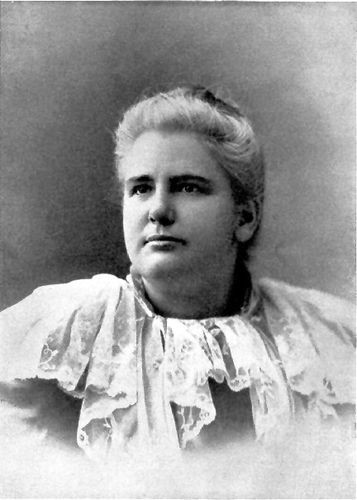
THE REV. ANNA HOWARD SHAW. Vice-President-at-Large of National-American Woman Suffrage Association.
Century after century came forth from the divine life only to pass into the great eternity—and still she toiled and still she waited. At last, in the mute agony of despair, she lifted her eyes above the earth to heaven and away from the jarring strifes which surrounded her, and that which dawned upon her gaze was so full of wonder that her soul burst its prison-house of bondage as she beheld the vision of true womanhood. She knew then it was not the purpose of the Divine that she should crouch beneath the bonds of custom and ignorance. She learned that she was created not from the side of man, but rather by the side of man. The world had suffered because she had not kept her divinely-appointed place. Then she remembered the words of prophecy, that salvation was to come to the race not through the man, but through the descendant of the woman. Recognizing her mission at last, she cried out: "Speak now, Lord, for thy servant heareth thee." And the answer came: "The Lord giveth the Word, and the women that publish the tidings are a great host."
To-day the vision is a reality. From every land the voice of woman is heard proclaiming the word which is given her, and the wondering world, which for a moment stopped its busy wheel of life that it might smite and jeer her, has learned at last that wherever the intuitions of the human mind are called into special exercise, wherever the art of persuasive eloquence is demanded, wherever heroic conduct is based upon duty rather than impulse, wherever her efforts in opening the sacred doors for the benefit of truth can avail—in one and all these respects woman greatly excels man. Now the wisest and best people everywhere feel that if woman enters upon her tasks wielding her own effective armor, if her inspirations are pure and holy, the Spirit Omnipotent, whose influence has held sway in all movements and reforms, whose voice has called into its service the great workmen of every age, shall, in these last days, fall especially upon woman. If she venture to obey, what is man that he should attempt to abrogate her sacred and divine mission? In the presence of what woman has already accomplished, who shall say that a true woman—noble in her humility, strong in her gentleness, rising above all selfishness, gathering up her varied gifts and accomplishments to consecrate them to God and humanity—who shall say that such an one is not in a position to do that for which the world will no longer rank her other than among the first in the work of human redemption? Then, influenced by lofty motives, stimulated by the wail of humanity and the glory of God, woman may go forth and enter into any field of usefulness which opens up before her....
In the Scripture from which the text is taken we recognize a universal law which has been the experience of every one of us. Paul is telling the story of a vision he saw, which became the inspiration of his life, the turning point where his whole existence was changed, when, in obedience to that vision, he put himself in relation with the power to which he belonged, and recognizing in that One which appeared to him on his way from Jerusalem to Damascus his Divine Master, he also recognized that the purpose of his life could be fulfilled only when, in obedience to that Master, he caught and assimilated to himself the nature of Him, whose servant he was....
Every reformer the world has ever seen has had a similar experience. Every truth which has been taught to humanity has passed through a like channel. No one of God's children has ever gone forth to the world who has not first had revealed to him his mission, in a vision.
To this Jew, bound by the prejudices of past generations, weighed down by the bigotry of human creeds, educated in the schools of an effete philosophy, struggling through the darkness and gloom which surrounded him, when as a persecutor he sought to annihilate the disciples of a new faith, there came this vision into his life; there dawned the electric light of a great truth, which found beneath the hatred and pride and passion which filled his life and heart, the divine germ that is implanted in the soul of each one of God's children....
Then came crowding through his mind new queries: "Can it be that my fathers were wrong, and that their philosophy and religion do not contain all there is of truth? Can it be that outside of all we have known, there lies a great unexplored universe to which the mind of man can yet attain?" And filled with the divine purpose, he opened his heart to receive the new truth that came to him from the vision which God revealed to his soul.
All down through the centuries God has been revealing in visions the great truths which have lifted the race, step by step, until to-day womanhood, in this sunset hour of the nineteenth century, is gathered here from the East and the West, the North and the South, women of every land, of every race, of all religious beliefs. But diverse and varied as are our races, our theories, our religions, yet we come together here with one harmonious purpose—that of lifting humanity into a higher, purer, truer life.
To one has come the vision of political freedom. She saw how the avarice and ambition of one class with power made them forget the rights of another. She saw how the unjust laws embittered both—those who made them and those upon whom the injustice rested. She recognized the great principles of universal equality, seeing that all alike must be free; that humanity everywhere must be lifted out of subjection into the free and full air of divine liberty.
To another was revealed the vision of social freedom. She saw that sin which crushed the lives of one class, rested lightly on the lives of the other. She saw its blighting effect on both, and she lifted up her voice and demanded that there be recognized no sex in sin.
Another has come hither, who, gazing about her, saw men brutalized by the rum fiend, the very life of a nation threatened, and the power of the liquor traffic, with its hand on the helm of the Ship of State, guiding it with sails full spread straight upon the rocks to destruction. Then, looking away from earth, she beheld a vision of what the race and our nation might become, with all its possibility of wealth and power, if freed from this burden, and forth upon her mission of deliverance she sped her way.
Another beheld a vision of what it is to be learned, to explore the great fields of knowledge which the Infinite has spread before the world. And this vision has driven her out from the seclusion of her own quiet life that she might give this great truth to womanhood everywhere....
And so we come, each bearing her torch of living truth, casting over the world the light of the vision that has dawned upon her soul.
But there is still another vision which reaches above earth, beyond time—a vision which has dawned upon many, that they are here not to do their own work, but the will of Him who sent them. And the woman who sees the still higher truth, recognizes the great power to which she belongs and what her life may become when, in submission to that Master, she takes upon herself the nature of Him whom she serves.
We will notice in the second place the purpose of all these visions which have come to us. Paul was not permitted to dwell on the vision of truth which came to him. God had a purpose in its manifestation, and that purpose was revealed when He said to the wonder-stricken servant, "Arise; for I have appeared unto thee for this purpose, not that thou behold the truth for thyself, but to make thee a minister and a witness both of that which thou hast already seen and of other truths which I shall reveal unto thee. Go unto the Gentiles. Give them the truth which thou shalt receive that their eyes may be opened, and that they may be turned from darkness to light; that they, too, may receive a like inheritance with thyself...."
This, then, is God's lesson to you and to me. He opens before our eyes the vision of a great truth and for a moment He permits our wondering gaze to rest upon it; then He bids us go forth. Jacob of old saw the vision of God's messengers ascending and descending, but none of them standing still.
Herein, then, lies the secret of the success of the reformer. First the vision, then the purpose of the vision. "I was not disobedient unto the heavenly vision." This is the manly and noble confession of one of the world's greatest reformers, and in it we catch a glimpse of the secrets of the success of his divinely-appointed mission. The difference between the Saul of Tarsus and Paul the Prisoner of the Lord was measured by his obedience. This, too, is a universal law, true of the life of every reformer, who, having had revealed to him a vision of the great truth, has in obedience to that vision carried it to humanity. Though at first he holds the truth to himself, and longs to be lifted up by its power, he soon learns that there is a giving forth of that which one possesses which enriches the giver, and that the more he gives of his vision to men the richer it becomes, the brighter it grows, until it illuminates all his pathway....
Yet Paul's life was not an idle dream; it was a constant struggle against the very people whom he tried to save; his greatest foes were those to whom he was sent. He had learned the lesson all reformers must sooner or later learn, that the world never welcomes its deliverers save with the dungeon, the fagot or the cross. No man or woman has ever sought to lead his fellows to a higher and better mode of life without learning the power of the world's ingratitude; and though at times popularity may follow in the wake of a reformer, yet the reformer knows popularity is not love. The world will support you when you have compelled it to do so by manifestations of power, but it will shrink from you as soon as power and greatness are no longer on your side. This is the penalty paid by good people who sacrifice themselves for others. They must live without sympathy; their feelings will be misunderstood; their efforts will be uncomprehended. Like Paul, they will be betrayed by friends; like Christ in the agony of Gethsemane, they must bear their struggle alone.
Our reverence for the reformers of the past is posterity's judgment of them. But to them, what is that now? They have passed into the shadows where neither our voice of praise or of blame disturbs their repose.
This is the hardest lesson the reformer has to learn. When, with soul aglow with the light of a great truth, she, in obedience to the vision, turns to take it to the needy one, instead of finding a world ready to rise up and receive her, she finds it wrapped in the swaddling clothes of error, eagerly seeking to win others to its conditions of slavery. She longs to make humanity free; she listens to their conflicting creeds, and yearns to save them from the misery they endure. She knows that there is no form of slavery more bitter or arrogant than error, that truth alone can make man free, and she longs to bring the heart of the world and the heart of truth together, that the truth may exercise its transforming power over the life of the world. The greatest test of the reformer's courage comes when, with a warm, earnest longing for humanity, she breaks for it the bread of truth and the world turns from this life-giving power and asks instead of bread a stone.
It is just here that so many of God's workmen fail, and themselves need to turn back to the vision as it appeared to them, and to gather fresh courage and new inspiration for the future. This, my sisters, we all must do if we would succeed. The reformer may be inconsistent, she may be stern or even impatient, but if the world feels that she is in earnest she can not fail. Let the truth which she desires to teach first take possession of herself. Every woman who to-day goes out into the world with a truth, who has not herself become possessed of that truth, had far better stay at home.
Who would have dreamed, when at that great anti-slavery meeting in London, some years ago, the arrogance and pride of men excluded the women whom God had moved to lift up their voices in behalf of the baby that was sold by the pound—who would have dreamed that that very exclusion would be the keynote of woman's freedom? That out of the prejudice of that hour God should be able to flash upon the crushed hearts of those excluded the grand vision which we see manifested here to-day? That out of a longing for the liberty of a portion of the race, God should be able to show to women the still larger vision of the freedom of all human kind?
Grand as is this vision which meets us here, it is but the dawning of a new day; and as the first beams of morning light give promise of the radiance which shall envelop the earth when the sun shall have arisen in all its splendor, so there comes to us a prophecy of that glorious day when the vision which we are now beholding, which is beaming in the soul of one, shall enter the hearts and transfigure the lives of all.
The formal opening of the Council, Monday morning, March 25, was thus described: "The vast auditorium, perfect in its proportions and arrangements, was richly decorated with the flags of all nations and of every State in the Union. The platform was fragrant with evergreens and flowers, brilliant with rich furniture, crowded with distinguished women, while soft music with its universal language attuned all hearts to harmony. The beautiful portrait of the sainted Lucretia Mott, surrounded with smilax and lilies of the valley, seemed to sanctify the whole scene and to give a touch of pathos to all the proceedings."
This great meeting, like so many before and since that time, was opened by Miss Anthony. After the invocation and the hymn, she said in part:
Forty years ago women had no place anywhere except in their homes; no pecuniary independence, no purpose in life save that which came through marriage. From a condition, as many of you can remember, in which no woman thought of earning her bread by any other means than sewing, teaching, cooking or factory work, in these later years the way has been opened to every avenue of industry, to every profession, whereby woman to-day stands almost the peer of man in her opportunities for financial independence. What is true in the world of work is true in education, is true everywhere.
Men have granted us, in the civil rights which we have been demanding, everything almost but the pivotal right, the one that underlies all other rights, the one with which citizens of this republic may protect themselves—the right to vote.
I have the pleasure of introducing to you this morning the woman who not only joined with Lucretia Mott in calling the first convention, but who for the greater part of twenty years has been president of the National Suffrage Association—Mrs. Elizabeth Cady Stanton.
The entire audience arose with clapping of hands and waving of handkerchiefs to greet this leader, who had come from England to attend the Council. In the course of a long and dignified address of welcome, she said:
Whether our feet are compressed in iron shoes, our faces hidden with veils and masks; whether yoked with cows to draw the plow through its furrows, or classed with idiots, lunatics and criminals in the laws and constitutions of the State, the principle is the same; for the humiliations of spirit are as real as the visible badges of servitude. A difference in government, religion, laws and social customs makes but little change in the relative status of woman to the self-constituted governing classes, so long as subordination in all countries is the rule of her being. Through suffering we have learned the open sesame to the hearts of each other. With the spirit forever in bondage, it is the same whether housed in golden cages with every want supplied, or wandering in the dreary deserts of life, friendless and forsaken. Long ago we of America heard the deep yearnings of the souls of women in foreign lands for freedom responsive to our own. Mary Wollstonecraft, Madame de Stael, Madam Roland, George Sand, Frederica Bremer, Elizabeth Barrett Browning, Frances Wright and George Eliot alike have pictured the wrongs of woman in poetry and prose. Though divided by vast mountain ranges, oceans and plains, yet the psalms of our lives have been in the same strain—too long, alas, in the minor key—for hopes deferred have made the bravest hearts sometimes despairing. But the same great over-soul has been our faith and inspiration. The steps of progress already achieved in many countries should encourage us to tune our harps anew to songs of victory....
I think most of us have come to feel that a voice in the laws is indispensable to achieve success; that these great moral struggles for higher education, temperance, peace, the rights of labor, international arbitration, religious freedom, are all questions to be finally adjusted by the action of government and thus, without a direct voice in legislation, woman's influence will be entirely lost.
Experience has fully proved that sympathy as a civil agent is vague and powerless until caught and chained in logical propositions and coined into law. When every prayer and tear represents a ballot, the mothers of the race will no longer weep in vain over the miseries of their children. The active interest women are taking in all the great questions of the day is in strong contrast with the apathy and indifference in which we found them half a century ago, and the contrast in their condition between now and then is equally marked. Those who inaugurated the movement for woman's enfranchisement, who for long years endured the merciless storm of ridicule and persecution, mourned over by friends, ostracized in social life, scandalized by enemies, denounced by the pulpit, scarified and caricatured by the press, may well congratulate themselves on the marked change in public sentiment which this magnificent gathering of educated women from both hemispheres so triumphantly illustrates....
We, who like the children of Israel, have been wandering in the wilderness of prejudice and ridicule for forty years feel a peculiar tenderness for the young women on whose shoulders we are about to leave our burdens. Although we have opened a pathway to the promised land and cleared up much of the underbrush of false sentiment, logic and rhetoric intertwisted with law and custom, which blocked all avenues in starting, yet there are still many obstacles to be encountered before the rough journey is ended. The younger women are starting with great advantages over us. They have the results of our experience; they have superior opportunities for education; they will find a more enlightened public sentiment for discussion; they will have more courage to take the rights which belong to them. Hence we may look to them for speedy conquests. When we think of the vantage-ground woman holds to-day, in spite of all the artificial obstacles placed in her way, we are filled with wonder as to what the future mothers of the race will be when free to have complete development.
Thus far women have been the mere echoes of men. Our laws and constitutions, our creeds and codes, and the customs of social life are all of masculine origin. The true woman is as yet a dream of the future. A just government, a humane religion, a pure social life await her coming....
At the close of this address Miss Anthony presented greetings from the Woman's Liberal Association of Bristol, England, signed by many distinguished names; from the Woman Suffrage Association of Norway, and from a number of prominent women in Dublin.[67] There were also individual letters from Mrs. Priscilla Bright McLaren and many other foreigners.[68]
Dr. Elizabeth C. Sargent and eight other women physicians of San Francisco sent cordial good wishes. Congratulations were received from many Americans,[69] and a cablegram from Mrs. Harriot Stanton Blatch, of England.
Miss Anthony then presented the foreign delegates: England, Mrs. Laura Ormiston Chant, Mrs. Alice Scatcherd, Mrs. Ashton Dilke, Madame Zadel B. Gustafson; Ireland, Mrs. Margaret Moore; France, Madame Isabella Bogelot; Finland, Baroness Alexandra Gripenberg; Denmark, Madame Ada M. Frederiksen; Norway, Madame Sophie Magelsson Groth; Italy, Madame Fanny Zampini Salazar; India, Pundita Ramabai Sarasvati; Canada, Mrs. Bessie Starr Keefer.
After all had acknowledged the introduction with brief remarks, Miss Anthony presented, amid much applause, Lucy Stone, Frances E. Willard, Julia Ward Howe, Isabella Beecher Hooker, Matilda Joslyn Gage, Clara Barton—the most eminent galaxy of women ever assembled upon one platform. Frederick Douglass and Robert Purvis were introduced as pioneers in the movement for woman suffrage.
It would be impossible within the limits of one chapter to give even the briefest synopsis of the addresses which swept through the week like a grand procession. The program only could convey an idea of the value of this intellectual entertainment which called together, day after day and night after night, audiences that taxed the capacity of the largest opera house in Washington.[70]
On the second Sunday afternoon, Easter Day, the services consisted of a symposium conducted by sixteen women, of all religious faiths and of none. In the evening, when as in the morning a vast and interested audience was present, brief farewells were spoken by a number of the foreign delegates. The leading address was by Mrs. Zerelda G. Wallace on the Moral Power of the Ballot. Mrs. Stanton closed the meeting with a great speech, and the following resolution was adopted:
It is the unanimous voice of this International Council that all institutions of learning and of professional instruction, including schools of theology, law and medicine, should, in the interests of humanity, be as freely opened to women as to men, and that opportunities for industrial training should be as generally and as liberally provided for one sex as for the other. The representatives of organized womanhood in this Council will steadily demand that in all avocations in which both men and women engage, equal wages shall be paid for equal work; and they declare that an enlightened society should demand, as the only adequate expression of the high civilization which it is its office to establish and maintain, an identical standard of personal purity and morality for men and women.
During the month of preparation for this International Council, the idea came many times to Mrs. Sewall that it should result in a permanent organization. The other members gave a cordial assent to this proposition, and the necessary committees were appointed. Before the delegates left Washington both a National and International Council of Women were formed.[71]
Immediately following the Council the National Woman Suffrage Association held its Twentieth annual convention in the Church of Our Father, April 3, 4, 1888. As there had been eight days of continuous speech-making this meeting was devoted principally to the presenting of State reports and transacting of necessary business. There were, however, a number of addresses from the distinguished women who remained after the Council to attend this convention.
The Committee on National Enrollment, Mrs. Louisa Southworth of Ohio, chairman, reported 40,000 names of adult citizens who favored equal suffrage; 9,000 of these were from Ohio and 9,000 from Nebraska. Women were urged to send petitions to members of Congress from their respective States. Mrs. Stanton was requested to prepare a memorial to be presented to each of the national political conventions to be held during the year, and committees were appointed to visit each for the purpose of securing in their platforms a recognition of woman suffrage.
The most interesting feature was the hearing before the Senate Committee on Woman Suffrage, which took place April 2.[72] Mrs. Stanton made the opening address, in which she took up the provisions of the Federal Constitution, one by one, and showed how they had been violated in their application to women, saying:
Even the preamble of the Constitution is an argument for self-government—"We, the people." You recognize women as people, for you count them in the basis of representation. Half our Congressmen hold their seats to-day as representatives of women. We help to swell the figures by which you are here, and too many of you, alas, are only figurative representatives, paying little heed to our rights as citizens.
"No bill of attainder shall be passed." "No title of nobility granted." So says the Constitution; and yet you have passed bills of attainder in every State of the Union making sex a disqualification for the franchise. You have granted titles of nobility to every male voter, making all men rulers, governors, sovereigns over all women.
"The United States shall guarantee to every State in the Union a republican form of government." And yet you have not a republican form of government in a single State. One-half the people have never consented to one law under which they live. They have rulers placed over them in whom they have no choice. They are taxed without representation, tried in our courts by men for the violation of laws made by men, with no appeal except to men, and for some crimes over which men should have no jurisdiction....
Landing in New York one week ago, I saw 400 steerage passengers leave the vessel. Dull-eyed, heavy-visaged, stooping with huge burdens and the oppressions endured in the Old World, they stood in painful contrast with the group of brilliant women on their way to the International Council here in Washington. I thought, as this long line passed by, of the speedy transformation the genial influences of equality would effect in the appearance of these men, of the new dignity they would acquire with a voice in the laws under which they live, and I rejoiced for them; but bitter reflections filled my mind when I thought that these men are the future rulers of our daughters; these will interpret the civil and criminal codes by which they will be governed; these will be our future judges and jurors to try young girls in our courts, for trial by a jury of her peers has never yet been vouchsafed to woman. Here is a right so ancient that it is difficult to trace its origin in history, a right so sacred that the humblest criminal may choose his juror. But alas for the daughters of the people, their judges, advocates, jurors, must be men, and for them there is no appeal. But this is only one wrong among many inevitable for a disfranchised class. It is impossible for you, gentlemen, to appreciate the humiliations women suffer at every turn....
You have now the power to settle this question by wise legislation. But if you can not be aroused to its serious consideration, like every other step in progress, it will eventually be settled by violence. The wild enthusiasm of woman can be used for evil as well as good. To-day you have the power to guide and direct it into channels of true patriotism, but in the future, with all the elements of discontent now gathering from foreign countries, you will have the scenes of the French Commune repeated in our land. What women, exasperated with a sense of injustice, have done in dire extremities in the nations of the Old World, they will do here....
I will leave it to your imagination to picture to yourselves how you would feel if you had had a case in court, a bill before some legislative body or a political aspiration for nearly half a century, with a continual succession of adverse decisions, while law and common justice were wholly on your side. Such, honorable gentlemen, is our case....
In the history of the race there has been no struggle for liberty like this. Whenever the interest of the ruling classes has induced them to confer new rights on a subject class it has been done with no effort on the part of the latter. Neither the American slave nor the English laborer demanded the right of suffrage. It was given in both cases to strengthen the Liberal party. The philanthropy of the few may have entered into those reforms, but political expediency carried both measures. Women, on the contrary, have fought their own battles and in their rebellion against existing conditions have inaugurated the most fundamental revolution the world has ever witnessed. The magnitude and multiplicity of the changes involved make the obstacles in the way of success seem almost insurmountable....
Society is based on this fourfold bondage of woman—Church, State, Capital and Society—making liberty and equality for her antagonistic to every organized institution. Where, then, can we rest the lever with which to lift one-half of humanity from these depths of degradation, but on "that columbiad of our political life—the ballot—which makes every citizen who holds it a full armed monitor?"
Miss Anthony then introduced a number of the foreign delegates who had been in attendance at the National Council. Mrs. Laura Ormiston Chant of England, in an eloquent address, said:
I stand here as the grandniece of one of the greatest orators and clearest and wisest statesmen that Europe has known, Edmund Burke. It seems to me an almost overwhelming humility that I should be compelled to echo the magnificent impeachment that he made against Warren Hastings, in our House of Commons, on behalf of the oppressed women of Hindostan, in this my passionate appeal on behalf of oppressed women all over the world....
By all you have held most sacred and beautiful in the women who have loved you and made life possible for you—for their sake and in their name—I do intreat that you will not allow your grandest women to plead for another half century. Say rather "the past has been a long night of wrong, but the day has come and the hour in which justice shall conquer."
Mrs. Alice Scatcherd, delegate from the Liberal and the Suffrage Associations of Leeds and neighboring cities, gave an interesting account of the manner in which Englishwomen exercise the franchise and the influence they wield in politics.
Miss Anthony then said, "I have the pleasure of introducing to you the woman who, twenty-five years ago, wrote the Battle Hymn of the Republic, Mrs. Julia Ward Howe." Mrs. Howe spoke briefly, saying: "My heart has been full with the words of others which have been here uttered; but a single word will enable me to cast in my voice with theirs with all the emphasis that my life and such power as I have will enable me to add. Gentlemen, what a voice you have here to-day for universal suffrage. Think that not only we American women, your own kindred, appear here—and you know what we represent—but these foremost women from other countries, representing not alone the native intelligence and character of those countries, but deep and careful study and precious experience, and think that between them and us who ask for suffrage, there is entire unanimity. We all say the same words; we are all for the same thing...."
Mrs. Caroline E. Merrick, wife of the former Chief Justice of Louisiana, addressed the committee with that deep and touching earnestness so characteristic of Southern women.
After saying that women were present from every State and Territory who would add their pleadings if there were time, Miss Anthony introduced Mrs. Bessie Starr Keefer of Canada, who told of the good effects of woman suffrage in that country. Miss Anthony then said: "Gentlemen of the committee, here stands before you one who is commander-in-chief of an army of 250,000 women. It is said women do not want to vote, but this woman has led this vast army to the ballot-box, or to a wish to get there. I present to you Miss Frances E. Willard."
This was the only time Miss Willard ever appeared before a Suffrage Committee in the Capitol, and she was heard with much interest. Beginning with the playful manner which rendered her speeches so attractive, she closed with great seriousness:
I suppose these honorable gentlemen think that we women want the earth, when we only want half of it. We call their attention to the fact that our brethren have encroached upon the sphere of woman. They have definitely marked out that sphere, and then they have proceeded with their incursion by the power of invention. They have taken away the loom and the spinning-jenny, and they have obliged Jenny to seek her occupation somewhere else. They have set even the tune of the old knitting-needle to humming by steam. So that we women, full of vigor and desire to be active and useful and to react upon the world around us, finding our industrial occupations largely gone, have been obliged to seek out a new territory and to pre-empt from the sphere of our brothers some of that which they have hitherto considered their own.
I know it is a sentiment of chivalry in some good men which hinders them from giving us the ballot. They think we might not be what they admire so much; they think we should be lacking in womanliness of character. I ask you to notice if the women who have been in this International Council, if the women who are school teachers all over this nation, if these hundreds of thousands are not a womanly set of women, and yet they have gone outside of the old sphere. We believe that in the time of peace women can come forward and with peaceful plans can use weapons which are grand and womanly, and that their thoughts, winged with hope and the force of the heart given to them, will have an effect far mightier than physical power. For that reason we ask you that they shall be allowed to stand at the ballot-box, because we believe that there every person expresses his individuality. The majesty or the meanness of a person comes out at the ballot-box more than anywhere else. The ballot is the compendium of all there is in civilization, and of all that civilization has done for us. We believe that the mothers who had the good sense to train noble men, like you who have achieved high positions, had the good sense to train your sisters in the same way, and that it is a pity the State has lost that other half of the conservative power which comes from a Christian rearing and a Christian character.
I have spoken thus on the principles which have made me, a conservative woman, devoted to the idea of the ballot, and one in heart with all these good and true suffrage women, though not one in organic community. I represent before you the Woman's Christian Temperance Union and not a suffrage society, but I bring these principles to your sight, and I ask you, my brothers, to be grand and chivalrous towards us in this new departure which we now wish to make.
I ask you to remember that it is women who have given the costliest hostages to fortune, and out into the battle of life they have sent their best beloved into snares that have been legalized on every hand. From the arms which held him long, the boy has gone forever, for he will not come back again to the home. Then let the world in the person of its womanhood go forth and make a home in the State and in society. By all the pains and dangers the mother has shared, by the hours of patient watching over beds where little children tossed in fever and pain, by the incense of ten thousand prayers wafted to God from earnest lips, I charge you, gentlemen, give woman power to go forth, so that when her son undertakes life's treacherous battle, his mother will still walk beside him clad in the garments of power.
Miss Anthony, who knew better than anyone else when not another word was needed, said at the close of Miss Willard's touching address: "Now, gentlemen, we are greatly obliged to you. I feel very proud of all my 'girls' who have come before you this morning, and you may consider the meeting adjourned."
The Nineteenth national convention assembled in the M. E. Metropolitan Church of Washington, Jan. 25, 1887, continuing in session three days. On no evening was the building large enough to accommodate the audience. The Rev. John P. Newman, pastor of the church, prayed earnestly for the blessing of God "on these women, who, through good and evil report, have been striving for the right."[62] Miss Susan B. Anthony came directly from the Capitol and opened the convention by reading a letter from Mrs. Elizabeth Cady Stanton, who was in England. She then referred to the fact that while this convention was in session the United States Senate was discussing the question of woman suffrage. There would be taken the first direct vote in that body on a Sixteenth Amendment to enfranchise women. The attention of the advocates of woman suffrage was directed to Congress for the first time when the Fourteenth Amendment was under discussion in 1865. That article in the beginning was broad enough to include women but political expediency inserted the word "male," so that if any State should disfranchise any of its male citizens they should be counted out of the basis of representation. She continued:
Thanks were extended to the United States Senators who voted for a Sixteenth Amendment. A committee was appointed, Mrs. Blake, chairman, to wait upon President Grover Cleveland and protest against the threatened disfranchising of the women of Washington Territory; also to secure a hearing before the proper congressional committee in reference to the Edmunds-Tucker Bill, which proposed to disfranchise both the Gentile and Mormon women of Utah. The usual large number of letters were received.[63]
[64] The following report was prepared by Mrs. Parker: At a large and influential gathering of the friends of woman suffrage, at Parliament Terrace, Liverpool, November 16, 1883, convened by E. Whittle, M. D., to meet Mrs. Stanton and Miss Anthony prior to their return to America, a resolution was proposed by Mrs. Parker of Penketh, seconded by Mrs. McLaren of Edinburgh, and unanimously passed: "Recognizing that union is strength and that the time has come when women all over the world should unite in the just demand for their political enfranchisement; therefore
[65] There were printed and distributed by mail 10,000 Calls (four pages each); 10,000 Appeals (two pages each); sketches were prepared of the lives and work of a number of the delegates and circulated by means of a Press Committee of over ninety persons in various cities of many States. On March 10, the first edition (5,000) of the sixteen-page program was issued; this was followed by five other editions of 5,000 each and a final seventh edition of 7,000 copies. Each edition required revision and the introduction of alterations made necessary by changing conditions. There were written in connection with the preparations about 4,000 letters. Including those concerning railroad rates, there were not less than 10,000 more circulars of various kinds printed and distributed. A low estimate of the number of pages thus issued (circulars, calls, programs, etc.) gives 672,000. During the week of the Council and the following convention of the N. W. S. A., the Woman's Tribune was published by Mrs. Clara Bewick Colby eight times (four days sixteen pages, four days twelve pages), the daily edition averaging 12,500 copies.
[66] After the Council Mrs. Stanton, Miss Anthony and Miss Foster remained in Washington for six weeks preparing a complete report of the addresses and proceedings which filled nearly 500 pages. Five thousand copies of these were printed, a large number of which were placed in the public libraries of the United States and foreign countries.
[67] Anna Maria Haslam, Honorable Secretary Woman's Suffrage Association; Mary Edmundson, Honorable Secretary Dublin Prison Gate Mission; Hannah Maria Wigham, President Women's Temperance Association, Dublin, and Member of Peace Committee; Wilhelmina Webb, Member of Ladies' Sanitary Committee, Women's Suffrage, etc., Rose McDowell, Honorable Secretary Women's Suffrage Committee, Isabella Mulvany, Head Mistress Alexandra School, Dublin, Harriet W. Russell, Member of Women's Temperance Association; Deborah Webb, late Honorable Secretary Ladies' Dublin Contagious Diseases Act Repeal Association; Lucy Smithson, Member of the Sanitary Committee and Women's Suffrage Association; Emily Webb, Member of Women's Suffrage Association; Agnes Mason, Medical Student and Member of the Women's Suffrage Committee; Ellen Allen, Member of Women's Temperance and Peace Associations.
[68] Among these were Elizabeth Pease Nichol, Eliza Wigham, Edinburgh; Mrs. Jacob Bright, Catherine Lucas Thomasson, Margaret E. Parker, Jane Cobden, Margaret Bright Lucas, Caroline Ashurst Biggs, Frances Lord, F. Henrietta Muller, England; Isabella M. S. Tod, Belfast, Caroline de Barrau, Theodore Stanton, Hubertine Auclert, editor of La Citoyenne, Maria Deraismes, Eugénie Potonié, M. Dupuis Vincent, France; Johanna Frederika Wecket, Germany, Prince Kropotkin, Russia.
[69] John G. Whittier, T. W. Higginson, Oliver Johnson, George W. Julian, Samuel E. Sewall, Amelia Bloomer, Dr. James C. Jackson, Theodore D. Weld, Elizabeth Buffam Chace, Rev. T. De Witt Talmage, Abigail Scott Dumway, Mrs. Frank Leslie, Dr. Laura Ross Wolcott, Charlotte B. Wilbour, Dr. Agnes Kemp, Augusta Cooper Bristol, Dr. Seth and Mrs. Hannah Rogers, Dr. Alida C. Avery, Harriet S. Brooks, Sarah Burger Stearns, Helen M. Gougar, Caroline B. Buell, Lucy N. Colman.
[70] Among those not mentioned above who gave addresses were E. Florence Barker, Susan H. Barney, Leonora M. Barry, Isabel C. Barrows, Cora A. Benneson, Ada M. Bittenbender, Henry B. Blackwell, Lillie Devereux Blake, Martha McClellan Brown, Dr. Mary Weeks Burnett, Helen Campbell, Matilda B. Carse, Ednah D. Cheney, Sarah B. Cooper, "Jennie June" Croly, Caroline H. Dall, Abby Morton Diaz, Mary F. Eastman, Martha A. Everett, Martha R. Field, Alice Fletcher, J. Ellen Foster, Caroline M. S. Frazer, Helen H. Gardiner, Anna Gordon, Elizabeth Boynton Harbert, Frances E. W. Harper, Marilla M. Hills, Clara C. Hoffman, Laura C. Holloway, John W. Hutchinson, Mary H. Hunt, Laura M. Johns, Mary A. Livermore, Huldah B. Loud, Ella M. S. Marble, Marion McBride, Laura McNeir, Prof. Rena A. Michaels, Harriet N. Morris, Amelia Hadley Mohl, Mrs. John P. Newman, Clara Neymann, ex-U. S. Senator S. C. Pomeroy, Anna Rice Powell, Amelia S. Quinton, Emily S. Richards, Victoria Richardson, Harriet H. Robinson, Elizabeth Lisle Saxon, Lita Barney Sayles, Harriette R. Shattuck, Hannah Whitall Smith, Elizabeth G. Stuart, Prof. Louisa Reed Stowell, Dr. Sarah Hackett Stevenson, M. Louise Thomas, Esther M. Warner, Dr. Caroline B. Winslow, Jennie Fowler Willing, Dr. Ruth M. Wood, Anna M. Worden.
[71] The officers of the National Council were: President, Frances E. Willard, Ill.; vice-president-at-large, Susan B. Anthony, N. Y.; cor. sec., May Wright Sewall, Ind.; rec. sec., Mary F. Eastman, Mass.; treas., M. Louise Thomas, N. Y. Officers of the International Council: President, Millicent Garrett Fawcett, England; vice-president-at-large, Clara Barton, United States; cor. sec. Rachel G. Foster, United States; rec. sec., Kirstine Frederiksen, Denmark.
[72] This committee consisted of Senator Francis M. Cockrell, Mo.; Joseph E. Brown, Ga.; Samuel Pasco, Fla.; Henry W. Blair, N. H.; Thomas W. Palmer, Mich.; Jonathan Chace, R. I.; Thomas M. Bowen, Colo. No hearing was held before the Judiciary Committee of the House, but on April 24 Mrs. Sallie Clay Bennett of Kentucky obtained an audience and made an extended and unanswerable argument from two points of view, the Scriptural and the Constitutional. Her address is printed in full in the Woman's Tribune of April 28, 1888.
FOOTNOTES:
[64] The following report was prepared by Mrs. Parker: At a large and influential gathering of the friends of woman suffrage, at Parliament Terrace, Liverpool, November 16, 1883, convened by E. Whittle, M. D., to meet Mrs. Stanton and Miss Anthony prior to their return to America, a resolution was proposed by Mrs. Parker of Penketh, seconded by Mrs. McLaren of Edinburgh, and unanimously passed: "Recognizing that union is strength and that the time has come when women all over the world should unite in the just demand for their political enfranchisement; therefore
"Resolved, That we do here appoint a committee of correspondence, preparatory to forming an International Woman Suffrage Association.
"Resolved, That the committee consist of the following friends, with power to add to their number.
"For the American Center—Mrs. Elizabeth Cady Stanton, Miss Susan B. Anthony, Miss Rachel G. Foster. For Foreign Centers—(An extended committee was named of prominent persons in Great Britain, Ireland and France)."
[65] There were printed and distributed by mail 10,000 Calls (four pages each); 10,000 Appeals (two pages each); sketches were prepared of the lives and work of a number of the delegates and circulated by means of a Press Committee of over ninety persons in various cities of many States. On March 10, the first edition (5,000) of the sixteen-page program was issued; this was followed by five other editions of 5,000 each and a final seventh edition of 7,000 copies. Each edition required revision and the introduction of alterations made necessary by changing conditions. There were written in connection with the preparations about 4,000 letters. Including those concerning railroad rates, there were not less than 10,000 more circulars of various kinds printed and distributed. A low estimate of the number of pages thus issued (circulars, calls, programs, etc.) gives 672,000. During the week of the Council and the following convention of the N. W. S. A., the Woman's Tribune was published by Mrs. Clara Bewick Colby eight times (four days sixteen pages, four days twelve pages), the daily edition averaging 12,500 copies.
The receipts from contributions and memberships were in round numbers $5,000; from sale of seats and boxes at opera-house $5,000, and from sale of daily Woman's Tribune, photographs and badges, collections, advertisements, etc., $1,500, making a total of nearly $12,000. The largest sums were from Julia T. Foster, $400; Elizabeth Thompson, $250; Mrs. Leland Stanford, $200; Rachel G. Foster, $200; and $100 each from Adeline Thomson, Ellen Clark Sargent, Emma J. Bartol, Margaret Caine, Sarah Knox Goodrich, Mary Hamilton Williams, Lucy Winslow Curtis, Mary Gray Dow, Jane S. Richards, George W. Childs and Henry C. Parsons. The cost of the Tribune (printing, stenographic report, mailing, etc.) was over $3,600; hall rent, $1,800. When one considers the entertainment of so many officers, speakers and delegates, printing, postage, the salary of one clerk for a year (whose board was a contribution from Miss Adeline Thomson and Miss Julia Foster of Philadelphia), and the thousand et ceteras of such a meeting, the total cost of about $12,000 is not surprising. An international convention of men, held in Washington within the year, cost in round numbers $50,000.
[66] After the Council Mrs. Stanton, Miss Anthony and Miss Foster remained in Washington for six weeks preparing a complete report of the addresses and proceedings which filled nearly 500 pages. Five thousand copies of these were printed, a large number of which were placed in the public libraries of the United States and foreign countries.
[67] Anna Maria Haslam, Honorable Secretary Woman's Suffrage Association; Mary Edmundson, Honorable Secretary Dublin Prison Gate Mission; Hannah Maria Wigham, President Women's Temperance Association, Dublin, and Member of Peace Committee; Wilhelmina Webb, Member of Ladies' Sanitary Committee, Women's Suffrage, etc., Rose McDowell, Honorable Secretary Women's Suffrage Committee, Isabella Mulvany, Head Mistress Alexandra School, Dublin, Harriet W. Russell, Member of Women's Temperance Association; Deborah Webb, late Honorable Secretary Ladies' Dublin Contagious Diseases Act Repeal Association; Lucy Smithson, Member of the Sanitary Committee and Women's Suffrage Association; Emily Webb, Member of Women's Suffrage Association; Agnes Mason, Medical Student and Member of the Women's Suffrage Committee; Ellen Allen, Member of Women's Temperance and Peace Associations.
[68] Among these were Elizabeth Pease Nichol, Eliza Wigham, Edinburgh; Mrs. Jacob Bright, Catherine Lucas Thomasson, Margaret E. Parker, Jane Cobden, Margaret Bright Lucas, Caroline Ashurst Biggs, Frances Lord, F. Henrietta Muller, England; Isabella M. S. Tod, Belfast, Caroline de Barrau, Theodore Stanton, Hubertine Auclert, editor of La Citoyenne, Maria Deraismes, Eugénie Potonié, M. Dupuis Vincent, France; Johanna Frederika Wecket, Germany, Prince Kropotkin, Russia.
[69] John G. Whittier, T. W. Higginson, Oliver Johnson, George W. Julian, Samuel E. Sewall, Amelia Bloomer, Dr. James C. Jackson, Theodore D. Weld, Elizabeth Buffam Chace, Rev. T. De Witt Talmage, Abigail Scott Dumway, Mrs. Frank Leslie, Dr. Laura Ross Wolcott, Charlotte B. Wilbour, Dr. Agnes Kemp, Augusta Cooper Bristol, Dr. Seth and Mrs. Hannah Rogers, Dr. Alida C. Avery, Harriet S. Brooks, Sarah Burger Stearns, Helen M. Gougar, Caroline B. Buell, Lucy N. Colman.
[70] Among those not mentioned above who gave addresses were E. Florence Barker, Susan H. Barney, Leonora M. Barry, Isabel C. Barrows, Cora A. Benneson, Ada M. Bittenbender, Henry B. Blackwell, Lillie Devereux Blake, Martha McClellan Brown, Dr. Mary Weeks Burnett, Helen Campbell, Matilda B. Carse, Ednah D. Cheney, Sarah B. Cooper, "Jennie June" Croly, Caroline H. Dall, Abby Morton Diaz, Mary F. Eastman, Martha A. Everett, Martha R. Field, Alice Fletcher, J. Ellen Foster, Caroline M. S. Frazer, Helen H. Gardiner, Anna Gordon, Elizabeth Boynton Harbert, Frances E. W. Harper, Marilla M. Hills, Clara C. Hoffman, Laura C. Holloway, John W. Hutchinson, Mary H. Hunt, Laura M. Johns, Mary A. Livermore, Huldah B. Loud, Ella M. S. Marble, Marion McBride, Laura McNeir, Prof. Rena A. Michaels, Harriet N. Morris, Amelia Hadley Mohl, Mrs. John P. Newman, Clara Neymann, ex-U. S. Senator S. C. Pomeroy, Anna Rice Powell, Amelia S. Quinton, Emily S. Richards, Victoria Richardson, Harriet H. Robinson, Elizabeth Lisle Saxon, Lita Barney Sayles, Harriette R. Shattuck, Hannah Whitall Smith, Elizabeth G. Stuart, Prof. Louisa Reed Stowell, Dr. Sarah Hackett Stevenson, M. Louise Thomas, Esther M. Warner, Dr. Caroline B. Winslow, Jennie Fowler Willing, Dr. Ruth M. Wood, Anna M. Worden.
On Pioneers' Evening about forty of the most prominent of the old workers were on the platform.
[71] The officers of the National Council were: President, Frances E. Willard, Ill.; vice-president-at-large, Susan B. Anthony, N. Y.; cor. sec., May Wright Sewall, Ind.; rec. sec., Mary F. Eastman, Mass.; treas., M. Louise Thomas, N. Y. Officers of the International Council: President, Millicent Garrett Fawcett, England; vice-president-at-large, Clara Barton, United States; cor. sec. Rachel G. Foster, United States; rec. sec., Kirstine Frederiksen, Denmark.
[72] This committee consisted of Senator Francis M. Cockrell, Mo.; Joseph E. Brown, Ga.; Samuel Pasco, Fla.; Henry W. Blair, N. H.; Thomas W. Palmer, Mich.; Jonathan Chace, R. I.; Thomas M. Bowen, Colo. No hearing was held before the Judiciary Committee of the House, but on April 24 Mrs. Sallie Clay Bennett of Kentucky obtained an audience and made an extended and unanswerable argument from two points of view, the Scriptural and the Constitutional. Her address is printed in full in the Woman's Tribune of April 28, 1888.
CHAPTER IX.
THE NATIONAL SUFFRAGE CONVENTION OF 1889.
The Twenty-first annual convention of the National Association met in the Congregational Church at Washington, Jan. 21-23, 1889, in answer to the official Call:
Neither among politicians, nor among women themselves, is this in any sense a party movement. While the Prohibition party in Kansas incorporated woman suffrage in its platform, the Republicans made it a fact by extending municipal suffrage to the women of that State. The Democrats of Connecticut on several occasions voted for woman suffrage while Republicans voted against it. In the New York Legislature Republicans and Democrats alike have advocated and voted for the measure. In Congress the last vote in the House stood eighty Republicans for woman suffrage and nearly every Democrat against it, while not a single Democrat voted in favor of it on the floor of the Senate. Both the Labor and Greenback parties have uniformly recognized woman suffrage in their platforms.... Our strength for future action lies in the fact that woman suffrage has some advocates in all parties and that we, as an association, are pledged to none.
The denial of the ballot to woman is the great political crime of the century, before which tariff, finance, land monopoly, temperance, labor and all economic questions sink into insignificance; for the right of suffrage involves all questions of person and of property.
While each party in power has refused to enfranchise woman, being skeptical as to her moral influence in government, yet with strange inconsistency they alike seek the aid of her voice and pen in all important political struggles. While not morally bound to obey the laws made without their consent, yet we find women the most law-abiding class of citizens in the community. While not recognized as a component part of the Government, they are most active in all great movements for education, religion, philanthropy and reform.
The magnificent convocation of women from the world over—held in Washington last March—a Council more important than any since the Diet of Worms—was proof of woman's marvelous power of organization and her clear comprehension of the underlying principles of all questions of government. With such evidence of her keen insight and executive ability, we invite all interested in good government to give us the inspiration of their presence in the coming convention.
In the absence of Mrs. Stanton Miss Anthony presided, opening her address with the sentence, "Here we have stood for the last twenty-one years, demanding of Congress to take the necessary step to secure to the women of this nation protection in the exercise of their constitutional right to a voice in the government." She introduced the Hon. Albert G. Riddle (D. C.), who in 1871 had made an argument before the Joint Judiciary Committee in favor of woman's right to vote under the Fourteenth Amendment; and later had argued before the Supreme Court her right to vote in the District. In the course of his remarks he said: "All the changes in favor of woman—everything indeed that has been achieved—has been in consequence of this contest for woman suffrage. Its advocates began it; they traveled along with it; and all that has been gained in the statutes of the various States and of the United States has been by their efforts; whatever has taken a crystallized form of irrepealable law is because of this discussion, because of this agitation."
Mrs. Isabella Beecher Hooker (Conn.) read the resolution demanding a representation of women in the Centennial Celebration of the Adoption of the United States Constitution soon to be held in New York City. Miss Anthony then introduced Senator Henry W. Blair (N. H.), who was received with much applause, as the unswerving champion of woman suffrage. In an address considering the constitutional phase of the question, he said:
There has been such progress in the formulation of the State and the national law that it has become necessary for the Supreme Court of the United States to decide that we are not a sovereign people, that we have no nation at all, in order to prevent woman from exercising the right of suffrage throughout this country. In that decision which deprived Mrs. Virginia L. Minor of her right, the Supreme Court was driven to the necessity of deciding in express terms, "The United States has no voters of its own creation." If the United States has no voters, then the old doctrine of State sovereignty is the true one and there is no nation. We are subservient and subordinate to the power of the States to-day by virtue of this decision just exactly as it was claimed we were prior to the recent war. We thought the war established the fact that we were a nation; that the controversy which led up to the war had been decided in favor of the sovereignty of the nation. Under our republican form of government the sovereignty is lodged in the masses of the people. If, therefore, it is not in the man who votes by virtue of his membership in the association of the people known as the United States, then there is no sovereignty there....
As the law now is, in the Federal Constitution there must always have been such a voter of the United States, for in the second clause of the first article it is provided that there shall be a House of Representatives "elected by the people in the States." Where that provision is made it says that the electors shall have the qualifications of the electors in the States. But it does not say that they shall be the same individuals; it does not say that they are to act in the same capacity. They might vary in different portions of the country, in different States; but nevertheless, in giving to the people of the States the right to specify the qualifications which should belong to the electors of the United States, the Constitution did not give up the power to create electors itself....
Take the Fifteenth Amendment. There is the first instance in the entire Constitution where we find the franchise declared to be a "right," and in specific terms alluded to as such. And there it is provided that a right already recognized as existing shall not be abridged by the United States or by the States—a right already existing, not established. And by virtue of that amendment and the provision that this existing right shall not be denied or abridged on account of "race, color or previous condition of servitude," either by the United States or by the States, the national existence of the voter is established....
I think our great difficulty about this is that women perhaps do not, to the extent that they should, place their cause upon the platform that it is a right; that to uphold that it is not a right is a wrong greater than any which has been perpetrated in the past; that freedom to half the human race is a glorious achievement which it still remains for mankind to accomplish....
There is no way in which you can do so much for this world as by giving liberty to those who are the mothers of the generations past and to come; so that freedom to think, freedom to formulate opinions, freedom to decide by the majority of the whole of mature human nature, shall be the universal boon as far as the human race extends....
Miss Anthony then read a letter from Mrs. Stanton which embodied that spirit of independence possessed by her almost beyond all other women:
I notice that in some of our conventions resolutions of thanks are passed to senators, congressmen and legislators for advocating some minor privileges which have been conceded to women, such as admission to colleges and professions, limited forms of suffrage, etc. Now I do not see any occasion for gratitude to these honorable gentlemen who, after robbing us of all our fundamental rights as citizens, propose to restore a few minor privileges. There is not one impulse of gratitude in my soul for any of the fragmentary privileges which by slow degrees we have wrung out of our oppressors during the last half century, nor will there be so long as woman is robbed of all the essential rights of citizenship.
If strong appeals could induce the highway robber to return a modicum of what he had stolen, it might mitigate the miseries of his victim, but surely there would be no reason for gratitude, and an expression of thanks to him would be quite as much out of place as are complimentary resolutions passed in our conventions to legislators for their concessions to women. They deserve nothing at our hands until they make full restitution of all we possessed in the original compact under the colonial constitutions—rights over which in the nature of things men could have no lawful jurisdiction whatever.... Woman has the same right to a voice in this government that man has, and it is based on the same natural desire and capacity for self-government and self-protection....
Until woman is recognized as an equal factor in civilization, and is possessed of her personal property, civil and political rights, all minor privileges and concessions are but so many added aggravations, and are insulting mockeries of that justice, liberty and equality which are the birthright of every citizen of a republic. "Universal suffrage," said Charles Sumner, "is the first proof and only basis of a genuine republic."
Mrs. Stanton referred to the bravery of recent women writers in attacking social problems, citing Mrs. Humphrey Ward, Margaret Deland, Olive Schreiner, Mona Caird and Helen Gardiner. She closed with a tribute to the co-laborers who had died during the past year, among them the Rev. James Freeman Clarke, Judge Samuel E. Sewall, Dr. Clemence S. Lozier, Dr. Mary F. Thomas, Miss Abby W. May and numerous others.
During the second day's proceedings the Rev. Alexander Kent, of the Church of Our Father (Universalist), addressed the convention, saying in part:
It is not uncommon among writers on woman suffrage to find the root of the trouble in those notions of the creation and fall set forth in the ancient Jewish Scriptures—notions which have very generally prevailed throughout Christendom until recently, and which even yet have a large hold upon many people professing to be Christians. In the account of the origin of evil given by the ancient Hebrew writer, woman is the chief offender, and upon her falls the burden of the penalty. In sorrow she is to bring forth her children; her desire is to be to her husband and he is to rule over her. Unquestionably this has tended to prolong the reign of brute force in Christendom by perpetuating a belief in the rightful headship of man in the family and State. But it is a great mistake to see in this Scripture the root of the evil. It is only the record of a theory offered to explain a fact—which antedated both the theory and the record. We find the fact to-day even where we do not find the record—the woman ruled by the man in places where there is no knowledge whatever of the Hebrew Scriptures. I doubt not that among the founders of our Government—meaning the people generally—this doctrine of the rightful headship of man and the subordination of woman was sacredly held as a part of the revealed word of God, and that as such it operated to keep the women as well as the men of that day from perceiving the full significance, the comprehensive scope of the principles affirmed by their leaders, in the Constitution and the Declaration of Independence....
If the ballot in the hands of woman is to do a great work for society, it will be first and foremost because of its wholesome influence on herself—because it rouses in her more of hope, more of laudable ambition, more of earnest purpose, more of self-reliance, more independence of the fashions, frivolities and conventionalities of society and the dictates of the church....
Praying for the speedy coming of this day, and hoping it may work gradually toward a purer and happier social life, and a further companionship in thought and feeling, in purpose and effort, between men and women, and especially between husbands and wives in the life of the home, I express my sympathy with the purpose of this convention.
Mrs. Caroline Hallowell Miller (Md.) took the ground that, after fifty years of argument, women now should unite in a continuous demand for the rights of citizenship.
In introducing the Hon. William D. Kelley (Penn.) Miss Anthony said that not only in Congress, where he was known as the Father of the House, but years ago in his own State Legislature, he advocated the political equality of women. After paying a tribute to his mother, to Mary Wollstonecraft and to Frances Wright, he said: "I am here, because I feel that I should again declare publicly the justice of the enfranchisement of women, which, having cherished through youth and early manhood, I asserted in a public address in Independence Hall, at high noon on the Fourth of July, 1841, before there was any organization for promoting woman's rights politically." He then sketched results already achieved and urged women to keep the flame burning for the benefits which would come to posterity.
The Rev. Olympia Brown (Wis.) spoke on Foreign Rule, and after pointing out the glory of a country which offered a home to all, and expressing a belief in universal suffrage, she continued:
In Wisconsin we have by the census of 1880 a population of 910,072 native-born, 405,425 foreign-born. Our last vote cast was 149,463 American, 189,469 foreign; thus you see nearly 1,000,000 native-born people are out-voted and out-governed by less than half their number of foreigners. Is that fair to Americans? Is it just to American men? Will they not, under this influence, in a little while be driven to the wall and obliged to step down and out? When the members of our Legislatures are the greater part foreigners, when they sit in the office of mayor and in all the offices of our city, and rule us with a rod of iron, it is time that American men should inquire if we have any rights that foreigners are bound to respect....
The last census shows, I think, that there are in the United States three times as many American-born women as the whole foreign population, men and women together, so that the votes of women will eventually be the only means of overcoming this foreign influence and maintaining our free institutions. There is no possible safety for our free school, our free church or our republican government, unless women are given the suffrage and that right speedily.... The question in every political caucus, in every political convention, is not what great principles shall we announce, but what kind of a document can we draw up that will please the foreigners?...
When we remember that the first foot to touch Plymouth Rock was a woman's—that in the first settlement of this country women endured trials and privations and stood bravely at the post of duty, even fighting in the ranks that we might have a republic—and that in our great Western world women came at an early day to make the wilderness blossom as the rose, and rocked their babies' cradles in the log cabins when the Indians' war-whoop was heard on the prairies and the wolves howled around their doors—when we remember that in the last war thousands of women in the Northwest bravely took upon themselves the work of the households and the fields that their husbands and sons might fight the battles of liberty—when we recollect all this, and then are told that loyal women, pioneer women, the descendants of the Pilgrim Fathers, are not even to ask for the right of suffrage lest the Scandinavians should be offended, it is time to rise in indignation and ask, Whose country is this? Who made it? Who have periled their lives for it?
Our American women are property holders and pay large taxes; but the foreigner who has lived only one year in the State, and ten days in the precinct, who does not own a foot of land, may vote away their property in the form of taxes in the most reckless manner, regardless of their interests and their rights. Women are well-educated; they are graduating from our colleges; they are reading and thinking and writing; and yet they are the political inferiors of all the riff-raff of Europe that is poured upon our shores. It is unbearable. There is no language that can express the enormous injustice done to women....
We can not separate subjects and say we will vote on temperance or on school matters, for all these questions are part of government.... When women as well as men are voters, the church will get some recognition. I marvel that all ministers are not in favor of woman suffrage, when I consider that their audiences are almost entirely composed of women and that the church to-day is brought into disrepute because it is made up of disfranchised members. The minister would stand a hundred-fold higher than he does now if women had the suffrage. Everybody would want to know what the minister was saying to those women voters.
We are in danger in this country of Catholic domination, not because the Catholics are more numerous than we are, but because the Catholic church is represented at the polls and the Protestant church is not. The foreigners are Catholic—the greater portion of them; the foreigners are men—the greater part of them, and members of the Catholic church, and they work for it and vote for it. The Protestant church is composed of women. Men for the most part do not belong to it; they do not care much for it except as something to interest the women of their household. The consequence is the Protestant church is comparatively unrepresented at the ballot-box....
I urge upon you, women, that you put suffrage first and foremost, before every other consideration upon earth. Make it a religious duty and work for the enfranchisement of your sex, which means the growth and development of noble characters in your children; for you can not educate your children well surrounded by men and women who hold false doctrines of society, of politics, of morals. Leave minor issues, leave your differences of opinion about the Trinity, or the Holy Ghost, or endless misery; about high license and low license; or Dorcas Societies and Chautauqua Circles. Let them all go; they are of no consequence compared with the enfranchisement of women.
Mrs. Mary Seymour Howell gave a humorous series of Suffrage Pictures in New York, which was greatly relished by the audience. Mrs. Laura M. Johns described Municipal Suffrage in Kansas in an enthusiastic and interesting manner. The Rev. Anna Howard Shaw then delivered her lecture, which has since become so famous, The Fate of Republics, tracing the rise and fall of the republics of history, which grew because of material prosperity and failed because of moral weakness. All were in the hands of men, and women were excluded from any share.[73]
Mrs. Harriette R. Shattuck gave an account of the recent school election in Boston where 19,490 women voted, a much higher percentage of those registered than of the men, and thus defeated the dangerous attempt which had been made by the Church to interfere with the State. Richard W. Blue, State Senator of Kansas, was called to the platform by Mrs. Gougar as one who had greatly aided its Municipal Suffrage Bill.
Mrs. May Wright Sewall (Ind.) spoke on Women in the Recent Campaign. In the National Prohibition Convention they sat as delegates and served on committees. In all parts of the country Republican and Democratic women organized clubs and marched in processions; but she called attention to the fact that these methods are not advocated by the suffrage societies so long as women remain disfranchised. Over two hundred clubs were formed for political study. All of the parties placed women on their platforms to speak in behalf of the candidates. A Central Republican Headquarters was opened in New York and put in charge of a national committee of women who sent out hundreds of thousands of campaign documents. When election day came not one of all these women could put her opinion in the ballot-box.
At the evening session Mrs. Lillie Devereux Blake (N. Y.) in her trenchant way discussed Political Methods and pointed out the inconsistent and illogical declarations of platforms and speakers when applied to women, also the delight afforded to men by the tin horns and fireworks. She suggested for President Harrison's Cabinet, Elizabeth Cady Stanton, Secretary of State; Susan B. Anthony, Secretary of War; May Wright Sewall, Secretary of the Treasury; Zerelda G. Wallace, Secretary of the Navy; Clara Barton, Secretary of the Interior; Laura de Force Gordon, Attorney-General.
Mrs. Sarah M. Perkins (O.) spoke on The Concentration of Forces, showing how prone women are to organize for every object except suffrage, and yet the majority of these workers would rejoice to have the power which lies in the ballot and would be infinitely better equipped for their work.
Mrs. Mary B. Clay (Ky.) opened the last day's session with a forcible address entitled, Are American Women Civil and Political Slaves? She proved the affirmative of her question by quoting the spoken and written declarations of the greatest statesmen on the right of individual representation and the exceptions made against women, citing Walker, the legal writer: "This language applied to males would be the exact definition of political slavery; applied to females, custom does not so regard it."
Mrs. Abigail Scott Duniway (Ore.) described the recent arbitrary and unwarranted disfranchisement of the women of Washington Territory. Frederick Douglass was loudly called for and in responding expressed his gratitude to women, "who were chiefly instrumental in liberating my people from actual chains of bondage," and declared his full belief in their right to the franchise.
Mrs. Helen M. Gougar (Ind.) made a strong speech upon Partisan or Patriot? In her address on Woman in Marriage Mrs. Clara Bewick Colby, editor of the Woman's Tribune, said:
It is customary to regard marriage as of even more importance to woman than to man, since the maternal, social and household duties involved in it consume the greater portion of the time and thought of a large majority. Love, it is commonly said, is an incident in a man's life, but makes or mars a woman's whole existence. This, however, is one of the many popular delusions crystallized into opinion by apt phraseology. To one who believes in the divinely intended equality of the sexes it is impossible to consider that any mutual relation is an incident for the one and the total of existence for the other. We may lay it down as a premise upon which to base our whole reasoning that all mutual relations of the sexes are not only divinely intended to, but actually do bring equal joys, pains, pleasures and sacrifices to both. Whatever mistake one has made has acted upon the other, and reacted equally upon the first.
The one great mistake of the ages—since woman lost her primal independence and supremacy—to which is due all the sins and sorrows growing out of the association of the sexes, has been in making woman a passive agent instead of an equal factor in arranging the laws, customs and conditions of this mutual state. Whether marriage be a purely business partnership for the care and maintenance of children, or whether it be a sacrament to which the benediction of the church gives peculiar sanctity and perpetuity and makes the parties "no more twain but one flesh," in either case it is an absurdity, which we only tolerate because of custom, for men alone to make all the regulations and stipulations concerning it.
This unnatural and strained assumption by one sex of the control of everything relating to marriage, and the equally unnatural and mischievous passivity on the part of the other, have given birth to the meek maiden waiting for her fate, to the typical disconsolate and forlorn "superfluous woman," to the two standards of morality for the sexes, to the mercenary marriage with all its attendant miseries, to the selfish, exacting, querulous wife, to the disappointed or tyrannical husband; and of late, with the wider possibilities of individual pleasure and satisfaction, to the growing aversion of young people to matrimony, and the rush of women to the divorce courts for freedom from the galling bonds; all these and a thousand variations of each, until the nature of both sexes is so perverted that it is impossible to decide what is nature.
A letter was read from Mrs. Matilda Joslyn Gage (N. Y.) urging women individually to petition Senators and Representatives for the removal of their political disabilities, because by this means these men were compelled to think on the question.
Mrs. Virginia L. Minor (Mo.) addressed the convention on The Law of Federal Suffrage, a legal argument on the right to vote conferred by the Constitution. Miss Anthony supplemented Mrs. Minor's argument with a history of the Fourteenth Amendment, in which she said:
When that Fourteenth Amendment was under discussion—when it was proposed to put the word "male" into the second section—it read: "If any State shall disfranchise any of its citizens on account of color, all of that class shall be counted out of the basis of representation." But there were timid souls on the floor of Congress at the close of the war, as well as at other periods of our history, and to prevent the enfranchisement of women by this amendment they moved to make it read: "If any State shall disfranchise any of its male citizens, all of that class shall be counted out of the basis of representation." Male citizens! For the first time in the history of our Government that discriminating adjective was placed in the Constitution, and yet the men on the floor of Congress, from Charles Sumner down, all declared that this amendment would not in any wise change the status of women!
We at once asserted our right to vote under this amendment: "All persons born or naturalized in the United States, and subject to the jurisdiction thereof, are citizens of the United States and of the State wherein they reside. No State shall make or enforce any law which shall abridge the privileges or immunities of citizens of the United States." Our first trial was on civil rights, when Mrs. Myra Bradwell of Chicago, who had been for some time publishing a law journal which every lawyer in the State said he could not afford to do without, applied for admission to the bar, and these same lawyers denied it. She appealed to the Illinois Supreme Court and it confirmed the denial, because she was not only a woman but a married woman. Then she appealed her case to the Supreme Court of the United States, and a majority of this court decided that the right to be a lawyer was not especially a citizen's right and that therefore the State of Illinois could legally abridge the privileges and immunities of its women by denying them admission to the bar.
I shall never forget how our hearts sank when in 1871 that decision came, declaring the powerlessness of the Federal Constitution to protect women in their civil right of being eligible to the legal profession. When we said if these rights which it is meant to protect are not civil they must be political rights, we thought we had the Supreme Court in a corner. But when my trial for voting came on, Justice Hunt said that the right to vote was a special right belonging to men alone. We didn't believe that this decision could be confirmed, but it was, when Mrs. Minor, who attempted to vote at the same election in her State of Missouri, appealed her case to the Supreme Court of the United States. It was argued by her husband, the ablest of lawyers, and when the Judges brought in their decision it was to the effect that the Constitution of the United States has no voters. Thus it is that we have two Supreme Court decisions relative to the powers of the Fourteenth Amendment to protect women, and in both cases they have been excluded absolutely from its provisions.
I remember, Mrs. Minor (turning to that lady), how we discussed these questions in those early years. We weren't sleepy in our talk as we were being cut off inch by inch from the protection of the Constitution. I remember how Mrs. Stanton said in a public address: "If you continue to deny to women the protection of this amendment, you will finally come to the point when it will cease to protect even black men," and we have lived to see that day.
The address on The Coming Sex by Mrs. Eliza Archard Connor, a well-known journalist of New York, was declared by the press to be in its delivery "the gem of the convention." She said in part:
It is my conviction that women are the natural orators of the race. They have keener sympathies and quicker intuitions than men. They have a gift of language that not even their worst enemies will deny, and these are just the qualities which go to make the orator.... The time is coming when we shall need all our eloquence, all our intellectual power and all our love. The day is approaching when men will come with ballots in their hands, begging women to use them....
Wherever you go, wake women up, tell them to learn everything. Tell them to study with all their might history, civil government, political economy, social and industrial science—for the time is coming when they will need them all....
This is the work before us. This is the meaning of the desperate unrest and unhappiness of women. It is this that has drawn us here to enter our protest against the wicked, old, one-legged order of things. Our honored Miss Anthony has gone through fire and hail while she worked for her convictions. All of us have wrought as best we might for the higher education of women, for their pecuniary independence, for their civil and political rights, fighting the world, the flesh and the devil.
My own work has been in the field of journalism. For nearly twenty years I have faced here every form of disability because I am a woman, have met defeat after defeat, till the iron has entered my soul. Yet every day I have thanked God that I have been permitted to bear my share in the tremendous struggle for the development of women in the nineteenth century. Struggle means development; it can come in no other way, and this will be the grandest since creation began—the crowned, perfected woman. For this the cry of womanhood has risen out of the depths through the centuries. Up through agony and despair it has come, through sin and shame, through poverty and martyrdom, through torture which has wrung drops of blood from woman's lips, still up, up, till it has reached the great white throne itself.
The enrollment committee reported a list of about one hundred thousand names of persons asking for woman suffrage. The treasurer announced the receipts for 1888 to be $12,510. All of the expenses of the great International Council had been paid and a balance of nearly $300 remained.
The resolutions might be described as an epitomized recital of wrongs and a Bill of Rights.
Whereas, Women possessed and exercised the right of suffrage in the inauguration of this Government; and,
Whereas, They were deprived of this right by the arbitrary Acts of successive State Legislatures in violation of the original compact as seen in the early constitutions; therefore,
Resolved, That it is the duty of the several States to make prompt restitution of these ancient rights, recognized by innumerable precedents in English history, and to-day by the gradual extension of the suffrage over vast territories.
Whereas, Woman's title deed to an equal share in the inheritance left her by the fathers of the Republic has been examined and proved by able lawyers; and,
Whereas, This right is already exercised in some form in one hundred localities in different parts of the world; therefore,
Resolved, That sex is no longer considered a bar to the exercise of suffrage by civilized nations.
Resolved, That it is the duty of Congress to pass a declaratory act, compelling the several States to establish a "republican form of government" within their borders by securing to women their right to vote, thus nullifying the fraudulent Acts of Legislatures and making our Government homogeneous from Maine to Oregon.
Resolved, That the question of enfranchising one-half the people is superior to that of Indian treaties, admission of new States, tariff, international copyright or any other subject before the country, and that it is the foremost duty of the Fiftieth Congress at this, its last session, to submit an amendment to the Constitution forbidding States to disfranchise citizens on account of sex.
Resolved, That as a question of ethics the difference between putting a fraudulent ballot in the box and keeping a rightful ballot out is nothing, and that we condemn the action which prevents women from casting a ballot at any election as a shameful evidence of the corruption of dominant political parties in this country.
Whereas, The Legislature of Washington Territory has twice voted for woman suffrage—women for the most part having gladly accepted and exercised the right, Governor Squire in his report to the Secretary of the Interior in 1884 having declared that it met the approval of a large majority of the people; and,
Whereas, In 1887, after the women had voted for three and a half years, the Territorial Supreme Court pronounced the law invalid on the ground that the nature of the bill must be described in the title of the act; and,
Whereas, In January, 1888, another bill passed by the Legislature gave to this law an explicit title; and the bill, again granting suffrage to women, was signed by Governor Semple, thus triumphantly showing the approval of the people, the Legislature and the Governor; and,
Whereas, The Territorial Supreme Court, in August, 1888, again rendered a decision against the right of the women of the Territory to vote, basing their decision upon the false assumption that Congress had never delegated to the Territories the right to define the status of their own voters; and,
Whereas, This decision strikes a blow at the fundamental powers of the United States Congress, confounding laws delegated to the Territories by the Organic Act of 1852, which vests in their Legislatures the power to prescribe their qualifications for voting and holding office—with State governments which limit legislative enactments by constitutions of their own making—thus setting at naught the will of the people; therefore,
Resolved, That we earnestly and respectfully petition Congress that in passing an enabling act or acts for the admission of the other Territories there be incorporated a clause allowing women to vote for delegates to their constitutional conventions, and at the election for the adoption of the constitution, in every one where the Legislature has granted woman suffrage and such law has not been repealed by a subsequent Legislature.
Whereas, In the year 1873 our leader, Susan B. Anthony, was deprived of the right of trial by jury, by a Judge of the Supreme Court of the United States, simply because she was a woman, it is the duty of all women to resent the insult thus offered to womanhood and demand of the men of this closing century of constitutional government such condemnation of this infamous decision of Judge Ward Hunt[74] as shall teach the coming generation of voters that the welfare of the republic demands that women be protected equally with men in the exercise of citizenship; and,
Whereas, In the great Centennial Celebration of 1876 women were denied all participation in the public proceedings commemorating the birth of the Declaration of Independence, though they sought earnestly and respectfully to declare their sentiments of loyalty to the great principles of liberty and responsibility there enunciated, they should now demand official recognition by Congress and the State Legislature on all the Boards of Commissioners which, at the public expense, are to initiate and carry out the august ceremonials of the coming Constitutional Celebration in New York in April, 1889, to the end that taxation without representation shall no longer be acknowledged a just and constitutional policy in this government nominally of the people, therefore,
Resolved, That a committee be appointed by the National W. S. A. to memorialize Congress on this subject, and to take such other action as shall bring before the enlightened manhood of our country their duty of chivalry no less than justice in this important matter.[75]
Whereas, The question of woman's enfranchisement is fundamental and of paramount importance; therefore,
Resolved, That, while the National Woman Suffrage Association welcomes and claims the support of persons of all parties and beliefs, it desires to strongly reassert the position which it has held of being nonpartisan.
A hearing was granted by the Senate Committee on Woman Suffrage the morning of January 24. Mrs. Hooker, Mrs. Minor, Mrs. Duniway, Mrs. Johns, the Rev. Olympia Brown, the Rev. Miss Shaw and Miss Alice Stone Blackwell were introduced to the committee by Miss Anthony, and each from a different standpoint presented the arguments for the submission of a Sixteenth Amendment enfranchising women.
On February 7, Senator Blair reported for the committee—Senators Charles B. Farwell (Ill.), Jonathan Chace (R. I.), Edward O. Wolcott (Col.), in favor of the amendment. After an able and exhaustive argument the report closed as follows:
Unless this Government shall be made and preserved truly republican in form by the enfranchisement of woman, the great reforms which her ballot would accomplish may never be; the demoralization and disintegration now proceeding in the body politic are not likely soon to be arrested. Corruption of the male suffrage is already a well-nigh fatal disease; intemperance has no sufficient foe in the law-making power; a republican form of government can not survive half-slave and half-free.
The ballot is withheld from women because men are not willing to part with one-half the sovereign power. There is no other real cause for the continued perpetration of this unnatural tyranny.
Enfranchise women or this republic will steadily advance to the same destruction, the same ignoble and tragic catastrophe, which has engulfed the male republics of history. Let us establish a government in which both men and women shall be free indeed. Then shall the republic be perpetual.
The women of the nation are deeply indebted to Senator Blair for his able and persistent efforts in their behalf. Year after year, in the midst of the great pressure of duties connected with his office, he carefully prepared these constitutional and legal reports knowing that they could have only the indirect results of educating public sentiment and contributing to the history of this great movement for the political rights of half the race.
The other members of the committee, Senators Zebulon B. Vance (N. C.), Joseph E. Brown (Ga.), J. B. Beck (Ky.), announced that they should present a minority report in opposition, but as "Letters from a Chimney Corner," by Mrs. Caroline F. Corbin, and "The Law of Woman Life," by Mrs. A. D. T. Whitney, apparently had been exhausted, and as no other woman had provided them with the necessary ideas, the report never materialized. Senator Vance, however, as chairman of this Select Suffrage Committee asked for a clerk at this time, to be paid out of the contingent fund.
The House Judiciary Committee granted a hearing January 28, which was addressed by Miss Anthony, Mrs. Hooker, Mrs. Duniway, Mrs. Minor, the Rev. Olympia Brown, Mrs. Colby, Miss Lavina A. Hatch (Mass.) and Mrs. Ella M. Marble (Minn.). The committee took no action.
The year 1888 is distinguished for the largest and most representative woman's convention held up to that time—the International Council of Women, which met in Washington, D. C., March 25, continuing until April 1. The origin of this great body is briefly stated in the official report as follows: "Visiting England and France in 1882, Mrs. Stanton conceived the idea of an International Council of Women interested in the movement for suffrage, and pressed its consideration on the leading reformers in those countries. A few accepted the idea, and when Miss Anthony arrived in England early the following year, they discussed the question fully with each other, and seeing that such a convention was both advisable and practicable, they resolved to call it in the near future. On the eve of their departure, at a reception given them in Liverpool, the subject was presented and favorably received. Among the guests were Priscilla Bright McLaren, Margaret Bright Lucas, Alice Scatcherd and Margaret E. Parker. The initiative steps for an International Council were then taken and a committee of correspondence appointed.[64]
"All of the intervening months from June until the next March were spent in the extensive preparations necessary to the success of a convention which proposed to assemble delegates and speakers from many parts of the world. As the funds had to be raised wholly by private subscription, no bureau with an expensive pay-roll was established but the entire burden was carried by a few individuals, who contributed their services."[65]
A complete stenographic report of these fifty-three meetings was transcribed and furnished to the press by a thoroughly organized corps of women under the direction of Miss Mary F. Seymour of New York City, an unexcelled if not an unparalleled feat.[66] The management of the Council by the different committees was perfect in every detail, and the eight days' proceedings passed without a break, a jar or an unpleasant circumstance.
At the close of this address Miss Anthony presented greetings from the Woman's Liberal Association of Bristol, England, signed by many distinguished names; from the Woman Suffrage Association of Norway, and from a number of prominent women in Dublin.[67] There were also individual letters from Mrs. Priscilla Bright McLaren and many other foreigners.[68]
At the close of this address Miss Anthony presented greetings from the Woman's Liberal Association of Bristol, England, signed by many distinguished names; from the Woman Suffrage Association of Norway, and from a number of prominent women in Dublin.[67] There were also individual letters from Mrs. Priscilla Bright McLaren and many other foreigners.[68]
Dr. Elizabeth C. Sargent and eight other women physicians of San Francisco sent cordial good wishes. Congratulations were received from many Americans,[69] and a cablegram from Mrs. Harriot Stanton Blatch, of England.
It would be impossible within the limits of one chapter to give even the briefest synopsis of the addresses which swept through the week like a grand procession. The program only could convey an idea of the value of this intellectual entertainment which called together, day after day and night after night, audiences that taxed the capacity of the largest opera house in Washington.[70]
During the month of preparation for this International Council, the idea came many times to Mrs. Sewall that it should result in a permanent organization. The other members gave a cordial assent to this proposition, and the necessary committees were appointed. Before the delegates left Washington both a National and International Council of Women were formed.[71]
The most interesting feature was the hearing before the Senate Committee on Woman Suffrage, which took place April 2.[72] Mrs. Stanton made the opening address, in which she took up the provisions of the Federal Constitution, one by one, and showed how they had been violated in their application to women, saying:
[73] It is a loss to posterity that Miss Shaw never writes her addresses. She is beyond question the leading woman orator of this generation, and is not surpassed in power by any of the men.
[74] See History of Woman Suffrage, Vol. II, p. 647.
[75] This was done, but no representation was allowed women in the celebration.