автордың кітабын онлайн тегін оқу A Beginner's Psychology
TRANSCRIBER’S NOTES:
—Obvious print and punctuation errors were corrected.
—The transcriber of this project created the book cover image using the title page of the original book. The image is placed in the public domain.
A BEGINNER’S PSYCHOLOGY
THE MACMILLAN COMPANY
NEW YORK · BOSTON · CHICAGO · DALLAS
ATLANTA · SAN FRANCISCO
MACMILLAN & CO., Limited
LONDON · BOMBAY · CALCUTTA
MELBOURNE
THE MACMILLAN CO. OF CANADA, Ltd.
TORONTO
A BEGINNER’S PSYCHOLOGY
BY
EDWARD BRADFORD TITCHENER
New York
THE MACMILLAN COMPANY
1915
All rights reserved
Copyright, 1915,
By THE MACMILLAN COMPANY.
Set up and electrotyped. Published December, 1915.
Norwood Press
J. S. Cushing Co.—Berwick & Smith Co.
Norwood, Mass., U.S.A.
To
THE MEMORY OF
THOMAS HENRY HUXLEY
PREFACE
It is an acknowledged fact that we perceive errors in the work of others more readily than in our own.—Leonardo da Vinci
In this Beginner’s Psychology I have tried to write, as nearly as might be, the kind of book that I should have found useful when I was beginning my own study of psychology. That was nearly thirty years ago; and I read Bain, and the Mills, and Spencer, and Rabier, and as much of Wundt as a struggling acquaintance with German would allow. Curiously enough, it was a paragraph in James Mill, most unpsychological of psychologists, that set me on the introspective track,—though many years had to pass before I properly understood what had put him off it. A book like this would have saved me a great deal of labour and vexation of spirit. Nowadays, of course, there are many introductions to psychology, and the beginner has a whole library of text-books to choose from. Still, they are of varying merit; and, what is perhaps more important, their temperamental appeal is diverse.
I do not find it easy to relate this new book to the older Primer,—which will not be further revised. There is change all through; every paragraph has been rewritten. The greatest change is, however, a shift of attitude; I now lay less stress than I did upon knowledge and more upon point of view. The beginner in any science is oppressed and sometimes disheartened by the amount he has to learn; so many men have written, and so many are writing; the books say such different things, and the magazine articles are so upsetting! Enviable is the senior who can reply, when some scientific question is on the carpet,—There are three main views, A’s and B’s and C’s, and you will find them here and there and otherwhere! But as time goes by this erstwhile beginner comes to see that knowledge is, after all, a matter of time itself. If he keeps on working, knowledge is added unto him; and not only knowledge, but also what is just as valuable as knowledge, the power of expert assimilation; so that presently, when some special point is in debate, he is not ashamed of the plea of ignorance. He has learned that one man cannot compass the full range of a science, and he is assured that so-many hours of expert attention will make him master of the new matter. He comes in this way not, surely, to underestimate knowledge, but to be less anxious about it; and as that preoccupation goes, the point of view seems to be more and more important. Why is it that beginners in science are so often disjointed in their thinking, so often superficial, unable to correlate what they know, logically all at sea? There is no doubt that they are, whether they study physics or chemistry, biology or psychology. I think the main reason is that they have never got the scientific point of view; they are taught Physics or Biology, but not Science. Hence I have, in this book, written an inordinately long introduction, and have kept continually harping on the difference between fact and meaning. I try to make the reader see clearly what I take Science to be. It does not matter whether he agrees with me; that is a detail; I shall be fully satisfied if he learns to be clear and definite in his objections, realizes his own point of view, and sticks to it in working out later his own psychological system. Muddlement is the enemy; and there is a good deal of muddled thinking even in modern books.
Not that I offer this little essay as a model of clear thought! The ideas of current psychology and the words in which they find expression are still, in very large measure, an affair of tradition and compromise; and even if a writer has fought through to clarity,—past experience forbids me to hope that: but even if one had,—a book meant for beginners may not be too consistently radical; some touch must be maintained with the past, and some too with the multifarious trends of the present. There is something turbid in the very atmosphere of an elementary psychology (is the air much clearer elsewhere?), and it is difficult to see things in perspective. So the critic who will soon be saying that the ideal text-book of psychology has yet to be written will be heartily in the right, even if he is not particularly helpful. The present work has its due share of the mistakes and minor contradictions that are inevitable to a first writing; at many points it falls short of my intention,—l’œuvre qu’on porte en soi paraît toujours plus belle que celle qu’on a faite; and I daresay that the intention itself is not within measureable distance of the ideal. It is, nevertheless, the best I can do at the time; and it is also, I repeat, the kind of book that I should have liked to have when I began psychologising.
Psychological text-books usually contain a chapter on the physiology of the central nervous system. The reader will find no such chapter here; for I hold, and have always held, that the student should get his elementary knowledge of neurology, not at second hand from the psychologist, but at first hand from the physiologist. I have added to every chapter a list of Questions, looking partly to increase of knowledge, but especially to a test of the reader’s understanding of what he has just read. I have also added a list of References for further reading. It depends upon the maturity and general mental habit of the student whether these references—made as they are, in many cases, to authors who do not agree either with one another or with the text of the book—should be followed up at once, or only after the text itself has been digested. The decision must be left to the instructor. My own opinion is that beginners are best given one thing at a time, and that the knowledge-questions and the references should therefore, in the ordinary run of teaching, be postponed until some ‘feeling’ for psychology, some steadiness of psychological attitude, has become apparent.
I have avoided the term ‘consciousness.’ Experimental psychology made a serious effort to give it a scientific meaning; but the attempt has failed; the word is too slippery, and so is better discarded. The term ‘introspection’ is, I have no doubt, travelling the same road; and I could easily have avoided it, too; but the time is, perhaps, not quite ripe. I have said nothing of the ‘thought-element’, which seems to me to be a psychological pretender, supported only by the logicising tendencies of the day; and if I am wrong no great harm has been done, since a description of this alleged elementary process, by positive characters, is not yet forthcoming. My references are confined to works available in the English language; I think it unlikely that the students for whom this book is intended will have attained to any considerable knowledge of French or German. Lastly,—I believe that this is my last major omission,—I have referred only incidentally to the ‘application’ of psychology; for science is not technology, though history goes to show that any the least fact of science may, some day or other, find its sphere of practical usefulness.
Two of my illustrations are borrowed: the swallow-figure on p. 138 from Professor Ebbinghaus, and the cut on p. 282 from Dr. A. A. Grünbaum.
I am sorry to confess that a few of the quotations which head the chapters are mosaics, pieced together from different paragraphs of the original. Even great writers are, at times, more diffuse than one could wish; or perhaps it would be fairer to say that they did not write with a view to chapter-headings. I hope, in any case, that no injustice has been done.
It is a very pleasant duty to acknowledge the assistance that I have received from my Cornell colleagues, Prof. H. P. Weld and Drs. W. S. Foster and E. G. Boring, and from Dr. L. D. Boring of Wells College. I am indebted to all for many points of valid criticism, and I wish to express to all my sincere thanks for much self-sacrificing labour.
I have retained the late Professor Huxley’s name in the forefront of this new primer, partly as an act of homage to the master in Science,—the brilliant investigator, the fearless critic, the lucid expositor; and partly, also, as a personal tribute to the man it was my earlier privilege to know.
Cornell Heights, Ithaca, N.Y.
July, 1915.
CONTENTS
CHAPTER I
PSYCHOLOGY: WHAT IT IS AND WHAT IT DOES
SECTION PAGE1.
Common Sense and Science
12.
The Subject-matter of Psychology
53.
Mind and Body
104.
The Problem of Psychology
145.
The Method of Psychology
186.
Process and Meaning
267.
The Scope of Psychology
308.
A Personal Word to the Reader
34Questions and Exercises
37References for Further Reading
40CHAPTER II
SENSATION
9.
Sensations from the Skin
4310.
Kinæsthetic Sensations
4511.
Taste and Smell
4812.
Sensations from the Ear
5113.
Sensations from the Eye
5614.
Organic Sensations
6415.
Sensation and Attribute
6516.
The Intensity of Sensation
67Questions and Exercises
70References
72CHAPTER III
SIMPLE IMAGE AND FEELING
17.
Simple Images
7318.
Simple Feelings and Sense-feelings
79Questions and Exercises
87References
88CHAPTER IV
ATTENTION
19.
The Problem of Attention
9020.
The Development of Attention
9321.
The Nature of Attention
9922.
The Experimental Study of Attention
10323.
The Nervous Correlate of Attention
106Questions and Exercises
110References
111CHAPTER V
PERCEPTION AND IDEA
24.
The Problem in General
11225.
The Analysis of Perception and Idea
11426.
Meaning in Perception and Idea
11727.
The Types of Perception
12128.
The Perception of Distance
12529.
The Problem in Detail
13130.
The Types of Idea
138Questions and Exercises
142References
143CHAPTER VI
ASSOCIATION
31.
The Association of Ideas
14532.
Associative Tendencies: Material of Study
14933.
The Establishment of Associative Tendencies
15234.
The Interference and Decay of Associative Tendencies
15635.
The Connections of Mental Processes
15936.
The Law of Mental Connection
16237.
Practice, Habit, Fatigue
169Questions and Exercises
174References
176CHAPTER VII
MEMORY AND IMAGINATION
38.
Recognition
17739.
Direct Apprehension
18140.
The Memory-idea
18441.
Illusions of Recognition and Memory
18742.
The Pattern of Memory
18943.
Mnemonics
19244.
The Idea of Imagination
19445.
The Pattern of Imagination
197Questions and Exercises
201References
202CHAPTER VIII
INSTINCT AND EMOTION
46.
The Nature of Instinct
20347.
The Two Sides of Instinct
20748.
Determining Tendencies
21249.
The Nature of Emotion
21550.
The James-Lange Theory of Emotion
21851.
The Expression of Emotion
22252.
Mood, Passion, Temperament
225Questions and Exercises
228References
229CHAPTER IX
ACTION
53.
The Psychology of Action
23054.
The Typical Action
23355.
The Reaction Experiment
23656.
Sensory and Motor Reaction
23957.
The Degeneration of Action: From Impulsive to Reflex
24258.
The Development of Action: From Impulsive to Selective and Volitional
24659.
The Compound Reaction
25260.
Will, Wish, and Desire
255Questions and Exercises
259References
260CHAPTER X
THOUGHT
61.
The Nature of Thought
26162.
Imaginal Processes in Thought: The Abstract Idea
26363.
Thought and Language
26764.
Mental Attitudes
27165.
The Pattern of Thought
27566.
Abstraction and Generalisation
28067.
Comparison and Discrimination
283Questions and Exercises
287References
288CHAPTER XI
SENTIMENT
68.
The Nature of Sentiment
29069.
The Variety of Feeling-attitude
29370.
The Forms of Sentiment
29771.
The Situations and their Appeal
30072.
Mood, Passion, Temperament
304Questions and Exercises
305References
306CHAPTER XII
SELF AND CONSCIOUSNESS
73.
The Concept of Self
30774.
The Persistence of the Self
31275.
The Self in Experience
31576.
The Snares of Language
32177.
Consciousness and the Subconscious
32378.
Conclusion
328Questions and Exercises
332References
334APPENDIX
DREAMING AND HYPNOSIS
79.
Sleep and Dream
33580.
Hypnosis
341References
349 Index of Names 351 Index of Subjects 353A BEGINNER’S PSYCHOLOGY
A BEGINNER’S PSYCHOLOGY
§ 2. The Subject-matter of Psychology.—Psychology is the science of mind. What, then, is mind? Everybody knows that, you will say, just as everybody knows what is matter. Everybody knows, yes, in terms of common sense; but we have seen that common sense is not science. Besides, common sense is not articulate; it cannot readily express itself; and it is a little afraid of plain statements. Close this book, now, and write down what you take mind to be; give yourself plenty of time; when you have finished, go over what you have written, and ask yourself if you really know what all the words and phrases mean, if you can define them or stand an examination on them; the exercise will be worth while.
§ 3. Mind and Body.—The first thing to get clear about is the nature of the man left in the world, the man whose presence is necessary for psychology and unnecessary for physics. Since we are talking science, this man will be man as science views him, and not the man of common sense; he will be, that is, the organism known to biology as homo sapiens, and not the self-centred person whom we meet in the everyday world of values. But the human organism owes its organic character, the organisation of its parts into a single whole, to its nervous system. All over the body and all through the body are dotted sense-organs, which take up physical and chemical impressions from their surroundings; these impressions are transmitted along nerve-fibres to the brain; in the brain they are grouped, arranged, supplemented, arrested, modified in all sorts of ways; and finally, it may be after radical transformation in the brain, they issue along other nerve-fibres to the muscles and glands. The nervous system thus receives, elaborates, and emits. Moreover, there is strong evidence to show that the world which psychology explores depends for its existence upon the functioning of the nervous system; or, if we prefer a stricter formula, that this world is correlated with the functioning of the nervous system. The man left in thus reduces to a nervous system; and that is the truth of the statement, often met with in popular scientific writing, that the brain is the organ of mind. There is no organ of mind; that phrase is an echo of the old-world search after the place of residence of the mannikin-mind, which was assigned variously to heart, liver, eye, brain, blood, or was supposed somehow to perfuse the whole body. The scientific fact is that, whenever we come upon mental phenomena, then we also find a functional nervous system; we know nothing of the former apart from the latter; the two orders are thus correlated.
§ 4. The Problem of Psychology.—The subject-matter of psychology, as we saw on p. 9, is the whole world as it shows itself to a scientific scrutiny with man left in. Or, to put the same thing in another way, psychology gives a scientific description of the whole range of human experience correlated with the function of the human nervous system. We have just learned, however, that there is a psychology of the lower animals, possibly even of plants; and we must therefore say that we were speaking in § 2 of the subject-matter of human psychology. This is the psychology that will occupy us in the present book. Let us now see what our actual task is. What have we to do, in order to get a scientific description of mind?
§ 5. The Method of Psychology.—Having learned what we have to do, let us ask what method we are to follow in doing it. So far as the nervous system is concerned, it is evident that the psychologist must take his cue from the physiologist; indeed, this part of his problem makes him, for the time being, a physiologist, only that his real interest remains centred in mind. But how is it when he is attacking the other parts of the problem? Is there a special psychological method, a peculiar way of working, that he must adopt in his study of mental phenomena? The answer is No: his method is that of science in general.
§ 6. Process and Meaning.—Science, we said on p. 4, does not deal with values or meanings or uses, but only with facts; and we have just seen how words, which in everyday life are practically all meaning, may be made the objects of psychological experiment. Still, in their case, after all, we were simply ignoring meaning; so far as the observer was able to read words at all from the stimuli flashed on the screen, he read words which had a meaning, and a meaning that the experimenter might have discovered if he had been interested in it. We have not offered any evidence that mental processes are not intrinsically meaningful, that meaning is not an essential aspect of their nature; we have just assumed that they may be treated, scientifically, as bare facts. Let us now see whether meaning is essential to them or not. There are several heads of evidence.
§ 7. The Scope of Psychology.—Science, like the Elephant’s Child in the story, is full of an insatiable curiosity. Just as the physicist reaches out, analysing and measuring, to the farthest limits of the stellar universe, so does the psychologist seek to explore every nook and corner of the world of mind; nay more, he will follow after a mere suspicion of mind; we have seen him trying to psychologise the plants. The result is a vast number of books and monographs and articles on psychology, written by men and women of very different interests, knowledge and training; for science does not advance on an ordered front, but still depends largely on individual initiative. A high authority on the Middle Ages has said that one mortal life would hardly suffice for the reading of a moderate part of mediæval Latin; and the psychologist must recognise, whether with pride or with despair, that one life-time is hardly enough for the mastery of even a single limited field of psychology. The student has to get clear on general principles, and then to resign himself to work intensively upon some special aspect of the subject-matter,—keeping as closely as he may in touch with his fellow-workers, and aiming to see his own labours in a just perspective, but realising that psychology as a whole is beyond his individual compass.
§ 8. A Personal Word to the Reader.—These introductory sections are not easy. The only way to make them easy would be, as an Irishman might say, to leave the difficult things out; but then you would come to the later chapters, where we study mental phenomena in the concrete, with all sorts of prepossessions and misunderstandings; psychology would be one long difficulty instead of being, as it henceforth ought to be, a bit of straight sailing.
Questions and Exercises
References for Further Reading
CHAPTER II
§ 10. Kinæsthetic Sensations.—We get them, for the most part, from the cooperation with the skin of certain deeper-lying tissues. Psychologists have long suspected the existence of a muscle sense. We now know that sensations are derived, not only from the muscles, but also from the tendons and the capsules of the joints. These tissues are, of course, closely bound together, and are all alike affected by movement of a limb or of the body. Their disentanglement, from the point of view of sensation, has been a slow and difficult matter. Psychology has here been greatly aided by pathology; for there are diseases in which the skin alone is insensitive, in which skin and muscles alone are insensitive, and in which the whole limb is insensitive; so that a first rough differentiation is made for us by nature herself. It is also possible artificially to anæsthetise muscle and joint; and psychologists have devised various forms of experiment whereby some single tissue is thrown into relief above the others.
§ 11. Taste and Smell.—The great physiologist Carl Ludwig once remarked that smell is the most unselfish of all the senses; it gives up everything it has to taste, and asks nothing in return. Taste is, indeed, an inveterate borrower; it borrows from smell and from touch, very much as the skin borrows from the underlying organs. When we have a cold in the head, we say that we cannot taste; but how is taste affected? The truth is that our nose is stopped, and we cannot smell.
§ 12. Sensations from the Ear.—Sensations of hearing fall into two great groups, tones and noises. When we are speaking of tones, we naturally think of the keyboard of a piano. The piano tones are, in reality, not simple tones or sensations but compound tones; and we are able, after a little practice, to break up a compound tone into its simple constituents. You may get a fair notion of a really simple tone by blowing gently across the mouth of an empty bottle. The tone is dull and hollow, as compared with the bright solidity of a piano tone, but it has also a pleasant mellowness. With these two aids, the bottle tone and the piano keyboard, we may approach our study of tonal sensations.
§ 13. Sensations from the Eye.—You may study tones by help of the piano and a few medicine bottles; but for the study of lights and colours you must go beyond household appliances, and secure a fairly large set of coloured and grey papers; sample-books may be obtained, very cheaply, from the manufacturers. You will notice, first of all, that as the world of sounds divides into tones and noises, so does the world of looks divide into what we have just called colours and lights. The colourless looks or lights may be arranged in a single straight line that passes from purest white through the greys to deepest black; they are, as sensations, older than colours, just as noise is older than tone. Colours are more varied. Consider, to begin with, the character of colour proper or hue, that is, the differences of colour that show in the rainbow. Hues may be arranged, not in one straight line, but in a square. Setting out, say, from red, you pass through red-yellow or orange to yellow; that is one straight line; setting out again from yellow, you pass through yellow-green to green; from green you pass through green-blue to blue; and finally from blue you come back, by way of blue-red (violet and purple), to the original red. Colours have, besides, two further characters, that bring them into relation with lights. They differ in tint, that is, in darkness or lightness; brown is darker than yellow, sky-blue is lighter than navy-blue. They differ also in saturation or chroma, that is, in poorness or richness of hue; pinks and yellows look faded and washed-out as compared with rich reds and blues. Tint brings colours into relation with lights, because, if we can say that a colour is darker or lighter than a particular grey, we can also find some grey that matches it in darkness or lightness; and chroma brings colours into relation with lights, in the sense that the better chroma is farther off from colourlessness (that is, from grey) than the poorer chroma of the same hue and tint.
§ 14. Organic Sensations.—There are still other sensations, coming to us from the internal bodily organs; from various parts of the alimentary canal, from the organs of sex, from heart and blood-vessels, from the lungs, from the sheathing membrane of the bones; but it is doubtful if they are of new kinds; probably they consist simply of pressure, cold, warmth, and pain. The dull deep-seated pains that we call aches are, perhaps, different from the bright pains of the skin; but most of the differences among pains, differences that we express by the terms lancing, throbbing, piercing, stabbing, thrilling, gnawing, boring, shooting, racking, and so on, are either differences of time (steady, intermittent) or space (localised, diffused) or degree (moderate, acute), or else are differences due to the blending of pain with various other sensations.
§ 15. Sensation and Attribute.—We have been talking all this while about sensations, but we have not yet said what sensations are. They make up, as you will have guessed, one class of the mental elements, the elementary mental processes of § 4, that we reach by analysis of our complex experiences. They are therefore simple and irreducible items of the mental world. How shall we define them?
§ 16. The Intensity of Sensation.—A sensation may remain the same in quality, and yet vary in strength or intensity. A pressure may be the pressure of an ounce or of half-a-pound; it is always pressure, the same quality, but its intensity differs. The tone you get by blowing across the mouth of a bottle may be loud or faint, though it is still the same pitch, the same tone. The weight you carry may strain the arm very little or a great deal; the sensation of strain from the tendons is the same in both cases, but its intensity is different.
Questions and Exercises
References
CHAPTER III
§ 18. Simple Feelings and Sense-Feelings.—Many of our experiences are indifferent; but many of them, again, are pleasant or unpleasant. These two words, pleasant and unpleasant, denote elementary mental processes of a different sort from sensations and images; they are known as simple feelings. The term ‘feeling’ is itself even more ambiguous than the term ‘image’; it is natural to speak of ‘feeling’ a strain or effort, a warmth or cold; but we shall henceforth use it only in its technical meaning, to indicate the way in which stimuli affect us, pleasantly or unpleasantly. We must discard altogether the words pleasure and pain, although they have long been current as the names of the simple feelings, and although they are much less clumsy than pleasant and unpleasant. We discard them because pain is a sensation (p. 43); and pains, while usually unpleasant, may at times be pleasant; the scratching that relieves an itch and the nip of the wind on a brisk winter’s day are both pains, but they are also both pleasant.
Questions and Exercises
References
CHAPTER IV
§ 20. The Development of Attention.—If we consider a large number of cases of attention, we find that they fall into three great groups; and each one of these groups seems to represent a stage in the development of mind at large, a level of mental evolution. We speak accordingly of primary, of secondary, and of derived primary attention. Let us consider them in order.
§ 21. The Nature of Attention.—Our next task, in the words of p. 93, is to trace the pattern of attention, to describe as accurately as possible the arrangement of our vivid and obscure sensations. Notice that, in popular parlance, attention covers only the vivid processes of the moment; psychologically, however, the term includes both the vivid and the obscure, those that we are ‘distracted from’ as well as those that we are ‘attending to,’ This being understood, we may attempt a description.
§ 22. The Experimental Study of Attention.—The question of the range of attention,—how many sensations or images may occupy the focus at the same time,—was canvassed in the Middle Ages: witness our quotation from St. Thomas. The first appeal to experiment seems to have been made, in the late thirties of the past century, by the Scottish philosopher Sir Wm. Hamilton. “You can easily make the experiment for yourselves,” Hamilton tells his students, “but you must beware of grouping the objects into classes. If you throw a handful of marbles on the floor, you will find it difficult to view at once more than six, or seven at most, without confusion; but if you group them into twos, or threes, or fives, you can comprehend as many groups as you can units.” The experiment is not very rigorous; but more accurate work on the subject shows that Hamilton was not far wrong. If a field of simple visual stimuli is shown for a brief time, the practised observer is in fact able to grasp six of them; and if familiar groups are substituted for the separate stimuli (short words for letters, or playing-card fives for single dots), the range of visual attention remains the same.
§ 23. The Nervous Correlate of Attention.—It remains to say a word about the nature of the nerve-forces (§ 20) which underlie attention. Physiologists tell us that one nervous process may influence another in two opposite ways: by helping and by hindering, or, in technical terms, by reinforcement and inhibition. Let us take an elementary example of what they mean. Suppose that a frog has been reduced, by the removal of its cerebral hemispheres, to a mere nerve-and-muscle machine; it lives, but it cannot sense or feel, and it does not move ‘of its own accord.’ If, now, a weak pressure is applied to the frog’s hind foot, there is no visible response; the limb remains passive. But if at the same moment a light is flashed into the eye, the leg-muscles may be thrown into strong contraction. Here we must suppose that the two nervous processes, from skin and eye, have in some way helped each other; there is nervous reinforcement. If, again, a pressure is applied to a certain part of the frog’s body, the animal croaks. If a strong pressure is applied to another part of the body, it replies by a contraction of the muscles. If, however, the two pressures are applied together, the frog does not both croak and move; it does neither; there is no response to the stimuli. Here, therefore, we must suppose that the two nervous processes interfere with each other; there is nervous inhibition.
Questions and Exercises
References
CHAPTER V
§ 25. The Analysis of Perception and Idea.—Sensations and simple images can hardly occur, by themselves alone, in our everyday experience. The practised psychologist may be able to focalise a sensation, to make it so vivid that it stands out almost as it would under the experimental control of the laboratory; but his is an exceptional case. The units of our daily experience are rather such things as the sound of the piano in the next room, the sight of the tree budding just outside the window, the memory of last winter’s snow-piles, the forecast of to-night’s Pathetic Symphony; that is, they are perceptions and ideas. Notice that they come to us in the first place as units, as wholes; they show no lines of natural cleavage; they are unitary and self-contained. Yet they are not psychologically simple; if they were, we should never have lit upon sensations and simple images. All perceptions and ideas may be analysed.
§ 26. Meaning in Perception and Idea.—We learned in § 6 that mental processes are not intrinsically meaningful, that meaning is not a constituent part of their nature. We have seen, indeed, that the whole notion of meaning is really foreign to science. When we ask, then, what meaning is, from the psychological point of view, are we not asking an irrelevant and unscientific question?
§ 27. The Types of Perception.—Our perceptions are based upon three of the attributes or aspects of sensation: upon quality, upon duration, and upon extension (p. 66).
§ 28. The Perception of Distance.—A complete psychology of perception would contain an analytical treatment, up to the limits of our present knowledge, of all the various perceptions, qualitative, temporal and spatial, as well as complex, that occur in experience. Such a treatment is here out of the question. We must pick and choose; and as a sample of perception at large we shall consider the perception of distance. We seem, quite immediately and directly, to see distances; we see that our friend is coming nearer, we see that he has passed the bridge, we see that he is entering the gate, we see when to shake hands with him. Yet there is no sensation of distance, and there is no specific stimulus to distance. What, then, really happens?
§ 29. The Problem in Detail.—Every one of our familiar perceptions might, now, be treated in this same fashion, and in indefinitely greater detail. We should start out with our pattern of sensory nucleus, imaginal context, and brain-habit; and we should push our analysis back and back, in the effort to reach the primary and ultimate form of the perception we were discussing. The quest is fascinating; for these are old, old bits of the mental life; to trace them home would be to go back to the Stone Age—or further; the earliest men we know of perceived the things that we perceive. Whether psychology will ever reach the final goal cannot be said; but at any rate the problems are genuine problems; they can be resolved only by intensive and long-continued work; and they demand an extraordinary ingenuity in the devising of experimental controls and an unusual degree of patience in experimenting. Men spend their lives among dead languages and buried cities; why not excavate and explore the inner world of perception?
§ 30. The Types of Idea.—Idea takes its plan from perception; and ideas may therefore be classified, like perceptions, as qualitative, temporal and spatial. When, however, we speak of types of idea, we usually have a different classification in view. Our ideas differ as our equipment of imagery differs; some minds are rich in visual or auditory images, others are poor or deficient. When first these differences were brought to light, they seemed to be permanent and clearly marked; children, especially, were classed as eye-minded, ear-minded, and touch-minded or motor-minded, according as their ideas consisted predominantly of visual, auditory, or kinæsthetic images; and it was thought no less necessary to discover a child’s type, and to instruct him in accordance with it, than it is to test the colour-vision of pilots and engineers. Moreover, since all ideas may be translated into words, and since verbal ideas may also be visual, auditory or motor,—ideas of the word seen, heard, or spoken,—three sub-types were added to the main types of idea; the verbal-visual, the verbal-auditory, and the verbal-motor. The doctrine of types found support in pathology; thus, the famous French physician J. M. Charcot reports a case of eye-mindedness in which visual ideas were suddenly lost. The patient writes: “I possessed at one time a great faculty of picturing to myself persons who interested me, colours and objects of every kind; I made use of this faculty extensively in my studies. I read anything I wanted to learn, and then shutting my eyes I saw again quite clearly the letters with their every detail. All of a sudden this internal vision absolutely disappeared. Now I cannot picture to myself the features of my children or my wife, or any other object of my daily surroundings. I dream simply of speech. I am obliged to say things which I wish to retain in my memory, whereas formerly it was sufficient for me to photograph them in my eye.”
Questions and Exercises
References
CHAPTER VI
§ 32. Associative Tendencies: Material of Study.—We want to find out how those processes in the brain which are the correlates of our ideas go together, get connected or associated. The brain is a machine; and it is not only complicated, but it is also plastic, that is, it is subject to change and modification. The complexity of the machine makes it necessary for us to work with simple stimuli and by strict methods; only if we work with simple stimuli shall we get to the bare essentials of the associative functions; and only if we work by strict methods shall we obtain results which other investigators can repeat and verify. Even so, the plasticity of the machine makes it impossible for us to lay down hard and fast laws of connection; we can speak only of connective tendencies or of associative tendencies; what actually happens, in any particular case, is likely to be the joint result of many tendencies, weak and strong, conflicting and concurring.
§ 33. The Establishment of Associative Tendencies.—The use of meaningless syllables has brought with it a whole armoury of technical methods for the study of the associative tendencies. We have here no space to treat of these methods in detail; fortunately, the results that we shall mention speak for themselves; and it may be added that all the methods of experiment are, in principle, changes rung upon one simple model, in which the observer sits down before a series of syllables, reads them through, so-many times over, in a state of attention, and then, either immediately or after an interval of time, repeats them ‘from memory.’ We proceed, then, to answer the question: How are associative tendencies established in the brain?
§ 34. The Interference and Decay of Associative Tendencies.—If a set of associative tendencies, such as we have just described, is left to itself, and neither disturbed nor renewed, it gradually disappears; the loss is at first very rapid, then proceeds more slowly, and thereafter goes on only at a snail’s pace. To make the matter concrete, we may think of the meshwork of tendencies as a meshwork of channels, deeper and shallower, in the substance of the brain; then the rule is that the channels tend to fill up,—the shallow ones speedily, the deeper ones at first quickly and then more and more slowly,—until everything is smooth again. This is a mere figure, but it carries the meaning that we desire. The same thing happens with the tendencies set up by meaningful material; they too slowly die away; but it is doubtful if they ever wholly disappear; in their case the brain, if it has been thoroughly impressed, seems never wholly to ‘forget.’ Ebbinghaus learned some stanzas of Byron’s Don Juan, for experimental purposes, and did not look at them again for 22 years; yet he relearned those stanzas in 93 per cent. of the time required to learn new stanzas; a saving of 7 per cent. Some stanzas that he had learned more thoroughly were not read again for 17 years; these were relearned with a saving of nearly 20 per cent. He had no memory whatever of the verses formerly learned; but his brain ‘remembered’; the associative tendencies had not completely disappeared.
§ 35. The Connections of Mental Processes.—So far as the elementary processes are concerned, this question has already been answered in our discussion of perception. We found that there were two modes of sensory connection, two ways in which sensations may go together. In qualitative perceptions, such as the perception of a musical note, there is a blend or fusion of qualities; we can, to be sure, analyse the compound tone, after practice, into fundamental and overtones; yet it still comes to us as unitary, as a single impression; it stands only at one remove, so to speak, from the simplicity of sensation itself. The tastes of coffee and lemonade, with their blending of taste and smell, of touch and temperature; the organic feels of hunger and thirst and nausea; the kinæsthesis aroused by grasping and pulling, by lifting the arm and swinging the foot; all these experiences are fusions, more or less intimate, more or less complex, of sensory qualities. They too can be analysed; but the analysis is not easy; the qualities cling together, seem in a way to merge into one another. In spatial perceptions, on the other hand, in such perceptions as the sight of my desk with its litter of writing materials, the elementary processes stand out side by side; brown contrasts with blue, dark with light; here, we might say, is no confluence, but rather concourse. In the perception of rhythm we have the same separateness of sensations, only that it is now temporal instead of spatial; and in the perception of change (p. 132) we find both modes of connection, separate qualities or intensities passing into one another by that peculiar blur or fusion which we have called the index of change. This second type of connection, whether it is the side-by-side of space or the end-to-end of time, may be named conjunction.
§ 36. The Law of Mental Connection.—We have spoken at some length of the establishment of associative tendencies in the brain, of their decay with time, and of their mutual interference. Can we sum up our knowledge of them in a single general statement? And can we then translate this general statement into psychological language, and so reach a formula of mental connection that may stand in place of the logical laws of association? Let us try.
§ 37. Practice, Habit, Fatigue.—The establishment of an associative tendency may be looked upon as the establishment of a habit of brain-function; the learning of series of syllables improves with practice; and continued learning gives rise to fatigue. It is natural, therefore, that we should here pause to say something about these three things in their relation to psychology.
Questions and Exercises
References
CHAPTER VII
§ 39. Direct Apprehension.—We saw on p. 120 that meaning, which was at first a fringe of mental processes, a contextual setting of some bit of bare experience, may in course of time be carried by nerve-processes which have no mental correlates of any kind. The same thing seems to hold of recognition. We do not, in strictness, ‘recognise’ the clothes that we put on every morning, or the desk at which we are accustomed to write; we apprehend them, directly, as our clothes and our desk; we take them for granted. The feeling of familiarity, the feeling of being at home with our own things, changes first to something that is still a feeling, though weaker and more nebulous; to something that we may describe as an ‘of-course’ feeling, which is still some distance away from sheer indifference. As the days and weeks go on, this of-course feeling itself dies out; the stimuli no longer have power to arouse a feeling at all, and the organism faces the habitual situations without any organic stir. We apprehend the clothes and desk as ours, precisely as we perceive the tree and the piano as spatial (p. 115). In experiments on the recognition of greys, the author has reported positively that a particular grey had been seen before, without being able to find anything whatsoever, in the way of verbal idea or kinæsthetic quiver or organic thrill, that might carry the meaning of familiarity; the brain-habit just touched off the report ‘Yes,’ and that was all that could be said.
§ 40. The Memory-Idea.—But where, all this while, is the memory-image? If you had been asked, before you read the foregoing paragraphs, what happens when you recognise somebody or something, you would probably have replied, as the associationists reply: ‘The present sight of the object calls up an image of that object, by the law of similarity; then the image or idea is compared with the perception, and the two are found to agree; and this agreement is what I mean by recognition.’ If it were then objected that observation fails to show any such idea or image, you would perhaps have said: ‘The whole thing takes place so quickly that the factors cannot ordinarily be distinguished; but all the same that is what must happen.’ And so you would have kept your faith in the image.
§ 41. Illusions of Recognition and Memory.—Psychologically, an illusory memory is a memory, just as an illusory perception is a perception. We speak of illusion when our experience fails to square with what, from our knowledge of external circumstances and of other like experiences, we might have expected; the distinction is therefore practical, not scientific. We shall avail ourselves of it, partly for convenience’ sake, and partly because certain cases of illusion offer special problems to the psychologist.
§ 42. The Pattern of Memory.—Psychology cannot yet offer any adequate description of the pattern that mental processes display, the arrangement that they fall into, when we are remembering. Memory, as we are all aware, may occur in the state of primary attention, when we call it remembrance, or in the state of secondary attention, when we call it recollection. Something may be said under both heads; but our account must be largely figurative and conventional.
§ 43 Mnemonics.—Rules for remembering, tricks of memorising, were considered of great importance in the ancient world; oratory was highly esteemed; and no orator before the time of Augustus would have ventured to use notes. As the art declined, these rules were less and less regarded; we hear practically nothing of them between the first and the thirteenth centuries of the present era. From that date, however, interest in artificial memory-systems has never died out; they have been recommended for sermons, for lectures, for disputations, for public speeches, for the learning of foreign languages, for examinations, for practically every occasion in which memory is employed, as well as for the improvement of memory itself.
§ 44. The Idea of Imagination.—We think of memory as reproducing the old, and of imagination, no less positively, as producing the new; the very word poet means the maker, and the word artist means the fitter or joiner. Imagination cannot, of course, give us new qualities of experience; we cannot imagine a new colour, different from all known colours, or a new sensation—say, a specific sensation of electricity—different from the known sensations of skin and underlying tissues. Imagination does, however, give us novel connections; and experiment shows that an idea comes to us as imagined only if it comes as unfamiliar, with the feeling of novelty or strangeness upon it.
§ 45. The Pattern of Imagination.—Imagination, like memory, may occur in the state of primary or of secondary attention. In the former case we call it receptive, in the latter case constructive imagination.
Questions and Exercises
References
CHAPTER VIII
§ 47. The Two Sides of Instinct.—If instinct is the general name for the innate nervous tendencies to behaviour, then the detailed study of instinct belongs to physiology and general biology. The psychologist is concerned with it only in so far as the innate tendencies guide and form the stream of thought. There is, however, another side to instinct, which makes it a matter of direct psychological observation; the touching-off of an instinctive response may be accompanied by mental processes, by sensations and feeling. We must say something of instinct in both relations; and we look at it, first, from the biological point of view.
§ 48. Determining Tendencies.—The reader must have felt for some time past that we sorely need a technical term for all the directive nerve-forces, brain-habits, instinctive tendencies, and so forth, that figure in psychological discussion. There is such a term, formed on the analogy of ‘associative tendencies’; psychologists are coming more and more to speak of determining tendencies. Any nervous set or disposition that turns our attention in a certain direction, that casts our perceptions into a certain form, that places a definite meaning upon an equivocal word, that governs our response to a particular situation, may be called a determining tendency. Some of these tendencies are simple, and some are extremely complex; some are inherited, and some are acquired in the life-time of the individual. All alike lay down a path of least resistance for the psychoneural processes (p. 164) to follow, and thus determine the flow of the mental stream.
§ 49. The Nature of Emotion.—Suppose that you are sitting at your desk, busy in your regular way; and suppose that a street-car passes by the house. The familiar rumble does not distract you; it slips in among the obscure processes of the margin. Suddenly you hear a shrill scream; and now the noise of the car shoots to the focus of attention, becomes the context of the scream. You leap up, as if the scream were a personal signal that you had been expecting; you dash out of doors, as if your presence on the street were imperatively necessary. As you run, you have fragmentary ideas: ‘a child,’ perhaps, in internal speech; a visual flash of some previous accident; a momentary kinæsthetic set, the stiffening of protest, that represents your whole attitude to the city car-system. But you have, also, a mass of insistent organic sensation: you choke, you draw your breath in gasps, for all the hurry you are in a cold sweat, you have a horrible nausea; and yet, in spite of the intense discomfort that floods you, you have no choice but to go on. In describing the experience later, you would say that you were horrified by hearing a child scream; the mental processes that we have just named make up the emotion of horror.
§ 50. The James-Lange Theory of Emotion.—We saw that emotion, at any rate in its intenser phases, is insistently organic; the organic sensations readily blend both with one another and with feeling; and the resultant massive fusion is as characteristic of emotion as the organic surge (p. 211) is characteristic of instinct. Everyone can distinguish, even in imagination, the rushing, swelling ‘feel’ of anger from the sinking, shrinking ‘feel’ of fear. Psychology has always had an open eye for the organic constituent of emotion; Aristotle and many later writers refer to it; and in France emphasis upon the organic stir in emotion became almost a matter of psychological orthodoxy. The whole subject was, however, set in a new light when the late Professor James propounded in 1884 his famous ‘theory of emotion.’ “My thesis is,” James wrote, “that the bodily changes follow directly the perception of the exciting fact, and that our feeling of the same changes as they occur is the emotion;” “The more rational statement is that we feel sorry because we cry, angry because we strike, afraid because we tremble, and not that we cry, strike or tremble, because we are sorry, angry, or fearful, as the case may be.” The view thus paradoxically stated aroused much discussion; and it gained further impetus by the publication in 1885 of an essay on emotion by Carl Lange, professor of medicine in Copenhagen; Lange independently comes to a conclusion which, in principle, is the same as that of James.
§ 51. The Expression of Emotion.—If the classification of emotions is a pleasant exercise for authors of a logical turn, the outward show of emotion in gesture and facial expression has always been attractive to those who pondered the relations of mind and body. It may even be true that observation of these expressive movements lies at the very root of psychology; for in emotion a man is changed, transformed; he is unlike himself, out of himself, beside himself; and what could suggest, more plainly than such transformation, the activity of an indwelling mind? However that may be, there is a long list, stretching down the centuries, of works that deal with emotive expression. We must ourselves pass over everything that appeared before the time of Charles Darwin.
§ 52. Mood, Passion, Temperament.—The weaker emotive states, which persist for some time together, are called moods; the stronger, which exhaust the organism in a comparatively short time, are called passions. No sharp line of distinction, however, can be drawn, either as regards intensity or as regards duration, between these various experiences.
Questions and Exercises
References
CHAPTER IX
§ 54. The Typical Action.—Under these circumstances, it sounds a little incongruous to talk of a ‘typical’ action. But we must start somewhere; and we may, perhaps, say that the typical action, for psychology, is an action of the simplest form taken at its psychological best; in other words, an organic movement that is singly determined and that shows a maximum of mental accompaniment. You will understand better what this definition means when we have worked out an illustration. Meantime, you can see that such an action—we call it an impulsive action—serves as point of departure in two directions. The form may remain simple, while the mental side suffers reduction; or the form may become complicated, and therewith new mental characters may be introduced. In the former case, the impulsive action runs downhill toward automatic; in the latter, it climbs up toward deliberative action.
§ 55. The Reaction Experiment.—The reaction experiment comes to us, of all unlikely things, by the road of astronomy. In the old days, before electrical instruments were invented, astronomers used to time the passage of a star across the meridian of their observatory by means of the eye-and-ear method. You can easily imagine the procedure. You have your eye at the ocular of a telescope, the field of which is evenly divided by a number of fine vertical lines. The star enters the field from the right, and crosses to the left; your task is to determine the instant at which it traverses the midmost vertical line, which corresponds with the meridian. A clock is behind you, beating seconds; and you count these seconds, one, two, three, from a given starting-point. If the star passes the meridian exactly on a beat, well and good; you know the time of its passage; if, as ordinarily happens, it passes somewhere between two beats, then you must estimate the time of passage to the nearest tenth of a second. That is the principle of the eye-and-ear method; you watch and listen, and so make your observation.
§ 56. Sensory and Motor Reaction. —Suppose that you are performing the simple reaction experiment, and that you tell your observers beforehand to react as soon as they perceive the stimulus. You soon find that this instruction is differently interpreted. One observer will prepare to react as soon as he perceives the stimulus; and another, to react as soon as he perceives the stimulus. The difference of emphasis may be brought out by a homely illustration. When the lights are turned on in the evening, it is not uncommon, even in the best regulated families, for a clothes-moth to start up from some corner. You say ‘There’s a moth!’ and clap your hands to kill it. But it escapes; and henceforth you do not trouble to identify it; you clap your hands at anything mothlike that flits across the field of vision; you are set or disposed for the movement. So in the two forms of the simple reaction: some observers tend naturally to make sure of the stimulus, before they move, and others tend naturally to move, as soon as any stimulus has appeared.
§ 57. The Degeneration of Action: From Impulsive to Reflex.—We have now to trace the course of impulsive action, downward to automatic, and upward to deliberative action. If we start out on the downward path, we note that impulsive action by frequent repetition degenerates, first, to what is called sensorimotor or ideomotor action: sensorimotor, if the object is still perceived, as it is in the impulsive action proper (p. 235), and ideomotor, if the perception is replaced by an idea of object. Here the predetermination is a nervous set without any mental correlates; the intention to move has dropped away; and the idea of result is, so to say, incorporated in the perception or idea of object; so that movement follows at once upon this perception or idea. When we sit down at table, for instance, we take up our knife as a thing to cut food with; and when we are dressing, we close our fingers round a button as a thing to fasten a garment with; the movements that we make are predetermined, but not premeditated; the actions are sensorimotor. When, again, it occurs to us, in the midst of our reading, that the mail must have arrived, we ideate the packet of letters as something to be fetched from the mail-box; and when, as we watch the shower, it occurs to us that the cellar hatchway is open, we ideate the hatchway as something to be closed; we act without further thought, and the actions are ideomotor.
§ 58. The Development of Action: From Impulsive to Selective and Volitional.—Action appears in its simplest form when it is singly or unequivocally determined (p. 235); and this implies that actions of more complicated form are multiply or equivocally determined. What that means you will see at once if you recall the development of attention. Primary passes into secondary attention because we have many sense-organs, all of them open to manifold stimulation at the same time, and because we have many different lines of interest, several of which may be appealed to by the situation in which we chance to find ourselves; there are rival claimants for the centre of the field of attention. Impulsive passes into selective action, in precisely the same way, when the nervous system is the seat of a conflict of impulsive tendencies.
§ 59. The Compound Reaction.—The detailed analyses that we felt the need of on p. 249 ought, by rights, to be provided by the reaction experiment; for that, as we said on p. 239, furnishes an outline-plan of experimental work which can be filled in and complicated in all manner of ways. Why, then, should not selective and volitional action be as manageable as impulsive? and why should we not follow, experimentally, the rise of impulse to choice and its later return to impulse?
§ 60. Will, Wish and Desire.—The compound reactions have led us into a digression. But, if the traditional forms—the discriminative, cognitive and choice reactions—are off the main track of the psychology of action, they still throw light on the establishment of determining tendencies to action, and in so far contribute to the psychology of will. For will, taken in a psychological and not in a moral sense, is simply the general name for the sum total of tendencies, inherited and acquired, that determine our actions; and we distinguish different types of will, according as these tendencies to action manifest themselves, characteristically, in different ways. The man of strong will is one whose tendencies are so deep-seated and persistent that he attains his end, or at any rate continues to strive towards it, however remote it may be and however numerous the counter-suggestions that oppose it; and the man of weak will is one whose tendencies are so instable that he is at the mercy of every fresh suggestion that comes. James remarks that, when the will is healthy, action follows, neither too slowly nor too rapidly, as the resultant of all the forces engaged; whereas, when it is unhealthy, action is either explosive or obstructed: the mercurial or dare-devil temperament shows an explosive will, “discharging so promptly into movements that inhibitions get no time to arise”; and the limp characters, the failures, sentimentalists, drunkards, schemers, show the obstructed will, in which “impulsion is insufficient or inhibition in excess,” Divisions of this sort might be pushed much further; but here, as in the parallel case of temperament (p. 227), it is enough to indicate the lines along which classification may proceed.
Questions and Exercises
References
CHAPTER X
§ 62. Imaginal Processes in Thought: The Abstract Idea.—A great deal of controversy has raged about the abstract or general idea. We can see to-day that the name is, psychologically, a misnomer. Just as no idea is, in its own right, an idea of memory or of imagination, so also no idea is, in its own right, an abstract idea; an idea becomes, is made into, an abstract idea whenever its context and determination carry the meaning of abstractness and generality. The associationists, however, looked at things differently; they thought that any idea which means ‘abstract’ must also itself be abstract; and so they distinguished a special class of abstract ideas. We obtain such ideas, they said, in this way: we review a large number of particular ideas, and we separate out the elements that are common to all of them; this common remainder is then a general or abstract idea which represents the whole group of particulars. Thus, “by leaving out of the particular colours perceived by sense that which distinguishes them one from another; and retaining that only which is common to all; the mind makes an idea of colour in abstract which is neither red, nor blue, nor white, nor any other determinate colour.”
§ 63. Thought and Language.—It has often been said that thought would be impossible without words; and it is true that we can hardly conceive of human thought save as formed and embodied and expressed in language. Thought and articulate speech grew up, so to say, side by side; each implies the other; they are two sides of the same phase of mental development. The old conundrum ‘Why don’t the animals talk? Because they have nothing to say’ contains so much of sound psychology; if the animals thought, they would undoubtedly use their vocal organs for speech; and since they do not talk, they cannot either be thinking. All this is true: and yet we must acknowledge that thought is not necessarily wedded to speech; it probably appeared, at least in rudimentary guise, before words came into being, and it persists (so to say) after words have ceased to be. There is a gesture-language that can serve as the medium of thought, and that is probably older than speech; and there is a thinking in images and attitudes that dispenses with words.
§ 64. Mental Attitudes.—If you look back over a course of thought, you will find verbal ideas, and you will perhaps find imaginal complexes of various kinds; but you will also find experiences of another sort, which have come to be known as mental attitudes. They are vague and elusive processes, which carry as if in a nutshell the entire meaning of a situation. Some of them belong to the feeling-side of mind: for feeling enters into the train of directed thought no less than into the freer play of association (p. 161): they are reported as ‘feelings’ of hesitation, vacillation, incapacity, expectancy, surprise, triviality, relevancy, and so on. Others are more nearly related to ideas; they are generally reported by a phrase beginning with ‘I knew that ...,’ ‘I was sure that ...,’ ‘I realised that ...,’ or some like expression. Suppose, for instance, that the observer is required to solve ‘in his head’ some mathematical problem, or to think out the answer to some difficult question that bears upon his special line of study. He may say, in the course of his report: “At that point it occurred to me that I had lost the first partial product,” “It seemed to me that the whole thing was taking too long a time,” “I suddenly realised that I had never thought of that before,” “It flashed upon me that the question was only another form of the old difficulty,” “I could not see the answer, but I knew that I could work it out,” and so forth. All these that-clauses may stand for mental attitudes.
§ 65. The Pattern of Thought.—There is a broad general resemblance between the pattern of thought and that of constructive imagination; it has indeed been said, though with exaggeration, that thought is an imagining in words, and imagination a thinking in images. The thinker, like the artist, sets out with a plan or design, and aims at a goal; and thought, like imagination, is a more or less steady flow, in a single direction, from the fountain-head of nervous disposition. ‘Happy thoughts’ occur in thinking, as they occur in imagination; there is a like movement between the poles of feeling; and the empathic experiences of the artist are paralleled by the mental attitudes of the thinker. In all these respects, the pattern of thought repeats what has been said on pp. 198 ff. of the pattern of constructive imagination.
§ 66. Abstraction and Generalisation.—We have spoken of the abstract or general idea, as if the two adjectives were interchangeable; and abstraction and generalisation are, in fact, only two phases of the same procedure. When we abstract, we pick out the features of a situation that are relevant to our present determination, and neglect the other features. When we generalise, we bring to light resemblances that have been merged with differences; but this statement implies that we neglect the differences, as irrelevant, and pick out the likenesses, as relevant; generalisation is thus only a special case of abstraction. We have seen that every suggestion is double-faced, positive as well as negative; and we may perhaps say that in thinking of abstraction we emphasise the negative face, the discarding of the irrelevant, while in thinking of generalisation we emphasise the positive face, the bringing together of the similars which are relevant.
§ 67. Comparison and Discrimination.—One of the commonest occurrences in a train of thought is the comparison of present with past, the harking back to a former stage of the procedure in order to make sure that we have not missed or mistaken some item of experience; and one of the commonest tasks set in the psychological laboratory reduces this comparison to its lowest terms. Two stimuli are presented, in succession; and the observer is required to say whether the intensity or quality of the corresponding sensations, the duration of the intervals, the magnitude of the forms, or whatever it may be, is the same or different. Both the stimuli themselves and the time which separates them may be varied in all sorts of ways; and the mental processes involved in the comparison vary accordingly. Here we shall mention only two points, which bear upon the course of thought at large.
Questions and Exercises
References
CHAPTER XI
§ 69. The Variety of Feeling-Attitude.—Let us take an elementary example of the variety of attitudes which follows in the wake of a sentiment. The sentiment which we select is one of those most widely attained: the sentiment of fitness of literary style. If, now, you read Lafcadio Hearn’s Japan,—as who has not?—you cannot fail to notice the differences of paragraphing. There are paragraphs which follow one another in the ordinary way, without break. There are paragraphs separated by a blank space, the width of a line of print. There are paragraphs that begin with a dash. There are paragraphs separated by a line or triangle of asterisks. There are paragraphs which end with a series of periods. And these modes of connective separation, as we may be allowed to call them, are themselves variously combined.
§ 70. The Forms of Sentiment.—Emotions go in pairs; an emotion is either joy or sorrow, either hope or fear; there is no midway emotion that is something between the two, but is neither the one nor the other. The sense-feelings, too, go in pairs; a feeling is either exciting or subduing, for instance, and cannot be anything between. When, however, the situation that arouses feeling is met by us in the state of secondary attention, then there is a third possibility; and the sentiments, in fact, run in threes. Here is a theory: is it true or false? If we judge it true, we have the sentiment of belief; if we judge it false, the sentiment of disbelief. But we need not come to a final judgement; facts a, b, c, we will suppose, tell for the theory, and facts x, y, z tell against it; we oscillate, uncertainly, between the two predicates ‘true’ and ‘false’; and the result is the suspensive sentiment of doubt. Language is an unsafe guide in these matters; partly because the same term may stand both for sentiment and for feeling-attitude, but partly also because the sentiments, being less common than emotions, have not always received specific names. In principle, nevertheless, there is in every case a third sentiment, corresponding with oscillation of judgement, between the two extremes.
§ 71. The Situations and Their Appeal.—If we wish to enquire into the nature of the situations which arouse a sentiment, two courses are open to us. We may undertake a study of origins; we may trace the history of primitive science and primitive art, and so on; and we may then try to generalise, both as regards the circumstances which called forth the scientific or artistic response, and as regards the appeal that such circumstances make to the human organism. Or we may turn our attention to acknowledged masterpieces, and try in like manner to ‘get behind’ them; trusting in this event rather to the typical than to the general. Both courses have been followed, and followed assiduously; but the outcome is still uncertain.
§ 72. Mood, Passion, Temperament.—With lapse of secondary attention, the sentiments lapse, as we have seen, into feeling-attitudes. It appears, from ordinary observation, that they may also persist, in weakened form, as moods. Thus, the moods acquiescence-indecision-incredulity correspond with the sentiments belief-doubt-disbelief; and we speak of a critical humour, a religious frame of mind, and so on. It is doubtful whether the sentiments rise to the intensity of passion; we speak, it is true, of a passionate humility, of a passion of disapprobation or of renunciation; but it is probable that these experiences are emotive, singly and not multiply determined.
Questions and Exercises
References
CHAPTER XII
§ 74. The Persistence of the Self.—A full account of the self of common sense, in so far as this self calls for psychological treatment, belongs to social and not to general psychology; and the discussion therefore falls outside the scope of the present book. We must, however, say a word about that observed continuity of memory and conduct which the concept of self, on its philosophical side, professes to explain (p. 308); for the notion of the persistence of the self has had a marked influence, as we shall see in § 75, upon this chapter of general psychology.
§ 75. The Self in Experience.—So far, we have been discussing the psychological self as viewed, so to say, from the outside; we have found out what the word ‘self’ means when it is used as a technical term like ‘mind’ or ‘memory.’ We have now to raise a different question, and to ask: How is myself represented in experience? There are very many occasions when the organism is, literally, thrown back on itself, when it meets a situation by a self-response; what mental processes are then involved?
§ 76. The Snares of Language.—You were warned on p. 36 that language may be misleading, and that the phrases which you naturally use oftentimes imply a view of the world, or an attitude towards experience, which is foreign to science. Nowhere, perhaps, is this discrepancy greater than in the phrases which refer to the self. Language, as we know, is older than science, and expresses the results of common-sense interpretation rather than of factual observation. The self of language is, accordingly; not the psychological self, but the counterpart of the mannikin-mind (p. 7); and just as we must be on guard, and remember our psychological definition, whenever in a psychological context we say or think the word ‘mind,’ so must we be on guard against the common-sense notion of ‘self’ that has insinuated itself into a thousand turns of familiar speech. An observer, describing a particular experience, may say, quite naturally, ‘I find no trace of self-reference!’—and there is no harm done, if we realise that the I of his remark is the traditional self-concept of language, and the self the psychological experience of self; but there may be very great harm, if likeness of words leads us to confound the personal with the impersonal, common sense with science. Only by an unreadable pedantry can we avoid the I-phrases and the other personal sentences; but we must always bear in mind that language, the very form and structure of it, embodies a theory, an explanation or interpretation of the self; and that, if we reject this theory, we have to couch our criticism in terms of the theory we reject.
§ 77. Consciousness and The Subconscious.—“Consciousness,” says Professor Ward, “is the vaguest, most protean, and most treacherous of psychological terms”; and Bain, writing in 1880, distinguished no less than thirteen meanings of the word; he could find more to-day! The ambiguity of the term seems to be due, in the last resort, to the running together of two fundamental meanings, the one of which is scientific or psychological, the other logical or philosophical. In the latter, the logical meaning, consciousness is awareness or knowledge, and ‘conscious of’ means ‘aware of’; in the former, the scientific meaning, consciousness is mental experience, experience regarded from the psychological point of view, and one can no more use the phrase ‘conscious of’ than one can use ‘mental of.’ If you think how natural it is to say ‘I was conscious of so-and-so,’ you will realise that the logical meaning is generally current; and if you remember that we have the terms ‘mind,’ ‘mental process,’ as names of mental experience, you will see that in psychology the word ‘consciousness’ is unnecessary; we have, in fact, not used it in this book,—until we came upon the popular expression ‘self-consciousness’ in § 76.
§ 78. Conclusion.—So we are at an end; and as you look back over the chapters of the book, you will have your own thoughts about the work done,—about your change of attitude from common sense to psychology, about the nature of mind, when mind is regarded from the scientific point of view, about the difficult or unsatisfactory places in psychology. The author has no wish to disturb these thoughts; every student must sum things up for himself, as every student, if he is to get the scientific point of view, must rely on his own thinking from the beginning (p. 36); for the kingdom of science is not in word but in power. There are, nevertheless, a few considerations that may be set down here, not as a summary made for you by the author, but simply as a general supplement to your own conclusions.
Questions and Exercises
References
APPENDIX
§ 80. Hypnosis.—We have seen that there are two lines of development from partial or defensive sleep; and that hypnosis is the final term of the one line, as normal deep sleep is the final term of the other. Hypnosis may therefore be regarded as a state in which the organism is partly asleep, and partly alert and awake. The wakefulness is characterised by a high degree of attention; and the hypnotised subject is accordingly liable to suggestion by anything that fits in with the direction of attention.
References
INDEX OF NAMES
INDEX OF SUBJECTS
A BEGINNER’S PSYCHOLOGY
CHAPTER I
Psychology: What it Is and What it Does
It is well for a man, when he seeks a clear and unbiassed opinion upon some certain matter, to forget many things, and to begin to look at it as if he knew nothing at all before.—Li Hung Chang
§ 1. Common Sense and Science.—We live in a world of values. We have material standards of comfort, and moral standards of conduct; and we eat and drink, and dress, and house our families, and educate our children, and carry on our business in life, with these standards more or less definitely before us. We approve good manners; we avoid extravagance and display; we aim at efficiency; we try to be honest; we should like to be cultivated. Everywhere and always our ordinary living implies this reference to values, to better and worse, desirable and undesirable, vulgar and refined. And that is the same thing as saying that our ordinary living is not scientific. It is not either unscientific, in the regular meaning of that word; it has nothing to do with science; it is non-scientific or extra-scientific. For science deals, not with values, but with facts. There is no good or bad, sick or well, useful or useless, in science. When the results of science are taken over into everyday life, they are transformed into values; the telegraph becomes a business necessity, the telephone a household convenience, the motor-car a means of recreation; the physician works to cure, the educator to fit for citizenship, the social reformer to correct abuses. Science itself, however, works simply to ascertain the truth, to discover the fact. Mr. H. G. Wells complains in a recent novel that no sick soul could find help or relief in a modern text-book of psychology. Of course not! Psychology is the science of mind, not the source of mental comfort or improvement. A sick soul would not go, for that matter, to a text-book of theology; it would go to some proved and trusted friend, or to some wise and tender book written by one who had himself suffered. So a sick body would betake itself, not to the physiological laboratory, but to a physician’s consulting room or to a hospital.
We live, again, in a world whose centre is ourself. This does not necessarily mean that we are all selfish; a life may be very unselfish. But whether we are selfish or unselfish, we live in a universe which revolves about the Me. Our self spreads and expands, to embrace our clothes and house and books, our family and relations, our professional competence and connection, our political and religious beliefs; we find ourselves in all these things, and they become a part of us. A famine in India is a real event and takes its place in the world only if we are made uncomfortable when we read of it, or are stirred to send in a contribution, or suspect mismanagement somewhere and think we could have done better. And this, once more, is the same thing as saying that our ordinary living is not scientific. For science, which deals with facts, is on that account impersonal and disinterested. Men of science honour Darwin, because they are human beings and live, like everyone else, in a world of values; but these same men of science are ready at any moment to test and criticise Darwin’s work with the utmost rigour; while any parts of the work that are solidly established pass without name into the structure of the science to which they belong. A text-book of chemistry is about as impersonal as anything can be, despite the fact that every observation it describes and every law it lays down was once somebody’s personal observation or discovery, and so formed part of some self-centred universe. That personal interest is irrelevant to science. It is as irrelevant to psychology as to chemistry. The psychologist has a great deal to do with his own mind; but that is because his own mind is the most easily accessible part of his subject-matter; it is not in the least because the mind happens to be his own. He does not care as psychologist—though he may care very much as human being—whether his mind is superior and talented and broad and cultivated or is the reverse of all these things; for in the first place these adjectives are all adjectives of value, and he is in search of facts; and secondly they are words of personal or individual appraisement, and he is not concerned to praise or blame himself. Nor is he concerned to trace the motives or judge the character of other men. There is a common belief that the psychologist is an uncanny person to meet, because he is always studying human nature and is able to read thoughts. This belief belongs to the non-scientific world; those who hold it fear that the psychologist will detect in them some pettiness or meanness of human nature, or will lay his finger on some unfounded enthusiasm or some unreasoned detraction that they wish to conceal. As well might they think that the physicist whom they ask to dinner will be occupied with the surface-tension of his soup or the insulating properties of his mashed potato.
If we trace the history of human thought, we find that the scientific attitude, as we have here described it, has emerged very slowly from that mixed medley of superstition and knowledge and belief and practical interest for which we have no better name than common sense. How common sense has been constituted, and how science has gradually worked its way to an independent position,—these are interesting questions; but it is plain that we cannot enter upon them in a primer of one special science. Some references for further reading will be given at the end of the chapter. Meanwhile, the important thing is to understand clearly the aims and limitations of science. Science aims at truth; it deals with facts, with the nature of things given, not with values or meanings or uses; and it deals with these materials impersonally and disinterestedly. The student of science who fails to grasp the scientific point of view will fail also to get the perspective of a scientific text-book; he will not see the wood for the trees; and he will be disappointed with what science has to offer him; he will want to know the use of all this knowledge, while science has no regard for use. The laws of psychology may be put to very many uses, in business, in education, in legal procedure, in medicine, in the ministrations of religion; but such uses are, from the psychologist’s point of view, by-products of his science; just as the nautical almanac is a by-product of astronomy, or the safety-match a by-product of chemistry, or the stamping-out of malaria a by-product of biology. These practical results may be immensely important for everyday life; but science, in its impersonal and disinterested search for facts, makes no difference between one fact and another.
§ 2. The Subject-matter of Psychology.—Psychology is the science of mind. What, then, is mind? Everybody knows that, you will say, just as everybody knows what is matter. Everybody knows, yes, in terms of common sense; but we have seen that common sense is not science. Besides, common sense is not articulate; it cannot readily express itself; and it is a little afraid of plain statements. Close this book, now, and write down what you take mind to be; give yourself plenty of time; when you have finished, go over what you have written, and ask yourself if you really know what all the words and phrases mean, if you can define them or stand an examination on them; the exercise will be worth while.
Open the book again! The exercise was worth while; but it was not quite fair. For the fact is that these great comprehensive words that we all use and all understand cannot be rigorously defined; they are too old; they have lived through too many changes; they have gathered about them too many conflicting associations. They pass muster in our everyday discourse only because we take them for granted and do not scrutinise them too closely. The expert alone can say what common sense means by mind; and even the expert must speak in general terms, qualifying and with reservations.
It seems, however, that the prime factor in the common-sense notion of mind is the idea of activity. We ascribe to mind the same sort of voluntary and purposeful activity that we ascribe to our fellow-men; and we distinguish this activity from the blind necessity of cause and effect. We find ourselves, and those about us, deliberating, intending, resolving, planning, recalling, doubting; and we say that these and similar activities are activities of mind. We also find ourselves, and those about us, breathing, secreting, moving; but here we draw distinctions. Breathing, we say, is a physical affair, though we may hold the breath by an act of will. Secretion results from some physical or chemical cause; only if we cry for sorrow or sweat for fear is mind influencing body. Walking and blinking may be physical only; but if we turn our steps by intention into a certain path, or blink on purpose to clear our sight, the physical movements become subject to the action of mind.
So long as we stick to examples, all this seems straightforward; only it is not easy to decide whether mind is activity, or whether these various activities are activities of mind. On the whole, common sense leans to the latter view: the activities are manifestations of mind. Mind itself is then something immaterial, lying behind the manifestations. What sort of thing? Apparently, another human being, an inner man that dwells within the outer man, an insubstantial mannikin living inside the head. Does that sound absurd? But it did not seem absurd just now to read that we ascribe to mind the same sort of voluntary and purposeful activity that we ascribe to our fellow-men; and how could we do that unless mind were something like a human being? This inner man appears, in fact, to be the mind of common sense; the inner man thinks, reflects, remembers, desires; he is influenced by the outer man, becoming gloomy and morose when his host cannot digest; and he influences the outer man, who sheds tears when his inmate is grieved. A curious view, when we write it out and think of it in cold logic; but a view that we should understand if we traced the growth of common sense from its first beginnings; and a view of highly respectable antiquity. Very ancient superstitions are connected with the man who is seen in the eye; the Egyptian ka or spirit-double is a smaller copy of the outer man; Greek vase-paintings show the human soul as a tiny human being; primitive thought has from time immemorial explained, and the modern savage still explains, the life and motion of man, or his repose in sleep and death, by the presence or absence of the little creature normally at work within him.
Yet however natural a view like this may be, science can make nothing of it. For one thing, it merely pushes the problem a step further back. The inner man acts on the outer man and is acted on by him; but who or what gives the inner man, in his turn, the power to influence and to be influenced? We must suppose an endless nest of mannikins. That and other such arguments apart, however, the view is non-scientific because it offers an interpretation and not a description of mind. The mind with which psychology deals must be a mind that is describable in terms of observed fact; otherwise it cannot form the subject-matter of a science. So we must start afresh, and ask what mind is, when mind is looked at from the scientific point of view.
You will better understand the answer to this question when you have worked through the book. The answer will then have been given in the concrete and particular; now it can be given only in the abstract and general. Remember that it is given, nevertheless, in terms of work done and results obtained; it is not an answer that the psychologist makes up beforehand, but one that he himself has been led to in the course of his attempt to work scientifically upon mind. In brief it is this.
We find that the field of science has been surveyed from two different standpoints. Men of science have set out, on the one hand, to describe the world as it would be with man left out. The result is what we call physical science. The world of physics is colourless, toneless, neither cold nor warm; its spaces are always of the same extent, its times are always of the same duration, its mass is invariable; it would be just what it is now if mankind were swept from the face of the earth. For what is light in the text-books of physics?—a train of electromagnetic waves; and sound is a vibratory motion of air or water; and heat is a dance of molecules; and all these things are independent of man. But men of science have tried, on the other hand, to describe the world as it is in man’s experience, as it appears with man left in; and the result of this endeavour is psychology. The world of psychology contains looks and tones and feels; it is the world of dark and light, of noise and silence, of rough and smooth; its space is sometimes large and sometimes small, as everyone knows who in adult life has gone back to his childhood’s home; its time is sometimes short and sometimes long; it has no invariables. It contains also the thoughts, emotions, memories, imaginations, volitions that you naturally ascribe to mind; it contains, that is, so much of these things as belongs to the sphere of observable fact. It is obviously very different from the world of physics, though both worlds alike have been opened up to us by science, by the impersonal and disinterested search for facts.
So we have a world of matter and a world of mind. The physicist, however, describes and measures the various phases of energy, without assuming any material substance in the background, any matter of which this energy is the manifestation. Matter, if the word is to be used at all, is simply the inclusive name for all the forms of energy. And the psychologist, in the same way, describes and measures—so far as he is able to measure—the phenomena of his world, without assuming any active or perduring mind in the background; for him, mind is simply the inclusive name of all these phenomena. That is the first rough answer to our question. Much more must be said, if the answer is to be precise; but even as it is we have travelled a long way from the little man living inside the head!
§ 3. Mind and Body.—The first thing to get clear about is the nature of the man left in the world, the man whose presence is necessary for psychology and unnecessary for physics. Since we are talking science, this man will be man as science views him, and not the man of common sense; he will be, that is, the organism known to biology as homo sapiens, and not the self-centred person whom we meet in the everyday world of values. But the human organism owes its organic character, the organisation of its parts into a single whole, to its nervous system. All over the body and all through the body are dotted sense-organs, which take up physical and chemical impressions from their surroundings; these impressions are transmitted along nerve-fibres to the brain; in the brain they are grouped, arranged, supplemented, arrested, modified in all sorts of ways; and finally, it may be after radical transformation in the brain, they issue along other nerve-fibres to the muscles and glands. The nervous system thus receives, elaborates, and emits. Moreover, there is strong evidence to show that the world which psychology explores depends for its existence upon the functioning of the nervous system; or, if we prefer a stricter formula, that this world is correlated with the functioning of the nervous system. The man left in thus reduces to a nervous system; and that is the truth of the statement, often met with in popular scientific writing, that the brain is the organ of mind. There is no organ of mind; that phrase is an echo of the old-world search after the place of residence of the mannikin-mind, which was assigned variously to heart, liver, eye, brain, blood, or was supposed somehow to perfuse the whole body. The scientific fact is that, whenever we come upon mental phenomena, then we also find a functional nervous system; we know nothing of the former apart from the latter; the two orders are thus correlated.
The fact of this correlation has been established by two principal lines of evidence. In the first place, we find all through the animal kingdom that size of brain and complexity of nervous system are matched by range and complexity of mental phenomena. The brain of man is, by absolute measurement, an organ of great size; it is heavier than that of any other animal with the exception of a few of the very largest (such as the elephant); and in these cases the superior weight is due, not to superior development of the elaborating part of the brain, but to the bulk of the receiving and emitting portions, which are of a size to correspond with the bulk of the body. The brain of man is also relatively, as compared with the weight of the whole body, heavier than the brain of any other animal with the exception of a few of the most highly developed small mammals (such as certain monkeys); and in these cases again the superiority depends on the bulk of the receiving and emitting portions of the brain, which reflect the keen sensitivity and muscular agility of the animal. We know, on the other side, that the mental life of man is richer than that of any other creature. Secondly, we find that disturbance of certain parts of the brain indicates a certain form of mental disturbance; and, conversely, that particular forms of mental disturbance indicate disturbance of particular parts of the brain. One may become blind from injury to the brain as well as from such defect of the eye as prevents optical impressions from reaching the brain.
These are the two lines of evidence. How, though, you may now ask, do we know anything about the distribution of mental phenomena in the animal kingdom? How do we know that the lower animals live in mental worlds? and still more how can we say anything as to the nature of the phenomena that make up those worlds?
Consider first the case of your fellow-men. You do not doubt that they have experiences like your own; you take them for granted, accept them instinctively as your kin, and are able—the better as you know them better—to put yourself in their place. If, however, you had to argue the matter with a sceptic, you would point to the facts of our common life. Man’s family life, social life, civic life, national life, is based on the assumption that human experience is alike for everyone, and would be impossible if the assumption were falsified by the facts. All these forms of life, for instance, presuppose language and laws; and language and laws necessarily imply a community of experience. You would point, also, to likeness of physical organisation, likeness of sense-organs and nervous system; and you would point, lastly, to conduct or behaviour. When you feel in a certain way, you act in a certain way; your behaviour expresses your feeling; and when, under the same circumstances, a creature of like organisation regularly acts in the same way, you have a right to infer that this creature has a like feeling.
Now consider the higher animals. They possess a physical organisation closely resembling that of man. They also behave in ways that appear to express feeling. If you were familiar only with their structure, with their sense-organs and nervous system, you would be ready to endow them with mind; if you knew them only by their behaviour, you would reach the same conclusion; since you may know both, and may therefore correlate physical structure with conduct, you are able to form a fairly accurate idea of their mental world. But as you go down the scale of life, difficulties arise. The nervous system changes its type, and presently disappears; and behaviour becomes equivocal, so that students of behaviour dispute whether it is still expressive or is purely mechanical. The controversy is even carried over from the animals to the plants; there are psychologists who seriously attribute a mental life to plants. Be that as it may, the important point for us is that, as the nervous system simplifies, so does all available evidence indicate that the world of mind simplifies with it; and if mind extends further down the line of life than the nervous system, we have merely to change the wording of our general statement; we must expand it, and say that, throughout the realm of life, size and complexity of the nervous system, or of that vital mechanism which precedes the nervous system and anticipates its functions, are matched by range and complexity of mental phenomena.
The nature of these phenomena cannot be set forth with any assurance. It is difficult enough to psychologise the life of the Australian Arunta, who is our fellow-man, or of the dog who has been our companion for half-a-dozen years. What shall we say of the spider, or the amœba, or of sundew and eelgrass? All that we can do is to follow back the history of the sense-organs, from complex to simple, comparing as we go; and to observe how the organism behaves under given circumstances, comparing this behaviour with that of other organisms higher and lower in the scale, and bringing our comparison back again and again to its final term in our own experience. We lose a great deal when we lose the nervous system; but life, after all, is a continuous development; and the disappearance of this special structure, though it may mean that our statements become vaguer and less definite, need not make our general quest hopeless. Honesty of purpose, and a passion for knowledge, and sound scientific training will carry a man further, even in this dark continent, than the casual enquirer would deem possible.
§ 4. The Problem of Psychology.—The subject-matter of psychology, as we saw on p. 9, is the whole world as it shows itself to a scientific scrutiny with man left in. Or, to put the same thing in another way, psychology gives a scientific description of the whole range of human experience correlated with the function of the human nervous system. We have just learned, however, that there is a psychology of the lower animals, possibly even of plants; and we must therefore say that we were speaking in § 2 of the subject-matter of human psychology. This is the psychology that will occupy us in the present book. Let us now see what our actual task is. What have we to do, in order to get a scientific description of mind?
We must do what everybody does who begins to describe; we must take things piecemeal. When you are away at the seaside, and are describing your room in a letter home, you tell of exposure and windows and carpets and furniture and pictures; you break up the room into parts, and list them one by one; but you do not list at haphazard; you bring your items into such connection as will make it easy for your readers to reconstruct the room. The man of science does the same sort of thing; he analyses, and all the while he is analysing he has his eyes open for relations, for putting his elements together again as they belong. The chemist analyses water into oxygen and hydrogen, and acetic acid into carbon, oxygen, and hydrogen; and you see at once that this analysis is the first step toward a scientific description; for it reduces the compounds to their elementary components, and it shows that the two compounds have certain elements in common. But the chemist, almost in the same breath, is putting together again. The ordinary formulas for water and acetic acid, H2O and C2H4O2, indicate that; for they show the number of atoms of the various elements that are held in the compound. Chemistry also has graphic formulas, of a kind that look complicated to the outsider but that are really more instructive than the others,—formulas which show in what manner, under what laws, the atoms are bound together. Any good encyclopædia will give you samples.
The psychologist, now, stands before a like problem. The mental world, no less than the material, comes to us in the gross; mental phenomena are complex, often highly complex; we must reduce them to their elements, we must keep analysing till we can analyse no further, if we are to describe them in a scientific way. And here too synthesis goes hand in hand with analysis. Psychology, to be sure, does not write graphic formulas; but psychology has to show how its elements go together, to discover the laws of their connection; we shall find that tones and colours go together in very different ways. All the while that we are tearing a bit of our world apart, and finding its elements, we are trying to put those elements back again in their places and to reconstruct the original experience.
Synthesis, unfortunately, is often very difficult; and you must notice that a failure to reconstruct does not necessarily mean that the preceding analysis was wrong. A chemist may analyse a given substance into a certain number of elements, each one represented by a certain number of atoms; yet if he puts these elements together again, in the right proportions, he may—perhaps because he is now working at a different temperature—come out with another substance of different properties. His analysis was not therefore wrong; but his attempt at synthesis is a failure because he has not taken account of all the relevant circumstances. It may happen similarly in psychology that we do not know all the relevant circumstances; or it may happen that we know them but cannot control them; in such cases we cannot reconstruct. The only thing to do is then to make analysis its own test; we analyse again and again; and if the result is always the same, we are satisfied to let it stand. Children who do not know how to prove an example in arithmetic follow the same plan; if they get the same answer several times over, and if their schoolmate gets that answer too, they are satisfied; and when the work has been honestly done, the agreement is pretty good evidence that they are right.
Notice one other point: that if you sit down to describe, there is simply no escape from analysis. To begin a description is to be analysing. Well-meaning people sometimes shake their heads at scientific psychology; all this dissecting work, they say, misses the real issue; it kills mind; it destroys the living, breathing reality of experience, and offers in its place a catalogue of dead facts. The mannikin again! Of course, if mind is a little man inside you, you must kill him to dissect him,—though he nevertheless crops up again, alive and well, after the autopsy. The mannikin, as we have seen, cannot face cold logic. No, the task of science is to describe; if you are to describe you must analyse; and the results are every bit as real as the unanalysed experience. Dead facts? But a fact is the most live thing possible; it will survive any number of theories, and will still give birth to more.
Lastly, since mental phenomena are correlated with the function of the nervous system, the psychologist’s task is not complete until he has acquainted himself with the physiology of that system, and has worked out the correlation as accurately as is possible. Here, again, is something that you will better understand when you have read further in the book. For the present we will notice two points. First, the psychologist can gain access to a large part of his world only by way of the organs of sense; and it is therefore important that he know the structure and functions of these organs and their relation to the brain. Secondly, a train of mental phenomena may be guided and directed by events, occurring within the nervous system, which themselves have no counterpart in the world of mind; for, while all mental phenomena are correlated with processes in the nervous system, not all processes in the nervous system have mental phenomena to correspond with them. Unless, then, the psychologist knows the nature of these guiding events, he will be like the chemist who failed to take account of temperature; he will lack knowledge of relevant circumstances. Special books upon the nervous system have been written, giving in outline what the student of psychology needs to know; some of them are referred to at the end of the chapter; but it is an advantage to have taken a practical course in the physiology of the nervous system, and to be able to think in terms of neural processes. If you have had no such opportunity you can still learn a good deal from diagrams and verbal accounts; and you may find comfort in the assurance that there have been eminent psychologists who knew very little about the brain.
In fine, then, the problem of human psychology is threefold: to analyse mental phenomena into their elements, to discover the laws of mental connection, and to work out in detail and under all its phases the correlation of mind with nervous system.
§ 5. The Method of Psychology.—Having learned what we have to do, let us ask what method we are to follow in doing it. So far as the nervous system is concerned, it is evident that the psychologist must take his cue from the physiologist; indeed, this part of his problem makes him, for the time being, a physiologist, only that his real interest remains centred in mind. But how is it when he is attacking the other parts of the problem? Is there a special psychological method, a peculiar way of working, that he must adopt in his study of mental phenomena? The answer is No: his method is that of science in general.
This method may be summed up in a single word as observation. All scientific description, all description that reflects a disinterested and impersonal search for fact, is got by way of observation. And observation implies three things: a certain attitude towards phenomena, a vivid experience of the particular phenomenon which is the object of observation, and an adequate report of this experience in words. The relation of these three things will be clear if we write a formula for observation, thus:
psychological (vivid experience → full report).
The adjective outside the bracket shows that we take up a psychological attitude to the world; in other words, that the world which we are exploring is (to use our catch-phrase again) the world with man left in. The adjective applies to the whole contents of the bracket; the experience which we are to have is mental experience, and our account of it is to be couched in psychological language. We are, then, ready for the experience; it comes, and we give it our best attention; we then express it in words; and we try to express it fully and adequately, in the words that it itself points to and requires. When the account has been written down, and so made available for other students, we have completed a psychological observation. When a number of such observations have been taken, we have the materials for a scientific description.
Observation is by no means easy; “there is not one person in a hundred,” said Huxley, “who can describe the commonest occurrence with even an approach to accuracy.” The reasons are partly of a technical nature; the use of scientific method is a bit of skilled labour, and skilled labour presupposes training; at first we are likely to be careless and clumsy; we do not see the need of scrupulous care, just because we do not know exactly what it is that we are doing. The great reason lies, however, in that difference between science and common sense to which we have already adverted; common sense interprets, and science describes. Malobservation is due, in the great majority of cases, to the ingrained tendency of the onlooker to interpret, to explain, what he observes. How many educated men and women to-day believe that the full moon dissipates the clouds? and how many more believe that changes of the moon coincide in some way with changes of the weather?
These remarks apply very definitely to psychology. The psychological observer needs technical training, first and foremost, because mental phenomena never stand still to be observed; mind is always in course, always going on; he must learn either to take rapid notes as the experience is passing, while he still remains alert to the new phases as they come, or he must register the experience phase by phase in memory, and reproduce it in words after it has passed. Nothing could well be more misleading, as a name for mental phenomena, than the familiar phrase ‘states of consciousness’; for a state is something relatively stable and permanent. Mental experiences are moving, proceeding, ongoing experiences; we might make up one of Lewis Carroll’s portmanteau-words, and say that their essence is a processence. We shall henceforth speak of them as mental processes; only remember that they are not processes of something or in something, like the processes of decomposition and fermentation; they are experiences whose very nature is a proceeding, a course in time.
Secondly, the psychological observer is badly handicapped by common sense, which has long drawn a distinction between the method of psychology and the method of physics. Psychology is supposed to look within, to turn its eyes inward; physics is supposed to look out upon the objective world, and to keep its eyes in their normal position. The method of psychology is then an introspection or self-contemplation, a looking-in; and the method of the physical sciences is an inspection, a looking-at. The self which is thus introspected is, of course, judged and valued and approved and blamed; we know the ear-marks of common sense. So we find that the hero of yesterday’s novel “was not given to introspection. His external interests in life were too engrossing for him to think deeply or continuously about himself. Such a habit of mind he used vehemently to deprecate as morbid, egotistical. But now”—now the fateful girl is on the scene; the hero begins to think about himself; and flatters himself, poor man, that he is turning psychologist.
Unfortunately, neither a keen appreciation of his own virtue nor a rooted distrust of his own powers makes a man into a psychologist. Science turns its back upon the world of values. If, then, we are to keep the word introspection for the method of psychology, we must write the equations:
introspection
=
psychological (vivid experience → full report)
inspection
=
physical (vivid experience → full report)
where the adjectives outside the brackets mean simply what we have already stated them to mean. When once the initial attitude has been taken, and the world to be explored has thus been determined, the methods are the same. The beginner in psychology will however find, again and again, that his common-sense self stands in the way of disinterested observation; and as the word introspection contains a reference to this self, he may prefer to drop it altogether.
So much for observation in general! When we come to particulars, we find that science, wherever possible, has recourse to experiment. This does not mean that science renounces observation. For an experiment, if we push our definition back to fundamentals, is simply an observation that may be repeated, that may be isolated, and that may be varied. See the advantages! Repetition gives us plenty of time for observation; we need not mind overlooking something now, since we shall have the opportunity of picking it up later; and we can go on, observing and observing, until our description of the phenomenon is as complete as it can be made. Isolation makes our task easier; disturbing influences are ruled out; our attention is not distracted; we can give ourselves wholly to the matter in hand. Variation—the substituting of one factor for another in successive observations, or the emphasising in one observation of a factor that was obscure in another—helps us to clear up doubtful points; to distinguish what is universal from what is only accidental in the phenomenon we are observing; and to bring this phenomenon into relation with kindred phenomena. Repetition saves hurry and worry; isolation prevents distraction; variation keeps us from jumping at conclusions. These are the advantages of experiment; and all experiments, in physics, in chemistry, in biology, everywhere, fall under this definition.
Psychology needs the experimental method for both the reasons noted above: because the observed phenomena are elusive and slippery processes, and because the observer is warped and biassed by common sense. We may therefore show by an example how psychological experiment is possible. Suppose that we wish to find out how a printed word is perceived,—whether we read it letter by letter, or take in its form as a whole, or take in certain letters clearly and the general form vaguely. We first prepare our material. We print upon cards, or photograph upon lantern slides, a large number of words. We employ different printing types; different groups of letters; different lengths of words; single words and groups of words; words properly spelled, and words altered by mutilation or omission of particular letters at different parts of the word. Every one of these classes of stimuli, as the words may be technically called, is represented by a number of cards or slides. The stimuli are mixed in haphazard order, and are thrown upon the screen by a reflectoscope or projection lantern in an otherwise dark room; a pneumatic shutter before the lantern makes it possible to show them for a brief time, say, a fifth of a second. All this apparatus is put in the charge of an experimenter. When the material is ready, and the whole arrangement works properly, an observer is called in. He works for a limited time, at the same hour every day, and only after a certain time has been allowed for his eyes to accustom themselves to the dark. The stimuli are presented at regular intervals. The observer reports what he perceives at every exposure of a stimulus, and the experimenter writes down what he says.
It is plain, now, that these observations may be repeated. For one thing, there is a group of like cards in every class; and for another thing, the observer himself (since he works every day at the same time and under the same circumstances) is a fairly constant quantity. Besides, the observations may also be made by other observers, in other laboratories, under precisely the same circumstances; they may be repeated in just the same sense that a physical observation may be repeated. Secondly, the observations are isolated; they are made in a dark and quiet room, free from outside disturbance. No doubt, the observer’s thoughts may wander in the intervals between observations. For this reason, the experimenter gives a preconcerted signal, or calls out Now, a second or two before a word is shown; this signal warns the observer to pull himself together and to free himself from any such distractions. Thirdly, the observations are varied; for we employ all sorts of words, both normally printed and variously changed; and the stimuli may be presented for various lengths of time. Here, then, is a true psychological experiment; and if many observers, after many observations, give the same account of their perceptive experience, that account may stand as established psychological fact.
Not all mental phenomena can be subjected to experiment so neatly as this particular perception; and the psychologist must still fall back, more often than he likes, upon casual observation or imperfect experiments. The reason is that psychology has only recently become an experimental science. Common-sense psychology is very old: we have a complete treatise in Greek from the hand of Aristotle, and a text-book in Pali compiled by some Buddhist sage, both dating from the fourth century B.C. But while it is in the sixteenth century of our era that the physicist abandons scholastic speculation and begins to study nature by experiment, it is not till the last quarter of the nineteenth that the psychologist follows suit. In or about the year 1875 the late Professor James, then instructor in anatomy and physiology at Harvard, had a single room devoted to psychological apparatus and experiments; and in 1879 Professor Wundt opened at the University of Leipsic, in a very modest way, the laboratory which has since become the most famous in the world. It is true that experiments in psychology had been made by individuals long before laboratories were thought of; but the same thing is true of physics and chemistry; and we may remember, when we come to the weak places of psychological exposition, that laboratory research and instruction are not yet fifty years old.
§ 6. Process and Meaning.—Science, we said on p. 4, does not deal with values or meanings or uses, but only with facts; and we have just seen how words, which in everyday life are practically all meaning, may be made the objects of psychological experiment. Still, in their case, after all, we were simply ignoring meaning; so far as the observer was able to read words at all from the stimuli flashed on the screen, he read words which had a meaning, and a meaning that the experimenter might have discovered if he had been interested in it. We have not offered any evidence that mental processes are not intrinsically meaningful, that meaning is not an essential aspect of their nature; we have just assumed that they may be treated, scientifically, as bare facts. Let us now see whether meaning is essential to them or not. There are several heads of evidence.
First, meaning may be stripped from the mental process to which it normally belongs. Repeat aloud some word—the first that occurs to you; house, for instance—over and over again; presently the sound of the word becomes meaningless and blank; you are puzzled and a morsel frightened as you hear it. The same loss of meaning is observed in pathological cases; there are patients who can hear and see words as plainly as you can, but who are unable to understand what they hear and see; the bare perception is there, but it is bereft of its meaning.
Secondly, a meaningless experience may take on a meaning. A friend shows you a card, upon which is scrawled a tangle of lines; you cannot make head or tail of it. He tells you to look at the back; you see the date there written; you think at once of a great earthquake; you realise that the scrawl is a seismographic record. Meaning has thus been attached or added to a bare perception. Similarly, in learning a new script or a new language, you attach meaning to what was at first meaningless. The first experiments in the teaching of the blind deaf-mute Laura Bridgman “were made by pasting upon several common articles, such as keys, spoon, knives, and the like, little paper labels on which the name of the article had been printed in raised letters.” These meaningless feels, as they were at the outset, came presently to mean the objects with which the teacher had connected them.
Thirdly, an experience and its meaning may be disjoined in time. We often ask, in conversation, to have a remark repeated; we have heard without understanding; but before the speaker has time to repeat, we ourselves begin to reply; the meaning has come, but comes after an appreciable interval. So we may have to wait a little while before we can recall the meaning of some foreign word that nevertheless, as we say, we know perfectly well. This disjunction is also found in pathological cases. A patient “with slight stupor could not answer questions except very slowly. She was constantly saying: ‘I see everything, but I don’t know anything.’ It took her five minutes to tell the time when she was shown a clock.”
Here the experience comes first, and the meaning follows after. This order may, however, be reversed. You want to know the German of the proverb ‘Out of the frying pan into the fire’; you have the meaning, but you cannot think of the words; and presently the words leap to mind, aus dem Regen in die Traufe, out of the rain into the roof-drip. Or you know what you want to say, but you cannot get this meaning into words. An author who is very definitely aware of the meaning he wishes to convey to his reader may nevertheless have to write a paragraph ten or twenty times over before the sight and sound of his own words give back that meaning to himself. Or again, you may anticipate, in listening to a lecture, the meaning of what the lecturer is going to say, and yet you may be surprised at the words which he actually uses.
Fourthly, one and the same experience may have several meanings. Any dictionary is a proof of that! A lecturer may demonstrate the fact to a class by drawing on the blackboard, line by line, the figure of some such thing as, for instance, a desk-telephone. As the drawing proceeds, the lines may mean a pump, or a student lamp, or an electric portable, or a railway semaphore, or a jack, or various other things. In this case, to be sure, a single meaning is given when the drawing is complete; but there are plenty of experiences—a bit of bad handwriting, a distant object, an obscure patch in a painting—that leave us permanently unable to decide among several meanings. How often do we worry over a chance remark: it seemed to mean this, but could it have meant that, or is it possible that it really meant the other?
Fifthly, one and the same meaning may attach to several experiences. You walk into a room, and there see a table; you go into the same room in the dark and hurt yourself, and you complain that you ran against the table; you hear a noise overhead, and wish that the maid would not drag that table about. Here the meaning of a particular table is carried by three modes of perceptive experience. In certain forms of mental disorder one obsessing meaning colours all the experiences of the daily life. The patient “scents poison and treachery on all sides. He has slowly convinced himself by numerous tests in little things that he is no longer liked. The workmen are refractory and disobedient with him more than with anyone else. His chiefs and his fellows play malicious tricks upon him. His food tastes differently, and does not agree with him. When he goes to another town, it is plain that his enemies have anticipated him by writing letters to his injury.” Every experience that this man has means persecution.
Sixthly, meaning and mental process are not covariants. Richness and fullness of experience do not necessarily correspond with wealth of meaning; you may, in fact, be bewildered, and fail to find a meaning just because there is so much material to take in; your first hearing of a Wagner opera gave you, probably, more sound than sense. Conversely, poverty of experience does not necessarily mean loss or reduction of meaning; if that were the case, we could not pack so much meaning into such little things as words.
All this evidence would be greatly strengthened if we went beyond the limits of individual experience, and compared man with man, profession with profession, race with race, age with age. What is meaningless to me might be full of meaning to you; the same landscape yields different meanings to the geologist and the farmer; a protruded tongue means insult here, but politeness in Thibet; the art of the telegrapher would have spelled black magic a few centuries ago. Enough has perhaps been said to give plausibility, at any rate, to the statement that mental processes do not intrinsically mean, that meaning is not a constituent part of their nature; and that may suffice for the present; we shall come back again to meaning later. Value and use need hardly be discussed; they are, far more clearly than meaning, additional to (and detachable from) experience. If, however, the reader thinks that the point should be worked out in their case also, he may put them through the same sort of examination as that to which we have just subjected meaning; evidence will at once be forthcoming.
§ 7. The Scope of Psychology.—Science, like the Elephant’s Child in the story, is full of an insatiable curiosity. Just as the physicist reaches out, analysing and measuring, to the farthest limits of the stellar universe, so does the psychologist seek to explore every nook and corner of the world of mind; nay more, he will follow after a mere suspicion of mind; we have seen him trying to psychologise the plants. The result is a vast number of books and monographs and articles on psychology, written by men and women of very different interests, knowledge and training; for science does not advance on an ordered front, but still depends largely on individual initiative. A high authority on the Middle Ages has said that one mortal life would hardly suffice for the reading of a moderate part of mediæval Latin; and the psychologist must recognise, whether with pride or with despair, that one life-time is hardly enough for the mastery of even a single limited field of psychology. The student has to get clear on general principles, and then to resign himself to work intensively upon some special aspect of the subject-matter,—keeping as closely as he may in touch with his fellow-workers, and aiming to see his own labours in a just perspective, but realising that psychology as a whole is beyond his individual compass.
Does that sound exaggerated? Let us then attempt a rough classification! We begin with the psychology of the normal mind. Under this heading we have to distinguish (1) human psychology. Human psychology may be general, the psychology of the adult civilised man, which forms the principal topic of the text-books of psychology; special, the psychology of the human mind at some other stage of individual development: infancy, childhood, adolescence, senility; differential, the study of the differences between individual minds; or genetic, the study of the development of mind from childhood to manhood, and its gradual decay in old age. (2) Animal psychology may be subdivided, in the same way, into general, special, differential and genetic psychology. (3) Plant psychology is still in its first beginnings; but many students are taking the subject seriously. (4) Comparative psychology is the comparative study, either of various types of animal mind, or of the minds of plants, animals and man. It, again, may be general, special or genetic.
All these psychologies deal with the individual mind. There is also a collective psychology; and, though its divisions are not yet sharply marked off from one another, we may distinguish (5) social psychology, which includes the study of what is called the social consciousness, and also the scientific study of the products of the collective mind: language, law and custom, myth and religion; (6) ethnic psychology, the differential psychology of nations or races; and (7) class psychology, the differential psychology of classes or professions.
Turn now to the psychology of the abnormal mind. Here we find, under the heading of individual psychology, (8) the psychology of deficient and exceptional minds; of blind deaf-mutism, of genius, of the subnormal and the supernormal child; (9) the psychology of temporary mental derangement; of dream, of hypnosis, of intoxications, of occasional hallucination and illusion; and (10) the psychology of permanent mental disorder, of the chronic derangements of insanity. We may also study (11) the psychology of temporary derangement of the collective mind, that is, of the manias or mental epidemics that sometimes sweep society: the mediæval dance-manias, unmotived panics, outbursts of superstition, of religious persecution.
If we proceed further, from psychology proper to psychotechnics, or to what is ordinarily termed applied psychology, we have the great departments of (12) educational psychology, (13) medical psychology or psychotherapeutics, (14) juristic psychology, or the psychology of evidence and testimony, and (15) economic psychology, which includes such things as vocational psychology and the psychology of advertising.
You need not ascribe any special importance to this classification; still less need you memorise it. The various topics might very likely be better arranged, and the list is by no means complete. Realise, however, that every term in the list has its text-books and treatises, its manuals and monographs, and very likely its magazine or magazines; realise again that, although the emphasis varies in the different countries, the list might be filled out not alone in English, but in all the chief European tongues; and remember, lastly, that some of the headings have a very long history, and a correspondingly long series of printed works over and above those that represent current knowledge. You then get a glimmering of the range and scope of psychology. It is true, of course, that much of what has been printed is out of date, or inaccurate, or superficial, or prejudiced, and for these or like reasons may safely be scrapped. Yet it all has to be sifted.
The mere bulk of psychological material would be less formidable if every writer adopted the same principles and wrote from the same point of view; but that is hardly to be expected. Psychology has always been exposed to the infection of common sense; it has only recently turned to scientific methods; and when the time came for it to take its place among the sciences, there was naturally difference of opinion regarding the standpoint it should assume, the procedure it should follow, the model it should seek to copy. Where such differences of opinion obtain, the best way to begin your study is to master one system thoroughly; your ideas are thus made consistent and your knowledge receives an orderly arrangement; then, as you read further, you can use this system as a touch-stone whereby to test new ideas and to arrange new knowledge; and if the new ideas seem preferable to the old, or if the old framework breaks down under the new knowledge, you can alter your own system accordingly. If you begin, on the contrary, by studying a number of works abreast, you are liable to become confused. And it is better to be wrong than to be muddled; for truth, as Bacon said, emerges more quickly from error than from confusion.
§ 8. A Personal Word to the Reader.—These introductory sections are not easy. The only way to make them easy would be, as an Irishman might say, to leave the difficult things out; but then you would come to the later chapters, where we study mental phenomena in the concrete, with all sorts of prepossessions and misunderstandings; psychology would be one long difficulty instead of being, as it henceforth ought to be, a bit of straight sailing.
So you must face the initial difficulty and overcome it. Indeed, you must do more than merely understand. The author’s undergraduates who break down in a preliminary examination always explain that they followed the lectures perfectly, and thought they understood the text-book, but that they were somehow unable to put things properly in their own words. The author’s small daughter who comes home with an elaborate example in compound interest explains, in the same manner, that she thoroughly understood the rule when She explained it, but that she can’t now see just how to go to work for herself. It may be that these excuses are not wholly reliable; they bear, at any rate, upon the present point. You must not only understand what you read as you read it; you must exercise your thought upon what you have read; you must be able to explain the paragraphs, in your own words, to others; you must find instances and illustrations for yourself; you must make the substance of the paragraphs a part of your habitual mental furniture; you must note how the old ways of thinking crop up to mislead you, and must correct and criticise the natural man. In a word, just as you practise your way into a language by reading, translating, writing, speaking; or just as you practise your way into algebra by doing exercise after exercise until the rule seems to be part of you and applies itself of its own accord; so must you keep practising your psychology until it becomes instinctive. You will gain some help by answering the appended questions; but after the book has done all that it can for you, the real induction into psychology remains to do for yourself.
Some of the questions are concerned with forms of expression; and you should take these very seriously, since language will be one of your greatest stumbling-blocks. Language is older than science, and has developed under pressure of practical needs. Hence the phrases that come most naturally to your lips may embody a view of the world, or an attitude toward experience, that is totally foreign to the scientific context. If a visitor from Mars heard us all talking about the sunset, what would he think of our knowledge of the heavenly bodies? Yet we cannot escape from language; and if Newton could express his ideas in Latin, we ought to be able to express ours in English. It is a good plan, at the start, to have your technical definitions always at hand, and to try the effect of substituting these definitions for the words that you have been using; if the resulting clumsiness makes sense, you may let your first expressions pass; but if not, you should try again.
You will notice, as you read on in the book, that back references become numerous. Be advised to look these references up! They send you, in every case, to a particular page, so that their finding is easy, and you can refresh your memory without any great loss of time; though, for that matter, it will do no harm to glance over the section in which they occur. If you, on your part, want to refer to some past discussion, consult the index; it has been made fairly full, and is meant to be used.
Questions and Exercises
Many of the books to which you will be referred, now and later, have appeared in numerous editions, library and popular, English and American. The references are made so complete that you will easily find the corresponding passages in editions other than those used by the author.
(1) Discuss the following definitions of science. If you have access to the books, read the passages in which the definitions occur; if not, do the best you can with your present knowledge. Try to see a reason even for the definitions that you cannot accept.
(a) Science is perfected common sense (Huxley). The definition accords with the view of Spencer that science and ordinary knowledge are allied in nature, and that the one is but a perfected and extended form of the other. What is there in the common interests of these two men, or in the period in which they lived, to account for such a definition?
(b) Reduced to its lowest terms, science is the observation of phenomena and the colligation of the results of observation into groups (Hill).
(c) When may any subject be said to enter the scientific stage? I suppose when the facts of it begin to resolve themselves into groups; when phenomena are no longer isolated experiences, but appear in connection and order; when, after certain antecedents, certain consequents are uniformly seen to follow; when facts enough have been collected to furnish a basis for conjectural explanation, and when conjectures have so far ceased to be utterly vague, that it is possible in some degree to foresee the future by the help of them (Froude).
(d) Mechanics is the science of motion; and its problem is to describe the motions that occur in nature completely and in the simplest way (Kirchhoff). Can this definition of mechanics be generalised, so that it applies to science at large?
T. H. Huxley, Science Primers: Introductory, 1880, 18 f.; H. Spencer, The Genesis of Science, in Essays, ii., 1891, 8; A. Hill, Introduction to Science, 1900, 3; J. A. Froude, The Science of History, in Short Studies on Great Subjects, First Series, i., 1901, 13 f.; G. R. Kirchhoff, Vorlesungen über mathematische Physik: Mechanik, 1883, 1.
(2) Helmholtz tells us that whoever, in the pursuit of science, seeks after immediately practical utility, may generally rest assured that he will seek in vain; and Clifford asserts that the most useful parts of science have been investigated for the sake of truth, and not for their usefulness. Yet Pearson holds that one of the claims of science to our support is the increased comfort that it adds to practical life. How do you reconcile these statements?
H. von Helmholtz, On the Relation of Natural Science to General Science, in Popular Lectures on Scientific Subjects, i., 1904, 25; W. K. Clifford, On Some of the Conditions of Mental Development, in Lectures and Essays, i., 1879, 104; K. Pearson, The Grammar of Science, ch. i., 1900, 29 f., 37.
(3) Discuss the following definitions of psychology:
(a) The science which describes and explains the phenomena of consciousness, as such (Ladd).
(b) The science of behaviour (Pillsbury).
(c) The science of individual experience (Ward).
(d) The positive science of mental process (Stout).
G. T. Ladd, Psychology, Descriptive and Explanatory, 1894, 1; W. B. Pillsbury, The Essentials of Psychology, 1911, 5; J. Ward, Psychology, in Encyclopædia Britannica, xxii., 1911, 548; G. F. Stout, Analytic Psychology, i., 1896, 1.
(4) Can you bring the following series of statements into relation, and show that they illustrate natural (even necessary) stages in the history of human thought? (Note the phrasing in every case!)
(a) The savage thinker seems to have taken for granted, as a matter of course, the ordinary operations of his own mind. It hardly occurred to him to think about the machinery of thinking (Tylor).
(b) The modern mind is, what the ancient mind was not, brooding and self-conscious; and its meditative self-consciousness has discovered depths in the human soul which the Greeks and Romans did not dream of, and would not have understood (Mill).
(c) When to save his own soul became man’s first business, he must needs know that soul, must study, must examine it. Prescribed as a duty, introspection became at once a main characteristic of religious life (Burr).
(d) There is nothing more interesting to the ordinary individual than the workings of his own mind. This interest alone would justify the existence of the science [of psychology] (Pillsbury).
(e) If we could say in English ‘it thinks’, as we say ‘it rains’ or ‘it blows’, we should be stating the fact most simply and with the minimum of assumption (James).
E. B. Tylor, Animism, in Primitive Culture, i., 1891, 497; W. Knight, Rectorial Addresses delivered at the University of St. Andrews, 1863-1893; J. S. Mill, 1894, 38; A. R. Burr, Religious Confession and Confessants, 1914, 86; W. B. Pillsbury, op. cit., 5; W. James, The Principles of Psychology, i., 1890, 224 f.
(5) What is the earliest notion of your own mind that you can recall?
(6) Four newspapers describe the same gown as gold brocade, white silk, light mauve, and sea-green with cream or ivory sheen on it. How could this difference of report have arisen?
(7) Newton is said to have discovered the law of gravitation by observing the fall of an apple from a bough. Was this a simple observation, or could it be said to have anything of the experiment about it?
(8) What are the characteristics of a good observer? of a good experimenter?
(9) The older psychologies speak, in technical terms, not of mental processes but of powers, faculties, capacities of the mind. What view of mind do these expressions imply?
(10) Rousseau remarked that definitions would be all very well if we did not use words to make them; les définitions pourraient être bonnes si l’on n’employait pas des mots pour les faire (Œuvres complètes de J. J. Rousseau: Émile, tome i., 1823, livre ii., 160). Illustrate this remark by reference to psychology.
(11) Try to describe your experience on some occasion which leads you to say: (a) I have made up my mind; (b) I have half a mind to do so-and-so; (c) That puts me in mind of so-and-so. Try to get down to the bare facts; it will be difficult; but try again and again, and do not be satisfied to report meanings.
(12) Describe your fountain-pen from the points of view of common sense, of physics, and of psychology. Do not attempt too much detail, but get the differences in point of view clearly on paper.
References for Further Reading
§ 1. Some general references have already been given; add W. Whewell, History of the Inductive Sciences, 3d ed., 1857. The book is out of date, but still useful. For science in the Middle Ages, see H. O. Taylor, The Mediæval Mind, 2d ed., 1914 (references in index). For the genesis of science, consult Tylor, as cited above; J. G. Frazer, Balder the Beautiful, 1913, 304 ff.; all the volumes of The Golden Bough are instructive. For an object-lesson in scientific thinking take H. Spencer, The Study of Sociology, 9th ed., 1880 (also no. 5 of International Scientific Series).
§ 2. Tylor, as above; J. G. Frazer, Taboo and the Perils of the Soul, 1911, 26 ff.; E. B. Titchener, Psychology: Science or Technology? in Popular Science Monthly, lxxxiv., 1914, 39 ff.; J. Ward, Psychology, in Encyclopædia Britannica, xxii., 1911, 547 f.
§ 3. W. McDougall, Physiological Psychology, 1905; W. Wundt, Principles of Physiological Psychology, i., 1904, 1 ff., 27 ff., 280 ff.; R. M. Yerkes, Animal Psychology and Criteria of the Psychic, in Journal of Philosophy, Psychology, and Scientific Methods, ii., 1905, 141 ff.; M. F. Washburn, The Animal Mind, 1908; A. W. Yerkes, Mind in Plants, in The Atlantic Monthly, Novr. 1914, 634 ff.; J. B. Watson, Behaviour, An Introduction to Comparative Psychology, 1914.
§ 4. O. Kuelpe, Introduction to Philosophy, 1897, 55 ff.; Wundt, as above; G. T. Ladd and R. S. Woodworth, Elements of Physiological Psychology, 1911; E. W. Fiske, An Elementary Study of the Brain, 1913; K. Dunlap, An Outline of Psychobiology, 1914.
§ 5. W. S. Jevons, The Principles of Science, 1900, bk. iv., chs. xviii., xix.; E. B. Titchener, Prolegomena to a Study of Introspection, in American Journal of Psychology, xxiii., 1912, 427 ff.; O. Kuelpe, Outlines of Psychology, 1909, § 2; W. A. Hammond, Aristotle’s Psychology, 1902; C. A. F. Rhys Davids, A Buddhist Manual of Psychological Ethics, 1900.
§ 6. M. Howe and F. H. Hall, Laura Bridgman, 1903, 49 f.; G. Stoerring, Mental Pathology in its Relation to Normal Psychology, 1907 (the quotations from this work are sometimes condensed in the text); S. I. Franz, Handbook of Mental Examination Methods, 1912, 68, 80.
§ 7. Add, as typical, to works already cited: W. Preyer, The Mind of the Child, 1888-9 (human special); J. M. Baldwin, Mental Development in the Child and the Race, 1906 (human genetic); id., Social and Ethical Interpretations in Mental Development, 1906 (social); G. Le Bon, The Psychology of Peoples, 1898 (ethnic); A. Moll, Hypnotism, 1891 (derangement); G. Le Bon, The Crowd, 1910; J. Jastrow, Fact and Fable in Psychology, 1900 (collective derangement); E. L. Thorndike, The Principles of Teaching Based on Psychology, 1906; H. Münsterberg, Psychology, General and Applied, 1914. For the history of psychology, see O. Klemm, A History of Psychology, 1914; M. Dessoir, Outlines of the History of Psychology, 1912.
CHAPTER II
Sensation
Now that these points have been determined, let us proceed to a general discussion of the whole subject of Sensation.—Aristotle
§ 9. Sensations from the Skin.—The skin is part of our organic birthright. One of the great differences between the living and the not-living lies in the possession of a skin; stone and iron weather and rust, but even the naked amœba has its ectosarc, and flowers of tan their plasmoderm. The skin is also the oldest of the sense-organs, and the mother of all the rest; how old, we dare hardly guess; but we know that the chemical elements which make up living tissue took form early in the history of our planet, earlier than the heavy metals. So it is natural to begin our survey of sensations by questioning the skin.
The skin is a shifty witness; and to get positive answers, we must literally cross-examine it; we must go over its surface point by point and line by line, with all sorts of mechanical and thermal and electrical and chemical stimuli. The outcome is a little surprising; we find only four sensations, pressure, cold, warmth and pain. The organs of these sensations are dotted in a sort of irregular mosaic all over the skin, and the intervening spaces are insensitive. The organs of pressure, distributed over about 95% of the bodily surface, are nerve-skeins twined about the roots of the hairs; on the hairless areas of the body, we find the nerve-skein by itself. The organ of pain is probably a little brush-like bunch of nerve-fibrils just below the epidermis. The organs of warmth and cold are certainly distinct; the sensations are not degrees of one sensation, as the thermometer might lead us to suppose; but the precise nature of their nerve-endings has not yet been made out.
You may easily find pressure spots by fastening a short horsehair with sealing-wax at right angles to the end of a match, and applying the horsehair point to the back of the hand above a hair-bulb, that is, just to windward of the issuing hair; dot the horsehair about, here and there, till the sensation flashes up. You may find cold spots by passing the blunt point of a lead pencil slowly across the closed eyelid. Warm spots are more difficult to demonstrate. For pain, take the shaft of a pin loosely between finger and thumb of the right hand, and bring the point down sharply on the back of the left hand; you get two sensations; the first is a pressure, the second—which pricks or stings—is a pain.
As a rule, these organs are not stimulated separately but in groups. Itch, for instance, is due to the light stimulation of a field of pain-endings, and superficial tickle to that of a field of pressure-organs. The experience of heat, curiously enough, is a blend of warmth and cold; there are no heat spots. It may be observed in this way: if you apply a surface of increasing warmth to a region of the skin which has both cold and warm spots, you feel for some time only the warmth; but when the stimulus has reached a certain temperature, the cold spots, suddenly and paradoxically, flash out their sensations of cold; and the blend of warmth and of paradoxical cold is felt as heat. Cement a smooth copper coin to a handle, and apply it at gradually increasing temperature to the middle of the forehead just under the hair; you will presently find the heat. Or if you cannot do that, note the shiver of cold when you next step into an overhot bath.
When we compare these results with the show that the skin makes as a sense-organ in everyday life, we can hardly help bringing against it the charge of dishonesty. The pressure spots give us tickle, contact or light pressure, and pressure proper; the pain spots, itch, prick or sting, and pain proper. The cold spots give cold and cool, the warm spots lukewarm and warm; cold and warm spots together give heat; cold and pain give biting cold; cold and warm and pain give burning or scalding heat; and that is all. Yet the skin pretends to tell us of hard and soft, wet and dry, light and heavy, rough and smooth, yielding and resistant, sharp and blunt, clammy and greasy, oily and sticky, stiff and elastic, and so on. Where do we get all these experiences?
§ 10. Kinæsthetic Sensations.—We get them, for the most part, from the cooperation with the skin of certain deeper-lying tissues. Psychologists have long suspected the existence of a muscle sense. We now know that sensations are derived, not only from the muscles, but also from the tendons and the capsules of the joints. These tissues are, of course, closely bound together, and are all alike affected by movement of a limb or of the body. Their disentanglement, from the point of view of sensation, has been a slow and difficult matter. Psychology has here been greatly aided by pathology; for there are diseases in which the skin alone is insensitive, in which skin and muscles alone are insensitive, and in which the whole limb is insensitive; so that a first rough differentiation is made for us by nature herself. It is also possible artificially to anæsthetise muscle and joint; and psychologists have devised various forms of experiment whereby some single tissue is thrown into relief above the others.
Not only, however, are the sensations of these tissues aroused by movement; they also form the sensory basis of our perception of the movement of body and limbs. For this reason they have been named kinæsthetic, or movement-perceiving. They are of the following kinds.
First, we have from the muscles the sensation of physical fatigue. If the skin over a muscle is rendered anæsthetic, and the muscle is thrown into forced contraction by an electric current, we have, to begin with, a dull dead pressure; as time goes on, or if the strength of the current is increased, this pressure becomes dragging, the sensation of fatigue; and finally it becomes sore and achy, and passes over into dull pain. From the tendons we get a sensation which, when we are actively pushing or pulling, we call effort, and when we are passively holding or resisting we call strain; it, too, passes over into pain. Lastly, from the joints we have a pressure: something like the pressure you feel if you smear the right forefinger with vaseline, and turn it in the loosely closed left hand. Take a piece of elastic between the forefingers and thumbs; pull it out, and then relax it; at the moment of relaxation there is a pressure in the finger-joints, which is the specific joint-sensation.
Muscle and joint, then, yield sensations which are like those of pressure on the skin; and muscle and tendon yield sensations which are like those of pain from the skin; it is small wonder that the skin, the only portion of this whole sensory apparatus that is open to view, should ordinarily be credited with the entire number. In point of fact, there are very few of the experiences listed on p. 45 that do not imply the cooperation of some or all of the deeper-lying organs, the nerve-spindles of muscle and tendon and the nerve-corpuscles of the joints. Those that really belong to the skin owe their specific character to the context in which they are set; they change their meaning as a particular word changes its meaning from one sentence to another; think of the horribly clammy feel of a bit of cold boiled potato as you set your finger on it in the dark, and of its totally different feel when you have turned the light on and see what it is you are touching! Wetness, for instance, proves on analysis to be a complex of pressure and temperature; it is possible, when the observer does not know the nature of the stimulus, to arouse the feel of wet from perfectly dry things, such as powder, or cotton wool, or bits of metal; and it is possible to wet the observer’s hand with water and yet to arouse the feel only of a dry pressure or a dry warmth or cold.
So our very first adventure in psychology brings out, as clearly as we need wish, the difference between science and common sense. The skin is really living upon borrowed capital; it has added to its own sensations those derived from the subjacent tissues; but common sense, blind to what it cannot see, ascribes to it a ‘sense of touch’ that includes everything and examines nothing. More than this, common sense fails to draw the distinction between process and meaning which we discussed in § 6, and therefore ascribes to the sense of touch a variety of sensory experience that far outruns the facts. Hardness and softness and stickiness and oiliness and the rest are, no doubt, separate and distinct as meanings; but when we analyse the corresponding experiences, we find only the half-dozen sensations mentioned above.
§ 11. Taste and Smell.—The great physiologist Carl Ludwig once remarked that smell is the most unselfish of all the senses; it gives up everything it has to taste, and asks nothing in return. Taste is, indeed, an inveterate borrower; it borrows from smell and from touch, very much as the skin borrows from the underlying organs. When we have a cold in the head, we say that we cannot taste; but how is taste affected? The truth is that our nose is stopped, and we cannot smell.
If the surface of the tongue is explored with various sorts of stimuli, and the nose is kept out of function by plugging of the nostrils, we find four sensations: sweet, bitter, sour, and salt. Think, then, how much ‘taste’ there would be in the meats and vegetables that deck our tables, if the nose were closed and condiments were not added! The sensation of sweet is strongest at the tip of the tongue; bitter at the root; sour along the sides; salt is fairly evenly distributed over all three areas; the middle region of the tongue is insensitive to taste. The sensory cells are grouped in flask-shaped structures, the taste-buds or taste-beakers, which are again gathered together in or about the papillæ of the tongue’s surface; some of these you can see, as red specks upon the dull pink mucous membrane, if you look at the tip of your tongue in a glass. There is only one instance of a blend of tastes; if sweet and salt are mixed, there appears a new taste, flat or vapid in character. Apart from these five things—sweet, bitter, sour, salt, vapid,—we ‘taste’ entirely by smell or touch.
Smell, on the other hand, has more sensations than we can count or name; more sensations, probably, than all the rest of our senses put together. We can make out certain great groups of odours: flower, fruit, spicy, musky, leek, burned, rank, foul, nauseous; we may take as examples vanilla, orange, cinnamon, sandalwood, onion, toast, cheese, opium, garbage. Realise that the flower odours comprise the scents of all the flowers, as well as those of vanilla, tea, hay, and suchlike things; or that the spicy odours comprise the scents of all the spices, as well as those of thyme, geranium, bergamot, cedarwood, and suchlike things; and you will get some idea of the variety of the world of smell. When we add that odours freely blend or combine to give new scents, you will understand that the number of smell sensations is enormous.
The sensory cells are found in two patches of mucous membrane, each about as big as the little-finger nail, which lie saddle-wise across the blind top of the nasal cavities. They cannot be stimulated directly; but particles carried into the outer nostrils by the breath-stream, or into the inner nostrils by the air-stream thrown back in the act of swallowing, eddy upward to them and thus arouse sensation. The second mode of stimulation plays, of course, into the hands of taste; we think we taste when we swallow; we forget that we have inner nostrils, though we know very well that we can sniff up a lotion and bring it down into the back of the mouth. But though the stimulation is thus indirect, the cells are extraordinarily sensitive; a mere trace of odorous substance will set up a sensation; and the nose is also keenly discriminative.
Yet in spite of the tens of thousands of sensations, and in spite of the extraordinary sensitivity of the cells, we often read that in man the sense of smell is degenerating! Of this there is not one particle of evidence. We could not, truly, live by smell, as dogs do; but then men have never been dogs; and even so there are cases on record—among the Botocudos of Brazil and the aboriginal tribes of the Malay peninsula—of savage hunters who track their game by scent. There is no atom of evidence that, since man was man, his sense of smell has degenerated. It is true, on the other hand, that the sense of smell has fallen into disuse. The reason is that smell is essentially a ground sense, as you may convince yourself any summer day that you lie out on the grass, or any time that you are willing to spend a few minutes on a dining-room floor; birds in general have a very obtuse sense of smell, and many of them perhaps lack sensations of smell altogether. When, then, mankind assumed the upright position, and the nostrils were lifted several feet above the surface of the ground, the sense was removed from its normal environment, and fell into disuse; sight and hearing took its place. But it may still be used. The late Sir Francis Galton, a cousin of Darwin’s, once made an essay, for instance, at an arithmetic by smell; peppermint stood for one, camphor for two, carbolic acid for three, and so on. “There was not the slightest difficulty in banishing all visual and auditory images from the mind, leaving nothing in consciousness besides real or imaginary scents. In this way I convinced myself of the possibility of doing sums in simple addition with considerable speed and accuracy solely by means of imaginary scents. Subtraction succeeded as well as addition.” Needless to say, it is not worth our while to do this sort of work; the very fact that odours have no settled system of names, like cold or pain, red or blue, shows that they have not been utilized in human life. It is fair to add, also, that sight and hearing are better suited than smell to our everyday needs; for smells very soon fade out and disappear; indeed, if they did not, the work of garbage collectors or of medical students in the dissecting room would be permanently disagreeable.
§ 12. Sensations from the Ear.—Sensations of hearing fall into two great groups, tones and noises. When we are speaking of tones, we naturally think of the keyboard of a piano. The piano tones are, in reality, not simple tones or sensations but compound tones; and we are able, after a little practice, to break up a compound tone into its simple constituents. You may get a fair notion of a really simple tone by blowing gently across the mouth of an empty bottle. The tone is dull and hollow, as compared with the bright solidity of a piano tone, but it has also a pleasant mellowness. With these two aids, the bottle tone and the piano keyboard, we may approach our study of tonal sensations.
Tones have, first of all, the character that we call pitch; they lie, that is, up or down in the scale; they belong to the bass or the treble or to a middle region. The word ‘pitch’ means height; it is a term borrowed from perceptions of sight; and we cannot yet say certainly how it came to be applied to tones. Secondly, tones have the character of volume,—another borrowed word! The highest note on the piano seems shrunken, narrowed, pointed, as compared with the deepest note in the bass; and the difference comes out even more clearly with bottle tones. Thirdly, tones show a sort of recurrence. If you run your finger-nail quickly up the keyboard in a glissando, you perceive a change only of pitch and volume; but if you play the notes c, d, e in one octave and then in another and then in a third, you realise that all the sequences are alike; we talk, indeed, of playing the same notes in different octaves. This recurring character of tones is called tonality.
It has recently been stated that tones have a further character, that of vocality. Consider the series of vowels, U, O, A, E, I (voiced approximately as in the words moot, moat, mart, mate, meet); there is no doubt that U suggests a low bottle tone, and I a high whistle tone. Experiments seem to show that, as we go up the scale, the tones say M-M, U, O, A, E, I, S-S, F-F, CH (the sound in the Scotch loch); and, curiously enough, that they say these things at intervals of an octave; so that, when we have found a pure O, we find the pure A just an octave higher, and the tones that lie between give Oa, OA, oA, according to their position. The question is still in debate; for these experiments are opposed by others, and the whole subject of the nature of vowel-sounds is very thorny. It is quite clear that high and low tones sound definitely like U and I; but some of the other vowels are far less distinct; and the point of change from vowel to vowel does not appear to be as sharp and precise as the first experiments indicated. On the whole, we shall do best to suspend judgement.
There are some ten thousand simple tones in the complete tonal scale; but the compound tones employed by music are only about a hundred in number, and are selected from a middle range of hearing. The compound tone, as we have said, breaks up on analysis into simple partial tones; the lowest is called the fundamental, the others the overtones. It is a remarkable fact that the overtones always stand in a definite relation to the fundamental. The various musical instruments do not, however, sound all the overtones alike; their construction favours some, and weakens or destroys others; and that is the main reason why we can tell a harp-tone, for instance, from a tone of the same pitch played on oboe or trumpet. The compound tones thus owe their colour or timbre, in the first instance, to the number and relative loudness of the overtones which accompany the fundamental. Timbre has other factors; but this is the primary source of difference.
Overtones may readily be heard. Strike a c, very lightly, on the piano. When it has ceased to sound, strike loudly the c next below; you can probably, even at the first trial, hear the higher c in the lower. Now strike very lightly the g next above your higher c, and then the lower c again loudly; you will probably hear the g. Helmholtz, working with thin strings, was able to hear no less than fifteen overtones with the fundamental.
This blending of the partial tones in a compound tone, to give a single and unitary impression, is an example of what is called tonal fusion. The best fusion is that of two tones which constitute an octave; here, indeed, the blend is so close that it is often confused with unison; a soprano and a bass singer, told to sing in unison, will start off without hesitation an octave apart. Next after the octave stands the fifth (c and g); boys who think they are whistling the same notes often whistle, in fact, a fifth apart. Other pairs of tones give lesser degrees of fusion.
Tones generate as well as blend. If you sound together two high tones, such as you get from a double bicycle whistle, or from small bottles of different sizes, you hear, besides these tones themselves, a third tone, very much deeper, larger, more booming; this differential tone is easy to find and, once heard, cannot be mistaken. Only, the two tones must not be too nearly alike in pitch; for, if they are, you hear, instead of a differential tone, slow surges or quick rattlings of sound. Take two bottles of the same size, and mistune one of them by pouring in small amounts of water; have them blown steadily together; the course of the beats, as they are called, from a slow surge through a rattle to a harsh blur, may thus be followed.
Noises, which form a class of sensations distinct from tones, are nevertheless aroused by the same sort of stimuli. If a tonal stimulus is sounded for a very brief time, we hear a dry knock; if a large number of tonal stimuli are sounded all at once, we hear a buzz or crash. Noises have pitch; the spit of a pistol is higher than the crack of a rifle, and the sizzle of frying fat is higher than the murmur of falling rain; but no one has yet established a complete scale of noise.
The sensory cells are found in the inner ear, a tiny structure with an extremely complicated mechanism. Many different views of its action have been put forward. That which is most generally accepted was proposed by the German physicist H. von Helmholtz. The ear contains a narrow triangular membrane which carries many thousands of stiffish cross-fibres; and the theory is that the air-waves which impinge on the outer ear play, selectively, upon these fibres; every air-wave throws into vibration the fibre which is tuned to respond to it. A compound tonal stimulus is thus analysed by the membrane into a number of simple tonal stimuli, and every simple stimulus excites the nerve-fibril attached to its particular cross-fibre. This theory explains our ability to analyse compound tones into their simple components.
The ear is, however, more than an organ of hearing. It includes organs, of a very ancient type, which help to regulate our balance in walking, our precision in turning corners or avoiding obstacles, and so on. Each ear, for instance, has three little organs that resemble minute spirit-levels, set in the three planes of space, and that give us the sensation of ‘swimming’ when the head is sharply jerked, and the sensation of dizziness when we twirl on our heels. For the most part these organs act reflexly, without furnishing sensations; or at any rate furnish sensations of little strength, and of a pressure-like kind that blends indistinguishably with the kinæsthetic sensations from the tissues beneath the skin; but in the cases mentioned the swimmy, dizzy sensation may be noticed.
§ 13. Sensations from the Eye.—You may study tones by help of the piano and a few medicine bottles; but for the study of lights and colours you must go beyond household appliances, and secure a fairly large set of coloured and grey papers; sample-books may be obtained, very cheaply, from the manufacturers. You will notice, first of all, that as the world of sounds divides into tones and noises, so does the world of looks divide into what we have just called colours and lights. The colourless looks or lights may be arranged in a single straight line that passes from purest white through the greys to deepest black; they are, as sensations, older than colours, just as noise is older than tone. Colours are more varied. Consider, to begin with, the character of colour proper or hue, that is, the differences of colour that show in the rainbow. Hues may be arranged, not in one straight line, but in a square. Setting out, say, from red, you pass through red-yellow or orange to yellow; that is one straight line; setting out again from yellow, you pass through yellow-green to green; from green you pass through green-blue to blue; and finally from blue you come back, by way of blue-red (violet and purple), to the original red. Colours have, besides, two further characters, that bring them into relation with lights. They differ in tint, that is, in darkness or lightness; brown is darker than yellow, sky-blue is lighter than navy-blue. They differ also in saturation or chroma, that is, in poorness or richness of hue; pinks and yellows look faded and washed-out as compared with rich reds and blues. Tint brings colours into relation with lights, because, if we can say that a colour is darker or lighter than a particular grey, we can also find some grey that matches it in darkness or lightness; and chroma brings colours into relation with lights, in the sense that the better chroma is farther off from colourlessness (that is, from grey) than the poorer chroma of the same hue and tint.
All lights and colours are psychologically simple. Paints may be mixed on a palette, and colour-stimuli may be mixed in all sorts of ways; we learn in physics that white daylight is a mixture of all the rays that are seen separately in the rainbow. Yet a white, considered just as a look, is perfectly simple; and the looks of orange and yellow-green and green-blue are equally simple. There are no compound colours, to correspond with compound tones. Hence the number of light and colour sensations is very large, at least ten times as large as the number of simple tones.
The organ of vision is the eye; and the eye is a little photographic camera, with shutter, iris-diaphragm, self-adjusting lens, dark chamber, and self-renewing sensitive film. We are concerned only with the film, that is, with the retina or nervous network that lines the posterior half of the eyeball. It seems that the retina is really made up of three interfused films; for simplicity’s sake you may consider them as lying upon one another, just as three saucers might do if you piled them together. The oldest and largest film, the bottom saucer, gives us the sensations of black and white; the middlemost, somewhat smaller, gives us blue and yellow; and the topmost and smallest gives us a purplish-red and a bluish-green. The existence and size of the three films can be shown by experiment; for we are all totally colour-blind at the edge of the field of vision, and are blind to reds and greens for some distance further in toward the centre. There are also cases of inherited colour-blindness, in which the eye is blind either for all colours (total colour-blindness) or for red and green alone (partial colour-blindness); the latter form is fairly common, as is natural,—for the red-green film, being the last to come, might be expected to be the first to go. Partial colour-blindness was first brought to scientific notice by the English chemist John Dalton in 1798. Dalton was a Quaker, but made no objection to wearing the scarlet gown of a doctor of laws, because, as he said, “to me its colour is that of nature—the colour of those green leaves”; it is needless to remark that he did not see green either! The defect is practically important for pilots and signalmen, who have to distinguish red and green lights.
From these three films we get all the lights and colours that we see in the daytime, with the single exception of neutral grey; and this appears to come, not from the eye at all, but from the brain. It may be seen even when the retina is quite blind, provided that the rest of the nervous apparatus is in working order; and it may be seen by night as well as by day; it is mixed, physiologically, with all our sensations of light and colour, though we cannot by psychological analysis pick it out from the lights and colours. Strange enough! but we shall understand better as we go on. The German physiologist Ewald Hering has shown that the processes which take place in the films are, in all probability, chemical processes of an antagonistic or reversible kind; that is why we never see a bluish-yellow, or a greenish-red; if we throw on the same part of the retina, at the same time, equal amounts of black and white, or of blue and yellow, or of purplish-red and bluish-green, the chemical processes go on in opposite directions and cancel each other, with the result that we see just nothing. This antagonism can be proved, under the right experimental conditions, for blue-yellow and for red-green; if these pairs are fittingly thrown together on the retina we see, in fact, only neutral grey; so that our seeing of the same grey, when black and white stimuli are acting together, does not necessarily mean that grey is a retinal mixture of black and white; the black and white may also cancel each other, and leave only the brain-grey to be seen.
We have, then, the three films in each eyeball, and we have the brain-grey behind them. More than this: we have a night or twilight eye. When colours fade out, as twilight deepens, another retinal film comes into play; the lights that we still see come, not from the black-white film, but from a fourth film, of the same size, whose only sensation is a slightly bluish-white. Of course, this white is always mixed, physiologically, with the brain-grey; we never see it by itself; but we owe to it, among other things, the silvery look of blues in the twilight. The very centre of the twilight eye is totally blind; if on a moonless night you want to see a faint star or a distant street-lamp you must not look directly at it, but just to one side of it. Children’s fear of the dark is partly due to the fact that they cannot see what they turn their gaze upon; there had seemed to be something there, but when they looked at it, it eluded them; and if they think they see it again, and look in the new direction, again it is gone.
Now suppose that you are looking out, in daylight, over a variegated landscape. Somewhere or other you see a patch of light grey. You get this sensation from the black-white film and the brain-grey; the white-process is stronger than the black-process in the film, and the excess of white, added physiologically to the brain-grey, shows as light grey. Or again, you see a patch of dark purple. This sensation comes from the red-green film (excess of red); from the blue-yellow film (excess of blue); from the black-white film (excess of black); and from the brain-grey. All the lights and colours of the landscape can be accounted for in the same way.
Not quite correctly, however!—there are still other factors at work. The film-processes are antagonistic, for instance, even when they go on in different parts of a film; lights and colours contrast with one another; if you lay a strip of grey paper on red, it looks greenish; on blue, yellowish; on white, blackish; make the trial with your own papers. So all the various lights and colours of the landscape stand out, by contrast, against one another; the eye makes their differences greater than they ought physically, from the nature of the stimuli, to appear. Black, indeed, is wholly a contrast-sensation; it has no physical stimulus; and you see deep black only in strong illumination.
Contrast is effective at once, the moment you cast your eyes on the landscape. As time goes on, however, the opposed film-processes tend to settle down into a state of balance or equilibrium; so that actually, if you stared at the landscape long enough, without moving your eyes, you would finally see nothing but the brain-grey. This levelling down of all lights and all colours toward neutral grey is called adaptation. Stand up two strips of black and white paper, side by side, and stare at their line of junction for a minute or two; even in that short time you will find that they tend toward a uniform grey. If, now, a stimulus to which you are wholly or partly adapted is suddenly removed, the antagonism of the film-processes shows itself once more; you see an after-image. Lay a disc of red on grey; stare at it for half a minute; flick it away, keeping the eyes steady, and look at the grey background; you see a corresponding disc of green. White leaves a black after-image, black a white; blue a yellow after-image, and yellow a blue.
It is clear, then, that the lights and colours of the landscape depend on many things beside the stimuli there presented; they depend on contrast, on the previous adaptation of the eye, on the presence or absence of after-images. The main reason that we do not notice all these influences is that we ordinarily view the landscape, not for itself, but for what it means; it shows us the familiar trees and stream and houses, and we take their stability for granted. That is the main reason; it is not the only one. We have said, for instance, that the normal retina is totally colour-blind along its outer edge, and partially colour-blind for some distance in toward the centre; the edge of the landscape ought therefore to be colourless, and a certain outlying portion of it ought to appear simply as blue and yellow. There is no hint of these differences; and the explanation is that we are accustomed to turn our eyes directly towards what we want to see, and therefore to view it with all three of the daylight films; head and eyes move so easily, and we see so much better with the centre of the retina, that we totally disregard the altered look of things seen ‘out of the corner of the eye.’ Even if we do not, we are likely to remember how the things appear in direct vision; we paint them over, so to speak, with memory-colours, colours that represent their natural or average appearance at the centre of the visual field; indeed, we may paint these colours over the whole landscape, and in that way correct the changes due to contrast or adaptation. We always talk of a certain book as brown; we recognise it in all lights, and in all states of the eye, by its brown colour; we see it, in memory-colour, as brown; whereas, if that same brown were shown us in all the different circumstances without our knowing it to be the same, it might give us sensations of yellow, of pale brown, of deep brown, of black. These two factors, movement of the eyes and memory-colour, lead us to overlook, in great part, the actual variation of lights and colours in the landscape.
A final word may be added regarding the likeness of sight and smell. Odours and colours fade out by adaptation; odours, like lights and colours, contrast, and even cancel one another; and smell-stimuli as well as sight-stimuli mix to produce new and simple sensations. It is highly probable that the sensory cells of smell are the seat of only a few chemical processes, by whose combination all the wealth of odours is created, just as the cone-cells of the retina are the seat of those three reversible processes (black-white, blue-yellow, red-green) whose combination endows us with the variety of daylight vision. We have as yet, however, no such definite grounds for hypothesis as we have in the case of sight; we cannot even guess what these processes are, or how many of them are taking place in the smell-membrane.
§ 14. Organic Sensations.—There are still other sensations, coming to us from the internal bodily organs; from various parts of the alimentary canal, from the organs of sex, from heart and blood-vessels, from the lungs, from the sheathing membrane of the bones; but it is doubtful if they are of new kinds; probably they consist simply of pressure, cold, warmth, and pain. The dull deep-seated pains that we call aches are, perhaps, different from the bright pains of the skin; but most of the differences among pains, differences that we express by the terms lancing, throbbing, piercing, stabbing, thrilling, gnawing, boring, shooting, racking, and so on, are either differences of time (steady, intermittent) or space (localised, diffused) or degree (moderate, acute), or else are differences due to the blending of pain with various other sensations.
The organic sensations, like the kinæsthetic, tend thus to occur in groups or complexes, and we have as yet no very sure means of disentangling them. It is, nevertheless, quite clear that in their case, as in that of the touch-blends, we have to distinguish between experience and meaning. Hunger and nausea seem, for example, to be very different; yet the core of both turns out on analysis to be the same dull pain; and we know that the onset of a bilious attack is often heralded by an unusually keen appetite, so that the beginnings of nausea are in fact confused with a growing hunger. The difference between hunger and nausea is due partly to a difference in the processes which ordinarily accompany the central pain,—motor restlessness or lassitude in the case of hunger, and dizziness in that of nausea; but more especially to a difference of meaning or interpretation; hunger stands for want of food, and nausea for indigestion.
We shall see later that organic sensations play a large part in emotion, as kinæsthetic sensations do in perception. Plato set the ‘spirited’ or ‘passionate’ part of the soul in the breast; the Psalms abound in phrases that suggest the same idea; we speak to-day of the heart coming up to the mouth, or dropping to the boots. So we read in the Old Testament that Joseph’s bowels yearned upon his brother, and in the New Testament of bowels of compassion; and the inner stir that the writers have in mind is familiar to everybody.
§ 15. Sensation and Attribute.—We have been talking all this while about sensations, but we have not yet said what sensations are. They make up, as you will have guessed, one class of the mental elements, the elementary mental processes of § 4, that we reach by analysis of our complex experiences. They are therefore simple and irreducible items of the mental world. How shall we define them?
We can define them, in strictness, only by writing down a complete list of what we have called their characters. Every sensation shows itself to us under various aspects, or, as we are accustomed to say, possesses a number of attributes. We have been dealing, so far, with the qualitative aspect of sensations. This may itself be single; the quality of lights is just their lightness or darkness; or it may be manifold; the quality of colours can be properly described only if we take account of hue, tint, and chroma; that of tones only if we take account of pitch, volume, and tonality, perhaps also of vocality. Quality is the natural thing to start out from, because it is what interests us most in everyday life, and has therefore been named; so that, when we speak of sensations, we speak of them by their qualities. There are, however, several other attributes; sensations possess intensity, and vividness, and duration, and some of them possess extension. We shall discuss these aspects later on.
Does it seem strange, now, that an elementary hit of experience should turn so many sides to the observer? Think then of chemistry, and of the chemical elements. Sodium is a chemical element; but it has many aspects or properties; physically regarded, it is soft, it is fusible, it volatilises at high temperatures; chemically, it combines with oxygen, it decomposes water, it is univalent, it has a low atomic weight, it is electropositive, and so forth. Sodium cannot be reduced, chemically, to anything simpler than itself, but it is nevertheless many-sided. The same thing is true of sensations.
So a complete list of the aspects or attributes of sensation is as near as we can come to a definition. But since that sort of statement is clumsy; since we cannot make it complete till we have observed the sensations under all their possible aspects; and since we know that mental processes are correlated with processes in the nervous system; we may adopt another plan, and define sensation by reference to the special bodily organ with which it is connected. Sensations are then elementary mental processes that come to us by way of skin, muscle, ear, and the rest of the sense-organs.
§ 16. The Intensity of Sensation.—A sensation may remain the same in quality, and yet vary in strength or intensity. A pressure may be the pressure of an ounce or of half-a-pound; it is always pressure, the same quality, but its intensity differs. The tone you get by blowing across the mouth of a bottle may be loud or faint, though it is still the same pitch, the same tone. The weight you carry may strain the arm very little or a great deal; the sensation of strain from the tendons is the same in both cases, but its intensity is different.
The study of this attribute of sensations has led to the discovery of a psychological law, which has much practical importance. Suppose that we are working with intensities of noise, the noise made by the drop of an ivory ball upon an ebony block. Suppose that, by varying the height from which the ball falls, we have found a series of intensities of sensation a, b, c, d, e, which may be represented by the numbers 1, 2, 3, 4, 5; a series, that is, in which the difference between the two noises a and b is equal in sensation to the difference between b and c, or between c and d, or between d and e. That sounds a little difficult; but the series may really be established without much trouble. Now, what about the stimuli, the heights of fall? Must the ball drop twice as far for b as for a, three times as far for c as for a, and so on? No: equal differences in intensity of sensation do not correspond with equal differences in intensity of stimulus. Equal differences in intensity of sensation correspond rather with relatively equal difference in the intensity of stimulus. In other words,
the sensation-series 1 2 3 4 5 corresponds with
a stimulus-series of the type 1 2 4 8 16;
or, mathematically expressed, an arithmetical series of intensities of sensation is correlated with a geometrical series of intensities of stimulus. In the instance given, the exponent of the geometrical series is 2; but that is only an imaginary instance; in the case of noise the actual exponent is 4/3, so that
the sensation-series 1 2 3 4 5 corresponds with
the stimulus series 1 4/3 16/9 64/27 256/81;
or, if we take units of some sort, such as millimetres of height of fall,
the sensation-series 1 2 3 4 5 corresponds with
the stimulus-series 81 108 144 192 256.
This law of correlation was first formulated by the German physiologist E. H. Weber in 1834 as follows: “in comparing objects and observing the distinction between them, we perceive, not the difference between the objects, but the ratio of this difference to the magnitude of the objects compared.” Weber speaks of objects, because he was thinking of experiments that he had made with weights; he should have said sensations. His law holds, over a middle range of intensities of sensation, for lights, sounds, pressures, various kinæsthetic complexes, and odours. Its validity in the fields of taste and temperature is doubtful.
It is because of Weber’s law that we are able to ignore the manifold changes of illumination to which we are exposed in the course of the daylight hours; that the painter, who cannot at all reproduce by his pigments the absolute intensities of light in nature, can nevertheless give us a recognisably true copy of any natural scene; and that a large block of seats in the concert-room, at a moderate distance from the stage, can all be sold at the same price and all have equal advantages for hearing. You will readily find other instances of its working, if you are clear as regards the principle involved; namely, that the less you have of anything, the less need be added, and the more you have, the more must be added, to make an appreciable difference; or, on the negative side, that you are not likely to notice any difference in your surroundings, so long as the relations of the stimuli remain unchanged. So Weber’s law furnishes yet another reason for the apparent stability of the landscape that we discussed on p. 63.
Questions and Exercises
(1) Mark out, by indelible ink, a sq. cm. upon the outer surface of the forearm. Make upon transparent paper three maps of the area, marking hairs, veins, etc. Work over the area (a) with the horsehair, for pressure spots; (b) with a warmed carpenter’s spike, for warm spots; and (c) with a cooled spike, for cold spots. Enter the spots, as you find them, on the maps; remember to dot the hair down for pressure, but to draw the spike slowly and evenly along the skin for temperature. Lay the three maps together, and note the distribution and the relative number of the spots.
(2) After shampooing, the scalp is sensitive and irritable under the brush. Why?
(3) When you are writing with a pencil, or prodding in a pool with a stick, the sensations seem to come from the end of the pencil or stick. What organs are involved? And why should the sensations be localised as they are? Try to think out some experimental means of attacking this question.
(4) What sensations do you get in the act of yawning? What in that of swallowing? What unusual sensations do you have, from the face, after you have been running hard?
(5) How do sour and sweet in the mouth affect the sense of touch? Make solutions, in varying strengths, of sugar and of the juice of some very sour fruit; leave plenty of time between observations.
(6) Prepare some bits of apple, onion, and raw potato. Close your eyes and hold your nose; then pick up these morsels at random, and chew them. Can you tell the difference? How?
(7) Is there any evidence of taste contrast?
(8) Secure adaptation to the scent of camphor; breathe regularly, and note the length of time necessary for the odour to disappear. Now smell at vanilla, heliotrope, absolute alcohol. Do you smell them? Try to account for the result, arguing by analogy from what you know of colours.
(9) The next time that you listen to an orchestra, pick out the tones of the various instruments, and try to describe their timbre; do not be afraid to string adjectives together, but be sure that you hear what you put down. Later, look up in a reference-book the composition of these various compound tones, and see if there is any correlation between your description and the number and loudness of the overtones.
(10) If you drop a block of wood on a desk, the sound is simply noisy. If the same block forms part of a xylophone scale, and is struck with the wooden hammer, it gives a tone. How is this?
(11) When you next go to a reception, stand outside the main rooms for a minute, and try to determine the pitch of the buzz of voices; try to sing the pitch yourself. Is the buzz tonal or merely noisy?
(12) When you are listening to beats, do you hear one beating tone, or both the primary tones beating? If one tone only, is it identical with either of the primaries?
(13) Test the law of visual antagonism by getting the after-images of a number of colours.
(14) To prove normal colour-blindness, get a small square of red glass; stand before a window, with your left eye closed and your right eye fixed upon some distant point; bring the red glass slowly into the field, with the left hand, and note its changes.
(15) Can you suggest experiments for working out in detail the laws of visual contrast? Try to think what sort of things would be likely to enhance or to reduce the contrast-effect.
(16) Could a man go through life, and take an ordinary place in society, without knowing that he was colour-blind? Give your reasons.
(17) Blue and yellow are antagonistic; yet blue and yellow paints, mixed on the palette, give green. How is this?
(18) Dalton says: “In lecturing on optics I got six ribands,—blue, pink, lilac,—and red, green, and brown,—which matched very well, and told the curious audience so. One gentleman came up immediately afterwards and told me he perfectly agreed with me; he had not remarked the difference by candlelight.” How could these triads have been confused? and would the candlelight make any difference?
References
A more detailed treatment of sensation is given in the author’s Text-book of Psychology, 1910, 46 ff., 201 ff. The reader may further consult: J. H. Parsons, An Introduction to the Study of Colour Vision, 1915; H. L. F. von Helmholtz, On the Sensations of Tone as a Physiological Basis for the Theory of Music, translated by A. J. Ellis, 1895; C. S. Myers, A Text-book of Experimental Psychology, pt. i., 1911, chs. 2-8, 18, 19; G. T. Ladd and R. S. Woodworth, Elements of Physiological Psychology, 1911, pt. ii., chs. 1-3; W. Wundt, Lectures on Human and Animal Psychology, 1896, Lects. 2-7; various articles in Dictionary of Philosophy and Psychology, ed. by J. M. Baldwin, vols. i., ii., 1901-2; the chapters on sensation in E. A. Schäfer, Text-book of Physiology, ii., 1900, and W. H. Howell, A Text-book of Physiology, 1908; E. Mach, Contributions to the Analysis of the Sensations, trs. by C. M. Williams, 1910; E. B. Titchener, Experimental Psychology, II., ii., 1905, Introduction.
The special references to smell will be found in E. B. Tylor, Anthropology, 1881, ch. ix., 207; W. W. Skeat and C. O. Blagden, Pagan Races of the Malay Peninsula, i., 1906, 200; F. Galton, Psychological Review, i., 1894, 61 ff.; and those to Dalton in W. C. Henry, Memoirs of the Life and Scientific Researches of John Dalton, 1854, 24, 49, 172, 187. For the term kinæsthesis see H. C. Bastian, The Brain as an Organ of Mind, 1885, 543.
CHAPTER III
Simple Image and Feeling
Conceptions and apparitions [sensations and images] are nothing really but motion in some internal substance of the head; which motion not stopping there, but proceeding to the heart, of necessity must there either help or hinder the motion which is called vital; when it helpeth, it is called pleasure; but when such motion weakeneth or hindereth the vital motion, then it is called pain.—Thomas Hobbes
§ 17. Simple Images.—Common sense draws a sharp distinction between our present perception of an object or event, and our later revival of it in memory; and psychologists have been accustomed, in the same way, to distinguish the simple sensation, the elementary process in perception, from the simple image, the elementary process in memory. In fact, however, it is very doubtful if there is any real psychological difference between sensation and image. The statement is often made that the image is weaker, fainter, more fleeting than the corresponding sensation. Thus, the great philosopher David Hume (1711-1776) wrote: “All the perceptions of the human mind resolve themselves into two distinct kinds, which I shall call impressions and ideas. [Hume’s terminology is different from ours.] The difference between these consists in the degrees of force and liveliness, with which they strike upon the mind.” Hume himself admits that “in sleep, in a fever, in madness, or in any very violent emotions of soul, our ideas may approach to our impressions; as on the other hand it sometimes happens that our impressions are so faint and low, that we cannot distinguish them from our ideas.” It is certain that sensation and image are often confused; and some writers have accordingly proposed to drop the term ‘image’ and to replace it by ‘secondary sensation.’ Let us look at the facts.
There is no department of sense in which sensation stops entirely when its stimulus is removed; in all cases, even in that of sound, the sensation is prolonged, for a longer or shorter time, and either after an interval or without interruption, in what is called the positive after-image. Blow out a match in the dark, and wave the glowing stem about; you see complete circles or figures of eight; the sensation persists, although the stimulus has passed from one part of the retina to another. In some departments, the positive is followed by a negative after-image; we have already mentioned the antagonistic after-images of sight. So the removal of a continued warm stimulus leaves a sensation of coolness; and the swimming in the head that you feel while twirling round is followed, when you come to rest, by a swimming in the opposite direction. Lastly, the name of memory after-image has been given to an experience which is most familiar, perhaps, in the taking of dictation; as you write the words last spoken, the speaker’s voice still rings in your ears; the sound hangs for a few seconds, as if arrested, and your pen is guided by the mental echo. Similarly, an attentive glance at an object may set up a sort of photographic image that remains distinct for several seconds.
All the after-images are sensory in character. So too are the memory colours that we habitually lay over familiar objects (p. 63), and that make us see snow as white and gold as yellow and coal as black, just because they are ordinarily or typically white and yellow and black. So also are the recurrent images, those troublesome and haunting images to which most of us are subject at times: the tunes that run in our head and that we cannot get rid of, the rows of figures that obsess us after a long morning of calculation, the bright disc that keeps cropping up after we have spent several hours at the microscope. So, again, are the images that serve to complete and round out an imperfect perception. A favourite device of modern advertising is to outline the human figure only in part and to leave the remainder to the imagination; and you will perhaps notice, if you look attentively at such a figure, that the outline, so far as the suggestion of the neighbouring lines is unambiguous, is indeed completed in image, black on white or colour on colour; only where the completion is uncertain do the images fail. These tied images, so called because they are unequivocally bound up with the sensory portion of the perception, occur also in the sphere of sound; a missing orchestral part, if it is familiar, may be clearly heard by the conductor.
Not everyone has recurrent images; and perhaps only a large minority have tied images. The image—even if we decide that it is only a secondary sensation, psychologically indistinguishable from sensation—nevertheless represents a later stage of biological development than the sensation proper, and our equipment of images is correspondingly variable; your own experience may be richly imaginal, while your friend, under the same conditions, has hardly a trace of imagery. Those who do possess recurrent and tied images agree that they are distinguished from sensations rather by their context, by the presence or absence of certain other processes, than by any difference of nature. The same thing holds of those abnormal phenomena to which Hume referred. Hallucinatory images are by no means uncommon in the drowsy period that precedes sleep; we hear the telephone bell, or we hear our name called; some of us—there are, again, great differences in individuals—have hallucinations of sight. Dream images also differ markedly from individual to individual; but the dream is nearly always accepted as a real event. One of the most puzzling facts in this connection is the occurrence of concomitant or synæsthetic images. In the commonest case, that of coloured hearing, any auditory stimulus arouses, along with the appropriate sensation of hearing, whether tone or noise, a visual image of light or colour. The sound of the word Tuesday, for instance, may be seen as a light grey-green followed by a yellow! We might suppose, at first thought, that coloured hearing is due to association, to a connection between sight and hearing set up in childhood and continued into adult life; but the evidence points to some inborn connection in the nervous system; coloured hearing tends strongly to run in families. Moreover, we know of no natural or normal association of colours with tones, although the attempt has often been made to illustrate music by colours; the recent colour-scoring of the Russian composer Scriabin is, for instance, nothing more than an idiosyncrasy, and will make no general or permanent appeal to the musical public. There are many other kinds of synæsthesia, besides this connection of sight and sound; and we have no reason to think that every instance is to be explained in just the same way; in all cases, however, we have a particular sensation uniformly accompanied by another, which we may call either a secondary sensation or an image of sensory character.
Coming back to the normal life, we have next to note the part played in certain minds by habitual images. Just as, in Wagner’s operas, the performer comes upon the stage to the accompaniment of some characteristic musical phrase, some ‘motive,’ as it is called, which recurs again and again as he enters and reenters to take his share of the action, so in minds of the imaginal type such general notions as ‘virtue’ and ‘commerce’ and ‘summer’ may regularly call up mental pictures, little groups of images, which illustrate or characterise the notions: thus, virtue may be pictured mentally by the flash of a human figure, standing very upright. These pictures are usually incomplete, mere impressionist sketches; but they may remain unchanged for years.
Finally, we come to the images which enter into our ideas of memory and of imagination. We discuss these ideas later; here we need only say that the psychological distinction between sensation and image, if it is to be drawn at all, must be drawn between sensation and the free images of memory and imagination, and cannot be drawn earlier. Some psychologists believe that a memory-image can always be distinguished from a sensation, that the two processes differ in their intrinsic nature. It is difficult to put the question to the test of experiment; but what evidence we have seems to look the other way. We shall do best to suspend judgement.
The word ‘image’ is unfortunately used, as the foregoing paragraphs have shown, both for the simple image and for groups or clusters of images; thus, the recurrent image and the habitual image are always complex. Summing up our results, with this warning in mind, we may say that positive and negative after-images, memory colours, and synæsthetic images are definitely sensory in character; that the simple images which make up memory after-images, recurrent and tied and habitual images, hallucinations and dreams, appear to be of the same kind; and that the simple images which compose our ideas of memory and imagination may or may not be intrinsically different from sensations. The simple image may therefore be defined as an elementary mental process, akin to sensation and perhaps indistinguishable from it, which persists when the sensory stimulus is withdrawn or appears when the sensory stimulus is absent. We may say further that, while every normal person has very much the same equipment of sensations, there are great individual differences in the matter of secondary sensations or images; in some cases they are interwoven into the whole tissue of experience, in others they are infrequent or even lacking; we shall see presently how they may be replaced. In general, images of sight and sound are common; then come images of touch and temperature, and then again images of taste and smell, which are uncommon; organic images are very rare. Kinæsthetic images undoubtedly occur, and probably occur frequently; but they are likely to blend with kinæsthetic sensations, and so to escape notice.
§ 18. Simple Feelings and Sense-Feelings.—Many of our experiences are indifferent; but many of them, again, are pleasant or unpleasant. These two words, pleasant and unpleasant, denote elementary mental processes of a different sort from sensations and images; they are known as simple feelings. The term ‘feeling’ is itself even more ambiguous than the term ‘image’; it is natural to speak of ‘feeling’ a strain or effort, a warmth or cold; but we shall henceforth use it only in its technical meaning, to indicate the way in which stimuli affect us, pleasantly or unpleasantly. We must discard altogether the words pleasure and pain, although they have long been current as the names of the simple feelings, and although they are much less clumsy than pleasant and unpleasant. We discard them because pain is a sensation (p. 43); and pains, while usually unpleasant, may at times be pleasant; the scratching that relieves an itch and the nip of the wind on a brisk winter’s day are both pains, but they are also both pleasant.
The main difference between sensation and simple feeling is that a feeling cannot be made the object of direct attention. Try to attend to the pleasantness or unpleasantness of an experience, and the feeling evaporates, eludes you; it is like clutching a ghost; you find yourself beyond the feeling, so to speak, and face to face with some obtrusive sensation or image that you had no wish to meet. This peculiarity of feeling must, of course, be taken account of in our conduct of the psychological method of observation. The formula of observation (p. 19) was:
psychological (vivid experience → full report).
In the case of sensation, the observer is set or disposed, beforehand, to attend to sensation and to report upon sensation; the sensation comes, and is attended to; and the report which follows is determined, under the influence of the preliminary set or disposition, by the nature of the sensation. In the case of feeling, the observer is set to attend to sensation, but to report upon the feeling which accompanies the sensation; the sensation comes and is attended to; and the report then describes, under the influence of the preliminary set, the feeling which accompanied the sensation. That sounds a little paradoxical; but the method is not difficult in practice; and it has the advantage that we can use all manner of sensory stimuli (colours, tones, everything) in our study of feeling.
We find, first of all, that pleasant and unpleasant are really opposites; the colour or tone that is most often reported as pleasant is least often reported as unpleasant, and conversely. An obvious result? Not at all; for what is obvious to common sense demands very careful consideration at the hands of science; and the fact that, in this instance, common sense turns out to be right does not at all mean that we should have been justified in taking it for granted. We find, secondly, that intensity of feeling behaves like intensity of sensation (p. 67); the more pleasant or unpleasant an experience is, the more must the stimulus be changed if we are to feel a difference; and the less pleasant or unpleasant it is, the less change need be made to produce a change of feeling.
There is no convincing evidence of any qualities of feeling other than pleasant and unpleasant. There is evidence, on the other hand, that the simple feelings form intimate and characteristic blends with sensations, and especially with kinæsthetic and organic sensations; we may call such blends sense-feelings. Every sensory stimulus, even so local and trifling a thing as a tone of moderate intensity, sets up a widespread organic disturbance: a result that is natural, perhaps, in view of the manifold interconnections within the nervous system, but that we are nevertheless likely to overlook. This organic stir brings out kinæsthetic and organic sensations which may form the body of a sense-feeling, developed round about the disturbing tone, and giving it a peculiar tinge of feeling that it would not otherwise possess. The same thing holds of other stimuli. We can distinguish six types or classes of these sense-feelings: the agreeable and disagreeable, the exciting and subduing, and the straining and relaxing. Tastes and smells are preeminently agreeable or disagreeable. Deep tones are solemn and serious, that is, subduing; high tones are cheerful and playful, that is, exciting. The painter’s ‘warm’ colours, red and yellow, are exciting; his ‘cold’ blues are subduing; the gloom of a darkened room is positively depressing. Warmth and cold are themselves exciting and subduing. The straining and relaxing feelings are dependent upon the temporal course and succession of sensations; the interminable pedal-point in E♭ with which Wagner begins the Ring sets up a feeling of tension which is relaxed when the B♭ is added, only to grow again, and again relax when new tones are introduced; and if you follow the strokes of a slow-beating metronome you get a similar alternation of the two sense-feelings. Notice that the six names are all alike class-names; the sense-feelings themselves appear in numberless variety; but any particular sense-feeling may be referred to one or more of the classes. Notice also that the paired names are all opposites: a sense-feeling may be agreeably exciting, or agreeably subduing, but it cannot be excitingly subduing; and so on with the rest. Remember finally that the simple feeling taken alone, and not blended with sensory qualities into a sense-feeling, is always a bare pleasant or unpleasant.
We must next discuss the organic disturbances that accompany feeling itself. We know that feelings ‘express’ themselves in various ways; we blush for shame and pale from fear; we shake with rage, and our ‘heart beats high’ with hope. Now it is possible to measure all these organic changes; to record the rate and height of pulse, for instance, or the variation in the volume of a limb according as blood flows into it or is withdrawn from it; physiology puts the necessary instruments at our disposal. The observer may therefore be harnessed to some such system of recording apparatus, and may be subjected to some pleasant or unpleasant stimulus; he reports what he feels, and the experimenter is able to compare the report with the record from the instrument. The results of work of this sort are summed up in the following table; where a + stands for an increase, and a-for a decrease, of rate or height or volume, as the case may be.
Pleasant UnpleasantRate of pulse
-
+
Height of pulse
+
-
Volume of arm
+
-
Rate of breathing
+
-
Depth of breathing
+
-
Depth of breathing
?
—-
?
—+
The table asserts that, during a pleasant experience, our pulse is slowed and heightened; blood flows from the trunk into the extremities; and our breathing quickens and, perhaps, grows more shallow. During an unpleasant experience, the reverse of all these things takes place.
The pleasant and unpleasant experiences here referred to are, of course, agreeable and disagreeable sense-feelings; and we have the right to correlate the organic changes with pleasant and unpleasant feeling only because they remain the same so long as feeling remains the same, whatever may be the character of the sensory stimulus. There can be no doubt that similar tables may presently be made out for the other sense-feelings; indeed, that must be the case, in so far as the sense-feelings are stable blends of simple feeling with sensations. But it is not easy, in the case of the other pairs, to secure a stable blend, to keep the nature of the ‘excitement’ or the ‘relaxation’ just the same from experiment to experiment; and we shall therefore make no attempt here to list their bodily expressions. We come back to the general subject of expression when we deal with emotion (§ 51).
Can we now say anything definite about the nervous correlate of the simple feelings? Can we say what is going on in the nervous system when we feel pleasantly or unpleasantly? Unfortunately no: we have many theories, but no positive knowledge. There is, however, one view of feeling which has persisted from Aristotle to the present day; and we must say a word about it, if only because you cannot read far in psychology without running against some form of it, and you should not blindly accept it. We may call it the biological theory of feeling. Aristotle said that pleasure (we must now use the old-fashioned terms) accompanies the unimpeded exercise of any faculty, that is, the healthy exercise of any mental faculty upon its appropriate object; and that pain accompanies impeded activity. In more modern language, pleasure is for Aristotle a matter of efficiency. Herbert Spencer puts the same idea into evolutionary language; “pains are the correlatives of actions injurious to the organism, while pleasures are the correlatives of actions conducive to its welfare.” Does this statement really mean, though, that a man’s personal pleasures are always good for him and his personal pains bad for him?—because, if that is meant, it is not difficult to think of any number of cases to the contrary. No, not quite that; Spencer would qualify by saying that nature can only strike an average for the species; she cannot attend in detail to the individual; the sentence means that on the whole, in the long run, pleasures are good and pains are bad for us. We might reply that it is rather a poor average that makes the tearing off of a finger nail so exquisitely painful, though the loss hardly matters, and that allows the ravages of pulmonary tuberculosis to run so long a course before warning is given to the suffering organism. But let us offer a definite objection: a surgical operation is not pleasant; yet it may be the one thing necessary to save life. Spencer has his answer: “special and proximate pleasures and pains must be disregarded out of consideration for remote and diffused pleasures and pains.” In that case, however,—if the feelings are merely witnesses to the state of affairs at the moment, and not prophets of the future,—the correlation does not help us very much; nature’s achievement is less important, even for the species, than it seemed at first. Or take another objection: I am overheated, and I sit in a cooling draught; the result is catarrh or pneumonia; yet the coolness was pleasant. To be sure, says the biologist; and the local effect was good for you; the testimony of the feelings is limited in space as I have just acknowledged it to be limited in time. Again, however, we must rejoin that, in that event, the correlation is of less importance to the race than it was asserted to be; if things that are ‘sweet in the mouth’ are going to be ‘bitter in the belly’ we want to know it; it is small comfort to be told that the organ of taste is benefited by the pleasant sweetness. And so the argument might go on.
There is yet another difficulty. “Every pleasure,” says Spencer, “increases vitality; every pain decreases vitality. Every pleasure raises the tide of life; every pain lowers the tide of life.” Yet we read elsewhere that “pleasures are the incentives to life-supporting acts, and pains the deterrents from life-destroying acts.” Pain, then, is thoroughly bad for us, because it is detrimental to life; but pain at the same time is thoroughly good for us, because it prevents our doing what is detrimental to life. Pain as detrimental ought to have been eliminated by natural selection; pain as warning of what is detrimental has been conserved by natural selection. Can the two points of view be reconciled?
It would be foolish and overhasty to reject outright the biological view of feeling; the very fact that it has lasted through so many centuries and, in some form or other, has appealed to so many psychologists—the quotation which heads this chapter is a case in point!—raises a presumption in its favour. Our conclusion must rather be this: that general formulas, which need to be qualified almost as soon as they are phrased, and which lay themselves open to all kinds of specific objections, cannot help us to a psychology of feeling—or of anything else. When we have found out, by detailed experimental work, what the nervous correlate of simple feeling really is, then we may perhaps advance to some general biological view; but the detailed work must come first.
Questions and Exercises
(1) Answer the questions printed on pp. 255, 256 of F. Galton’s Inquiries into Human Faculty and Its Development (Everyman’s Library, E. P. Dutton & Co., New York; price 35 cents). When you have answered them, read Galton’s discussion of mental imagery, pp. 57 ff. (You will find many other interesting things in the book; for instance, the discussion of synæsthesia, pp. 105 ff.)
(2) Try to secure a memory after-image, (a) by glancing attentively at a lamplit study-table, and then closing the eyes; and (b) by listening attentively to a short musical phrase or to a dictated sentence. How do you distinguish this image from a positive after-image?
(3) Describe the tied images that you find in the following figure.

(4) How is it that very great differences in mental imagery may go undetected in everyday life?
(5) Try to give instances, from your own experience, (a) of the confusion of sensation and image, (b) of memory-colours, and (c) of the alteration of a perception by an image-complex. (An instance under (c) would be, for example, your failure to find something that you had lost, although it lay in plain sight, because you had a mental picture of it, different from its actual look in perception.)
(6) The following have been given, by various psychologists, as differences between sensation and simple feeling. What have you to say about them? (a) Sensation depends upon a present stimulus; feeling depends not only upon stimulus, but upon the whole state of the individual at the moment. (b) Sensations range between maximal differences; feelings between maximal opposites. (c) All sensations have corresponding images; there is no image of pleasantness or unpleasantness. (d) Sensations may be localised; feelings are not localisable.
(7) Professor Wundt, who first distinguished the groups of agreeable and disagreeable, exciting and subduing, straining and relaxing feelings, thinks that these experiences are not sense-feelings, but are all simple feelings; so that there are three dimensions of simple feeling, the pleasant-unpleasant, the exciting-subduing, and the straining-relaxing, corresponding in a way with the three dimensions of space. What criticism have you to offer? And how would you test Wundt’s theory?
(8) Do you think that a mixed feeling, a feeling which is at the same moment pleasant and unpleasant, is a possible experience? Give your reasons, and support them by observations. Can you remember any references, that bear on the question, in poetry or fiction?
(9) Analyse the sense-feelings of smarting pain, of health, of hunger, of oppressive heat.
(10) Can you give, from your own experience, any evidence for the belief that Weber’s law holds for intensity of feeling?
(11) The chapter teaches that the pleasantness of a perfume, of a word of praise, and of a kindly action is, as simple feeling, identical; there are no qualitative differences in the pleasant. To many persons this teaching is repugnant. Why? and how should their objections be answered?
(12) Define (without looking at the book!) sensation, simple image, simple feeling.
References
On images: Galton, as above; D. Hume, A Treatise of Human Nature, 1739, bk. i., pt. i., § 1; J. E. Downey, An Experiment on Getting an After-image from a Mental Image, in Psychological Review, viii., 1901, 42; E. B. Titchener, Lectures on the Experimental Psychology of the Thought-processes, 1909, Lect. 1; Text-book of Psychology, 1910, 194 ff.
On feeling: H. Spencer, The Principles of Psychology, i., 1881, ch. ix.; The Data of Ethics, 1887, chs. vi., vii.; J. M. Baldwin, Mental Development in the Child and the Race: Methods and Processes, 1906, ch. xvi., § 3; W. Wundt, Outlines of Psychology, trs. C. H. Judd, 1907, §§ 7, 12; E. B. Titchener, Lectures on the Elementary Psychology of Feeling and Attention, 1908, Lects. 2-4; Text-book of Psychology, 1910, 225 ff. For experimental methods: Titchener, Experimental Psychology, I., i., 1901, ch. vii.; ii., 1901, ch. vii.; C. S. Myers, A Text-book of Experimental Psychology, i., 1911, ch. xxiv.
CHAPTER IV
Attention
Quaeritur utrum intellectus noster possit multa simul intelligere. Respondeo dicendum quod intellectus quidem potest simul multa intelligere per modum unius, non autem multa per modum multorum.—St. Thomas Aquinas
§19. The Problem of Attention.—We have now finished our survey of the elementary processes of mind; all our complex experiences may be analysed into sensations, simple images, and simple feelings. There has been no special difficulty, so far, in exchanging the common-sense point of view for that of scientific psychology. You may not have realised, positively and intimately, that sensations and simple images are all meaningless; that we have described them simply as processes, as experiences going on; you may have been surprised, in view of the everyday distinction of perception from memory and imagination, to find that the simple image is only doubtfully to be distinguished from the sensation; and you may also have been surprised to learn that the feelings owe their manifold variety of tang and tincture to the sensations with which a simple feeling, pleasant or unpleasant, is blended. There is, however, no real difficulty, when once these things are pointed out, in taking up a scientific standpoint towards the mental elements.
As soon as we pass to consider attention, the case is changed; we come into definite conflict with popular psychology. Common sense regards attention as a voluntary concentration of the mind. For instance: I am sitting at my desk, thinking out and writing down the sentences of this paragraph. As I write, I am subject to all sorts of sensory stimuli; the temperature of the room, the pressure of my clothes, the sight of various pieces of furniture, the sounds from house and street, the scents coming from the room itself or borne in through the open window, organic excitations of various kinds. I could easily let my mind wander; I could lapse into reminiscence, or give the rein to my imagination. Yet I am perfectly well able to ignore all these distractions, and to concentrate upon my self-imposed task. Surely, says common sense, surely the whole situation implies a selective and spontaneous mental activity; I give my attention, of my own accord, to a certain topic that I have myself chosen; I could, if I liked, attend to something wholly different. That is the nature of attention as it is viewed by common sense.
Let us see, however, how things look when we try to describe attention, without making any effort to interpret or explain it. Suppose that, as I sit writing this paragraph, I am called to the telephone, or am interrupted by the entrance of a friend. My attention is thus diverted to a new object. What happens? Something happens that we can only describe as a shift of the vividness of our mental processes. A moment ago, my psychological ideas were vivid, set (as it were) in the focus of attention, while all other ideas and perceptions were dim and marginal; now the incoming ideas—my friend’s business or the subject of the message—drive to the front; they in their turn become vivid and focal, while the psychological ideas, just lately central and dominant, fall back, along with the perception of my sensory surroundings, into the dim background. Attention, therefore, if we consider it purely descriptively, hinges not upon mental activity, but upon the vividness of mental processes; and the state of attention may be described as a certain pattern or arrangement of mental processes; whenever our experience shows the pattern of vivid centre and dim background, of bright focus and obscure margin, then we have attention before us.
What, then, is vividness? The answer has been given already (p. 66): vividness is one of the universal aspects or attributes of sensation. Just as all sensations vary in intensity, so do all sensations vary in vividness. If you want a more positive answer; if you want to know how precisely vividness ‘feels’ in experience; observe your mental processes now, as you are puzzling over this book; the difference between foreground and background, focus and margin,—between the dominant ideas aroused by what you read, and the obscure perceptions derived from your surroundings,—will show itself at any rate in the rough. Be careful not to confuse vividness with intensity: when you are listening intently for a very faint sound, the sound, as it comes, is the most vivid experience you have, although it is near the lower limit of intensity; and when you are absorbed in your work, the sound of the dinner-gong in the hall may be very dim and obscure, although it is loud enough to be heard all over the house. Be careful, too, not to confuse sensory vividness with definiteness of meaning (p. 29). A patch of colour in an oil-painting may strongly attract your attention, may thus be extremely vivid, and may yet be altogether unintelligible; and another patch of colour, that you have passed over with ‘half a glance’ and that remains permanently in the background of experience, may carry the perfectly definite meaning of a dead soldier. Differences of vividness are neither differences of strong and weak in sensation, nor of distinct and indistinct in understanding; they are more like differences of robust and weakly, or of self-assertive and retiring.
These preliminary remarks are, perhaps, enough to show the nature of the problem that attention sets to a scientific psychology. We shall be concerned with sensory vividness; we have to find out under what circumstances a sensation or image becomes vivid, and under what circumstances it becomes obscure; we have to trace the pattern of attention in greater detail and with more accuracy; we have to ask how many sensations may be vivid at the same time, and how long they remain vivid; and so on. We must keep the common-sense view always in mind, so that the scientific alternative stands out clearly and distinctly against it; and we must take scientific account of all that common sense lays down.
§ 20. The Development of Attention.—If we consider a large number of cases of attention, we find that they fall into three great groups; and each one of these groups seems to represent a stage in the development of mind at large, a level of mental evolution. We speak accordingly of primary, of secondary, and of derived primary attention. Let us consider them in order.
(1) Primary attention.—There are certain classes of stimuli that force attention upon us; they take us by storm, and we can offer no resistance; when they appear, we must attend, whatever our preoccupation may be. Intensive stimuli belong to this class: very loud sounds, very bright lights, strong tastes and smells, severe pressures, extreme temperatures, intense pains, one and all take possession of us, dominate us in their own right. A stimulus that is often repeated is also likely to attract the attention, even if at first it went unremarked. Sudden stimuli, and sudden changes of stimulus, have the same effect. So with movement: the animal or bird that crosses the landscape, the melody that rises and falls to a steady accompaniment, the insect that crawls over our hand as we lie on the grass, all alike constrain our attention. A novel stimulus has the same power; it stands alone and unrelated; it startles or arrests us.
Here then is a fairly long list—high intensity, repetition, suddenness, movement, novelty—of controls to which the human organism is subject. Let any one of them come into play, and the corresponding sensation is made vivid, shoots to the focus, engrosses us. We may very quickly shake off the control, and return to the business that it interrupted; but we cannot altogether escape it. The irresistible appeal of these various modes of stimulation shows us attention at its first developmental level.
(2) Secondary attention.—This casual and forced attention is not, however, what we ordinarily mean when we speak of ‘giving attention’ to something. We mean rather the sustained attention that we pay to a task, a lecture, a puzzle; we often mean an attention that goes against the grain, in which we seem to do the forcing, holding our mind by main force upon a tedious and uninteresting subject. Is not this secondary attention very different from primary attention? Let us see.
If you think how many sense-organs man has, all of them open to manifold stimulation at the same time; and if you think, further, how many different lines of interest man has, all of them likely to bring up ideas of memory or ideas of imagination; you will realise that only very powerful stimuli, those that make an unescapeable biological appeal to the organism, can compel attention—that is, can thrust their sensations to the focus—as if in disregard of competition. Such stimuli are hors de concours; all the rest have to face their rivals. This fact gives us the answer to our question. Secondary attention is in reality nothing else than a conflict of nerve-forces, each one of which, if it were acting alone, would make its sensation or image the most vivid bit of experience at the moment, but each one of which is continually checked and thwarted by other forces that are urging their own sensations or images to the front. We might say, in brief, that secondary attention is a conflict of two or more primary attentions; but we must remember that the actual fighting is done in the nervous system; we shall say more of that presently. We can observe some part of this struggle; our mind wanders, our eye is caught by some chance movement and we lose the thread of our work, we surprise ourselves thinking of something else, we look at our watch to see how the hour is going; in a word, the focal processes are instable; now one and now another perception or idea becomes more vivid than the rest; and the continual shift of vividness is proof of the conflict of the underlying nerve-forces.
And the outcome? The outcome is that the stronger side always wins. Not necessarily the stronger side as we observe it; there may be a more impressive array of ideas on the side that finally gives way; but the side that has the stronger nerve-forces. It is quite certain that nervous forces or tendencies—think of the force of habit!—may guide and direct the course of our thoughts, even though they do not themselves contribute to thought, even though (that is) they have no sensory or imaginal correlates. We shall have more to say of these guiding tendencies later; meantime let us give an illustration of their power. Suppose that an observer comes into the laboratory to take part in a certain experiment, and that the experimenter carefully explains to him what he is to do. The next day he comes again, and the explanation is repeated. The next day he comes again; this time the experimenter says nothing; the experiment just goes on in the usual way; and so on the following days. Suppose, however, that on the twentieth day the experimenter says: ‘Are you thinking about what I told you to do?’ The observer, fearing that he has done wrong, and feeling very repentant, says: ‘No! to tell the truth I had forgotten all about it; it had absolutely gone out of my mind; have I been making mistakes?’ He had not made any mistake; but his reply shows that a certain tendency, impressed upon his nervous system by the experimenter’s original explanation, had been effective to direct his ideas long after the idea of the explanation itself had disappeared. And what happens here, in a few days’ work in the laboratory, is happening every day of our lives in the wider experience outside of the laboratory.
We see, therefore, that there is nothing spontaneous or active about secondary attention. It is merely primary attention over again, but primary attention under difficulties; it is a direct consequence of the multiplication of perceptions and ideas, and of the complexity of the nervous system.
(3) Derived primary attention.—One of the strongest proofs that there is no real difference between primary and secondary attention is that, in course of time, these difficulties vanish. Habit, as we say, becomes second nature; the thoughts that at first moved haltingly and with all sorts of interruption gradually become absorbing; work that was once done with pains and labour grows fascinating, and makes an unquestioned demand upon us. So the period of struggle ends, and we slip back again into primary attention; only this derived form is controlled, not by the great biological stimuli, but by impressions that fit in with our acquired interests. The collector, the inventor, the expert are roused to keen attention by stimuli which the rest of the world pass without special notice. Most of the striking coincidences of life are accounted for by this law; you are thinking about certain things, and something happens that, because you are thus thinking and because it is akin to the subject of your thought, captures your attention. ‘What an amazing coincidence!’ you cry; but if you had been occupied with some other topic, there would have been no coincidence. The man in Mr. Kipling’s story who wondered, years after the event, ‘how in the world he could have written such good stuff as that’, had written under this same law of attention; for when you are thoroughly absorbed in a subject, relevant facts and ideas crowd upon you; the mind stands open to them, while it is fast locked against the irrelevant; and you surpass yourself. There is, to be sure, another side to the picture; the enthusiastic adoption of a belief or theory throws into brilliant relief all the facts that tell in its favour, but blinds you to the considerations that make against it.
In sum, then, attention appears in the human mind at three stages of development: as primary attention, determined by any stimulus that is biologically powerful; as secondary attention, during which a perception or idea dominates the mind in face of opposition; and as derived primary attention, when this perception or idea has gained practically undisputed ascendency over its rivals. Looking at life in the large, we may say that the period of training or education is a period of secondary attention, and that the following period of mastery and achievement is a period of derived primary attention. Looking at experience more in detail, we see that education itself consists, psychologically, in an alternation of the two attentions; habit is made the basis of further acquisition, and acquisition, gained with effort, passes in its turn into habit; the cycle recurs, so long as the nervous system remains plastic. Secondary attention thus appears as a stage of transition, of conflict, of waste of nervous energy, though it appears also as the necessary preliminary to a stage of real knowledge. Meanwhile and all the while there is no escape from interruption by the original primary attention; but the interruptions grow less and less disturbing as civilisation proceeds.
§ 21. The Nature of Attention.—Our next task, in the words of p. 93, is to trace the pattern of attention, to describe as accurately as possible the arrangement of our vivid and obscure sensations. Notice that, in popular parlance, attention covers only the vivid processes of the moment; psychologically, however, the term includes both the vivid and the obscure, those that we are ‘distracted from’ as well as those that we are ‘attending to,’ This being understood, we may attempt a description.
It seems that, in most cases, the state of attention is twofold and only twofold. There is a cluster of sensations at the centre, all of approximately the same vividness, and there is a mass of sensations in the background, all of approximately the same obscurity. Suppose that you are looking at one of the puzzle-pictures that are published in certain magazines,—trying to find a face outlined in the branches of a tree. At first, the whole picture is vivid, and the rest of your experience is obscure. Suddenly you find what you are seeking; and what happens? In all likelihood, the picture drops with a jerk into the general dimness of the background, while the face that you have discovered stands out by itself in all imaginable vividness; you forget the picture, and see nothing but the face. The state of attention, then, in this its usual form, may be represented by two concentric circles; a small inner circle stands for the focus of attention, a large outer circle circumscribes its margin. There is experimental evidence that, when our sensations are thus arranged, their vividness and obscurity are, as the arithmetics say, inversely proportional; the more vivid the central processes, the more obscure are the marginal; or, in untechnical language, the more we are concentrated upon any one thing, the less liable are we to distraction by other things. This twofold arrangement seems to be, for most of us, the regular pattern of attention; but certain observations in the laboratory, which are borne out by statements in various text-books of psychology, make it practically certain that there is another, less frequent and more complicated type of arrangement. Here the picture does not drop clear down into the background, when the face is found, but remains poised somewhere between focal vividness and marginal obscurity; so that three degrees of vividness—sometimes even four have been reported—may be distinguished in one and the same state of attention. In such cases, attention must be represented by three or four concentric circles; the inner and the outer still show the focus and margin of the total state; the others indicate that there are sensations present whose vividness lies somewhere between those extremes. Whether the focal processes suffer from the rivalry of the moderately vivid sensations; whether, that is, attention in its threefold or fourfold pattern is necessarily, even at the best, of a lower degree than the best attention of the twofold kind, we do not know.
Our description of attention is so far complete; but there are two further questions that naturally occur. Do we not attend to what ‘interests’ us? In that case, however, attention must imply feeling. And is not sustained attention tiring? In that case, attention would seem to imply muscular sensation. These are undoubtedly points to be considered, and we must try to get at the facts. Are feeling and kinæsthesis necessary in attention, or are they merely chance accompaniments of the attentive state?
It all depends upon the stage of development at which attention appears. At first, in primary attention, the organism perceived the strong or sudden or novel or moving thing, as sight or sound or touch, and also felt it, as disturbing or startling or surprising; attention implied a sense-feeling. At the same time, the organism took up an attitude to the stimulus, in the literal sense; faced it, as peering and listening and frightened animals face such stimuli to-day. At this stage, then, the shift of vividness is always accompanied both by feeling and by sensations,—sensations due to internal bodily changes and to muscular attitude. Then comes secondary attention, with its conflict between various claimants for the inner circle of attention; and the conflicting stimuli will, naturally, arouse a medley of sense-feelings and set up a struggle of more or less incompatible motor attitudes. In civilised man, the scene of the conflict has been largely transferred from perception to idea; but the effort that we make when we apply ourselves to a task, the difficulty that we have in settling down, the fatigue that results from sustained work upon a difficult theme, all these things are reminders of the general uneasiness and restlessness that characterise secondary attention at the perceptive level. Only when we come to derived primary attention do feeling and kinæsthesis cease to be necessary factors in the attentive state. What we call mechanical, habitual, expert, professional attention means extremely vivid experience; but it need not involve either feeling or kinæsthetic sensation. Attention is no longer turbid with organic processes; the stream of mind has cleared itself. Common sense would say, and rightly, that a cool and critical poise has replaced the older animal excitement, and would emphasize the value of this change. We do not question the value; but we are at the end of our psychological enquiry when we have shown what the change in experience actually is, and how it is brought about.
But are we at the end? Should we not say something about inattention, which in everyday life we take to be the opposite of attention? have we not still to describe the inattentive state? No: in the normal waking life there is, in strictness, no such thing as inattention. We give that name to an attention which is directed upon what we regard as an improper object. The inattentive person is merely attending to something else; the pattern remains the same. It is possible that, in certain abnormal cases, all mental processes alike run their course in relative obscurity; but even here we are not dealing with inattention; there is some weakness or obstruction of nerve-forces, which prevents sensations from reaching their full normal vividness.
§ 22. The Experimental Study of Attention.—The question of the range of attention,—how many sensations or images may occupy the focus at the same time,—was canvassed in the Middle Ages: witness our quotation from St. Thomas. The first appeal to experiment seems to have been made, in the late thirties of the past century, by the Scottish philosopher Sir Wm. Hamilton. “You can easily make the experiment for yourselves,” Hamilton tells his students, “but you must beware of grouping the objects into classes. If you throw a handful of marbles on the floor, you will find it difficult to view at once more than six, or seven at most, without confusion; but if you group them into twos, or threes, or fives, you can comprehend as many groups as you can units.” The experiment is not very rigorous; but more accurate work on the subject shows that Hamilton was not far wrong. If a field of simple visual stimuli is shown for a brief time, the practised observer is in fact able to grasp six of them; and if familiar groups are substituted for the separate stimuli (short words for letters, or playing-card fives for single dots), the range of visual attention remains the same.
In this case the stimuli are presented together in space; they may also be presented in time. If you listen to a metronome beating, say, 15 in the minute, you will be able with practice to hold six successive strokes in the focus of attention, but not more; if you try to group the seventh stroke with the preceding six you become confused; the series breaks, and cannot be welded together again. As the speed of the metronome is increased, the beats fall of themselves into groups of twos and threes; and you can still grasp and hold six of these rhythmical impressions. When the speed has reached some 200 in the minute, the rhythmical grouping becomes more complicated; as many as eight single beats may be bound together in a rhythmical unit; and the attention is adequate, again after practice, to five of these complex groups; the focus comprises no less than forty separate strokes of the pendulum. This result, we may note, agrees very well with the canons of musical and poetic composition. The musical phrase never contains more than six measures, and the poetical line or verse never contains more than six feet; a seven-measured phrase or a seven-footed line falls to pieces, ceases to be unitary. The rhythmical wholes of a higher order, the period in music and the stanza or strophe in poetry, never contain more than five phrases or verses; as a rule, neither contains more than four.
So much for range; we turn to consider duration; how long can a sensation maintain itself at the focus? how long can we attend to a single simple impression? The early experiments on this question were most ingenious. The observer was required to look steadily at a little disc of very light grey, shown against a white background, or to listen intently to the very faint sound of a stream of fine sand; and the theory was that, since these stimuli were barely distinguishable at the outset, any lapse of attention, any decline in the vividness of the sensations, would blot them out altogether; they would disappear. The sensations did disappear, after a few seconds; and then, after another few seconds, came back; and so the conclusion was drawn that attention fluctuates, that we can attend to a single simple impression only for a few seconds at a time. No doubt attention fluctuates; but these experiments, unfortunately, are not to the point; for the disappearance and reappearance of the sensations can be accounted for by changes in the sense-organ, by adaptation, by twitching of the eyes, and so on. Other experiments have therefore been suggested. If we have recourse to smell and touch, we find that the course of adaptation to an odour, or to the pressure of a small weight laid upon the skin, may be followed attentively, without noticeable fluctuation, for two or three minutes; and the observers report that they could have kept up their attention still longer. Again, however, objection may be raised; for as adaptation advances, the sensation grows fainter and fainter; and the attention is thus continually spurred to hold it; the observer is not attending to an unchanging process, but is sharpening his attention to something that becomes more and more difficult to fix. Here we are, for the present, at a standstill. There is no doubt that attention fluctuates; the bare fact is plain enough in our everyday experience; but we have no experimental ground for a more definite statement.
Experiments have also been made to determine the bodily changes which occur in the state of secondary attention (p. 102). It is found that the volume of the brain increases, while the volume of the arm (save in experiments in which tactual stimuli are employed) decreases. Breathing becomes shallower; and expiration becomes relatively longer as compared with inspiration, so that the quotient I: E, time of inspiration divided by time of expiration, becomes less. There are changes in the rate of pulse; but they seem to differ according as the attention is ‘sensory’ or ‘intellectual,’—according, that is, as the focal process is a sensation or something more complicated, a perception or idea: in sensory attention the pulse beats more slowly, in intellectual attention more quickly, than its normal rate. It is natural that the blood, in attention, should be drawn from the members to the brain; it is natural, too, that this rule should be broken when a limb is itself the ‘object’ of attention; and we all know that there is a tendency, when we are attentive, to hold the breath; so that the changes of volume and breathing are not surprising. Nothing more can be said at present of the changes in rate of pulse.
§ 23. The Nervous Correlate of Attention.—It remains to say a word about the nature of the nerve-forces (§ 20) which underlie attention. Physiologists tell us that one nervous process may influence another in two opposite ways: by helping and by hindering, or, in technical terms, by reinforcement and inhibition. Let us take an elementary example of what they mean. Suppose that a frog has been reduced, by the removal of its cerebral hemispheres, to a mere nerve-and-muscle machine; it lives, but it cannot sense or feel, and it does not move ‘of its own accord.’ If, now, a weak pressure is applied to the frog’s hind foot, there is no visible response; the limb remains passive. But if at the same moment a light is flashed into the eye, the leg-muscles may be thrown into strong contraction. Here we must suppose that the two nervous processes, from skin and eye, have in some way helped each other; there is nervous reinforcement. If, again, a pressure is applied to a certain part of the frog’s body, the animal croaks. If a strong pressure is applied to another part of the body, it replies by a contraction of the muscles. If, however, the two pressures are applied together, the frog does not both croak and move; it does neither; there is no response to the stimuli. Here, therefore, we must suppose that the two nervous processes interfere with each other; there is nervous inhibition.
It seems plain that these two influences are at work among the nervous processes correlated with attention. The vivid sensations at the focus are sensations whose corresponding nervous processes have been reinforced, and the dim sensations of the background are sensations whose corresponding nervous processes have been inhibited. No doubt, the distribution of these forces, in a given instance, is really a matter of degree; the reinforced nervous process receives more reinforcement than inhibition, and conversely. No doubt, also, the removal of an existing inhibition may produce the same effect as the addition of a reinforcement, and conversely. We are still too much in the dark as regards the intimate character of the nerve-forces, we know too little of their actual course as nervous function in nervous structure, to be able properly to distinguish cases. There is evidence that inhibition may be extraordinarily effective: thus the late Dr. W. B. Carpenter relates that he “has frequently begun a lecture, whilst suffering neuralgic pain so severe as to make him apprehend that he would find it impossible to proceed; yet no sooner has he, by a determined effort, fairly launched himself into the stream of thought, than he has found himself continuously borne along without the least distraction, until the end has come, and the attention has been released; when the pain has recurred with a force that has overmastered all resistance, making him wonder how he could ever have ceased to feel it.” Reinforcement also may be carried to a high degree: how else could the listener follow the part assigned to some special group of instruments in the orchestra, while he still hears the full harmony? and how, still more, could the conductor single out the particular violin-player, who has mistaken a note, from the group of sixteen who are all playing precisely the same part?
We may suppose, therefore, that one and the same pattern of attention is due to very varied combinations of reinforcing and inhibiting nerve-forces. How then shall we account for the fact that, in any given instance, vividness and obscurity are inversely proportional (p. 100)? The reason seems to be—though we could not have learned it from the experiments on the frog—that a reinforcement and a corresponding inhibition always go hand in hand; you cannot reinforce one process without at the same time inhibiting others, and you cannot inhibit without reinforcing. The nerve-forces are thus interlinked or, as we might say, double-acting. We are struck by the inhibition in Carpenter’s case; but the case has another side; for the more successful the inhibition of the neuralgia, the better was the lecture delivered. So we are struck by the reinforcement in the case of the conductor; but that, too, has another side; for the keener his attention to the music, the more oblivious is he of his other surroundings. We shall come back later to this notion of the interlinking of the nerve-forces, and shall indicate the evidence upon which it rests.
In summary, we may repeat our general statement that vividness is paralleled by nervous reinforcement, and obscurity by nervous inhibition. Only we must realise that the processes actually going on in the brain may be very complicated; many separate forces may be at work behind the single mental pattern, and their action may be brought about in different ways; and we must remember also that every one of these separate forces is double-faced, reinforcing and inhibiting at the same time.
Questions and Exercises
(1) “So numerous and varied are the ramifications of attention, that we find it defined by competent authorities as a state of muscular contraction and adaptation, as a pure mental activity, as an emotion or feeling, and as a change in the clearness of ideas. Each of the definitions can be justified from the facts, if we put the chief emphasis now upon one phase and now upon another of its varied expressions” (W. B. Pillsbury, Attention, 1908, 1). Discuss this passage.
(2) Give instances, from your own experience, of the three levels of attention. Trace the development (still from your own experience) of derived primary from secondary attention.
(3) Describe carefully the attitudes (a) of the scout (secondary visual attention) and (b) of the eavesdropper (secondary auditory attention). How do you account for their difference?
(4) A child that has fallen and hurt itself stops crying if you offer it a toy; a soldier who in the heat of battle has received a serious wound may know nothing of it, and may go on fighting till he drops from exhaustion; many a martyr has suffered at the stake with calm serenity. How far are these cases explicable by the laws of attention?
(5) Criticise Sir Wm. Hamilton’s experiment. Do not be satisfied till you have found several reasons for distrusting its result.
(6) Do the lower animals ever give evidence of derived primary attention?
(7) You can follow the movement of a single instrument in the orchestra better, when it has been playing a solo before, than when the whole group of instruments begin together. Why is this? Give other instances of the same law.
(8) It has been proposed to measure the degree of attention by measuring the degree of effort which accompanies it. What have you to say to the proposal?
(9) How could you tell, by outward observation, whether a child is attentive or inattentive? and whether it is adequate to its task or is in difficulties? Do not just list the symptoms; make your answer psychological.
(10) Determine the range of attention (a) by help of an ordinary metronome, set at various rates. You must not count the beats, since every count would mean a separate attention. Determine the range also (b) by help of the letter-diagram and cardboard screen figured by W. Wundt, An Introduction to Psychology, 1912, 19. Notice the remark (p. 23) that the experimenter must practise covering and uncovering the diagram.
(11) Paint or paste a small disc of light grey on a white cardboard ground. Move so far away that the spot is only just distinguishable. Call out Gone! and Back! as it disappears and reappears, and have the times noted on the seconds-dial of a watch. Explain the fluctuation, in your own words, as due to adaptation and eye-movement. Can you devise a simple method of showing (by means of the negative after-image) that unnoticed eye-movements really occur?
(12) St. Thomas asks whether the mind can grasp more than one thing at a time; and replies that it can, if the various things are regarded as making up a single whole, but that it cannot, if they are regarded in their variety and particularity. Can you put all this into psychological language? And can you find any difference between St. Thomas’ question and our own question as to the range of attention?
References
Sir W. Hamilton, Lectures on Metaphysics, i., 1859, 254; W. B. Carpenter, Principles of Mental Physiology, 1888, ch. iii.; W. James, Principles of Psychology, i., 1890, ch. xi.; W. Wundt, Lectures on Human and Animal Psychology, 1896, Lect. xvii.; Outlines of Psychology, 1907, § 15; W. B. Pillsbury, Attention, 1908; E. B. Titchener, Lectures on the Elementary Psychology of Feeling and Attention, 1908, Lects. v.-viii.; Text-book of Psychology, 1910, 265 ff.
CHAPTER V
Perception and Idea
If we cross the fingers, a single object beneath them appears to be two; and yet we do not say that there are two, for sight is more decisive than touch; but if touch were our only sense, our judgment would declare that the single object is two.—Aristotle
§ 24. The Problem in General.—The chapters on the mental elements—sensation, simple image, feeling—have made you acquainted with the results of psychological analysis; it was only occasionally that you were asked to analyse for yourself. Henceforth we shall be dealing with experiences that offer themselves for analysis; with experiences that, however simple they may at first sight appear, turn out on investigation to be complex. We shall thus be following the example of those men who, long centuries ago, tried to bring order into mental phenomena and to establish a science of mind. We have an enormous advantage; for they were working in the dark, and we are working in the light of their discoveries. Still, our procedure will be the same as theirs; and the change of work brings with it certain difficulties that you must realise at the outset and be ready to face. Well begun is half done.
First of all, then, your reading henceforth will be more difficult, because you will have to keep more things in mind. The analysis even of so comparatively simple a thing as a perception or idea cannot be performed in one breath. A knot in a rope may be beautifully simple, and yet you may spend a week in learning it! Secondly, the examples chosen by the author may not be just the right examples for you; even perceptions and ideas, again, differ a good deal in different minds; and an example that is illuminating to one reader may leave another quite blind. So you must look for your own examples in your own experience. Thirdly, you have now to wrestle with the problem of meaning (p. 26); for all perceptions and ideas, and all our still more complicated experiences, mean something; a perception is always the perception of a tree or a wedding or what not; and an idea too is always the idea of something, whether of the landing of Columbus or of the quarrels of the gods in Homer. You must get clear, then, about the psychology of meaning. Fourthly, these concrete experiences that you are to analyse have a long history; and in seeking their nervous correlates we shall be obliged, oftentimes, to go far back, even beyond the individual, to the development of the race. In doing this we do not change the problem of psychology (p. 18), but we enlarge our view of it; a mere reference to the organ of sense or the present condition of the nervous system is no longer enough.
All this means, in summary, that we are passing from the abstract to the concrete, from the meaningless to the meaningful, from the simple to the complex. We still keep to our scientific point of view, and we still employ our scientific method. The change is not in us, who are psychologising, but in our subject-matter; the plot begins to thicken; and this growing complexity of subject-matter naturally makes increasing demand upon our scientific resources.
§ 25. The Analysis of Perception and Idea.—Sensations and simple images can hardly occur, by themselves alone, in our everyday experience. The practised psychologist may be able to focalise a sensation, to make it so vivid that it stands out almost as it would under the experimental control of the laboratory; but his is an exceptional case. The units of our daily experience are rather such things as the sound of the piano in the next room, the sight of the tree budding just outside the window, the memory of last winter’s snow-piles, the forecast of to-night’s Pathetic Symphony; that is, they are perceptions and ideas. Notice that they come to us in the first place as units, as wholes; they show no lines of natural cleavage; they are unitary and self-contained. Yet they are not psychologically simple; if they were, we should never have lit upon sensations and simple images. All perceptions and ideas may be analysed.
A typical perception resolves, to begin with, into a number of sensations. The sound of the piano is, after all, the sound of certain compound tones, played together and in succession; and the sight of the tree is an arrangement of colours. The characteristic part of a perception, then, the part that we may conveniently call its core or nucleus, may thus be analysed into sensations. Only the core, however; for the sensations are supplemented, secondly, by various images. The sound comes to us as the sound of the piano, the instrument of that familiar look; and we may have an imaginal hint of the child playing, of the score, of its special difficulties, of all sorts of related things. The tree, too, is that tree, the familiar cherry that the caterpillars infest so badly, that grew so much last year, that will presently cut off the view across the street, that very likely will interfere with the beech. Remember that these are the author’s instances, and that you must replace them by your own! The point is that the complement of images is there; and you will notice that it is not stable; it may be full or scant, and it may lead the mind this way or that; but, whatever it be, it puts more into the perception than the sensory stimuli can account for; we perceive more than we hear or see.
Yes, and we perceive more than is furnished us by sensations and images. It is a fact (which you will better understand presently) that every perception is shaped and moulded by the action of nerve-forces which show themselves neither in sensation nor in image. The nervous system, whether by racial heritage or by individual habit, meets its impressions halfway, and throws them into certain customary forms. We take both the tree and the piano to be real things, and we take them to be things that occupy real space; we perceive them as objects of the outside world, and we perceive them as solid or space-filling. We do this because we have a natural and ingrained tendency to cast our perceptions into the forms of ‘thing’ and ‘space’; and this tendency of the nervous system does its work automatically; it has no correlate of sensation or image; but it is none the less effective, so to say, behind the sensations and the images, in determining the perception. You must just accept this statement now; it will become clearer later on.
A typical idea, in the same way, has a core or nucleus of images. Last winter’s snow may come to us in many different ways, because our equipment of images is very variable (pp. 75 f.); it will come to most, perhaps, as a visual picture, an uneven spread of white, with streaks of grey-brown on the peaks and along the valleys, honeycombed and broken from some partial thaw. To-night’s music will come, possibly, as the sound of the opening adagio measures, or of some theme from the allegro. Here again, however, the nucleus has its surroundings; other images cluster about it; we recall the day so-and-so got his feet wet, or the big fall of that December Thursday; we see our place in the concert-hall, or hope that this time the tympani will be in tune. Nor is the idea altogether a matter of images. We can hardly think of those opening measures without kinæsthetic sensations from the throat, or from some muscular beat of the rhythm; we can hardly think of getting our feet wet, or of seating ourselves in the hall, without some actual movement that arouses sensation. Find your own instances, once more, and do not trust the author! You will find that the typical idea is thus in part sensation, just as the typical perception is in part image. Finally, the idea, too, is subject to the pressure of the directive nerve-forces; it takes the same customary forms as the perception. Columbus is thought of as a real person, acting in a real world of space and time; and Zeus as an imaginary person in an imaginary world; but there is no difference in the form of the ideas, and no difference of form between these ideas and the perception of the stranger who has just passed the window.
So we have the characteristic nucleus; the varying complement; and the brain-habit behind all. And if we can analyse the perception or idea, nucleus and surroundings both, into its mental elements; if we can say what nervous processes are correlated with these elementary mental processes; and if we can further establish the nature of the guiding and shaping nerve-forces; then our psychological account will be, in strictness, complete. Yet we shall have passed over something that, as we have ourselves admitted, is in everyday life most strikingly characteristic of these experiences; the fact, namely, that they mean; that our perception of the tree means the tree, is a perception of that tree, and our idea of snow means the snow, is an idea of that snow. What, then, from the psychological point of view, is this meaning?
§ 26. Meaning in Perception and Idea.—We learned in § 6 that mental processes are not intrinsically meaningful, that meaning is not a constituent part of their nature. We have seen, indeed, that the whole notion of meaning is really foreign to science. When we ask, then, what meaning is, from the psychological point of view, are we not asking an irrelevant and unscientific question?
Not necessarily. A science cannot free itself, offhand, from its own history; and, historically, psychology has been much concerned with meaning. Moreover, meaning is of very great practical importance; we communicate meanings, we apprehend meanings, we act upon meanings; and although science is not bound to treat only of what is practically important, yet it can hardly neglect a matter of great practical importance that comes its way. Our question, if we rephrase it a little, merely asks that a term, familiar to us in our daily life, be translated into the language of science; and if the translation out of common sense into science is to be made at all, psychology is the science in which the equivalent of meaning will be found. For these reasons we are justified in discussing the matter here; and the question at issue—let us be quite clear about it—is this: What mental processes, in perception and idea, are the scientific equivalent of what we know in everyday life as meaning? what processes carry the meaning?
The answer is that the processes which surround the nucleus carry the meaning. Psychologically regarded, meaning is always context; and the context is the fringe of related processes that gathers about the central group of sensations or images. Ordinarily, as our analysis has shown, the two come together; but they may be disjoined. When the word ‘house’ becomes meaningless with repetition (p. 26), it is because the bare sound grows more and more vivid and dominant; like the nestling cuckoo, it drives out its normal associates; and these associates, the carriers of its meaning, sink lower and lower into the obscurity of the background. So the meaning, almost literally, drops off, falls away. When one and the same experience has different meanings, it is because the context varies; we read, for instance, that so-and-so received a warm welcome, and we put directly opposite interpretations on the words, according as so-and-so was friend or enemy. When we mistake a meaning, it is because we supply a context of our own: what child, reading that “the quality of mercy is not strain’d,” has not thought of mercy being wrung out through a strainer, as the cook wrings the water out of cottage-cheese in a muslin bag? The context of images is obvious; the rain falls freely, like water poured through a sieve; but what is strained comes out grudgingly in drops. When one and the same meaning attaches to several experiences, it is because these different experiences are received into the same context, or into a context so nearly the same that for practical purposes the differences disappear; for example, the experiences may be named, that is, may be received into a context of verbal ideas; and verbal ideas tend to become stereotyped, as it were, into permanent groups. All the facts of § 6 are to be accounted for in this way, by the distinction of nucleus and context.
Originally, we must suppose, meaning was carried exclusively by kinæsthetic and organic sensations. Think of the animal that we pictured on p. 101 as startled by some sudden stimulus and as facing the stimulus by way of a bodily attitude; the sensation is hemmed in, like a jewel in its setting, by the sensations of organic stir and motor posture; and these sensations give the meaning; they cry out ‘Danger!’; they are the psychological equivalent, the carriers, of that meaning; without them the sensation would be meaningless. Meaning is thus older than the free image; and kinæsthesis is still, for many of us, the characteristic context, the common denominator of our meanings; we hinted at this rôle on p. 47. None the less, the development of free images, the images of memory and imagination, changes the whole situation; kinæsthesis now has many rivals; and it depends on our individual equipment of images, on our ‘type of mind,’ whether a meaning shall be carried by a quiver of the stomach or some muscular set, or whether it shall be carried by some complex of images. If we were to work out a great number of cases, we should probably find that any sensory or imaginal process whatsoever is able, in our adult human experience, to carry the meaning of any other.
There is yet a further stage: a stage in which meaning is carried not by any sort of sensation or image, but simply and solely by physiological processes, by some set or disposition of the brain. When the practised reader skims a number of pages in quick succession; when the musician renders a composition in the prescribed key; when an accomplished linguist shifts from one language to another as he turns to his right or left hand neighbour at a dinner table; in cases of this kind there need be no discoverable context; the stimuli press the button, and the brain, prepared by constant practice in the past, now does the rest. The experiences mean, positively enough; the ‘sense’ of the pages is grasped, as the eye hurries over the lines; the three flats on the staff set the player’s hand and eye for the key of E♭; the question put in French is suitably answered in the same language; everything takes place as if there were a fringe of images that gave meaning to the bare perceptions; and yet imaginal fringe and kinæsthetic setting may be conspicuous only by their absence. Of course, there has been context; one does not learn French and German, or transpose on the piano, by gift of a ready-made nervous system; even after years of work one may be a little uncertain of the German auxiliaries, or have a repugnance to four sharps. The point is, however, that an habitual and often-repeated context does, presently, lapse altogether; the nucleus is not always supplemented; the nervous system can now do, by a set or disposition that has no mental correlate, what it used to do by processes that had as accompaniment the sensations or images of the context.
It is plain, therefore, that perception and idea are not always so rich and complicated as we have described them; we spoke, for that very reason, of the ‘typical’ perception and idea. They range, according to their age and use, from the cluster of nuclear processes surrounded by a group of contextual associates, all under the guidance of a directive nerve-force, down to a mere rag and tag of sensory or imaginal process, wholly bare of associates, and dependent for its meaning upon some habitual nervous set.
§ 27. The Types of Perception.—Our perceptions are based upon three of the attributes or aspects of sensation: upon quality, upon duration, and upon extension (p. 66).
The quality of sensation has already been discussed. We may take, as instances of qualitative perception, the taste of coffee, the resistance of a jammed door, and the note of a musical instrument. The taste of coffee analyses into sensations of bitter, the real taste of the coffee-berry; of warmth; of pressure, the feel of the liquid in the mouth; and of a peculiar fragrance, the odour of coffee. Along with these goes a colour, the clear or clouded brown of the coffee in the cup, and various other contextual processes. The resistance analyses into the qualities of pressure from the skin; of strain from the tendons of the arm; and of pressure, or something akin to pressure, from the binding of the joints and the contraction of the muscles. There is probably some organic stir; there is the sight of the door; and there may be a further context. The musical note analyses into fundamental tone and overtones, and into the noise characteristic of the instrument; the thud of the piano, the scrape of the violin, the pluck of the harp. The supplement is perhaps visual; but here, as in the other cases, verbal ideas may enter into the context; we may think ‘Violin, of course,’ All our qualitative perceptions are of this kind; they come to us as meaningful wholes, and they may be analysed into a number of sensory qualities, run or fused or blended together, and set in various contexts of associated processes.
The attribute of duration has not yet been defined. It is the bare going on, going forward, keeping like itself, that may be observed in any and every sensation; you recognise it most easily, perhaps, if you listen to a tone, or attend to the kinæsthetic complex as you slowly extend your arm from the elbow. It is the elementary time-factor in all our perceptions of time,—in the perceptions of period, of interval, of rate, of rhythm, and so on; though in some of these perceptions it is overlaid and obscured by other factors. Qualitative perceptions undergo relatively little change, just because they are qualitative perceptions; the best and easiest way to mean a quality is to be it; the best way to mean the coffee-taste is to be the coffee-taste; and so our perception of that taste remains practically the same all our life long. Time-perceptions, on the other hand,—and the same thing is true of space-perceptions,—change enormously; the nervous system finds all manner of short-cuts to the meaning of time; and these short-cuts have to be unpractised, to be practised out, if we are to observe the perception in its original form. Thus, to take the simplest case, a period of time may seem long because the kinæsthetic strain of waiting becomes intense, or because a great number of perceptions and ideas occur during its course; the strain and the number of ideas have come to mean length of time, and the primary experience of duration, so to say, drops out of sight. If, therefore, we wish our observers in the laboratory to compare periods of time; if we wish to find out accurately what durations can be grasped by the attention and held in the memory; then we must break them of these time-habits, and must somehow train them to disregard strain and to discard imagery. We cannot often carry the unravelling of a perception to the very end, though we can go some distance behind the appearances of everyday life.
The attribute of extension is the bare character of patch or spread that inheres in all sensations from eye and skin, and possibly also in kinæsthetic and organic sensations. No point of light or pressure is so fine that it is not areal. Extension is the elementary space-factor in all our perceptions of space. It enters most obviously into the perception of surface, as duration enters most obviously into that of period; but it is the basis also of our perceptions of form, size, distance, locality, direction. Like duration, it is often obscured and overlaid by other factors.
Here, however, you will raise an objection. Have we not said, on p. 115, that perception is shaped and moulded by nerve-forces that have no mental correlates? and did we not take as an example the casting of perceptions into the forms of ‘thing’ and ‘space’? How, then, can we now speak of perceptions of space?—Well, for one thing, there are various kinds of spatial perception; and it will not do to assume that they are all alike a matter of brain-habit, without mental correlate. Secondly, however, there is a difference between perceiving the piano or the tree as spatial, and turning our attention directly upon its spatial characters, its size or form, its distance or direction. In the latter case, we may rightly speak of a perception of space; we may so speak, even if the various kinds of spatial perception do turn out to be matters of brain-habit; and we must examine every kind for itself, precisely in order to determine how far it is sensory and imaginal, and how far it is a form impressed on sensations and images by the trend of the processes in the brain.
So the objection is answered. Coming back to the subject, we note that some of our more complex perceptions have a twofold basis: thus the perception of melody is at once qualitative and temporal, and the perception of movement is at once temporal and spatial. Nay more, the perception of a scene, a situation, an event, is threefold: qualitative, temporal and spatial; think of a scene of grand opera, or of an accident on the street. In general, the analysis of these complex perceptions follows from that of the simpler modes, though every one of them has its own psychological problem.
It may seem strange that we have not distinguished a group of perceptions based upon sensory intensity. The fact is, however, that while intensity enters into all sorts of perceptions (lemonade must not be too sour, the members of a rhythm must be variously accented, a distant sound is faint), it only rarely characterises a perception; and when it does, the perception thus characterised belongs to one or other of the groups already mentioned. We say ‘What a heavy child!’—but the perception of weight, like that of resistance, is itself qualitative. Or we say of a certain composer ‘He always overdoes the drums!’—but the drum-rhythm is itself a temporal perception. We cannot point, then, to a separate class of intensive perceptions.
§ 28. The Perception of Distance.—A complete psychology of perception would contain an analytical treatment, up to the limits of our present knowledge, of all the various perceptions, qualitative, temporal and spatial, as well as complex, that occur in experience. Such a treatment is here out of the question. We must pick and choose; and as a sample of perception at large we shall consider the perception of distance. We seem, quite immediately and directly, to see distances; we see that our friend is coming nearer, we see that he has passed the bridge, we see that he is entering the gate, we see when to shake hands with him. Yet there is no sensation of distance, and there is no specific stimulus to distance. What, then, really happens?
In the first place, there are plenty of visual cues to distance. We take familiar things to be far off if they look small, and near by if they look large; the size of the men and vehicles in the street makes us realise the height of the building we are gazing down from. We take things to be far off, again, if they are hazy and bluish, near by if they are clearly outlined and varied in colour; everyone knows or has read of the deceptive nearness of distant mountains in clear dry air. We notice the distribution of light and shade; a morning or evening landscape, a shaded face or sphere, looks deeper, more solid, more plastic, than the landscape at high noon or the outline drawing. We notice the course of boundary lines and the visibility of surfaces; that is nearer which cuts across the rest or blots part of it out; the telephone wire is thus nearer than the elm, and the elm is nearer than the house. We notice the number of objects that the eye must traverse to arrive at its goal; and the more numerous the objects, the farther off do we take the goal to be; the town looks near, we say, but there are all those fields, and the wood, and the churchyard, and half-a-dozen farmhouses to pass, and then the outlying houses; it must be a good two miles. We get various hints from movement; a crawling train or car is far away; and if we are looking at a near object and move the head to one side, distant objects move in the same direction, while if we are looking at a far object and move the head, near objects go in the opposite direction; and so on. All these things—linear perspective, aerial perspective, chiaroscuro, interposition, number, movement—are, however, secondary affairs; they represent short-cuts to the meaning of distance (p. 123); they do not lead us to the perception of distance itself. At the same time, we should bear in mind that these secondary processes were there, ready to take up the burden of meaning, all the while that the perception was forming.
Having thus cleared the ground, we naturally appeal to experiment; but unfortunately the first step that we take lands us in difficulties. It is found that, when all the cues above mentioned are ruled out, the estimation of distance is still possible; and many psychologists believe that it depends upon kinæsthetic sensations set up in and about the eye. Each eyeball is slung in its orbit upon six muscles; and the contraction of these muscles is, naturally, greater for convergence of the eyes upon near objects than for their convergence upon far; so that the sensations of convergence seem fitted to play a part in the perception of distance. If only one eye is used, these sensations may be replaced by others, derived from the muscular system, within the eyeball, that adjusts or accommodates the lens for clear vision at different objective distances. The sensations of accommodation, though, in ordinary binocular vision they are entirely subordinate to the sensations of convergence, can nevertheless—within a lesser range of distances—play the same part in perception. Unfortunately, as was hinted just now, the results of these experiments are disputed; we shall come back to them, and to the possible rôle of the kinæsthetic sensations, later on.
Meantime, what is to be said of the eyes themselves, and of the impression that a solid object, a tridimensional stimulus, makes upon them? If you hold up a closed book, back towards you, in the middle line of the face, and if you observe it alternately with the right and left eye, you will find that the two views do not tally; the left eye sees the back and the cover to the left, the right eye sees the back and the cover to the right. If you now make outline drawings of the two views, mount them upon a suitable card, and look at them through a stereoscope,—which, as you know, combines them into a single view,—lo! you have before you a solid book, the back near you, and the edges away in space. It is as if the two eyes had reconciled their conflicting views, and the result were depth or solidity.
But is not this the very thing we were in search of? have we not at last got at the secret of visible depth? No; we are rather at the crucial point of our discussion. For this binocular picture, the image seen in the stereoscope, cannot be, of its own nature and in its own right, deep or solid, unless there is a depth-sensation; and that conclusion goes against everything that we know both of sensation and of the stimuli that arouse sensation. To avoid it, some psychologists call in the kinæsthetic sensations from the muscles of the eye. Depth or distance, they say, is psychologically a blend or fusion of visual and kinæsthetic sensations. Our binocular view of the book, its appearance to the two eyes, is in itself flat; but we run the eyes over it, and the muscular sensations thus blend with the visual. Nay more, even if we hold our eyes fixed, there is still a tendency to move them; and this tendency, now ingrained in our nervous system, is enough to realise the perception. Indeed, if experiment fails in every case to show the sensations of convergence and accommodation, that is just because the fusion is so long-established and so ingrained; we perceive distance, the fusion itself; we can hardly expect to recover the kinæsthetic sensations that originally entered into it; the wonder rather is that they should ever appear, that experiment should be able to reveal them at all.
No one can say positively that this hypothesis is wrong; but it is difficult to believe that the blend of visual and kinæsthetic sensations should yield a result so different from either,—namely, the perception of space. It seems safer to say that the binocular picture, the appearance of the book to the two eyes or the combined image of the stereoscope, carries the immediate meaning of depth or voluminousness. The picture is not itself deep or solid; but we cannot help perceiving it as deep and solid; and this pressure is laid upon us by what we have called racial heritage, an inherited disposition of the nervous system: the brain meets the impression halfway. The binocular picture thus becomes the core or nucleus of the perception; and the meaning of depth is carried by a nervous disposition that has no correlate in sensation or image. The kinæsthetic sensations may then very well serve, as a secondary context, to give precision and accuracy to the perception, to develop the perception of crude voluminousness into the perception of definite distances. As to the nervous disposition, we can only say that it has been set up by the same biological causes that have made the organism a motor organism, one that moves freely in space; beyond that general statement we cannot go.
So far we have dealt with the space of sight; but there is also a space of touch; and we have next to ask whether the perception of distance can be couched in terms of touch alone. Our appeal lies to those who are born blind. Observations show that, in their case, the direct perception of solidity, of plasticity, is rare and fleeting; it arises, perhaps, when they clasp a child to their breast, or when they have been trained by long manipulation to distinguish objects of various shapes and sizes; it does not form a permanent item of their mental furniture. The blind behave as if they perceived distance; they avoid obstacles,—near obstacles by the pressure or temperature of the air reflected back upon their face, and remote obstacles by sounds; they can be taught geometry, and they measure objective distances by pacing; but the meaning of distance seems always to remain abstract, very much as the meaning of light and colour must remain abstract; there is no realising perception of distance. The brain mechanism which is ready to act at once at the behest of sight thus seems to be lacking where touch alone is present; even the perception of crude volume, of depth, has to be built up afresh by the individual. The blind live mainly in a world of sounds; touch is employed, as a rule, only for special and limited purposes, such as dressing, reading, handicraft; and their world is therefore not pervasively spatial, like the world of the seeing.
Go back now, for a moment, to the objection raised on p. 124! We have, as a matter of fact, been led to the belief that the meaning of depth is carried, in the last resort, by a brain-habit. But how differently does this sentence read before and after the discussion! You have learned something of the difficulties of the study of perception; you see why it is necessary to look at perception historically, developmentally; you have been taken behind the obvious visual cues to the perception itself; you have seen how the kinæsthetic sensations and the binocular picture may be made the subject of experiment. Even the bare outline that the narrow compass of the present book allows should convince you that the objection was duly answered.
§ 29. The Problem in Detail.—Every one of our familiar perceptions might, now, be treated in this same fashion, and in indefinitely greater detail. We should start out with our pattern of sensory nucleus, imaginal context, and brain-habit; and we should push our analysis back and back, in the effort to reach the primary and ultimate form of the perception we were discussing. The quest is fascinating; for these are old, old bits of the mental life; to trace them home would be to go back to the Stone Age—or further; the earliest men we know of perceived the things that we perceive. Whether psychology will ever reach the final goal cannot be said; but at any rate the problems are genuine problems; they can be resolved only by intensive and long-continued work; and they demand an extraordinary ingenuity in the devising of experimental controls and an unusual degree of patience in experimenting. Men spend their lives among dead languages and buried cities; why not excavate and explore the inner world of perception?
Let us take an instance or two. Consider, first, the perception of movement by the eye. Many psychologists assume outright a special sensation of movement, something that we might call a travel-sensation. That hypothesis cuts the difficulty; but the sensation is no more admissible than the depth-sensation, and for like reasons. Other psychologists call attention, in a more scientific spirit, to the fact that in all cases of sudden change there is a sensory index of that change. If, for instance, a tone is quickly changed to a higher tone, or a light suddenly reduced to a duller light, there is a moment of sensory blur or confusion, a moment in which the quality or intensity ceases to be clear and distinct; so that, if you were called upon to identify it, you could say only ‘It lies somewhere about such-and-such a part of the scale.’ This blur is the sensory index of change; not a new sensation, but a modification of existing sensation. We have it in the perception of visual movement; there is a blur of positions; and it may reasonably be referred to the positive after-image. A shooting-star flashes across the sky; it leaves a trail of after-image as it moves; you see it both at the place it started from, and at the place where it disappears, all in the same present time; thinking of it, nevertheless, as a star, a point of light like other stars, you perceive movement. The same thing holds for the perception of rapid movement on the skin.
So far everything is in order. Now, however, let us make a simple experiment. You know the stroboscope or zoetrope that is sold in the toy-shops: a cardboard drum, open at the top, that twirls on a handle; a strip of paper, on which are printed phases of some movement (the flight of a bird, the gallop of a horse), is placed inside, round the bottom of the drum; and you look down at the strip, while the instrument revolves, through vertical slits cut at regular intervals in the upper half of the drum-wall; you then see a continuous movement. Suppose that you make a new strip, on which you draw simply two lines, a vertical and a horizontal; you draw them some distance apart, but in such wise that, if they came together, they would form a right-angle. Turn the drum slowly, and you see the two lines; turn it swiftly, and you see the right-angle, like a letter L; turn it at a middle rate, and you see—according to the direction of turn—the vertical fall over into the horizontal, or the horizontal rise up into the vertical. You see movement, where there is no movement to see! Here, then, is a case of perception of movement in terms of sheer brain-habit, of a settled nervous disposition that now has no mental correlate, but whose establishment has depended on the past history of the individual, possibly of the race.
Take, as a second instance, the perception of melody. Primitive melodies seem to be of two types. In the one, the scale arises by synthesis of small tone-steps or tone-distances, which are approximately ‘whole tones’; the melody consists only of two or three of these steps, and the last and lowest tone is the principal note of the tune. In the other, the scale arises by analysis of the larger consonant intervals, fourth and fifth; these intervals are broken up into smaller steps; the octave appears as a drone-bass; the first and highest tone is the principal note. An intermediate type keeps for the most part to small steps, but shows ascents and descents portamento through octave, fifth and fourth; it, too, makes the first and highest tone the principal note. We can account for a good deal of this development: we know that the voice cannot be evenly sustained in recitative, but naturally drops; we have reason to believe that the memory of absolute pitch is strongly developed in primitive peoples (parrots repeat their tunes at the same pitch, and the same thing is largely true of young children); we know the recurrent tonality of the octave (p. 52); we know that the fourth is the natural drop of the voice at the end of a sentence, and the fifth its natural rise in asking a question; we know that men, women and boys, singing in ‘unison,’ will really sing in octaves, and often in fifths and fourths; we know that the semitone, the final unit of our own scales, is the smallest tone-step that can be accurately sung; we know that musical instruments were invented very early, and that they must have helped to give stability to the vocal scale. These things, however, are not enough. For behind all music lies what we must call an intent to express, as behind all speech lies an intent to communicate; and this intent baffles us; we can only say, once again, that it is carried by some native and ingrained disposition of the nervous system. The possibility of music is further bound up with the possibility of transposition; the melody must be reproducible and recognisable, whatever note it start from; and primitive melodies do in fact begin on different notes, and yet keep the same form. It may be that the primitive singer felt his tones, felt the adjustment of his larynx, more keenly than we do. Movements of the larynx are muscular contractions, and their sensations are subject to Weber’s law (p. 68); so that, whether the vocal cords are slack or tense, their tension must be increased in the same proportion to get equal differences in muscular sensation. Here is a possible organic basis for the relative constancy of the tones within a melody; the difficulty is that even primitive melodies seem to be shaped, not by feel, but by ear.
We may take, as a third instance, a group of perceptions that have been named optical illusions. In a certain sense, most of our space-perceptions are illusory. Distance, for example, soon closes up on itself; if we try to stop, halfway, a friend who is walking down a long corridor, we shall be likely to call out before he has gone more than a third of its length. Size is illusory; the size of the moon in the sky is that of a pea held at arm’s length before the eyes. Form is illusory: how often do we see a table square? Only direction is adequately perceived. Yet we do not, somehow, think of all these things as illusions; we are used to them, and can make allowance for them.
There are, on the other hand, certain simple arrangements of dots and lines that yield, in perception, a result markedly different from that which measurement would lead us to expect. These figures have, in recent years, been made the subject of detailed study; that which is here shown has, in particular, been repeatedly discussed and variously explained. The simplicity of the forms is, indeed, treacherous and misleading; analysis is very difficult; and there is no present prospect that investigators will agree.
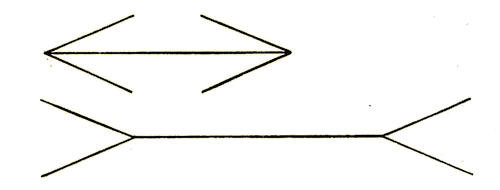
The two horizontal lines are equal in measurement; they are unequal to the eye. Why? One suggestion is that the eye moves freely along the one, and hesitatingly and obstructedly along the other; the obliques tempt out, in the one case, and hem in, in the other. The suggestion can be tested; for movements of the eyes can be recorded; and it turns out to be correct. The eyes, in passing over a line, like the lines of the figure or of a printed page, move by sweeps or jerks; they go so far, halt, and start again. Experiment shows that movements along the lower horizontal take a longer sweep, and oftentimes come to a halt only when they have shot beyond the end-points of the line; whereas movements along the upper horizontal are themselves shorter, and frequently come to a halt before the extremities of the line have been reached. Here, then, is a kinæsthetic context to carry the meanings ‘longer’ and ‘shorter.’ Is the analysis adequate? Not for every case; the illusion is found to vary with our general attitude toward the figures. If we take them as wholes, the large open area below and the closed diamond-shaped area above strike the attention; we say, from total impression, that the lower horizontal is the longer. If, however, we take the figures critically, part by part, limiting our attention to the horizontals and disregarding the obliques, then the illusion is greatly reduced and may, with practice, disappear. Here, then, is a second context, which involves a brain-habit. Another suggestion is that linear perspective may be at work; the larger figure is a book opening toward you, the smaller is a book opened away from you; the lower horizontal is therefore further off, and should (if the two books were of the same size) be smaller than the upper; since it is not, the lower book is seen as the larger. There are, without doubt, many figures in which perspective influences the perception; but there seems to be no reason to invoke it here. A fourth suggestion is that we read into the figures ideas of our own muscular state; the lower figure has room to expand, it is stretching and yawning; the upper is cramped and huddled; and so the illusion of length is produced. There is no doubt, again, that this putting of oneself in place of the lines plays a part in certain perceptions; but its influence here is negatived by the swallow figure; the birds flying toward each other are further apart than those flying from each other. On the whole, we may be satisfied with the two contexts first mentioned; the discussion shows, however, how many and how various motives may enter in to determine an illusory perception.
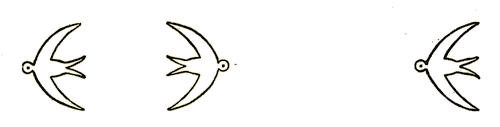
§ 30. The Types of Idea.—Idea takes its plan from perception; and ideas may therefore be classified, like perceptions, as qualitative, temporal and spatial. When, however, we speak of types of idea, we usually have a different classification in view. Our ideas differ as our equipment of imagery differs; some minds are rich in visual or auditory images, others are poor or deficient. When first these differences were brought to light, they seemed to be permanent and clearly marked; children, especially, were classed as eye-minded, ear-minded, and touch-minded or motor-minded, according as their ideas consisted predominantly of visual, auditory, or kinæsthetic images; and it was thought no less necessary to discover a child’s type, and to instruct him in accordance with it, than it is to test the colour-vision of pilots and engineers. Moreover, since all ideas may be translated into words, and since verbal ideas may also be visual, auditory or motor,—ideas of the word seen, heard, or spoken,—three sub-types were added to the main types of idea; the verbal-visual, the verbal-auditory, and the verbal-motor. The doctrine of types found support in pathology; thus, the famous French physician J. M. Charcot reports a case of eye-mindedness in which visual ideas were suddenly lost. The patient writes: “I possessed at one time a great faculty of picturing to myself persons who interested me, colours and objects of every kind; I made use of this faculty extensively in my studies. I read anything I wanted to learn, and then shutting my eyes I saw again quite clearly the letters with their every detail. All of a sudden this internal vision absolutely disappeared. Now I cannot picture to myself the features of my children or my wife, or any other object of my daily surroundings. I dream simply of speech. I am obliged to say things which I wish to retain in my memory, whereas formerly it was sufficient for me to photograph them in my eye.”
Nowadays the case could hardly be recorded in so simple a way; we have learned that ideational type is a very complicated and itself a very variable matter. Marked differences of imagery, as between one mind and another, undoubtedly exist; but the distribution into types is made difficult by two facts. The first is that there are great differences in the nature of images even where the gross type is the same; thus, of two predominantly eye-minded persons, the one may have vivid and precise, the other vague and obscure images. The second is that imagery varies with the nature of the test made, the situation or material that arouses the images; in strictness, we can only say that, under such-and-such conditions, the imaginal type proved to be such-and-such. With these cautions before us, we can, however, make out four common types. The versatile type uses visual, auditory and verbal-motor images more or less indifferently. A second type prefers visual images, with verbal-motor a good second. A third type prefers verbal images of the auditory-motor kind, with visual images a poor second. A fourth is almost exclusively verbal-motor. In this last type, kinæsthesis, in the special form of the feel of articulation, has reconquered the place that it held in the long-gone past, before speech had come (p. 119).
We observe nothing of these differences in daily life, simply because we are interested in meanings and not in processes; so long as the audience gets somewhere near the meaning that the speaker or writer is trying to convey, everything necessary for practical purposes has been accomplished. All the same, there are many signs of ideational type, if we are on the alert to seize them. The attitude of attention is different, according as a man’s ideas are visual or auditory-motor; the child’s mode of recitation is different, slow and systematic in the former case, quick and impulsive in the latter; the mistakes made are characteristic; and you can tell by an author’s style whether he has visual images and whether he hears his sentences ring in the mind’s ear. It is natural to connect the dominance of certain images with the choice of certain professions; but a correlation cannot be made out. “I should have thought,” remarks Galton, “that the faculty of visualisation would be common among geometricians, but many of the highest seem able somehow to get on without much of it;” and again “men who declare themselves entirely deficient in the power of seeing mental pictures can become painters” of acknowledged rank. The late Professor James wrote to the same effect: “I am myself a good draughtsman, and have a very lively interest in pictures, statues, architecture and decoration. But I am an extremely poor visualiser.” These statements, to be sure, were made without any thorough-going investigation; we must remember that there are different ways of geometrising as there are different styles and ideals of painting; and we may add that there are plenty of instances on the other side; Goethe and Dickens were magnificent visualisers. The study of imaginal type, in relation to the interests and achievement of its possessor, thus offers an inviting field of work.
Questions and Exercises
(1) State in your own words, and without looking at the book, why the psychologist has to do with meaning, and what meaning is psychologically. Illustrate from your own experience; find, in particular, a case of meaning carried by kinæsthesis, and a case of meaning carried in purely nervous terms.
(2) Draw diagrams to illustrate the typical perception and idea, and the various stages in its reduction to the skeleton-type described at the end of § 24.
(3) Qualitative perceptions undergo relatively little change. What changes have they undergone? How is it that these changes have not unfitted them to mean quality?
(4) A stereoscope and a set of slides prepared by the author may be obtained from the C. H. Stoelting Co., 3047 Carroll Avenue, Chicago, Ill. Explain the construction of the stereoscope, part by part; and work carefully through the slides, writing down what you see. It is useless to play with the instrument; take the experiments seriously.
(5) If you are touched with a pencil on wrist and chest, and try to retouch the places stimulated, you are more nearly right on wrist than on chest. Why? Try the experiment several times over.
(6) You have probably often heard the rising tone of a siren-whistle sounded by some manufactory or given as a fire-signal. Can you image it? If so, what is the index of change? If not, try to lay your finger on this index when you next hear the whistle.
(7) If tastes and smells have not the attribute of extension, how do you account for their apparent spread in space? If sounds are not spatial, how is it that we can localise them?
(8) Is there such a thing as a purely visual rhythm? How would you approach the question experimentally?
(9) Perform Aristotle’s experiment, by crossing the second over the first finger of the right hand, and pressing on a marble placed under the crossed joints, (a) Is Aristotle’s statement correct? Write out your observations. (b) Is sight decisive? Helmholtz said, on the contrary: “We are continually controlling and correcting the notions of locality derived from the eye by the help of the sense of touch, and always accept the impressions on the latter sense as decisive.” (c) Can you work out the perception of a thing or object, somewhat as the book has worked out the perception of distance?
(10) Can you suggest methods for the determination of imaginal type?
(11) Close your eyes, (a) Let an experimenter draw a blunt-pointed pencil at an even rate along the inside of your arm from the shoulder to the tip of the middle finger. The point seems to travel more quickly at some places than at others: why? Draw a diagram of the arm, and mark the places of apparent slowing and quickening. (b) Tie two pencils together with a bit of rubber between, so that the points are 1-1/4 to 1-1/2 in. apart. Let an experimenter set the two points crosswise on the skin at the shoulder, and draw them with even speed and pressure along the inside of your arm to the finger-tips. The points seem to converge and diverge: why? Draw a diagram as before.
(12) If a rough thread is drawn by an experimenter between your forefinger and thumb, at first quickly and then slowly, it will seem shorter in the first experiment than in the second. Why?
References
J. M. Charcot, Clinical Lectures on Diseases of the Nervous System, iii., 1889, Lect. xiii.; W. James, Principles of Psychology, 1890, i., chs. xiii., xv.; ii., chs. xviii., xix., xx.; C. H. H. Parry, The Evolution of the Art of Music, 1896; article on Optical Illusions, in Dictionary of Philosophy and Psychology, ii., 1902; W. Wundt, Lectures on Human and Animal Psychology, 1896, Lect. xi.; Outlines of Psychology, 1907, §§ 9, 10, 11; M. R. Fernald, The Diagnosis of Mental Imagery, 1912; E. B. Titchener, Experimental Psychology, I., i. and ii., 1901 (experiments on perception); Text-book of Psychology, 1910, 303 ff.