


автордың кітабын онлайн тегін оқу Castes and Tribes of Southern India. Vol. 1 of 7
Castes and Tribes of Southern India
Castes and Tribes
of
Southern India
By
Edgar Thurston, C.I.E.,
Superintendent, Madras Government Museum; Correspondant Étranger, Société d’Anthropologie de Paris; Socio Corrispondante, Societa, Romana di Anthropologia.
Assisted by K. Rangachari, M.A.,
of the Madras Government Museum.
Volume I—A and B
Government Press, Madras
1909.
List of Illustrations.
I.
a. Skull of Tamil man. b. Skull from Aditanallur.II.
South Indian boomerangs.III.
a. European skull. b. Hindu skull.IV.
Linga Banajiga.V.
Diagram of noses.VI.
Agamudaiyans, Madura district.VII.
Āradhya Brāhman.VIII.
Dolmens near Kotagiri.IX.
Badagas.X.
Badaga girls.XI.
Badaga temple.XII.
Badagas making fire.XIII.
Badaga funeral car with the corpse.XIV.
Badaga funeral car.XV.
Bairāgis.XVI.
Gazula Balija with bangles.XVII.
Balija bride and bridegroom.XVIII.
Kambla buffalo race.XIX.
Kambla racing buffaloes.XX.
Pūkāre post at Kambla buffalo races.XXI.
Bedar.XXII.
Billava toddy-tapper.XXIII.
Brāhman house with marks of hand to ward off the evil eye.XXIV.
Telugu Brāhman with rudraksha coat.XXV.
Smartha Brāhman (Brahacharnam) doing Siva worship.XXVI.
Padmanābha Swāmi.XXVII.
Dikshitar Brāhman.XXVIII.
Mādhva Brāhman.XXIX.
Fuel stack at Udipi Matt.XXX.
Oriya Brāhman.XXXI.
Konkani Brāhman.Preface.
In 1894, equipped with a set of anthropometric instruments obtained on loan from the Asiatic Society of Bengal, I commenced an investigation of the tribes of the Nīlgiri hills, the Todas, Kotas, and Badagas, bringing down on myself the unofficial criticism that “anthropological research at high altitudes is eminently indicated when the thermometer registers 100° in Madras.” From this modest beginning have resulted:—(1) investigation of various classes which inhabit the city of Madras; (2) periodical tours to various parts of the Madras Presidency, with a view to the study of the more important tribes and classes; (3) the publication of Bulletins, wherein the results of my work are embodied; (4) the establishment of an anthropological laboratory; (5) a collection of photographs of Native types; (6) a series of lantern slides for lecture purposes; (7) a collection of phonograph records of tribal songs and music.
The scheme for a systematic and detailed ethnographic survey of the whole of India received the formal sanction of the Government of India in 1901. A Superintendent of Ethnography was appointed for each Presidency or Province, to carry out the work of the survey in addition to his other duties. The other duty, in my particular case—the direction of a large local museum—happily made an excellent blend with the survey operations, as the work of collection for the ethnological section went on simultaneously with that of investigation. The survey was financed for a period of five (afterwards extended to eight) years, and an annual allotment of Rs. 5,000 provided for each Presidency and Province. This included Rs. 2,000 for approved notes on monographs, and replies to the stereotyped series of questions. The replies to these questions were not, I am bound to admit, always entirely satisfactory, as they broke down both in accuracy and detail. I may, as an illustration, cite the following description of making fire by friction. “They know how to make fire, i.e., by friction of wood as well as stone, etc. They take a triangular cut of stone, and one flat oblong size flat. They hit one another with the maintenance of cocoanut fibre or copper, then fire sets immediately, and also by rubbing the two barks frequently with each other they make fire.”
I gladly place on record my hearty appreciation of the services rendered by Mr. K. Rangachari in the preparation of the present volumes. During my temporary absence in Europe, he was placed in charge of the survey, and he has been throughout invaluable in obtaining information concerning manners and customs, as interpreter and photographer, and in taking phonograph records.
For information relating to the tribes and castes of Cochin and Travancore, I gratefully acknowledge my indebtedness to Messrs. L. K. Anantha Krishna Aiyer and N. Subramani Aiyer, the Superintendents of Ethnography for their respective States. The notes relating to the Cochin State have been independently published at the Ernakulam Press, Cochin.
In the scheme for the Ethnographic Survey, it was laid down that the Superintendents should supplement the information obtained from representative men and by their own enquiries by “researches into the considerable mass of information which lies buried in official reports, in the journals of learned Societies, and in various books.” Of this injunction full advantage has been taken, as will be evident from the abundant crop of references in foot-notes.
It is impossible to express my thanks individually to the very large number of correspondents, European and Indian, who have generously assisted me in my work. I may, however, refer to the immense aid which I have received from the District Manuals edited by Mr. (now Sir) H. A. Stuart, I.C.S., and the District Gazetteers, which have been quite recently issued under the editorship of Mr. W. Francis, I.C.S., Mr. F. R. Hemingway, I.C.S., and Mr. F. B. Evans, I.C.S.
My thanks are further due to Mr. C. Hayavadana Rao, to whom I am indebted for much information acquired when he was engaged in the preparation of the District Gazetteers, and for revising the proof sheets.
For some of the photographs of Badagas, Kurumbas, and Todas, I am indebted to Mr. A. T. W. Penn of Ootacamund.
I may add that the anthropometric data are all the result of measurements taken by myself, in order to eliminate the varying error resulting from the employment of a plurality of observers.
E. T.
Introduction.
The vast tract of country, over which my investigations in connection with the ethnographic survey of South India have extended, is commonly known as the Madras Presidency, and officially as the Presidency of Fort St. George and its Dependencies. Included therein were the small feudatory States of Pudukōttai, Banganapalle, and Sandūr, and the larger Native States of Travancore and Cochin. The area of the British territory and Feudatory States, as returned at the census, 1901, was 143,221 square miles, and the population 38,623,066. The area and population of the Native States of Travancore and Cochin, as recorded at the same census, were as follows:—
Area.
Population.
Sq. Miles.
Travancore
7,091
2,952,157
Cochin
1,361
512,025
Briefly, the task which was set me in 1901 was to record the ‘manners and customs’ and physical characters of more than 300 castes and tribes, representing more than 40,000,000 individuals, and spread over an area exceeding 150,000 square miles.
The Native State of Mysore, which is surrounded by the Madras Presidency on all sides, except on part of the west, where the Bombay Presidency forms the boundary, was excluded from my beat ethnographically, but included for the purpose of anthropometry. As, however, nearly all the castes and tribes which inhabit the Mysore State are common to it and the Madras Presidency, I have given here and there some information relating thereto.
It was clearly impossible for myself and my assistant, in our travels, to do more than carry out personal investigations over a small portion of the vast area indicated above, which provides ample scope for research by many trained explorers. And I would that more men, like my friends Dr. Rivers and Mr. Lapicque, who have recently studied Man in Southern India from an anthropological and physiological point of view, would come out on a visit, and study some of the more important castes and tribes in detail. I can promise them every facility for carrying out their work under the most favourable conditions for research, if not of climate. And we can provide them with anything from 112° in the shade to the sweet half English air of the Nīlgiri and other hill-ranges.
Routine work at head-quarters unhappily keeps me a close prisoner in the office chair for nine months in the year. But I have endeavoured to snatch three months on circuit in camp, during which the dual functions of the survey—the collection of ethnographic and anthropometric data—were carried out in the peaceful isolation of the jungle, in villages, and in mofussil (up-country) towns. These wandering expeditions have afforded ample evidence that delay in carrying through the scheme for the survey would have been fatal. For, as in the Pacific and other regions, so in India, civilisation is bringing about a radical change in indigenous manners and customs, and mode of life. It has, in this connection, been well said that “there will be plenty of money and people available for anthropological research, when there are no more aborigines. And it behoves our museums to waste no time in completing their anthropological collections.” Tribes which, only a few years ago, were living in a wild state, clad in a cool and simple garb of forest leaves, buried away in the depths of the jungle, and living, like pigs and bears, on roots, honey, and other forest produce, have now come under the domesticating, and sometimes detrimental influence of contact with Europeans, with a resulting modification of their conditions of life, morality, and even language. The Paniyans of the Wynaad, and the Irulas of the Nīlgiris, now work regularly for wages on planters’ estates, and I have seen a Toda boy studying for the third standard instead of tending the buffaloes of his mand. A Toda lassie curling her ringlets with the assistance of a cheap German looking-glass; a Toda man smeared with Hindu sect marks, and praying for male offspring at a Hindu shrine; the abandonment of leafy garments in favour of imported cotton piece-goods; the employment of kerosine tins in lieu of thatch; the decline of the national turban in favour of the less becoming pork-pie cap or knitted nightcap of gaudy hue; the abandonment of indigenous vegetable dyes in favour of tinned anilin and alizarin dyes; the replacement of the indigenous peasant jewellery by imported beads and imitation jewellery made in Europe—these are a few examples of change resulting from Western and other influences.
The practice of human sacrifice, or Meriah rite, has been abolished within the memory of men still living, and replaced by the equally efficacious slaughter of a buffalo or sheep. And I have notes on a substituted ceremony, in which a sacrificial sheep is shaved so as to produce a crude representation of a human being, a Hindu sect mark painted on its forehead, a turban stuck on its head, and a cloth around its body. The picturesque, but barbaric ceremony of hook-swinging is now regarded with disfavour by Government, and, some time ago, I witnessed a tame substitute for the original ceremony, in which, instead of a human being with strong iron hooks driven through the small of his back, a little wooden figure, dressed up in turban and body cloth, and carrying a shield and sabre, was hoisted on high and swung round.
In carrying out the anthropometric portion of the survey, it was unfortunately impossible to disguise the fact that I am a Government official, and very considerable difficulties were encountered owing to the wickedness of the people, and their timidity and fear of increased taxation, plague inoculation, and transportation. The Paniyan women of the Wynaad believed that I was going to have the finest specimens among them stuffed for the Madras Museum. An Irula man, on the Nīlgiri hills, who was wanted by the police for some mild crime of ancient date, came to be measured, but absolutely refused to submit to the operation on the plea that the height-measuring standard was the gallows. The similarity of the word Boyan to Boer was once fatal to my work. For, at the time of my visit to the Oddēs, who have Boyan as their title, the South African war was just over, and they were afraid that I was going to get them transported, to replace the Boers who had been exterminated. Being afraid, too, of my evil eye, they refused to fire a new kiln of bricks for the club chambers at Coimbatore until I had taken my departure. During a long tour through the Mysore province, the Natives mistook me for a recruiting sergeant bent on seizing them for employment in South Africa, and fled before my approach from town to town. The little spot, which I am in the habit of making with Aspinall’s white paint to indicate the position of the fronto-nasal suture and bi-orbital breadth, was supposed to possess vesicant properties, and to blister into a number on the forehead, which would serve as a means of future identification for the purpose of kidnapping. The record of head, chest, and foot measurements, was viewed with marked suspicion, on the ground that I was an army tailor, measuring for sepoy’s clothing. The untimely death of a Native outside a town, at which I was halting, was attributed to my evil eye. Villages were denuded of all save senile men, women, and infants. The vendors of food-stuffs in one bazar, finding business slack owing to the flight of their customers, raised their prices, and a missionary complained that the price of butter had gone up. My arrival at one important town was coincident with a great annual temple festival, whereat there were not sufficient coolies left to drag the temple car in procession. So I had perforce to move on, and leave the Brāhman heads unmeasured. The head official of another town, when he came to take leave of me, apologised for the scrubby appearance of his chin, as the local barber had fled. One man, who had volunteered to be tested with Lovibond’s tintometer, was suddenly seized with fear in the midst of the experiment, and, throwing his body-cloth at my feet, ran for all he was worth, and disappeared. An elderly Municipal servant wept bitterly when undergoing the process of measurement, and a woman bade farewell to her husband, as she thought for ever, as he entered the threshold of my impromptu laboratory. The goniometer for estimating the facial angle is specially hated, as it goes into the mouth of castes both high and low, and has to be taken to a tank (pond) after each application. The members of a certain caste insisted on being measured before 4 P.M., so that they might have time to remove, by ceremonial ablution, the pollution from my touch before sunset.
Such are a few of the unhappy results, which attend the progress of a Government anthropologist. I may, when in camp, so far as measuring operations are concerned, draw a perfect and absolute blank for several days in succession, or a gang of fifty or even more representatives of different castes may turn up at the same time, all in a hurry to depart as soon as they have been sufficiently amused by the phonograph, American series of pseudoptics (illusions), and hand dynamometer, which always accompany me on my travels as an attractive bait. When this occurs, it is manifestly impossible to record all the major, or any of the minor measurements, which are prescribed in ‘Anthropological Notes and Queries,’ and elsewhere. And I have to rest unwillingly content with a bare record of those measurements, which experience has taught me are the most important from a comparative point of view within my area, viz., stature, height and breadth of nose, and length and breadth of head, from which the nasal and cephalic indices can be calculated. I refer to the practical difficulties, in explanation of a record which is admittedly meagre, but wholly unavoidable, in spite of the possession of a good deal of patience and a liberal supply of cheroots, and current coins, which are often regarded with suspicion as sealing a contract, like the King’s shilling. I have even known a man get rid of the coin presented to him, by offering it, with flowers and a cocoanut, to the village goddess at her shrine, and present her with another coin as a peace-offering, to get rid of the pollution created by my money.
The manifold views, which have been brought forward as to the origin and place in nature of the indigenous population of Southern India, are scattered so widely in books, manuals, and reports, that it will be convenient if I bring together the evidence derived from sundry sources.
The original name for the Dravidian family, it may be noted, was Tamulic, but the term Dravidian was substituted by Bishop Caldwell, in order that the designation Tamil might be reserved for the language of that name. Drāvida is the adjectival form of Dravida, the Sanskrit name for the people occupying the south of the Indian Peninsula (the Deccan of some European writers).1
According to Haeckel,2 three of the twelve species of man—the Dravidas (Deccans; Sinhalese), Nubians, and Mediterranese (Caucasians, Basque, Semites, Indo-Germanic tribes)—“agree in several characteristics, which seem to establish a close relationship between them, and to distinguish them from the remaining species. The chief of these characteristics is the strong development of the beard which, in all other species, is either entirely wanting, or but very scanty. The hair of their heads is in most cases more or less curly. Other characteristics also seem to favour our classing them in one main group of curly-haired men (Euplocomi); at present the primæval species, Homo Dravida, is only represented by the Deccan tribes in the southern part of Hindustan, and by the neighbouring inhabitants of the mountains on the north-east of Ceylon. But, in earlier times, this race seems to have occupied the whole of Hindustan, and to have spread even further. It shows, on the one hand, traits of relationship to the Australians and Malays; on the other to the Mongols and Mediterranese. Their skin is either of a light or dark brown colour; in some tribes, of a yellowish brown. The hair of their heads is, as in Mediterranese, more or less curled; never quite smooth, like that of the Euthycomi, nor actually woolly, like that of the Ulotrichi. The strong development of the beard is also like that of the Mediterranese. Their forehead is generally high, their nose prominent and narrow, their lips slightly protruding. Their language is now very much mixed with Indo-Germanic elements, but seems to have been originally derived from a very primæval language.”
In the chapter devoted to ‘Migration and Distribution of Organisms,’ Haeckel, in referring to the continual changing of the distribution of land and water on the surface of the earth, says: “The Indian Ocean formed a continent, which extended from the Sunda Islands along the southern coast of Asia to the east coast of Africa. This large continent of former times Sclater has called Lemuria, from the monkey-like animals which inhabited it, and it is at the same time of great importance from being the probable cradle of the human race. The important proof which Wallace has furnished by the help of chronological facts, that the present Malayan Archipelago consists in reality of two completely different divisions, is particularly interesting. The western division, the Indo-Malayan Archipelago, comprising the large islands of Borneo, Java, and Sumatra, was formerly connected by Malacca with the Asiatic continent, and probably also with the Lemurian continent, and probably also with the Lemurian continent just mentioned. The eastern division, on the other hand, the Austro-Malayan Archipelago, comprising Celebes, the Moluccas, New Guinea, Solomon’s Islands, etc., was formerly directly connected with Australia.”
An important ethnographic fact, and one which is significant, is that the description of tree-climbing by the Dyaks of Borneo, as given by Wallace,3 might have been written on the Anaimalai hills of Southern India, and would apply equally well in every detail to the Kādirs who inhabit those hills.4 An interesting custom, which prevails among the Kādirs and Mala Vēdans of Travancore, and among them alone, so far as I know, in the Indian Peninsula, is that of chipping all or some of the incisor teeth into the form of a sharp pointed, but not serrated, cone. The operation is said to be performed, among the Kādirs, with a chisel or bill-hook and file, on boys at the age of eighteen, and girls at the age of ten or thereabouts. It is noted by Skeat and Blagden5 that the Jakuns of the Malay Peninsula are accustomed to file their teeth to a point. Mr. Crawford tells us further that, in the Malay Archipelago, the practice of filing and blackening the teeth is a necessary prelude to marriage, the common way of expressing the fact that a girl has arrived at puberty being that she had her teeth filed. In an article6 entitled “Die Zauberbilderschriften der Negrito in Malaka,” Dr. K. T. Preuss describes in detail the designs on the bamboo combs, etc., of the Negritos of Malacca, and compares them with the strikingly similar designs on the bamboo combs worn by the Kādirs of Southern India. He works out in detail the theory that the design is not, as I called it7 an ornamental geometric pattern, but consists of a series of hieroglyphics. It is noted by Skeat and Blagden8 that “the Semang women wore in their hair a remarkable kind of comb, which appears to be worn entirely as a charm against diseases. These combs were almost invariably made of bamboo, and were decorated with an infinity of designs, no two of which ever entirely agreed. It was said that each disease had its appropriate pattern. Similar combs are worn by the Pangan, the Semang and Sakai of Perak, and most of the mixed (Semang-Sakai) tribes.” I am informed by Mr. Vincent that, as far as he knows, the Kādir combs are not looked on as charms, and the markings thereon have no mystic significance. A Kādir man should always make a comb, and present it to his wife just before marriage or at the conclusion of the marriage ceremony, and the young men vie with each other as to who can make the nicest comb. Sometimes they represent strange articles on the combs. Mr. Vincent has, for example, seen a comb with a very good imitation of the face of a clock scratched on it.
In discussing the racial affinities of the Sakais, Skeat and Blagden write8 that “an alternative theory comes to us on the high authority of Virchow, who puts it forward, however, in a somewhat tentative manner. It consists in regarding the Sakai as an outlying branch of a racial group formed by the Vedda (of Ceylon), Tamil, Kurumba, and Australian races.... Of these the height is variable, but, in all four of the races compared, it is certainly greater than that of the Negrito races. The skin colour, again, it is true, varies to a remarkable degree, but the general hair character appears to be uniformly long, black and wavy, and the skull-index, on the other hand, appears to indicate consistently a dolichocephalic or long-shaped head.” Speaking of the Sakais, the same authorities state that “in evidence of their striking resemblance to the Veddas, it is perhaps worth remarking that one of the brothers Sarasin who had lived among the Veddas and knew them very well, when shown a photograph of a typical Sakai, at first supposed it to be a photograph of a Vedda.” For myself, when I first saw the photographs of Sakais published by Skeat and Blagden, it was difficult to realise that I was not looking at pictures of Kādirs, Paniyans, Kurumbas, or other jungle folk of Southern India.
It may be noted en passant, that emigration takes place at the present day from the southern parts of the Madras Presidency to the Straits Settlements. The following statement shows the number of passengers that proceeded thither during 1906:—
Madras—
Total.
South Arcot

Porto Novo
2,555
Cuddalore
583
Pondicherry
55
Tanjore
Negapatam
238
and
Nagore
45,453
Karikal
3,422
“The name Kling (or Keling) is applied, in the Malay countries, to the people of Continental India who trade thither, or are settled in those regions, and to the descendants of settlers. The Malay use of the word is, as a rule, restricted to Tamils. The name is a form of Kalinga, a very ancient name for the region known as the Northern Circars, i.e., the Telugu coast of the Bay of Bengal.”9 It is recorded by Dr. N. Anandale that the phrase Orang Kling Islam (i.e., a Muhammadan from the Madras coast) occurs in Patani Malay. He further informs us10 that among the Labbai Muhammadans of the Madura coast, there are “certain men who make a livelihood by shooting pigeons with blow-guns. According to my Labbai informants, the ‘guns’ are purchased by them in Singapore from Bugis traders. There is still a considerable trade, although diminished, between Kilakarai and the ports of Burma and the Straits Settlements. It is carried on entirely by Muhammadans in native sailing vessels, and a large proportion of the Musalmans of Kilakarai have visited Penang and Singapore. It is not difficult to find among them men who can speak Straits Malay. The local name for the blow-gun is senguttān, and is derived in popular etymology from the Tamil sen (above) and kutu (to stab). I have little doubt that it is really a corruption of the Malay name of the weapon sumpitan.”
On the evidence of the very close affinities between the plants and animals in Africa and India at a very remote period, Mr. R. D. Oldham concludes that there was once a continuous stretch of dry land connecting South Africa and India. “In some deposits,” he writes,11 “found resting upon the Karoo beds on the coast of Natal, 22 out of 35 species of Mollusca and Echinodermata collected and specifically identified, are identical with forms found in the cretaceous beds of Southern India, the majority being Trichinopoly species. From the cretaceous rocks of Madagascar, six species of cretaceous fossils were examined by Mr. R. B. Newton in 1899, of which three are also found in the Ariyalur group (Southern India). The South African beds are clearly coast or shallow water deposits, like those of India. The great similarity of forms certainly suggests continuity of coast line between the two regions, and thus supports the view that the land connection between South Africa and India, already shown to have existed in both the lower and upper Gondwána periods, was continued into cretaceous times.”
By Huxley12 the races of mankind are divided into two primary divisions, the Ulotrichi with crisp or woolly hair (Negros; Negritos), and the Leiotrichi with smooth hair; and the Dravidians are included in the Australoid group of the Leiotrichi “with dark skin, hair and eyes, wavy black hair, and eminently long, prognathous skulls, with well-developed brow ridges, who are found in Australia and in the Deccan.” There is, in the collection of the Royal College of Surgeons’ Museum, an exceedingly interesting “Hindu” skull from Southern India, conspicuously dolichocephalic, and with highly developed superciliary ridges. Some of the recorded measurements of this skull are as follows:—
Length
19.6 cm.
Breadth
13.2 cm.
Cephalic index
67.3
Nasal height
4.8 cm.
Nasal breadth
2.5 cm.
Nasal index
52.1 cm.
Another “Hindu” skull, in the collection of the Madras Museum, with similar marked development of the superciliary ridges, has the following measurements:—
Length
18.4 cm.
Breadth
13.8 cm.
Cephalic index
75
Nasal height
4.9 cm.
Nasal breadth
2.1 cm.
Nasal index
42.8
I am unable to subscribe to the prognathism of the Dravidian tribes of Southern India, or of the jungle people, though aberrant examples thereof are contained in the collection of skulls at the Madras Museum, e.g., the skull of a Tamil man (caste unknown) who died a few years ago in Madras (Pl. I-a). The average facial angle of various castes and tribes which I have examined ranged between 67° and 70°, and the inhabitants of Southern India may be classified as orthognathous. Some of the large earthenware urns excavated by Mr. A. Rea, of the Archæological Department, at the “prehistoric” burial site at Aditanallūr in the Tinnevelly district,13 contained human bones, and skulls in a more or less perfect condition. Two of these skulls, preserved at the Madras Museum, are conspicuously prognathous (Pl. I-b). Concerning this burial site M. L. Lapieque writes as follows.14 “J’ai rapporté un specimen des urnes funéraires, avec une collection assez complète du mobilier funéraire. J’ai rapporté aussi un crâne en assez bon état, et parfaitement déterminable. Il est hyperdolichocéphale, et s’accorde avec la série que le service d’archéologie de Madras a déja réunie. Je pense que la race d’Adichanallour appartient aux Proto-Dravidiens.” The measurements of six of the most perfect skulls from Aditanallūr in the Madras Museum collection give the following results:—
Cephalic length,
Cephalic breadth,
Cephalic index.
cm.
cm.
18.8
12.4
66.
19.1
12.7
66.5
18.3
12.4
67.8
18.
12.2
67.8
18.
12.8
77.1
16.8
13.1
78.
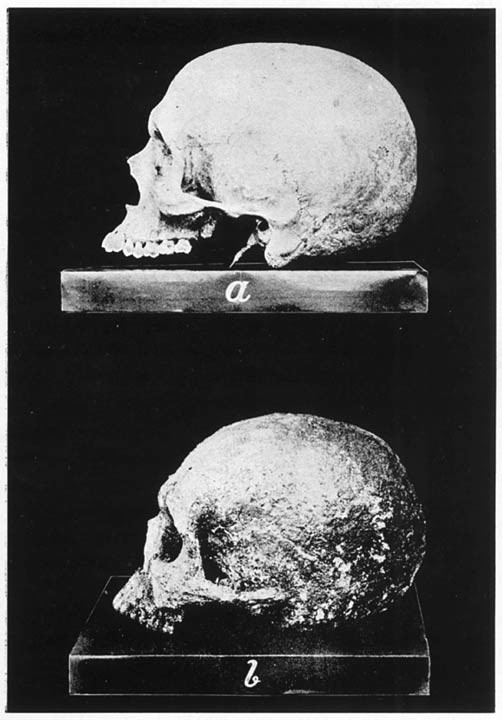
a. Skull of Tamil Man.
b. Skull From Aditanallur.
The following extracts from my notes show that the hyperdolichocephalic type survives in the dolichocephalic inhabitants of the Tamil country at the present day:—
Class
Number examined.
Cephalic index below 70.
Palli
40
64.4; 66.9; 67; 68.2; 68.9; 69.6.
Paraiyan
40
64.8; 69.2; 69.3; 69.5
.Vellāla
40
67.9; 69.6.
By Flower and Lydekker,15 a white division of man, called the Caucasian or Eurafrican, is made to include Huxley’s Xanthochroi (blonde type) and Melanochroi (black hair and eyes, and skin of almost all shades from white to black). The Melanochroi are said to “comprise the greater majority of the inhabitants of Southern Europe, North Africa, and South-west Asia, and consist mainly of the Aryan, Semitic, and Hamitic families. The Dravidians of India, the Veddahs of Ceylon, and probably the Ainus of Japan, and the Maoutze of China, also belong to this race, which may have contributed something to the mixed character of some tribes of Indo-China and the Polynesian islands, and have given at least the characters of the hair to the otherwise Negroid inhabitants of Australia. In Southern India they are largely mixed with a Negrito element, and, in Africa, where their habitat becomes coterminous with that of the Negroes, numerous cross-races have sprung up between them all along the frontier line.”
In describing the “Hindu type,” Topinard16 divides the population of the Indian peninsula into three strata, viz., the Black, Mongolian, and the Aryan. “The remnants of the first,” he says, “are at the present time shut up in the mountains of Central India under the name of Bhils, Mahairs, Ghonds, and Khonds; and in the south under that of Yenādis, Kurumbas, etc. Its primitive characters, apart from its black colour and low stature, are difficult to discover, but it is to be noticed that travellers do not speak of woolly hair in India.17 The second has spread over the plateaux of Central India by two lines of way, one to the north-east, the other to the north-west. The remnants of the first invasion are seen in the Dravidian or Tamil tribes, and those of the second in the Jhats. The third more recent, and more important as to quality than as to number, was the Aryan.” In speaking further of the Australian type, characterised by a combination of smooth hair with Negroid features, Topinard states that “it is clear that the Australians might very well be the result of the cross between one race with smooth hair from some other place, and a really Negro and autochthonous race. The opinions held by Huxley are in harmony with this hypothesis. He says the Australians are identical with the ancient inhabitants of the Deccan. The features of the present blacks in India, and the characters which the Dravidian and Australian languages have in common, tend to assimilate them. The existence of the boomerang in the two countries, and some remnants of caste in Australia, help to support the opinion.”
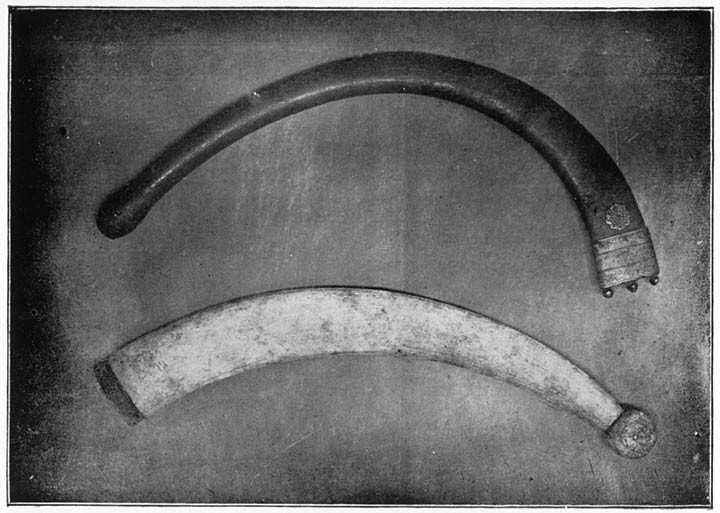
South Indian boomerangs.
Of the so-called boomerangs of Southern India, the Madras Museum possesses three (two ivory, one wooden) from the Tanjore armoury (Pl. II). Concerning them, the Dewān of Pudukkōttai writes to me as follows. “The valari or valai tadi (bent stick) is a short weapon, generally made of some hard-grained wood. It is also sometimes made of iron. It is crescent-shaped, one end being heavier than the other, and the outer end is sharpened. Men trained in the use of the weapon hold it by the lighter end, whirl it a few times over their shoulders to give it impetus, and then hurl it with great force against the object aimed at. It is said that there were experts in the art of throwing the valari, who could at one stroke despatch small game, and even man. No such experts are now forthcoming in the Pudukkōttai State, though the instrument is reported to be occasionally used in hunting hares, jungle fowl, etc. Its days, however, must be counted as past. Tradition states that the instrument played a considerable part in the Poligar wars of the last century. But it now reposes peacefully in the households of the descendants of the rude Kallan and Maravan warriors, preserved as a sacred relic of a chivalric past, along with other old family weapons in their pūja (worship) room, brought out and scraped and cleaned on occasions like the Ayudha pūja day (when worship is paid to weapons and implements of industry), and restored to its place of rest immediately afterwards.” At a Kallan marriage, the bride and bridegroom go to the house of the latter, where boomerangs are exchanged, and a feast is held. This custom appears to be fast becoming a tradition. But there is a common saying still current “Send the valai tadi, and bring the bride.”18
It is pointed out by Topinard,19 as a somewhat important piece of evidence, that, in the West, about Madagascar and the point of Aden in Africa, there are black tribes with smooth hair, or, at all events, large numbers of individuals who have it, mingled particularly among the Somālis and the Gallas, in the region where M. Broca has an idea that some dark, and not Negro, race, now extinct, once existed. At the meeting of the British Association, 1898, Mr. W. Crooke gave expression to the view that the Dravidians represent an emigration from the African continent, and discounted the theory that the Aryans drove the aboriginal inhabitants into the jungles with the suggestion that the Aryan invasion was more social than racial, viz., that what India borrowed from the Aryans was manners and customs. According to this view, it must have been reforming aborigines who gained the ascendancy in India, rather than new-comers; and those of the aborigines who clung to their old ways got left behind in the struggle for existence.
In an article devoted to the Australians, Professor R. Semon writes as follows. “We must, without hesitation, presume that the ancestors of the Australians stood, at the time of their immigration to the continent, on a lower rung of culture than their living representatives of to-day. Whence, and in what manner, the immigration took place, it is difficult to determine. In the neighbouring quarter of the globe there lives no race, which is closely related to the Australians. Their nearest neighbours, the Papuans of New Guinea, the Malays of the Sunda Islands, and the Macris of New Zealand, stand in no close relationship to them. On the other hand, we find further away, among the Dravidian aborigines of India, types which remind us forcibly of the Australians in their anthropological characters. In drawing attention to the resemblance of the hill-tribes of the Deccan to the Australians, Huxley says: ‘An ordinary cooly, such as one can see among the sailors of any newly-arrived East India vessel, would, if stripped, pass very well for an Australian, although the skull and lower jaw are generally less coarse.’ Huxley here goes a little too far in his accentuation of the similarity of type. We are, however, undoubtedly confronted with a number of characters—skull formation, features, wavy curled hair—in common between the Australians and Dravidians, which gain in importance from the fact that, by the researches of Norris, Bleek, and Caldwell, a number of points of resemblance between the Australian and Dravidian languages have been discovered, and this despite the fact that the homes of the two races are so far apart, and that a number of races are wedged in between them, whose languages have no relationship whatever to either the Dravidian or Australian. There is much that speaks in favour of the view that the Australians and Dravidians sprang from a common main branch of the human race. According to the laborious researches of Paul and Fritz Sarasin, the Veddas of Ceylon, whom one might call pre-Dravidians, would represent an off-shoot from this main stem. When they branched off, they stood on a very low rung of development, and seem to have made hardly any progress worth mentioning.”
In dealing with the Australian problem, Mr. A. H. Keane20 refers to the time when Australia formed almost continuous land with the African continent, and to its accessibility on the north and north-west to primitive migration both from India and Papuasia. “That such migrations,” he writes, “took place, scarcely admits of a doubt, and the Rev. John Mathew21 concludes that the continent was first occupied by a homogeneous branch of the Papuan race either from New Guinea or Malaysia, and that these first arrivals, to be regarded as true aborigines, passed into Tasmania, which at that time probably formed continuous land with Australia. Thus the now extinct Tasmanians would represent the primitive type, which, in Australia, became modified, but not effaced, by crossing with later immigrants, chiefly from India. These are identified, as they have been by other ethnologists, with the Dravidians, and the writer remarks that ‘although the Australians are still in a state of savagery, and the Dravidians of India have been for many ages a people civilized in a great measure, and possessed of literature, the two peoples are affiliated by deeply-marked characteristics in their social system as shown by the boomerang, which, unless locally evolved, must have been introduced from India.’ But the variations in the physical characters of the natives appear to be too great to be accounted for by a single graft; hence Malays also are introduced from the Eastern Archipelago, which would explain both the straight hair in many districts, and a number of pure Malay words in several of the native languages.” Dealing later with the ethnical relations of the Dravidas, Mr. Keane says that “although they preceded the Aryan-speaking Hindus, they are not the true aborigines of the Deccan, for they were themselves preceded by dark peoples, probably of aberrant Negrito type.”
In the ‘Manual of Administration of the Madras Presidency,’ Dr. C. Macleane writes as follows. “The history proper of the south of India may be held to begin with the Hindu dynasties formed by a more or less intimate admixture of the Aryan and Dravidian systems of government. But, prior to that, three stages of historical knowledge are recognisable; first, as to such aboriginal period as there may have been prior to the Dravidian; secondly, as to the period when the Aryans had begun to impose their religion and customs upon the Dravidians, but the time indicated by the early dynasties had not yet been reached. Geology and natural history alike make it certain that, at a time within the bounds of human knowledge, Southern India did not form part of Asia. A large southern continent, of which this country once formed part, has ever been assumed as necessary to account for the different circumstances. The Sanscrit Pooranic writers, the Ceylon Boodhists, and the local traditions of the west coast, all indicate a great disturbance of the point of the Peninsula and Ceylon within recent times.22 Investigations in relation to race show it to be by no means impossible that Southern India was once the passage-ground, by which the ancient progenitors of Northern and Mediterranean races proceeded to the parts of the globe which they now inhabit. In this part of the world, as in others, antiquarian remains show the existence of peoples who used successively implements of unwrought stone, of wrought stone, and of metal fashioned in the most primitive manner.23 These tribes have also left cairns and stone circles indicating burial places. It has been usual to set these down as earlier than Dravidian. But the hill Coorumbar of the Palmanair plateau, who are only a detached portion of the oldest known Tamulian population, erect dolmens to this day. The sepulchral urns of Tinnevelly may be earlier than Dravidian, or they may be Dravidian.... The evidence of the grammatical structure of language is to be relied on as a clearly distinctive mark of a population, but, from this point of view, it appears that there are more signs of the great lapse of time than of previous populations. The grammar of the South of India is exclusively Dravidian, and bears no trace of ever having been anything else. The hill, forest, and Pariah tribes use the Dravidian forms of grammar and inflection.... The Dravidians, a very primeval race, take a by no means low place in the conjectural history of humanity. They have affinities with the Australian aborigines, which would probably connect their earliest origin with that people.” Adopting a novel classification, Dr. Macleane, in assuming that there are no living representatives in Southern India of any race of a wholly pre-Dravidian character, sub-divides the Dravidians into pre-Tamulian and Tamulian, to designate two branches of the same family, one older or less civilised than the other.
The importance, which has been attached by many authorities to the theory of the connection between the Dravidians and Australians, is made very clear from the passages in their writings, which I have quoted. Before leaving this subject, I may appropriately cite as an important witness Sir William Turner, who has studied the Dravidians and Australians from the standpoint of craniology.24 “Many ethnologists of great eminence,” he writes, “have regarded the aborigines of Australia as closely associated with the Dravidians of India. Some also consider the Dravidians to be a branch of the great Caucasian stock, and affiliated therefore to Europeans. If these two hypotheses are to be regarded as sound, a relationship between the aboriginal Australians and the European would be established through the Dravidian people of India. The affinities between the Dravidians and Australians have been based upon the employment of certain words by both people, apparently derived from common roots; by the use of the boomerang, similar to the well-known Australian weapon, by some Dravidian tribes; by the Indian peninsula having possibly had in a previous geologic epoch a land connection with the Austro-Malayan Archipelago, and by certain correspondences in the physical type of the two people. Both Dravidians and Australians have dark skins approximating to black; dark eyes; black hair, either straight, wavy or curly, but not woolly or frizzly; thick lips; low nose with wide nostrils; usually short stature, though the Australians are somewhat taller than the Dravidians. When the skulls are compared with each other, whilst they correspond in some particulars, they differ in others. In both races, the general form and proportions are dolichocephalic, but in the Australians the crania are absolutely longer than in the Dravidians, owing in part to the prominence of the glabella. The Australian skull is heavier, and the outer table is coarser and rougher than in the Dravidian; the forehead also is much more receding; the sagittal region is frequently ridged, and the slope outwards to the parietal eminence is steeper. The Australians in the norma facialis have the glabella and supra-orbital ridges much more projecting; the nasion more depressed; the jaws heavier; the upper jaw usually prognathous, sometimes remarkably so.” Of twelve Dravidian skulls measured by Sir William Turner, in seven the jaw was orthognathous, in four, in the lower term of the mesognathous series; one specimen only was prognathic. The customary type of jaw, therefore, was orthognathic.25 The conclusion at which Sir William Turner arrives is that “by a careful comparison of Australian and Dravidian crania, there ought not to be much difficulty in distinguishing one from the other. The comparative study of the characters of the two series of crania has not led me to the conclusion that they can be adduced in support of the theory of the unity of the two people.”
The Dravidians of Southern India are divided by Sir Herbert Risley26 into two main groups, the Scytho-Dravidian and the Dravidian, which he sums up as follows:—
“The Scytho-Dravidian type of Western India, comprising the Marātha Brāahmans, the Kunbis and the Coorgs; probably formed by a mixture of Scythian and Dravidian elements, the former predominating in the higher groups, the latter in the lower. The head is broad; complexion fair; hair on face rather scanty; stature medium; nose moderately fine, and not conspicuously long.
“The Dravidian type extending from Ceylon to the valley of the Ganges, and pervading the whole of Madras, Hyderabad, the Central Provinces, most of Central India, and Chutia Nāgpur. Its most characteristic representatives are the Paniyans of the South Indian Hills and the Santals of Chutia Nāgpur. Probably the original type of the population of India, now modified to a varying extent by the admixture of Aryan, Scythian, and Mongoloid elements. In typical specimens, the stature is short or below mean; the complexion very dark, approaching black; hair plentiful with an occasional tendency to curl; eyes dark; head long; nose very broad, sometimes depressed at the root, but not so as to make the face appear flat.”
It is, it will be noted, observed by Risley that the head of the Scytho-Dravidian is broad, and that of the Dravidian long. Writing some years ago concerning the Dravidian head with reference to a statement in Taylor’s “Origin of the Aryans,”27 that “the Todas are fully dolichocephalic, differing in this respect from the Dravidians, who are brachycephalic,” I published28 certain statistics based on the measurements of a number of subjects in the southern districts of the Madras Presidency. These figures showed that “the average cephalic index of 639 members of 19 different castes and tribes was 74.1; and that, in only 19 out of the 639 individuals, did the index exceed 80. So far then from the Dravidian being separated from the Todas by reason of their higher cephalic index, this index is, in the Todas, actually higher than in some of the Dravidian peoples.” Accustomed as I was, in my wanderings among the Tamil and Malayālam folk, to deal with heads in which the dolichocephalic or sub-dolichocephalic type preponderates, I was amazed to find, in the course of an expedition in the Bellary district (in the Canarese area), that the question of the type of the Dravidian head was not nearly so simple and straightforward as I had imagined. My records of head measurements now include a very large series taken in the plains in the Tulu, Canarese, Telugu, Malayālam, and Tamil areas, and the measurements of a few Maratha (non-Dravidian) classes settled in the Canarese country. In the following tabular statement, I have brought together, for the purpose of comparison, the records of the head-measurements of representative classes in each of these areas:—
1 “Deccan, Hind, Dakhin, Dakhan; dakkina, the Prakr. form of Sskt. dakshina, ‘the south.’ The southern part of India, the Peninsula, and especially the table-land between the Eastern and Western Ghauts.” Yule and Burnell, Hobson-Jobson.
2 History of Creation.
3 Malay Archipelago, 1890.
4 See article Kādir.
5 Pagan Races of the Malay Peninsula, 1906.
6 Globus, 1899.
7 Madras Museum Bull., II, 3, 1899.
8 Op. cit.
9 Yule and Burnell, Hobson-Jobson.
10 Mem. Asiat. Soc., Bengal, Miscellanea Ethnographica, 1, 1906.
11 Manual of the Geology of India, 2nd edition, 1893.
12 Anatomy of Vertebrated Animals, 1871.
13 See Annual Report, Archæological Survey of India, 1902–03.
14 Bull, Museum d’Histoire Naturelle, 1905.
15 Introduction to the Study of Mammals, living and extinct, 1891.
16 Anthropology. Translation, 1894.
17 I have only seen one individual with woolly hair in Southern India, and he was of mixed Tamil and African parentage.
18 See article Maravan.
19 Op. cit.
20 Ethnology, 1896.
21 Proc. R. Soc. N. S. Wales, XXIII, part III.
22 “It is evident that, during much of the tertiary period, Ceylon and South India were bounded on the north by a considerable extent of sea, and probably formed part of an extensive southern continent or great island. The very numerous and remarkable cases of affinity with Malaya require, however, some closer approximation to these islands, which probably occurred at a later period.” Wallace. Geographical Distribution of Animals, 1876.
23 See Breeks, Primitive Tribes and Monuments of the Nilgiris; Phillips, Tumuli of the Salem district; Rea, Prehistoric Burial Places in Southern India; R. Bruce Foote, Catalogues of the Prehistoric Antiquities in the Madras Museum, etc.
24 Contributions to the Craniology of the People of the Empire of India, Part II. The aborigines of Chūta Nāgpur, and of the Central Provinces, the People of Orissa, Veddahs and Negritos, 1900.
25 Other cranial characters are compared by Sir William Turner, for which I would refer the reader to the original article.
26 The People of India, 1908.
27 Contemporary Science Series.
28 Madras Museum Bull., II, 3, 1899.
Class
Language
Number of subjects examined
Cephalic Index
Number of times index was 80 or above
Average
Maximum, cm.
Minimum, cm.
Sukun Sālē
Marāthi
30
82.2
90.0
73.9
21
Suka Sālē
Do.
30
81.8
88.2
76.1
22
Vakkaliga
Canarese
50
81.7
93.8
72.5
27
Billava
Tulu
50
80.1
91.5
71.0
27
Rangāri
Marāthi
30
79.8
92.2
70.7
14
Agasa
Canarese
40
78.5
85.7
73.2
13
Bant
Tulu
40
78.0
91.2
70.8
12
Kāpu
Telugu
49
78.0
87.6
71.6
16
Tota Balija
Do.
39
78.0
86.0
73.3
10
Boya
Do.
50
77.9
89.2
70.5
14
Dāsa Banajiga
Canarese
40
77.8
86.2
72.0
11
Gāniga
Do.
50
77.6
85.9
70.5
11
Golla
Telugu
60
77.5
89.3
70.1
9
Kuruba
Canarese
50
77.3
83.9
69.6
10
Bestha
Telugu
60
77.1
85.1
70.5
9
Pallan
Tamil
50
75.9
87.0
70.1
6
Mukkuvan
Malayālam
40
75.1
83.5
68.6
2
Nāyar
Do.
40
74.4
81.9
70.0
1
Vellāla
Tamil
40
74.1
81.1
67.9
2
Agamudaiyan
Do.
40
74.0
80.9
66.7
1
Paraiyan
Do.
40
73.6
78.3
64.8
Palli
Do.
40
73.0
80.0
64.4
1
Tiyan
Malayālam
40
73.0
78.9
68.6
The difference in the character of the cranium is further brought out by the following tables, in which the details of the cephalic indices of typical classes in the five linguistic areas under consideration are recorded:—
(a) Tulu. Billava.
71
◆◆
72
◆◆
73
◆
74
75
76
◆◆◆
77
◆◆◆◆◆
78
◆◆◆◆◆◆
79
◆◆
80
◆◆
Average.
81
◆◆◆
82
◆◆◆◆◆
83
◆◆◆◆◆◆◆◆
84
◆◆◆◆
85
◆◆◆◆
86
◆
87
88
89
90
◆
91
◆
(b) Canarese. Vakkaliga.
73
◆
74
75
◆◆
76
◆◆◆◆◆
77
◆◆
78
◆◆◆◆◆
79
◆◆◆◆◆◆◆
80
◆◆
81
◆◆◆
82
◆◆◆
Average.
83
◆◆◆
84
◆◆
85
◆◆◆
86
◆◆◆
87
◆◆
88
◆◆
89
◆
90
91
◆
92
◆
93
◆
94
◆
(c) Telugu. Kāpu.
72
◆
73
◆◆◆◆◆◆◆
74
◆◆
75
◆◆
76
◆◆◆◆◆◆◆
77
◆◆◆◆◆◆
78
◆
Average.
79
◆◆◆◆
80
◆◆◆◆
81
◆◆◆◆◆◆◆
82
◆◆
83
◆◆◆
84
◆
85
◆
86
87
88
◆
(d) Vellāla. Tamil.
68
◆
69
70
◆
71
◆◆◆
72
◆◆◆◆◆◆◆◆◆◆
73
◆◆◆◆◆◆◆
74
◆◆
Average.
75
◆◆◆◆◆◆
76
◆◆◆
77
◆◆◆◆
78
79
80
◆◆
81
◆
(e) Malayālam. Nāyar.
70
◆◆
71
◆◆◆◆◆
72
◆◆◆◆◆
73
◆◆◆◆◆◆
74
◆
Average.
75
◆◆◆◆◆◆
76
◆◆◆◆
77
◆◆◆◆
78
◆◆◆
79
◆◆
80
81
82
◆
These tables not only bring out the difference in the cephalic index of the classes selected as representative of the different areas, but further show that there is a greater constancy in the Tamil and Malayālam classes than in the Tulus, Canarese and Telugus. The number of individuals clustering round the average is conspicuously greater in the two former than in the three latter. I am not prepared to hazard any new theory to account for the marked difference in the type of cranium in the various areas under consideration, and must content myself with the observation that, whatever may have been the influence which has brought about the existing sub-brachycephalic or mesaticephalic type in the northern areas, this influence has not extended southward into the Tamil and Malayālam countries, where Dravidian man remains dolicho- or sub-dolichocephalic.
As an excellent example of constancy of type in the cephalic index, I may cite, en passant, the following results of measurement of the Todas, who inhabit the plateau of the Nilgiri hills:—
69
◆◆
70
◆◆◆◆◆◆◆
71
◆◆◆◆◆◆◆◆◆◆◆
72
◆◆◆◆◆◆◆
73
◆◆◆◆◆◆◆◆◆◆◆◆◆◆
Average.
74
◆◆◆◆◆◆◆◆◆◆◆◆◆◆◆◆◆◆◆◆◆
75
◆◆◆◆◆◆◆◆◆
76
◆◆◆◆◆◆
77
◆
78
◆
79
◆
80
81
◆
I pass on to the consideration of the type of cranium among various Brāhman classes. In the following tables, the results of measurement of representatives of Tulu, Canarese, Marāthi, Tamil and Malayālam Brāhmans are recorded:—
Class
Language
Number of subjects examined
Cephalic Index
Number of times index was 80 or above
Average.
Maximum.
Minimum.
Shivalli
Tulu
30
80.4
96.4
69.4
17
Mandya
Canarese
50
80.2
88.2
69.8
31
Karnātaka
Do.
60
78.4
89.5
69.8
19
Smarta (Dēsastha)
Marāthi
2943
76.9
87.1
71
9
Tamil (Madras city)
Tamil
40
76.5
84
69
3
Nambūtiri
Malayālam
3076.3
Pattar
Tamil
3125
74.5
81.4
69.1
2
(a) Tulu. Shivalli.
69
◆
70
71
72
◆
73
◆
74
75
76
◆◆◆◆
77
78
◆◆◆
79
◆◆◆
80
◆◆
Average.
81
◆◆◆
82
◆◆◆◆
83
◆◆
84
◆◆
85
86
◆
87
88
◆
89
◆
90
91
92
93
94
95
96
◆
(b) Canarese. Karnātaka Smarta.
70
◆
71
◆◆
72
◆◆
73
◆◆
74
◆◆◆◆◆◆
75
◆◆◆
76
◆◆◆◆
77
◆◆◆◆◆
78
◆◆◆◆◆◆◆◆◆◆
Average.
79
◆◆
80
◆◆◆◆◆
81
◆◆◆◆
82
◆◆◆◆
83
◆◆
84
◆◆
85
◆
86
◆
87
◆
88
◆◆
89
◆
(c) Tamil. Madras City.
69
◆
70
◆◆
71
◆
72
◆
73
◆◆
74
◆◆◆
75
◆◆◆◆
76
◆◆◆◆
Average.
77
◆◆◆◆◆◆
78
◆◆◆◆◆
79
◆◆◆◆◆
80
◆◆
81
82
◆◆
83
◆
84
◆
(d) Tamil. Pattar.
69
◆◆
70
◆
71
◆◆◆
72
◆◆
73
◆◆◆
74
Average.
75
◆◆◆◆
76
◆◆◆◆◆
77
78
◆
79
◆◆
80
◆
81
◆
Taking the evidence of the figures, they demonstrate that, like the other classes which have been analysed, the Brāhmans have a higher cephalic index, with a wider range, in the northern than in the southern area.
There is a tradition that the Shivalli Brāhmans of the Tulu country came from Ahikshetra. As only males migrated from their home, they were compelled to take women from non-Brāhman castes as wives. The ranks are said to have been swelled by conversions from these castes during the time of Srī Mādhvāchārya. The Shivalli Brāhmans are said to be referred to by the Bants as Mathumaglu or Mathmalu (bride) in allusion to the fact of their wives being taken from the Bant caste. Besides the Shivallis, there are other Tulu Brāhmans, who are said to be recent converts. The Matti Brāhmans were formerly considered low by the Shivallis, and were not allowed to sit in the same line with the Shivallis at meal time. They were only permitted to sit in a cross line, separated from the Shivallis, though in the same room. This was because the Matti Brāhmans were supposed to be Mogers (fishing caste) raised to Brāhmanism by one Vathirāja Swāmi, a Sanyāsi. Having become Brāhmans, they could not carry on their hereditary occupation, and, to enable them to earn a livelihood, the Sanyāsi gave them some brinjal (Solanum Melongena) seeds, and advised them to cultivate the plant. From this fact, the variety of brinjal, which is cultivated at Matti, is called Vathirāja gulla. At the present day, the Matti Brāhmans are on a par with the Shivalli Brāhmans, and have become disciples of the Sodhe mutt (religious institution) at Udipi. In some of the popular accounts of Brāhmans, which have been reduced to writing, it is stated that, during the time of Mayūra Varma of the Kadamba dynasty,32 some Āndhra Brāhmans were brought into South Canara. As a sufficient number of Brāhmans were not available for the purpose of yāgams (sacrifices), these Āndhra Brāhmans selected a number of families from the non-Brāhman caste, made them Brāhmans, and chose exogamous sept names for them. Of these names, Manōli (Cephalandra Indica), Pērala (Psidium Guyava), Kudire (horse), and Ānē (elephant) are examples.
A character, with which I am very familiar, when measuring the heads of all sorts and conditions of natives of Southern India, is the absence of convexity of the segment formed by the posterior portion of the united parietal bones. The result of this absence of convexity is that the back of the head, instead of forming a curve gradually increasing from the top of the head towards the occipital region, as in the European skull figured in plate IIIa, forms a flattened area of considerable length almost at right angles to the base of the skull as in the “Hindu” skull represented in plate IIIb. This character is shown in a marked degree in plate IV, which represents a prosperous Linga Banajiga in the Canarese country.
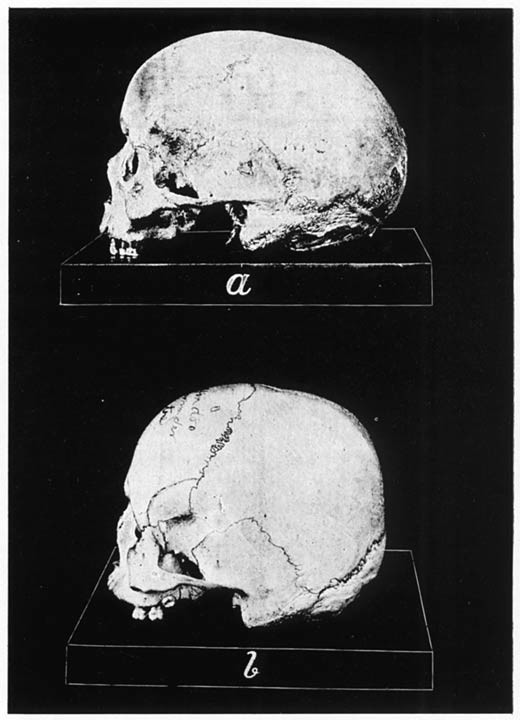
a. European Skull.
b. Hindu Skull.
In discussing racial admixture, Quatrefages writes as follows.33 “Parfois on trouve encore quelques tribus qui ont conservé plus on moins intacts tous les caractères de leur race. Les Coorumbas du Malwar [Malabar] et du Coorg paraissent former un noyau plus considérable encore, et avoir conservé dans les jungles de Wynaad une indépendence à peu près complète, et tous leurs caractères ethnologiques.” The purity of blood and ethnological characters of various jungle tribes are unhappily becoming lost as the result of contact metamorphosis from the opening up of the jungles for planter’s estates, and contact with more civilised tribes and races, both brown and white. In illustration, I may cite the Kānikars of Travancore, who till recently were in the habit of sending all their women into the seclusion of the jungle on the arrival of a stranger near their settlements. This is now seldom done, and some Kānikars have in modern times settled in the vicinity of towns, and become domesticated. The primitive short, dark-skinned and platyrhine type, though surviving, has become changed, and many leptorhine or mesorhine individuals above middle height are to be met with. The following are the results of measurements of Kānikars in the jungle, and at a village some miles from Trivandrum, the capital of Travancore:—
Stature cm.
Nasal Index.
Av.
Max.
Min.
Av.
Max.
Min.
Jungle
155.2
170.3
150.2
84.6
105
72.3
Domesticated
158.7
170.4
148
81.2
90.5
70.8
Some jungle Chenchus, who inhabit the Nallamalai hills in the Kurnool district, still exhibit the primitive short stature and high nasal index, which are characteristic of the unadulterated jungle tribes. But there is a very conspicuous want of uniformity in their physical characters, and many individuals are to be met with, above middle height, or tall, with long narrow noses. A case is recorded, in which a brick-maker married a Chenchu girl. And I was told of a Bōya man who had married into the tribe, and was living in a gudem (Chenchu settlement).
Stature cm.
Nasal Index.
Av.
Max.
Min.
Av.
Max.
Min.
162.5
175
149.6
81.9
95.7
68.1
By the dolichocephalic type of cranium which has persisted, and which the Chenchus possess in common with various other jungle tribes, they are still, as shown by the following table, at once differentiated from the mesaticephalic dwellers in the plains near the foot of the Nallamalais:—
Cephalic Index.
Number of times the index was 80 or over.
40 Chenchus
74.3
1
60 Gollas
77.5
9
50 Bōyas
77.9
14
39 Tōta Balijas
78.0
10
49 Kāpus
78.8
16
19 Upparas
78.8
4
16 Mangalas
78.8
7
17 Verukalas
78.6
6
12
Mēdaras80.7
8
In a note on the jungle tribes, M. Louis Lapicque,34 who carried out anthropometric observations in Southern India a few years ago, writes as follows. “Dans les montagnes des Nilghirris et d’Anémalé, situées au cœur de la contrée dravidienne, on a signalé depuis longtemps des petits sauvages crépus, qu’on a même pensé pouvoir, sur des documents insuffisants, identifier avec les negritos. En réalité, it n’existe pas dans ces montagnes, ni probablement nulle part dans l’Inde, un témoin de la race primitive comparable, comme pureté, aux Andamanais ni même aux autres Negritos. Ce que l’on trouve là, c’est simplement, mais c’est fort précieux, une population métisse qui continue au delà du Paria la série générale de l’Inde. Au bord de la forêt vierge ou dans les collines partiellement défrichées, il y a des castes demi-Parias, demi-sauvages. La hiérachie sociale les classe au-dessous du Paria: on peut même trouver des groupes ou le facies nègre, nettement dessiné, est tout à fait prédominant. Ehbien, dans ces groupes, les chevelures sont en général frisées, et on en observe quelques-unes qu’on peut même appeler crépues. On a donc le moyen de prolonger par l’imagination la série des castes indiennes jusq’au type primitif qui était (nous n’avons plus qu’un pas à faire pour le reconstruire), un Nègre.... Nous sommes arrives à reconstituer les traits nègres d’un type disparu en prolongeant une série graduée de métis. Par la même méthode nous pouvons déterminer théoriquement la forme du crâne de ce type. Avec une assez grande certitude, je crois pouvoir affirmer, après de nombreuses mesures systématiques, que le nègre primitif de l’Inde était sousdolichocéphale avec un indice voisin de 75 ou 76. Sa taille, plus difficile à préciser, car les conditions de vie modifient ce caractère, devait être petite, plus haute pourtant que celle des Andamanais. Quant au nom qu’il convient de lui attribuer, la discussion des faits sociaux et linguistiques sur lesquels est fondée la notion de dravidien permet d’établir que ce nègre était antérieur aux dravidiens; il faut done l’appeller Prédravidien, ou, si nous voulons lui donner un nom qui ne soit pas relatif à une autre population, on peut l’appeler Nègre Paria.”
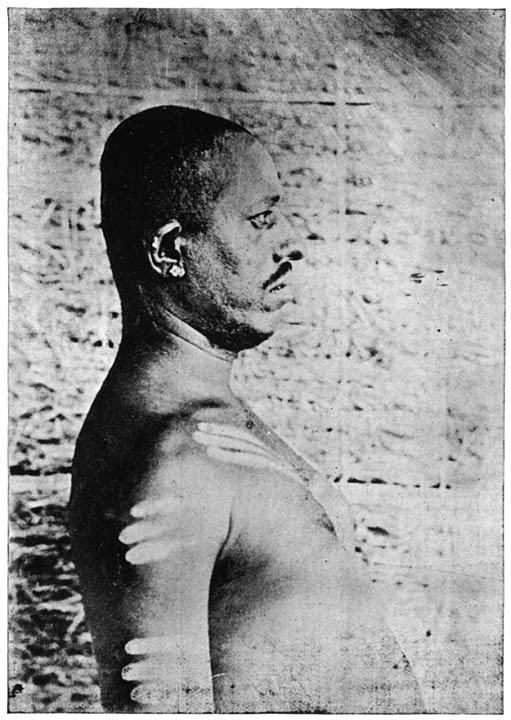
Linga Banajiga.
In support of M. Lapicque’s statement that the primitive inhabitant was dolichocephalic or sub-dolichocephalic, I may produce the evidence of the cephalic indices of the various jungle tribes which I have examined in the Tamil, Malayālam, and Telugu countries:—
Cephalic Index.
Average.
Maximum.
Minimum.
Kadir
72.9
80.0
69.1
Irula, Chingleput
73.1
78.6
68.4
Kānikar
73.4
78.9
69.1
Mala Vēdan
73.4
80.9
68.8
Panaiyan
74.0
81.1
69.4
Chenchu
74.3
80.5
64.3
Shōlaga
74.9
79.3
67.8
Paliyan
75.7
79.1
72.9
Irula, Nilgiris
75.8
80.9
70.8
Kurumba
76.5
83.3
71.8
It is worthy of note that Haeckel defines the nose of the Dravidian as a prominent and narrow organ. For Risley has laid down35 that, in the Dravidian type, the nose is thick and broad, and the formula expressing the proportionate dimension (nasal index) is higher than in any known race, except the Negro; and that the typical Dravidian, as represented by the Mālē Pahāria, has a nose as broad in proportion to its length as the Negro, while this feature in the Aryan group can fairly bear comparison with the noses of sixty-eight Parisians, measured by Topinard, which gave an average of 69.4. In this connection, I may record the statistics relating to the nasal indices of various South Indian jungle tribes:—
Nasal Index.
Average.
Maximum.
Minimum.
Paniyan
95.1
108.6
72.9
Kādir
89.8
115.4
72.9
Kurumba
86.1
111.1
70.8
Shōlaga
85.1
107.7
72.8
Mala Vēdan
84.9
102.6
71.1
Irula, Nīlgiris
84.9
100.
72.3
Kānikar
84.6
105.
72.3
Chenchu
81.9
95.7
68.1
In the following table, I have brought together, for the purpose of comparison, the average stature and nasal index of various Dravidian classes inhabiting the plains of the Telugu, Tamil, Canarese, and Malayālam countries, and jungle tribes:—
Linguistic area.
Nasal Index.
Stature.
Paniyan
Jungle tribe
95.1
157.4
Kādir
Do.
89.8
157.7
Kurumba
Do.
86.1
157.9
Shōlaga
Do.
85.1
159.3
Irula, Nīlgiris
Do.
84.9
159.8
Mala Vēdan
Do.
84.9
154.2
Kānikar
Do.
84.6
155.2
Chenchu
Do.
81.9
162.5
Pallan
Tamil
81.5
164.3
Mukkuvan
Malayālam
81.
163.1
Paraiyan
Tamil
80.
163.1
Palli
Do.
77.9
162.5
Gāniga
Canarese
76.1
165.8
Bestha
Telugu
75.9
165.7
Tīyan
Malayālam
75.
163.7
Kuruba
Canarese
74.9
162.7
Bōya
Telugu
74.4
163.9
Tōta Balija
Do.
74.4
163.9
Agasa
Canarese
74.3
162.4
Agamudaiyan
Tamil
74.2
165.8
Golla
Telugu
74.1
163.8
Vellāla
Tamil
73.1
162.4
Vakkaliga
Canarese
73.
167.2
Dāsa Banajiga
Do.
72.8
165.3
Kāpu
Telugu
72.8
164.5
Nāyar
Malayālam71.1
165.2
This table demonstrates very clearly an unbroken series ranging from the jungle men, short of stature and platyrhine, to the leptorhine Nāyars and other classes.
29 The cephalic indices of various Brāhman classes in the Bombay Presidency, supplied by Sir H. Risley, are as follows:—Dēsastha, 76.9; Kokanasth, 77.3; Sheni or Saraswat, 79; Nagar, 79.7.
30 Measured by Mr. F. Fawcett.
31 The Pattar Brāhmans are Tamil Brāhmans, settled in Malabar.
32 According to the Brāhman chronology, Mayūra Varma reigned from 455 to 445 B.C., but his probable date was about 750 A.D. See Fleet, Dynasties of the Kanarese Districts of the Bombay Presidency, 1882–86.
33 Histoire générale des Races Humaines, 1889.
34 Les Nègres d’Asie, et la race Nègre en général. Revue Scientifique, VI July, 1906.
35 Tribes and Castes of Bengal, 1891.
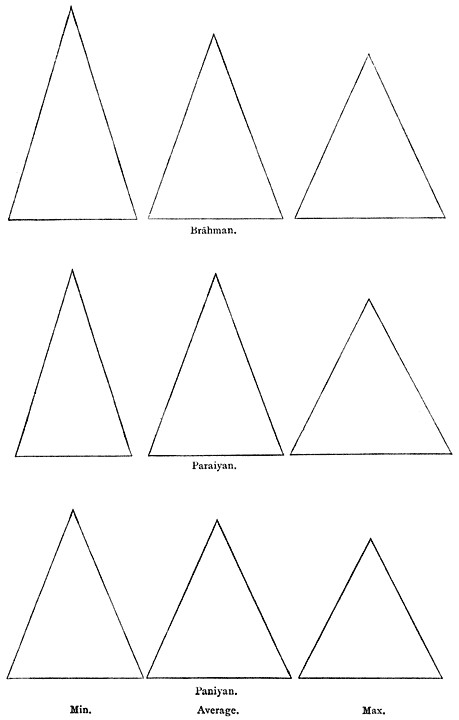
PLATE V.
DIAGRAMS OF NOSES.
In plate V are figured a series of triangles representing (natural size) the maxima, minima, and average nasal indices of Brāhmans of Madras city (belonging to the poorer classes), Tamil Paraiyans, and Paniyans. There is obviously far less connection between the Brāhman minimum and the Paraiyan maximum than between the Brāhman and Paraiyan maxima and the Paniyan average; and the frequent occurrence of high nasal indices, resulting from short, broad noses, in many classes has to be accounted for. Sir Alfred Lyall somewhere refers to the gradual Brāhmanising of the aboriginal non-Arayan, or casteless tribes. “They pass,” he writes, “into Brāhmanists by a natural upward transition, which leads them to adopt the religion of the castes immediately above them in the social scale of the composite population, among which they settle down; and we may reasonably guess that this process has been working for centuries.” In the Madras Census Report, 1891, Mr. H. A. Stuart states that “it has often been asserted, and is now the general belief, that the Brāhmans of the South are not pure Aryans, but are a mixed Aryan and Dravidian race. In the earliest times, the caste division was much less rigid than now, and a person of another caste could become a Brāhman by attaining the Brāhmanical standard of knowledge, and assuming Brāhmanical functions; and, when we see the Nambūdiri Brāhmans, even at the present day, contracting alliances, informal though they be, with the women of the country, it is not difficult to believe that, on their first arrival, such unions were even more common, and that the children born of them would be recognised as Brāhmans, though perhaps regarded as an inferior class. However, those Brāhmans, in whose veins mixed blood is supposed to run, are even to this day regarded as lower in the social scale, and are not allowed to mix freely with the pure Brāhman community.”
Popular traditions allude to wholesale conversions of non-Brāhmans into Brāhmans. According to such traditions, Rājas used to feed very large numbers of Brāhmans (a lakh of Brāhmans) in expiation of some sin, or to gain religious merit. To make up this large number, non-Brāhmans are said to have been made Brāhmans at the bidding of the Rājas. Here and there are found a few sections of Brāhmans, whom the more orthodox Brāhmans do not recognise as such, though the ordinary members of the community regard them as an inferior class of Brāhmans. As an instance may be cited the Mārakas of the Mysore Province. Though it is difficult to disprove the claim put forward by these people, some demur to their being regarded as Brāhmans.
Between a Brāhman of high culture, with fair complexion, and long, narrow nose on the one hand, and a less highly civilised Brāhman with dark skin and short broad nose on the other, there is a vast difference, which can only be reasonably explained on the assumption of racial admixture; and it is no insult to the higher members of the Brāhman community to trace, in their more lowly brethren, the result of crossing with a dark-skinned, and broad-nosed race of short stature. Whether the jungle tribe are, as I believe, the microscopic remnant of a pre-Dravidian people, or, as some hold, of Dravidians driven by a conquering race to the seclusion of the jungles, it is to the lasting influence of some such broad-nosed ancestor that the high nasal index of many of the inhabitants of Southern India must, it seems to me, be attributed. Viewed in the light of this remark, the connection between the following mixed collection of individuals, all of very dark colour, short of stature, and with nasal index exceeding 90, calls for no explanation:—
Stature.
Nasal height.
Nasal breadth.
Nasal Index.
cm.
cm.
cm.
Vakkaliga
156
4.3
3.9
90.7
Mōger
160
4.3
3.9
90.7
Saiyad Muhammadan
160
4.4
4
90.9
Kammalan
154.4
4.4
4
90.9
Chakkiliyan
156.8
4.4
4
90.9
Vellāla
154.8
4.7
4.3
91.6
Malaiyāli
158.8
4
3.7
92.5
Konga Vellāla
157
4.1
3.8
92.7
Pattar Brāhman
157.6
4.2
3.9
92.9
Oddē
159.6
4.3
4
93
Smarta Brāhman
159
4.1
3.9
95.1
Palli
157.8
4.1
3.9
95.1
Pallan
155.8
4.2
4.2
100
Bestha
156.8
4.3
4.3
100
Mukkuvan
150.8
4
4
100
Agasa
156.4
4.3
4.3
100
Tamil Paraiyan
160
4
4.2
105
I pass on to a brief consideration of the languages of Southern India. According to Mr. G. A. Grierson36 “the Dravidian family comprises all the principal languages of Southern India. The name Dravidian is a conventional one. It is derived from the Sanskrit Dravida, a word which is again probably derived from an older Dramila, Damila, and is identical with the name of Tamil. The name Dravidian is, accordingly, identical with Tamulian, which name has formerly been used by European writers as a common designation of the languages in question. The word Dravida forms part of the denomination Andhra-Drāvida-bhāshā, the language of the Andhras (i.e., Telugu), and Dravidas (i.e., Tamilians), which Kumārila Bhatta (probably 7th Century A.D.) employed to denote the Dravidian family. In India Dravida has been used in more than one sense. Thus the so-called five Dravidas are Telugu, Kanarese, Marāthi, Gujarāti, and Tamil. In Europe, on the other hand, Dravidian has long been the common denomination of the whole family of languages to which Bishop Caldwell applied it in his Comparative Grammar, and there is no reason for abandoning the name which the founder of Dravidian philology applied to this group of speeches.”
The five principal languages are Tamil, Telugu, Malayālam, Canarese, and Oriya. Of these, Oriya belongs to the eastern group of the Indo-Aryan family, and is spoken in Ganjam, and a portion of the Vizagapatam district. The population speaking each of these languages, as recorded at the census, 1901, was as follows:—
Tamil
15,543,383
Telugu
14,315,304
Malayālam
2,854,145
Oriya
1,809,336
Canarese
1,530,688
In the preparation of the following brief summary of the other vernacular languages and dialects, I have indented mainly on the Linguistic Survey of India, and the Madras Census Report, 1901.
Savara.—The language of the Savaras of Ganjam and Vizagapatam. One of the Mundā languages. Concerning the Mundā, linguistic family, Mr. Grierson writes as follows. “The denomination Mundā (adopted by Max Müller) was not long allowed to stand unchallenged. Sir George Campbell in 1866 proposed to call the family Kolarian. He was of opinion that Kol had an older form Kolar, which he thought to be identical with Kanarese Kallar, thieves. There is absolutely no foundation for this supposition. Moreover, the name Kolarian is objectionable, as seeming to suggest a connexion with Aryan which does not exist. The principal home of the Mundā languages at the present day is the Chota Nagpur plateau. The Mundā race is much more widely spread than the Mundā languages. It has already been remarked that it is identical with the Dravidian race, which forms the bulk of the population of Southern India.”
Gadaba.—Spoken by the Gadabas of Vizagapatam and Ganjam. One of the Mundā languages.
Kond, Kandhī, or Kui.—The language of the Kondhs of Ganjam and Vizagapatam.
Gōndi.—The language of the Gōnds, a tribe which belongs to the Central Provinces, but has overflowed into Ganjam and Vizagapatam.
Gattu.—A dialect of Gōndi, spoken by some of the Gōnds in Vizagapatam.
Kōya or Kōi.—A dialect of Gōndi, spoken by the Kōyis in the Vizagapatam and Godāvari districts.
Poroja, Parjā, or Parjī.—A dialect of Gōndi.
Tulu.—The language largely spoken in South Canara (the ancient Tuluva). It is described by Bishop Caldwell as one of the most highly developed languages of the Dravidian family.
Koraga.—Spoken by the Koragas of South Canara. It is thought by Mr. H. A. Stuart37 to be a dialect of Tulu.
Bellera.—Spoken by the Belleras of South Canara, and regarded as a dialect of Canarese or Tulu.
Toda.—The language of the Todas of the Nilgiri hills, concerning which Dr. W. H. R. Rivers writes as follows.38 “Bernhard Schmid,39 who wrote in 1837, appears to have known more of the true Toda language than any one who has written since, and he ascribes two-thirds of the Toda vocabulary to Tamil, and was unable to trace the remaining third to any other language. Caldwell40 believed the language of the Todas to be most closely allied to Tamil. According to Pope,41 the language was originally old Canarese with the addition of a few Tamil forms, but he has included in his vocabulary words which have probably been borrowed from the Badagas.”
Kota.—A mixture of Canarese and Tamil spoken by the Kotas of the Nīlgiri hills.
Badaga.—The language of the Badagas of the Nīlgiri hills. Said to be an ancient form of Canarese.
Irula.—Spoken by the Irulas of the Nīlgiris, and said to be a dialect of Tamil. According to Mr. Stuart, Kasuba or Kasuva is another dialect of Tamil spoken by the sub-division of the Irulas which bears the same name.
Kurumba.—Spoken by the Kurumbas of the Nīlgiri hills, Malabar, and Mysore, and regarded as a dialect of Canarese.
Konkani.—A dialect of Marāthi, spoken almost entirely in the South Canara district by Sārasvat and Konkani Brāhmans and Roman Catholic Christians.
Marāthi.—In the Tanjore district, the descendants of the former Marātha Rajas of Tanjore speak this language. It is also spoken in the Bellary district, which was formerly under Marātha dominion, by various Marātha castes, and in the feudatory State of Sandūr.
Patnūli or Khatri.—A dialect of Gujarāti, spoken by the Patnūlkārans who have settled for the most part in the town of Madura. They are immigrants from Saurāshtra in Gujarāt, who are said to have come south at the invitation of the Nāyak kings of Madura.
Lambādi.—The language of the nomad Lambādis, Brinjāris, or Sugālis. It is described by Mr. W. Francis42 as a patois “usually based on one of the local vernaculars, and embroidered and diversified with thieves’ slang and expressions borrowed from the various localities in which the tribe has sojourned. Cust thought that Lambādi was Semi-Dravidian, but the point is not clear, and it has been classed as Indo-Aryan.”
Korava or Yerukala.—A dialect of Tamil spoken by the nomad caste bearing these names. Like the Lambādis, they have a thieves’ slang.
Vadāri.—Recorded as a vulgar Telugu dialect spoken by a wandering tribe of quarrymen in the Bombay Presidency, the Berars, and elsewhere. They are doubtless Oddēs or Wudder navvies, who have migrated from their home in the Telugu country.
TABLE A.
Head Measurements.
C. = Canarese. M. = Malayālam. Tam. = Tamil. Tu. = Tulu. J. = Jungle Tribe. Mar. = Marāthi. Tel. = Telugu.
No.
Caste or Tribe.
Length cm.
Breadth cm.
Index.
Index 80 and over.
Av.
Max.
Min.
Av.
Max.
Min.
Av.
Max.
Min.
40
Badaga,
Nīlgiris18.9
20.2
18.
13.6
14.5
12.8
71.7
77.5
66.1
0
M.
18
Kānikar
18.8
19.5
18.2
13.6
14.2
13.
72.5
76.1
68.1
0
M.
40
Māppilla, Muhammadan
18.9
20.
18.
13.7
14.6
13.
72.8
78.5
68.
0
J.
23
Kādir
18.4
19.4
17.2
13.4
13.8
12.5
72.9
80.
69.
1
M.
40
Tiyan
18.9
20.3
17.8
13.7
14.9
12.6
73.
80.3
68.5
1
Tam.
40
Palli
18.6
19.6
17.4
13.6
14.6
12.1
73.
80.
64.4
1
Tam.
40
Irula
18.5
19.6
17.
13.5
14.4
12.8
73.1
78.6
68.4
0
82
Toda, Nīlgiris
19.4
20.4
18.2
14.2
15.2
13.3
73.3
81.3
68.7
1
J.
20
Kāanikar
18.5
19.4
17.8
13.6
14.2
13.
73.4
78.9
69.1
0
Tam.
29
Ambattan
18.6
19.2
18.
13.7
14.6
12.5
73.4
76.9
67.2
0
J.
25
Mala Vēdan
18.5
19.6
17.4
13.6
14.6
13.
73.4
80.9
68.8
1
Tam.
40
Paraiyan
18.6
19.7
17.
13.7
14.5
13.
73.6
78.3
64.8
0
M.
25
Cheruman
18.3
19.3
17.1
13.5
14.2
12.3
73.9
80.1
67.7
1
M.
25
Paniyan
18.4
19.3
17.5
13.6
14.9
13.
74.
81.1
69.4
1
Tam.
40
Agamudaiyan
18.8
20.
17.8
13.9
14.6
12.8
74.
80.9
66.7
1
25
Kota, Nīlgiris
19.2
20.2
18.3
14.2
15.1
13.4
74.1
79.1
69.9
0
Tam.
40
Vellāla
18.6
19.6
17.7
13.8
14.6
13.1
74.1
81.1
67.9
2
Tam.
20
Smarta Brāhman
18.
19.2
17.8
14.
14.8
13.
74.2
80.4
67.8
1
Tam.
50
Malaiyāli
18.3
19.3
17.
13.6
14.4
12.8
74.3
82.8
61.
2
J.
40
Chenchu
18.2
19.6
17.2
13.5
14.4
12.4
74.3
80.5
64.3
1
M.
40
Nāyar
18.7
19.8
17.4
13.9
15.
13.2
74.4
81.9
70.4
1
Tam.
25
Pattar Brāhman
18.8
20.3
17.2
14.
15.1
13.1
74.5
81.4
69.1
2
Tam.
23
Malasar
18.2
19.2
17.3
13.5
14.4
12.4
74.5
80.
70.
1
J.
57
Urāli
18.2
19.3
17.2
13.5
14.4
12.8
74.6
81.9
69.8
1
Tam.
50
Chakkiliyan
18.6
19.8
17.6
13.9
15.2
13.
74.9
80.9
70.4
1
J.
20
Shōlaga
18.2
19.4
17.2
13.6
14.6
12.2
74.9
79.3
67.8
0
Tel.
30
Mādiga, Adoni
18.6
20.2
17.
13.9
14.6
13.
75.
82.2
71.3
2
Tam.
40
Kammālan
18.4
19.7
17.3
13.7
14.7
13.1
75.
81.5
68.4
5
M.
40
Mukkuvan
19.
20.4
17.6
14.2
15.2
13.4
75.1
83.5
68.6
2
Tam.
40
Sheik Muhammadan
18.3
20.
16.7
13.8
14.5
12.8
75.6
81.6
71.5
2
C.
50
Dāyarē Muhammadan
18.5
19.7
17.
14.
15.
13.
75.6
83.3
68.5
8
Tam.
40
Saiyad Muhammadan
18.5
19.6
17.2
14.
15.
13.1
75.6
84.9
68.2
2
J.
26
Paliyan
17.8
18.6
17.1
13.5
14.
13.
75.7
79.1
72.8
0
J.
25
Irula
18.
19.1
17.
13.7
14.3
13.1
75.8
80.9
70.8
1
Tam.
50
Pallan
18.3
19.6
17.2
13.9
14.9
12.6
75.9
87.
70.1
6
Tam.
42
Idaiyan
18.3
19.
16.8
14.
14.6
13.2
76.
81.9
71.3
5
Tam.
40
Pathān Muhammadan
18.5
19.6
17.2
14.2
15.2
13.3
76.2
83.1
71.1
2
M.
24
Pulayan
18.3
19.3
17.
13.9
15.
13.
76.3
83.
72.3
5
J.
22
Kurumba
17.9
18.7
16.9
13.7
14.5
13.
76.4
83.3
71.8
2
Tel.
40
Mādiga, Hospet
18.3
20.
17.2
14.
15.4
13.
76.5
83.3
68.
8
C.
50
Sēdan
18.4
19.4
17.
14.1
14.8
13.2
76.6
82.6
72.6
7
C.
40
Toreya
18.3
19.2
17.2
14.1
15.2
13.
76.6
86.4
70.2
5
Mar.
24
Dēsastha Brāhman
18.7
20.2
18.
14.4
15.2
13.2
77.
83.4
71.
4
Tel.
30
Māla
18.4
19.8
16.8
14.2
14.8
13.4
77.1
85.9
70.3
6
Tel.
60
Bestha
18.4
19.4
16.6
14.2
15.6
13.2
77.1
85.1
70.5
11
C.
50
Kuruba, Mysore
18.1
19.4
17.2
14.
15.
12.8
77.3
83.9
70.3
9
Tel.
40
Oddē
18.2
20.4
17.2
14.1
15.2
13.4
77.3
83.1
70.1
10
Tel.
60
Golla
18.2
19.6
16.4
14.1
15.1
13.2
77.5
89.3
70.1
12
C.
40
Dāsa Banajiga
18.6
19.8
17.3
14.4
15.6
13.4
77.8
85.5
72.
11
Tel.
25
Kōmati, Adoni
18.2
19.4
17.
14.3
15.2
13.3
77.9
88.2
72.2
8
C.
40
Okkiliyan, Coimbatore
18.2
19.4
17.
14.2
15.2
13.2
77.9
88.2
71.7
9
C.
50
Bōya
18.
19.2
16.8
14.
15.2
13.
77.9
89.2
70.5
14
Tu.
40
Bant
18.5
20.
17.
14.4
16.6
13.1
78.
91.2
70.8
12
Tel.
49
Kāpu
18.2
19.8
16.8
14.2
15.6
13.2
78.
87.6
71.6
16
Tel.
39
Tōta Balija
18.1
19.
17.
14.1
15.
13.
78.
86.
73.3
10
C.
60
Mādhva Brahman
18.4
19.8
16.6
14.3
15.2
13.2
78.
88.5
68.
18
C.
40
Bēdar, Hospet
18.4
20.
16.8
14.3
15.2
13.2
78.1
85.3
70.8
13
Tel.
38
Uppara
18.
19.
16.2
14.
15.2
13.2
78.1
87.8
71.7
9
C.
25
Linga Banajiga, Sandūr
18.2
19.4
16.6
14.2
15.
13.4
78.3
87.9
73.7
7
C.
60
Karnataka Smarta Brāhman
18.5
20.7
17.
14.4
15.8
13.4
78.4
89.5
69.8
19
Tel.
30
Padma Sālē
17.8
19.
16.5
14.1
15.1
13.2
78.7
86.2
72.8
10
C.
50
Kuruba, Hospet
18.1
19.6
17.
14.2
15.4
13.4
78.9
88.4
72.9
19
Tel.
50
Telugu Banajiga
18.4
19.2
16.6
14.5
15.4
13.2
79.
89.5
71.9
18
C.
50
Panchāla
18.3
19.4
17.2
14.4
15.6
13.
79.
89.5
71.3
23
C.
50
Holeya
17.9
19.6
16.6
14.1
15.2
13.2
79.1
87.4
70.
20
C.
25
Bēdar, Adoni
18.1
19.2
17.
14.4
15.
13.6
79.4
85.9
74.1
12
Mar.
30
Rangāri
18.1
19.8
16.8
14.5
15.4
13.8
79.8
92.2
70.7
14
Tel.
25
Togata
17.7
19.
16.2
14.2
14.8
13.6
80.
88.1
73.7
13
Tu.
50
Billava
18.2
20.6
16.4
14.6
15.6
13.2
80.1
91.5
71.
28
C.
30
Linga Banajiga, Adoni
18.1
19.4
16.7
14.4
15.2
13.6
80.1
87.4
74.1
14
C.
50
Hebbar Brāhman
18.4
19.6
17.2
14.7
16.4
13.4
80.1
92.1
72.8
21
C.
50
Mandya Brāhman
18.5
20.2
16.6
14.8
15.8
13.4
80.2
88.2
69.8
31
Tu.
30
Shivalli Brāhman
18.5
19.6
16.8
14.9
16.2
13.6
80.4
96.4
72.3
17
C.
20
Gāniga
18.
19.1
16.6
14.4
15.2
14.
80.5
86.7
74.5
11
C.
20
Dēvānga
18.
19.6
17.
14.5
15.5
13.6
80.8
87.1
74.7
10
Tel.
25
Kōmati
17.6
18.8
16.4
14.3
14.8
13.4
81.
87.1
74.5
16
C.
50
Vakkaliga, Mysore
17.7
19.5
15.8
14.5
15.7
13.2
81.7
93.8
72.5
27
Mar.
30
Suka Sālē
17.7
18.8
16.6
14.5
15.
13.4
81.8
88.2
76.1
22
Mar.
30
Sukūn Sālē
17.6
19.
16.
14.4
15.4
13.6
82.2
90.
73.9
21
TABLE B.
Stature and Nasal Index.
No.
Caste or Tribe.
Stature cm.
Nasal Index.
Av.
Max.
Min.
Av.
Max.
Min.
M.
40
Nāyar
165.2
179.
152.2
71.1
78.7
54.4
C.
50
Hebbar Brāhman
163.2
174.4
150.8
71.2
87.2
55.4
C.
60
Karnataka Smarta Brāhman
164.2
176.
150.6
71.5
91.5
61.1
C.
50
Dāyarē Muhammadan
166.4
181.8
150.
71.5
82.6
59.3
Mar.
60
Mādhva Brāhman
163.3
176.2
151.8
72.
93.2
58.8
Tu.
40
Bant
165.7
179.2
155.8
72.2
86.1
61.6
Tam.
40
Sheik Muhammadan
164.6
174.8
153.8
72.4
87.
60.
Tam.
29
Ambattan
165.7
173.2
153.2
72.4
84.3
57.9
Tu.
50
Billava
163.2
175.8
149.4
72.6
92.8
60.
C.
50
Sēdan
163.3
177.2
153.2
72.7
92.9
59.3
C.
40
Dāsa Banajiga
165.3
177.8
152.
72.8
82.6
59.3
Tel.
49
Kāpu
164.5
177.6
152.6
72.8
90.5
62.7
C.
50
Mandya Brāhman
165.7
177.8
150.6
73.
97.8
58.4
C.
50
Vakkaliga, Mysore
167.2
181.
155.2
73.
85.
62.3
Tam.
40
Vellāla
162.4
172.8
153.2
73.1
91.5
60.8
Tel.
30
Padma Sālē
159.9
171.4
153.8
73.2
83.7
61.5
C.
40
Okkiliyan
166.
179.6
154.6
73.5
90.7
63.5
C.
50
Kuruba, Mysore
163.6
174.2
152.
73.5
88.4
64.
Mar.
30
Rangāri
161.3
168.4
154.4
73.6
84.1
63.5
Tam.
42
Idaiyan
164.3
178.
154.6
73.6
91.
62.7
Tel.
25
K mati, Sandūr
162.5
169.2
153.4
74.1
88.9
62.5
C.
30
Linga Banajiga
163.4
171.2
154.
74.1
85.7
60.4
Tel.
60
Golla
163.8
173.8
151.
74.1
83.
61.5
M.
40
Tiyan
164.2
171.6
155.2
74.2
85.7
61.5
Tam.
40
Agamudaiyan
165.8
175.6
153.6
74.2
88.9
73.8
Tel.
39
Tōta Balija
163.9
176.8
149.6
74.4
83.
65.4
C.
25
Linga Banajiga, Sandūr
165.6
173.
157.8
74.6
86.4
61.5
Mar.
30
Sukūn Sālē
160.3
167.6
152.5
74.8
84.4
61.5
Mar.
30
Suka Sālē
161.1
170.
147.8
74.8
86.1
62.3
C.
50
Panchāla
162.3
177.2
151.6
74.8
88.9
62.
C.
50
Kuruba, Hospet
162.7
175.4
162.2
74.9
92.2
75.8
..
82
Toda, Nīlgiris
169.8
186.8
157.6
74.9
89.1
61.2
C.
50
Bōya
160.8
171.6
151.9
75.
86.
66.
Tel.
50
Telugu Banajiga
164.6
176.2
151.6
75.
97.7
66.
M.
40
Māppilla, Muhammadan
164.8
174.4
145.
75.1
88.1
64.
C.
50
Holeya
162.8
175.2
151.5
75.1
88.9
64.6
...
40
Badaga, Nīlgiris
164.1
180.2
154.
75.6
88.4
62.7
Mar.
24
Dēsastha Brāhman
163.4
175.
151.4
75.8
87.2
66.7
Tel.
60
Bestha
165.7
181.
155.
75.9
100.
63.3
C.
30
Toreya
164.2
180.6
156.4
76.1
87.2
62.7
Tel.
30
Māla
163.9
175.
153.8
76.2
93.2
67.3
Tam.
40
Pathān Muhammadan
164.4
177.6
155.6
76.2
83.1
71.1
Tam.
25
Pattar Brāhman
164.3
175.
153.4
76.5
95.3
64.7
...
25
Kota, Nīlgiris
162.9
174.2
155.
77.2
92.9
64.
Tam.
40
Palli
162.5
171.6
149.8
77.3
90.5
68.3
Tam.
40
Kammālan
159.7
171.8
146.4
77.3
90.9
63.3
Tel.
40
Oddē
164.4
172.4
155.
77.3
93.
65.4
C.
40
Bēdar, Hospet
165.4
176.6
156.
77.5
93.
78.1
Tel.
40
Mādiga, Hospet
162.9
173.4
152.2
77.5
90.1
66.7
Tel.
30
Togata
160.5
168.9
151.4
77.5
93.9
68.8
Tam.
50
Malaiyāli
163.9
173.2
153.2
77.8
100.
63.8
Tel.
25
Kōmati, Adoni
161.
168.3
153.2
77.8
100.
65.3
Tam.
40
Palli
162.5
169.4
151.
77.9
95.1
60.8
M.
25
Cheruman
157.5
166.4
145.8
78.1
88.9
69.6
Tam.
50
Chakkiliyan
162.2
174.5
150.3
78.9
97.6
64.
M.
24
Pulayan
153.
162.6
143.4
79.3
92.7
68.
C.
25
Bēdar, Adoni
165.4
176.2
156.6
79.4
91.
65.2
Tam.
40
Paraiyan
162.1
171.4
149.4
80.
91.8
66.
J.
57
Urali
159.5
171.6
147.8
80.1
97.7
66.7
Tam.
40
Irula
159.9
166.8
150.2
80.4
90.5
79.
Tel.
30
Mādiga, Adoni
163.1
173.2
154.2
80.8
102.6
69.4
M.
40
Mukkuvan
163.1
177.8
150.8
81.
104.8
62.5
M.
18
Kānikar
158.7
170.4
148.
81.2
90.5
70.8
Tam.
50
Pallan
164.3
177.6
151.5
81.5
100.
68.8
J.
40
Chenchu
162.5
175.
148.
81.9
95.7
68.1
J.
26
Pulayan
150.5
158.4
143.1
82.9
100.2
70.8
J.
20
Kānikar
155.2
170.3
150.2
84.6
105.
72.3
J.
25
Mala Vēdan
154.2
163.8
140.8
84.9
102.6
71.1
J.
25
Irula
159.8
168.
152.
84.9
100.
72.3
J.
20
Shōlaga
159.3
170.4
151.2
85.1
107.7
72.8
J.
22
Kurumba
158.
167.
149.6
86.1
111.1
70.8
J.
23
Malasar
161.2
170.5
152.8
87.2
102.4
75.4
J.
23
Kādir
157.7
169.4
148.6
89.8
115.4
72.9
J.
25
Paniyan
157.4
171.6
152.
95.1
108.6
72.9
36 Linguistic Survey of India, IV, 1906.
37 Manual of the South Canara district.
38 The Todas, 1906.
39 Madras Journ., Lit. and Sci., V., 1837.
40 Comparative Grammar of the Dravidian Languages. 2nd Ed., 1875.
41 Outlines of the Toda Grammar appended to Marshall’s Phrenologist among the Todas.
42 Madras Census Report, 1901.
1 “Deccan, Hind, Dakhin, Dakhan; dakkina, the Prakr. form of Sskt. dakshina, ‘the south.’ The southern part of India, the Peninsula, and especially the table-land between the Eastern and Western Ghauts.” Yule and Burnell, Hobson-Jobson.
2 History of Creation.
3 Malay Archipelago, 1890.
4 See article Kādir.
5 Pagan Races of the Malay Peninsula, 1906.
6 Globus, 1899.
7 Madras Museum Bull., II, 3, 1899.
8 Op. cit.
9 Yule and Burnell, Hobson-Jobson.
10 Mem. Asiat. Soc., Bengal, Miscellanea Ethnographica, 1, 1906.
11 Manual of the Geology of India, 2nd edition, 1893.
12 Anatomy of Vertebrated Animals, 1871.
13 See Annual Report, Archæological Survey of India, 1902–03.
14 Bull, Museum d’Histoire Naturelle, 1905.
15 Introduction to the Study of Mammals, living and extinct, 1891.
16 Anthropology. Translation, 1894.
17 I have only seen one individual with woolly hair in Southern India, and he was of mixed Tamil and African parentage.
18 See article Maravan.
19 Op. cit.
20 Ethnology, 1896.
21 Proc. R. Soc. N. S. Wales, XXIII, part III.
22 “It is evident that, during much of the tertiary period, Ceylon and South India were bounded on the north by a considerable extent of sea, and probably formed part of an extensive southern continent or great island. The very numerous and remarkable cases of affinity with Malaya require, however, some closer approximation to these islands, which probably occurred at a later period.” Wallace. Geographical Distribution of Animals, 1876.
23 See Breeks, Primitive Tribes and Monuments of the Nilgiris; Phillips, Tumuli of the Salem district; Rea, Prehistoric Burial Places in Southern India; R. Bruce Foote, Catalogues of the Prehistoric Antiquities in the Madras Museum, etc.
24 Contributions to the Craniology of the People of the Empire of India, Part II. The aborigines of Chūta Nāgpur, and of the Central Provinces, the People of Orissa, Veddahs and Negritos, 1900.
25 Other cranial characters are compared by Sir William Turner, for which I would refer the reader to the original article.
26 The People of India, 1908.
27 Contemporary Science Series.
28 Madras Museum Bull., II, 3, 1899.
29 The cephalic indices of various Brāhman classes in the Bombay Presidency, supplied by Sir H. Risley, are as follows:—Dēsastha, 76.9; Kokanasth, 77.3; Sheni or Saraswat, 79; Nagar, 79.7.
30 Measured by Mr. F. Fawcett.
31 The Pattar Brāhmans are Tamil Brāhmans, settled in Malabar.
32 According to the Brāhman chronology, Mayūra Varma reigned from 455 to 445 B.C., but his probable date was about 750 A.D. See Fleet, Dynasties of the Kanarese Districts of the Bombay Presidency, 1882–86.
33 Histoire générale des Races Humaines, 1889.
34 Les Nègres d’Asie, et la race Nègre en général. Revue Scientifique, VI July, 1906.
35 Tribes and Castes of Bengal, 1891.
36 Linguistic Survey of India, IV, 1906.
37 Manual of the South Canara district.
38 The Todas, 1906.
39 Madras Journ., Lit. and Sci., V., 1837.
40 Comparative Grammar of the Dravidian Languages. 2nd Ed., 1875.
41 Outlines of the Toda Grammar appended to Marshall’s Phrenologist among the Todas.
42 Madras Census Report, 1901.
Castes and Tribes of Southern India.

A
Abhishēka.—Abhishēka Pandārams are those who are made to pass through some ceremonies in connection with Saiva Āgama.
Acchu Tāli.—A sub-division of Vāniyan. The name refers to the peculiar tāli (marriage badge) worn by married women.
Acchuvāru.—Recorded, in the Madras Census Report, 1901, as “Oriya-speaking carriers of grain, etc., on pack bullocks. Treated as a sub-division of Gaudo.” The Acchuvārus are not Oriya people, but are attached to the Dēvānga weavers, and receive their name from the fact that they do acchupani, i.e., thread the long comb-like structures of the hand-loom. They correspond to the Jātipillais of the Kaikōlan weavers, who do acchuvēlai.
Acchu Vellāla.—A name assumed by some Pattanavans.
Achan.—Achan, meaning father or lord, was returned, at the Cochin census, 1901, as a title of Nāyars. According to Mr. Wigram1 it is used as a title of the following:—
1. Males in the Royal Family of Palghāt.
2. The minister of the Calicut Rāja, known as Mangāt Achan.
3. The minister of the Cochin Rāja, known as Paliyat Achan.
4. The minister of the second Rāja of Calicut, known as Chenli Achan.
Acharapākam Chetti.—One of the sub-divisions of the Chettis, generally grouped among the Bēri Chettis (q.v.).
Āchāri.—See Āsāri.
Adapadava (man of the wallet).—A name, referring to the dressing-bag which barbers carry, applied to Lingāyat barbers in South Canara.
Ādapāpa.—Returned in the Madras Census Report, 1901, as a sub-caste of Balija. The name is applied to female attendants on the ladies of the families of Zamindars, who, as they are not allowed to marry, lead a life of prostitution. Their sons call themselves Balijas (see Khāsa).
Adavi (forest or jungle).—The name of a sub-division of Yānādis, and also of a section of Gollas in Mysore.2
Adaviyar.—Adaviyar or Ataviyar is the name of a class of Tamil-speaking weavers found in the Tanjore and Tinnevelly districts.
Addāku (Bauhinia racemosa).—A sept of Jātapu. The leaves of this tree are largely used as food platters, in Madras, and generally on the east coast.
Addapu Singa.—Mendicants who beg only from Mangalas in the Telugu country.
Adhigāri.—Defined by Mr. Wigram3 as the head of the amsam or parish in Malabar, corresponding to the Manigar (village munsiff) in east coast districts and Patēl in South Canara. The title Adhigāri (one in power) is assumed by some Agamudaiyans, and Adhikāri occurs as an exogamous sept of the Badagas, and the title of village headman among some Oriya castes. In South Canara, it is a sept of Stānika.
Ādi (primitive or original).—The name of a division of Linga Balijas, and of Velamas who have abandoned the practice of keeping their females gōsha (in seclusion). It is also applied by the Chenchus to the original members of their tribe, from whom the man-lion Narasimha obtained his bride Chenchita.
Adichchan.—A sub-division of Nāyar.
Adikal (slaves or servants).—Included among the Ambalavāsis. It is recorded, in the Travancore Census Report, 1901, that “tradition states that Sankarāchārya, to test the fidelity of certain Brahmins to the established ordinances of caste, went to a liquor-shop, and drank some stimulants. Not recognising that the obligations, from which adepts like Sankara were free, were none the less binding on the proletariat, the Brahmins that accompanied the sage made this an excuse for their drinking too. Sankara is said to have then entered a foundry, and swallowed a cup of molten metal, and handed another to the Brahmins, who had apparently made up their minds to do all that may be done by the Āchārya. But they begged to differ, apologised to him as Atiyāls or humble servants, and accepted social degradation in expiation of their sinful presumption. They are now the priests in temples dedicated to Bhadrakāli, and other goddesses who receive offerings of liquor. They practise sorcery, and aid in the exorcising of spirits. They have the upanayana-samskāra, and wear the sacred thread. The sīmantam ceremony is not performed. They are to repeat the Gāyatri (hymn) ten times, and observe eleven days’ death pollution. Their own caste-men act as priests. The Atiyammamar wear the same jewellery as the Nambūtiri women, but they do not screen themselves by a cadjan (palm leaf) umbrella when they go out in public, nor are they accompanied by a Nāyar maid.”
Adimittam.—An occupational sub-division of Mārāns, who clean the court-yards of temples in Travancore.
Ādisaivar.—Recorded, in the Madras Census Report, 1901, as “a sub-caste of Vellāla. They are singers of Dēvāra hymns in Saiva temples.” The name indicates those who have been Saivites from the beginning, as opposed to recent Saivites. Ādisaivas are Saivites, who have survived the absorbing influence of the Lingayat sect. Saivites who profess the Lingāyat doctrines are known as Vīrasaivas. Some Pandārams, who belong to the Sōzhia sub-division of the Vellālas, regularly recite Tamil verses from Thēvāram and Tiruvāchagam in Saivite temples. This being their profession, they are also called Ōduvar (readers or reciters).
Āditya Vārada.—Kurubas, who worship their God on Sunday.
Adiyān.—Adiyān (adi, foot) has been defined4 as meaning literally “a slave, but usually applied to the vassals of Tamburans and other powerful patrons. Each Adiyān had to acknowledge his vassalage by paying annually a nuzur (gift of money) to his patron, and was supposed also to be ready to render service whenever needed. This yearly nuzur, which did not generally exceed one or two fanams, was called adima-panam” (slave money), adima meaning feudal dependency on a patron.
Adiyōdi.—Adiyōdi or Atiyōti, meaning slave or vassal, has been returned at times of census as a sub-division of Sāmantan. It is, Mr. H. A. Stuart writes,5 “the caste of the Kadattanād Rājah in North Malabar. The tradition is that, when he was driven out of his territories in and around Calicut by the Zamorin, he took shelter under the Rājah of Chirakkal, who gave him the Kadattanād country to hold as his vassal. Some Atiyōtis advance no pretension to be above Nāyars in rank.”
Aduttōn (a bystander).—A synonym for Kāvutiyan, a caste of Malayālam barbers. In like manner, the name Ambattan for Tamil barbers is said to be derived from the Sanskrit amba (near), s’tha (to stand), indicating that they stand near to shave their clients or treat their patients.
Agamudaiyan.—The Agamudaiyans, Mr. W. Francis writes,6 are “a cultivating caste found in all the Tamil districts. In Chingleput, North Arcot, Salem, Coimbatore and Trichinopoly, they are much less numerous than they were thirty years ago. The reason probably is that they have risen in the social scale, and have returned themselves as Vellālas. Within the same period, their strength has nearly doubled in Tanjore, perhaps owing to the assumption of the name by other castes like the Maravans and Kallans. In their manners and customs they closely follow the Vellālas. Many of these in the Madura district are the domestic servants of the Marava Zamindars.” The Agamudaiyans who have settled in the North Arcot district are described7 by Mr. H. A. Stuart as “a class of cultivators differing widely from the Agamudaiyans of the Madura district. The former are closely allied to the Vellālas, while the latter are usually regarded as a more civilised section of the southern Maravans. It may be possible that the Agamudaiyans of North Arcot are the descendants of the first immigrants from the Madura district, who, after long settlement in the north, severed all connexions with their southern brethren.” In some districts, Agamudaiyan occurs as a synonym of Vellālas, Pallis and Mēlakkārans, who consider that Agamudaiyan is a better caste name than their own.
The Agamudaiyans proper are found in the Tanjore, Madura, and Tinnevelly districts.
It is noted in the Tanjore Manual that Ahamudaiyar (the equivalent of Agamudaiyan) is “derived from the root āham, which, in Tamil, has many significations. In one of these, it means a house, in another earth, and hence it has two meanings, householder and landholder; the suffix Udeiyār indicating ownership. The word is also used in another form, ahambadiyan, derived from another meaning of the same root, i.e., inside. And, in this derivation, it signifies a particular caste, whose office it was to attend to the business in the interior of the king’s palace, or in the pagoda.” “The name,” Mr. J. H. Nelson writes,8 “is said by the Rev. G. U. Pope, in his edition of the Abbé Dubois’ work,9 to be derived from aham, a temple, and padi, a step, and to have been given to them in consequence of their serving about the steps of temples. But, independently of the fact that Madura pagodas are not approached by flights of steps, this seems to be a very far-fetched and improbable derivation of the word. I am inclined to doubt whether it be not merely a vulgar corruption of the well-known word Ahamudeiyān, possessor of a house, the title which Tamil Brahmans often use in speaking of a man to his wife, in order to avoid the unpolite term husband. Or, perhaps, the name comes from aham in the sense of earth, and pati, master or possessor.”
Concerning the connection which exists between the Maravans, Kallans, and Agamudaiyans (see Kallan), the following is one version of a legend, which is narrated. The father of Ahalya decided to give her in marriage to one who remained submerged under water for a thousand years. Indra only managed to remain thus for five hundred years, but Gautama succeeded in remaining for the whole of the stipulated period, and became the husband of Ahalya. Indra determined to have intercourse with her, and, assuming the guise of a cock, went at midnight to the abode of Gautama, and crowed. Gautama, thinking that daybreak was arriving, got up, and went to a river to bathe. While he was away, Indra assumed his form, and accomplished his desire. Ahalya is said to have recognised the deception after two children, who became the ancestors of the Maravans and Kallans, were born to her. A third child was born later on, from whom the Agamudaiyans are descended. According to another version of the legend, the first-born child is said to have faced Gautama without fear, and Agamudaiyan is accordingly derived from aham or agam, pride, and udaiyan, possessor. There is a Tamil proverb to the effect that a Kallan may come to be a Maravan. By respectability he may develope into an Agamudaiyan, and, by slow degrees, become a Vellāla, from which he may rise to be a Mudaliar.
Of the three castes, Kallan, Maravan and Agamudaiyan, the last are said to have “alone been greatly influenced by contact with Brāhmanism. They engage Brāhman priests, and perform their birth, marriage, and death ceremonies like the Vellālas.”10 I am told that the more prosperous Agamudaiyans in the south imitate the Vellālas in their ceremonial observances, and the poorer classes the Maravans.
Agamudaiyan has been returned, at times of census, as a sub-division of Maravan and Kallan. In some places, the Agamudaiyans style themselves sons of Sembunāttu Maravans. At Ramnād, in the Madura district, they carry the fire-pot to the burning ground at the funeral of a Maravan, and also bring the water for washing the corpse. In the Tanjore district the Agamudaiyans are called Terkittiyar, or southerners, a name which is also applied to Kallans, Maravans, and Valaiyans. The ordinary title of the Agamudaiyans is Sērvaikkāran, but many of them call themselves, like the Vellālas, Pillai. Other titles, returned at times of census, are Adhigāri and Mudaliar.
At the census, 1891, the following were returned as the more important sub-divisions of the Agamudaiyans:—Aivali Nāttān, Kōttaipattu, Malainādu, Nāttumangalam, Rājabōja, Rājakulam, Rājavāsal, Kallan, Maravan, Tuluvan (cf. Tuluva Vellāla) and Sērvaikkāran. The name Rājavāsal denotes those who are servants of Rājas, and has been transformed into Rājavamsa, meaning those of kingly parentage. Kōttaipattu means those of the fort, and the Agamudaiyans believe that the so-called Kōttai Vellalas of the Tinnevelly district are really Kōttaipattu Agamudaiyans. One sub-division of the Agamudaiyans is called Sāni (cow-dung). Unlike the Maravans and Kallans, the Agamudaiyans have no exogamous septs, or kilais.
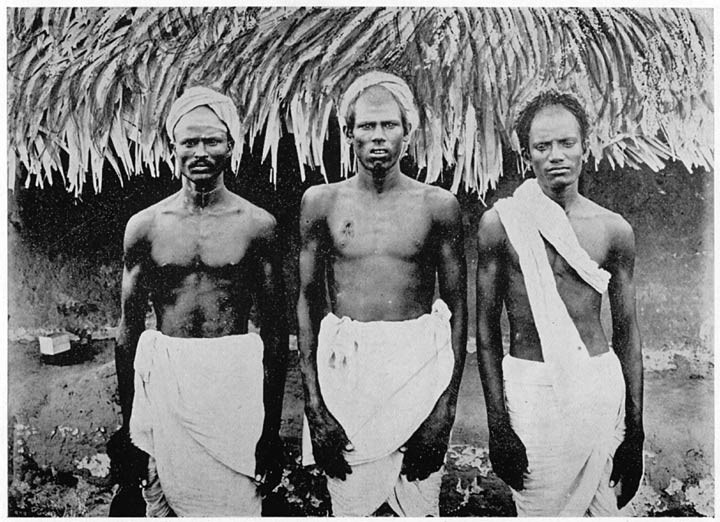
Agamudaiyans, Madura District.
It is recorded, in the Mackenzie Manuscripts, that “among the Maravas, the kings or the rulers of districts, or principal men, are accustomed to perform the ceremony of tying on the tāli, or in performing the marriage at once in full, with reference to females of the Agambadiyar tribe. The female children of such marriages can intermarry with the Maravas, but not among the Agambadiyar tribe. On the other hand, the male offspring of such marriages is considered to be of the mother’s tribe, and can intermarry with the Agambadiyas, but not in the tribe of the Maravas.” I am told that, under ordinary circumstances, the offspring of a marriage between a Maravan and Agamudaiyan becomes an Agamudaiyan, but that, if the husband is a man of position, the male issues are regarded as Maravans. Adult marriage appears to be the rule among the Agamudaiyans, but sometimes, as among the Maravans, Kallans and other castes, young boys are, in the southern districts, sometimes married to grown-up girls.
The marriage ceremonial, as carried out among the poorer Agamudaiyans, is very simple. The sister of the bridegroom proceeds to the home of the bride on an auspicious day, followed by a few females carrying a woman’s cloth, a few jewels, flowers, etc. The bride is seated close to a wall, facing east. She is dressed up in the cloth which has been brought, and seated on a plank. Betel leaves, areca nuts, and flowers are presented to her by the bridegroom’s sister, and she puts them in her lap. A turmeric-dyed string or garland is then placed round the bride’s neck by the bridegroom’s sister, while the conch shell (musical instrument), is blown. On the same day the bride is conducted to the home of the bridegroom, and a feast is held.
The more prosperous Agamudaiyans celebrate their marriages according to the Purānic type, which is the form in vogue amongst most of the Tamil castes, with variations. The astrologer is consulted in order to ascertain whether the pair agree in some at least of the points enumerated below. For this purpose, the day of birth, zodiacal signs, planets and asterisms under which the pair were born, are taken into consideration:—
1. Vāram (day of birth).—Days are calculated, commencing with the first day after the new moon. Counting from the day on which the girl was born, if the young man’s birthday happens to be the fourth, seventh, thirteenth, sixteenth, or seventeenth, it is considered good.
2. Ganam (class or tribe).—There are three ganams, called Manusha, Dēva, and Rākshasa. Of the twenty-seven asterisms, Aswini, Bharani, etc., some are Manusha, some Dēva, and some Rākshasa ganam. Ashtham and Swāthi are considered to be of Dēva ganam, so individuals born under these asterisms are regarded as belonging to Dēva ganam. Those born under the asterisms Bharani, Rōgini, Pūram, Pūrādam, Uththarādam, etc., belong to the Manusha ganam. Under Rākshasa ganam are included Krithika, Āyilyam, Makam, Visākam, and other asterisms. The bridal pair should belong to the same ganam, as far as possible. Manusha and Dēva is a tolerable combination, whereas Rākshasa and Dēva, or Rākshasa and Manusha, are bad combinations.
3. Sthridīrgam (woman’s longevity).—The young man’s birthday should be beyond the thirteenth day, counting from the birthday of the girl.
4. Yōni (female generative organs).—The asterisms are supposed to belong to several animals. An individual belongs to the animal to which the asterism under which he was born belongs. For example, a man is a horse if his asterism is Aswini, a cow if his asterism is Uththirattādhi, and so on. The animals of husband and wife must be on friendly terms, and not enemies. The elephant and man, horse and cow, dog and monkey, cat and mouse, are enemies. The animals of man and wife should not both be males. Nor should the man be a female, or the wife a male animal.
5. Rāsi (zodiacal sign).—Beginning from the girl’s zodiacal sign, the young man’s should be beyond the sixth.
6. Rāsyathipathi (planet in the zodiacal sign).—The ruling planets of the zodiacal signs of the pair should not be enemies.
7. Vasyam.—The zodiacal signs of the pair should be compatible, e.g., Midunam and Kanni, Singam and Makaram, Dhanus and Mīnam, Thulām and Makaram, etc.
8. Rajju (string).—The twenty-seven asterisms are arranged at various points on four parallel lines drawn across three triangles. These lines are called the leg, thigh, abdomen, and neck rajjus. The vertices of the triangles are the head rajjus. The asterisms of the pair should not be on the same rajju, and it is considered to be specially bad if they are both on the neck.
9. Vriksham (tree).—The asterisms belong to a number of trees, e.g.:—
- Aswini, Strychnos Nux-vomica.
- Bharani, Phyllanthus Emblica.
- Krithikai, Ficus glomerata.
- Pūram, Butea frondosa.
- Hastham, Sesbania grandiflora.
- Thiruvōnam, Calotropis gigantea.
- Uththirattādhi, Melia Azadirachta.
Some of the trees are classed as milky, and others as dry. The young man’s tree should be dry, and that of the girl milky, or both milky.
10. Pakshi (birds).—Certain asterisms also belong to birds, and the birds of the pair should be on friendly terms, e.g., peacock and fowl.
11. Jādi (caste).—The zodiacal signs are grouped into castes as follows:—
- Brāhman, Karkātakam, Mīnam, and Dhanus.
- Kshatriya, Mēsham, Vrischikam.
- Vaisya, Kumbam, Thulām.
- Sūdra, Rishabam, Makaram.
- Lower castes, Midhunam, Singam, and Kanni.
The young man should be of a higher caste, according to the zodiacal signs, than the girl.
After ascertaining the agreement of the pair, some close relations of the young man proceed to some distance northward, and wait for omens. If the omens are auspicious, they are satisfied. Some, instead of so going, go to a temple, and seek the omens either by placing flowers on the idol, and watching the direction in which they fall, or by picking up a flower from a large number strewn in front of the idol. If the flower picked up, and the one thought of, are of the same colour, it is regarded as a good omen. The betrothal ceremony is an important event. As soon as the people have assembled, the bridegroom’s party place in their midst the pariyam cloth and jewels. Some responsible person inspects them, and, on his pronouncing that they are correct, permission is given to draw up the lagna patrika (letter of invitation, containing the date of marriage, etc.). Vignēswara (the elephant god Ganēsa) is then worshipped, with the lagna patrika in front of him. This is followed by the announcement of the forthcoming marriage by the purōhit (priest), and the settlement of the amount of the pariyam (bride’s money). For the marriage celebration, a pandal (booth) is erected, and a dais, constructed of clay and laterite earth, is set up inside it. From the day on which the pandal is erected until the wedding day, the contracting couple have to go through the nalagu ceremony separately or together. This consists in having their bodies smeared with turmeric paste (Phaseolus Mungo paste), and gingelly (Sesamum) oil. On the wedding day, the bridegroom, after a clean shave, proceeds to the house of the bride. The finger and toe-nails of the bride are cut. The pair offer pongal (boiled rice) to the family deity and their ancestors. A square space is cleared in the centre of the dais for the sacred fire (hōmam). A many-branched lamp, representing the thousand-eyed Indra, is placed to the east of the square. The purōhit, who is regarded as equivalent to Yama (the god of death), and a pot with a lamp on it representing Agni dēvata, occupy the south-east corner. Women representing Niruti (a dēvata) are posted in the south-west corner.
The direction of Varuna (the god of water) being west, the bridegroom occupies this position. The best man, who represents Vāyu (the god of wind) is placed in the north-west corner. As the position of Kubēra (the god of wealth) is the north, a person, with a bag full of money, is seated on that side. A grinding-stone and roller, representing Siva and Sakthi, are placed in the north-east corner, and, at their side, pans containing nine kinds of seedlings, are set. Seven pots are arranged in a row between the grinding-stone and the branched lamp. Some married women bring water from seven streams or seven different places, and pour it into a pot in front of the lamp. The milk-post (pāl kambam) is set up between the lamp and the row of pots. This post is usually made of twigs of Ficus religiosa, Ficus bengalensis, and Erythrina indica, tied together and representing Brahma, Vishnu, and Siva. Sometimes, however, twigs of Odina Wodier, and green bamboo sticks, are substituted. At the close of the marriage ceremonies, the Erythrina or Odina twig is planted, and it is regarded as a good sign if it takes root and grows. The sacred fire is kindled, and the bridegroom goes through the upanayana (thread investiture) and other ceremonies. He then goes away from the house in procession (paradēsa pravēsam), and is met by the bride’s father, who brings him back to the pandal. The bride’s father and mother then wash his feet, and rings are put on his toes (kālkattu, or tying the leg). The purōhit gives the bridegroom a thread (kankanam), and, after washing the feet of the bride’s father and mother, ties it on his wrist. A thread is also tied on the left wrist of the bride. The pair being seated in front of the sacred fire, a ceremony called Nāndisrādham (memorial service to ancestors) is performed, and new clothes are given to the pair. The next item is the tying of the tāli (marriage badge). The tāli is usually tied on a turmeric-dyed thread, placed on a cocoanut, and taken round to be blessed by all present. Then the purōhit gives the tāli to the bridegroom, and he ties it on the bride’s neck amidst silence, except for the music played by the barber or Mēlakkāran musicians. While the tāli is being tied, the bridegroom’s sister stands behind the bride, holding a lamp in her hand. The bridegroom ties one knot, and his sister ties two knots. After the tāli-tying, small plates of gold or silver, called pattam, are tied on the foreheads of the pair, and presents of money and cloths are made to them by their relations and friends. They then go seven times round the pandal, and, at the end of the seventh round, they stand close to the grinding-stone, on which the bridegroom places the bride’s left foot. They take their seats on the dais, and the bridegroom, taking some parched rice (pori) from the bride’s brother, puts it in the sacred fire. Garlands of flowers are given to the bride and bridegroom, who put them on, and exchange them three or five times. They then roll flowers made into a ball. This is followed by the waving of ārathi (coloured water), and circumambulation of the pandal by the pair, along with the ashtamangalam or eight auspicious things, viz., the bridesmaid, best man, lamp, vessel filled with water, mirror, ankusam (elephant goad), white chamara (yak’s tail fly-flapper), flag and drum. Generally the pair go three times round the pandal, and, during the first turn, a cocoanut is broken near the grinding-stone, and the bride is told that it is Siva, and the roller Sakthi, the two combined being emblematical of Ardanārisvara, a bisexual representation of Siva and Parvathi. During the second round, the story of Arundati is repeated to the bride. Arundati was the wife of the Rishi Vasishta, and is looked up to as a model of conjugal fidelity. The morning star is supposed to be Arundati, and the purōhit generally points it out to the bridal pair at the close of the ceremonial, which terminates with three hōmams. The wedding may be concluded in a single day, or last for two or three days.
The dead are either buried or cremated. The corpse is carried to the burning or burial-ground on a bier or palanquin. As the Agamudaiyans are Saivites, Pandārams assist at the funeral ceremonies. On the second or third day after death, the son and others go to the spot where the corpse was buried or burnt, and offer food, etc., to the deceased. A pot of water is left at the spot. Those who are particular about performing the death ceremonies on an elaborate scale offer cooked food to the soul of dead person until the fifteenth day, and carry out the final death ceremonies (karmāndhiram) on the sixteenth day. Presents are then given to Brāhmans, and, after the death pollution has been removed by sprinkling with holy water (punyāham), a feast is given to the relatives.
The Agamudaiyans worship various minor deities, such as Aiyanar, Pidāri, and Karupannaswāmi.
Agaru.—Agaru, or Avaru, is recorded, in the Madras Census Report, 1901, as a small caste of Telugu cultivators in Vizagapatam and Ganjam, who are also sellers of vegetables and betel leaves. Agaru is said to mean betel in their language, which they call Bhāsha, and contains a good deal of Oriya. An extensive colony of Agarus is settled at Nellimerla near Vizianagram. Both males and females engage in the cultivation of the betel vine, and different kinds of greens, which find a ready sale in the Vizianagram market. Marriage is usually after puberty, and an Oriya Brāhman officiates. The dead are burnt.
Agarwāl.—A few members of this Upper India trading caste, who deal in grain and jewellery, and are also bankers and usurers, have been returned at times of census.
Agasa.—In the South Canara district, there are three distinct classes of washermen, viz., (1) Konkani Christians; (2) Canarese-speaking washermen, who seem to be allied to the Agasas of Mysore; (3) Tulu-speaking washermen. The Tulu-speaking Agasas follow the aliya santāna law of inheritance (in the female line). Madivāla (madi, a clean cloth) is a synonym for Agasa. The word Agasa is derived from agasi, a turban.
The Agasas of Mysore have been described as follows.11 “The Agasa is a member of the village hierarchy, his office being hereditary, and his remuneration being grain fees from the ryots. Besides washing, he occasionally ekes out his substance by carrying on his donkeys grain from place to place. He is also employed in bearing the torch in marriage and other public ceremonies. The principal object of worship is the pot of boiling water (ubbe), in which dirty clothes are steeped. Animals are sacrificed to the god with the view of preventing the clothes being burnt in the ubbe pot. Under the name of Bhūma Dēva, there are temples dedicated to this god in some large towns, the service being conducted by pūjāris (priests) of the Agasa caste. The Agasas are Vishnuvaits, and pray to Vishnu, Pattalamma, and the Saktis. Their gurus (religious preceptors) are Sātānis. A unique custom is attached to the washerman’s office. When a girl-wife attains puberty, it is the duty and privilege of the washerman to carry the news, accompanied by certain presents, to her husband’s parents, for which the messenger is duly rewarded.”
The Tulu Madivālas of the South Canara district, like other Tulu castes, have exogamous septs or balis. They will wash clothes for all castes above the Billavas. They also supply cloths for decorating the marriage booth and funeral cars, and carry torches. They worship bhūthas (devils), of whom the principal one seems to be Jumadi. At the time of kōlas (bhūtha festivals), the Madivālas have the right to cut off the heads of the fowls or goats, which are sacrificed. The animals are held by Pombadas or Paravas, and the Madivāla decapitates them. On the seventh day after the birth of a child, the washerwoman ties a thread round its waist. For purificatory ceremonies, the Madivāli should give washed clothes to those under pollution.
In their ceremonial observances, the Madivālas closely follow the Bants. In some places, they have a headman called, as among the Bants, Gurikara or Guttinaya. At marriages, the pouring of the dhāre water over the united hands of the bride and bridegroom is the duty of the father or maternal uncle of the bride, not of the headman.
Some Marātha washermen call themselves Dandu (army) Agasa.
The insigne of the washermen at Conjeeveram is a pot, such as that in which clothes are boiled.
Agastya (the name of a sage).—An exogamous sept of Kondaiyamkottai Maravans.
Agni (fire).—An exogamous sept of the Kurubas and Gollas, and sub-division of the Pallis or Vanniyans. The equivalent Aggi occurs as an exogamous sept of Bōya. The Pallis claim to be Agnikula Kshatriyas, i.e., to belong to the fire race of Kshatriyas.
Agrahārekala.—A sub-division of Bhatrāzu, meaning those who belong to the agrahāram, or Brāhman quarter of a village.
Ahir.—A few members of this Upper India caste of cowherds have been returned at times of census.
Ahmedi.—Returned, at times of census, as a general name for Muhammadans.
Aivattukuladavaru (people of fifty families).—A synonym for Bākuda.
Aiya.—Aiya or Ayya, meaning father, is the title of many classes, which include Dāsari, Dēvānga, Golla, Īdiga, Jangam, Konda Dora, Kōmati, Koppala Velama, Linga Balija, Mangala, Mūka Dora, Paidi, Sātāni, Servēgāra, and Tambala. It is further a title of the Patnūlkarans, who claim to be Brāhmans, and a sub-division of the Tamil Pallans.
Aiyar occurs very widely as a title among Tamil Brāhmans, and is replaced in the Telugu and Canarese countries by Bhatlu, Pantulu, and Sāstrulu. It is noted by the Rev. A. Margöschis that “the honorific title Aiyar was formerly used exclusively by Brāhmans, but has now come to be used by every native clergyman. The name which precedes the title will enable us to discover whether the man is Christian or Hindu. Thus Yesudian Aiyar means the Aiyar who is the servant of Jesus.” The Rev. G. U. Pope, the well-known Tamil scholar, was known as Pope Aiyar.
Aiyanar.—A sub-division of Kallan, named after Aiyanar, the only male deity among the Grāma Dēvata or village deities.
Aiyarakulu.—In the Madras Census Report, 1901, Aiyarakam is summed up as being a caste of Telugu cultivators, who, in their social and religious observances, closely follow the Kāpus and Balijas, may intermarry with Telagas, and will accept drinking water from the hands of Gollas. According to Mr. C. Hayavadana Rao, to whom I am indebted for the following note, the Aiyarakulu are a section of Kāpus, who rose in the social scale by Royal favour. The name is derived from aiya and rikam, denoting the act of being an aiya or distinguished person. The Aiyarakulu state that their forefathers were soldiers in the Vizianagram army, and rendered great services to the Rājas. They have a story to the effect that, on one occasion, they proceeded on an expedition against a Golconda force, and gave so much trouble to the Muhammadan commander thereof that, after putting them to the sword, he proceeded to their own country, to destroy their homes. On hearing of this, the women, dressing themselves in male attire, advanced with bayonets and battle-axes against the Muhammadans, and drove them off in great disorder. The Rāja, in return for their gallant conduct, adorned their legs with silver bangles, such as the women still wear at the present day.
The Aiyarakulu are divided into gōtras, such as nāga (cobra), tābēlu (tortoise), etc., which are strictly totemistic, and are further divided into exogamous septs or intipērulu. The custom of mēnarikam, according to which a man should marry his maternal uncle’s daughter, is in force. Girls are married before puberty, and a Brāhman officiates at the wedding rites, during which the bride and bridegroom wear silver sacred threads, which are subsequently converted into rings. Some Aiyarakulu call themselves Rāzus, and wear the sacred thread, but interdine and intermarry with other members of the community. The remarriage of widows, and divorce are forbidden.
The principal occupation of the Aiyarakulus is cultivating, but, in some parts, many of them are cart-drivers plying between the plains of Vizagapatam and the Agency tracts. The usual title of members of the caste is Pātrudu.
Ākāsam (sky).—An exogamous sept of Dēvānga.
Akattu Charna.—A sub-division of Nāyar.
Akattulavar.—A name, indicating those inside (in seclusion or gōsha), by which Nambūtiri and Elayad and other females are called.
Akshantala (rice grain).—A gōtra of Oddē. Akshathayya is the name of a gōtra of Gollas, who avoid rice coloured with turmeric and other materials.
Ākula (betel leaf: Piper Betle).—An exogamous sept of Kamma and Bonthuk Savara, and a sub-division of Kāpu. The presentation of betel leaves and areca nuts, called pān-supāri, as a complimentary offering is a wide-spread Indian custom.
Āla.—A sub-division of Golla.
Alagi (pot).—An exogamous sept of Vakkaliga.
Alavan.—The Alavans are summed up, in the Madras Census Report, 1901, as “workers in salt-pans, who are found only in Madura and Tinnevelly. Their titles are Pannaiyan and Mūppan. They are not allowed to enter Hindu temples.” In the Travancore Census Report, 1901, it is recorded that “the Alavans or Uppalavans (salt Alavans) are so called because they work in alams or salt-pans. Three or four centuries ago, seven families of them are said to have been brought over from the Pāndyan territory to Travancore, to work in the salt-pans. It is said that there are at Tāmarakkulam, Puttalam, and other places in South Travancore, inscriptions recording their immigration, but these have not been deciphered. They speak Tamil. They are flesh-eaters. Drinking is rare among them. Burial was the rule in ancient days, but now the dead are sometimes burned. Tattooing is a general custom. The tutelary deities are Sāsta and Bhadrakāli. As a class the Alavans are very industrious. There are no better salt labourers in all Southern India.”
Albino.—The picture drawn by the Abbé Dubois12 of albino Natives is not a pleasant one. “This extreme fairness,” he says, “is unnatural, and makes them very repulsive to look at. In fact, these unfortunate beings are objects of horror to every one, and even their parents desert them. They are looked upon as lepers. They are called Kakrelaks as a term of reproach. Kakrelaks are horrible insects, disgustingly dirty, which give forth a loathsome odour, and shun the day and its light. The question has been raised as to whether these degenerate individuals can produce children like themselves, and afflicted with nyctalopia. Such a child has never come under my observation; but I once baptised the child of a female Kakrelak, who owed its birth to a rash European soldier. These unfortunate wretches are denied decent burial after death, and are cast into ditches.”
This reference to albinos by the observant Abbé may be amplified by the notes taken on several albino Natives in Madras and Mysore, which show, inter alia, that the lot of the present day albino is not an unhappy one.
Chinna Abboye, æt. 35. Shepherd caste. Rope (insigne of office) round waist for driving cattle, and tying the legs of cows when milking them. Yellowish-white hair where long, as in the kudumi. Bristles on top of shaved head pure white. Greenish-brown iris. Father dark; mother, like himself, has white hair and pink skin. One brother an albino, married. One child of the usual Native type. Cannot see well in glare of sunlight, but sees better towards sunset. Screws his eyelids into transverse slits. Mother kind to him.
Vembu Achāri, æt. 20. Artist. Kudumi (top-knot) yellowish-white. White eyebrows and moustache. Bright pink lips, and pink complexion. Iris light blue with pink radiating striæ and pink peripheral zone. Sees best in the evening when the sun is low on the horizon. Screws up his eyelids to act as a diaphragm. Mother, father, brothers and sisters, all of the ordinary Native type. No relations albino, as far as he knows. Engaged to be married. People like himself are called chevapu (red-coloured), or, in derision, vellakaran (European or white man). Children sometimes make game of him, but people generally are kind to him.
Moonoosawmy, æt. 45. Belongs to the weaver class, and is a well-to-do man. Albino. Had an albino sister, and a brother of the ordinary type. Is the father of ten children, of whom five are albinos. They are on terms of equality with the other members of their community, and one daughter is likely to be married to the son of a prosperous man.
——, æt. 22. Fisherman caste. Albino. His maternal uncle had an albino daughter. Has four brothers, of whom two are albinos. Cannot stand the glare of the sun, and is consequently unable to do outdoor work. Moves freely among the members of his community, and could easily secure a wife, if he was in a position to support one.
——, æt. 36. Rājput. Hardware merchant. His father, of ordinary Native type, had twelve children, five of whom were albino, by an albino wife, whose brother was also albino. Married to a woman of Native type, and had one non-albino child. His sister, of ordinary Native type, has two albino children. Iris light blue. Hair yellowish. Complexion pink. Keeps left eye closed, and looks through a slit between eyelids of right eye. People call him in Canarese kempuava (red man). They are kind to him.
Alia.—The Alias are an Oriya cultivating caste, found mainly in the Gumsūr tāluk of Ganjam. In the Madras Census Report, 1891, it is suggested that the name is derived from the Sanskrit holo, meaning a plough. The further suggestions have been made that it is derived from alo, meaning crop, or from Ali, a killa or tāluk of Orissa, whence the Aliyas have migrated. In social position the Alias rank below the Bhondāris and Odiyas, who will not accept water touched by them.
Various titles occur within the caste, e.g., Biswalo, Bonjo, Bāriko, Jenna, Kampo, Kondwalo, Lenka, Mahanti, Molla Nāhako, Pātro, Podhāno, Podiyāli, Ravuto, Siyo, and Swāyi. Like other Oriya castes, the Alias have gōtras, and the marriage rules based on titles and gōtras are peculiar. A Podhāno man may, for example, marry a Podhāno girl, if their gōtras are different. Further, two people, whose gōtras are the same, may marry if they have a different title. Thus, a man, whose gōtra is Goru and title Podhāno, may marry a girl of a family of which the gōtra is Goru, but title other than Podhāno.
Infant marriage is the rule, and, if a girl does not secure a husband before she reaches maturity, she goes through a mock marriage ceremony, in which the bridegroom is represented by a brass vessel or an arrow. Like many other Oriya castes, the Aliyas follow the Chaitanya form of Vaishnavism, and also worship various Tākurānis (village deities).
Alige (drum).—An exogamous sept of Kuruba.
Aliya Santānam.—Inheritance in the female line. The equivalent, in the Canara country, of the Malayāli marumakkathāyam.
Allam (ginger).—An exogamous sept of Māla.
Allikulam (lily clan).—Returned, at times of census, as a sub-division of Anappan.
Ālvar.—An exogamous sept of Toreya. Ālvar is a synonym of Garuda, the winged vehicle of Vishnu. Ālvar Dāsari occurs as a sub-division of Valluvans, which claims descent from Tiruppān Ālvar, one of the Vaishnava saints.
Amarāvatiyavaru.—A name, denoting people of Amarāvati on the Kistna river, recorded13 as a sub-division of Desabhaga Mādigas. Amarāvati also occurs as a sub-division, or nādu, of Vallamban.
Ambalakkāran.—In the Madras Census Report, 1891, Mr. H. A. Stuart writes that “Ambalakkāran (ambalam, an open place14) is the usual designation of a head of a village in the Maravan and Kallan districts, and it is, or was the common agnomen of Kallans. I am not able to state what is the precise connection between the Ambalakkāran and Kallan castes, but, from some accounts which I have obtained, the Ambalakkārans seem to be very closely connected, if not identical with Muttiriyans (Telugu Mutrācha), who have been classed as village watchmen; and this is borne out by the sub-divisions returned, for, though no less than 109,263 individuals have given Ambalakkāran as the sub-division also, yet, of the sub-divisions returned, Muttiriyan and Mutrācha are the strongest. Marriage is usually deferred until after puberty, and widow re-marriage is permitted, but there does not seem to be the same freedom of divorce at will as is found among Kallans, Maravans, etc. The dead are either burnt or buried. The consumption of flesh and liquor is allowed. Their usual agnomen is said to be Sērvaikkāran, but the titles Muttiriyan, Ambalakkāran, Malavarāyān, Mutarāsan, and Vannian are also used. The usual agnomen of Muttiriyans, on the other hand, is said to be Nāyakkan (Naik).”
In the Madras Census Report, 1901, the Ambalakkārans are summed up as follows. “A Tamil caste of cultivators and village watchmen. Till recently the term Ambalakkāran was considered to be a title of the Kallans, but further enquiries have shown that it is the name of a distinct caste, found chiefly in the Trichinopoly district. The Ambalakkārans and Muttiriyans of a village in Musiri tāluk wrote a joint petition, protesting against their being classified as Kallans, but nevertheless it is said that the Kallans of Madura will not eat in Ambalakkāran’s houses. There is some connection between Ambalakkārans, Muttiriyans, Mutrāchas, Urālis, Vēdans, Valaiyans, and Vēttuvans. It seems likely that all of them are descended from one common parent stock. Ambalakkārans claim to be descended from Kannappa Nāyanar, one of the sixty-three Saivite saints, who was a Vēdan or hunter by caste. In Tanjore the Valaiyans declare themselves to have a similar origin, and in that district Ambalakkāran and Muttiriyan seem to be synonymous with Valaiyan. [Some Valaiyans have Ambalakkāran as a title.] Moreover, the statistics of the distribution of the Valaiyans show that they are numerous in the districts where Ambalakkārans are few, and vice versâ, which looks as though certain sections of them had taken to calling themselves Ambalakkārans. The upper section of the Ambalakkārans style themselves Pillai, which is a title properly belonging to Vellālas, but the others are usually called Mūppan in Tanjore, and Ambalakkāran, Muttiriyan, and Sērvaigāran in Trichinopoly. The headman of the caste panchāyat (council) is called the Kāriyakkāran, and his office is hereditary in particular families. Each headman has a peon called the Kudi-pillai, whose duty it is to summon the panchāyat when necessary, and to carry messages. For this he gets an annual fee of four annas from each family of the caste in his village. The caste has certain endogamous sections. Four of them are said to be Muttiriyan or Mutrācha, Kāvalgar, Vanniyan, and Valaiyan. A member of any one of these is usually prohibited by the panchāyats from marrying outside it on pain of excommunication. Their customs are a mixture of those peculiar to the higher castes and those followed by the lower ones. Some of them employ Brāhmans as purōhits (priests), and wear the sacred thread at funerals and srāddhas (memorial services for the dead). Yet they eat mutton, pork, and fowls, drink alcohol, and allow the marriage of widows and divorced women.” Muttiriyan and Kāvalgar both mean watchman. Vanniyan is certainly a separate caste, some members of which take Ambalakkāran as a title. The Ambalakkārans are apparently Valaiyans, who have separated themselves from the main stock on account of their prosperity.
For the following note, I am indebted to Mr. F. R. Hemingway. The Ambalakkārans or Muttiriyans are more numerous in the Trichinopoly district and Pudukkōttai than in any other part of the Presidency. Though they have been treated as separate castes, they appear to be one and the same in this district, generally calling themselves Muttiriyan in the Trichinopoly tāluk, and Ambalakkāran elsewhere, and having no objection to either name. They admit they are called Valaiyans, but repudiate any connection with the caste of that name, and explain the appellation by a story that, when Siva’s ring was swallowed by a fish in the Ganges, one of their ancestors invented the first net (valai) made in the world. As relics of their former greatness they point to the thousand-pillared mantapam at Srirangam, which is called muttarasan koradu, and a big matam at Palni, both of which, they say, were built by their kings. To the latter every household of the caste subscribes four annas annually. They say that they were born of the sweat (muttu, a pearl or bead of perspiration) of Parama-siva. The caste is divided into a number of nādus, the names and number of which are variously given. Some of these are Ettarai, Kōppu, Adavattūr, Tīrāmpālaiyam, Vīmānayakkanpālaiyam in the Trichinopoly tāluk, and Amūr, Savindippatti, and Karungāli in Musiri tāluk. Widow remarriage is allowed in some of these nādus, and not in others. They use the titles Muttiriyan, Ambalakkāran, Sērvaikāran, and Kāvalkāran. They admit their social inferiority to the Vellālans, Kallans, Nattamāns, and Reddis, from all of whom they will accept meals, but consider themselves superior to Pallis, Urālis, Uppiliyans, and Valaiyans. Their usual occupation is cultivation, but they have also taken to petty trade, and some earn a living as masons and kāvalgars (watchmen). They wear the sacred thread during their marriages and funerals. They have panchāyats for each village and for the nādu, and have also a number of the Patnattu Chettis, who are recognized as elders of the caste, and sit with the head of the nādu to decide cases of adultery, etc.
Ambalavāsi.—This is summed up, in the Madras Census Report, 1901, as “a generic name applied to all classes of temple servants in Malabar. There are many sub-divisions of the caste, such as Poduvāl, Chākkiyar, Nambiyassan, Pidāran, Pishārodi, Vāriyan, Nambi, Teyyambādi, etc., which are assigned different services in the Hindu temples, such as the preparation of garlands, the sweeping of the floor, the fetching of fire-wood, the carrying of the idols in procession, singing, dancing, and so on. Like most of the temple servant classes, they are inferior to the lower Brāhmans, such as the Mūssads, and food will not be taken from the hands of most of them even by Nāyars.”
In the Travancore Census Report, 1901, it is noted that “the term Ambalavāsi (one who lives in a temple) is a group-name, and is applied to castes, whose occupation is temple service. The Kēralamāhātmya speaks of them as Kshētravāsinah, which means those who live in temples. They are also known as Antarālas, from their occupying an intermediate position between the Brāhmans and the Brāhmanical Kshatriyas of Malabar on the one hand, and the Sūdras on the other. While according to one view they are fallen Brāhmans, others, such as the writer of the Kēralolpatti, would put them down as an advance from the Sūdras. The castes recognised as included in the generic name of Ambalavāsi are:—
- Nambiyassan.
- Pushpakan.
- Pūppalli.
- Chākkiyar.
- Brahmani or Daivampati.
- Adikal.
- Nambidi.
- Pilāppalli.
- Nambiyar.
- Pishārati.
- Vāriyar.
- Nattupattan.
- Tīyāttunni.
- Kurukkal.
- Poduvāl.
“All these castes are not connected with pagodas, nor do the Muttātus, who are mainly engaged in temple service, come under this group, strictly speaking. The rationale of their occupation seems to be that, in accepting duty in temples and consecrating their lives to the service of God, they hope to be absolved from the sins inherited from their fathers. In the case of ascent from lower castes, the object presumably is the acquisition of additional religious merit.... The delinquent Brāhman cannot be retained in the Brāhmanic function without lowering the standard of his caste. He had, therefore, to be allotted other functions. Temple service of various kinds, such as garland-making for the Pushpakan, Vāriyar and others, and popular recitation of God’s works for the Chākkiyar, were found to hold an intermediate place between the internal functions of the Brāhmans and the external functions of the other castes, in the same sense in which the temples themselves are the exoteric counterparts of an esoteric faith, and represent a position between the inner and the outer economy of nature. Hence arose probably an intermediate status with intermediate functions for the Antarālas, the intermediates of Hindu Society. The Kshatriyas, having commensal privileges with the Brāhmans, come next to them in the order of social precedence. In the matter of pollution periods, which seem to be in inverse ratio to the position of the caste, the Brāhmans observe 10 days, the Kshatriyas 11 days, and the Sūdras of Malabar (Nāyars) 16 days. The Ambalavāsis generally observe pollution for 12 days. In some cases, however, it is as short as 10, and in others as long as 13 and even 14, but never 16 days.”
It is further recorded, in the Cochin Census Report, 1901, that “Ambalavāsis (literally temple residents) are persons who have the privilege of doing service in temples. Most of the castes have grown out of sexual relations between members of the higher and lower classes, and are therefore Anulomajas and Pratilomajas.15 They may be broadly divided into two classes, (1) those that wear the sacred thread, and (2) those that do not wear the same. Adikal, Chākkiyar, Nambiyar or Pushpakan, and Tiyyāttu Nambiyar belong to the threaded class, while Chākkiyar, Nambiyar, Pishāroti, Vāriyar, Puthuvāl, and Mārar are non-threaded. Though all Ambalavāsis have to do service in temples, they have many of them sufficiently distinct functions to perform. They are all governed by the marumakkathāyam law of inheritance (through the female line); some castes among them, however, follow the makkathāyam system (from father to son). A Nambiyar, Pishāroti, or Vāriyar marries under special circumstances a woman of his own caste, and brings home his wife into the family, and their issue thus become members of the father’s family, with the right of inheriting the family property, and form themselves into a fresh marumakkathāyam stock. In the matter of tāli-kettu (tāli-tying) marriage, and marriage by union in sambandham (alliance), they follow customs similar to those of Nāyars. So far as the employment of Brāhman as priests, and the period of birth and death pollution are concerned, there are slight differences. The threaded classes have Gāyatri (hymn). The purificatory ceremony after birth or death pollution is performed by Nambūdris, but at all funeral ceremonies, such as pinda, srādha, etc., their own caste men officiate as priests. The Nambūdris can take meals cooked by a Brāhman in the house of any of the Ambalavāsis except Mārars. In fact, if the Nambūdris have the right of purification, they do not then impose any restrictions in regard to this. All Ambalavāsis are strict vegetarians at public feasts. The Ambalavāsis sit together at short distances from one another, and take their meals. Their females unite themselves in sambandham with their own caste males, or with Brāhmans or Kshatriyas. Brāhmans, Kshatriyas, or Nambidis cannot take water from them. Though a great majority of the Ambalavāsis still follow their traditional occupations, many of them have entered the public service, and taken to more lucrative pursuits.”
The more important sections of the Ambalavāsis are dealt with in special articles.
Ambattan.—For the following note I am indebted to Mr. C. Hayavadana Rao. The Ambattans are the Tamil barbers, or barber-surgeons. The word is usually derived from the Sanskrit amba (near) and s’tha (to stand), i.e., he who stands near to shave his clients, or treat his patients. In like manner, the Kāvutiyan caste of Malayālam barbers is called Aduttōn, signifying bystander. The Ambattan corresponds to the Mangala of the Telugu country, the Vilakkatālavan of Malabar, the Kshauraka of the Canarese Brāhmans, and the Hajām of Muhammadans. Not improbably the name refers to the original occupation of medicine-man, to which were added later the professions of village barber and musician. This view seems to receive some support from the current tradition that the Ambattans are the descendants of the offspring of a Vaisya woman by a Brāhman, to whom the medical profession was allotted as a means of livelihood. In this connection, it may be noted that the Ambattan women are the recognised midwives of the Hindu community in the Tamil country. It is impossible to say how far the above tradition is based on the verse of Manu, the ancient law-giver, who says that “from a Brāhmana with the daughter of a Vaisya is born a son called an Ambashtha.” In a succeeding verse, he states that as children of a Brāhmana by a woman of one of the three lower castes, the Ambashthas are one of the six base-born castes or apasada. He says further that Brāhmans may eat of a barber’s food—a permission which, it is hardly necessary to say, they do not avail themselves of. A single exception is, however, noteworthy. At the temple of Jugganath, within the temple precincts, neither the barber, nor the food which he prepares, and is partaken of by the higher classes, including Brāhmans, conveys pollution. The pūjāri, or officiating priest, at this famous temple is a barber, and Brāhmans, except those of the extreme orthodox section, partake of his preparations of rice, after they have been offered to the presiding deity. This is, apparently, the only case in which the rule laid down by Manu is followed in practice. It is not known how far the text of Manu is answerable for the popular Sanskrit saying, which calls the barber a “good Sūdra.” There is an opinion entertained in certain quarters that originally the barber’s touch did not pollute, but that his shaving did. It is an interesting fact that, though the Ambattans are one of Manu’s base-born castes, whose touch causes pollution which requires the pouring of water over the head to remove it, they are one of the most Brahmanised of the lower castes. Nothing, perhaps, shows this so well as their marriage ceremonies, throughout which a Brāhman officiates. On the first two days, hōmam or sacred fire, fed with ghī (clarified butter) is kindled. On the third day, the tāli (marriage badge) is placed in a circular silver or brass thattu (dish), and touched with the forefinger of the right hand first by the presiding Brāhman, followed by other Brāhmans, men of superior castes, and the caste-men headed by the Perithanakkāran or head-man. It is then, amid weird music, tied to the bride’s neck before the sacred fire. During this ceremony no widows may be present. The relations of the bride and bridegroom scatter rice on the floor in front of the bridal pair, after the Brāhman priest and head-man. This rice, which is called sēsham (remainder), is strictly the perquisite of the local washerman. But it is generally purchased by the headman of the family, in which the marriage is taking place, and handed over, not to the washerman, but to the Perithanakkāran. The Brāhman receives as his fee money and a pair of silk-bordered cloths; and, till the latter are given to him, he usually refuses to pronounce the necessary mantras (prayers). He also receives the first pān-supāri (betel leaves and areca nuts), plantains, and cocoanuts. Each day he has to get rid of the pollution caused by entering a barber’s house by bathing. During the fourth and fifth days, hōmam is burnt, and shadangu, or merry-making between the bride and bridegroom before the assembled spectators, takes place, during which the bride sings songs, in which she has been coached from infancy. On the fifth day the removal of the kankanam, or threads which have been tied round the wrists of the bride and bridegroom, is performed, after the priest’s account has been settled.
Among the Konga Vellālas of the Salem district, it is the Ambattan who officiates at the marriage rites, and ties the tāli, after formally proclaiming to those present that he is about to do so. Brāhmans are invited to the wedding, and are treated with due respect, and presented with money, rice, and betel. It would appear that, in this case, the Brāhman has been ousted, in recent times, from his priestly functions by the Ambattan. The barber, when he ties the tāli, mutters something about Brāhman and Vēdas in a respectful manner. The story goes that, during the days of the Chēra, Chōla, and Pāndya Kings, a Brāhman and an Ambattan were both invited to a marriage feast. But the Brāhman, on his arrival, died, and the folk, believing his death to be an evil omen, ruled that, as the Brāhman was missing, they would have an Ambattan; and it has ever since been the custom for the Ambattan to officiate at weddings.
A girl, when she reaches puberty, has to observe pollution for eleven days, during which she bathes daily, and is presented with a new cloth, and adorned by a girl who is said to have “touched” her. This girl has to bathe before she can take her meals, or touch others. Every morning, a dose of pure gingelly (Sesamum indicum) oil, mixed with white of egg, is administered. The dietary must be strictly vegetarian. On the twelfth day, the girl who has been through the ceremonial has a final bath, and enters the house after it has been purified (punyāvāchanam).
The rule, once a widow always a widow, is as true of Ambattans as of high-class Brāhmans. And, if asked whether the remarriage of widows is permitted, they promptly reply that they are not washermen.
The dead are cremated, with the exception of young children, who are buried. The death ceremonies are conducted by a Brāhman priest, who is remunerated for his services with money and a cloth. Gifts of money and cloths are also made to other Brāhmans, when the days of pollution are over. Annual memorial ceremonies (srādh) are performed, as by Brāhmans. It is a privilege (they consider it as such) of the Ambattans to cremate the bodies of village paupers other than Brāhmans. And, on ordinary occasions of death, they lead the son or person who is entitled to light the funeral pyre, with a brass pot in their hands, round the corpse, and indicate with a burning cinder the place to which the light must be applied.
As a community the Ambattans are divided into Saivites and Vaishnavites. Members of the latter section, who have been branded by their Brāhman guru with the chank and chakram, abstain from animal food, and intoxicating drinks. Intermarriage between the two sections is allowed, and commonly practised. They belong to the right-hand faction, and will not eat with Kōmatis, who belong to the left. They have, however, no objection to shaving Kōmatis. The Ambattans of the Chingleput district are divided into four sections, each of which is controlled by a Perithanakkāran. One of these resides in Madras, and the other three live respectively at Poonamallee, Chingleput, and Karunguzhi in the Madurantakam tāluk of the Chingleput district. Ambattans are now-a-days found over the whole Tamil area of the Madras Presidency. Originally, free movement into the various parts of the Presidency was far from easy, and every Ambattan, wherever he might migrate to, retained his subjection to the chief or headman of his native village. Thus, perhaps, what was at first a tribal division gradually developed into a territorial one. Each Perithanakkāran has under him six hundred, or even a thousand Kudithalakkārans, or heads of families. His office being hereditary, he is, if only a minor, treated with respect and dignity. All the preliminaries of marriage are arranged by him. On important occasions, such as settling disputes, he is assisted by a panchāyat, or council of elders. In this way are settled quarrels, questions arising out of adultery, or non-payment of fines, which it is his duty to collect. He is further responsible for the marriage rice-money, which is added to a communal tax of 2½ annas per family, which is imposed annually for charitable purposes. The charities take the form of the maintenance of chattrams, or places where pilgrims are fed free of charge at holy places. Two such institutions are maintained in the Chingleput district, the centre of the Ambattan community, one at Tirupporūr, the other at Tirukalikundram. At these places Brāhmans are given free meals, and to other caste Hindus sadābāth, or things necessary for meals, are presented. Sometimes the money is spent in building adjuncts to holy shrines. At Srīrangam, for example, the Ambattans, in days gone by, built a fine stone mantapam for the local temple. If the Perithanakkāran cannot satisfactorily dispose of a case with the assistance of the usual panchāyat (council), it is referred to the higher authority of the Kavarai or Desāi Setti, or even to British Courts as a last resource.
The barber has been summed up by a district official16 as “one of the most useful of the village servants. He leads an industrious life, his services being in demand on all occasions of marriages, feasts, and funerals. He often combines in himself the three useful vocations of hair-dresser, surgeon, and musician. In the early hours of the morning, he may be seen going his rounds to his employers’ houses in his capacity of shaver and hair-cutter. Later on, he will be leading the village band of musicians before a wedding procession, or playing at a temple ceremony. Yet again he may be observed paying his professional visits as Vythian or physician, with his knapsack of surgical instruments and cutaneous drugs tucked under his arm. By long practice the barber becomes a fairly skilful operator with the knife, which he uses in a rough and ready manner. He lances ulcers and carbuncles, and even essays his hand in affections of the eye, often with the most disastrous results. It is the barber who takes away cricks and sprains, procures leeches for those wishing to be bled, and otherwise relieves the physical ills of his patients. The barber woman, on the other hand, is the accoucheuse and midwife of the village matrons. It may be said without exaggeration that many of the uterine ailments which furnish patients to the maternity wards of the various hospitals in this country are attributable to the rude treatment of the village midwife.”
The Ambattan will cut the nails, and shave not only the head and face, but other parts of the body, whereas the Telugu barber will shave only down to the waist. The depilatory operations on women are performed by female hair-dressers. Barbers’ sons are taught to shave by taking the bottom of an old well-burnt clay cooking-pot, and, with a blunt knife, scraping off the collected carbon. They then commence to operate on pubescent youths. The barber who shaves Europeans must not be a caste barber, but is either a Muhammadan or a non-caste man. Quite recently, a youthful Ambattan had to undergo ceremonial purification for having unconsciously shaved a Paraiyan. Paraiyans, Mālas, and other classes of the lower orders, have their own barbers and washermen. Razors are, however, sometime lent to them by the Ambattans for a small consideration, and cleansed in water when they are returned. Parasitic skin diseases are said to originate from the application of a razor, which has been used on a number of miscellaneous individuals. And well-to-do Hindus now keep their own razor, which the barber uses when he comes to shave them. In the southern districts, it is not usual for the Ambattans to go to the houses of their customers, but they have sheds at the backs of their own houses, where they attend to them from daybreak till about mid-day. Occasionally, when sent for, they will wait on Brāhmans and high-class non-Brāhmans at their houses. Numbers of them, besides, wait for customers near the riverside. Like the English hair-cutter, the Ambattan is a chatter-box, retails the petty gossip of the station, and is always posted in the latest local news and scandal. The barbers attached to British regiments are migratory, and, it is said, have friends and connections in all military cantonments, with whom they exchange news, and hold social intercourse. The Ambattan fills the rôle of negotiator and go-between in the arrangement of marriages, feasts, and funeral. He is, moreover, the village physician and surgeon, and, in the days when blood-letting was still in vogue, the operation of phlebotomy was part of his business. In modern times, his nose has, like that of the village potter, been put out of joint by civil hospitals and dispensaries. His medicines consist of pills made from indigenous drugs, the nature of which he does not reveal. His surgical instrument is the razor which he uses for shaving, and he does not resort to it until local applications, e.g., in a case of carbuncle, have failed.
1 Malabar Law and Custom.
2 F. Fawcett. Journ. Anth. Soc., Bombay, 1, 1888.
3 Malabar Law and Custom.
4 Wigram, Malabar Law and Custom.
5 Madras Census Report, 1891.
6 Madras Census Report, 1901.
7 Manual of the North Arcot district.
8 Manual of the Madura district.
9 Description of the Character, Manners and Customs of the People of India.
10 Madras Census Report, 1891.
11 Mysore Census Report, 1891, 1901; Rice, Mysore and Coorg Gazetteer.
12 Hindu Manners and Customs. Ed. 1897.
13 Mysore Census Report, 1901.
14 Ambalam is an open space or building, where affairs connected with justice are transacted. Ambalakkāran denotes the president of an assembly, or one who proclaims the decision of those assembled in an ambalam.
15 Anuloma, the product of the connection of a man with a woman of a lower caste; Pratiloma, of the connection of a man with a woman of a higher caste.
16 Madras Mail, 1906.