


автордың кітабын онлайн тегін оқу Castes and Tribes of Southern India. Vol. 3 of 7
Castes and Tribes of Southern India
Castes and Tribes
of
Southern India
By
Edgar Thurston, C.I.E.,
Superintendent, Madras Government Museum; Correspondant Étranger, Société d’Anthropologie de Paris; Socio Corrispondante, Societa, Romana di Anthropologia.
Assisted by K. Rangachari, M.A.,
of the Madras Government Museum.
Volume III—K
Government Press, Madras
1909.
List of Illustrations.
I.
Kādir huts.II.
Kādir.III.
Kādir.IV.
Kādir tree-climbing.V.
Kādir boy with chipped teeth.VI.
Kādir girl wearing comb.VII.
Kallan children with dilated ear-lobes.VIII.
Kammālans.IX.
Kānikars making fire.X.
Kānikar.XI.
Kannadiyan.XII.
Kāpu.XIII.
Panta Kāpu.XIV.
Kāpu bride and bridegroom.XV.
Kōmati.XVI.
Meriah sacrifice post.XVII.
Koraga.XVIII.
Yerukalas.XIX.
Korava.XX.
Korava woman telling fortune.XXI.
Yerukala settlement.Castes and Tribes of Southern India.
Volume III.

K
Kabbēra.—The Kabbēras are a caste of Canarese fishermen and cultivators. “They are,” Mr. W. Francis writes,1 “grouped into two divisions, the Gaurimakkalu or sons of Gauri (Parvati) and the Gangimakkalu or sons of Ganga, the goddess of water, and they do not intermarry, but will dine together. Each has its bedagus (exogamous septs), and these seem to be different in the two sub-divisions. The Gaurimakkalu are scarce in Bellary, and belong chiefly to Mysore. They seem to be higher in the social scale (as such things are measured among Hindus) than the Gangimakkalu, as they employ Brāhmans as priests instead of men of their own caste, burn their dead instead of burying them, hold annual ceremonies in memory of them, and prohibit the remarriage of widows. The Gangimakkalu were apparently engaged originally in all the pursuits connected with water, such as propelling boats, catching fish, and so forth, and they are especially numerous in villages along the banks of the Tungabhadra.” Coracles are still used on various South Indian rivers, e.g., the Cauvery, Bhavāni, and Tungabhadra. Tavernier, on his way to Golgonda, wrote that “the boats employed in crossing the river are like large baskets, covered outside with ox-hides, at the bottom of which some faggots are placed, upon which carpets are spread to put the baggage and goods upon, for fear they should get wet.” Bishop Whitehead has recently2 placed on record his experiences of coracles as a means of conveyance. “We embarked,” he writes, “in a boat (at Hampi on the Tungabhadra) which exactly corresponds to my idea of the coracle of the ancient Britons. It consists of a very large, round wicker basket, about eight or nine feet in diameter, covered over with leather, and propelled by paddles. As a rule, it spins round and round, but the boatmen can keep it fairly straight, when exhorted to do so, as they were on this occasion. Some straw had been placed in the bottom of the coracle, and we were also allowed the luxury of chairs to sit upon, but it is safer to sit on the straw, as a chair in a coracle is generally in a state of unstable equilibrium. I remember once crossing a river in the Trichinopoly district in a coracle, to take a confirmation at a village on the other side. It was thought more suitable to the dignity of the occasion that I should sit upon a chair in the middle of the coracle, and I weakly consented to do so. All the villagers were assembled to meet us on the opposite bank; four policemen were drawn up as a guard of honour, and a brass band, brought from Tanjore, stood ready in the background. As we came to the shore, the villagers salaamed, the guard of honour saluted, the band struck up a tune faintly resembling ‘See the conquering hero comes,’ the coracle bumped heavily against the shelving bank, my chair tipped up, and I was deposited, heels up, on my back in the straw!... We were rowed for about two miles down the stream. The current was very swift, and there were rapids at frequent intervals. Darkness overtook us, and it was not altogether a pleasant sensation being whirled swiftly over the rapids in our frail-looking boat, with ugly rocks jutting out of the stream on either side. But the boatmen seemed to know the river perfectly, and were extraordinarily expert in steering the coracle with their paddles.” The arrival in 1847 of the American Missionary, John Eddy Chandler at Madura, when the Vaigai river was in flood, has been described as follows.3 “Coolies swimming the river brought bread and notes from the brethren and sisters in the city. At last, after three days of waiting, the new Missionaries safely reached the mission premises in Madura. Messrs. Rendall and Cherry managed to cross to them, and they all recrossed into the city by a large basket boat, eight or ten feet in diameter, with a bamboo pole tied across the top for them to hold on to. The outside was covered with leather. Ropes attached to all sides were held by a dozen coolies as they dragged it across, walking and swimming.” In recent years, a coracle has been kept at the traveller’s bungalow at Paikāra on the Nīlgiris for the use of anglers in the Paikāra river.
“The Kabbēras,” Mr. Francis continues, “are at present engaged in a number of callings, and, perhaps in consequence, several occupational sub-divisions have arisen, the members of which are more often known by their occupational title than as either Gangimakkalu or Kabbēras. The Bārikes, for example, are a class of village servants who keep the village chāvadi (caste meeting house) clean, look after the wants of officials halting in the village, and do other similar duties. The Jalakaras are washers of gold-dust; the Madderu are dyers, who use the root of the maddi (Morinda citrifolia) tree; and apparently (the point is one which I have not had time to clear up) the Besthas, who have often been treated as a separate caste, are really a sub-division of the Gangimakkalu, who were originally palanquin-bearers, but, now that these vehicles have gone out of fashion, are employed in divers other ways. The betrothal is formally evidenced by the partaking of betel-leaf in the girl’s house, in the manner followed by the Kurubas. As among the Mādigas, the marriage is not consummated for three months after its celebration. The caste follow the Kuruba ceremony of calling back the dead.” Consummation is, as among the Kurubas and Mādigas, postponed for three months, as it is considered unlucky to have three heads of a family in a household during the first year of marriage. By the delay, the birth of a child should take place only in the second year, so that, during the first year, there will be only two heads, husband and wife. In the ceremony of calling back the dead, referred to by Mr. Francis, a pot of water is worshipped in the house on the eleventh day after a funeral, and taken next morning to some lonely place, where it is emptied.
For the following note on the Kabbēras of the Bellary district, I am indebted to Mr. Kothandram Naidu. The caste is sometimes called Ambiga. Breaches of caste rules and customs are enquired into by a panchayat presided over by a headman called Kattemaniavaru. If the fine inflicted on the offender is a heavy one, half goes to the headman, and half to the caste people, who spend it in drink. In serious cases, the offender has to be purified by shaving and drinking holy water (thirtam) given to him by the headman. Both infant and adult marriage are practiced. Sexual license previous to marriage is tolerated, but, before that takes place, the contracting couple have to pay a fine to the headman. At the marriage ceremony, the tāli is tied on the bride’s neck by a Brāhman. Married women carry painted new pots with lights, bathe the bride and bridegroom, etc. Widows are remarried with a ceremonial called Udiki, which is performed at night in a temple by widows, one of whom ties the tāli. No married men or women may be present, and music is not allowed. Divorce is said to be not permitted. In religion the Kabbēras are Vaishnavites, and worship various village deities. The dead are buried. Cloths and food are offered to ancestors during the Dasara festival, excepting those who have died a violent death. Some unmarried girls are dedicated to the goddess Hulugamma as Basavis (dedicated prostitutes).
Concerning an agricultural ceremony in the Bellary district, in which the Kabbēras take part, I gather that “on the first full-moon day in the month of Bhadrapada (September), the agricultural population celebrate a feast called Jokumara, to appease the rain-god. The Barikas (women), who are a sub-division of the Kabbēra caste belonging to the Gaurimakkalu section, go round the town or village in which they live, with a basket on their heads containing margosa (Melia Azadirachta) leaves, flowers of various kinds, and holy ashes. They beg alms, especially of the cultivating classes (Kāpus), and, in return for the alms bestowed (usually grain and food), they give some of the margosa leaves, flowers, and ashes. The Kāpus, or cultivators, take the margosa leaves, flowers, and ashes to their fields, prepare cholum (Andropogon Sorghum) kanji, mix these with it, and sprinkle this kanji, or gruel, all round their fields. After this, the Kāpu proceeds to the potter’s kiln in the village or town, fetches ashes from it, and makes a figure of a human being. This figure is placed prominently in some convenient spot in the field, and is called Jokumara, or rain-god. It is supposed to have the power of bringing down the rain in proper time. The figure is sometimes small, and sometimes big.”4
Kabbili.—Kabbili or Kabliga, recorded as a sub-division of Bestha, is probably a variant of Kabbēra.
Kadacchil (knife-grinder or cutler).—A sub-division of Kollan.
Kadaiyan.—The name, Kadaiyan, meaning last or lowest, occurs as a sub-division of the Pallans. The Kadaiyans are described5 as being lime (shell) gatherers and burners of Rāmēsvaram and the neighbourhood, from whose ranks the pearl-divers are in part recruited at the present day. On the coasts of Madura and Tinnevelly they are mainly Christians, and are said, like the Paravas, to have been converted through the work of St. Francis Xavier.6
Kadapēri.—A sub-division of Kannadiyan.
Kadavala (pots).—An exogamous sept of Padma Sālē.
Kādi (blade of grass).—A gōtra of Kurni.
Kādir.—The Kādirs or Kādans inhabit the Ānaimalai or elephant hills, and the great mountain range which extends thence southward into Travancore. A night journey by rail to Coimbatore, and forty miles by road at the mercy of a typically obstinate jutka pony, which landed me in a dense patch of prickly-pear (Opuntia Dillenii), brought me to the foot of the hills at Sēthumadai, where I came under the kindly hospitality of Mr. H. A. Gass, Conservator of Forests, to whom I am indebted for much information on forest and tribal matters gathered during our camp life at Mount Stuart, situated 2,350 feet above sea-level, in the midst of a dense bamboo jungle, and playfully named after Sir Mountstuart Grant Duff, who visited the spot during his quinquennium as Governor of Madras.
At Sēthumadai I made the acquaintance of my first Kādir, not dressed, as I hoped, in a primitive garb of leaves, but wearing a coloured turban and the cast-off red coat of a British soldier, who had come down the hill to carry up my camp bath, which acted as an excellent umbrella, to protect him from the driving monsoon showers. Very glad was I of his services in helping to convey my clothed, and consequently helpless self, across the mountain torrents, swollen by a recent burst of monsoon rain.
The Kādir forest guards, of whom there are several in Government service, looked, except for their noses, very unjungle-like by contrast with their fellow-tribesmen, being smartly dressed in regulation Norfolk jacket, knickerbockers, pattis (leggings), buttons, and accoutrements.
On arrival at the forest depôt, with its comfortable bungalows and Kādir settlement, I was told by a native servant that his master was away, as an “elephant done tumble in a fit.” My memory went back to the occasion many years ago, when, as a medical student, I took part in the autopsy of an elephant, which died in convulsions at the London Zoological Gardens. It transpired later in the day that a young and grown-up cow elephant had tumbled, not in a fit, but into a pit made with hands for the express purpose of catching elephants. The story has a philological significance, and illustrates the difficulty which the Tamulian experiences in dealing with the letter F. An incident is still cherished at Mount Stuart in connection with a sporting globe-trotter, who was accredited to the Conservator of Forests for the purpose of putting him on to “bison” (the gaur, Bos gaurus), and other big game. On arrival at the depôt, he was informed that his host had gone to see the “ellipence.” Incapable of translating the pigeon-English of the native butler, and, concluding that a financial reckoning was being suggested, he ordered the servant to pay the baggage coolies their elli-pence, and send them away. To a crusted Anglo-Indian it is clear that ellipence could only mean elephants. Sir M. E. Grant Duff tells7 the following story of a man, who was shooting on the Ānaimalais. In his camp was an elephant, who, in the middle of the night, began to eat the thatch of the hut, in which he was sleeping. His servant in alarm rushed in and awoke him, saying “Elephant, Sahib, must, must (mad).” The sleeper, half-waking and rolling over, replied “Oh, bother the elephant. Tell him he mustn’t.”
The salient characteristics of the Kādirs may be briefly summed up as follows: short stature, dark skin, platyrhine. Men and women have the teeth chipped. Women wear a bamboo comb in the back-hair. Those whom I met spoke a Tamil patois, running up the scale in talking, and finishing, like a Suffolker, on a higher note than they commenced on. But I am told that some of them speak a mixture of debased Tamil and Malayālam. I am informed by Mr. Vincent that the Kādirs have a peculiar word Āli, denoting apparently a fellow or thing, which they apply as a suffix to names, e.g., Karaman Āli, black fellow; Mudi Āli, hairy fellow; Kutti Āli, man with a knife; Pūv Āli, man with a flower. Among nicknames, the following occur: white mother, white flower, beauty, tiger, milk, virgin, love, breasts. The Kādirs are excellent mimics, and give a clever imitation of the mode of speech of the Muduvans, Malasars, and other hill tribes.
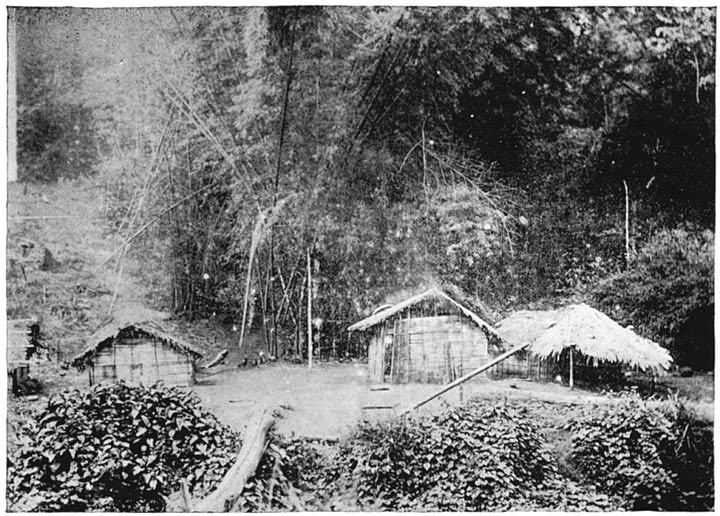
Kādir Huts.
The Kādirs afford a typical example of happiness without culture. Unspoiled by education, the advancing wave of which has not yet engulfed them, they still retain many of their simple “manners and customs.” Quite refreshing was it to hear the hearty shrieks of laughter of the nude curly-haired children, wholly illiterate, and happy in their ignorance, as they played at funerals, or indulged in the amusement of making mud pies, and scampered off to their huts on my appearance. The uncultured Kādir, living a hardy out-door life, and capable of appreciating to the full the enjoyment of an “apathetic rest” as perfect bliss, has, I am convinced, in many ways, the advantage over the poor under-fed student with a small-paid appointment under Government as the narrow goal to which the laborious passing of examination tests leads.
Living an isolated existence, confined within the thinly-populated jungle, where Nature furnishes the means of obtaining all the necessaries of life, the Kādir possesses little, if any, knowledge of cultivation, and objects to doing work with a māmuti, the instrument which serves the gardener in the triple capacity of spade, rake, and hoe. But armed with a keen-edged bill-hook he is immense. As Mr. O. H. Bensley says:8 “The axiom that the less civilised men are, the more they are able to do every thing for themselves, is well illustrated by the hill-man, who is full of resource. Give him a simple bill-hook, and what wonders he will perform. He will build houses out of etâh, so neat and comfortable as to be positively luxurious. He will bridge a stream with canes and branches. He will make a raft out of bamboo, a carving knife out of etâh, a comb out of bamboo, a fishing-line out of fibre, and fire from dry wood. He will find food for you where you think you must starve, and show you the branch which, if cut, will give you drink. He will set traps for beasts and birds, which are more effective than some of the most elaborate products of machinery.” A European, overtaken by night in the jungle, unable to light fire by friction or to climb trees to gather fruits, ignorant of the edible roots and berries, and afraid of wild beasts, would, in the absence of comforts, be quite as unhappy and ill-at-ease as a Kādir surrounded by plenty at an official dinner party.
At the forest depôt the Kādir settlement consists of neatly constructed huts, made of bamboo deftly split with a bill-hook in their long axis, thatched with leaves of the teak tree (Tectona grandis) and bamboo (Ochlandra travancorica), and divided off into verandah and compartments by means of bamboo partitions. But the Kādirs are essentially nomad in habit, living in small communities, and shifting from place to place in the jungle, whence they suddenly re-appear as casually as if they had only returned from a morning stroll instead of a long camping expedition. When wandering in the jungle, the Kādirs make a rough lean-to shed covered over with leaves, and keep a small fire burning through the night, to keep off bears, elephants, tigers, and leopards. They are, I am told, fond of dogs, which they keep chiefly as a protection against wild beasts at night. The camp fire is lighted by means of a flint and the floss of the silk-cotton tree (Bombax malabaricum), over which powdered charcoal has been rubbed. Like the Kurumbas, the Kādirs are not, in a general way, afraid of elephants, but are careful to get out of the way of a cow with young, or a solitary rover, which may mean mischief. On the day following my descent from Mount Stuart, an Oddē cooly woman was killed on the ghāt road by a solitary tusker. Familiarity with wild beasts, and comparative immunity from accident, have bred contempt for them, and the Kādirs will go where the European, fresh to elephant land, fears to tread, or conjures every creak of a bamboo into the approach of a charging tusker. As an example of pluck worthy of a place in Kipling’s ‘Jungle-book,’ I may cite the case of a hill-man and his wife, who, overtaken by night in the jungle, decided to pass it on a rock. As they slept, a tiger carried off the woman. Hearing her shrieks, the sleeping man awoke, and followed in pursuit in the vain hope of saving his wife. Coming on the beast in possession of the mangled corpse, he killed it at close quarters with a spear. Yet he was wholly unconscious that he had performed an act of heroism worthy of the bronze cross ‘for valour.’
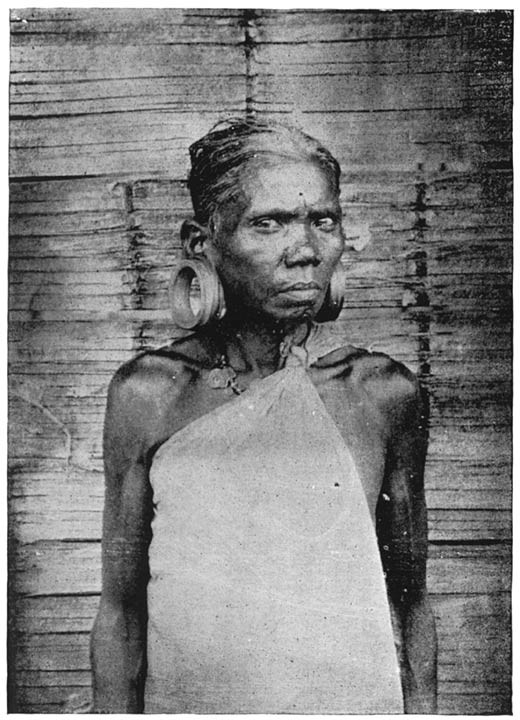
Kādir.
The Kādirs carry loads strapped on the back over the shoulders by means of fibre, instead of on the head in the manner customary among coolies in the plains; and women on the march may be seen carrying the cooking utensils on their backs, and often have a child strapped on the top of their household goods. The dorsal position of the babies, huddled up in a dirty cloth, with the ends slung over the shoulders and held in the hands over the chest, at once caught my eye, as it is contrary to the usual native habit of straddling the infants across the loins as a saddle.
Mr. Vincent informs me that “when the planters first came to the hills, the Kādirs were found practically without clothes of any description, with very few ornaments, and looking very lean and emaciated. All this, however, changed with the advent of the European, as the Kādirs then got advances in hard cash, clothes, and grain, to induce them to work. For a few years they tried to work hard, but were failures, and now I do not suppose that a dozen men are employed on the estates on the hills. They would not touch manure owing to caste scruples; they could not learn to prune; and with a mamoti (spade) they always promptly proceeded to chop their feet about in their efforts to dig pits.” The Kādirs have never claimed, like the Todas, and do not possess any land on the hills. But the Government has declared the absolute right of the hill tribes to collect all the minor forest produce, and to sell it to the Government through the medium of a contractor, whose tender has been previously accepted. The contractor pays for the produce in coin at a fair market rate, and the Kādirs barter the money so obtained for articles of food with contractors appointed by Government to supply them with their requirements at a fixed rate, which will leave a fair, but not exorbitant margin of profit to the vendor. The principal articles of minor forest produce of the Ānaimalai hills are wax, honey, cardamoms, myrabolams, ginger, dammer, turmeric, deer horns, elephant tusks, and rattans. And of these, cardamoms, wax, honey, and rattans are the most important. Honey and wax are collected at all seasons, and cardamoms from September to November. The total value of the minor produce collected, in 1897–98, in the South Coimbatore division (which includes the Ānaimalais) was Rs. 7,886. This sum was exceptionally high owing to a good cardamom crop. An average year would yield a revenue of Rs. 4,000–5,000, of which the Kādirs receive approximately 50 per cent. They work for the Forest Department on a system of short advances for a daily wage of 4 annas. And, at the present day, the interests of the Forest Department and planters, who have acquired land on the Ānaimalais, both anxious to secure hill men for labour, have come into mild collision.
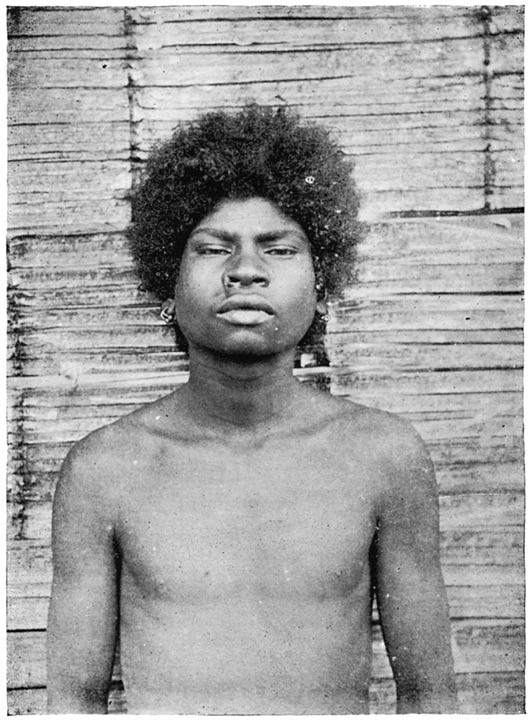
Kādir.
Some Kādirs are good trackers, and a few are good shikāris. A zoological friend, who had nicknamed his small child his “little shikarī” (=little sportsman) was quite upset because I, hailing from India, did not recognise the word with his misplaced accent. One Kādir, named Viapoori Muppan, is still held in the memory of Europeans, who made a good living, in days gone by, by shooting tuskers, and had one arm blown off by the bursting of a gun. He is reputed to have been a much married man, greatly addicted to strong drinks, and to have flourished on the proceeds of his tusks. At the present day, if a Kādir finds tusks, he must declare the find as treasure-trove, and hand it over to Government, who rewards him at the rate of Rs. 15 to Rs. 25 per maund of 25 lb. according to the quality. Government makes a good profit on the transaction, as exceptionally good tusks have been known to sell for Rs. 5 per lb. If the find is not declared, and discovered, the possessor thereof is punished for theft according to the Act. By an elastic use of the word cattle, it is, for the purposes of the Madras Forest Act, made to include such a heterogeneous zoological collection of animals as elephants, sheep, pigs, goats, camels, buffaloes, horses—and asses. This classification recalls to mind the occasion on which the Flying-fox or Fox-bat was included in an official list of the insectivorous birds of the Presidency; and, further, a report on the wild animals of a certain district, which was triumphantly headed with the “wild tattu,” the long-suffering, but pig-headed country pony.
I gather, from an account of the process by one who had considerable knowledge of the Kādirs, that “they will only remove the hives of bees during dark nights, and never in the daytime or on moonlight nights. In removing them from cliffs, they use a chain made of bamboo or rattan, fixed to a stake or a tree on the top. The man, going down this fragile ladder, will only do so while his wife, or son watches above to prevent any foul play. They have a superstition that they should always return by the way they go down, and decline to get to the bottom of the cliff, although the distance may be less, and the work of re-climbing avoided. For hives on trees, they tie one or more long bamboos to reach up to the branch required, and then climb up. They then crawl along the branch until the hive is reached. They devour the bee-bread and the bee-maggots or larvæ, swallowing the wax as well.” In a note on a shooting expedition in Travancore,9 Mr. J. D. Rees, describing the collection of honey by the Kādirs of the southern hills, says that they “descend giddy precipices at night, torch in hand, to smoke out the bees, and take away their honey. A stout creeper is suspended over the abyss, and it is established law of the jungle that no brother shall assist in holding it. But it is more interesting to see them run a ladder a hundred feet up the perpendicular stem of a tree, than to watch them disappearing over a precipice. Axe in hand, the honey-picker makes a hole in the bark for a little peg, standing on which he inserts a second peg higher up, ties a long cane from one to the other, and by night—for the darkness gives confidence—he will ascend the tallest trees, and bring down honey without any accident.” I have been told, with how much of truth I know not, that, when a Kādir goes down the face of a rock or precipice in search of honey, he sometimes takes with him, as a precautionary measure, and guarantee of his safety, the wife of the man who is holding the ladder above.
Often, when out on the tramp with the late Government Botanist, Mr. M. A. Lawson, I have heard him lament that it is impossible to train arboreal monkeys to collect specimens of the fruit and flowers of lofty forest trees, which are inaccessible to the ordinary man. Far superior to any trained Simian is the Kādir, who, by means of pegs or notches, climbs even the tallest masts of trees with an agility which recalls to memory the celebrated picture in “Punch,” representing Darwin’s ‘Habit of climbing plants.’ For the ascent of comparatively low trees, notches are made with a bill-hook, alternately right and left, at intervals of about thirty inches. To this method the Kādir will not have recourse in wet weather, as the notches are damp and slippery, and there is the danger of an insecure foot-hold.
An important ethnographic fact, and one which is significant, is that the detailed description of tree-climbing by the Dyaks of Borneo, as given by Wallace,10 might have been written on the Ānaimalai hills, and would apply equally well in every detail to the Kādir. “They drove in,” Wallace writes, “a peg very firmly at about three feet from the ground, and, bringing one of the long bamboos, stood it upright close to the tree, and bound it firmly to the two first pegs by means of a bark cord and small notches near the head of each peg. One of the Dyaks now stood on the first peg and drove in a third about level with his face, to which he tied the bamboo in the same way, and then mounted another step, standing on one foot, and holding by the bamboo at the peg immediately above him, while he drove in the next one. In this manner he ascended about twenty feet, when the upright bamboo became thin; another was handed up by his companion, and this was joined on by tying both bamboos to three or four of the pegs. When this was also nearly ended, a third was added, and shortly after the lowest branch of the tree was reached, along which the young Dyak scrambled. The ladder was perfectly safe, since, if any one peg were loose or faulty, the strain would be thrown on several others above and below it. I now understood the use of the line of bamboo pegs sticking in trees, which I had often seen.”
In their search for produce in the evergreen forests of the higher ranges, with their heavy rainfall, the Kādirs became unpleasantly familiar with leeches and blue bottle flies, which flourish in the moist climate. And it is recorded that a Kādir, who had been gored and wounded by a bull ‘bison,’ was placed in a position of safety while a friend ran to the village to summon help. He was not away for more than an hour, but, in that short time, flies had deposited thousands of maggots in the wounds, and, when the man was brought into camp, they had already begun burrowing into the flesh, and were with difficulty extracted. On another occasion, the eye-witness of the previous unappetising incident was out alone in the forest, and shot a tiger two miles or so from his camp. Thither he went to collect coolies to carry in the carcase, and was away for about two hours, during which the flies had, like the child in the story, ‘not been idle,’ the skin being a mass of maggots and totally ruined. I have it on authority that, like the Kotas of the Nīlgiris, the Kādirs will eat the putrid and fly-blown flesh of carcases of wild beasts, which they come across in their wanderings. To a dietary which includes succulent roots, which they upturn with a digging stick, bamboo seed, sheep, fowls, rock-snakes (python), deer, porcupines, rats (field, not house), wild pigs, monkeys, etc., they do credit by displaying a hard, well-nourished body. The mealy portion of the seeds of the Cycas tree, which flourishes on the lower slopes of the Ānaimalais, forms a considerable addition to the ménu. In its raw state the fruit is said to be poisonous, but it is evidently wholesome when cut into slices, thoroughly soaked in running water, dried, and ground into flour for making cakes, or baked in hot ashes. Mr. Vincent writes that, “during March, April, and May, the Kādirs have a glorious time. They usually manage to find some wild sago palms, called by them koondtha panai, of the proper age, which they cut down close to the ground. They are then cut into lengths of about 1½ feet, and split lengthways. The sections are then beaten very hard and for a long time with mallets, and become separated into fibre and powder. The powder is thoroughly wetted, tied in cloths and well beaten with sticks. Every now and then, between the beatings, the bag of powder is dipped in water, and well strained. It is then all put into water, when the powder sinks, and the water is poured off. The residue is well boiled, with constant stirring, and, when it is of the consistency of rubber, and of a reddish brown colour, it is allowed to cool, and then cut in pieces to be distributed. This food stuff is palatable enough, but very tough.” The Kādir is said to prefer roasting and eating the flesh of animals with the skin on. For catching rats, jungle-fowl, etc., he resorts to cunningly devised snares and traps made of bamboo and fibre, as a substitute for a gun. Porcupines are caught by setting fire to the scrub jungle round them as they lie asleep, and thus smoking and burning them to death.
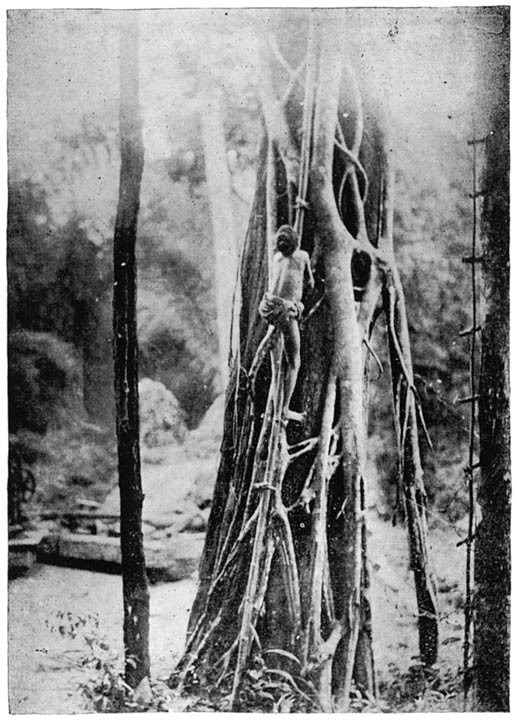
Kādir Tree-climbing.
When a Kādir youth’s thoughts turn towards matrimony, he is said to go to the village of his bride-elect, and give her a dowry by working there for a year. On the wedding day a feast of rice, sheep, fowls, and other luxuries is given by the parents of the bridegroom, to which the Kādir community is invited. The bride and bridegroom stand beneath a pandal (arch) decorated with flowers, which is erected outside the home of the bridegroom, while men and women dance separately to the music of drum and fife. The bridegroom’s mother or sister ties the tāli (marriage badge) of gold or silver round the bride’s neck, and her father puts a turban on the head of the bridegroom. The contracting parties link together the little fingers of their right hands as a token of their union, and walk in procession round the pandal. Then, sitting on a reed mat of Kādir manufacture, they exchange betel. The marriage tie can be dissolved for incompatibility of temper, disobedience on the part of the wife, adultery, etc., without appeal to any higher authority than a council of elders, who pronounce judgment on the evidence. As an illustration of the manner in which such a council of hill-men disposes of cases, Mr. Bensley cites the case of a man who was made to carry forty basket loads of sand to the house of the person against whom he had offended. He points out how absolute is the control exercised by the council. Disobedience would be followed by excommunication, and this would mean being turned out into the jungle, to obtain a living in the best way one could.
By one Kādir informant I was assured, as he squatted on the floor of my bungalow at “question time,” that it is essential that a wife should be a good cook, in accordance with a maxim that the way to the heart is through the mouth. How many men in civilised western society, who suffer from marrying a wife wholly incompetent, like the first Mrs. David Copperfield, to conduct the housekeeping, might well be envious of the system of marriage as a civil contract to be sealed or unloosed according to the cookery results! Polygyny is indulged in by the Kādirs, who agree with Benedick that “the world must be peopled,” and hold more especially that the numerical strength of their own tribe must be maintained. The plurality of wives seems to be mainly with the desire for offspring, and the father-in-law of one of the forest-guards informed me that he had four wives living. The first two wives producing no offspring, he married a third, who bore him a solitary male child. Considering the result to be an insufficient contribution to the tribe, he married a fourth, who, more prolific than her colleagues, gave birth to three girls and a boy, with which he remained content. In the code of polygynous etiquette, the first wife takes precedence over the others, and each wife has her own cooking utensils.
Special huts are maintained for women during menstruation and parturition. Mr. Vincent informs me that, when a girl reaches puberty, the friends of the family gather together, and a great feast is prepared. All her friends and relations give her a small present of money, according to their means. The girl is decorated with the family jewelry, and made to look as smart as possible. For the first menstrual period, a special hut, called mutthu salai or ripe house, is constructed for the girl to live in during the period of pollution; but at subsequent periods, the ordinary menstruation hut, or unclean house, is used. All girls are said to change their names when they reach puberty. For three months after the birth of a child, the woman is considered unclean. When the infant is a month old, it is named without any elaborate ceremonial, though the female friends of the family collect together. Sexual intercourse ceases on the establishment of pregnancy, and the husband indulges in promiscuity. Widows are not allowed to re-marry, but may live in a state of concubinage. Women are said to suckle their children till they are two or three years old, and a mother has been seen putting a lighted cigarette to the lips of a year old baby immediately after suckling it. If this is done with the intention of administering a sedative, it is less baneful than the pellet of opium administered by ayahs (nurses) to Anglo-Indian babies rendered fractious by troubles climatic, dental, and other. The Kādir men are said to consume large quantities of opium, which is sold to them illicitly. They will not allow the women or children to eat it, and have a belief that the consumption thereof by women renders them barren. The women chew tobacco. The men smoke the coarse tobacco as sold in the bazars, and showed a marked appreciation of Spencer’s Torpedo cheroots, which I distributed among them for the purposes of bribery and conciliation.
The religion of the Kādirs is a crude polytheism, and vague worship of stone images or invisible gods. It is, as Mr. Bensley expresses it, an ejaculatory religion, finding vent in uttering the names of the gods and demons. The gods, as enumerated and described to me, were as follows:—
(1) Paikutlātha, a projecting rock overhanging a slab of rock, on which are two stones set up on end. Two miles east of Mount Stuart.
(2) Athuvisariamma, a stone enclosure, ten to fifteen feet square, almost level with the ground. It is believed that the walls were originally ten feet high, and that the mountain has grown up round it. Within the enclosure there is a representation of the god. Eight miles north of Mount Stuart.
(3) Vanathavāthi. Has no shrine, but is worshipped anywhere as an invisible god.
(4) Iyappaswāmi, a stone set up beneath a teak tree, and worshipped as a protector against various forms of sickness and disease. In the act of worshipping, a mark is made on the stone with ashes. Two miles and a half from Mount Stuart, on the ghāt road to Sēthumadai.
(5) Māsanyātha, a female recumbent figure in stone on a masonry wall in an open plain near the village of Ānaimalai, before which trial by ordeal is carried out. The goddess has a high repute for her power of detecting thieves or rogues. Chillies are thrown into a fire in her name, and the guilty person suffers from vomiting and diarrhœa.
According to Mr. L. K. Anantha Krishna Iyer,11 the Kādirs are “worshippers of Kāli. On the occasion of the offering to Kāli, a number of virgins are asked to bathe as a preliminary to the preparation of the offering, which consists of rice and some vegetables cooked in honey, and made into a sweet pudding. The rice for this preparation is unhusked by these girls. The offering is considered to be sacred, and is partaken of by all men, women, and children assembled.”
When Kādirs fall sick, they worship the gods by saluting them with their hands to the face, burning camphor, and offering up fruits, cocoanuts, and betel. Mr. Vincent tells me that they have a horror of cattle, and will not touch the ordure, or other products of the cow. Yet they believe that their gods occasionally reside in the body of a “bison,” and have been known to do pūja (worship) when a bull has been shot by a sportsman. It is noted by Mr. Anantha Krishna Iyer that wild elephants are held in veneration by them, but tame ones are believed to have lost the divine element.
The Kādirs are said, during the Hindu Vishu festival, to visit the plains, and, on their way, pray to any image which they chance to come across. They are believers in witchcraft, and attribute all diseases to the miraculous workings thereof. They are good exorcists, and trade in mantravādam or magic. Mr. Logan mentions12 that “the family of famous trackers, whose services in the jungles were retained for H.R.H. the Prince of Wales’ (now King Edward) projected sporting tour in the Ānamalai mountains, dropped off most mysteriously, one by one, shortly afterwards, stricken down by an unseen hand, and all of them expressing beforehand their conviction that they were under a certain individual’s spell, and were doomed to certain death at an early date. They were probably poisoned, but how it was managed remains a mystery, although the family was under the protection of a European gentleman, who would at once have brought to light any ostensible foul play.”
The Kādir dead are buried in a grave, or, if death occurs in the depths of the jungles, with a paucity of hands available for digging, the corpse is placed in a crevice between the rocks, and covered over with stones. The grave is dug from four to five feet deep. There is no special burial-ground, but some spot in the jungle, not far from the scene of death, is selected. A band of music, consisting of drum and fife, plays weird dirges outside the hut of the deceased, and whistles are blown when it is carried away therefrom. The old clothes of the deceased are spread under the corpse, and a new cloth is put on it. It is tied up in a mat, which completely covers it, and carried to the burial-ground on a bamboo stretcher. As it leaves the hut, rice is thrown over it. The funeral ceremony is simple in the extreme. The corpse is laid in the grave on a mat in the recumbent posture, with the head towards the east, and with split bamboo and leaves placed all round it, so that not a particle of earth can touch it. No stone, or sepulchral monument of any kind, is set up to mark the spot. The Kādir believes that the dead go to heaven, which is in the sky, but has no views as to what sort of place it is. The story that the Kādirs eat their dead originated with Europeans, the origin of it being that no one had ever seen a dead Kādir, a grave, or sign of a burial-place. The Kādirs themselves are reticent as to their method of disposing of the dead, and the story, which was started as a joke, became more or less believed. Mr. Vincent tells me that a well-to-do Kādir family will perform the final death ceremonies eight days after death, but poorer folk have to wait a year or more, till they have collected sufficient money for the expenses thereof. At cock-crow on the morning of the ceremonies, rice, called polli chor, is cooked, and piled up on leaves in the centre of the hut of the deceased. Cooked rice, called tullagu chor, is then placed in each of the four corners of the hut, to propitiate the gods, and to serve as food for them and the spirit of the dead person. At a short distance from the hut, rice, called kanal chor, is cooked for all Kādirs who have died, and been buried. The relations and friends of the deceased commence to cry, and make lamentations, and proclaim his good qualities, most of which are fictitious. After an hour or so, they adjourn to the hut of the deceased, where the oldest man present invokes the gods, and prays to them and to the heaped up food. A pinch from each of the heaps is thrown into the air as a gift of food to the gods, and those present fall to, and eat heartily, being careful to partake of each of the food-stuffs, consisting of rice, meat, and vegetables, which have been prepared.
On a certain Monday in the months of Ādi and Āvani, the Kādirs observe a festival called nōmbu, during which a feast is held, after they have bathed and anointed themselves with oil. It was, they say, observed by their ancestors, but they have no definite tradition as to its origin or significance. It is noted by Mr. Anantha Krishna Iyer that, at the Ōnam festival, presents in the shape of rice, cloths, coats, turbans, caps, ear-rings, tobacco, opium, salt, oil and cocoanuts are distributed among the Kādirs by the Forest Department.
According to Mr. Bensley, “the Kādir has an air of calm dignity, which leads one to suppose that he had some reason for having a more exalted opinion of himself than that entertained for him by the outside world. A forest officer of a philanthropic turn had a very high opinion of the sturdy independence and blunt honesty of the Kādir, but he once came unexpectedly round a corner, to find two of them exploring the contents of his port-manteau, from which they had abstracted a pair of scissors, a comb, and a looking glass.” “The Kādirs,” Mr. (now Sir F. A.) Nicholson writes,13 “are, as a rule, rather short in stature, and deep-chested, like most mountaineers; and, like many true mountaineers, they rarely walk with a straight leg. Hence their thigh muscles are often abnormally developed at the expense of those of the calf. Hence, too, in part, their dislike to walking long distances on level ground, though their objection, mentioned by Colonel Douglas Hamilton, to carrying loads on the plains, is deeper-rooted than that arising from mere physical disability. This objection is mainly because they are rather a timid race, and never feel safe out of the forests. They have also affirmed that the low-country air is very trying to them.” As a matter of fact, they very rarely go down to the plains, even as far as the village of Ānaimalai, only fifteen miles distant from Mount Stuart. One woman, whom I saw, had been as far as Palghāt by railway from Coimbatore, and had returned very much up-to-date in the matter of jewelry and the latest barbarity in imported piece-good body-cloth.
With the chest-girth of the Kādirs, as well as their general muscular development, I was very much impressed. Their hardiness, Mr. Conner writes,14 has given rise to the observation among their neighbours that the Kādir and Kād Ānai (wild elephant) are much the same sort of animal.
Perhaps the most interesting custom of the Kādirs is that of chipping all or some of the incisor teeth, both upper and lower, into the form of a sharp-pointed, but not serrated cone. The operation, which is performed with a chisel or bill-hook and file by members of the tribe skilled therein, on boys and girls, has been thus described. The girl to be operated on lies down, and places her head against a female friend, who holds her head firmly. A woman takes a sharpened bill-hook, and chips away the teeth till they are shaded to a point, the girl operated on writhing and groaning with the pain. After the operation she appears dazed, and in a very few hours the face begins to swell. Swelling and pain last for a day or two, accompanied by severe headache. The Kādirs say that chipped teeth make an ugly man or woman handsome, and that a person, whose teeth have not been thus operated on, has teeth and eats like a cow. Whether this practice is one which the Kādir, and Mala Vēdar of Travancore, have hit on spontaneously in comparatively recent times, or whether it is a relic of a custom resorted to by their ancestors of long ago, which remains as a stray survival of a custom once more widely practiced by the remote inhabitants of Southern India, cannot be definitely asserted, but I incline to the latter view.
A friendly old woman, with huge discs in the widely dilated lobes of the ears, and a bamboo five-pronged comb in her back-hair, who acted as spokesman on the occasion of a visit to a charmingly situated settlement in a jungle of magnificent bamboos by the side of a mountain stream, pointed out to me, with conscious pride, that the huts were largely constructed by the females, while the men worked for the sircar (Government). The females also carry water from the streams, collect firewood, dig up edible roots, and carry out the sundry household duties of a housewife. Both men and women are clever at plaiting bamboo baskets, necklets, etc. I was told one morning by a Kādir man, whom I met on the road, as an important item of news, that the women in his settlement were very busy dressing to come and see me—an event as important to them as the dressing of a débutante for presentation at the Court of St. James’. They eventually turned up without their husbands, and evidently regarded my methods as a huge joke organised for the amusement of themselves and their children. The hair was neatly parted, anointed with a liberal application of cocoanut oil, and decked with wild flowers. Beauty spots and lines had been painted with coal-tar dyes on the forehead, and turmeric powder freely sprinkled over the top of the heads of the married women. Some had even discarded the ragged and dirty cotton cloth of every-day life in favour of a colour-printed imported sāri. One bright, good-looking young woman, who had already been through the measuring ordeal, acted as an efficient lady-help in coaching the novices in the assumption of the correct positions. She very readily grasped the situation, and was manifestly proud of her temporary elevation to the rank of standard-bearer to Government.
1 Gazetteer of the Bellary district.
2 Madras Diocesan Magazine, June, 1906.
3 John S. Chandler, a Madura Missionary, Boston.
4 Madras Mail, November, 1905.
5 J. Hornell. Report on the Indian Pearl Fisheries of the Gulf of Manaar, 1905.
6 Madras Diocesan Mag., 1906.
7 Notes from a Diary, 1881–86.
8 Lecture delivered at Trivandrum, MS.
9 Nineteenth Century, 1898.
10 Malay Archipelago.
11 Monograph. Ethnog: Survey of Cochin, No. 9, 1906.
12 Malabar Manual.
13 Manual of the Coimbatore district.
14 Madras Journ. Lit. Science, I. 1833.
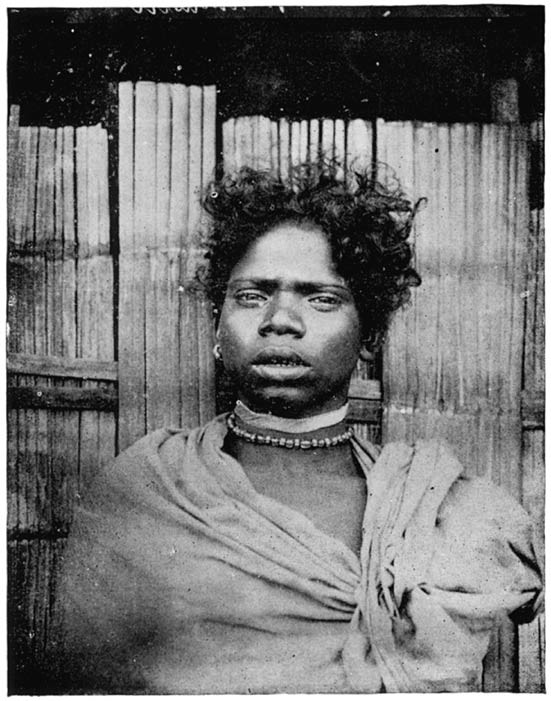
Kādir Boy with Chipped Teeth.
Dr. K. T. Preuss has drawn my attention to an article in Globus, 1899, entitled ‘Die Zauberbilder Schriften der Negrito in Malaka,’ wherein he describes in detail the designs on the bamboo combs worn by the Negritos of Malacca, and compares them with the strikingly similar design on the combs worn by the Kādir women. Dr. Preuss works out in detail the theory that the design is not, as I have elsewhere called it, a geometrical pattern, but consists of a series of hieroglyphics. The collection of Kādir combs in the Madras Museum shows very clearly that the patterns thereon are conventional designs. The bamboo combs worn by the Semang women are stated15 to serve as talismans, to protect them against diseases which are prevalent, or most dreaded by them. Mr. Vincent informs me that, so far as he knows, the Kādir combs are not looked on as charms, and the markings thereon have no mystic significance. A Kādir man should always make a comb, and present it to his intended wife just before marriage, or at the conclusion of the marriage ceremony, and the young men vie with each other as to who can make the nicest comb. Sometimes they represent strange articles on the combs. Mr. Vincent has, for example, seen a comb with a very good imitation of the face of a clock scratched on it.
It is sometimes difficult to distinguish adolescent Kādir youths with curly fringe, chests covered by a cotton cloth, and wearing necklets made of plaited grass or glass and brass beads, from girls. And I was myself several times caught in an erroneous diagnosis of sex. Many of the infants have a charm tied round the neck, which takes the form of a dried tortoise foot; the tooth of a crocodile mimicking a phallus, and supposed to ward off attacks from a mythical water elephant which lives in the mountain streams; or wooden imitations of tiger’s claws. One baby wore a necklet made of the seeds of Coix Lachryma-Jobi (Job’s tears). Males have the lobes of the ears adorned with brass ornaments, and the nostril pierced, and plugged with wood. The ear-lobes of the females are widely dilated with palm-leaf rolls or huge wooden discs, and they wear ear-rings, brass or steel bangles and finger-rings, and bead necklets.
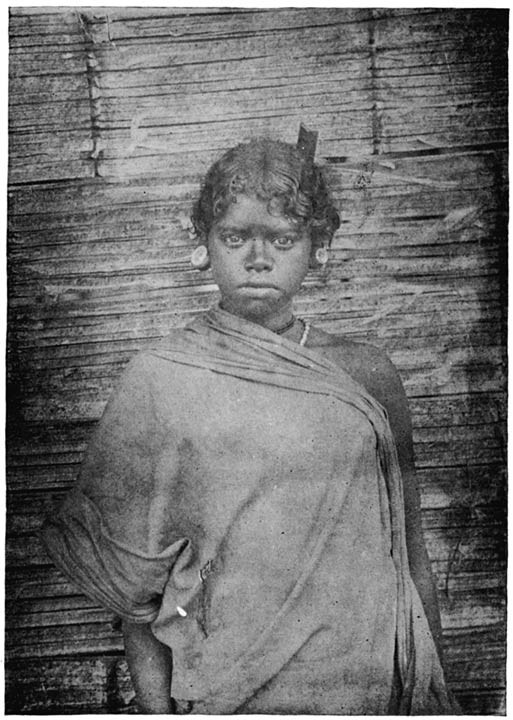
Kādir Girl Wearing Comb.
It is recorded by Mr. Anantha Krishna Iyer that the Kādirs are attached to the Rāja of Cochin “by the strongest ties of personal affection and regard. Whenever His Highness tours in the forests, they follow him, carry him from place to place in manjals or palanquins, carry sāman (luggage), and in fact do everything for him. His Highness in return is much attached to them, feeds them, gives them cloths, ornaments, combs, and looking-glasses.”
The Kādirs will not eat with Malasars, who are beef-eaters, and will not carry boots made of cow-hide, except under protest.
Average stature 157.7 cm.; cephalic index 72.9; nasal index 89.
Kadlē.—Kadlē, Kallē, and Kadalē meaning Bengal gram (Cicer arietinum) have been recorded as exogamous septs or gōtras of Kurubas and Kurnis.
Kādu.—Kādu or Kāttu, meaning wild or jungle, has been recorded as a division of Golla, Irula, Korava, Kurumba, and Tōttiyan. Kādu also occurs as an exogamous sept or gōtra of the Kurnis. Kādu Konkani is stated, in the Madras Census Report, 1901, to mean the bastard Konkanis, as opposed to the Gōd or pure Konkanis. Kāttu Marāthi is a synonym for the bird-catching Kuruvikarans. In the Malabar Wynaad, the jungle Kurumbas are known as Kāttu Nāyakan.
Kādukuttukiravar.—A synonym, meaning one who bores a hole in the ear, for Koravas who perform the operation of piercing the lobes of the ears for various castes.
Kaduppattan.—The Kadupattans are said,16 according to the traditional account of their origin, to have been Pattar Brāhmans of Kadu grāmam, who became degraded owing to their supporting the introduction of Buddhism. “The members of this caste are,” Mr. H. A. Stuart writes,17 “at present mostly palanquin-bearers, and carriers of salt, oil, etc. The educated among them follow the profession of teaching, and are called Ezhuttacchan, i.e., master of learning. Both titles are used in the same family. In the Native State of Cochin, the Kaduppattan is a salt-worker. In British Malabar he is not known to have followed that profession for some generations past, but it may be that, salt manufacture having long ago been stopped in South Malabar, he has taken to other professions, one of which is the carriage of salt. In manners and customs Kaduppattans resemble Nāyars, but their inheritance follows the male line.” The Kaduppattans are described18 by Mr. Logan as “a caste hardly to be distinguished from the Nāyars. They follow a modified makkatayam system of inheritance, in which the property descends from father to son, but not from father to daughter. The girls are married before attaining puberty, and the bridegroom, who is to be the girl’s real husband in after life, arranges the dowry and other matters by means of mediators (enangan). The tāli is tied round the girl’s neck by the bridegroom’s sister or a female relative. At the funeral ceremonies of this class, the barber caste perform priestly functions, giving directions and preparing oblation rice. A widow without male issue is removed on the twelfth day after her husband’s death from his house to that of her own parents. And this is done even if she has female issue. But, on the contrary, if she has borne sons to the deceased, she is not only entitled to remain at her husband’s house, but she continues to have, in virtue of her sons, a joint right over his property.”
Kahar.—In the Madras Census Report, 1901, the Kahars are returned as a Bengal caste of boatmen and fishermen. In the Mysore Census Report, it is noted that Kahar means in Hindustani a blacksmith, and that those censused were immigrants from the Bombay Presidency.
Kaikātti (one who shows the hand).—A division of the Kanakkans (accountants). The name has its origin in a custom, according to which a married woman is never allowed to communicate with her mother-in-law except by signs.19
Kaikōlan.—The Kaikōlans are a large caste of Tamil weavers found in all the southern districts, who also are found in considerable numbers in the Telugu country, where they have adopted the Telugu language. A legend is current that the Nāyakkan kings of Madura were not satisfied with the workmanship of the Kaikōlans, and sent for foreign weavers from the north (Patnūlkārans), whose descendants now far out-number the Tamil weavers. The word Kaikōlan is the Tamil equivalent of the Sanskrit Vīrabāhu, a mythological hero, from whom both the Kaikōlans and a section of the Paraiyans claim descent. The Kaikōlans are also called Sengundar (red dagger) in connection with the following legend. “The people of the earth, being harassed by certain demons, applied to Siva for help. Siva was enraged against the giants, and sent forth six sparks of fire from his eyes. His wife, Parvati, was frightened, and retired to her chamber, and, in so doing, dropped nine beads from her anklets. Siva converted the beads into as many females, to each of whom was born a hero with full-grown moustaches and a dagger. These nine heroes, with Subramanya at their head, marched in command of a large force, and destroyed the demons. The Kaikōlans or Sengundar are said to be the descendants of Virabāhu, one of these heroes. After killing the demon, the warriors were told by Siva that they should become musicians, and adopt a profession, which would not involve the destruction or injury of any living creature, and, weaving being such a profession, they were trained in it.”20 According to another version, Siva told Parvati that the world would be enveloped in darkness if he should close his eyes. Impelled by curiosity, Parvati closed her husband’s eyes with her hands. Being terrified by the darkness, Parvati ran to her chamber, and, on the way thither, nine precious stones fell from her anklets, and turned into nine fair maidens, with whom Siva became enamoured and embraced them. Seeing later on that they were pregnant, Parvati uttered a curse that they should not bring forth children formed in their wombs. One Padmasura was troubling the people in this world, and, on their praying to Siva to help them, he told Subramanya to kill the Asura. Parvati requested Siva not to send Subramanya by himself, and he suggested the withdrawal of her curse. Accordingly, the damsels gave birth to nine heroes, who, carrying red daggers, and headed by Subramanya, went in search of the Asura, and killed him. The word kaikōl is said to refer to the ratnavēl or precious dagger carried by Subramanya. The Kaikōlans, on the Sura Samharam day during the festival of Subramanya, dress themselves up to represent the nine warriors, and join in the procession.
The name Kaikōlan is further derived from kai (hand), and kōl (shuttle). The Kaikōlans consider the different parts of the loom to represent various Dēvatas and Rishis. The thread is said to have been originally obtained from the lotus stalk rising from Vishnu’s navel. Several Dēvas formed the threads, which make the warp; Nārada became the woof; and Vēdamuni the treadle. Brahma transformed himself into the plank (padamaram), and Adisēsha into the main rope.
In some places, the following sub-divisions of the caste are recognised:—Sōzhia; Rattu; Siru-tāli (small marriage badge); Peru-tāli (big marriage badge); Sirpādam, and Sevaghavritti. The women of the Siru and Peru-tāli divisions wear a small and large tāli respectively.
In religion, most of the Kaikōlans are Saivites, and some have taken to wearing the lingam, but a few are Vaishnavites.
The hereditary headman of the caste is called Peridanakāran or Pattakāran, and is, as a rule, assisted by two subordinates entitled Sengili or Grāmani, and Ūral. But, if the settlement is a large one, the headman may have as many as nine assistants.
According to Mr. H. A. Stuart,21 “the Kaikōlans acknowledge the authority of a headman, or Mahānāttan, who resides at Conjeeveram, but itinerates among their villages, receiving presents, and settling caste disputes. Where his decision is not accepted without demur, he imposes upon the refractory weavers the expense of a curious ceremony, in which the planting of a bamboo post takes part. From the top of this pole the Mahānāttan pronounces his decision, which must be acquiesced in on pain of excommunication.” From information gathered at Conjeeveram, I learn that there is attached to the Kaikōlans a class of mendicants called Nattukattāda Nāyanmar. The name means the Nāyanmar who do not plant, in reference to the fact that, when performing, they fix their bamboo pole to the gōpuram of a temple, instead of planting it in the ground. They are expected to travel about the country, and, if a caste dispute requires settlement, a council meeting is convened, at which they must be present as the representatives of the Mahānādu, a chief Kaikōlan head-quarters at Conjeeveram. If the dispute is a complicated one, the Nattukattāda Nāyanmar goes to all the Kaikōlan houses, and makes a red mark with laterite22 on the cloth in the loom, saying “Āndvarānai,” as signifying that it is done by order of the headman. The Kaikōlans may, after this, not go on with their work until the dispute is settled, for the trial of which a day is fixed. The Nattukattāda Nāyanmars set up on a gōpuram their pole, which should have seventy-two internodes, and measure at least as many feet. The number of internodes corresponds to that of the nādus into which the Kaikōlan community is divided. Kamātchiamma is worshipped, and the Nattukattāda Nāyanmars climb up the pole, and perform various feats. Finally, the principal actor balances a young child in a tray on a bamboo, and, letting go of the bamboo, catches the falling child. The origin of the performance is said to have been as follows. The demon Sūran was troubling the Dēvas and men, and was advised by Karthikēya (Subramanya) and Vīrabāhu to desist from so doing. He paid no heed, and a fight ensued. The demon sent his son Vajrabāhu to meet the enemy, and he was slain by Vīrabāhu, who displayed the different parts of his body in the following manner. The vertebral column was made to represent a pole, round which the other bones were placed, and the guts tightly wound round them. The connective tissues were used as ropes to support the pole. The skull was used as a jaya-mani (conquest bell), and the skin hoisted as a flag. The trident of Vīrabāhu was fixed to the top of the pole, and, standing over it, he announced his victory over the world. The Nattukattāda Nāyanmars claim to be the descendants of Vīrabāhu. Their head-quarters are at Conjeeveram. They are regarded as slightly inferior to the Kaikōlans, with whom ordinarily they do not intermarry. The Kaikōlans have to pay them as alms a minimum fee of four annas per loom annually. Another class of mendicant, called Ponnambalaththar, which is said to have sprung up recently, poses as true caste beggars attached to the Kaikōlans, from whom, as they travel about the country, they solicit alms. Some Kaikōlans gave Ontipuli as the name of their caste beggars. The Ontipulis, however, are Nokkans attached to the Pallis.
The Kaikōlan community is, as already indicated, divided into seventy-two nādus or dēsams, viz., forty-four mēl (western) and twenty-eight kīl (eastern) nādus. Intermarriages take place between members of seventy-one of these nādus. The great Tamil poet Ottaikūththar is said to have belonged to the Kaikōlan caste and to have sung the praises of all castes except his own. Being angry on this account, the Kaikōlans urged him to sing in praise of them. This he consented to do, provided that he received 1,008 human heads. Seventy-one nādus sent the first-born sons for the sacrifice, but one nādu (Tirumarudhal) refused to send any. This refusal led to their isolation from the rest of the community. All the nādus are subject to the authority of four thisai nādus, and these in turn are controlled by the mahānādu at Conjeeveram, which is the residence of the patron deity Kamātchiamman. The thisai nādus are (1) Sīvapūram (Walajabad), east of Conjeeveram, where Kamātchiamman is said to have placed Nandi as a guard; (2) Thondipūram, where Thondi Vinayakar was stationed; (3) Virinjipūram to the west, guarded by Subramanya; (4) Sholingipūram to the south, watched over by Bairava. Each of the seventy-one nādus is sub-divided into kilai grāmams (branch villages), pērūr (big) and sithur (little) grāmams. In Tamil works relating to the Sengundar caste, Conjeeveram is said to be the mahānādu, and those belonging thereto are spoken of as the nineteen hundred, who are entitled to respect from other Kaikōlans. Another name for Kaikōlans of the mahānādu seems to be Āndavar; but in practice this name is confined to the headman of the mahānādu, and members of his family. They have the privilege of sitting at council meetings with their backs supported by pillows, and consequently bear the title Thindusarndān (resting on pillows). At present there are two sections of Kaikōlans at Conjeeveram, one living at Ayyampettai, and the other at Pillaipālayam. The former claim Ayyampettai as the mahānādu, and refuse to recognise Pillaipālayam, which is in the heart of Conjeeveram, as the mahānādu. Disputes arose, and recourse was had to the Vellore Court in 1904, where it was decided that Ayyampettai possesses no claim to be called the mahānādu.
Many Kaikōlan families have now abandoned their hereditary employment as weavers in favour of agriculture and trade, and some of the poorer members of the caste work as cart-drivers and coolies. At Coimbatore some hereditary weavers have become cart-drivers, and some cart-drivers have become weavers de necessité in the local jail.
In every Kaikōlan family, at least one girl should be set apart for, and dedicated to temple service. And the rule seems to be that, so long as this girl or her descendants, born to her or adopted, continue to live, another girl is not dedicated. But, when the line becomes extinct, another girl must be dedicated. All the Kaikōlans deny their connection with the Dēva-dāsi (dancing-girl) caste. But Kaikōlans freely take meals in Dāsi houses on ceremonial occasions, and it would not be difficult to cite cases of genuine Dāsis who have relationship with rich Kaikōlans.
Kaikōlan girls are made Dāsis either by regular dedication to a temple, or by the headman tying the tāli (nāttu pottu). The latter method is at the present day adopted because it is considered a sin to dedicate a girl to the god after she has reached puberty, and because the securing of the requisite official certificate for a girl to become a Dāsi involves considerable trouble.
“It is said,” Mr. Stuart writes,23 “that, where the head of a house dies, leaving only female issue, one of the girls is made a Dāsi in order to allow of her working like a man at the loom, for no woman not dedicated in this manner may do so.”
Of the orthodox form of ceremonial in connection with a girl’s initiation as a Dāsi, the following account was given by the Kaikōlans of Coimbatore. The girl is taught music and dancing. The dancing master or Nattuvan, belongs to the Kaikōlan caste, but she may be instructed in music by Brāhman Bhāgavathans. At the tāli-tying ceremony, which should take place after the girl has reached puberty, she is decorated with jewels, and made to stand on a heap of paddy (unhusked rice). A folded cloth is held before her by two Dāsis, who also stand on heaps of paddy. The girl catches hold of the cloth, and her dancing master, who is seated behind her, grasping her legs, moves them up and down in time with the music, which is played. In the course of the day, relations and friends are entertained, and, in the evening, the girl, seated astride a pony, is taken to the temple, where a new cloth for the idol, the tāli, and various articles required for doing pūja, have been got ready. The girl is seated facing the idol, and the officiating Brāhman gives sandal and flowers to her, and ties the tāli, which has been lying at the feet of the idol, round her neck. The tāli consists of a golden disc and black beads. Betel and flowers are then distributed among those present, and the girl is taken home through the principal streets. She continues to learn music and dancing, and eventually goes through a form of nuptial ceremony. The relations are invited for an auspicious day, and the maternal uncle, or his representative, ties a gold band on the girl’s forehead, and, carrying her, places her on a plank before the assembled guests. A Brāhman priest recites the mantrams, and prepares the sacred fire (hōmam). The uncle is presented with new cloths by the girl’s mother. For the actual nuptials a rich Brāhman, if possible, and, if not, a Brāhman of more lowly status is invited. A Brāhman is called in, as he is next in importance to, and the representative of the idol. It is said that, when the man who is to receive her first favours, joins the girl, a sword must be placed, at least for a few minutes, by her side. When a Dāsi dies, her body is covered with a new cloth removed from the idol, and flowers are supplied from the temple, to which she belonged. No pūja is performed in the temple till the body is disposed of, as the idol, being her husband, has to observe pollution.
Writing a century ago (1807) concerning the Kaikōlan Dāsis, Buchanan says24 that “these dancing women, and their musicians, now form a separate kind of caste; and a certain number of them are attached to every temple of any consequence. The allowances which the musicians receive for their public duty is very small, yet, morning and evening, they are bound to attend at the temple to perform before the image. They must also receive every person travelling on account of the Government, meet him at some distance from the town, and conduct him to his quarters with music and dancing. All the handsome girls are instructed to dance and sing, and are all prostitutes, at least to the Brāhmans. In ordinary sets they are quite common; but, under the Company’s government, those attached to temples of extraordinary sanctity are reserved entirely for the use of the native officers, who are all Brāhmans, and who would turn out from the set any girl that profaned herself by communication with persons of low caste, or of no caste at all, such as Christians or Mussulmans. Indeed, almost every one of these girls that is tolerably sightly is taken by some officer of revenue for his own special use, and is seldom permitted to go to the temple, except in his presence. Most of these officers have more than one wife, and the women of the Brāhmans are very beautiful; but the insipidity of their conduct, from a total want of education or accomplishment, makes the dancing women to be sought after by all natives with great avidity. The Mussulman officers in particular were exceedingly attached to this kind of company, and lavished away on these women a great part of their incomes. The women very much regret their loss, as the Mussulmans paid liberally, and the Brāhmans durst not presume to hinder any girl who chose, from amusing an Asoph, or any of his friends. The Brāhmans are not near so lavish of their money, especially where it is secured by the Company’s government, but trust to their authority for obtaining the favour of the dancers. To my taste, nothing can be more silly and unanimated than the dancing of the women, nor more harsh and barbarous than their music. Some Europeans, however, from long habit, I suppose, have taken a liking to it, and have even been captivated by the women. Most of them I have had an opportunity of seeing have been very ordinary in their looks, very inelegant in their dress, and very dirty in their persons; a large proportion of them have the itch, and a still larger proportion are most severely diseased.”
Though the Kaikōlans are considered to belong to the left-hand faction, Dāsis, except those who are specially engaged by the Bēri Chettis and Kammālans, are placed in the right-hand faction. Kaikōlan Dāsis, when passing through a Kammālan street, stop dancing, and they will not salute Kammālans or Bēri Chettis.
A peculiar method of selecting a bride, called siru tāli kattu (tying the small tāli), is said to be in vogue among some Kaikōlans. A man, who wishes to marry his maternal uncle’s or paternal aunt’s daughter, has to tie a tāli, or simply a bit of cloth torn from her clothing, round her neck, and report the fact to his parents and the headman. If the girl eludes him, he cannot claim her, but, should he succeed, she belongs to him. In some places, the consent of the maternal uncle to a marriage is signified by his carrying the bride in his arms to the marriage pandal (booth). The milk-post is made of Erythrina indica. After the tāli has been tied, the bridegroom lifts the bride’s left leg, and places it on a grinding-stone. Widows are stated by Mr. Stuart to be “allowed to remarry if they have no issue, but not otherwise; and, if the prevalent idea that a Kaikōla woman is never barren be true, this must seldom take place.”
On the final day of the death ceremonies, a small hut is erected, and inside it stones, brought by the barber, are set up, and offerings made to them.
The following proverbs are current about or among the Kaikōlans:—
Narrate stories in villages where there are no Kaikōlans.
Why should a weaver have a monkey?
This, it has been suggested,25 implies that a monkey would only damage the work.
On examining the various occupations, weaving will be found to be the best.
A peep outside will cut out eight threads.
The person who was too lazy to weave went to the stars.
The Chetti (money-lender) decreases the money, and the weaver the thread.
The titles of the Kaikōlans are Mūdali and Nāyanar.
Among the Kaikōlan musicians, I have seen every gradation of colour and type, from leptorhine men with fair skin and chiselled features, to men very dark and platyrhine, with nasal index exceeding 90.
The Kaikōlans take part in the annual festival at Tirupati in honour of the goddess Gangamma. “It is,” Mr. Stuart writes,26 “distinguished from the majority of similar festivals by a custom, which requires the people to appear in a different disguise (vēsham) every morning and evening. The Mātangi vēsham of Sunday morning deserves special mention. The devotee who consents to undergo this ceremony dances in front of an image or representation of the goddess, and, when he is worked up to the proper pitch of frenzy, a metal wire is passed through the middle of his tongue. It is believed that this operation causes no pain, or even bleeding, and the only remedy adopted is the chewing of a few margosa (Melia Azadirachta) leaves, and some kunkumam (red powder) of the goddess. This vēsham is undertaken only by a Kaikōlan (weaver), and is performed only in two places—the house of a certain Brāhman and the Mahant’s math. The concluding disguise is that known as the pērantālu vēsham. Pērantālu signifies the deceased married women of a family who have died before their husbands, or, more particularly, the most distinguished of such women. This vēsham is accordingly represented by a Kaikōlan disguised as a female, who rides round the town on a horse, and distributes to the respectable inhabitants of the place the kunkumam, saffron paste, and flowers of the goddess.”
For the following account of a ceremony, which took place at Conjeeveram in August, 1908, I am indebted to the Rev. J. H. Maclean. “On a small and very lightly built car, about eight feet high, and running on four little wheels, an image of Kāli was placed. It was then dragged by about thirty men, attached to it by cords passed through the flesh of their backs. I saw one of the young men two days later. Two cords had been drawn through his flesh, about twelve inches apart. The wounds were covered over with white stuff, said to be vibūthi (sacred ashes). The festival was organised by a class of weavers calling themselves Sankunram (Sengundar) Mudaliars, the inhabitants of seven streets in the part of Conjeeveram known as Pillaipalyam. The total amount spent is said to have been Rs. 500. The people were far from clear in their account of the meaning of the ceremony. One said it was a preventive of small-pox, but this view did not receive general support. Most said it was simply an old custom: what good it did they could not say. Thirty years had elapsed since the last festival. One man said that Kāli had given no commands on the subject, and that it was simply a device to make money circulate. The festival is called Pūntēr (flower car).”
In September, 1908, an official notification was issued in the Fort St. George Gazette to the following effect. “Whereas it appears that hook-swinging, dragging of cars by men harnessed to them by hooks which pierce their sides, and similar acts are performed during the Mariyamman festival at Samayapuram and other places in the Trichinopoly division, Trichinopoly district, and whereas such acts are dangerous to human life, the Governor in Council is pleased, under section 144, sub-section (5), of the Code of Criminal Procedure, 1898, to direct that the order of the Sub-divisional Magistrate, dated the 7th August, 1908, prohibiting such acts, shall remain in force until further orders.”
It is noted by Mr. F. R. Hemingway27 that, at Ratnagiri, in the Trichinopoly district, the Kaikōlans, in performance of a vow, thrust a spear through the muscles of the abdomen in honour of their god Sāhānayanar.
Kaila (measuring grain in the threshing-floor).—An exogamous sept of Māla.
Kaimal.—A title of Nāyars, derived from kai, hand, signifying power.
Kaipūda.—A sub-division of Holeya.
Kaivarta.—A sub-division of Kevuto.
Kāka (crow).—The legend relating to the Kāka people is narrated in the article on Koyis. The equivalent Kākī occurs as a sept of Mālas, and Kāko as a sept of Kondras.
Kākara or Kākarla (Momordica Charantia).—An exogamous sept of Kamma and Mūka Dora.
Kākirekka-vāndlu (crows’ feather people).—Mendicants who beg from Mutrāchas, and derive their name from the fact that, when begging, they tie round their waists strings on which crows’, paddy birds’ (heron) feathers, etc., are tied.
Kakka Kuravan.—A division of Kuravas of Travancore.
Kakkalan.—The Kakkalans or Kakkans are a vagrant tribe met with in north and central Travancore, who are identical with the Kakka Kuravans of south Travancore. There are among them four endogamous divisions called Kavitiyan, Manipparayan, Meluttan, and Chattaparayan, of which the two first are the most important. The Kavitiyans are further sub-divided into Kollak Kavitiyan residing in central Travancore, Malayālam Kavitiyan, and Pāndi Kavitiyan or immigrants from the Pāndyan country.
The Kakkalans have a legend concerning their origin to the effect that Siva was once going about begging as a Kapaladhārin, and arrived at a Brāhman street, from which the inhabitants drove him away. The offended god immediately reduced the village to ashes, and the guilty villagers begged his pardon, but were reduced to the position of the Kakkalans, and made to earn their livelihood by begging.
The women wear iron and silver bangles, and a palunka māla or necklace of variously coloured beads. They are tattooed, and tattooing members of other castes is one of their occupations, which include the following:—
Katukuttu, or boring the lobes of the ears.
Katuvaippu, or plastic operations on the ear, which Nāyar women and others who wear heavy pendant ear ornaments often require.
Kainokku or palmistry, in which the women are more proficient than the men.
Kompuvaippu, or placing the twig of a plant on any swelling of the body, and dissipating it by blowing on it.
Taiyyal, or tailoring.
Pāmpātam or snake dance, in which the Kakkalans are unrivalled.
Fortune telling.
The chief object of worship by the Kakkalans is the rising sun, to which boiled rice is offered on Sunday. They have no temples of their own, but stand at some distance from Hindu temples, and worship the gods thereof. Though leading a wandering life, they try to be at home for the Malabar new year, on which occasion they wear new clothes, and hold a feast. They do not observe the national Ōnam and Vishu festivals.
The Kakkalans are conspicuously polygamous, and some have as many as twelve wives, who are easily supported, as they earn money by their professional engagements. A first marriage must be celebrated on Sunday, and the festivities last from Saturday to Monday. Subsequent marriages may also be celebrated on Thursday. On the night of the day before the wedding, a brother, or other near relation of the bridegroom, places the sambandham (alliance) by bringing a fanam (coin), material for chewing, and cooked rice to the marriage pandal (booth). Fruit and other things are flung at him by the bride’s people. On the following day the bridegroom arrives at the pandal, and, after raising the tāli (marriage badge) three times towards heaven, and, invoking a blessing from on high, ties it round the bride’s neck. When a girl reaches puberty, a merry celebration is kept up for a week. The dead are buried. Inheritance is from father to son. A childless widow is a coparcener with the brothers of the deceased, and forfeits this right if she remarries.
Though in the presence of other castes the Kakkalans speak Malayālam, they have a peculiar language which is used among themselves, and is not understood by others.28
Kakkē (Indian laburnum: Cassia fistula).—A gōtra of Kurni.
Kala.—Recorded, in the Travancore Census Report, 1901, as a sub-division of Nāyar.
Kalaikūttādi (pole-dancer).—A Tamil synonym of Dommara.
Kalāl.—A Hindustani synonym of Gamalla.
Kalamkotti (potter).—An occupational title of Nāyar.
Kalāsi.—A name given to Vāda fishermen by Oriya people.
Kālava (channel or ditch).—An exogamous sept of Padma Sālē.
Kalavant.—The Kalavants are dancers and singers, who, like other dancing-girls, are courtesans. The name occurs not only in South Canara, but also in the Telugu country.
Kalinga.—A sub-division of Kōmatis, who “were formerly the inhabitants of the ancient Kalinga country. They are considered inferior to the other sub-divisions, on account of their eating flesh. Their titles are Subaddhi, Pātro, and Chaudari.”29 In the Ganjam Manual, they are described as “traders and shopkeepers, principally prevalent in the Chicacole division. The name Kling or Kaling is applied, in the Malay countries, including the Straits Settlements, to the people of peninsular India, who trade thither, or are settled in those regions.” It is recorded by Dr. N. Annandale that the phrase Orang Kling Islam (i.e., a Muhammadan from the Madras coast) occurs in Patani Malay.
Kālingi and Kālinji.—There has been some confusion, in recorded accounts, between these two classes. In the Ganjam Manual, the Kālinjis are described as agriculturists in that district, and, in the Vizagapatam Manual, the Kālingas or Kālingulu are stated to be cultivators in the Vizagapatam district, and a caste of Paiks or fighting men in Jeypore. In the Census Report, 1891, the Kālingis are said to be “most numerous in Ganjam, but there is a considerable number of them in Vizagapatam also. The word means a native of Kālinga, the name of the sea-board of the Telugu country; the word Telugu itself is supposed by Dr. Caldwell to be a corruption of Tri-Kalinga. The three large sub-divisions of the caste are Buragam, Kintala, and Odiya. In the Kintala sub-division, a widow may remarry if she has no male issue, but the remarriage of widows is not allowed in other sub-divisions. The use of flesh and alcoholic liquor is permitted. Naidu and Chaudari are their titles.” Further, in the Census Report, 1901, the Kālingis are described as follows: “A caste of temple priests and cultivators, found mainly in Ganjam and Vizagapatam, whither they are supposed to have been brought by the Kalinga kings to do service in the Hindu temples, before the advent of the Brāhmans. They speak either Oriya or Telugu. They have two sub-divisions, the Kintali Kālingas, who live south of the Langulya river, and the Buragam Kālingis, who reside to the north of it, and the customs of the two differ a great deal. There is also a third section, called Pandiri or Bevarani, which is composed of outcastes from the other two. Except the Kālingis of Mokhalingam in Vizagapatam,30 they have headmen called Nayakabalis or Sāntos. They also have priests called Kularazus, each of whom sees to the spiritual needs of a definite group of villages. They are divided into several exogamous gōtras, each comprising a number of families or vamsas, some of which, such as Arudra, a lady-bird, and Revi-chettu, the Ficus religiosa tree, are of totemistic origin. Each section is said to worship its totem. Marriage before puberty is the rule, and the caste is remarkable for the proportion of its girls under twelve years of age who are married or widowed. Widow marriage is not recognised by the Buragam Kālingis, but the Kintalis freely allow it. As usual, the ceremonies at the wedding of a widow differ from those at the marriage of a maid. Some turmeric paste is placed on a new cloth, which is then put over a pot of water, and the ceremony takes place near this. The binding portion of it is the tying of a saffron-coloured string to the woman’s wrist. The Kālingis pay special reverence to Sri Radha Krishna and Chaitanya. Some of the caste officiate in temples, wear the sacred thread, and call themselves Brāhmans, but they are not received on terms of equality by other Brāhmans. All Kālingis bury their dead, but srāddhas (memorial services) are performed only by the Kintali sub-division. The Buragam Kālingis do not shave their heads in front. Kālingi women wear heavy bangles of brass, silver bell-metal and glass, extending from the wrist to the elbow. The titles of the castes are Naidu, Nayarlu, Chowdari, Bissōyi, Podhāno, Jenna, Swayi, and Naiko.”
In the foregoing account, the Oriya-speaking Kālinjis, and Telugu-speaking Kālingis, are both referred to. The confusion seems to have arisen from the fact that the Kālinjis are sometimes called Kālingis by other castes. The Kālingis are essentially Telugus, and are found mainly on the borderland between the districts of Ganjam and Vizagapatam. The Kālinjis are, on the other hand, Oriyas, and seem to be closely allied to the agricultural castes, Doluva, Alia, Bosantiya, etc., like which they are mainly agriculturists. The Kālinjis can be easily distinguished from the Kālingis, as the latter wear the sacred thread. The following story is told in connection with the origin of the Kālinji caste. A band of robbers was once upon a time staying in a fort near Bhattu Kunnarade, and molesting the people, who invited the king of Puri to come and drive the robbers away. Among the warriors who were recruited for this purpose, was a member of the Khondaito caste, who, with the permission of the king, succeeded in expelling the robbers. He was named by the people Bodo-Kālinja, or one having a stout heart. He and his followers remained in the Ganjam country, and the Kālinjis are their descendants. The caste is widespread in the northern part thereof.
There do not seem to be any sub-divisions among the Kālinjis, but there is a small endogamous group, called Mohiri Kālinji. Mohiri is a well-known division in Ganjam, and Kālinjis who dwell therein intermarry with others, and do not form a separate community. It has been suggested that the Mohiri Kālinjis are Telugu Kālingis, who have settled in the Oriya country. Like other Oriya castes, the Kālinjis have gōtras, e.g., bāno (sun), sukro (star), sanko (conch-shell), bhāgo (tiger) and nāgo (cobra). There is a good deal of confusion regarding the gōtras in their connection with marriage. The same gōtra, e.g., sukro, is exogamous in some places, and not so in others. Many titles occur among the Kālinjis, e.g., Borado, Bissoyi, Bariko, Bēhara, Dolei, Gaudo, Jenna, Moliko, Naiko, Pātro, Podhāno, Pulleyi, Rāvuto, Sānto, Sāvu, Swayi, Guru. In some places, the titles are taken as representing bamsams (or vamsams), and, as such, are exogamous. Families as a rule refrain from marrying into families bearing the same title. For example, a Dolei man will not marry a Dolei girl, especially if their gōtras are the same. But a Dolei may marry a Pullei, even if they have the same gōtra.
The headman of the Kālinjis is styled Sānto, and he is assisted by a Pātro. There is also a caste messenger, called Bhollobhaya. For the whole community there are said to be four Sāntos and four Pātros, residing at Attagada, Chinna Kimedi, Pedda Kimedi, and Mohiri. A man who is suffering from a wound or sore infested by maggots is said to be excommunicated, and, when he has recovered, to submit himself before the caste-council before he is received back into the community.
Girls are generally married before puberty, and, if a real husband is not forthcoming, a maid goes through a mock marriage ceremony with her elder sister’s husband, or some elder of the community. A bachelor must be married to the sādo (Streblus asper) tree before he can marry a widow. The remarriage of widows (thuvathuvvi) is freely allowed. A widow, who has a brother-in-law, may not marry anyone else, until she has obtained a deed of separation (tsado pātro) from him. The marriage ceremonies conform to the standard Oriya type. In some places, the little fingers of the contracting couple are linked, instead of their hands being tied together with thread. On the fourth day, a Bhondāri (barber) places on the marriage dais some beaten rice and sugar-candy, which the bride and bridegroom sell to relations for money and grain. The proceeds of the sale are the perquisite of the Bhondāri. On the seventh day, the bridegroom breaks a pot on the dais, and, as he and the bride go away, the brother of the latter throws brinjal (Solanum Melongena) fruits at him.
The dead are as a rule cremated. On the day after death, food, made bitter by the addition of margosa (Melia Azadirachta) leaves, is offered. A piece of bone is carried away from the burning-ground, and buried under a pīpal (Ficus religiosa) tree. Daily, until the tenth day, water is poured seven times over the spot where the bone is buried. On the tenth day, if the deceased was an elder of the community, the jola-jola handi ceremony is performed with a pot riddled with holes. (See Bhondāri.)
Kalkatta.—An occupation name for stone-masons in South Canara.
Kalkatti.—Kalkatti, denoting, it has been suggested, those who wear glass beads, is a sub-division of Idaiyan. The Lingāyats among Badagas of the Nīlgiri hills are called Kalkatti, because they hang a stone (the lingam) from their necks in a casket. Some Irulas of the same hills are also said to go by the name Kalkatti.
Kalla.—Recorded as a sub-division of Shānān, and of Idaiyans in localities where Kallans are most numerous.
Kallādi.—The title of a Cheruman who performs important duties, and becomes possessed by the spirit of the deceased, at a Cheruman funeral.
Kallādi Māngan.—A synonym of Mondi.
Kalladi Siddhan.—The name, meaning a beggar who beats himself with a stone, of a class of Telugu mendicants, who are very clamorous and persistent in their demands for alms. The name is applied as a term of contempt for any obstinate and troublesome individual. These beggars carry with them a gourd, have tortoise and cowry shells tied on their elbows, and carry an iron rod, with which they beat an iron ring worn on the hand. They present a very revolting spectacle, as they smear their bodies with rice done up so as to resemble vomit, and with the juice of the prickly-pear (Opuntia Dillenii), to make people believe that it is blood oozing from cuts made with a knife. They are said to be very fond of eating crows, which they catch with nets. (See Mondi.)
Kallamu (threshing-floor).—An exogamous sept of Panta Reddi.
Kallan.—Of the Kallans of the Madura district in the early part of the last century, an excellent account was written by Mr. T. Turnbull (1817), from which the following extract has been taken. “The Cullaries are said to be in general a brave people, expert in the use of the lance and in throwing the curved stick called vullaree taddee. This weapon is invariably in use among the generality of this tribe; it is about 30 inches in curvature. The word Cullar is used to express a thief of any caste, sect or country, but it will be necessary to trace their progress to that characteristic distinction by which this race is designated both a thief, and an inhabitant of a certain Naud, which was not altogether exempted from paying tribute to the sovereign of Madura. This race appears to have become hereditary occupiers, and appropriated to themselves various Nauds in different parts of the southern countries; in each of these territories they have a chief among them, whose orders and directions they all must obey. They still possess one common character, and in general are such thieves that the name is very justly applied to them, for they seldom allow any merchandize to pass through their hands without extorting something from the owners, if they do not rob them altogether, and in fact travellers, pilgrims, and Brāhmans are attacked and stript of everything they possess, and they even make no scruple to kill any caste of people, save only the latter. In case a Brāhman happens to be killed in their attempt to plunder, when the fact is made known to the chief, severe corporal punishment is inflicted on the criminals and fines levied, besides exclusion from society for a period of six months. The Maloor Vellaloor and Serrugoody Nauds are denominated the Keelnaud, whose inhabitants of the Cullar race are designated by the appellation of Amblacaurs.
“The women are inflexibly vindictive and furious on the least injury, even on suspicion, which prompts them to the most violent revenge without any regard to consequences. A horrible custom exists among the females of the Colleries when a quarrel or dissension arises between them. The insulted woman brings her child to the house of the aggressor, and kills it at her door to avenge herself. Although her vengeance is attended with the most cruel barbarity, she immediately thereafter proceeds to a neighbouring village with all her goods, etc. In this attempt she is opposed by her neighbours, which gives rise to clamour and outrage. The complaint is then carried to the head Amblacaur, who lays it before the elders of the village, and solicits their interference to terminate the quarrel. In the course of this investigation, if the husband finds that sufficient evidence has been brought against his wife, that she had given cause for provocation and aggression, then he proceeds unobserved by the assembly to his house, and brings one of his children, and, in the presence of witness, kills his child at the door of the woman who had first killed her child at his. By this mode of proceeding he considers that he has saved himself much trouble and expense, which would otherwise have devolved on him. This circumstance is soon brought to the notice of the tribunal, who proclaim that the offence committed is sufficiently avenged. But, should this voluntary retribution of revenge not be executed by the convicted person, the tribunal is prorogued to a limited time, fifteen days generally. Before the expiration of that period, one of the children of that convicted person must be killed. At the same time he is to bear all expenses for providing food, etc., for the assembly during those days.
“A remarkable custom prevails both among the males and females in these Nauds to have their ears bored and stretched by hanging heavy rings made of lead so as to expand their ear-laps (lobes) down to their shoulders. Besides this singular idea of beauty attached by them to pendant ears, a circumstance still more remarkable is that, when merchants or travellers pass through these Nauds, they generally take the precaution to insure a safe transit through these territories by counting the friendship of some individual of the Naud by payment of a certain fee, for which he deputes a young girl to conduct the travellers safe through the limits. This sacred guide conducts them along with her finger to her ear. On observing this sign, no Cullary will dare to plunder the persons so conducted. It sometimes happens, in spite of this precaution, that attempts are made to attack the traveller. The girl in such cases immediately tears one of her ear-laps, and returns to spread the report, upon which the complaint is carried before the chief and elders of the Naud, who forthwith convene a meeting in consequence at the Mundoopoolee.31 If the violators are convicted, vindictive retaliation ensues. The assembly condemns the offenders to have both their ear-laps torn in expiation of their crime, and, if otherwise capable, they are punished by fines or absolved by money. By this means travellers generally obtain a safe passage through these territories. [Even at the present day, in quarrels between women of the lower castes, long ears form a favourite object of attack, and lobe-tearing cases figure frequently in police records.32]
“The Maloor Naud was originally inhabited and cultivated by Vellaulers. At a certain period some Cullaries belonging to Vella Naud in the Conjeeveram district proceeded thence on a hunting excursion with weapons consisting of short hand pikes, cudgels, bludgeons, and curved sticks for throwing, and dogs. While engaged in their sport, they observed a peacock resist and attack one of their hounds. The sportsmen, not a little astonished at the sight, declared that this appeared to be a fortunate country, and its native inhabitants and every living creature naturally possessed courage and bravery. Preferring such a country to their Naud in Conjeeveram, they were desirous of establishing themselves here as cultivators. To effect this, they insinuated themselves into the favour of the Vellaulers, and, engaging as their servants, were permitted to remain in these parts, whither they in course of time invited their relations and friends, and to appearance conducted themselves faithfully and obediently to the entire satisfaction of the Vellaulers, and were rewarded for their labour. Some time afterwards, the Vellaulers, exercising an arbitrary sway over the Cullaries, began to inflict condign punishment for offences and misdemeanours committed in their service. This stirred up the wrath of the Cullaries, who gradually acquired the superiority over their masters, and by coercive measures impelled them to a strict observance of the following rules:—
1st.—That, if a Culler was struck by his master in such a manner as to deprive him of a tooth, he was to pay a fine of ten cully chuckrums (money) for the offence.
2nd.—That, if a Culler happened to have one of his ear-laps torn, the Vellauler was to pay a fine of six chuckrums.
3rd.—That if a Culler had his skull fractured, the Vellauler was to pay thirty chuckrums, unless he preferred to have his skull fractured in return.
4th.—That, if a Culler had his arm or leg broke, he was then to be considered but half a man. In such case the offender was required to grant the Culler one cullum of nunjah seed land (wet cultivation), and two koorkums of punjah (dry cultivation), to be held and enjoyed in perpetuity, exclusive of which the Vellauler was required to give the Culler a doopettah (cloth) and a cloth for his wife, twenty cullums of paddy or any other grain, and twenty chuckrums in money for expenses.
5th.—That, if a Culler was killed, the offender was required to pay either a fine of a hundred chuckrums, or be subject to the vengeance of the injured party. Until either of these alternatives was agreed to, and satisfaction afforded, the party injured was at liberty to plunder the offender’s property, never to be restored.
“By this hostile mode of conduct imposed on their masters, together with their extravagant demands, the Vellaulers were reduced to that dread of the Cullers as to court their favour, and became submissive to their will and pleasure, so that in process of time the Cullers not only reduced them to poverty, but also induced them to abandon their villages and hereditary possessions, and to emigrate to foreign countries. Many were even murdered in total disregard of their former solemn promises of fidelity and attachment. Having thus implacably got rid of their original masters and expelled them from their Naud, they became the rulers of it, and denominated it by the singular appellation of Tun Arrasa Naud, signifying a forest only known to its possessors [or tanarasu-nād, i.e., the country governed by themselves].33 In short, these Colleries became so formidable at length as to evince a considerable ambition, and to set the then Government at defiance. Allagar Swamy they regarded as the God of their immediate devotion, and, whenever their enterprizes were attended with success, they never failed to be liberal in the performance of certain religious ceremonies to Allagar. To this day they invoke the name of Allagar in all what they do, and they make no objection in contributing whatever they can when the Stalaters come to their villages to collect money or grain for the support of the temple, or any extraordinary ceremonies of the God. The Cullers of this Naud, in the line of the Kurtaukles, once robbed and drove away a large herd of cows belonging to the Prince, who, on being informed of the robbery, and that the calves were highly distressed for want of nourishment, ordered them to be drove out of and left with the cows, wherever they were found. The Cullers were so exceedingly pleased with this instance of the Kurtaukle’s goodness and greatness of mind that they immediately collected a thousand cows (at one cow from every house) in the Naud as a retribution, and drove them along with the plundered cattle to Madura. Whenever a quarrel or dispute happens among them, the parties arrest each other in the name of the respective Amblacaurs, whom they regard as most sacred, and they will only pay their homage to those persons convened as arbitrators or punjayems to settle their disputes.
“During the feudal system that prevailed among these Colleries for a long time, they would on no consideration permit the then Government to have any control or authority over them. When tribute was demanded, the Cullers would answer with contempt: ‘The heavens supply the earth with rain, our cattle plough, and we labour to improve and cultivate the land. While such is the case, we alone ought to enjoy the fruits thereof. What reason is there that we should be obedient, and pay tribute to our equal?’
“During the reign of Vizia Ragoonada Saitooputty34 a party of Colleries, having proceeded on a plundering excursion into the Rāmnād district, carried off two thousand of the Rāja’s own bullocks. The Rāja was so exasperated that he caused forts to be erected at five different places in the Shevagunga and Rāmnād districts, and, on pretext of establishing a good understanding with these Nauttams, he artfully invited the principal men among them, and, having encouraged them by repeatedly conferring marks of his favour, caused a great number to be slain, and a number of their women to be transported to Ramiserum, where they were branded with the marks of the pagoda, and made Deva Dassies or dancing girls and slaves of the temple. The present dancing girls in that celebrated island are said to be the descendants of these women of the Culler tribe.” In the eighteenth century a certain Captain Rumley was sent with troops to check the turbulent Colleries. “He became the terror of the Collerie Naud, and was highly respected and revered by the designation of Rumley Swamy, under which appellation the Colleries afterwards distinguished him.” It is on record that, during the Trichinopoly war, the horses of Clive and Stringer Lawrence were stolen by two Kallan brothers.
Tradition says that one of the rooms in Tirumala Nāyakkan’s palace at Madura “was Tirumala’s sleeping apartment, and that his cot hung by long chains from hooks in the roof. One night, says a favourite story, a Kallan made a hole in the roof, swarmed down the chains, and stole the royal jewels. The king promised a jaghir (grant of land) to anyone who would bring him the thief, and the Kallan then gave himself up and claimed the reward. The king gave him the jaghir, and then promptly had him beheaded.”35
By Mr. H. A. Stuart36 the Kallans are said to be “a middle-sized dark-skinned tribe found chiefly in the districts of Tanjore, Trichinopoly and Madura, and in the Pudukōta territory. The name Kallan is commonly derived from Tamil kallam, which means theft. Mr. Nelson37 expresses some doubts as to the correctness of this derivation, but Dr. Oppert accepts it, and no other has been suggested. The original home of the Kallans appears to have been Tondamandalam or the Pallava country, and the head of the class, the Rāja of Pudukōta, is to this day called the Tondaman. There are good grounds for believing that the Kallans are a branch of the Kurumbas, who, when they found their regular occupation as soldiers gone, ‘took to maraudering, and made themselves so obnoxious by their thefts and robberies, that the term kallan, thief, was applied, and stuck to them as a tribal appellation.’38 The Rev. W. Taylor, the compiler of the Catalogue Raisonné of Oriental Manuscripts, also identifies the Kallans with the Kurumbas, and Mr. Nelson accepts this conclusion. In the census returns, Kurumban is returned as one of the sub-divisions of the Kallan caste.’
“The Chōla country, or Tanjore,” Mr. W. Francis writes,39 “seems to have been the original abode of the Kallans before their migration to the Pāndya kingdom after its conquest by the Chōlas about the eleventh century A.D. But in Tanjore they have been greatly influenced by the numerous Brāhmans there, and have taken to shaving their heads and employing Brāhmans as priests. At their weddings also the bridegroom ties the tāli himself, while elsewhere his sister does it. Their brethren across the border in Madura continue to merely tie their hair in a knot, and employ their own folk to officiate as their priests. This advance of one section will doubtless in time enhance the social estimation of the caste as a whole.”
It is further noted, in the Gazetteer of the Tanjore district, that the ambitions of the Kallans have been assisted “by their own readiness, especially in the more advanced portions of the district, to imitate the practices of Brāhmans and Vellālans. Great variations thus occur in their customs in different localities, and a wide gap exists between the Kallans of this district as a whole and those of Madura.”
In the Manual of the Tanjore district, it is stated that “profitable agriculture, coupled with security of property in land, has converted the great bulk of the Kallar and Padeiyachi classes into a contented and industrious population. They are now too fully occupied with agriculture, and the incidental litigation, to think of their old lawless pursuits, even if they had an inclination to follow them. The bulk of the ryotwari proprietors in that richly cultivated part of the Cauvery delta which constituted the greater part of the old tāluk of Tiruvādi are Kallars, and, as a rule, they are a wealthy and well-to-do class. The Kallar ryots, who inhabit the villages along the banks of the Cauvery, in their dress and appearance generally look quite like Vellālas. Some of the less romantic and inoffensive characteristics of the Kallars in Madura and Tinnevelly are found among the recent immigrants from the south, who are distinguished from the older Kallar colonies by the general term Terkattiyār, literally southerns, which includes emigrants of other castes from the south. The Terkattiyārs are found chiefly in the parts of the district which border on Pudukōta. Kallars of this group grow their hair long all over the head exactly like women, and both men and women enlarge the holes in the lobes of their ears to an extraordinary size by inserting rolls of palm-leaf into them.” The term Terkattiyār is applied to Kallan, Maravan, Agamudaiyan, and other immigrants into the Tanjore district. At Mayaveram, for example, it is applied to Kalians, Agamudaiyans, and Valaiyans. It is noted, in the Census Report, 1891, that Agamudaiyan and Kallan were returned as sub-divisions of Maravans by a comparatively large number of persons. “Maravan is also found among the sub-divisions of Kallan, and there can be little doubt that there is a very close connection between Kallans, Maravans, and Agamudaiyans.” “The origin of the Kallar caste,” Mr. F. S. Mullaly writes,40 “as also that of the Maravars and Ahambadayars, is mythologically traced to Indra and Aghalia, the wife of Rishi Gautama. The legend is that Indra and Rishi Gautama were, among others, rival suitors for the hand of Aghalia. Rishi Gautama was the successful one. This so incensed Indra that he determined to win Aghalia at all hazards, and, by means of a cleverly devised ruse, succeeded, and Aghalia bore him three sons, who respectively took the names Kalla, Marava, and Ahambadya. The three castes have the agnomen Thēva or god, and claim to be descendants of Thēvan (Indra).” According to another version of the legend “once upon a time Rishi Gautama left his house to go abroad on business. Dēvendra, taking advantage of his absence, debauched his wife, and three children were the result. When the Rishi returned, one of the three hid himself behind a door, and, as he thus acted like a thief, he was henceforward called Kallan. Another got up a tree, and was therefore called Maravan from maram, a tree, whilst the third brazened it out and stood his ground, thus earning for himself the name of Ahamudeiyan, or the possessor of pride. This name was corrupted into Ahambadiyan.”41 There is a Tamil proverb that a Kallan may come to be a Maravan. By respectability he may develop into an Agamudaiyan, and, by slow and small degrees, become a Vellāla, from which he may rise to be a Mudaliar.
“The Kallans,” Mr. H. A. Stuart writes,42 “will eat flesh, excepting beef, and have no scruples regarding the use of intoxicating liquor. They are usually farmers or field-labourers, but many of them are employed as village or other watchmen, and not a few depend for their subsistence upon the proceeds of thefts and robberies. In Trichinopoly town, householders are obliged to keep a member of the Kallan caste in their service as a protection against the depredations of these thieves, and any refusal to give in to this custom invariably results in loss of property. On the other hand, if a theft should, by any chance, be committed in a house where a Kallan is employed, the articles stolen will be recovered, and returned to the owner. In Madura town, I am informed, a tax of four annas per annum is levied on houses in certain streets by the head of the Kallan caste in return for protection against theft.” In the Census Report, 1901, Mr. Francis records that “the Kallans, Maravans, and Agamudaiyans are responsible for a share of the crime of the southern districts, which is out of all proportion to their strength in them. In 1897, the Inspector-General of Prisons reported that nearly 42 per cent. of the convicts in the Madura jail, and 30 per cent, of those in the Palamcottah jail in Tinnevelly, belonged to one or other of these three castes. In Tinnevelly, in 1894, 131 cattle thefts were committed by men of these three castes against 47 by members of others, which is one theft to 1,497 of the population of the three bodies against one to 37,830 of the other castes. The statistics of their criminality in Trichinopoly and Madura were also bad. The Kallans had until recently a regular system of blackmail, called kudikāval, under which each village paid certain fees to be exempt from theft. The consequences of being in arrears with their payments quickly followed in the shape of cattle thefts and ‘accidental’ fires in houses. In Madura the villagers recently struck against this extortion. The agitation was started by a man of the Idaiyan or shepherd caste, which naturally suffered greatly by the system, and continued from 1893 to 1896.” The origin of the agitation is said43 to have been the anger of certain of the Idaiyans with a Kallan Lothario, who enticed away a woman of their caste, and afterwards her daughter, and kept both women simultaneously under his protection. The story of this anti-Kallan agitation is told as follows in the Police Administration Report, 1896. “Many of the Kallans are the kavalgars of the villages under the kaval system. Under that system the kavalgars receive fees, and in some cases rent-free land for undertaking to protect the property of the villagers against theft, or to restore an equivalent in value for anything lost. The people who suffer most at the hands of the Kallars are the shepherds (Kōnans or Idaiyans). Their sheep and goats form a convenient subject for the Kallar’s raids. They are taken for kaval fees alleged to be overdue, and also stolen, again to be restored on the payment of blackmail. The anti-Kallar movement was started by a man of the shepherd caste, and rapidly spread. Meetings of villagers were held, at which thousands attended. They took oath on their ploughs to dispense with the services of the Kallars; they formed funds to compensate such of them as lost their cattle, or whose houses were burnt; they arranged for watchmen among themselves to patrol the villages at night; they provided horns to be sounded to carry the alarm in cases of theft from village to village, and prescribed a regular scale of fines to be paid by those villagers who failed to turn out on the sound of the alarm. The Kallans in the north in many cases sold their lands, and left their villages, but in some places they showed fight. For six months crime is said to have ceased absolutely, and, as one deponent put it, people even left their buckets at the wells. In one or two places the Kallans gathered in large bodies in view to overawe the villagers, and riots followed. In one village there were three murders, and the Kallar quarter was destroyed by fire, but whether the fire was the work of Kōnans or Kallars has never been discovered. In August, large numbers of villagers attacked the Kallars in two villages in the Dindigul division, and burnt the Kallar quarters.”
15 W. W. Skeat and C. O. Blagden. Pagan Races of the Malay Peninsula, 1906.
16 Gazetteer of the Malabar district.
17 Madras Census Report, 1891.
18 Manual of Malabar.
19 Manual of the North Arcot district.
20 Madras Census Report, 1891.
21 Manual of the North Arcot district.
22 A reddish formation found all over Southern India.
23 Op. cit.
24 Journey through Mysore, Canara, and Malabar.
25 Rev. H. Jensen. Classified Collection of Tamil Proverbs, 1897.
26 Manual of the North Arcot district.
27 Gazetteer of the Trichinopoly district.
28 For this note I am indebted to Mr. N. Subramani Aiyar.
29 Madras Census Report, 1891.
30 Mokhalingam is in Ganjam, not Vizagapatam.
31 Place of meeting, which is a large tamarind tree, under which councils are held.
32 Gazetteer of the Madura district.
33 Gazetteer of the Madura district.
34 Sētupati, or lord of the bridge. The title of the Rājas of Rāmnād.
35 Gazetteer of the Madura district.
36 Madras Census Report, 1891.
37 Manual of the Madura district.
38 G. Oppert. Madras Journ. Lit. Science, 1888–9.
39 Madras Census Report, 1901.
40 Notes on Criminal Classes of the Madras Presidency.
41 Madras Review, 1899.
42 Madras Census Report, 1891.
43 Gazetteer of the Madura district.
“The crimes,” Mr. F. S. Mullaly writes,44 “that Kallars are addicted to are dacoity in houses or on highways, robbery, house-breaking and cattle-stealing. They are usually armed with vellari thadis or clubs (the so-called boomerangs) and occasionally with knives similar to those worn by the inhabitants of the western coast. Their method of house-breaking is to make the breach in the wall under the door. A lad of diminutive size then creeps in, and opens the door for the elders. Jewels worn by sleepers are seldom touched. The stolen property is hidden in convenient places, in drains, wells, or straw stacks, and is sometimes returned to the owner on receipt of blackmail from him called tuppu-kūli or clue hire. The women seldom join in crimes, but assist the men in their dealings (for disposal of the stolen property) with the Chettis.” It is noted by the Abbé Dubois that the Kallars “regard a robber’s occupation as discreditable neither to themselves, nor to their fellow castemen, for the simple reason that they consider robbery a duty, and a right sanctioned by descent. If one were to ask of a Kallar to what people he belonged, he would coolly answer, I am a robber.”
It is recorded, in the Gazetteer of the Madura district, that “dacoity of travellers at night used to be the favourite pastime of the Kallans, and their favourite haunts the various roads leading out of Madura, and that from Ammayanāyakkanūr to Periyakulam. The method adopted consisted in threatening the driver of the cart, and then turning the vehicle into the ditch so that it upset. The unfortunate travellers were then forced by some of the gang to sit at the side of the road, with their backs to the cart and their faces to the ground, while their baggage was searched for valuables by the remainder. The gangs which frequented these roads have now broken up, and the caste has practically quitted road dacoity for the simpler, more paying, and less risky business of stealing officials’ office-boxes and ryots’ cattle. Cattle-theft is now the most popular calling among them. They are clever at handling animals, and probably the popularity of the jallikats (see Maravan) has its origin in the demands of a life, which always included much cattle-lifting. The stolen animals are driven great distances (as much as 20 or 30 miles) on the night of the theft, and are then hidden for the day either in a friend’s house, or among hills and jungles. The next night they are taken still further, and again hidden. Pursuit is by this time hopeless, as the owner has no idea even in which direction to search. He, therefore, proceeds to the nearest go-between (these individuals are well-known to every one), and offers him a reward if he will bring back the cattle. This reward is called tuppu-kūli, or payment for clues, and is very usually as much as half the value of the animals stolen. The Kallan undertakes to search for the lost bullocks, returns soon, and states that he has found them, receives his tuppu-kūli, and then tells the owner of the property that, if he will go to a spot named, which is usually in some lonely neighbourhood, he will find his cattle tied up there. This information is always correct. If, on the other hand, the owner reports the theft to the police, no Kallan will help him to recover his animals, and these are eventually sold in other districts or Travancore, or even sent across from Tuticorin to Ceylon. Consequently, hardly any cattle-thefts are ever reported to the police. Where the Kallans are most numerous, the fear of incendiarism induces people to try to afford a tiled or terraced roof, instead of being content with thatch. The cattle are always tied up in the houses at night. Fear of the Kallans prevents them from being left in the fields, and they may be seen coming into the villages every evening in scores, choking every one with the dust they kick up, and polluting the village site (instead of manuring the land) for twelve hours out of every twenty-four. Buffaloes are tied up outside the houses. Kallans do not care to steal them, as they are of little value, are very troublesome when a stranger tries to handle them, and cannot travel fast or far enough to be out of reach of detection by daybreak. The Kallans’ inveterate addiction to dacoity and theft render the caste to this day a thorn in the flesh of the authorities. A very large proportion of the thefts committed in the district are attributable to them. Nor are they ashamed of the fact. One of them defended his class by urging that every other class stole, the official by taking bribes, the vakil (law pleader) by fostering animosities, and so pocketing fees, the merchant by watering the arrack (spirit) and sanding the sugar, and so on, and that the Kallans differed from these only in the directness of their methods. Round about Mēlūr, the people of the caste are taking energetically to wet cultivation, to the exclusion of cattle-lifting, with the Periyār water, which has lately been brought there. In some of the villages to the south of that town, they have drawn up a formal agreement (which has been solemnly registered, and is most rigorously enforced by the headmen), forbidding theft, recalling all the women who have emigrated to Ceylon and elsewhere, and, with an enlightenment which puts other communities to shame, prohibiting several other unwise practices which are only too common, such as the removal from the fields of cow-dung for fuel, and the pollution of drinking-water tanks (ponds) by stepping into them. Hard things have been said about the Kallans, but points to their credit are the chastity of their women, the cleanliness they observe in and around their villages, and their marked sobriety. A toddy-shop in a Kallan village is seldom a financial success.”
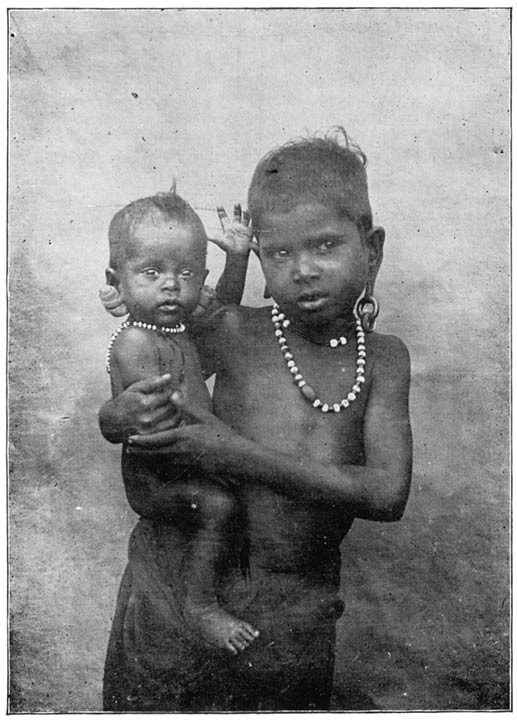
Kallan Children with Dilated Ear-lobes.
From a recent note,45 I gather the following additional information concerning tuppu-kuli. “The Kallans are largely guilty of cattle-thefts. In many cases, they return the cattle on receiving tuppu-kuli. The official returns do not show many of these cases. No cattle-owner thinks of reporting the loss of any of his cattle. Naturally his first instinct is that it might have strayed away, being live property. The tuppu-kuli system generally helps the owner to recover his lost cattle. He has only to pay half of its real value, and, when he recovers his animal, he goes home with the belief that he has really made a profitable bargain. There is no matter for complaint, but, on the other hand, he is glad that he got back his animal for use, often at the most opportune time. Cattle are indispensable to the agriculturist at all times of the year. Perhaps, sometimes, when the rains fail, he may not use them. But if, after a long drought, there is a shower, immediately every agriculturist runs to his field with his plough and cattle, and tills it. If, at such a time, his cattle be stolen, he considers as though he were beaten on his belly, and his means of livelihood gone. No cattle will be available then for hire. There is nothing that he will not part with, to get back his cattle. There is then the nefarious system of tuppu-kuli offering itself, and he freely resorts to it, and succeeds in getting back his lost cattle sooner or later. On the other hand, if a complaint is made to the Village Magistrate or Police, recovery by this channel is impossible. The tuppu-kuli agents have their spies or informants everywhere, dogging the footsteps of the owner of the stolen cattle, and of those who are likely to help him in recovering it. As soon as they know the case is recorded in the Police station, they determine not to let the animal go back to its owner at any risk, unless some mutual friend intervenes, and works mightily for the recovery, in which case the restoration is generally through the pound. Such a restoration is, primâ facie, cattle-straying, for only stray cattle are taken to the pound. This, too, is done after a good deal of hard swearing on both sides not to hand over the offender to the authorities.”
In connection with the ‘vellari thadi’ referred to above, Dr. Oppert writes46 that “boomerangs are used by the Tamil Maravans and Kallans when hunting deer. The Madras Museum collection contains three (two ivory, one wooden) from the Tanjore armoury. In the arsenal of the Pudukkōttai Rāja a stock of wooden boomerangs is always kept. Their name in Tamil is valai tadi (bent stick).” Concerning these boomerangs, the Dewān of Pudukkōttai writes to me as follows. “The valari or valai tadi is a short weapon, generally made of some hard-grained wood. It is also sometimes made of iron. It is crescent-shaped, one end being heavier than the other, and the outer edge is sharpened. Men trained in the use of the weapon hold it by the lighter end, whirl it a few times over their shoulders to give it impetus, and then hurl it with great force against the object aimed at. It is said that there were experts in the art of throwing the valari, who could at one stroke despatch small game, and even man. No such experts are now forthcoming in the State, though the instrument is reported to be occasionally used in hunting hares, jungle fowl, etc. Its days, however, must be counted as past. Tradition states that the instrument played a considerable part in the Poligar wars of the last century. But it now reposes peacefully in the households of the descendants of the rude Kallan and Maravan warriors, who plied it with such deadly effect in the last century, preserved as a sacred relic of a chivalric past along with other old family weapons in their pūja room, brought out and scraped and cleaned on occasions like the Ayudha pūja day (when worship is paid to weapons and implements of industry), and restored to its place of rest immediately afterwards.”
The sub-divisions of the Kallans, which were returned in greatest numbers at the census, 1891, were Īsanganādu (or Visangu-nādu), Kungiliyan, Mēnādu, Nāttu, Piramalainādu, and Sīrukudi. In the Census Report, 1901, it is recorded that “in Madura the Kallans are divided into ten main endogamous divisions47 which are territorial in origin. These are (1) Mēl-nādu, (2) Sīrukudi-nādu, (3) Vellūr-nādu, (4) Malla-kōttai nādu, (5) Pākanēri, (6) Kandramānikkam or Kunnan-kōttai nādu, (7) Kandadēvi, (8) Puramalai-nādu, (9) Tennilai-nādu, and (10) Pālaya-nādu. The headman of the Puramalai-nādu section is said to be installed by Idaiyans (herdsmen), but what the connection between the two castes may be is not clear. The termination nādu means a country. These sections are further divided into exogamous sections called vaguppus. The Mēl-nādu Kallans have three sections called terus or streets, namely, Vadakku-teru (north street), Kilakku-teru (east street), and Tērku-teru (south street). The Sīrukudi Kallans have vaguppus named after the gods specially worshipped by each, such as Āndi, Mandai, Aiyanar, and Vīramāngāli. Among the Vellūr-nādu Kallans the names of these sections seem merely fanciful. Some of them are Vēngai puli (cruel-handed tiger), Vekkāli puli (cruel-legged tiger), Sāmi puli (holy tiger), Sem puli (red tiger), Sammatti makkal (hammer men), Tirumān (holy deer), and Sāyumpadai tāngi (supporter of the vanquished army). A section of the Tanjore Kallans names its sections from sundry high-sounding titles meaning King of the Pallavas, King of Tanjore, conqueror of the south, mighty ruler, and so on.”
Portions of the Madura and Tanjore districts are divided into areas known as nādus, a name which, as observed by Mr. Nelson, is specially applicable to Kallan tracts. In each nādu a certain caste, called the Nāttan, is the predominant factor in the settlement of social questions which arise among the various castes living within the nādu. Round about Devakotta in the Sivaganga zamindari there are fourteen nādus, representatives of which meet once a year at Kandadēvi, to arrange for the annual festival at the temple dedicated to Swarnamurthi Swāmi. The four nādus Unjanai, Sembonmari, Iravaseri, and Tennilai in the same zamindari constitute a group, of which the last is considered the chief nādu, whereat caste questions must come up for settlement. For marriage purposes these four nādus constitute an endogamous section, which is sub-divided into septs or karais. Among the Vallambans these karais are exogamous, and run in the male line. But, among the Kallans, the karai is recognised only in connection with property. A certain tract of land is the property of a particular karai, and the legal owners thereof are members of the same karai. When the land has to be disposed of, this can only be effected with the consent of representatives of the karai. The Nāttar Kallans of Sivaganga have exogamous septs called kīlai or branches, which, as among the Maravans, run in the female line, i.e., a child belongs to the mother’s, not the father’s, sept. In some castes, and even among Brāhmans, though contrary to strict rule, it is permissible for a man to marry his sister’s daughter. This is not possible among the Kallans who have kīlais such as those referred to, because the maternal uncle of a girl, the girl, and her mother all belong to the same sept. But the children of a brother and sister may marry, because they belong to different kīlais, i.e., those of their respective mothers.
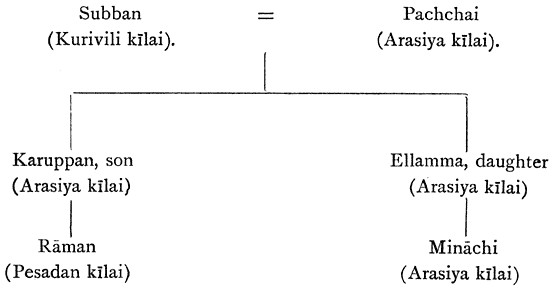
In the above example, the girl Mināchi may not marry Karuppan, as both are members of the same kīlai. But she ought, though he be a mere boy, to marry Rāman, who belongs to a different sept.
It is noted48 that, among the Sivaganga Kallans, “when a member of a certain kīlai dies, a piece of new cloth should be given to the other male member of the same kīlai by the heir of the deceased. The cloth thus obtained should be given to the sister of the person obtaining it. If her brother fails to do so, her husband will consider himself degraded, and consequently will divorce her.” Round about Pudukkōttai and Tanjore, the Visangu-nādu Kallans have exogamous septs called pattapēru, and they adopt the sept name as a title, e.g., Muthu Udaiyān, Karuppa Tondaman, etc. It is noted, in the Gazetteer of the Tanjore district, that the sub-divisions of the Kallans are split into groups, e.g., Onaiyan (wolfish), Singattān (lion-like), etc.
It is a curious fact that the Puramalai-nādu Kallans practice the rite of circumcision. The origin of this custom is uncertain, but it has been suggested49 that it is a survival of a forcible conversion to Muhammadanism of a section of the Kurumbas who fled northwards on the downfall of their kingdom. At the time appointed for the initiatory ceremony, the Kallan youth is carried on the shoulders of his maternal uncle to a grove or plain outside the village, where betel is distributed among those who have assembled, and the operation is performed by a barber-surgeon. En route to the selected site, and throughout the ceremony, the conch shell (musical instrument) is blown. The youth is presented with new cloths. It is noted, in the Gazetteer of the Madura district, that “every Kallan boy has a right to claim the hand of his paternal aunt’s daughter in marriage. This aunt bears the expenses connected with his circumcision. Similarly, the maternal uncle pays the costs of the rites which are observed when a girl attains maturity, for he has a claim on the girl as a bride for his son. The two ceremonies are performed at one time for large batches of boys and girls. On an auspicious day, the young people are all feasted, and dressed in their best, and repair to a river or tank (pond). The mothers of the girls make lamps of plantain leaves, and float them on the water, and the boys are operated on by the local barber.” It is stated, in the Census Report, 1901, that the Sīrukudi Kallans use a tāli, on which the Muhammadan badge of a crescent and star is engraved.
In connection with marriage among the Kallans, it is noted by Mr. S. M. Natesa Sastri50 that “at the Māttupongal feast, towards evening, festoons of aloe fibre and cloths containing coins are tied to the horns of bullocks and cows, and the animals are driven through the streets with tom-tom and music. In the villages, especially those inhabited by the Kallans in Madura and Tinnevelly, the maiden chooses as her husband him who has safely untied and brought to her the cloth tied to the horn of the fiercest bull. The animals are let loose with their horns containing valuables, amidst the din of tom-tom and harsh music, which terrifies and bewilders them. They run madly about, and are purposely excited by the crowd. A young Kalla will declare that he will run after such and such a bull—and this is sometimes a risky pursuit—and recover the valuables tied to its horn. The Kallan considers it a great disgrace to be injured while chasing the bull.”
A poet of the early years of the present era, quoted by Mr. Kanakasabhai Pillai,51 describes this custom as practiced by the shepherd castes in those days. “A large area of ground is enclosed with palisades and strong fences. Into the enclosure are brought ferocious bulls with sharpened horns. On a spacious loft, overlooking the enclosure, stand the shepherd girls, whom they intend to give away in marriage. The shepherd youths, prepared for the fight, first pray to their gods, whose images are placed under old banian or peepul trees, or at watering places. They then deck themselves with garlands made of the bright red flowers of the kānthal, and the purple flowers of the kāya. At a signal given by the beating of drums, the youths leap into the enclosure, and try to seize the bulls, which, frightened by the noise of the drums, are now ready to charge anyone who approaches them. Each youth approaches a bull, which he chooses to capture. But the bulls rush furiously, with tails raised, heads bent down, and horns levelled at their assailants. Some of the youths face the bulls boldly, and seize their horns. Some jump aside, and take hold of their tails. The more wary young men cling to the animals till they force them to fall on the ground. Many a luckless youth is now thrown down. Some escape without a scratch, while others are trampled upon or gored by the bulls. Some, though wounded and bleeding, again spring on the bulls. A few, who succeed in capturing the animals, are declared the victors of that day’s fight. The elders then announce that the bull-fight is over. The wounded are carried out of the enclosure, and attended to immediately, while the victors and the brides-elect repair to an adjoining grove, and there, forming into groups, dance joyously before preparing for their marriage.”
In an account of marriage among the Kallans, Mr. Nelson writes that “the most proper alliance in the opinion of a Kallan is one between a man and the daughter of his father’s sister, and, if an individual have such a cousin, he must marry her, whatever disparity there may be between their respective ages. A boy of fifteen must marry such a cousin, even if she be thirty or forty years old, if her father insists upon his so doing. Failing a cousin of this sort, he must marry his aunt or his niece, or any near relative. If his father’s brother has a daughter, and insists upon him marrying her he cannot refuse; and this whatever may be the woman’s age. One of the customs of the western Kallans is specially curious. It constantly happens that a woman is the wife of ten, eight, six, or two husbands, who are held to be the fathers jointly and severally of any children that may be born of her body, and, still more curiously, when the children grow up they, for some unknown reason, invariably style themselves the children not of ten, eight or six fathers as the case may be, but of eight and two, six and two, or four and two fathers. When a wedding takes place, the sister of the bridegroom goes to the house of the parents of the bride, and presents them with twenty-one Kāli fanams (coins) and a cloth, and, at the same time, ties some horse-hair round the bride’s neck. She then brings her and her relatives to the house of the bridegroom, where a feast is prepared.
Sheep are killed, and stores of liquor kept ready, and all partake of the good cheer provided. After this the bride and bridegroom are conducted to the house of the latter, and the ceremony of an exchange between them of vallari thadis or boomerangs is solemnly performed. Another feast is then given in the bride’s house, and the bride is presented by her parents with one markāl of rice and a hen. She then goes with her husband to his house. During the first twelve months after marriage, it is customary for the wife’s parents to invite the pair to stay with them a day or two on the occasion of any feast, and to present them on their departure with a markāl of rice and a cock. At the time of the first Pongal feast after the marriage, the presents customarily given to the son-in-law are five markāls of rice, five loads of pots and pans, five bunches of plantains, five cocoanuts, and five lumps of jaggery (crude sugar). A divorce is easily obtained on either side. A husband dissatisfied with his wife can send her away if he be willing at the same time to give her half of his property, and a wife can leave her husband at will upon forfeiture of forty-two Kāli fanams. A widow may marry any man she fancies, if she can induce him to make her a present of ten fanams.”
In connection with the foregoing account, I am informed that, among the Nāttar Kallans, the brother of a married woman must give her annually at Pongal a present of rice, a goat, and a cloth until her death. The custom of exchanging boomerangs appears to be fast becoming a tradition. But, there is a common saying still current “Send the valari tadi, and bring the bride.” As regards the horse-hair, which is mentioned as being tied round the bride’s neck, I gather that, as a rule, the tāli is suspended from a cotton thread, and the horse-hair necklet may be worn by girls prior to puberty and marriage, and by widows. This form of necklet is also worn by females of other castes, such as Maravans, Valaiyans, and Morasa Paraiyans. Puramalai Kallan women can be distinguished by the triangular ornament, which is attached to the tāli string. It is stated, in the Gazetteer of the Madura district, that “when a girl has attained maturity, she puts away the necklace of coloured beads she wore as a child, and dons the horse-hair necklet, which is characteristic of the Kallan woman. This she retains till death, even if she becomes a widow. The richer Kallans substitute for the horse-hair a necklace of many strands of fine silver wire. In Tirumangalam, the women often hang round their necks a most curious brass and silver pendant, six or eight inches long, and elaborately worked.”
It is noted in the Census Report, 1891, that as a token of divorce “a Kallan gives his wife a piece of straw in the presence of his caste people. In Tamil the expression ‘to give a straw’ means to divorce, and ‘to take a straw’ means to accept divorce.”
In their marriage customs, some Kallans have adopted the Purānic form of rite owing to the influence of Brāhman purōhits, and, though adult marriage is the rule, some Brāhmanised Kallans have introduced infant marriage. To this the Puramalai section has a strong objection, as, from the time of marriage, they have to give annually till the birth of the first child a present of fowls, rice, a goat, jaggery, plantains, betel, turmeric, and condiments. By adult marriage the time during which this present has to be made is shortened, and less expenditure thereon is incurred. In connection with the marriage ceremonies as carried out by some Kallans, I gather that the consent of the maternal uncle of a girl to her marriage is essential. For the betrothal ceremony, the father and maternal uncle of the future bridegroom proceed to the girl’s house, where a feast is held, and the date fixed for the wedding written on two rolls of palm leaf dyed with turmeric or red paper, which are exchanged between the maternal uncles. On the wedding day, the sister of the bridegroom goes to the house of the bride, accompanied by women, some of whom carry flowers, cocoanuts, betel leaves, turmeric, leafy twigs of Sesbania grandiflora, paddy (unhusked rice), milk, and ghī (clarified butter). A basket containing a female cloth, and the tāli string wrapped up in a red cloth borrowed from a washerman, is given to a sister of the bridegroom or to a woman belonging to his sept. On the way to the bride’s house, two of the women blow chank shells (musical instrument). The bride’s people question the bridegroom’s party as to his sept, and they ought to say that he belongs to Indra kūlam, Thalavala nādu, and Ahalya gōtra. The bridegroom’s sister, taking up the tāli, passes it round to be touched by all present, and ties the string, which is decorated with flowers, tightly round the bride’s neck amid the blowing of the conch shell. The bride is then conducted to the home of the bridegroom, whence they return to her house on the following day. The newly married couple sit on a plank, and coloured rice-balls or coloured water are waved, while women yell out “killa, illa, illa; killa, illa, illa.” This ceremony is called kulavi idal, and is sometimes performed by Kallan women during the tāli-tying.
The following details relating to the marriage ceremonies are recorded in the Gazetteer of the Tanjore district. “The arrival of the bridegroom has been described as being sometimes especially ceremonious. Mounted on a horse, and attended by his maternal uncle, he is met by a youth from the bride’s house, also mounted, who conducts the visitors to the marriage booth. Here he is given betel leaves, areca nuts, and a rupee by the bride’s father, and his feet are washed in milk and water, and adorned with toe-rings by the bride’s mother. The tāli is suspended from a necklet of gold or silver instead of cotton thread, but this is afterwards changed to cotton for fear of offending the god Karuppan. A lamp is often held by the bridegroom’s sister, or some married woman, while the tāli is being tied. This is left unlighted by the Kallans for fear it should go out, and thus cause an evil omen. The marriage tie is in some localities very loose. Even a woman who has borne her husband many children may leave him if she likes, to seek a second husband, on condition that she pays him her marriage expenses. In this case (as also when widows are remarried), the children are left in the late husband’s house. The freedom of the Kallan women in these matters is noticed in the proverb that, “though there may be no thread in the spinning-rod, there will always be a (tāli) thread on the neck of a Kallan woman,” or that “though other threads fail, the thread of a Kallan woman will never do so.”
By some Kallans pollution is, on the occasion of the first menstrual period, observed for seven or nine days. On the sixteenth day, the maternal uncle of the girl brings a sheep or goat, and rice. She is bathed and decorated, and sits on a plank while a vessel of water, coloured rice, and a measure filled with paddy with a style bearing a betel leaf struck on it, are waved before her. Her head, knees, and shoulders are touched with cakes, which are then thrown away. A woman, conducting the girl round the plank, pours water from a vessel on to a betel leaf held in her hand, so that it falls on the ground at the four cardinal points of the compass, which the girl salutes.
A ceremony is generally celebrated in the seventh month of pregnancy, for which the husband’s sister prepares pongal (cooked rice). The pregnant woman sits on a plank, and the rice is waved before her. She then stands up, and bends down while her sister-in-law pours milk from a betel or pīpal (Ficus religiosa) leaf on her back. A feast brings the ceremony to a close. Among the Vellūr-nādu Kallans patterns are said52 to be drawn on the back of the pregnant woman with rice-flour, and milk is poured over them. The husband’s sister decorates a grindstone in the same way, invokes a blessing on the woman, and expresses a hope that she may have a male child as strong as a stone.
When a child is born in a family, the entire family observes pollution for thirty days, during which entrance into a temple is forbidden. Among the Nāttar Kallans, children are said to be named at any time after they are a month old. But, among the Puramalai Kallans, a first-born female child is named on the seventh day, after the ear-boring ceremony has been performed. “All Kallans,” Mr. Francis writes,52 “put on sacred ashes, the usual mark of a Saivite, on festive occasions, but they are nevertheless generally Vaishnavites. The dead are usually buried, and it is said that, at funerals, cheroots are handed round, which those present smoke while the ceremony proceeds.” Some Kallans are said,53 when a death occurs in a family, to put a pot filled with dung or water, a broomstick, and a fire-brand at some place where three roads meet, or in front of the house, in order to prevent the ghost from returning.
It is recorded, in the Gazetteer of the Madura district, that “the Kilnād Kallans usually bury their dead. Lamps are periodically lighted on the tomb, and it is whitewashed annually. The Piramalainād division usually burn the dead. If a woman dies when with child, the baby is taken out, and placed alongside her on the pyre. This, it may be noted, is the rule with most castes in this district, and, in some communities, the relations afterwards put up a stone burden-rest by the side of a road, the idea being that the woman died with her burden, and so her spirit rejoices to see others lightened of theirs. Tradition says that the caste came originally from the north. The dead are buried with their faces laid in that direction; and, when pūja is done to Karuppanaswāmi, the caste god, the worshippers turn to the north.”
According to Mr. H. A. Stuart54 “the Kallans are nominally Saivites, but in reality the essence of their religious belief is devil-worship. Their chief deity is Alagarswāmi, the god of the great Alagar Kōvil twelve miles to the north of the town of Madura. To this temple they make large offerings, and the Swāmi, called Kalla Alagar, has always been regarded as their own peculiar deity.” The Kallans are said by Mr. Mullaly to observe omens, and consult their household gods before starting on depredations. “Two flowers, the one red and the other white, are placed before the idol, a symbol of their god Kalla Alagar. The white flower is the emblem of success. A child of tender years is told to pluck a petal of one of the two flowers, and the undertaking rests upon the choice made by the child.” In like manner, when a marriage is contemplated among the Idaiyans, the parents of the prospective bride and bridegroom go to the temple, and throw before the idol a red and white flower, each wrapped in a betel leaf. A small child is then told to pick up one of the leaves. If the one selected contains the white flower, it is considered auspicious, and the marriage will take place.
In connection with the Alagar Kōvil, I gather55 that, when oaths are to be taken, the person who is to swear is asked to worship Kallar Alagar, and, with a parivattam (cloth worn as a mark of respect in the presence of the god) on his head, and a garland round his neck, should stand on the eighteenth step of the eighteen steps of Karuppanaswāmi, and say: “I swear before Kallar Alagar and Karuppannaswāmi that I have acted rightly, and so on. If the person swears falsely, he dies on the third day; if truly the other person meets with the same fate.”
It was noted by Mr. M. J. Walhouse,56 that “at the bull games (jellikattu) at Dindigul, the Kallans can alone officiate as priests, and consult the presiding deity. On this occasion they hold quite a Saturnalia of lordship and arrogance over the Brāhmans.” It is recorded, in the Gazetteer of the Madura district, that “the keenness of the more virile sections of the community (especially the Kallans), in this game, is extraordinary, and, in many villages, cattle are bred and reared specially for it. The best jallikats are to be seen in the Kallan country in Tirumangalam, and next come those in Mēlūr and Madura tāluks.” (See also Maravan.)
It is recorded, in the Gazetteer of the Madura district, that Karuppan is “essentially the god of the Kallans, especially of the Kallans of the Mēlūr side. In those parts, his shrine is usually the Kallans’ chāvadi (assembly place). His priests are usually Kallans or Kusavans. Alagarswāmi (the beautiful god) is held in special veneration by the Kallans, and is often popularly called the Kallar Alagar. The men of this caste have the right to drag his car at the car festival, and, when he goes (from Alagar Kōvil) on his visit to Madura, he is dressed as a Kallan, exhibits the long ears characteristic of that caste, and carries the boomerang and club, which were of their old favourite weapons. It is whispered that Kallan dacoits invoke his aid when they are setting out on marauding expeditions, and, if they are successful therein, put part of their ill-gotten gains into the offertory (undial) box, which is kept at his shrine.”
For the following note I am indebted to the Rev. J. Sharrock. “The chief temple of the Kallans is about ten miles west of Madura, and is dedicated to Alagarswāmi, said to be an incarnation of Vishnu, but also said to be the brother of Mīnātchi (the fish-eyed or beautiful daughter of the Pāndya king of Madura). Now Mīnātchi has been married by the Brāhmans to Siva, and so we see Hinduism wedded to Dravidianism, and the spirit of compromise, the chief method of conversion adopted by the Brāhmans, carried to its utmost limit. At the great annual festival, the idol of Alagarswāmi is carried, in the month of Chittra (April-May), to the temple of Mīnātchi, and the banks of the river Vaiga swarm with two to three lakhs57 of worshippers, a large proportion of whom are Kallans. At this festival, the Kallans have the right of dragging with a rope the car of Alagarswāmi, though other people may join in later on. As Alagarswāmi is a vegetarian, no blood sacrifice is offered to him. This is probably due to the influence of Brāhmanism, for, in their ordinary ceremonies, the Kallans invariably slaughter sheep as sacrifices to propitiate their deities. True to their bold and thievish instincts, the Kallans do not hesitate to steal a god, if they think he will be of use to them in their predatory excursions,58 and are not afraid to dig up the coins or jewels that are generally buried under an idol. Though they entertain little dread of their own village gods, they are often afraid of others that they meet far from home, or in the jungles when they are engaged in one of their stealing expeditions. As regards their own village gods, there is a sort of understanding that, if they help them in their thefts, they are to have a fair share of the spoil, and, on the principle of honesty among thieves, the bargain is always kept. At the annual festival for the village deities, each family sacrifices a sheep, and the head of the victim is given to the pūjāri (priest), while the body is taken home by the donor, and partaken of as a communion feast. Two at least of the elements of totem worship appear here: there is the shedding of the sacrificial blood of an innocent victim to appease the wrath of the totem god, and the common feasting together which follows it. The Brāhmans sometimes join in these sacrifices, but of course take no part of the victim, the whole being the perquisite of the pūjāri, and there is no common participation in the meal. When strange deities are met with by the Kallans on their thieving expeditions, it is usual to make a vow that, if the adventure turns out well, part of the spoil shall next day be left at the shrine of the god, or be handed over to the pūjāri of that particular deity. They are afraid that, if this precaution be not taken, the god may make them blind, or cause them to be discovered, or may go so far as to knock them down, and leave them to bleed to death. If they have seen the deity, or been particularly frightened or otherwise specially affected by these unknown gods, instead of leaving a part of the body, they adopt a more thorough method of satisfying the same. After a few days they return at midnight to make a special sacrifice, which of course is conducted by the particular pūjāri, whose god is to be appeased. They bring a sheep with rice, curry-stuffs and liquors, and, after the sacrifice, give a considerable share of these dainties, together with the animal’s head, to the pūjāri, as well as a sum of money for making the pūja (worship) for them. Some of the ceremonies are worth recording. First the idol is washed in water, and a sandal spot is put on the forehead in the case of male deities, and a kunkuma spot in the case of females. Garlands are placed round the neck, and the bell is rung, while lamps are lighted all about. Then the deity’s name is repeatedly invoked, accompanied by beating on the udukku. This is a small drum which tapers to a narrow waist in the middle, and is held in the left hand of the pūjāri with one end close to his left ear, while he taps on it with the fingers of his right hand. Not only is this primitive music pleasing to the ears of his barbarous audience, but, what is more important, it conveys the oracular communications of the god himself. By means of the end of the drum placed close to his ear, the pūjāri is enabled to hear what the god has to say of the predatory excursion which has taken place, and the pūjāri (who, like a clever gypsy, has taken care previously to get as much information of what has happened as possible) retails all that has occurred during the exploit to his wondering devotees. In case his information is incomplete, he is easily able to find out, by a few leading questions and a little cross-examination of these ignorant people, all that he needs to impress them with the idea that the god knows all about their transactions, having been present at their plundering bout. At all such sacrifices, it is a common custom to pour a little water over the sheep, to see if it will shake itself, this being invariably a sign of the deity’s acceptance of the animal offered. In some sacrifices, if the sheep does not shake itself, it is rejected, and another substituted for it; and, in some cases (be it whispered, when the pūjāri thinks the sheep too thin and scraggy), he pours over it only a little water, and so demands another animal. If, however, the pūjāri, as the god’s representative, is satisfied, he goes on pouring more and more water till the half-drenched animal has to shake itself, and so signs its own death-warrant. All who have ventured forth in the night to take part in the sacrifice then join together in the communal meal. An illustration of the value of sacrifices may here be quoted, to show how little value may be attached to an oath made in the presence of a god. Some pannaikārans (servants) of a Kallan land-owner one day stole a sheep, for which they were brought up before the village munsif. When they denied the theft, the munsif took them to their village god, Karuppan (the black brother), and made them swear in its presence. They perjured themselves again, and were let off. Their master quietly questioned them afterwards, asking them how they dared swear so falsely before their own god, and to this they replied ‘While we were swearing, we were mentally offering a sacrifice to him of a sheep’ (which they subsequently carried out), to pacify him for the double crime of stealing and perjury.”
As a typical example of devil worship, the practice of the Valaiyans and Kallans of Orattanādu in the Tanjore district is described by Mr. F. R. Hemingway.59 “Valaiyan houses have generally an odiyan (Odina Wodier) tree in the backyard, wherein the devils are believed to live, and among Kallans every street has a tree for their accommodation. They are propitiated at least once a year, the more virulent under the tree itself, and the rest in the house, generally on a Friday or Monday. Kallans attach importance to Friday in Ādi (July and August), the cattle Pongal day in Tai (January and February), and Kartigai day in the month Kartigai (November and December). A man, with his mouth covered with a cloth to indicate silence and purity, cooks rice in the backyard, and pours it out in front of the tree, mixed with milk and jaggery (crude sugar). Cocoanuts and toddy are also placed there. These are offered to the devils, represented in the form of bricks or mud images placed at the foot of the tree, and camphor is set alight. A sheep is then brought and slaughtered, and the devils are supposed to spring one after another from the tree into one of the bystanders. This man then becomes filled with the divine afflatus, works himself up into a kind of frenzy, becomes the mouthpiece of the spirits, pronounces their satisfaction or the reverse at the offerings, and gives utterance to cryptic phrases, which are held to foretell good or evil fortune to those in answer to whom they are made. When all the devils in turn have spoken and vanished, the man recovers his senses. The devils are worshipped in the same way in the houses, except that no blood is shed. All alike are propitiated by animal sacrifices.”
The Kallans are stated by Mr. Hemingway to be very fond of bull-baiting. This is of two kinds. The first resembles the game played by other castes, except that the Kallans train their animals for the sport, and have regular meetings, at which all the villagers congregate. These begin at Pongal, and go on till the end of May. The sport is called tolu mādu (byre bull). The best animals for it are the Pulikkolam bulls from the Madura district. The other game is called pāchal mādu (leaping bull). In this, the animals are tethered to a long rope, and the object of the competition is to throw the animal, and keep it down. A bull which is good at the game, and difficult to throw, fetches a very high price.
It is noted in the Gazetteer of the Tanjore district, that “the Kallans have village caste panchayats (councils) of the usual kind, but in some places they are discontinuing these in imitation of the Vellālans. According to the account given at Orattanādu, the members of Ambalakāran families sit by hereditary right as Kāryastans or advisers to the headman in each village. One of these households is considered superior to the others, and one of its members is the headman (Ambalakāran) proper. The headmen of the panchayats of villages which adjoin meet to form a further panchayat to decide on matters common to them generally. In Kallan villages, the Kallan headman often decides disputes between members of other lower castes, and inflicts fines on the party at fault.”
In the Gazetteer, of the Madura district, it is recorded that “the organization of the Kilnād Kallans differs from that of their brethren beyond the hills. Among the former, an hereditary headman, called the Ambalakāran, rules in almost every village. He receives small fees at domestic ceremonies, is entitled to the first betel and nut, and settles caste disputes. Fines inflicted are credited to the caste fund. The western Kallans are under a more monarchial rule, an hereditary headman called Tirumala Pinnai Tēvan deciding most caste matters. He is said to get this hereditary name from the fact that his ancestor was appointed (with three co-adjutors) by King Tirumala Nāyakkan, and given many insignia of office including a state palanquin. If any one declines to abide by his decision, excommunication is pronounced by the ceremony of ‘placing the thorn,’ which consists in laying a thorny branch across the threshold of the recalcitrant party’s house, to signify that, for his contumacy, his property will go to ruin and be overrun with jungle. The removal of the thorn, and the restitution of the sinner to Kallan society can only be procured by abject apologies to Pinnai Tēvan.”
The usual title of the Kallans is Ambalakāran (president of an assembly), but some, like the Maravans and Agamudaiyans, style themselves Tēvan (god) or Sērvaikkāran (commander).60
Kallankanadōru (stone).—A sub-division of Kōmati, said to be descended from those who sat on the stone (kallu) mantapa outside the Penukonda Kanyakamma temple, when the question whether to enter the fire-pits or not was being discussed by the caste elders.
Kallan Mūppan.—In the Madras Census Report, 1901, Kallan Mūppan is returned as “a sub-caste of the Malabar Kammālans, the members of which are stone-workers.” A correspondent writes to me that, “while the Kammālans are a polluting and polyandrous class, the Kallan Mūppans are allowed to enter the outside enclosure of temples. They do not remarry their widows, and are strictly monogamous. Their purōhits are Tamil barbers, who officiate at their marriages. The barber shaves the bridegroom before the wedding ceremony. The purōhit has also to blow the conch-shell all the way from the bridegroom’s house to that of the bride.”
The names Kallan and Kalkōtti are also those by which the Malabar stone-masons are known.
Kallangi.—Kallangi and Kallavēli (Kallan’s fence) are fanciful names, returned by Pallis at times of census.
Kallasāri (stone-workers).—The occupational name of a sub-division of Malayālam Kammālans.
Kallātakurup.—A sub-division of Ambalavāsis, who sing in Bhagavati temples. They play on a stringed instrument, called nandurini, with two strings and a number of wooden stops glued on to the long handle, and a wooden plectrum.
Kallu (stone).—A sub-division of Gāniga and Oddē. Kallukoti (stone-mason) is a sub-division of Malabar Kammālans, who work in stone.
Kallukatti.—It is noted, in the Gazetteer of the South Canara district, that “a grinding stone made of granite is an article peculiar to South Canara. It is a semicircular, oval-shaped block with a flat bottom, and a round hole in the middle of the surface. It has another oval-shaped block, thin and long, with one end so shaped as to fit into the hole in the larger block. These two together make what is known as the grinding-stone of the district, which is used for grinding curry-stuff, rice, wheat, etc. Mill-stones for pounding grain are also made of granite. Formerly, a class of people called Kallukattis used to make such articles, but the industry is now taken up by other castes as well. Mile-stones, slabs for temple door-frames, idols and other figures for temple purposes are also made of granite.”
Kallūr.—Recorded, in the Travancore Census Report, 1901, as a name for the Pulikkappanikkan sub-division of Nāyar.
Kallūri (stone village).—An exogamous sept of Mēdara.
Kal Tacchan (stone-mason).—A sub-division of Kammālan.
Kalti (expunged).—A degraded Paraiyan is known as a Kalti. Amongst the Paraiyans of Madras, Chingleput and North Arcot, the rule is that a man who does not abide by the customs of the caste is formally excommunicated by a caste council. He then joins “those at Vinnamangalam” near Vellore, i.e., those who have, like himself, been driven out of the caste.
Kalugunādu (eagle’s country).—An exogamous sept of Tamil goldsmiths in the Madura district.
Kaluthai (possessors of donkeys).—A sub-division of Oddē.
Kalyānakulam (marriage people).—A fanciful name returned by some Mangalas at times of census, as they officiate as musicians at marriages.
Kamadi (tortoise).—A gōtra of Kurni.
Kāmākshiamma.—Recorded, in the North Arcot Manual, as a sub-division of Vāniyan. Kāmākshiamma is the chief goddess worshipped at Conjeeveram. She and Mīnākshi Amma of Madura are two well-known goddesses worshipped by Saivites. Both names are synonyms of Parvati, the wife of Siva.
Kāmāti (foolish).—A name sometimes applied to carpenters, and also of a sub-division of Okkiliyans, who are said to have abandoned their original occupation of cultivating land, and become bricklayers.
Kambalam.—The name Kambalam is applied to a group of nine castes (Tottiyan, Annappan, Kāppiliyan, Chakkiliyan, etc.), because at their council meetings a blanket (kambli) is spread, on which is placed a brass vessel (kalasam) filled with water, and decorated with flowers. (See Tottiyan.)
Kambalattān.—A synonym of Tottiyan.
Kamban.—A title of the Ōcchans, to which caste the great Tamil epic poet Kamban is reputed to have belonged.
Kambha.—Kambha or Kambhāpu, meaning a pillar or post, has been recorded as an exogamous sept of Mādiga and Kōmati.
Kamma.—Writing collectively concerning the Kammas, Kāpus or Reddis, Velamas, and Telagas, Mr. W. Francis states61 that “all four of these large castes closely resemble one another in appearance and customs, and seem to have branched off from one and the same Dravidian stock. Originally soldiers by profession, they are now mainly agriculturists and traders, and some of them in the north are zamindars (land-owners). The Rāzus, who now claim to be Kshatriyas, were probably descended from Kāpus, Kammas, and Velamas. The Kammas and Kāpus of the Madura and Tinnevelly districts seem to have followed the Vijayanagar army south, and settled in these districts when the Nāyak Governors were established there. Their women are less strict in their deportment than those of the same castes further north, the latter of whom are very careful of their reputations, and, in the case of one section of the Kammas, are actually gōsha (kept in seclusion) like Musalmānis.”
Various stories are current, which point to the common ancestry of the Kammas, Kāpus, and Velamas. The word Kamma in Telugu means the ear-ornament, such as is worn by women. According to one legend “the Rishis, being troubled by Rākshasas, applied to Vishnu for protection, and he referred them to Lakshmi. The goddess gave them a casket containing one of her ear ornaments (kamma), and enjoined them to worship it for a hundred years. At the expiry of that period, a band of five hundred armed warriors sprang up from the casket, who, at the request of the Rishis, attacked and destroyed the giants. After this they were directed to engage in agriculture, being promised extensive estates, and the consideration paid to Kshatriyas. They accordingly became possessed of large territories, such as Amrāvati and others in the Kistna, Nellore and other districts, and have always been most successful agriculturists.”62
Some Kammas, when questioned by Mr. F. R. Hemingway in the Godāvari district, stated that they were originally Kshatriyas, but were long ago persecuted by a king of the family of Parikshat, because one of them called him a bastard. They sought refuge with the Kāpus, who took them in, and they adopted the customs of their protectors. According to another legend, a valuable ear ornament, belonging to Rāja Pratāpa Rudra, fell into the hands of an enemy, whom a section of the Kāpus boldly attacked, and recovered the jewel. This feat earned for them and their descendants the title Kamma. Some of the Kāpus ran away, and they are reputed to be the ancestors of the Velamas (veli, away). At the time when the Kammas and Velamas formed a single caste, they observed the Muhammadan gōsha system, whereby the women are kept in seclusion. This was, however, found to be very inconvenient for their agricultural pursuits. They accordingly determined to abandon it, and an agreement was drawn up on a palm-leaf scroll. Those who signed it are said to have become Kammas, and those who declined to do so Velamas, or outsiders. One meaning of the word kamma is the palm-leaf roll, such as is used to produce dilatation of the lobes of the ears. According to another story, there once lived a king, Belthi Reddi by name, who had a large number of wives, the favourite among whom he appointed Rāni. The other wives, being jealous, induced their sons to steal all the jewels of the Rāni, but they were caught in the act by the king, who on the following day asked his wife for her jewels, which she could not produce. Some of the sons ran away, and gave origin to the Velamas; others restored the kamma, and became Kammas. Yet one more story. Pratāpa Rudra’s wife lost her ear ornament, and four of the king’s captains were sent in search of it. Of these, one restored the jewel, and his descendants became Kammas; the second attacked the thieves, and gave origin to the Velamas; the third ran away, and so his children became the ancestors of the Pakanātis; and the fourth disappeared.
According to the Census Report, 1891, the main sub-divisions of the Kammas are Gampa, Illuvellani, Gōdajāti, Kāvali, Vaduga, Pedda, and Bangāru. It would seem that there are two main endogamous sections, Gampa (basket) Chātu, and Gōda (wall) Chātu. Chātu is said to mean a screen or hiding place. Concerning the origin of these sections, the following story is told. Two sisters were bathing in a tank (pond), when a king happened to pass by. To hide themselves, one of the girls hid behind a basket, and the other behind a wall. The descendants of the two sisters became the Gampa and Gōda Chātu Kammas, who may not intermarry by reason of their original close relationship. According to another legend, after a desperate battle, some members of the caste escaped by hiding behind baskets, others behind a wall. The terms Illuvellani and Pedda seem to be synonymous with Gōdachatu. The women of this section were gōsha, and not allowed to appear in public, and even at the present day they do not go out and work freely in the fields. The name Illuvellani indicates those who do not go (vellani) out of the house (illu). The name Pedda (great) refers to the superiority of the section. Vaduga simply means Telugu, and is probably a name given by Tamilians to the Kammas who live amongst them. The name Bangāru is said to refer to the custom of the women of this sub-division wearing only gold nose ornaments (bangāramu). The Gōdajāti sub-division is said to be most numerously represented in North Arcot and Chingleput, the Illuvellani in Kistna, Nellore and Anantapur. The Kāvali sub-division is practically confined to the Godāvari, and the Pedda to the Kistna district. The Vaduga Kammas are found chiefly in Coimbatore.
In his note on the Kammas of the Godāvari district, Mr. Hemingway writes that “in this district they are divided into Kāvitis, Erēdis, Gampas or Gūdas, Uggams, and Rāchas. These names are, according to local accounts, derived from curious household customs, generally from traditional methods of carrying water. Thus, the Kāvitis will not ordinarily carry water except in pots on a kāvidi, the Erēdis except on a pack-bullock, the Uggams except in pots held in the hand, and not on the hip or head, the Rāchas except in a pot carried by two persons. The Gampa women, when they first go to their husbands’ houses, take the customary presents in a basket. It is said that these practices are generally observed at the present day.”
Writing concerning the Iluvedalani (Illuvellani) Kammas, the editor of the Kurnool Manual (1886) states that “a few families only exist in the district. The women are kept in strict gōsha. They consider it beneath them to spin thread, or to do other work. A sub-division of this caste lives in Pullalcheruvu, whose families, also gōsha, work at the spindles, like other women of the country. Another class of indoor Kammas resides about Owk. They are apparently descendants of the Kammas, who followed the Naiks from Guntūr to Gandikota in the sixteenth century. They are now reduced, and the females work, like Kāpus, in the field. The Gampas are distinguished from the indoor Kammas by their women wearing the cloth over the right, instead of the left shoulder.”
As with other Telugu castes, there are, among the Kammas, a number of exogamous septs or intipēru, of which the following are examples:—
- Anumollu, Dolichos Lablab.
- Tsanda, tax or subscription.
- Jasthi, too much.
- Mallela, jasmine.
- Lanka, island.
- Thota kūra, Amarantus gangetícus.
- Komma, horn, or branch of a tree.
- Chēni, dry field.
- Palakala, planks.
- Kastūri, musk.
- Baththāla, rice.
- Karnam, accountant.
- Irpina, combs.
- Gāli, wind.
- Dhaniāla, coriander.
The Kammas also have gōtras such as Chittipoola, Kurunollu, Kulakala, Uppāla, Cheruku (sugar-cane), Vallotla, and Yenamalla.
When matters affecting the community have to be decided, a council of the leading members thereof assembles. But, in some places, there is a permanent headman, called Mannemantri or Chaudri.
The Kammas will work as coolies in the fields, but will, on no account, engage themselves as domestic servants. “They are,” the Rev. J. Cain writes,63 “as a rule a fine well-built class of cultivators, very proud and exclusive, and have a great aversion to town life. Many of them never allow their wives to leave their compounds, and it is said that many never do field work on Sundays, but confine themselves on that day to their house-work.” “If,” a correspondent writes from the Kistna district, “you ask in a village whether so-and-so is a Brāhman, and they say ‘No. He is an āsāmi (ordinary man),’ he will be a Kamma or Kāpu. If you ask how many pay income-tax in a village, they may tell you two Baniyas (merchants), and two Samsāri-vallu, i.e., two prosperous Kamma ryots.”
The Kammas are stated by Mr. H. A. Stuart64 to be “most industrious and intelligent cultivators, who, now that gōsha has been generally abandoned, beat all rivals out of the field—a fact which is recognised by several proverbs, such as Kamma vāni chētulu kattīna nilavadu (though you tie a Kamma’s hands, he will not be quiet); Kamma vāndlu chērīte kadama jātula vellunu (if Kammas come in, other castes go out); Kamma vāriki bhūmi bhayapadu tunnadi (the earth fears the Kammas), and many others to the same effect. In addition to being industrious and well-to-do they are very proud, an instance of which occurred in the Kistna district, when the Revenue Settlement Officer offered them pattās, in which they were simply called Naidu without the honorific ending gāru. They refused on this account to accept them, and finally the desired alteration was made, as they proved that all of their caste were considered entitled to the distinction. In North Arcot, however, they are not so particular, though some refuse to have their head shaved, because they scruple to bow down before a barber. Besides Vishnu the Kammas worship Ganga, because they say that long ago they fled from Northern India, to avoid the anger of a certain Rāja, who had been refused a bride from among them. They were pursued, but their women, on reaching the Mahānadi, prayed for a passage to Ganga, who opened a dry path for them through the river. Crossing, they all hid themselves in a dholl (Cajanus indicus) field, and thus escaped from their pursuers. For this reason, at their marriages, they tie a bunch of dholl leaves to the north-eastern post of the wedding booth, and worship Ganga before tying the tāli.”
Among the Kammas of the Tamil country, the bridegroom is said to be sometimes much younger than the bride, and a case is on record of a wife of twenty-two years of age, who used to carry her boy-husband on her hip, as a mother carries her child.65 A parallel is to be found in Russia, where not very long ago grown-up women were to be seen carrying about boys of six, to whom they were betrothed.66 Widow remarriage is not permitted. Widows of the Gōda chatu section wear white, and those of the Gampa chatu section coloured cloths.
Prior to the betrothal ceremony, female ancestors, Vignēswara, and the Grāma Dēvata (village deities) are worshipped. A near relation of the future bridegroom proceeds, with a party, to the home of the future bride. On their way thither, they look for omens, such as the crossing of birds in an auspicious direction. Immediately on the occurrence of a favourable omen, they burn camphor, and break a cocoanut, which must split in two with clean edges. One half is sent to the would-be bridegroom, and the other taken to the bride’s house. If the first cocoanut does not split properly, others are broken till the wished-for result is obtained. When the girl’s house is reached, she demands the sagunam (omen) cocoanut. Her lap is filled with flowers, cocoanuts, turmeric, plantains, betel leaves and areca nuts, combs, sandal paste, and coloured powder (kunkumam). The wedding day is then fixed. Marriage is generally celebrated at the house of the bridegroom, but, if it is a case of kannikadhānam (presenting the girl without claiming the bride’s price), at the house of the bride. The bride-price is highest in the Gampa section. On the first day of the marriage rites, the petta mugada sangyam, or box-lid ceremony is performed. The new cloths for the bridal couple, five plantains, nuts, and pieces of turmeric, one or two combs, four rupees, and the bride-price in money or jewels, are placed in a box, which is placed near the parents of the contracting couple. The contents of the box are then laid out on the lid, and examined by the sammandhis (new relations by marriage). The bride’s father gives betel leaves and areca nuts to the father of the bridegroom, saying “The girl is yours, and the money mine.” The bridegroom’s father hands them back, saying “The girl is mine, and the money yours.” This is repeated three times. The officiating purōhit (priest) then announces that the man’s daughter is to be given in marriage to so-and-so, and the promise is made before the assembled Dēva Brāhmanas, and in the presence of light, Agni, and the Dēvatas. This ceremony is binding, and, should the bridegroom perchance die before the bottu (marriage badge) is tied, she becomes, and remains a widow. The milk-post is next set up, the marriage pots are arranged, and the nalagu ceremony is performed. This consists of the anointing of the bridal couple with oil, and smearing the shoulders with turmeric flour, or Acacia Concinna paste. A barber pares the nails of the bridegroom, and simply touches those of the bride with a mango leaf dipped in milk. In some places this rite is omitted by the Gampa section. A small wooden framework, called dhornam, with cotton threads wound round it, is generally tied to the marriage pandal (booth) by a Tsākali (washerman) not only at a marriage among the Kammas, but also among the Balijas, Kāpus, and Velamas. After the return of the bridal couple from bathing, the bridegroom is decorated, and taken to a specially prepared place within or outside the house, to perform Vīra-gudimokkadam, or worship of heroes in their temple. At the spot selected a pandal has been erected, and beneath it three or five bricks, representing the heroes (vīralu), are set up. The bricks are smeared with turmeric paste, and painted with red dots. In front of the bricks an equal number of pots are placed, and they are worshipped by breaking a cocoanut, and burning camphor and incense. The bridegroom then prostrates himself before the bricks, and, taking up a sword, cuts some lime fruits, and touches the pots three times. In former days, a goat or sheep was sacrificed. The hero worship, as performed by the Gōda section, differs from the above rite as practiced by the Gampa section. Instead of erecting a pandal, the Gōdas go to a pīpal (Ficus religiosa) tree, near which one or more daggers are placed. A yellow cotton thread is wound three or five times round the tree, which is worshipped. As a substitute for animal sacrifice, lime fruits are cut. The hero worship concluded, the wrist-threads of cotton and wool (kankanam) are tied on the bride and bridegroom, who is taken to the temple after he has bathed and dressed himself in new clothes. On his return to the booth, the purōhit lights the sacred fire, and the contracting couple sit side by side on a plank. They then stand, with a screen spread between them, and the bridegroom, with his right big toe on that of the bride, ties the bottu round her neck. They then go three times round the dais, with the ends of their cloths knotted together. The bottu of the Gampas is a concave disc of gold, that of the Gōdas a larger flat disc. On the following day, the usual nāgavali, or sacrifice to the Dēvas is offered, and a nāgavali bottu (small gold disc) tied. All the relations make presents to the bridal pair, who indulge in a mock representation of domestic life. On the third day, pongal (rice) is offered to the pots, and the wrist-threads are removed. Like the Palli bridegroom, the Kamma bridegroom performs a mimic ploughing ceremony, but at the house instead of at a tank (pond). He goes to a basket filled with earth, carrying the iron bar of a ploughshare, an ox-goad, and rope, accompanied by the bride carrying in her lap seeds or seedlings. While he pretends to be ploughing, his sister stops him, and will not let him continue till he has promised to give his first-born daughter to her son in marriage. The marriage pots are presented to the sisters of the bridegroom. During the marriage celebration, meat must not be cooked.
Among the Kammas, consummation does not take place till three months after the marriage ceremony, as it is considered unlucky to have three heads of a family in a household during the first year of marriage. By the delay, the birth of a child should take place only in the second year, so that, during the first year, there will be only two heads, husband and wife. In like manner, it is noted by Mr. Francis67 that, among the Gangimakkalu and Mādigas, the marriage is not consummated till three months after its celebration.
When a pregnant woman is delivered, twigs of Balanites Roxburghii are placed round the house.
The dead are usually cremated. As the moment of death approaches, a cocoanut is broken, and camphor burnt. The thumbs and great toes of the corpse are tied together. A woman, who is left a widow, exchanges betel with her dead husband, and the women put rice into his mouth. The corpse is carried to the burning-ground on a bier, with the head towards the house. When it approaches a spot called Arichandra’s temple, the bier is placed on the ground, and food is placed at the four corners. Then a Paraiyan or Māla repeats the formula “I am the first born (i.e., the representative of the oldest caste). I wore the sacred thread at the outset. I am Sangu Paraiyan (or Reddi Māla). I was the patron of Arichandra. Lift the corpse, and turn it round with its head towards the smāsanam (burning-ground), and feet towards the house.” When the corpse has been laid on the pyre, the relations throw rice over it, and the chief mourner goes three times round the pyre, carrying on his shoulder a pot of water, in which a barber makes holes. During the third turn he lights the pyre, and throwing down the pot, goes off to bathe. On the following day, a stone is placed on the spot where the deceased breathed his last, and his clothes are put close to it. The women pour milk over the stone, and offer milk, cocoanuts, cooked rice, betel, etc., to it. These are taken by the males to the burning-ground. When Arichandra’s temple is reached, they place there a small quantity of food on a leaf. At the burning-ground, the fire is extinguished, and the charred bones are collected, and placed on a plantain leaf. Out of the ashes they make an effigy on the ground, to which food is offered on four leaves, one of which is placed on the abdomen of the figure, and the other three are set by the side of it. The first of these is taken by the Paraiyan, and the others are given to a barber, washerman, and Panisavan (a mendicant caste). The final death ceremonies (karmāndhiram) are performed on the sixteenth day. They commence with the punyāham, or purificatory ceremony, and the giving of presents to Brāhmans. Inside the house, the dead person’s clothes are worshipped by the women. The widow is taken to a tank or well, where her nāgavali bottu is removed. This usually wears out in a very short time, so a new one is worn for the purpose of the death ceremony. The males proceed to a tank, and make an effigy on the ground, near which three small stones are set up. On these libations of water are poured, and cooked rice, vegetables, etc., are offered. The chief mourner then goes into the water, carrying the effigy, which is thrown in, and dives as many times as there have been days between the funeral and the karmāndhiram. The ceremony closes with the making of presents to the Brāhmans and agnates. Towards evening, the widow sits on a small quantity of rice on the ground, and her marriage bottu is removed. The Kammas perform a first annual ceremony, but not a regular srādh afterwards.68
44 Op. cit.
45 Illustrated Criminal Investigation and Law Digest, I, 3, 1908, Vellore.
46 Madras Journ. Lit. Science, XXV.
47 I am informed that only Mēl-nādu, Sīrukudi, Mella-kōttai, and Puramalai are endogamous.
48 Madras Census Report, 1891.
49 Manual of the Madura district.
50 Hindu Feasts, Fasts, and Ceremonies, 1903.
51 The Tamils eighteen hundred years ago, 1904.
52 Madras Census Report, 1901.
53 Gazetteer of the Tanjore district.
54 Madras Census Report, 1891.
55 Madras Mail, 1908.
56 Ind. Ant., III., 1874.
57 A lakh = a hundred thousand.
58 Compare the theft of Laban’s teraphim by Rachel. Genesis, XXXI, 19.
59 Gazetteer of the Tanjore district.
60 Madras Census Report, 1891.
61 Madras Census Report, 1901.
62 Manual of the North Arcot district.
63 Ind. Ant., VIII, 1879.
64 Manual of the North Arcot district.
65 Madras Census Report, 1891.
66 Hutchinson. Marriage Customs in many lands, 1897.
67 Gazetteer of the Bellary district.
68 Gazetteer of the Anantapur district.
As regards their religion, some Kammas are Saivites, others Vaishnavites. Most of the Saivites are disciples of Ārādhya Brāhmans, and the Vaishnavites of Vaishnava Brāhmans or Sātānis. The Gampas reverence Draupadi, Mannarsāmi, Gangamma, Ankamma, and Padavetiamma; the Gōdas Poleramma, Veikandla Thalli (the thousand-eyed goddess) and Padavetiamma.
Kamma (ear ornament).—An exogamous sept of Motāti Kāpu.
Kammālan (Tamil).—The original form of the name Kammālan appears to have been Kannālan or Kannālar, both of which occur in Tamil poems, e.g., Thondamandala Satakam and Er Ezhuvathu, attributed to the celebrated poet Kamban. Kannālan denotes one who rules the eye, or one who gives the eye. When an image is made, its consecration takes place at the temple. Towards the close of the ceremonial, the Kammālan who made it comes forward, and carves out the eyes of the image. The name is said also to refer to those who make articles, and open the eyes of the people, i.e., who make articles pleasing to the eyes.
A very interesting account of the nētra mangalya, or ceremony of painting the eyes of images, as performed by craftsmen in Ceylon, has been published by Mr. A. K. Coomaraswamy.69 Therein he writes that “by far the most important ceremony connected with the building and decoration of a vihāra (temple), or with its renovation, was the actual nētra mangalya or eye ceremonial. The ceremony had to be performed in the case of any image, whether set up in a vihāra or not. Even in the case of flat paintings it was necessary. D. S. Muhandiram, when making for me a book of drawings of gods according to the Rupāvaliya, left the eyes to be subsequently inserted on a suitable auspicious occasion, with some simpler form of the ceremony described.
“Knox has a reference to the subject as follows. ‘Some, being devoutly disposed, will make the image of this god (Buddha) at their own charge. For the making whereof they must bountifully reward the Founder. Before the eyes are made, it is not accounted a god, but a lump of ordinary metal, and thrown about the shop with no more regard than anything else. But, when the eyes are to be made, the artificer is to have a good gratification, besides the first agreed upon reward. The eyes being formed, it is thenceforward a god. And then, being brought with honour from the workman’s shop, it is dedicated by solemnities and sacrifices, and carried with great state into its shrine or little house, which is before built and prepared for it.’” The pupils of the eyes of a series of clay votive offerings, which were specially made for me, were not painted at the potter’s house, but in the verandah of the traveller’s bungalow where I was staying.
The Tamil Kammālans are divided into three endogamous territorial groups, Pāndya, Sōzia (or Chōla), and Kongan. The Pāndyas live principally in the Madura and Tinnevelly districts, and the Sōzias in the Trichinopoly, Tanjore, Chingleput, North and South Arcot districts, and Madras. The Kongas are found chiefly in the Salem and Coimbatore districts. In some places, there are still further sub-divisions of territorial origin. Thus, the Pāndya Tattāns are divided into Karakattar, Vambanattar, Pennaikku-akkarayar (those on the other side of the Pennaiyar river), Munnūru-vīttukārar (those of the three hundred families), and so forth. They are further divided into exogamous septs, the names of which are derived from places, e.g., Perugumani, Musiri, Oryanādu, Thiruchendurai, and Kalagunādu.
The Kammālans are made up of five occupational sections, viz., Tattān (goldsmith), Kannān (brass-smith), Tac’chan (carpenter), Kal-Tac’chan (stone-mason), and Kollan or Karumān (blacksmith). The name Pānchāla, which is sometimes used by the Tamil as well as the Canarese artisan classes, has reference to the fivefold occupations. The various sections intermarry, but the goldsmiths have, especially in towns, ceased to intermarry with the blacksmiths. The Kammālans, claiming, as will be seen later on, to be Brāhmans, have adopted Brāhmanical gōtras, and the five sections have five gōtras called Visvagu, Janagha, Ahima, Janardana, and Ubhēndra, after certain Rishis (sages). Each of these gōtras, it is said, has twenty-five subordinate gōtras attached to it. The names of these, however, are not forthcoming, and indeed, except some individuals who act as priests for the Kammālans, few seem to have any knowledge of them. In their marriages the Kammālans closely imitate the Brāhmanical ceremonial, and the ceremonies last for three or five days according to the means of the parties. The parisam, or bride’s money, is paid, as among other non-Brāhmanical castes. Widows are allowed the use of ordinary jewelry and betel, which is not the case among Brāhmans, and they are not compelled to make the usual fasts, or observe the feasts commonly observed by Brāhmans.
The Kammālan caste is highly organised, and its organisation is one of its most interesting features. Each of the five divisions has at its head a Nāttāmaikkāran or headman, and a Kāryasthan, or chief executive officer, under him, who are elected by members of the particular division. Over them is the Anjivīttu Nāttāmaikkāran (also known as Ainduvittu Periyathanakkāran or Anjijāti Nāttāmaikkāran), who is elected by lot by representatives chosen from among the five sub-divisions. Each of these chooses ten persons to represent it at the election. These ten again select one of their number, who is the local Nāttāmaikkāran, or one who is likely to become so. The five men thus selected meet on an appointed day, with the castemen, at the temple of the caste goddess Kāmākshi Amman. The names of the five men are written on five slips of paper, which, together with some blank slips, are thrown before the shrine of the goddess. A child, taken at random from the assembled crowd, is made to pick up the slips, and he whose name first turns up is proclaimed as Anjivīttu Nāttāmaikkāran, and a big turban is tied on his head by the caste priest. This is called Urumā Kattaradu, and is symbolic of his having been appointed the general head of the caste. Lots are then drawn, to decide which of the remaining four shall be the Anjivīttu Kāryasthan of the newly-elected chief. At the conclusion of the ceremony, betel leaf and areca nut are given first to the new officers, then to the local officers, and finally to the assembled spectators. With this, the installation ceremony, which is called pattam-kattaradu, comes to an end. The money for the expenses thereof is, if necessary, taken from the funds of the temple, but a special collection is generally made for the occasion, and is, it is said, responded to with alacrity. The Anjivīttu Nāttāmaikkāran is theoretically invested with full powers over the caste, and all members thereof are expected to obey his orders. He is the final adjudicator of civil and matrimonial causes. The divisional heads have power to decide such causes, and they report their decisions to the Anjivīttu Nāttāmaikkāran, who generally confirms them. If, for any reason, the parties concerned do not agree to abide by the decision, they are advised to take their cause to one of the established courts. The Anjivīttu Nāttāmaikkāran has at times to nominate, and always the right to confirm or not, the selection of the divisional heads. In conjunction with the Kāryasthan and the local heads, he may appoint Nāttāmaikkārans and Kāryasthans to particular places, and delegate his powers to them. This is done in places where the caste is represented in considerable numbers, as at Sholavandan and Vattalagūndu in the Madura district. In this connection, a quaint custom may be noted. The Pallans, who are known as “the sons of the caste” in villages of the Madura and Tinnevelly districts, are called together, and informed that a particular village is about to be converted into a local Anjivīttu Nāttānmai, and that they must possess a Nāttāmaikkāran and Kāryasthan for themselves. These are nominated in practice by the Pallans, and the nomination is confirmed by the Anjivīttu Nāttāmaikkāran. From that day, they have a right to get new ploughs from the Kallans free of charge, and give them in return a portion of the produce of the land. The local Nāttāmaikkārans are practically under the control of the Kāryasthan of the Anjivīttu Nāttāmaikkāran, and, as the phrase goes, they are “bound down to” the words of this official, who possesses great power and influence with the community. The local officials may be removed from office by the Anjivīttu Nāttāmaikkāran or his Kāryasthan, but this is rarely done, and only when, for any valid reason, the sub-divisions insist on it. The mode of resigning office is for the Nāttāmaikkāran or Kāryasthan to bring betel leaf and areca nut, lay them before the Anjivīttu Nāttāmaikkāran, or his Kāryasthan, and prostrate himself in front of him. There is a tendency for the various offices to become hereditary, provided those succeeding to them are rich and respected by the community. The Anjivīttu Nāttāmaikkāran is entitled to the first betel at caste weddings, even outside his own jurisdiction. His powers are in striking contrast with those of the caste Guru, who resides in Tinnevelly, and occasionally travels northwards. He purifies, it is said, those who are charged with drinking intoxicating liquor, eating flesh, or crossing the sea, if such persons subject themselves to his jurisdiction. If they do not, he does not even exercise the power of excommunication, which he nominally possesses. He is not a Sanyāsi, but a Grihastha or householder. He marries his daughters to castemen, though he refrains from eating in their houses.
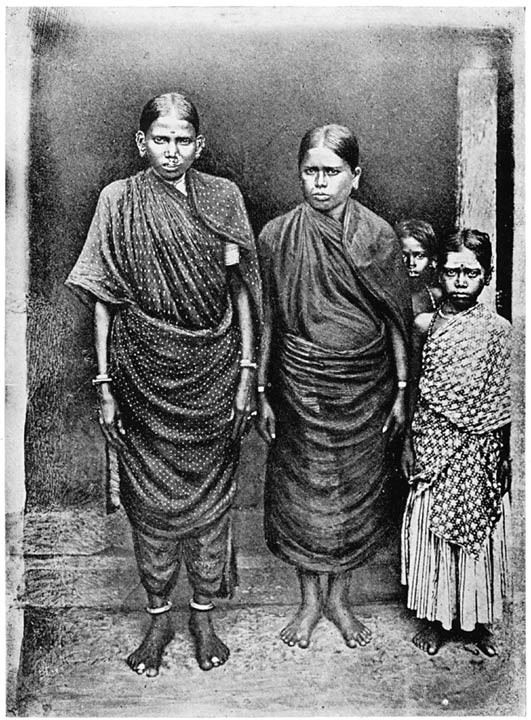
Kammālans.
The dead are, as a rule, buried in a sitting posture, but, at the present day, cremation is sometimes resorted to. Death pollution, as among some other non-Brāhmanical castes, lasts for sixteen days. It is usual for a Pandāram to officiate at the death ceremonies. On the first day, the corpse is anointed with oil, and given a soap-nut bath. On the third day, five lingams are made with mud, of which four are placed in the four corners at the spot where the corpse was buried, and the fifth is placed in the centre. Food is distributed on the fifth day to Pandārams and the castemen. Srādh (annual death ceremony) is not as a rule performed, except in some of the larger towns.
The Kammālans profess the Saiva form of the Brāhman religion, and reverence greatly Pillaiyar, the favourite son of Siva. A few have come under the Lingāyat influence. The caste, however, has its own special goddess Kāmākshi Amma, who is commonly spoken of as Vriththi Daivam. She is worshipped by all the sub-divisions, and female children are frequently named after her. She is represented by the firepot and bellows-fire at which the castemen work, and presides over them. On all auspicious occasions, the first betel and dakshina (present of money) are set apart in her name, and sent to the pūjāri (priest) of the local temple dedicated to her. Oaths are taken in her name, and disputes affecting the caste are settled before her temple. There also elections to caste offices are held. The exact connection of the goddess Kāmākshi with the caste is not known. There is, however, a vague tradition that she was one of the virgins who committed suicide by throwing herself into a fire, and was in consequence deified. Various village goddesses (grāma dēvata) are also worshipped, and, though the Kammālans profess to be vegetarians, animal sacrifices are offered to them. Among these deities are the Saptha Kannimar or seven virgins, Kōchadē Periyāndavan, and Periya Nayanar. Those who worship the Saptha Kannimar are known by the name of Mādāvaguppu, or the division that worships the mothers. Those who revere the other two deities mentioned are called Nādīkā Vamsathāl, or those descended from men who, through the seven virgins, attained eternal bliss. Kōchadē Periyāndavan is said to be a corruption of Or Jatē Periya Pāndyan, meaning the great Pāndya with the single lock. He is regarded as Vishnu, and Periya Nayanar is held to be a manifestation of Siva. The former is said to have been the person who invited the Tattāns (who called themselves Pāndya Tattāns) to settle in his kingdom. It is traditionally stated that they emigrated from the north, and settled in the Madura and Tinnevelly districts. An annual festival in honour of Kōchadē Periyāndavan is held in these districts, for the expenses in connection with which a subscription is raised among the five sub-divisions. The festival lasts over three days. On the first day, the image of the deified king is anointed with water, and a mixture of the juices of the mango, jāk (Artocarpus integrifolia), and plantain, called muppala pūjai. On the second day, rice is boiled, and offered to the god, and, on the last day, a healthy ram is sacrificed to him. This festival is said to be held, in order to secure the caste as a whole against evils that might overtake it. Tac’chans (carpenters) usually kill, or cut the ear of a ram or sheep, whenever they commence the woodwork of a new house, and smear the blood of the animal on a pillar or wall of the house.
The Kammālans claim to be descended from Visvakarma, the architect of the gods, and, in some places, claim to be superior to Brāhmans, calling the latter Gō-Brāhmans, and themselves Visva Brāhmans. Visvakarma is said to have had five sons, named Manu, Maya, Silpa, Tvashtra, and Daivagna. These five sons were the originators of the five crafts, which their descendants severally follow. Accordingly, some engage in smithy work, and are called Manus; others, in their turn, devote their attention to carpentry. These are named Mayas. Others again, who work at stone-carving, are known as Silpis. Those who do metal work are Tvashtras, and those who are engaged in making jewelry are known as Visvagnas or Daivagnas. According to one story of the origin of the Kammālans, they are the descendants of the issue of a Brāhman and a Bēri Chetti woman. Hence the proverb that the Kammālans and the Bēri Chettis are one. Another story, recorded in the Mackenzie manuscripts, which is current all over the Tamil country, is briefly as follows. In the town of Māndāpuri, the Kammālans of the five divisions formerly lived closely united together. They were employed by all sorts of people, as there were no other artificers in the country, and charged very high rates for their wares. They feared and respected no king. This offended the kings of the country, who combined against them. As the fort in which the Kammālans concealed themselves, called Kāntakkōttai, was entirely constructed of loadstone, all the weapons were drawn away by it. The king then promised a big reward to anyone who would burn down the fort, and at length the Dēva-dāsīs (courtesans) of a temple undertook to do this, and took betel and nut in signification of their promise. The king built a fort for them opposite Kāntakkōttai, and they attracted the Kammālans by their singing, and had children by them. One of the Dēva-dāsīs at length succeeded in extracting from a young Kammālan the secret that, if the fort was surrounded with varaghu straw and set on fire, it would be destroyed. The king ordered that this should be done, and, in attempting to escape from the sudden conflagration, some of the Kammālans lost their lives. Others reached the ships, and escaped by sea, or were captured and put to death. In consequence of this, artificers ceased to exist in the country. One pregnant Kammālan woman, however, took refuge in the house of a Bēri Chetti, and escaped decapitation by being passed off as his daughter. The country was sorely troubled owing to the want of artificers, and agriculture, manufactures, and weaving suffered a great deal. One of the kings wanted to know if any Kammālan escaped the general destruction, and sent round his kingdom a piece of coral possessing a tortuous aperture running through it, and a piece of thread. A big reward was promised to anyone who should succeed in passing the thread through the coral. At last, the boy born of the Kammālan woman in the Chetti’s house undertook to do it. He placed the coral over the mouth of an ant-hole, and, having steeped the thread in sugar, laid it down at some distance from the hole. The ants took the thread, and drew it through the coral. The king, being pleased with the boy, sent him presents, and gave him more work to do. This he performed with the assistance of his mother, and satisfied the king. The king, however, grew suspicious, and, having sent for the Chetti, enquired concerning the boy’s parentage. The Chetti thereon detailed the story of his birth. The king provided him with the means for making ploughshares on a large scale, and got him married to the daughter of a Chetti, and made gifts of land for the maintenance of the couple. The Chetti woman bore him five sons, who followed the five branches of work now carried out by the Kammālan caste. The king gave them the title of Panchayudhattar, or those of the five kinds of weapons. They now intermarry with each other, and, as children of the Chetti caste, wear the sacred thread. The members of the caste who fled by sea are said to have gone to China, or, according to another version, to Chingaladvīpam, or Ceylon, where Kammālans are found at the present day. In connection with the above story, it may be noted that, though ordinarily two different castes do not live in the same house, yet Bēri Chettis and Kammālans so live together. There is a close connection between the Kammālans and Acharapākam Chettis, who are a section of the Bēri Chetti caste. Kammālans and Acharapākam Chettis interdine; both bury their dead in a sitting posture; and the tāli (marriage badge) used by both is alike in size and make, and unlike that used by the generality of the Bēri Chetti caste. The Acharapākam Chettis are known as Malighe Chettis, and are considered to be the descendants of those Bēri Chettis who brought up the Kammālan children, and intermarried with them. Even now, in the city of Madras, when the Bēri Chettis assemble for the transaction of caste business, the notice summoning the meeting excludes the Malighe Chettis, who can neither vote nor receive votes at elections, meetings, etc., of the Kandasāmi temple, which every other Bēri Chetti has a right to.
It may be noted that the Dēva-dāsīs, whose treachery is said to have led to the destruction of the Kammālan caste, were Kaikōlans by caste, and that their illegitimate children, like their progenitors, became weavers. The weavers of South India, according to old Tamil poems, were formerly included in the Kammiyan or Kammālan caste.70 Several inscriptions show that, as late as 1013 A.D., the Kammālans were treated as an inferior caste, and, in consequence, were confined to particular parts of villages.71 A later inscription gives an order of one of the Chōla kings that they should be permitted to blow conches, and beat drums at their weddings and funerals, wear sandals, and plaster their houses.72 “It is not difficult,” Mr. H. A. Stuart writes,73 “to account for the low position held by the Kammālans, for it must be remembered that, in those early times, the military castes in India, as elsewhere, looked down upon all engaged in labour, whether skilled or otherwise. With the decline of the military power, however, it was natural that a useful caste like the Kammālans should generally improve its position, and the reaction from their long oppression has led them to make the exaggerated claims described above, which are ridiculed by every other caste, high or low.” The claims here referred to are that they are descended from Visvakarma, the architect of the gods, and are Brāhmans.
From a note by Mr. F. R. Hemingway, I gather that the friendship between the Muhammadans and Kammālans, who call each other māni (paternal uncle) “originated in the fact that a holy Muhammadan, named Ibrahim Nabi, was brought up in the house of a Kammālan, because his father was afraid that he would be killed by a Hindu king named Namadūta, who had been advised by his soothsayers that he would thus avoid a disaster, which was about to befall his kingdom. The Kammālan gave his daughter to the father of Ibrahim in exchange. Another story (only told by Kammālans) is to the effect that the Kammālans were once living in a magnetic castle, called Kānda Kōttai, which could only be destroyed by burning it with varagu straw; and that the Musalmans captured it by sending Musalman prostitutes into the town, to wheedle the secret out of the Kammālans. The friendship, according to the story, sprang up because the Kammālans consorted with the Musalman women.”
The Kammālans belong to the left hand, as opposed to the right hand faction. The origin of this distinction of castes is lost in obscurity, but, according to one version, it arose out of a dispute between the Kammālans and Vellālas. The latter claimed the former as their Jātipillaigal or caste dependents, while the former claimed the latter as their own dependents. The fight grew so fierce that the Chōla king of Conjeeveram ranged these two castes and their followers on opposite sides, and enquired into their claims. The Kammālans, and those who sided with them, stood on the left of the king, and the Vellālas and their allies on the right. The king is said to have decided the case against the Kammālans, who then dispersed in different directions. According to another legend, a Kammālan who had two sons, one by a Balija woman, and the other by his Kammālan wife, was unjustly slain by a king of Conjeeveram, and was avenged by his two sons, who killed the king and divided his body. The Kammālan son took his head and used it as a weighing pan, while the Balija son made a pedler’s carpet out of the skin, and threads out of the sinews for stringing bangles. A quarrel arose, because each thought the other had got the best of the division, and all the other castes joined in, and took the side of either the Kammālan or the Balija. Right and left hand dancing-girls, temples, and mandapams, are still in existence at Conjeeveram, and elsewhere in the Tamil country. Thus, at Tanjore, there are the Kammāla Tēvadiyāls, or dancing-girls. As the Kammālans belong to the left-hand section, dancing-girls of the right-hand section will not perform before them, or at their houses. Similarly, musicians of the right-hand section will not play in Kammālan houses. In olden days, Kammālans were not allowed to ride in palanquins through the streets of the right hands. If they did, a riot was the result. Such riots were common during the eighteenth century. Thus, Fryer refers to one of these which occurred at Masulipatam, when the contumacy of the Kamsalas (Telugu artisans) led to their being put down by the other castes with the aid of the Moors.
The Kammālans call themselves Āchāri and Paththar, which are equivalent to the Brāhman titles Ācharya and Bhatta, and claim a knowledge of the Vēdas. Their own priests officiate at marriages, funerals, and on other ceremonial occasions. They wear the sacred thread, which they usually don on the Upakarmam day, though some observe the regular thread investiture ceremony. Most of them claim to be vegetarians. Non-Brāhmans do not treat them as Brāhmans, and do not salute them with the namaskāram (obeisance). Their women, unlike those of other castes, throw the end of their body-cloth over the right shoulder, and are conspicuous by the nose ornament known as the nattu.
In connection with the professional calling of the Kammālans, Surgeon-Major W. R. Cornish writes as follows.74 “The artisans, who are smiths or carpenters, usually bring up their children to the same pursuits. It might have been supposed that the hereditary influence in the course of generations would have tended to excellence in the several pursuits, but it has not been so. Ordinary native work in metal, stone, and wood, is coarse and rough, and the designs are of the stereotyped form. The improvement in handicraft work of late years has been entirely due to European influence. The constructors of railways have been great educators of artisans. The quality of stone-masonry, brick-work, carpentry, and smith-work has vastly improved within the last twenty years, and especially in districts where railway works have been in progress. The gold and silver smiths of Southern India are a numerous body. Their chief employment consists in setting and making native jewellery. Some of their designs are ingenious, but here again the ordinary work for native customers is often noticeable for a want of finish, and, with the exception of a few articles made for the European markets, there is no evidence of progressive improvement in design or execution. That the native artists are capable of improvement as a class is evident from their skill and ingenuity in copying designs set before them, and from the excellent finish of their work under European supervision; but there must be a demand for highly finished work before the goldsmiths will have generally improved. The wearers of jewellery in India look more to the intrinsic value of an article, than to the excellence of the design or workmanship. So that there is very little encouragement for artistic display.” The collection of silver jewelry at the Madras Museum, which was made in connection with the Colonial and Indian Exhibition, London, 1886, bears testimony to the artistic skill of the silversmiths. Recently, Colonel Townshend, Superintendent of the Madras Gun Carriage Factory, has expressed his opinion75 that “good as the Bombay smiths are, the blacksmiths of Southern India are the best in Hindustan, and the pick of them run English smiths very close, not only in skill, but in speed of outturn.”
Anyone who has seen the celebrated temples of Southern India, for example, the Madura and Tanjore temples, and the carving on temple cars, can form some idea of the skill of South Indian stone-masons and carpenters. The following note on idols and idol-makers is taken from a recent article.76 “The idol-maker’s craft, like most of the other callings in this country, is a hereditary one, and a workman who has earned some reputation for himself, or has had an ancestor of renown, is a made man. The Sthapathi, as he is called in Sanskrit, claims high social rank among the representatives of the artisan castes. Of course he wears a heavy sacred thread, and affects Brāhman ways of living. He does not touch flesh, and liquor rarely passes down his throat, as he recognises that a clear eye and steady hand are the first essentials of success in his calling. There are two sorts of idols in every temple, mulavigrahas or stone idols which are fixed to the ground, and utsavavigrahas or metal idols used in processions. In the worst equipped pagoda there are at least a dozen idols of every variety. They do duty for generations, for, though they become black and begrimed with oil and ashes, they are rarely replaced, as age and dirt but add to their sanctity. But now and then they get desecrated for some reason, and fresh ones have to be installed in their stead; or it may be that extensions are made in the temple, and godlings in the Hindu Pantheon, not accommodated within its precincts till then, have to be carved and consecrated. It is on such occasions that the hands of the local Sthapathi are full of work, and his workshop is as busy as a bee-hive. In the larger temples, such as the one at Madura, the idols in which are to be counted by the score, there are Sthapathis on the establishment receiving fixed emoluments. Despite the smallness of the annual salary, the office of temple Sthapathi is an eagerly coveted one, for, among other privileges, the fortunate individual enjoys that of having his workshop located in the temple premises, and thereby secures an advertisement that is not to be despised. Besides, he is not debarred from adding to his pecuniary resources by doing outside work when his hands are idle. Among stone images, the largest demand is for representations of Ganapati or Vignesvara (the elephant god), whose popularity extends throughout India. Every hamlet has at least one little temple devoted to his exclusive worship, and his shrines are found in the most unlikely places. Travellers who have had occasion to pass along the sandy roads of the Tanjore district must be familiar with the idols of the god of the protuberant paunch, which they pass every half mile or so, reposing under the shade of avenue trees with an air of self-satisfaction suffusing their elephantine features. Among other idols called into being for the purpose of wayside installation in Southern India, may be mentioned those of Vīran, the Madura godling, who requires offerings of liquor, Māriamma, the small-pox goddess, and the evil spirit Sangili Karappan. Representations are also carved of nāgas or serpents, and installed by the dozen round the village asvatha tree (Ficus religiosa). Almost every week, the mail steamer to Rangoon takes a heavy consignment of stone and metal idols commissioned by the South Indian settlers in Burma for purposes of domestic and public worship. The usual posture of mulavigrahas is a standing one, the figure of Vishnu in the Srirangam temple, which represents the deity as lying down at full length, being an exception to this rule. The normal height is less than four feet, some idols, however, being of gigantic proportions. Considering the very crude material on which he works, and the primitive methods of stone-carving which he continues to favour, the expert craftsman achieves quite a surprising degree of smoothness and polish. It takes him several weeks of unremitting toil to produce a vigraha that absolutely satisfies his critical eye. I have seen him engaged for hours at a stretch on the trunk of Vignesvara or the matted tuft of a Rishi. The casting of utsavavigrahas involves a greater variety of process than the carving of stone figures. The substance usually employed is a compound of brass, copper and lead, small quantities of silver and gold being added, means permitting. The required figure is first moulded in some plastic substance, such as wax or tallow, and coated with a thin layer of soft wet clay, in which one or two openings are left. When the clay is dry, the figure is placed in a kiln, and the red-hot liquid metal is poured into the hollow created by the running out of the melted wax. The furnace is then extinguished, the metal left to cool and solidify, and the clay coating removed. A crude approximation to the image required is thus obtained, which is improved upon with file and chisel, till the finished product is a far more artistic article than the figure that was enclosed within the clay. It is thus seen that every idol is made in one piece, but spare hands and feet are supplied, if desired. Whenever necessary, the Archaka (temple priest) conceals the limbs with cloth and flowers, and, inserting at the proper places little pieces of wood which are held in position by numerous bits of string, screws on the spare parts, so as to fit in with the posture that the idol is to assume during any particular procession.”
An association, called the Visvakarma Kulābhimana Sabha, was established in the city of Madras by the Kammālans in 1903. The objects thereof were the advancement of the community as a whole on intellectual and industrial lines, the provision of practical measures in guarding the interests, welfare and prospects of the community, and the improvement of the arts and sciences peculiar to them by opening industrial schools and workshops, etc.
Of proverbs relating to the artisan classes, the following may be noted:—
The goldsmith who has a thousand persons to answer. This in reference to the delay in finishing a job, owing to his taking more orders than he can accomplish in a given time.
The goldsmith knows what ornaments are of fine gold, i.e., knows who are the rich men of a place.
It must either be with the goldsmith, or in the pot in which he melts gold, i.e., it will be found somewhere in the house. Said to one who is in search of something that cannot be found.
Goldsmiths put inferior gold into the refining-pot.
If, successful, pour it into a mould; if not, pour it into the melting pot. The Rev. H. Jensen explains77 that the goldsmith examines the gold after melting it. If it is free from dross, he pours it into the mould; if it is still impure, it goes back into the pot.
The goldsmith will steal a quarter of the gold of even his own mother.
Stolen gold may be either with the goldsmith, or in his fire-pot.
If the ear of the cow of a Kammālan is cut and examined, some wax will be found in it. It is said that the Kammālan is in the habit of substituting sealing-wax for gold, and thus cheating people. The proverb warns them not to accept even a cow from a Kammālan. Or, according to another explanation, a Kammālan made a figure of a cow, which was so lifelike that a Brāhman purchased it as a live animal with his hard-earned money, and, discovering his mistake, went mad. Since that time, people were warned to examine an animal offered for sale by Kammālans by cutting off its ears. A variant of the proverb is that, though you buy a Kammālan’s cow only after cutting its ears, he will have put red wax in its ears (so that, if they are cut into, they will look like red flesh).
What has a dog to do in a blacksmith’s shop? Said of a man who attempts to do work he is not fitted for.
When the blacksmith sees that the iron is soft, he will raise himself to the stroke.
Will the blacksmith be alarmed at the sound of a hammer?
When a child is born in a blacksmith’s family, sugar must be dealt out in the street of the dancing-girls. This has reference to the legendary relation of the Kammālans and Kaikōlans.
A blacksmith’s shop, and the place in which donkeys roll themselves, are alike.
The carpenters and blacksmiths are to be relegated, i.e., to the part of the village called the Kammālachēri.
What if the carpenter’s wife has become a widow? This would seem to refer to the former practice of widow remarriage.
The carpenter wants (his wood) too long, and the blacksmith wants (his iron) too short, i.e., a carpenter can easily shorten a piece of wood, and a blacksmith can easily hammer out a piece of iron.
When a Kammālan buys cloth, the stuff he buys is so thin that it does not hide the hair on his legs.
Kammālan (Malayālam).—“The Kammālans of Malabar,” Mr. Francis writes,78 “are artisans, like those referred to immediately above, but they take a lower position than the Kammālans and Kamsalas of the other coast, or the Pānchālas of the Canarese country. They do not claim to be Brāhmans or wear the sacred thread, and they accept the position of a polluting caste, not being allowed into the temples or into Brāhman houses. The highest sub-division is Asāri, the men of which are carpenters, and wear the thread at certain ceremonies connected with house-building.”
According to Mr. F. Fawcett “the orthodox number of classes of Kammālans is five. But the artisans do not admit that the workers in leather belong to the guild, and say that there are only four classes. According to them, the fifth class was composed of coppersmiths, who, after the exodus, remained in Izhuva land, and did not return thence with them to Malabar.79 Nevertheless, they always speak of themselves as the Ayen Kudi or five-house Kammālans. The carpenters say that eighteen families of their community remained behind in Izhuva land. Some of these returned long afterwards, but they were not allowed to rejoin the caste. They are known as Puzhi Tachan or sand carpenters, and Pathinettanmar or the eighteen people. There are four families of this class now living at or near Parpan gadi. They are carpenters, but the Asāris treat them as outcastes.”
For the following note on Malabar Kammālans I am indebted to Mr. S. Appadorai Iyer. The five artisan classes, or Ayinkudi Kammālans, are made up of the following:—
- Asāri, carpenters.
- Mūsāri, braziers.
- Tattān, goldsmiths.
- Karumān, blacksmiths.
- Chembotti or Chempotti, coppersmiths.
The name Chembotti is derived from chembu, copper, and kotti, he who beats. They are, according to Mr. Francis, “coppersmiths in Malabar, who are distinct from the Malabar Kammālans. They are supposed to be descendants of men who made copper idols for temples, and so rank above the Kammālans in social position, and about equally with the lower sections of the Nāyars.”
The Kammālans will not condescend to eat food at the hands of Kurups, Tōlkollans, Pulluvans, Mannāns, or Tandans. But a Tandan thinks it equally beneath his dignity to accept food from a Kammālan. The Kammālans believe themselves to be indigenous in Malabar, and boast that their system of polyandry is the result of the sojourn of the exiled Pāndavas, with their common wife Pānchāli, and their mother Kunthi, in the forest of the Walluvanād division. They say that the destruction of the Pāndavas was attempted in the Arakkuparamba amsam of this division, and that the Tac’chans (artisans) were given as a reward by the Kurus the enjoyment of Tacchanattukara amsam. They state further that the Pāndus lived for some time at the village of Bhīmanād, and went to the Attapādi valley, where they deposited their cooking utensils at the spot where the water falls from a height of several hundred feet. This portion of the river is called Kuntipuzha, and the noise of the water, said to be falling on the upset utensils, is heard at a great distance.
The Kammālans, male and female, dress like Nāyars, and their ornaments are almost similar to those of the Nāyars, with this difference, that the female Tattān wears a single chittu or ring in the right ear only.
In the building of a house, the services of the Asāri are required throughout. He it is who draws the plan of the building. And, when a door is fixed or beam raised, he receives his perquisite. The completion of a house is signified as a rule by a kutti-poosa. For this ceremony, the owner of the house has to supply the workmen with at least four goats to be sacrificed at the four corners thereof, a number of fowls to be killed so that the blood may be smeared on the walls and ceiling, and an ample meal with liquor. The feast concluded, the workmen receive presents of rings, gold ear-rings, silk and other cloths, of which the Moothasāri or chief carpenter receives the lion’s share. “The village carpenter,” Mr. Gopal Panikkar writes,80 “has to do everything connected with our architecture, such as fixing poles or wickets at the exact spot where buildings are to be erected, and clearing newly erected buildings of all devils and demons that may be haunting them. This he does by means of pūjas (worship) performed after the completion of the building. But people have begun to break through the village traditions, and to entrust architectural work to competent hands, when the village carpenter is found incompetent for the same.”
It is noted by Canter Visscher81 that “in commencing the building of a house, the first prop must be put up on the east side. The carpenters open three or four cocoanuts, spilling the juice as little as possible, and put some tips of betel leaves into them; and, from the way these float in the liquid, they foretell whether the house will be lucky or unlucky, whether it will stand for a long or short period, and whether another will ever be erected on its site. I have been told that the heathens say that the destruction of fort Paponetti by our arms was foretold by the builders from these auguries.”
The blacksmith is employed in the manufacture of locks and keys, and ornamental iron and brasswork for the houses of the rich. The smithy is near the dwelling hut, and the wife blows the bellows. The smith makes tyres for wheels, spades, choppers, knives, sickles, iron spoons, ploughshares, shoes for cattle and horses, etc. These he takes to the nearest market, and sells there. In some places there are clever smiths, who make excellent chellams (betel boxes) of brass, and there is one man at Walluvanād who even makes stylographic pens.
The Mūsāri works in bell-metal, and makes all kinds of household utensils, and large vessels for cooking purposes. He is an adept at making such articles with the proper proportions of copper, lead and brass. In some of the houses of the wealthier classes there are cooking utensils, which cost nearly a thousand rupees. Excellent bell-metal articles are made at Cherpalcheri, and Kunhimangalam in North Malabar is celebrated for its bell-metal lamps. The importation of enamelled and aluminium vessels, and lamps made in Europe, has made such inroads into the metal industry of the district that the brazier and blacksmith find their occupation declining.
The goldsmith makes all kinds of gold ornaments worn by Malaiālis. His lot is better than that of the other artisan classes.
It is noted in the Malabar Marriage Commission’s report that “among carpenters and blacksmiths in the Calicut, Walluvanād and Ponnāni taluks, several brothers have one wife between them, although the son succeeds the father amongst them.” Polyandry of the fraternal type is said to be most prevalent among the blacksmiths, who lead the most precarious existence, and have to observe the strictest economy. As with the Nāyars, the tāli-kettu kalyānam has to be celebrated. For this the parents of the child have to find a suitable manavālan or bridegroom by the consultation of horoscopes. An auspicious day is fixed, and new cloths are presented to the manavālan. The girl bathes, and puts on new clothes. She and the manavālan are conducted to a pandal (booth), where the tāli-tying ceremony takes place. This concluded, the manavālan takes a thread from the new cloth, and breaks it in two, saying that his union with the girl has ceased. He then walks away without looking back. When a Kammālan contemplates matrimony, his parents look out for a suitable bride. They are received by the girl’s parents, and enquiries are made concerning her. The visit is twice repeated, and, when an arrangement has been arrived at, the village astrologer is summoned, and the horoscopes of the contracting parties are consulted. It is sufficient if the horoscope of one of the sons agrees with that of the girl. The parents of the sons deposit as earnest money, or āchcharapanam, four, eight, twelve, or twenty-one fanams according to their means, in the presence of the artisans of the village; and a new cloth (kacha) is presented to the bride, who thus becomes the wife of all the sons. There are instances in which the girl, after the āchcharam marriage, is immediately taken to the husband’s house. All the brother-husbands, dressed in new clothes and decorated with ornaments, with a new palmyra leaf umbrella in the hand, come in procession to the bride’s house, where they are received by her parents and friends, and escorted to the marriage pandal. The bride and bridegrooms sit in a row, and the girl’s parents give them fruits and sugar. This ceremony is called mathuram kotukkal. The party then adjourns to the house of the bridegrooms where a feast is held, in the course of which a ceremony called pāl kotukkal is performed. The priest of the Kammālans takes some milk in a vessel, and pours it into the mouths of the bride and bridegrooms, who are seated, the eldest on the right, the others in order of seniority, and lastly the bride. During the nuptials the parents of the bride have to present a water-vessel, lamp, eating dish, cooking vessel, spittoon, and a vessel for drawing water from the well. The eldest brother cohabits with the bride on the wedding day, and special days are set apart for each brother. There seems to be a belief among the Kammālan women that, the more husbands they have, the greater will be their happiness. If one of the brothers, on the ground of incompatibility of temper, brings a new wife, she is privileged to cohabit with the other brothers. In some cases, a girl will have brothers ranging in age from twenty-five to five, whom she has to regard as her husband, so that by the time the youngest reaches puberty she may be well over thirty, and a young man has to perform the duties of a husband with a woman who is twice his age.
If a woman becomes pregnant before the āchchara kalyānam has been performed, her parents are obliged to satisfy the community that her condition was caused by a man of their own caste, and he has to marry the girl. If the paternity cannot be traced, a council is held, and the woman is turned out of the caste. In the sixth or eighth month of pregnancy, the woman is taken to her mother’s house, where the first confinement takes place. During her stay there the pulikudi ceremony is performed. The husbands come, and present their wife with a new cloth. A branch of a tamarind tree is planted in the yard of the house, and, in the presence of the relations, the brother of the pregnant woman gives her conji (rice gruel) mixed with the juices of the tamarind, Spondias mangifera and Hibiscus, to drink. The customary feast then takes place. A barber woman (Mannathi) acts as midwife. On the fourteenth day after childbirth, the Thali-kurup sprinkles water over the woman, and the Mannathi gives her a newly-washed cloth to wear. Purification concludes with a bath on the fifteenth day. On the twenty-eighth day the child-naming ceremony takes place. The infant is placed in its father’s lap, and in front of it are set a measure of rice and paddy (unhusked rice) on a plantain leaf. A brass lamp is raised, and a cocoanut broken. The worship of Ganēsa takes place, and the child is named after its grandfather or grandmother. In the sixth month the chōronu or rice-giving ceremony takes place. In the first year of the life of a boy the ears are pierced, and gold ear-rings inserted. In the case of a girl, the ear-boring ceremony takes place in the sixth or seventh year. The right nostril of girls is also bored, and mukkuthi worn therein.
It is recorded, in the Gazetteer of Malabar, that, “amongst Kammālans, the betrothal ceremony is similar to that of the Tiyans. If more than one brother is to be married, to the same girl, her mother asks how many bridegrooms there are, and replies that there are mats and planks for so many. Cohabitation sometimes begins from the night of the betrothal, the eldest brother having the priority, and the rest in order of seniority on introduction by the bride’s brother. If the girl becomes pregnant, the formal marriage must be celebrated before the pregnancy has advanced six months. At the formal marriage, the bridegrooms are received by the bride’s mother and brothers; two planks are placed before a lighted lamp, before which the bridegrooms and the bride’s brothers prostrate themselves. The bride is dressed in a new cloth, and brought down by the bridegroom’s sister and fed with sweetmeats.
“Next day all the bridegroom’s party visit the Tandān of the bride’s desam (village), who has to give them arrack (liquor) and meat, receiving in his turn a present of two fanams (money). The next day the bride is again feasted in her house by the bridegrooms, and is given her dowry consisting of four metal plates, one spittoon, one kindi (metal vessel), and a bell-metal lamp. The whole party then goes to the bridegroom’s house, where the Tandān proclaims the titles of the parties and their desam. All the brothers who are to share in the marriage sit in a row on a mat with the bride on the extreme left, and all drink cocoanut milk. The presence of all the bridegrooms is essential at this final ceremony, though for the preceding formalities it is sufficient if the eldest is present.”
The Kammalāns burn the corpses of adults, and bury the young. Fifteen days’ pollution is observed, and at the expiration thereof the Thali-kurup pours water, and purification takes place. On the third day the bones of the cremated corpse are collected, and placed in a new earthen pot, which is buried in the grounds of the house of the deceased. One of the sons performs beli (makes offerings), and observes dīksha (hair-growing) for a year. The bones are then carried to Tirunavaya in Ponnāni, Tiruvilamala in Cochin territory, Perūr in Coimbatore, or Tirunelli in the Wynād, and thrown into the river. A final beli is performed, and the srādh memorial ceremony is celebrated. If the deceased was skilled in sorcery, or his death was due thereto, his ghost is believed to haunt the house, and trouble the inmates. To appease it, the village washerman (Mannān) is brought with his drums, and, by means of his songs, forces the devil into one of the members of the household, who is made to say what murthi or evil spirit possesses him, and how it should be satisfied. It is then appeased with the sacrifice of a fowl, and drinking the juice of tender cocoanuts. A further demand is that it must have a place consigned to it in the house or grounds, and be worshipped once a year. Accordingly, seven days later, a small stool representing the deceased is placed in a corner of one of the rooms, and there worshipped annually with offerings of cocoanuts, toddy, arrack, and fowls. In the grounds of some houses small shrines, erected to the memory of the dead, may be seen. These are opened once a year, and offerings made to them.
The Kammālans worship various minor deities, such as Thīkutti, Parakutti, Kala Bairavan, and others. Some only worship stone images erected under trees annually. They have barbers of their own, of whom the Mannān shaves the men, and the Mannathi the women. These individuals are not admitted into the Mannān caste, which follows the more honourable profession of washing clothes.
In the Madras Census Report, 1901, the following sub-castes of Malabar Kammālans are recorded:—Kallan Muppan and Kallukkotti (stone-workers), Kottōn (brass-smith), Pon Chetti (gold merchant), and Pūliasāri (masons). In the Cochin Census Report, 1901, it is stated that “the Kammālans are divided into six sub-castes, viz., Marāsāri (carpenter), Kallasāri (mason), Mūsāri (brazier), Kollan (blacksmith), Tattān (goldsmith), and Tōlkollan (leather-worker). Of these six, the first five interdine, and intermarry. The Tōlkollan is considered a degraded caste, probably on account of his working in leather, which in its earlier stages is an unholy substance. The other sub-castes do not allow the Tōlkollans even to touch them. Among the Marāsāris are included the Marāsāris proper and Tacchans. The Tacchans are looked upon by other castes in the group as a separate caste, and are not allowed to touch them. All the sub-castes generally follow the makkathāyam law of inheritance, but there are some vestiges of marumakkathāyam also among them. There is a sub-caste called Kuruppu, who are their barbers and priests. They officiate as priest at marriage and funeral ceremonies. When they enter the interior shrine of temples for work in connection with the image of a god, or with the temple flagstaff, the Asāri and Mūsāri temporarily wear a sacred thread, which is a rare privilege. Their approach within a radius of twenty-four feet pollutes Brāhmans. On the completion of a building, the Marāsāri, Kallāsāri and Kollan perform certain pūjas, and sacrifice a fowl or sheep to drive out the demons and devils which are supposed to have haunted the house till then.”
For the following note on the Kammālans of Travancore, I am indebted to Mr. N. Subramania Aiyar. “The titles of the Malayālam Kammālans are Panikkan and Kanakkan. The word Panikkan means a worker, and Kanakkan is the title given to a few old and respectable Kammālas in every village, who superintend the work of others, and receive the highest remuneration. It is their business to sketch the plan of a building, and preside at the vastubali rite. Many Tamil Kammālans have naturalised themselves on the west coast, and speak Malayālam. Between them and the Malayālam Kammālans neither intermarriage nor interdining obtains. The latter are divided into five classes, viz., Asāri or Marapanikkan (workers in wood), Kallan or Kallāsāri (workers in stone), Mūsāri (braziers and coppersmiths), Tattān (goldsmiths), and Kollan (workers in iron). To these the Jātinirnaya and Kēralavisēshamāhātmya add a sixth class, the Tacchan or Irchchakollan, whose occupation is to fell trees and saw timber. The Tacchans are also known as Villasans (bowmen), as they were formerly required to supply bows and arrows for the Travancore army.
Epigraphic records point to the existence of the five classes of Kammālans in Malabar at least as early as the beginning of the ninth century A.D., as a Syrian Christian grant refers to them as Aimvazhi Kammālas. There is a tradition that they were brought to Kērala by Parasu Rāma, but left in a body for Ceylon on being pressed by one of the early Perumāl satraps of Cranganūr to marry into the washerman caste, after they had by a special arrangement of the marriage shed trapped to death a large number of that obnoxious community. The King of Ceylon was requested, as an act of international courtesy, to send back some of the Kammālans. As, however, they were loth to return to their former persecutor, they were sent in charge of some Izhavas, who formed the military caste of the island. The legend is given in detail by Canter Visscher, who writes as follows. “In the time of Cheramperoumal, a woman belonging to the caste of the washermen, whose house adjoined that of an Ajari (the carpenter caste), being occupied as usual in washing a cloth in water mixed with ashes (which is here used for soap), and having no one at hand to hold the other end of it, called to a young daughter of the Ajari, who was alone in the house, to assist her. The child, not knowing that this was an infringement of the laws of her caste, did as she was requested, and then went home. The washerwoman was emboldened by this affair to enter the Ajari’s house a few days afterwards; and, upon the latter demanding angrily how she dared to cross his threshold, the woman answered scornfully that he belonged now to the same caste as she did, since his daughter had helped to hold her cloth. The Ajari, learning the disgrace that had befallen him, killed the washerwoman. Upon this, her friends complained to Cheramperoumal, who espoused their cause, and threatened the carpenters; whereupon the latter combined together to take refuge in Ceylon, where they were favourably received by the King of Candy, for whom the Malabars have great veneration. Cheramperoumal was placed in great embarrassment by their departure, having no one in his dominions who could build a house or make a spoon, and begged the King of Candy to send them back, promising to do them no injury. The Ajaris would not place entire confidence in these promises, but asked the king to send them with two Chegos (Chōgans) and their wives, to witness Cheramperoumal’s conduct towards them, and to protect them. The king granted their request, with the stipulation that on all high occasions, such as weddings and deaths and other ceremonies, the Ajaris should bestow three measures of rice on each of these Chegos and their descendants as a tribute for their protection; a custom which still exists. If the Ajari is too poor to afford the outlay, he is still obliged to present the requisite quantity of rice, which is then given back to him again; the privilege of the Chegos being thus maintained.
“The Kammālans are to some extent educated, and a few of them have a certain knowledge of Sanskrit, in which language several works on architecture are to be found. Their houses, generally known as kottil, are only low thatched sheds. They eat fish and flesh, and drink intoxicating liquors. Their jewelry is like that of the Nāyars, from whom, however, they are distinguished by not wearing the nose ornaments mukkutti and gnattu. Some in Central Travancore wear silver mukkuttis. Tattooing, once very common, is going out of fashion.
“In timber work the Asāris excel, but the Tamil Kammālans have outstripped the Tattāns in gold and silver work. The house-building of the Asāri has a quasi-religious aspect. When a temple is built, there is a preliminary rite known as anujgna, when the temple priest transfers spiritual force from the image, after which a cow and calf are taken thrice round the temple, and the Kanakkan is invited to enter within for the purposes of work. The cow and calf are let loose in front of the carpenter, who advances, and commences the work. On the completion of a building, an offering known as vastubali is made. Vastu is believed to represent the deity who presides over the house, and the spirits inhabiting the trees which were felled for the purpose of building it. To appease these supernatural powers, the figure of a demon is drawn with powders, and the Kanakkan, after worshipping his tutelary deity Bhadrakāli, offers animal sacrifices to him in non-Brāhmanical houses, and vegetable sacrifices in Brāhman shrines and homes. An old and decrepit carpenter enters within the new building, and all the doors thereof are closed. The Kanakkan from without asks whether he has inspected everything, and is prepared to hold himself responsible for any architectural or structural shortcomings, and he replies in the affirmative. A jubilant cry is then raised by all the assembled Asāris. Few carpenters are willing to undertake this dangerous errand, as it is supposed that the dissatisfied demons are sure to make short work of the man who accepts the responsibility. The figure is next effaced, and no one enters the house until the auspicious hour of milk-boiling.
“Vilkuruppu or Vilkollakkuruppu, who used formerly to supply bows and arrows for the Malabar army, are the recognised priests and barbers of the Kammālans. They still make and present bows and arrows at the Ōnam festival. In some places the Kammālans have trained members of their own caste to perform the priestly offices. The Malayāla Kammālans, unlike the Tamils, are not a thread-wearing class, but sometimes put on a thread when they work in temples or at images. They worship Kāli, Mātan, and other divinities. Unlike the Tamil Kammālans, they are a polluting class, but, when they have their working tools with them, they are less objectionable. In some places, as in South Travancore, they are generally regarded as higher in rank than the Izhavas, though this is not universal.
“The tāli-kettu ceremony is cancelled by a ceremony called vāzhippu, by which all connection between the tāli-tier and the girl is extinguished. The wedding ornament is exactly the same as that of the Izhavas, and is known as the minnu (that which shines). The system of inheritance is makkathāyam. It is naturally curious that, among a makkathāyam community, paternal polyandry should have been the rule till lately. ‘The custom,’ says Mateer, ‘of one woman having several husbands is sometimes practiced by carpenters, stone-masons, and individuals of other castes. Several brothers living together are unable to support a single wife for each, and take one, who resides with them all. The children are reckoned to belong to each brother in succession in the order of seniority.’ But this, after all, admits of explanation. If only the marumakkathāyam system of inheritance is taken, as it should be, as a necessary institution in a society living in troublous times, and among a community whose male members had duties and risks which would not ordinarily permit of the family being perpetuated solely through the male line, and not indicating any paternal uncertainty as some theorists would have it; and if polyandry, which is much more recent than the marumakkathāyam system of inheritance, is recognised to be the deplorable result of indigence, individual and national, and not of sexual bestiality, there is no difficulty in understanding how a makkathāyam community can be polyandrous. Further, the manners of the Kammālars lend a negative support to the origin just indicated by the marumakkathāyam system of inheritance even among the Nāyars. The work of the Kammālars was within doors and at home, not even in a large factory where power-appliances may lend an element of risk, for which reason they found it quite possible to keep up lineage in the paternal line, which the fighting Nāyars could not possibly do. And the fact that the marumakkathāyam system was ordained only for the Kshatriyas, and for the fighting races, and not for the religious and industrial classes, deserves to be specially noted in this connection.”
Kammara.—The Kammaras are the blacksmith section of the Telugu Kamsalas, whose services are in great demand by the cultivator, whose agricultural implements have to be made, and constantly repaired. It is noted, in the Bellary Gazetteer, that “until recently the manufacture of the huge shallow iron pans, in which the sugar-cane is boiled, was a considerable industry at Kāmalāpuram. The iron was brought by pack bullocks from Jambunath Konda, the dome-shaped hill at the Hospet end of the Sandūr range, and was smelted and worked by men of the Kammara caste. Of late years, the cheaper English iron has completely ousted the country product, the smelting industry is dead, and the Kammaras confine themselves to making and mending the boilers with English material. They have a temple of their own, dedicated to Kāli, in the village, where the worship is conducted by one of themselves.” The name Baita Kammara, meaning outside blacksmiths, is applied to Kamsala blacksmiths, who occupy a lowly position, and work in the open air or outside a village.82
Kammiyan.—A Tamil name for blacksmiths.
Kampa (bush of thorns).—An exogamous sept of Yerukala.
Kāmpo.—In the Manual of the Ganjam district, the Kāmpos are described as Oriya agriculturists. In the Madras Census Report, 1901, the name is taken as an Oriya form of Kāpu. Kāmpu is the name for Savaras, who have adopted the customs of the Hindu Kāmpos.
Kamsala.—The Kamsalas, or, as they are sometimes called, Kamsaras, are the Telugu equivalent of the Tamil Kammālans. They are found northward as far as Berhampore in Ganjam. According to tradition, as narrated in the note on Kammālans, they emigrated to the districts in which they now live on the disruption of their caste by a certain king. The Kamsalas of Vizagapatam, where they are numerically strong, say that, during the reign of a Chōla king, their ancestors claimed equality with Brāhmans. This offended the king, and he ordered their destruction. The Kamsalas fled northward, and some escaped death by taking shelter with people of the Ozu caste. As an acknowledgment of their gratitude to their protectors, some of them have Ozu added to their house-names, e.g., Lakkozu, Kattozu, Patozu, etc.
The Kamsalas have territorial sub-divisions, such as Murikinādu, Pākinādu, Drāvida, etc. Like the Kammālans, they have five occupational sections, called Kamsali (goldsmiths), Kanchāri or Mūsāri (brass-smiths), Vadrangi (carpenters), and Kāsi or Silpi (stone-masons). In a note on the Kamsalas of the Godāvari district, Mr. F. R. Hemingway writes that “they recognise two main divisions, called Desāyi (indigenous) and Turpusākas (easterns) or immigrants from Vizagapatam. They sometimes speak of their occupational sub-divisions as gōtras. Thus, Sanāthana is the iron, Sānaga, the wooden, Abhōnasa, the brass, Prathanasa, the stone, and Suparnasa, the gold gōtra.” Intermarriage takes place between members of the different sections, but the goldsmiths affect a higher social status than the blacksmiths, and do not care to interdine or intermarry with them. They have taken to calling themselves Brāhmans, have adopted Brāhmanical gōtras, and the Brāhmanical form of marriage rites. They quote a number of well-known verses of the Telugu poet Vēmana, who satirised the Brāhmans for their shortcomings, and refer to the Sanskrit Mulastambam and Silpasastram, which are treatises on architecture. They trace their descent from Visvakarma, the architect of the gods. Visvakarma is said to have had five sons, of whom the first was Kammarachārya. His wife was Sūrēlavathi, the daughter of Vasishta. The second was Vadlachāryudu. The third was Rūdra or Kamcharāchārya of the Abhavansa gōtra, whose wife was Jalāvathi, the daughter of Paulasthya Brahma. The fourth was Kāsācharyudu of the Prasnasa gōtra. His wife was Gunāvati, the daughter of Visvavasa. The fifth was Agasālāchārya or Chandra of the Suvarnasa gōtra, whose wife was Saunati, the daughter of Bhrigumahāmuni. Visvakarma had also five daughters, of whom Sarasvathi was married to Brahma, Sachi Dēvi to Indra, Mando Dari to Rāvana, and Ahalya to Gautama. Since they were married to the dēvatas, their descendants acquired the title of Achārya. The use of the umbrella, sacred thread, golden staff, the insignia of Garuda, and the playing of the bhēri were also allowed to them. It is recorded by the Rev. J. Cain83 that “the so-called right-hand castes object most strongly to the Kamsalilu being carried in a palki (palanquin), and three years ago some of them threatened to get up a little riot on the occasion of a marriage in the Kamsali caste. They were deprived of this opportunity, for the palki was a borrowed one, and its owner, more anxious for the safety of his property than the dignity of the Kamsali caste, recalled the loan on the third day. A ringleader of the discontented was a Madras Pariah. The Kamsalilu were formerly forbidden to whitewash the outside of their houses, but municipal law has proved stronger in this respect than Brāhmanical prejudice.” The Kamsalas of Ganjam and Vizagapatam do not make such a vigorous claim to be Brāhmans, as do those further south. They rear poultry, partake of animal food, do not prohibit the use of alcoholic liquor, and have no gōtras. They also have sub-divisions among them, which do not wear the sacred thread, and work outside the village limits. Thus, the Karamalas are a section of blacksmiths, who do not wear the sacred thread. Similarly, the Baita Kammaras are another section of blacksmiths, who do not wear the thread, and, as their name implies, work outside the village. In Vizagapatam, almost the only castes which will consent to receive food at the hands of Kamsalas are the humble Mālas and Rellis. Even the Tsākalas and Yatas will not do so. There is a popular saying that the Kamsalas are of all castes seven visses (viss, a measure of weight) less.
In 1885, a criminal revision case came before the High Court of Madras, in which a goldsmith performed abishēkam by pouring cocoanut-water over a lingam. In his judgment, one of the Judges recorded that “the facts found are that 1st accused, a goldsmith by caste, on the night of the last Mahāsivarātri, entered a Siva temple at Vizagapatam, and performed abishēkam, i.e., poured cocoanut-water over the lingam, the 2nd and 3rd accused (Brāhmans) reciting mantrams (sacred formulæ) while he did so. Another Brāhman who was there expostulated with 1st accused, telling him that he, a goldsmith, had no right to perform abishēkam himself, upon which 1st accused said that it was he who made the idol, and he was fit to perform abishēkam. An outcry being raised, some other Brāhmans came up, and objected to 1st accused performing abishēkam, and he was turned out, and some ten rupees spent in ceremonies for the purification of the idol. The 2nd-class Magistrate convicted the 1st accused under sections 295 and 296, Indian Penal Code, and the 2nd and 3rd accused of abetment. All these convictions were reversed on appeal by the District Magistrate. There was certainly no evidence that any of the accused voluntarily caused disturbance to an assembly engaged in the performance of religious worship or religious ceremonies, and therefore a conviction under section 296 could not be supported. In order to support a conviction under section 295, it would be necessary for the prosecution to prove (1) that the accused ‘defiled’ the lingam, and (2) that he did so, knowing that a class of persons, viz., the Brāhmans, would consider such defilement as an insult to their religion. It may be noted that the 1st accused is a person of the same religion as the Brāhmans, and, therefore, if the act be an insult at all, it was an insult to his own religion. The act of defilement alleged was the performance of abishēkam, or the pouring of cocoanut-water over the lingam. In itself, the act is regarded as an act of worship and meritorious, and I understand that the defilement is alleged to consist in the fact that the 1st accused was not a proper person—not being a Brāhman—to perform such a ceremony, but that he ought to have got some Brāhman to perform it for him.” The other Judge (Sir T. Muttusami Aiyar) recorded that “in many temples in this Presidency, it is not usual for worshippers generally to touch the idol or pour cocoanut-water upon it, except through persons who are specially appointed to do so, and enjoined to observe special rules of cleanliness. If the accused knew that the temple, in the case before us, is one of those temples, and if he did the act imputed to him to ridicule openly the established rule in regard to the purity of the lingam as an object of worship, it might then be reasonably inferred that he did the act wantonly, and with the intention of insulting the religious notions of the general body of worshippers. The Sub-Magistrate refers to no specific evidence in regard to the accused’s knowledge of the usage. I may also observe that, in certain temples attended by the lower classes, the slaughtering of sheep is an act of worship. But, if the same act is done in other temples to which other classes resort as places of public worship, it is generally regarded as a gross outrage or defilement.” The High Court upheld the decision of the District Magistrate.
69 Mediæval Sinhalese Art.
70 Maduraikanchi, Line 521.
71 E. Hultzsch. South Indian Inscriptions, II, i, 44, 46, 1891.
72 Ibid. III, i, 47, 1899.
73 Madras Census Report, 1891.
74 Madras Census Report, 1871.
75 New Asiatic Review, Jan. 1907.
76 Madras Mail, 1907.
77 Classified Collection of Tamil Proverbs, 1897, from which some of the proverbs quoted are taken.
78 Madras Census Report, 1901.
79 See the legendary story narrated in the article on Tiyans.
80 Malabar and its Folk, 1900.
81 Letters from Malabar.
82 Madras Census Report, 1901.
83 Ind. Ant., VIII, 1879.
Each occupational sub-division of the Kamsalas has a headman styled Kulampedda, and occasionally the five headmen assemble for the settlement of some important question of general interest to the community.
A Kamsala may, according to the custom called mēnarikam, claim his maternal uncle’s daughter in marriage. The following account of the wedding rites is given in the Nellore Manual. “The relations of the bridegroom first go to the bride’s parents or guardians, and ask their consent to the proposed union. If consent is given, a day is fixed, on which relations of the bridegroom go to the bride’s house, where all her relations are present with cocoanuts, a cloth for the bride, betel, turmeric, etc. On the same occasion, the amount of the dower is settled. The bride bathes, and is adorned with flowers, turmeric, etc., and puts on the new cloth brought for her, and she receives the articles which the bridegroom’s party have brought. On the auspicious day appointed for the marriage, the relations of the bride go to the bridegroom’s house, and fetch him in a palanquin. A Brāhman is sent for, who performs the ceremonies near the dais on which the bride and bridegroom are seated. After the recital of the mantras (hymns) before the young couple, he sends for their uncles, and blesses them. The bridegroom then ties a pilgrim’s cloth upon him, places a brass water-pot on his head, holds a torn umbrella in his hands, and starts out from the pandal (booth), and says he is going on a pilgrimage to Benares, when the bride’s brother runs after him, and promises that he will give his sister in marriage, swearing thrice to this effect. The bridegroom, satisfied with this promise, abandons his pretended journey, takes off his pilgrim cloths, and gives them, with the umbrella, to the Brāhman. The couple seat themselves on the dais, and the Brāhman, having repeated some mantras, gives a sacred thread to the bridegroom to place over his shoulders. He then blesses the mangalasutram (marriage badge corresponding to the Tamil tāli), and hands it to the bridegroom, who ties it round the bride’s neck, his sister or other elderly matron seeing that it is properly tied. The bride’s father comes forward, and, placing his daughter’s right hand in the bridegroom’s right, pours water on them. The other ceremonies are exactly similar to those practiced by the Brāhmans.” Girls are invariably married before puberty. Widows are not allowed to remarry, and divorce is not recognised.
The Kamsalas are either Mādhvas, Saivites, or Lingāyats. All revere the caste goddess Kāmākshi Amma, who is represented by each sub-division in a special manner. Thus the Kanchāra represents her by the stone on which he beats his metal work, the goldsmith by one of his implements, and the blacksmith by his bellows. On the eighteenth day of the Dasara festival, an annual festival is celebrated in honour of the goddess.
The dead are buried in a seated posture, but, in recent years, some Kamsalas have taken to cremation. The death rites closely follow the Brāhmanical form. Death pollution is observed for twelve days.
In the Vizagapatam district, some artisans are engaged in the ivory-carving industry. They “manufacture for European clients fancy articles, such as chess-boards, photograph frames, card-cases, trinket boxes, and so on, from tortoise-shell, horn, porcupine quills, and ivory. The industry is in a flourishing state, and has won many medals at exhibitions. It is stated to have been introduced by Mr. Fane, who was Collector of the district from 1859 to 1862, and to have then been developed by the Kamsalis, and men of other castes who eventually took it up. The foundation of the fancy articles is usually sandal-wood, which is imported from Bombay. Over this are laid porcupine quills split in half and placed side by side, or thin slices of ‘bison,’ buffalo, or stag horn, tortoise-shell, or ivory. The ivory is sometimes laid over the horn or shell, and is always either cut into geometrical patterns with a small key-hole saw, or etched with designs representing gods and flowers. The etching is done with a small V tool, and then black wax is melted into the design with a tool like a soldering iron, any excess being scraped off with a chisel, and the result is polished with a leaf of Ficus asperrima (the leaves of which are very rough, and used as a substitute for sand-paper). This gives a black design (sgraffito) on a white ground. The horn and porcupine quills are obtained from the Agency, and the tortoise-shell and ivory mainly from Bombay through the local Marvaris. The designs employed both in the etching and fret-work are stiff, and suited rather to work in metal than in ivory; and the chief merit of this Vizagapatam work perhaps lies in its careful finish—a rare quality in Indian objects of art. The ivory is rarely carved now, but, in the Calcutta Museum and elsewhere, may be seen samples of the older Vizagapatam work, which often contained ivory panels covered with scenes from holy writ, executed in considerable relief.”84
The caste title of the Kamsalas is usually Ayya, but, in recent times, a good many have taken the title Achāri.
The two begging castes Panasa and Runja are stated by Mr. Hemingway to be exclusively devoted to the Kamsalas. “The former,” he writes, “are said to be out-castes from the Kōmati sub-division of that name. Formerly in the service of the Nizam, it is said they were disgraced by him, and driven to accept food of a degrading nature from a Kamsala. The Kamsalas accordingly took them under their protection. The Runjas are said to have been specially created by Siva. Siva had killed a giant named Ravundasura, and the giant’s dying request was that his limbs might be turned into musical instruments, and a special caste created to play them at the celebration of Siva’s marriage. The Runjas were the caste created. The god ordered Viswakarma, the ancestor of the Kamsalas, to support them, and the Kamsalas say that they have inherited the obligation.”
It is recorded, in the Kurnool Manual, that “the story goes that in Golkonda a tribe of Kōmatis named Bacheluvaru were imprisoned for non-payment of arrears of revenue. Finding certain men of the artificer caste, who passed by in the street, spit chewed betel-nut, they got it into their mouths, and begged the artificers to get them released. The artificers pitied them, paid the arrears, and procured their release. It was then that the Kamsalis fixed a vartana or annual house fee for the maintenance of the Panasa class, on condition that they should not beg alms from the other castes.”
Kamukham (areca-nut: Areca Catechu).—A tree or kothu of Kondaiyamkōttai Maravan.
Kamunchia.—Recorded, in the Madras Census Report, 1901, as a very small class of Oriya cultivators.
Kānagu (Pongamia glabra).—An exogamous sept of Koravas and Thūmati Gollas. The latter may not use the oil obtained from the seeds of this tree. The equivalent Kānagala occurs as an exogamous sept of Kāpu.
Kanaka.—An exogamous sept of Badagas of the Nīlgiris.
Kanakkan.—Kanakkan is a Tamil accountant caste, corresponding to the Oriya Korono. In an account thereof, in the North Arcot Manual, Mr. H. A. Stuart writes that they are “found chiefly in the districts of North Arcot, South Arcot, and Chingleput. The name is derived from the Tamil word kanakku, which means an account. They were employed as village accountants by the ancient kings. In the inscriptions the word Karanam or Kanakkan occurs very often, and their title is invariably given as Vēlān, which is possibly a contracted form of Vellālan. These accountants of the Tamil districts seem to be quite distinct from those of Ganjam and other Telugu provinces (see Korono), some of whom claim to be Kshatriyas, or even Brāhmans. It is true that the Karnams themselves claim to be the sons of Brahma, but others maintain that they are the offspring of a Sūdra woman by a Vaisya. The caste is said to have four divisions, Sīr (Srī), Sarattu, Kaikatti, and Sōlia. The Sīr Karnams are considered of highest rank, and are generally the most intelligent accountants, though they are sadly deficient when compared with the Brāhmans who perform the duty of keeping the village accounts above the ghāts. The Kai-katti Karnams (or Karnams who show the hand) derive their name from a peculiar custom existing among them, by which a daughter-in-law is never allowed to speak to her mother-in-law except by signs. The reason may perhaps be surmised. The members of the four divisions cannot intermarry. In their customs the caste is somewhat peculiar. They wear the thread, disallow liquor-drinking, flesh-eating, and widow remarriage. Most of them worship Siva, but there are some who are Vaishnavites, and a very few are Lingāyats.” Their title is Pillai. In the records relating to the Tamil country, Conicopoly, Conicoply, Canacappel, and other variants appear as a corrupt form of Kanakka Pillai. For example, in the records of Fort St. George, 1680, it is noted that “the Governour, accompanyed with the Councell and several persons of the factory, attended by six files of soldyers, the Company’s Peons, 300 of the Washers, the Pedda Naigue, the Cancoply of the Towne and of the grounds, went the circuit of Madras ground, which was described by the Cancoply of the grounds.” It is recorded by Baldæus (1672) that Xaverius set everywhere teachers called Canacappels.85 The title Conicopillay is still applied to the examiner of accounts by the Corporation of Madras.
It is laid down in the Village Officers’ Manual that “the Karnam, who is entrusted with the keeping of village accounts, is subordinate to the Head of the village. He should help and advise the Head of the village in every way. He is the clerk of the Head of the village in his capacity of village munsif and magistrate. He has to prepare reports, accounts, statements, etc., which it is necessary to put in writing.” When sudden or unnatural death takes place within the limits of a village, the Karnam takes down in writing the evidence of persons who are examined, and frames a report of the whole proceedings. He keeps the register of those who are confined, or placed in the stocks by the Head of the village for offences of a trivial nature, such as using abusive language, or petty assaults or affrays. It is the Karnam who keeps the revenue accounts, and registers of the price of all kinds of grain, strangers passing or re-passing through the village, births and deaths, and cattle mortality when cattle disease, e.g., anthrax or rinderpest, exists. Further, it is the duty of the Karnam to take proper care of Government survey instruments, and, when revenue survey is being carried out, to satisfy himself that the village and field boundary marks are properly erected.
In their marriage and death ceremonies, the Kanakkans closely follow the Tamil Purānic type as observed by Vellālas. The Kaikatti section, however, has one peculiar custom. After the marriage ceremony, the girl is kept inside the house, and not allowed to move about freely, for at least two or three days. She is considered to be under some kind of pollution. It is said that, in former times, she was confined in the house for forty days, and, as occupation, had to separate dhal (peas) and rice, which had been mixed together.
The following proverbs are not complimentary to the Kanakkan, who, as an influential village official, is not always a popular individual:—
Though babies are sold for a pie each, we do not want a Kanakka baby.
Wherever you meet with a Kanakka child or with a crow’s young one, put out its eyes.
In Travancore, Kanakkan is a name by which Kammālans are addressed, and a prefix to the name of Todupūzha Vellālas. It further occurs, on the west coast, as a sub-division of Cheruman or Pulayan.
For the following note on the Kanakkans of the Cochin State, I am indebted to Mr. L. K. Anantha Krishna Aiyar.86
The Kanakkans belong to the slave castes, and are even now attached to some landlords. In the tāluks of Trichūr, Mukandapuram, and Cranganūr, where I obtained all my information about them, I learnt that they are the Atiyars (slaves) of Chittūr Manakkal Nambūdiripad at Perumanom near Trichūr, and they owe him a kind of allegiance. The Nambūdiri landlord told me that the members of the caste, not only from almost all parts of the State, but also from the British tāluks of Ponnāni, Chowghat, and even from Calicut, come to him with a Thirumulkazhcha, i.e., a few annas in token of their allegiance. This fact was also confirmed by a Kanakkanar (headman) at Cranganūr, who told me that he and his castemen were the slaves of the same landlord, though, in disputes connected with the caste, they abide by the decision of the local Rāja. In the event of illness or calamity in the family of a Kanakkan, an astrologer (Kaniyan), who is consulted as to the cause and remedy, sometimes reminds the members thereof of the negligence in their allegiance to the landlord, and suggests the advisability of paying respects to him (Nambikuru) with a few annas. On the Puyām day in Makaram (January-February), these people from various parts of the State present themselves in a body with a few annas each, to own their allegiance to him. The following story is mentioned by him. One of his ancestors chanced to pay his respects to one of the rulers of the State, when the residence of the Royal Family was in Cochin. On arriving near the town, the boat capsised in a storm, but was luckily saved by the bravery of a few rowers of this caste. The Rāja, who witnessed the incident from a window of his palace, admired their valour, and desired to enlist some Kanakkans into his service.
There are four endogamous sub-divisions among the Kanakkans, viz., Patunna, the members of which formerly worked in salt-pans, Vettuva, Chavala, and Parāttu. Each of these is further sub-divided into clans (kiriyam), which are exogamous.
A young man may marry the daughter of his maternal uncle, but this is not permissible in some places. Marriage is both infant and adult, and may be celebrated by Patunna Kanakkans at any time between the tenth and thirteenth years of a girl, while the Vettuva Kanakkans may celebrate it only after girls attain puberty. They often choose the bridegroom beforehand, with the intention of performing the ceremony after puberty.
When a girl attains maturity, she is kept apart in a part of the house on the score of pollution, which lasts for seven days. She bathes on the fourth day. On the morning of the seventh day seven girls are invited, and they accompany the girl to a tank (pond) or a river. They all have an oil bath, after which they return home. The girl, dressed and adorned in her best, is seated on a plank in a conspicuous part of the hut, or in a pandal (booth) put up for the time in front of it. A small vessel full of paddy87 (nerapara), a cocoanut, and a lighted lamp, are placed in front of her. Her Enangan begins his musical tunes, and continues for an hour or two, after which he takes for himself the above things, while his wife, who has purified the girl by sprinkling cow-dung water, gets a few annas for her service. It is now, at the lucky moment, that the girl’s mother ties the tāli round her neck. The seven girls are fed, and given an anna each. The relations, and other castemen who are invited, are treated to a sumptuous dinner. The guests as they depart give a few annas each to the chief host, to meet the expenses of the ceremony and the feast. This old custom of mutual help prevails largely among the Pulayas also. The girl is now privileged to enter the kitchen, and discharge her domestic duties. The parents of the bridegroom contribute to the ceremony a small packet of jaggery (crude sugar), a muri (piece of cloth), some oil and incha (Acacia Intsia), the soft fibre of which is used as soap. This contribution is called bhendu nyayam. If the girl is married before puberty, and she attains her maturity during her stay with her husband, the ceremony is performed in his hut, and the expenses are met by the parents of the bridegroom, while those of the bride contribute a share.
When a Vettuva Kanakka girl comes of age, the headman (Vatikāran) of the caste is informed. He comes, along with his wife, to help the girl’s parents in the performance of the ceremony. Seven girls are invited. Each of them breaks a cocoanut, and pours the water on the girl’s head. Water is also poured over her. As soon as she is thus bathed, she is allowed to remain in a room, or in a part of the hut. Near her are placed a mirror made of metal, a vessel of paddy, a pot full of water, and a lighted lamp. The young man who has been chosen as her husband is invited. He has to climb a cocoanut tree to pluck a tender cocoanut for the girl, and a cluster of flowers. He then takes a meal in the girl’s hut, and departs. The same proceedings are repeated on the fourth day, and, on the seventh day, he takes the cluster of flowers, and throws it on water.
As soon as a young man is sufficiently old, his parents look out for a girl as his wife. When she is chosen, the negotiations leading to marriage are opened by the father of the bridegroom, who, along with his brother-in-law and Enangan (relations by marriage), goes to the house of the bride-elect, where, in the midst of relations and friends previously assembled, the formal arrangements are made, and a portion of the bride’s money is also paid. The auspicious day for the wedding is settled, and the number of guests to be invited is fixed. There is also an entertainment for those that are assembled. A similar one is also held at the hut of the bridegroom-elect. These people are too poor to consult the local Kaniyan (astrologer); but, if it is known that the couple were born on the day of the same constellation, the match is at once rejected. On the day chosen for the celebration of the marriage, the bridegroom, neatly dressed, and with a knife and stylus, sets out from his hut, accompanied by his parents, uncles, other relatives, and men of his village, to the hut of the bride, where they are welcomed, and seated on mats in a pandal (booth) put up for the occasion. The bride, somewhat veiled, is taken to the pandal and seated along with the bridegroom, and to both of them a sweet preparation of milk, sugar and plantain fruits is given, to establish the fact that they have become husband and wife. There is no tāli-tying then. The guests are treated to a sumptuous dinner. As they take leave of the chief host, each of them pays a few annas to meet the expenses of the ceremony. The bridegroom, with the bride and those who have accompanied him, returns to his hut, where some ceremonies are gone through, and the guests are well fed. The bridegroom and bride are seated together, and a sweet preparation is given, after which the parents and the maternal uncle of the former, touching the heads of both, says “My son, my daughter, my nephew, my niece,” meaning that the bride has become a member of their family. They throw rice on their heads as a token of their blessings on them. After this, the couple live together as man and wife. In some places, marriage is performed by proxy. A young Vettuva Kanakkan cannot marry by proxy. Neither can the tāli-tying ceremony be dispensed with.
If a woman has abandoned herself to a member of a lower caste, she is put out of caste, and becomes a Christian or Muhammadan. Adultery is regarded with abhorrence. All minor offences are dealt with by the headman, whose privileges are embodied in a Thīturam (royal order), according to which he may preside at marriage, funeral, and other ceremonies, and obtain a small fee as remuneration for his services. He may use a stick, a stylus, and a knife lined with gold. He may wear a white coat, turban and ear-rings, and use an umbrella. He may also construct a shed with six posts for marriage ceremonies. He has to pay a tax of ten annas to the Sirkar (Government). Chittūr Manakkal Nambūdiripad in the tāluk of Talapilly, the Cranganūr Rāja in the tāluk of Cranganūr, and His Highness the Maharāja exercise absolute powers in the settlement of disputes connected with this and other castes.
The Kanakkans believe in magic, sorcery, and witchcraft. Persons who practice the art are very rare among them. They go to a Pānan, Vēlan, or Parayan, whenever they require his services. They profess Hinduism, and worship Siva, Vishnu, Ganapathi, and Subramania, Mūkkan, Chāthan, Kandakaranan, and the spirits of their ancestors are also adored. Vettuva Kanakkans do homage to Kappiri and Vīrabhadran also. Chāthan cannot be worshipped at Cranganūr, as he is opposed to the local deity. Wooden or brass images of their ancestors are kept in their huts, to whom regular sacrifices are offered on Karkadagom, Thulam, and Makaram Sankranthis. In their compounds is often seen a raised platform beneath a tree, on which are placed a few stones representing the images of the demons whom they much fear and respect. Sacrifices are offered to them on leaves.
Patunna Kanakkans invariably bury their dead. The funeral rites are similar to those observed by other low castes. Death pollution lasts for fifteen days. On the sixteenth morning, the hut and compound are swept and cow-dunged. The relatives and castemen are invited, and bring some rice and curry stuffs for a feast. Along with the chief mourner (the son of the deceased) and his brothers, they go to the nearest tank or river to bathe. The Enangan of the family purifies them by the sprinkling of cow-dung water. They return home, and those assembled are treated to a grand dinner. The son observes the diksha (mourning) either for forty-one days, or for a whole year, after which a grand feast called Masam is celebrated.
The Kanakkans are employed in fishing in the backwaters, cutting timber and floating it on bamboo rafts down rivers flooded during the monsoon, boating, pumping out water from rice fields by means of water-wheels, and all kinds of agricultural labour. They were at one time solely engaged in the manufacture of salt from the backwaters. Women are engaged in making coir (cocoanut fibre) and in agricultural labour. Vettuva Kanakkans are engaged in cocoanut cultivating, and making lime out of shells. They are very skilful in climbing cocoanut trees for plucking cocoanuts.
The Kanakkans take food prepared by members of the higher castes, and by Kammālans, Izhuvas, and Māppillas. They have a strong objection to eating at the hands of Veluthēdans (washermen), Velakkathalavans (barbers), Pānans, Vēlans, and Kaniyans. Pulayas, Ulladans, and Nayādis have to stand far away from them. They themselves have to keep at a distance of 48 feet from high caste Hindus. They pollute Izhuvas by touch, and Kammālans and Valans at a short distance. They cannot approach the temples of the higher castes, but take part in the festivals of temples in rural parts. At Cranganūr, they can come as far as the kozhikallu, which is a stone outside the temple at a short distance from it, on which fowls are offered by low caste people.
Kanakku.—A prefix to the name of Nāyars, e.g., Kanakku Rāman Krishnan, and also adopted as a prefix by the Todupuzha Vellālas of Travancore.
Kanchāran.—A Malabar caste, the occupation of which is the manufacture of brass vessels.
Kanchēra.—Kanchēra and Kanchāri are names of the Telugu section of metal-workers.
Kānchimandalam Vellāla. —A name assumed by Malaiyālis of the Salem hills, who claim to be Vellālas who emigrated from Conjeeveram (Kānchipūram).
Kanchu (bell-metal).—An exogamous sept of Kuruba. Kansukejje (bronze bell) occurs as a sub-division of Toreya.
Kanchugāra.—In the Madras and Mysore Census Reports, Kanchugāra is recorded as a sub-division of Panchāla, the members of which are workers in brass, copper, and bell-metal. The Kanchugāras of South Canara are described by Mr. H. A. Stuart88 as “a Canarese caste of brass-workers. They are Hindus of the Vaishnava sect, and pay special reverence to Venkatrāmana of Tirupati. Their spiritual guru is the head of the Rāmachandrapuram math. A man cannot marry within his own gōtra or family. They have the ordinary system of inheritance through males. Girls must be married before puberty, and the dhāre form of marriage (see Bant) is used. The marriage of widows is not permitted, and divorce is allowed only in the case of women who have proved unchaste. The dead are either cremated, or buried in a recumbent posture. Brāhmans officiate as their priests. The use of spirituous liquors, and flesh and fish is permitted. Bell-metal is largely used for making household utensils, such as lamps, goglets, basins, jugs, etc. The process of manufacturing these articles is as follows. The moulds are made of clay, dried and coated with wax to the thickness of the articles required, and left to dry again, a hole being made in them so as to allow the wax to flow out when heated. After this has been done, the molten metal is poured in. The moulds are then broken, and the articles taken out and polished.”
Kandappan.—A sub-division of Ōcchan.
Kandulu (dāl: Cajanus indicus).—An exogamous sept of Yerukala. Kandikattu (dāl soup) occurs as an exogamous sept of Mēdara.
Kangara.—The word Kangara means servant, and the Kangaras (or Khongars) were originally village watchmen in the Vizagapatam Agency tracts, corresponding to the Kāvalgars of the Tamil country. They are described as follows by Lieutenant J. Macdonald Smith, who was Assistant Agent to the Governor in Jeypore in the sixties of the last century. “A Khongar, it seems, is nothing but a Kāvilgar or village watchman. That these people, in many parts of India, are little better than a community of thieves, is pretty well known, and what was the true nature of the system in Jeypore was very clearly brought to light in a case which was committed to my Court. It was simply this. Before we entered the country, the entire police and magisterial authority of a tāluk was lodged in the revenue ameen or renter. Whenever a theft occurred, and the property was of sufficient importance to warrant the trouble and expense, the traveller or householder, as the case might be, resorted at once to the ameen, who (if sufficiently fed by the complainant) forthwith sent for the Head Khongar of the quarter, and desired him to recover the goods, whatever they might be. The Khongar generally knows very well where to lay his hand on the property, and would come back with such portion of it as the urgency of the ameen’s order seemed to require, while the zeal of that functionary of course varied in each case, according to the extent of the gratification the complainant seemed disposed to give. This is the Khongar system of Jeypore in its length and breadth, as proved at the trial referred to. Wherever a tāluk is taken up by the Police, the system of course falls down of itself. As for the Khongars, they willingly enlist in our village constabulary, and are proving themselves both intelligent and fearless.” The Meriah Officers (1845–61) remarked that the former Rājas of Jeypore, and their subordinate chiefs, retained in their service great numbers of professional robbers, called Khongars, whom they employed within the Jeypore country, and in the plains, on expeditions of rapine and bloodshed.
The Khongars were generally Paidis by caste, and their descendants are even now the most notorious among the dacoits of the Vizagapatam district. Their methods are thus described in the Gazetteer of the Vizagapatam district (1907). “Like the Konda Doras, they have induced some of the people to employ watchmen of their caste as the price of immunity from theft. They are connected with the Dombus of the Rāyagada and Gunupur tāluks, who are even worse. These people dacoit houses at night in armed gangs of fifty or more, with their faces blackened to prevent recognition. Terrifying the villagers into staying quiet in their huts, they force their way into the house of some wealthy person (for choice the local Sondi, liquor-seller and sowcar89—usually the only man worth looting in an Agency village, and a shark who gets little pity from his neighbours when forced to disgorge), tie up the men, rape the women, and go off with everything of value. Their favourite method of extracting information regarding concealed property is to sprinkle the house-owner with boiling oil.”
Kangayan.—A division of Idaiyans settled in Travancore.
Kāniāla (land-owners).—A sub-division of Vellāla.
Kanigiri (a hill in the Nellore district).—An exogamous sept of Mēdara.
Kānikar.—The Kānikars, who are commonly known as Kānis, are a jungle tribe inhabiting the mountains of South Travancore. Till recently they were in the habit of sending all their women into the seclusion of the dense jungle on the arrival of a stranger near their settlements. But this is now seldom done, and some Kānikars have in modern times settled in the vicinity of towns, and become domesticated. The primitive short, dark-skinned and platyrhine type, though surviving, has become changed as the result of contact metamorphosis, and many leptorhine or mesorhine individuals above middle height are to be met with.
AV.
MAX.
MIN.
AV.
MAX.
MIN.
Jungle
155.2
170.3
150.2
84.6
105
72.3
Domesticated
158.7
170.4
148
81.2
90.5
70.8
The Kānikars are said to be characterised by a high standard of honour, and to be straightforward, honest and truthful. They are good trackers and fond of sport, and in clearing forest paths they have hardly any equals. Their help and guidance are sought by, and willingly given to any person who may have to travel through the forests.
The jungle Kānikars have no permanent abode, but shift about from one part of the forest to another. Their settlements, composed of lowly huts built of bamboo and reeds, are abandoned when they suffer from fever, or are harassed by wild beasts, or when the soil ceases to be productive. The settlements are generally situated, away from the tracks of elephants, on steep hill slopes, which are terraced and planted with useful trees. In their system of cultivation the Kānikars first clear a patch of forest, and then set fire to it. The ground is sown with hardly any previous tillage. When, after two or three years, the land diminishes in productiveness, they move onto another part of the forest, and follow the same rough and ready method of cultivation. Thus one patch of ground after another is used for agricultural purposes, until a whole tract of forest is cleared. But the Kānikars have now to a large extent abandoned this kind of migratory cultivation, because, according to the forest rules, forests may not be set fire to or trees felled at the unrestricted pleasure of individuals. They cultivate various kinds of cereals and pulses, as well as tapioca (Manihot utilissima), sweet potatoes (Ipomœa batatas), ganja (Indian hemp), and tobacco. Each settlement now has a forest block assigned to it for cultivation, with which other tribes are not allowed to interfere, and wherein the Kānikars are allowed to fell, clear, and grow their crops. They do not pay anything in the way of tax to the Government. Once a year they go in a group to visit the Mahārāja at Trivandrum, and he “always receives them most kindly, accepting the nuzzur they offer in the shape of the bamboo plantain with large though few fruits, a parcel of Muttucheri hill rice, bamboo joints containing different varieties of honey, and virukachattam or a parcel of civet. The customary modes of court address, and the prescribed court etiquette are alike unknown to them, and the Mahārāja, pleased with their simplicity and unaffected homage, rewards them with presents of cloth, money, salt, and tobacco, with which they return satisfied to their jungle home.” The Rev. S. Mateer notes that he had difficulty in persuading the Kānikars to part with a sucker of the bamboo plantain, as they fancied it must be reserved for the use of the Mahārāja alone.
Some Kānikars are engaged as coolies on planters’ estates, or in felling timber and cutting bamboos for contractors, others in the manufacture of bows and arrows with blunt or barbed iron heads. Heated arrows are used by them, for hitting elephants which invade their sugar-cane or other crop, from the safe protection of a hut built on a platform of sticks in tall trees of branches or bamboo covered with leaves of Ochlandra Travancorica or other large leaves. In connection with these huts, which are called ānamadam (elephant huts), it has been said that “the hills abound with game. ‘Bison’ (Bos gaurus), bears, and sāmbar (Cervus unicolor) are frequently met with, while elephants and tigers are so numerous that the Kānikars are in some parts compelled to build their houses high up in trees. These primitive houses are quickly and easily constructed. The walls are made of bamboo, and the roof is thatched with jungle leaves. They are generally built about fifty feet above the ground, and are securely fastened to the branches of a substantial tree, and a crude ladder of bamboo connects them with the ground. When all the inmates are safely housed for the night, the ladder is removed aloft out of the reach of elephants, who, mischievously inclined, might remove the obstruction, and leave the Kānikars to regain terra firma the best way they could.” Sometimes a single bamboo, with the shoots on the sides cut short, does duty for a ladder. It has been said that, when the crops are ripening, the Kānikar watchmen are always at home in their arboreal houses, with their bows and arrows, and chanting their wild songs. Sometimes the blunt end of an arrow is used as a twirling stick in making fire by friction, for which purpose sticks made of Grewia tiliœfolia, etc., are also used. In making fire, the Kānikars “procure two pieces of wood, one of which is soft, and contains a small hole or hollow about half an inch deep to receive the end of the other, which is a hard round stick about eighteen inches long, and as thick as an ordinary ruler. The Kānikar takes this stick between the palms of his hands, keeping it in a vertical position, with the end of it in the hollow referred to, and produces a quick rotary and reverse motion, and with slight pressure causes the friction necessary to produce a quantity of fluff, which soon ignites.”
The Kānikars are employed by the Government to collect honey, wax, ginger, cardamoms, dammar, and elephant tusks, in return for a small remuneration known as kutivāram. Other occupations are trapping, capturing or killing elephants, tigers, and wild pigs, and making wicker-work articles of bamboo or rattan. The Rev. S. Mateer mentions having seen a wicker bridge, perhaps a hundred feet long, over which a pony could pass. A tiger trap is said to be a huge affair made of strong wooden bars, with a partition at one end for a live goat as bait. The timbers thereof are supported by a spring, which, on a wild beast entering, lets fall a crushing weight on it.
The Kānikars wander all over the hills in search of honey, and a resident in Travancore writes that “I have seen a high rugged rock, only accessible on one side, the other side being a sheer precipice of several hundred feet, and in its deep crevices scores of bees’ nests. Some of them have been there for generations, and the Kānikars perform periodically most daring feats in endeavouring to secure at least a portion of the honey. On this precipice I have seen overhanging and fluttering in the breeze a rattan rope, made in rings and strongly linked together, the whole forming a rope ladder several hundred feet long, and securely fastened to a tree at the top of the precipice. Only a short time ago these people made one of their usual raids on the ‘honey rock.’ One of the tribe descended the rope ladder for a considerable distance, with a basket fastened to his back to receive the honey, and carrying with him torch-wood with which to smoke the bees out of the nests. Having arrived at his goal two hundred feet from the top, and over three hundred feet from the ground below, he ignited the torch, and, after the usual smoking process, which took some little time to perform, the bees made a hurried exit from the nests, and the Kānikar began the work of destruction, and with every movement the man and the ladder swayed to and fro, as if the whole thing would collapse at any moment. However, all was safe, and, after securing as much honey as he could conveniently carry, he began the return journey. Hand and foot he went up ring after ring until he reached the top in safety, performing the ascent with an air of nonchalant ease, which would have done credit to any steeple jack.” The honey is brought for sale in hollow bamboo joints.
Sometimes Kānikars come into Trivandrum, bringing with them live animals for the zoological gardens.
The word Kānikaran means a hereditary proprietor of land. There is a tradition that there were once two hill kings, Srī Rangan and Vīrappan, whose descendants emigrated from the Pāndyan territories beyond Agastyakūtam under pressure from a superior force, and never returned to the low country. The following legend is current among the Kānikars. “The sea originally covered everything, but God caused the water to roll back, and leave bare all the hills. Then Paramēswara and Parvati made a man and woman, whose descendants were divided into fifty-six races, and multiplied exceedingly, so that a sore famine invaded the land. In those days men were hunters, and lived by snaring animals and plucking wild fruits off the trees. There was no corn, for men did not know how to sow rice, and cultivate it. The cry of the famine-stricken reached Paramēswara and Parvati, and they visited the earth in the form of a pair of hamsam (the bird which carries Brahma), and alighted on a kanjiram tree. While seated there, the god and goddess noticed a pair of dragon-flies, which paired together, and they too, their hearts swelling with love, embraced each other, and, taking pity on mankind, willed that a field of rice should sprout on the low-lying land near the sea-shore. The Paraiyans and Pulayans, who witnessed the rice growing, were the first to taste of the crop, and became prosperous. This was in Malabar, or the far north of Travancore. The Mahārāja, hearing of the new grain, sent seven green parrots to go On a journey of discovery, and they returned with seven ears of rice. These the Mahārāja placed in a granary, and gave some to the Paraiyans to sow, and the grain miraculously increased. But the Mahārāja wanted to know how it was to be cooked. The parrots were accordingly once more brought into requisition, and they flew away, and brought back eighteen varieties of cooked rice which a Paraiyan’s wife had prepared. Then the Mahārāja, having got some rice prepared by his cooks, fell to and eat heartily. After eating, he went into the yard to wash his hands, and, before drying them on a cloth, wrung his right hand to get the last drops of water off. A valuable gold ring with three stones fell therefrom, and, burying itself in the dust, was never recovered. The Mahārāja was sore distressed by his loss, but, Paramēswara, as some recompense, caused to grow from the ground where the ring fell three trees which are very valuable in Travancore, and which, by the sale of their produce, would make the Mahārāja wealthy and prosperous. The trees were the dammar tree, the resinous gum of which is useful in religious ceremonies, the sandal-wood tree so widely used for its perfume, and lastly the bamboo, which is so useful and necessary to the well-being of the Kānikars.”
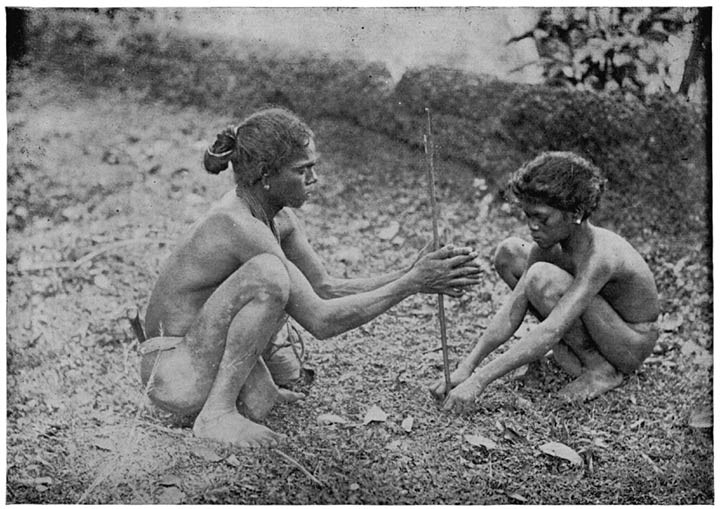
Kānikars Making Fire.
The sub-divisions among the Kānikars are known as illams or families, of which five are said to be endogamous, and five exogamous. The former are called Machchampi or brother-in-law illams, and the latter Annantampi or brother illams. They are named after mountains (e.g., Pālamala, Talamala), places (e.g., Vellanāt), etc. The Kānikars who live south of the Kodayar river cannot marry those living north of it, the river forming a marital boundary.
Among the names of Kānikars are Parapan (broad-faced), Chanthiran (moon), Marthandan (sun), Muntan (dwarf), Kāliyan (little Kali), Mādan (a deity), Nīli (blue) and Karumpi (black). The first name is sometimes that of the settlement in which they live. For example, the various Mullans are known as Kuzhumbi Mullan, Ānaimalai Mullan, Chembilakayam Mullan, etc.
The Kānikars live together in small communities under a Mūttakāni or headman, who wields considerable influence over them, and enjoys various perquisites. He presides over tribal council meetings, at which all social questions are discussed and settled, and fixes the time for clearing the jungle, sowing the seed, gathering the harvest, worshipping the gods, etc. Fines which are inflicted are spent in propitiating the gods.
The language of the Kānikars is a dialect of Malayālam, with a large admixture of Tamil, which they call Malampāshai or language of the hills.
The system of inheritance among those who live in the hills is makkathāyam (from father to son). But a moiety of the personal property goes to the nephews. With those who live in the plains, an equal distribution of their self-acquired property is made between the sons and nephews. If there are no sons, the nephews inherit the property, the widow being entitled to maintenance.
The chief object of worship is said to be Sāsthan, a forest god. But the Kānikars also make offerings to a variety of deities, including Amman, Poothathan, Vetikād Pootham, Vadamala Poothathan, and Amcala. They have, it has been said, “certain spots, trees or rocks, where their relations or friends have met with some unusual good luck or calamity, where they generally offer their prayers. Here they periodically assemble, and pray that the catastrophe that had befallen a comrade may not fall on them, or that the blessings which another had received may be showered on them.” Generally in February a festival called kodai is held, whereat the Kānikars assemble. Goats and fowls are sacrificed, and the pūjāri (priest) offers boiled rice and meat to the sylvan deities in a consecrated place. The festival, to which many come from the low country, winds up with drinking and dancing. The Kānikar musical instruments include a reed flute or clarionet, and men dance to the music, while the women clap their hands in time with it. The Kānikars worship their gods twice a year, in the months of Mīnam and Kanni. On the morning of the celebration, every family takes rice and plantains to the dwelling of the headman. With the exception of a small quantity which is set aside, the rice is husked and ground to flour by boys or men, after bathing and washing their hands and feet. The rice is taken to a clearing in the fields, whither a Kānikar who knows how to invoke the deity comes after bathing. He lays out a row of plantain leaves, and spreads on each leaf a little rice, on which plantains are laid. These are covered over with a plantain leaf, on which rice is sprinkled. The officiating Kānikar then burns incense, carries it round the trophy, and places it in front thereof. All do obeisance by raising their hands to their foreheads, and pray for a fruitful harvest. Sometimes the officiating Kānikar becomes inspired like a Velichapād, and gives expression to oracular utterances. At the close of the ceremony, a distribution of the rice and plantains takes place. When the land is to be cleared for cultivation, the headman is invited to attend, and some rice and cocoanuts are presented to him, which he offers up, and clears a small portion with his own hand. On the first appearance of the ears of grain, the Kānikars spend two nights in drumming, singing, and repeating mantrams at the field, and put up a tattu or platform on four sticks as a shrine for the spirits, to whom they offer raw rice, tender cocoanuts, flowers, etc. At harvest time rice, plantains, sweetmeats, and flowers are offered to the various hill demons, Pūrcha Mallan Pey, the cat giant, Athirakodi Pey, the boundary flag demon, and others.
For the following note on a Kānikar harvest festival I am indebted to an article by Mr. A. P. Smith.90 It was performed in propitiation of the Baradēvata, or household gods of a house in the neighbourhood, the presiding deity being Mādan. The ceremony is commonly called the feeding ceremony, and should be carried out just before the harvesting of the grain commences. “The officiating Kāni is generally an elderly and influential man, who professes inspiration and knowledge obtained when asleep. The articles necessary to perform the ceremony are called Paduka or sacrifice, and Ashtamangalyam. Paduka is for the adult gods or manes, male or female, called Chava, and Ashtamangalyam is for the virgins who have died, called Kanyakas. A temporary pavilion or pandal had been erected in front of the house, and from the canopy long streamers of tender cocoanut leaves, bunches of plantains, and tender cocoanuts, with their husk on, were hung. Branches of areca nuts and flowers adorned the posts and pillars. Small heaps, consisting of boiled rice, paddy, a tender cocoanut, a sprig of areca flowers, and betel were placed on plantain leaves in seven definite spots. The officiating Kānikar, after formally getting the permission of the assembled spectators, and especially of one who subsequently appeared on the scene as the chief dancer, began a monotonous chant in what appeared to be a mixed language. It was understood to be a history of the beginning of earthly kings, a record of the life and doings of departed souls, whose protection was prayed for, and a prayer for the souls of those persons for whose benefit the ceremony of propitiation was in progress. Now and again the feelings of the narrator or singer would overcome him, and he would indulge in a shout or in emphatic gesticulations. This went on for about three or four hours, punctuated at intervals by the firing of petards or old smooth-bore guns, and the shrill cries of the women. Before the chanting terminated, a large heap of the red flowers of Ixora coccinea (thetti pu), about a yard square at the base, had been raised in the centre of the pandal, and it was prettily picked out with areca flowers in artistic designs. The horrible sound of a human voice roaring like a wild beast aroused every one to a sense of activity. From behind the hut came the man already mentioned, very primitively clothed, his hair hanging loose, his eyes staring, and what appeared like foam at his mouth. He would stand, run short distances, leap, sit, agitate his body, and dance, keeping step to the rhythmic and muffled beating of the drum. This he did for ten minutes or so. Suddenly, with a shout, he dived into the hut specially set apart as the feeding place of the god Mādan, and presently appeared with two long sticks adorned at their ends with bells, which emitted a jingling sound. The frenzy of motion, ecstatic, unregulated and ungovernable, was apparently infectious, for a young man, hitherto a silent spectator of the scene, gave a shout, and began to dance wildly, throwing up his arms, and stepping out quite actively. This encouragement stimulated the original performer, and he caught a man standing near by the neck, thrust the stick with the bells into his hand, and he thereupon started dancing as well. In about ten minutes there were some half a dozen wild dancing dervishes, shouting, gesticulating, revolving, and most certainly in an abnormal state of excitement. A dying but still glowing heap of fire and ashes became the centre of attraction, for the chief dancer danced over the fire, and sent the sparks flying, and scattered the wood, and evoked the admiration and eulogies of the crowd. Streaming with perspiration, spotted with ashes, wild, dishevelled and exhausted, the chief dancing demoniac stepped under the pandal, and finally sat himself before the heap of red flowers, and tossed the blossoms over his head in a kind of shower bath. He was assisted in this by the old Kānikar and other bystanders. A little boy was brought before him, and he called the lad by a name. This was his christening ceremony, for the lad assumed the name from that time. The chief dancer then stood up, and appeared to be still in a possessed state. A fine old rooster was brought, and its throat cut. It was then handed to the dancer, who applied his lips to the gaping wound, and drained the blood, swallowing the fluid audibly. Before relinquishing his hold of the bird, he swayed and fell on the ground in what seemed to be a swoon. This indicated that the sacrifice had been acceptable, that the propitiation was perfected, and that all the wishes of the persons interested in them would be granted. The crowd then set to eating and drinking the sacrificial elements, and dispersed.”
Both adult and infant marriage are practiced. Those who had married ‘infants,’ on being questioned, stated that this is the safest course, as grown-up brides sometimes run away to their parents’ house, whereas younger girls get accustomed to their husbands’ home. On a fixed day, within a month of the marriage ceremony, four Kānikars, accompanied by a boy carrying betel leaves and areca nuts, go to the home of the future bride, and present them to the families of the settlement. On the wedding morning, all assemble at a pandal (booth), and the bridegroom distributes pān-supāri (betel leaf and areca nuts). His sister then brings forward the bride, and the bridegroom presents her with a cloth, which she puts on. Bride, bridegroom, and a young boy, then stand on a mat beneath the pandal, and the bridegroom ties the minnu (marriage badge) round the neck of the bride if she is an infant. If she is an adult, he places the minnu in front of her neck, on which it is tied by his sister. A plantain leaf is then placed in front of the bridal couple, and curry and rice served thereon by their mothers. The two women then take hold of the bride’s head, and press it seven times towards her husband’s shoulders. This ceremony concluded, the young boy takes a small quantity of the curry and rice, and puts it in the mouth of the bridegroom seven times. The bridegroom’s younger brother then gives a morsel to the bride. The ceremonial terminates with a feast. The dowry includes billhooks, brass vessels, choppers, grain, and pulses. The headman, according to Mateer, offers some advice to the husband concerning the management of his wife. The heads of his discourse are arranged under the following heads:—teaching by words, pinching, and blows, and casting the woman away at last, if she is not obedient. In the remarriage of widows, the bridegroom simply gives the woman a pair of cloths, and, with the consent of the male members of her family, takes her to his home.
During the seventh month of pregnancy, a woman has to perform a ceremony called vaguthu pongal. Seven pots are placed on seven hearths, and, when the rice placed therein has boiled, the woman salutes it, and all present partake thereof. According to Mateer “the ceremony practised on the occasion of pregnancy is called vayaru pongal, when boiled rice is offered to the sun. First they mould an image of Ganēsha, and, setting it in a suitable place, boil the rice. To this they add for an offering aval or flattened rice, parched rice, cakes, plantain fruits, young cocoanuts, and tender leaves of the same palm, with the flowers of the areca palm. The headman then commences dancing, and repeating mantrams. He waves the offerings to the sun. On first giving rice to a child, a feast is held, and an offering presented to the jungle demons.”
Concerning the death ceremonies, Mateer writes that “when any one is taken ill, the headman is at once consulted. He visits the sick person, and orders two drumming and singing ceremonies to be performed. A whole night is spent in dancing, singing, drumming, and prayers for the recovery of the patient. The offerings consist of tapioca, flour and cocoanuts, and other articles. After some time the headman, with manifestations of demoniac possession, reveals whether the sufferer will die or not. If the former, he repeats a mantram (kudumi vettu mantram, or formula on cutting off the top-knot), and cuts off the sick man’s kudumi. This being a sign of approaching death, the relatives and others pay their last visits to the sick. After death, a mixture of ganja (Indian hemp), raw rice, and cocoanut, is put into the mouth of the corpse by the son and nephews, and it is buried at some distance from their abode, mantrams being repeated over it. Occasionally the corpse is cremated. The relatives bathe before returning home, and cannot take any of the produce of their lands till the death pollution is removed, fearing that wild beasts will attack them or destroy their crops. To this end a small shed is built outside their clearing on the third day. Three measures of rice are boiled, and placed in a cup or on a plantain leaf inside the shed. Then all bathe, and return home. On the seventh day all this is repeated, the old shed being pulled down, and a new one put up. On returning to their dwelling, they sprinkle cow-dung on their houses and in the yard, which finally removes the defilement. People in better circumstances make a feast of curry and rice for all present.” The cow-dung is sprinkled with leafy twigs of the mango or jāk tree, or flower stalks of the areca palm. The ashes, after cremation, are said to be collected in a pot or leaf, and thrown into the nearest stream or river. An annual ceremony, in commemoration of ancestors, is held, at which rice is boiled and offered up.
The Kānikars, like the Irulas and Yānādis of the Tamil and Telugu countries, do not belong to the polluting classes. Pulayans, Kuruvans, and Vēdans are not allowed to approach them.
The dietary of the jungle Kānikars includes wild pigs, deer, porcupines, hares, monkeys, fowls, sheep and goats, parakeets, doves, tortoises, fish, crabs, peacocks, tigers (said to taste like black monkey), owls, squirrels and field rats, in addition to many vegetable products of the forest. They will not eat beef or the flesh of ‘bison.’
Some Kānikars are tattooed on the forehead with a crescent and dot, or a vertical stripe. The Kānikars say that their ancestors wore a garment made of jungle fibre, which has been replaced by a cotton loin-cloth. “Both men and women,” Mr. M. Ratnaswami Aiyar writes, “wear on the neck numerous strings of red beads and rings made of shells, which hang down to the abdomen in the case of the women. The men wear ear-rings of brass or silver. The women wear bangles of brass and iron, and a number of brass rings on the fingers. The men bear suspended from one of their shoulders a cloth bag containing two or more partitions, in which they keep their vilangupetti or box containing betel, tobacco, and chunam. They carry, too, suspended from the shoulder, a cane basket wherein they place their day’s crop of grain or roots, or any other food obtained by them. They attach to their waist-string or cloth a billhook and knife, and carry their bows and arrows slung on their shoulders. Whenever the Kānikars from the different kānis or settlements have to be gathered together for a common meeting, or for going together elsewhere on a common purpose, a messenger amongst them carries from one kāni to another the message with a knot of fibres of creepers, which serves as a symbol of call. The knotted fibre is passed on from one kāni to another till the required assembly is secured. It is thus that I secured my Kānikars to present them to their Excellencies Lord and Lady Curzon.”
84 Gazetteer of the Vizagapatam district.
85 Yule and Burnell, Hobson-Jobson.
86 Monograph, Eth. Survey of Cochin, No. 4, 1905.
87 Unhusked rice.
88 Manual of the South Canara district.
89 Money-lender.
90 Malabar Quarterly Review, 1905.
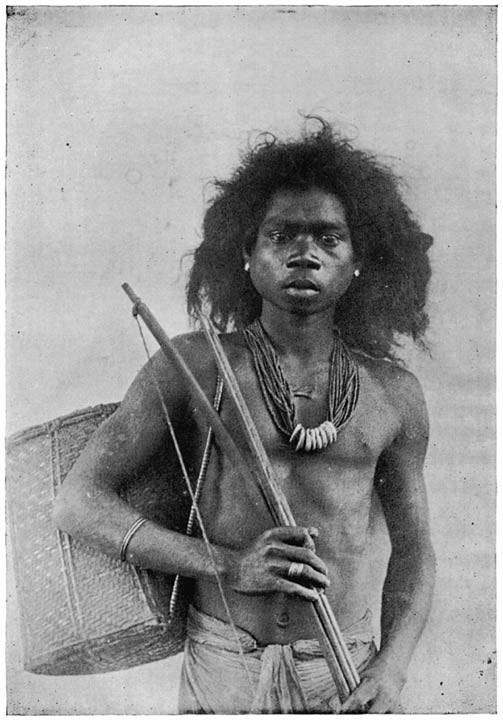
Kānikar.
For most of the information contained in this article I am indebted to Mateer’s ‘Native Life in Travancore,’ an article by Mr. Ratnaswami Aiyar,91 and notes by Mr. N. Subrahmani Aiyar.
Kani Kuruppu.—Barbers of the Kaniyans.
Kani Rāzu.—A name, denoting fortune-telling Rāzus, sometimes used as a synonym by Bhatrāzus, in whose songs it occurs. The name Kani-vāndlu, or fortune-tellers, occurs as a synonym of Yerukala.
Kaniyan.—Kaniyan, spelt and pronounced Kanisan in Malabar, is a Malayālam corruption of the Sanskrit Ganika, meaning an astrologer. The word was originally Kani, in which form it invariably appears in Malayālam works and Tamil documents. The honorific suffix ‘ān’ has been added subsequently.
The two titles, generally applied to Kaniyans, are Panikkar and Āsan. The former is said to be a common title in Malabar, but in Travancore it seems to be restricted to the north. The word Panikkar comes from pani, or work, viz., that of military training. The fact that most of the families, who own this title at present, were once teachers of bodily exercises, is evident not only from the name kalari, literally a military school, by which their houses are usually known, but also from the Kēralolpatti, which assigns military training as a duty of the caste. Āsan, a corruption of the Sanskrit Āchārya, is a common title among Kaniyans in South Travancore. Special titles, such as Anantapadmanābham, Sivasankaran, and Sankili, are said to be possessed by certain families in the south, having been conferred on them by kings in olden times. Some Kaniyans in the north enjoy the surname of Nampikuruppu.
Kaniyans are divided into two endogamous sections, viz., Kaniyar and Tīnta (or polluting). The occupations of the latter are umbrella-making and spirit-exorcising, while the others remain astrologers, pure and simple. A few families, living at Alengad, are called Vattakan Kaniyans, and are believed to have come there on the eve of Tīpū Sultan’s invasion. The women of the Kaniyans proper do not eat with them. According to tradition, eight sub-septs are said to have existed among the Kaniyans, four of which were known as kiriyams, and four as illams. The names of the former are Annavikkannam, Karivattam, Kutappilla, and Nanna; of the latter Pampara, Tachchazham, Netumkanam, and Ayyarkāla. These divisions were once endogamous, but this distinction has now disappeared.
In a note on the Kaniyans of the Cochin State,92 Mr. L. K. Anantha Krishna Iyer writes that “there is some difference in the social status between the Kaniyans of the southern, and the Kalari Panikkans of the northern parts of the State. The latter profess a kind of superiority in status, on the ground that the former have no kalaris. It is also said by the latter that the occupation of the former was once that of umbrella-making, and that astrology as a profession has been recently adopted by them. There is at present neither intermarriage, nor interdining between them. The Kaniyans pollute the Kalari Panikkans by touch.” In connection with the old village organisation in Malabar, Cochin, and Travancore, Mr. Anantha Krishna Iyer writes further that “every tara or kara (village) consisted of all castemen below Brāhmans, especially the Nāyars of all classes, more or less living in a community, the Kammālans, Izhuvans, Pānāns, Mannans, and other castemen living further apart. For every such village in the northern part of the State, there was also a Kalari Panikkan, with a kalari (gymnastic or military school), where the young men of the village, chiefly the Nāyars, were trained in all kinds of athletic feats, and in arms. The institution of the kalaris has now disappeared, though the building remains in some places, and the Panikkans are now mainly astrologers and village schoolmasters. According to their own statement, Parasurāma, the great coloniser of Kērala, established kalaris throughout the kingdom, and appointed them as the masters to train Sūdra young men in all kinds of feats (one thousand and eight in number), for the protection of the country against foreign invaders. The Nāyars, who then formed the fighting race, were mostly trained by the Panikkans. In memory of this, the Kalari Panikkans of the northern portions of the State, and of South Malabar, profess even now a preceptorship to the Nāyars, and the Nayars show them some respect, being present at their marriages and other ceremonies. The Pannikkans say that the Nāyars obtained their kalaris from them. There are still a few among the Panikkans, here and there, fit to teach young men various feats. The following are the names of some of them:—
(1) Pitichu Kali. Two persons play on their drums (chenda), while a third person, well dressed in a kacha, and with a turban on his head, and provided with a sword and shield, performs various feats in harmony with the drum beating. It is a kind of sword-dance.
(2) Parishathalam Kali. A large pandal (booth) is erected in front of the house where the performance is to take place, and the boys below sixteen, who have been previously trained for it, are brought there. The performance takes place at night. The chenda, maddhalam, chengala, and elathalam (circular bell-metal plates slightly concave in the middle) are the instruments used in the performance. After the performance, the boys, whom the Āsan has trained, present themselves before him, and remunerate him with whatever they can afford. Parties are organised to give this performance on all auspicious occasions in rural districts.
(3) Kolati. Around a lighted lamp, a number of persons stand in a circle, each with a stick a foot in length, and as thick as a thumb, in each hand. They begin to sing, first in slow time, and gradually in rapid measure. The time is marked by each one hitting his neighbours’ sticks with his own on both sides. Much dexterity and precision are required, as also experience in combined action and movements, lest the amateur should be hit by his neighbours as the measure is accelerated. The songs are invariably in praise of God or man.
The Kaniyans, according to one tradition, are Brāhman astrologers, who gradually lost their position, as their predictions became less and less accurate. Concerning their legendary history, Mr. Anantha Krishna Iyer writes as follows. “Once, says one of these legends, when the god Subrahmanya, son of Siva, and his friend were learning astrology, they knew that the sound of a lizard close by foreboded some evil to the mother of the former. The friend practiced some magical rite, which averted the evil. His mother, who had been in a state of unconsciousness, suddenly woke up as if from slumber, and asked the son ‘Kany-ar,’ i.e., who it was that she looked at. To which the son replied that she was looking at a Kaniyan (astrologer). The Kaniyans still believe that the umbrella, the stick, the holy ashes, and the purse of cowries, which form the paraphernalia of a Kaniyan nowadays, were given by Subramanya. The following is another tradition regarding the origin of the caste. In ancient times, it is said, Pānāns, Vēlans, and Kaniyans were practicing magic, but astrology as a profession was practiced exclusively by the Brāhmans. There lived a famous astrologer, Thalakkaleth Bhattathiripad, who was the most renowned of the astrologers of the time. He had a son whose horoscope he cast, and from it he concluded that his son would live long. Unfortunately he proved to be mistaken, for his son died. Unable to find out the error in his calculation and prediction, he took the horoscope to an equally famous astrologer of the Chōla kingdom, who, aware of the cause of his advent, directed him to adore some deity that might aid him in the working out of his predictions. Accordingly he came to the Trichūr temple, where, as directed, he spent some days in devotion to the deity. Thereafter he worked wonders in astrology, and became so well known in Malabar, Cochin, and Travancore, that he commanded the respect and admiration of the rulers, who invited him to cast horoscopes, and make predictions. For so doing he was liberally rewarded. One day a Brāhman, hearing that his guru at Benares was seriously ill, consulted the Bhattathiripad whether and how he would be able to see him before his death. The Brāhman astrologer directed him to go to the southern side of the Trichūr temple, where he would see two persons coming towards him, who might gratify his desire to see his preceptor. These persons were really the servants of Yama (the god of death). They asked him to touch them, and he at once found himself at the side of his teacher. The Brāhman was asked who had directed him to them, and, when he told them that it was the renowned Brāhman astrologer, they cursed him, saying that he would become an outcaste. This fate came as no surprise to the astrologer, for he had already perceived from an evil conjunction of the planets that disgrace and danger were impending. To try to avoid the sad fate which he foresaw, he left his home and friends, and set out on a boating excursion in a river close by Pazhūr. The night was dark, and it was midnight when he reached the middle of the stream. A severe storm, accompanied by rain, had come on, and the river was in flood. He was swept away to an unknown region, and scrambled ashore in torrents of rain and in darkness, when he saw a light in a house near where he landed, and he made for it in an exhausted condition. On reaching it, he lay down in the verandah at the gate of the house, musing on the untoward events of the night, and on his affectionate family whom he had left. The hut belonged to the family of a Kaniyan,93 who, as it happened, had had a quarrel with his wife that day, and had left his hut. Anxiously expecting her husband’s return, the wife opened the door about midnight, and, seeing a man lying in the verandah, mistook him for her husband. The man was so wrapt in his thoughts of his home that he in turn mistook her for his wife. When the Brāhman woke up from his slumber, he found her to be a Kaniya woman. On looking at the star in the heavens to calculate the precise time, he saw that the prediction that he would become an outcaste had been fulfilled. He accepted the degradation, and lived the rest of his days with the Kaniya woman. She bore him several sons, whom in due course he educated in the lore of his profession, and for whom, by his influence, he obtained an important place in the Hindu social system as astrologers (Ganikans). It is said that, according to his instruction, his body, after his death, was placed in a coffin, and buried in the courtyard of the house. The spot is still shown, and an elevated platform is constructed, with a thatched roof over it. A lighted lamp is placed at all times on the platform, and in front of it astrological calculations and predictions are made, for it is believed that those who made such calculations there will have the aid of the spirit of their dead Brāhman ancestor, who was so learned in the science that he could tell of events long past, and predict even future birth. As an instance of the last, the following incident may be given. Once the great Brāhman ascetic Vilwamangalath Swāmiyar was suffering severely from pains in the stomach, when he prayed to the divine Krishna for relief. Finding no remedy, he turned to a Brāhman friend, a Yōgi, who gave him some holy ashes, which he took, and which relieved him of the pains. He mentioned the fact to his beloved god Krishna, who, by the pious adoration of the ascetic, appeared before him, when he said that he would have three births in the world instead of one which was destined for him. With an eager desire to know what they would be, he consulted the Bhattathiripad, who said that he would be born first as a rat-snake (Zamenis mucosus), then as an ox, and thirdly as a tulsi plant (Ocimum sanctum), and that he would be along with him in these births. With great pleasure he returned home. It is also said that the astrologer himself was born as an ox, and was in this form afterwards supported by the members of his family. The incident is said to have taken place at Pazhūr, eighteen miles east of Ernakulam. The members of the family are called Pazhūr Kaniyans, and are well known throughout Malabar, Cochin and Travancore, for their predictions in astrology, and all classes of people even now resort to them for aid in predictions. The Kalari Panikkans in the northern parts of the Cochin State have a different account of the origin of the caste. Once, they say, a sage and astrologer, named a Ganikan, was making prediction to a Sūdra regarding his future destiny. As this was done by him when in an uncleanly state, he was cursed by the Saptharishis (seven sages). The Panikkans who are reputed to be his descendants are ordained to be teachers and astrologers of all castes below Brāhmans.”
According to another legendary account, there were Kaniyans before the time of Bhattatiri, but their astrological attainments are connected with him. Talakulattu Bhattatiri was one of the earliest astrologers of renown, being the author of Muhūrtapadavi, and lived in the fourth century A.D. There is a tradition, believed by the Kaniyans south of Neyyattenkara, that their ancestor was descended from the union of a Gandharva woman with Kani, a Brāhman saint, who lived in the western ghāts. Their grandson propitiated the god Subrahmanya presiding over astronomy, and acquired the surname Nālīka from his never-ceasing truthfulness. Some of the southern Kaniyans even at the present day call themselves Nāli. According to another legend, Paramēswara and his wife Parvati were living happily together, when Agni fell desperately in love with the latter. Eventually, Paramēswara caught them together, and, to save Agni, Parvati suggested that he should hide himself inside her body. On Agni doing this, Parvati became very indisposed, and Paramēswara, distressed at seeing his wife rolling in agony, shed tears, one of which fell on the ground, and became turned into a man, who, being divinely born, detected the cause of Parvati’s indisposition, and, asking for some incense, sprinkled it over a blazing torch. Agni, seeing his opportunity, escaped in the smoke, and Parvati had instant relief. For this service, Paramēswara blessed the man, and appointed him and his descendants to cure diseases, exorcise demons, and foretell events.
The Kaniyans of Malabar have been connected by tradition with the Valluvans of the Tamil country, who are the priests, doctors, and astrologers of the Pallans and Paraiyans. According to this tradition, the modern Kaniyans are traced to the Valluvans brought from the east by a Perumāl who ruled over Kerala in 350 M.E. The latter are believed to have become Kaniyans proper, while the old Kaniyans of the west coast descended to the rank of Tīntā Kaniyans. The chief of the Valluvans so brought was a Yōgi or ascetic, who, being asked by a Nambūtiri concerning a missing article at Pazhūr, replied correctly that the lost ring had been placed in a hole in the bank of the Nambūtiri’s tank (pond), and was consequently invited to settle there permanently.
The Kaniyans are easily recognised by their punctilious cleanness of person and clothing, the iron style and knife tucked into the waist, the palm umbrella with its ribs holding numbers of horoscopes, their low artistic bow, and their deliberate answers to questions put to them. Most of them are intelligent, and well versed in Malayālam and Sanskrit. They are, however, not a flourishing community, being averse to manual labour, and depending for their living on their hereditary profession. There are no more conservative people in Travancore, and none of them have taken kindly to western education. In their clothing they follow the orthodox Malabar fashion. The dress of the males seldom hangs loose, being tucked in in token of humility. The Kaniyan, when wanted in his professional capacity, presents himself with triple ash marks of Siva on his chest, arms, and forehead. The woman’s ornaments resemble those of the Izhuvans. Fish and flesh are not forbidden as food, but there are many families, as those of Pazhūr and Onakkūru, which strictly abstain from meat. Marriage between families which eat and abstain from flesh is not absolutely forbidden. But a wife must give up eating flesh immediately on entering the house of her vegetarian husband. The profession of the Kaniyans is astrology. Marco Polo, writing as early as the thirteenth century about Travancore, says that it was even then pre-eminently the land of astrologers. Barbosa, at the beginning of the sixteenth century, has a detailed reference to the Kaniyans, of whom he writes that “they learn letters and astronomy, and some of them are great astrologers, and foretell many future things, and form judgments upon the births of men. Kings and great persons send to call them, and come out of their palaces to gardens and pleasure-grounds to see them, and ask them what they desire to know; and these people form judgment upon these things in a few days, and return to those that asked of them, but they may not enter the palaces; nor may they approach the king’s person on account of being low people. And the king is then alone with him. They are great diviners, and pay great attention to times and places of good and bad luck, which they cause to be observed by those kings and great men, and by the merchants also; and they take care to do their business at the time which these astrologers advise them, and they do the same in their voyages and marriages. And by these means these men gain a great deal.” Buchanan, three centuries later, alludes in the same glowing terms to the prosperity of the Kaniyans. He notes that they are of very low caste, a Nambūtiri coming within twenty-four feet of one being obliged to purify himself by prayer and ablution. “The Kaniyans,” he writes, “possess almanacks, by which they inform people as to the proper time for performing ceremonies or sowing their seeds, and the hours which are fortunate or unfortunate for any undertaking. When persons are sick or in trouble, the Cunishun, by performing certain ceremonies in a magical square of 12 places, discovers what spirit is the cause of the evil, and also how it may be appeased. Some Cunishuns possess mantrams, with which they pretend to cast out devils.” Captain Conner notes twenty years later that “Kanneans derive the appellation from the science of divination, which some of their sect profess. The Kannean fixes the propitious moment for every undertaking, all hysterical affections being supposed to be the visitation of some troublesome spirit. His incantations are believed alone able to subdue it.”
The Kaniyans are practically the guiding spirits in all the social and domestic concerns of Travancoreans, and even Muhammadans and Christians do not fail to profit by their wisdom. From the moment of the birth of an infant, which is noted by the Kaniyan for the purpose of casting its horoscope, to the moment of death, the services of the village astrologer are constantly in requisition. He is invariably consulted as to the cause of all calamities, and the cautious answers that he gives satisfy the people. “Putrō na putri,” which may either mean no son but a daughter, or no daughter but a son, is jocosely referred to as the type of a Kaniyan’s answer, when questioned about the sex of a child in utero. “It would be difficult,” Mr. Logan writes,94 “to describe a single important occasion in everyday life when the Kanisan is not at hand as a guiding spirit, foretelling lucky days and hours, casting horoscopes, explaining the cause of calamities, prescribing remedies for untoward events, and physicians (not physic) for sick persons. Seed cannot be sown, or trees planted, unless the Kanisan has been consulted beforehand. He is even asked to consult his shastras to find lucky days and moments for setting out on a journey, commencing an enterprise, giving a loan, executing a deed, or shaving the head. For such important occasions as births, marriages, tonsure, investiture with the sacred thread, and beginning the A, B, C, the Kanisan is of course indispensable. His work in short mixes him up with the gravest as well as the most trivial of the domestic events of the people, and his influence and position are correspondingly great. The astrologer’s finding, as one will solemnly assert with all due reverence, is the oracle of God himself, with the justice of which everyone ought to be satisfied, and the poorer classes follow his dictates unhesitatingly. There is no prescribed scale of fees for his services, and in this respect he is like the native physician and teacher. Those who consult him, however, rarely come empty-handed, and the gift is proportioned to the means of the party, and the time spent in serving him. If no fee is given, the Kanisan does not exact it, as it is one of his professional characteristics, and a matter of personal etiquette, that the astrologer should be unselfish, and not greedy of gain. On public occasions, however, and on important domestic events, a fixed scale of fees is usually adhered to. The astrologer’s most busy time is from January to July, the period of harvest and of marriages, but in the other six months of the year his is far from being an idle life. His most lucrative business lies in casting horoscopes, recording the events of a man’s life from birth to death, pointing out dangerous periods of life, and prescribing rules and ceremonies to be observed by individuals for the purpose of propitiating the gods and planets, and so averting the calamities of dangerous times. He also shows favourable junctures for the commencement of undertakings, and the grantham or book, written on palmyra leaf, sets forth in considerable detail the person’s disposition and mental qualities, as affected by the position of the planets in the zodiac at the moment of birth. All this is a work of labour, and of time. There are few members of respectable families who are not thus provided, and nobody grudges the five to twenty-five rupees usually paid for a horoscope according to the position and reputation of the astrologer. Two things are essential to the astrologer, namely, a bag of cowry shells (Cypræa moneta), and an almanac. When any one comes to consult him, he quietly sits down, facing the sun, on a plank seat or mat, murmuring some mantrams or sacred verses, opens his bag of cowries, and pours them on the floor. With his right hand he moves them slowly round and round, solemnly reciting meanwhile a stanza or two in praise of his guru or teacher, and of his deity, invoking their help. He then stops, and explains what he has been doing, at the same time taking a handful of cowries from the heap, and placing them on one side. In front is a diagram drawn with chalk on the floor, and consisting of twelve compartments (rāsis) one for each month in the year. Before commencing operations with the diagram, he selects three or five of the cowries highest up in the heap, and places them in a line on the right-hand side. [In an account before me, three cowries and two glass bottle-stoppers are mentioned as being placed on this side.] These represent Ganapati (the belly god, the remover of difficulties), the sun, the planet Jupiter, Sarasvati (the goddess of speech), and his own guru or preceptor. To all of these the astrologer gives due obeisance, touching his ears and the ground three times with both hands. The cowries are next arranged in the compartments of the diagram, and are moved about from compartment to compartment by the astrologer, who quotes meanwhile the authority on which he makes the moves. Finally he explains the result, and ends with again worshipping the deified cowries, who were witnessing the operation as spectators.” According to another account,95 the astrologer “pours his cowries on the ground, and, after rolling them in the palm of his right hand, while repeating mantrams (consecrated formulæ), he selects the largest, and places them in a row outside the diagram at its right hand top corner. They represent the first seven planets, and he does obeisance to them, touching his forehead and the ground three times with both hands. The relative position of the nine planets is then worked out, and illustrated with cowries in the diagram.”
At the chal (furrow) ceremony in Malabar, on the eve of the new agricultural year, “every Hindu house in the district is visited by the Kanisans of the respective dēsams, who, for a modest present of rice, vegetables and oils, makes a forecast of the season’s prospects, which is engrossed on a cadjan (palm leaf). This is called the Vishu phalam, which is obtained by comparing the nativity with the equinox. Special mention is made therein as to the probable rainfall from the position of the planets—highly prized information in a district where there are no irrigation works or large reservoirs for water.”96
The science of astrology is studied and practiced by other castes, but the Kani house of Pazhūr is the most celebrated. Numerous stories are related of the astrological skill of the Pazhūr Kaniyans, of which one relates to the planets Mercury and Venus, who, arriving at the house of one of the Kaniyans, were asked by him to wait at the gate. He then jumped into a neighbouring well, to conduct some prayers with a view to keeping them there permanently. In this task he succeeded, and even today a prophecy made at that out-house is believed to be certain of turning out true.
In addition to astrology, the Kaniyans practice sorcery and exorcism, which are strictly the occupation of the Tīntā Kaniyans. The process by which devils are driven out is known as kōlamtullal (a peculiar dance). A troupe of Kaniyans, on being invited to a house where a person is suspected of being possessed by a devil, go there wearing masques representing Gandharva, Yakshi, Bhairava, Raktēsvari, and other demons, and dressed up in tender cocoanut leaves. Accompanied by music and songs, they rush towards the affected person, who is seated in the midst of the assembly, and frighten away the evil spirit. For the cure of disease, which is considered as incurable by ordinary methods of treatment, a form of exorcism called kālapāsamtikkuka, or the removal of the rope or evil influence, is resorted to. In this, two Kaniyans take the stage, and play the parts of Siva and Yama, while a third recites in song the story of the immortal Markandēya.
“The Pannikar’s astrology,” Mr. F. Fawcett writes,97 “he will tell you, is divided into three parts:—
(1) Ganīta, which treats of the constellations.
(2) Sankīta, which explains the origin of the constellations, comets, falling stars, and earthquakes.
(3) Hōra, by which the fate of man is explained.
“The Panikkar, who follows in the footsteps of his forefathers, should have a thorough knowledge of astrology and mathematics, and be learned in the Vēdas. He should be sound in mind and body, truthful, and patient. He should look well after his family, and should worship regularly the nine planets:—Sūryan, the sun; Chandran, moon; Chovva, Mars; Budhan, Mercury; Vyāzham, Guru, or Brihaspati, Jupiter; Sukran, Venus; Sani, Saturn; Rāhu; and Kētu. The two last, though not visible, are, oddly enough, classed as planets by the Panikkar. They are said to be two parts of an Āsura who was cut in two by Vishnu. The Panikkars also dabble in magic, and I have in my possession a number of yantrams presented to me by a Panikkar. They should be written on a thin gold, silver, or copper plate, and worn on the person. A yantram written on gold is the most effective. As a rule, the yantram is placed in a little cylinder-case made of silver, fastened to a string tied round the waist. Many of these are often worn by the same person. The yantram is sometimes written on cadjan (palm leaf), or paper. I have one of this kind in my collection, taken from the neck of a goat. It is common to see them worn on the arm, around the neck.”
The following examples of yantrams are given by Mr. Fawcett:—
Aksharamāla.—Fifty-one letters. Used in connection with every other yantram. Each letter has its own meaning, and does not represent any word. In itself this yantram is powerless, but it gives life to all others. It must be written on the same plate as the other yantram.
Sūlini.—For protection against sorcery or devils, and to secure the aid of the goddess.
Māha Sūlini.—To prevent all kinds of harm through the devils, chief of whom is Pulatini, he who eats infants. Women wear it to avert miscarriage.
Ganapati.—To increase knowledge, and put away fear and shyness.
Sarasvati.—To enable its possessor to please his listeners, and increase his knowledge.
Santāna gopalam.—As a whole it represents Srī Krishna. Used by barren women, so that they may bear children. It may be traced on a metal plate and worn in the usual way, or on a slab of butter, which is eaten. When the latter method is adopted, it is repeated on forty-one consecutive days, during which the woman, as well as the Panikkar, may not have sexual connection.
Navva.—Drawn in ashes of cow-dung on a new cloth, and tied round the waist. It relieves a woman in labour.
Asvarūdha (to climb a horse).—A person wearing it is able to cover long distances easily on horseback, and he can make the most refractory horse amenable by tying it round its neck. It will also help to cure cattle.
“The charms,” Mr. Fawcett explains, “are entirely inoperative, unless accompanied in the first place with the mystic rite, which is the secret of the Panikkar.”
Many Kaniyans used formerly to be village schoolmasters, but, with the abolition of the old methods of teaching, their number is steadily decreasing. Some of them are clever physicians. Those who have no pretension to learning live by making palm-leaf umbrellas, which gives occupation to the women. But the industry is fast declining before the competition of umbrellas imported from foreign countries.
The Kaniyans worship the sun, the planets, the moon, Ganēsa and Subramanya, Vishnu, Siva, and Baghavati. On each day of the week, the planet, which is believed to preside over it, is specially worshipped by an elaborate process, which is compulsorily gone through for at least three weeks after a Kaniyan has become proficient in astrology, and able to make calculations for himself.
It is generally believed that the supreme authority in all social matters affecting the Kaniyan rests in British Malabar with the Yōgi already referred to, in Cochin and North Travancore with the head of the Pazhūr house, and in South Travancore with the eldest member of a house at Manakkad in Trivandrum, known by the name of Sankili. Practically, however, the spiritual headmen, called Kannālmas, are independent. These Kannālmas are much respected, and well paid on festive occasions by every Kaniyan house. They and other elders sit in judgment on persons guilty of adultery, commensality with lower castes, and other offences, and inflict punishments.
The Kaniyans observe both the tāli-kettu ceremony before puberty, and sambandham after that event. Inheritance is through the father, and the eldest male of a family has the management of the ancestral estate. Fraternal polyandry is said to have been common in olden times, and Mr. Logan observes that, “like the Pāndava brothers, as they proudly point out, the Kanisans used formerly to have one wife in common among several brothers, and this custom is still observed by some of them.” There is no restriction to the marriage of widows.
Concerning polyandry, Mr. Anantha Krishna Iyer states that “among the Kaniyans, as well as among Panikkans, polyandry largely prevails. If the young woman is intended to be the wife of several brothers, the eldest brother goes to the bride’s house, and gives her the cloth, and takes her home the next day along with her parents and relations, who are all well entertained. The young woman and the brothers are seated together, and a sweet preparation is given to them, which signifies that she has become the common wife of all. The Kalari Mūppan (Nāyar headman of the village) also declares her to be such. The guests depart, and the bridegroom (the eldest brother) and the bride are invited to what they call virunnu-oon (sumptuous meal) in the house of the latter, where they stay for a few days. The bridegroom then returns home with the wife. The other brothers, one after another, are similarly entertained along with the bride at her house. The brothers cannot afford to live together for a long time, and they go from place to place, earning their livelihood by astrology. Each brother is at home only for a few days in each month; hence practically the woman has only one husband at a time. If several of them happen to be at home together for a few weeks, each in turn associates with the woman, in accordance with the directions given by their mother.”
The Kaniyans follow high-caste Hindus as regards many of their ceremonies. They have their name-bestowing, food-giving and tuft-making ceremonies, and also a superstitious rite called ittaluzhiyuka, or exorcism in child-birth on the seventh or ninth day after the birth of a child. A Kaniyan’s education begins in his seventh year. In the sixteenth year a ceremony, corresponding to the upanayana of the higher castes, is performed. For forty-one days after, the Kannālma initiates the young Kaniyan into the mysteries of astrology and witchcraft. He is obliged to worship Subramanya, the tutelary god of the caste, and abstains from meat and liquor. This may be taken as the close of his Brahmacharya stage or Samāvartana, as marriage cannot take place before the observance of this ceremony.
On the subject of religion, Mr. Anantha Krishna Iyer writes that “the Kalari Panikkans and the Kaniyans are generally Saivite worshippers, but are not disinclined to the worship of Vishnu also. It is said that their kalaris are forty-two feet long, and contain the images of forty-two deities. The following are the most important of them:—Subrahmanya, Sastha, Ganapati, Vīrabhadran, Narasimha, Ashtabairavas, Hanumān, and Bhadrakāli. Some of their kalaris, which were seen by me, contained stone and metal images of these gods. Every night a lamp is lighted in front of them for their worship. During the Mandalam (forty days) from the first of Vrischikam to the tenth of Dhanu (14th November to 25th December), the senior member of the Panikkan’s family bathes early in the morning, and performs his pūjas to all the gods, making offerings of boiled rice, plantains and cocoanuts. On the fortieth day, i.e., the last day of the Mandalam, a grand pūja is performed individually to every one of the deities in the kalari, and this lasts for twenty-four hours, from sunrise to sunrise, when offerings of boiled rice, parched rice, sheep and fowls are also given. This is the grand pūja performed once in the course of the year. Besides this, some of their deities command their special reverence. For instance, Subrahmanya is adored for the sake of astrology, Sastha for wealth and offspring. They are also worshippers of Sakti in any of her following manifestations, namely, Bala, Thripura, Mathangi, Ambika, Durga, Bhadrakāli, the object of which is to secure accuracy in their astrological predictions. Further, every member of the caste proficient in astrology daily offers, after an early bath, his prayers to the seven planets. Among the minor deities whom they worship, are also Mallan, Mundian, Muni and Ayutha Vadukan, the first three of which they worship for the prosperity of their cattle, and the last four for their success in the training of young men in athletic feats. These deities are represented by stones placed at the root of some shady tree in their compounds. They also worship the spirits of their ancestors, on the new-moon nights in Karkadakam (July-August), Thulam (October-November), and Makaram (December-January). The Kalari Panikkans celebrate a kind of feast to the spirits of their female ancestors. This is generally done a few days before the celebration of a wedding in their houses, and is probably intended to obtain their blessings for the happy married life of the bride. This corresponds to the performance of Sumangalia Prarthana (feast for the spirits of departed virgins and married women) performed by Brāhmans in their families. At times when small-pox, cholera, and other pestilential diseases prevail in a village, special pūjas are offered to Māriamma (the small-pox demon) and Bhadrakāli, who should be propitiated. On these occasions, their priest turns Velichapād (oracle), and speaks to the village men as if by inspiration, telling them when and how the maladies will subside.”
Kaniyans were formerly buried, but are now, excepting young children, cremated in a portion of the grounds of the habitation, or in a spot adjacent thereto. The ashes are collected on the fourth day, and deposited under water. In memory of the deceased, an annual offering of food is made, and an oblation of water offered on every new moon.
The Potuvans or Kani Kuruppus are the barbers of the Kaniyans, and have the privilege of being in attendance during marriages and funerals. It is only after they have sprinkled water in the houses of polluted Kaniyans that they again become pure. In fact, the Potuvans stand in the same relation to the Kaniyans as the Mārāns to the Nāyars. The Potuvans are not expected to shave the Tīntā Kaniyans.
The Kaniyans are said to keep at a distance of twenty-four feet from a Brāhman or Kshatriya, and half that distance from a Sūdra. The corresponding distances for a Tīntā Kaniyan are thirty-six and eighteen feet. This restriction is not fully observed in Trivandrum, and south of it. It is noted by Mr. Anantha Krishna Iyer that, on marriage occasions, a Nāyar gives a gift of a few annas and betel leaves to the astrologer, standing close beside him, and yet there is no pollution. The Malayālam proverb “On marriage occasions the Nāyars give dakshina (gift), almost touching the hand,” refers to this fact. The Kaniyans cannot enter Brāhmanical temples. They will not receive food from Izhavans, except in a few villages in central Travancore, but this is a regular practice with the Tīntā Kaniyans. It is believed that the Kaniyans proper have no objection to receiving sweetmeats from Kammālans.
The Kaniyans have been summed up as a law-abiding people, who not infrequently add agriculture to their avocations of village doctor, prophet, or demon-driver, and are popular with Christians and Muhammadans as well as with Hindus.98
The late Mr. Pogson, when Government astronomer, used to say that his principal native assistant was an astronomer from 10 A.M. to 5 P.M. and an astrologer from 5 P.M. to 10 A.M.
Kannada.—Kannada (Kanarese) has, at recent times of census, been returned as a linguistic or territorial division of various classes, e.g., Agasa, Bēdar, Dēvānga, Holeya, Koracha, Kumbāra, Sāmagāra, Rāchewar, and Uppiliyan.
Kanna Pulayan.—Described by the Rev. W. J. Richards99 as Pulayans of Travancore, who wear rather better and more artistically made aprons than the Thanda Pulayan women.
Kannaku.—A prefix to the name of Nanchinat Vellālas in Travancore.
Kannān.—A sub-division of Kammālans, the members of which do braziers’ work.
Kannadiyan.—The Kannadiyans have been summed up100 as “immigrants from the province of Mysore. Their traditional occupation is said to have been military service, although they follow, at the present day, different pursuits in different districts. They are usually cattle-breeders and cultivators in North and South Arcot and Chingleput, and traders in the southern districts. Most of them are Lingāyats, but a few are Vaishnavites.” “They are,” it is stated,101 “in the Mysore State known as Gaulis. At their weddings, five married women are selected, who are required to bathe as each of the most important of the marriage ceremonies is performed, and are alone allowed to cook for, or to touch the happy couple. Weddings last eight days, during which time the bride and bridegroom must not sit on anything but woollen blankets.” Some Kannadiyans in the Tanjore district are said to be weavers. For the following account of the Kannadiyans of the Chingleput district I am indebted to Mr. C. Hayavadana Rao.
About twenty miles from the city of Madras is a big tank (lake) named after the village of Chembrambākam, which is close by. The fertile land surrounding this tank is occupied, among others, by a colony of Lingāyats, of whom each household, as a rule, owns several acres of land. With the cultivation thereof, they have the further occupation of cattle grazing. They utilize the products of the cow in various ways, and it supplies them with milk, butter and curds, in the last two of which they carry on a lucrative trade in the city of Madras. The curds sold by them are very highly appreciated by Madras Brāhmans, as they have a sour taste caused by keeping them till fermentation has set in. So great is the demand for their curds that advances of money are made to them, and regular delivery is thus secured. Their price is higher than that of the local Madras curds, and if a Lingāyat buys the latter and sells them at the higher rate, he is decisively stigmatised as being a “local.” They will not even touch sheep and goats, and believe that even the smell of these animals will make cows and buffaloes barren.
Though the chief settlement of the Lingāyats is at Chembrambākam, they are also to be found in the adjacent villages and in the Conjeeveram tāluk, and, in all, they number, in the Chingleput district, about four thousand.
The Lingāyats have no idea how their forefathers came to the Chingleput district. Questioned whether they have any relatives in Mysore, many answered in the affirmative, and one even pointed to one in a high official position as a close relation. Another said that the Gurukkal or Jangam (priest) is one and the same man for the Mysore Lingāyats and themselves. A third told me of his grandfather’s wanderings in Mysore, Bellary, and other places of importance to the Lingāyats. I have also heard the story that, on the Chembrambākam Lingāyats being divided into two factions through disputes among the local caste-men, a Lingāyat priest came from Mysore, and brought about their union. These few facts suffice to show that the Lingāyats are emigrants from Mysore, and not converts from the indigenous populations of the district. But what as to the date of their immigration? The earliest date which can, with any show of reason, be ascribed thereto seems to be towards the end of the seventeenth century, when Chikka Dēva Rāja ruled over Mysore. He adopted violent repressive measures against the Lingāyats for quelling a widespread insurrection, which they had fomented against him throughout the State. His measures of financial reform deprived the Lingāyat priesthood of its local leadership and much of its pecuniary profit. What followed may best be stated in the words of Colonel Wilks,102 the Mysore historian. “Everywhere the inverted plough, suspended from the tree at the gate of the village, whose shade forms a place of assembly for its inhabitants, announced a state of insurrection. Having determined not to till the land, the husbandmen deserted their villages, and assembled in some places like fugitives seeking a distant settlement; in others as rebels breathing revenge. Chikka Dēva Rāja, however, was too prompt in his measures to admit of any very formidable combination. Before proceeding to measures of open violence, he adopted a plan of perfidy and horror, yielding to nothing which we find recorded in the annals of the most sanguinary people. An invitation was sent to all the Jangam priests to meet the Rāja at the great temple of Nunjengōd, ostensibly to converse with him on the subject of the refractory conduct of their followers. Treachery was apprehended, and the number which assembled was estimated at about four hundred only. A large pit had been previously prepared in a walled enclosure, connected by a series of squares composed of tent walls with the canopy of audience, at which they were received one at a time, and, after making their obeisance, were desired to retire to a place where, according to custom, they expected to find refreshments prepared at the expense of the Rāja. Expert executioners were in waiting in the square, and every individual in succession was so skilfully beheaded and tumbled into the pit as to give no alarm to those who followed, and the business of the public audience went on without interruption or suspicion. Circular orders had been sent for the destruction on the same day of all the Jangam Mutts (places of residence and worship) in his dominions, and the number reported to have been destroyed was upwards of seven hundred.... This notable achievement was followed by the operations of the troops, chiefly cavalry. The orders were distinct and simple—to charge without parley into the midst of the mob; to cut down every man wearing an orange-coloured robe (the peculiar garb of the Jangam priests).”
How far the husbandmen carried out their threat of seeking a distant settlement it is impossible, at this distance of time, to determine. If the theory of religious persecution as the cause of their emigration has not an air of certainty about it, it is at least plausible.
If the beginning of the eighteenth century is the earliest, the end of that century is the latest date that can be set down for the Lingāyat emigration. That century was perhaps the most troublous one in the modern history of India. Armies were passing and repassing the ghāts, and I have heard from some old gentlemen that the Chingleput Lingāyats, who are mostly shepherds, accompanied the troops in the humble capacity of purveyors of milk and butter.
Whatever the causes of their emigration, we find them in the Chingleput district ordinarily reckoning the Mysore, Salem and Bellary Lingāyats as of their own stock. They freely mix with each other, and I hear contract marital alliances with one another. They speak the Kannada (Kanarese) language—the language of Mysore and Bellary. They call themselves by the name of Kannadiyans or Kannadiyars, after the language they speak, and the part of the village they inhabit—Kannadipauliem, or village of the Kannadiyars. In parts of Madras they are known as Kavadi and Kavadiga (=bearers of head-loads).
Both men and women are possessed of great stamina. Almost every other day they walk to and fro, in all seasons, more than twenty miles by road to sell their butter and curds in Madras. While so journeying, they carry on their heads a curd pot in a rattan basket containing three or four Madras measures of curds, besides another pot containing a measure or so of butter. Some of the men are good acrobats and gymnasts, and I have seen a very old man successively break in two four cocoanuts, each placed on three or four crystals of common salt, leaving the crystals almost intact. And I have heard that there are men who can so break fifty cocoanuts—perhaps an exaggeration for a considerable number. In general the women may be termed beautiful, and, in Mysore, the Lingāyat women are, by common consent, regarded as models of feminine beauty.
These Lingāyats are divided into two classes, viz., Gauliyars of Dāmara village, and Kadapēri or Kannadiyars proper, of Chembrambākam and other places. The Gauliyars carry their curd pots in rattan baskets; the Kannadiyars in bamboo baskets. Each class has its own beat in the city of Madras, and, while the majority of the rattan basket men traffic mainly in Triplicane, the bamboo basket men carry on their business in Georgetown and other localities. The two classes worship the same gods, feed together, but do not intermarry. The rattan is considered superior to the bamboo section. Both sections are sub-divided into a large number of exogamous septs or bēdagagulu, of which the meaning, with a few exceptions, e.g., split cane, bear, and fruit of Eugenia Jambolana, is not clear.
Monogamy appears to be the general rule among them, but polygamy to the extent of having two wives, the second to counteract the sterility of the first, is not rare. Marriage before puberty is the rule, which must not be transgressed. And it is a common thing to see small boys grazing the cattle, who are married to babies hardly more than a year old. Marriages are arranged by the parents, or through intermediaries, with the tacit approval of the community as a whole. The marriage ceremony generally lasts about nine or ten days, and, to lessen the expenses for the individual, several families club together and celebrate their marriages simultaneously. All the preliminaries such as inviting the wedding guests, etc., are attended to by the agent of the community, who is called Chaudri. The appointment of agent is hereditary.
The first day of the marriage ceremony is employed in the erection of the booth or pandal. On the following day, the bodice-wearing ceremony is performed. The bride and bridegroom are presented with new clothes, which they put on amid general merriment. In connection with this ceremony, the following Mysore story may not be out of place. When Tipu Sultan once saw a Lingāyat woman selling curds in the street without a body cloth, he ordered the cutting off of her breasts. Since then the wearing of long garments has come into use among the whole female population of Mysore.
The third day is the most important, as it is on that day that the Muhūrtham, or tāli-tying ceremony, takes place, and an incident of quite an exceptional character comes off amid general laughter. A Brāhman (generally a Saivite) is formally invited to attend, and pretends that he is unable to do so. But he is, with mock gravity, pressed hard to do so, and, after repeated guarantees of good faith, he finally consents with great reluctance and misgivings. On his arrival at the marriage booth, the headman of the family in which the marriage is taking place seizes him roughly by the head, and ties as tightly as possible five cocoanuts to the kudumi, or lock of hair at the back of the head, amidst the loud, though not real, protestations of the victim. All those present, with all seriousness, pacify him, and he is cheered by the sight of five rupees, which are presented to him. This gift he readily accepts, together with a pair of new cloths and pān-supāri (betel leaves and areca nuts). Meanwhile the young folk have been making sport of him by throwing at his new and old clothes big empty brinjal fruits (Solanum Melongena) filled with turmeric powder and chunām (lime). He goes for the boys, who dodge him, and at last the elders beat off the youngsters with the remark that “after all he is a Brāhman, and ought not to be trifled with in this way.” The Brāhman then takes leave, and is heard of no more in connection with the wedding rites. The whole ceremony has a decided ring of mockery about it, and leads one to the conclusion that it is celebrated more in derision than in honour of the Brāhmans. It is a notorious fact that the Lingāyats will not even accept water from a Brāhman’s hands, and do not, like many other castes, require his services in connection with marriage or funeral ceremonies. The practice of tying cocoanuts to the hair of the Brāhman seems to be confined to the bamboo section. But an equally curious custom is observed by the rattan section. The village barber is invited to the wedding, and the infant bride and bridegroom are seated naked before him. He is provided with some ghī(clarified butter) in a cocoanut shell, and has to sprinkle some of it on the head of the couple with a grass or reed. He is, however, prevented from doing so by a somewhat cruel contrivance. A big stone (representing the linga) is suspended from his neck by a rope, and he is kept nodding to and fro by another rope which is pulled by young lads behind him. Eventually they leave off, and he sprinkles the ghī, and is dismissed with a few annas, pān-supāri, and the remains of the ghī. By means of the stone the barber is for the moment turned into a Lingāyat.
The officiating priest at the marriage ceremony is a man of their own sect, and is known as the Gurukkal. They address him as Ayyanavaru, a title generally reserved for Brāhmans in Kannada-speaking districts. The main items of expenditure at a wedding are the musician, presents of clothes, and pān-supāri, especially the areca nuts. One man, who was not rich, told me that it cost him, for a marriage, three maunds of nuts, and that guests come more for them than for the meals, which he characterised as not fit for dogs.
91 Indian Review, III, 1902.
92 Monograph, Ethnog. Survey, Cochin.
93 According to another version of the legend, it was the hut of a Tiyan.
94 Malabar Manual.
95 Gazetteer of the Malabar district.
96 C. Karunakara Menon. Madras Mus. Bull., V, 2, 1906.
97 Madras Mus. Bull., II, 3, 1901.
98 This account is mainly from an article by Mr. N. Subramani Aiyar.
99 Ind. Ant., IX, 1880.
100 Manual of the North Arcot district.
101 Madras Census Report, 1901.
102 Historical Sketches, Mysore.