автордың кітабын онлайн тегін оқу The Complete Works in Philosophy, Politics and Morals of the late Dr. Benjamin Franklin, Vol. 1
TRANSCRIBER'S NOTE
This is Volume 1 of a 3-volume set. The other two volumes are also accessible in Project Gutenberg using http://www.gutenberg.org/ebooks/48137 and http://www.gutenberg.org/ebooks/48138.
Obvious typographical errors and punctuation errors have been corrected after careful comparison with other occurrences within the text and consultation of external sources.
More detail can be found at the end of the book.
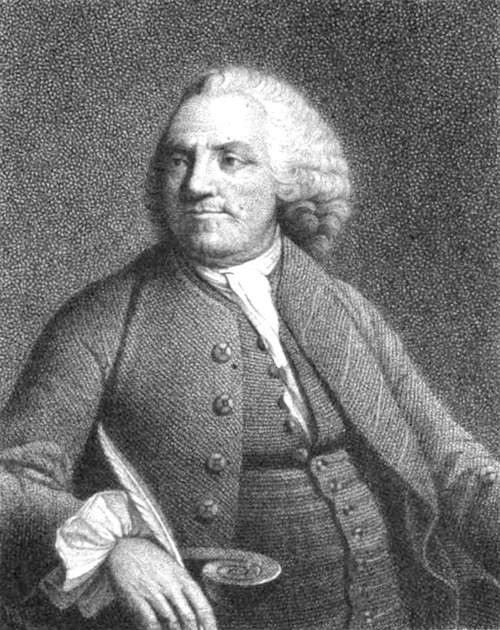
BENJAMIN FRANKLIN, L.L.D.
Publish'd April 1, 1806; by Longman, Rees, Hurst, & Orme, Paternoster Row.
The
WORKS
Of
Benjamin Franklin, L.L.D.
VOL. 1.
Engraved by W. & G. Cooke
Printed,
for Longman, Hurst, Rees, & Orme, Paternoster Row, London.
THE
COMPLETE
WORKS,
IN
PHILOSOPHY, POLITICS, AND MORALS,
OF THE LATE
DR. BENJAMIN FRANKLIN,
NOW FIRST COLLECTED AND ARRANGED:
WITH
MEMOIRS OF HIS EARLY LIFE,
WRITTEN BY HIMSELF.
IN THREE VOLUMES.
VOL. I.
London:
PRINTED FOR J. JOHNSON, ST. PAUL'S CHURCH-YARD;
AND LONGMAN, HURST, REES AND ORME,
PATERNOSTER-ROW.
———
1806.
ADVERTISEMENT.
The
works of
Dr. Franklin have been often partially collected, never before brought together in one uniform publication.The first collection was made by Mr. Peter Collinson in the year 1751. It consisted of letters, communicated by the author to the editor, on one subject, electricity, and formed a pamphlet only, of which the price was half-a-crown. It was enlarged in 1752, by a second communication on the same subject, and in 1754, by a third, till, in 1766, by the addition of letters and papers on other philosophical subjects, it amounted to a quarto volume of 500 pages.
Ten years after, in 1779, another collection was made, by a different editor, in one volume, printed both in quarto and octavo, of papers not contained in the preceding collection, under the title of Political, Miscellaneous, and Philosophical Pieces.
In 1787, a third collection appeared in a thin octavo volume, entitled Philosophical and Miscellaneous Papers.
And lastly, in 1793, a fourth was published, in two volumes, crown octavo, consisting of Memoirs of Dr. Franklin's Life, and Essays humourous, moral and literary, chiefly in the Manner of the Spectator.
In the present volumes will be found all the different collections we have enumerated, together with the various papers of the same author, that have been published in separate pamphlets, or inserted in foreign collections of his works, or in the Transactions of our own or of foreign philosophical societies, or in our own or foreign newspapers and magazines, as far as discoverable by the editor, who has been assisted in the research by a gentleman in America. Among these papers some, we conceive, will be new to the English reader on this
side of the
Atlantic; particularly a series of essays entitled The Busy-Body, written, as Dr. Franklin tells us in his Life, when he was an assiduous imitator of Addison; and a pamphlet, entitled Plain Truth, with which he is said to have commenced his political career as a writer. We hoped to have been enabled to add, what would have been equally new, and still more acceptable, a genuine copy of the Life of our author, as written by himself; but in this hope we are disappointed, and we are in consequence obliged to content ourselves with a translation, which has been already before the public, from a copy in the French language, coming no farther down than the year 1731; and a continuation of his history from that period, by the late Dr. Stuber of Philadelphia.The character of Dr. Franklin, as a philosopher, a politician, and a moralist, is too well known to require illustration, and his writings, from their interesting nature, and the fascinating simplicity of their style, are too highly esteemed, for any apology to be necessary for so large a collection of them, unless it should be deemed necessary by the individual to whom Dr. Franklin in his will consigned his manuscripts: and to him our apology will consist in a reference to his own extraordinary conduct.
In bequeathing his papers, it was no doubt the intention of the testator, that the world should have the chance of being benefited by their publication. It was so understood by the person in question, his grandson, who, accordingly, shortly after the death of his great relative, hastened to London, the best mart for literary property, employed an amanuensis for many months in copying, ransacked our public libraries that nothing might escape, and at length had so far prepared the works of Dr. Franklin for the press, that proposals were made by him to several of our principal booksellers for the sale of them. They were to form three quarto volumes, and were to contain all the writings, published and unpublished, of Franklin, with Memoirs of his Life, brought down by himself to the year 1757, and continued to his death by the legatee. They were to be published in three different languages, and the countries corresponding to those languages, France, Germany, and England, on the same day. The terms asked for the copyright of the English edition were high, amounting to several thousand pounds, which occasioned a little demur; but eventually they would no doubt have been obtained. Nothing more however was heard of the proposals or the work, in this its fair market. The proprietor, it seems, had found a bidder of a different description in some emissary of government, whose object was to withhold the manuscripts from the world, not to benefit it by their publication; and they thus either passed into other hands, or the person to whom they were bequeathed received a remuneration for suppressing them. This at least has been asserted, by a variety of persons, both in this country and America, of whom some were at the time intimate with the grandson, and not wholly unacquainted with the machinations of the ministry; and the silence, which has been observed for so many years respecting the publication, gives additional credibility to the report.
What the manuscripts contained, that should have excited the jealousy of government, we are unable, as we have never seen them, positively to affirm; but, from the conspicuous part acted by the author in the American revolution and the wars connected with it, it is by no means difficult to guess; and of this we are sure, from his character, that no disposition of his writings could have been more contrary to his intentions or wishes.
We have only to add, that in the present collection, which is probably all that will ever be published of the works of this extraordinary man, the papers are methodically arranged, the moral and philosophical ones according to their subjects, the political ones, as nearly as may be, according to their dates; that we have given, in notes, the authorities for ascribing the different pieces to Franklin; that where no title existed, to indicate the nature of a letter or paper, we have prefixed a title; and lastly, that we have compiled an index to the whole, which is placed at the beginning, instead of, as is usual, at the end of the work, to render the volumes more equal.
April 7, 1806.
CONTENTS.
VOL. I.
Page.
LIFE of Dr. FRANKLIN
1LETTERS AND PAPERS ON ELECTRICITY.
Introductory Letter.
169Wonderful effect of points.—Positive and negative electricity.—Electrical kiss.—Counterfeit spider.—Simple and commodious electrical machine.
170Observations on the Leyden bottle, with experiments proving the different electrical state of its different surfaces.
179Further experiments confirming the preceding observations.—Leyden bottle analysed.—Electrical battery.—Magical Picture.—Electrical wheel or jack.—Electrical feast.
187Observations and suppositions, towards forming a new hypothesis, for explaining the several phenomena of thunder-gusts.
203Introductory letter to some additional papers.
216Opinions and conjectures, concerning the properties and effects of the electrical matter, and the means of preserving buildings, ships, &c. from lightning, arising from experiments and observations made at Philadelphia, 1749.—Golden fish.—Extraction of effluvial virtues by electricity impracticable.
217Additional experiments: proving that the Leyden bottle has no more electrical fire in it when charged, than before: nor less when discharged: that in discharging, the fire does not issue from the wire and the coating at the same time, as some have thought, but that the coating always receives what is discharged by the wire, or an equal quantity: the outer surface being always in a negative state of electricity, when the inner surface is in a positive state.
245Accumulation of the electrical fire proved to be in the electrified glass.—Effect of lightning on the needle of compasses, explained.—Gunpowder fired by the electric flame.
247Unlimited nature of the electric force.
250The terms, electric per se, and non-electric, improper.—New relation between metals and water.—Effects of air in electrical experiments.—Experiment for discovering more of the qualities of the electric fluid.
252Mistake, that only metals and water were conductors, rectified.—Supposition of a region of electric fire above our atmosphere.—Theorem concerning light.—Poke-weed a cure for cancers.
256New experiments.—Paradoxes inferred from them.—Difference in the electricity of a globe of glass charged, and a globe of sulphur.—Difficulty of ascertaining which is positive and which negative.
261Probable cause of the different attractions and repulsions of the two electrified globes mentioned in the two preceding letters.
264Reasons for supposing, that the glass globe charges positively, and the sulphur negatively.—Hint respecting a leather globe for experiments when travelling.
ibid.Electrical kite.
267Hypothesis, of the sea being the grand source of lightning, retracted.—Positive, and sometimes negative, electricity of the clouds discovered.—New experiments and conjectures in support of this discovery.—Observations recommended for ascertaining the direction of the electric fluid.—Size of rods for conductors to buildings.—Appearance of a thunder-cloud described.
269Additional proofs of the positive and negative state of electricity in the clouds.—New method of ascertaining it.
284Electrical experiments, with an attempt to account for their several phenomena, &c.
286Experiments made in pursuance of those made by Mr. Canton, dated December 6, 1753; with explanations, by Mr. Benjamin Franklin.
294Turkey killed by electricity.—Effect of a shock on the operator in making the experiment.
299Differences in the qualities of glass.—Account of Domien, an electrician and traveller.—Conjectures respecting the pores of glass.—Origin of the author's idea of drawing down lightning.—No satisfactory hypothesis respecting the manner in which clouds become electrified.—Six men knocked down at once by an electrical shock.—Reflections on the spirit of invention.
301Beccaria's work on electricity.—Sentiments of Franklin on pointed rods, not fully understood in Europe.—Effect of lightning on the church of Newbury, in New England.—Remarks on the subject.
309Notice of another packet of letters.
313Extract of a letter from a gentleman in Boston, to Benjamin Franklin, Esq. concerning the crooked direction, and the source of lightning, and the swiftness of the electric fire.
314Observations on the subjects of the preceding letter.—Reasons for supposing the sea to be the grand source of lightning.—Reasons for doubting this hypothesis.—Improvement in a globe for raising the electric fire.
320Effect of lightning on captain Waddel's compass, and the Dutch church at New York.
324Proposal of an experiment to measure the time taken up by an Electric spark, in moving through any given space.
327Experiments on boiling water, and glass heated by boiling water.—Doctrine of repulsion in electrised bodies doubted.—Electricity of the atmosphere at different heights.—Electrical horse-race.—Electrical thermometer.—In what cases the electrical fire produces heat.—Wire lengthened by electricity.—Good effect of a rod on the house of Mr. West, of Philadelphia.
331Answer to some of the foregoing subjects.—How long the Leyden bottle may be kept charged.—Heated glass rendered permeable by the electric fluid.—Electrical attraction and repulsion.—Reply to other subjects in the preceding paper.—Numerous ways of kindling fire.—Explosion of water.—Knobs and points.
343Accounts from Carolina (mentioned in the foregoing letter) of the effects of lightning on two of the rods commonly affixed to houses there, for securing them against lightning.
361Mr. William Maine's account of the effects of the lightning on his rod, dated at Indian Land, in South Carolina, Aug. 28, 1760.
362On the electricity of the tourmalin.
369New observation relating to electricity in the atmosphere.
373Flash of lightning that struck St. Bride's steeple.
374Best method of securing a powder magazine from lightning.
375Of lightning, and the methods (now used in America) of securing buildings and persons from its mischievous effects.
377St. Bride's steeple.—Utility of electrical conductors to Steeples.—Singular kind of glass tube.
382Experiments, observations, and facts, tending to support the opinion
of the utility of long pointed rods, for securing buildings from damage by strokes of lightning.
383On the utility of electrical conductors.
400On the effects of electricity in paralytic cases.
401Electrical experiments on amber.
403On the electricity of the fogs in Ireland.
405Mode of ascertaining, whether the power, giving a shock to those who touch either the Surinam eel, or the torpedo, be electrical.
408On the
analogy
between magnetism and electricity.
410Concerning the mode of rendering meat tender by electricity.
413Answer to some queries concerning the choice of glass for the Leyden experiment.
416Concerning the Leyden bottle.
418APPENDIX.
No. 1. Account of experiments made in electricity at Marly.
420A more particular account of the same, &c.
422Letter of Mr. W. Watson, F. R. S. to the Royal Society, concerning the electrical experiments in England upon thunder-clouds.
427No. 2. Remarks on the Abbé Nollet's Letters to Benjamin Franklin, Esq. of Philadelphia, on electricity.
430LIST OF THE PLATES
PLATE I.
Electrical Experiments
facing page
182PLATE II.
Electrical Air Thermometer
336PLATE III.
Cavendish Experiment
348PLATE IV.
Lightning Rod Experiments
388ERRATA.
Page.
Line.
210:
for true, read me.
55:
for was born, read who was born.
201:
for Tryon, read Tyron's.
ib.
7
from the bottom: for put to blush, read put to the blush.
ib.
4
from the bottom: for myself, read by myself.
154:
for collection, read works.
219
from the bottom: for or, read nor.
254
from the bottom: for pasquenades, read pasquinades.
287:
dele the.
ib.
12:
for printer, read a printer.
283
from the bottom: for my old favourite work, Bunyan's Voyages, read my old favourite Bunyan.
405:
for money, read in money.
443:
for Bernet, read Burnet.
ib.
17:
for unabled, read unable.
5019:
for ingenuous, read ingenious.
675:
dele bridge.
803
from the bottom: for into, read into which.
235
21:
substitute + for *.
2642:
for course read cause.
LIFE
OF
DR. BENJAMIN FRANKLIN.
LIFE
OF
DR. BENJAMIN FRANKLIN,
&c. &c.
MY DEAR SON,
I have amused myself with collecting some little anecdotes of my family. You may remember the enquiries I made, when you were with me in England, among such of my relations as were then living; and the journey I undertook for that purpose. To be acquainted with the particulars of my parentage and life, many of which are unknown to you, I flatter myself will afford the same pleasure to you as to me. I shall relate them upon paper: it will be an agreeable employment of a week's uninterrupted leisure, which I promise myself during my present retirement in the country. There are also other motives which induce me to the undertaking. From the bosom of poverty and obscurity, in which I drew my first breath, and spent my earliest years, I have raised myself to a state of opulence and to some degree of celebrity in the world. A constant good fortune has attended me through every period of life to my present advanced age; and my descendants may be desirous of learning what were the means of which I made use, and which, thanks to the assisting hand of providence, have proved so eminently successful. They may also, should they ever be placed in a similar situation, derive some advantage from my narrative.
When I reflect, as I frequently do, upon the felicity I have enjoyed, I sometimes say to myself, that, were the offer made
me
, I would engage to run again, from beginning to end, the same career of life. All I would ask, should be the privilege of an author, to correct, in a second edition, certain errors of the first. I could wish, likewise if it were in my power, to change some trivial incidents and events for others more favourable. Were this, however, denied me, still would I not decline the offer. But since a repetition of life cannot take place, there is nothing which, in my opinion, so nearly resembles it, as to call to mind all its circumstances, and, to render their remembrance more durable, commit them to writing. By thus employing myself, I shall yield to the inclination, so natural in old men, to talk of themselves and their exploits, and may freely follow my bent, without being tiresome to those who, from respect to my age, might think themselves obliged to listen to me; as they will be at liberty to read me or not as they please. In fine—and I may as well avow it, since nobody would believe me were I to deny it—I shall perhaps, by this employment, gratify my vanity. Scarcely indeed have I ever read or heard the introductory phrase, "I may say without vanity," but some striking and characteristic instance of vanity has immediately followed. The generality of men hate vanity in others, however strongly they may be tinctured with it themselves: for myself, I pay obeisance to it wherever I meet with it, persuaded that it is advantageous, as well to the individual whom it governs, as to those who are within the sphere of its influence. Of consequence, it would in many cases, not be wholly absurd, that a man should count his vanity among the other sweets of life, and give thanks to providence for the blessing.And here let me with all humility acknowledge, that to divine providence I am indebted for the felicity I have hitherto enjoyed. It is that power alone which has furnished me with the means I have employed, and that has crowned them with success. My faith in this respect leads me to hope, though I cannot count upon it, that the divine goodness will still be exercised towards me, either by prolonging the duration of my happiness to the close of life, or by giving me fortitude to support any melancholy reverse, which may happen to me, as to so many others. My future fortune is unknown but to Him in whose hand is our destiny, and who can make our very afflictions subservient to our benefit.
One of my uncles, desirous, like myself, of collecting anecdotes of our family, gave me some notes, from which I have derived many particulars respecting our ancestors. From these I learn, that they had lived in the same village (Eaton in Northamptonshire,) upon a freehold of about thirty acres, for the space at least of three hundred years. How long they had resided there prior to that period, my uncle had been unable to discover; probably ever since the institution of surnames, when they took the appellation of Franklin, which had formerly been the name of a particular order of individuals.[1]
This petty estate would not have sufficed for their subsistence, had they not added the trade of blacksmith, which was perpetuated in the family down to my uncle's time, the eldest son having been uniformly brought up to this employment: a custom which both he and my father observed with respect to their eldest sons.
In the researches I made at Eaton, I found no account of their births, marriages, and deaths, earlier than the year 1555; the parish register not extending farther back than that period. This register informed me, that I was the youngest son of the youngest branch of the family, counting five generations. My
grandfather
, Thomas,who was born
in 1598, lived at Eaton till he was too old to continue his trade, when he retired to Banbury in Oxfordshire, where his son John, who was a dyer, resided, and with whom my father was apprenticed. He died, and was buried there: we saw his monument in 1758. His eldest son lived in the family house at Eaton, which he bequeathed, with the land belonging to it, to his only daughter; who, in concert with her husband, Mr. Fisher of Wellingborough, afterwards sold it to Mr. Estead, the present proprietor.My grandfather had four surviving sons, Thomas, John, Benjamin, and Josias. I shall give you such particulars of them as my memory will furnish, not having my papers here, in which you will find a more minute account, if they are not lost during my absence.
Thomas had learned the trade of a blacksmith under his father; but possessing a good natural understanding, he improved it by study, at the solicitation of a gentleman of the name of Palmer, who was at that time the principal inhabitant of the village, and who encouraged, in like manner, all my uncles to cultivate their minds. Thomas thus rendered himself competent to the functions of a country attorney; soon became an essential personage in the affairs of the village; and was one of the chief movers of every public enterprise, as well relative to the county as the town of Northampton. A variety of remarkable incidents were told us of him at Eaton. After enjoying the esteem and patronage of Lord Halifax, he died, January 6, 1702, precisely four years before I was born. The recital that was made us of his life and character, by some aged persons of the village, struck you, I remember, as extraordinary, from its analogy to what you knew of myself. "Had he died," said you, "just four years later, one might have supposed a transmigration of souls."
John, to the best of my belief, was brought up to the trade of a wool-dyer.
Benjamin served his apprenticeship in London to a silk-dyer. He was an industrious man: I remember him well; for, while I was a child, he joined my father at Boston, and lived for some years in the house with us. A particular affection had always subsisted between my father and him; and I was his godson. He arrived to a great age. He left behind him two quarto volumes of poems in manuscript, consisting of little fugitive pieces addressed to his friends. He had invented a short-hand, which he taught me, but having never made use of it, I have now forgotten it. He was a man of piety, and a constant attendant on the best preachers, whose sermons he took a pleasure in writing down according, to the expeditory method he had devised. Many volumes were thus collected by him. He was also extremely fond of politics, too much so, perhaps, for his situation. I lately found in London a collection which he had made of all the principal pamphlets relative to public affairs, from the year 1641 to 1717. Many volumes are wanting, as appears by the series of numbers; but there still remain eight in folio, and twenty-four in quarto and octavo. The collection had fallen into the hands of a second-hand bookseller, who, knowing me by having sold me some books, brought it to me. My uncle, it seems, had left it behind him on his departure for America, about fifty years ago. I found various notes of his writing in the margins. His grandson, Samuel, is now living at Boston.
Our humble family had early embraced the Reformation. They remained faithfully attached during the reign of Queen Mary, when they were in danger of being molested on account of their zeal against popery. They had an English bible, and, to conceal it the more securely, they conceived the project of fastening it, open, with pack-threads across the leaves, on the inside of the lid of the close-stool. When my great-grandfather wished to read to his family, he reversed the lid of the close-stool upon his knees, and passed the leaves from one side to the other, which were held down on each by the pack-thread. One of the children was stationed at the door, to give notice if he saw the proctor (an officer of the spiritual court) make his appearance: in that case, the lid was restored to its place, with the Bible concealed under it as before. I had this anecdote from my uncle Benjamin.
The whole family preserved its attachment to the Church of England till towards the close of the reign of Charles II. when certain ministers, who had been ejected as nonconformists, having held conventicles in Northamptonshire, they were joined by Benjamin and Josias, who adhered to them ever after. The rest of the family continued in the episcopal church.
My father, Josias, married early in life. He went, with his wife and three children, to New England, about the year 1682. Conventicles being at that time prohibited by law, and frequently disturbed, some considerable persons of his acquaintance determined to go to America, where they hoped to enjoy the free exercise of their religion, and my father was prevailed on to accompany them.
My father had also by the same wife, four children born in America, and ten others by a second wife, making in all seventeen. I remember to have seen thirteen seated together at his table, who all arrived to years of maturity, and were married. I was the last of the sons, and the youngest child, excepting two daughters. I was born at Boston in New England. My mother, the second wife, was Abiah Folger, daughter of Peter Folger, one of the first colonists of New England, of whom Cotton Mather makes honourable mention, in his Ecclesiastical History of that province, as "a pious and learned Englishman," if I rightly recollect his expressions. I have been told of his having written a variety of little pieces; but there appears to be only one in print, which I met with many years ago. It was published in the year 1675, and is in familiar verse, agreeably to the taste of the times and the country. The author addresses himself to the governors for the time being, speaks for liberty of conscience, and in favour of the anabaptists, quakers, and other sectaries, who had suffered persecution. To this persecution he attributes the war with the natives, and other calamities which afflicted the country, regarding them as the judgments of God in punishment of so odious an offence, and he exhorts the government to the repeal of laws so contrary to charity. The poem appeared to be written with a manly freedom and a pleasing simplicity. I recollect the six concluding lines, though I have forgotten the order of words of the two first; the sense of which was, that his censures were dictated by benevolence, and that, of consequence, he wished to be known as the author; because, said he, I hate from my very soul dissimulation:
Your kind present of an electric tube, with directions for using it, has put several of us[15] on making electrical experiments, in which we have observed some particular phenomena that we look upon to be new. I shall therefore communicate them to you in my next, though possibly they may not be new to you, as among the numbers daily employed in those experiments on your side the water, it is probable some one or other has hit on the same observations. For my own part, I never was before engaged in any study that so totally engrossed my attention and my time as this has lately done; for what with making experiments when I can be alone, and repeating them to my friends and acquaintance, who, from the novelty of the thing, come continually
in crowds
to see them, I have, during some months past, had little leisure for any thing else.The passing of the electrical fire from the upper to the lower part[31] of the bottle, to restore the equilibrium, is rendered strongly visible by the following pretty experiment. Take a book whose covering is filletted with gold; bend a wire of eight or ten inches long, in the form of (m) Fig. 5; slip it on the end of the cover of the book, over the gold line, so as that the shoulder of it may press upon one end of the gold line, the ring up, but leaning towards the other end of the book. Lay the book on a glass or wax[32], and on the other end of the gold lines set the bottle electrised; then bend the springing wire, by pressing it with a stick of wax till its ring approaches the ring of the bottle wire, instantly there is a strong spark and stroke, and the whole line of gold, which completes the communication, between the top and bottom of the bottle, will appear a vivid flame, like the sharpest lightning. The closer the contact between the shoulder of the wire, and the gold at one end of the line, and between the bottom of the bottle and the gold at the other end, the better the experiment succeeds. The room should be darkened. If you would have the whole filletting round the cover appear in fire at once, let the bottle and wire touch the gold in the diagonally opposite corners.
Chagrined a little that we have been hitherto able to produce nothing in this way of use to mankind; and the hot weather coming on, when electrical experiments are not so agreeable, it is proposed to put an end to them for this season, somewhat humorously, in a party of pleasure, on the banks of Skuylkil[41]. Spirits, at the same time, are to be fired by a spark sent from side to side through the river, without any other conductor than the water; an experiment which we some time since performed, to the amazement of many[42]. A turkey is to be killed for our dinner by the electrical shock, and roasted by the electrical jack, before a fire kindled by the electrified bottle: when the healths of all the famous electricians in England, Holland, France, and Germany are to be drank in electrified bumpers[43], under the discharge of guns from the electrical battery.
56. If the source of lightning, assigned in this paper, be the true one, there should be little thunder heard at sea far from land. And accordingly some old sea-captains, of whom enquiry has been made, do affirm, that the fact agrees perfectly with the hypothesis; for that in crossing the great ocean, they seldom meet with thunder till they come into soundings; and that the islands far from the continent have very little of it. And a curious observer, who lived thirteen years at Bermudas, says, there was less thunder there in that whole time than he has sometimes heard in a month at Carolina.
As you first put us on electrical experiments, by sending to our Library Company a tube, with directions how to use it; and as our honorable Proprietary enabled us to carry those experiments to a greater height, by his generous present of a complete electrical apparatus; it is fit that both should know, from time to time, what progress we make. It was in this view I wrote and sent you my former papers on this subject, desiring, that as I had not the honour of a direct correspondence with that bountiful benefactor to our library, they might be communicated to him through your hands. In the same view I write and send you this additional paper. If it happens to bring you nothing new, (which may well be, considering the number of ingenious men in Europe, continually engaged in the same researches) at least it will shew, that the instruments put into our hands are not neglected; and that if no valuable discoveries are made by us, whatever the cause may be, it is not want of industry and application.
But I shall never have done, if I tell you all my conjectures, thoughts, and imaginations on the nature and operations of this electric fluid, and relate the variety of little experiments we have tried. I have already made this paper too long, for which I must crave pardon, not having now time to abridge it. I shall only add, that as it has been observed here that spirits will fire by the electric spark in the summer time, without heating them, when Fahrenheit's thermometer is above 70; so when colder, if the operator puts a small flat bottle of spirits in his bosom, or a close pocket, with the spoon, some little time before he uses them, the heat of his body will communicate warmth more than sufficient for the purpose.
But if the fire with which the inside surface is surcharged be so much precisely as is wanted by the outside surface, it will pass round through the wire fixed to the wax handle, restore the equilibrium in the glass, and make no alteration in the state of the prime conductor.
I am heartily glad to hear more instances of the success of the poke-weed, in the cure of that horrible evil to the human body, a cancer. You will deserve highly of mankind for the communication. But I find in Boston they are at a loss to know the right plant, some asserting it is what they call Mechoachan, others other things. In one of their late papers it is publicly requested that a perfect description may be given of the plant, its places of growth, &c. I have mislaid the paper, or would send it to you. I thought you had described it pretty fully[63].
Make a small cross of two light strips of cedar, the arms so long as to reach to the four corners of a large thin silk handkerchief when extended; tie the corners of the handkerchief to the extremities of the cross, so you have the body of a kite; which being properly accommodated with a tail, loop, and string, will rise in the air, like those made of paper; but this being of silk is fitter to bear the wet and wind of a thunder-gust without tearing. To the top of the upright stick of the cross is to be fixed a very sharp pointed wire, rising a foot or more above the wood. To the end of the twine, next the hand, is to be tied a silk ribbon, and where the silk and twine join, a key may be fastened. This kite is to be raised when a thunder-gust appears to be coming on, and the person who holds the string must stand within a door or window, or under some cover, so that the silk ribbon may not be wet; and care must be taken that the twine does not touch the frame of the door or window. As soon as any of the thunder clouds come over the kite, the pointed wire will draw the electric fire from them, and the kite, with all the twine, will be electrified, and the loose filaments of the twine will stand out every way, and be attracted by an approaching finger. And when the rain has wetted the kite and twine, so that it can conduct the electric fire freely, you will find it stream out plentifully from the key on the approach of your knuckle. At this key the phial may be charged; and from electric fire thus obtained, spirits may be kindled, and all the other electric experiments be performed, which are usually done by the help of a rubbed glass globe or tube, and thereby the sameness of the electric matter with that of lightning completely demonstrated.
These thoughts, my dear friend, are many of them crude and hasty; and if I were merely ambitious of acquiring some reputation in philosophy, I ought to keep them by me, till corrected and improved by time, and farther experience. But since even short hints and imperfect experiments in any new branch of science, being communicated, have oftentimes a good effect, in exciting the attention of the ingenious to the subject, and so become the occasion of more exact disquisition, and more compleat discoveries, you are at liberty to communicate this paper to whom you please; it being of more importance that knowledge should increase, than that your friend should be thought an accurate philosopher.
Because the finger being plunged into the atmosphere of the glass tube, as well as the threads, part of its natural quantity is driven back through the hand and body, by that atmosphere, and the finger becomes, as well as the threads, negatively electrised, and so repels, and is repelled by them. To confirm this, hold a slender light lock of cotton, two or three inches long, near a prime conductor, that is electrified by a glass globe, or tube. You will see the cotton stretch itself out towards the prime conductor. Attempt to touch it with the finger of the other hand, and it will be repelled by the finger. Approach it with a positively charged wire of a bottle, and it will fly to the wire. Bring it near a negatively charged wire of a bottle, it will recede from that wire in the same manner that it did from the finger; which demonstrates the finger to be negatively electrised, as well as the lock of cotton so situated.
The treatment your friend has met with is so common, that no man who knows what the world is, and ever has been, should expect to escape it. There are every where a number of people, who, being totally destitute of any inventive faculty themselves, do not readily conceive that others may possess it: they think of inventions as of miracles; there might be such formerly, but they are ceased. With these, every one who offers a new invention is deemed a pretender: he had it from some other country, or from some book: a man of their own acquaintance; one who has no more sense than themselves, could not possibly, in their opinion, have been the inventor of any thing. They are confirmed, too, in these sentiments, by frequent instances of pretensions to invention, which vanity is daily producing. That vanity too, though an incitement to invention, is, at the same time, the pest of inventors. Jealousy and envy deny the merit or the novelty of your invention; but vanity, when the novelty and merit are established, claims it for its own. The smaller your invention is, the more mortification you receive in having the credit of it disputed with you by a rival, whom the jealousy and envy of others are ready to support against you, at least so far as to make the point doubtful. It is not in itself of importance enough for a dispute; no one would think your proofs and reasons worth their attention: and yet, if you do not dispute the point, and demonstrate your right, you not only lose the credit of being in that instance ingenious, but you suffer the disgrace of not being ingenuous; not only of being a plagiary, but of being a plagiary for trifles. Had the invention been greater it would have disgraced you less; for men have not so contemptible an idea of him that robs for gold on the highway, as of him that can pick pockets for half-pence and farthings. Thus, through envy, jealousy, and the vanity of competitors for fame, the origin of many of the most extraordinary inventions, though produced within but a few centuries past, is involved in doubt and uncertainty. We scarce know to whom we are indebted for the compass, and for spectacles, nor have even paper and printing, that record every thing else, been able to preserve with certainty the name and reputation of their inventors. One would not, therefore, of all faculties, or qualities of the mind, wish, for a friend, or a child, that he should have that of invention. For his attempts to benefit mankind in that way, however well imagined, if they do not succeed, expose him, though very unjustly, to general ridicule and contempt; and, if they do succeed, to envy, robbery, and abuse.
Your thoughts upon these remarks I shall receive with a great deal of pleasure. I take notice that in the printed copies of your letters several things are wanting which are in the manuscript you sent me. I understand by your son, that you had writ, or was writing, a paper on the effect of the electrical fire on loadstones, needles, &c. which I would ask the favour of a copy of, as well as of any other papers on electricity, written since I had the manuscript, for which I repeat my obligations to you.
By this post I send to ****, who is curious in that way, some meteorological observations and conjectures, and desire him to communicate them to you, as they may afford you some amusement, and I know you will look over them with a candid eye. By throwing our occasional thoughts on paper, we more readily discover the defects of our opinions, or we digest them better and find new arguments to support them. This I sometimes practise: but such pieces are fit only to be seen by friends.
And now, Sir, I most heartily congratulate you on the pleasure you must have in finding your great and well-grounded expectations so far fulfilled. May this method of security from the destructive violence of one of the most awful powers of nature, meet with such further success, as to induce every good and grateful heart to bless God for the important discovery! May the benefit thereof be diffused over the whole globe! May it extend to the latest posterity of mankind, and make the name of FRANKLIN, like that of NEWTON, immortal.
You seem to think highly of the importance of this discovery, as do many others on our side of the water. Here it is very little regarded; so little, that though it is now seven or eight years since it was made public, I have not heard of a single house as yet attempted to be secured by it. It is true the mischiefs done by lightning are not so frequent here as with us, and those who calculate chances may perhaps find that not one death (or the destruction of one house) in a hundred thousand happens from that cause, and that therefore it is scarce worth while to be at any expence to guard against it.—But in all countries there are particular situations of buildings more exposed than others to such accidents, and there are minds so strongly impressed with the apprehension of them, as to be very unhappy every time a little thunder is within their hearing;—it may therefore be well to render this little piece of new knowledge as general and as well understood as possible, since to make us safe is not all its advantage, it is some to make us easy. And as the stroke it secures us from might have chanced perhaps but once in our lives, while it may relieve us a hundred times from those painful apprehensions, the latter may possibly on the whole contribute more to the happiness of mankind than the former.
"——It is some years since Mr. Raven's rod was struck by lightning. I hear an account of it was published at the time, but I cannot find it. According to the best information I can now get, he had fixed to the outside of his chimney a large iron rod, several feet in length, reaching above the chimney; and to the top of this rod the points were fixed. From the lower end of this rod, a small brass wire was continued down to the top of another iron rod driven into the earth. On the ground-floor in the chimney stood a gun, leaning against the back-wall, nearly opposite to where the brass wire came down on the outside. The lightning fell upon the points, did no damage to the rod they were fixed to; but the brass wire, all down till it came opposite to the top of the gun-barrel, was destroyed[76]. There the lightning made a hole through the wall or back of the chimney, to get to the gun-barrel[77], down which it seems to have passed, as, although it did not hurt the barrel, it damaged the butt of the stock, and blew up some bricks of the hearth. The brass wire below the hole in the wall remained good. No other damage, as I can learn, was done to the house. I am told the same house had formerly been struck by lightning, and much damaged, before these rods were invented."——
It is said that the house was filled with its flash (l). Expressions like this are common in accounts of the effects of lightning, from which we are apt to understand that the lightning filled the house. Our language indeed seems to want a word to express the light of lightning as distinct from the lightning itself. When a tree on a hill is struck by it, the lightning of that stroke exists only in a narrow vein between the cloud and tree, but its light fills a vast space many miles round; and people at the greatest distance from it are apt to say, "The lightning came into our rooms through our windows." As it is in itself extremely bright, it cannot, when so near as to strike a house, fail illuminating highly every room in it through the windows; and this I suppose to have been the case at Mr. Maine's; and that, except in and near the hearth, from the causes above-mentioned, it was not in any other part of the house; the flash meaning no more than the light of the lightning.—It is for want of considering this difference, that people suppose there is a kind of lightning not attended with thunder. In fact there is probably a loud explosion accompanying every flash of lightning, and at the same instant;—but as sound travels slower than light, we often hear the sound some seconds of time after having seen the light; and as sound does not travel so far as light, we sometimes see the light at a distance too great to hear the sound.
I find that the face A, of the large stone, being coated with leaf-gold (attached by the white of an egg, which will bear dipping in hot water) becomes quicker and stronger in its effect on the cork ball, repelling it the instant it comes in contact; which I suppose to be occasioned by the united force of different parts of the face, collected and acting together through the metal.
There is an observation relating to electricity in the atmosphere, which seemed new to me, though perhaps it will not to you: however, I will venture to mention it. I have some points on the top of my house, and the wire where it passes within-side the house is furnished with bells, according to your method, to give notice of the passage of the electric fluid. In summer, these bells, generally ring at the approach of a thunder-cloud; but cease soon after it begins to rain. In winter, they sometimes though not very often, ring while it is snowing; but never, that I remember, when it rains. But what was unexpected to me was, that, though the bells had not rung while it was snowing, yet, the next day, after it had done snowing, and the weather was cleared up, while the snow was driven about by a high wind at W. or N. W. the bells rung for several hours (though with little intermissions) as briskly as ever I knew them, and I drew considerable sparks from the wire. This phenomenon I never observed but twice; viz. on the 31st of January, 1760, and the 3d of March, 1762.
I have just recollected that in one of our great storms of lightning, I saw an appearance, which I never observed before, nor ever heard described. I am persuaded that I saw the flash which struck St. Bride's steeple. Sitting at my window, and looking to the north, I saw what appeared to me a solid strait rod of fire, moving at a very sharp angle with the horizon. It appeared to my eye as about two inches diameter, and had nothing of the zig-zag lightning motion. I instantly told a person sitting with me, that some place must be struck at that instant. I was so much surprized at the vivid distinct appearance of the fire, that I did not hear the clap of thunder, which stunned every one besides. Considering how low it moved, I could not have thought it had gone so far, having St. Martin's, the New Church, and St. Clements's steeples in its way. It struck the steeple a good way from the top, and the first impression it made in the side is in the same direction I saw it move in. It was succeeded by two flashes, almost united, moving in a pointed direction. There were two distinct houses struck in Essex-street. I should have thought the rod would have fallen in Covent-Garden, it was so low. Perhaps the appearance is frequent, though never before seen by
There is another thing very proper to line small barrels with; it is what they call tin-foil, or leaf-tin, being tin milled between rollers till it becomes as thin as paper, and more pliant, at the same time that its texture is extremely close. It may be applied to the wood with common paste, made with boiling-water thickened with flour; and, so laid on; will lie very close and stick well: but I should prefer a hard sticky varnish for that purpose, made of linseed oil much boiled. The heads might be lined separately, the tin wrapping a little round their edges. The barrel, while the lining is laid on, should have the end hoops slack, so that the staves standing at a little distance from each other, may admit the head into its groove. The tin-foil should be plyed into the groove. Then, one head being put in, and that end hooped tight, the barrel would be fit to receive the powder, and when the other head is put in and the hoops drove up, the powder would be safe from moisture even if the barrel were kept under water. This tin-foil is but about eighteen pence sterling a pound, and is so extremely thin, that I imagine a pound of it would line three or four powder-barrels.
A person apprehensive of danger from lightning, happening during the time of thunder to be in a house not so secured, will do well to avoid sitting near the chimney, near a looking glass, or any gilt pictures or wainscot; the safest place is in the middle of the room (so it be not under a metal lustre suspended by a chain) sitting in one chair and laying the feet up in another. It is still safer to bring two or three mattrasses or beds into the middle of the room, and, folding them up double, place the chair upon them; for they not being so good conductors as the walls, the lightning will not chuse an interrupted course through the air of the room and the bedding, when it can go through a continued better conductor, the wall. But where it can be had, a hammock or swinging bed, suspended by silk cords equally distant from the walls on every side, and from the cieling and floor above and below, affords the safest situation a person can have in any room whatever; and what indeed may be deemed quite free from danger of any stroke by lightning.
**** It is perhaps not so extraordinary that unlearned men, such as commonly compose our church vestries, should not yet be acquainted with, and sensible of the benefits of metal conductors in averting the stroke of lightning, and preserving our houses from its violent effects, or that they should be still prejudiced against the use of such conductors, when we see how long even philosophers, men of extensive science and great ingenuity, can hold out against the evidence of new knowledge, that does not square with their preconceptions; and how long men can retain a practice that is conformable to their prejudices, and expect a benefit from such practice, though constant experience shows its inutility. A late piece of the Abbé Nollet, printed last year in the memoirs of the French Academy of Sciences, affords strong instances of this: for though the very relations he gives of the effects of lightning in several churches and other buildings show clearly, that it was conducted from one part to another by wires, gildings, and other pieces of metal that were within, or connected with the building, yet in the same paper he objects to the providing metalline conductors without the building, as useless or dangerous.[82] He cautions people not to ring the church bells during a thunder-storm, lest the lightning, in its way to the earth, should be conducted down to them by the bell ropes,[83] which are but bad conductors; and yet is against fixing metal rods on the outside of the steeple, which are known to be much better conductors, and which it would certainly chuse to pass in, rather than in dry hemp. And though for a thousand years past bells have been solemnly consecrated by the Romish church[84], in expectation that the sound of such blessed bells would drive away those storms, and secure our buildings from the stroke of lightning; and during so long a period, it has not been found by experience, that places within the reach of such blessed sound, are safer than others where it is never heard; but that on the contrary, the lightning seems to strike steeples of choice, and that at the very time the bells are ringing[85]; yet still they continue to bless the new bells, and jangle the old ones whenever it thunders.—One would think it was now time to try some other trick;—and ours is recommended (whatever this able philosopher may have been told to the contrary) by more than twelve years experience, wherein, among the great number of houses furnished with iron rods in North America, not one so guarded has been materially hurt with lightning, and several have been evidently preserved by their means; while a number of houses, churches, barns, ships, &c. in different places, unprovided with rods, have been struck and greatly damaged, demolished or burnt. Probably the vestries of our English churches are not generally well acquainted with these facts; otherwise, since as good protestants they have no faith in the blessing of bells, they would be less excusable in not providing this other security for their respective churches, and for the good people that may happen to be assembled in them during a tempest, especially as those buildings, from their greater height, are more exposed to the stroke of lightning than our common dwellings.
Mr. Rittenhouse, our astronomer, has informed me, that having observed with his excellent telescope, many conductors that are within the field of his view, he has remarked in various instances, that the points were melted in like manner. There is no example of a house, provided with a perfect conductor, which has suffered any considerable damage; and even those which are without them have suffered little, since conductors have come common in this city.
Perhaps some permanent advantage might have been obtained, if the electric shocks had been accompanied with proper medicine and regimen, under the direction a skilful physician. It may be, too, that a few great strokes, as given in my method, may not be so proper as many small ones; since by the account from Scotland of a case, in which two hundred shocks from a phial were given daily, it seems, that a perfect cure has been made. As to any uncommon strength supposed to be in the machine used in that case, I imagine it could have no share in the effect produced; since the strength of the shock from charged glass, is in proportion to the quantity of surface of the glass coated; so that my shocks from those large jars, must have been much greater than any that could be received from a phial held in the hand.
The experiment which you mention, of filing your glass, is analogous to one which I made in 1751, or 1752. I had supposed in my preceding letters, that the pores of glass were smaller in the interior parts than near the surface, and that on this account they prevented the passage of the electrical fluid. To prove whether this was actually the case or not, I ground one of my phials in a part where it was extremely thin, grinding it considerably beyond the middle, and very near to the opposite superficies, as I found, upon breaking it after the experiment. It was charged nevertheless after being ground, equally well as before, which convinced me, that my hypothesis on this subject was erroneous. It is difficult to conceive where the immense superfluous quantity of electricity on the charged side of a glass is deposited.
Let several persons, standing on the floor, hold hands, and let one of them touch the fish, so as to receive a shock. If the shock be felt by all, place the fish flat on a plate of metal, and let one of the persons holding hands touch this plate, while the person farthest from the plate touches the upper part of the fish with a metal rod: then observe, if the force of the shock be the same as to all the persons forming the circle, or is stronger than before.
I am chiefly indebted to that excellent philosopher of Petersburgh, Mr. Æpinus, for this hypothesis, which appears to me equally ingenious and solid. I say, chiefly, because, as it is many years since I read his book, which I have left in America, it may happen, that I may have added to or altered it in some respect; and if I have misrepresented any thing, the error ought to be charged to my account.
Having prepared a battery of six large glass jars (each from 20 to 24 pints) as for the Leyden experiment, and having established a communication, as usual, from the interior surface of each with the prime conductor, and having given them a full charge (which with a good machine may be executed in a few minutes, and may be estimated by an electrometer) a chain which communicates with the exterior of the jars must be wrapped round the thighs of the fowl; after which the operator, holding it by the wings, turned back and made to touch behind, must raise it so high that the head may receive the first shock from the prime conductor. The animal dies instantly. Let the head be immediately cut off to make it bleed, when it may be plucked and dressed immediately. This quantity of electricity is supposed sufficient for a turkey of ten pounds weight, and perhaps for a lamb. Experience alone will inform us of the requisite proportions for animals of different forms and ages. Probably not less will be required to render a small bird, which is very old, tender, than for a larger one, which is young. It is easy to furnish the requisite quantity of electricity, by employing a greater or less number of jars. As six jars, however, discharged at once, are capable of giving a very violent shock, the operator must be very circumspect, lest he should happen to make the experiment on his own flesh, instead of that of the fowl.
There is another circumstance much to be desired with respect to glass, and that is, that it should not be subject to break when highly charged in the Leyden experiment. I have known eight jars broken out of twenty, and at another time, twelve out of thirty-five. A similar loss would greatly discourage electricians desirous of accumulating a great power for certain experiments.—We have never been able hitherto to account for the cause of such misfortunes. The first idea which occurs is, that the positive electricity, being accumulated on one side of the glass, rushes violently through it, in order to supply the deficiency on the other side and to restore the equilibrium. This however I cannot conceive to be the true reason, when I consider, that a great number of jars being united, so as to be charged and discharged at the same time, the breaking of a single jar will discharge the whole; for, if the accident proceeded from the weakness of the glass, it is not probable, that eight of them should be precisely of the same degree of weakness, as to break every one at the same instant, it being more likely, that the weakest should break first, and, by breaking, secure the rest; and again, when it is necessary to produce a certain effect, by means of the whole charge passing through a determined circle (as, for instance, to melt a small wire) if the charge, instead of passing in this circle, rushed through the sides of the jars, the intended effect would not be produced; which, however, is contrary to fact. For these reasons, I suspect, that there is, in the substance of the glass, either some little globules of air, or some portions of unvitrified sand or salt, into which a quantity of the electric fluid may be forced during the charge, and there retained till the general discharge: and that the force being suddenly withdrawn, the elasticity of the fluid acts upon the glass in which it is inclosed, not being able to escape hastily without breaking the glass. I offer this only as a conjecture, which I leave to others to examine.
"On voit, par le détail de cette lettre, que le fait est assez bien constaté pour ne laisser aucun doute à ce sujet. Le porteur m'a assuré de vive voix qu'il avoit tiré pendant près d'un quart-d'heure avant que M. le Prieur arrivât, en présence de cinq ou six personnes, des étincelles plus fortes & plus bruyantes que celles dont il est parlé dans la lettre. Ces premieres personnes arrivant successivement, n'osient approcher qu'à 10 ou 12 pas de la machine; & à cette distance, malgré le plein soleil, ils voyoient les étincelles & entendoient le bruit....
Vol. I. page 182.
Plate I.
Published as the Act directs, April 1, 1806, by Longman, Hurst, Rees & Orme, Paternoster Row.
Vol. I. page 336.
Plate II.
Published as the Act directs, April 1, 1806, by Longman, Hurst, Rees & Orme, Paternoster Row.
Vol. I. page 348.
Plate III.
Vol. I. page 388.
Plate IV.
I have amused myself with collecting some little anecdotes of my family. You may remember the enquiries I made, when you were with me in England, among such of my relations as were then living; and the journey I undertook for that purpose. To be acquainted with the particulars of my parentage and life, many of which are unknown to you, I flatter myself will afford the same pleasure to you as to me. I shall relate them upon paper: it will be an agreeable employment of a week's uninterrupted leisure, which I promise myself during my present retirement in the country. There are also other motives which induce me to the undertaking. From the bosom of poverty and obscurity, in which I drew my first breath, and spent my earliest years, I have raised myself to a state of opulence and to some degree of celebrity in the world. A constant good fortune has attended me through every period of life to my present advanced age; and my descendants may be desirous of learning what were the means of which I made use, and which, thanks to the assisting hand of providence, have proved so eminently successful. They may also, should they ever be placed in a similar situation, derive some advantage from my narrative.
In the researches I made at Eaton, I found no account of their births, marriages, and deaths, earlier than the year 1555; the parish register not extending farther back than that period. This register informed me, that I was the youngest son of the youngest branch of the family, counting five generations. My
grandfather
, Thomas,who was born
in 1598, lived at Eaton till he was too old to continue his trade, when he retired to Banbury in Oxfordshire, where his son John, who was a dyer, resided, and with whom my father was apprenticed. He died, and was buried there: we saw his monument in 1758. His eldest son lived in the family house at Eaton, which he bequeathed, with the land belonging to it, to his only daughter; who, in concert with her husband, Mr. Fisher of Wellingborough, afterwards sold it to Mr. Estead, the present proprietor.It was about this period, that having one day been
put to the blush
for my ignorance in the art of calculation, which I had twice failed to learn while at school, I took Cocker's Treatise of Arithmetic, and went through itby myself
with the utmost ease. I also read a book of navigation by Seller and Sturmy, and made myself master of the little geometry it contains, but I never proceeded far in this science. Nearly at the same time I read Locke on the Human Understanding, and the Art of Thinking, by Messrs. du Port Royal.My brother, upon this discovery, began to entertain a little more respect for me; but he still regarded himself as my master, and treated me as an apprentice. He thought himself entitled to the same services from me, as from any other person. On the contrary, I conceived that in many instances, he was too rigorous, and that, on the part of a brother, I had a right to expect greater indulgence. Our disputes were frequently brought before my father; and either my brother was generally wrong, or I was the better pleader of the two, for judgment was commonly given in my favour. But my brother was passionate, and often had recourse to blows—a circumstance which I took in very ill part. This severe and tyrannical treatment contributed, I believe, to imprint on my mind that aversion to arbitrary power, which during my whole life I have ever preserved. My apprenticeship became insupportable to me, and I continually sighed for an opportunity of shortening it, which at length unexpectedly offered.
When he knew that it was my determination to quit him, he wished to prevent my finding employment elsewhere. He went to all the printing-houses in the town, and prejudiced the masters against me—who accordingly refused to employ me. The idea then suggested itself to me of going to New York, the nearest town in which there was a printing-office. Farther reflection confirmed me in the design of leaving Boston, where I had already rendered myself an object of suspicion to the governing party. It was probable, from the arbitrary proceedings of the assembly in the affair of my brother, that, by remaining, I should soon have been exposed to difficulties, which I had the greater reason to apprehend, as, from my indiscreet disputes upon the subject of religion, I began to be regarded by pious souls with horror, either as an apostate or an atheist. I came, therefore, to a resolution: but my father, in this instance siding with my brother, presumed that if I attempted to depart openly, measures would be taken to prevent me. My friend Collins undertook to favour my flight. He agreed for my passage with the captain of a New York sloop, to whom he represented me as a young man of his acquaintance, who had an affair with a girl of bad character, whose parents wished to compel me to marry her, and that of consequence I could neither make my appearance, nor go off publicly. I sold part of my books to procure a small sum of money, and went privately on board the sloop. By favour of a good wind, I found myself in three days at New York, nearly three hundred miles from my home, at the age only of seventeen years, without knowing an individual in the place, and with very little money in my pocket.
I had been absent about seven complete months, and my relations, during that interval, had received no intelligence of me; for my brother-in-law, Holmes, was not yet returned, and had not written about me. My unexpected appearance surprized the family; but they were all delighted at seeing me again, and, except my brother, welcomed me home. I went to him at the printing-house. I was better dressed than I had ever been while in his service: I had a complete suit of clothes, new and neat, a watch in my pocket, and my purse was furnished with nearly five pounds sterling
in money
. He gave me no very civil reception; and having eyed me from head to foot, resumed his work.At New York I found my friend Collins, who had arrived some time before. We had been intimate from our infancy, and had read the same books together; but he had the advantage of being able to devote more time to reading and study, and an astonishing disposition for mathematics, in which he left me far behind him. When at Boston, I had been accustomed to pass with him almost all my leisure hours. He was then a sober and industrious lad; his knowledge had gained him a very general esteem, and he seemed to promise to make an advantageous figure in society. But, during my absence, he had unfortunately addicted himself to brandy, and I learned, as well from himself as from the report of others, that every day since his arrival at New York he had been intoxicated, and had acted in a very extravagant manner. He had also played, and lost all his money; so that I was obliged to pay his expences at the inn, and to maintain him during the rest of his journey; a burthen that was very inconvenient to me.
During the circumstances I have related, I had paid some attentions to Miss Read. I entertained for her the utmost esteem and affection; and I had reason to believe that these sentiments were mutual. But we were both young, scarcely more than eighteen years of age; and as I was on the point of undertaking a long voyage, her mother thought it prudent to prevent matters being carried top far for the present, judging that, if marriage was our object, there would be more propriety in it after my return, when, as at least I expected, I should be established in my business. Perhaps, also, she thought my expectations were not so well founded as I imagined.
At the printing house I contracted an intimacy with a sensible young man of the name of Wygate, who, as his parents were in good circumstances, had received a better education than is common among printers. He was a tolerable Latin scholar, spoke French fluently, and was fond of reading. I taught him, as well as a friend of his, to swim, by taking them twice only into the river; after which they stood in need of no farther assistance. We one day made a party to go by water to Chelsea, in order to see the College, and Don Soltero's curiosities. On our return, at the request of the company, whose curiosity Wygate had excited, I undressed myself, and leaped into the river. I swam from near Chelsea the whole way to
Blackfriars
, exhibiting, during my course, a variety of feats of activity and address, both upon the surface of the water, as well as under it. This sight occasioned much astonishment and pleasure to those to whom it was new. In my youth I took great delight in this exercise. I knew, and could execute, all the evolutions and positions of Thevenot; and I added to them some of my own invention, in which I endeavoured to unite gracefulness and utility. I took a pleasure in displaying them all on this occasion, and was highly flattered with the admiration they excited.[1] As a proof that Franklin was anciently the common name of an order or rank in England, see Judge Fortesque, De laudibus legum Angliæ, written about the year 1412, in which is the following passage, to shew that good juries might easily be formed in any part of England:
From Sherburn,[2] where I dwell,
I therefore put my name,
Your friend, who means you well,
PETER FOLGER.
My brothers were all put apprentices to different trades. With respect to myself, I was sent, at the age of eight years, to a grammar-school. My father destined me for the church, and already regarded me as the chaplain of the family. The promptitude with which from my infancy I had learned to read, for I do not remember to have been ever without this acquirement, and the encouragement of his friends, who assured him that I should one day certainly become a man of letters, confirmed him in this design. My uncle Benjamin approved also of the scheme, and promised to give me all his volumes of sermons, written, as I have said, in the short-hand of his invention, if I would take the pains to learn it.
I remained, however, scarcely a year at the grammar-school, although, in this short interval, I had risen from the middle to the head of my class, from thence to the class immediately above, and was to pass, at the end of the year, to the one next in order. But my father, burdened with a numerous family, found that he was incapable, without subjecting himself to difficulties, of providing for the expences of a collegiate education; and considering besides, as I heard him say to his friends, that persons so educated were often poorly provided for, he renounced his first intentions, took me from the grammar-school, and sent me to a school for writing and arithmetic, kept by a Mr. George Brownwell, who was a skilful master, and succeeded very well in his profession by employing gentle means only, and such as were calculated to encourage his scholars. Under him I soon acquired an excellent hand; but I failed in arithmetic, and made therein no sort of progress.
At ten years of age, I was called home to assist my father in his occupation, which was that of a soap-boiler and tallow-chandler; a business to which he had served no apprenticeship, but which he embraced on his arrival in New England, because he found his own, that of dyer, in too little request to enable him to maintain his family, I was accordingly employed in cutting the wicks, filling the moulds, taking care of the shop, carrying messages, &c.
This business displeased me, and I felt a strong inclination for a sea life; but my father set his face against it. The vicinity of the water, however, gave me frequent opportunities, of venturing myself both upon and within it, and I soon acquired the art of swimming, and of managing a boat. When embarked with other children, the helm was commonly deputed to me, particularly on difficult occasions; and, in every other project, I was almost always the leader of the troop, whom I sometimes involved in embarrassments. I shall give an instance of this, which demonstrates an early disposition of mind for public enterprises, though the one in question was not conducted by justice.
The mill-pond was terminated on one side by a marsh, upon the borders of which we were accustomed to take our stand, at high water, to angle for small fish. By dint of walking, we had converted the place into a perfect quagmire. My proposal was to erect a wharf that should afford us firm footing; and I pointed out to my companions a large heap of stones, intended for the building a new house near the marsh, and which were well adapted for our purpose. Accordingly, when the workmen retired in the evening, I assembled a number of my play-fellows, and by labouring diligently, like ants, sometimes four of us uniting our strength to carry a single stone, we removed them all, and constructed our little quay. The workmen were surprised the next morning at not finding their stones; which had been conveyed to our wharf. Enquiries were made respecting the authors of this conveyance; we were discovered; complaints were exhibited against us; and many of us underwent correction on the part of our parents; and though I strenuously defended the utility of the work, my father at length convinced me, that nothing which was not strictly honest could be useful.
It will not, perhaps, be uninteresting to you to know what a sort of man my father was. He had an excellent constitution, was of a middle size, but well made and strong, and extremely active in whatever he undertook. He designed with a degree of neatness, and knew a little of music. His voice was sonorous and agreeable; so that when he sung a psalm or hymn, with the accompaniment of his violin, as was his frequent practice in an evening, when the labours of the day were finished, it was truly delightful to hear him. He was versed also in mechanics, and could, upon occasion, use the tools of a variety of trades. But his greatest excellence was a sound understanding and solid judgment, in matters of prudence, both in public and private life. In the former, indeed, he never engaged, because his numerous family, and the mediocrity of his fortune, kept him unremittingly employed in the duties of his profession. But I well remember, that the leading men of the place used frequently to come and ask his advice respecting the affairs of the town, or of the church to which he belonged, and that they paid much deference to his opinion. Individuals were also in the habit of consulting him in their private affairs, and he was often chosen arbiter between contending parties.
He was fond of having at his table, as often as possible, some friends or well-informed neighbours, capable of rational conversation, and he was always careful to introduce useful or ingenious topics of discourse, which might tend to form the minds of his children. By this means he early attracted our attention to what was just, prudent, and beneficial in the conduct of life. He never talked of the meats which appeared upon the table, never discussed whether they were well or ill dressed, of a good or bad flavour, high-seasoned or otherwise, preferable or inferior to this or that dish of a similar kind. Thus accustomed, from my infancy, to the utmost inattention as to these objects, I have been perfectly regardless of what kind of food was before me; and I pay so little attention to it even now, that it would be a hard matter for me to recollect, a few hours after I had dined, of what my dinner had consisted. When travelling, I have particularly experienced the advantage of this habit; for it has often happened to me to be in company with persons, who, having a more delicate, because a more exercised taste, have suffered in many cases considerable inconvenience; while, as to myself, I have had nothing to desire.
My mother was likewise possessed of an excellent constitution. She suckled all her ten children, and I never heard either her or my father complain of any other disorder than that of which they died: my father at the age of eighty-seven, and my mother at eighty-five. They are buried together at Boston, where, a few years ago, I placed a marble over their grave, with this inscription:
"Here lie
Josias Franklin and Abiah his wife: They lived together with reciprocal affection for fifty-nine years; and without private fortune, without lucrative employment, by assiduous labour and honest industry, decently supported a numerous family, and educated with success, thirteen children, and seven grand children. Let this example, reader, encourage thee diligently to discharge the duties of thy calling, and to rely on the support of divine providence,
He was pious and prudent,
She discreet and virtuous.
Their youngest son, from a sentiment of filial duty, consecrates
this stone
to their memory."
I perceive, by my rambling digressions, that I am growing old. But we do not dress for a private company as for a formal ball. This deserves, perhaps, the name of negligence.
To return. I thus continued employed in my father's trade for the space of two years; that is to say, till I arrived at twelve years of age. About this time my brother John, who had served his apprenticeship in London, having quitted my father, and being married and settled in business on his own account at Rhode Island, I was destined, to all appearance to supply his place, and be a candle-maker all my life: but my dislike of this occupation continuing, my father was apprehensive, that, if a more, agreeable one were not offered me, I might play the truant and escape to sea; as, to his extreme mortification, my brother Josias had done. He therefore took me sometimes to see masons, coopers, braziers, joiners, and other mechanics, employed at their work; in order to discover the bent of my inclination, and fix it if he could upon some occupation that might retain me on shore. I have since, in consequence of these visits, derived no small pleasure from seeing skilful workmen handle their tools; and it has proved of considerable benefit to have acquired thereby sufficient knowledge to be able to make little things for myself, when I have had no mechanic at hand, and to construct small machines for my experiments, while the idea I have conceived has been fresh and strongly impressed on my imagination.
My father at length decided that I should be a cutler, and I was placed for some days upon trial with my cousin Samuel, son of my uncle Benjamin, who had learned this trade in London, and had established himself at Boston. But the premium he required for my apprenticeship displeasing my father, I was recalled home.
From my earliest years I had been passionately fond of reading, and I laid out in books all the money I could procure. I was particularly pleased with accounts of voyages. My first acquisition was Bunyan's
works
in small separate volumes. These I afterwards sold in order to buy an historical collection by R. Burton, which consisted of small cheap volumes, amounting in all to about forty or fifty. My father's little library was principally made up of books of practical and polemical theology. I read the greatest part of them. I have since often regretted that at a time when I had so great a thirst for knowledge, more eligible books had not fallen into my hands, as it was then a point decided that I should not be educated for the church. There was also among my father's books, Plutarch's Lives, in which I read continually, and I still regard as advantageously employed the time devoted to them. I found besides a work of De Foe's, entitled an Essay on Projects, from which, perhaps, I derived impressions that have since influenced some of the principal events of my life.My inclination for books at last determined my father to make me a printer, though he had already a son in that profession. My brother had returned from England in 1717, with a press and types, in order to establish a printing-house at Boston. This business pleased me much better than that of my father, though I had still a predilection for the sea. To prevent the effects which might result from this inclination, my father was impatient to see me engaged with my brother. I held back for some time; at length, however, I suffered myself to be persuaded, and signed my indentures, being then only twelve years of age. It was agreed that I should serve as an apprentice to the age of twenty-one, and should receive journeyman's wages only during the last year.
In a very short time I made great proficiency in this business, and became very serviceable to my brother. I had now an opportunity of procuring better books. The acquaintance I necessarily formed with booksellers' apprentices, enabled me to borrow a volume now and then, which I never failed to return punctually and without injury. How often has it happened to me to pass the greater part of the night in reading by my bed-side, when the book had been lent me in the evening, and was to be returned the next morning, lest it might be missed or wanted!
At length, Mr. Matthew Adams, an ingenious tradesman, who had a handsome collection of books, and who frequented our printing-house, took notice of me. He invited me to see his library, and had the goodness to lend me any books I was desirous of reading. I then took a strange fancy for poetry, and composed several little pieces. My brother, thinking he might find his account in it, encouraged me, and engaged me to write two ballads. One, called the Light-house Tragedy, contained an account of the shipwreck of captain Worthilake and his two daughters; the other was a sailor's song on the capture of the noted pirate called Teach, or Blackbeard. They were wretched verses in point of style, mere blind-men's ditties. When printed, he dispatched me about the town to sell them. The first had a prodigious run, because the event was recent, and had made a great noise.
My vanity was flattered by this success; but my father checked my exultation, by ridiculing my productions, and telling me that versifiers were always poor. I thus escaped the misfortune of being a very wretched poet. But as the faculty of writing prose has been of great service to me in the course of my life, and principally contributed to my advancement, I shall relate by what means, situated as I was, I acquired the small skill I may possess in that way.
There was in the town another young man, a great lover of books, of the name of John Collins, with whom I was intimately connected. We frequently engaged in dispute, and were indeed so fond of argumentation, that nothing was so agreeable to us as a war of words. This contentious temper, I would observe by the bye, is in danger of becoming a very bad habit; and frequently renders a man's company insupportable, as being no otherwise capable of indulgence than by an indiscriminate contradiction. Independently of the acrimony and discord it introduces into conversation, it is often productive of dislike, and even hatred, between persons to whom friendship is indispensibly necessary. I acquired it by reading, while I lived with my father, books of religious controversy. I have since remarked, that men of sense seldom fall into this error: lawyers, fellows of universities, and persons of every profession educated at Edinburgh, excepted.
Collins and I fell one day into an argument, relative to the education of women; namely, whether it was proper to instruct them in the sciences, and whether they were competent to the study. Collins supported the negative, and affirmed that the task was beyond their capacity. I maintained the opposite opinion, a little perhaps for the pleasure of disputing. He was naturally more eloquent than I; words flowed copiously from his lips; and frequently I thought myself vanquished, more by his volubility than by the force of his arguments. We separated without coming to an agreement upon this point, and as we were not to see each other again for some time, I committed my thoughts to paper, made a fair copy, and sent it him. He answered, and I replied. Three or four letters had been written by each, when my father chanced to light upon my papers and read them. Without entering into the merits of the cause, he embraced the opportunity of speaking to me upon my manner of writing. He observed, that though I had the advantage of my adversary in correct spelling and pointing, which I owed to my occupation, I was greatly his inferior in elegance of expression, in arrangement, and perspicuity. Of this he convinced me by several examples. I felt the justice of his remarks, became more attentive to language, and resolved to make every effort to improve my style.
Amidst these resolves an odd volume of the Spectator fell into my hands. This was a publication I had never seen. I bought the volume, and read it again and again. I was enchanted with it, thought the style excellent, and wished it were in my power to imitate it. With this view I selected some of the papers, made short summaries of the sense of each period, and put them for a few days aside. I then, without looking at the book, endeavoured to restore the essays to their due form, and to express each thought at length, as it was in the original, employing the most appropriate words that occurred to my mind. I afterwards compared my Spectator with the original; I perceived some faults, which I corrected: but I found that I wanted a fund of words, if I may so express myself, and a facility of recollecting and employing them, which I thought I should by that time have acquired, had I continued to make verses. The continual need of words of the same meaning, but of different lengths for the measure, or of different sounds for the rhyme, would have obliged me to seek for a variety of synonymes, and have rendered me master of them. From this belief, I took some of the tales of the Spectator and turned them into verse; and after a time, when I had sufficiently forgotten them, I again converted them into prose.
Sometimes also I mingled all my summaries together; and a few weeks after, endeavoured to arrange them in the best order, before I attempted to form the periods and complete the essays. This I did with a view of acquiring method in the arrangement of my thoughts. On comparing afterwards my performance with the original, many faults were apparent, which I corrected; but I had sometimes the satisfaction to think, that, in certain particulars of little importance, I had been fortunate enough to improve the order of thought or the style; and this encouraged me to hope that I should succeed, in time, in writing decently in the English language, which was one of the great objects of my ambition.
The time which I devoted to these exercises, and to reading, was the evening after my day's labour was finished, the morning before it began, and Sundays when I could escape attending divine service. While I lived with my father, he had insisted on my punctual attendance on public worship, and I still indeed considered it as a duty, but a duty which I thought I had no time to practise.
When about sixteen years of age, a work of
Tyron's
fell into my hands, in which he recommends vegetable diet. I determined to observe it. My brother being a bachelor, did not keep house, but boarded with his apprentices in a neighbouring family. My refusing to eat animal food was found inconvenient, and I was often scolded for my singularity. I attended to the mode in which Tryon prepared some of his dishes, particularly how to boil potatoes and rice, and make hasty puddings. I then said to my brother, that if he would allow me per week half what he paid for my board, I would undertake to maintain myself. The offer was instantly embraced, and I soon found that of what he gave me, I was able to save half. This was a new fund for the purchase of books; and other advantages resulted to me from the plan. When my brother and his workmen left the printing-house to go to dinner, I remained behind; and dispatching my frugal meal, which frequently consisted of a biscuit only, or a slice of bread and a bunch of raisins, or a bun from the pastry-cook's, with a glass of water, I had the rest of the time, till their return, for study; and my progress therein was proportioned to that clearness of ideas, and quickness of conception, which are the fruit of temperance in eating and drinking.It was about this period, that having one day been
put to the blush
for my ignorance in the art of calculation, which I had twice failed to learn while at school, I took Cocker's Treatise of Arithmetic, and went through itby myself
with the utmost ease. I also read a book of navigation by Seller and Sturmy, and made myself master of the little geometry it contains, but I never proceeded far in this science. Nearly at the same time I read Locke on the Human Understanding, and the Art of Thinking, by Messrs. du Port Royal.While labouring to form and improve my style, I met with an English Grammar, which I believe was Greenwood's, having at the end of it two little essays on rhetoric and logic. In the latter I found a model of disputation, after the manner of Socrates. Shortly after I procured Xenophon's work, entitled Memorable Things of Socrates, in which are various examples of the same method. Charmed to a degree of enthusiasm with this mode of disputing, I adopted it, and renouncing blunt contradiction, and direct and positive argument, I assumed the character of an humble questioner. The perusal of Shaftsbury and Collins had made me a sceptic; and being previously so as to many doctrines of Christianity, I found Socrates's method to be both safest for myself, as well as the most embarrassing to those against whom I employed it. It soon afforded me singular pleasure; I incessantly practised it; and became very adroit in obtaining, even from persons of superior understanding, concessions of which they did not foresee the consequence. Thus I involved them in difficulties from which they were unable to extricate themselves, and sometimes obtained victories, which neither my cause
nor
my arguments merited.This method I continued to employ for some years; but I afterwards abandoned it by degrees, retaining only the habit of expressing myself with modest diffidence, and never making use, when I advanced any proposition which might be controverted, of the words certainly, undoubtedly, or any others that might give the appearance of being obstinately attached to my opinion. I rather said, I imagine, I suppose, or it appears to me, that such a thing is so or so, for such and such reasons; or it is so, if I am not mistaken. This habit has, I think, been of considerable advantage to me, when I have had occasion to impress my opinion on the minds of others, and persuade them to the adoption of the measures I have suggested. And since the chief ends of conversation are, to inform or be informed, to please or to persuade, I could wish that intelligent or well-meaning men would not themselves diminish the power they possess of being useful, by a positive and presumptuous manner of expressing themselves, which scarcely ever fails to disgust the hearer, and is only calculated to excite opposition, and defeat every purpose for which the faculty of speech has been bestowed on man. In short, if you wish to inform, a positive and dogmatical manner of advancing your opinion may provoke contradiction, and prevent your being heard with attention. On the other hand, if, with a desire of being informed, and of benefiting by the knowledge of others, you express yourselves as being strongly attached to your own opinions, modest and sensible men, who do not love disputation, will leave you in tranquil possession of your errors. By following such a method, you can rarely hope to please your auditors, conciliate their good-will, or work conviction on those whom you may be desirous of gaining over to your views. Pope judiciously observes,
Men must be taught, as if you taught them not,
And things unknown propos'd—as things forgot.
And in the same poem he afterwards advises us
To speak, though sure, with seeming diffidence.
He might have added to these lines, one that he has coupled elsewhere, in my opinion, with less propriety. It is this:
For want of modesty is want of sense.
If you ask why I say with less propriety, I must give you the two lines together:
Immodest words admit of no defence,
For want of decency is want of sense.
Now want of sense, when a man has the misfortune to be so circumstanced, is it not a kind of excuse for want of modesty? And would not the verses have been more accurate if they had been constructed thus:
Immodest words admit but this defence,
That want of decency is want of sense.
But I leave the decision of this to better judges than myself.
In 1720, or 1721, my brother began to print a new public paper. It was the second that made its appearance in America, and was entitled, "The New England Courant." The only one that existed before was the "Boston News Letter." Some of his friends, I remember, would have dissuaded him from this undertaking, as a thing that was not likely to succeed; a single newspaper being, in their opinion, sufficient for all America. At present, however, in 1771, there are no less than twenty-five. But he carried his project into execution, and I was employed in distributing the copies to his customers, after having assisted in composing and working them off.
Among his friends he had a number of literary characters, who, as an amusement, wrote short essays for the paper, which gave it reputation and increased the sale. These gentlemen frequently came to our house. I heard the conversation that passed, and the accounts they gave of the favourable reception of their writings with the public. I was tempted to try my hand among them; but, being still a child as it were, I was fearful that my brother might be unwilling to print in his paper any performance of which he should know me to be the author. I therefore contrived to disguise my hand, and having written an anonymous piece, I placed it at night under the door of the printing-house, where it was found the next morning. My brother communicated it to his friends, when they came as usual to see him, who read it, commented upon it within my hearing, and I had the exquisite pleasure to find that it met with their approbation, and that in the various conjectures they made respecting the author, no one was mentioned who did not enjoy a high reputation in the country for talents and genius. I now supposed myself fortunate in my judges, and began to suspect that they were not such excellent writers as I had hitherto supposed them. Be this as it may, encouraged by this little adventure, I wrote, and sent to press in the same way, many other pieces, which were equally approved: keeping the secret till my slender stock of information and knowledge for such performances was pretty completely exhausted, when I made myself known.
My brother, upon this discovery, began to entertain a little more respect for me; but he still regarded himself as my master, and treated me as an apprentice. He thought himself entitled to the same services from me, as from any other person. On the contrary, I conceived that in many instances, he was too rigorous, and that, on the part of a brother, I had a right to expect greater indulgence. Our disputes were frequently brought before my father; and either my brother was generally wrong, or I was the better pleader of the two, for judgment was commonly given in my favour. But my brother was passionate, and often had recourse to blows—a circumstance which I took in very ill part. This severe and tyrannical treatment contributed, I believe, to imprint on my mind that aversion to arbitrary power, which during my whole life I have ever preserved. My apprenticeship became insupportable to me, and I continually sighed for an opportunity of shortening it, which at length unexpectedly offered.
An article inserted in our paper, upon some political subject which I have now forgotten, gave offence to the assembly. My brother was taken into custody, censured, and ordered into confinement for a month, because, as I presume, he would not discover the author. I was also taken up, and examined before the council; but though I gave them no satisfaction, they contented themselves with reprimanding, and then dismissed me; considering me probably as bound, in quality of apprentice, to keep my master's secrets.
The imprisonment of my brother kindled my resentment, notwithstanding our private quarrels. During its continuance, the management of the paper was entrusted to me, and I was bold enough to insert some
pasquinades
against the governors, which highly pleased my brother, while others began to look upon me in an unfavourable point of view, considering me as a young wit inclined to satire and lampoon.My brother's enlargement was accompanied with an arbitrary order from the house of the assembly, "That James Franklin should no longer print the newspaper entitled 'The New England Courant.'" In this conjuncture, we held a consultation of our friends at the printing-house, in order to determine what was proper to be done. Some proposed to evade the order, by changing the title of the paper: but my brother, foreseeing inconveniences that would result from this step, thought it better that it should be in future printed in the name of Benjamin Franklin; and to avoid the censure of the assembly, who might charge him with still printing the paper himself under the name of his apprentice, it was resolved that my old indentures should be given up to me, with a full and entire discharge written on the back, in order to be produced upon an emergency; but that, to secure to my brother the benefit of my service, I should sign a new contract, which should be kept secret during the remainder of the term. This was a very shallow arrangement. It was, however, carried into immediate execution, and the paper continued, in consequence, to make its appearance for some months in my name. At length a new difference arising between my brother and me, I ventured to take advantage of my liberty, presuming that he would not dare to produce the new contract. It was undoubtedly dishonourable to avail myself of this circumstance, and I reckon this action as one of the first errors of my life; but I was little capable of estimating it at its true value, embittered as my mind had been by the recollection of the blows I had received. Exclusively of his passionate treatment of me, my brother was by no means a man of an ill temper, and perhaps my manners had too much impertinence not to afford it a very natural pretext.
When he knew that it was my determination to quit him, he wished to prevent my finding employment elsewhere. He went to all the printing-houses in the town, and prejudiced the masters against me—who accordingly refused to employ me. The idea then suggested itself to me of going to New York, the nearest town in which there was a printing-office. Farther reflection confirmed me in the design of leaving Boston, where I had already rendered myself an object of suspicion to the governing party. It was probable, from the arbitrary proceedings of the assembly in the affair of my brother, that, by remaining, I should soon have been exposed to difficulties, which I had the greater reason to apprehend, as, from my indiscreet disputes upon the subject of religion, I began to be regarded by pious souls with horror, either as an apostate or an atheist. I came, therefore, to a resolution: but my father, in this instance siding with my brother, presumed that if I attempted to depart openly, measures would be taken to prevent me. My friend Collins undertook to favour my flight. He agreed for my passage with the captain of a New York sloop, to whom he represented me as a young man of his acquaintance, who had an affair with a girl of bad character, whose parents wished to compel me to marry her, and that of consequence I could neither make my appearance, nor go off publicly. I sold part of my books to procure a small sum of money, and went privately on board the sloop. By favour of a good wind, I found myself in three days at New York, nearly three hundred miles from my home, at the age only of seventeen years, without knowing an individual in the place, and with very little money in my pocket.
The inclination I had felt for a sea-faring life had entirely subsided, or I should now have been able to gratify it; but having another trade, and believing myself to be a tolerable workman, I hesitated not to offer my services
to old
Mr. William Bradford, who had been the first printer in Pennsylvania, but had quitted that province on account of a quarrel with George Keith, the governor. He could not give me employment himself, having little to do, and already as many persons as he wanted; but he told me that his son,a printer
at Philadelphia, had lately lost his principal workman, Aquilla Rose, who was dead, and that if I would go thither, he believed that he would engage me. Philadelphia was a hundred miles farther. I hesitated not to embark in a boat in order to repair, by the shortest cut of the sea, to Amboy, leaving my trunk and effects to come after me by the usual and more tedious conveyance. In crossing the bay we met with a squall, which shattered to pieces our rotten sails, prevented us from entering the Kill, and threw us upon Long Island.During the squall, a drunken Dutchman, who like myself was a passenger in the boat, fell into the sea. At the moment that he was sinking, I seized him by the fore-top, saved him, and drew him on board. This immersion sobered him a little, so that he fell asleep, after having taken from his pocket a volume, which he requested me to dry. This volume I found to be
my old favourite Bunyan
, in Dutch, a beautiful impression on fine paper, with copper-plate engravings—a dress in which I had never seen it in its original language. I have since learned that it has been translated into almost all the languages of Europe, and next to the Bible, I am persuaded, it is one of the books which has had the greatest spread. Honest John is the first, that I know of, who has mixed narrative and dialogue together; a mode of writing very engaging to the reader, who in the most interesting passages, finds himself admitted as it were into the company, and present at the conversation. De Foe has imitated it with success in his Robinson Crusoe, his Moll Flanders, and other works; as also Richardson in his Pamela, &c.In approaching the island, we found that we had made a part of the coast where it was not possible to land, on account of the strong breakers produced by the rocky shore. We cast anchor and veered the cable towards the shore. Some men, who stood upon the brink, halloed to us, while we did the same on our part; but the wind was so high, and the waves so noisy, that we could neither of us hear each other. There were some canoes upon the bank, and we called out to them, and made signs to prevail on them to come and take us up; but either they did not understand us, or they deemed our request impracticable, and withdrew. Night came on, and nothing remained for us but to wait quietly the subsiding of the wind; till when, we determined, that is, the pilot and I, to sleep if possible. For that purpose we went below the hatches along with the Dutchman, who was drenched with water. The sea broke over the boat, and reached us in our retreat, so that we were presently as completely drenched as he.
We had very little repose during the whole night: but the wind abating the next day, we succeeded in reaching Amboy before it was dark, after having passed thirty hours without provisions, and with no other drink than a bottle of bad rum, the water upon which we rowed being salt. In the evening I went to bed with a very violent fever. I had somewhere read that cold water, drank plentifully, was a remedy in such cases. I followed the prescription, was in a profuse sweat for the greater part of the night, and the fever left me. The next day I crossed the river in a ferryboat, and continued my journey on foot. I had fifty miles to walk, in order to reach Burlington, where I was told I should find passage-boats that would convey me to Philadelphia. It rained hard the whole day, so that I was wet to the skin. Finding myself fatigued about noon, I stopped at a paltry inn, where I passed the rest of the day and the whole night, beginning to regret that I had quitted my home. I made besides so wretched a figure, that I was suspected to be some runaway servant. This I discovered by the questions that were asked me; and I felt that I was every moment in danger of being taken up as such. The next day, however, I continued my journey, and arrived in the evening at an inn, eight or ten miles from Burlington, that was kept by one Dr. Brown.
This man entered into conversation with me while I took some refreshment, and perceiving that I had read a little, he expressed towards me considerable interest and friendship. Our acquaintance continued during the remainder of his life. I believe him to have been what is called an itinerant doctor; for there was no town in England, or indeed in Europe, of which he could not give a particular account. He was neither deficient in understanding or literature, but he was a sad infidel; and, some years after, wickedly undertook to travesty the Bible, in burlesque verse, as Cotton has travestied Virgil. He exhibited, by this means, many facts in a very ludicrous point of view, which would have given umbrage to weak minds, had his work been published, which it never was.
I spent the night at his house, and reached Burlington the next morning. On my arrival, I had the mortification to learn that the ordinary passage-boats had sailed a little before. This was on a Saturday, and there would be no other boat till the Tuesday following. I returned to the house of an old woman in the town who had sold me some gingerbread to eat on my passage, and I asked her advice. She invited me to take up my abode with her till an opportunity offered for me to embark. Fatigued with having travelled so far on foot, I accepted her invitation. When she understood that I was a printer, she would have persuaded me to stay at Burlington, and set up my trade; but she was little aware of the capital that would be necessary for such a purpose! I was treated while at her house with true hospitality. She gave me with the utmost good-will, a dinner of beef-steaks, and would accept of nothing in return but a pint of ale.
Here I imagined myself to be fixed till the Tuesday in the ensuing week; but walking out in the evening by the river side, I saw a boat with a number of persons in it approach. It was going to Philadelphia, and the company took me in. As there was no wind, we could only make way with our oars. About midnight, not perceiving the town, some of the company were of opinion that we must have passed it, and were unwilling to row any farther; the rest not knowing where we were, it was resolved that we should stop. We drew towards the shore, entered a creek, and landed near some old palisades, which served us for fire-wood, it being a cold night in October. Here we stayed till day, when one of the company found the place in which we were to be Cooper's creek, a little above Philadelphia; which in reality we perceived the moment we were out of the creek. We arrived on Sunday about eight or nine o'clock in the morning, and landed on Market-street wharf.
I have entered into the particulars of my voyage, and shall in like manner describe my first entrance into this city, that you may be able to compare beginnings so little auspicious, with the figure I have since made.
On my arrival at Philadelphia I was in my working dress, my best cloaths being to come by sea. I was covered with dirt; my pockets were filled with shirts and stockings; I was unacquainted with a single soul in the place, and knew not where to seek for a lodging. Fatigued with walking, rowing, and having passed the night without sleep, I was extremely hungry, and all my money consisted of a Dutch dollar, and about a shilling's worth of coppers, which I gave to the boatmen for my passage. As I had assisted them in rowing, they refused it at first; but I insisted on their taking it. A man is sometimes more generous when he has little, than when he has much money; probably because, in the first case, he is desirous of concealing his poverty.
I walked towards the top of the street, looking eagerly on both sides, till I came to Market-street, where I met a child with a loaf of bread. Often had I made my dinner on dry bread. I enquired where he had bought it, and went straight to the baker's shop which he pointed out to me. I asked for some biscuits, expecting to find such as we had at Boston; but they made, it seems, none of that sort at Philadelphia. I then asked for a three-penny loaf; they made no loaves of that price. Finding myself ignorant of the prices, as well as of the different kinds of bread, I desired him to let me have three penny-worth of bread of some kind or other. He gave me three large rolls. I was surprised at receiving so much: I took them, however, and having no room in my pockets, I walked on with a roll under each arm, eating the third. In this manner I went through Market-street to Fourth-street, and passed the house of Mr. Read, the father of my future wife. She was standing at the door, observed me, and thought with reason, that I made a very singular and grotesque appearance.
I then turned the corner, and went through Chesnut-street, eating my roll all the way; and having made this round, I found myself again on Market-street wharf, near the boat in which I arrived. I stepped into it to take a draught of the river water; and finding myself satisfied with my first roll, I gave the other two to a woman and her child, who had come down the river with us in the boat, and was waiting to continue her journey. Thus refreshed, I regained the street, which was now full of well-dressed people, all going the same way. I joined them, and was thus led to a large Quaker's meeting-house near the market-place. I sat down with the rest, and after looking round me for some time, hearing nothing said, and being drowsy from my last night's labour and want of rest, I fell into a sound sleep. In this state I continued till the assembly dispersed, when one of the congregation had the goodness to wake me. This was consequently the first house I entered, or in which I slept, at Philadelphia.
I began again to walk along the street by the river side; and looking attentively in the face of every one I met, I at length perceived a young quaker whose countenance pleased me. I accosted him, and begged him to inform me where a stranger might find a lodging. We were then near the sign of the three Mariners. They receive travellers here, said he, but it is not a house that bears a good character; if you will go with me, I will shew you a better one. He conducted me to the Crooked-billet, in Water-street. There I ordered something for dinner, and during my meal a number of curious questions were put to me; my youth and appearance exciting the suspicion of my being a runaway. After dinner my drowsiness returned, and I threw myself upon a bed without taking off my cloaths, and slept till six o'clock in the evening, when I was called to supper. I afterwards went to bed at a very early hour, and did not awake till the next morning.
As soon as I got up I put myself in as decent a trim as I could, and went to the house of Andrew Bradford the printer. I found his father in the shop, whom I had seen at New York. Having travelled on horseback, he had arrived at Philadelphia before me. He introduced me to his son, who received me with civility, and gave me some breakfast; but told me he had no occasion at present for a journeyman, having lately procured one. He added, that there was another printer newly settled in the town, of the name of Keimer, who might perhaps employ me; and that in case of refusal, I should be welcome to lodge at his house, and he would give me a little work now and then, till something better should offer.
The old man offered to introduce me to the new printer. When we were at his house: "Neighbour," said he, "I bring you a young man in the printing business; perhaps you may have need of his services."
Keimer asked me some questions, put a composing stick in my hand to see how I could work, and then said, that at present he had nothing for me to do, but that he should soon be able to employ me. At the same time taking old Bradford for an inhabitant of the town well-disposed towards him, he communicated his project to him, and the prospect he had of success. Bradford was careful not to discover that he was the father of the other printer; and from what Keimer had said, that he hoped shortly to be in possession of the greater part of the business of the town, led him by artful questions, and by starting some difficulties, to disclose all his views, what his hopes were founded upon, and how he intended to proceed. I was present, and heard it all. I instantly saw that one of the two was a cunning old fox, and the other a perfect novice. Bradford left me with Keimer, who was strangely surprised when I informed him who the old man was.
I found Keimer's printing materials to consist of an old damaged press, and a small fount of worn-out English letters, with which he himself was at work upon an elegy on Aquila Rose, whom I have mentioned above, an ingenious young man, and of an excellent character, highly esteemed in the town, secretary to the assembly, and a very tolerable poet. Keimer also made verses, but they were indifferent ones. He could not be said to write in verse, for his method was to set the lines as they flowed from his muse; and as he worked without copy, had but one set of letter-cases, and the elegy would probably occupy all his types, it was impossible for any one to assist him. I endeavoured to put his press in order, which he had not yet used, and of which indeed he understood nothing: and having promised to come and work off his elegy as soon as it should be ready, I returned to the house of Bradford, who gave me some trifle to do for the present, for which I had my board and lodging.
In a few days Keimer sent for me to print off his elegy. He had now procured another set of letter-cases, and had a pamphlet to re-print, upon which he set me to work.
The two Philadelphia printers appeared destitute of every qualification necessary in their profession. Bradford had not been brought up to it, and was very illiterate. Keimer, though he understood a little of the business, was merely a compositor, and wholly incapable of working at the press. He had been one of the French prophets; and knew how to imitate their supernatural agitations. At the time of our first acquaintance he professed no particular religion, but a little of all upon occasion. He was totally ignorant of the world, and a great knave at heart, as I had afterwards, an opportunity of experiencing.
Keimer could not endure that, working with him, I should lodge at Bradford's. He had indeed a house, but it was unfurnished; so that he could not take me in. He procured me a lodging at Mr. Read's, his landlord, whom I have already mentioned. My trunk and effects being now arrived, I thought of making, in the eyes of Miss Read, a more respectable appearance than when chance exhibited me to her view, eating my roll, and wandering in the streets.
From this period I began to contract acquaintance with such young people of the town as were fond of reading, and spent my evenings with them agreeably, while at the same time I gained money by my industry, and, thanks to my frugality, lived contented. I thus forgot Boston as much as possible, and wished every one to be ignorant of the place of my residence, except my friend Collins, to whom I wrote, and who kept my secret.
An incident however arrived, which sent me home much sooner than I had proposed. I had a brother-in-law, of the name of Robert Holmes, master of a trading sloop from Boston to Delaware. Being at Newcastle, forty miles below Philadelphia, he heard of me, and wrote to inform me of the chagrin which my sudden departure from Boston had occasioned my parents, and of the affection which they still entertained for me, assuring me that, if I would return, every thing should be adjusted to my satisfaction; and he was very pressing in his entreaties. I answered his letter, thanked him for his advice, and explained the reasons which had induced me to quit Boston, with such force and clearness, that he was convinced I had been less to blame than he had imagined.
Sir William Keith, governor of the province, was at Newcastle at the time. Captain Holmes, being by chance in his company when he received my letter, took occasion to speak of me, and showed it him. The governor read it, and appeared surprised when he learned my age. He thought me, he said, a young man of very promising talents, and that, of consequence, I ought to be encouraged; that there were at Philadelphia none but very ignorant printers, and that if I were to set up for myself, he had no doubt of my success; that, for his own part, he would procure me all the public business, and would render me every other service in his power. My brother-in-law related all this to me afterwards at Boston; but I knew nothing of it at the time; when one day Keimer and I being at work together near the window, we saw the governor and another gentleman, colonel French, of Newcastle, handsomely dressed, cross the street, and make directly for our house. We heard them at the door, and Keimer believing it to be a visit to himself, went immediately down: but the governor enquired for me, came up stairs, and, with a condescension and politeness to which I had not at all been accustomed, paid me many compliments, desired to be acquainted with me, obligingly reproached me for not having made myself known to him on my arrival in the town, and wished me to accompany him to a tavern, where he and colonel French were going to taste some excellent Madeira wine.
I was, I confess, somewhat surprised, and Keimer appeared thunderstruck. I went, however, with the governor and the colonel to a tavern at the corner of Third-street, where, while we were drinking the Madeira, he proposed to me to establish a printing-house. He set forth the probabilities of success, and himself, and colonel French assured me that I should have their protection and influence in obtaining the printing of the public papers of both governments; and as I appeared to doubt whether my father would assist me in this enterprize, Sir William said that he would give me a letter to him, in which he would represent the advantages of the scheme, in a light which he had no doubt would determine him. It was thus concluded that I should return to Boston by the first vessel, with the letter of recommendation, from the governor to my father. Meanwhile the project was to be kept secret, and I continued to work for Keimer as before.
The governor sent every now and then to invite me to dine with him. I considered this as a very great honour; and I was the more sensible of it, as he conversed with me in the most affable, familiar, and friendly manner imaginable.
Towards the end of April 1724, a small vessel was ready to sail for Boston. I took leave of Keimer, upon the pretext of going to see my parents. The governor gave me a long letter, in which he said many flattering things of me to my father; and strongly recommended the project of my settling at Philadelphia, as a thing which could not fail to make my fortune.
Going down the bay we struck on a flat, and sprung a leak. The weather was very tempestuous, and we were obliged to pump without intermission; I took my turn. We arrived, however, safe and sound at Boston, after about a fortnight's passage.
I had been absent about seven complete months, and my relations, during that interval, had received no intelligence of me; for my brother-in-law, Holmes, was not yet returned, and had not written about me. My unexpected appearance surprized the family; but they were all delighted at seeing me again, and, except my brother, welcomed me home. I went to him at the printing-house. I was better dressed than I had ever been while in his service: I had a complete suit of clothes, new and neat, a watch in my pocket, and my purse was furnished with nearly five pounds sterling
in money
. He gave me no very civil reception; and having eyed me from head to foot, resumed his work.The workmen asked me with eagerness where I had been, what sort of a country it was, and how I liked it. I spoke in the highest terms of Philadelphia, the happy life we led there, and expressed my intention of going back again. One of them asking what sort of money we had, I displayed before them a handful of silver, which I drew from my pocket. This was a curiosity to which they were not accustomed, paper being the current money at Boston. I failed not after this to let them see my watch; and at last, my brother continuing sullen and out of humour, I gave them a shilling to drink, and took my leave. This visit stung my brother to the soul; for when, shortly after, my mother spoke to him of a reconciliation, and a desire to see us upon good terms, he told her that I had so insulted him before his men, that he would never forget or forgive it: in this, however, he was mistaken.
The governor's letter appeared to excite in my father some surprize; but he said little. After some days, captain Holmes being returned, he showed it him, asking him if he knew Keith, and what sort of a man he was: adding, that, in his opinion, it proved very little discernment to think of setting up a boy in business, who for three years to come would not be of an age to be ranked in the class of men. Holmes said every thing he could in favour of the scheme; but my father firmly maintained its absurdity, and at last gave a positive refusal. He wrote, however, a civil letter to Sir William, thanking him for the protection he had so obligingly offered me, but refusing to assist me for the present, because he thought me too young to be entrusted with the conduct of so important an enterprise, and which would require so considerable a sum of money.
My old comrade Collins, who was a clerk in the post-office, charmed with the account I gave of my new residence, expressed a desire of going thither; and while I waited my father's determination, he set off before me by land for Rhode Island, leaving his books, which formed a handsome collection in mathematics and natural philosophy, to be conveyed with mine to New York, where he purposed to wait for me.
My father, though he could not approve Sir William's proposal, was yet pleased that I had obtained so advantageous a recommendation as that of a person of his rank, and that my industry and economy had enabled me to equip myself so handsomely in so short a period. Seeing no appearance of accommodating matters between my brother and me, he consented to my return to Philadelphia, advised me to be civil to every body, to endeavour to obtain general esteem, and avoid satire and sarcasm, to which he thought I was too much inclined; adding, that with perseverance and prudent economy, I might, by the time I became of age, save enough to establish myself in business; and that if a small sum should then be wanting, he would undertake to supply it.
This was all I could obtain from him, except some trifling presents, in token of friendship from him and my mother. I embarked once more for New York, furnished at this time with their approbation and blessing. The sloop having touched at Newport in Rhode Island, I paid a visit to my brother John, who had for some years been settled there, and was married. He had always been attached to me, and he received me with great affection. One of his friends, whose name was Vernon, having a debt of about thirty-six pounds due to him in Pennsylvania, begged me to receive it for him, and to keep the money till I should hear from him: accordingly he gave me an order for that purpose. This affair occasioned me, in the sequel, much uneasiness.
At Newport we took on board a number of passengers; among whom were two young women, and a grave and sensible quaker lady with her servants. I had shown an obliging forwardness in rendering the quaker some trifling services, which led her, probably, to feel an interest in my welfare; for when she saw a familiarity take place, and every day increase, between the two young women and me, she took me aside and said: "Young man, I am in pain for thee. Thou hast no parent to watch over thy conduct, and thou seemest to be ignorant of the world, and the snares to which youth is exposed. Rely upon what I tell thee: those are women of bad characters; I perceive it in all their actions. If thou dost not take care, they will lead thee into danger. They are strangers to thee, and I advise thee, by the friendly interest I take in thy preservation, to form no connection with them." As I appeared at first not to think quite so ill of them as she did, she related many things she had seen and heard, which had escaped my attention, but which convinced me that she was in the right. I thanked her for her obliging advice, and promised to follow it.
When we arrived at New York, they informed me where they lodged, and invited me to come and see them. I did not however go, and it was well I did not; for the next day, the captain missing a silver spoon and some other things which had been taken from the cabin, and knowing these women to be prostitutes, procured a search-warrant, found the stolen goods upon them, and had them punished. And thus, after having been saved from one rock concealed under water, upon which the vessel struck during our passage, I escaped another of a still more dangerous nature.
At New York I found my friend Collins, who had arrived some time before. We had been intimate from our infancy, and had read the same books together; but he had the advantage of being able to devote more time to reading and study, and an astonishing disposition for mathematics, in which he left me far behind him. When at Boston, I had been accustomed to pass with him almost all my leisure hours. He was then a sober and industrious lad; his knowledge had gained him a very general esteem, and he seemed to promise to make an advantageous figure in society. But, during my absence, he had unfortunately addicted himself to brandy, and I learned, as well from himself as from the report of others, that every day since his arrival at New York he had been intoxicated, and had acted in a very extravagant manner. He had also played, and lost all his money; so that I was obliged to pay his expences at the inn, and to maintain him during the rest of his journey; a burthen that was very inconvenient to me.
The governor of New York, whose name was
Burnet
, hearing the captain say, that a young man who was a passenger in his ship had a great number of books, begged him to bring me to his house. I accordingly went, and should have taken Collins with me, had he been sober. The governor treated me with great civility, shewed me his library, which was a very considerable one, and we talked for some time upon books and authors. This was the second governor who had honoured me with his attention, and to a poor boy, as I was then, these little adventures did not fail to be pleasing.We arrived at Philadelphia. On the way I received Vernon's money, without which we should have been
unable
to have finished our journey.Collins wished to get employment as a merchant's clerk, but either his breath or his countenance betrayed his bad habit; for, though he had recommendations he met with no success, and continued to lodge and eat with me, and at my expence. Knowing that I had Vernon's money, he was continually asking me to lend him some of it, promising to repay me as soon as he should get employment. At last he had drawn so much of this money, that I was extremely alarmed at what might become of me, should he fail to make good the deficiency. His habit of drinking did not at all diminish, and was a frequent source of discord between us; for when he had drank a little too much, he was very head-strong.
Being one day in a boat together on the Delaware, with some other young persons, he refused to take his turn in rowing. You shall row for me, said he, till we get home.—No, I replied, we will not row for you.—You shall, said he, or remain upon the water all night. As you please.—Let us row, said the rest of the company; what signifies whether he assists or not. But, already angry with him for his conduct in other respects, I persisted in my refusal. He then swore that he would make me row, or would throw me out of the boat; and he made up to me. As soon as he was within my reach, I took him by the collar, gave him a violent thrust, and threw him head foremost into the river. I knew that he was a good swimmer, and was therefore under no apprehensions for his life. Before he could turn himself, we were able, by a few strokes of our oars, to place ourselves out of his reach; and whenever he touched the boat, we asked him if he would row striking his hands at the same time with the oars, to make him let go his hold. He was nearly suffocated with rage, but obstinately refused making any promise to row. Perceiving, at length, that his strength began to be exhausted, we took him into the boat, and conveyed him home in the evening completely drenched. The utmost coldness subsisted between us after this adventure. At last the captain of a West-India ship, who was commissioned to procure a tutor for the children of a gentleman at Barbadoes, meeting with Collins, offered him the place. He accepted it, and took his leave of me, promising to discharge the debt he owed me with the first money he should receive; but I have heard nothing of him since.
The violation of the trust reposed in me by Vernon, was one of the first great errors of my life; and it proves that my father was not mistaken when he supposed me too young to be intrusted with the management of important affairs. But Sir William, upon reading his letter, thought him too prudent. There was a difference, he said, between individuals: years of maturity were not always accompanied with discretion, neither was youth in every instance devoid of it. Since your father, added he, will not set you up in business, I will do it myself. Make out a list of what will be wanted from England, and I will send for the articles. You shall repay me when you can. I am determined to have a good printer here, and I am sure you will succeed. This was said with so much seeming cordiality, that I suspected not for an instant the sincerity of the offer. I had hitherto kept the project, with which Sir William had inspired me, of settling in business, a secret at Philadelphia, and I still continued to do so. Had my reliance on the governor been known, some friend better acquainted with his character than myself, would doubtless have advised me not to trust him; for I afterwards learned he was universally known to be liberal of promises, which he had no intention to perform. But having never solicited him, how could I suppose his offers to be deceitful?—On the contrary, I believed him to be the best man in the world.
I gave him an inventory of a small printing-office, the expence of which I had calculated at about a hundred pounds sterling. He expressed his approbation; but asked, if my presence in England, that I might choose the characters myself, and see that every article was good in its kind, would not be an advantage? You will also be able, said he, to form some acquaintance there, and establish a correspondence with stationers and booksellers. This I acknowledged was desirable. That being the case, added he, hold yourself in readiness to go with the Annis. This was the annual vessel, and the only one, at that time, which made regular voyages between the ports of London and Philadelphia. But the Annis was not to sail for some months. I therefore continued to work with Keimer, unhappy respecting the sum which Collins had drawn from me, and almost in continual agony at the thoughts of Vernon, who fortunately made no demand of his money till several years after.
In the account of my first voyage from Boston to Philadelphia, I omitted, I believe, a trifling circumstance, which will not, perhaps, be out of place here. During a calm which stopped us above Block Island, the crew employed themselves in fishing for cod, of which they caught a great number. I had hitherto adhered to my resolution of not eating any thing that had possessed life; and I considered on this occasion, agreeably to the maxims of my master Tryon, the capture of every fish as a sort of murder, committed without provocation, since these animals had neither done, nor were capable of doing the smallest injury to any one that should justify the measure. This mode of reasoning I conceived to be unanswerable. Meanwhile, I had formerly been extremely fond of fish; and when one of these cod was taken out of the frying-pan, I thought its flavour delicious. I hesitated some time between principle and inclination, till at last recollecting, that when the cod had been opened, some small fish were found in its belly, I said to myself, if you eat one another, I see no reason why we may not eat you. I accordingly dined on the cod with no small degree of pleasure, and have since continued to eat like the rest of mankind, returning only occasionally to my vegetable plan. How convenient does it prove to be a rational animal, that knows how to find or invent a plausible pretext for whatever it has an inclination to do!
I continued to live upon good terms with Keimer, who had not the smallest suspicion of my projected establishment. He still retained a portion of his former enthusiasm; and, being fond of argument, we frequently disputed together. I was so much in the habit of using my Socratic method, and had so frequently puzzled him by my questions, which appeared at first very distant from the point in debate, yet nevertheless led to it by degrees, involving him in difficulties and contradictions from which he was unable to extricate himself, that he became at last ridiculously cautious, and would scarcely answer the most plain and familiar question without previously asking me—What would you infer from that? Hence he formed so high an opinion of my talents for refutation, that he seriously proposed to me to become his colleague in the establishment of a new religious sect. He was to propagate the doctrine by preaching, and I to refute every
opponent
.When he explained to me his tenets, I found many absurdities which I refused to admit, unless he would agree in turn to adopt some of my opinions. Keimer wore his beard long, because Moses had somewhere said, "Thou shalt not mar the corners of thy beard." He likewise observed the Sabbath; and these were with him two very essential points. I disliked them both: but I consented to adopt them, provided he would agree to abstain from animal food. I doubt, said he, whether my constitution will be able to support it. I assured him on the contrary he would find himself the better for it. He was naturally a glutton, and I wished to amuse myself by starving him. He consented to make trial of this regimen, if I would bear him company; and in reality we continued it for three months. A woman in the neighbourhood prepared and brought us our victuals, to whom I gave a list of forty dishes; in the composition of which there were entered neither flesh nor fish. This fancy was the more agreeable to me as it turned to good account; for the whole expence of our living did not exceed for each eighteen pence a week.
I have since that period observed several Lents with the greatest strictness, and have suddenly returned again to my ordinary diet, without experiencing the smallest inconvenience; which has led me to regard as of no importance the advice commonly given, of introducing gradually such alterations of regimen.
I continued it cheerfully, but poor Keimer suffered terribly. Tired of the project, he sighed for the fleshpots of Egypt. At length he ordered a roast pig, and invited me and two of our female acquaintance to dine with him; but the pig being ready a little too soon, he could not resist the temptation, and eat it all up before we arrived.
During the circumstances I have related, I had paid some attentions to Miss Read. I entertained for her the utmost esteem and affection; and I had reason to believe that these sentiments were mutual. But we were both young, scarcely more than eighteen years of age; and as I was on the point of undertaking a long voyage, her mother thought it prudent to prevent matters being carried top far for the present, judging that, if marriage was our object, there would be more propriety in it after my return, when, as at least I expected, I should be established in my business. Perhaps, also, she thought my expectations were not so well founded as I imagined.
My most intimate acquaintance at this time were Charles Osborne, Joseph Watson, and James Ralph: young men who were all fond of reading. The two first were clerks to Mr. Charles Brockdon, one of the principal attornies in the town, and the other clerk to a merchant. Watson was an upright, pious, and sensible young man: the others were somewhat more loose in their principles of religion, particularly Ralph, whose faith, as well as that of Collins, I had contributed to shake; each of whom made me suffer a very adequate punishment. Osborne was sensible, and sincere and affectionate in his friendships, but too much inclined to the critic in matters of literature. Ralph was
ingenious
and shrewd, genteel in his address, and extremely eloquent. I do not remember to have met with a more agreeable speaker. They were both enamoured of the muses, and had already evinced their passion by some small poetical productions.It was a custom with us to take a charming walk on Sundays, in the woods that border the Skuylkil. Here we read together, and afterwards conversed on what we read. Ralph was disposed to give himself up entirely to poetry. He flattered himself that he should arrive at great eminence in the art, and even acquire a fortune. The sublimest poets, he pretended, when they first began to write, committed as many faults as himself. Osborne endeavoured to dissuade him, by assuring him that he had no genius for poetry, and advised him to stick to the trade in which he had been brought up. In the road of commerce, said he, you will be sure, by diligence and assiduity, though you have no capital, of so far succeeding as to be employed as a factor; and may thus, in time, acquire the means of setting up for yourself. I concurred in these sentiments, but at the same time expressed my approbation of amusing ourselves sometimes with poetry, with a view to improve our style. In consequence of this it was proposed, that, at our next meeting, each of us should bring a copy of verses of his own composition. Our object in this competition was to benefit each other by our mutual remarks, criticisms, and corrections; and as style and expression were all we had in view, we excluded every idea of invention, by agreeing that our task should be a version of the eighteenth psalm, in which is described the descent of the Deity.
The time of our meeting drew near, when Ralph called upon me, and told me that his performance was ready. I informed him that I had been idle, and, not much liking the task, had done nothing. He shewed me his piece, and asked me what I thought of it. I expressed myself in terms of warm approbation; because it really appeared to have considerable merit. He then said, Osborne will never acknowledge the smallest degree of excellence in any production of mine. Envy alone dictates to him a thousand animadversions. Of you he is not so jealous: I wish, therefore, you would take the verses, and produce them as your own. I will pretend not to have had leisure to write any thing. We shall then see in what manner he will speak of them. I agreed to this little artifice, and immediately transcribed the verses to prevent all suspicion.
We met. Watson's performance was the first that was read; it had some beauties, but many faults. We next read Osborne's, which was much better. Ralph did it justice, remarking a few imperfections, and applauding such parts as were excellent. He had himself nothing to show. It was now my turn. I made some difficulty; seemed as if I wished to be excused; pretended that I had had no time to make corrections, &c. No excuse, however, was admissible, and, the piece must be produced. It was read, and re-read. Watson and Osborne immediately resigned the palm, and united in applauding it. Ralph alone made a few remarks, and proposed some alterations; but I defended my text. Osborne agreed with me, and told Ralph that he was no more able to criticise than he was able to write.
[2] Town in the island of Nantucket.
When Osborne was alone with me, he expressed himself still more strongly in favour of what he considered as my performance. He pretended that he had put some restraint upon himself before, apprehensive of my construing his commendation into flattery. But who would have supposed, said he, Franklin to be capable of such a composition? What painting—what energy—what fire! He has surpassed the original. In his common conversation he appears not to have a choice of words; he hesitates, and is at a loss—and yet, good God, how he writes!
At our next meeting Ralph discovered the trick we had played Osborne, who was rallied without mercy.
By this adventure Ralph was fixed in his determination of becoming a poet. I left nothing unattempted to divert him from his purpose; but he persevered, till at last the reading of Pope[3] effected his cure: he became, however, a very tolerable prose-writer. I shall speak more of him hereafter; but as I shall probably have no farther occasion to mention the other two, I ought to observe here that Watson died a few years after in my arms. He was greatly regretted, for he was the best of our society. Osborne went to the islands, where he gained considerable reputation as a barrister, and was getting money; but he died young. We had seriously engaged, that whoever died first should return (if possible) and pay a friendly visit to the survivor, to give him an account of the other world—but he has never fulfilled his engagement.
The governor appeared to be fond of my company, and frequently invited me to his house. He always spoke of his intention of settling me in business, as a point that was decided. I was to take with me letters of recommendation to a number of his friends, and particularly a letter of credit, in order to obtain the necessary sum for the purchase of my press, types, and paper. He appointed various times for me to come for these letters, which would certainly be ready, and when I came, always put me off to another day.
These successive delays continued till the vessel, whose departure had been several times deferred, was on the point of setting sail; when I again went to Sir William's house, to receive my letters and take leave of him. I saw his secretary, Dr. Bard, who told me that the governor was extremely busy writing, but that he would be down at Newcastle before the vessel, and that the letters would be delivered to me there.
Ralph, though he was married and had a child, determined to accompany me in this voyage. His object was supposed to be the establishing a correspondence with some mercantile houses, in order to sell goods by commission; but I afterwards learned that, having reason to be dissatisfied with the parents of his wife, he proposed to himself to leave her on their hands, and never return to America again.
Having taken leave of my friends, and interchanged promises of fidelity with Miss Read, I quitted Philadelphia. At Newcastle the vessel came to anchor. The governor was arrived, and I went to his lodgings. His secretary received me with great civility, told me on the part of the governor that he could not see me then, as he was engaged in affairs of the utmost importance, but that he would send the letters on board, and that he wished me, with all his heart, a good voyage, and speedy return. I returned, somewhat astonished, to the ship, but still without entertaining the slightest suspicion.
Mr. Hamilton, a celebrated barrister of Philadelphia, had taken a passage to England for himself and his son, and, in conjunction with Mr. Denham, a quaker, and Messrs. Oniam and Russel, proprietors of a forge in Maryland, had agreed for the whole cabin, so that Ralph and I were obliged to take up our lodging with the crew. Being unknown to every body in the ship, we were looked upon as of the common order of people: but Mr. Hamilton and his son, (it was James, who was afterwards governor,) left us at Newcastle, and returned to Philadelphia, where he was recalled at a very great expence, to plead the cause of a vessel that had been seized; and just as we were about to sail, colonel French came on board, and shewed me many civilities. The passengers upon this paid me more attention, and I was invited, together with my friend Ralph, to occupy the place in the cabin which the return of the Mr. Hamiltons had made vacant; an offer which we very readily accepted.
Having learned that the dispatches of the governor had been brought on board by colonel French, I asked the captain for the letters that were to be entrusted to my care. He told me that they were all put together in the bag, which he could not open at present; but before we reached England, he would give me an opportunity of taking them out. I was satisfied with this answer, and we pursued our voyage.
The company in the cabin were all very sociable, and we were perfectly well off as to provisions, as we had the advantage of the whole of Mr. Hamilton's, who had laid in a very plentiful stock. During the passage, Mr. Denham contracted a friendship for me, which ended only with his life: in other respects the voyage was by no means an agreeable one, as we had much bad weather.
When we arrived in the river, the captain was as good as his word, and allowed me to search in the bag for the governor's letters. I could not find a single one with my name written on it, as committed to my care; but I selected six or seven, which I judged from the direction to be those that were intended for me; particularly one to Mr. Basket the king's printer, and another to a stationer, who was the first person I called upon. I delivered him the letter as coming from governor Keith. "I have no acquaintance (said he) with any such person;" and opening the letter, "Oh, it is from Riddlesden!" he exclaimed. "I have lately discovered him to be a very arrant knave, and wish to have nothing to do either with him or his letters." He instantly put the letter into my hand, turned upon his heel, and left me, to serve some customers.
I was astonished at finding these letters were not from the governor. Reflecting, and putting circumstances together, I then began to doubt his sincerity. I rejoined my friend Denham, and related the whole affair to him. He let me at once into Keith's character, told me there was not the least probability of his having written a single letter; that no one who knew him ever placed any reliance on him, and laughed at my credulity in supposing that the governor would give me a letter of credit, when he had no credit for himself. As I showed some uneasiness respecting what step I should take, he advised me to try to get employment in the house of some printer. You may there, said he, improve yourself in business, and you will be able to settle yourself the more advantageously when you return to America.
We knew already as well as the stationer, attorney Riddlesden to be a knave. He had nearly ruined the father of Miss Read, by drawing him in to be his security. We learned from his letter, that he was secretly carrying on an intrigue, in concert with the governor, to the prejudice of Mr. Hamilton, who it was supposed would by this time be in Europe. Denham, who was Hamilton's friend, was of opinion that he ought to be made acquainted with it; and in reality, the instant he arrived in England, which was very soon after, I waited on him, and, as much from good-will to him, as from resentment against the governor, put the letter into his hands. He thanked me very sincerely, the information it contained being of consequence to him; and from that moment bestowed on me his friendship, which afterwards proved on many occasions serviceable to me.
But what are we to think of a governor who could play so scurvy a trick, and thus grossly deceive a poor young lad, wholly destitute of experience? It was a practice with him. Wishing to please every body, and having little to bestow, he was lavish of promises. He was in other respects sensible and judicious, a very tolerable writer, and a good governor for the people; though not so for the proprietaries, whose instructions he frequently disregarded. Many of our best laws were his work, and established during his administration.
Ralph and I were inseparable companions. We took a lodging together at three and sixpence a-week, which was as much as we could afford. He met with some relations in London, but they were poor, and not able to assist him. He now, for the first time, informed me of his intention to remain in England, and that he had no thoughts of ever returning to Philadelphia. He was totally without money; the little he had been able to raise having barely sufficed for his passage. I had still fifteen pistoles remaining; and to me he had from time to time recourse, while he tried to get employment.
At first, believing himself possessed of talents for the stage, he thought of turning actor; but Wilkes, to whom he applied, frankly advised him to renounce the idea, as it was impossible he should succeed. He next proposed to Roberts, a bookseller in Paternoster-row, to write a weekly paper in the manner of the Spectator, upon terms to which Roberts would not listen. Lastly, he endeavoured to procure employment as a copyist, and applied to the lawyers and stationers about the Temple; but he could find no vacancy.
As to myself, I immediately got engaged at Palmer's, at that time a noted printer in Bartholomew-close, with whom I continued nearly a year. I applied very assiduously to my work; but I expended with Ralph almost all that I earned. Plays, and other places of amusement which we frequented together, having exhausted my pistoles, we lived after this from hand to mouth. He appeared to have entirely forgotten his wife and child, as I also, by degrees, forgot my engagements with Miss Read, to whom I never wrote more than one letter, and that merely to inform her that I was not likely to return soon. This was another grand error of my life, which I should be desirous of correcting were I to begin my career again.
I was employed at Palmer's on the second edition of Woolaston's Religion of Nature. Some of his arguments appearing to me not to be well-founded, I wrote a small metaphysical treatise, in which I animadverted on those passages. It was entitled a "Dissertation on Liberty and Necessity, Pleasure and Pain." I dedicated it to my friend Ralph, and printed a small number of copies. Palmer upon this treated me with more consideration, and regarded me as a young man of talents; though he seriously took me to task for the principles of my pamphlet, which he looked upon as abominable. The printing of this work was another error of my life.
While I lodged in Little Britain I formed acquaintance with a bookseller of the name of Wilcox, whose shop was next door to me. Circulating libraries were not then in use. He had an immense collection of books of all sorts. We agreed that, for a reasonable retribution, of which I have now forgotten the price, I should have free access to his library, and take what books I pleased, which I was to return when I had read them. I considered this agreement as a very great advantage; and I derived from it as much benefit as was in my power.
My pamphlet falling into the hands of a surgeon, of the name of Lyons, author of a book entitled, "Infallibility of Human Judgment," was the occasion of a considerable intimacy between us. He expressed great esteem for me, came frequently to see me, in order to converse upon metaphysical subjects, and introduced me to Dr. Mandeville, author of the Fable of the Bees, who had instituted a club at a tavern in Cheapside, of which he was the soul: he was a facetious and very amusing character. He also introduced me, at Batson's coffee-house, to Dr. Pemberton, who promised to give me an opportunity of seeing Sir Isaac Newton, which I very ardently desired; but he never kept his word.
I had brought some curiosities with me from America; the principal of which was a purse made of the asbestos, which fire only purifies. Sir Hans Sloane hearing of it, called upon me, and invited me to his house in Bloomsbury-square, where, after showing me every thing that was curious, he prevailed on me to add this piece to his collection; for which he paid me very handsomely.
There lodged in the same house with us a young woman, a milliner, who had a shop by the side of the Exchange. Lively and sensible, and having received an education somewhat above her rank, her conversation was very agreeable. Ralph read plays to her every evening. They became intimate. She took another lodging, and he followed her. They lived for some time together; but Ralph being without employment, she having a child, and the profits of her business not sufficing for the maintenance of three, he resolved to quit London, and try a country school. This was a plan in which he thought himself likely to succeed; as he wrote a fine hand, and was versed in arithmetic and accounts. But considering the office as beneath him, and expecting some day to make a better figure in the world, when he should be ashamed of its being known that he had exercised a profession so little honourable, he changed his name, and did me the honour to assume mine. He wrote to me soon after his departure, informing me that he was settled at a small village in Berkshire. In his letter he recommended Mrs. T***, the milliner, to my care, and requested an answer, directed to Mr. Franklin, school-master, at N***.
He continued to write to me frequently, sending me large fragments of an epic poem he was composing, and which he begged of me to criticise and correct. I did so, but not without endeavouring to prevail on him to renounce this pursuit. Young had just published one of his Satires. I copied and sent him a great part of it; in which the author demonstrates the folly of cultivating the muses, from the hope, by their instrumentality, of rising in the world. It was all to no purpose; paper after paper of his poem continued to arrive every post.
Meanwhile Mrs. T*** having lost, on his account, both her friends and her business, was frequently in distress. In this dilemma she had recourse to me; and to extricate her from difficulties, I lent her all the money I could spare. I felt a little too much fondness for her. Having at that time no ties of religion, and taking advantage of her necessitous situation, I attempted liberties, (another error of my life,) which she repelled with becoming indignation. She informed Ralph of my conduct; and the affair occasioned a breach between us. When he returned to London, he gave me to understand that he considered all the obligations he owed me as annihilated by this proceeding; whence I concluded that I was never to expect the payment of what money I had lent him, or advanced on his account. I was the less afflicted at this, as he was wholly unable to pay me; and as, by losing his friendship, I was relieved at the same time from a very heavy burden.
I now began to think of laying by some money. The printing-house of Watts, near Lincoln's-Inn-Fields, being a still more considerable one than that in which I worked, it was probable I might find it more advantageous to be employed there. I offered myself, and was accepted; and in this house I continued during the remainder of my stay in London.
On my entrance I worked at first as a pressman, conceiving that I had need of bodily exercise, to which I had been accustomed in America, where the printers work alternately as compositors and at the press. I drank nothing but water. The other workmen, to the number of about fifty, were great drinkers of beer. I carried occasionally a large form of letters in each hand, up and down stairs, while the rest employed both hands to carry one. They were surprised to see, by this and many other examples, that the American Aquatic, as they used to call me, was stronger than those who drank porter. The beer-boy had sufficient employment during the whole day in serving that house alone. My fellow pressman drank every day a pint of beer before breakfast, a pint with bread and cheese for breakfast, one between breakfast and dinner, one at dinner, one again about six o'clock in the afternoon, and another after he had finished his day's work. This custom appeared to me abominable; but he had need, he said, of all this beer, in order to acquire strength to work.
I endeavoured to convince him that the bodily strength furnished by the beer, could only be in proportion to the solid part of the barley dissolved in the water of which the beer was composed; that there was a larger portion of flour in a penny loaf, and that consequently if he ate this loaf, and drank a pint of water with it, he would derive more strength from it than from a pint of beer. This reasoning, however, did not prevent him from drinking his accustomed quantity of beer, and paying every Saturday night a score of four or five shillings a-week for this cursed beverage; an expence from which I was wholly exempt. Thus do these poor devils continue all their lives in a state of voluntary wretchedness and poverty.
At the end of a few weeks, Watts having occasion for me above stairs as a compositor, I quitted the press. The compositors demanded of me garnish money a-fresh. This I considered as an imposition, having already paid below. The master was of the same opinion, and desired me not to comply. I thus remained two or three weeks out of the fraternity. I was consequently looked upon as excommunicated; and whenever I was absent, no little trick that malice could suggest was left unpractised upon me. I found my letters mixed, my pages transposed, my matter broken, &c. &c. all which was attributed to the spirit that haunted the chapel,[4] and tormented those who were not regularly admitted. I was at last obliged to submit to pay, notwithstanding the protection of the master; convinced of the folly of not keeping up a good understanding with those among whom we are destined to live.
After this I lived in the utmost harmony with my fellow-labourers, and soon acquired considerable influence among them. I proposed some alterations in the laws of the chapel, which I carried without opposition. My example prevailed with several of them to renounce their abominable practice of bread and cheese with beer; and they procured, like me, from a neighbouring house, a good basin of warm gruel, in which was a small slice of butter, with toasted bread and nutmeg. This was a much better breakfast, which did not cost more than a pint of beer, namely, three halfpence, and at the same time preserved the head clearer. Those who continued to gorge themselves with beer, often lost their credit with the publican, from neglecting to pay their score. They had then recourse to me, to become security for them; their light, as they used to call it, being out. I attended at the pay-table every Saturday evening, to take up the little sum which I had made myself answerable for; and which sometimes amounted to nearly thirty shillings a-week.
This circumstance, added to my reputation of being a tolerable good gabber, or, in other words, skilful in the art of burlesque, kept up my importance in the chapel. I had besides recommended myself to the esteem of my master by my assiduous application to business, never observing Saint Monday. My extraordinary quickness in composing always procured me such work as was most urgent, and which is commonly best paid; and thus my time passed away in a very pleasant manner.
My lodging in Little Britain being too far from the printing-house, I took another in Duke-street, opposite the Roman Catholic chapel. It was at the back of an Italian warehouse. The house was kept by a widow, who had a daughter, a servant, and a shop-boy; but the latter slept out of the house. After sending to the people with whom I lodged in Little Britain, to enquire into my character, she agreed to take me in at the same price, three and sixpence a-week; contenting herself, she said, with so little, because of the security she should derive, as they were all women, from having a man lodger in the house.
She was a woman rather advanced in life, the daughter of a clergyman. She had been educated a Protestant; but her husband, whose memory she highly revered, had converted her to the Catholic religion. She had lived in habits of intimacy with persons of distinction; of whom she knew various anecdotes as far back as the time of Charles II. Being subject to fits of the gout, which often confined her to her room, she was sometimes disposed to see company. Hers was so amusing to me, that I was glad to pass the evening with her as often as she desired it. Our supper consisted only of half an anchovy a piece, upon a slice of bread and butter, with half a pint of ale between us. But the entertainment was in her conversation.
The early hours I kept, and the little trouble I occasioned in the family, made her loth to part with me; and when I mentioned another lodging I had found, nearer the printing-house, at two shillings a week, which fell in with my plan of saving, she persuaded me to give it up, making herself an abatement of two shillings: and thus I continued to lodge with her, during the remainder of my abode in London, at eighteen pence a week.
In a garret of the house there lived, in the most retired manner, a lady seventy years of age, of whom I received the following account from my landlady. She was a Roman Catholic. In her early years she had been sent to the continent, and entered a convent with the design of becoming a nun; but the climate not agreeing with her constitution, she was obliged to return to England, where, as there were no monasteries, she made a vow to lead a monastic life, in as rigid a manner as circumstances would permit. She accordingly disposed of all her property to be applied to charitable uses, reserving to herself only twelve pounds a year; and of this small pittance she gave a part to the poor, living on water gruel, and never making use of fire but to boil it. She had lived in this garret a great many years, without paying rent to the successive Catholic inhabitants that had kept the house; who indeed considered her abode with them as a blessing. A priest came every day to confess her. I have asked her, said my landlady, how, living as she did, she could find so much employment for a confessor? To which she answered, that it was impossible to avoid vain thoughts.
I was once permitted to visit her. She was cheerful and polite, and her conversation agreeable. Her apartment was neat; but the whole furniture consisted of a mattress, a table, on which were a crucifix and a book, a chair, which she gave me to sit on, and over the mantle-piece a picture of St. Veronica displaying her handkerchief, on which was seen the miraculous impression of the face of Christ, which she explained to me with great gravity. Her countenance was pale, but she had never experienced sickness; and I may adduce her as another proof how little is sufficient to maintain life and health.
At the printing house I contracted an intimacy with a sensible young man of the name of Wygate, who, as his parents were in good circumstances, had received a better education than is common among printers. He was a tolerable Latin scholar, spoke French fluently, and was fond of reading. I taught him, as well as a friend of his, to swim, by taking them twice only into the river; after which they stood in need of no farther assistance. We one day made a party to go by water to Chelsea, in order to see the College, and Don Soltero's curiosities. On our return, at the request of the company, whose curiosity Wygate had excited, I undressed myself, and leaped into the river. I swam from near Chelsea the whole way to
Blackfriars
, exhibiting, during my course, a variety of feats of activity and address, both upon the surface of the water, as well as under it. This sight occasioned much astonishment and pleasure to those to whom it was new. In my youth I took great delight in this exercise. I knew, and could execute, all the evolutions and positions of Thevenot; and I added to them some of my own invention, in which I endeavoured to unite gracefulness and utility. I took a pleasure in displaying them all on this occasion, and was highly flattered with the admiration they excited.Wygate, besides his being desirous of perfecting himself in this art, was the more attached to me from there being, in other respects, a conformity in our tastes and studies. He at length proposed to me to make the tour of Europe with him, maintaining ourselves at the same time by working at our profession. I was on the point of consenting, when I mentioned it to my friend Mr. Denham, with whom I was glad to pass an hour whenever I had leisure. He dissuaded me from the project, and advised me to think of returning to Philadelphia, which he was about to do himself. I must relate in this place a trait of this worthy man's character.
He had formerly been in business at Bristol, but failing, he compounded with his creditors, and departed for America, where, by assiduous application as a merchant, he acquired in a few years a very considerable fortune. Returning to England in the same vessel with myself, as I have related above, he invited all his old creditors to a feast. When assembled, he thanked them for the readiness with which they had received his small composition; and, while they expected nothing more than a simple entertainment, each found under his plate, when it came to be removed, a draft upon a banker for the residue of his debt, with interest.
He told me that it was his intention to carry back with him to Philadelphia a great quantity of goods, in order to open a store; and he offered to take me with him in the capacity of clerk, to keep his books, in which he would instruct me, copy letters, and superintend the store. He added, that as soon as I had acquired a knowledge of mercantile transactions, he would improve my situation, by sending me with a cargo of corn and flour to the American islands, and by procuring me other lucrative commissions; so that, with good management and economy, I might in time begin business with advantage for myself.
I relished these proposals. London began to tire me; the agreeable hours I had passed at Philadelphia presented themselves to my mind, and I wished to see them revive. I consequently engaged myself to Mr. Denham, at a salary of fifty pounds a year. This was, indeed less than I earned as a compositor, but then I had a much fairer prospect. I took leave therefore, as I believed for ever, of printing, and gave myself up entirely to my new occupation, spending all my time either in going from house to house with Mr. Denham to purchase goods, or in packing them up, or in expediting the workmen, &c. &c. When every thing, however, was on board, I had at last a few days leisure.
During this interval, I was one day sent for by a gentleman, whom I knew only by name. It was Sir William Wyndham. I went to his house. He had by some means heard of my performances between Chelsea and Blackfriars, and that I had taught the art of swimming to Wygate and another young man in the course of a few hours. His two sons were on the point of setting out on their travels; he was desirous that they should previously learn to swim, and offered me a very liberal reward if I would undertake to instruct them. They were not yet arrived in town, and the stay I should make was uncertain; I could not therefore accept his proposal. I was led, however, to suppose from this incident, that if I had wished to remain in London, and open a swimming school, I should perhaps have gained a great deal of money. This idea struck me so forcibly that, had the offer been made sooner, I should have dismissed the thought of returning as yet to America. Some years after, you and I had a more important business to settle with one of the sons of Sir William Wyndham, then Lord Egremont. But let us not anticipate events.
I thus passed about eighteen months in London, working almost without intermission at my trade, avoiding all expence on my own account, except going now and then to the play, and purchasing a few books. But my friend Ralph kept me poor. He owed me about twenty-seven pounds, which was so much money lost; and when considered as taken from my little savings, was a very great sum. I had, notwithstanding this, a regard for him, as he possessed many amiable qualities. But though I had done nothing for myself in point of fortune, I had increased my stock of knowledge, either by the many excellent books I had read, or the conversation of learned and literary persons with whom I was acquainted.
We sailed from Gravesend the 23d of July, 1726. For the incidents of my voyage I refer you to my Journal, where you will find all its circumstances minutely related. We landed at Philadelphia on the 11th of the following October.
Keith had been deprived of his office of governor, and was succeeded by Major Gordon. I met him walking in the streets as a private individual. He appeared a little ashamed at seeing me, but passed on without saying any thing.
I should have been equally ashamed myself at meeting Miss Read, had not her family, justly despairing of my return after reading my letter, advised her to give me up, and marry a potter, of the name of Rogers; to which she consented: but he never made her happy, and she soon separated from him, refusing to cohabit with him, or even bear his name, on account of a report which prevailed, of his having another wife. His skill in his profession had seduced Miss Read's parents; but he was as bad a subject as he was excellent as a workman. He involved himself in debt, and fled, in the year 1727 or 1728, to the West Indies, where he died.
During my absence Keimer had taken a more considerable house, in which he kept a shop, that was well supplied with paper, and various other articles. He had procured some new types, and a number of workmen; among whom, however, there was not one who was good for any thing; and he appeared not to want business.
Mr. Denham took a warehouse in Water-street, where we exhibited our commodities. I applied myself closely, studied accounts, and became in a short time very expert in trade. We lodged and ate together. He was sincerely attached to me, and acted towards me as if he had been my father. On my side, I respected and loved him. My situation was happy; but it was a happiness of no long duration.
Early in February, 1727, when I entered into my twenty-second year, we were both taken ill. I was attacked with a pleurisy, which had nearly carried me off; I suffered terribly, and considered it as all over with me. I felt indeed a sort of disappointment when I found myself likely to recover, and regretted that I had still to experience, sooner or later, the same disagreeable scene again.
I have forgotten what was Mr. Denham's disorder; but it was a tedious one, and he at last sunk under it. He left me a small legacy in his will, as a testimony of his friendship; and I was once more abandoned to myself in the wide world, the warehouse being confided to the care of testamentary executor, who dismissed me.
My brother-in-law, Holmes, who happened to be at Philadelphia, advised me to return to my former profession; and Keimer offered me a very considerable salary if I would undertake the management of his printing-office, that he might devote himself entirely to the superintendence of his shop. His wife and relations in London had given me a bad character of him; and I was loth, for the present, to have any concern with him. I endeavoured to get employment as a clerk to a merchant; but not readily finding a situation, I was induced to accept Keimer's proposal.
The following were the persons I found in his printing-house:
Hugh Meredith, a Pennsylvanian, about thirty-five years of age. He had been brought up to husbandry, was honest, sensible, had some experience, and was fond of reading; but too much addicted to drinking.
Stephen Potts, a young rustic, just broke from school, and of rustic education, with endowments rather above the common order, and a competent portion of understanding and gaiety; but a little idle. Keimer had engaged these two at very low wages, which he had promised to raise every three months a shilling a week, provided their improvement in the typographic art should merit it. This future increase of wages was the bait he had made use of to ensnare them. Meredith was to work at the press, and Potts to bind books, which he had engaged to teach them, though he understood neither himself.
John Savage, an Irishman, who had been brought up to no trade, and whose service, for a period of four years, Keimer had purchased of the captain of a ship. He was also to be a pressman.
George Webb, an Oxford scholar, whose time he had in like manner bought for four years, intending him for a compositor. I shall speak more of him presently.
Lastly, David Harry, a country lad, who was apprenticed to him.
I soon perceived that Keimer's intention, in engaging me at a price so much above what he was accustomed to give, was, that I might form all these raw journeymen and apprentices, who scarcely cost him any thing, and who, being indentured, would, as soon as they should be sufficiently instructed, enable him to do without me. I nevertheless adhered to my agreement. I put the office in order, which was in the utmost confusion, and brought his people by degrees, to pay attention to their work, and to execute it in a more masterly style.
It was singular to see an Oxford scholar in the condition of a purchased servant. He was not more than eighteen years of age, and the following are the particulars he gave me of himself. Born at Gloucester, he had been educated at a grammar-school, and had distinguished himself among the scholars by his superior style of acting, when they represented dramatic performances. He was a member of a literary club in the town; and some pieces of his composition, in prose as well as in verse, had been inserted in the Gloucester papers. From hence he was sent to Oxford, where he remained about a year: but he was not contented, and wished above all things to see London, and become an actor. At length, having received fifteen guineas to pay his quarter's board, he decamped with the money, from Oxford, hid his gown in a hedge, and travelled to London. There, having no friend to direct him, he fell into bad company, soon squandered his fifteen guineas, could find no way of being introduced to the actors, became contemptible, pawned his cloaths, and was in want of bread. As he was walking along the streets, almost famished with hunger, and not knowing what to do, a recruiting-bill was put into his hand, which offered an immediate treat and bounty-money to whoever was disposed to serve in America. He instantly repaired to the house of rendezvous, inlisted himself, was put on board a ship and conveyed to America, without ever writing a line to inform his parents what was become of him. His mental vivacity, and good natural disposition, made him an excellent companion; but he was indolent, thoughtless, and to the last degree imprudent.
John, the Irishman, soon ran away. I began to live very agreeably with the rest. They respected me, and the more so as they found Keimer incapable of instructing them, and as they learned something from me every day. We never worked on a Saturday, it being Keimer's Sabbath, so that I had two days a week for reading.
I increased my acquaintance with persons of information and knowledge in the town. Keimer himself treated me with great civility, and apparent esteem; and I had nothing to give me uneasiness but my debt to Vernon, which I was unable to pay, my savings as yet being very little. He had the goodness, however, not to ask me for the money.
Our press was frequently in want of the necessary quantity of letter, and there was no such trade as that of letter-founder in America. I had seen the practice of this art at the house of James, in London, but had at the time paid it very little attention; I however, contrived to fabricate a mould. I made use of such letters as we had for punches, founded new letters of lead in mattrices of clay, and thus supplied in a
tolerable manner
the wants that were most pressing.I also, upon occasion, engraved various ornaments, made ink, gave an eye to the shop—in short, I was in every respect the factotum. But useful as I made myself, I perceived that my services became every day of less importance, in proportion as the other men improved; and when Keimer paid me my second quarter's wages, he gave me to understand they were too heavy, and that he thought I ought to make an abatement. He became by degrees less civil, and assumed more the tone of master. He frequently found fault, was difficult to please, and seemed always on the point of coming to an open quarrel with me.
I continued, however, to bear it patiently, conceiving that his ill humour was partly occasioned by the derangement and embarrassment of his affairs. At last a slight incident broke our connection. Hearing a noise in the neighbourhood, I put my head out at the window, to see what was the matter. Keimer being in the street, observed me, and in a loud and angry tone bid me to mind my work; adding some reproachful words, which piqued me the more, as they were uttered in the street; and the neighbours, whom the same noise attracted to the windows, were witnesses of the manner in which I was treated. He immediately came up to the printing-room, where he continued to exclaim against me. The quarrel became warm on both sides, and he gave me notice to quit him at the expiration of three months, as had been agreed upon between us; regretting that he was obliged to give me so long a term. I told him that his regret was superfluous, as I was ready to quit him instantly; and I took my hat and came out of the house, begging Meredith to take care of some things which I left, and bring them to my lodgings.
Meredith came to me in the evening. We talked for some time upon the quarrel that had taken place. He had conceived a great veneration for me, and was sorry I should quit the house, while he remained in it. He dissuaded me from returning to my native country, as I began to think of doing. He reminded me that Keimer owed more than he possessed; that his creditors began to be alarmed; that he kept his shop in a wretched state, often selling things at prime cost for the sake of ready money, and continually giving credit without keeping any accounts; that of consequence he must very soon fail, which would occasion a vacancy from which I might derive advantage. I objected my want of money. Upon which he informed me that his father had a very high opinion of me, and, from a conversation that had passed between them, he was sure he would advance whatever might be necessary to establish us, if I was willing to enter into partnership with him. "My time with Keimer," added he, "will be at an end next spring. In the mean time we may send to London for our press and types. I know that I am no workman; but if you agree to the proposal, your skill in the business will be balanced by the capital I shall furnish, and we will share the profits equally." His proposal was reasonable, and I fell in with it. His father, who was then in town, approved of it. He knew that I had some ascendancy over his son, as I had been able to prevail on him to abstain for a long time from drinking brandy; and he hoped that, when more closely connected with him, I should cure him entirely of this unfortunate habit.
I gave the father a list of what it would be necessary to import from London. He took it to a merchant, and the order was given. We agreed to keep the secret till the arrival of the materials, and I was in the mean time to procure work, if possible, in another printing-house; but there was no place vacant, and I remained idle. After some days, Keimer having the expectation of being employed to print some New Jersey money-bills, that would require types and engravings which I only could furnish, and fearful that Bradford, by engaging me, might deprive him of this undertaking, sent me a very civil message, telling me that old friends ought not to be disunited on account of a few words, which were the effect only of a momentary passion, and inviting me to return to him. Meredith persuaded me to comply with the invitation, particularly as it would afford him more opportunities of improving himself in the business, by means of my instructions. I did so; and we lived upon better terms than before our separation.
He obtained the New Jersey business; and, in order to execute it, I constructed a copper-plate printing-press! the first that had been seen in the country. I engraved various ornaments and vignettes for the bills; and we repaired to Burlington together, where I executed the whole to the general satisfaction; and he received a sum of money for this work, which enabled him to keep his head above water for a considerable time longer.
At Burlington I formed an acquaintance with the principal personages of the province; many of whom were commissioned by the assembly to superintend the press, and to see that no more bills were printed than the law had prescribed. Accordingly they were constantly with us, each in his turn; and he that came, commonly brought with him a friend or two to bear him company. My mind was more cultivated by reading than Keimer's; and it was for this reason, probably, that they set more value on my conversation. They took me to their houses, introduced me to their friends, and treated me with the greatest civility; while Keimer, though master, saw himself a little neglected. He was, in fact, a strange animal, ignorant of the common modes of life, apt to oppose with rudeness generally received opinions, an enthusiast in certain points of religion, disgustingly unclean in his person, and a little knavish withal.
We remained there nearly three months, and at the expiration of this period I could include in the list of my friends, Judge Allen, Samuel Bustil, secretary of the province, Isaac Pearson, Joseph Cooper, several of the Smiths, all members of the assembly, and Isaac Decon, inspector-general. The last was a shrewd and subtle old man. He told me, that, when a boy, his first employment had been that of carrying clay to the brick-makers; that he did not learn to write till he was somewhat advanced in life; and that he was afterwards employed as an underling to a surveyor, who taught him his trade, and that by industry he had at last acquired a competent fortune. "I foresee," said he one day to me, "that you will soon supplant this man," speaking of Keimer, "and get a fortune in the business at Philadelphia." He was wholly ignorant at the time, of my intention of establishing myself there, or any where else. These friends were very serviceable to me in the end, as was I also, upon occasion, to some of them; and they have continued ever since their esteem for me.
Before I relate the particulars of my entrance into business, it may be proper to inform you what was at that time the state of my mind as to moral principles, that you may see the degree of influence they had upon the subsequent events of my life.
My parents had given me betimes religious impressions; and I received from my infancy a pious education in the principles of Calvinism. But scarcely was I arrived at fifteen years of age, when, after having doubted in turn of different tenets, according as I found them combated in the different books that I read, I began to doubt of revelation itself. Some volumes against deism fell into my hands. They were said to be the substance of sermons preached at Boyle's lecture. It happened that they produced on me an effect precisely the reverse of what was intended by the writers; for the arguments of the deists, which were cited in order to be refuted, appeared to me much more forcible than the refutation itself. In a word, I soon became a perfect deist. My arguments perverted some other young persons, particularly Collins and Ralph. But in the sequel, when I recollected that they had both used me extremely ill, without the smallest remorse; when I considered the behaviour of Keith, another free-thinker, and my own conduct towards Vernon and Miss Read, which at times gave me great uneasiness, I was led to suspect that this doctrine, though it might be true, was not very useful. I began to entertain a less favourable opinion of my London pamphlet to which I had prefixed as a motto, the following lines of Dryden:
[3] Probably the Dunciad, where we find him thus immortalized by the author:
[4] Printing houses in general are thus denominated by the workmen: the spirit they call by the name of Ralph.
Whatever is—is right; though purblind man
Sees but a part of the chain, the nearest link,
His eyes not carrying to the equal beam
That poises all above.
And of which the object was to prove, from the attributes of God, his goodness, wisdom, and power, that there could be no such thing as evil in the world; that vice and virtue did not in reality exist, and were nothing more than vain distinctions. I no longer regarded it as so blameless a work as I had formerly imagined; and I suspected that some error must have imperceptibly glided into my argument, by which all the inferences I had drawn from it had been affected, as frequently happens in metaphysical reasonings. In a word, I was at last convinced that truth, probity, and sincerity in transactions between man and man, were of the utmost importance to the happiness of life; and I resolved from that moment, and wrote the resolution in my journal, to practise them as long as I lived.
Revelation, indeed, as such, had no influence on my mind; but I was of opinion that, though certain actions could not be bad merely because revelation had prohibited them, or good because it enjoined them, yet it was probable that those actions were prohibited because they were bad for us, or enjoined because advantageous in their nature, all things considered. This persuasion, divine providence, or some guardian angel, and perhaps a concurrence of favourable circumstances co-operating, preserved me from all immorality, or gross and voluntary, injustice, to which my want of religion was calculated to expose me, in the dangerous period of youth, and in the hazardous situations in which I sometimes found myself, among strangers, and at a distance from the eye and admonitions of my father. I may say voluntary, because the errors
into which
I had fallen, had been in a manner the forced result either of my own inexperience, or the dishonesty of others. Thus, before I entered on my new career, I had imbibed solid principles, and a character of probity. I knew their value; and I made a solemn engagement with myself never to depart from them.I had not long returned from Burlington before our printing materials arrived from London. I settled my accounts with Keimer, and quitted him, with his own consent, before he had any knowledge of our plan. We found a house to let near the market. We took it; and to render the rent less burdensome, (it was then twenty-four pounds a year, but I have since known it let for seventy,) we admitted Thomas Godfrey, a glazier, with his family, who eased us of a considerable part of it; and with him we agreed to board.
We had no sooner unpacked our letters, and put our press in order, than a person of my acquaintance, George House, brought us a countryman, whom he had met in the streets enquiring for a printer. Our money was almost exhausted by the number of things we had been obliged to procure. The five shillings we received from this countryman, the first fruits of our earnings, coming so seasonably, gave me more pleasure than any sum I have since gained; and the recollection of the gratitude I felt on this occasion to George House, has rendered me often more disposed, than perhaps I should otherwise have been, to encourage young beginners in trade.
There are in every country morose beings, who are always prognosticating ruin. There was one of this stamp at Philadelphia. He was a man of fortune, declining in years, had an air of wisdom, and a very grave manner of speaking. His name was Samuel Mickle. I knew him not; but he stopped one day at my door, and asked me if I was the young man who had lately opened a new printing-house. Upon my answering in the affirmative, he said he was very sorry for me, as it was an expensive undertaking, and the money that had been laid out upon it would be lost, Philadelphia being a place falling into decay; its inhabitants having all, or nearly all of them, been obliged to call together their creditors. That he knew, from undoubted fact, the circumstances which might lead us to suppose the contrary, such as new buildings, and the advanced price of rent, to be deceitful appearances, which, in reality, contributed to hasten the general ruin; and he gave me so long a detail of misfortunes, actually existing, or which were soon to take place, that he left me almost in a state of despair. Had I known this man before I entered into trade, I should doubtless never have ventured. He continued, however, to live in this place of decay, and to declaim in the same style, refusing for many years to buy a house because all was going to wreck; and in the end I had the satisfaction to see him pay five times as much for one as it would have cost him had he purchased it when he first began his lamentations.
I ought to have related, that, during the autumn of the preceding year, I had united the majority of well-informed persons of my acquaintance into a club, which we called by the name of the Junto, and the object of which was to improve our understandings. We met every Friday evening. The regulations I drew up, obliged every member to propose, in his turn, one or more questions upon some point of morality, politics, or philosophy, which were to be discussed by the society; and to read, once in three months, an essay of his own composition, on whatever subject he pleased. Our debates were under the direction of a president, and were to be dictated only by a sincere desire of truth; the pleasure of disputing, and the vanity of triumph having no share in the business; and in order to prevent undue warmth, every expression which implied obstinate adherence to an opinion, and all direct contradiction, were prohibited, under small pecuniary penalties.
The first members of our club were Joseph Breintnal, whose occupation was that of a scrivener. He was a middle-aged man, of a good natural disposition, strongly attached to his friends, a great lover of poetry, reading every thing that came in his way, and writing tolerably well, ingenious in many little trifles, and of an agreeable conversation.
Thomas Godfrey, a skilful, though self-taught mathematician, and who was afterwards the inventor of what now goes by the name of Hadley's quadrant; but he had little knowledge out of his own line, and was insupportable in company, always requiring, like the majority of mathematicians that had fallen in my way, an unusual precision in every thing that is said, continually contradicting, or making trifling distinctions; a sure way of defeating all the ends of conversation. He very soon left us.
Nicholas Scull, a surveyor, and who became afterwards, surveyor-general. He was fond of books, and wrote verses.
William Parsons, brought up to the trade of a shoe-maker, but who, having a taste for reading, had acquired a profound knowledge of mathematics. He first studied them with a view to astrology, and was, afterwards, the first to laugh at his folly. He also became surveyor-general.
William Mawgridge, a joiner, and very excellent mechanic; and in other respects a man of solid understanding.
Hugh Meredith, Stephen Potts, and George Webb, of whom I have already spoken.
Robert Grace, a young man of fortune; generous, animated, and witty; fond of epigrams, but more fond of his friends.
And lastly, William Coleman, at that time a merchant's clerk, and nearly of my own age. He had a cooler and clearer head, a better heart, and more scrupulous morals, than almost any other person I have ever met with. He became a very respectable merchant, and one of our provincial judges. Our friendship subsisted, without interruption, for more than forty years, till the period of his death; and the club continued to exist almost as long.
This was the best school of politics and philosophy that then existed in the province; for our questions, which were read a week previous to their discussion, induced us to peruse attentively such books as were written upon the subjects proposed, that we might be able to speak upon them more pertinently. We thus acquired the habit of conversing more agreeably; every object being discussed conformably to our regulations, and in a manner to prevent mutual disgust. To this circumstance may be attributed the long duration of the club; which I shall have frequent occasion to mention as I proceed.
I have introduced it here, as being one of the means on which I had to count for success in my business, every member exerting himself to procure work for us. Breintnal, among others, obtained for us, on the part of the Quakers, the printing of forty sheets of their history; of which the rest was to be done by Keimer. Our execution of this work was by no means masterly; as the price was very low. It was in folio, upon pro patria paper, and in the pica letter, with heavy notes in the smallest type. I composed a sheet a-day, and Meredith put it to the press. It was frequently eleven o'clock at night, sometimes later, before I had finished my distribution for the next day's task; for the little things which our friends occasionally sent us, kept us back in this work: but I was so determined to compose a sheet a-day, that one evening, when my form was imposed, and my day's work, as I thought, at an end, an accident having broken this form, and deranged two complete folio pages, I immediately distributed, and composed them anew before I went to bed.
This unwearied industry, which was perceived by our neighbours, began to acquire us reputation and credit. I learned, among other things, that our new printing-house being the subject of conversation at a club of merchants, who met every evening, it was the general opinion that it would fail; there being already two printing-houses in the town, Keimer's and Bradford's. But Dr. Bard, whom you and I had occasion to see, many years after, at his native town of St. Andrew's, in Scotland, was of a different opinion. "The industry of this Franklin, (said he,) is superior to any thing of the kind I ever witnessed. I see him still at work when I return from the club at night, and he is at it again in the morning before his neighbours are out of bed." This account struck the rest of the assembly, and shortly after, one of its members came to our house, and offered to supply us with articles of stationary; but we wished not as yet to embarrass ourselves with keeping a shop. It is not for the sake of applause that I enter so freely into the particulars of my industry, but that such of my descendants as shall read these memoirs may know the use of this virtue, by seeing in the recital of my life the effects it operated in my favour.
George Webb, having found a friend who lent him the necessary sum to buy out his time of Keimer, came one day to offer himself to us as a journeyman. We could not employ him immediately; but I foolishly told him, under the rose, that I intended shortly to publish a new periodical paper, and that we should then have work for him. My hopes of success, which I imparted to him, were founded on the circumstance, that the only paper we had in Philadelphia at that time, and which Bradford printed, was a paltry thing, miserably conducted, in no respect amusing, and which yet was profitable. I consequently supposed that a good work of this kind could not fail of success. Webb betrayed my secret to Keimer, who, to prevent me, immediately published the prospectus of a paper that he intended to institute himself, and in which Webb was to be engaged.
I was exasperated at this proceeding, and, with a view to counteract them, not being able at present to institute my own paper, I wrote some humourous pieces in Bradford's, under the title of the Busy Body[5]; and which was continued for several months by Breintnal. I hereby fixed the attention of the public upon Bradford's paper; and the prospectus of Keimer, which we turned into ridicule, was treated with contempt. He began, notwithstanding, his paper; and after continuing it for nine months, having at most not more than ninety subscribers, he offered it me for a mere trifle. I had for some time been ready for such an engagement; I therefore instantly took it upon myself, and, in a few years, it proved extremely profitable to me.
I perceive that I am apt to speak in the first person, though our partnership still continued. It is, perhaps, because, in fact, the whole business devolved upon me. Meredith was no compositor, and but an indifferent pressman; and it was rarely that he abstained from hard drinking. My friends were sorry to see me connected with him; but I contrived to derive from it the utmost advantage the case admitted.
Our first number produced no other effect than any other paper which had appeared in the province, as to type and printing; but some remarks, in my peculiar style of writing, upon the dispute which then prevailed between governor Burnet and the Massachusetts assembly, struck some persons as above mediocrity, caused the paper and its editors to be talked of, and in a few weeks, induced them to become our subscribers. Many others followed their example; and our subscription continued to increase. This was one of the first good effects of the pains I had taken to learn to put my ideas on paper. I derived this farther advantage from it, that the leading men of the place, seeing in the author of this publication a man so well able to use his pen, thought it right to patronize and encourage me.
The votes, laws, and other public pieces, were printed by Bradford. An address of the house of assembly to the governor had been executed by him in a very coarse and incorrect manner. We reprinted it with accuracy and neatness, and sent a copy to every member. They perceived the difference; and it so strengthened the influence of our friends in the assembly, that we were nominated its printer for the following year.
Among these friends I ought not to forget one member in particular, Mr. Hamilton, whom I have mentioned in a former part of my narrative, and who was now returned from England. He warmly interested himself for me on this occasion, as he did likewise on many others afterwards; having continued his kindness to me till his death.
About this period Mr. Vernon reminded me of the debt I owed him, but without pressing me for payment. I wrote a handsome letter on the occasion, begging him to wait a little longer, to which he consented; and as soon as I was able I paid him, principal and interest, with many expressions of gratitude; so that this error of my life was in a manner atoned for.
But another trouble now happened to me, which I had not the smallest reason to expect. Meredith's father, who, according to our agreement, was to defray the whole expence of our printing materials, had only paid a hundred pounds. Another hundred was still due, and the merchant being tired of waiting, commenced a suit against us. We bailed the action, but with the melancholy prospect, that, if the money was not forthcoming at the time fixed, the affair would come to issue, judgment be put in execution, our delightful hopes be annihilated, and ourselves entirely ruined; as the type and press must be sold, perhaps, at half their value, to pay the debt.
In this distress, two real friends, whose generous conduct I have never forgotten, and never shall forget while I retain the remembrance of any thing, came to me separately, without the knowledge of each other, and without my having applied to either of them. Each offered me whatever money might be necessary to take the business into my own hands, if the thing was practicable, as they did not like I should continue in partnership with Meredith, who, they said, was frequently seen drunk in the streets, and gambling at ale-houses, which very much injured our credit. These friends were William Coleman and Robert Grace. I told them, that while there remained any probability that the Merediths would fulfil their part of the compact, I could not propose a separation, as I conceived myself to be under obligations to them for what they had done already, and were still disposed to do, if they had the power; but, in the end, should they fail in their engagement, and our partnership be dissolved, I should then think myself at liberty to accept the kindness of my friends.
Things remained for some time in this state. At last, I said one day to my partner, "Your father is, perhaps, dissatisfied with your having a share only in the business, and is unwilling to do for two, what he would do for you alone. Tell me frankly if that be the case, and I will resign the whole to you, and do for myself as well as I can."—"No, (said he,) my father has really been disappointed in his hopes; he is not able to pay, and I wish to put him to no farther inconvenience. I see that I am not at all calculated for a printer; I was educated as a farmer, and it was absurd in me to come here, at thirty years of age, and bind myself apprentice to a new trade. Many of my countrymen are going to settle in North Carolina, where the soil is exceedingly favourable. I am tempted to go with them, and to resume my former occupation. You will doubtless find friends who will assist you. If you will take upon yourself the debts of the partnership, return my father the hundred pounds he has advanced, pay my little personal debts, and give me thirty pounds and a new saddle, I will renounce the partnership, and consign over the whole stock to you."
I accepted this proposal without hesitation. It was committed to paper, and signed and sealed without delay. I gave him what he demanded, and he departed soon after for Carolina, from whence he sent me, in the following year, two long letters, containing the best accounts that had yet been given of that country, as to climate, soil, agriculture, &c. for he was well versed in these matters. I published them in my newspaper, and they were received with great satisfaction.
As soon as he was gone, I applied to my two friends, and not wishing to give a disobliging preference to either of them, I accepted from each, half what he had offered me, and which it was necessary I should have. I paid the partnership debts, and continued the business on my own account; taking care to inform the public, by advertisement, of the partnership being dissolved. This was, I think, in the year 1729, or thereabout.
Nearly at the same period, the people demanded a new emission of paper money; the existing and only one that had taken place in the province, and which amounted to fifteen thousand pounds, being soon to expire. The wealthy inhabitants, prejudiced against every sort of paper currency, from the fear of its depreciation, of which there had been an instance in the province of New England, to the injury of its holders, strongly opposed the measure. We had discussed this affair in our Junto, in which I was on the side of the new emission; convinced that the first small sum, fabricated in 1723, had done much good in the province, by favouring commerce, industry, and population, since all the houses were now inhabited, and many others building; whereas I remembered to have seen, when I first paraded the streets of Philadelphia eating my roll, the majority of those in Walnut-street, Second-street, Fourth-street, as well as a great number in Chesnut and other streets, with papers on them signifying that they were to be let; which made me think at the time that the inhabitants of the town were deserting it one after another.
Our debates made me so fully master of the subject, that I wrote and published an anonymous pamphlet, entitled, "An Enquiry into the Nature and Necessity of a Paper currency." It was very well received by the lower and middling class of people; but it displeased the opulent, as it increased the clamour in favour of the new emission. Having, however, no writer among them capable of answering it, their opposition became less violent; and there being in the house of assembly a majority for the measure, it passed. The friends I had acquired in the house, persuaded that I had done the country essential service on this occasion, rewarded me by giving me the printing of the bills. It was a lucrative employment, and proved a very seasonable help to me; another advantage which I derived from having habituated myself to write.
Time and experience so fully demonstrated the utility of paper currency, that it never after experienced any considerable opposition; so that it soon amounted to 55,000l. and in the year 1739, to 80,000l. It has since risen, during the last war, to 350,000l., trade, buildings and population, having in the interval continually increased: but I am now convinced that there are limits beyond which paper money would be prejudicial.
I soon after obtained, by the influence of my friend Hamilton, the printing of the Newcastle paper money, another profitable work, as I then thought it, little things appearing great to persons of moderate fortune; and they were really great to me, as proving great encouragements. He also procured me the printing of the laws and votes of that government, which I retained as long as I continued in the business.
I now opened a small stationer's shop. I kept bonds and agreements of all kinds, drawn up in a more accurate form than had yet been seen in that part of the world; a work in which I was assisted by my friend Breintnal. I had also paper, parchment, pasteboard, books, &c. One Whitemash, an excellent compositor, whom I had known in London, came to offer himself, I engaged him: and he continued constantly and diligently to work with me. I also took an apprentice, the son of Aquila Rose.
I began to pay, by degrees, the debt I had contracted; and, in order to insure my credit and character as a tradesman, I took care not only to be really industrious and frugal, but also to avoid every appearance of the contrary. I was plainly dressed, and never seen in any place of public amusement. I never went a fishing or hunting. A book, indeed, enticed me sometimes from my work, but it was seldom, by stealth, and occasioned no scandal; and to show that I did not think myself above my profession, I conveyed home, sometimes in a wheelbarrow, the paper I purchased at the warehouses.
I thus obtained the reputation of being an industrious young man, and very punctual in his payments. The merchants who imported articles of stationary solicited my custom; others offered to furnish me with books, and my little trade went on prosperously.
Meanwhile the credit and business of Keimer diminishing every day, he was at last forced to sell his stock to satisfy his creditors; and he betook himself to Barbadoes, where he lived for sometime in a very impoverished state. His apprentice, David Harry, whom I had instructed while I worked for Keimer, having bought his materials, succeeded him in the business. I was apprehensive, at first, of finding in Harry a powerful competitor, as he was allied to an opulent and respectable family; I therefore proposed a partnership, which, happily for me, he rejected with disdain. He was extremely proud, thought himself a fine gentleman, lived extravagantly, and pursued amusements which suffered him to be scarcely ever at home; of consequence he became in debt, neglected his business, and business neglected him. Finding in a short time nothing to do in the country, he followed Keimer to Barbadoes, carrying his printing materials with him. There the apprentice employed his old master as a journeyman. They were continually quarrelling; and Harry still getting in debt, was obliged at last to sell his press and types, and return to his old occupation of husbandry in Pennsylvania. The person who purchased them employed Keimer to manage the business; but he died a few years after.
I had now at Philadelphia no competitor but Bradford, who, being in easy circumstances, did not engage in the printing of books, except now and then as workmen chanced to offer themselves; and was not anxious to extend his trade. He had, however, one advantage over me, as he had the direction of the post-office, and was of consequence supposed to have better opportunities of obtaining news. His paper was also supposed to be more advantageous to advertising customers; and in consequence of that supposition, his advertisements were much more numerous than mine: this was a source of great profit to him, and disadvantageous to me. It was to no purpose that I really procured other papers, and distributed my own, by means of the post; the public took for granted my inability in this respect; and I was indeed unable to conquer it in any other mode than by bribing the post-boys, who served me only by stealth, Bradford being so illiberal as to forbid them. This treatment of his excited my resentment; and my disgust was so rooted, that, when I afterwards succeeded him in the post-office, I took care to avoid copying his example.
I had hitherto continued to board with Godfrey, who, with his wife and children, occupied part of my house, and half of the shop for his business; at which indeed he worked very little, being always absorbed by mathematics. Mrs. Godfrey formed a wish of marrying me to the daughter of one of her relations. She contrived various opportunities of bringing us together, till she saw that I was captivated; which was not difficult, the lady in question possessing great personal merit. The parents encouraged my addresses, by inviting me continually to supper, and leaving us together, till at last it was time to come to an explanation. Mrs. Godfrey undertook to negociate our little treaty. I gave her to understand, that I expected to receive with the young lady a sum of money that would enable me at least to discharge the remainder of the debt for my printing materials. It was then, I believe, not more than a hundred pounds. She brought me for answer, that they had no such sum at their disposal. I observed that it might easily be obtained, by a mortgage on their house. The reply to this was, after a few days interval, that they did not approve of the match; that they had consulted Bradford, and found that the business of a printer was not lucrative; that my letters would soon be worn out, and must be supplied with new ones; that Keimer and Harry had failed, and that, probably, I should do so too. Accordingly they forbade me the house, and the young lady was confined. I know not if they had really changed their minds, or if it was merely an artifice, supposing our affections to be too far engaged for us to desist, and that we should contrive to marry secretly, which would leave them at liberty to give or not as they pleased. But, suspecting this motive, I never went again to their house.
Some time after, Mrs. Godfrey informed me that they were very favourably disposed towards me, and wished me to renew the acquaintance; but I declared a firm resolution never to have any thing more to do with the family. The Godfreys expressed some resentment at this: and as we could no longer agree, they changed their residence, leaving me in possession of the whole house. I then resolved to take no more lodgers. This affair having turned my thoughts to marriage, I looked around me, and made overtures of alliance in other quarters: but I soon found that the profession of a printer being generally looked upon as a poor trade, I could expect no money with a wife, at least, if I wished her to possess any other charm. Meanwhile, that passion of youth, so difficult to govern, had often drawn me into intrigues with despicable women who fell in my way; which were not unaccompanied with expence and inconvenience, besides the perpetual risk of injuring my health, and catching a disease which I dreaded above all things. But I was fortunate enough to escape this danger.
As a neighbour and old acquaintance, I had kept up a friendly intimacy with the family of Miss Read. Her parents had retained an affection for me from the time of my lodging in their house. I was often invited thither; they consulted me about their affairs, and I had been sometimes serviceable to them. I was touched with the unhappy situation of their daughter, who was almost always melancholy, and continually seeking solitude. I regarded my forgetfulness and inconstancy, during my abode in London, as the principal cause of her misfortune, though her mother had the candour to attribute the fault to herself, rather than to me, because after having prevented our marriage previously to my departure, she had induced her to marry another in my absence.
Our mutual affection revived; but there existed great obstacles to our union. Her marriage was considered, indeed, as not being valid, the man having, it was said, a former wife still living in England; but of this it was difficult to obtain a proof at so great a distance; and though a report prevailed of his being dead, yet we had no certainty of it; and supposing it to be true, he had left many debts, for the payment of which his successor might be sued. We ventured, nevertheless, in spite of all these difficulties; and I married her on the 1st of September, 1730. None of the inconveniences we had feared happened to us. She proved to me a good and faithful companion, and contributed essentially to the success of my shop. We prospered together, and it was our mutual study to render each other happy. Thus I corrected, as well as I could, this great error of my youth.
Our club was not at that time established at a tavern. We held our meetings at the house of Mr. Grace, who appropriated a room to the purpose. Some member observed one day, that as our books were frequently quoted in the course of our discussions, it would be convenient to have them collected in the room in which we assembled, in order to be consulted upon occasion; and that, by thus forming a common library of our individual collections, each would have the advantage of using the books of all the other members, which would nearly be the same as if he possessed them all himself. The idea was approved, and we accordingly brought such books as we thought we could spare, which were placed at the end of the club-room. They amounted not to so many as we expected; and through we made considerable use of them, yet some inconveniences resulting, from want of care, it was agreed, after about a year, to discontinue the collection; and each took away such books as belonged to him.
It was now that I first started the idea of establishing, by subscription, a public library, I drew up the proposals, had them ingrossed in form by Brockden the attorney, and my project succeeded, as will be seen in the sequel.
[The life of Dr. Franklin, as written by himself, so far as it has yet been communicated to the world, breaks off in this place. We understand that it was continued by him somewhat farther, and we hope that the remainder will, at some future period, be communicated to the public. We have no hesitation in supposing that every reader will find himself greatly interested by the frank simplicity and the philosophical discernment by which these pages are so eminently characterized. We have therefore thought proper, in order as much as possible to relieve his regret, to subjoin the following continuation, by one of the Doctor's intimate friends. It is extracted from an American periodical publication, and was written by the late Dr. Stuber,[6] of Philadelphia.]
[5] A manuscript note in the file of the American Mercury, preserved in the Philadelphia library, says, that Franklin wrote the five first numbers, and part of the eighth.
[6] Dr. Stuber was born in Philadelphia, of German parents. He was sent, at an early age, to the university, where his genius, diligence and amiable temper, soon acquired him the particular notice and favour of those under whose immediate direction he was placed. After passing through the common course of study, in a much shorter time than usual, he left the university, at the age of sixteen, with great reputation. Not long after, he entered on the study of physic; and the zeal with which he pursued it, and the advances he made, gave his friends reason to form the most flattering prospects of his future eminence and usefulness in the profession. As Dr. Stuber's circumstances were very moderate, he did not think this pursuit well calculated to improve them. He therefore relinquished it, after he had obtained a degree in the profession, and qualified himself to practise with credit and success; and immediately entered on the study of the law. While in pursuit of the last mentioned object, he was prevented by a premature death from reaping the fruit of those talents with which he was endowed, and of a youth spent in the ardent and successful pursuit of useful and elegant literature.
The promotion of literature had been little attended to in Pennsylvania. Most of the inhabitants were too much immersed in business to think of scientific pursuits; and those few, whose inclinations led them to study, found it difficult to gratify them, from the want of libraries sufficiently large. In such circumstances, the establishment of a public library was an important event. This was first set on foot by Franklin, about the year 1731. Fifty persons subscribed forty shillings each, and agreed to pay ten shillings annually. The number increased; and in 1742, the company was incorporated by the name of "The Library Company of Philadelphia." Several other companies were formed in this city in imitation of it. These were all at length united with the Library Company of Philadelphia, which thus received a considerable accession of books and property. It now contains about eight thousand volumes on all subjects, a philosophical apparatus, and a well-chosen collection of natural and artificial curiosities. For its support the company now possesses landed property of considerable value. They have lately built an elegant house in Fifth-street, in the front of which will be erected a marble statue of their founder, Benjamin Franklin.
This institution was greatly encouraged by the friends of literature in America and in Great Britain. The Penn family distinguished themselves by their donations. Amongst the earliest friends of this institution must be mentioned the late Peter Collinson, the friend and correspondent of Dr. Franklin. He not only made considerable presents himself, and obtained others from his friends, but voluntarily undertook to manage the business of the Company in London, recommending books, purchasing and shipping them. His extensive knowledge, and zeal for the promotion of science, enabled him to execute this important trust with the greatest advantage. He continued to perform these services for more than thirty years, and uniformly refused to accept of any compensation. During this time, he communicated to the directors every information relative to improvements and discoveries in the arts, agriculture, and philosophy.
The beneficial influence of this institution was soon evident. The terms of subscription to it were so moderate that it was accessible to every one. Its advantages were not confined to the opulent. The citizens in the middle and lower walks of life were equally partakers of them. Hence a degree of information was extended amongst all classes of people. The example was soon followed. Libraries were established in various places, and they are now become very numerous in the United States, and particularly in Pennsylvania. It is to be hoped that they will be still more widely extended, and that information will be every where increased. This will be the best security for maintaining our liberties. A nation of well informed men, who have been taught to know and prize the rights which God has given them, cannot be enslaved. It is in the regions of ignorance that tyranny reigns. It flies before the light of science. Let the citizens of America, then, encourage institutions calculated to diffuse knowledge amongst the people; and amongst these, public libraries are not the least important.
In 1732, Franklin began to publish Poor Richard's Almanack. This was remarkable for the numerous and valuable concise maxims which it contained, all tending to exhort to industry and frugality. It was continued for many years. In the almanack for the last year, all the maxims were collected in an address to the reader, entitled, The Way to Wealth. This has been translated into various languages, and inserted in different publications. It has also been printed on a large sheet, and may be seen framed in many houses in this city. This address contains, perhaps, the best practical system of economy that ever has appeared. It is written in a manner intelligible to every one, and which cannot fail of convincing every reader of the justice and propriety of the remarks and advice which it contains. The demand for this almanack was so great, that ten thousand have been sold in one year; which must be considered as a very large number, especially when we reflect, that this country was, at that time, but thinly peopled. It cannot be doubted that the salutary maxims contained in these almanacks must have made a favourable impression upon many of the readers of them.
It was not long before Franklin entered upon his political career. In the year 1736, he was appointed clerk to the general assembly of Pennsylvania, and was re-elected by succeeding assemblies for several years, until he was chosen a representative for the city of Philadelphia.
Bradford, the printer, mentioned above, was possessed of some advantages over Franklin, by being post-master, thereby having an opportunity of circulating his paper more extensively, and thus rendering it a better vehicle for advertisements, &c. Franklin, in his turn, enjoyed these advantages, by being appointed post-master of Philadelphia in 1737. Bradford, while in office, had acted ungenerously towards Franklin, preventing as much as possible the circulation of his paper. He had now an opportunity of retaliating; but his nobleness of soul prevented him from making use of it.
The police of Philadelphia had early appointed watchmen, whose duty it was to guard the citizens against the midnight robber, and to give an immediate alarm in case of fire. This duty is, perhaps, one of the most important that can be committed to any set of men. The regulations, however, were not sufficiently strict. Franklin saw the dangers arising from this cause, and suggested an alteration, so as to oblige the guardians of the night to be more watchful
over the lives
and property of the citizens. The propriety of this was immediately perceived, and a reform was effected.There is nothing more dangerous to growing cities than fires. Other causes operate slowly, and almost imperceptibly; but these in a moment render abortive the labours of ages. On this account there should be, in all cities, ample provisions to prevent fires from spreading. Franklin early saw the necessity of these; and, about the year 1728, formed the first fire company in this city. The example was soon followed by others; and there are now numerous fire companies in the city and liberties. To these may be attributed in a great degree the activity in extinguishing fires, for which the citizens of Philadelphia are distinguished, and the inconsiderable damage this city has sustained from this cause. Some time after, Franklin suggested the plan for an association for insuring houses from losses by fire, which was adopted; and the association continues to this day. The advantages experienced from it have been great.
From the first settlement of Pennsylvania, a spirit of dispute appears to have prevailed among its inhabitants. During the life-time of William Penn, the constitution had been three times altered. After this period the history of Pennsylvania is little else than a recital of the quarrels between the proprietaries, or their governors, and the assembly. The proprietaries contended for the right of exempting their land from taxes; to which the assembly would by no means consent. This subject of dispute interfered in almost every question, and prevented the most salutary laws from being enacted. This at times subjected the people to great inconveniences. In the year 1774, during a war between France and Great Britain, some French and Indians had made inroads upon the frontier inhabitants of the province, who were unprovided for such an attack. It became necessary that the citizens should arm for their defence. Governor Thomas recommended to the assembly, who were then sitting, to pass a militia law. To this they would agree only upon condition, that he should give his assent to certain laws, which appeared to them calculated to promote the interests of the people. As he thought these laws would be injurious to the proprietaries, he refused his assent to them; and the assembly broke up without passing a militia bill. The situation of the province was at this time truly alarming: exposed to the continual inroad of an enemy, and destitute of every means of defence. At this crisis Franklin stepped forth, and proposed to a meeting of the citizens of Philadelphia, a plan of a voluntary association for the defence of the province. This was approved of, and signed by twelve hundred persons immediately. Copies were circulated without delay through the province; and in a short time the number of signatures amounted to ten thousand. Franklin was chosen colonel of the Philadelphia regiment; but he did not think proper to accept of the honour.
Pursuits of a different nature now occupied the greatest part of his attention for some years. He engaged in a course of electrical experiments, with all the ardor and thirst for discovery which characterized the philosophers of that day. Of all the branches of experimental philosophy, electricity had been least explored. The attractive power of amber is mentioned by Theophrastus and Pliny, and from them, by later naturalists. In the year 1600, Gilbert, an English physician, enlarged considerably the catalogue of substances which have the property of attracting light bodies. Boyle, Otto Guericke, a burgomaster of Magdeburg, celebrated as the inventor of the air-pump, Dr. Wall, and Sir Isaac Newton added some facts. Guericke first observed the repulsive power of electricity, and the light and noise produced by it. In 1709, Hawkesbec communicated some important observations and experiments to the world. For several years electricity was entirely neglected, until Mr. Grey applied himself to it, in 1728, with great assiduity. He and his friend Mr. Wheeler, made a great variety of experiments, in which they demonstrated, that electricity may be communicated from one body to another, even without being in contact, and in this way may be conducted to a great distance. Mr. Grey afterwards found, that, by suspending rods of iron by silk or hair lines, and bringing an excited tube under them, sparks might be drawn, and a light perceived at the extremities in the dark. M. du Faye, intendant of the French king's gardens, made a number of experiments, which added not a little to the science. He made the discovery of two kinds of electricity, which he called vitreous and resinous; the former produced by rubbing glass, the latter from excited sulphur, sealing-wax, &c. But this he afterwards gave up as erroneous. Between the years 1739 and 1742, Desaguliers made a number of experiments, but added little of importance. He first used the terms conductors and electrics per se. In 1742, several ingenious Germans engaged in this subject, of these the principal were, professor Boze of Wittemberg, professor Winkler of Leipsic, Gordon, a Scotch Benedictine monk, professor of philosophy at Erfurt, and Dr. Ludolf, of Berlin. The result of their researches astonished the philosophers of Europe. Their apparatus was large, and by means of it they were enabled to collect large quantities of the electric fluid, and thus to produce phenomena which had been hitherto unobserved. They killed small birds, and set spirits on fire. Their experiments excited the curiosity of other philosophers. Collinson, about the year 1745, sent to the Library Company of Philadelphia, an account of these experiments, together with a tube, and directions how to use it. Franklin, with some of his friends, immediately engaged in a course of experiments, the result of which is well known. He was enabled to make a number of important discoveries, and to propose theories to account for various phenomena, which have been universally adopted, and which bid fair to endure for ages. His observations he communicated in a series of letters, to his friend Collinson, the first of which is dated March 28, 1747. In these he shews the power of points in drawing and throwing off the electrical matter, which had hitherto escaped the notice of electricians. He also made the grand discovery of a plus and minus, or of a positive and negative state of electricity. We give him the honour of this, without hesitation; although the English have claimed it for their countryman, Dr. Watson. Watson's paper is dated January 21, 1748; Franklin's July 11, 1747: several months prior. Shortly after, Franklin, from his principles of the plus and minus state, explained, in a satisfactory manner, the phenomena of the Leyden phial, first observed by Mr. Cuneus, or by professor Muschenbroeck, of Leyden, which had much perplexed philosophers. He shewed clearly, that when charged, the bottle contained no more electricity than before, but that as much was taken from one side as was thrown on the other; and that, to discharge it, nothing was necessary but to produce a communication between the two sides, by which the equilibrium might be restored, and that then no signs of electricity would remain. He afterwards demonstrated, by experiments, that the electricity did not reside in the coating, as had been supposed, but in the pores of the glass itself. After a phial was charged, he removed the coating, and found that upon applying a new coating, the shock might still be received. In the year 1749, he first suggested his idea of explaining the phenomena of thunder-gusts, and of the aurora borealis, upon electrical principles. He points out many particulars in which lightning and electricity agree; and he adduces many facts, and reasonings from facts, in support of his positions. In the same year he conceived the astonishingly bold and grand idea of ascertaining the truth of his doctrine, by actually drawing down the lightning, by means of sharp-pointed iron rods, raised into the region of the clouds. Even in this uncertain state, his passion to be useful to mankind, displayed itself in a powerful manner. Admitting the identity of electricity and lightning, and knowing the power of points in repelling bodies charged with electricity, and in conducting their fire silently and imperceptibly, he suggested the idea of securing houses, ships, &c. from being damaged by lightning, by erecting pointed rods, that should rise some feet above the most elevated part, and descend some feet into the ground or the water. The effect of these, he concluded, would be either to present a stroke by repelling the cloud beyond the striking distance, or by drawing off the electrical fire which it contained; or, if they could not effect this, they would at least conduct the electric matter to the earth, without any injury to the building.
It was not until the summer of 1752, that he was enabled to complete his grand and unparalleled discovery by experiment. The plan, which he had originally proposed, was, to erect on some high tower, or other elevated place, a centry-box, from which should rise a pointed iron rod, insulated by being fixed in a cake of resin. Electrified clouds passing over this, would, he conceived, impart to it a portion of their electricity, which would be rendered evident to the senses by sparks being emitted, when a key, the knuckle, or other conductor was presented to it. Philadelphia at this time afforded no opportunity of trying an experiment of this kind. While Franklin was waiting for the erection of a spire, it occurred to him that he might have more ready access to the region of clouds by means of a common kite. He prepared one by fastening two cross sticks to a silk handkerchief, which would not suffer so much from the rain as paper. To the upright stick was affixed an iron point. The string was, as usual, of hemp, except the lower end, which was silk. Where the hempen string terminated, a key was fastened. With this apparatus, on the appearance of a thunder-gust approaching, he went out into the commons, accompanied by his son, to whom alone he communicated his intentions, well knowing the ridicule which, too generally for the interest of science, awaits unsuccessful experiments in philosophy. He placed himself under a shade, to avoid the rain—his kite was raised—a thunder-cloud passed over it—no sign of electricity appeared. He almost despaired of success, when, suddenly, he observed the loose fibres of his string to move towards an erect position. He now presented his knuckle to the key, and received a strong spark. How exquisite must his sensations have been at this moment! On this experiment depended the fate of his theory. If he succeeded, his name would rank high among those who had improved science; if he failed, he must inevitably be subjected to the derision of mankind, or, what is worse, their pity, as a well-meaning man, but a weak, silly projector. The anxiety with which he looked for the result of his experiment, may be easily conceived. Doubts and despair had begun to prevail, when the fact was ascertained in so clear a manner, that even the most incredulous could no longer withhold their assent.—Repeated sparks were drawn from the key, a phial was charged, a shock given, and all the experiments made which are usually performed with electricity.
About a month before this period, some ingenious Frenchman had completed the discovery in the manner originally proposed by Dr. Franklin. The letters which he sent to Mr. Collinson, it is said, were refused a place in the Transactions of the Royal Society of London. However this may be, Collinson published them in a separate volume, under the title of "New Experiments and Observations on Electricity, made at Philadelphia, in America." They were read with avidity, and soon translated into different languages. A very incorrect French translation fell into the hands of the celebrated Buffon, who, notwithstanding the disadvantages under which the work laboured, was much pleased with it, and repeated the experiments with success. He prevailed on his friend, M. D'Alibard, to give his countrymen a more correct translation of the works of the American electrician. This contributed much towards spreading a knowledge of Franklin's principles in France. The king, Louis XV., hearing of these experiments, expressed a wish to be a spectator of them. A course of experiments was given at the seat of the D'Ayen, at St. Germain, by M. de Lor. The applauses which the king bestowed upon Franklin, excited in Buffon, D'Alibard, and De Lor, an earnest desire of ascertaining the truth of his theory of thunder-gusts. Buffon erected his apparatus on the tower of Montbar, M. D'Alibard at
Marly-la-ville
, and De Lor at his house in the Estrapade at Paris, some of the highest ground in that capital. D'Alibard's machine first shewed signs of electricity. On the 10th of May, 1752, a thunder cloud passed over it, in the absence of M. D'Alibard, and a number of sparks were drawn from it by Coiffier, joiner,with whom
D'Alibard had left directions how to proceed, and by M. Raulet, the prior ofMarly-la-ville
. An account of this experiment was given to the Royal Academy of Sciences, by M. D'Alibard, in a Memoir dated May 13th, 1752. On the 18th of May, M. de Lor proved equally successful with the apparatus erected at his own house. These philosophers soon excited those of other parts of Europe to repeat the experiment; amongst whom, none signalised themselves more than Father Beccaria, of Turin, to whose observations science is much indebted. Even the cold regions of Russia were penetrated by the ardor for discovery. Professor Richman bade fair to add much to the stock of knowledge on this subject, when an unfortunate flash from his conductor, put a period to his existence. The friends of science will long remember with regret, the amiable martyr to electricity.By these experiments Franklin's theory was established in the most convincing manner. When the truth of it could no longer be doubted, envy and vanity endeavoured to detract from its merit. That an American, an inhabitant of the obscure city of Philadelphia, the name of which was hardly known, should be able to make discoveries, and to frame theories, which had escaped the notice of the enlightened philosophers of Europe, was too mortifying to be admitted. He must certainly have taken the idea from some one else. An American, a being of an inferior order, make discoveries!—Impossible. It was said, that the Abbé Nollet, 1748, had suggested the idea of the similarity of lightning and electricity in his Leçons de Physique. It is true that the Abbé mentions the idea, but he throws it out as a bare conjecture, and proposes no mode of ascertaining the truth of it. He himself acknowledges, that Franklin first entertained the bold thought of bringing lightning from the heavens, by means of pointed rods fixed in the air. The similarity of lightning and electricity is so strong, that we need not be surprised at notice being taken of it, as soon as electrical phenomena became familiar. We find it mentioned by Dr. Wall and Mr. Grey, while the science was in its infancy. But the honour of forming a regular theory of thunder-gusts, of suggesting a mode of determining the truth of it by experiments, and of putting these experiments in practice, and thus establishing the theory upon a firm and solid basis, is incontestibly due to Franklin. D'Alibard, who made the first experiments in France, says, that he only followed the tract which Franklin had pointed out.
It has been of late asserted, that the honour of completing the experiment with the electrical kite, does not belong to Franklin. Some late English paragraphs have attributed it to some Frenchman, whose name they do not mention; and the Abbé Bertholon gives it to M. de Romas, assessor to the presideal of Nerac; the English paragraphs probably refer to the same person. But a very slight attention will convince us of the injustice of this procedure: Dr. Franklin's experiment was made in June 1752; and his letter, giving an account of it, is dated October 19, 1752. M. de Romas made his first attempt on the 14th of May, 1753, but was not successful until the 7th of June; a year after Franklin had completed the discovery, and when it was known to all the philosophers in Europe.
Besides these great principles, Franklin's letters on electricity contain a number of facts and hints, which have contributed greatly towards reducing this branch of knowledge to a science. His friend Mr. Kinnersley communicated to him a discovery of the different kinds of electricity, excited by rubbing glass and sulphur. This, we have said, was first observed by M. Du Faye; but it was for many years neglected. The philosophers were disposed to account for the phenomena, rather from a difference in the quantity of electricity collected, and even Du Faye himself seems at last to have adopted this doctrine. Franklin at first entertained the same idea; but upon repeating the experiments, he perceived that Mr. Kinnersley was right; and that the vitreous and resinous electricity of du Faye were nothing more than the positive, and negative states which he had before observed; and that the glass globe charged positively or increased the quantity of electricity on the prime conductor, while the globe of sulphur diminished its natural quantity, or charged negatively. These experiments and observations opened a new field for investigation, upon which electricians entered with avidity; and their labours have added much to the stock of our knowledge.
In September, 1752, Franklin entered upon a course of experiments, to determine the state of electricity in the clouds. From a number of experiments he formed this conclusion:—"That the clouds of a thunder-gust are most commonly in a negative state of electricity, but sometimes in a positive state;" and from this it follows, as a necessary consequence, "that, for the most part, in thunder-strokes, it is the earth that strikes into the clouds, and not the clouds that strike into the earth." The letter containing these observations is dated in September, 1753; and yet the discovery of ascending thunder has been said to be of a modern date, and has been attributed to the Abbé Bertholon, who published his memoir on the subject in 1776.
Franklin's letters have been translated into most of the European languages, and into Latin. In proportion as they have become known, his principles have been adopted. Some opposition was made to his theories, particularly by the Abbé Nollet, who was, however, but feebly supported, while the first philosophers in Europe stepped forth in defence of Franklin's principles, amongst whom D'Alibard and Beccaria were the most distinguished. The opposition has gradually ceased, and the Franklinian system is now universally adopted, where science flourishes.
The important practical use which Franklin made of his discoveries, the securing of houses from injury by lightning, has been already mentioned. Pointed conductors are now very common in America; but prejudice has hitherto prevented their general introduction into Europe, notwithstanding the most undoubted proofs of their utility have been given. But mankind can with difficulty be brought to lay aside practices, or to adopt new ones. And perhaps we have more reason, to be surprised, that a practice however rational, which was proposed about forty years ago, should in that time have been adopted in so many places, than that it has not universally prevailed. It is only by degrees that the great body of mankind can be led into new practices, however salutary their tendency. It is now nearly eighty years since inoculation was introduced into Europe and America; and it is so far from being general at present, that it will, require one or two centuries to render it so.
In the year 1745, Franklin published an account of his new-invented Pennsylvania fire-places, in which he minutely and accurately states the advantages of different kinds of fire-places; and endeavours to show that the one which he describes is to be preferred to any other. This contrivance has given rise to the open stoves now in general use, which, however, differ from it in construction, particularly in not having an air-box at the back, through which a constant supply of air, warmed in its passage, is thrown into the room. The advantages of this are, that as a stream of warm air is continually flowing into the room, less fuel is necessary to preserve a proper temperature, and the room may be so tightened as that no air may enter through cracks—the consequence of which are colds, tooth-aches, &c.
Although philosophy was a principal object of Franklin's pursuit for several years, he confined himself not to this. In the year 1747, he became a member of the general assembly of Pennsylvania, as a burgess for the city of Philadelphia. Warm disputes subsisted at this time between the assembly and the proprietaries; each contending for what they conceived to be their just rights. Franklin, a friend to the rights of man from his infancy, soon distinguished himself as a steady opponent of the unjust schemes of the proprietaries. He was soon looked up to as the head of the opposition; and to him have been attributed many of the spirited replies of the assembly, to the messages of the governors. His influence in the body was very great. This arose not from any superior powers of eloquence; he spoke but seldom, and he never was known to make any thing like an elaborate harangue. His speeches often consisted of a single sentence, or of a well-told story, the moral of which was always obviously to the point. He never attempted the flowery fields of oratory. His manner was plain and mild. His style in speaking was, like that of his writings, simple, unadorned, and remarkably concise. With this plain manner, and his penetrating and solid judgment, he was able to confound the most eloquent and subtle of his adversaries, to confirm the opinions of his friends, and to make converts of the unprejudiced who had opposed him. With a single observation, he has rendered of no avail an elegant and lengthy discourse, and determined the fate of a question of importance.
But he was not contented with thus supporting the rights of the people. He wished to render them permanently secure, which can only be done by making their value properly known; and this must depend upon increasing and extending information to every class of men. We have already seen that he was the founder of the public library, which contributed greatly towards improving the minds of the citizens. But this was not sufficient. The schools then subsisting were in general of little utility. The teachers were men ill qualified for the important duty which they had undertaken; and, after all, nothing more could be obtained than the rudiments of a common English education. Franklin drew up a plan of an academy, to be erected in the city of Philadelphia, suited to "the state of an infant country;" but in this, as in all his plans, he confined not his views to the present time only. He looked forward to the period when an institution on an enlarged plan would become necessary. With this view, he considered his academy as "a foundation for posterity to erect a seminary of learning more extensive, and suitable to future circumstances." In pursuance of this plan, the constitutions were drawn up and signed on the 13th of November, 1749. In these, twenty-four of the most respectable citizens of Philadelphia were named as trustees. In the choice of these, and in the formation of his plan, Franklin is said to have consulted chiefly with Thomas Hopkinson, Esq; the Rev. Richard Peters, then secretary of the province, Tench Francis, Esq. attorney-general, and Dr. Phineas Bond.
The following article shews a spirit of benevolence worthy of imitation; and, for the honour of our city, we hope that it continues to be in force.
"In case of the disability of the rector, or any master (established on the foundation by receiving a certain salary) through sickness, or any other natural infirmity, whereby he may be reduced to poverty, the trustees shall have power to contribute to his support, in proportion to his distress and merit, and the stock in their hands."
The last clause of the fundamental rules is expressed in language so tender and benevolent, so truly parental, that it will do everlasting honour to the hearts and heads of the founders.
"It is hoped and expected that the trustees will make it their pleasure, and in some degree their business, to visit the academy often; to encourage and countenance the youth, to countenance and assist the masters, and, by all means in their power, advance the usefulness and reputation of the design; that they will look on the students as, in some measure, their own children, treat them with familiarity and affection; and when they have behaved well, gone through their studies, and are to enter the world, they shall zealously unite, and make all the interest that can be made to promote and establish them, whether in business, offices, marriages, or any other thing for their advantage, in preference to all other persons whatsoever, even of equal merit."
The constitutions being signed and made public, with the names of the gentlemen proposing themselves as trustees and founders, the design was so well approved of by the public-spirited citizens of Philadelphia, that the sum of eight hundred pounds per annum, for five years, was in the course of a few weeks subscribed for carrying it into execution; and in the beginning of January following (viz. 1750) three of the schools were opened, namely, the Latin and Greek schools, the Mathematical school, and the English school. In pursuance of an article in the original plan, a school for educating sixty boys and thirty girls (in the charter since called the Charitable School) was opened; and amidst all the difficulties with which the trustees have struggled in respect to their funds, has still been continued full for the space of forty years; so that allowing three years education for each boy and girl admitted into it, which is the general rule, at least twelve hundred children have received in it the chief part of their education, who might otherwise, in a great measure, have been left without the means of instruction. And many of those who have been thus educated, are now to be found among the most useful and reputable citizens of this state.
The institution, thus successfully begun, continued daily to flourish, to the great satisfaction of Dr. Franklin; who, notwithstanding the multiplicity of his other engagements and pursuits, at that busy stage of his life, was a constant attendant at the monthly visitations and examinations of the schools, and made it his particular study, by means of his extensive correspondence abroad, to advance the reputation of the seminary, and to draw students and scholars to it from different parts of America and the West Indies. Through the interposition of his benevolent and learned friend, Peter Collinson, of London, upon the application of the trustees, a charter of incorporation, dated July 13, 1753, was obtained from the honourable proprietors of Pennsylvania, Thomas Penn and Richard Penn, Esqrs. accompanied with a liberal benefaction of five hundred pounds sterling; and Dr. Franklin now began in good earnest to please himself with the hopes of a speedy accomplishment of his original design, viz. the establishment of a perfect institution, upon the plan of the European colleges and universities; for which his academy was intended as a nursery or foundation. To elucidate this fact, is a matter of considerable importance in respect to the memory and character of Dr. Franklin as a philosopher, and as the friend and patron of learning and science; for, notwithstanding what is expressly declared by him in the preamble to the constitutions, viz. that the academy was begun for "teaching the Latin and Greek languages, with all useful branches of the arts and sciences, suitable to the state of an infant country, and laying a foundation for posterity to erect a seminary of learning more extensive, and suitable to their future circumstances;" yet it has been suggested of late, as upon Dr. Franklin's authority, that the Latin and Greek, or the dead languages, are an incumbrance upon a scheme of liberal education, and that the engrafting or founding a college, or more extensive seminary, upon his academy, was without his approbation or agency, and gave him discontent. If the reverse of this does not already appear from what has been quoted above, the following letters will put the matter beyond dispute. They were written by him to a gentleman, who had at that time published the idea of a college, suited to the circumstances of a young country (meaning New-York) a copy of which having been sent to Dr. Franklin for his opinion, gave rise to that correspondence which terminated about a year afterwards, in erecting the college upon the foundation of the academy, and establishing that gentleman at the head of both, where he still continues, after a period of thirty-six years, to preside with distinguished reputation.
From these letters also, the state of the academy, at that time, will be, seen.
FOOTNOTES:
[1] As a proof that Franklin was anciently the common name of an order or rank in England, see Judge Fortesque, De laudibus legum Angliæ, written about the year 1412, in which is the following passage, to shew that good juries might easily be formed in any part of England:
"Regio etiam ilia, ita respersa refertaque est posessoribus terrarum et agrorum, quod in ea, villula tam parva reperiri non poterit, in qua non est miles, armiger, vel pater-familias, qualis ibidem franklin vulgariter nuncupatur, magnis ditatus possessionibus, nec non libere tenentes et alii valecti plurimi, suis patrimoniis sufficientes, ad faciendum juratam, in forma prænotata."
"Moreover, the same country is so filled and replenished with landed menne, that therein so small a thorpe cannot be found wherein dwelleth not a knight, an esquire, or such a householder as is there commonly called a franklin, enriched with great possessions; and also other freeholders and many yeomen, able for their livelihoods to make a jury in form aforementioned."
OLD TRANSLATION.
Chaucer too, calls his country gentleman a franklin; and, after describing his good housekeeping, thus characterizes him:
This worthy franklin bore a purse of silk
Fix'd to his girdle, white as morning milk;
Knight of the shire, first justice at th' assize,
To help the poor, the doubtful to advise.
In all employments, generous, just he prov'd,
Renown'd for courtesy, by all belov'd.
[2] Town in the island of Nantucket.
[3] Probably the Dunciad, where we find him thus immortalized by the author:
Silence, ye wolves, while Ralph to Cynthia howls,
And makes night hideous—answer him, ye owls!
[4] Printing houses in general are thus denominated by the workmen: the spirit they call by the name of Ralph.
[5] A manuscript note in the file of the American Mercury, preserved in the Philadelphia library, says, that Franklin wrote the five first numbers, and part of the eighth.
[6] Dr. Stuber was born in Philadelphia, of German parents. He was sent, at an early age, to the university, where his genius, diligence and amiable temper, soon acquired him the particular notice and favour of those under whose immediate direction he was placed. After passing through the common course of study, in a much shorter time than usual, he left the university, at the age of sixteen, with great reputation. Not long after, he entered on the study of physic; and the zeal with which he pursued it, and the advances he made, gave his friends reason to form the most flattering prospects of his future eminence and usefulness in the profession. As Dr. Stuber's circumstances were very moderate, he did not think this pursuit well calculated to improve them. He therefore relinquished it, after he had obtained a degree in the profession, and qualified himself to practise with credit and success; and immediately entered on the study of the law. While in pursuit of the last mentioned object, he was prevented by a premature death from reaping the fruit of those talents with which he was endowed, and of a youth spent in the ardent and successful pursuit of useful and elegant literature.
"Philad. April 19th, 1753.
"Sir,
"I received your favour of the 11th instant, with your new[7] piece on Education, which I shall carefully peruse, and give you my sentiments of it, as you desire, by next post.
"I believe the young gentlemen, your pupils, may be entertained and instructed here, in mathematics and philosophy, to satisfaction. Mr. Alison[8] (who was educated at Glasgow) has been long accustomed to teach the latter, and Mr. Grew[9] the former; and I think their pupils make great progress. Mr. Alison has the care of the Latin and Greek school, but as he has now three good assistants,[10] he can very well afford some hours every day for the instruction of those who are engaged in higher studies. The mathematical school is pretty well furnished with instruments. The English library is a good one; and we have belonging to it a middling apparatus for experimental philosophy, and propose speedily to complete it. The Loganian library, one of the best collections in America, will shortly be opened; so that neither books nor instruments will be wanting; and as we are determined always to give good salaries, we have reason to believe we may have always an opportunity of choosing good masters; upon which indeed, the success of the whole depends. We are obliged to you for your kind offers in this respect, and when you are settled in England, we may occasionally make use of your friendship and judgment.—
"If it suits your conveniency to visit Philadelphia before you return to Europe, I shall be extremely glad to see and converse with you here, as well as to correspond with you after your settlement in England; for an acquaintance and communication with men of learning, virtue, and public spirit, is one of my greatest enjoyments.
"I do not know whether you ever happened to see the first proposals I made for erecting this academy. I send them inclosed. They had (however imperfect) the desired success, being followed by a subscription of four thousand pounds, towards carrying them into execution. And as we are fond of receiving advice, and are daily improving by experience, I am in hopes we shall, in a few years, see a perfect institution.
"I am, very respectfully, &c.
"B. FRANKLIN.
"Mr. W. Smith, Long-Island."
FOOTNOTES:
[7] A general idea of the college of Mirania.
[8] The Rev. and learned Mr. Francis Alison, afterwards D. D. and vice-provost of the college.
[9] Mr. Theophilus Grew, afterwards professor of mathematics in the college.
[10] Those assistants were at that time Mr. Charles Thomson, late secretary to congress, Mr. Paul Jackson, and Mr. Jacob Duche.
"Philad. May 3d, 1753.
"Sir,
"Mr. Peters has just now been with me, and we have compared notes on your new piece. We find nothing in the scheme of education, however excellent, but what is, in our opinion, very practicable. The great difficulty will be to find the Aratus[11], and other suitable persons, to carry it into execution; but such may be had if proper encouragement be given. We have both received great pleasure in the perusal of it. For my part, I know not when I have read a piece that has more affected me—so noble and just are the sentiments, so warm and animated the language; yet as censure from your friends may be of more use, as well as more agreeable to you than praise, I ought to mention, that I wish you had omitted not only the quotation from the Review[12], which you are now justly dissatisfied with, but those expressions of resentment against your adversaries, in pages 65 and 79. In such cases, the noblest victory is obtained by neglect, and by shining on.
"Mr. Allen has been out of town these ten days; but before he went he directed me to procure him six copies of your piece. Mr. Peters has taken ten. He proposed to have written to you; but omits it, as he expects so soon to have the pleasure of seeing you here. He desires me to present his affectionate compliments to you, and to assure you that you will be very welcome to him. I shall only say, that you may depend on my doing all in my power to make your visit to Philadelphia agreeable to you.
"I am, &c.
"B. FRANKLIN.
"Mr. Smith."
One of my uncles, desirous, like myself, of collecting anecdotes of our family, gave me some notes, from which I have derived many particulars respecting our ancestors. From these I learn, that they had lived in the same village (Eaton in Northamptonshire,) upon a freehold of about thirty acres, for the space at least of three hundred years. How long they had resided there prior to that period, my uncle had been unable to discover; probably ever since the institution of surnames, when they took the appellation of Franklin, which had formerly been the name of a particular order of individuals.[1]
From Sherburn,[2] where I dwell,
By this adventure Ralph was fixed in his determination of becoming a poet. I left nothing unattempted to divert him from his purpose; but he persevered, till at last the reading of Pope[3] effected his cure: he became, however, a very tolerable prose-writer. I shall speak more of him hereafter; but as I shall probably have no farther occasion to mention the other two, I ought to observe here that Watson died a few years after in my arms. He was greatly regretted, for he was the best of our society. Osborne went to the islands, where he gained considerable reputation as a barrister, and was getting money; but he died young. We had seriously engaged, that whoever died first should return (if possible) and pay a friendly visit to the survivor, to give him an account of the other world—but he has never fulfilled his engagement.
At the end of a few weeks, Watts having occasion for me above stairs as a compositor, I quitted the press. The compositors demanded of me garnish money a-fresh. This I considered as an imposition, having already paid below. The master was of the same opinion, and desired me not to comply. I thus remained two or three weeks out of the fraternity. I was consequently looked upon as excommunicated; and whenever I was absent, no little trick that malice could suggest was left unpractised upon me. I found my letters mixed, my pages transposed, my matter broken, &c. &c. all which was attributed to the spirit that haunted the chapel,[4] and tormented those who were not regularly admitted. I was at last obliged to submit to pay, notwithstanding the protection of the master; convinced of the folly of not keeping up a good understanding with those among whom we are destined to live.
I was exasperated at this proceeding, and, with a view to counteract them, not being able at present to institute my own paper, I wrote some humourous pieces in Bradford's, under the title of the Busy Body[5]; and which was continued for several months by Breintnal. I hereby fixed the attention of the public upon Bradford's paper; and the prospectus of Keimer, which we turned into ridicule, was treated with contempt. He began, notwithstanding, his paper; and after continuing it for nine months, having at most not more than ninety subscribers, he offered it me for a mere trifle. I had for some time been ready for such an engagement; I therefore instantly took it upon myself, and, in a few years, it proved extremely profitable to me.
[The life of Dr. Franklin, as written by himself, so far as it has yet been communicated to the world, breaks off in this place. We understand that it was continued by him somewhat farther, and we hope that the remainder will, at some future period, be communicated to the public. We have no hesitation in supposing that every reader will find himself greatly interested by the frank simplicity and the philosophical discernment by which these pages are so eminently characterized. We have therefore thought proper, in order as much as possible to relieve his regret, to subjoin the following continuation, by one of the Doctor's intimate friends. It is extracted from an American periodical publication, and was written by the late Dr. Stuber,[6] of Philadelphia.]
[7] A general idea of the college of Mirania.
[8] The Rev. and learned Mr. Francis Alison, afterwards D. D. and vice-provost of the college.
[9] Mr. Theophilus Grew, afterwards professor of mathematics in the college.
[10] Those assistants were at that time Mr. Charles Thomson, late secretary to congress, Mr. Paul Jackson, and Mr. Jacob Duche.
"I received your favour of the 11th instant, with your new[7] piece on Education, which I shall carefully peruse, and give you my sentiments of it, as you desire, by next post.
"I believe the young gentlemen, your pupils, may be entertained and instructed here, in mathematics and philosophy, to satisfaction. Mr. Alison[8] (who was educated at Glasgow) has been long accustomed to teach the latter, and Mr. Grew[9] the former; and I think their pupils make great progress. Mr. Alison has the care of the Latin and Greek school, but as he has now three good assistants,[10] he can very well afford some hours every day for the instruction of those who are engaged in higher studies. The mathematical school is pretty well furnished with instruments. The English library is a good one; and we have belonging to it a middling apparatus for experimental philosophy, and propose speedily to complete it. The Loganian library, one of the best collections in America, will shortly be opened; so that neither books nor instruments will be wanting; and as we are determined always to give good salaries, we have reason to believe we may have always an opportunity of choosing good masters; upon which indeed, the success of the whole depends. We are obliged to you for your kind offers in this respect, and when you are settled in England, we may occasionally make use of your friendship and judgment.—
"I believe the young gentlemen, your pupils, may be entertained and instructed here, in mathematics and philosophy, to satisfaction. Mr. Alison[8] (who was educated at Glasgow) has been long accustomed to teach the latter, and Mr. Grew[9] the former; and I think their pupils make great progress. Mr. Alison has the care of the Latin and Greek school, but as he has now three good assistants,[10] he can very well afford some hours every day for the instruction of those who are engaged in higher studies. The mathematical school is pretty well furnished with instruments. The English library is a good one; and we have belonging to it a middling apparatus for experimental philosophy, and propose speedily to complete it. The Loganian library, one of the best collections in America, will shortly be opened; so that neither books nor instruments will be wanting; and as we are determined always to give good salaries, we have reason to believe we may have always an opportunity of choosing good masters; upon which indeed, the success of the whole depends. We are obliged to you for your kind offers in this respect, and when you are settled in England, we may occasionally make use of your friendship and judgment.—
"I believe the young gentlemen, your pupils, may be entertained and instructed here, in mathematics and philosophy, to satisfaction. Mr. Alison[8] (who was educated at Glasgow) has been long accustomed to teach the latter, and Mr. Grew[9] the former; and I think their pupils make great progress. Mr. Alison has the care of the Latin and Greek school, but as he has now three good assistants,[10] he can very well afford some hours every day for the instruction of those who are engaged in higher studies. The mathematical school is pretty well furnished with instruments. The English library is a good one; and we have belonging to it a middling apparatus for experimental philosophy, and propose speedily to complete it. The Loganian library, one of the best collections in America, will shortly be opened; so that neither books nor instruments will be wanting; and as we are determined always to give good salaries, we have reason to believe we may have always an opportunity of choosing good masters; upon which indeed, the success of the whole depends. We are obliged to you for your kind offers in this respect, and when you are settled in England, we may occasionally make use of your friendship and judgment.—
[11] The name given to the principal or head of the ideal college, the system of education in which hath nevertheless been nearly realized, or followed as a model, in the college and academy of Philadelphia, and some other American seminaries, for many years past.
[12] The quotation alluded to (from the London Monthly Review for 1749,) was judged to reflect too severely on the discipline and government of the English universities of Oxford and Cambridge, and was expunged from the following editions of this work.
FOOTNOTES:
[11] The name given to the principal or head of the ideal college, the system of education in which hath nevertheless been nearly realized, or followed as a model, in the college and academy of Philadelphia, and some other American seminaries, for many years past.
[12] The quotation alluded to (from the London Monthly Review for 1749,) was judged to reflect too severely on the discipline and government of the English universities of Oxford and Cambridge, and was expunged from the following editions of this work.
"Philad. Nov. 27th, 1753.
"DEAR SIR,
"Having written you fully, via Bristol, I have now little to add. Matters relating to the academy remain in statu quo. The trustees would be glad to see a rector established there, but they dread entering into new engagements till they are got out of debt; and I have not yet got them wholly over to my opinion, that a good professor, or teacher of the higher branches of learning, would draw so many scholars as to pay great part, if not the whole of his salary. Thus, unless the proprietors (of the province) shall think fit to put the finishing hand to our institution, it must, I fear, wait some few years longer before it can arrive at that state of perfection, which to me it seems now capable of; and all the pleasure I promised myself in seeing you settled among us, vanishes into smoke.
"But good Mr. Collinson writes me word, that no endeavours of his shall be wanting; and he hopes, with the archbishop's assistance, to be able to prevail with our proprietors[13]. I pray God grant them success.
"My son presents his affectionate regards, with, dear Sir,
"Your's, &c.
"B. FRANKLIN.
"P. S. I have not been favoured with a line from you since your arrival in England."
FOOTNOTE:
[13] Upon the application of archbishop Herring and P. Collinson, Esq. at Dr. Franklin's request, (aided by the letters of Mr. Allen and Mr. Peters,) the Hon. Thomas Penn, Esq. subscribed an annual sum, and afterwards gave at least 5000l. to the founding or engrafting the college upon the academy.
"Philad. April 18th, 1754.
"DEAR SIR,
"I have had but one letter from you since your arrival in England, which was but a short one, via Boston, dated October 18th, acquainting me that you had written largely by Captain Davis.—Davis was lost, and with him your letters, to my great disappointment.—Mesnard and Gibbon have since arrived here, and I hear nothing from you. My comfort is, an imagination that you only omit writing because you are coming, and propose to tell me every thing viva voce. So not knowing whether this letter will reach you, and hoping either to see or hear from you by the Myrtilla, Captain Budden's ship, which is daily expected, I only add, that I am, with great esteem and affection
"Your's, &c.
"B. FRANKLIN.
"Mr. Smith."
About a month after the date of this last letter, the gentleman to whom it was addressed arrived in Philadelphia, and was immediately placed at the head of the seminary; whereby Dr. Franklin and the other trustees were enabled to prosecute their plan, for perfecting the institution, and opening the college upon the large and liberal foundation on which it now stands; for which purpose they obtained their additional charter, dated May 27th, 1755.
Thus far we thought it proper to exhibit in one view Dr. Franklin's services in the foundation and establishment of this seminary. He soon afterwards embarked for England, in the public service of his country; and having been generally employed abroad, in the like service, for the greatest part of the remainder of his life, (as will appear in our subsequent account of the same) he had but few opportunities of taking any further active part in the affairs of the seminary, until his final return in the year 1785, when he found its charters violated, and his ancient colleagues, the original founders, deprived of their trust, by an act of the legislature; and although his own name had been inserted amongst the new trustees, yet he declined to take his seat among them, or any concern in the management of their affairs, till the institution was restored by law to its original owners. He then assembled his old colleagues at his own house, and being chosen their president, all their future meetings were, at his request, held there, till within a few months of his death, when with reluctance, and at their desire, lest he might be too much injured by his attention to their business, he suffered them to meet at the college.
Franklin not only gave birth to many useful institutions himself, but he was also instrumental in promoting those which had originated with other men. About the year 1752, an eminent physician of this city, Dr. Bond, considering the deplorable state of the poor when visited with disease, conceived the idea of establishing an hospital. Notwithstanding very great exertions on his part, he was able to interest few people so far in his benevolent plan, as to obtain subscriptions from them. Unwilling that his scheme should prove abortive, he sought the aid of Franklin, who readily engaged in the business, both by using his influence with his friends, and by stating the advantageous influence of the proposed institution in his paper. These efforts were attended with success. Considerable sums were subscribed; but they were still short of what was necessary. Franklin now made another exertion. He applied to the assembly; and, after some opposition, obtained leave to bring in a bill, specifying, that as soon as two thousand pounds were subscribed, the same sum should be drawn from the treasury by the speaker's warrant, to be applied to the purposes of the institution. The opposition, as the sum was granted upon a contingency which they supposed would never take place, were silent, and the bill passed. The friends of the plan now redoubled their efforts, to obtain subscriptions to the amount stated in the bill, and were soon successful. This was the foundation of the Pennsylvanian Hospital, which, with the Bettering-house, and Dispensary, bears ample testimony of the humanity of the citizens of Philadelphia.
Dr. Franklin had conducted himself so well in the office of post-master, and had shown himself to be so well acquainted with the business of that department, that it was thought expedient to raise him to a more dignified station. In 1753 he was appointed deputy post-master general for the British colonies. The profits arising from the postage of letters formed no inconsiderable part of the revenue, which the crown of Great Britain derived from these colonies. In the hands of Franklin, it is said, that the post-office in America, yielded annually thrice as much as that of Ireland.
The American colonies were much exposed to depredations on their frontiers, by the Indians; and more particularly whenever a war took place between France and England. The colonies, individually, were either too weak to take efficient measures for their own defence, or they were unwilling to take upon themselves the whole burden of erecting forts and maintaining garrisons, whilst their neighbours, who partook equally with themselves of the advantages, contributed nothing to the expence. Sometimes also the disputes, which subsisted between the governors and assemblies, prevented the adoption of means of defence; as we have seen was the case in Pennsylvania in 1745. To devise a plan of union between the colonies, to regulate this and other matters, appeared a desirable object. To accomplish this, in the year 1754, commissioners from New Hampshire, Massachussets, Rhode Island, New Jersey, Pennsylvania, and Maryland, met at Albany. Dr. Franklin attended here, as a commissioner from Pennsylvania, and produced a plan, which, from the place of meeting, has been usually termed, "The Albany plan of Union." This proposed, that application should be made for an act of parliament, to establish in the colonies a general government, to be administered by a president-general, appointed by the crown, and by a grand council, consisting of members, chosen by the representatives of the different colonies; their number to be in direct proportion to the sums paid by each colony into the general treasury, with this restriction, that no colony should have more than seven, nor less than two representatives. The whole executive authority was committed to the president-general. The power of legislation was lodged in the grand council and president-general jointly; his consent being made necessary to passing a bill into a law. The power vested in the president and council was, to declare war and peace, and to conclude treaties with the Indian nations; to regulate trade with, and to make purchases of vacant lands from them, either in the name of the crown, or of the union; to settle new colonies, to make laws for governing these until they should be erected into separate governments; and to raise troops, build forts, and fit out armed vessels, and to use other means for the general defence; and, to effect these things, a power was given to make laws, laying such duties, imposts, or taxes, as they should find necessary, and as would be least burdensome to the people. All laws were to be sent to England for the king's approbation; and unless disapproved of within three years, were to remain in force. All officers in the land or sea service were to be nominated by the president-general, and approved of by the general council; civil officers were to be nominated by the council, and approved of by the president. Such are the outlines of the plan proposed, for the consideration of the congress, by Dr. Franklin. After several days' discussion, it was unanimously agreed to by the commissioners, a copy transmitted to each assembly, and one to the king's council. The fate of it was singular. It was disapproved of by the ministry of Great Britain, because it gave too much power to the representatives of the people; and it was rejected by every assembly, as giving to the president-general, the representative of the crown, an influence greater than appeared to them proper, in a plan of government intended for freemen. Perhaps this rejection, on both sides, is the strongest proof that could be adduced of the excellence of it, as suited to the situation of America and Great Britain at that time. It appears to have steered exactly in the middle between the opposite interests of both.
Whether the adoption of this plan would have prevented the separation of America from Great Britain, is a question which might afford much room for speculation. It may be said, that, by enabling the colonies to defend themselves, it would have removed the pretext upon which the stamp-act, tea-act, and other acts of the British parliament, were passed; which excited a spirit of opposition, and laid the foundation for the separation of the two countries. But, on the other hand, it must be admitted, that the restriction laid by Great Britain upon our commerce, obliging us to sell our produce to her citizens only, and to take from them various articles, of which, as our manufactures were discouraged, we stood in need, at a price greater than that for which they could have been obtained from other nations, must inevitably produce dissatisfaction, even though no duties were imposed by the parliament; a circumstance which might still have taken place. Besides, as the president-general was to be appointed by the crown, he must, of necessity, be devoted to its views, and would, therefore, refuse his assent to any laws, however salutary to the community, which had the most remote tendency to injure the interests of his sovereign. Even should they receive his assent, the approbation of the king was to be necessary; who would indubitably, in every instance, prefer the advantage of his home dominions to that of his colonies. Hence would ensue perpetual disagreements between the council and the president-general, and thus, between the people of America and the crown of Great Britain:—While the colonies continued weak, they would be obliged to submit, and as soon as they acquired strength they would become more urgent in their demands, until, at length, they would shake off the yoke, and declare themselves independent.
Whilst the French were in possession of Canada, their trade with the natives extended very far; even to the back of the British settlements. They were disposed, from time to time, to establish posts within the territory, which the English claimed as their own. Independent of the injury to the fur trade, which was considerable, the colonies suffered this further inconvenience, that the Indians were frequently instigated to commit depredations on their frontiers. In the year 1753, encroachments were made upon the boundaries of Virginia. Remonstrances had no effect. In the ensuing year, a body of men were sent out under the command of Mr. Washington, who, though a very young man, had, by his conduct in the preceding year, shewn himself worthy of such an important trust. Whilst marching to take possession of the post at the junction of the Allegany and Monongahela, he was informed that the French had already erected a fort there. A detachment of their men marched against him. He fortified himself as strongly as time and circumstances would admit. A superiority of numbers soon obliged him to surrender Fort Necessity. He obtained honourable terms for himself and men, and returned to Virginia. The government of Great Britain now thought it necessary to interfere. In the year 1755, General Braddock, with some regiments of regular troops, and provincial levies, was sent to dispossess the French of the posts upon which they had seized. After the men were all ready, a difficulty occurred, which had nearly prevented the expedition. This was the want of waggons. Franklin now stepped forward, and with the assistance of his son, in a little time procured a hundred and fifty. Braddock unfortunately fell into an ambuscade, and perished, with a number of his men. Washington, who had accompanied him as an aid-de-camp, and had warned him, in vain, of his danger, now displayed great military talents in effecting a retreat of the remains of the army, and in forming
a junction with
the rear, under colonel Dunbar, upon whom the chief command now devolved. With some difficulty they brought their little body to a place of safety; but they found it necessary to destroy their waggons and baggage, to prevent them falling into the hands of the enemy. For the waggons which he had furnished, Franklin had given bonds to a large amount. The owners declared their intention of obliging him to make a restitution of their property. Had they put their threats in execution, ruin must inevitably have been the consequence. Governor Shirley, finding that he had incurred these debts for the serviceof government
, made arrangements to have them discharged, and released Franklin from his disagreeable situation.The alarm spread through the colonies, after the defeat of Braddock, was very great. Preparations to arm were every where made. In Pennsylvania, the prevalence of the Quaker interest prevented the adoption of any system of defence, which would compel the citizens to bear arms. Franklin introduced into the assembly a bill for organizing a militia, by which every man was allowed to take arms or not, as to him should appear fit. The Quakers, being thus left at liberty, suffered the bill to pass; for although their principles would not suffer them to fight, they had no objection to their neighbours fighting for them. In consequence of this act a very respectable militia was formed. The sense of impending danger infused a military spirit in all, whose religious tenets were not opposed to war. Franklin was appointed colonel of a regiment in Philadelphia, which consisted of 1200 men.
The north-western frontier being invaded by the enemy, it became necessary to adopt measures for its defence. Franklin was directed by the governor to take charge of this. A power of raising men, and of appointing officers to command them, was vested in him. He soon levied a body of troops, with which he repaired to the place at which their presence was necessary. Here he built a fort, and placed a garrison in such a posture of defence, as would enable them to withstand the inroads, to which the inhabitants had previously been exposed. He remained here for some time, in order the more completely to discharge the trust committed to him. Some business of importance at length rendered his presence necessary in the assembly, and he returned to Philadelphia.
The defence of her colonies was a great expence to Great Britain. The most effectual mode of lessening this was, to put arms into the hands of the inhabitants, and to teach them their use. But England wished not that the Americans should become acquainted with their own strength. She was
apprehensive
, that, as soon as this period arrived, they would no longer submit to that monopoly of their trade, which to them was highly injurious, but extremely advantageous to the mother-country. In comparison with the profits of this, the expence of maintaining armies and fleets to defend them was trifling. She fought to keep them dependent upon her for protection; the best plan which could be devised for retaining them in peaceable subjection. The least appearance of a military spirit was therefore to be guarded against, and, although a war then raged, the act for organizing a militia was disapproved of by the ministry. The regiments which had been formed under it were disbanded, and the defence of the province entrusted to regular troops.The disputes between the proprietaries and the people continued in full force, although a war was raging on the frontiers. Not even the sense of danger was sufficient to reconcile, for ever so short a time, their jarring interests. The assembly still insisted upon the justice of taxing the proprietary estates, but the governors constantly refused their assent to this measure, without which no bill could pass into a law. Enraged at the obstinacy, and what they conceived to be unjust proceedings of their opponents, the assembly at length determined to apply to the mother-country for relief. A petition was addressed to the king, in council, stating the inconveniencies under which the inhabitants laboured, from the attention of the proprietaries to their private interests, to the neglect of the general welfare of the community, and praying for redress. Franklin was appointed to present this address, as agent for the province of Pennsylvania, and departed from America in June, 1757. In conformity to the instructions which he had received from the legislature, he held a conference with the proprietaries who then resided in England, and endeavoured to prevail upon them to give up the long contested point. Finding that they would harken to no terms of accommodation, he laid his petition before the Council. During this time governor Denny assented to a law imposing a tax, in which no discrimination was made in favour of the estates of the Penn family. They, alarmed at this intelligence, and Franklin's exertions, used their utmost endeavours to prevent the royal sanction being given to this law, which they represented as highly iniquitous, designed to throw the burden of supporting government upon them, and calculated to produce the most ruinous consequences to them and their posterity. The cause was amply discussed before the privy Council. The Penns found here some strenuous advocates; nor were there wanting some who warmly espoused the side of the people. After some time spent in debate, a proposal was made, that Franklin should solemnly engage, that the assessment of the tax should be so made, as that the proprietary estates should pay no more than a due proportion. This he agreed to perform; the Penn family withdrew their opposition, and tranquillity was thus once more restored to the province.
The mode in which this dispute was terminated is a striking proof of the high opinion entertained of Franklin's integrity and honour, even by those who considered him as inimical to their views. Nor was their confidence ill-founded. The assessment was made upon the strictest principles of equity; and the proprietary estates bore only a proportionable share of the expences of supporting government.
After the completion of this important business, Franklin remained at the court of Great Britain, as agent for the province of Pennsylvania. The extensive knowledge which he possessed of the situation of the colonies, and the regard which he always manifested for their interests, occasioned his appointment to the same office by the colonies of Massachussets, Maryland, and Georgia. His conduct, in this situation, was such as rendered him still more dear to his countrymen.
He had now an opportunity of indulging in the society of those friends, whom his merits had procured him while at a distance. The regard which they had entertained for him was rather increased by a personal acquaintance. The opposition which had been made to his discoveries in philosophy gradually ceased, and the rewards of literary merit were abundantly conferred upon him. The Royal Society of London, which had at first refused his performances admission into its transactions, now thought it an honour to rank him amongst its fellows. Other societies of Europe were equally ambitious of calling him a member. The university of St. Andrew's, in Scotland, conferred upon him the degree of Doctor of Laws. Its example was followed by the universities of Edinburgh and Oxford. His correspondence was sought for by the most eminent philosophers of Europe. His letters to these abound with true science, delivered in the most simple unadorned manner.
The province of Canada was at this time in the possession of the French, who had originally settled it. The trade with the Indians, for which its situation was very convenient, was exceedingly lucrative. The French traders here found a market for their commodities, and received in return large quantities of rich furs, which they disposed of at a high price in Europe. Whilst the possession of this country was highly advantageous to France, it was a grievous inconvenience to the inhabitants of the British colonies. The Indians were almost generally desirous to cultivate the friendship of the French, by whom they were abundantly supplied with arms and ammunition. Whenever a war happened, the Indians were ready to fall upon the frontiers: and this they frequently did, even when Great Britain and France were at peace. From these considerations, it appeared to be the interest of Great Britain to gain the possession of Canada. But the importance of such an acquisition was not well understood in England. Franklin about this time published his Canada pamphlet, in which he, in a forcible manner, pointed out the advantages which would result from the conquest of this province.
An expedition against it was planned, and the command given to General Wolfe. His success is well known. At the treaty in 1762, France ceded Canada to Great Britain, and by her cession of Louisiana, at the same time, relinquished all her possessions on the continent of America.
Although Dr. Franklin was now principally occupied with political pursuits, he found time for philosophical studies. He extended his researches in electricity, and made a variety of experiments, particularly on the tourmalin. The singular properties which this stone possesses of being electrified on one side positively and on the other negatively, by heat alone, without friction, had been but lately observed.
Some experiments on the cold produced by evaporation, made by Dr. Cullen, had been communicated to Dr. Franklin, by Professor Simpson, of Glasgow. These he repeated, and found, that, by the evaporation of æther in the exhausted receiver of an air-pump, so great a degree of cold was produced in a summer's day, that water was converted into ice. This discovery he applied to the solution of a number of phenomena, particularly a singular fact, which philosophers had endeavoured in vain to account for, viz. that the temperature of the human body, when in health, never exceeds 96 degrees of Fahrenheit's thermometer, though the atmosphere which surrounds it may be heated to a much greater degree. This he attributed to the increased perspiration, and consequent evaporation, produced by the heat.
In a letter to Mr. Small, of London, dated in May, 1760, Dr. Franklin makes a number of observations, tending to show that, in North America, north-east storms begin in the south-west parts. It appears, from actual observations, that a north-east storm, which extended a considerable distance, commenced at Philadelphia near four hours before it was felt at Boston. He endeavoured to account for this, by supposing that, from heat, some rarefaction takes place about the gulph of Mexico, that the air further north rushes in, and is succeeded by the cooler and denser air still farther north, and that thus a continual current is at length produced.
The tone produced by rubbing the brim of a drinking-glass with a wet finger, had been generally known. A Mr. Puckeridge, an Irishman, by placing on a table a number of glasses of different sizes, and tuning them by partly filling them with water, endeavoured to form an instrument capable of playing tunes. He was prevented by an untimely end, from bringing his invention to any degree of perfection. After his death some improvements were made upon his plan. The sweetness of the tones induced Dr. Franklin to make a variety of experiments; and he at length formed that elegant instrument which he has called the Armonica.
In the summer of 1762, he returned to America. On his passage he observed the singular effect produced by the agitation of a vessel, containing oil, floating on water. The surface of the oil remains smooth and undisturbed, whilst the water is agitated with the utmost commotion. No satisfactory explanation of this appearance has, we believe, ever been given.
Dr. Franklin received the thanks of the assembly of Pennsylvania, "as well for the faithful discharge of his duty to that province in particular, as for the many and important services done to America in general, during his residence in Great Britain." A compensation of 5000l., Pennsylvania currency, was also decreed him for his services during six years.
During his absence he had been annually elected member of the assembly. On his return to Pennsylvania he again took his seat in this body, and continued a steady defender of the liberties of the people.
In December 1762, a circumstance which caused great alarm in the province took place. A number of Indians had resided in the county of Lancaster, and conducted themselves uniformly as friends to the white inhabitants. Repeated depredations on the frontiers had exasperated the inhabitants to such a degree, that they determined on revenge upon every Indian. A number of persons, to the number of about 120, principally inhabitants of Donegal and Peckstang or Paxton township, in the county of York, assembled; and, mounted on horseback, proceeded to the settlement of these harmless and defenceless Indians, whose number had now been reduced to about twenty. The Indians had received intelligence of the attack which was intended against them, but disbelieved it. Considering the white people as their friends, they apprehended no danger from them. When the party arrived at the Indian settlement, they found only some women and children, and a few old men, the rest being absent at work. They murdered all whom they found, and amongst others the chief Shaheas, who had been always distinguished for his friendship to the whites. This bloody deed excited much indignation in the well-disposed part of the community.
The remainder of these unfortunate Indians, who by absence, had escaped the massacre, were conducted to Lancaster, and lodged
in the gaol
as a place of security. The governor issued a proclamation expressing the strongest disapprobation of the action, offering a reward for the discovery of the perpetrators of the deed, and prohibiting all injuries to the peaceable Indians in future. But, notwithstanding this, a party of the same men shortly after marched to Lancaster, broke open the gaol, and inhumanly butchered the innocent Indians, who had been placed there for security. Another proclamation was issued, but it had no effect. A detachment marched down to Philadelphia, for the express purpose of murdering some friendly Indians, who had been removed to the city for safety.A number of
the citizens armed in their defence. The quakers, whose principles are opposed to fighting, even in their own defence, were most active upon this occasion. The rioters came to Germantown. The governor fled for safety to the house of Dr. Franklin, who, with some others, advanced to meet the Paxton boys, as they were called, and had influence enough to prevail upon them to relinquish their undertaking, and return to their homes.The disputes between the proprietaries and the assembly, which, for a time, had subsided, were again revived. The proprietaries were dissatisfied with the concessions made in favour of the people, and made great struggles to recover the privilege of exempting their estates from taxation, which they had been induced to give up.
In 1763, the assembly passed a militia-bill, to which the governor refused to give his assent, unless the assembly would agree to certain amendments which he proposed. These consisted in increasing the fines, and in some cases, substituting death for fines. He wished too, that the officers should be appointed altogether by himself, and not be nominated by the people, as the bill had proposed. These amendments the assembly considered as inconsistent with the spirit of liberty. They would not adopt them—the governor was obstinate, and the bill was lost.
These, and various other circumstances, encreased the uneasiness which subsisted between the proprietaries and the assembly, to such a degree, that, in 1764, a petition to the king was agreed to by the house, praying an alteration from a proprietary to a regal government. Great opposition was made to this measure, not only in the house, but in the public prints. A speech of Mr. Dickenson on the subject was published, with a preface by Dr. Smith, in which great pains were taken to show the impropriety and impolicy of this proceeding. A speech of Mr. Galloway, in reply to Mr. Dickenson, was published, accompanied with a preface by Dr. Franklin, in which he ably opposed the principles laid down in the preface to Mr. Dickenson's speech. This application to the throne produced no effect. The proprietary government was still continued.
At the election of a new assembly, in the fall of 1764, the friends of the proprietaries made great exertions to exclude those of the adverse party; and they obtained a small majority in the city of Philadelphia. Franklin now lost his seat in the house, which he had held for fourteen years. On the meeting of the assembly, it appeared there was still a decided majority of Franklin's friends. He was immediately appointed provincial agent, to the great chagrin of his enemies, who made a solemn protest against his appointment, which was refused admission upon the minutes, as being unprecedented. It was, however, published in the papers, and produced a spirited reply from him, just before his departure for England.
The disturbances produced in America by Mr. Grenville's stamp-act, and the opposition made to it, are well known. Under the marquis of Rockingham's administration, it appeared expedient to endeavour to calm the minds of the colonists; and the repeal of the odious tax was contemplated. Amongst other means of collecting information on the disposition of the people to submit to it, Dr. Franklin was called to the bar of the house of commons. The examination which he underwent was published, and contains a striking account of the extent and accuracy of his information, and the facility with which he communicated his sentiments. He represented facts in so strong a point of view, that the inexpediency of the act must have appeared clear to every unprejudiced mind. The act, after some opposition, was repealed, about a year after it was enacted, and before it had ever been carried into execution.
In the year 1766, he made a visit to Holland and Germany, and received the greatest marks of attention from men of science. In his passage through Holland
he learned
from the watermen the effect which a diminution of the quantity of water in canals has, in impeding the progress of boats. Upon his return to England, he was led to make a number of experiments, all of which tended to confirm the observation. These, with an explanation of the phenomenon, he communicated in a letter to his friend, Sir John Pringle, which will be found among his philosophical pieces.In the following year he travelled into France, where he met a no less favorable reception than he had experienced in Germany. He was introduced to a number of literary characters, and to the king, Louis XV.
Several letters written by Hutchinson, Oliver, and others, to persons in eminent stations in Great Britain, came into the hands of Dr. Franklin. These contained the most violent invectives against the leading characters of the state of Massachussets, and strenuously advised the prosecution of vigorous measures, to compel the people to obedience to the measures of the ministry. These he transmitted to the legislature, by whom they were published. Attested copies of them were sent to Great Britain, with an address, praying the king to discharge from office persons who had rendered themselves so obnoxious to the people, and who had shown themselves so unfriendly to their interests. The publication of these letters produced a duel between Mr. Whately and Mr. Temple, each of whom was suspected of having been instrumental in procuring them. To prevent any farther disputes on this subject, Dr. Franklin, in one of the public papers, declared that he had sent them to America, but would give no information concerning the manner in which he had obtained them—nor was this ever discovered.
Shortly after, the petition of the Massachussets assembly was taken up for examination, before the privy council. Dr. Franklin attended, as agent for the assembly; and here a torrent of the most violent and unwarranted abuse was poured upon him by the solicitor-general, Wedderburne, who was engaged as council for Oliver and Hutchinson. The petition was declared to be scandalous and vexatious, and the prayer of it refused.
Although the parliament of Great Britain had repealed the stamp-act, it was only upon the principle of expediency. They still insisted upon their right to tax the colonies; and, at the same time that the stamp-act was repealed, an act was passed, declaring the right of parliament to bind the colonies in all cases whatsoever. This language was used even by the most strenuous opposers of the
stamp-act
: and, amongst others, by Mr. Pitt. This right was never recognized by the colonists; but, as they flattered themselves that it would not be exercised, they were not very active in remonstrating against it. Had this pretended right been suffered to remain dormant, the colonists would cheerfully have furnished their quota of supplies, in the mode to which they had been accustomed; that is, by acts of their own assemblies, in consequence of requisitions from the secretary of state. If this practice had been pursued, such was the disposition of the colonies towards their mother-country, that, notwithstanding the disadvantages under which they laboured, from restraints upon their trade, calculated solely for the benefit of the commercial and manufacturing interests of Great Britain, a separation of the two countries might have been a far distant event. The Americans, from their earliest infancy, were taught to venerate a people from whom they were descended; whose language, laws, and manners, were the same as their own. They looked up to them as models of perfection; and, in their prejudiced minds, the most enlightened nations of Europe were considered as almost barbarians, in comparison with Englishmen. The name of an Englishman conveyed to an American the idea of every thing good and great. Such sentiments instilled into them in early life, what but a repetition of unjust treatment could have induced them to entertain the most distant thought of separation! The duties on glass, paper, leather, painters' colours, tea, &c. the disfranchisement of some of the colonies; the obstruction to the measures of the legislature in others, by the king's governors; the contemptuous treatment of their humble remonstrances, stating their grievances, and praying a redress of them, and other violent and oppressive measures, at length excited an ardent spirit of opposition. Instead of endeavouring to allay this by a more lenient conduct, the ministry seemed resolutely bent upon reducing the colonies to the most slavish obedience to their decrees. But this only tended to aggravate. Vain were all the efforts made use of to prevail upon them to lay aside their designs, to convince them of the impossibility of carrying them into effect, and of the mischievous consequences which must ensue from a continuance of the attempts. They persevered, with a degree of inflexibility scarcely paralleled.The advantages which Great Britain derived from her colonies were so great, that nothing but a degree of infatuation, little short of madness, could have produced a continuance of measures calculated to keep up a spirit of uneasiness, which might occasion the slightest wish for a separation. When we consider the great improvements in the science of government, the general diffusion of the principles of liberty amongst the people of Europe, the effects which these have already produced in France, and the probable consequences which will result from them elsewhere, all of which are the offspring of the American revolution, it cannot but appear strange, that events of so great moment to the happiness of mankind, should have been ultimately occasioned by the wickedness or ignorance of a British ministry.
Dr. Franklin left nothing untried to prevail upon the ministry to consent to a change of measures. In private conversations, and in letters to persons in government, he continually expatiated upon the impolicy and injustice of their conduct towards America; and stated, that, notwithstanding the attachment of the colonists to the mother-country, a repetition of ill treatment must ultimately alienate their affections. They listened not to his advice. They blindly persevered in their own schemes, and left to the colonists no alternative, but opposition, or unconditional submission. The latter accorded not with the principles of freedom, which they had been taught to revere. To the former they were compelled, though reluctantly, to have recourse.
Dr. Franklin, finding all efforts to restore harmony between Great Britain and her colonies useless, returned to America in the year 1775; just after the commencement of hostilities. The day after his return he was elected by the legislature of Pennsylvania a delegate to congress. Not long after his election a committee was appointed, consisting of Mr. Lynch, Mr. Harrison, and himself, to visit the camp at Cambridge, and, in conjunction with the commander in chief, to endeavour to convince the troops, whose term of enlistment was about to expire, of the necessity of their continuing in the field, and persevering in the cause of their country.
In the fall of the same year he visited Canada, to endeavour to unite them in the common cause of liberty; but they could not be prevailed upon to oppose the measures of the British government. M. Le Roy, in a letter annexed to Abbé Fauchet's eulogium of Dr. Franklin, states, that the ill success of this negociation was occasioned, in a great degree, by religious animosities, which subsisted between the Canadians and their neighbours, some of whom had at different times burnt their chapels.
When Lord Howe came to America, in 1776, vested with power to treat with the colonists, a correspondence took place between him and Dr. Franklin, on the subject of a reconciliation. Dr. Franklin was afterwards appointed, together with John Adams, and Edward Rutledge, to wait upon the commissioners, in order to learn the extent of their powers. These were found to be only to grant pardons upon submission. Such terms which could not be accepted; and the object of the commissioners was not obtained.
The momentous question of independence was shortly after brought into view, at a time when the fleets and armies, which were sent to enforce obedience, were truly formidable. With an army, numerous indeed, but ignorant of discipline, and entirely unskilled in the art of war, without money, without a fleet, without allies, and with nothing but the love of liberty to support them, the colonists determined to separate from a country, from which they had experienced a repetition of injury and insult. In this question, Dr. Franklin was decidedly in favour of the measure proposed, and had great influence in bringing others to his sentiments.
The public mind had been prepared for this event, by Mr. Paine's celebrated pamphlet, Common Sense. There is good reason to believe that Dr. Franklin had no inconsiderable share, at least, in furnishing materials for this work.
In the convention which assembled at Philadelphia in 1776, for the purpose of establishing a new form of government for the state of Pennsylvania, Dr. Franklin was chosen president. The late constitution of this state, which was the result of their deliberations, may be considered as a digest of his principles of government. The single legislature, and the plural executive, seem to have been his favourite tenets.
In the latter end of 1776, Dr. Franklin was appointed to assist in the negociation which had been set on foot by Silas Deane at the court of France. A conviction of the advantages of a commercial intercourse with America, and a desire of weakening the British empire by dismembering it, first induced the French court to listen to proposals of an alliance. But they shewed rather a reluctance to the measure, which, by Dr. Franklin's address, and particularly by the success of the American arms against general Burgoyne, was at length overcome; and in February, 1778, a treaty of alliance, offensive and defensive, was concluded; in consequence of which France became involved in the war with Great Britain.
Perhaps no person could have been found more capable of rendering essential services to the United States at the court of France, than Dr. Franklin. He was well known as a philosopher, and his character was held in the highest estimation. He was received with the greatest marks of respect by all the literary characters; and this respect was extended amongst all classes of men. His personal influence was hence very considerable. To the effects of this were added those of various performances which he published, tending to establish the credit and character of the United States. To his exertions in this way, may, in no small degree, be ascribed the success of the loans negociated in Holland and France, which greatly contributed to bring the war to a conclusion.
The repeated ill success of their arms, and more particularly the capture of Cornwallis and his army, at length convinced the British nation of the impossibility of reducing the Americans to subjection. The trading interest particularly became clamorous for peace. The ministry were unable longer to oppose their wishes. Provisional articles of peace were agreed to, and signed at Paris on the 30th of November, 1782, by Dr. Franklin, Mr. Adams, Mr. Jay, and Mr. Laurens, on the part of the United States; and by Mr. Oswald on the part of Great Britain. These formed the basis of the definitive treaty, which was concluded the 3d of September, 1783, and signed by Dr. Franklin, Mr. Adams, and Mr. Jay, on the one part, and by Mr. David Hartly on the other.
On the third of April, 1783, a treaty of amity and commerce, between the United States and Sweden, was concluded at Paris, by Dr. Franklin and the Count Von Krutz.
A similar treaty with Prussia was concluded in 1785, not long before Dr. Franklin's departure from Europe.
Dr. Franklin did not suffer his political pursuits to engross his whole attention. Some of his performances made their appearance in Paris. The object of these was generally the promotion of industry and economy.
In the year 1784, when animal magnetism made great noise in the world, particularly at Paris, it was thought a matter of such importance, that the king appointed commissioners to examine into the foundation of this pretended science. Dr. Franklin was one of the number. After a fair and diligent examination, in the course of which Mesmer repeated a number of experiments, in the presence of the commissioners, some of which were tried upon themselves, they determined that it was a mere trick, intended to impose upon the ignorant and credulous—Mesmer was thus interrupted in his career to wealth and fame, and a most insolent attempt to impose upon the human understanding baffled.
The important ends of Dr. Franklin's mission being completed by the establishment of American independence, and the infirmities of age and disease coming upon him, he became desirous of returning to his native country. Upon application to congress to be recalled, Mr. Jefferson was appointed to succeed him in 1785. Some time in September of the same year Dr. Franklin arrived in Philadelphia. He was shortly after chosen member of the supreme executive council for the city; and soon after was elected president of the same.
When a convention was called to meet in Philadelphia, in 1787, for the purpose of giving more energy to the government of the union, by revising and amending the articles of confederation, Dr. Franklin was appointed a delegate from the State of Pennsylvania. He signed the constitution which they proposed for the union, and gave it the most unequivocal marks of his approbation.
A society for political enquiries, of which Dr. Franklin was president, was established about this period. The meetings were held at his house. Two or three essays read in this society were published. It did not long continue.
In the year 1787, two societies were established in Philadelphia, founded on the principles of the most liberal and refined humanity—The Philadelphia Society for alleviating the miseries of public prisons; and the Pennsylvania Society for promoting the abolition of slavery, the relief of free negroes unlawfully held in bondage, and the improvement of the condition of the African race. Of each of these Dr. Franklin was president. The labours of these bodies have been crowned with great success; and they continue to prosecute, with unwearied diligence, the laudable designs for which they were established.
Dr. Franklin's increasing infirmities prevented his regular attendance at the council-chamber; and, in 1788, he retired wholly from public life.
His constitution had been a remarkably good one. He had been little subject to disease, except an attack of the gout occasionally, until about the year 1781, when he was first attacked with symptoms of the calculous complaint, which continued during his life. During the intervals of pain from this grievous disease, he spent many cheerful hours, conversing in the most agreeable and instructive manner. His faculties were entirely unimpaired, even to the hour of his death.
His name, as president of the abolition society, was signed to the memorial presented to the house of representatives of the United States, on the 12th of February, 1789, praying them to exert the full extent of power vested in them by the constitution, in discouraging the traffic of the human species. This was his last public act. In the debates to which this memorial gave rise, several attempts were made to justify the trade. In the Federal Gazette of March 25th, there appeared an essay, signed Historicus, written by Dr. Franklin, in which he communicated a speech, said to have been delivered in the Divan of Algiers, in 1687, in opposition to the prayer of the petition of a sect called Erika, or purists, for the abolition of piracy and slavery. This pretended African speech was an excellent parody of one delivered by Mr. Jackson, of Georgia. All the arguments urged in favour of negro slavery, are applied with equal force to justify the plundering and enslaving of Europeans. It affords, at the same time, a demonstration of the futility of the arguments in defence of the slave trade, and of the strength of mind and ingenuity of the author, at his advanced period of life. It furnished too, a no less convincing proof of his power of imitating the style of other times and nations, than his celebrated parable against persecution. And as the latter led many persons to search the scriptures with a view to find, it, so the former caused many persons to search the book-stores and libraries, for the work from which it was said to be extracted.
In the beginning of April following, he was attacked with a fever and complaint of his breast, which terminated his existence. The following account of his last illness was written by his friend and physician, Dr. Jones.
"The stone, with which he had been afflicted for several years, had for the last twelve months confined him chiefly to his bed; and during the extremely painful paroxysms, he was obliged to take large doses of laudanum to mitigate his tortures—still, in the intervals of pain, he not only amused himself with reading and conversing cheerfully with his family, and a few friends who visited him, but was often employed in doing business of a public as well as private nature, with various persons who waited on him for that purpose; and in every instance displayed, not only that readiness and disposition of doing good, which was the distinguishing characteristic of his life, but the fullest and clearest possession of his uncommon mental abilities; and not unfrequently indulged himself in those jeux d'esprit and entertaining anecdotes, which were the delight of all who heard him.
"About sixteen days before his death, he was seized with a feverish indisposition, without any particular symptoms attending it, till the third or fourth day, when he complained of a pain in the left breast, which increased till it became extremely acute, attended with a cough and laborious breathing. During this state, when the severity of his pains sometimes drew forth a groan of complaint, he would observe—that he was afraid he did not hear it as he ought—acknowledged his grateful sense of the many blessings he had received from the Supreme Being, who had raised him from small and low beginnings to such high rank and consideration among men—and made no doubt but his present afflictions were kindly intended to wean him from a world, in which he was no longer fit to act the part assigned him. In this frame of body and mind he continued till five days before his death, when his pain and difficulty of breathing entirely left him, and his family were flattering themselves with the hopes of his recovery, when an imposthumation, which had formed itself in his lungs, suddenly burst and discharged a great quantity of matter, which he continued to throw up while he had sufficient strength to do it, but, as that failed, the organs of respiration became gradually oppressed—a calm lethargic state succeeded—and, on the 17th of April, 1790, about eleven o'clock at night, he quietly expired, closing a long and useful life of eighty-four years and three months."
It may not be amiss to add to the above account, that Dr. Franklin, in the year 1735, had a severe pleurisy, which terminated in an abscess of the left lobe of his lungs, and he was then almost suffocated with the quantity and suddenness of the discharge. A second attack of a similar nature happened some years after this, from which he soon recovered, and did not appear to suffer any inconvenience in his respiration from these diseases.
The following epitaph on himself, was written by him many years previous to his death:—
THE BODY
OF
BENJAMIN FRANKLIN,
PRINTER.
(LIKE THE COVER OF AN OLD BOOK,
ITS CONTENTS TORN OUT,
AND STRIPT OF ITS LETTERING AND GILDING)
LIES HERE FOOD FOR WORMS;
YET THE WORK ITSELF SHALL NOT BE LOST,
FOR IT WILL (AS HE BELIEVED) APPEAR ONCE MORE
IN A NEW
AND MORE BEAUTIFUL EDITION
CORRECTED AND AMENDED
BY
THE AUTHOR.[14]
EXTRACTS
FROM THE LAST WILL AND TESTAMENT OF
DR. FRANKLIN.
With regard to my books, those I had in France, and those I left in Philadelphia, being now assembled together here, and a catalogue made of them, it is my intention to dispose of the same as follows:
My "History of the Academy of Sciences," in sixty or seventy volumes quarto, I give to the philosophical society of Philadelphia, of which I have the honour to be president. My collection in folio of "Les Arts et les Metiers," I give to the American philosophical society, established in New England, of which I am a member. My quarto edition of the same, "Arts et Metiers," I give to the library company of Philadelphia. Such and so many of my books as I shall mark, in the said catalogue, with the name of my grandson Benjamin Franklin Bache, I do hereby give to him: and such and so many of my books, as I shall mark in the said catalogue with the name of my grandson William Bache, I do hereby give to him: and such as shall be marked with the name of Jonathan Williams, I hereby give to my cousin of that name. The residue and remainder of all my books, manuscripts, and papers, I do give to my grandson William Temple Franklin. My share in the library company of Philadelphia I give to my grandson Benjamin Franklin Bache, confiding that he will permit his brothers and sisters to share in the use of it.
I was born in Boston, New England, and owe my first instructions in literature to the free grammar-schools established there. I therefore give one hundred pounds sterling to my executors, to be by them, the survivors or survivor of them, paid over to the managers or directors of the free-schools in my native town of Boston, to be by them, or the person or persons who shall have the superintendance and management of the said schools, put out to interest, and so continued at interest for ever; which interest annually shall be laid out in silver medals, and given as honorary rewards annually by the directors of the said free-schools, for the encouragement of scholarship in the said schools, belonging to the said town, in such manner as to the discretion of the select men of the said town shall seem meet.
Out of the salary that may remain due to me, as president of the state, I give the sum of two thousand pounds to my executors, to be by them, the survivors or survivor of them, paid over to such person or persons as the legislature of this state, by an act of assembly, shall appoint to receive the same, in trust, to be employed for making the Schuylkil navigable.
During the number of years I was in business as a stationer, printer, and post-master, a great many small sums became due to me for books, advertisements, postage of letters, and other matters, which were not collected, when, in 1757, I was sent by the assembly to England as their agent—and, by subsequent appointments, continued there till 1775—when, on my return, I was immediately engaged in the affairs of congress, and sent to France in 1776, where I remained nine years, not returning till 1785; and the said debts not being demanded in such a length of time, are become in a manner obsolete, yet are nevertheless justly due.—These as they are stated in my great folio ledger, E, I bequeath to the contributors of the Pennsylvania hospital; hoping that those debtors, and the descendants of such as are deceased, who now, as I find, make some difficulty of satisfying such antiquated demands as just debts, may, however, be induced to pay or give them as charity to that excellent institution. I am sensible that much must inevitably be lost; but I hope something considerable may be recovered. It is possible too, that some of the parties charged may have existing old unsettled accounts against me: in which case the managers of the said hospital will allow and deduct the amount, or pay the balance, if they find it against me.
I request my friends, Henry Hill, Esq. John Jay, Esq. Francis Hopkinson, Esq. and Mr. Edward Duffield, of Bonfield, in Philadelphia county, to be the executors of this my last will and testament, and I hereby nominate and appoint them for that purpose.
I would have my body buried with as little expence or ceremony as may be.
PHILADELPHIA,
July 17, 1778.
CODICIL.
I Benjamin Franklin, in the foregoing or annexed last will and testament, having further considered the same, do think proper to make and publish the following codicil, in addition thereto.
It having long been a fixed and political opinion of mine, that in a democratical state, there ought to be no offices of profit, for the reasons I had given in an article of my drawing in our constitution, it was my intention, when I accepted the office of president, to devote the appointed salary to some public use; accordingly I had already, before I made my last will in July last, given large sums of it to colleges, schools, building of churches, &c.; and in that will I bequeathed two thousand pounds more to the state, for the purpose of making the Schuylkil navigable; but understanding since, that such a sum will do but little, towards accomplishing such a work, and that project is not likely to be undertaken for many years to come—and having entertained another idea, which I hope may be more extensively useful, I do hereby revoke and annul the bequest, and direct that the certificates I have of what remains due to me of that salary, be sold towards raising the sum of two thousand pounds sterling, to be disposed of as I am now about to order.
It has been an opinion, that he who receives an estate from his ancestors, is under some obligation to transmit the same to posterity. This obligation lies not on me, who never inherited a shilling from any ancestor or relation. I shall, however, if it is not diminished by some accident before my death, leave a considerable estate among my descendants and relations. The above observation is made merely as some apology to my family, for my making bequests that do not appear to have any immediate relation to their advantage.
I was born in Boston, New England, and owe my first instructions in literature to the free grammar schools established there. I have, therefore, considered those schools in my will.
But I am also under obligations to the state of Massachussets, for having, unasked, appointed me formerly their agent, with a handsome salary, which continued some years; and although I accidentally lost in their service, by transmitting governor Hutchinson's letters, much more than the amount of what they gave me, I do not think that ought in the least to diminish my gratitude. I have considered that, among artisans, good apprentices are most likely to make good citizens, and having myself been bred to a manual art, printing, in my native town, and afterwards assisted to set up my business in Philadelphia by kind loans of money from two friends there, which was the foundation of my fortune, and of all the utility in life that may be ascribed to me—I wish to be useful even after my death, if possible, in forming and advancing other young men, that may be serviceable to their country in both these towns.
To this end I devote two thousand pounds sterling, which I give, one thousand thereof to the inhabitants of the town of Boston, in Massachussets, and the other thousand to the inhabitants of the city of Philadelphia, in trust, to and for the uses, intents, and purposes, herein after mentioned and declared.
The said sum of one thousand pounds sterling, if accepted by the inhabitants of the town of Boston, shall be managed under the direction of the select men, united with the ministers of the oldest episcopalian, congregational, and presbyterian churches in that town, who are to let out the same at five per cent. per annum, to such young married artificers, under the age of twenty-five years, as have served an apprenticeship in the said town, and faithfully fulfilled the duties required in their indentures, so as to obtain a good moral character from at least two respectable citizens, who are willing to become sureties in a bond, with the applicants, for the re-payment of the money so lent, with interest, according to the terms hereinafter prescribed; all which bonds are to be taken for Spanish milled dollars, or the value thereof in current gold coin: and the manager shall keep a bound book, or books, wherein shall be entered the names of those who shall apply for, and receive the benefit of this institution, and of their sureties, together with the sums lent, the dates, and other necessary and proper records, respecting the business and concerns of this institution: and as these loans are intended to assist young married artificers, in setting up their business, they are to be proportioned by the discretion of the managers, so as not to exceed sixty pounds sterling to one person, nor to be less than fifteen pounds.
And if the number of appliers so entitled should be so large as that the sum will not suffice to afford to each as much as might otherwise not be improper, the proportion to each shall be diminished, so as to afford to every one some assistance. These aids may, therefore, be small at first, but as the capital increases by the accumulated interest, they will be more ample. And in order to serve as many as possible in their turn, as well as to make the re-payment of the principal borrowed more easy, each borrower shall be obliged to pay with the yearly interest, one tenth part of the principal; which sums of principal and interest so paid in, shall be again let out to fresh borrowers. And it is presumed, that there will be always found in Boston virtuous and benevolent citizens, willing to bestow a part of their time in doing good to the rising generation, by superintending and managing this institution gratis; it is hoped that no part of the money will at any time lie dead, or be diverted to other purposes, but be continually augmenting by the interest, in which case, there may in time be more than the occasion in Boston may require; and then some may be spared to the neighbouring or other towns, in the said state of Massachusetts, which may desire to have it, such towns engaging to pay punctually the interest, and the proportion of the principal annually to the inhabitants of the town of Boston. If this plan is executed, and succeeds, as projected, for one hundred years, the sum will then be one hundred and thirty thousand pounds, of which I would have the managers of the donation to the town of Boston then lay out, at their discretion, one hundred thousand pounds in public works, which may be judged of most general utility to the inhabitants; such as fortifications, bridges, aqueducts, public buildings, baths, pavements, or whatever may make living in the town more convenient to its people, and render it more agreeable to strangers resorting thither for health, or a temporary residence. The remaining thirty-one thousand pounds I would have continued to be let out to interest, in the manner above directed, for one hundred years; as I hope it will have been found that the institution has had a good effect on the conduct of youth, and been of service to many worthy characters and useful citizens. At the end of this second term, if no unfortunate accident has prevented the operation, the sum will be four millions and sixty-one thousand pounds sterling, of which I leave one million and sixty-one thousand pounds to the disposition and management of the inhabitants of the town of Boston, and the three millions to the disposition of the government of the state—not presuming to carry my views farther.
All the directions herein given respecting the disposition and management of the donation to the inhabitants of Boston, I would have observed respecting that to the inhabitants of Philadelphia; only, as Philadelphia is incorporated, I request the corporation of that city to undertake the management, agreeable to the said directions: and I do hereby vest them with full and ample powers for that purpose. And having considered that the covering its ground-plat with buildings and pavements, which carry off most of the rain, and prevent its soaking into the earth, and renewing and purifying the springs, whence the water of the wells must gradually grow worse, and in time be unfit for use, as I find has happened in all old cities; I recommend, that, at the end of the first hundred years, if not done before, the corporation of the city employ a part of the hundred thousand pounds in bringing by pipes the water of Wissahickon-creek into the town, so as to supply the inhabitants, which I apprehend may be done without great difficulty, the level of that creek being much above that of the city, and may be made higher by a dam. I also recommend making the Schuylkil completely navigable. At the end of the second hundred years, I would have the disposition of the four millions and sixty-one thousand pounds divided between the inhabitants of the city of Philadelphia and the government of Pennsylvania, in the same manner as herein directed with respect to that of the inhabitants of Boston and the government of Massachusetts. It is my desire that this institution should take place, and begin to operate within one year after my decease, for which purpose due notice should be publicly given, previous to the expiration of that year, that those for whose benefit this establishment is intended may make their respective applications: and I hereby direct my executors, the survivor or survivors of them, within six months after my decease, to pay over the said sum of two thousand pounds sterling to such persons as shall be duly appointed by the select men of Boston, and the corporation of Philadelphia, to receive and take charge of their respective sums of one thousand pounds each, for the purposes aforesaid. Considering the accidents to which all human affairs and projects are subject in such a length of time, I have, perhaps, too much flattered myself with a vain fancy, that these dispositions, if carried into execution, will be continued without interruption, and have the effects proposed: I hope, however, that if the inhabitants of the two cities should not think fit to undertake the execution, they will at least accept the offer of these donations, as a mark of my good will, token of my gratitude, and testimony of my desire to be useful to them even after my departure. I wish, indeed, that they may both undertake to endeavour the execution of my project, because I think, that, though unforeseen difficulties may arise, expedients will be found to remove them, and the scheme be found practicable. If one of them accepts the money with the conditions, and the other refuses, my will then is, that both sums be given to the inhabitants of the city accepting; the whole to be applied to the same purposes, and under the same regulations directed for the separate parts; and, if both refuse, the money remains of course in the mass of my estate, and it is to be disposed of therewith, according to my will made the seventeenth day of July, 1788.
My fine crab-tree walking-stick, with a gold head curiously wrought in the form of the cap of Liberty, I give to my friend, and the friend of mankind, General Washington. If it was a sceptre, he has merited it, and would become it.
"Mr. Peters has just now been with me, and we have compared notes on your new piece. We find nothing in the scheme of education, however excellent, but what is, in our opinion, very practicable. The great difficulty will be to find the Aratus[11], and other suitable persons, to carry it into execution; but such may be had if proper encouragement be given. We have both received great pleasure in the perusal of it. For my part, I know not when I have read a piece that has more affected me—so noble and just are the sentiments, so warm and animated the language; yet as censure from your friends may be of more use, as well as more agreeable to you than praise, I ought to mention, that I wish you had omitted not only the quotation from the Review[12], which you are now justly dissatisfied with, but those expressions of resentment against your adversaries, in pages 65 and 79. In such cases, the noblest victory is obtained by neglect, and by shining on.
"Mr. Peters has just now been with me, and we have compared notes on your new piece. We find nothing in the scheme of education, however excellent, but what is, in our opinion, very practicable. The great difficulty will be to find the Aratus[11], and other suitable persons, to carry it into execution; but such may be had if proper encouragement be given. We have both received great pleasure in the perusal of it. For my part, I know not when I have read a piece that has more affected me—so noble and just are the sentiments, so warm and animated the language; yet as censure from your friends may be of more use, as well as more agreeable to you than praise, I ought to mention, that I wish you had omitted not only the quotation from the Review[12], which you are now justly dissatisfied with, but those expressions of resentment against your adversaries, in pages 65 and 79. In such cases, the noblest victory is obtained by neglect, and by shining on.
[13] Upon the application of archbishop Herring and P. Collinson, Esq. at Dr. Franklin's request, (aided by the letters of Mr. Allen and Mr. Peters,) the Hon. Thomas Penn, Esq. subscribed an annual sum, and afterwards gave at least 5000l. to the founding or engrafting the college upon the academy.
"But good Mr. Collinson writes me word, that no endeavours of his shall be wanting; and he hopes, with the archbishop's assistance, to be able to prevail with our proprietors[13]. I pray God grant them success.
[14] This epitaph first appeared in a Boston news-paper established and printed by Dr. Franklin. E.
FOOTNOTE:
[14] This epitaph first appeared in a Boston news-paper established and printed by Dr. Franklin. E.
PRINTER.
(LIKE THE COVER OF AN OLD BOOK,
ITS CONTENTS TORN OUT,
AND STRIPT OF ITS LETTERING AND GILDING)
LIES HERE FOOD FOR WORMS;
YET THE WORK ITSELF SHALL NOT BE LOST,
FOR IT WILL (AS HE BELIEVED) APPEAR ONCE MORE
IN A NEW
AND MORE BEAUTIFUL EDITION
CORRECTED AND AMENDED
BY
THE AUTHOR.[14]
LETTERS AND PAPERS
ON
ELECTRICITY.
It may not be improper to present the reader with the following extract from the preface to the first edition of Dr. Franklin's papers on electricity, which, as we have stated in the advertisement, formed a pamphlet only.
"The following observations and experiments were not drawn up with a view to their being made public, but were communicated at different times, and most of them in letters, written on various topics, as matters only of private amusement.
"But some persons, to whom they were read, and who had themselves been conversant in electrical disquisitions, were of opinion, they contained so many curious and interesting particulars relative to this affair, that it would be doing a kind of injustice to the public, to confine them solely to the limits of a private acquaintance.
"The editor was therefore prevailed upon to commit such extracts of letters and other detached pieces as were in his hands to the press, without waiting for the ingenious author's permission so to do; and this was done with the less hesitation, as it was apprehended the author's engagements in other affairs would scarce afford him leisure to give the public his reflections and experiments on the subject, finished with that care and precision, of which the treatise before us shows he is alike studious and capable."
With respect to the general merit and originality of the experiments and hypothesis of Dr. Franklin, as described and explained in these letters, the following is the testimony of one of the first natural philosophers of his age—the late Dr. Priestly, in his History of Electricity.
"Nothing was ever written upon the subject of electricity which was more generally read and admired in all parts of Europe than these letters. There is hardly any European language into which they have not been translated; and, as if this were not sufficient to make them properly known, a translation of them has lately been made into Latin. It is not easy to say, whether we are most pleased with the simplicity and perspicuity with which these letters are written, the modesty with which the author proposes every hypothesis of his own, or the noble frankness with which he relates his mistakes, when they were corrected by subsequent experiments.
"Though the English have not been backward in acknowledging the great merit of this philosopher, he has had the singular good fortune to be, perhaps, even more celebrated abroad than at home; so that, to form a just idea of the great and deserved reputation of Dr. Franklin, we must read the foreign publications on the subject of electricity; in many of which the terms Franklinism, Franklinist, and the Franklinian system, occur in almost every page. In consequence of this, Dr. Franklin's principles bid fair to be handed down to posterity as equally expressive of the true principles of electricity, as the Newtonian philosophy is of the true system of nature in general."
LETTERS AND PAPERS
ON
PHILOSOPHICAL SUBJECTS.
————
ELECTRICITY.
TO PETER COLLINSON, ESQ. F. R. S. LONDON.
INTRODUCTORY LETTER.
Philadelphia, March 28, 1747.
Sir,
Your kind present of an electric tube, with directions for using it, has put several of us[15] on making electrical experiments, in which we have observed some particular phenomena that we look upon to be new. I shall therefore communicate them to you in my next, though possibly they may not be new to you, as among the numbers daily employed in those experiments on your side the water, it is probable some one or other has hit on the same observations. For my own part, I never was before engaged in any study that so totally engrossed my attention and my time as this has lately done; for what with making experiments when I can be alone, and repeating them to my friends and acquaintance, who, from the novelty of the thing, come continually
in crowds
to see them, I have, during some months past, had little leisure for any thing else.I am, &c.
B. FRANKLIN.
FOOTNOTES:
[15] i. e. of the Library-Company, an institution of the author's, founded 1730. To which company the present was made[16].
[16] Where notes occur without a signature, in the Philosophical, or other Papers, they are generally notes of the author.—Editor.
TO PETER COLLINSON, ESQ. F. R. S. LONDON.
Wonderful Effect of Points.—Positive and negative Electricity.—Electrical Kiss.—Counterfeit Spider.—Simple and commodious electrical Machine.
Philadelphia, July 11, 1747.
Sir,
In my last I informed you that, in pursuing our electrical enquiries, we had observed some particular phenomena, which we looked upon to be new, and of which I promised to give you some account, though I apprehended they might not possibly be new to you, as so many hands are daily employed in electrical experiments on your side the water, some or other of which would probably hit on the same observations.
The first is the wonderful effect of pointed bodies, both in drawing off and throwing off the electrical fire. For example,
Place an iron shot of three or four inches diameter on the mouth of a clean dry glass bottle. By a fine silken thread from the cieling, right over the mouth of the bottle, suspend a small cork-ball, about the bigness of a marble; the thread of such a length, as that the cork-ball may rest against the side of the shot. Electrify the shot, and the ball will be repelled to the distance of four or five inches, more or less, according to the quantity of electricity.—When in this state, if you present to the shot the point of a long, slender, sharp bodkin, at six or eight inches distance, the repellency is instantly destroyed, and the cork flies to the shot. A blunt body must be brought within an inch, and draw a spark to produce the same effect. To prove that the electrical fire is drawn off by the point, if you take the blade of the bodkin out of the wooden handle, and fix it in a stick of sealing-wax, and then present it at the distance aforesaid, or if you bring it very near, no such effect follows; but sliding one finger along the wax till you touch the blade, and the ball flies to the shot immediately.—If you present the point in the dark, you will see, sometimes at a foot distance and more, a light gather upon it, like that of a fire-fly, or glow-worm; the less sharp the point, the nearer you must bring it to observe the light; and at whatever distance you see the light, you may draw off the electrical fire, and destroy the repellency.—If a cork-ball so suspended be repelled by the tube, and a point be presented quick to it, though at a considerable distance, it is surprising to see how suddenly it flies back to the tube. Points of wood will do near as well as those of iron, provided the wood is not dry; for perfectly dry wood will no more conduct electricity than sealing-wax.
To shew that points will throw off[17] as well as draw off the electrical fire; lay a long sharp needle upon the shot, and you cannot electrise the shot so as to make it repel the cork-ball.—Or fix a needle to the end of a suspended gun-barrel, or iron-rod, so as to point beyond it like a little bayonet[18]; and while it remains there, the gun-barrel, or rod, cannot by applying the tube to the other end be electrised so as to give a spark, the fire continually running out silently at the point. In the dark you may see it make the same appearance as it does in the case before-mentioned.
The repellency between the cork-ball and the shot is likewise destroyed. 1. By sifting fine sand on it; this does it gradually. 2. By breathing on it. 3. By making a smoke about it from burning wood[19]. 4. By candle-light, even though the candle is at a foot distance: these do it suddenly.—The light
of a bright
coal from a wood fire; and the light of a red-hot iron do it likewise; but not at so great a distance. Smoke from dry rosin dropt on hot iron, does not destroy the repellency; but is attracted by both shot and cork-ball, forming proportionable atmospheres round them, making them look beautifully, somewhat like some of the figures in Burnet's or Whiston's Theory of the Earth.N.B. This experiment should be made in a closet, where the air is very still, or it will be apt to fail.
The light of the sun thrown strongly on both cork and shot by a looking-glass for a long time together, does not impair the repellency in the least. This difference between fire-light and sun-light is another thing that seems new and extraordinary to us[20].
We had for some time been of opinion, that the electrical fire was not created by friction, but collected, being really an element diffused among, and attracted by other matter, particularly by water and metals. We had even discovered and demonstrated its afflux to the electrical sphere, as well as its efflux, by means of little light windmill-wheels made of stiff paper vanes, fixed obliquely, and turning freely on fine wire axes.
Also by little wheels of the same matter, but formed like water-wheels. Of the disposition and application of which wheels, and the various phenomena resulting, I could, if I had time, fill you a sheet[21]. The impossibility of electrising one's self (though standing on wax) by rubbing the tube, and drawing the fire from it; and the manner of doing it, by passing the tube near a person or thing standing on the floor, &c. had also occurred to us some months before Mr. Watson's ingenious Sequel came to hand, and these were some of the new things I intended to have communicated to you.—But now I need only mention some particulars not hinted in that piece, with our reasonings thereupon: though perhaps the latter might well enough be spared.
1. A person standing on wax, and rubbing the tube, and another person on wax drawing the fire, they will both of them (provided they do not stand so as to touch one another) appear to be electrised, to a person standing on the floor; that is, he will perceive a spark on approaching each of them with his knuckle.
2. But if the persons on wax touch one another during the exciting of the tube, neither of them will appear to be electrised.
3. If they touch one another after exciting the tube, and drawing the fire as aforesaid, there will be a stronger spark between them than was between either of them and the person on the floor.
4. After such strong spark, neither of them discover any electricity.
These appearances we attempt to account for thus: We suppose, as aforesaid, that electrical fire is a common element, of which every one of the three persons abovementioned has his equal share, before any operation is begun with the tube. A, who stands on wax and rubs the tube, collects the electrical fire from himself into the glass; and his communication with the common stock being cut off by the wax, his body is not again immediately supplied. B,(who stands on wax likewise) passing his knuckle along near the tube, receives the fire which was collected by the glass from A; and his communication with the common stock being likewise cut off, he retains the additional quantity received.—To C, standing on the floor, both appear to be electrised: for he having only the middle quantity of electrical fire, receives a spark upon approaching B, who has an over quantity; but gives one to A, who has an under quantity. If A and B approach to touch each other, the spark is stronger, because the difference between them is greater: After such touch there is no spark between either of them and C, because the electrical fire in all is reduced to the original equality. If they touch while electrising, the equality is never destroyed, the fire only circulating. Hence have arisen some new terms among us; we say B, (and bodies like circumstanced) is electrised positively; A, negatively. Or rather, B is electrised plus; A, minus. And we daily in our experiments electrise bodies plus or minus, as we think proper.—To electrise plus or minus, no more needs to be known than this, that the parts of the tube or sphere that are rubbed, do, in the instant of the friction, attract the electrical fire, and therefore take it from the thing rubbing: the same parts immediately, as the friction upon them ceases, are disposed to give the fire they have received, to any body that has less. Thus you may circulate it, as Mr. Watson has shewn; you may also accumulate or subtract it, upon, or from any body, as you connect that body with the rubber or with the receiver, the communication with the common stock being cut off. We think that ingenious gentleman was deceived when he imagined (in his Sequel) that the electrical fire came down the wire from the cieling to the gun-barrel, thence to the sphere, and so electrised the machine and the man turning the wheel, &c. We suppose it was driven off, and not brought on through that wire; and that the machine and man, &c. were electrised minus; i. e. had less electrical fire in them than things in common.
As the vessel is just upon sailing, I cannot give you so large an account of American electricity as I intended: I shall only mention a few particulars more.—We find granulated lead better to fill the phial with, than water, being easily warmed, and keeping warm and dry in damp air.—We fire spirits with the wire of the phial.—We light candles, just blown out, by drawing a spark among the smoke between the wire and snuffers.—We represent lightning, by passing the wire in the dark, over a china plate that has gilt flowers, or applying it to gilt frames of looking-glasses, &c.—We electrise a person twenty or more times running, with a touch of the finger on the wire, thus: He stands on wax. Give him the electrised bottle in his hand. Touch the wire with your finger, and then touch his hand or face; there are sparks every time[22].—We encrease the force of the electrical kiss vastly, thus: Let A and B stand on wax; or A on wax, and B on the floor; give one of them the electrised phial in hand; let the other take hold of the wire; there will be a small spark; but when their lips approach, they will be struck and shock'd. The same if another gentleman and lady, C and D, standing also on wax, and joining hands with A and B, salute or shake hands. We suspend by fine silk thread a counterfeit spider, made of a small piece of burnt cork, with legs of linnen thread, and a grain or two of lead stuck in him, to give him more weight. Upon the table, over which he hangs, we stick a wire upright, as high as the phial and wire, four or five inches from the spider: then we animate him, by setting the electrified phial at the same distance on the other side of him; he will immediately fly to the wire of the phial, bend his legs in touching it, then spring off, and fly to the wire in the table, thence again to the wire of the phial, playing with his legs against both, in a very entertaining manner, appearing perfectly alive to persons unacquainted. He will continue this motion an hour or more in dry weather.—We electrify, upon wax in the dark, a book that has a double line of gold round upon the covers, and then apply a knuckle to the gilding; the fire appears every where upon the gold like a flash of lightning: not upon the leather, nor, if you touch the leather instead of the gold. We rub our tubes with buckskin, and observe always to keep the same side to the tube, and never to sully the tube by handling; thus they work readily and easily, without the least fatigue, especially if kept in tight pasteboard cases, lined with flannel, and sitting close to the tube[23]. This I mention, because the European papers on electricity frequently speak of rubbing the tube as a fatiguing exercise. Our spheres are fixed on iron axes, which pass through them. At one end of the axis there is a small handle, with which you turn the sphere like a common grind-stone. This we find very commodious, as the machine takes up but little room, is portable, and may be enclosed in a tight box, when not in use. It is true, the sphere does not turn so swift as when the great wheel is used: but swiftness we think of little importance, since a few turns will charge the phial, &c. sufficiently[24].
I am, &c.
B. FRANKLIN.
FOOTNOTES:
[17] This power of points to throw off the electrical fire, was first communicated to me by my ingenious friend Mr. Thomas Hopkinson, since deceased, whose virtue and integrity, in every station of life, public and private, will ever make his memory dear to those who knew him, and knew how to value him.
[18] This was Mr. Hopkinson's experiment, made with an expectation of drawing a more sharp and powerful spark from the point, as from a kind of focus, and he was surprised to find little or none.
[19] We suppose every particle of sand, moisture, or smoke, being first attracted and then repelled, carries off with it a portion of the electrical fire; but that the same still subsists in those particles, till they communicate it to something else, and that it is never really destroyed. So when water is thrown on common fire, we do not imagine the element is thereby destroyed or annihilated, but only dispersed, each particle of water carrying off in vapour its portion of the fire, which it had attracted and attached to itself.
[20] This different effect probably did not arise from any difference in the light, but rather from the particles separated from the candle, being first attracted and then repelled, carrying off the electric matter with them; and from the rarefying the air, between the glowing coal or red-hot iron, and the electrised shot, through which rarefied air the electric fluid could more readily pass.
[21] These experiments with the wheels, were made and communicated to me by my worthy and ingenious friend Mr. Philip Syng; but we afterwards discovered that the motion of those wheels was not owing to any afflux or efflux of the electric fluid, but to various circumstances of attraction and repulsion. 1750.
[22] By taking a spark from the wire, the electricity within the bottle is diminished; the outside of the bottle then draws some from the person holding it, and leaves him in the negative state. Then when his hand or face is touched, an equal quantity is restored to him from the person touching.
[23] Our tubes are made here of green glass, 27 or 30 inches long, as big as can be grasped.
[24] This simple easily-made machine was a contrivance of Mr. Syng's.
TO PETER COLLINSON, ESQ. F. R. S. LONDON.
Observations on the Leyden Bottle, with Experiments proving the different electrical State of its different Surfaces.
Philadelphia, Sept. 1, 1747.
Sir,
The necessary trouble of copying long letters, which, perhaps, when they come to your hands, may contain nothing new, or worth your reading, (so quick is the progress made with you in electricity) half discourages me from writing any more on that subject. Yet I cannot forbear adding a few observations on M. Muschenbroek's wonderful bottle.
1. The non-electric contained in the bottle differs, when electrised, from a non-electric electrised out of the bottle, in this: that the electrical fire of the latter is accumulated on its surface, and forms an electrical atmosphere round it of considerable extent; but the electrical fire is crowded into the substance of the former, the glass confining it[25].
2. At the same time that the wire and the top of the bottle, &c. is electrised positively or plus, the bottom of the bottle is electrised negatively or minus, in exact proportion: i. e. whatever quantity of electrical fire is thrown in at the top, an equal quantity goes out of the bottom[26]. To understand this, suppose the common quantity of electricity in each part of the bottle, before the operation begins, is equal to 20; and at every stroke of the tube, suppose a quantity equal to 1 is thrown in; then, after the first stroke, the quantity contained in the wire and upper part of the bottle will be 21, in the bottom 19. After the second, the upper part will have 22, the lower 18, and so on, till, after 20 strokes, the upper part will have a quantity of electrical fire equal to 40, the lower part none: and then the operation ends: for no more can be thrown into the upper part, when no more can be driven out of the lower part. If you attempt to throw more in, it is spewed back through the wire, or flies out in loud cracks through the sides of the bottle.
3. The equilibrium cannot be restored in the bottle by inward communication or contact of the parts; but it must be done by a communication formed without the bottle, between the top and bottom, by some non-electric, touching or approaching both at the same time; in which case it is restored with a violence and quickness inexpressible; or, touching each alternately, in which case the equilibrium is restored by degrees.
4. As no more electrical fire can be thrown into the top of the bottle, when all is driven out of the bottom, so in a bottle not yet electrised, none can be thrown into the top, when none can get out at the bottom; which happens either when the bottom is too thick, or when the bottle is placed on an electric per se. Again, when the bottle is electrised, but little of the electrical fire can be drawn out from the top, by touching the wire, unless an equal quantity can at the same time get in at the bottom[27]. Thus, place an electrised bottle on clean glass or dry wax, and you will not, by touching the wire, get out the fire from the top. Place it on a non-electric, and touch the wire, you will get it out in a short time; but soonest when you form a direct communication as above.
So wonderfully are these two states of electricity, the plus and minus, combined and balanced in this miraculous bottle! situated and related to each other in a manner that I can by no means comprehend! If it were possible that a bottle should in one part contain a quantity of air strongly comprest, and in another part a perfect vacuum, we know the equilibrium would be instantly restored within. But here we have a bottle containing at the same time a plenum of electrical fire, and a vacuum of the same fire; and yet the equilibrium cannot be restored between them but by a communication without! though the plenum presses violently to expand, and the hungry vacuum seems to attract as violently in order to be filled.
5. The shock to the nerves (or convulsion rather) is occasioned by the sudden passing of the fire through the body in its way from the top to the bottom of the bottle. The fire takes the shortest[28] course, as Mr. Watson justly observes: But it does not appear from experiment that in order for a person to be shocked, a communication with the floor is necessary: for he that holds the bottle with one hand, and touches the wire with the other, will be shocked as much, though his shoes be dry, or even standing on wax, as otherwise. And on the touch of the wire, (or of the gun-barrel, which is the same thing) the fire does not proceed from the touching finger to the wire, as is supposed, but from the wire to the finger, and passes through the body to the other hand, and so into the bottom of the bottle.
Experiments confirming the above.
EXPERIMENT I.
Place an electrised phial on wax; a small cork-ball suspended by a dry silk thread held in your hand, and brought near to the wire, will first be attracted, and then repelled: when in this state of repellency, sink your hand, that the ball may be brought towards the bottom of the bottle; it will be there instantly and strongly attracted, till it has parted with its fire.
If the bottle had a positive electrical atmosphere, as well as the wire, an electrified cork would be repelled from one as well as from the other.
Vol. I. page 182.
Plate I.
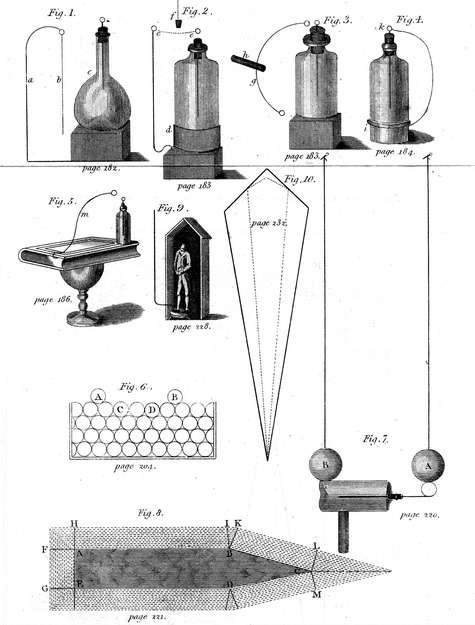
Published as the Act directs, April 1, 1806, by Longman, Hurst, Rees & Orme, Paternoster Row.
EXPERIMENT II.
Fig. 1. From a bent wire (a) sticking in the table, let a small linen thread (b) hang down within half an inch of the electrised phial (c). Touch the wire or the phial repeatedly with your finger, and at every touch you will see the thread instantly attracted by the bottle. (This is best done by a vinegar cruet, or some such bellied-bottle). As soon as you draw any fire out from the upper part, by touching the wire, the lower part of the bottle draws an equal quantity in by the thread.
EXPERIMENT III.
Fig. 2. Fix a wire in the lead, with which the bottom of the bottle is armed (d) so as that bending upwards, its ring-end may be level with the top or ring-end of the wire in the cork (e) and at three or four inches distance. Then electrise the bottle, and place it on wax. If a cork suspended by a silk thread (f) hang between these two wires, it will play incessantly from one to the other, till the bottle is no longer electrised; that is, it fetches and carries fire from the top to the bottom[29] of the bottle, till the equilibrium is restored.
EXPERIMENT IV.
Fig. 3. Place an electrised phial on wax; take a wire (g) in form of a C, the ends at such a distance when bent, as that the upper may touch the wire of the bottle, when the lower touches the bottom: stick the outer part on a stick of sealing-wax (h), which will serve as a handle; then apply the lower end to the bottom of the bottle, and gradually bring the upper end near the wire in the cork. The consequence is, spark follows spark till the equilibrium is restored. Touch the top first, and on approaching the bottom, with the other end, you have a constant stream of fire from the wire entering the bottle. Touch the top and bottom together, and the equilibrium will instantly be restored, the crooked wire forming the communication.
EXPERIMENT V.
Fig. 4. Let a ring of thin lead, or paper, surround a bottle (i) even at some distance from or above the bottom. From that ring let a wire proceed up, till it touch the wire of the cork (k). A bottle so fixt cannot by any means be electrised: the equilibrium is never destroyed: for while the communication between the upper and lower parts of the bottle is continued by the outside wire, the fire only circulates: what is driven out at bottom, is constantly supplied from the top[30]. Hence a bottle cannot be electrised that is foul or moist on the outside, if such moisture continue up to the cork or wire.
EXPERIMENT VI.
Place a man on a cake of wax, and present him the wire of the electrified phial to touch, you standing on the floor, and holding it in your hand. As often as he touches it, he will be electrified plus; and any one standing on the floor may draw a spark from him. The fire in this experiment passes out of the wire into him; and at the same time out of your hand into the bottom of the bottle.
EXPERIMENT VII.
Give him the electrical phial to hold; and do you touch the wire; as often as you touch it he will be electrified minus, and may draw a spark from any one standing on the floor. The fire now passes from the wire to you, and from him into the bottom of the bottle.
EXPERIMENT VIII.
Lay two books on two glasses, back towards back, two or three inches distant. Set the electrified phial on one, and then touch the wire; that book will be electrified minus; the electrical fire being drawn out of it by the bottom of the bottle. Take off the bottle, and holding it in your hand, touch the other with the wire; that book will be electrified plus; the fire passing into it from the wire, and the bottle at the same time supplied from your hand. A suspended small cork-ball will play between these books till the equilibrium is restored.
EXPERIMENT IX.
When a body is electrised plus, it will repel a positively electrified feather or small cork-ball. When minus (or when in the common state) it will attract them, but stronger when minus than when in the common state, the difference being greater.
EXPERIMENT X.
Though, as in Experiment VI, a man standing on wax may be electrised a number of times by repeatedly touching the wire of an electrised bottle (held in the hand of one standing on the floor) he receiving the fire from the wire each time: yet holding it in his own hand, and touching the wire, though he draws a strong spark, and is violently shocked, no electricity remains in him; the fire only passing through him, from the upper to the lower part of the bottle. Observe, before the shock, to let some one on the floor touch him to restore the equilibrium in his body; for in taking hold of the bottom of the bottle, he sometimes becomes a little electrised minus, which will continue after the shock, as would also any plus electricity, which he might have given him before the shock. For restoring the equilibrium in the bottle, does not at all affect the electricity in the man through whom the fire passes; that electricity is neither increased nor diminished.
EXPERIMENT XI.
The passing of the electrical fire from the upper to the lower part[31] of the bottle, to restore the equilibrium, is rendered strongly visible by the following pretty experiment. Take a book whose covering is filletted with gold; bend a wire of eight or ten inches long, in the form of (m) Fig. 5; slip it on the end of the cover of the book, over the gold line, so as that the shoulder of it may press upon one end of the gold line, the ring up, but leaning towards the other end of the book. Lay the book on a glass or wax[32], and on the other end of the gold lines set the bottle electrised; then bend the springing wire, by pressing it with a stick of wax till its ring approaches the ring of the bottle wire, instantly there is a strong spark and stroke, and the whole line of gold, which completes the communication, between the top and bottom of the bottle, will appear a vivid flame, like the sharpest lightning. The closer the contact between the shoulder of the wire, and the gold at one end of the line, and between the bottom of the bottle and the gold at the other end, the better the experiment succeeds. The room should be darkened. If you would have the whole filletting round the cover appear in fire at once, let the bottle and wire touch the gold in the diagonally opposite corners.
I am, &c.
B. FRANKLIN.
FOOTNOTES:
[25] See this opinion rectified in § 16 and 17 of the next letter. The fire in the bottle was found by subsequent experiments not to be contained in the non-electric, but in the glass. 1748.
[26] What is said here, and after, of the top and bottom of the bottle, is true of the inside and outside surfaces, and should have been so expressed.
[27] See the preceding note, relating to top and bottom.
[28] Other circumstances being equal.
[29] i. e. from the inside to the outside.
[30] See the preceding note, relating to top and bottom.
[31] i. e. From the inside to the outside.
[32] Placing the book on glass or wax is not necessary to produce the appearance; it is only to show that the visible electricity is not brought up from the common stock in the earth.
TO PETER COLLINSON, ESQ. F. R. S. LONDON.
Farther Experiments confirming the preceding Observations.—Leyden Bottle analysed.—Electrical Battery.—Magical Picture.—Electrical Wheel or Jack.—Electrical Feast.
Philadelphia, 1748.
Sir,
§ 1. There will be the same explosion and shock if the electrified phial is held in one hand by the hook, and the coating touched with the other, as when held by the coating, and touched at the hook.
2. To take the charged phial safely by the hook, and not at the same time diminish its force, it must first be set down on an electric per se.
3. The phial will be electrified as strongly, if held by the hook, and the coating applied to the globe or tube; as when held by the coating, and the hook applied[33].
4. But the direction of the electrical fire being different in the charging, will also be different in the explosion. The bottle charged through the hook, will be discharged through the hook; the bottle charged through the coating, will be discharged through the coating, and not otherways; for the fire must come out the same way it went in.
5. To prove this, take two bottles that were equally charged through the hooks, one in each hand: bring their hooks near each other, and no spark or shock will follow; because each hook is disposed to give fire, and neither to receive it. Set one of the bottles down on glass, take it up by the hook, and apply its coating to the hook of the other; then there will be an explosion and shock, and both bottles will be discharged.
6. Vary the experiment, by charging two phials equally, one through the hook, the other through the coating: hold that by the coating which was charged through the hook; and that by the hook which was charged through the coating: apply the hook of the first to the coating of the other, and there will be no shock or spark. Set that down on glass which you held by the hook, take it up by the coating, and bring the two hooks together: a spark and shock will follow, and both phials be discharged.
In this experiment the bottles are totally discharged, or the equilibrium within them restored. The abounding of fire in one of the hooks (or rather in the internal surface of one bottle) being exactly equal to the wanting of the other: and therefore, as each bottle has in itself the abounding as well as the wanting, the wanting and abounding must be equal in each bottle. See § 8, 9, 10, 11. But if a man holds in his hands two bottles, one fully electrified, the other not at all, and brings their hooks together, he has but half a shock, and the bottles will both remain half electrified, the one being half discharged, and the other half charged.
7. Place two phials equally charged on a table at five or six inches distance. Let a cork-ball, suspended by a silk thread, hang between them. If the phials were both charged through their hooks, the cork, when it has been attracted and repelled by the one, will not be attracted, but equally repelled by the other. But if the phials were charged, the one through the hook, and the other[34] through the coating, the ball, when it is repelled from one hook, will be as strongly attracted by the other, and play vigorously between them, fetching the electric fluid from the one, and delivering it to the other, till both phials are nearly discharged.
8. When we use the terms of charging and discharging the phial, it is in compliance with custom, and for want of others more suitable. Since we are of opinion that there is really no more electrical fire in the phial after what is called its charging, than before, nor less after its discharging; excepting only the small spark that might be given to, and taken from the non-electric matter, if separated from the bottle, which spark may not be equal to a five hundredth part of what is called the explosion.
For if, on the explosion, the electrical fire came out of the bottle by one part, and did not enter in again by another, then, if a man, standing on wax, and holding the bottle in one hand, takes the spark by touching the wire hook with the other, the bottle being thereby discharged, the man would be charged; or whatever fire was lost by one, would be found in the other, since there was no way for its escape: but the contrary is true.
9. Besides, the phial will not suffer what is called a charging, unless as much fire can go out of it one way, as is thrown in by another. A phial cannot be charged standing on wax or glass, or hanging on the prime conductor, unless a communication be formed between its coating and the floor.
10. But suspend two or more phials on the prime conductor, one hanging on the tail of the other; and a wire from the last to the floor, an equal number of turns of the wheel shall charge them all equally, and every one as much as one alone would have been. What is driven out at the tail of the first, serving to charge the second; what is driven out of the second charging the third; and so on. By this means a great number of bottles might be charged with the same labour, and equally high, with one alone; were it not that every bottle receives new fire, and loses its old with some reluctance, or rather gives some small resistance to the charging, which in a number of bottles becomes more equal to the charging power, and so repels the fire back again on the globe, sooner in proportion than a single bottle would do.
11. When a bottle is charged in the common way, its inside and outside surfaces stand ready, the one to give fire by the hook, the other to receive it by the coating; the one is full, and ready to throw out, the other empty and extremely hungry; yet as the first will not give out, unless the other can at the same instant receive in; so neither will the latter receive in, unless the first can at the same instant give out. When both can be done at once, it is done with inconceivable quickness and violence.
12. So a straight spring (though the comparison does not agree in every particular) when forcibly bent, must, to restore itself, contract that side which in the bending was extended, and extend that which was contracted; if either of these two operations be hindered, the other cannot be done. But the spring is not said to be charged with elasticity when bent, and discharged when unbent; its quantity of elasticity is always the same.
13. Glass, in like manner, has, within its substance, always the same quantity of electrical fire, and that a very great quantity in proportion to the mass of glass, as shall be shewn hereafter.
14. This quantity, proportioned to the glass, it strongly and obstinately retains, and will have neither more nor less, though it will suffer a change to be made in its parts and situation; i. e. we may take away part of it from one of the sides, provided we throw an equal quantity into the other.
15. Yet when the situation of the electrical fire is thus altered in the glass; when some has been taken from one side, and some added to the other, it will not be at rest or in its natural state, till it is restored to its original equality. And this restitution cannot be made through the substance of the glass, but must be done by a non-electric communication formed without, from surface to surface.
16. Thus, the whole force of the bottle, and power of giving a shock, is in the GLASS ITSELF; the non-electrics in contact with the two surfaces, serving only to give and receive to and from the several parts of the glass; that is, to give on one side, and take away from the other.
17. This was discovered here in the following manner: Purposing to analyse the electrified bottle, in order to find wherein its strength lay, we placed it on glass, and drew out the cork and wire which for that purpose had been loosely put in. Then taking the bottle in one hand, and bringing a finger of the other near its mouth, a strong spark came from the water, and the shock was as violent as if the wire had remained in it, which shewed that the force did not lie in the wire. Then to find if it resided in the water, being crowded into and condensed in it, as confined by the glass, which had been our former opinion, we electrified the bottle again, and placing it on glass, drew out the wire and cork as before; then taking up the bottle, we decanted all its water into an empty bottle, which likewise stood on glass; and taking up that other bottle, we expected, if the force resided in the water, to find a shock from it; but there was none. We judged then that it must either be lost in decanting, or remain in the first bottle. The latter we found to be true; for that bottle on trial gave the shock, though filled up as it stood with fresh unelectrified water from a tea-pot.—To find, then, whether glass had this property merely as glass, or whether the form contributed any thing to it; we took a pane of sash-glass, and laying it on the hand, placed a plate of lead on its upper surface; then electrified that plate, and bringing a finger to it, there was a spark and shock. We then took two plates of lead of equal dimensions, but less than the glass by two inches every way, and electrified the glass between them, by electrifying the uppermost lead; then separated the glass from the lead, in doing which, what little fire might be in the lead was taken out, and the glass being touched in the electrified parts with a finger, afforded only very small pricking sparks, but a great number of them might be taken from different places. Then dextrously placing it again between the leaden plates, and compleating a circle between the two surfaces, a violent shock ensued.—Which demonstrated the power to reside in glass as glass, and that the non-electrics in contact served only, like the armature of a loadstone, to unite the force of the several parts, and bring them at once to any point desired: it being the property of a non-electric, that the whole body instantly receives or gives what electrical fire is given to or taken from any one of its parts.
18. Upon this we made what we called an electrical-battery, consisting of eleven panes of large sash-glass, armed with thin leaden plates, pasted on each side, placed vertically, and supported at two inches distance on silk cords, with thick hooks of leaden wire, one from each side, standing upright, distant from each other, and convenient communications of wire and chain, from the giving side of one pane, to the receiving side of the other; that so the whole might be charged together, and with the same labour as one single pane; and another contrivance to bring the giving sides, after charging, in contact with one long wire, and the receivers with another, which two long wires would give the force of all the plates of glass at once through the body of any animal forming the circle with them. The plates may also be discharged separately, or any number together that is required. But this machine is not much used, as not perfectly answering our intention with regard to the ease of charging, for the reason given, Sec. 10. We made also of large glass panes, magical pictures, and self-moving animated wheels, presently to be described.
19. I perceive by the ingenious Mr. Watson's last book, lately received, that Dr. Bevis had used, before we had, panes of glass to give a shock[35]; though, till that book came to hand, I thought to have communicated it to you as a novelty. The excuse for mentioning it here is, that we tried the experiment differently, drew different consequences from it (for Mr. Watson still seems to think the fire accumulated on the non-electric that is in contact with the glass, p. 72) and, as far as we hitherto know, have carried it farther.
20. The magical picture[36] is made thus. Having a large metzotinto with a frame and glass, suppose of the KING (God preserve him) take out the print, and cut a pannel out of it near two inches distant from the frame all round. If the cut is through the picture it is not the worse. With thin paste, or gum-water, fix the border that is cut off on the inside the glass, pressing it smooth and close; then fill up the vacancy by gilding the glass well with leaf-gold, or brass. Gild likewise the inner edge of the back of the frame all round, except the top part, and form a communication between that gilding and the gilding behind the glass: then put in the board, and that side is finished. Turn up the glass, and gild the fore side exactly over the back gilding, and when it is dry, cover it, by pasting on the pannel of the picture that hath been cut out, observing to bring the correspondent parts of the border and picture together, by which the picture will appear of a piece, as at first, only part is behind the glass, and part before. Hold the picture horizontally by the top, and place a little moveable gilt crown on the king's head. If now the picture be moderately electrified, and another person take hold of the frame with one hand, so that his fingers touch its inside gilding, and with the other hand endeavour to take off the crown, he will receive a terrible blow, and fail in the attempt. If the picture were highly charged, the consequence might perhaps be as fatal[37] as that of high treason, for when the spark is taken through a quire of paper laid on the picture by means of a wire communication, it makes a fair hole through every sheet, that is, through forty-eight leaves, though a quire of paper is thought good armour against the push of a sword, or even against a pistol bullet, and the crack is exceeding loud. The operator, who holds the picture by the upper end, where the inside of the frame is not gilt, to prevent its falling, feels nothing of the shock, and may touch the face of the picture without danger, which he pretends is a test of his loyalty.—If a ring of persons take the shock among them, the experiment is called, The Conspirators.
21. On the principle, in Sec. 7, that hooks of bottles, differently charged, will attract and repel differently, is made an electrical wheel, that turns with considerable strength. A small upright shaft of wood passes at right angles through a thin round board, of about twelve inches diameter, and turns on a sharp point of iron, fixed in the lower end, while a strong wire in the upper end, passing through a small hole in a thin brass plate, keeps the shaft truly vertical. About thirty radii of equal length, made of sash-glass, cut in narrow strips, issue horizontally from the circumference of the board, the ends most distant from the centre, being about four inches apart. On the end of every one, a brass thimble is fixed. If now the wire of a bottle electrified in the common way, be brought near the circumference of this wheel, it will attract the nearest thimble, and so put the wheel in motion; that thimble, in passing by, receives a spark and thereby being electrified is repelled, and so driven forwards; while a second being attracted, approaches the wire, receives a spark, and is driven after the first, and so on till the wheel has gone once round, when the thimbles before electrified approaching the wire, instead of being attracted as they were at first, are repelled, and the motion presently ceases.—But if another bottle, which had been charged through the coating, be placed near the same wheel, its wire will attract the thimble repelled by the first, and thereby double the force that carries the wheel round; and not only taking out the fire that had been communicated to the thimbles by the first bottle, but even robbing them of their natural quantity, instead of being repelled when they come again towards the first bottle, they are more strongly attracted, so that the wheel mends its pace, till it goes with great rapidity twelve or fifteen rounds in a minute, and with such strength, as that the weight of one hundred Spanish dollars with which we once loaded it, did not seem in the least to retard its motion.—This is called an electrical jack; and if a large fowl were spitted on the upright shaft, it would be carried round before a fire with a motion fit for roasting.
22. But this wheel, like those driven by wind, water, or weights, moves by a foreign force, to wit, that of the bottles. The self-moving wheel, though constructed on the same principles, appears more surprising. It is made of a thin round plate of window-glass, seventeen inches diameter, well gilt on both sides, all but two inches next the edge. Two small hemispheres of wood are then fixed with cement to the middle of the upper and under sides, centrally opposite, and in each of them a thick strong wire eight or ten inches long, which together make the axis of the wheel. It turns horizontally on a point at the lower end of its axis, which rests on a bit of brass cemented within a glass salt-cellar. The upper end of its axis passes through a hole in a thin brass plate cemented to a long strong piece of glass, which keeps it six or eight inches distant from any non-electric, and has a small ball of wax or metal on its top, to keep in the fire. In a circle on the table which supports the wheel, are fixed twelve small pillars of glass, at about four inches distance, with a thimble on the top of each. On the edge of the wheel is a small leaden bullet, communicating by a wire with the gilding of the upper surface of the wheel; and about six inches from it is another bullet, communicating in like manner with the under surface. When the wheel is to be charged by the upper surface, a communication must be made from the under surface to the table. When it is well charged it begins to move; the bullet nearest to a pillar moves towards the thimble on that pillar, and passing by electrifies it, and then pushes itself from it; the succeeding bullet, which communicates with the other surface of the glass, more strongly attracts that thimble, on account of its being before electrified by the other bullet; and thus the wheel encreases its motion till it comes to such a height as that the resistance of the air regulates it. It will go half an hour, and make one minute with another twenty turns in a minute, which is six hundred turns in the whole; the bullet of the upper surface giving in each turn twelve sparks to the thimbles, which makes seven thousand two hundred sparks: and the bullet of the under surface receiving as many from the thimbles; those bullets moving in the time near two thousand five hundred feet.—The thimbles are well fixed, and in so exact a circle, that the bullets may pass within a very small distance of each of them.—If instead of two bullets you put eight, four communicating with the upper surface, and four with the under surface, placed alternately, which eight, at about six inches distance, completes the circumference, the force and swiftness will be greatly increased, the wheel making fifty turns in a minute; but then it will not continue moving so long.—These wheels may be applied, perhaps, to the ringing of chimes,[38] and moving of light-made orreries.
23. A small wire bent circularly, with a loop at each end; let one end rest against the under surface of the wheel, and bring the other end near the upper surface, it will give a terrible crack, and the force will be discharged.
24. Every spark in that manner drawn from the surface of the wheel, makes a round hole in the gilding, tearing off a part of it in coming out; which shews that the fire is not accumulated on the gilding, but is in the glass itself.
25. The gilding being varnished over with turpentine varnish, the varnish, though dry and hard, is burnt by the spark drawn through it, and gives a strong smell and visible smoke. And when the spark is drawn thro' paper, all round the hole made by it, the paper will be blacked by the smoke, which sometimes penetrates several of the leaves. Part of the gilding torn off is also found forcibly driven into the hole made in the paper by the stroke.
26. It is amazing to observe in how small a portion of glass a great electrical force may lie. A thin glass bubble, about an inch diameter, weighing only six grains, being half filled with water, partly gilt on the outside, and furnished with a wire hook, gives, when electrified, as great a shock as a man can well bear. As the glass is thickest near the orifice, I suppose the lower half, which being gilt was electrified and gave the shock, did not exceed two grains; for it appeared, when broken, much thinner than the upper half.—If one of these thin bottles be electrified by the coating, and the spark taken out through the gilding, it will break the glass inwards, at the same time that it breaks the gilding outwards.
27. And allowing (for the reasons before given, § 8, 9, 10,) that there is no more electrical fire in a bottle after charging, than before, how great must be the quantity in this small portion of glass! It seems as if it were of its very substance and essence. Perhaps if that due quantity of electrical fire so obstinately retained by glass, could be separated from it, it would no longer be glass; it might lose its transparency, or its brittleness, or its elasticity.—Experiments may possibly be invented hereafter, to discover this.
27. We were surprised at the account given in Mr. Watson's book, of a shock communicated through a great space of dry ground, and suspect there must be some metalline quality in the gravel of that ground; having found that simple dry earth, rammed in a glass tube, open at both ends, and a wire hook inserted in the earth at each end, the earth and wires making part of a circuit, would not conduct the least perceptible shock, and indeed when one wire was electrified the other hardly shewed any signs of its being in connection with it[39]. Even a thoroughly wet packthread sometimes fails of conducting a shock, though it otherwise conducts electricity very well. A dry cake of ice, or an icicle held between two in a circle, likewise prevents the shock, which one would not expect, as water conducts it so perfectly well.—Gilding on a new book, though at first it conducts the shock extremely well, yet fails after ten or a dozen experiments, though it appears otherwise in all respects the same, which we cannot account for[40].
28. There is one experiment more which surprises us, and is not hitherto satisfactorily accounted for; it is this: Place an iron shot on a glass stand, and let a ball of damp cork, suspended by a silk thread, hang in contact with the shot. Take a bottle in each hand, one that is electrified through the hook, the other through the coating: Apply the giving wire to the shot, which will electrify it positively, and the cork shall be repelled: then apply the requiring wire, which will take out the spark given by the other; when the cork will return to the shot: Apply the same again, and take out another spark, so will the shot be electrified negatively, and the cork in that case shall be repelled equally as before. Then apply the giving wire to the shot, and give the spark it wanted, so will the cork return: Give it another, which will be an addition to its natural quantity, so will the cork be repelled again: And so may the experiment be repeated as long as there is any charge in the bottles. Which shews that bodies, having less than the common quantity of electricity, repel each other, as well as those that have more.
Chagrined a little that we have been hitherto able to produce nothing in this way of use to mankind; and the hot weather coming on, when electrical experiments are not so agreeable, it is proposed to put an end to them for this season, somewhat humorously, in a party of pleasure, on the banks of Skuylkil[41]. Spirits, at the same time, are to be fired by a spark sent from side to side through the river, without any other conductor than the water; an experiment which we some time since performed, to the amazement of many[42]. A turkey is to be killed for our dinner by the electrical shock, and roasted by the electrical jack, before a fire kindled by the electrified bottle: when the healths of all the famous electricians in England, Holland, France, and Germany are to be drank in electrified bumpers[43], under the discharge of guns from the electrical battery.
[15] i. e. of the Library-Company, an institution of the author's, founded 1730. To which company the present was made[16].
Your kind present of an electric tube, with directions for using it, has put several of us[15] on making electrical experiments, in which we have observed some particular phenomena that we look upon to be new. I shall therefore communicate them to you in my next, though possibly they may not be new to you, as among the numbers daily employed in those experiments on your side the water, it is probable some one or other has hit on the same observations. For my own part, I never was before engaged in any study that so totally engrossed my attention and my time as this has lately done; for what with making experiments when I can be alone, and repeating them to my friends and acquaintance, who, from the novelty of the thing, come continually
in crowds
to see them, I have, during some months past, had little leisure for any thing else.[16] Where notes occur without a signature, in the Philosophical, or other Papers, they are generally notes of the author.—Editor.
[15] i. e. of the Library-Company, an institution of the author's, founded 1730. To which company the present was made[16].
[17] This power of points to throw off the electrical fire, was first communicated to me by my ingenious friend Mr. Thomas Hopkinson, since deceased, whose virtue and integrity, in every station of life, public and private, will ever make his memory dear to those who knew him, and knew how to value him.
[18] This was Mr. Hopkinson's experiment, made with an expectation of drawing a more sharp and powerful spark from the point, as from a kind of focus, and he was surprised to find little or none.
[19] We suppose every particle of sand, moisture, or smoke, being first attracted and then repelled, carries off with it a portion of the electrical fire; but that the same still subsists in those particles, till they communicate it to something else, and that it is never really destroyed. So when water is thrown on common fire, we do not imagine the element is thereby destroyed or annihilated, but only dispersed, each particle of water carrying off in vapour its portion of the fire, which it had attracted and attached to itself.
[20] This different effect probably did not arise from any difference in the light, but rather from the particles separated from the candle, being first attracted and then repelled, carrying off the electric matter with them; and from the rarefying the air, between the glowing coal or red-hot iron, and the electrised shot, through which rarefied air the electric fluid could more readily pass.
[21] These experiments with the wheels, were made and communicated to me by my worthy and ingenious friend Mr. Philip Syng; but we afterwards discovered that the motion of those wheels was not owing to any afflux or efflux of the electric fluid, but to various circumstances of attraction and repulsion. 1750.
[22] By taking a spark from the wire, the electricity within the bottle is diminished; the outside of the bottle then draws some from the person holding it, and leaves him in the negative state. Then when his hand or face is touched, an equal quantity is restored to him from the person touching.
[23] Our tubes are made here of green glass, 27 or 30 inches long, as big as can be grasped.
[24] This simple easily-made machine was a contrivance of Mr. Syng's.
To shew that points will throw off[17] as well as draw off the electrical fire; lay a long sharp needle upon the shot, and you cannot electrise the shot so as to make it repel the cork-ball.—Or fix a needle to the end of a suspended gun-barrel, or iron-rod, so as to point beyond it like a little bayonet[18]; and while it remains there, the gun-barrel, or rod, cannot by applying the tube to the other end be electrised so as to give a spark, the fire continually running out silently at the point. In the dark you may see it make the same appearance as it does in the case before-mentioned.
To shew that points will throw off[17] as well as draw off the electrical fire; lay a long sharp needle upon the shot, and you cannot electrise the shot so as to make it repel the cork-ball.—Or fix a needle to the end of a suspended gun-barrel, or iron-rod, so as to point beyond it like a little bayonet[18]; and while it remains there, the gun-barrel, or rod, cannot by applying the tube to the other end be electrised so as to give a spark, the fire continually running out silently at the point. In the dark you may see it make the same appearance as it does in the case before-mentioned.
The repellency between the cork-ball and the shot is likewise destroyed. 1. By sifting fine sand on it; this does it gradually. 2. By breathing on it. 3. By making a smoke about it from burning wood[19]. 4. By candle-light, even though the candle is at a foot distance: these do it suddenly.—The light
of a bright
coal from a wood fire; and the light of a red-hot iron do it likewise; but not at so great a distance. Smoke from dry rosin dropt on hot iron, does not destroy the repellency; but is attracted by both shot and cork-ball, forming proportionable atmospheres round them, making them look beautifully, somewhat like some of the figures in Burnet's or Whiston's Theory of the Earth.The light of the sun thrown strongly on both cork and shot by a looking-glass for a long time together, does not impair the repellency in the least. This difference between fire-light and sun-light is another thing that seems new and extraordinary to us[20].
Also by little wheels of the same matter, but formed like water-wheels. Of the disposition and application of which wheels, and the various phenomena resulting, I could, if I had time, fill you a sheet[21]. The impossibility of electrising one's self (though standing on wax) by rubbing the tube, and drawing the fire from it; and the manner of doing it, by passing the tube near a person or thing standing on the floor, &c. had also occurred to us some months before Mr. Watson's ingenious Sequel came to hand, and these were some of the new things I intended to have communicated to you.—But now I need only mention some particulars not hinted in that piece, with our reasonings thereupon: though perhaps the latter might well enough be spared.
As the vessel is just upon sailing, I cannot give you so large an account of American electricity as I intended: I shall only mention a few particulars more.—We find granulated lead better to fill the phial with, than water, being easily warmed, and keeping warm and dry in damp air.—We fire spirits with the wire of the phial.—We light candles, just blown out, by drawing a spark among the smoke between the wire and snuffers.—We represent lightning, by passing the wire in the dark, over a china plate that has gilt flowers, or applying it to gilt frames of looking-glasses, &c.—We electrise a person twenty or more times running, with a touch of the finger on the wire, thus: He stands on wax. Give him the electrised bottle in his hand. Touch the wire with your finger, and then touch his hand or face; there are sparks every time[22].—We encrease the force of the electrical kiss vastly, thus: Let A and B stand on wax; or A on wax, and B on the floor; give one of them the electrised phial in hand; let the other take hold of the wire; there will be a small spark; but when their lips approach, they will be struck and shock'd. The same if another gentleman and lady, C and D, standing also on wax, and joining hands with A and B, salute or shake hands. We suspend by fine silk thread a counterfeit spider, made of a small piece of burnt cork, with legs of linnen thread, and a grain or two of lead stuck in him, to give him more weight. Upon the table, over which he hangs, we stick a wire upright, as high as the phial and wire, four or five inches from the spider: then we animate him, by setting the electrified phial at the same distance on the other side of him; he will immediately fly to the wire of the phial, bend his legs in touching it, then spring off, and fly to the wire in the table, thence again to the wire of the phial, playing with his legs against both, in a very entertaining manner, appearing perfectly alive to persons unacquainted. He will continue this motion an hour or more in dry weather.—We electrify, upon wax in the dark, a book that has a double line of gold round upon the covers, and then apply a knuckle to the gilding; the fire appears every where upon the gold like a flash of lightning: not upon the leather, nor, if you touch the leather instead of the gold. We rub our tubes with buckskin, and observe always to keep the same side to the tube, and never to sully the tube by handling; thus they work readily and easily, without the least fatigue, especially if kept in tight pasteboard cases, lined with flannel, and sitting close to the tube[23]. This I mention, because the European papers on electricity frequently speak of rubbing the tube as a fatiguing exercise. Our spheres are fixed on iron axes, which pass through them. At one end of the axis there is a small handle, with which you turn the sphere like a common grind-stone. This we find very commodious, as the machine takes up but little room, is portable, and may be enclosed in a tight box, when not in use. It is true, the sphere does not turn so swift as when the great wheel is used: but swiftness we think of little importance, since a few turns will charge the phial, &c. sufficiently[24].
As the vessel is just upon sailing, I cannot give you so large an account of American electricity as I intended: I shall only mention a few particulars more.—We find granulated lead better to fill the phial with, than water, being easily warmed, and keeping warm and dry in damp air.—We fire spirits with the wire of the phial.—We light candles, just blown out, by drawing a spark among the smoke between the wire and snuffers.—We represent lightning, by passing the wire in the dark, over a china plate that has gilt flowers, or applying it to gilt frames of looking-glasses, &c.—We electrise a person twenty or more times running, with a touch of the finger on the wire, thus: He stands on wax. Give him the electrised bottle in his hand. Touch the wire with your finger, and then touch his hand or face; there are sparks every time[22].—We encrease the force of the electrical kiss vastly, thus: Let A and B stand on wax; or A on wax, and B on the floor; give one of them the electrised phial in hand; let the other take hold of the wire; there will be a small spark; but when their lips approach, they will be struck and shock'd. The same if another gentleman and lady, C and D, standing also on wax, and joining hands with A and B, salute or shake hands. We suspend by fine silk thread a counterfeit spider, made of a small piece of burnt cork, with legs of linnen thread, and a grain or two of lead stuck in him, to give him more weight. Upon the table, over which he hangs, we stick a wire upright, as high as the phial and wire, four or five inches from the spider: then we animate him, by setting the electrified phial at the same distance on the other side of him; he will immediately fly to the wire of the phial, bend his legs in touching it, then spring off, and fly to the wire in the table, thence again to the wire of the phial, playing with his legs against both, in a very entertaining manner, appearing perfectly alive to persons unacquainted. He will continue this motion an hour or more in dry weather.—We electrify, upon wax in the dark, a book that has a double line of gold round upon the covers, and then apply a knuckle to the gilding; the fire appears every where upon the gold like a flash of lightning: not upon the leather, nor, if you touch the leather instead of the gold. We rub our tubes with buckskin, and observe always to keep the same side to the tube, and never to sully the tube by handling; thus they work readily and easily, without the least fatigue, especially if kept in tight pasteboard cases, lined with flannel, and sitting close to the tube[23]. This I mention, because the European papers on electricity frequently speak of rubbing the tube as a fatiguing exercise. Our spheres are fixed on iron axes, which pass through them. At one end of the axis there is a small handle, with which you turn the sphere like a common grind-stone. This we find very commodious, as the machine takes up but little room, is portable, and may be enclosed in a tight box, when not in use. It is true, the sphere does not turn so swift as when the great wheel is used: but swiftness we think of little importance, since a few turns will charge the phial, &c. sufficiently[24].
As the vessel is just upon sailing, I cannot give you so large an account of American electricity as I intended: I shall only mention a few particulars more.—We find granulated lead better to fill the phial with, than water, being easily warmed, and keeping warm and dry in damp air.—We fire spirits with the wire of the phial.—We light candles, just blown out, by drawing a spark among the smoke between the wire and snuffers.—We represent lightning, by passing the wire in the dark, over a china plate that has gilt flowers, or applying it to gilt frames of looking-glasses, &c.—We electrise a person twenty or more times running, with a touch of the finger on the wire, thus: He stands on wax. Give him the electrised bottle in his hand. Touch the wire with your finger, and then touch his hand or face; there are sparks every time[22].—We encrease the force of the electrical kiss vastly, thus: Let A and B stand on wax; or A on wax, and B on the floor; give one of them the electrised phial in hand; let the other take hold of the wire; there will be a small spark; but when their lips approach, they will be struck and shock'd. The same if another gentleman and lady, C and D, standing also on wax, and joining hands with A and B, salute or shake hands. We suspend by fine silk thread a counterfeit spider, made of a small piece of burnt cork, with legs of linnen thread, and a grain or two of lead stuck in him, to give him more weight. Upon the table, over which he hangs, we stick a wire upright, as high as the phial and wire, four or five inches from the spider: then we animate him, by setting the electrified phial at the same distance on the other side of him; he will immediately fly to the wire of the phial, bend his legs in touching it, then spring off, and fly to the wire in the table, thence again to the wire of the phial, playing with his legs against both, in a very entertaining manner, appearing perfectly alive to persons unacquainted. He will continue this motion an hour or more in dry weather.—We electrify, upon wax in the dark, a book that has a double line of gold round upon the covers, and then apply a knuckle to the gilding; the fire appears every where upon the gold like a flash of lightning: not upon the leather, nor, if you touch the leather instead of the gold. We rub our tubes with buckskin, and observe always to keep the same side to the tube, and never to sully the tube by handling; thus they work readily and easily, without the least fatigue, especially if kept in tight pasteboard cases, lined with flannel, and sitting close to the tube[23]. This I mention, because the European papers on electricity frequently speak of rubbing the tube as a fatiguing exercise. Our spheres are fixed on iron axes, which pass through them. At one end of the axis there is a small handle, with which you turn the sphere like a common grind-stone. This we find very commodious, as the machine takes up but little room, is portable, and may be enclosed in a tight box, when not in use. It is true, the sphere does not turn so swift as when the great wheel is used: but swiftness we think of little importance, since a few turns will charge the phial, &c. sufficiently[24].
[25] See this opinion rectified in § 16 and 17 of the next letter. The fire in the bottle was found by subsequent experiments not to be contained in the non-electric, but in the glass. 1748.
[26] What is said here, and after, of the top and bottom of the bottle, is true of the inside and outside surfaces, and should have been so expressed.
[27] See the preceding note, relating to top and bottom.
[28] Other circumstances being equal.
[29] i. e. from the inside to the outside.
[30] See the preceding note, relating to top and bottom.
[31] i. e. From the inside to the outside.
[32] Placing the book on glass or wax is not necessary to produce the appearance; it is only to show that the visible electricity is not brought up from the common stock in the earth.
1. The non-electric contained in the bottle differs, when electrised, from a non-electric electrised out of the bottle, in this: that the electrical fire of the latter is accumulated on its surface, and forms an electrical atmosphere round it of considerable extent; but the electrical fire is crowded into the substance of the former, the glass confining it[25].
2. At the same time that the wire and the top of the bottle, &c. is electrised positively or plus, the bottom of the bottle is electrised negatively or minus, in exact proportion: i. e. whatever quantity of electrical fire is thrown in at the top, an equal quantity goes out of the bottom[26]. To understand this, suppose the common quantity of electricity in each part of the bottle, before the operation begins, is equal to 20; and at every stroke of the tube, suppose a quantity equal to 1 is thrown in; then, after the first stroke, the quantity contained in the wire and upper part of the bottle will be 21, in the bottom 19. After the second, the upper part will have 22, the lower 18, and so on, till, after 20 strokes, the upper part will have a quantity of electrical fire equal to 40, the lower part none: and then the operation ends: for no more can be thrown into the upper part, when no more can be driven out of the lower part. If you attempt to throw more in, it is spewed back through the wire, or flies out in loud cracks through the sides of the bottle.
4. As no more electrical fire can be thrown into the top of the bottle, when all is driven out of the bottom, so in a bottle not yet electrised, none can be thrown into the top, when none can get out at the bottom; which happens either when the bottom is too thick, or when the bottle is placed on an electric per se. Again, when the bottle is electrised, but little of the electrical fire can be drawn out from the top, by touching the wire, unless an equal quantity can at the same time get in at the bottom[27]. Thus, place an electrised bottle on clean glass or dry wax, and you will not, by touching the wire, get out the fire from the top. Place it on a non-electric, and touch the wire, you will get it out in a short time; but soonest when you form a direct communication as above.
5. The shock to the nerves (or convulsion rather) is occasioned by the sudden passing of the fire through the body in its way from the top to the bottom of the bottle. The fire takes the shortest[28] course, as Mr. Watson justly observes: But it does not appear from experiment that in order for a person to be shocked, a communication with the floor is necessary: for he that holds the bottle with one hand, and touches the wire with the other, will be shocked as much, though his shoes be dry, or even standing on wax, as otherwise. And on the touch of the wire, (or of the gun-barrel, which is the same thing) the fire does not proceed from the touching finger to the wire, as is supposed, but from the wire to the finger, and passes through the body to the other hand, and so into the bottom of the bottle.
Fig. 2. Fix a wire in the lead, with which the bottom of the bottle is armed (d) so as that bending upwards, its ring-end may be level with the top or ring-end of the wire in the cork (e) and at three or four inches distance. Then electrise the bottle, and place it on wax. If a cork suspended by a silk thread (f) hang between these two wires, it will play incessantly from one to the other, till the bottle is no longer electrised; that is, it fetches and carries fire from the top to the bottom[29] of the bottle, till the equilibrium is restored.
Fig. 4. Let a ring of thin lead, or paper, surround a bottle (i) even at some distance from or above the bottom. From that ring let a wire proceed up, till it touch the wire of the cork (k). A bottle so fixt cannot by any means be electrised: the equilibrium is never destroyed: for while the communication between the upper and lower parts of the bottle is continued by the outside wire, the fire only circulates: what is driven out at bottom, is constantly supplied from the top[30]. Hence a bottle cannot be electrised that is foul or moist on the outside, if such moisture continue up to the cork or wire.
The passing of the electrical fire from the upper to the lower part[31] of the bottle, to restore the equilibrium, is rendered strongly visible by the following pretty experiment. Take a book whose covering is filletted with gold; bend a wire of eight or ten inches long, in the form of (m) Fig. 5; slip it on the end of the cover of the book, over the gold line, so as that the shoulder of it may press upon one end of the gold line, the ring up, but leaning towards the other end of the book. Lay the book on a glass or wax[32], and on the other end of the gold lines set the bottle electrised; then bend the springing wire, by pressing it with a stick of wax till its ring approaches the ring of the bottle wire, instantly there is a strong spark and stroke, and the whole line of gold, which completes the communication, between the top and bottom of the bottle, will appear a vivid flame, like the sharpest lightning. The closer the contact between the shoulder of the wire, and the gold at one end of the line, and between the bottom of the bottle and the gold at the other end, the better the experiment succeeds. The room should be darkened. If you would have the whole filletting round the cover appear in fire at once, let the bottle and wire touch the gold in the diagonally opposite corners.
The passing of the electrical fire from the upper to the lower part[31] of the bottle, to restore the equilibrium, is rendered strongly visible by the following pretty experiment. Take a book whose covering is filletted with gold; bend a wire of eight or ten inches long, in the form of (m) Fig. 5; slip it on the end of the cover of the book, over the gold line, so as that the shoulder of it may press upon one end of the gold line, the ring up, but leaning towards the other end of the book. Lay the book on a glass or wax[32], and on the other end of the gold lines set the bottle electrised; then bend the springing wire, by pressing it with a stick of wax till its ring approaches the ring of the bottle wire, instantly there is a strong spark and stroke, and the whole line of gold, which completes the communication, between the top and bottom of the bottle, will appear a vivid flame, like the sharpest lightning. The closer the contact between the shoulder of the wire, and the gold at one end of the line, and between the bottom of the bottle and the gold at the other end, the better the experiment succeeds. The room should be darkened. If you would have the whole filletting round the cover appear in fire at once, let the bottle and wire touch the gold in the diagonally opposite corners.
[33] This was a discovery of the very ingenious Mr. Kinnersley, and by him communicated to me.
[34] To charge a bottle commodiously through the coating, place it on a glass stand; form a communication from the prime conductor to the coating, and another from the hook to the wall or floor. When it is charged, remove the latter communication before you take hold of the bottle, otherwise great part of the fire will escape by it.
[35] I have since heard that Mr. Smeaton was the first who made use of panes of glass for that purpose.
[36] Contrived by Mr. Kinnersley.
[37] We have since found it fatal to small animals, though not to large ones. The biggest we have yet killed is a hen. 1750.
[38] This was afterwards done with success by Mr. Kinnersley.
[39] Probably the ground is never so dry.
[40] We afterwards found that it failed after one stroke with a large bottle; and the continuity of the gold appearing broken, and many of its parts dissipated, the electricity could not pass the remaining parts without leaping from part to part through the air, which always resists the motion of this fluid, and was probably the cause of the gold's not conducting so well as before; the number of interruptions in the line of gold, making, when added together, a space larger, perhaps, than the striking distance.
[41] The river that washes one side of Philadelphia, as the Delaware does the other; both are ornamented with the summer habitations of the citizens, and the agreeable mansions of the principal people of this colony.
[42] As the possibility of this experiment has not been easily conceived, I shall here describe it.—Two iron rods, about three feet long, were planted just within the margin of the river, on the opposite sides. A thick piece of wire, with a small round knob at its end, was fixed on the top of one of the rods, bending downwards, so as to deliver commodiously the spark upon the surface of the spirit. A small wire fastened by one end to the handle of the spoon, containing the spirit, was carried a-cross the river, and supported in the air by the rope commonly used to hold by, in drawing the ferry-boats over. The other end of this wire was tied round the coating of the bottle; which being charged, the spark was delivered from the hook to the top of the rod standing in the water on that side. At the same instant the rod on the other side delivered a spark into the spoon, and fired the spirit; the electric fire returning to the coating of the bottle, through the handle of the spoon and the supported wire connected with them.
[43] An electrified bumper is a small thin glass tumbler, nearly filled with wine, and electrified as the bottle. This when brought to the lips gives a shock, if the party be close shaved, and does not breath on the liquor.—April 29, 1749.
FOOTNOTES:
[33] This was a discovery of the very ingenious Mr. Kinnersley, and by him communicated to me.
[34] To charge a bottle commodiously through the coating, place it on a glass stand; form a communication from the prime conductor to the coating, and another from the hook to the wall or floor. When it is charged, remove the latter communication before you take hold of the bottle, otherwise great part of the fire will escape by it.
[35] I have since heard that Mr. Smeaton was the first who made use of panes of glass for that purpose.
[36] Contrived by Mr. Kinnersley.
[37] We have since found it fatal to small animals, though not to large ones. The biggest we have yet killed is a hen. 1750.
[38] This was afterwards done with success by Mr. Kinnersley.
[39] Probably the ground is never so dry.
[40] We afterwards found that it failed after one stroke with a large bottle; and the continuity of the gold appearing broken, and many of its parts dissipated, the electricity could not pass the remaining parts without leaping from part to part through the air, which always resists the motion of this fluid, and was probably the cause of the gold's not conducting so well as before; the number of interruptions in the line of gold, making, when added together, a space larger, perhaps, than the striking distance.
[41] The river that washes one side of Philadelphia, as the Delaware does the other; both are ornamented with the summer habitations of the citizens, and the agreeable mansions of the principal people of this colony.
[42] As the possibility of this experiment has not been easily conceived, I shall here describe it.—Two iron rods, about three feet long, were planted just within the margin of the river, on the opposite sides. A thick piece of wire, with a small round knob at its end, was fixed on the top of one of the rods, bending downwards, so as to deliver commodiously the spark upon the surface of the spirit. A small wire fastened by one end to the handle of the spoon, containing the spirit, was carried a-cross the river, and supported in the air by the rope commonly used to hold by, in drawing the ferry-boats over. The other end of this wire was tied round the coating of the bottle; which being charged, the spark was delivered from the hook to the top of the rod standing in the water on that side. At the same instant the rod on the other side delivered a spark into the spoon, and fired the spirit; the electric fire returning to the coating of the bottle, through the handle of the spoon and the supported wire connected with them.
That the electric fire thus actually passes through the water, has since been satisfactorily demonstrated to many by an experiment of Mr. Kinnersley's, performed in a trough of water about ten feet long. The hand being placed under water in the direction of the spark (which always takes the strait or shortest course, if sufficient, and other circumstances are equal) is struck and penetrated by it as it passes.
3. The phial will be electrified as strongly, if held by the hook, and the coating applied to the globe or tube; as when held by the coating, and the hook applied[33].
7. Place two phials equally charged on a table at five or six inches distance. Let a cork-ball, suspended by a silk thread, hang between them. If the phials were both charged through their hooks, the cork, when it has been attracted and repelled by the one, will not be attracted, but equally repelled by the other. But if the phials were charged, the one through the hook, and the other[34] through the coating, the ball, when it is repelled from one hook, will be as strongly attracted by the other, and play vigorously between them, fetching the electric fluid from the one, and delivering it to the other, till both phials are nearly discharged.
19. I perceive by the ingenious Mr. Watson's last book, lately received, that Dr. Bevis had used, before we had, panes of glass to give a shock[35]; though, till that book came to hand, I thought to have communicated it to you as a novelty. The excuse for mentioning it here is, that we tried the experiment differently, drew different consequences from it (for Mr. Watson still seems to think the fire accumulated on the non-electric that is in contact with the glass, p. 72) and, as far as we hitherto know, have carried it farther.
20. The magical picture[36] is made thus. Having a large metzotinto with a frame and glass, suppose of the KING (God preserve him) take out the print, and cut a pannel out of it near two inches distant from the frame all round. If the cut is through the picture it is not the worse. With thin paste, or gum-water, fix the border that is cut off on the inside the glass, pressing it smooth and close; then fill up the vacancy by gilding the glass well with leaf-gold, or brass. Gild likewise the inner edge of the back of the frame all round, except the top part, and form a communication between that gilding and the gilding behind the glass: then put in the board, and that side is finished. Turn up the glass, and gild the fore side exactly over the back gilding, and when it is dry, cover it, by pasting on the pannel of the picture that hath been cut out, observing to bring the correspondent parts of the border and picture together, by which the picture will appear of a piece, as at first, only part is behind the glass, and part before. Hold the picture horizontally by the top, and place a little moveable gilt crown on the king's head. If now the picture be moderately electrified, and another person take hold of the frame with one hand, so that his fingers touch its inside gilding, and with the other hand endeavour to take off the crown, he will receive a terrible blow, and fail in the attempt. If the picture were highly charged, the consequence might perhaps be as fatal[37] as that of high treason, for when the spark is taken through a quire of paper laid on the picture by means of a wire communication, it makes a fair hole through every sheet, that is, through forty-eight leaves, though a quire of paper is thought good armour against the push of a sword, or even against a pistol bullet, and the crack is exceeding loud. The operator, who holds the picture by the upper end, where the inside of the frame is not gilt, to prevent its falling, feels nothing of the shock, and may touch the face of the picture without danger, which he pretends is a test of his loyalty.—If a ring of persons take the shock among them, the experiment is called, The Conspirators.
20. The magical picture[36] is made thus. Having a large metzotinto with a frame and glass, suppose of the KING (God preserve him) take out the print, and cut a pannel out of it near two inches distant from the frame all round. If the cut is through the picture it is not the worse. With thin paste, or gum-water, fix the border that is cut off on the inside the glass, pressing it smooth and close; then fill up the vacancy by gilding the glass well with leaf-gold, or brass. Gild likewise the inner edge of the back of the frame all round, except the top part, and form a communication between that gilding and the gilding behind the glass: then put in the board, and that side is finished. Turn up the glass, and gild the fore side exactly over the back gilding, and when it is dry, cover it, by pasting on the pannel of the picture that hath been cut out, observing to bring the correspondent parts of the border and picture together, by which the picture will appear of a piece, as at first, only part is behind the glass, and part before. Hold the picture horizontally by the top, and place a little moveable gilt crown on the king's head. If now the picture be moderately electrified, and another person take hold of the frame with one hand, so that his fingers touch its inside gilding, and with the other hand endeavour to take off the crown, he will receive a terrible blow, and fail in the attempt. If the picture were highly charged, the consequence might perhaps be as fatal[37] as that of high treason, for when the spark is taken through a quire of paper laid on the picture by means of a wire communication, it makes a fair hole through every sheet, that is, through forty-eight leaves, though a quire of paper is thought good armour against the push of a sword, or even against a pistol bullet, and the crack is exceeding loud. The operator, who holds the picture by the upper end, where the inside of the frame is not gilt, to prevent its falling, feels nothing of the shock, and may touch the face of the picture without danger, which he pretends is a test of his loyalty.—If a ring of persons take the shock among them, the experiment is called, The Conspirators.
22. But this wheel, like those driven by wind, water, or weights, moves by a foreign force, to wit, that of the bottles. The self-moving wheel, though constructed on the same principles, appears more surprising. It is made of a thin round plate of window-glass, seventeen inches diameter, well gilt on both sides, all but two inches next the edge. Two small hemispheres of wood are then fixed with cement to the middle of the upper and under sides, centrally opposite, and in each of them a thick strong wire eight or ten inches long, which together make the axis of the wheel. It turns horizontally on a point at the lower end of its axis, which rests on a bit of brass cemented within a glass salt-cellar. The upper end of its axis passes through a hole in a thin brass plate cemented to a long strong piece of glass, which keeps it six or eight inches distant from any non-electric, and has a small ball of wax or metal on its top, to keep in the fire. In a circle on the table which supports the wheel, are fixed twelve small pillars of glass, at about four inches distance, with a thimble on the top of each. On the edge of the wheel is a small leaden bullet, communicating by a wire with the gilding of the upper surface of the wheel; and about six inches from it is another bullet, communicating in like manner with the under surface. When the wheel is to be charged by the upper surface, a communication must be made from the under surface to the table. When it is well charged it begins to move; the bullet nearest to a pillar moves towards the thimble on that pillar, and passing by electrifies it, and then pushes itself from it; the succeeding bullet, which communicates with the other surface of the glass, more strongly attracts that thimble, on account of its being before electrified by the other bullet; and thus the wheel encreases its motion till it comes to such a height as that the resistance of the air regulates it. It will go half an hour, and make one minute with another twenty turns in a minute, which is six hundred turns in the whole; the bullet of the upper surface giving in each turn twelve sparks to the thimbles, which makes seven thousand two hundred sparks: and the bullet of the under surface receiving as many from the thimbles; those bullets moving in the time near two thousand five hundred feet.—The thimbles are well fixed, and in so exact a circle, that the bullets may pass within a very small distance of each of them.—If instead of two bullets you put eight, four communicating with the upper surface, and four with the under surface, placed alternately, which eight, at about six inches distance, completes the circumference, the force and swiftness will be greatly increased, the wheel making fifty turns in a minute; but then it will not continue moving so long.—These wheels may be applied, perhaps, to the ringing of chimes,[38] and moving of light-made orreries.
27. We were surprised at the account given in Mr. Watson's book, of a shock communicated through a great space of dry ground, and suspect there must be some metalline quality in the gravel of that ground; having found that simple dry earth, rammed in a glass tube, open at both ends, and a wire hook inserted in the earth at each end, the earth and wires making part of a circuit, would not conduct the least perceptible shock, and indeed when one wire was electrified the other hardly shewed any signs of its being in connection with it[39]. Even a thoroughly wet packthread sometimes fails of conducting a shock, though it otherwise conducts electricity very well. A dry cake of ice, or an icicle held between two in a circle, likewise prevents the shock, which one would not expect, as water conducts it so perfectly well.—Gilding on a new book, though at first it conducts the shock extremely well, yet fails after ten or a dozen experiments, though it appears otherwise in all respects the same, which we cannot account for[40].
27. We were surprised at the account given in Mr. Watson's book, of a shock communicated through a great space of dry ground, and suspect there must be some metalline quality in the gravel of that ground; having found that simple dry earth, rammed in a glass tube, open at both ends, and a wire hook inserted in the earth at each end, the earth and wires making part of a circuit, would not conduct the least perceptible shock, and indeed when one wire was electrified the other hardly shewed any signs of its being in connection with it[39]. Even a thoroughly wet packthread sometimes fails of conducting a shock, though it otherwise conducts electricity very well. A dry cake of ice, or an icicle held between two in a circle, likewise prevents the shock, which one would not expect, as water conducts it so perfectly well.—Gilding on a new book, though at first it conducts the shock extremely well, yet fails after ten or a dozen experiments, though it appears otherwise in all respects the same, which we cannot account for[40].
Chagrined a little that we have been hitherto able to produce nothing in this way of use to mankind; and the hot weather coming on, when electrical experiments are not so agreeable, it is proposed to put an end to them for this season, somewhat humorously, in a party of pleasure, on the banks of Skuylkil[41]. Spirits, at the same time, are to be fired by a spark sent from side to side through the river, without any other conductor than the water; an experiment which we some time since performed, to the amazement of many[42]. A turkey is to be killed for our dinner by the electrical shock, and roasted by the electrical jack, before a fire kindled by the electrified bottle: when the healths of all the famous electricians in England, Holland, France, and Germany are to be drank in electrified bumpers[43], under the discharge of guns from the electrical battery.
Chagrined a little that we have been hitherto able to produce nothing in this way of use to mankind; and the hot weather coming on, when electrical experiments are not so agreeable, it is proposed to put an end to them for this season, somewhat humorously, in a party of pleasure, on the banks of Skuylkil[41]. Spirits, at the same time, are to be fired by a spark sent from side to side through the river, without any other conductor than the water; an experiment which we some time since performed, to the amazement of many[42]. A turkey is to be killed for our dinner by the electrical shock, and roasted by the electrical jack, before a fire kindled by the electrified bottle: when the healths of all the famous electricians in England, Holland, France, and Germany are to be drank in electrified bumpers[43], under the discharge of guns from the electrical battery.