


автордың кітабын онлайн тегін оқу War Dogs of the World War
War Dogs
of the
World War
Copyright, 1919
By John I. Anderson
New York
MY DOG
I have no dog, but it must be
Somewhere there’s one belongs to me—
A little chap with wagging tail,
And dark brown eyes that never quail,
But look you through, and through, and through,
With love unspeakable, but true.
Somewhere it must be, I opine,
There is a little dog of mine
With cold black nose that sniffs around
In search of what things may be found
In pocket or some nook hard by,
Where I have hid them from his eye.
Somewhere my doggie pulls and tugs
The fringes of rebellious rugs,
Or with the mischief of the pup
Chews all my shoes and slippers up,
And when he’s done it to the core,
With eyes all eager pleads for more.
Somewhere upon his hinder legs,
My little doggie sits and begs,
And in a wistful minor tone
Pleads for the pleasures of the bone—
I pray it be his owner’s whim
To yield and grant the same to him!
Somewhere a little dog doth wait,
It may be by some garden gate,
With eyes alert, and tail attent—
You know the kind of tail that’s meant—
With stores of yelps of glad delight
To bid me welcome home at night.
—John Kendrick Bangs.
To those who love dogs, those faithful friends of mankind, I commend this booklet.
The Author
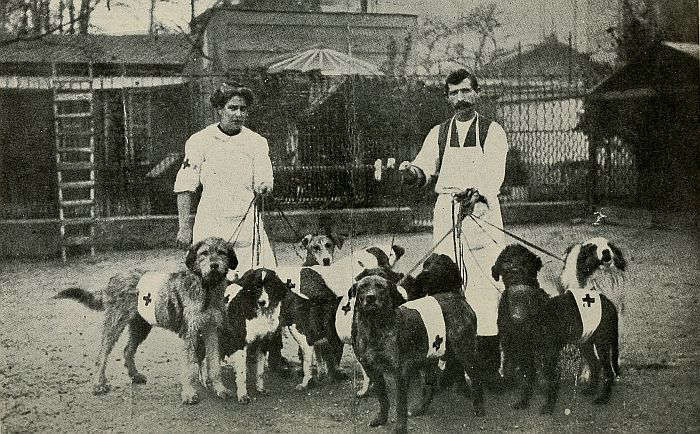
Dogs trained at Neuilly-sur-Seine, near Paris, for service in the French Army.
War Dogs of the
World War
To The Reader:
In the city of Neuilly, just across the River Seine from Paris, lives a remarkable woman, Countess Mary Yourkevitch, a Russian by birth, French by adoption. She has for many years devoted her life and spent her income in the interest of the friendless horse, dog and cat. No provisions being made by the French Government and municipal authorities, these homeless dumb animals are left to shift for themselves in case of sickness or distress. She organized the Blue Cross Society of France and for many years has been the President of this Society. She secured grounds in a secluded spot of Neuilly and thereon erected suitable buildings for the housing and care of her homeless and suffering friends. Previously a social leader, she has during these latter years relinquished all social functions and thrown heart and soul into this commendable work of relief.
In 1914, when France was drawn into what was to become a world war, she set about to aid her adopted country. Dogs of all breeds and descriptions were gathered into the Refuge in Neuilly. A systematic training school was organized to fit these dogs for war work, some for the Red Cross, some for trench work, and still others to become messengers to carry important documents and light burdens. It was most essential that a dog for each division of this work should be thoroughly trained, and after this was accomplished the work became one of routine and practice. The trained dogs became the instructors, and it was a stupid pupil indeed that did not become more or less proficient in the work set for it in the course of a week or ten days. To watch this training process is most interesting. A green dog, that is, one without any training, is attached by a short lead to the dog instructor. The command is given to perform a certain duty and at once the trained dog is off on his mission, pulling the untrained dog with him. This is repeated time and again until the pupil learns the word of command and the execution of the same. It is but a question of a few days until the green dog has learned his lessons, and he himself becomes an instructor to some new arrival at the home.
Six hundred dogs were thus instructed for their various war duties and sent to the front. The war is now at an end, and while many of these faithful creatures paid the supreme sacrifice, hundreds are left, some crippled for life, and all in need of proper care for the balance of their lives. During my three months’ stay in Paris following the armistice, dozens of these dogs were returned to the Countess to be cared for. Knowing the burden placed upon her, both in a financial and physical sense, I am writing this story of the heroic deeds of these wonderful animals. Every penny derived from the sale of this booklet will be devoted to assist this noble work of the Countess Yourkevitch of Neuilly, France.
THE DOG’S MANIFOLD DUTIES AT THE
BATTLE FRONT
The stories of the devotion of dogs to their masters under the most trying conditions of the battlefront form one of the epics of the great struggle.
It is said that there were about ten thousand dogs employed at the battle front at the time of the signing of the armistice. They ranged from Alaskan malamute to St. Bernard, and from Scotch collie to fox terrier. Many of them were placed on the regimental rosters like soldiers. In the trenches they shared all the perils and hardships of the soldiers themselves, and drew their turns in the rest camps in the same fashion. But they were always ready to go back and it is not recorded that a single one of them ever failed when it came to “going over the top.”
The Red Cross dogs rendered invaluable service in feeding and aiding the wounded. Each one carried a first-aid kit either strapped to its collar or in a small saddle pouch. When they found a soldier who was unconscious, they were taught to bring back his helmet, handkerchief or some other small article as a token of discovery. Many of them learned wholly to ignore the dead, but to bark loudly whenever they came upon a wounded man.
Not only did the dog figure gloriously as a messenger of mercy in the war, but did his bit nobly as a sentinel in the trenches. Mounting guard at a listening post for long hours at a stretch, ignoring danger with all the stolidness of a stoic, yet alert every moment, he played an heroic role.
Full many a time it was the keen ear of a collie that first caught the sound of the approaching raiding party. And did he bark? How natural it would have been for him to do so! But no, a bark or a growl might have told the raiders they were discovered, and thus have prevented the animal’s own forces from giving the foe a counter-surprise. So he wagged his tail nervously—a canine adaptation of the wig-wag system which his master interpreted and acted upon, to the discomfiture of the enemy.
Often whole companies were saved because the dog could reach further into the distance with his senses than could the soldiers themselves.
It was found that many dogs would do patrol and scout duty with any detachment. But there was another type of dog worker needed in the trenches—the liason dog, trained to seek his master whenever turned loose. Amid exploding shells, through veritable fields of hell, he would crawl and creep, with only one thought—to reach his master. Nor would he stop until the object of his search was attained. Many a message of prime importance he thus bore from one part of the field to another, and nought but death or overcoming wound could turn him aside.—The National Geographic Magazine.
THE MESSENGER
Early in the war the Germans realized the importance of gaining possession of the French Coast of the English Channel, and thus cut off communications with England and prevent the landing of English soldiers on French soil.
The Germans selected Ypres as the point of their offensive and the English were strongly resisting the drive. Men on both sides were being mowed down by shell and shrapnel. For many hours the incessant conflict raged, at one time the Germans gaining vantage positions but to give way before the bull-dog tenacity of the English. The strong reinforcements on the German side convinced the commanding officer of the English defensive that it must be a question of short duration until the Germans would achieve the desired objective, and they (the English) would be compelled to retreat. The situation was a critical one and unless the English were reinforced, the day would be lost and the enemy would have a clear way to Calais.
Lying four miles to the rear were two divisions of the English army ready to march to their assistance if required. Quick action was necessary, as every moment was golden. For a courier to cover this distance of four miles and reach the commanding officer of the reserves, close to an hour must be required, and no one could tell what this hour might mean to the ever weakening defensive. A message was quickly written and a messenger dog called. The urgent call for assistance was placed in the bag attached to the dog’s collar and he was given the word to go. Just twenty minutes elapsed from the time the dog was entrusted with the message until the officer in command of the reserves had read the hurried call. The camp resounded with the bugle call “To Arms” and in ninety minutes from the time the message was despatched, the front formation of the reinforcing divisions was in active work. The Germans were driven back with terrible slaughter, and the day was won for the English.
An English journal in telling this story comments on the event as follows: “Who can tell what might have been the outcome of a victory for the enemy at this crucial moment.” Hundreds of other instances could be recited to show the vital importance of the war dogs’ work.
BIJOU
At the breaking out of the war there lived in the little town of Méru, twenty-five miles distant from Paris, a man named Jacques Thallant. He had for a daily companion a dog called Bijou, just a common every-day dog of the French poodle breed.
Jacques was among the first to offer his services to his country and was accepted. He requested the privilege of taking Bijou with him and his request was granted. Jacques was sent into active service and Bijou soon accustomed himself to trench life, and with the soldiers shared their army privations. Frequently Jacques was placed on picket duty and Bijou was company for him during the long tedious nights of watching.
Picket duty is one of the most hazardous duties for the soldier. During the day the enemy locates the picket posts and it requires but little practice for a sharpshooter to so train his gun as to do most effective and fatal work at night by shooting at random. A cold, dismal night found Jacques at a picket post with Bijou at his feet, imparting warmth as well as companionship. This night proved to be the last for poor Jacques, as my story will tell. A shot rang out—a bullet sped on its deadly errand—Jacques fell fatally wounded. His life blood was flowing rapidly, and his mind turned to his wife and children in far away Méru. He searched for paper and pencil and found in his pocket a letter he had that day received from his loved companion at home. Hastily he scrawled on the envelope the story of his condition, and with weakening hands he placed the same in the pouch attached to Bijou’s collar, and in failing voice commanded him to go home to his mistress. In the morning Jacques was found cold in death, still grasping the pencil in his hand. Search was made for the dog but he could not be found, and the record was made “Jacques Thallant shot while on duty.”
Three hundred and more kilometers covered the distance between Verdun and Méru. Early in the morning of the third day after the soul of Jacques had passed beyond, Mme. Thallant heard a noise without the house and hurriedly dressing, reached the door just in time to see the faithful dog’s death-glazing eyes brighten for an instant, and then with a convulsive quiver his limbs relaxed in death. On examination a bullet wound was found in his groin and then they knew the agony he must have endured in fulfilling his master’s last command. A stray bullet doubtlessly dealt the death blow as he sped to do his master’s bidding. For two days and three nights he dragged himself onward with the entrusted message, without food, without rest, true to the trust imposed in him, until his work was accomplished and then——
My old friend Hildevert Labrosse told me the story with tears in his eyes, and together we walked down the narrow street leading to the home of Widow Thallant. He showed me the gate through which the dog had dragged himself and up the walk to the house, and the threshold of the door on which he died. They buried the faithful creature in the corner of the yard near a shed where he was wont to sleep at night and where his ever faithful eyes could watch over the safety of his master’s house. A small headboard with the simple inscription “Bijou, Faithful Unto Death” marks the last resting place of Jacques’ friend.
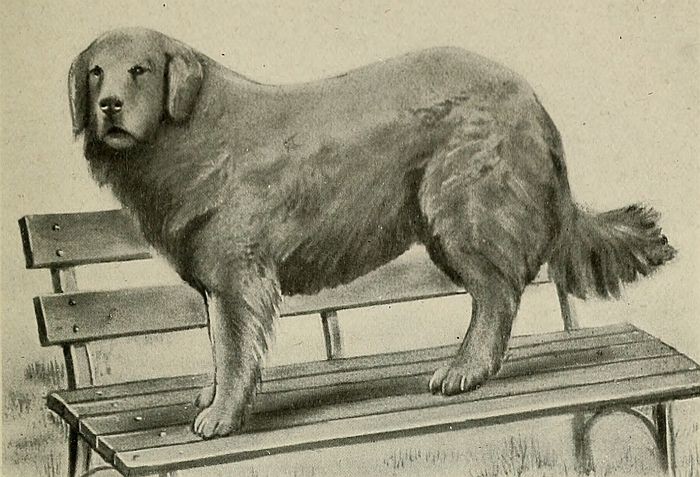
Monte, the Picket.
“MONTE” THE PICKET
Thousands of soldiers have suffered from shell shock, which proved to be one of the most trying conditions for the hospital nurses—nerves keyed to the highest tension for days at a time snapped under the whizzing and bursting shells which rained destruction in their midst. Horses frequently suffered from the ill effects of this trying ordeal, but it was a rare occurrence for the dog to be affected by these conditions.
In the month of January following the armistice, two French soldiers appeared at the Refuge accompanied by a collie dog. This dog’s home had been in Montreuil, a small town near Paris, and the soldiers had nicknamed him “Monte.” For four years Monte had served at the front as a picket dog. His nightly service was to accompany a soldier assigned to picket duty, and there through the long night he remained, ever alert to impending dangers. His keen scent and hearing enabled him to detect the slightest suspicious movement on the part of the enemy, and many a brave soldier’s life was saved by his timely warning. The bristling hairs on his body, his erect ears, the swishing of his tail, quietly conveyed to his master the approach of the enemy. The whistling, deadly bullet was beyond his ken and fourteen times in six weeks Monte returned to the lines alone. Each time they found the picket either killed or wounded.
After four years of this nerve-racking service, Monte was mustered out and returned with the two surviving soldiers of the original company. He was suffering from shell shock and returned to the Refuge as a patient. It was really pitiful to watch him in his sufferings. Worn out from physical weariness he would drop off into a light sleep, when suddenly he would bound to his feet, ears pointed and every individual hair on his body standing erect. This was followed by severe trembling indicative of shattered nerves.
I made many attempts to photograph Monte, but with futile results. I finally hit upon a plan to place him on a park bench and was partially successful in obtaining a fairly good likeness, as you will note by the above picture.
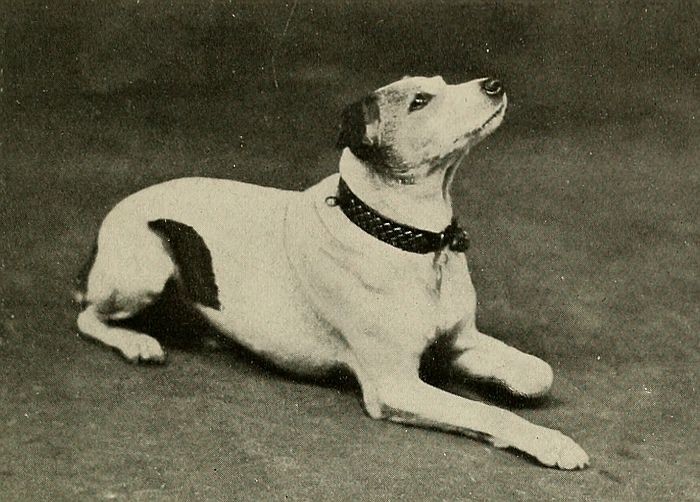
“Watchful Waiting.”
“TOBY” THE RATTER
Of the many annoyances and discomforts of camp and trench life, the rat is the most unwelcome. This species of the rodent family infests these places and not only becomes a pest, but a menace to the health of the soldier. Many a brave man has lost his life from the poisonous bite of these pesky and annoying creatures. Every effort is made to rid the camp of their presence. Of all breeds of dogs, the fox terrier has been found the most effective in the destruction of rats, and many of these dogs have earned wonderful reputations as “ratters.”
In the Refuge in Neuilly there is a dog named Toby, who has passed into the professional rat-killer class. During his three years’ service at the front, four thousand or more “dead ones” have been marked up to his credit, and all previous records have been smashed.
That the rat was not the only enemy that Toby encountered during his service for his country, is evidenced by his gimp. A stray bullet snipped one of his front feet off just below the knee, and now Toby is listed as “wounded but not inactive.” He is the most agile three-footed tyke I ever saw, and sets the pace for all the other dogs in their gambols about the grounds.
The soldiers taught Toby many tricks, and on command he says his prayers, rolls over, plays dead, speaks (barks), sings and performs other “stunts” that are truly wonderful.

Toby, Ready for the Onslaught.

Dick, the Guide.
“DICK” THE GUIDE
Just a short distance from the Refuge for War Dogs in Neuilly, is located the Soldiers’ Home for the Blind. This is a spacious building surrounded by ample grounds containing shrubbery, trees and flowers. Under the spreading trees are comfortable benches for the accommodation of the occupants of the Home. Hundreds of soldiers, rendered totally blind during the war, are cared for, and spend the days wandering through the grounds and enjoying the comforts that such conditions afford.
For two years, Dick, the subject of this sketch, has served as a guide for these soldiers. He is a fine specimen of the French poodle, large in size, gentle in disposition and perfectly familiar with the duties expected of him. Early in the morning he reports for duty, and from then on until the close of day he carefully leads and cares for the sightless subjects delegated to his charge. It is no unusual sight to see two men or more, arm in arm, being guided by Dick through various parts of the grounds. Sometimes you meet them picking their way through the adjacent streets, Dick always on the alert for their safety.
I had on frequent occasions to pass Dick on my way to and from the dog hospital on Rue Chauveau, and in time we became great friends. Just before leaving for my home in America, I paid a final visit to my dog friends in Neuilly, and was surprised to find Dick in the hospital recovering from some temporary dog ailment. He joyfully welcomed me as an old friend, and I expressed a wish to the Countess that I might bring him to America. She replied that Dick had certainly done his bit for his country and that it was high time he enjoyed a little of real dog life, and willingly consented that I should have him. The short time until my departure prevented me from obtaining the necessary permit to land him in the United States. The Countess generously offered to care for him until such time as proper arrangements could be made for his trip from Paris to New York. Before leaving I requested the Countess’ lady secretary to instruct Dick in the English language, so that he would be familiar with the speech of his adopted country. Shortly afterwards I received the following card from this young lady: “I told Dick a few days ago that his master in America wished him to learn English, and Dick replied, ‘Tell my master to learn French, as I am a French dog.’”—a very clever reply from either lady or dog.
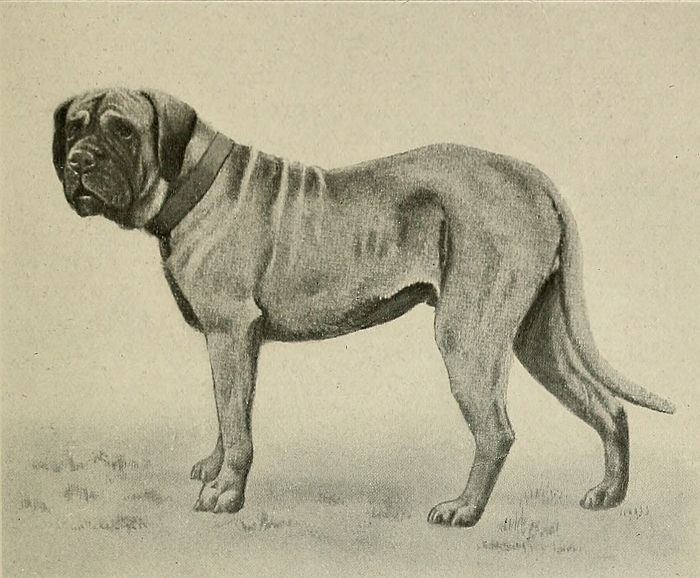
Leon, a Red Cross Dog.