


автордың кітабын онлайн тегін оқу Retail Shoe Salesmanship
Transcriber's Note:
The cover image was created by the transcriber and is placed in the public domain.
ADDITION TO LIST OF FOUNDERS
ALEXANDER & CO.,
Wheeling, W. Va.
L. S. DONALDSON CO.,
Minneapolis, Minn.
R. H. FYFE & CO.,
Detroit, Mich.
A. H. GEUTING CO.,
Philadelphia, Pa.
KRUPP & TUFFLY,
Houston, Texas
POTTER SHOE CO.,
Cincinnati, Ohio
SHERRON SHOE CO.,
Memphis, Tenn.
SLADE SHOE SHOPS,
Des Moines, Iowa
VAILE SHOE CO.,
Kokomo, Ind.
VAN DEGRIFT SHOE CO.,
Los Angeles, Cal.
VOLK BROS. CO.,
Dallas, Texas
K. W. WATTERS CO.,
Buffalo, N. Y.
ADDITION TO LIST OF CONSULTANTS
SEATON W. ALEXANDER, President,
Alexander & Co.
A. O. DAY,
R. H. Fyfe & Co.
Mrs. JENNIE L. EVANS, Firm Member,
Lewis & Reilly
R. H. FYFE, President,
R. H. Fyfe & Co.
WILLIAM R. LEWIS, Firm Member,
Lewis & Reilly
WILLIAM LIVINGSTON,
R. H. Fyfe & Co.
H. C. McLAUGHLIN, Shoe Buyer,
Potter Shoe Co.
HENRY MOOREHOUSE, General Manager,
Brockton Last Co.
JAMES P. ORR, President,
Potter Shoe Co.
G. S. ROTH, Manager Shoe Dept.,
L. S. Donaldson Co.
T. M. SCOGGINS, Vice-President,
Krupp & Tuffly
THOMAS W. SHERRON, President,
Sherron Shoe Co.
MILO A. SLADE, Firm Member,
Slade Shoe Shops
J. F. TEEHAN, Vice-President,
Dunbar Pattern Co.
L. F. TUFFLY, President,
Krupp & Tuffly
VICTOR E. VAILE, President,
Vaile Shoe Co.
H. L. VAN DEGRIFT, General Manager,
Van Degrift Shoe Co.
L. W. VOLK, Firm Member,
Volk Bros. Co.
RETAIL SHOE SALESMEN’S INSTITUTE
Conducting
The Educational Training Course
for
Retail Shoe Salesmen
FOUNDERS
GEORGE W. BAKER SHOE CO.,
Brooklyn, N. Y.
BLISS & PERRY CO.,
Newburyport, Mass.
BOOT & SHOE RECORDER,
Boston, Mass.
BRISTOL PATENT LEATHER CO.,
Boston, Mass.
BROCKTON RAND CO.,
Brockton, Mass.
BROWN SHOE CO.,
St. Louis, Mo.
ARTHUR L EVANS,
Boston, Mass.
L. B. EVANS’ SON CO.,
Wakefield, Mass.
FARNSWORTH, HOYT CO.,
Boston, Mass.
HAZEN B. GOODRICH & CO.,
Haverhill, Mass.
HAZEN-BROWN CO.,
Boston, Mass.
HUNT-RANKIN LEATHER CO.,
Boston, Mass.
GEORGE E. KEITH CO.,
Brockton, Mass.
KEYSTONE LEATHER CO.,
Philadelphia, Pa.
MENIHAN CO.,
Rochester, N. Y.
MORSE & BURT CO.,
Brooklyn, N. Y.
A. E. NETTLETON CO.,
Syracuse, N. Y.
PETERS MFG. CO.,
Boston, Mass.
THOMAS G. PLANT CO.,
Boston, Mass.
RICE & HUTCHINS, INC.,
Boston, Mass.
SEAMANS & COBB CO.,
Boston, Mass.
SELBY SHOE CO.,
Portsmouth, Ohio.
STETSON SHOPS INC.,
South Weymouth, Mass.
THE SHOE RETAILER,
Boston, Mass.
UNITED SHOE MACHINERY CO.,
Boston, Mass.
UNITED STATES RUBBER CO.,
New York, N. Y.
WIZARD FOOT APPLIANCE CO.,
St. Louis, Mo.
E. T. WRIGHT & CO.,
Rockland, Mass.
NATIONAL SHOE RETAILERS’ ASSOCIATION.
CHISHOLM SHOE CO.,
Cleveland, Ohio.
COHEN BROTHERS,
Jacksonville, Fla.
WILLIAM FILENE’S SONS CO.,
Boston, Mass.
GILCHRIST CO.,
Boston, Mass.
W. C. GOODWIN,
Fitchburg, Mass.
GUARANTEE SHOE CO.,
San Antonio, Texas.
F A. GUINIVAN,
Philadelphia, Pa.
HIRSCH-ULLMAN SHOE CO.,
El Paso, Texas.
A. V. HOLBROOK BOOTERY CO.,
Columbus, Ohio.
A. H. HOWE & SONS,
Boston, Mass.
JONES, PETERSON & NEWHALL CO.,
Boston, Mass.
JOHN A. MEADORS & SONS,
Nashville, Tenn.
THOMAS F. PEIRCE & SON,
Providence, R. I.
W. G. SIMMONS CORP.,
Hartford, Conn.
STELLING-NICKERSON SHOE CO.,
Augusta, Ga.
W. W. WILLSON,
Boston, Mass.
EDITORIAL COUNCIL
ARTHUR L. EVANS, Editor in Chief
GEORGE F. HAMILTON, Managing Editor
CONSULTANTS
C. Q. ADAMS. General Manager,
Bristol Patent-Leather Co.
ARTHUR D. ANDERSON. Editor,
Boot and Shoe Recorder
C. L. ANDERSON, President,
Bristol Patent Leather Co.
T. F. ANDERSON, Secretary,
New England Shoe & Leather Ass’n.
GEORGE W. BAKER, President,
George W. Baker Shoe Co.
GEORGE W. BAKER, Jr., Sec’y and Treas.,
George W. Baker Shoe Co.
JOHN A. BARBOUR, President,
Brockton Rand Co.
PERLEY E. BARBOUR, Vice President,
Brockton Rand Co.
CHARLES A. BLISS, Treasurer,
Bliss & Perry Co.
ELMER J. BLISS, President,
Regal Shoe Co.
FRANK J. BRADLEY, President,
Hazen B. Goodrich & Co.
FRANK R. BRIGGS, Treasurer,
Thomas G. Plant Co.
E. P. BROWN, President,
United Shoe Machinery Co.
MAX BROWN, President,
Hazen-Brown Co.
JOHN A. BUSH, President,
Brown Shoe Co.
CHARLES T. CAHILL,
United Shoe Machinery Co.
C. K. CHISHOLM, Firm Member,
Chisholm Shoe Co.
F. S. COBB, President,
Seamans & Cobb Co.
HENRY W. COOK, Vice President,
A. E. Nettleton Co.
H. T. CONNER, Vice President,
George E. Keith Stores Co.
LOUIS A. COOLIDGE, Treasurer,
United Shoe Machinery Co.
E. D. COX,
United Shoe Machinery Co.
F. F. CUTLER, President,
The Cutler Publications.
A. W. DONOVAN, President,
E. T. Wright & Co.
W. F. ENRIGHT,
United States Rubber Co.
ARTHUR LUCIUS EVANS, Treasurer,
L. B. Evans’ Son Co.
PERCIVAL B. EVANS, Vice President,
L. B. Evans’ Son Co.
A. H. GEUTING, Dealer and Ex-President,
National Shoe Retailers’ Association
W. C. GOODWIN,
Dealer
JOHN S. GRIFFITHS, President,
L. B. Evans’ Son Co.
FRANK A. GUINIVAN,
Orthopedic and Merchandising Specialist
A. C. HEALD, Treasurer,
Stetson Shoe Co.
CHARLES A. HIRSCH,
Hirsch-Ullman Shoe Co.
A. V. HOLBROOK, President,
A. V. Holbrook Bootery Co.
IRVING B. HOWE, Partner,
A. H. Howe & Sons.
CHARLES C. HOYT, President,
Farnsworth, Hoyt Co.
HERBERT V. HUNT, President,
Hunt-Rankin Leather Co.
GEORGE E. KEITH, President,
George E. Keith Co.
HAROLD C. KEITH, Treasurer,
George E. Keith Co.
J. F. KNOWLES, Treasurer,
W. G. Simmons Corp.
GEORGE H. LEACH, Secretary,
George E. Keith Co.
A. H. LOCKWOOD, Editor,
Shoe & Leather Reporter
FRANK R. MAXWELL, Vice President,
Thomas G. Plant Co.
GEORGE H. MAYO, Manager, Footwear Division,
United States Rubber Co.
ALLEN H. MEADORS, Partner,
John A. Meadors & Sons.
J. G. MENIHAN, President,
Menihan Co.
T. C. MIRKIL, Secretary-Commissioner,
National Shoe Retailers’ Association
RAYMOND P. MORSE, Treasurer,
Morse & Burt Co.
JAMES A. MUNROE, Vice President,
E. T. Wright & Co.
GEORGE A. NEWHALL, Vice President,
Jones, Peterson & Newhall Co.
GEORGE E. PEIRCE, Firm member,
Thomas F. Peirce & Son
WALTER I. PERRY, President,
Bliss & Perry Co.
PAUL A. PETERS, Vice President,
Peters Mfg. Co.
WILLIAM F. PETERS, President,
Peters Mfg. Co.
BURT W. RANKIN, Treasurer,
Hunt-Rankin Leather Co.
J. B. REINHART, Vice President,
Wizard Foot Appliance Co.
CHARLES A. REYNOLDS, President,
Keystone Leather Co.
FRED B. RICE, Vice President,
Rice & Hutchins, Inc.
HOLLIS B. SCATES, Shoe Division Manager,
William Filene’s Sons Co.
MARK W. SELBY, Vice President and Secretary,
Selby Shoe Co.
F. W. SMALL, Manager Shoe Dept.,
Gilchrist Co.
S. G. SPITZER, Manager Shoe Dept.,
S. Kann Sons Co.
FRED W. STANTON, Secretary,
National Shoe Travelers’ Association
FRANK H. STELLING,
Stelling-Nickerson Shoe Co.
E. H. STETSON, President,
Stetson Shoe Co.
JAMES H. STONE, Editor,
The Shoe Retailer.
E. B. TERHUNE, Treasurer and General Manager,
Boot and Shoe Recorder.
GEORGE A. VOLK, Firm member,
Volk Bros. Co.
J. M. WATSON, President,
Guarantee Shoe Co.
R. R. WILKINSON, Shoe Buyer,
Cohen Brothers.
W. W. WILLSON, Store Sales Manager,
Rice & Hutchins, Inc.
E. T. WRIGHT, Treasurer,
E. T. Wright & Co.
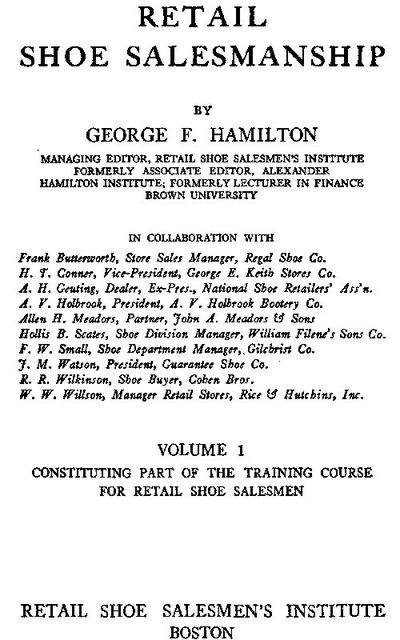
RETAIL SHOE SALESMANSHIP
BY
GEORGE F. HAMILTON
MANAGING EDITOR, RETAIL SHOE SALESMEN’S INSTITUTE FORMERLY ASSOCIATE EDITOR, ALEXANDER HAMILTON INSTITUTE; FORMERLY LECTURER IN FINANCE, BROWN UNIVERSITY
IN COLLABORATION WITH
Frank Butterworth, Store Sales Manager, Regal Shoe Co.
H. T. Conner, Vice-President, George E. Keith Stores Co.
A. H. Geuting, Dealer, Ex-Pres., National Shoe Retailers’ Ass’n.
A. V. Holbrook, President, A. V. Holbrook Bootery Co.
Allen H. Meadors, Partner, John A. Meadors & Sons
Hollis B. Scates, Shoe Division Manager, William Filene’s Sons Co.
F. W. Small, Shoe Department Manager, Gilchrist Co.
J. M. Watson, President, Guarantee Shoe Co.
R. R. Wilkinson, Shoe Buyer, Cohen Bros.
W. W. Willson, Manager Retail Stores, Rice & Hutchins, Inc.
VOLUME 1
CONSTITUTING PART OF THE TRAINING COURSE FOR RETAIL SHOE SALESMEN
RETAIL SHOE SALESMEN’S INSTITUTE
BOSTON
COPYRIGHT, 1920, BY
RETAIL SHOE SALESMEN’S INSTITUTE
All rights reserved
Made in U.S.A.
PREFACE
In the preparation of this volume the plan has been to present the principles of shoe salesmanship—not an abstract or generalized treatment but a specific statement of the principles as they apply directly to the daily efforts of the retail shoe salesman. Throughout, the author’s purpose has been to emphasize the fact that true salesmanship is an effort of brains rather than one of physical endeavor or rule-of-thumb methods.
It is recognized that preparation for success in selling must commence within the man himself and that only as he improves himself will he be able to communicate a higher quality of service to his customer. Realizing this, the chief stress in the first four chapters of the volume is placed on those important qualities that have to do with the man’s responsibility to himself. Mainly these are considerations bearing on the proper care and development of the body and, what is still more essential, the proper mental attitude of the man toward his present job and future development. This having been accomplished the salesman is ready to consider his further growth, which comes through a better understanding of his relation and responsibility to others—the customer and the employer. It is on these facts that the main stress is laid throughout the later chapters.
Acknowledgment is gratefully made to the following shoe men for their valuable suggestions, based upon years of successful selling experience: James M. Borland, George F. Breck, R. E. Caradine, Herbert E. Currier, R. C. Hearne, J. F. Knowles, W. E. McIlhenny, H. C. McLaughlin, Thomas B. Meath, A. E. Oldaker, Joseph E. Palmer, A. E. Pitts, John F. Reedy, Sydney Stokes.
George F. Hamilton
TABLE OF CONTENTS
CHAPTER I
PAGE
The Field of Retail Selling 1–8
Purpose of the Course; The Plan; How to Read; The Science of Business; The Salesman’s Place; Retail Shoe Selling.
CHAPTER II
Relation of the Man to His Job 9–22
Service; Self Analysis; Confidence; Character; Personality; Carving Out a Career; Co-operation; Success the Reward of Merit; The Price of Success.
CHAPTER III
Health an Important Factor 23–38
Joy of a Healthy Body; Keeping “Fit” for Business; Food; Fresh Air; Sleep; Learn to Play; Care of the Body; Work and Play for the Mind; Nerves; Personal Appearance; The Knack of Being Well Dressed.
CHAPTER IV
Enthusiasm With Honesty 39–55
Getting “Life” Into the Sale; Advertising to Focus the Customer’s Enthusiasm; What is Enthusiasm?; Keeping Up Steam; Make the First Sale to Yourself; The Future a Reflection of “To-Days”; Honesty; Danger of Over-Enthusiasm; Promises.
CHAPTER V
The Customer as the Salesman’s Guest 56–75
The Human Heart Throb; Greeting the Customer; Remembering the Name; No Geography in Service; Familiarity; Meeting Him Face to Face; Side Chatter; Painful Silence; Customer Concentration; Talking in Terms of “You”; Stick to the Sale; Talking in Positive Terms; Don’t Argue; “War-Time Portions” Out of Date.
CHAPTER VI
Taking an Interest in the Customer 76–95
Are You Selling or Is He Buying?; Getting His Interest; Points of Contact; Handling the Goods; Appropriate Selling Talk; Suggestion; Studying the Customer; Discrimination Among Customers; Interruptions.
CHAPTER VII
Different Types of Customers 96–109
Variety Among People; Human Nature; Tuning-Up to the Customer; Children; Talkative People; Practical; Silent; Unpleasant or Grouchy; Elderly Person or Invalid.
CHAPTER VIII
Different Types of Customers(
Continued)
110–122
In a Hurry; “Only Looking”; Undecided; Two Friends Together; Ignorant and Poor; Style Regardless of Price; Actual or Assumed Foot Troubles.
CHAPTER IX
Showing the Goods 123–142
Freshen-Up the Selling Talk; The Outsider’s Point of View; Getting Under-Way in the Sale; Style Not in Stock; “Just as Good”; Selecting the Stock; Don’t Concentrate on One Line; Showing More Goods; Customer Who Does Not Buy.
CHAPTER X
Knowledge of the Stock 143–159
“These are Better”; Study of the Stock; Styles; Stock Arrangement; Time Saving; Keeping Posted on New Stock; Customers’ Criticisms; Stock Turn-Over.
CHAPTER XI
Money Value of Ideas 160–174
Getting “Under His Skin”; Making Two Sales Out of One; Advantages of an Extra Pair; Closing the Sale in the Store; Getting Business From Outside Friends; Telephone Salesmanship; Personal Letter; Advantages of Display Fixtures; Exaggeration; Forced Sales.
CHAPTER XII
The Salesman’s Responsibility 175–197
Selling P.M. Goods; Purpose of the P.M.; Advantages; Disadvantages; Salesman’s Attitude Toward P.M.’s; The Customer’s Frame of Mind; Returns; Exchanges; Adjustments; Co-operation; Team Work; Pulling Together With the Store System; Individual Responsibility; The Salesman as a Consulting Expert; Conclusion.
RETAIL SHOE SALESMANSHIP
CHAPTER I
THE FIELD OF RETAIL SELLING
CHAPTER II
RELATION OF THE MAN TO HIS JOB
CHAPTER III
HEALTH AN IMPORTANT FACTOR
CHAPTER IV
ENTHUSIASM WITH HONESTY
CHAPTER V
THE CUSTOMER AS THE SALESMAN’S GUEST
CHAPTER VI
TAKING AN INTEREST IN THE CUSTOMER
CHAPTER VII
DIFFERENT TYPES OF CUSTOMERS
CHAPTER VIII
DIFFERENT TYPES OF CUSTOMERS (Continued)
CHAPTER IX
SHOWING THE GOODS
CHAPTER X
KNOWLEDGE OF THE STOCK
CHAPTER XI
MONEY VALUE OF IDEAS
CHAPTER XII
THE SALESMAN’S RESPONSIBILITY
CHAPTER I
THE FIELD OF RETAIL SELLING
PURPOSE OF THE COURSE
The whole idea and purpose of the Training Course for Retail Shoe Salesmen is to supply the means to increase the salesman’s value.[1] The slogan of the Retail Shoe Salesmen’s Institute is the plain truth that “Knowledge Applied is Power.” Knowledge of itself is of no more value than idle steam from the teapot. Harness up the steam so that it may be put to work and it moves the world—it operates your factories, lights your cities, grows your food and keeps you warm. So also with knowledge. All the world’s learning is worth not a dollar unless it is harnessed-up to the practical problem of everyday life.
1. Although, throughout the Course, mention is often made of “the salesman,” without reference to the saleswoman, this is done to avoid repetition, simply as a matter of convenience in reading. This volume and all others of the Course are designed to meet the special needs of both the retail shoe salesman and the saleswoman. Similarly the customer is for convenience referred to by the use of the masculine pronoun forms.
Above all other things this Course is practical. It is the first-hand statement of the experience gathered as a result of years of effort by successful men in the shoe business. It is a plain statement of principles and practices of success that have cost these men hundreds of thousands of dollars to gather in the school of practical experience. This is an advanced age. No longer need the man or woman of ambition grope around in the darkness to find a safe footing on which to build a career. Business today is a red-blooded man’s game, and success comes to those who know the rules of this game. Here are the rules—learn to know them.
THE PLAN
“Anything that’s worth having is worth working for.” And the happy truth is that after you get into the spirit of the game, more than half the fun is in the working. Charles M. Schwab, the great steel magnate, said to be the greatest salesman in the world, has made millions—more than he or his family will be able to spend in a lifetime. But he is on the job every day. Not because he wants more money, but because he loves the business game, and would rather give up his millions than be put out of the game. This is the spirit that wins.
In this Course you have the tools with which success in your work is built. That you have faith in your own ability to move up is shown in the fact that you have numbered yourself among those who are no longer satisfied to continue in the rut of routine and who have taken a firm stand to move on and up.
The Training Course is not a thing of magic, like Aladdin’s lamp, that had only to be rubbed to satisfy the owner’s fondest desire. There is no royal road to success. Desire, effort, work are the signposts that mark the upward way. The Course supplies the need of ambitious men and women who realize that success comes only as a reward of industry, and are willing to meet it half way.
The course of reading is planned to continue for a period of one year, or, to be exact, 48 weeks from the time of the subscriber’s enrollment. Some will find it convenient to complete the reading within a shorter time. However, the longer period has purposely been arranged so that each reader will have plenty of time to thoroughly cover each feature of the Course and thus to get from it the maximum benefit.
HOW TO READ
Learn to read in terms of ideas rather than in terms of lines or pages. When Lincoln delivered his Gettysburg Address a great multitude, gathered from all over the country, was assembled before him. These people had come to hear a great speech from the foremost statesman of the age. Such a speech, they thought, should call forth all his eloquence and oratory. And so they were disappointed with Lincoln’s simple little talk, that took less than five minutes to deliver. In fact, only one or two of the newspapers bothered to comment on it the next day. They had calculated its value in terms of space rather than wisdom, and had overlooked one of the finest speeches ever delivered in this or any other country.
In other words, learn to read with the mind rather than the eye. Eight volumes make up the working basis of the Course. You have six weeks in which to read each one of these—less than five pages of reading each day. Learn to do this reading so that you may absorb it and make it a part of your daily working equipment. It may be on the principles of selling, or correct shoe fitting, or on a discussion of shoe leather—whatever it is be sure you know it, be sure it has become thoroughly soaked into your brain, and then be sure to use it. Only as you apply your knowledge will you be able to turn it into dollars. So begin at once.
THE SCIENCE OF BUSINESS
Once in a while you will find a man who will shy at what he calls “theory.” His idea of theory is probably anything that comes from books. Not long ago one of these men said he didn’t believe his business had lost money the previous year, although his ledger said so. However, his creditors a little later convinced him he was bankrupt. It didn’t make much difference then whether or not he believed the facts or still considered them theory.
The law which says that an object left unsupported in the air will drop to earth is theory. Who cares whether the so-called “practical man” believes it or not—it’s a fact. And if he steps off the side of a ditch the natural law operates and theory proves to be a fact. Business today is a science. It is governed by principles that are as unfailing as the sun. The Course presents the principles of scientific retail shoe selling. These are the most practical things in business.
THE SALESMAN’S PLACE
In the whole scheme of merchandising, from the gathering of raw materials to the delivery of the finished article in the customer’s hands, no job is more important than that of the retail salesman. His is the final effort. It has been preceded by the combined labor of tens of thousands of workers and the investment of hundreds of millions of capital to furnish the means of welcoming the customer and of encouraging the sale.
These great expenditures of mind, labor and money have been made to build an organisation, to provide attractive salesrooms with all their necessary fittings, experienced and high salaried buyers have been busy in bringing together desirable stock, expensive advertising has been sent broadcast. But what does it all amount to without the final sale?
It remains for the retail salesman to meet the customer face to face and upon the ability he has to move the stock is determined the success or failure of the whole undertaking. This, surely, is a big job and it carries with it a big responsibility. Amid present-day competition no longer can we sit back in hopeful anticipation for the best. Selling is mainly a matter of brains, and success comes in proportion to the amount of ability mixed with effort.
RETAIL SHOE SELLING
The annual shoe business of the United States is estimated at more than $1,500,000,000. There are close on to 250,000 men and women engaged in the retail selling of shoes, most of whom spend their entire effort in the work. Billions of invested capital is required to furnish the means of carrying on this enormous business.
From the standpoint of cost as well as importance as part of a man’s wearing apparel the shoe ranks second only to his suit of clothes. With most women this is true also. No other part of a person’s wardrobe, whether it be of a man, woman or child, becomes so intimately associated with the senses of comfort, self-satisfaction, and the mild and harmless conceit of the wearer. A new shoe is an event. In the selection of a shirt, a collar or a tie the main consideration is that of appearance, and if the article proves a disappointment it goes to the scrap heap without any great money loss. Furthermore it has caused no actual physical discomfort.
But not so with the shoe. A ten-dollar shoe is expected to give fifteen or twenty dollars worth of wear; it must stand all kinds of abuse and weather; it must look trim and neat at all times; it must match all cuts and colors of clothing; it must hold its shape, and never, never cause the wearer any pain or inconvenience. That same shoe must attract the approving attention of the wearer’s friends; it must wherever worn give the sensation of snug sufficiency; it must help the chest to expand a little with pride of possession and the shoulders to straighten up as that “well-dressed” feeling asserts itself. Every shoe salesman has noticed these things, that spread of honest joy on the customer’s face as he stands up, stamps his foot into the shoe and strides up and down a few feet, erect and confident, and then reaches into his pocket for the price.
This, briefly, is what goes on in the customer’s mind while he is buying a new pair of shoes. It is for shoe salesman to realize that although the individual sale is only a small part of his day’s work, it is really an event in the mind of the average customer. Success follows in proportion to the salesman’s knack in “tuning-up” to the customer so that both minds harmonize, so that they mutually understand each other, and so that the sale results in mutual satisfaction and benefit.
1. Although, throughout the Course, mention is often made of “the salesman,” without reference to the saleswoman, this is done to avoid repetition, simply as a matter of convenience in reading. This volume and all others of the Course are designed to meet the special needs of both the retail shoe salesman and the saleswoman. Similarly the customer is for convenience referred to by the use of the masculine pronoun forms.
The whole idea and purpose of the Training Course for Retail Shoe Salesmen is to supply the means to increase the salesman’s value.[1] The slogan of the Retail Shoe Salesmen’s Institute is the plain truth that “Knowledge Applied is Power.” Knowledge of itself is of no more value than idle steam from the teapot. Harness up the steam so that it may be put to work and it moves the world—it operates your factories, lights your cities, grows your food and keeps you warm. So also with knowledge. All the world’s learning is worth not a dollar unless it is harnessed-up to the practical problem of everyday life.
CHAPTER II
RELATION OF THE MAN TO HIS JOB
SERVICE
Why is it that of two salesmen working together in the same store, selling the same goods, at the same prices and under the same conditions, one regularly books twice as much business as the other? “Oh well,” someone says, “he has a following; he has friends who come in year after year and won’t buy from anyone else. He knows what they want, and all he has to do is to take the order. It’s a case of having them drop in his lap. The other man gets only the left-overs.”
“Simple enough,” he says, but is it quite as simple as he says it is? What has the one salesman to sell that the other doesn’t have?
It is that great, everlasting business builder—service. It is the salesman’s stock in trade, the thing he has to deliver to the customer, and the thing that stamps him either as a salesman or a mere “order taker.”
In the financial statement of one of the big New York stores is an item called good-will listed along with merchandise, stocks, cash and other property the business owns, and this item is valued at a million dollars. Every successful business enjoys a certain amount of good-will that may be reduced to a basis of dollars and cents. It is not unusual for a well-conducted business to have good-will actually worth several millions of dollars. And this is nothing more than a trade-following the store has built up as a result of satisfactory service given to the customers in the past. It is the same kind of trade-following the salesman must build up if he is steadily to increase his earnings, and it comes only through service—through changing an occasional customer into a steady one.
SELF-ANALYSIS
Considering that the salesman’s work should be about ninety per cent head work and ten per cent leg work it is mighty important for him to know what there is in him “from the neck up.” Successful men in selling have taken time to consider these things and they have increased their earning power as a result.
Every salesman should sit down with himself and actually study what he has to offer in the way of service to the customer. Without prejudice either for or against yourself take an inventory of how you measure up on the following:
Knowledge of the business
Love for your work
Sincerity with the customer
Loyalty to the house
Effort toward improvement in the quality of service.
The first step toward progress is to know your strong and weak points; to make the most of the strong ones by using them whenever possible and to build up those that are below the standard. Go over the list and grade yourself on the percentage basis, from one to a hundred, according to your honest opinion. A person might rate one hundred per cent on his knowledge of the business, but what good would it do him if he did not have tact in handling the customer? He might find perhaps that he was only fifty per cent on tact. That would be his cue, to plan at once to learn how to improve his approach to the customer, how to take advantage of suggestion rather than argument, and how to get the customer to agree with him.
Go right down the list, one after another, treat yourself fairly, and find out just how you stand in relation to the qualities of service that make for success. And remember this, that in developing tact, enthusiasm, sincerity, loyalty, and the others, you are not building for success as a shoe salesman alone, but as a buyer, manager, owner, and as far beyond that as you have the courage to go. The qualities of success are the same whether they be for a small success or for a large one; be sure you get them right and then go ahead.
Unless a man can convince himself absolutely that he has in him something worth while he will never be able to get anyone else to believe it. He should be so cock-sure of his own ability to move up that it will never occur to anyone to doubt it. But that does not mean he should be satisfied with himself. Confidence is not self-satisfaction.
CONFIDENCE
Assuming that the salesman thoroughly knows his job and is in a position to give his customer service, he will then have in him that air of assurance that will at once win confidence. He will not, of course, openly “rub it in” on the customer and give him the feeling that his opinion counts for nothing. The success of the sale depends upon the salesman’s ability to make the customer feel that his opinion is of first importance, but that in making his decision he may absolutely rely upon the value of the expert’s suggestion. This impression will “get over” only as the salesman shows a natural sense of confidence in his service to the customer.
On the other hand, self-satisfaction is dangerous. It is one of the chief causes that limit progress. Satisfaction means the taking away of the driving force of success that urges the person to do the task a little better next time. There is no standing still in the shoe business, either for the salesman, the department head, or the company itself. The movement is either forward or backward. The satisfied shoe salesman is drifting backward although he may be booking as much business this week as he did last. His is a case of “dry rot,” and it is only a matter of days before the condition will begin to show in the size of his book.
So do not confuse confidence with self-satisfaction. One is the fountain head and dear flowing stream of life and advancement; the other is the stagnant pool that shows on the surface its story of rot and decay.
CHARACTER
The man who said, “I would rather be right than president,” expressed in seven short words what some other statesmen have required volumes to express—and have done it with less clearness. He expressed to the world that he was a man of character and that he placed above all other things, even the greatest honor the country can give, the importance of holding to a principle of right he had set for himself.
In speaking of business character we mean the sum total of all those uplifting qualities of honesty, ambition, courage, loyalty, courtesy, enthusiasm, and a dozen others that go to make up the moral fiber of a man. Bring these all together, or as many of them as the individual may have, and you get a product which is that man’s character. There were times in the pioneer days of the United States when it was possible for a business man to “shade” some of his dealings and still retain his position among his associates. Nathaniel Drew, who was a financial power a few generations ago, was one of the first men to practice stock watering. Driving his cattle from upper New York State to the wholesale market in New York City, he very carefully provided that they should be given no water to drink until about ready to enter the market. Just before being weighed-in, the thirsty animals were given water to their fullest desire. The result was that Drew collected on “watered stock,” and was considered clever.
But those days have passed. No business or any other enterprise can hope to be permanently successful unless it is built upon character. Time was when the traveling salesman could go out on the road with a trunk half filled with samples and the other half filled with cigars and booze. But those days have passed too. Today, with the traveling salesman, it is a matter of open competition on the basis of the worth of the goods plus the service of the salesman. Get right on these factors that make for character—courtesy, ambition, honesty, and the like. Only then will you naturally improve personality and become a real salesman.
PERSONALITY
Almost without exception a man’s nationality is so clearly stamped upon his face that it cannot be mistaken. Just so with personality. It is the outward expression of a man’s or woman’s innermost character. Sometimes we find attempts at forced personality, but these are simply disguises and will soon be recognized. Counterfeits may pass for a while but they will sooner or later find their way to the scrap pile.
There are all kinds of personalities just as there are physical types of men. There are strong and weak, pleasing and disagreeable, depending upon the make-up of the individual and the degree to which he has developed character. To some degree at least every person forms the habit of reading the character of people with whom they come in contact. A child four years old, and much younger too, will size-up a stranger and soon let him know what the impression has been. From some stories we hear of the dog it seems that the faithful animal can, in the twinkling of an eye, tell even the thoughts in a man’s mind.
A man is judged by the impression he makes when met. With the shoe salesman, in approaching the customer, there is almost unconsciously the double “sizing-up” process going on. The salesman will improve his selling ability by being able to size-up the customer so that he may know the likes, dislikes and peculiarities of people upon meeting them. This however, will be discussed later. Here we are considering the qualities of the shoe salesman and the effect they have upon the customer.
Although a man may not have a pleasing personality he is blessed, at least, to the extent that he can improve it as he can improve his muscular development. Notice the expression on the face of the sprinter in a hundred-yard dash. Every particle of determination in his whole being is expressed in the position of that lower jaw. It takes the man a few seconds to cover the hundred yards, but during that time he has summed up everything there was in him. This has made an impression upon his mind and determination, which as part of his character, has been developed to that extent. This is just a simple illustration but it shows the undying power of genuine effort.
Recognize your shortcomings, make some effort every day to correct them. Character and personality will then follow as the rainbow follows the shower.
CARVING OUT A CAREER
In one of the art museums there is a marble carving by an artist who had a big idea that showed his faith in the great truth that we are what we make ourselves. He represented a bright, strong, vigorous young man with a chisel in one hand and a mallet in the other, busily engaged in carving himself out of a rough piece of marble. The thought of the whole thing was that the young man’s future, or his career, was before him, and that the finished product would be exactly what he made it himself. In relation to his courage, his confidence and his persistence would be determined the beauty of his future. The world judges and honors him on the basis of what he produces.
To bring the point a little closer home, suppose Marshall Field, John Wanamaker or any other of the great merchants had stopped chiseling after they had become stock boys or clerks; they never would have advanced a step higher. But they did not stop, and we give them credit for chiseling great monuments for the world.
CO-OPERATION
One of the great problems of the time is that of building up a true basis of co-operation or team-work among all workers connected with an organization, and that means everyone from the youngest stock boy up to the president. No business can move forward without co-operation on the part of everyone concerned any more than an army could succeed without a head or without team-work.
It is a well-established fact that no matter how humble or important the job, one is as necessary for success as the other. As an example, a stock boy by placing a pair of shoes in the wrong box may be the means of losing a sale in spite of the most careful planning on the part of the store manager to have the shoe ready for the customer to buy. For this reason, all right-thinking business men recognize the fact and are willing to give the humblest worker his proportionate share of praise and profit in the success that comes from his effort.
SUCCESS THE REWARD OF MERIT
In studying a forest it will be found that there are all kinds of trees, big and little, strong and mighty, as well as the weak; and it is just so among men and women. There are those who are leaders—men who are extraordinary in character and ability, men who have the will to strive for better things. On the other hand, there are those who are so weak that they must be cared for. There are men who show neither will-power nor character. Every normal man, however, has in him the power to shape his own future. It is for him to choose. He will take his place according to the way he measures up to the responsibility.
In considering these things the question of compensation naturally comes up. Are we to reward every man on an equal basis regardless of his own contribution to progress? The answer is emphatically—No. Compensation takes two forms; financial and honorary. Some men strive for both; others for money alone and still others for the praise and respect of their fellow-men. Without the incentive that comes to a man when he knows that his extra effort will be rewarded by greater returns either in money or honor, there can be no advancement.
James J. Hill, the great railroad builder, who was responsible more than any one man for developing the wild West of his time; Andrew Carnegie, the lad who arrived here almost penniless and later built one of the largest fortunes ever accumulated; Edward H. Harriman, another railroad builder, who overcame all sorts of physical handicaps and took his place among the men who have made America; Theodore Roosevelt, if you please, who as a boy was so weak and sickly he was not expected to live, and yet later developed into the most vigorous and powerful man in body and mind this country has produced—they all knew that success would come only as a reward of individual merit, and they played the game to win. What could have been more fatal than to have taken from these men their hope of the future? To them it would have been unfair, but to the world’s progress the injustice would have been a thousand times greater.
No one disputes the right of every individual to stand equal with his fellow-man before the law; which means that justice shall be equal in favor of the humble and the great. But you cannot equalize ambition, courage and ability. While the humble are just as needful and important in the world’s work it is necessary also to have leadership with which the less capable must co-operate to produce the best world’s results. The ambition of every individual in the world should be to make the most of himself, strengthen his character day by day, develop his ability, and thus aim for the highest position that God has given him power to attain. No man can be held responsible for the lowly position in which he may have been born, but he can be held responsible for being content to stay there.
THE PRICE OF SUCCESS
Anthony H. Geuting, ex-president of the National Shoe Retailers’ Association, and one of Philadelphia’s successful merchants, has told the story of his early start toward the position he now occupies. The experience dates back about thirty-five years, but it clearly shows that the “going” for the young man or woman is a great deal smoother today than it was then.
Although I started on my first job at $3.50 per week, and paid out of this $3.00 every week for board and room, I was able, when the year was around, to show something saved. Ever since I have kept up this practice and have never spent all that I made; always saving something. But to do this it was necessary in the early days to practice self-denial. I could not patronize pool-rooms, theaters, circuses and many entertainments that were calling young men away from their occupations, and often it was with bitter regret that I could not take part with the other fellows. The temptations were very great, but I knew they could not be followed if I intended to succeed.
Every man of any consequence in the world has had this same experience, and the big, successful business houses of today were built by men who practiced this method of self-denial, through which they gained control over themselves. They learned to say “no,” accumulated money, and above all, built for character and ability.
I remember one winter going without an overcoat—and you can imagine when the weather was below zero, how I longed for the luxurious fur coats so much in use at that time. However, I never felt bitter toward those who had them, but rather I made up my mind that one day I too would own one.
The reader will find in himself a feeling that he is unsatisfied with his present progress in business and that his future is still to be made. Unless he were a man of purpose it is safe to assume that he would not be reading these pages. He is unsatisfied, and that means that no matter how well he may have done up to the present he still sees ahead something better for the future. To be continually dissatisfied stamps a man as a grumbler and a perpetual grouch, but to be unsatisfied is the mark of distinction for the man with a healthy purpose, character and a bedrock foundation of confidence in his own ability to win.
CHAPTER III
HEALTH AN IMPORTANT FACTOR
JOY OF A HEALTHY BODY
Present-day business is one of the most strenuous games we know anything about. Although it is true, as already mentioned, that good salesmanship should call for only about a tenth as much physical as mental effort, the combination of physical, mental and nervous application must continually be on the alert in a man or woman who is actually playing the selling game according to rules. Boxing, running, football, tennis, baseball, are all forms of strenuous exercise, but they do not call for the same endurance as the busy eight-hour day of retail selling. In spite of this, how many shoe salesmen are there who actually make it a part of the daily program to get and keep in condition for the business game?
During the war period, while some of the most important problems of the country and of the world were waiting to be solved, we would hear every once in a while of some chief executive going off to play golf or to spend three or four days on a hunting or fishing trip. These things were not done because the men were more interested in golf, hunting and fishing than they were in the problems of the day. They had actually been ordered away from their desks. The eye was beginning to lose its brightness, the complexion was fading a little, and the step, perhaps, was showing signs of lagging. Alert, vigorous, healthy men were needed, who could think quickly and clearly. Lloyd George, the British statesman, made the statement that he was a union man in everything except his working hours. Very often he has been known to work for sixteen or twenty hours at a stretch. This was possible only because he had taken the time and effort necessary to build and maintain a vigorous and healthy body. There is an added joy in living that only a man in condition can appreciate.
KEEPING “FIT” FOR BUSINESS
Ask any young lad to demonstrate how strong he is and he will immediately draw his arm up tightly and exhibit the knot of muscle. To him that is an indication of his physical condition. However, the business man and woman must have a different standard, and that standard is the basis on which all the parts and organs of the body work together and perform their functions. What good is a finely adjusted twelve cylinder motor if the gasolene flow is choked by a bit of dirt in the supply pipe? The physical machinery is exactly the same. The body must be healthy both inside and out, and to keep fit we must see that every part of the machinery is given the chance to do its work.
The young lady is much annoyed to find a pimple on her chin, but to make everything all right again she puts a little white powder on it and hopes the trouble will soon clear away. Or if the color is gone from her cheek she might take some from a box and put it where the natural color should have been. These things, however, can do her no good. Her trouble is from within and she is trying to remove the effect instead of getting at the cause. Put it down now as one of the first principles of health that if you have a headache or earache, a sore throat or a corn, that it is your notice that something needs to be fixed. It isn’t a prepared powder or some special kind of toothache drops you need—they simply aim to remove the effect. Get at the cause. You probably need more exercise or a change in diet in order to get at the cause of the headache. The toothache drop will not improve the condition of the tooth—it needs to be fixed. The corn is crying for more room—give it a chance.
All of these things are warning signals sent out by nature. Whenever you receive a notice, act on it promptly, get at the cause and remove it. Only in this way can you keep steadily fit.
FOOD
In considering the matter of food it is natural to associate with it the stomach. Too often we are likely to consider the stomach simply as a convenience to receive whatever we may feel in the humor of eating. Its main function, however, is to receive certain limited supplies of food, properly prepared, and to take from them the necessary elements required to sustain the body. We need certain foods, like eggs, meat, cheese, beans, to build muscle; starchy foods, such as bread and potatoes; sweets, such as those from fruits and certain vegetables, and also smaller quantities of oils and minerals. It is a good plan to so arrange the daily diet that a combination of starch, sugar, fats and muscle-building foods may be had. Most of us, however, do not have the time or experience necessary to analyze the food we eat to learn its construction and relative food value. Many excellent text books have been prepared on this subject with ready-made menus for the inexperienced. The American Red Cross Text Book on Home Dietetics gives not only proper food combinations but tells how to prepare the food. A copy may be found in any public library.
Dr. C. F. Langworthy has prepared a tabulation of common foods in the five important groups. For a well balanced diet, at least one article from each group should be represented in the meals each day.
It is most vitally important that we see to it that whatever we do eat is thoroughly chewed. If there should be a limit on the time we have for eating we could make no mistake by eating half as much and chewing it twice as well. Too much food, insufficiently chewed, can be nothing but harmful. In fact, the popular tendency is to eat too much on Sundays and holidays. This habit of forcing the stomach to work overtime on state occasions is probably responsible for most cases of indigestion. Eat to satisfy your hunger. Remember the old copy-book maxim: “We eat to live; we do not live to eat.”
For Muscle
For Heat and Energy
For Blood and Bone
For Fat
(
Protein)
(
Starch)
(
Sugar)
(
Mineral or organic acids)
(
Fats)
Lean meat
Bread
Syrup
Spinach
Butter
Poultry
Crackers
Honey
Peas
Cream
Fish
Macaroni
Jellies
Lettuce
Top-milk
Oysters
Rice
Dried-fruits
Potatoes
Salt pork
Eggs
Cereals
Candy
Turnips
Bacon
Nuts
or some other form of flour
Sugar
Apples
Chocolate
etc.
etc.
etc.
Oranges
etc.
Berries
etc.
The stomach is a delicate instrument, it is the center of a great many nerves, and it operates best only when these nerves are normal. Excitement, worry, over-exertion and the like, all have a bad effect upon the stomach. Under such conditions it would be better not to eat at all, for the time being at least, rather than to force upon the stomach a lot of food it is not in condition to digest. The suggestion, therefore, is to choose pleasant surroundings, free yourself of any nervous tension, and chew thoroughly.
Drink water. It acts as a drainage system to carry off waste matter of the body, and the more you drink the better. However, don’t use it as a means of washing down the food to save the trouble of chewing it.
FRESH AIR
People sometimes have the impression that colds, sore throat and pneumonia are associated in some way with the fresh air of out-of-doors. Following out the same thought they close themselves in from the outside air, bundle up in heavy clothes, and hope to be spared through the winter without an attack. The advice of a wise physician to his patient who was continually catching cold during the cold weather, was to take off a lot of wraps from around her neck and get out into the cold, fresh air.
A draft, that we are in the habit of fearing so much, is simply a circulation of fresh air. The reason it causes trouble is that it exposes the body when the blood circulation is not active enough to perform the extra duty required of it. Another physician is credited with the advice, “The way to avoid having colds is to get in a draft—and stay in it.”
Sometimes it is not possible to have a continuous circulation of fresh air in the shoe store or department. The location may make it difficult, or there may be an objection from some of the people present who would be unduly exposed. Under the circumstances it would certainly be well to make a special point of doing some extra open-air walking every day. A walk of a mile or even a half mile before dinner at night will do a person more good than all the pink pills that have ever been made. Open the windows when you go to bed at night and let the air sweep through. An extra covering will give all the protection needed. During some of the really cold nights you may even need to wear a woolen cap. Any sort of a covering will serve the purpose, only be sure to take advantage of the pure, fresh air—it costs nothing but is worth much.
SLEEP
“To be a success a man needs just two suits—a suit of evening clothes and a suit of pajamas.” The man who said this probably did not have to provide for making a living. His main object was evidently to have a good time, but you will notice that he recognized the value of sleep, even for a man who need not work.
Eight hours of conscientious work on the part of the shoe salesman means a steady wearing away of his energy, both mental and physical. He then needs relaxation so as to check the strain; he needs a change of surroundings—different thoughts to occupy his mind and different people to meet. This should come in his hours of recreation; but after that he needs his full measure of sleep. Most people should have regularly eight hours of sleep in order that they may be fully refreshed for the duties of the day to follow. Thomas A. Edison, the inventor, has been getting along with four hours’ sleep and twenty hours of work for the past twenty years at least. But he is the great exception that proves the rule.
Don’t try to beat Father Time at his own game. In other words, don’t try to crowd one day’s work and two days’ pleasure into twenty-four hours. You cannot drain out two measures of strength and expect to have enough left over to carry you through the following day.
Throw your cares and worries to the winds when you retire. Forget business, forget pleasure, forget yourself, and just sleep. There will be time enough to consider cares tomorrow when you are refreshed, and they won’t seem half so troublesome then.
LEARN HOW TO PLAY
For the man who has lost the knack of playing, life becomes just drudgery; he is then simply a work machine. A good, honest laugh is a tonic that stimulates certain organs of the body that rarely get exercise any other way. Business calls for a certain amount of serious consideration, but that isn’t any reason why we should overlook its pleasures and brightness.
There are all kinds of play. It makes little difference which we choose so long as we get into the spirit of it, change the line of thought to prevent getting “stale” and to develop an all-around human being. Some men gather canceled postage stamps or coins as hobbies; some play golf, others chess or billiards. Every person should have two or three hobbies, the more the better, so long as we do not let them run away with us. Those of us who have inside work, and that means every shoe salesman, should choose those hobbies that will take us out of doors as much as possible. Skating, walking, tennis, golf, baseball—they are all good. Oftentimes we think ourselves athletes when we become boxing, baseball or football fans, but just remember that the other fellow is getting the real fun out of it. Our cue is to get into the action.
CARE OF THE BODY
Some form of regular exercise is what we need. Ten minutes of arm and leg movements before an open window, both in the morning and at night, will do more than anything else to build a healthy body and to keep away the doctor for all time. The first few days of this may seem an awful bore, but give it a good trial and you will soon find that you get a lot of increased satisfaction out of it. Many excellent pamphlets on gymnastics have been prepared by experts and can be consulted at the public libraries.
Among the most commendable of these is one issued by the government which contains the “setting-up” exercises used in our training camps. It is called: Manual of Physical Training for use in the U. S. Army, and if it is not to be found among Public Documents at your library it may be bought for 50 cents from the Superintendent of Documents, Washington, D. C.
It is generally agreed that we should bathe at least twice a week in order to keep the body in best condition. In warm weather more frequent baths are required. Perhaps best of all is a cold bath or shower every morning, but it is not everyone that is able to do this. The warm baths are essential, however.
Until within the past ten or fifteen years people as a rule did not fully realize how vitally important it is to keep the teeth in good condition. The old idea was to allow a tooth to remain until it became necessary to have it removed. Today it goes without saying that the body cannot be kept well unless the teeth are kept in condition. One of the manufacturers of tooth brushes tells us that “a clean tooth never decays.” More than half the bills of dentists could be saved if we gave the necessary attention twice a day to our teeth. Doctors tell us that care at night before going to bed is even more important, both for the teeth and for the body in general, than the care we give the teeth in the morning.
WORK AND PLAY FOR THE MIND
The great advantage that the human animal has over all forms of lower animals is in the matter of mind development. Being blessed in this way he is able, in a large measure, to “work out his own salvation,” as it is sometimes expressed. He is not compelled to accept as final the conditions in which he may find himself, but may govern his career through the powers of reason, understanding and decision that have been given him. Upon the extent to which he exercises and develops these powers will naturally depend the measure of his progress.
There is no doubt whatever that the condition of our health is to a great extent controlled by the mind. The claim is made also that every condition of the body is governed by the mind; that every form of human ailment may be prevented or cast off at the direction of the mind. A great many people believe this and govern their way of living accordingly; others accept the idea only to a limited extent.
For our purpose we are interested only in so far as to recognize that there is a relationship between body and mind and that we are capable of using and developing this. To illustrate the effect that thought has on bodily condition, an actual instance is told of a man who touched his hand to a pipe that he had understood to be extremely hot. At once he had all the mental effect and sensation of the customary burn on his hand, not learning until later that the pipe was actually icy cold.
The mind must have its work and play; all of one and not any of the other is just as harmful for the mind as it is for the body. Most forms of recreation or play that serve for the body serve also for the mind. However, for a person who uses the brain steadily during business hours it is best to choose a kind of recreation that will allow the brain to rest. For example, under the circumstances, a game of chess, which calls for close application, would not be so desirable a change as bowling, basket ball or tennis.
The everlasting grouch is the man whose mind is running in a rut. He hasn’t exercised it enough or given it sufficient variety of work to do. We hear of musical comedies that are recommended especially for the “tired business man,” and that means a man who has been thinking along one line so long that he begins to grow stale. What the musical show does is to give him a couple hours of absolute change, as a result of which his mind goes through a series of gymnastics; it gets limbered-up and the man becomes normal again. Everything is good in its proper proportion, but too much work and not enough play, or too much play and not enough work, make a lop-sided man.
NERVES
Since the war we have seen all too much of “nerve” cases. What we have come to know as “shell shock” is illness of the nerves, caused, generally, by an over-strain they have had. Mild cases of “nerves” we all know. They are the people who cannot stand to hear someone tapping on the counter with a pencil, or who must insist that little Jimmie stop his whistling because it upsets their nerves. If these signs begin to show themselves it is time that we should begin to get more exercise, fresh air, and perhaps more sleep.
PERSONAL APPEARANCE
Everyone who has had occasion to come in contact with numbers of people of different classes, as have all shoe salesmen, has been impressed with the fact that men of affairs, those who are successful and those who are most highly regarded, are invariably well groomed. They have hands that are well-kept; not necessarily dainty, soft hands that look as though they had never been used, but regular man’s hands capable of doing an honest day’s work. The nails are clipped and they are clean, but if they shine too much we might get the impression that he spends too much time in the manicurist’s chair.
The successful man always has clean shoes, and of course, a clean collar. He makes a special point, as part of his daily program, to watch these things carefully. He knows that they are important because they are noticed by everyone he meets, and he cannot afford to run the risk of losing a point because of a false impression given by slovenly appearance. We give more credit to a person of good personal appearance, because we naturally associate the quality of their work with the kind of care they give themselves.
A successful business man from the West recently attended a play in New York in which one of the leading parts was that of a young, aggressive business man not yet thirty years of age. The part was played well; the man was well groomed but not overdressed. He looked every inch the American man of affairs. The business man, who happened at the time to be in New York to engage a sales manager for his company, later remarked that the part played was the exact type of man needed in his business. In other words, he had in his mind the picture of the man needed and, relying on his past experience, he associated ability with the man’s own respect for himself as shown by his appearance.
THE KNACK OF BEING WELL DRESSED
To be well dressed does not necessarily mean that a person must be expensively dressed. Indeed, it is by no means rare to see expensive clothes poorly chosen and poorly harmonized so as to give the effect of cheapness. When we see a light checked suit matched with a flaring red tie and a yellow shirt to back it up, although we might recognize the clothes to be of good quality, we could not give the wearer credit for being well dressed. Certainly we would not give him credit for being a substantial business man. Business people are not expected to be fashion models. A lot of frills and fancies are not part of a good business woman’s outfit. They are likely to become soiled or damaged during the day and will then give an impression of untidiness. The combinations of black and white and other subdued colors in clothes are always good. Furthermore these colors are serviceable and appropriate, in different combinations, for both summer and winter.
The secret of being well dressed is to wear clothes that match or harmonize so well that no one part of the attire is conspicuous. Often we recognize a man to have been well dressed but cannot describe the clothes he wore. The whole effect was pleasing, his shoes were polished, his linen clean and his suit pressed, but the effect was one of completeness rather than of attracting attention to individual articles of clothes.
For most people the question of neatness in dress can be very well taken care of by a liberal use of the whisk broom and shoe brush every morning, a clean collar daily and a suit pressing once a week.
CHAPTER IV
ENTHUSIASM WITH HONESTY
GETTING “LIFE” INTO THE SALE
A successful New York sales manager, in a recent book on salesmanship, makes the following statement, the truth of which every shoe salesman will at once recognize.[2]
2. “Salesmanship and Sales Management,” by John G. Jones.
“The old idea that anyone can sell behind a counter is fast giving way to a keen realization of the value of salesmanship in retail selling. Selling behind the counter is largely what the individual makes it. There are those who simply supply what is asked for, and that none too graciously; who do not take the trouble to study the line they are selling, and who give no thought to devising ways of increasing their sales. There is, on the other hand, a rapidly growing class who have made it a point to become thoroughly acquainted with their goods; who by their frankness, courtesy and knowledge win the confidence of their customers.
“They give timely advice to their customers, and are able to sell a better class of goods than the customer intended to buy; and they can close a sale when the customer is in doubt and plan methods of awakening interest in lines other than those the customer had in mind when he entered the store. The demand for this latter class is so great that the larger, more progressive retailers throughout the country are establishing training schools to develop this kind of salespeople.”
There was a time when selling meant simply having a lot of goods on hand so that if the customer happened in he might pick out what he wanted or else decide he didn’t want anything. Most of us still remember the old-fashioned cigar store with the wooden Indian on guard outside the door, and the corner drug store with a couple of mysterious-looking glass jars filled with colored water in the front window. In those days we were happy to keep away from such stores except once in a while when there was a prescription to be filled or a postage stamp to be bought. And the reason was that these places did not express life, enthusiasm and interest. The modern drug store, cigar store, and practically every other kind of store is attractive, inviting and so filled with human buying suggestions that it is almost a general thing to come out with more than we had planned to buy. Human interest and service are the things that encourage business and make it prosper.
The most commonplace of things take on interest if the story is properly told. We find full-page advertisements of a bottle of ink, a cake of yeast and a toothbrush—the most everyday sort of things imaginable, but although the cost of the ads. is at least five thousand dollars for each issue of the magazine, they draw enough business to pay for themselves. The reason for this is that the story is made interesting enough so that it will be read, certain points of advantage are brought out; the reader then remembers that he needs, say, a toothbrush, is anxious to try the one he now knows something about and—lo! the sale is made. If all this is possible in a printed story, how much greater are the possibilities in personal selling? Take a cue from the ad. man and put life into your story.
ADVERTISING TO FOCUS THE CUSTOMER’S ENTHUSIASM
There are many articles that can be well sold through advertising alone. Occasionally we find an advertising man who has such faith in advertising that he considers it to be the cure for all business ills. It is a tremendous force, but there are a great many articles, especially those that call for spending a fair sum of money, that must finally be sold by salesmanship—and, of course, shoes are included in this class. Certain things there are, on the other hand, that the customer is willing to buy simply by calling for so many of this, that or some other article. But with shoes it is different. No automatic vending machine, where the customer puts in the price, turns the handle and receives a pair of shoes of a certain size and color, will ever serve the purpose. Advertising helps the salesman but by no means does it draw from his importance. If there were any doubt on this point we would have but to consider, if it should be necessary to discontinue either personal selling or advertising, which of the two it would be.
Window and show case displays are very effective means of advertising that serve to focus or centralize the thought of the customer on some few styles of shoes. The customer’s first idea is that he wants to buy a pair of shoes. Whatever enthusiasm he has is spread over the whole line of shoe styles. If he can see in the window or display case one style that appeals to him, his enthusiasm and desire is centralized. It is for the salesman then simply to complete the sale from that point, provided, of course, that the shoe selected proves to be what is wanted. Newspaper advertising has the same effect. It centralizes the customer’s desire on the one or two styles advertised and brings the man into the store with a definite idea in mind rather than simply a vague notion.
The importance of the inside display case to suggest a second pair of shoes, hosiery, shoe dressings and the like, should always be borne in mind. The salesman does not need to rely alone on describing the article, but he may actually show it to the customer, thus making a positive suggestion to his mind. This is mentioned here briefly in its relation to advertising but it will later be treated more fully.
WHAT IS ENTHUSIASM?
With one of the large concerns selling goods direct to the user there is a man of peculiar ability who has succeeded, although in deciding his business problems he purposely sets aside every suggestion of enthusiasm so that his decision may not be influenced by it. His whole basis of calculation is fixed on facts and figures. If it is a purchase he is making the whole consideration is that of price compared with other like qualities. If it is a matter of making enlargements or improvements to the factory, the question is, “What will be the cost and the advantages to the business?” All along the line it is simply facts he accepts.
The personality of this man calls for comment because it is the exceptional case. Most normal people are governed in what they say and do by enthusiasm. It is a spirit or emotion that draws men away from the humdrum of things, shows them something better and fires them with a determination to go after it. The late Theodore Roosevelt was one of the fine examples of men who have been fired with enthusiasm. So great was his enthusiasm that when he got an idea his whole personality became ablaze until he carried out his purpose and changed the idea into a reality.
Successful salesmen must have enthusiasm. It does not necessarily need to be of a kind we see at the ball game when a player on the home team makes a home-run, but it must be a spirit that gives the man an incentive to improve continually the quality of his service to the customer, that aims to furnish the goods best suited to the customer’s needs and means, that builds his confidence and adds to the salesman’s success.
KEEPING UP STEAM
The manager in one of the big stores in the West recently made the statement that the way he and his men keep themselves up to snuff in their enthusiasm and selling effort is to begin each morning as though it were the first morning on the job, with as many new things to learn and to do that day as there were on the first day. To keep up steam means that the man should take an inventory of himself to see what progress he has made or how much better a salesman he is today than he was a week ago or a month or a year ago. If he had a good book last week he should use that as a mark to shoot at this week, rather than as a reason why he can afford to let up on his effort for a few days. Yesterday’s record is past and so he should forget it except in so far as it may serve as a stimulus to fresh effort.
In speaking of “books,” many successful retail shoe buyers and managers look upon these records of daily sales as bugbears threatening the true spirit of the shoe salesman’s service. No satisfactory substitute has as yet been found for the sales book, and so the average store management has to accept the situation and make the best of it. It is true that the mere fact of a book being kept has an influence on the salesman which, if not carefully guarded against, will result in his giving each customer a short measure of service. If the mind of the clerk is on his book primarily it does not make for the best attention to the fine points of service. It is a delicate question. The successful salesman gives no particular thought to his book but rather devotes one hundred per cent of himself to serving his customers; letting the book take care of itself. Such salesmen, as a matter of fact, do not need to worry about their books—they are certain to be successful. It is recommended to all shoe salesmen that they devote the fullest attention to service; knowing full well that perfection in service will certainly produce satisfied customers and increasing books.
To repeat, there is no standing still; we are either going ahead or moving backward, and the only sure way to prevent back-sliding is to make each day count for something more than the one that preceded. This is a matter of keeping up steam.
The position of the salesman should be somewhere between the buyer and the seller. He owes it to the customer to serve his best interest; to do everything possible to give him every advantage in the bargain. On the other hand, the salesman is the representative of the house that employs him and he is certainly expected to back it up at every turn.
The salesman who takes his job seriously, and such a man is the only one who makes anything out of his job, recognizes this responsibility at once. At first there might seem to be a gap between both sides of the bargain that would make the salesman’s double loyalty impossible. But high class business methods of the day have brought closely together these two interests. There is a mutual understanding that only as they are both well served can there be permanent satisfaction. The house cannot give service if it conducts its business at a loss and the customer will not be pleased and will not continue his business unless he gets full value in what he buys. When taken in this light the salesman’s responsibility as the connecting link between the seller and the buyer is one of double service, and incidentally there is a double advantage. A well-served customer means a steady customer and that in turn means more business and bigger earnings for the salesman and the store.
No business organization would be so foolish as to hold itself out as being perfect. It is operated by human beings rather than by machines, and that implies there are always bound to be some mistakes. The best the house can do is to make every effort to reduce mistakes to a minimum. In quality of goods and in quality of service there is the possibility of an occasional slip-up, and right here the salesman is called in to show his loyalty and enthusiasm in the face of what might develop to be the loss of profitable business. The weak or unsteady man is bowled over in the face of opposition but the strong man is made better and stronger by it. Every reasonable customer is willing to accept an explanation of the true facts, and is glad to know that he has not purposely been taken advantage of.
Have faith in the goods and the house, recognize the possibility of error and go out of your way to set the customer right when the “kick” is registered.
MAKE THE FIRST SALE TO YOURSELF
Three or four years ago a young man who had not had a great deal of business experience took up the selling of an electrical carpet sweeper for household use. This he was to offer in a house-to-house canvas over a limited territory especially assigned to him. Before starting out he read all the circulars prepared by the selling department and watched demonstrations made at the office. Armed with his equipment and a prepared selling talk the young man started in his new field. Most of the women proved to be interested to get a “close-up” of the bagpipe, as one of them called it, and even listened to the selling talk, but when it was all over—there was no sale.
For a week the same experience went on until finally the salesman’s young wife thought she would try how it worked around the house. She hitched it up and tried it on the hall rug. The result was fine, and she then tested it on the furniture, the curtains and finally on a suit of clothes. “It’s a wonder,” she said, “and I must have one. We can’t afford to be without it.” She got it, of course, but the important point, as far as we are concerned, is that the man was given in those few minutes the best selling talk he could possibly use and the only one he ever needed from that time on. The experience was the turning point in his career.
What could a cut-and-dry selling talk amount to as compared with the genuine enthusiasm of the man who had just installed a sweeper for his wife’s own convenience? He had now sold himself on the merit of his goods, and there could be no doubt or failing in his voice when approaching the customer. Now he could talk in terms of facts rather than opinions.
“But,” some shoe salesman may say, “we don’t have to demonstrate the shoe to the customer, she knows what it is and all about it.” Provided the salesman is simply to take the order it is true that he does not need to demonstrate or convince. The genuine salesman, however, does more. He will sell the customer the shoe she ought to have. He will probably sell her a more expensive one, or he may sell her two or three pairs, and at the same time have her realize that she is being served best in buying them. This is real salesmanship, and it is only possible of a man who is thoroughly sold on the superior merit of his own goods and his house—who has made the first sale to himself.
THE FUTURE A REFLECTION OF “TO-DAYS”
“Cheer up; better times are coming.” That is a cheerful tune to sing, but it may be misleading unless we realize that it does not mean that time alone will make times better. What we are today is simply a reflection of what we made ourselves during the yesterdays; and next year we shall have to show only what we make of opportunities today. None of us is in business just for a day. The shoe salesman has a future which is, first of all, to make himself a better salesman. Therefore his responsibility today is to put forward everything he has in order to reach the goal he has set. Enthusiasm is the power needed to drive the effort day by day.
HONESTY
Every person in business realizes that there are as many shades of honesty as there are shades of color in the rainbow. Sometimes we might very well be considered dishonest simply by standing by and saying nothing. Any misunderstanding a customer might get concerning a matter of importance connected with the sale should rightly be corrected by the salesman. There is the possibility that the customer may never learn the true fact and that no harm will come as a result of an untrue statement or mistaken idea, but the chances are the other way, and men of experience know that the results are fatal to further satisfactory business when the fact of deception is realized.
Business today is conducted on the basis of mutual confidence in the honor of recognized people. An example of this is in connection with transactions on the stock exchanges where business running into millions of dollars every day is conducted on the basis of a spoken “yes” and “no” between men. A buyer might easily claim he had not made the bargain, and in so doing save himself sometimes thousands of dollars, but he would sooner break his bond than break his word. Wholesale buying of shoes and all other merchandise is carried on in such enormous quantities that the honor system must be depended upon to a very great degree. No one is more despised either in business or private life than the man whose word cannot be depended upon and he must sooner or later descend to his own level.
Honesty in the salesman relates both to the house and to the customer. Any man who would stoop to stealing of stock is, of course, simply a plain everyday thief and the law provides for him. On the other hand, the matter of time as a thing of value is sometimes overlooked. There are only a limited number of working minutes in a business day and they rank pretty high in money value. They should be spent with as much care as we spend our money.
The customer is the man who pays the salaries. Without his business there could be no sales force, no stock and no organization. For that reason he deserves the best that can be given. He should not be oversold nor should he be sold under a mistaken impression. It may mean a little less business this time but the difference will be more than made up on the next sale.
DANGER OF OVER-ENTHUSIASM
In listening sometimes to the salesman explaining the wonderful merits of his newly discovered hair tonic, or perhaps to the great possibilities of profits from some undeveloped copper mines in which he gives us the “opportunity” to buy some shares, the one thing that impresses us above all else is the great enthusiasm of the salesman. When he tells us that the tonic will grow hair on the door knob or that the quality of ore taken from the mine shows that the stock will pay a hundred per cent profit the first year, the man is either over-enthusiastic, if he believes what he says, or he is just plainly dishonest. From this it is clear that the dividing line between the two, so far as the customer is concerned, is not very sharply drawn, and that there is a possibility of the salesman being judged as dishonest when he may be absolutely honest, but perhaps over-enthusiastic in making the sale.
The goods should be sold only on the merits they have and not on the merits the customer may expect to find in them at the price he is paying. The duty of the salesman under such conditions is to explain frankly that he is offering the maximum of style, fit and quality he is able to give, either at the stated price or from the selection he has in stock. If the customer insists on better quality he will, in most cases, be able to raise his idea of price. If the style, fit or color is not satisfactory and there is no further selection to be offered it is better to say so frankly rather than to force on him something he does not want. This does not mean, however, that the salesman will show his stock with the attitude of “take it or leave it.” What it does mean is that he will use every effort he has to satisfy the customer by getting him to realize that what has been offered is the best that can be given, that it is the maximum of quality and the whole range of style and fit to be had at present. If, then, the salesman is not able to land the sale and the customer is still unsatisfied, he should explain the facts just as they are, with all the courtesy possible, and put the decision up to the customer.
R. C. Hearne, buyer and manager of the Daniels and Fisher Stores Company, Denver, Colorado, has made this important point:
“There is as much cleverness in missing a customer as there is in selling her. A customer properly missed is a future customer. For instance, a woman enters your store and you fail to sell her, but you must not let her walk out with simply a ‘good-afternoon.’ Say instead, ’I would like to have you come in at a little later date’—mentioning the date—’when we expect to have a new line, which I would like to have you inspect.’
“This means that you have probably stamped on your customer’s mind the thought that she will call at your store in the future. Nine times out of ten she will come back to your place of business.”
Every salesman is working to build up a following of regular customers. This he can do only by changing the occasional customer or the “looker” into a “regular,” and this is possible only as a result of genuine, sympathetic service.
PROMISES
If for any reason it is not possible to give the customer some service he asks for, he should be given an understanding then and there rather than a promise that cannot be filled. “I’ll see to it personally,” the salesman may say, “that these shoes are delivered to you tomorrow.” He then passes along the box in the regular way. It may be delayed for a day, the customer is disappointed because he had planned to use the shoes on a special occasion, and in turn his confidence in the salesman is lost. To the salesman it was a small matter; he took it for granted that the delivery would be made without delay, but he did not “see to it personally,” as he promised he would. He should either have done what he promised, or he should not have offered the service unless he could have carried out the promise as cheerfully as it was made. And that, by the way, is the test to be made of every promise before it is given.
“I’ll let you know when the new style is received,” says the unthinking salesman, in a moment of enthusiasm and genuine effort to serve the customer. But then he promptly forgets his promise and the incident is closed. With the customer, it is different, however. She waits a reasonable time to be notified but receives no word. Naturally she assumes the style has not been received and, being in need of the shoes, she goes elsewhere and makes her purchase. The sale is lost and the chances are great that her future business also will be lost, provided she gets service in making the outside purchase. Taken in this light it is a pretty serious matter, both for the salesman and the house.
Enthusiasm is a wonderful business-building power, but it must be sincere and it must be lasting.
2. “Salesmanship and Sales Management,” by John G. Jones.
A successful New York sales manager, in a recent book on salesmanship, makes the following statement, the truth of which every shoe salesman will at once recognize.[2]
CHAPTER V
THE CUSTOMER AS THE SALESMAN’S GUEST
THE HUMAN HEART THROB
So far we have been considering those important matters that have to do with the salesman’s relationship to himself—the responsibility he has to build for himself a healthy mind, and business spirit. We are now interested to consider his relationship to the person who supplies the power to operate the whole machinery of commerce, who foots all the store’s expenses, and who regulates the size of the salesman’s pay—the customer.
A man whose career as a salesman had extended over many years, and who had been unusually successful in his work, was once asked before a large gathering of business men to tell them what great power he considered responsible for his success in selling goods. His reply was the simple and beautiful fact that he learned to love his customers. What he meant, of course, was that he had trained himself to regard each customer and to show him the same consideration and interest as though the customer were his warmest friend. Mention love, and we immediately think of Romeo and Juliet. Romeo, with his fiery devotion, would have made a wonderful salesman if he had applied the same enthusiasm to the commercial field.
The man who said he loved his customers was not some soft, wishy-washy dreamer who gazed soulfully into his customer’s eyes. He was a strong, vigorous, man’s man, who understood enough about human nature to know that it is sympathetic interest coming from the heart that the customer wants and for which he is happy to pay. He wants to feel that his request to be served will be considered by the salesman not simply as another series of mechanical motions, but rather as an opportunity to be of genuine help.
GREETING THE CUSTOMER
The kind of respect and consideration a gentleman gives to a guest in his own home is the standard by which the successful salesman measures his service to the customer. There is nothing false or artificial in it; simply a genuine effort to please. When reduced to this basis the art of good salesmanship is not a series of cut-and-dry rules to tell the beginner how many steps to take forward when greeting a customer, when to reach up to remove a box from the stock, case, or when and how to accept the customer’s money. Those are simply mechanical operations and should not constitute a more important part of the sale than the arm motion of a speaker in delivering an address. To the man who has his heart in his work the mechanical motions called for in conducting a sale will come as naturally as breathing.
In line with the thought of natural selling, it is evident that a salesman should not rush at the customer. To pass someone else who is approaching a customer with the idea of serving him means to cause resentment both in the customer’s mind and in that of the fellow-worker.
Of course, the customer will be treated with politeness, but this again is more of a forced expression of consideration. The trick monkey that accompanies the Italian organ grinder has been trained to take off his little red cap whenever anyone put a cent in the tin can. This is a mechanical movement that might be considered politeness, but surely it does not express any part of the salesman’s responsibility in serving his customer. The salesman is courteous, which implies that there is in him a genuine regard and an honest effort to show every respect to which his customer is entitled. Courtesy is the habit of being polite—that means it is a natural expression and not artificial.
The impression made upon the customer at the time he first enters the store or department depends upon the manner in which he is received—whether his host is glad to see him or whether he seems bored by the fact that another visitor has come. When he realizes that he is welcome there comes at once a warmth of friendship that removes his natural tendency to restraint. The salesman’s responsibility is to remove every obstacle that stands between the meeting and the final sale. A cold reception will prejudice a customer against the house and the salesman. Therefore, greet him cordially, so that the sale may commence on even ground. This will save both time and selling effort.
H. T. Conner, vice-president of the George E. Keith Stores Company, believes that a natural smile on the face of the salesman as he greets the customer governs the success of the meeting. He says: “The first duty of the salesman is to smile. A great big smile always wins. Be good natured. No matter how grouchy your customer may be you can rest assured that a pleasant word or two will set him right. Look your customer straight in the eye and convince him that you are at his service. Do this and the sale is yours. Never permit the grouch to get the better of your patience, for it means lost time and ten to one you will not be any good to serve the next customer.”
REMEMBERING THE NAME
To know the customer’s name and to greet him by name sets aside many of the first obstacles in the way of getting started with the sale. By all means the art of remembering names should be cultivated. George Boldt, who until his death a few years ago was proprietor of the Waldorf-Astoria Hotel in New York, built up a fortune of millions on the strength of his great personality. He recognized that men and women feel more at home, and are also mildly flattered, when addressed by name. Mr. Boldt made it his business to remember the names and faces of thousands of his guests, in order that he might greet them cordially as they entered. To remember all these names he followed the plan of repeating each one over and over to himself when first hearing it. He pictured in his mind how the name would look when written and then associated it with the appearance, voice and manner of the individual man or woman. This required some effort, of course, but it is important enough to be seriously considered by everyone who is constantly serving people.
In Chicago there is a woman in the shoe department of a large store who has built up a large following of customers in much the same way. She has gone a step further, however, in that she remembers also their special preferences, when they made the last purchase, and, if there are children in the family whom she has served, she remembers also their names. When we consider that her income is two or three times as great as that of other salespeople in the same department, who will say that it isn’t worth the effort?
NO GEOGRAPHY IN SERVICE
The summer resort shop requires a special style, color or material in a shoe in order to satisfy the needs of its customers; the professional man prefers one style above another; the laboring man has his preference; the Westerner has his choice, which is altogether different from what the city man in the East requires, and so on it goes, each man for his own needs and preferences. But not so in the quality of service required by the customer. Human nature is the same from Maine to California, in the ditch digger and in the bank president. The salesman who does not recognize the truth of this fact cannot grow. The successful salesman of the East is also the successful man of the West, the North and the South, but the salesman of narrow vision and small purpose is a failure wherever he goes.
FAMILIARITY
A splendid thing it is, and a mark of genuine service, to recognize a customer, to know his preferences and to take a personal interest in him. But what a different thing it is and how important it is for the salesman to know the difference between this and forced familiarity or attempts at “showing off.” The latter can do nothing but cause the customer to lose his regard and perhaps go elsewhere to be served. The man of experience in business recognizes the difference and governs himself accordingly. He continually bears in mind the fact that the customer has come on a business matter and that his sole interest is to be well served with the goods he needs.
MEETING HIM FACE TO FACE
Without giving the matter a thought, a salesman, or a group of them, may sometimes take station at the front of the store with their backs toward the door while they engage in conversation. Although this may seem a minor matter it is nevertheless important, for the reason that the effect given is not good on a person entering the store. A person’s back suggests coldness and a spirit of unfriendliness. Make every effort to establish and hold the good graces of the customer—this is necessary. Meet your man face to face. Let him know you are pleased to serve him and he will be just as pleased to give you the business.
SIDE CHATTER
Here is the experience of a man as told by him at a recent sales convention. On his way to the office one morning about nine o’clock he dropped in at a nearby store to make a purchase of a pair of shoes. Entering, he noticed three of the salesmen grouped around one of the display cases, listening attentively to a member of the party who had full sway of the interest. At the farther end of the store was the only other salesman on the floor, and he was busy with the stock. In relating the experience the man further mentioned that he waited for a minute or two (which seemed to him like five or ten), and finally turned to make his way to the door. Not until then, when he was about to leave, did one of the number break away from the group and call out, “Something I can do for you?” Under the circumstances the answer, of course, was “No,” and the door closed on a perfectly good sale that was missed.
This man was not a grouch by any means. He was a busy business man and thought enough of his time and the day’s work before him to become restless when called upon to waste his minutes when there was no occasion for it. Very likely the story that seemed so important to the salesmen at the time was the recital of some ordinary experience of the night before—whatever it was it was not important enough to warrant losing the man’s business, not only on that sale but ever since. Anyone who thinks about it for a minute will realize that idle talk on unimportant matters, gossip, story-telling and the like, is just plain waste. It wastes the time of the man who talks and of those who listen—and any person around cannot well help listening. There are certain times in most stores and departments when trading is quiet and there is no important current work to be done. This can be well used as an opportunity to get acquainted with the trade papers, catalogs and good business books, or to talk over with fellow-workers store problems, experiences, ideas, etc.
Then there is “kidding” with some other of the men or girls while waiting on a customer. This is fatal. As far as retaining the customer’s respect and confidence is concerned the salesman might just as well tell him that he is of no importance—and that is practically what it amounts to.
The following is another form of side chatter to be guarded against. Consider what an impression this would have on you if you were in the customer’s position:
Customer: “Do you have this same style in a vici kid?”
Clerk (turning around): “Hey, Joe—do we have this style in a vici kid?”
Joe: “No.”
Customer: “What is the price of this pair?”
Clerk (turning around and holding shoe in the air): “Joe, what are we getting for these?”
Joe: “Nine-fifty.”
When next the customer comes in to buy, if he does, it is a certainty that he will either choose Joe or someone who seemed to have some reason to be called a salesman. Successful selling is based on confidence. Anything that destroys confidence injures the salesman.
PAINFUL SILENCE
Washington Irving, the famous American author, tells of one of the early Dutch settlers in New York who made it his special rule in public always to be silent. At public gatherings he would be present but would say nothing, and when a discussion arose he would smoke his pipe soberly and silently look on. After the question had been decided and all differences of opinion had been set aside the men would turn to the silent friend and find on his face an expression that meant: “Of course, I knew the answer all the time, but was letting you younger boys work it out for yourselves.” In time he came to be considered the wise man of the community.
But this sort of thing does not go in retail selling. The customer must be made to feel comfortable and at home. A man coming into the store said that he would like to look at a shoe, size 7D, the same as the one he pointed out in the window. Turning about, without comment, the salesman made his way to the rear of the store to select the shoe, leaving the customer to look over the row of empty chairs and choose one for himself. Returning the salesman seated himself on the stool and, without comment, removed the customer’s old shoe and finally, without comment, placed the new one on the foot, laced it up, and then only then did he break forth into speech with, “There, how’s that?”
Until then the anxious customer silently wondered whether, perhaps, the shoe was one he should not have asked for, whether possibly he had selected a chair he should not have taken, or whether it was just a case of the salesman not liking him. Surely he could not be expected to know whether the salesman was a silent wise man, making an effort to please, or just a silent man not sufficiently interested even to extend the customary courtesies.
A general rule on this point that will never go wrong is to say at least enough so that the customer will understand you are on his side.
CUSTOMER CONCENTRATION
Another way of expressing the idea of customer concentration is just this: Give the customer, while you are serving him, one hundred per cent of your attention, interest, thought and knowledge of the business. Any measure less than that means there will be a loss somewhere and the wise salesman will make sure it is not his loss.
One of the retailers with a long chain of successful stores, in speaking of this, brought out the distinction between classes of salespeople in this way:
“Salespersons may be divided into two classes: those who simply wait upon the customers and those who sell and produce business. The members of the first class perform their work like machines; they sell goods asked for by customers and their chief thought is to get rid of the customer as quickly as possible, and, perhaps, to get all the money from him they can. They have no suggestions to make and no advice to give. They know little more about the goods than the price.
“The other class of salespersons take an interest in their customers to make them satisfied with the service given. They firmly believe that a sale is not complete unless satisfaction on the part of the customer accompanies it. They firmly believe in the goods they are offering and they communicate this confidence to their customers. They know that a satisfied customer is a walking advertisement for their store.”
The salesman should bear in mind that the customer is not a shoe expert, that the person of average means does not buy a pair more than two or three times a year, and that he actually needs helpful advice and suggestions. By learning, first of all, just what it is the customer has in mind to buy, the salesman, with his knowledge of the stock and of the business, is well able to offer a genuine service. An important point is well brought out above, that a customer, rightly served, is a living advertisement, not alone for the store but also for the man who serves him.
TALKING IN TERMS OF “YOU”
A splendid thing it is, and a needful part of every salesman’s make-up, to have loyalty for his house and a firm conviction in its high standard of business character. On the other hand, in his relations with the customer he should always remember that there is in the customer’s mind just one question and that is, “In what way will this thing be of benefit to me?” He is interested in the honesty of the house and the guarantee behind its word, he is interested in the salesman who serves him, he is interested in the style of the shoe, in its fit and wearing qualities only in so far as they are to be of special benefit to himself. It is for the salesman to appreciate and to take advantage of this fact in his treatment of the customer.
This same idea has been expressed in another way, as follows: “The man who is to be a success in selling must learn to ‘put the buyer in the picture.’” This is just another way of saying that the salesman, in his effort to serve, must convince the customer, at every turn, of the special advantages the goods hold for him. If the customer is a stout woman she is not interested to know that the shoe would look exceptionally well on a tall slender person, nor does she care especially that there are some very nice shoes in stock at twice the price she has to spend. From start to finish talk shoes for stout women of her height and around the price she has to spend, bearing in mind, of course, that she may be able to increase her idea of price.
In selling women’s suits and dresses, and men’s suits, too, there is a little trick of the trade to get the goods on the back of the prospective customer as soon as possible. The salesperson might show the customer a fine picture of a slim young miss wearing a similar pattern of dress as the one in which the woman expressed an interest, or the man might be shown the picture of a college boy wearing the same model as the one he inquired about, but the experienced salesperson knows better than to waste time that way. The moment he finds a suit in which the man, for instance, has shown an interest, he asks him to slip on the coat “just for the size,” and then leads him over to the mirror. What he has done, you will notice, is to place the customer in the picture, which is just exactly what appeals to every buyer.
Follow this cue from the experience of the clothing salesman. Plan the whole effort to please the customer from the moment he enters the store until you bid him “Good-by,” by showing him himself as the central figure in the picture.
STICK TO THE SALE
Someone has told an exaggerated yarn of a young sales clerk who had been given as a word of advice by a well-meaning salesman of more experience the suggestion that he should show a special interest in each customer, because upon that would depend his success. The first customer to approach the clerk was an old lady heavily weighted with the worries she had accumulated and nursed for almost sixty years. Being comfortably seated in one of the chairs her mind began its usual pastime of freshening up the worries of the past, and the old lady became talkative. Determined that he would be a success as a salesman, according to what little he had been told of it, the clerk showed every indication of interest and sympathy—even grief as the sad story proceeded.
The old lady, encouraged and comforted because she had found such a good listener, continued on and on and on, and as she continued her recital became more expressive and her grief more bitter. At any rate the two of them enjoyed the sorrow together, and after the lady had been partly revived with a glass of water and a large fan she was then able with assistance to reach the door and make her way homeward. She had lost all thought of the sale and had wasted an hour of her own time and the clerk’s.
The trouble here was that in his effort to follow instructions the clerk had allowed himself to lose sight of the fact that he was selling shoes and not sympathy. Certain types of good customers there are who like to talk. The experienced salesman learns the knack of listening without encouraging a long yarn that will take his time and prevent him from serving the next waiting customer.
As with the customer so with the salesman there is sometimes a tendency to drift to things that have no relation to the sale he is trying to make. Remember that the sale is a courteous business transaction and not a social visit. Stick to the sale and make it pleasant business from start to finish.
TALKING IN POSITIVE TERMS
“You wouldn’t want a nice pair of canvas shoes, would you?” ventured the clerk. And the answer suggested to the customer was, “No, thank you.”
The salesman is not interested in knowing what the customer may not want and it certainly is not part of his job to suggest “No” to the customer. Consider the effect on the customer’s mind of the same idea expressed in positive terms rather than negative. “We have just received some new styles of pretty canvas shoes that I know you will be glad to see,” and then the salesman is on his way to produce a pair. When put in some such positive form there is less than one chance in ten that the customer will not remain and be well pleased to look at the shoes. Then a new sale begins from that point on.
“You did not ask for tan shoes; you asked for black,” says the inexperienced salesman. Although what he says is absolutely true, it is bound to set up in the mind of the customer a feeling of antagonism which will have to be overcome later before the clerk can number this man among his friendly customers. Anything that suggests a negative thought in the customer’s mind must be faithfully avoided. It is bound to kill confidence and enthusiasm.
“Don’t you like that style? Why not?” The reaction on the customer’s mind as a result of that question will probably be that he did not come in to explain his preference in style but to buy himself a pair of shoes. Take advantage of the point he has made, that he does not care for the style. It is evident that you have misjudged his taste. Make a positive suggestion out of it by letting him understand that you are interested to know first how the shoe is for fit and that you have a different style that you believe will meet his ideas on appearance and quality.
To ask a customer “What size do you wear?” might give him the impression that the salesman does not know his business. If he is the kind of man who keeps those things in his head, he will probably mention the size by the time the shoe is removed from the foot. If he does not, the experienced salesman will carefully use his measuring stick and then confidently start off for the stock. There are, in fact, some stores that have established a special rule among the salesmen that the old shoe is not to be referred to for size, but that the measuring stick is to be used at once. To repeat for emphasis: Most men do not buy shoes often enough to remember all the details of size, style, materials and the like. They are not experts but come to the salesman to receive expert service.
DON’T ARGUE
Following the thought of suggesting only positive ideas is the important point to avoid argument with the customer. Argument is negative, and does not serve to get the customer in a buying frame of mind. He may make some statement that is absolutely without foundation concerning quality, make or price. Whatever it may be the salesman can do nothing better to strengthen himself and the reputation of his goods than to give the customer the true facts in the form of confident suggestions rather than sledge-hammer blows of argument. For example:
“There is no occasion for these present high prices of shoes. The manufacturers and the dealers are simply taking advantage of conditions to make big profits,” says the customer.
“Yes, the prices certainly are higher than those we have been accustomed to lately,” says the salesman, agreeing but preparing the customer to accept the facts, “but when we consider that the price of hides and skins has advanced anywhere from two hundred to five hundred per cent, due to scarcity, and that labor costs are close on to seventy-five per cent higher than they were a short time ago”—and the salesman need not go further in most cases. He has “let the customer down easy” and at the same time given him the facts. The result is a better understanding of the true conditions and a higher regard for the salesman’s ability. It distresses any man to have himself brought face to face with the fact that his statement is without foundation. The salesman should plan, as in this instance, to offer his facts so skillfully that the customer will not recognize that he is being convinced of his error.
Concerning the goods of competitors, the salesman in most instances will find it best, by all means, to make no effort to go into the relative merits of quality, style, fit, business policy or any other such questions. He is not in business to advertise his competitors, and therefore the more he leaves them in the background of the picture the greater will be his success in selling his own line. This point is treated more fully in the chapter on “Showing the Goods.”
WAR-TIME PORTIONS OUT OF DATE
During the war period everyone learned to accept gladly war-time portions, of food especially, and also to a great extent, war-time portions of service. That term “war-time” meant to us just a little bit less or just a little lower quality than what we had been accustomed to and what we needed in order to be perfectly content.
Although a salesman may be busy and have several customers waiting to be served, there is no need for him to render war-time service. A few words of explanation to the customer the moment he or she enters the store will bridge over the delay caused by the salesman’s inability to give instant service.
Courtesy and consideration of the customer’s needs does not, as a rule, require more time than slip-shod service and the delay caused by it. As already mentioned, the general run of men and women come to the store on a matter of business and they do not have any special desire to remain any longer than necessary to get well served in their requirements.
A full measure of service, then, is the just dessert of every customer. It pays dividends for the store and increases the salesman’s salary.
CHAPTER VI
TAKING AN INTEREST IN THE CUSTOMER
ARE YOU SELLING OR IS HE BUYING?
When in 1917 the annual convention of the National Shoe Retailers Association was held in Chicago an incident occurred which, although small in itself, emphasized one of the very important principles of selling. Owing to some confusion in the cloak room of the auditorium in which the convention was being held, two of the members of the association, both retail dealers, were unable to secure their hats and were thus under the necessity of making an immediate purchase. They entered one of the nearby stores, naturally somewhat embarrassed at being without hats, mentioned the conditions briefly to the clerk and asked to be fitted. It should be borne in mind, of course, that these two gentlemen, although experienced shoe dealers, did not know any more about the subject of hats than the average customer knows about the subject of shoes.
The sales clerk, without showing any interest or consideration at the embarrassment of his customers, responded with the question, “What kind of a hat do you want?” After a minute’s thought they both decided that it had better be a soft felt hat. This was followed with the second question, “What size do you wear?” Neither of the unfortunate customers could recall the size of the hat he had been wearing and was unable to fall back upon the usual custom of referring to the size mark in the old hat. This meant another slight annoyance and delay in trying on several hats before the clerk was able to learn the sizes. After hunting the stock awhile, the clerk at last produced one or two styles of narrow brimmed felt hats which proved entirely unsuited to the customers, who were both rather tall and heavy. Evidently here was a man who did not know his job. Finally taking the matter into their own hands, the two men decided they would content themselves with caps until they could find a salesman who could give them help in deciding what they should wear.
The purchase was made and the price paid, but it is evident that the clerk could not be considered to have sold his customers. From start to finish these men were buying, and the clerk proved to be more of a hindrance than a help.
In retail shoe selling it would be rare indeed to find in one sale so many features of poor salesmanship, but it is clear, of course, that the presence of any one of them would operate to reduce the customer’s confidence and satisfaction. From the shoe salesman’s own experience he would have realized at once the desirability of greeting the customers cheerfully and of showing an interest in an unusual experience that brought the men in from the street bareheaded. He would not have asked a blunt question concerning the kind of hat desired but would, at a moment’s glance, have recognized his customers as business men, would have taken notice of the quality and color of their suits, and then would have made some such positive suggestion as, “I have here a nice felt hat that will look well on you.” He would have known immediately that a large man would require a hat with either a medium or wide brim. And although he had not been told the hat size he would have known enough about his business to know that men of this size would not wear less than a size seven. He would have brought that size, or perhaps one larger, and would have handed it to the customer with the remark, “I believe this will serve you for size.”
All these things would have been genuine selling effort. In the case mentioned the men were well able to buy the best hat in the house, and two hats at eight or ten dollars apiece would have been more easily sold than the caps at two-fifty were bought. Between the two there is as much difference as there is between day and night. One is bright, cheerful, intelligent; the other nothing more than a vague, half-hearted burlesque of selling.
GETTING HIS INTEREST
For the purpose of analyzing a sale and in order to show just what are the points to be considered, the selling process may be represented by four steps leading upward to the final sale, as follows:
Action—The Sale
Creating Desire
Building Interest
Attracting Attention
The theory of selling is based on the idea that before it is possible to proceed with any attempt to sell it is necessary first to get the prospective customer to transfer his attention from other things and to apply it to the article to be sold. While walking along the street our main attention and interest may be on those things immediately around us. If suddenly we hear the hum of a motor from above we at once think of flying and our attention is transferred to the aeroplane passing overhead. The means of attracting our attention was the hum of the motor or perhaps the action of the people around us.
In retail selling the matter of attracting attention is to some extent, but not all by any means, taken care of by newspaper advertising, window and store displays, the customer’s acquaintance with the store, and the like. It is for the salesman, however, if he is to sell rather than simply to take orders, to guide the customer’s attention and build a genuine interest in the goods; to sell so that the customer will listen and respond to his selling talk, examine the goods and agree perhaps to try them on. These things show interest.
However, interest alone does not sell. We may be interested to examine a German fighting tank brought over for exhibition, but that in itself does not create in us any desire to own one. The effort of the young man to sell the electric carpet sweeper, already mentioned, caused interest on the part of the housewives, but the action stopped there. He was at first unable to create desire and as a result there was no sale.
It is for the salesman to so plan his effort that the customer will get from it a desire to own the goods. Assume, for example, that the customer has bought one pair of shoes and that you have been able to get his interest in a pair of patent leather pumps which he is now examining. Up to this point it may be he is examining them only because they are a fine piece of workmanship, as he might examine an exhibit in the art museum. However, that in itself does not make sales or profits. It is for the salesman now to create a desire in the customer to add that pair of pumps to his wardrobe.
The final stage of the sale is that of stimulating the buying action in the customer; to assist him to the decision that he needs the goods and that his desire to have them is greater than his desire to retain the money. In the present chapter we are to consider the matter of attracting the customer’s attention and of building his interest in the goods. Later the important points of creating desire and of stimulating action will be taken up.
POINTS OF CONTACT
The electric power to illuminate the store or home is controlled by switches which serve to bring together or to separate the points of contact. When the switch is thrown on the effect is one of bringing together of the points of contact. As a result there is action; the circuit is completed and light is produced. The first stages of the sale may be likened to the action of the electric switch. If attention and interest in the goods are properly guided by the salesman they will without exception lead up to the action of buying on the part of the customer.
A great point of importance is that of listening attentively to the customer’s first remarks. Upon this may often depend the whole success of the effort. If a woman calls for something new that is at once a means of establishing a point of contact on the basis of style. Talk style and show the latest patterns and at once you have fixed her attention and interest. If, in a certain shoe offered she should compliment the heel but not quite approve of the color, you have here a suggestion for further effort. Concentrate on the heel and any other features that may have appealed to her and use this as the means of establishing the contact. Concentrate on the strong points; speak of the specially designed arch and of the beauty it gives the general appearance of the whole shoe. This certainly does not mean to overstate any facts but it does mean to make use of those intimations of preference that the customer expresses to focus interest and to advance the sale.
If a customer mentions the quality of strength in calling for a shoe, it is safe to assume that wearing quality rather than style is the special feature that will appeal to him. His appearance will usually indicate the quality of shoe desired. Work with him on the matter of quality, select the stock with that in mind principally and style only as a second consideration.
Most parents in buying children’s shoes have foremost in mind the important matter of getting a shoe that will allow freedom of movement and natural growth of the feet. Perhaps in the first sentence spoken some intimation of this will be made. Take advantage of it and use it. Remember that it is the element of comfort the customer wants and that the sale will progress with greater satisfaction all around according to the salesman’s ability to understand what is wanted, and to deliver it.
HANDLING THE GOODS
The customer’s interest in the goods and also his desire of ownership is influenced more than many salesmen realize by the way in which the goods are handled. A young clerk with more spirit than experience, in bringing a pair of satin slippers to the chair where his customer was seated, allowed them to swing arm’s length at his side as he approached her. This she noticed, and an impression of slip-shod handling was suggested. Although the slippers were fresh stock, taken from the box just a moment before, the customer insisted that they had the appearance of being handled and requested another pair. In her mind, ruffled appearance was associated with the manner in which she had seen the shoe handled by the clerk. The expert diamond salesman handles a stone with all the tenderness and care of a mother with her child; not because the diamond means more to that salesman than the shoe does to the shoe salesman, but because he understands human nature enough to realize that only in so far as he shows an interest in the stone can he hope to have the customer do so. If he slid the stone across the counter the sale would suffer. If he should drop it in taking it out of the case the sale would likely be lost.
The point to bear in mind in this connection is that the salesman is asking the customer to make the goods his own. A dainty silk or satin slipper should be handled daintily by the salesman; with just as much care as the owner would give it upon using it the first time. On the other hand, a strong, heavy outing shoe might be slapped firmly upon the palm of the salesman’s hand. The heavy sound in this instance might be expected to give the impression of strength and lasting qualities. All of these things, although small in themselves, play an important part in bringing up the customer’s attention and interest to the point of desire.
APPROPRIATE SELLING TALK
“Something for you, mister?” as a part of the selling talk, is many times worse than absolute silence. It is bad because it is as ancient, tattered and torn as the “little old red shawl” itself. It stamps the salesman as being without any originality and it is likely also to bore the customer. Take it for granted that he wants something or else he would not be in the store. Jump right into business and at the same time get the customer on your side. Anything original such as, “May I serve you?” or some variation, is good. Perhaps as good as anything else is a smile and a cheerful “Good morning” or “Good afternoon.” The expressions “Lady,” and “Mister,” have been tabooed for generations; they might serve all right for a peanut stand but not in a high-class shoe store or department. “Madam” and “Sir” are dignified and are greatly to be preferred.
The customer is always glad to see a sign of intelligent interest concerning himself. If the salesman notices that the shoe just removed has been bought from his house or if he recognizes the customer, it is always good to ask with courtesy whether the shoe removed has given satisfactory service. In most instances it is safe, of course, to assume that the shoe has, or else the customer would not have returned. On the other hand, there is the possibility of some dissatisfaction, and in that case it is well to know the facts.
Among inexperienced salesmen there is the danger of laying too much emphasis in the selling talk upon the price—in other words, making it a matter of selling prices rather than merchandise and service. The customer has come to buy shoes; price is an important consideration with him in all probability, but it is quality, style and fit that will determine his satisfaction. If the salesman will devote himself especially to these things, if he can assure his customer that the goods are what he wants and that they will give him service, the matter of price will, in most instances, be secondary. The slogan of a New York retail house is that “The quality will be remembered long after the price is forgotten.” There is a great deal expressed in this from the standpoint of good merchandising. The salesman can do no better than to make his appeal on the same basis.
Limit the number of questions directed to the customer. As mentioned before, the customer may resent questions because of a feeling that he came to be served rather than to be subjected to questioning. The sale will proceed more smoothly if the salesman takes for granted that certain minor points are satisfactory unless the customer makes some mention of them to the contrary. If nothing is said concerning color, style of heel, quality or kind of leather, it is a great deal better to assume the customer’s satisfaction. To bring them up specifically with a direct question means that an entirely new train of thought is started in the customer’s mind, that he is required to make another decision and that he will be hindered by confusion of thoughts in coming to his main decision to buy.
Repetition of some point of special importance that may have slipped the customer’s mind is an effective means to stimulate a decision. Great care should be used in doing this because repetition of any point of small importance will produce the effect of annoyance. If used at all, let it be only on some point of importance on which the customer has shown interest or concern.
SUGGESTION
The operation of the human mind in getting started on a train of thought has been compared with that of a trolley car or automobile in getting started from the condition of rest. It is not possible to apply the full power at once and to get an immediate operation of the car at full speed ahead. The power when increased gradually builds up the speed, and the forward motion goes on so naturally that it becomes almost unnoticeable. It is said that the human mind operates much the same when given an idea in the form of a suggestion. To the shoe salesman this means that there must be only a limited number of suggestions presented and that these should be offered one after another only as the mind has time to get started and under motion on the one preceding.
To make this more concrete, it may be assumed that the salesman has offered his customer a certain style of shoe, that he has told the chief points concerning it, and that the customer has made no reply. Should the salesman at once produce another shoe and begin his talk concerning it, the customer would become confused and be further away from a decision than he was with only one pair to consider. Only after it is clear that the first shoe is not the one wanted, or at the customer’s special request, should others be offered. Give the customer’s mind a chance to get accustomed to the suggestions already offered.
All suggestions made should be of a positive nature. Their purpose is to assist the customer to a decision. The following illustration is given to show the effect of a negative suggestion:
The attention of a physician was attracted the other day by a shoe he noticed in the window of one of the city stores. Going in, he said to the clerk: “I’d like to see some of the styles you are showing in the line of Oxfords for summer. I don’t want to try on a pair just now, but I would like to have you show me three or four styles.”
“Well,” said the clerk, “we haven’t very many Oxfords in stock just yet. Most of the styles that we will carry this summer are shown in the window. You can go out and look at them.”
The customer did go out—and didn’t come back.
The suggestion of being too anxious to make a sale causes the customer to be skeptical. He will either question the quality of the goods being shown or the ability of the salesman to give him dependable service. The salesman’s effort, to be more effective, should be so natural that it does not occur to the customer that he is being led to a decision. The interpretation that a great actor gives to a part he is playing is so natural that his audience loses sight of the fact that there is effort, and actually moves along in the part with the actor.
Nervous hurrying as shown by quick, excited movements causes uneasiness to the customer. There is the danger of having this shown when there are several customers waiting to be served. However, the effect produced by excited hurrying is that of confusion in the customer’s mind. His decision is reached less easily under such circumstances. The salesman is thus unable to accomplish as much as he would under an even, steady pace. The brisk, snappy movement of enthusiasm is not to be confused with that of excitement. The former is a thing to cultivate. It represents the spirit of the times. It wins the customer’s respect and saves his time as well as that of the salesman.
STUDYING THE CUSTOMER
H. B. Scates, shoe buyer and division manager for William Filene’s Sons Company, Boston, mentions an incident that brings out clearly the basis of service and the relationship that should exist in the mind of the salesman in his selling effort. Mr. Scates, in a series of talks, had been speaking to some of the salespeople on the advisability of studying and understanding the customer so as to establish a better working basis of service. After one of these talks had been completed one of the young ladies spoke to Mr. Scates, explaining that there were a number of things she did not understand and asked if he could explain them in direct relation to her everyday work. This gave him the cue as to where he had been wrong and he sat down with this girl and had the following conversation with her:
“Your married sister buys her children’s shoes from you, doesn’t she?” he asked.
“Yes.”
“How do you go about to sell her?”
“Well, of course, I know about what kind of shoes she wants, how much she can afford to spend, and after I find out just what she wants the shoes for, dress or everyday wear, I show her the kinds we have that she ought to buy.”
“What do you mean by the kind she ought to buy,” he then asked.
“Well, you know we have some kinds of dress shoes that are perishable and really not economical, and we have some everyday shoes that will wear longer than others, and I always tell her about these things and advise her how to get the most for her money.”
“Now,” he said, “you have told me how to be a good salesperson, instead of having me tell you. And I will carry the idea a little further for you. In case of your sister, you tell the truth about the merchandise, you show a genuine interest, you take real pleasure in handling and fitting the youngster because she is your little niece, and you have given them 100 per cent of real service and the benefit of all you know about shoes and our particular stock.
“Treat every customer with the same interest as you would your own intimate friends, and you can’t lose.”
There is a big thought expressed in what Mr. Scates has said. The matter of studying the customer is not a cold, calculating process but one of human friendliness. The effort to please that a person makes in serving an intimate friend is not forced and unnatural, but a genuine, whole-hearted desire to be of assistance. To that extent each customer should be considered by the salesman as an intimate friend and should be served accordingly.
In selling to a steady customer there is a special advantage in that the salesman knows the man he is serving, his preferences and also something of his price limitations. With the new customer a very good indication is in the person’s appearance, although there are exceptions to this rule, as will be pointed out. The man or woman who is simply and neatly dressed will probably not be interested in the extremes of style. A fair indication may be had also from the quality of the clothes and especially the quality of the shoe that is being worn. It is safe in many instances to show something of slightly better quality on the assumption that the customer is not wearing the best he has, or perhaps, that he is more prosperous now than he was when he made the last purchase. At any rate, it is better to come down on the quality of shoe offered than to have the customer request that he be shown something better.
A customer, man or woman, dressed in the extreme of style will almost invariably expect to be served with footwear of the same general nature. Such a person will require a change of style from that last purchased or from the one he or she is wearing. Any attempt to fix a general rule on this point would be difficult, except to suggest offering the extreme styles with some variation of appearance as compared with the shoe being worn.
DISCRIMINATION AMONG CUSTOMERS
The practice of playing favorites by giving one customer more considerate service than another is unnatural. It is unfair and furthermore is not good business. Any short-measure of service is bound to be noticed and as a result the business is lost to the salesman and probably lost also to the house. Nothing can be said to illustrate with more force the advisability of serving all customers honestly and without discrimination than an experience of a few months ago as told by the retailer who was successful in securing the business that had gone a-begging. Such cases are bound to occur continually unless there is a fixed standard of service.
A certain customer entered one of the city stores, having just arrived from a camp where he had been spending the summer. Dressed as he was at the time, his appearance was that of a laborer, and evidently, on that account, he was treated indifferently by the salesman. Being dissatisfied the man left without having made a purchase and then entered another store where he was treated with all the respect and consideration due him. Before leaving, he had purchased shoes to the value of seventy dollars, paid cash for them and then presented his card with the request that the shoes be delivered. Not until then was it learned that he was one of the most influential men in that section of the country.
The secret of success in serving people is to treat them all alike, but to make each one feel the distinction of individual attention.
INTERRUPTIONS
There are times when it is impossible to avoid interruptions while a customer is being served. A polite apology is the least that can be given, but this does not overcome the handicap that has been caused, and also the feeling that only part service and divided attention is being given.
Bear in mind that to the customer the salesman represents the store, and that if the service given is not what it should be the natural tendency is for the customer to go elsewhere. Quality alone will not sell goods. Someone has expressed the fact in this way: “An expert selling force could, if necessary, sell inferior merchandise, but a sales force without the spirit of true service would bring on failure regardless of a high standard of merchandise.”
Interruptions are often due to the fact that the salesman’s work is not properly organized. He may have passed along the preceding order without the proper instructions, or he may set it aside with the intention of completing it later, and as a result may be holding up the work of someone else. In consequence it becomes necessary, perhaps, that he be interrupted when serving the next customer and thus his effectiveness as a first-class salesman is reduced. The remedy is to organize the sale from the time the customer is approached until the charge is entered and the goods are passed along for delivery. Get the whole transaction completed and out of the way so that the next customer may have undivided attention.