Time and money. Russia. From Alexander the First to Vladimir Lenin. A story of love, wars and money
Қосымшада ыңғайлырақҚосымшаны жүктеуге арналған QRRuStore · Samsung Galaxy Store
Huawei AppGallery · Xiaomi GetApps

автордың кітабын онлайн тегін оқу  Time and money. Russia. From Alexander the First to Vladimir Lenin. A story of love, wars and money

Rem Word

Time and money

Russia. From Alexander the First to Vladimir Lenin. A story of love, wars and money


Contents

  1. Time and money
  2. Time
  3. Money

Time

…In 1804, in response to the annexation of Eastern Georgia to Russia, and incited by the British leading their game in Asia, the Shah of Persia Feth-Ali (Baba Khan) declares war on Russia. In June-July, Russian troops, having defeated the Iranian detachments, besieged Erivan (Yerevan), but retreated due to heavy losses. The Karabakh, then the Shirvan (part of present-day Azerbaijan) Khanates passed under the authority of Russia. Since August 12, 1805, the Caspian flotilla has dropped anchor in the Baku bay. Russian general I. Zavalishin convinces Huseyngul Khan to accept citizenship of the Russian Empire. After unsuccessful negotiations, the squadron bombarded Baku for 11 days, landed troops, and defeated the Khan’s troops that had left the fortress. However, due to serious losses and a lack of ammunition, the siege ends. On January 30, 1806, the Caspian flotilla, which replenished its reserves, and a two thousandth detachment of infantry stood at the walls of the eastern capital. It seems that the transition of the Baku Khanate to the Russian Empire is a done deal. However, the khan’s cousin is involved in the negotiations. His bodyguards are killing Russian envoys. In the summer of the same year, Russian troops defeated the forces of the Persian commander (son of the shah) Abbas Mirza and annex the Baku, Derbent and Kuba (part of present-day Dagestan and Azeibarjan) khanates.
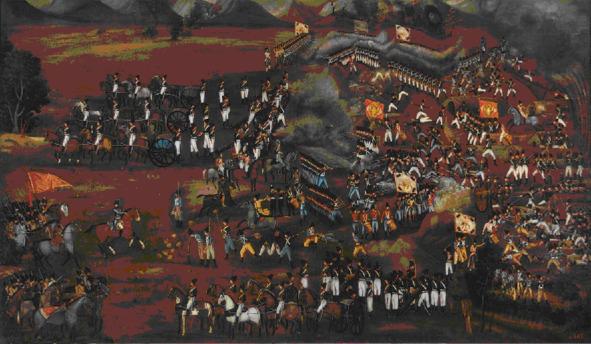
An artistic picture. One of the battles of the Russian-Persian war of 1804

After the end (running in parallel) of the Russian-Turkish war in January 1812, Persia tends to sign a peace treaty. The Napoleonic invasion of Russia lends additional weight to the war party at the Shah’s court. South Azerbaijan becomes the site of the formation of the 30,000th army of the invasion of Georgia. Further, on February 1, 1812, the 18,000-strong Persian corps, under the control of British officers, managed to encircle, force one of the Russian battalions to surrender. This is where their luck ends.

And, on October 24, 1813, the Gulistan peace treaty was signed in Karabakh. All acquisitions of the Empire were recognized, except for Eastern Armenia, which was returned to Persia. The peoples of the Caucasus and Transcaucasia are getting rid of the threat of invasion by Persia and Turkey. However, racial and religious tensions in the region are becoming one of the long-term factors of Russia’s instability.

The third coalition against Napoleon and his allies – Spain, Bavaria, Italy, arises after the signing of the Petersburg Union Treaty by England and Russia on April 11, 1805. Later it is joined by Austria, Sweden and Portugal.

Bonaparte is not helped by the fact that he, in essence, becomes a monarch. Since December 1, 1804, according to the results of a plebiscite poll among his people, with 0.07% of the votes “against” he is proclaimed emperor. Russian and French rulers exchange insults.

Great Britain is not so much fighting as it is paying. From the treasury, 1 million 250 thousand pounds sterling is allocated for every 100,000 coalition soldiers annually. That’s 80 grams of gold, or 900 modern pounds for one private.

Battle of Trafalgar

Bonaparte is preparing a landing across the English Channel, against his main opponent, and, so to speak, “customer”, a considerable 180 thousand cavalry and infantry. The Franco-Spanish fleet is sent from the Mediterranean to support the landing and, at Cape Trafalgar (near the Strait of Gibraltar), meets with the British Navy. The forces are approximately equal, three dozen ships of the line on each side, but the British gunners are more skilled, and the noble officer corps of the “Lady of the Seas” did not suffer from the work of the revolutionary guillotines. Allied ships suffer crushing losses of manpower in artillery duels (4500 versus 450 for the British), are boarded and captured. The British do not lose a single ship. Their brave Admiral Nelson is killed. In a barrel of rum (according to legend, drunk by the sailors on the way), the body of the commander returns to his homeland.
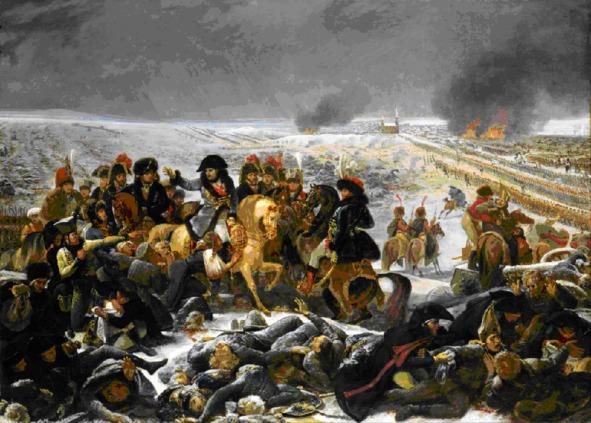
In the battle of Preussisch-Eylau, against the combined Russian and Austrian troops, Napoleon almost gets captured. However, subsequent battles convince the allies of the need for peace.

…In the summer of 1807, on the river near the town of Tilsit (now Sovetsk, Kaliningrad region), the Peace of Tilsit is concluded between France and Russia. Russia recognizes the conquests of Napoleon, the restoration of Poland’s statehood in the former Prussian possessions, and the rule of France over the Ionian Islands. At the insistence of Napoleon, the Russian Empire withdraws its troops from Wallachia and Moldavia, already conquered from Turkey, participates in the naval blockade of England, recognizes the three Bonaparte brothers — Joseph, Louis, Jerome, as kings of Naples, Holland and Westphalia, respectively.

Somewhat earlier, in 1806, due to an insignificant, in essence, the dismissal of the ruler of Moldova without the prior approval of Russia, another Russian-Turkish war began. The Russian army once again storms Izmail, takes possession of Yassy, Bendery and Bucharest.

…Admiral Senyavin’s fleet is blocking the Dardanelles, landing troops on the islands, making progress. In August 1807, with the mediation of Napoleon, an armistice was concluded with Turkey.

Active ground fighting resumed in 1810. They boil down to a series of battles in the territories of Moldova, Romania and Serbia. In 1812, the Bucharest peace treaty was signed. The Bessarabian region (part of present-day Moldavia) and some territories of the Transcaucasia ceded to Russia. The border of Europe is shifting somewhat to the south. The Danube principalities as well as Serbia are returned to Turkey. Russia is withdrawing from the war with the Porta in a hurry, on the eve of a large-scale Napoleonic invasion.

…In 1808 and 1810, Napoleon, wishing to become a monarch recognized by the European courts, sent proposals to the Russian reigning house to marry Alexander’s sisters, Catherine, then Anna. This request is politely declined. Bonaparte is deeply offended. He marries an Austrian princess. Thus, among other things, Bonaparte provides the French Empire with a strong rear and military support.

Meanwhile, Russia maintains a continental blockade of Great Britain. The export of food stops. The price of bread falls by half. Domestic light industry is rising, in particular, the production of technically sophisticated luxury goods. But, the nobility is already accustomed to the goods produced in England. Therefore, Russia trades with the “Lady of the Seas” through neutral countries. The French government is aware of this.

Napoleon proclaimed the idea of expanding the Duchy of Warsaw to the borders of the Polish-Lithuanian Commonwealth during the time of False Dmitry. This is impossible without alienating part of its ancestral lands from Russia. The emperor regards the advancement of units of the Russian army to the borders of the Duchy as an immediate threat to the vassal.

Bonaparte’s main plan is a huge dependent Poland, which includes Ukraine, Belarus and Lithuania. A world with a shrunken Russia. Full continental blockade of England, then the occupation of Great Britain. Theoretically — a campaign to India, the return and growth of the French colonial possessions (the First Empire). Hypothetically, Napoleon becomes the ruler of the whole world.

It’s not so impossible. England owns 27% of the earth’s land, which, together with the colonies of France itself, as well as the Netherlands, Portugal and Spain, which became part of the suzerain of the Commonwealth, makes up more than half of the territory of the globe.

This plan does not fit the liberation of the Russian peasants from serfdom. At the beginning of his career, Bonaparte serves the Convention and the Republic, introduces a progressive Civil Code, destroys the basis of the feudal system. However, he despises “ordinary people”, and tries not to resort to their assistance. He is not at all the benefactor of the people. In parts of Belarus and Lithuania, at the beginning of the summer of 1812, Napoleon abolished serfdom. The peasants begin to plunder the former oppressors, landlords and their families. They are not becoming noticeably more loyal to the French army. Napoleon is primarily interested in the supply of his troops. Three weeks later, he returns the peasants to the landlords, provides security, so that the nobles themselves collect food and give it to foragers. And so it happens. It should be borne in mind that the aristocracy of the region counted on the revival of the Commonwealth, and therefore was so welcoming to the conquerors. Considering his experience with the liberation of the serfs unsuccessful, Napoleon projects his conclusions throughout Russia. He does not pay attention to the fact that the Russian nobles are satisfied with their high position. There is autocracy here, but it is limited, in the extreme case of landlord discontent, by an apoplectic blow (a snuffbox to the temple). The gold saved during the expropriation of peasant reserves, the propensity to plunder churches and monasteries, arrogance, will subsequently turn into rivers of blood of Napoleonic soldiers.

Napoleon’s army is: 20,000 Prussian soldiers — Prussia is offered some territories of the current Baltic states, 30,000 Austrians, 100,000 Poles, 21,000 Italians, 300,000 French, 8,000 former Russian prisoners of war who believe that they are going to free the country from serf slavery, and also parts from other countries subordinate to the French Empire. Total about 6

battle of Borodino

At noon, Russian troops successfully counterattack. Marshal Bagration is in the front rows. A shard of the core injures the commander. The news of this instantly demoralizes the army. The retreat begins. The onslaught of the French is weakening after the raid on their rear of 2500 Cossacks by General Platov. The troops are regrouping. Napoleon leaves the left flank of the Russians, rushes to the center, recaptures the redoubts at the cost of almost all his heavy cavalry, and stops. At seven o’clock in the evening, the French emperor withdraws troops from the battlefield.

At night, having collected the wounded, the Russian army retreats to Mozhaisk, 105 kilometers west of Moscow. About 20,000 seriously wounded remain in the Mother See and later perish in the fire.

Losses of the parties. Russian army 42,000 killed (30% of the composition). Napoleon’s army – 35,000 people (25%).

After the battle at Maloyaroslavets, Napoleon realizes that he will not be able to gain a foothold in the south of Russia, and leaves the Smolensk road, plundered by his own troops. Survivors, including the servicemen of the German McDonald corps, remain 30,000 people. Of the imperial guard, numbering at the beginning of the invasion of 47 thousand, 400 or 500 survive. There are 100 thousand prisoners and deserters. A significant part of them voluntarily remained in Russia after the fall of Bonaparte’s empire.

The total loss of servicemen of the Russian Empire at this stage is 120 thousand people.

In pursuit of the enemy, the Russian army occupies almost the entire Grand Duchy of Warsaw. In 1815, according to the agreements of the Congress of Vienna, it becomes part of Russia, the population is sworn in to the Russian sovereign. However, some attributes of autonomy remain. So, for example, the Polish zloty will be replaced by the Russian ruble only in 1832. The formally neutral Dresden is captured. Leipzig and Berlin are liberated. In the battle of Lützen, Napoleon’s troops fearlessly attack the Russian-Prussian troops saturated with artillery, suffer twice as large losses (20 thousand), but eventually force the allies from Saxony to retreat. Two more such Pyrrhic victories follow. Bonaparte calls for an armistice. The Sixth Coalition is strengthened by Sweden, which has bargained for itself Norway (Danish possession) for military services, and a number of other European monarchies. Near Leipzig, Napoleon offers peace in exchange for the countries captured by his troops, with the condition that the French colonies return. The allies reject such a decision and, on October 16, 1813, a multi-day battle begins to boil — the Battle of the Nations. Forces of the Coalition — 300 thousand people, 1400 guns, France — 200 thousand, 600 guns. The battle lasts until October 19, boiling down to a chain of fierce battles. German soldiers in Bonaparte’s camp go over to the side of the Coalition, thus deciding the outcome of the case. Napoleon retreats, losing 80 thousand people killed, wounded and captured, and 325 guns. Allied losses — 54 thousand. Almost half of them are soldiers of the Russian Expeditionary Army. Six months later, on April 11, 1814, on the outskirts of the already captured Paris, Fontebleau, Napoleon signed an abdication for himself and his heirs.

Battle of the Nations at Leipzig

…After a series of battles on the outskirts, which brought an equal number of victims — 6—8 thousand, and a demonstration of artillery batteries, Russian troops occupied Paris without a fight. There are no excesses with the civilian population. Officers pay for alcohol with receipts, or put bottles under the table, thus removing them from the field of vision of not very picky waiters. Later, the Russian emperor, or rather, the working people of Russia, will pay for all this. The imposition of military indemnities on France, a perfectly reasonable proposal of Great Britain, Alexander I complacently rejects.

During the one and a half years of occupation, 40 thousand Russian soldiers leave their army, roughly speaking, they defect, because the Victory has already been achieved, the French women are very friendly, well-to-do, the local authorities in every possible way welcome the appearance of new citizens. Men, after the Napoleonic adventures, in France are simply catastrophically lacking.

In the wake of successes in foreign policy, Alexander the First believes that everything is fine in his state. He is in no hurry with the abolition of serfdom and other major reforms. His opinion is shared by the majority of the Russian nobility.

In 1816 the Baltic peasants were liberated. Initially, the inhabitants of Russian Pomorie, the Caucasus, the Far East, Alaska, parts of Asian possessions, the Finns and, to some extent, the Cossacks are free.

The emperor’s new toy is military settlements. Some similarities exist in Germany. This is Landver, a rural settlement, where a weapons depot for training is located, and the training of young villagers is carried out in their free time by a retired officer. Corporal punishment is prohibited. Landwehr is popular. Freed youth find these infrequent military exercises amusing. Almost half of the army in wartime is Landwehr militia, they serve well.

They are reminiscent of “arable soldiers” and Cossacks. But, in the latter case, the organization and life are created by people at their own discretion, therefore they are viable.

The emperor hands over his idea to the executive officer, Count Arakcheev. He gets down to business with mindless zeal. A battalion of lower ranks of the regiment settles in Novorossiya, with wives and families. Military personnel, unaccustomed to agricultural work, resist. Then gauntlets are used. But, these people are now not peasants in the full sense of the word. Sowing, haymaking, harvesting, etc., are performed not when the time comes, but according to the schedule approved by the authorities.

In 1818, the Senior, then the Younger and the Middle Kazakh zhuzes (a type of large clans) passed under the patronage of Russia. Since 1822, by decree of Alexander the First, the khan’s power in the zhuzes has been abolished.

…On November 27, 1825, the population of Russia, the Senate and the Synod were sworn in to the brother of Alexander the First, Constantine. Constantine himself does not want to rule, assuming that otherwise “… they will strangle me, as they strangled my father.” He is quite comfortable in the Kingdom of Poland, where the prince is the governor of the Russian monarch. He entered into a morganatic marriage with a Polish countess, which in the future may cause complications in the succession to the throne.

At the beginning of the reign, Nicholas the First had to order the execution of five participants in the anti-government uprising. No more orders like this are required. For the lower ranks, they are replaced by corporal punishment, which usually has the same sad result. That is why Nikolai Pavlovich receives the nickname “Palkin” from the people. If the coup d’état succeeded, it was highly likely that a civil war would break out. But, this blood, as it is seen, would have taken away the October Revolution of 1917 and all the events associated with it.

…The interregnum and the uprising of the Decembrists in Persia are perceived as a convenient moment for unleashing a war against Russia. The main target of the Iranian Shah is Tiflis (Tbilisi). The first blow, on July 16, 1826, on Russian territory was delivered by a detachment of 16,000, supported by Kurdish cavalry. Then, on July 18, the 40,000-strong army of Abbas Mirza is crossing the border river Araks. Russian troops are small and scattered. The local Muslim population joins the Iranians. Armenians find refuge in mountainous areas, or fortresses with strong garrisons. However, on September 15, a Russian detachment defeats the 18,000-strong vanguard of the Iranian army on the outskirts of Tiflis. Losses of the parties were 27 and 2000 people. Further, on October 13, near the city of Elisavetpol (Ganja, now Azerbaijan), a separate Caucasian corps crushes the 35,000-strong Iranian army, loses 60 people against 2000. Erivan is liberated. The military forces of the Persians are pushed into Iranian Azerbaijan (historical region of Iran). And, on February 22, 1828, the Turkmanchay peace treaty was signed. Russian possessions are confirmed. From the territories of the Nakhichevan and Erivan khanates, Eastern Armenia, an Armenian region (including Karabagh-Karabakh) was created, to which 30,000 Armenians were resettled from Iran.

Signing of the Turkmanchay Peace Treaty

…A new Polish is maturing, the so-called. “November” uprising, under the slogan of the restoration of the Polish-Lithuanian Commonwealth within the borders of 1772. But it is not only exorbitant ambition that drives the insurgents. The reason for the dissatisfaction is the preliminary censorship, the abolition of the Napoleonic jury, and the fact that, according to rumors, Polish troops should become the vanguard of the Russian army in the invasion of Belgium. In any case, a deeply conspiratorial and ramified Patriotic Society has been formed. It wants not to reason, but to act.

And, on November 29, 1830, the conspirators attacked the army barracks. Members of the Patriotic Club are diligently cleaning up the Polish government. The Russian monarch promises nothing but amnesty. The Diet issues a decree on the detronization of Nicholas I and his heirs on the Polish throne. A full-scale war begins.

European countries maintain benevolent neutrality, close their borders to supply the rebels with weapons, ammunition, etc. England is most concerned about what is happening in Poland. She sees here a continuation of the Jacobin and Napoleonic epics.

Battle of Ostrolenka. Russians are advancing

Dispersed Russian troops suffer a series of serious defeats or achieve a draw. The situation is somewhat improved and, on May 26, 1831, a battle will take place near the Polish Ostrolenka. Forces of the parties: Kingdom of Poland — 30 thousand people, 74 guns, Russia — 35 thousand, 148 guns. Artillery plays an important role. Russian gunners occupy a more advantageous position, shoot more accurately and more often. Irrecoverable losses of the parties. Poles — 9 thousand, Russians — 5 thousand. Polish troops retreat to Warsaw. Unrest is rising in the besieged capital. Everyone understands what will happen soon, and they absolutely do not want to participate in this.

During the negotiations, the thirty-two thousandth Polish army rapidly leaves Warsaw, goes to Austria and is disarmed there by the Austrians.

The Kingdom of Poland is declared an organic part of Russia. Own army, the Seim, the national monetary system are abolished. Many Poles with their families settle in various European countries, spreading the seeds of hostility to Russia there. Polish women introduce the custom in their midst — they wear black ribbons in their hairstyles — “a sign of mourning for the lost homeland.”

There is peace in Russia. There is no terrorism. There is a strict regulation of everything, but the rules do not change on the go. By understanding them, you can easily run your own business. The education system, industry, trade and banking system are being strengthened. Corruption exists only in the lower levels of the bureaucracy. The number of state, practically free peasants is growing. They move freely around the country, buy, sell, conclude legally formalized contracts. The state extends the protectorate to the serfs, treating them as citizens, sometimes arresting the landlords’ estates for inhuman treatment of subordinates.

The common punishment is “Passing through the line.” Under Nicholas I, the officer corps determines the punishment for their descendants

However, the firmness of this system gives rise to problems that open up in a military conflict. The beginning of the Crimean War is an example of intransigence, inability to “sort out” a technical misunderstanding, which first becomes a pretext for war and then a heavy defeat. In 1853, in order to put pressure on Turkey in control over the Church of the Nativity of Christ in Bethlehem, Russia sent troops to Wallachia and Moldavia. Nicholas the First does not want to hear the opinions of England and Austria on this matter. Meanwhile, Great Britain and without wars in the East, through only cleverly drafted agreements on free trade, makes Turkey a dependent country, an important market for industrial goods. The emperor is also not interested in the fact that Napoleon the Third, and the French people are tired of the world, maybe they want to take revenge and flex their muscles. Nicholas provokes the French monarch by pointing out in his congratulatory telegram: “Monsieur mon ami” (“dear friend”) instead of the “Monsieur mon frère” (“dear brother”) allowed under the protocol. The Bonaparte dynasty was excluded from the succession to the throne by the Congress of Vienna, everything is correct, but in this case it would be possible to accept the state of affairs as it is. All these little things lead to the fact that on October 16, 1853, Turkey, and after some time, two more world empires — France and England, which joined them Sardinia, the largest Italian kingdom, declare war on Russia.

There is no escape from the war, but it needs an important pretext. In this serious conflict, neither side looks like a fighter for truth, freedom, or faith.

Sinop naval battle

…On November 30, 1853, the Sinop naval battle takes place. Near the city of Sinop, Porta prepares forces, presumably for the landing of troops in Sukhumi and Poti. A detachment of P. Nakhimov’s ships blocks the bay, awaits the arrival of the main forces and makes an attack. The rest can be called a “massacre” — without special tricks, a mixture of ships and the exchange of volleys. Both sides have a novelty of military thought, bombing guns — a cross between a large-caliber mortar and a mortar. For the first time in history, Russian gunners quite successfully use a large caliber that allows them to shoot 25-kg explosive shells with a high content of gunpowder. The Turkish fleet and coastal batteries lose 3,000 people, and 200 sailors, including Commander Osman Pasha, are captured. 7 frigates, 3 corvettes light up, are thrown ashore, a steamer and a lot of small vessels are sinking, 3 vehicles are damaged, 2 coastal batteries are destroyed. The Russian navy loses 150 killed. Damage is taken by 3 ships of the line. The battle of Sinop becomes the swan song of sailing ships.

In Europe, however, this victory is perceived very gloomily, pointing out that, according to the rules of war, it is impossible to attack ships anchored in the port, especially of the lower class and smaller displacement. England and France pledged to maintain armed neutrality only as long as the Russian Empire was defending itself. When it goes over to active hostilities on foreign territory, these two colossal colonial powers declare war on Russia. This is exactly how it happens, on March 27, 1854.

In June 1854, the Allied forces — 34 battleships, 55 frigates (most of them are steam) blockade the Russian fleet — 14 battleships, 6 frigates and 6 steam-frigates in the Sevastopol bay. At the same time, a landing of 62,000 troops on 350 ships is carried out in Evpatoria. Halfway to Sevastopol, a 35,000-strong Russian army meets him. The commander-in-chief, A. Menshikov, the great-grandson of an associate of Peter the Great, expresses a phrase that is becoming a common noun — “We will throw our caps over the enemy” and invites residents, as for a performance, to contemplate the battle.

In the old fashioned way, most Russian officers line up subordinates in a tight square representing the target. The soldiers, obeying more the voice of reason, scatter from the columns. In some cases, allies give them melee. The battle is a series of chaotic bayonet fights. Demoralized by the ongoing chaos, and, most of all, by the accurate shooting from long-range rifled rifles — the so-called. fittings, Russian troops are retreating. The allies, believing that they were fighting not with the entire army, but only with its vanguard, stop. So they miss the opportunity to capture Sevastopol on the move.

Admiral Nakhimov wants to go to sea, fight and die with honor. The commander-in-chief rejects this proposal and orders to flood the Russian sailing fleet along the fairway of the bay.

Sinking of ships of the Black Sea Fleet. On the right is one of the Russian steam frigates

The base of the British expeditionary forces is located 15 kilometers southeast of Sevastopol, Balaklava.

…In the middle of May 1854, 67 steam ships of the Allies appear in the roadstead in front of Krondshtat (Petersburg), luring the predominantly sailing Russian fleet (26 linear, 7 frigates, 7 steam frigates) to battle. Without waiting for this, and making sure that in many places naval mines (600 pieces) are displayed, the squadrons leave. Later, in the spring of 1855, two British frigates were blown up by E. Nobel’s pyrotechnic explosive devices. The ships will get off with minor damage — the charge of black powder is only 4.5 kilograms. However, the psychological effect of the use of new weapons exceeds all expectations.

This is followed by — November 5 — the Battle of Inkerman, an unsuccessful assault on the heights near Sevastopol, 3300 of our own killed against 880 British and French soldiers. A short respite — on November 14, 1954, as a result of a severe storm, 53 Allied ships (including steam ones) sink, including 25 transports. On February 17, 1855, an attempt was made to unblock Evpatoria, which had been captured by the Turks. The besieged repulsed the assault with artillery fire, inflicting 750 casualties on the Russian army, losing 300 of their own. The Ottomans regain their former reputation. Their fighting spirit is getting stronger. Further, on May 24, the Anglo-French fleet occupies Kerch, burns all ships and even fishing boats in the bay. August 16 — a battle near the Black River, a senseless attack by Russian troops on insignificant heights, 1,800 people killed and wounded by the allies, 8,300 — soldiers and officers of the Russian army. Opponents’ steam frigates ply the Black Sea, sometimes shelling the coast or engaging in skirmishes with each other.

Balaclava. British navy base in Crimea

In the Sea of Azov, the Anglo-French fleet bombards or burns, landing troops, coastal cities and towns, including Taganrog and Mariupol. All the time of hostilities on land, the Allies cling to the coast in order to receive the necessary supplies from the fleet. They do not make deep maneuvers across the peninsula. The goal of capturing Crimea is not set. The city is blocked only from the sea, and partly from the land. On the other hand, in the defense of Sevastopol takes a relatively small part of the entire Russian army.

Sevastopol and the strategically important heights adjacent to it are subjected to massive shelling. In early September, French troops take the Malakhov Kurgan. Russian units leave the southern, urban part of Sevastopol and move into a fortified bay. The allies are heading towards the city of Nikolaev, the second base of the Russian fleet. At the mouth of the Dnieper, they bombard the coastal fortress from armored platforms, capture it, leave the garrison and leave for the winter near Sevastopol.

The parties to the conflict are extremely exhausted, are criticized by society, and are quite ready for negotiations. And, on March 18, 1856, the Paris Peace Treaty is signed. Russia agrees to freedom of navigation on the Danube. Refuses protectorate over Serbia, the Moldavian principality and Wallachia. Returns the Turkish city of Kars, together with the adjacent territories, in exchange for “all other places occupied in the Crimea by the allied forces.” The Black Sea is declared neutral. Both the Porte and Russia, any other state in peacetime is prohibited from having a military fleet on it. The fortifications of Sevastopol are being destroyed.

And, yes; the key to the Church of the Nativity in Bethlehem remains with the representative of France. The tsar could have guessed for himself that the right to patronize Christians for a person who leads a country where Christians trade in Christians cannot have.

Russia suffers minimal loss of territory. However, the “Triple Alliance” of the victorious emperors is a thing of the past. The supremacy in Europe moved from St. Petersburg to Paris.

Losses of the parties. Russia — 140 thousand people, France — 97 thousand. Ottoman Empire — 45 thousand. Great Britain — 22 thousand. Sardinia (a large island off the coast of Italy, the strongest Italian state) — 2 thousand people. The total losses of the allies — 166 thousand people.

Russia’s failure affects the health of the emperor. A dispatch about the capture of Evpatoria, initiated by Nikolai himself, can raise his tone. But, on the evening of February 29, 1955, a courier brings the news of the lifting of the siege and heavy losses. The emperor, already infected with the flu, seems to be deliberately accepting a review of the marching battalions in a light uniform. The disease gives complications, and, on March 2, 1855, the monarch dies.

The throne is occupied by the son of Nicholas I, 37-year-old Alexander II.

The fate of the Russian peasants is not particularly interesting to the new tsar. However, the monarch points out that the need to abolish serfdom is ripe, and “it is much better for this to happen from above than from below

A very complex Manifesto of 17 acts “On the Most Merciful Granting of Serfs the Rights of the Condition of Free Rural People” was promulgated in Moscow on March 5, 1861. Basic provisions. The peasants are freed. They are given their movable property, private houses and buildings. From this moment on, the master has no right to sell people, relocate them, force them to marry at his own discretion. The landowner allocates a field allotment to the rural society (namely, the “world”, a kind of Soviet collective economy). The community council distributes the land among the participating peasants at its discretion.

When (not less than 9 years later) the peasant feels that he is ready to bear an increased financial burden and wants to keep the plot with himself, he turns to a state institution, which pays the landlord a ransom. The down payment is 20% directly to the land owner. Since then, a person, on the one hand, breaks off legal relations with the landlord, on the other, falls into bondage, paying the borrowed amount to the state for 49 years with 6% per annum.

…Landlords are freed from control over the purchase of land. The state bank is engaged in this. Former slaveholders receive substantial rent from the treasury year after year.

“Rural landscape”. Russia. Second half of the nineteenth century. Rise of the Empire

It is profitable for nobles to lease land to peasants. Not only that, in the end, they get three to four times the market value for the plot. The property, or at least an extremely dependent person, as “in the good old days,” is the peasant who did not dare to “take the ransom”. Therefore, the nobles try to surround the plots of farmers with their own thin “segments” alienated within the limits of the peasants’ norm, separating them from the village, reservoirs, pastures, roads, forcing them to rent, then buy back strips as well.

…In 1865, a small Russian detachment with a hot battle captured Tashkent, the capital of the Kokand Khanate. Kokand (future Uzbekistan and part of Turkmenistan) becomes a protectorate of Russia. In 1872, Bukhara, which fell into the sphere of interests of Russia, was reorganized into the Zeravshan district and lost its independence. The same fate awaits other khanates and emirates. The meaning of this connection is not entirely clear. The arguments of the Russian monarchs are unintelligible. The wars in Asia prevent Russia from participating in European conflicts.

In 1863, unrest broke out in Poland. The Russian government is making concessions, restoring the self-governing bodies adopted in the Kingdom of Poland, but the Polish underground workers are organizing more and more terrorist acts. Their main goal is the restoration of the Commonwealth within the borders of 1772.

Since January 22, individual insurgent units have been attacking Russian troops. The flywheel of terror spins. The so-called “daggers are secretly or openly killing Orthodox peasants and priests.

Russia concludes a mutual assistance treaty with Prussia, for which Poland also presents a painful headache.

In the end, the rebels lose 30 thousand people, the Russian troops — 3500. 12 thousand are deported to Siberia. In Poland, the use of the Polish language in public places and business correspondence, the wearing of mourning (shocking ribbons in women’s hairstyles), and all kinds of Polish differences are prohibited.

By the mid-seventies of the nineteenth century, the public consciousness of Europe was already prepared to harshly condemn Turkey’s policy in the Balkans. A number of national uprisings (Bulgaria, Bosnia and Herzegovina) are suppressed by the Ottomans with unprecedented brutality, causing sympathy and anger among most Europeans. Porta no longer looks like a defenseless victim, and Russia no longer looks like an instrument in the hands of the monarch, with the help of which he wants to gain glory for himself. The new tsar behaves prudently and coordinates actions with the governments of other world powers.

In March 1871, taking advantage of changes in the international situation, with the support of Chancellor Bismarck. Russia is restoring the right to keep a military fleet on the Black Sea.

In June 1876, Serbia, and then Montenegro, declared war on Turkey, suffered a series of crushing defeats, and turned to European governments for mediation in the settlement of the conflict. The London Protocol, signed by representatives of the six European powers, rejects the Port, and thus dismantles the provisions of the Paris Treaty, which protected it from a one-on-one struggle with Russia.

And, on April 24, 1877, Russia declares war on Turkey.

The strategic goal is the fortified city of Pleven (Pleven) located at a crossroads. Turkish units of 20 thousand people, 57 guns manage to occupy it before the Russians. The first assault was unsuccessful. The second attack is carried out ten days later, supported by 140 cannon fire. Turks lose 1000 people, Russians 3500. Romanian troops join the siege. The Ottomans also receive reinforcements. The balance of forces is now 83 thousand people, 424 guns against 34 thousand besieged, with 72 guns. The third assault on 11 September is a complete failure. The losses of the Russian-Romanian troops after three attempts to seize the city reach 35 thousand people killed and wounded.

The assault on Plevna. View from the Turkish side
Capture of the Grivitsky Redoubt. Plevna.

The Russian command is switching to the tactics of a complete blockade of Plevna. As a result, the 50-thousandth Turkish garrison finds itself face to face with the 125,000-strong Russian-Romanian army that surrounded it within the city walls. On the evening of December 10, 1877, starved Turkish troops attempted a breakthrough. The advanced units almost completely destroy the Siberian regiment, but stop under unbearable fire from hundreds of guns. Unable to withstand the attack of the arriving reinforcements, the Ottoman army capitulates. 43 thousand people are taken prisoner.

Further, the 300 thousandth Russian-Romanian army, without encountering resistance, passes the Balkans, captures the 30,000th army, disperses the remaining 150,000, captures Adrianople. The fighting in this theater of operations ends.

In the Caucasus, the very Turkish presence, as well as the active emissaries of the Ports, are generating unrest. Dagestanis, Chechens and Abkhazians are revolting. Russian detachments capture the cities of Kars, Arzurum, oust the Turks from the Black Sea coast. After that, tribal unrest ceases.

The tsar’s troops stop 100 kilometers from Constantinople. Demonstrating the undesirability of capturing the capital of the Ports by Russia, Great Britain and France send a joint fleet to the Straits. And on January 19, 1878, the Treaty of San Stefano was signed, which is now celebrated in Bulgaria as Independence Day. It turns out to be just a preliminary agreement. The newly allied Romania is taking a position hostile to Russia. In order to prevent possible excesses, Russian troops occupy Bucharest.

Alexander II turns to the old secret treaties, gets confused, to a large extent, levels out the victories of Russian weapons. Union Bulgaria is reduced by three times in comparison with the territory specified in the protocols of the Peace of San Stefano. Its part — Macedonia, is returned to Turkey without changes in status. Another province, Rumelia, becomes an autonomy within the Ports. Not completely independent Bulgaria, continues to pay tribute to Turkey, although the Ottoman troops have no right to be on its territory. The next year, the Bulgarians willfully stop these payments.

Bosnia and Herzegovina is occupied by Austria.

As a result of the exchange of territories, Russia receives Southern Bessarabia from Romania.

Losses of 30 thousand people on each side who died in battle, not counting those who died from wounds and diseases.

In 1875, the Petersburg agreement on the exchange of territories was concluded with Japan. The Land of the Rising Sun abandons territorial claims to Sakhalin, In return, the samurai receive the entire chain of the Kuril Islands. Russia is losing access to the Pacific Ocean. Japan will be able to blockade Sakhalin and the entire Far East at any time.

The government of Alexander II refuses to colonize Papua New Guinea. Overseas territory goes to Austria and Australia.

Protest moods are growing in the country. Particularly active are members of the underground organizations “Land and Freedom”, “Narodnaya Volya” and “Black Redistribution”.

Moment of Greatness. Alexander II, the city of Tarnovo, Bulgaria, 1877

As a result, on March 13, 1881, two explosions are thundering in St. Petersburg. They are dying — Alexander II, bomber of “Narodnaya Volya” Ignatiy Ioakhimovich Grinevitsky, a Cossack of His Majesty’s Convoy and a 14-year-old boy.

The next day, the Russian throne is occupied by Alexander the Third.

Alexander the Third is married to Maria Sophia Dagmar, the daughter of the prince and then the king of Denmark Christian, in Orthodoxy named Maria Feodorovna. They have six children. Senior Nikolai. Subsequently, he would become the last Russian emperor.

Under Alexander III, the autocracy takes on a second wind, so that the majority begins to feel that no changes need to be made.

…A fatal step — the decree “On the reduction of gymnasium education” (circular on cook’s children). It recommends that directors of educational institutions admit only representatives of the upper, wealthy classes. Alexander the Third approves of dueling among the nobility. But it seems that the never-ending chain of murders only demoralizes the nobility.

Terrorism seems to be over. The state abandons the practice of secret treaties, colonial wars and territorial acquisitions. The only clash in Asia during this period was the enlightenment of the Afghan emir, who wished for a part of the Turkmen lands. Thanks to economic growth and open politics, Russia is gaining a decisive voice in European affairs.

In 1888, injuries sustained in the crash of the Tsar’s train provoke the development of kidney disease in Alexander.

An hour and a half after his death, in the Livadia Palace, his son, Nicholas II (1894), swears allegiance to the throne.

Celebrations on the occasion of the coronation of Nicholas II, 1886 Khodynskoe field

…In his speech before the deputations of his loyal subjects, Nikolai points out “the inadmissibility of senseless dreams about the fate of representatives of the zemstvos in matters of internal administration.” The speech of the “anointed one” was greeted with applause. But it is this speech that becomes the starting point for the growing discontent of the civil society.

The coronation takes place on May 26, 1896, in Moscow. At five in the morning, 500 thousand (according to other sources, up to a million) people gather on a square kilometer field. A rumor spreads through the crowd that the barmen are handing out gifts “only to their own”. The people rush to the wooden buildings, and 1800 policemen are unable to restrain them. The death toll, according to official data — 1383 people, according to unofficial — 4000. In addition, about one and a half thousand are injured and mutilated.

According to the Tsar, although the Khodynka catastrophe is the greatest misfortune, it should not darken the bright holiday of the coronation. Nikolai’s diary entry; “I found out about this at 10 1/2 hours before Vannovsky’s report; the news left a disgusting impression. … We went around the tables and went to the Kremlin. … Let’s go to the ball at Montebello. It was very nicely arranged, but the heat was unbearable.”

The imperial family donates 90,000 rubles to the victims and 1,000 bottles of Madeira left after all the banquets.

We will present the principle of building relationships between the royal family and the people from the correspondence of Alexandra Feodorovna with her grandmother, British Queen Victoria:

Victoria: “I have ruled for over 50 years, and, nevertheless, every single day I have to think about what I need to do to keep the love of my subjects and make it stronger… Your main duty is to win their love and respect”.

Alexandra-Alisa: “You are wrong, dear grandmother. Russia is not England. Here we do not have to do anything to deserve the people’s love. The Russian people revere their tsar as a divine creation.”

Nicholas II with his wife Alexandra

The country’s economy is developing well. Russia ranks first in the production and export of grain and butter. GDP per capita is three times less than that of the world leaders — England and the USA, but this gap is constantly narrowing. The duration of the working day since 1903 is limited to 11.5 hours, on Saturday — 10 hours. The average salary is 26 rubles, with a living wage of 21 rubles for a single man. If translated into gold, this is 32 thousand modern rubles. A kilogram of beef in 1915 — 25 kopecks. A glass of vodka in a tavern 10 kopecks, a bottle of vodka 0.7 liters. “Moscow special” — 17.5 kopecks, a loaf of bread 5 kopecks. It is acceptable. However, about 40% of a worker’s salary is spent on arbitrary fines.

Budget officials — officials, doctors, engineers at state-owned factories, receive a state pension. By 1914, this cash allowance, due to the length of service or a serious illness, is also acquired by ordinary workers. In order to receive a “full salary,” one must have worked for a total of 35 years, half of 25 years. In other words, if the employee is “removed from office” by a court decision, by order of his superiors, or has served a sentence for any crime, the pension is reset. It can be earned again by getting a job at another enterprise, but in this case, the count of experience starts from the same zero.

Sometimes order is worse than disorder.

…The Russian Empire produces its own vehicles, battleships, heavy bombers, armored vehicles and artillery systems.

Photo — construction of the battleship “Poltava”, Obukhovsky plant, 1909

Russia produces a lot of grain, but it has 125 million of its own eaters. The government encourages the export of bread abroad. The peasants have less and less land. The yield is three times less than in England. In 1891, a food crisis occurred in the Black Earth and Volga regions. As a result, about 300 thousand people die, not actually from alimentary dystrophy (hunger), but the companions of malnutrition — diseases.

In the reign of Nicholas II, such a famine will not be repeated. However, the issues of grain exports, periodic malnutrition are being raised, and the government has no answer to them.

In December 1904, Russian troops surrender Port Arthur to the Japanese. This news shakes Russian society. The emperor at this moment laughs, listens to jokes, recalls scenes of past hunts.

Battle of Tsushima, 1905. Cruiser “Aurora”. Unable to break through the formation of 85 Japanese pennants, the ship departs for the Philippines. In total, out of 34 Russian ships they reach Vladivostok. The rest are evacuated to neutral ports, thrown onto the beach, and surrendered to the Japanese. Samurai lose 2 destroyers


Damage to the Aurora. Photo in the port of Manila (Philippines), 1905. Japanese shells deploy armor over a large area mainly by the force of the explosion. The smoke of shimosa instantly covers the surveillance devices. The content of explosives in Russian shells is three times less. In addition, when a projectile hits the water, a lightly armored target, especially at long ranges, the fuses do not work. Aiming without gaps in the water is extremely difficult. The hierarchy of the tsarist Army and Navy is too confused for the understanding of the need to replace armor-piercing shells with high-explosive fragmentation shells in advance penetrated the minds of the highest ranks

The patriotic mood in the country is giving way to despondency. The popularity of the monarchy is declining to a critical point.

…In 1906, agrarian unrest reached a threatening scale. The landlords consider the forests as their own and demand payments for their use. The peasants believe that this is legalized robbery, like charging money for air, and they perform unauthorized felling. They also “disassemble” estates, breaking open barns and disassembling supplies, inventory, and take cattle away. The estates themselves are rarely burned. Most peasants still respect personal property.

The government cancels the redemption payments remaining from the time of the abolition of serfdom, but this is already too little. Then the Minister of Internal Affairs Pyotr Stolypin, ignoring the sluggish meetings of the Duma, introduced a law on the sale of state land to peasants. The farmer gets exemption from the “tsarist collective farm” — the “world” which restricts freedom and private initiative. He has the right to demand it. The community’s land is being opened up. Instead of several strips located in remote places, the peasant (not even his family, like the willful “world”) receives a compact “cut”. Thus, the village (and also, alas, the community — the world, the source of morality in Russia), disintegrates into the farmstead land tenure accepted in Europe.

Hundreds of thousands of peasant families are moving to the Far East. About 500 thousand farms are settling in Kazakhstan.

In 1912, the Second Balkan War starts. Bulgaria, Greece, Serbia, Montenegro finish off Porto, and at the same time strive to pinch off a piece from each other. Forces of the parties. Turkey 475 thousand people, the Balkan Union — 620 thousand. The battles are fierce. For the first time, combat airplanes are used. Just 8 years after the Wright brothers’ flight of a fragile bookcase, they are dropping bombs on warships. The Balkans are approaching Istanbul, bringing confusion to the souls of the Ottomans. Losses of the parties — 30 thousand people each. Turkey loses possession in Europe. Serbia never gets access to the sea. It is hindered by Albania, formed from a “no-one” territory, or, more precisely, by Austria-Hungary, which stood up for it.

Russia collects donations, provides the Balkan Union with volunteer pilots, makes diplomatic efforts, but, by and large, does not interfere in the conflict.

Be that as it may, the First World War ignites from the spark. Sunny or not, on July 31, 1914, Russia launches a general mobilization. Germany announces an ultimatum to the Empire: “Stop deploying forces.” And, not having achieved what he wanted, on August 1, 1914 he declares war.

July 1914 is marked by the introduction of “Prohibition”. Per capita ethanol consumption is declining from 4.7 to 0.4 liters per year. Strong drinks are sold only in expensive restaurants. The basis is the opinion of influential officials. As you know, often with good thoughts — the road to hell is paved. “Drunkenness and vodka both need to be destroyed, because no one needs vodka — unless a pharmacy — only with the permission of a doctor” … (Tsar’s adviser, Baron K. Kaulbars). By the way, prohibition does not apply to officers and the aristocracy in general.

In September 1915, Nicholas II assumes the title of Supreme Commander-in-Chief. This decision is unconditionally supported by his wife, but not by Russian ministers and generals. Germany by that time occupies most of Poland and the Baltic states, which are nominally Russian possessions. All military failures of the Empire now directly undermine the authority of the king. Instead of establishing contact with elements of civil society, active military-industrial committees, Nikolai tries to ban everything. This is not good for him and the people.

Still not so bad. The ambitious monarch is overcome by dreams of the Straits and Constantinople, the coast of the Sea of Marmara and southern Thrace, the islands of Imbros and Tenedos. This is the alleged prize for the participation of the Russian Empire in the war. However, the representatives of England and France do not express themselves with all clarity on this matter.

The soldiers do not understand what they are fighting for. Germany started the war in response to the usually preceding attack by initiating mobilization. But, all this could have been prevented by diplomatic methods at the very beginning of the conflict. Why not just sit in the trenches, skip attacks, and hold on to the defense? The Germans of the beginning of the century are quite normal people, why kill them? Even if the Germans, having launched a counteroffensive, had already occupied part of Poland and Lithuania. These are territorial entities alien to Russia and the people themselves. The Russian peasant, soldier, personally, mentally, does not need them.

Only Russians are drafted into the Tsarist Army. On the fronts of the First World War, 1.7 million of them die. Even more demoralized, wounded, taken prisoner. Forum is received by national minorities. The Bolsheviks are betting on them.

At the end of 1916, bread shortages began. In a hyperinflationary environment, peasants hold on to grain, expecting further price increases (or perhaps thus trying to voice their protest against the war). All this leads to the fact that the government is switching to food appropriation at fixed prices. There are clashes with the police. The layout fails. Instead of 772 million poods, 170 million poods have been collected. Allowances for frontline soldiers (3 pounds of bread a day) are cut in half.

Something similar is happening in other belligerent countries. In Germany, before the naval blockade by Britain, which imported up to a third of foodstuffs, “ersatz” — cheap substitutes for coffee, sausages, and other products, are becoming widespread.

Despite all these substitutes, malnutrition and related illnesses in Germany kill 800,000 people in four years of war.

In England and France, which receive resources from numerous colonies, the nutritional situation is much better, although also not at its best. In addition, the population of the country, in which the monarch, waking up, immediately begins to think about how he could earn the sympathy of his subjects, was initially broadly consolidated.

…Obsessed only with his family, the emotionally stupid monarch of the Holstein-Gottorp dynasty, who imagines that everyone loves him, everyone now hates him. The seed of a conspiracy is sprouting among ministers and senior officers. The main idea is the renunciation of Nicholas II, who lost his charisma, from the throne in favor of his son. The Regent is the Tsar’s younger brother, Michael.

Petrograd, 1917. In this line for bread, many buyers have weapons with them. And they know how to use it

…At the end of February 1917, for various reasons, the capital was deprived of the supply of grain, a general strike started. The soldiers of the Petrograd garrison join her. The capital is a huge infirmary and staging area for troops sent to the front. Here are concentrated 160 thousand dissatisfied with their position, squeezed into the military barracks designed for 20 thousand. 40 thousand rifles and 30 thousand revolvers fall into the hands of the population. Something similar is happening in Moscow. The hungry are taking the shops by storm. The authorities are throwing Cossacks to disperse the poor.

Everything is falling.

Power passes to the Provisional Government, headed by Prince V. Lvov. Units called up from the front to suppress the uprising fraternize with the rebels.

This is the February revolution, which has so encouraged the society.

In this situation, Nicholas II does not find anything better than to leave the Headquarters and go to Tsarskoe Selo to his beloved family. The departure is so hasty that the officers of the Imperial Convoy barely have time to get on the royal train. Cossacks, horses, property remain in Mogilev.

General Ivanov’s detachment (Convoy and dowry units), in an atmosphere of chaos, follows the monarch in a different way and arrives at Tsarskoe Selo. Rodzianko assures the commander that the revolutionary movement is under the control of the Duma.

In Pskov, one of the members of the Provisional Government, General Ruzsky, meets with Nicholas the First. He persistently persuades the emperor to agree to the formation of a “Responsible Ministry.

At two o’clock the next day, the generals enter the tsar’s carriage with a heap of telegrams from the commanders. The general meaning is the demand for the abdication of Nicholas in favor of Tsarevich Alexei.

Further, on March 15, 1917, authorized representatives of the State Duma arrived in Pskov. After listening to them, Nikolai unexpectedly declares that he is deciding to renounce for his son. This is necessary in order not to be apart from Alexei. According to the terms of the contract, the tsar must leave Russia for England with his family, through Murmansk, and then someday, live in the Livadia Palace (Crimea). Nicholas the First proposes, and even, according to the still remaining right, orders, the younger brother to become a monarch in his place.

But, on March 18, without receiving guarantees from the deputies to preserve his precious life, the Grand Duke, brother Mikhail, abdicates the throne. To be precise, he proposes to approve him in office sometime later, not yet convened by the Constituent Assembly. Michael retires to the Gatchina estate, then, already under escort from the Bolshevik government to Perm. … In fact, one or two days in March 1917, the last tsar, Mikhail II, the namesake of the first Russian monarch of the Romanov dynasty, ruled in Russia.

Nicholas II, citizen Romanov with his family in exile. Tobolsk, 1917. Further journey — to the Ipatiev house, Yekaterinburg.

The Orthodox Church takes the liquidation of the monarchy calmly. The Holy Synod, introduced by Peter the Great, attached the church to the state apparatus. This, despite funding from the state treasury, could not be perceived positively by Christians. The symbolic royal chair is taken out “in the archive”. The office of the chief prosecutor, “superintendent” of the Holy Synod is abolished. The call “to trust the Provisional Government” is being spread. At the First Local Council on June 21, 1917, the Russian Patriarchate was restored. Metropolitan of Moscow, Tikhon (Bellavin) becomes the head of the Orthodox Church. In 1923, the Bolsheviks sentenced him to “V.M.s.” — “capital punishment” for active opposition to Soviet power. Rescues a priest held in Lubyanka, “Curzon’s ultimatum” — a note from British Foreign Minister George Curzon. This document, in addition to the requirements for the release of British trawlers, the cessation of anti-British activities in the countries of the East, contains a condition for the abolition of religious persecution in the USSR.

…Michael’s rejection of the throne has a stunning effect on society. People do not accept theorizing and “breakfast”. The monarchy is withdrawing itself at the most critical moment for the country. From that time on, the Revolution has no more obstacles.

Meanwhile, the generals, wishing to suppress the unrest in St. Petersburg and Moscow, set in motion the troops. The head of the Provisional Government, Alexander Kerensky, suspecting that senior officers are going to infringe on his power, declares them illegal. There is a hitch. Serious forces neutralize each other. The power vacuum is being filled by the RCP (b).

…The teaching of Karl Marx can be summed up in three words: “Making a profit is not good.” But the Communists have no examples of their own efficient economy. Thinkers of Europe and America in their time write all kinds of utopias, test ideas in real communities of workers (phalansters by F. Fourier, New Harmony by R. Owen). From this useful inferences are drawn, and the foundation of a system of trade unions is laid. In Russia, there is nothing of the kind, proven in practice. Village community, “Peace”? But, the rural “World” is closed in itself, does not imply the inclusion of representatives of the intelligentsia and even workers.

For the first six months, the new government and the part of the people supporting it are looking for an answer to the question “What to do”? From the triad “Freedom, Equality, Brotherhood”, “Equality” is chosen. How can we equalize the beautiful and the nondescript, the rich and the poor, loved and only respected?

…In October 1917, the Provisional Government leaves, and, having access to the funds of the Central Bank, works semi-legally, being engaged in current economic activities. The expected by the masses with a certain enthusiasm is convened, the Constituent Assembly. But after the historical phrase “Guard is tired” said by the anarchist, sailor Zheleznyak, at 5 o’clock in the morning on January 6, 1918, the deputies find the gates of the Tauride Palace locked. The majority of the population has a strong feeling that a sailor, girded with ribbons with cartridges, is much more significant than a subject in civilian clothes, whose invisible weapon is thought and word.

The countdown of the Civil War begins.

Constituent Assembly. First and last meeting. January, 5th Julian, 1918. There will be war tomorrow

…The Bolsheviks conclude the Treaty of Brest-Litovsk with Germany. It costs Ukraine, Belarus, the Baltic republics, and other territories seized by the Germans at their discretion. After being defeated by the Entente, Germany has to withdraw its units from Russia, which has already become its protectorate.

On the fronts of the Civil War, the Reds win.

…The vacuum of power after Petliura and the German rule in Ukraine is filled by Poland, by agreement with the local Rada in April 1920 seized Kiev. The Red Army drives the Poles out of the Ukraine, pursues them to Warsaw, but, stretching out the rear, suffers a severe defeat. About 140,000 people are captured. A significant part of Belarus and Ukraine goes to Poland.

The bell of the sailor uprising in Kronstadt and the peasant wars prompted the Bolshevik government to switch from “war communism” to NEP.

The assault on Kronstadt, March 1921 Decline of the Soviets in their purest form. Then only the Bolshevik Party rules
First Bolshevik Party

During the Civil War, 900,000 soldiers of the Red Army, 650,000 — of the White, 6 million civilians — are killed from terror, hunger and disease. 2 million people are leaving for emigration.

The dreams of the peasantry and most of the workers about workers’ self-government (“Soviets without Communists”) are being dispelled by a new system that does not tolerate arbitrariness. However, Soviet Russia cannot do without what already seems obsolete: hierarchy, social inequality, money and even banks. During the NEP years, 61 of them will appear.

Socialism is winning, in Europe and the United States. The capitalist society — the “community” realizes the importance of the Social Contract, accepts the unspoken Code of the Honest Entrepreneur, makes concessions to the workers, and turns on social lifts at full capacity.

The Revolution is replaced by the Evolution.

…The first action of the New Economic Policy (NEP) is the abolition of food appropriation, that is, the expropriation of EVERY food that comes to our eyes, and the introduction of a fixed tax. It seems that 70% or more of the products confiscated for the needs of the Communist Party and the working class are more than 25—30%. However, reality has a very different mathematics. Now the peasant pays the tax in kind strictly 25% of the product produced, the rest can be kept for himself, sold, to the state or to a private person. Somewhat later, the tax in kind is replaced by a cash tax, in proportion to the area of the land plot, no matter how productive it is. This approach, however strange it may seem to the Bolsheviks, leads to a sharp rise in agricultural production. From 1921 to 1927 grain supplies to the state increase from 6 million tons to 11.6 million tons. At the same time, the producer and his family are well fed; and one must think they are quite satisfied with the existing regime.

Shop “Eliseevsky”. Moscow. NEP.
One of the popular decisions of the authorities is the abolition of Prohibition. August 1923, Petrograd. Russia will not endure another Civil War… By the name of the chairman of the Council of People’s Commissars, A. Rykov (shot in 1938), 38% of the vodka is called “Rykovka”

In 1922, free trade was allowed, the creation of private enterprises with no more than 20 employees. Later, this ceiling rises, so that some private factories employ 200—300 workers. Up to 80% of retail trade, 25% of industrial production is in the hands of private traders — Nepmen. The growth of national income is increasing by 18% per year.

A significant number of previously unprofitable enterprises are leased (concessions) to foreigners, and, after appropriate transformations, they begin to bring a solid income. To a greater extent, this applies to the extractive industry. For example, the concessionaire capitalists extract 30% of gold, 60% of lead and silver, and the light industry (production of clothing and household accessories — 22%) in a slightly smaller area.

All this gradually leads the population to the idea that the smaller the state apparatus and all kinds of controlling power departments, the stronger the country itself, their Motherland becomes. It seems that spontaneous, but all the more effective cooperation, the people themselves, may well do without the Bolsheviks.

Both the Communist Party and some considerable part of the population (young people who are romantically inclined to fight the dark forces of capitalism) do not like such mentality of the masses.

In 1927—1928, the Politburo announced the “disruption of grain procurements.” The state receives “only” 11 million tons of grain. The difference from the previous year is small — 0.6 million tons, about 5%. There are reasons for this — drought, pricing errors that are easy to fix. However, the government headed by I. Stalin declares the need for global industrialization and collectivization (under state control) of all agriculture. Dzhugashvili introduces the thesis about “the intensification of the class struggle… As we move forward.” Power departments receive the command “FAS”.

Concessions that have become profitable enterprises, as they say, are “squeezed” from their former owners by raising taxes. Syndicates, competing and therefore efficient state enterprises, are being transformed into a system of bureaucratic People’s Commissars.

In November 1931, private trade was completely banned.

The construction of heavy industry facilities is being unfolded throughout the country, regardless of their actual need. This means full inclusion of workers in the system of state control. The rationale for enslavement is the same as for centuries of serfdom. “There are enemies around, this is the only way to make a lot of weapons and save yourself from destruction.”

Construction of the White Sea-Baltic Canal, 1931—1933. The Face of the Era. According to official figures, 14 thousand people die at the construction site. It is manual labor that is popular, without such tenderness as the well-arranged life of workers and mechanization.
All the great construction sites of communism look something like this. It doesn’t matter how profitable a new canal, a city in the North, or a factory is. It is important that people engage in tedious physical labor and be visible.
The lesser-known construction sites of communism are dachas for Stalin and the party nomenklatura. It is for Joseph Dzhugashvili that 17 of them have been built since 1931 (plus the palaces of the aristocracy). Photo — a fragment of a Stalinist summer residence on Lake Ritsa (Abkhazia), a floating veranda

In 1931—1932. the famine caused by collectivization will kill at least four million people. Their wishes to the state, which has allowed all this, contribute to the materialization of a truly terrible external enemy.

…Since 1924, most of the owners of houses and apartments, “persons living on unearned income, such as: interest on capital, income from enterprises, receipts from property, etc.”, are deprived of voting rights. They cannot claim the opportunity to occupy positions of responsibility, receive higher education, or retirement. As a rule, they are deprived of any living space altogether. From now on they are called “disenfranchised”.

“Hello”. Moscow communal apartment from the 1920s. Owning a home for one family or even more so a person is considered an unaffordable luxury. Instead of building, various government organizations are looking at those who have “extra” square meters.

People who have received housing in a “packed” apartment are forced to live together. The main nightmare is the common trash can, the cleaning of the latrine, such household “little things”. An exhausting war of nerves is being waged. Yes, that’s it; neighbors just crush the rubbish in a already full bucket, trying to shove something else there, showing by all means that it’s not time to endure it yet. Not them. Uncle Gosha once again lays out some kind of rubbish in the corridor, because after you, out of the kindness of your soul, removed his rubbish, he believes that this is the place where all unnecessary disappears without human intervention. Responsibilities are not clearly defined. All are supposedly equal, and it is impossible to yield, in principle, so as not to accidentally “harness” into a yoke that cannot be thrown off. People want everything small to happen by itself, without detailed discussion. One should only talk about something great: the World Revolution, the civil war in Spain, the construction of the White Sea Canal… The one who shouts louder, makes the opponent ridiculous, seems to be more developed physically, is right. Almost every communal apartment acquires latent polarization. The interaction of opposite poles generates a dark current throughout the state.

Excessive talk is undesirable. Therefore, communism in the style of a la rus has no answers to the simplest questions of common human living.

Money

1. Banknote 5 rubles, circulated in 1830—1849. The signature of the cashier is done manually. She: “blue, cyanosis, tit”
2. Banknote 10 rubles, circulated in 1819—1849. Nicknames: “red, rubella, cancer”. A live goose twenty ruble, a dozen eggs 23 kopecks, a kilogram of fresh ides 25 kopecks. The salary of an official of the lowest, 14th grade, i.e., a collegiate assessor, is 35 rubles a month in bank notes. Additional income from bribes at this level is 150 rubles per year. The sovereign is indulgent to this phenomenon. There is no corruption at the highest level, and the officials are quite competent.
3. Three rubles of 1847. The nickname is “green tea”. Landowners are already in some decline, but serfdom is strong. There is no terrorism. However, humiliated and offended peasants quite often let the “red rooster” enter the noble estates. You can have a good walk in the restaurant for “greenhouse”. For 50 rubles — it is inexpensive to buy a person.
4. Fifty rubles of 1886. There is no serfdom. Terrorism — again, no. Alexander III rules. Measures such as artificial limitation of the right to education for the “lower classes” lead to additional division of society and become an important factor in subsequent social upheavals. The average salary of teachers, skilled workers, and lower-level employees is 24 rubles. To eat up to you in a dubious inn to the dump — 10 kopecks. A glass of first-class government vodka costs the same in expensive restaurants.
5. Five rubles in 1890. Three years remain until the death of the Emperor of All Russia, Tsar of Poland, Grand Duke of Finland Alexander III. The stupid policy of this monarch, who in particular wished to become the ruler of Bulgaria, leads to the fact that in the First World War the Bulgarians will shoot at Russian soldiers. Inflation is low. Everything said about the purchasing power of 1886 bills is true until the early twentieth century.
6. Ten rubles in 1898. The son of Alexander III, Nicholas II, rules. In 1892, a great famine swept through some areas of the Russian Empire. The reason is the poor harvest and the bureaucracy that continues to send assurances to the government about complete order in the territories entrusted to them. Nevertheless, first of all, the civil society that has begun to form, the zemstvos, even if belatedly, are taking the necessary measures. Not so much from hunger as from concomitant diseases, 300 thousand people die. Nothing like this will happen again in the Russian Empire. The popular proverb “In Russia, no one has ever starved to death” is gaining its former meaning.
7. Three rubles in 1898. Rise of the Empire. There is murmur everywhere, but there is no real terrorism. These three rubles were held in the hands of Vladimir Ilyich Lenin (Ulyanov), born in 1870. The state pension of his mother, the widow of a senior official, is 100 rubles a month. That’s four wages for a worker. Funds for the maintenance of a terrorist brother who is not at all loyal to the Empire also come from relatives, successful landowners (rent of 1,500 rubles a year). Vladimir Ilyich’s own efforts to get rich on a plot given to him at a cheap price in the village of Alakayevka, Samara province (a farm with 14 cows plus 45 hectares of fertile land — 800 rubles), end in failure. Four years later, the Ulyanov family sells their land ownership at a completely capitalist price of 3,500 rubles.
Young Vladimir Ulyanov (Lenin). A fighter against capitalism who ruined a separate agriculture
8. Ten rubles in 1909. The speech at the coronation of the young tsar (1896), composed by the mentor of Nicholas II, Ober-Prosecutor of the Holy Synod (“overseer of the ROC”), actually the Minister of Education, Konstantin Pobedonostsev, does not leave “simple loyal subjects” hoping for participation in state affairs. As a kind of substitute for that, a series of terrorist attacks starts. Against this background, the economy continues to develop quite successfully. Even in Soviet textbooks, the Russian Empire is called a “medium-developed capitalist country.” Russia produces its own steam locomotives, various railway equipment, warships, transport ships, airplanes, automobiles, artillery and shooting systems, electric wires, pipes, … finally, gramophones and gramophones, as well as all the hardware necessary for the population. The quality of the goods is at a high European level. The duration of the working day at state enterprises is 12 hours. A private trader, depending on his ideas about humanism — 12—16 hours. “Pay” for librarians, primary school teachers — 20 rubles, qualified locksmiths, turners — 50, doctors — 80, officers, depending on rank, 80—500, governors — 1000 rubles. Military spending, which reaches 30% of the budget, drains the country. They also become a source of real internal threat. The price of renting a modest room is 3—5 rubles per month. Lunch, pancakes with caviar in a tavern, to the dump — 1 ruble, 0.5 liters of vodka 15—17 kopecks, potatoes 5 kopecks. kg., loaf of bread 4 kopecks, beef 25 kopecks, cheese 70 kopecks, black caviar 3 rubles 20 kopecks per kilogram. You can live. Cow, horse, depending on the success of the bargaining 40—80 rubles. Shirt 3 rubles, men’s boots 7 rubles, short fur coat 15 rubles. Do you want to attract women and live luxuriously? Harmony 7.50 rubles, a gramophone 20—40, a car without frills 2000 rubles. The luxurious domestic “Russo-Balt” will cost 5500 rubles.
Russia. The beginning of the twentieth century. Regular grocery store … “French roll crunch”
9. Five rubles in 1909. This is your payment to a housewife, if you are a student in a large city, or a highly qualified worker who wishes to settle separately, outside the factory dormitory. In general, the owners of large enterprises prefer that their workers live in isolated factory settlements. There are “own” shops here. You can purchase them using coupons valid only within this place. Until 1914 there were no pensions for the working class. Your pension is your children.
10. Let’s pay special attention to the money of the flourishing of the Empire. Twenty-five rubles in 1909. You are a highly skilled worker. Add them to ten rubles from the same time. This is your salary. With modern money — about 60 thousand. It is possible to support a family, just live well alone. If only it were not for soul-exhausting penalties.
11. A thousand rubles in 1917. In the summer of 1917, the herald of the future October Revolution, Leon Trotsky promises the proletariat that the working day will be halved. The salary will increase by the same amount. The people listen with pleasure. Meanwhile, another revolutionary, Alexander Parvus, by manipulating rumors in the media controlled by him, brings down the ruble. All this somehow correlates with the happiness of us, ordinary workers…
This summer, the Duma of the Fourth Convocation, more precisely, the Provisional Government formed from it, still rules. Therefore, the banknotes presented are called by the people “dummy”. “Tsarist” money is still in use. They are valued somewhat higher than “dumki”. The main thing in money is trust. What can be bought for this bill is unknown.
12. Three rubles is a degrading “thought”. Gradually, the remnants of the Provisional Government are still trying to somehow manage the country and the monetary system. The first six months after the October Revolution, there is still no large-scale Red Terror. Having emerged from the war with the Quadruple bloc, the country is recovering to some extent. As you can see, the new paper money does not shine with variety and symbolism. Who, what is the sign of a new era — no one really knows. According to some reports, the salary of a worker on the railway is 60 rubles. A loaf of bread on free sale costs a ruble and a half. Especially you will not run away…
13. Banknote of the Provisional Government under Prime Minister A. Kerensky. It was put into circulation from 1917 to the beginning of 1919, including in the territories occupied by the Germans. Ost-stamps produced by Germany do not take root among the people at all. Usually “kerenki” come as a salary in large sheets. You must cut off some rubles yourself with scissors to buy goods. Since mid-1918, in general, money has disappeared from circulation. The new communist state creates a distribution system similar to the state structure of the Ancient Incas. Everything gained by farmers, workers, force and threats is collected in the Common Cauldron. From there, now, as it were, “free” it is distributed, first of all, to managers, their families and close persons. So, in the cities, from now on, some “elders at home” are responsible for the distribution of products taken out by food detachments from the villages. In state institutions, according to arbitrary notions of justice, and to those who look more tired, the Bolshevik leaders distribute ration cards.
14. Twenty-five rubles of the bank of Odessa. Even in the summer, in the south of the recent great Empire, the front collapses. Ukraine takes German troops. In general, anarchy reigns in the territories of the new state. The Germans are primarily concerned with the export of food for the Second Reich, which is staggering under the blows of the Entente. The first “Aryan” settlers are already rolling here. A little later, their expropriated sturdy “carts”, with a machine gun mounted in the back, become a recognizable symbol of the Civil War. Odessa is now a free city. By the autumn of 1918, in order to follow the withdrawal of German troops, the winners – the French and the British – arrived there. I use my own money. The purchasing power of the notes is unknown.
15. Fifty rubles of the free city of Zhitomir, north-west of Ukraine, 1918. What you can buy for it is forgotten. One power is replacing another with kaleidoscopic speed.
16. Fifty rubles of the Armed Forces of the South of Russia (VSYUR). The commander of these forces, General Anton Denikin, is the most sane senior officer of the “whites”. From England and France, nevertheless, the allies of the Russian Empire, which are represented in particular by the AFSR, it is possible to obtain certain assistance. Thus, the British are supplying 70 Mark-4 and Whipett tanks. There is time to organize the issue of your own money. Purchasing power, salaries unknown.
17. Twenty-five rubles of the Provisional Government of the Far East (FER). The emission center and the capital of the country is Irkutsk. Recently, the “whites” of Admiral Kolchak ruled here, in an amazing mixture with the Socialist-Revolutionaries, the Entente forces looking after the German fleet, the Czech-Slovaks, whom Trotsky intended to transport to Germany, and the Japanese themselves. Now, at the beginning of 1920, there were only Bolsheviks, Socialist Revolutionaries and samurai. The Central Committee of the All-Union Communist Party (Bolsheviks) grants the Far Eastern republic a certain autonomy, so as not to enter into an armed conflict with Japan and the Entente. As a result of this diplomatic victory, the Japanese are leaving the Far East.
18. One thousand Ukrainian hryvnia. The best denomination of its time and place is made in the Ukrainian Baroque style. Sometimes the situation in Ukraine stabilizes to some extent. The release of full-value money begins. The Central Rada with its head Simon Petliura is deposed by the Germans who came as friends. Germans leave. Pavel Skoropadsky, hetman they installed, also leaves. Petliura reappears. Now, as a bitter medicine against the anarchist sentiments of the population, he is calling Poles to his country. New “friends” occupy a third of Ukraine and Kiev. A little later they are knocked out by the Red Army. The Red Army pursues the Polish units to Warsaw, but by stretching the rear it suffers a crushing defeat. The western part of Ukraine goes to Poland for 20 years. The hryvnia is replaced by the Soviet “banknotes”, rubles, and since 1991 coupons. The hryvnia and karbovanets are again in circulation in 1992.
19. The best design of its time, on the territory of the entire former Republic of Ingushetia, are, perhaps, Denikin’s “Bells”. The popular naming comes from the image of the Tsar Bell on the obverse. The creators of the emblems must remember. The symbol matters. The split bell seems to determine the further fate of the banknotes. This is the money swan song of the White movement.
20. Five hundred rubles of the Far Eastern Republic. The purchasing power of the recent Civil War note is unknown. After the departure of the Japanese and Anglo-Saxons, in May 1920 the “whites” seize power in Vladivostok. The state of the Amur Zemstvo Territory emerged. The age of this state formation is very short-lived. The same, however, as well as the entire RDC. In 1922, it is part of the RSFSR under the name of the Far Eastern Region.
21. The first Soviet ruble. It is, officially, a credit card. The banknotes are printed in the second half of the “combat” nineteenth year. It becomes clear that slogans alone cannot feed the population of cities. Perhaps due to the economy of paper, the size of the banknote is slightly larger than that of a postage stamp. The purchasing power is 60 kopecks. kilogram of flour. Average salary 50 rubles. The main job of distributing products is still done by the card system.
22. One thousand rubles of the Transcaucasian Democratic Federal Republic. The state with its capital in Tiflis (Tbilisi) was formed in April 1918. A month later, at the request of Turkey, it is divided into the Azerbaijan, Georgian democratic republics, as well as de facto, Armenia. There is a common currency in their territories. In 1922, already as the Transcaucasian Socialist Federative Soviet Republic, this state entity became part of the USSR. In 1936, it was again divided into the socialist republics of Georgia, Azerbaijan and Armenia.
23. State banknote, 500 rubles, 1923 The Bolsheviks are somewhat ashamed that their penniless “Inca” system does not work. It would seem that soon communism will triumph all over the world. What’s the money? Therefore, the new banknotes in the Pharisaic are called “banknotes”. This is not money, but only signs. Banknotes work according to their name. The flywheel of hyperinflation is spinning. A box of matches very soon starts to cost 50 thousand rubles. For two years, since 1922, prices have risen 30—60 thousand times. Parallel to the new, old bills are in use. This makes trading very difficult.
24. Twenty-five thousand rubles of 1924. The state is determined to some extent with its symbols. However, military emblems are not the best helpers in the national economy. Prices change almost every day.
25. Fifty Million 1924. Any savings with such inflation are simply impossible. It is widely believed that with such an issue the concept of money will die out by itself.
26. The ruble of the second half of 1924. The opinion of the pragmatists in the leadership of the Bolsheviks outweighs. The bills are backed by precious yellow metal. Although not everyone intends to go to the bank to be convinced of this, the public’s confidence in state banknotes is increasing dramatically. Inflation stops.
NEP. A mixture of communism and capitalism. The workers are resting. Mid twenties of the last century
27. Three rubles, iron-backed with gold, the famous chervonets from the 1924 monetary reform. Ordinary new rubles and chervonets run in parallel. When exchanged for a ruble, they give 50,000 old ones. The chervonets is estimated at 500,000. In total, since 1919, Soviet signs have been devalued by 50 billion times.The chervonets is popular at international auctions, until the abolition of the NEP in 1929. At the same time, it is equated to an ordinary ruble. The naming “chervonets” becomes synonymous with the phrase “ten rubles”.