Rules of life of wild animals
Қосымшада ыңғайлырақҚосымшаны жүктеуге арналған QRRuStore · Samsung Galaxy Store
Huawei AppGallery · Xiaomi GetApps

автордың кітабын онлайн тегін оқу  Rules of life of wild animals

Dmitry Kleshnin

Rules of life of wild animals


Contents

  1. Rules of life of wild animals

As a child, I loved watching animal shows where you could get to know the rare inhabitants of our planet. Many years have passed, and I’m still interested in wild animals.

Everything is changing, including us, and only the inhabitants of the wild remain stable and calm. Perhaps this is because they live in harmony with themselves and nature. Or maybe because animals know the secret of the universe… Let’s imagine that this is so.

I hope that in this book the reader will find some useful tips from the beautiful inhabitants of the wild. And that one day we will all live in peace and harmony with ourselves and nature.


Dmitry


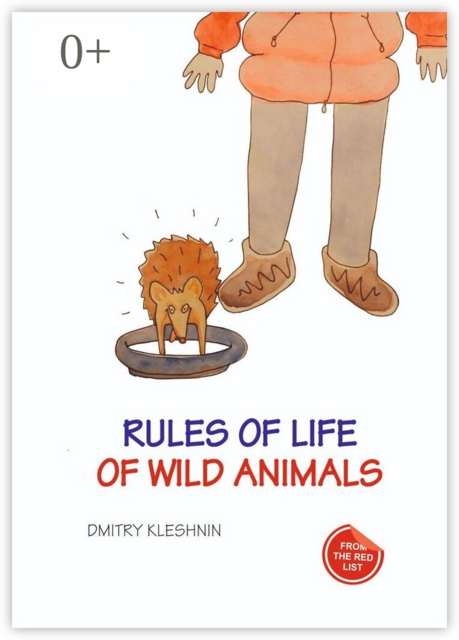
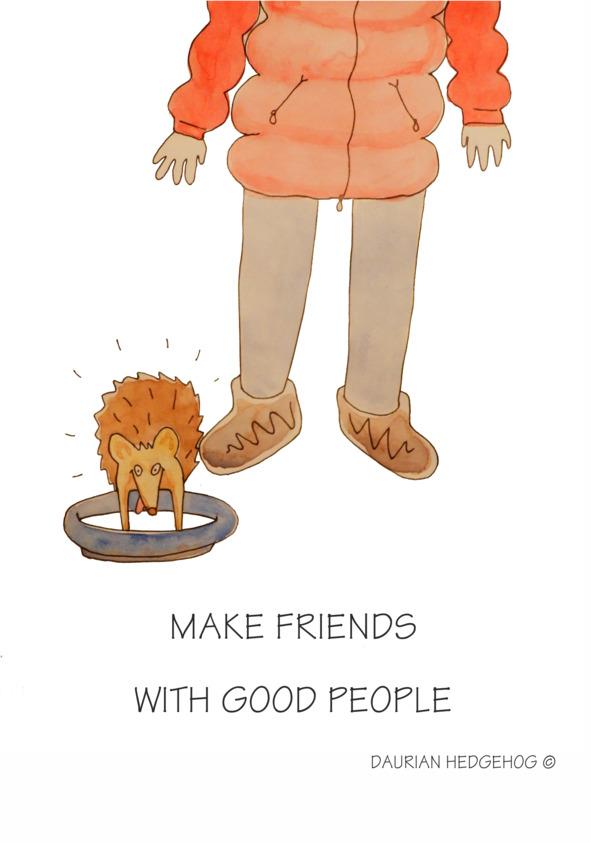
The Daurian hedgehog always knew how to be friends. He can find a friend in the steppe, in the taiga, in Transbaikalia, in China, and in Mongolia. And although the size of the Daurian hedgehog can reach only 30 cm, among his friends can be a bear and even a huge elephant. How does he manage to make new acquaintances? The answer is obvious. First, the Daurian hedgehog has a friendly character and non- prickly needles. Therefore, it is always nice to talk to him and iron. Secondly, the Daurian hedgehog is always dressed in a neat light beige suit made of stiff and short wool on the abdomen and legs, and its back is decorated with light needles.


The Caucasian forest cat always sets real goals in the countries of Eastern and Western Europe and Central Asia. Little is known about them, and there are reasons for this: a secretive lifestyle, hard-to-reach habitats, and an extreme lifestyle.

If a plane with parachutists soared into the sky, it means that there is a Caucasian forest cat preparing to jump. If there is a steep snow-covered slope, it means that the snowboard of the Caucasian forest cat will leave its mark on it. It always does. If there is something to do and conquer, the Caucasian forest cat will be there. And if you can’t see it, then the camouflage pattern of the animal’s fur is to blame.


The Mandarin is a duck that does not so much like to eat fruit as dress up in colorful clothes like a grandee of China. And despite her desire for a quiet family life, she does not forget to sometimes go out of her comfort zone in order to refresh her life. Therefore, the Mandarin often travels around the world: she comes to Russia, then flies to China, then sails to Ireland, England or the United States.

What, besides bright clothes and travel, is the Mandarin remarkable for?

1. Living in the mountains near rivers.

2. Ability to swim perfectly.

3. Fast and maneuverable flight.

4. Frequent, brooding sittings on trees or rocks.


The bezoar goat is very active at dusk. Floriculture is his hobby. Despite the fact that the bezoar goat rests throughout the day, its flowers are always well- groomed and watered. The whole family of the goat, which is from 5 to 25 individuals, takes care of some plant. Most often it is a ficus or geranium.

The bezoar goat is very fond of caring for females. And this helps him with his hobby, because the goats love to receive flowers as a gift.


Red wolf is always ready to come to the rescue like a superhero. It has a bright color, a long cloak and a large letter “S” on the chest. And although it is only about a meter long, and weighing no more than 21 kilograms, in an effort to help loved ones, it is a real champion. In appearance, the red wolf is very similar to a Fox, so it often has problems with villains-hunters. Like all superheroes, the red wolf has a special feature — it has a dark tip of the tail.

This species of wolf is found in the far East, China, and Mongolia.


Ringed seal is 70—100 kilograms of positive and good mood, living in ice-covered bays and fjords. The seal is always cheerful, cheerful and smiling. And, by the way, called ringed because of the pattern on the wool in the form of rings.

Ringed seals are not interested in forming colonies on Mars or Earth. They are equally happy both alone and in the company of 50 individuals on the rookery near the water. Ringed seal can laugh in the face of year-round stay at sea, as well as the harsh conditions of the Arctic. It is noteworthy that the seal laughs so much that it spread its lungs perfectly and began to easily spend 9 minutes under water, and if necessary, all 20 minutes.

At this point, the author leaves the reader without describing the characters in this book, and will not interfere with viewing the illustrations and reading the rules of life of wild animals. I am sure that you will be able to understand everything yourself and fantasize about “what they are, wild animals”.

Unlike domestic cats, which are 600 million in the world, or cows-1.3 billion individuals, the characters in this book are few and are under threat of extinction.

How many are left?

Yellow mottled — there is no exact data.

Mednovskiy blue Fox — 20—50.

Alpine weasel — there is no exact data.

Red wolf — there is no exact data.

Amur steppe polecat-there is no exact data.

Dressing — about 80.

Bison — 290.

Leopard — 48—50.

Small killer whale — 10—30.

Grey whale — 125—150.

Sakhalin musk deer — 120—125 thousand.

Manul — 3 thousand.

Caucasian forest cat-1800-3500.

The Amur tiger is 523—540.

The Caucasian jungle cat — 500.

Sea lion (Northern sea lion) — 68094.

Ringed seal — about 20 thousand.

Walrus — 5—10 thousand.

Atlantic white-sided Dolphin — 200—300 thousand.

An ordinary seal is about 3 thousand.

Black sea bottlenose Dolphin — about 7 thousand.

Grey Dolphin-there is no exact data.

Narwhal (unicorn) — about 40—50 thousand.

The porpoise is 1.2 thousand.

Beak-there is no exact data.

Gorbach — 20 thousand.

Kulan — 20 thousand individuals worldwide.

Northern finfish (herring whale) — no exact data available.

Przewalski’s Horse-300.

Ussuri spotted deer-less than 3000.

Reindeer — 951.9 thousand.

Bezoar goat-there is no exact data.

Altai mountain sheep (argali) — up to 1200.

Snow sheep — about 50 thousand.

Black-throated Loon-about 500.

Malaya kachurka — about 10 thousand pairs.

White-backed Albatross-no more than 300.

Pink Pelican — from 50 to 130 pairs per season.

Variegated Petrel — there is no exact data.

Crested cormorant — no more than 500 pairs.

Egyptian Heron — no more than 20 pairs.

Ibis — 8—11 individuals.

Spoonbill — 2000—3000 pairs.

Black stork-no more than 500 breeding pairs.

Loaf — up to 5 thousand pairs.

Common Flamingo-there is no exact data.

Red-breasted goose — 30—35 thousand.

Piskulka-there is no exact data.

Mandarin — no more than 15 thousand pairs.

Crested piebald — there is no exact data.

Scaly merganser — 5000 individuals.

Tarbagan (Mongolian marmot) — 10 million individuals.

Daurian hedgehog — 550—650 thousand individuals.

Russian muskrat — 30 thousand animals.

River beaver — 430 thousand.

The greater horseshoe bat mehely — about 1 thousand.

Blind mole-rat — 10 thousand.

The polar bear is 5—6 thousand.