автордың кітабын онлайн тегін оқу The Complete Works of Lucan. Illustrated
The Complete Works of Lucan
Illustrated
The Civil War
Lucan was a Roman poetand republican patriot.
He is regarded as one of the outstanding figures of the Imperial Latin period, known in particular for his epic Pharsalia. The Bellum civile, better known as the Pharsalia because of its vivid account of that battle, is remarkable as the single major Latin epic poem.
His youth and speed of composition set him apart from other poets.
The Translations
THE CIVIL WAR
PROSE TRANSLATION by J. D. Duff
BOOK I
OF war I sing, war worse than civil, waged over the plains of Emathia, and of legality conferred on crime; I tell how an imperial people turned their victorious right hands against their own vitals; how kindred fought against kindred; how, when the compact of tyranny was shattered, all the forces of the shaken world contended to make mankind guilty; how standards confronted hostile standards, eagles were matched against each other, and pilum threatened pilum.
What madness was this, my countrymen, what fierce orgy of slaughter? While the ghost of Crassus still wandered unavenged, and it was your duty to rob proud Babylon of her trophies over Italy, did you choose to give to hated nations the spectacle of Roman bloodshed, and to wage wars that could win no triumphs? Ah! with that blood shed by Roman hands how much of earth and sea might have been bought — where the sun rises and where night hides the stars, where the South is parched with burning airs, and where the rigour of winter that no spring can thaw binds the Scythian sea with icy cold! Ere this the Chinese might have passed under our yoke, and the savage Araxes, and any nation that knows the secret of Nile’s cradle. If Rome has such a lust for unlawful warfare, let her first subdue the whole earth to her sway and then commit self-slaughter; so far she has never lacked a foreign foe. But, if now in Italian cities the houses are half-demolished and the walls tottering, and the mighty stones of mouldering dwellings cumber the ground; if the houses are secured by the presence of no guard, and a mere handful of inhabitants wander over the site of ancient cities; if Italy bristles with thorn-brakes, and her soil lies unploughed year after year, and the fields call in vain for hands to till them, — these great disasters are not due to proud Pyrrhus or the Carthaginian; no other sword has been able to pierce so deep; the strokes of a kindred hand are driven home.
Still, if Fate could find no other way for the advent of Nero; if an everlasting kingdom costs the gods dear and heaven could not be ruled by its sovran, the Thunderer, before the battle with the fierce Giants, — then we complain no more against the gods: even such crimes and such guilt are not too high a price to pay. Let Pharsalia heap her awful plains with dead; let the shade of the Carthaginian be glutted with carnage; let the last battle be joined at fatal Munda; and though to these be added the famine of Perusia and the horrors of Mutina, the ships overwhelmed near stormy Leucas and the war against slaves hard by the flames of Etna, yet Rome owes much to civil war, because what was done was done for you, Caesar. When your watch on earth is over and you seek the stars at last, the celestial palace you prefer will welcome you, and the sky will be glad. Whether you choose to wield Jove’s sceptre, or to mount the fiery chariot of Phoebus and circle earth with your moving flame — earth unterrified by the transference of the sun; every god will give place to you, and Nature will leave it to you to determine what deity you wish to be, and where to establish your universal throne. But choose not your seat either in the Northern region or where the sultry sky of the opposing South sinks down: from these quarters your light would look aslant at your city of Rome. If you lean on any one part of boundless space, the axle of the sphere will be weighed down; maintain therefore the equipoise of heaven by remaining at the centre of the system. May that region of the sky be bright and clear, and may no clouds obstruct our view of Caesar! In that day let mankind lay down their arms and seek their own welfare, and let all nations love one another; let Peace fly over the earth and shut fast the iron gates of warlike Janus. But to me you are divine already; and if my breast receives you to inspire my verse, I would not care to trouble the god who rules mysterious Delphi, or to summon Bacchus from Nysa: you alone are sufficient to give strength to a Roman bard.
My mind moves me to set forth the causes of these great events. Huge is the task that opens before me — to show what cause drove peace from earth and forced a frenzied nation to take up arms. It was the chain of jealous fate, and the speedy fall which no eminence can escape; it was the grievous collapse of excessive weight, and Rome unable to support her own greatness. Even so, when the framework of the world is dissolved and the final hour, closing so many ages, reverts to primeval chaos, then [all the constellations will clash in confusion,] the fiery stars will drop into the sea, and earth, refusing to spread her shores out flat, will shake off the ocean; the moon will move in opposition to her brother, and claim to rule the day, disdaining to drive her chariot along her slanting orbit; and the whole distracted fabric of the shattered firmament will overthrow its laws. Great things come crashing down upon themselves — such is the limit of growth ordained by heaven for success. Nor did Fortune lend her grudge to any foreign nations, to use against the people that ruled earth and sea: the doom of Rome was due to Rome herself, when she became the joint property of three masters, and when despotism, which never before was shared among so many, struck its bloody bargain. Blinded by excess of ambition, the Three joined hands for mischief. What boots it to unite their strength and rule the world in common? As long as earth supports the sea and air the earth; as long as his unending task shall make the sun go round, and night shall follow day in the heavens, each passing through the same number of signs — so long will loyalty be impossible between sharers in tyranny, and great place will resent a partner. Search not the history of foreign nations for proof, nor look far for an instance of Fate’s decree: the rising walls of Rome were wetted with a brother’s blood. Nor was such madness rewarded then by lordship over land and sea: the narrow bounds of the Asylum pitted its owners one against the other.
For a brief space the jarring harmony was maintained, and there was peace despite the will of the chiefs; for Crassus, who stood between, was the only check on imminent war. So the Isthmus of Corinth divides the main and parts two seas with its slender line, forbidding them to mingle their waters; but if its soil were withdrawn, it would dash the Ionian sea against the Aegean. Thus Crassus kept apart the eager combatants; but when he met his pitiable end and stained Syrian Carrhae with Roman blood, the loss inflicted by Parthia let loose the madness of Rome. By that battle the Parthians did more than they realise: they visited the vanquished with civil war. The tyrants’ power was divided by the sword; and the wealth of the imperial people, that possessed sea and land the whole world over, was not enough for two. For, when Julia was cut off by the cruel hand of Fate, she bore with her to the world below the bond of affinity and the marriage which the dread omen turned to mourning. She alone, had Fate granted her longer life, might have restrained the rage of her husband on one side and her father on the other; she might have struck down their swords and joined their armed hands, as the Sabine women stood between and reconciled their fathers to their husbands. But loyalty was shattered by the death of Julia, and leave was given to the chiefs to begin the conflict. Rivalry in worth spurred them on; for Magnus feared that fresher exploits might dim his past triumphs, and that his victory over the pirates might give place to the conquest of Gaul, while Caesar was urged on by continuous effort and familiarity with warfare, and by fortune that brooked no second place. Caesar could no longer endure a superior, nor Pompey an equal. Which had the fairer pretext for warfare, we may not know: each has high authority to support him; for, if the victor had the gods on his side, the vanquished had Cato. The two rivals were ill-matched. The one was somewhat tamed by declining years; for long he had worn the toga and forgotten in peace the leader’s part; courting reputation and lavish to the common people, he was swayed entirely by the breath of popularity and delighted in the applause that hailed him in the theatre he built; and trusting fondly to his former greatness, he did nothing to support it by fresh power. The mere shadow of a mighty name he stood. Thus an oak-tree, laden with the ancient trophies of a nation and the consecrated gifts of conquerors, towers in a fruitful field; but the roots it clings by have lost their toughness, and it stands by its weight alone, throwing out bare boughs into the sky and making a shade not with leaves but with its trunk; though it totters doomed to fall at the first gale, while many trees with sound timber rise beside it, yet it alone is worshipped. But Caesar had more than a mere name and military reputation: his energy could never rest, and his one disgrace was to conquer without war. He was alert and headstrong; his arms answered every summons of ambition or resentment; he never shrank from using the sword lightly; he followed up each success and snatched at the favour of Fortune, overthrowing every obstacle on his path to supreme power, and rejoicing to clear the way before him by destruction.
Even so the lightning is driven forth by wind through the clouds: with noise of the smitten heaven and crashing of the firmament it flashes out and cracks the daylight sky, striking fear and terror into mankind and dazzling the eye with slanting flame. It rushes to its appointed quarter of the sky; nor can any solid matter forbid its free course, but both falling and returning it spreads destruction far and wide and gathers again its scattered fires.
Such were the motives of the leaders. But among the people there were hidden causes of war — the causes which have ever brought down ruin upon imperial race. For when Rome had conquered the world and Fortune showered excess of wealth upon her, virtue was dethroned by prosperity, and the spoil taken from the enemy lured men to extravagance: they set no limit to their wealth or their dwellings; greed rejected the food that once sufficed; men seized for their use garments scarce decent for women to wear; poverty, the mother of manhood, became a bugbear; and from all the earth was brought the special bane of each nation. Next they stretched wide the boundaries of their lands, till those acres, which once were furrowed by the iron plough of Camillus and felt the spade of a Curius long ago, grew into vast estates tilled by foreign cultivators. Such a nation could find no pleasure in peace and quiet, nor leave the sword alone and grow fat on their own freedom. Hence they were quick to anger, and crime prompted by poverty was lightly regarded; to overawe the State was high distinction which justified recourse to the sword; and might became the standard of right. Hence came laws and decrees of the people passed by violence; and consuls and tribunes alike threw justice into confusion; hence office was snatched by bribery and the people put up its own support for auction, while corruption, repeating year by year the venal competition of the Campus, destroyed the State; hence came devouring usury and interest that looks greedily to the day of payment; credit was shattered, and many found their profit in war.
And now Caesar had hastened across the frozen Alps and had conceived in his heart the great rebellion and the coming war. When he reached the little river Rubicon, the general saw a vision of his distressed country. Her mighty image was clearly seen in the darkness of night; her face expressed deep sorrow, and from her head, crowned with towers, the white hair streamed abroad; she stood beside him with tresses torn and arms bare, and her speech was broken by sobs: “Whither do ye inarch further? and whither do ye bear my standards, ye warriors? If ye come as law abiding citizens here must ye stop.” Then trembling smote the leader’s limbs, his hair stood on end, a faintness stopped his motion and fettered his feet on the edge of the river-bank. But soon he spoke: “O God of thunder, who from the Tarpeian rock lookest out over the walls of the great city; O ye Trojan gods of the house of lulus, and mysteries of Quirinus snatched from earth; O Jupiter of Latium, who dwellest on Alba’s height, and ye fires of Vesta; and thou, O Rome, as sacred a name as any, smile on my enterprise; I do not attack thee in frantic warfare; behold me here, me Caesar, a conqueror by land and sea and everywhere thy champion, as I would be now also, were it possible. His, his shall be the guilt, who has made me thine enemy.” Then he loosed war from its bonds and carried his standards in haste over the swollen stream. So on the untilled fields of sultry Libya, when the lion sees his foe at hand, he crouches down at first uncertain till he gathers all his rage; but soon, when he has maddened himself with the cruel lash of his tail, and made his mane stand up, and sent forth a roar from his cavernous jaws, then, if the brandished lance of the nimble Moor stick in his flesh or a spear pierce his great chest, he passes on along the length of the weapon, careless of so sore a wound.
The ruddy river Rubicon glides through the bottom of the valleys and serves as a fixed landmark to divide the land of Gaul from the farms of Italy. Issuing from a modest spring, it runs with scanty stream in the heat of burning summer; but now it was swollen by winter; and its waters were increased by the third rising of a rainy moon with moisture laden horn, and by Alpine snows which damp blasts of wind had melted. First the cavalry took station slantwise across the stream, to meet its flow; thus the current was broken, and the rest of the army forded the water with ease. When Caesar had crossed the stream and reached the Italian bank on the further side, he halted on the forbidden territory: “Here,” he cried, “here I leave peace behind me and legality which has been scorned already; henceforth I follow Fortune. Hereafter let me hear no more of agreements. In them I have put my trust long enough; now I must seek the arbitrament of war.” Thus spoke the leader and quickly urged his army on through the darkness of night. Faster he goes than the bullet whirled from the Balearic sling, or the arrow which the Parthian shoots over his shoulder. Ariminum was the nearest town, and he brought terror there, when the stars were fleeing from the sunlight and the morning star alone was left. So the day dawned that was to witness the first turmoil of the war; but clouds veiled the mournful light, either because the gods so willed or because the stormy South wind had driven them up. When the soldiers halted in the captured forum and were bidden to lay down their standards, the blare of trumpets and shrill note of clarions together with the boom of horns sounded the alarm of civil war. The inhabitants were roused from sleep. Starting from their beds, the men snatched down the arms that hung beside the household gods — such arms as the long peace supplied: they lay hold on shields that are falling to pieces with framework exposed, javelins with their points bent, and swords roughened by the bite of black rust. But when they recognised the glitter of the Roman eagles and standards and saw Caesar mounted in the midst of his army, they stood motionless with fear, terror seized their chilly limbs, and these unuttered complaints they turn over in their silent breasts: “Alas for our town, built with Gaul beside it and doomed by its unlucky site to misfortune! Over all the earth there is profound peace and unbroken quiet; but we are the booty and first bivouac of these madmen. Fate would have been kinder if she had placed us under the Eastern sky or the frozen North, and made us guard the tents of nomads rather than the gates of Italy. We were the first to witness the movement of the Senones, the onrush of the Cimbrian, the sword of Hannibal, and the wild career of the Teutones : whenever Fortune attacks Rome, the warriors take their way through us.” This was each man’s muffled groan; none dared to utter his fear aloud, nor was any voice lent to their grief; such is the silence of the country when winter strikes the birds dumb, and such the silence of mid-ocean in still weather. When light had banished the cold shades of night, lo! destiny kindled the flame of war, applying to Caesar’s hesitating heart the spur that pricked him to battle, and bursting all the barriers that reverence opposed. Fate was determined to justify Caesar’s rebellion, and she found excuse for drawing the sword. For the Senate, trampling on the laws, had menaced and driven out the wrangling tribunes from the distracted city, and boasted of the doom of the Gracchi; and now the fugitives made for Caesar’s camp, already far advanced and close to Rome. With them came Curio of the reckless heart and venal tongue; yet once he had been the spokesman of the people and a bold champion of freedom, who dared to bring down the armed chiefs to the level of the crowd. When Curio saw Caesar turning over shifting counsels in his heart, he spoke thus: “Caesar, while my voice could serve your side and when I was permitted to hold the Rostrum and bring over doubting citizens to your interest, I prolonged your command in defiance of the Senate. But now law has been silenced by the constraint of war, and we have been driven from our country. We suffer exile willingly, because, your victory will make us citizens again. While your foes are in confusion and before they have gathered strength, make haste; delay is ever fatal to those who are prepared. The toil and danger are no greater than before, but the prize you seek is higher. Twice five years Gaul kept you fighting; but how small a part of the earth is Gaul! Win but two or three battles, and it will be for you that Rome has subdued the world. As it is, no long triumphal procession awaits your return, nor does the Capitol demand your consecrated laurels; gnawing envy denies you all things, and you will scarce go unpunished for your conquest of foreign nations. Your daughter’s husband has resolved to thrust you down from sovereignty. Half the world you may not have, but you can have the whole world for yourself.” Eager for war as Caesar was already, these words of Curio increased his rage and fired his ardour none the less; so the race-horse at Olympia is encouraged by the shouting, although he is already pressing against the gates of the closed barrier and seeking to loosen the bolts with his forehead. At once Caesar summoned his armed companies to the standards; his mien quieted the bustle and confusion of the assembling troops, his right hand commanded silence, and thus he spoke: “Men who have fought and faced with me the peril of battle a thousand times, for ten years past you have been victorious. Is this your reward for blood shed on the fields of the North, for wounds and death, and for winters passed beside the Alps? The huge hubbub of war with which Rome is shaken could be no greater, if Carthaginian Hannibal had crossed the Alps. Cohorts are raised to their full strength with recruits; every forest is felled to make ships; the word has gone forth that Caesar be chased by land and sea. What would my foes do if my standards lay prostrate in defeat and the tribes of Gaul were rushing in triumph to attack my rear? As it is, when Fate deals kindly with me and the gods summon me to the highest place, my foes challenge me. Let their leader, enervated by long peace, come forth to war with his hasty levies and un warlike partisans — Marcellus, that man of words, and Cato, that empty name. Shall Pompey forsooth be glutted by his vile and venal minions with despotic power renewed so often without a break? Shall Pompey hold the chariot reins before reaching the lawful age? Shall Pompey cling for ever to the posts he has once usurped? Why should I next complain that he took into his own hands the harvests of the whole world and forced famine to do his bidding? Who knows not how the barrack invaded the frightened law-court, when soldiers with the grim glitter of their swords stood round the uneasy and astonished jurors? how the warrior dared to break into the sanctuary of justice, and Pompey’s standards besieged Milo in the dock? Now once again, to escape the burden of an obscure old age, Pompey is scheming unlawful warfare. Civil war is familiar to him: he was taught wickedness by Sulla and is like to outdo his teacher. As the fierce tiger, who has drunk deep of the blood of slain cattle when following his dam from lair to lair in the Hyrcanian jungle, never after loses his ferocity, so Magnus, once wont to lick the sword of Sulla, is thirsty still. When blood has once been swallowed, it never permits the throat it has tainted to lose its cruelty. Will power so long continued ever find an end, or crime a limit? He is never content; but let him learn one lesson at least from his master, Sulla — to step down at this stage from his unlawful power. First came the roving Cilicians, and then the lingering warfare with the King of Pontus — warfare hardly completed by the infamy of poison; shall I, Caesar, be assigned to Pompey as his crowning task, because, when bidden lay down my victorious eagles, I was disobedient? But, if I am robbed of the reward for my labours, let my soldiers at least, without their leader, receive the recompense of their long service; and let them triumph, be their leader who he may. What harbour of peace will they find for their feeble old age, what dwelling-place for their retirement? What lands will my veterans receive to till, what walls to shelter their war-worn frames? Shall Magnus give the pirates preference as colonists? Lift up, lift up the standards that have long been victorious! We must employ the strength we have created. He who denies his due to the strong man armed grants him everything. Nor will the favour of Heaven fail us; for neither booty nor empire is the object of my warfare: we are but dislodging a tyrant from a State prepared to bow the knee.”
Thus he spoke; but the men wavered and muttered doubtfully under their breath with no certain sound. Fierce as they were with bloodshed and proud of heart, they were unnerved by love of their country and their country’s gods, till brought to heel by horrid love of slaughter and fear of their leader. Then Laelius, who held the rank of chief centurion and bore the decoration of a well-earned badge — the oak-leaves which are the reward for saving a Roman’s life — cried out thus: “Mightiest captain of the Roman nation, if I have leave to speak and if it be right to confess the truth, our complaint is, that you have borne too much and restrained your strength too long. Was it confidence in us that you lacked? While the warm blood gives motion to these breathing frames, and while our muscles have strength to hurl the pilum, will you submit to the disgrace of wearing the toga and to the tyranny of the Senate? Is it so wretched a fate to be victorious in a civil war? Lead us straightway through the tribes of Scythia, or the inhospitable shore of the Syrtes, or the burning sands of thirsty Libya — that we might leave a conquered world at our backs, these hands tamed with the oar the swelling waves of Ocean and the foaming eddies of the northern Rhine — I must have as much power as will to follow where you lead. If I hear your trumpet sound the charge against any man, he is no countryman of mine. By your standards, victorious in ten campaigns, and by your triumphs I swear, whoever be the foe whom you triumph over — if you bid me bury my sword in my brother’s breast or my father’s throat or the body of my teeming wife, I — will perform it all, even if my hand be reluctant. If you bid me plunder the gods and fire their temples, the furnace of the military mint shall melt down the statues of the deities; if you bid me pitch the camp by the waters of Etruscan Tiber, I shall make bold to invade the fields of Italy and there mark out the lines; whatever walls you wish to level, these arms shall ply the ram and scatter the stones asunder, even if the city you doom to utter destruction be Rome.” To this speech all the cohorts together signified their assent, raising their hands on high and promising their aid in any war to which Caesar summoned them. Their shout rose to heaven: as loud as, when the Thracian North wind bears down upon the cliffs of pine-clad Ossa, the forest roars as the trees are bent towards earth, or again as they rebound into the sky.
When Caesar saw that war was so eagerly welcomed by the soldiers, and that Fate was favourable, he would not by any slackness delay the course of destiny, but summoned his detachments scattered through the land of Gaul and moved his standards from every quarter for the march on Rome. The soldiers left their tents pitched by Lake Leman among the mountains, and the camp which crowned the winding bank of the Vosegus, and controlled the warlike Lingones with their painted weapons. Others left the fords of the Isara — the river which travels so far with its own waters and then falls into a more famous stream, losing its name before it reaches the sea. The fair-haired Ruthenians were freed from the garrison that long had held them; the gentle Atax, and the Varus, the boundary of Italy enlarged, rejoiced to carry no Roman keels; free was the harbour sacred under the name of Hercules, whose hollow cliff encroaches on the sea — over it neither Corus nor Zephyrus has power: Circius alone stirs up the shore and keeps it to himself and bars the safe roadstead of Monoecus; and free the strip of disputed coast, claimed in turn by land and sea, when the enormous Ocean either flows in or withdraws with ebbing waves. Does some wind from the horizon drive the sea thus on and fail it as it carries it? Or are the waves of restless Tethys attracted by the second of the heavenly bodies and stirred by the phases of the moon? Or does fire-bearing Titan, in order to quaff the waves that feed him, lift up the Ocean and draw its billows skyward? I leave the enquiry to those who study the workings of the universe: for me, let the cause, whatever it be, that produces such constant movements, remain, as the gods have wished it to remain, for ever hidden. Gone are the soldiers who held the region of the Nemes and banks of the Atyrus, where the Tarbellians hem in the sea that beats lightly against the winding shore. The departure of their foe brings joy to the Santoni and Bituriges; to the Suessones, nimble in spite of their long spears; to the Leuci and Remi who excel in hurling the javelin, and to the Sequani who excel in wheeling their bitted steeds; to the Belgae, skilled in driving the war-chariot invented by others, and to the Arvernian clan who falsely claim descent from Troy and brotherhood with Rome; to the Nervii, too prone to rebel against us and stained by breach of their treaty with slaughtered Cotta; to the Vangiones, who wear loose trousers like the Sarmatians, and to the fierce Batavians, whose courage is roused by the blare of curved bronze trumpets. There is joy where the waters of Cinga stray, where the Rhone snatches the Arar in swift current and bears it to the sea, and where a tribe perches on the mountain heights and inhabits the snow-covered rocks of the Cevennes. The Treviri too rejoiced that the troops were moved; so did the Ligurians with hair now cropped, though once they excelled all the longhaired land in the locks that fell in beauty over their necks; and those who propitiate with horrid victims ruthless Teutates, and Esus whose savage shrine makes men shudder, and Taranis, whose altar is no more benign than that of Scythian Diana. The Bards also, who by the praises of their verse transmit to distant ages the fame of heroes slain in battle, poured forth at ease their lays in abundance. And the Druids, laying down their arms, went back to the barbarous rites and weird ceremonies of their worship. (To them alone is granted knowledge — or ignorance, it may be — of gods and celestial powers; they dwell in deep forests with sequestered groves; they teach that the soul does not descend to the silent land of Erebus and the sunless realm of Dis below, but that the same breath still governs the limbs in a different scene. If their tale be true, death is but a point in the midst of continuous life. Truly the nations on whom the Pole star looks down are happily deceived; for they are free from that king of terrors, the fear of death. This gives the warrior his eagerness to rush upon the steel, his courage to face death, and his conviction that it is cowardly to be careful of a life that will come back to him again.) The soldiers also set to keep the long-haired Cayci away from the Belgae, left the savage banks of the Rhine and made for Rome; and the empire was left bare to foreign nations.
When Caesar’s might was gathered together and his huge forces encouraged him to larger enterprise, he spread all over Italy and occupied the nearest towns. False report, swift harbinger of imminent war, was added to reasonable fears, invading men’s minds with presentiments of disaster, and loosing countless tongues to spread lying tales. The messengers report that horsemen are charging in fierce combat on the wide plains that breed Mevania’s bulls; that the foreign cavalry of fierce Caesar are riding to and fro where the Nar joins the Tiber; and that their leader, advancing all his collected eagles and standards, is marching on with many a column and crowded camps. Men’s present view of him differs from their recollection: they think of him as a monster, more savage than the foe he has conquered. Men say that the tribes which dwell between the Rhine and the Elbe, uprooted from their northern homes, are following in his rear; and that the word has gone forth that Rome, under the eyes of the Romans, shall be sacked by savage nations. Thus each by his fears adds strength to rumour, and all dread the unconfirmed dangers invented by themselves. Nor was the populace alone stricken with groundless fear. The Senate House was moved; the Fathers themselves sprang up from their seats; and the Senate fled, deputing to the consuls the dreaded declaration of war. Then, knowing not where to seek refuge or where to flee danger, each treads on the heels of the hastening population, wherever impetuous flight carries him. Forth they rush in long unbroken columns; one might think that impious firebrands had seized hold of the houses, or that the buildings were swaying and tottering in an earthquake shock. For the frenzied crowd rushed headlong through the city with no fixed purpose, and as if the one chance of relief from ruin were to get outside their native walls. So, when the stormy South wind has driven the vast sea from the Syrtes of Libya and the heavy mast with its sails has come crashing down, the skipper abandons the helm and leaps down with his crew into the sea, and each man makes shipwreck for himself before the planks of the hull are broken asunder. Thus Rome is abandoned, and flight is the preparation for war. No aged father had the power to keep back his son, nor weeping wife her husband; none was detained by the ancestral gods of his household, till he could frame a prayer for preservation from danger; none lingered on his threshold ere he departed, to satiate his eyes with the sight of the city he loved and might never see again. Nothing could keep back the wild rush of the people. How ready are the gods to grant supremacy to men, and how unready to maintain it! Rome that was crowded with citizens and conquered peoples, Rome that could contain the human race assembled, was left by coward hands an easy prey to invading Caesar. When the Roman soldier is closely besieged by the foeman in a distant land, he defies the perils of the night behind a slender palisade; hastily he throws up the sods, and the protection of his mound lets him sleep untroubled in his tent. But Rome is abandoned as soon as the word “war” is heard; her walls are no safeguard for a single night. Yet such panic fear must be forgiven; Pompey in flight gives cause for terror. Then, that no hope even for the future might relieve anxiety, clear proof was given of worse to come, and the menacing gods filled earth, sky, and sea with portents. The darkness of night saw stars before unknown, the sky blazing with fire, lights shooting athwart the void of heaven, and the hair of the baleful star — the comet which portends change to monarchs. The lightning flashed incessantly in a sky of delusive clearness, and the fire, flickering in the heavens, took various shapes in the thick atmosphere, now flaring far like a javelin, and now like a torch with fan-like tail. A thunderbolt, without noise or any clouds, gathered fire from the North and smote the capital of Latium. The lesser stars, which are wont to move along the sunless sky by night, now became visible at noon. The moon, when her horns were united in one and she was reflecting her brother luminary with her disk at the full, suddenly was smitten by the earth’s shadow and grew dim. The sun himself, while rearing his head in the zenith, hid his burning chariot in black darkness and veiled his sphere in gloom, forcing mankind to despair of daylight; even such a darkness crept over Mycenae, the city of Thyestes, when the sun fled back to where he rose. In Sicily fierce Mulciber opened wide the mouths of Etna; nor did he lift its flames skyward, but the fire bowed its crest and fell on the Italian shore. Black Charybdis churned up waves of blood from the bottom of the sea, and the angry bark of Scylla’s dogs sank into a whine. From Vesta’s altar the fire vanished suddenly; and the bonfire which marks the end of the Latin Festival split into two and rose, like the pyre of the Thebans, with double crest. The earth also stopped short upon its axis, and the Alps dislodged the snow of ages from their tottering summits; and the sea filled western Calpe and remotest Atlas with a flood of waters. If tales are true, the national deities shed tears, the sweating of the household gods bore witness to the city’s woe, offerings fell from their place in the temples, birds of ill omen cast a gloom upon the daylight, and wild beasts, leaving the woods by night, made bold to place their lairs in the heart of Rome. Also, the tongues of brutes became capable of human speech; and women gave birth to creatures monstrous in the size and number of their limbs, and mothers were appalled by the babes they bore; and boding prophecies spoken by the Sibyl of Cumae passed from mouth to mouth. Again, the worshippers who gash their arms, inspired by fierce Bellona chanted of heaven’s wrath, and the Galli whirled round their gory locks and shrieked disaster to the nations. Groans came forth from urns filled with the ashes of dead men. The crash of arms was heard also, and loud cries in pathless forests, and the noise of spectral armies closing in battle. From the fields nearest the outside walls the inhabitants fled in all directions; for the giant figure of a Fury stalked round the city, shaking her hissing hair and a pine-tree whose flaming crest she held downwards, Such was the Fury that maddened Agave at Thebes or launched the bolts of fierce Lycurgus; and such was Megaera, when, as the minister of Juno’s cruelty, she terrified Hercules, though he had seen Hell already. Trumpets sounded; and dark nights, when winds were still, gave forth a shouting loud as when armies meet. The ghost of Sulla was seen to rise in the centre of the Campus and prophesied disaster, while Marius burst his sepulchre and scattered the country-people in flight by rearing his head beside the cool waters of the Anio.
Therefore it was resolved to follow ancient custom and summon seers from Etruria. The oldest of these was Arruns who dwelt in the deserted city of Luca; the course of the thunderbolt, the marks on entrails yet warm, and the warning of each wing that strays through the sky, had no secrets for him. First, he bids the destruction of monsters, which nature, at variance with herself, had brought forth from no seed, and orders that the abominable fruit of a barren womb shall be burned with wood of evil omen. Next, at his bidding the scared citizens march right round the city; and the pontiffs, who have licence to perform the ceremony, purify the walls with solemn lustration and move round the outer limit of the long pomerium. Behind them come the train of inferior priests, close-girt in Gabine fashion. The band of Vestals is led by a priestess with a fillet on her brows, to whom alone it is permitted to set eyes on Trojan Minerva; next are those who preserve the prophecies of the gods and mystic hymns, and who recall Cybele from her bath in the little river Almo; then the Augurs, skilled to observe birds flying on the left, the Seven who hold festival at banquets, the Titian guild, the Salii who bear the Shields in triumph on their shoulders, and the Flamen, raising aloft on his highborn head the pointed cap. While the long procession winds its way round the wide city, Arruns collects the scattered fires of the thunderbolt and hides them in the earth with doleful muttering. He gives sanctity to the spot, and next brings near to the holy altar a bull with neck chosen for the sacrifice. When he began to pour wine and to sprinkle meal with slanting knife, the victim struggled long against the unacceptable sacrifice; but when the high-girt attendants thrust down its formidable horns, it sank to the ground and offered its helpless neck to the blow. No red blood spouted forth from the gaping wound, but a slimy liquid, strange and dreadful, came out instead. Appalled by the funereal rite, Arruns turned pale and snatched up the entrails, to seek there the anger of the gods. Their very colour alarmed him: the sickly organs were marked with malignant spots, coloured with congealed gore, and chequered all over with dark patches and blood-spots. He saw the liver flabby with corruption and with boding streaks in its hostile half. the extremity of the panting lung is invisible, and a puny membrane divides the vital organs. The heart is flattened, the entrails exude corrupted blood through gaping cracks, and the caul reveals its hiding-place. And lo! he sees a horror which never yet was seen in a victim’s entrails without mischief following: a great second lobe is growing upon the lobe of the liver; one half droops sickly and flabby, while the other throbs fast and drives the veins with rapid beat. When thus he had grasped the prediction of great disaster, “Scarce may I,” he cried aloud, “reveal to men’s ears all the ills that the gods are preparing. Not with mightiest Jupiter has this my sacrifice found favour; but the infernal gods have entered into the body of the slaughtered bull. What we fear is unspeakable; but the sequel will be worse than our fears. May the gods give a favourable turn to what we have witnessed! May the entrails prove false, and may the lore of our founder Tages turn out a mere imposture!” Thus the Tuscan told the future, veiling it in obscurity and hiding it with much ambiguity.
Figulus also spoke, Figulus, whose study it was to know the gods and the secrets of the sky, Figulus, whom not even Egyptian Memphis could match in observation of the heavens and calculations that keep pace with the stars. “Either,” said he, “this universe strays for ever governed by no law, and the stars move to and fro with course unfixed; or else, if they are guided by destiny, speedy destruction is preparing for Rome and for mankind. Will the earth gape and cities be swallowed up? Or will burning heat destroy our temperate clime? Will the soil break faith and deny its produce? Or will water everywhere be tainted with streams of poison? What kind of disaster are the gods preparing? What form of ruin will their anger assume? The lives of multitudes are doomed to end together. If Saturn, that cold baleful planet, were now kindling his black fires in the zenith, then Aquarius would have poured down such rains as Deucalion saw, and the whole earth would have been hidden under the waste of waters. Or if the sun’s rays were now passing over the fierce Lion of Nemea, then fire would stream over all the world, and the upper air would be kindled and consumed by the sun’s chariot. These heavenly bodies are not active now. But Mars — what dreadful purpose has he, when he kindles the Scorpion menacing with fiery tail and scorches its claws? For the benign star of Jupiter is hidden deep in the West, the healthful planet Venus is dim, and Mercury’s swift motion is stayed; Mars alone lords it in heaven. Why have the constellations fled from their courses, to move darkling through the sky, while the side of sword-girt Orion shines all too bright? The madness of war is upon us, when the power of the sword shall violently upset all legality, and atrocious crime shall be called heroism. This frenzy will last for many years; and it is useless to pray Heaven that it may end: when peace comes, a tyrant will come with it. Let Rome prolong the unbroken series of suffering and draw out her agony for ages: only while civil war lasts, shall she henceforth be free.”
These forebodings were enough to alarm and terrify the populace; but worse was close at hand. For, as a Bacchanal, filled with Theban Lyaeus, speeds down from the summit of Pindus, in such guise a matron rushed through the appalled city, revealing by these cries the pressure of Phoebus upon her bosom: “Whither am I borne, O Paean, in haste across the sky? In what land do you set my feet? I see Pangaeus white with snow-clad ridges, I see Philippi spread out beneath the crag of Haemus: say, Phoebus, what madness is this that drives Romans to fight Romans; what war is this without a foe? Whither next am I borne to a different quarter? You take me to the far East, where the waters of Egyptian Nile stain the sea: him I recognise, that headless corpse lying on the river sands. The grim goddess of war has shifted the ranks of Pharsalia across the sea to treacherous Syrtis and parched Libya: thither also am I carried. Next I am spirited away over the cloud-capped Alps and soaring Pyrenees. Back I return to my native city, where the civil war finds its end in the very Senate House. Again the factions raise their heads; again I make the circuit of the earth. Grant me, Phoebus, to behold a different shore and a different land: Philippi I have seen already.” So she spoke and fell down, abandoned by the frenzy that now was spent.
BOOK II
AND now heaven’s wrath was revealed; the universe gave clear signs of battle; and Nature, conscious of the future, reversed the laws and ordinances of life, and, while the hurly-burly bred monsters, proclaimed civil war. Why didst thou, Ruler of Olympus, see fit to lay on suffering mortals this additional burden, that they should learn the approach of calamity by awful portents? Whether the author of the universe, when the fire gave place and he first took in hand the shapeless realm of raw matter, established the chain of causes for all eternity, and bound himself as well by universal law, and portioned out the universe, which endures the ages prescribed for it, by a fixed line of destiny; or whether nothing is ordained and Fortune, moving at random, brings round the cycle of events, and chance is master of mankind — in either case, let thy purpose, whatever it be, be sudden; let the mind of man be blind to coming doom; he fears, but leave him hope.
Therefore, when men perceived the mighty disasters which the truthfulness of the gods would cost the world, business ceased and gloom prevailed throughout Rome; the magistrates disguised themselves in the dress of the people; no purple accompanied the lictors’ rods. Moreover, men restrained their lamentations, and a deep dumb grief pervaded the people. (So, at the moment of death a household is stunned and speechless, before the body is lamented and laid out, and before the mother with dishevelled hair summons her maidens to beat their breasts with cruel arms: she still embraces the limbs stiff with the departure of life, and the inanimate features, with eyes fierce in death. Fear she feels no longer, but grief not yet: incapable of thought she hangs over her son and marvels at her loss.) The matrons put off their former garb and occupied the temples in mournful companies. Some sprinkled the images with their tears; others dashed their breasts against the hard floor; in their frenzy they shed their torn locks over the consecrated threshold and struck with repeated shrieks the ears accustomed to be addressed with prayer. Nor did they all prostrate themselves in the temple of the supreme Thunderer: they parted the gods among them, and no altar lacked a mother to call down shame upon it. One of them, whose cheeks were wet and torn, and her shoulders black and discoloured by blows, spoke thus: “Now, wretched mothers, now is the time to beat your breasts and tear your hair. Do not delay your grief, nor keep it for the crowning sorrows. Now we have power to weep, while the destiny of the rival leaders is undecided; but, when either is victorious, we must perforce rejoice” Thus grief works itself up and fans its own flame. — The men also, setting out for the war and for the camps of the rivals, poured out just complaints against the cruel gods: “Wretched is our lot, that we were not born into the age of the Punic wars, that we were not the men who fought at Cannae and the Trebia. We do not pray the gods for peace: let them put rage into foreign nations and rouse up at once barbarian countries. Let the whole world band itself together for war; let armies of Medes swoop down from Persian Susa; let the northern Danube fail to bar the Massagetae; let the Elbe and the unconquered mouth of the Rhine send out swarms of fair-haired Suebians from the uttermost North; make us foes to every nation — but let civil war pass from us! Let the Dacians attack us on one side, the Getae on the other; let one of the rivals confront the Spaniards, and the other turn his standards against the quivers of the; let every Roman hand grasp a sword. Or, if it be heaven’s purpose to destroy the Roman race, let the mighty firmament gather itself in flame and fall down on earth in the shape of thunderbolts. O ruthless Author of the universe, strike both parties and both rivals at once with the same bolt, while they are still innocent! Must they produce such a monstrous crop of crime, in order to settle which of the two shall be master of Rome? Civil war were a price almost too high to pay for the failure of both.” Such were the complaints poured forth by patriotism that was soon to pass away. Unhappy parents too were tortured by a sorrow of their own: they curse the prolongation of grievous old age, and lament that they have lived to see a second civil war. And thus spoke one of them who sought precedents for his great fear: “As great were the disturbances prepared by Fate, when victorious Marius, who had triumphed over the Teutones and the African, was driven out to hide his head in the miry sedge. Engulfing quicksands and spongy marshes hid the secret that Fortune had placed there; and later the old man’s flesh was corroded by iron fetters and the squalor of long captivity. He was yet to die as Fortune’s favourite, as consul in Rome which he had ruined; but first he suffered for his guilt. Death itself often fled from him. When power to take his hated life was granted to a foeman, naught came of it; for, in beginning the deed of slaughter, the man was palsied and let the sword slip from his strengthless hand. A great light shone in the prison darkness; he saw the awful deities that wait on crime, and he saw Marius as he was yet to be; and he heard a dreadful voice— ‘You are not permitted to touch that neck. Before he dies himself, Marius must, by the laws that govern the ages, bring death to many. Lay aside your useless rage.’ If the Cimbri wish to avenge the extinction of their slaughtered race, they should let the old man live. No divine favour, but the exceeding wrath of heaven, has guarded the life of that man of blood, in whom Fortune finds a perfect instrument for the destruction of Rome. — Next he was conveyed over an angry sea to a hostile soil, where he was chased through deserted villages; he couched down in the devastated realm of Jugurtha who had graced his triumph, and the ashes of Carthage were his bed. Carthage and Marius both drew consolation for their destiny ; both alike prostrate, they pardoned Heaven. In Africa he nursed a hate like Hannibal’s. As soon as Fortune smiled again, he set free bands of slaves; the prisoners melted down their fetters and stretched forth their hands for slaughter. He suffered none to bear his standards, except men already inured to crime, men who brought guilt with them to the camp. Shame upon Fate! How dread that day, the day when victorious, Marius seized the city! With what mighty strides cruel death stalked abroad! High and low were slain alike; the sword strayed far and wide; and no breast was spared the steel. Pools of blood stood in the temples; constant carnage wetted the red and slippery pavement. None was protected by his age: the slayer did not scruple to anticipate the last day of declining age, or to cut short the early prime of a hapless infant in the dawn of life. How was it possible that children should deserve death for any crime? But it was enough to have already a life to lose. The violence of frenzy was itself an incentive; and it was deemed the part of a laggard to look for guilt in a victim. Many were slain merely to make up a number; and the bloodstained conqueror seized a head cut off from a stranger’s shoulders, because he was ashamed to walk with empty hands. Those alone were spared who pressed their trembling lips on that polluted hand. How degenerate a people! Though a thousand swords obey this new signal of death, it scarce would befit brave men to buy centuries of life so dear, far less the short and shameful respite — till Sulla returns. None could find time to lament the deaths of the multitude, and hardly to tell how Baebius was torn asunder and scattered piecemeal by the countless hands of the mob that divided limb from limb; or how the head of Antonins, prophet of evil, was swung by the torn white hair and placed dripping by a soldier upon the festal board. The Crassi were mutilated and mangled by Fimbria; and the blood of tribunes wetted the cruel wood. Scaevola too found no protection from outraged Vesta: they sacrificed the old man before the very shrine and ever-burning hearth of the goddess, but the scanty stream of blood that issued from his aged throat suffered the fire to burn on. These things were followed by the seventh year in which Marius resumed the rods of office. And that was the end of his life: he had suffered every blow that evil fortune can inflict, and enjoyed every gift that good fortune can bestow; he had measured the full extent of human destiny. — Again, how many corpses fell at Sacriportus! What heaps of slain encumbered the Colline Gate on that day when the capital of the world and the government of mankind was nearly transferred to a different seat, and the Samnites hoped to inflict on Rome a heavier blow than the Caudine Forks! And then, to crown the infinite slaughter, came Sulla’s vengeance. What little blood was left at Rome he shed; and while he lopped off too fiercely the limbs that were corrupt, his surgery went beyond all bounds, and his knife followed too far on the path whither disease invited it. The men slain were guilty, but it was a time when there were none but guilty to survive. Licence was granted then to private hatred; and anger, freed from the curb of law, rushed headlong on. The deeds done were not all done for the sake of one man; but each committed outrage to please himself. The conqueror had once for all issued his orders which included every crime. The servant drove the accursed sword to the hilt through his master’s body; sons were sprinkled with their father’s blood and strove with each other for the privilege of beheading a parent; and brother slew brother to earn rewards. The tombs were filled with fugitives, and the bodies of the living consorted with buried corpses; and the lairs of wild beasts were crowded with men. One man tied a noose round his throat and broke his neck; another hurled himself down headlong and was dashed to pieces against the hard ground; and thus they robbed the bloodstained conqueror of their deaths. Another piled up wood for his own pyre, and then, before all his blood had run out, sprang down into the flame and made haste to burn himself before he was prevented. The heads of the chief men were borne on pikes through the terrified city and piled in the centre of the forum; the victims slaughtered in all places were displayed there. Thrace never saw so many murdered corpses in the stables of the Bistonian king, nor Africa at the doors of Antaeus; nor did mourning Greece lament so many mutilated bodies in the courtyard of Pisa. When the heads, dissolving in corruption and effaced by lapse of time, had lost all distinctive features, their wretched parents gathered the relics they recognised and stealthily removed them. I remember how I myself, seeking to place on the funeral fire denied them the shapeless features of my murdered brother, scrutinised all the corpses slain by Sulla’s peace: round all the headless bodies I went, seeking for a neck to fit the severed head. Why tell of the bloody atonement made to the ghost of Catulus? A Marius was the victim who paid that terrible offering, perhaps distasteful to the dead himself, that unspeakable sacrifice to the insatiate tomb. We saw his mangled frame with a wound for every limb; we saw every part of the body mutilated and yet no death-stroke dealt to the life; we saw the terrible form taken by savage cruelty, of not suffering the dying to die. The arms, wrenched from the shoulders, fell to the ground; the tongue, cut out, quivered and beat the empty air with dumb motion; one man cut off the ears, another the nostrils of the curved nose; a third pushed the eye-balls from their hollow sockets and scooped the eyes out last of all when they had witnessed the fate of the limbs. Few will believe such an atrocity, or that a single frame could be large enough for so many tortures. Such are men’s limbs when broken and pounded under the huge weight of a fallen building; and the dead, who have perished in mid-ocean and drifted to the shore, are not more disfigured. What made them waste their advantage and obliterate the features of Marius, as if they were of no account? They ought to have been recognisable; then the crime would find favour with Sulla and the murder would be proved. The Fortune of Praeneste saw all her citizens put to the sword together, and her population slain in the time it takes one man to die. The flower of Italy also, the only Roman soldiers left, were slaughtered and stained with their blood the Sheepfold of Rome. The violent death of so many strong men at once has often been caused by famine, or stormy sea, or sudden crash of buildings, or plague of earth and sky, or havoc of war, but never before by execution. So thick was the crowd of men, of faces that grew pale when death was let loose upon them, that the conquerors could scarce ply their weapons: even when the slaughter was done, the dead could scarce fall down but swayed with drooping necks; and the survivors were weighed down by the heaps of corpses; for the dead took their share in dealing death, and the living were crushed by the weight of the slain. Without a qualm Sulla sat at ease to witness the awful deed from his lofty seat; he feared not to pass sentence of death on so many thousands of undistinguished wretches. The bodies of Sulla’s victims were all piled up and thrown into the Etruscan river; the first of them fell upon the water, the last upon other carcasses. Ships going down the stream stuck fast; the front part of the river was cut off by the heaps of dead and so flowed down to the sea, while the part behind was blocked at the barrier. But soon the river of blood made a way for itself: it flooded all the plain; it rushed in rapid channel to the Tiber and swelled the impeded current, till its bed and banks could not contain the stream; and the river brought the corpses back to land, and at last forced its way with difficulty to the Tyrrhene sea, where it parted the blue expanse with a torrent of blood. Were these the deeds that entitled Sulla to be called the saviour of his country and the favourite of Fortune, and to rear himself a tomb in the centre of the Campus? Those same woes we must endure again; through that sequence of warfare we must pass; such is the issue appointed to every civil war. And yet our fears forebode still worse, and much greater damage to mankind will come of this conflict in arms. To Marius and his exiles the recovery of Rome was the great prize they fought for, and to Sulla victory brought no more than the extermination of the party he hated; but the rivals of to-day have long been supreme, and they are summoned by destiny to a different goal. If either were content with what satisfied Sulla, he would not stir up civil war.” Such were the laments of sorrowing elders, as they recalled the past and dreaded the future.
But the heart of noble Brutus was shaken by no fear, and amid that mighty dread of awful change he was not one of the mourning populace. In the slumbrous night, when Arcadian Helice was turning her wain aslant, he knocked at the humble dwelling of his kinsman, Cato. He found the great man pondering in sleepless anxiety over the destiny of the nation and the plight of Rome, careless of his own safety but fearful for mankind; and thus he addressed him: “Virtue, long ago driven out and banished from every land, finds in you her one remaining support, and will never be dislodged from your breast by any turn of fortune; do you therefore guide my hesitation and fortify my weakness with your unerring strength. Let others follow Magnus or Caesar’s arms — Brutus will own no leader but Cato. Are you the champion of peace, keeping your path unshaken amid a tottering world? Or have you resolved to stand with the arch-criminals and take your share in the disasters of a mad world, and so clear the civil war of guilt? Each man is carried away to wicked warfare by motives of his own — some by crimes of private life and fear of the laws if peace be kept; others by the need to drive away hunger by the sword and to bury bankruptcy under the destruction of the world. None has been driven to arms by mere impulse: they have been bought by a great bribe to follow the camp; do you alone choose war for its own’ sake? What good was it to stand firm so many years, untouched by the vices of a profligate age? This will be your sole reward for the virtue of a lifetime -that war, which finds others already guilty, will make you guilty at last. Heaven forbid that this fatal strife should have power to stir your hands also to action. Javelins launched by your arm will not hurtle through the indistinguishable cloud of missiles; and, in order that all that virtue may not spend itself in vain, all the hazard of war will hurl itself upon you; for who, though staggering beneath another’s stroke, will not wish to fall by your sword and make you guilty? Fitter than war for you is peaceful life and tranquil solitude; so the stars of heaven roll on for ever unshaken in their courses. The part of air nearest earth is fired by thunderbolts, and the low-lying places of the world are visited by gales and long flashes of flame; but Olympus rises above the clouds. It is heaven’s law, that small things are troubled and distracted, while great things enjoy peace. What joyful news to Caesar’s ear, that so great a citizen has joined the fray! He will never resent your preference of his rival, of Pompey’s camp to his own; for, if Cato countenances civil war, he countenances Caesar also more than enough. When half the Senate, when the consuls and other nobles, mean to wage war under a leader who holds no office, the temptation is strong; but, if Cato too submit like these to Pompey, Caesar will be the only free man left on earth. If, however, we resolve to bear arms in defence of our country’s laws and to maintain freedom, you behold in me one who is not now the foe of either Caesar or Pompey, though I shall be the foe of the conqueror when war is over.” So Brutus spoke, and Cato from the sacred shrine of his heart made this reply: “Brutus, I allow that civil war is the worst wickedness; but Virtue will follow fearless wherever destiny summons her. It will be a reproach to the gods, that they have made even me guilty. Who would choose to watch the starry vault falling down and to feel no fear himself? or to sit with folded hands, when high heaven was crashing down and earth shaking with the confused weight of a collapsing firmament? If nations unknown, if kings who reign in another clime beyond the seas, join the madness of Italy and the standards of Rome, shall I alone dwell in peace? Heaven keep far from me this madness, that the fall of Rome, which will stir by her disaster the Dahae and the Getae, should leave me indifferent! When a father is robbed of his sons by death, grief itself bids him lead the long funeral train to the grave; he is fain to thrust his hands into the doleful fires, and himself to hold the smoky torch where the lofty pyre rises. So never shall I — be torn away before I embrace the lifeless body of my country; and I will follow to the grave the mere name and empty ghost of Freedom. So be it! Let Rome pay atonement in full to the pitiless gods, and let no man’s life be denied to the claim of war! But would it were possible for me, condemned by the powers of heaven and hell, to be the scapegoat for the nation! As hordes of foemen bore down Decius when he had offered his life, so may both armies pierce this body, may the savages from the Rhine aim their weapons at me; may I be transfixed by every spear, and may I stand between and intercept every blow dealt in this war! Let my blood redeem the nations, and my death pay the whole penalty incurred by the corruption of Rome. If the nations are willing to bear the yoke and resent not harsh tyranny, why should they die? Aim your swords at me alone, at me who fight a losing battle for despised law and justice. My blood, mine only, will bring peace to the people of Italy and end their sufferings; the would-be tyrant need wage no war, once I am gone. Why should I not follow the standard of the nation and Pompey as my leader? And yet I know full well that, if fortune favour him, he too looks forward to mastery over the world. Let me then serve in his victorious army, and prevent him from thinking that he has conquered for himself alone.” Thus Cato spoke, filling the younger man with strong incentives to battle and prompting his high spirit to excessive desire for civil war.
Meanwhile the sun was dispelling chilly night, when a loud knocking was heard at the door, and in rushed the matron, Marcia, mourning for Hortensius whose pyre she had just left. As a maiden she had first been wedded to a nobler husband; then, when she had received the reward and fee of wedlock in the birth of a third child, she was given to another household, to populate it with her fruitfulness and to ally the two houses by the maternal blood. But now, when she had laid the ashes of Hortensius in their final urn, she hastened hither in piteous guise: torn and disordered was her hair, and her breast bruised with repeated blows; she was covered with the funeral ashes. Not otherwise could she have found favour with Cato. And thus she spoke sorrowing: “While there was warm blood in these veins and I had power, to be a mother, I did your bidding, Cato: I took two husbands and bore them children. Now I return wearied and worn-out with child-bearing, and I must not again be surrendered to any other husband. Grant me to renew the faithful compact of my first marriage; grant me only the name of wife; suffer men to write on my tomb, ‘Marcia, wife of Cato’; let not the question be disputed in after time, whether I was driven out or handed over by you to a second husband. You do not receive me to share in happiness or for prosperous times: I come to take my part in anxiety and trouble. Suffer me to follow the camp. Why should I be left behind in peace and safety, and be kept further away than Cornelia from civil war?”
Her words moved her husband. Though the time when Fate called men to arms was ill-suited for a marriage, they resolved to tie the knot simply and perform the rite with no useless display; the gods alone should be present to witness the ceremony. No festal garlands, no wreath, hung from the lintel; no white fillet ran this way and that to each post of the door. The customary torches; the high couch supported on ivory steps and displaying a coverlet of gold embroidery; the matron, wearing on her head a towered crown, and careful not to touch the threshold when her foot crosses it — all these are absent. No saffron veil, intended lightly to screen the bride’s shy blushes, hid the downcast face; no belt bound the flowing raiment with jewels, no fair circlet confined the neck, nor did a scarf, clinging to the tip of the shoulder, surround the bare arms with narrow band. Marcia made no change but kept the solemnity of her widow’s weeds, and embraced her husband just as she did her sons. The purple band was covered and concealed by wool of funereal colour. The customary light jesting was silent, nor was the sullen husband greeted by the ceremonial abuse in Sabine fashion. No members of the family and no kinsmen assembled: their hands were joined in silence, and they were satisfied with the presence of Brutus as augur. The husband refused to remove the shaggy growth from his reverend face; nor did his stern features grant access to joy. (Ever since he saw the weapons of ill-omened war raised up, he had suffered the grey hair to grow long over his stern brow and the beard of the mourner to spread over his face; for he alone, free from love and free from hate, had leisure to wear mourning for mankind.) Nor did he seek to renew the former relations with his wife: that iron nature was proof even against wedded love. Such was the character, such the inflexible rule of austere Cato — to observe moderation and hold fast to the limit, to follow nature, to give his life for his country, to believe that he was born to serve the whole world and not himself. To him it was a feast to banish hunger; it was a lordly palace to fend off hard weather with a roof over his head; it was fine raiment to draw over his limbs the rough toga which is a Roman’s dress in time of peace. In his view the sole purpose of love was offspring; for the State he became a husband and father; he worshipped justice and practised uncompromising virtue; he reserved his kindness for the whole people; and there was no act of Cato’s life where selfish pleasure crept in and claimed a share.
Meanwhile Magnus marched away in haste and occupied the Campanian walls founded by the Trojan. Capua was chosen as the seat of war; he resolved to make Capua the base of his chief campaign, and from there to disperse and extend his forces in order to meet the enemy where Apennine raises up the centre of Italy in wooded hills; nor is there any peak at which earth rises higher and approaches closer to the sky. Midway between the two seas, the Lower and the Upper, the mountains stretch; and the range is bounded on the west by Pisa, where her beach breaks the Tyrrhene sea, and on the east by Ancona, which faces the Dalmatian billows. From vast springs the mountain engenders mighty rivers and scatters their streams along the water-sheds that lead to two seas. (Eastward flow the swift Metaurus and rushing Crustumium, the Sapis together with the Isaurus, the Sena, the Aufidus which buffets the waves of the Adriatic; and there the Ρo, as mighty a river as any which earth discharges, snaps off forests and sweeps them down to sea and drains the soil of Italy. As legend tells, this was the first river whose banks were shaded by a ring of poplars; and when Phaethon drove the sun downwards athwart its appointed course and kindled the sky with his burning reins, till the waters vanished and earth was burnt to its core, this river had streams sufficient to match the sun’s fire. The Nile would not be greater, did it not flood the Libyan desert over the flats of low-lying Egypt; the Danube would be no greater, did it not, in its course over the globe, receive waters that might otherwise fall into any sea, and carry them with it into the Scythian main. But the waters that run down the western slopes of Apennine give birth to the Tiber and the Rutuba in its deep channel; and also from there swift Vulturnus flows down, and the Sarnus that sends forth exhalations by night; the Liris, driven by Vestinian waters through the haunts of the wood-nymph, Marica; the Siler that grazes the rugged country of Salernum; and the Macra, whose shallow stream delays no ships and speeds forward into the sea of Luna near at hand.) Where the Apennines taper out and rise skywards with lofty ridge, they look on the land of Gaul and come close to the foot-hills of the Alps. Further south, the range bears harvests for the Umbrians and Marsians, and is tamed by the Samnite ploughshare; its pine-clad cliffs embrace all the native races of Italy, never leaving the land till barred by the waters of Scylla, and stretching as far as Lacina’s temple. The ridge was once longer than Italy is now, before the pressure of the sea sundered the isthmus and the water drove back the land; but when the earth was crushed out by the two seas, that end of the Apennines was surrendered to Pelorus in Sicily.
Caesar, frantic for war, rejoices to find no passage except by shedding blood; it pleases him that the land of Italy on which he tramples supplies him with a foe, that the fields which he assaults are not undefended, and that even his marches are not wasted, but battle follows battle with no interval between. He would rather burst a city gate than find it open to admit him; he would rather ravage the land with fire and sword than overrun it without protest from the husbandman. He scorns to advance by an unguarded road, or to act like a peaceful citizen. In this hour the towns of Italy, hesitating and wavering in their sympathy for this side or that, though ready to yield at the first alarm of war’s onset, nevertheless strengthen their walls with many a rampart and surround them on all sides with steep palisades; and round stones and missiles to strike the enemy from above are fitted to the high towers of the walls. The inhabitants favour Magnus more, and loyalty contends with the menace of danger. So, when the roaring blast of the South wind is master of the sea, all the main is swayed by it; and even if the earth, opened again by Aeolus with his trident, lets loose the East wind on the swollen waves, the ocean, though smitten by the second wind, remains true to the first; and, though the sky surrenders to the rainy East wind, the sea asserts the power of the South. But danger was quick to change men’s minds, and the turn of events swept away wavering allegiance.
The men of Etruria are left defenceless by the hasty flight of Libo, and the rout of Thermus has already taken from Umbria the power of free action. Sulla, too, has not the fortune of his father in civil war, but turns to flight on hearing the mere name of Caesar. Varus, when the advancing cavalry knocked at the gates of Auximum, rushed through the opposite gate where the foe had left the rear unguarded, and fled through forests and hills. Lentulus was dislodged from the fortress of Asculum, and the conqueror, pressing hard on their retreat, cut off the army: alone of all the force the general escaped, and the standards that brought no troops behind them. Scipio too abandons the stronghold of Nuceria and leaves his charge defenceless, though here were encamped stalwart soldiers, withdrawn long ago from Caesar’s army because of the Parthian peril; with these Magnus once made good the losses in Gaul, and granted a loan of Roman lives to his kinsman, until he himself should summon them to war.
But Domitius, eager for battle, lay behind strong walls in the city of Corfinium; and under his command were the men who, as recruits, had been arrayed against bloodstained Milo. When Domitius saw far away a vast cloud of dust rising from the plain, and the glitter of a host whose weapons were struck by the sunlight, “Comrades,” he cried “speed down to the river banks and sink the bridge beneath the water. I call on the stream at once to issue forth in might from its springs in the mountains and bring hither all its waters, to carry down with foaming current the planks of the shattered structure. At this point must the war be stayed; on these banks let the foe waste time in idleness! Check ye his headlong haste; it will be a victory to us if Caesar is first brought to a halt here.” Without another word he hurried the soldiers down from the walls, but in vain. Caesar got the start of him: from the plain he saw that they were letting loose the river to interrupt his march; and in hot anger he cried out: “Cowards! not content with seeking a hiding-place behind walls for your fear, do you barricade the plains and seek to keep me off’ by means of rivers? After crossing the Rubicon, never again will Caesar be stopped by any stream, not even if the Ganges blocked his way with its swollen, flood. Let the squadrons of horse gallop forward and the infantry also advance; and mount the bridge ere it falls.” When thus he spoke, the light horse charged in full gallop across the plain, and strong arms hurled javelins like heavy rain over the bank. Driving back the guard, Caesar occupies the undefended stream, and the enemy are forced back to the safety of the citadel. Next Caesar erects towers to launch huge masses of stone, and the penthouse creeps up to the walls that divide the armies. But see! — abomination of war! — the gates are opened and the soldiers drag their general a prisoner. Domitius halted in the presence of his arrogant equal; yet with threatening mien and neck unbent, his lofty soul demanded death by the sword. But knowing that he sought punishment and feared pardon, Caesar addressed him: “Live on, against your will, and see the sun by my generosity. Be an earnest of hope to your friends when they are conquered, and enable them to judge of me; even, if you choose, draw the sword again; and, if you prove victorious, I make no bargain for myself on the strength of mercy shown to you.” With these words he bids the bonds be loosened from the fettered hands. How much better, if he had been slain outright, would Fortune have respected the honour of a Roman! This surpasses all other penalties, that for joining the army of his country — an army led by Magnus and including the whole Senate — a patriot should be pardoned! Unterrified, Domitius hid his grievous wrath, and thus addressed himself: “Will you, thus disgraced, seek peaceful retirement at Rome? Haste rather to the centre of war’s horrors and die as soon as may be. Speed straight to your mark, snap every tie that binds you to life, and escape Caesar’s generosity!”
Magnus meanwhile, unaware that Domitius had been made prisoner, was taking the field, in order to encourage his adherents by an addition of strength. On the following day he intended to bid his trumpets sound, and now thought fit to test the ardour of his men before they marched. There was silence in the ranks as that august voice addressed them: “Avengers of crime and followers of the rightful standards, Romans indeed, whom the Senate has armed to defend your country, declare now your eagerness for battle. The fields of Italy are on fire with savage devastation, the fury of Gaul is pouring over the wintry Alps, blood has already touched and defiled the swords of Caesar. I thank Heaven that we first have borne the losses of war; be it so! let the wickedness begin with the other side; but now must Rome, under my leadership, demand the penalty and inflict the punishment. For the battles you must fight should not be called battles but the wrath and vengeance of our country. This is not war, any more than it was when brands to burn our houses were prepared by Catiline, and by Lentulus, his partner in wickedness, and by the frantic hand of Cethegus — the man of the naked arm. What pitiable madness is Caesar’s! Though Fortune is ready to raise him to the height of a Camillus or great Metellus, he joins the ranks of such as Marius and Cinna. His defeat is certain, just as Lepidus was overthrown by Catulus, and as Carbo, who now lies in a Sicilian grave, was beheaded by my orders; and so Sertorius fell, who in exile stirred the fierce Spaniards to war. And yet, upon my honour, I am loth to couple Caesar even with these, and I grieve that Rome has set my arm to stop his madness. Would that Crassus had returned after battle with the Parthians alive and victorious from the borders of Scythia, that Caesar, not less guilty than Spartacus, might be overthrown by the same antagonist. But if Heaven has ordained that he too should add to my fame, see! this right hand has strength to hurl the pilum, the blood about this heart has kindled to a glow once again; he shall learn that men who were able to put up with peace are no cowards in war. Though he call me feeble and worn out, you must not be disquieted by my age: that I am older than Caesar matters not, provided his soldiers are older than mine. I have risen as high as a free people could exalt a citizen, and above me nothing remains save tyranny. Whoever schemes to rise above Pompey in the Roman State covets too much for a mere subject. On my side both consuls will take their stand, and on my side an army made up of generals. Shall Caesar defeat the Senate? No! Fortune does not bring on the course of events so blindly; she is not so utterly shameless. What emboldens Caesar? Is it Gaul, which twice five years have not tamed? Is it a lifetime devoted to the task? Is it because he fled from the cold waters of Rhine, and gave the name of Ocean to the pools of a sea that was neither sea nor land, and turned his back in panic to the Britons whom he went out of his way to attack? Or have his idle threats risen high, because the report of his madness has driven the people forth in arms from their native city? Poor madman! It is not you before whom all things flee, but I whom all things follow. When I bore the standards that shone over all the sea, before the moon had twice filled out her disk and hidden it again, the pirates, scared from the sea and abandoning every creek, begged for a narrow plot of dry land to live on. Again, when the indomitable king obstructed Rome’s destiny, I drove him in flight along the isthmus of the Scythian sea; and I, more fortunate than Sulla, forced him to die. No part of the world have I left untouched: the whole earth, beneath whatever clime it lies, is occupied by my trophies. On one side, the North knows my victories by the icy waters of the Phasis; the torrid zone is known to me in sultry Egypt and Syene where the shadows fall perpendicular; my power is dreaded in the West, and where Spanish Baetis, remotest of all rivers, beats back the ebbing tide. The Arab owns me his conqueror; so do the warlike Heniochi, and the Colchians famous for the fleece they were robbed of. My standards overawe Cappadocia, and Judaea given over to the worship of an unknown god, and effeminate Sophene; I subdued the Armenians, the fierce Cilicians, and the range of Taurus. I have left my kinsman no war to wage, except civil war.” The general’s speech was followed by no applause from his supporters, nor did his men demand at once the signal for the promised battle. Magnus himself was conscious of their fear; and it was decided to recall the standards, rather than expose to the hazard of a decisive engagement an army already beaten by the rumour of Caesar before they saw him. When a bull is driven from the herd by his first defeat, he seeks the recesses of the forest, or spends his solitary banishment in the fields; there he tests his horns upon the tree-trunks for opponents; nor does he return to the pasture till he has recovered strength and approves of his starting muscles; but when he has conquered his rival and got back his herd, he leads them, accompanied by the bulls, to what glades he will, and defies the herdsman. Thus Pompey surrendered Italy to his stronger rival, and fled through the open country of Apulia till he found a safe retreat in the fortress of Brundisium.
Of yore this city was occupied by men of Dicte — Cretan exiles, who were borne across the sea on Athenian ships with the sails that falsely told that Theseus had been conquered. At this point Italy grows narrow, and her straitened border puts forth a slender tongue of land into the sea — a tongue which encloses waters of the Adriatic within curving horns. Yet the water that makes its way through the narrow entrance would be no harbour, but for an island, which confronts the fierce northern gales with a barrier of rock and repels the wearied waves. On both sides Nature has set masses of craggy cliff to meet the open sea, and has kept off the blasts, that ships might ride there at anchor, content with a swaying cable. From here all the sea is visible far and wide, whether the ship is bound for the ports of Corcyra or turns to the left, where Illyrian Epidamnos slopes down towards the Ionian sea. Here the mariner takes refuge, when the Adriatic puts forth all its might, when the Ceraunian mountains are lost in cloud, and when Sason in Calabria is drenched with spray.
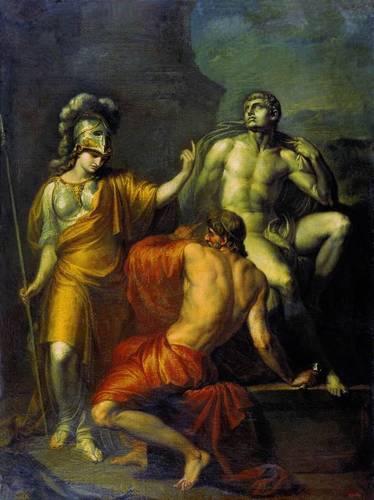
Pompey felt no confidence in the success of the cause he had left behind him; nor could he transfer the war to the land of the hardy Spaniards, because the vast extent of the Alps lay between; and therefore he thus addressed the elder of his noble sons: “I bid you explore the ends of the earth. Stir up the Euphrates and the Nile — every region where the glory of my fame penetrates, every city where the name of Rome became famous after my exploits. Bring back to the sea the Cilician colonists now dispersed over the land; next rouse up the sovereigns of Egypt and Tigranes whom I made king.
I bid you pay heed also to the army of Pharnaces, the nomad races of the two Armenias, the savage nations along the shores of the Black Sea, the Carpathian hordes, and the men whom the sluggish Maeotian mere, trodden by Scythian waggons, maintains on its frozen expanse. But why detain you longer? Carry through all the East the standard of your sire, and rouse to arms the cities I have conquered all the world over: let all over whom I have triumphed repair to my camp. Next, you two who date by your names the Roman calendar, the first North wind must waft you to Epirus. Thence seek fresh strength in the lands of Greece and Macedon, while winter grants time for peace.” Thus Pompey spoke, and they all obeyed his bidding and loosed their hollow ships from the shore.
But Caesar, ever impatient of peace or long cessation from warfare, and fearing that Fortune might have power to work some change, follows close and dogs the steps of his son-in-law. Others might be content after seizing so many cities at the first assault, after surprising so many strongholds and dislodging their garrisons, and after seeing Rome itself, the capital of the world and the chief prize of war, an easy prey; but Caesar, headlong in all his designs, thought nothing done while anything remained to do. He pressed fiercely forwards; and, though he was master of all Italy, he resented that the land was still shared between them; for Magnus retained a foothold on the margin of the sea. But unwilling, on the other hand, that the enemy should range freely over the deep, he blocks the sea with masonry and casts down rocks into the wide waters. In vain the endless labour was carried on; for the greedy main swallowed down every boulder and mingled the huge heaps with her sands. So, if Mount Eryx were thrown down into the midst of the Aeolian sea, or if Gaurus, with summit wrenched from its place, were sunk deep down into the Avernian pool, nevertheless no cliffs would emerge from the surface of the waters. Therefore, when no pile of stone stood steady on the bottom, Caesar next resolved to fell trees and bind them together, and to make fast a wide expanse of timber with long chains. Such, by the report of fame, was the road built over the sea by the proud Persian, when, greatly daring, he brought Europe near to Asia and Sestos to Abydos by his bridges, and passed on foot over the straits of fast-flowing Hellespont; East wind and West wind had no terrors for him, since he conveyed his ships under sail to the centre of Mount Athos. Thus the egress to the deep was straitened by the felling of the forest; soon the work rose high with many a mound of earth, and high towers swayed above the sea.
When Pompey saw his exit to the sea narrowed by new-made land, his mind was racked with distress and doubt how he might unbar the deep and spread his forces over the main. Again and again his vessels, driven along before the wind with straining cordage, passed right through the obstacle that barred the sea and threw down the ends of the boom into the water, thus giving sea-room to the fleet; often in the darkness of night, his machines, wound up by stalwart arms, launched a shower of cleft firebrands. When at last he had fixed a day for secret flight, he gave orders to his men that no shouting of the crews should alarm the shore, that no signal should mark the watches, nor any trumpet forewarn the sailors and recall them to the fleet. Silently they loosed their vessels when the last part of the Virgin had begun to rise in front of the Scales, which at their rising would bring the sun with them. No shout was raised when the anchor-flukes were wrenched from the thick sand; the captains of the fleet were anxious and silent, while the yards of the mast were bent and the tall mast itself was hoisted; the sailors, dangling in the air, pulled down the furled sails without shaking the stout cordage, that the wind might not whistle through it. The leader even prays to Fortune, that she will suffer him at least to abandon the Italy which she forbids him to retain. Fortune scarcely grants his request; for the sea, smitten by the prows, gave forth a confused roaring, the waves rose, and the billows, churned up by the mingled wakes of so many hulls, boiled and raged as they struck the shore.
Therefore the enemy, admitted within the walls and through the gates — for the loyalty of the citizens had changed sides together with fortune and thrown all the gates open — rushed in eager haste along the branching piers of the winding harbour towards its mouth, angry that the sea should be accessible to the ships. Shame on them that the flight of Magnus is not victory enough! Narrow was the channel that let the ships out to sea, narrower than the water of Euboea that beats on Chalcis. Here two ships ran aground and were taken by bands of soldiers lying in wait for the fleet. Then the fighting was transferred to the shore, and here the sea was first incarnadined with the blood of civil war. Robbed of its rearmost ships, the rest of the fleet put forth.
So, when the Argo sailed from Thessaly to the river Phasis, earth launched forth the Cyanean Rocks upon the deep; but the ship was rescued from the shock, though her stern was carried away: and the Clashing Rocks struck the empty sea in vain, recoiled, and remained at rest for ever. And now the changing hue of the Eastern sky gave warning that the sun was near his rising; and the ruddy light, not white as yet, stole their fire from the nearer stars; now the Pleiads were growing dim, the wain of circling Bootes grew faint and merged into the indistinguishable aspect of the sky, the greater stars went out, and Lucifer himself fled before the heat of day. By this time Magnus had gained the open sea; but the fortune which attended him when he hunted the pirates all over the deep was no longer his; good luck, wearied out by his triumphs, now proved untrue. Driven forth with his wife and sons, taking his whole household with him to war, still mighty in banishment, he goes forth with nations in his train. Destiny is seeking a distant scene for the destruction of her innocent victim. The sands of Egypt are doomed to be his grave, not because the gods preferred to rob him of a tomb in his native land, but in mercy to Italy: let destiny hide that tragedy far away in a distant region, and let Roman soil be kept unstained by the blood of Rome’s darling Magnus.
BOOK III
WHEN the wind bore down on the yielding sails and drove the fleet forward till the ships ploughed the open sea, all the sailors looked ahead over the Ionian waves. Magnus alone never took his eyes off the land of Italy until the harbours of his country, with the shore he was never to see again and the cloud-veiled hill-tops and mountains, grew dim before his eyes and disappeared. His wearied frame then yielded to drowsy sleep, and straight he saw a dream: Julia, a spectre full of dread and menace, raised her sorrowful head above the yawning earth and stood in the guise of a Fury amid the flames of her funeral pyre. And thus she spoke: “Now that civil war has begun, driven forth from the Elysian Fields and abode of the blest, I am dragged to Stygian darkness and the place of guilty spirits. There I saw with these eyes the Furies, and in their hands were torches, to brandish for kindling the strife between you; the ferryman of scorched Acheron is getting ready countless boats; Tartarus is making wide its borders for the punishment of many sinners; all three Parcae, though their hands are busy, are scarce equal to their task, and the Sisters are weary of breaking the threads. While I was your wife, Magnus, you celebrated joyful triumphs. But your fortune changed with your bride: my rival, Cornelia, condemned by Fate ever to drag down her husbands from power to destruction, supplanted me ere my pyre was cold. She is welcome to cling to your standards on land and sea, if only I have power to trouble and disturb your slumbers, and if no time is left free for love between you, while Caesar takes up your days and Julia your nights. Not even the forgetful shore of Lethe has banished my husband from my memory, and I am permitted by the Rulers of the dead to haunt you. When you fight battles, I shall appear in the centre of the fray: never shall my shade, my ghost, suffer you to forget that you were husband to Caesar’s daughter. In vain you sever with the sword the tie of kinship that binds you. The civil war shall make you mine.” Thus speaking, the ghost fled away, dissolving in the arms of her eager husband.
Though threatened with disaster by the gods and by the dead, Pompey rushed more eagerly to arms with a mind made up for calamity. “Why,” said he, “am I terrified by the sight of a meaningless spectre? Either no feeling remains to the soul after death, or death itself matters not at all.” The sun was now sinking towards the sea, and had dipped as much of his flaming disk as the moon is wont to lose just before she is at the full or just after; and now a friendly land offered the ships an easy approach; the men hauled in the stays, laid the masts along, and rowed ashore.
When the wind snatched the vessels away from Caesar’s grasp and the sea concealed the fleet, he stood on the Italian shore, a leader without a rival; yet he felt no joy in the glory of driving Magnus out, but only vexation that the enemy had fled safely over the deep. No success could any longer satisfy his impetuous haste; even victory in the war was not worth the price of delay. At once he banished thoughts of battle from his mind, and passed his time over problems of peace and the means of winning the fickle favour of the populace; for he knew that the causes of hatred and mainsprings of popularity are determined by the price of food. Hunger alone makes cities free; and when men in power feed the idle mob, they buy subservience; a starving people is incapable of fear. He bade Curio cross over to the cities of Sicily, by the way where the sea either covered the land with sudden inundation or severed it and turned to shore what had once been inland; mighty there is the working of the sea, and its waters ever strive to prevent the severed mountains from renewing their contact. Other troops were detached for the borders of Sardinia. Both islands are famous for their harvest-fields: no foreign lands supplied Italy and the granaries of Rome earlier than these or more abundantly. In fertility of soil Africa hardly excels them, even when the South winds lag and the North wind drives the clouds to the torrid zone, and the rains pour down to produce a mighty harvest.
When he had taken these precautions, the victorious general led his troops, unarmed and wearing the aspect of peace, to the city of his birth. Ah! if he had conquered only the North and the tribes of Gaul before returning to Rome, what a line of exploits, what scenes of war, he might have sent before him in long procession through the city! — the fetters he had laid upon the Rhine and the Ocean, his lofty chariot followed by noble Gauls together with fair-haired Britons! How grand a triumph he lost by adding to his conquests! No joyful throngs from the cities met him on his march; but men looked on with silent fear; no crowd anywhere gathered to meet him. But he was glad to be so dreaded by his countrymen and would not have preferred their love.
Now he had passed the heights of Anxur on its crag, and the spot where a miry way cleaves the Pomptine marshes; he had passed the hilly grove and temple where Scythian Diana reigns, and the place where the Roman consuls ascend Alba’s, height. At last from a high cliff he caught a distant view of Rome. Never had he seen it through all the time of his wars in the North, and now he gazed in wonder and thus addressed the walls of Rome, his mother city: “Were you, the abode of gods, abandoned by men whom no stress of war compelled? What city then will find arms to strike a blow for her? Heaven be thanked that the furious East — swift Sarmatians allied with Pannonians, and Getae combined with Dacians — did not choose this time to fall on the borders of Italy! It was a mercy of Fortune that Rome, with so faint-hearted a leader, had to fight against Romans only.” — With these words he entered a city paralysed with fear. For men believed that, as if he had taken Rome, he would destroy the walls with smoky fires and hurl her gods hither and thither. The measure of their fears was this: they deemed that his will was equal to his power. Their minds are not free to feign words of good omen or to make pretence of rejoicing with mirthful shouts; and scarcely free to utter curses. Authority to summon the Senate was wanting; but a mob of senators, brought out from their hiding-places, filled the temple of Apollo on the Palatine; the splendour of the consuls was absent from their sacred seats; the praetors, by law next in office, were not in attendance, and the empty chairs of office were removed from their places. Caesar was all in all, and the Senate met to register the utterance of a private man. Should he demand kingly power and divine honours for himself, or execution and exile for the Senate, the assembled Fathers were ready to give their sanction. Fortunately, there were more things that he was ashamed to decree than Romans were ashamed to allow. Nevertheless, Freedom did break out in wrath and tried, in the person of one man, whether right could resist might. Stubborn Metellus, when he saw main force used to burst open the temple of Saturn, hurried thither, broke through the ranks of Caesar’s soldiers, and took his stand at the gates before the locks were broken. (So true it is that love of money alone is incapable of dreading death by the sword. When the constitution was lost and destroyed, it made no difference; but money, the meanest thing of all, stirred up strife.) Loudly the tribune protested, striving to restrain the conqueror from robbery: “Never, except over my body, shall the temple be opened to your assault; no wealth, unless sprinkled with sacred blood, shall you win by robbery. It is certain that violence done to this office finds gods to avenge it; for the curses of the tribune, which imprecated defeat upon Crassus, followed Crassus to the battlefield. Draw your sword at once; you need not fear a crowd to witness the crime — the city in which we stand has been abandoned by its people. Your soldiers shall not be paid for their wickedness out of our wealth; there are other nations for you to overthrow, other cities for you to hand over to them. No poverty forces you to the spoliation of the peace you have cast aside: you have war to enrich you.” His words fired the conqueror with high indignation. “In vain, Metellus,” he cried, “you hope for a glorious death: never shall my hand be stained by your blood. No office shall make you worthy of my wrath. Are you the champion in whose charge freedom has been left for safety? The course of time has not wrought such confusion that the laws would not rather be trampled on by Caesar than saved by Metellus.” Thus Caesar spoke; and when the tribune still refused to leave the doors, his anger grew fiercer, and he looked round for his ruthless swords, forgetting to act the part of peace. But Metellus was forced by Cotta to renounce his too bold design. “When a people is held down by tyranny,” said Cotta, “freedom is destroyed by freedom of speech; but you keep the semblance of freedom if you acquiesce in each behest of the tyrant. Because we were conquered, we submitted to repeated acts of oppression; for our disgrace and ignoble fear there is but one excuse — that refusal was in no case possible. Let Caesar with all speed carry off the baneful germs of cursed warfare. Loss of money touches nations that are protected by their own laws; but the poverty of slaves is felt by their master, not by themselves.” Metellus was drawn aside and the temple at once thrown open. Then the Tarpeian rock re-echoed, and loud grating bore witness to the opening of the doors; then was brought forth the wealth of the Roman people, stored in the temple vaults and untouched for many a year — treasure from the Punic wars and Perses, and the spoil of conquered Philip; the gold that the Gaul in his hasty flight forfeited to Rome, and the gold that could not bribe Fabricius to sell Rome to the king ; all that the thrift of our ancestors saved up; all the tribute paid by the wealthy nations of Asia, and all that was handed over to conquering Metellus by Minoan Crete; and the store that Cato brought across the sea from distant Cyprus. Lastly, the riches of the East were brought to light, the far-fetched treasure of captive kings that was borne along in Pompey’s triumph. Dismal was the deed of plunder that robbed the temple; and then for the first time Rome was poorer than a Caesar.
Meanwhile over all the earth the reputation of Magnus had brought forth to battle nations doomed to share his fall. Greece, the nearest country, sent soldiers for her neighbour’s war. From Phocis, Amphissa sent her men, and rocky Cirrha; and both peaks of Parnassus were abandoned. The leaders of Boeotia assembled, men whom swift Cephisus surrounds with its oracular stream and Cadmean Dirce; there were men from Pisa and the Alpheus which transmits its waters under the sea to the people of Sicily. Maenalus also was left behind by the Arcadians, and Oeta of Hercules by the soldiers of Trachis. Thesprotians and Dryopes rush to war, and the ancient Selloi left their silent oaks on the hill of Chaonia. Though Athens was drained of all her men by the levy, few were her vessels that reached the harbour of Apollo, and but three keels claim credence for the tale of Salamis. Next to join the fray was Crete, the ancient island of a hundred peoples, a land dear to Zeus, with Gnosos skilled to ply the bow, and Gortyna rivalling the Parthian archers. These were followed by the men who dwell in Trojan Oricos, the Athamanes who rove scattered in mountain forests, and the Encheliae, whose ancient name testifies to the death and transformation of Cadmus. Colchian Absyrtos that foams in the Adriatic sea came also, and the men who till the fields about Peneus, and those by whose toil Thessalian ploughs turn up the soil of Haemonian Iolcos. (From lolcos the sea was first challenged, when the untried Argo scorned the shore and brought together nations that before were strangers; she first matched mankind against the raging winds and waves of ocean, and by her means a new form of death was added to the old.) Next, Mount Haemus in Thrace was abandoned, and Pholoe with its false legend of a twy-formed people. Strymon was left deserted — Strymon that each year entrusts to the warm Nile the birds of Bistonia; and rude Cone, where one mouth of the branching Danube loses its Sarmatian waters and washes Peuce sprinkled by the sea. Mysia was deserted, and the land of Ida! us, saturated with the cold waters of Caicus, and Arisbe, whose soil is all too shallow. The people of Pitane assembled, and of Celaenae that mourns the invention of Pallas — Celaenae condemned when Apollo won the match; in that land the Marsya, running swiftly down in straight channel, joins the winding Maeander and turns back after their union; and there earth has suffered Pactolus to issue forth from mines rich in gold, and Hermus, rich as Paetolus, cleaves the corn-lands. The soldiers of Ilium also, ever ill-fated, joined the standards of the doomed army, undeterred by the tale of Troy or the pretended descent of Caesar from Trojan Iulus. The nations of Syria came also, leaving behind the Orontes, and Ninos of whose prosperity legend tells; they left wind-swept Damascus, Gaza, Idume rich in palm-plantations, tottering Tyre, and Sidon precious for its purple. Their ships were steered to war by the pole-star and kept an unerring course over the sea: to no ships is the pole-star a more trusty guide than to them. (These Phoenicians first made bold, if report speak true, to record speech in rude characters for future ages, before Egypt had learned to fasten together the reeds of her river, and when only the figures of birds, beasts, and other animals, carved in stone, preserved the utterances of her wise men.) Men left the woods of Taurus, and Tarsos where Perseus alighted, and the Corycian cave that yawns with hollowed rocks. Mallos and distant Aegae are filled with the noise of their dockyards; and the Cilicians, no longer pirates, put forth in regular ships of war.
The news of war roused also the distant parts of the East, where Ganges and its peoples are — Ganges, the one river on earth that dares to unlock its mouths opposite the rising sun and drives its flood forward in the teeth of the East wind; here it was that the Macedonian captain halted, with the outer Ocean in front of him, and confessed that he was beaten by the vastness of the world. Roused was the land where the Indus, bearing along its swift stream with two-fold flood, is unchanged by the addition of the Hydaspes to its waste of waters.
Up rose the men who drink sweet juices from soft reeds; and those who colour their hair with saffron dye and loop up their robes of cotton with bright-hued gems; and those who build pyres for themselves and climb, while yet alive, upon the burning heap. How glorious for a people to lay violent hands on death, and, when satiated with life, to refuse the remnant of it from the gods! The savage Cappadocians came; and the men who find the soil of Mount Amanus too hard to till; and the Armenians, who dwell where the Niphates rolls along boulders in its course. The Choatrae abandoned their forests that reach the sky; the Arabs entered a world unknown to them, and marvelled that the shadows of the trees did not fall to the left. The remote Orestae too were disturbed by the madness of Rome, and the chiefs of Carmania — where the sky, beginning to incline southwards, sees part at least of the Bear sink below the horizon, and where Bootes, swift to set, is visible only for a short portion of the night — and the land of Aethiopia, which would not be covered by any part of the Zodiac, did not the leg of hunched-up Taurus give way and the tip of his hoof project; and the land where the mighty Euphrates and rushing Tigris uplift their heads. They rise in Persia from springs not far apart; and, if earth suffered them to meet, who can say which of the names the waters would bear? But the Euphrates, diffused over the land, fertilises it as the Nile fertilises Egypt; whereas the Tigris is suddenly swallowed up by a chasm in the earth, which hides its course from the eye, but then gives birth to it again from a new source and suffers the river to reach the sea. The warlike Parthians remained neutral between the army of Caesar and the host opposed to him: it was enough for them that they had reduced the rivals to two. The nomad peoples of Scythia, bounded by the cold stream of Bactros and the endless forests of Hyrcania, dipped their arrows in poison. From one quarter came the Heniochi of Spartan blood, a dangerous people when they shake their bridles, and the Sarmatians, akin to the savage Moschi. Men came from the regions where the Phasis cleaves the rich land of the Colchians, where flows the Halys that brought doom to Croesus, and where the Tanais, falling down from the Riphaean heights, gives the names of two worlds to its two banks, bounding Asia and Europe as well — it keeps the central part of earth from union, and, according to its windings, enlarges now one continent and now the other — and where the Euxine drains the rushing waters of the Maeotian Mere through the strait; and thus men deny that Gades alone lets in the Ocean, and the Pillars of Hercules are robbed of their boast. From another quarter came the Essedonian tribes, the Arimaspians who loop up their hair bound with gold, the brave Arians, the Massagetae who break the long fast of battle with Sarmatians by bleeding the horse that bore them from the fight, and the fleet Geloni. Neither Cyrus, when he led his host from the land of morning and the Persians came down with an army that was numbered by the casting of darts, nor he that avenged his brother’s wrong — neither of these smote the sea with such mighty fleets; never did so many kings obey a single leader, never did nations meet so different in dress, never was there such a confusion of tongues. Fortune roused all those peoples, to send them as escort for measureless disaster, and provided them as a funeral train befitting the burial of Magnus. Nor was horned Ammon slow to send to battle African squadrons from the whole extent of parched Libya — from the Moors in the West to Egyptian Syrtes on the eastern coast. That Caesar, favoured by Fortune, might win all at a single cast, Pharsalia presented him the whole world to conquer at once.
When Caesar left the walls of terrified Rome, he rushed with swift march over the cloud-capped Alps. Though other peoples cowered at the terror of his name, the Phocaean warriors, with steadfastness rare in Greeks, dared to be faithful in the hour of danger to their solemn compacts, and to follow the right rather than fortune. But first they tried by peaceable argument to turn aside the reckless rage and stern heart of Caesar; and when the enemy drew near, they appealed to him thus, holding out before them the leaves of Athenian Minerva:
“Every age included in Italian history bears witness that Massilia has shared the fortunes of the Roman people in their foreign wars. And now too, if you seek triumphs in some unknown region, here at your service are our swords to fight against the foreigner. But if Romans are divided, and if you purpose ill-omened battles and accursed strife, then we offer tears for civil war, and we stand aside. No other hand should meddle with the wounds of gods. If frenzy had armed the immortals, or if the earth-born Giants assailed the sky, the piety of man, nevertheless, would shrink from aiding Jupiter either with arms or with prayers; and the human race, ignorant of what was happening in heaven, would know only from his thunderbolts that the Thunderer still reigned in the sky without a rival. Moreover, countless nations are speeding to the fray from every quarter; nor is mankind so slow to fight, so averse to the contagion of crime, that civil war need compel recruits. We wish indeed that all men had this purpose — to refuse a share in Roman destiny, and that no foreign soldier should fight in your quarrel. What Roman arm will not be enfeebled by the sight of his father? who will not be hindered from hurling his weapon when he sees his brothers in the ranks of the foe? The civil war will soon end, if you refrain from enlisting those whom alone it is lawful to enlist. For ourselves, this is the sum total of our petition: leave your dreaded eagles, your formidable standards, at a distance from our city, and be willing to trust yourself within our walls; permit us to let Caesar in and keep war out. Let there be one spot exempt from crime, safe for Magnus and safe for you. So, if Fortune is merciful to unconquered Rome and peace is resolved upon, you two will have a place where you can meet unarmed. Again, when you are summoned to Spain by so great a crisis of the war, why do you turn hither your hasty march? We have no weight in affairs, no power to turn the scale. Our people has never been victorious in war. Driven from the ancient seat of our nation, when Phocis was burnt down and her towers were removed, we dwell on a foreign shore and owe our safety to narrow walls; and our only glory is our fidelity. If you intend to blockade our walls and break down our gates by storm, then we are ready: we shall receive firebrands and missiles upon our houses; if you divert our springs, we shall dig for a hasty draught of water and lick with parched tongues the earth we have dug; and, if bread run short, then we shall pollute our lips by gnawing things hideous to see and foul to touch. In defence of freedom we do not shrink from sufferings that were bravely borne by Saguntum when beset by the army of Carthage. Our infants, torn from their mothers’ arms and tugging in vain at breasts dry with famine, shall be hurled into the midst of the flames; wives shall seek death at the hands of loved husbands; brother shall exchange wounds with brother, and shall choose, if driven to it, that form of civil war.” Thus the Greeks ended speaking, and Caesar’s wrath, betrayed already by his clouded countenance, at last proved his resentment by spoken word:
“These Greeks trust to my haste, but their trust is vain; though I am hastening to the western region of the world, I have time to destroy Massilia. Rejoice, my soldiers! By favour of destiny war is offered you in the course of your march. As a gale, unless it meets with thick-timbered forests, loses strength and is scattered through empty space, and as a great fire sinks when there is nothing in its way — so the absence of a foe is destructive to me, and I think my arms wasted if those who might have been conquered fail to fight against me. They say that their city is open to me if I disband my army and enter alone and degraded. Their real purpose is not merely to keep me out, but to shut me in. They say that they seek to drive away the horrid taint of war. They shall suffer for seeking peace; they shall learn that in my days none are safe but those who fight under my banner.” With these words he turned his march against the citizens who feared him not; and then he saw the walls closed and fenced with a crowded ring of warriors.
Not far from the walls a hill rose above the level land and expanded into a small plain at its flattened top. This height seemed to Caesar capable of being surrounded by a line of fortifications, and a safe site to pitch his camp. The nearest part of the town rises in a lofty citadel as high as the hill outside, and the land between sinks in hollows. Then Caesar decided on a plan that would cost endless toil — to join the opposing heights by an immense rampart of earth. But first, in order to blockade the town entirely on its landward side, he carried a long line of works from his lofty camp to the sea, cutting off by a trench the water-springs and pasture-land; and with turf and freshly dug soil he built up his lines, crowned by frequent battlements.
For the Greek city this alone was fame enough and immortal glory — that she was not overborne or laid low by mere terror, but arrested the headlong rush of war blazing over the world; that, when Caesar made short work with all else, she alone took time to conquer. It was a great thing to hinder destiny, and to cause Fortune, in her haste to set Caesar above all the world, to lose those days. Now all the woods were felled and the forests stripped of their timber far and wide; for, since light earth and brushwood made the mid-structure loose, the timber was intended to compress and bind the soil by the carpentry of the sides, and to keep the mound from sinking under the weight of the towers.
A grove there was, untouched by men’s hands from ancient times, whose interlacing boughs enclosed a space of darkness and cold shade, and banished the sunlight far above. No rural Pan dwelt there, no Silvanus, ruler of the woods, no Nymphs; but gods were worshipped there with savage rites, the altars were heaped with hideous offerings, and every tree was sprinkled with human gore. On those boughs — if antiquity, reverential of the gods, deserves any credit — birds feared to perch; in those coverts wild beasts would not lie down; no wind ever bore down upon that wood, nor thunderbolt hurled from black clouds; the trees, even when they spread their leaves to no breeze, rustled of themselves. Water, also, fell there in abundance from dark springs. The images of the gods, grim and rude, were uncouth blocks formed of felled tree-trunks. Their mere antiquity and the ghastly hue of their rotten timber struck terror; men feel less awe of deities worshipped under familiar forms; so much does it increase their sense of fear, not to know the gods whom they dread. Legend also told that often the subterranean hollows quaked and bellowed, that yew-trees fell down and rose again, that the glare of conflagration came from trees that were not on fire, and that serpents twined and glided round the stems. The people never resorted thither to worship at close quarters, but left the place to the gods. For, when the sun is in mid-heaven or dark night fills the sky, the priest himself dreads their approach and fears to surprise the lord of the grove.
This grove was sentenced by Caesar to fall before the stroke of the axe; for it grew near his works. Spared in earlier warfare, it stood there covered with trees among hills already cleared. But strong arms faltered; and the men, awed by the solemnity and terror of the place, believed that, if they aimed a blow at the sacred trunks, their axes would rebound against their own limbs. When Caesar saw that his soldiers were sore hindered and paralysed, he was the first to snatch an axe and swing it, and dared to cleave a towering oak with the steel: driving the blade into the desecrated wood, he cried: “Believe that I am guilty of sacrilege, and thenceforth none of you need fear to cut down the trees.” Then all the men obeyed his bidding; they were not easy in their minds, nor had their fears been removed; but they had weighed Caesar’s wrath against the wrath of heaven. Ash trees were felled, gnarled holm-oaks overthrown; Dodona’s oak, the alder that suits the sea, the cypress that bears witness to a monarch’s grief, all lost their leaves for the first time; robbed of their foliage, they let in the daylight; and the toppling wood, when smitten, supported itself by the close growth of its timber. The peoples of Gaul groaned at the sight; but the besieged men rejoiced; for who could have supposed that the injury to the gods would go unpunished? But Fortune often guards the guilty, and the gods must reserve their wrath for the unlucky. When wood enough was felled, waggons were sought through the countryside to convey it; and the husbandmen, robbed of their oxen, mourned for the harvest of the soil left untouched by the crooked plough.
But Caesar could not brook this protracted warfare before the walls: he turned to the army in Spain and the limits of the world, leaving orders that the operations should go on. The mound was built up with planks arranged lattice-wise, and two towers, as high as the town walls, were placed upon it; the timber of the towers was not driven into the ground, but they crawled from far, moved by hidden means. When the tall structure nodded, the besieged believed that wind, seeking to burst forth, had shaken the hollow caverns of the earth, and marvelled that their walls remained standing. From the towers missiles were thrown against the lofty citadel of the town. But the shot of the Greeks fell with greater force on the bodies of the Romans; for their javelins, not sped merely by men’s arms, but hurled by the tension of the powerful catapult, pierced more than one body before they were willing to stop: through armour and through bones they cleft a broad way and passed on, leaving death behind them; after dealing its wound the weapon flew on. And every boulder launched by the mighty impulse of a released cord, like a crag which length of time, aided by the blast of the winds, tears from a mountain-top, broke all things in its course, not merely crushing out the lives of its victims, but annihilating limbs and blood together. But when brave men approached the enemy’s wall in close formation — the foremost carrying shields which overlapped the shields of those behind, and their helmets protected by the roof of bucklers — then the missiles which had dealt death at long range, flew over their heads; nor was it easy for the Greeks to shift the range or change the aim of engines made to hurl their bolts to a distance; and so they heaved over boulders with unaided arms, relying on the weight alone. The locking of the shields, while it continued, flung off every missile, just as a roof rattles under the harmless blows of hail; but when the weariness and wavering valour of the soldiers made gaps in the armament, the shields gave way, one by one, to the unceasing battery. Next, mantlets, lightly covered with turf, were brought up; and the besiegers, screened by the boards and covered fronts of the mantlets, strove to sap the foundations and upset the walls with tools of iron; and now the ram, more effective with its swinging blow, tries by its impact to break the solid fabric of the wall and remove one stone from those laid above it; but smitten from above by fire and huge jagged stones, by a rain of stakes and by blows from oaken poles hardened by fire, the hurdles gave ground, and the besiegers, foiled after so great an effort, went back weary to their tents.
The safety of their walls had been the utmost that the Greeks hoped for; but now they prepared to take the offensive. By night they hid flaming torches behind their shields, and their warriors boldly sallied forth. The weapon they bore was neither spear nor death-dealing bow, but fire alone; and the wind, whirling the conflagration along, bore it swiftly over the Roman works. Though contending with green wood, the fire was not slow to put forth its strength: flying from every torch, it followed close on huge volumes of black smoke, and consumed not merely timber but mighty stones; and hard rocks were dissolved into crumbling dust. Down fell the mound, and looked even larger on the ground.
The defeated Romans despaired of success on land and resolved to try their fortune on the sea. Their ships were not adorned with painted timbers or graced with a glittering figure-head: unshaped trees, even as they were felled on the hills, were joined together to form a steady platform for fighting at sea. By now too the fleet, escorting the turret-ship of Brutus, had come down with the waters of the Rhone to the sea, and was anchored off the land of the Stoechades. The Greeks were no less ready to trust all their forces to the mercy of fortune: they put aged sires together with striplings in the ranks. They manned their fleet which rode at anchor, and even searched their dockyards for ships past service. The sun scattered his morning beams over the sea and splintered them on the water; the sky was free from clouds; the North wind was at rest and the South winds held their peace; the sea lay smooth, reserved for battle. Then each man started his vessel from its anchorage, and the two fleets leaped forward with rival strength of arm — Caesar’s ships on one side and the fleet rowed by Greeks on the other; the hulls tremble to the beat of the oars, and the rapid stroke tears the tall vessels through the water. The wings of the Roman fleet were closed in by ships of many kinds — stout triremes, and vessels driven by four tiers of rowers rising one above another, and others that dipped in the sea a still greater number of blades. These heavy ships were set as a barrier against the open sea; the galleys, content to rise aloft with but two banks of oars, were further back in crescent formation. Towering above them all, the flag-ship of Brutus, driven by six rows of oars and advancing its bulk over the deep, reaches for the water far below with its topmost tier.
When only so much of sea separated the fleets as each of them could cover with one lusty stroke of oars, then countless cries rose together in the wide heaven, till the splash of the blades was drowned by shouting and no trumpet could be heard. Then the men sweep the sea, bending back to the thwarts behind and bringing the oars against their chests. As soon as beak met beak and clashed, the ships backed astern, and a volley of missiles covered the sky and, as they fell, the sea between the ships. And now