



автордың кітабын онлайн тегін оқу The Preparation of Plantation Rubber
Project Gutenberg's The Preparation of Plantation Rubber, by Sidney Morgan
This eBook is for the use of anyone anywhere at no cost and with
almost no restrictions whatsoever. You may copy it, give it away or
re-use it under the terms of the Project Gutenberg License included
with this eBook or online at www.gutenberg.org
Title: The Preparation of Plantation Rubber
Author: Sidney Morgan
Contributor: Henry P. Stevens
Release Date: March 7, 2011 [EBook #35510]
Language: English
*** START OF THIS PROJECT GUTENBERG EBOOK RUBBER ***
Produced by Chris Curnow, Harry Lamé, Robin Curnow and
the Online Distributed Proofreading Team at
http://www.pgdp.net
THE PREPARATION OF PLANTATION
RUBBER
THE PREPARATION
OF
PLANTATION RUBBER
BY
SIDNEY MORGAN, A.R.C.S.
VISITING AGENT FOR ESTATES IN THE EAST; FORMERLY SENIOR SCIENTIFIC OFFICER
AND NOW HONORARY ADVISER TO THE RUBBER GROWERS’ ASSOCIATION
IN MALAYA
WITH A PREFACE AND A CHAPTER ON VULCANIZATION
BY
HENRY P. STEVENS, M.A. (Oxon.,) Ph.D., F.I.C.
CONSULTING CHEMIST TO THE RUBBER GROWERS’ ASSOCIATION IN LONDON
CONSTABLE & CO. LTD.
LONDON : BOMBAY : SYDNEY
1922
PRINTED IN GREAT BRITAIN BY
BILLING AND SONS, LTD., GUILDFORD AND ESHER
PREFACE
Mr. Sidney Morgan’s work on Plantation Rubber in the East is so well known that he hardly needs introduction.
An earlier book, published in 1914, by the Rubber Growers’ Association, entitled “The Preparation of Plantation Rubber,” was well received and widely read. This book dealt in a very practical manner with problems with which the industry had to contend. A second edition was subsequently published. Both editions are now out of print. The present opportunity was therefore taken to revise the original work, with the result that it has been enlarged and practically rewritten. The information given is brought up-to-date, and covers the whole process of production, commencing with the planting of the tree, passing on to the collection, coagulation, and curing of the rubber, and concluding with the packing for export. In the course of his work for the Association, Mr. Morgan carried out a great deal of industrial research in rubber production, including lengthy experiments on tapping, the use of different coagulants and different conditions of coagulation, and also on varying modes of rolling, drying, and smoking rubber. He also went very fully into the types of construction and details of the machinery and buildings employed on estates.
Much of this valuable work has escaped notice, owing to its having been published in reports with limited circulation. Also a great deal of information was supplied to planters in a quiet and unobtrusive fashion, in interviews, visits to estates, and on other similar occasions. The knowledge and experience thus accumulated has been embodied in the present volume. The subject-matter should interest not only those actually engaged in rubber planting, but those otherwise directly or indirectly connected with the industry, such as importers, brokers, and particularly the rubber manufacturers in this country and in America. My experience has been that manufacturers as a whole have but a vague idea as to the methods employed in the preparation of plantation rubber, and this work provides them with the opportunity of obtaining an insight into the actual operations on the estates. It is most desirable that a closer bond should unite the plantation and manufacturing rubber industries. Such a result is best promoted by a better understanding of the problems with which each is confronted. Perhaps I may go so far as to suggest that some leading scientific officer in the employment of one of the large manufacturing concerns may take in hand a book which will give the planters the equivalent of information in regard to the manufacturing industry which the planters are now offering to the manufacturers.
The photographs in the earlier part of the book will give the layman some conception of the enormous amount of labour that must be expended in the opening up, planting, trenching, and weeding the plantations which have replaced the virgin jungle. The authors are indebted for most of these photographs to Mr. H. Sutcliffe, one of the mycologists of the Rubber Growers’ Association. The pictures of spotless coagulating tanks and tiled verandahs regularly hosed down will indicate the cleanliness necessary for the preparation of the beautifully clean sheet and crepe rubber which became available with the advent of plantation rubber. These results are largely due to the work of Sidney Morgan and his colleagues, on whom the planters have relied for technical guidance and advice.
As regards my own contribution this is confined to a general outline of the subject. I have, therefore, omitted reference to a number of matters which would have been dealt with in detail had space permitted. The information given is based on researches on vulcanisation carried out for the Rubber Growers’ Association by the writer over a period of nine or ten years. It was not found practicable to give detailed references in all cases. The reports on which the conclusions are based will, however, be found among the regular quarterly reports made by the writer for the Association up to June, 1919. Subsequent reports have been published in the Monthly Bulletin of the Rubber Growers’ Association. We are indebted to the Association for permission to publish details from these reports, and also for the use made of numerous earlier reports published both in London and in the East.
CONTENTS
PART I FIELD OPERATIONSCHAPTER I PLANTING
PAGE
Seeds—
Seed selection—
Strain improvement by bad propagation—
Nurseries—
Stumps—
Seed at stake—
Basket plants—
Preparation of land—
Danger of disease—
Clean clearing—
Loss of top-soil—
Silt-trenches on slopes 1CHAPTER II FIELD MAINTENANCE
Clean weeding
—
Selective weeding—
Loss of top-soil—
Grass ridges—
Lallang eradication—
Mimosa gigantea (M. invisa)—
Green cover-plants—
Connection between weeding, soil conservation, and soil improvement 13CHAPTER III THINNING OF AREAS
Original planting per acre
—
Ultimate stand per acre—
Close-planting versus wide-planting—
When to commence thinning operations—
How to select in preliminary rounds—
Later selections based on yields of individuals—
Yields per tree, present and future—
Trees per acre 19CHAPTER IV TAPPING SYSTEMS
Former methods
—
Former systems—
Tendency to reduce number of tapping cuts and frequency of tapping—
Period allowed for bark-renewal—
Modern systems—
Superimposed cuts—
Single cuts, etc.—
Tapping experiments—
R.G.A. experiment—
Alternate-daily versus daily tapping 28CHAPTER V TAPPING AND COLLECTING
Tapping knives
—
Personal equation in use of knives—
Choice of latex cups—
Cleaning of cups—
Water in cups—
Premature (spontaneous) coagulation—
Prevention of spontaneous coagulation—
The use of anti-coagulants in the field—
Collecting pails—
Payment by result—
Methods for calculation of yields per coolie—
Tree-scrap, oxidation of—
Prevention of oxidation—
Bark-shavings—
Collection and storage of shavings—
Treatment of shavings—
Collection of earth-scrap 38CHAPTER VI TRANSPORT OF LATEX AND COAGULUM
Percentages of “first” latex and other grades
—
Early collection of latex—
Transport, nature of—
Light railways—
Motor-lorries—
Bullock-carts—
Care of transport vessels—
Use of an anti-coagulant during transport—
Transport by coolie—
Coagulation centres (stations)—
Transport of coagulum 59PART II FACTORY OPERATIONS
CHAPTER VII PRELIMINARY TREATMENT OF LATEX
Reception at store
—
Receptacles—
Jars—
Tanks—
Necessity for close supervision—
Need for utmost cleanliness—
Straining of latex—
Strainers—
Facilitation of straining—
Bulking of latex—
Standardised dilution of latex—
Facilities for receiving and handling latex—
Reception verandahs—
Receiving vessels—
Types of installations 65CHAPTER VIII COAGULATION
Choice of coagulant
—
Strength of acid solution—
Making stock solution—
Quantity for use—
Quantities under modern requirements—
Care in mixing—
Method of mixing with latex—
Use of sodium bisulphite as an anti-oxidant—
Quantities for use—
Formulæ—
Abuse of the chemical—
Residual traces in the dry rubber—
Use of sodium sulphite as an anti-coagulant, quantities for use—
Formulæ—
Use of Formalin as anti-coagulant—
Formulæ for use 74CHAPTER IX PREPARATION OF SHEET RUBBER
Pale (air-dried) sheets
—
Uniformity of product—
Pans versus tanks—
The ideal tank—
Modern installations—
Care of tanks—
Standardised dilution of latex—
Variation in dimensions and density of coagulum—
Standardising instruments—
Method of using—
Skimming latex—
Style of sheets—
Standard sheets—
Rolling and marking—
When to work the coagulum—
Hand-rolling—
Power smooth-rolling—
Marking rolls—
Preparation for smoke-curing—
Caution against accumulation of wet sheets—
Hot-water treatment—
Dripping in the open air—
When to place in smoke-house 89CHAPTER X PREPARATION OF CREPE RUBBER
First consideration, fine pale crepe
—
Standardised dilution of latex—
Coagulation and coagulant—
Quantities of coagulant—
Colour of rubber—
Sodium bisulphite (use of)—
Evaluation and deterioration of the bisulphite and sulphite of sodium—
To distinguish between these two chemicals—
Care of sodium bisulphite—
Mixing solution with latex—
Former methods of making pale rubber—
Working the coagulum—
Lower grades of crepe—
Naturally coagulated lump—
Skimmings and washings—
Tree-scrap—
Bark-shavings—
Earth-scrap—
Fibrous matter in low-grade rubbers—
Scrap-washers—
Compound crepes—
Increased care with lower grades—
Block rubber from crepe—
Smoked crepe versus sheet clippings 110CHAPTER XI DRYING OF RUBBER
Air-drying of crepes
—
Artificial driers for crepes—
Vacuum drying—
Hot-air driers—
Michie-Golledge system—
Rate of air-drying—
When drying takes place—
Increase in weight of drying crepe—
Differences in weight—
Aids to normal drying—
Smoke-curing of sheet rubber—
Instruments for recording temperature—
Temperatures of smoke-house—
Period of drying—
Fuels for smoking—
Sun-drying of sheet rubber—
Artificial driers for sheet rubber 132CHAPTER XII SORTING, GRADING, AND PACKING
Reducing number of grades
—
Reduction carried too far—
R.G.A. recommendations—
Care in sorting—
Choice of packing cases—
Bags—
Bales—
Folding of crepe—
Mechanical folders—
Care in assembling—
Methods of packing—
Weight of contents—
Short weights 150PART III MACHINERY AND BUILDINGS
CHAPTER XIII MACHINES
Quality of metal in rolls
—
Nature of roll-bearings—
Brass liners—
Liners of alloy or of cast-iron—
Adequacy of machines—
Arrangement of battery—
Speed of machines—
Gear ratios—
Grooving of rolls—
Heating of rolls—
Sheeting machines—
Lubrication—
Trays—
Position of battery—
Drainage of battery—
Access to back of machines—
Engines—
Power 159CHAPTER XIV FACTORIES
General construction
—
Plenty of light—
Floors—
Drainage of—
How many storeys—
Verandahs—
Tanks, situation of—
Designs and lay-out—
Drains—
Water supply 172CHAPTER XV OTHER BUILDINGS
Drying-houses for crepe rubber
—
How many storeys—
Ventilation—
Windows—
Effect of light—
Effect of direct sun-rays—
Hot-air houses—
Smoke-houses—
Various types—
Ordinary smoke-houses—
General ventilation—
Windows—
Racks of supports—
Floors—
Furnaces in general—
Pit-fires—
Pot-fires—
Iron stoves—
Horizontal drum-furnaces—
Rate of combustion—
Brick stoves—
Pataling type of—
Consumption of fuel—
Floor of furnace room—
Roof—
Brick built houses—
“Third Mile” type—
Jackson cabinet—
Devon type—
Detailed description of—
Barker patent design 178CHAPTER XVI OTHER BUILDINGS (continued), AND SITUATION OF BUILDINGS
Sorting-room
—
Packing room—
Store rooms—
Storage of rubber—
Need for special accommodation—
Floor of store room—
Local conditions—
Temperature and humidity—
Incidence of moulds—
Effect upon smoked sheets—
Tool-sheds and stores—
Situation of buildings—
Position with respect to points of the compass—
Choosing a factory site—
Centralisation—
Decentralisation 211PART IV THE FINISHED RUBBER
CHAPTER XVII DEFECTS IN CREPE RUBBERS
General style of finish
—
Dirty edges—
Iron-stains—
Rust-stains—
Oil-marks—
Trays—
Dirt—
Holes—
Greenish and tacky streaks—
Not due to oil per se—
Tackiness and copper—
Cotton and other fibre—
Bark and grit—
Sand—
Oxidation streaks—
Yellow streaks—
Bisulphite streaks—
Spot disease—
Cause of—
Influence of rate of drying—
Percentage of moisture—
Humidity of atmosphere—
Prevention of disease—
Infection by contact—
Outbreak of dormant spores—
Rules to be observed—
Surface moulds or mildew—
Tackiness in general—
Full discussion of—
Experimental reproduction—
Lack of uniformity in colour—
Defects in block rubber 223CHAPTER XVIII DEFECTS IN SHEET RUBBER
Defective coagulation
—
Coloured surface blotches—
General darkening of surface—
Soft coagulum—
Spongy underface—
Tearing—
“Pitting” of surface—
Thick ends or edges—
Mis-shapen sheets—
Thick patches—
Torn sheets—
“Dog-ears”—
Creases—
Greasiness of surface before smoking—
Surface blemishes—
Uneven appearance—
Variation due to oxidation—
Colour when dry—
Surface gloss—
Dull surface—
Moist glaze and greasiness—
Virgin spots—
Surface moulds or mildew—
Black streaks or spots—
White or grey streaks—
Rust—
Theories on formation of—
Prevention of—
Two methods—
Other views on causation—
Bubbles—
Causes of formation—
In the field—
In the factory—
Blisters—
“Spot” disease in sheet rubber—
Support marks—
Stickiness—
Surface pattern—
Sheet clippings—
Other infrequent defects—
Dirt—
Ash—
Bark—
Splinters 249PART V GENERAL
CHAPTER XIX CHOICE OF COAGULANT
Acetic acid in general use
—
Is a coagulant necessary?—
Acetic acid—
Formic acid—
Citric acid—
Tartaric acid—
Oxalic acid—
Sulphuric acid—
Hydrochloric and nitric acids—
Hydrofluoric acid—
Alum—
Pyroligneous acid—
Smoked water—
Chinese vinegar—
Sulphurous acid—
Sugars—
Various salts—
Proprietary compounds—
Carbonic acid gas—
Alcohol—
Vegetable extracts 278CHAPTER XX SPECIAL METHODS OF PREPARATION
Da Costa process
—
Byrne curing process—
Freezing process—
Wickham process—
Derry process—
Spontaneous coagulation—
Definition of—
Discussion of types—
Ærobic—
Anærobic—
Organisms—
Maude-Crosse patent—
Method of operation—
Accelerating action of sugars—
Accelerating action of soluble calcium salts—
Ilcken-Down process—
Slab rubber 290PART VI VULCANISATION
CHAPTER XXI INTRODUCTORY DEALING WITH TREATMENT AND VULCANISATION
Wild rubber contrasted with plantation rubber
—
Milling and mixing—
Preparation for vulcanising—
Vulcanising 301CHAPTER XXII TESTING OF PLANTATION RUBBER
Tests on raw rubber
—
Breaking strain—
Behaviour of rubber during milling, etc.—
Preparation for testing—
Tests on vulcanised rubber—
Choice of a formula—
Physical tests 309CHAPTER XXIII THE PROPERTIES OF RUBBER
Raw rubber
—
Physical tests—
Vulcanised rubber—
“Inner qualities” of raw rubber—
Defects of crepe and sheet—
Variation in physical properties—
Rate of cure—
Influence of various factors in raw rubber on rate of cure—
Other types of plantation rubber—
Fine para 313Index 327
[49] Bulletin R.G.A., June, 1921, p. 246, October, 1921, p. 398.
Either physical or chemical methods may, therefore, be used for determining the rate of cure of ordinary sheet or crepe rubber, but great care must be taken when interpreting the results obtained with rubber prepared in an unusual manner. The rate of cure may be expressed in terms of the time taken to vulcanise the rubber at a constant temperature (in our case 138° C.), so as to give an elongation of 850 per cent. at a load of 130 kilos, or to give a coefficient of five units. The higher the figure so obtained, the slower curing the rubber. To express the results more directly as rate of cure, we have adopted the plan of taking an average crepe rubber, calling the rate of cure 100 units, and expressing the rate of cure of other samples in these terms. Thus, a sample which gave a coefficient of four only, in the time taken by the standard to give a coefficient of five, would have a rate of cure four-fifths of the standard, that is, 80; or if a sample takes only two hours to give an elongation of 850 per cent., whereas the standard takes three hours, the rate of cure of the sample will be 3⁄2 of standard or 150.[50]
[50] Journal Soc. Chem. Ind., 1918, p. 280.
As stated, the coefficient is approximately directly proportional to the time of cure; it is also independent of the proportion of sulphur, if in fair excess, and in the presence of inert ingredients. It is also independent of the amount of mastication given to the original raw rubber, however great. On the other hand, the position of the load-stretch curve is variously modified by these factors—in some respects, therefore, the coefficient is a more reliable index. However, the coefficient is influenced by accelerators, so that here also great care must be exercised when interpreting results. For the purpose of detecting variations in rate of cure, it is best to choose a mixing which is particularly sensitive. In the first place, there must be an ample excess of sulphur; and in the second place, no ingredient should be added which will complicate the load-stretch curves, and no accelerators should be present which may possibly tend to obscure the vulcanising properties of the rubber itself. It has been found, therefore, that the best mixing to use consists of rubber with an excess of sulphur—say, in the proportion 9:1 without other ingredients. The rate of cure of a specimen of plantation rubber is attributed to the presence of certain natural vulcanising catalysts, because it is found that carefully purified raw rubber (that is, with the resinous and nitrogenous constituents removed) vulcanises very slowly or hardly at all, but that on replacing the extracted matter the rate of vulcanising is restored. The natural catalysts contained in the extracted matter are influenced to a varying degree by some of the common ingredients of manufactured rubber articles. This applies particularly to litharge (oxide of lead), to which reference has already been made. Thus, acetone extraction of raw rubber to remove resinous matter has but little effect on the vulcanising properties of a mixture of rubber and sulphur. But if litharge be a constituent, it is found that acetone-extracted rubber will hardly vulcanise at all. From this, it follows that a rubber giving a low acetone extract may be found to vulcanise exceptionally slowly in a mixing containing litharge, whereas it shows no such defect when compounded with sulphur only.[51] Litharge is used to a very large extent, as it has a balancing effect in a rubber compound—that is to say, it allows of appreciable variation in vulcanising conditions, without corresponding alteration in the state of cure.[52]
[51] Journal Soc. Chem. Ind., 1916, p. 874.
[52] Ibid., 1915, p. 524.
Influence of Various Factors in Raw Rubber Preparation on the “Rate of Cure,” or “Rate of Vulcanisation.”—As the capacity of a rubber for vulcanisation depends on the presence of small quantities of accessory substances in the serum which act as catalysts, the rate of vulcanisation (or curing) will depend on the nature and quantity of such substances present in the rubber. A very small quantity of these substances has a considerable influence on rate of vulcanising, and as the substances are difficult to isolate and identify, our knowledge of their formation and chemical nature is not as definite as is desirable. Substances have been isolated having the characteristics of “simpler bases.” Bodies of this class are formed by putrefaction of organic matter, and can be separated in much larger quantity from coagulated latex, which has been allowed to putrefy before working up than from such which has been worked up without giving time for an appreciable amount of putrefaction to take place. Further, rubber from putrefied coagulum vulcanised much faster than that ordinarily prepared, so that we are justified in connecting the putrefaction bases with the rate of vulcanisation. Moreover, it has been shown that any treatment of the latex or coagulum which inhibits the development of putrefactive organisms also prevents the rubber vulcanising as fast as would otherwise have been the case.[53] Also, the crude bases isolated from fast vulcanising rubber have the power of increasing the rate of vulcanisation when added to ordinary slow vulcanising rubber.[54]
[53] Eaton and Co-workers: See Bulletin No. 27, F.M.S. Department of Agriculture.
[54] Journal Soc. Chem. Ind., 1917, p. 365.
On the other hand, there are one or two facts which are difficult although not impossible to fit in with theory. Thus, although the putrefaction bases are very easily soluble in water and acetone, they cannot be removed by washing on the creping rollers, or by acetone extraction. This may be due to the power of colloidal substances to retain other crystalloidal substances, such as the bases, which, in consequence, cannot be washed out. A parallel case is the retention of small quantities of water soluble substances in the soil. Also, the theory does not explain why rubber obtained by evaporation of latex at relatively high temperatures is fast vulcanising, although the possibility of putrefaction is excluded.
As regards practical results, it follows that the rate of vulcanisation (or cure) of a sample of rubber will depend on the time allowed to elapse between the collection of the latex and treatment till the rubber is dry, as also on atmospheric conditions. Thus, slow drying will result in an increased rate of cure, for it gives an opportunity for putrefactive organisms to play a part. The results will, however, be influenced by the extent to which the rubber was washed previous to hanging, and so forth. Smoking is an antiseptic process and will, therefore, tend to inhibit the action of micro-organisms and produce a slower vulcanising rubber. On the other hand, sheet contains more serum than crepe, so that there is more food material for growth of micro-organisms. The net result is to give a rubber (sheet) which usually vulcanises a little faster than crepe.
Among other factors controlling the rate of cure, special mention should be made of the nature and amount of coagulants. Weak “organic” acids, such as acetic, lactic, tartaric, etc., used in the minimal proportions (1 to 1,200 of standardised latex in the case of acetic acid), give the fastest vulcanising rubber; “strong” mineral acids, such as sulphuric acid, even when used in the minimal proportions (1 to 2,000), yield slower vulcanising rubber. Acid salts, such as alum, are intermediate in effect. Increased proportions of coagulant cause a reduction in rate of vulcanising with all coagulants, and the effect is least noticeable in crepe rubber, intermediate in sheet rubber, and most pronounced in “slab” rubber (discussed below).[55]
[55] Bulletin R.G.A., July, 1919, p. 39; September, 1920, p. 343; November, 1920, p. 433; October, 1921, p. 393; March, 1922, p. 134.
Other Types of Plantation Rubber.—We have up to now confined our attention to ordinary thin air-dried crepe and smoked sheet, as almost all plantation rubber is now marketed in one or other of these two forms. There are, however, other types, to which reference has been made. Of these, the most important is the thick blanket crepe, made chiefly in Ceylon by rolling together thin crepe, which has been artificially dried (Colombo drier or vacuum drier). The heat of the driers causes a surface stickiness, which is got rid of by rolling several thin layers together to give one thick one. This rubber vulcanises at about the same rate as ordinary thin crepe, for the relatively high temperature of drying does not appear to influence the rate of cure. The rubber is generally softer than air-dried crepe, and is easily “let down” in naphtha; it is, therefore, suitable for some solution work. Generally speaking, the properties of blanket crepe do not differ materially from ordinary thin crepe. Another type of rubber seldom met with is matured slab or crepe, prepared from it. This type of rubber is being made in small quantities on one or two estates, who supply direct to the manufacturer. The method of preparation has already been described. It is unsuitable for sale in the open market, as it contains a variable amount of moisture, has the various surface defects such as slime, mould, and “rust,” and there is the additional disadvantage that it is not easy to judge of its cleanliness or freedom from coarse impurities by inspection. If the slab rubber be creped and air-dried on the spot, the product is of satisfactory appearance, except that it is of low colour and may be streaked. As the crepe so produced vulcanises almost as fast as the original slab, the crepe embodies all the advantages of a fast curing rubber with few of the disadvantages of the slab itself. We have made experiments from time to time, and found that by a judicious use of sodium bisulphite it is possible to produce a fast vulcanising crepe rubber sufficiently even and light in colour to satisfy the Standards Committee.
A fast curing raw rubber is not necessarily a desirable type for all manufacturing purposes. In the vulcanising of large masses of rubber, a slower rather than a faster vulcanising rubber may be desirable, so as to give ample time for the heat to penetrate and spread evenly throughout the mass. But for many purposes a fast curing rubber enables a larger output to be obtained, so that artificial organic accelerators are coming more and more into use. The addition of such accelerators might be obviated, if a suitable fast curing rubber were available, but it is essential that such rubber should be uniform. It is just in this respect that slab rubber or crepe made therefrom is found to be deficient.[56] The rate of cure depends on the functions of wild bacteria, which are naturally sensitive to changes of conditions, such as temperature, etc. The coagulated rubber depends on chance circumstances for infection, and, as a natural result, the activity of the bacteria and the nature and amounts of active vulcanising agent produced will vary and be difficult to control. Consequently, the rate of cure of slab rubber shows considerably greater variation than ordinary crepe or sheet.[57] This, in our opinion, is the main difficulty of utilising “slab,” or crepe prepared from it. Experience in other industries, using micro-organisms, has shown that the only method of control has been to replace the wild growths by cultures of some particular strain, as, for instance, in yeasts for brewing. To control the rate of cure of slab, it might be possible to use a special culture for the purpose.
[56] Bulletin R.G.A., January, 1920, p. 6; January, 1921, p. 47.
[57] Ibid., January, 1920, p. 68.
Other less usual methods of preparation, referred to in the earlier part of this book, do not call for particular mention, as the properties of the rubber do not differ much from ordinary sheet or crepe. It is mainly a matter of variation in rate of cure.
This short account of the vulcanising properties of plantation rubber would not be complete without a reference to Fine Hard Para, the premier rubber of the Amazon. This rubber has come to be regarded as the standard high-grade product with which plantation rubber may be compared, and many manufacturers are still of the opinion that it is unsurpassed by any plantation product. Yet, when subjected to the ordinary vulcanising tests, we find that samples of Fine Hard Para give figures very similar to average plantation rubber; indeed, it is not difficult to find specimens of plantation rubber which give appreciably higher figures on testing. It is claimed, however, that Fine Para is more uniform than plantation rubber, and can be relied on always to give the same results. Yet tests on a series of Fine Hard Para specimens gave variations in rate of cure similar to those found for plantation. Some figures were published, which tended to show that the variation was smaller for Fine Para, but it turned out that each of the samples taken for examination consisted actually of a number of slices cut from different balls, so that greater uniformity was not unexpected.[58] The superiority of Fine Para is, therefore, somewhat of a mystery. It is probable that some manufacturers prefer to use it because they feel safer with it, and know actually how it will behave from long experience. In one respect Fine Para is possibly superior to most plantation rubber—that is, for the preparation of raw rubber solution for sticking the seams of waterproof garments, and for similar purposes. The method of preparation may well influence the strength of the raw rubber when used for this purpose. Plantation rubber has been prepared in the same manner as Brazilian Para, in particular on an estate in Java. The product resembles Brazilian Para in appearance. Vulcanising tests gave satisfactory figures, but, as already stated, this would not serve to show that the rubber was equal to Brazilian Para from the manufacturer’s standpoint.
[58] Bulletin R.G.A., September, 1920, p. 347.
INDEX
LIST OF ILLUSTRATIONS
PAGE
SEEDS, SHOWING VARIABLE SIZE, SHAPE, AND MARKING2
FELLING LIGHT (SECONDARY) JUNGLE3
SEEDLING, SHOWING ROOT-SYSTEM WITH SEED STILL ATTACHED4
NEW CLEARING5
TYPICAL YOUNG CLEARING, AGED ABOUT THREE YEARS, PLANTED ON VIRGIN SOIL. ORIGINAL JUNGLE TIMBER SLOWLY ROTTING6
LIGHT JUNGLE7
DENSE JUNGLE8
CLEARING READY FOR PLANTING9
NEW CLEARING: SLOPES “HOLED” FOR PLANTING; FLAT AREA BEING DRAINED11
TYPICAL YOUNG CLEARING, WITH TIMBER15
TYPICAL YOUNG CLEARING, WITH TIMBER17
TYPICAL YOUNG PLANTED AREA20
ANOTHER EXAMPLE OF A RECENTLY PLANTED AREA21
WIDELY PLANTED YOUNG AREA, JUST READY TO BE BROUGHT INTO TAPPING24
FIELD OF OLD RUBBER TREES IN WHICH THINNING HAD BEEN DELAYED TOO LONG25
TWO CUTS ON A QUARTER CIRCUMFERENCE, ON AN OLD TREE31
THE SINGLE CUT ON A QUARTER CIRCUMFERENCE, ON AN OLD TREE AND ON RENEWED BARK33
SINGLE CUT ON HALF CIRCUMFERENCE (HALF-SPIRAL)35
A V-CUT ON HALF THE CIRCUMFERENCE37
SINGLE CUT ON TWO-FIFTHS OF CIRCUMFERENCE41
EFFECTS UPON RENEWED BARK OF PREVIOUS TAPPING44
ANOTHER EXAMPLE SHOWING THE EFFECTS OF PREVIOUS TAPPING45
1. SHOWING EFFECT OF “WINTERING”48
2. NEW GROWTH OF YOUNG LEAF ON SAME TREE49
EFFECTS OF DISEASE—“MOULDY ROT”50
EFFECTS OF DISEASE—“MOULDY ROT”51
EFFECTS OF DISEASE—“MOULDY ROT”52
EFFECTS OF DISEASE—“MOULDY ROT”53
RAISED VERANDAH FOR RECEPTION OF LATEX; LIKEWISE EQUIPPED WITH FACILITIES FOR CALCULATING INDIVIDUAL DAILY “YIELD PER COOLIE“BY SAMPLING OF LATEX66
END-SECTION SKETCH OF VERANDAH, ETC., SHOWING A GOOD METHOD FOR RECEIVING LATEX AND FILLING TANK70
RAISED VERANDAH FOR RECEPTION AND HANDLING OF LATEX71
ANOTHER SET OF DILUTION TANKS ON RAISED VERANDAH72
TWO VIEWS OF DILUTION AND MIXING TANKS81
UNIT MODERN COAGULATING TANK (TWO VIEWS)91
ANOTHER BATTERY OF TANKS, WITH DILUTION TANKS, RAISED, ON THE RIGHT92
CLOSER VIEW OF FOREGOING93
ANOTHER BATTERY OF TANKS, WITHOUT DILUTION TANKS OR MEANS OF GRAVITATING LATEX95
A SHEETING TANK CONTAINING COAGULUM FOR CREPE PREPARATION96
A “BATTERY” OF SHEETING TANKS (PATALING ESTATE). DILUTION TANKS, RAISED, ON THE LEFT97
THE OLD METHOD OF “DRIPPING” FRESHLY ROLLED SHEETS WITHIN THE FACTORY108
THE NEWER METHOD OF HANGING IN THE OPEN AIR109
THREE GRADES OF CREPE RUBBER111
A WASHING SHED112
DRYING GRAPH. PALE CREPE (THIN)140
A SHIPMENT OF RUBBER, PACKED AND READY FOR TRANSPORT155
ON ITS ROAD TO THE RAILWAY: BULLOCK-CART TRANSPORT157
A BATTERY OF MACHINES165
“THIRD MILE” TYPE; HORIZONTAL DRUM190
“THIRD MILE” TYPE OF FURNACE, USED IN CONJUNCTION WITH “THIRD MILE” SMOKE-HOUSE190
SIDE SECTIONAL ELEVATION (PATALING TYPE OF FURNACE)193
PATALING TYPE OF FURNACE193
LARGE SMOKE-HOUSE OF ORDINARY CONSTRUCTION, WITH SHIELDED VENTILATORS PERMANENTLY OPEN194
BRICK AND CEMENT SUPERSTRUCTURE OF FURNACE INSIDE THE BUILDING, BUT FED FROM OUTSIDE195
GENERAL VIEW OF SHELTERS COVERING APPROACHES TO FURNACES196
NEAR VIEW OF SHELTER197
“THIRD MILE” TYPE OF SMOKE-HOUSE199
GENERAL VIEW OF DOUBLE “DEVON” TYPE OF SMOKE-HOUSE201
GENERAL VIEW OF DOUBLE “DEVON” SMOKE-HOUSE AND FACTORY BUILDINGS202
VIEW OF PLATFORM OF “DEVON” SMOKE-HOUSE; DOORS OF COMPARTMENTS OPEN, AND ONE RACK PARTIALLY WITHDRAWN203
DOUBLE “DEVON” SMOKE-HOUSE OF BRICK, WITH ROOF OF CHINESE TILES, SHOWING LOADING PLATFORMS WITH RACKS WITHDRAWN FROM SMOKING CHAMBERS204
SIDE-VIEW OF PRECEDING PHOTOGRAPH, SHOWING EXTERNAL ARRANGEMENT FOR STOKING FURNACES205
FRONT VIEW OF DOUBLE “DEVON” TYPE OF SMOKE-HOUSE206
SIDE-VIEW OF DOUBLE “DEVON” TYPE OF SMOKE-HOUSE207
THE NEW “BARKER” TYPE OF SMOKE-HOUSE: A SMALL UNIT210
SUGGESTED ARRANGEMENT OF BUILDING218
THREE SPECIMENS OF FINE PALE CREPE SUFFERING FROM “SPOT” DISEASE237
THE PREPARATION
OF PLANTATION RUBBER
PART I
FIELD OPERATIONS
CHAPTER I
PLANTING
To criticise the methods of the pioneer planters of Hevea Brasiliensis presents no difficulty in the light of present comparative knowledge, and to be “wise after the event” is a failing which is not confined to those interested in modern planting methods. Looking at the matter broadly, however, it must be acknowledged that the pioneers, wrong though they may have been on some points, did remarkably well, considering that there existed no real knowledge on the subject and that the methods employed were perforce of an empirical nature. Although we know a little more concerning the scientific aspects of rubber planting, the sum total of that knowledge does not justify any drastic criticism of the methods employed by our predecessors. In fact, although we may be of opinion that on general lines there is little now to be learned regarding the planting of Hevea Brasiliensis, our present knowledge does not preclude the possibility that future investigations may bring against us charges similar to those sometimes levelled at the earlier planters.
The main theme of the present volume is that of the preparation of rubber for the market. Hence it is not proposed to deal in detail with the work attaching to the opening and development of rubber estates. For this the reader is referred to the literature dealing specifically with rubber planting. Certain points in connection with planting may advantageously be treated in a general way according to modern knowledge, and of these it is proposed to discuss a few in the following pages.
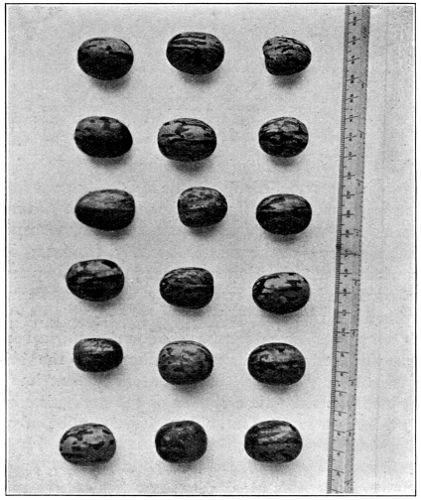
Seeds, showing Variable Size, Shape, and Marking.
Seeds.—The view is now generally held that many areas were planted from seed which was not collected in a discriminate manner; and that probably the comparatively low yields obtained on areas of some estates may be due to the employment of seed from a poor strain. To be able to decide whether such explanation fits the case demands a full knowledge of all the possible factors governing the question of yields. It may, or may not, be a fact that seed from a poor strain is wholly or partially accountable for low yields; but whatever the degree in which the seed influences the result, it is an axiom that to obtain the best results in all planting industries a most judicious selection of seed should be made. In short, seed obtained from good-yielding specimens by selective treatment will eventually produce progeny of good-yielding strain.

Felling Light (Secondary) Jungle.
The recognition of these principles as applied to the planting of H. Brasiliensis has focussed recent attention upon the desirability of planting nurseries with seeds obtained from those trees which are known to be good producers of latex of normal consistency. It does not follow that the tree of most rapid growth and development is necessarily the best yielder; such is often not the case. In the matter of selection, therefore, one has to take other standards than that of size; and the issue is narrowed chiefly to a consideration of the yields of latex given by individual trees. It has been found by various experimenters that there is no necessity to proceed to such a refinement as the determination of the actual weight of rubber yielded. The dry rubber content of latices from the same trees is found to be so comparatively regular, allowing for climatic changes, that it is sufficient for the purposes of selection to measure the volumes of latex yielded by individual trees.
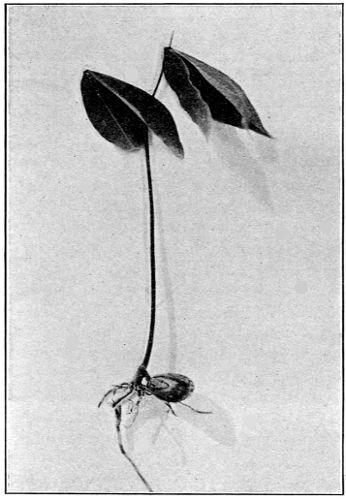
Seedling, showing Root-System with Seed still Attached.
Unfortunately the industry is so young that the question of seed selection yet awaits study. The task presents certain practical difficulties, and would be by no means so easy to control as in the case of seed selection from other plants. It will be obvious that several generations of trees raised from selected seed would have to be under observation before any sound deductions could be made from statistics obtained in the course of the work. Thus the problem of seed-selection as it concerns the establishment of a high-yielding strain would involve many years of observation on the part of a trained man. Unfortunately neither the man nor the facilities for such experimental work exist at the present moment in the Federated Malay States. On the scientific side the industry is incommensurably staffed, and most of the workers’ time is occupied with routine work connected with estate practice.
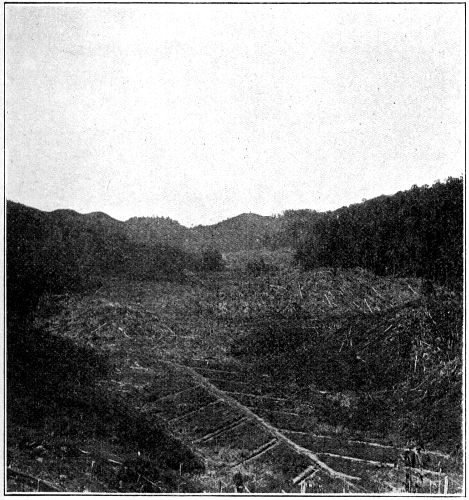
New Clearing.
In the middle distance, felled trees awaiting burning; in the foreground, a flat and wet area with main drainage outlined. (By courtesy of the manager of Membakut Estate, British North Borneo.)
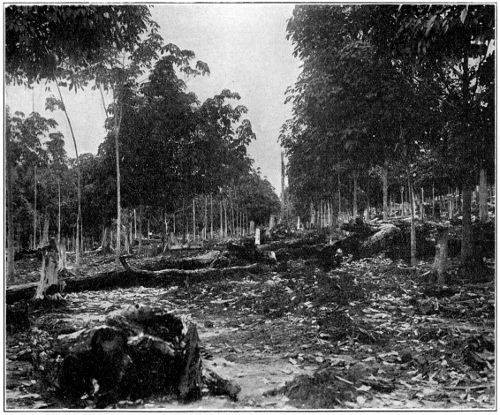
Typical Young Clearing, Aged about Three Years, planted on Virgin Soil. Original Jungle Timber slowly Rotting.
Selection.—It is possible, however, that the question of strain improvement will be solved in another manner than that of successive breeding from the seeds of high-yielding trees. Such investigatory work is now occupying the attention of scientific organisations in the East, and credit is due to the stations in Java which have begun experimental work in this direction. In brief, the scheme may be outlined as follows. Trees known to be uniformly good yielders are kept under observation, and the seeds gathered carefully. These seeds are germinated in a special nursery, and the best-grown seedlings are selected for further operations. At a certain stage a bud is taken from a high-yielding parent tree and grafted upon the stem of the seedling. When this has “struck” the original head of the seedling is removed. This ensures that one has in the seedling both the stem and future branch system of the same strain as the parent high-yielding trees. It is possible to go a step farther, and by certain processes induce a new root system to grow above the existing roots, which are then removed. One is then able to guarantee that the roots, stem, and branches will be of the original high-yielding strain. An objection sometimes made against the third operation of inducing a new root system is that the original tap-root is removed and that the subsequent system consists only of laterals. Against this argument may be quoted the observed fact that in actual development any one of the laterals may under such circumstances function eventually as a tap-root.
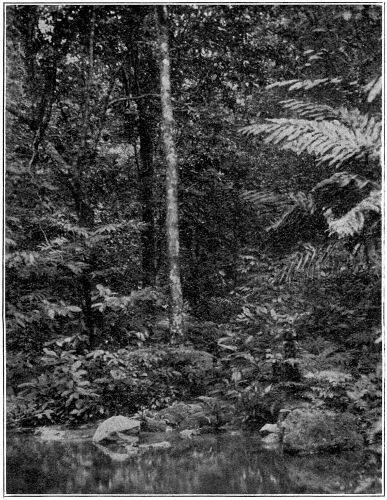
Light Jungle.
On the whole, this system of propagation receives the approval of investigators, and removes the objections which may be advanced against the development of a scheme entirely founded upon successive breedings from selected seed. The course of the investigations, also, are thereby shortened considerably. Care must be exercised in the work of obtaining and grafting the buds, but it has now been proved that by exercising reasonable precautions which are not beyond the intelligence and ability of subordinates, an extremely high percentage of success can be attained.
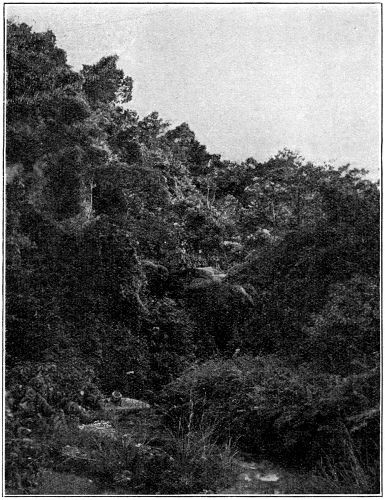
Dense Jungle.
Until such time as this process becomes practicable the inception of a planted area must follow the lines usually adopted.
Nurseries.—The usual practice is to obtain seeds from some estate which has a reputation for good yields and for exercising care in the gathering and shipping of seeds. The seed is planted in specially prepared beds, and the percentage of germination noted for future reference. The plants should be tended carefully, and close observation made for the detection of disease or pests. It is not uncommon to find that owing to lack of care in the preparation of the seed-bed, the young plants are attacked by disease.
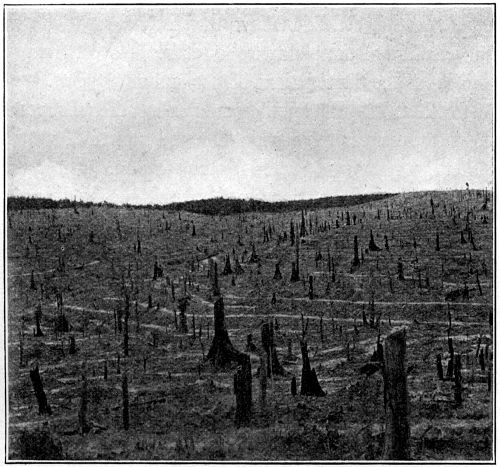
Clearing Ready for Planting.
Surface timber removed, but stumps remaining.
Stumps.—At a stage, varying according to the requirements of the estate, when the plants are from twelve to eighteen months old, they are lifted from the earth. The roots and head are cut off, and the “stump” is ready for immediate planting in the field. Naturally any appreciable delay in planting, or unfavourable weather conditions, will militate against the chances of successful “striking”; and it is not uncommon to find that a certain number of “supplies” will be necessary.
Seed at Stake.—A method sometimes adopted is to put out seed in the field, in prepared holes which indicate the exact position of the future trees. Usually three seeds are placed in each hole, and if two or three germinate, the plant having the healthiest appearance is retained, and the others removed. The possible objections to this method of planting are obvious to those acquainted with field conditions, but in actual practice planting seed “at stake” has often proved highly successful. Naturally the results obtained must depend upon the selection of good seeds, the care exercised in the preparation of the “holes,” weather conditions, and the discrimination exercised in the selection of the plants to be retained—apart from such disabilities as the depredations of rats and other pests.
Basket Plants.—Yet another and perhaps the most popular method at present is the germination and growth of seedlings in baskets specially constructed for the purpose. These plants are kept under observation until of the required age and growth. They are then conveyed to the field, and the baskets are planted in prepared holes. The baskets, being of vegetable material, are liable to be attacked by various diseases while in the nursery or after planting. It is considered advisable, therefore, to treat them by dipping into some disinfectant such as tar, or a mixture of tar and one of the common proprietary disinfectants. Otherwise a disease may be conveyed from the basket to the seedling.
Preparation for Planting.—There can be no other opinion than that ideally all land required for planting should be perfectly clear of timber of every description. After felling and burning, under ordinary conditions a certain amount of clearing is effected, but in actual practice this amounts to comparatively little. Big logs and stumps are left because the cost of clean clearing is judged to be prohibitive and non-economic. Surface timber is gradually cleared in the course of development, and usually large stumps are the last to be tackled. The objection to this procedure is really not strong, but unfortunately an important point is generally overlooked. Granted that most of the dreaded diseases travel beneath the surface of the ground by means of buried timber, it is plain that as far as stumps are concerned, the chief source of danger lies in the existence of the roots. If these were carefully exposed and removed, the isolated stumps would then not be such potential infection points. It follows from this argument that the importance of removing buried timber cannot be too strongly insisted upon. It is not uncommon to find that some years after the opening of an estate, and after surface timber has been removed, a large number of trees are affected with Fomes lignosus (formerly known as Fomes semitostus). Such cases are directly attributable to the existence of buried timber, and no local treatment will be successful unless the whole of the area is dug over carefully, and all pieces of timber removed.
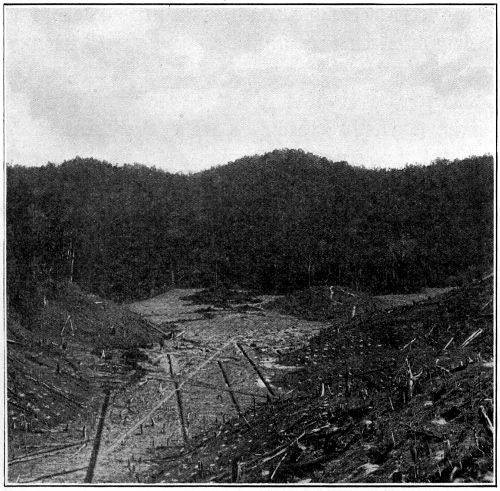
New Clearing; Slopes “Holed” for Planting; Flat Area being Drained.
(By courtesy of manager, Membakut Estate, British North Borneo.)
Silt Catchment Trenches.—Granted the ultimate necessity of clean clearing, it becomes necessary to take some precautions to prevent loss of soil by “wash” in young areas planted on sloping land. An argument often used in extenuation of the practice of allowing large surface timber to remain until it becomes rotten is that it is an aid in preventing loss of soil by wash. Its removal necessitates the institution of some method of preventing “wash.” The establishment of terraces on steep slopes tends to the achievement of the desired result, but this method is not extended to more moderate slopes where loss by wash is still considerable. It is the opinion of the writers and others that the general case calls for the institution of silt catchment trenches, which, as the name denotes, fulfil the duty of catching any surface soil and of retaining rainwater. These trenches are usually laid out on contour, and do not exceed a length of 20 feet. They are usually from 18 inches to 2 feet wide and deep, and are so arranged on the slope that they occupy overlapping positions. The actual number of trenches required will depend upon the angle of slope; the steeper the slope the greater the number required—i.e., the shorter will be the length of slope between any two trenches. Given a clean area, it is obvious that the momentum acquired by running water (and hence the amount of soil removed) on any one slope will depend upon the distance travelled. It is advisable, therefore, to place a larger proportion of the trenches on the upper part of the slope than on the lower, so as to guard against the breaking down of the trench system under an abnormal downpour of rain.
On land thus prepared the writer has seen areas successfully planted, which, under ordinary conditions, were condemned as being too steep for planting. It is true that these trenches necessitate continual upkeep until the soil becomes well shaded by trees, but the actual amount of work demanded in cleaning and maintaining the trenches will depend largely upon the thoroughness with which the original work was planned and executed. Whatever may be the weaknesses exposed as a result of providing an insufficient number of trenches of inadequate dimensions, there can be no question that they are a necessity.
CHAPTER II
FIELD MAINTENANCE
Clean Weeding.—Intimately connected with the growth and development of the rubber tree one has to consider the conditions under which it is allowed to mature. The argument has been used that, since the habitat of Hevea Brasiliensis is in the jungle, we should be proceeding against nature by introducing conditions unlike those under which the “wild” rubber tree grows. It is difficult to treat such an argument seriously, as by quoting parallel instances in arboriculture it could be shown that growth, development, and yields are improved by cultivation of “wild” plants.
It needs small experience with rubber-tree plantations to be convinced of the necessity for dealing with other growths, which would otherwise soon surround and overshadow young rubber trees.
Apart from checking and preventing woody undergrowths it is considered advisable to keep the ground more or less free from light vegetable growths, which are roughly grouped under the heading of “weeds.”
Naturally, if these weeds are allowed to flourish and seed, their eventual eradication may be a matter of extreme difficulty and expense. It is the aim, therefore, of properly conducted estates generally to institute such a system of work that the weeding-gangs cover the whole estate at regular intervals; and, as a general rule, it may be accepted that the shorter the interval between successive visits by the gang to any particular area, the easier it is to keep weeds in check, and the cheaper the work will eventually be done. This procedure defines roughly what is implied by the term “clean weeding,” and it is the policy adopted by most estates.
Strict adherence to this practice in rubber cultivation has been inculcated by the older school of planters who obtained their experience in the cultivation of other crops such as tea, coffee, tobacco, etc.
In latter years the wisdom of scrupulous clean weeding under all conditions has been questioned; and there can be no doubt that under certain special conditions a continuation of the policy of clean weeding is calculated to produce, in course of time, more harm than benefit. As an instance, the case might be cited of steep slopes on poor land. Continual clean weeding on such areas will lead eventually to a great loss of the surface soil, unless some precautions are adopted for catching and retaining the fine silt particles. It is to be noted that such a type of soil and slope, when the shade is appreciable, often produces no weeds heavier in growth than a very light grass. It is urged that the necessity for strict clean weeding on such soils does not exist, and, in fact, that it would be an injurious policy. Such arguments appear to be well founded in experience, and the writers are in thorough agreement that such special cases deserve special consideration. Rigid adherence to a policy of clean weeding, without regard to special conditions, would be most inadvisable.
Nevertheless, such exceptional cases do not detract from the wisdom of clean weeding in general. Every planter of experience realises how easily fields become infested with weeds if the regular work is suspended or delayed. It is probably quite true that the harm due to the presence of some weeds on an occasion is negligible; but apart from this debatable point, there is the solid fact that if once an area is allowed to become weedy it may soon demand a much greater expenditure to bring it back to normal condition than if it had been regularly weeded. This is common experience, and for that reason alone a general policy of clean weeding is thoroughly sound; especially if combined with some system of silt-retention.
Grass Squares.—On some estates the practice of clean weeding is undertaken in combination with a system of silt-retention, which depends upon the development and maintenance of ridges. These are built up from the débris of weeding in the form of hollow squares. Grass is allowed to sprout and grow in these ridges, and when it attains a certain height it is trimmed down so as to keep it within bounds. The soil within the hollow square is clean weeded; and it is maintained that loss of soil by wash is avoided. Under certain conditions there is a great deal to be said in favour of the method, but in the opinion of the writers it should be regarded only as a method of expediency. It is not to be preferred to the more thorough practice of soil-retention by means of silt-trenches, although the latter method may be slightly more expensive in the end.
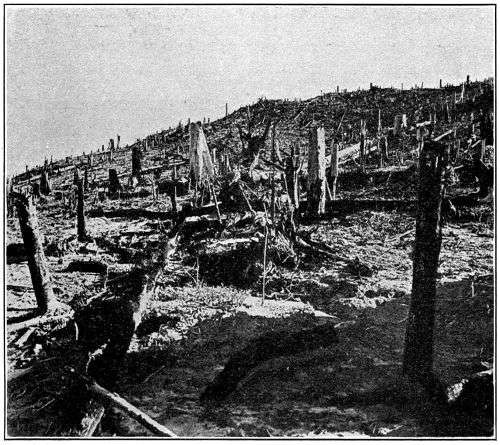
Typical Young Clearing, with Timber.
Planted “rubber-stump” in foreground.
“Lallang” Eradication.—The greatest bugbear of the planter in connection with weeding is the incidence of lallang. Many proposals have been put forward at various times for the complete eradication of this pest; but at present, under ordinary circumstances, there would seem to be no better method than by heavy and deep digging, followed by regular attention. The method is acknowledged to be expensive, but any half-hearted measure otherwise taken will eventually prove to be even more costly.
One has to differentiate, of course, between the incidence of lallang attributable to negligence on the estate itself, and the occasional outbreaks near boundaries, due to seeds having been wind-borne from patches of lallang outside the boundaries But, in general, it would be safe to remark that the appearance of lallang could be taken as evidence of a failure to cover the area at sufficiently short intervals.
As already intimated, the usual method of eradication of areas of lallang is by thorough digging, and the exposure of the strong root system to the sun. As a matter of interest it may be noted that recently some success has been obtained by another method[1] on areas which one may have in view for planting at some future date.
[1] “Eradication of Lallang,” W. P. Handover, The Planter, Vol. I., No. 1, August, 1920.
It consists in the employment of Mimosa gigantea, which eventually smothers the growth of lallang.
The seeds are sown broadcast, in drills, or in pockets, amongst the lallang. In the course of about three months it overtops the grass and proceeds to travel. At this stage the whole mass is pressed down, and the pressing is repeated at regular intervals. Under favourable conditions, in about twelve months, an impenetrable mat has been formed, which gradually forms a good mulch. When it is desired to remove the Mimosa, the mass (pressed down) is cut and rolled up like a carpet. Cleared in this manner, the area then needs regular weeding, in order to check the development of any stray lallang shoots. In actual practice it was found that the cost of this method was approximately two-thirds that of the usual digging method.
Green Cover Plants.—Some years ago it was quite common to find green cover-plants employed on estates with the primary idea of minimising weeding costs. With most of these it was found later that their value was not real, and that they harboured diseases, and pests. Moreover, when they were removed, it was often found that an abundant crop of lallang and weeds resulted.
There can be no question that certain plants can be employed with advantage, not only in the control of weeds, but also by reason of benefit to the soil in which they are established. These plants are leguminous, and their use is restricted almost entirely to young areas, inasmuch as they will not continue to grow when shade becomes marked. Of those best known in modern practice might be mentioned Tephrosia candida (Boga bean), Centrosema Plumerii, and Dolichos Hoseii (Sarawak bean).
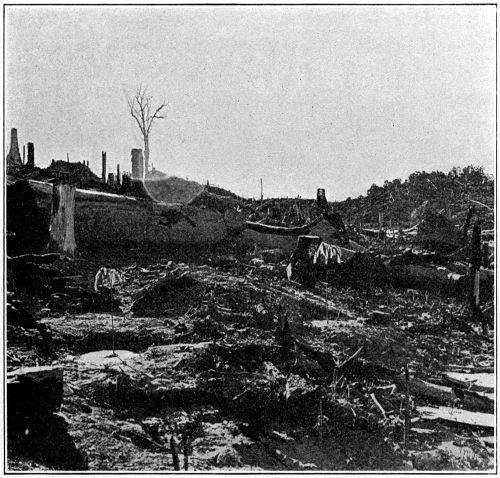
Typical Young Clearing, with Timber.
Young rubber plants in foreground. Two of these are easily distinguishable, both with small crowns of leaves.
It is wrong to imagine, however, that the establishment of such leguminous cover-plants obviates weeding. So far is this from being the case, that in practice it is found that the weeding “rounds” must be conducted at first with the same regularity as in ordinary working, but that naturally there is much less work to be done.
As the plants develop, they can be pruned or dug into the soil, as the case may be. The addition of the green material to the soil, either by digging or by burying in open trenches, is calculated to cause improvement in the condition of the soil. There may thus be a close connection between weeding, soil conservation, and soil improvement.
CHAPTER III
THINNING OF AREAS
On this subject there is unanimity regarding the necessity for the operation. Divergence of opinion exists only as to a matter of degree.
On the one hand there is the school of planters who would advocate the advisability of planting up to, say, 200 trees per acre, with subsequent thinning out by selection. At the other extreme there is the opinion that we should plant only a few more trees per acre than it is intended eventually to maintain, the argument being that by this method the growth and development of individual trees will be so much greater than in close planting that the necessity for drastic thinning out will not arise.
Unfortunately for the latter school, a very important point is overlooked—viz., that size and general development are not criteria of yielding capacity. It might thus follow that a stand of ninety well-grown trees per acre might give very disappointing yields per acre. In a few instances this has been noted with 30 by 30 feet planting, but it is doubtful whether the factor influencing such results has been appreciated.
The apostles of close-planting have this in their favour: that if the trees to be removed are selected on proper lines, it is possible to have all remaining trees of comparatively high-yielding strain. This is a very sound argument, but its practicability is limited very largely by the question of early growth and development. It would seem the sane course in any event not to plant more trees per acre than may grow normally, and without branch or root interference up to the fifth year (the normal first year of tapping).
Before this stage has been reached, stunted or deformed trees will have been noted and removed, so that in the first year of tapping thinning proper can be commenced. In the past this has been effected wholly by selection of trees according to their general appearance and situation; but it is now safe to predict that future operations will be based upon sounder and more scientific lines.
Trees will be selected for removal according to their individual yields, a standard which we have been advocating for years without much practical success. In Java and Sumatra much good work has been done in this direction, and recently a commencement has been made in the F.M.S.
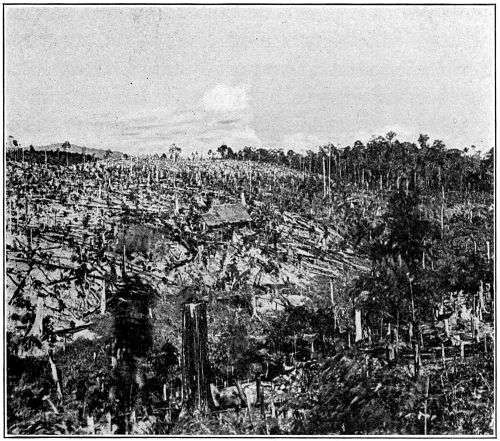
Typical Young Planted Area.
Heavy original jungle timber.
It is within the daily observation of all planters that certain trees regularly give greater yields than others, and that such trees are not to be distinguished by size or general development. Moreover, with slight variations, it has been found that a good yielding tree is consistently a good yielder, and the converse holds true.
If, therefore, measurements of individual yields are taken at intervals, and the results recorded during the first year of tapping of an area, an excellent guide is obtained for the first round of thinning. It is found in actual practice that five, or even three, readings during the year are sufficient to give the indication required. It is not essential that simultaneous readings should be taken over a large area; in fact, such a step is really impracticable at first. The simplest method is to employ either—
(a) A small uniform vessel in which the latex is measured by means of a thin slip of bamboo upon which graduations are marked.
(b) A glass measure graduated regularly.
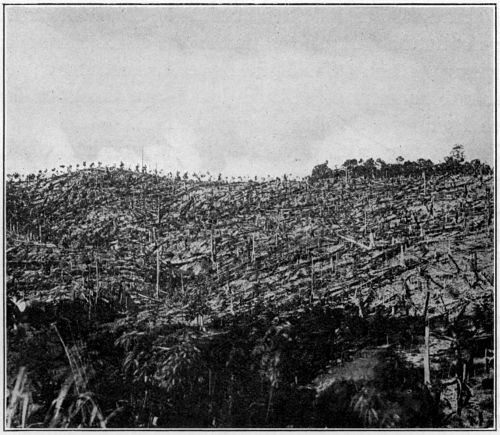
Another example of a Recently Planted Area.
In both cases it is immaterial what units are represented by the graduations—whether cubic centimetres, quarter ounces, half-ounces, or ounces, as long as the unit is not too large. It is preferable to employ a fairly small unit, so that in taking readings from young trees a wider range may be obtained between poor yields and good yields. In the case of older trees a larger unit may be taken.
The first stage in the operations is to number all trees in the field to be tested, and to prepare a rough register, with three or five vacant columns opposite each tree number.
It is not advisable to commence the record of yields until the panel of bark has been under tapping for a month or two. It is found that an intelligent coolie can be taught the method of measuring and rough recording. The latter is accomplished by means of marks made upon the virgin bark of the tree above the tapped area. The marks may be made with a tapping knife, by means of paint, or with a lead pencil. The simplest form of record consists in putting one mark for each graduation of reading.
In practice it is found that, commencing about an hour after the first tree has been tapped (in the case of young trees) and following the course taken by the tapper, the measurer of yields is able to do about 2 full tasks (650 to 750 trees) per diem. Each day progress is made through the field.
Obviously on such a small scale and utilising only one measuring coolie the comparison is restricted very much; but in any case this is immaterial as, owing to the personal equation of the tapper, comparison strictly should be limited and internal—i.e., it should really be confined to one task only at a time. In this way the worst trees in any task are indicated.
The keeping of the records may be entrusted to a field clerk, but is better placed in the hands of a European. The register is taken into the field and the rough records found on the trees are noted in the columns against the tree number.
Most planters are aware in a general way of the disparity between the yields of individual trees, but they would probably be surprised if they undertook the institution of such records.
The following figures must not be taken as typical. They represent the average results from several tasks in a young field from which all ill-grown and deformed trees had been removed. It is immaterial what the units represent, as they are purely arbitrary and were selected for the purpose of obtaining a fairly wide range.
Any trees which failed to yield sufficient latex to reach the first mark were registered at zero. The following percentages were obtained:
Zero
3
per cent.
Above
mark
1
6
„
„
„
2
16
„
„
„
3
42
„
„
„
4
12
„
„
„
5
14
„
„
„
6
6
„
„
„
7
0
„
„
„
8
1
„
„
„
9
0
„
100
„
It may be remarked that, judging by ordinary standards, it was impossible to discriminate between good yielders and others, and if thinning were to be done on the usual lines it is quite possible that some of the best yielding trees would be removed.
Taking the mark No. 5 as the datum line, it will be noted that 79 per cent. of the trees come below and 21 per cent. above. In the latter proportion the majority lie close to the datum line. It will be seen that there are outstanding yielders even amongst these young trees, and that it would be possible to mark about 10 per cent. of the stand per acre at once for removal in the first round of thinning.
In the case of old trees it is possible that one would encounter greater extremes of yields than those shown in the foregoing table, especially if a certain amount of thinning had been done previously on empirical lines. Sufficient has been written to show that the only reasonable basis for selection of trees in thinning is that of yields; and it is obvious that if the method be adopted the future yield per acre of any area is bound to be in excess of the same area as thinned on rule-of-thumb lines.
Yields per Tree.—A great feature is made in estate reports of the figure showing the average yield per tree per annum. Assuming an area to be yielding at the average high rate of 540 lbs. per acre per annum, with an average stand of ninety trees per acre, the yield per tree per annum averaged over all trees is 6 lbs. Keeping in mind the test-figures on a previous page, it will be obvious that some of these trees may have given very much more than 6 lbs. during the year, and some less. In view of present information it would not be surprising to find that a few might have been yielding upwards of 15 lbs. per annum. Unfortunately this information is only to be obtained by individual tests, and under normal estate conditions the facts escape notice. Cases are known in which out-standing individual trees have been known to yield at the rate of 25 lbs. and more per annum.
[1] “Eradication of Lallang,” W. P. Handover, The Planter, Vol. I., No. 1, August, 1920.
As already intimated, the usual method of eradication of areas of lallang is by thorough digging, and the exposure of the strong root system to the sun. As a matter of interest it may be noted that recently some success has been obtained by another method[1] on areas which one may have in view for planting at some future date.
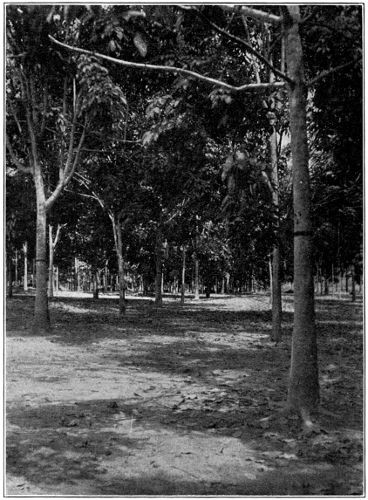
Widely Planted Young Area, just ready to be brought into Tapping.
Future Yields per Tree.—It has been shown that by selective methods based on yields, poor trees can be eliminated. Whether by a process of seed-selection or by means of propagation based on bud-grafting and marcotting, it needs no great stretch of imagination to forecast future conditions under which trees may be bred which will be capable eventually of giving an average yield of 25 lbs. per annum over any given area. Yields of 1,000 lbs. per acre per annum should be obtained easily.
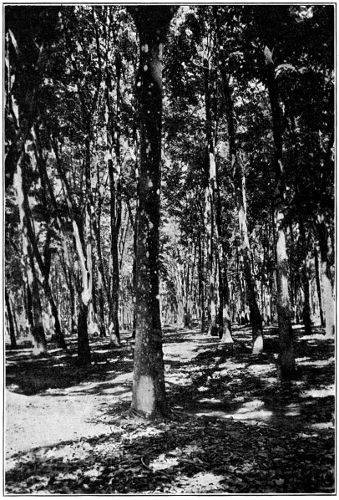
Field of Old Rubber Trees in which Thinning had been delayed too long.
Note height and comparative lack of girth.
Trees per Acre.—This brings us to the question as to how many trees one should leave to the acre after thinning operations. Figures have been given by various authorities, but it appears to the writer at the present time to be impossible to lay down a general rule. So much depends upon conditions. In certain cases where the soil is admittedly poor, the average growth below normal, and thinning has been postponed too long, the writer has been forced to the conclusion that it would be most inadvisable, and commercially unsound, to reduce the stand of trees below 120 per acre. In such instances the average yield per tree equalled only 3 lbs. per annum, and although the trees were upwards of nine or ten years old the crowns were small and sparse. It is doubtful whether such trees will ever exhibit any further development, and to thin them further would probably lead only to a diminution in the crop per acre.
Under normal conditions of growth an arbitrary figure of eighty trees per acre has been selected as a standard by many estates. In these cases it would probably be correct to state that thinning was undertaken on almost purely empirical lines—i.e., that trees were not selected by tests of individual yields. As far as such a method retained the apparently most vigorous trees it was successful; but in view of what has been written it might explain some of the disappointing results which have followed upon such a system of thinning.
It will be clear that any decision regarding the number of trees to be retained must be derived from a study of the detailed results of individual tests. If the large majority of the trees appear to be fairly uniform in yields the first thinning must be confined to comparatively few trees. Where there is, on the other hand, a good percentage of high-yielding trees the final stand per acre may be appreciably less. Unless and until such information is available, one cannot give any definite opinion as to the requisite number of trees to be retained per acre.
Similarly, intelligence must be displayed in deciding which of several uniformly-yielding trees should be removed. In the average sense of this consideration one must pay no attention to symmetry of spacing, but when dealing with trees of fairly uniform yields one needs to study the characteristic development of the trees individually, in order to retain those which would appear to be most favourably situated with regard to surrounding trees.
CHAPTER IV
TAPPING SYSTEMS
Broadly there are only two methods employed in obtaining the latex from Hevea Brasiliensis. The first is that employed in South America, where incisions are made by means of a light axe. The other is the system of excision, or paring, of the bark practised on plantations in the East.
In the early days of the plantation industry, the South American method seems to have been employed, and the writer has knowledge of trees on one of our best-known estates in Malaya which still exhibit the outward and visible signs of that method. At a comparatively early stage, however, the method of excision was introduced. Curiously enough there appears to be no record of its inception or of the individual who was responsible for the substitution of this method. We have been so accustomed to regard it as one of the ordinary facts of estate procedure, that this point seems to have escaped notice and enquiry.
As a variant of these two main methods, a slight vogue was for a short while obtained by the operation known as “pricking.” This was generally combined with excision of bark, and was then known as the “paring and pricking” method; but the simple operation of pricking alone had its adherents, and various forms of instruments were designed to achieve the object. As a means for obtaining a flow of latex, pricking may have been effective, but the general difficulties attaching to the collection of the latex was such as to put the method out of favour.
In the employment of “paring and pricking,” a thin shaving of bark was excised on one occasion. At the next tapping no bark was excised, but a pricking instrument was used along the previously cut surface. It was not proved that any advantage was gained by this method, which was more commonly employed in Ceylon than elsewhere, and it would be surprising to find it in use at the present day.
In the ordinary way the method of excision is practised in such a manner that the “cut” gradually descends to the base of the tree.
Planters with original views, and of an enquiring nature, often query the common practice; and it has been suggested that “as the latex descends by the force of gravity,” one’s paring should be done in an upward direction, thus obtaining a greater pressure of latex—and hence a greater flow. It will be obvious that it would be no simple matter to collect effectively the latex thus obtained from the under edge of a sloping cut, but apart from this the argument would appear to be founded upon what is now accepted to be a fallacy—viz., that the latex per se is manufactured in the leaves and gravitates down the tree.
Former Systems of Tapping.—To hark back ten years in the plantation rubber industry is equivalent to delving into history, since development has been so rapid. It was then thought necessary to place upon the trees a number of simultaneous cuts which the modern planter would judge to be inconceivably excessive. Were it not for evidence in the shape of photographs extant, it would be difficult to convince a young planter that such systems were employed.
It was not uncommon for trees to have from six to ten cuts, sometimes all placed on one half of the tree in a herring-bone fashion, and sometimes divided into two portions, each of which tapped the opposite quarter panel of the tree’s circumference. Such superimposed cuts were spaced from 1 foot to 18 inches apart.
On other occasions, a spiral cut was employed, commencing at a height of, say, 5 feet, and gradually descending to the cup at the base of the tree.
Later systems varied from several cuts on a half-circumference, or on a quarter of the tree, tapped either daily, or on alternate days, to cases in which one-third or one-fifth of the tree was employed. Also popular were the systems of the V and half-spiral cuts on half the circumference.
It did not take long to be recognised that with all these systems demanding a number of simultaneous parings from the same panel of bark, the rate of excision was so heavy that the period available for the renewal of bark was insufficient for continuous tapping.
As a result most of the systems specified have fallen into desuetude, and the tendency has since been to reduce the number of cuts, or the periodicity of tapping, so as to allow for increasing periods of bark renewal.
In the earlier days, a period of four years was thought to be an extremely generous allowance, whereas six years is now becoming recognised as a minimum necessity. Eight years is not regarded as extravagant, while with older bark on some estates periods of ten and twelve years have to be allowed for full renewal. Even so no finality has been reached, and no general rule can be laid down. Local conditions of planting and growth exercise great influence, and the writers have in mind instances in which a period of eight years has proved to be insufficient even for a first renewal after the excision of virgin bark.
In the main the most popular systems of tapping are:
(a) One cut on a quarter of the tree, tapped daily.
(b) One cut on a third of the tree, tapped daily.
(c) One cut on half the circumference, tapped on alternate days.
(d) A V cut on half the circumference, tapped on alternate days.
Variants and extremes are:
(1) One cut on a quarter, tapped on alternate days.
(2) One cut on a half, tapped daily.
Superficially viewed the latter is four times as strenuous as the former, and the relative position seems to be inexplicable. It may be explained that as a rule the former system is practised on old trees with poorly renewed bark, in order to allow for adequate bark renewal; and the latter is employed in opening young trees just brought into tapping, when the rate of bark renewal is at a maximum.
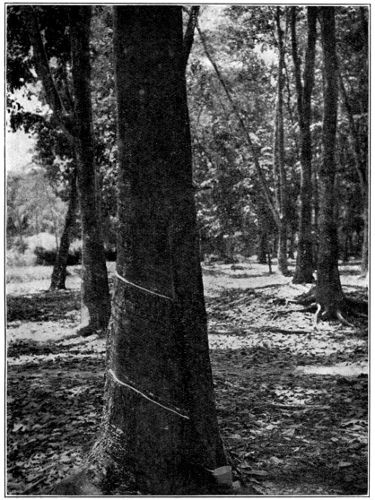
Two Cuts on a Quarter Circumference, on an Old Tree.
A few estates in this country still continue to tap trees by means of two superimposed cuts on a quarter of the tree. This was a very popular system some four or five years ago, but it has come to be recognised by practical experience that any system employing superimposed cuts leads to a high consumption of bark without proportionate increase in yield. For instance, if one compares the system of two cuts on a quarter tapped daily with a similar system employing only one cut, one finds that the major quantity of latex is yielded by the lower cut, and that the single-cut system which excises approximately half the amount of bark gives about 80 per cent. of the yield obtained by the tapping of two superimposed cuts.
Of experiments to test the relative values of different systems of tapping there have been many. Most of them suffered from the initial handicap that they dealt with systems which were then popular. In order to obtain any valid result they had to be undertaken over a long period. Meantime there was a progressive movement in actual estate practice towards a greater conservatism in bark removal, and hence the experiments as originally planned lost value.
Moreover, in Malaya it was difficult for experimenters to obtain practical support in the form of areas of trees suitable for experiment. As a result experiments were often confined to small blocks of trees, and a small number of blocks, from which any conclusions derived were subject to considerable errors of experiment. Often comparisons were made between only two blocks, and no allowance was made for varying factors, such as initial differences in yielding capacities of the trees, soil conditions, or the personal equation of the tappers. As a general rule, therefore, the results were vitiated to a very appreciable extent.
All these factors were later taken into consideration in an experiment undertaken on behalf of the Rubber Growers’ Association. In this instance unique facilities were provided by the London Asiatic Rubber Company on their property at Semenyih Estate, and it is only fitting that the company should receive the recognition which its enterprise deserves.
It would have been a great advantage to have included in that experiment other features which have since come into prominence, but the original scope of the experiment had to be confined to the point of comparing yields obtained in making comparative tests based on one system of tapping with different frequencies. Such data were required as a check upon a Ceylon tapping experiment which had attracted much attention. In that experiment trees were tapped at intervals ranging from one day to seven days; and it was concluded that after a period of three and a half years trees tapped with greater intervals gave yields equalling or exceeding those obtained from trees tapped with shorter intervals.

The Single Cut on a Quarter Circumference, on an Old Tree and on Renewed Bark.
In the Semenyih experiment the system chosen was that which had the greatest contemporary vogue—viz., two superimposed cuts on a quarter of the tree. The various blocks were tapped respectively every day, every second day, and every third day.
It was found that the conclusions drawn from the Ceylon experiment were not confirmed. After a period of three and a half years’ continuous tapping neither the alternate-day system nor the third-day system gave results in any way approximating to the yield of the daily system.
The actual average yields from these systems over the whole period were in the order of—
Daily.
Two Days.
Three Days.
100 per cent.
60 per cent.
45 per cent.
and throughout the course of the experiment neither of the other sections showed any appreciable improvement in position relative to the daily section.
In actual yields “per tapping” over the whole period the alternate-day and the third-day divisions showed advantages of 20 and 35 per cent. respectively over the daily portion.
At the beginning of the second year of experiment another section of blocks was opened with a single cut on a quarter, tapped daily. This enabled direct comparison between the values of one cut and two cuts on a quarter in daily tappings and between a daily single cut and two cuts tapped alternate daily.
It appeared that the daily single cut yielded over the period of experiment 80 per cent. of that obtained by tapping two cuts daily; and that in the comparison between two cuts tapped alternate-daily and a single cut tapped daily the latter had an advantage of about 40 per cent. in yield.
This result has been used by advocates of daily tapping generally, but it does not constitute a fair argument, inasmuch as the single cut was tapped twice as often, and its position was always relatively low on the hole of the tree. It has been shown in the comparison between the daily single cut and the two cuts daily that the influence on yields of the superimposed cut is relatively small. A fairer comparison would have been obtained if the two cuts tapped alternate-daily had been either amalgamated to form one long cut on half the tree or to form a V on half the tree, thus placing the cuts in the opposing sections on the same level. With the knowledge that the yield obtained from cuts is always greater per tapping by using the alternate-daily system, it would appear to be plain that the one long cut on half the tree would at least equal the yield of the single short cut tapped daily on a quarter tree.
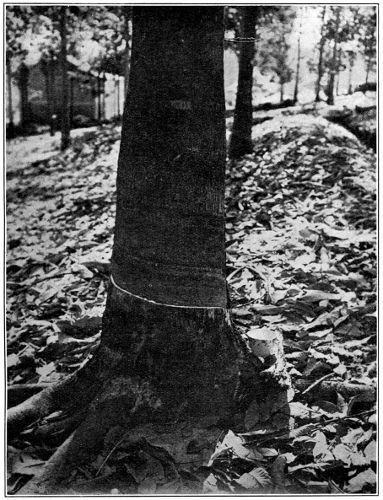
Single Cut on Half Circumference (Half Spiral).
Note.—In this particular instance the cut is changed to the opposite half of the tree every half-year.
Unfortunately no opportunity has been afforded up to the present of definitely proving this point by prolonged experiment under strict conditions. It is true that the view is held strongly in some quarters as a result of the experience of managers, chiefly on their own estates, that alternate-daily tapping generally gives better yields than daily tapping.
In a number of instances this view is probably correct, and the writers are in agreement; but it is necessary to clear away some misconceptions which confuse the issue. In the main there are two schools, one of which plumps for alternate-daily tapping, while the other adheres strongly to daily excision. Great confusion exists, inasmuch as in many instances the disciples of these schools are really discussing different matters. In the case of managers who argue for alternate-daily tapping their experience is gained, with very few exceptions, from systems in which the excision covers half the circumference of the tree; whereas in almost all cases daily tapping is confined to a single cut on a quarter of the girth. Bearing on such a comparison there are, as far as the writers are aware, no reliable published experimental results. To compare the results obtained from one system practised on one estate with the results of the other system established on another estate is not strictly permissible, as we know that conditions generally may vary to an enormous degree.
The controversy has raged, however, to such an extent that many who are not directly engaged in estate practice have obtained confused impressions. For instance, it appears to be the belief in some quarters that alternate-daily tapping, when applied to a single cut on a quarter of the tree, will yield more than an exactly similar cut tapped daily. In support of such a statement there does not appear to be any confirmation under normal conditions; although such a result might be obtained in the case of old trees which have been heavily over-tapped in the past, and on which the rate of bark renewal has been appreciably retarded. It might also be the case eventually when trees with the opposing frequencies have been tapped for a period extending into many years; but it is the opinion of the writers that under normal conditions such a result would be extremely doubtful.
When we come, however, to a comparison of daily tapping on a single cut on a quarter with double the length of that cut on half the circumference, at the same height, tapped alternate-daily—whether in the form of one long cut or in the form of a V—we arrive at a contrast which gives a clear issue. As already stated, facts and figures of reliable experiment are wanting; but it is the opinion and experience of the writers that the alternate-daily system at least suffers no disadvantage on the point of yields, and in other respects, such as conservation of labour and costs, is superior to the daily system.
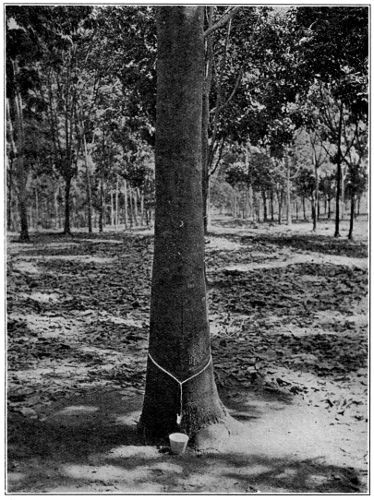
A V-Cut on Half the Circumference.
CHAPTER V
TAPPING AND COLLECTING
Tapping Knives.—The choice of a tapping knife is a subject upon which there is much divergence of opinion. This must be so because no known knife has such apparent outstanding superior features or claims as would enable one to settle the point. Moreover, the personal factor is so large that, as far as the knives in common use are concerned, it appears to exert the greatest influence. The possibility of obtaining the ideal knife, which will go to sufficient depth into barks of varying thickness to yield the maximum quantity of latex without wounding, is quite as remote at the present time as it was some years ago. Meanwhile the search for that ideal knife continues, and occasionally one learns of the alleged merits of some new instrument which, it is said, fulfils all requirements. It is only to be regretted, both for the sake of the inventor and for the expectant buyers, that the claims always fail in some one or more particulars.
In Malaya probably the number of different types of tapping knives may amount to a half-dozen, but those most commonly in use are:
(1) The gouge—straight or bent.
(2) The ordinary farrier’s knife.
(3) Modifications of the farrier’s knife, such as the “Jebong.”
Argument on the respective merits of knives is popular, and discussion seems endless. It is claimed for the bent gouge that it is superior to the straight instrument, because, the leverage being downwards on the handle, the tendency is to lift the cutting edge upwards and out of the bark, whereas with a straight gouge the tendency is to push the knife downwards into the bark. It is claimed, therefore, that the average shavings taken off by the bent gouge should be thinner than those obtained by the use of the straight instrument.
For similar reasons it is asserted that the “Jebong” and other modifications are superior to the original form of the farrier’s knife. These points are generally accepted without great argument, but when comparisons are made between the gouge and the farrier’s knife (with its modifications) the opinions of planters are so varied and conflicting as to be almost irreconcilable. Two opinions based on experience with both types of knives are often wholly contradictory.
There can be no doubt that the likes and dislikes of operative coolies have a considerable influence in determining the measure of success obtained with any one knife. Should coolies have been accustomed to the use of a particular form of instrument they become quite expert, and any proposed change creates in the minds of coolies a prejudice which is considerable in effect on the quality of the handicraft. Such prejudice may be overcome in course of time, but in the interval not a little damage may have been done in the shape of tapping wounds. So considerable is this question of personal favour that even on estates where a standard pattern of knife is issued coolies often modify that knife slightly on their own accord. Such alteration is ignored by the superintendents as long as the quality of the tapper’s work is maintained at a high standard.
Naturally there is a limit to such leniency, and this limit is soon reached in the case of knives having adjustable parts controlled by screws, or nuts and bolts, etc. Some knives of this description really merit a much wider use than is afforded them at present; but in view of the potential damage which might be done as a result of adjustments made by the coolies these knives do not become popular.
It is not proposed here to enter into a description of even recent instruments for which strong claims are being made by their inventors or vendors. If they possess the merits attributed to them they will soon find favour, as managers are always keen on studying the points of any new knife which will lead to a conservation of bark and a reduction in the number of wounds. On the whole, it may be advanced that the best general results are obtained by the adoption of a simple non-adjustable knife and the retention of its use.
The Choice of Latex Cups.—It has come to be recognised that the maximum possible cleanliness is essential in all details of estate work, and the younger generation of planters could scarcely be aware that a few years ago it was deemed sufficient to use coco-nut shells for the reception of latex on individual trees.
Terne-plate cups ousted the coco-nut shell, and they had the merit of being cheap. The interior coating of tin did not last long if the cups were properly cleaned. The iron being exposed, with a minutely roughened surface, each microscopic projection served as a point around which latex coagulated. Scrapping the film of interior rubber became more and more difficult, and often the cups were burnt in order to get rid of the accumulation of rubber. The last state of such cups was worse than the preceding one. On some estates fairly successful attempts were made to keep these cups clean by making the coolies bring them into the store each day. Terne-plate cups are not now in common use.
Aluminium cups have their advocates, but much the same argument applies to the difficulty of keeping them clean as was used in the foregoing paragraph. On many estates, however, they are used with success, the usual method of treatment being to make the coolies bring them into the store and clean them there. Owing to the comparative lightness of the material such a scheme is more feasible than was the case with terne-plate cups.
The cups now most in general use are either of glass or white-ware, and probably those of glass are the most extensively employed. There are many details to be studied in the choice between these two types of cups—e.g., percentage of breakage in transport and in the field, price when breakage is taken into account, etc.; but these apart the glass cups have one advantage—namely, the ability of the superintendents to see whether the cups have been properly cleaned. In the case of white-ware cups this means an inspection and handling of individual cups, whereas in the case of glass the point is settled by visual examination at a comparative distance.
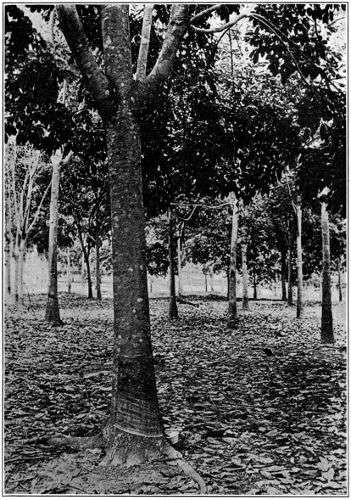
Single Cut on Two-Fifths of Circumference.
The opening cut covers two-fifths. Subsequent cuts occupy one-fifth of circumference.
Glass cups are made in two patterns, one having a flat bottom and the other a conical base. The latter is convenient for use when wire supports are employed, the cup fitting into a loop placed beneath the spout. Used on the ground its shape is an obvious disadvantage, as, unless a hole is scooped for its reception, it has to be propped up with sticks or stones. Often a touch is sufficient to upset the balance, and latex is lost.
The flat-bottomed cup, on the other hand, may be used with success equally on a wire support or on the ground. It is sometimes said that owing to its shape the ease of cleaning, as compared with the half-spherical cup, is diminished, and that if the cups when not in use are kept inverted upon sticks placed near the foot of the tree the breakage is apt to be high. This latter objection is being rapidly removed as the practice of using these sticks is losing vogue for various reasons, and wire cup-holders will be in general use as soon as the cost of material becomes normal.
There are on the market, and in fairly wide use, cups of Chinese and Japanese manufacture. These generally consist of brown earthenware with an interior glass finish. These are cheap in comparison with glass and white-ware cups, but it is a pity that the glass does not extend over the whole of the cup. The outer surface has a tendency to collect rubber and dirt. On some few estates small china bowls or saucers are still used and are quite satisfactory, except for the favour with which they are regarded by natives on the outskirts of the estates.
Cleaning Cups.—The question of cup-cleaning would appear to be a very simple one; but in practice it is quite a source of worry to managers, especially where a mixed labour force is employed. Tamil coolies can be made to clean their cups in the day’s task and at odd times. Chinese coolies, more often than not, either refuse to give the necessary attention or else demand extra pay for the work.
The method of cup-cleaning employed more popularly within recent years was that of daily washing. The tapper carried two buckets, one for receiving the latex and the other containing water. Pouring the latex in the bucket the coolie then added a little water to the cup and added these rinsings to the latex collected. The cup was next washed hastily in the bucket of water and replaced. By the time the coolie has emptied and washed some 200 cups (about half the task generally) the water has the consistency of dilute latex, and the wet cup when replaced becomes coated with a thin film of rubber. If the latex is always collected in one direction it will be clear that, while the cups at one end of the task are comparatively clean, those at the other end have the chance of being correspondingly dirty.
Controversy has raged respecting this question of cup-washing, and many estates have abandoned it as a daily practice. Coolies have not to carry an extra bucket of water. The contents of the cups are poured into the latex-bucket, and the bulk of the latex film remaining is also removed by the aid of a finger. The cup is then replaced, a thin skin of rubber forming on the interior surface. As a general rule this is easily removed on the next occasion, except perhaps in dry weather. It is the custom on most estates employing this practice to have all cups receive special attention at regular intervals.
There are certain economic factors entering into the difference of opinion regarding the two broad methods employed. In some cases—e.g., on old areas—it would be practically impossible to follow the older method of daily cup-washing, as the tappers have to employ two buckets for the collection of the latex. The employment of special coolies for cup-washing would be necessitated, such as may be seen sometimes on estates working Chinese “squatter” labour—where the man taps, a child assists in collecting, and another child, or the mother, washes the cups. It may be pointed out that in such instances the helpers are not paid by the estate. Their services merely mean a saving in time which is spent in the squatter’s garden, and perhaps the permission to the tapper to work a larger number of trees than would be allotted ordinarily to a task.
Again, on some estates, the tappers, while not being required to carry a bucket of water for cup-washing, are given an increased number of trees to tap. Furthermore, on hilly areas under tapping, it is often manifestly unfair to expect the tapper to be able to carry two buckets during collection, when the slope is such, as to make the manipulation of even one bucket a matter of difficulty.
It will be seen, therefore, that there is no clear issue for argument concerning the two methods, and that the point must be decided on the economic factors peculiar to each estate or district.
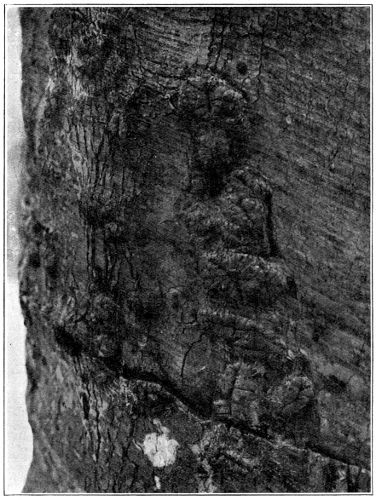
Effects upon Renewed Bark of Previous Tapping.
Note uneven surface and callosities.
Water in Cups.—Much discussion used to take place regarding the necessity or otherwise for placing a small quantity of water in the cups when tapping. It was recognised that the permission to use water (with the idea of preventing coagulation) led to much abuse, apart from the question as to the utility of the method. Dirty water was often used, although clean water may have been placed in the buckets when coolies left the muster-ground. The small quantity of water often exceeded the actual yield of pure latex by hundreds per cent., with the result that on arrival at the factory the diluted latex was below the standard desirable for the preparation of a good sheet-rubber.
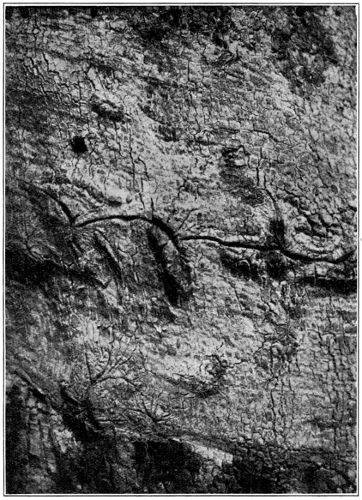
Another Example Showing the Effects of Previous Tapping.
Premature Coagulation.—Other opinion to the contrary it is now generally acknowledged that the possibility of premature coagulation in the cup or bucket is at least not diminished by the addition of even clean water. The use of water often obtained from estate drains clearly led to increased trouble. The extent to which such premature coagulation takes place varies greatly under the influence of many factors—e.g.:
(a) Cleanliness of cups and spouts (the latter an important item often overlooked, and involving the presence of certain organisms which effect coagulation).
(b) Climatic conditions.
(c) Rate and volume of flow of latex.
(d) Size of tappers’ tasks (involving the length of interval between tapping, and the collection of latex).
(e) Distance to be traversed between the site of the task and the store.
(f) Care in collecting, to exclude extraneous matter.
(g) Nature of transport; agitation of the latex to be reduced to a minimum.
(h) Nature of the soil, and situation of the estate.
The last mentioned factor is of great importance. As a general rule it is noted that premature coagulation is less marked on estates situated on comparatively hilly land. The greatest effect is remarked on estates situated on the flat lands of the coastal area where peaty soils are a feature. On many such estates, in spite of the observance of all ordinary precautions, it is not possible to receive the latex at the factory without a large percentage of prematurely coagulated rubber being found in the transport vessels.
Anti-Coagulants.—For this reason on these (and other) estates, the use of small quantities of anti-coagulants is common. The effect of these is to keep the latex liquid and thus render possible the preparation of a higher percentage of first-grade rubber than would be otherwise obtained.
Among the better known agents which have such an effect upon latex, formalin and sodium sulphite (not bisulphite) are the chief. The latter is the more popular as it is slightly cheaper and much more stable. As now used, it is in the form of an easily soluble powder (anhydrous sodium sulphite). The ordinary crystalline form of sodium sulphite as used in photography is not recommended, on account of its comparative lack of power and its poor keeping qualities.
It will be obvious that, given two equal quantities of different latices, different amounts of an anti-coagulant may be required to produce the same effect. Hence it should be remembered that a formula which suits the needs of one field or one estate will not necessarily prove suitable in the case of another field or estate. Unless this point is appreciated trouble may ensue. On some estates it has been the custom to give equal quantities of sodium sulphite solution to all coolies irrespective of the ages of the trees in the fields to be tapped. Thus it happened that the latex from one field was found to have insufficient anti-coagulant present, while that from another field could only be coagulated by the addition of an excess of acid. In this matter the experience of the preliminary trials should have caused some discrimination to be exercised as to the quantities of solution to be issued in each field or division. It has been found sometimes that a moist glossiness in the smoked sheet could be attributed to the use of an excess of sodium sulphite. Traces of the salt remained in the rubber, and as the substance is hygroscopic, moisture was being absorbed from the air, to cause a surface deposit which often returned even after the sheets were surface-washed and re-dried.
If sodium sulphite is to be used in the field, the following formula, which is in wide use, may serve as a basis for trials.
Formula for Use of Sodium Sulphite in the Field.
(a) Dissolve anhydrous sodium sulphite in water at the rate of 1 pound to 3 gallons.
(b) Of this solution each coolie is given about 3⁄4 pint. This is usually sufficient for a task of 350 trees. The solution is used by shaking a few drops into the cup or, diluted with an equal volume of water, it is run down the main channel when the latex flows.
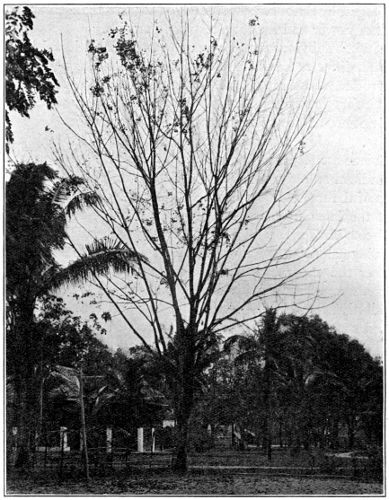
1. Showing Effect of “Wintering.”
On some estates it is found either unnecessary or impracticable to use the solution in this manner. Instead the anti-coagulant is placed in the bottom of the bucket prior to the commencement of collection. The solution is made as in (a) above, and roughly half an ordinary latex-cupful is placed in each bucket.
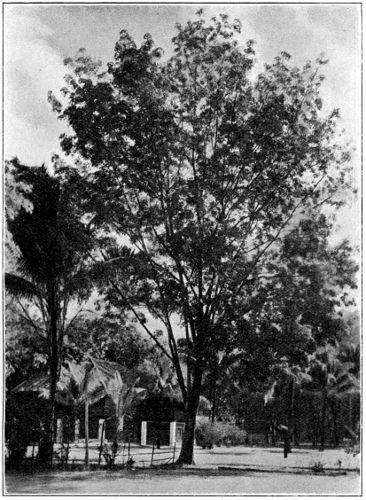
2. New Growth of Young Leaf on Same Tree.
Collecting Pails.—All vessels intended for the transport of latex should have a smooth and curved interior, so that cleansing may be easy. Preferably the interior and exterior surfaces should be glazed, but it is often found that the enamel chips easily, and that the handles are too frail in construction. The shoulder-pieces, to which the handles are joined, are often too lightly attached to the bucket. Something stouter in the shape of enamelled ware is required, without an appreciable increase in weight. Until such a utensil is available, the heavily galvanised and brass-bound milk-pails used on some estates are as good as anything at present in vogue, providing they are kept scrupulously clean.
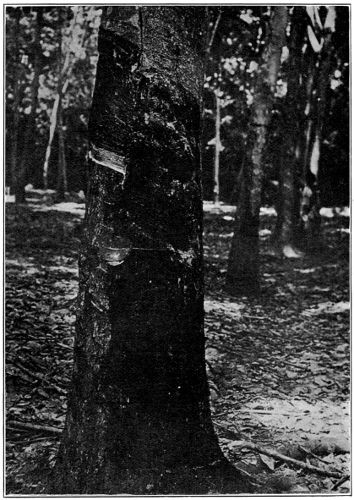
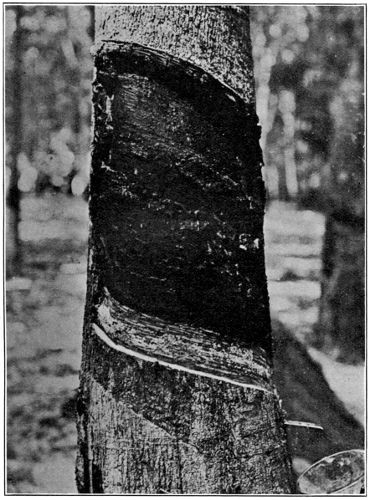
Effects of Disease—“Mouldy Rot.”
(
a) Note on right hand the panel next in order for tapping; a hopeless position.
(
b) The present cut badly infected; above there is no renewal of bark.
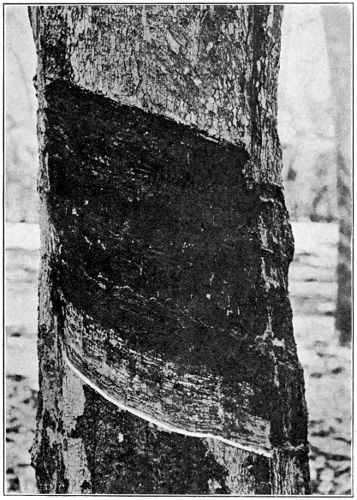
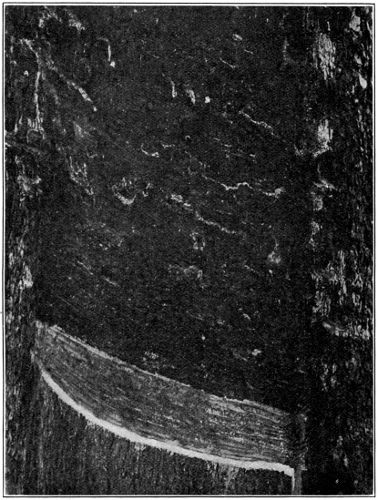
Effects of Disease—“Mouldy Rot.”
(
c) As in (
b); another tree.
(
d) At close quarters. Note wounds due, apparently, to bad tapping, but really caused by the disease.
The collecting pails should be kept under cover, when not in use, either at the muster grounds or at the factory. On some estates coolies are allowed to take them to their quarters, where they are used for various purposes. Curious effects of this practice have sometimes been noticed. As an example might be quoted an instance in which premature coagulation was found to take place to a surprising degree. It was discovered eventually that the coolies (Javanese in this case) were in the habit of utilising the buckets for the preparation of their food. A liquid extract of a popular fruit was often made. This extract was very markedly acid in character, and as the buckets were not afterwards thoroughly cleansed, the latex of the following day suffered.
Preferably all buckets should have a lid of slightly funnel shape. This is inverted during collection, and thus prevents much dirt falling into the latex.
Payment by Result.—The arguments for and against the institution of this practice are many. In actual result there can be no question that a higher yield is obtained by the adoption of a scheme under which the coolie is either given a bonus based on result or is paid at a definite rate per pound. It is fully recognised, both by advocates and opponents of payment by result, that the personal equation of the tapper is a very important factor. A good skilled tapper will always obtain a higher yield than an ordinary individual from the same task of trees, and without any more injury to the trees. It is argued, therefore, that such an operative should be given the benefit of his skill. Apart from this, it is claimed that even the average tapper does not do his best work if he knows that he will get his daily wage, no matter what his yield may be, as long as he does not injure the trees by wounding. It is claimed that this sense of security leads to shallow tapping which, while it has an agreeable appearance, does not produce the available amount of rubber.
On the other hand, it is advanced in opposition that under a scheme of payment by result the tappers’ only consideration is the matter of obtaining rubber, and that considerable damage in the form of wounds is done by over-deep tapping. That there is a great deal of truth in these statements is not to be doubted. Much, of course, depends upon the amount and quality of the supervision possible, and upon the standard demanded. It is a notable fact, however, that on estates which first introduced the system some years ago the quality of the tapping compares favourably with that of average estates, and in a few instances within the experience of the writer the tapping is of a high standard. Possibly these are exceptional instances, and there can be no doubt that the opposition of many managers of considerable experience is founded upon the deterioration in the standard of tapping which often follows the institution of payment of tappers by result.
It will be recognised by planters that apart from the personal factor in tapping, the worker might be so unfortunate as to be placed in an area from which the yield is naturally low, either by reason of its youth or from other natural causes. Obviously such individuals are entitled to special consideration in respect of the rate per pound paid for the rubber obtained. Again, on very hilly land it may be not humanly possible for a worker to tap the usual number of trees. Hence to place him on a parity with other tappers, as far as wage-earning capacity is concerned, a higher rate than ordinary must be given. It will be plain, therefore, that on any one estate it is generally impossible to set a standard rate per pound for payment by result; the rate may vary, for example, from, say, 3 cents per pound in old and high-yielding tasks to 12 cents or more per pound on young areas of the same estate.
Naturally the actual rates paid will primarily depend upon the average yield per tree or yield per acre, and the lower the average yield the higher the rates to be paid per pound. Thus, on low-yielding properties where the natural conditions render a high yield impossible the rate per pound may reach a figure of 22 cents (approximately 6d.).
The methods of arriving at the yield of rubber brought in by individual tappers vary, but broadly they fall into two classes:
(a) That in which the volume of latex is ascertained (either by measuring or by weighing), a sample is drawn, and the final calculation made from the weight of the more or less dry sample.
(b) That in which, after noting the volume, the calculation is based upon a reading of the dry rubber content of the latex, obtained by means of an instrument such as the “Metrolac,” or any other instrument working on the same principle.
Quite a number of estates which have not adopted the full system of payment by result yet employed some such method of checking the yields of individual coolies, as the observed results act as a great deterrent against various malpractices, such as neglecting to tap trees, adulteration of the latex, etc.
Tree-Scrap.—The thin film of latex which coagulates naturally upon the surface of the tapping cut after the latex has ceased to flow is known as “tree-scrap.” Normally it is collected on all estates, but the method of collection varies according to the class of labour employed. On most estates, where the labour is Tamil or Javanese, it is supposed to be removed as fully as possible before the tapping cut is reopened. The narrow strips are then placed in a bag or basket carried by the tapper. Chinese tappers usually decline to follow this practice of first peeling off the scrap, and remove it by the operation of tapping, with the result that the scrap when brought into the store has adhering to it various shavings of bark. Unless these can be thoroughly cleaned off the scrap cannot truly be classed as “tree-scrap.”
Oxidation of Tree-Scrap.—It is often noted that some scrap is dark in colour, and in this condition it is generally spoken of as “oxidised” scrap. The oxidation is probably due to an enzyme, and also to the presence of chemical substances of a phenolic nature. In the course of laboratory experiments with normal latex, it was found possible to reproduce this darkening due to oxidation by the addition of very small quantities of various phenols used in general chemical processes, and the rapidity with which the darkening was effected depended upon the quantity of the phenol added. If this rapidly oxidising latex be mixed with normal latex, it would seem that the whole bulk of the latex is affected by this tendency to rapid oxidation. It is observed that this condition under which any tree may yield rapidly oxidising latex is not a permanent one.
Care of Tree-Scrap.—As these scraps eventually give a grade of rubber which compares well with other and better-looking grades care should be exercised in collection and treatment so that its quality is not impaired in any way.
To Prevent Oxidation.—As a rule the scraps are picked over, and heavily oxidised pieces are sorted out; otherwise the crepe rubber prepared exhibits black streaks. The scraps should not be allowed to remain in the sun (which induces “tackiness”), and if they have to be kept over night they may be placed in a weak solution (1 per cent.) of sodium bisulphite to arrest oxidation. It should be recognised that such a solution will not “bleach” already darkened scrap-rubber, and the nature of its action is only anti-oxidant.
Bark Shavings.—In the matter of collecting bark-shavings much depends upon the organisation and nature of the labour force. Probably, on the majority of estates bark-shavings are collected systematically, but on quite a number considerable laxity in this respect has been noted. This may arise from lack of adequate supervision or from the peculiar systems of working which seem to pertain to Chinese labour. Granted that the trees are well “scrapped,” and that the percentage of rubber obtained from shavings under such circumstances would be extremely small (say 2 per cent. by weight on the total output), it does not need much calculation to see that annually the loss of rubber to the estate must be considerable. It would also seem to follow that, if the adult labour declines to pick up bark-shavings carefully, it might pay to employ children for the purpose. Or, as is done in some places, the adult labour might find it advantageous to collect bark-shavings at low rates per pound.
It is a well-known fact that if bark-shavings be allowed to accumulate in a heap for any but a short period, a fermentative and heating action is set up. The heat developed in these piles of shavings is so considerable that it is impossible to keep the hand in a heap for more than a second or two. Should this be allowed to persist, as would happen in the case of a breakdown of engine or machines, it usually results in the final crepe rubber becoming tacky when approaching dryness.
To avoid this heating effect it is necessary to have spare jars or proper tanks in which the shavings may be soaked in water. In this condition bark-shavings may be kept for many days.
For the same reason (i.e., the heating effect and consequent tackiness) the custom followed on some estates of allowing coolies to keep bark-shavings in their “lines” until they have accumulated a fair quantity cannot be commended, quite apart from the possibility of actual loss by theft, which is thus rendered easy.
It will be clear that where the trees are scrapped efficiently before tapping, the amount of rubber to be obtained from the treatment of pure dry shavings would be almost nil, and would scarcely repay the cost of collection and working. In actual practice, however, it is not possible to guarantee that the shavings are free from some scrap-rubber. Shavings brought in by Tamils and Javanese carry only a small amount of rubber, whereas where Chinese tappers are employed the yield of rubber may be as high as 35 to 40 per cent. upon the total weight of the material treated.
Few estates now are not equipped with “scrap-washers“—machines specially designed for removing the bark from the rubber—and if they function efficiently the resulting crepe should be free from bark-particles.
Collection of Earth-Scrap.—This, the lowest grade of rubber, is found at the base of the tree. Theoretically, if proper precautions are observed, the amount should be comparatively small, but in actual practice it may be very appreciable. The usual contributory causes are:
(a) Failure to replace cups beneath the spouts of trees which continue to drip latex after collection.
(b) Collection of latex at too early a stage.
(c) Failure on the part of the tapper to ensure the flow of latex, by means of the spout, into the cup.
(d) Flowing of latex over the edge of the cut before it reaches the vertical channel.
(e) “Wash-cuts” on wet days, when the volume of rainwater down the tree is sufficient to wash the latex out of the cup.
The amount of earth-scrap collected on any estate will depend, all other things being equal, upon the labour expended in its collection. Certainly on well-organised estates, having ample labour, the amounts collected are huge in comparison with other estates. The ground at the base of the tree below the latex-spout is systematically turned over with pointed sticks and large clots of rubber are often picked up. Here, again, it is advised that the collected earth-scrap should not be allowed to remain in heaps upon the floor of the factory. It should be placed in suitable tanks containing water, and quite a considerable portion of the cleansing work is thus taken from the machines.
CHAPTER VI
TRANSPORT OF LATEX AND COAGULUM
Percentage of First Latex and Other Grades.—One of the problems confronting any manager is the question of the percentage of first-grade rubber calculated upon the whole output. Inquiries are constantly being received for advice as to what the various percentages of each grade of rubber should be. This is a question to which no definite list of figures can apply. There are so many little factors influencing the result. Some estates are not particularly careful in collecting tree-scrap. Hence quite a quantity of tree-scrap finds its way into the crepe made from bark-shavings. On the other hand, bark-shavings are not collected systematically on some estates, and the total output is thereby diminished. In consequence the first-grade rubber shows a higher percentage than it would otherwise. Again, if the earth-rubber is not regularly collected the percentages of the best grades are higher than they should be. In comparing the percentages of each grade of rubber from any two estates, therefore, one should have all the information possible as to the various working details of the estates. Without wishing to lay down any definite proportions which can be applied to all estates it might be said that, taking averages over a large number of estates, the percentages to be aimed at are:
First-grade latex
75
per cent.
to
80
per cent.
Other grades
20
„
„
25
„
For these figures one promises that all lower grades are collected and accounted for carefully and regularly. The distribution of the lower grades will depend upon the field practices of the particular estate, but the following list might be given for an estate keeping all lower grades distinctly separate:
First-grade latex
75
per cent.
Cup-washings
}
10
„
Coagulated lump, etc.
Tree-scrap
9
„
Bark-shavings
4
„
Earth rubber
2
„
100
„
Emphasis is again laid on the statement that these figures must not be accepted as a standard. Nevertheless, they may prove of some service to managers in giving an idea of what the general line of percentages may be. There are special circumstances, such as distance of transport and the nature of the land, which at present would render the attainment of more than 75 per cent. first-grade rubber impossible on some estates. Still the fact remains that if the percentage is low through distance of transport, etc., some method will have to be discovered by means of which the difficulty maybe overcome. On a few estates the percentage of first-grade rubber obtained sometimes reaches 85, but these results are rather out of the ordinary. An estate which collects all lower grades properly is doing well if the percentage of first-grade rubber is 75 or over.
Early Collection.—As already noted in the preceding chapter, one of the factors influencing premature coagulation is that of the interval elapsing between the commencement of tapping and the collection of latex. It will be seen that this ordinarily would depend, in turn, upon such considerations as the size of the tappers’ tasks, the spacing of the trees, and the natural conformation of the land over which the tappers have to perform their tasks. In general it need only be remarked that every possible consideration should be given to this question, and that any delay should be avoided.
Transport.—Wherever possible it is endeavoured to convey latex from field to factory by man-power. Tamil coolies, as a rule, place the bucket on the head; Chinese and Javanese coolies like to use a balanced carrying-pole. Where distance renders these methods too costly in time and labour, it is usual to have field centres where the latex is collected and dispatched to the factory generally (a) by means of vessels conveyed on light railways; (b) in large cans placed on motor-lorries; (c) in cylindrical galvanised drums supported on two wheels and drawn by bullocks. There may be variants, but these are the chief means of transport in bulk over a distance.
Where possible, the best system is that employing a trolley-line, as great agitation of the latex is avoided, and the time in transit is much reduced.
The usual method of transport by bullock power is slow, and as estate roads (and even Government roads) are often below the standard expected in this country, the jolting undergone by the latex is, to say the least, not calculated to afford a high yield of first-grade rubber. The late Mr. F. W. F. Day advocated the use of a circular perforated wooden grid, to be floated on the latex, in order to moderate the wave effect produced by jolting.
Whatever the means of bulk-transport employed, it should be the care of those in charge to see that vessels are not allowed to remain in the sun longer than is necessary. Even during the journey they should be shaded in the best possible manner.
These large transport vessels usually receive what is really only perfunctory attention in the matter of cleaning. They should receive the same care as would be exercised in dealing with milk cans in other countries. Ordinary sluicing with water is not sufficient, and if they cannot be sterilised by means of boiling water, they should be treated, after ordinary washing, with a 5 per cent. solution of sodium bisulphite every day.
Anti-Coagulant for Transport.—When anti-coagulants are not used in the cups or buckets, it is advisable to use them in the bulk-transport vessels. Either formalin or sodium sulphite is of service, but the great objection advanced against the former is its loss due to evaporation while the carts are going to the fields or waiting at the centres. For this reason sodium sulphite is now generally employed.
Formula for Use of Sodium Sulphite in Transport.
(a) Dissolve 1 pound of powder in 3 gallons of water.
(b) Of this solution, place half a gallon in the vessel for every 30 to 40 gallons of latex.
Transport by Coolie.—As already pointed out, the extent to which man-power can be used in transport of latex is generally limited. On small estates it is an easy matter for coolies to carry the latex to the factory, but on larger estates many difficulties may arise, which may also militate against the successful use of other means of transport. It is not uncommon to find, therefore, that a policy of decentralisation has been adopted.
Coagulation Centres.—Divisions of the estate have their own small stations at which latex is received and coagulated. In this way it is possible to receive latex without much delay, and with benefit to the resultant rubber, especially if prepared in sheet form. Much controversy has arisen regarding these decentralised establishments, but the fact remains that on large estates, which are efficiently controlled, the scheme has been highly successful from all points of view. On the other hand, it is alleged that this method of working increases costs, and often gives an unsatisfactory quality of rubber. Concerning the latter point it seems to be reasonable to expect that the European in charge of any division should be conversant with the method of preparation required, and should be capable of seeing that no mistakes are made. Given uniform equipment in all stations, and uniform rules for treatment of the latex, there does not appear to be any valid reason why the product of one station should be inferior to that of the others. Neither is it so in the case of several estates which might be quoted.
In the matter of costs of working the writer has had to investigate several cases regarding which there was dissatisfaction. In some instances it was found that the stations had not been placed advantageously with respect to a water-supply; and instead of one or two coolies pumping for an hour or two, a larger number had to be employed for hours in the carriage of water from the nearest available source. This meant that, as the coolies were on daily wage, the force appeared to be much bigger than that usually required. In other cases there were too many store coolies, when often the place of some could have been taken for the necessary period by tappers arriving early from the nearer fields. Sometimes costs were increased by reason of the use of an excess of chemicals, owing to the lack of uniform rules throughout the several stations. In spite of all that has been written, and the verbal instructions that have been given, it was not uncommon to find unstable chemicals such as sodium bisulphite exposed to the moist air. In this way not only was there waste of material, but also the probability of inferior rubber being made.
Transport of Coagulum.—On the whole if it is a question between the transport of latex and the transport of coagulum, the writer would always favour the latter, for reasons which have possibly been made clear in the preceding paragraphs. In effect, it should be recognised that the less handling and transport the latex receives the better the general result.
If proper precautions are taken, the transport of coagulum intended for the preparation of crepe should present no difficulty, and should have no injurious effect upon the quality of the resultant rubber. It is only too common, nevertheless, to note defects, in the finished crepes, which can only be attributed to a failure to observe reasonable care in the transport of the coagulum. For example, it has been observed that a mass of coagulum from a coagulation station has been conveyed on the floor of a bullock-cart, or motor-lorry, previously used in the carriage of other materials. Unless the boards have been most scrupulously cleansed, the coagulum is found to be contaminated, often to a marked degree. Again, although the cart may be clean, it may have to travel some distance on roads carrying a fair amount of motor traffic. Even should the cart have a canopy, road-dust is often whirled through the open sides of the cart; and in the districts where red laterite roads are common, the stain of such dust often persists in the finished crepe. It scarcely need be remarked that coagulum should be transported in closed wooden boxes or in galvanised iron drums fitted with lids; and that preferably sufficient water should be present in these receptacles to allow the coagulum to float. All such containers should receive the same scrupulous attention as the vessels employed in the transport of latex.
The successful transport of coagulum for sheet-making is fraught with much greater disabilities, and it is usual to note on most estates that the resulting sheets from out-stations are always inferior, in final result, to those coagulated and prepared at the central factory. If the flat pieces of coagulum are placed in piles of any height it is common to find, on arrival at the factory, that much adhesion has been caused. There is great difficulty in separating the pieces, and often the successful operation is impossible. It is usual to hand-roll the coagulum before transport, but it is often found that by the time the rubber reaches the factory it has become too hard for subsequent good results.
One of the strong arguments in favour of the establishment of divisional stations is to be found in the preceding paragraph. Sheet-making, as it necessitates the employment of only light machines suitable for hand-power, is a feasible proposition in a field station. There is no reason for sheets made thus to be in any way inferior to those made at a central factory; in fact, they are often better, as the latex has the chance of being treated when comparatively fresh.
If it is found necessary to transport sheet-coagulum, every possible precaution should be taken against piling the pieces.
After hand-rolling some estates bring the rubber from the field-stations to the central factory in drums of water, others in shallow boxes containing not more than half a dozen sheets in a pile. A method proposed long ago, but not in practice, was to have a number of shallow trays subdivided so that each compartment held one sheet only. If these trays were properly made and carefully fitted there appeared to be no reason why they should not form sliding parts of a large box, in which squeezing and adhesion of the pieces of coagulum would be avoided. Naturally any such device would increase appreciably the weight to be transported, and on this ground would not find popular favour except where motor-power is used for road transport.
PART II
FACTORY OPERATIONS
CHAPTER VII
PRELIMINARY TREATMENT OF LATEX
Reception of Latex at the Store.—Bearing in mind the remarks in Chapter VI. on the conditions under which latex is transported, it follows that nothing but the very best and most suitable vessels should be used in the store. A point to which adequate attention is not given in many factories might be mentioned here. Considering the importance attached to colour in the dry rubber by brokers and consumers, and knowing how extremely trivial are the causes which may mar the colour, it is rather surprising that better provision is not made for the reception and handling of latex in factories. Too often the receiving vessels are placed on the floor of the store close to the entrance. Coolies bringing in latex cannot avoid bringing with them quite a considerable amount of dirt. Presuming that a hose-pipe has been installed, and that the floor is constantly being sluiced down with water, no great harm will result. But would it not be ever so much better if the dirt were kept out? In how many factories is provision made for this? Such an arrangement is not difficult to make, and is already in practice on a few estates. A verandah is built outside the wall of the factory and all latex is received there. In another place open chutes are provided which terminate in the straining sieves. The coolie thus stands on the verandah where he removes coagulated lump and impurities from the latex, which is then poured down the chute, passing through the sieve into large coagulating jars or tanks.
Too often it would appear, from the writers’ observation, there is a lack of adequate supervision on the arrival of latex at the store. Much can be learned from an inspection of the coolies’ buckets, and the cause of small defects in the finished rubber can often be thus traced. Leaves, stems, bark-shavings, and dirt appear in the buckets, and it is a source of constant surprise to imagine how even unintelligent coolies can allow such things to happen. These objects are removed before or during straining, but still they ought not to be there in the first place, and the fact that such a state of things exists is evidence of neglect on the part of the coolies or lack of supervision. Efforts are made in a large number of cases to cope with these troubles, but on some estates things are allowed to proceed in the same slipshod way, and too much responsibility is thrown on the straining process.
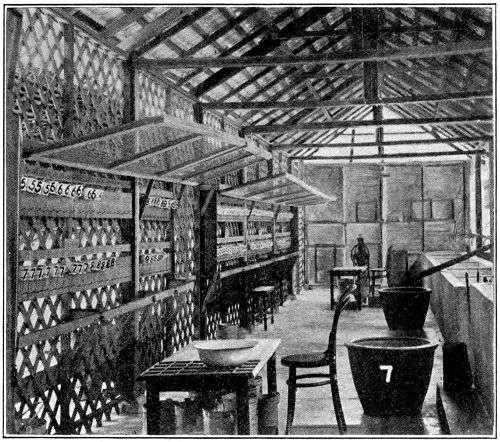
Raised Verandah for Reception of Latex; likewise equipped with Facilities for calculating Individual Daily “Yield per Coolie” by Sampling of Latex.
It is suggested that it should be the business of a European to supervise the reception of latex every day. This is at present quite impossible on some estates, but it does not alter the fact that this supervision should be provided, and is extremely necessary.
It is surprising how the point is overlooked in many factories—not that they are in a dirty state, but they fall short of being classed as clean factories for want of the little that makes the difference. Possibly those in charge do not believe that all this fuss need be made, but the writers can assure them, from a practical knowledge of a very large number of factories, that cleanliness does pay.
It might not be credited to Tamil coolies, but yet it is probably true, that the moral effect of working under the cleanest and best conditions has an influence upon the store coolies, and that their work is better in consequence. Everything which will tend to simplify the cleansing of the factory should therefore be installed. Hose-pipes, glazed tiles, clean floors, plenty of light and air are not fads or fancies, but considerable factors in determining the final quality of the rubber. There is considerable truth in the suggestion that the coagulating room and machine room should be as “spick and span” as a modern home dairy.
Straining of Latex.—This is a most necessary process, and one which usually entails much trouble and time which one could wish avoided. It will be admitted that the trouble could be reduced greatly if the regulation of field processes could be made more stringent. In spite of knowledge that impurities must not be allowed to enter the cups, coolies will ignore the rule that the cup must not be placed in position until the bark shaving has been cut. The result is that pieces of bark fall into the cups, and coolies are generally too careless or too hurried to remove them.
Again, when cups are placed on the ground, it is easy to see that dirt may adhere to them. In the collection of latex some of this dirt may fall into the bucket. Since the introduction of cup-holders on many estates the trouble from this source has decreased considerably, but, nevertheless, it may be taken for granted that even under the best of conditions all latex requires straining.
The best type of strainer has yet to be evolved. Usually it consists in principle of a piece of fine brass mesh contained in some form of holder. Theoretically such a strainer should work well, but in actual practice nearly all strainers are a source of continual worry. Undiluted latex, as received at the factory, is of a rich consistency, containing very fine particles of dirt and often minute particles of prematurely coagulated rubber. The latter soon clog a fine mesh strainer, while the former may pass through. When the flow through the strainer becomes slow, the coolie in charge generally rubs the top surface of the sieve with a piece of coagulum, thus forcing material through the mesh. He then rubs the under-surface, with the result that undesirable matter falls into the strained latex. In theory it seems a simple matter to have a number of sieves ready so that a clean one may be substituted for a clogged one, which should be cleansed at once with water. In practice the factory coolie will probably only carry out instructions when the eye of the superintendent is alert. As a result of the rubbing and consequent strain, the brass mesh usually breaks away from its support and the fracture may not be detected for some time, during which irreparable damage may have been done to the resultant rubber.
In view of the presence of the fine particles of dirt, to which allusion has been made, fine sieving of the latex appears to be essential, especially when sheet-rubber is to be prepared. The fine sieves are generally of the type known as “60 mesh,” and they do not usually give thoroughly satisfactory results even when the gauze is supported and strengthened by means of cross-wires placed underneath. The general fault with these strainers is that a sufficiently wide “selvage” is not allowed in the clamped edges of the gauze, or that the edges of the support are so sharp and abrupt that the strands of the gauze are soon severed by the strain imposed in vigorous cleaning.
Many estates use two strainers; the first a more robust one containing “30 mesh” gauze, and the second the fine “60 mesh.” Even this device does not bring about the desired immunity from trouble. Relief could be obtained if the latex were always in a more freely fluid form. Estates employing anti-coagulants in the field benefit in this respect. Other estates, although finally using the finest of mesh, experience far less trouble than most estates by reason of a difference in method of working. This can be explained by an outline of the system adopted on a particular estate:
(a) On arrival of the rich latex at the store, all visible coagulated lumps and other extraneous matter are removed by the tapper.
(b) Each tapper’s latex is diluted with a quantity of water.
(c) The diluted latex passes through two sieves, one above the other. The top sieve is of stout perforated zinc sheet, with 10 circular holes to the inch. This removes all large particles. The lower is of “30 mesh” brass gauze, and practically no rubbing is required. The latex is now in glazed-tile tanks, in which it is further diluted to the required standard by means of a recording instrument.
(d) The latex flows by means of a chute into the coagulating tanks, passing through a large “60 mesh” sieve.
It is not guaranteed that this method will furnish a complete absence of very fine particles of dirt in sheet rubber, as the human element enters so largely into the question; but it can be stated that no complaints have been received on the point of “specks of dirt” since this system was inaugurated.
On the same estate fine sieving in the preparation of pale crepe has been abandoned as an unnecessary refinement. The two coarse sieves mentioned above are employed only, and it is to be acknowledged that the results justify the procedure.
Bulking of Latex.—Not long ago advanced estates used to combine all latex before coagulation, in order to obtain uniformity of product. Previously it had been the custom to deal only with comparatively small separate volumes of latex, with obviously great disadvantage.
Since the introduction of instruments such as the “Metrolac,” by means of which any volume and all volumes of latex may be reduced to a common standard of dry rubber content, the necessity for “bulking” has passed. It is not now necessary to keep latex standing, perhaps for two hours, awaiting the arrival of other latex from distant fields.
Standardisation of Latex.—In modern practice, as already pointed out, it is possible now to handle any volume of latex with a view to its reduction to any required standard of dilution for the purpose of obtaining a uniform product. For the reception and subsequent handling of the latex various schemes have been devised, and they are usually planned in connection with coagulating tanks used in the preparation chiefly of sheet rubber.
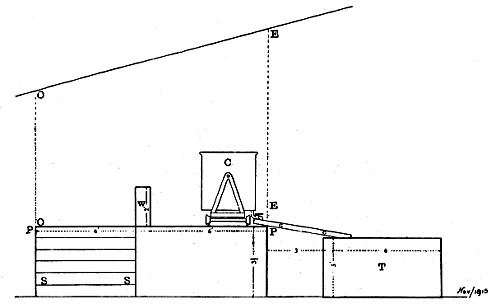
End-Section Sketch of Verandah, etc., showing a Good Method for receiving Latex and filling Tank.
T, Sheet coagulation tank; C, cylinder for reception and dilution of latex; GG, gutter; PP, raised platform on verandah; SS, steps leading to platform; W, dwarf wall; EE, expanded metal partition; OO, open.
In the successful working of a tank it is necessary, in order to obtain the best results, to standardise all latex. This cannot be effected properly in the tank itself, and hence it is the practice to dilute each lot of latex to standard before it is run into the tank. In the ordinary way this would entail a great deal of labour in handling the diluted latex. To obviate this, the scheme outlined in the accompanying sketch has been suggested on several occasions and in various quarters. Such a scheme or modification of it has been put into successful practice on several estates. Although the drawing was made some considerable time ago when estates were not then prepared to go so far in this direction, subsequent modifications show only minor differences which, while leaving the original principle intact, testify to a fertility of resource in adapting the idea to existing circumstances and buildings. The drawing is in toto almost a replica of the original installation now in successful use on the Kinrara Estate of the Ledbury Rubber Company. On this company’s Ledbury Estate likewise a similar system is employed, except that the reception verandah is part of a natural formation and needed no such direct raising. Several other estates have now adopted the scheme, which has been proved to be of practical value. The writers make no claim to originality in the idea, which might have occurred to many independently on the introduction of coagulating tanks.
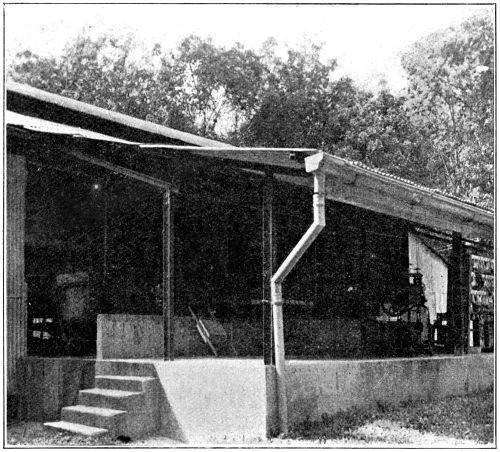
Raised Verandah for Reception and Handling of Latex.
Verandah.—In reproducing the drawing it is believed that the sketch will convey practically all the information required. It may be explained that the coolies are allowed to enter only the outer part of the verandah. The buckets are handed across the low wall into the care of factory coolies, who strain the latex through gauze sieves into the latex cylinders.
Latex Reception Vessels.—These cylinders may be similar to the tanks commonly used for transport of latex from distant fields to the factory. An 80-gallon cylinder is easily mounted by its trunnions on a suitable iron framework which is superimposed on a skeleton truck.
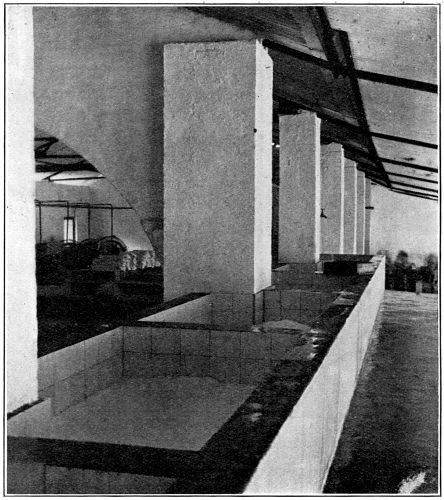
Another Set of Dilution Tanks on Raised Verandah.
The latex is diluted down to standard in the cylinders, the truck is moved opposite the compartment to be filled, and a light movable gutter is placed beneath the vent of the outlet pipe. This pipe is fixed in the bottom of the cylinder, and is provided with a large stop-cock which is operated by a spanner key. The stop-cock should be of the simplest type, capable of being taken apart and assembled in a minute or so. The orifices should be large enough for a coolie to insert at least two or three fingers so as to facilitate cleaning, and the pipe should have no right-angle bends.
On the inside of the cylinder a scale of gallons may be painted, so that one may possess a knowledge of the quantities run into, or required for the completion of, any compartment.
A Screw Plug Unsatisfactory.—It may be of benefit to managers who contemplate such an installation to know that the adoption of a stop-cock in the vent pipe of the cylinder is the outcome of experience. In one instance the vent pipe as designed was fitted with a screw plug at the end. Unfortunately with this arrangement the flow could not be regulated, and owing to the “head” of the latex it dashed violently down the gutter, struck the bottom of the coagulating tank, and thence was scattered over the factory.
Another Installation.—In another type of installation, in place of the vessels travelling upon a raised verandah platform, the standardised latex is conveyed to the coagulating tanks by means of drums supported by hooks to a chain-block and pulley which travels on an overhead gantry. This method is practicable, but may be regarded as less satisfactory in general working than the verandah method of treatment.
A Modern Installation.—In the most recent scheme for dealing with the reception of latex, its standardisation, and conveyance to the coagulating tank, the main principle of the first system outlined is retained; but the receptacles are not mobile. Glazed-tile tanks are employed, the capacity of each being approximately equivalent to that of each unit coagulating tank.
The accompanying illustrations show the general arrangement and some details of the system of reception tanks employed on the well-known Pataling Estate.
CHAPTER VIII
COAGULATION
Whether it is necessary to employ any coagulant, or whether latex should be allowed to coagulate naturally, will not be discussed at this stage. Neither will mention be made of any patent processes of coagulation which employ other than acid mediums. These subjects will be treated in a subsequent section of the book.
Choice of Coagulants.—It is not proposed here to enter into a discussion as to the merits of the dozens of known coagulants. Suffice it to state that acetic acid, although the oldest general coagulant, still remains the best and safest at the present time. There is a deal to be said in favour of the use of another organic acid, formic acid. It is equally as safe as acetic acid, and quite efficacious; the only drawback is that, taking all things into consideration, it is very slightly more expensive. Acetic acid, therefore, will always be implied in this chapter when the word “acid” is used.
Strength of Acid Solution.—In the old days it was the rule rather than the exception to find pure, undiluted acid used in coagulation. In many cases no harm resulted, for the simple reason that, owing to the large proportion of water in the latex, the acid was thereby very much diluted. The estates had to thank the over-dilution of the latex for the non-injury of the resulting rubber.
Some estates make up a stock solution of 1 part acid to 20 of water, and use this with success because of the fair amount of added water present in the latex.
It must be understood that what is being referred to now is not the absolute quantity necessary for coagulation, but the proportions—i.e., the respective volumes of acid and water in the solution of acid made up every day. That the strength of the acid solution, as well as the quantity used, has an effect upon coagulation can be easily demonstrated in the following way:
Take separate and equal lots of the same latex, and to each add the same quantity of pure acid, but in each case diluted with varying quantities of water. It will be found that coagulation is quickest where pure acid is employed, and slowest where the acid is most dilute. It will also be found that, providing the quantity of acid employed was sufficient for coagulation, the best and most uniform coagulation is obtained from the use of the most dilute acid, within limits. It will often be found that where pure acid has been employed coagulation is local—i.e., we have lumpy coagulation, and often a very milky remaining liquor. This is due to the fact that, as coagulation is immediate upon the spot which is first touched by the pure acid, a deal of the acid is enclosed within the rubber at that spot, and hence other portions of the latex are deprived of acid. It is in such cases that most air-bubbles are enclosed.
As the dilution of the acid solution is increased the mixing is more thorough and uniform. Coagulation is slower, and air-bubbles can escape to the surface.
Method of Making Stock Solution.—Experiments have been repeatedly made in the laboratory with acid solutions of varying dilution, from pure acid down to 1 part of acid in 500 parts of water. While it has been found that a 1 in 5 solution can be used where the latex is very dilute (say, 1 part of latex to 5 parts of water), and a 1 in 20 solution may be used in fairly dilute latex (for crepe-making), it is undoubtedly a fact that for latex as generally “standardised” on estates a much more dilute solution of acid should be used—e.g., 1 in 100, or even 1 in 200, of water. It must be borne in mind that the quantity of acid necessary for coagulation is not changed, but merely the dilution. Let us take a concrete case to illustrate the point:
On an estate at present the stock solution is made up by diluting 1 pint of acid with 20 pints of water, and 1 gallon of this is necessary to coagulate 50 gallons of pure latex.
It is desired to use a stock solution of 1 pint of acid to 100 pints of water. Evidently, therefore, 5 gallons of this stock solution contain only the same quantity of pure acid as 1 gallon of the old solution contained, and it will be necessary to add 5 gallons for every 50 gallons of pure latex. Thus:
1 to 20; 1 gallon necessary for 50 gallons pure latex.
1 to 100; 5 gallons necessary for 50 gallons pure latex.
It may be pointed out that the quantities worked out in the foregoing examples are not absolutely and mathematically correct, but they are quite close enough for all practical purposes.
It may be advanced by someone that if a dilute solution of acid, such as 1 in 100, is used the bulk of this stock solution (5 gallons to 50 gallons of latex) is very great, and might be injurious to the quality of the resulting rubber. A moment’s consideration will show that, after all, the volume of acid solution is only one-tenth that of the volume of latex. This can have no effect upon the quality of the rubber. Even dilution of the pure latex with half its bulk of water in the factory will have no effect upon the quality of the resulting rubber. It is to be remembered that, except in cases where the proportion of added water to latex is absurdly large, the main argument against putting water into the latex-cups is against the possible poor quality of the water rather than against the actual small quantity theoretically added. It is acknowledged that, where the water to be put into the cups can be guaranteed to be of good quality, no great objection would be raised against placing the smallest possible quantity of such water in the cups. But how many estates have such good water easily available to the coolies, and how many estates can be sure that only that smallest possible quantity would be used? It is a notorious fact that, even on estates where the quantity of water used was supposed to be a minimum, the proportion of water to latex in some cups often exceeded even three or four to one. In any case it may be stated as an elementary truism that the absence of water is more to be desired than water of doubtful quality.
Quantity of Acid.—As a result of repeated experimental work it has been found that, for pure average latex, the quantity of acid necessary for complete coagulation, reckoned in parts of pure acid to parts of latex, is:
1 part pure acid; 1,000 parts average latex.
Where the latex is rather richer than average (above 30 per cent. dry rubber) probably a little more acid would be required, and similarly if the dry rubber content is lower the quantity of acid must be less.
It used to be a common belief that the more dilute the latex the greater the quantity of acid necessary, but this would only apply to cases of extreme dilution of latex.
As a matter of fact, up to certain limits of added water, the reverse is actually the case—i.e., the more water in the latex the less acid must be added, assuming that for pure latex the proportion of pure acid to latex is taken as 1 part to 1,000 parts. This was found to be the case up to dilutions of three or four times the volume of latex. To take concrete examples which will perhaps make the truth more clear:
Assuming we commence by making up our stock solution of acid by adding 100 parts of water to 1 part of pure acid, this gives us a mixture of 1 to 100. For 1 gallon of pure latex it would be necessary to add one-tenth of its volume of the above mixture—i.e., 16 ozs.
Suppose we take a gallon of pure latex and add a gallon of water, we now have 2 gallons of so-called latex. But we still have only 1 gallon of real latex present in the diluted latex, and it is only necessary to add sufficient acid to coagulate this gallon—i.e., 16 ozs.
Further, if 1 gallon of latex be diluted with 2, 3, or even 4 gallons of water it is still only necessary to add 16 ozs. of the acid mixture.
At dilutions beyond this limit, however, it is necessary to add a little more acid to obtain complete coagulation.
In the process of preparing sheet rubber it is very necessary to see that the minimum quantity of acid is used, otherwise visible defects are caused. But in coagulating latex intended for preparing crepe, where the rubber undergoes protracted washing on the machines, the presence of a slight excess of acid in coagulation is not calculated to cause any deterioration in the quality of the rubber. Advantage must not be taken of this statement to argue that more than a slight excess may be used without injury to the rubber, as it can be shown that the use of a large excess of acid results in an inferior rubber.
Quantities Necessary for Modern Requirements.—It may be commended to the notice of the beginner that any further experimental work as to the quantity of acetic acid necessary for complete coagulation would only involve a waste of time and energy.
The general figure given in a preceding paragraph (1 part pure acid to 1,000 parts of latex) may be accepted as the rough basis for working. In modern practice, however, undiluted latex is usually diluted to a standard which may vary on different estates from 11⁄4 lbs. to 11⁄2 lbs. dry rubber per gallon.
Latices of these strengths can be coagulated at a ratio of 1 part pure acid to 1,200 parts of standardised latex; and this quantity need not be exceeded, except in cases where an appreciable amount of some anti-coagulant is present in the latex. The proportion may then be raised to 1 in 1,000.
If considered advisable the acid may be used in a 1⁄2 per cent. solution for sheet preparation; but in any case it is advised for the sake of uniformity that a 1 per cent. solution should be employed in the preparation of both sheet rubber and crepe rubber. In most modern factories, measuring vessels of various capacities are to be found, and it is always more satisfactory to have the solution made up in approximately correct strength at the rate of 1 oz. of pure acid to 5 pints of water. Often, however, on some estates European supervision of this work is not possible, and the preparation of the acid solution has to be left in the hands of a (more or less) skilled coolie. It is thus necessary to find some less fine, but still approximately correct, method of procedure. In the East the kerosene tin is in universal favour for the carriage of water, and there is no reason why it should not be utilised as a standard measure for preparing the dilute acid solution, providing it is not allowed to become rusty. The capacity of the tin is 4 gallons (640 fluid ozs.), so that a one-hundredth part would be approximately 61⁄2 ozs. It is suggested that this quantity should be measured out by means of a glass graduated vessel, and then that an aluminium cup should be cut down so as to hold the exact quantity.
This would reduce the making of a solution, sufficiently approximate to 1 per cent. strength for all practical purposes, into a simple operation of mixing pure acid and water in the ratio of one cupful of acid to 1 kerosene tin of water.
The actual quantity of solution required for the coagulation of any volume of standardised latex can be calculated easily from the ratio 1:1,200. As the strength of solution is 1:100 it will be seen that the quantity to be taken is always one-twelfth that of the volume of latex—e.g.:
(a) If the latex tank holds 90 gallons of standardised latex, 71⁄2 gallons of dilute acid solution are required.
(b) A tank containing 120 gallons of latex would need 10 gallons of the 1 per cent. acid solution.
It is assumed that all estates, not only in the preparation of sheet rubber, but also in the making of crepe rubber, always employ the system of standardising latex in order to obtain uniformity. They are ill-advised if they do not follow this practice; but in case average undiluted latex is treated in coagulation, the quantity of acetic acid to be used should be calculated from the ratio 1:1,000.
If the acid solution is to be employed in 1 per cent. strength, one-tenth of the volume of latex to be treated will indicate the required quantity of solution necessary for complete coagulation unless anti-coagulants have been used, when the quantity must be increased as experience directs. It will be recognised, of course, that undiluted latex may only be used in any case for the preparation of crepe rubber; or in some exceptional case, such as the special preparation of “slab” rubber.
Care in Mixing.—It is essential that the mixture of dilute acid and latex should be thoroughly intimate. This can only be attained by careful manipulation, especially in the case of sheet preparation. Where crepe rubber is to be made it may be permissible to employ a solution stronger than 1 per cent., but it is not advised. The acid should be poured into the latex while stirring, and the agitation should continue for such a period as to ensure thorough mixing in all parts.
It will be appreciated that in the preparation of sheet rubber this period may not be unduly prolonged, otherwise the latex will have begun to coagulate before skimming and the placing of the partitions in their respective slots can be effected. Furthermore, while in the preliminary treatment for crepe rubber, the formation of enclosed bubbles and surface froth is immaterial. For sheet preparation it is essential that the stirring shall be done so carefully as to try to avoid internal bubbles and to reduce surface froth to a minimum. For crepe-making a perforated board, with handle attached at right angles to the face of the board, may be used; but in shallow sheet-coagulating tanks, broad paddles (which may or may not be perforated) give good results as long as there is a sufficient number used to cover the area of the tank in reasonable time. Obviously also, where the area of any tank or compartment is of any appreciable size, the dilute acid solution should be poured in from various points so as to obtain a good even distribution. In some cases the acid is distributed from a sprinkling can, but this is a refinement which experience shows to be unnecessary. In actual practice, working on a tank measuring 12 ft. by 4 ft., no difficulty is found if coolies pour in acid solution from four points. The degree of success depends entirely upon experience and efficient supervision. This remark applies equally to the use of various devices, such as rakes with broad teeth, used as stirring implements. There is room for display of ingenuity in this direction, and it is found often that, while they are used successfully on one estate, they may be condemned on another.
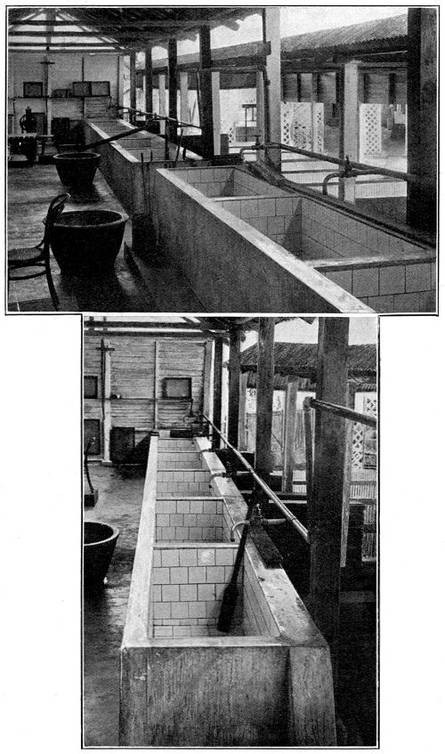
Two Views of Dilution and Mixing Tanks.
Below, on the right, coagulating tanks. At the far end strainers. Each dilution tank is of equal capacity to the corresponding coagulating tank.
Use of Sodium Bisulphite.—Some few years ago a demand for pale crepe rubbers sprang up, and this demand has been maintained. The total quantity of pale rubber put on the market previously could only have amounted to very little, and that little was obtained by luck and various tricks in manipulation. It must be premised that if coagulation is allowed to take place, either naturally or with the aid of acetic acid, the resulting rubber will almost inevitably oxidise on the surface, except in the cases of very dilute or young latices. Even supposing that this darkening of the surface does not take place in the wet stage, it is often found that a rubber expected to dry to a pale colour does not fulfil expectations, and a dull neutral shade results. This darkening of crepe rubber may be attributed to a slow process of oxidation, which continues until the rubber is dry. From these remarks it will be seen that the process of oxidation is a natural one, and that any pale rubber formerly shipped was the outcome of circumstances outside the control of the estate, except in such cases where boiling of the coagulum, etc., was resorted to. The fact that one rubber happened to be a shade darker than another was absolutely no criterion as to the value of the rubber, but apparently the market thought, and still thinks, otherwise, although the actual necessities of manufacturers for a pale crepe to be employed in special processes must be comparatively small.
The prevention of this natural oxidation was a problem which exercised the minds of all responsible for the preparation of pale rubbers, and much time and thought were expended upon it. Various theories were propounded, and the chief conclusion arrived at was that the darkening of rubber was to be prevented by excluding all the light possible from the drying houses. To this end windows were to be kept shut, or else they were provided with ruby-coloured glass, which incidentally kept out the air. In spite of these precautions, little success attended the expenditure of so much energy and thought. It was absolutely necessary that some chemical agent should be discovered which would make the preparation of pale crepe possible for any estate. This chemical would have to fulfil several requirements before it could become popular:
1. It must be a simple substance capable of being easily handled.
2. It must be very soluble, so that solutions could easily be made up by inexpert workers.
3. It must be cheap.
4. It must be quite innocent of any harmful effect upon the quality of the rubber.
After months of investigation into the properties of other chemicals the writers decided that the only one which satisfactorily answered all requirements was sodium bisulphite. The writers make no pretension to any claim of having discovered the properties of this substance, which was a common chemical, and widely known. Even its action on latex was suspected before they engaged upon the work. These matters are only mentioned because the credit, if any, should be given to the laboratories of the Rubber Growers’ Association.
As soon as it began to be known on the market that sodium bisulphite was being used in the preparation of pale crepe, a great outcry was made, and estates were warned that no more rubber prepared in this way would be accepted. It was said that the chemical would destroy the “nerve” of the rubber,[2] and it was definitely stated that rubber prepared with this chemical was brittle. It must be remembered that brokers had some legitimate excuse in raising objections to the introduction of new and strange chemicals for preparing rubber, as they were quite without means of judging whether the rubber had suffered harm or not. Still, on the other hand, private tests had been made in conjunction with Messrs. Beadle and Stevens for fully eight months before the name of the chemical was mentioned in reports, and they had decided from the results of vulcanisation tests that the chemical was quite innocuous. Then, and only then, did we consider it advisable to recommend the use of sodium bisulphite in general estate practice. Owing to the initial prejudice against rubber prepared with sodium bisulphite, the results of our preliminary work were published by permission of the Rubber Growers’ Association.[3] The original instructions to estates regarding the proper employment of this chemical were given in the private reports issued by the Rubber Growers’ Association in 1911. At the present time it is probably accurate to state that it is now used by all estates preparing fine crepes. Representatives of manufacturers have sometimes given us to understand that the question of paleness of colour in such rubber is of no such importance as is impressed upon us as producers. While we are prepared to believe, we can only plead that from our point of view the supply arises from the demand. Such are the conditions governing the sale of rubber that, irrespective of the requirements of the ultimate user, we have to market rubber which is valued almost completely upon its appearance at the time of sale.
[2] Williams, International Rubber and Allied Congress, London, 1914.
[3] “The Employment of Sodium Bisulphite in the Preparation of Plantation Rubber,” Beadle, Stevens, and Morgan, India-rubber Journal, August 2, 1913.
As long as such conditions prevail estates must continue to adopt any device of proved harmlessness, in order to obtain the best possible price for their product, and not because we desire to continue a practice which some assure us to be unnecessary, and which, moreover, adds somewhat to the cost of production.
Quantities of Sodium Bisulphite.—It must be premised that, although sodium bisulphite is employed on some few estates in the preparation of sheet rubber, we do not advise the practice. It is unnecessary, and may lead to some little trouble and delay in drying. In any case, sodium sulphite gives the results desired for sheet rubber (see following). It must be understood, therefore, that we are concerned here, in the case of sodium bisulphite, with its employment in the preparation of fine pale crepe only.
As the dry rubber contents of latices vary with the age of the trees, the general health of the trees, the seasons and general climatic conditions, the relative strain imposed by depletion of reserves through tapping, etc., it will be clear that the effect produced by a definite quantity of sodium bisulphite in any given volume of latex will also vary—i.e., the effect depends upon the potential amount of rubber present. A dilute latex needs less sodium bisulphite than a richer latex to produce the same effect in colour.[4]
[4] Incidentally there are certain occasions, as in the opening of areas of bark rested for long periods, when the latex is of a rich yellow colour. Sodium bisulphite will not “bleach” this colour, and it is well to remark again at this stage that the action of the chemical is only to avoid or arrest oxidation (darkening).
Hence it follows that if in any factory uniform quantities of the solution are used for any given volume of undiluted latices from different areas of the estate, the effect upon the dry rubbers will vary. This explains why some estates obtain different shades of rubber in their fine pale crepes.
The remedy obviously is to reduce the variation in latices by diluting them all to a standard rubber content as is done in sheet preparation. One is thus assured that the prescribed quantities of sodium bisulphite will meet requirements in every case, and that waste will be avoided.
Working with a standard of 11⁄2 lbs. dry rubber per gallon the following formula should serve as a maximum:
Formula for Use of Sodium Bisulphite.
(a) Dissolve sodium bisulphite in water at the rate of 1 lb. to 10 gallons.
(b) Of this solution use 1 gallon to every 10 gallons of latex.
Making a Solution.—The making of a solution of the chemical would seem to be a simple matter, but to judge by the ill-effects sometimes observed in the dry rubber the simplicity of the operation appears to have been overrated. Great care must be exercised in preparing the solution, and the work should not be left to the few minutes preceding its actual requirement; such has been found to be the case in several factories, so that it is not surprising if the rubber is defective.
The powder should be added gradually to water with thorough stirring, which should be continued for five minutes at least. Even then there may often be seen at the bottom undissolved particles, sand, and other impurity. It is necessary, therefore, in such cases to decant the solution through a piece of cotton cloth before using. No solid particles should be allowed to enter the latex.
Abuse of Sodium Bisulphite.—It is now generally recognised that the abuse of sodium bisulphite, in the form of an excess, leads mainly to delay in the period of drying and the production of an overpale rubber.[5] It is probable that few estates, if any, now experience trouble due to this non-observance of the rules and quantities laid down for use.
[5] “The Preparation of Plantation Rubber,” Morgan, 1913, p. 74.
Residual Traces of Sodium Bisulphite.—The prolongation of the drying period was attributed to the fact that traces of substances caused by the decomposition of sodium bisulphite remained in the rubber if the rubber were not sufficiently worked and washed on the rolls. These traces must have been very minute, but they were sufficient to retard the progress of drying. That much depended on the care exercised in washing is evident from the fact that samples prepared with varying quantities of the chemical show varying results on extraction. These samples were tested for the presence of sulphates. Of the series tested that sample prepared with bisulphite in the proportion of 1 part to 600 parts latex showed only a trace of sulphate present; while the one prepared 1:2,400 gave an equal quantity. Intermediate samples contained no trace of sulphate. On the whole, therefore, the presence of sulphate in crepe rubber is adventitious, and properly washed crepe prepared with moderate quantities of bisulphite may be taken as free from any residual quantities. Meanwhile there cannot possibly be any doubt of the advantages gained by the use of sodium bisulphite, and it would not be very wide of the mark if the statement were made that, in the event of this chemical being discarded, most contracts for pale crepe could not be fulfilled.
Sodium Sulphite.—It would not be amiss to insist upon the point that while the nature of sodium bisulphite, as employed in the preparation of rubber, is anti-oxidant, sodium sulphite is employed chiefly for its anti-coagulant property. It is not used, therefore, in the making of crepe rubber, but is of service in the preparation of sheet rubber, where the aim is to keep the latex in good fluid condition as long as is necessary, and to retard coagulation slightly so that enclosed bubbles of gas or air may escape. Formulæ have been given for its use in the field when required. On some estates this practice is not found necessary, but a quantity of solution is always placed in the bottom of the reception vessels prior to the straining of latex into them. Only a small quantity is used, and as a working basis the following formula may be adopted:
Sodium Sulphite: For Use in the Factory.
(a) Dissolve 2 ozs. of anhydrous sodium sulphite in a gallon of water.
(b) The gallon of solution, placed in the bottom of the reception jar or tank, is sufficient for the treatment of 40 gallons of standardised latex (11⁄2 lbs. dry rubber per gallon).
The warning previously given regarding the necessity for thoroughness in the preparation of solutions is here reiterated. Stirring should be thorough, say for five minutes, and if there is any sediment or undissolved matter the solution should be strained through cloth before using.
Where uniform jars or tanks are in use, the majority of which will contain uniform quantities of latex daily, the practice of using the chemical can be made almost fool-proof even in the hands of coolies. A calculation is made of the quantity of powder required for each vessel daily. The necessary number of lots is weighed out each morning and each placed in an envelope. The process is thus simplified by the fact that the contents of an envelope, neither more nor less, are required for each unit reception vessel. Even the weighing can be done by a coolie if he is given a counterpoise (of lead, for example) equivalent to the required weight.
It will not be found necessary to do any vigorous stirring of the solution with the latex, as the latter is strained into the solution and the continued addition of successive quantities is sufficient to give a good mixture.
Use of Formalin.—Few estates now use formalin (formaldehyde) as an anti-coagulant. It must be acknowledged that when not abused there are points in favour of its employment in preference to sodium sulphite, but these are outbalanced by certain disadvantages. The argument may be stated thus:
Points for: (1) If made up freshly it is an effective anti-coagulant.
(2) Formalin being the solution of a gas in water, there is no residual substance left in the rubber to delay drying.
(3) Its use gives a bright clear rubber.
Points against: (1) Its cost at all times is greater than that of sodium sulphite.
(2) If the jar is not sealed there is loss by evaporation, thus increasing the cost.
(3) Its effect upon the rubber is uncertain. Even in normal quantity it is said to cause “brittleness” or “shortness.”
Certain few estates, however, have continued its use, and no trouble is claimed to ensue. The following formula is stated to give satisfactory results in the preparation of sheet rubber, when applied as in the preceding paragraphs bearing on the employment of sodium sulphite:
Formula for Use of Formalin (Formaldehyde).
(a) 1 pint of formalin is diluted with 5 gallons of water.
(b) Of this solution 1 gallon is required for 50 gallons of standardised latex.
In noting this formula the writer gives no recommendation regarding its use. Whatever may be the actual facts regarding the effect of formalin upon the vulcanisation of rubber, when used in minimum proportions, there can be no question concerning its injurious effect if used in excess. Beyond this the factors of cost and loss militate against its wider employment.
CHAPTER IX
PREPARATION OF SHEET RUBBER
Pale Sheet.—The first form in which plantation rubber was prepared was as “biscuits” or sheets. This form remained in favour for some years. The first biscuits or sheets were rather dark in colour owing to the natural oxidation which followed. Then it was discovered that by diluting the latex the degree of oxidation was diminished, and later it was found that if the soft coagulum were placed in almost boiling water for a short time the resulting rubber was pale. Thus there arose gradually a demand for pale sheet. With our present knowledge we are in a position to state that the pale biscuits were not in any way superior to the darker ones, and they were in most cases actually inferior.
It was found also as time progressed that sheet rubber, on air-drying, became covered with external surface moulds, and that, more often than not, the smell of the drying rubber was the reverse of pleasant. Even when dry the sheets had to be continually brushed free from moulds, and by the time the rubber reached the market it was again usually mouldy. Such are, even now, the handicaps under which those who prepare pale sheets have to labour. Few, however, are the estates making pale sheets, and they are confined almost entirely to native holdings.
To those accustomed only to the preparation of crepe rubber, where coagulation can be effected in large batches, the preparation of sheet rubber always seems to demand much more labour. As a matter of fact, although the preliminary operations certainly do demand more care and labour than in crepe-making, there are compensating advantages in the machining stage. For the preparation of sheet of the highest quality on any but the largest scale, elaborate installations of machinery are quite superfluous, as equal results can be obtained with pairs of rolls worked by hand.
Uniformity of Product.—There will be no need to enter again into a discussion of the preliminary operations of receiving and straining latex for sheet-making. They have been fully dealt with in Chapter VII. It used to be the general custom to mix the acid and latex in each individual dish, and in some small or non-progressive factories that is still the procedure. Quite apart from the question of labour entailed, the process is quite unnecessary. Even if comparatively small volumes of latex are handled, standardisation by dilution should be the rule, and the acid solution should be added to the bulk. It is possible to stir in the acid and to ladle out uniform quantities in each pan or dish from a bulk volume of up to 40 gallons if the organisation is efficient.
On any but a small scale the labour entailed in the handling and cleaning of pans is excessive, and shallow tanks are now employed on most estates. The reception and standardisation of latex by dilution has already been discussed in Chapter VII. The combination of this practice with the employment of shallow coagulating tanks has simplified working and reduced the cost of labour. It is not intended to enter into any lengthy discussion relative to the merits of sheets made in pans as against those made in tanks. It is granted that it is possible to make a “pan” sheet superior in appearance to the general average of “tank” sheets; but from an economic standpoint the introduction of the use of tanks into all but the smallest factories is only a matter of time, if the demand for this class of rubber persists.
The Ideal Tank.—Even the most modern installations of sheet-coagulating tanks must be regarded as merely temporary devices, as, given facilities, the room for improvement is so wide.
The first tanks made erred in being too large, and as the result of experience the size of units has now been reduced to a maximum of 12 feet by 4 feet by 1 foot deep.

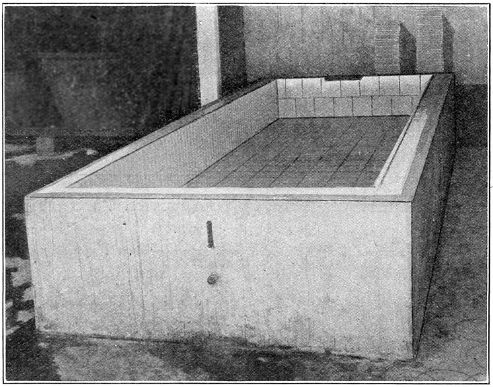
Construction of brick and cement with lining of glazed tiles. Note slots incorporated in side tiles. Partition boards in piles in the background.
Tanks are at present constructed either of hard timber or of brick and cement faced with glazed tiles; both types have inherent drawbacks. The wooden tanks are difficult to keep clean and in “sweet” condition. The glazed tiles, unless extremely well laid, allow the acid serum (from which the rubber is removed) to percolate between the interstices. Thus “pockets” of liquid collect beneath the tiles, and in process of the decomposition of certain constituents dissolved in the serum evil-smelling gases are set free.
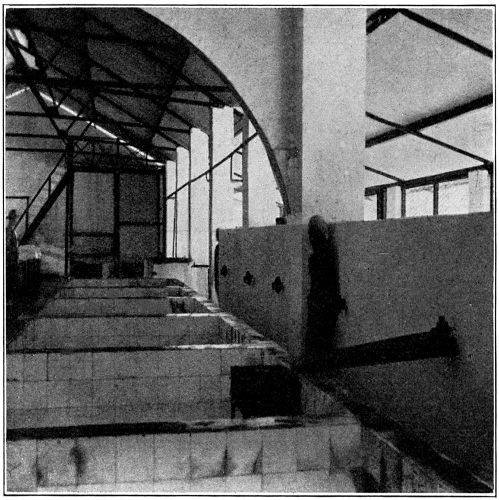
Another Battery of Tanks, with Dilution Tanks, Raised, on the Right.
Note drainage cocks, chute, and sieve in position.
It should not be a matter of difficulty for manufacturers to make sheets of thick glass sufficiently large to form the bed-plate and side-pieces necessary in the lining of a tank. If such adjuncts could be secured, the disabilities indicated above would be perhaps wholly removed. Unless there is a demand from estates, however, it is idle to expect a supply to be forthcoming.
An even greater improvement would take the form of unit tanks cast in glazed white-ware with the necessary slots incorporated in the sides. At present no known firm makes such tanks of sufficient size. A unit could measure (internally) 6 feet by 4 feet by 1 foot deep, with slots 11⁄2 inches apart, and 3⁄8 inch in width. The tanks might be reinforced with iron bars, so that they could either be used alone or embedded in the usual brick structure. The junctions of the bed-plate and side-pieces could be finely rounded so as to facilitate cleaning, and at one end a draining-hole could be made, say, 1 inch in diameter.
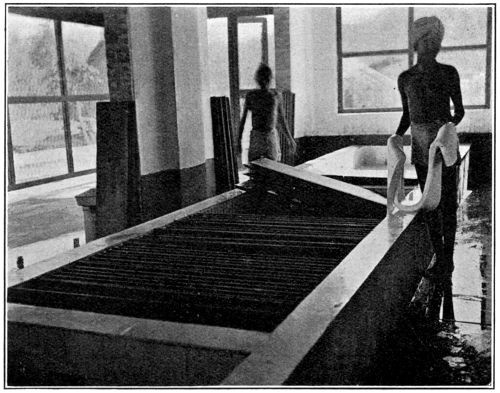
Closer View of Foregoing.
Note partitions in position and coagulum being removed.
Meantime both the hard-wood tanks and those of glazed tiles find their particular applications. The former is generally employed in smaller factories, or where future large increases of crop preclude the present installation of a fixed system. The latter find use in large factories, or where no new areas remain to come into bearing.
Modern Installation.—As an example of a modern installation of coagulating tanks, we can do no better than offer reproductions of the system now in use on Pataling Estate.
A warning must be given against employing all tanks of stone-ware or cement unless well glazed. Almost without exception, irrespective of the material used in the construction of coagulating tanks, wooden partitions are employed. In the few exceptional cases the partitions are either of glass or of aluminium. The former would appear to be the ideal substance, were it not for initial cost and loss by breakage. These disabilities may possibly be overcome in course of time.
Care of Tanks.—The use of aluminium would have been wider had it not been for lack of supplies and the question of cost during the War. A novel method of employing aluminium partitions was introduced in the factory of Tremelbye Estate. There were no slots in the sides of the glazed-tile tanks, but the necessary slots were very ingeniously created by means of aluminium “distance-pieces,” the two long edges of which were turned at right angles to the face of each piece to a depth of about 1⁄4 inch. The ends of the thin aluminium partition moved in the slot thus formed between two adjacent “distance-pieces.” The friction between the surfaces was sufficient to allow all the partitions, when in position, to be raised well above the floor of the tank, so that a uniform level of latex was obtained. Slight hand-pressure only was then required to push the partitions down.
Naturally the cleansing of glass or aluminium partitions presents no difficulty, but in the case of wood failure to ensure thorough cleanliness leads to possible defects in the finished dry rubber. Provided the wood could be made waterproof, no trouble would ensue, and hence various measures have been tried with that object in view. When new the boards have been surface-waxed or varnished, and the treatment has been repeated on occasions. But in course of time the surface film of waterproof material has disappeared, partially or wholly, and the trouble recurs. When partitions become sodden with serum, the surfaces are liable to be coated with a slime, consisting largely of organic growths which have an effect upon the latex, causing “pitting” on the surface of the coagulum and enclosed bubbles within.
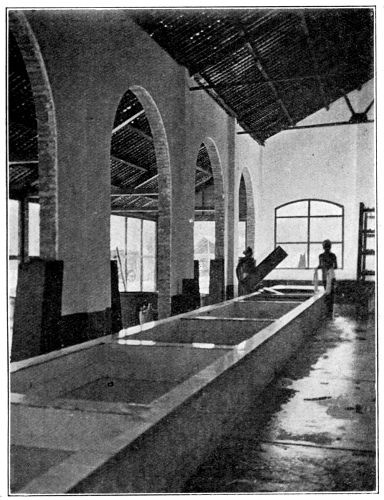
Another Battery of Tanks, without Dilution Tanks or Means of Gravitating Latex.
It is recommended, therefore, that wooden tanks, after ordinary cleansing daily, should be swabbed out with a 5 per cent. solution of sodium bisulphite. Wooden partitions should receive the same treatment, and once a week at least (or every day if possible) they should be placed in the sun for an hour or two, care being taken that both sides of a partition are exposed in turn. Before being placed in the latex, all wooden partitions should be made wet on the surfaces.
Some years ago the writers had made a partition of vulcanite, which apparently would have proved of great service but for the initial cost. The advent of the War put the matter out of the question, but it is possible now that such a material would be worthy of extended trial. Except in the matter of cost, it would appear to have advantages over any substance yet tried; and if it were possible for estates to supply their own lower grade rubbers direct, the cost might be reduced considerably.

A Sheeting Tank containing Coagulum for Crepe Preparation.
Behind wall in background are the tanks in which latex is standardized. Note vent, to the left, through which latex flows and wooden “stopper” on edge of tank.
Standard Latex.—Enough has been written (see Chapter VII.) to familiarise the reader with the use of this term for the description of latex diluted daily to a level of dry rubber content. Whatever may be the practice elsewhere, it is now fairly general on estates in Malaya to reduce all latices to a uniform “strength” for the preparation of sheet rubber. It is claimed that only in this manner can uniformity of product be achieved.
The selection of a standard has been the outcome of general experience. It has been found that if too high a standard is taken difficulties arise, such as (1) unsatisfactory and uneven coagulation, (2) too thick a coagulum for easy working in general, (3) too extended a period of drying and smoke-curing, and hence too dark a colour in the finished rubber.
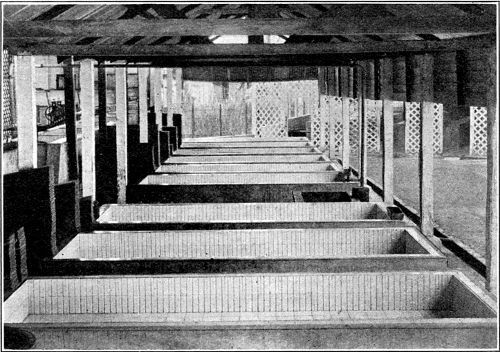
A “Battery” of Sheeting Tanks (Pataling Estate). Dilution Tanks, Raised, on the Left.
On the other hand, too low a standard also brings trouble in its train. The coagulum is too porous, will not stand handling, and the resultant sheet is too thin unless an abnormal thickness of coagulum is prepared. Furthermore, over-dilution means an increase in the number of tanks required for any original volume of latex. This involves an increase in floor area, and perhaps in the size of the building. The soft sheets, when rolled, may spread to such a width as to cause the edges to be squeezed under the cheek-blocks of the machines, etc.
For all practical purposes, whether sheets are prepared in pans or in tanks, it has been found that the optimum results are obtained by the adoption of a standard approximating and not exceeding 11⁄2 lbs. dry rubber per gallon. Primarily this standard has a direct connection and interdependence with the distance between the partitions (or between the slots) in coagulating tanks. The distance found most practicable is 11⁄2 inches. This thickness of coagulum, when prepared from latex not exceeding a standard of 11⁄2 lbs. dry rubber per gallon, is found to yield a very satisfactory sheet in all respects.
It will be seen that we have two possible main factors of variation:
(a) Distance between partitions, causing visible differences in thickness of coagulum.
(b) Dry rubber content of latex, causing differences in the density (e.g., hardness or softness) of the coagulum.
The effect of variation in (a) will be clear. Even when latex of a standard of 11⁄2 lbs. per gallon is employed the resulting sheet may be either too thin or too thick.
Similarly, as already argued, the use of too low or too high a standard of dilution (when the factor of distance between partitions is not allowed to vary) is capable of causing much difficulty. While this is correct, broadly, it is found in the experience of some estates that their requirements are satisfied by a slightly lower standard than 11⁄2 lbs. per gallon. Thus it is not uncommon to note the adoption of a standard equivalent to 1 lb. 4 ozs. or 1 lb. 6 ozs. dry rubber per gallon. Experience dictates, however, that for the recognised standard measurements of modern tanks the practical limits of satisfactory density of latex lie between 11⁄4 lbs. and 11⁄2 lbs. per gallon.
Standardising Instruments.—For standardising latex by dilution all that is required is an instrument which will preserve a perpendicular position while floating in latex, will be sufficiently sensitive to indicate fairly small differences in density of latex, and has one mark on its aerial portion accurately indicating a density corresponding to the required standard. On scientific grounds it can be demonstrated that such an instrument as employed in common practice would not be strictly accurate.[6] It is not proposed, in this section of the book, to discuss such considerations.
[6] De Vries, “Archief voor de Rubbercultuur.”
Instruments of this nature are represented by the “Metrolac” (originating from the Rubber Growers’ Association) and other similar recorders. They generally consist of a submersible bulb with a projecting stem which is graduated. The “Metrolac” differs from others in that the bulb is of torpedo form (thus reducing “skin friction”), and the graduations on the stem indicate actual weight of dry rubber per gallon instead of the ordinary specific gravity figures.
Theoretical considerations to the contrary, it is found in actual practice in Malaya and Ceylon that, although such instruments are naturally delicate and require careful manipulation, they are of considerable practical value and satisfy a definite requirement. Until an instrument of greater accuracy and equal simplicity can be discovered all estates should regard the possession of a few “Metrolacs” as essential.
The nature of their construction and the average conditions under which they are used (and abused) make it impossible to rely upon their accuracy indefinitely or for any long period. It is always recommended, therefore, that there should be at least two instruments available, one of which may be in daily use, while the other is kept in safe custody and only employed, say, once a week for purposes of checking the accuracy or degree of inaccuracy of the other. This can be done with reasonable approximity by placing both instruments in a tall vessel containing well-mixed and diluted latex. Instruments showing a marked degree of inaccuracy should not be preserved; but in cases of necessity “Metrolacs” from estates belonging to company members of the Rubber Growers’ Association may be sent to the laboratories for repair and adjustment.[7]
[7] This applies to the gilt brass instruments. As the result of experiment the Rubber Growers’ Association are now introducing glass instruments. These are necessarily more fragile, but while unbroken can be relied on to give correct readings.
Where field coagulating stations have been instituted on estates, it is strictly necessary that instruments should be provided in all cases; and it should be a rule that these are tested and corrected weekly by a standard instrument employed for that purpose only. This need was well recognised by many estates when, during the War and the consequent shortage of supply of “Metrolacs,” a demand arose which was met in some degree by crude instruments of local manufacture, such as that commonly known as the “Castlefield bobber,” contrived and made by the enterprising manager of the estate of that name. The demand for the more accurate instruments can now be met.
Methods of Using the Instruments.—The “Metrolac” was devised and introduced by the writers on behalf of the Rubber Growers’ Association, and directions for its use were given. Tables were prepared by means of which simple calculations for the dilution of any given latex could be made. These did not find an extended application, inasmuch as in the majority of cases native workers only were in charge of the processes of rubber preparation. In point of fact, such calculations are not strictly necessary, as the operation of standardising the latex can be done quite simply and skilfully by a trained native. Latex as it reaches the store in average weather from any particular division or field does not vary greatly in density. The trained coolie or foreman, basing his practice on experience, adds to the latex a quantity of water, and then makes a first test with the standardising instrument. Several additions of water (with thorough stirring) may have to be made before a test indicates that the correct density has been obtained, but it is surprising how quickly a skilled worker will arrive at the desired standard. Extreme or absolute accuracy is not insisted upon or desired, as avoidable delay is to be deprecated, and the result in any case is sufficiently exact for practical purposes.
Skimming.—During the gravitation of the latex from the reception vessels (in which the standardising of the latex is effected) to the coagulating tanks, much surface froth is usually caused. This is best removed by means of a thin board of a width slightly less than the breadth of the tank. The skimmings are sometimes placed in pans and subsequently made into a second grade of sheet rubber, or they receive treatment with a small proportion of sodium bisulphite and eventually appear as fine pale crepe. The practice varies usually according to the form in which the general No. 1 grade is prepared.
On some estates a great deal of the frothing is avoided by placing in position at the receiving end of the tank a perforated partition. This partition may be made of wood, or of stout zinc (or aluminium) carrying ten circular holes to the inch. Through this the latex percolates, while the froth is retained on a small area. The froth is removed prior to the addition of the acid. After stirring in the acid solution most estates again skim the surface of the latex; but if the stirring has been performed properly there should be little froth. This, when it collapses, in any case will appear only on the upper edge of the strip of coagulum, and after rolling should not be visible. It would appear, therefore, that the second skimming is not necessary.
Style of Sheet.—Within the last few years the custom of making plain sheet—i.e., sheet having a plain surface—has gradually given place to the preparation of ribbed sheet—i.e., sheet having a pattern marked on the surface. It would probably be correct to say that plain (smooth) sheet is now only prepared by natives or by some estates just come into bearing. Even in the latter case there is no reason why smooth sheet should be made, as hand machines are sold which will do all the work required. It will be evident to anyone acquainted with rubber preparation that in the matter of actual quality of rubber the question of smoothness or a pattern can have no bearing on the result. One advantage claimed for ribbed sheet which may entirely justify the preference exhibited by consumers, relates to the question of packing. When rubber arrives at home it is frequently found to be in an almost solid block, due to the pressure of the sheets superimposed in the case. The smoother the surfaces of the rubber in contact the greater the adhesion and the denser will be the mass, and consequently the greater the difficulty in separating individual pieces. Under such circumstances it is plain that the difficulty is diminished if the sheets have a raised pattern on them. It is noted also that the liability to mildew-growth is greater the smoother the surfaces of the rubber.
On these grounds the “marking” of sheet rubber is to be commended. These reasons apart, it is really astonishing the difference made in the appearance of the sheets by impressing upon them a ribbed pattern, and it is highly probable that the market value of the rubber is slightly increased. It is not our duty to attempt to reason why this simple operation should increase the market value of sheet rubber; it is sufficient to recognise that it is so, and that money may be thrown away by neglecting to cater for the taste of the market. Of the patterns impressed upon sheet rubber there is a variety, but the general style is that known as the “spirally close-cut ribbing.”
Standard Sheet.—Leaving for the present the question of pattern of mark, one cannot do better by way of introduction than to reproduce the instructions[8] given generally to estates.
[2] Williams, International Rubber and Allied Congress, London, 1914.
Abuse of Sodium Bisulphite.—It is now generally recognised that the abuse of sodium bisulphite, in the form of an excess, leads mainly to delay in the period of drying and the production of an overpale rubber.[5] It is probable that few estates, if any, now experience trouble due to this non-observance of the rules and quantities laid down for use.
[6] De Vries, “Archief voor de Rubbercultuur.”
[4] Incidentally there are certain occasions, as in the opening of areas of bark rested for long periods, when the latex is of a rich yellow colour. Sodium bisulphite will not “bleach” this colour, and it is well to remark again at this stage that the action of the chemical is only to avoid or arrest oxidation (darkening).
[5] “The Preparation of Plantation Rubber,” Morgan, 1913, p. 74.
[3] “The Employment of Sodium Bisulphite in the Preparation of Plantation Rubber,” Beadle, Stevens, and Morgan, India-rubber Journal, August 2, 1913.
Standardising Instruments.—For standardising latex by dilution all that is required is an instrument which will preserve a perpendicular position while floating in latex, will be sufficiently sensitive to indicate fairly small differences in density of latex, and has one mark on its aerial portion accurately indicating a density corresponding to the required standard. On scientific grounds it can be demonstrated that such an instrument as employed in common practice would not be strictly accurate.[6] It is not proposed, in this section of the book, to discuss such considerations.
As soon as it began to be known on the market that sodium bisulphite was being used in the preparation of pale crepe, a great outcry was made, and estates were warned that no more rubber prepared in this way would be accepted. It was said that the chemical would destroy the “nerve” of the rubber,[2] and it was definitely stated that rubber prepared with this chemical was brittle. It must be remembered that brokers had some legitimate excuse in raising objections to the introduction of new and strange chemicals for preparing rubber, as they were quite without means of judging whether the rubber had suffered harm or not. Still, on the other hand, private tests had been made in conjunction with Messrs. Beadle and Stevens for fully eight months before the name of the chemical was mentioned in reports, and they had decided from the results of vulcanisation tests that the chemical was quite innocuous. Then, and only then, did we consider it advisable to recommend the use of sodium bisulphite in general estate practice. Owing to the initial prejudice against rubber prepared with sodium bisulphite, the results of our preliminary work were published by permission of the Rubber Growers’ Association.[3] The original instructions to estates regarding the proper employment of this chemical were given in the private reports issued by the Rubber Growers’ Association in 1911. At the present time it is probably accurate to state that it is now used by all estates preparing fine crepes. Representatives of manufacturers have sometimes given us to understand that the question of paleness of colour in such rubber is of no such importance as is impressed upon us as producers. While we are prepared to believe, we can only plead that from our point of view the supply arises from the demand. Such are the conditions governing the sale of rubber that, irrespective of the requirements of the ultimate user, we have to market rubber which is valued almost completely upon its appearance at the time of sale.
As soon as it began to be known on the market that sodium bisulphite was being used in the preparation of pale crepe, a great outcry was made, and estates were warned that no more rubber prepared in this way would be accepted. It was said that the chemical would destroy the “nerve” of the rubber,[2] and it was definitely stated that rubber prepared with this chemical was brittle. It must be remembered that brokers had some legitimate excuse in raising objections to the introduction of new and strange chemicals for preparing rubber, as they were quite without means of judging whether the rubber had suffered harm or not. Still, on the other hand, private tests had been made in conjunction with Messrs. Beadle and Stevens for fully eight months before the name of the chemical was mentioned in reports, and they had decided from the results of vulcanisation tests that the chemical was quite innocuous. Then, and only then, did we consider it advisable to recommend the use of sodium bisulphite in general estate practice. Owing to the initial prejudice against rubber prepared with sodium bisulphite, the results of our preliminary work were published by permission of the Rubber Growers’ Association.[3] The original instructions to estates regarding the proper employment of this chemical were given in the private reports issued by the Rubber Growers’ Association in 1911. At the present time it is probably accurate to state that it is now used by all estates preparing fine crepes. Representatives of manufacturers have sometimes given us to understand that the question of paleness of colour in such rubber is of no such importance as is impressed upon us as producers. While we are prepared to believe, we can only plead that from our point of view the supply arises from the demand. Such are the conditions governing the sale of rubber that, irrespective of the requirements of the ultimate user, we have to market rubber which is valued almost completely upon its appearance at the time of sale.
The nature of their construction and the average conditions under which they are used (and abused) make it impossible to rely upon their accuracy indefinitely or for any long period. It is always recommended, therefore, that there should be at least two instruments available, one of which may be in daily use, while the other is kept in safe custody and only employed, say, once a week for purposes of checking the accuracy or degree of inaccuracy of the other. This can be done with reasonable approximity by placing both instruments in a tall vessel containing well-mixed and diluted latex. Instruments showing a marked degree of inaccuracy should not be preserved; but in cases of necessity “Metrolacs” from estates belonging to company members of the Rubber Growers’ Association may be sent to the laboratories for repair and adjustment.[7]
As the dry rubber contents of latices vary with the age of the trees, the general health of the trees, the seasons and general climatic conditions, the relative strain imposed by depletion of reserves through tapping, etc., it will be clear that the effect produced by a definite quantity of sodium bisulphite in any given volume of latex will also vary—i.e., the effect depends upon the potential amount of rubber present. A dilute latex needs less sodium bisulphite than a richer latex to produce the same effect in colour.[4]
[8] “Handbook on Preparation of Rubber,” Rubber Growers’ Association, May, 1917, p. 28.
[7] This applies to the gilt brass instruments. As the result of experiment the Rubber Growers’ Association are now introducing glass instruments. These are necessarily more fragile, but while unbroken can be relied on to give correct readings.
[8] “Handbook on Preparation of Rubber,” Rubber Growers’ Association, May, 1917, p. 28.
Rolling and Marking of Sheet Rubber.—Working with standard latex it is found that strips of coagulum 11⁄2 inches in thickness require little rolling to produce sheets of desirable thickness.
(1) The sheets or strips are first given a preliminary rolling with a heavy hand-roller made of hard wood. The roller is passed once in one direction, and once in the reverse direction.
(2) The coagulum is then passed through smooth machines twice, once with the rolls fairly open, and once with a narrower space. It is not found advisable to close the smooth rolls so tightly that the rubber is made too hard.
(3) The sheets or strips are then passed once through a pair of marking rollers. Various types of patterns are used, but the one which appears to give the most satisfactory results is that known as the “close-cut spiral.” This produces the semblance of a small diamond pattern on the rubber. The surface of the sheet is raised in well-defined ridges, which appear to present the maximum drying surface exposed to the atmosphere of the smoke-house. Thus, not only is the appearance of the sheet rendered attractive, but also the period of drying is reduced. Starting with standard latex and following the procedure here described for rolling and marking, sheets should be ready for packing in ten or eleven days. If the period is longer, it is possible that the design or structure of the smoke-house is at fault.
When to Work the Coagulum.—Before proceeding to discuss other points the question remains to be settled as to how long it may be necessary or advisable to allow the coagulum to remain in the serum before rolling it. For reasons of practical economy in factory working, it is usual to allow sheet rubber to remain over night, and the coagulum receives attention early next morning. During the interval (averaging about eighteen hours), the coagulum consolidates, leaving an almost clear serum if the correct quantity of acid has been added to the latex. Any but the very slightest trace of milkiness in the serum indicates an insufficiency of coagulant. If the serum is always definitely clear, there may be grounds for believing that an excess is being used. If the quantity of coagulant has been calculated to an average nicety, the serum should be just dubiously free from milkiness.
The firmness gained by the coagulum on standing in the serum overnight should enable it to be handled next morning without any marked stretching, and in some estates the rubber is put direct through the first pair of smooth rolls without a preliminary consolidation by means of hand-rolling.
Some estates prefer to handle the coagulum while rather softer, as it is claimed:
(a) That the coagulum is easier to work, and sheets of improved appearance can be made.
(b) That there is greater freedom from “bubbles.”
(c) That the incidence of “rust” is lessened.
These claims are substantiated in practice; but in the case of the third, it only holds provided that the rubber can be finished and placed in the smoke-house almost as soon as the last sheet has been machined.
In such cases all latex must reach the store comparatively early in the day—e.g., before noon. Three hours is allowed for coagulation, and the working of the rubber is then commenced. As a general rule this means that the operations of rolling and marking must be completed, a short interval given for dripping, weighing must be done, and the rubber placed in the smoke-house before night falls (as a rule about 6.30 p.m.).
Unless factories dealing with a large crop are well equipped with artificial light, such a course is not open to them; in any case it remains true that night work should be avoided if possible. If, however, it can be arranged without increasing the cost of production, there would appear to be no objection to the early working of the coagulum as described above.
Hand-Rolling.—As already indicated, some few estates do not give the strips of coagulum any preliminary hand-rolling, as the rubber is considered to be sufficiently firm to be handled into the first machine.
On most estates hand-rolling is found necessary, owing to the tendency of the long strips to stretch unduly, giving badly shaped sheets. This hand-rolling should be done carefully, and is best effected on a specially constructed table. This consists essentially of an inch-thick hard-wood plank about 2 inches wider, and 4 or 5 feet longer, than the strip of coagulum. Along the edges of the plank, and at right angles to its upper flat surface, may be fastened strips of wood about 1⁄2 inch square in section, thus forming a shallow tray open at either end. These strips serve two purposes:
(a) As the wooden roller is wider than the plank, they prevent the coagulum being rolled too thin and too firm.
(b) They prevent the coagulum being squashed too wide, and tend to keep the edges straight.
To avoid “thick ends” it is sometimes considered advisable to insert, at either end of the rolling table, shallow wedges about 6 inches long, of the same width as the table (between the edge-strips), and with the sharp end of the wedge pointing in the direction of the length of the table. The ends of the coagulum are drawn up and finished on these inclined planes.
These points may appear to be extreme refinements, but as long as rubber is valued on such grounds we must endeavour to meet the system imposed upon us.
Smooth-Rolling.—It is advised that, after hand-rolling, the coagulum should be passed through at least two machines having smooth-rolls. On some estates three such machines are employed. The purpose of this procedure is to reduce the thickness of the coagulum gradually. The same could be effected, of course, on one machine; but obviously the distance between the rolls would have to be readjusted at each operation and for each piece of coagulum. Apart from the time thus wasted, there is the certainty, in view of the rough adjustment of the machines, that the chances of obtaining uniformly thick sheets would be slight.
The machines should be arranged as a battery, with the marking rolls at one end, so that the operations are consecutive. It is erroneous to imagine that heavy machines (such as those used in crepe preparation) are required. Light machinery only is necessary for sheet-making; but any available heavy smooth-roll machines in a crepeing battery may serve admirably for the purpose.
Marking.—Heavy machines are unnecessary for the purpose of putting a pattern on sheet rubber. If the rubber has been properly prepared a light pair of rolls is capable of exerting sufficient pressure to cause a good upstanding pattern.
Rolls are cut in various designs: some with “diamond” grooves on both rolls; some with grooves of varying width and depth encircling the circumference of the rolls, thus creating a “stripe” effect on the rubber; and some with diagonally-cut spiral grooves placed closely together. The last has the greatest vogue at present, while the first has almost gone out of favour. An objection lodged against the second design is that the edges of the grooves sometimes cut through the rubber, so that the dried sheet divides in strips. It would appear in such instances that either the coagulum was too thin and soft, or that the grooves had been cut too deeply and sharply. In any case the choice of a design is an arbitrary matter, and should depend upon the effect produced on the rate of drying and the general appearance.
The popular “close-cut spiral” roll is machined with varying measurements, but the usual design has grooves 1⁄8 inch wide by 1⁄8 inch deep and 3⁄16 inch apart.
Many estates have a particular “brand” cut in the middle of the rolls for purposes of identification. If this is done it is advised that the main grooving of the rolls be carried into the “branding” strip; otherwise grip will be lacking on this portion, and a certain amount of “cockling” of the sheets will result.
Sheets are often seen in which the potential effect of the grooving is reduced to a comparatively flat pattern in place of the desired ridges. The fault is generally attributed to the shortcomings of the marking rolls. While it is true that the grooving often deteriorates by friction-wear when the rolls are running “free,” experience generally decides that the deficiency in the appearance of the rubber should be attributed to faulty previous preparation rather than to the marking rolls. Sets of rolls have been changed often without justification or an improved result. It would always be well to be certain first that the trouble did not emanate from the fact that the coagulum had been previously rolled so thin and hard that the rubber could not be squeezed so as to fill the grooves. This has been found to be a common fault, and the general effect is to delay drying in spite of the thinness of the rubber.
Again, the trouble may have been due to an incorrect standardisation of the latex, generally in the direction of too heavy a density (too rich a latex) being employed. The original thickness of the coagulum would be normal, but owing to the abnormal rubber-content the effect of passing through the smooth rolls would be the production of a strip thicker and firmer than ordinary. If this firmness is appreciable the resistance of the rubber to the squeezing action of the marking rolls will result in a flat pattern—i.e., the grooves cannot be filled, and the ridges are low.
It is advised that all rolls used in the preparation of sheet rubber should be at least 18 inches wide, in order to avoid the appearance of thickened edges which delay drying.
Working with the correct standard of dilution of latex, and following the procedure indicated in the foregoing paragraphs, the dry sheet should not exceed an average thickness (over ridges and depressions) of 1⁄8 inch.
Preparation for Smoke-Curing.—It used to be the custom to allow sheet rubber to air-dry first for periods varying from one to several days. Naturally moulds were soon formed, and when the sheets were quite smoke-cured a mass of the dead moulds could be seen, if not over the whole sheet, at least in the corners of each diamond mark. It has been demonstrated in practice that there is no advantage in allowing sheets to air-dry partially before smoking. In fact, to obtain the greatest benefit from smoke-curing, sheet rubber should be placed in the smoke-house as soon as possible. The same effect of mould-growth may be noted if the wet sheets are placed in a smoke-house insufficiently heated.
Other defects may arise which can be traced to faulty treatment of the marked coagulum prior to hanging in the smoke-house and subsequent to rolling. These will be enlarged upon in a subsequent section of the book, and at present it will suffice to indicate the procedure which experience directs as likely to give the best results.
When the lengths of coagulum leave the marking machine they are usually laid in piles containing two dozen or more strips. The piles are then cut into the required lengths, the exact length generally being determined by the available perpendicular distance between the supports in the smoke-house. It is necessary to remark that the piles of sheets should not be allowed to accumulate, but should be dealt with in subsequent treatment progressively. If for some reason this is not possible, then all piles of sheets should be turned on edge so as to assist the draining away of the serum or “mother-liquor,” which continues to ooze from the rubber for some time after the squeezing in the machines.
Where hot water is available the freshly cut sheets should be passed into it as soon as possible, and given a thoroughly good swilling. The caution must be given that the hot water should be changed very frequently and, if possible, after every batch, say, of a hundred sheets.
The sheets should then be carried immediately to racks on which they are hung to drip. Generally these racks are situated under cover, but there is no reason why they should not be placed in the open air without cover or shade. From continued experience of this practice over a period of years it is found advantageous and to be preferred to the usual method of allowing sheets to drip under cover.
While the sheets are fresh and loaded with internal moisture, the effect of sun-heat upon the surface, when exposed for, say, two hours, is nil; and the safety of the process can be guaranteed, provided the stated limit is not exceeded to an appreciable extent.
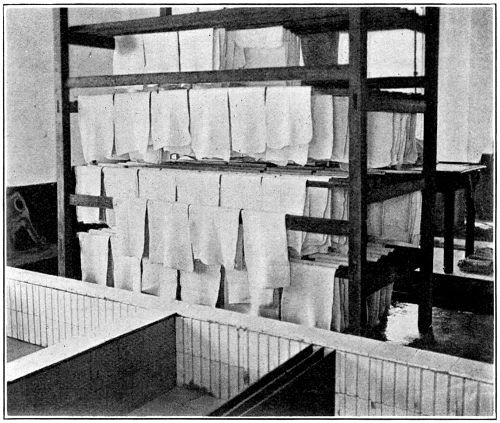
The Old Method of “Dripping” Freshly Rolled Sheets within the Factory.
After dripping for an hour or so, the sheets should be placed in the smoke-house. If it is a bright sunny day, no extra precautions need be taken; but on cool, dull days it would be advisable to light the fires earlier than usual, consistent with the work required to be done in the house—e.g., in the removal of dry rubber. There would appear to be no reason why the dry sheets should not be first removed, so that on dull or wet days smoking can be commenced as soon as the wet rubber has been hung.
On a few estates where the smoke-houses are worked continuously, except for a few hours in the morning, a portion of the building is separated by a partition for the reception of the wet rubber. The sheets are taken directly from the marking rolls and placed in the chamber, beneath which a fire is started. The sheets thus drip in a warm and smoke-laden atmosphere until next morning, when they are weighed and removed to the smoke-house proper. It is claimed that freedom from “rust” is thus obtained.
It will be clear that in the treatment of the rubber preparatory to smoking the whole process should be continuous, and delay should be avoided if the best results are to be obtained.
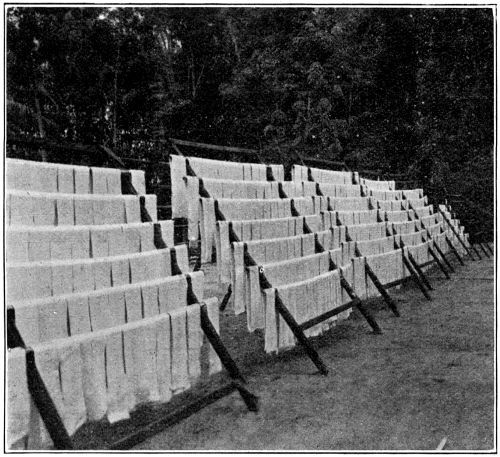
The Newer Method of Hanging in the Open Air.
Smoking of Rubber.—The assumption may have been noted above that the sheet is to be smoked. As far as our knowledge extends, none but small native estates now prepare sheet rubber of any other type, with the exception of certain patent processes. Air-dried sheets are generally made on small-holdings, and are bought in the market chiefly for the purpose of macerating and making into blanket crepe. We have no intention, therefore, of discussing the possibilities or qualities of air-dried sheets, as the output of sheet-rubber from our estates is always in smoked form. The drying (or, properly, smoking) stage will be discussed in Chapter XI.
CHAPTER X
PREPARATION OF CREPE RUBBER
No. 1, or Fine Pale Crepe.—Considering first the preparation of the highest grade, fine pale crepe, it must be stated that the difficulties attached to the process are generally not sufficiently appreciated. In this pale rubber minor blemishes are so plainly apparent that their importance is highly exaggerated, and what would worthily escape notice in smoked rubber assumes disproportionate prominence in pale crepes. The very fact that such a delicate material as colourless coagulum has to be manipulated in coarse iron rollers, with the attendant oil and grease worries, should be sufficient to deter one from criticising too harshly the occasional lapses of an estate struggling to give of its best to the market. At the same time there can be no doubt that if precautions are taken to attend to all likely sources of contamination, defects in pale crepe may be avoided to a wonderful extent; and on some estates the observance of elementary rules enables the preparation of the finest pale crepe to be made almost mechanically.
Standardisation of Latex.—The question of the standardisation of latex has been dealt with in a general way in Chapter VII., and the reader is now familiar with the trend of the argument in its favour. It will be recognised that the necessity for standardisation exists to the same degree in the correct preparation of pale crepe as in the case of smoked sheet. Unless the dry rubber content is invariable, and the quantities of chemicals fixed, the colour of the crepe may vary appreciably.
It may be pointed out that it is not essential to adopt the same standard of dilution as for sheet preparation. Given that latices from all fields or divisions are fairly uniform, and of high rubber content, the standard may be taken at a figure equivalent, for example, to 2 lbs., or 21⁄2 lbs., or even 3 lbs. per gallon. It is wise, nevertheless, to take a lower standard for several reasons. For instance:
(a) The average dry rubber content varies with climatic conditions, position of the cut on the tree, general health of the tree, etc. On a rainy day the dry rubber content may be lowered too greatly by adventitious circumstances.
(b) Recording instruments often fail to give even approximately correct readings in rich latex. Errors may thus be made easily.
(c) A fairly soft coagulum means easier working on the machines, less labour, and proportionately cheaper costs.
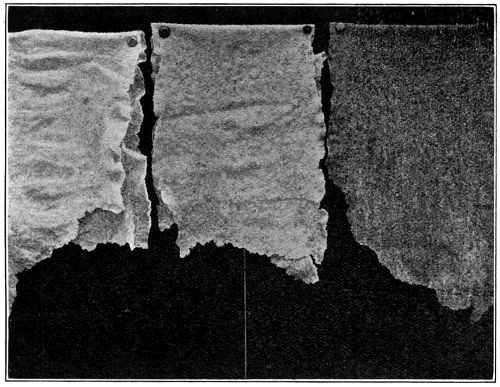
Three Grades of Crepe Rubber.
Left to right: fine pale crepe; second quality pale crepe; compound crepe.
It is advised, therefore, that for general purposes the same standard as that found suitable for sheet rubber should be taken—viz., 11⁄2 lbs. dry rubber per gallon. At all events the standard should not exceed 2 lbs. per gallon.
Coagulation and Coagulant.—Coagulation may be undertaken without any special arrangement of tanks, and is usually effected in the ordinary “Shanghai” glazed earthenware jars containing about 45 gallons. Given reasonable care, and a fairly fool-proof system of calculation for the quantities of chemicals required, no difficulty need be experienced.
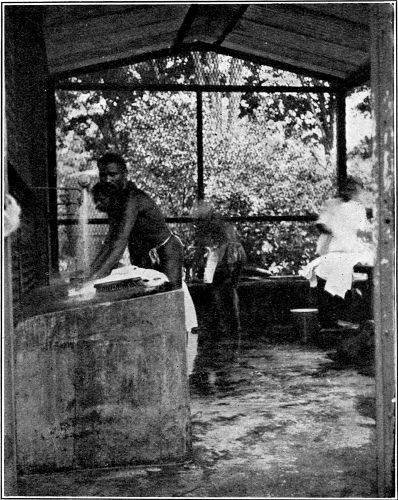
A Washing Shed.
Sheets are soaked in hot water in tanks in the background, and then scrubbed under a spray of cold water.
On a larger scale it is advised that proper reception tanks, in which standardisation can be effected, should be installed. Where both sheet rubber and fine crepe are being prepared, the whole system of sheet-coagulating tanks may be employed with considerable advantage, even to the insertion of the partitions.
If ordinary jars are used, and the coagulum is left until the following morning, the mass of rubber has to be cut up into pieces of a size suitable for the machines. The knives or saws are sometimes rusty, and the colour of the coagulum is affected. The coolies often feed into the machines lumps which are too large, with the result that portions are thrust under the cheek-blocks and become stained.
When a sheet-coagulating tank is used all labour of cutting the coagulum is obviated. The long strips are handled and fed into the rolls easily. It may be seen, likewise, that actual work is thus saved in machining.
Quantity of Coagulant.—For a general discussion on the coagulant and quantities employed, the reader is referred to Chapter VIII. It is there recommended that for latex standardised to a level of 11⁄2 lbs. per gallon, the proportion of pure acetic acid should be in the ratio of 1:1,200. Directions are there given for the making of the solution, and the calculation of the quantity required for any given volume of latex.
It is pointed out that for average undiluted latex the basis of calculation, for quantities of acetic acid required, should be taken on the ratio 1:1,000. Where latex exceeds a dry rubber content of 3 lbs. per gallon, it may be necessary to increase the quantity of acid to 1:800.
If a standard of 2 lbs. per gallon is adopted, the formula given for the 11⁄2 lbs. standard will not give full satisfaction, and the quantity of acid solution must be increased slightly in order to obtain complete coagulation. Assuming that the original solution is prepared in 1 per cent. strength, the following difference would be noted:
(
a)
One part pure acetic acid to 100 parts water (theoretically 99 parts).
(
b)
1
1⁄
2lbs. per gallon.
2 lbs. per gallon.
Of the above solution use 1 gallon to every 12 gallons of standardised latex.
Of the above solution use 1 gallon to every 10 or 11 gallons of standardised latex.
It is not possible to lay down an exact figure governing all cases, as so much depends upon the treatment undergone by the latex before it reaches the store.
Some estates continue to use solutions of greater strength, generally 5 per cent., in crepe preparation. While such solutions may be effectively stirred in when the latex is dilute, it is advised that for intimate mixture the solution need not be stronger than 1 per cent.
In estimating the quantities of acetic acid required much depends upon the interval which is to elapse between the addition of acid and the time of working of the coagulum. If the rubber is to remain until next morning, the average formulæ will be found suitable; but if it is required to work the coagulum with an interval of less than three hours, an excess of acid must be employed. The excess need be comparatively small, unless the interval is much reduced. For instance, it is the practice on some few estates to begin the machining of the coagulum about half an hour after coagulation commences; in which case it is usual to add from a quarter to a half of the normal quantity in excess. It need scarcely be pointed out that unless this procedure is strictly unavoidable it should be discouraged on account of the waste of coagulant involved. Incidentally, the use of strong solutions of acid under such circumstances may lead to increased deterioration of the rolls.
Colour of Fine Crepe.—We are sometimes assured that manufacturers do not pay the attention to the question of colour which sale conditions would lead one to believe. As far as we are concerned, and as long as there is no direct traffic between producer and consumer, it must be recognised that in the vast majority of cases we are forced to concern ourselves only with the standards set up in the markets. This, in spite of the knowledge that, all other things being equal, the arbitrary distinctions in colour afford no indication of the intrinsic value of the rubber. Under present circumstances it is plain that if paleness is demanded it has to be supplied.
Probably without exception all estates employ sodium bisulphite as the agent for the prevention of that darkening (oxidation) which is natural in drying rubber.
Sodium Bisulphite.—A formula for use of this chemical is given in Chapter VIII., and is applicable to latex standardised to 11⁄2 lbs. dry rubber per gallon. If a higher standard is chosen the quantity calculated as in (b) of that formula may be increased slightly, and the exact requirements found by experience. The caution must again be given that the employment of an excess of sodium bisulphite will lead to the production of an over-pale rubber, and a prolongation of the drying period. If thick crepes are made, an excess of the chemical is sometimes made visible by a greyish powder deposited on the edges of the strips of dry rubber.
It must be emphasised that the formula in Chapter VIII. indicates the maximum quantities required for use with standard latex. Many estates will find it expedient to use less of the chemical; and if it is found that the desired result is not obtained from normal proportions, attention should be directed to the points discussed in the following paragraph.
Evaluation and Deterioration of Sodium Bisulphite and Sodium Sulphite.—Sodium bisulphite and sodium sulphite are both bought for our purpose in the form of a fine crystalline powder, and on analysis good specimens should contain over 90 per cent. pure substance, when packed in well-sealed vessels.
It has often happened that shippers or local sellers, by inadvertence, have supplied the one chemical in place of the other—to the detriment of the rubber and the discomfiture of managers of estates. The error, as a rule, has not been detected for some time, and then perhaps only as a result of complaints or enquiries reaching the laboratories. To the layman, and certainly to the native who usually has charge of these substances, it is not a simple matter to distinguish between them without special knowledge. There are certain elementary tests, however, which can be applied on all estates serving to make the distinction, but affording no information regarding the actual quality of the chemicals. They are given in a comparative form on page 116. Samples of doubtful specimens may be sent to the laboratories for analysis, but the bulk of the chemical should not be used.
During the War some very poor shipments were received, and much trouble was caused. Under normal conditions there can be no question that it is to the interests of chemical manufacturers to supply the best article; and it is anticipated that in future there should be no difficulty in procuring shipments of a high degree of purity.
Sodium Bisulphite.
Sodium Sulphite.
1.
If in good condition it has a powerful odour of sulphur dioxide.
[9]1.
It has no perceptible odour.
2.
In solution it should turn a blue litmus-paper red.
2.
In solution it should turn a red litmus-paper blue.
3.
It exhibits a marked tendency to “cake” if the drum is allowed to remain open.
3.
The tendency to “cake” is less marked than in the case of the bisulphite.
[9] High-grade sodium bisulphite has very little odour, but by the time it reaches the estate, and as a result of short exposure to the moist atmosphere of the tropics, a little decomposition sets in and a strong odour of sulphur dioxide gas is noticeable.
It will be evident that, as sodium bisulphite under normal conditions gives off a gas when exposed to the atmosphere, it deteriorates in quality continuously. It is the potential presence of this gas which makes the powder effective as an anti-oxidant and disinfectant. It is within the experience of all accustomed to the handling of this chemical, that in addition to the loss of gas, the powder cakes into a hard mass on exposure. If only the top layer is caked, the remainder may be in fair condition; but no caked portions should be used, as they cannot be of good quality. They may, however, be used for the treatment of scrap rubber, to be discussed later.
Care of Sodium Bisulphite.—The ready tendency of sodium bisulphite to deteriorate on exposure should give sufficient indication regarding its treatment in storage. It should be bought only in drums (or other air-tight containers), and should be stored in a dry place. No drum should be opened until required, and the common practice of keeping an open drum on the floor of the factory should be avoided.
Drums are of two sizes, generally containing 1⁄4 or 1⁄2 cwt. respectively. It will be obvious that, although the prime cost may be cheaper with the larger quantity, it would always be preferable to secure the smaller drums, as the loss on exposure will be less.
Most commonly the 56 lb. drum is purchased. It should not be difficult to calculate the period during which the contents will be consumed, on the basis of a maximum of 1 lb. per 100 gallons of latex. A 56 lb. drum, assuming no loss or waste, should be sufficient to treat at least 5,600 gallons of latex (say, 8,500 lbs. of rubber)—if the bisulphite is of first-class quality, and the use is applied only to the preparation of fine pale crepe.
Where the quantity used per diem is small, it is advised that precautions should be taken to preserve the quality of the chemical when a drum is opened. It might be of advantage to place the contents of the drum in smaller sealed tins, or to have made a special container (with a closely fitting lid) into which the powder can be placed as soon as the drum has been opened.
Mixing Solution with Latex.—Emphasis has been laid, in Chapter VIII., upon the necessity for care in the preparation of the solution. Equal regard must be given to the mixture of the solution with the latex.
On a few estates it used to be the practice to add the powder to the solution of acid, with stirring. Obviously this led at least to a great loss of efficiency, owing to the rapid escape of the gas which was evolved.
The solution of sodium bisulphite should be poured into the latex in as uniform a distribution as possible. The mixture of solution and latex should be thoroughly stirred, and if only natives are in charge a minimum period of five minutes should be prescribed before the addition of the coagulant. A thorough stirring should again follow the advent of the acid.
If these elementary rules are not observed faithfully, the deficiency will most probably be manifested in the dry rubber in the shape of streaks of varying shades of colour.
Finally it may be insisted upon that deteriorated sodium bisulphite should not be used. In order to obtain an effect double the quantity may be required, and the residual salts left in the rubber on evaporation of the moisture will be responsible for prolonged drying, surface deposits, and possibly “spot disease.”
Former Methods of Making Pale Rubber.—Merely as a matter of historic interest it may be mentioned that previous to the introduction of sodium bisulphite pale crepes were made in comparatively small quantity by various devices, among which the following might be quoted:
(a) Use of excessive quantities of strong acetic acid.
(b) Extreme dilution of latex in conjunction with excessive quantities of acid.
(c) Extreme dilution in conjunction with steaming and excess of acid.
(d) Extreme dilution of latex in conjunction with excess of acid and subsequent heating of the coagulum in hot water.
(e) The use of excess of a mineral acid such as sulphuric acid.
(f) The skimmings and very dilute latex, coagulated with excess of acid.
Working the Coagulum.—Description of the details of necessary machinery for crepe-making is relegated to Section III. of this book. Here we shall treat only of the matter in general.
In the preparation of crepe rubber heavy machinery is necessary, and ample engine-power must be available. The machines should comprise three types:
(a) With rolls cut in such fashion, and run at such different speeds, as to have a macerating effect upon the coagulum. Such machines or rolls will be referred to as “macerators.”
(b) Intermediate rolls, grooved in varying designs and geared differentially. These reduce the thick rough crepe obtained from the macerators into a form suitable for passing to the rolls described in (c). They are sometimes called “crepers,” but as this term may be applied equally to the macerating rolls, they will be termed the “intermediate” rolls.
(c) Smooth rolls usually run at approximately even speeds and, as their name denotes, devoid of any grooving. They are called “smooth” rolls or “finishers.”
Without such equipment it is not possible to prepare the grade which is known as “fine pale crepe.” In the common acceptation of this term crepe of No. 1 quality generally connotes fineness and paleness with a thin crepe which has a good, smooth, and fairly well-knit texture.
It is, of course, possible to make a thick pale crepe, using only the macerators and intermediates, but the “finish” will be that typical of the particular grooving of the intermediate rolls. For the preparation of crepe ordinarily, the possession of smooth rolls is a sine qua non.
For reasons which will be explained more fully in the chapter dealing with the defects of crepe rubber, the practice of preparing thick crepes direct from the coagulum is now very uncommon. Thick crepes are generally made by reworking dry rubber, either in the form of thin crepes or from air-dried sheets. The market for the latter in Malaya is confined almost entirely to Singapore, where factories buy native rubber and re-work it into thick crepe.
The bulk of the output of No. 1 crepe from estates is in the form of thin “fine pale crepe.” The artificial standard set up by buyers and brokers necessitates this thin crepe being of even texture and fairly free from small holes (“looseness”). What difference the small holes are to make in the vulcanising properties of the rubber is beyond our knowledge; but such being the standard, it must be attained if the full price is to be obtained.
In order to secure the desired effect the coagulum must be passed consecutively through the three types of rolls, and undergoes a varying degree of working in each.
Given the necessary equipment of machines, it is possible to make a good specimen of thin pale crepe if the coagulum passes through all the rolls a total of twelve times (or even less in exceptional cases). There is no intention of suggesting that this is possible on all estates. Clearly the number of times the rubber passes through the rolls will depend upon the total efficiency of the machines. This in turn involves such factors as (a) the size of the rolls, (b) the number of machines of each type, (c) the gearing of the pinions, (d) the speed of the drive, etc. Again, much depends upon the nature of the coagulum worked. A fairly soft coagulum will offer less resistance, and conversely a dense coagulum will require more machining.
It has been shown by the writers in previous publications that over-working of the coagulum has an effect on the vulcanisation of the rubber; and this has been confirmed by others.[10] Apart from this point, it should be recognised that over-working, beyond that necessary to produce a thin crepe of even texture, is to be deprecated, on the ground of economy, in working.
[10] Bulletin No. 27, Department of Agriculture F.M.S., April, 1918, “Preparation and Vulcanisation of Plantation Para Rubber,” Eaton, Grantham and Day.
Owing to the existing differences in equipment and speed of drive, etc., the regular practice of any one estate may be unsuitable for another. It remains, therefore, a matter of study for each estate to discover the minimum number of times which rubber should pass through the machines, consistent with the factors indicated above. In any case it may be assumed that if any factory cannot prepare a good crepe by passing the rubber, say, twelve times through the rolls, there is some deficiency in the machines, or of speed; the coagulum may be too hard, or the rolls may be badly worn.
Lower Grades of Crepe Rubber.—Even a few years ago it was plain that the lower grades of crepe (i.e., all grades lower than first latex rubber) were not sufficiently appreciated in the market. There was often a marked difference in price between a first-grade crepe and crepe made from naturally coagulated lump. This arose chiefly from lack of knowledge. It has since been recognised in some measure that no reason exists for such a wide difference in price, and more recently the margin between even the first-grade rubber and the lowest grade of scrap rubber has been a gradually diminishing one. Providing sufficient care is exercised in the preparation of the lower grades, one would expect to see but very small difference in prices between any two grades. It is true that adequate attention has been given to the preparation of the scrap grades only in comparatively recent years, and it is acknowledged that when high prices were ruling for first-grade rubbers sufficient attention was not generally given to the subject of the preparation of the lower grades.
Naturally Coagulated Lump Rubber.—The grade of rubber made from the naturally coagulated lump which forms in buckets and carts is usually of a mixed colour, due to the fact that the lumps oxidise very quickly. When they are allowed to remain overnight before being machined, it can be imagined that the colour of the dry crepe would be very dark, or would contain very dark streaks. Such is ordinarily the case, unless special precautions are taken.
Providing that the coagulated lump is free from bark, leaves, and leaf-stems, and certain other precautions taken, the difference in price between coagulated-lump crepes and first-grade crepes should be very slight. Too often, however, not sufficient supervision is given to the coagulated-lump rubber, and it is common to see it come into the factory containing leaves and bark. These should be picked out before the latex is strained, but obviously it would be better to ensure that they did not enter the buckets in the first place.
It would seem reasonable to suppose that if some means could be employed for preventing or checking the surface oxidation of naturally-coagulated lump rubber, there would be a corresponding improvement in the colour of the dry crepe. That such a method is practicable has been demonstrated on many estates. The lump when lifted out of the latex is allowed to drain for a few minutes, and is then (without squeezing) placed in a dilute solution of sodium bisulphite. A 1 per cent. solution is sufficiently powerful. It is not to be thought for a moment that by the use of sodium bisulphite any previous oxidation will be counteracted; all that is claimed for the treatment is that any further surface oxidation will be checked, and the rubber may be allowed to remain until the next day, for working, if it is so desired. It will probably be found that quite a quantity of latex has been expressed from the lumps by contraction, and acid may be added to obtain the rubber from this. On other estates the lump rubber is worked on the machines as it is received, and the resulting crepe is submerged in a weak solution of sodium bisulphite over-night. It is then rinsed in water and hung to drip before weighing and placing in the drying house. Under certain conditions some of the lump rubber darkens rapidly during transport to the store, and any such oxidised portions must be rejected if a uniform colour is to be expected in the crepe.
Following the procedure indicated above, some estates find it possible to prepare from naturally coagulated lump rubber a crepe which can be classed as No. 1 grade.
Skimmings and Washings.—The skimmings of tanks, as already shown, may be prepared sometimes as a second quality of smoked sheet; but generally they are amalgamated with the rinsings of cups and buckets, treated with sodium bisulphite and acid, and made into crepe form.
The cup-washings, as they arrive at the store, represent a very dilute latex, the rubber from which is generally of a greyish colour.
Bucket-washings should yield a good type of pale rubber if they are obtained properly. To obtain the maximum quantity of good rubber the buckets should first be rinsed. A gang should be taken, a small quantity (say a quart) of water poured into the first bucket, and this dilute latex used progressively in all the buckets of that gang of tappers. The result is a fair latex which can be added to the bulk of No. 1 latex, provided it is free from dirt. Where sheet rubber is being prepared, carefully strained cup-washings or bucket-washings may be utilised in the dilution of the latex to the required standard, thus increasing slightly the percentage of first-grade rubber.
Tree-Scrap.—As tree-scrap is a naturally coagulated rubber, it should be expected to show up well in quality. This is usually the case; but from what has been said of the effect of sun-heat it will be understood that if trees are not regularly “scrapped,” there is a danger that the crepes may be found to contain tacky streaks due to the inclusion of old scrap which has been sun-baked. In hot dry weather, on widely planted areas tapped on alternate days, it has been noticed that scrap remaining for two days often exhibits a resinous appearance, and feels sticky to the touch.
If tree-scrap is to be made as a separate grade, as used to be the general custom, care should be taken to see that it is free from bark and dirt. On some estates where scrap-rubber is paid for per pound collected, it is usually the rule to insist that scrap shall be washed free from dirt and picked free of bark. This course is to be commended, but might probably prove impracticable to the majority of estates. Theoretically, of course, the operation of machining should rid the scrap of all traces of bark; but in practice it does not do so.
Some proportion of the tree-scrap is usually found to be heavily oxidised, and naturally if a crepe of uniform colour is to be obtained these dark scraps must be rejected, otherwise dark streaks will be formed. Coolies should be instructed to sort out the dark pieces before arriving at the store.
Bark-Shavings.—It has been intimated in a previous section that the method of obtaining and collecting bark-shavings varies with the type of labour employed.
Where the scrap is removed from the edge of the bark on each occasion before tapping, the amount of rubber to be extracted from the dry shavings is very small—so small, in fact, that when the price of rubber is low, it is doubtful whether it pays to collect and work the material.
On the other hand, where trees are not “scrapped” before tapping, the bark-shavings and tree-scrap are collected together, and the amount of rubber derived from the mixture may be 30 to 40 per cent. upon the gross weight—depending chiefly upon the quality of the tapping (i.e., in this case, the thickness of the paring). Another factor influencing this figure would be the effect of using an anti-coagulant on the cuts.
Bark-shavings entail such wear upon the ordinary machines during working, especially if fairly free from rubber, that unless the factory is equipped with a special “scrap-washer” it is advised that this material should be sent for working to a factory having the necessary equipment. Whenever possible, bark-shavings should receive treatment on the day of collection.
It used to be quite common to see heaps of bark-shavings accumulating on the floor of a factory, and generating excessive heat. Yet these heaps were allowed to stand about for a day or days. Is it any wonder then that tackiness was found to develop when the rubber was dry? It is here definitely laid down that no heaps of bark-shavings should be accumulated even for half a day. Tanks should be provided in which the shavings should be submerged in water.
Earth-Scrap.—Of all grades of crepe this is the one most liable to become tacky in transit. This tackiness to a large extent cannot be avoided, as old pieces of earth-scrap may be brought in amongst the bulk. Probably these old pieces have been exposed to the sun for days, and have become quite resinous. It would be practically impossible to go through all earth-scrap in order to find these odd pieces, but unless this were done one could not guarantee that the earth-rubber would always be free from tackiness. The difficulty does not appear, however, on estates where earth-rubber is collected systematically at very frequent intervals.
Fibrous Matter in Low-Grade Rubbers.—It is sometimes found in this and other lower grade rubbers that pieces of cloth or cotton-waste are concealed. Coolies may have used them for cleaning cups, or the store coolies may have been at fault. Earth-scraps especially should be examined, before working, for such extraneous matter.
Scrap-Washers.—These are heavy machines specially devised for the treatment of lower grade rubbers. In these the raw rubber is well masticated and freed from impurities, if the machine functions efficiently.
There are several types of these machines, all of which are efficient. That best known is the “Universal” washer, made by Joseph Baker, Sons, and Perkins, Ltd. (formerly Perkins Engineering Company). Coming into local favour during the War, the “U.E.” scrap-washer, made by the United Engineering Company (Singapore), gives very good service. The “C.C.C.” washer, made by the Colombo Commercial Company, is suitable for the purposes of an average estate. There are others, less well known. Most of these machines are made in varying sizes to meet the requirements of small, medium, or large estates; and if funds are available, a scrap-washer should be regarded as an essential item in the machinery of any estate employing engine power.
The rate of output of scrap-washers will depend mainly upon the speed at which they are driven, and when ordering the equipment it would be advisable to state the ordinary speed of the back-shaft, length of drive, etc. It does not follow that the larger the rate of output, the greater is the efficiency of the washer. The point is not as to what quantity of rubber can be taken out per hour, but what quantity is actually freed from impurities.
It is advisable for the superintendent to obtain a thorough knowledge of the general construction and principles of the particular scrap-washer employed. In the past it was not uncommon to find superintendents innocent of the fact that a certain type of washer possessed movable parts upon which the efficiency of the cleansing largely depended. It was often found that these parts, which were intended to be removed and cleaned at intervals, had become firmly fixed and could not be removed for inspection.
It must be recognised also that the machines are liable to considerable damage if extraneous substances are allowed to enter—for example, tapping-knives, stones, pieces of iron, spouts, etc., which are sometimes present in the loose scraps of rubber or shavings, owing to the carelessness of coolies. Under the best regulated-system, such accidents occasionally occur, but a great deal of trouble could be avoided by having it understood that each charge must be sorted over before entering the washer.
Again a deal of extra work, and much wear and tear, is caused by the abuse of the scrap-washer—e.g., in the cleansing of earth-scrap. As this reaches the factory it often contains a quantity of internal or adhering earth. Before entering the washer a good proportion of the external soil could be removed if the scraps were thrown into a tank and given a thorough soaking and stirring. In a similar manner dry bark-shavings, which have been allowed to accumulate, could be softened.
In the actual working of scrap-washers instructions are generally given by the makers. These sometimes advise the introduction of warm water (or of steam into the cold water supply) for an interval during the working of each charge. Where possible, such instructions should be followed, as by this means the individual pieces of rubber are massed together, in the final stage, into a “sausage” form which is easy to transport and to manipulate in the ordinary crepeing battery.
Compound Crepes.—The attitude of both buyers and sellers with regard to the types of lower grade rubbers appears to be changing. In the past, from any one estate there might be obtained as many as six grades of crepe below No. I. These comprised:
If in good condition it has a powerful odour of sulphur dioxide.[9]
[10] Bulletin No. 27, Department of Agriculture F.M.S., April, 1918, “Preparation and Vulcanisation of Plantation Para Rubber,” Eaton, Grantham and Day.
It has been shown by the writers in previous publications that over-working of the coagulum has an effect on the vulcanisation of the rubber; and this has been confirmed by others.[10] Apart from this point, it should be recognised that over-working, beyond that necessary to produce a thin crepe of even texture, is to be deprecated, on the ground of economy, in working.
[9] High-grade sodium bisulphite has very little odour, but by the time it reaches the estate, and as a result of short exposure to the moist atmosphere of the tropics, a little decomposition sets in and a strong odour of sulphur dioxide gas is noticeable.
Standard Sheet.—Leaving for the present the question of pattern of mark, one cannot do better by way of introduction than to reproduce the instructions[8] given generally to estates.
(1) A pale rubber (often streaked) obtained from coagulation of cup washings and bucket rinsings.
(2) A pale rubber (often streaked) obtained by coagulation of the skimmings from the surface of the No. 1 latex.
(3) A streaked and dull rubber prepared from naturally-coagulated clots found in cups, buckets, and latex carts.
(4) A streaked rubber prepared from scrap which had coagulated upon the face of the cut bark.
(5) A brownish and streaked rubber made by maceration of bark-shavings to which pieces of tree-scrap adhered.
(6) A dark rubber, often tacky, prepared from scrap found in or on the ground near the base of the trees. As it is often a matter of weeks between any two regular collections, it is easy to understand why the dry rubber was more liable to be “tacky” than any other grade of crepe.
It will have been evident to all who have acquaintance with these grades, as shipped from many different estates, that the diversity in the various shipments must have been rather bewildering. There appeared to be a regrettable lack of uniformity, even in the appearance of, say, a bark scrap rubber from any two estates. When, in addition to these variations, the further complication of condition of cleanliness is introduced, one may realise the difficulty attaching to the evaluation of these rubbers as they appeared upon the market.
Although the foregoing paragraph is written in the past tense, it should be pointed out that within certain limits the trouble continues to exist with respect to the output of a great number of estates.
In the case of many, it has been realised that the manufacturer does not want to buy a large number of “parcels,” all differing in some respect. It is probably correct to state that what a manufacturer requires is a big “parcel” uniform in appearance and treatment, even though the colour may not be so light as that of many smaller lots. This statement is modified with the proviso that the rubber, no matter what its colour or appearance may be, must be free from dirt, grit, and bark.
The difficulty of making a uniform product from several types of lower grade rubbers has been successfully solved on several estates by the preparation of a “compound” crepe composed of a mixture of the best lower grades in approximately definite proportions daily. Naturally the shade of colour of this compound crepe will depend largely upon the types of rubber employed, but as a rule it is somewhat darker than the highest of the types employed in the mixture. To the writers this seems immaterial as long as the manufacturer is offered a larger and more uniform lot which can be given uniform treatment in vulcanisation processes. Neither would it appear that the seller suffers any monetary loss. In point of fact it will be found probably that the reverse is the case. For instance, supposing it were decided to mix for a compound crepe—
(a) Naturally coagulated lump rubber.
(b) Tree-scrap.
(c) Bark-shavings scrap.
The product would be darker in colour than (a) and slightly better than (b). Let it be granted that there might be a monetary loss on (a), it is probable that there would be a slight gain in comparison with the usual prices obtained for (b) and (c). Now, as a general rule, the actual percentage of crop made into (b) is appreciably less than that made into (c) and still less than (b) and (c) together. Apparently, therefore, there would be a margin of profit on the whole by making a compound crepe. It may be pointed out, on the other hand, that there might be expended on the manufacture of this crepe more time and labour, but as against this the labour of sorting and grading would be simplified.
Unfortunately this process is not open to estates which do not possess a scrap-washer. It is essential that the rubber should be free from grit, sand, and bark particles. In the absence of a scrap-washer for the cleansing of the bark-shavings, it would be futile to attempt to make a compound crepe containing that type of rubber, as one would run the risk of spoiling the whole. It seems certain that in course of time a scrap-washer will be considered as necessary a piece of machinery as an ordinary crepeing machine in the factories of estates having sufficient means. Until that time the preparation of compound crepes must be the privilege only of well-equipped estates, unless other estates can send their lower grade rubbers for treatment in a scrap-washer to their more fortunate neighbours.
In previous publications a diminution in the number of grades of crepe rubber has been advocated, and it is gratifying to find that in many cases the amending grades suggested have been improved upon. Many estates now make only three grades of crepe—viz.:
(a) No. 1. From latex coagulated in the store.
(b) No. 2. Compound.
(c) No. 3. Earth-rubber.
It will be seen that the compound crepe includes all types between fine pale crepe and earth-rubber. Naturally one could not safely recommend the inclusion of earth-rubber in any compound crepe, as the risk of possible “tackiness” in the whole would be serious. In the case of the bark-shavings rubber to be incorporated, it is first cleaned alone in the scrap-washer. Then all types are mixed together again in the scrap-washer in proportions ruled by the experience of the usual average percentages of each grade of the crop.
Besides the estates having only three grades, there are others which make four—viz.:
(a) No. 1. From latex coagulated in the store.
(b) No. 2. Compound, from cup washings, etc., skimmings, and naturally coagulated lump.
(c) No. 3. Compound, from tree-scrap and bark-shavings rubber.
(d) No. 4. Earth-scrap.
Other variations are possible, but their number is limited, and they all conduce to simplification of working, and a supply to the market of rubber having greater uniformity.
Need for Increased Care with Lower Grade Rubber.—In the ordinary procedure of estate-working there appears to be an undesirable variety in the style of lower grade crepes. On some estates an examination of these rubbers would appear to suggest that there need be no expenditure of care in the preparation or the form in which it is made. This is a great mistake. With the exception of the lowest grade (earth-rubber), it would not be unfair to state that the quality of the rubbers on testing should be very little inferior to the No. 1 product. Often, as in the case of naturally coagulated rubbers, they are superior in some respects to ordinary fine pale crepe. Doubtless manufacturers are aware of these facts, but what course is open to them if they find the rubber spoiled for their purpose by the presence of particles of sand, grit, or bark? The possible injury caused by these ingredients cannot be insisted upon too strongly, and it must be evident that great care should be exercised in the preparation of the lower grades of crepe.
As to the particular form of the lower grade crepe rubber, one may apply the remarks made under the section dealing with the best grades. It is common to find thin crepes, medium crepes, and “blanket” crepes. More often than otherwise, the medium and thicker crepes are prepared direct in those forms. It follows that they are liable to attacks of “spot” disease, which, however, is not easily visible in the lowest grades, owing to the dark colour of the rubber. Furthermore, it is not possible to cleanse the rubber so thoroughly if thick crepes are made.
Block Rubber.—Few estates now prepare block rubber, which is essentially crepe rubber pressed into blocks. In the ordinary process the fresh coagulum is lightly rolled into thin crepe, which is then vacuum-dried. There are slight variations in the subsequent procedure. Sometimes the rubber as it comes from the vacuum drier is merely allowed to remain on racks overnight before blocking. In other instances, the sticky rubber from the vacuum drier is passed once or twice through wet, smooth rolls and hung to dry for some days. The dry crepe is then folded into the pressing box or cut to suit the size of the box. Pressure is applied for some time, and finally the rubber is taken out in one homogeneous mass. Naturally the appearance of the block depends upon the quality of the parent crepe. Some block rubber is made up thick; other is made in slabs about 3 inches or 4 inches in thickness. With the latter, it should be possible, when held up to the light, to see the shape of a hand held between it and the source of light.
It is possible that an erroneous idea of the strength of block rubber has been formed. It should only be necessary to point out that essentially block rubber is merely pressed crepe rubber. It is inconceivable that the mere action of pressing layers of crepe together would increase the physical quality of the rubber.
The advantages which block rubber possesses are the compactness of the output, its ease of packing, and a saving in freight; but there is the disadvantage, from the consumer’s point of view, that extra labour is involved in the preparatory work of cutting up the blocks.
Smoked Crepe and Sheet Clippings.—There appears to be no certain demand for any grade of smoked crepe, and probably all which is put into the market is really comprised of (1) clippings obtained from the ends of sheets, (2) sheets which have been malformed in machining, or (3) sheets showing the presence of many “bubbles.”
As to the first class it might be explained that through defective rolling, thick ends or edges may be caused. These show signs of contained moisture when the bulk of the sheet is perfectly dry, and as undue delay would otherwise result these moist strips are trimmed and either returned to the smoke-house, or machined to form crepe.
Similarly a torn or otherwise badly formed sheet, when brought from the smoke-house, may be made into crepe, rather than it should prejudice the selling price of the bulk under ruling conditions.
In the same manner, although “bubbles” have no influence upon the quality of the rubber on vulcanisation, sheets thus affected are generally made into crepe.
It cannot possibly be argued that rubber of this description would be in any way inferior to the best smoked sheet for manufacturing purposes, but owing to the prevailing system of evaluation for market purposes, it is necessary to resort to the expedients indicated above.
On some estates the rubber specified in the three classes mentioned is not made into crepe, but cut up into small pieces and shipped as “sheet clippings” or “sheet trimmings”—a procedure which would appear to be justified by a steady demand. In point of fact, the buyers are really obtaining a first-class article (except in superficial appearance) at a reduced price.
CHAPTER XI
DRYING OF RUBBER
Air-Drying of Crepe.—It is still the prevailing custom to air-dry crepe rubbers. A few estates, it is true, have artificial driers installed, and in some necessary cases others will be erected. But in the majority of cases where money has been expended in building air-drying sheds, as long as it is only possible to ship rubber regularly air-drying is likely to remain in favour.
The great drawback to air-drying is that one is so dependent upon the weather conditions. In favourable weather the rubber dries well, but in a long period of wet weather rubber may accumulate at an alarming rate, and the accommodation is sometimes severely taxed. Of course, the rate of drying under the best conditions is mainly dependent on the thickness of the crepe, and every endeavour should be made to maintain a thin style of preparation. If this precaution is not taken, the rubber is liable to recurrent attacks of “spot” disease, and one’s troubles are very much augmented. This is a disability to which rubber treated in artificial driers is not liable. Still, air-dried rubber can be made equal, if not superior, in appearance to pale rubbers prepared by other processes.
For the lowest grades of crepe air-drying is always likely to remain the only method, as it would be extremely unsafe to submit them to heat.
It is noted in ordinary practice that the rate of drying on different estates, for the same type of rubber, may vary widely. Naturally the construction of the house has a great effect, and this subject will receive attention in a subsequent chapter.
Similarly the position of the drying-shed exerts an important influence, and the erection of the building in low-lying surroundings is always calculated to prolong the drying period appreciably. Incidentally this means that the building must be larger than a normal rate of drying would otherwise demand.
The combination of a poor type of drying-house, a low-lying situation, and a prolonged wet season, might render it advisable to abandon the air-drying of high grade crepes in favour of artificial drying.
Artificial Driers for Crepe.—It is more common to find artificial driers in use in Ceylon than in Malaya, possibly because these driers have been in use in Ceylon for other products. Some time ago the question of installing artificial driers received the serious attention of a number of estates in this country, chiefly on account of the incidence of fungoid and bacterial diseases in crepe rubber. The simple treatment for the prevention of these diseases is to get the rubber dry in the shortest possible space of time. In most cases it is found sufficient to roll crepe thin for air-drying in order to prevent the appearance of coloured spots. It is found, however, that some drying-houses are so badly planned and constructed, that quick drying under even the best of conditions is a practical impossibility. Cases have been known in which the disease may disappear almost entirely during a period of freedom from rain, only to recur as soon as wet weather sets in again. There can be no doubt that, on the whole, the number of cases of “spot” disease is on the decline; but equally it is certain that a very few estates will always be liable to outbreaks as long as drying is attempted in existing houses. For these reasons it is a poor policy to temporise, and the only sound policy in extreme cases would be to give up ordinary air-drying in favour of some method of artificial drying. As regards the majority of estates preparing pale crepe for various reasons, it is not expected that any will instal artificial driers. Money has been expended in elaborate buildings which certainly do the work for which they were designed. As long, therefore, as the accommodation is sufficient, and regular shipments are the rule, it is expected that ordinary air-drying will still remain the general practice.
Of the better-known artificial driers, there are only three which merit serious consideration in these pages. They are the vacuum driers, the Colombo Commercial Company’s hot-air drier, and the Michie-Golledge process.
Vacuum Driers.—The vacuum drier is so well known that only a brief description need be given. It consists of a chamber heated by steam pipes and capable of having the contained air and moisture withdrawn by a pump. This description sounds very simple, and in practice the operation of vacuum drying is really a simple one, and can well be entrusted to an intelligent coolie under efficient supervision. Indicators are fitted which show the vacuum pressure and the pressure of steam in the heating pipes which travel underneath horizontal slabs upon which trays may be placed. Still, in spite of the apparent simplicity of the process, there would appear to be a number of little details which, if overlooked, prove to be factors influencing the result to a considerable degree. Thus it is not uncommon to find complaints that the rubber is not dry when packed. The writers have seen rubber taken from a vacuum drier still containing a visible quantity of moisture. One would have imagined that continuous working of the drier would give the experience necessary to obtain dry rubber, but, apparently, such is not the case in a number of instances. Elaborate instructions are given by the makers, but often they are more honoured in the breach than in the observance. Really, there are only two points to bear in mind:
(1) That the rubber must be fairly thin.
(2) That the temperature be not allowed to rise too high. Some makers advise 140° F. as a maximum, but no harm results from a temperature of 150° to 160° as long as the interval is not prolonged.[11]
[11] These figures refer to temperatures recorded by thermometers placed in the folds of the rubber.
These two points presume that the vacuum drier is true to its name, and that one can obtain a maximum steady pressure. The machines are so well made now that no drier should be taken over from those responsible for its erection unless it can show a vacuum pressure of 28 inches within fifteen minutes of starting the pump; and with the pump stopped, there should not be a greater fall in pressure than 1 inch within ten minutes after stopping the pump.
One of the most frequent sources of error is the control of steam pressure which is responsible for the temperature of the drier. It is quite unnecessary and unwise to maintain any steam pressure once the drying is well under way. All that is necessary is to heat the chamber well, with a steam pressure of 5 lbs., before inserting the rubber. As soon as the maximum vacuum pressure has been obtained, steam should be shut off from the heating pipes, and it will be found that the temperature is well maintained throughout the operation with a rise of ten to twenty degrees at the end. If the drier is working at a vacuum pressure of 28 inches, and if the crepe has been prepared thin enough, the rubber should be quite dry within two hours. Should the operation have to be extended to two and a half hours at 28 inches vacuum pressure, it is a sign that the crepe is too thick. On such occasions it is often noticed that these thicker crepes are not thoroughly dry, having moist spots enclosed in them. On re-rolling, these moist patches become easily visible, and are a source of great annoyance, inasmuch as they take quite a long time to dry out.
As mentioned before, the crepe for vacuum drying should be thin. There is no necessity to give it a superfine finish, and the presence of small holes is quite permissible, as they disappear on subsequent re-rolling. The thin crepe may be folded loosely to the length (or breadth) of the tray several times, but in no other way can the drier be expected to perform its work satisfactorily. A case was noted in which thin crepe was excellently prepared, and four or five layers were rolled together for vacuum drying. Naturally this mode of procedure does not give the drier a fair chance, and it would be ridiculous to judge vacuum drying on the results. After two and a half hours at a temperature of 145° F. the rubber appeared to be only about three parts dry, and the subsequent air-drying extended well into a fortnight.
It is the common practice to screw up the door of the chamber as tightly as possible. As a rule it is found in course of time that the obtainable maximum vacuum pressure decreases. This may be attributed solely to the forcible screwing up of the door. Around the inside edges of the door are strips of rubber compound, the function of which is to form a tight joint. Should the door be screwed up too tightly, these strips become deformed in course of time, and slight leaks occur. It should be pointed out that it is only necessary to screw up the door at the beginning of the operation. When the vacuum has been obtained, the screw pressure may be released, as the atmospheric pressure outside the chamber is more than ample to keep the door in a close fitting position. This will be obvious from the fact that the difference in pressure between the inside and the outside of the door amounts to, say, 28 inches atmospheric pressure—i.e., nearly 14 lbs. per square foot. By slackening the screw handles, therefore, as soon as the indicator shows the maximum working vacuum pressure, the life of the door joints may be prolonged, and the drier will remain efficient for a longer time.
A careful consideration of the question of temperature leads one to the conclusion that the practice of placing a thermometer through the roof of the chamber does not enable one to determine the temperature correctly. In the same way a thermometer suspended behind the observation window cannot indicate the temperature of the rubber, as in both of these positions the thermometer must be influenced by radiation from the walls of the chamber. The only position in which the correct temperature could be indicated is between the folds of crepe. This can be arranged easily so as to enable one to read the temperature from the observation window.
Colombo Commercial Company’s Drier.—The drier of the Colombo Commercial Company consists in principle of a number of small chambers or units in which crepe rubber is placed, and through which hot air is passed. As in the case of vacuum drying, a great deal depends upon the preliminary treatment of the rubber. If the crepe is not rolled thin enough drying will be unduly prolonged, with a possibility that the rubber will become tacky. The temperature usually obtained is about 150° F., and if the rubber is thin the production of an installation of two chambers should be at the rate of 1 lb. of dry rubber per minute. The usual period of drying is under two hours. One advantage which this drier has over the vacuum drier is that the chamber can be opened at any time for a short period to withdraw or insert trays. The thin crepe is folded several times, as in the case of vacuum-drying.
Figures obtained from the actual working of a drier in Ceylon are given below:
Chamber 1.—Temperature 160°-180°F. Chamber 2.— Temperature 150°-165°F.No. of
Tray.
Drying
Period.
Weight of
Wet Rubber.
Weight of
Dry Rubber.
Hrs.
Mins.
Lbs.
Lbs.
1
1
22
7
1⁄
26
Worked similarly
2
1
42
7
1⁄
26
to No. 1. Yielded
3
1
57
7
1⁄
26
in 2 hrs. 23 mins.
4
1
57
7
1⁄
26
70
3⁄
4lbs. dry rubber,
5
1
57
7
5
3⁄
4from 87
1⁄
2lbs. wet
6
1
57
7
1⁄
26
rubber.
7
2
0
7
1⁄
26
8
2
0
7
1⁄
26
9
2
11
6
1⁄
25
10
2
11
7
1⁄
26
11
2
11
7
1⁄
26
12
2
18
7
1⁄
26
88
1⁄
280
3⁄
4
It will be seen, therefore, that the drier had an output in 2 hrs. 23 mins. of 1411⁄2 lbs., which is at the rate of 1 lb. per minute approximately.
As the rubber leaves the driers it resembles vacuum-dried rubber in being surface-sticky. This stickiness is only temporary, and is got rid of by passing the crepe through wet rolls. Opinions differ as to when this rolling should be given. On some estates the rubber is only allowed to cool a little before passing through the rolls; on others it is given a day or so before rolling. The methods of rolling also differ. In some factories the rubber has been cut to lengths before drying, and these lengths are merely rolled together by simple pressure. Other estates prefer to re-macerate the crepe while still fairly warm and soft. It is probable that little harm, if any, results from this re-maceration while the rubber is soft, as it is more easily worked in this condition. The thick rubber is then generally hung for a few days to air-dry before packing. As most of the moisture taken up by the dry rubber is surface moisture, three or four days is usually found ample for air-drying.
Michie-Golledge System.—The Michie-Golledge system comprises a process of preparation and drying. The latex is diluted with two, three, or four volumes of water and coagulated with acid in a vessel which is rotated with a churning motion. In this cylinder there are curved and fixed blades. The revolving cylinder and its ribs force the latex against the curved blades so as to cause an eddy in the middle of the machine. Here the rubber coagulates and accumulates, the remaining liquor whirling round outside the blades. It can be imagined that with such dilute latex, the coagulum is very soft and spongy. This soft mass is passed through a machine which cuts it into “worms” about 3⁄16 inch in section. These are placed upon wire trays and dried by means of hot air. The “worms” when dry are re-macerated and built up into medium and thick crepes. The colour of the rubber prepared by this process is usually very good. When treated in a Colombo drier the “worms” usually require about two hours to dry, so that crepe rubber may be packed at latest on the fourth or fifth day, as in the case of vacuum-dried rubber.
Rate of Air-Drying of Crepe Rubber.—In spite of the facts that some estates have been making thin pale crepes for years, and that so much has been written concerning the preparation of this grade of rubber, one occasionally meets with a case in which an estate seems to be unable to prepare thin pale crepe, or if it does the period of drying is much longer than obtains on most estates.
Again, when cases of infection by spot disease in fairly thin crepes are submitted, it is usually found that the particular crepes are of that type which, though fairly thin, show whitish spots of moisture when the bulk of the rubber is nearly dry. This type of crepe is to be noted for the excessive period of drying in comparison with other crepes of equal thinness. It has been advanced elsewhere[12] that a factor of the most considerable importance in the rate of drying of crepe rubber is the type of drying-house and its situation. This accounts very largely for observed differences in the rate of drying of thin crepes on different estates. Yet even where two drying-houses may be of the same type, and the situations may be comparable, one still observes that one thin crepe dries more quickly than another. It has been remarked also that a thin crepe in one old drying-house dries in a shorter period than a similar crepe in another more modern house, although the methods of coagulation and preparation exhibit no apparent diversity. In all these conflicting cases allowance is made for the weather conditions, and the observed differences seem to be inexplicable. It has always been the opinion of the writers that the actual rolling of the rubber plays an important part in determining the rate of drying of crepe, apart from the question of thinness; and it seemed possible that this factor would account for the discrepancies noted above, either partially or wholly.
[12] “Preparation of Plantation Rubber,” Morgan, 1913, chapters xii. and xiii.
With a view to determining to what degree the drying of crepe rubber was hastened by the extent to which the rubber was rolled, experiments were made. It was hoped, also, that some idea would be gained of the particular stage in crepe rolling which had the greatest effect upon the rate of drying. In preparing crepe in the estate in the ordinary way the coagulum is passed through three sets of rollers, and the stages may be described as:
(1) Rough rolling.
(2) Medium rolling.
(3) Smooth rolling.
In the first the coagulum is broken down by passing through the machines until a thick rough crepe is formed. This passes to the intermediate rollers, where it is worked down to a medium crepe. The rubber finally goes to the smooth running at approximately even speeds. Passing through these a number of times it emerges as a thin uniform crepe, free from “lumpiness” and free from holes, which should dry in from ten to twelve days.
In the experiment the rubber was passed through the machines with varying frequency, the number of times in each machine being progressively increased, while the working on the other machines remained constant.
It was determined that the rate of drying was affected only by the extent to which the crepe was worked in the smooth rolls. The less often the rubber passed through these rolls, the slower the rate of drying. Beyond a limit in the other direction, increased rolling did not reduce the period of drying. It follows, therefore, that crepes which have a good thin finish should dry in a minimum period.
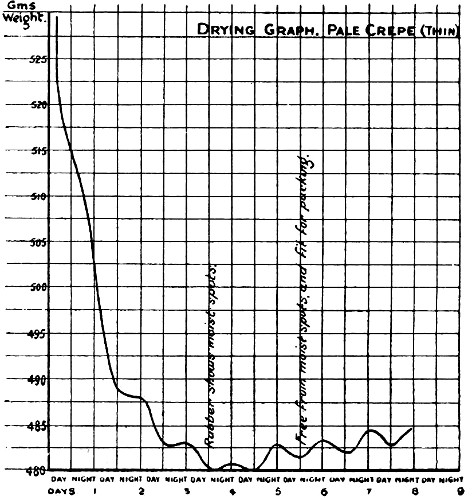
Drying Graph. Pale Crepe (Thin).
When does Air-Drying take place?—Experiments[13] were conducted with a view to discovering, if possible, the rate at which crepe rubber dries, and the extent of drying during the night under weather conditions such as prevail ordinarily in Malaya. It is to be remembered that, during the day, most drying-houses are fairly open and that the temperature ranges from about 88° F. in the lower rooms to over 100° in the upper rooms (near the roof) when the sun shines. At night, however, there is usually a decided drop in the temperature, and unless it is a very clear night the air is generally saturated with moisture. In addition the drying-house is closed as thoroughly as possible, and we should expect the atmosphere of the house to be laden with moisture from the wet and drying rubber. It would be a just inference, therefore, that the rate of drying during the night would be much less than the rate of drying during the day, and the results of experiments confirm this very fully. One was hardly prepared, however, to find that, under certain circumstances and at a certain stage, the amount of drying is nil; not only so, but it was found under certain conditions that the amount of drying which took place was negative—i.e., the rubber weighed slightly more when taken out in the morning than it had weighed the previous afternoon.
[13] Rubber Growers’ Association, Malaya Local Report, No. 2, 1914.
Crepe may Increase in Weight.—As an instance of the kind of result obtained a graph is here given of the rate of drying of a batch of pale crepe. This was hung to dry in the top room of a drying-house in which rubber ordinarily dries quickly. The rubber was hung in a good position, with the bulk of output, near a window which was open for some time during the day. In order to restrict the day interval of drying to the actual period in which the sun was likely to be in evidence, the day was taken to begin at 8 a.m. and end at 4 p.m., the night interval covering the remaining sixteen hours. Thus the night interval was twice as long as the period of day drying. The lengths of crepe were weighed carefully at 8 a.m. and 4 a.m., and the average of the several weights was plotted in a graph.
The weights are placed vertically and the duration of drying horizontally. It will be seen that the rubber was quite dry and fit for packing on the sixth day, as far as could be judged in the usual way by casual inspection. Peculiarly enough at this time it weighed slightly more than had been registered on the fourth and fifth days, but the difference did not amount to more than about 0·4 per cent. In examining the graph it should be borne in mind that the steeper the slope of the curve downwards the quicker the rate of drying, and that when the curve takes an upward direction there is an addition of moisture instead of abstraction. It will be noted that when drying takes place the slopes more nearly approximating the vertical represent the extent of day drying, and that often the night drying is represented either by a very flat curve or even by an upward curve which shows the addition of moisture. A striking feature of the experiment is shown by the rapidity with which drying takes place during the first few days and the comparative slowness with which the remaining moisture is got rid of. Thus, from the graph, it may be calculated that about 80 per cent. of the total moisture content was lost in the first two days, and over 93 per cent. in two and a half days. Yet three days had to elapse before the remaining 7 per cent. of total moisture was lost—i.e., before the rubber was judged to be ready for packing. It will be seen that after this stage had been reached the rubber alternately lost and gained in weight, with a tendency to increase. This increase was attributed to the presence of surface moisture after hanging overnight, when the rains had become frequent. Some light is thus shed upon a subject which has puzzled both shippers and receivers of crepe rubber.
Differences in Weight.—It will be obvious that if rubber is allowed to hang after becoming dry, and is taken down, packed, and weighed in the early morning, it will weigh more than when it reaches a drier climate. The loss in weight under such circumstances might amount to even 1 per cent. It may seem to some an unnecessary refinement to introduce, but it would appear from the graph that rubber should be packed for preference in the afternoon if the weights are to be more nearly correct.
It is extremely singular to note how quickly the curve changes its slope after the major portion of the moisture has evaporated, and it will be very plain that in the last stages any decrease in weight during the day would appear to be counterbalanced, or more than counterbalanced, by the addition of moisture during the night. It may be pointed out, however, that this increase in weight during the later stages of drying of pale crepe is mainly, if not altogether, due to surface moisture. The chief point of interest is the fact that in the case of thin pale crepe, quite 80 per cent. of the total moisture content is lost during the first two or three days, and that, owing to the negative influence of the night atmosphere, the final drying is delayed. It will be understood that the foregoing results applied to thin pale crepe. Thin lower-grade crepes appeared to dry at more uniform rates, but the differences between the rates of drying at night and during the day were similarly notable.
Aids to Normal Air-Drying.—These experiments were undertaken in a drying-house, favourably situated for rapid drying, in which the average period of drying for thin crepes is nine days. It is easy to imagine that the condition of affairs as revealed would be much exaggerated in a drying-house situated on low-lying ground and surrounded by trees. In extreme cases of this nature the use of large fans and heating pipes has been advocated. It is believed that in some cases these installations have given satisfaction, but that in others the degree of improvement obtained has not been in economic proportion to the outlay incurred.
Smoke-Curing of Sheet Rubber.—It will have been evident that one of the disadvantages of air-drying sheet is the incidence of moulds. Now it is found that moulds should not develop in smoke-curing; and if they do, then the smoke-curing has been insufficient or inefficient. The difference in the drying period also is a strong argument in favour of smoke-curing, so that all-round it is seen that there are many valuable advantages to be gained by smoke-curing sheet in comparison with air-drying, and no disadvantages.
The manipulation of the rubber, after it leaves the marking rolls and preparatory to smoke-curing, has been discussed in Chapter IX. It is sufficient only to allow adequate time for furnace water to drip from the sheets before transferring them to the smoke-house. As it is the general rule to roll sheet rubber in the morning, this arrangement fits in very well. The furnaces of the smoke-house are usually extinguished as soon as the sun is well risen, and the rest of the day is occupied in sorting dry sheets, etc. Towards noon the day’s wet sheets should have been admitted, and smoking may be commenced as soon as the sun is well in the west—say, at half-past four o’clock or earlier.
It used to be the custom on a few estates to smoke during the daytime and to discontinue smoking at night. As the night-air in Malaya is usually heavily laden with moisture, it will be plain that such a policy was a topsy-turvy one. It is vastly more reasonable to smoke-cure at night; usually the heat of the sun during the day is quite sufficient in itself to promote the drying of rubber; but there is no reason why smoking should not be carried on in the daytime in wet weather, should it be found expedient to do so.
Recording Instruments.—During the night the care of the smoke-houses is usually in the hands of natives, except for occasional surprise visits from a European superintendent. To all acquainted with the ways of the native it must be plain that means must be provided for the checking of the temperatures attained in the smoke-house. Ordinary thermometers are quite unsuitable, and even thermometers registering maximum and minimum temperatures are of little avail, inasmuch as they record only the degree of heat attained at a particular moment, and do not indicate any period during which a particular temperature was maintained.
It is evident that something more informative is required. There are many types of suitable recording instruments or “pyrometers,” some of which can be electrically connected, so as to cause the ringing of a bell, placed in the superintendent’s office or house, on the attainment of a certain temperature. The type best known in estate practice is that named the “Thermograph,” in which a pen traces a curve or graph on a plotted piece of paper carried by a rotating cylinder which is actuated by clockwork. Such instruments can be purchased through most of the local firms dealing in estate supplies. From experience it can be asserted that, given intelligent attention, these instruments yield very satisfactory results. The apparatus should not be placed always in one position in the smoke-house, but should be moved frequently so as to obtain information regarding the distribution of heat.
Temperature of Smoke-Curing.—In the question of temperature of drying, it is well to be as strict as possible; not that any great harm will result from a rise of 10° above that recommended, but because the higher the temperature recorded the larger the fires must have been, and consequently the more real danger there was of the store becoming ignited. It has been shown[14] that the temperature giving the maximum benefit of drying and quality was found experimentally to be rather above the temperature usually prescribed for smoke-houses, but in the experimental work there was no danger from fire.
[14] “Preparation of Plantation Rubber,” Morgan, 1913, chapter x.
The figure given in previous publications as a maximum working temperature for smoke-houses was 110° F., but certainly the temperature may be as high as 130° if it is considered safe to allow fires to be so arranged. One or two estates are known to work at temperatures of 130° F. and over, in spite of the recommendations of the writers. If those estates care to risk it they may do so, with increased rapidity of drying; but no responsibility can be taken for whatever may happen in smoke-houses where the temperature is allowed to remain, as in one case, at 160° F. Naturally the range of temperature is strictly limited by the properties of the substance to be treated, and with a substance such as rubber it would be far better to err on the side of caution than to risk damage to such a commodity, apart from the consideration of the possible destruction of the building.
Period of Drying.—Considerable differences are noted in the periods of drying on various estates; but, as there is more than one factor influencing the results, it is not easy at first to find why these differences should exist. Really there are three factors:
Again, when cases of infection by spot disease in fairly thin crepes are submitted, it is usually found that the particular crepes are of that type which, though fairly thin, show whitish spots of moisture when the bulk of the rubber is nearly dry. This type of crepe is to be noted for the excessive period of drying in comparison with other crepes of equal thinness. It has been advanced elsewhere[12] that a factor of the most considerable importance in the rate of drying of crepe rubber is the type of drying-house and its situation. This accounts very largely for observed differences in the rate of drying of thin crepes on different estates. Yet even where two drying-houses may be of the same type, and the situations may be comparable, one still observes that one thin crepe dries more quickly than another. It has been remarked also that a thin crepe in one old drying-house dries in a shorter period than a similar crepe in another more modern house, although the methods of coagulation and preparation exhibit no apparent diversity. In all these conflicting cases allowance is made for the weather conditions, and the observed differences seem to be inexplicable. It has always been the opinion of the writers that the actual rolling of the rubber plays an important part in determining the rate of drying of crepe, apart from the question of thinness; and it seemed possible that this factor would account for the discrepancies noted above, either partially or wholly.
[12] “Preparation of Plantation Rubber,” Morgan, 1913, chapters xii. and xiii.
[13] Rubber Growers’ Association, Malaya Local Report, No. 2, 1914.
(2) That the temperature be not allowed to rise too high. Some makers advise 140° F. as a maximum, but no harm results from a temperature of 150° to 160° as long as the interval is not prolonged.[11]
[14] “Preparation of Plantation Rubber,” Morgan, 1913, chapter x.
[11] These figures refer to temperatures recorded by thermometers placed in the folds of the rubber.
When does Air-Drying take place?—Experiments[13] were conducted with a view to discovering, if possible, the rate at which crepe rubber dries, and the extent of drying during the night under weather conditions such as prevail ordinarily in Malaya. It is to be remembered that, during the day, most drying-houses are fairly open and that the temperature ranges from about 88° F. in the lower rooms to over 100° in the upper rooms (near the roof) when the sun shines. At night, however, there is usually a decided drop in the temperature, and unless it is a very clear night the air is generally saturated with moisture. In addition the drying-house is closed as thoroughly as possible, and we should expect the atmosphere of the house to be laden with moisture from the wet and drying rubber. It would be a just inference, therefore, that the rate of drying during the night would be much less than the rate of drying during the day, and the results of experiments confirm this very fully. One was hardly prepared, however, to find that, under certain circumstances and at a certain stage, the amount of drying is nil; not only so, but it was found under certain conditions that the amount of drying which took place was negative—i.e., the rubber weighed slightly more when taken out in the morning than it had weighed the previous afternoon.
Temperature of Smoke-Curing.—In the question of temperature of drying, it is well to be as strict as possible; not that any great harm will result from a rise of 10° above that recommended, but because the higher the temperature recorded the larger the fires must have been, and consequently the more real danger there was of the store becoming ignited. It has been shown[14] that the temperature giving the maximum benefit of drying and quality was found experimentally to be rather above the temperature usually prescribed for smoke-houses, but in the experimental work there was no danger from fire.
(1) Relative thickness of rubber.
(2) Extent and quality of rolling.
(3) Temperature of drying.
It is presumed that the smoke-houses are identical in type and efficiency, and that smoking is in force for the same length of time each day. There need be no discussion of these points; the effect of each is so obvious. The thinner the sheet, the quicker the rate of drying; the better the sheet has been rolled, the shorter the period of drying; the higher the temperature, the more rapid the drying.
It has been shown in Chapter IX. that the condition of the sheet after rolling depends primarily upon the standard of dilution of the latex and the original thickness of the coagulum. If these factors are correctly controlled, the rolling should give a sheet which is fairly soft and porous—i.e., it should not have been subjected to such pressure as to make it both thin and hard. An average sheet of rubber which has been well rolled should be smoke-dried at a temperature of 120° F. in about ten days. If sheets take appreciably longer to dry, then the three foregoing factors must be examined.
On the other hand, it is often found that thin sheets made from very dilute latex dry so quickly that they are considered to be fully smoke-cured in from five to seven days. It frequently happens in such cases, however, that the smoking is insufficient, and by the time the rubber reaches home it has begun to show signs of surface moulds. It is evident, therefore, from this discussion that:
(1) If smoked sheet develops surface moulds within a short period after smoking, the duration of curing has been insufficient, or the quality of the smoking is at fault.
(2) The actual time taken to smoke-dry rubber may be insufficient to smoke-cure it.
(3) The rate of drying of smoked sheet depends upon—
(a) The relative thickness of the rubber.
(b) The preliminary treatment of rolling.
(c) The temperature of the smoke-house, and
(d) The type of smoke-house used. This point will be treated in a subsequent chapter.
Fuels for Smoking.—The general idea formerly held was that the beneficial effects of smoking were to be attributed to the constituents of the smoke, and chiefly the creosotic substances. This is not now the opinion of the writers, who attribute the effect largely to the temperature of drying and constituents of the smoke other than creosotic substances. There can be no doubt that the presence of creosotic bodies is responsible largely for the absence of moulds and the existence of the typical odour, but it is becoming increasingly known that the employment of substances rich in creosote is not required or desirable.
Estates used to be put to considerable expense in the purchase of “bakau” (a mangrove timber rich in creosote and creating much heat), under the idea that it was the best material and almost indispensable. Most estates now restrict themselves to the consumption of timber obtained from their own areas. Thinning-out programmes are largely responsible for the supply, but the local authorities are much concerned regarding future supplies; and consideration has been given in some quarters to the question of the development of quick-growing trees on estates with a view to safeguarding the future. This seems to be desirable, as it is difficult to imagine that the place of timber can be taken by any other material in the smoke-curing of rubber. Unless some such precautions are taken it is not difficult to predict that, in course of time, some estates will be able to continue the preparation of smoked sheets only at considerable expense in obtaining suitable fuel from a distance.
It is not true that any kind of timber is suitable as a fuel to be used in a smoke-house. All timbers are suitable, either alone or in mixture with others, provided that the wood is not too green.
Naturally an absolutely dead and crumbling wood will smoulder, but does not develop sufficient smoke. A green timber will give an acrid and moist smoke, but demands the consumption of a certain amount of dry timber in addition if it is to be used.
Rubber-tree prunings and sawn rubber trees obtained by thinning-out may be used in mixture with dead wood, provided the logs are stacked to dry in the sun for some weeks before use. If the timber is too green, steam is formed as well as smoke, and the sheets of rubber may have a moist surface glaze.
Sun-Drying Sheet Rubber.—Among the first curious sights which impress the visitor or newcomer to this country is the spectacle of sheet rubber hanging in the sun on native holdings. From what one has learned of the extraordinary care which must be exercised in all the processes of rubber preparation, one fails to understand how such rubber reaches the market without becoming tacky. That some of it does become slightly tacky is certain, but on the whole native rubber, though crudely prepared, is usually sound. The native idea of giving sheet rubber a preliminary drying in the sun is to hasten the total period of drying. That the period is curtailed would seem to be the case, but it is open to doubt, as the effect of sun-drying, if unduly prolonged, is to create a thin surface film of dry rubber which retards the drying of the rubber below the surface. Working with wet crepe rubber, the writer found that, to all external appearances, there was no effect upon the rubber when it was allowed to sun-dry for four or five hours. With periods of from six to ten hours the crepe becomes slightly sticky, chiefly on that portion across the support. When removed to the air-drying house this tackiness developed further, and the rubber, on the line of support, became so weak that it stretched and broke.
Reasoning by analogy, it would appear that no apparent harm would result to sheet rubber from sun-drying for periods up to four or five hours. From experience (see Chapter IX.), not the slightest ill-effect is found to result from the short interval of preliminary drying or dripping practised on many estates preparatory to smoke-curing.
Artificial Driers for Sheet Rubber.—It is understood that when vacuum driers were first applied to the drying of rubber it was thought possible to dry sheet rubber in this way. The practice was found to be impossible, as the length of time required and the temperature were responsible for the destruction of the form of the rubber; it became tacky and semi-liquid.
The “Chula” Drier.—Although several suggestions of devices for artificially drying sheet have been made, only one is known to be in use at the present time. In the original form this was used for drying other tropical products. It consists of a large iron chamber, in which are several compartments divided by means of baffle-plates. At one end there is a small furnace and, by means of a fan, smoke and hot air are drawn through the compartments. Owing to the temperature attained (140° to 160° F.) sheet rubber cannot be completely dried in the chambers, and is, as a rule, only treated in this manner for one or two days. Drying is then completed in an ordinary air-drying house. It is claimed that drying is expedited, and that the rubber can be packed in ten days.
In the more recent modification, the smoke and hot air which leave the Chula drier pass through a large room in which may be hung either sheet or crepe rubber. It would seem that all sources of danger have not been eliminated from the process, as on one estate a wooden room containing rubber was ignited by a spark which passed through the drier.
Yet another form exists in which the furnace is outside the main building, and in the ordinary course of working only heats a series of open pipes through which air is drawn by a powerful fan. By means of a valve it is possible to allow smoke from the furnace to pass into the room with the hot air for the preparation of smoked rubber. The hot air or smoke is distributed in the lower room by means of main and branch pipes, and passes through an open floor to the room above. With such an arrangement it is possible, therefore, to prepare either air-dried or smoke-cured rubber. If the method could be successfully applied to the drying of crepe it would be of great assistance on some estates. There would seem to be a difficulty in working it for the drying of sheer rubber and crepe together, as the temperature suitable for the one is excessive for the other. Given an efficient control over the temperature of the hot air, the house should be successful in the drying of crepe, provided the rubber is not hung in folds of too great length. For smoke-curing sheet rubber the period is said to be reduced by several days in comparison with the time occupied in an ordinary smoke-house, but it is not clear that such a system would have any advantage over a modern smoke-house, in types of which rubber can be fully cured in periods ranging from five to ten days.
CHAPTER XII
SORTING, GRADING, AND PACKING
The question of standardising the output of our plantations is one which has occupied attention for some years, with a not inconsiderable degree of success.
Meanwhile opinion is growing in favour of proceeding along the line of reducing the number of plantation grades to a minimum. At present some confusion exists. Some estates make up tree-scrap and bark-shavings together; one estate puts tree-scrap, earth-scrap, and bark-shavings into one uniform crepe; other estates have three or more separate scrap grades—e.g., lump-rubber and “washings,” tree-scrap, earth-scrap, and bark-shavings scrap. There is a movement on foot at present to try to restrict plantation rubber to three grades:
Crepes—1. First Quality Latex.—I.e., crepe made from the true coagulum obtained from the regulated coagulation of strained latex. This is a pale rubber, and may be prepared satisfactorily if the directions given in preceding chapters are followed. Naturally there must be, in all factories, some defective rubber of this grade. For various reasons the crepe may be of inferior colour, or is slightly contaminated with dirt or traces of oil and grease, etc. This defective rubber should be placed aside most rigorously and plainly marked as “off-quality.”
If a proper scheme of standardisation of latex and chemicals is followed, there should not be any such variety in shades of colour, such as was common in No. 1 crepe in the past.
Comparatively few estates in Malaya now prepare thick (or blanket) crepes in the No. 1 grade, but in such cases the same rules must be applied as govern the sorting of thin fine pale crepes.
2. Compound Crepe, No. 1.—In this it is proposed to include cup-coagulated lumps, coagulated lumps from transport vessels, skimmings, bucket rinsings, cup-washings, and tree-scrap. It has been shown in Chapter X. that strict care is necessary to eliminate all oxidised (dark) scraps. These are relegated to a lower grade. The possession of a “scrap-washer” is necessary if the best results are to be obtained.
On some estates the ingredients of this compound crepe, while fresh, are placed in a common jar or tank to which a quantity of sodium bisulphite (1 per cent. solution) and acid are added. The resulting conglomerate mass is cut up for working.
3. Compound Crepe, No. 2.—This grade would include the remaining lower grades—viz., bark-shavings, scrap, and earth-rubber scrap.
Reduction Carried too Far.—However desirable it may be to diminish the number of grades, it must be pointed out that diminution and simplification are not necessarily synonymous terms in this matter. It is well known that on estates where the earth-rubber is only brought in at lengthy intervals, say of a week, the resulting crepe is sometimes very tacky. This is only natural, and is due to the prolonged exposure to the sun’s rays. With the improved machinery now at our disposal, and with the increasing attention which will be given to the lower grades in the future, it is possible to prepare from average bark-shavings crepe free from bark, and of quite a good colour. Where trees are not “scrapped” before tapping, there would seem to be no objection to amalgamating the rubber obtained from the bark-shavings with the No. 1 Compound crepe; and it would be a distinct danger and possible loss if this good rubber were to be mixed with earth rubber. The liability of the latter to become tacky is well recognised; and if possible it should be maintained as a separate grade, in which it would be permissible to mix only rubber obtained from actually dry shavings from “scrapped” trees, or heavily-oxidised scraps which have been rejected from other grades.
Sheets.—Broadly there are no fine distinctions to be made at present in the grading of smoked-sheet rubber; it is either No. 1, or if any so-called defect is visible the sheets must be rejected and plainly marked as “off-quality.”
Clippings (trimmings) may either be made into crepe or shipped under their own description.
Rubber Growers’ Association’s Recommendations.—Taking the foregoing arguments into full consideration, it would seem that, strictly speaking, the number of grades cannot be reduced to less than four at present without producing some amount of confusion.
In its handbook,[15] the Rubber Growers’ Association remarks:
“The fewer grades the better, and regularity of each grade is most important.
“The grading should be as follows:
“(No. 1) Fine crepe (or No. 1 sheet), made from the free or liquid latex.
“(No. 2) Clean light brown crepe, made from lumps and skimmings.
“(No. 3) Scrap crepe, made from tree-scrap.
“(No. 4) Dark crepe, made from bark-shavings, earth rubber, and the lower quality of scrap.
“Tacky rubber should be packed separately.
“Compound Scrap Crepe.—Estates using scrap-washers should make a compound crepe of grades Nos. 2 and 3, which will make one compound free from bark and specks. All rubber intended for No. 4 should be most thoroughly washed.”
[15] “Preparation of Plantation Rubber,” 1917.
Concerning these recommendations the remarks in preceding paragraphs should be studied.
Care in Sorting.—Whether dealing with smoked-sheet, pale crepe, or lower grades, the strictest care is necessary in sorting and grading. This work must of necessity be relegated to coolies, and they should be trained men. Instructions must be definite, and doubtful specimens of rubber should always be placed aside for the decision of the European superintendent. Any pieces showing unmistakable signs of what are regarded as defects should be stringently rejected. In the case of pale crepe, when the defect is confined only to a small area it is permissible to cut out the affected portion. Similarly there can be no objection, in the case of smoked sheets, to an occasional sheet being treated in this manner. On the majority of estates these rules are observed carefully, but some estates yet have to learn that defective pieces of rubber may not be concealed in a bulk of otherwise good quality. Samplers have often an uncanny knack of hitting upon the defective specimens, and it is entirely the fault of the estate’s sorters if these pieces are submitted as being representative of the mass.
Choice of Cases.—Consumers complain justly of the presence of chips, splinters, and wood-dust. It will be evident, therefore, that whatever the type of case employed the interior surfaces should be smooth, there should be no cracks or gaps in the timber, and the cases should be cleaned out before using. There remains great room for improvement in the means and method of packing, and in spite of suggested alternatives we are at present restricted to the use of wooden cases.
From comparisons of actual quality and fulfilment of the requirements indicated above, there can be no question that cases made of three-ply wood, such as the “Venesta,” are in every respect superior to the ordinary wooden cases of “Momi” type. The consideration of cost and available supplies, of course, enters largely into the question, and three-ply cases are not at present so largely employed as they deserve to be.
A new type of case was recently exhibited in Singapore. It emanates from the U.S.A. and is made of a fibrous material, resembling in appearance a very stout cardboard. The complete case when assembled consists really of two boxes, one of which is inverted and slides down over the other. Packing is completed by means of stout wire, which is strained by a simple ratchet arrangement. It is claimed that from 225 to 250 lbs. of rubber can be contained. Other claims made amount to the statement that the case is practically indestructible under normal conditions of handling and shipping. A demonstration given certainly appeared to substantiate the statement fully. Rubber packed in cases of various and average type was allowed to fall from a height of about twenty feet. In all instances the wooden cases of every type were either smashed or badly burst, whereas the fibre cases were merely dented. These cases are obtained in flat sections, which, in assembling, are folded and clamped by means of copper rivets in a special but simple machine. It was pointed out that objection might be lodged against the use of copper for this purpose.
More recently there is announced a new packing case which is stated to be made from low-grade rubbers, but information is rather vague.
Bags.—There are in local use stout canvas bags which have the advantage of being used many times, as long as they are waterproof and kept in good dry condition. Their employment for the conveyance of smoked-sheets would appear to be permitted, but crepe rubbers sent in them are often reported upon as being “massed” at the edges, and hence difficult to “sample.”
Bales.—Attempts to bale rubber for the market have been frequent, but no success seems to have attended the efforts. In some quarters the failure has been ascribed to prejudice on the part of buyers, but it is the opinion of the writers that the objections to baling are, or could be, well-founded. Massed rubber often cannot be inspected properly, and hence is always open to suspicion that internally there may be unsuitable portions.
There have been several schemes put forward for winding crepe rubber on spindles so as to form a cylindrical package complete in itself. We have seen the process, and certainly the method had much which appeared commendable. Apart from other objections which might be raised, there is always the one prominent objection mentioned in the preceding paragraph.
While baling of rubber is thus not likely to suit the general market, there is no reason why, as in one or two instances, it should not be practised by agreement between producer and consumer. It is believed that “slab” rubber is shipped in bales from Sumatra to the U.S.A.
Quite recently a proposal has been put forward to revert to a simple form of baling for ordinary plantation rubber. Under this scheme wooden cases are discarded, the packing material being composed of scrap-grade crepe rubber which, it is claimed, could be put to use by the manufacturer. An obvious drawback would be evident if these bales happened to be exposed to direct sunlight or a continuous high temperature. The tackiness which might supervene would make the handling of such bales unpleasant, even if it did not affect the internal rubber.
Folding for Packing.—In the packing of smoked sheets it would appear to be advisable to avoid, if possible, the folding of any pieces, as the objection is made that such rubber is difficult to “sample” on arrival, especially in cold weather. Sheets should be prepared or cut to such length that they occupy the full superficial area of the box, either singly or side by side.
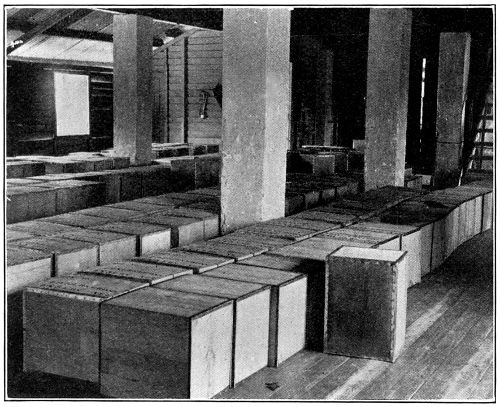
A Shipment of Rubber, Packed and Ready for Transport.
The same remark applies to the packing of crepe rubbers, except that here we deal with units of folded rubber. Crepes are generally folded by hand, and coolies usually work to a certain dimension by means of a standard stick. The work is slow, but often gives employment, at a cheap rate of pay, to women and weak coolies.
Several machines have been invented to replace this labour. The best of these yet seen has a simple device by means of which the length of the fold is adjustable to suit the size of any packing case. It is called the “Senang” folder, and is made by the General Engineering Company (Radcliffe) Ltd., Radcliffe, near Manchester.
Care in Assembling.—Whatever the type of case employed, great care must be given to the assembling of parts and the final fastening. It is not uncommon to find in the operation of putting on the “strapping” that nails have been driven into the rubber. Extra bands of strapping are sometimes advised, and where these bands pass over the sides (not edges) of the case only specially short nails should be used.
All wood should be planed, and in cases other than three-ply should be of stout wood, not less than 5⁄8 inch in thickness. All timber used should be of uniform type and thickness.
Methods of Packing.—The usual method of packing crepe is to fold the lengths to some measure of the dimensions of the case. This is done in a haphazard fashion on some estates, with the result that either space is lost or the packing is badly arranged.
Some ingenuity can be displayed in the packing of sheet rubber in order to avoid folding the sheets, which, besides increasing the difficulty of sampling, leads to loss of space. Endeavours are being continually made on estates to prepare sheet of such a size as to obtain the maximum benefit of space both in smoke-house accommodation and in packing. A few estates employ tanks of such calculated dimensions as will yield uniform sheets which pack flat and fill the superficial area of the case.
In view of the contamination which sometimes characterises the employment of wooden cases it is sometimes advised that the interior should be lined with sheets, or pieces of crepe, the ends of which are later folded over the top of the mass. In this manner it is stated that contamination is confined only to the exterior of the contents of the case.
Weight of Contents.—The dimensions of average cases are 19 inches by 19 inches by 24 inches, giving a capacity of 5 cubic feet.
In these it is possible to pack 150 lbs. of crepe rubber and 200 lbs. of sheet rubber (about 5 per cent. more in cases of three-ply wood). It may be noted that boxes arrive in better condition when fully packed. The foregoing figures are not adhered to strictly. For example, some estates find it expedient to ship rubber in actual ton lots, and for this purpose pack only 140 lbs. of crepe per case, giving sixteen cases to the ton. Other estates, using presses, pack more per case than the quantities noted above. At present there does not appear to be any definite regularity in practice.

On its Road to the Railway: Bullock-Cart Transport.
In all instances it should be the invariable rule that the rubber should be weighed before packing, and that all cases should contain uniform nett quantities of any particular type of rubber. Invoicing, etc., will thus be greatly facilitated. If these practices are followed, and the rubber always weighed on the same scales (assuming it to be perfectly dry when packed) complaints of “short-weight” should be infrequent.
“Short” Weights.—In some cases the occurrence of “short” weights on arrival at ports would appear to be inexplicable. It often happens that the constituent parts of wooden cases have been in stock for a considerable period. If for no other reason than that indicated below, all cases, either before or after assembling, should be thoroughly dried in the sun. “Short” weight could be accounted for to some degree by a lack of observance of this elementary rule, as it is most probable that there would be a perceptible difference in weight of the wooden case in a drier atmosphere.
(a) If rubber is weighed in the box, and the average tare of the case deducted from the gross weight (in order to obtain the nett weight), any loss in the weight of the timber would appear as a deficiency of rubber at the distant port.
(b) Whether the same effect would be produced eventually in the case of rubber which is weighed before packing will depend upon the method of weighing at the warehouse. If the rubber is weighed in the box, any observed deficiency would be attributed to a loss of weight in the rubber.
PART III
MACHINERY AND BUILDINGS
CHAPTER XIII
MACHINES
The number of manufacturers of machines for preparing rubber would seem to be on the increase, and there can be little doubt that this competition will result in a continued improvement in the design of machines. It cannot be denied that there has been room for such improvement, and it is believed that manufacturers will display judgment in putting only their best quality into the work. While design and finish are very excellent in their way, it is to be regretted that in a number of cases in the past the material of rolls has been found to be of inferior quality. Generally, the complaint seemed to be that the rolls were too soft, and that the “grinding” effect was far too great. The damage to pale rubber in such cases is considerable, as it is impossible to keep the rolls free from fine dark powder. The effect is generally noticed more in the smooth rolls with which a finish is put upon the crepe.
Cases have occurred frequently in which rolls have been returned, because of the injury caused to pale rubber, and there can be little doubt that the life of quite a large number of rolls is even now far too short in comparison with the expense involved.
It is a moot point, however, in many instances how far the quality of the rolls is actually responsible for the damage done to the rubber. In the experience of the writers it is certain that complaints regarding the rolls were unjustifiable, and that the injury had been caused by carelessness in the “feeding” of the machine. Especially in the case of smooth finishing rolls, it is clear that if the rolls are allowed to run idle for more than the briefest possible interval grinding must take place.
The complaints apply not only to the rolls themselves, but also to the brass linings for shaft-bearings. Cases are known in which a brass “liner” was so worn within a few weeks as to be quite useless. If the matter ended there it would not be so bad; but there is always the possibility of particles of brass finding their way into trays, and so into the rubber. The damage which ensues to the rubber is quite irreparable. This particular defect arising from the presence of brass will be dealt with in a later chapter. But here again it is necessary to point out that such wear on brass liners may be caused by the standards (ends) of the rolls being eccentric; and the case may be analogous to the placing of “new wine in old bottles.”
En passant it may be remarked that in any case brass liners are not strictly necessary. White-metal alloys are in use on rubber machines, and cast-iron bearings have been employed satisfactorily for years.
It would be well for managers to remember, therefore, that when machines have to be ordered, nothing but the best is good enough, and that the difference between good machinery and passable machinery is probably immensely greater in effect than any saving in expenditure would warrant.
Adequacy of Machines.—In general, the factories which prepare sheet rubber are usually equipped with adequate machinery. This arises from the fact that machines are necessary for preparing all grades below the first, even if they are not necessary for the making of sheet. Thus all the necessary macerators and finishing machines are installed, but the major part of the output is in sheet form. For the preparation of sheet, no heavy machinery is required; all that is necessary are light machines for rolling the sheets and expressing as much moisture as possible. To obtain a pattern on the sheet, another light machine may be used. It may be imagined, then, that the work of rolling sheet rubber by power machines is small, and that a large quantity of rubber can be worked off in a comparatively short time. It follows, therefore, that the preparation of the lower crepe grades can be proceeded with at once, and that the whole work of the factory is expedited.
The case of factories which have to prepare all first-grade rubber in crepe form is quite different, especially when thin rubber has to be made. The care which has to be exercised in preparing pale crepe rubber is very great in comparison with what is demanded by sheet rubber. The rubber has to go first through the uneven-speed macerators, from there to the intermediate rollers, thence to the finishing rollers. Considerable ingenuity has to be displayed in the arrangement of the machines, so that one section will not work faster or slower than another. More often than not, the attempt to arrive at such a desirable arrangement fails, owing to an insufficiency of machines. Such a statement will probably read strangely to the uninitiated; but an example will make it plain. A factory may have a battery of six machines, one only of which is a finishing machine (smooth rolls). With five macerators and intermediate machines working continuously, it will be more than the work of one finishing pair of rolls to keep pace, especially as so much more care has to be exercised in finishing than in rough crepe-making. The obvious course to adopt is to substitute a pair of smooth rolls, with suitable gear ratio, for a pair of macerators or “intermediates.”
If, however, the macerators and intermediates are already fully occupied the whole of the time, any such change would be of small benefit. What is really needed in this case is more machinery.
It might be pertinently asked what constitutes an adequate equipment of machines for crepe-making. The writers cannot give a number, but have no hesitation in stating that if a factory cannot complete its whole day’s work before dark, it is inadequately equipped. No work should be done after dark, if possible, as it cannot receive the supervision which crepe-making demands. To make comparison between the number of machines in any two factories and their respective outputs is not sound argument, as the out-turn of two similar machines will depend upon the speed at which the rolls travel—i.e., the gearing between the machines and the engines. Thus, while one machine will out-turn 40 lbs. of crepe per hour, another may only have an output of 30 lbs., although the machines may be identical in pattern. To make calculations based on a rate per hour for any known make of machine, and to apply those calculations to the existing machinery in any factory, in an attempt to judge whether there is a sufficient number of machines, would be a mistake, unless one were also supplied with the relative speeds at which the rolls work.
Finally, on the question of adequacy of machines, it must be pointed out that an insufficient number of machines must result in a poor product, since all rolls have to be used for all grades. Even with the greatest possible care it happens that pale crepe is sometimes spoiled because it is contaminated with foreign matter, resulting from the working of lower grades on the same machines. This is one of the great arguments in another direction for the installation of a scrap-washer.
In conclusion, the writers can only give their opinion that one must not decide the question of adequacy by the number of existing machines, but by the time taken each day in working off the rubber, providing one can be satisfied that the best arrangement of the existing machines has been made.
Ideal Arrangement.—As to what this best arrangement may be, guidance can be obtained from the results of experience here given. It must be premised that the output of any factory preparing fine pale crepe is limited by the output of the smooth finishing rolls. Broadly, it will be recognised that if there is any excess of capacity in a battery it should be found in the smooth-roll machines. This sufficiency, or excess of capacity, may sometimes be attained by an alteration in the gearing of the drive of the rolls from the back-shaft, or by an addition to the number of machines. In the former case, there are practicable limits of speed, beyond which the second alternative measure must be adopted.
Speed.—The usual speed at which the back-shaft travels ranges from 60 to 70 revolutions per minute. Taking first the macerating machines, the intermediate gearing between the shaft and the rolls should give a driving speed of about 20 revolutions per minute on the faster-travelling roll. This is equivalent, with a 15-inch diameter roll, to a peripheral speed of about 60 to 65 feet per minute.
The intermediate and smooth rolls can be arranged to travel more quickly, but the maximum comfortable speed for proper feeding and control appears to be about 25 revolutions per minute on even-speed rolls. In view of the fact that the rubber at each successive machine becomes longer and thinner, it will be seen that a smooth-roll machine could not cope with the output of a macerator in the same period of time. If, therefore, the macerator is fully occupied for the greater part of the time, an additional smooth-roll machine must be installed, even though the existing one has been “speeded up” to practicable limits.
For the information of the uninitiated it might be explained that in the macerating and intermediate machines the cog-wheels driving the two rolls are of different sizes (i.e., differentially geared), as opposed to the smooth rolls on which the cog-wheels are usually of the same size (i.e., even speed). The idea in the one case is to exert a “working” influence upon the rubber while it is being washed by the stream of water coming from above; in the smooth rolls a squeezing action only is effected.
To give an idea of the ratio of the speeds of the rolls in each machine in a typical working battery, the following particulars may be noted:
Gear Ratios.—
Machine.
Differential Ratio.
1.
Macerator
32-17
2.
Intermediate
(coarse grooved)
32-17
3.
„
(fine grooved)
30-19
4.
Smooth
(uneven speed)
30-19
5.
„
(finishing)
25-24
6.
„
( „ )
25-24
It will be seen that the so-called “even-speed” smooth rolls run at approximately the same rate.
It is advised that in all cases the gear wheels should be cut helically. Those who have experience of the noise of some batteries after they are slightly worn will appreciate such a remark.
Grooving of Rolls.—Concerning the choice of grooving, there is divergence of opinion, some managers preferring one type, which others reject in favour of another type. Provided any particular type can be shown to be as effective as required, no necessity for laying down hard-and-fast rules seems to exist.
The following particulars serve to describe a battery well known to the writers, and accustomed to produce the finest quality of thin pale crepe and lower grades:
Machine.
Grooving.
No. of Times
Rubber passes
through.
1.
Macerator
Deep horizontal grooves;
square-cut,
5⁄
16inch ×
5⁄
16inch
×
5⁄
8inch spaces
3
2.
Intermediate
Horizontal grooves;
3⁄
16inch
×
3⁄
16inch ×
3⁄
8inch spaces
2
3.
„
Fine spiral grooves;
1⁄
8inch
×
1⁄
8inch ×
1⁄
4inch spaces
2
4.
Geared smooth
Nil
1
5.
“Even” smooth
„
1
6.
„
„
„
1
Total
10
times
The actual rate of output of this installation is the capacity of the last smooth machine. This is about 180 lbs. per hour, while the output of the macerator is approximately double this amount. Thus the macerator only works for about half the time. This applies also to the two intermediate machines. After a study of the preliminary remarks, it would not be difficult to suggest methods for improving the condition of affairs. It would appear that, in order to obtain a uniform rate of working in such a battery, the relative peripheral speeds of the several machines should be—(1), (2), and (3) 100; (4) 150; (5) and (6) 200. The remarks on the practical limits of speed should be borne in mind. In this case the smooth rolls travelled at 23 revolutions per minute.
As already stated, it is not intended to lay down definitely that, e.g., horizontal grooving alone should be cut on macerating rolls. Some estates employ with satisfaction a deep square-cut spiral 1⁄4 inch by 1⁄4 inch by 1⁄4 inch or 1⁄2 inch spacing; others use a large diamond pattern. Similarly various types of grooving are cut in the intermediate rolls.
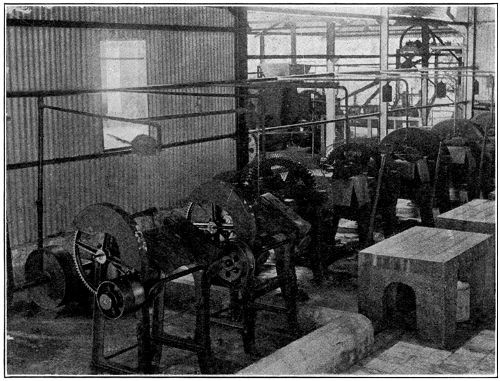
A Battery of Machines.
On the left, light marking rolls for sheet rubber; on the right, heavy machines for crepe preparation. In the middle background, “scrap-washing” machines outside the main building.
It has been remarked in the chapter dealing with crepe preparation that much depends upon the condition of the coagulum. There is no necessity, or desirability, for having a standard higher than 2 lbs. dry rubber per gallon, and it has been argued that it would be better to select a standard of 11⁄2 lbs. The tougher the coagulum, the more the power required, and the slower the rate of output of the leading machines.
In ordering machines for crepe-making, only large rolls should be considered—e.g., rolls having a diameter of 12 inches to 18 inches and from 15 inches to 18 inches face.
Rolls Running Hot or “Free.”—If the rolls are found to become hot, work on that machine should be stopped, and an examination made, otherwise there is the possibility of the crepe becoming sticky and “tacky” when dry.
Although comparatively cold water may be flowing upon the rubber and the rolls, little alleviation may be noticed, inasmuch as the source of heat lies generally at the bearing ends of the rolls. This may be tested by placing the hand on the top of the “standard” of the machine. The development of the heat may be due to lack of lubrication, worn bearings, or sometimes faulty setting-up of the machines.
Allusion has been made to the necessity for avoiding the running “free” of rolls—i.e., in the absence of rubber. The grinding of the rolls, when working close together, produces a fine powder, which causes a more or less pronounced deposit on pale crepe. When the rolls have been in action for some time and become slightly worn, this deposit may be confined only to the edges of the rubber.
Sheeting Machines.—The foregoing paragraphs have dealt entirely with machines for crepe preparation. Concerning machines for use in sheet-making, the ground has been mainly covered in Chapter IX.
Where both crepe and sheet are made, it is permissible and advantageous to use the heavy smooth rolls for the rolling of the sheets, and it is only necessary to instal one or two light machines for placing a pattern on the rubber.
Where a heavy battery does not exist, light machines with smooth rolls may be employed satisfactorily. Even engine-power is not necessary for the preparation of excellent sheets, but the output is limited where hand-power only is employed. Estates are known on which upwards of 1,000 lbs of sheet rubber are made daily with hand-power machinery in one station. Beyond this figure, it is deemed advisable to instal a small engine, say of 7-9 horse-power. This is ample to drive a battery of three smooth-roll machines and two markers, and yet have sufficient reserve to actuate a small pump for the water supply.
Lubrication of Machines.—It must always appear to those inexperienced in engineering matters that existing methods for lubricating rubber machinery are distinctly crude, when one considers the delicacy of the material to be prepared. Many existing machines are still lubricated with oil, which has to be administered in generous quantities. Generally, such machines have been so designed that the excess of oil may find an easy passage into the tray which receives the rubber. If not, it drops just outside the tray to the floor, and is washed away in great gouts. Even where grease-cap lubricators are fitted it is common to find that the excess can often be transferred from the bearings to the trays and so to the rubber. One would have expected from the attention which is being given to machinery for rubber estates that some improvement in lubrication methods would have been devised.
It is probable, however, that a great deal of the disabilities attaching to present methods of lubrication might be obviated if closer attention were given to the actual operation of the lubricators. Coolies should not be allowed to handle them, and the responsibility should be placed upon a foreman or the engine-driver.
Trays.—The most unsuitable and damage-causing part of the vast majority of machines, without doubt, is the tray. On nearly all machines the tray is wider than the effective portion of the rolls, so that any excess of lubricant may drop into it. On others, not only is the tray wider than the rolls, but its edge either is in contact with the shaft of a roll or just a small distance away. The edge of the tray is thus favourably situated for acting as a “wipe,” and the lubricant is transferred to the inside of the tray. Considering that the effective portion of rolls is about two-thirds of their length, it must be unnecessary to have trays wider than the length of the rolls. For the preparation of fine crepe trays are quite superfluous, and their place can be taken by a narrow piece of board if required. If the bed of the machines has been covered with glazed tiles, even a piece of board is not necessary. Where trays have been removed from the fine-crepe rolls on a number of estates, a marked decrease in the number of spoiled pieces of rubber has resulted.
It must be recorded that the foregoing paragraph appeared in our 1913 publication. After a lapse of over seven years, the remarks remain as true as when originally written. One of us is continually meeting with cases in which the defects are plainly attributable to the cause indicated above, and the fault often lies with the management of estates. On most machines the trays are not fixtures, and could be removed if desired.
Arrangement of Machines.—In considering the future arrangement of machines, the first care should be to see that machines and windows are to be found together.[16] Of all the factory operations, rolling of rubber should be given the maximum light. At the same time it would not be advisable always to choose a southern aspect, unless outside shades were supplied. The best position for setting up machines, therefore, is along a wall having a number of windows. This is extremely convenient also from the view of power transmission, and gives the maximum free floor space to the factory. In setting up machines, foresight must be displayed, otherwise one may find, when future extensions are made, that the extra machines may obstruct an entry or exit.
[16] Windows imply the existence of walls. Such is the conventional design of factories. It may be pointed out that walls are not necessary. The roof may be supported on pillars between which expanded metal of large size may be placed. This fulfils all requirements and gives the maximum of light and air. Many new factories have been erected to such a design.
In its handbook,[15] the Rubber Growers’ Association remarks:
[15] “Preparation of Plantation Rubber,” 1917.
[16] Windows imply the existence of walls. Such is the conventional design of factories. It may be pointed out that walls are not necessary. The roof may be supported on pillars between which expanded metal of large size may be placed. This fulfils all requirements and gives the maximum of light and air. Many new factories have been erected to such a design.
For the actual erection of machines, no labour should be accepted without European supervision. At present there are machines which are practically useless owing to faulty workmanship, and on many machines bearings run hot for no apparent or explicable reason. Whether the fault lies with the turning of the rolls or the setting of the machine cannot be decided; but at any rate too much care cannot be expended on the supervision of setting up machines.
There is no reason why everything in a factory should not be made as easy to clean as possible. For this desirable condition all machines should have the beds faced with tiles. A word of caution should be given against using marble slabs under the machines, as they would be eroded in time by the slight amount of acid washed out of the rubber. There would be no such objection against the use of white glazed tiles, if they are well set.
Access to Back of Machine.—In a few factories it has been noticed that the drainage of water from the machines runs to the front of them. This means that the coolies are put to unnecessary inconvenience and discomfort, and they often suffer from sore feet. All water should drain to the back of the machines. The necessity for seeing that these drains are kept clear might then induce those in charge to examine the back of the machines. It is often the case that, while the front of the rolls and tray are kept clean, little attempt is made to cleanse those parts which are not visible or accessible from the front. There should be no need to point out that any labour expended in such “front-window” work is rendered useless by the contamination from accumulations of old rubber and grease at the back of the machines. In the course of visiting factories one of us has many times seen great surprise exhibited by the manager or assistants on being shown the state of affairs at the back of the machines. There should have been no occasion for such surprise, for the back of the machines is quite as accessible to them as to the visitor.
In conclusion it might be said that the manager needing advice as to the best machines cannot go far wrong in purchasing any of the better-known makes, such as Shaw’s, Bridge’s, Robinson’s, Bertram’s, Walker’s, Carter’s, Iddon’s, etc. This list does not include local manufacturers such as the “United Engineers.” It must not be imagined that their machines are not recommended. As a matter of fact, their machines compare well with those made at Home. It would be well to judge in the final decision upon—
1. Cost.
2. The experience of those already using the machines.
3. Simplicity of parts.
4. Lubrication system.
5. Mode of adjusting rolls.
6. Fitting of trays.
Engines.—It is not intended here to discuss particular makes of engines, or even to attempt to lay down definite statements with regard to the type of engine. Without a full knowledge of local circumstances, it is not possible to recommend whether the engine shall be oil-driven, gas-driven, or steam-driven.
Assuming a copious supply of very cheap timber, there could be no objection to the employment of a steam-engine; but for most estates such a choice is out of the question.
Again, in deciding between oil and gas, local economic factors must be considered. Suction-gas plants are now made, in which a wonderful variety of refuse can be consumed in the production of gas, whereas ordinarily estates are restricted to the use of either charcoal or anthracite coal. Both oil and gas driven engines are eminently suitable for the purpose of a rubber factory, and the results obtained on different estates with either are often discussed in favour of one or the other. The selection ultimately narrows itself down to one of cost of running, in which availability of supplies becomes an essential feature.
Power.—No matter what type is selected, there should be made an ample allowance for margin of power. The general experience of estates has been that when the first portion of the estate comes into bearing, there is a desire to avoid great outlay, which should really have been secured in the original capital. The result has been that as later the estate expands, the original power unit is found to be inadequate, and a larger engine has to be purchased. In a short while the original engine is found to be unsuitable even as a “stand-by,” inasmuch as it is incapable of doing more than a portion of the work required. This means eventually that another large engine is required. Had sufficient margin of power been allowed originally, only two engines would have been bought, as against the three indicated above. Without going into finer details, it is usual to allow a rate of 10 horse-power per heavy machine used for crepe preparation. In actual practice, when a battery is working under full load, the power demanded is about 6 horse-power per machine. Thus a 50 horse-power engine running six machines and a scrap-washer is really running with only a small margin of power, and if large pieces of hard coagulum are placed in the washer or the macerator there may be a sudden stoppage. Assuming an average estate commences with only three machines for crepe-making, on an expanding programme, allowance of power should be made for six machines and a scrap-washer, if the purchase of larger power units is to be avoided later.
CHAPTER XIV
FACTORIES
General Construction.—On the question of general construction there is little to be said, except that buildings are now being properly designed in more permanent form than were some of the earlier buildings. On the whole there is little fault to be found with factories in general, except in so far as the output has outgrown the accommodation.
Most factories are now erected in iron, but there are a few which are built of bricks. It should be premised that a factory in which rubber is to be prepared should be as light and airy as possible. In this respect quite a number of the older factories are lacking, and they seem to have been designed to exclude as much air and light as possible. Under these circumstances, the building is always dark, there is always an air of dampness, dirt may accumulate, and there is usually a bad smell. Rubber prepared under these conditions is always liable to be below the high standard which should be attained, and the general tone of the factory is depressing.
Plenty of Light.—The old idea that light must be excluded is now known to be erroneous; so that in designing a factory, provision should be made for ample light and air. It should not be forgotten that in tropical climates, iron buildings may become uncomfortably hot, as most of our older factories are. Usually it will be found that the ventilation is imperfect. There is a lack of window space, and the roof is imperfectly ventilated. The ridge of the roof should be opened up by means of a “jack-roof,” so that the warm air rising naturally may escape at the highest point of the building. These are defects which should be remedied in old buildings.
As a rule no rubber remains in the factory at night-time, except in the form of coagulum, the loss of any of which would be noted with ease. The conventional idea of enclosing the factory with walls of galvanised sheeting, wood, or brick, is not strictly necessary. In modern buildings these walls are replaced by large-mesh expanded metal, thus making the machine-room perfectly light and plentifully ventilated. Under such conditions, dirt cannot accumulate unseen, and the general tone of the work is raised.
The Floor.—The floor should be of thick concrete, and have a good surface layer of cement. Preparations are now advertised for which claims are made that their employment renders the surface of such floors waterproof and dustproof. If these claims can be substantiated when the use is applied to the floors of rubber factories, the employment of a preparation of this nature should result in a considerable saving of expense and trouble. Preferably the floor should not be flat, but should slope slightly from the longitudinal middle of the building to the sides on either hand. If the floor is level it usually results in accumulation of water, the cement breaks in patches, and the factory always appears to be dirty.
Position of Machines.—All machines should be arranged adjacent to and parallel with one of the long sides of the building, and should be raised about 6 inches above the floor, so that water may escape easily. Tanks for the reception of latex, scrap rubber, etc., should be placed along the opposite wall to the machines, and the intermediate length of the building should be entirely free from fixtures. It was not uncommon in older factories to find the engine situated in the middle of the floor, so that what with the space occupied by the engine, and the space rendered unavailable by the belt-drive, the real accommodation of the factory was sadly diminished. In no modern factory should the engines be brought into the main room. They should always be accommodated in a special compartment, situated outside the wall, along the inside of which machines are placed. In this way considerable floor space is left available, and the machines may be worked by direct drive. Not only so; but if a suction-gas plant is worked, there can then be no excuse for particles of coal or charcoal dust being found in the factory.
Position of Engines.—It scarcely need be pointed out that if the engines are placed outside the wall which is opposite the machines, a long belt-drive would be necessitated, and that the presence of the belt would prevent the use of end doors. It is presumed in these arguments that two engines are to be installed. One can hardly imagine a modern factory in full working being equipped with only one engine, which might possibly have an excess of power necessary to drive all the machines. In the case of breakdown, which sometimes happens in the best supervised factories, it would be small consolation to know that this excess of power was present theoretically.
How many Storeys.—There can be no doubt that, taking all things into consideration, the best type of factory is that consisting only of one floor. The factory should be quite separate from all other buildings, and if attempts are made to conserve ground space by putting a drying-room over the factory, much trouble will ensue, especially if pale crepes are to be made. In the first place, the factory is made very much darker, and hence more difficult to keep clean; secondly, the ventilation of the factory is seriously interfered with; and thirdly, it is manifestly prejudicing the drying of rubber to place it directly over a room which is always more or less awash with water. At night such a building would reek with a moisture-laden atmosphere, and little drying could be expected to take place in that interval. From actual experience it has been shown that rubber hung to dry in such a room, situated over a damp factory, is very liable to attacks of “spot” diseases, since the presence of perpetual moisture is favourable to the development of these diseases. If a double-storey building has to be worked, it will be readily seen that no first-grade rubber should be allowed to dry in it. The accommodation over the factory may be restricted to the purpose of receiving lower grade rubber which is not so liable to “spot” diseases, and possibly does not take so long to dry as first-grade rubbers of equal thickness. It is evident, therefore, that the erection of double-storey factories is false economy, as separate drying-houses have to be built eventually. This conclusion does not apply with the same force to factories worked in conjunction with smoke-houses for preparing sheet rubber, but, nevertheless, such a factory should not have another floor above the work-room.
Verandahs.—One of the worst features in many factories is the necessity for coolies to bring latex into the factory. As already mentioned, the floors of factories are usually running with water (or should be), and it can be imagined that the passage to and fro of scores of coolies must bring in a great quantity of dirt. Not only so; the very presence of the coolies is a hindrance to the efficient working of the factory, and considerable floor-space and time are wasted.
This feature in factory working is all the more annoying because the necessity for it could so easily be obviated. All that is necessary is the erection of a wide, open verandah outside the wall of the factory. Here all latex could be received and strained, scrap-rubbers could be received and passed through an opening into tanks placed in convenient position. Water could be laid on in this verandah so that coolies might wash their buckets, and the whole verandah might be enclosed only with expanded metal so as to avoid interference with the lighting of the factory. In this way it would be quite unnecessary for any field coolie to enter the factory proper, and this would facilitate cleanliness. Such an arrangement has been discussed by the writers many times during the last few years, but the number of estates which have made such provision is still in the minority, and the same slipshod and dirt-making procession of coolies continues to walk through the factories, and the same piles of bark-shavings and scrap-rubber continue to accumulate and ferment in a few instances.
An indication of types of verandahs is given in Chapters VII. and IX. These are not intended to be representative of a universal design, but may be suggestive in the planning of others according to local conditions.
Situation of Tanks.—It will be noted that these verandahs are raised from the ground-level to a height of about 3 feet in order that latex may be gravitated, with a slight fall, into the coagulating tanks which are within the factory. There exists a real necessity for this practice, inasmuch as otherwise to obtain gravitation of latex (which is quicker and cheaper than handling) the coagulating tanks would have to be either placed on the floor or sunk beneath the level. The risk of contamination of latex or coagulum under such circumstances would be appreciable. Apart from this, it is advisable to have the coagulating tanks raised to a height of between 2 and 3 feet, to secure the advantage of ease of working in the processes of coagulation and the handling of coagulum—a not inconsiderable factor.
In some modern designs it is proposed to place the coagulating tanks in a separate building. This would seem to be an unnecessary refinement in a new building, if observance is given to the suggestions made in previous paragraphs.
Designs and “Lay-Out.“—In a previous publication[17] comment was made upon grievous errors in designs prepared by those inexperienced in the requirements of the tropics. There is little ground now for complaint, and local engineering firms are fully capable of advising upon, and constructing, suitable buildings.
[17] “Preparation of Plantation Rubber,” Morgan, 1913.
In considering the first installation of a factory and equipment one always has to weigh the question of prime cost against the probability of future expansion of crop. If it should be decided at first merely to cater for contemporary requirements, the fullest consideration should be given in discussing design of building and lay-out of machinery to the practicability of later extension. The site should be large enough for the eventual group of buildings, the building should be easily capable of extension with the least cost, and the same forethought should govern the lay-out of the machinery.
Drains.—Lastly, there is the question of drains. Generally speaking, all factories are well provided with drains, and the only difficulty is that of getting an adequate fall for efficient drainage. But there is a certain amount of laxity exhibited in the matter of providing sieves in drains. To anyone acquainted with factory working, it must be apparent that quite a lot of small pieces of rubber are washed into the drains. This rubber should be collected at intervals during the day; but in many instances that collected is only a fraction of what escapes. Wherever possible the drainings of a factory should be carried as far as is practicable from the buildings by means of cement drains. Too often these are short, and lead into earthen drains. Even if no pieces of rubber are present, the serum from the coagulum is subject to decomposition, the effluvium from which is objectionable.
Water Supply.—It is essential that a good supply of water should be available. This should be distributed by pipes all round the building, so that a hose may be used in every part for the thorough cleansing of the factory at intervals during the hours of working.
Summing up, it might be said that a good factory, therefore, should have the following features:
1. Plenty of windows, or walls of expanded metal.
2. A jack-roof in the ridge, and hence a good system of ventilation.
3. Engines in compartments outside the walls of the factory.
4. Machines close to and parallel with the wall outside of which the engines are placed.
5. Latex tanks and other fixtures along the wall opposite the machines.
6. A long middle free space, at either end of which a large double door should be placed in the end walls.
7. A good concrete and cement floor sloping slightly from the middle towards each long wall.
8. An abundant water supply, and several lengths of hose.
9. The building should be of only one floor, and have ample head room.
10. There should be an outside, open verandah upon which latex may be received, etc.; preferably outside the wall which is opposite to the machines.
11. The system of drainage should be thorough, and the drains should be adequately screened, so that all particles of rubber may be collected.
CHAPTER XV
OTHER BUILDINGS
Drying-Houses for Crepe.—It has already been shown in the previous chapter that one type of drying-houses—viz., that over a factory—stands condemned, except for the drying of low-grade rubbers. Generally speaking, a great advance has been made in the design of crepe drying-houses during recent years, and it has been possible even to improve older ones so as to bring them into line with the more modern buildings. Houses for drying crepe rubber may be of one floor, two floors, or even three floors. Doubtless those built with three floors were designed with a view to economising the available site for factory buildings, and as long as the ventilation is good there can be no very great objection to them. It might be pointed out, however, that even with the best of ventilation the air passing successively through three layers of rubber must be fairly saturated with moisture by the time it leaves the building. The effect of this upon the rate of drying in the uppermost chamber will not be so marked as it will be in the middle floor, as the temperature of the top floor must be many degrees higher than that of the other two rooms. It would be expected, therefore, that the rate of drying in the middle storey would be slower than that in either of the other two.
In houses of two floors this objection would not have to be met, and drying-houses of this type are successful and common.
How Many Storeys?—Again nothing could be urged against a building of two or three storeys in which the ground floor was occupied as a packing-room, except that, by negligence in not allowing wet crepe a preliminary dripping period, water might fall upon the packed rubber below.
As a matter of experience, such a house is, taking all into consideration, the cheapest and most suitable type for any estate with an increase in output. Even at the outset there should be a separate room in which sorting and packing is undertaken. This is conveniently the lower room of a drying-house. The only stipulation to be made for a house with two storeys is that the floor of the upper room should be of an open pattern, so that the air may circulate right through the building. This is usually and very successfully attained by laying down wide slats of wood, with spaces of an inch or more between them. It is not advisable to have spaces wider than 11⁄2 inches, otherwise there is a certain amount of danger to the limbs of individuals who have to work or supervise in the building. In any case, it is very convenient to have pathways of planks running the whole length of the floor, so that the supervision is made more convenient. If this is done, there can be no objection to the custom of suspending the rubber of a lower chamber from the slats of the floor of the upper room. At present, in some drying-houses, this means of suspension is used, but no planks are laid down, and it becomes necessary to walk over the drying rubber. This is a detail, but it is one which does not make for the improvement of rubber, and the expenditure of a small sum would be sufficient to rectify the matter.
From every point of view, it would be desirable to have the floor of the packing-shed (or the packing-room in a combined house) raised from the ground, to a height of, say, 3 feet; or the height of a bullock-cart or motor-lorry. Not only is ventilation improved, but there would be a great saving in labour. Packed cases could be wheeled directly on a level with the cart or lorry.
A great many estates favour drying-houses of one storey. These are eminently suitable, provided that the site is suitable, and that the relative dimensions of the house are favourable to efficient ventilation. It is a common mistake to find buildings of which the breadth is out of proportion to the height. Obviously, if the height is not considerably in excess of the breadth, ventilation will be defective. For a single-storey drying-house, the maximum height should bear the ratio to the breadth of 3:2, and in a house of this type specially long pieces of crepe can be utilised. Naturally, in a house of two storeys, this factor is not likely to be neglected, and if the lower room is used for packing purposes the rate of drying should be rapid. Again, when a single-storey building is contemplated, it is well to make strict examination of local conditions. If the site is low-lying and surrounded by trees it will be clear that tall buildings are required, and that a house of more than one floor is to be preferred. Considerations of this nature would have prevented the erection of some dry-sheds which do not give a satisfactory rate of drying.
Ventilation.—No matter how many floors there may be in a drying-house, the greatest attention should be given to the question of ventilation. It is an elementary point in the study of ventilation problems that the best system of natural ventilation is obtained by admitting cool air near or through the floor and providing an exit for the warmer air at the highest point in the building. It is not often that such a rule is infringed in the ventilation of rubber drying-houses, but several of the older buildings erred in this respect. In a good modern house there is a space (about 2 feet in height) all round the base of the walls merely closed with expanded metal; this admits cool air. An exit for warm air is provided in the ridge of the roof by either ventilation chimneys or by a jack-roof. The latter is preferable, as it provides for a more free and uniform escape.
In some drying-houses, besides the ridge openings, the space along the eaves is left open. This would seem to be undesirable, as it provides for the entrance of outer air, which might combat the ascending warm air and so interfere with the natural upward currents. Provided that a jack-roof or other suitable openings have been installed, there is, therefore, no necessity for the existence of open spaces at the eaves, and they probably do more harm than good.
In the tropics, on days of sunshine, there must always be an upward current of air in well-designed houses. Temperatures of 105° F. are easily recorded in the ridge space of a building, while the temperature in the lower part of the house may be at least 15° F. lower. On the floor of an upper room a temperature of 90° F. is commonly noted, and in buildings with three storeys the usual day temperature of the top room is about or over 100° F. Even, therefore, when there is no trace of a breeze, there must be a displacement of air in an upward direction, though it may not be detected without tests being applied.
It is often asked whether a temperature of 100° F., such as is obtained in the upper room, is calculated to injure the quality of the rubber. There need be no fear on this ground; the experience of many estates goes to show not only that no harm results, but also that the drying of the rubber is expedited. There would seem to be no reason why crepe rubber should not be dried at a temperature of 100° F. It must be understood, however, that higher temperatures for crepe rubber are not recommended, as it has been proved that the rubber is affected. The fact becomes obvious with continued treatment at temperatures much above 100° F., for the rubber stretches and breaks across the support.
Windows.—Concerning the subject of window space in a drying-house, there has been much discussion at various times. Years ago it was common to find windows widely open with the sunshine streaming in. Naturally, tackiness developed in some of the rubber, and care was then taken to keep the windows closed. Thus the rooms were darkened and air excluded. There followed a period in which windows were fitted with ruby-coloured glass to keep out the actinic rays of the sun, which were responsible for tackiness, and excess of light, which was supposed to be responsible for the rapid oxidation of rubber. Unless special precautions were observed in the processes of coagulation and preparation, it was not proved that the exclusion of light prevented or lessened the natural oxidation of crepe rubber. Since the introduction of sodium bisulphite for the prevention of oxidation, there has been no cause to worry as to the possible effect of light, as no perceptible darkening of the rubber takes place. It follows, therefore, that no trouble need be taken to exclude light, although the necessity for excluding direct sunshine still exists. Windows may be left open as long as the sun does not reach them. This can usually be arranged in a drying-house by manipulating the windows at intervals during the day, so that those in the shady side of a building are always open, while those on the sunny side are always closed. If it is thought that this manipulation cannot be entrusted with success to the store coolies, the case may be met by having all windows constructed on the louvre pattern, so that, although the windows are closed all day, air and light are not excluded. Should it be desired to retain the existing type of windows, which open outwards, and to keep them open all day, a simple arrangement of ruby-coloured cloth on an outstanding wooden frame may be placed within the walls of the building, or the shutters of the windows may be hinged at the top to open outwards. Unless there is a pronounced breeze, or it is required to examine the rubber closely, there is no necessity to have windows open, except in the case of a house in which the bottom floor is used as a packing-room. The windows of this chamber may remain open during the day, to advantage in sorting and packing, and also to the proper ventilation of the building. Thus the direct rays of the sun are rendered harmless, while air and light are allowed to enter.
Hot-Air Drying-Houses.—Mention has already been made of the existence of a system of drying in which hot air is forced into a drying-house by means of a powerful fan. Provided that the temperature of the hot air could be so regulated as not to exceed 100° F., there would be merit in the system. Such matter of regulation could be solved by having a duct in the main air passage, through which cool air could be admitted in such proportion as to modify the temperature of the hot air. As the process is worked at present, the temperature attained is often well above 100° F., and there is a danger of thin crepe placed in this house over-night being found upon the floor in the morning. Unless the crepe is prepared thick and cut into fairly short lengths, it will not bear its own weight at higher temperatures; and if it is made thick, drying is impracticably prolonged. It is probable that, with a temperature of 100° F., and a steady current of air, average thin crepe would dry in such a drying-house within six or seven days. This would be an improvement upon the usual rate of drying in most factories, although several ordinary drying-houses are known in which thin crepe will dry naturally in that period.
Smoke-Houses.—No discussion of theoretical considerations regarding the process of smoke-curing will be attempted here. We are concerned only with the necessity for supplying a demand for smoke-cured sheet rubber. Broadly, the process is akin to the smoke-curing of herrings, and the objects are much the same—viz., (1) drying, (2) preservation—except that while herrings are only dried partially, rubber should be dried perfectly.
On a small scale a primitive smoke-house could be built easily and cheaply, and such a building might be fully as efficacious as the most elaborate and expensive installation. In the early days of estates it was not uncommon to see temporary smoke-houses constructed of wood, and roofed with “attaps” (palm leaves). Some of the best rubber in the market has come from wooden buildings, but naturally the risk of destruction by fire is considerable.
For imperative reasons it may be sometimes found necessary to smoke rubber when the only available building is a single-storey one. As a temporary measure, the building may be converted into a smoke-house by placing the fires in pits sunk deeply into the ground, and effectively screened above by iron baffle plates. But it is not advisable that smoking be continued in such a single-storey building, as the best effects are not obtained, and the risk of fire is far too great.
Usual Types.—At first sight it would appear that the best type of smoke-house would be one consisting of a tall building, covering a comparatively small superficial area, and having a number of superimposed chambers in which the rubber could be hung to dry. In practice there are several solid objections which limit the height and the number of floors. Chief among these is the question of temperature. If smoke-curing is to be effective, a certain temperature must be attained and maintained. To obtain such results in a house of excessive height would be difficult, if not impossible, under normal conditions. It would be found that the chamber immediately above the furnace-room would be overheated if the temperature in the upper rooms was within the desired range, etc.
Until recent years smoke-houses could be classed as belonging to one of two types:
(1) Those having external furnaces.
(2) Those having internal furnaces.
The number of the former existing at the present time must be very small, as it has been shown that the arrangement of the furnace outside the house is unsatisfactory in comparison with the other type of house. In discussing the question of smoke-houses, therefore, it will be understood that the standard type accepted is that having an internal furnace. In its original form it was known as a “Kent” drier, and consisted of a tall two-storey wooden building. The walls of the lower chamber had the form of an inverted and truncated pyramid. By this arrangement it was possible to obtain from a comparatively small fire sufficient smoke and heat to cure the product placed in the room above. This is the principle upon which many smoke-houses in Malaya are designed. On a very large scale it is not claimed that the sloping sides of the lower chamber lead to economy in the number of fires, but merely divert the smoke in an upward direction. It is acknowledged that vertical lower walls are quite effective, and it is an easier matter to fit in doors.
It may be noted that the usual type of smoke-house now in general use consists of a building of two storeys, in the lower of which are situated the furnaces, while rubber is hung on racks in the upper room. Sometimes there may be a third storey, also used as a drying (curing) chamber. As a rule the drying-room is one long unit, as also is the furnace chamber; but in some cases they are subdivided by vertical partitions into smaller chambers, for ease of working and better control. This applies with some force in the case of very long houses standing in an open space. It is sometimes found in such cases that at certain seasons the prevailing winds have the effect of making drying and curing uneven in parts of the building.
With these exceptions, the ordinary type of smoke-house functions very efficiently, and is capable of drying average sheet (from standardised latex) in a period ranging from seven to eleven days. Should the building not be capable of such performance, in spite of the strict observance of all rules laid down for the processes of preparation, then there is some defect in ventilation or in the distribution of heat.
General Ventilation.—The ordinary rules of ventilation in drying-houses apply equally to a smoke-house. There should be a slow current of air and smoke from the lowest point to the highest point in the building.
In spite of all that has been written on this subject, it is by no means uncommon to encounter the idea that a smoke-house should be perfectly closed in order to get good results. As to what must become of the (say) 25 per cent. of moisture which the rubber contains there is no knowledge. In dozens of cases, when complaints regarding slowness of drying have been investigated, it has been necessary to point out the need for providing a rational system of ventilation.
Naturally only a slow current of air and smoke is required. The creation of an appreciable draught would have the effect of increasing the fuel consumption of the furnaces, raising dust from the ash, and of causing a temperature higher than that which is known to be desirable. It will be clear, therefore, that if there are to be any openings at the base of the walls they should be small in area, and should have some device by means of which the current of air can be efficiently regulated. In the usual case the construction of the building is not calculated to render it air-tight, and the necessity for providing special air inlets does not arise.
Windows.—Windows are not strictly necessary, and are only intended to be of service during the time in which coolies are at work within the building. The operations of examining rubber, turning sheets, removing dry rubber, cleaning racks and floors, and putting wet rubber into position, usually occupy some hours daily. During this interval the windows should be widely opened if the weather is favourable, and should remain so until the fires have been lighted. It should not be forgotten that during the heat of the day quite an appreciable degree of drying is possible. Advantage can be taken of this; but there is no necessity to extend the interval unduly, and it is of greater advantage to proceed with smoke-curing when the work in the drying-chambers has ceased.
Racks of Supports.—Still referring to the usual type of smoke-house, it may be remarked that in the upper room bays of racks run at right angles to a central passage down the length of the building. Narrower passages run between the bays of the racks to facilitate ease in handling and inspection. The wooden supports may be placed about 3 inches apart horizontally, and 15 or 18 inches apart vertically. A full bay of racks should contain nine or more lines of support in each of the planes which are 15 or 18 inches apart vertically. The number of these planes is governed only by the height of the room, measured from the floor to eaves. The supports should be of smooth timber, and need not exceed 11⁄2 inches square in section.
It is usual and advisable to smooth off the rectangular edges of the supports or bars, to avoid the incidence of splinters of wood adhering to the rubber. The bars should not be fixtures, but may either be accommodated in slots, or may rest between two nails, so that it is possible to give them a rotary motion by turning the projecting ends. This practice is followed in smoke-houses, the idea being to move the drying sheets slightly each day, with a view to the prevention of a pronounced mark across the sheets.
Care should be taken to see that the vacant racks are thoroughly cleaned before fresh rubber is placed upon them, otherwise a distinct dirty mark is caused across the middle of the sheet. This mark usually cannot be removed, even by scrubbing with water. Where this mark occurs regularly in all sheets, attention should be turned to the openings beneath the bays of racks, if open fire furnaces are employed. It will generally be found that gauze of too wide mesh has been fitted. This should be removed or covered with a finer gauze.
A more effective way of dealing with the trouble, provided other precautions have been taken, is to have plenty of spare wooden bars. It should be a rule stringently enforced that, as soon as racks are emptied, the bars should be removed to the factory to be cleansed thoroughly. A spare set should enter the smoke-house with each batch of fresh rubber. The actual number of spare sets required could be limited to a two days’ supply, and the extra cost would be recouped easily.
Floor of Drying-Chamber.—The floor of the chamber is usually of planks, except that the space under each bay of racks should be filled with expanded metal. With the use of wood fires there is always a large amount of light ash formed, which may find its way into the upper chamber. To counteract this, screens of fine mesh gauze are laid over the expanded metal. This gauze may be fitted into a movable wooden frame, so that when it becomes necessary to clean it the whole may be removed.
The difficulty is that with furnaces of the “open-fire” type the rise of dust is so great that the gauze screens soon become clogged, especially as the slight tarry matter in the smoke condenses on the gauze, causing the dust to adhere. With the better types of furnaces, the employment of gauze screens is not necessary, as there should be very little rise of dust. It is sufficient to use only expanded metal, to prevent any displaced pieces of rubber falling into the furnace chamber.
Furnaces Generally.—The crudest and dirtiest method of fuel consumption in the preparation of smoked-sheet rubber is that of making a fire on the ground. This is still a common practice, and should be condemned as being both wasteful and harmful. Under prevailing conditions coolies will, in spite of instructions, heap up a pile of logs in order to save themselves the trouble of stoking the fire in small quantity and at regular intervals. A small supply of water is kept at hand with which to quench the fire somewhat if it threatens to cause trouble. Naturally a large quantity of fine ash is thus thrown up, and the rubber above receives the deposit. If the coolie does not happen to be sufficiently awake, of course a house burns occasionally.
From this primitive type of furnace, others have been evolved. These usually take the form of more or less shallow trucks, the majority of which are similar in principle to the fire on the ground, except that the container can be withdrawn from the house for the purpose of removing the ash. Sometimes they are even more objectionable than the ground fire, inasmuch as, being raised above the ground level, an under-draught through fire-bars is caused, and consumption of fuel is so much the more rapid.
Pits.—It is clear that large fires are not desirable, and that combustion should be slow, provided that the necessary temperature can be maintained. The lines along which the development of furnaces needed to extend are therefore plain. The simplest device adopted was the digging of pits in the ground. Sometimes these pits received the addition of an iron truncated cone which was movable. Naturally the combustion was slow, but sufficient heat was obtained if the pits were large enough or in sufficient number. An objection was that the ash had to be cleared in situ, and in the process the earthen pits gradually increased in size. In all cases it was necessary to suspend an iron baffle-plate above the furnaces to distribute smoke and arrest any sparks.
“Pot” Furnaces.—The next development was the employment of “pot-furnaces.” These consist of iron drums, sometimes merely resting on the ground, and sometimes mounted on trucks for easy withdrawal. These drums radiate sufficient heat if present in sufficient numbers, and the fuel consumption is low. They are usually manipulated by starting a fire in the bottom and packing in logs cut to the necessary length. Some have no lids, while others are fitted with perforated caps.
It was considered necessary in some instances to punch a few small holes near the base of the drum in order to ensure a very slight upward draught. In a few cases this perforation has been exaggerated to the form of a hinged door. Unless this can be closed with ease, and is closed according to instructions, part of the object of this type of furnace is defeated; fuel consumption is rapid, and the temperature is too high. In the original form “pot-furnaces” have been found to be effective on many estates, and are still employed with satisfaction.
Iron Stoves.—Working on exactly the same principle, on some estates one finds small iron stoves in use. Sometimes broad pipes are attached for the better distribution of the smoke; if this is the case it should be noted that the pipes should have a slight downward slope, and that the “bend” at the end should be turned downwards. In this way condensed moisture and creosotic matter falls to the ground, and does not lodge in the pipe. The life of the conduit is thus prolonged. Usually such stoves are in use where the “head-room” of a smoking chamber is insufficient for other types, or where the nature of the site does not permit of sunken furnaces being installed. They are of value likewise on occasions where the fuel supply is limited to a rich timber such as mangrove-logs (“bakau”), when it is necessary to ensure a low combustion with low cost of fuel.
Horizontal Drum-Furnaces.—To overcome difficulties inherent to drums or “pot-furnaces,” the next development was that in which the drum was made to assume a horizontal position, and adapted ingeniously to a simple system of working from the outside of the building. Reference to the drawings given will explain how this is effected. In the first illustration (No. 2) it will be noted that the drum is supported upon brick pillars, with one end projecting through the wall of the building. At the other end a short chimney is mounted, having within it a “damper” which is adjustable from the outside. Over this chimney is suspended a simple baffle-plate, made from a Chinese iron cooking-pan. The outer end of the drum is furnished with a hinged and latched door, in which a small air-regulator is accommodated.
In the second set of drawings (No. 1) the drum is increased in size and fitted in a special manner for incorporation with a distinct type of building. Such a scheme was first put into effect by Mr. R. C. Sherar, the manager of Third Mile Estate, Seremban, F.M.S., and for ease of reference the house and furnace will hereafter be mentioned when necessary as the “Third Mile” type.
Arrangement of Machines.—In considering the future arrangement of machines, the first care should be to see that machines and windows are to be found together.[16] Of all the factory operations, rolling of rubber should be given the maximum light. At the same time it would not be advisable always to choose a southern aspect, unless outside shades were supplied. The best position for setting up machines, therefore, is along a wall having a number of windows. This is extremely convenient also from the view of power transmission, and gives the maximum free floor space to the factory. In setting up machines, foresight must be displayed, otherwise one may find, when future extensions are made, that the extra machines may obstruct an entry or exit.
Designs and “Lay-Out.“—In a previous publication[17] comment was made upon grievous errors in designs prepared by those inexperienced in the requirements of the tropics. There is little ground now for complaint, and local engineering firms are fully capable of advising upon, and constructing, suitable buildings.
[17] “Preparation of Plantation Rubber,” Morgan, 1913.