Part One
“The owl of Minerva spreads its wings only with the falling of the dusk”
— Hegel
I
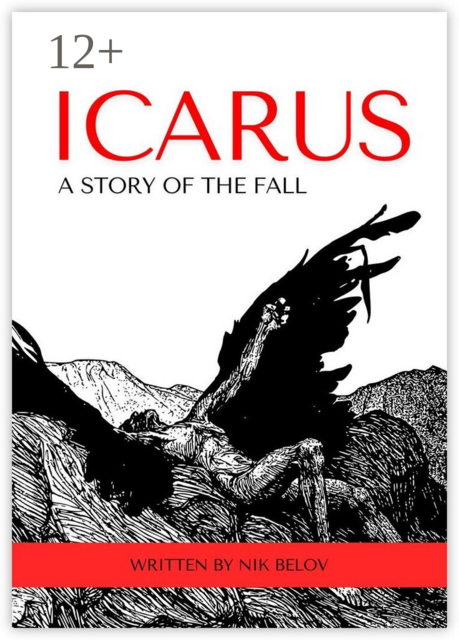
“I am Icarus, and I soared towards the sun, oblivious to the impending doom. As I understand now, it was always beyond my grasp. The gallant fire blinded my vision, leaving me sightless in the boundless azure. My waxen wings yielded to the scorching heat, and I plummeted like the lifeless pebble. Now, as I descend through the endless void, there is scarcely a moment to comprehend the gravity of my folly, to truly fathom what transpires in these final breaths granted to me. My sight has returned, yet what purpose does it serve when nought but emptiness embraces me? The shores of Sicily shall forever remain the distant dream. Never again shall I glimpse the beauty and feel the tenderness of it. Not in this life, nor in any other. The stars begin to fade, along with the heavens and their infinite expanse. The thunderous sea beckons below, leaving me naught but to surrender. Perhaps fate could have been different, or perchance my fall was written all along. Alas, forgive me, Sicily, and farewell. I have tasted happiness, even if not for long” — I imagine they were true thoughts of Icarus, those fleeting moments of realisation as his wings began to burn and he burst out painfully laughing. Today, I find myself embodying him. I am crushed beneath the weight of my hubris, clenched and destroyed by my precipitous fall. The descent has spanned three consecutive nights, each bleeding into the other with merciless continuity. I want to speak with you, though our dialogue may be fragmentary. Your presence, as always, offers solace to me in the silent understanding. Thank you for being here with me in my solitude. Today, as I believe, I marked my missed opportunity to reach the distant shores of Sicily, much like Icarus has failed the journey to his love and freedom. In these moments of my fall, whilst time stretches infinitely before the final breath, I wish to contemplate all that was and what might yet be. Be with me in my reverie, as I navigate through the labyrinth of my memories. Be my witness, as I begin to unfold the story of heights attempted and depths encountered, a poem of deep regret, a story of love that was always doomed to an end.
II
In the depths of his confinement, Icarus dwelt in perpetual thought of existence — the passage of time gradually transformed his initial acceptance into the loathing of his very circumstances. Though he experienced life and love, his soul desired for transcendence beyond the walls that were holding his reality. Such wanting externalized in the relentless struggle against the prison, which he perceived as the vexatious embodiment of his limitations. Being once a distant comfort to Icarus, it became the suffocating reminder of his bondage, transforming his chamber into nothing but a cell. His rebellion therefore became not merely physical but entirely existential.
Daedalus, too, harboured rebellious thoughts, but his perspective is to be fundamentally different. As the architect of the greatest creations, Daedalus stood in contrast to Icarus, much like the Creator may stand to any of his mortal creations. Thereupon, Daedalus does emerge as the true allegory and Icarus as the very human condition. The parallel proves particularly apt, for it is Icarus who mostly captures our imagination. Unlike his father, whose path is predetermined by his pious role, Icarus exists in a state of perpetual uncertainty regarding his one.
Though undeniably the Creator, Daedalus in the sense of story might more accurately be termed mythmaker, the master of all narratives. Icarus, however, turns out to be a form of universal humanity, born into existence without comprehending the true nature of freedom, not knowing of his role. His destiny, though believed in with fervent conviction, remains truly obscured, and the boundaries of it are as indistinct as the Mediterranean horizon. And so, such uncertainty does place Icarus in the position of necessary subordination to Daedalus, therefore, as if just a mere man, he finds himself bound by the obligation to submit to the will of his Creator, a constraint as binding as his physical imprisonment.
As if a testament to the human paradox, the fate of Icarus unfolds ironically — though fashioned by the most sublime of creators, he possesses an imperfection. Icarus, so, becomes an amalgamation of vices. However, these very flaws constitute the core of his identity, the very being, at the heart of which lies the primordial desire to escape the confines of his dungeon and to finally fulfil his destiny. But, as it may be, there exists a compelling possibility that Icarus once harboured the deep affection for those walls, whereas now sees it as his great imprisonment. Indeed, I might posit that he does rediscover the peculiar love in his final moments, though with the transformed consciousness that allows him to perceive these structures with unprecedented clarity.
While Daedalus persists in his creative endeavours, establishing order and facilitating the intended flight to Sicily, the contribution of Icarus does remain minimal. Upon reaching the coastal refuge, both father and son could have contentedly dwelt there indefinitely, finding solace in it, but Daedalus creates the possibility of freedom. As it is, it would be remiss to characterise him as an actual and primary seeker of freedom in the story, rat