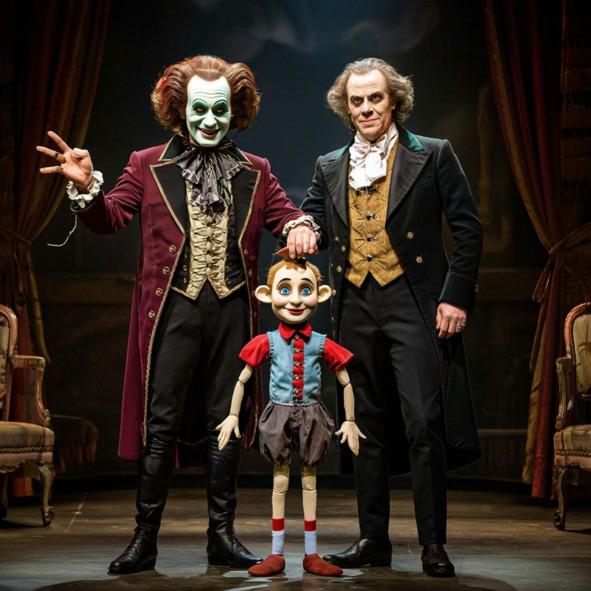
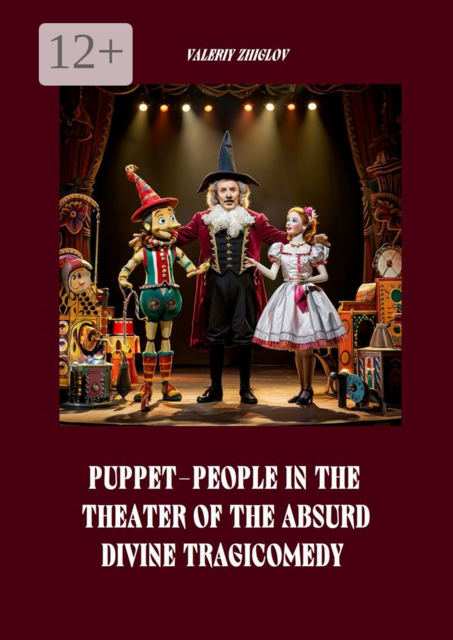
Puppet-People in the Theater of the Absurd. Divine Tragicomedy
Қосымшада ыңғайлырақҚосымшаны жүктеуге арналған QRRuStore · Samsung Galaxy Store
Huawei AppGallery · Xiaomi GetApps

автордың кітабын онлайн тегін оқу  Puppet-People in the Theater of the Absurd. Divine Tragicomedy

Valeriy Zhiglov

Puppet-People in the Theater of the Absurd. Divine Tragicomedy


Contents

Scene: An empty theater, on stage — a lone puppet Petrushka. He moves slowly, as if in slow motion, talking to himself.


Petrushka:

“Born… (pause)

Studied… (pause)

Went to work… (pause)

Took a mortgage… (pause)

Paid it off… (pause)

Died… (deep sigh)

And what? What’s next? Where’s the meaning? Puppets don’t die… or do they?”


At this moment, the Shadow appears — a mysterious character who starts asking Petrushka unexpected questions, making him doubt his usual logic.

From the Author

Oh, wretched spectators! Welcome to this cursed theater of the absurd, where puppets don’t just dance and fall — they live, suffer, and ask questions that will make your head spin like Petrushka’s after his fourth glass of “imaginary” wine! Here, each of us is a pathetic marionette in the hands of fate, jerking on strings that someone (or no one?) pulls from above. And yes, this applies to all of us — people, puppets, even to this poor Master who has himself gotten tangled in his own creations!


Imagine: you are born — bam! — from nothing, like Petrushka from an old toolbox. Then you study — ha-ha! — “reading” the blank pages of life, where each chapter ends with the word “work.” Then you go to work — oh woe! — and take out a mortgage that chokes you like a noose of threads until you pay it off (or not), and finally… you’re dead. Classic! But in this endless cycle hides a great comedy: we’re all clowns in the costumes of serious people, trying to “settle up” with life, while it just laughs and adds another debt.


Our hero Petrushka is not just a wooden head. He is the embodiment of our inner chaos: dreaming of freedom, but tripping over his own feet (which, by the way, are on strings!). Alongside him is Margarita — the stage star who cries from laughter and laughs from tears, because her fame is just a mirage in a dusty theater. And the Master? Oh, he is the tragic tyrant, creating puppets to forget his own emptiness. And the Shadow — that damned Shadow! — who whispers horrors at the most inconvenient times, making you doubt: what if life is just a rehearsal before the final curtain fall?


In this book, you will laugh until you cry and cry from laughter — because the absurdity of our lives knows no bounds. This is not just a story; it’s a soul’s cry in an empty hall: why do we live if every step is a step toward the edge of the abyss? But don’t be afraid — there are no simple answers here, but plenty of absurdities that will make you think: maybe the meaning is just… not to fall?


So grab your ticket to this mad circus! Fasten your strings, turn on the house lights, and get ready for a show where tragedy and comedy embrace like old friends. And remember: even if you’re a puppet, you always have a choice — to laugh at the absurd or… well, you know. Welcome to the theater of the absurd. Let the performance begin!
Act 1: Birth and Childhood — “Born…”

Objective:


Introduce the world of the theater of the absurd and the main characters. Set the tone — a blend of comedy, absurdity, and light philosophical melancholy.


— —


Scene 1: Petrushka’s Birth


*The curtain slowly rises. On stage — an old, creaky wooden crate. Inside — scattered tools: a hammer, nails, a spool of thread, pieces of fabric, and scraps of paper with notes like “Meaning of Life — TBD.” In the background — dim light, like in an abandoned workshop. The air smells of dust and something vaguely bitter.*


*Strange music plays — as if someone is trying to tune an old jukebox, but it’s jamming, producing staccato sounds.*


Master (enters, slightly stooped, with a solemn yet weary look, holding a wooden block and a spool of thread):

— Well then… Today I’m playing God again. Or a plumber. Sometimes you can’t tell the difference. Birthing a puppet is like cooking grandma’s borscht: the recipe seems simple, but it comes out either too salty, too bland, or completely tasteless. The main thing is that it doesn’t fall apart in the first five minutes and doesn’t ask for a raise.


*He places the block on the table and begins methodically attaching wooden parts to it, while talking to himself.*


— Head… (attaches) Body… (threads) Arms… (tries to connect, but one arm falls) Ah yes, don’t forget the soul! (pauses, stares into emptiness) Where is it? Probably lost in the closet with debts and unpaid bills. Or worse, in the bureaucracy department.


*The Master sighs, takes the spool of thread, and carefully begins “sewing” Petrushka together.*


— You know, they say puppets are immortal. Ha! Immortal, yes, but will they survive a mortgage? That’s the question. If Petrushka survives his first breath and his first payment — he’s already a hero.


*Suddenly, Petrushka begins to slowly stir: lifts his head, blinks his wooden eyes, tries to take his first step — and falls to the floor with a characteristic creak.*


Petrushka (with slight bewilderment and surprise):

— Um… Hello? I’m the newbie here. Who am I? Why am I? And why do I have such weird joints? And why won’t my legs obey? Or is it like that for everyone?


*He tries to smile, but only manages a wooden, slightly creaky one.*


*From behind the curtains, a children’s choir voice is heard — but with a clear note of sarcasm and weariness.*


Choir of Puppets (voices like a children’s choir, but with obvious cynicism):

— Born! Study! Work! Mortgage! Died!

(they repeat with varying intonation, sometimes stumbling, questioning each other, and laughing)


Petrushka (tries to smile, but the smile is wooden and slightly creaky):

— Sounds inspiring… or terrifying. Either way, I already want a break. Can I have some coffee? Or at least a battery?


*He tries to stand up, but falls again, making a funny creak. The Master looks at him with weary affection.*


Master (with sadness and irony):

— Welcome to life, Petrushka. Here you’ll face endless rehearsals, meaningless dialogues, and eternal mortgages. But don’t worry — everyone here has joints like that.


*The curtain slowly closes to the sounds of creaky laughter and jamming music.*

Scene 2: Childhood and Learning


*The curtain opens smoothly. On stage — a dreary classroom in the theater of the absurd. Desks made of peeling wood, posters on the walls with slogans like “Study so you don’t die of boredom!” and “Mortgage — your best friend and toughest boss.” Puppets sit at the desks, looking equally tired and slightly stiff. In the center — Petrushka, trying not to fall asleep. Next to him — Margarita, bright and energetic, like a ray of sunshine in this gloomy realm.*


*The Teacher enters — another puppet with huge glasses that constantly slide down his nose. His voice is monotonous, like a looped recording.*


Teacher (with an expression of absolute seriousness and slight weariness):

— Today we learn to be obedient. Repeat after me:

(he pauses, like a narrator in a medicine ad)

“Life is work. Work is life. Mortgage is happiness.”


*Puppets in chorus, with obvious lack of enthusiasm:*

— Life is work. Work is life. Mortgage is happiness.


*Petrushka whispers to his neighbor, who indifferently twists his head:*

— What if I say I want to be a pirate? Or at least a circus clown? I want to tear these strings at least once in my life and not pay taxes for it!


*Margarita turns sharply, her eyes sparkling, like a flash of light in the dark classroom.*


Margarita (with defiance and sparkle in her eyes):

— Pirates are last century! Now it’s trendy to be stage stars! I want to shine! Not sit in this gloomy classroom where even the cobwebs on the ceiling are better than our dreams!


*The Teacher sharply raises his finger, his glasses clatter to the floor, he glares angrily at Margarita.*


Teacher (with anger and authoritative tone):

— Silence! Dreams are for those who can’t calculate mortgage interest! And if you want to shine — go to the light, but don’t forget: light is the electricity bill that comes at the end of the month and makes you cry.


*Petrushka and Margarita exchange glances — a mix of hope, doubt, and slight panic in them.*


*At this moment, the Choir of Puppets bursts into the classroom — all in identical gray suits, with faces that say “we’ve already given up.” They start singing to the backing track of an old Soviet song, but the lyrics change:*


Choir of Puppets (in song, with sarcasm):

— Study to work,

Work to pay,

Pay the mortgage,

And don’t dare dream!


*Petrushka whispers quietly to Margarita:*

— You know, I’m starting to think piracy isn’t so bad. At least pirates don’t have mortgages.


*Margarita smiles, but sadness flickers in her eyes.*


Margarita:

— The main thing is not to forget that even pirates had a crew. And we — only this endless classroom.


*The Teacher raises his hand, as if putting an end to the conversation.*


Teacher:

— Remember, children, dreams are a luxury that only those who have already paid off their mortgage can afford. For now — repeat: “Life is work. Work is life. Mortgage is happiness.”


*The curtain slowly closes to the sound of creaking desks and Petrushka’s quiet chuckle, as he tries not to cry.*

Scene 3: First Doubt and the Appearance of the Shadow


*The light on stage gradually dims, as if someone is turning off a lamp in an abandoned house. The air grows heavier, and suddenly the Shadow emerges from behind the curtains — a mysterious, elongated silhouette, resembling a mix of a ghost and a botched silhouette from a children’s shadow theater. It moves slowly across the stage, as if floating, and whispers, but its voice echoes through the hall with a note of sarcasm and weariness, like an old philosopher who’s stared at the stars for too long.*


Shadow (in a whisper, but with irony, as if winking):

— What if all this is just a game? What if our lives are just scripts written by someone in another world? What if we’re puppets in the Master’s hands? Oh, sorry if I’m spoiling it, but… surprise! You’re all marionettes in a play called “Life That No One Ordered.”


*Petrushka, standing in the center of the stage, looks at the Shadow with anxiety — his wooden eyes widen like a child’s seeing a monster under the bed. But then his gaze becomes defiant, as if he’s finally decided to rebel.*


Petrushka (with a mixed voice — fear and defiance, with a slight creak):

— If I’m a puppet, does that mean I can’t choose my own fate? That I’m just a toy in someone else’s hands? Hey, Shadow, are you serious? I was just born, and I already feel like that kitten forgotten in a box labeled “Free.”


Shadow (with a sarcastic chuckle, its silhouette slightly bending, as if shrugging):

— Maybe. Or maybe you’re just afraid to tear the strings. You know, like in that joke: “Why doesn’t the puppet leave? Because the strings hold it, and fear holds the soul.” But hey, if you tear them — you’ll get freedom. Or just fall and break. Choose yourself, wooden friend.


*Margarita, who has been standing aside until now, suddenly intervenes — her laughter echoes across the stage, bright and infectious, but with a hint of bitterness.*


Margarita (laughs, but her voice carries defiance and slight sadness):

— Let him be afraid! I’d rather dance until the strings snap! Hey, Shadow, if it’s all a game, I want to be the main character! Let the strings snap like confetti at a party! And if I break — oh well, at least I’ll die with music!


*Petrushka looks at her in surprise, then joins the laughter, but his creaky smile looks slightly frightened.*


Petrushka (with sarcasm, trying to hide fear):

— Dance? What if the strings are actually chains? Or worse, the cable from the TV that only shows mortgage ads?


*The music grows louder — an absurd mix of a circus march and a funeral dirge, as if someone mixed up the reels in an old movie theater. The Choir of Puppets, who have been hiding behind the curtains, rushes onto the stage in chaotic order. They start singing an absurd song about “life-work-mortgage,” but with obvious sarcasm: some sing loudly and off-key, others whisper, and a few just giggle.*


Choir of Puppets (in song, with sarcasm and absurdity):

— Life is work,

Work is debt,

Mortgage is happiness,

And happiness is… debt!

(they repeat, stumbling and adding improvisations like “Oops, string snapped!” or “Who’s the Master? He’s in debt again?”)


*Despite their doubts, Petrushka and Margarita start to dance — awkwardly, with comical falls and creaks. Petrushka tries to “tear the strings,” jerking, but only gets more tangled. Margarita spins like a star, but stumbles and laughs. The Shadow watches, its silhouette slowly fading into the darkness, leaving behind an echo of laughter and a whisper: “The game continues… until the strings snap.”*


*The curtain closes amid the growing chaos of music and laughter, but a slight sadness hangs in the air — as if the laughter masks the fear of the unknown.*

Key Moment: Petrushka’s Realization


*Scene: rehearsal space of the theater of the absurd. Petrushka and other puppets stand in a row, preparing for the next “scene of life.” Scripts are scattered on the floor — stacks of papers with the same phrases and directions: “Get up,” “Work,” “Pay the mortgage,” “Smile,” “Die.”*


*Petrushka picks up one of the scripts and begins reading aloud, but the words sound strangely familiar — as if he has heard them a thousand times before.*


Petrushka (with light irony and confusion):

— “Get up. Work. Pay the mortgage. Smile. Die.” Yeah, sure, like I haven’t heard that since childhood, when I was learning to be obedient, and at work, when I pretended to work. It’s like I’m an actor in an eternal play, where all roles are already assigned, and improvisation is a crime.


*He tries to take a step aside, but invisible straps pull the strings, bringing him back.*


Petrushka (sarcastically):

— Oh, freedom of choice! What a beautiful illusion! Only the strings won’t let you leave the first scene.


*At that moment, other puppets start fooling around like kids on recess: some try to dance, some make funny faces, some fall — but it all repeats again and again, like a looped recording.*


*One puppet tries to hide behind the curtain, but the strings yank it back onto the stage.*


Choir of Puppets (smiling, but tired):

— Get up again. Work again. Pay again. Smile again. Die again. Repeat. Repeat. Repeat.


*Petrushka watches this scene and suddenly realizes:*


Petrushka (quietly, almost whispering, with bitterness and a slight smile):

— Life… begins with the illusion of freedom — when you first open your eyes and think the whole world is at your feet. But very quickly it turns into routine — an endless repetition of someone else’s scripts, where you’re just a puppet playing a role written by someone else.


*He looks at his hands — wooden, with knots at the joints — and tries to stretch them out.*


Petrushka (with hope and despair at the same time):

— But maybe it’s precisely in this routine that you can find your little rebellious happiness? A tiny spark that will make the strings snap… Or at least ask the question: “Why exactly like this?”


*In the background, a quiet melody plays — a mix of children’s laughter and a distant ringing alarm clock, symbolizing the start of a new day and the eternal cycle.*


— —


Philosophy of the Moment


Life is like a play where we are handed a script without the right to change it. At first, it seems we are the directors of our own fate, but very soon we realize: we are only actors repeating someone else’s lines. The illusion of freedom is the first scene — bright and tempting. But then comes the endless routine, where every step is predetermined, and attempts at improvisation end in laughter or punishment.


Yet the tragicomedy lies in the fact that it is precisely in this repetition that freedom can be found — not in choosing the script, but in how we play it. Laughing at the absurd, small pranks, unexpected pauses — all these are our attempts to break free from predestination, even if the strings still hold.


— —


End of Act 1:


• We met the world of the theater of the absurd: birth, learning, and Petrushka’s first doubts.


• The tone is set: a mix of humor (the Shadow’s sarcasm, comical dances), tragedy (fear of fate, sadness in the heroes’ eyes), and absurdity (the choir’s song, tangled strings).


• Transition to the next act: Petrushka and Margarita begin to realize that their “life” is not just a cycle, but a possibility of choice.

Act 2: Youth and Education — “Studied…”

Scene 1: The School of Absurdity


*The curtain rises. On stage — a classroom in the theater of the absurd, looking both familiar and strange: desks made of cardboard, a blackboard with the inscription “Life Lessons,” chalked with meaningless formulas like “Life = Work × Mortgage + Tears.”*


*Petrushka and Margarita sit at one of the desks, surrounded by rows of identical puppets with identical faces and equally bored eyes.*


Teacher (tall, serious-looking, but with a slightly crooked head — as if unsure what he’s doing):

— Today we repeat the lessons of work. Remember, your main role is to be obedient. Repeat after me: “Work is the meaning of life. Work is happiness.”


*All the puppets, as one, repeat monotonously and lifelessly.*


Puppets:

— Work is the meaning of life. Work is happiness.


*Petrushka whispers to Margarita:*


Petrushka:

— The meaning of life? I think the meaning is to find the light switch in this classroom.


*Margarita laughs but then looks at the blank page of the book Petrushka holds.*


Margarita:

— Are you sure this book contains anything at all? I’ve opened three pages already — it’s as empty as the Master’s head when he was writing our script.


*Petrushka flips through the book, whose pages are indeed blank. He tries to “read” aloud.*


Petrushka:

— “Chapter One: How to Be Happy…” (pause) …empty. “Chapter Two: The Secret to Success…” (peeks at the next page) …empty. “Chapter Three: Avoid Absurdity…” (looks at Margarita) …seems like that’s all we do.


*Laughter is heard in the classroom, quickly turning into a chuckle — but it’s not joyful laughter, it’s laughter of despair.*


*At that moment, one puppet tries to raise its hand, but its strings get tangled, and it falls with a loud creak.*


Teacher (irritated):

— Silence! No fooling around! We’re here to learn, not play!


*Petrushka winks at Margarita.*


Petrushka:

— Looks like “studying” is just another way to repeat other people’s mistakes.


*Margarita nods and quietly says:*


Margarita:

— And I still hope that one day someone will write us a new chapter — with real pages and a real life.


*The curtain slowly closes to the sounds of creaky desks and the quiet but confident laughter of Petrushka and Margarita.*


Scene 2: First Love and Dreams


*The curtain opens. The scene — a small theatrical platform where Petrushka and Margarita are rehearsing a “romantic” scene. Scattered around are props: artificial flowers, paper hearts, and an old lantern that flickers periodically.*


*Margarita, glowing and full of hope, tries to take a smooth step toward Petrushka, but her strings suddenly tangle in her own hands. She starts clumsily spinning, trying to untangle herself, but only gets more tangled.*


Margarita (laughs, trying to maintain dignity):

— Oh, these strings of mine — real romantic obstacles! Who would have thought love isn’t just a flutter in the heart, but a struggle with your own ties.


*Petrushka tries to help, but gets tangled in his own strings and falls right to his knees.*


Petrushka (with slight annoyance and sarcasm):

— You know, Margarita, why bother learning to love if it’s all already written? Our feelings are just another script dictated by the Master. Even romance is by template: meet, get tangled, argue, reconcile… and back to the mortgage.


*Margarita, untangling herself, looks at Petrushka with a soft smile.*


Margarita:

— Maybe so. But even if we’re puppets, even if our actions are scripted, I want to play this script with soul. Let the strings interfere, let the stage creak — but I want to dance this dance as if it’s the last one.


*Petrushka stands up, swaying slightly, and takes Margarita’s hand — but their strings tangle again, and they both start comically entangling and falling.*


Petrushka (with a smile, looking into her eyes):

— So, we’ll learn to love… and fight these damn strings at the same time.


*They laugh, get up, and the music starts playing — light, slightly nostalgic melody. They make a few awkward but sincere movements, trying to dance.*


*In the background, the quiet voice of the Shadow is heard, like a reminder:*


Shadow (offstage):

— Freedom isn’t the absence of strings, but the ability to dance while they hold you.


*The curtain slowly closes to the sounds of laughter and music.*

Scene 3: Meeting the Master


*The scene — the Master’s gloomy office. In the center stands a large desk cluttered with papers, blueprints, and cups with dried coffee. Portraits of puppets hang on the walls with inscriptions like “Role Model” and “Do Not Imitate.” The Master sits in a chair, arms crossed, looking at Petrushka with the expression of someone who has seen it all and is tired of everything.*


*Petrushka enters the room, slightly timid but determined.*


Petrushka:

— Master, may I ask a question? Why do we have to keep learning just to work? Why can’t we simply live and be happy?


*The Master slowly lifts his head, raises an eyebrow, and lets out a heavy sigh.*


Master:

— Learn to work, Petrushka. That’s the law of life. No work — no money. No money — no strings. No strings — no you. It’s as simple as two plus two.


*Petrushka doesn’t give up.*


Petrushka:

— But what if I want not to work, but to create? Or at least to sleep longer? Why must everything be so strict?


*The Master waves him off like a pesky fly.*


Master:

— Creativity? Sleep? That’s a luxury for those who have already paid off their mortgage. For now — learn to work. And remember: questions are a luxury a puppet in the theater of the absurd cannot afford.


*At that moment, the Shadow appears in the room — the same mysterious figure that slowly glides across the floor like smoke. It smiles, but the smile is more like a smirk.*


Shadow (whispering, but clearly):

— What if I told you, Petrushka, that there is an alternative? That you can cut these strings, step beyond the script and… become free?


*Petrushka looks at the Shadow with hope.*


Petrushka:

— Really? Is that possible?


Shadow:

— Possible. But remember: freedom is just an illusion. An illusion you create yourself so you don’t go mad. To cut the strings means to fall into the void. And the void — that’s scary. So most choose chains.


*The Master snorts and interrupts.*


Master:

— Illusions are for the weak and dreamers. Real life is discipline, work, and… mortgage. Everything else is a play for ourselves.


*Petrushka thoughtfully looks at his hands, then at the Master, then at the Shadow.*


Petrushka (quietly, almost to himself):

— Learn to work… or learn to understand that work is not life.


*The Shadow slowly dissolves into the darkness, and the Master returns to his papers as if nothing happened.*


*The curtain slowly closes to the sound of a soft creak and the distant laughter of the Shadow.*


Key Moment: Realization That Education Is Preparation for Routine


*Scene: a large hall of the theater of the absurd, transformed into an examination classroom. Desks are lined up, and on the board is written “Life Exam: Level 1.” All the puppets sit identically, with identical facial expressions — like clones from a bad sci-fi movie. The Teacher stands on a podium with a pointer that keeps falling due to his trembling hands.*


*The exam begins. The Teacher asks questions, and all the puppets answer in chorus, in unison, like rehearsed lines from a bad play.*


Teacher:

— Question one: What is education?

Puppets (in chorus, monotonously):

— Education is preparation for work.

Teacher:

— Question two: Why work?

Puppets (in chorus):

— To work is to pay the mortgage.

Teacher:

— Question three: What is the meaning of life?

Puppets (in chorus):

— The meaning of life is work and mortgage.


*Petrushka sits among them, his wooden eyes darting around. He tries to “deviate” — first whispering quietly, then louder.*


Petrushka (trying to “deviate,” but with a slight tremor in his voice):

— But maybe education is not only preparation for work? Maybe it’s a chance to learn about yourself? Or at least to learn to dance without strings?


*The puppets around him look puzzled, their heads turning synchronously like robots.*


Puppet 1:

— Repeat after us: education is preparation for work.

Puppet 2:

— Yes, preparation for work.

Petrushka (sarcastically, trying to smile):

— What if I say that work is routine, and education is just a way to make us all the same? Like we’re stamped out on a factory line producing obedient puppets?


*At that moment, one of the puppets tries to “deviate” with Petrushka — she stands up and does a strange dance, but her strings yank her back, and she falls with a loud creak. Everyone laughs — but the laughter is fake, like actors forced to laugh on cue.*


Teacher (irritated, but with a note of fatigue):

— Petrushka, you fail the exam! The correct answer is: education is preparation for routine. Without meaning, but with a mortgage.


*Petrushka looks at Margarita, who tries to wink at him, but her strings also yank her, and she nearly falls.*


Margarita (whispering, with a smile):

— You know, Petrushka, maybe the meaning is not to pass this exam? To be… yourself.


*The exam continues, but Petrushka no longer answers in chorus — he silently draws doodles on the desk, symbols of freedom: broken strings and dancing puppets. The puppets around him continue repeating answers, but their voices grow quieter, as if they themselves doubt.*


*The curtain closes to the sound of a chaotic choir: some puppets repeat “preparation for routine,” others giggle, and Petrushka quietly whispers: “But why routine if you can rebel?”*


— —


Philosophy of the Moment


Education is not just a set of knowledge or skills; it’s a mechanism that shapes us according to someone else’s template, like puppets on a conveyor belt. We learn to meet society’s expectations: work, pay, repeat the cycle. But within this absurdity lies irony — education promises freedom but delivers routine. The tragicomedy is that attempts to “deviate” (like Petrushka’s) seem ridiculous and futile, yet they open the door to true meaning: rebellion against the template.


In absurdity, freedom can be found — not by rejecting education, but by using it for rebellion. Asking questions, dancing offbeat, drawing on desks — these are small victories over predestination. Life is not an exam with right answers but a play where improvisation matters more than the script. And though the strings still hold, rebellion makes us alive.


End of Act 2:


• The heroes face the absurdity of education: it prepares for routine but without meaning.


• Petrushka begins to realize alternatives are possible through rebellion, though they are illusory.


• Transition to Act 3: Adult life and work — where routine becomes even more obvious.

Act 3: Adult Life and Work — “Went to Work…”

Objective:


Immersion into the routine of adult life, with comedic and tragic elements. Show how the heroes try to find meaning in work but encounter the absurdity of repetitions and fake “fame.”


Scene 1: First Job


*The curtain opens. The scene — a bright theatrical platform, but with a layer of dust and fatigue. Petrushka stands in the center, his strings slightly sagging, like after a long day. He starts “working” — dancing and joking, but the movements repeat endlessly, like a looped recording. Margarita “becomes a star”: she shines in the spotlight, but her smile looks forced, and the applause — fake, like laughter in an empty hall.*


*Petrushka does his first “dance”: jumps, spins, jokes.*


Petrushka (with enthusiasm, but a note of fatigue):

— Good evening, ladies and gentlemen! Today I’ll tell a joke: why can’t a puppet quit its job? Because the strings hold it! Ha-ha! (repeats the dance again and again, but each time with less enthusiasm)


*Margarita enters the stage, trying to look like a star — she spins, smiles, but her eyes are empty, like an actor who forgot the line.*


Margarita (with a fake smile):

— Applause! Bravo! I am a star! My fame shines brighter than the sun! (but her voice trembles, and she trips over her own strings)


*Comic moment: the puppets “earn” “money” — new strings, in which they get even more tangled in their pursuit of freedom and financial independence. Petrushka dances, and the audience (other puppets) throw scraps of string at him. He collects them, rejoices, but then realizes they’re worthless.*


Petrushka (collecting strings, sarcastically):

— Oh, my salary! Strings! So many of them — a whole pack! Now I can buy… another string? Or maybe freedom? Ha, money is an illusion, like my job. Dancing, joking, repeating… endlessly.


*Margarita tries to “earn” fame, but her “fans” (puppets) applaud mechanically, and suddenly one string snaps, and she falls.*


Margarita (getting up, with bitterness):

— Fame? It’s just spotlight on a dusty stage. I dance, smile, but inside — emptiness. A fake star in a fake theater.


*Petrushka looks at her, his dance slows down.*


Petrushka (quietly, with a tragic note):

— Work… it’s like dancing in a cage. You think you’re free, but you repeat the same steps. Why work if the end is the same?


*The puppets around chant: “Work! Earn strings!” But their voices sound tired, like an echo in an empty hall.*


*The curtain closes to the sound of endless dance and Petrushka’s quiet, bitter laugh.*


End of Scene 1:


• Petrushka and Margarita immerse themselves in the routine of work: repetitions, fake fame, worthless “money.”


• Tragicomedy: comedic dances and jokes contrast with the tragedy of realizing meaninglessness.


• Transition: This is just the beginning — next comes the mortgage and crisis.

Scene 2: Mortgage and Debts


*The curtain rises. The scene — the Master’s office, cluttered with papers labeled “Debt: 1000 strings,” “Mortgage: eternal.” The Master sits at a desk, holding a huge book titled “Rules of Life,” looking at Petrushka like a stern banker. Petrushka stands before him, his strings trembling slightly with anxiety.*


Master (with a solemn tone, but a hint of sarcasm):

— Petrushka, you’re grown now. It’s time to take a mortgage. It’s the debt for your “life” — for me creating you, for the strings, for the stage. Here’s the contract: pay 500 strings a month, and you’re free… well, almost.


*Petrushka takes the contract, his wooden eyes widen.*


Petrushka:

— Mortgage? But I’m already working! Dancing, joking, repeating… Why more debt?


Master (waving him off):

— Life is debt, my friend. Without a mortgage, there’s no meaning. Pay, work — and maybe you’ll get a bonus: another string.


*Petrushka leaves, and the scene shifts to the theatrical platform. He works harder: dances, jokes, collects “string-salary.” But the debt grows — the Master adds interest for “late payments.”*


Petrushka (collecting strings, sarcastically):

— Great! Earned 100 strings. Now debt is 600. Growing like a snowball in the theater of the absurd.


*Tragicomedy: Petrushka tries to “save.” He decides not to spend on “traveling” the stage — but immediately spends all his strings on a meaningless “trip”: spins around the stage, “flies” an imaginary plane, falls, and laughs.*


Petrushka (before the “trip,” trying to convince himself):

— Saving! No spending. Just work and debt.


*But a minute later he starts “traveling”: jumps around the stage, mimicking flight, spending all strings on a “ticket” — a scrap of fabric.*


Petrushka (after the “trip,” falling off the “plane”):

— Travel! Freedom! Oceans, mountains… Oh, the strings are gone. Debt grew to 700. Saving is an illusion, like my life.


*Margarita watches, her fame fake, and she’s also in debt.*


Margarita (with bitterness and a smile):

— Petrushka, you spend on travel, and I spend on “fame.” But the debt still grows. Maybe the mortgage is the chain we put on ourselves?


*Petrushka nods, his dance slows.*


Petrushka (quietly, with a tragic tone):

— Work, pay, repeat… Why, if the debt is endless?


*The puppets around chant: “Pay the mortgage! Earn strings!” But their voices sound tired.*


*The curtain closes to the sound of growing debt and Petrushka’s quiet, bitter laugh.*


— —


End of Scene 2:


• Petrushka sinks into the mortgage cycle: works, but debt grows, attempts to save lead to comic expenses.


• Tragicomedy: humor in absurd “savings” contrasts with the tragedy of endless debt.


• Transition: This leads to conflict and crisis in the next scene.

Scene 3: Conflict with Margarita


*The curtain opens. The scene — a dusty theatrical platform after a “workday.” Petrushka sits on the edge of the stage, his strings sagging like a tired actor’s. Margarita enters, her “fame” faded — a fake smile, eyes full of disappointment. She looks at Petrushka with resentment.*


Margarita (with bitterness and sarcasm):

— Petrushka, you’ve changed! We used to dream of freedom, of dancing without strings. And now? All you do is work, pay the mortgage, and repeat the same jokes. It’s betrayal! You’ve betrayed our dreams!


*Petrushka lifts his head, his wooden eyes sad.*


Petrushka:

— Margarita, I’m not a traitor. I’m just… tired. Work is a prison. Repeat the dance, joke, pay the debt — and so on, endlessly. Where is freedom? Where are our dreams?


*Margarita points accusingly, but her hand trembles.*


Margarita (with tears in her voice but a hint of humor):

— You think I don’t see? I’m a “star,” but my fame is dust on the stage. You blame work, but you’ve drowned in it! We were a team, and now you’re alone in your prison of strings.


*Petrushka tries to stand, but the strings yank him back — a comic moment: he stumbles, falls, and laughs through tears.*


Petrushka (realizing, with a tragic note):

— You’re right. Work is a prison. We dance, but we don’t live. What’s the point of working if the end is the same? Death awaits us all, puppets and people alike.


*At that moment, the Shadow appears — its silhouette emerging from the darkness, whispering softly but clearly.*


Shadow (whispering, with irony):

— What’s the point of working if the end is the same? Why strings if they will break? Why dreams if they shatter against the wall of routine?


*Margarita and Petrushka freeze, looking at the Shadow. Margarita shakes her head in disappointment.*


Margarita (quietly, with sadness):

— The Shadow is right. We’re all in prison. But maybe, together, we can break free?


*Petrushka nods, but his voice trembles.*


Petrushka:

— Together… or alone in this endless work.


*The curtain closes to the sound of creaking strings and the Shadow’s quiet whisper.*


Key Moment: The Absurdity of Routine Work and Debt


*Scene: A huge mechanical conveyor belt, where puppets — Petrushka, Margarita, and many others — endlessly repeat the same movements: working, collecting strings, paying debts, working again. The conveyor hums and creaks like a living organism — never stopping for a moment.*


*Petrushka stands in the center, his movements growing slower, his eyes heavier. He tries to do something new, but the strings pull him back, returning him to the routine.*


Petrushka (thinking, with fatigue and irony):

— Day after day, step after step… I work to pay debts. Pay to live. Live to work. It’s like an endless dance in place, where every new step is a repetition of the old.


*Margarita nearby tries to smile, but her smile is a mask hiding exhaustion.*


Margarita (whispering):

— We seem to move forward, but in fact, we stand still. Like puppets frozen in an eternal play.


*Comic moment: Petrushka tries to make a “new” dance step, but the strings tangle, and he falls, causing the other puppets to giggle.*


*But the laughter quickly fades into a heavy silence — the exhaustion hanging in the air.*


— —


Philosophy of the Moment: Work — the Illusion of Progress


Life turns into an endless cycle of work and debt — an illusion of moving forward that is actually running in place. We toil to pay bills, to maintain status, to meet others’ expectations. Work seems like the meaning, but in reality, it’s just a tool that makes us forget our true desires and dreams.


We live not for ourselves, but for the system that controls our strings. The illusion of progress is a mirage that gives hope but does not free us. Only by realizing this absurdity can one try to cut the strings — at least in thoughts. And even if physically impossible, the inner rebellion is the first step to freedom.


— —


Summary of the Key Moment


• Routine and debt — a comic yet tragic cycle where efforts seem meaningless.


• Comedy in repetitions and absurd attempts to change the situation; tragedy — in deep fatigue and loss of meaning.


• Philosophy: work is not a goal but a means, often imposed from outside; understanding this is the beginning of awareness of freedom.


— —


Summary of Scene 3 and Act 3


• The conflict reveals the heroes’ disillusionment with work and dreams, with the tragic realization of the “prison.”


• Tragicomedy: comic falls contrast with serious accusations and the Shadow’s whisper.


• Transition to Act 4: The climax — chaos and rebellion.

Act 4: Climax — “Paid Off the Mortgage…”

Objective:


The peak of absurdity, where the heroes try to “pay off” life but face a crisis — realizing the debt is paid, but freedom is nowhere to be found.


— —


Scene 1: Paying Off the Mortgage


*The curtain rises. The scene — the same theatrical stage, now decorated with garlands and balloons reading “Congratulations on Paying Off Your Mortgage!” The Master stands on a pedestal, wearing a festive hat, waving a flag that says “Debt Cleared!” Petrushka stands center stage, holding the last “payment” — a huge ball of strings.*


Master (cheerfully and loudly, like a party host):

— Hooray! Petrushka, you did it! You’ve paid off your mortgage! Now you’re free… well, almost!


*Petrushka smiles, but the smile is wooden and somewhat forced.*


Petrushka (quietly, with a hint of anxiety):

— Free? I gave the last payment, but somehow I feel empty… Like I gave a part of myself, but something stayed as collateral.


*The puppets around start applauding, but their applause sounds fake — like a looped recording on old tape.*


*At that moment, one puppet tries to join the celebration but accidentally snaps a string — falling down and causing laughter that quickly turns into nervous chuckles.*


Margarita (approaching Petrushka, whispering):

— This isn’t the end, Petrushka. It’s just a new act. The debt is paid, but the stage remains the same.


*Petrushka looks at the Master.*


Petrushka:

— Master, what’s next? I paid the debt, but why don’t I feel free?


Master (with a sly smile):

— Freedom? Ha! Freedom is an illusion we sell on credit. Now you have a new debt — a debt to yourself… or to the system. But don’t worry, soon there’ll be a new mortgage — on dreams, on time, on health.


*Petrushka looks out at the hall, where other puppets are already preparing for the next “work cycle.”*


Petrushka (quietly, bitterly):

— Paid off… and what? Emptiness. Emptiness and a new circle.


*The music shifts to a melancholic tune with a touch of irony. The puppets begin to dance, repeating the old dance, but now with fatigue and awareness of the absurdity.*


*The curtain slowly closes to a mixed sound of laughter, applause, and Petrushka’s quiet sigh.*


— —


Summary of Scene 1 and Act 4:


• Petrushka reaches the “goal” — paying off the mortgage, but realizes there is no freedom.


• Tragicomedy: festive atmosphere and comic falls contrast with the hero’s inner emptiness.


• Philosophy: the debt is paid, but the cycle continues — freedom turns out to be an illusion, and life is an endless performance.

Scene 2: Rebellion and Chaos


*The curtain rises. The scene — the same theatrical stage, but now it looks like a battlefield: scattered string scraps, broken props, overturned chairs. Petrushka and Margarita stand in the center, decisively tearing their strings, trying to free themselves. Their movements are sharp, impulsive — as if they’re tasting freedom for the first time.*


Petrushka (shouting, with fire in his eyes):

— Enough! We’re not puppets anymore! We won’t dance in this endless game!


Margarita (supporting, tearing another string):

— Let these strings snap! Let the stage crumble! We’re the directors of our own lives!


*At that moment, the chorus of puppets rushes onto the stage — they’re in panic, trying to maintain order, but their movements are clumsy and chaotic.*


Chorus of Puppets (in chorus, anxiously):

— No! Don’t tear the strings! This is the end of the show! We’ll lose our meaning!


*The Master appears with a menacing look, his face twisted in rage.*


Master (loudly, menacingly):

— Stop immediately! You’re destroying order! Without strings, you’re nothing! Without a script — emptiness!


*Petrushka and Margarita don’t listen — they climb the props, break them, shatter illusions.*


*In the midst of the chaos, the Shadow emerges from the darkness — its silhouette gliding slowly across the stage, its voice sounding mysterious and cold.*


Shadow (whispering, with irony):

— You think this is the end? No. It’s only the beginning of the absurd. Freedom isn’t liberation from strings, but awareness of their existence. The more you tear, the louder the emptiness sounds.


*Petrushka stops, looks at the Shadow, then at Margarita, and sighs.*


Petrushka (quietly, almost to himself):

— The beginning of the absurd… So the game continues.


*The scene plunges into semi-darkness, with sounds of snapping strings and muffled voices of puppets trying to find new meaning.*


*The curtain slowly closes to mixed sounds of chaos and the Shadow’s quiet, thoughtful laugh.*


Summary of Scene 2 and Act 4:


• The heroes’ rebellion — an attempt to break free from the absurd routine and debts, but collision with inevitable chaos.


• Comedy and drama intertwine: destruction and panic coexist with philosophical realization.


• Philosophy: freedom isn’t the absence of constraints, but understanding their nature; the absurd continues, but now with a new level of consciousness.


Scene 3: Tragic Turn


*The curtain rises. The scene — the destroyed theatrical stage after the rebellion: scraps of strings, broken props, dust, and chaos. Petrushka stands center stage, his strings torn but still holding on. Margarita is nearby, her movements slow and clumsy — as if she’s losing strength.*


Margarita (disappointed, voice trembling):

— Petrushka… I thought we could break free. Become free. But look — the strings are torn, the stage is broken, and what’s changed? I still feel like a puppet. Only now… broken.


*She tries to smile, but her smile breaks, and she “breaks” — falls to her knees, her strings finally snapping, and she freezes like a broken toy.*


Petrushka (horrified, running to her):

— Margarita! No! We tried… We tore the strings, broke the stage!


*Margarita looks at him with empty eyes, voice quiet and bitter.*


Margarita:

— We tried… But disappointment is the strongest string. I wanted to shine, dream, love. But in the end — only emptiness. I broke, Petrushka. Not from the strings, but from the dream that turned out to be an illusion.


*Petrushka freezes, his wooden eyes filling with tears — or is it dust? He looks at his hands, at the torn strings.*


Petrushka (realizing, with a tragic note):

— I lived someone else’s life… Not my own. Not for myself. For the Master, for the mortgage, for the script. I thought I danced my dance, but it was someone else’s play.


*At that moment, the Master enters the stage — looking tired, his hat crooked, holding papers with debts.*


Master (quietly, confessing):

— Petrushka… Margarita… I’m in debt too. Not just you. I created this theater, these strings, this absurdity to hide my own emptiness. I thought I controlled you, but in truth — I’m a puppet too. In debt to fate, to time, to life.


*Petrushka looks at the Master with surprise and sadness.*


Petrushka:

— You… in debt? So we’re all broken puppets in the same play?


Master (with sarcasm and bitterness):

— Yes. And this play will never end. We tear the strings, but they grow back.


*The Shadow appears in the darkness, whispering softly.*


Shadow:

— The tragedy is that realization comes too late. But now you know: life is someone else’s until you make it your own.


*The scene sinks into silence, broken only by the creak of broken props and Margarita’s quiet sigh.*


*The curtain slowly closes to the sound of an echo — an echo of emptiness and realization.*


— —


Summary of Scene 3 and Act 4:


• Tragic turn: disappointment breaks Margarita, Petrushka realizes the illusion of life, the Master admits his vulnerability.


• Comedy and drama: the chaos of rebellion shifts into deep tragedy, with a hint of irony in the Master’s confession.


• Philosophy: all heroes are victims of the absurd, but awareness opens the path to the finale.


Key Moment: The Payoff — The Illusion of Freedom Leading to Chaos


In the climax, the heroes finally “pay off” the mortgage — the symbolic debt of life that seemed to be the barrier to freedom. But this payoff turns out to be not liberation, but the beginning of a new absurd cycle.


The comedy in this moment manifests in the absurd rebellion:


• Petrushka and Margarita tear their strings, break the stage, trying to escape their shackles.


• Their actions look both funny and ridiculous — puppets trying to become free, but remaining puppets.


• The chorus of puppets in panic, the Master in rage — everything turns into theatrical chaos, where everyone tries to maintain the illusion of order.


The tragedy, however, lies in the fact that this rebellion does not bring true freedom:


• Margarita “breaks” from disappointment, realizing that even torn strings do not save from emptiness.


• Petrushka understands that he lived someone else’s life, that the debt is not just financial, but existential.


• The Master confesses that he himself is in debt, that the entire theater is a closed circle of absurdity.


— —


Philosophy of the Moment: “To Pay Off” Means to Accept the Absurd, But the Meaning Lies in Choice


To pay off the debt means to recognize that the illusion of freedom exists only within a system that cannot be completely destroyed. This is not the end of the path, but a transition to a new stage of awareness.


• Accepting the absurd is the first step to freedom. By realizing the meaninglessness of endless debt and routine, the heroes stop fighting the system blindly, but begin to seek their own meaning.


• The meaning lies in choice, not in performing imposed roles. Even if we are puppets with strings, we can choose how to dance our dance — with awareness or in ignorance.


• Freedom is not the absence of constraints, but the ability to live despite them.


— —


Conclusion


• The payoff is the illusion of freedom: the debt is paid, but the chains remain, and chaos begins.


• Tragicomedy: the funny and absurd rebellion shifts into deep tragedy of disappointment and loss.


• Philosophy: to accept the absurd means to stop fighting it blindly, but to start choosing your path within this absurdity.