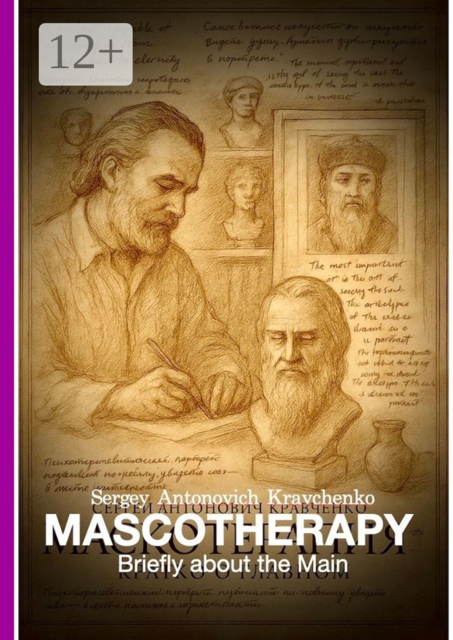
Mascotherapy: Briefly about the Main
Қосымшада ыңғайлырақҚосымшаны жүктеуге арналған QRRuStore · Samsung Galaxy Store
Huawei AppGallery · Xiaomi GetApps

автордың кітабын онлайн тегін оқу  Mascotherapy: Briefly about the Main

Sergey Antonovich Kravchenko

Mascotherapy: Briefly about the Main


Contents

This first English translation of Mascotherapy is like Noah’s dove, sent in search of new land — with hope.

Beginning

Dear friends!

I have devoted half of my life to refining and developing the method first proposed by G. M. Nazloyan. Mascotherapy is not just art therapy and not merely the sculpting of a face. It is a path where art, psychology, and the exploration of deep consciousness converge.

You take clay in your hands, look into a mirror — and suddenly you realize: this is not just material, but the beginning of a true conversation with yourself. With the one you once lost, forgot, or have not yet met.

Mascotherapy does not simply remove social masks — it makes them conscious. You begin to see the roles you play, to understand where they came from and why. The mask becomes not an enemy, but a sign — a step toward recognizing: where the mask ends, and where your true face begins.

Here, you do not hide behind familiar roles. Here, you reclaim your real face — not the one others are used to seeing, but the one born from the depths of your soul.

Mascotherapy teaches you to hear inner voices, to enter into dialogue with them, to find your center and to reassemble the self anew. Over decades of practice, I have expanded this method by including work with altered states of consciousness, dialogue with subpersonalities, and the exploration of time, archetypes, and symbolic forms.

This is not a universal tool, but it is rare and precise. The method is as unique as a sculptural self-portrait in the history of art — and just as powerful: it restores a person’s sense of self, their inner grounding, and their face in an age of mass depersonalization.

If you wish not just to “get to know yourself,” but to truly encounter your authentic Self — this book is for you.

Foreword

Mascotherapy stands as one of the rare psychotherapeutic approaches that unites artistic creation, Jungian depth psychology, and a decades-long clinical practice into a coherent and transformative method. Its originality lies not only in the combination of sculpture and therapy but in its ability to use the act of sculptural self-portraiture as a structured journey into the archetypal layers of the psyche.

This method, developed and refined by Sergey A. Kravchenko over many years, extends the pioneering work of Dr. Gagik Nazloyan while opening new dimensions: the integration of altered states of consciousness (ASC), the exploration of subpersonalities revealed through portrait work, and the creation of internal dialogues that reach beyond conventional psychotherapy. Kravchenko’s experience spans decades of clinical practice, hundreds of therapeutic portraits, and a community of students not only in Russia but also in other countries — evidence that Mascotherapy has grown into an international discipline.

In “Sculptural Portraiture as a Path to Self-Understanding and Personality Transformation,” this book references global research and connects the method to contemporary neuropsychology and art therapy. Yet its roots reach deeper — into the traditions of analytical psychology, where C. G. Jung described the face as a mirror of the Self and emphasized the necessity of engaging with archetypes rather than suppressing them.

Mascotherapy is as unique as the sculptural self-portrait itself — a genre virtually absent in the history of world art. While ancient civilizations left us masterpieces of portrait sculpture, they were always created by others, never by the subjects themselves. Mascotherapy changes this: the person becomes both sculptor and model, simultaneously creator and created. In doing so, the method bridges millennia, connecting today’s search for identity with the timeless human impulse to give form to the soul.

In a century often marked by anonymity, digital masks, and the erosion of personal presence, Mascotherapy is not for everyone. It is a method for those who consciously seek their own face — inner and outer — in an age of depersonalization. It demands honesty, perseverance, and the courage to meet what lies beneath the masks. Yet for those who take this path, the reward is profound: the rediscovery of individuality, the integration of fragmented inner parts, and a restored dialogue between body, psyche, and spirit.

About the Book

The human face is a unique psychosomatic structure — a dynamic mirror of personality, reflecting the deep processes of the soul and its unconscious archetypes. If the soul has a form, it is arguably most akin to the human face, concealed beneath numerous psychological masks. Contemporary psychotherapy increasingly faces the challenge not only of recognizing these masks, but of developing harmonious relationships with them — in the service of personal integrity and the restoration of internal dialogue.

This work is the result of more than twenty years of applied practice in Mascotherapy — an authorial adaptation of the method originally developed by Dr. Gagik Nazloyan. Over this time, a substantial body of clinical and consultative experience has been accumulated, which is here presented in a structured and accessible format. The method has been applied across diverse psychotherapeutic settings — from individual consultations to group therapy in clinics addressing addiction, psychosomatic conditions, and disorders of identity.

The earliest notes date back to 1998, during my initial training with the method’s founder. More than two decades have passed since then. Although Dr. Nazloyan is no longer with us, his school continues to evolve. New practitioners have emerged, core concepts have been refined, and the theoretical foundations have expanded. These developments necessitate further systematization and scholarly reflection.

This book is a revised and abridged edition of Mascotherapy-1: How a Portrait Reveals, Develops, and Heals the Personality (2019). It is intended for professionals in the fields of psychology, psychotherapy, and art therapy, as well as educators and researchers in related humanistic disciplines.

Mascotherapy occupies a unique place at the intersection of psychology, art, and the phenomenology of the self. Its central aim is the restoration of a coherent self-image through visual expression and the externalization of the personality’s internal structure.

September 2019

Sergey A. Kravchenko

Psychotherapist, researcher, author of the method “The Face of the Personality”

Dear Reader

For a third of my life, I have practiced Mascotherapy. I first encountered the method of Dr. Gagik Nazloyan in the early 1990s. Since then, regardless of the client who sits before me — no matter how wounded, no matter how lost — I no longer feel the uncertainty that often visited me in the early days of my practice, when a suffering soul would enter the room.

I take a piece of clay, or simply a pencil and paper, and invite my client to create a portrait or self-portrait. This act alone establishes a unique therapeutic space — disarming, grounding, and deeply symbolic. In creating a person’s portrait, we place their face — and the complex, masked personality behind it — at the center of the therapeutic universe. Without this visual anchor, a conversation can drift away from the essence of the individual, losing its depth and focus.

Around the portrait, something singular emerges — an atmosphere of trust, intimacy, even reverence. It is as if we are sitting in sacred conversation, not only with the person before us, but with the soul behind the face.

A Story from the Founder

Dr. Nazloyan once shared a powerful story. As a psychiatrist, he entered a hospital room where the patient was hiding under a blanket — a common defense he had used for years to avoid any therapeutic contact. Dialogue had proven impossible.

Without asking the patient to emerge, Dr. Nazloyan sat down and began sculpting what he imagined the patient’s face might look like. He worked in silence, occasionally commenting aloud, wondering what this hidden face might express. Within ten minutes, the patient began peeking from under the blanket. After thirty minutes, he was sitting on the edge of the bed, his feet dangling, engaged in warm conversation about the portrait’s likeness and meaning.

A portrait in the therapist’s hands can do what words cannot.

The Power of the Portrait

This story reveals something essential: even for those who have lost all interest in life and others, a portrait can awaken curiosity — especially toward the one person they still secretly wish to know: themselves. A self-portrait becomes a key, a mirror-twin that invites dialogue.

When we gaze upon a face sculpted or painted centuries ago, we are transported. Time collapses, and the past becomes present. This leads to a profound insight: only the portrait can overcome time. It suspends the temporal flow, rendering the soul behind the image timeless and eternal.

So too, when we create a portrait today — it may live a year, ten years, or a thousand. In sculpting the image of a client, we suspend time and give shape to something eternal within them. Even if we avoid explicitly philosophical language, the client may still experience a glimpse of timelessness, a fleeting encounter with the immortal soul reflected in clay.

On Becoming a Mascotherapist

My students often ask: Can I practice Mascotherapy if I am not an artist?

Let me be clear: if you believe you cannot draw or sculpt, then you will not. But if you allow yourself to remember — as children remember — that you can shape and create, then you will become an artist. The moment faith in this capacity awakens, you will begin to see your own hands as capable.

Children who enter my studio never doubt their creativity. They grab the clay without hesitation and simply begin. You must do the same. Once belief is born, you are already a sculptor. And I will teach you how to use these tools in a therapeutic setting.

Doubt in your artistic ability will limit your therapeutic depth. But once the artist in you awakens, you will discover that you possess all you need to begin. In my practice, hundreds of people who claimed they “couldn’t draw” have created striking self-portraits within weeks.

How to Begin

Take a piece of clay or plasticine. Sit before a mirror. Observe your face — and begin. Do not listen to voices that tell you you’re not an artist. The depth of your soul will guide your hand. Your quiet, true self will show you how to sculpt your double.

Each day, as your image takes shape, you will begin to see more than you ever expected. Keep a diary. Photograph the portrait as it evolves. Track your inner experience.

Pay attention to the associations that arise as you sculpt — they are often clues from subpersonalities or masks you carry. These impressions will show you what within your psyche longs to be seen, understood, and integrated.

Your work will be even more powerful if you journal your thoughts, emotions, and visions in tandem with sculpting. Even when these seem unrelated to the portrait — trust them. With the portrait as your anchor, nothing is accidental. Everything around it is a manifestation of your evolving self.

Time and Dialogue

It is difficult to say whether a portrait influences life, or life influences the portrait. Most likely, they are interwoven in a synchronous dance.

Here we arrive at a key concept: dialogue. Dr. Nazloyan placed dialogue at the center of Mascotherapy, observing that the absence of inner dialogue often characterizes psychological suffering. Without inner dialogue, there is no true outer dialogue.

But when we engage in this reflective process — sculpting, journaling, conversing — we revitalize inner dialogue. And as it grows richer, so too does our outer communication, our life, our relationships. As we master these inner conversations, we begin to influence the world around us with greater clarity and intention.

Thus, it is not only the portrait, but the dialogue it evokes, that becomes central to the transformative power of Mascotherapy.

A Final Word

Dear reader, allow me to caution you: do not approach this method mechanically. A portrait alone may not perform miracles — though sometimes it does. It is a tool, a powerful one, that in the hands of a skilled and sincere practitioner can transform both the soul and the surrounding world.

A portrait often outlives its subject. It defies time and immortalizes the soul. In this, portraiture transcends art therapy and touches the threshold of the eternal.

A wise man once said: “Every act of the artist echoes in eternity.”

I would add: “Every portrait reflects the mirror of the eternal soul.”

Create portraits. Shape your soul and the world around you.

Perhaps this is the higher meaning of life — and of our dialogue with ourselves, others, and the mystery that connects us all.

S. A. Kravchenko

Author

2019
INTRODUCTION